A Day of Contrasts

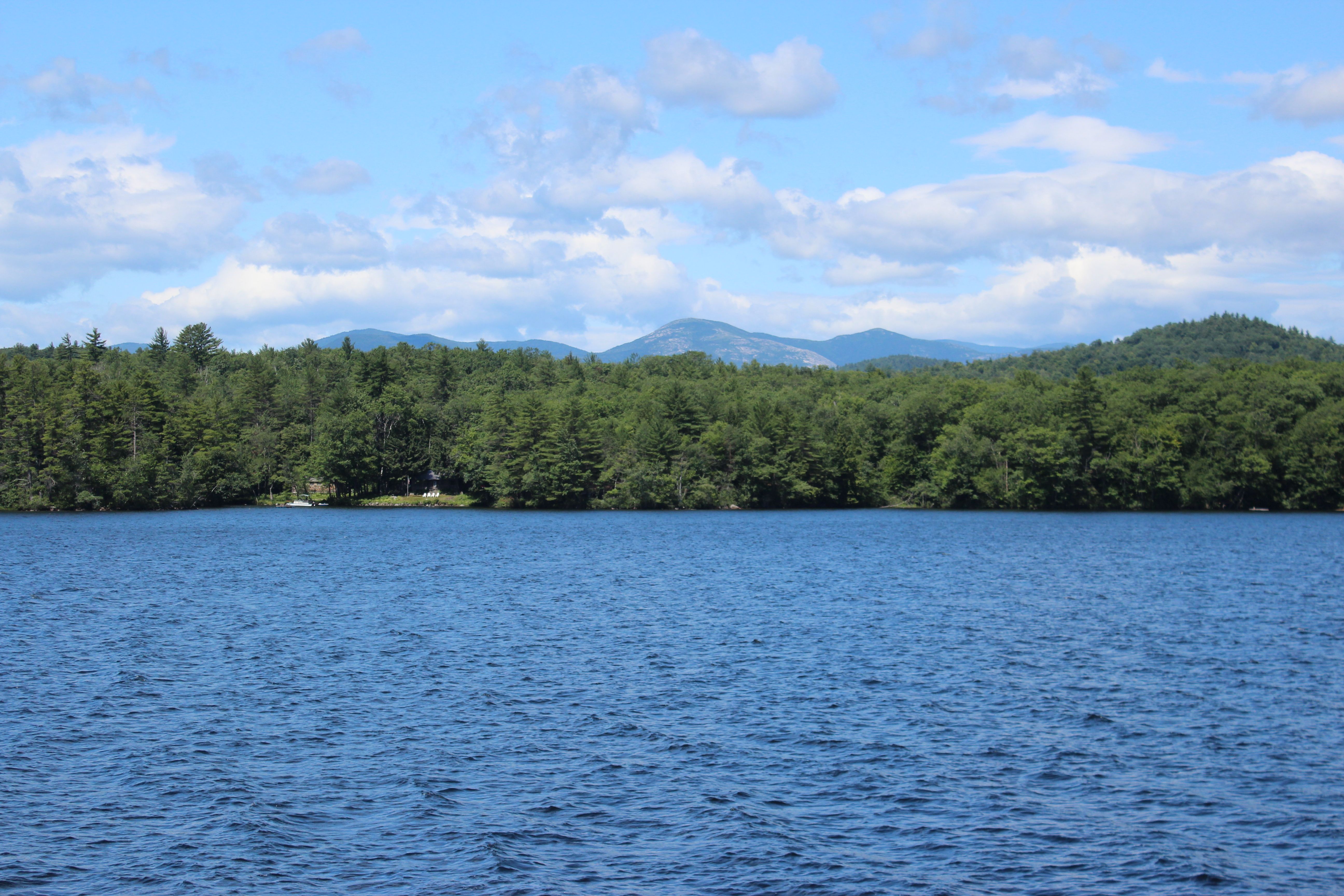
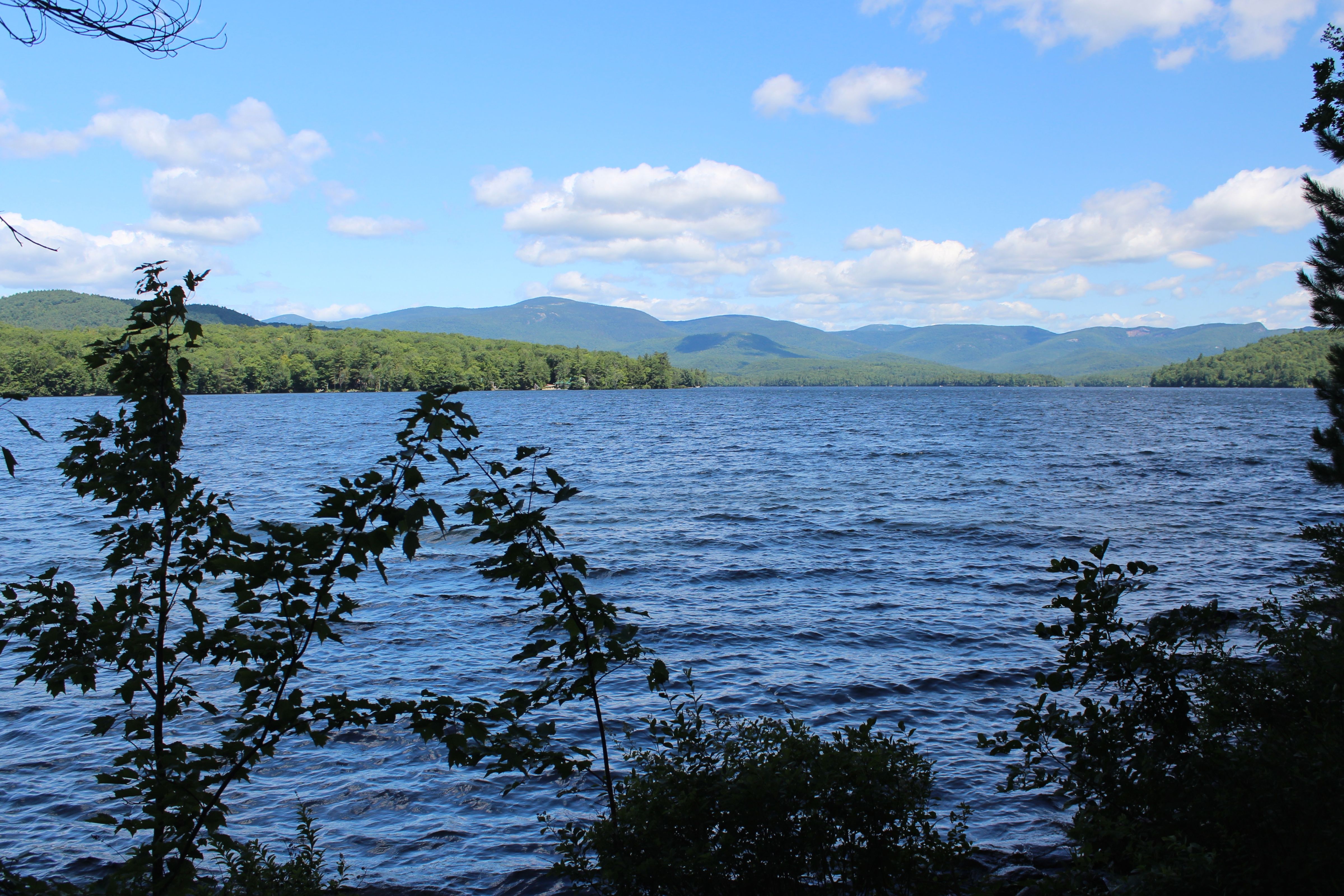
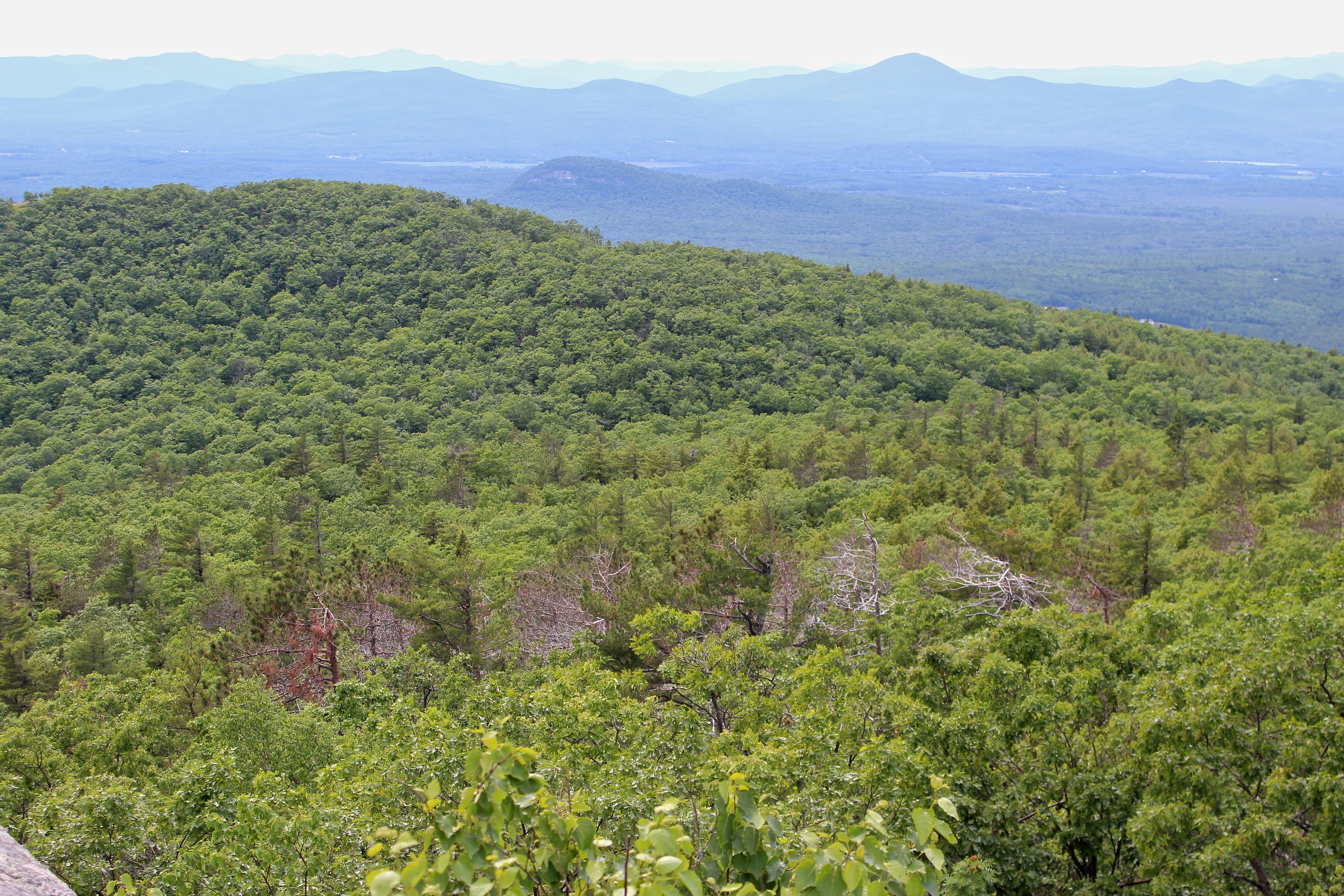
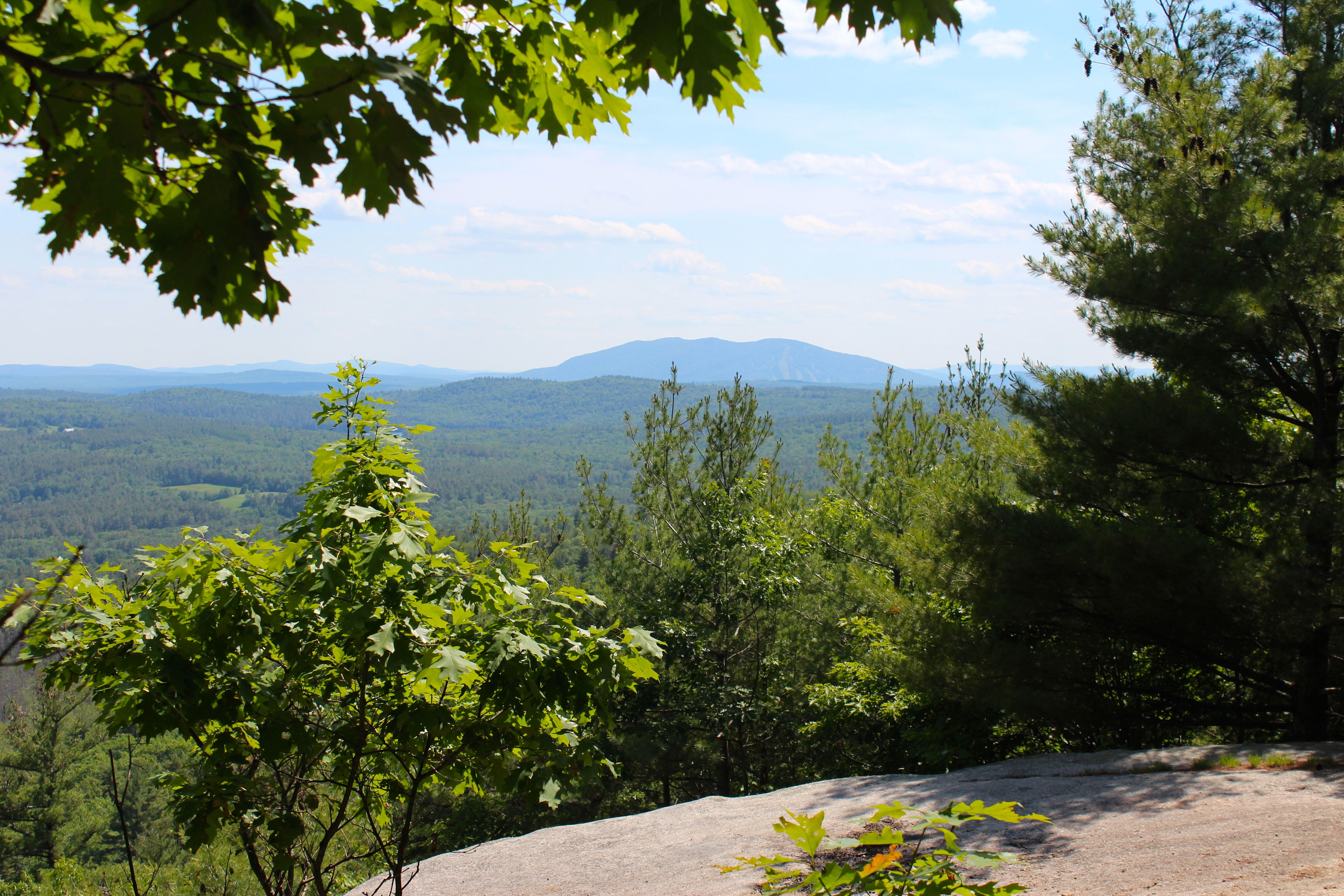
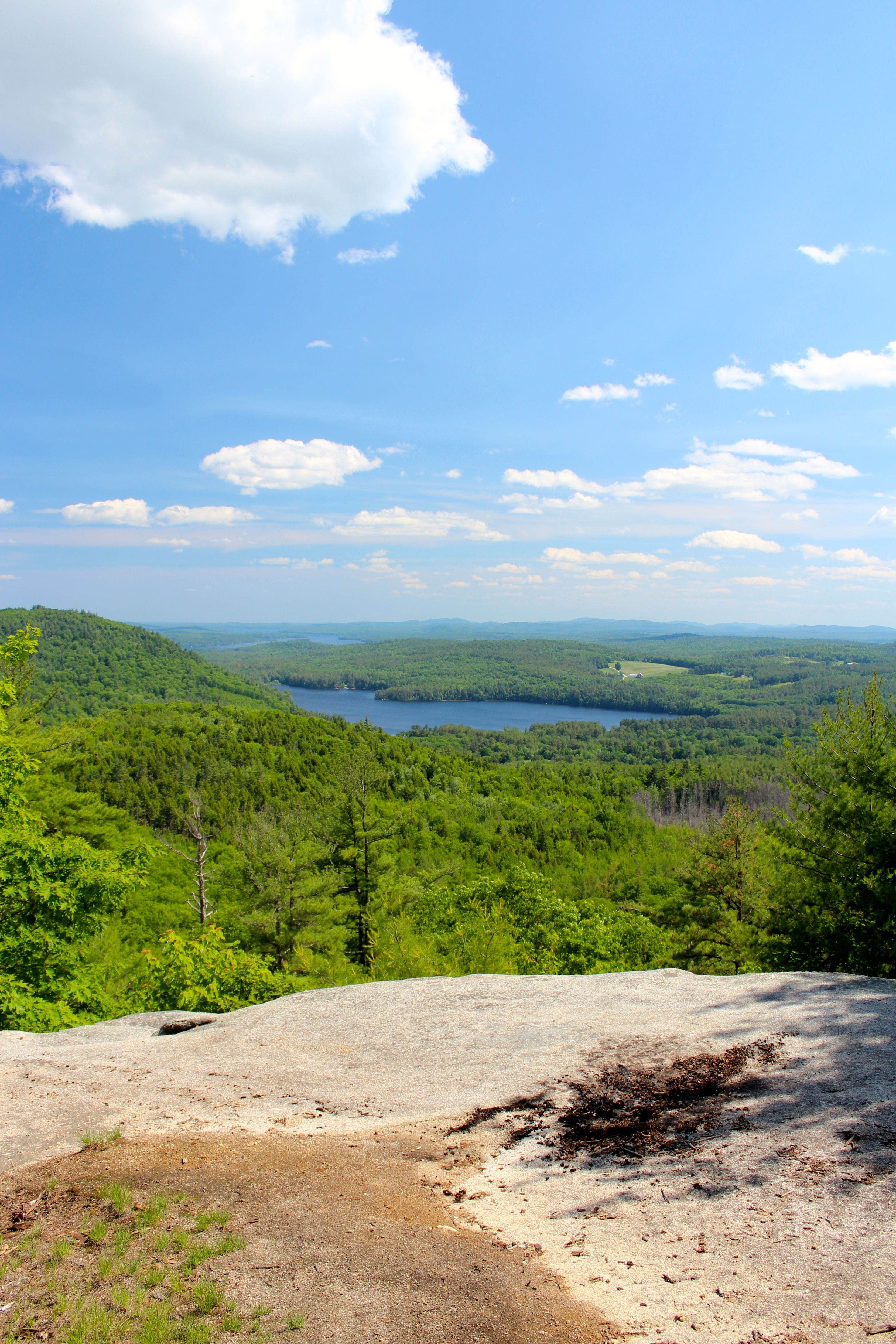
Each time we climb Pleasant Mountain, the view differs–and so it was this morning. Haze sugar coated the summits beyond.

hazy 2

Green, blue, white, purple and gray melted into each other.

haze 3

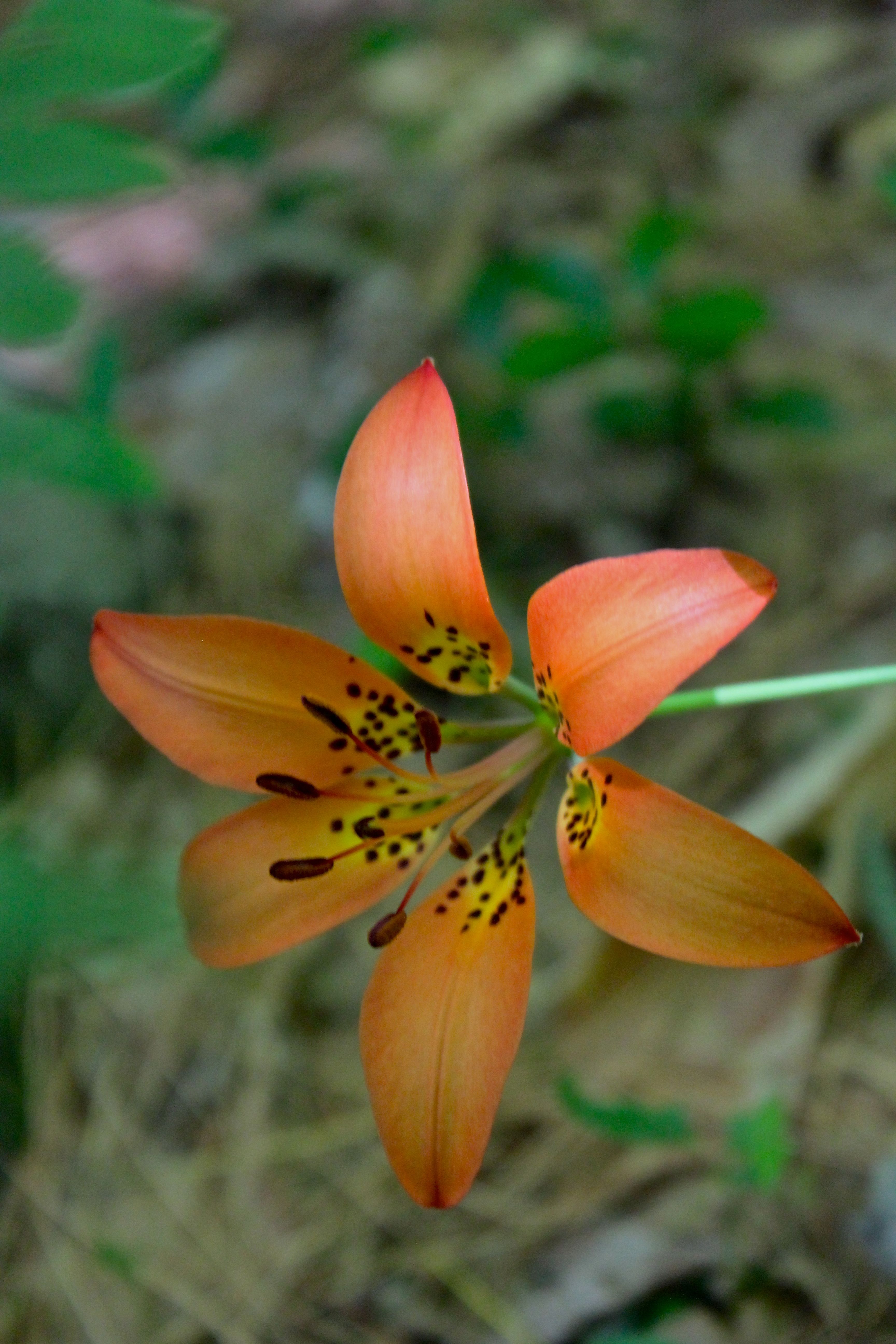
That’s what made a bright orange wood lily beside the trail stand out.

wood lily

Certainly a shock of color.

wood lily 2

Step in with me for a closer look. Three sepals and three petals, but their design is similar. Each is jazzed with dark purple to black spots–the better to draw in those butterflies and skippers. And white-tailed deer.

wood lily, whiting

The other thing to notice is how the sepals and petals taper at the base. I actually took this photo on Whiting Hill in Lovell about two weeks ago. But, I’m curious about its reproduction–one on Whiting, one on Pleasant. Am I missing something? Have the deer consumed others? I frequent both of these locations and have only seen the solo plants.

porcy 1

I  can’t sit still when I get home. Especially when I know I have work to do. So, I wandered around the backyard. Right off the deck, a quaking aspen grows on the edge of a flower garden. Daylilies surround a wooden barrel we turned into a water feature. Alas. They’ve been knocked down.

porky claws

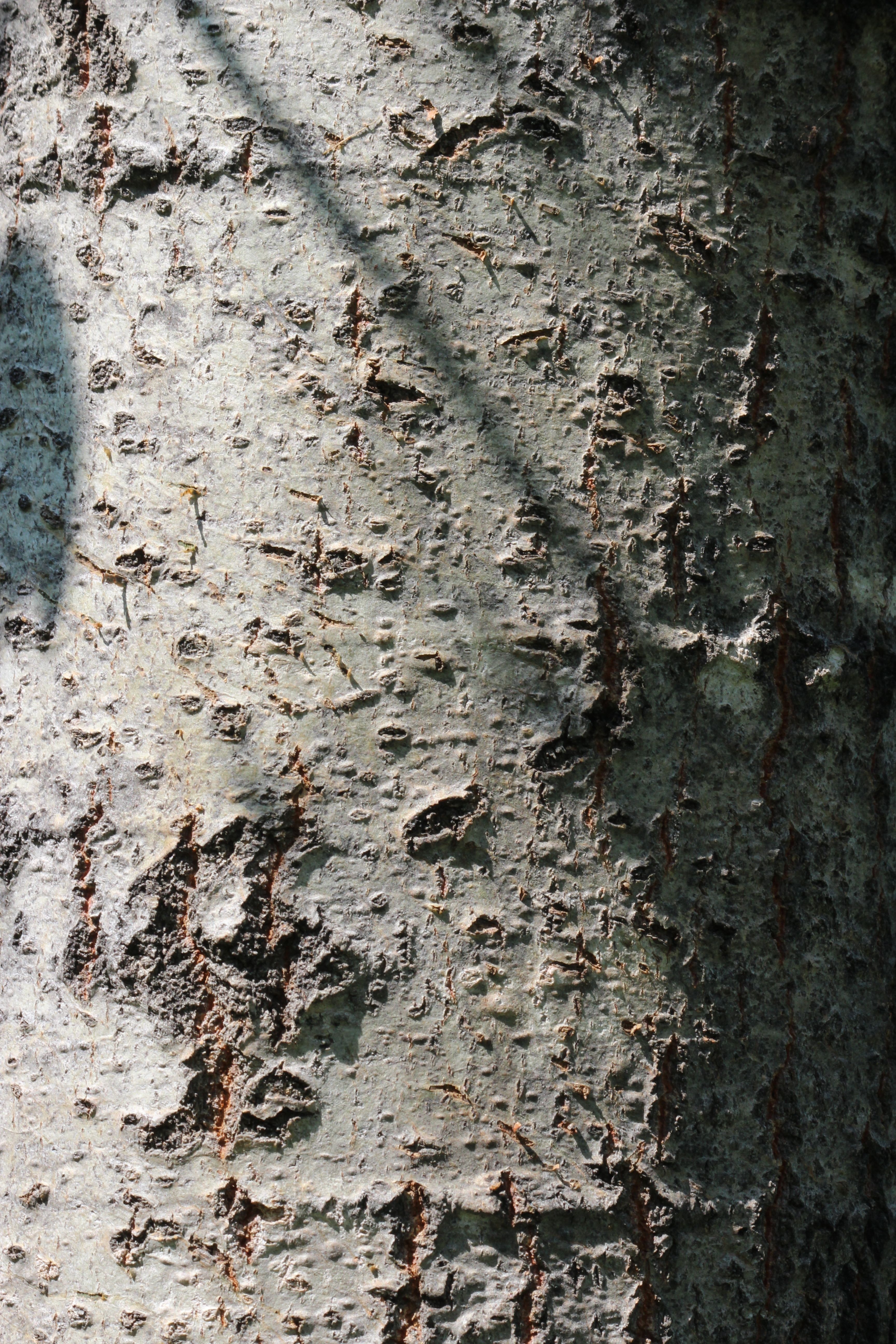
The resident porcupine has been visiting on a regular basis. Quaking aspen bark features horizontal and vertical lines, but the porcupine left its own mark–look for the fainter diagonal lines created by its toe nails.

porky leaves

The leaves must be delish.

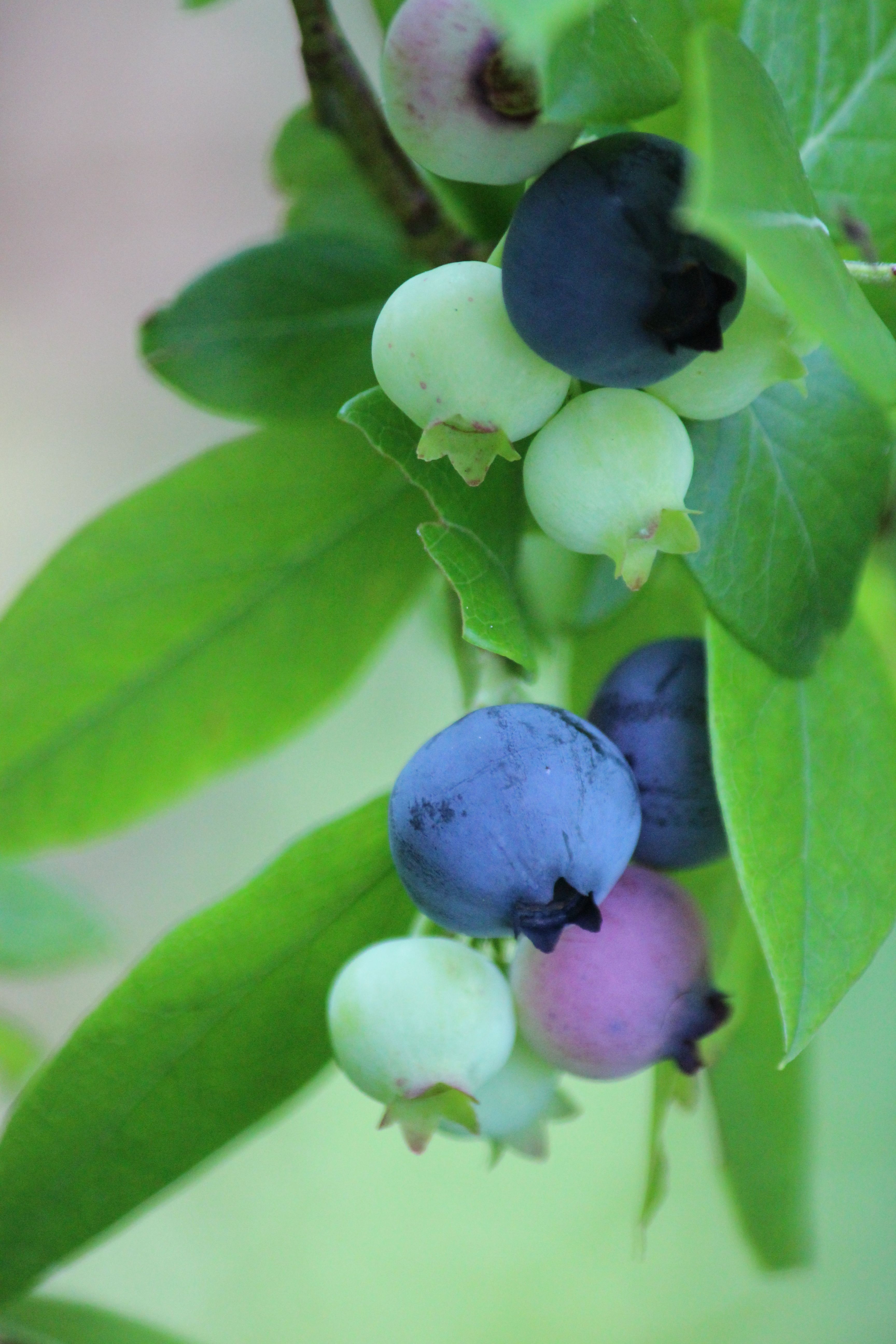
blueberries

I wandered some more. Certainly delish–blueberries. They need a wee bit more time.

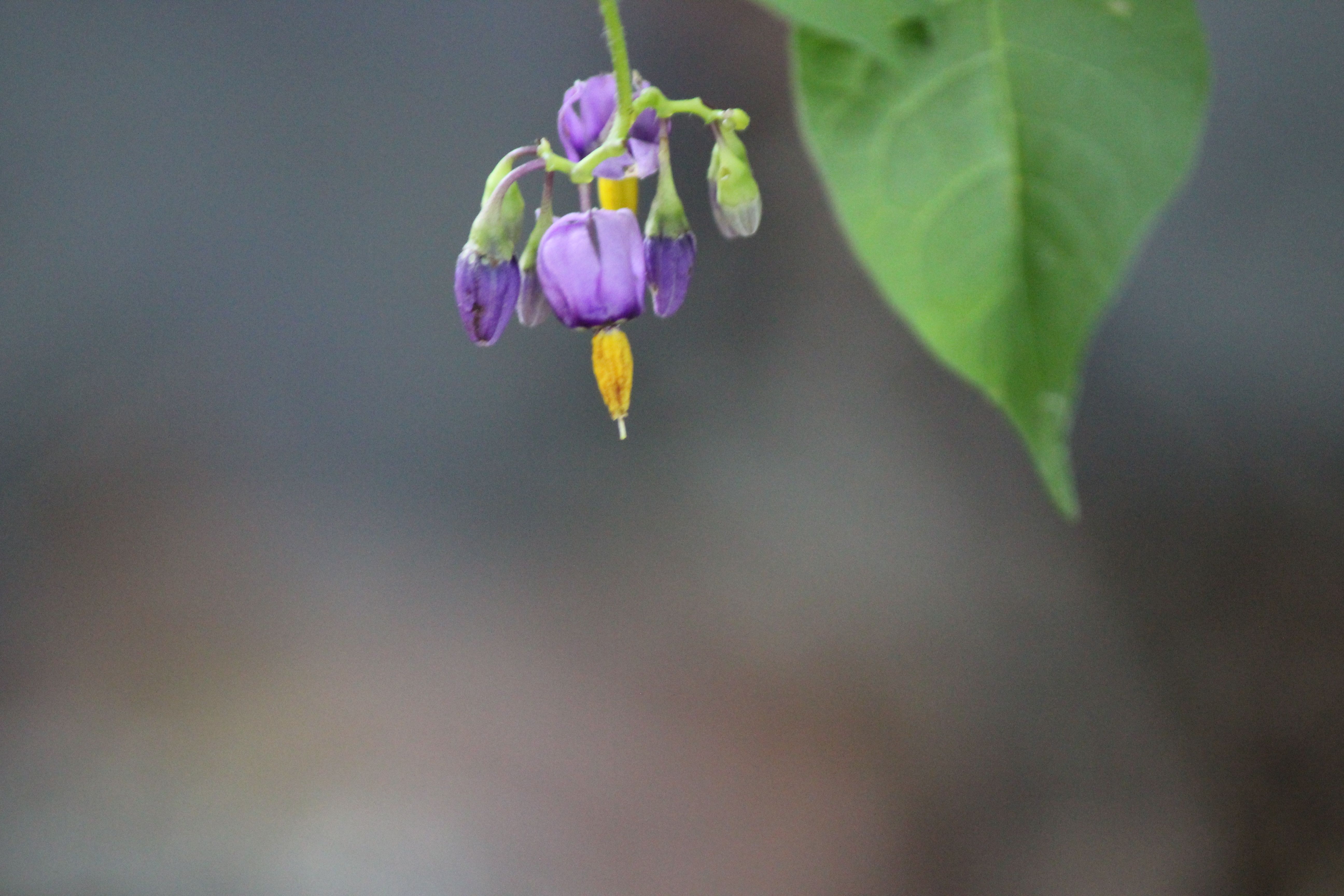
Bittersweet Nightshade

Not delish, but dramatic in shape and color is the bittersweet nightshade. I remember my mother calling it deadly nightshade. Its berries are poisonous, but unless eaten in large quantities, it isn’t fatal. OK, the point is–admire the flower; don’t eat the berries.

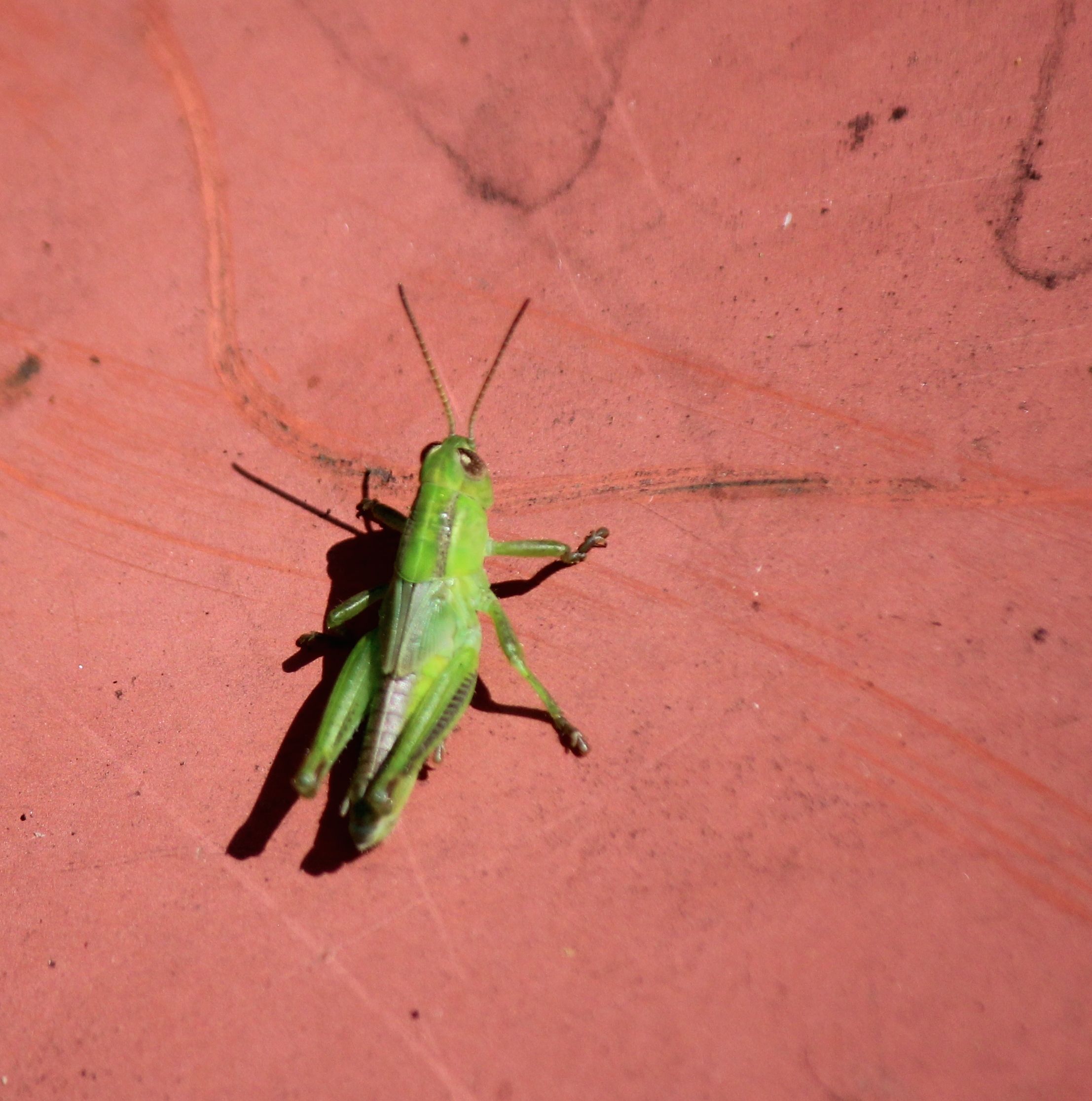
grasshopper

Not as dramatic because it wants to blend in is a grasshopper. Do you see it?

grasshopper 2

A sibling was hardly invisible on the cellar door.

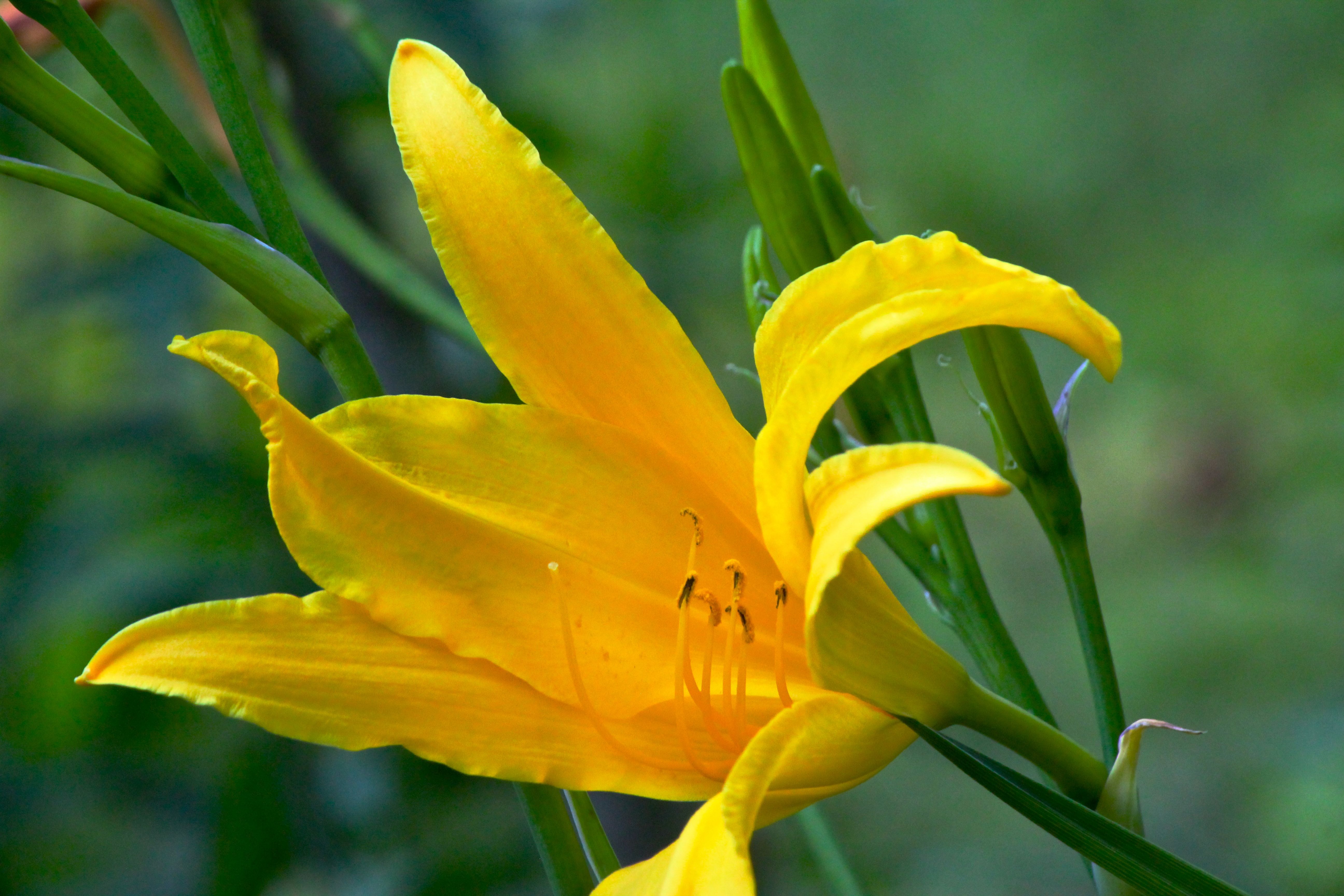
yellow lily 2

Before heading inside, I stepped into our neighbor’s yard because her yellow lilies are blooming. Ours will probably show forth their sunshiny faces tomorrow. I’ve a feeling that these are cultivated, but don’t know for sure. I’m hoping Bev Hendricks of DeerWood Farm and Gardens will  enlighten me on this species.

From a hazy summit view to brilliant natural hues, today was a day of contrasts.

Goodbye Spring, Hello Summer

Sometimes the words slide out with little effort and other times, they seem to hide in the wings, waiting backstage. So it is on this last day of spring.

Whoa. Maybe I’m not sure what to write because I’m not ready for spring to end. I’m not sure spring is ready either–it was 44 degrees at 6 a.m. and even now, sitting in the shade, I’ve got goosebumps from the breeze..

But say goodbye to spring I must. I’ve spent the past two days savoring its final moments and mosaic colors. Along the way, I’ve seen some cool things.

waspwasp 2

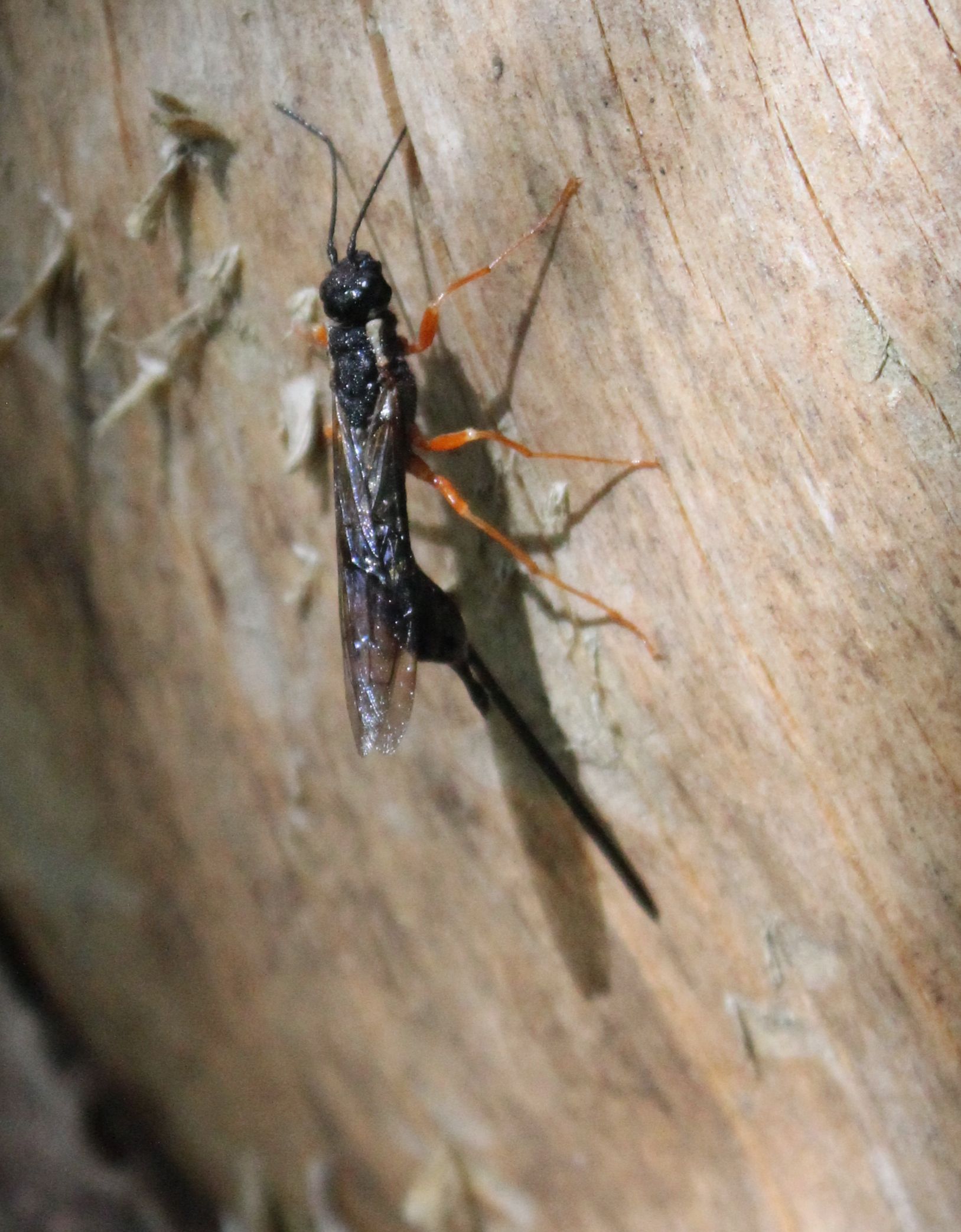
I came across this ichneumon wasp on the base of a hemlock girdled by a beaver. Because of the long, needle-like ovipositor (that looks like a nasty stinger, but usually isn’t–though she is a wasp), I think this is a female. She’s possibly searching for a place to inject her eggs, which will then feed on other insect larvae.

 beaked leaf

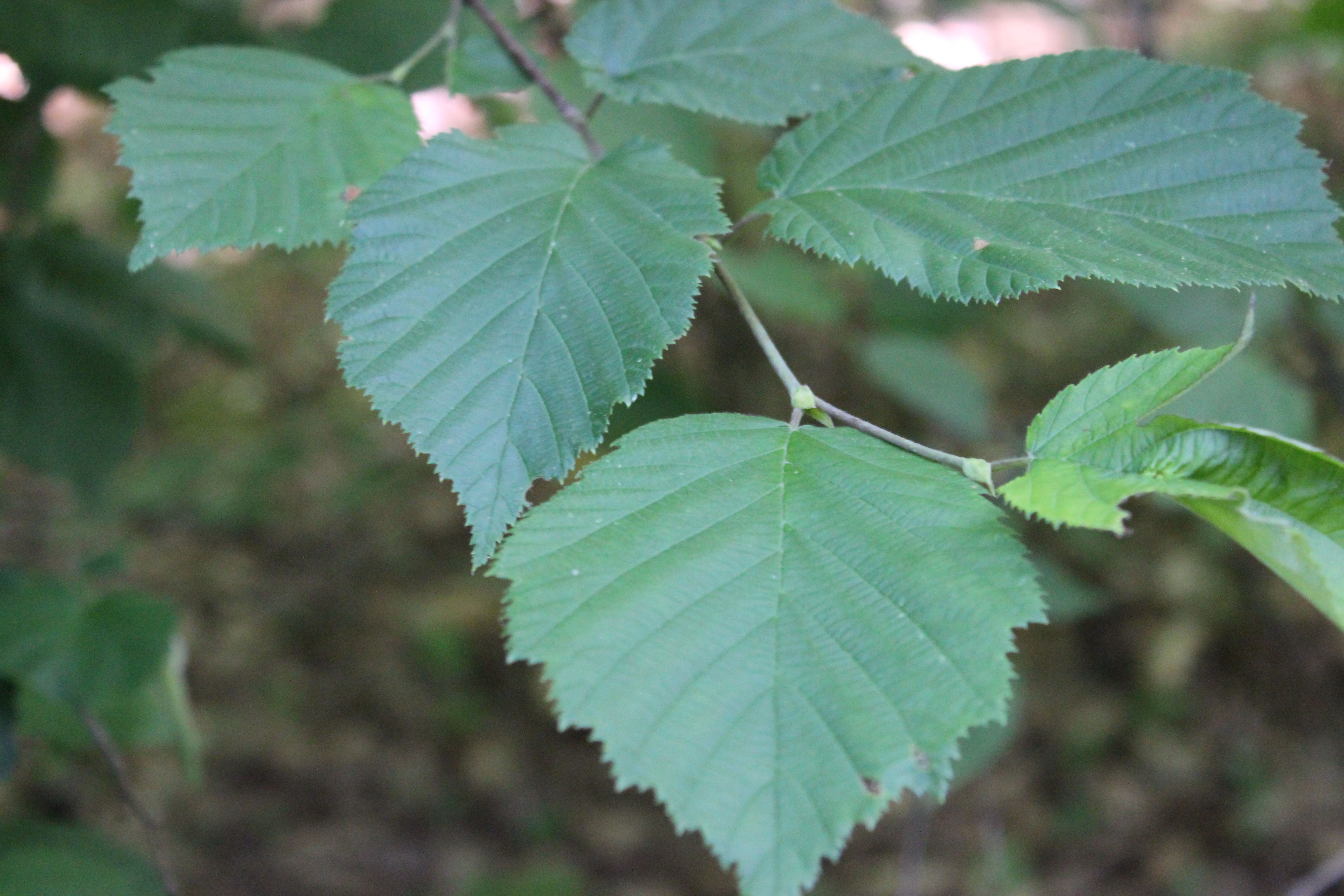
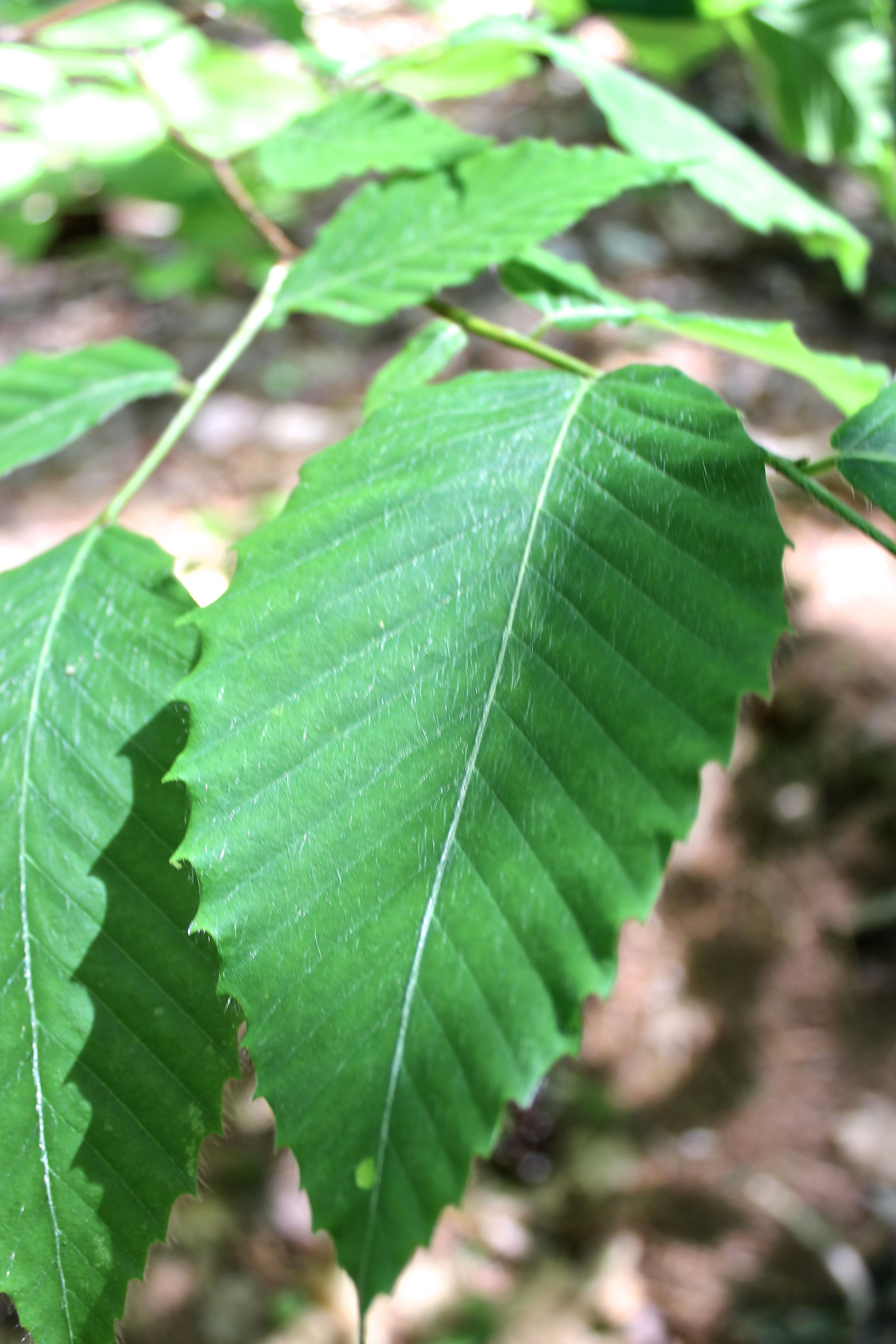
As the season unfolded, I’ve been training my eyes to focus on leaf characteristics. This one is easy to pass off as a beech. But, its saw-blade teeth tell me to check below the leaves.

beaked hazelnut

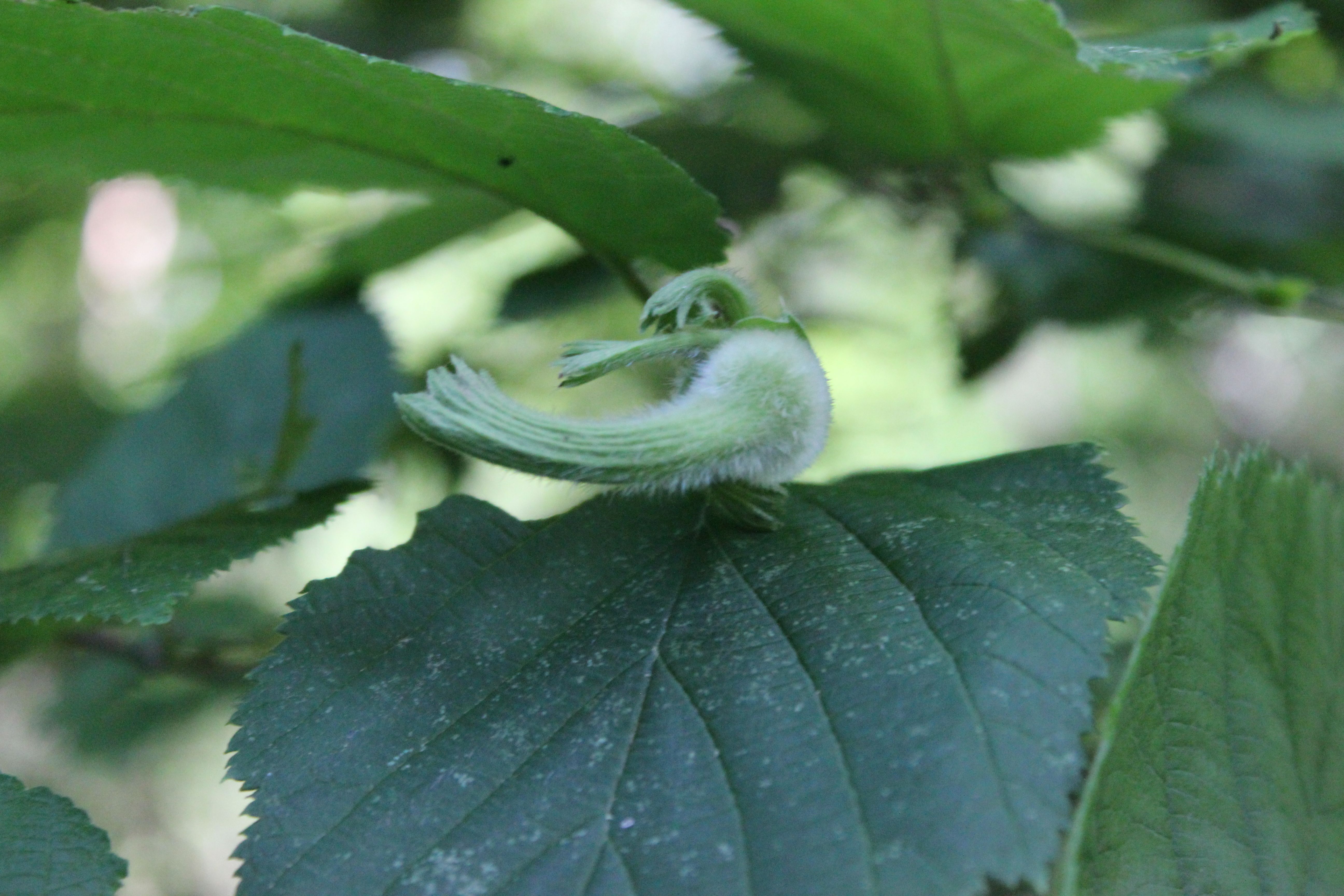
Beaked Hazelnut, a shrub that produces hairy husks containing the nut (think filbert) .

beaked hazelnut 4

Double beaked. They grow singly or in groups up to ten or so.

beaked five

Dangling like baubles, the fuzzy balls will entice squirrels, chipmunks, birds and yes, humans.

red pines

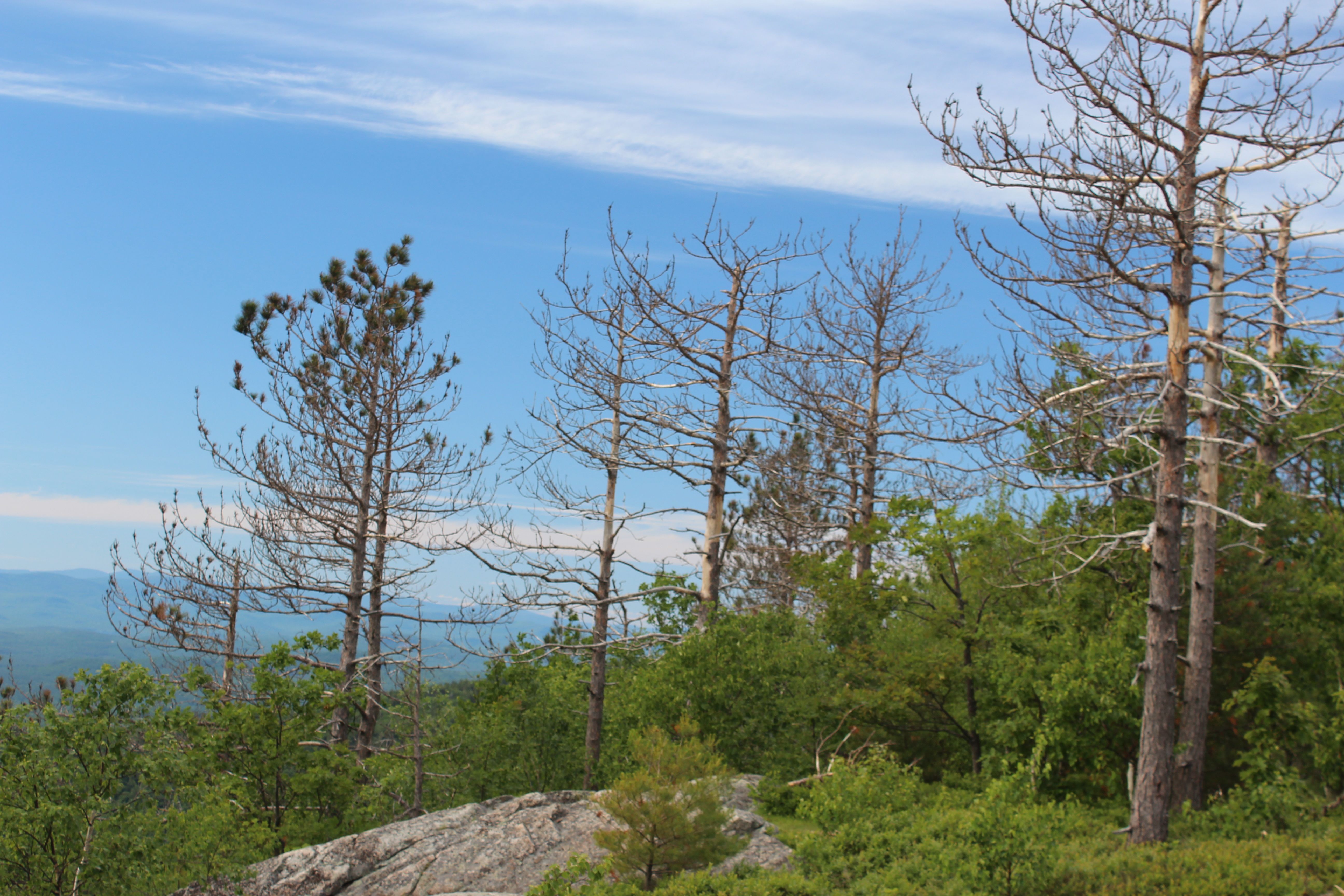
Sadly, not every part of the picture is pretty. The red pines at the summit of Pleasant Mountain are dying off. I spoke with a forester from the White Mountain National Forest about this today and his thought was that it might be red pine scale insects. Yeegads.

red pine 2

My first thought had been weather, but the trees below the summit have also been affected. It’s time for me to contact the state forester and ask his opinion.

cinn fern

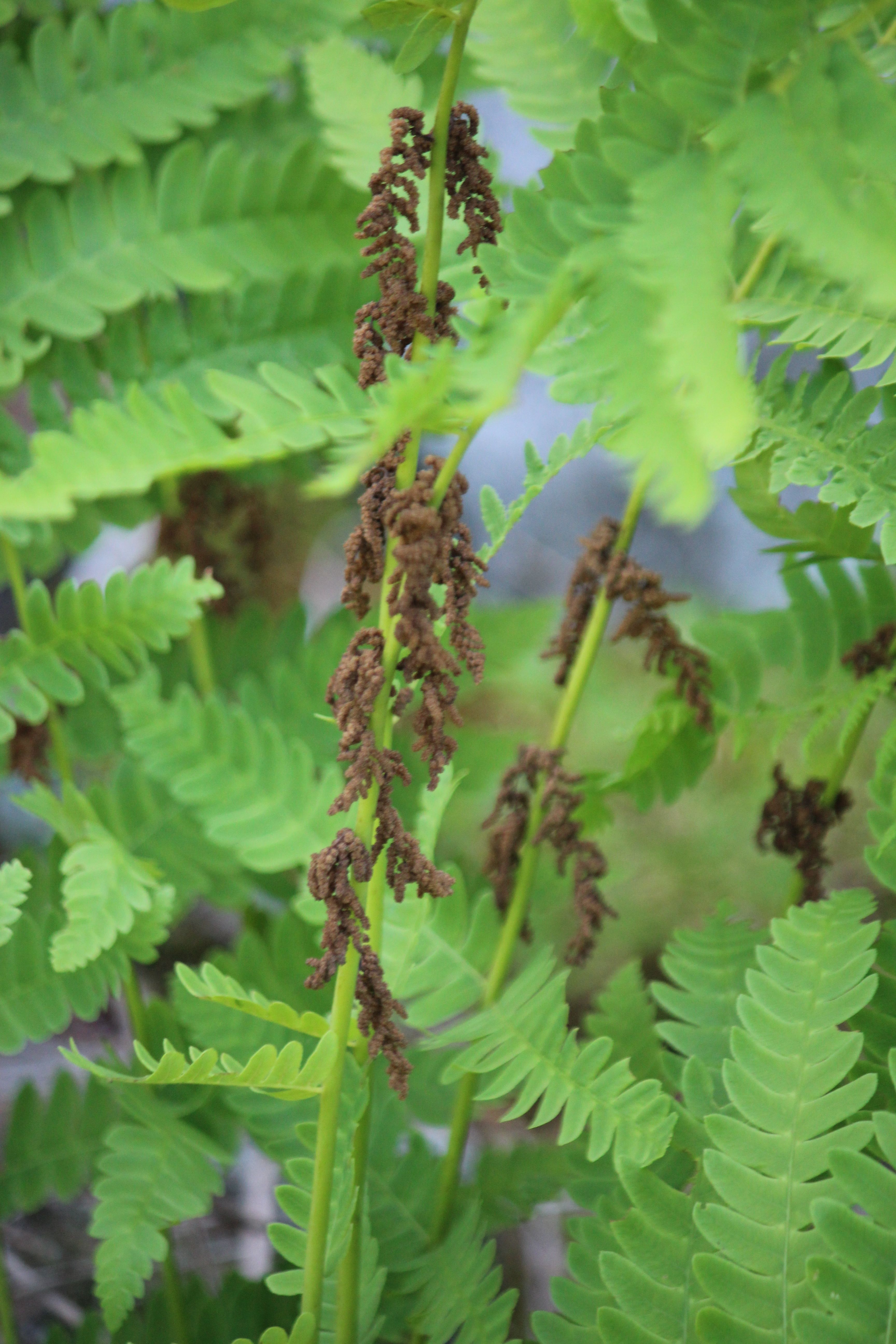
The fertile fronds of the cinnamon fern have spread their spores and are now withering. Soon, I’ll have to search to find any evidence that they ever existed.

inter fern

The same holds true of the interrupted fern, though the gap that will be left once the fertile middle pinnae fall off will be rather obvious.

running club moss

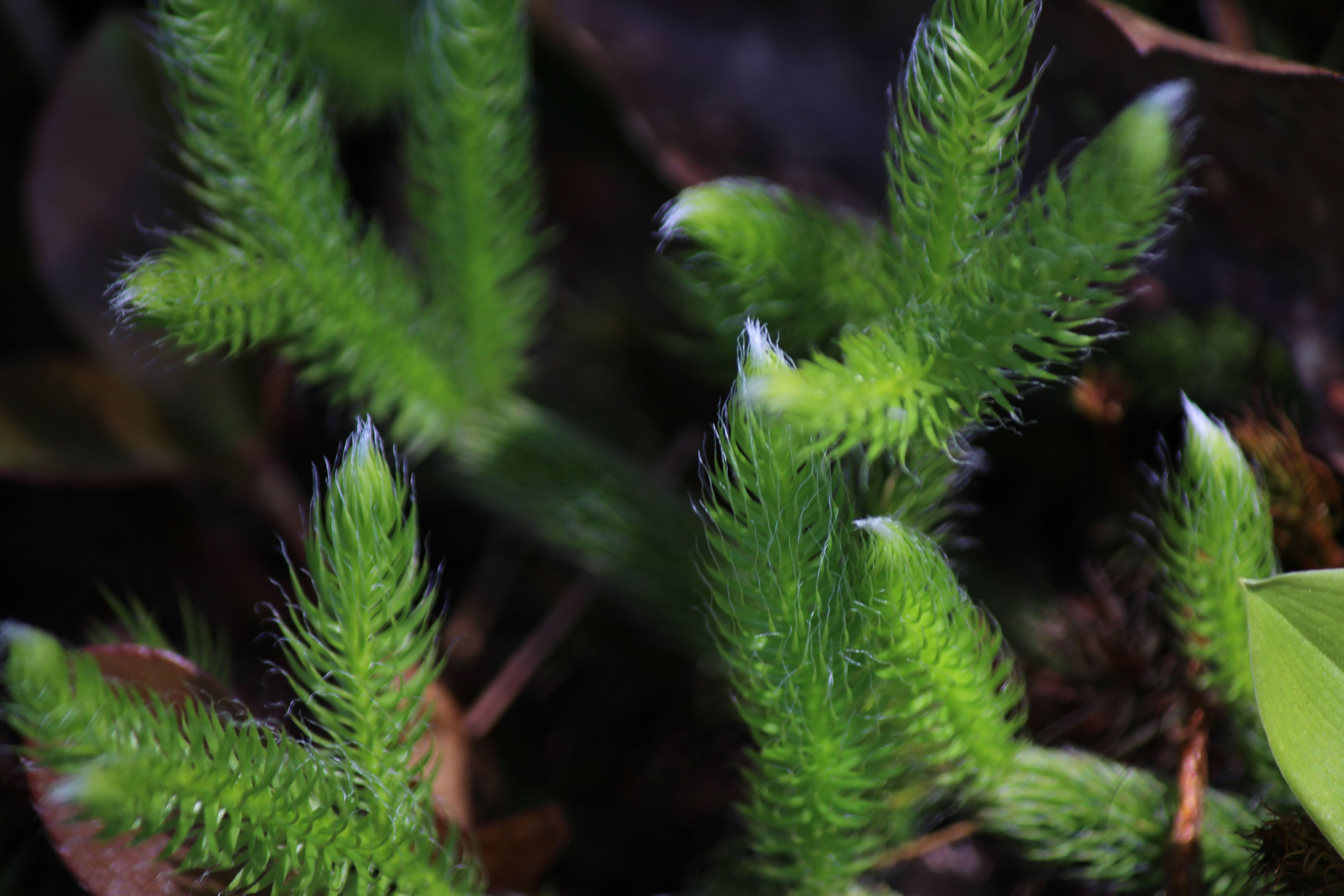
Long white hairs top the tip of running clubmoss.

running 2

Candlelabras are forming, preparing to release numerous spores. Like the ferns above, it’s difficult for me to comprehend that this life form that creeps along the ground was once the size of trees. Mind boggling for this brain.

lady bug

On to simpler things. A ladybird beetle.

hawk 2

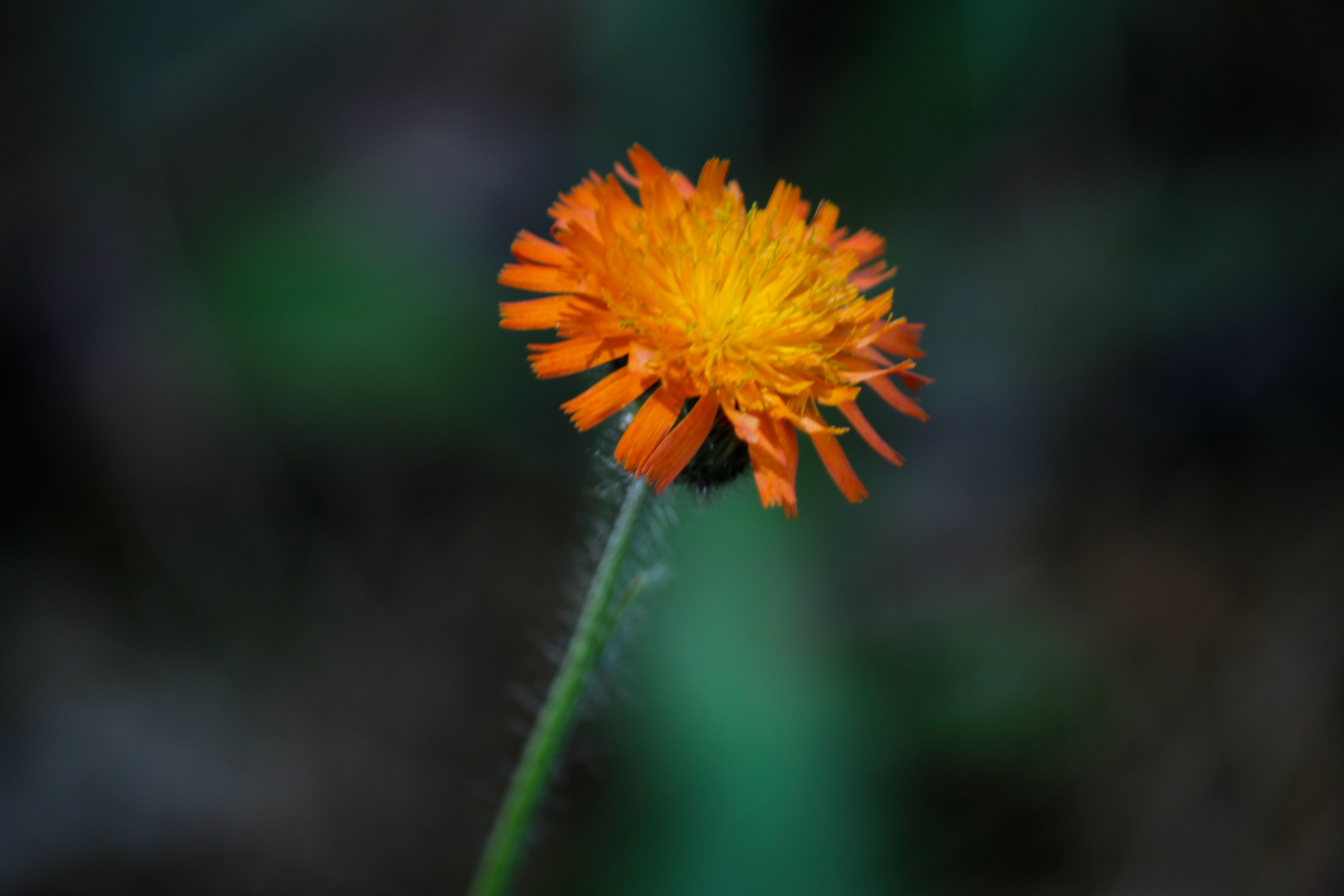
Orange Hawkweed, aka Devil’s Paintbrush.

dragon 1

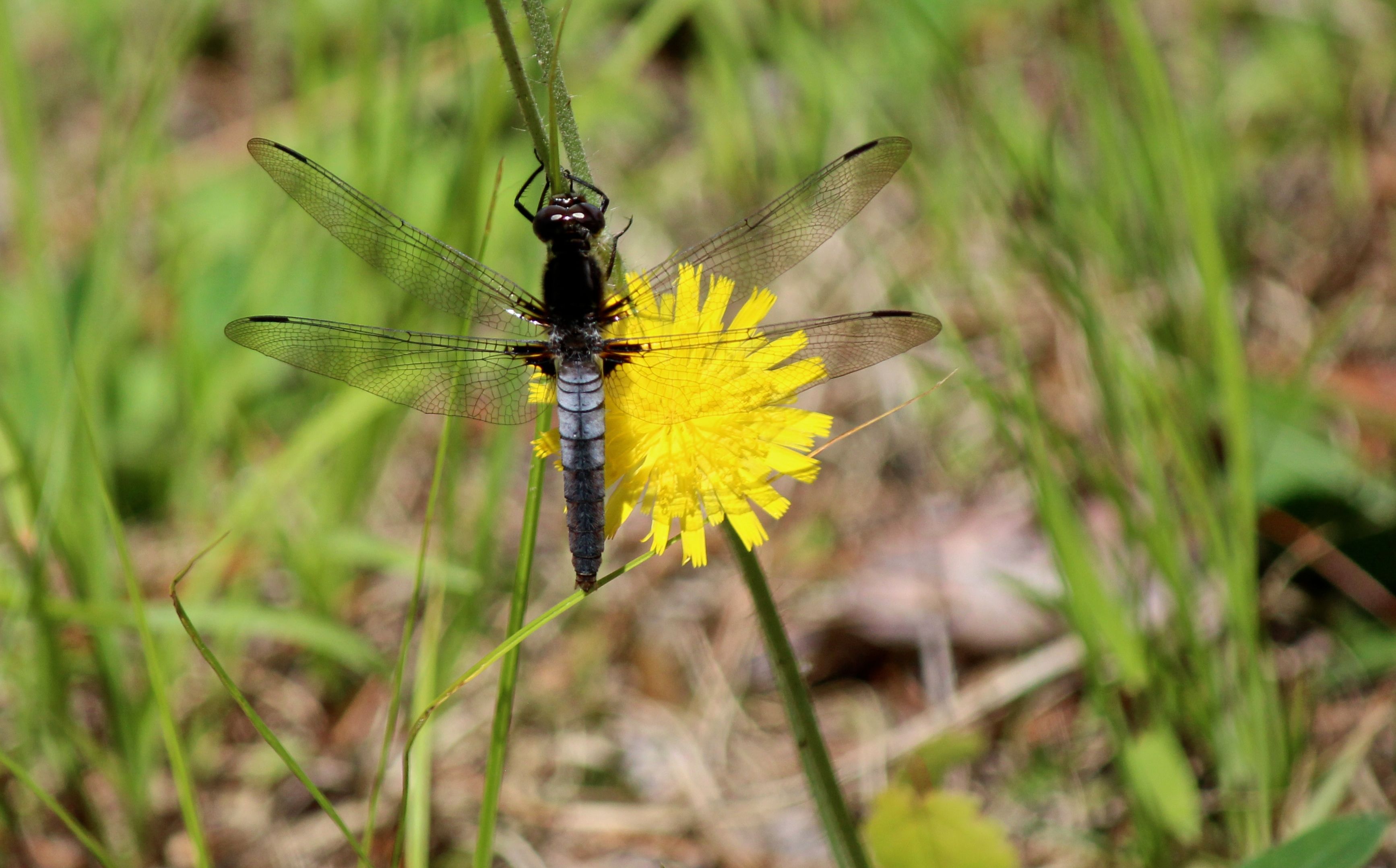
I think this is an Eastern pondhawk dragonfly, but if you know better, please tell me. My other thought–blue dasher. Either way, like all dragonflies, there’s beauty in its venation and color. Plus, those dragonfly eyes.

blue flag iris reflection

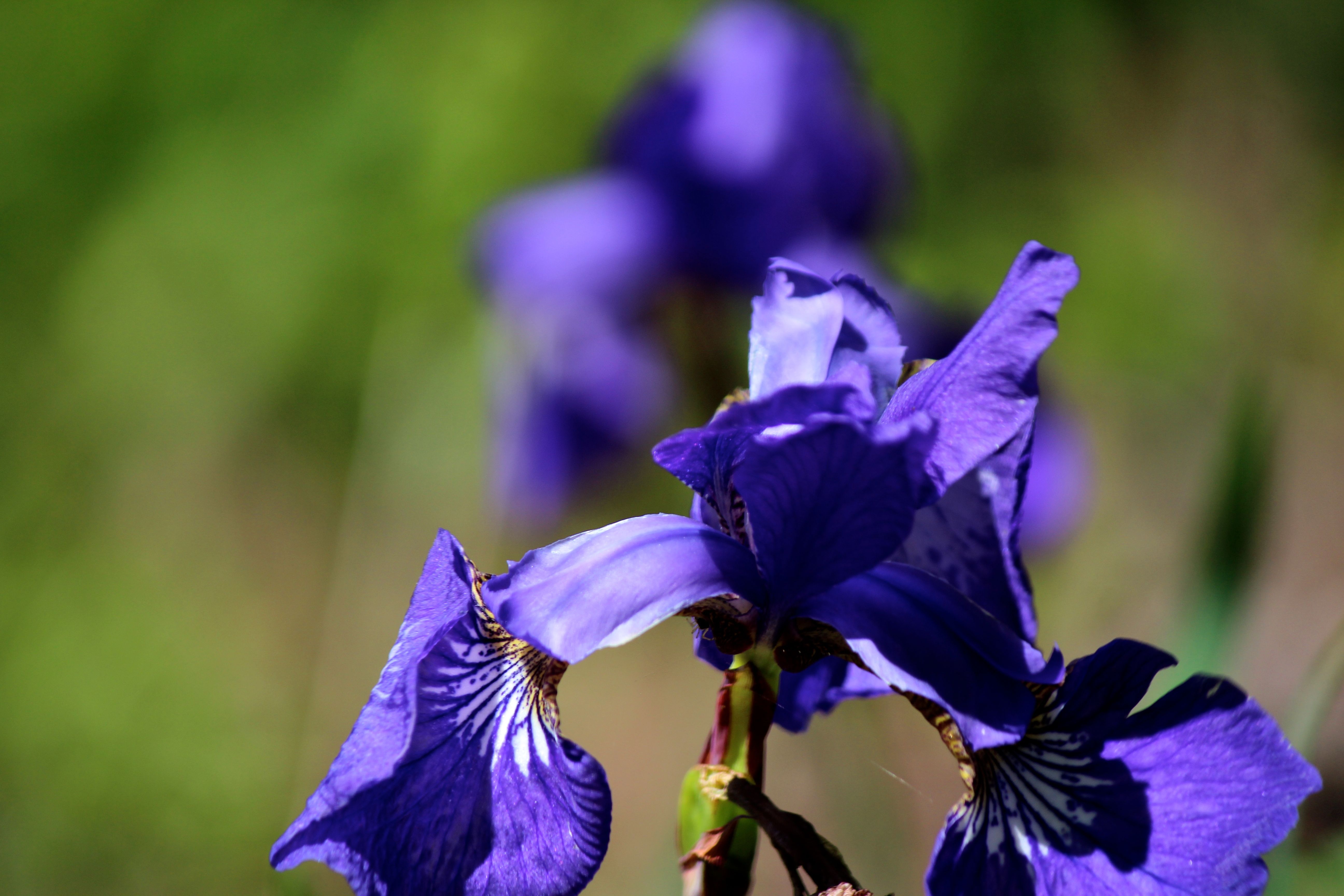
The Blue Flag Irises

bf iris

are making a final statement,

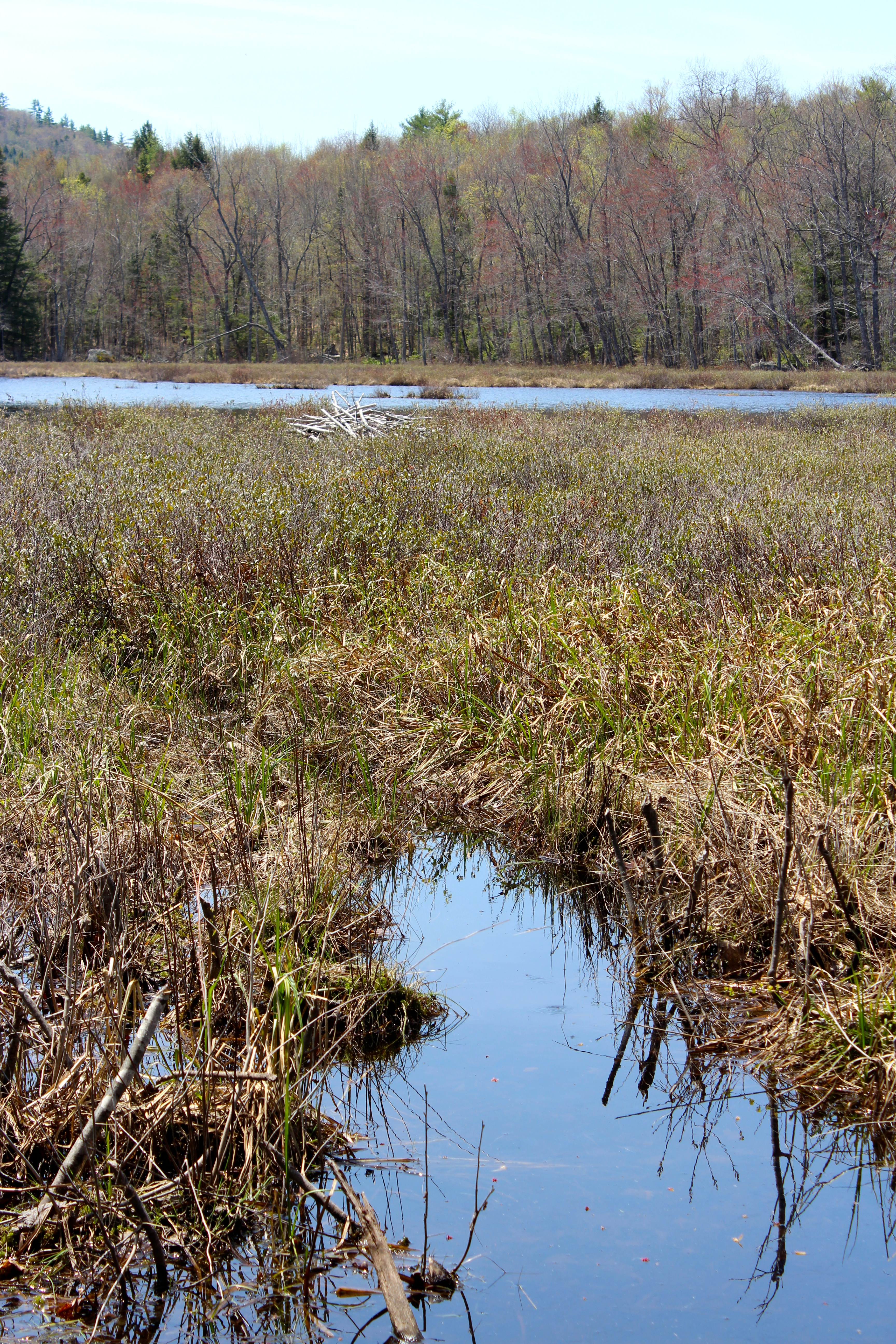
heron

while a great blue heron forages for fish near an abandoned beaver lodge.

daisy 1

Daisies speak to the season to come.

another season

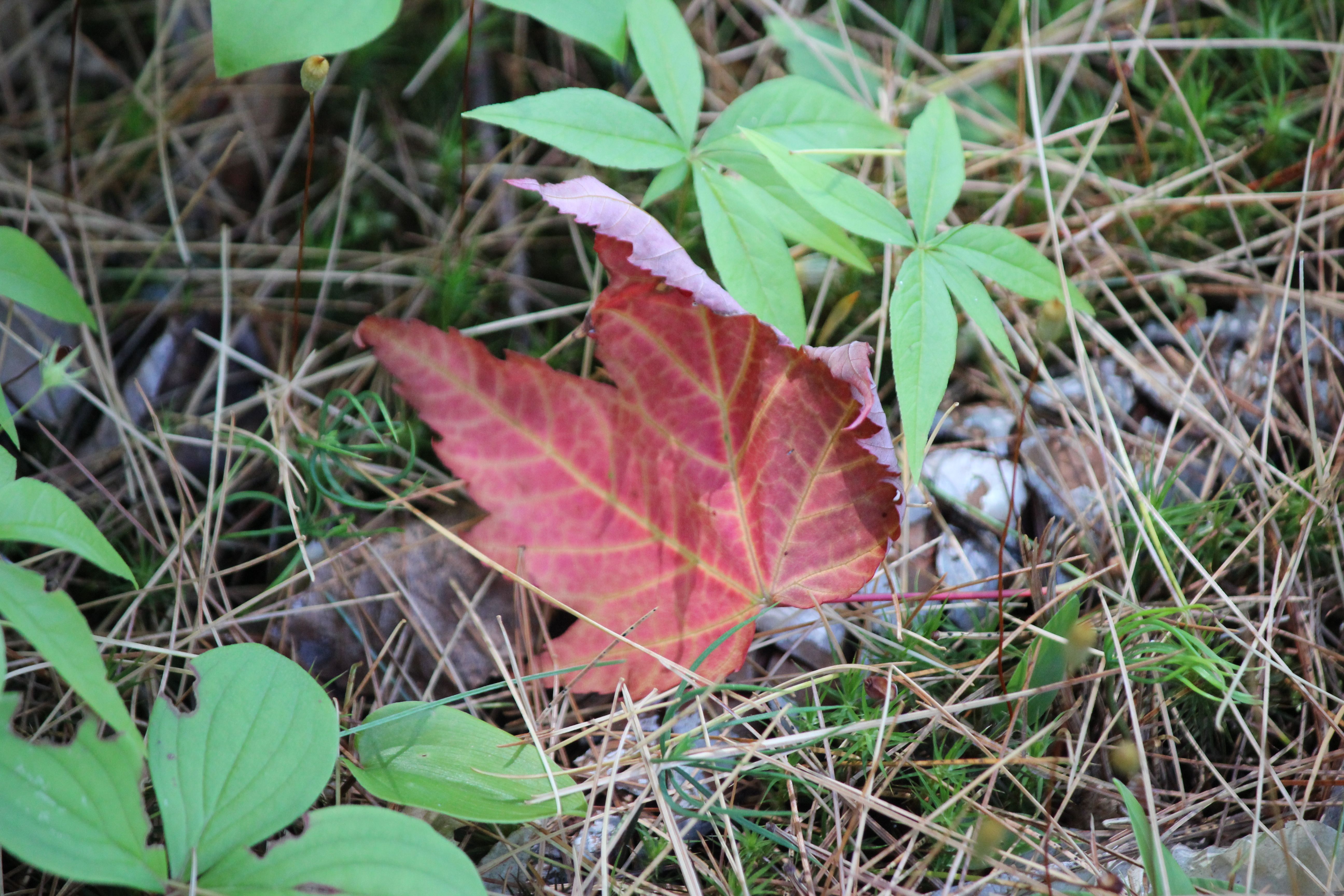
It’s only a day away . . . oops. A red leaf found today. What’s with that? Maybe the pine needle cast has all of nature confused.

mt washington

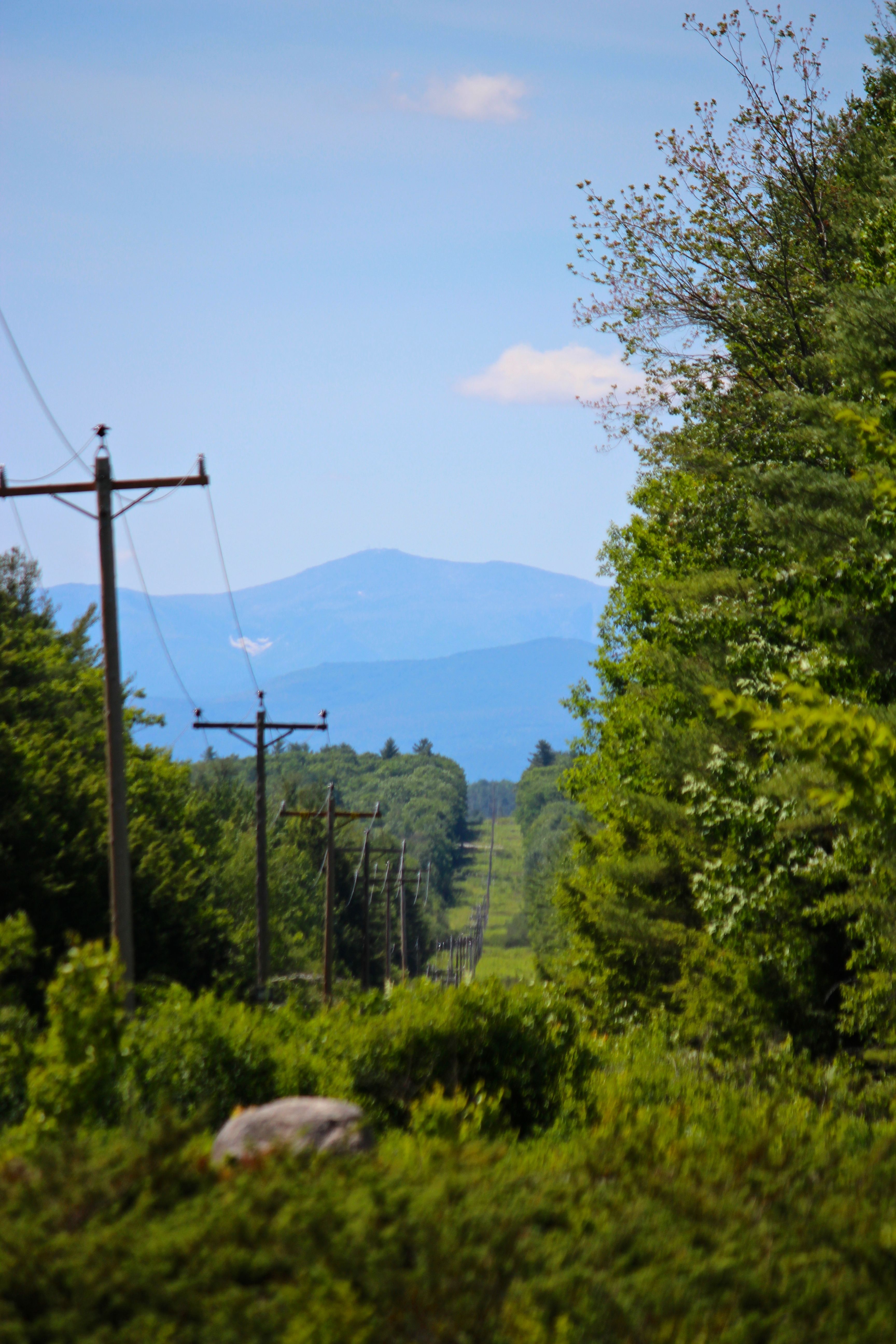
Thanks for joining me on this last peak at spring. I’m looking north now as the summer solstice is on the horizon.

Slugs, Bears and Caterpillar Clubs, Oh My!

I was on a quest today as I wandered with friends at the Greater Lovell Land Trust’s Bishop Cardinal Reserve. I wanted to return to the bear trees and show them that there are so many more in the area. Thank goodness they are all good sports and don’t mind getting fake lost.

But first, I licked a slug again. And convinced a friend (J.L.) to do the same, without twisting her arm.

slug

This was my terrestrial gastropod mollusc of choice.

slug 2

And proof. Rather attractive photo–Not–but the slug did numb my tongue a bit.

bear 1

We eventually found some of the beech trees with bear claw marks, but there are more–for another day.

bear 2

Satisfied with our findings, we decided to continue off trail, keeping our eyes and minds open.

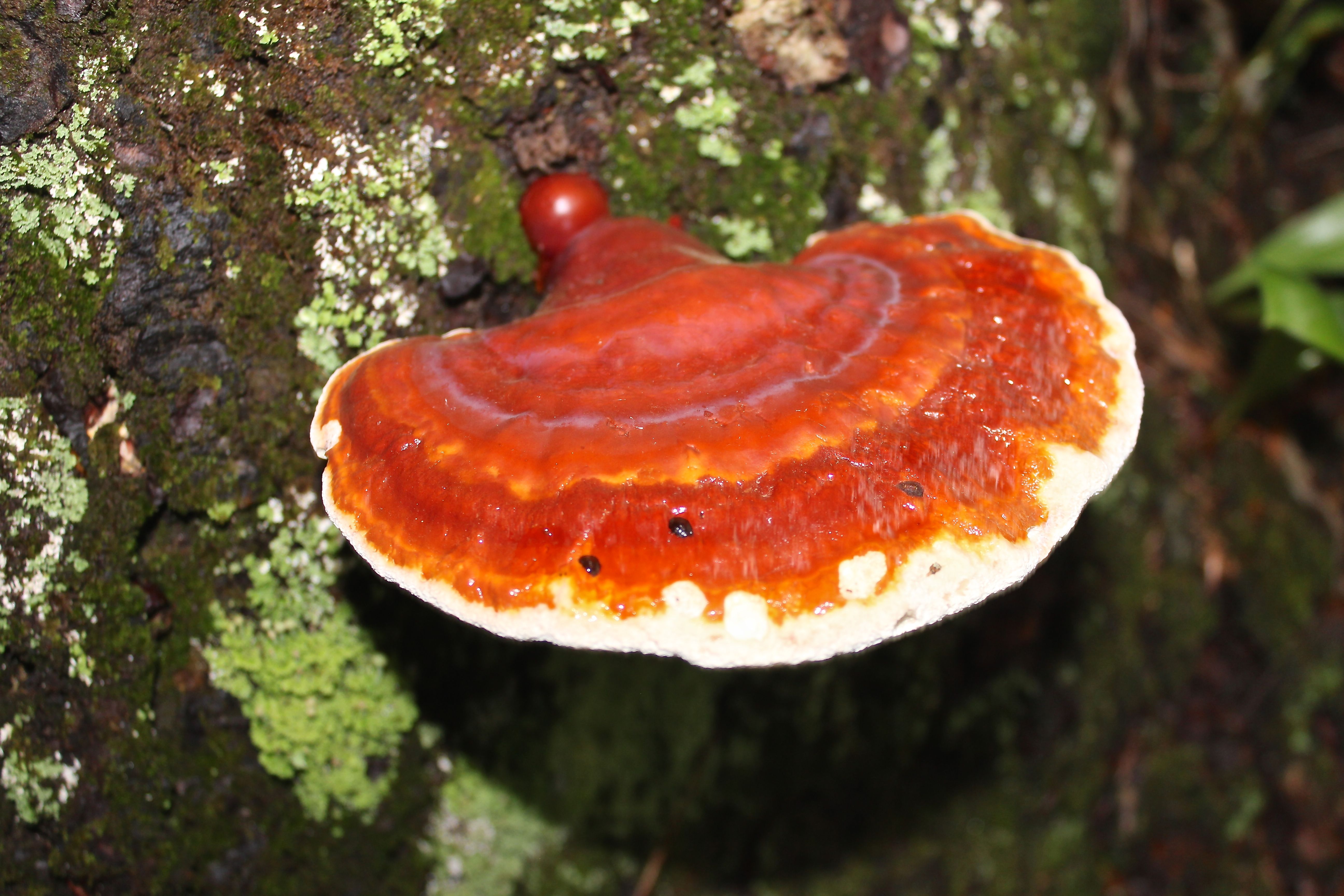
hemlock varnish shelf

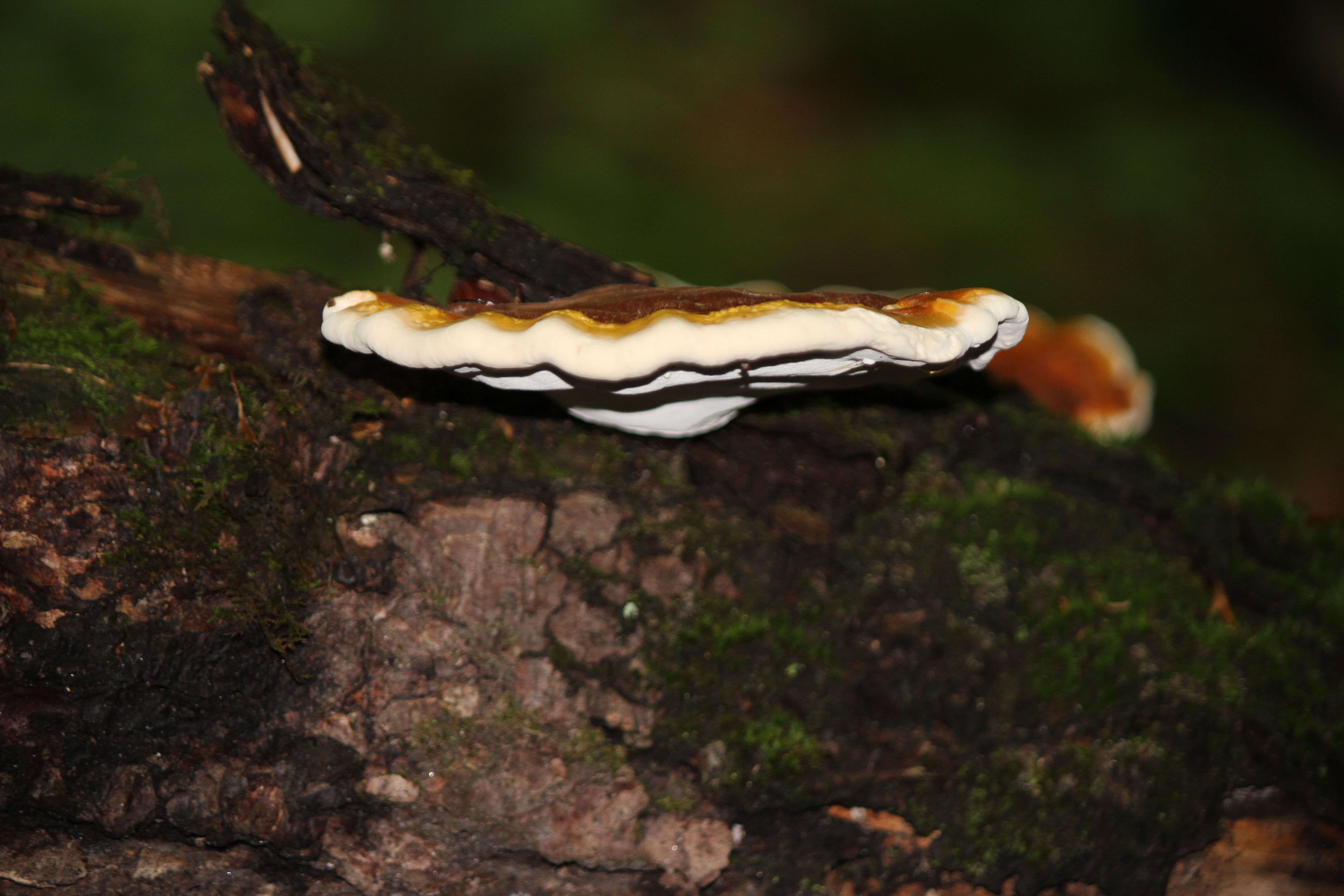
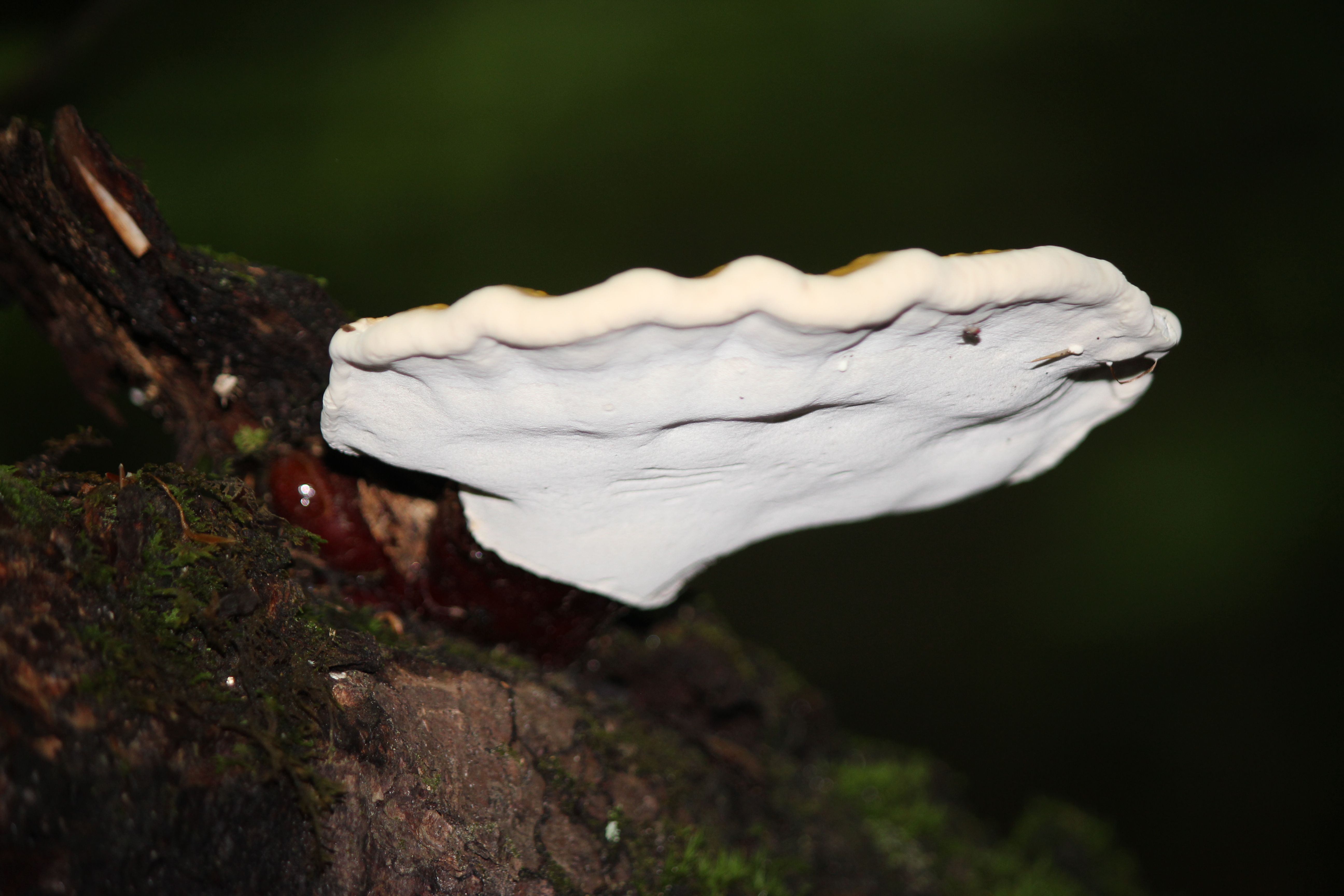
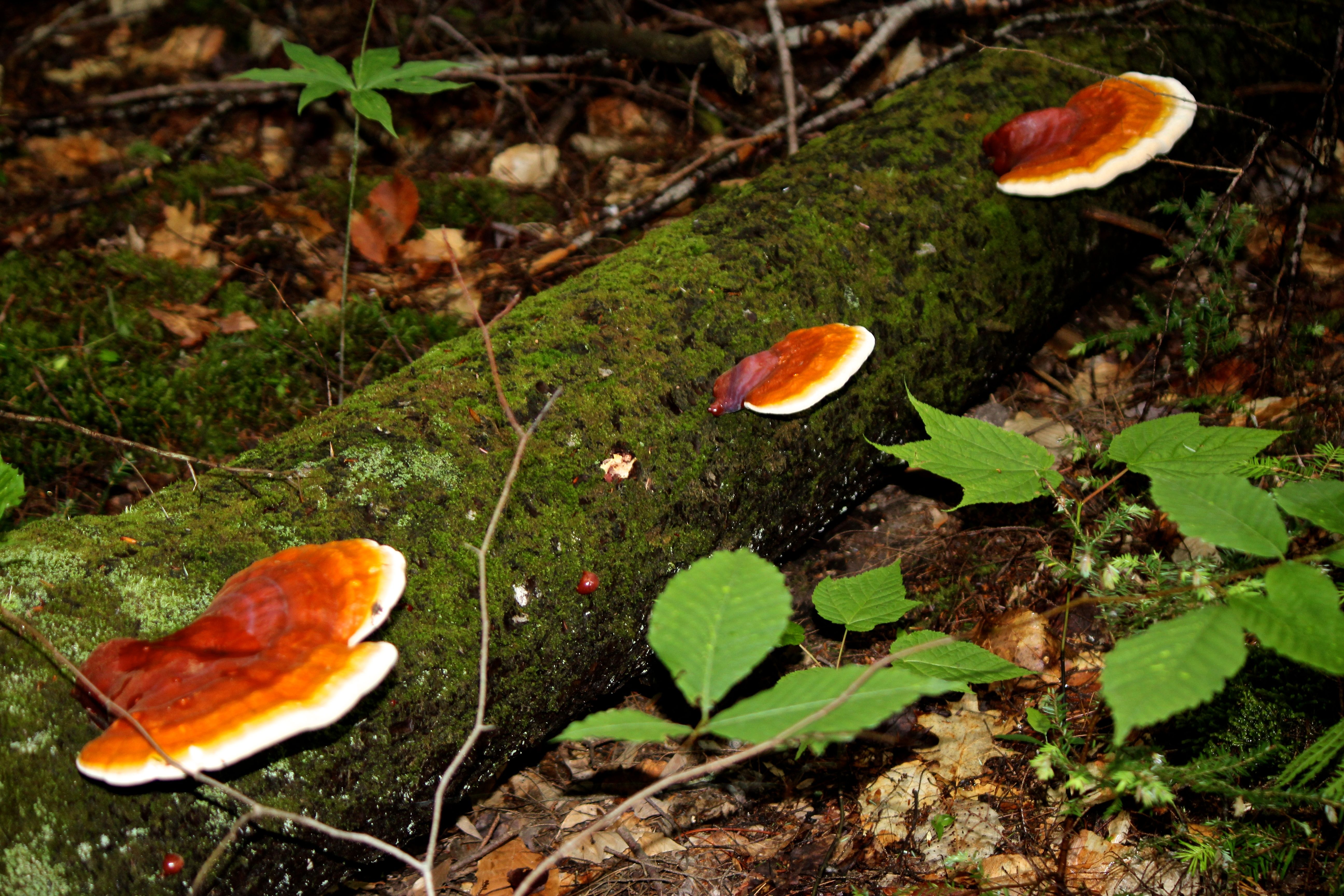
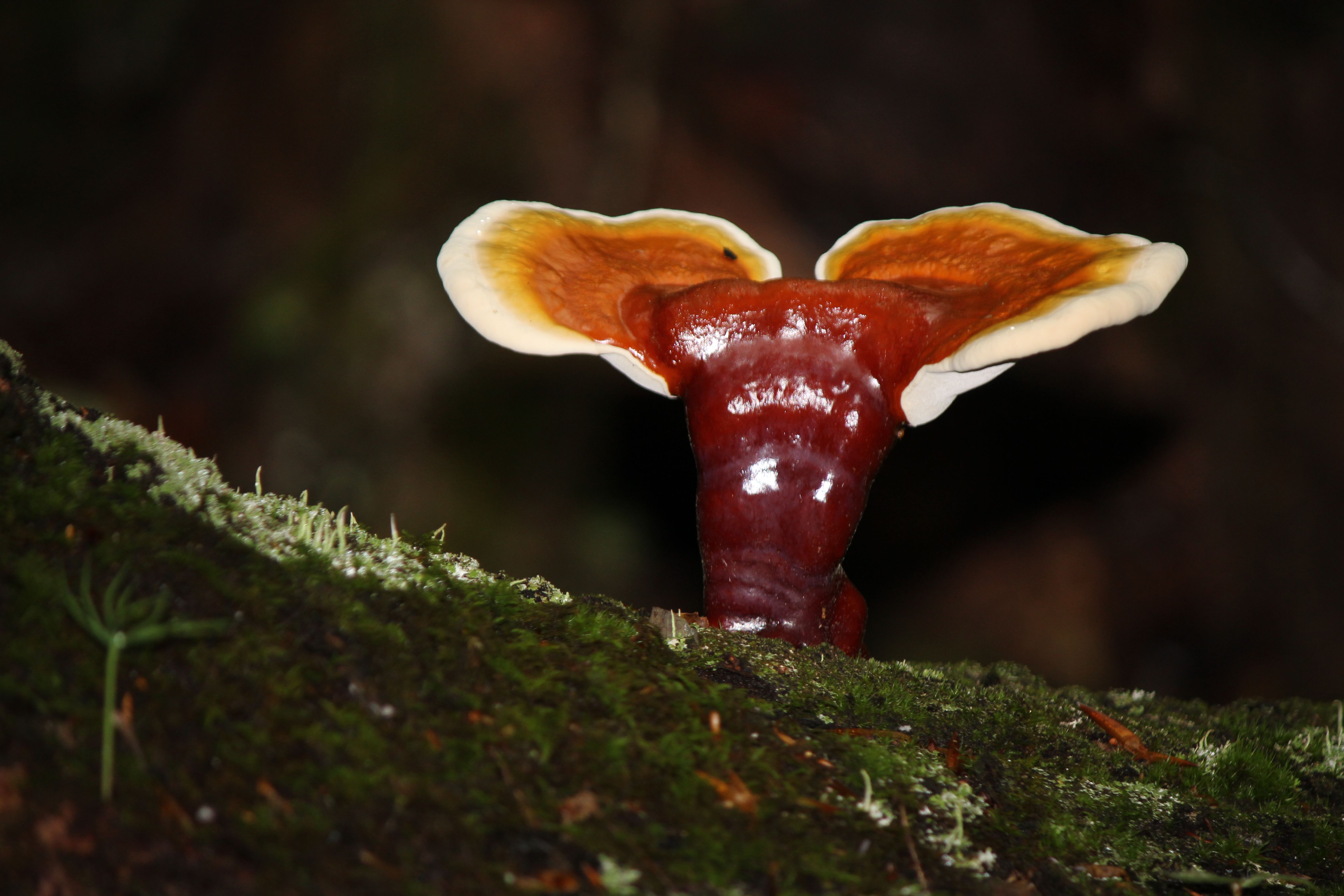
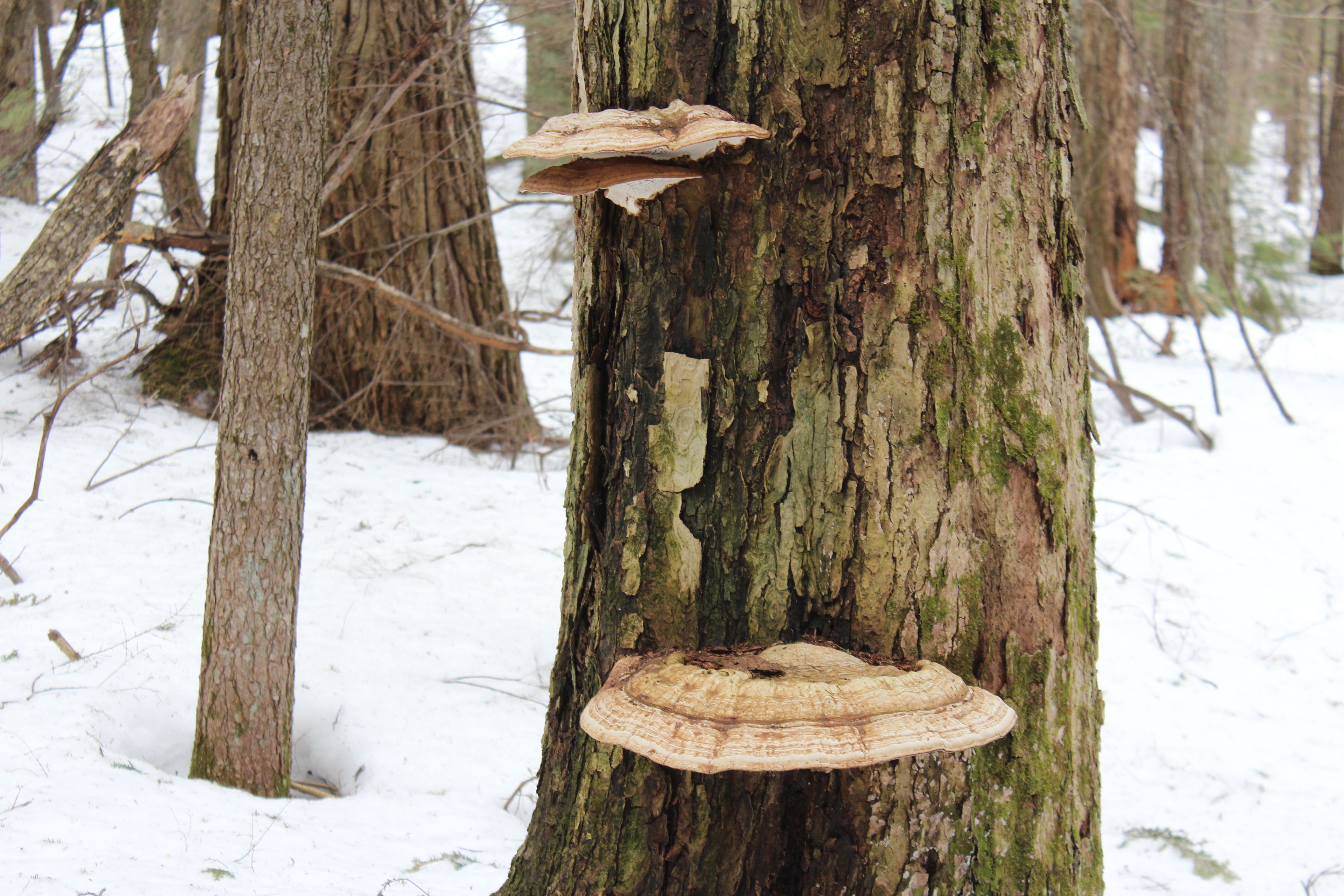
From start to finish, we saw plenty of Hemlock Varnish Shelf (Ganoderma tsugae) fungi.

Hemlock Varnish

Each one presented itself in a different manner.

Hemlock varn 3

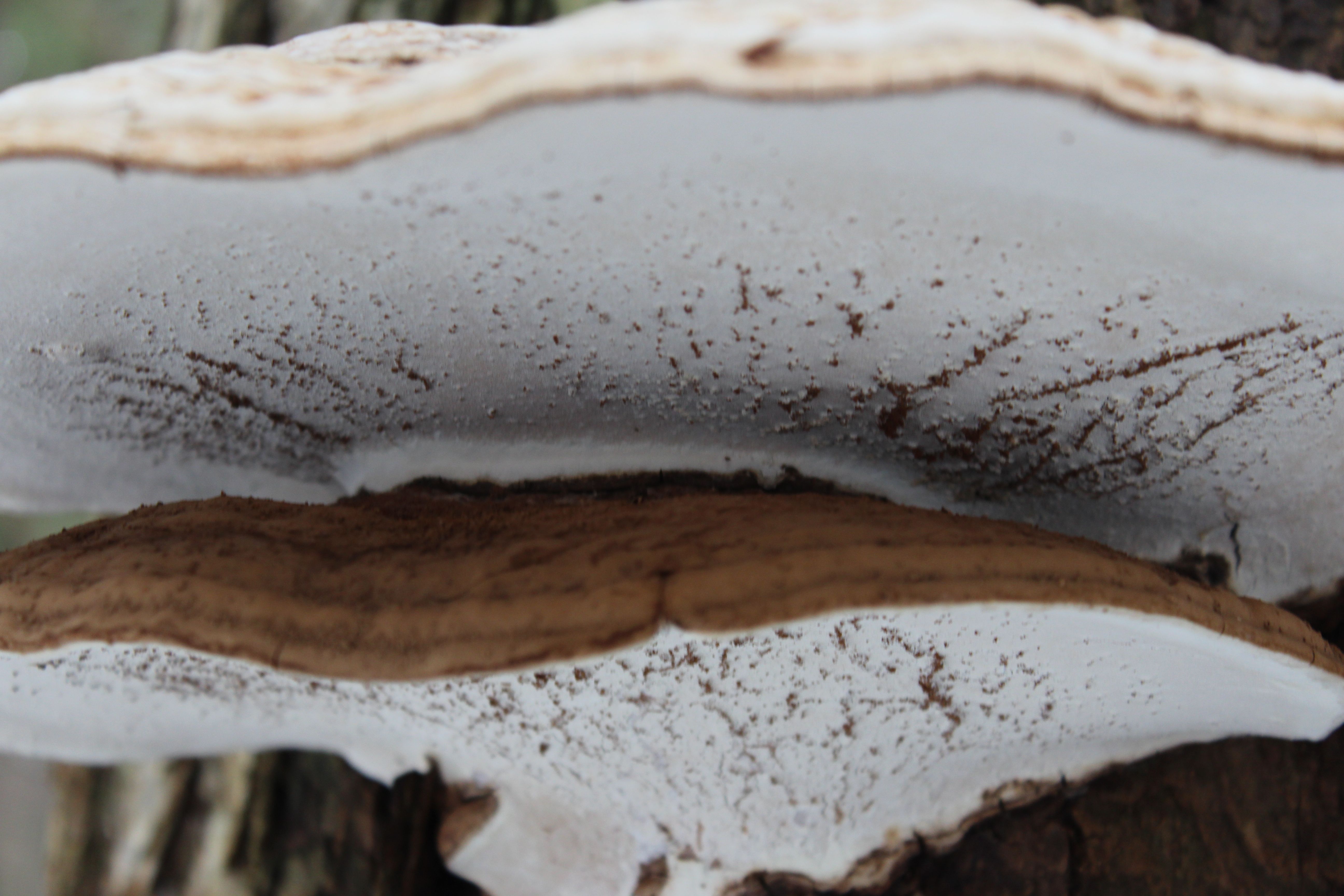
While its shiny, colorful surface and habit of growing on hemlocks and other conifers speak to its name, the  oyster-shell rim and non-gilled pore surface are equally attractive.

hemlock 3 in a row

Three in a row.

hv4

And two fer one.

hemlock varnish ripe

Most were not as ripe as this.

I was thankful this day to be among people who have a shared wealth of knowledge about the natural world. They also have eagle eyes. Or in this case fungi eyes (P.V.).

stream 3

The mossy stream became our focus as we searched for wild orchids and more fungi.

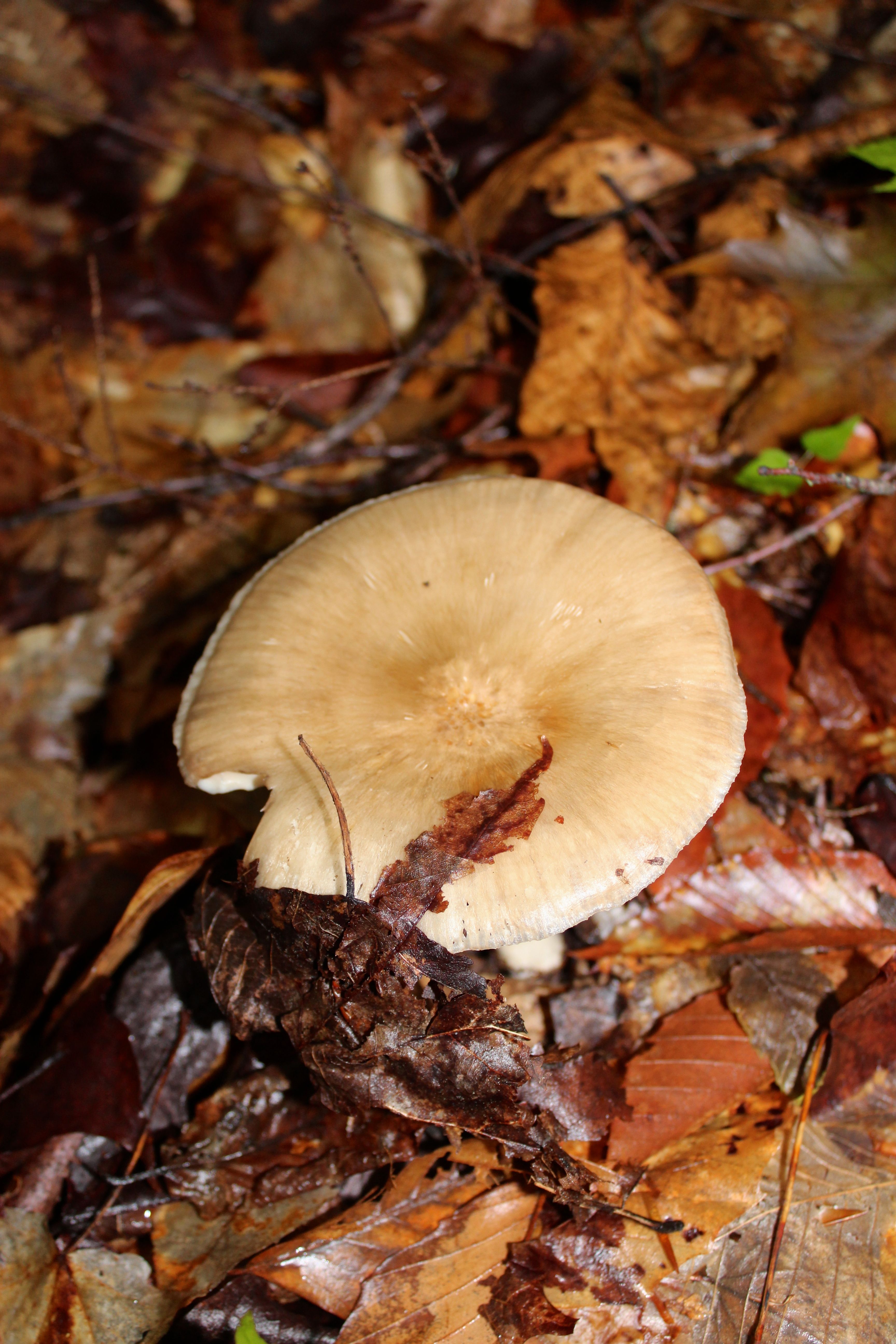
Platterful Mushroom

Some orchids have passed, others aren’t open yet and still others had been eaten. But the wet habitat provided plenty for us to wonder about, including this Platterful Mushroom, the common name for Tricholomopsis platyphylla, aka Broad Gill. Despite that first common name, it’s mildly toxic and not meant to be served as a platter full.

Swamp beacon

Glowing up at us from a wet depression was a colony of Swamp Beacons (Mitrula elegant). I include the Latin with the fungi because P.V. uses it almost exclusively when he enlightens us. I wish I’d learned the Latin first, but alas, I’m a common kinda gal.

northern oak fern

Mixing it up and almost messing us up was the Northern Oak Fern. It reminded us of miniature bracken fern, with a softer texture.

basswood bark

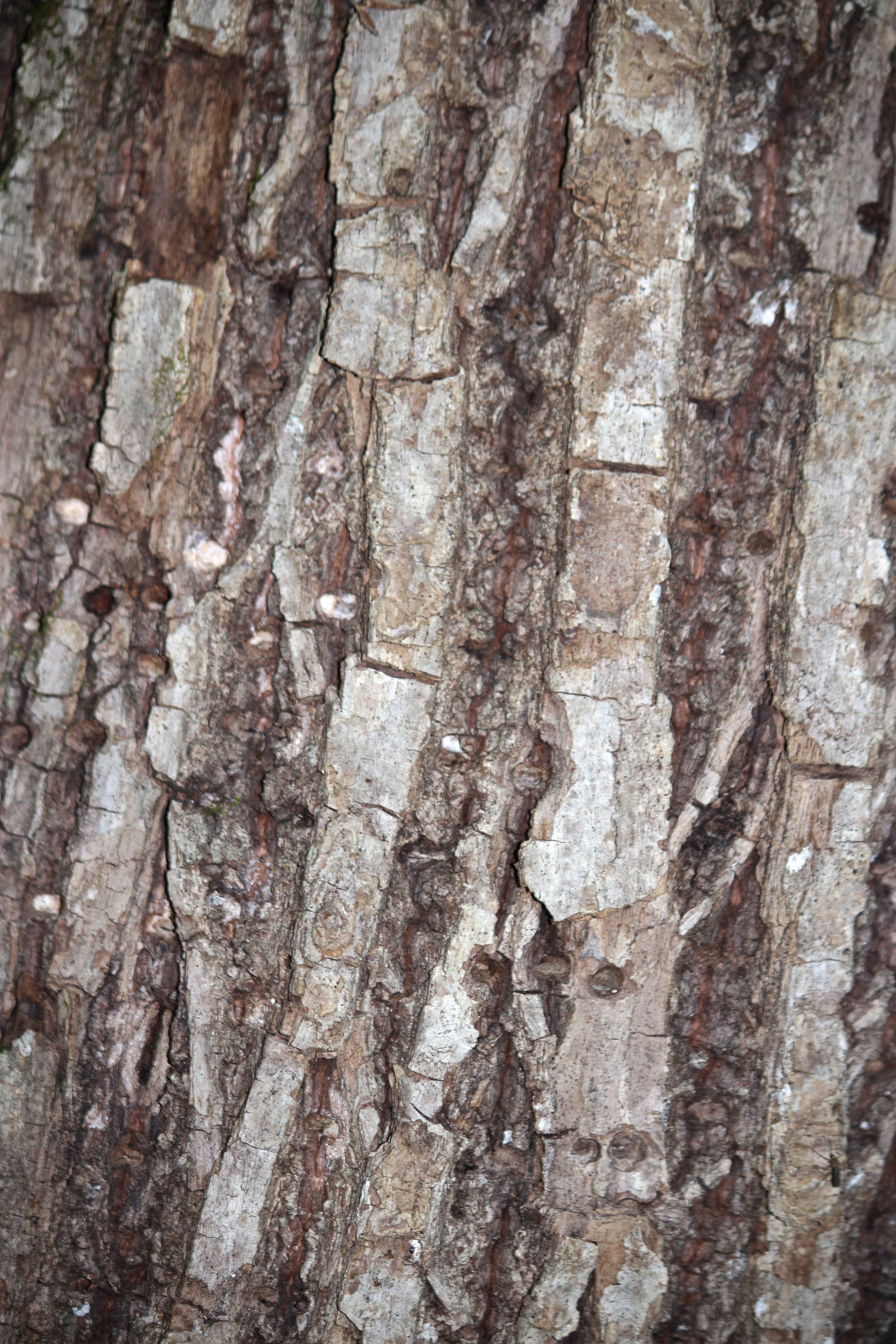
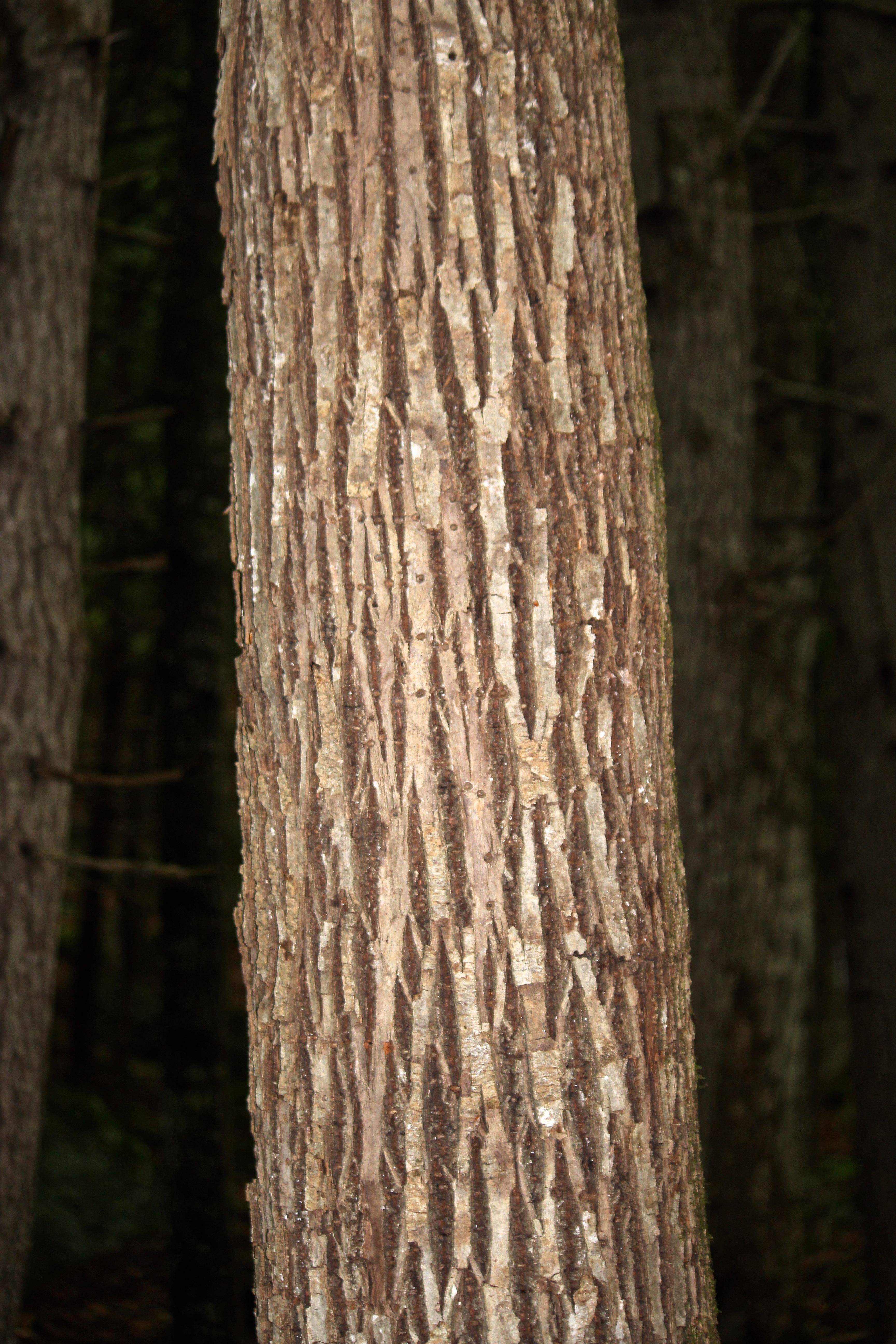
We were in a rich, upland habitat, verified by several species, including this one, which D.S. paused by to quiz us. We got it right–American Basswood (Tilia americana).

bass 2

Its flattened, square-like ridges intersect like a woven basket every 6-12 inches. Not only does it look like a basket from the outside, but the inner bark is fibrous and has been used for rope and fish nets and . . . woven baskets.

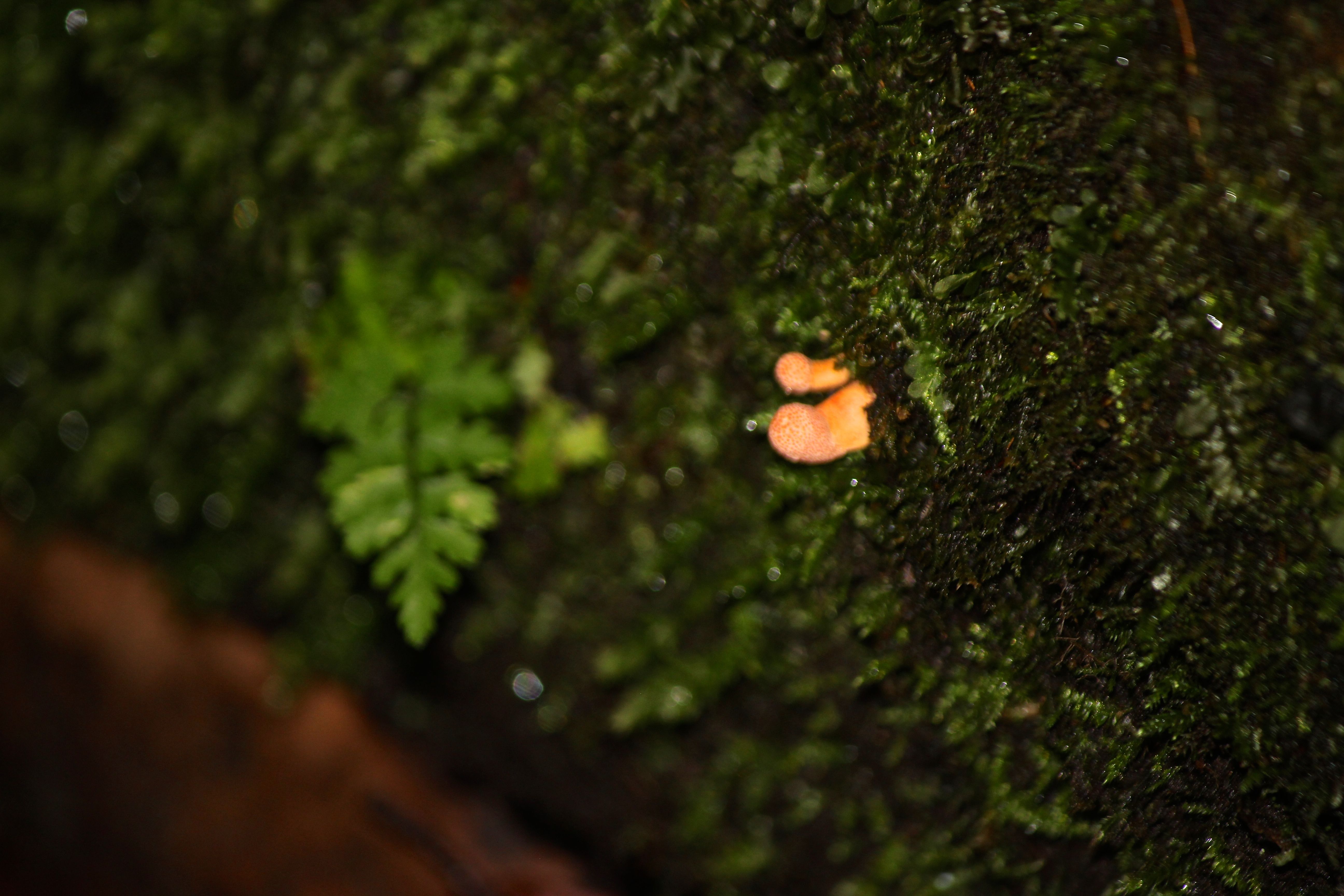
Cordyceps militaris - Scarlet Caterpillarclub

Those fungi eyes continued to search high and low. And waited for us to locate this rather small sample sticking out of a moss-covered rock in the stream.

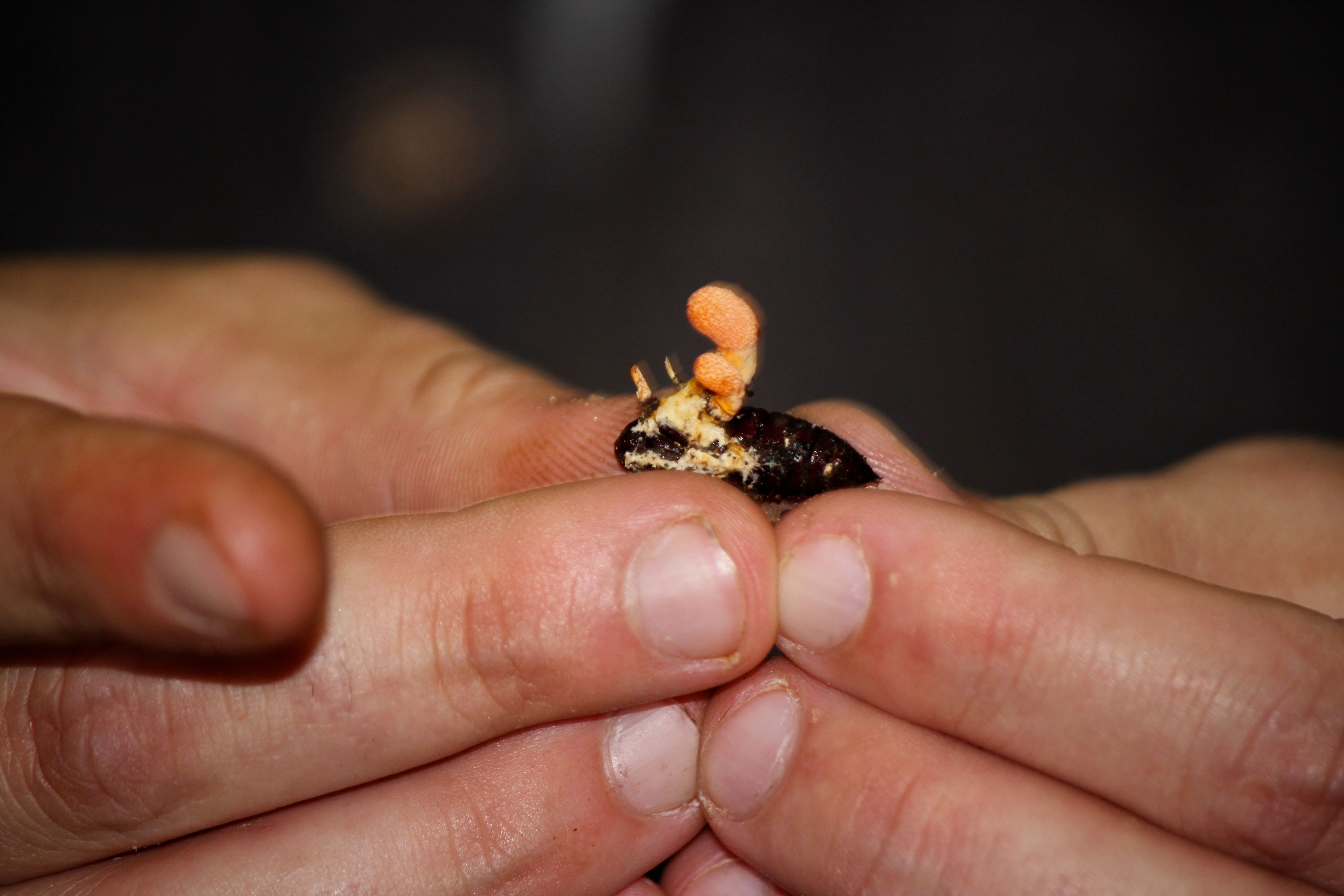
cord larve

Scarlet Caterpillarclub (Cordyceps militais) feeds off of insect larvae as you can see here. The host provides the most and turns to mush as the fungi grows.

Though we never plan it that way, our journey lasted three hours. Suddenly, we emerged from the wet woodland onto Horseshoe Pond Road–all the richer for having spent time in the land of the slugs, bears and caterpillar clubs. Oh my!

Taking In The Views

The Pequawket Indians of Fryeburg, knew the 1,100-foot mountain in Waterford as the mountain that would “tire um out” because climbing its steep side wasn’t easy. Fortunately, a much gentler trail that is only a bit steep at the start, has led to the summit of Mount Tire’m for many moons. And that was my trail of choice this afternoon.

While my guys (and a girlfriend) toiled at the family business, I snuck off to the mountain to enjoy the views.

green

It’s located up the street from the quintessential New England village known around these parts as Waterford Flats. Think white clapboard houses, all of which are listed on the National Register of Historic Places. And a triangular green. To the right of the sign is the former Lake House, which for many  years was a high-end restaurant and inn. It’s for sale now. And comes with an interesting history–in 1847, it was known as Shattuck’s Hygienic Institution, or “Maine Hygienic Institute for Ladies” and offered a water cure.

Another house on the  green was home to Artemus Ward, pen name of Charles Farrar Browne, a favorite author of Abraham Lincoln and Mark Twain’s mentor.

Then there’s the  Waterford Library designed by John Calvin Stevens and his son, John Howard Stevens. And the former town office and meeting hall–ladies sat on one side of the room facing their menfolk during town meetings and were not allowed to vote or even speak. Can you imagine?

church

The Waterford Congregational Church was one of Stevens’ designs.

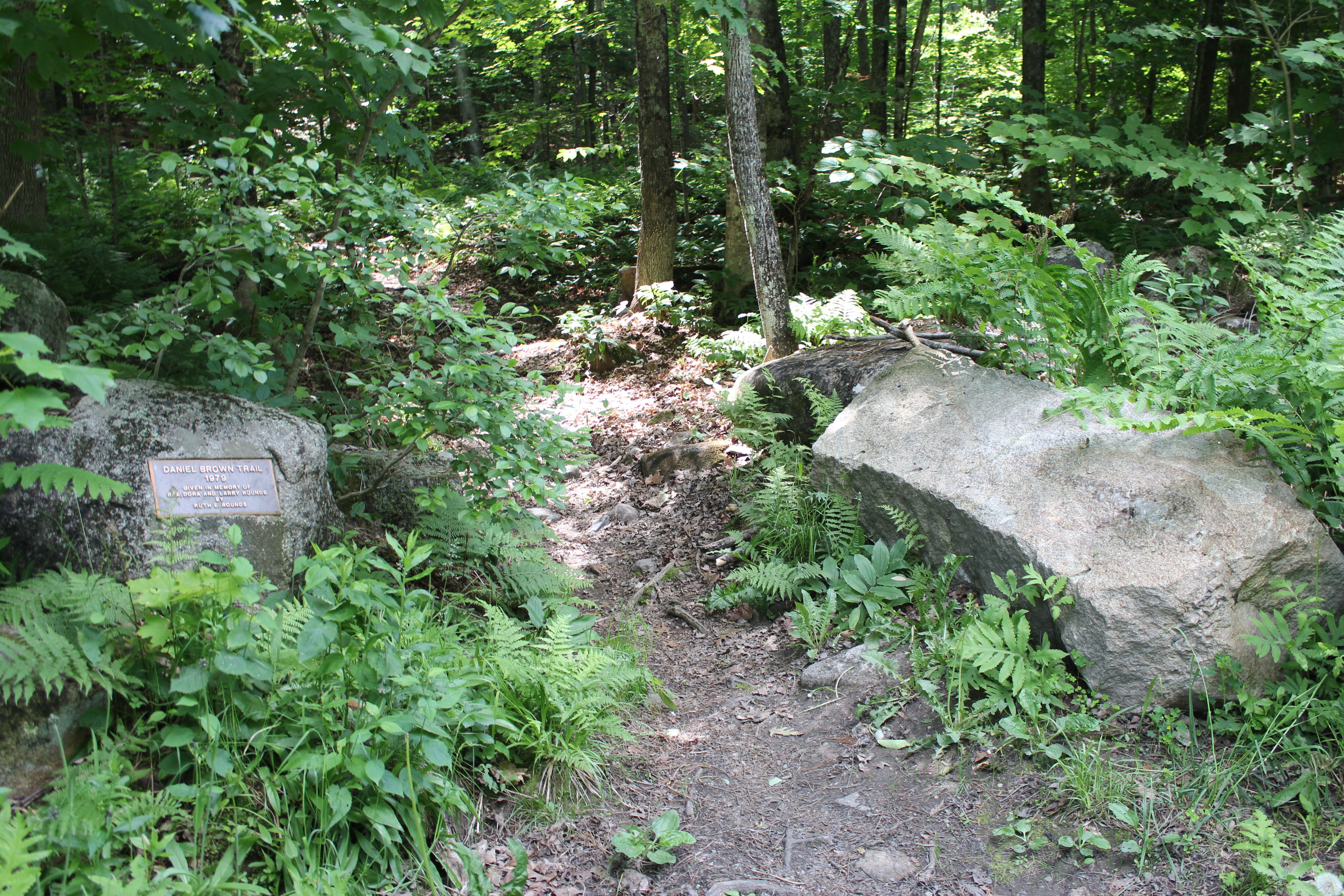
trail head

It’s easy to miss the nondescript trailhead located up the road from the church.

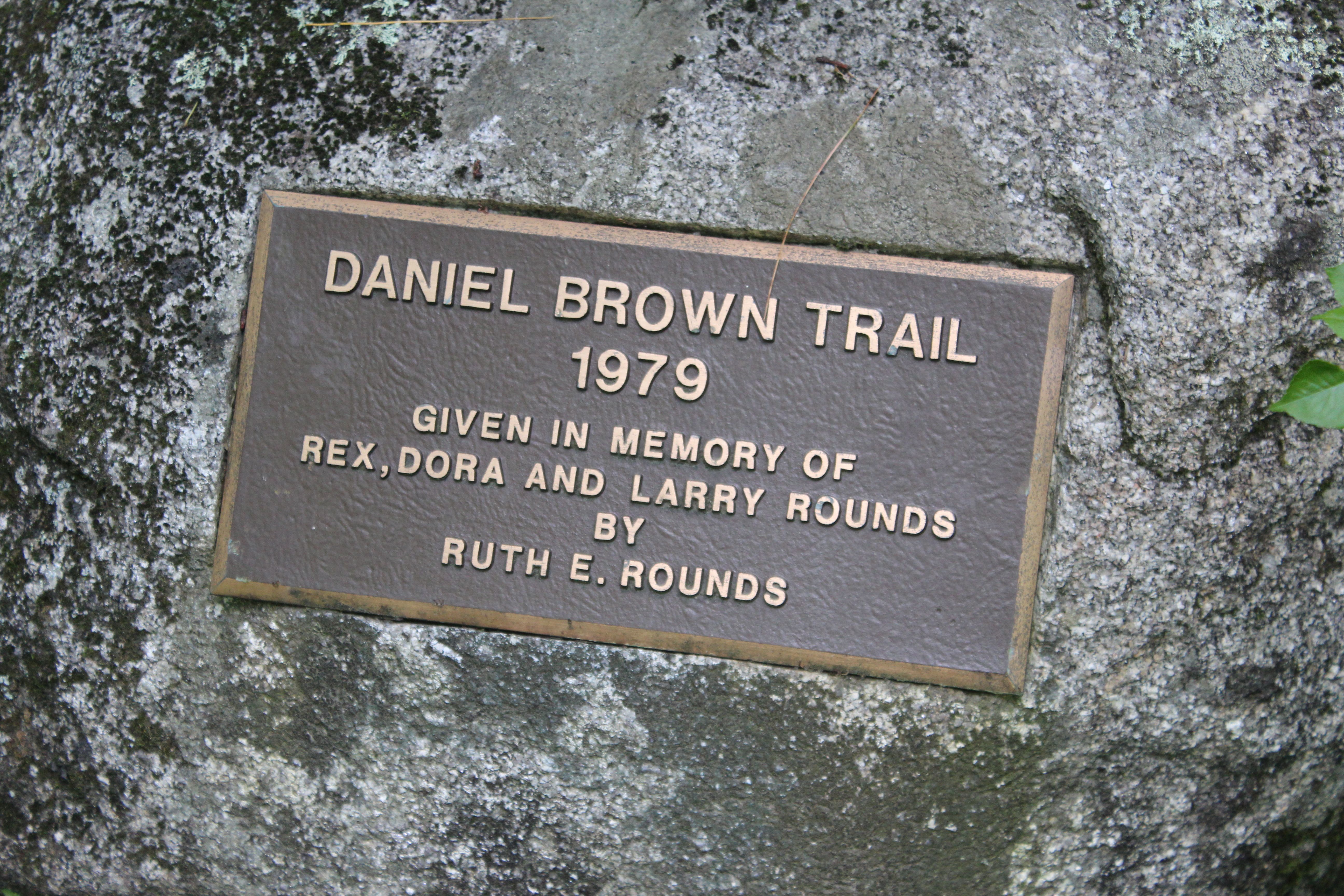
trail sign

The public path that has traversed the mountain for many years was apparently known as the Old Squire Brown Trail. From what I gather, Daniel Brown owned a large house and farm near Bear Pond–perhaps the Lake House? He was involved in town politics and went on to serve in both houses of state legislature, becoming known as Squire Daniel Brown.

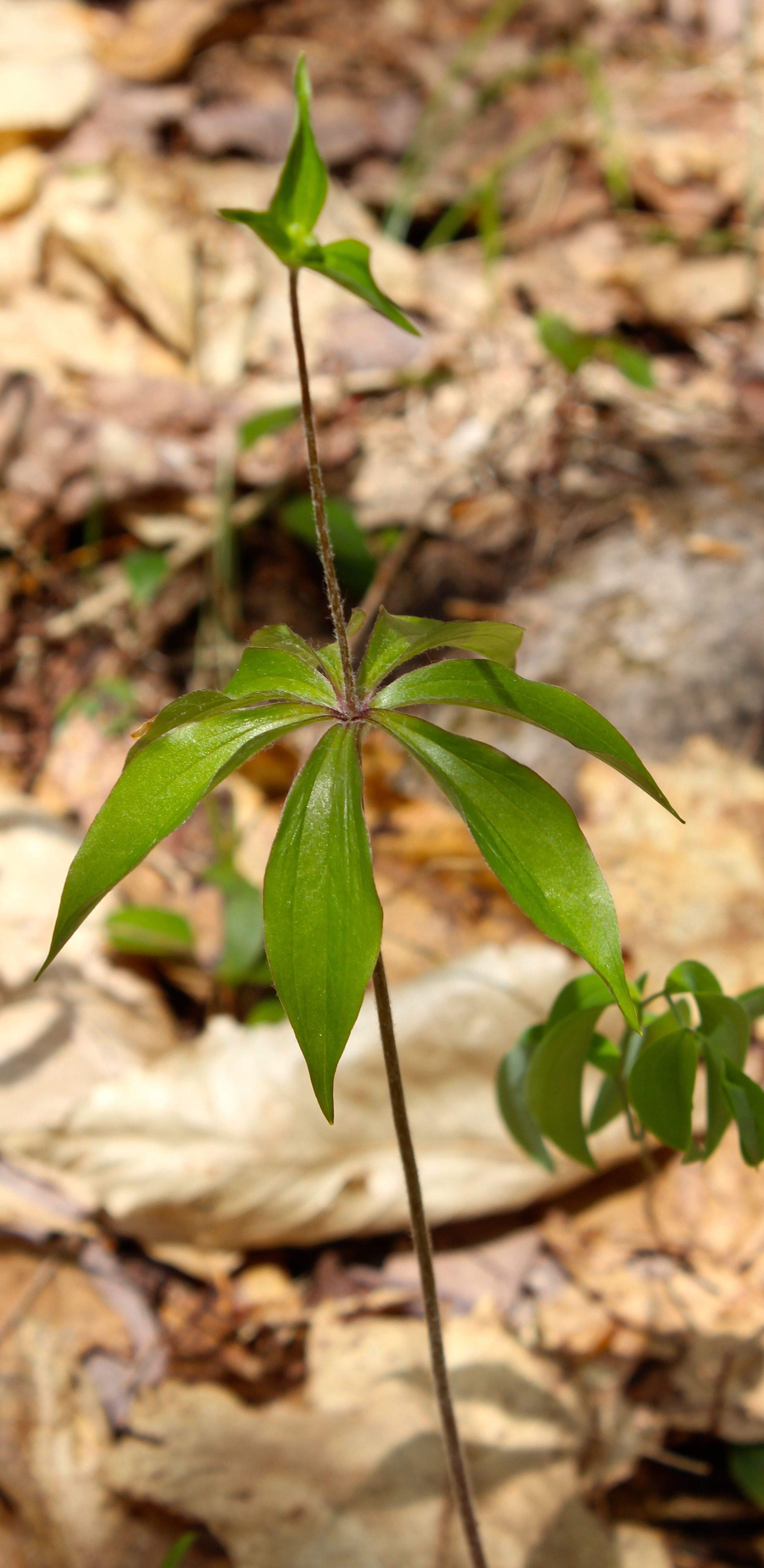
Red trillium

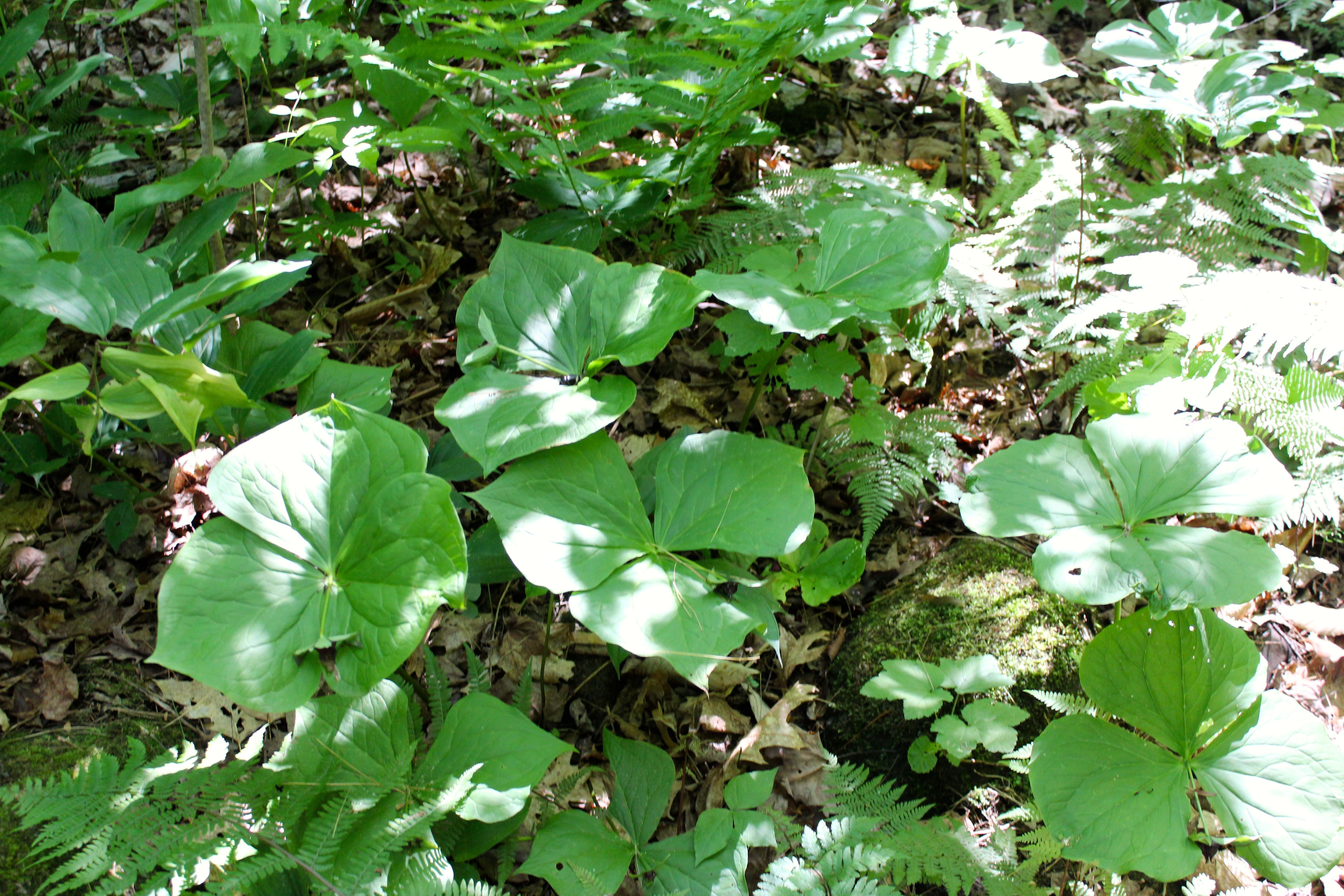
Though the flower is long past, the leaves of Red Trillium reminded me that I need to hike this trail earlier in the spring.

 stonewall

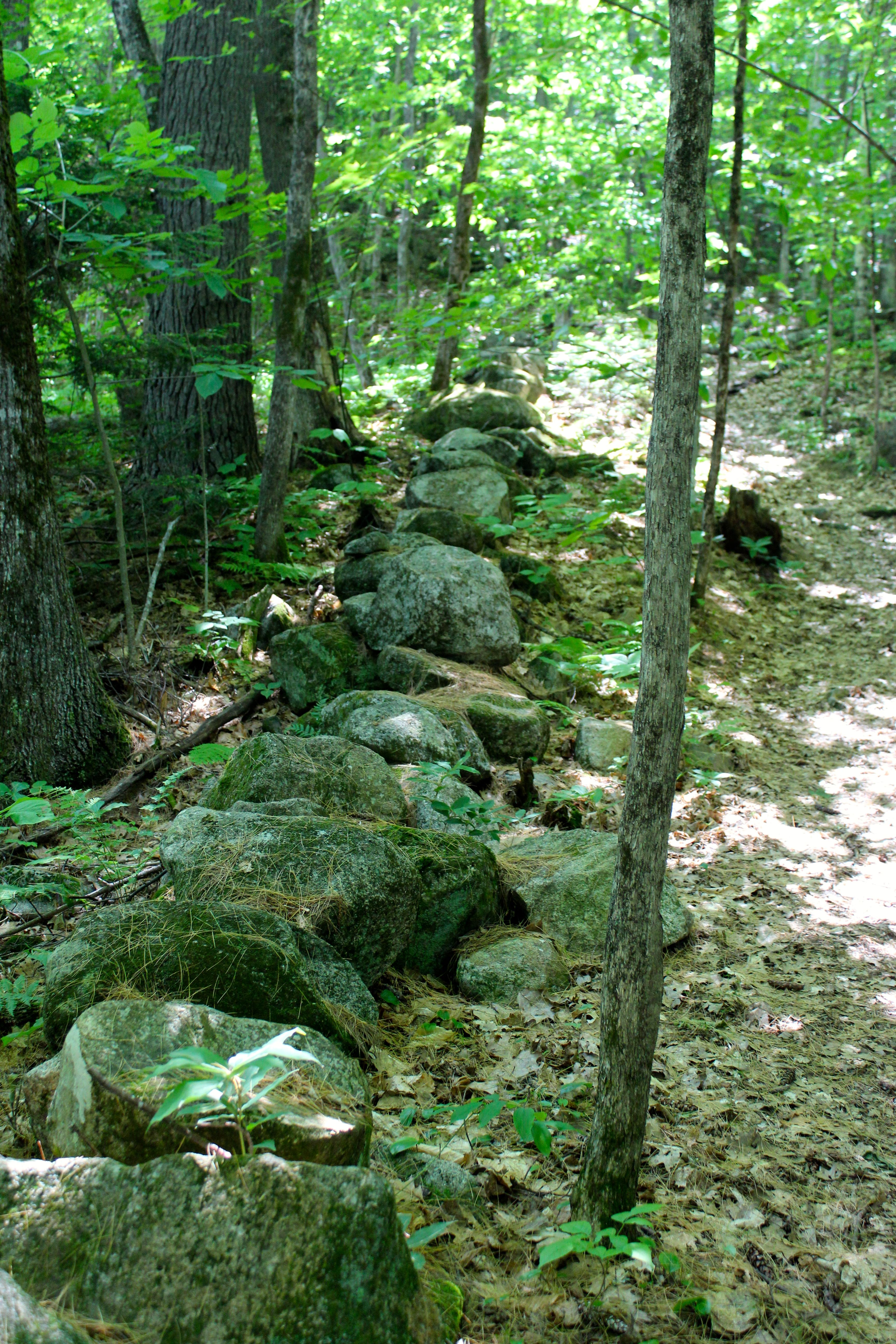
Stonewalls announce that this land was once upon a time used for agriculture.

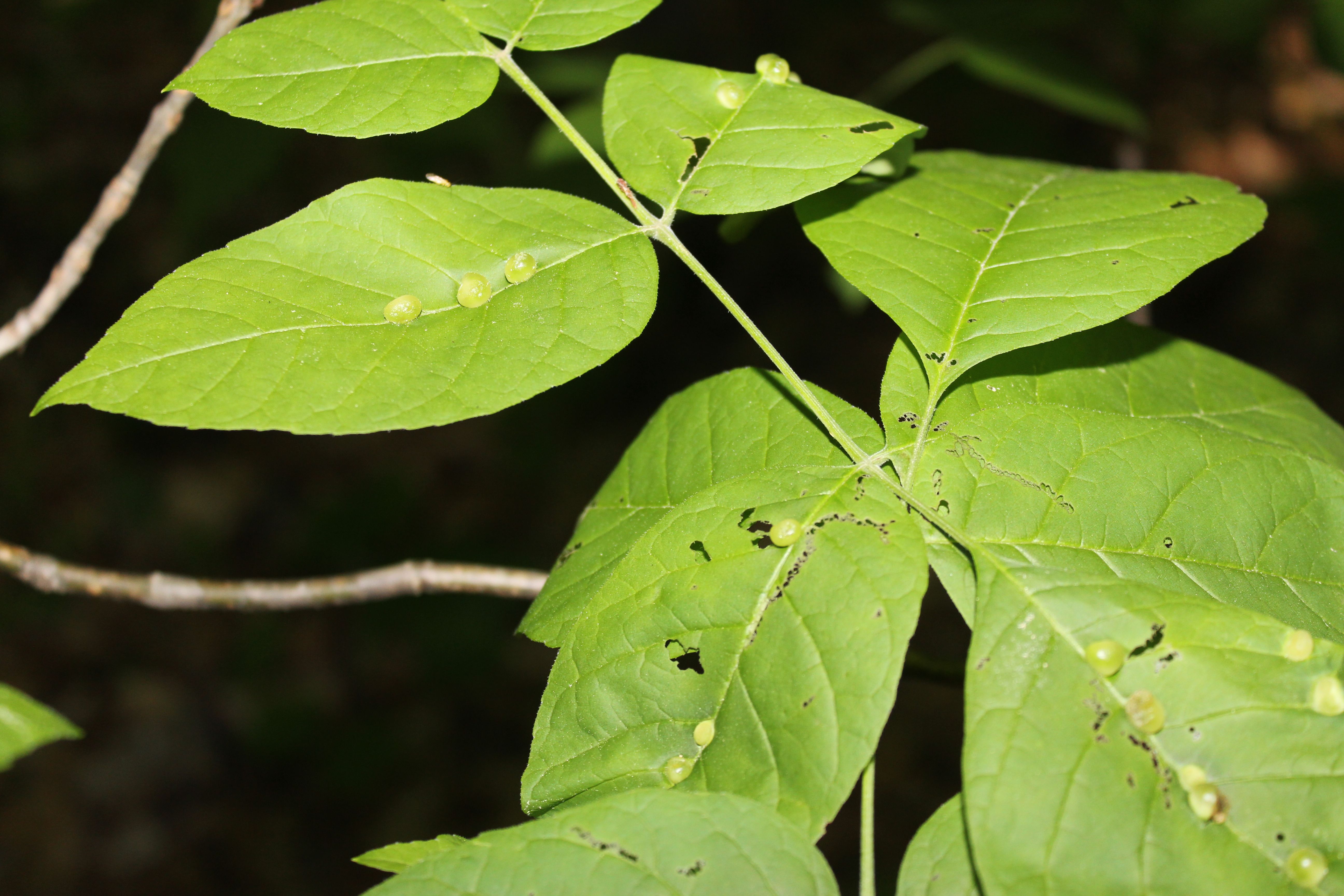
ash leaves 2

The odd leaf formation of this young ash tree made me stop. It has become host to either a fungus or insects who  are using the leaves as protection while they complete their lifecycle.

ash 2

Another ash has been invaded by mites that cause the raised galls.

challenges along the path

Like most trails, this one provides the rocks and roots that draw my eyes downward, so I pause frequently to look around. It’s just as well that I was alone, because not only was I taking my time, but my mind was so filled with chatter that I doubt I would have heard anyone else speak.

pine needles

On the drive to Waterford, I’d noticed that so many of the white pines are once again suffering from the needle drop fungus. The same was true on the trail. In the newspaper, an article about climate change referred to the needle drop as occurring for only the past several years. Methinks more like ten years. The fungus infests trees during a wet spring, such as we had last year and the resulting defoliation is seen the following year. So–I’m thinking out loud here–though we haven’t seen much rain lately, the needles are dropping because of last year’s infestation. While they look so pitiful right now, within a few weeks, they’ll finish dropping. But . . . do the trees have the energy to survive? And what about next year? Will it be a good year for white pines? And then I think about all the pinecones the trees produced last year–it was certainly a mast year, so maybe it doesn’t affect them to such an extreme. Yeah, this was the sort of chatter I was experiencing.

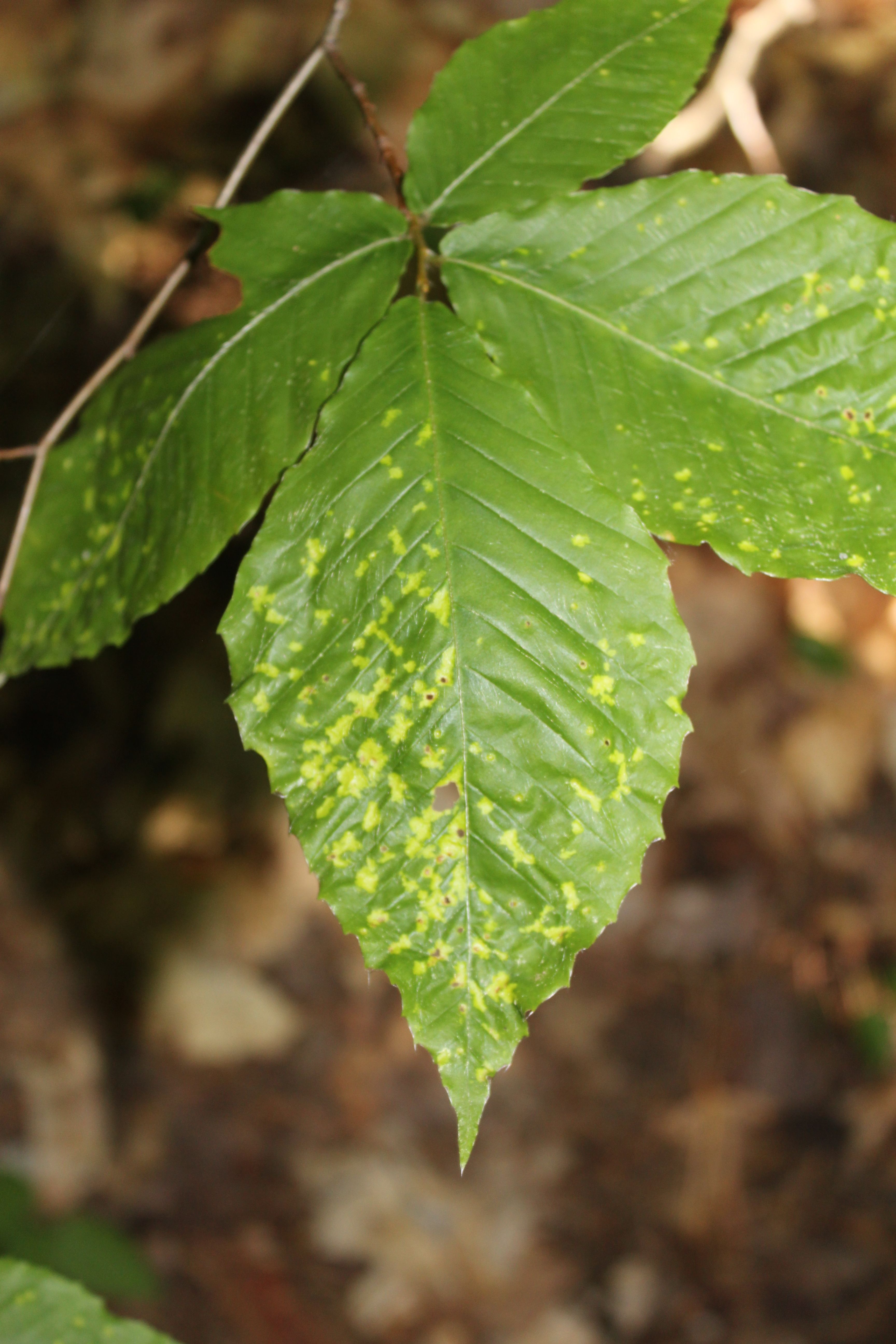
beech spots

Some beech leaves are displaying their own relationship with a fungus. Where only weeks ago, they were the site of beauty as they opened and their hairiness kept insects and others at bay, they can’t fight off everything. Nor can we.

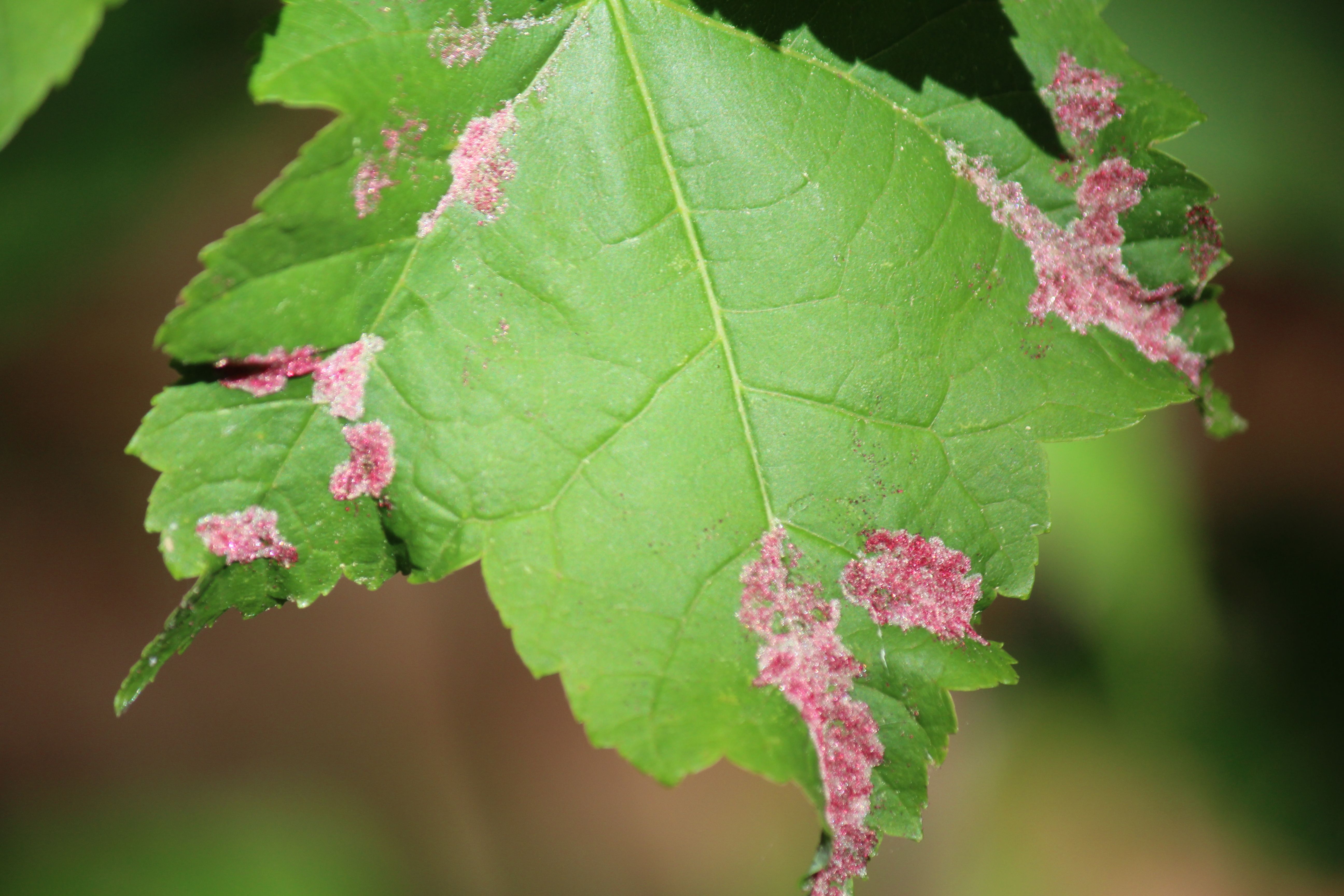
candy pink insects

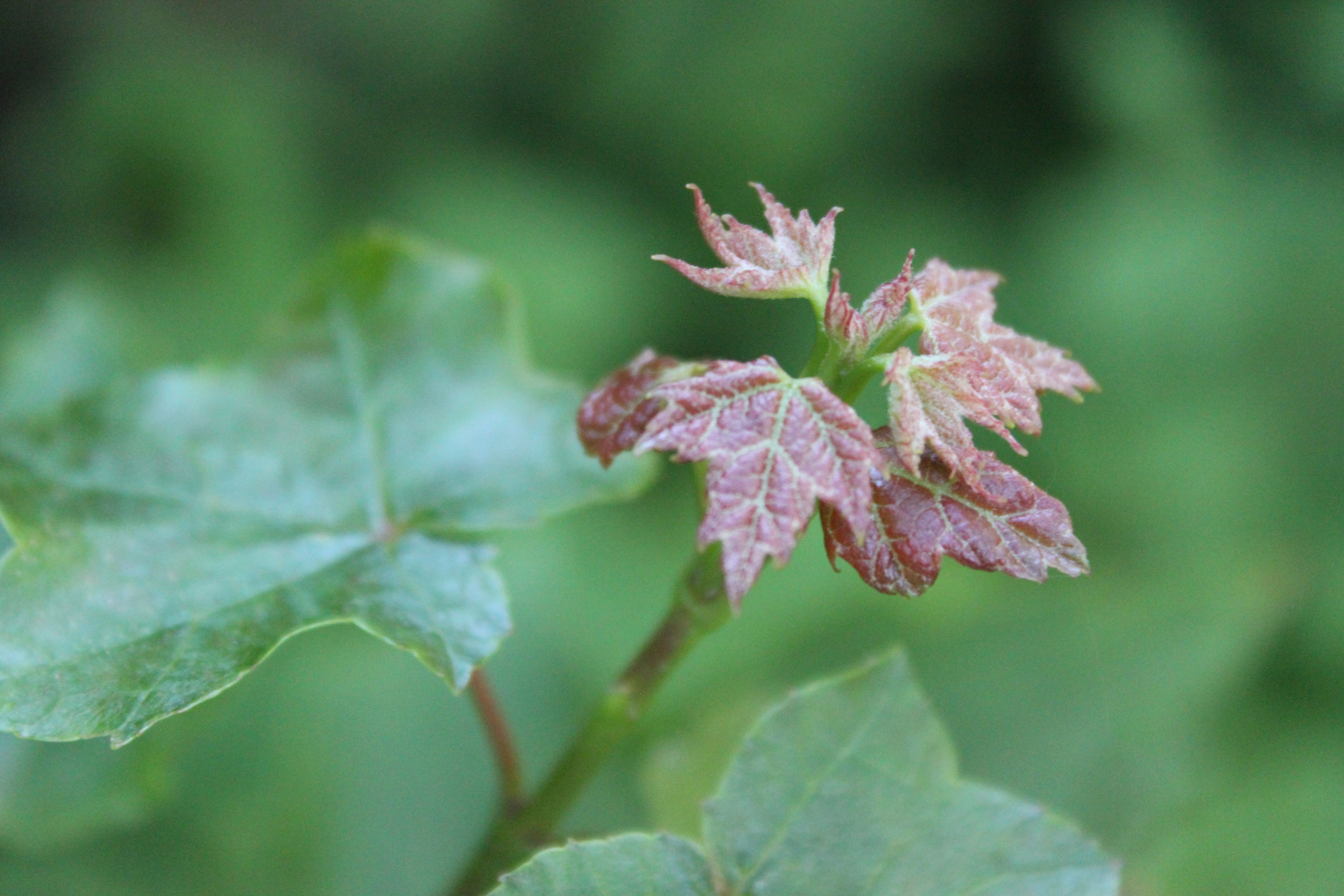
Through my hand lens, the bright pink on the Red Maple leaves has a crystal-like formation. It’s actually quite beautiful.

candy pinkcp2

I had no idea what caused this until I looked it up. These are maple velvet erineum galls, also caused by mites. Apparently they won’t harm the tree, so they aren’t considered parasitic. It’s all a wonder to me. If you do find this, take a close look.

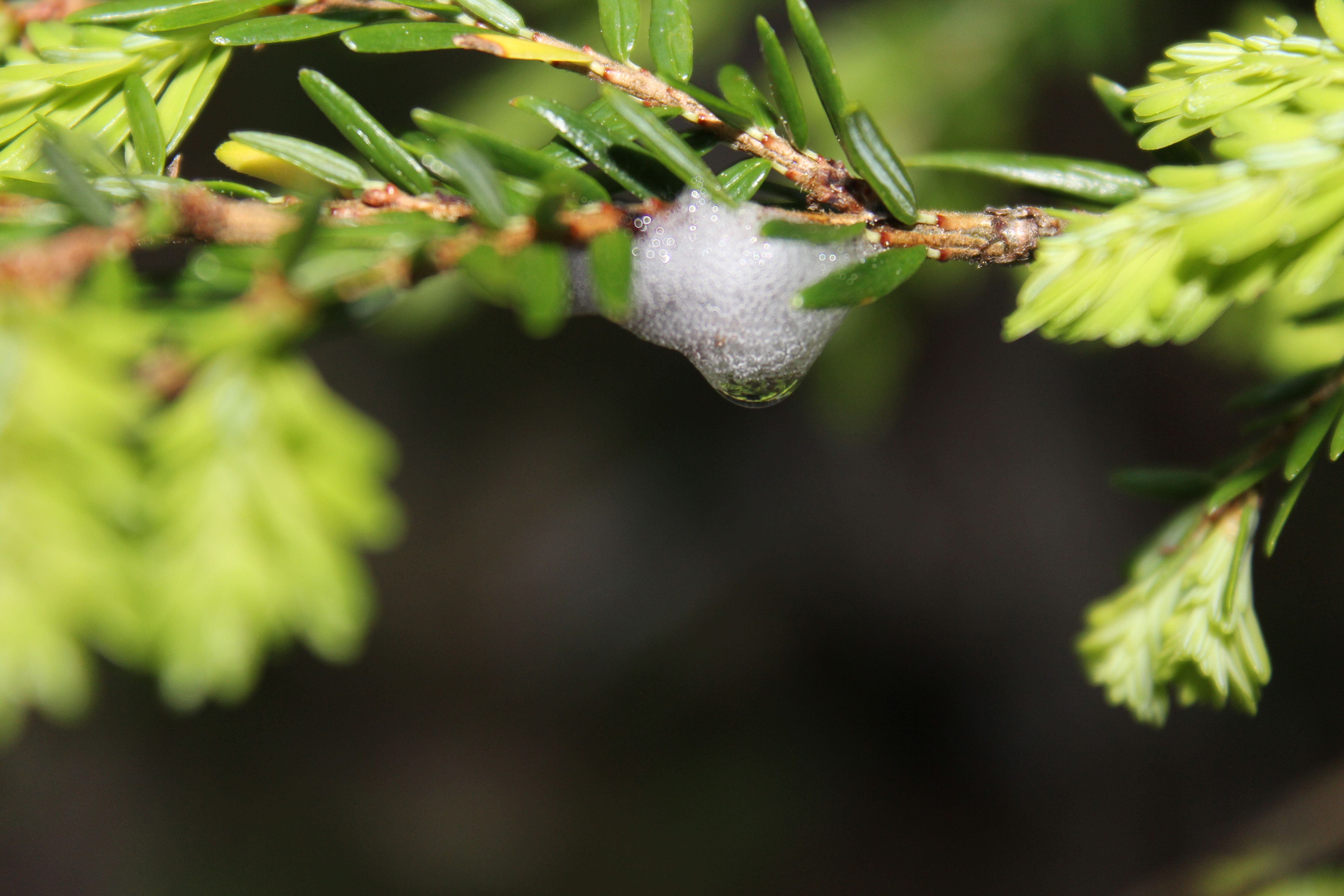
spittle on hemlock

Growing up, whenever we saw spit on wildflowers and grasses, we assumed it was from snakes. A rather scientific observation. Do snakes even spit? And a foot off the ground? I’ve since learned that the foamy substance is the work of Spittlebugs. As the nymphs feed in the spring, they excrete undigested sap and pump air into it.

spittle 2

But I didn’t expect to see this on a hemlock. Turns out–there’s a pine Spittlebug that attacks evergreens. More reasons to keep my eyes open.

Keoka Lake and Oxford Hills

Enough about hosts and fungi. It was time to take in the views. About halfway up, Keoka Lake and the Oxford Hills are visible through a cut in the trees.

gnome home

Gnome homes are everywhere.

view

And finally, the summit with Pleasant Mountain in the background.

BP from summit

And Bear Pond and Long Lake below.

the rocks

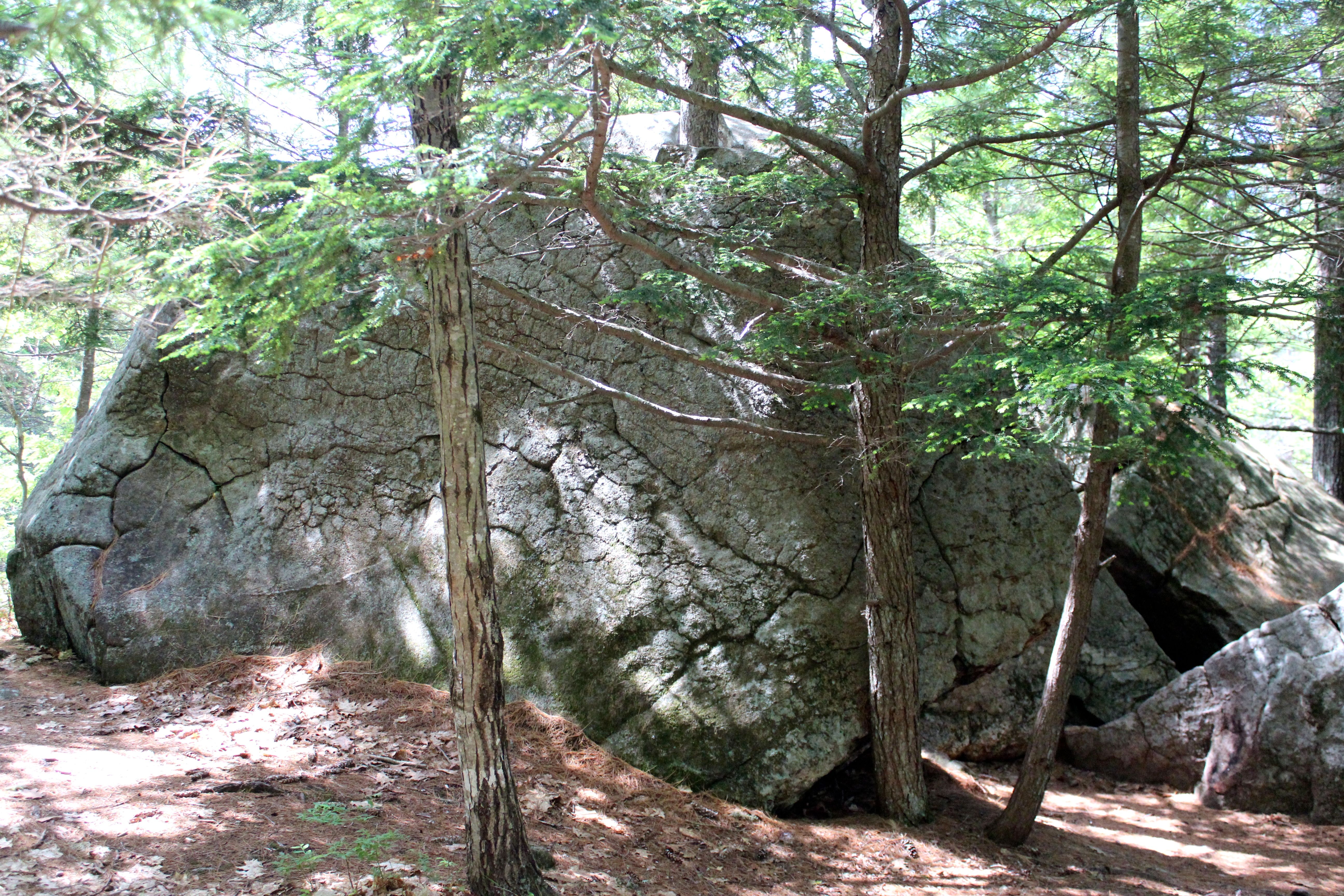
No visit is complete without a stop at the glacial erratics.

the rocks split

Maybe I shouldn’t use the plural form as it’s obvious this was all one rock

the rocks 2

that split apart.

tr 5

Perhaps there’s more to come.

As the saying goes, “so much to see, so little time.” Thanks for joining me to take in the views.

Reaping Rewards

How did I not know this was here? It’s in an old garden bed about twenty feet from the barn. Because of my green pinky, I haven’t been faithful in taking care of this particular garden and in recent years the blackberries have taken over. I reap the reward of blackberries so that’s not a bad thing. But until they’re in season, I don’t pay much attention.

Aha, therein lies the problem. Not paying attention. Not taking the time to notice what is in front of me. But that’s OK, because when I do notice, I love the surprise.

leaf

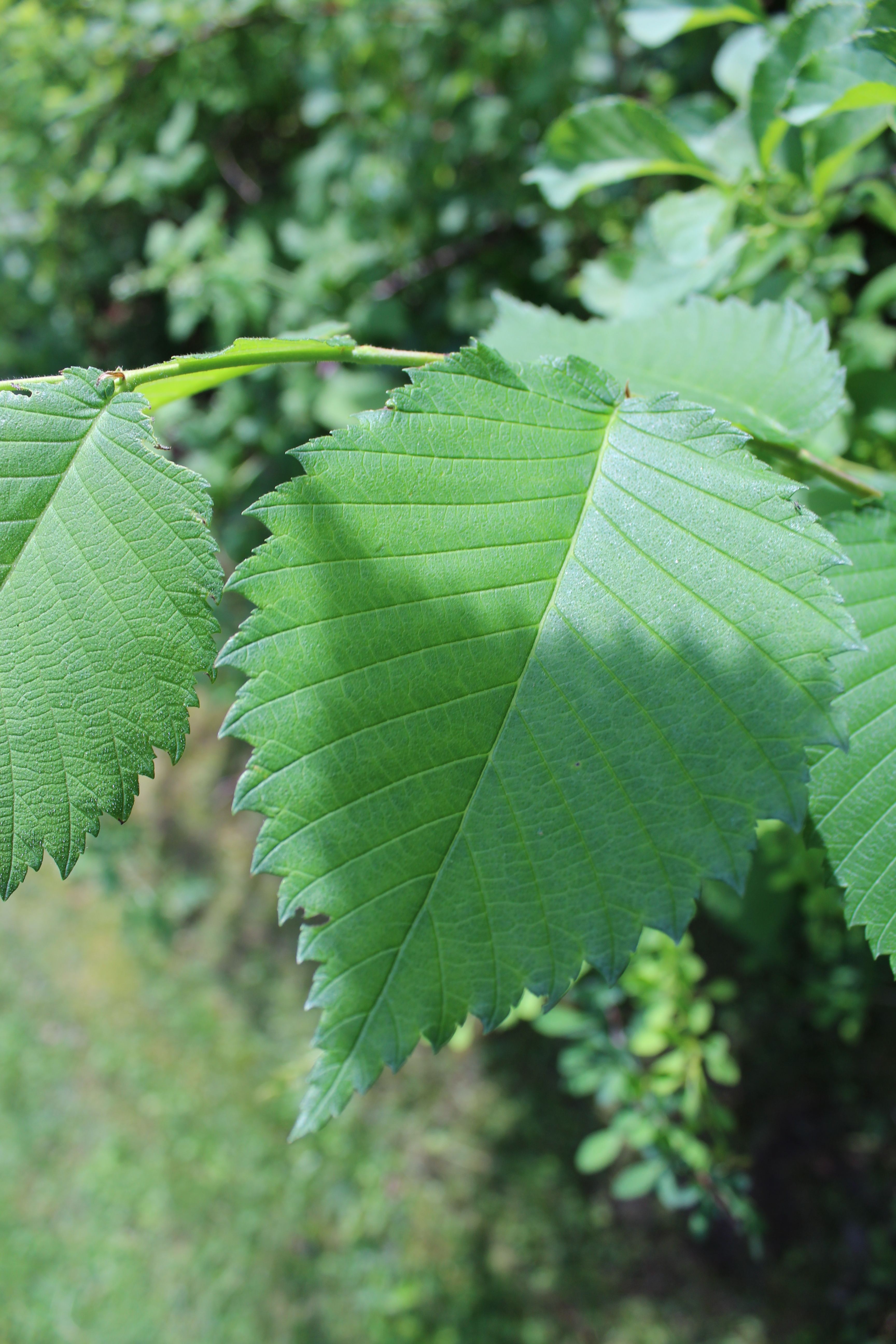
This leaf is what made my heart beat with joy.

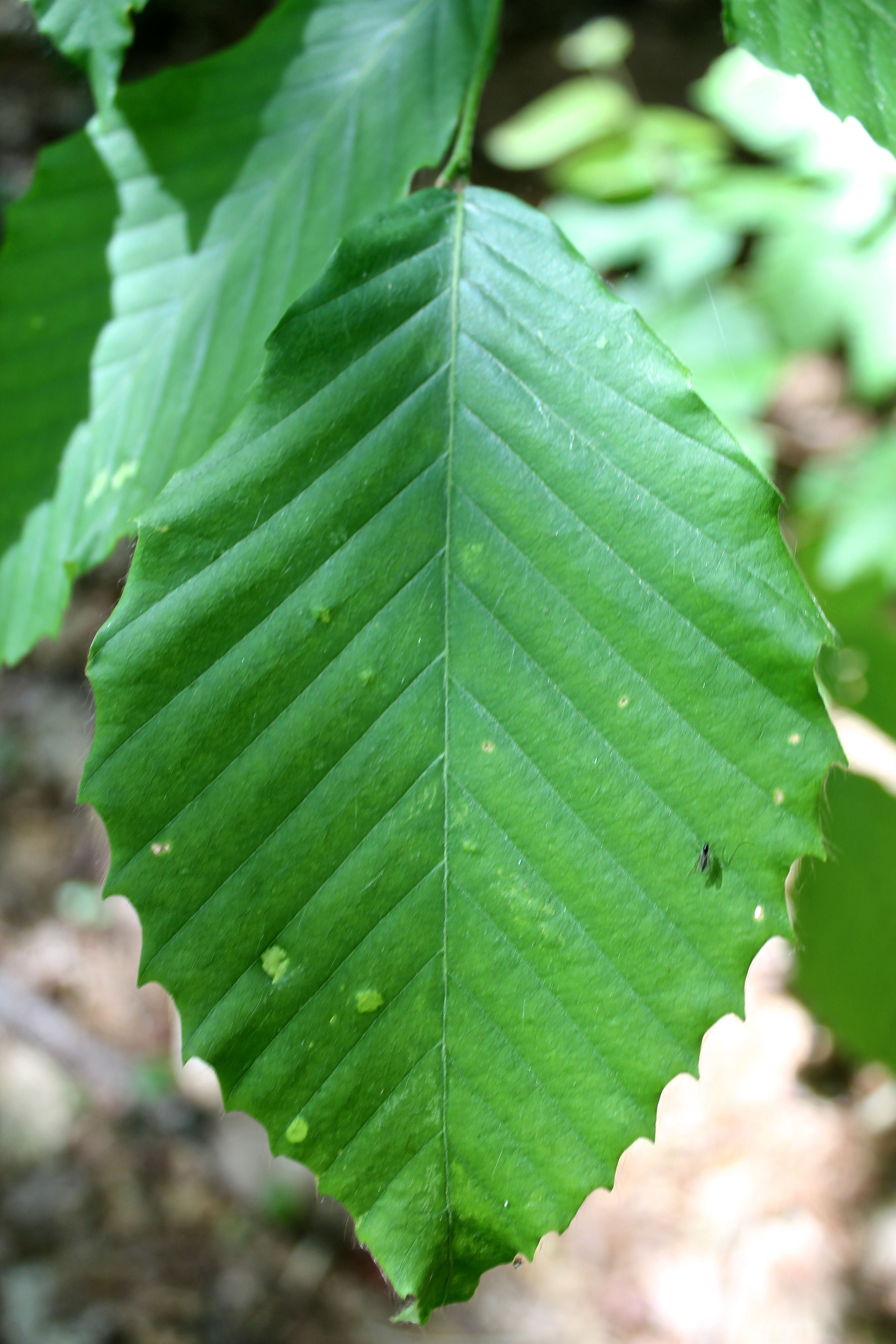
On first glance, you may think it is this:

beech teeth

Yes, the ribs extend from the main vein to each tooth. But notice the large dips between teeth in the above example.

double toothed

Back to Exhibit A: While the ribs also extend from the main vein to each tooth;  the difference is in the teeth. In this case, there is a smaller tooth beside each bigger tooth along the leaf’s outer edge (aka double-toothed).

beech teeth and hair

Exhibit B: Not the case.

teeth and assymetrical base

Exhibit A: Do you see the asymmetrical base where the leaf stem (petiole) attaches to the tree?

beech symmetrical

Exhibit B: Symmetrical at the base.

hairyunderside

Exhibit A: While both trees have alternate branching and hairy leaves with teeth, another distinguishing factor is that the leaves of Exhibit A are sandpaper coarse.

Those are just a few of the key features to look at when distinguishing between a beech and an elm. I’m not a forester, but this tree appears to be an American Elm. I’m so glad that my green pinky has kept me from managing the garden where it grows.

I grew up just outside the Elm City of New Haven, Connecticut. Today, it is the Elm City in name only as Dutch elm disease played havoc with the beautiful old shade trees that lined the city streets.  It didn’t just happen in CT either.

In Forest Trees of Maine, published in 2008 by the forest service, I read that American Elms occur throughout the state, but good old Dutch elm disease severely reduced the number. We have one. Right here in our yard. :-)

I’m so glad that I opened my eyes. I’m so glad that I touched the leaf. I’m so glad I reaped another reward this week. 1. Pink Lady’s Slipper in the backyard. 2. American Elm in the side yard. I can’t wait to make another discovery.

I hope you take time to wander about your yard and wonder.

When I grow up . . .

I want to be like Ursula, my spritely little German friend who is a naturalist extraordinaire and loves to share her knowledge and stories.

Ursula

Always with a smile.

bridge

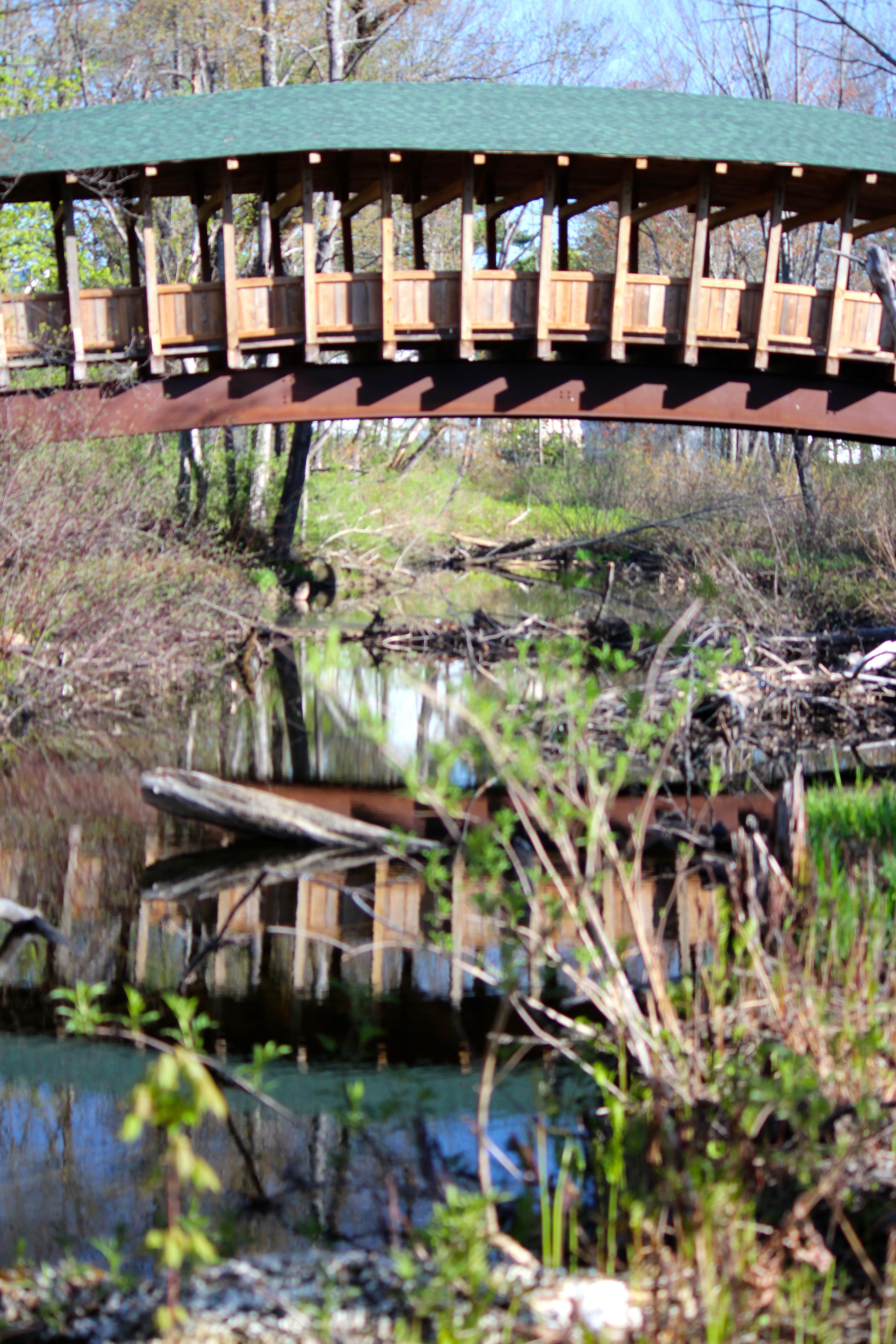
I had the pleasure of being in her company today, after an hour of birding in Pondicherry Park,

baltimore oriole

where a Baltimore Oriole serenaded us.

dwarf gensing

On to Holt Pond for Ursula’s wildflower walk hosted by Lakes Environmental Association, as was the bird walk. Looking a bit like a disco ball is the blooming Dwarf Ginseng.

cucumber root

Though it isn’t in bloom yet, I saw lots more Indian Cucumber Root today and have a theory I’m questioning about this plant. I know that if it has only one level of leaves, it doesn’t flower or fruit. It needs that second deck to be productive. I’ve heard people say that when it has the second tier it is a two-year old plant, while the first level is a year old. Is that true? The Canada Mayflower, Bunchberry and Wild Oats all do the same. Does that mean that all the single leaves we see are one and all the doubles are two and none reach age 3? Or is it that some years some of these plants put more energy into producing sugar and thus are able to flower, like trees have mast years? And furthermore, am I making any sense?

blueberries

So many flowers and so many of them white or creamy yellow, like these Highbush Blueberries.

red maple 2

Since we were crossing the Red Maple Swamp, I can’t resist showing their development.

green frog

Along the boardwalk that winds through the swamp, we saw this banjo player–a Green Frog. Some call it a Bronze Frog because more than half its body is bronze. Thus the need for those Latin names–Rana clamitans.

hand 1

My friend, CC, squatted down to catch it.

hand 2

And came away empty-handed. :-)

cinn 1

Who do you want to be when you grow up?

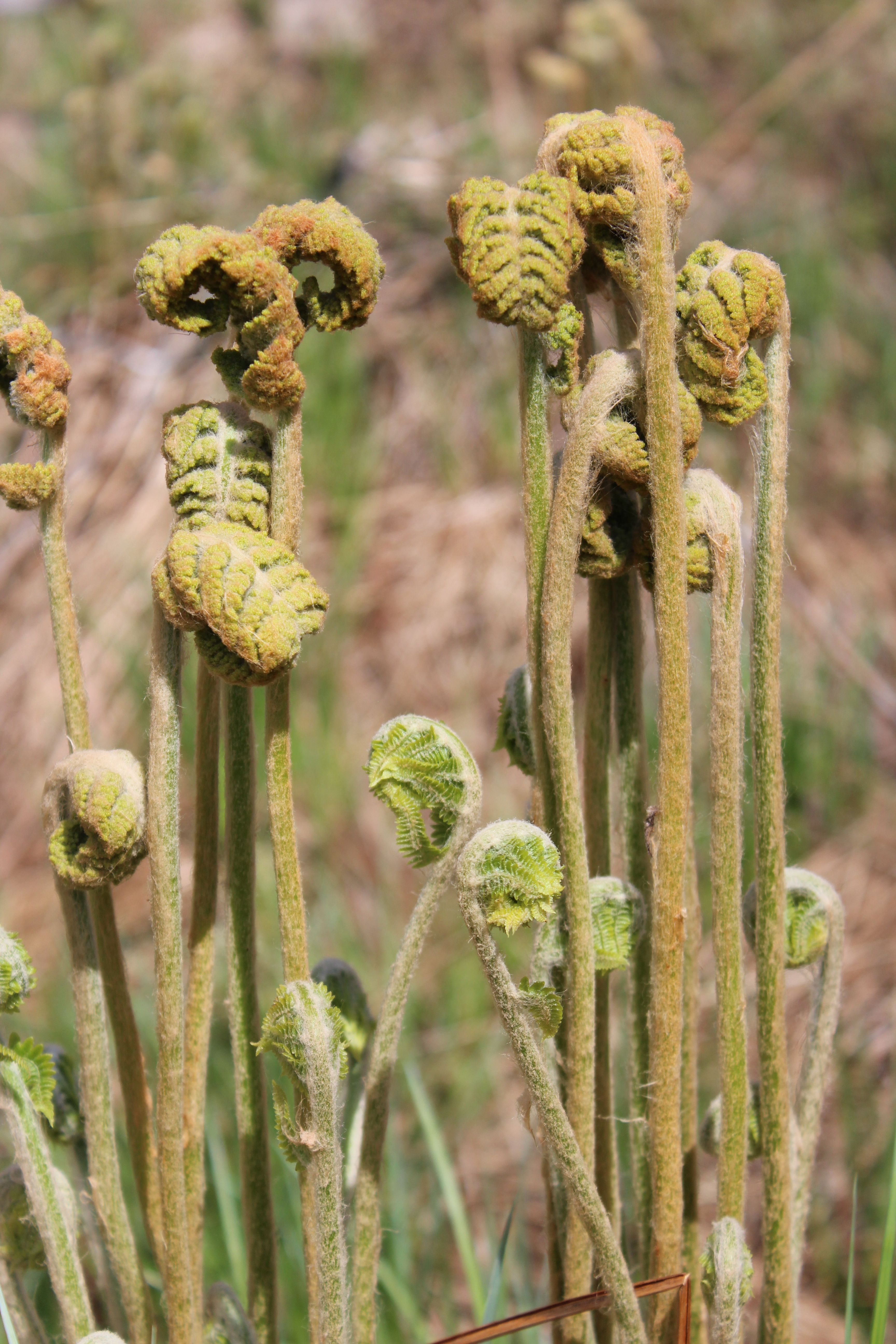
crosiers 2

I pose the question to these crosiers.

cinn 5

Do you see the fuzzy brown wool coat they wear?

cinn 6

Close up.

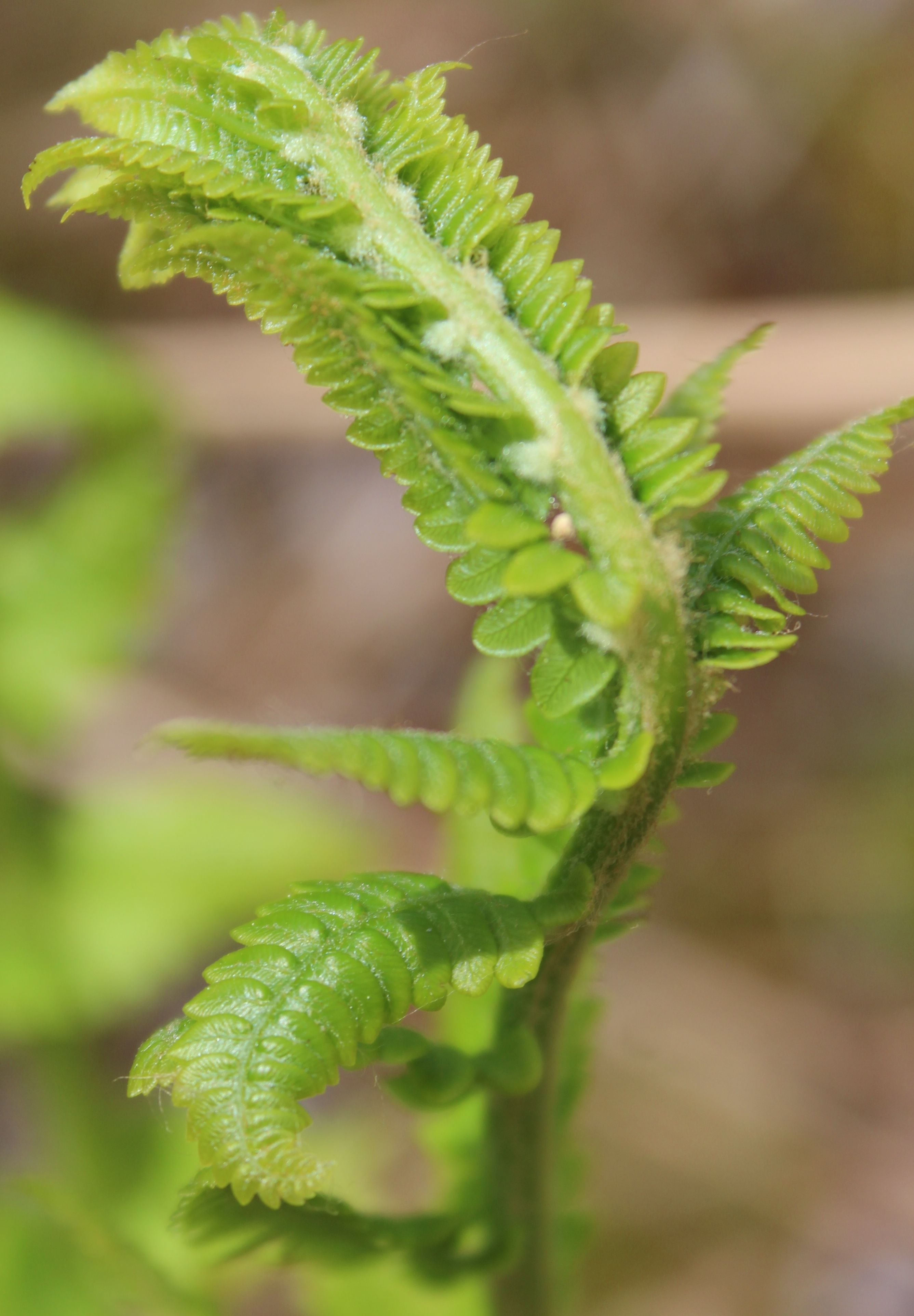
cinn 7

Ever so slowly . . .

cinn 8

Their fronds begin to unfurl.

cinn 9

And soon we’ll know them as the Cinnamon Ferns they are becoming.

rainbow

Continuing on, one of our leaders, Mary Jewett of LEA, spotted this rainbow around the sun.

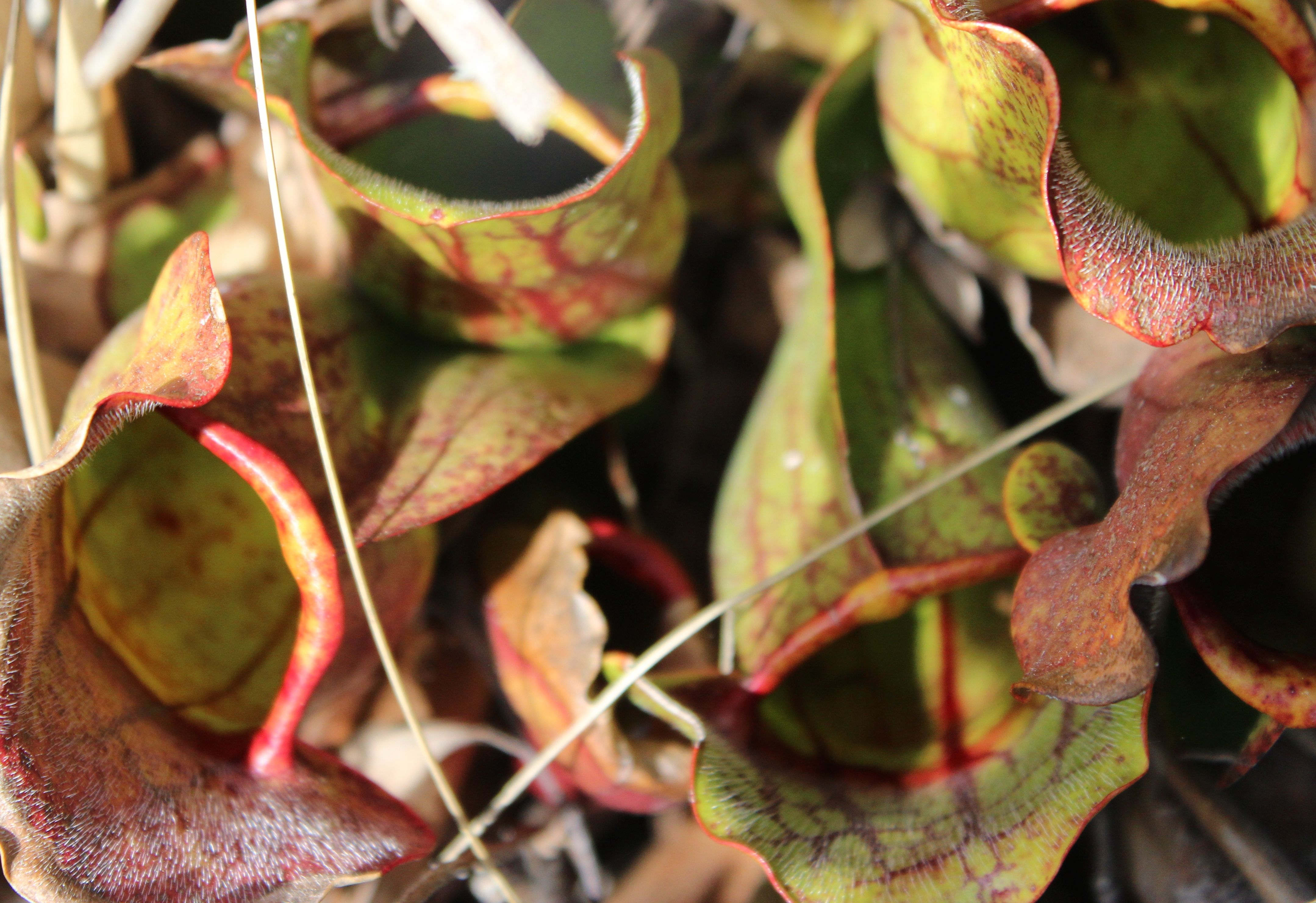
pitcher plant

As is always the case, our heads were bobbing up and down, trying to take in everything there was to see. Pitcher Plants pull us in every time. Well, not literally, thank goodness.

pp seed pod

CC found this old Pitcher Plant seed pod.

qb

We were on the quaking bog, a mass of sphagnum moss, flowering plants, shrubs and decaying vegetation that floats on the water. It looks safe to step onto, but . . . it too, would like to pull us in and preserve us for eternity.

hp

Holt Pond–like all of us, it’s ever changing as it matures.

It’s Ursula’s energy and engaging personality that wow me every time we share moments wandering and wondering. I don’t want to be her, but it would be an honor to emulate her even a tiny bit.

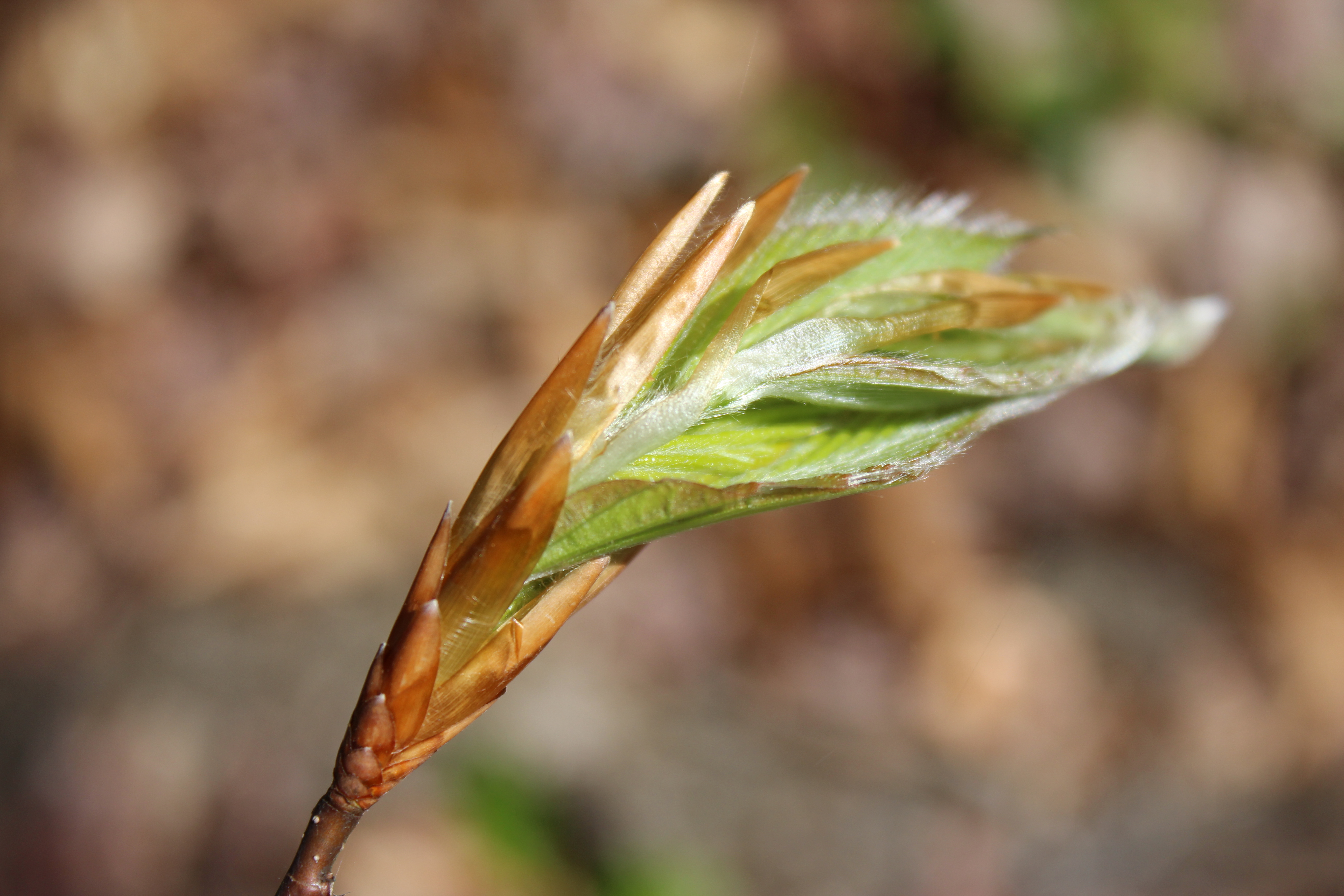
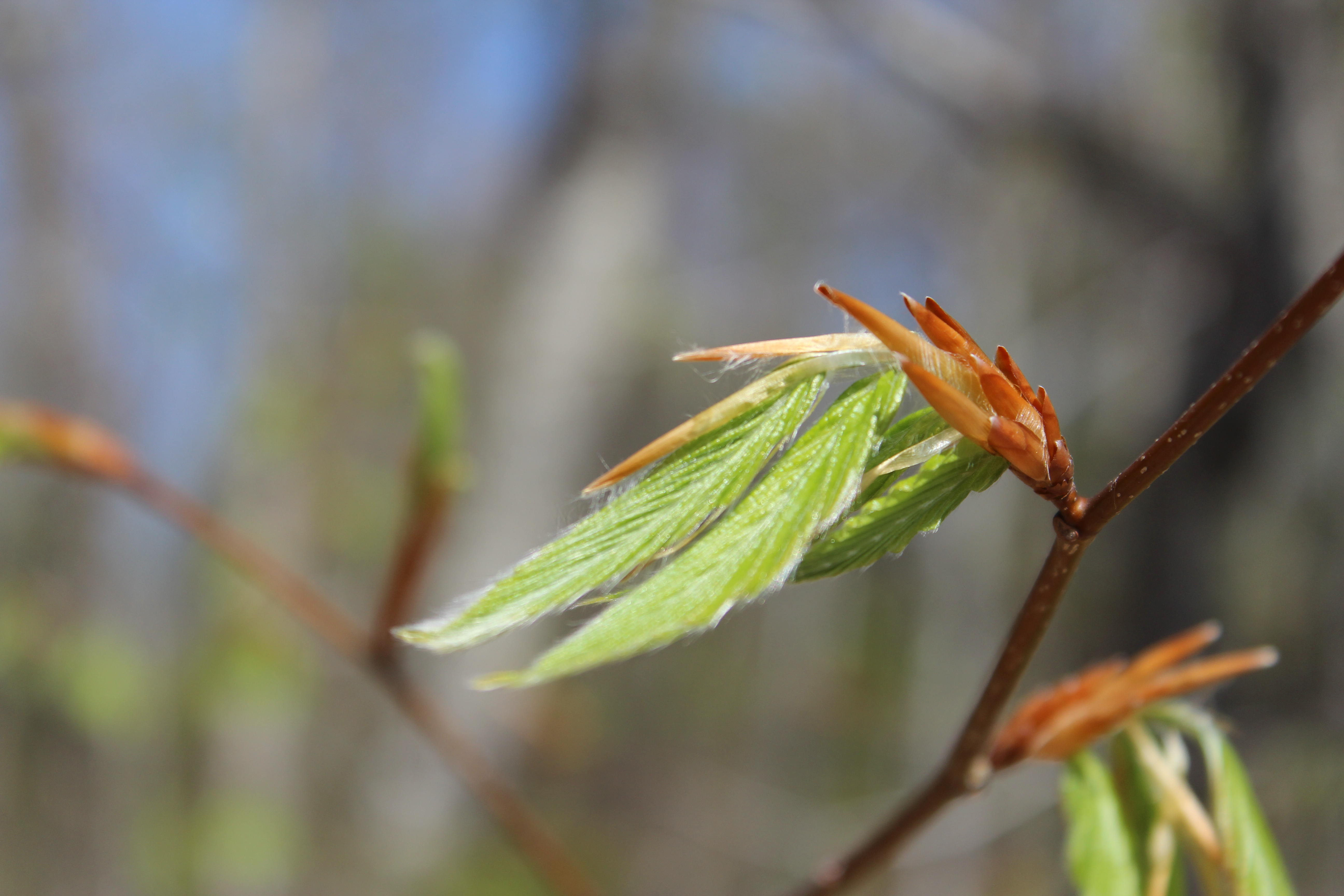
A Perfect Beech Day

Eighty-some odd degrees, plenty of sunshine and a welcome breeze greeted a couple of friends and me as we explored the Sucker Brook Outlet Reserve on Farrington Pond Road in Lovell–certainly a beach day.

Beech cigar

Though we often refer to them as being shaped like a cigar, on this summer-like spring day, that description hardly seems apropos.

beech old and new

A few of last year’s leaves still cling tentatively to beech branches,

Beech 1

but on others the buds unfurl

Beech Leaves unfurl

with grace,

beech 2

displaying pleated leaves covered with long silky hair.

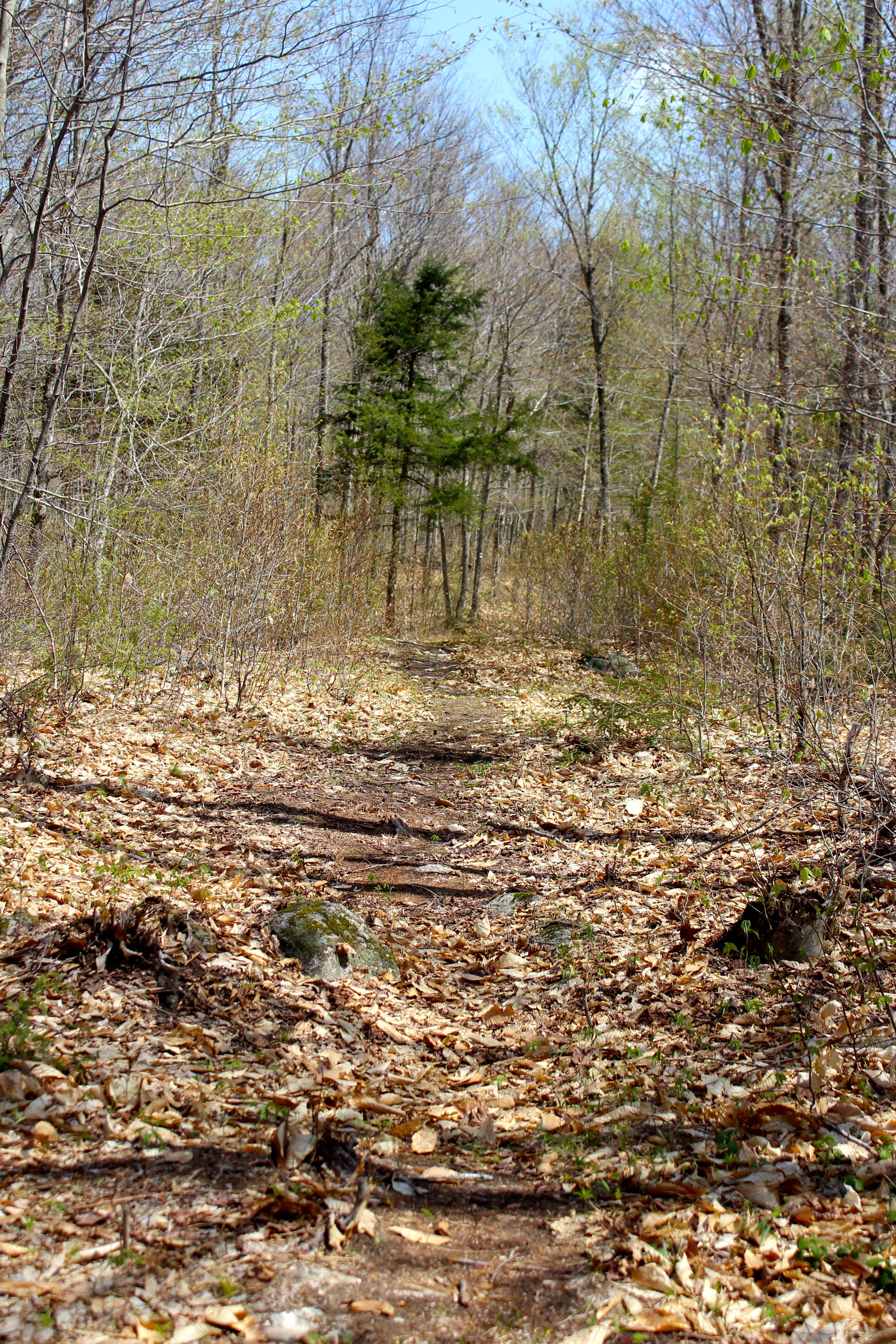
trail

There’s so much to see along the trail, so I hope you’ll continue to wander with me.

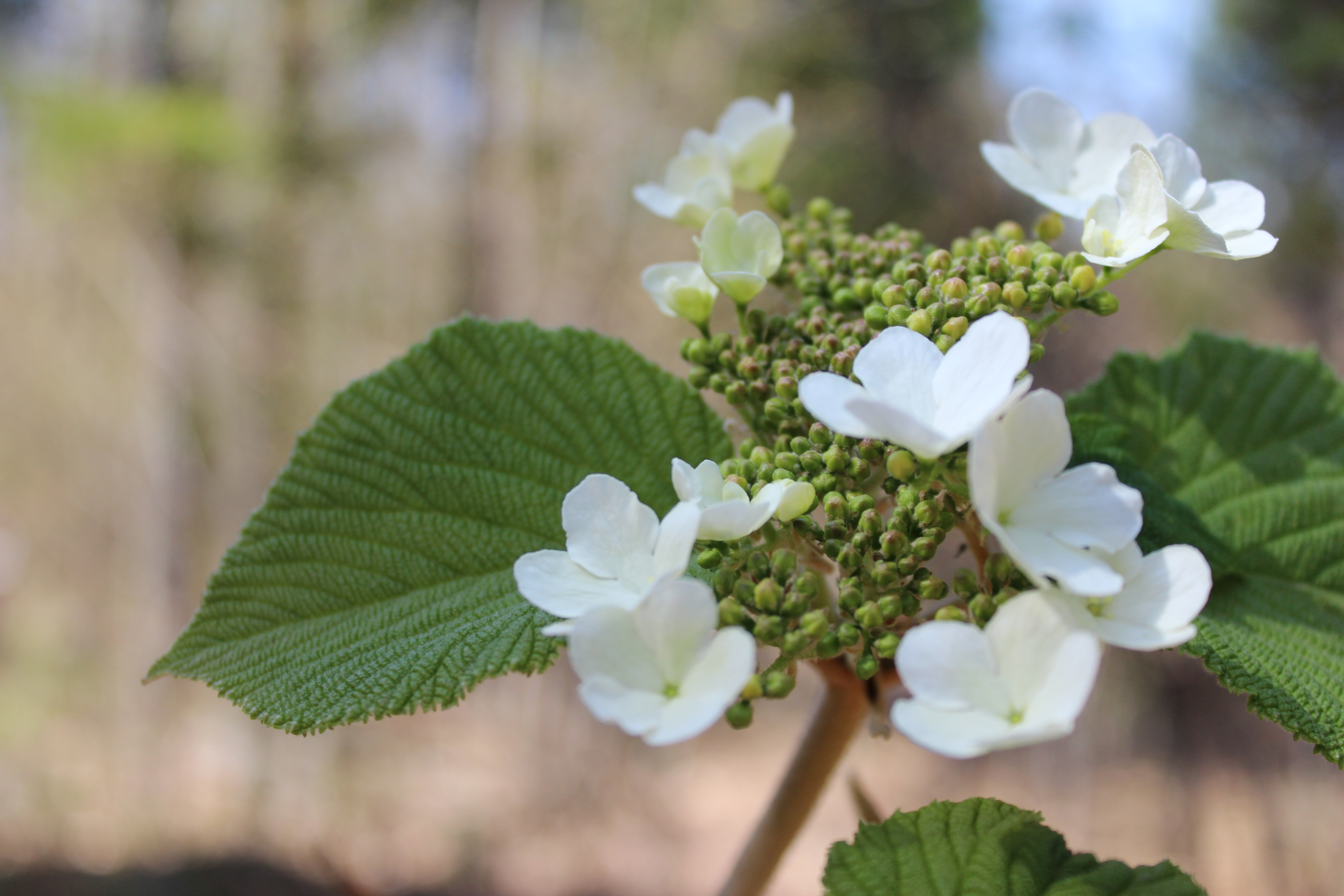
Hobblebush

 Hobblebush,

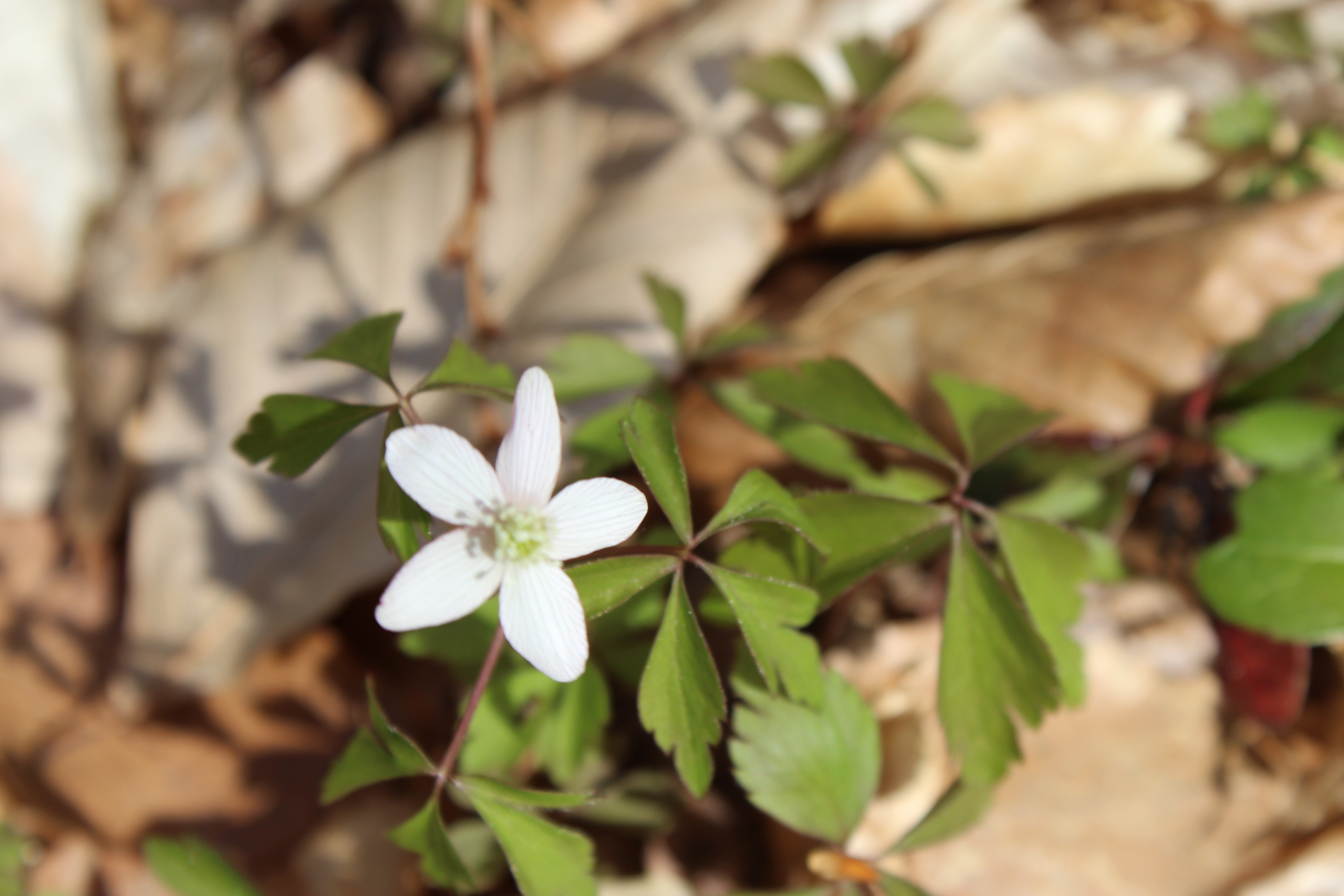
anemone

Wood Anemone

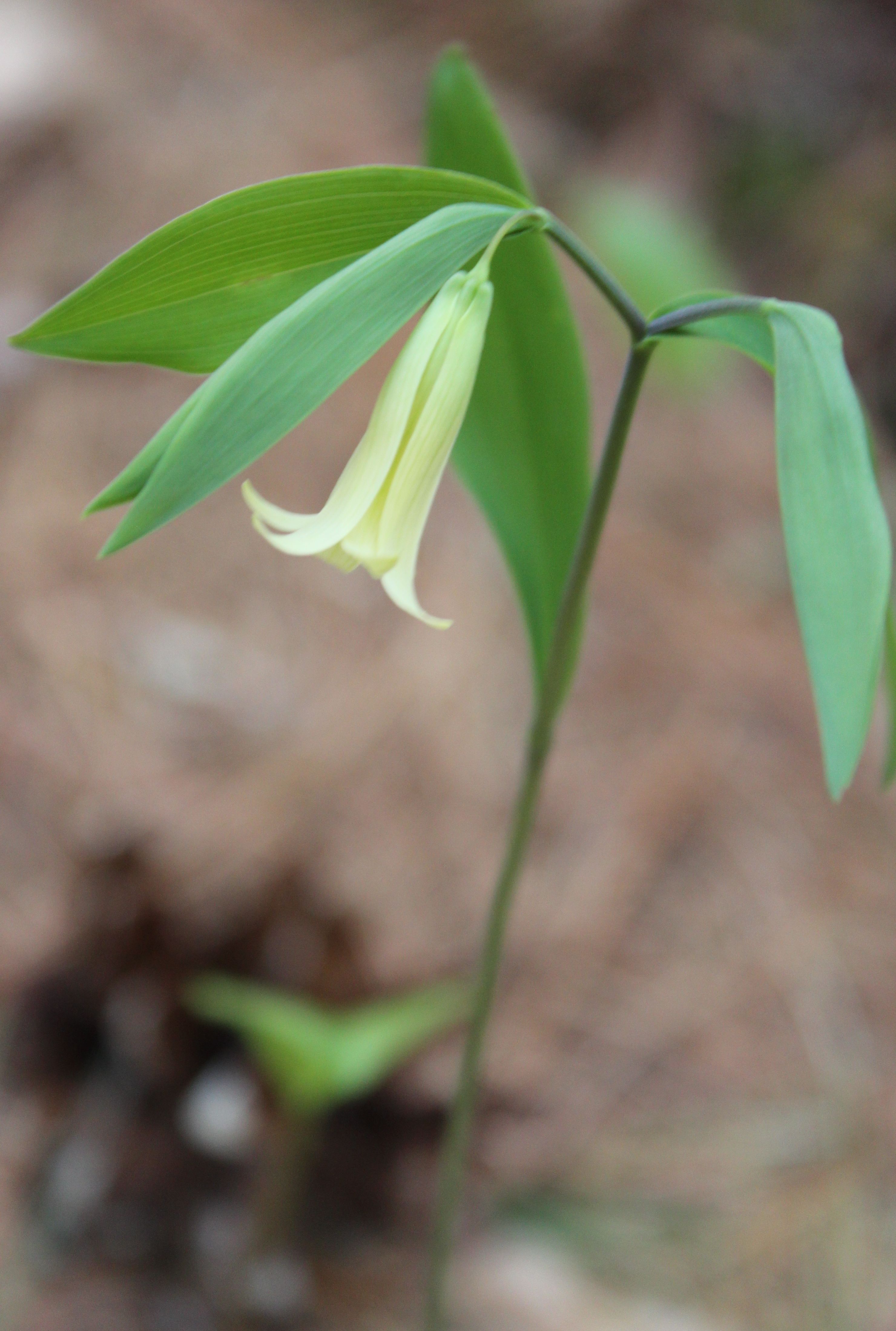
sessile-leaved bellwort or wild oats

and Sessile-leaved Bellwort or Wild Oats.

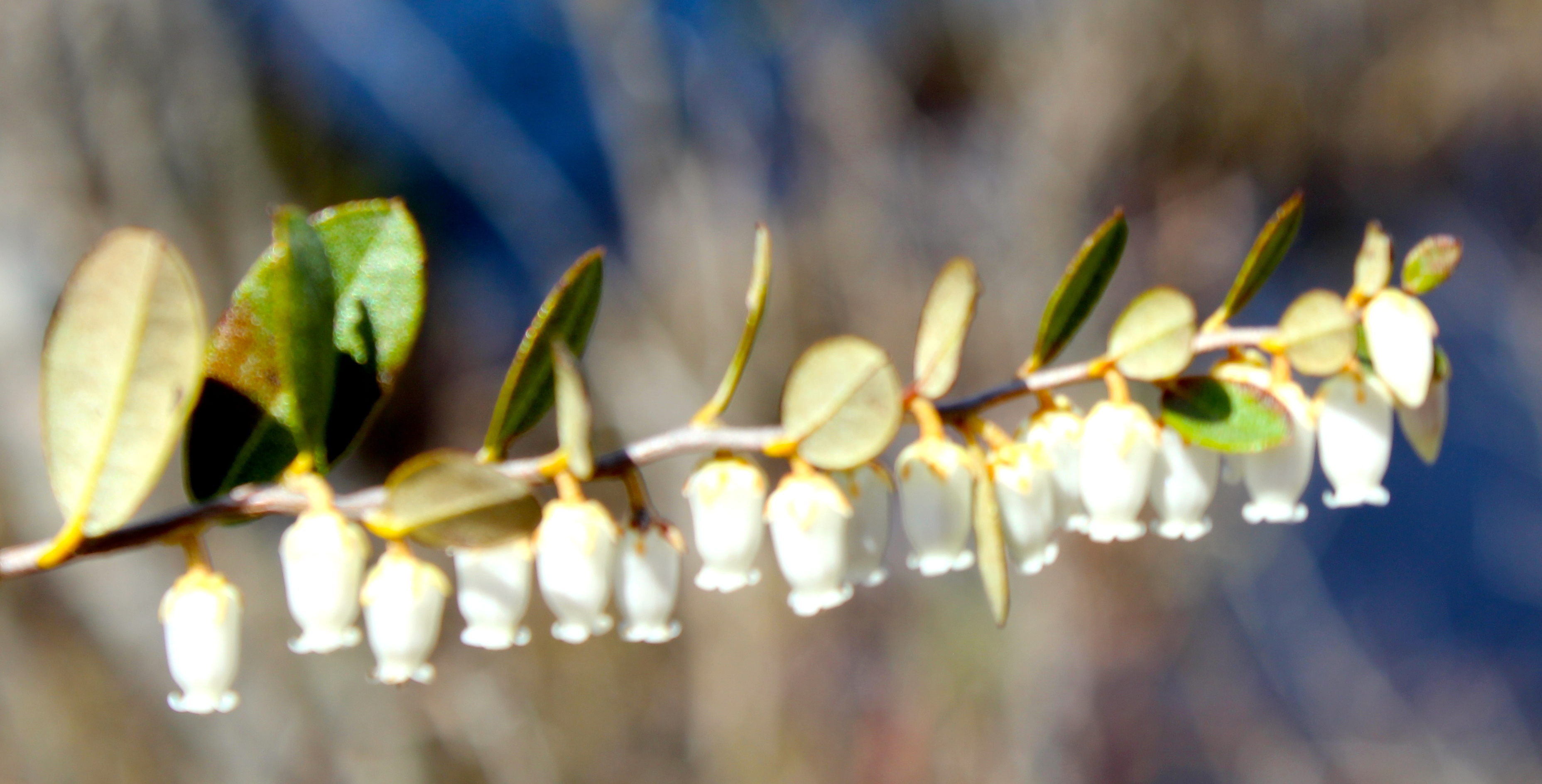
Leatherleaf

Leatherleaf

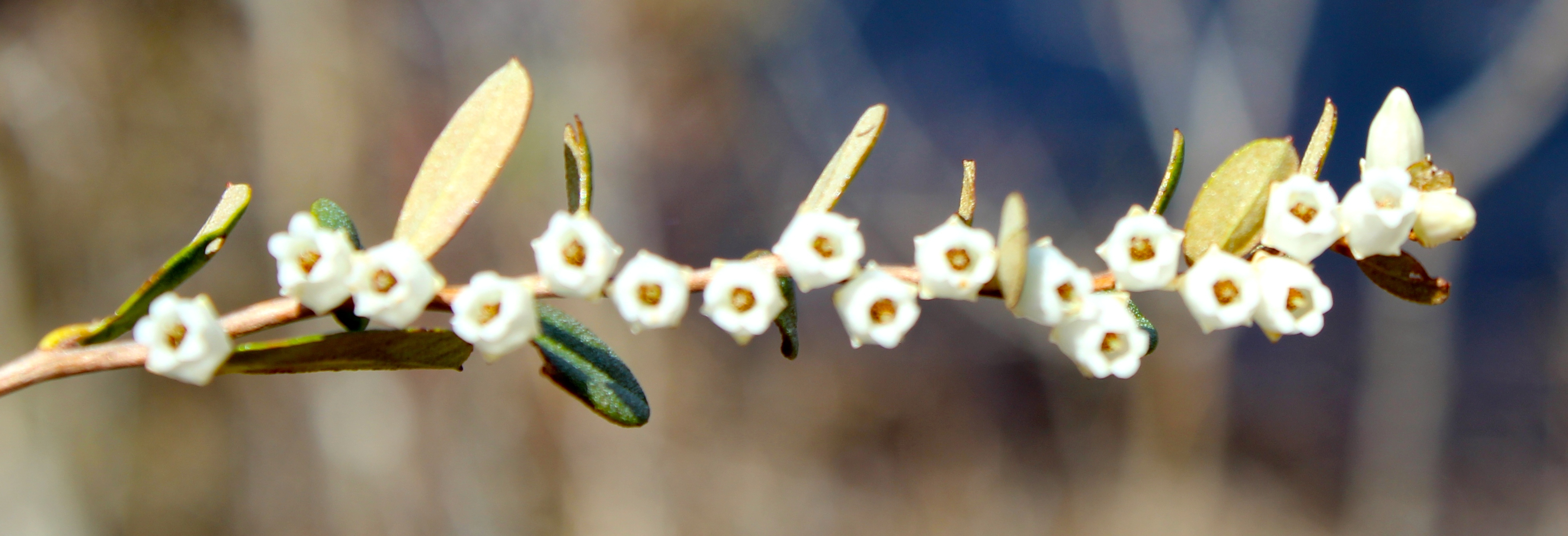
Leatherleaf 2

from a different point of view.

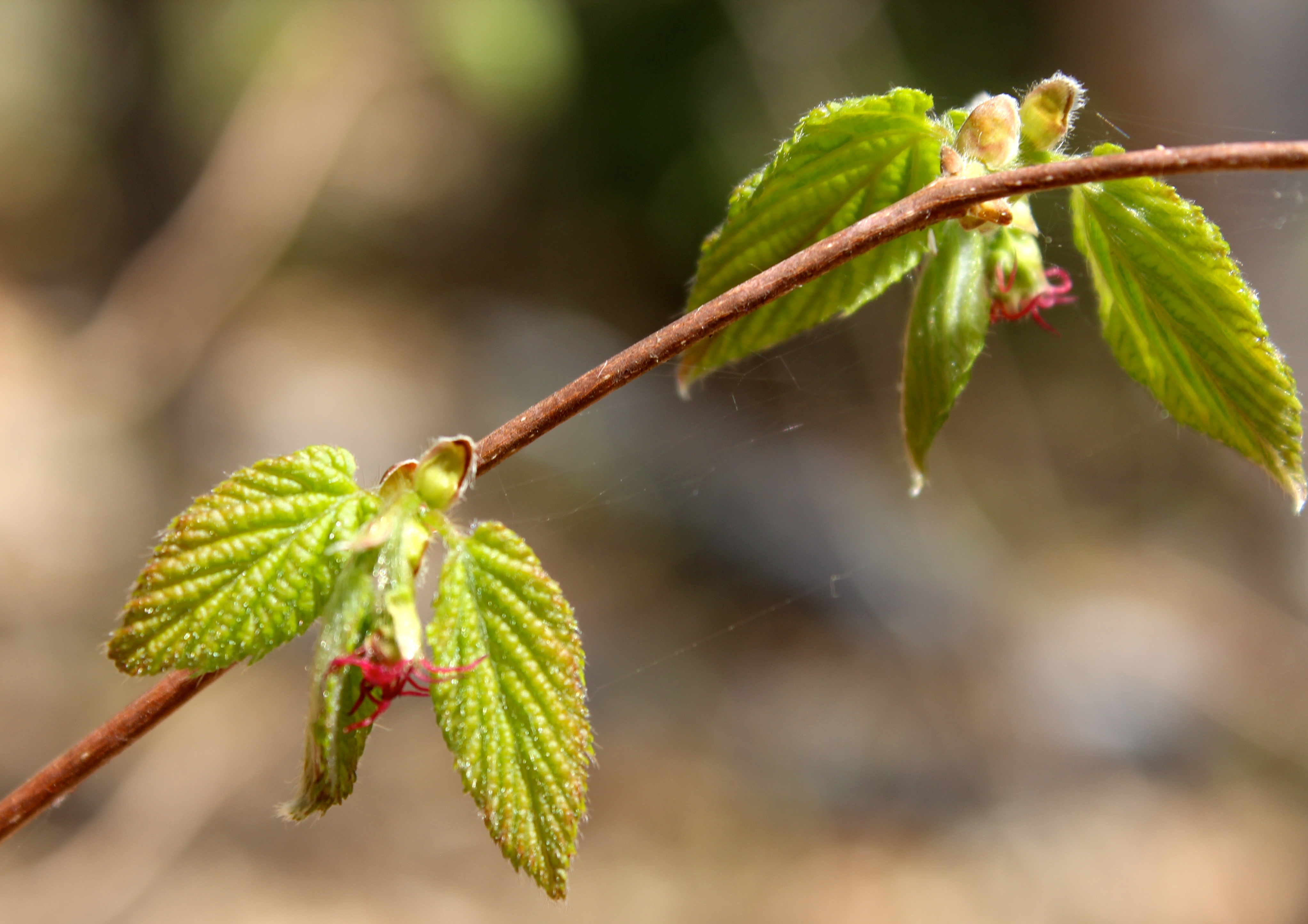
beaked hazelnut

Beaked Hazelnut displaying leaves.

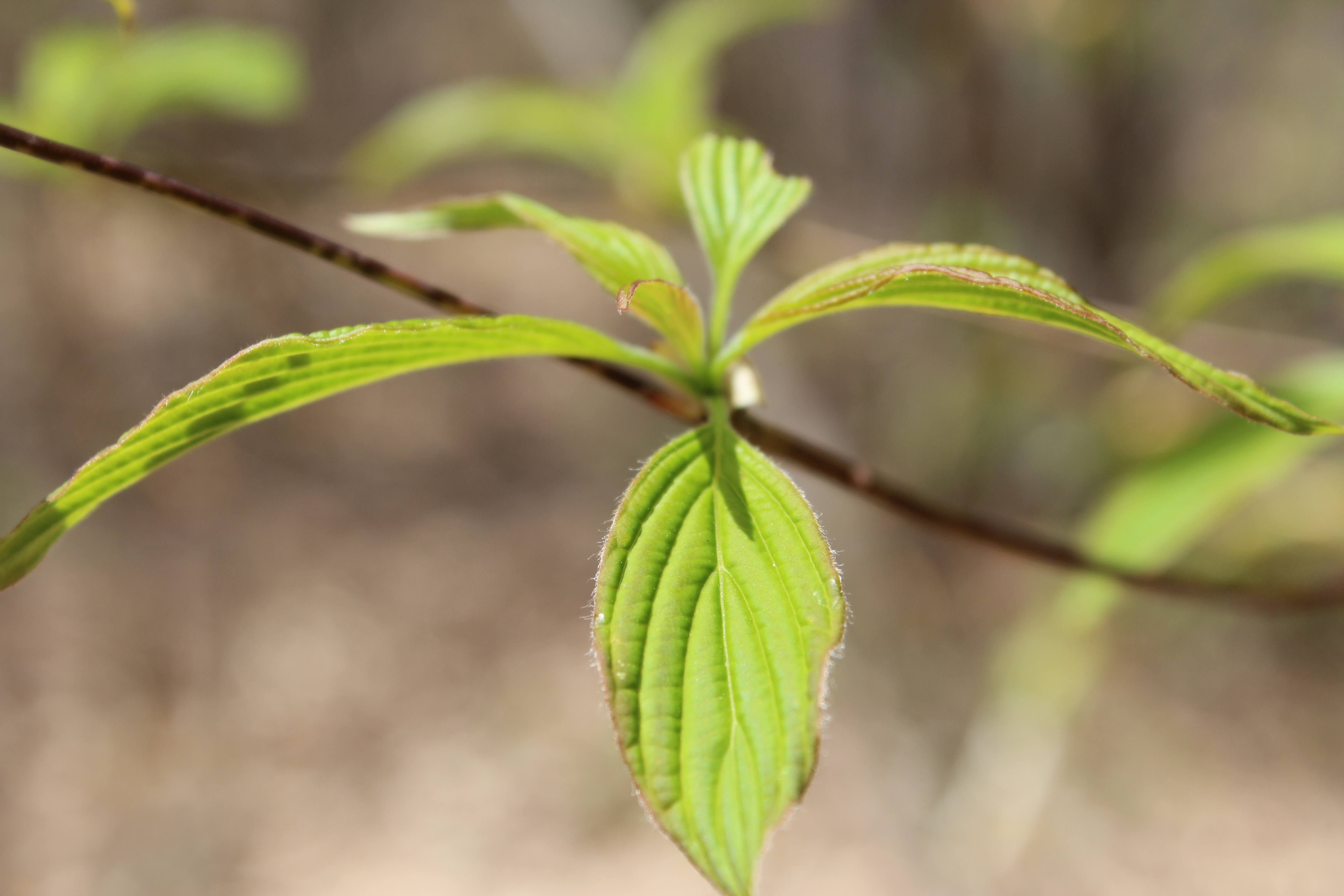
Alternate-leaved Dogwood

Alternate-leaved Dogwood

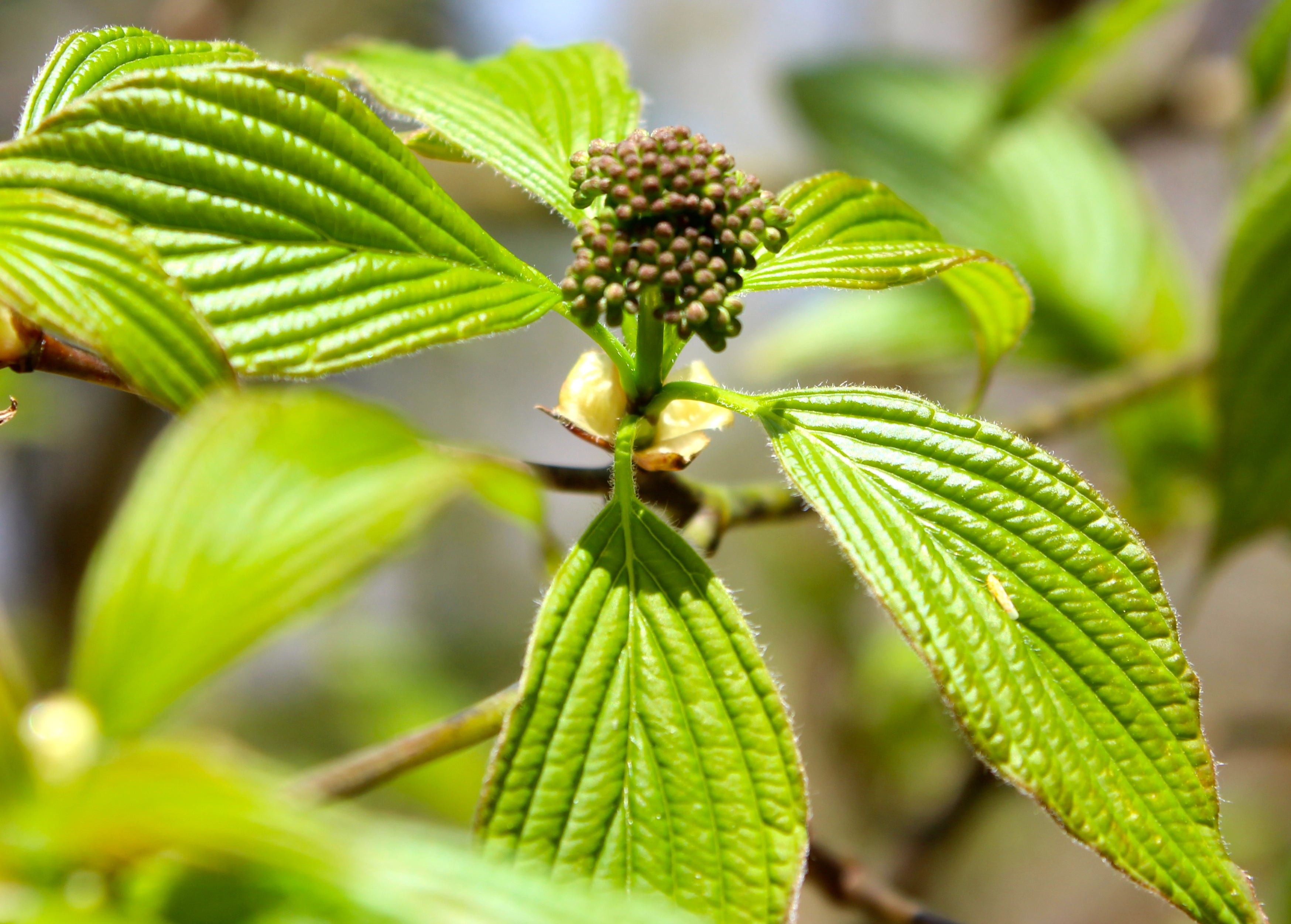
al dog 2

preparing to flower.

Squawroot resembles pinecone

Squawroot, that reminded us of . . .

pine cone:squaw root

pine cones.

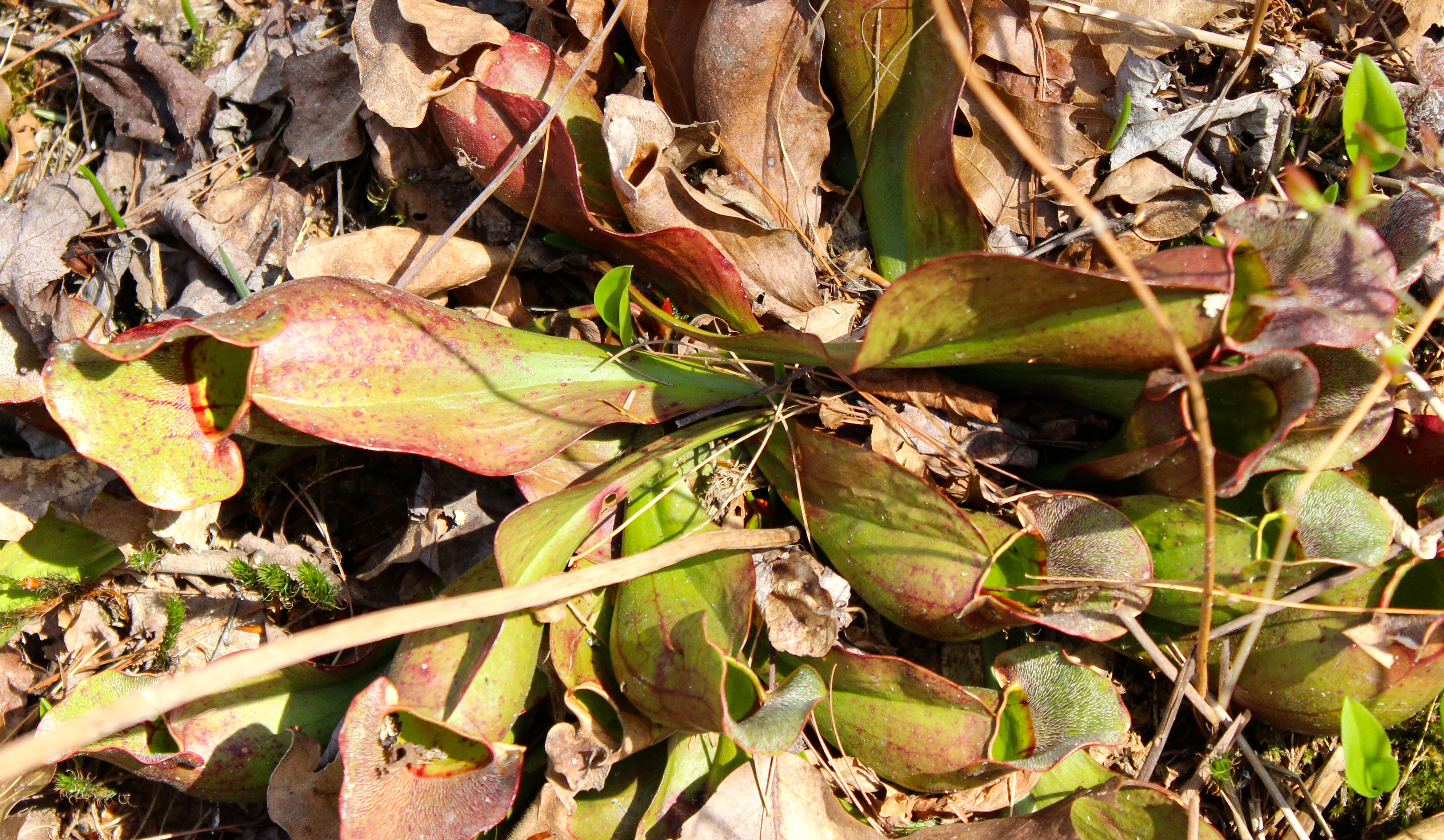
pitcher plant 1

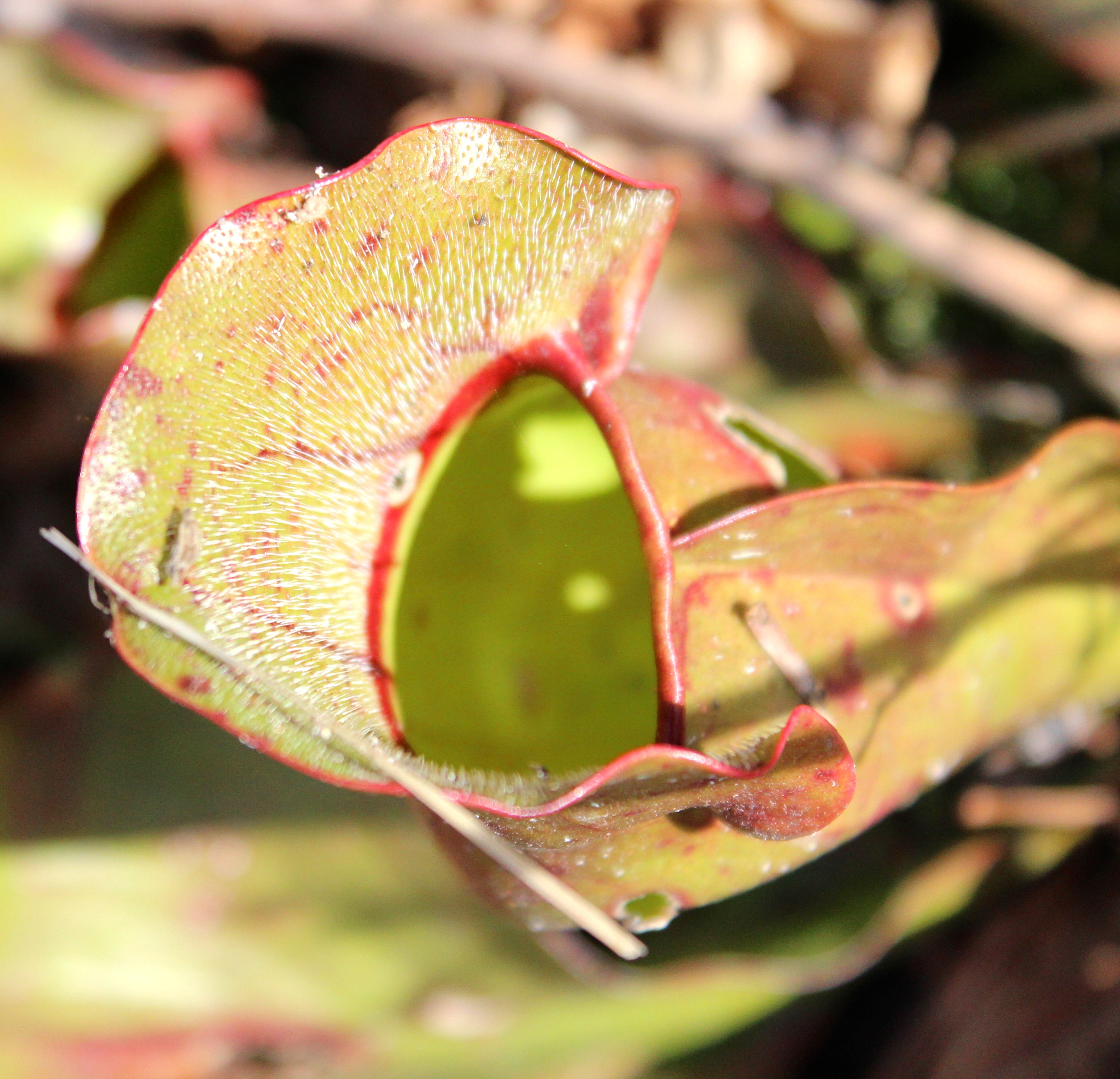
Pitcher Plants, carnivores in the plant world,

pp3

with their pitcher-shaped leaves,

pp2

covered in trigger hairs–waiting to trap insects.

hemlock polypore, Ganoderma tsugae

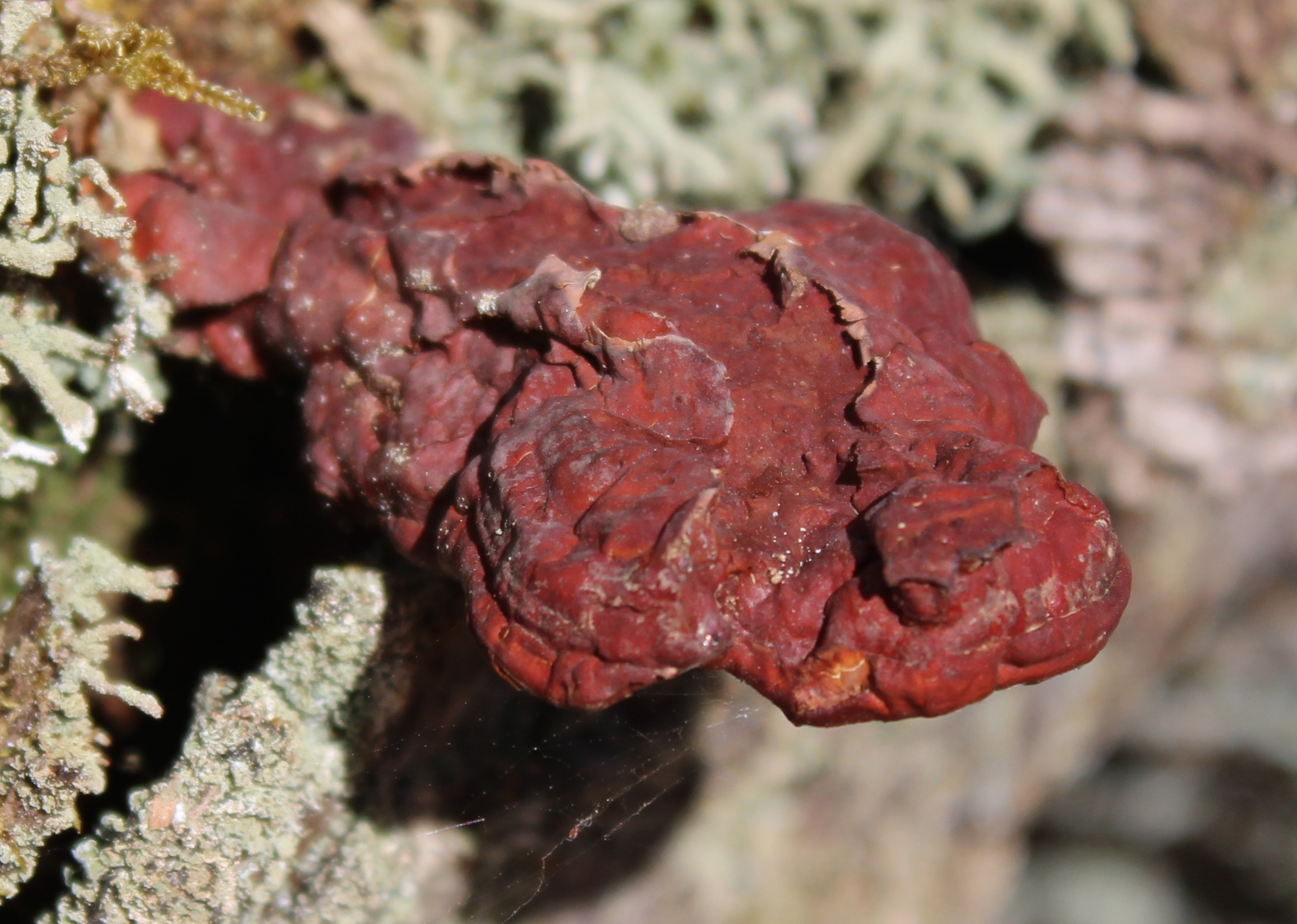
We saw hemlock polypores,

bn 3

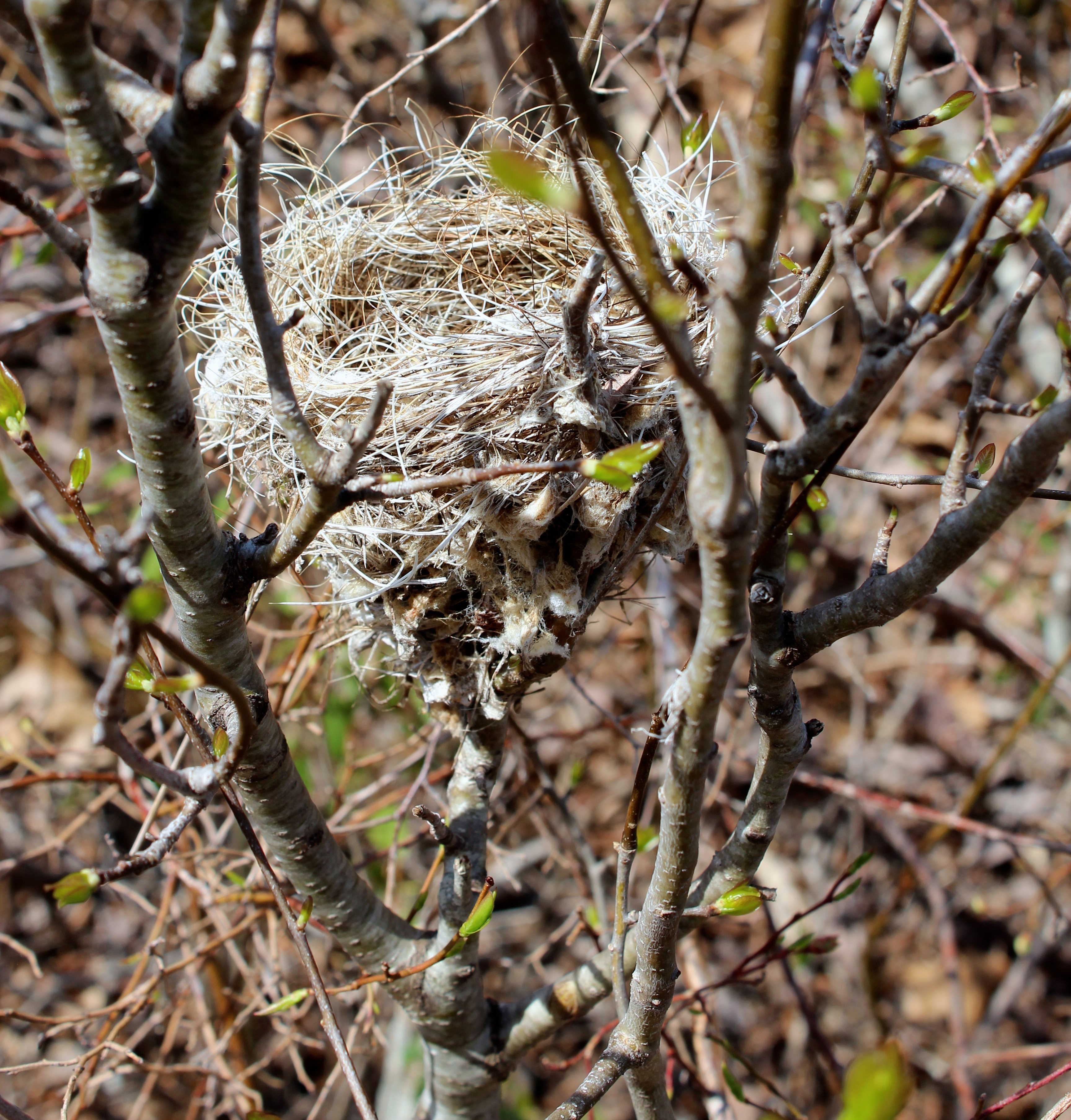
and old bird nests.

And then there was the other animal sign.

 a s deer

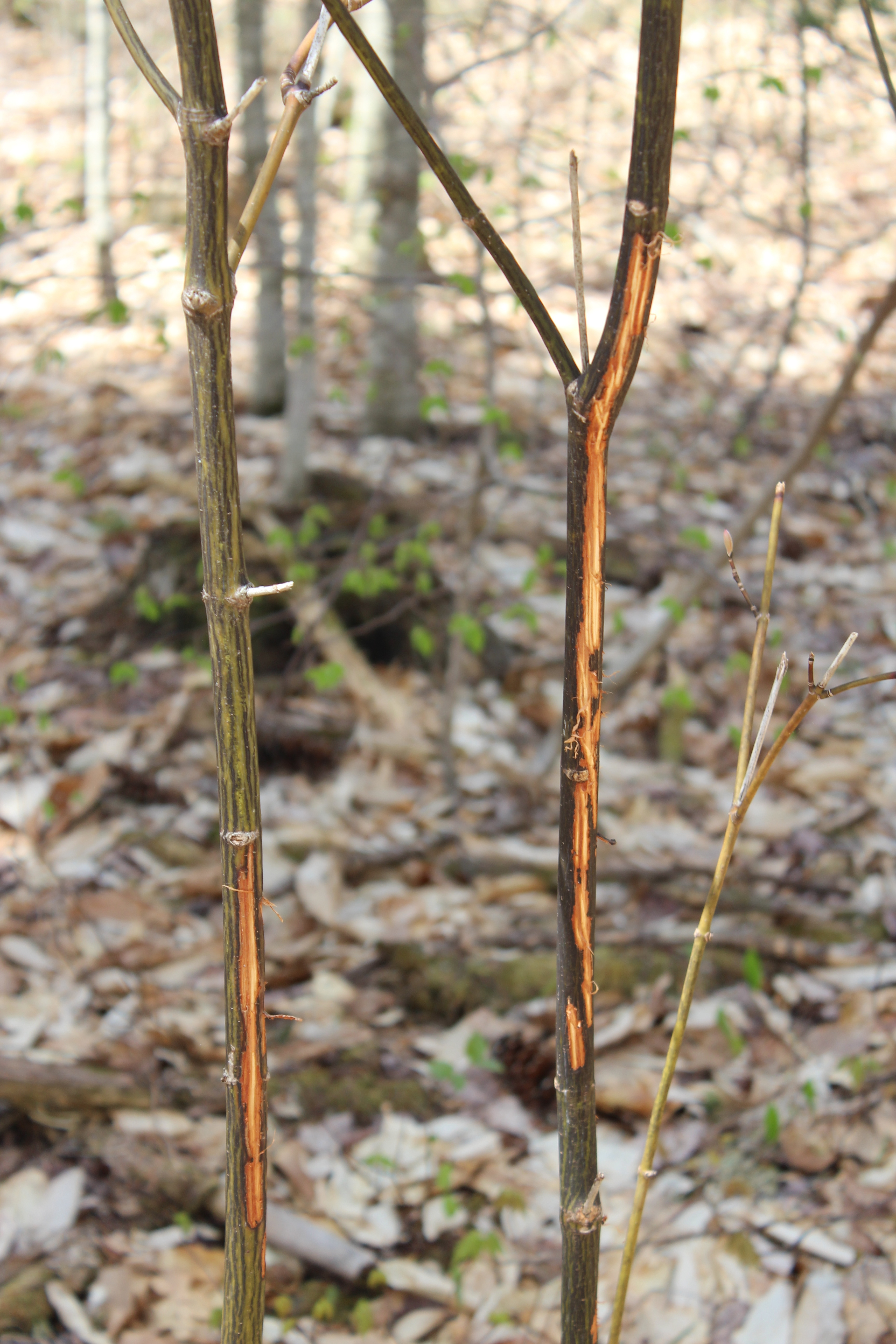
Deer scrapes on Striped Maple bark.

as mouse

And the work of mice below the snow pack.

beaver works

There is beaver work everywhere

bw 5

and numerous lodges in the brook.

vp

A rut in the trail

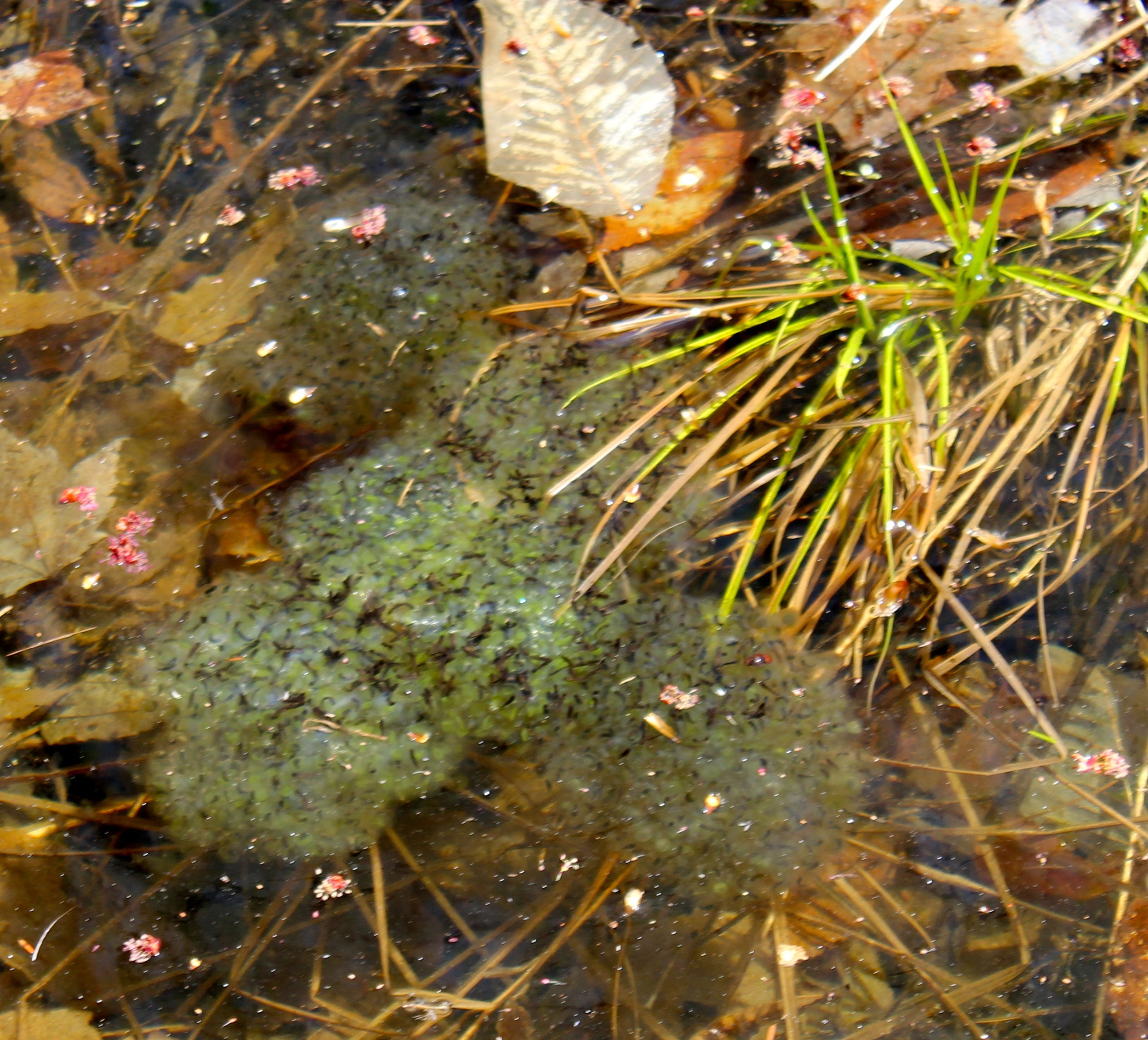
wood frog eggs

was put to good use–wood frog eggs and emerging tadpoles.

a s yellow feathers, Northern Flicker

Something made a meal of this Northern Flicker.

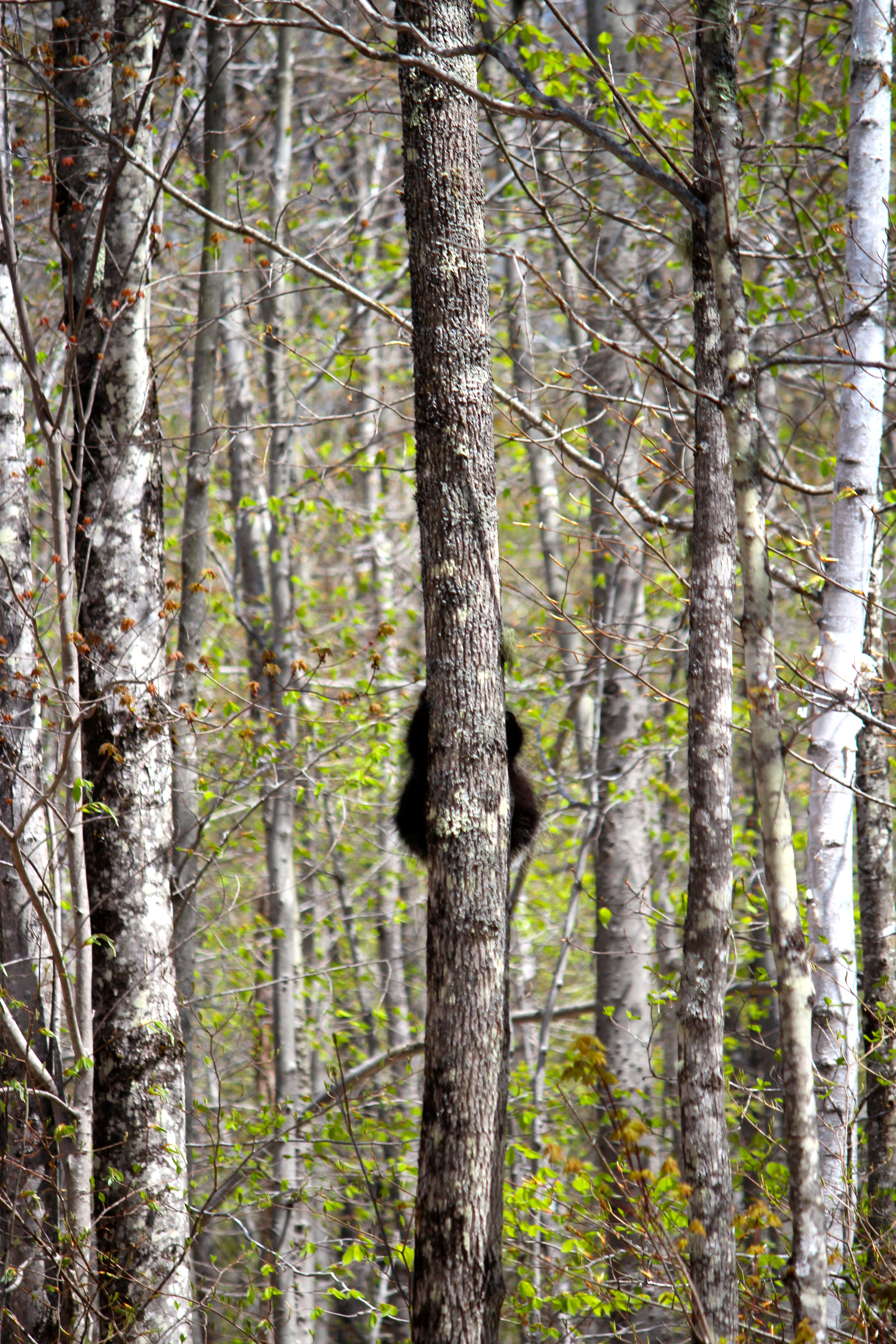
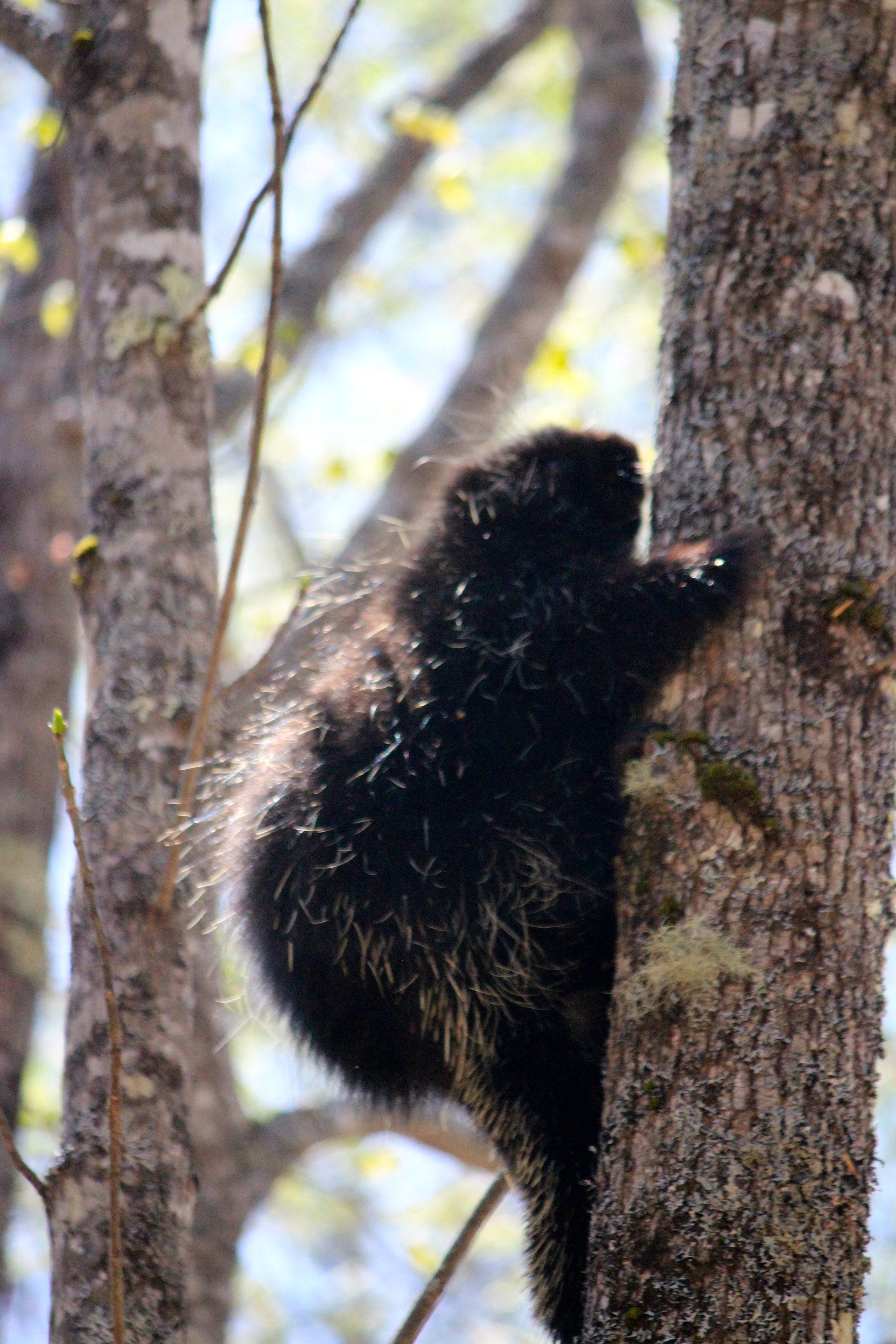
porc 1

Our best finds were actual wildlife. This guy thought that if he hid his head, we wouldn’t see him.

porc 3

But we did.

wood frog

A wood frog, also trying to hide, well, sorta.

ribbon snake

And a ribbon snake that quickly slithered into a hole and out of sight–the most successful hider of all.

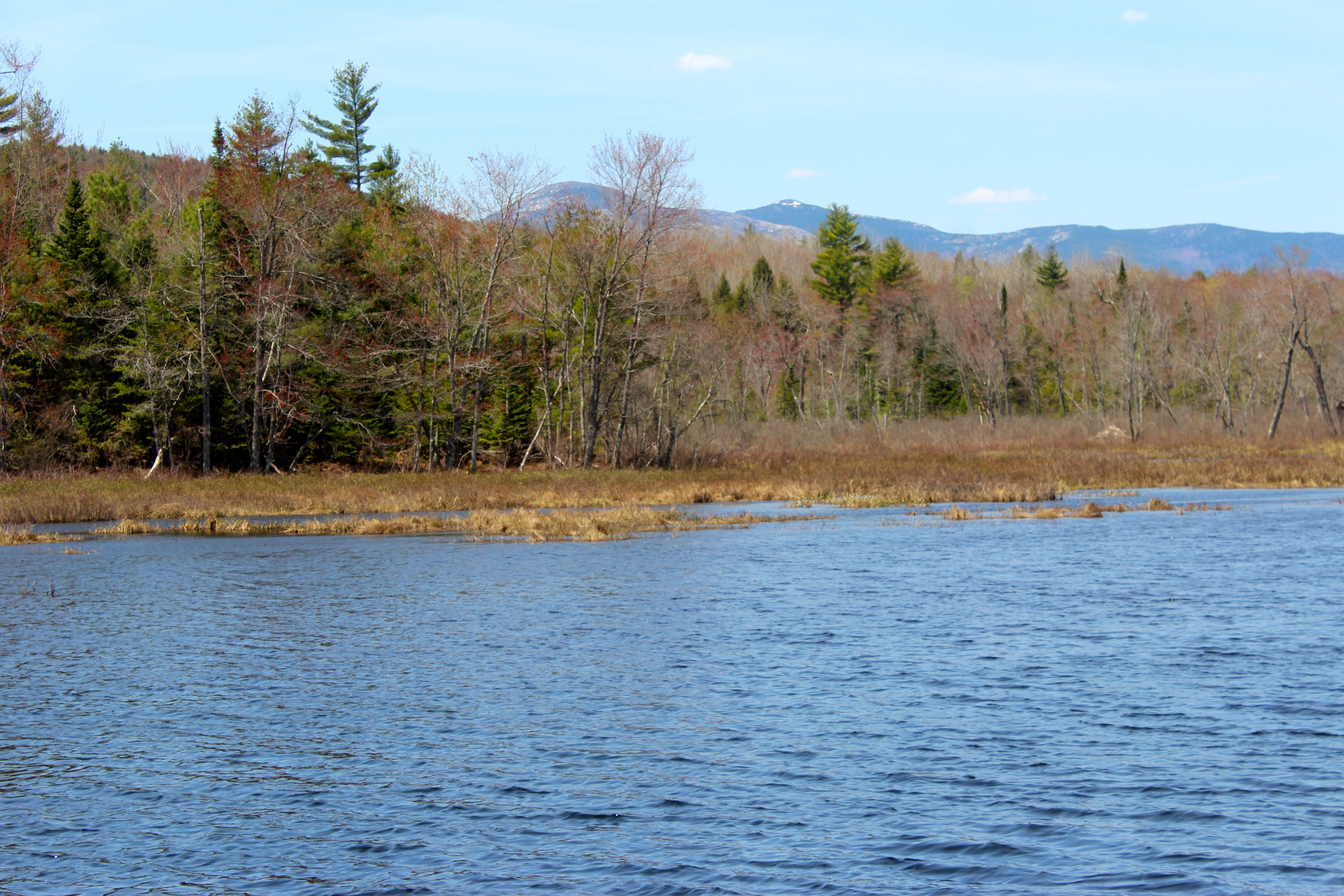
Sucker brook

Lest I forget, we were beside Sucker Brook,

SB 3

where we paused frequently.

mnt view 2

An osprey flew overhead, but I wasn’t quick enough to take a picture.

It was a perfect beech day. Thanks for taking the time to enjoy it with me.

And Happy Birthday to my sister, who has loved the beach since day one.

Walking With Nature On Earth Day

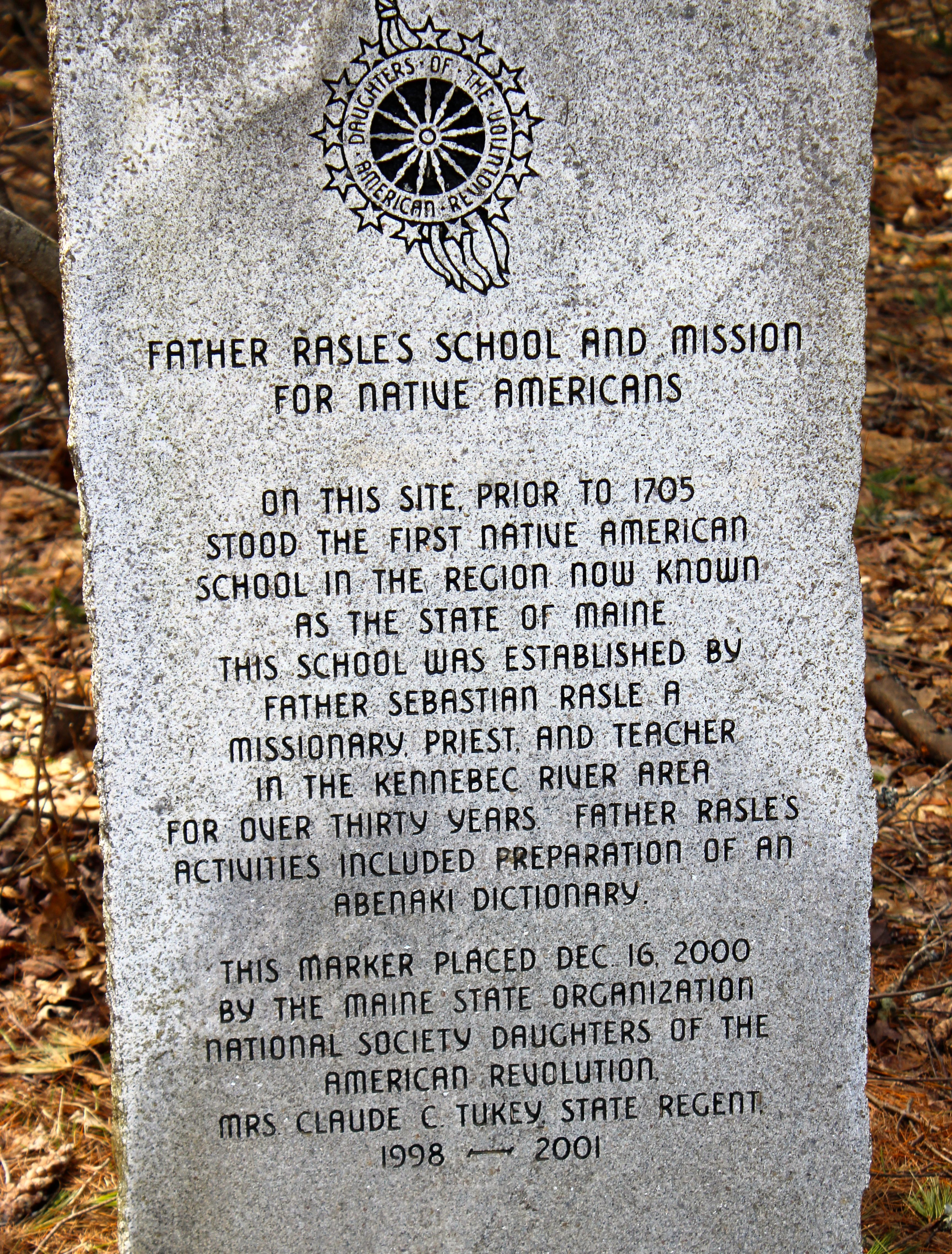
I only got fake lost on my way to Old Point beside the Kennebec River in Madison this morning. The plan was that I would meet K.D., a Maine Master Naturalist student, near the monument honoring Father Rasle. All was going smoothly and I was almost to my destination by 10am–right on time. Maybe it was because I was feeling so smug about getting there without any hassles. Or maybe it was because I’m just not tech savvy.

Somehow, I either plugged the wrong address into Map Quest last night, or Map Quest decided that I should go to the wrong address. Anyway, I turned onto Blackwell Hill Road and drove along looking for the trail head and K.D.’s car. And then I reached the end of the road and had to make a choice. It was a T–turn this way or that (oh my, I’m tired and “turn” and “that” also begin with T). Instead, I made a U turn and headed back to town. Mind you, I had our cell phone with me, and K.D. had given me her number, but I never bothered to jot it down. Lesson learned? Probably not.

I kept hoping she’d stop being polite and just call me. Back in Madison, I pulled over and examined the Delorme map again. Blackwell Hill didn’t seem like the right place because I knew the trail was near the Kennebec River, but it looked like there might be trails off another road in that area, so I turned around.

Again, I hoped she’d call. After a third U-turn, she did. And she was on the other side of town. Yeegads. But as I said earlier, I was only fake lost. I could find my way home (sort of).

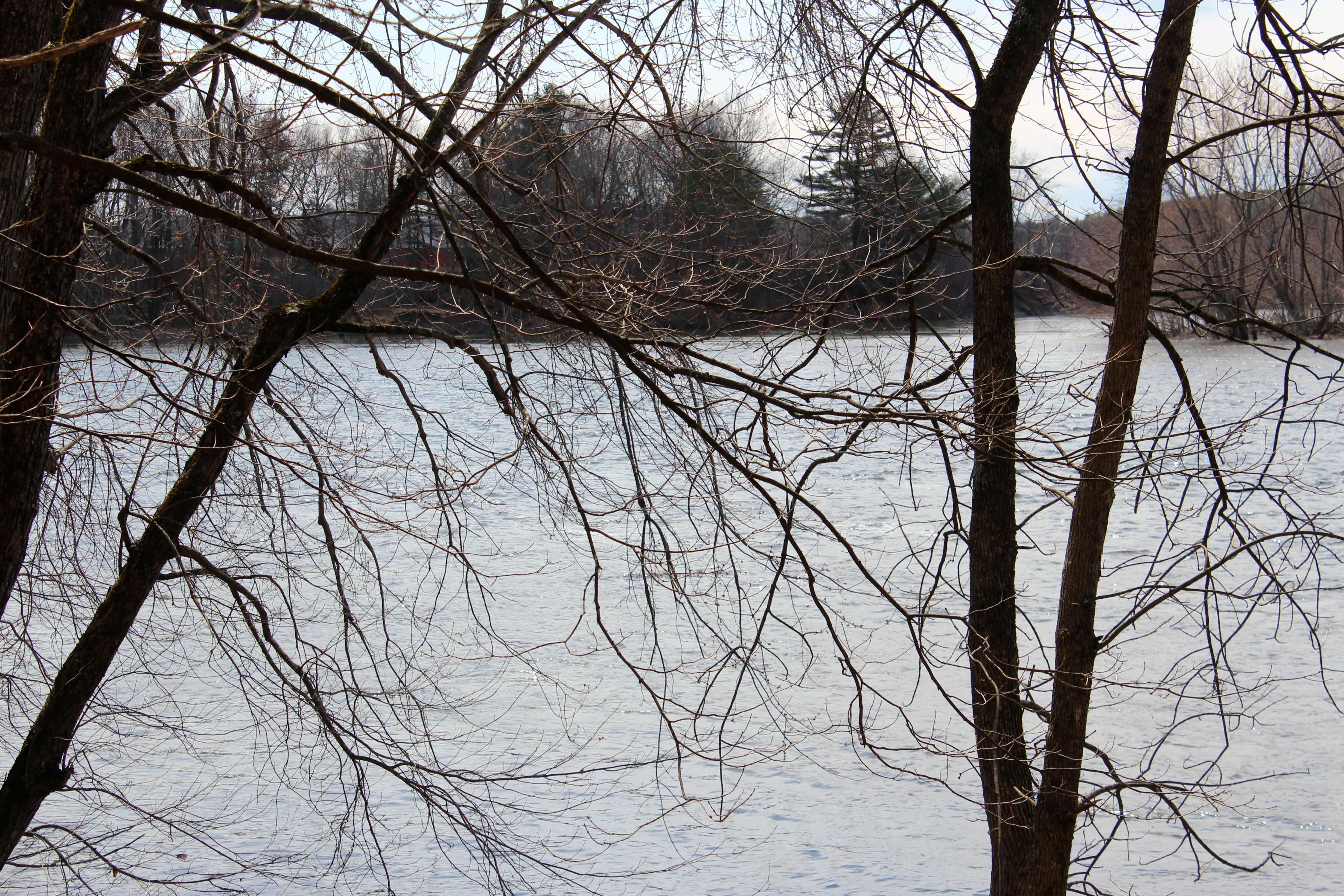
Kennebec River

Like all rivers in Maine, the mighty Kennebec was roaring today. Snow melt and rain.

I was meeting K.D. because she’s working on her capstone project for the MMNP course. The focus, a trail that honors Father Rasle, a Jesuit missionary who lived among the Abenaki people and died there during an English raid. K.D.’s plan is to tie the historical aspect of the trail in with the natural world. I’m excited for her and can’t wait to see the final product. I just may have to return for her walk during Madison-Anson Days, but don’t tell her that.

Father R

This is the monument erected in 1833 on what is believed to be the site of the 1724 massacre.
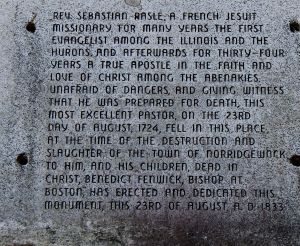
Father R 2

Father Sebastian Rasle (there are several spellings of his name) lived here for 34 years. K.D. said that the western side of the river was the English side and the eastern side was the French side. I think I got that right.
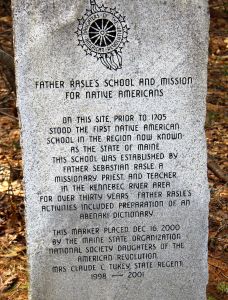
Father R 3

During his tenure, Father Rasle taught the Abenakis and created a dictionary of their language.

start of Sandy River

Though we didn’t try to go down the steep embankment, in this photo is an island and here the Sandy River discharges into the Kennebec. It’s her understanding that the Abenaki people originally settled on the island, but moved to the eastern side, which in the end led to the demise of the reverend and some members of the tribe. Perhaps the vantage point wasn’t as good.

jelly ears

As we walked along, thinking about what had happened here, we also identified species. For K.D.’s project, she’ll stick to the Native American theme–how was it useful to them? I’m not sure about these Jelly Ear’s (Auricularia auricle), but they are a good find anyway–and we found plenty.

Rush

And then there was a large patch of Equisetum, the only descendant of ancient horsetail plants that grew during prehistoric times.
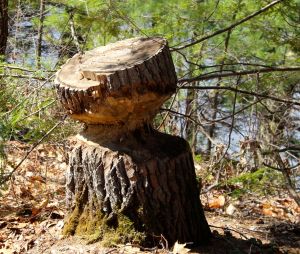
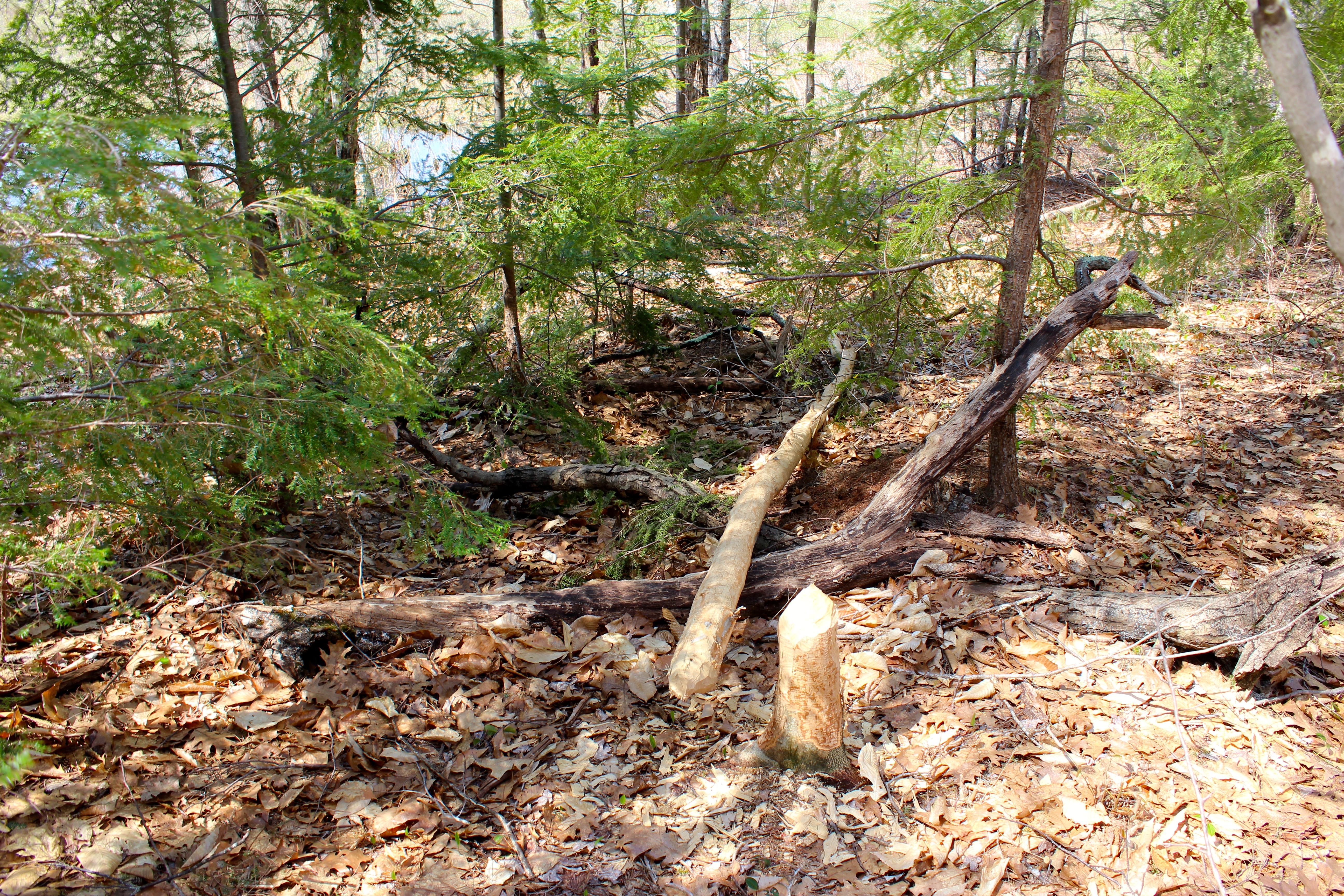
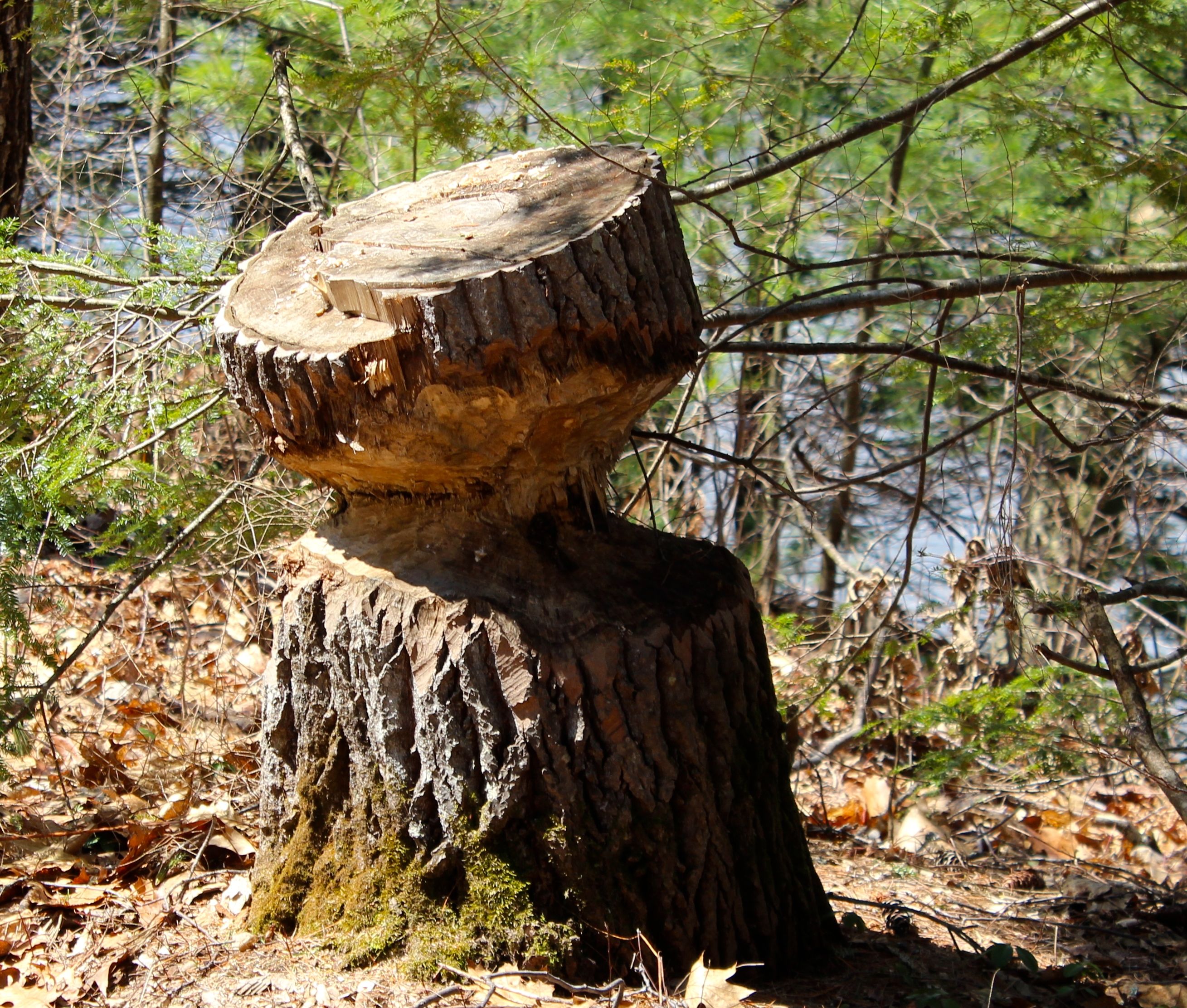
beaver work

Occasionally, we saw evidence of beaver works. I’m glad that the person who cut this red oak left the chewed section as a monument to these industrious critters.
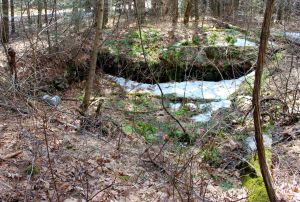
cellar home

A cellar hole is filled with snow and evergreen wood fern. As it turns out, K.D. believes this was the home of one of her husband’s ancestors. His family dates back three generations in the area.

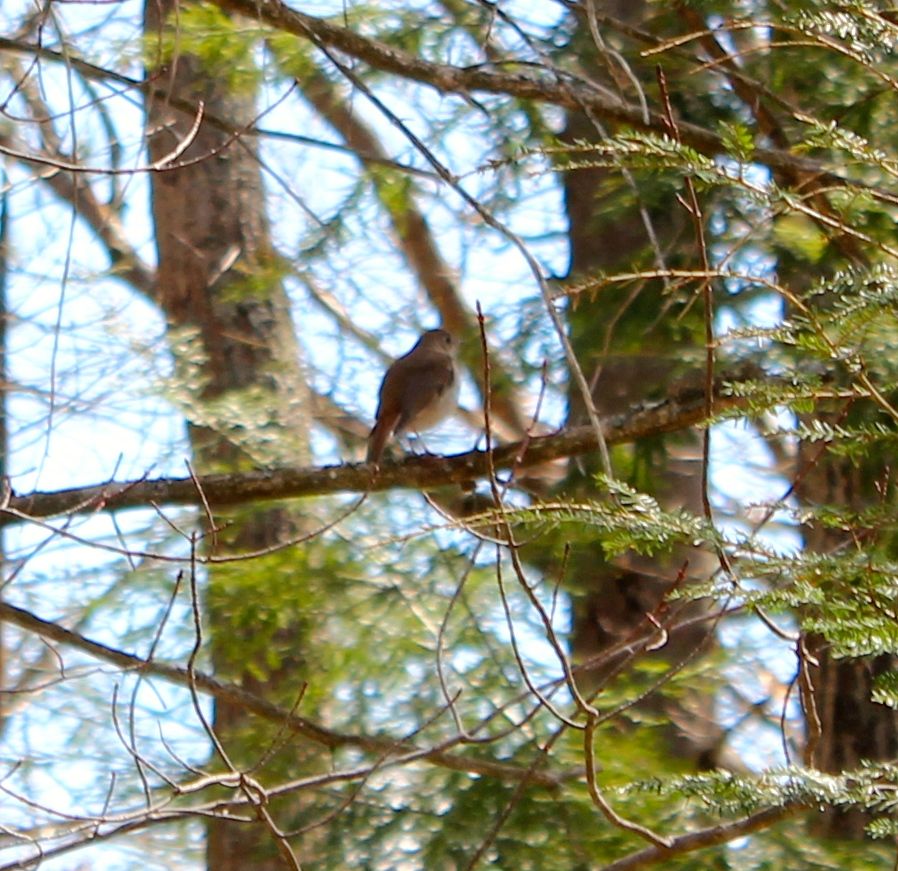
Hermit thrush

While my bird expertise ends at my backyard feeders that must come down soon, K.D. is an avid birder. With her, I saw my first ever Kinglets today. They are little round balls of action. Golden Eyes played on the river, Tree Swallows soared above and a Bald Eagle sat in a nest watching over all. In this photo–a Hermit Thrush. We watched it for a while and heard another singing nearby.
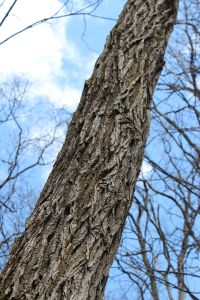
BL 1

And then we got stumped. Yup, more bark. We think we figured this one out, but if you know better, holler. Black Locust. The bark, light gray, deeply furrowed and intersecting.
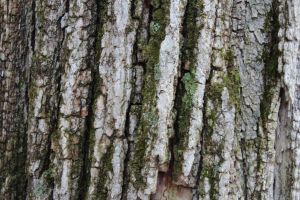
 bl bark 3

The ridges are finely cracked. Now that the snow has melted, we looked for leaves on the ground because the branches were high above us. Below each tree, we found what we believed to be dried leaflets that were about two inches long and had entire margins. Again, if you know otherwise, holler.
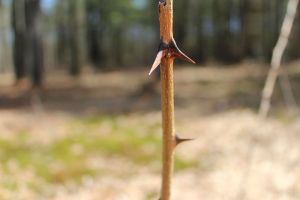
bl

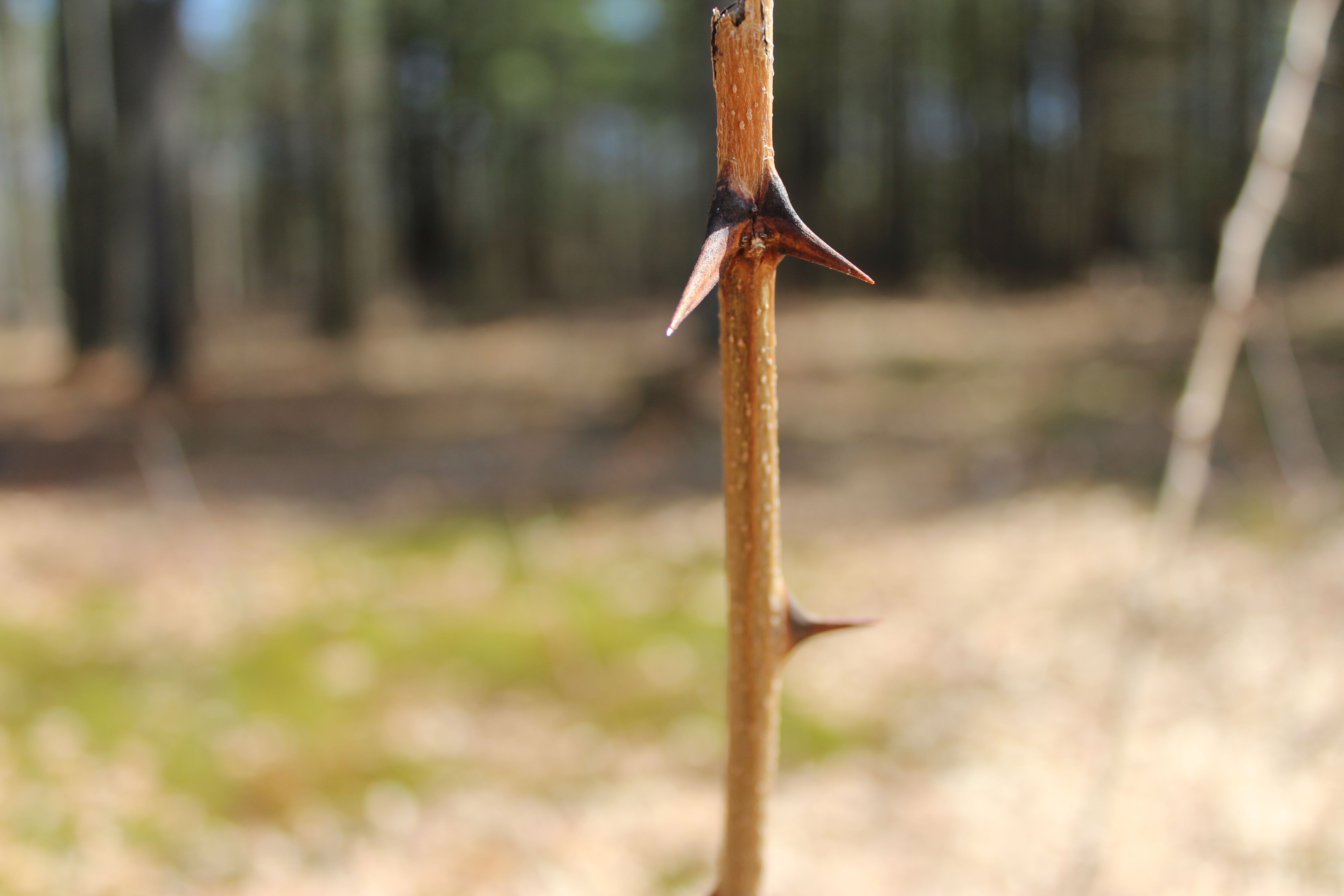
Curiously, we found these Black Locust saplings at a different site along the trail. Apparently, the thorns are found on the branches of young trees–a warning sign to animals. Ingenious.

After three hours (it seems like it always takes three hours), it was time for me to head southwest.

wood frog eggs

Once home, I couldn’t resist the urge to walk up to the vernal pool. The ice melted while we were away this weekend, and already there are wood frog egg sacs. I waited for some action, but between some rain drops and a breeze, they weren’t making themselves known.

red maple flowers

And the other moment I’ve been waiting for–Red Maples beginning to flower. Time to sketch asap.
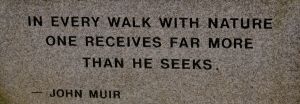
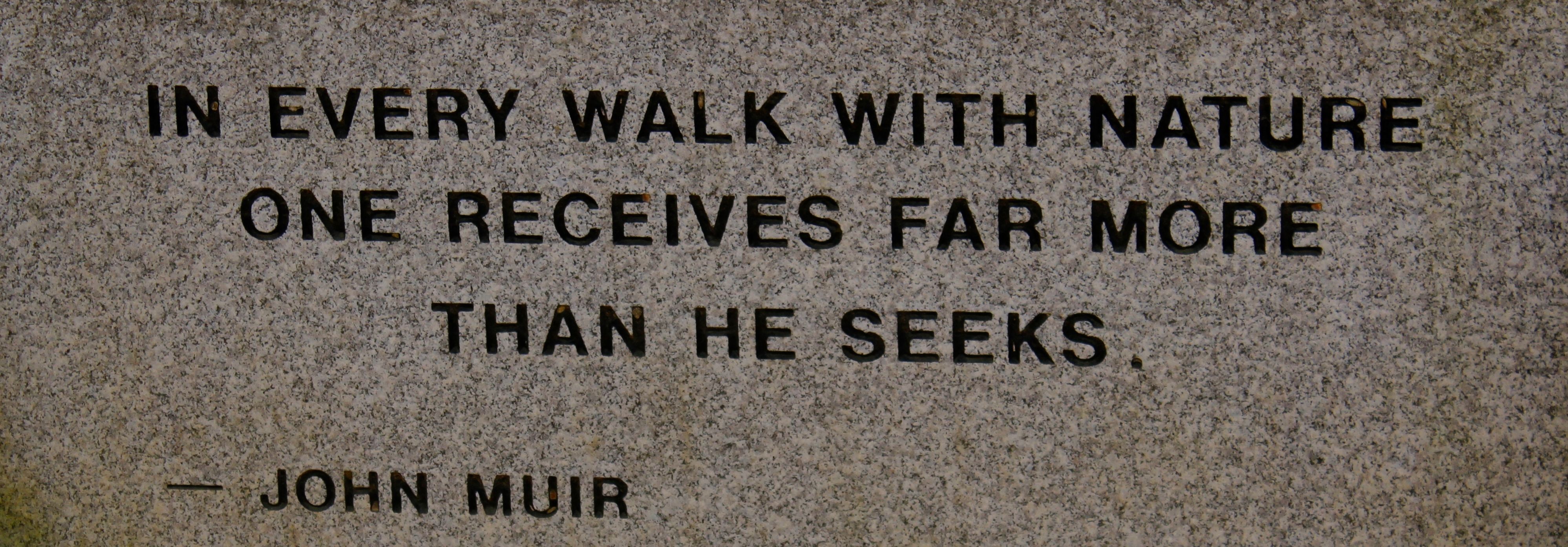
John Muir quote

This sign was along the trail beside the Kennebec. I’m thankful for the opportunity to walk and wonder with nature today, to share it with K.D. Happy Earth Day!
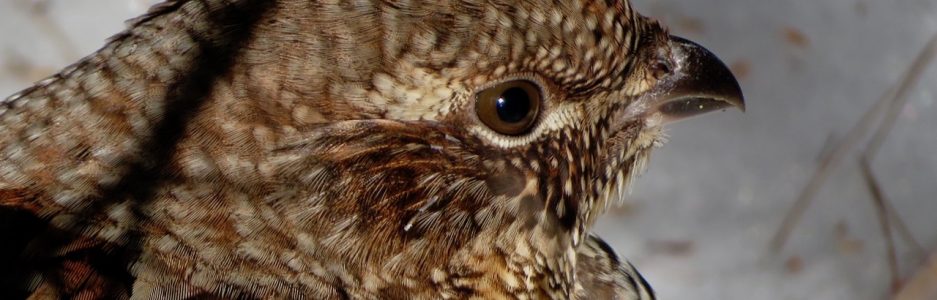
Eagle Eyes

CL market

Today’s Mondate began with the ritual PB&J creation at home. Our destination was a hiking trail in New Hampshire, but on the way, we realized the need for gas. So . . . a jig here and a jag there over the bumpy backroads and we landed at Center Lovell Market. While my guy was inside paying for the gas and chatting with a friend who works there, he was handed a slice of blueberry cake just out of the oven. He brought it out to share with me–and I sent him back in, hoping he’d buy the whole thing. Such self-restraint. He only purchased one piece–a good decision, certainly. But really?

Eagle 1

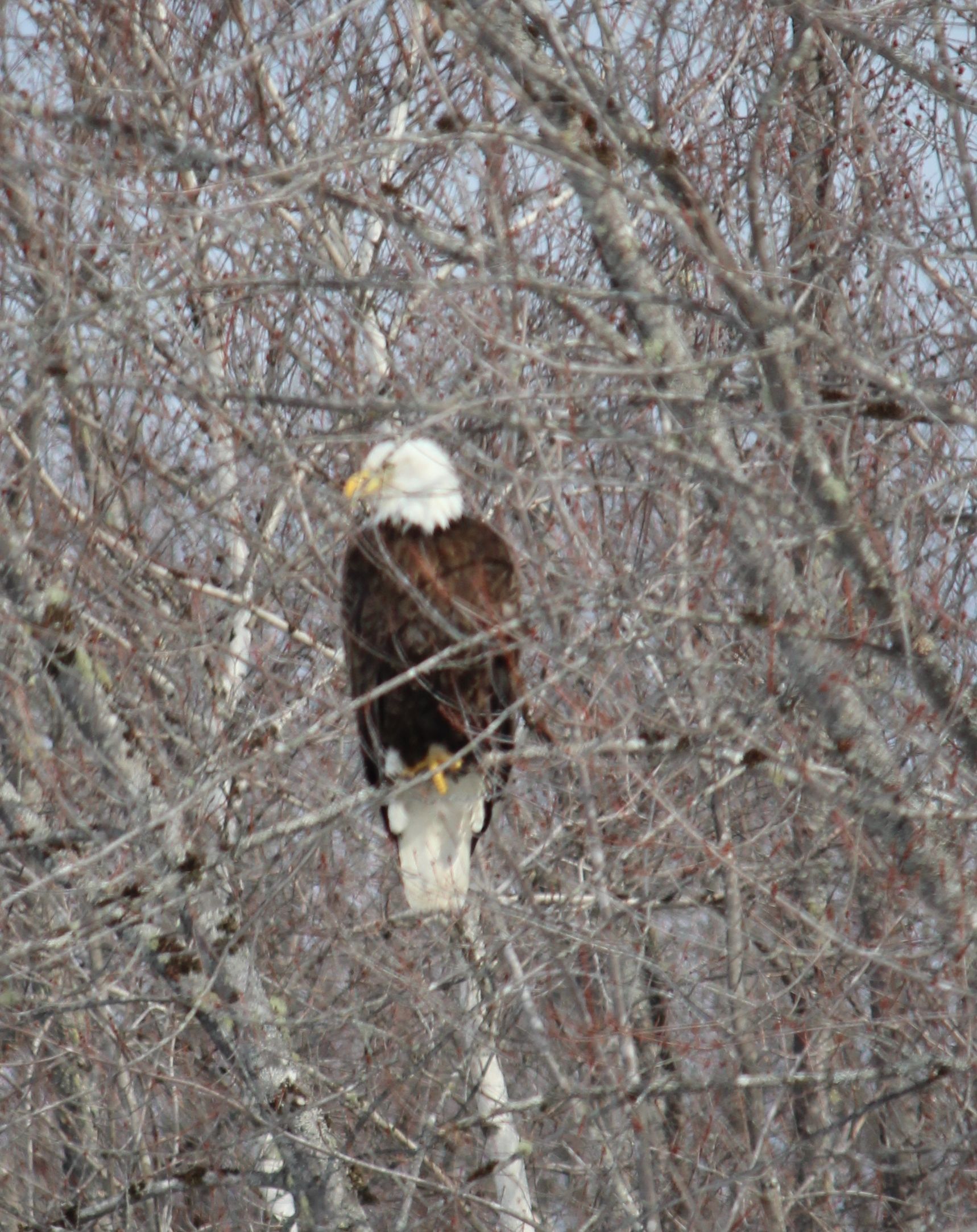
We made our way back to Harbor Road in North Fryeburg, where something in the landscape caught my eye.

Eagle 1a

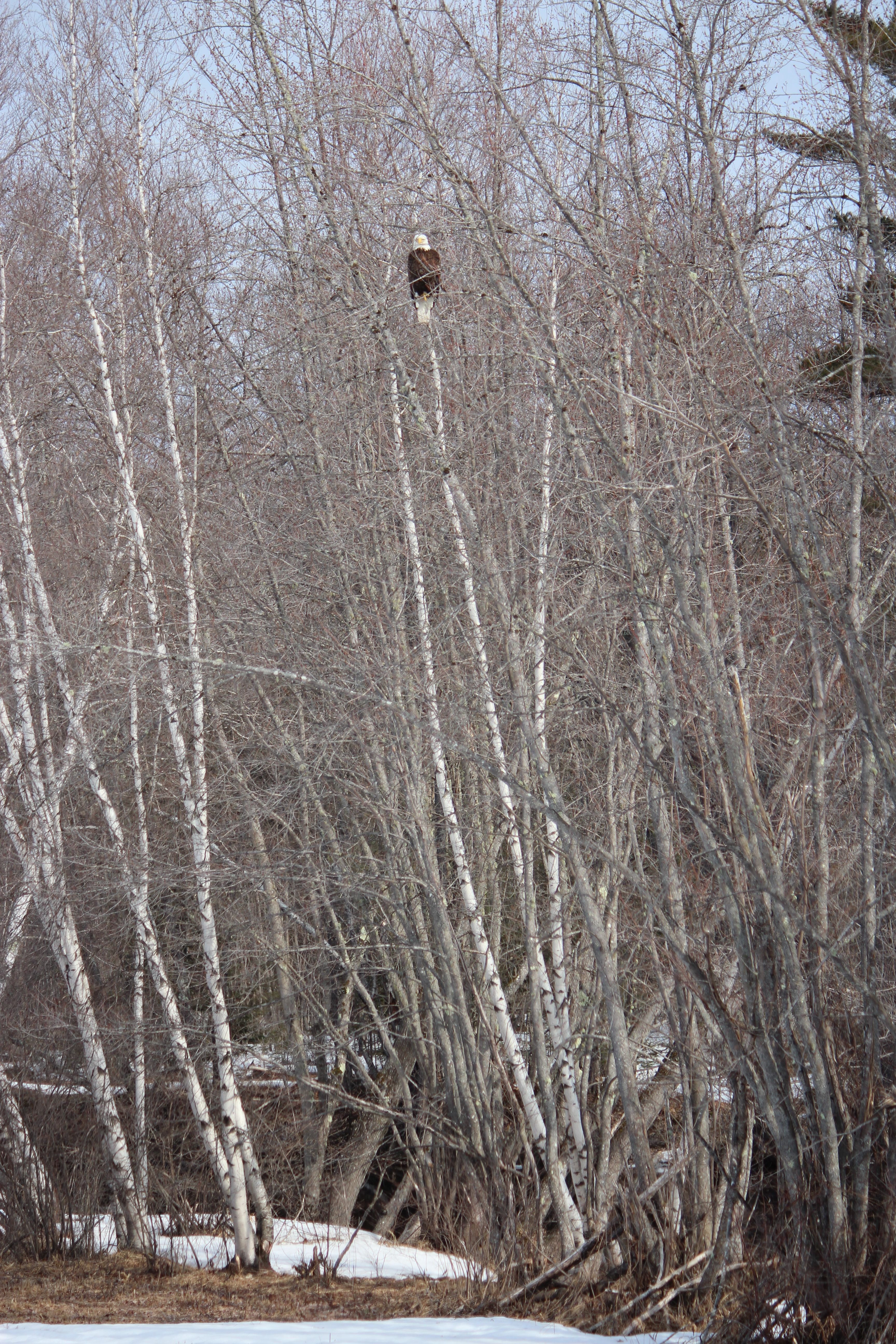
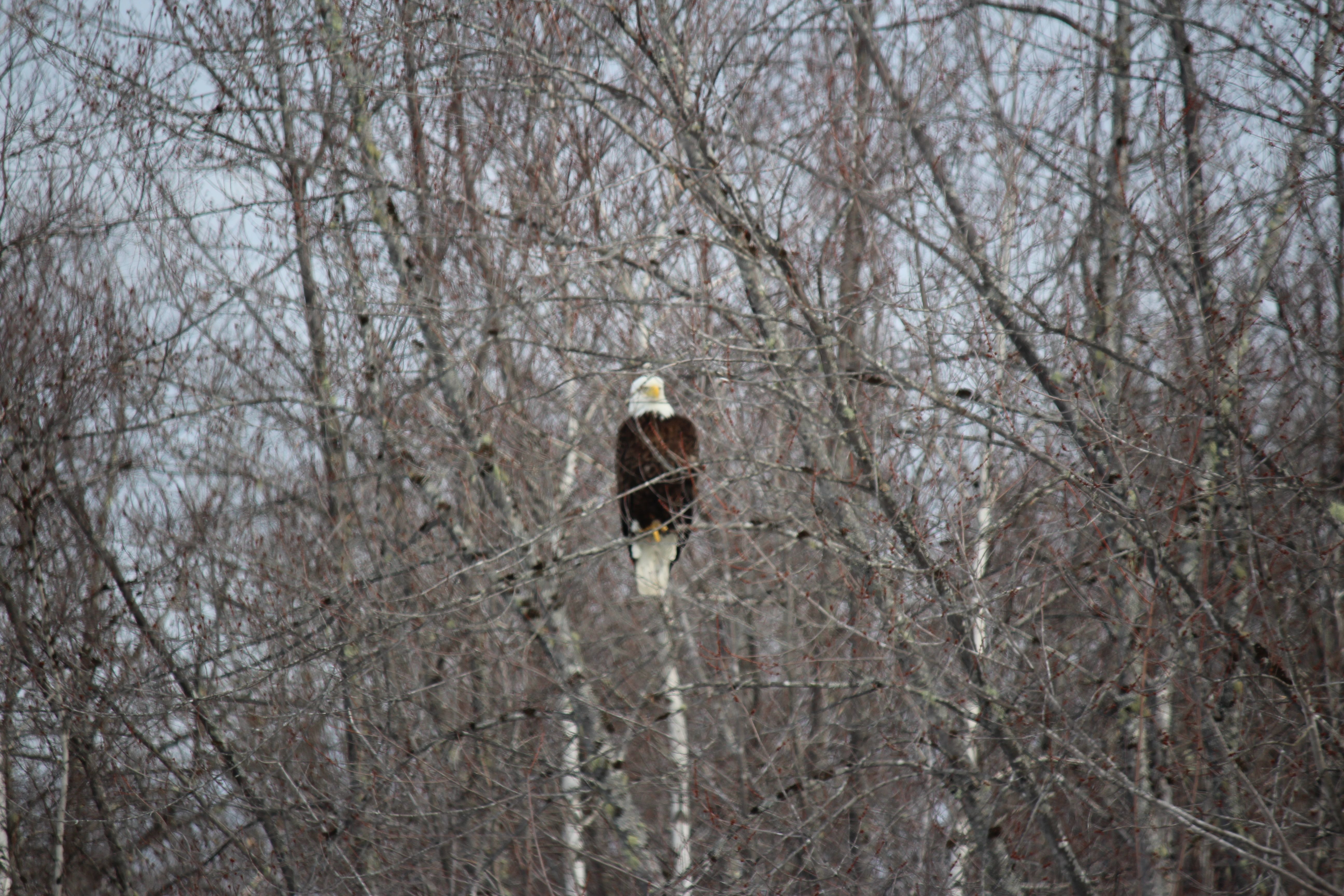
Always an impressive sight.

Eagle 2

A mature Bald Eagle checking out the area around Charles River, near the old course of the Saco River.

trail parking sign

Our destination–Province Brook Trail. This hike is for my friend, P.K., who first introduced me to this trail in her summer backyard a few years ago. While she winters in Florida, I hope she’ll enjoy today’s view.

We had to park on South Chatham Road, in South ChatHAM, New Hampshire. I once interviewed Frank Eastman, a South Chatham native, who informed me that it’s pronounced ChatHAM, not Chat’em, because H-A-M spells ham. A lesson I’ll never forget.

trail men

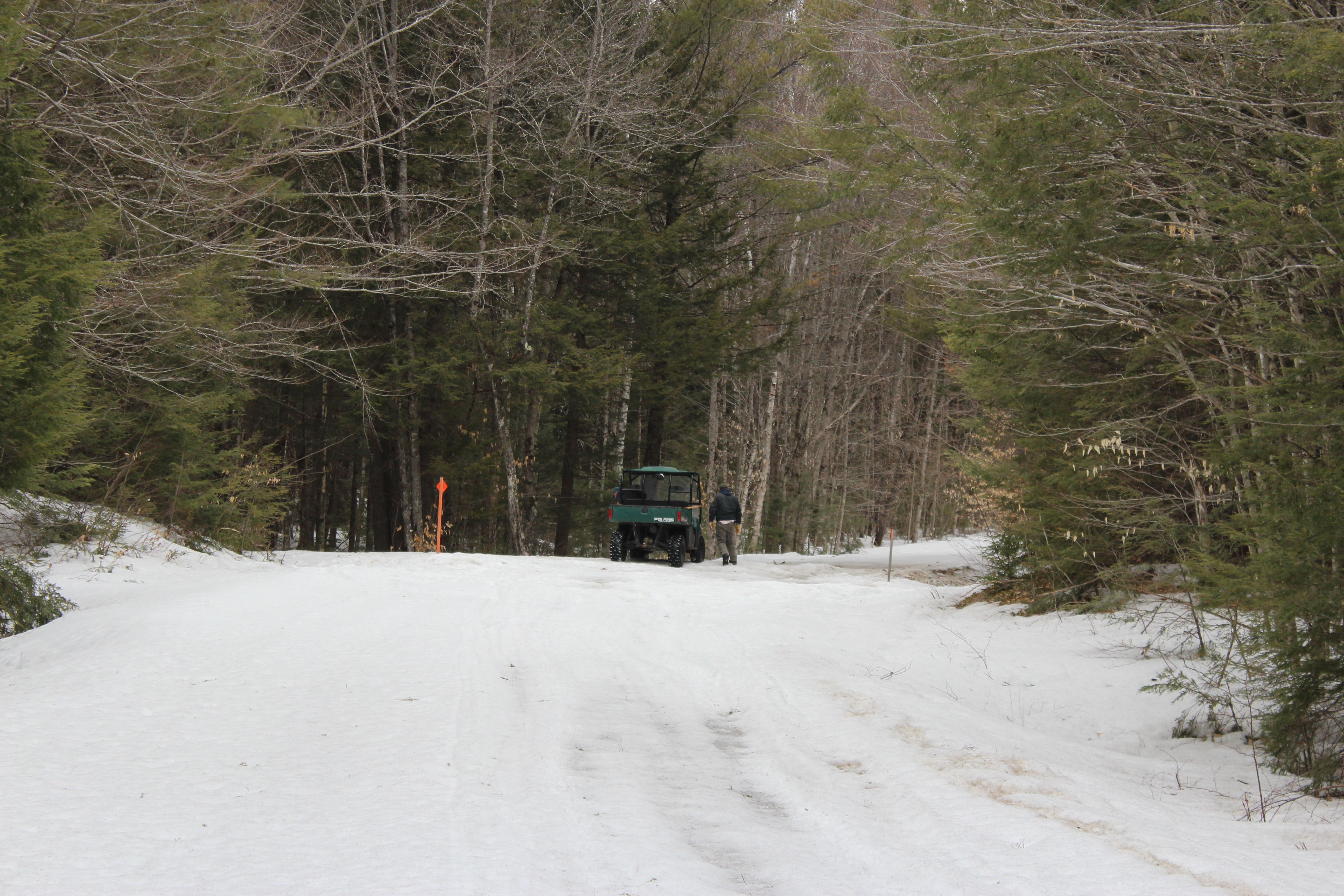
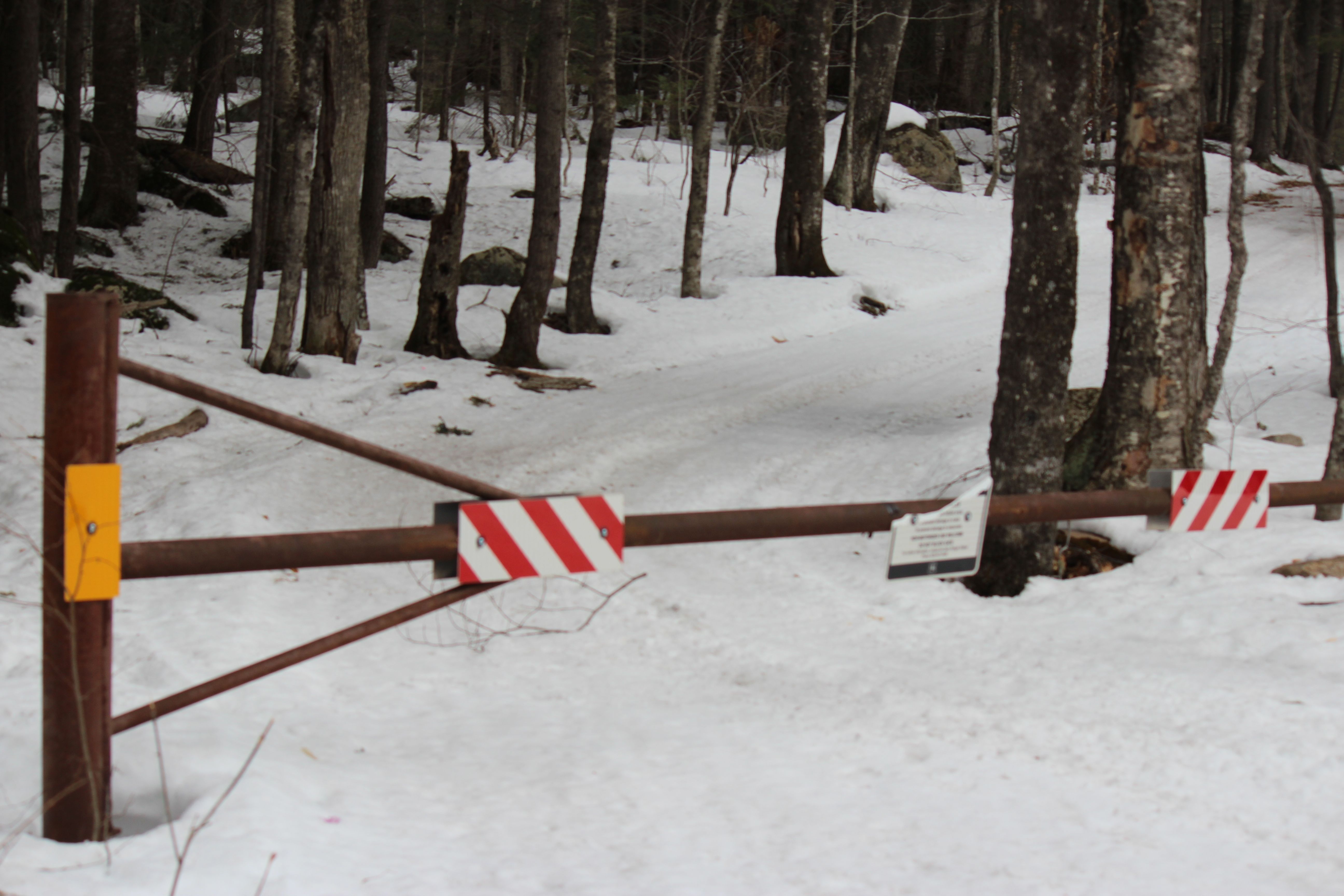
While we walked along the snowmobile trail, aka 2.5-mile Peaked Hill Road or Forest Service Road 450, two members of the White Mountain National Forest trail crew came along to close gates–a sure sign of spring.

pot hole

Seeing a few potholes like this one, we could understand why.

moose printmoose

We opened our eagle eyes and things began to appear.

Moose 3

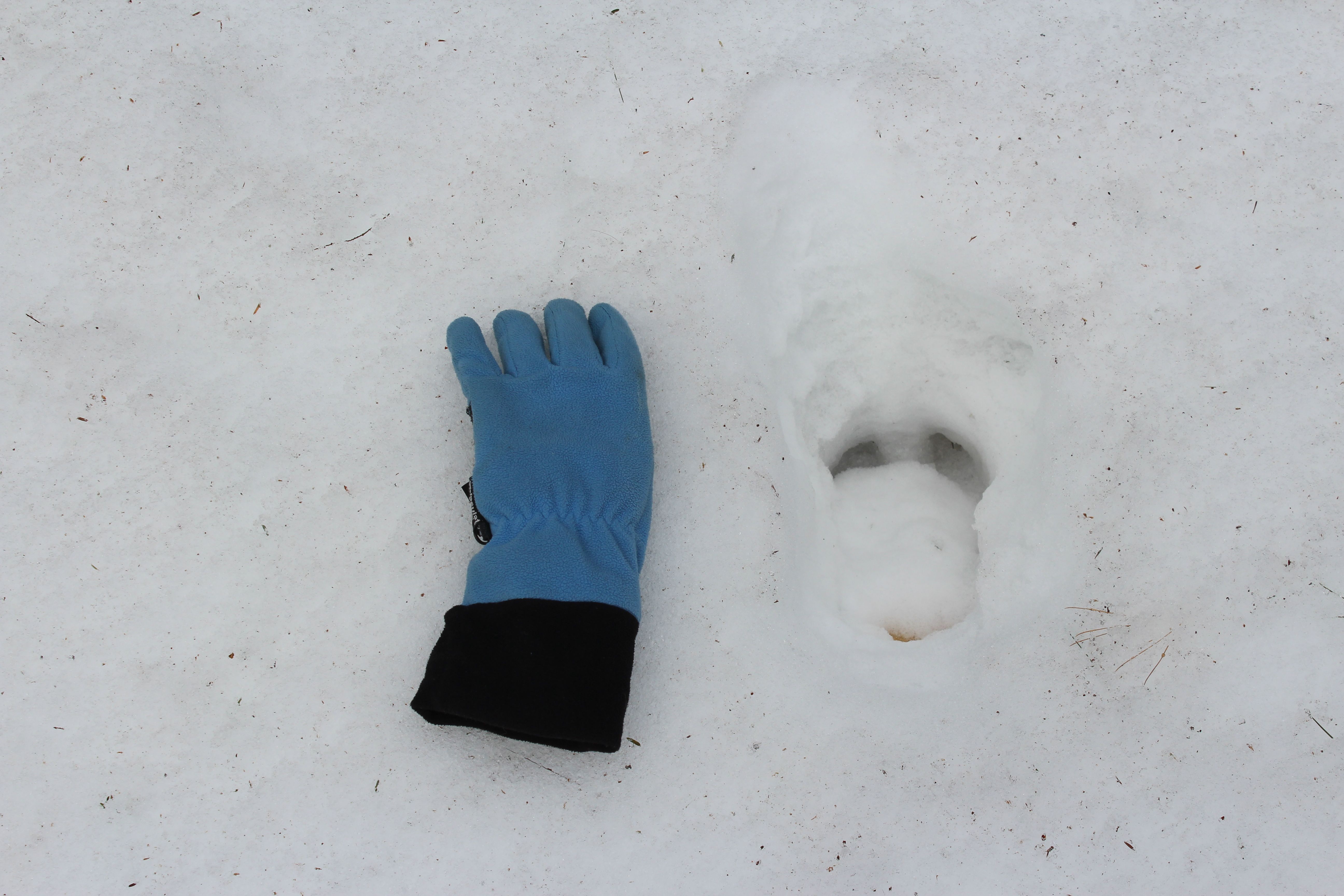
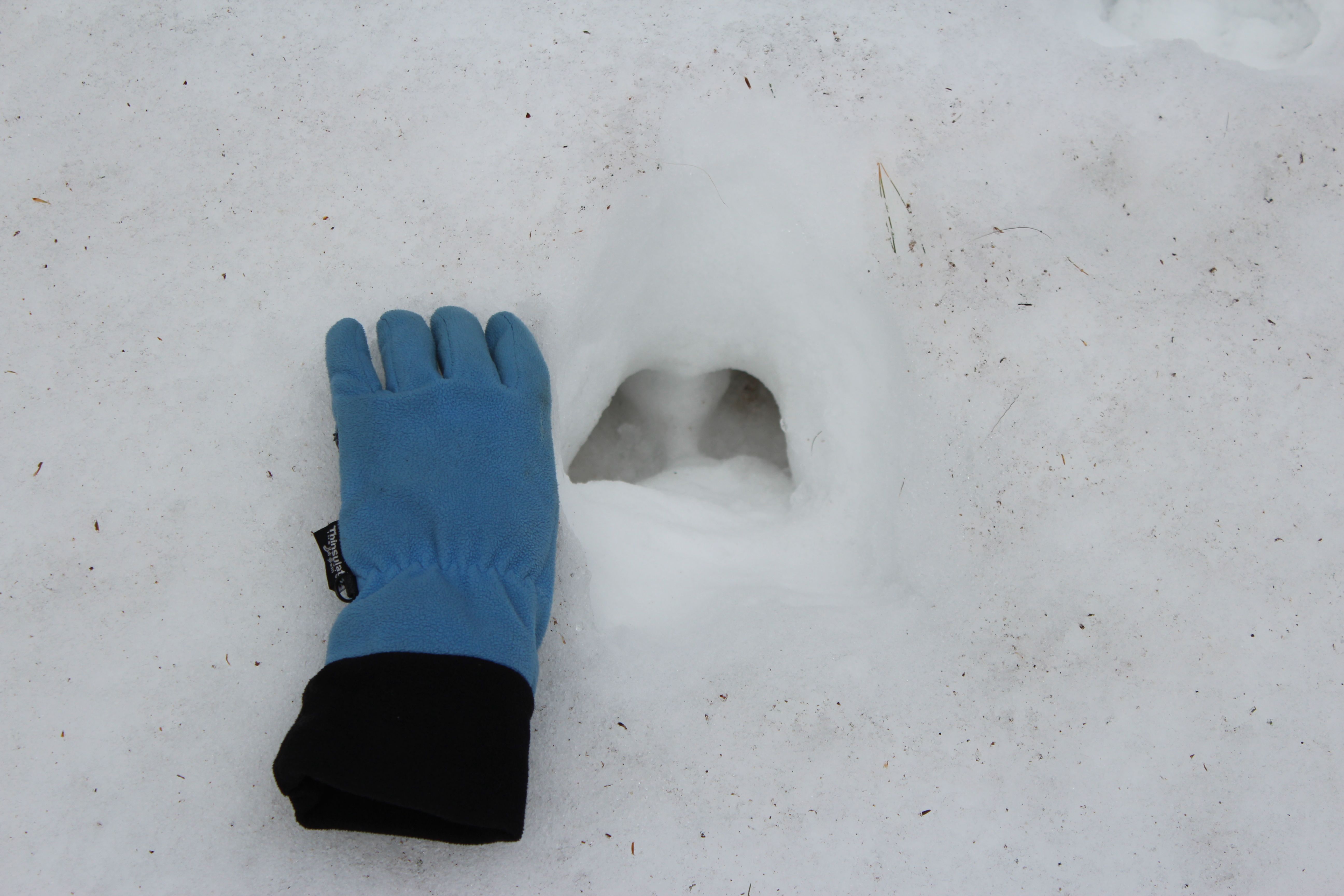
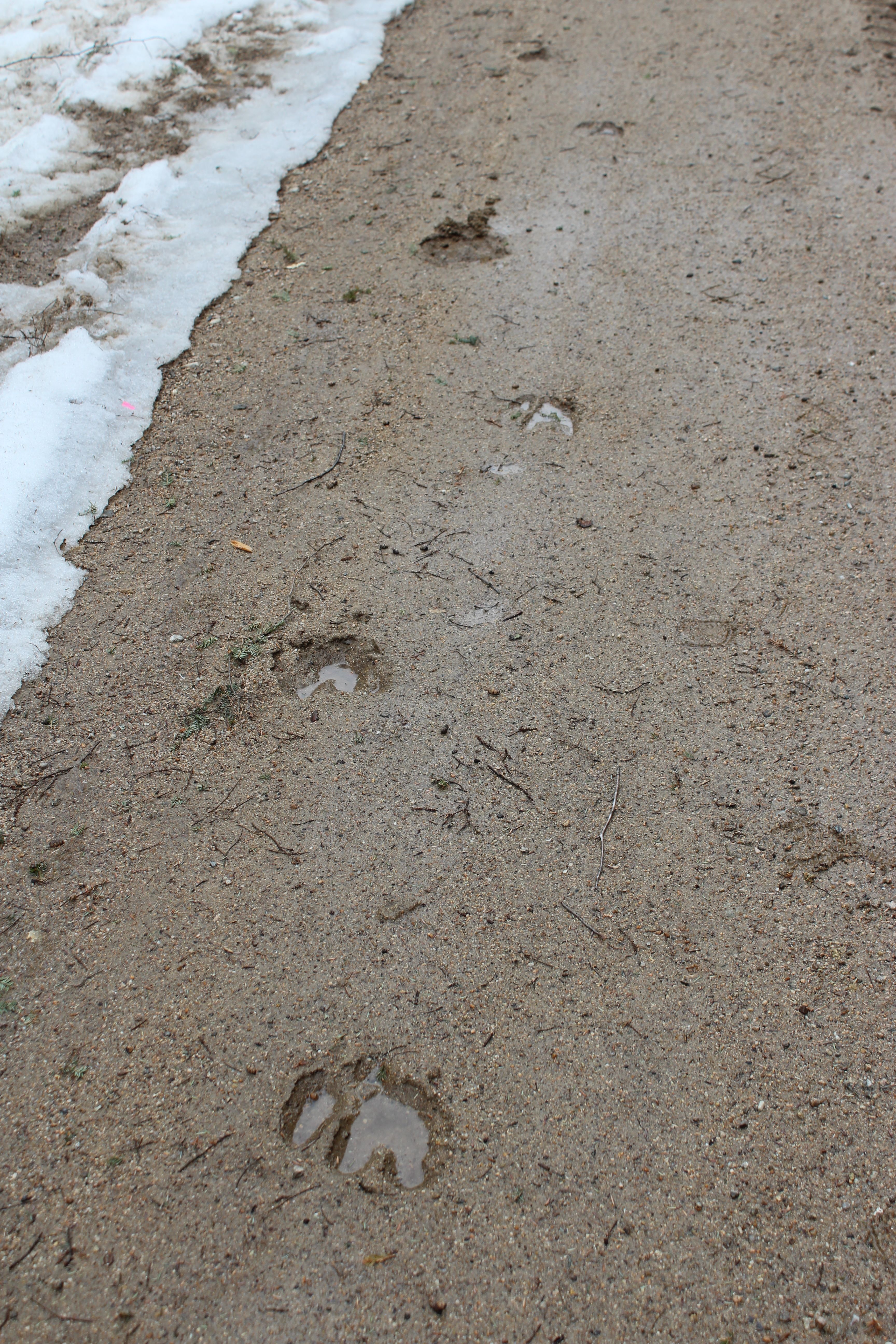
Criss-crossing the trail, through snow and mud, moose prints.

bearbear 1

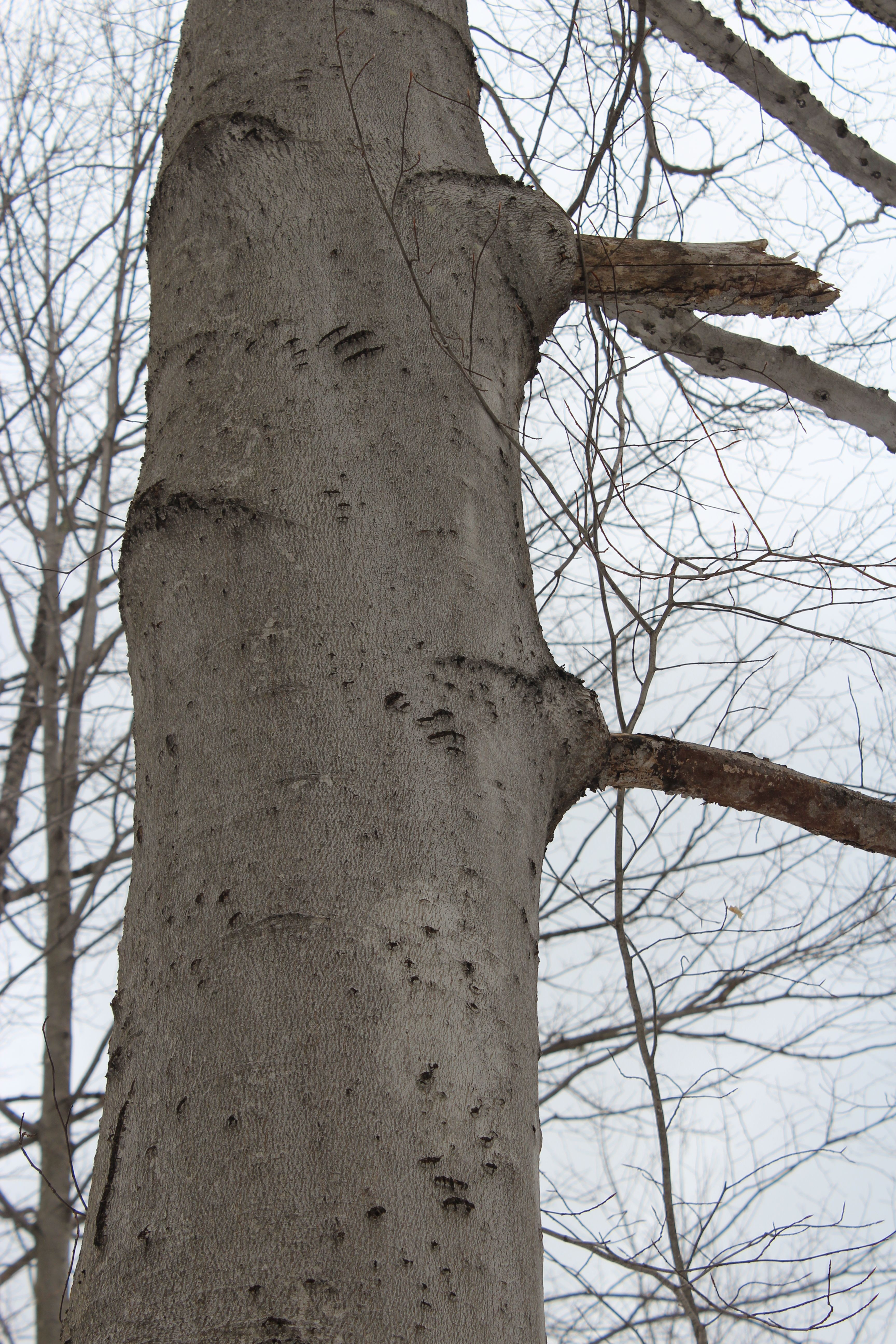
Our eyes are forever scanning beech trees–on the lookout for bear claw marks. We weren’t disappointed.

hairy scat

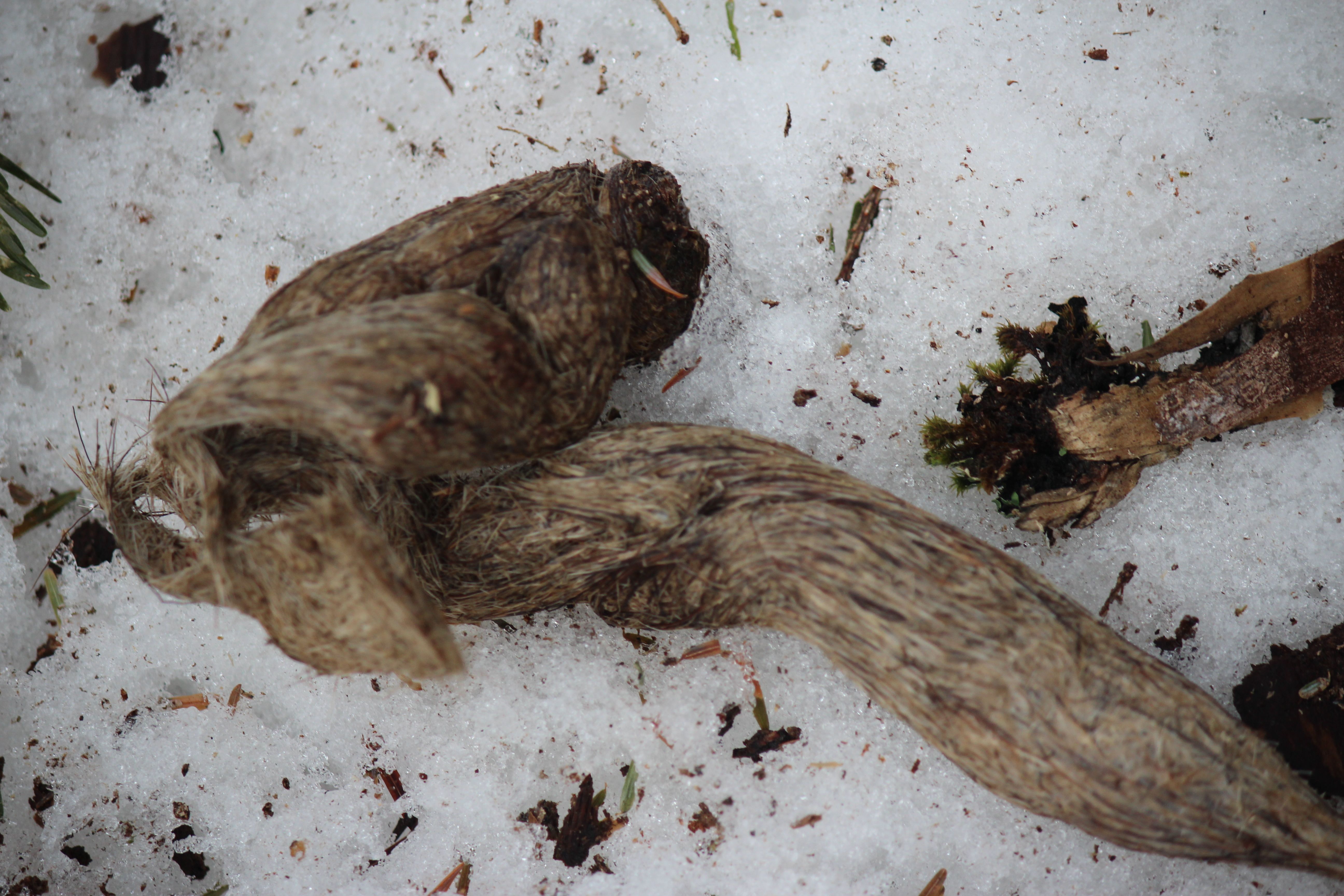
On the trail, we saw several old scat samples. Coyote or bobcat. This one is all hair. I’m leaning toward bobcat–but am open to other conclusions. There were no obvious tracks to make a certain id.

yellow birch

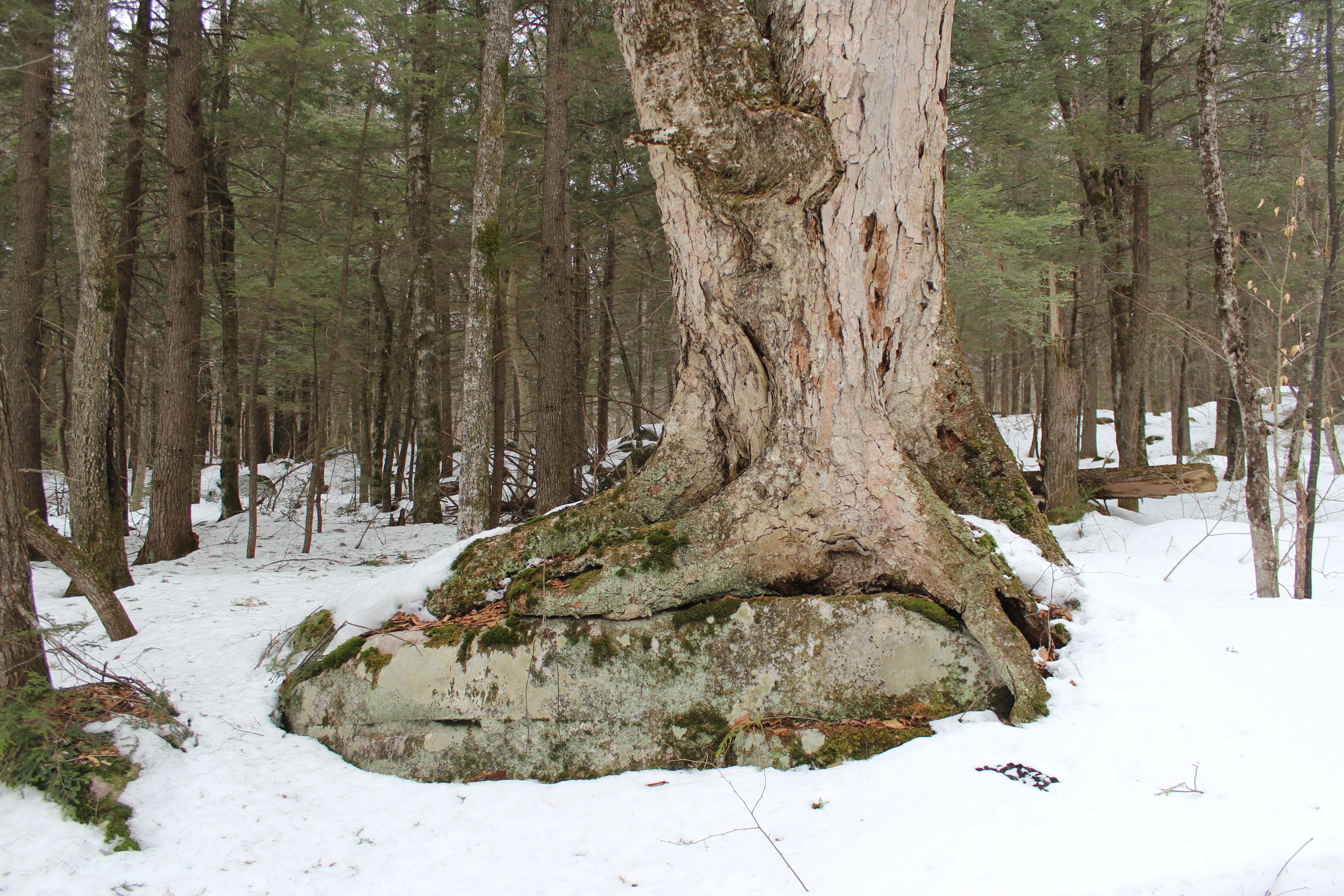
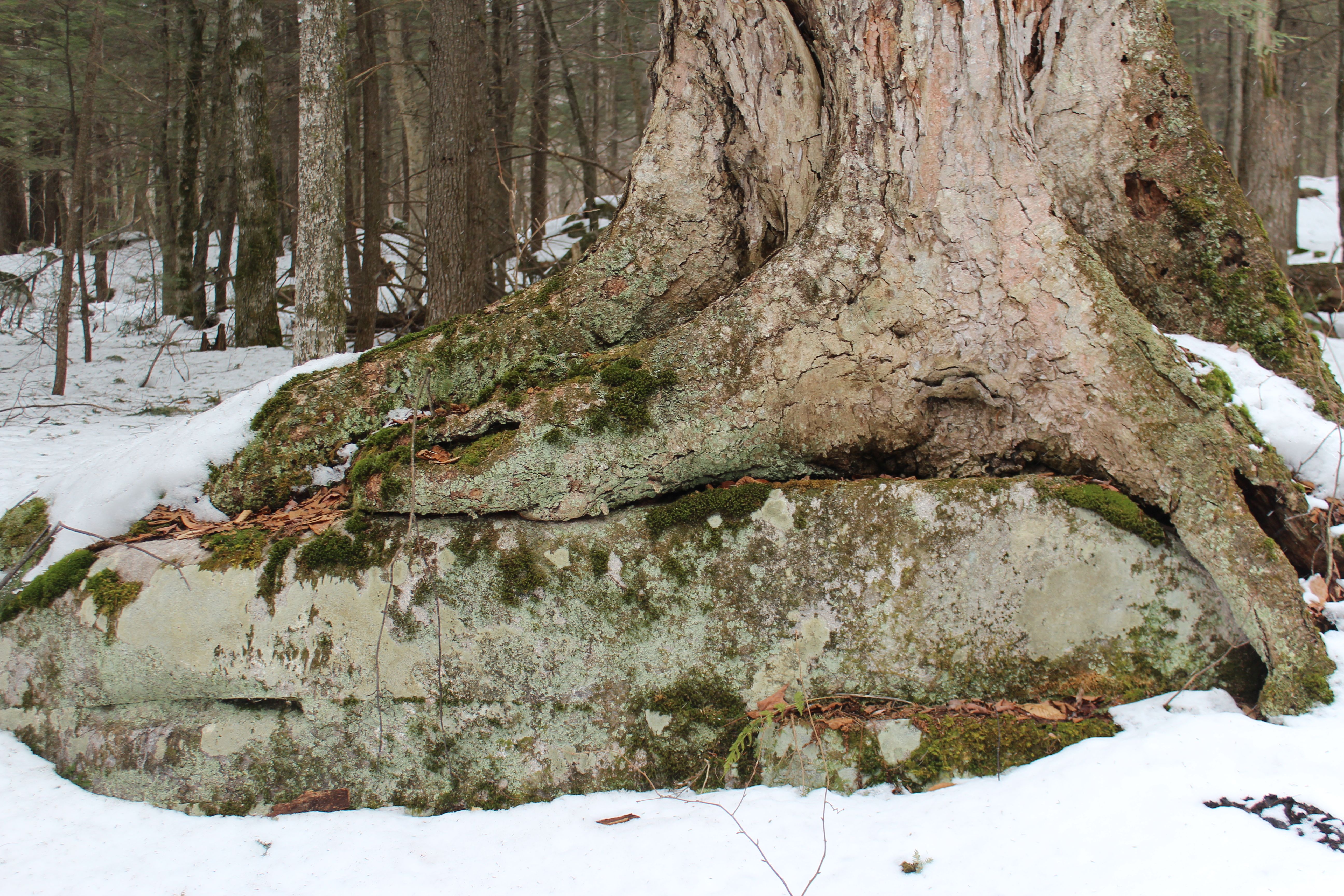
And here–one very large Yellow Birch growing on granite.

yb2

Yellow Birch seeds find optimum growing conditions on moss-covered rocks, stumps and logs. Once the tree establishes itself, it clings to the rock and sends its roots in search of the soil below. Hemlocks do the same.

trail head

Finally, we reached the trail head. Oops, I lopped off the head of the hiker on the sign.

trail closed

Province Brook Trail is currently closed to snowmobiles and ATVs, but we walked around the gate and continued on.

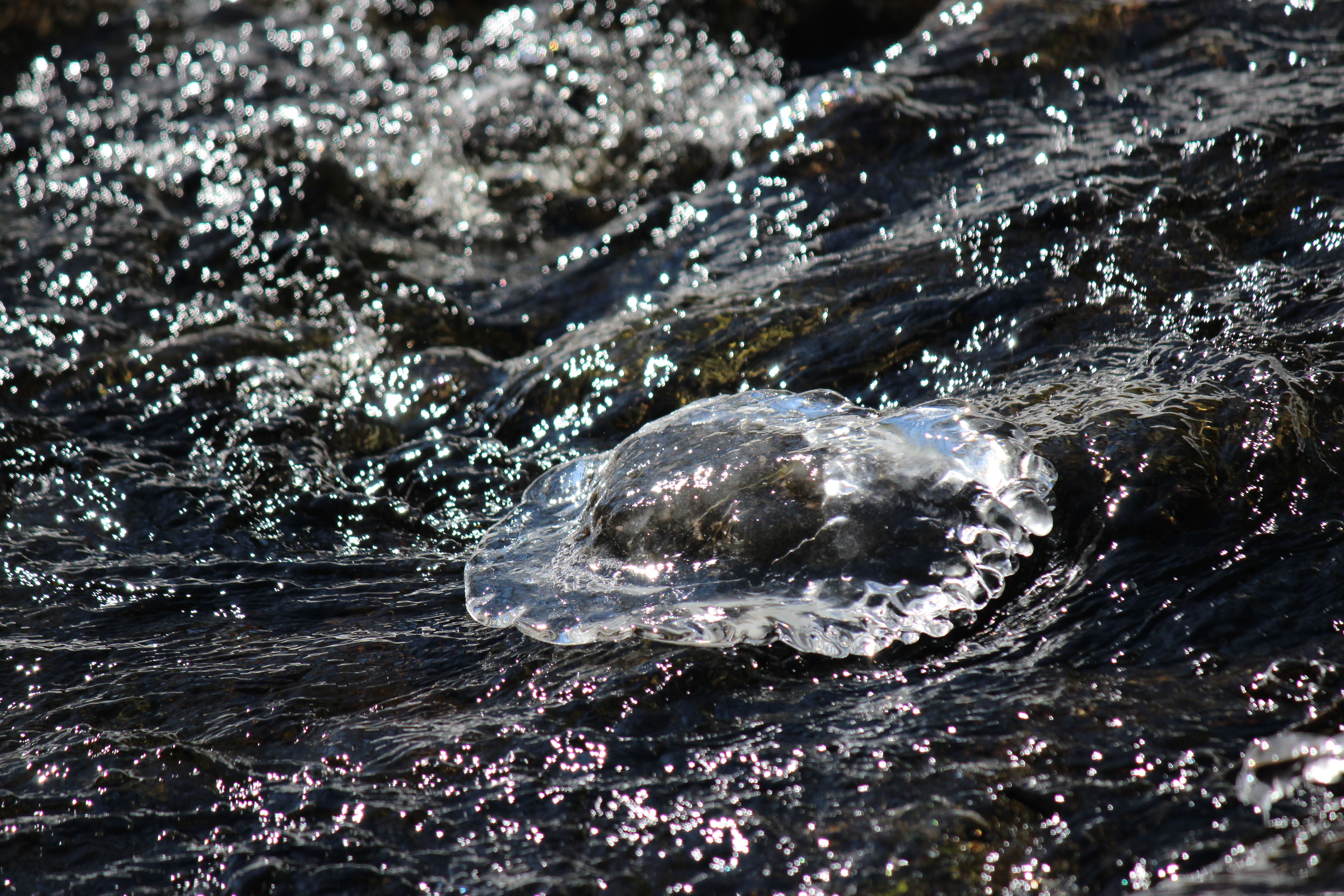
ice

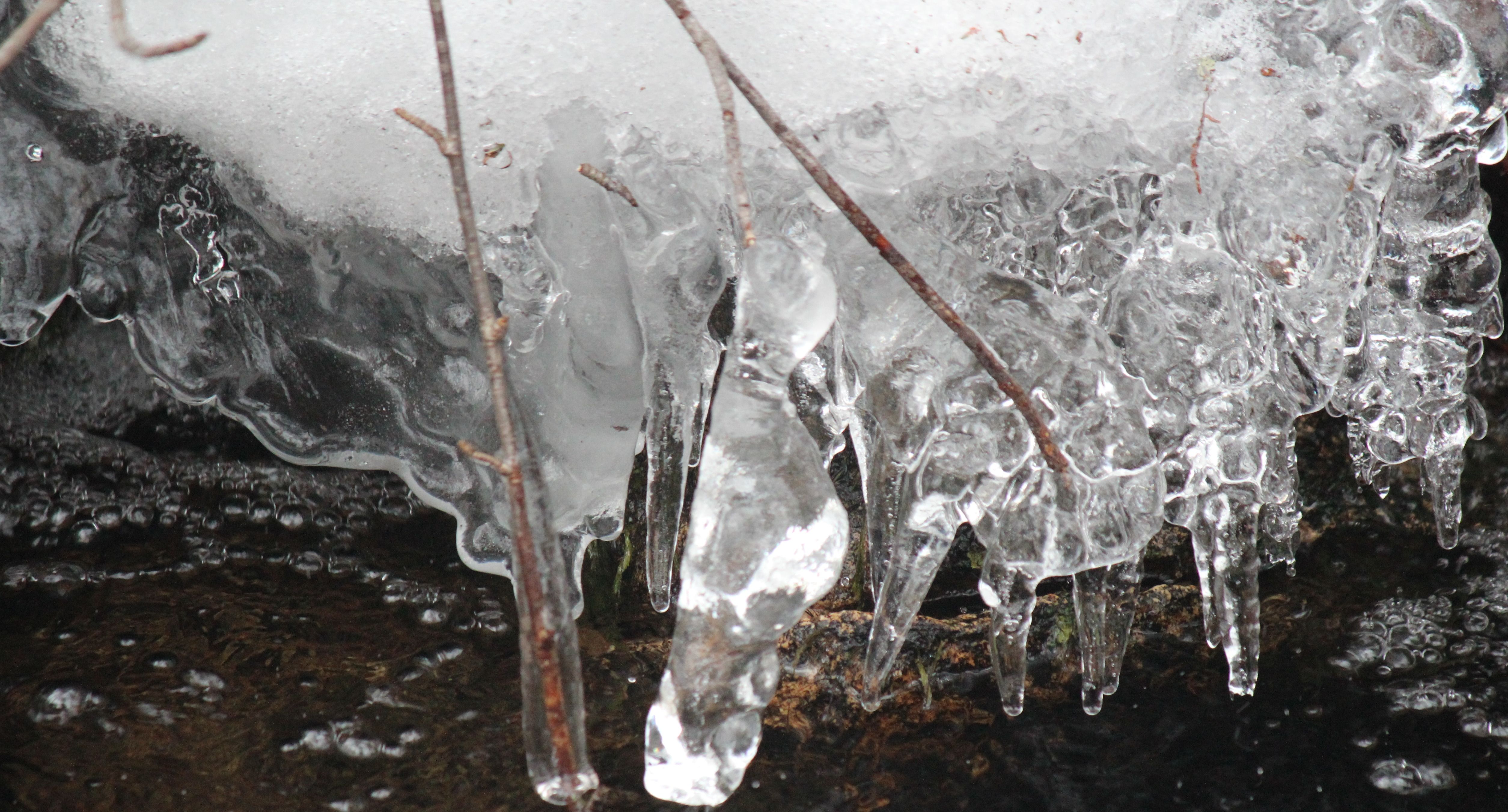
Still plenty of ice in the streams beside the trail.

snow:brook

And lots of snow.

polypody fern

Polypody Fern peeking out from under a snow-covered rock.

hobblebush

And Hobblebush preparing to bloom.

glacial erratics

Lots of glacial erratics along the way. This one supports an entire community.

mushrooms

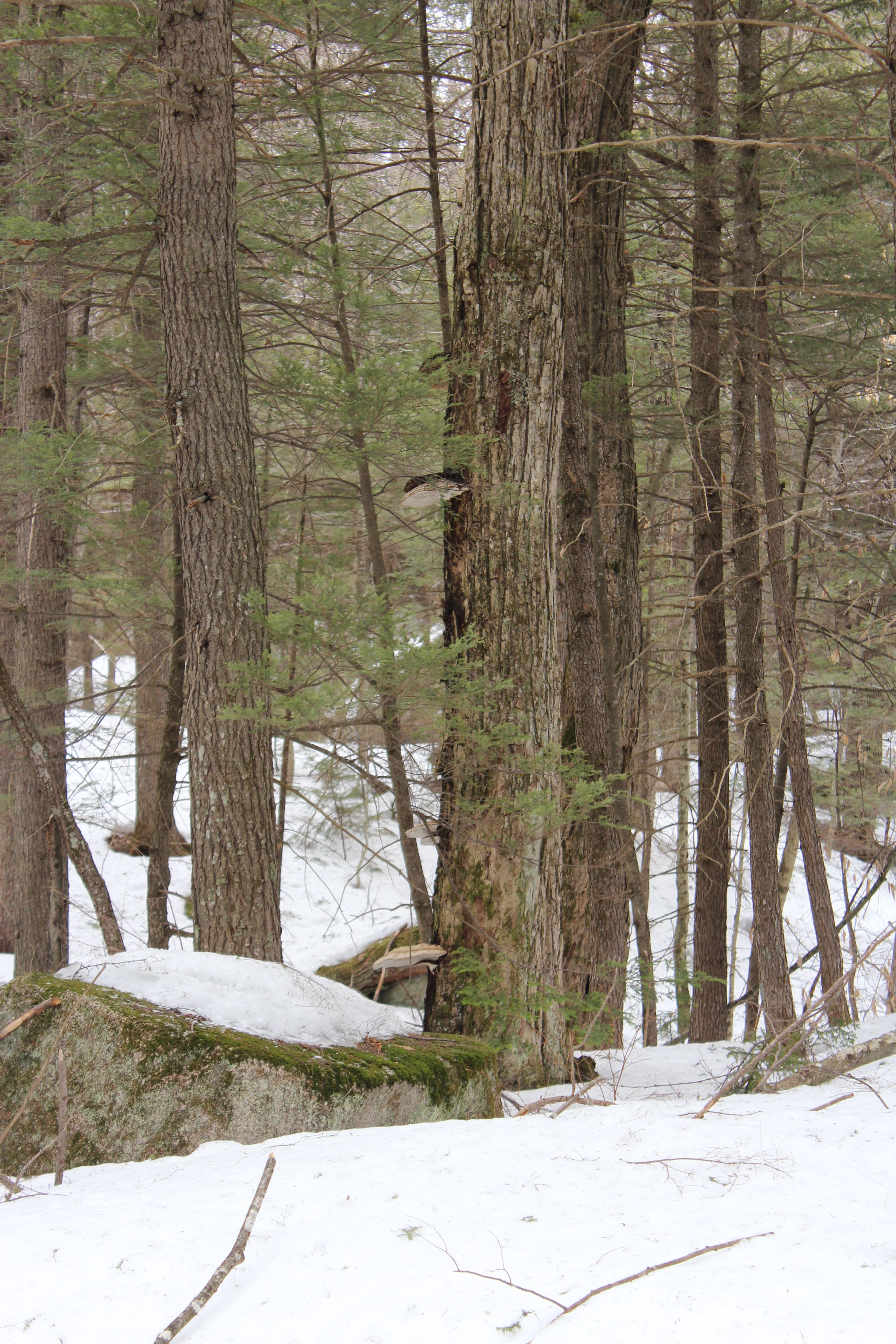
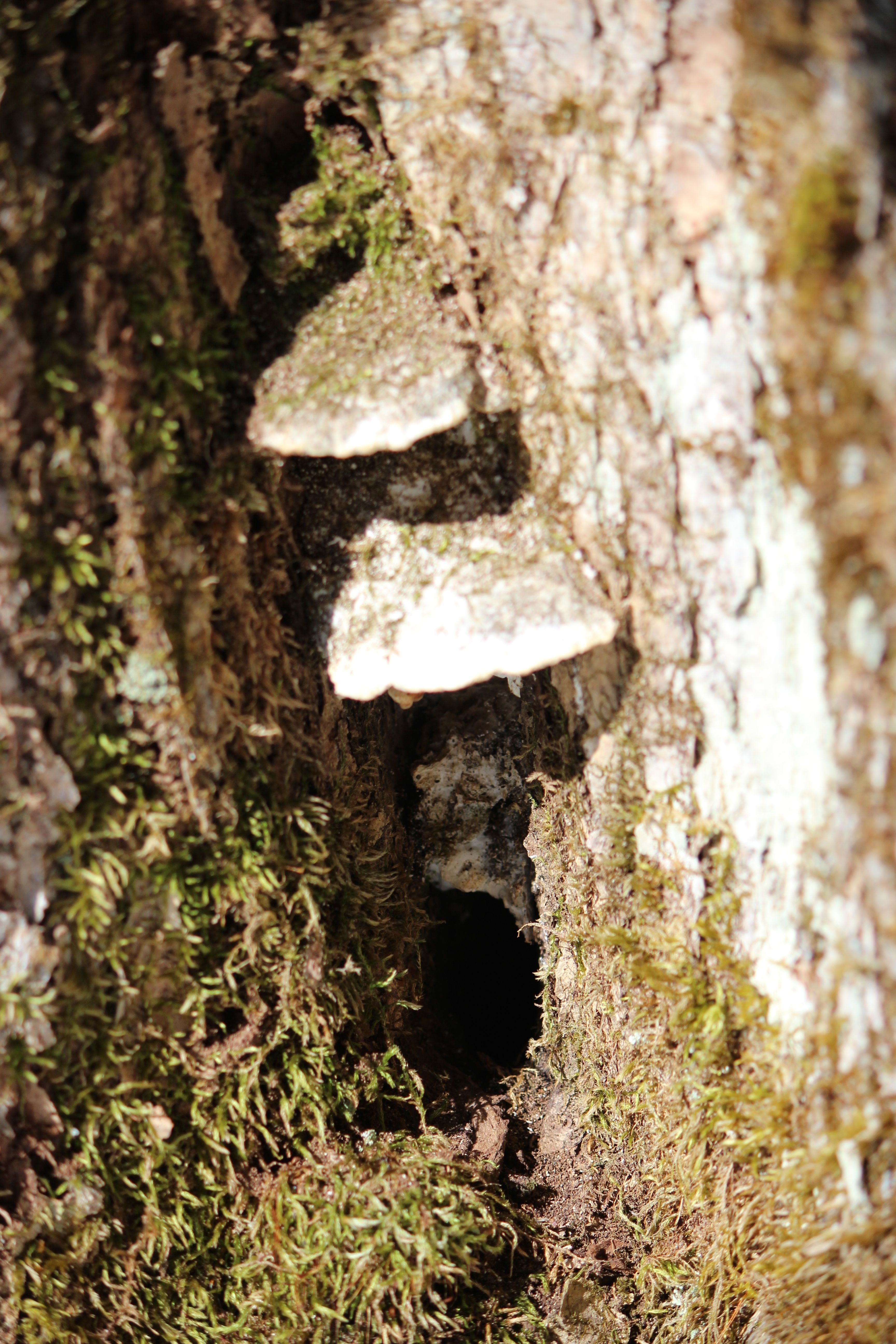
The tree in the center invited a closer look.

mush 1

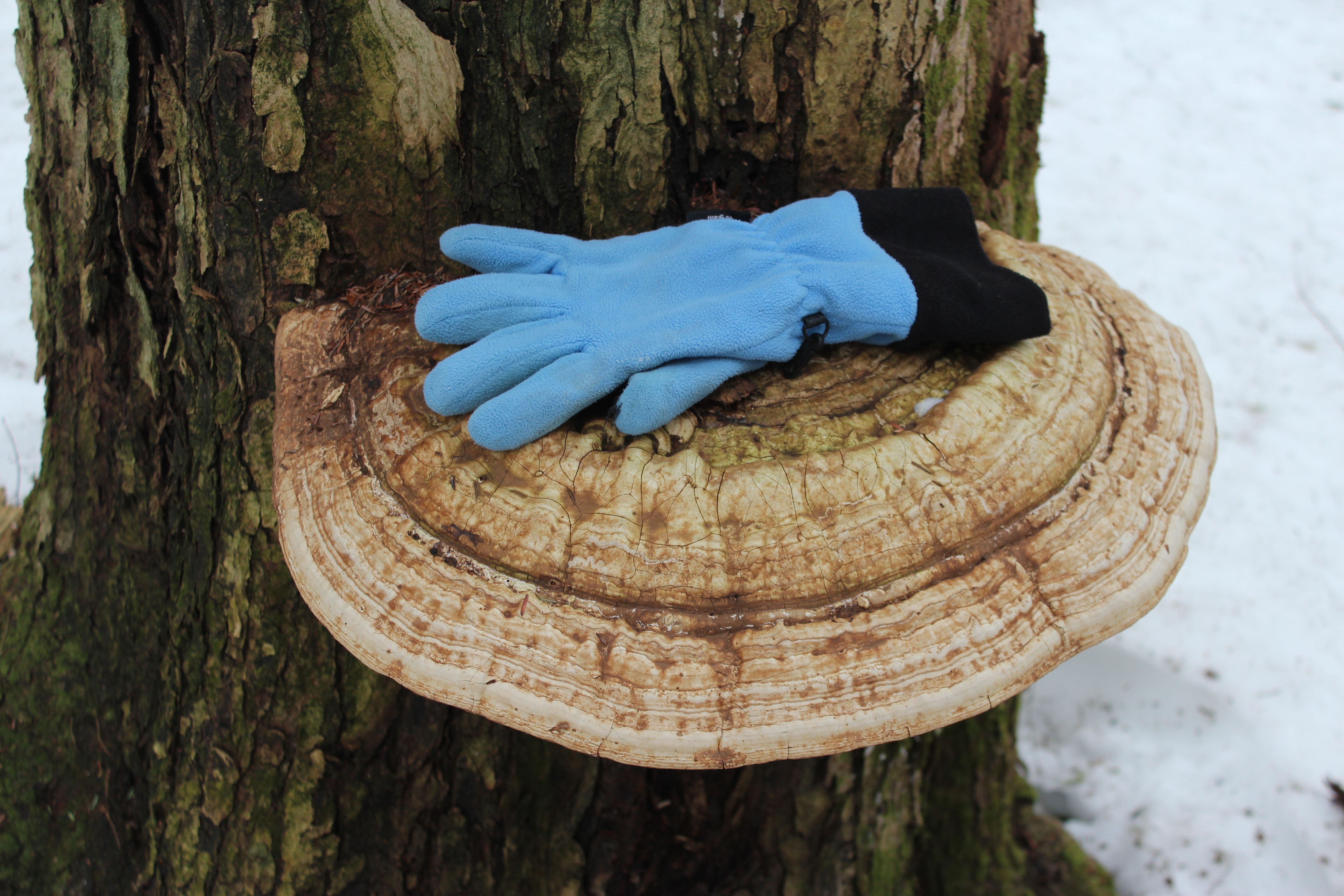
Fan-shaped Artist’s Conks.

mush 2

Their white pore surface.

mush 3

Looking skyward.

mush 4

And a sense of perspective.

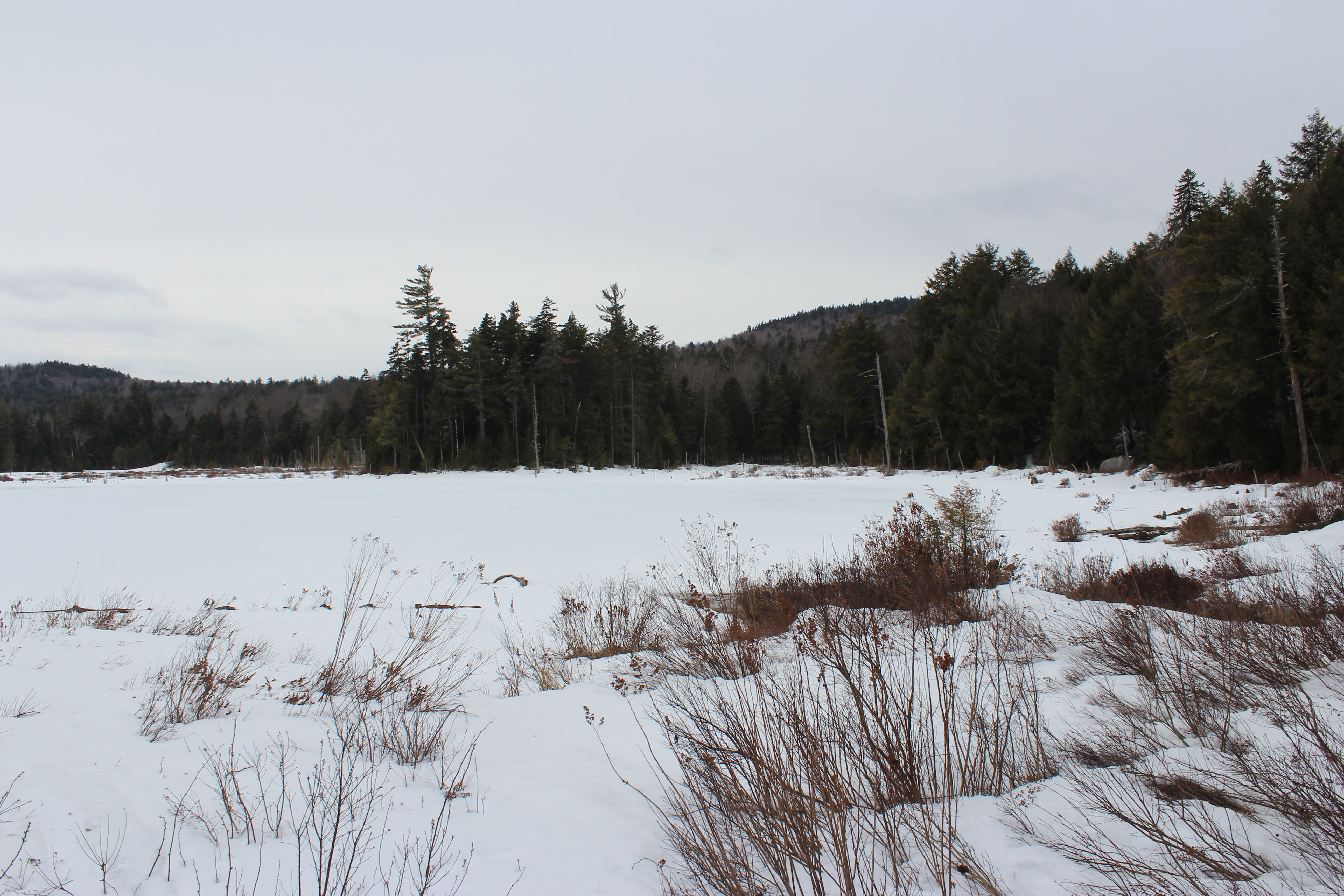
 pond1

At last, we reached Province Pond.

shaw mtn

Shaw Mountain is in the background–we’re saving it for another day.

Allen-snow

On our way to a forest service shelter that was built in the 1930s (I know this because I read it in Hikes & Woodland Walks in and around Maine’s LAKES REGION written by my friend, Marita Wiser), the deep snow caught us a few times. My guy is knee-deep.

brook crossing

It pays to let him go first. I can then figure out where not to step. Here, he’s contemplating the brook crossing to the shelter. It was actually quite easy.

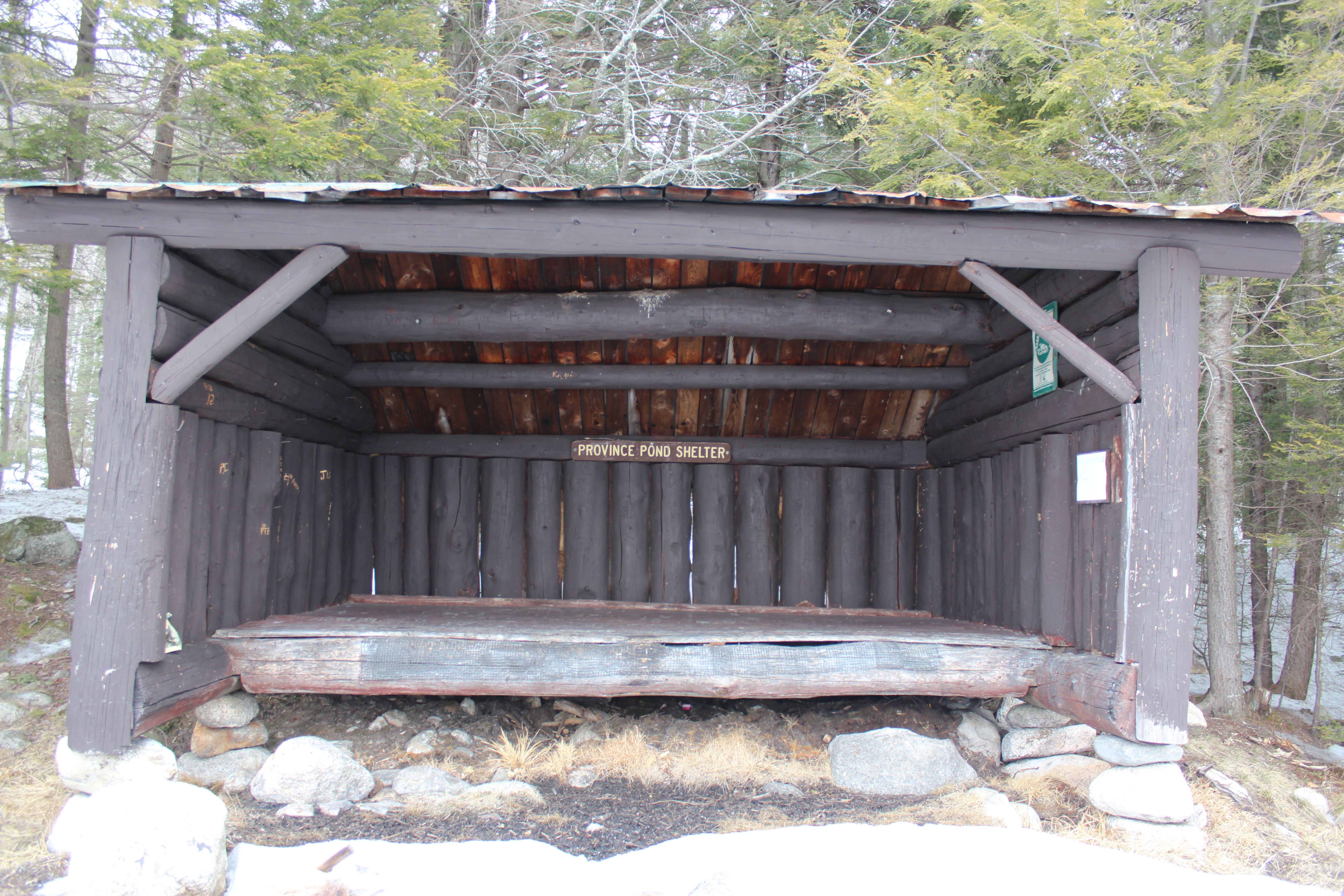
Shelter

A sheltered lunch locale–just right for those PB&J sandwiches.

lunch viewlunch 2

Best view in the house.

initials

I’ve a feeling these walls could tell many tales.

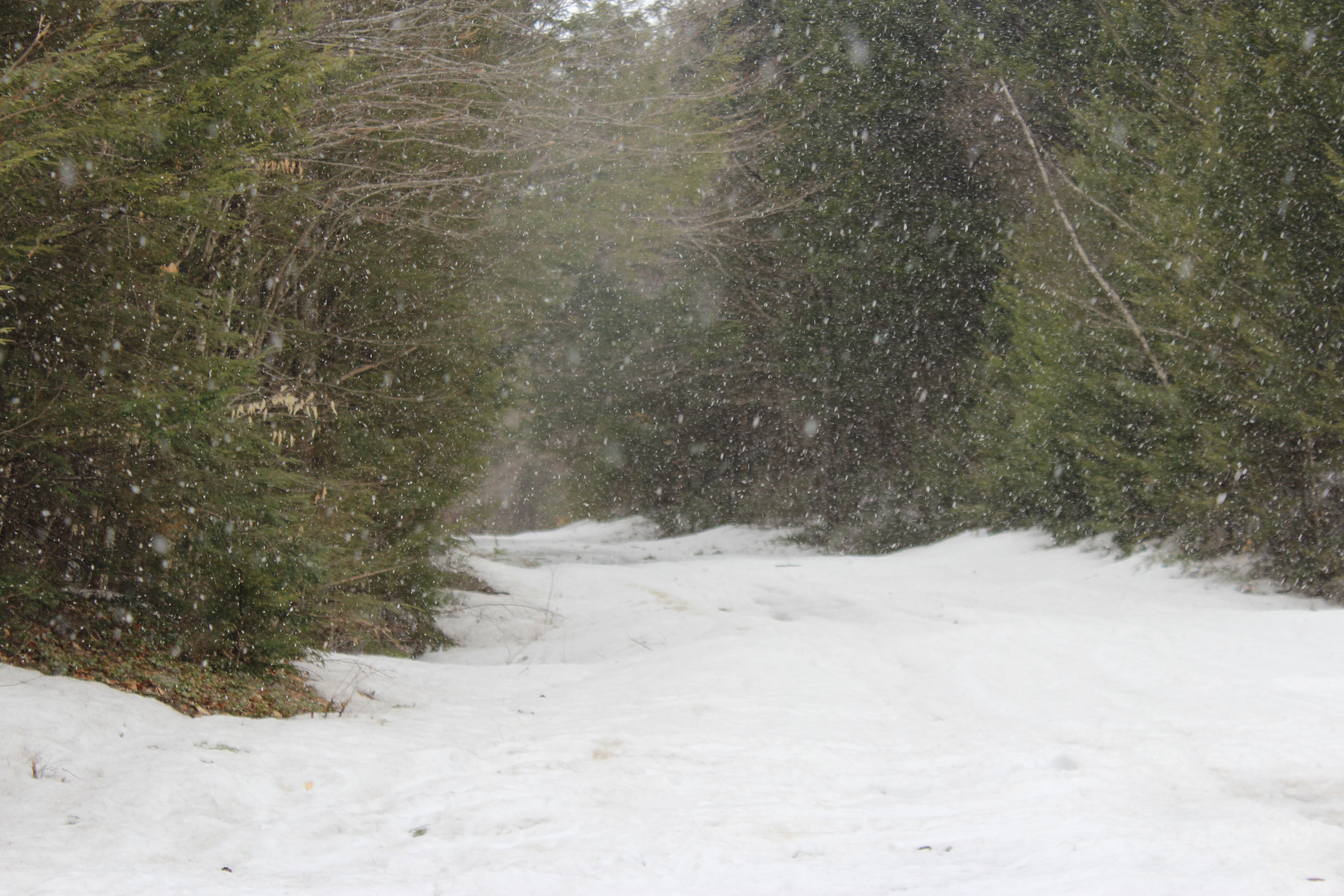
snowing

It was snowing as we headed back down the trail. Yet another wintery-spring day.

Eight miles later, we were thankful for the opportunity to stretch our legs and use our eagle eyes.

Thanks for wandering by to wonder.

Our Three Hour Tour

HP sign

One of our favorite places in town is a hidden gem–Holt Pond Preserve. We parked at the corner of Chaplin’s Mill and Grist Mill Roads, grabbed our snowshoes and backpack from the truck and walked on snowmobile tracks across the field to begin today’s Mondate.

Tingley Brook

Tingley Brook

At the field’s edge, we passed under the hemlocks, beeches and oaks and into the wild and delicate beauty that the preserve offers.

Tingley Brook ice 1

The midmorning light added subtle hints of aqua and pink as the water danced around an ice-capped rock in the brook.

mushrooms and hole

We saw lots of tracks from the mustelid family, as well as snowshoe hare, fox, squirrels, mice and voles. Also, turkeys and grouse. I’m not sure what made the hole and dirt trail beneath the mossy maple mushrooms near the base of this Red Maple. I would not have seen it if I hadn’t leaned in closer to take a photo. I do happen to know that gnomes frequent the area, so just maybe . . .

canoes

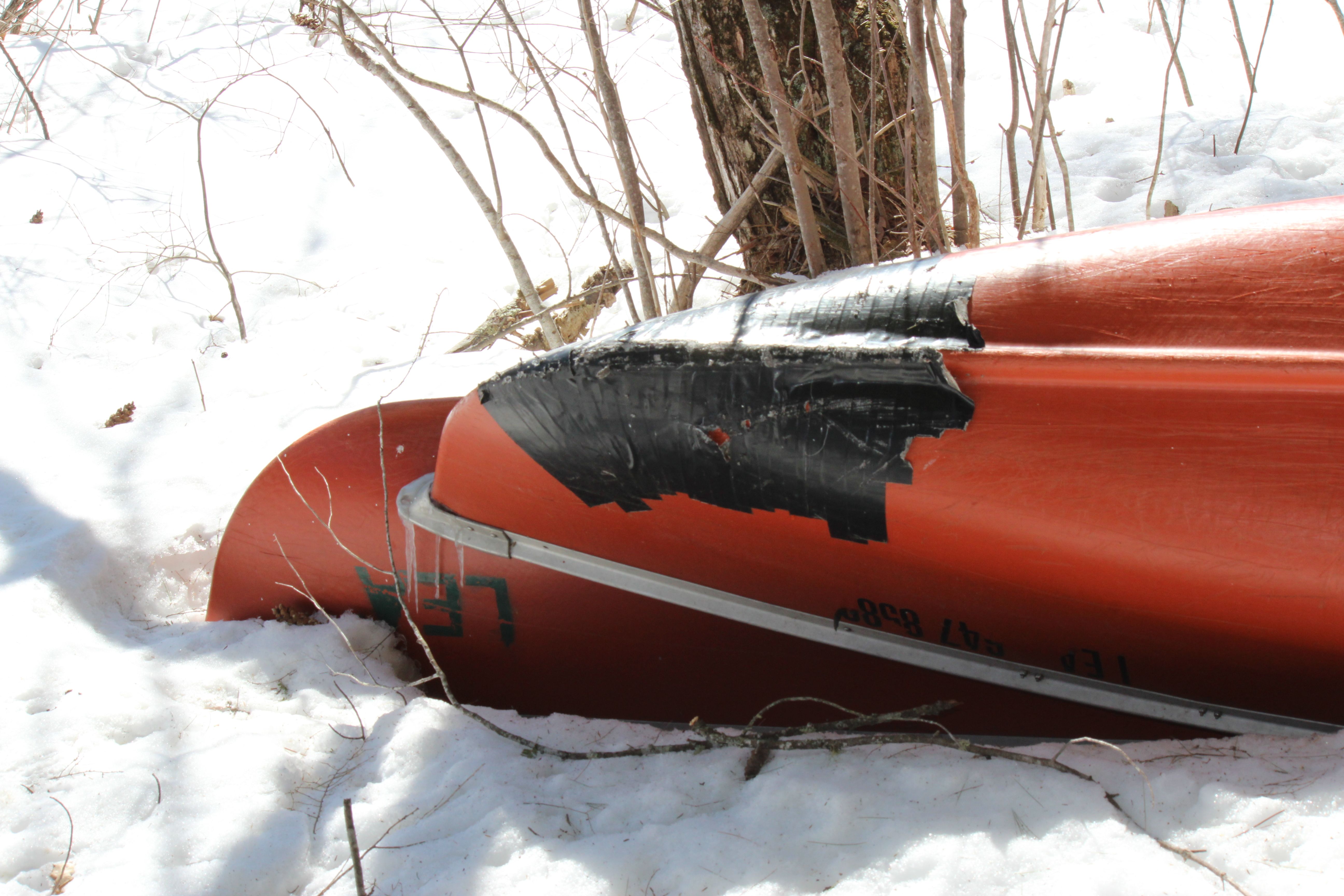
We continued on, crossing Tingley Brook and then making our way beside Muddy River, where the Lakes Environmental Association (LEA) leaves these canoes for anyone to use. Bring your own personal floatation device, paddles, and duct tape. I know where you can purchase duct tape, should you need more. :-)

beaked hazelnut

Near the canoes–a lone beaked hazelnut. Inside this bristly tan husk is an edible nut. Doesn’t it look like a gourd? The name derives from that tube-like protruding beak. I couldn’t believe it was still there as the protein-rich nuts are favorites for red squirrels and chipmunks, as well as ruffed grouse, woodpeckers and blue jays. Humans too.

to Muddy River

We never actually wore our snowshoes today. I hauled mine around on my pole, while my guy stuck his between his jacket and sweatshirt. He said he didn’t need his back scratched for the entire trip.

River to pond

Looking toward Holt Pond from the boardwalk by the Muddy River.

There was only a slight breeze, so the low temp was modified by the brilliant sunshine. Another beautiful day in Maine.

Red Maple Swamp

I think one of my favorite features about the preserve is that the habitat keeps changing–from hemlock groves to red maple swamps to alder thickets to a quaking bog.

Quaking Bog

Though you can’t tell in the winter, the quaking bog is a thick mat of vegetation that formed over the surface near the edge of the pond. A board walk passes across it and one of the fun things to do with a group of people is to have everyone jump at the same time and watch the bog quake. This is also a great spot to visit alone–for quiet reflection.

Holt Pond 1HP South

Views at the pond’s edge–north and south

HP from southwest

We stopped at a rock in a sunny spot along the South Shore Trail to enjoy lunch al fresco. PB&J never tasted so good. Topped off with ice cold water and some Ghirardelli chocolates. :-) As we continued along, we paused to look back across the pond toward the Quaking Bog.

Sometimes we chatted and other times we were each lost in our own thoughts and moving at our individual paces. Similar to my NDD (Nature Distraction Disorder), my guy has his own syndrome–Destinationitis. But, he’s learned to compensate by pausing until I catch up . . . and then he’s off again. That’s OK–it gives me time to spend in my own world.

feathers one

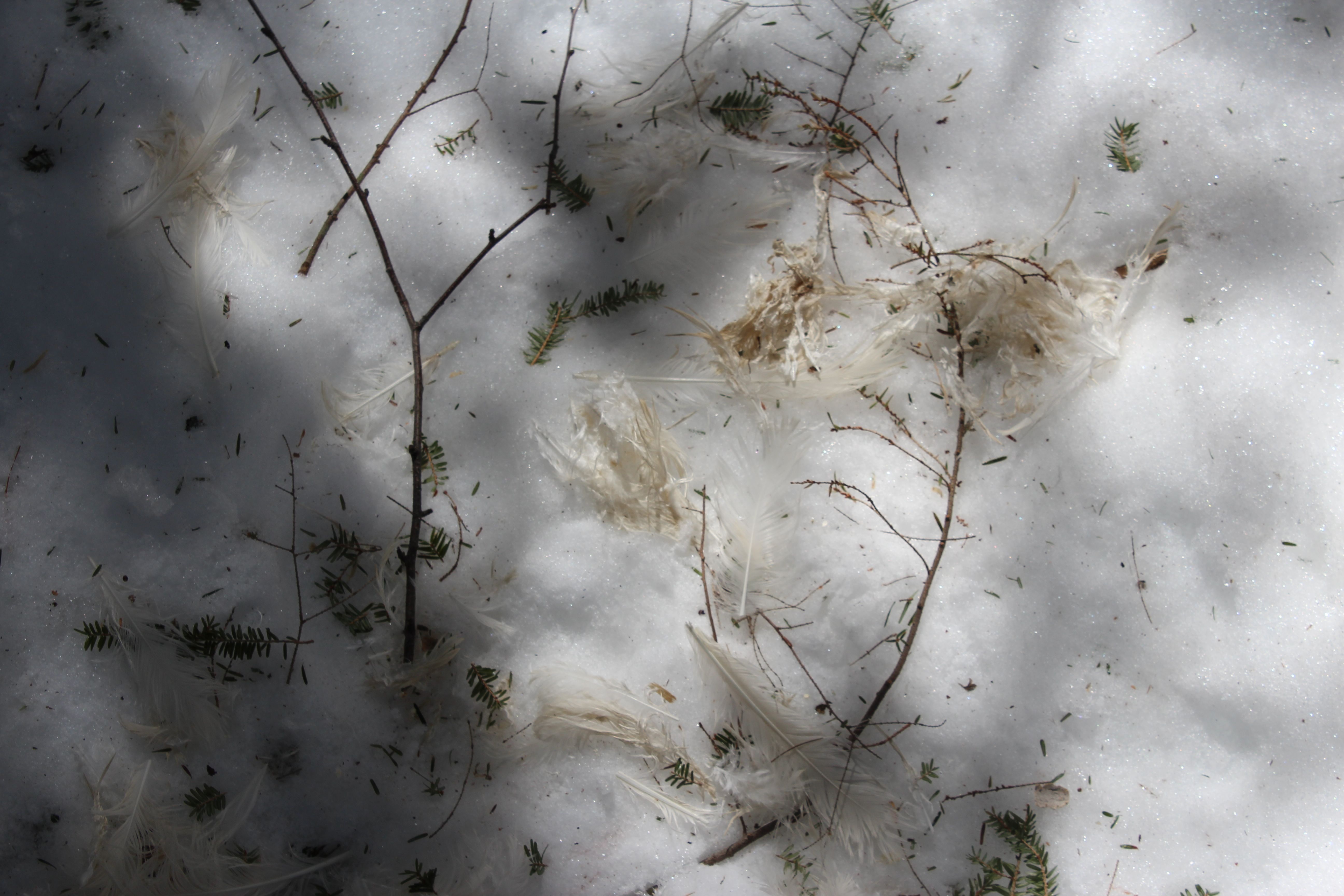
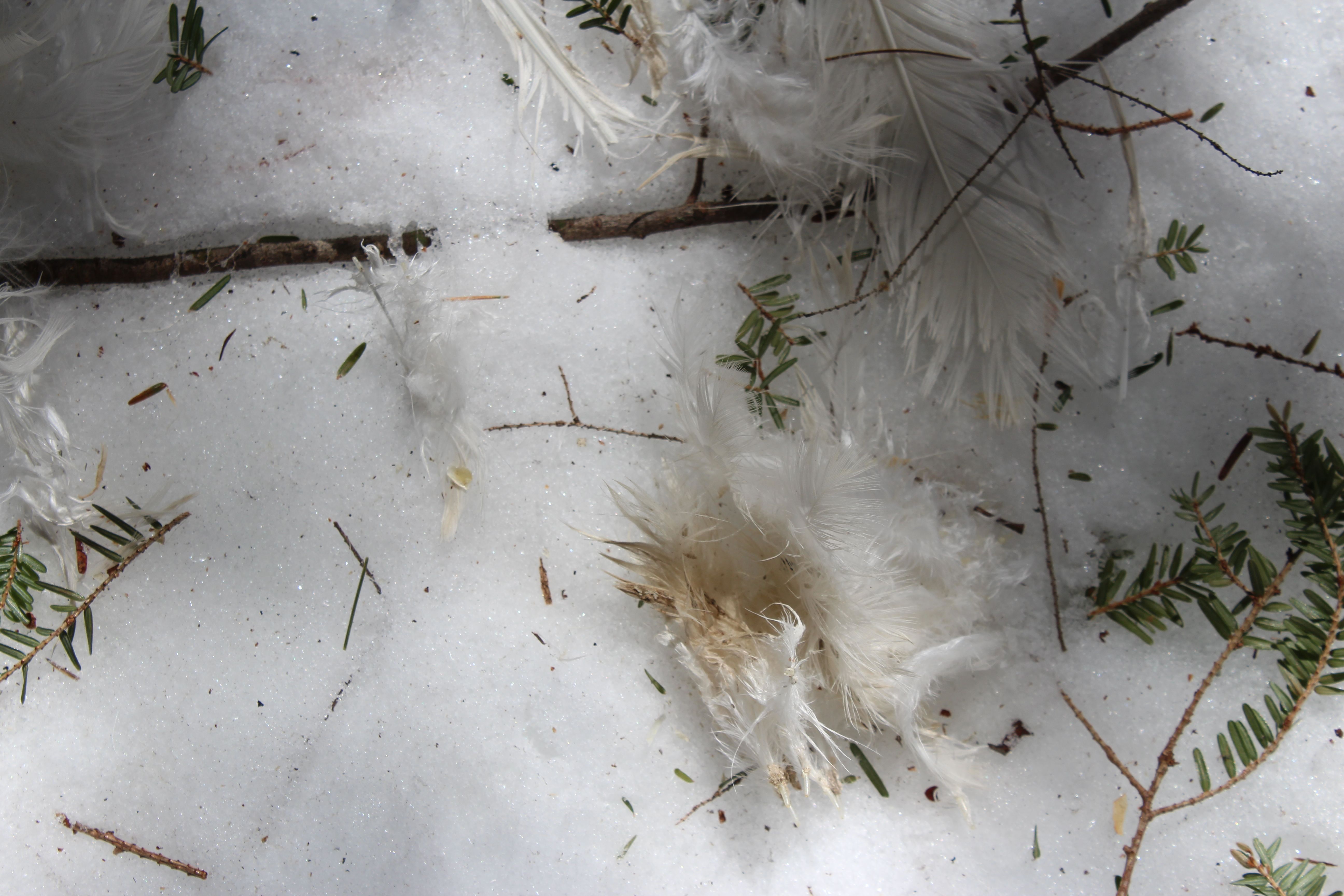
At the edge of a field (we know it as “The Field” because it’s the end of a section of trail that we keep maintained for LEA), we both stopped to look and wonder. Under a hemlock tree and in the middle of the trail, we found these white feathers. Don’t you just love a mystery?

feathers 2

Here’s another look. Some had sheer cuts; others looked plucked. No great place to hang out above. If you know what bird this was or what happened here, please enlighten me.

horse

At least five miles later, we were back on Chaplin’s Mill Road headed toward the truck.

Thanks for stopping by again to wonder my way. I hope you enjoyed the three hour tour.

Ordinary Graces

My friend and former flatmate, Marfé, sent me the following Lenten reflection shared by Reverend John Branson of Christ Church in Alexandria, Virginia.

March 18, 2015 

Ordinary Graces, Christian Teachings on the Interior Life by Lorraine Kisly includes this summary from a D.H. Lawrence essay: 

When the wonder has gone out of the man he is dead. When all comes to all, the most precious element in life is wonder. Love is a great emotion and power is power but both love and power are based on wonder. Plant consciousness, insect consciousness, fish consciousness, animal consciousness, all are related by one permanent element, which many called the religious element in all life, even in a flea: the sense of wonder. That is our sixth sense. And it is the natural religious sense.

ice and water

And so I begin today’s wander. Wondering about water and ice. It’s such an ordinary occurrence. Or is it?

deer, mushroom

A forester friend and I visited the Wilson Wing Moose Pond Bog Reserve this morning. Deer tracks led us to one of our first finds. The breakfast of champions  appears to have been polypores. We always talk about deer eating mushrooms, but here was actual evidence.

leaf

I’d just been to this property on Friday, but today–different things made themselves known. There were deer, mink, snowshoe hare and maybe otter or raccoon tracks. The latter two were a bit difficult to determine given the snow conditions. Crusty snow. 15 degrees. Wind. Blustery wind.

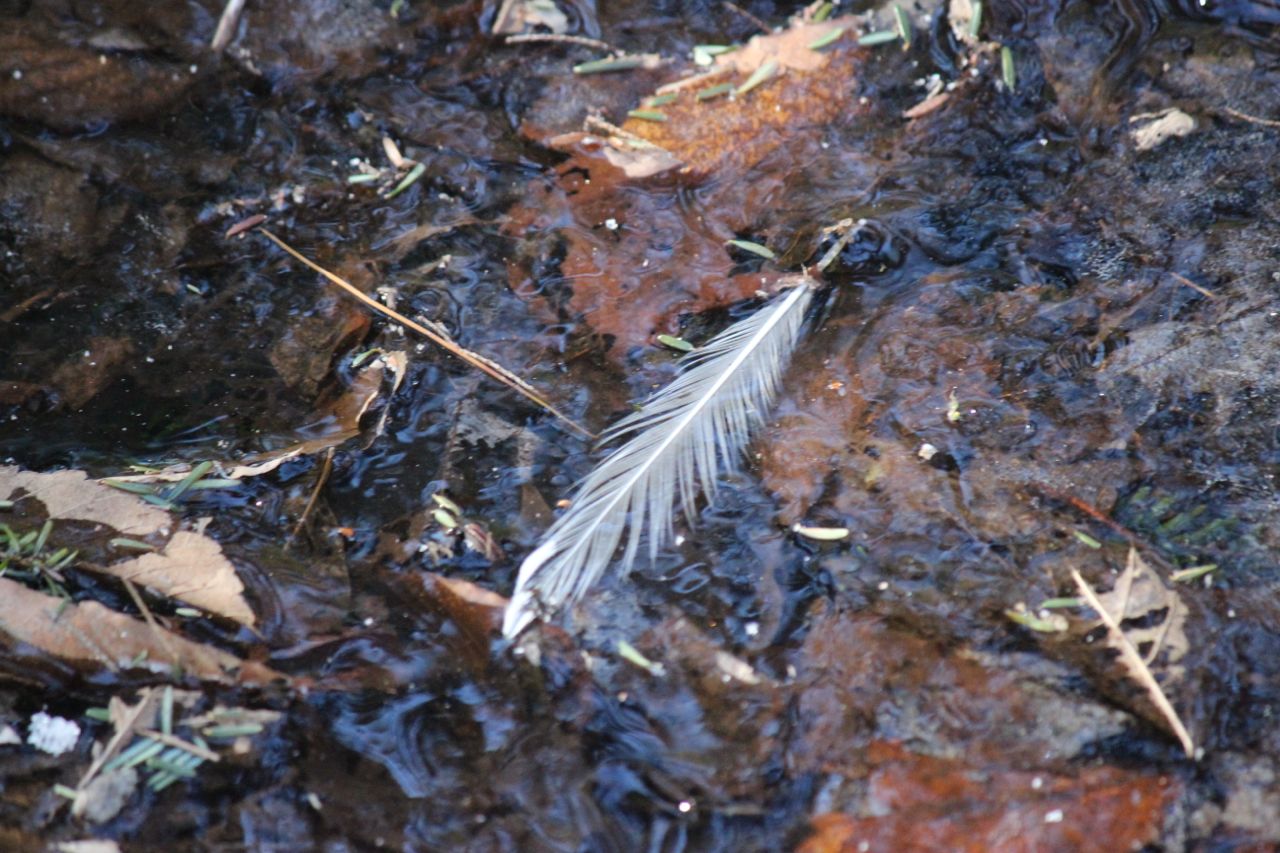
Following the brook and mink tracks, we came to an area where either the otter or raccoon had also traveled. And then we saw the feathers in the water and on the ice. Not many. But enough to make us wonder what had happened. Did a hawk or owl get another bird? It certainly didn’t seem like a four-legged animal attack.

wasp

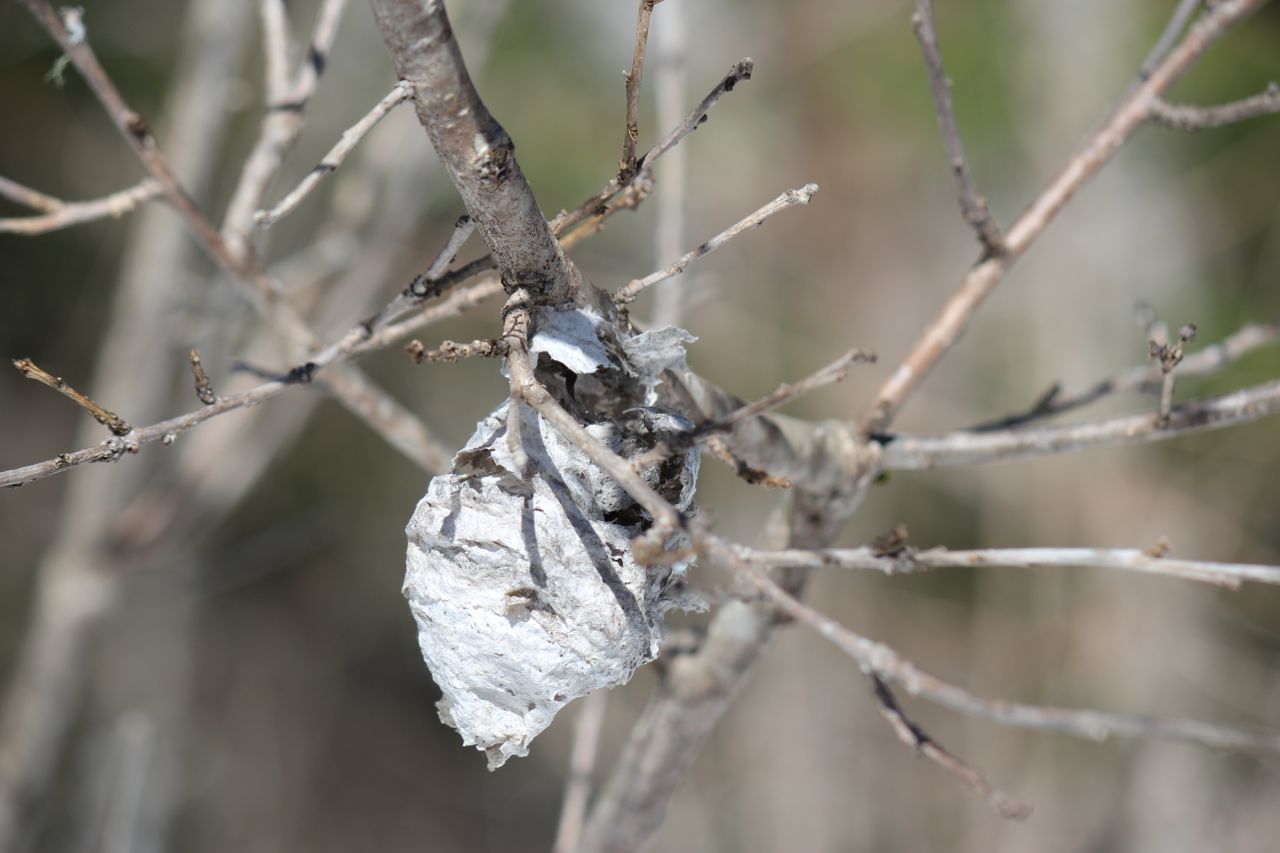
Along the edge of the bog we found this small nest flapping in the wind. Paper wasps, hornets and yellow jackets are all masters of papermaking. That being said, they locate their nests in different places. For the paper wasp, prime real estate is in trees and dense shrubbery, but quite often you’ll find their nests suspended from eaves and window casings. Trees and shrubs are a hornet’s site of choice. Yellow jackets set up housekeeping underground. My thinking is that this may have been the start of a hornet nest. Last spring, the queen who had overwintered in rock cracks, under bark or in an underground hangout, would have emerged and begun building by gathering wood fibers and turning them into papery pulp. But it appears that she abandoned it. Why? What went wrong on the home front?

beaver hemlock

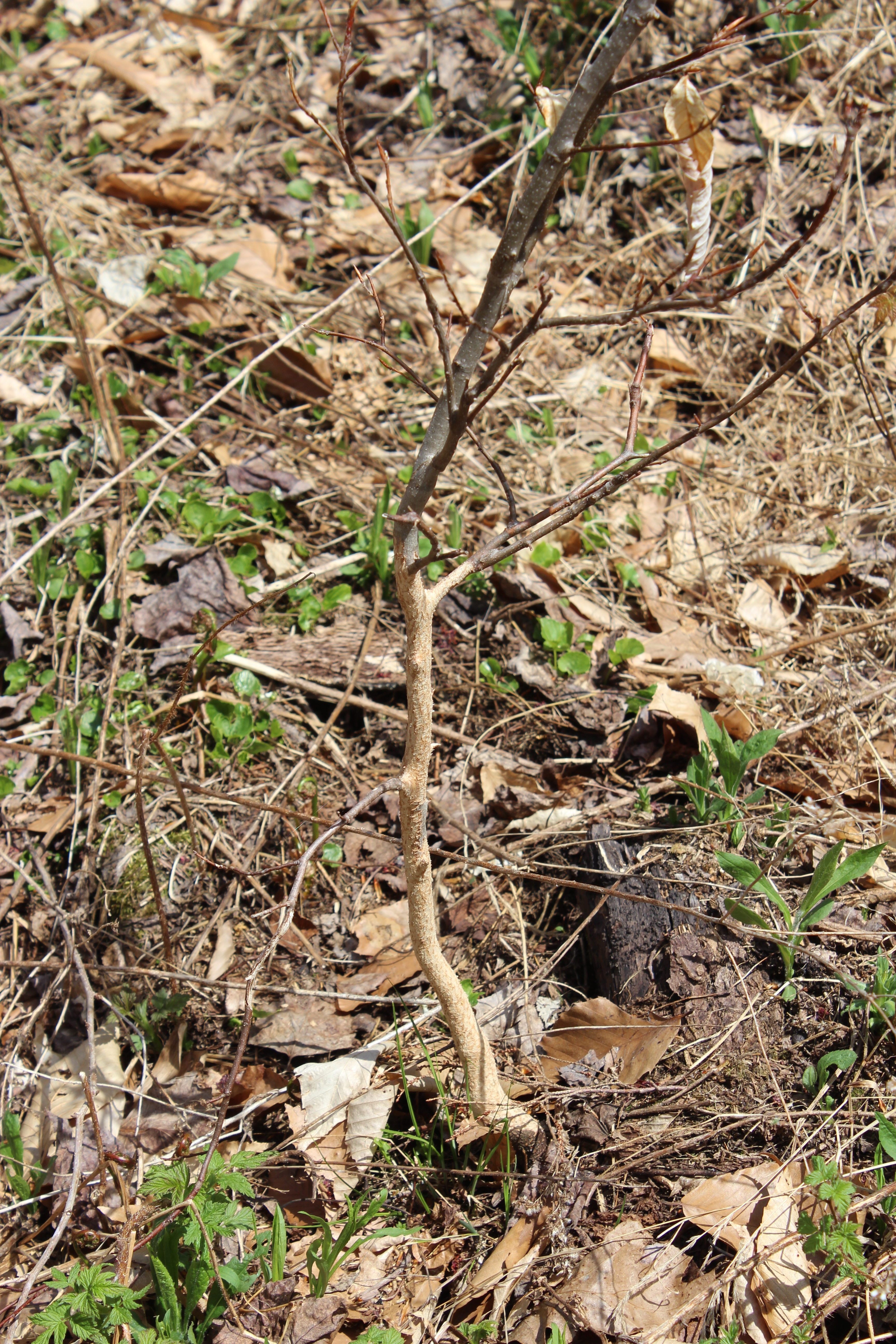
Here’s something else to wonder about. The trail doesn’t go past this because it’s in a wet area beside the brook, but during the winter we can wander to places we can’t reach in other seasons. This hemlock was girdled by a beaver a while ago. I’m not sure why they do this as hemlocks are not their tree of choice for food. One theory is that the tree will die and other more favorable trees–from the beaver’s viewpoint–will grow here.

hemlock squigglesquiggly hemlock

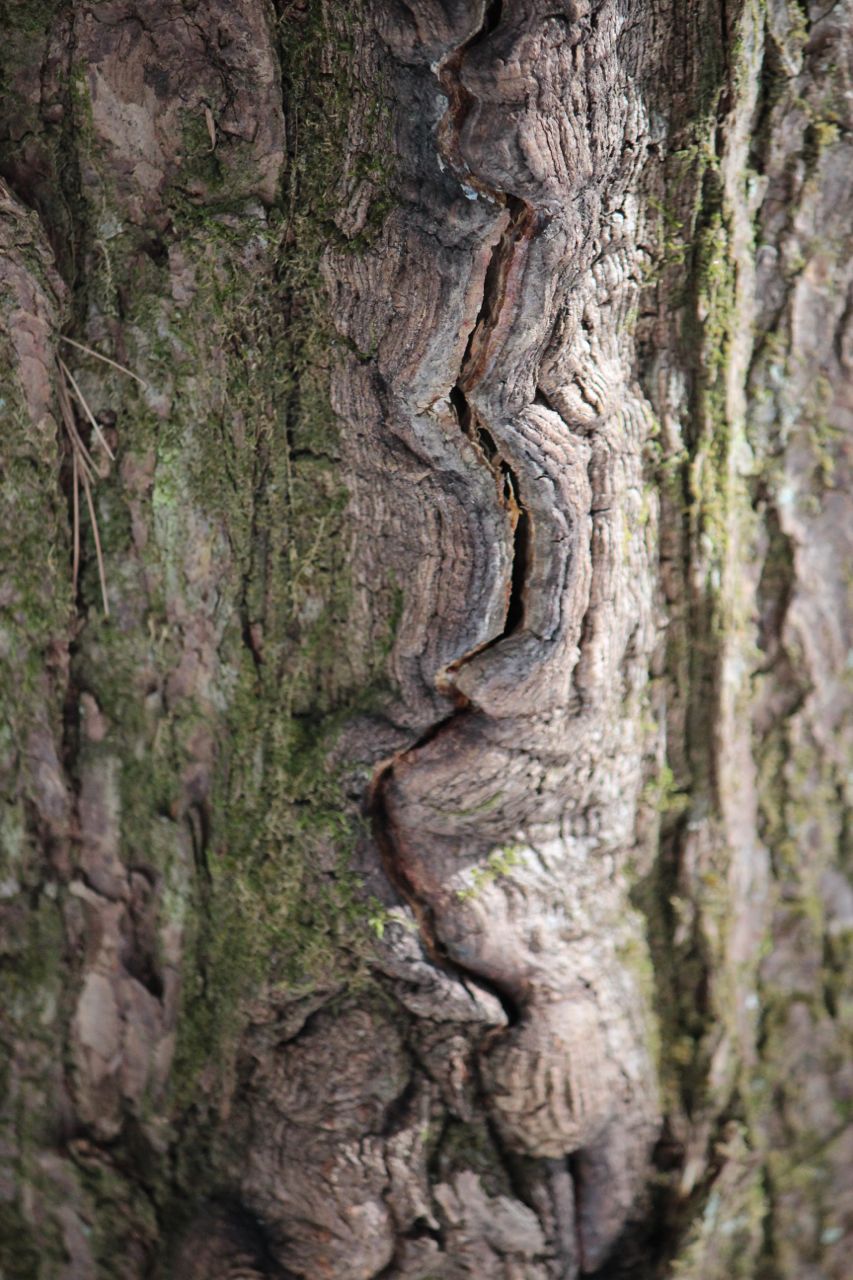
I’m always amazed how once my eyes are opened to something, it suddenly appears everywhere I look. Well, not everywhere but . . . Such was the case with the squiggly wound of another hemlock tree. So I asked my friend about this. His theory–a frost crack and this is how the tree tried to heal the wound. Maybe so. I know that  I appreciate the sun’s warmth being absorbed by my black snow pants. The dark bark of the trees also absorbs sunlight during the day, but they don’t have a heated home to return to at night when the sun sets and temperature plunges. The constant thawing/freezing cycle creates cracks in the bark–but if this is such, I still don’t understand why the hemlock portrays the squiggly line, while frost cracks on other trees tend to be much straighter. Then again, all tree species have their own patterns and idiosyncrasies. Maybe I just have to accept that this is the way it is. And move on.

John A. Segur

So we moved on to the John A. Segur Wildlife Refuge on New Road, another GLLT property. I’ve said it before and I’ll say it again . . . and again. I’m thankful to this land trust and others for the work being done to protect the ecosystem for the benefit of nature and humans.

And I’m thankful for another beautiful day in Maine and the opportunity to wonder about the ordinary.

Frozen Focus

Beech

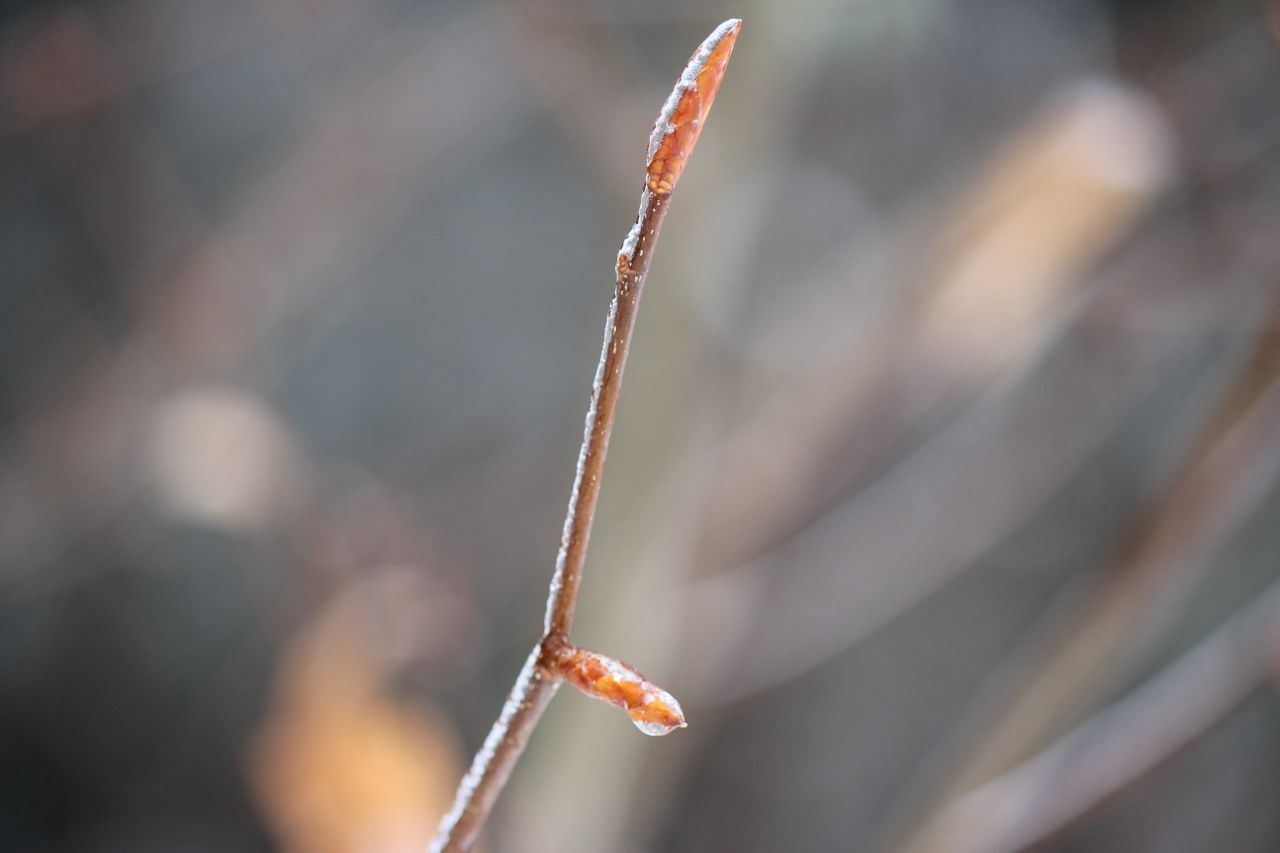
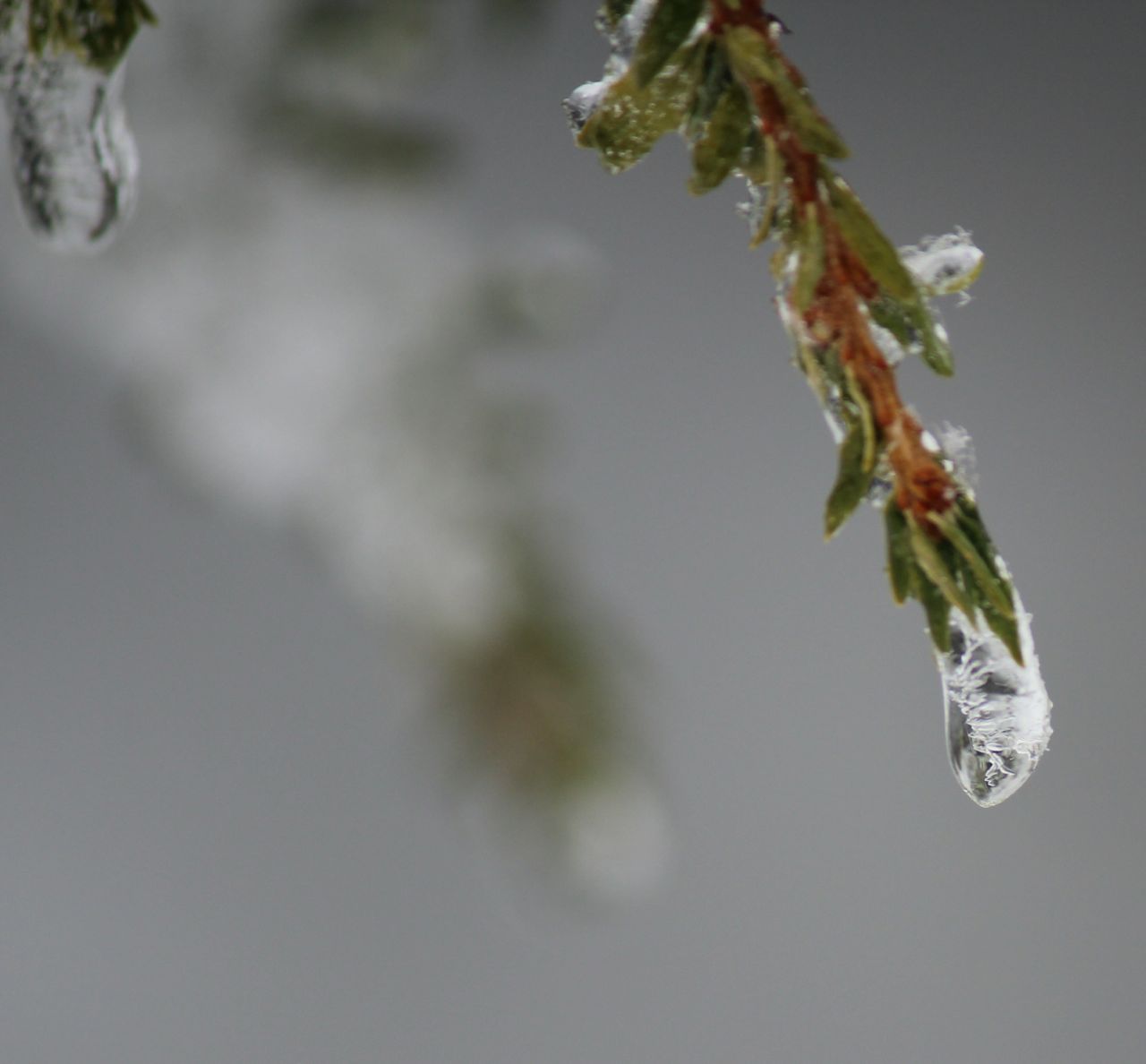
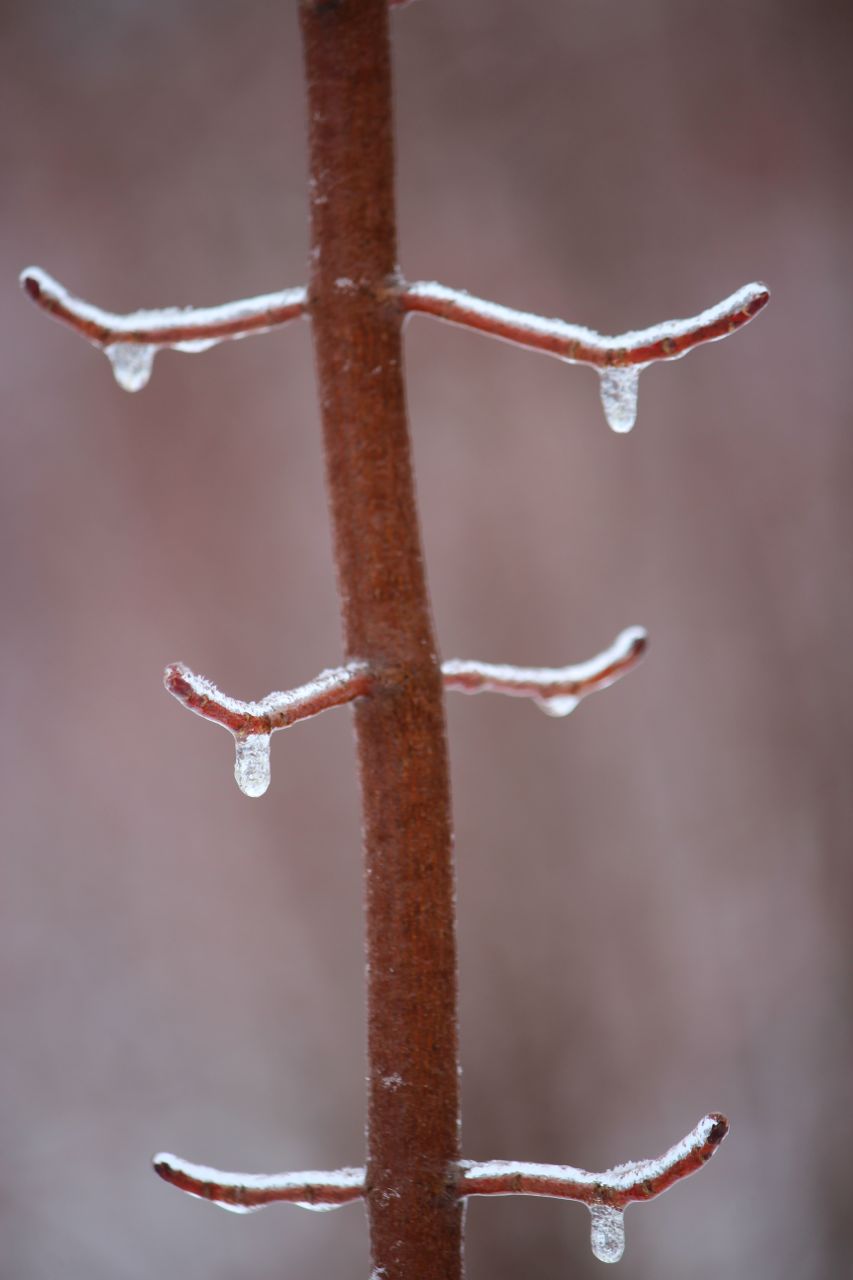
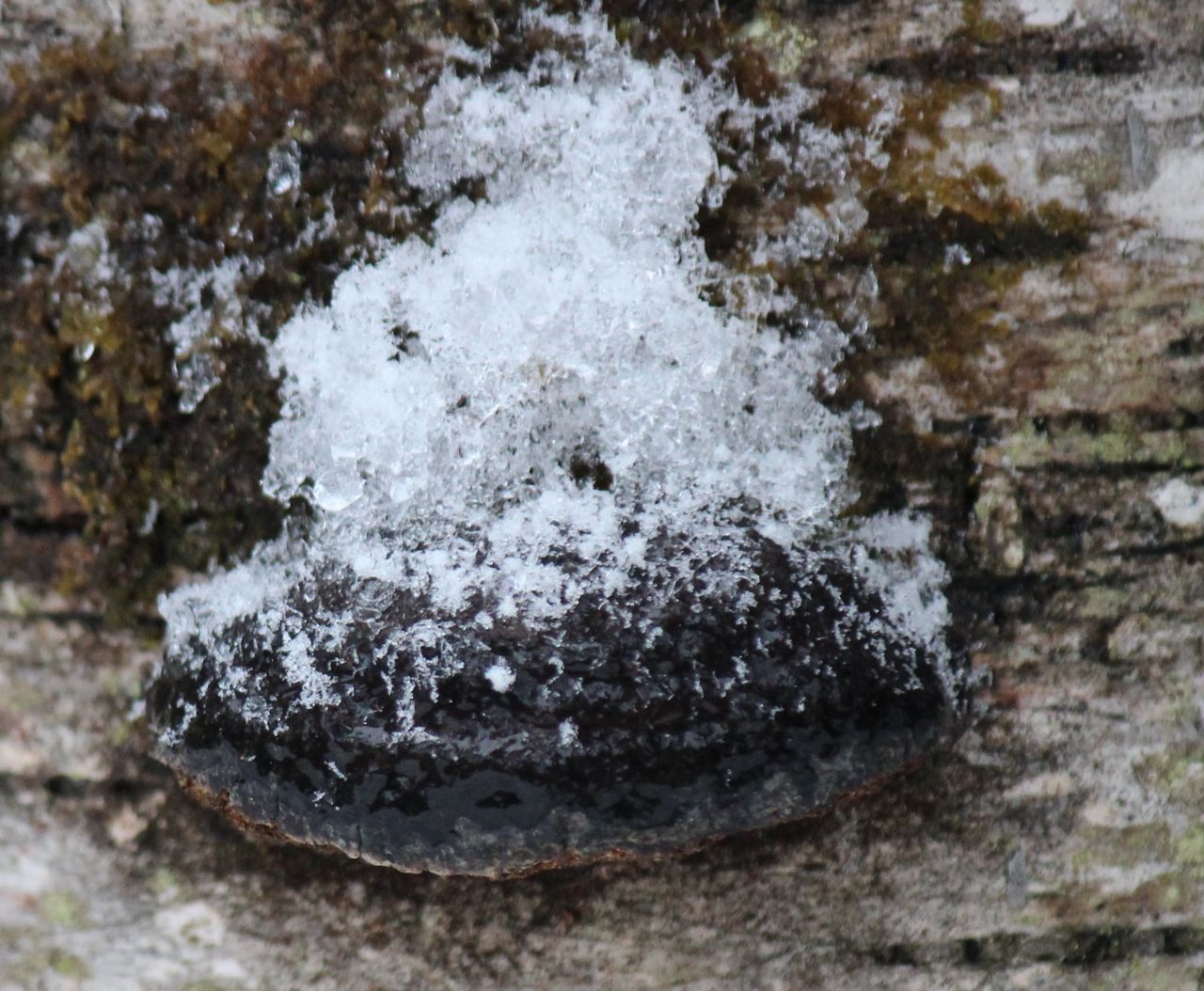
Following last night’s mixed precipitation, I decided to shed my snowshoes and follow the snowmobile trail instead. The ice on this beech caught my eye as I crossed over the stonewall and into the field beside our house. Deer, a kazillion skunks and snowshoe hare had been out and about, but it was the snow and ice that I focused the lens on this morning. Each droplet a gift–I’ll let the photos tell the story.

hemlock 2

red maple 1

white pine 1

white pine 2

witch hazel 1

witch hazel 2

Tinder polypore

turkey tails

sensitive fern

One more thing. In his post, “Things I’ve Seen,” the author of NHGardenSolutions,  shared a photo of a zigzag scar on an Eastern Hemlock. I was wowed by it–had never noticed one before. Until . . . this morning. My find isn’t as zigzaggy as his, but it caught my attention.

crazy hemlock

What caused this? It’s along the snowmobile trail and may have been part of an old logging road. Crazy and beautiful, this mystery makes me wonder.

Thanks for joining me for another wonder-filled wander in the woods.