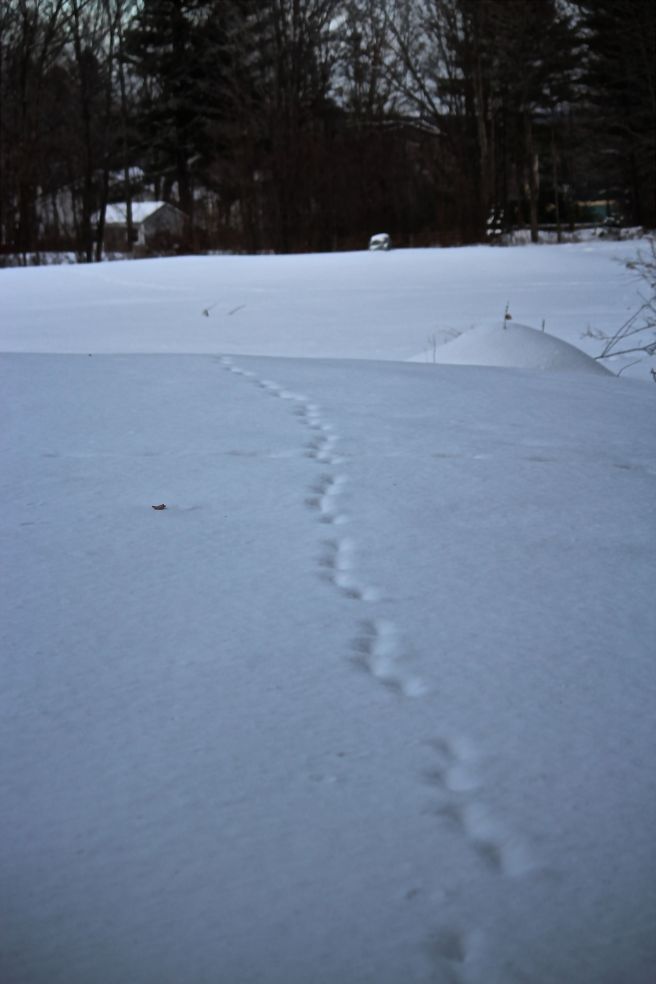
Reflection of Grace

My heart was broken when I headed out the door this afternoon. I’d just learned that the husband of my spritely little German friend, Ursula, had died. And though they hadn’t been able to tramp through the woods together these past few years, theirs was a relationship sustained by a love for the natural world and many, many journeys into places I’ll never know. In these evening years of their lives, she’d told me that even though they could no longer follow the path together, they still remembered and reminisced often about their adventures and discoveries. And I trust that it is those memories that will enwrap her now.

w1--hydrangea

As the hydrangea in the garden I passed proclaimed, there is beauty . . . even in death. My hope is that Ursula will find that beauty as time evolves.

w4-yellow rocket

I knew that I wanted to lift her and their shared life up as I walked along, but I wasn’t really sure where I was going or what I was looking for. And then, as the cowpath opened to the power line, I saw a couple approaching. A few more steps and we waved to each other. And with the wave came recognition–my friends Linda and Dick, who are two of the few people who explore these woods the way I do, approached. We shared   questions and observations, and decided to travel a short distance together.

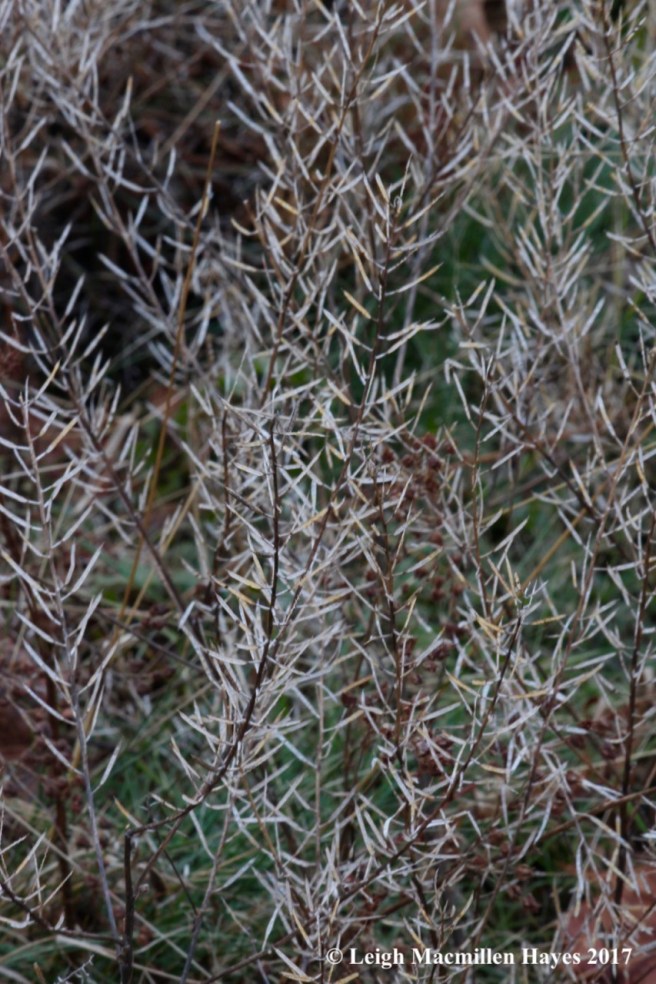
The trail we followed emerged into an open area where what was once a floral display that Ursula would have relished was equally delightful in its winter fashion. Linda and I struggled to recall the name of the yellow-rocket, but knew that it was a member of the legume family by its pod structure.

w5-thistle, evening primrose, yellow rocket

Thistles and evening primroses added more texture to the picture, yet again proving that in death there is life.

w2--trail

We reached a stonewall where I thought my companions might turn toward home, but was thrilled that they wanted to continue on, despite the fact that the trail conditions were ever changing. And I think that’s one of the lessons I’ve learned from Ursula as she’d tell me about things she and Wolfgang used to do and what their more recent limitations were, yet despite the latter they still had stimulating conversations as they remembered the fun of past expeditions.

w6-cinnabar polypore

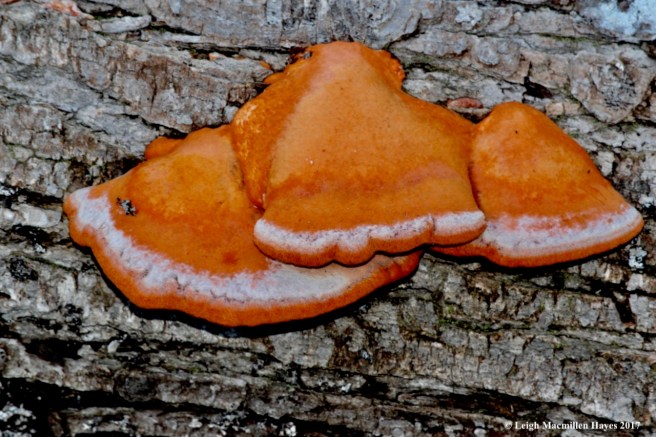
So it was that today the three of us found many moments of joy, including the sight of cinnabar polypores that reminded us of creamsicle ice cream, fresh moose scat and tracks, and lots of flowers to check on come spring.

w8-Dick and Linda

It was getting dark as we followed the trail out and decided to walk along the road on our way home rather than return the way we’d come. It hadn’t been our intention to meet today, but as grace would have it, we did. And I was thankful for the fellowship as we traveled together while I honored Ursula and Wolfgang.

w9-reflections of grace

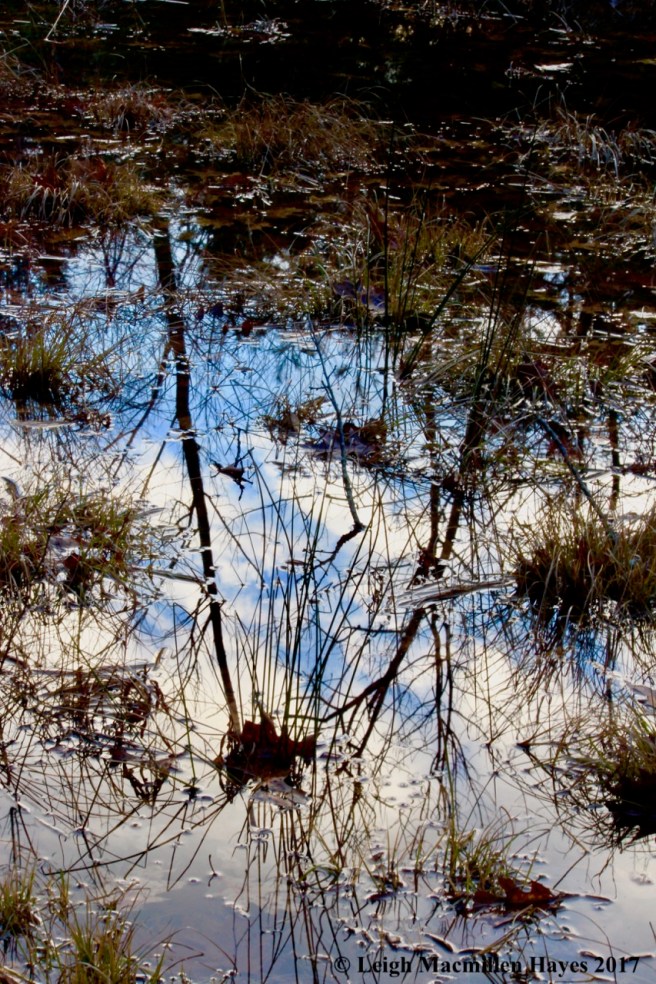
Our time with each other was a reflection of grace and it is that same grace that I pray embraces Ursula as she reflects upon a life well shared with her beloved Wolfgang.

Rest in peace, Wolfgang. And blessings of memories to you, Ursula.

Book of November: Half Acre

I am so tickled for my friend and fellow naturalist, Sarah Frankel, who recently published her first book.

IMG_1906

Half Acre is a children’s book both written and illustrated by this talented young lady.

In rhyming fashion, she takes the younger set outdoors to explore her yard, which is a half acre in size. The size, however, is not important because Sarah knows how to look and to wonder. Or maybe in this case, it is important, because she wants others to realize that there are great things to find on their own small plot of land.

And now she and her husband are teaching their young daughter to do the same. Her hope is that the book will encourage others to step outside and notice as well.

In thirty-four pages, Half Acre explores the yard in all seasons and at different times of day. As much as I enjoyed the rhymes, I especially loved the paintings–of birds and leaves, flowers and bees, butterflies and trees, moss and ferns, night sky and nocturnal visitors, and so much more. Can you find the frozen tree frog? You’ll have to buy the book and look for it.

My favorite painting is the last one–with her house in middle, surrounded by snippets from each of the other paintings, like a sugar maple leaf floating in midair. There’s more to this painting though, for Sarah takes the reader through the four seasons at the house–in 8 x 6-inches, she begins with winter on the left and every two inches the season changes,  ending with autumn on the right. I wish I could share that with you, but you’ll just have to trust me and purchase the book. Of course, she used the same scene to introduce her half acre of land, but it really stands out in the final mural framed by small portions of all the other paintings.

IMG_1904

Since I’m on the topic of Sarah, though this isn’t a book, I was the recipient of one of her paintings. For the past four years, it has leaned against the wall on a counter in the butler’s pantry and makes me think of both Sarah and Mom.

Of Sarah because she knows winter is my favorite time of year and she included tracks in the snow, a starry night, full moon and a shooting star. When I was a Maine Master  Naturalist student, Sarah was a mentor. At that time, though she lived in Conway, NH, she worked at Lakes Environmental Association as the Education Director. And so, we’d drive to and from class at Bates College in Lewiston together. On our way home one night, we saw a shooting star. And many times we tramped together on snowshoes, following mammal tracks. I have to share one more fond memory–the spring night that it rained and we tried to dodge the frogs and salamanders as we drove home. Finally, we got out a few times and helped the sallies cross the road. We were tired from class, and it was a long drive home that night, but by helping a few, we forgave ourselves for the ones we’d smooshed.

Of Mom, because Sarah gave me the painting after my mother died at the end of January during the year I was taking the course–I’m forever honored by Sarah’s thoughtfulness.

Interested in purchasing the book and meeting Sarah? She’s got some book events coming up in the North Conway, New Hampshire area:

November 11th from 11am-3pm – A book signing at The Met Coffee House and Gallery during the Bring A Friend Shopping weekend.

December 2nd at 3pm – A book signing event at White Birch Books, the best book store around!

December 7th from 6-8pm – A book signing at the Adults Only Shopping Night at The Toy Chest. Shop for the holidays, get a copy of Half Acre signed for your little ones and pick your own discount on the way out.

December 9th at 10am – Read aloud, book signing and outdoor exploration at the Conway Public Library. What creatures can we find in the gardens and lawn of the Conway Public Library? Come and see for yourself!

I can’t wait to attend one of these, give her a hug, and ask her to sign my copy. And I may have to steal a kid to attend the outdoor exploration at the Conway Public Library.

Is there a young’un in your life? Then I think Half Acre should finds its way onto their book shelf.

Half Acre, written and illustrated by Sarah Frankel, LifeRich Publishing, 2017. And available at www.liferichpublishing.com, or a local independent bookstore.

Making a Wish–Kyan Style

In May 2016, our young next-door neighbor was diagnosed with acute myeloid leukemia, which attacks immature blood cells. I’ll never forget that day or those following as we watched his parents drive by our house either coming or going to the Barbara Bush Children’s Hospital in Portland, where he underwent two rounds of chemotherapy treatment.

We felt at a loss–what could we do for them while they underwent this life-wrenching ordeal.

Our steps were tiny. First, we tied orange ribbons around the big old sugar maple tree in our front yard and then snuck into their yard and did the same around all the trees that lined their driveway. It was the beginning of saying, “We’re thinking of you.”

We offered to cook a meal and mow the lawn, and even started to head over and do the latter but as it turned out, those were common, every day acts that Bill and Binaca, Ky’s parents, cherished because in that moment life was almost normal again. Sort of.

My next step, since orange is the color that represents leukemia, was to post a photo of something orange found in the natural world on my Facebook page each day. It was a small token, but a way to let Ky, his sister Quinn, and his parents know that they were in our thoughts and prayers. I did notice that though his mother “liked” most, the yuckiest ones were the ones that evoked a comment from Kyan. Typical tween–in a way.

After a spring and summer of ups and downs, the decision was made for a bone marrow transplant. And a donor was located–in the Netherlands. A year ago yesterday, Binaca and Kyan headed to Boston Children’s Hospital to begin the process. That journey was long, for Ky had to be quarantined, and even after they came home, life was different.

I do remember Halloween of last year–I don’t recall how long Ky had been home, but he was given the OK from his doctor to go trick-or-treating, as long as he stayed well covered. It was the first time he’d been with friends since May. When he, his sister and their friends came to the door, the sweetest voice to my ears said from within a Scream costume, “Hi Mrs. Hayes.” I’m not terribly fond of Halloween and costumes–it’s always creeped me out a bit. But for once, I wanted to rejoice and hug that Scream. I didn’t. First, it was a germ thing on his end and he had to be super careful. And second, I would have embarrassed him to pieces.

After that, occasionally I’d see Ky and his family as they rode through the woods on their quad, but he was always covered by a helmet. Still I was happy to see him out. And then this spring, my heart melted when I looked out one day and saw him passing by on his scooter. At first he didn’t go far, but soon he and his sister were off on adventures.

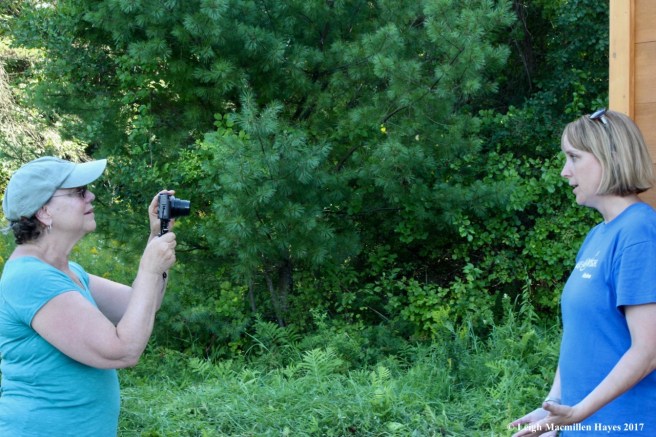
And then last night I received a message from his mom telling me that today he’d be granted a wish from Make-a-Wish Maine and asking if I’d be available to take some photographs. Um, yes!
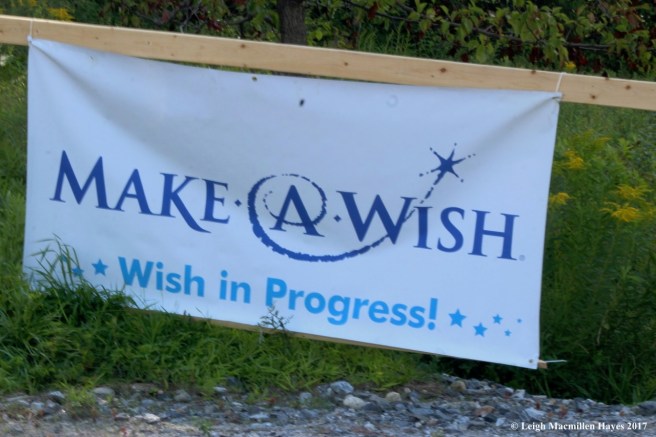
k-make a wish in progress

When I arrived this afternoon, I was surprised to see so many cars lining their driveway as it was my understanding that this would be a quiet affair at his request when they were in the talking stages of this project. But, the Make-a-Wish people had collaborated with folks from the Sustainable Forestry Initiative to fulfill Kyan’s dream. And all hands were on deck to pull it off.

k-ky's sign

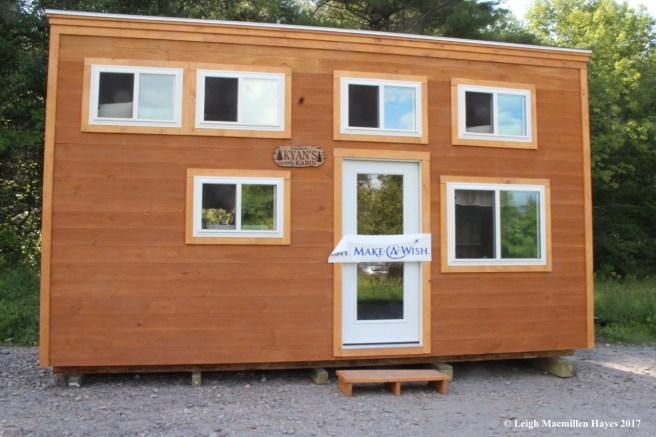
He wanted a cabin of sorts. It began as a treehouse in his mind, but morphed into something a bit larger after he’d watched HGTV’s Tiny Houses. Only, as he said today, he thought it would be much smaller that what the collaborators created. Of course, his mother was hoping for a trip to Hawaii or, being a huge Tom Brady fan, maybe a Patriots game. But this was Kyan’s wish.

k-Bill and Quinn waiting

While his dad and sis waited for Kyan, his mom and his dear friend to return from a birthday adventure to Vermont . . .

k-setting up camp

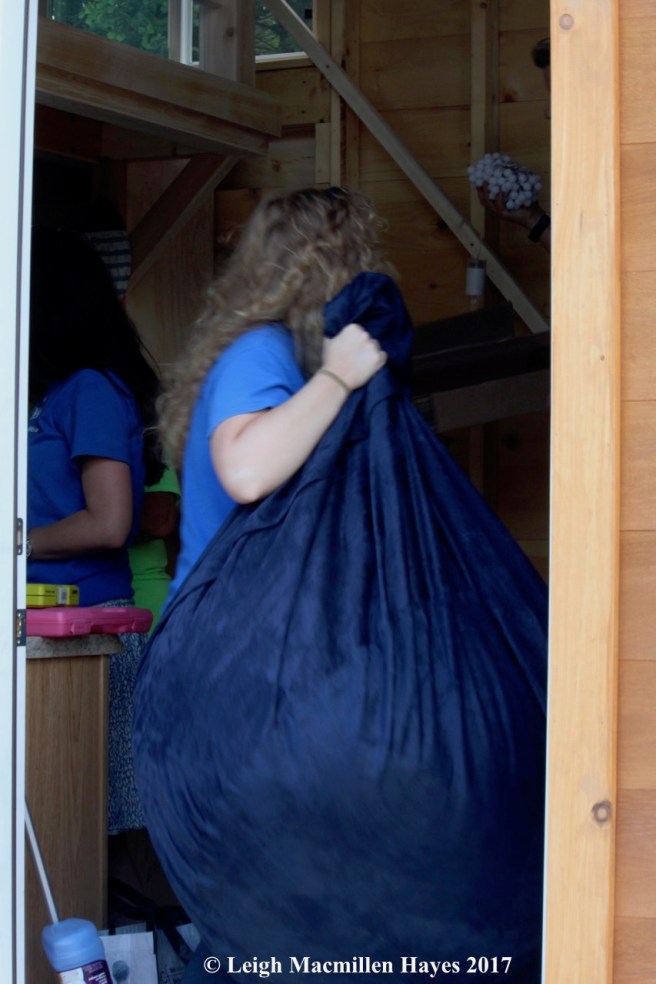
as quickly as they could, the Make-a-Wish team put everything in order.

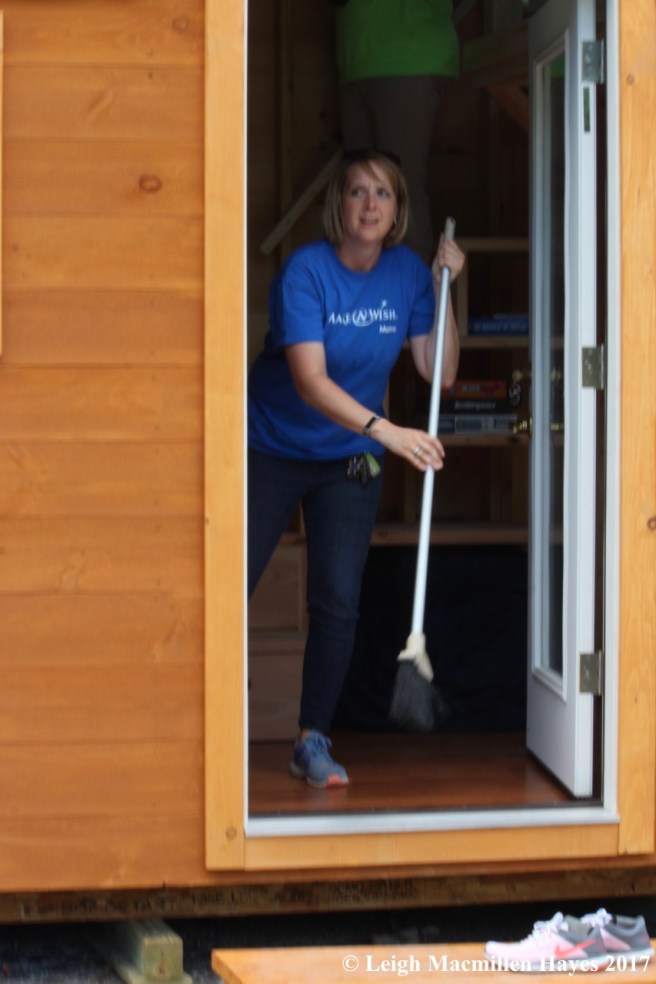
k-sweeping house

The floor was swept . . .

k-setting the sign

door locked, banner posted . . .

k-finishing touches

and final sweep made.

k-make a wish and camera crew

And then the waiting . . . his arrival imminent.

k-partnerships

In the meantime, collaborators posed–Kate Vickery, Senior Program Director of Make-a-Wish Maine and Pat Sirois, state coordinator of the Sustainable Forestry Initiative Implementation Committee in Maine.

k-roberta scrugg

For me, it was a fun time to catch up with Roberta Scruggs on the left, Communications Director for the Maine Forest Products Council, who used to work for Lakes Environmental Association.

k-packed driveway

Finally, the moment everyone had been waiting for arrived. Word came that Binaca was in the neighborhood and Bill and Quinn went off to meet her. The rest of us kept our eyes on the driveway as we waited for them to pull up.

k-blindfolded

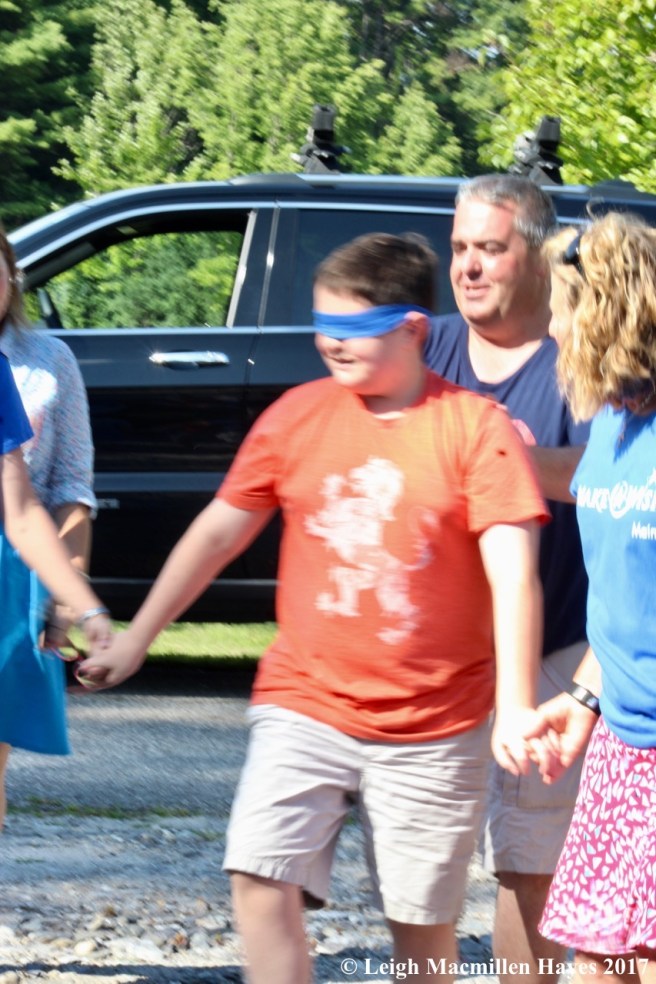
Bill had blindfolded Kyan (and we later learned that Ky was sure his father had used old underwear to do such), and guided him forward where two Make-a-Wish folks quietly took Kyan’s hands.

k-removing the blindfold

A minute later they told him he could remove the blindfold. And his awe began.

k-kyan reacting

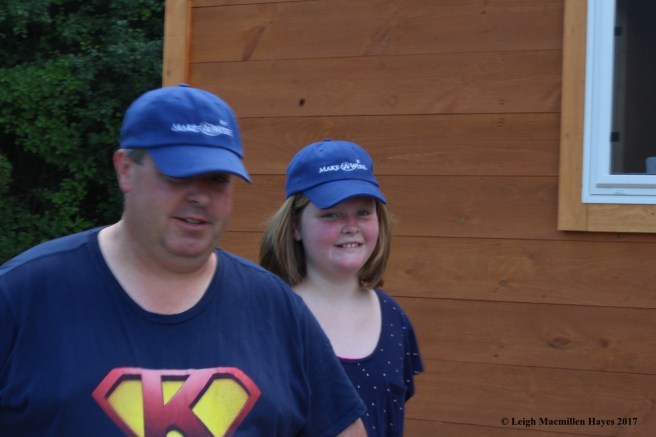
Kyan’s not the kind of kid who’s going to jump up and down. But to say he was thrilled and overwhelmed would be an understatement. And by his father’s T-shirt, can you tell who the superhero is?

k-ky entering

At last Ky entered his new digs.

k-ky from new bed

And peeked out from the loft.

k-ky interview prep

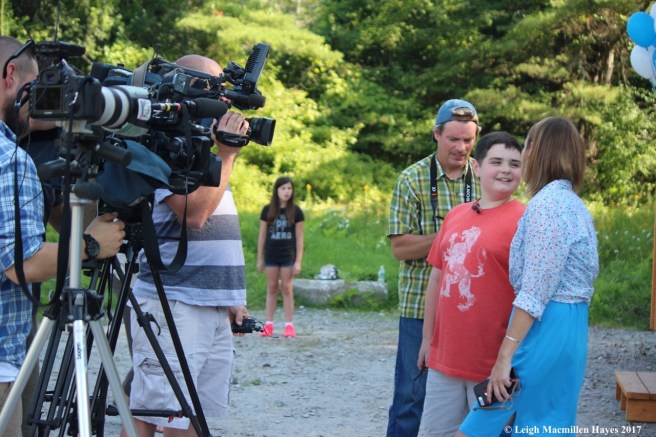
After he’d walked in and out and in again and up and down the two sets of stairs a few times, and around the back, the news teams stepped up–eager for an interview.

k-ky interview 1a

With a smile that never left his face, he answered a myriad of questions.

k-camera crew

For a kid who doesn’t like to be the center of attention, all eyes were focused . . . on him.

k-ky interview 2

All the while, he kept looking back at his “kabin.”

k-ky interview 1

He never once wavered in a response and the smile never left his face.

k-kyan interview 3

But his eyes–oh were they focused.

k-binaca interview 5

His mom was also interviewed and in her usual and beautifully reflective manner recalled the past year and a half.

k-Binaca's look

Sometimes the emotion of the day shown through.

k-binaca interview 1

But the strength of her character and thankfulness for all blessings flowed through her being.

k-binaca interview 4

As her interview continued, Kyan chatted briefly with his dad and then I noticed that he and his sister and his friend and her friend bee-lined into their home. I suspect they were on a mission to find stuff to make the kabin their own.

k-the house awaits

Kyan’s Kabin.

k-wish team 2

The Make-a-Wish Maine crew with Kyan and family.

k-ssf 2

The Sustainable Forestry Initiative crew, Kyan, family and friends.

k-bill showing his thanks

Hugs . . .

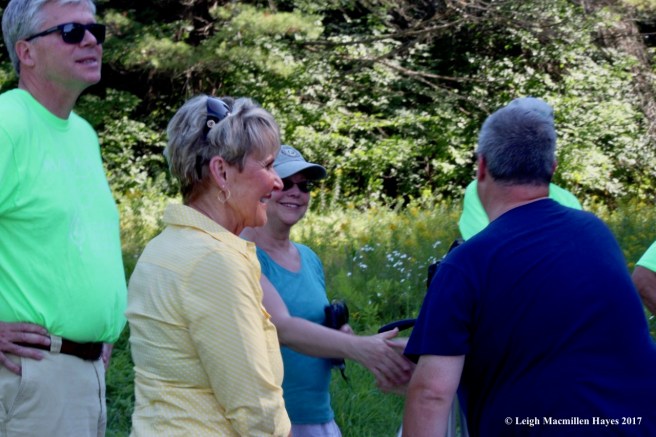
k-bill thanking everyone

and handshakes.

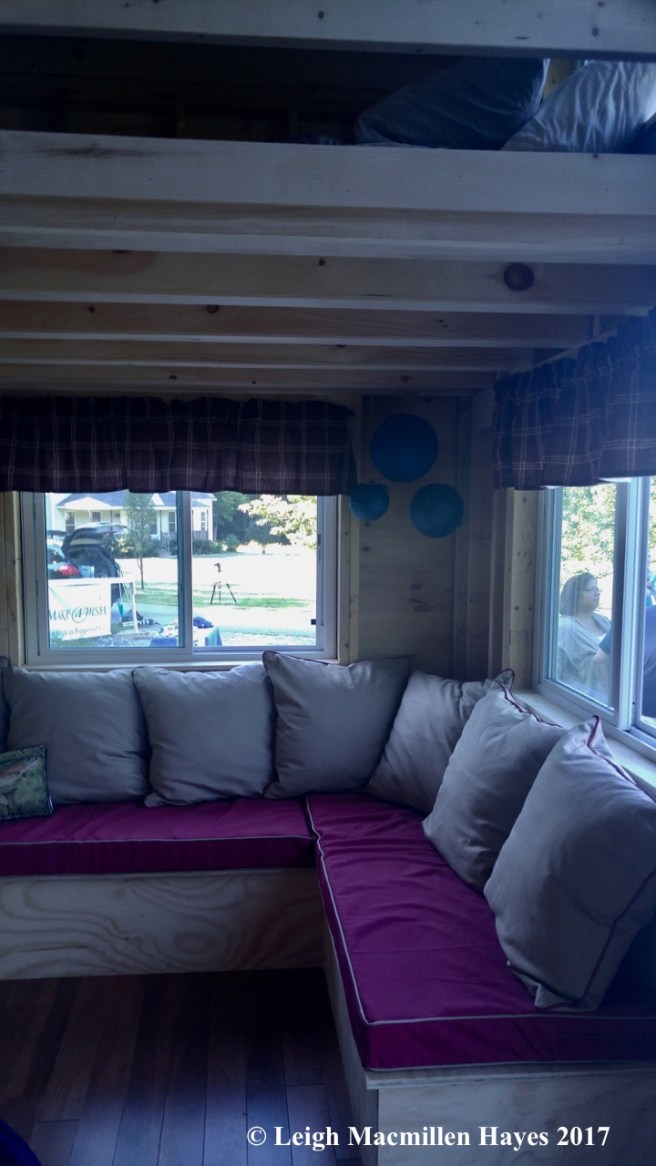
k8-couch and bunk above (1)

And a quick peek inside, where a sitting area awaits,

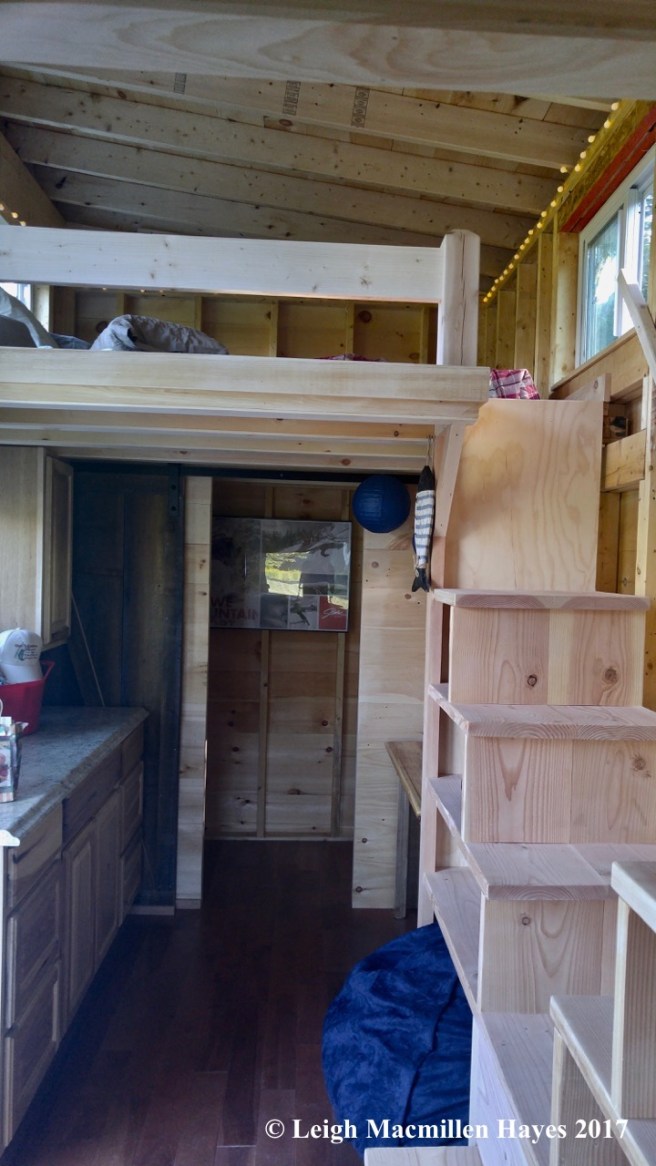
k6-stairway (1)

two sets of stairs lead to two lofts,

k3-Quinn's bed? (1)

and I suspect his sister has claimed one,

k4-Ky's bed and doggy bed (1)

while the other is for him and his dog. (Actually, I’m thinking that when he’s in school, maybe I can meet his mom there–don’t tell. We can start our own klub.)

k-make a wish sign 1

As of August 17, Kyan will be one year into remission.

k-balloons

Certainly a reason to celebrate. And I think I know where Ky’s sleeping tonight.

Porch Rockers

For my guy, written for the occasion of our 27th wedding anniversary, which was yesterday.

porch rockers

Porch Rockers

Side by side
they sit
on the porch at camp,
reflecting a life shared.
At once
worn and tattered
with scuffed floor below,
but still a comfortable place
in a heavenly spot,
just right
for morning breakfast
and an occasional crossword puzzle,
evening repose
and our days’ story.
They provide a view
on the world beyond
where loons call,
eagles soar,
chipmunks gather,
stars glimmer,
and we watch.
Sometimes we rock in silence
or converse about issues.
A table between
holds our cups and food
and books and newspapers,
giving us space
to be our own selves
while pulling us together
with the loads we carry.
Each piece of cane
and all four armrests
know us intimately,
having heard
our joys and concerns.
And still
they invite us
in the light of the day
and the dark of the night
and provide support
as we grow old together.
These are our porch rockers
and we are theirs—
forever.

Book of August: Mosses, Liverworts and Hornworts

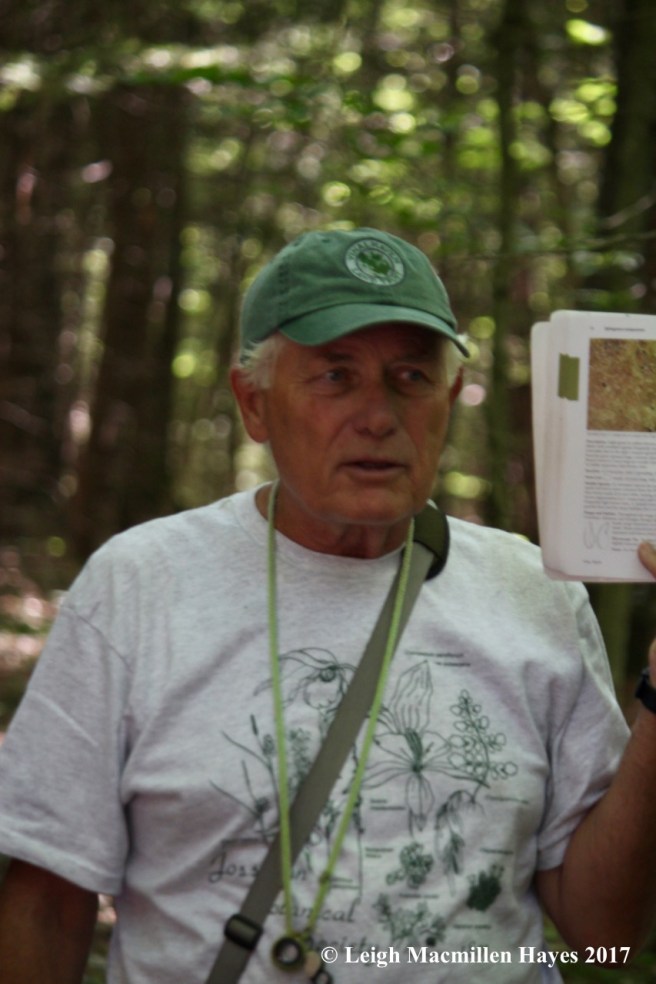
Last winter when I scheduled a talk/walk on lichens and another on mosses for this summer, I wasn’t sure what the public response would be, and so it was a pleasant surprise that both were well received. While Maine Master Naturalist Jeff Pengel spoke to us and then led us down the trail taking a close-up look at lichens in July, Ralph Pope introduced many to mosses for the first time on August 1. And then he took us only part way down a trail on August 2, for there were samples everywhere–both at our feet and sometimes even eye level.

m-mosses book

Ralph is the author of Mosses, Liverworts and Hornworts: A Field Guide to Common Bryophytes of the Northeast. He began thinking about writing such a guide while teaching a course on bryophyte identification at Antioch University New England. “I realized that the available resources were not inviting for a beginning student,” says Ralph.

His book begins with a description of bryophyte biology, taxonomy and ecology for those who are interested. As he states on page 11, “Mosses, hornworts, and liverworts, the three groups making up the bryophytes, evolved from the aquatic ancestors of modern green algae and represent the beginnings of terrestrial plant life, eventually giving rise to our amazingly diverse array of vascular plants.” Beyond words. Beyond our world.

I’ve used another guide, but this one seems so much easier to follow for Pope has formatted it into divisions that make sense to my brain–Spagnaceae: peat mosses; Acrocarpous: (acro-high; carpous-fruit) upright-growing mosses with fruits on the top; Pleurocarpous: (pleuro-side; carpous-fruit) mat-forming mosses with fruits extended on side branches; Liverworts (body of plant flat-thalloid; leaves in two rows-leafy) and Hornworts (uncommon–in fact, I’ve yet to meet one). These are in color-coded sections, making the process even easier.

And while each section begins with a key, for those who don’t like such things, there is a description of preferred habitat, family characteristics and then the species presented in alphabetical order (think Latin, for as Ralph pointed out, we’ve been spoiled by common names for birds and think that everything should have such, but for some species there are several common names, thus making it difficult to know for sure across the globe that we are talking about the same species.–Guess I need to get my Latin on) and illustrated with fabulous photographs.

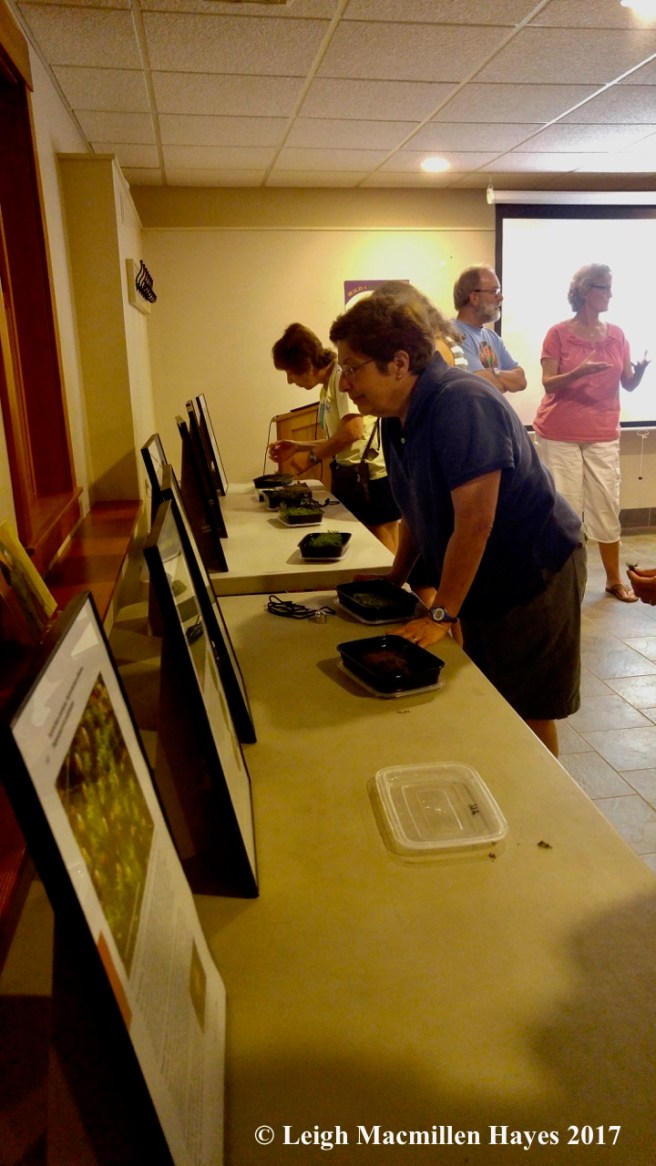
m-looking at samples

With a few slides, Ralph introduced the audience to bryophytes, which are the most primitive of plants having no roots, no flowers, and no woody structure. They are usually green (as opposed to the gray-green hues of lichens), translucent as they are only one cell thick, and often have spore capsules that last a long time.

m-studying examples

After the talk, he encouraged the audience to take a closer look at species gathered that day along the Westways Trail at the Greater Lovell Land Trust’s Heald and Bradley Ponds Reserve.

lm-checking out the field guide

Behind each species an enlarged poster of the related page from his book included a description, similar species, range and habitat, and meaning of names or tips for identification.

lm-large group

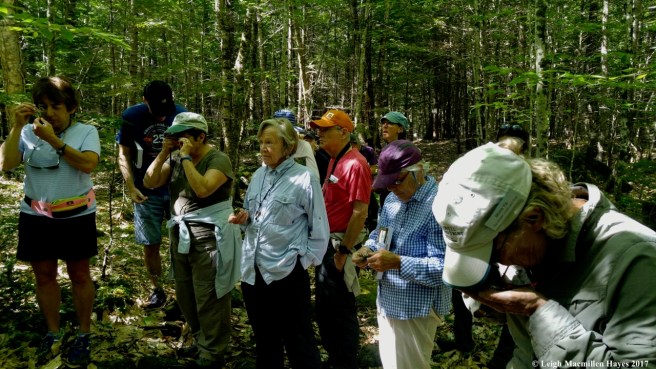
A crowd of 25 spanning ages 5 to 25 a few times over, stepped onto the Westways Trail with Ralph the next morning.

lm-listening to Ralph

His combined knowledge and humor kept us all enraptured with the world below our feet. To get a sense of Ralph’s voice is this sample from page 7, “Remember the old adage that if you happen to lose your compass, your iPhone, your GPS, your ability to see the sun, and your sense of direction, moss growth will show you the north side of a tree? Well, keep the compass handy, but the north side of a tree trunk does indeed get less desiccating sunlight than the rest of the tree trunk, so it just might have more moss growth. Score one for the Boy Scouts.”

m-big red stem 1

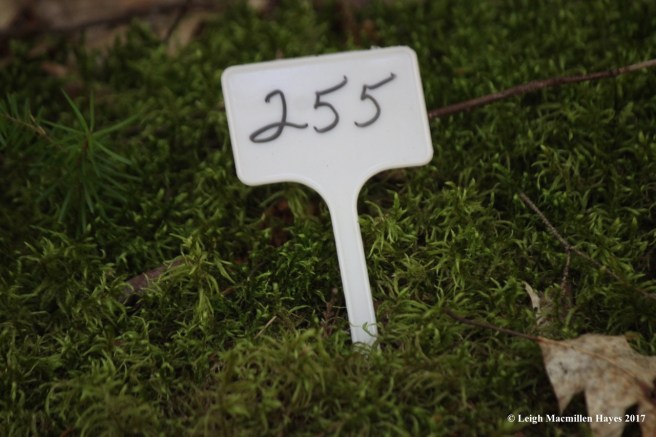
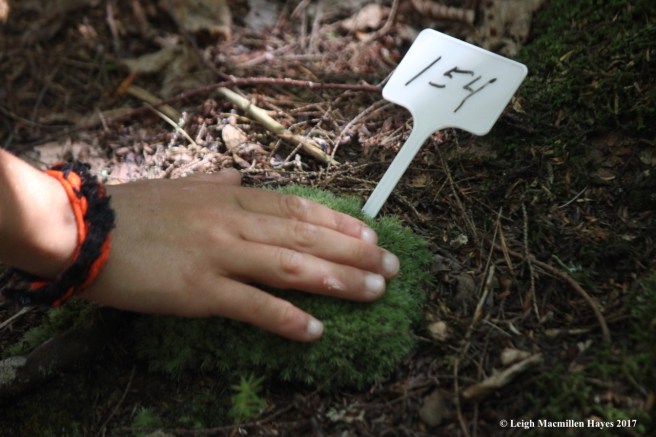
On moss-topped rocks, Ralph and his wife, Jean, had marked species to be sure to stop at for our edification. The number referred to the page in the book and for those who didn’t have their own copy, he had loaners. In this case, 255 is Pleurozium schreberi or Big Red Stem.

m-big red 2

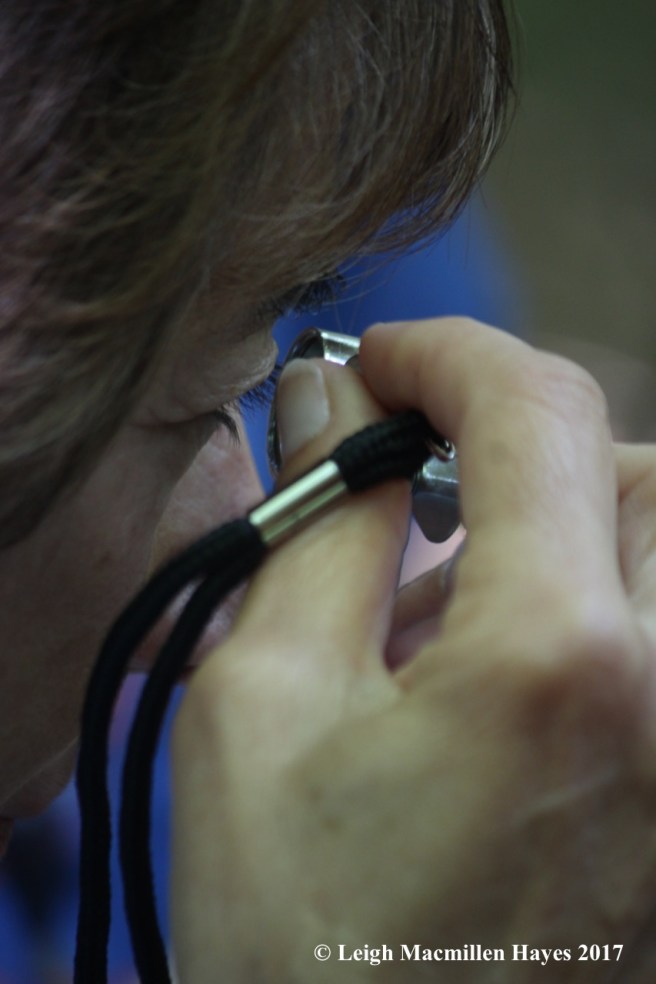
He picked samples so we could each take a closer look and see the reason for the name–notice that red stem? Because most bryophytes cells are totipotent–thus they have the ability to grow into a new plant, trampling them or even breaking some off can lead to new growth, so he was happy to pass small samples around.

m-close up

We looked . . .

m1-Aidan

and looked . . .

m-another close up

and looked . . .

m-Caleb

some more.

m-Wes

Of course, sometimes we just had to take a break. Oh to be five again!

m-sphagnum

Our samples included Sphagnum pylaesii, with its pompom head,

m-cushion

an acrocarp–Leucobryum glaucum, or pincushion moss,

m-calliergon 221

the pleurocarp, Calliergon cordifloium, 

m-porella 343

and the liverwort, Porella platyphylloidea. 

m-do you see what I see?

For a couple of hours, we were all thoroughly enchanted . . .

m-Ralph

as we focused our intention on these miniature plants and this man–who opened our eyes.

m-weasel scat

Only once did our attention get diverted–for some weasel scat. Thanks to intern Kelley’s keen eyes, a few of us saw the weasel scampering about thirty feet ahead. Still . . . notice where the weasel chose to make its contribution–on a rock covered in moss in the middle of the trail.

This book was a Christmas present from my guy and I look forward to many more days spent sitting on a rock getting to know my surroundings better.

Mosses, Liverworts and Hornworts: A Field Guide to Common Bryophytes of the Northeast, Ralph Pope, Cornell University Press, 2016.


Lake Living Celebrates 20th Anniversary: summer 2017

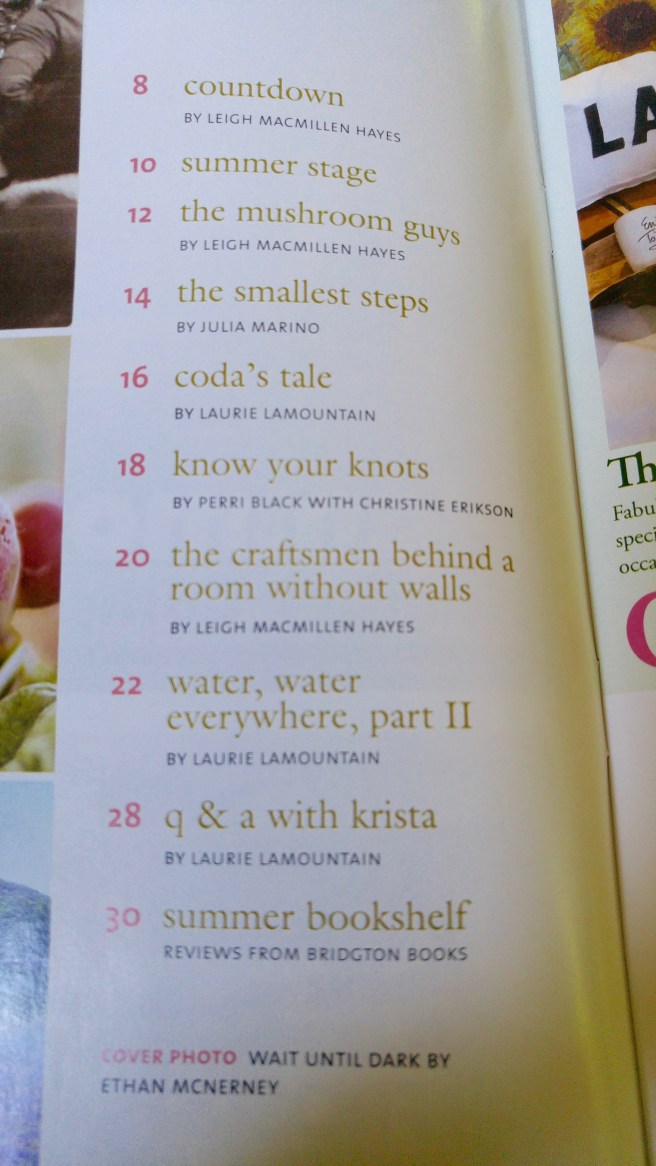
The summer issue of Lake Living is out–and it’s a celebration of the magazine’s 20th anniversary! I’ve had the pleasure of being involved as a writer, copy editor, proofreader and photographer since 2006–or maybe it was 2005. Doesn’t matter how long–every issue has been better than the last and I’ve meet so many interesting people along the way. Congrats to Laurie LaMountain for sticking with it for the past 20 and here’s to 20 more great years of publishing this fine mag.

My contributions for this one include Custom Fit about a collaboration between Lakes Environmental Association and Great Northern Docks, Food for Thought about a used book store in Norway, Maine, and the summer calendar–featuring so many great things to do.

Pour a glass of lemonade and enjoy:

Wondering About My Feet

A fresh layer of snow makes my heart sing and I can’t resist any opportunity to look at footprints left behind by those who travel through it.

l-fox-path

And so early this morning I followed the trail of a fox who had walked in a straight line for the most part, with a wee diversion here and there, perhaps to sniff out possibilities.

l-logging-road

While the fox’s path continued northward, I decided to turn at the logging road and headed west, curious as to what stories might unfold.

l-indian-tobacco-5

It was the papery calyx of Indian Tobacco to which my eye was next drawn. Its winter manifestation, both delicate and light, offered an ethereal image in a global manner.

l-indian-tobacco-and-coyote-pee

Often a solitary plant, I found it scattered along the path. And then, at one particular spot, I noticed something more than just its form and stature.

l-coyote-play-2

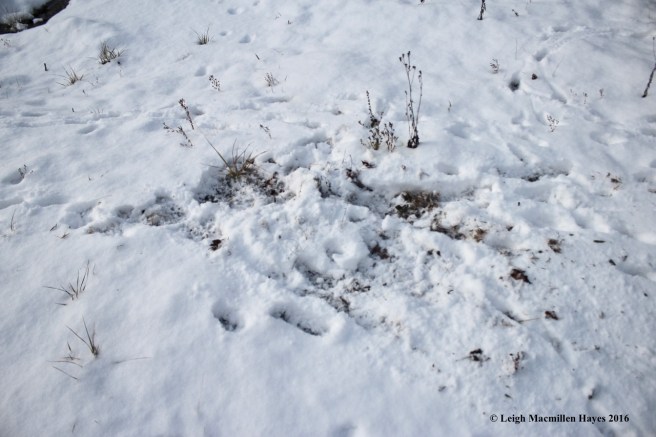
This was the sight of coyote play. Several coyotes at play, in fact.

l-coyote-pee-2


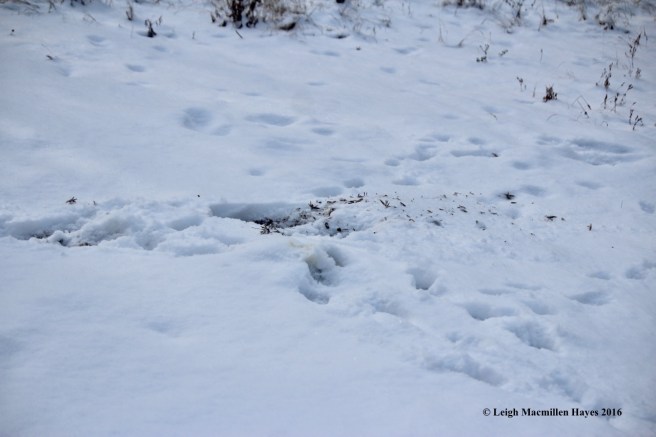
And one, or maybe more than one, had peed on the Indian Tobacco. Curiously, Lobelia inflata, as it is known, is a poisonous annual–maybe the coyotes knew that. Or maybe it was just the right spot for one to claim familial rights.

l-log-landing

I’d arrived at the  log landing, that staging place to which logs are hauled, trimmed and loaded onto timber trucks. It’s also the perfect stage for all who dance in the night. In this case, I noted the tracks of at least four coyotes, presumably a family clan, who’d zigged and zagged as they crossed the landing.

l-coyote-trails-split

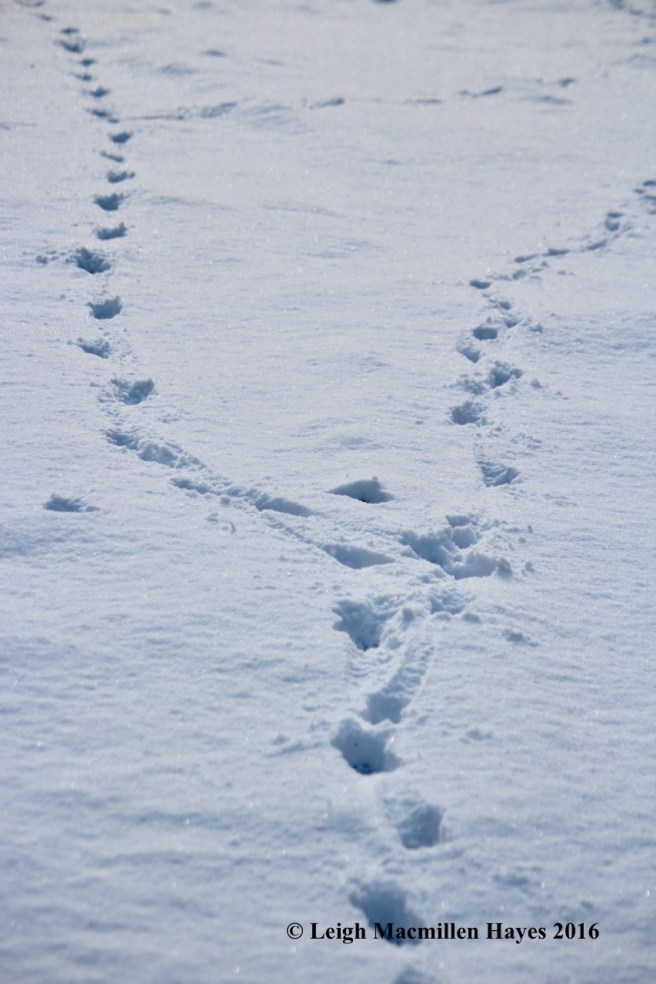
Sometimes they’d followed each other and then split apart.

l-coyote-play-3

But over and over again, they came together, perhaps to play. And maybe it was also a rehearsal for future hunts, practicing yet again how to circle prey.

l-moose-prints

I turned around at this point, and as I headed back, I suddenly realized a moose had passed, though earlier than the coyote clan.

l-snowshoe-hare-1

And a snowshoe hare had also bounded through the scene previously.

l-ruffed-grouse-prints

More in tune with the coyotes’ time frame, a ruffed grouse had left tracks, but I trust flew off without meeting its demise–yet.

l-carpenter-ant-2

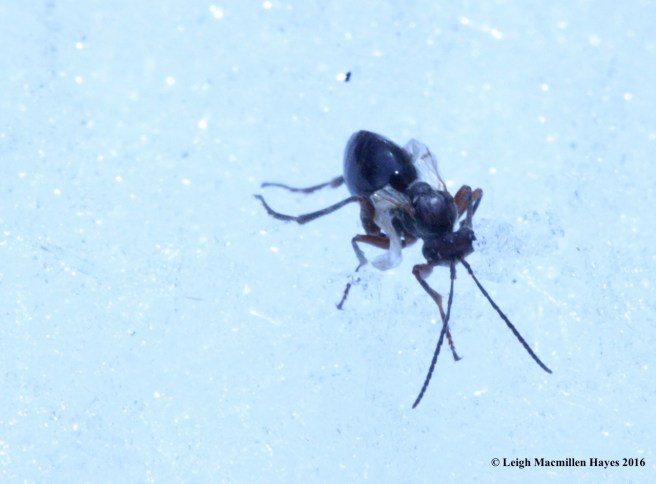
On my way back, with my eyes still drawn downward, I noticed other visitors. I suspect this was a carpenter ant.

l-carpenter-and-3

It was beside a rushing stream and its wings were folded. Had it taken a dip? It kept raising one leg at a time, as if uncertain of the snowy base upon which it walked.

l-snow-cutworm-4

l-snow-cutworm

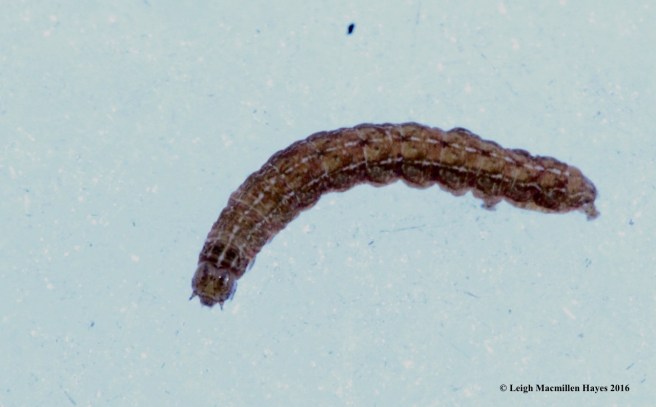
I found snow cutworms, the larval stage of a noctrid moth. They were less than an inch long, similar in size to a balsam fir needle and I’m not sure how I keyed into them, except that once I did, I noticed them again and again. How had I missed ever viewing these before, I wondered.

l-little-spider-and-boot

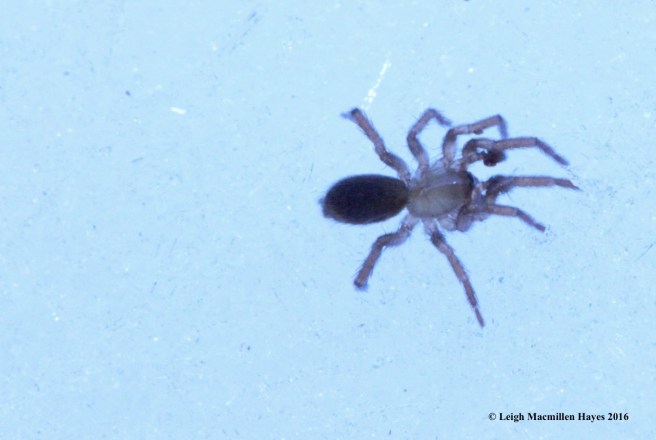
Also quite minute, a tiny spider that posed beside my boot.

l-small-spider

Its hairy body seemed to suit the situation.

l-big-spider-2

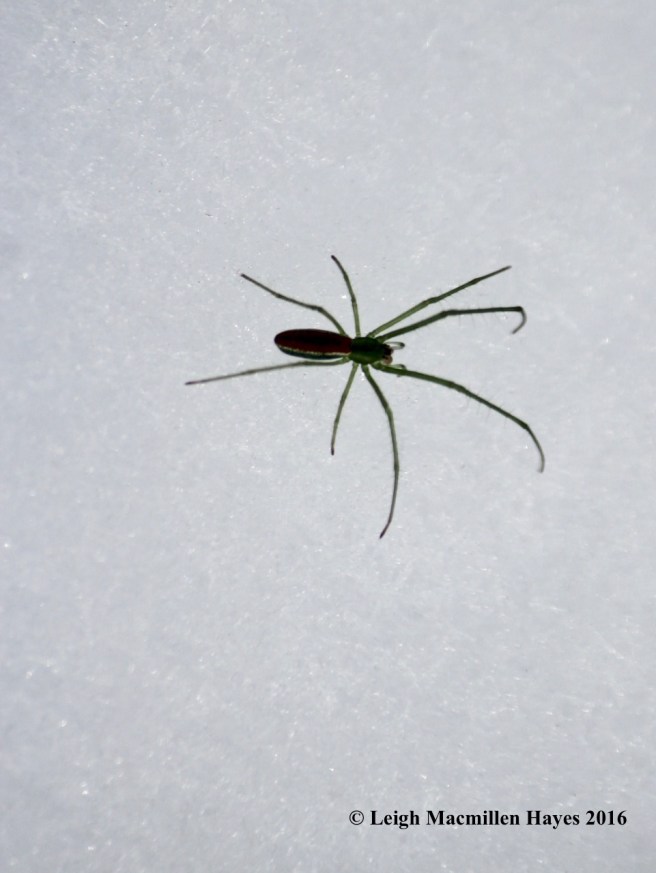
But my favorite find of all, a much larger spider . . .

l-big-spider-1

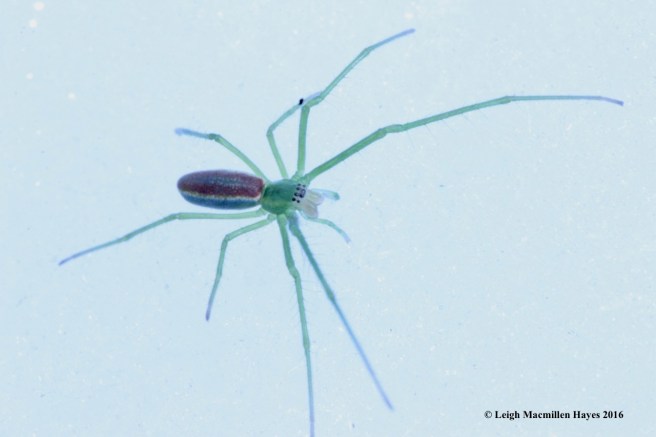
complete with a translucent green head and legs, made lighter by the flash of my camera. Why, oh why, did it cross the snow? Perhaps it was a fishing spider? If you know, do tell.

What I know is that it was beautiful, brought a smile to my face, made my heart sing and was the perfect culmination of all that I had wondered about at my feet.

(P.S. Fellow Master Naturalist Alan Seamans shared this with me: ” The beautiful green spider is Tetragnatha viridis, the green long-jawed orb weaver. The color of the abdomen is variable, sometimes with little red, other times with a lot of red like yours (doesn’t seem to be gender-related either). Normally their green color helps them camouflage amongst pine needles, their usual habitat, however it seems that they are frequently spotted in winter on snow for some reason! This species is common in the eastern US. Your specimen shows several i.d. characteristics: eight eyes in two sets of four parallel; long chelicerae (jaws), long legs with spines, and of course the beautiful green color. I will make a guess that it is a female because it lacks enlarged pedipalps? The genus is also called stretch spiders, ’cause that’s what they do! Stretch out those long legs so they look thin and blend in on pine needles and twigs.” Thank you, Alan.

And Rich Holschuh’s comment below.)


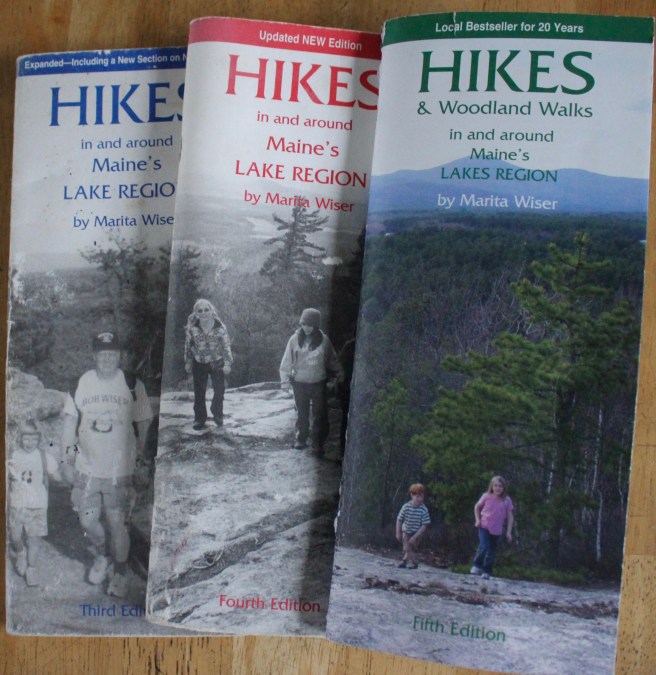
Book of October: HIKES & Woodland Walks in and around Maine’s LAKES REGION

Better late than never is the name of my game. And so it is that I’m finally posting the Book of October. Since I was away at the beginning of the month, I’ve been playing catch-up, but also, I had three different books I wanted to write about and couldn’t choose one. And then, the other day after hiking with my friend, Marita, and mentioning her book, I realized when I tried to provide a link from my Book of the Month posts that though I’ve mentioned the book several times, I’ve never actually written about it. And so, without further ado . . .

m-cover

the Book of October is HIKES & Woodland Walks in and around Maine’s LAKES REGION by Marita Wiser.

Of course, since we’ve been friends for a long time and I’ve served as editor on several editions of the book, I suppose you might deem my review as being biased. It is.

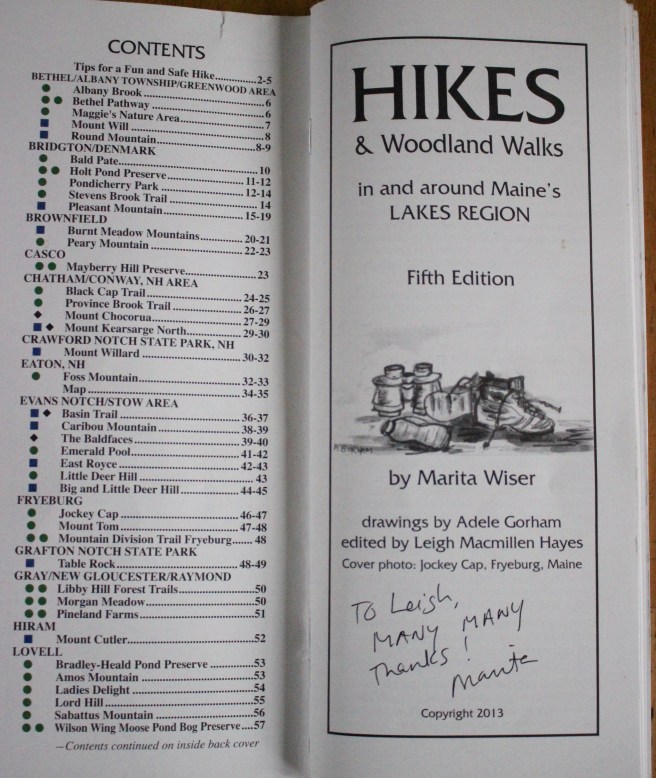
m-table-of-contents

And if you find the typo that has survived several editions, I might give you an extra candy bar for Halloween. Just remember, only God is perfect.

As you can see from the table of contents, trail descriptions are organized based on location and she ranks the difficulty, making it easy for the user to make a decision about which trail to hike. Do you see the blue box on Mount Cutler in Hiram? I actually had a brain freeze there and couldn’t put mind over matter and get to the summit. I was stuck in one spot for at least a half hour before feeling a slight bit of bravery and making my way down. I laugh at that now because I’ve completed all the black diamonds except for Chocorua–guess that needs to go on my list. Of course, my guy and I did have a heck of a time descending one trail on the Baldfaces, but we survived and have a story to tell.

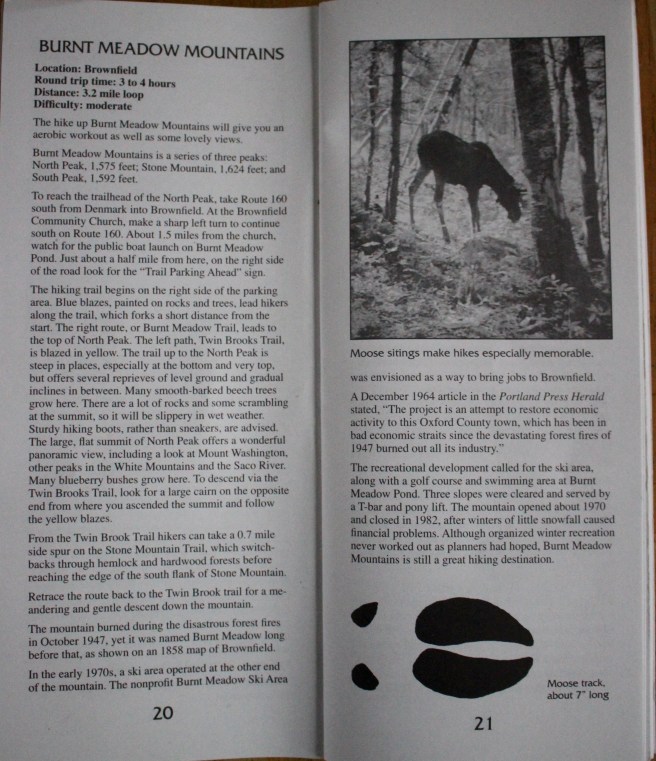
m-burnt-meadow

The trail descriptions include directions, distances, time allotment, difficulty and often history. I think knowing the history of the place is extremely valuable so you can better understand the features around you.

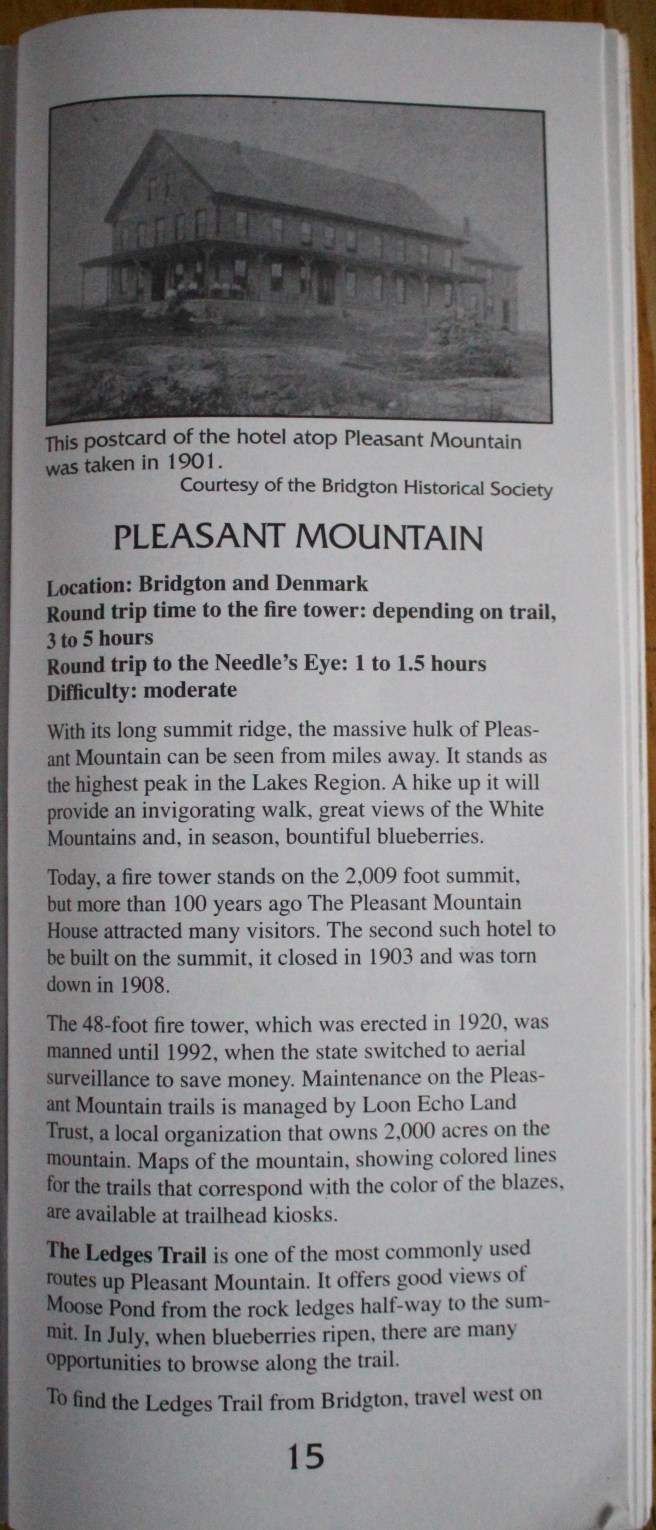
m-pleasant-1

For one of the local favorites, Pleasant Mountain, she includes five pages to describe the various trails and even includes an old photograph of the Pleasant Mountain Hotel. Standing at the summit, I often imagine the horses and carriages that carried visitors up the Firewardens trail, that is after they’d arrived by Steamboat, having followed the Cumberland and Oxford Canal from Portland to Harrison. Their journey makes any hike we take seem so easy. Well, maybe not, but still.

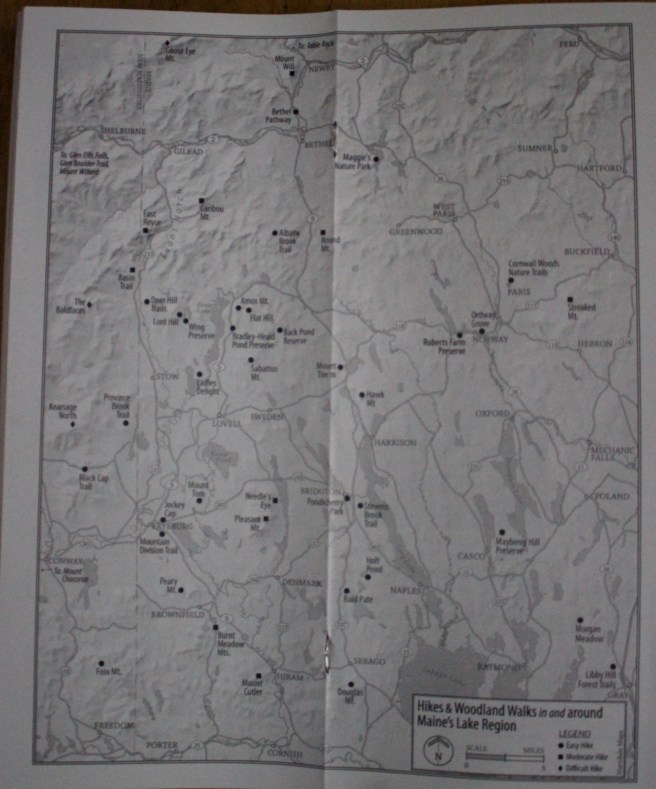
m-center-map

The centerfold provides an overview of all the areas Marita writes about.

m-other-activities

And while she begins the book with a variety of hiking tips about everything from water, food, trash and clothing to ticks, hunting and trail markings, she ends with a scavenger hunt and information on how to reorder the book.

m-covers

With time comes change and her covers reflect such. Marita started this project when she wrote a hiking column for The Bridgton News years ago.

The beauty of her book is that she actually goes out and explores all of the trails over and over again, and in each edition she provides updated descriptions. She also adds and deletes trails, so even if you have an older version, you might want to purchase the current copy.

m-marita-and-me-1

I’m thankful for the book and my friendship with Marita. And glad that I often get to join her on a reconnaissance mission. (We also co-host the rest stop at the teepee on the Southwest Ridge Trail of Pleasant Mountain each September for Loon Echo Land Trust’s Hike ‘n Bike fundraiser before we traverse the ridgeline to the summit of Shawnee Peak Ski Area–thus our southern-themed headwear.)

This Book of October is a must have if you live in or plan to visit the Greater Bridgton Lakes Region area. And it’s available at many local shops, including Bridgton Books.

HIKES & Woodland Walks in and Around Maine’s LAKES REGION, fifth edition, by Marita Wiser, © 2013.


To Overlook and Be-yond

This afternoon I pulled into the parking lot at Bald Pate Preserve and heard my phone ring. I’ve never quite mastered the art of the swipe to answer and so as usual missed responding immediately. But . . . I put the car into park, or so I thought, and then tried to return the call to our youngest in Colorado. As I dialed, or rather, pushed the phone icon and listened to it dial and ring, I heard the phone ringing in another part of the truck. What in the world? A ventriloquist phone? And then I opened the cubby between the front seats and discovered my husband’s phone. And saw that our youngest was trying to reach him. Meanwhile, I felt like I was in motion. Because I was. The truck was in neutral rather than park and I was almost to the middle of the parking lot before I applied the brake. Somehow, I managed to make the call. After we chatted for a few minutes, with concern and wisdom, he asked, “Mom, are you hiking alone? Should you be?” “Yes,” I responded. “I’ll be fine. There are other cars here so I’m sure I’ll see people.” To be honest, though, I hoped I wouldn’t. This was one day when I needed to just be.

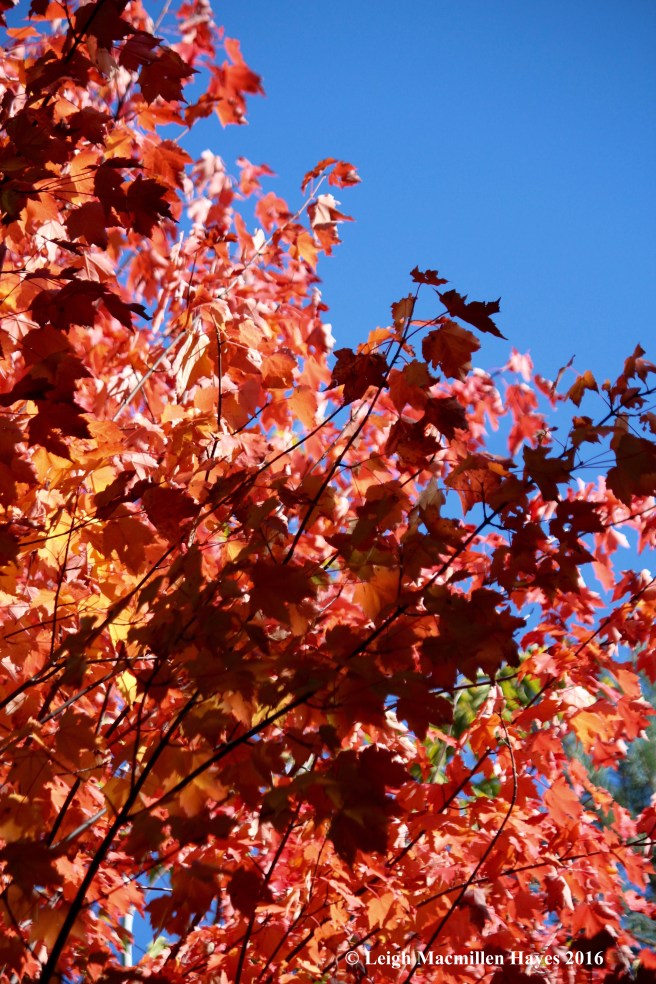
b-red-maples-against-sky

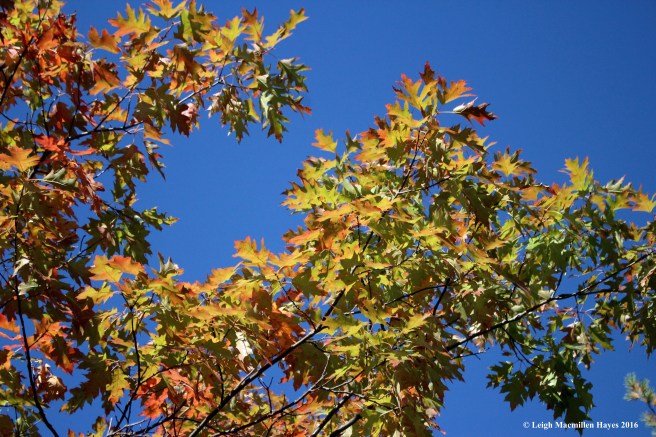
I needed to wander among the red maples

b-red-oaks-against-sky

and red oaks that graced the sky.

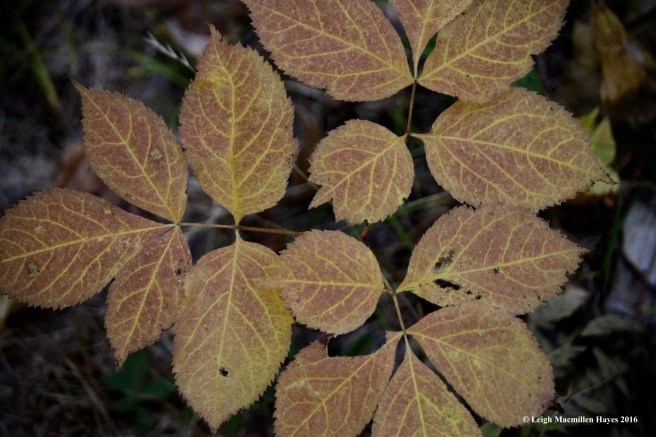
b-sarsaparilla

I needed to embrace the subtle coloration of sarsaparilla

b-blueberries-1

and vibrant hues of blueberries.

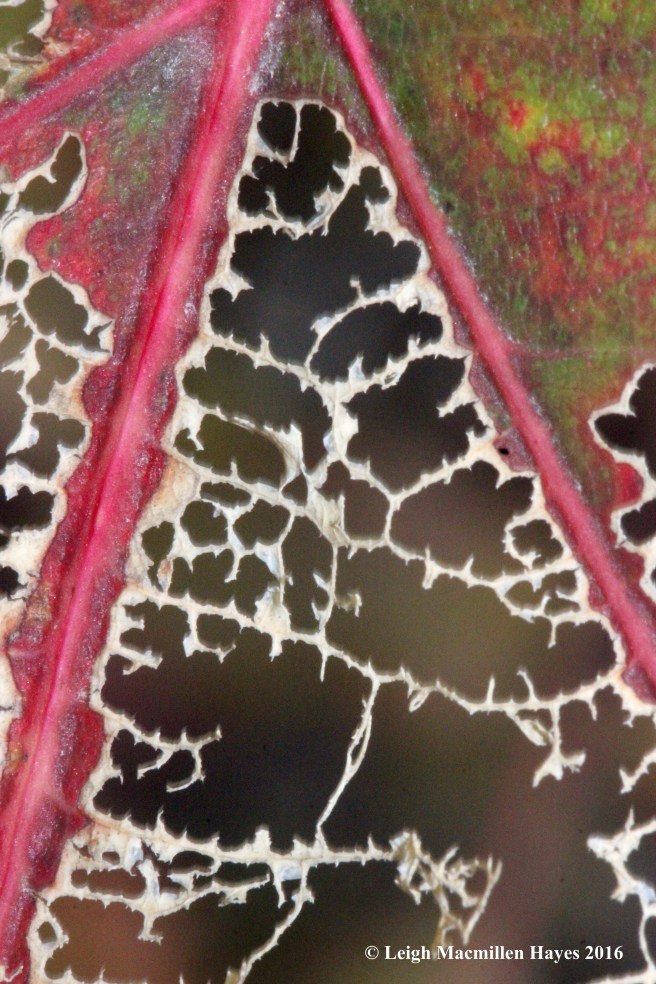
b-red-maple-1

I needed to admire the veins that bring nourishment to trees

b-red-oak-veins

and all that live therein.

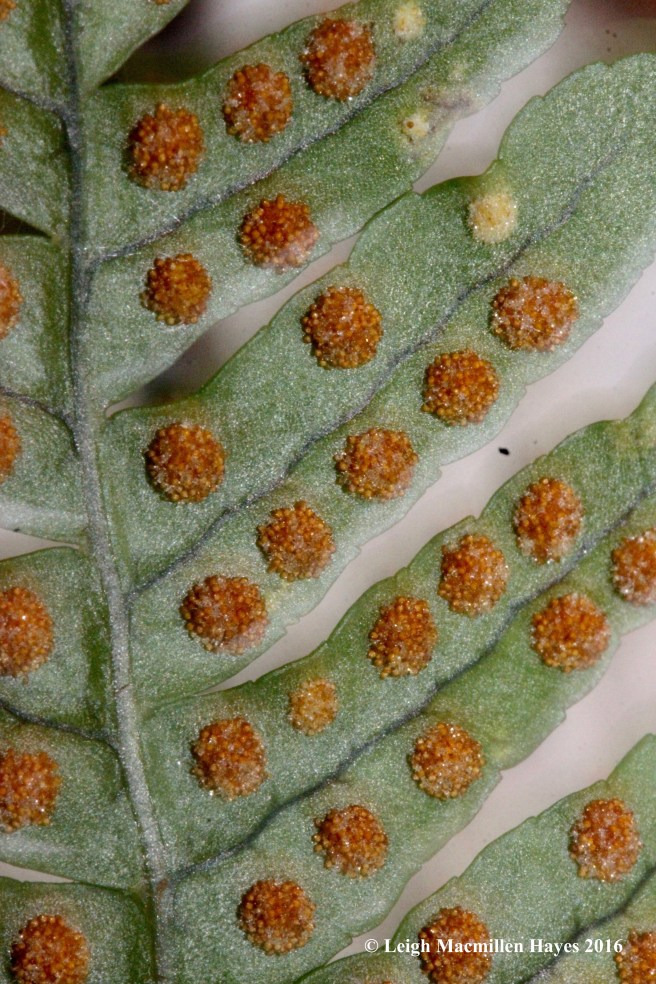
b-polypody-spores

I needed to observe life giving forces

b-winter-green

and the differences among kin.

b-foster-pond

I needed to pause at each overlook

b-peabody-pond

where the view offered up life’s changes.

b-hancock-pond

I needed to say farewell

b-white-mountains

as I looked toward the beyond.

b-trees

For you, Brother Bill, I needed to walk the trails today and lift up your  life which ended unexpectedly this morning. I trust that you’ll be forever in my heart and going forth will travel with me as I wonder and wander. I trust you’ll watch over me and help me understand the great beyond. May you rest in peace, big brother.

An Emerald Mondate

My guy and I journeyed via bus, car and foot across northern and eastern Ireland these past two weeks. Our main agenda–a vacation in the land where twenty-six years and two months ago we celebrated our honeymoon. We both also had semi-hidden agendas–his to seek out ancestral roots, mine to search as well, though my quest wasn’t quite so clear.

river-liffey-and-quay-dublin

Our journey began after we dumped our bags at the hotel, where our room wasn’t yet ready, and crossed the River Liffey in Dublin. It was to the right that we’d parked a rental car 26 years previously as we searched for traditional music and supper, only to return hours later and discover that the driver’s side window had been smashed and our video camera stolen. All these years I’ve held a sour view of the Fair City and so I felt a bit nervous as we stepped forth.
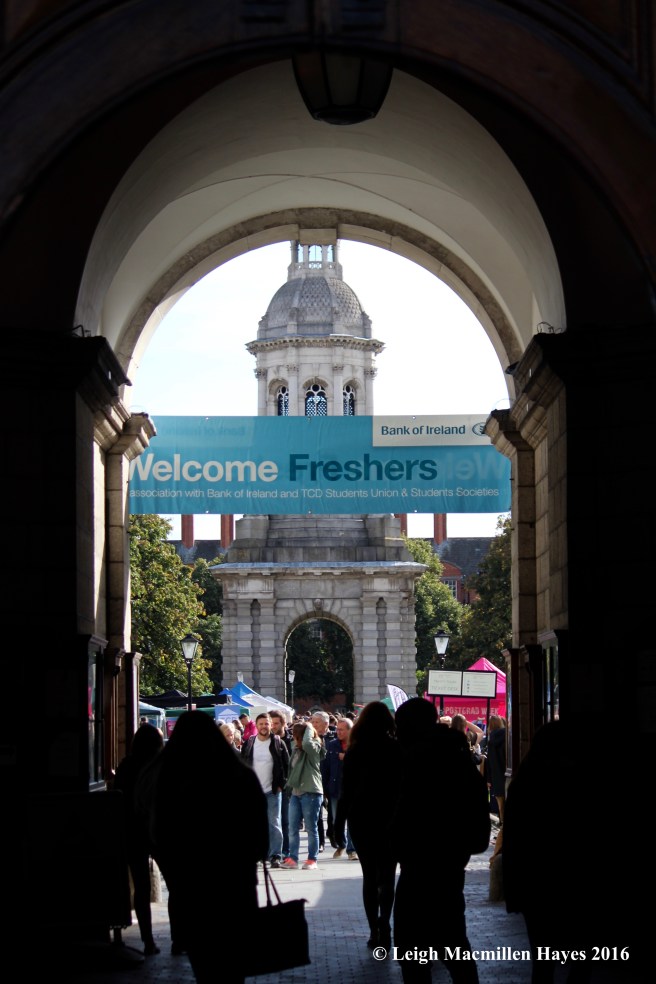
trinity-college-dublin

The feeling began to wane immediately, for as we approached a street corner and chatted about locating the library, a Dubliner overheard us and assumed we were looking for Trinity College (founded in 1592). We decided to play along and followed his directions–thankfully. It was “Welcome Freshers” week and the quad swelled with activity tents, music and students anticipating the year ahead. We passed among the frivolity and found the self-guided tour of the 18th century Old Library and that most ancient of manuscripts–the Book of Kells, a 9th century book featuring a richly decorated copy of the four Gospels of the life of Jesus Christ. A favorite discovery: the monks used oak apple galls to create ink–apparently, they crushed the galls and soaked them in rainwater, wine or beer until they softened. I’ve got to try this.

library-at-book-of-kells-1-1

While (or whilst as the Irish say) no photos were allowed in the Treasury where the manuscripts are stored, equally impressive was the Long Room, which houses 200,000 of the library’s oldest books in ancient oak bookcases. Just thinking about the centuries we were encountering was mind boggling, enhanced of course, by a lack of sleep.

architecture-and-flowers-dublindublin-church-architecture

A few hours later, we made our way back to the hotel, enjoying the architecture and flowers as we walked along. At last, we could check in and so we checked out–a rejuvenating nap essential to our well being.

guiness-sign-and-face

Rested and showered, we hopped aboard a bus–our next destination, the Guinness Storehouse at St. James Gate Brewery. The 250-year story of Guinness® is portrayed on five floors in a building designed in the shape of a pint. What’s not to like about that.

singing-oyster-guiness

We learned about the process of creating beer, and then there was the whistling oyster, one of the many icons of the Guinness® brand.
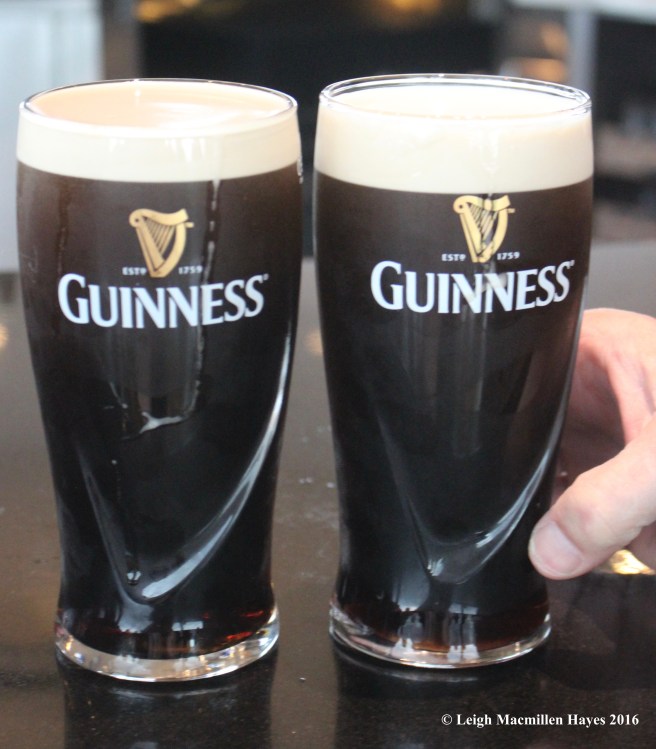
guinness-gravity-bar

After taking in the full story, we reached the Gravity Bar, where ticket holders may each sip a complimentary foam-topped pint. The museum was preparing to close and the bartenders made the last call. My guy asked if we could purchase a second pint and we learned that they don’t sell any, but he kindly slipped us two. Don’t tell.

guiness-view-2

The Gravity Bar offers 360˚ views of the city.
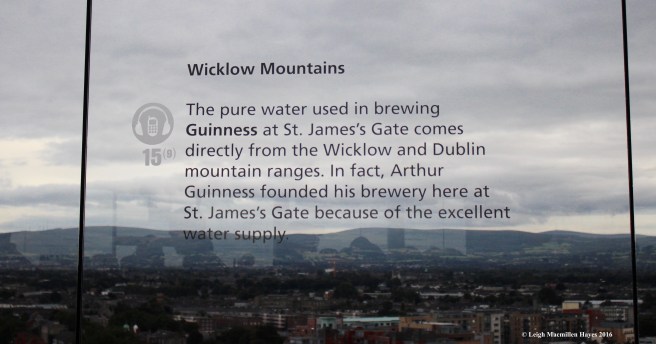
wicklow-mtns-from-gravity

And the view includes the Wicklow Mountains, our intended destination for week 2.

the-temple-bar

If you hear my guy tell this story, he’ll say that we were told it was a 45 minute walk from our hotel to the Storehouse, but a short bus ride. We rode the bus there, but later weren’t sure where we should queue for the ride back, so we decided to walk instead. According to him, it took us five hours to make that 45 minute walk. I’m not sure it was quite that long, but we did stop at The Temple Bar for the music and a few other prime spots to eat and sip a wee bit more.

national-library-dublin

The next morning we set out for the National Library, which had actually been our intended destination the previous day–but who can deny enjoying the Book of Kells exhibit. My guy was hopeful that the genealogists at the library would help him make some connections, but without knowing parishes he hit a bit of a stonewall.

And so we left the Fair City with much fonder memories, took a bus to the airport, picked up our rental car, and ventured on. Oy vey. If you’ve ever watched the BBC program, “Keeping Up Appearances,” you’ll appreciate that I was Hyacinth to my guy’s Richard. “Mind the pedestrian,” I’d say. “I’m minding the pedestrian,” he’d respond.
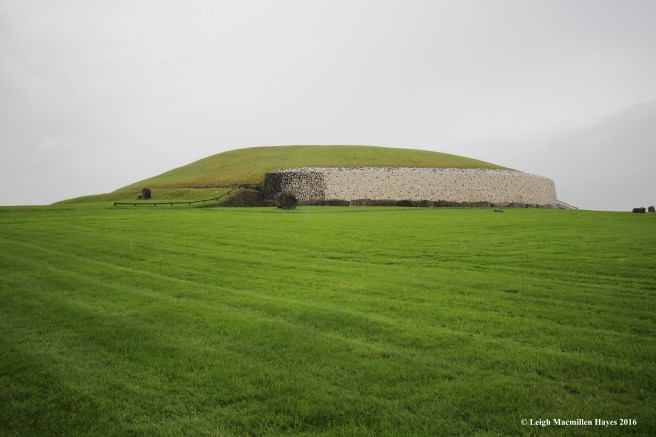
newgrange

Our first stop, Newgrange, a Neolithic passage tomb alleged to be older than Stonehenge and the Great Pyramids. Constructed during the Stone Age, about 5,200 years ago, Newgrange is a large circular mound that covers 300 feet in diameter and stands 36 feet high. A stone passageway leads to three small chambers. Some describe it as an ancient temple, a place of astrological, spiritual and ceremonial importance. Our guide told us that bones were found here and it may have been a place for worship as well as where people were laid to rest. We were in awe of its structure and the fact that the passageway is oriented northward allowing the sun to illuminate it during the winter solstice.

newgrange-entrance

Yes, the railings are new, but this is possibly the oldest building in the world. That’s worth repeating–the oldest building in the world. We had to bend low to enter and then squeeze between the walls as we walked toward the center, where three small chambers with stone basins created a cross-like structural plan. Even as we stood with others in darkness and waited for a beam of artificial light to demonstrate the real thing, we couldn’t quite fathom what we were witnessing.
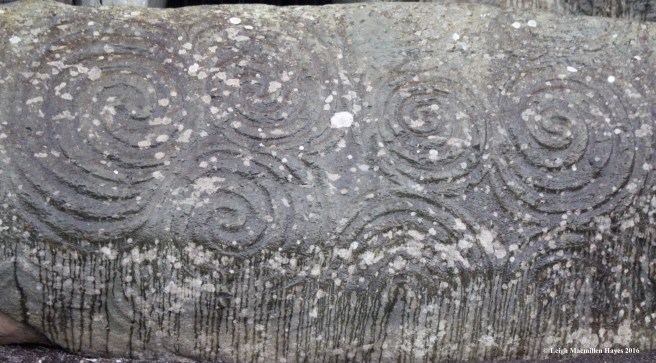
newgrange-spirals

Our awe continued within the center and by the entrance stone, where we witnessed megalithic art. The spirals reminded me of labyrinths, but we’ll never know their true significance. And that’s OK.
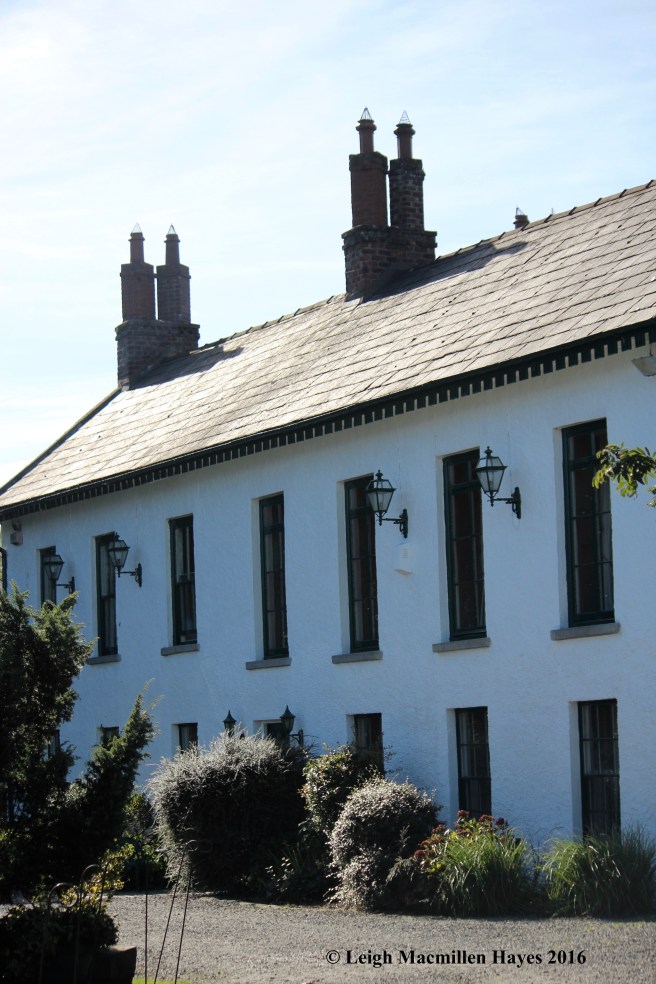
ghan-house-carlingford

By the time we arrived at Carlingford, it was pouring and we had no idea where to stay. We stopped at a hotel, which was full–thankfully. They suggested the Ghan House, a Georgian House set within three acres of walled gardens. It was our most posh stay and we didn’t truly appreciate it until the next morning when the sun shone brilliantly.
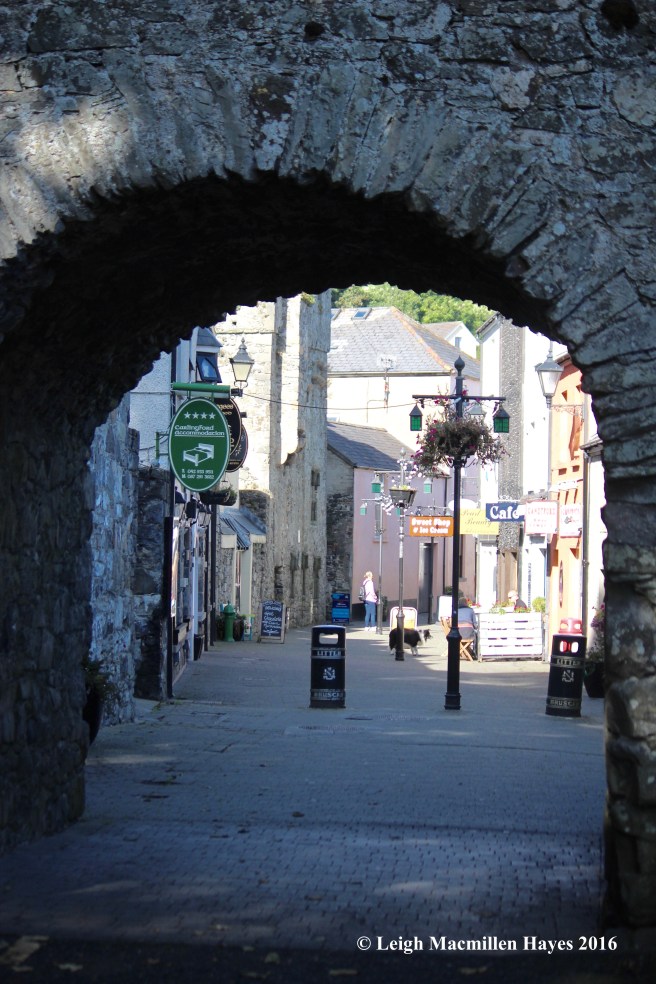
carl-arch-2

The Ghan House is located just a stone’s throw from the Thoisel or town gate leading into the narrow streets of the town centre, where we found Ma Baker’s in the rain, a welcoming pub frequented by the locals, who laughed and joked and reminded us that the Irish love to sip a pint, tease each other and tell stories no matter what the weather might be out the door. And they don’t care about spelling, punctuation or run-ons. Life is too short for that–note to self.

carlingford-lough1

The tide was low when we walked along the lough the next morning and took in King John’s Castle, which was initially constructed by Hugh De Lacy in 1190, though it wasn’t completed until 1261. Purportedly, King John, the brother of Richard the Lionhearted, visited in 1210, and thus the name for this Norman structure.

wall-around-derry

From Carlingford, we travelled north and did what we had wanted to do 26 years prior; we crossed into Northern Ireland. On our previous adventure, we’d journeyed as far as Letterkenny in the northern part of the Republic of Ireland, only a half hour from Derry. But that was then, the time of The Troubles, and we didn’t dare to cross the border. Again, my guy was seeking ancestors and at the Welcome Center he was told to visit the Tower Museum where Brian Mitchell would be able to provide some help. We were too late when we climbed down from the wall to the museum, so we did what the Irish would do–when in Rome–we found a pub and had a nice chat with a young man who had recently returned to Derry in search of work. We also walked around the city, taking in the sites made famous by The Troubles. And the following morning we again returned to the museum, where the curator told us that Brian would probably show up around 11am. So, we paid for a self-guided tour and learned about the town’s colorful and dramatic past through “The Story of Derry.” At 11:30 we once again went in search of Mr. Mitchell, only to learn that he was out and about somewhere. Since we needed to check out of our room, we decided that our Derry experience was over, but Mr. Mitchell did respond to an e-mail and so my guy has some more resources to consider.

carrick-cave

Our next stop, Portrush, a resort town along the Atlantic and on the northern fringe of Ireland. After checking in at the Antrim House B&B, we headed off along the Coastal Scenic Route to Carrick-a-Rede Island. Carrick-a-Rede is from the Scottish Gaelic term, Carriage-a-Rade, meaning the rock in the road.
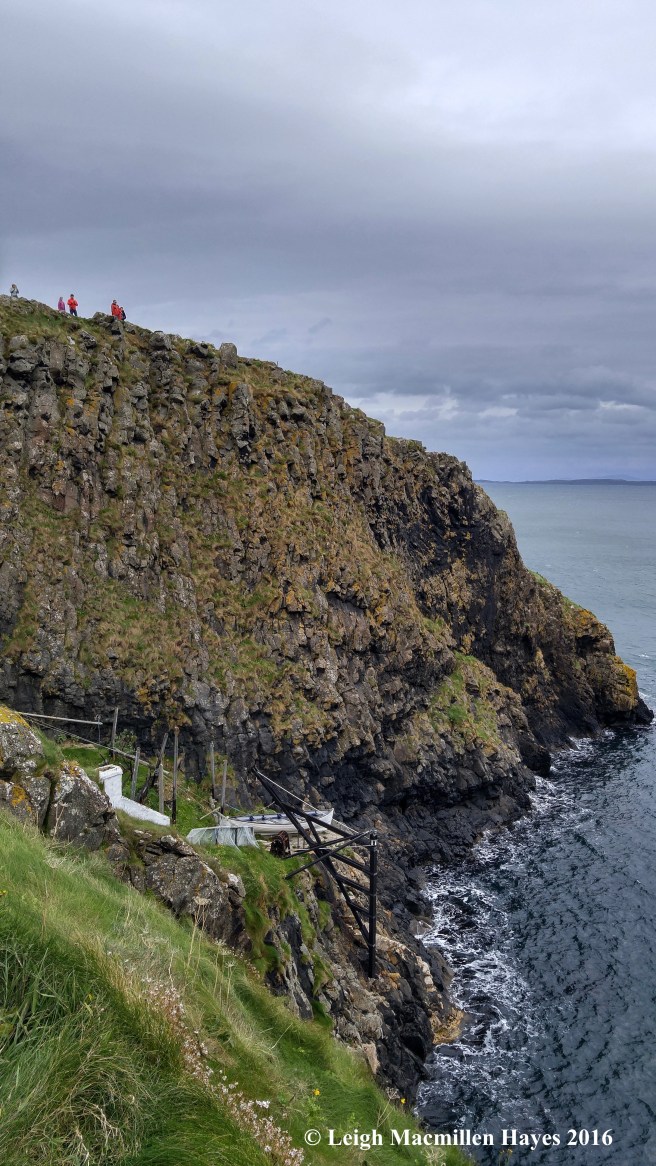
salmon-boat-at-carrick-1

And the road is presumably the sea route for Atlantic salmon that were once fished here prolifically. In fact, so prolifically, that the fishery is no longer viable. In order to reach  the best places to catch the migrating salmon, for 350 years fishermen crossed regularly to the island.
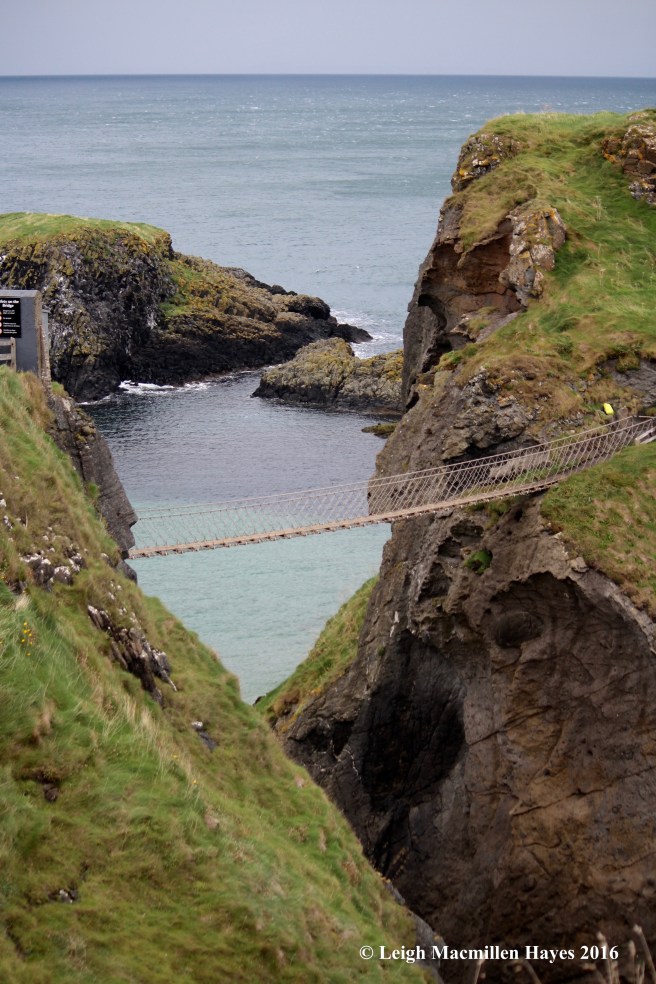
rope-bridge

One hundred feet above the sea, the fishermen crossed the 60-foot chasm via a rope bridge to check their nets. Of course, they had only one rope, not the steel and plank structure that we crossed. That being said, it was quite windy and the bridge did sway.
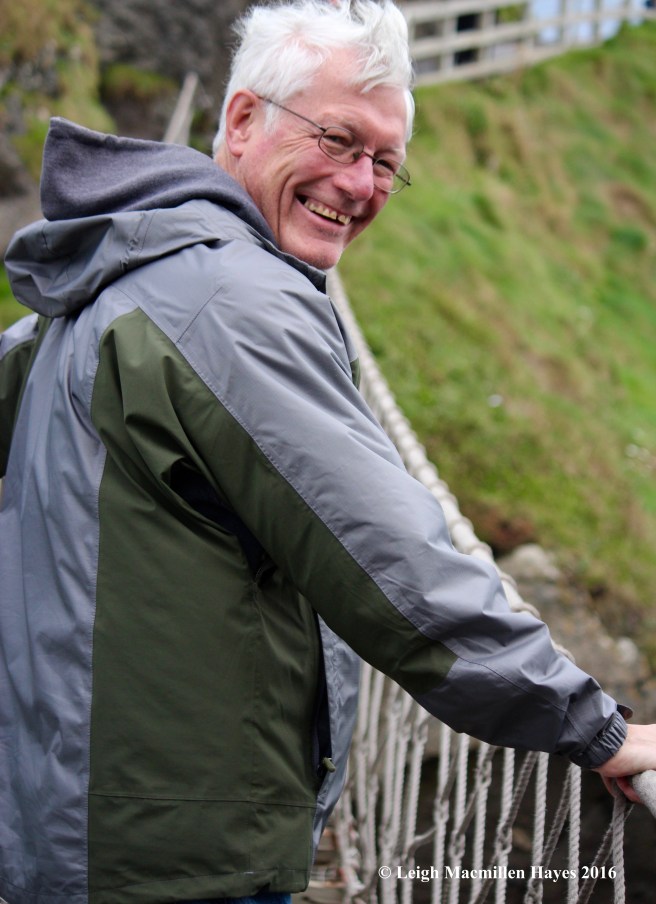
smiling-from-the-carrick-a-rede-rope-bridge

We put our fear of heights behind us and made our way across.

allen-at-carrick-3-1

Did he just do that? Yup.

me-at-carrick-1

And I followed.

scotland-2

Our views included Raithlin Island, the northernmost point of Ireland.

giants-causeway-1-1

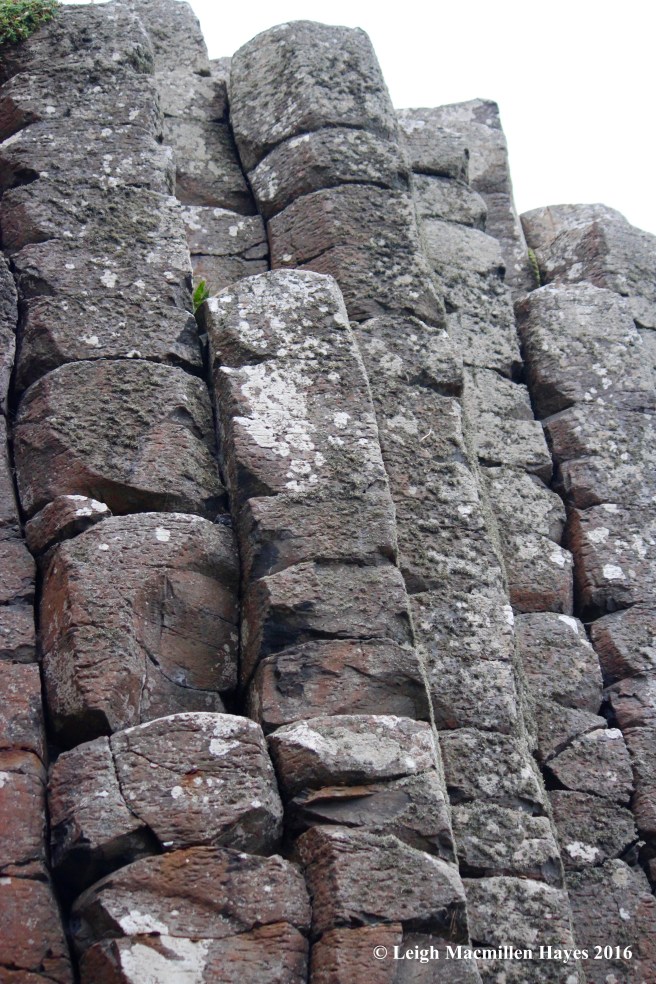
Our next wonder–the Giant’s Causeway, a geological phenomenon of 40,000 basalt stone columns formed by volcanic eruptions over 60 million years ago.
giants-3

giants-6

These hexagonal tubes stacked together like cans on a shelf offer yet another mystical and magical look at the world, one that the Irish embraced by creating legends to explain their existence–Fionn mac Cumhaill (Finn MacCool), an Irish giant, was challenged to a fight by the Scottish giant Benandonner. Good old Fionn accepted said challenge and built the causeway across the North Channel so that the two could meet. There are two endings so take your pick: In one version, Fionn defeats Benandonner, but in another,  he hides from Benandonner because he realizes his foe is much bigger. Fionn’s wife, Oonagh, disguises her husband as a baby and tucks him in a cradle. When Benandonner sees the size of the “baby,” he fears that its father, Fionn, must be the biggest giant of them all. Benandonner flees back to Scotland in fright, but makes sure to destroy the causeway behind him so he won’t be followed by Fionn.
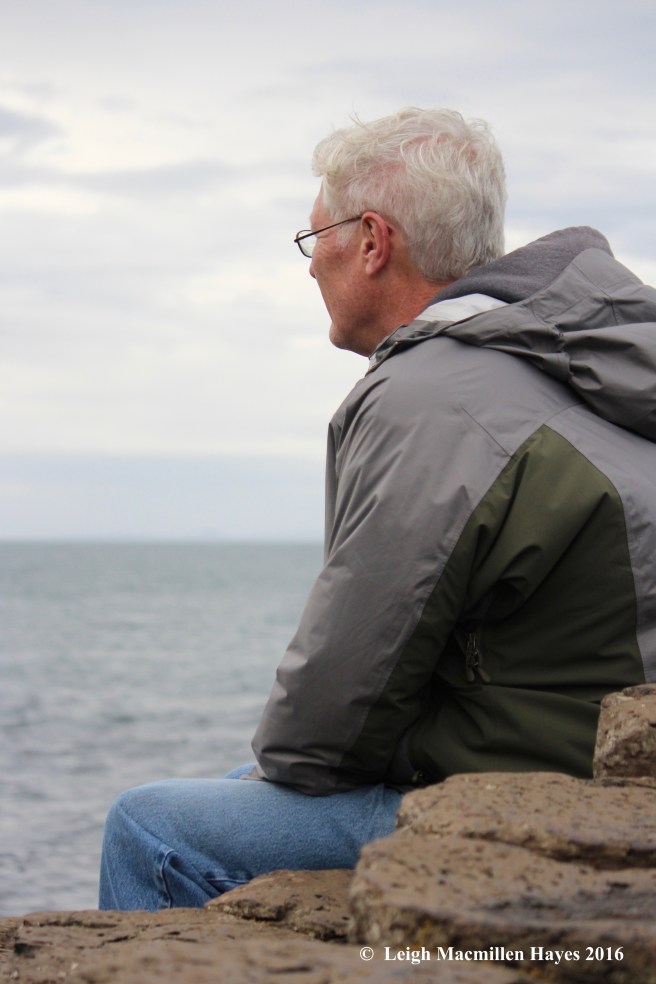
causeway-view

My guy found a spot to take in the giant’s viewpoint.

dunluce-castle-2-1

As we made our way back toward Portrush, we paused at Dunluce Castle. We couldn’t go in because it had closed for the day, but we could still see part of the castle town that was developed in the early 1600s.
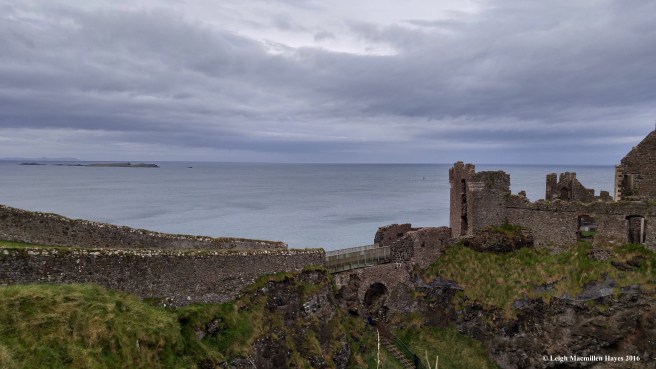
dunluce-castle-1-1

Originally built by one clan in the early 1500s, it was seized by another in the mid 1500s. Its history includes rebellions and intrigue.

dunluce-castle-wall-over-cliffimg_7377

Included in its dramatic history are tales of how the castle kitchens fell into the sea one stormy night in 1639. We couldn’t help but wonder if the same happened to the wall.

portrush-2-1

Back in Portrush finally, our own tale continued. At the suggestion of our hostess, we walked to the Harbour Bar for dinner.

wee-harbor-bar-ryder-cup-trophy-1

While we waited for a table, we paused in the wee pub, as they call it. A few minutes later, two guys walked in with a trophy and made a big fuss about its placement among the best bottles of whiskey.

darren-3-1

At the time, I was standing to the right of the gentleman in the middle and so I asked him about the trophy. He explained that when you participate in the Ryder Cup you receive a replica. My guy immediately realized that I was talking to a famous Irish golfer, he just couldn’t put a name with the face. On the wall above, we could see photos of him, but we weren’t close enough to read the signatures.

allen-as-darren-1

It turns out we were in the presence of Darren Clarke, the European Ryder Cup captain for 2016. We didn’t know that until we went to check on our table and asked. One of the bartenders encouraged us to stay for the send-off, so we did. Everyone donned a D.C. mask (at 00:16, if you look quickly to the back left, you might see my scraggly hair behind a mask)–and sang “Shoulder to shoulder, we’ll answer Darren’s call.” We were included as the North American entourage.

allen-and-willie-2-1

allen-and-willie-1

While I got Darren’s autograph on one of the masks, my guy befriended Willie, the bar manager.

portrush-2

The next morning, after a traditional Irish breakfast, we toured the downtown. Ireland amazes us–the temperature was chilly and yet the flowers were gorgeous. And palm trees grow throughout the country.

walk-to-murlough-bay-with-fairhead-in-background

Upon our departure, our hostess suggested we follow the coastal route to Murlough Bay and so we did. And took a wrong turn that lead down a dead-end to a gate with a sign warning us that guard dogs were on site. With caution, my guy backed up the lane until he could turn the car around. Our hostess had also told us not to park at the upper lot for Murlough Bay, but instead to drive down. I insisted upon the upper lot given that the road had at least a 10% pitch. So we walked down. And down. And down some more.

fairhead-murlough-bay

Upon our descent, the light at a distant lighthouse beckoned in the background as Fairhead came into view.

murlough-bay

The coastline was as dramatic as we’d been promised. And I was glad we’d walked because the drive would have been even more dramatic with Hyacinth in the passenger seat.
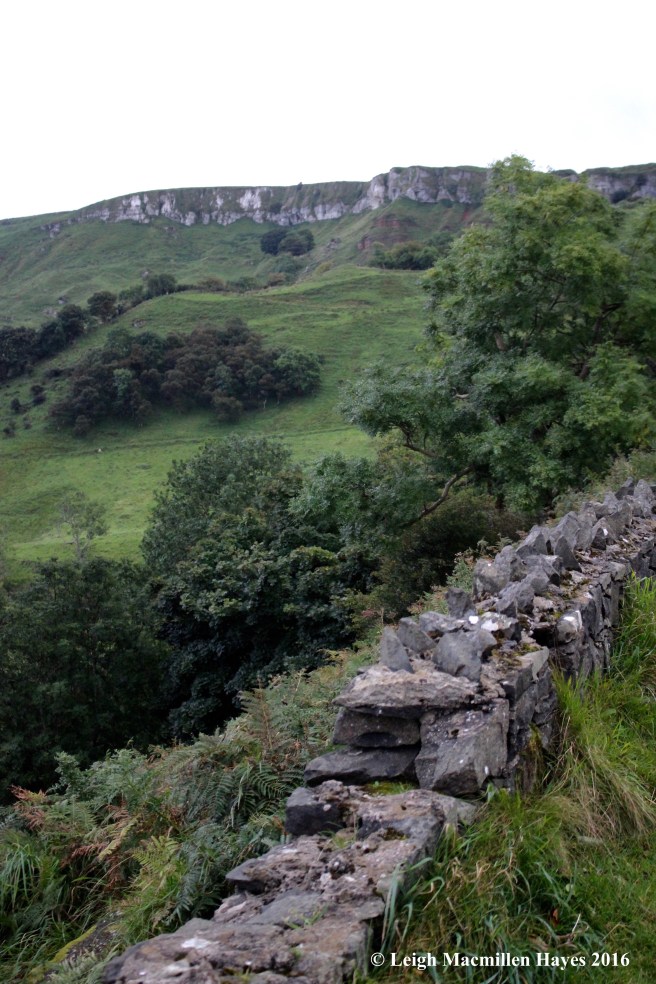
stormlands

This area may appear familiar to viewers of Game of Thrones–including the site of Stormlands.

traditional-music-in-belfast-1

After a hike back up the road, we drove on to take in the scenery of Torr Head. The road narrowed significantly as it twisted and turned along the coast. And then . . . we met a porsche rally. As best he could, my guy squeezed our car past them. And as soon as he could, we got off the coastal route and drove on to Belfast. It was late in the day and pouring when we arrived. By the time we parked in city centre and walked to the Welcome Center, we were drenched. And disappointed. There was no where to stay in town and we’d have to move on. But . . . then one final effort proved that a hotel was available. We should have questioned if for the price. Well, actually I did, but we were told that it was a fine place and served as a conference center. So we took it. And couldn’t wait to get out of there. Fortunately, we found some Irish music back in town and a delightful meal of locally harvested food. All we needed to do was sleep in the rathole, though even that didn’t work so well.

nomadic-1

The next morning we took in the Titanic Museum and stepped aboard one of its tenderfoot boats, the Nomadic.
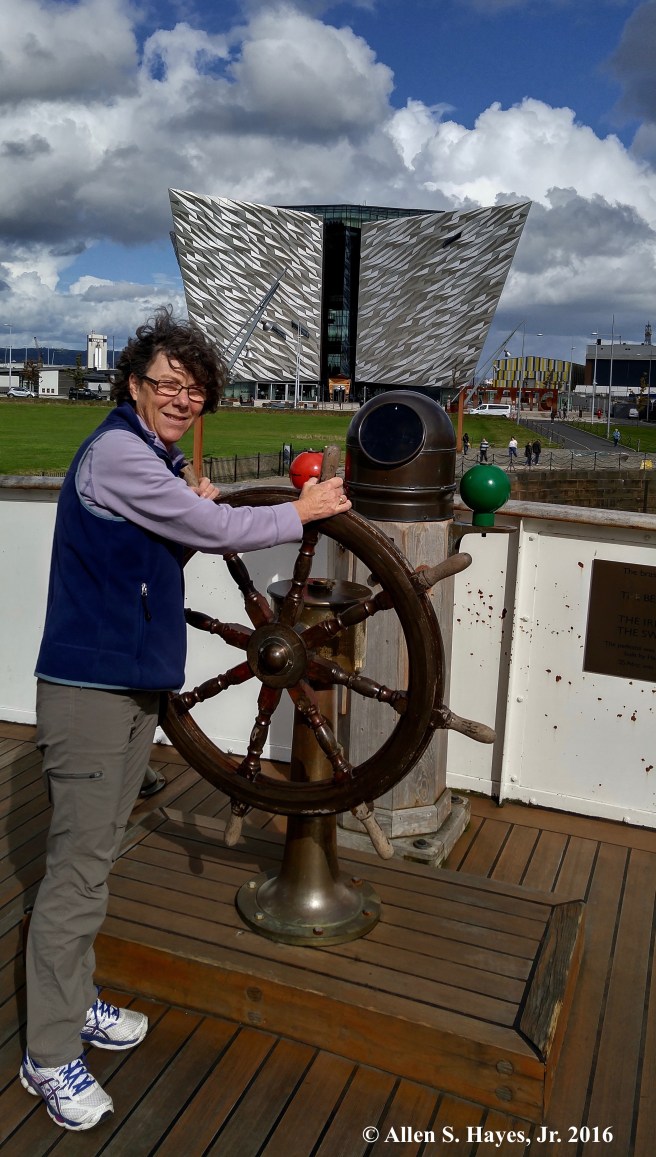
me-nomadic-2-1

A dose of coffee and I was ready to take the helm. And if you are wondering if it’s windy every day in Ireland, the answer is yes. It also rains at some point each day. Our time in Northern Ireland was over, but except for that one accommodation, we’d had a wonderful and wonder-filled time.
holly-cottage-laragh-1

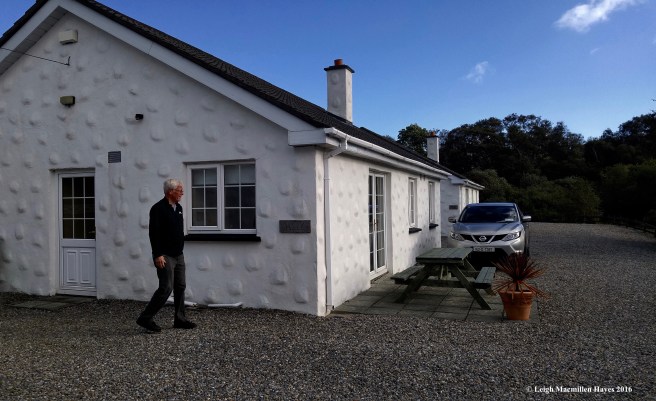
As we worked our way south, we spent a night at a delightful B&B in Navan, which featured  more traditional music and a place to relax. On Monday morning, we finally headed to the cottage we’d rented in the town of Laragh–Glendale Holiday Cottages–we highly recommend. Our host, Christy, was extremely accommodating, the cottage spacious and amenities plentiful.

ww-monastic-city

We’d chosen this location because it was a five minute walk to the pub and restaurant in Laragh, located in the Wicklow Mountains, and near the Glendalough monastic settlement founded by St. Kevin in the sixth century.

round-tower-glendalough

Forty shades of green and Brigadoon all came to mind as we approached the monastic settlement and its round tower.

st-kevins-church-glendalough

St. Kevin’s kitchen is actually a 12th century church, so named because it was believed that the bell tower was a kitchen chimney. Apparently, however, no food was ever cooked there. But . . . if you think of the word of God as food, then perhaps many a feast was actually served.

ww-monastic-cathedral

From the altar window in the cathedral, the largest of seven churches within the monastic city,  a view of the world beyond was offered.

st-kevins-monastery-glendalough-1

Likewise, we could see the world within, including the Priest House in the background.

monastery-cemetery-glendalough

And everywhere, gravestones told the story of many who’d passed this way.

trinity-church-glendalough-day-3

A little closer to Laragh, Trinity Church.

upper-lake-3-glendalough

Upper Glendalough was the jumping off point for our initial hike upon the Wicklow Way.

p-falls-2-glendalough

We paused beside Poulanass Falls before zigzagging our way up the first trail.
sheep-wicklow-way-2

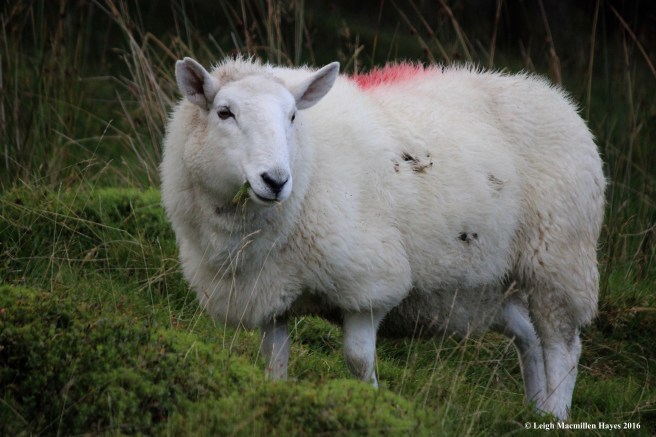
Sheep merely looked up to acknowledge our passing. We, however, needed to pay more attention for sheep shit was prolific.

reforestation-wicklow-way

Tree felling was also a frequent sight, but we noted a unique (to us anyway) method of reforestation–in this case the Sitka spruces and Scots pines being felled were replaced by mountain ash saplings. One other thing we wondered about–the plastic sleeves–we saw some that had fallen away as trees grew, but were left in place. Biodegradable? We could only hope.
wicklow-way-bog-day-1

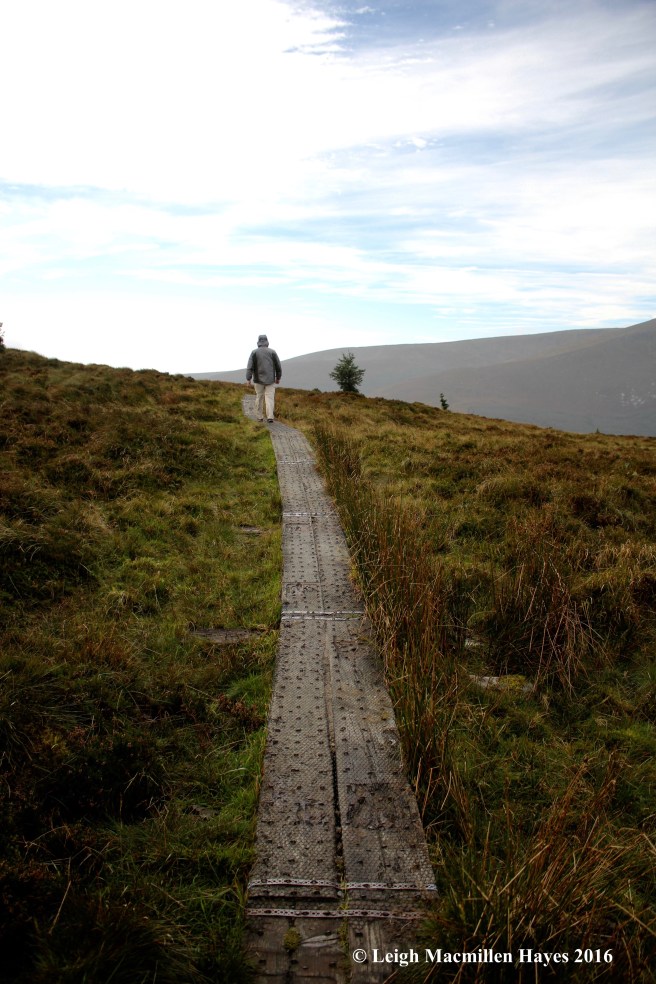
We spent three full days on the trail, not covering all of it, but a good portion as we hiked 10-15 miles each day.
crossing-bog-wicklow-way-day-1

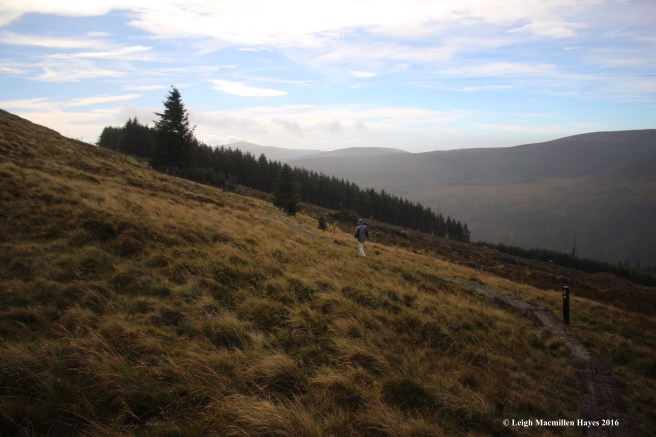
Our journey took us over boggy portions,
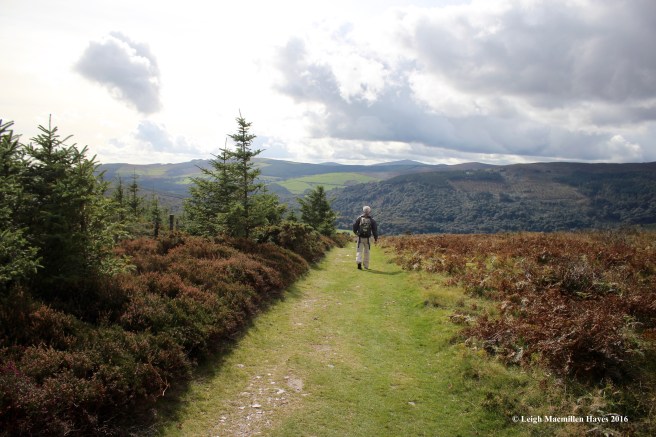
wicklow-way-day-3

down grassy sections,

w-lane-2

on village lanes,

ww-boardwalk

over boardwalks,

ww-forest-path

through the black forest,

w-walking-into-the-sky-day-3

and into the future.

ww-following-the-signs

Frequently, we had to stop, reread the directions and study the map, but more often the route was self-explanatory.

ww-muddy-trail

Along one section that was particularly muddy due to frequent horse crossings, we made a discovery unique to us.

w-badger-print

A badger print. Sadly, or maybe happily to locals, we saw a dead badger on one of the lanes not far from this print. Related? We’ll never know.
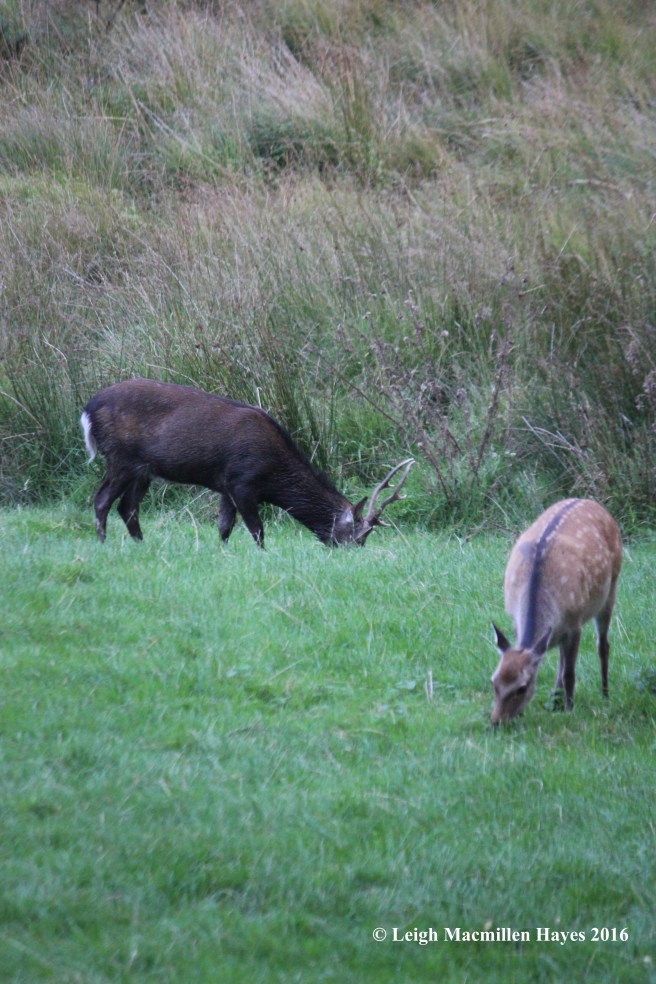
w-deer-at-glendalough

We saw deer, one rabbit and two red squirrels.
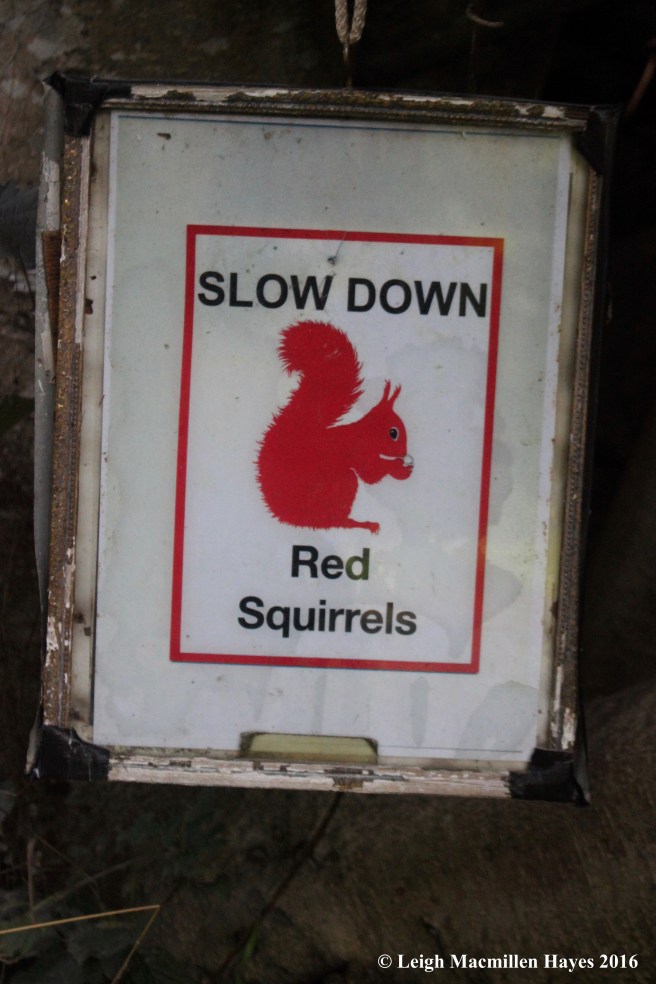
Red Squirrel sign, day 3.jpg

Writing of the latter, we chuckled when we encountered this sign because we have frequent encounters with them at home. But considering we only saw two in two weeks and spent most of our days outside, we had to wonder.
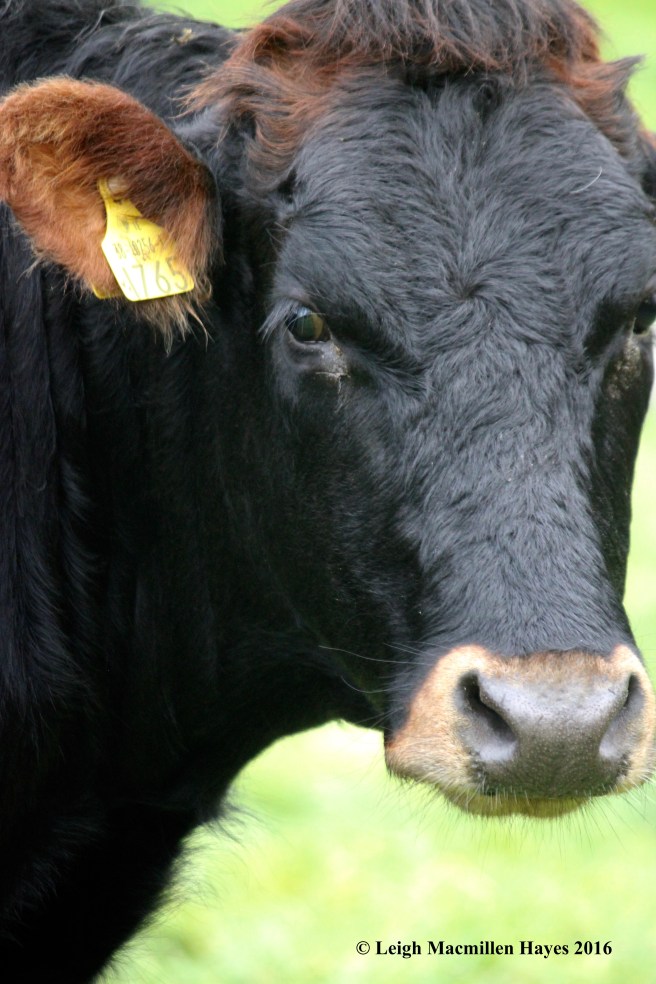
w-bessy-1

Bessie One,

w-bessy-2

Two,

w-bessy-3

and Three (pronounced Tree) tolerated our presence.

w-cow-on-wall

And Bessie Four made us laugh–as she stood upon a wall.
w-hay-in-barn

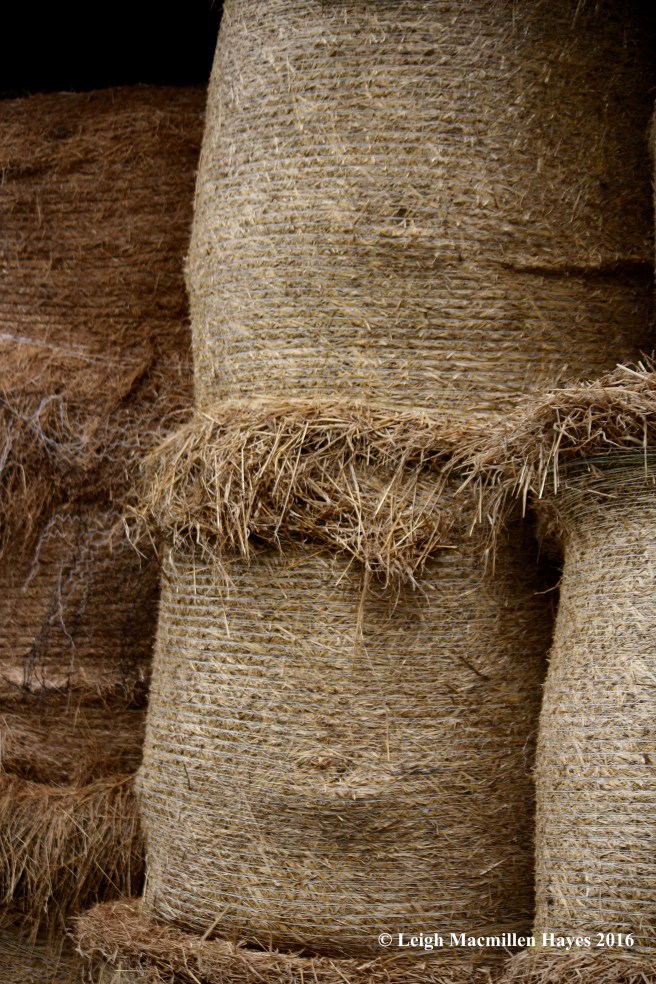
Though we passed through pasture after pasture and by many a farm and barn, we never saw any farmers, but knew that they were hard at work preparing for winter.
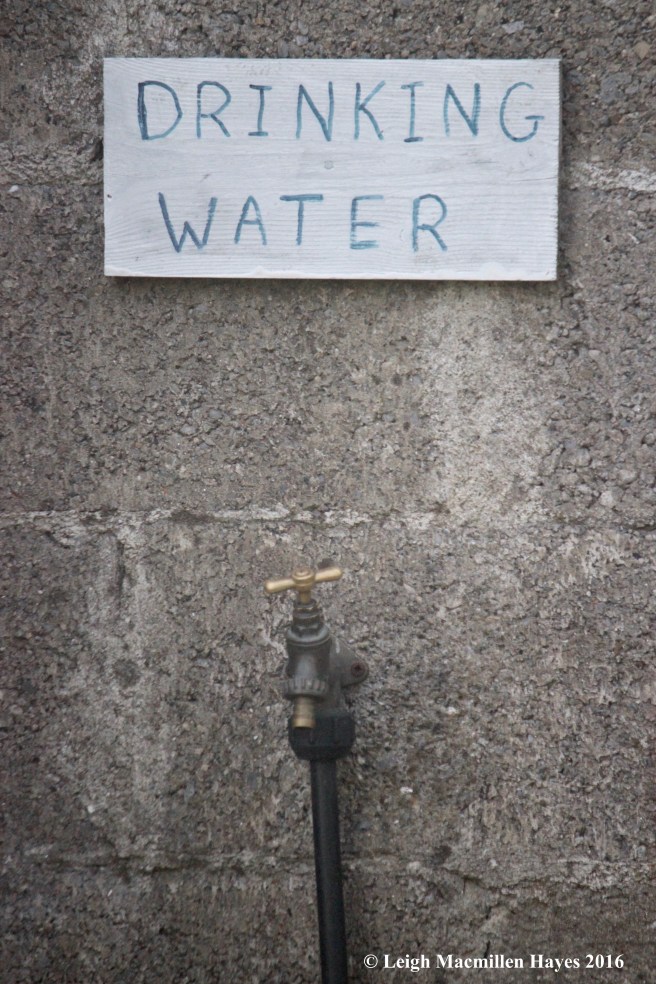
drinking-water-wicklow-way-day-3

And one even offered us nourishment.

w-wooden-stile

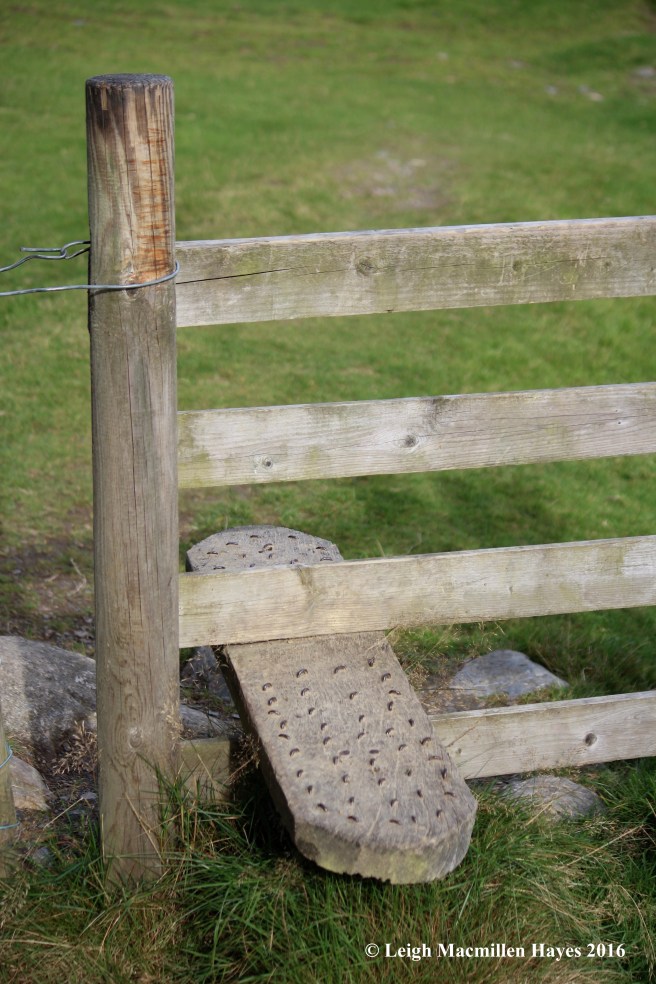
Our path included obstacles, though most were easy to overcome from a rope loop
w-stile-step-wicklow-way-day-3

to a simple step or

w-another-stile

ladder crossing.

w-bull-sign

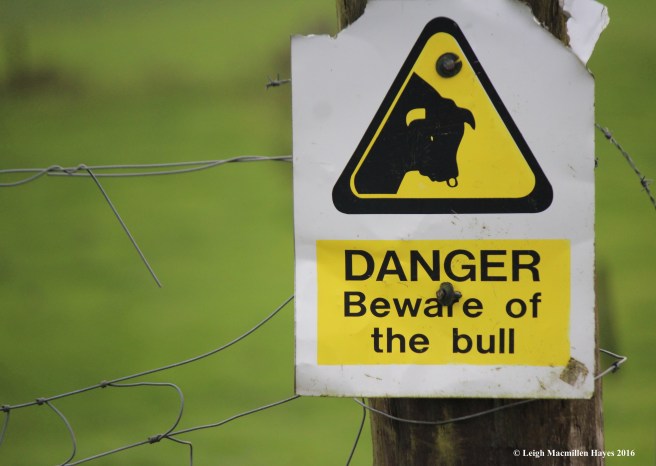
Only once were we uncertain. The stile was padlocked and there was no step or ladder. We finally decided to climb up over the gate in hopes that there wasn’t a bull on the other side. Usually though, a beware of bull sign announced their presence and no such sign marked that particular crossing–phew.

w-guinness-sign

Our days ended with a stop at the local pub because Guinness® is good for you. I actually overheard an older woman telling her significant other the truth behind this. Apparently, when this woman’s mother had been in hospital years before, she was given Guinness® to drink each morning and evening–perhaps for its iron content. Or perhaps just because it’s good for you.

w-dying-cow-1

One of our stops was at the smallest and oldest pub in the nation–the Dying Cow. Mr. Dolan sat behind the bar sipping a Guinness® along with us as he and my guy got into a discussion about American politics. We noted that to be a hot topic. Our reason for finding this pub was because we’d walked into Tenahely after a fifteen miler and were about to step into Murphy’s for a pint when a gentleman sitting outside started chatting with us. He suggested we head off down the road because we needed to experience this tiny bar and he would have joined us but he’d just ordered his pint and didn’t want to waste it.

w-1798-monument

We followed the directions he wrote out for us, and missed the 1798 monument at first, but retraced our route and found it. We only wish he’d then told us how to get back to Laragh. That took a while, but eventually we found our way home.

wicklow-day-3-1

Our views from the Wicklow Way were worthy of wonder.
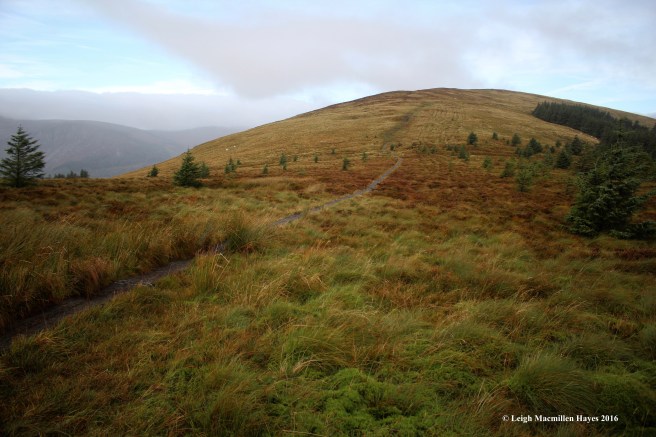
wicklow-way-day-1-3

And the ever present clouds added to the drama.

ww-greens

The land resembled a patchwork quilt.
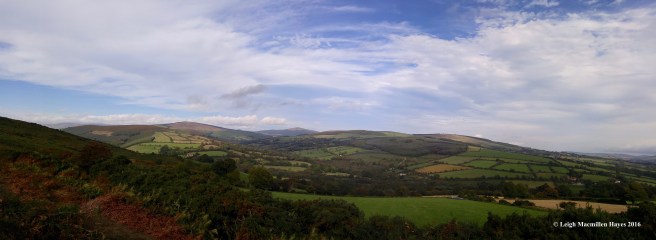
pano-2-day-2-1

No matter where we looked, it was forever changing.
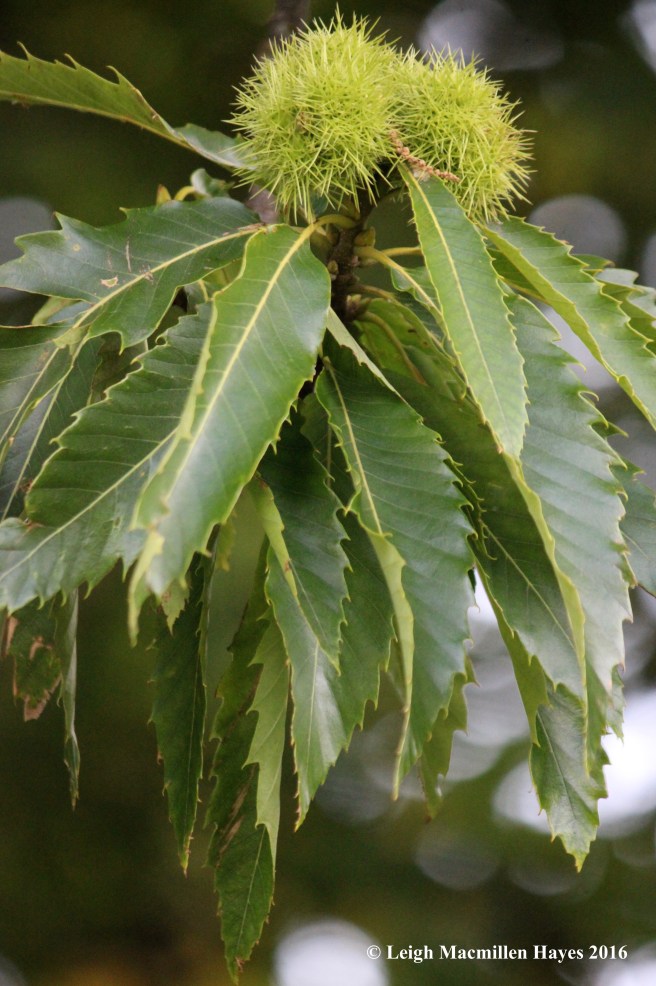
chestnuts

Some of our fun discoveries included chestnut trees,
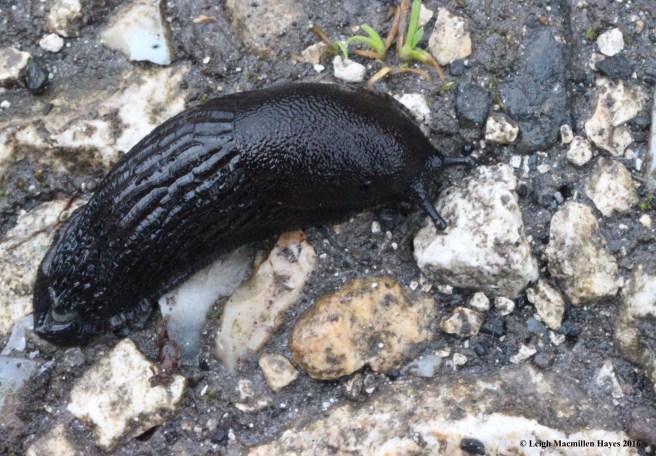
slug

black slugs, and . . .

bear-gryllz-signature

the crème de la crème–bear claw marks! Did Bear Gryllz really leave his signature on the trail behind the Glendalough Hotel?

wicklow-and-the-irish-sea

When we weren’t hiking, we explored the area, including Wicklow and its stone beach.

wind-turbine-boat-wicklow-harbor

We didn’t understand this ship at first until my guy asked–meet Wavewalker, a maintenance boat for Ireland’s Offshore Windfarm.

wicklow-harbor-other-side

Across the harbor, we spied the remains of a castle that invited a closer look.

wicklow-castle-2-sky-and-water-reflection

It seems Black Castle was constantly under siege and totally destroyed in 1301. And yet–I felt a presence still there.

castle-wicklow-face-in-turret

Do you see his face?

avoca-chairs

The oldest mill in Ireland also drew our attention–Avoca Handweavers Mill was established in 1723.

avoca-socks

It was the home of color with attitude.

avoca-yarn-5

Upclose and personal, we saw the inner workings.
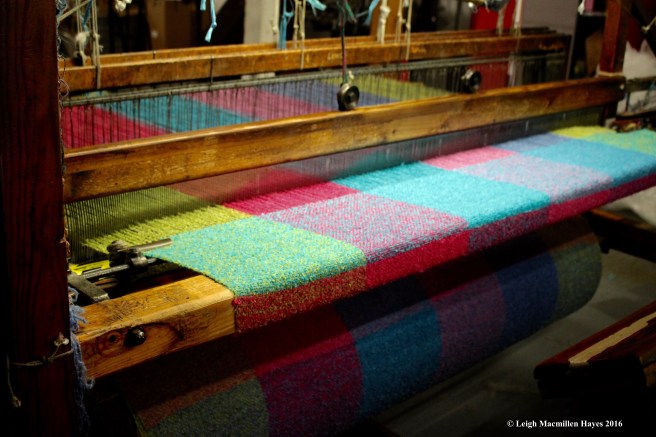
avoca-yarn-2

And marveled at the creative results.

carlow-castle-towers

Our last full day in Ireland found us in Carlow. Standing beside the River Barrow, this castle was thought to once be a stronghold and it survived attacks in the 1400s and 1600s. According to local lore, a physician set out to remodel it into an asylum in the early 1800s. As he tried to demolish the interior, he placed explosive charges near its base and accidentally destroyed all but the remaining west wall and twin towers. Uh oh.

swan-face-carlow

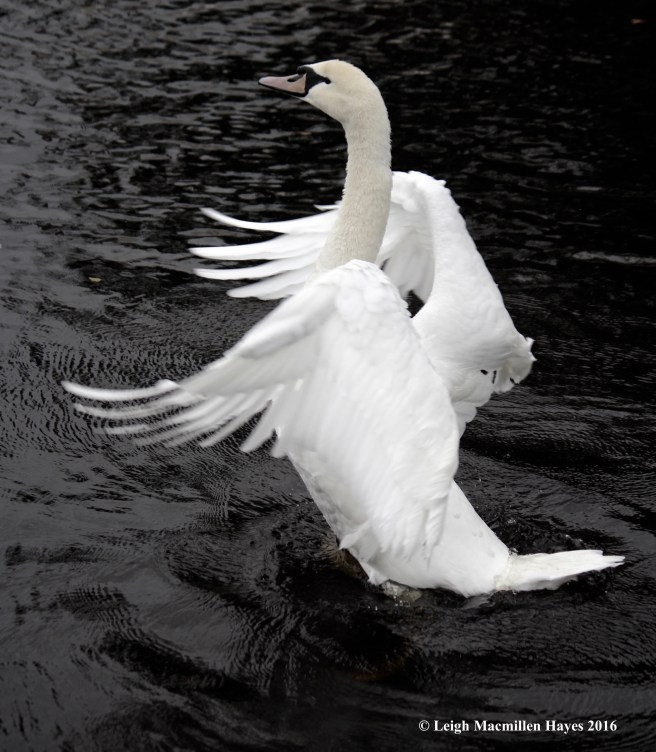
As happened daily, the weather quickly changed from blue sky to raindrops. Swans in the River Barrow didn’t care. They were in their element.
swan-stretch-carlow

My guy counted while I photographed. Thirty some odd–all wishful that we’d brought good tidings in the form of bread. Not to be much to their dismay. Despite that, we were treated to several displays.

sunset-over-carlow-1

And later that night, a display of sun and clouds as we went in search of supper.

irish-breakfast

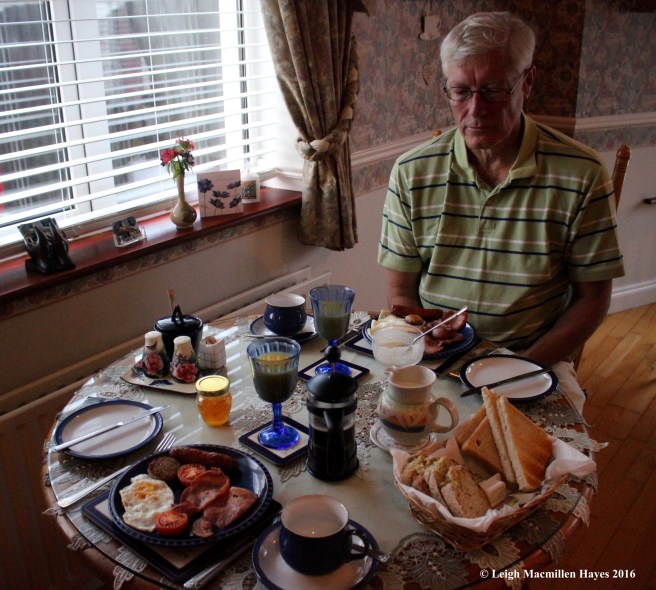
Our final night was spent at the Green Lane B&B in Carlow where Pat and Noeleen took special care of us. My guy watched the GAA football game with Pat, their grandson Sam helped us print out our airline tickets and Noeleen made sure we had toll money for our journey to the airport. And then there was the breakfast–the finest we’d enjoyed.
breakfast-2

Think eggs, tomatoes, mushrooms, bacon, sausage, white pudding, toast and Irish soda bread. And they wanted to know if we wanted porridge and cereal. Really?

irish-mist

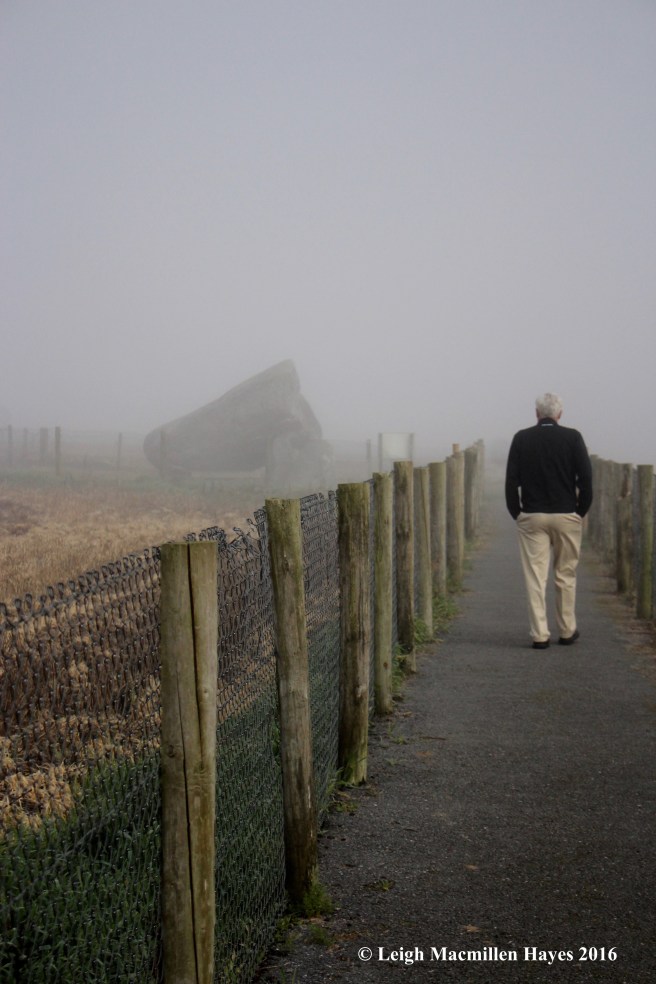
Before we checked out, I made my guy drive to this field ensconced in an Irish mist.
out-of-the-mist

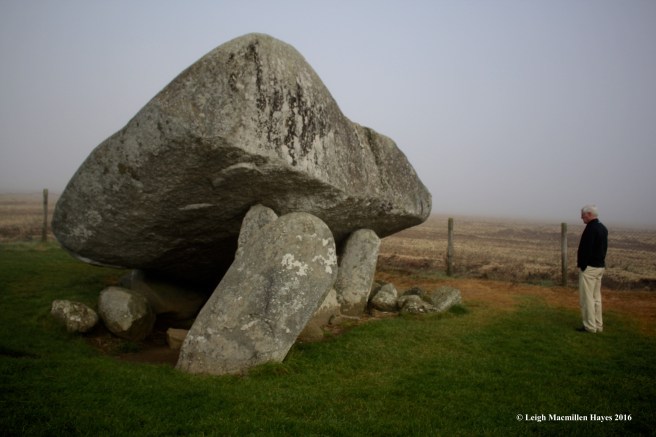
The fog seemed apropos for our walk out to the Browneshill Dolmen. This was a burial chamber that may have originally been covered with earth.
dolman-size

My guy stands almost six feet tall, so his height provided a sense of size.

dolman-2

The two more pointed stones on either side of the squared stone were known as portal stones that would have supported the granite capstone or chamber roof. The squared stone in the center was probably the gate stone that blocked the entrance. This site has not been excavated so there’s no other info about it, but just standing in its presence and considering those who came before and created such was enough.
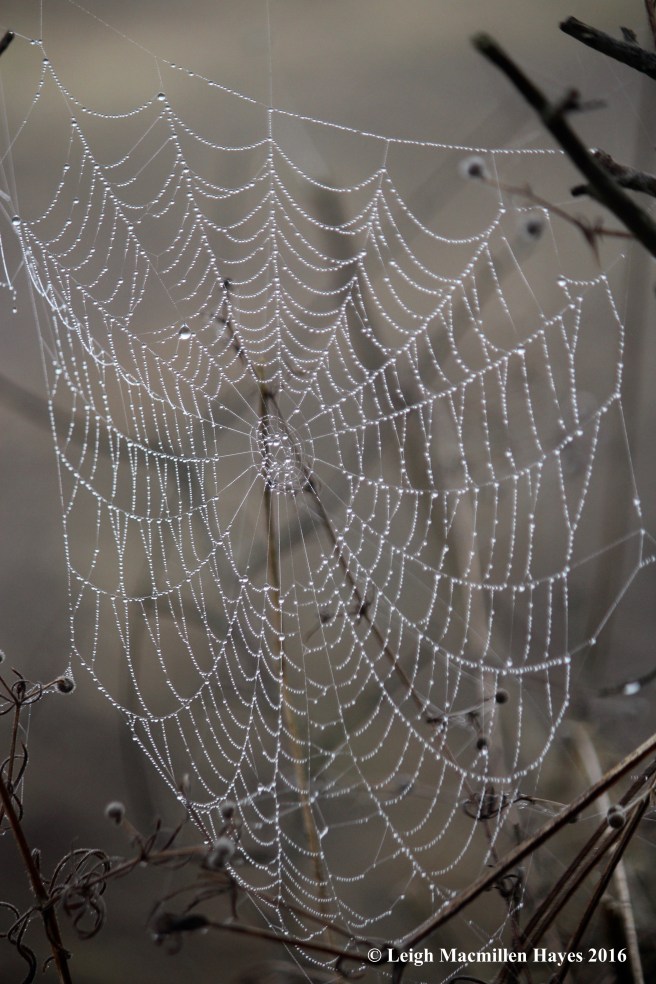
web-2

And then there were the spider webs. I’d missed them as we’d walked toward the dolmen, but they captured my attention all the way back. From prehistoric to present, the structures before us were breathtaking.
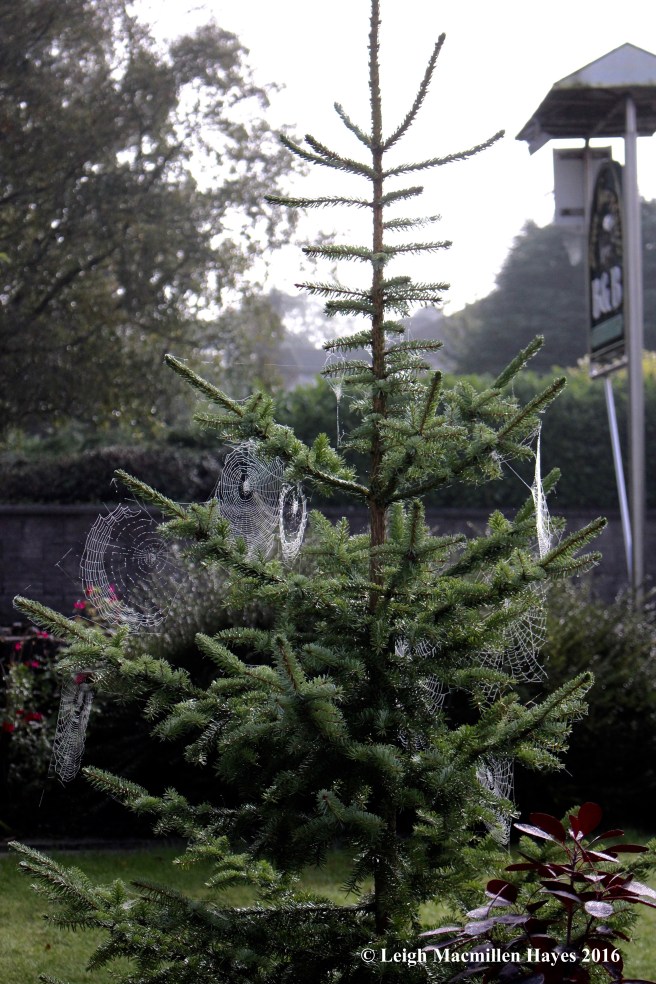
tree-webs

And when we finally pulled out of the B&B driveway on our way to the airport, I asked my guy to stop while I jumped out of the car. What a sight to behold–web ornaments. A perfect ending to our vacation.

My guy meet several roadblocks on his search for roots, but at the same time, he learned about some new avenues that may help in his quest. And I, I wished for more time to understand all that was before me from prehistoric to present–but maybe I sought answers that don’t need to be. Having the questions might be enough.

Together, we were grateful for our Hyacinth and Richard Adventure on the Emerald Isle. And glad to return the car safely to the rental agency.


The Fruits Of Our Labor Day Mondate

I feel like a broken record when I say that my guy works too many hours, but so it has been. This was his weekend off and he worked more than a half day on Saturday and all day plus on Sunday. This morning he burned it all off with a seven mile run and then we headed off for a hike.

k-trail sign 1

Mount Kearsarge North off Hurricane Mountain Road in North Conway, New Hampshire, is an old fav that deserved a visit.

K-trail goes this way

It was great to be out of town and finally goofing off on this Labor Day holiday. He’s labored. I’ve labored (really–even when it seems like I’m playing, I truly am working, honest). And we needed a break. If we followed this blaze, however, we would never have found the summit.
k-climbing higher

Fortunately, we knew better. The hike is challenging, especially on the upward climb. We later commented about how the downward climb is faster, but does require attention to foot placement.

K-approaching tower

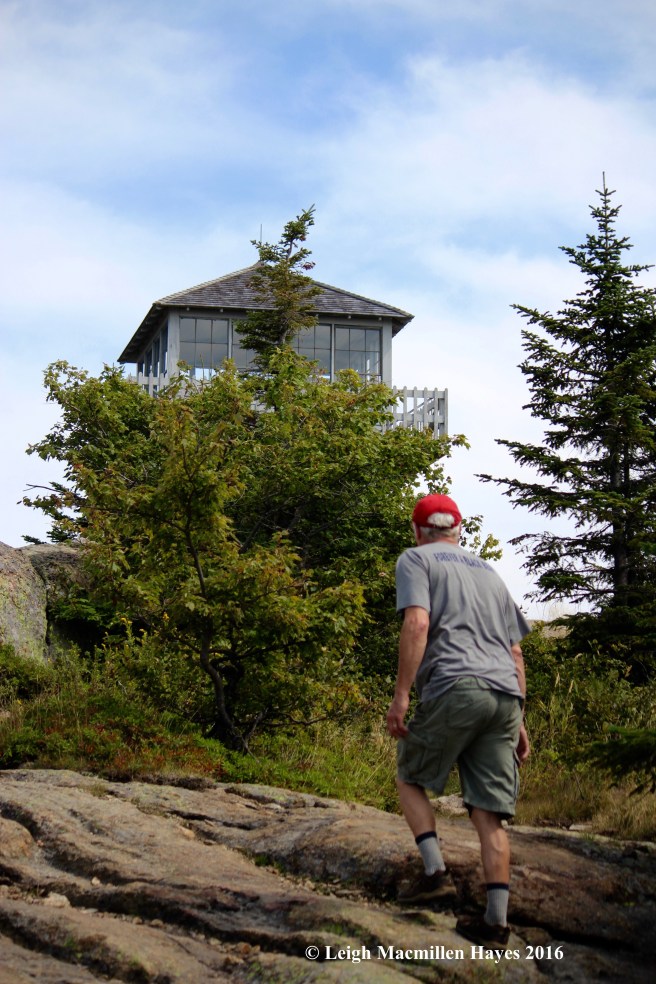
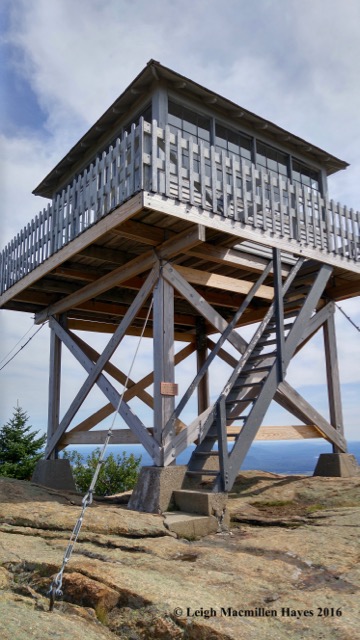
Just over two hours later, we approached the fire tower at the summit. Though no longer in use, it’s obvious from the 360˚ view why a fire lookout was built at this summit. Constructed in 1909, the structure was rebuilt by the US Forest Service in 1951. Prior to the replacement of fire towers by airplane surveillance, this tower was in operation until 1968.

k-summit fire tower (1)

Since we were last here about a year or so ago, it looked as if some of the support beams had been replaced.

k-my guy at tower

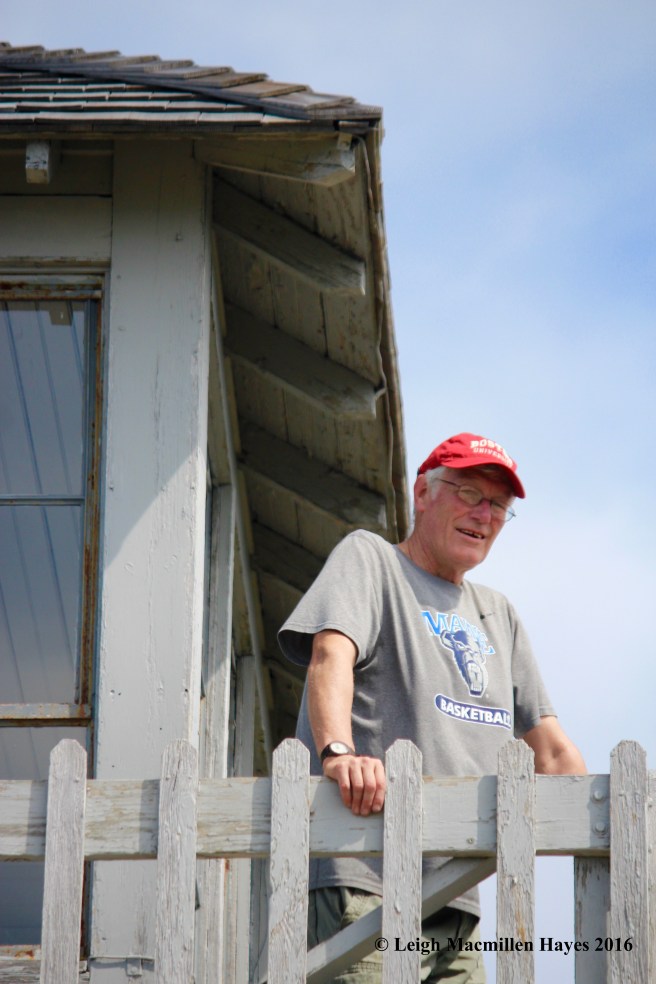
Despite the cooler temps and wind, it’s always worth a climb up.

k-summit tower 3 (1)

Once inside, all was calm. And the view–to die for. It made the efforts of our labor well worth it. We signed the log before moving back outside.

k-summit view 1 (1)

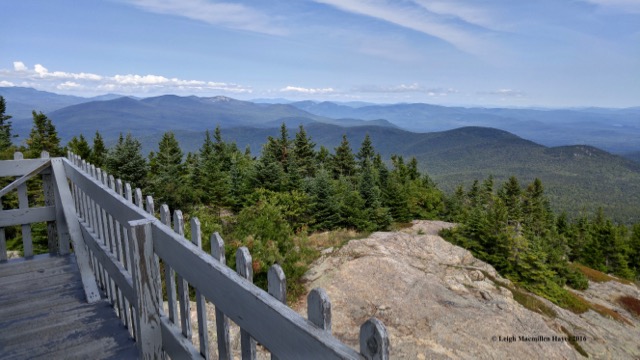
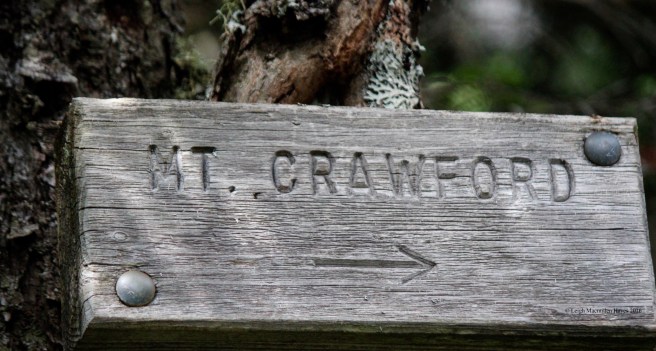
I was thankful for the railing that kept me from being blown to the great beyond as I gazed toward the Baldfaces,  though the wind wasn’t nearly as strong as last week’s Mount Crawford Mondate.

k-summit Mount Washington (1)

Back on the granite, we twirled about and took in each view–including Mount Washington with cumulus clouds grazing its summit.

k-summit to ledges and moats (1)

The cloud cover varied as we looked toward the valley with Cathedral Ledge, the Moats and beyond. Because we’ve set our feet down at those various levels, we appreciated the layers before us.

k-summit toward cranmore (1)

And we noted the Green Hills Preserve, where we’ve also hiked many a trail.

K-Pleasant Mtn

The cloud cover changed as we turned toward home and saw Pleasant Mountain in the distance. Our house is located about center beyond the mountain. And our camp to the left end of said mountain.

k-summit lunch rock (1)

Of all the rocks, lunch rock was the most important find. Sometimes, it’s difficult to locate such among all the opportunities, but this one spoke to us. And so we sat. And ate. Sandwiches (not PB&J–those are more for winter fare) and brownies (great any time of the year).

k-my guy snoozing (1)

And then my guy decided to snooze. He deserved it.

k-hare scat

I took advantage of the opportunity to observe and was tickled to find these woody fruits–the milk duds of the north woods. Snowshoe hare scat. I found numerous examples and wondered where the hares hid. Actually, they could have been anywhere because among the bald rocks there were plenty of islands filled with brushy undergrowth.

k-blueberry.jpg

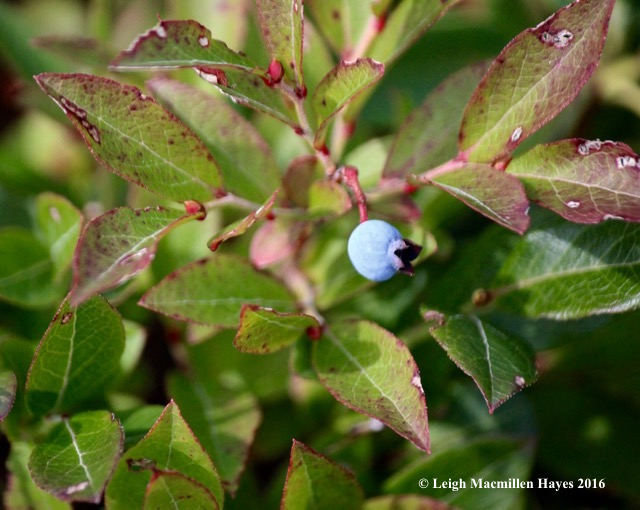
And so I poked about. Though the low bush blueberry plants were plentiful, the fruits were sparse. In fact, I only spotted this one.

k-mountain cranberries

More prolific were the mountain cranberries, aka lingonberries.

k-summit speckled alder (1)

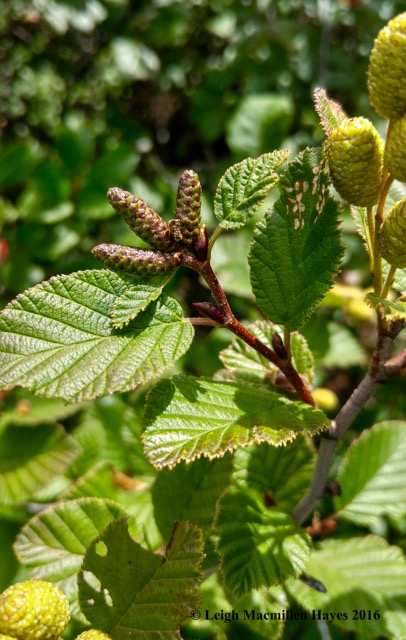
What surprised me was the presence of speckled alder in the mix because I think of this as a species with wet feet, but really, this mountain top is much moister than most of our lowlands, so in the end I guess it made sense. Always something to wonder about.

k-sheep laurel fruit.jpg

It wasn’t just speckled alder that made me wonder. Sheep laurel also grew there. I know it well in bogs and even along the power line behind our house. And yet, it loved the habitat on the summit.

k-summit huckleberries (1)

The same was true for huckleberries–which I look at beside Moose Pond all summer. How can they like wet feet and a bald mountain landscape. But again, I think perhaps it’s the moisture for these mountains are often lost in the clouds.

K-mountain holly

Mountain holly also liked this habitat. Again, I’ve seen this at camp where the fruits have already been consumed. Songbirds love these berries and the supply on Kearsarge will disappear soon as migration begins. Here today, gone tomorrow.

k-wild raisins 2

Wild raisins were equally plentiful and worth admiring.

k-wild raisins 3

The berries are edible, at least for birds. But . . . if not consumed, the fruits shrivel up–thus the name of wild raisin.

k-trail sign 2

At last, my guy awakened and we picked our way among the rocks and roots on our descent.

K-oak plum gall (1)

At least one more fruit showed its face on the downward route. Or was it a fruit? Actually not–it was an oak plum gall created by a wasp.

We talked about Labor Day as we climbed down. Labor Day is a tribute to the contribution of those who work and contribute to the strength, prosperity and well-being of our country. We gave thanks to our parents and the work ethic they taught us. And we noted the fruits of labor we saw in the natural world.

Finally, we toasted all with a beer at Delany’s Hole in the Wall in North Conway–a Shock Top for him and Tuckerman’s Pale Ale for me. On this Mondate, we felt rewarded with the fruits of all labor.


Horsepower Mondate

My guy works way too many hours and such is his life. So our attempt to head out early this morning didn’t exactly happen because he needed to sleep in a bit. It was just after ten when we reached our intended trailhead–Davis Path in Crawford Notch, New Hampshire.

c-bridge

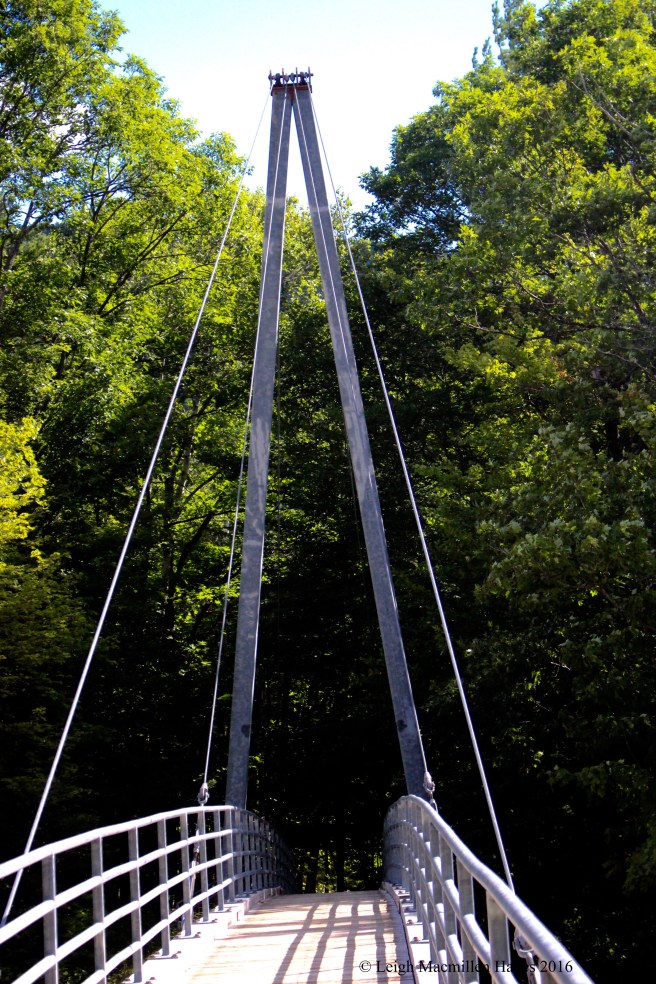
Our hike began as we crossed over the Saco River via a suspension bridge. In 1931, Samuel Bemis built a bridge that spanned 108 feet. The bridge was rebuilt in 1999, when the Town of Hart’s Location received a grant from the National Scenic Byways. The current award-winning bridge is five feet wide, spans 168 feet and was designed as an asymmetrical cable stay bridge–possibly the first such in the USA.

c-Saco River

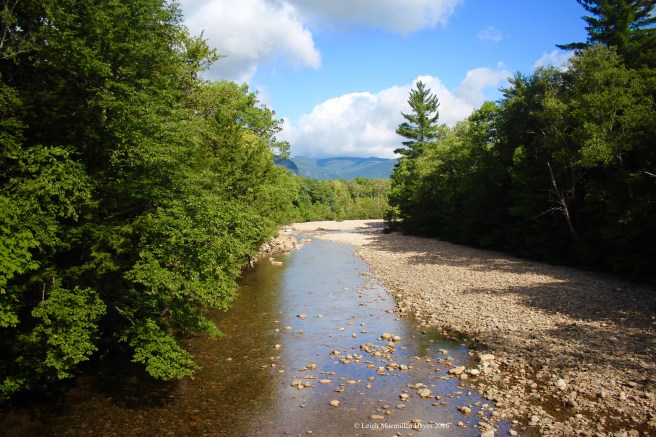
Below, the Saco River barely trickled.

c-stairway to heaven

The Davis Path begins almost directly across the street from The Notchland Inn on Route 302. At the beginning of the trail, a sign informed us that Abel and Hannah Crawford’s son-in-law, Nathaniel Davis, built the Davis Path in 1845 as a bridle path. As intended, the trail covers 14.4 miles to the top of Mt. Washington. Our destination was the first peak–Mount Crawford at 2.5 miles along the path. Thanks to the AMC, what had been the bridle path is now transformed into a trail that includes a variety of stairways to heaven.

c-climbing higher

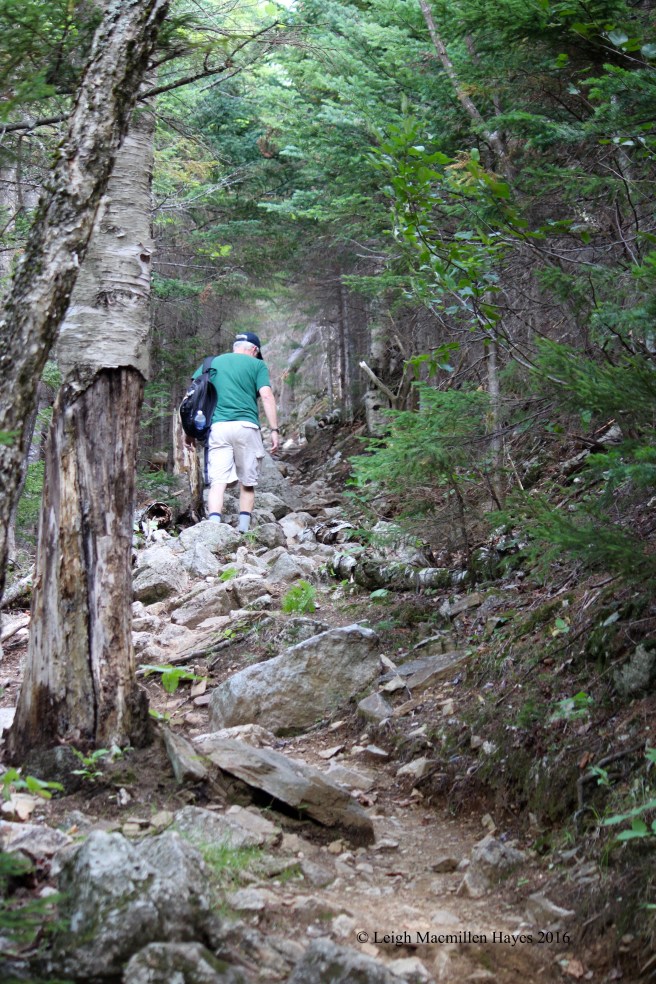
Conditions changed constantly as we climbed–in tune with the changing forest. Mixed woods to hemlocks groves to firs to spruces. The higher we hiked, the more I kept thinking about the fact that this was a former horse path. However did they do it? How many in a team? We were each operating at one-horse power as we huffed and puffed along, but I think a team of at least six would be much more appropriate. Six horses pulling me up–I liked that thought.

c-dinner plate

Instead, I spent a lot of time looking down, so I got to see the low sights–like this dinner spot;

c-puffballs

emerging fungi;

c-fern shadows

and fern shadows.

c-trail sign

Eventually we reached the sign pointing the way to the 3,119-foot summit.

c-hitting the balds

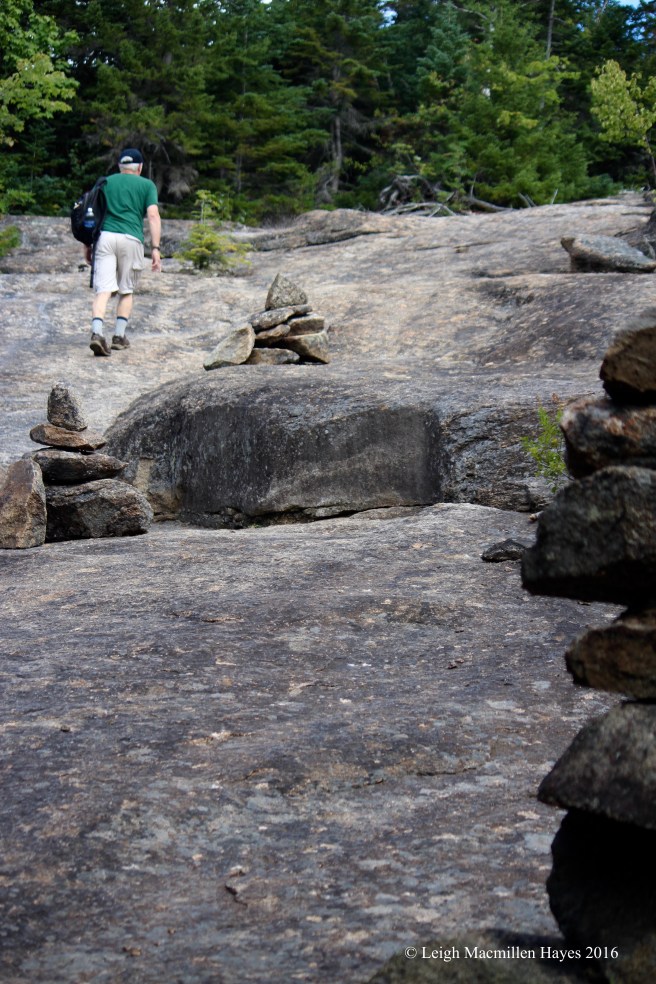
The trail changed as we hit the balds.

c-short horned grasshopper

And my view changed. I heard this guy’s crackling sound as he flew from one spot to the next only a foot or so apart. This is a short-horned, band-winged grasshopper.

c-mountain cranberry

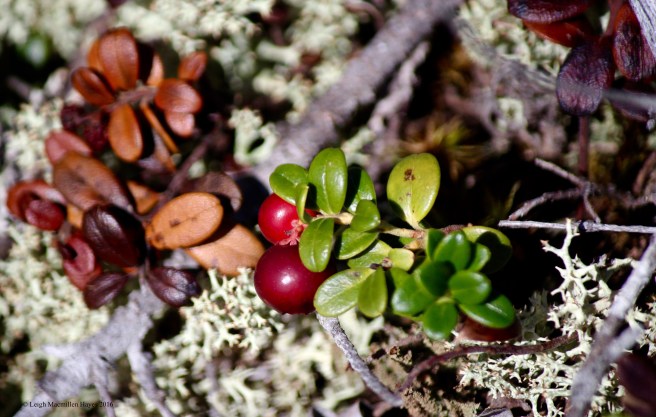
Also at our feet–mountain cranberries.

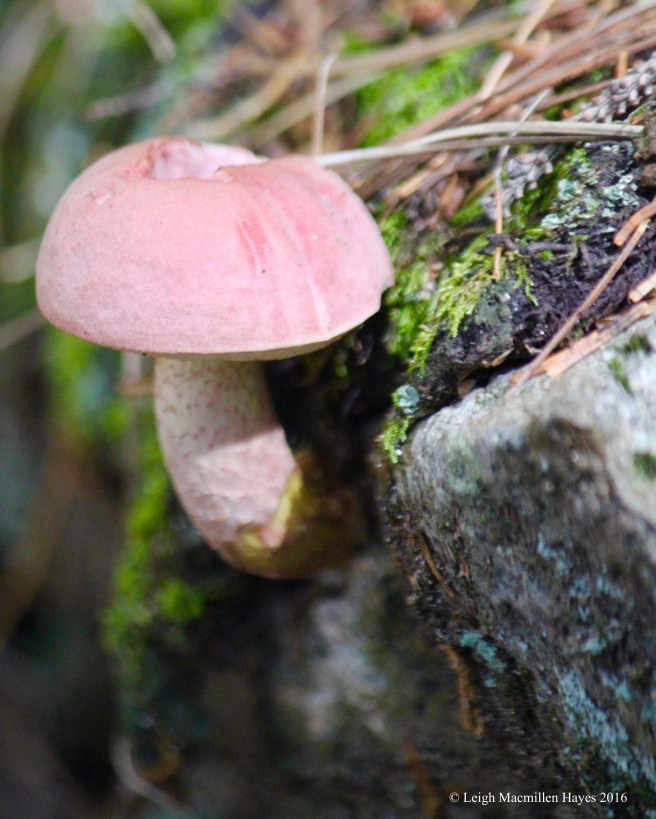
c-mushroom on rock

And then there was this single fruiting structure sticking out of the moss on a rock–a bolete, I believe, but I’m out of my league on this one.

c-summit view 8 (1)

Less than two hours and lots of sweat later, we emerged at the top where many had tracked before us. No horse prints. The wind hit our faces with a cold blast and we were forced to hold onto our hats. Mount Washington and others were obscured by clouds.

c-summit view 7 (1)

c-summit view 5 (1)

c-summit view 4 (1)

The view was 360˚. We took it in, but the clouds truly did tell the story of the wind. And so we paused only briefly, noted the notch for which this area is named and then started our descent.

c-heading down (1)

On the way down, we found a less windy spot and located lunch rock–it’s the rock to the far right.

c- artists conk

My focus was a bit higher as we descended and so I saw artist’s conks,

c-hierogliphics

heiroglyphics left by bark borers,

c-red maple

and signs of the future.

Our descent was quicker than I thought it would be. As we practically rolled down the mountain, I was sure that had I been behind a team of horses, I’d be pulling on the reins and yelling, “Whoa Nellie.” And that brought memories of my mom, who was named Nellie, but went by Nell. She and Dad would have loved the fact that we have made a point to fold as many Mondates as possible into our lives. They loved long walks along beaches and finding picnic places. We love long hikes and finding lunch rocks. Same thing at a higher elevation.

My guy and I enjoyed another wonderful Mondate–at one-horsepower speed.


Mondate Afternoon

My guy was on an unexpected road trip all weekend and didn’t arrive home until lunchtime today. So, while I waited for him, I did what I do best–stalked the garden.

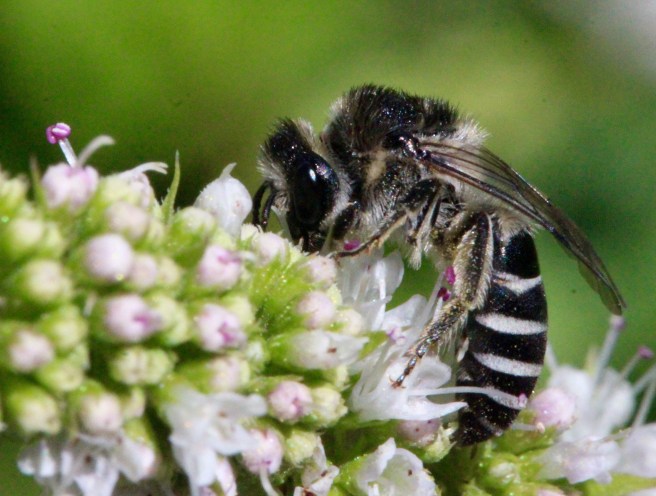
n-morning white faced wasp

I’m not sure I ever noticed this black and white bee previously. Its hairy body shimmered in the morning sun.

n-morning golden digger wasp

At the same time, the great golden digger wasp moved quickly about, using its jointed antennae to search out nectar before it honed in on the sweet stuff.

n morning wasp

In a similar manner, a thread-waisted wasp also visited the mint flowers.

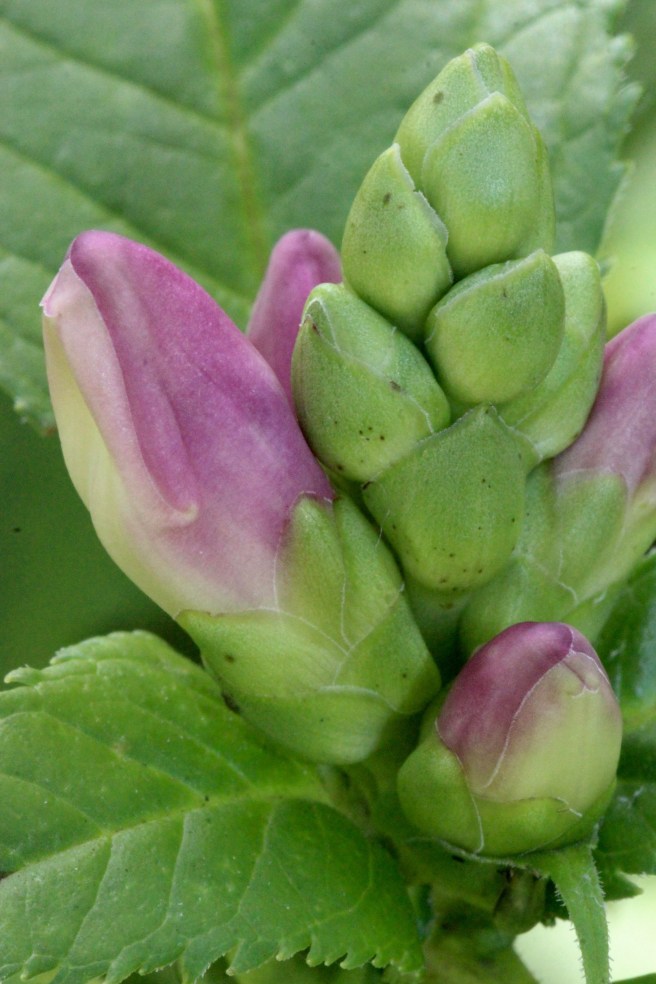
n-morning  turtlehead

As I made my rounds, I was thrilled to find turtlehead about to bloom. This late-blooming flower is one of my favorites (turtle theme), and I’ve watched it move from spot to spot in the garden. This year, it’s plentiful in a shadier place than usual.

n-morning black eyed susan

While the turtlehead sported new life, the black-eyed Susan spoke of days gone by. But even still, I think it’s stunning.

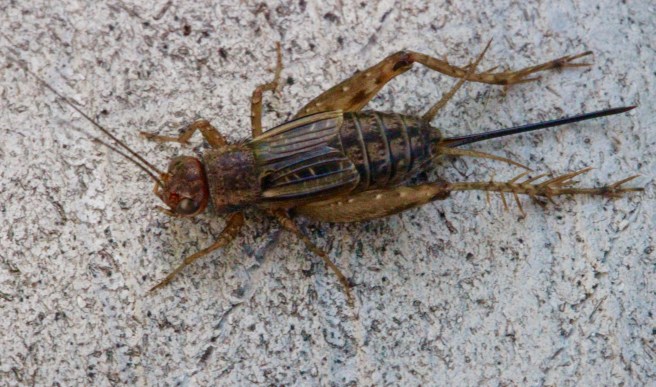
n-morning cricket

On the deck I noticed a cricket. Really, they are everywhere right now and sing all day and night–thus the reason we named our homestead Cricketchirp Farm. Don’t get it wrong–we don’t farm–we just live in an old farmhouse. Our best crop–insects.

n-morning grasshopper

And then I noticed I wasn’t the only one doing the watching. The red-legged grasshopper broke through a spider web and turned its head to keep an eye on me. Nice lips.

n-ordway sign

Finally, my guy was home and eager to stretch his legs. So I convinced him to explore several properties in the Oxford Hills region with me. Our journey began at Ordway Grove.

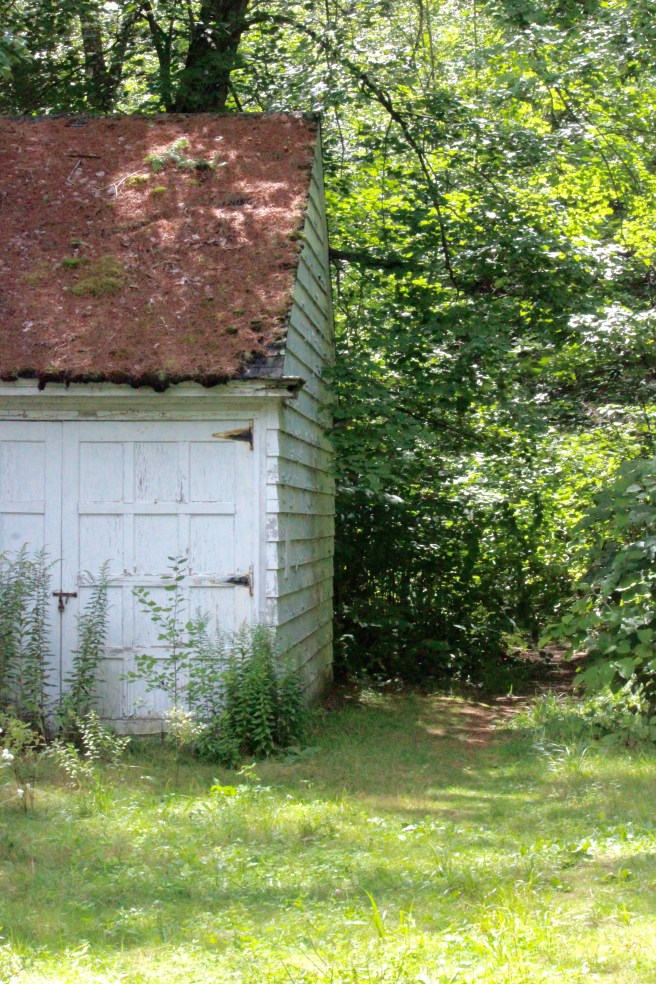
n-Ordway trailhead

The trailhead is located on Pleasant Street in Norway and begins beside a quaint shed. Though the trail isn’t long, its history is worth reading on the Norway Historical Society’s Web site.

n-oak on beech

This is land where large red oaks are supported by much smaller beech, and . . .

n-giant pines

towering white pines speak volumes about the last few hundred years.

n-Penneseewassee

The trail includes a few peeks at Lake Pennesseewassee, aka Norway Lake. Our only disappointment–signs of man’s disturbance, aka trash and some graffiti. Why?

n-wasp Witt Swamp.jpg

After we completed the loop walk and stood in awe among the giant trees, we continued up Pleasant Street to the trailhead for the Witt Swamp Trail owned by the Western Maine Foothills Land Trust. At the kiosk, an attached note provided warning. The register was a bit destroyed–perhaps due to a wasp encounter. It was cold and breezy when we arrived so we didn’t see, hear or feel a single insect.

n Witt Swamp evergreens

The beginning of the trail leads through a variety of youthful evergreens including red and white pines, balsam fir, hemlock and cedar.

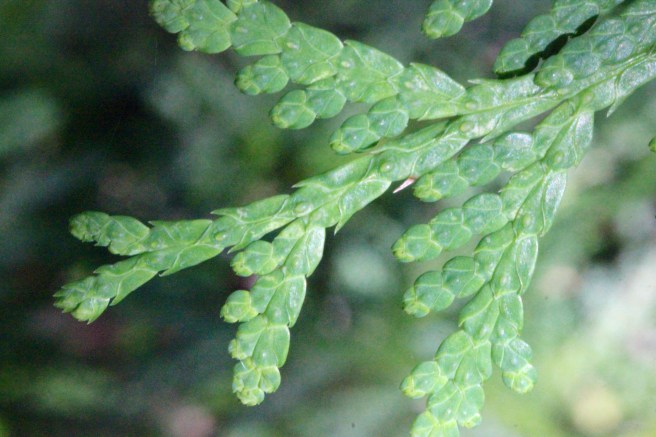
n cedar leaf

Because they are saplings, I was able to take a closer look at the cedar leaves. Can you see the oil glands that give cedar its aromatic smell when the leaves are crushed?

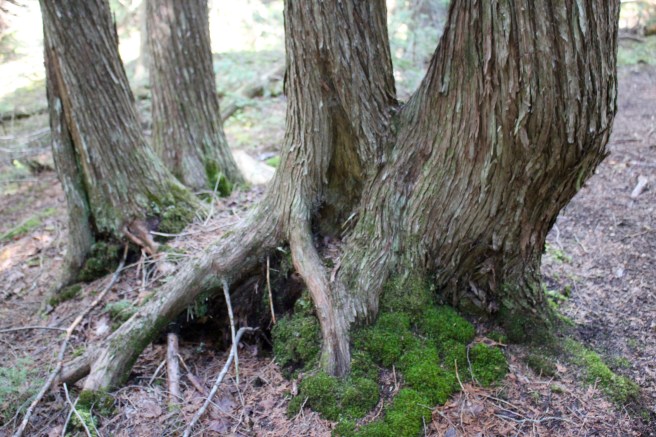
n-cedar waves

My eyes were constantly drawn to the waviness of cedar bark, which creates a pattern not equaled by others.

n cedar works

Cedar works and . . .

n-cedar legs

cedar legs speak of their family genes–cedars are members of the Cypress family.

n-squeeze between 2

Two trees and a few signs encouraged us to pass through–so we did.

n-arrow at Witt

Other signs also indicated the direction to follow–this one much like an oversized arrowhead.

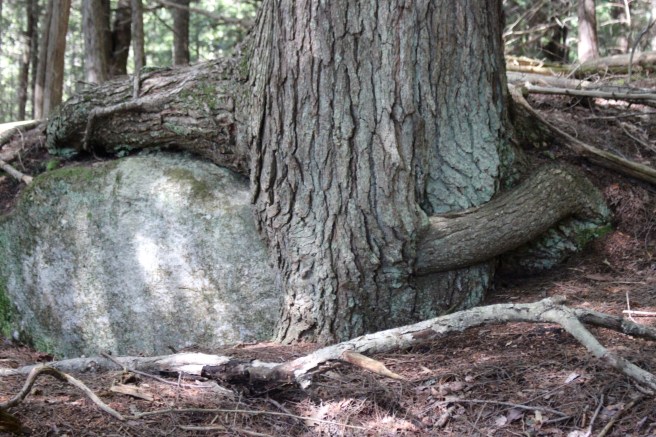
n-hemlock hugs

Not to be left out, a hemlock hugged the rock and itself.

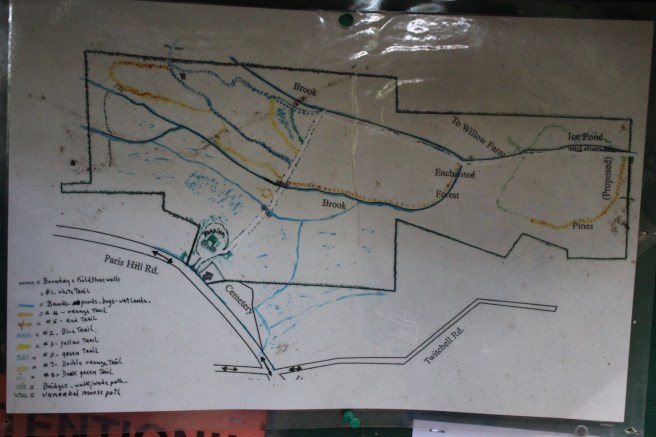
n cornwall map

After another rather quick journey, we drove to Paris Hill. Our destination: Cornwall Nature Preserve, a 147-acre tract donated to the town of South Paris by Alice Cornwall. We decided to follow the wide white-blazed trail toward the purple trail leading to the Ice Pond.

n ice pond dam

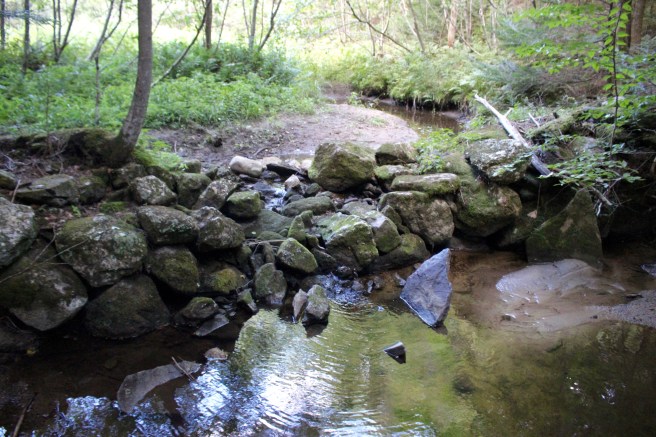
We found the old dam, where water trickled through the rocks, but didn’t realize that somewhere in this vicinity we missed what may have been the ice house–or perhaps a rock foundation of sorts. Now that I know we missed it, I’m eager to return for a closer look. Back in the day, ice was cut and probably stored in the ice house. As a kid growing up in Connecticut, I recall going to an ice house on Route 1 in Clinton. Ice blocks stored in an insulated icebox kept perishable food chilly.

n-artists conk

We did see a few mushrooms here and there, but this summer’s drought means a low amount  of mycelium’s fruiting form. A few artist conks made themselves known.

n-oak fern

Without field guides, I think I ID this correctly as oak fern. Though similar to bracken, its stem was delicate and its height low. I should have looked for sori, but only had time for a quick shot–I was with my guy, after all.

n-Cornwall stonewalls

Again, there were stonewalls throughout the property–this one covered with moss. Like much of Maine, this was once farm country.

The Cornwall Nature Preserve has a variety of trails, but no maps other than the one at the kiosk. We figured out the layered trail system and encircled most of the outer part of the property. Much of it seems worthy of further exploration and enchantment.

We certainly felt enchanted to finally celebrate an afternoon Mondate.


Sundae School

I went on a reconnaissance mission this afternoon and visited a land trust property I’ve never stepped foot on before. My intention was to scope it out for possible use with a future Maine Master Naturalist class. My realization from the get-go was a happy heart. I can’t wait to return and take others along so we can make discoveries together.

n Preserve sign

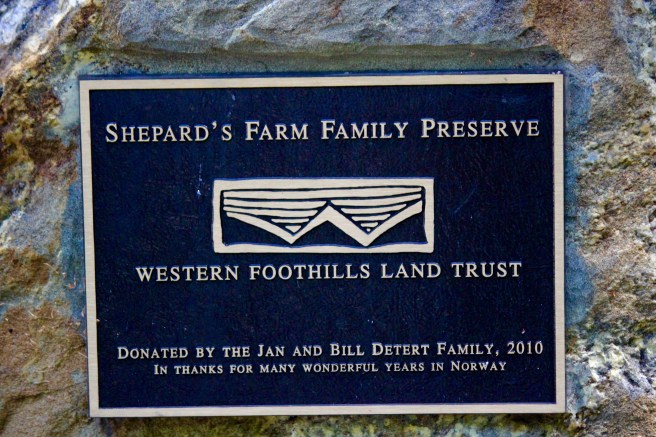
I’ve only been on one other Western Maine Foothills Land Trust property, so had no idea what to expect. The small parking area for Shepard’s Farm Preserve is at 121 Crockett Ridge Road in Norway. (Norway, Maine, that is.) This is one of seven preserves owned by the trust. I should have known I’d enjoy myself immensely just by the name. Though we spell Shephard with an “h,” it’s a family name for us. Who knows–maybe there’s a connection.

n-trail sign

On the back of the brochure I grabbed at the kiosk, I read the following: “Originally owned by Benjamin Witt, the high undulating pasture of Shepard’s Farm Family Preserve was transferred to Joshua Crockett in 1799, Charles Freeman in 1853, John Shepard in 1910, and to Bill Detert in 1984.” Mr. Detert and his family donated the property in memory of his wife, Jan, to the WMFLT in 2010.

n-Indian pipe bee 1

My lessons began immediately. What to my wondering eye should appear, but a bee pollinating an Indian pipe. And in the middle of the afternoon. Huh? I’ve always heard that they are pollinated by moths or flies at night. Of course, upon further research, I learned that bees and skipper butterflies have been known to pay a visit to the translucent flowers. Add that to the memory bank.

n-Indian pipe

As I continued along the trail I found the upturned mature flower and again wondered–who stopped by for a sip of sap? Lessons should evoke further questions and a desire to learn more.

n-hawkweed

The trail offered other familiar flowers, like hawkweed,

n-pearly everlasting

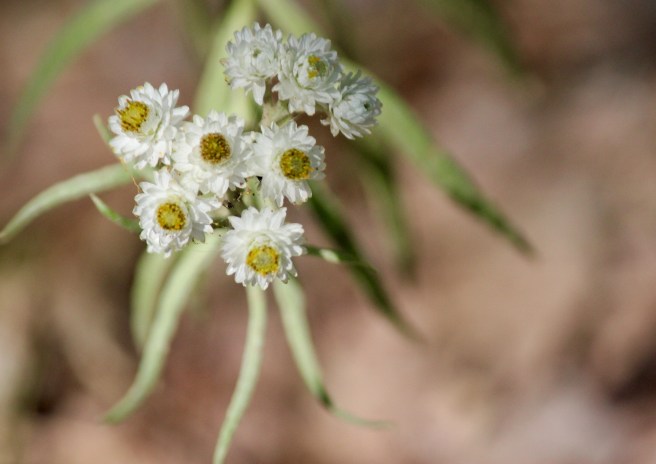
pearly everlasting, goldenrods and asters, Queen Anne’s lace, boneset and jewelweed.

n-monkeyflower 3

And then I come upon a wildflower I don’t recall meeting before. The lesson included a look at the leaves, their arrangement on the stem, and the flowerhead.

n-monkeyflower 1

The answer to the quiz–lavender-flowered Sharp-winged Monkeyflower. Monkeys in the woods! You never know. Sometimes I think that red squirrels sound like monkeys when they chit at me, but in this case, it’s the fact that the flower looks something like a monkey’s face.

n-thistle young and old

Further on,  I spotted a favorite that I don’t see as often as I’d like. What I didn’t realize is that thistles are in the aster family. Always learning. Its presence here is referenced by trail conditions, which change periodically from mixed hardwoods to softwoods to open places. Thistles prefer those open places–fields and waste places. Hardly waste in my opinion. Rather, early succession to a woodland.

n-bee on thistle 2

A bee worked its magic on the flowerhead so I moved in for a closer look.

n-bee on thistle1

As with any flower, it was a pollen frenzy.

n-thistle with seeds

Seconds later–maturity! Well, maybe not quite that fast.

n-thistle seeds 1

But the seeds had developed their downy parachutes and the breeze was a’blowing.

n-thistle seed 2

They knew it was time to leave the roost and find a new classroom.

n-trail ferns

Another lesson worth more time was a look at the natural communities along the trail. Bikers and hikers share this space, but what I found fascinating was the constant change.

n-trail hay

The original trail for the Shepard’s Family Farm Preserve was located on a 19-acre parcel. Recently, the Witt Swamp Extension was added, which almost circles around a 250+ acre piece. Hay covers some of the new trail right now–giving it that farm-like feel and smell.

n-trail 1

I’m not certain of the mileage, but believe that I covered at least 4-5 miles in my out and back venture over undulating land and through a variety of neighborhoods. The trail conditions–pure bliss. No rocks or roots to trip over. Instead, I could look around for the next lesson.

n-cedar bark

One of the things I love about hiking in Norway is that I get to be in the presence of cedar trees–Northern white cedar.

n-cedar leaves

I’m fascinated by its scale-like leaves.

n-deer tracks

So are the deer, who feed on the leaves during the winter months.

n-dry stream

I found only deer tracks, and noted that all stream beds were dry, though the moss gave a moist look to the landscape. We’re experiencing a drought this summer.

n-red leaf

Due to that lack of rain, some red maples already have turned and colorful leaves are beginning to float to the ground.

n-porky 3

Deer aren’t the only mammals that inhabit this place. From the trail, I noticed hemlock trees with bases that looked like perfect gnome homes. And then I spotted this one that invited a closer look.

n-porky den

A pile of porcupine scat–the pig-pen of the woods. Even Charlie Brown would note a distinct odor.

n-toad camo

And in true “Where’s Waldo” tradition, a young American toad crossed my path. The camo lesson–blend in for safety’s sake.

n-turtle 2

Being former farmland, stonewalls wind their way through the preserve. And my childhood fascination with turtles was resurrected. Do you see it?

n-turtle 3

How about now? Hint: the head is quartz.

n-turtles

And this one? They’re everywhere. It makes me wonder if it was a style of the times.

n-stone wall ending

I crossed through a gap in the stonewall and noted two smaller stones topped by a large flat one. A reason why? The questions piled up. I need to ask the teacher.

n-stonepile

And then there were the stone piles. Why so many smaller stones around a boulder? What I love about this spot is that a hemlock took advantage of the boulder and grew on top of it.

n-stone structure 2

And another favorite find–a stone structure.

n-stone structure, flat

Created with rather flat field stones.

n-stone structure 1a

It’s near a stonewall, so I surmised it was a shed of some sort rather than a root cellar for a home. I could be wrong, but am thrilled by the opportunity to see it.

n bird sculpture

One of the coolest features of this property is that it’s home to sculptures created in the 1970s by Bernard Langlois, including this bird in flight. The sculptures were made possible recently by the generosity of his widow, Helen Langlois, Colby College and the Kohler Foundation.

n-bird lady 2

Mrs. Noah is my favorite. She has stories to tell and I have lessons to learn.

It’s Sunday and by the time I finished hiking I was hot. I’d intended to check out a few more preserves, but the thought of a creamsicle smoothie at a local ice cream shop had my focus–until I pulled in and saw this posted: “Cash and local checks only.” No cash. And though our checks would be local, I didn’t have any with me either. Lesson learned.

I drove home and made my own sundae.

Rather a Mondate

Yes, it’s Monday. But as has been the case lately, my guy and I haven’t been able to hike together. We both had chores and projects to complete and so we did.

In the late afternoon, however, I headed out the back door. My mission–to locate something orange to photograph for our young neighbor who is prepping for a bone marrow transplant. Not an easy task, but like others I know, as often as he can, he smiles through this journey.

m team orange

Orange hawkweed provided today’s support to Team Kyan. May he continue to be strong. And his family, as well.

m cicada 5

After my orange find, I journeyed on–headed for our woodlot. And only steps from it, I discovered this camo-dressed insect fluttering on the ground. The male member of this species is known for the high-pitched buzz we hear on summer days. Sometimes, it’s almost deafening.

m cicada wings

This is a cicada, one that appeared to have a wing issue. A set of wings was held close to its  thick body, while the other set extended outward. (I thought of Falda, the faerie with folded wings in The Giant’s Shower.) I love the venation, reminiscent of a stain-glass window. Strong, membranous wings for a large insect.

m cicada flap

When I returned a second time, it was flapping those wings like crazy, but take off wasn’t happening. Did a predator attack at some point? Will it still be there tomorrow? So much to wonder about.

m cicada up close 2

And being me, I took advantage of the fact that it wasn’t going far to take a closer look. Notice the three legs extending below the thorax.

m-cicada kiss

Face on! We might as well have kissed. I’ve licked a slug, but passed on the opportunity to kiss a cicada. I do love this broad head, however. Check out that mouth that protrudes. Hidden inside are mandibles and maxillae used to pierce plants and drink their sap (xylem). Even if this chunky one couldn’t fly, it could still eat. And those eyes, oh my. So, here’s the scoop. The two obvious outer  eyes are compound, the better to see you with. But then I noticed three red spots located between the two compound eyes. Do you see them? These are three more eyes known as ocelli–they look rather jewel-like and are perhaps used to detect light or dark. Yup, this is a five-eyed insect. Certainly worth a wonder.

m indian pipe 6

As I continued my wander, I noticed that in the past few days a large number of Indian Pipes made their ghost-like presence known.

m indian 7jpg

Ever so slowly they broke through the ground–these under a hemlock grove.

m indian pipe 24092

Though each is one flowered, they love communal living.

m indian pipe 5

Their waxy flowers dangle as they pull up through the duff.

m indian pipe

Once fertilized, their pipes slowly turn upright, where the flowerhead will transform to a capsule encompassing the seeds of the next generation. Notice the lack of leaves–scales take their place.

m pine sap group

Also in these woods, I knew today to look for a relative of Indian Pipe because I found their capsule structures last winter. Pinesap growing below an Eastern white pine.

m pine sap 3

Since it was dark under the trees, I needed to use a flash, thus the color. But really, these are amber. And multi-flowered on a raceme. Pinesaps and Indian Pipes produce no chlorophyll, therefore they can’t make food on their own. And because they aren’t dependent on light, they thrive in shady places.

m-pine sap flowers

What sustains them is their saprophytic nature–they aren’t a fungus, but depend on fungi to obtain carbohydrates from another plant, so the mycorrhizal fungi serves as the connector between the host and the Pinesap’s roots.

m-pine sap up

While the Indian Pipe is scaly, the Pinesap has a hairier appearance. Both are members of the heath family.

As for me and my guy, today we’ve been near each other, but not on a playdate. In fact, as I sit in the summer kitchen and write, he’s doing a huge favor for me. Isn’t that how it should be? No, not really. We’d rather be on a Mondate together.

Book of July: Not a book

Huh? How can a book of July not be a book? When it’s a magazine. I’ve decided to promote Lake Living magazine this month, rather than The Forest Unseen: A Year in Nature by David George Haskell. Perhaps that will be next month’s book.

mag (1)

OK, so this is a biased opinion since I write for Lake Living, but I swear that each issue is better than the last and the last was pretty darn good. Here’s the thing. Yes, the mag focuses on the greater Bridgton lakes region of Maine, but there’s something in it for everyone no matter where you live.

knots (1).jpg

Among this season’s selections is an article about knot tying written by Perri Black and illustrated by Christine Erikson. Perri pulls the reader in with a whimsical look at the history of knots and her relationship with trying to tie one. And then, she and Christine show us how to tie three knots: bowline, tautline hitch and “An elegant hanger for a coil of rope.” Perri’s thoughts about the latter: “I love this one. It is, indeed, elegant, and if you make a real mess of tying other knots with the rope, no one will ever know because at least the rope will look pretty when hanging in your workshop or garage and give the impression that you know what you’re doing.”

Farmers' (1)

Another delightful article is “The Smallest Steps” by Julia Marino, in which she invites us into her experience of discovering the wonders of farmers’ markets. It’s followed by two of her favorite recipes.

Mushrooms (1)

Speaking of recipes, in this issue, you’ll notice recipes attached to three articles, including one by yours truly about “The Mushroom Guys.” Even though they are located in the area, you can visit their Web site, www.whitemountainmushrooms.com, to place an order or find out when you might join a foray.

Coda (1)

Coda’s Tale by editor/publisher Laurie LaMountain is on the more serious side. Her dog, Coda, contracted anaplasmosis in 2015 and in this article Laurie shares the details of pain and suffering–with a happy ending. Thank goodness.

book reviews (1)

A constant in the summer and winter issues, and something many people look forward to–book reviews by Pam and Justin Ward, owners of Bridgton Books, and Perri Black, who also works for them. We are thankful to have an independent book store nearby and love that we can walk in and be greeted personally by the staff, who oft times will recommend books because they know our preferences. I encourage you to read their reviews in full and then head off to an independent shop where you can develop the same relationship. Or visit Bridgton Books.

TOC (1)

There’s more. And it’s a holiday weekend. So brew a cup of coffee or pot of tea and sit down with Lake Living. Oh, and did I mention that it’s free. Yep. You can view it on-line or pick it up in a local shop. (Unless you live “away” as we say in Maine, and then a subscription is $20.) Of course, in order to provide a magazine at no cost, we depend on advertisers. Please support them and let them know where you saw their ad.

Lake Living magazine, not a book, but certainly worth a read.

Lake Living magazine, published quarterly by Almanac Graphics, Inc.

Lord of the Hill Mondate

My guy graciously agreed to a slower than slow walk along Sucker Brook at the Wilson Wing Moose Pond Bog Preserve this morning. It was still frigid and moving slowly meant we felt it. But . . . I’d lost a magnetic name tag while leading a hike there on Saturday and wanted to try to find it.

l-sucker 2

It was also a good excuse to spend some time taking in the beauty of this place as

l-sucker frosted pillows

mid-morning sun bounced off the frosted rock pillows.

l-trail debris

Unfortunately, trail debris blown down during this weekend’s wind event obscured the green and white tag and we never found it. If you hike there and see it, please grab it for me.

l-owl cough pellet 1

l-pellet 2

l-pellet bones 1

We did, however, pause so I could take a few more photos of the owl cough pellet we saw the other day. A rodent became dinner. I hope the pellet is still there for our owl prowl on Friday night. Oh, by the way–thank me for not sharing photos of the pristine mammal entrails we found on a rock beside the pellet. From the same animal? We aren’t sure. From the same predator? Again, we aren’t sure. Maybe a hawk used the same tree to remove the intestinal tract of another mammal. But why? We discussed several reasons on Saturday as we hovered over the sight: lousy taste; harmful bacteria; low nutritional value? A natural mystery.

My guy and I backtracked to the kiosk, then crossed the road and started up the Bishop’s Cardinal Trail. Conditions varied from a bit of snow that was crusty and crunchy under our micro-spikes to almost no snow under some of the larger hemlocks. I like that x marks the spot where two predators passed–assumably at different times, though I do think it was the same night. Diluted now, I’ve a feeling their prints would have been clearer on Saturday.

l-bear 6

Our eyes darted back and forth as we looked for our next finds. We know where they hide and visiting in winter provides a clearer vision.

l-bear tree 2

Beech trees. Bear trees.

l-bear 5

We envision the black bear that climbed up and perhaps sat on the branches above gorging on beechnuts. Bears eat a large variety of plant species. They also dine on insects, ripping apart tree stumps  or rotten logs in search of grubs or turning over rocks looking for ants. And they will scavenge mammal carcasses or even prey upon live deer fawns and other small mammals. But when it comes to the beech nuts, raspberries and blueberries–well, they’ll travel quite a distance–their keen sense of smell kicking in and telling them the location of a food source.

l-bear 8

The good news in this landscape is that the large, mature trees provide abundant nut crops, while those trees that have fallen harbor insects. And where openings exist, raspberries and blackberries fill in, providing other food resources.

The Greater Lovell Land Trust owns the Bishop Cardinal Reserve on the upper side of Horseshoe Pond Road and the property abuts the National Forest. Recently, I’ve noticed that someone generously repainted the boundary–quite generously. My guy wishes he’d sold them the paint.

l-lunch rock

We passed from the GLLT property onto the old jeep trail leading to the summit. Along the way, we found lunch rock. We’ve dined here before.

l-lunch rock cob

So has another. A red squirrel to be exact based on the hemlock cone that has been cleaned to the cob–its scales and even a seed or two left behind.

l-hemlock debris

The weekend winds brought down more hemlock debris–cones, scales, seeds and tender twig tips.

l-hemlock cob

l-hemlock scales

l-hemlock seeds

While the scales have been removed from the cob or core of the cone, you can see where the winged seeds fit inside each. Two seeds/scale.

l-hot cocoa

We were out of the breeze, but hot cocoa warmed our own core.

After lunch, we continued climbing. Predator and prey prints were visible everywhere. One  prey species I’ve only seen a few times so far this winter is the meadow vole. Typically, it tunnels through the subnivean layer between the snow and the ground, but in these conditions, that layer is frozen solid and so the tunnel shows at the surface.

l- 3 cones

Soon the hemlocks find themselves in the company of white and red pines. Cones of the three: white and red pinecones, hemlock cone (remember, a hemlock cone is not a pine cone). Like all things in nature, they each present themselves in their own way, so once you get to know one, you recognize all of its relatives.

l-ice fishing

Before we reached the ledges, we caught sight of Horseshoe Pond and watched someone set up the blue ice house below.

l-horseshoe shape

And then the trail opened to the ledges, where in winter the view is best and the reason for the pond’s name well understood.

l-bonsai 3

We climbed to the top, where the bonsai tree forever leans–a red pine stunted in growth by the winds.

l-bonsai

Funny thing–beside it stands another that, though not as tall as its relatives in the woods nearby, certainly received the stand straight family genes. I wonder why the difference between the two.

l-mine a

And then we followed the trail to the Lord Hill Mines, known as a mineral collection site since the late 1870s.

l-lord hill 2

Among the finds in this granite pegmatite, feldspar, topaz, smokey quartz, blue apatite and mica.

l-mine cave

My guy contemplated his fortune.

l-mine cave 2

Based on the tracks leading to and fro, I’m afraid the snowshoe hare have already beat him to it.

l-birches 2

As we headed down via the main trail, we passed through a birch and beech neighborhood where the bark and snow complimented each other and spoke of winter.

l-ice feathers

More than once, we crossed iced-over streams where frost feathers formed.

l-pileated tree

We slipped back onto the GLLT property and followed the blue trail. Beside the path, a pileated woodpecker had done some serious work on a dead snag.

l-pileated chisel

Its chisel marks left an impressive monument for all to admire.

l-squirrel hole root

We were almost back to the road when a tree root grabbed my attention. I’m wowed by the beauty of the roots and moss that flow together like waves. But there’s more.

l-squirrel 3

A hole with tracks and debris leading to it. Squirrel tracks.

l-squirrel hole1

And on the other side, another hole. I wanted to explore it more, but my guy was way ahead. Note to self: return to this spot soon. It’s worth exploring further.

Ya know–I made a mistake. For Valentine’s Day I bought him a pair of micro-spikes. Prior to that, my guy used some Maine-made cleats that continuously slipped off his hiking boots. And even when they stayed on, he slipped. But that meant that I could almost keep up with him. Not so today. He’s got the grip now–and can practically fly through the landscape. You could say he’s lord of the hill and I’m his lady in waiting–well, maybe he’s lord of the waiting and I’m lady of the hill. Whatever. We both enjoyed our Mondate on Lord Hill in Stoneham.

Winter Layers

In typical New England tradition, the weather has changed yet again and warm winter coats are a necessity. At 7 a.m. the temperature was -11˚; 4 p.m. +21˚ and dropping as the sun sets.

Willet

Yesterday we had a surprise snowstorm that didn’t last long, but added another layer of fluff–and beauty.

bird wings

And so, when I headed out this afternoon, I wasn’t sure what I’d find. Stepping over the stonewall and into our woodlot–fresh wing marks and delicate feathers.

junco 1

While those feathers once protected a dark-eyed junco, a larger bird of prey needed fuel to survive.

junco feather

junco:glove

I briefly shed my down-filled mitten to offer perspective.

pines above

White pines that tower above provide a possible perch.

pussy willow a 1

Out on the power line, I met up with a friend and fellow explorer. While D.B. adjusted his new outer wear, I took time to admire the pussy willows and the warm, fuzzy coat they sport.

pussy w 2

pw 3

pussy willows 1

That silvery fur keeps the developing reproductive parts cozy.

snipped feather

Turkey tracks criss-crossed throughout the woods as D.B. and I bushwhacked about. This is not a positive ID, but we found this snipped feather near some tracks. Perhaps turkey? A fight among the clan members? Later, we unintentionally spooked two and they flew from what was probably intended to be their evening roost in the pines.

deer bed

We also saw plenty of deer tracks and wondered about the fact that they travel the same routes day in, day out, year in, year out–just as we often do. Well, I say that, but yesterday afternoon and again today, I got fake lost in these woods that I travel through frequently. I did find a trail I’d made a few days ago and that helped us find our way out today–nothing like leaving snowshoe size bread crumbs behind. Though we saw a few deer beds, I found this one as I passed through the wood lot on my way home.

fox 1

I like to make a circular route through our woods, so didn’t see these fox tracks on my way out.

red fox 2

The red fox is known for having hairy feet–its adaptation to stay warm. And can you see where one foot created an impression, and then to save energy the other foot stepped almost directly onto the same spot?

fox trotWhile the prints I found had been made within the last 24 hours, it was obvious as I came out of the woods that the fox had trotted this way before and yesterday’s snow filled in the track.

Who knows what tomorrow will bring. It’s Great Maine Outdoor Weekend and I’m leading two hikes–with my friend Joan for the Greater Lovell Land Trust and another for Loon Echo Land Trust. Wind chill expected to make things a bit of a challenge. I’ll bring the hot cocoa to the first hike and the Depot Street Tap House in Bridgton will provide hot cocoa after the second one. Dress in layers. Lots of layers. After all, it is still winter.