My Smiling Place

gateway

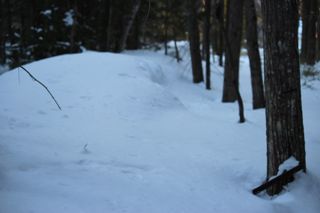
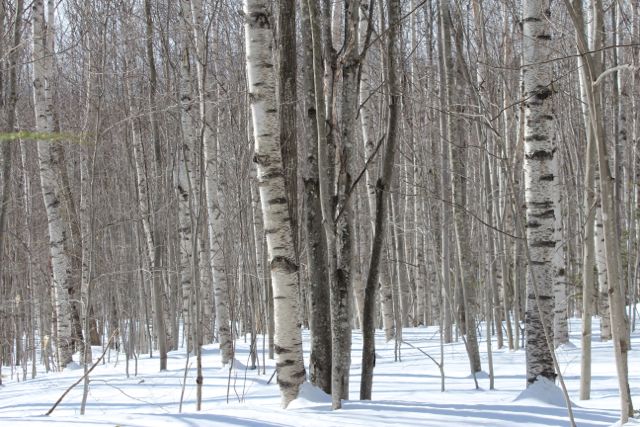
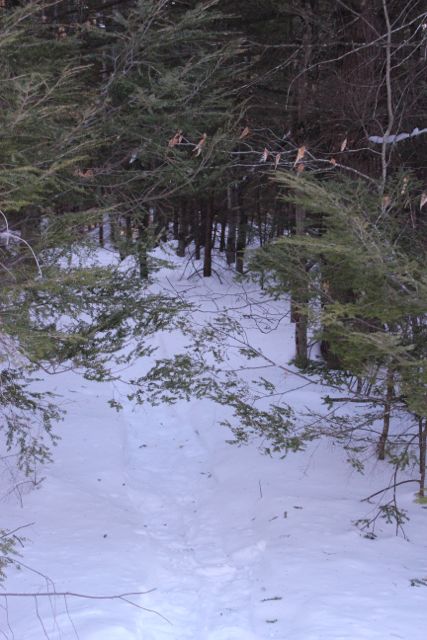
Hemlocks and beech trees create the gateway to my special place where few others wander and wonder. I’ve intentionally left these trees as is at the edge of the snowmobile trail so I can pass through and disappear into my own world. It never ceases to amaze me that I suddenly feel alive as I step into this section of the woods.

I spent this morning at the Maine Milfoil Summit and thought it was one of the best I’ve ever attended. And then a friend and I enjoyed lunch at Fishbones in Lewiston before I drove back to western Maine and she returned to her home closer to the coast. All in all, it was a wonderful day, but the moment I stepped through those tree branches, I was home. I was in my smiling place. It’s a feeling that I don’t think I can put into words. Some things are best left unsaid.
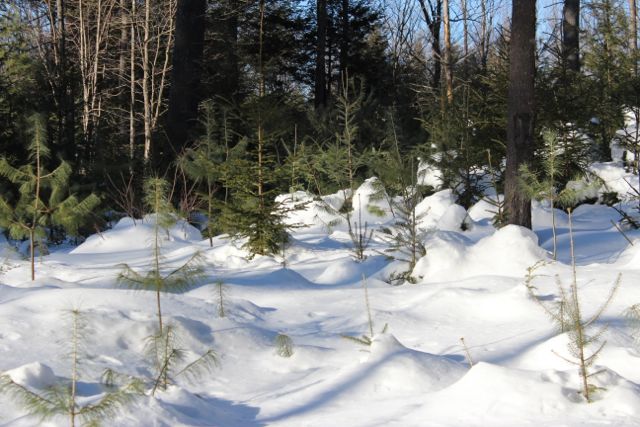
saplings

Part of the woods that I explored today had been logged about ten years ago. The openings created a nursery for hemlocks, pines, fir and spruce to spring up. Who will be the winner in the end? It’ll be a while before I know the answer to that one.
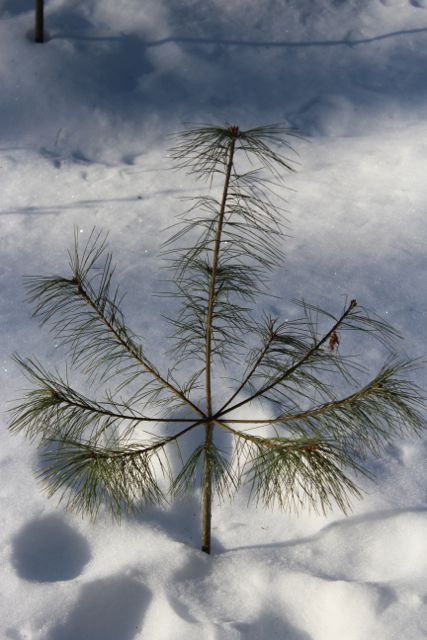
white pine whirl

Eastern White Pine trees win the prize when it comes to the kitchen growth chart, which, by the way, I finally painted over in our kitchen this winter and no one seems to have noticed. Each year, a white pine produces a whirl like the one you see here. A whirl is a group of branches that radiate out from the tree’s trunk.

white pine growth

So, our boys never had a growth spurt quite like this one–thank goodness. I should have measured it, but this white pine grew about two feet in one year as evidenced by the distance between one whirl and the next. Why? Because it’s in an area where most of the canopy or taller trees that would have blocked the sun and prohibited its growth, were taken down. Ample sunlight will do that to you.

snow tree 1

Snow ghosts! Even my computer suggested there was a person hiding under this snow costume–it wanted me to provide a name. Was someone in there? What would you name it?
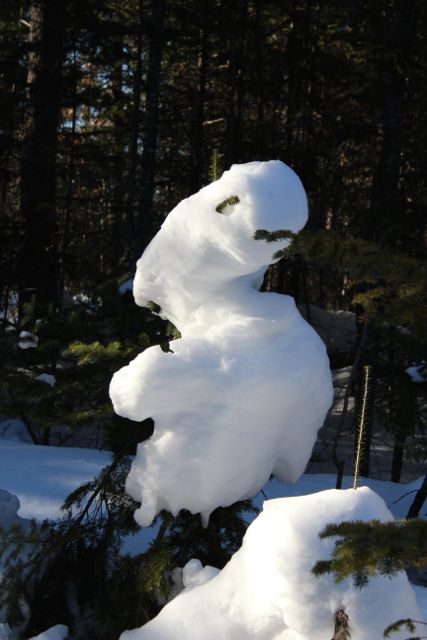
snow tree creature

And a snow creature. Snowzilla?

deer run

The snow is quite deep, but the deer are moving about more and more. I found numerous deer runs like this one today–trails that they use over and over again. Sometimes other mammals follow them as well.
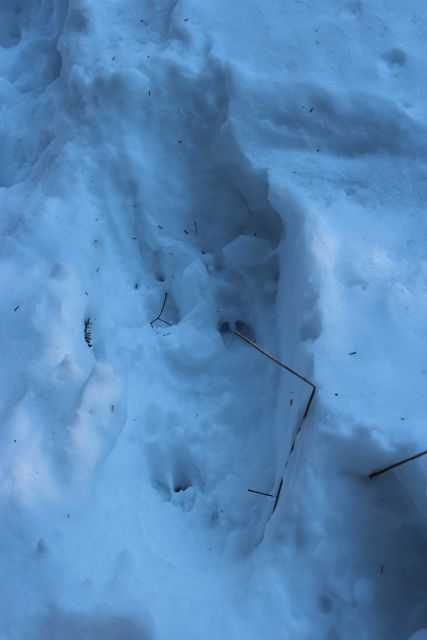
in my tracks

And sometimes the deer follow in my tracks as is the case here. The prints to the left indicate that a deer was traveling toward you as you read this. And the print to the right indicates that another was traveling in the opposite direction.

track

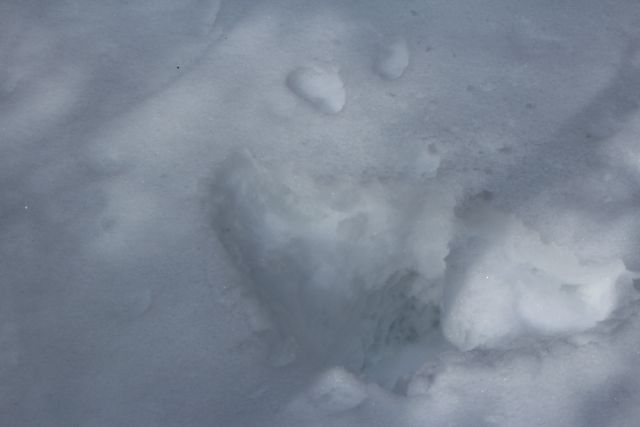
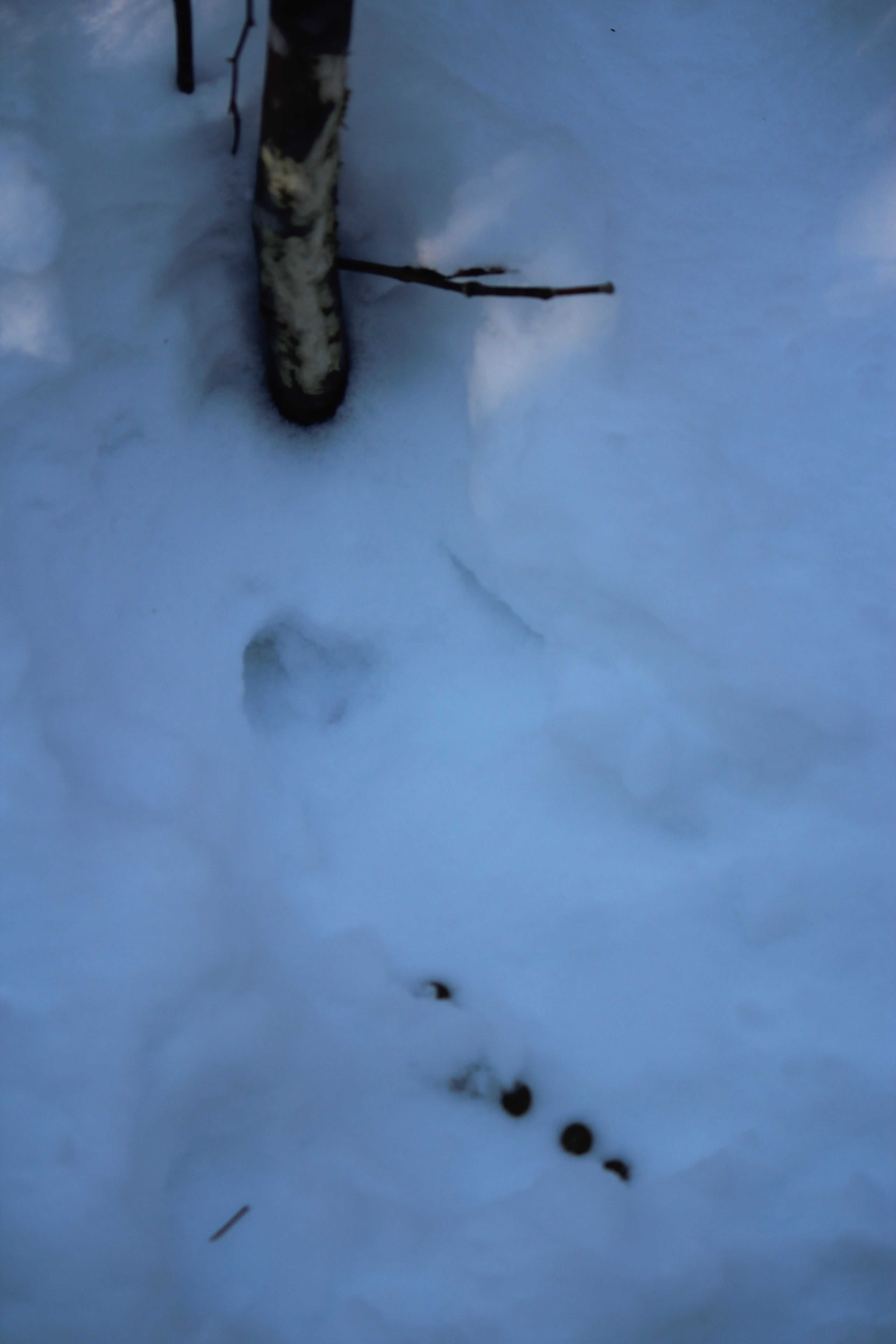
Deer prints are heart shaped. The point leads to the direction of travel.
deer beds

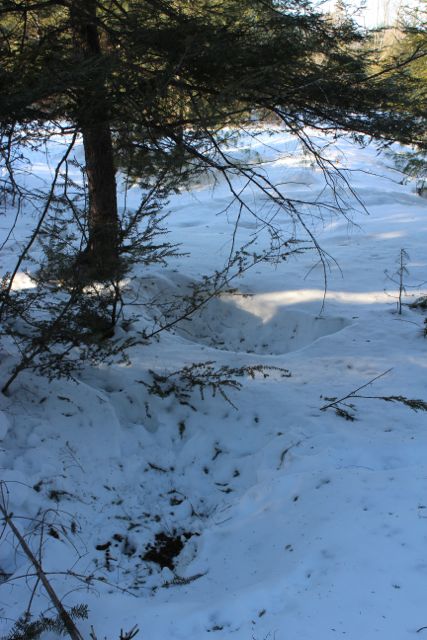
I’m always thrilled when I find deer beds. These two were quite large. And filled with scat–all I can say is, scat happens! The curious thing to note about deer beds is that when two or three are gathered, they tend to sleep with their backs to each other so they can keep an eye out for predators.

another bed

You can see where this deer pawed at the snow to get comfy for the night. Oh yeah, and more scat :-)

print with dew claws

So some say that when you see the dew claws in a deer print, those two small toes above the foot that look like two dots at the back, you have a buck. Maybe. Or maybe the snow is soft and deep and more shows in the impression.

oak leaf phenom

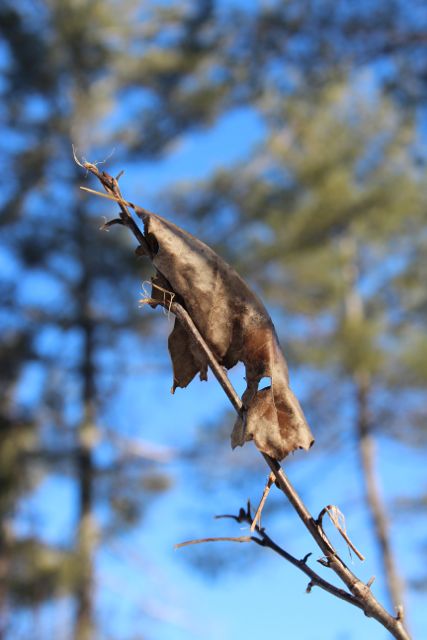
I was thrilled to find this young oak tree, one of the few that has grown in this area since the logging event. I don’t know if you can see from this photo, but there are frayed ends along the branches. I’d never noticed this until about a month ago when exploring a property in Lovell, where it seemed that every oak tree surrounding a field displayed these frayed ends. That field was near a porcupine condominium, so my first thought was porcupine activity. But there were no tracks to the trees. Then I thought of squirrels. But again–no tracks.
oak leaf phenom1

It wasn’t until recently that a friend who is a retired forester showed me it was a wind event that caused this. Like beech trees, oak leaves are marsescent. During wind events, and we’ve had plenty of those this winter, the leaf may get ripped from the tree–leaving a frayed stem or petiole. It makes perfect sense now. And the tree I found today, which displayed this phenomenon, is in the open, leaving it vulnerable.

vole

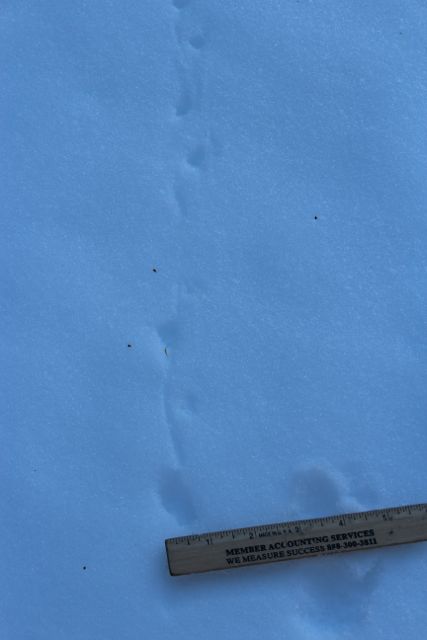
I was almost home when I discovered these tracks. Notice that they are a bit erratic.
vole2

Not a big mammal.

vole 3

Sometimes it exhibits the zig zag or alternate pattern of a perfect walker like a coyote, fox, deer, but . . . it’s a great deal smaller. A great deal smaller. And other times, it tunnels a bit.
vole hole

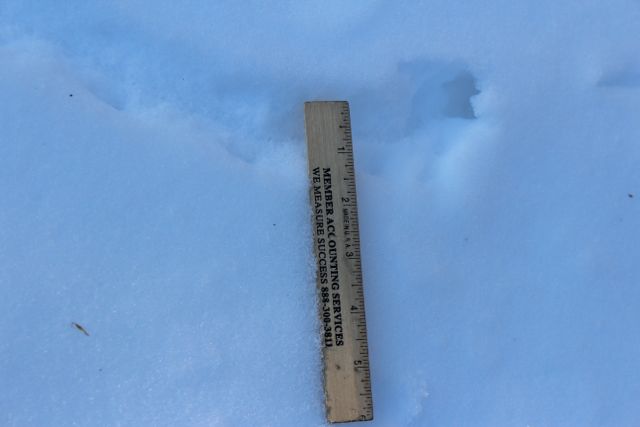
And leads to a small hole. A vole hole! I was excited because I found this in the same area where I found vole tracks last year. Voles are highly delectable treats for some predators. Ah, the food web.
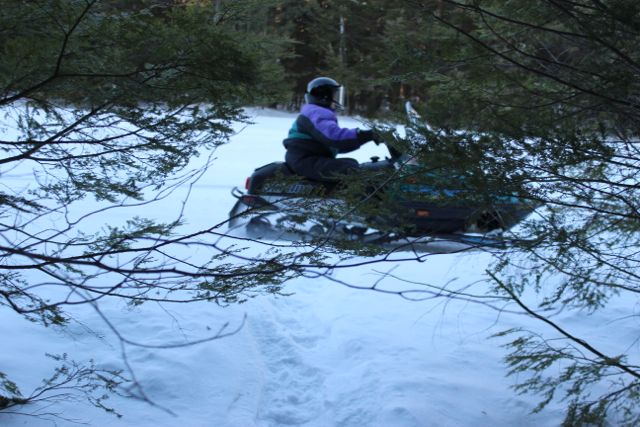
snowmobile

And then I was back at the snowmobile trail and this traveler never saw me. Yup, I like it that way. Rather like the mammals that I know are out there. I can’t see them, but I have to assume they know I’m about and watch me from their hidden spots. Maybe they share a smile with me.

I can only wonder as I wander. Thanks for joining me.
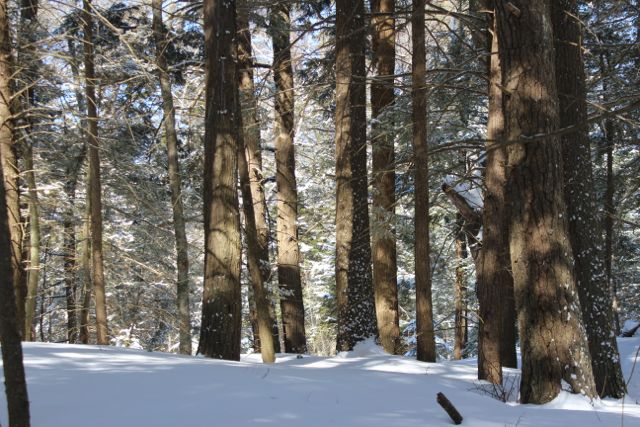
Wondering Among Giants

Robinson Woods

It’s not every day that I get to wander and wonder among 300-year-old giants, but such was the case today. A friend and I met at Robinson Woods in Cape Elizabeth. It was a reconnaissance mission for me as I’ll be leading a senior college class there next month. And for both of us, it was a delightful way to spend three hours snowshoeing on and off the trail, with frequent pauses to look, listen, touch, smell and learn.

Because the land was not suitable for farming (terrain rocky and uneven), it was left unchanged for all these years. Actually, we met the executive director of the Cape Elizabeth Land Trust along the way, and he told us that the Robinson family was a paper company family, but they left this piece untouched. Thanks go to them. And to the land trust for preserving the land so that it will remain in its natural state.

feeding cone

We could hear the birds sing and call as we moved along. Someone apparently wanted to make sure they have enough to eat as we found a couple of these “bird-seed” pine cones dangling from trees. (Separate note: back at home, for the second day in a row, I’ve had chickadees landing on my mitten to eat crushed peanuts–well, they don’t actually eat them on my hand, they just grab and fly to a nearby branch, where they use their feet to hold the nut or seed and then peck away at it.)

porcy trail

We followed this porcupine trail for a bit. As we backtracked our way toward the people trail, something caught our attention:

bear claws

Yes, even in Cape Elizabeth, and only steps from the ocean, you can find bear claw sign on beech trees.

bear claws2

We showed these photos to the executive director of CELT–he had no idea they were there. I’ll be curious to see if he adds black bears to the list of mammals that frequent the property. I did see that they have pine martens on the list–that surprises me.

gnarly tree

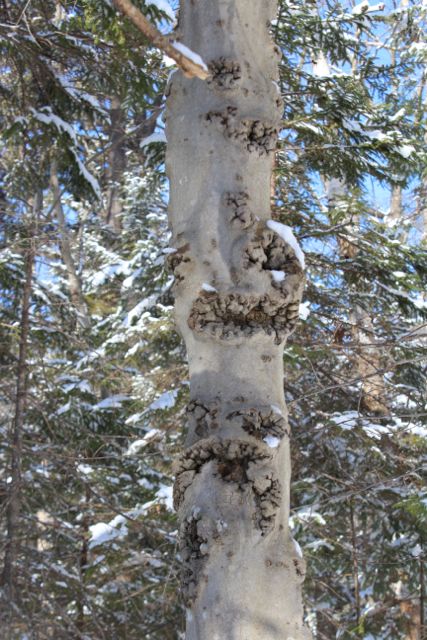
I know I’ve spent a lot of time writing about beech trees, but this one looks like a totem pole of gnarly faces. Think gargoyles. Was the beech scale disease initially responsible for this? I wonder.

gnarly face

more gnarliness

Very gnarly indeed. In the center, you can see where a branch broke off.

burls on a maple

This Red Maple had some serious burls. Perhaps they were caused by stress or injury, though researchers don’t know for sure why they occur. Despite the bumpy, warty growths, the tree appears to be healthy. You can see that there is new growth–young red branches sprouting from the burls. Removing a burl causes a large wound that could eventually harm the tree, so they’re best left alone–though I know woodworkers covet them.

walnut?

We were almost back to our trucks when we came across this tree. It’s a young tree and we tried to key it out. We’re pretty sure it’s Shagbark Hickory, but if you know otherwise, please enlighten me.
Thanks for wondering along with me on today’s wander through the woods.

Mondays with My Soulmate

Property sign

Mondays are our date day and our best dates are treks in the woods. And so this morning, despite temps in the single digits and a brisk wind, we headed off–to Horseshoe Pond Road in Lovell.

bear claws

I’m fascinated by bear sign and love to find claw marks on beech trees. Oh, they climb other trees, but beech show off the scars with dignity for years to come. While bark on most trees changes as it ages, beech bark is known for retaining the same characteristics throughout its life.

initials

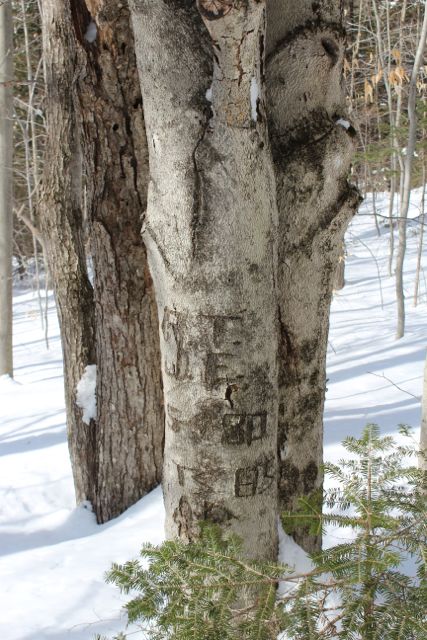
That’s why bears, oops, I mean people, carve initials into the bark of beech trees. So, these initials appear to have been carved in 1980 and 1985.

beech bark

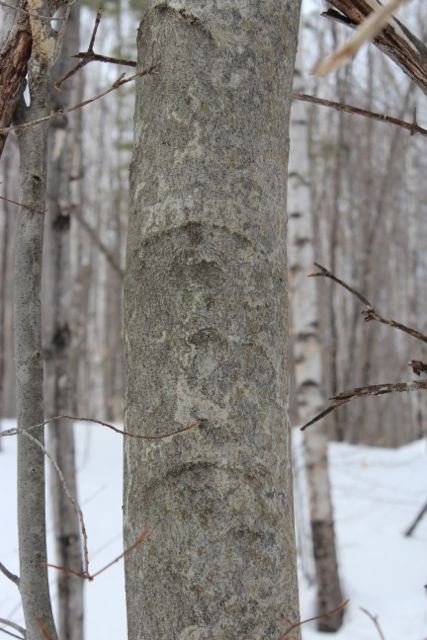
On a healthy American Beech, the bark is gray and smooth. Some describe it as resembling elephant skin. I don’t know about that–I’ve never actually touched an elephant and think that if I did, I might find it rather wrinkly. If you look closely at this photo, you can see some lighter curvy lines–apparently those are slug trails–again, I’ve never actually paid attention and seen a slug eating algae on a beech tree, but rest assured that I’ll be looking for such action in the future.

beech nectria

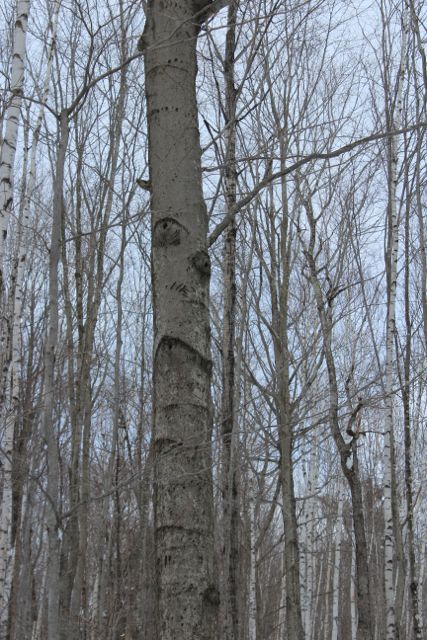
I can’t talk about beech trees and not mention beech bark disease. Some beech trees don’t look at all like the smooth-skinned trees we know they should be. Instead, they are covered with pock marks. In the late 1800s, beech scale, a tiny insect, made its way to the US via wooden pallets. As the insect penetrates the bark to feed on sap, it inoculates it with a fungus. The tree reacts by creating a canker around the fungus. Typically, this doesn’t do the trick and the fungus spreads, causing the tree to look like it has a bad case of chicken pox. And . . . other infections use these openings in the bark to enter the tree. Then come the carpenter ants, followed by the pileated woodpeckers and soon, all you have left is a beech snag as the top snaps off the weakened trunk.

lunch rock

So on to other things–lunch rock. We decide to pause in a hemlock grove to eat our peanut butter and jam sandwiches and drink some hot cocoa–my guy gets away with cheap lunch dates. Clearing the rock, we discovered that others had eaten here before us. Porcupine evidence.

deer browse

Deer browse on some hemlocks directly behind the rock.

beetle borers

Trails of beetle borers on a widow maker dangling from a hemlock.

mouse2

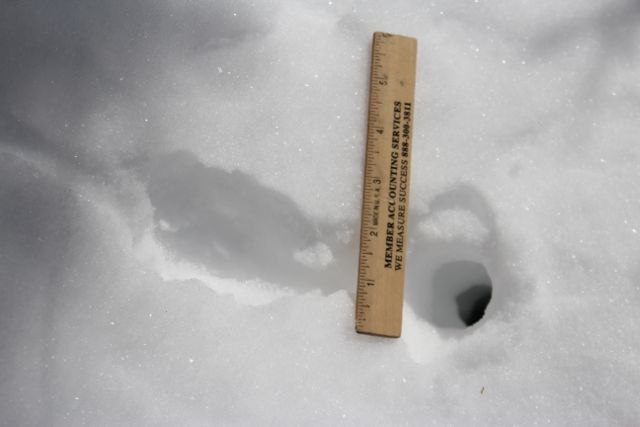
A white-footed or deer mouse that took a chance last night and roamed for quite a long distance–risky business for such a little brown thing.

weasel

Nearby was this hole and set of tracks created by a weasel. Several years ago, a friend and I watched a weasel chase a squirrel up a tree on this very trail.

ruffed grouse explosion

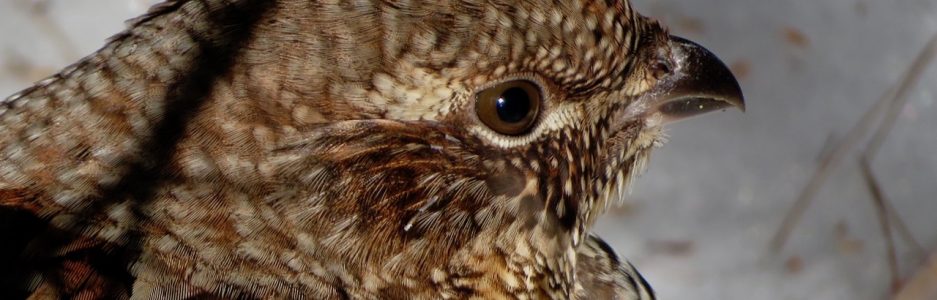
As we continued along today, a ruffed grouse exploded from its snow roost. I wish I’d been quicker with the camera and had actually photographed the bird. But . . . if you’ve ever been startled by a grouse, then you know it’s an unexpected experience. I’ll have to save that one in my mind’s eye.

National forest

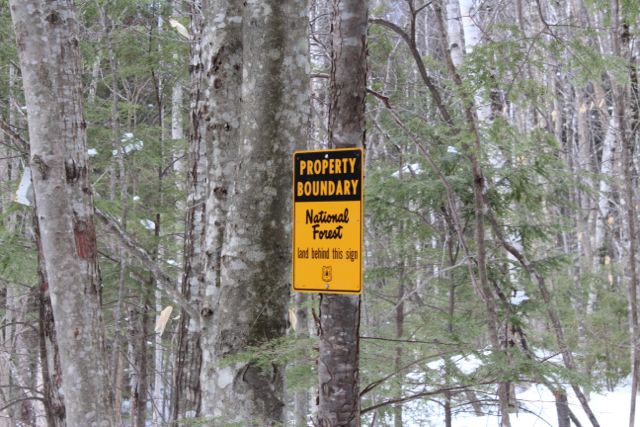
We trekked on land protected by the Greater Lovell Land Trust and then crossed over into the National Forest. Seeing all the animal tracks and sign, some decipherable, others not so, makes me thankful for those who have worked hard to preserve this land and create corridors for the animals to move through.

Horseshoe pond

At last–we arrived at the ledges overlooking Horseshoe Pond. You can almost see the horseshoe shape of the snow-covered pond.

cutting trail up the ledges

Cutting the trail wasn’t always easy. Especially heading up the ledges. It was slick underneath, and a couple of times I felt like a gust of wind was going to pick me up and carry me off. OK, so it wasn’t that bad and I’m not that light. But it was windy and I did have to tuck my body at least twice.

2nd mine sign

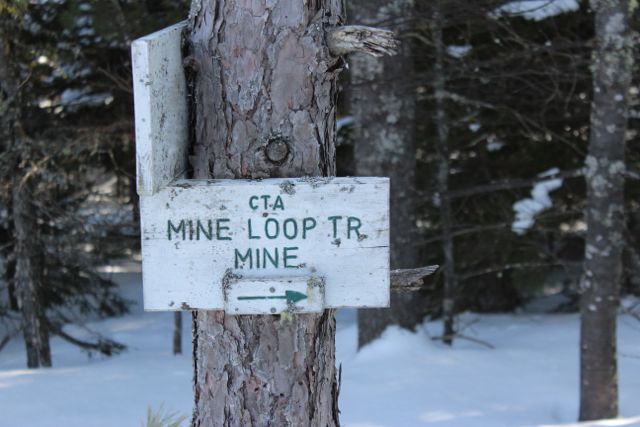
On to the mine.

entering the mine

mine

In her book, Hikes & Woodland Walks in and around Maine’s Lakes Region, my friend, Marita Wiser, writes the following: “Lord Hill has been known to mineral collectors for more than a century. Some of North America’s finest specimens of white topaz have been found here . . . Hundreds of tons of feldspar were mined here beginning in 1947. It was while mining for feldspar in 1965 that the largest pocket of minerals ever found here was discovered.” Marita goes on to mention smoky quartz and blue apatite. And she adds, “Reportedly, mica mined here was used commercially in lamps and as resistors in early radios and TV sets.” One of these days, maybe I’ll strike it rich.

In the meantime, thanks for wondering along with me on today’s tramp.

My Daily Trespass

snowmobile trail

In Maine, we are fortunate to be able to trek on land that isn’t posted. So, I cut through our woodlot, cross the powerline/snowmobile trail, pass through another small piece of our property, climb over a stonewall and voila, I’m able to explore acres and acres of woods that we don’t own.

DT3

Trees are one of my passions. I’m amazed at their idiosyncrasies. These half-inch long hemlock needles are attached to the main twig by short petioles or stems. My photographic skills need some work, so you can’t quite see it here, but the next time you see a hemlock, don’t dismiss it. Stop and take a look.

DT6

On the other hand, these are balsam fir needles, which are attached directly to the twig. They measure about an inch in size and some have little divots or notches on the outer edge.

DT13

Hemlock trees have a lacy look to me. And the top tends to lean over.

DT12

Balsam Fir, on the other hand, stand straight up.

DT4

Another of my favorites is Witch Hazel. Like beech trees, they are marcescent–that means the leaves wither, but remain attached to the stem throughout the winter. The base of a  leaf, where it meets the stem, is asymmetrical. And the outer edge is wavy.

DT14

Here’s another look. This photo also shows the remains of the flower. Witch Hazel flowers in the fall. Take a look at the color of the leaf. It’s almost salmon colored. Generally speaking, however, from afar, it has a brownish tinge.

DT15

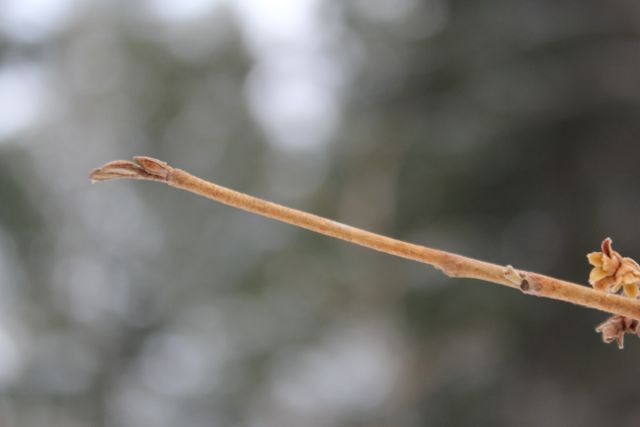
A Witch Hazel bud is shaped like a scalpel. And the tips of branches almost glow with a golden color. It seems like this shrub just screams, “Look at me.”

DT19

Meanwhile, beech leaves have large teeth on the edge. And each vein makes a direct line from the midrib to a tooth, while the veins of a witch hazel appear to be much more random. Winter beech leaves are almost tan in color. These trees remind me of sunshine when I see them in the landscape–bright rays of light against the greens, grays and white.

DT5

Right now, Red Maples are standing out in the landscape as well. This tree was pushed over by a logging event last winter, but it’s got plenty of new growth.

DT17

Like all maples (and ash, dogwood, horse chestnut), Red Maples have opposite branching.

DT18

Other deciduous trees, like this young birch, have alternate branching.

DT10

Sometimes I follow trails I’ve already made and other times I slog along–which is what I did this afternoon. I found lots of deer activity, including this deer run.

DT8

And deer browse. Because deer and moose don’t have upper incisors, they must rip buds off using their lower incisors and the hard palate where the uppers would be. They are herbivores, so in the deep snow that we currently have, tree buds and bark are their go-to food sources.

DT9

Along my journey, I was rewarded with a view of Pleasant Mountain–it’s in the background.

Thanks for traveling with me today.

Wonder My Way

woods 1Wonder my way as I wander through the Maine woods. So often I see things that make me stop and wonder. Sometimes I figure it out, but other times, I’m just as happy that I don’t. It’s The Sense of Wonder that Rachel Carson wrote about which keeps me going. Do we need to have all the answers? I think not.

So join me for a tramp from our woodlot to the world beyond. I know not where this trail will take us, but I can guarantee that we’ll have fun along the way.

woody

This pileated woodpecker and those rectangular-shaped holes caught my eye. I was driving down Menotomy Road in Fryeburg, Maine, on my way to lead a walk for the Upper Saco Valley Land Trust, when I saw them. The carpenter ants in this tree don’t have a chance. I’ve actually stood below a pileated creating a hole, watching as it pulled its neck back and hammered repeatedly with that large bill. Wood chips flew to the ground. If you find a fresh hole, look for scat among the wood chips.

nuthatch 5

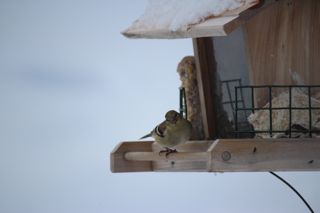
Sometimes it’s the action right outside my back door that makes me pause as it was on this occasion earlier in the week. A white-breasted nuthatch went through several postures to let the tufted titmouse know that he was in charge. Finally, the titmouse responded.

goldfinch

And then there’s the goldfinch: “You talking to me?”

barbed wire 1

Barbed wire is often found in the woods. I’ve walked by this hundreds of times as it’s beside the former cowpath in our woodlot, but only just noticed it recently.

stone wall 1

The barbed wire is at the foot of the tree on the right–beside a double-wide stone wall. Honest, there is a stone wall under all that snow. Double-wide typically indicates that the farmer used this land for agriculture. It all makes perfect sense. To the right of the wall, the land is flat and stone free. To the left, the land varies. Our property and adjacent ones are outlined with stone walls that are single-wide, created to keep animals in or out. The barbed wire indicates that they wanted to keep the animals out of the garden. So the double-wide wall consists of larger stones on the outside, with smaller stones thrown into the middle. The farmer’s best crop as he cleared the land–the stones that heaved up with the frost each spring.

blue sap1

Do you see the blue seepage from the woodpecker hole near the lower part of this tree? It’s frozen pitch–from the Eastern White Pine.

deer bed

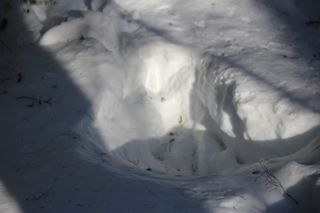
This is the deepest deer bed I’ve ever seen. But then again, we’ve got a lot of snow.

deer rub 2

Deeper in the woods, I found a large area where the Red Maples had been rubbed by deer during recent months. A buck rubbed the velvet off its antlers and left a signpost for other deer.

weasel tracks

On the other end of the scale, this weasel bounded across the snow, moving this way and that.

hare

Other animal sign–snowshoe hare runs, scat and chews. Snowshoe hare pack a trail making it easier for them to move across deep snow and we have them to thank for the contraptions we wear–though I should note that today I sank a few times to my thighs. Yup–we’ve got some snow in western Maine. In the winter, hares eat tree buds, twigs and bark.

red maple bark

Check out the pattern of this bark. Red Maple bark is easily identified once you know what to look for. Many Red Maples in our area have been affected by a fungus that causes the bull’s eye target pattern. Can you see it?

wander with me

I hope you’ll continue to wonder with me. Let’s tramp along the trail together and see what we can find on our way.