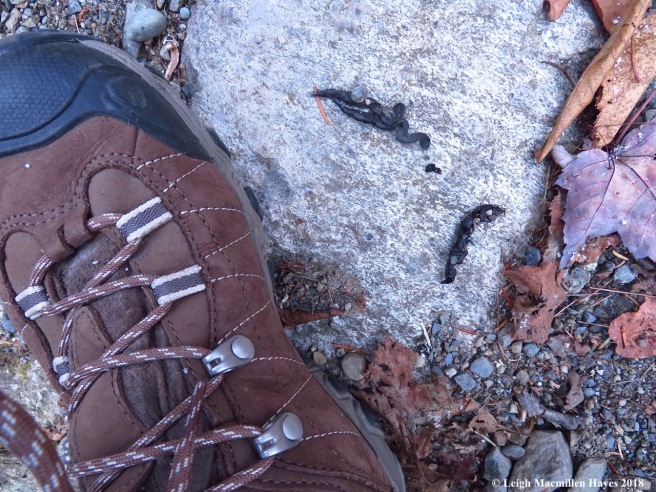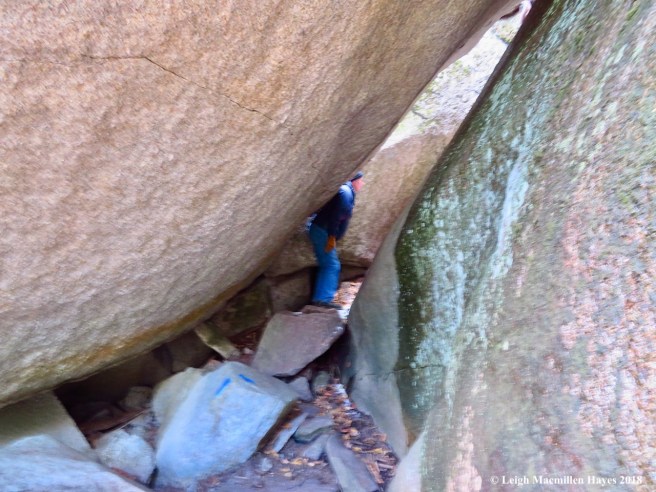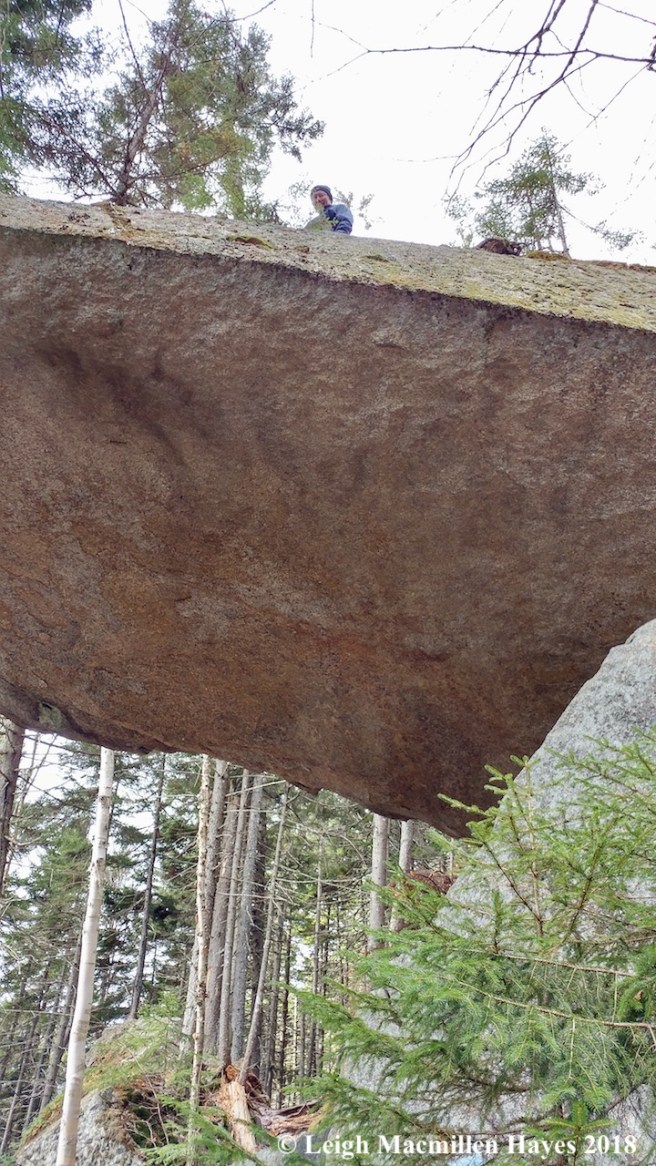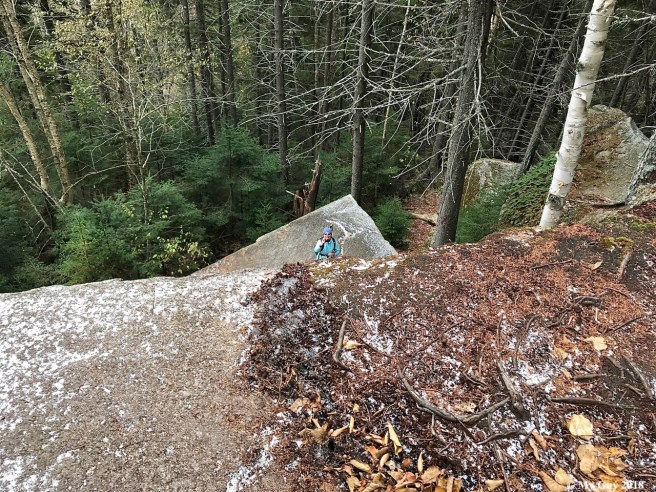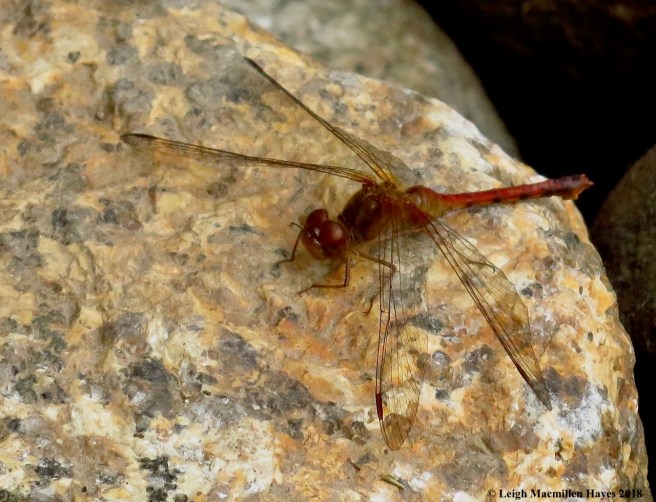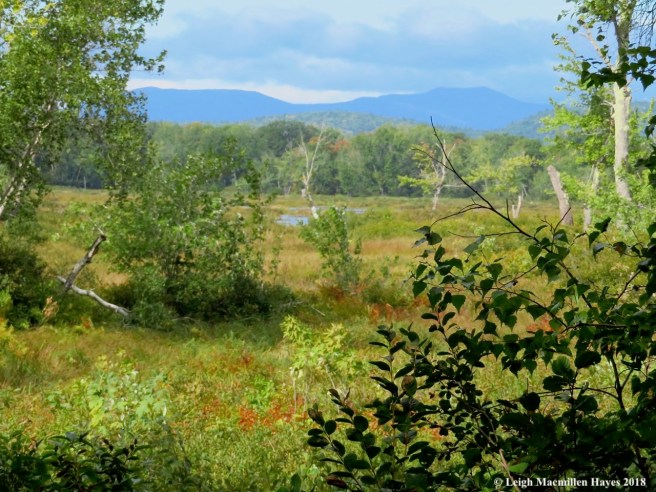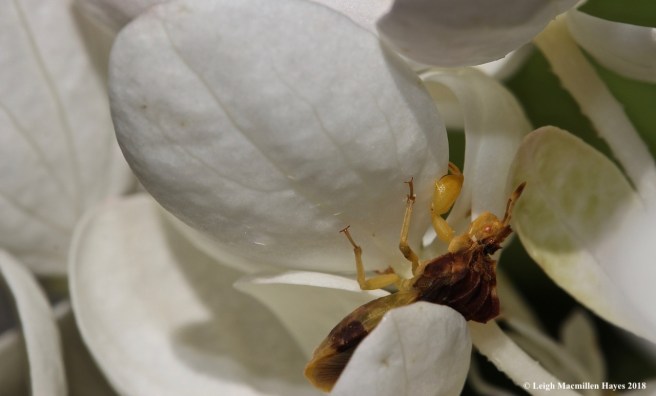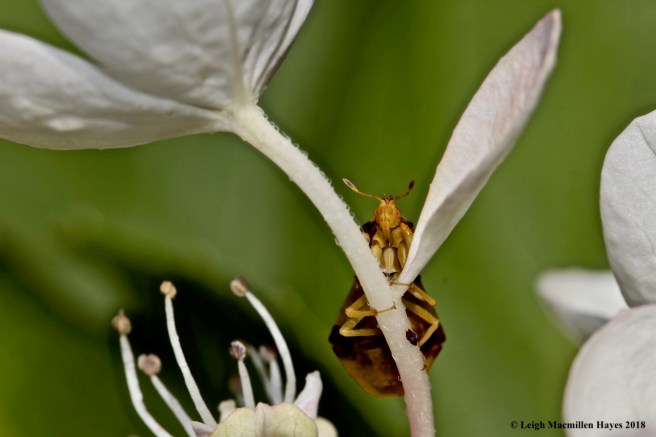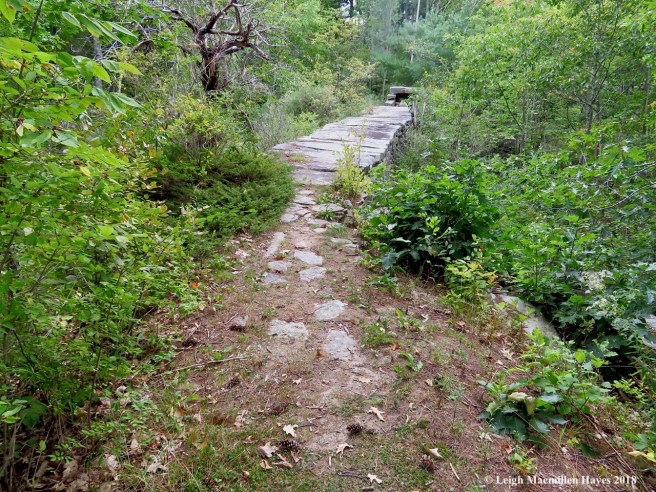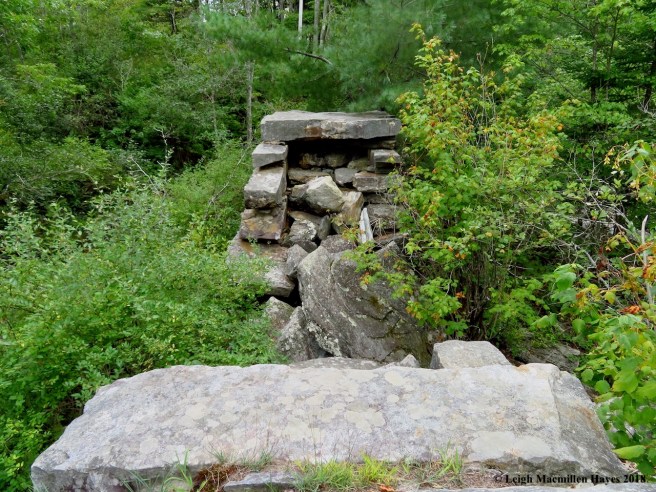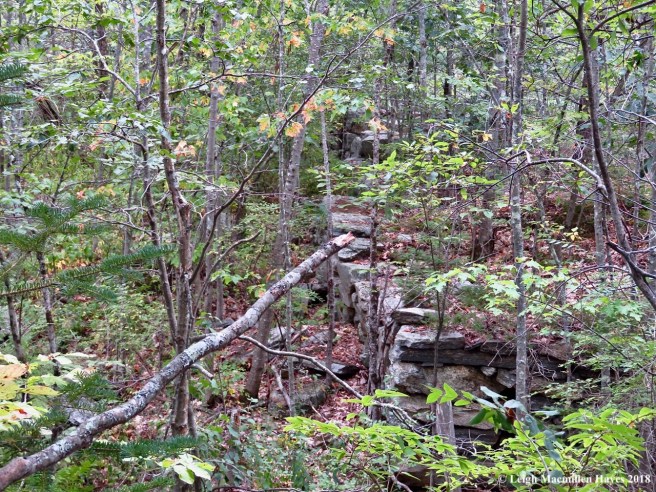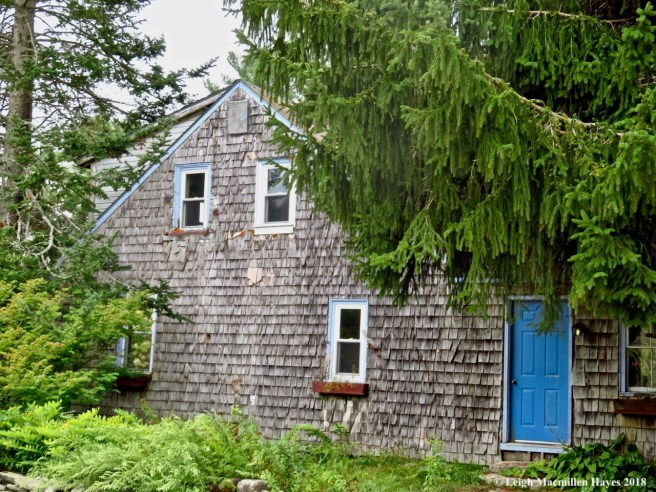
Bishop Cardinal Reserve: Where (Wo)Man and Nature Intersect

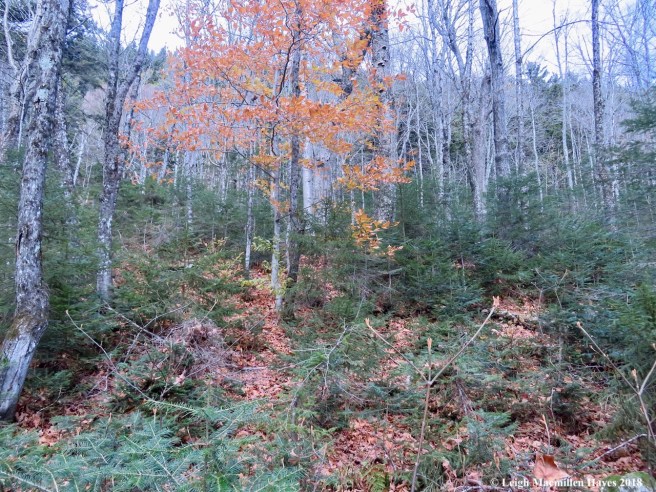
Perhaps we should have tiptoed and tried to silently pass through the woods much the way a fox or bear might, but that is not our habit. And so on today’s Tuesday Tramp for the Greater Lovell Land Trust, we chatted and wondered aloud as we hiked along the  trails of Bishop Cardinal Reserve on the upper side of Horseshoe Pond Road in Lovell. Consequently, our wild mammal sightings were non-existent. Despite that, we saw soooo much.

9-docents Bob and Pam

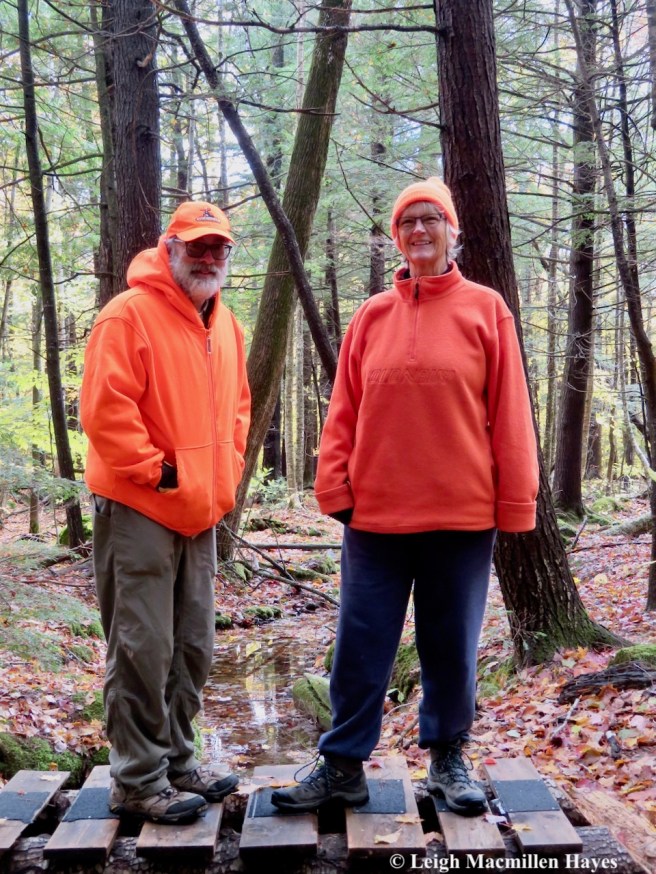
Our team was small this morning, with only docents Bob and Pam joining me, but still we made plenty of noise as we looked about.

4-bear pole

The first sign of mammal and human interaction, of course, was the telephone pole beside the trailhead. If you’ve traveled with me either literally or virtually before, you know how I LOVE a telephone pole. It’s not the fact that such brings electrical power and other modern day amenities to our homes, but instead the realization that bears are attracted to them and like to leave a mark as they claw and bite at the anomaly in the forest surroundings. I always check for hair left behind, but today was disappointed to find none.

5-scratches on bear poles

Despite the lack of hair, there were a few newer scratches worth celebrating.

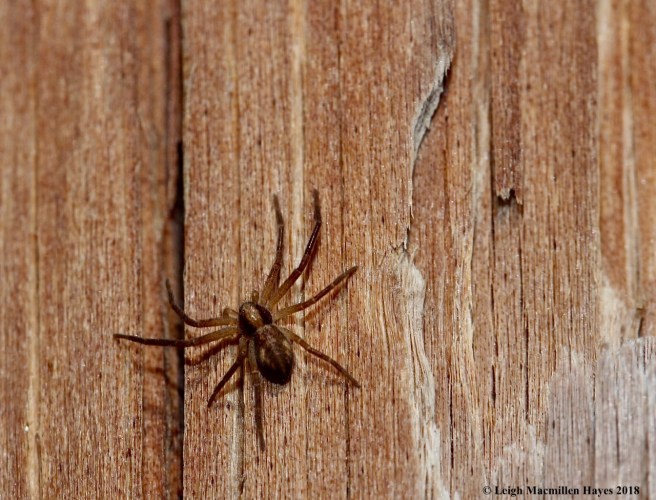
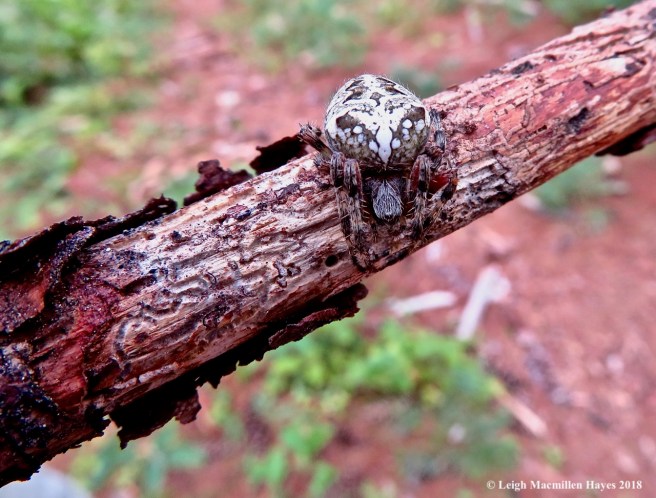
6-spider

And a small spider tossed into the mix. The temperature was on the chilly side as the wind blew, but not cold enough to begin the process of accumulating glycols in its blood (e.g., antifreeze) that would allow the spider to supercool. By physiologically adapting via special antifreeze compounds, the tissues of some Maine spiders remain unfrozen at temperatures well below freezing, and thus avoid turning into little blocks of ice once winter sets in. Of course, had it been a little bit cooler, this spider probably would have hidden in the leaf litter below rather than trying to send a telegram via the phone pole.

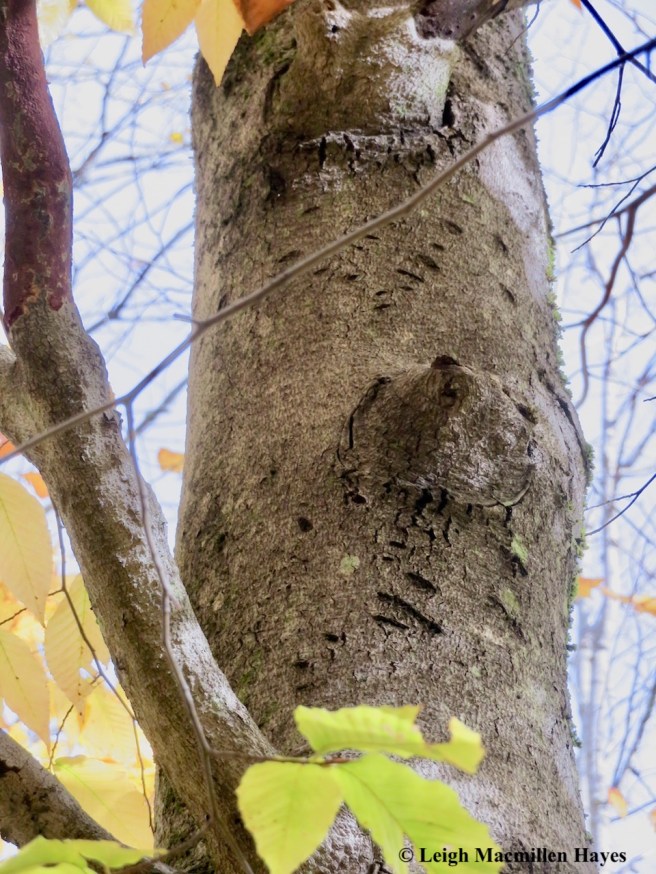
7-bear tree

A little further along the trail, however, we did find more bear sign in the form of claw marks on beech trees. And that raised the question: Do bears only climb beech trees? No. But, beech bark is one of the best to show off their signature scratches.

10-Pam's bear tree 1

After I showed Pam and Bob a couple of trees with claw marks, they began to look about and Pam spied one I’d not noticed before.

10-Pam's bear tree

Congratulations on your First To Find (FTF) Award, Pam! Well deserved.

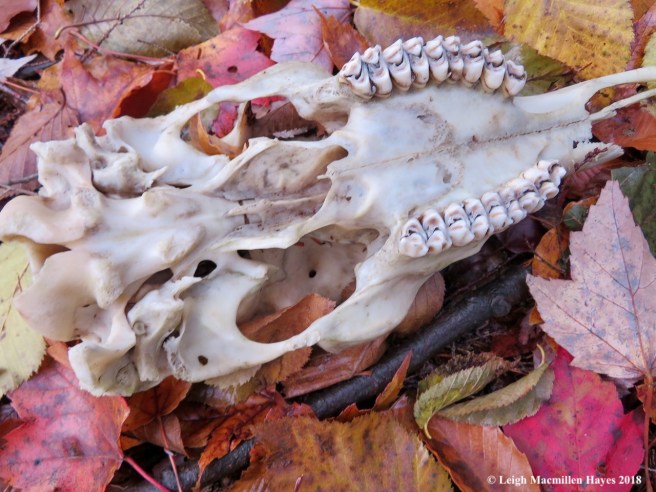
11-deer skull

It wasn’t only bear sign that made the walk intriguing. A year and a half ago, this same couple had spied an entire deer carcass along the lower part of the trail. And so when we arrived in the vicinity today, we looked around. And eagle eyes Pam spied half the skull atop the leaves. What had happened to the deer? Human interaction? Old age? It was a rather large skull.

12-herbivore teeth

My, what flat teeth it had. Because herbivore teeth are highly specialized for eating plant matter which may be difficult to break down, their molars tend to be wider and flatter, thus allowing the animal to grind its food and aid in digestion.

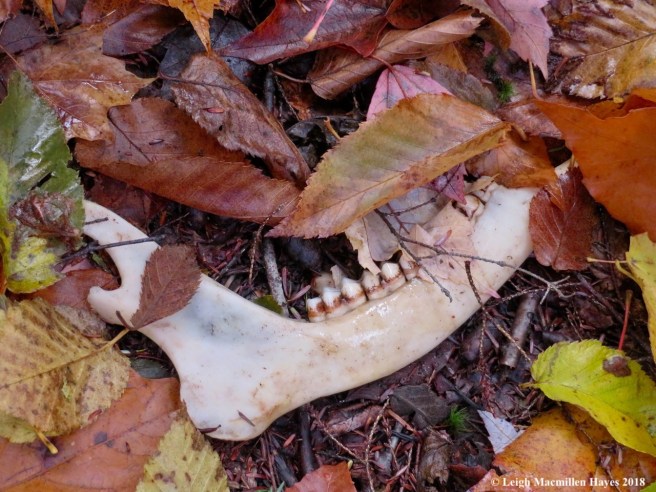
13-lower jaw

We looked about for other bones and had to satisfy ourselves with a lower jaw. Had the rest of the skeleton been scattered and we just couldn’t see it below the recent leaf cover or had mice and other rodents dined on the bones from which they sought calcium? Coyotes, bears, and even another deer may also have moved the bones and found their own nourishment. Whatever happened, we knew it had been recycled . . . naturally.

14-coyote scat

And not far away on the edge of a bridge over a stream . . . coyote scat. It was not fresh, but fresher than the deer skull event, and full of hair. On what did the coyote dine? Snowshoe hare? Gray squirrel? Some other delectable offering? We weren’t sure.

15-squirrel storage

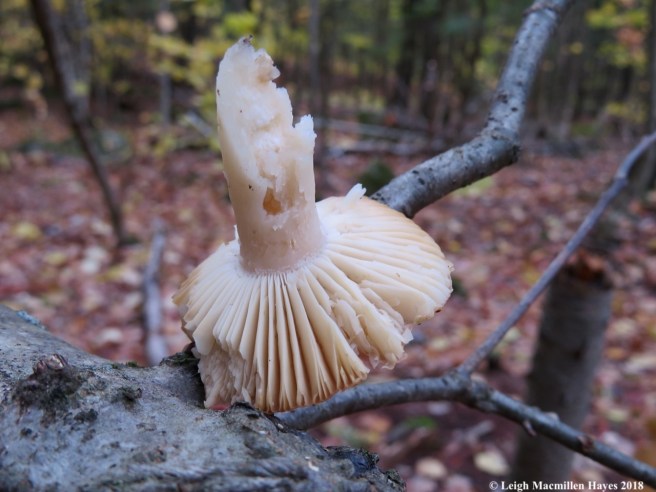
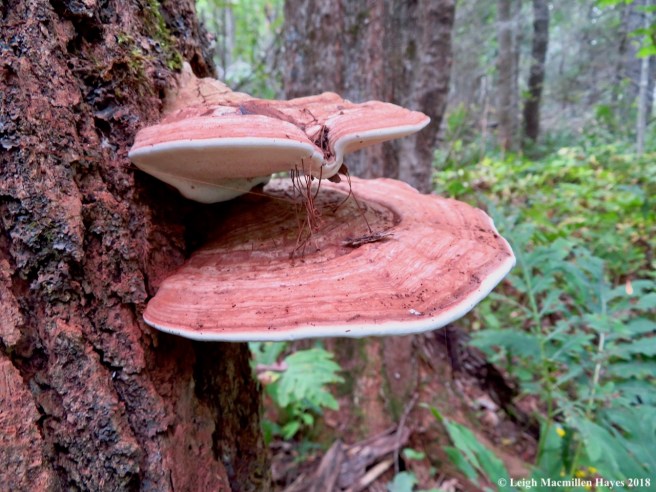
Dinner in the woods came in many forms, however, and on a fallen tree about four feet from the ground we found a mushroom turned upside down. Despite recent wind storms, we didn’t think it had blown up to that spot. Instead, a squirrel had set it there to dry. A squirrel’s food pantry is far bigger than a kitchen cupboard. Would it remember where it had placed the mushroom? Probably. Would another squirrel discover and snag it? Possibly.

16-squirrel storage

But there were others set in different spots to dry, so the original cacher might have some success in retrieving the food it had stored.

17-icy formation

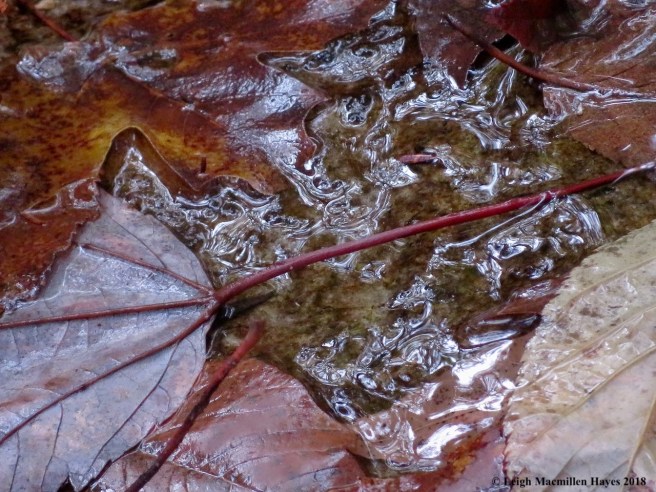
As our time drew to a close, we noticed patterns in the mushrooms imitated by icy spots in a stream that spoke to the morning’s chill.

18-Horseshoe Pond Road

But the sun had come out and we relished its warmth as we headed back to our vehicles and on into the rest of our days.

16a-man-made wonder

Before doing so, however, there were two more sights to commemorate–the man-made line up of doors found deep in the woods . . .

2-Sand castle

and rain-made castles along the road side.

Bishop Cardinal Reserve–where man and nature intersect.


Amazing Race–Our Style: episode nine

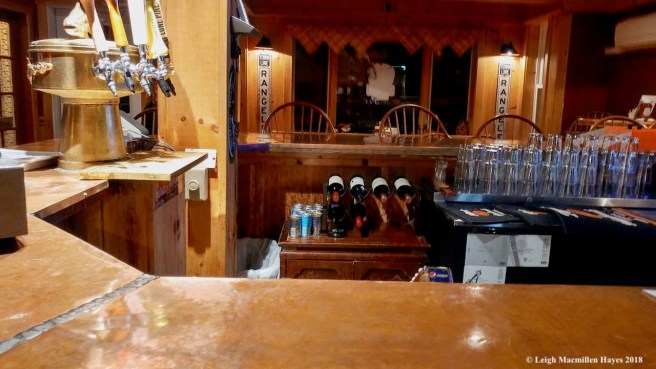
“Drive to Newry and receive your next clue,” was the message we received midday yesterday and so as soon as my guy closed his store and sent in an order for more merchandise, we hopped into the truck and began our journey north. In Newry, just beyond Bethel, we found out we were to continue on to Rangeley and patronize the local businesses.

1-Moose and snow

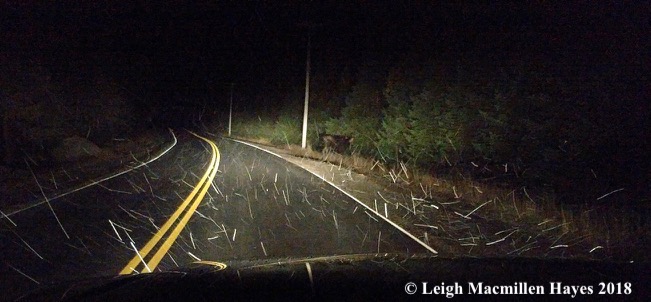
First, however, we had to get there. Darkness enveloped us and flurries confused my vision as I drove with caution through Grafton Notch to Errol, New Hampshire, and then back into Maine toward our destination. Our wildlife sightings: two raccoons, a snowshoe hare still brown in color, a couple of deer and a cow moose and the bull moose you might see to the left of the first telephone pole. We were excited to say the least. And, I had proof that my slower speed was apropos–cuze my guy was teasing me.

3-the place to ourselves

It was almost 8:00pm when we pulled into town and stopped at Parkside and Main for a burger. The restaurant closed at 8, but owner Kash Haley was gracious and told us to relax. So between plays in the football game, and bites of our burgers, we oohed and  aahed as one of the waitresses shared photos of her grandchildren with us.

2-hanging out at Parkside and Main

And then once all the patrons and staff had left, we sat for a bit longer at Kash’s insistence and enjoyed the game and each others company while he cashed out and sanitized the kitchen.

4-blue sunrise, blue sky in morning, snowflakes are forming

This morning found us rising to a blue sky over Rangeley Lake. Doesn’t the saying go like this: Blue sky in the morning, snowflakes in the offing? For they were and we knew we had to dress appropriately for a day outdoors. But first, we had a few more local businesses to visit, the first being Keep’s Corner Cafe for breakfast and then we grabbed sandwiches from Woody’s Deli at Loony Bin Variety. And with the check came our next clue: “Rangeley–equator to pole, it’s all the same.” Huh?

5-halfway between equator and north pole

But, we did our research and sure enough, the western Maine town of Rangeley is located precisely between the Equator and the North Pole. How cool is that? And it was at that sign that another clue appeared. “Choose one: Either explore Orgonon or Find your way to the giant AT sign and seek the piazza.” Several years ago we’d snowshoed the trails at the Wilhelm Reich Museum, aka Orgonon, so we chose the latter for today’s challenge. The AT we understood to be the Appalachian Trail, but a piazza on the trail? Would there be a hut with a porch? Perhaps a fancy porch?

6-AT

A few miles south we found the giant AT. And across from the parking lot on Route 4 we spied the opening to the part of the trail we thought we should follow.

7-red fox scat

And so we ventured forth, stopping moments later for a couple of deposits of red fox scat. Another critter to add to our 24-hour menagerie.

8-sluice

We crossed a sluice way of the Sandy River, and imagined the history stored in the rocks.

9-snowflakes gathering

As we hiked, snowflakes decorated the variety of maple leaves.

10-snow on trail

And we began to notice that our journey would pass through a variety of natural communities and over various obstacles including roots,

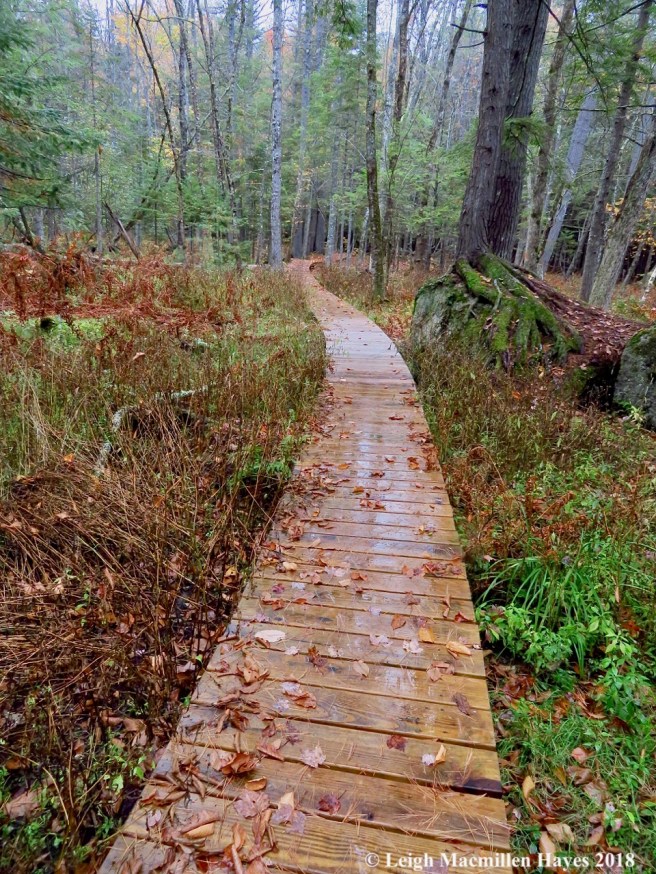
11-boardwalks

boardwalks,

12-rocks and roots

and rocks mixed with roots.

16-Piazza Rock

My guy was in the lead, though he commented throughout that I wasn’t far behind, trailing only by a few footsteps. But when he reached a certain point, I’d been looking down for careful foot placement and so I didn’t know what he was exclaiming about–until I looked up. At. Piazza. Rock.

From Maine Trailfinder we discovered this tidbit: “According to the geological notes about this area, ‘The granite of Saddleback is jointed into huge building blocks. An unusually large one has slid out of its place in the mountain side and, instead of breaking and skating down the slope like the others, has balanced across another block to create one-half of a cantilever bridge, forming Piazza Rock.'” Oh, did I mention that we were hiking up Saddleback Mountain?

17-contemplating climb up Piazza Rock

Perspective isn’t gained until one actually stands under the building block. The clue said that one of us must climb atop the structure and the other view it all from below. Thankfully, despite his fear of heights, my chivalrous guy chose the upper path.

18-and then onto the Piazza

He made it seem so simple as he crawled up the rock and then contemplated the platform before him. For a second, he wasn’t sure he’d be able to go further. But, that could mean the loss of points for us. I didn’t say anything to encourage or discourage because I was standing on safe ground below.

19-under piazza rock

My job was to appreciate the boulder from its underside. And certainly I did as I looked up at the stone diving board planted for a giant’s leap.

20-My guy on top of Piazza Rock

And bravely making his way toward the tip–my guy!

21-My guy atop the turtle head of Piazza Rock

I looked up to where he stood–atop a turtle head, for after all, we stood on turtle rock.

23-looking down at me from Piazza Rock

And he looked down . . .

Later he told me that his father always said as he stepped onto a porch, “I’m going out to the piazza.” Indeed.

28-climbing onward

Interestingly, both of our fathers accompanied us on this leg of the race for apparently as my guy thought of his dad, I spent some time thinking about my father and how much he would have loved exploring trails such as this one with us.

13-temperature

But, we were in a race and so though we reveled in memories of our fathers, we had to move back to the trail signs and check for our next clue, which was again a choice: “Make the next move or Channel your best bat.”  What?

21-Piazza Rock Hut

We followed the trail, crossed one of many streams and located the Piazza Rock Campsite–all set for the next temporary residents who would leave no trace behind.

22-Privy

It was right behind the hut that we noticed the privy–and location for any who chose to make a move . . .

23-cribbage board in two seater privy

In the game of cribbage that is for a game board sits between the two-seater. My guy might have chosen this for he knew he could beat me, but he was once again chivalrous and suggested we channel our best bats. Team Pink did stop at the privy and we never saw them after that so we wondered if they gave up on their card game and moved on to Orgonon.

25-onto the caves

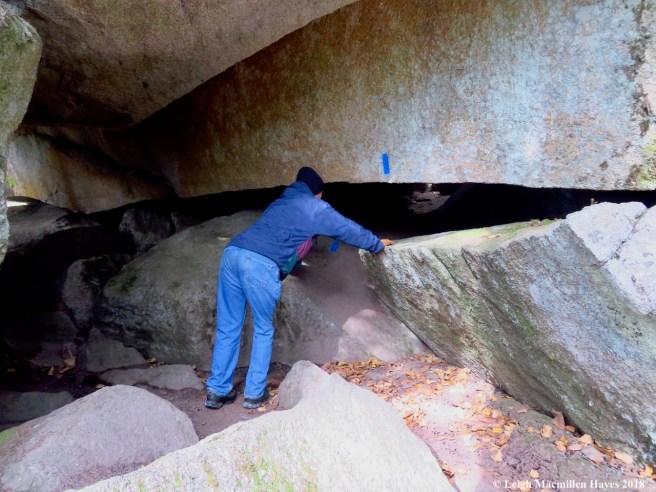
We, however, continued on and reached “The Caves.” One after the other, we shimmied through, hardly as graceful as a bat might fly.

27-the caves

It wasn’t easy, but we moved in and out and reached our next clue: Locate lunch rock with an aquatic view.

28-Ethel Pond?

Onward we climbed, reaching Ethel Pond first, where the ice at the edge was thin and my guy reminded me that I should approach with care.

29-another wetland

About a half mile up the trail we spotted another wetland. Really, we expected to see a moose in each, but when one expects to see a moose or any other form of wildlife, it doesn’t happen. And it’s truly more enjoyable when the offering is a surprise.

29-ice formations

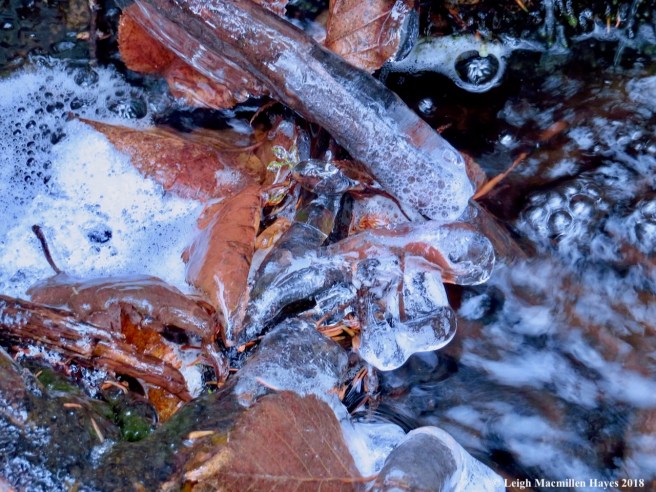
Speaking of surprises were the first ice formations of the year.

30-crossing to lunch rock

Periodically, we crossed water, but the ice formed best at our last crossing, where lunch rock awaited. We’d made it to the stream that flowed from Moose and Deer Pond, a place we couldn’t necessarily visit, but could appreciate for the wildness it offered its wildlife residents.

Lunch rock stood in front of my guy and it was there that we enjoyed the chicken salad sandwiches we’d ordered from Woody’s Deli at the Lonny Bin.

32-squirrel midden

As we looked about, we discovered that we weren’t the only ones to dine in that vicinity, for the balsam fir scales and cone cobs indicated that the resident red squirrels were also frequent diners.

32a-junco joule=foe of a different feather

And, it appeared, another had also consumed a meal for Junco feathers were plentiful. A foe of a different feather had gained a few joules of energy.

33-back to the sluice

Our lunch spot became our turn-around point and with great speed we made our way back to the sluice in now time at all,  completing our eight mile hike with side trips in 5.5 hours, sorry that we couldn’t summit Saddleback Mountain because we were told to return to our truck by 3:30pm. We actually reached the truck by 3:10. In our minds, another day will find us returning and summiting Saddleback as we really like the trail and were eager to discover what else it had to offer.

34-reaching the mat at Puzzle Mtn Bakery

As we drove toward Errol on our return trip, we spotted Team Mustang stopping just below Orgonon and wondered what they questioned when they stepped out of their car.

We continued on to the starting point in Newry, ready to step on the mat and end this leg of the race, only to discover that we’d made a mistake.

How could that be?

We thought that lunch rock was our turn-around point, but we should have continued about 50 more feet where a spur trail would have led us to Eddy Pond. Oh, we could see the pond, but not get close to it. If only . . . we’d paid closer attention to the map.

As it was, when we arrived at the mat beside Puzzle Mountain Bakery in Newry, we had to sit for a half an hour and wait. No one arrived. Thankfully. And then we had to answer one important question:  How many streetlights are there in Upton? Eight. Check.

25-the prize

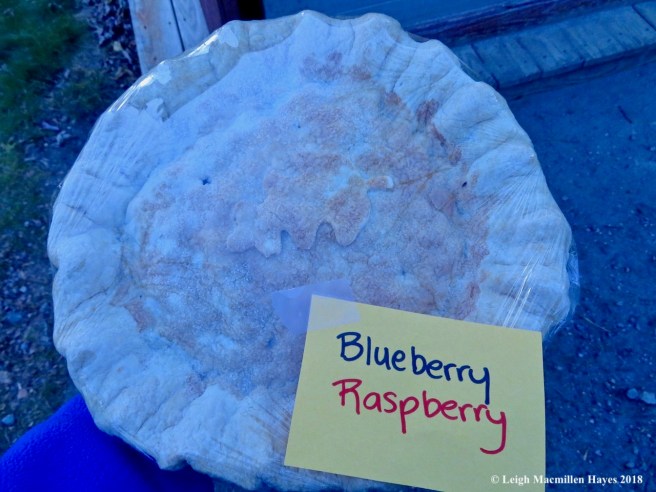
We finished third but got the streetlight question right and so we received a blueberry raspberry pie. YUM.

The Amazing Race–Our Style: episode nine . . . and the fun continues; we’re still in. Phew.


To Pause and Focus

I had no idea what to expect of today’s tramp with two friends as I didn’t even know prior to this afternoon that the trail we would walk even existed. And so I pulled in to the parking area at the end of Meetinghouse Road in Conway, New Hampshire, sure that we’d only be able to walk down to the Saco River about a hundred feet away and that would be the extent of our adventure.

1-Conway Rec Path

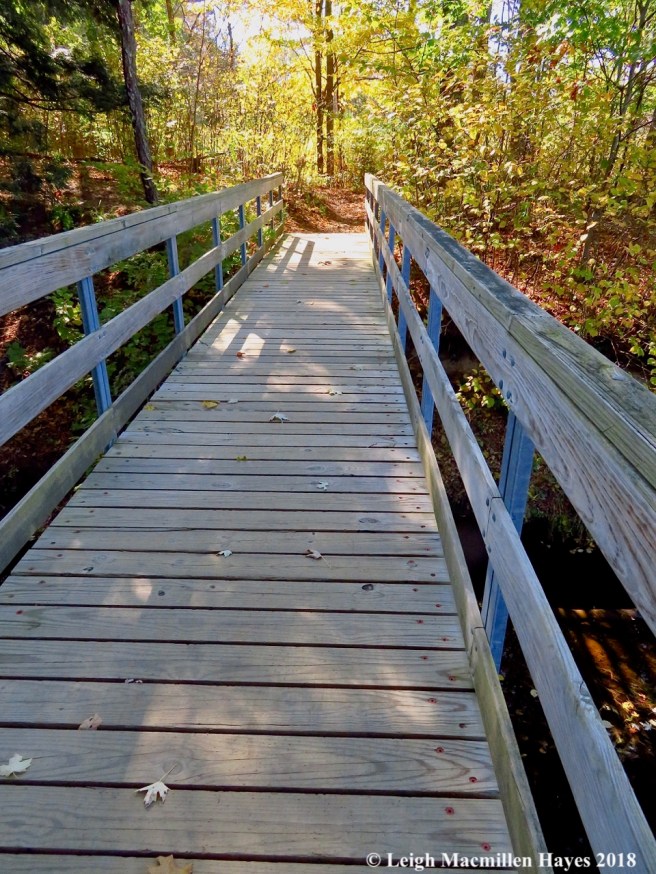
But . . .  much to my pleasant surprise I was wrong and in the northeastern corner of the parking lot we crossed a bridge into the unexpected setting.

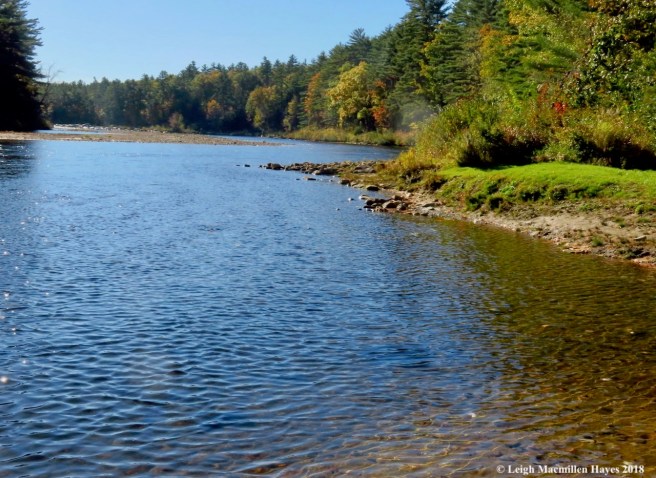
2-Saco River framed

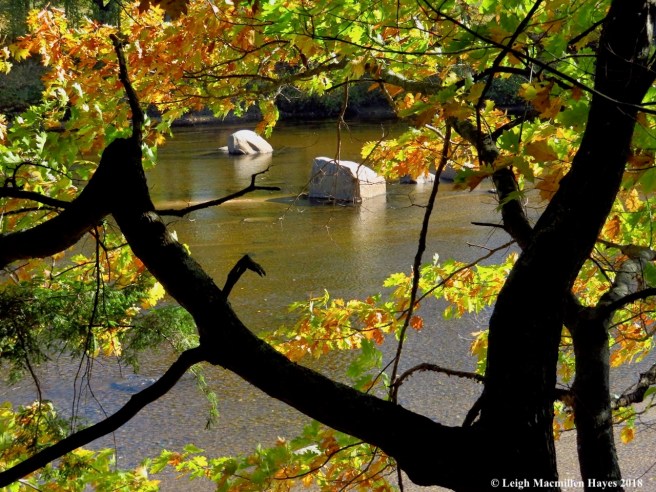
For the entire journey, we walked above and beside the Saco River. And our minds were awed by the frames through which we viewed the flowing water and boulders.

3-clear view of the Saco River

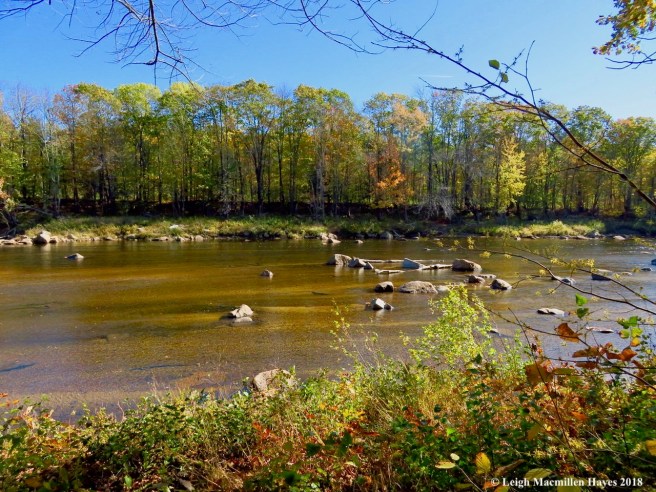
Occasionally, our view was clear and colorful, the colors now more pastel than a week ago.

5-witch hazel, understory

Even as the colors have begun to wane and leaves fall, we looked up from our spot below the under and upper stories and sighed.

4-Witch Hazel

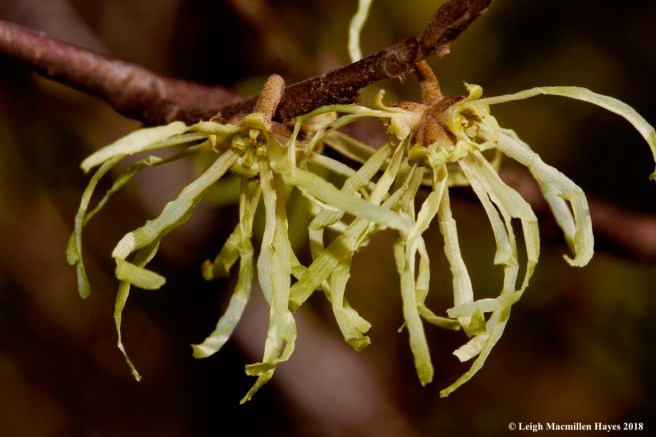
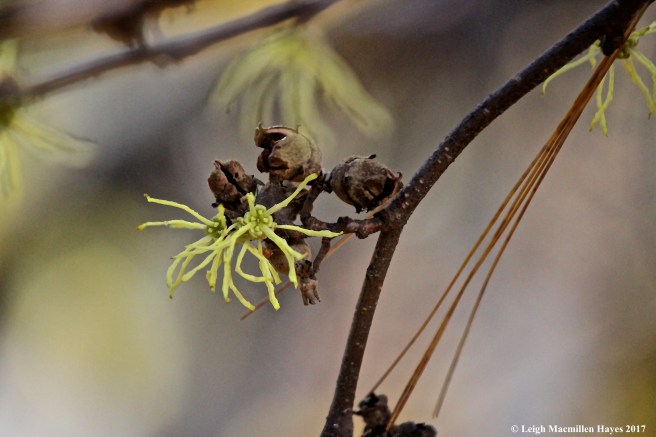
For much of the time, we were wowed by the Witch Hazel’s flowers–for so thick were they on many a twig.

4a-witch hazel flowers

In fact, if one didn’t pause to notice, you might think that each flower featured a bunch of ribbons, but really, four was the count over and over again.

4b-witch hazel flowers, leaf:bundle scars

And some were much more crinkly than others. One of my other favorites about this shot is the scar left behind by a recently dropped leaf. Do you see the dark smile at the base of the woody yet hairy flower petiole? And the dots within that represented the bundles where water and nutrients passed between leaf and woody structure?

6-spotted wintergreen

And then one among us who is known for her eagle eyes spied a Spotted Wintergreen, Chimaphila maculata, a name that has always made us wonder for its dark green leathery leaves seem far more stripped than spotted. It’s one of those plants with a bunch of common names and so we should try another one on: spotted wintergreen; striped prince’s pine; striped wintergreen; striped pipsissewa; spotted pipissewa; and pipissewa. But perhaps the fact that it’s striped and referred to as spotted helps me to remember its name each time we meet. A sign of how my brain works.

7-spotted wintergreen patch

While we know it to be rare and endangered in Maine, it grew abundantly under the pines on the slight slope beside the river in New Hampshire, and we rejoiced.

8-spotted wintergreen capsules

Its newer capsules were green, but a few of last year’s woody structures also graced the forest floor. Reseeding helps the plant propagate, but it also spreads through its rhizomes.

9-maple-leaf viburnum

Everywhere we looked there was a different sight to focus our lenses and we took photo upon photo of the variations in color of some like Mapleleaf Viburnum (Viburnum acerifolium), a shrub with three-lobed maple-like leaves and small white flowers in the spring that form blue fruits in the early fall and had been consumed, only their stems left to tell the story.

10-red maple leaves

Red Maple (Acer rubrum) leaning over the river offered their own hues that bespoke autumn.

16-platter sized mushrooms

And tucked into a fungi bowl, we found the yellow form of Sugar Maples (Acer saccharum). 

11-Saco River with Moat Mountains in background

Onward we continued with the river to our left, outlined with maples and evergreens, and backdropped by the Moat Mountains.

12-small pond stained glass window

And to our right, a small pond where trees in the foreground helped create a stained glass effect filled with autumn’s display.

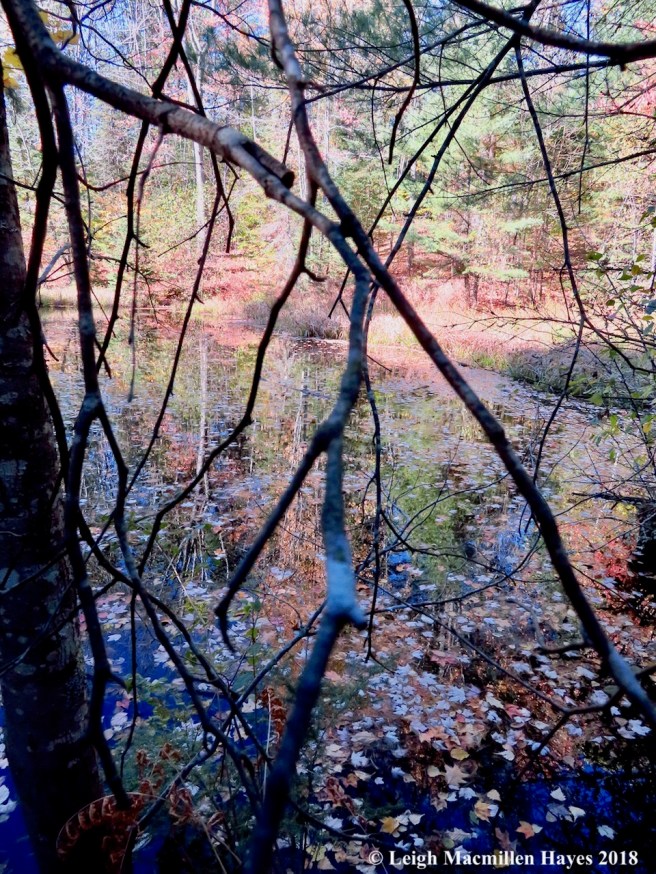
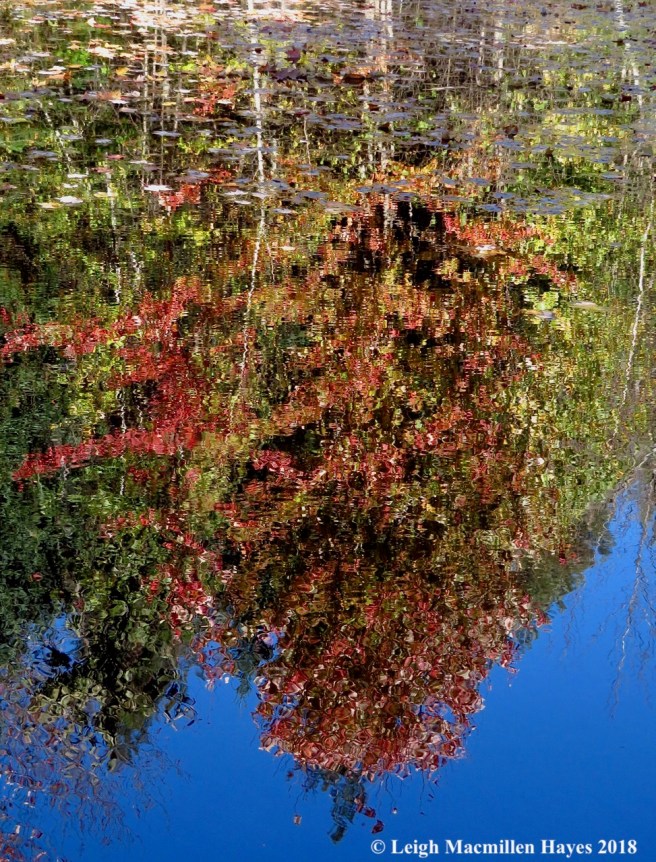
13-reflection

And once again, in the pond’s quiet waters reflections filled our souls.

14-turn around trespass

A wee bit further, we trespassed onto private land, and decided to make that our turn-around point as we got our bearings via GPS.

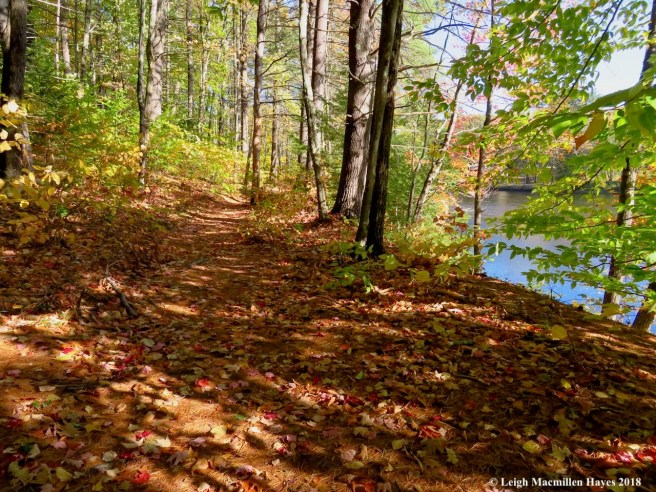
15-trail

Backtracking was as enjoyable as our forward motion. We had been on a trail called the Conway Rec Path, part of the Mount Washington Valley Rec Path, intended for walking, running, biking, snowshoeing, cross-country skiing, bird watching, wildflower viewing , tree study, plus river and mountain views. Kennett High School athletes ran past us and we encountered couples out for exercise. None took their time as we did, but that’s our way and occasionally we ventured off trail because something caught our eye.

9-rock carvings match the waves

Meanwhile, the river continued to flow, as it has for almost ever, and the water continued to carve patterns yet to be seen, but we enjoyed those that reflected its action.

17-old silver maple

Back at the parking lot, we were wowed by a Silver Maple (Acer saccharinum), its girth suggesting an age older than a century.

18-silver maple buds

As had been the case all along the way, we experienced another wow moment when we realized how developed were the flower and leaf buds already. We know they form in the summer, but . . . they looked ready to pop!

19-white-throated sparrow

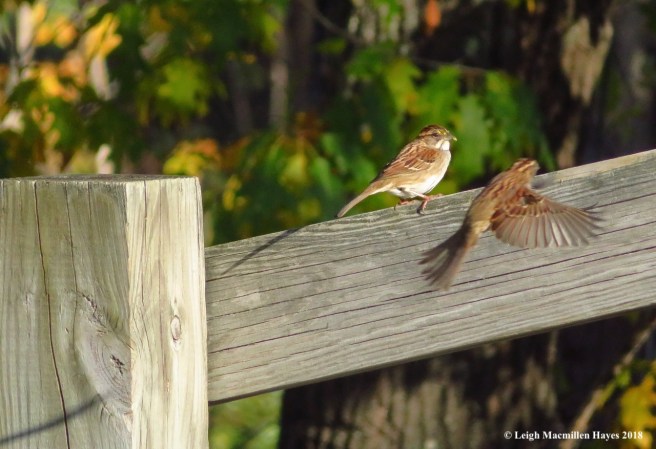
As we stood and admired, a flock of Juncos and White-throated Sparrows flew from one spot to the next as they sought seeds on the ground. Occasionally, the sparrows paused for a moment.

20-2 white-throated sparrows

And then moved on again.

21-Eagle over Moose Pond

At last it was time for us to move on as well and head for home, my friends’ to their mountainside abode in New Hampshire and me to my humble house on the other side of the Moose Pond Causeway. But as I always do when making the crossing, I looked up.

22-immature Bald Eagle

And was honored by a sighting that pulled me out of my truck. The immature Bald Eagle I’d watched and listened to all summer graced me with another opportunity to view it.

One scene after another, it was a delightful autumn afternoon. Thanks P&B, for the sharing a new trail with me and providing many moments to pause and focus.

Mondate Challenge

It was a mere drizzle when we stepped outside and walked to Pondicherry Park, but eventually we needed to pull up the hoods of our raincoats. Our journey was rather quick as we followed first the Snowshoe Hare trail, and then the Pasture Trail, which led us to the Stonewall Loop, where two thirds of the way around, we diverted.

1-crossing onto LEA property

Our main intention had been to cross over the stonewall that marks the park’s boundary and explore the Pinehaven Trail owned by Lakes Environmental Association. It is on this land that the Maine Lake Science Center is located, but there are other cool features as well.

2-You Are Here

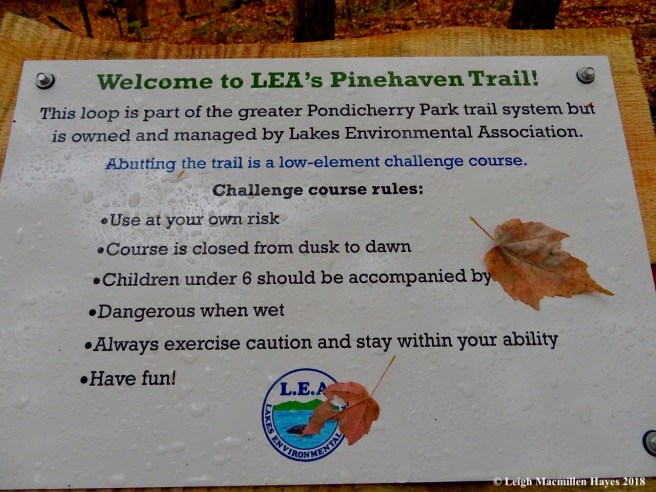
As the first sign informed us, we had arrived. And you can see by the moisture that it was raining in earnest.

3-park rules

Funding for the Pinehaven Trail signs and low-element course was provided by LEA Board Member Roy Lambert and his wife Mary Maxwell, summer residents of Bridgton who have made a huge impact on protecting the lakes and ponds we all love. Roy has brought the LakeSmart Program to LEA and Mary has spearheaded LEA’s invasive plant patrols.

Despite the fact that the sign warned us the course is “dangerous when wet,” we decided to test it out. After all, we were accompanied by a leaf as indicated.

4-Birds on a Wire

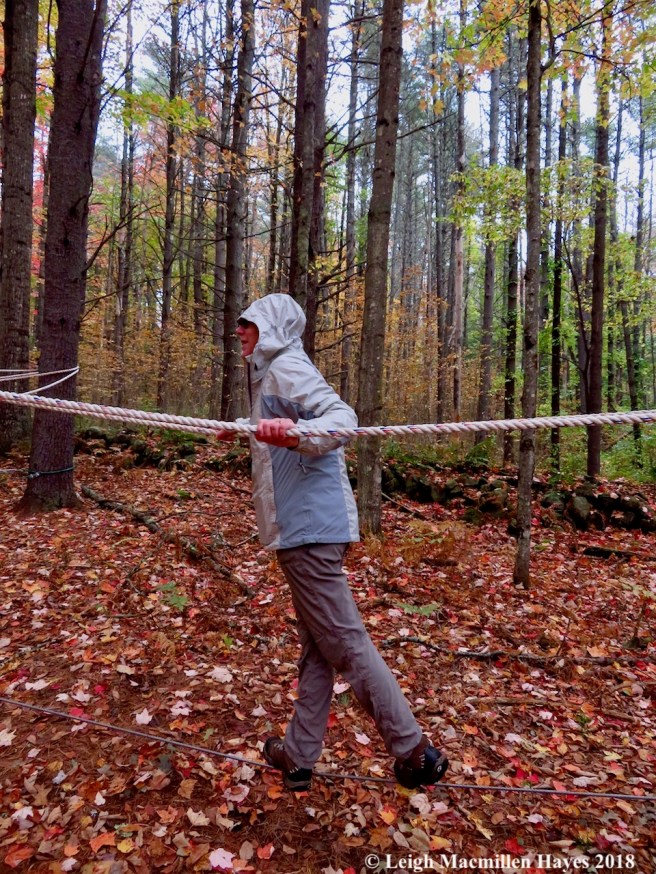
Broken into four wonderful sets, each offering a variety of activities, we began by becoming birds on a wire.

5-my own nuthatch pose

Though I would have liked to say that I was a Barred Owl or Cooper’s Hawk, being a Nuthatch wasn’t so bad.

6-my guy nuthatch

My guy . . .

7-walking the tightrope

was also a Nuthatch.

8-next set of challenges

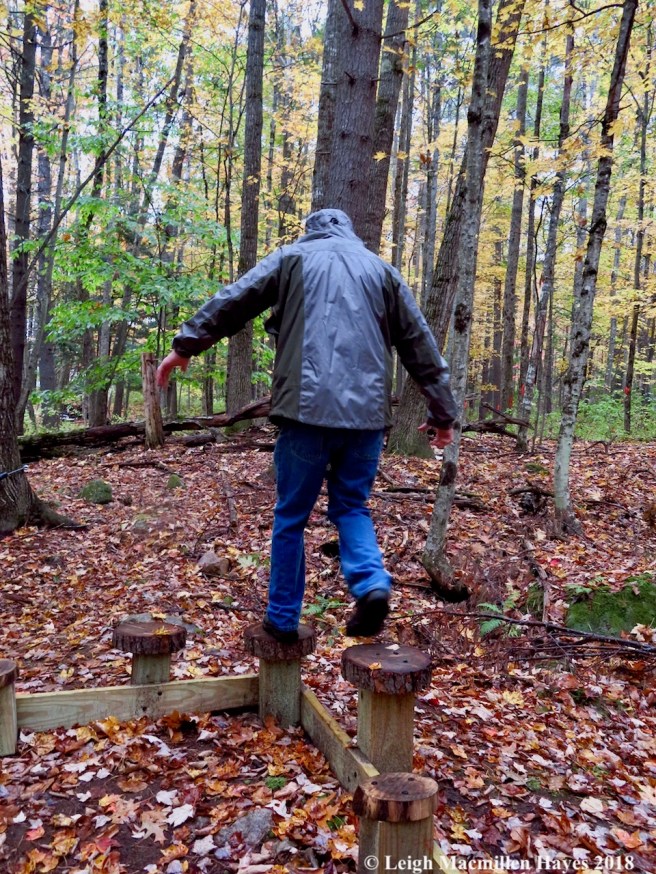
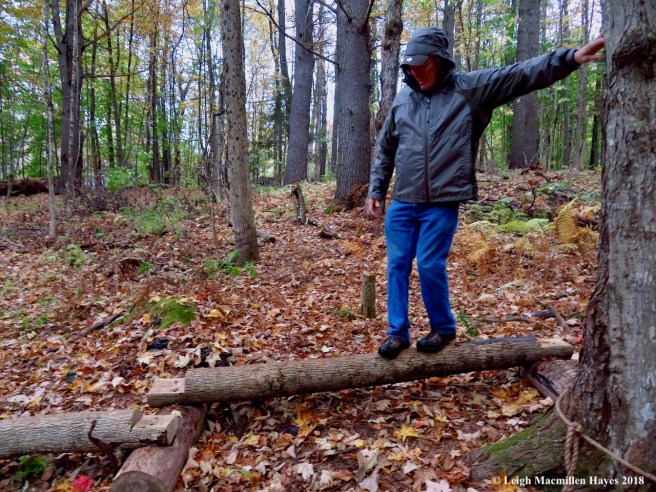
Set Two meant getting more practice in the art of walking on a balance beam. It looked so easy, but with each one, the level of difficulty increased a bit as our confidence did the same . . . for the most part.

10-balance beam series

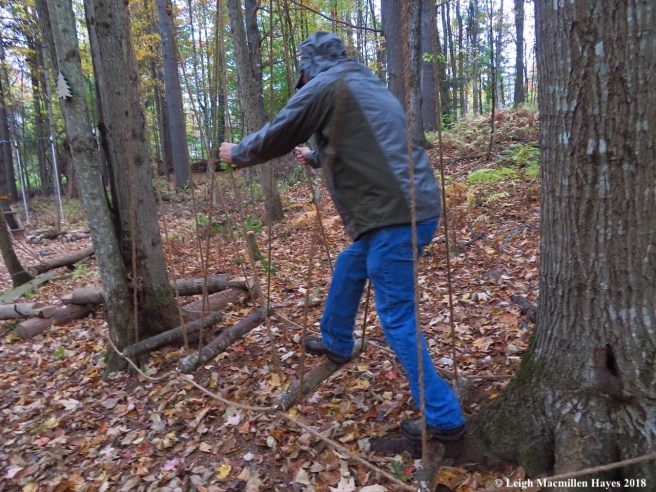
And at first, our eyes saw only a few anomalies in the woods, but once we focused we realized each leg of the course was more involved than first anticipated.

11-swinging beam

The second set found us not only keeping our balance on the beams that zigzagged through the grove, but also on a swinging beam.

12-stepping up

And then we had to step up and up and up.

14-around the white pine

One of my favorite parts was circling the tree like a rock wall climber might do.

15-tree hugger!

In the process, I got to hug the pine, not that I ever need an excuse.

13-bench

My other favorite part of Set Two was the bench. There were other benches along the trail, but I found this one to be the most aesthetically appealing. Even if you don’t want to try out the course, you can walk the trail and sit a bit. You might just see a deer–we did. And in the past I’ve seen other animals including a red fox.

16-Alanna's signs

As we walked on, not sure if there were more sets, we spied the first interpretive sign created by LEA’s Education Director, Alanna Doughty, and featuring her explanations and drawings. I LOVE them. And want to decorate my house with them. I didn’t tell my guy that. The other thing I loved about all the signage–it was mounted on rough-edged boards, adding to the natural look. Do I know the creator of those boards? A local box company perhaps?

17-third set

Much to our delight, not much further on we came to Set Three.

18-Enchanted Forest

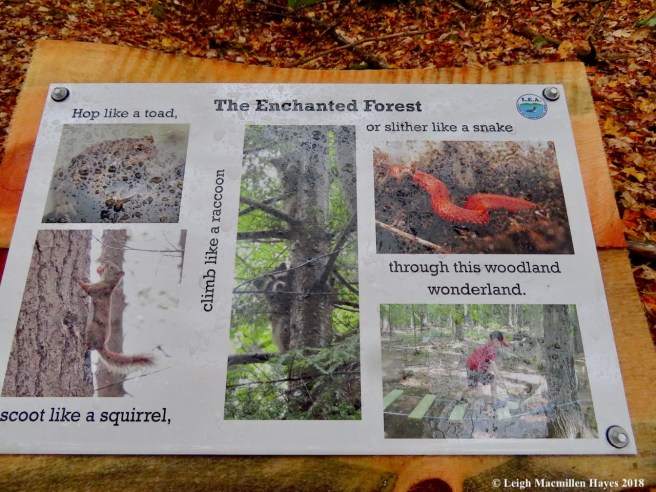
The forest really was enchanted and we found ourselves using all four modes of operation in order to get from one piece of wood to the next.

19-tree cookie steps

There were lots of tree cookies to step on and more balance beams to conquer.

20-hopping along

Sometimes we hopped like toads, who don’t leap as far as frogs with their longer hind legs.

21-a balancing act

Other times we had to channel our inner Cooper’s Hawk as there was no place to put our hands.

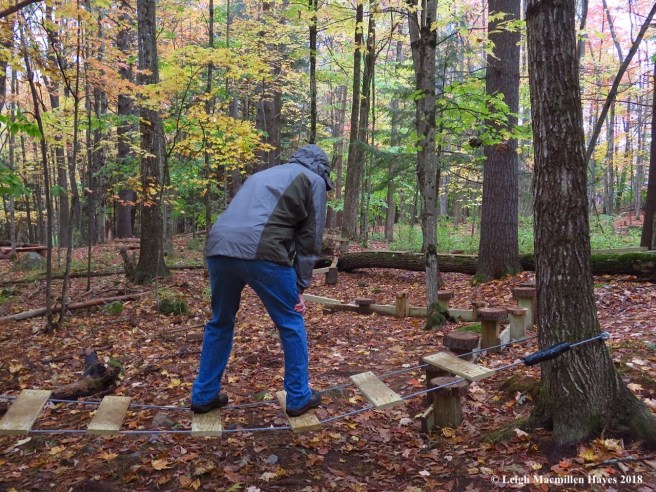
22-waiting for the wires to stop swaying

And in doing so, my guy figured out that pausing to wait for the wire to stop swaying made for an easier crossing. He succeeded. (I need to sneak back and practice this one some more as my knees were a tad too shaky.) We suspected that kids run across without giving it a thought. And so our excuse–it was raining.

23-yeegads--getting higher

Though it looked intimidating at first, moving across the log was fun, but I wasn’t so sure about the beam that turned out to be the highest one yet. It felt like crossing a brook and so after he finished I asked my guy to come back and give me a supporting hand. He laughed and asked if I expected him to stand in the imaginary water. Yes! Chivalry at its best. Once I started across while grasping his hand, I felt rather confident and soon let go. At the other side, I rejoiced in my success. And thanked him, of course.

24-clean water

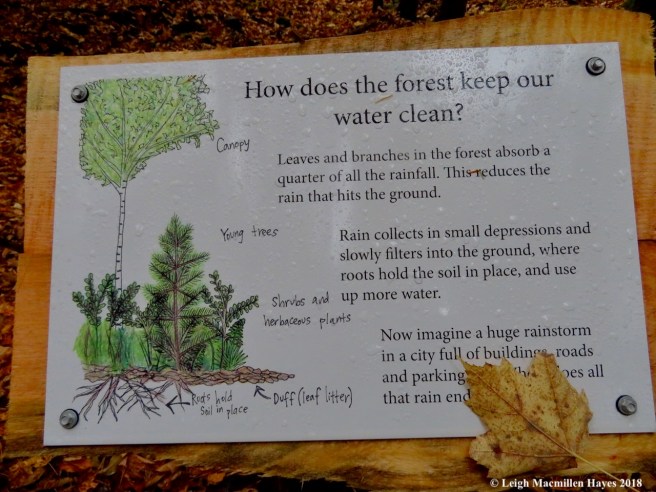
Onward still, we encountered another one of Alanna’s signs, simple yet informative. And still, we were accompanied by a leaf. And no, we didn’t place the leaves on the signs.

This sign struck me as extremely important, not that the others weren’t. But . . . clean water is what the Lakes Environmental Association is all about.

26-Paul Bunyan's Playground

At last we reached the final set, or first if you approach from Willet Road. Again, a leaf ;-)

As for how good would we be as lumberjacks? Well, my guy would pass. I’d almost get there, but I have to work on my log rolling skills.

26a-variety of swings

What I liked about the final set was not only the focus on various types of trees, but also that the same theme was executed in a variety of ways and so we crossed another swinging step bridge.

27-I got this!

Sometimes, the choice to be a Nuthatch or Barred Owl didn’t exist and we had to become Cooper’s Hawks as we had nothing to grab onto while moving forward.

28-now you don't see him

There were opportunities to be apes as well and then disappear around the back sides of rather large pine trees, their girth indicative of the fact that the land had once been agricultural and the trees grew in abundant sunshine after it was no longer farmed. So, do you see my guy?

30-now you do

Now you do! Circling around that tree was as fun as the first and it had ash tree foot and hand holds.

31-Me Tarzan

He Tarzan! And notice how the piece he was about to step onto was set on a log. Yup, it was a foot seesaw. There were several and we really liked them.

32-rope climbing, log rolling

The last set included climbing a rope to the upper deck and then descending the ladder to another and on to a balance beam and then the log rolling. He did it all. I saved the wet log for another visit.

33-Mast sign

Just beyond the final set was Alanna’s last sign and a hot topic this year since last year’s mast crop of white pine cones, acorns, maple samaras, and beech nuts have meant a banner year for squirrels and mice. Remember, those little rodents don’t have as much food this year and they’ll become food for the predators and nature will try to balance itself once again. Oh, and not only are Alanna’s drawings beautiful but her humor and voice come through in the interpretive signs.

34-across the boardwalk and back into the park

As for us, we had finished our balancing act, crossed the science center’s driveway, followed the second portion of the Pinehaven Trail and wound our way down to the board walk that passes back into Pondicherry Park. From there, we found our way home.

What a blast. I think we were both a bit let down that we’d finished the course.

Thank you LEA, Alanna, Roy and Mary, for providing us with a delightful Mondate Challenge . . . even in the rain.  My guy and I highly recommend the Pinehaven Trail.

The Gathering

I can’t remember when our yearly ritual began but it has become tradition for three college friends and me to meet somewhere for a fall weekend. And so this year found us staying at a borrowed house in York, Maine. I was late to the gathering but we spent last night catching up as we surrounded the kitchen island. It seems like a table or island is always the spot where we spend most of our time each year while we tell new stories and recall old ones.

1-duck pond

This morning found us dining at a local restaurant. Years ago, I’d spent many an hour in York, either eating at Rick’s, combing the beaches, or standing beside a duck pond. And after this morning’s breakfast, voila–the duck pond. I’m not sure it was the one I remembered for so much had changed in town since I’d last looked for it, but still . . . it was a pond . . . with ducks.

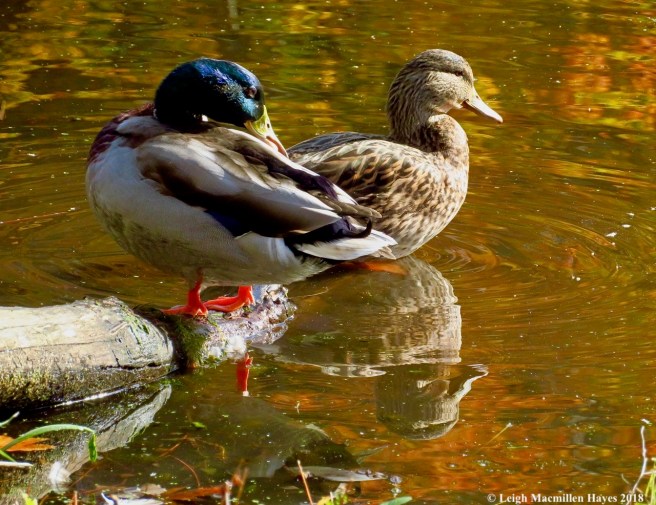
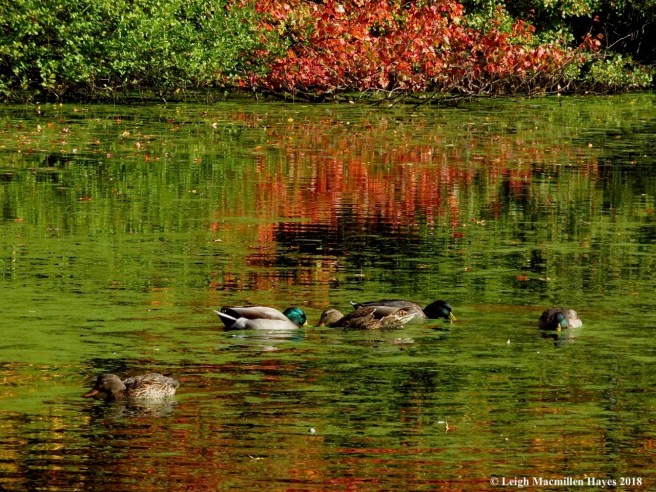
2-fall mallards

Dabbling Mallards to be exact, their iridescent colors as brilliant as the fall foliage.

3-Long Sands Beach

Our next stop was the beach–Long Sands Beach that is. With the tide rolling out, we were able to stroll along most of its mile and a half length.

5-herring gull-shadow and reflection

Our sights included a Herring Gull in triplicate, with both its shadow and reflection cast on the watery surface.

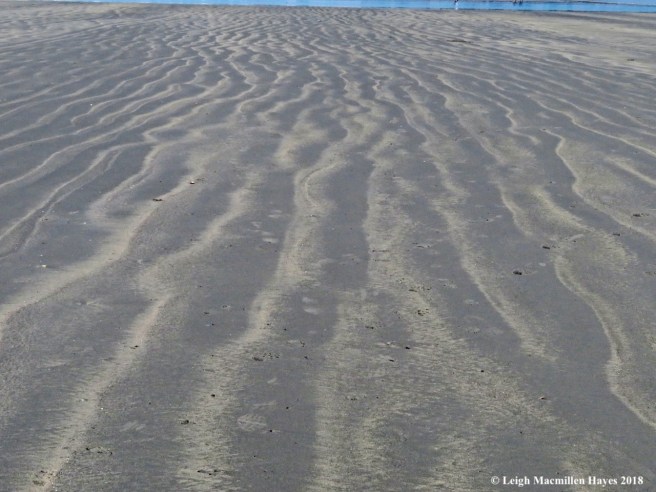
9-ripples in the sand

Equally impressive were the ripples in the sand that matched the water that had once flowed over it,

11-patterns

and those in a small stream bed (which we chose not to cross).

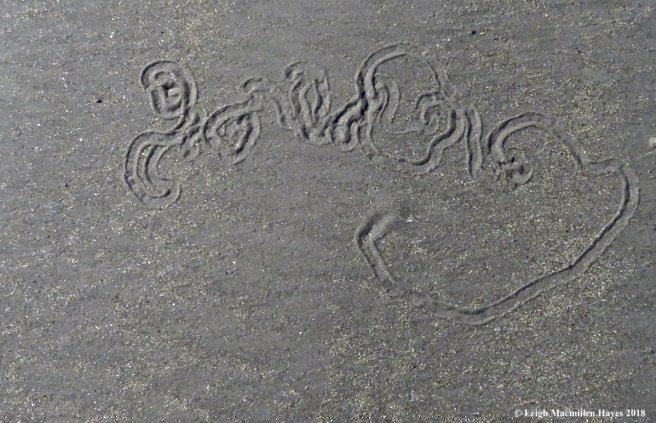
10-snail trails

Our sense of wonder was again aroused when we saw a message in the sand and realized it was not someone writing in script, but rather the trail of a snail.

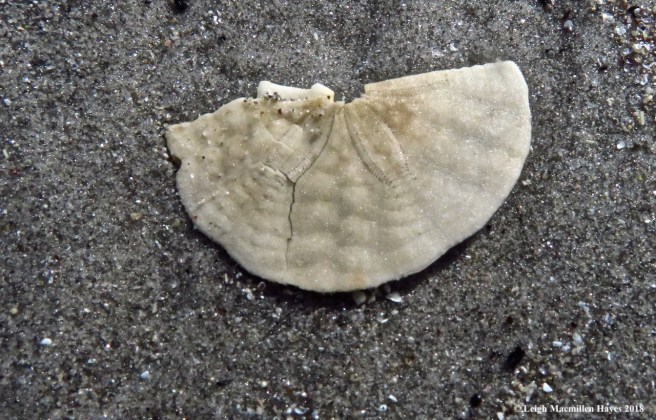
8-half dollar

We also found a few broken sand dollars, the fifty cent piece being the largest.

6-three old friends

We walked and chatted and walked and chatted some more until our time together came to an end. Once more we gathered round the kitchen counter, then shared a group hug and said our goodbyes.

12-until we meet again

But we each left knowing that when the time comes to meet again, we’ll follow the signs and pick up where we left off.

13-Nubble Light

As I turned north out of the lane, I wasn’t quite ready to hop onto the highway and find my way home, so I detoured. My first stop was a Nubble Lighthouse, where “in 1874 President Rutherford B. Hayes appropriated money to build a lighthouse on this “Nub” of land.” All these years later, it’s getting a much needed facelift.

14-Barrier Beach Trail

A wee bit further up the road, I pulled into Wells Reserve at Laudholm , a 2,250-acre estuarine zone. Trails loop about the property and I followed a few.

15-bumblebee pollination

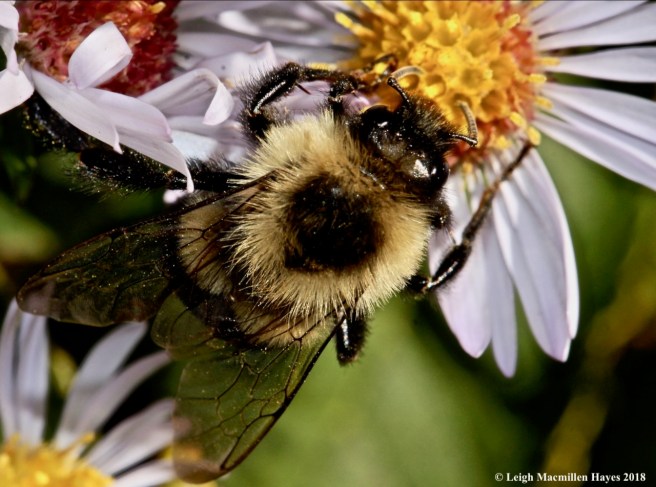
Beside the estuary, bees aplenty buzzed about some late asters in the warmth of the sunshine.

16-yellow rump hiding

And closer to the ocean, Yellow-rumped Warblers flew and landed among the shrubs.

17-beach rose

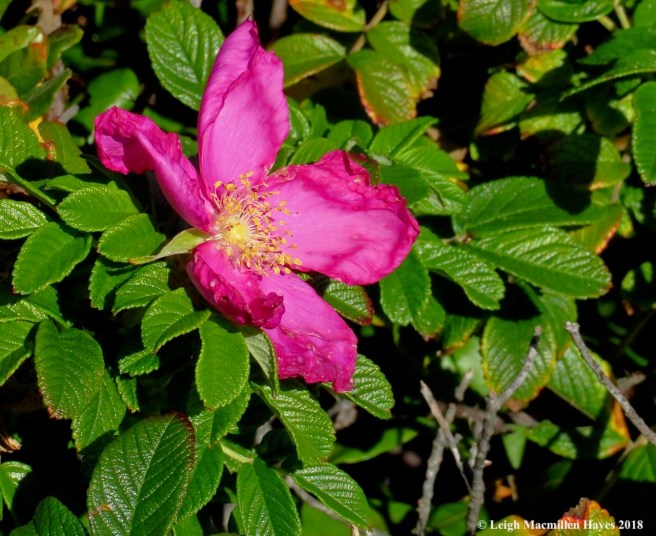
As I walked across a boardwalk toward the beach, a few beach roses showed off their brilliant blooms.

18-Drake's Island Beach

At last I reached Drake’s Island Beach on the Atlantic Ocean, one of my old haunts on daytrips long ago.

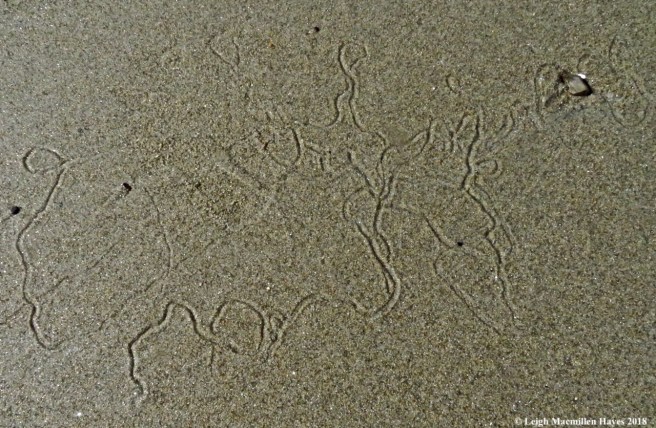
19-more squiggles in the sand

And there, another squiggly message in the sand, longer than the first but about half as wide in trail straddle (just getting back into my winter tracking frame of mind and terminology.)

21-Rachel Carson Wildlife Reserve

On my return, I looped around on the Laird-Norton Trail, where a well-built boardwalk was decorated with so many shades of red speaking to the Acer rubra Maples that arched above.

23-garter snake

In one sunny spot, a garter snake sunned and I tried to warn a woman who was walking toward me, but she didn’t hear and the startled snake practically jumped off the boardwalk. The woman almost did as well!

24-apple tree

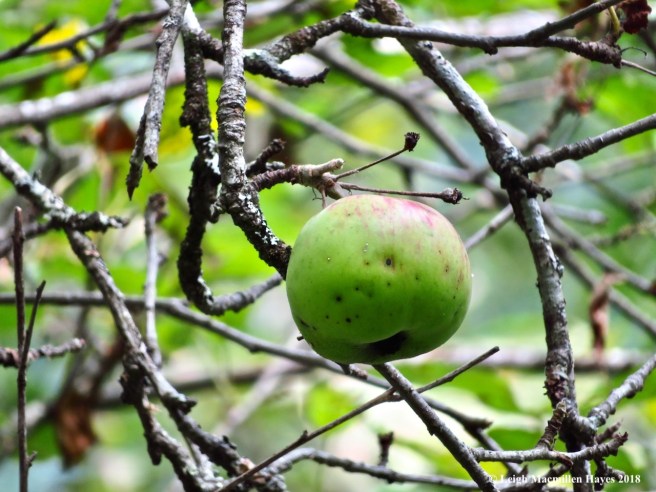
Snakes and apples and I began to wonder if I was in the Garden of Eden. But really, I wondered if a squirrel had wedged the apple into the nook of the tree to dry. I’ve seen the same with mushrooms and just last week watched a red squirrel snatch a dried mushroom in a movement so quick that it will remain in my mind’s eye only.

20-drone fly, looks like a European honey bee

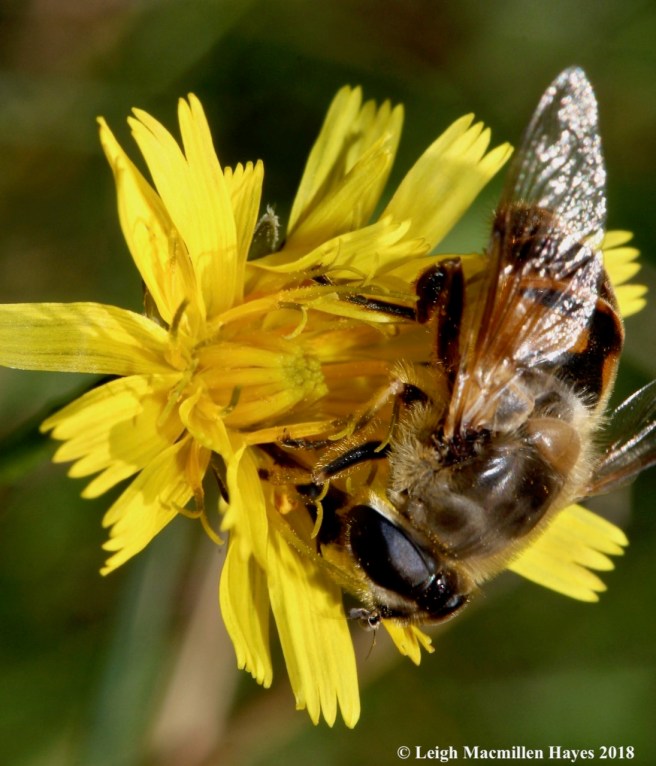
Certainly, the bees and flies, such as this hover fly, were taking advantage of the nutrition offered at the reserve. Temperatures are forecast to dip this week, so I’ll be curious to see how long the flowers and pollinators last.

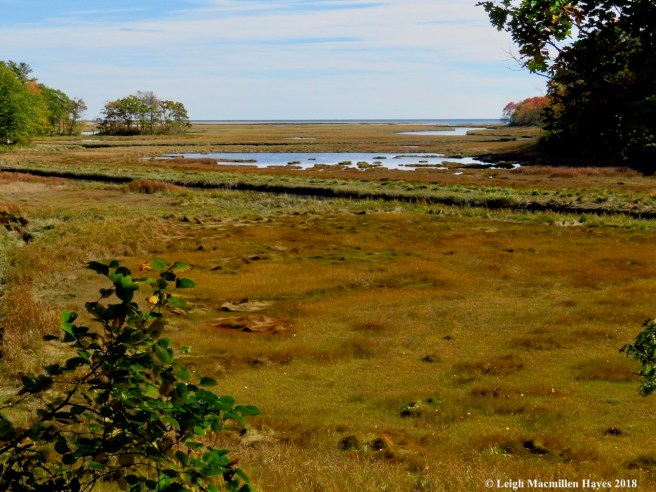
25-estuary

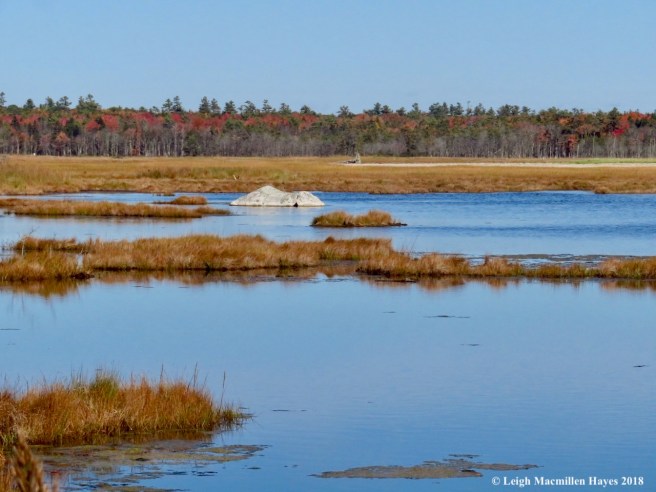
My final stop of the day was to walk a trail that connects to the reserve. The Carson Trail is named for Rachel Carson. The Rachel Carson National Wildlife Refuge was created in 1966 to protect valuable salt marshes and estuaries for migrating birds. My views today included heron, an egret, and a sandpiper.

27-selfie

Finally it was time to head for the hills. But like the ducks and pollinators and birds that foraged for nourishment, I was grateful for the opportunity once again to gather with friends and be sustained by each other’s company.  We’d pose for our traditional selfie before heading off in individual directions to our everyday lives in Massachusetts, New Hampshire, Maine,  and Vermont. Thanks Pammie, Bev, and Becky, and a special thanks to Lynn and Tim for letting us make ourselves at home in their York place.

Until we meet again . . .


A Keen Eye for the Wonders at Our Feet

As beautiful as the trees are right now with their autumnal display in full force, if you walk slowly in the woods and on the bald faces of our local granite, I think you might find yourself amazed. I know a friend and I always are and this afternoon was no different. We didn’t journey far; we didn’t need to journey far. We just needed to be present in the moment.

1-bird's nest fungi

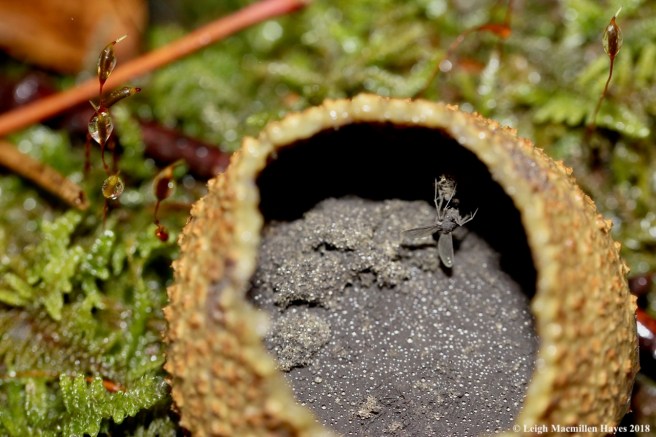
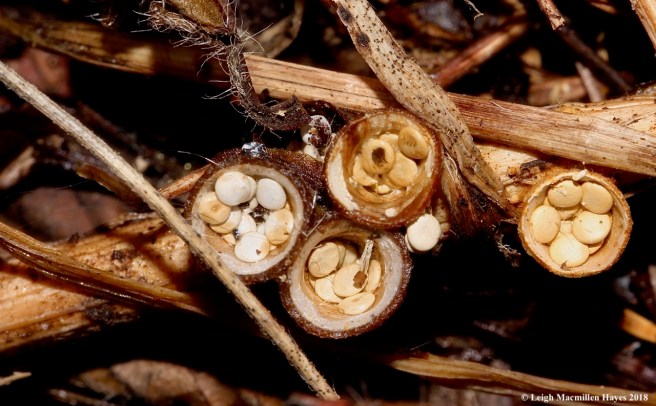
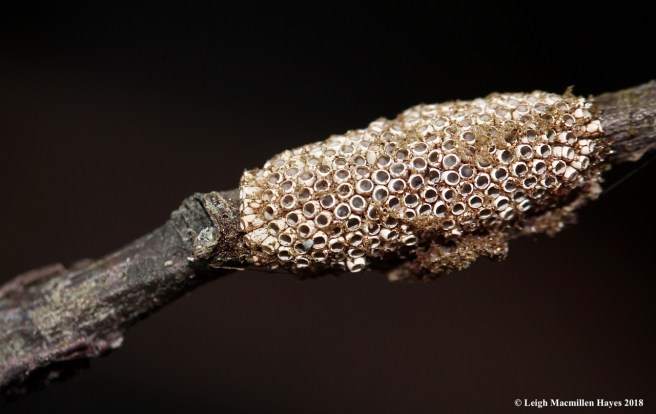
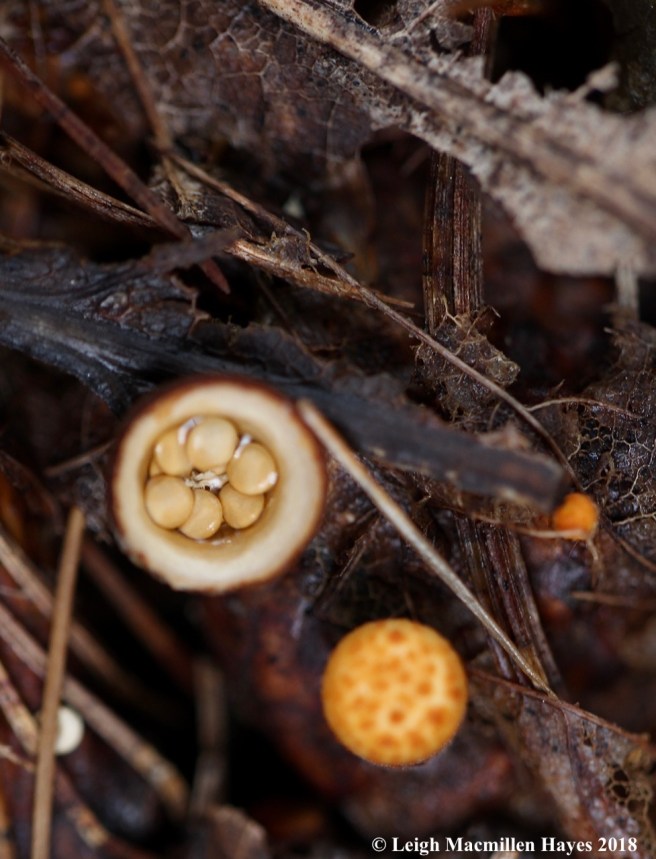
Our first find was actually a discovery she’d made the other day. In her front yard, mixed in with the acorn caps, were teeny tiny examples of Cyathus striatus or Splash Cup Fungi.

2-bird's nest

Only two weeks ago, she’d shown me a larger version of this Bird’s Nest Fungi in the form of Fluted Bird’s Nest, but today she had this miniature version to share. They really do resemble their common name.

3-beads of slime mold

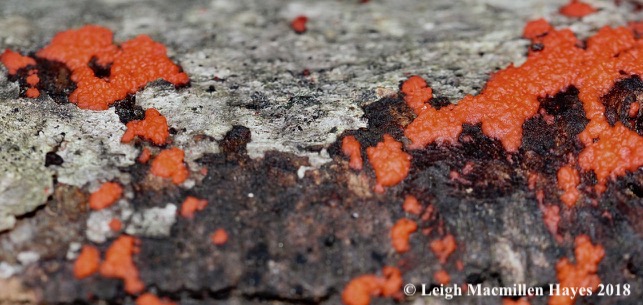
Because our eyes were focused on the minute, it was no surprise that Wolf’s Milk Slime Mold, all beady in structure, should attract our attention.

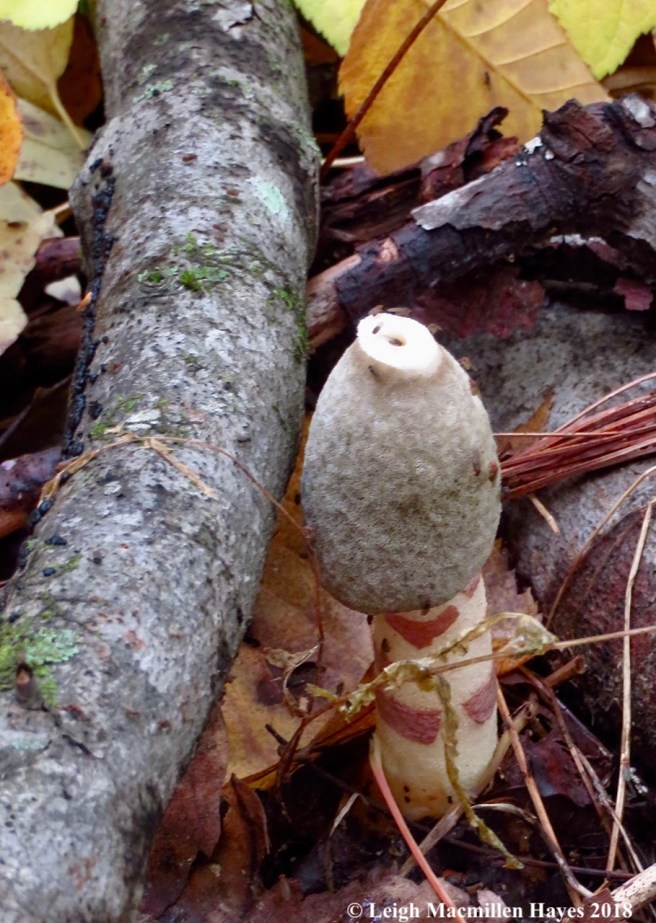
4-stink horn

Our next great find discovered by my friend with the eagle eyes was a Common Stinkhorn (Phallus ravenelii). She said it stunk. I didn’t notice, but the flies loved it. Love, in fact, seemed to be a common theme, for on the stalk, which is typically white, appeared a heart, with arms/hands wrapped around below. Even though it’s “common,” I don’t often encounter any form of a Phallus fungus, so I’m not sure if the two-toned stalk is a common feature.

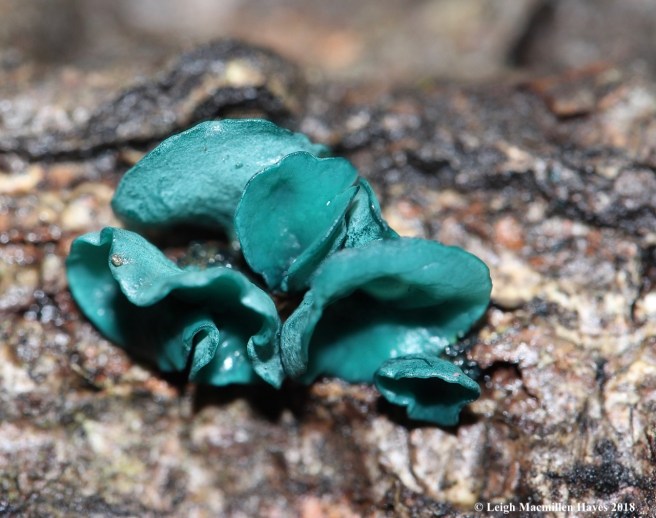
6-green stain fungi

The next discovery–the fruiting form of Green Stain Fungi (Chlorociboria aeruginascens). The turquoise fruiting body was only about a third of an inch in diameter and so it’s another one that’s easy to overlook. But . . . our movement was intentionally slow as we moved without expectation and were constantly excited by our discoveries.

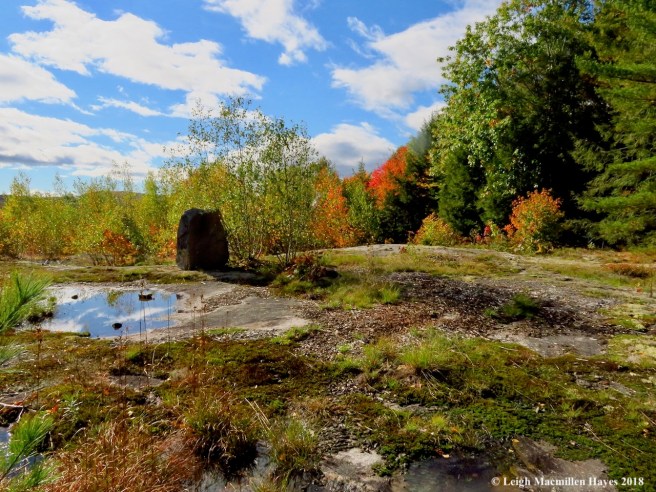
7-onto the granite

At last, we stepped out of the forest and onto a bit of a bald spot where granite greets sky, with lots of life layered between the two.

8-liliputian world

And onto our knees we knelt for life on the granite was lilliputian in nature.

9-candy lichen

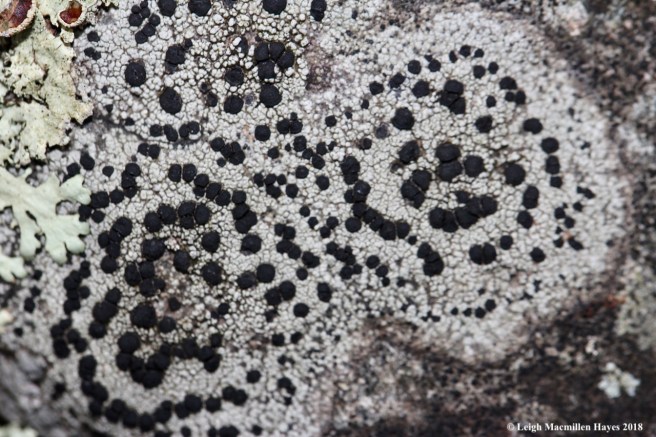
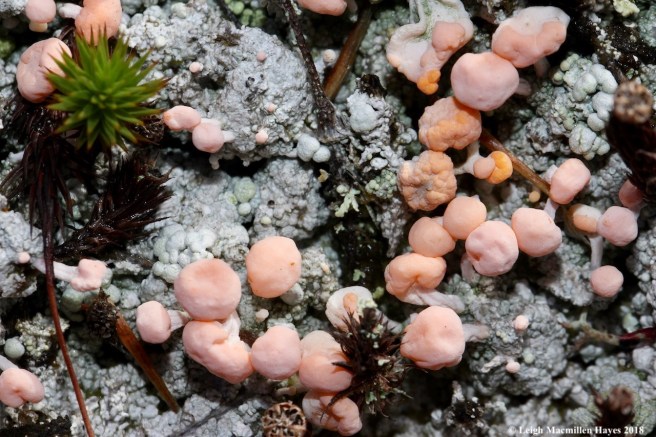
And varied, but it was the lichens that really pulled me into the fold. Some, like the Candy Lichen, a blue-gray crustose lichen with orange to salmon colored fruits, grew so abundantly that we practically ignored it.

9a-pixie cups

Then there were the delightful pixie cup goblets scattered throughout awaiting a visit from the wee folk.

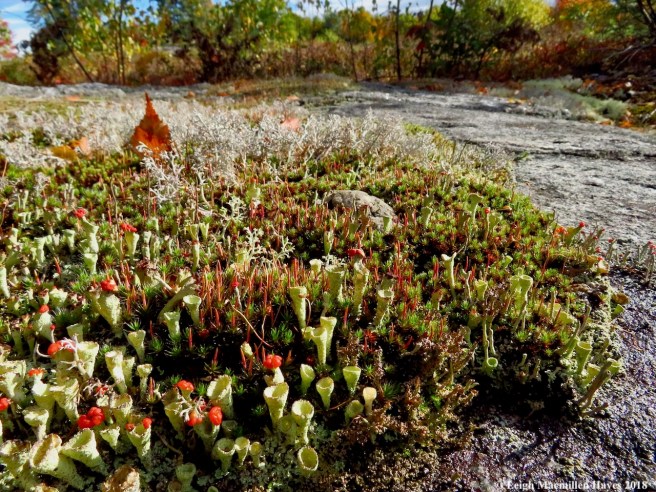
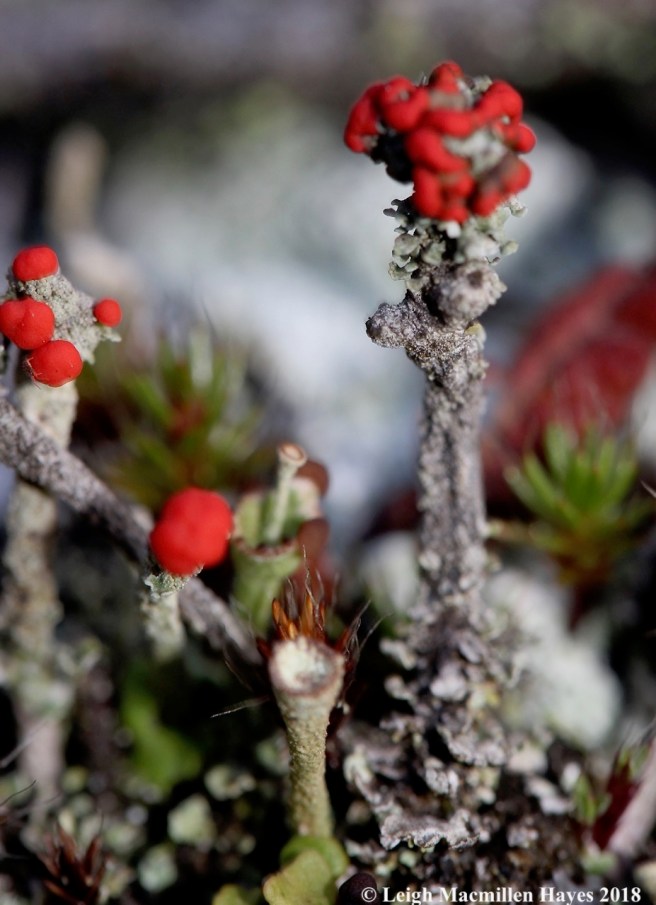
10-British soldiers

And British Soldiers (Cladonia cristatella) standing tall yet branched as they watched over all, their crimson red caps bespeaking their ancestral heritage.

11-lipstick powderhorn

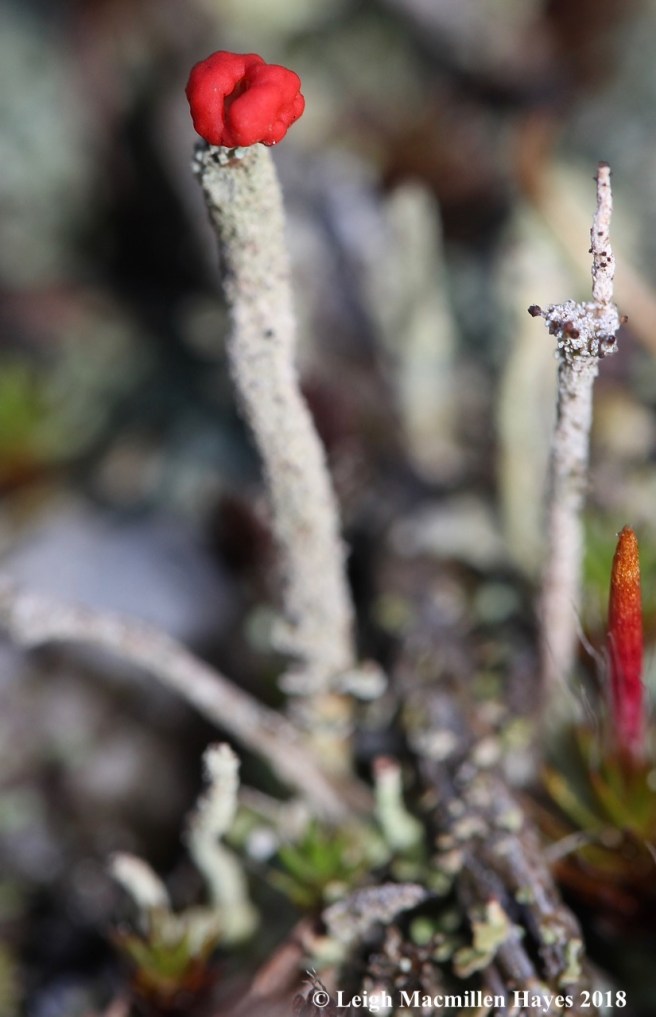
Beside them were a few Lipstick Powderhorns (Cladonia macilenta) with bright red caps above single stalks, rather like the lipstick I’ve never worn.

12-red-fruited pixie cups

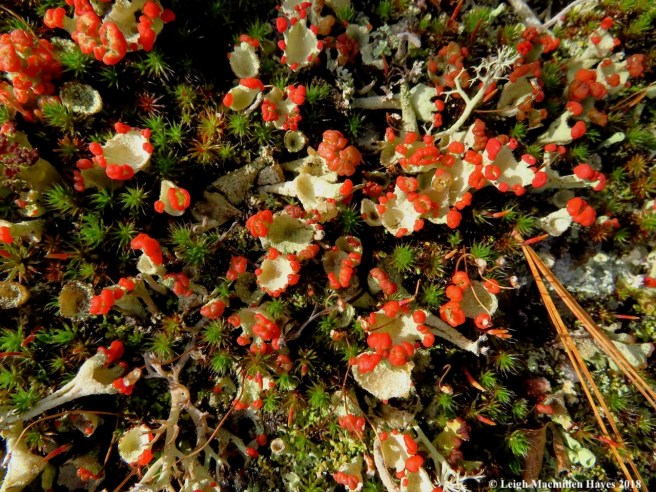
And rounding out the red-cap series were the Red-fruited Pixie Cups (Cladonia pleurota), with their multiple red fruiting bodies outlining the cups.

13-red-fruited lichens

Pixie cups would have been enough. But pixie cups with bright red caps–and we were wowed. The other cool thing–like the Bird’s Nest Fungi with its splash cup form, these lichens offered something similar. The Bird’s Nest depends on droplets of water (think rain) to release its spores from the tiny “eggs” situated within each cup. For the Red-fruited Pixie Cups, it’s the same idea–the splash cup goblets allow the lichen to disperse its reproductive materials.

14-red-fruited brown

We found a few with the red caps turned brown and assumed they’d done their duty.

15- Ladder Lichen Cladonia verticillata

Just when we were about to move on my friend made another exciting discovery. Ladder Lichen (Cladonia verticillata) with its brown fruits reminded me more of fountains containing chocolate treats at the outer edge of each level.

16- Ladder Lichen Cladonia verticillata

Or perhaps a way for Jack to ascend from the world of the minute to the giants in the sky.

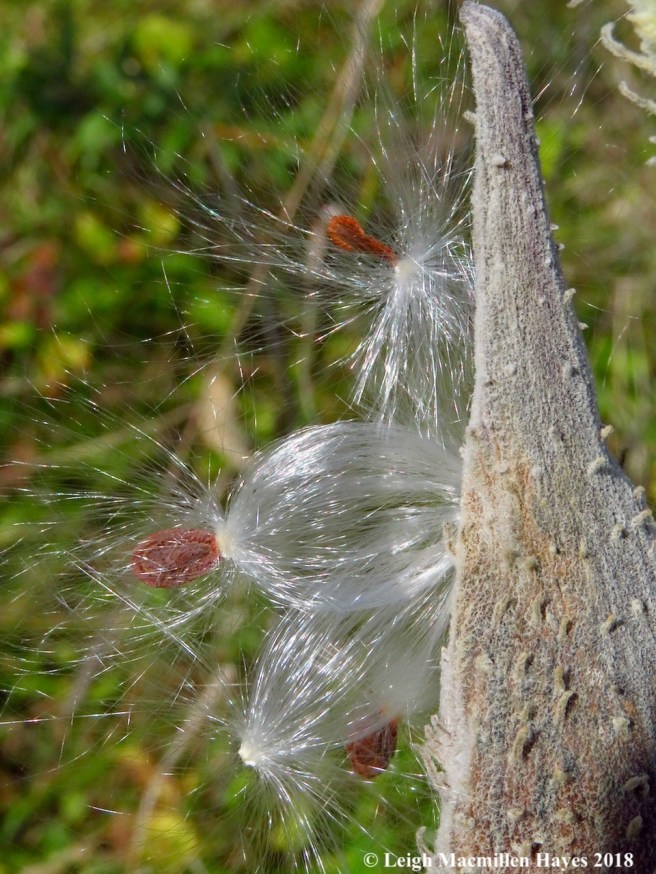
17-milkweed seeds

And with that, our eyes moved upwards–to the milkweed seeds that awaited their turn for release and a chance to find their own place in the world.

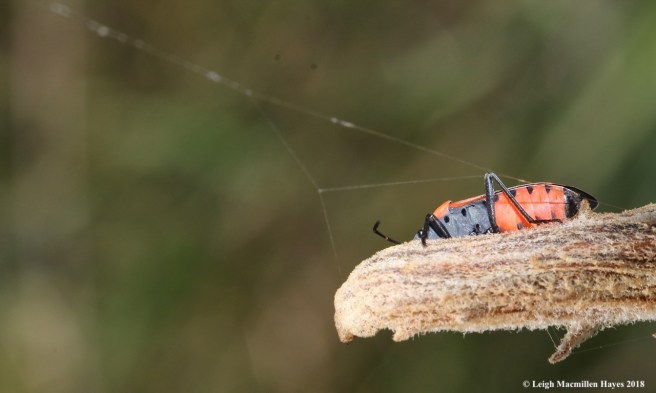
18-large milkweed bug

A Large Milkweed Bug reached the end of one pod, but the future possibilities seemed endless for it–as long as the spider web didn’t hinder any progress.

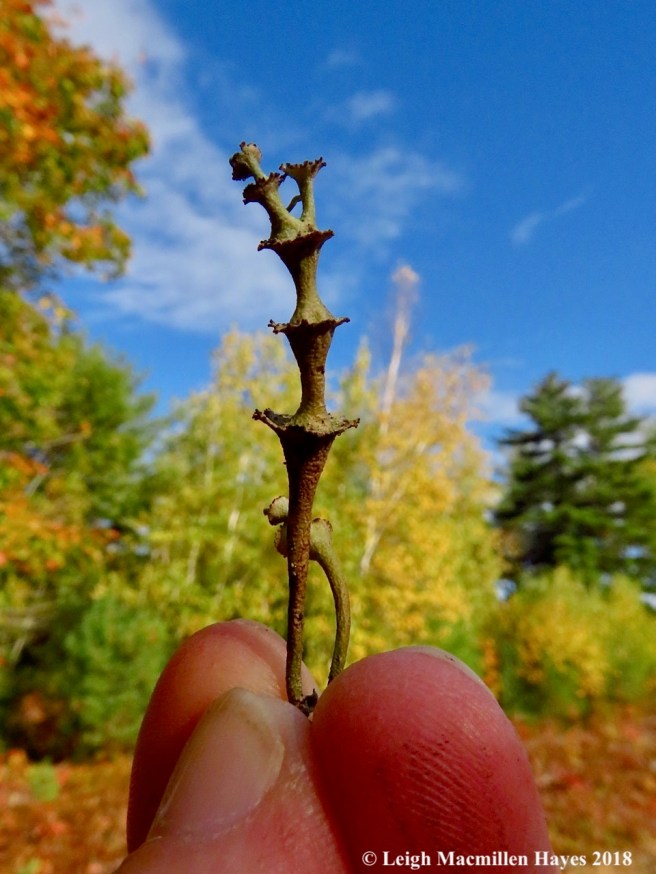
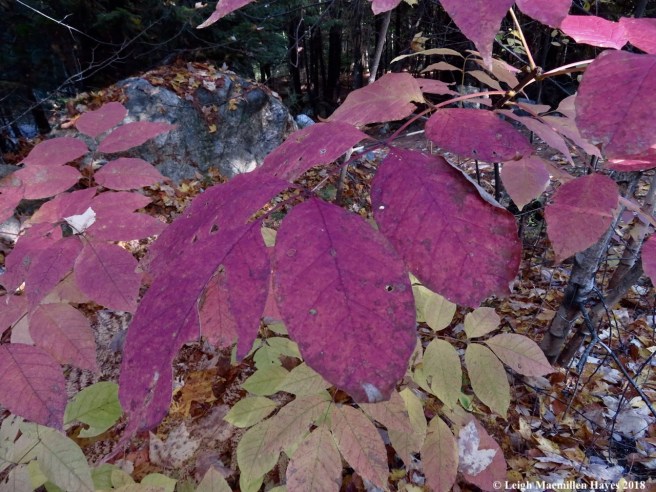
19-ash leaves

With upturned attention, we noted a young ash tree presenting its fall colors ranging from golden green to magenta all on the same trunk.

20-oak leaves

And even higher up, a Red Oak already showing off its carotenoid chemistry with yellows and oranges overtaking the green pigment.

21-colors

While fall foliage is at or near peak in western Maine and causing all of us to stop in our tracks to note the beauty of the live paintings that surround and embrace us in their ever changing way, its the color and variety and wonders at our feet that drew the attention of my friend and me today. And I’m forever grateful for her keen eye.

(And help searching for a needle in a haystack a little while later–thanks J.M.)

A “Fen-tastic” Afternoon

I was on a reconnaissance mission this afternoon for next week I’m leading some middle school students into a wetland and talking about forest ecology before sharing the joy of foraging with them.

1-Into the jungle

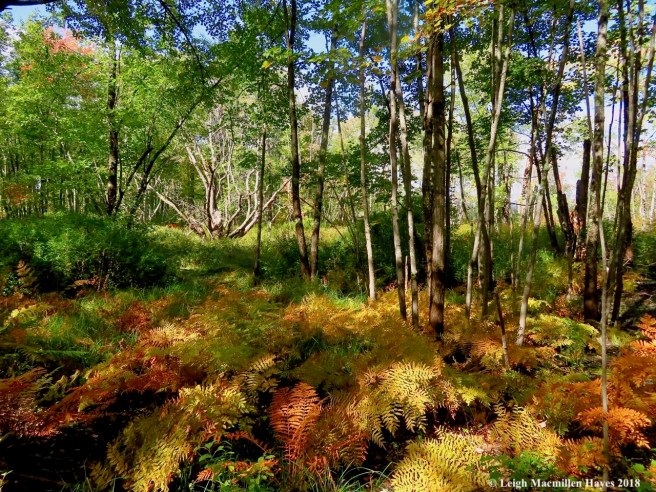
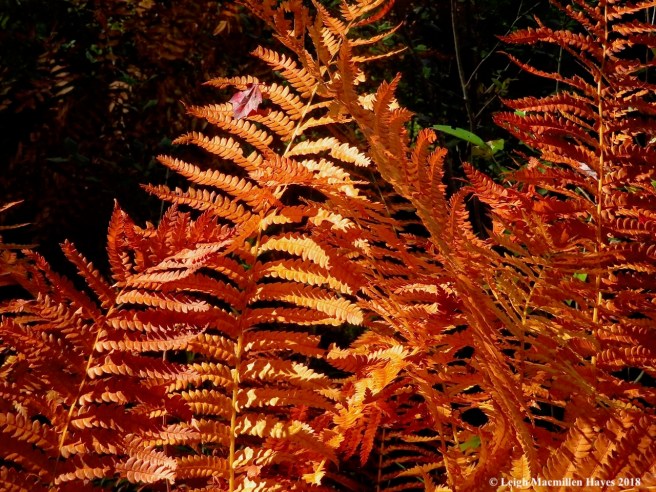
To reach the wetland, it was like walking through a jungle where the ferns grow tall, their fall coloration enhancing the scene. Cinnamon Ferns are a species that easily grow in medium to wet soils in part shade to full shade. The moist, rich, acidic soils, I walked through were much to their liking.

1a-cinnamon fern

It appeared that they were named for their autumn presentation, but really it refers to the cinnamon-colored fibers found near the frond bases.

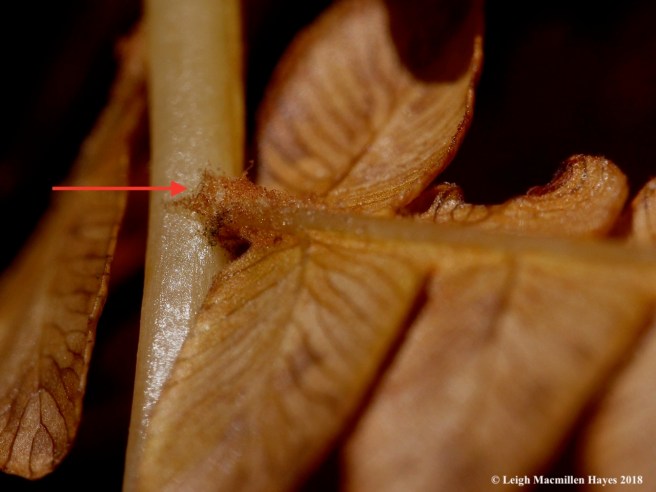
1b-hairy underarm

Because they look so similar to their relatives in the Osmundaceae family, the Interrupted Fern, I looked to the back of the frond for confirmation. Sure enough, where the pinnae (leaflet) met the rachis (center stem), a tuft that we refer to as the hairy underarm was present.

2-kettle

Onward I continued, not sure what the moisture situation might be. So, in the past, I’ve paused by the kettle hole, but never actually entered it. All that changed today and my plan is to take the students into this special place. A kettle hole is a basin created when a large block of glacial ice was left stranded and subsequently melted in place, producing a basin or depression. These basins fill with water up to the depth of their surrounding water table, which currently happens to be rather low.

3-white face meadowhawk

Because the temperature had risen after a damp, chilly start to the day, the meadowhawk dragonflies flew . . . and landed. This one was a White-faced Meadowhawk, aptly named for that face.

4-white face meadowhawk abdomen markings

Its abdomen markings of dark black triangles also help in identification.

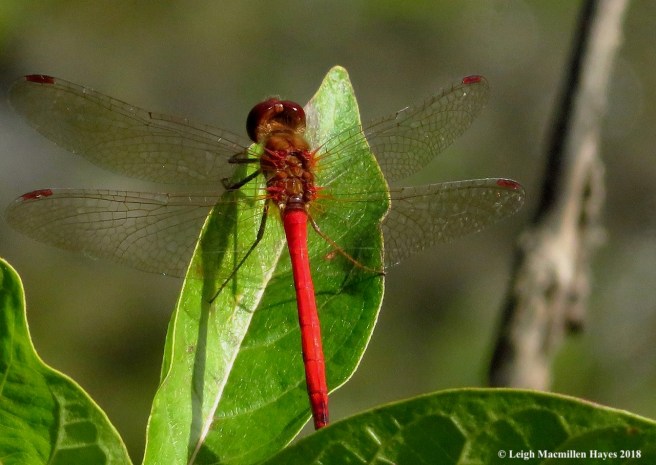
4b-autumn meadowhawk dragonfly

Flying in the same airspace where the Autumn Meadowhawks, with their light-colored legs. All other meadowhawks have dark legs.

4c-autumn meadowhawk love

Love was in the air and on the leaf as a pair of Autumns took advantage of the warm weather to canoodle in the sunlight.

4c-dragonfly love everywhere

They weren’t alone.

7-kettle 2

What I learned as I explored was that the kettle was actually a double pot for a second one had formed behind the first. Notice the layered structure of the area from trees on the outer edge to shrubs to grasses and flowers to water.

5-mammal tracks

And everywhere–deer and raccoon tracks crisscrossed through mud and water.

5a-racoon and bird tracks

Bird tracks also joined the mix among the raccoon prints.

6-six-spotted fishing spider

And because I was interested in learning who lived there, I had to pay homage to the six-spotted fishing spider.

8-spatterdock leaves and root

The spider flirted with me as he moved quickly among the spatterdock leaves that sat in the wee bit of water left in the center of the kettle.

9-another kettle

I finally left the kettle only to discover another and again the formation of layers.

10-green teal ducks

The water was a bit deeper and a family of Green Teal Ducks dabbled.

11-bottoms up

Bottoms up!

12-my destination

It took some time and steady foot placement as I climbed over downed trees hidden by winterberry and other shrubs, but at last I reached my intended destination, a cranberry bog.

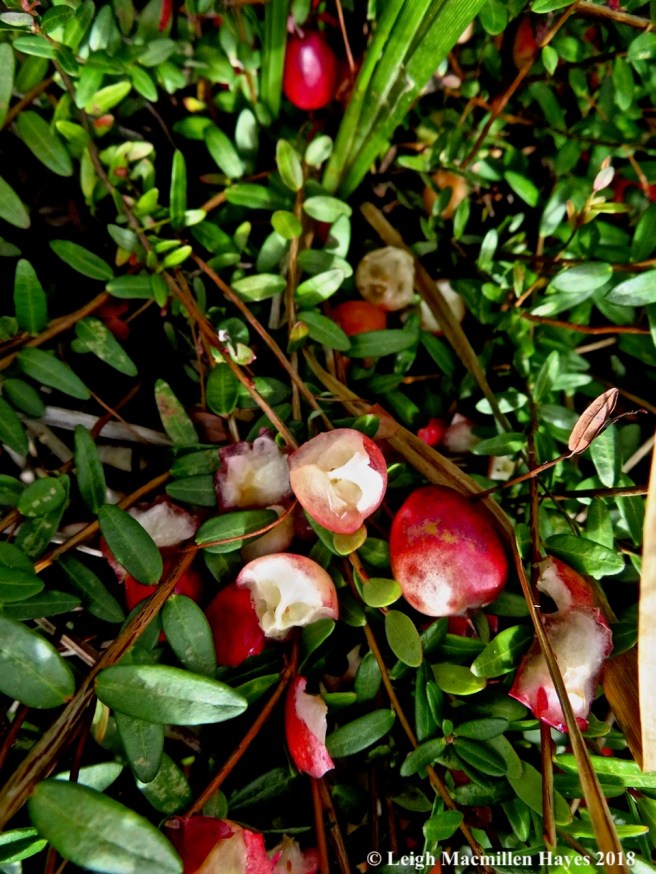
13-cranberries

And then I spent the next hour or so filling my satchel for so abundant were the little gems of tartness. The best where those hidden among the leaves–dark red and firm were they.

14-some nibbled cranberries

As I picked, I realized I wasn’t the only one foraging. It appeared that either chipmunks or squirrels also knew the value of the flavor–though they only nibbled.

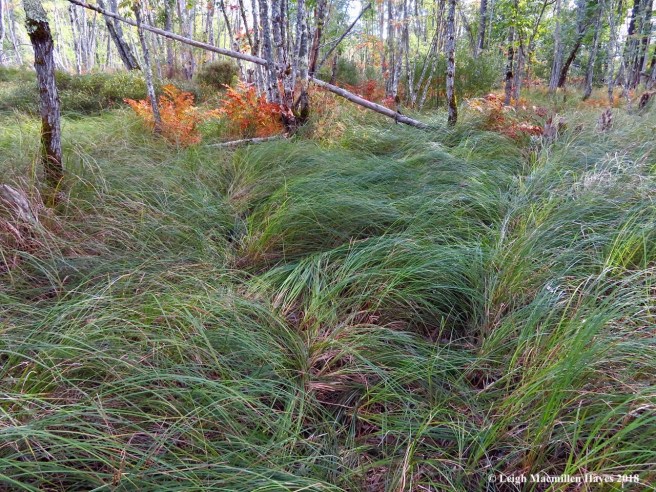
15-October colors layered

Occasionally, or even more often, I looked up to take in the colors and layers that surrounded me–from leatherleaf bronze to blueberry red to Gray Birch and Red and Silver Maples with a few White Pines in the mix.

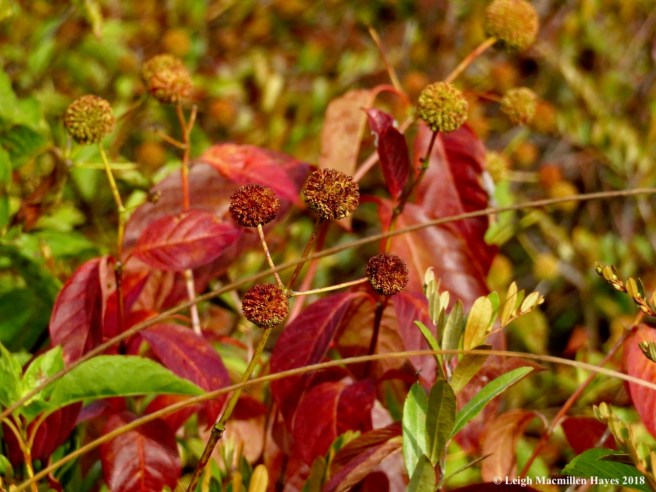
16-buttonbush

Buttonbush added its own color and texture to the scene.

17-finding my way out

At last I decided to find my way out. (Sorta for I did get a wee bit disoriented.)

18-royal fern fertile fronds

Among the offerings were ferns of a different kind–though still related to the cinnamons I’d seen earlier. The Royal Fern’s fertile crown had months ago shared its spores with the world and all that was left were salmon-colored structures.

21-buttonbush galore, but more

I picked my way carefully and eventually found one of the kettles. And . . . drum roll please . . .

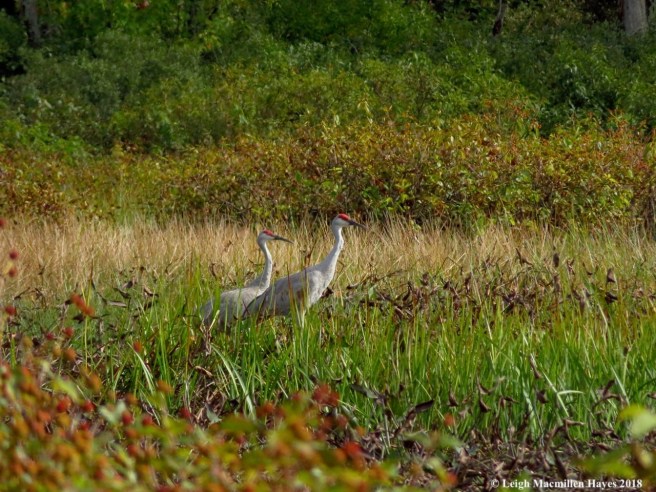
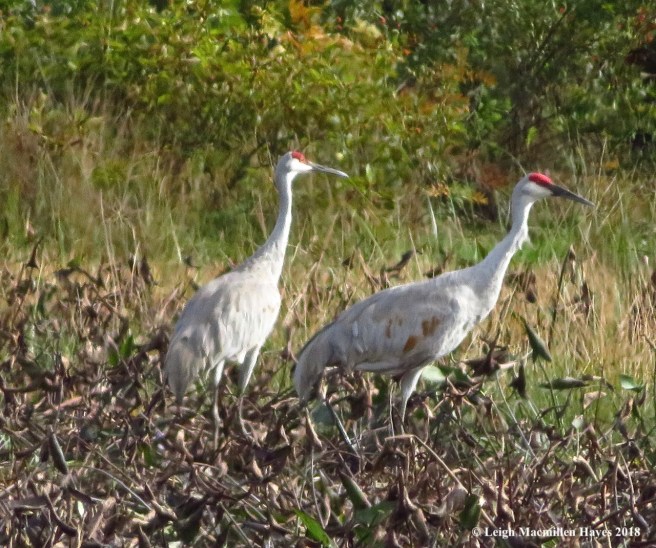
22-two sandhill cranes

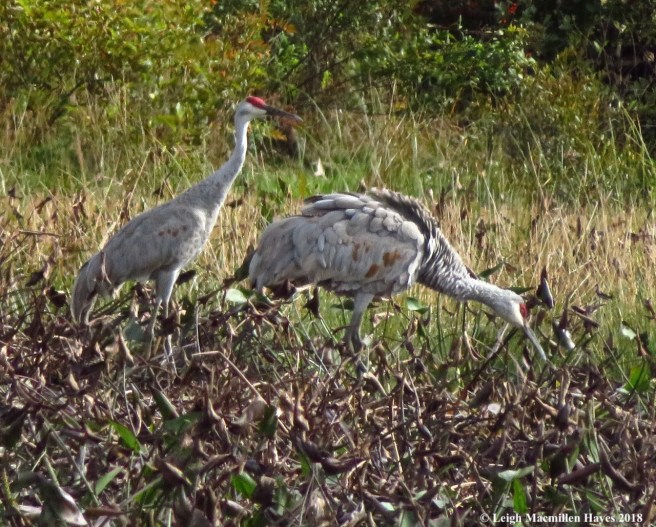
two Sandhill Cranes. Others can tell you better than I how long the Sandhills have returned to this area, but it’s been for a while now and some even saw a nesting pair this past summer. My sightings have been few and so it’s always a pleasure.

23-sandhill cranes

I stood still as they moved about and they didn’t seem to notice my presence.

24-sandhill cranes

While they foraged for roots, another also watched.

25-great blue heron

The Great Blue Heron was cautious as they strolled in his direction.

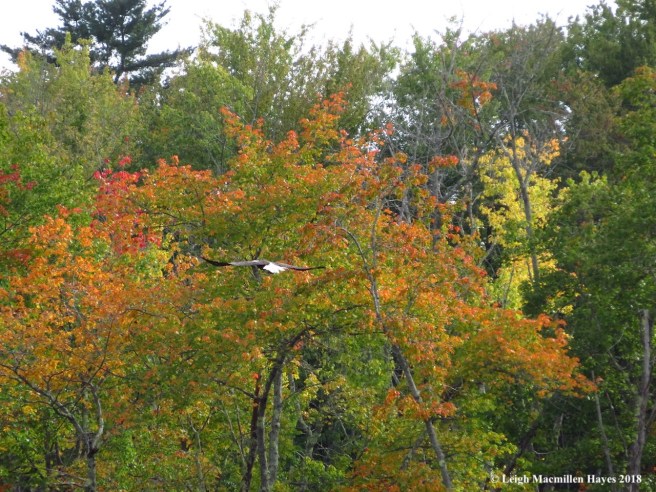
29-bald eagle

And then . . . and then . . . in flew a Bald Eagle. And out flew the heron.

30-cranes flew out

The cranes waited a couple of minutes and then they flew, bugling on the wing.

And I rejoiced. Oh, I still had to find my way out and did eventually cross through a property about a quarter mile from where I’d started. But, all in all from kettles to cranberries to birds, it was a Fen-tastic afternoon as I explored an outlet fen.


Book of October: Writing My Will

Judy Steinbergh has fed me repeatedly. She’s nourished my body and soul with actual food, but also with her poetry and prose. And recently, she gifted me one of her books entitled Writing My Will.

0

Though it’s her poems about Maine that I love the most in this collection, I feel honored not only to have been the recipient of such a gift, but also to be offered the opportunity to peek into her life and share the path that she’s walked through marriage and motherhood, divorce and death.

17

I hear Judy’s voice even when she isn’t reading to me. And I covet her descriptions and command of lyrical language and imagery, especially as she captures the natural world:

“. . . after speculating on the slap of water, whir of wings,

out of the grainy dusk, some creature bursts

from the forest. Before we focus on its shape,

almost before it can be named,

it twists back, leaps, makes its escape.”

~ excerpt from “Wild Things”

or this one:

“. . . roughs the lake up like the wrong direction of fur

until it is leaping dolphins and whales in rows

until it is sleek stampeding panthers in droves

until we, in our small boats, are driven to shore.”

~excerpt from “The Wind”

1b

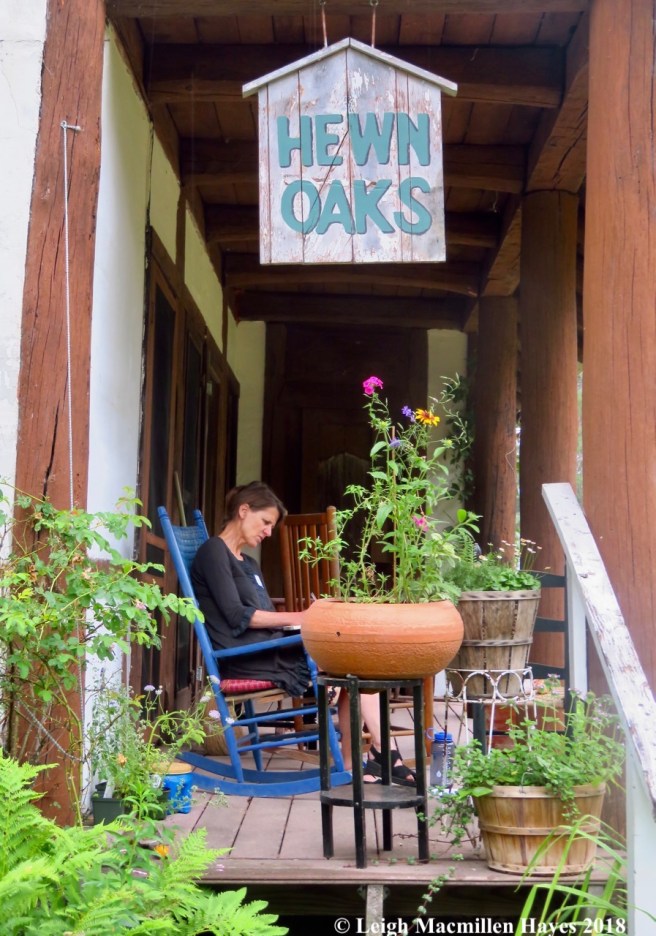
Each summer, she’s gathered her own poems, and those of other landscape poets, and shared them with an intimate group of writers through a workshop co-sponsored by the Greater Lovell Land Trust, Charlotte Hobbs Memorial Library, and Hewnoaks Artist Colony at the Hewnoaks property overlooking Kezar Lake in Lovell, Maine. After talking about rhythm and form, and having us read her works and others, she sends us off to find a comfortable spot in which to contemplate and write.

1a

Poets young and old flock to her and she embraces all with a listening ear and mentoring manner.

1c

And sometimes we travel the path together, either hunting for mushrooms, looking at plants and any of the millions of other things that capture our attention, or spending time writing and sketching.

Judy has written five books of poetry, three poetry teaching texts, and recorded other works. She’s the Poet Laureate for the town of Brookline, Massachusetts. And she teaches and mentors students and teachers for Troubadour, Inc. throughout greater Boston and serves as Poet-in-Residence in various communities.

This particular book, Writing My Will, is an assortment of Judy’s treasures from her family, including her dying mother, to the natural world that embraces her. Based on the theme, she’s divided it into sections: Heirlooms; My Mother Comes Back to Life; What Memories Will Rise; Talking Physics With My Son; This Wild; Meeting the Birthmother; Long  Distance; The Art of Granddaughters; Working on Words; Elegies; Writing My Will.

And it ends with one most apropos for this month:

October Song

Wild asters and the birds whir over

in flocks, Queen Anne’s Lace curls up

by the docks, the tide runs out,

runs out like it hurts, our step

is so light on this earth.

I love these times alone, thinking

about how my children have grown,

and how I come into this age

illuminated, softened

as the marsh’s edge.

And the tide runs out, as forceful

as birth, as if nothing else mattered

but rushing away and rushing back in

twice a day. Our step

is so light on this earth.

We’re given October like a gift, the leaves

on the warp, the light on the weft,

and the gold drips through

like cider from the press; we know,

we know that our lives are blessed.

But the tide runs out, runs out like it hurts,

what were fields of water only hours ago

are meadows now when the tide

is low; our step is so light

on the earth. Wild asters. All

we are sure of is change, that maple

and sumac will turn into flame, this softness

will pass and the winter be harsh

till the green shoots push

up through the marsh. And the tide

rushes in like a thirst and will keep

its rhythm even after our time,

the seasons, too, will repeat

their design. Our step

is so light on the earth.

And so, dear Judy, as my thank you for the gift of your book, I want to now share a melody of photos from previous autumns, all taken during Octobers past in your beloved Maine locale when you can’t be here. (Well, maybe one is from the Northeast Kingdom of Vermont–shhhh!)

3

4

5

7

8

9

10

11

12

13

14

15

16

2

“Our step is so light on the earth”

Book of October: Writing My Will–Poems and Prose, by Judith W. Steinbergh, Talking Stone Press, 2001.


Lake Living, Fall 2018–worth a read

The autumn issue of Lake Living is now available at a local store (for free) or you can read it online.

I had the pleasure of writing three articles. The first is about my friend Marita and the sixth edition of her book entitled Hikes & Woodland Walks in and around Maine’s LAKES REGION.

m1-cover

Of course, I got to hike many a trail with her and so perhaps my review is a wee bit biased.

The article ends with a brief description of several hikes–I tried to choose different levels of ability for those.

1

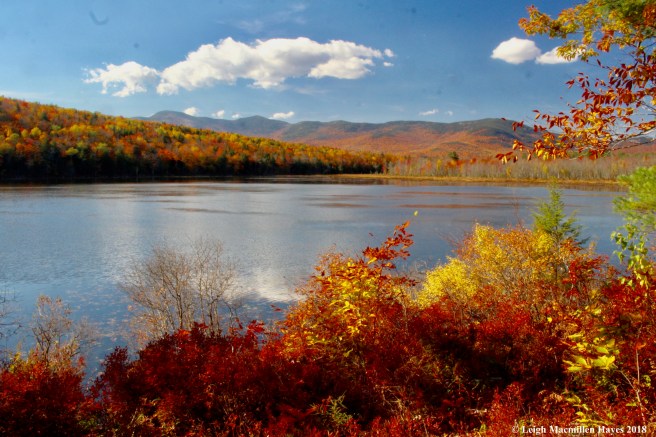
All offer incredible fall foliage viewpoints, including Shell Pond off Route 113 in Evans Notch. (Wait a month and it will like this again.)

4

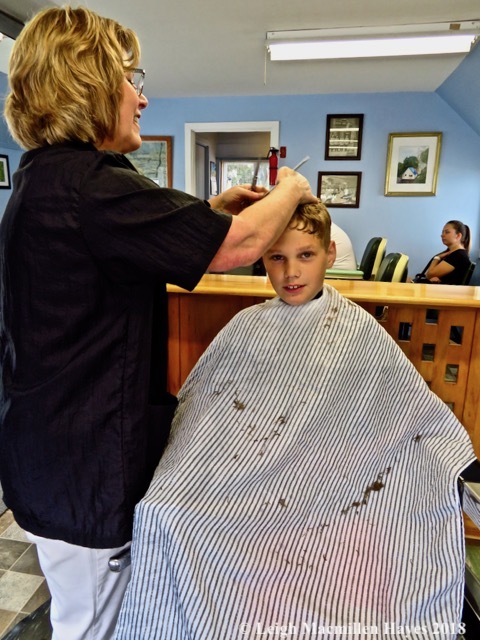
Then there is the article about barbershops. In the process of writing this one, I learned the story behind the barber pole. Do you know it?

2

Sitting in four local barbershops was fun–a great way to catch up on gossip and listen to some funny stories. Again I was a wee bit biased as Steph of Steph’s Barber Shop in Fryeburg is our next door neighbor at camp.

3

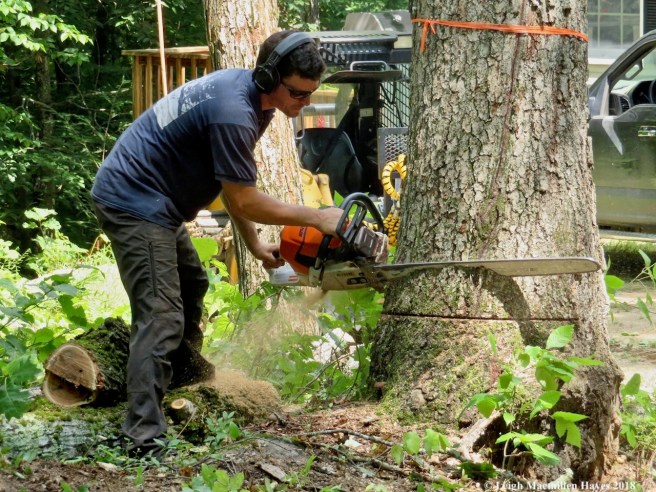
And finally, I spent some time with Arborist Josh of J and C Trees and learned more about his talent, entrepreneurial spirit and love of trees.

To say it was a busy summer would be an understatement, but the final product of Lake Living was worth it–as usual. Oh, and Laurie and Perri also wrote articles that will appeal to you.

So . . . as usual, brew a cup of coffee or tea and curl up with Lake Living. You won’t be disappointed.

Summer Marches On

Today I attended a celebratory parade.

0-Subtle colors

The route followed the old course of a local river and along the way the trees stood in formation, some showing off their bright new coats.

5-colors in the field

Each float offered a different representation of the theme: transition.

3-ash seed raining

Upon some floats, seeds from the Ash rustled as they prepared to rain upon the ground like candy tossed into the gathered crowd.

4-crystalline tube gall on red oak

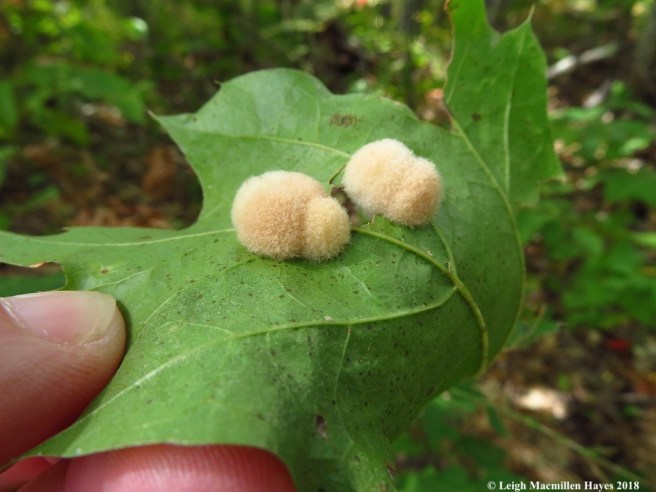
Oak leaves showed off their pompoms of choice–some being crystalline tube galls and others . . .

19-hedgehog gall?

possibly called hedgehog.

8-bald-faced hornet

Playing their instruments were the Bald-faced Hornets,

9-autumn meadowhawk

Autumn Meadowhawk Dragonflies,

11-immature green stink bug

and even an immature Green Stink Bugs.

10-green frog

On the percussion instruments at the back of the band were the green and . . .

23-pickerel frog

pickerel frogs.

15-yellow-rumped warbler

Adding a few fainter notes were a couple of Yellow-rumped Warblers.

16-yellow-rumped warbler

They didn’t want the chickadees to get all the credit for the songs of the woods.

17-hairy woodpecker

A Hairy Woodpecker also tapped a view beats.

12-wood ducks

Probably my favorite musicians, however, sported their traditional parade attire and awed those watching from the bandstand.

13-wood duck

Even a non-breeding male made the scene look like a painting.

14-wood ducks taking off

Their real contribution, though, came from the modestly plumaged females who offered a squealing “oo-eek, oo-eek”  each time they took flight.

18-sensitive fern

Though green attire was the most prominent of the day, others sported colors of change from yellows and browns to . . .

6-red emerging

brilliant reds.

21-Brigadoon

As is often the case along such a route, vendors offered works of art for sale, including local scenes painted with watercolors.

22-lily reflection and aquatic aphids

Before it was over, a lone lily danced on the water and offered one last reflection.

24-season transformation

And then summer marched on . . . into autumn.

Speaking to the Future, Jinny Mae

As a kid, science and history eluded me. Reading, and writing, and even, ‘rithmitic, I embraced. Well, only a wee bit of the latter, though my father thought my abilities were far greater than they were and he saw a bank position in my future. He was the mathematician. It wasn’t a subject for me to pursue. And so I became an English teacher.

And then one day I woke up and found I’d developed an interest in the how and why and the science of stuff. Added to that was a desire to know more about the past. And voila, here I am, some days spending way too many hours pursuing insects in the garden or bark on tree or dragonflies buzzing about. Other days, its following trails of yore and trying to understand the lay of the land and those who came before that interests me. My favorite days are probably those that find me pursuing the two subjects simultaneously.

1-Ambush Bug on Hydrangea

Today, I devoted spurts of time to a hydrangea bush that we rescued from a shady spot in our yard about fifteen years ago and transplanted to a sunny spot. What once was a dying shrub that rarely produced more than one flower is now a healthy specimen laden with blooms. And the insects love it.

My biggest surprise, however, was to find an Ambush Bug sitting atop one of the newly opened white flower petals. For the first time since I’ve been paying attention, the bug was on something other than a goldenrod and I could truly see its body. I’ve always thought it exhibited a hint of a smile, and do believe I’m correct.

An Ambush Bug is my “iguana” insect for its body structure always brings to mind a neighbor’s iguana that got loose one day and never was spied again when we were kids. (Or was it? Didn’t we find a dead iguana on the old dump road, Kate and Lynn? Was that Rob’s lizard?) Anyway, I think the Ambush Bug resembles an iguana, on a much smaller scale, of course. MUCH smaller.

2-Ambush Bug

Seeing the bug on the white petals really threw me for a loop. Why was it there? What would it ever find to eat? The pollinators no longer bothered with the shrub on which it stood. They’d moved on to the goldenrods and asters below.

And how could this insect behave as one who ambushes when it was hardly camouflaged on the white petal? It must have questioned the same (if Ambush Bugs can question) for it turned this way, then that, and back again, and then moved from petal to petal and flower to flower. Usually, it hardly seems to flex a muscle as it remains in one spot for hours or days on end.

3-eye to eye with Ambush Bug

We studied each other, eye to eye, or perhaps more correctly, lens to lens, until I blinked and it flew off. I trust it landed on a nearby goldenrod, where a meal wasn’t too long in the making.

4-Tiger Moth Caterpillar

Just after the Ambush Bug and I parted ways, I noticed a subtle movement below and watched a tiger moth caterpillar that reminded me of a soft boa scarf one might wrap around a neck quickly slither down another flower on the shrub until . . .  it reached the edge of the final petal and fell to the ground, climbed up a fern frond, found its way back to the shrub and moved on to the world within.

7-grasshopper 1

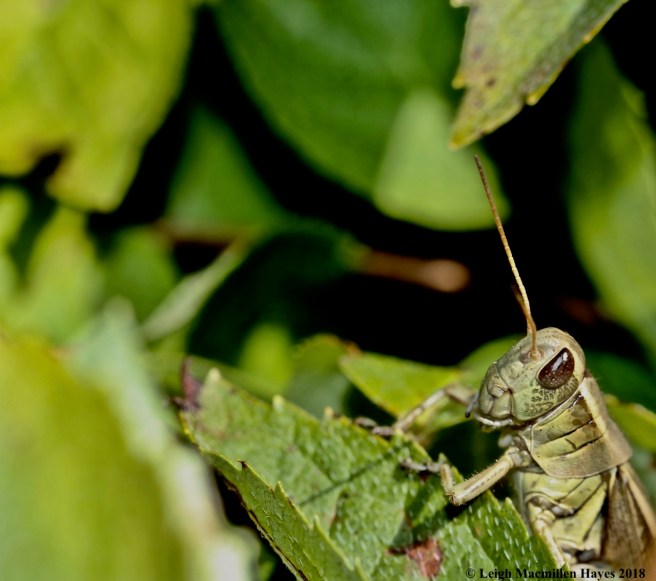
I was beginning to think that all of the insects on the hydrangea would move on or in, but then I met the Red-legged Grasshopper. He set his elbow on the leaf bar and we consulted each other. Would he fly away if I moved into his personal space, I wondered. He wanted to know why I stalked him.

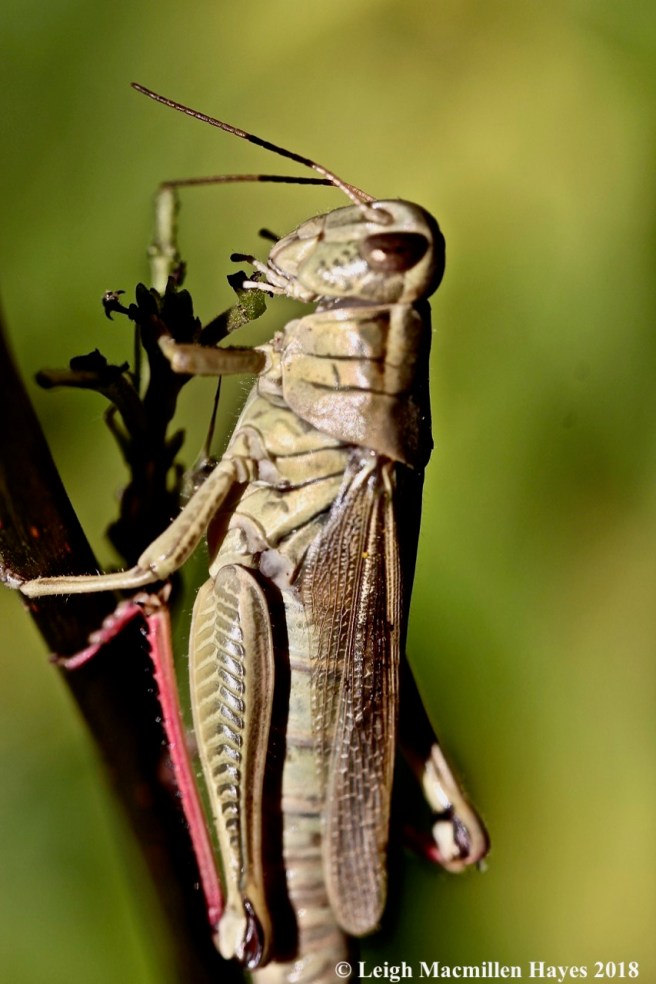
8-red-legged grasshopper

I mentioned his body of armor and the herring bone design and the leg joints and the spurs on its legs that drew my awe.

9-grasshopper

As a solo traveler, I knew it didn’t appreciate that I wanted to share the space. But, I couldn’t resist. Notice its feet and the segments on its abdomen and even the veins in its wings. Did I mention its mandibles?

10-caterpillar scat

As it turned out, there may have been a reason it wanted to be alone, but I was there. To. Witness. The. Poop. A blessed moment. It would have been more of a blessed moment had it pooped on me. Oh, and did I mention that grasshopper poop, like all insect poop, isn’t called scat. Rather, it is frass. Thanks go to Dr. Michael Stastny, Forest Insect Ecologist in New Brunswick, Canada for reminding me of that term. Cheers Mike.

14-shield bug

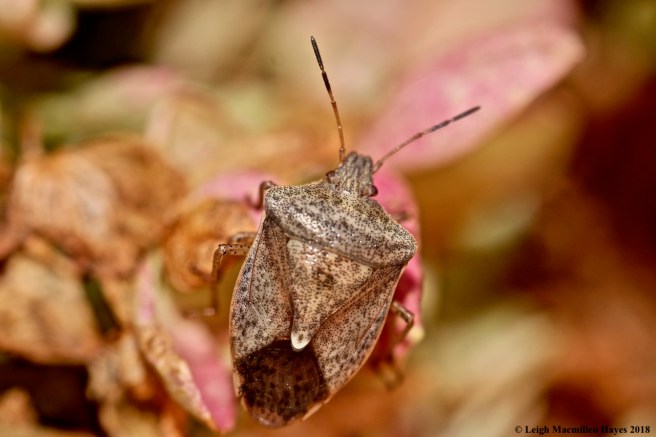
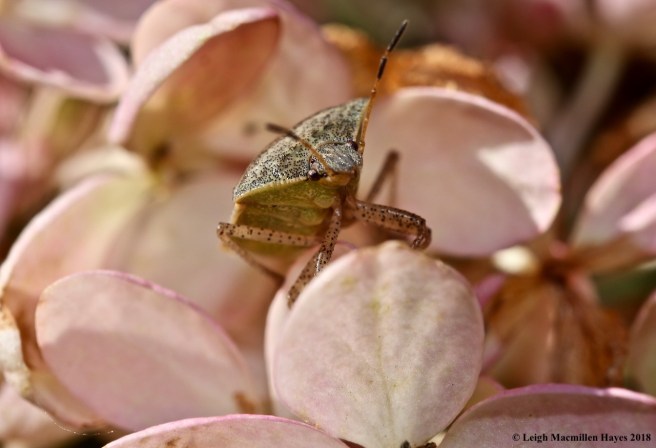
Another moving about was a shield bug, so named for the shield on its back. It does make me think of a piece of metal one might use as protection. Combine the shield with the grasshopper’s suit of armor and you might think you were spending time in an earlier era. Much earlier.

15-shield bug

But this shield bug didn’t care about the Middle Ages. Instead, it had one thing on its little mind.

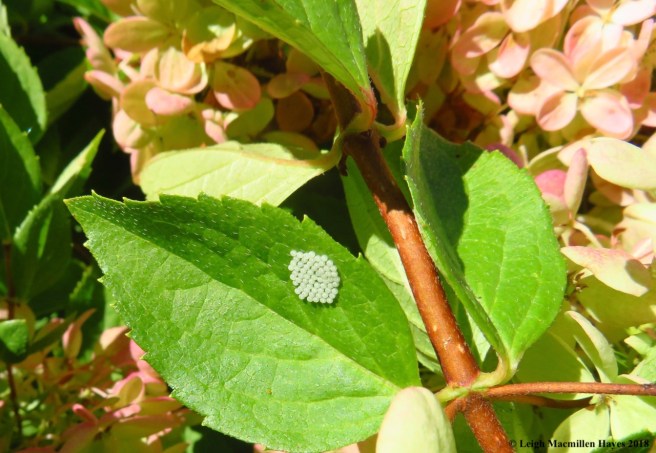
12a-shield bug eggs?

Depositing eggs.

13-shield bug eggs?

Its offering was almost minute, yet pearl-like in structure.

16-wasp within

The world I watched on the outside of the hydrangea made me wonder what might possibly go on within. As much as I wanted to break through the branches and take a better look, I knew I’d ruin everything and after all, it wasn’t my place. I did, however, get to witness one moving about briefly for a paper wasp left the goldenrods and heading under the hydrangea leaves to move the pollen about on its body. Why did it go under? Why not pause atop a leaf for such behavior? And how did it escape the inner world without . . .

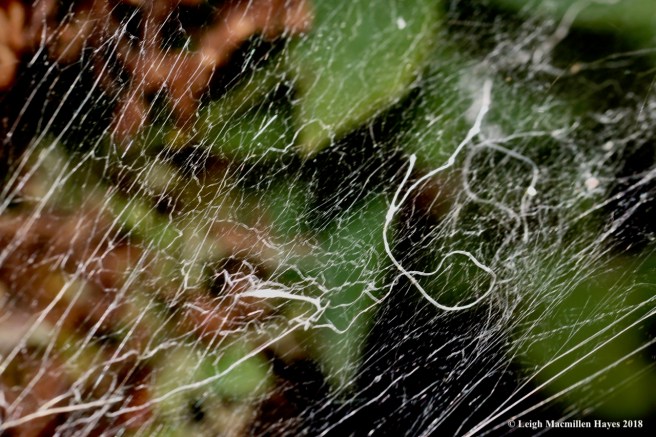
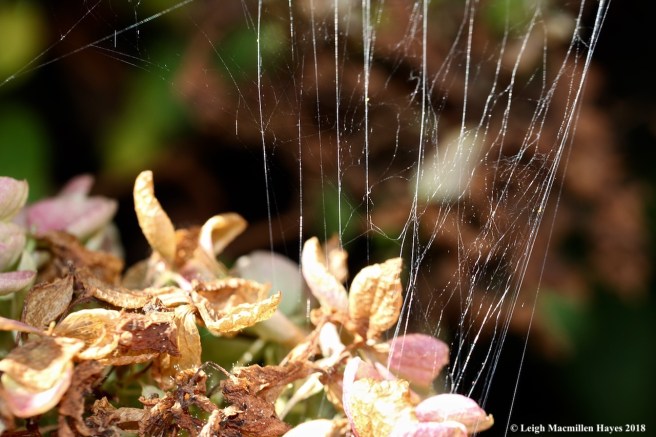
16a-spider web

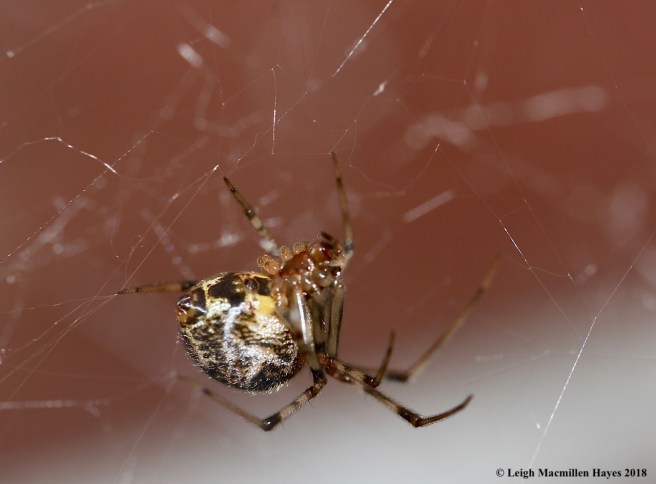
encountering a spider web? Funnel spiders had practically veiled the entire shrub with their silken structures.

16b-web anchors

Though anchored with strength, they were extremely soft to the touch.

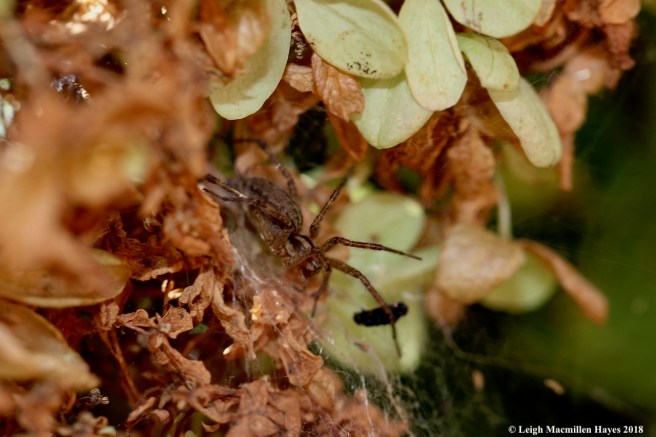
17-spiders

As the day progressed, I kept tabs on three funnel spiders, the mighty weavers that they were. All were wary of daylight.

18-food in front

But one had set up its home on the eastern side of the shrub and so it spent the day in the shade and enjoyed fine dining on a small bee that I assume made a mistake of pausing while shifting some pollen on its body.

19-dining

There wasn’t much left of it by the time this spider had finished its meal.

21-dinner in hand

Later in the day, a web weaver on the western side began to show itself–and it also had a meal secured.

All of the insects and arachnids I saw, and I had to assume even more enjoyed the inner structure of the condo that the shrub certainly was, all spoke not to the past, but to the future.

And with that, I dedicate this blog entry to you, Jinny Mae. You have a better eye and understanding and ask better questions than I ever will. Here’s to the future!

Global Golden Sights

Until I spent time watching, I never realized how global a goldenrod could be. In fact, I must admit that there were years when I tried to eliminate these hardy yellow plants from the garden. After all, weren’t they weeds? You may think thus for so prolifically do they grow, but these days I prefer to think of them as volunteers who add beauty in any season. And during this season, they mimic life as we know it.

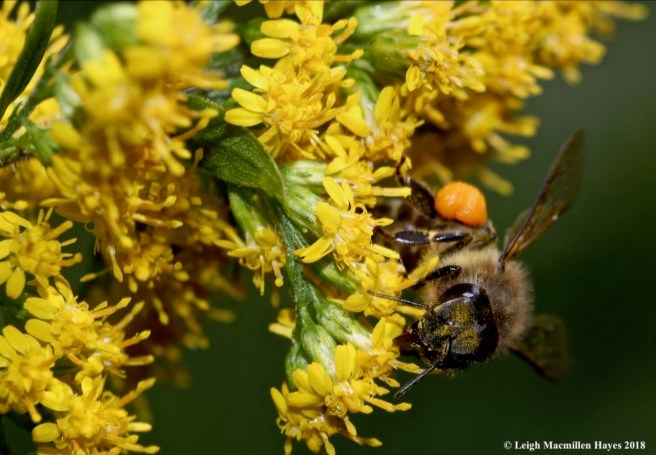
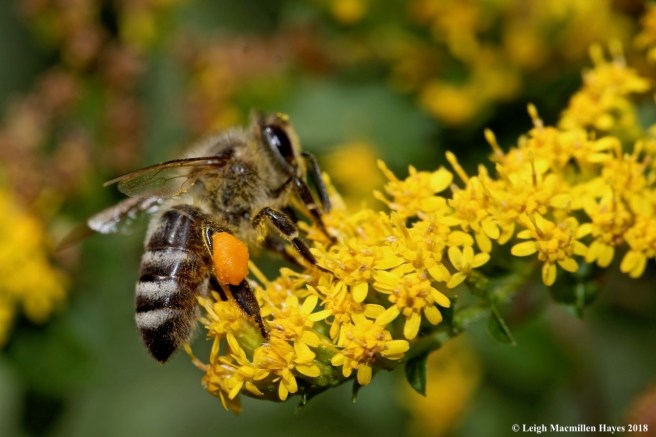
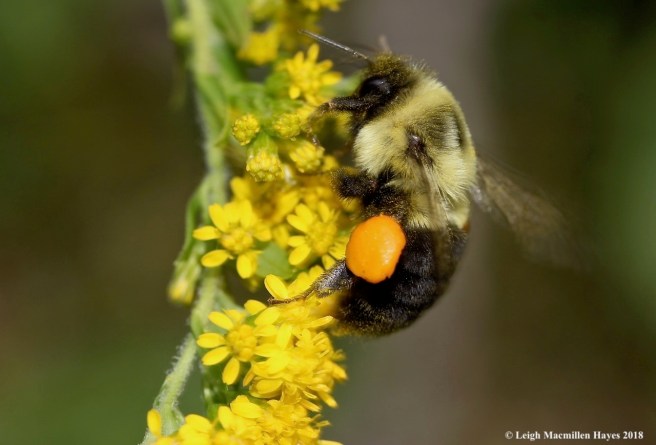
1-worker honeybee foraging

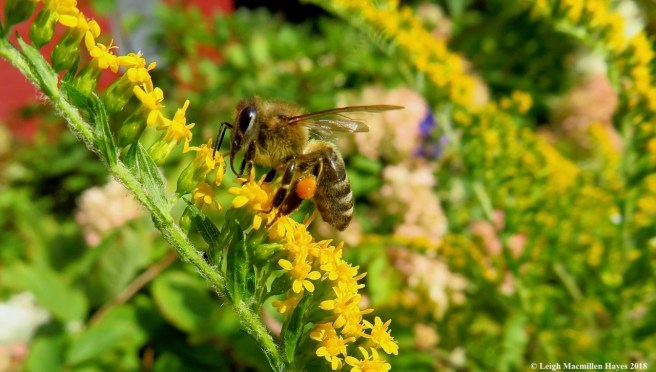
First, on sunny days European Honey Bees buzzed about. Yes, they are not native. But don’t tell them that. After all, they think they own the place.

2-honeybee

As quickly as they could, they sought nectar from the flowers and in the process, pollen clung to their hairy bodies. Aha, so in their greediness, goodness happened. How could that be? Or rather, how could that bee? (Corny jokes are forever a teacher’s forte)

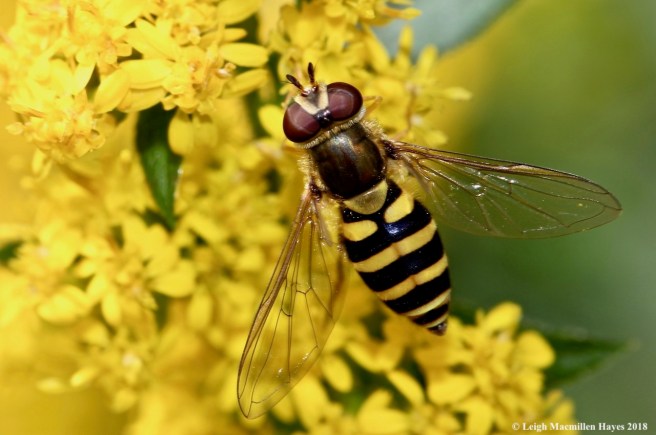
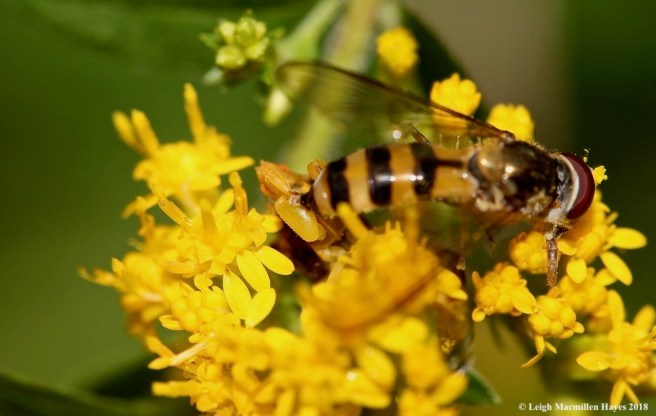
3-hoverfly

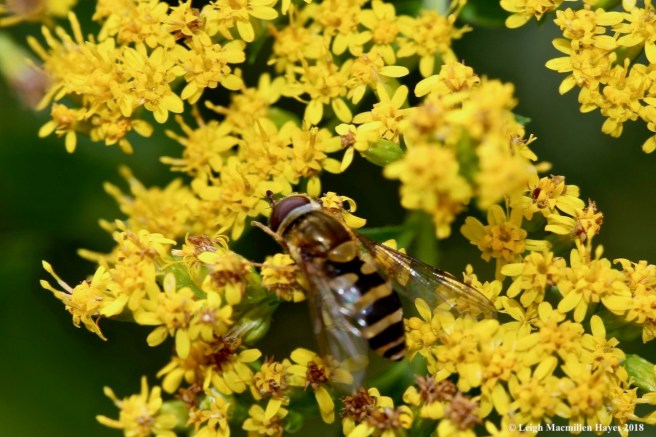
As I gazed upon the minute flowers of the Rough-stemmed Goldenrod, I had to look for subtle changes of color in order to read the story. Ever a fan of the coloration of the Hover Fly, I was thrilled that I could focus in on this one. Then the realization struck–this fly wasn’t . . . flying. In fact, it was dead. And yet it still held its structure.

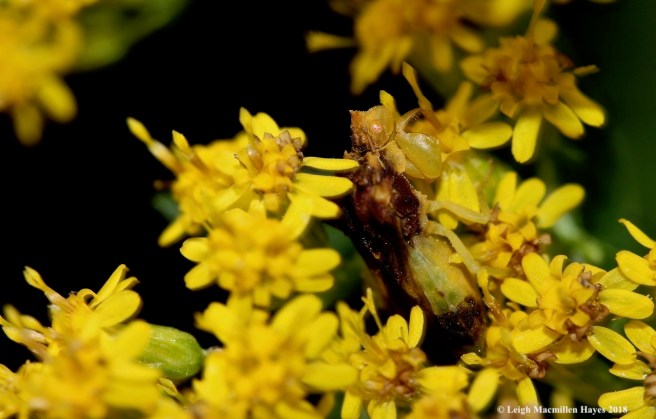
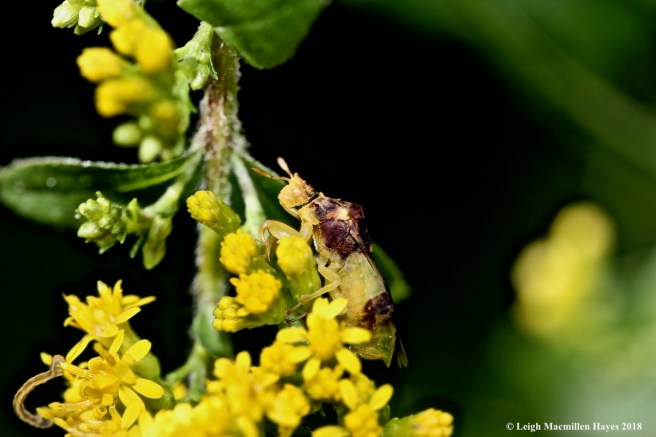
4-ambush bug

Looking up a stem or two, I noticed a predator in the waiting, its structure so otherworldly, much like an armored iguana. But it wasn’t a lizard.

4a-ambush bug

It was a common insect that changed position as I changed lenses. The amazing thing is that it blended in so well, but that was all part of the insect’s strategy. Did the Hover Fly’s death have anything to do with the Ambush Bug? All are innocent until proven guilty and I needed to remember that, but I still suspected I knew the perpetrator.

4b-ambush bug

For three days I stalked him as he stalked others. An Ambush Bug is willing to wait until just the right moment to attack its prey with those oversized raptorial forelegs and quickly dispatch it with a stab from his sharp beak. Who knew that in the small world of the goldenrod one needed to be ever on the alert?

6-honey bee

And still, a Honey Bee foraged and farmed.

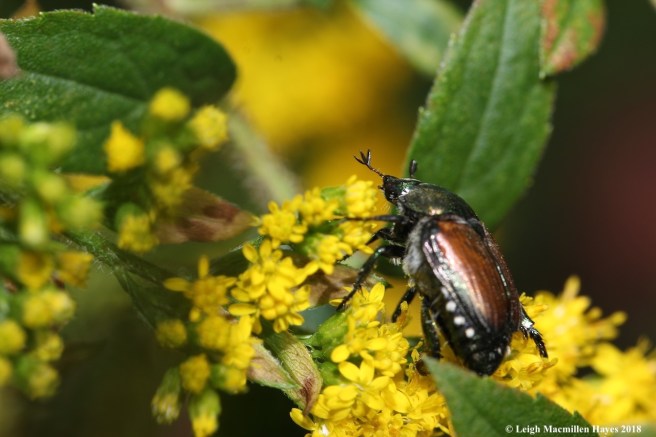
9-Japanese Beetle

Also on a mission was a Japanese Beetle, another immigrant in the mix. And I know that if I were to point out the unique idiosyncrasies of its body structure, I’d get booed out of town. But  . . . look at those colors, the details, and especially the antennae. It’s tough being the one dude that no others appreciate.

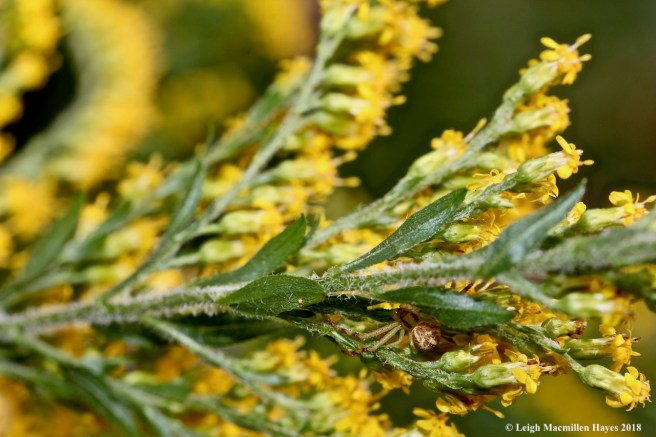
18-Where's Waldo the spider?

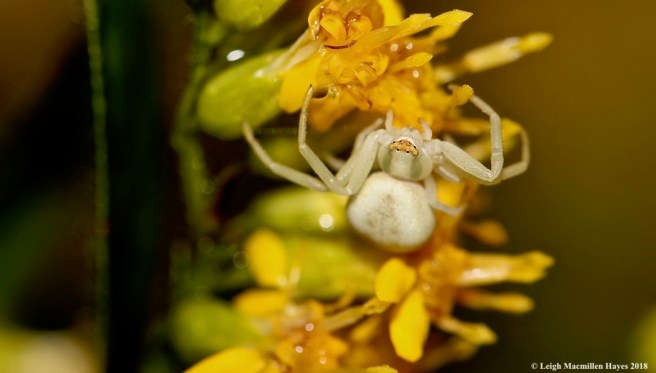
For every foraging or unwanted citizen, there was one hiding in the shadows, ever ready to catch the neighbors when they were most vulnerable. Do you see the green and brown crab spider?

25-spider web

Some even set up traps to catch their prey, but after all, we are all hunters and need to dine.

10-pollen all over body

Still the Honey Bees flew in and out and chased off any others, even their siblings who got in the way. All were females, for such are the workers in their society. Ahem. Oh, excuse me. Just clearing my throat.

12-locust borer

For all the time that I watched (and really, I only spent an hour or so each day for I did have work to do) I noticed a Locust Borer on one particular plant. Females tunnel into bark to lay eggs and I probably should have taken a closer look at the quaking aspen in the garden that has been compromised by so many insects. But here’s another thing–do you see the yellow tip on its abdomen? Locust Borers don’t sting, but should you touch one it will try to bore its tail end into you as if it were a stinging insect. Silly bug.

22-Assassin bug 1

Peeking under a nearby stem, I found another seeking others–an Assassin Bug that was related to the Ambush Bug. Assassin Bugs are proficient at capturing and feeding on a wide variety of prey. Though they are good for the garden because they act as tiny Ninjas and prey on enemies of the plants, they don’t always discriminate about their prey. The unsuspecting victim is captured with a quick stab of the bug’s curved proboscis or straw-like mouthpart. I’ve had the opportunity to watch the action in the past, but I couldn’t always locate the little warrior, thought I knew it was somewhere among the drooped stems.

8-honey bags

And still , the Honey Bees flew, filling their sacs being their main priority.

15-drone fly 2

Not everyone could be a bee, but some surely tried to mimic their adversaries. Thus is the life of a Drone Fly that may have a bit of a hairy body, but it can’t sting. Instead, it had to outsmart its predators by being a look-alike. Such is known as Batesian mimicry, so named for the famous English naturalist, Henry Walter Bates. Bates discovered this concept while working in the Brazilian Amazon.  In the course of his studies, he realized that numerous non-toxic butterflies looked identical to a few very potent types.

16-sawfly?

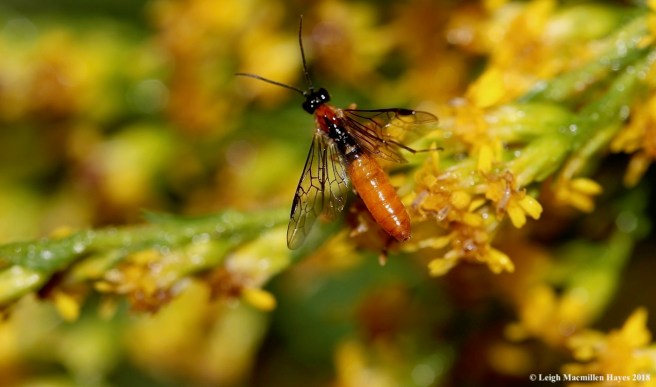
Other non-bees on the flowers included a rather handsome sawfly, its wings so distinctly veined.

17-honey bee moving pollen on body

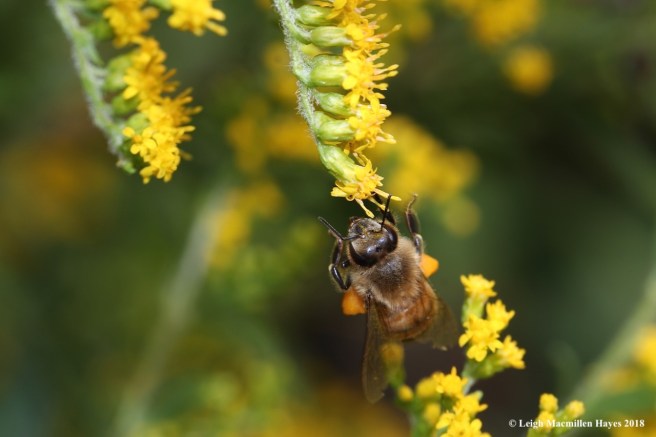
But the honey bees were on the move the most and managed to control the activity of those smaller and larger by giving chase to all. Occasionally, one had to pause and dangle in order to move some pollen into its sac.

30-crab spider

Also known to dangle, for that’s what spiders do best, was another crab spider, Crab spiders may be tiny, but they can be cunning and ferocious. Like the predatory insects, waiting was the name of the arachnid’s game and I don’t doubt that this one was successful in securing its next meal.

32-inch worm

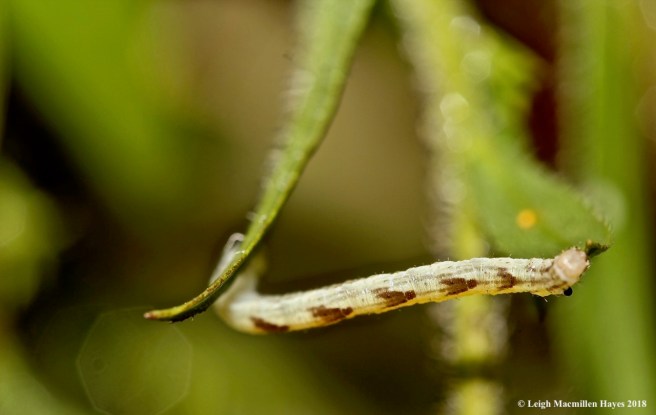
And while still in a dangling mode, there were the inch worms of varying colors to spy, most of them slithering ever so slightly among the plants flowers, but some were on the move to the leaf that was greener on the other side.

36-dead inch worm

This morning, I did discover a dead inch worm and again, like the Hover Fly that met its demise, I wondered who done it. Ambush or Assassin Bug? Those were my two choices.

39a-hover fly

I did find a live Hover Fly and its presence made me happy. There’s something about its streamlined structure and minute hairs and clear wings and hovering ability that appeal to me.

39-hover fly an dinch worm

One even demonstrated that it could share the space with an inch worm.

37-flesh fly

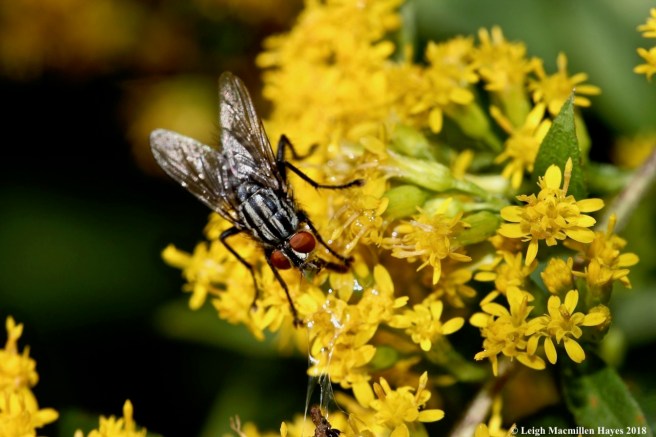
Equally admirable was the Flesh Fly with its brick red eyes and handsomely striped abdomen. It’s called a Flesh Fly for its habit of locating decomposing carcasses and laying its eggs. I have to admit that thinking about that and the maggots to follow gives me a chill.

40a-metallic green sweat bee

A metallic green Sweat Bee flew in periodically, but never stayed long. Thankfully, it chose to ignore me. In fact, considering how close I was and in the faces of so many, as always, the insects and spiders left me alone. I, on the other hand, continued to stalk them.

42-paper wasp

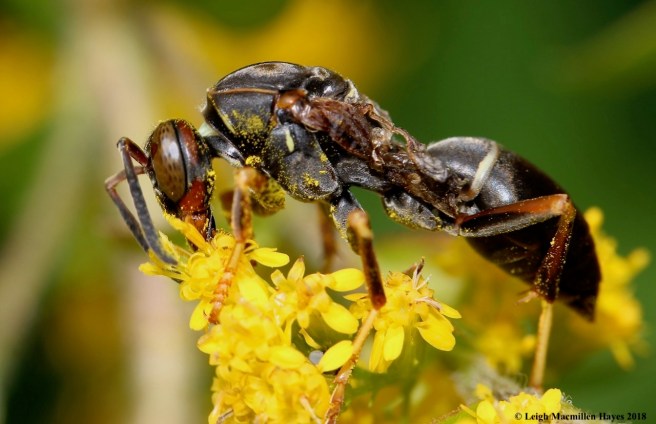
Surprisingly, even the rather aggressive Paper Wasp ignored me. I could hardly ignore it. Whenever he flew, most other flying insects performed a mini dance, flying up, swirling down and then settling again.

But take a moment to look at that body. It’s as if some insects wear a coat of armor. And in the wasp’s case that coat was dusted with pollen, just as nature intended so fertilization could occur.

44-bumblebee

Even the aggressive Bumblebee let me bumble about without incident. In my three days of watching, there were plenty of Bumblebees buzzing, but they tended to visit all of the surrounding flowers. Today, however, in a frantic frenzy, one sampled this flower and that along the goldenrod stem.

45-locust borer waving

While the Locust Borer I mentioned earlier spent the last three days on the same plant, a second one flew in today and settled on a goldenrod about seven feet away from the first LB. Will they meet? I assume so, but in the meantime, it waved.

41-assassin bug

And in a different location than the first day, I found an Assassin Bug. The same one? Perhaps. But again, no food. Still, it waited.

50-ambush bug

As did the Ambush Bug.

39-half-inch worm and ambush bug

In three days, it hadn’t moved far, but finally decided to take a different stance. To its left, a half-inch worm stayed in one spot, though it kept changing position. And I kept waiting–why didn’t the Ambush Bug grab the little thing and suck its guts out?

46-ambush dining on hover fly

Because . . . it was waiting for a more substantial meal I later learned. And my question was answered. What killed the first Hover Fly? An Ambush Bug. And this afternoon it worked on another. Drats. But, in this insect or arachnid eat insect world, finding a meal and gathering energy from it was the most important thing.

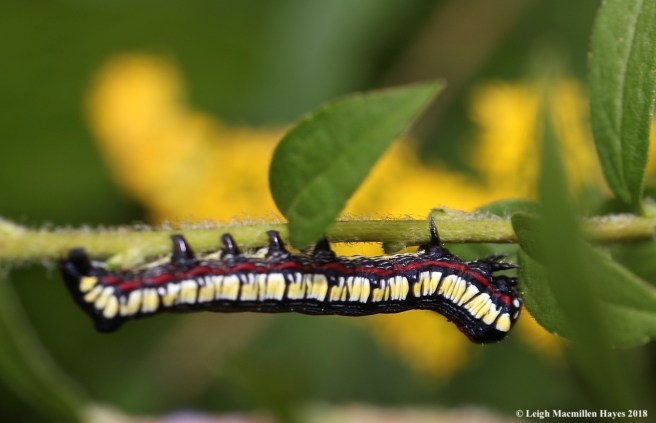
43-larvae of brown-hooded owlet moth

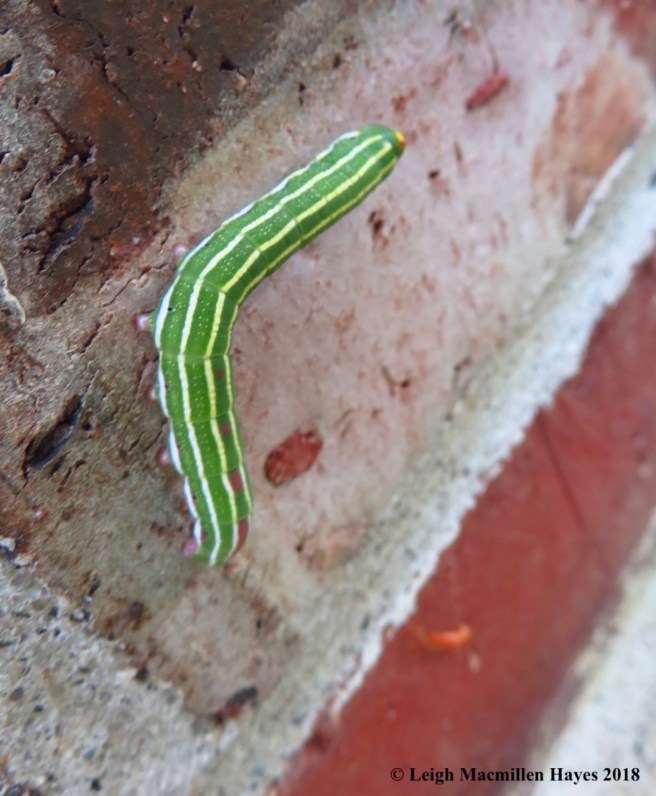
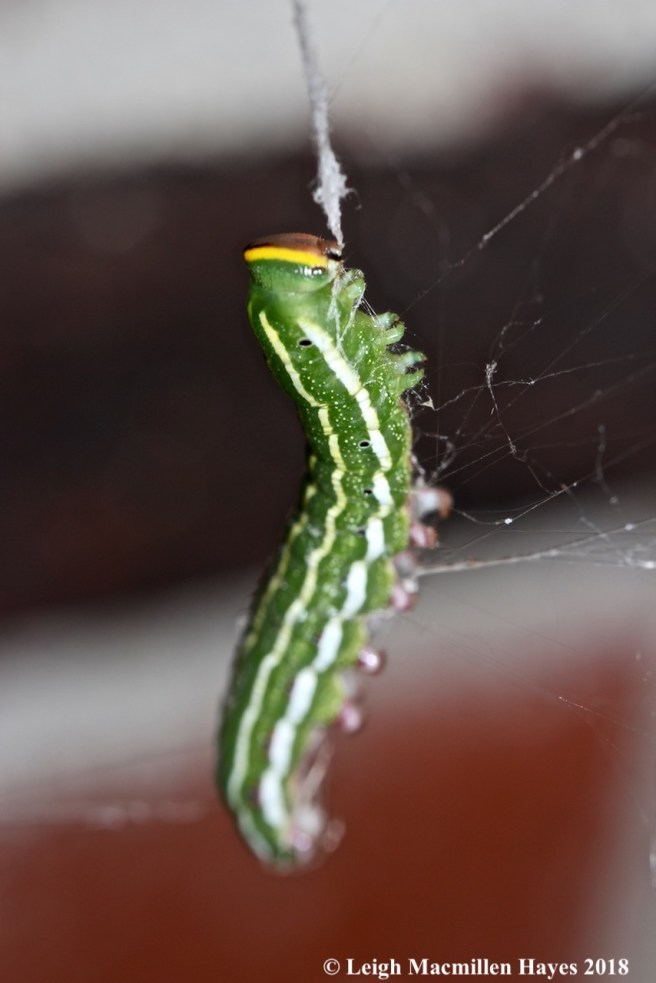
Much to my delight because I was looking–I spied the larvae of a brown-hooded owlet moth. Besides a monarch caterpillar, oh and a sphinx moth, and . . . and . . . the brown-hooded owlet moth caterpillar is one of my favorites.

33-forage looper moth

Its mature form wasn’t quite as attractive.

35-I see you

But still, what a sight to see tucked in among the goldenrods.

The garden may be small, but its offerings were global in nature when you think about it. Ah, those golden sights. Worth a wonder.  (And I left a few out!)


Mast Landing Mondate

What should you do when you come to a fork in the road . . . and a mailbox?

2-mailbox in the woods

Why open the mailbox, of course, enter the date and your names on the notebook stored within, and then follow the trail to the left. If all goes well, a couple of hours later you’ll emerge via the trail on the right. With lots of zigs and zags along the way, that is.

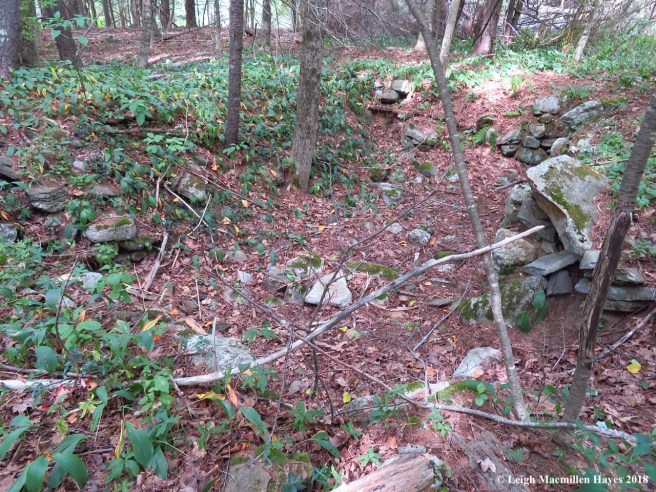
3-foundation

The story of this place dated back to the 1700s when the massive white pines that once grew there were harvested for the British navy. A dam was built and mills as well. In fact, at one time there were four mills, including a saw mill, textile mill, and two grist mills, plus a woodworking shop. We spied a foundation just off the trail, but didn’t know its part in the story.

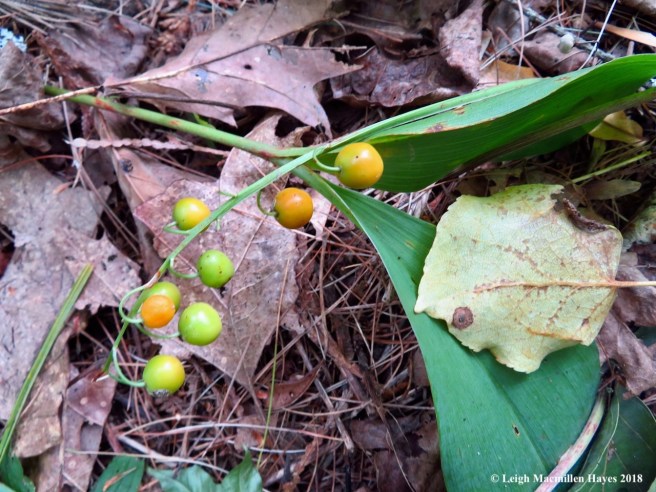
5-lily of the valley surrounding foundation

Surrounding the foundation in abundance, however, were lily of the valley plants, their fruits taking on their fall hue. And I imagined the lady of the house tending her garden.

4-black-capped chickadee egg?

Though the homesteaders were no longer in residence, we found evidence that others called this place home–possibly a black-capped chickadee egg.

3a-old vechicle

A little further on, we found another artifact dating to an earlier time. Much earlier given its structure and how buried it was. This had once been farmland before the forest grew up again.

6-climbing under blow down

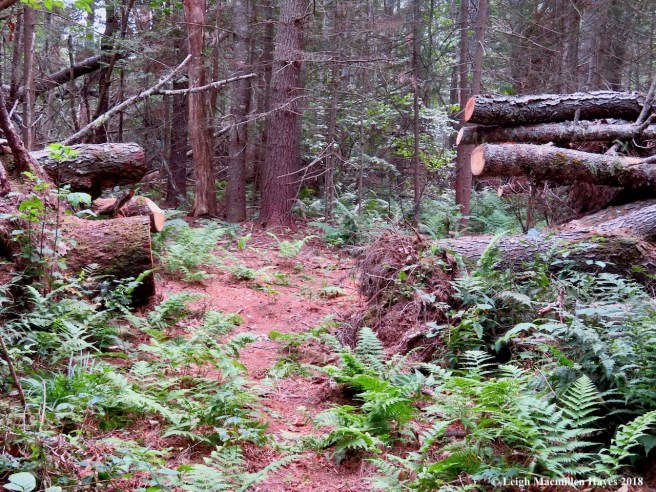
It wasn’t far into our journey, however, that we began to notice something about this land–it had been hit over and over again by windstorms, all blowing from the east, which made sense given that we were less than a mile from the ocean. We found ourselves stepping over, crawling under . . .

7-walking through blowdown

walking between . . .

8-destruction everywhere

and starring in awe at all of the destruction. It was nothing like we encounter in western Maine, and we began to feel trail snobbish.

9-uprooted

But . . . uprooted trees do offer interesting art forms from above . . .

10-underrooted

and directly below. Think of it as nature’s stained glass window.

10a-bark beetle tunnel art

There was other artwork to admire, including those zigzaggy tunnels created by bark beetles. They must dance to their own tunes as they mine their way across the cambium layer.

10b-artist conks

On the same tree we also found fine specimens of artist conk fungi. How apropos.

12-education building

Soon we came to a modern structure. A peek through the window and we knew we’d reached an education center, where cubbies lined a wall, and posters no longer quite secure rolled from the points at which they’d been tacked.

14-tick check

My favorite was a painting on the outside. Tick Check!

15-apple tree

Because the land had been farmed, apple trees danced in their forward leaning forms.

16-apple

And gave forth fruit among the maze of branches.

17-apples on ground

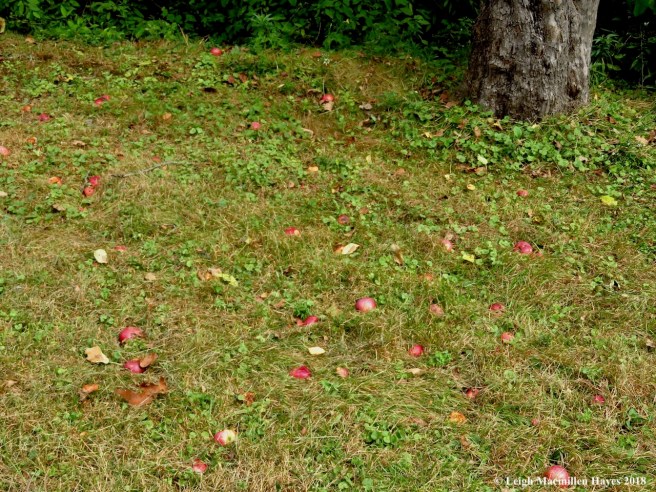
Some trees were more prolific producers than others.

18-eating an apple

And according to my guy, the offerings were delicious.

18-silky dogwood fruit

There were other fruits to admire, including the wedgewood blue of silky dogwood.

18a-hobblebush fruits

And the green turning red, red turning blue, purplish, blue and almost raisin-like fruits of hobblebush.

19-Norway Maple samara

Even the Norway maple showed off its seeds in samara form.

22-more asters

The asters added delightful touches of color to the rather drab landscape.

11-Nephrotoma eucera, tiger crane fly

And among them, insects such as a tiger crane fly, enhanced the scene.

23-turtlehead

We found turtlehead,

24-false solomon's seal

false Solomon seal in its fruit form,

25-beach rose

and beach roses showing their bright florescence.

26-rose hips

And where there were roses, there were rose hips and I was reminded of my father who couldn’t walk past a rose bush on our travels from our cottage in Harbor View, Clinton, CT, to town via the town beach, without sampling such.

27-dam

Eventually today, after a few backtracks, for we occasionally got fake lost and with all the downed trees, every trail began to look the same, we found the dam.

29-dam breached

It had been breached long ago, and according to the property’s history, the mills were “destroyed by fire in the early 1860s, and not rebuilt.”

29-old mill structures

We could see some evidence through the woods, but weren’t in a major gotta-see-more mode I guess, which isn’t really our way, but today it was.

j30-below the dam--low tide

Down below, the mill stream became the Haraseekeet River if we understood correctly. It was low tide in the estuary. And smelled to me like the mud flats in Clinton Harbor and I was transported to my childhood for a moment.

31-caretakers house

On our way out, we passed by the caretaker’s house, built in 1795 by mill master Abner Dennison. Sadly, it looked like it needed some care taking.

32-head start on Halloween

Nonetheless, it was decorated for the upcoming season.

34-tree spirits

At the end of our journey, we decided that the trails were not our favorite given all the blowdowns and a stagnant Mill Brook that seemed like an oxymoron, but we’d still found plenty of delightful sights. And tried not to make too many contrary comments for the tree spirits kept many eyes on us.

35-tree gnomes

And listened from their gnome homes.

On this Mondate, we whispered that we probably don’t need to return to Maine Audubon’s Mast Landing, but we didn’t want them to hear us.


Wondering With Jinny Mae

It takes us forever and we like it that way. In fact, today a woman who saw us in our typical slo-mo movement commented, “It’s like you’re on a meditative walk. I always move quickly and miss so much.” Indeed we were and when I travel beside Jinny Mae there isn’t much we don’t see. But always, we’re sure that we’ve moved too quickly and missed something. Then again, we realize that whatever it was that we accidentally passed by this time may offer us a second chance the next time.

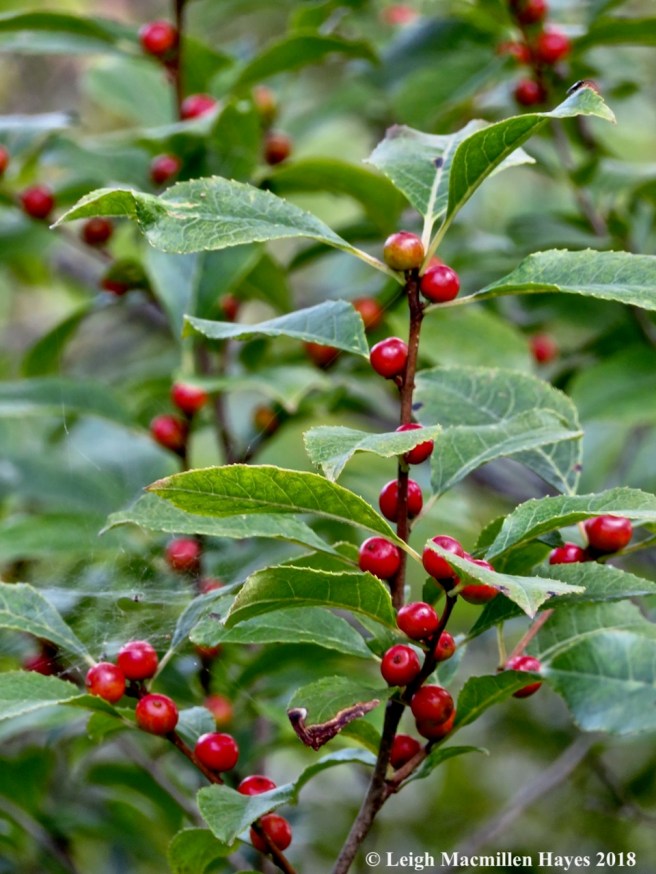
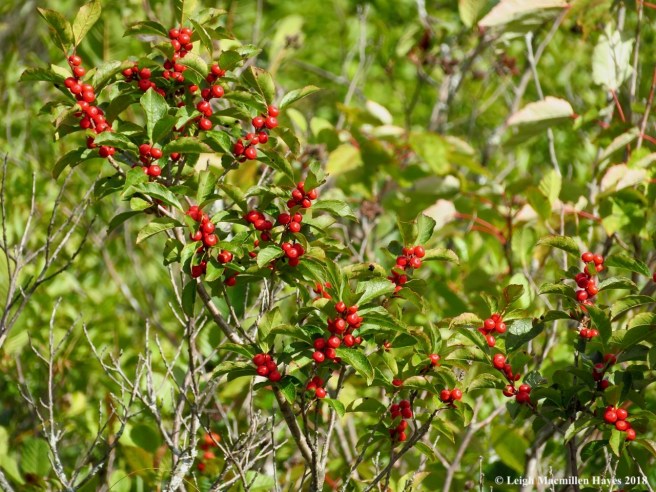
1-winterberry

Today’s wonder began with the realization that winterberry holly or Ilex verticillata, grew abundantly where we chose to travel. This native shrub will eventually lose its leaves, but the plentiful berries will last for a while–until they’ve softened considerably that is and then the birds will come a’calling.

2-winterberry

Everywhere we turned, or so it seemed, we found them ranging in color from spring green to shades of red. As summer turns to autumn, the leaves will yellow and eventually fall.

3-winterberry

And then the brightly colored berries that cling to every stem will add color where it’s otherwise lacking in the landscape.

4-winterberry

Even while the leaves still held fast, we found some brightly colored berries that offered a breathtaking view.

5-to Muddy River

We passed through numerous natural communities, tiptoeing at times, such as on the boardwalks, for we didn’t want to disturb the wildlife around us–no matter what form it took.

9-dragonfly attachment

And we rejoiced in spying a cherry-faced meadowhawk couple in their pre-canoodling mode. Can you see how he has used his cerci to clasp the back of her head? His hope is that he can get her to connect in the wheel position and they’ll take off into the safety of the nearby shrubbery to mate.

6-Muddy River

At the river, we began to notice other signs that we’ve once again entered a transition between seasons, for subtle were the colors before us.

7-beaver lodge

Across the river and just north of where we stood, we spotted an old lodge, but weren’t sure anyone was in residence for it didn’t seem like work was being done to prepare for winter. Then again, we haven’t done anything to prepare either, for though the temperature has suddenly shifted from stifling to comfortable (and possibly near freezing tonight), it’s still summer in Maine. And we’re not quite ready to let go.

17-Sheep Laurel

That being said, we found a most confusing sight. Sheep laurel grew prolifically in this place and we could see the fruits had formed from this past spring’s flowers and dangled below the new leaves like bells stringed together.

18- sheep laurel flowering in September

Then again, maybe it wasn’t all that odd that it still bloomed for when I got home I read that it blooms late spring to late summer. I guess we’ve just always noticed it in late spring and assumed that was the end of its flowering season. But then again, it appeared that this particular plant had already bloomed earlier in the season and produced fruit, so why a second bloom? Is that normal?

10-pitcherplant 1

As we continued on, we started to look for another old favorite that we like to honor each time we visit. No matter how often we see them, we stand and squat in awe of the carnivorous pitcher plants.

11-pitcher plant 2

But today, we were a bit disturbed for one that we’ve admired for years on end looked like it was drying up and dying. In fact, the location is typically wet, but not this year given the moderate drought we’ve been experiencing in western Maine. What would that mean for the pitcher plant?

13-pitcher plant flower

Even the flower pod of that particular one didn’t look like it had any life-giving advice to share in the future.

14-Pitcher Plant 4

Fortunately, further on we found others that seemed healthy, though even the sphagnum moss that surrounded them had dried out.

14a-pitcher plant

Their pitcher-like leaves were full of water and we hoped that they had found nourishment via many an insect. Not only do I love the scaly hairs that draw the insects in much like a runway and then deter them from exiting, but also the red venation against the green for the veins remind me of trees, their branches spreading rather like the tree of life. Or maybe a stained glass window. Or . . . or . . . we all have our own interpretations and that’s what makes life interesting.

15-pitcher plant flower 2

Speaking of interesting, the structure of the pitcher plant flower is one we revere whenever we see it because it’s so otherworldly in form. And this one . . . no the photo isn’t sideways, but the flower certainly was. If you scroll up two photos, you’ll see it as it grew among the leaves. The curious thing is that it was sideways. Typically in this locale, Jinny Mae and I spy many pitcher plant flowers standing tall. Today, we had to squint to find any.

16-pitcher flower and aster

She found the sideways presentation and this one. But that was it. Because of the drought? Or were we just not cueing in to them?

20-cinnamon fern

We did cue in to plenty of other striking sights like the light on a cinnamon fern that featured a contrast of green blades and brown.

21-cinnamon fern drying up

Again, whether the brown spoke of drought or the transition to autumn, we didn’t know. But we loved its arching form dramatically reflected in each pinna.

18a-swamp maple

But here’s another curious thing we noted. We were in a red maple swamp that is often the first place where the foliage shows off its fall colors and while some in other locales have started to turn red, only the occasional one in this place had done so. Our brains were totally confused. Sheep laurel blooming for a second time; pitcher plants drying up and dying; and few red maples yet displaying red leaves?

19-witch's caps or candy corn

We needed something normal to focus on. And so we looked at the candy corn we found along the trail. Some know them as witch’s caps. They are actually witch hazel cone galls caused by an aphid that doesn’t appear to harm the plant. It is a rather cool malformation.

24-white-faced meadowhawk

On a boardwalk again, we stepped slowly because the white-faced meadowhawk kept us company and we didn’t want to startle it into flight.

25-white-faced meadowhawk dining

One flew in with dinner in its mouth and though I couldn’t get a photo face on before it flew to another spot to dine in peace, if you look closely, you might see the green bug dangling from its mouth.

26-New York Aster

All round us grew asters including New York, water-horehound, cranberries, bog rosemary and so many others.

27-Virginia marsh-St. John's Wort

There was Virginia marsh St. John’s Wort,

28-fragrant water lily

fragrant water lilies,

28-jewelweed

jewelweed,

29-pilewort globe

and even pilewort to admire. The latter is so much prettier in its seed stage than flowering. Why is that we wondered.

30-Holt Pond Quaking Bog

Ahhhh, an afternoon of wondering . . . with Jinny Mae. At LEA’s Holt Pond Preserve. In Bridgton. An afternoon well spent. Thanks JM.


So Many Advantages Along the Mountain Division Trail

When opportunity knocks, so they say, open the door. Today, it wasn’t really a door that I opened, but rather a trail that I explored. And it wasn’t a new trail to me, for I’ve ventured along the Mountain Division Trail in Fryeburg many times before.

1-trail sign

But my morning and afternoon plans changed and I happened to be in the vicinity and I don’t think I’ve ever walked that way in late summer before–so I did what I love to do best and set off down the path beside the now defunct railroad track. And I was curious to discover who else might be taking advantage of it on this fine September day.

2-monarch caterpillar

Within minutes, I made my first discovery–a monarch butterfly caterpillar crawled along the paved trail. I’d actually chosen this spot for I hoped to see a few monarchs and my chances suddenly increased.

3-red-legged grasshopper

Also using the asphalt were innumerable grasshoppers of several types including this red-legged, and crickets galore. In fact, between them and cicadas, I could almost not hear the traffic on Route 302 at the start. Almost.

4-rail trail

Within minutes, however, the trail passed behind several businesses and then curved away from the road and toward Eastern Slope Airport. It was occasionally flat, occasionally straight, occasionally curved, and occasionally hilly. But always paved. And much quieter.

5-spotted knapweed and web

Constantly, the offerings changed. Knapweed with its pineapple-like base, which loves disturbed areas, had made itself at home. And a spider had used the structure to create its own home.

6a-monarch

As I walked, I began to notice them–a monarch fluttering past here and another there. At last, I found one that had paused to take advantage of the nourishment offered by an aster.

6-monarch on aster

I stood for as long as it would allow . . .

7-monarch on aster

enjoying every pose presented.

8-crystalline tube gall

A little further, I found something I only remember seeing for the first time a few weeks ago–I think it’s a crystalline tube gall on the oak leaf, but urchin gall would be my second guess.

9-banded tussock caterpillar

On the same leaf, either a banded-tussock moth caterpillar or a Sycamore tussock moth caterpillar munched away, so similar are they. Check out all the bristles by the head–both an extra set of black and a more subtle set of white.

10-water

By what I assumed was an old mill pond fed by a small brook, the watery world quietly intercepted all other communities found along this path.

11-painted turtle

And today, a painted turtle watched nonchalantly from a log in the pond as the world passed by–runners, walkers and bikers on the path above . . . some who hardly noted his presence.

12-male blue dasher

And dragonflies,  including this mighty handsome green-eyed blue dasher, below. Do you see the hint of amber in his wings? One of the telltale signs.

13-pokeweed poking through the fence

Continuing on, I was surprised by a sight I’d seen before because I’d forgotten its presence. Pokeweed flowered and fruited and . . . poked through the fencing that formed a boundary along parts of the trail.

14-northern white cedar

There’s also a short section where northern white cedar formed a wall, its woody cones all opened in an expression of giving forth new life and its leaves scaled like skinny braids.

15-pipewort gone to seed

Being a greatly disturbed zone, pilewort grew in abundance and its seeds danced and twirled and sashayed through the air like ghostly angels blowing in the wind. Actually, the graceful seedheads were much more attractive than the flower in bloom.

16-Queen Anne's Lace

Queen Anne’s Lace had also bloomed profusely, but today showed only its winter weed form full of tiny seeds edged with rows of bristles. The better to ground itself somewhere when the time comes, I supposed.

17-Bristly sarsaparilla fruits

Speaking of bristles, bristly sarsaparilla sent its many-fruited umbels out through the fence, perhaps in offering to those passing this way.

18-into infinity

So many offerings I’d seen by the time I reached about the three mile mark and I knew there would be even more on the way back so I used my own imaginary turntable and began the return trip.

20-spider web between pipewort

It was then that a web strung with great and amazing strength between two pileworts caught my attention. First, I couldn’t believe the distance between the two plants or the thickness of the anchoring web. And then I noticed something else . . .

21-seeds caught in web

An orb about two thirds of the way across, decorated with pilewort seeds that will take a little longer than usual to get established on the ground. Will they be viable, I wondered.

23-funnel spider

Another industrious arachnid had used one of the fence pipes to make himself a home. Can you see the funnel spider waiting in the tunnel for delectable prey to land on his web?

22-goat

And then there were the goats, this one and two others who munched beside the trail. I called their owner because I feared they’d broken out of their pen (or someone had opened the gate). Her number was on a board attached to a tree as she’d advertised her daycare business to all who passed by. We enjoyed a pleasant conversation and I learned that she lets them out for an hour or so each day to feed on the weeds. Weeds? What weeds. All I saw where wildflowers aplenty. Anyway, if you go, do know that you may encounter the goats and they are not gruff at all.

24-cabbage white butterfly

While I saw a few more monarchs as I wandered back, a few other butterflies at least half the size of the royal ones moved with dainty motions. For the cabbage white butterfly, the asters were all the thing. But like so many of the wildflowers that have taken root in this disturbed place, this butterfly also disturbs people because it has a penchant for damaging crops.

26-northern cloudywing skipper butterfly

Even smaller was the northern cloudywing skipper that stopped atop a red maple sapling. Males perch near the ground awaiting females, so his chosen spot made sense. His wing scales gave him such a satiny look as he shown in the light and his earth-tone colors included hints of purple.

It was all about the earth, I noted, as I walked along the Mountain Division Trail. Years ago, the path that I followed today had been used to construct the railroad track. And then in the 2000s, the rail trail had been built beside it. Over the years, I’m sure the railroad track had been enhanced. So the land was indeed disturbed . . . repeatedly.

And now, just as I took advantage of it to follow the well-constructed trail, so many others had done the same–both human and non. Not all were beneficial, but still they eeked out a life in that place. From insects and “weeds” to turtles and tree, there are so many advantages available along the Mountain Division Trail in Fryeburg, Maine.


Our Home is Their Home

As I sit in my rocking chair on the camp porch, the cicadas still buzz, with chirps of crickets thrown into the mix and somewhere in the background a constant trill from another. Tree frog? Perhaps, but it seems to carry on for longer than usual. Grasshopper? Maybe. And then there is the occasional call of the loon.

1-camp

What truly attracted my attention earlier today, however, were the other members of the household. Whose home this is, I think I know. Or rather, I thought I did. I thought it belonged to my guy and me. But really, I should have known better for it has never just housed the two of us. There were the boys growing up, and family, and friends, and renters, even. Actually, the latter three knew it before the boys. (Oops, I suppose I should call them young men, mid-twenty-somethings that they now are.)  But, through all these years, it has also housed many others. And so today, I got acquainted with some of its other residents. Rather than the mammals that we know also share the space, e.g. mice, squirrels, and bats, it was the insects and arachnids that I checked out.

2-cicada exuviae

My first find along the foundation was an exuvia of one I listen to day and night–that of a cicada. In their larval stage, cicadas live down to eight feet underground. When the time comes to metamorphose into winged adults, they dig to the surface, climb up something, in this case the foundation, and molt. The  emerging winged insects leave behind their shed skin, aka abandoned exoskeleton or exuvia. It’s a rather alien looking structure, with the split obvious from which the adult emerged.

3-cruiser 1

The cicadas weren’t the only aliens along our foundation. It seemed like every few feet I discovered a dragonfly exuvia dangling from the porch floor and now encased in spider webs.

3b-cruiser

One of the cruiser exuviae had dropped to the ground below. But still the structure remained intact. And I now realize that my next task is to head out the door once again in the morning and collect these beauties, the better to understand their nuances.

4-cruiser hiding

I found cruisers hiding under the logs . . .

6-cruiser and cast off spider

and even one tucked in by a basement window that had a shed spider exoskeleton dangling from it.

6a-lancet clubtail dragonfly

There were others as well, but nowhere did I find the exuvia of the one with whom I’ve spent the most time, Sir Lance(t) Clubtail. I suspect his shed skin is attached to some aquatic vegetation for he spends so much of his time by the water, even today, pausing only briefly to rest on the dock ladder.

7-bag worms and pupal case of a pine sawfly

There were other species to meet, including the most interesting of structures, those of the evergreen bagworm cases. I assumed that the young had already emerged, but their homes consisted of material from the trees on which they fed, e.g. pine needles. They struke me as the terrestrial form of the aquatic caddisflies.

And beside the two bagworms was a small, rounded brown case–the pupal case of a pine sawfly. The sawfly had already pupated and in this case no one was home.

8-pine sawfly caterpillar on screen

Oh, but they were and have been for a few weeks. I first realized we had an infestation when what sounded like the drip-drop pattern of a summer rain on a perfectly sunny day turned out to be little bits of green caterpillar frass falling from the trees. Everything was decorated. And then I began to notice the caterpillars–many falling out of trees and landing on the surrounding vegetation, and the house. As would be expected, they climbed toward the sky, hoping, I suppose, to reach the top of the trees. Good luck with that.

9-pine sawfly caterpillars

Some didn’t make it above the foundation, where they encountered spider webs and soon had the juices sucked out of them. Such is life. And today, a winter flock of birds including chickadees, nuthatches, goldfinches, hairy woodpeckers, young robins, and even a brown creeper flew in and some fine dining took place. The raindrops have nearly ceased.

10-Northern Pine Sphinx

That wasn’t the only pine-eating caterpillar to make its home here. On the chimney, I found a northern pine sphinx caterpillar moving full speed ahead.

11-orbweaver

And around the bend, where the chimney meets the camp, an orbweaver spinning some silk in the hopes of fine dining.

14a-calico pennant dragonfly in web

One meal had obviously been consumed–a calico pennant dragonfly. I’d seen a few of those on the vegetation a few weeks ago, but none recently. Apparently, one flew too close to the building. The only way I could ID it was by its wings for the head, thorax and abdomen had been eaten. But the wings have no nutritional value.

11a-Northern Pine Sphinx 2

A short time later I returned to the chimney in hopes of locating the northern pine sphinx caterpillar again. I did. And he wasn’t. He’d apparently turned the sharp corner on the chimney and met his fate.

13- Northern Sphinx 4

Eye to eye. I’m amazed at the size of the insects that find their way to her web. It’s not like they are attracted to it. Instead, they come upon it quite by surprise and she makes fast work of their mistake.

14-pine tree spur-throated grasshopper

Rounding the corner back toward the porch door, one last insect drew my attention. And again, it was related to the pines, such is the local community: a pine tree spur-throated grasshopper on one of the logs that forms the outer wall of our wee home.

Our home is their home and we’re happy to share the space with them. Provided, of course, that they leave space for us to live as well. So far, all is well.


Insects of Lovell

To say the insects of Lovell are the insects of Maine . . .  are the insects of New England . . .  is too broad a statement as we learned last night when Dr. Michael Stastny, Forest Insect Ecologist at the Atlantic Forestry Centre in Fredericton, Canada, spoke at a Greater Lovell Land Trust talk  Mike helped us gain a better understanding of the relationship between trees, invasive insects and climate change in our grand State of Maine.

And then this morning, he led us down the trail on land conserved through the GLLT as a fee property and one held under conservation easement work.

1-what's that?

From the get-go, our curiosity was raised and we began to note every little motion above, at eye level, and our feet.

2-not an insect

Sometimes, what attracted our attention proved to be not an insect after all for it had two extra legs, but still we wondered. That being said, the stick we used to pick it up so we could take a closer look exhibited evidence of bark beetles who had left their signature in engraved meandering tunnels.

4-leaf miner scat

A bit further along, Mike pulled leaf layers apart to reveal the work of leafminers and our awe kicked up an extra notch. Leafminers feed within a leaf and produce large blotches or meandering tunnels. Though their work is conspicuous, most produce injuries that have little, if any, effect on plant health. Thankfully, for it seems to me that leaves such as beech are quite hairy when they first emerge and I’ve always assumed that was to keep insects at bay, but within days insect damage occurs. And beech and oak, in particular, really take a beating. But still, every year they produce new leaves . . . and insects wreak havoc.

6-leafminer pupa

Leafminers include larvae of moths (Lepidoptera), beetles (Coleoptera), sawflies (Hymenoptera) and flies (Diptera). I’m still trying to understand their life cycles, but today we got to see their scat when Mike pulled back a leaf layer! How cool is that?  Instantly, I recognized a new parlor trick that I can’t wait to share with the GLLT after-school Trailblazers program we offer through Lovell Recreation.

7-grandma and granddaughter

As for today, Mike’s mother-in-law, Linda, tested the wow factor on her granddaughter and we knew we had a winner.

8-hickory tussock moth caterpillar

Our attention was then directed to the tussock moth caterpillars, including the hickory tussock moth that seems to enjoy a variety of leaf flavors.

9-another tussock

And we found another tussock entering its pupating stage. We didn’t dare touch any of them for the hair of the tussocks can cause skin irritation and none of us wanted to deal with that.

11-leaf roller

Our next find was a leaf roller, and for me the wonder is all about the stitches it creates to glue its rolled home closed.

12-meadow goldenrods

Eventually we reached a wildflower meadow where our nature distraction disorder shifted a bit from insects to flowers, including local goldenrods.

12a-up close

There was much to look at and contemplate and everyone took advantage of the opportunity to observe on his/her own and then consult with others.

13-silvery checkerspot butterfly

One insect we all noted was the Silvery Checkerspot Butterfly. It’s a wee one and in the moment I couldn’t remember its name.

14-checkerspots mating

But . . . it remembered how to canoodle and we reveled in the opportunity to see such.

15-bees on Joe Pye Weed

Our final insect notification was a bumblebee on the Joe-Pye-Weed. A year ago we had the opportunity to watch the bumblebees and honey bees in this very meadow, but today there were no honeybees because a local beekeeper’s hives collapsed last winter.

15a-Beside Kezar River

Our public walk ended but the day continued and I move along to the Kezar River Reserve to enjoy lunch before an afternoon devoted to trail work.

15b-darner exuvia

Below the bench that sits just above the river, I love to check in on the local exuvia–in this case a darner that probably continues to dart back and forth along the shoreline, ever in search of a delectable meal.

16-Autumn Meadowhawk Dragonfly

Landing frequently for me to notice was an Autumn Meadowhawk Dragonfly, its body all ruby colored and legs reddish rather than black.

17-milk snake

My goal was to slip down to the river level like the local otters might and as I moved along I startled a small snake–a milk snake. Not an insect . . . but still!

19-Mrs. Slaty Skimmer

Because I was there, so was the female Slaty Slimmer Dragonfly, and she honored me by pausing for reflection.

18-slaty skimmer dragonflies

Apparently I wasn’t the only one to notice her subtle beauty, for love was in the air and on the wing.

20-female ruby meadowhawk dragonfly

Lovell hosts many, many insects, but I certainly have a few favorites that change with the season and the location. Today, Ruby Meadowhawks were a major part of the display.

21-female ruby meadowhawk dragonfly

Note the yellowish-brown face; yellowish body for a female; and black triangles on the abdomen, and black legs.

Our findings today were hardly inclusive, but our joy in noticing and learning far outweighed what the offerings gathered.

Ruby, Slaty, Miner, Tussock, Checkerspot, so many varieties, so many Insects of Lovell, and we only touched on the possibilities. Thank you, Mike, for opening our bug eyes!


The Day The World Passed By

I love those days when I have a few moments and can pay attention to the world around me. It never ceases to fill me with awe and wonder. And today was such as I had a free hour that I chose to spend on the dock.

1-fishing spikder

I shouldn’t have been surprised to see a fishing spider the size of my palm resting there, but I was for it was my first sighting of one this year. True confession, indoors I’m not a huge spider fan and as a kid I used to holler for someone to come kill any arachnid I spied. But . . . with age comes appreciation. And perhaps understanding.

2-fishing spider bristles

And so I appreciated this spider’s pattern and understood the need for its hairy body that gave it such a scary look. Fishing spiders hunt by sensing vibrations. The hair is hydrophobic, meaning it repels water. It also allows the spider to actually walk on water to get its prey. Those bristly hairs also trap air bubbles that the spider uses to breathe when it waits underwater to ambush a meal, be it insects, tadpoles, or other invertebrates.

3-lancet clubtail and ant

When I heard wing beats behind me, I turned my focus away from Charlotte and toward a Lancet Clubtail dragonfly that had landed on a seat of My Guy’s boat. An ant marched right over to check it out.

4-ant tickling dragonfly

And I fully expected the Lance to eat the ant. But . . . he didn’t. Drats.  I like watching them consume their prey.

5-lancet minus one tarsus

The more I looked at this guy, and it was a guy based on its cercus, the more I noticed, including the fact that it was missing the tarsi or claw-like foot of one leg.

6-dragonfly_anatomy

It was his face though, that I really wanted to study. I found this simplified picture at arizonadragonfly.org, and though it’s not complete, it provided enough information for my purposes.

7-facial features of a dragonfly

There’s so much to learn, that to add more detail would be more than overwhelming. Look at the mouth parts. And those eyes–each is composed of 30,000 lenses. Apparently, they can see ultraviolet and polarized light. And then there’s the ocelli, or visual organs, that probably work along with the antennae. Prey don’t have a chance.

8-fishing spider

When the Lance flew away, I checked on Charlotte again. Still she sat, one leg dangling below the dock board and touching a web. I figured she was waiting for movement to announce that a meal had arrived.

9-Ted had arrived

And then I noticed that it wasn’t a meal, but perhaps a mate she’d been expecting.

11-spider movement

Suddenly, he darted under the dock and she started across the gap–toward me!

12-Charlotte the spider

Then she stopped, seemed to make an adjustment,  and quickly disappeared.

13-spider nursery

I moved in for a closer look and made a discovery.

14-spider nursery

Her nursery! Fishing spiders are nursery web spiders. She must have wrapped her eggs in a silken sac and carried it to the gap between the outer two boards of the dock, where she constructed the web. And she was standing guard waiting for her spiderlings to emerge–until I came along. Now the question remains, will I be around when they do hatch and disperse on their own silken threads?

15-bubble on water

I don’t know. But today, I was there to notice so much in such a short time–as the world passed by.


The Amazing Race–Our Style, episode seven

We never know when the clue will appear and so it was a complete surprise to find it this morning. “Drive 50 or so miles north and locate the Big A near the table.”

1-Big A

We took our chances and drove to Bethel and then on to Newry and beyond. Lo and behold–the Big A appeared. And so we parked across the street, slipped into our hiking boots, and began the journey. At the time that we arrived, we were the only contestants, so we wondered if we were behind or ahead.

2-easy path

At first the trail was deceivingly flat. “I’ve got this,” I thought.

3-rungs on rocks

But we soon came to a point where the white-blazed trail headed to the left and the orange-blazed trail to the right. We had a choice to make. White would mean a bit further journey, but it was easier. Orange was much more difficult, but if we played our cards right, we might ascend quickly. It wasn’t long before we realized that our hearts pulsed rapidly. And then we met Team Livermore . . . and passed them. They are younger than us, so I was feeling a bit smug. Until we came to the wrought iron rungs. I guess I was shaking a bit, from the looks of the photo, but really, climbing up the rungs was a piece of cake compared to the rest of the scramble . . .

4-climbing higher

over the steep, boulder-strewn trail.

5-trail map on boulder

Along the way, I paused periodically pretending to note things like a boulder covered with a moss map . . .

6-spider web

and an orb web sparkling in a bit of sunlight. The truth is that I was catching my breath. After seeing the web I had to put the camera away, for we’d reached a point where we needed the use of both hands. And just above the web my mind shut down as My Guy stepped from one boulder over a gaping hole to the next. He patiently told me where to place each foot, and try as I might, I couldn’t move. I was certain that hole would swallow me whole. Along came Team Livermore and I knew we were skunked, but I had to let them pass. They made it look effortless and so four more times I attempted to make the crossing, and on the fifth try I went for it. And I’m here to write about it, so obviously I lived.

7-contemplating

Team Livermore may have passed us, but we soon caught up and moved ahead. We kept thinking we were about to reach the summit, when the rock would indicate otherwise and at one point we had to hike down a bit before climbing up again, which didn’t seem quite fair given how hard we’d worked. But then again, rock is rock and we certainly didn’t want to climb directly up its face.

11-to the north

At last–success. We found the table we’d sought: The summit of Table Rock.

12-message in the slides?

Before us, The Eyebrow and Old Speck.

13-Sunday River Whitecap

To the south, Sunday River Whitecap.

We didn’t stay too long on top for we weren’t hungry yet. And Team Cape Cod showed up. They’d chosen to come up the easier trail, so we knew we were ahead of them. We do like them though, so we hoped they wouldn’t be too far behind. Just as we started to make our way down, Team Speedy came along via the orange-blazed trail. We’ve had them on our tail in previous episodes and they have a bit of an attitude. That being said, we did what we often do–we practically ran down the blue and then white-blazed trails.

16-lunch rock

At lunch rock, we paused briefly beside the water and contemplated the map for a moment, making sure that we were headed in the right direction.

Further along we met a couple from New Hampshire–thru-hikers who had started in Georgia in March. We had nothing in our packs to offer them in terms of extra food, but bid them good tidings. Soon after, we heard Team Speedy again, and so with even more gusto, we finished our descent.

20-aster

Before moving on, we had a couple of tasks to complete. The first was to share photos of a flower–we chose the purple asters;

19-trillium fruit

a fruiting plant–trillium;

18-cup mushroom

and a fruiting mushroom–ours being one of the cup variety.

21-A # 2

We also had been instructed to find two more examples of the letter A, and so here is one . . .

22-A # 3

and the other. All were in honor of the white-blazed Appalachian Trail.

24-moose cave below

Making our way south on the road, our next clue indicated that we needed to find a moose, or at least evidence that one had been there previously. And so we found this deep cave, which the photo doesn’t do justice.

23-Moose Cave

As the local lore goes, however, a moose once fell in.

26-Mother Walker Falls

We were also instructed to find Mother Walker. We found the falls named for her that flowed through a gorge.

27-mother load of Indian pipe

And we found a mother lode of Indian Pipes, all turned upright because they’d recently been fertilized. But who was Mother Walker? We never found the answer to that question.

29-Screw Auger Falls

With two stops left to make before finding the mat and finishing today’s leg of the race, we needed to locate a screw. Heck, I was with a hardware guy so that should have been easy.

30-upper falls

But this screw was in the form of a water fall. Screw Auger Falls. In the 1800s, settlers had built a saw mill directly over the falls that was powered by the current. A screw auger is a hand tool used for boring holes in hard material. It all began to make sense.

31-Arch

While we were there, we took in a view of the arch, just in case we encounter a question about it should we make it successfully to the end of race.

32-lower falls

And the falls below, were the story of water and glaciers was carved into the bedrock.

33-PIes for Sale

And then, and then, we continued south to a spot where we were told to fulfill our sweet tooth craving.

34-Puzzle Mtn Bakery

As we contemplated all of the possibilities, three folks came along in a truck (two of them from Norway, Maine, and the third visiting from San Francisco), bought a pie and gave us the money to buy one as well. But we had enough money. So we felt awkward, though we promised to pay it forward.
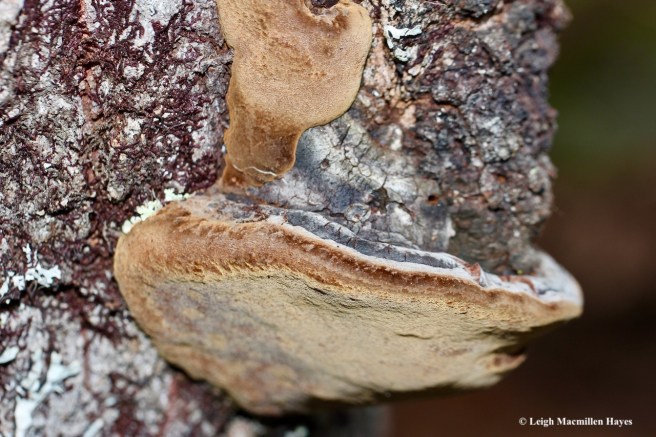
35-cash only

My Guy had just put the $20 into the metal tank when a vehicle from New York pulled in and a young couple stepped out. He walked over and told them about the previous couple, gave them $10 for their pie and asked them to pay it forward. Ahhh. Maine, the way life should be. And is!

36-Moose

At last, our final stop–we crossed the mat and learned we were first yet again.

37-beer

While sipping a celebratory brew, Team Speedy came in. Bingo! They were second in place. Drats. But at least we beat them. We never saw the other teams.

38-My Guy and me!

All in all, The Amazing Race–Our Style, episode seven was most gratifying as we successfully summited Table Rock in Grafton Notch. Thanks to Team Cape Cod for taking a photo of us.

Oh, and dessert tonight will be . . . Maine Wild Blueberry a la Puzzle Mountain Bakery and the kind folks from Norway, Maine.


Docked

Some days are meant for staying close to home. Such was today–a perfect 10 kind of August day with cool temps at either end and a sunshine sandwiched between.

1-lakesmart award

One of the starts to our day was receiving two signs that announced the fact that our camp property is award winning–at least for a LakeSmart Award (don’t check inside for any award winning style or cleaning habits because you won’t find either here). We tipped our hats to Roy Lambert, vice president of the Lakes Environmental Association Board of Directors, and secretary of the Maine Lakes Society Board of Directors. Roy coordinates the local LakeSmart program sponsored by LEA.  He visited camp a few weeks ago and evaluated the surrounding land, then submitted a report. And we waited.

The final conclusion with only a couple of recommendations:

LakeSmart Award Status:
SECTION 1 Driveway and Parking Eligible
SECTION 2 Structures and Septic Eligible
SECTION 3 Yard, Recreation and Paths Eligible
SECTION 4 Buffer and Water Access Eligible
LAKESMART AWARD Award Granted

In his presence, we immediately posted the sign on the red pine by the water’s edge and then walked up the driveway to place one by the road as well.

2-dragonfly love

After Roy left, we settled into the day and discovered others who had settled momentarily, making use of a red oak branch dangling over the water for their canoodling session.

3a-reading

It’s rare that I’ve lounged this summer, but a new-to-me book purchased yesterday at the Lovell Arts and Artisan Fair book sale drew my attention between mini naps.

7-dock view

When I wasn’t napping or reading, however, I spent time staring across the pond.

9-dock view

And to the south.

11-bass tournament

All about there were bass boats for today featured a club tournament. The thing about bass tournaments is that except when the fishermen are zooming to the next best spot, they are quiet as they troll. And I have to thank them for a few weeks ago I wrote to a club president and asked that they please be aware of the parking situation on Route 302. Their trucks and trailers have long blocked our view as we precariously try to pull out onto the busy road. In the past, I’ve asked for help from others, including Inland Fisheries and Wildlife staff and local police, to no avail. But, this time was different. The club president immediately responded to my request and passed the word along to others as well. This morning, there were orange cones blocking cars from parking a certain distance from our road and as we drove to church, we were able to pull out without risking our lives. Thank you Steve and Wayne, and I hope you also had an award-winning day.
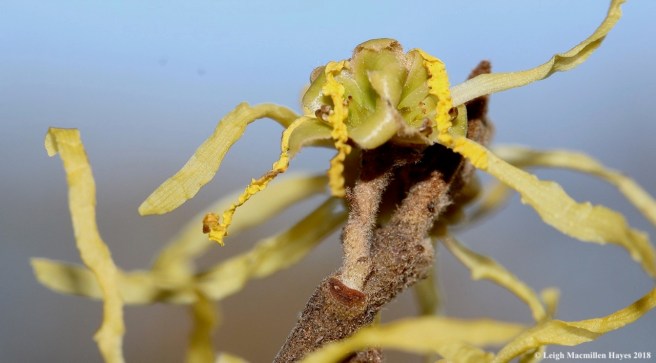
3b-oarlock

Because of there being more boats than normal on the lake, however, occasionally the waves rippled my way. And beside me, the dangling oarlocks in the S.S. Christmas clanged against the inside of the boat.
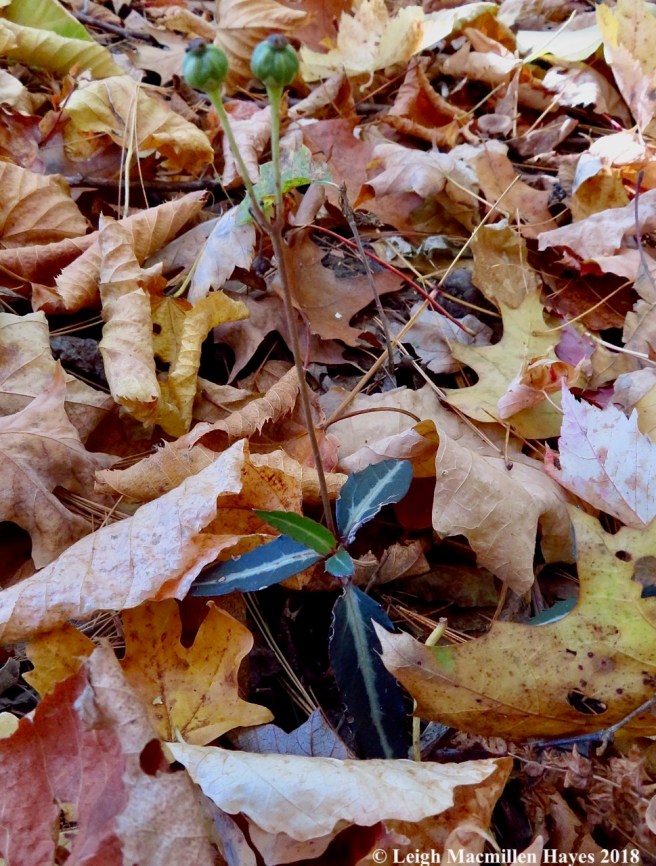
10-common loon

The bass fishermen weren’t the only ones seeking a catch and I watched a common loon that spent all afternoon nearby, sometimes looking for a meal, other times preening, and even merely floating.

13-baitfish

Of course, bait fish swam abundantly below my locale–perhaps finding protection in the shadows offered.

4-slaty blue skimmer dragonfly

Also on the hunt, but for insects rather than fish, were dragonflies and damselflies including this Slaty Blue Skimmer, its colors matching the sky reflection on the water.

5-lancet clubtail 1

A Lancet Clubtail I spied on the wood first,

6-lancet clubtail dragonfly

and then on the shrubs in the vegetated buffer.

6a-Swamp Spreadwing Damselfly

And a Swamp Spreadwing Damselfly found a spot to hang below the shrubs and just above the water’s edge.

13a-crawfish skeleton

Because I was looking, I also found the carcass of a crayfish, which surprised me for I rarely see one and had to wonder if a heron or another bird dropped the remains of a fine meal.

12-shamrock lily

As the wave action continued, the leaf of a fragrant water lily floated by, torn from its base. In the shadow below, it transformed . . . into a shamrock.

14a-water pattern over rock

Other transformations also took place as boulders under the water’s surface became works of mosaic art.

15-wave:sky patterns

And waves reflected skylight in a more modern polka-dotted form.

17-wave:sky patterns interrupted by leaf

Even that pattern was sometimes interrupted . . . by a passing oak leaf.

20-sunset

At day’s end, it was all about taking the time to be rather still. To read. To write. To swim. To watch. To notice. To think. To wonder. To admire. To be. Docked.