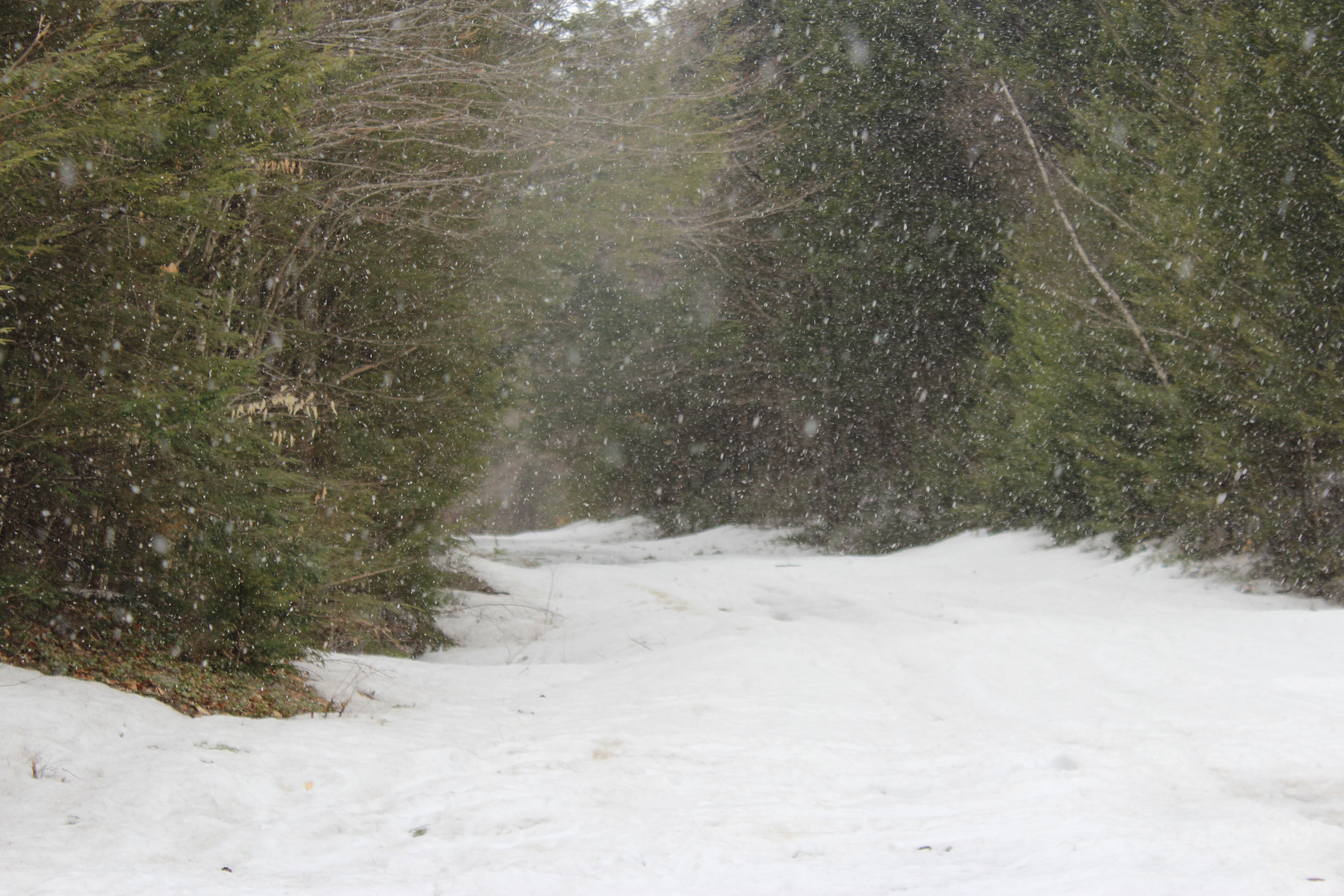
Bogging in Maine

What is a wetland? Basically, it is wet land! But more specifically, wetlands are often those transition zones between dry land and deep water.

There are four basic types of wetlands, which can be broken into even more types, but let’s stick with the four: marsh, swamp, bog, and fen.

Marshes are typically located along shores of rivers and streams, and even the coastline. Plus they can be found in the shallow water of ponds and lakes. Cattails, Arrowhead and other soft-stemmed emergent plants grow in these areas.

Swamps are found along rivers, streams, and lakes where mainly woody-stemmed plants such as shrubs and trees, like this Tamarack, grow.
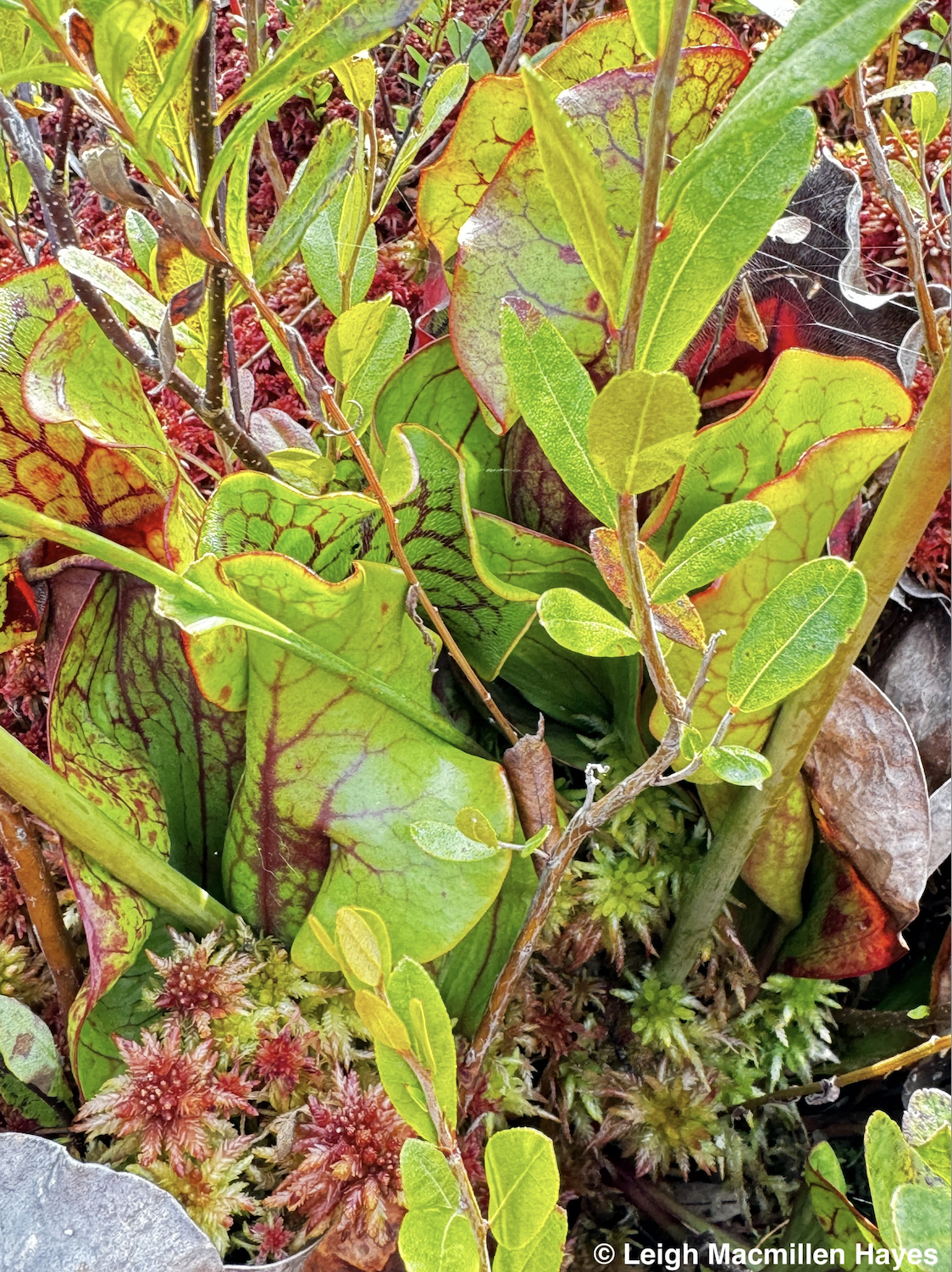
Pitcher Plants and Sphagnum Moss
Round-leaved Sundews

Bogs are found in our northern climate and often are deep depressions that have no drainage. They are covered with a surface carpet of sphagnum moss and insect-eating plants like the Pitcher Plant and Sundews.
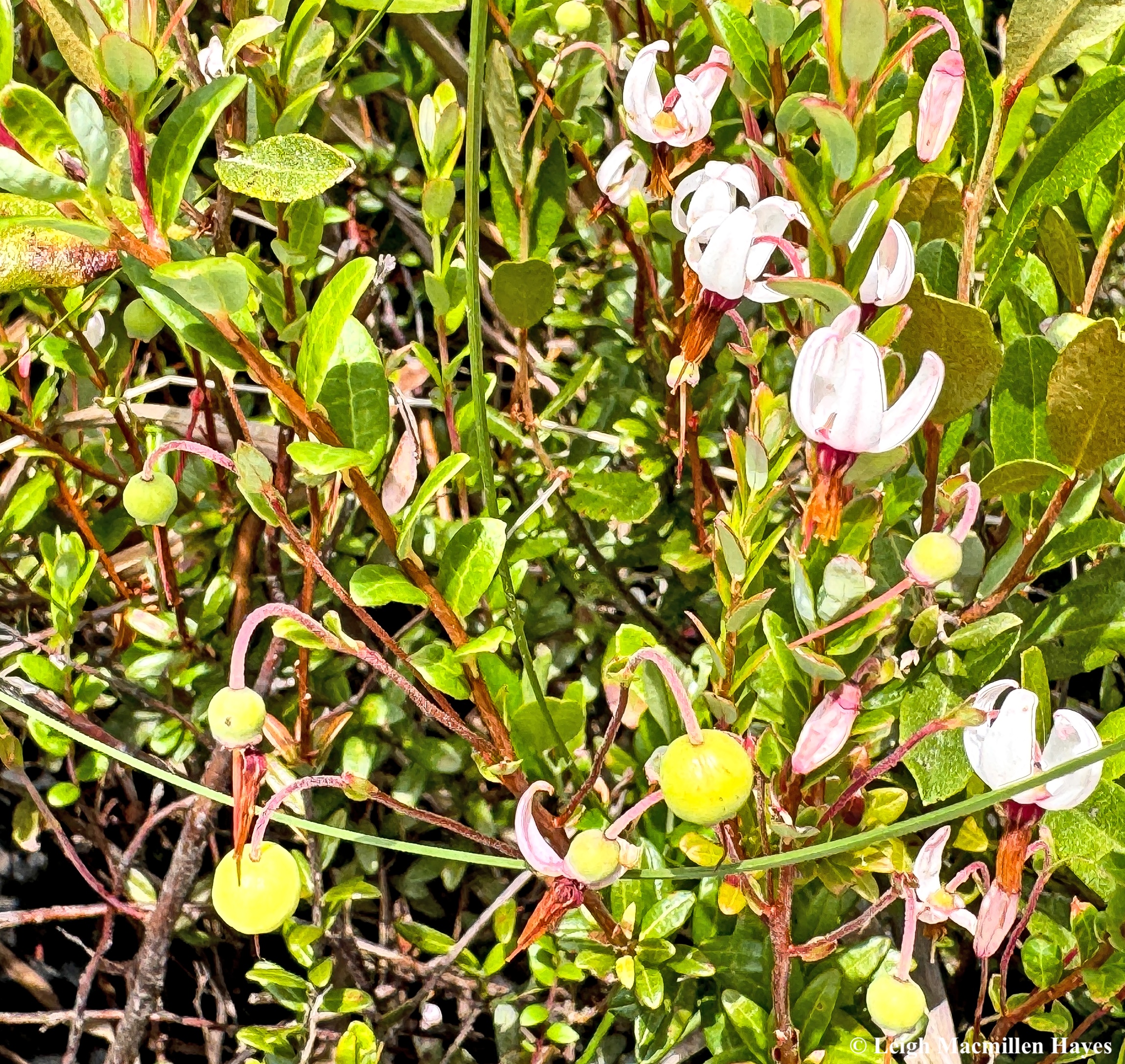
Cranberry flowers and fruits

Native Cranberries also flourish in the stagnant and acidic water of a bog.

Sphagnum Moss
Leatherleaf

Like bogs, Fens are found in northern climes, but the water is slow-moving, and does have some drainage. Layers of peat (sphagnum moss) and sedges and grasses and low shrubs like Leatherleaf may grow in these areas. The carnivorous plants like them as well.

But it’s not just the flora that makes a wetland so special. These places provide habitat for a wide range of insects and animals and birds as well. In fact, they act as nurseries, or places where any of the critters might raise young.

And as soon as the sun warms the air in the spring, friends and I scour the wetlands in hopes of discovering who is emerging on any particular day. One of my favorites to watch is dragonfly emergence (in case you are new to this blog and didn’t already know that. You can learn more here: Developing Dragonfly Eyes, but really, type “dragonfly” into the search button of this blog and a bunch of dragonfly related posts will pop up–all worth a read, I promise you.)
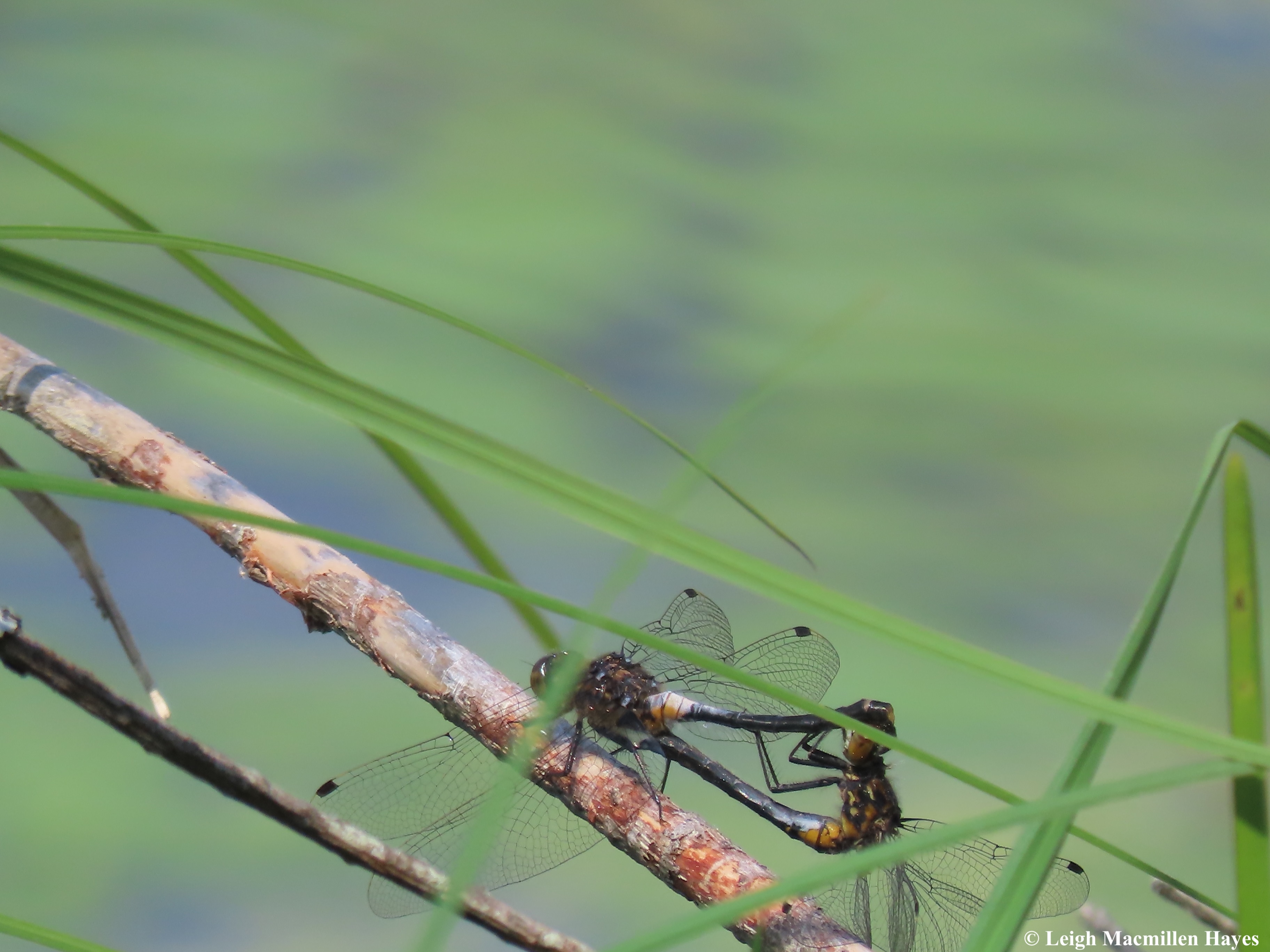
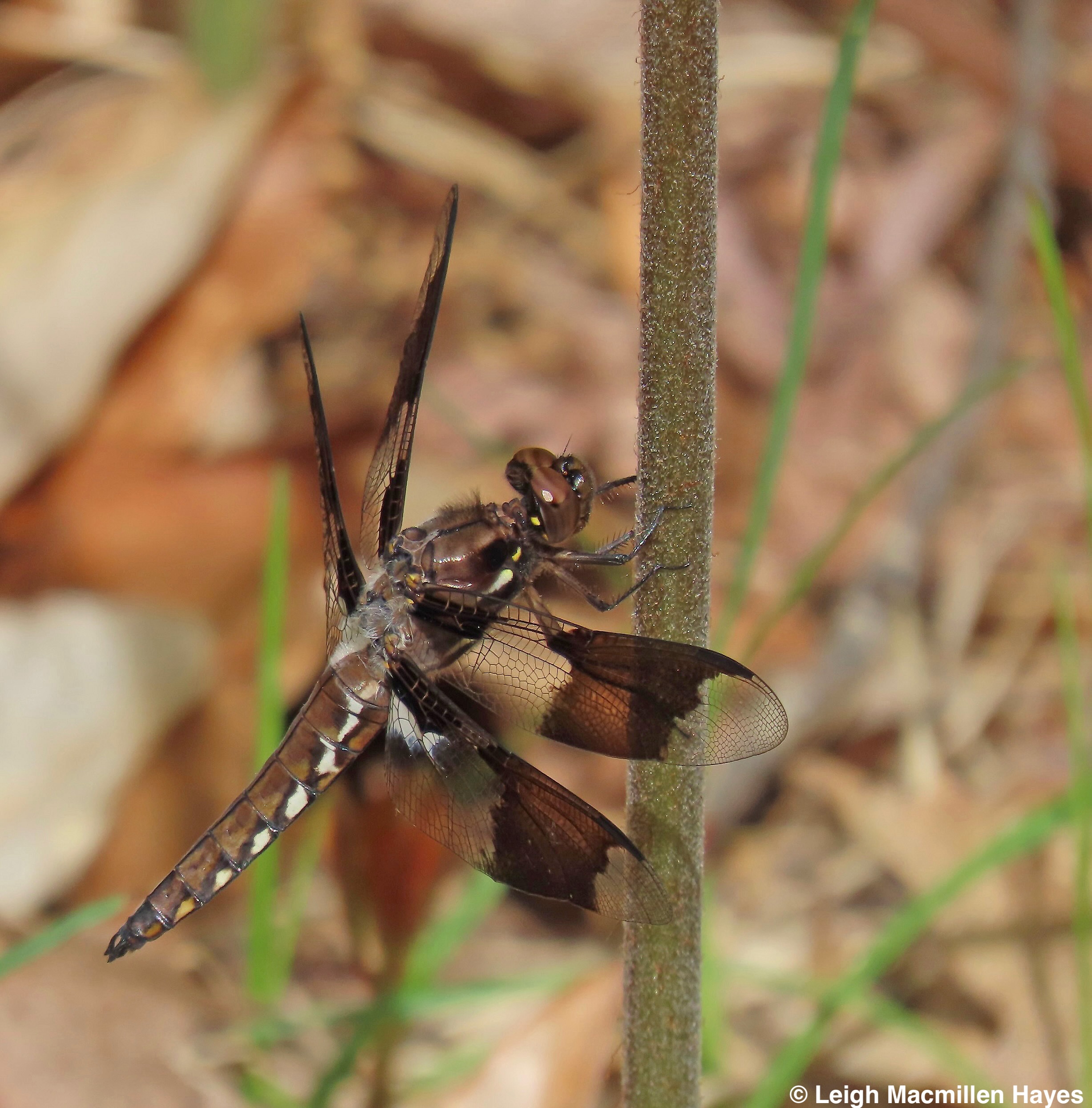
And like other insects, once emerged and a few days old, canoodling commences and dragonflies such as these Belted Whiteface Skimmers find each other and a presumably private place to mate. Private, that is, until I show up!

Eggs are laid in a variety of ways and places depending upon the species and this is a female Eastern Pondhawk taking a break upon a lily pad.

And here is a Forktail Damselfly laying eggs upon vegetation.
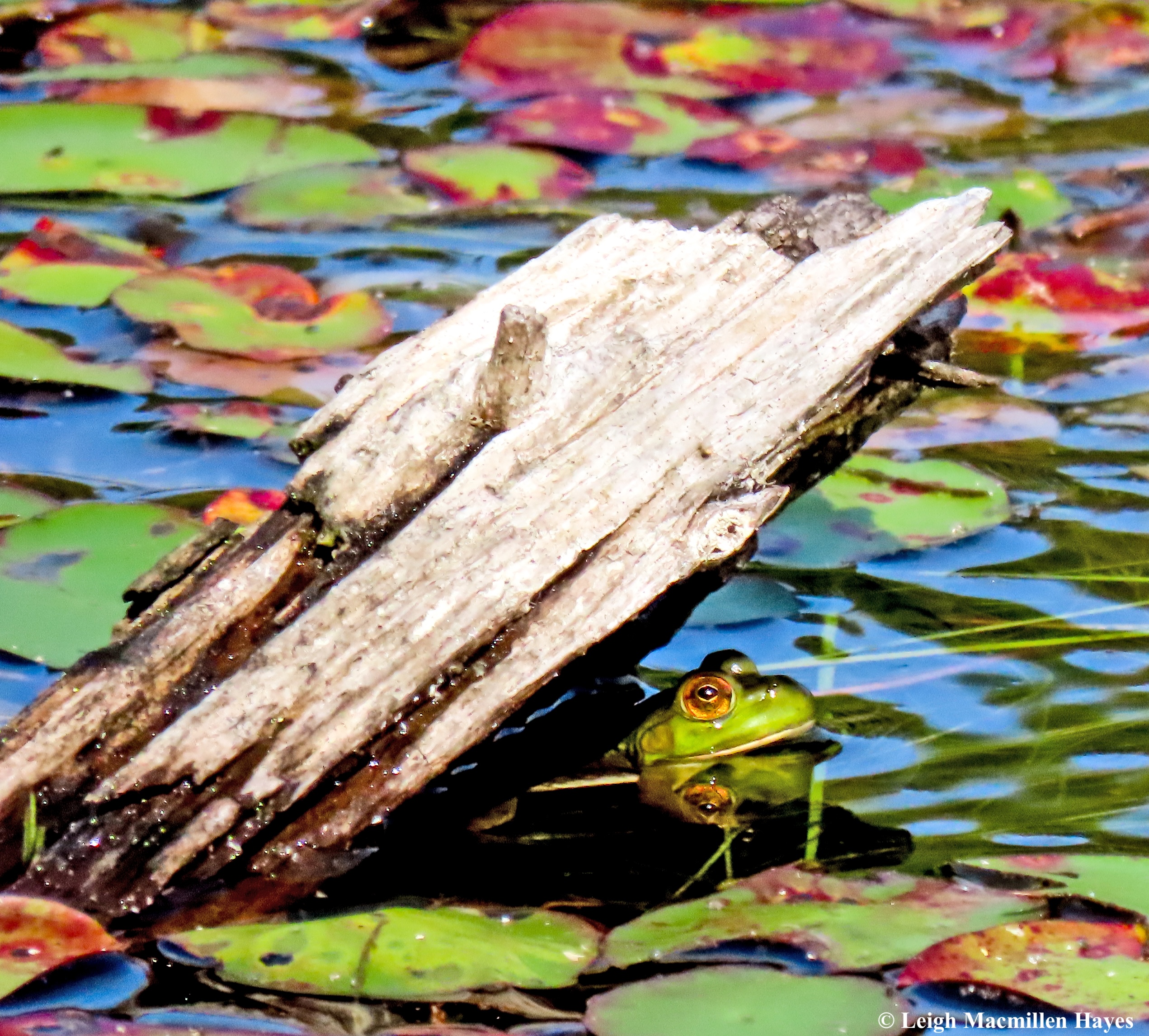
Frogs are also a highlight of a wetland, whether they are hiding in the shade on a hot summer day like this Bullfrog …
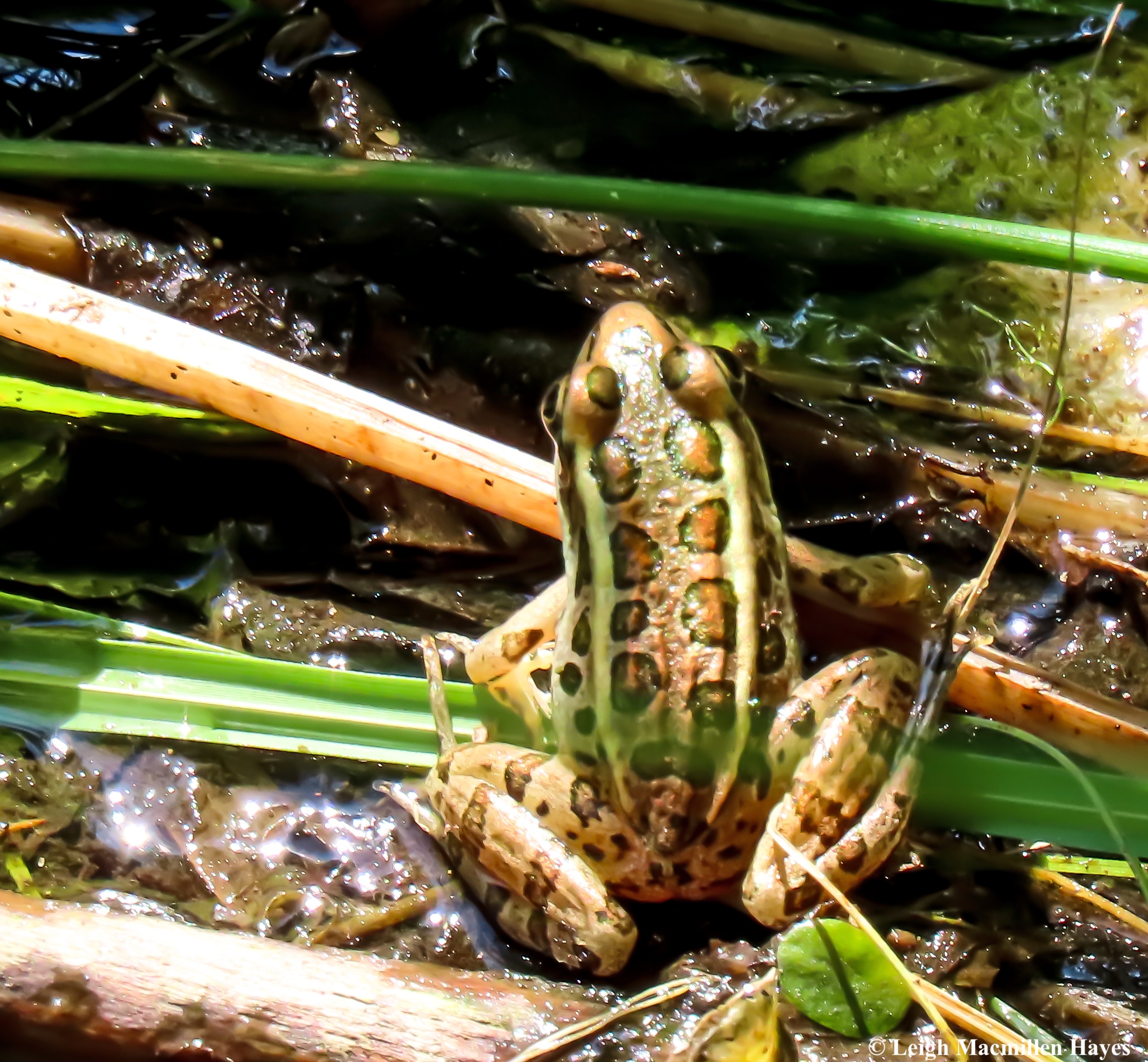
Or pausing briefly in the sun, such as this Pickerel Frog chose to do. Actually, it wasn’t so much basking as trying to remain hidden from my sight by not moving until I passed.
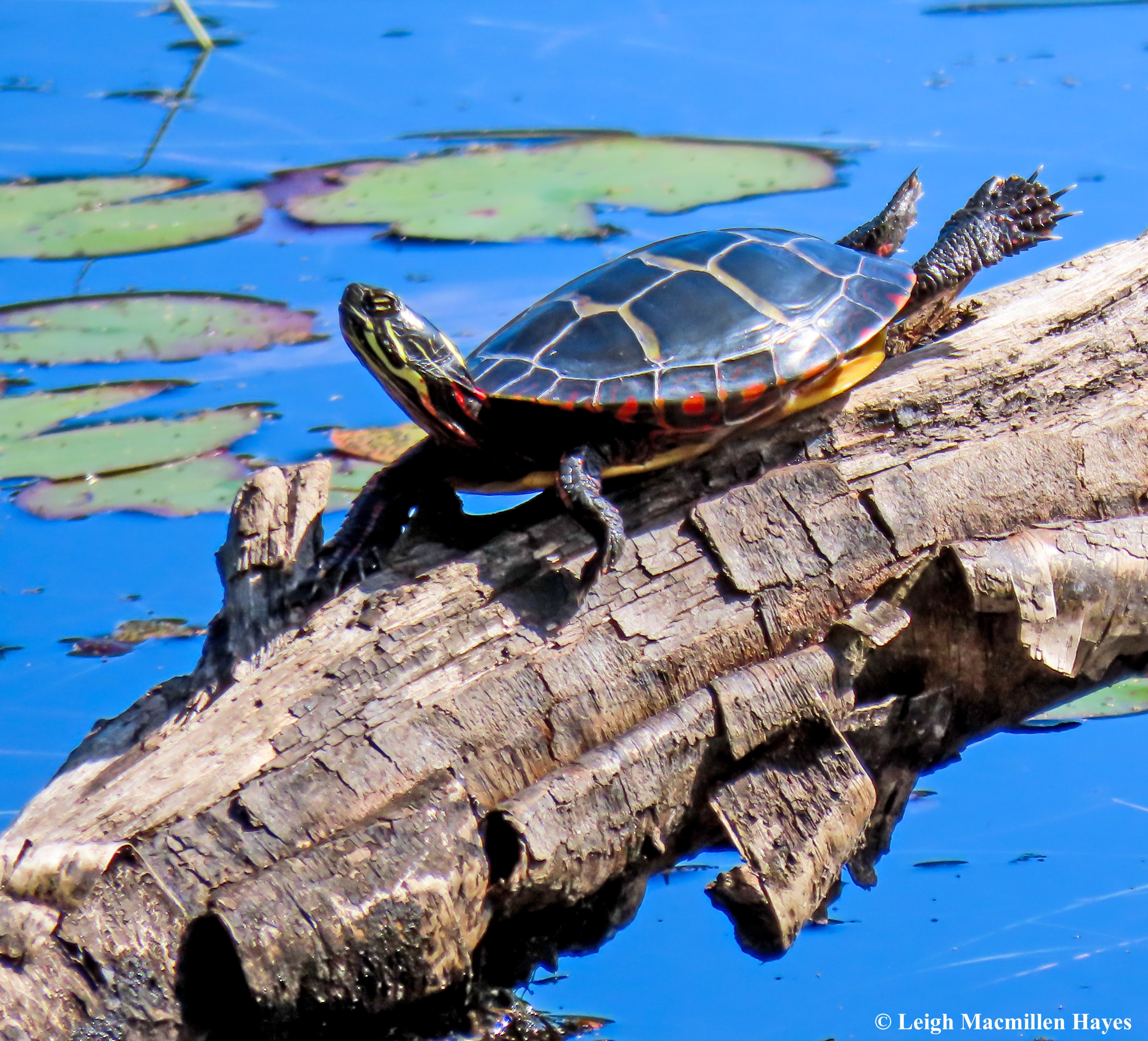
Those who do love to bask, (frogs do this as well) are the Painted Turtles, and the more surface area that is exposed to the sun’s beams, the better. Sometimes I’m surprised when I do capture a photo such as this one, for they are quick to sense my presence or hear me coming, and quickly slip into the water. But if you wait a few minutes, sometimes they’ll reemerge.
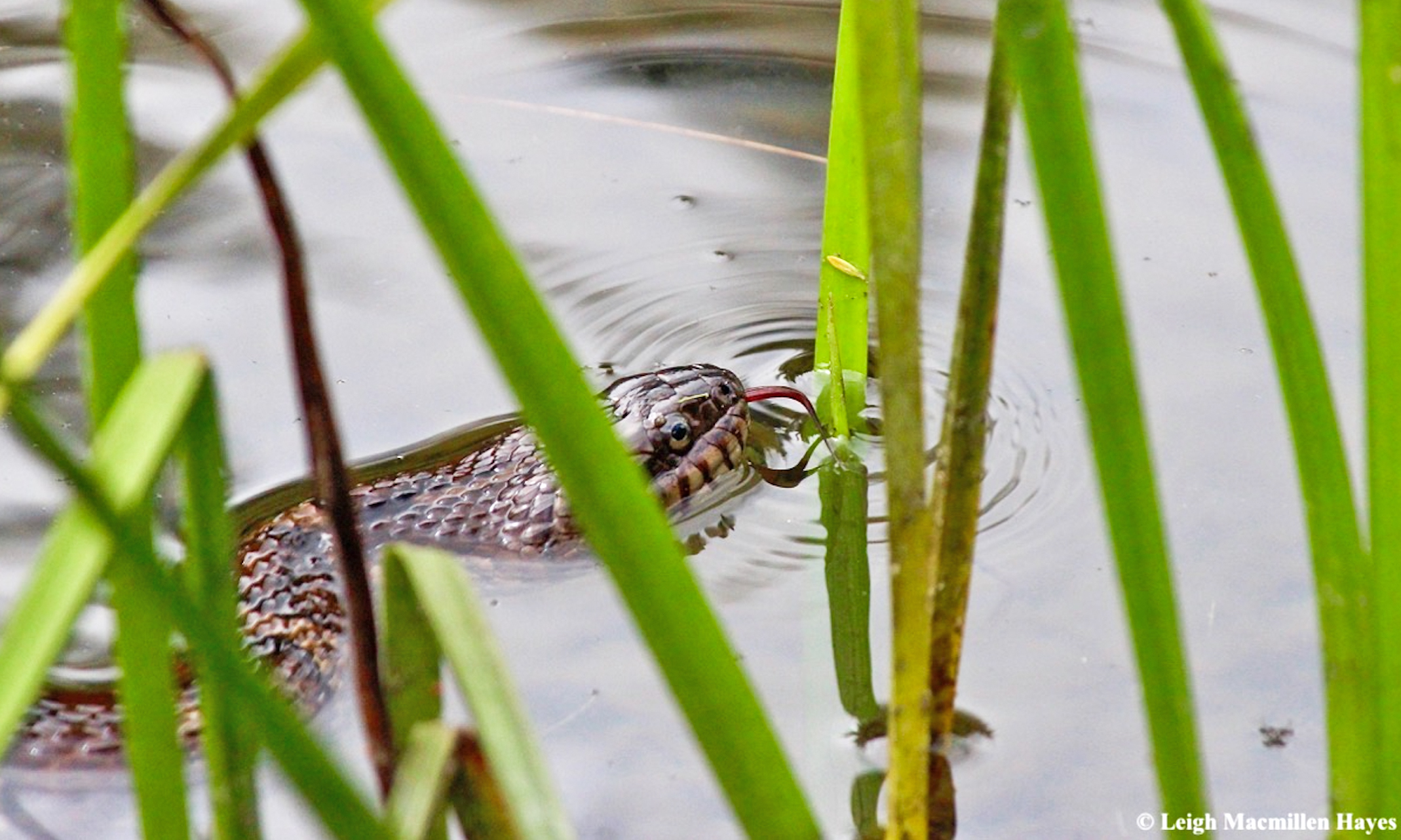
And there are Northern Watersnakes always on the prowl, using their tongues to make sense of their surroundings.
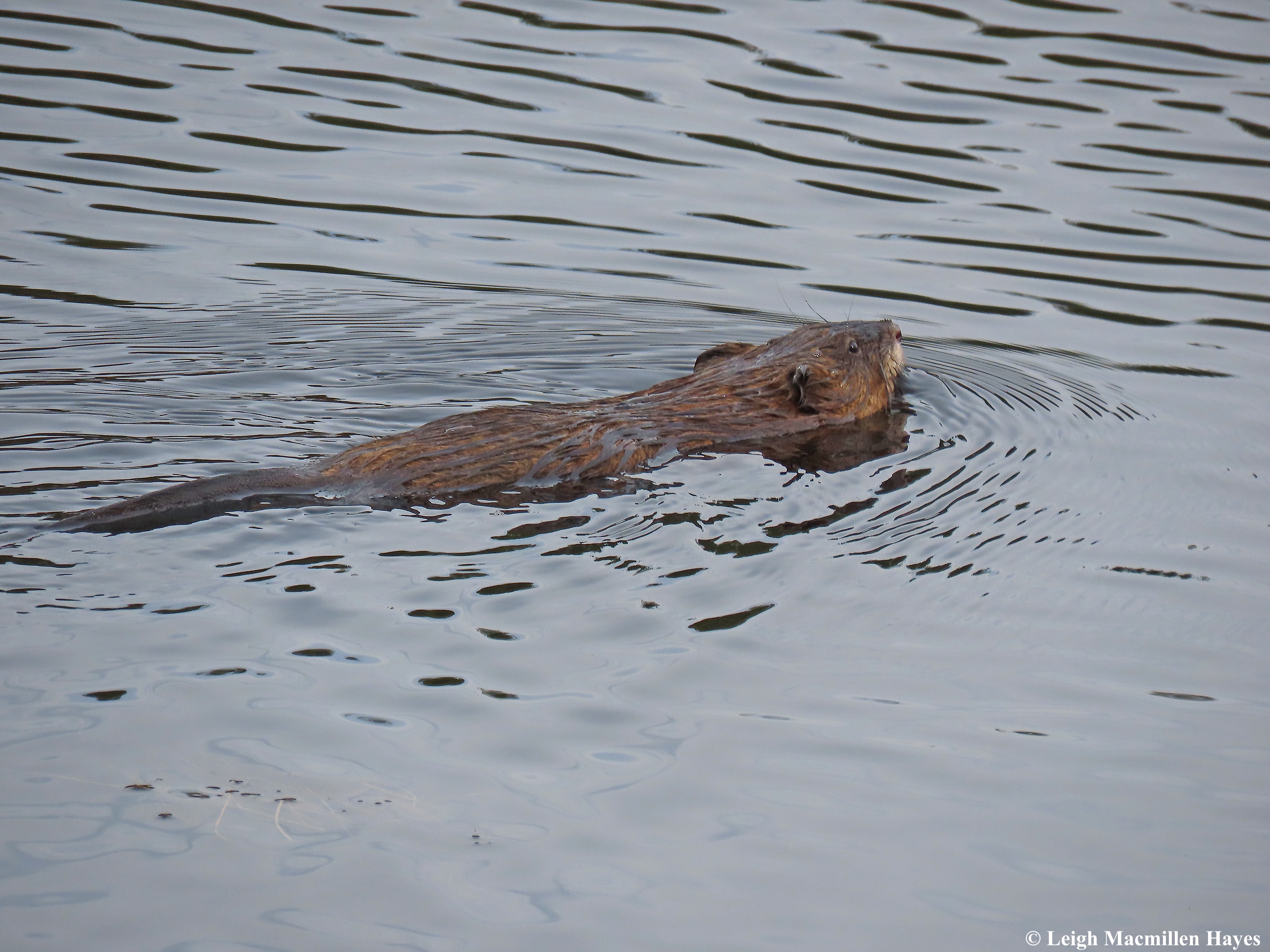
Mammals also use wetlands for forage for food and build homes and one of my favorites is the American Beaver, who knows the value of a wetland, and can create one in a short time by building a dam. Beavers build dams to created a deeper pond through which to navigate, for they are better at swimming than walking. They may alter the wetland to suit their needs for a few years, but then move on and let the dam breach and then a new type of wetland emerges and more critters move in and take advantage of what it has to offer.

That all said, it wasn’t until I spent more time with the animal pictured above that I realized it was actually a Muskrat–look at that thick, rounded tail, unlike the flat paddle of a Beaver’s.

And birds! Oh my. Mergansers . . .

And momma Wood Duck and her offspring . . .

and Papa Woodduck . . .

And Great Blue Herons always on the prowl for fish or amphibians know the value of the wetland as a food pantry.

So, this spring and summer and fall, I’ve been following My Guy and our friend, Bruce, beside and into and sometimes, thanks to Bruce’s drone, over a variety of wetlands.
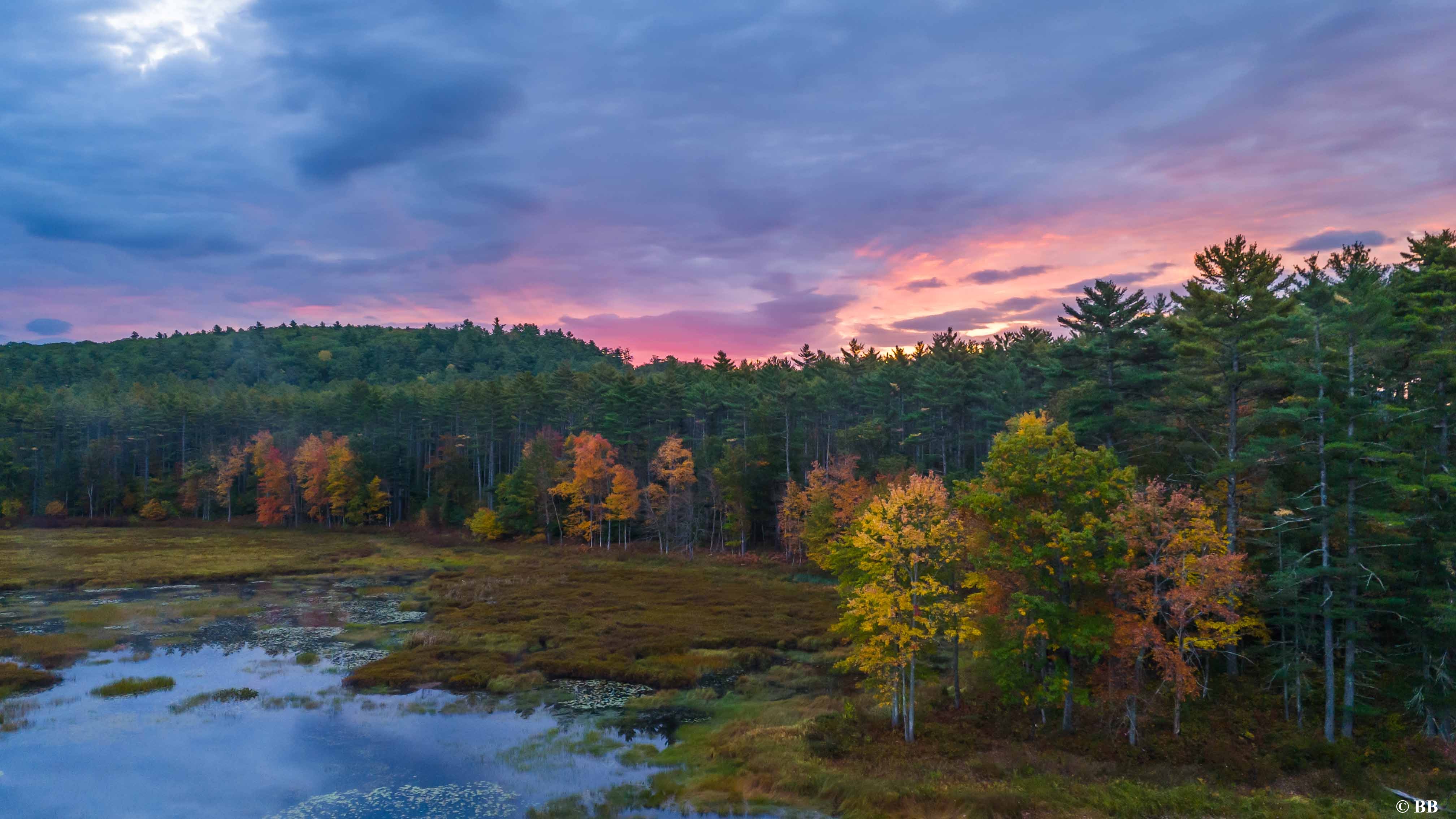
Bruce is an early riser (understatement), and occasionally I’ll meet him at a predetermined location as we did this past weekend–before the sun has risen. Though the thought of staying in dreamland for another hour or so is enticing, I never regret the decision because we get to view the world before it officially wakes up.

And with his drone we explore these areas we cannot easily access. This is one My Guy and I walked all the way around a few weeks ago without ever spying, though we knew it was there. But Bruce and I bushwhacked through a forest of White Pine Saplings and mature trees and reached the edge before he launched his bird and we were offered a glimpse of this most beautiful wetland with pockets of water connected by meandering rivulets.

The stream turned to forest for the trees told more of the story, as they closed in and I recalled that it wasn’t far from that spot that My Guy and I walked through a damp area where Royal Ferns grew and we found one teeny tiny mushroom fruiting on a hot summer day.

The mushroom was the little Orange Peel Fungus, and its name seemed so obvious. And the soil moist despite the severe drought.

Another day we began our exploration in the afternoon beside a small pond.

And the Droney-bird picked up on the wetland to the south.
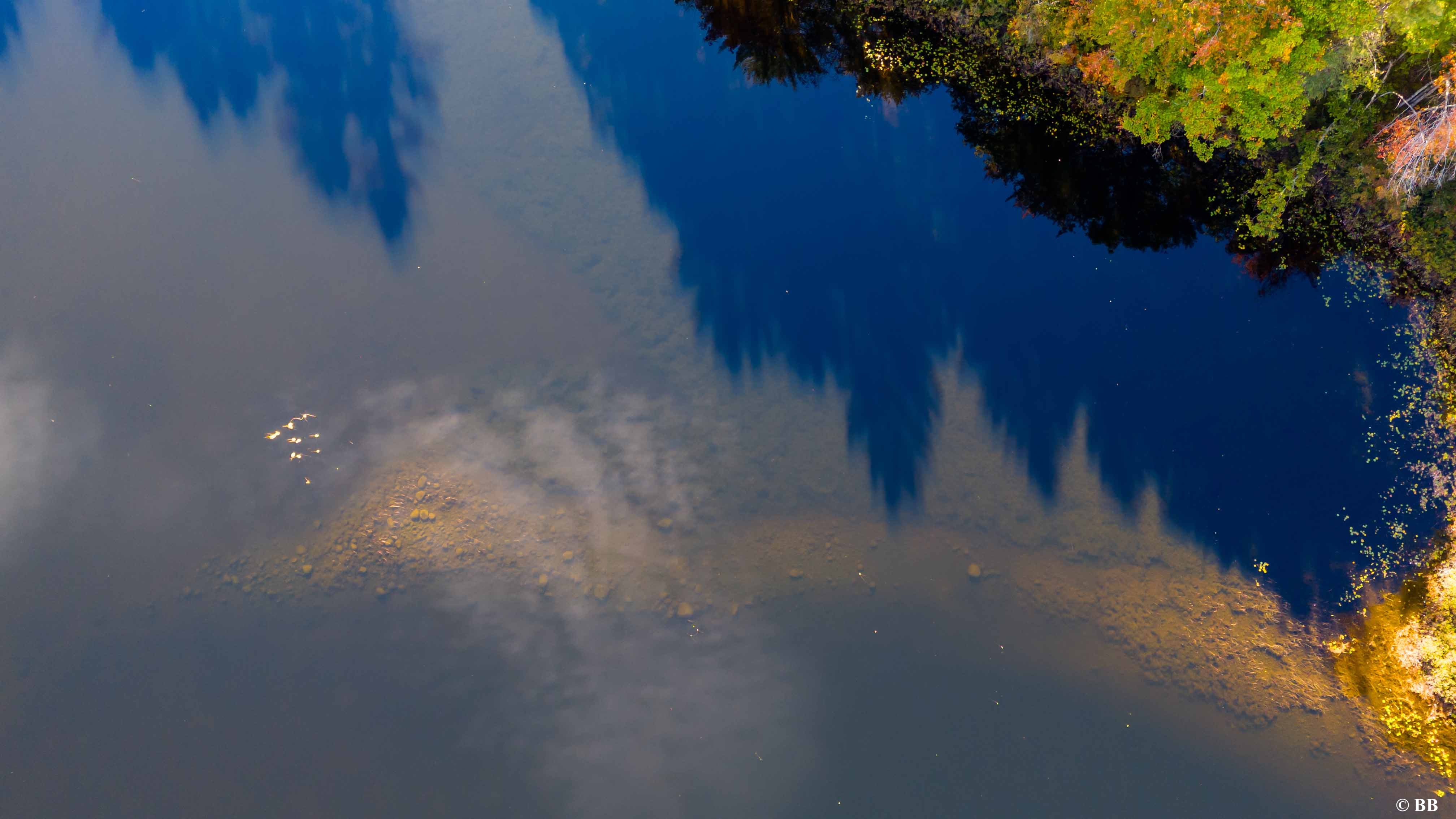
But that day what struck us as being more important was that it also took a clear picture of a sandbar in the water.

And as Bruce navigated it closer to the watery surface, we could see clear to the bottom. Mind you, it’s not a deep lake, but this is the water of Maine. Clean and clear.

And we celebrate wetlands for the critical role they play in maintaining the health of the environment.
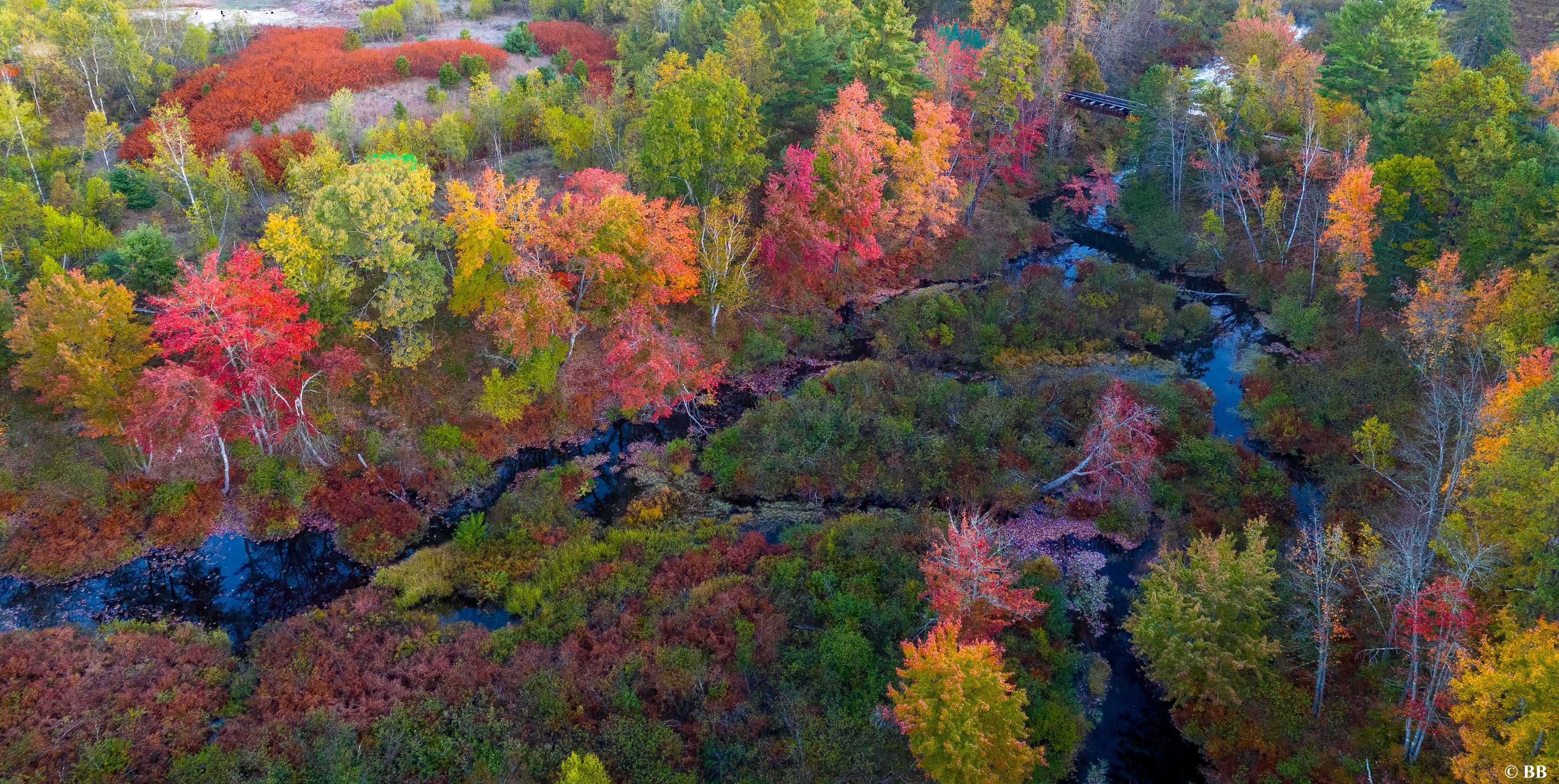
When I think about their ability to store and filter water and act as a natural sponge, absorbing and retaining large amounts of water during the heavy rainfalls of spring, and removing pollutants before they enter streams, and rivers, and lakes, it all seems so obvious that they should do this when you have a bird’s eye view.
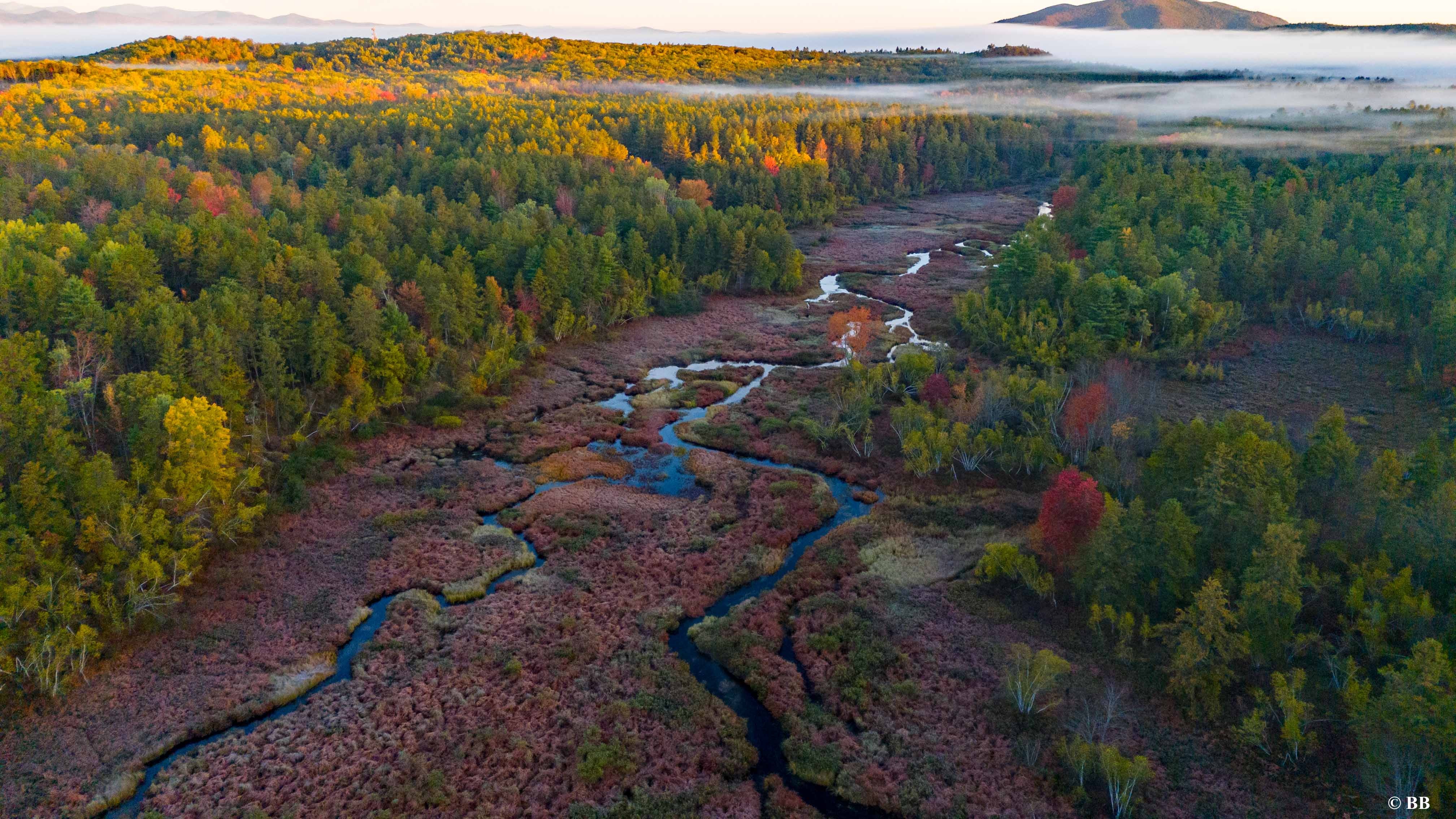
So here’s the curious thing about this wetland. It is located beside a local dump. And the more I think about that, the more I question those who created the dump, but give thanks for the unwavering workhorse that this wetland is in the ecosystem.
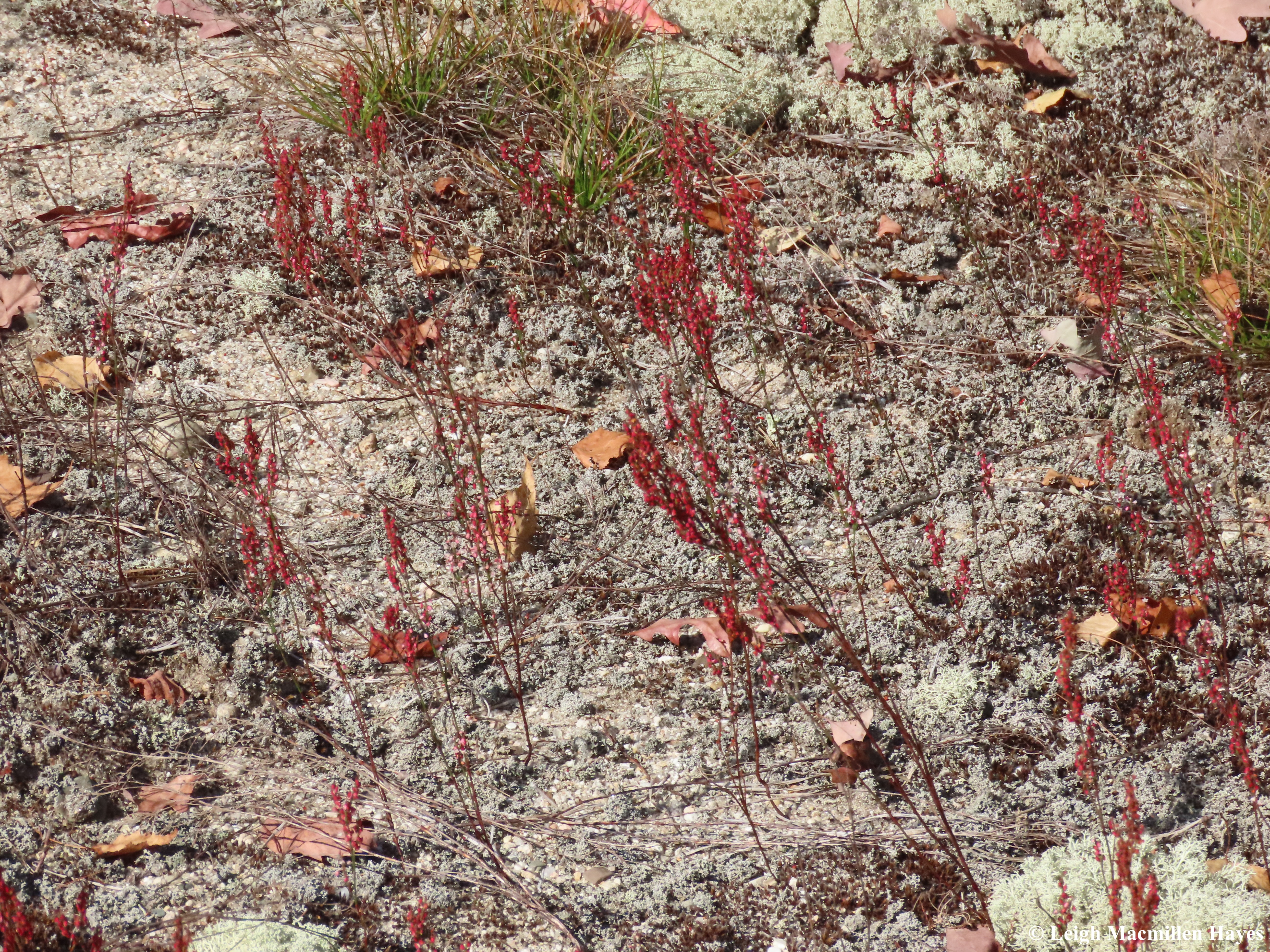
It was on the rise above this particular wetland, in a very sandy spot covered with Reindeer Lichen, that Bruce and I made a discovery. Well, he discovered it first and asked for an opinion. I’m full of those and so I met him and we took a look.

The discovery was a plant new to us both. Sand Jointweed or Polygonum articulatum. As you can see, the flowers are astonishing in their pink and white display.
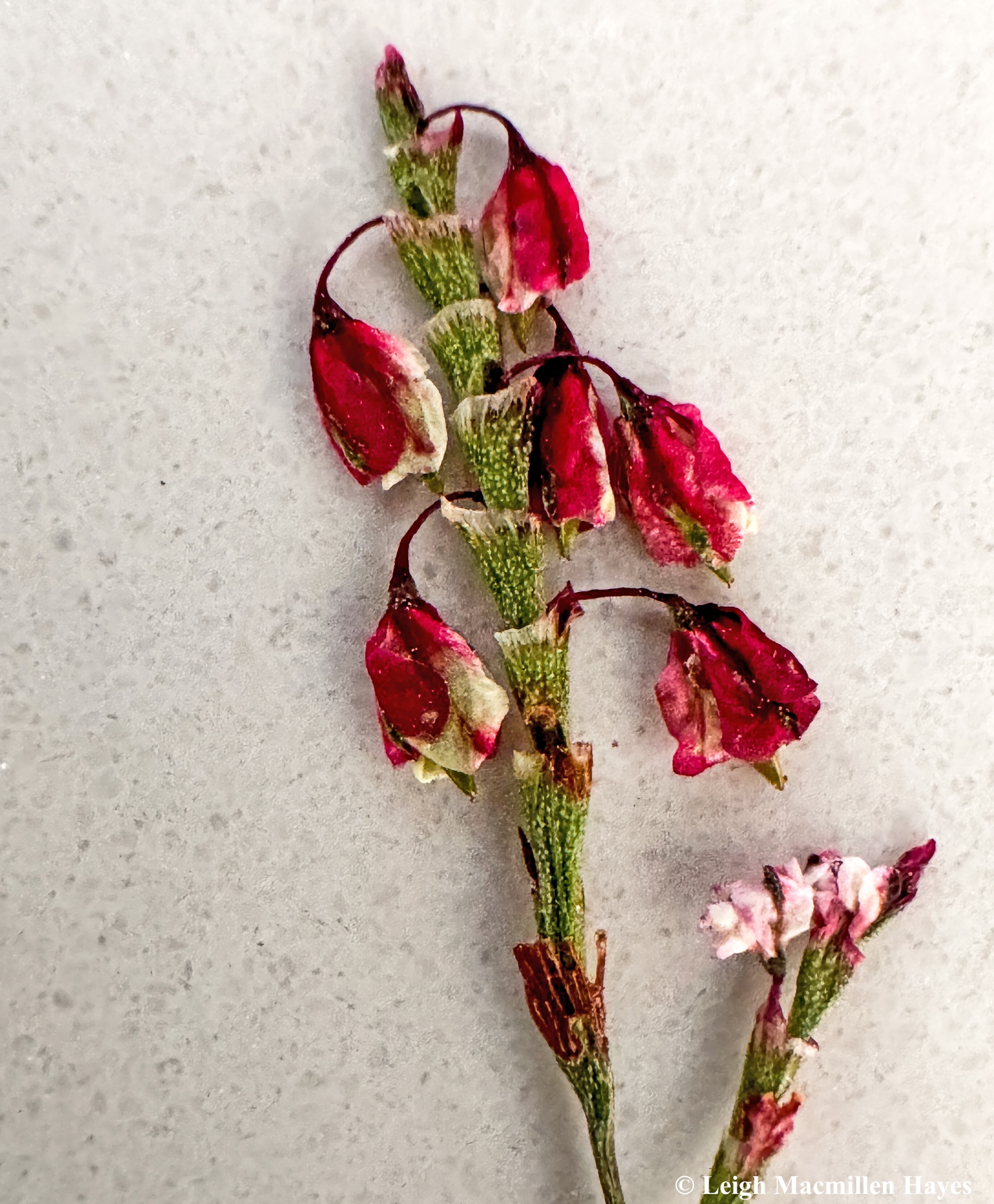
It was the stems that I found equally fascinating. At the base of the flower stalks there are sheathing bracts, giving it a jointed or segmented appearance. We didn’t see any leaves, but perhaps we need to look again. I think we were just amazed to have discovered a plant neither of us recalled meeting before. Often though, that means we’ll meet it again soon.

The small snippet followed me home, and today I looked at the flowers under the microscope and I was astonished to realize that they look rather like a map of a wetland.

I don’t jump at the invite every time it arrives for an early morning mission to explore a wetland, and one day really regretted it because when My Guy and I finally got to the location, we found a note with Bruce’s observations. We scanned the area with our eyes for about an hour before deciding that we were too late.

But . . . we promised ourselves that we’d pack a picnic supper and try again.

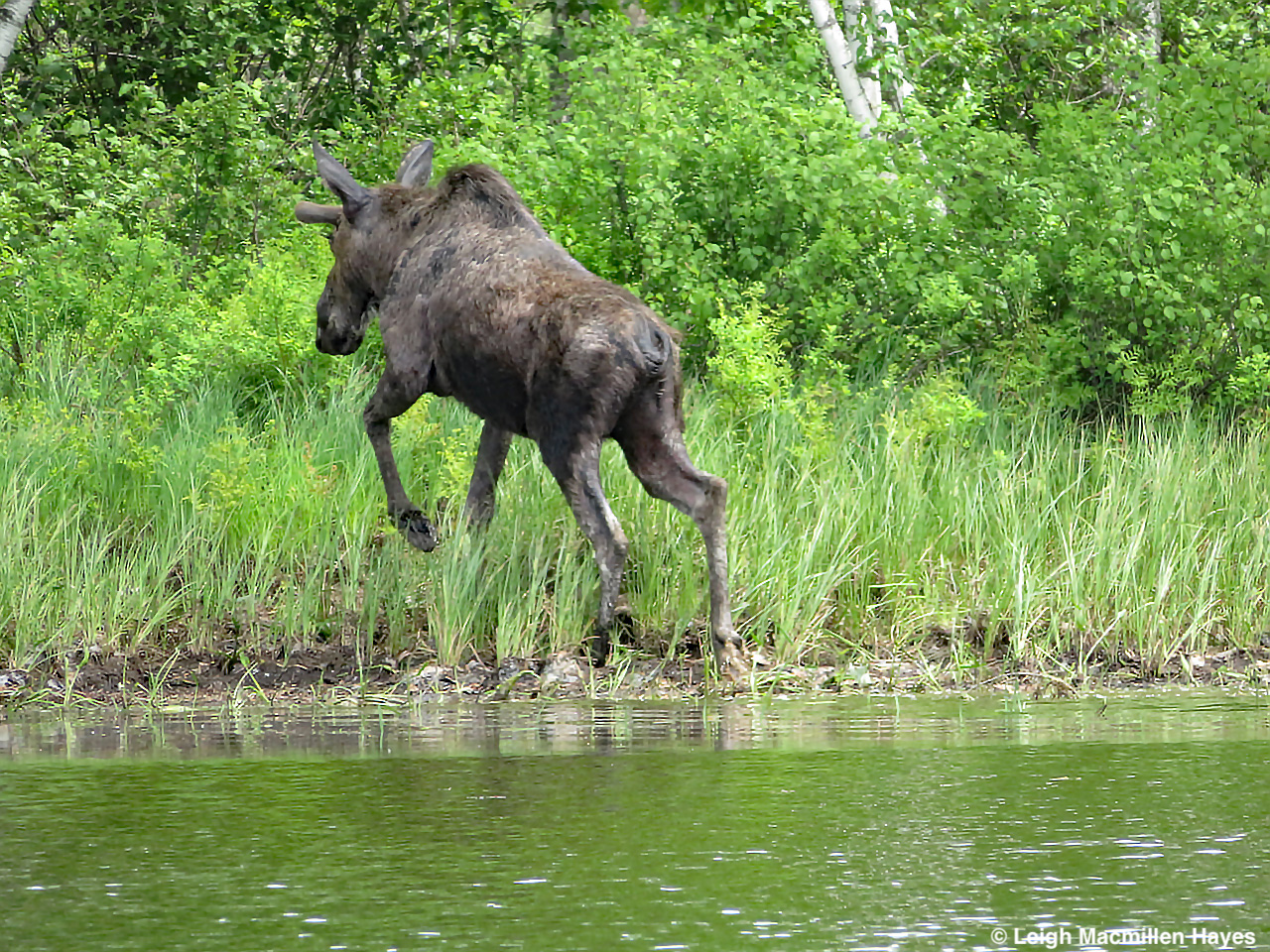
First we spotted one Bull Moose.

And then a second, and had a difficult time deciding that we should head home.

Did you know that 25% of Maine’s land area is wetlands? That’s four times the wetland area of the other New England states combined. The natural buffers they provide sustain the deep clear water we appreciate, and take for granted.

The margins or places where the land and water come together are bridges between two worlds. As many as 90% of all living things in our waters are found in these wetlands, no matter what form they take. I guess that’s why I love exploring them so often, because there’s always something to see. And another lesson to learn.

I leave you with this, a watercolor Bruce’s wife Eileen sent me recently. It was inspired by one of our local wetlands.

Some may see wetlands as dark and shadowy areas, mosquito hatcheries, with an abundance of leeches mixed into the scene, but the rest of us know their true value and I give thanks for living in this place where it’s so easy to go Bogging in Maine. And to share it with others. Thank you MG, BB, and EJB!

Solstice 2024

There’s a local trail I’ve been traipsing along solo or with company these past few weeks and when I dragged My Guy there early this morning, and said I was bringing my camera, his response, “Why, there’s nothing to see there.” Seriously. Doesn’t he know me better than that after all these years?

It’s a place where Bullfrogs sit upon lilypads in true frog style and wait patiently for a meal to fly by. Given all the Gnats and Deer Flies that buzzed our faces and ears as we walked, I assumed there was plenty of food and actually offered some, but he wouldn’t partake. The frog, that is.

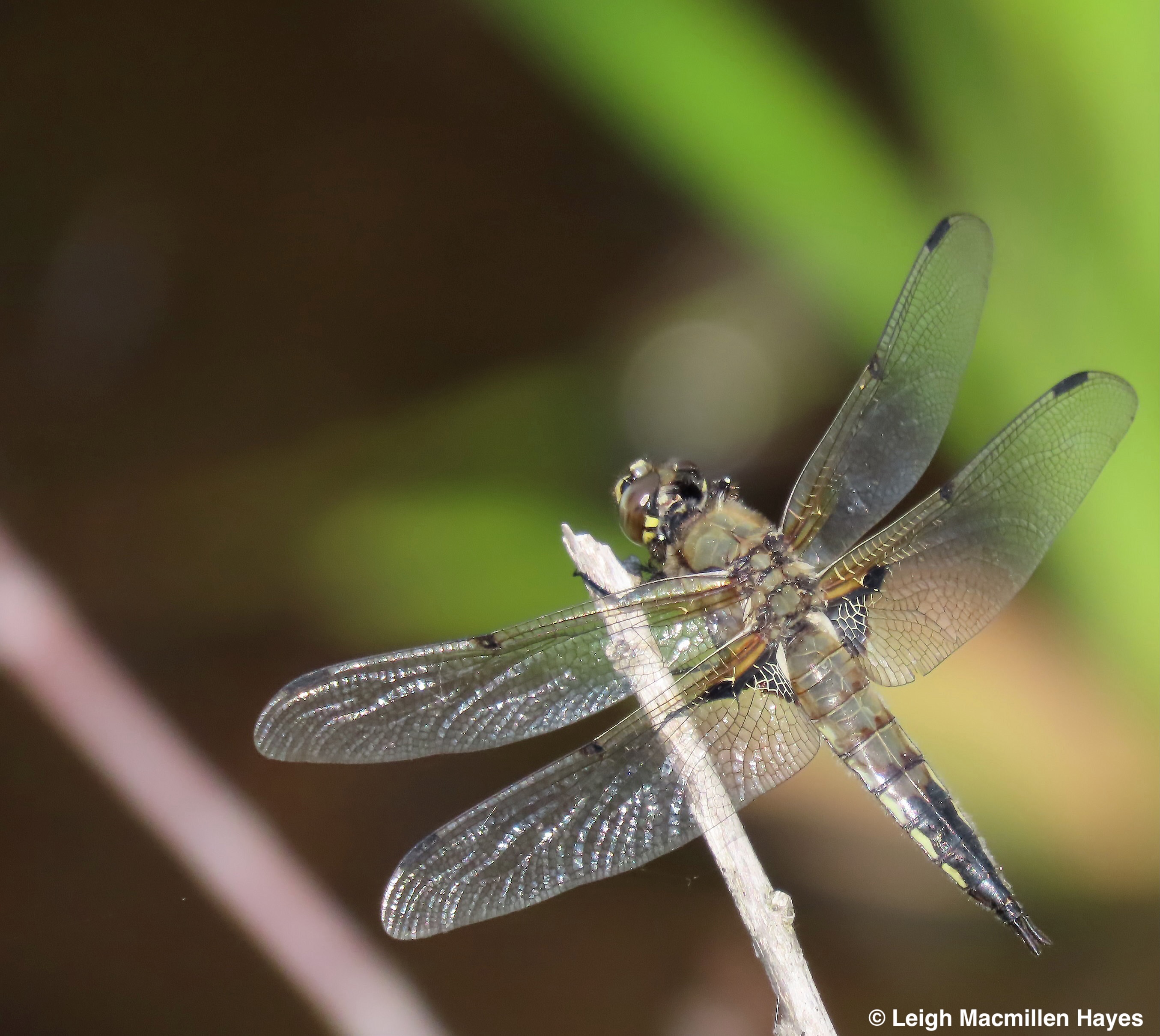
Another who should also have been enticed by the offerings, seemed to care more about defending his territory than dining, this being a Four-spotted Skimmer Dragonfly. The name Four-spotted refers to the small dark spots on the upper edge of each wing, there being two per wing, and thus four per side or four per front wing and four per backwing.

Equally nonchalant about all the available food, but curious about me, was the female Calico Pennant, another skimmer who loves to perch at the tip of plants and twigs and returns to the same site over and over again. Though I didn’t have a good view of her abdomen except for a hint of color on segment 7, the yellow-colored stigma toward the tips of her wings, and her yellowish face gave proof to her gender. Males have red stigmas and red faces.

The immature male Common Whitetail cruised and paused, cruised and paused. This is such a handsome skimmer (not that the others aren’t). And while its abdomen resembles the female, it’s the wing pattern that identifies its gender. I love the complexity of dragonflies, even if I do have to relearn the clues each season.

Apparently, there were other things to do besides defend territory, and certainly rather than eat the biting insects–for canoodling was in order each time I visited. In this love wheel, the male Belted Whiteface dons the red thorax and he has clasped his mate behind her head with his claspers, as is the dragonfly custom. As Kurt Mead describes it in Dragonflies of the North Woods, “Prior to selection of a willing female, the male will transfer sperm from his testes located on the underside of the abdominal segment 9 to his hamulus located on the underside of segments 2 and 3. This is accomplished by simply arching the abdomen until the undersides of the appropriate segments make contact.” Once clasped, she arches her abdomen toward his hamulus to receive his sperm and thus fertilize her eggs.

Also flitting about, for that’s how these damselflies seem to move through the air, were some Ebony Jewelwings. The white dot or stimga at the tip of the wing signals this is a female, where the male has all dark wings. I love the iridescent colors of this species. And note how she has her abdomen reaching upwark in an obelisk position? That’s the Odonata way of avoiding overheating–thus reducing the surface area that is exposed to the sun’s rays. Oh, to be able to stick your butt toward the sun and cool off. On a day like today, and yesterday, and the day before, with our first heat wave in New England in two years, this would have been a most welcome adaptation.

Also along this trail, an extremely smart Eastern Phoebe who used a slight crevasse in a boulder upon which to build her nest of mud and moss and lichens. On the first trip, a friend and I spotted five eggs in the nest About a week and half later, these little chicks snuggled together like a pile of fluff with an occasional mustard-colored beak visible.

A week or so later and they continued to grow. What surprised me is how quiet they were, but that’s probably another technique that doesn’t give away the location of the nest.

That said, a Phoebe built a nest on the backside of our barn. It’s too high for us to notice if any eggs or chicks were located within, but we listen to the adults call back and forth all day long ,which is how we found the nest–they told us where to look and flew off anytime we passed that way.

The chicks above fledged within the last week and that nest is empty with no sound from an adult. It makes me wonder if the barn nest might see a second brood (if there actually was a first) for they continue to awaken us at about 4:20am each day. Stay tuned.

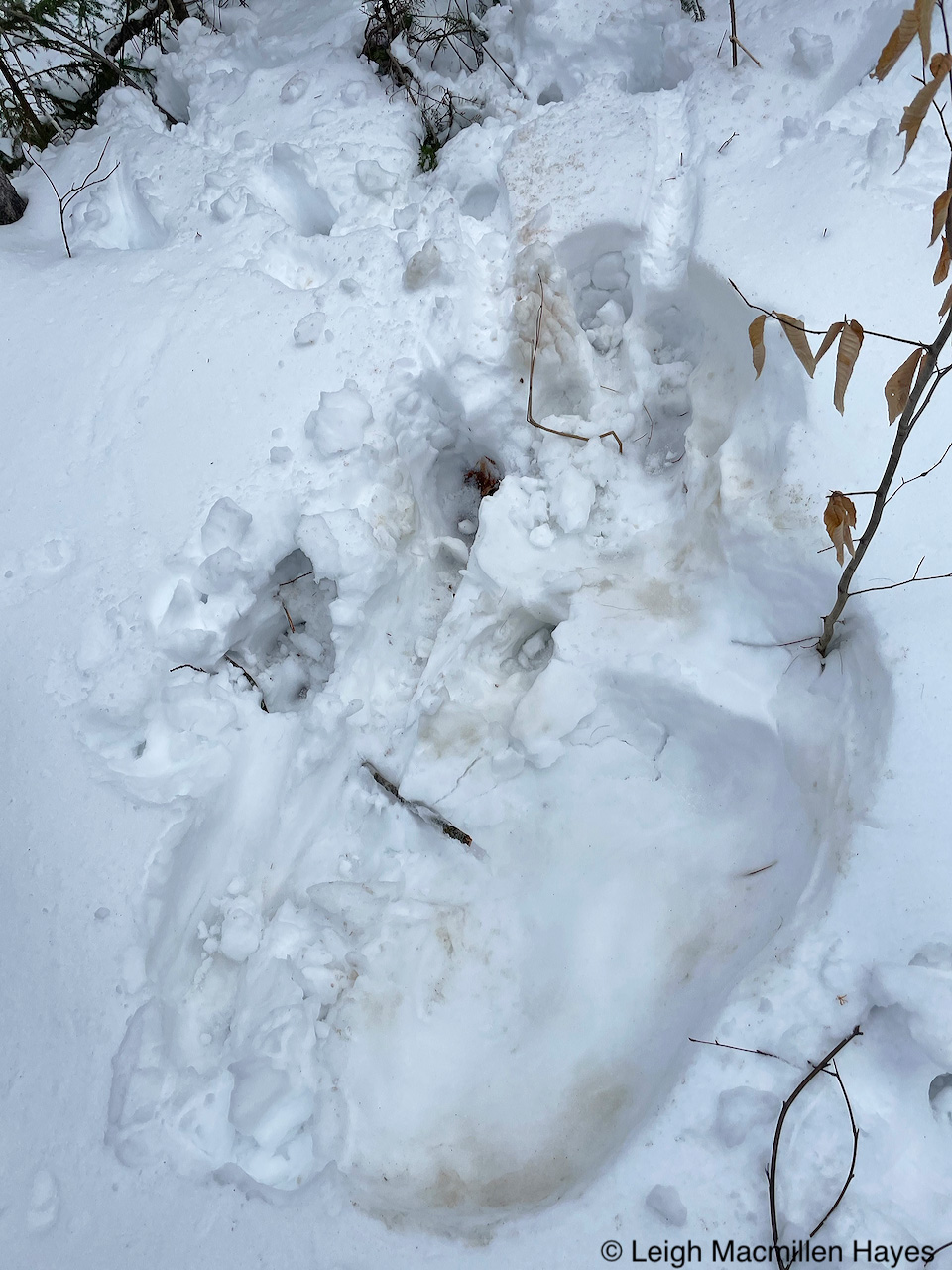
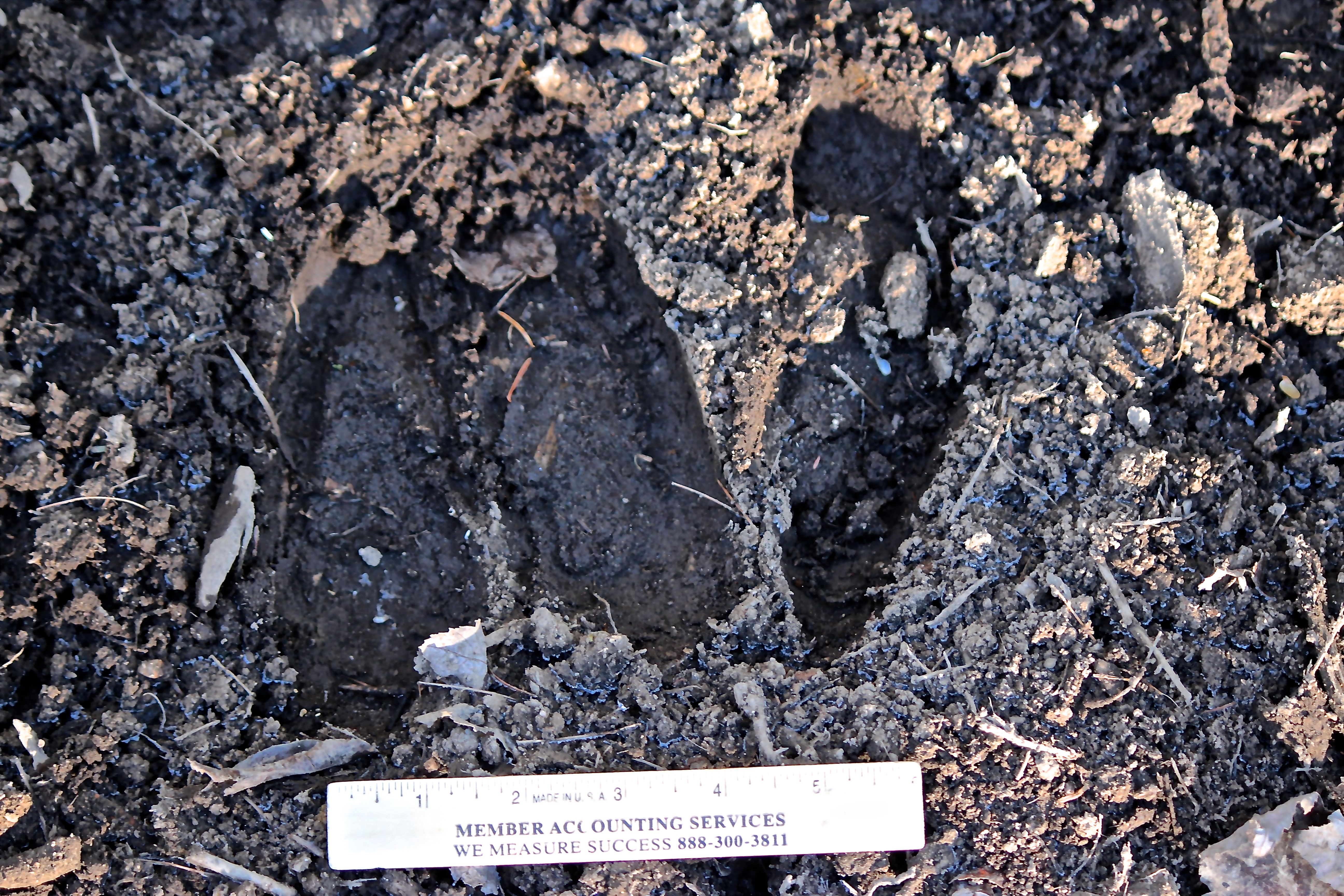
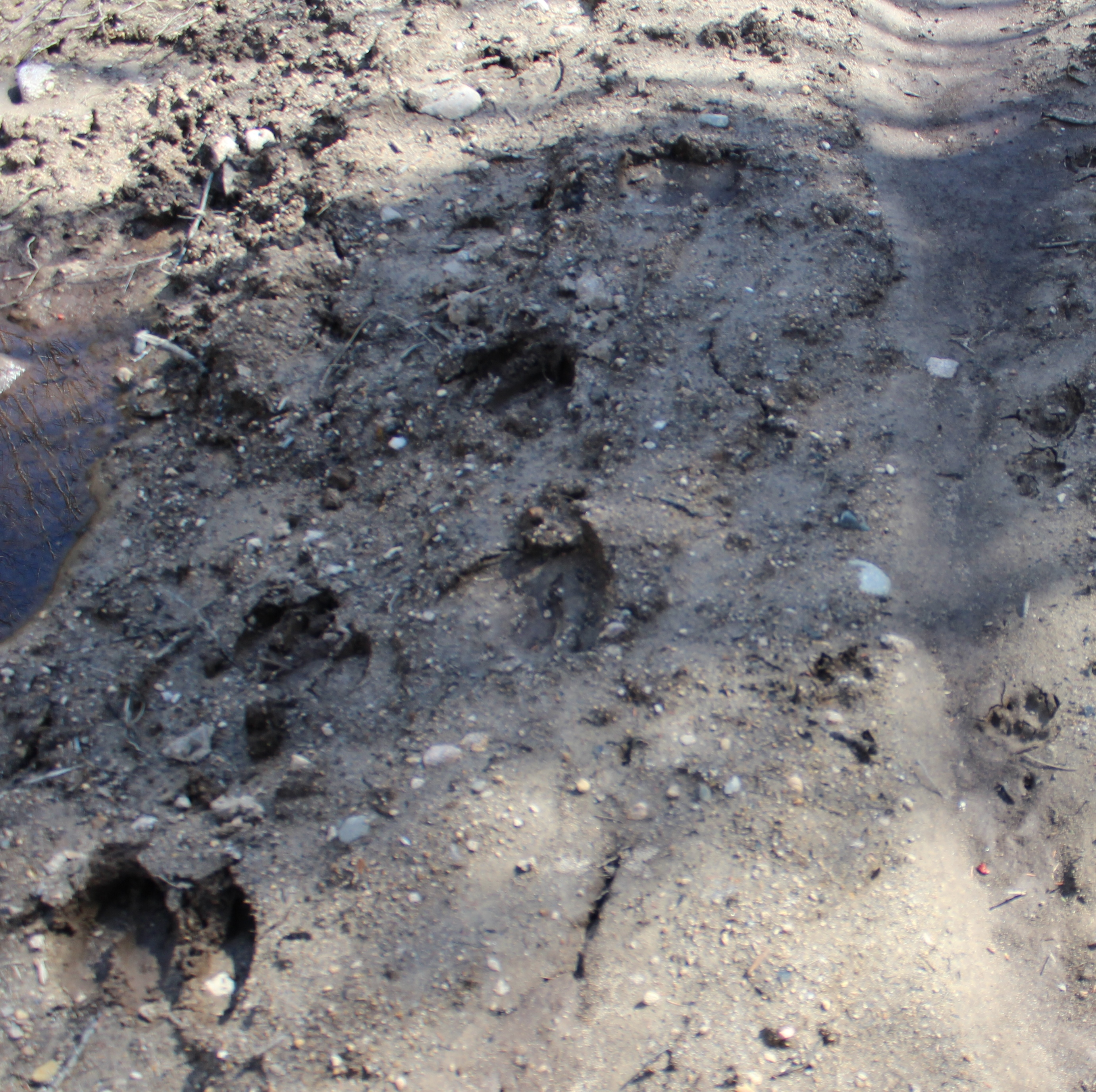
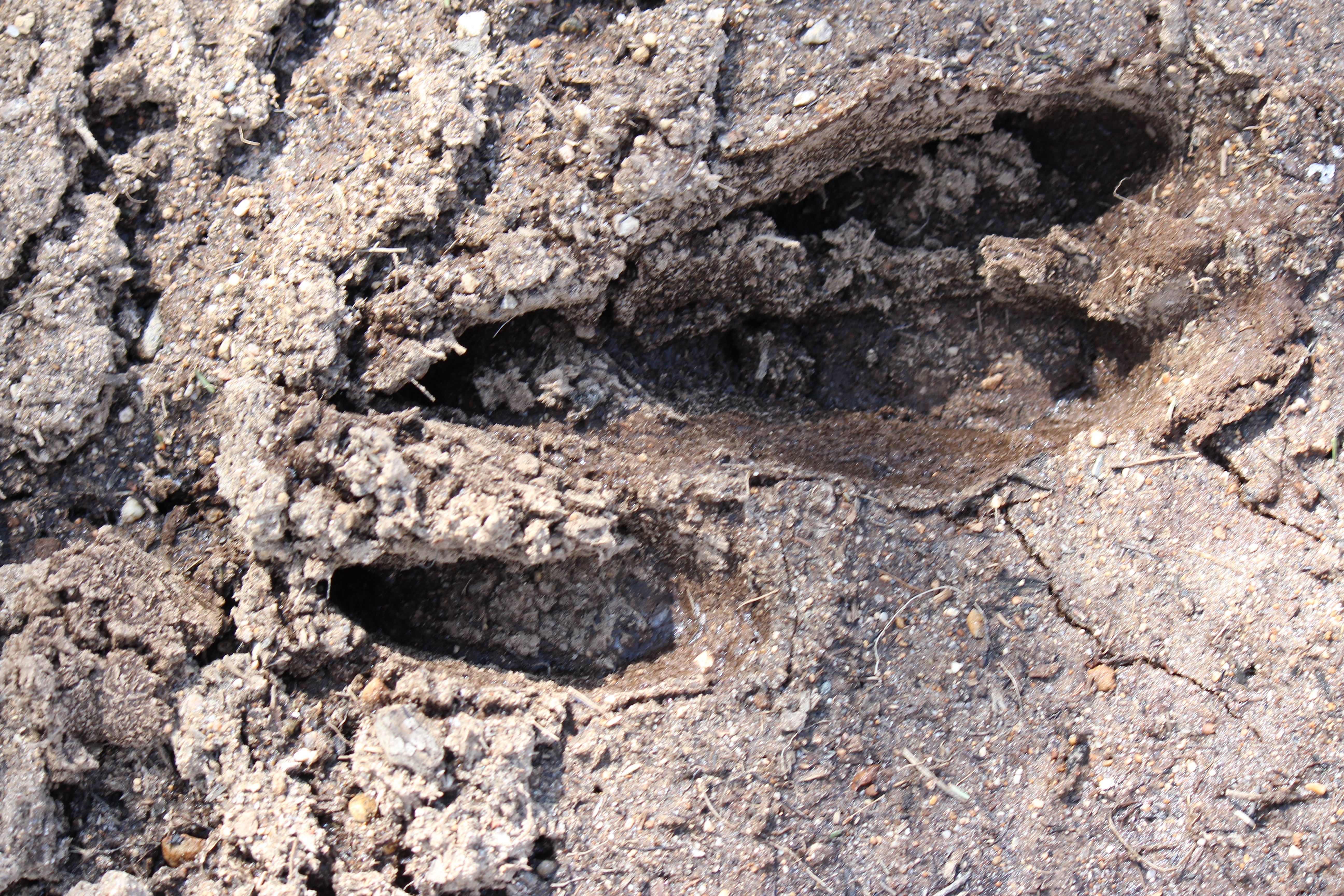
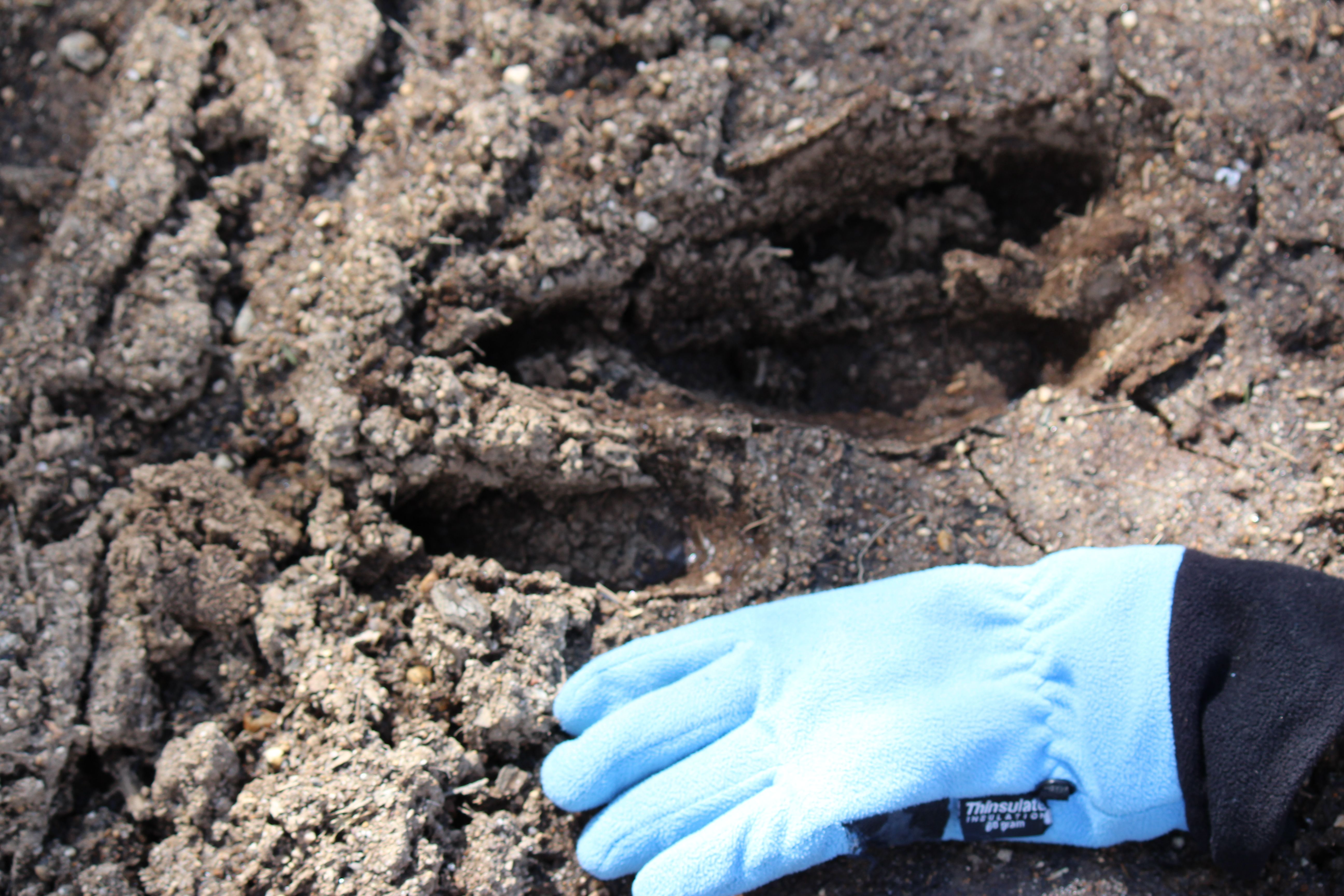
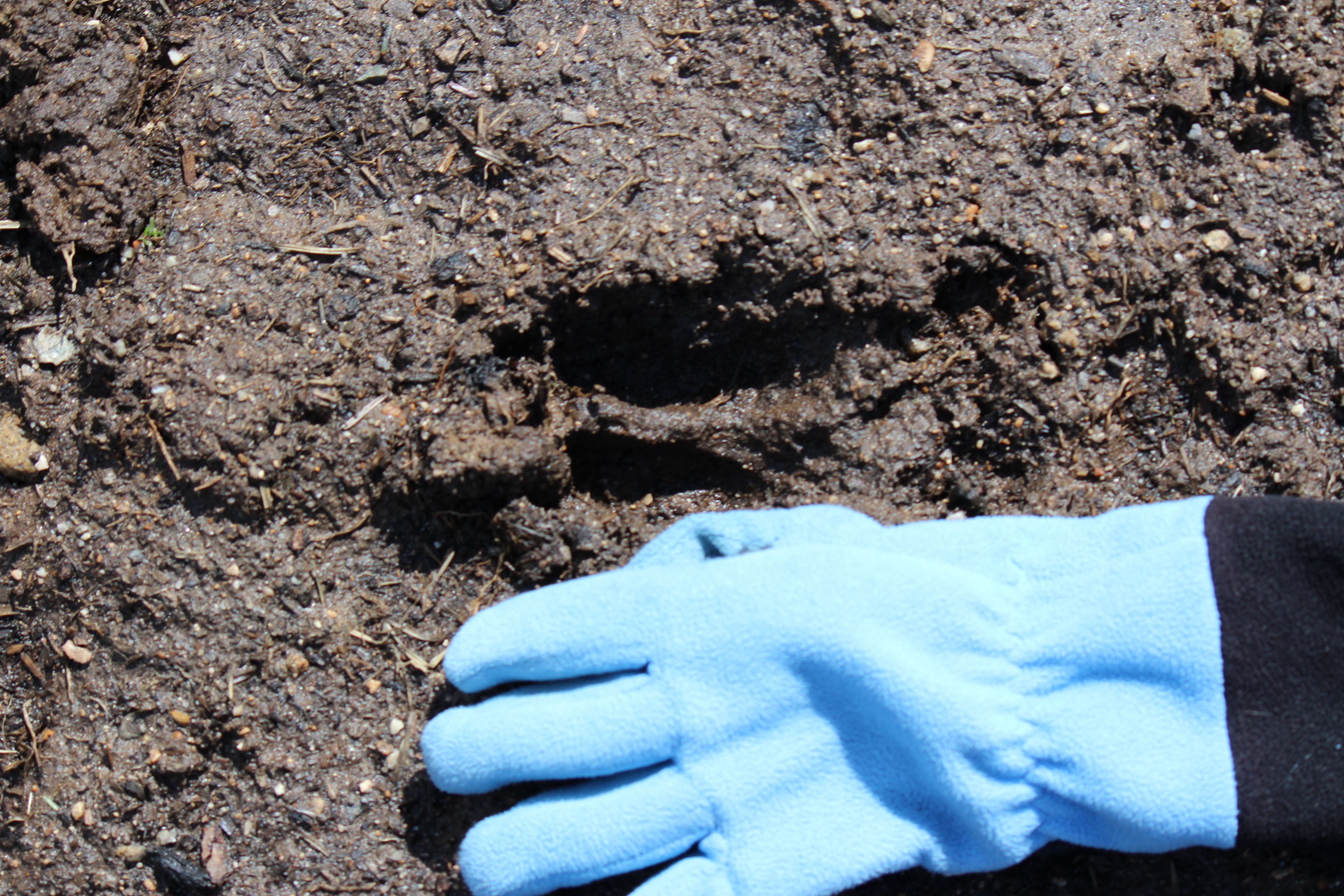
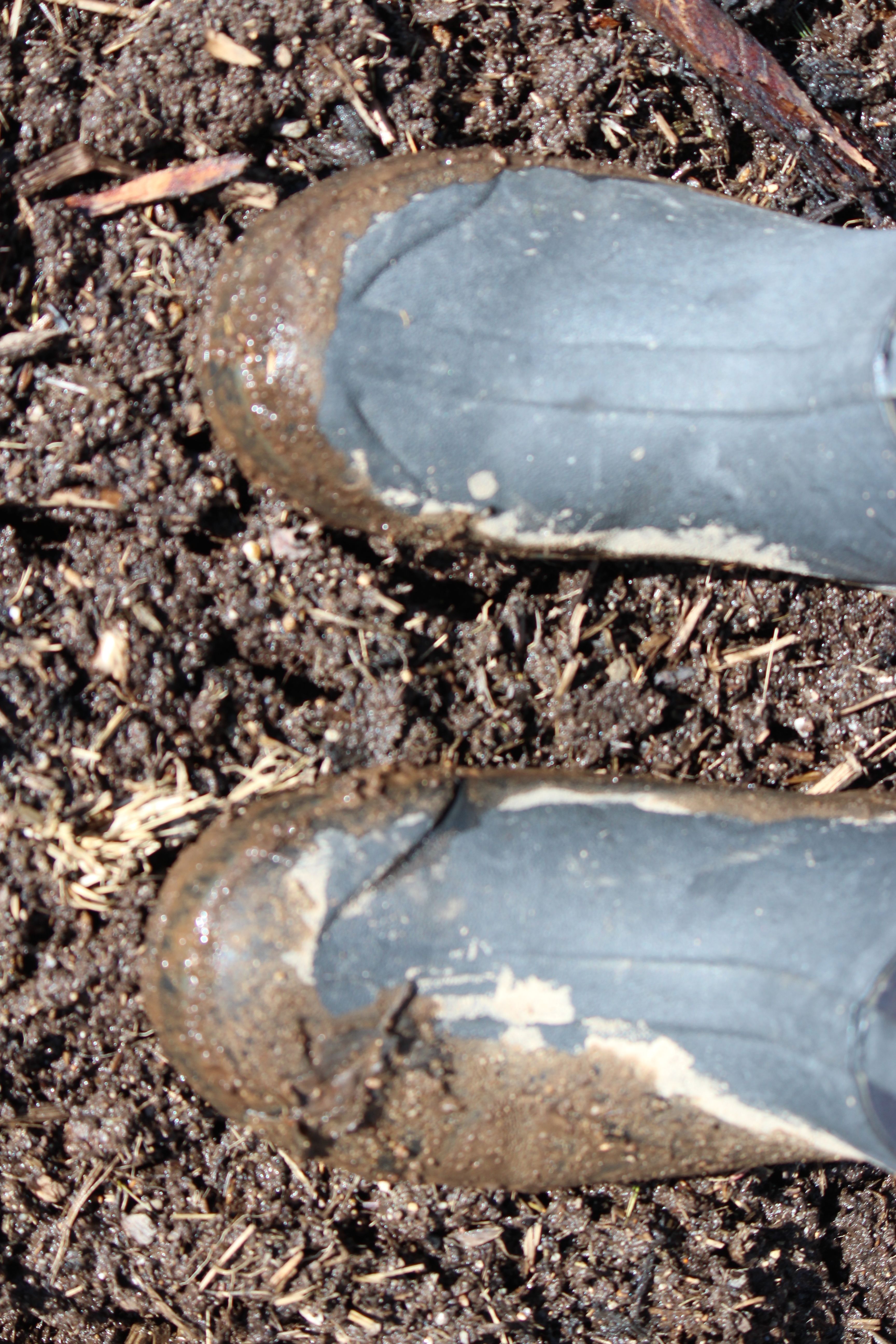
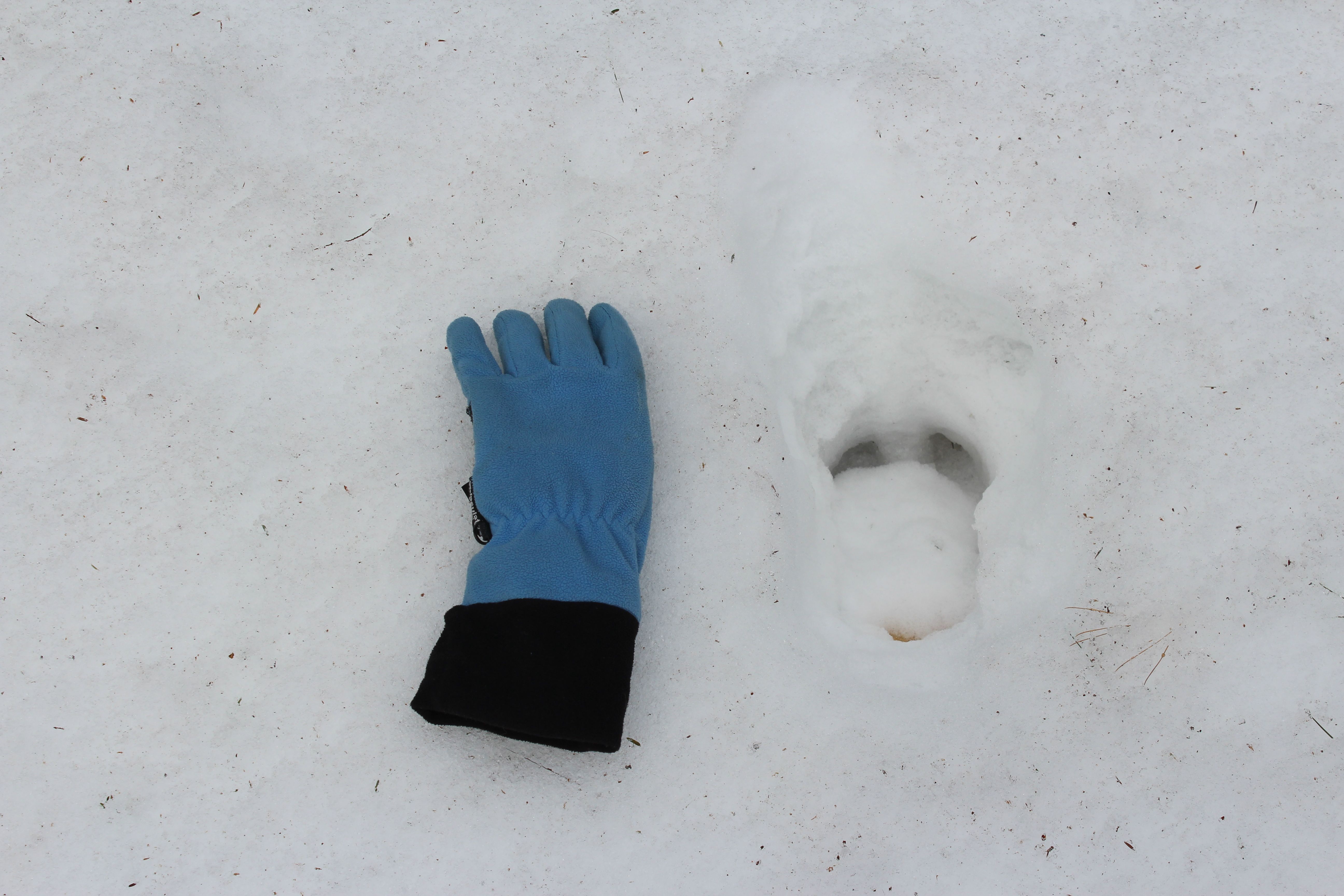
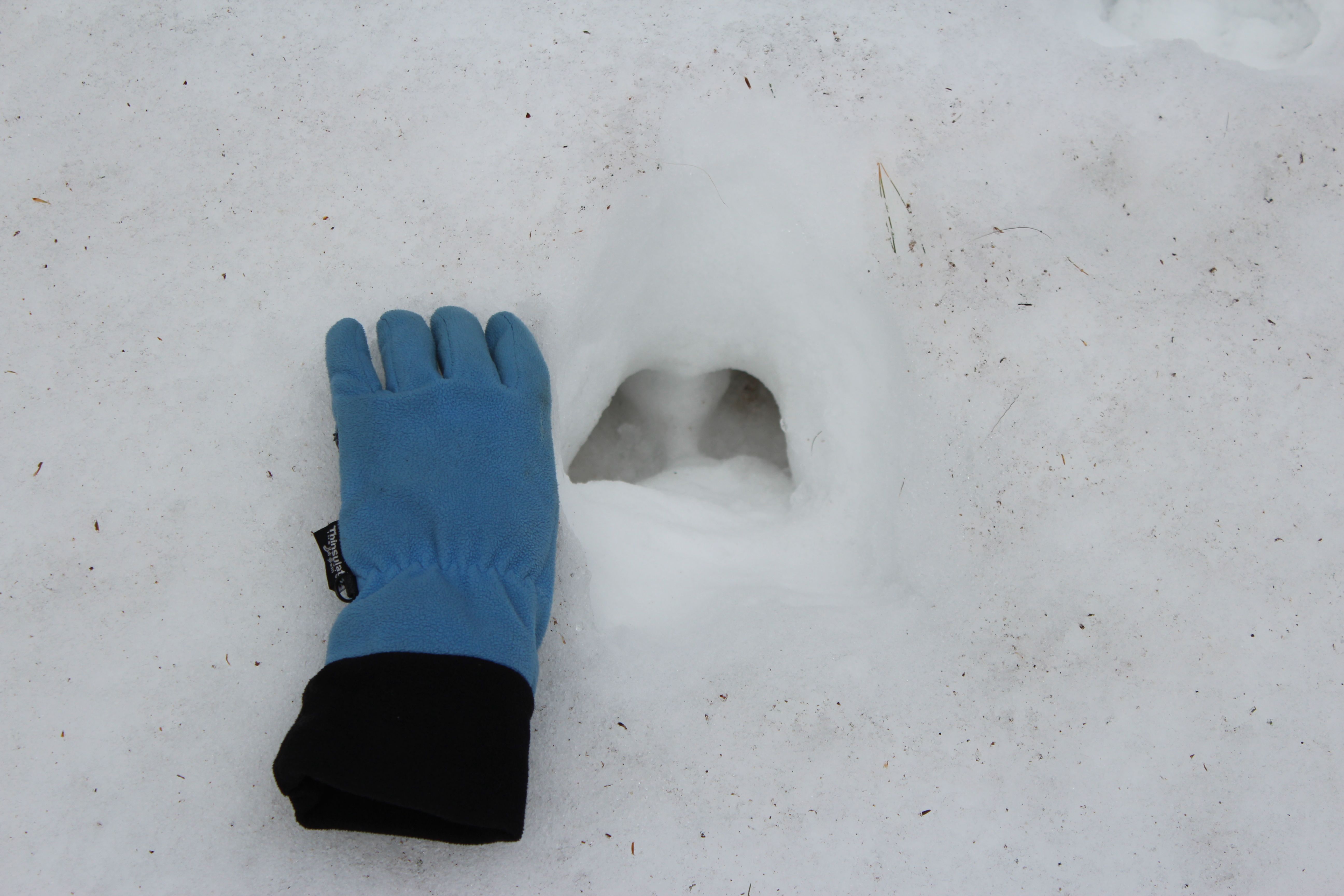
Another sight worth noting–the footprint left behind by a moose–traveling in the opposite direction of my foot. This was discovered by an observant participant on a recent walk for Loon Echo Land Trust.

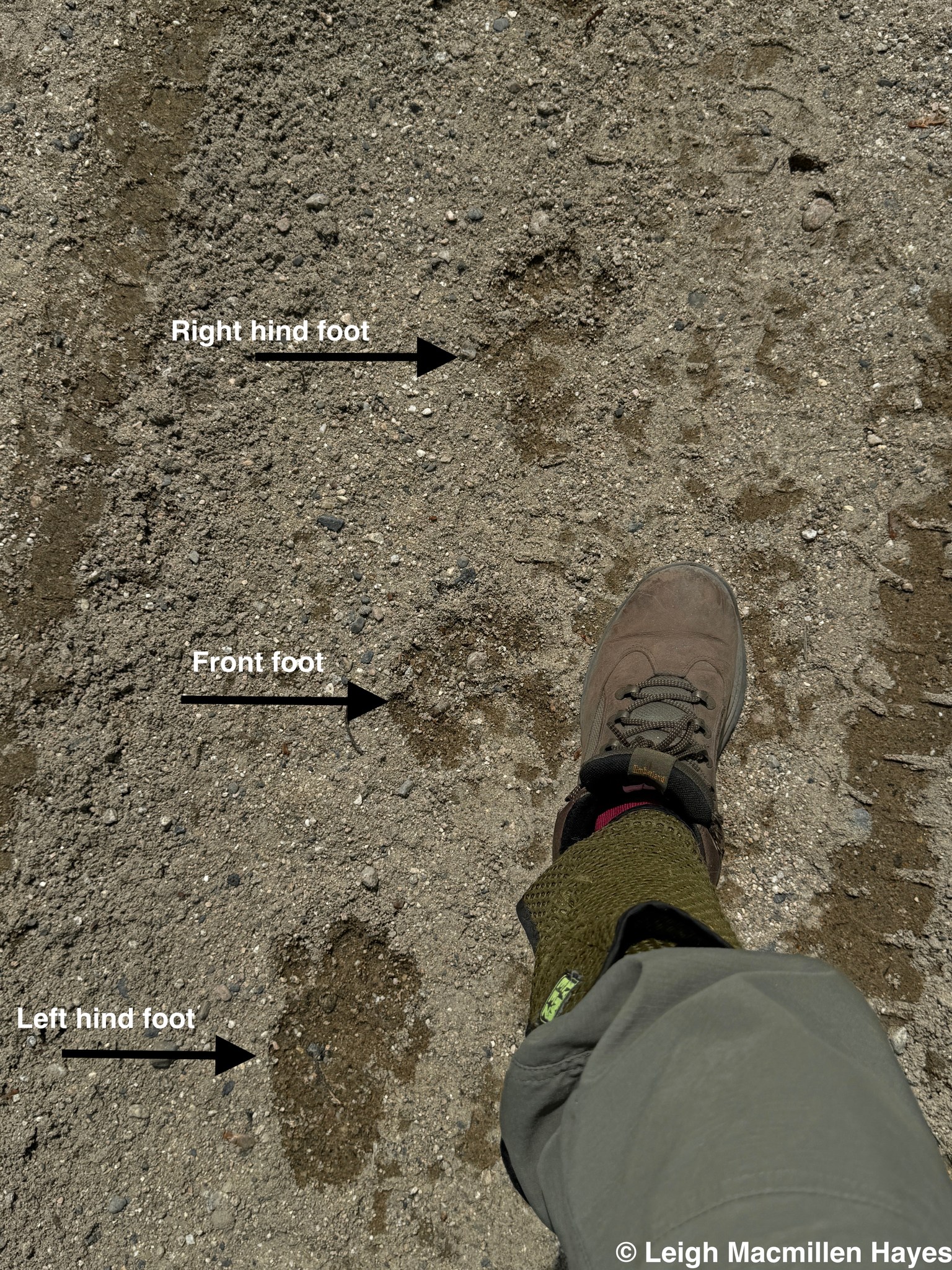
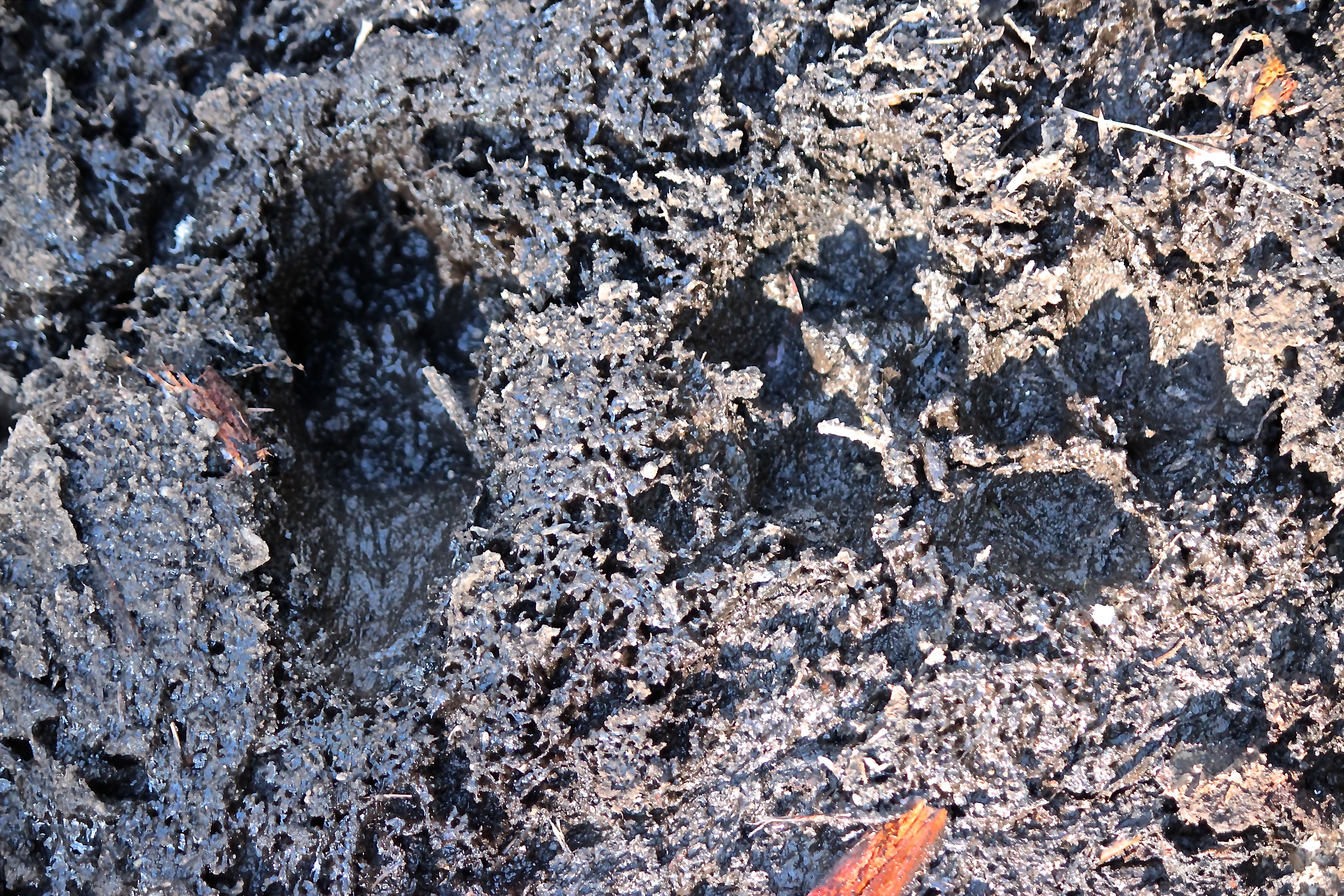
And an even better observation: the track of a Black Bear. My foot is located beside a front foot as you can see, with the larger hind feet registering before and after. The big toe is on the outside of the foot, opposite of ours. The better for climbing stability.

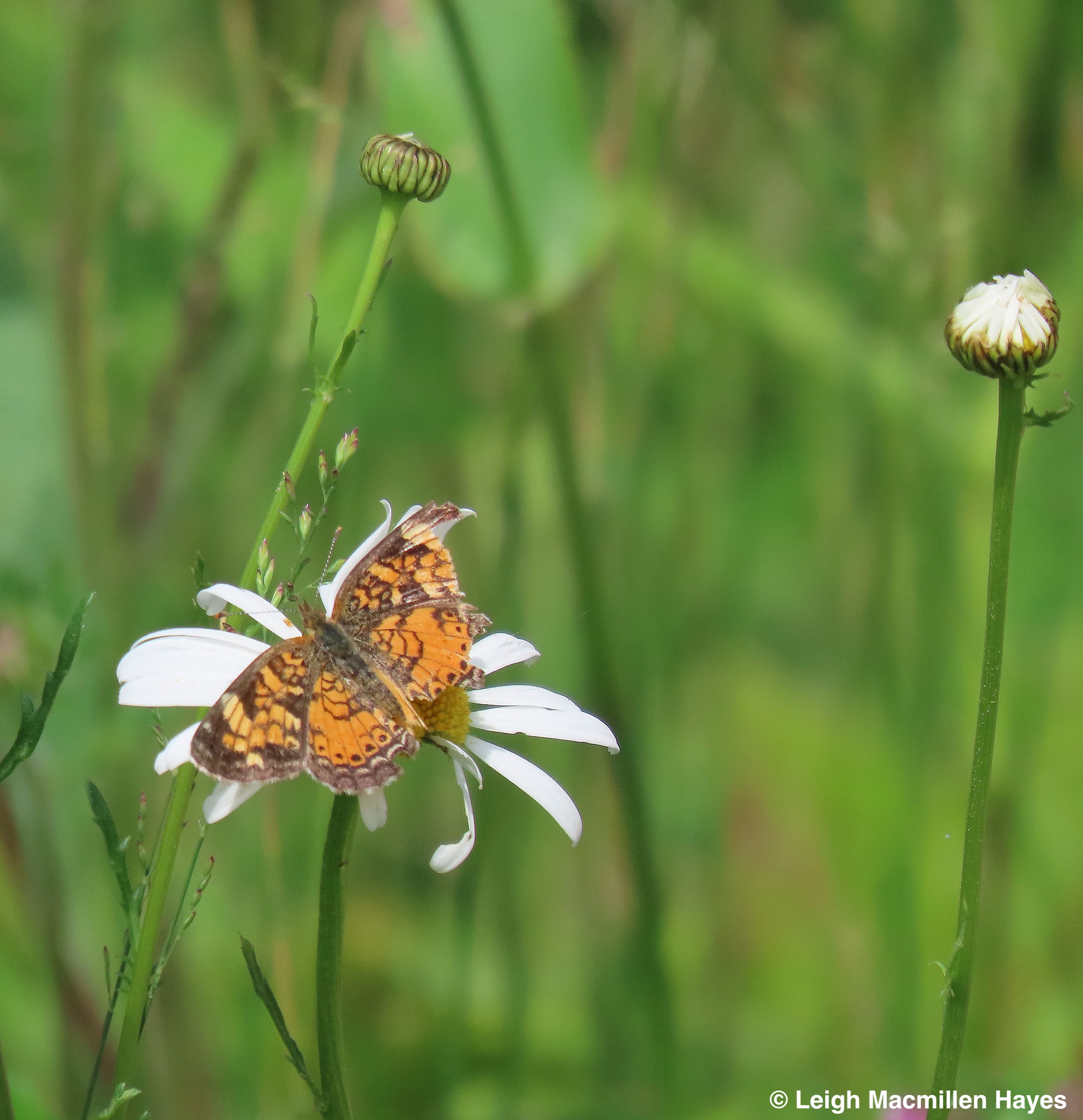
It still seems early for butterfly flight to me, but this Pearl Crescent showed us this morning that life hasn’t been easy given its tattered wings.

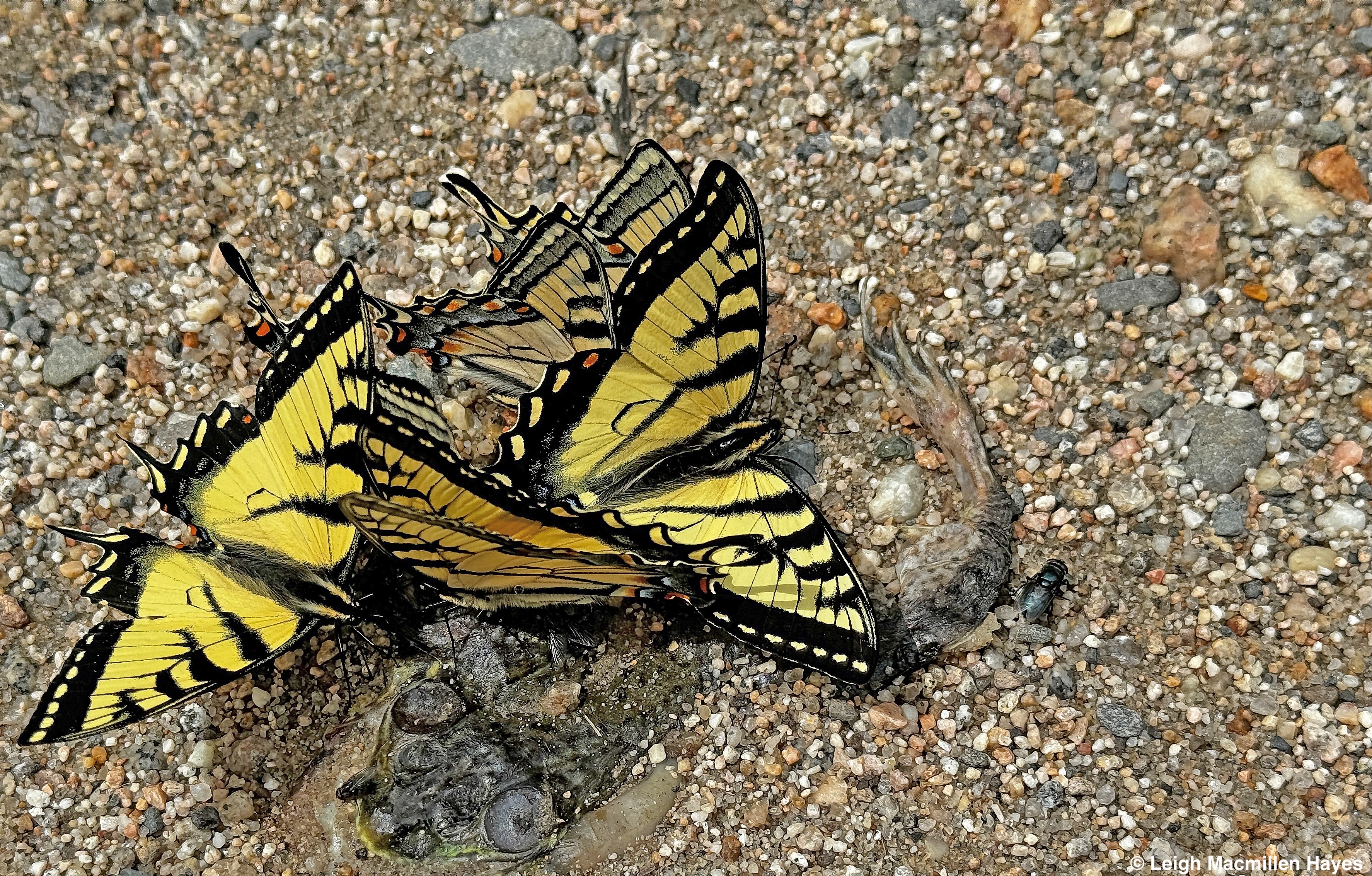
I think one of my favorite sightings along this path, other than the moose and bear prints, oh, and the dragonflies, of course, was something I couldn’t share with My Guy. The timing just happened to be right on this particular visit, when Eastern Tiger Swallowtail butterflies, so differentiated from the Canadian Tiger Swallowtail by the fact that the yellow band near the edge of the underwing was broken by black marks.

They were puddling, an act of probing for salt and minerals. Most puddlers are males, who ingest the nutrients that are then stored in their sperm. During mating, the male passes these goodies along to the female as a nuptial gift in his spermatophore. 

So we assumed it was scat upon which they puddled.

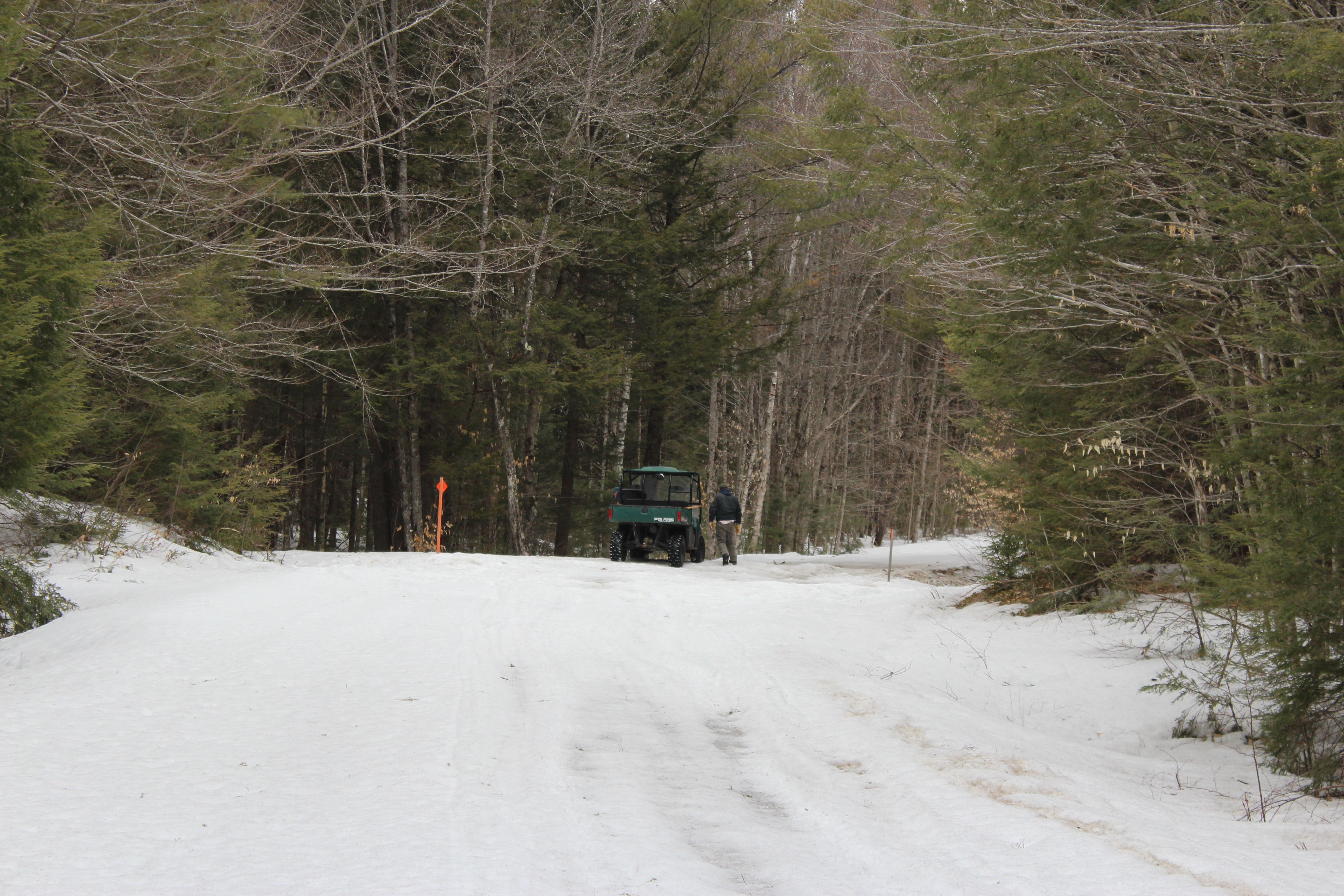
Until we realized it wasn’t. They’re choice of nutrient-offerings–a smooshed frog. The trail is not just for walkers. ATVs and even trucks use it.

Yes, the poor frog. BUT, the butterflies and flies made sure that it did not go to waste.

And another frog smiled. I’m smiling too, for it is officially summer. Happy Summer Solstice 2024.

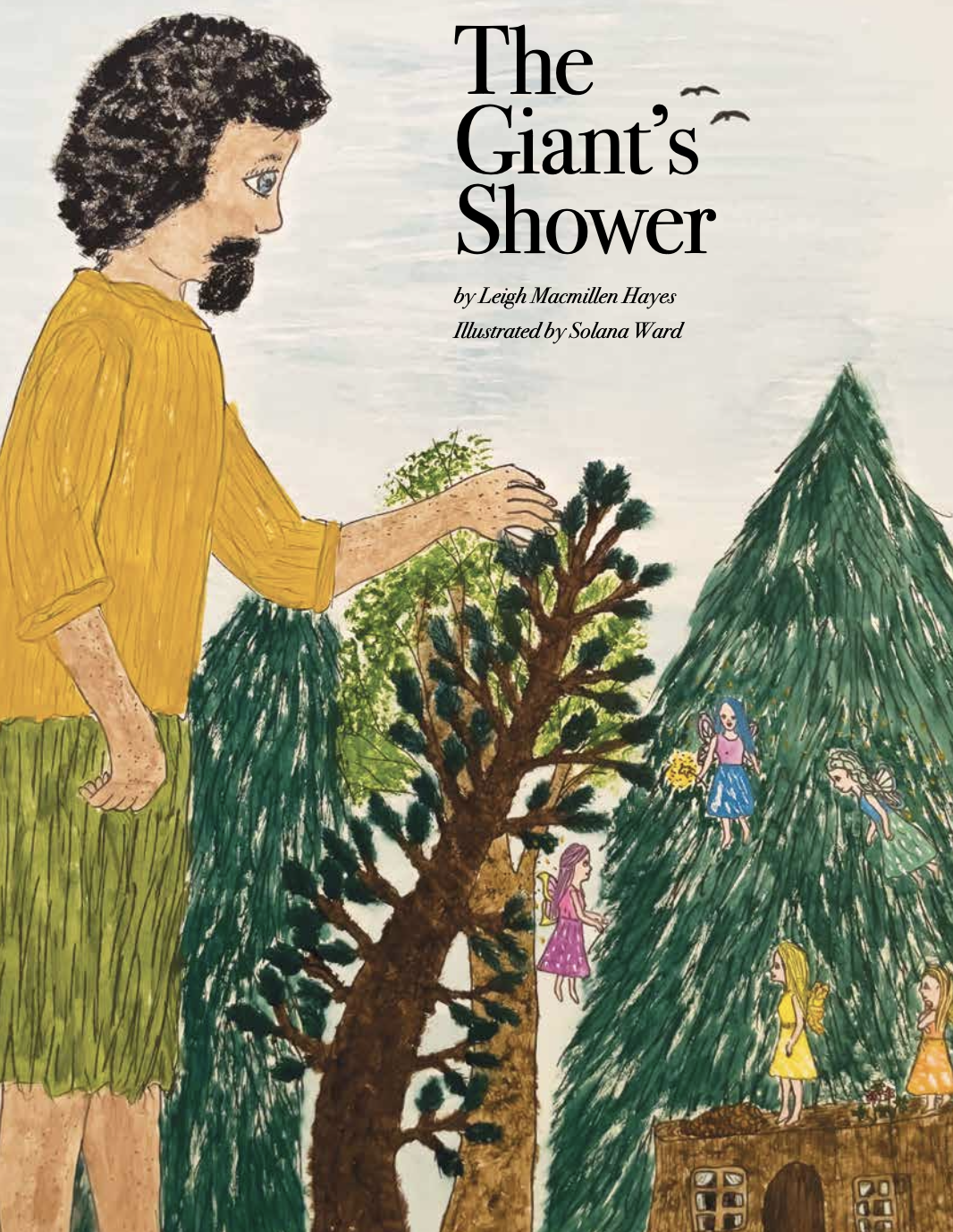
And speaking of the solstice–be on the lookout tonight for the characters of my fairy tale doing some dancing in the woods, as they did in The Giant’s Shower.

Lions, and Otters, and Moose Mondate!

We drove across the border and south today in search of wildlife. And we were not disappointed as our sightings were numerous.

But first, lunch. That in itself was a treat–mine being an Avocado and Roasted Veggie Panini. You are looking at the second half, which was supposed to follow me home. But . . . the avocado would have turned brown. And so I gobbled it all down. Sometimes, you just have to do the right thing.

We may not have been the only ones eyeing lunch, though what this Bobcat was looking at, we could not determine.

It was less than ten feet away from this second Bobcat and it appeared that they had their eye on the same little tidbit. Perhaps a mouse or chipmunk was on their menu.

With a lick of the chops, it appeared that the nearby Mountain Lion had indeed enjoyed a morsel of delight. So, the fact that we saw a Mountain Lion is rather curious because they were officially extirpated in New Hampshire. But . . . sometimes one makes it way into the state and perhaps this was one of those.

I love how its front paw rests so naturally on its back leg. And my, how big those paws are. Notice also that the claws are tucked in. Members of the cat family only use their claws to capture prey (or if conditions are muddy or in some other way slippery, then the claws are extracted to help with stability).

In the midst of our adventure, we stepped into a garden filled with flowers and flowering shrubs and trees, a haven for pollinators this early in the season.

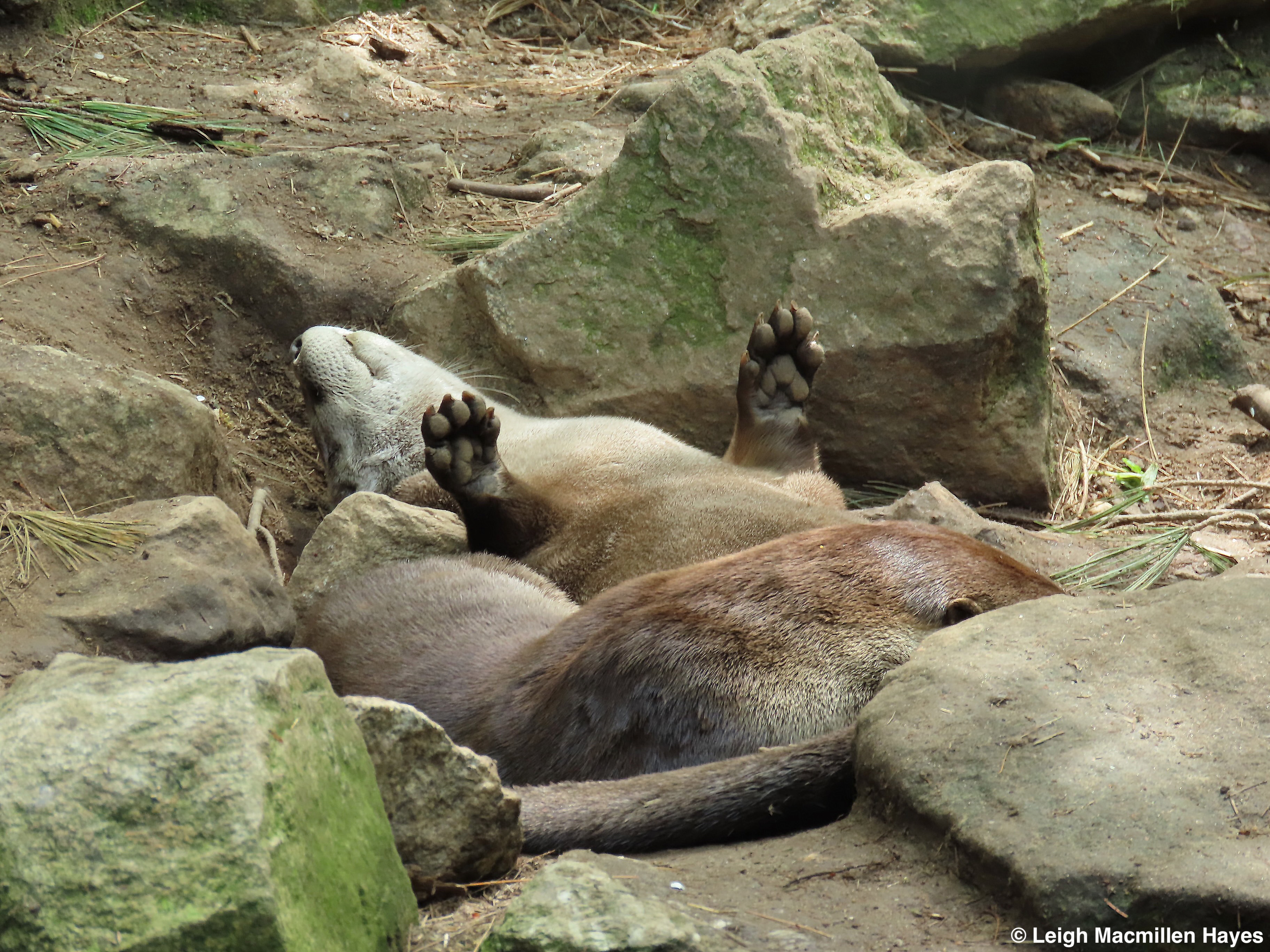
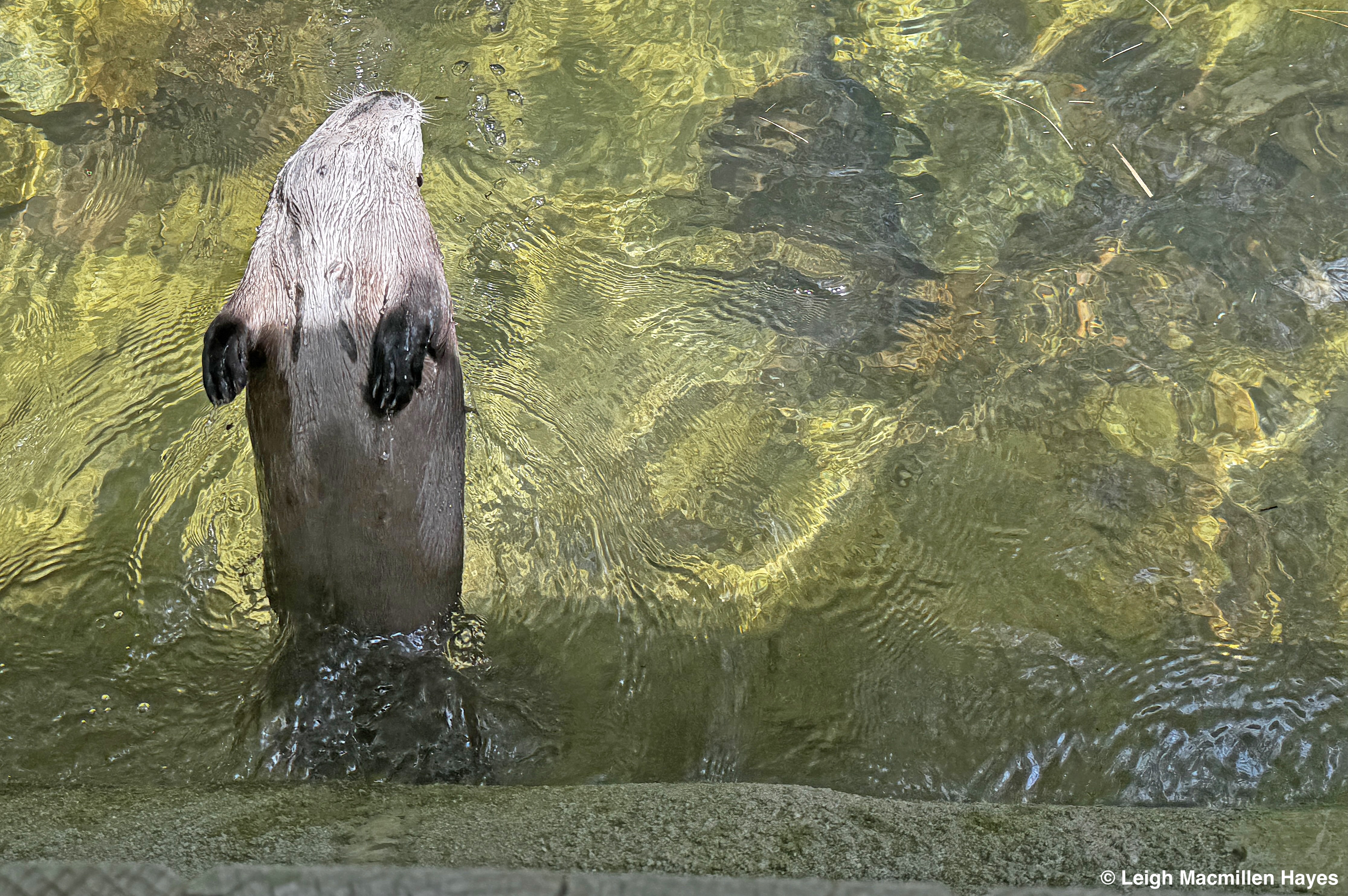
And then it was on to search for River Otters, who had obviously decided to take a post lunch nap. And rejoice in the opportunity. Or so it seemed with those front feet raised.

Take a look at the bottom of those paws–with their five tear-drop shaped toes identifying them as members of the weasel family.

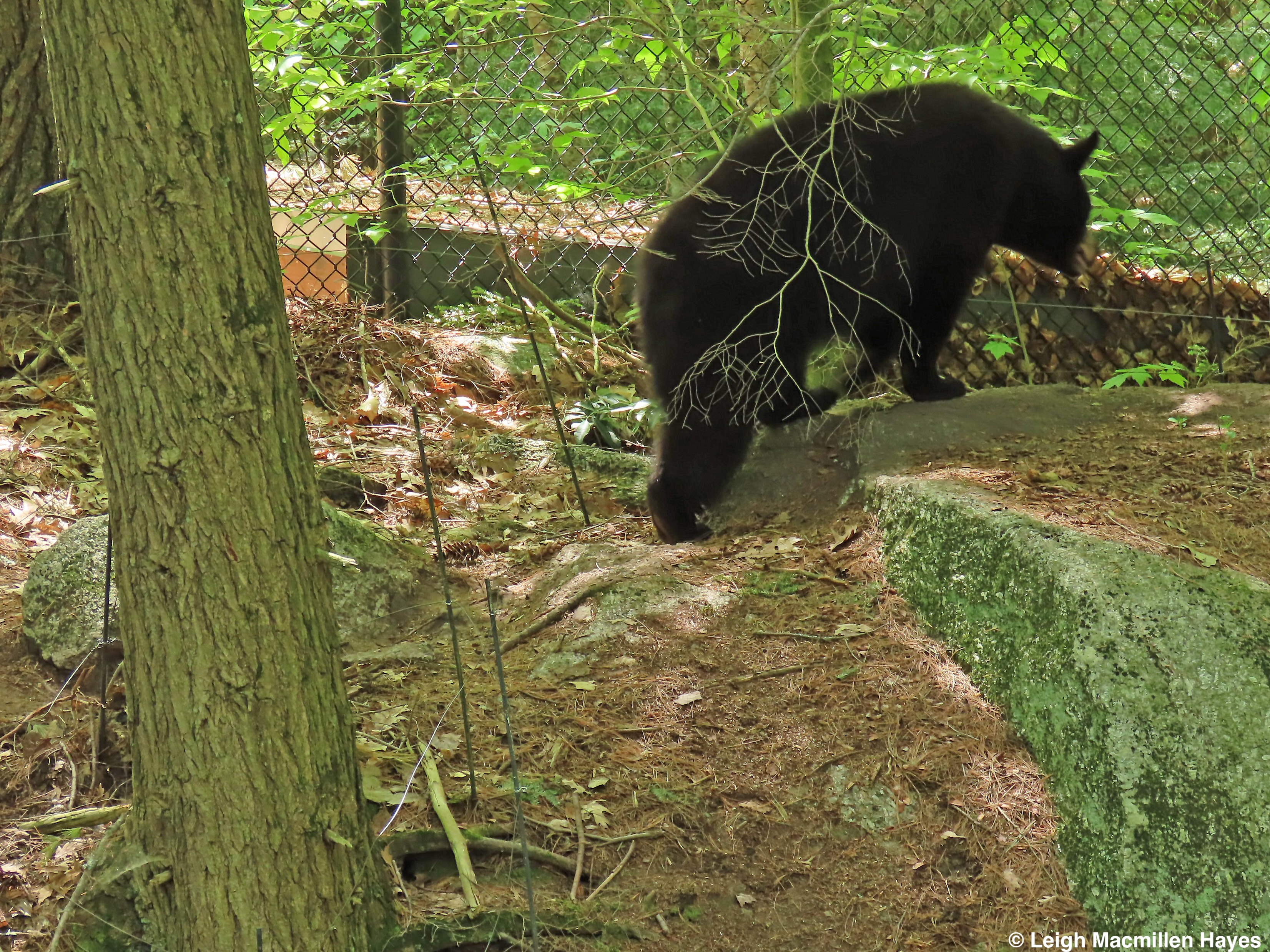
Our next sighting mystified us a bit. As two who are always looking for signs of Black Bears, we were thrilled to see this one. Every once in a while we are granted such views, but the troubling thing today was how the bear paced. Back and forth and back again. It was obviously anxious about something despite its ability to roam in a large area.

Birds were also part of our view, this being a Black-crowned Night Heron, or more simply Night Heron. Look at that eye–its color allows it to hunt at dawn, dusk, and even during the night.

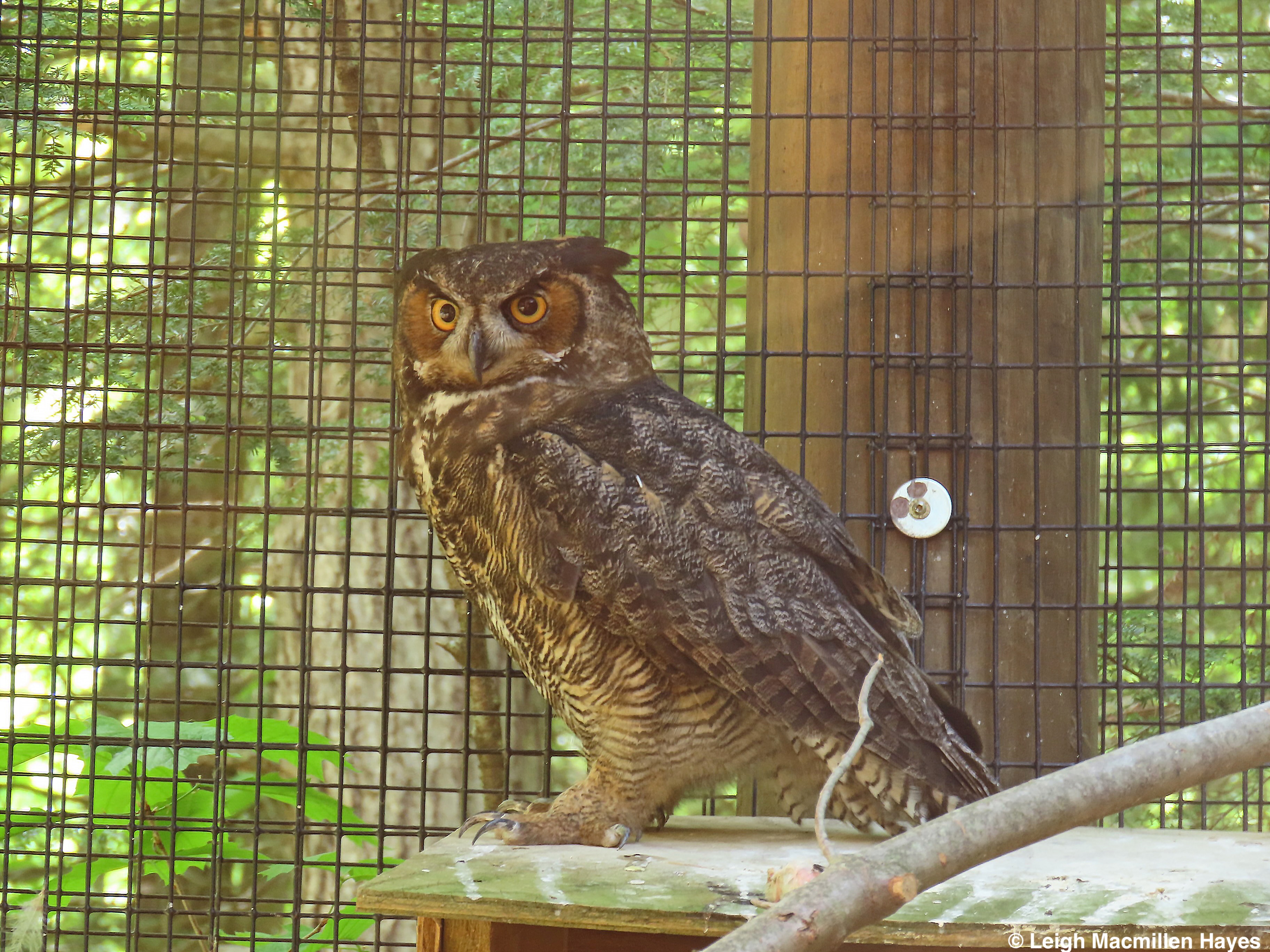
The same is true for the eyes of the Great Horned Owl.

Okay, so by now you’ve turned into a great tracker and hunter and realized that there is fencing behind these animals. Yes, we had travelled to Squam Lakes Natural Science Center in Holderness, New Hampshire, about an hour and a half from home. All photos were taken through glass. Glass that was smeared with finger and nose prints.

The animals are only there because they were orphaned or injured or for some reason couldn’t survive in the wild. And they live in habitats that equal their preferred home territory.

The Red-tailed Hawk offered a shrug, maybe because it thought it should be out in the open. But, it had an important job to do here: to educate all of us. To be an ambassador.

How often do we get to eye all of these species up close. Their behavior might not be entirely natural given their confinement or injury, but I think it’s amazing that we can visit with them and that so many tots were there with their moms today, and there were a couple of school groups visiting as well. These kids get to meet these critters, and maybe will develop an appreciation of them, and who knows where that might lead.

Today was the beginning of a heat wave, and the Bald Eagle reacted by panting, its way of cooling down.

Our plan was to walk through the exhibits, and then hike some of the trails, including climbing to the summit of Mt. Fayal.

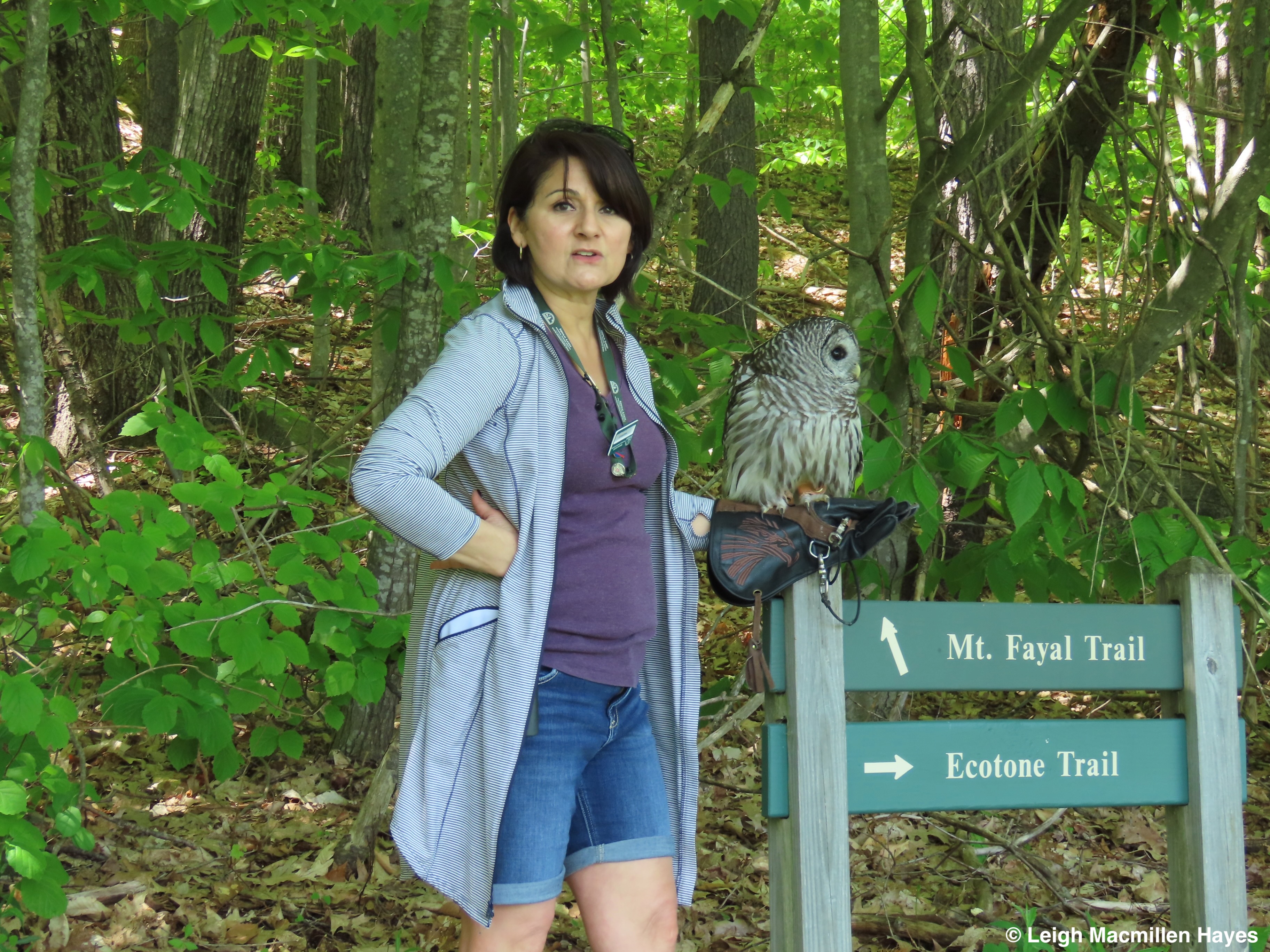
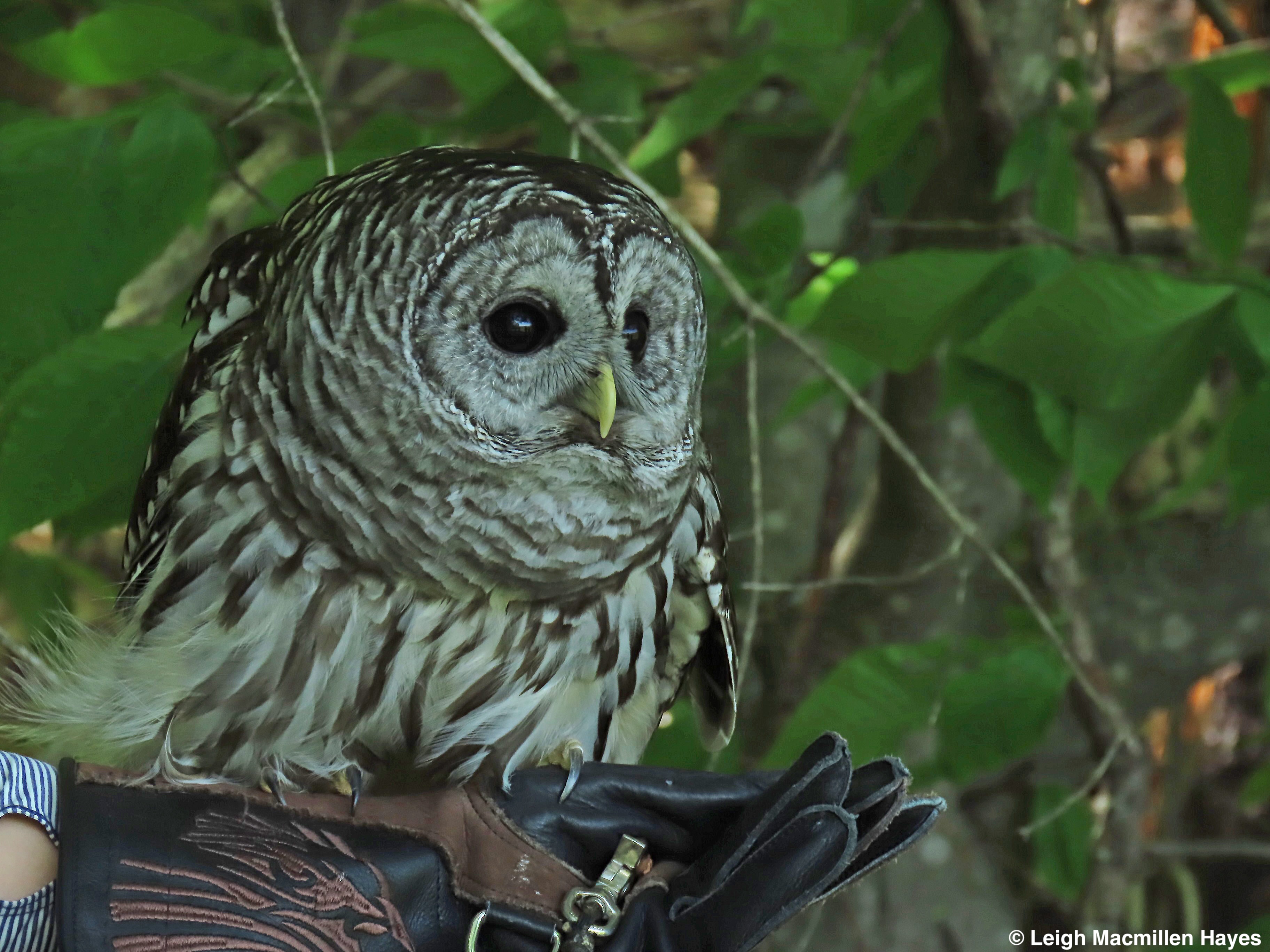
Along the way, we had a special treat, for we got to meet Barred 13, who was out for a walk as well, and panting.

The “name,” Barred 13 refers to the fact that this was a Barred Owl that came to the Center in 2013. As a policy, they do not name the critters who reside there so folks like us won’t think that wild animals should become pets.

Barred 13 was very curious about something in the vicinity. We learned that she once heard a Black Bear before her handler turned and saw it. And that she’s at the Center due to a broken wing.

The Barred Owl’s hearing is so acute that it can pinpoint the location of its prey. There’s a cool exhibit to help us humans better understand how well they hear, but I’ll leave that for you to discover upon a visit.

At the summit of Mount Fayal, My Guy found a bench upon which to sit for a bit and enjoy the view of Squam Lake.

What he missed, I discovered behind the bench.

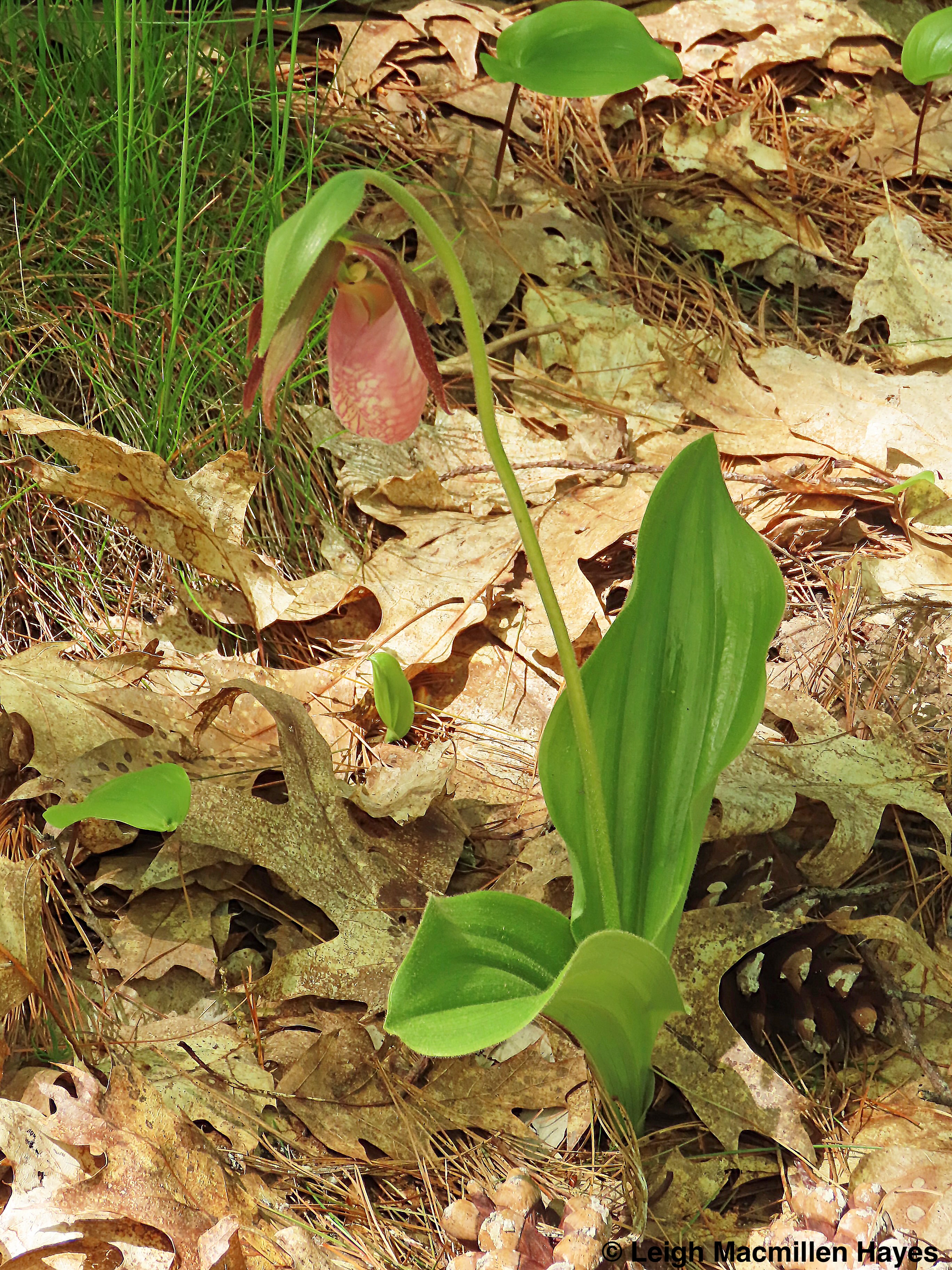
A Pink Lady’s Slipper. The first for us for this year.

His comment: “Only one?!”

We are rather Lady Slipper’s Snobs. Truth be told.

Back on the animal exhibit trail, we stopped by to visit the Otters again. Thank goodness. The most amazing thing–we were the only ones there. The Otter exhibit is usually packed.

We quickly realized that the time to visit the Center is in the mid to late afternoon, after the kids have packed up and gone home. Or if you go earlier, do like we did and head off for a hike before returning to the exhibits.

The two Otters entertained as they constantly climbed up toward us and then did backflips into the water.

Up . . .

Bend over . . .

And swim.

And flip over and swim some more.

Lions, and Otters, and Moose–but wait. This moose was in the same pose when we left as it was in when we arrived. Allegedly we saw a moose. Well, we have a photo to prove it. But, unlike all the other critters, it wasn’t alive. Still.

Squam Lakes Natural Science Center–we highly recommend a visit, no matter how many years you have under your hat.

And lunch from Squam Lake Marketplace. The flour-free Chocolate Chip and Peanut cookies–a great way to end a meal, even if you wait three hours for the ending because your belly was filled by your sandwich.

A Mondate worth noting.

Happy 9th Birthday, wondermyway!
Thank you to all who read and comment and share wondermyway.com. Some of you have followed my blog posts since the beginning, February 21, 2015. A few have joined the journey as recently as yesterday. I’m grateful for the presence of all of you in my life.

To mark this occasion, I thought I’d reflect upon those moments when my wonder gave me a glimpse of the “Thin Places” that I’ve experienced either by myself or in the company of others.

To quote my friend, Ev Lennon, “A Thin Place is a spot of beauty, loveliness, space–an example of the wideness and grandeur of Creation.”

I think of them as places that you don’t plan a trip to visit, but rather . . . stumble upon.

I had
the track of
a bobcat to thank,
for it showed me the way
to a special friend.
It was without expectation 
that we met
and spent at least
an hour together.
And then I realized
though its sight is not great,
it was aware of my presence
and I hightailed it home,
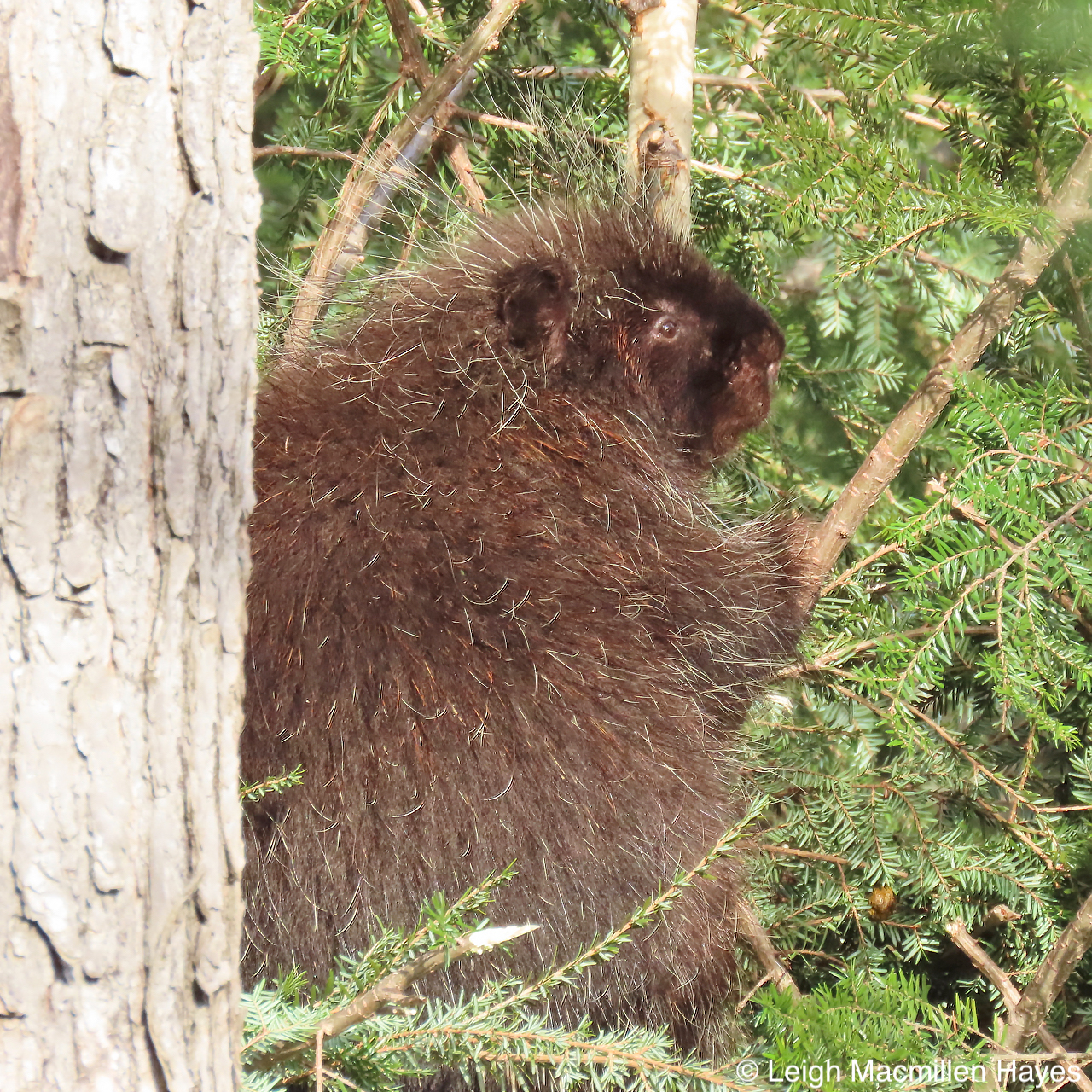
but I will always
celebrate time spent
with the Prickly Porcupine.
Something quite small
scurrying across the snow
captured my attention
and suddenly
there was a second
and a third
and then hundreds
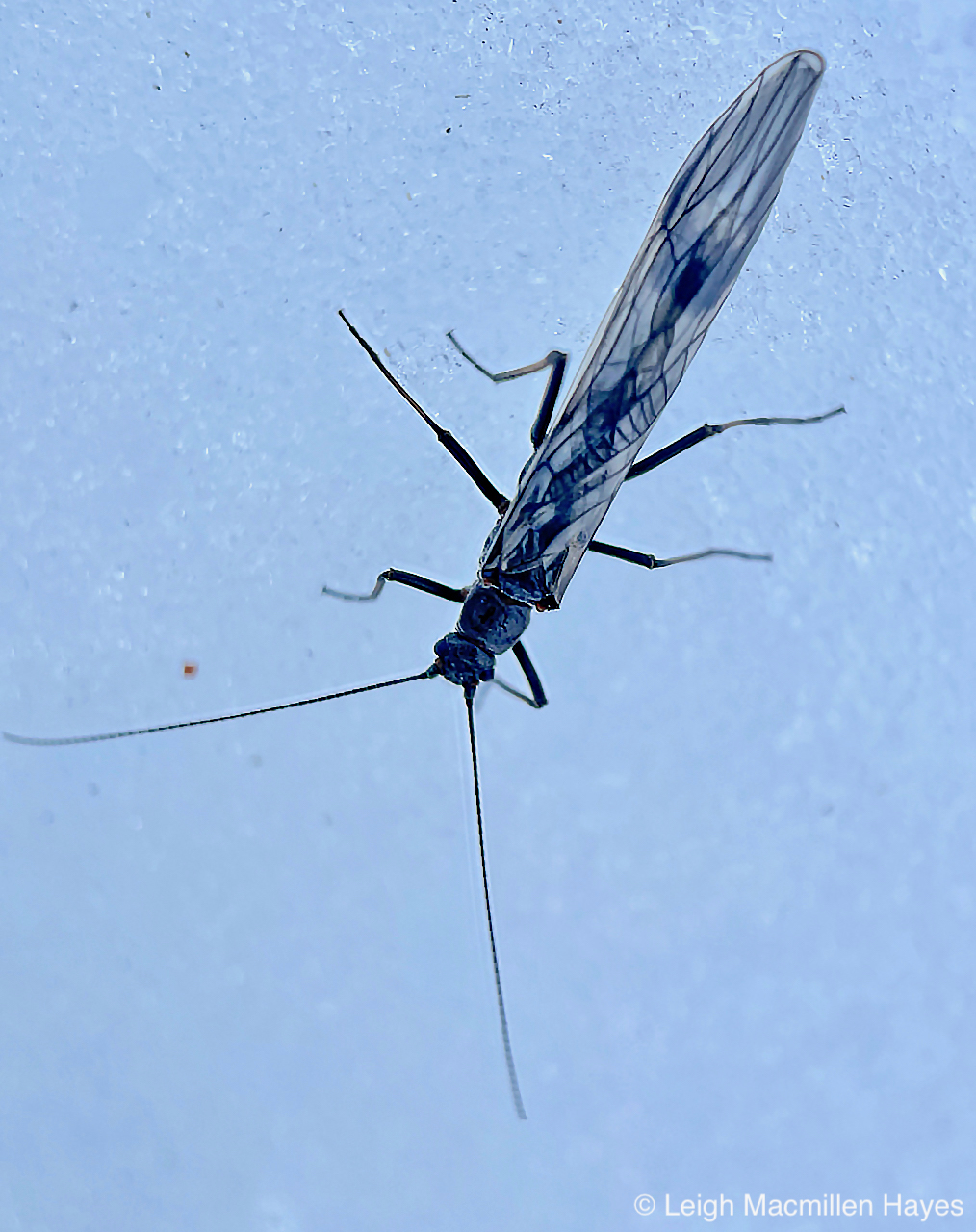
of Winter Stoneflies.
All headed west from the brook
toward mature tree trunks
to beat their drum-like structures
against the bark
and announce their intentions to canoodle.
Though I could not hear
their percussion instruments,
I am grateful
to learn
with those who
march to the beat of a different drummer.
Standing beside quiet water,
I was honored
on more than one occasion
to have my boot and pant legs
considered the right substrate
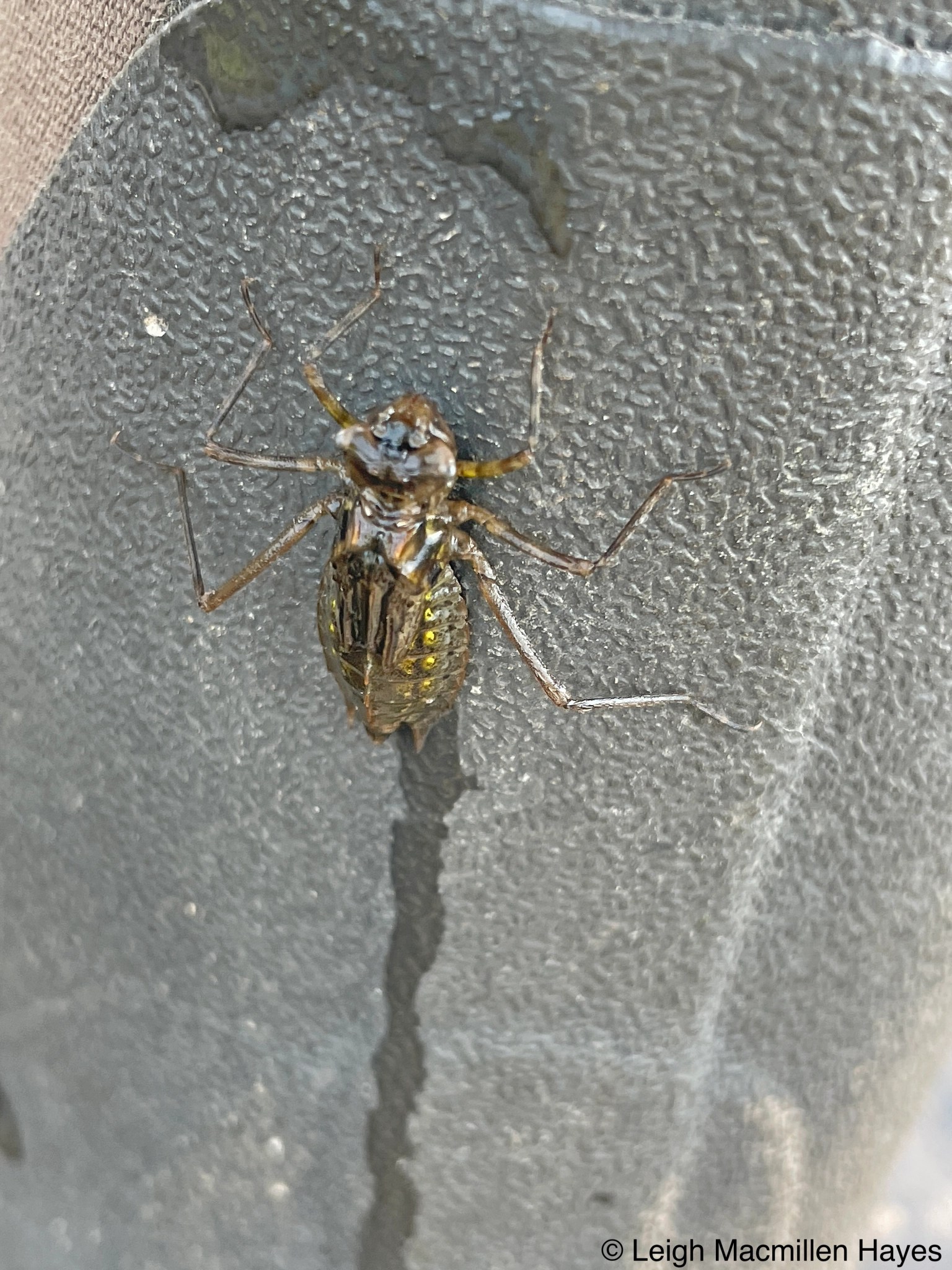
upon which to transform
from aquatic predator
to teneral land prey
before becoming
a terrestrial flying predator.
It takes hours
for the dragonfly to emerge
and I can't think of a better way
to spend a spring day
than to stand witness
as the mystery unfolds
and I begin to
develop my dragonfly eyes
once again.
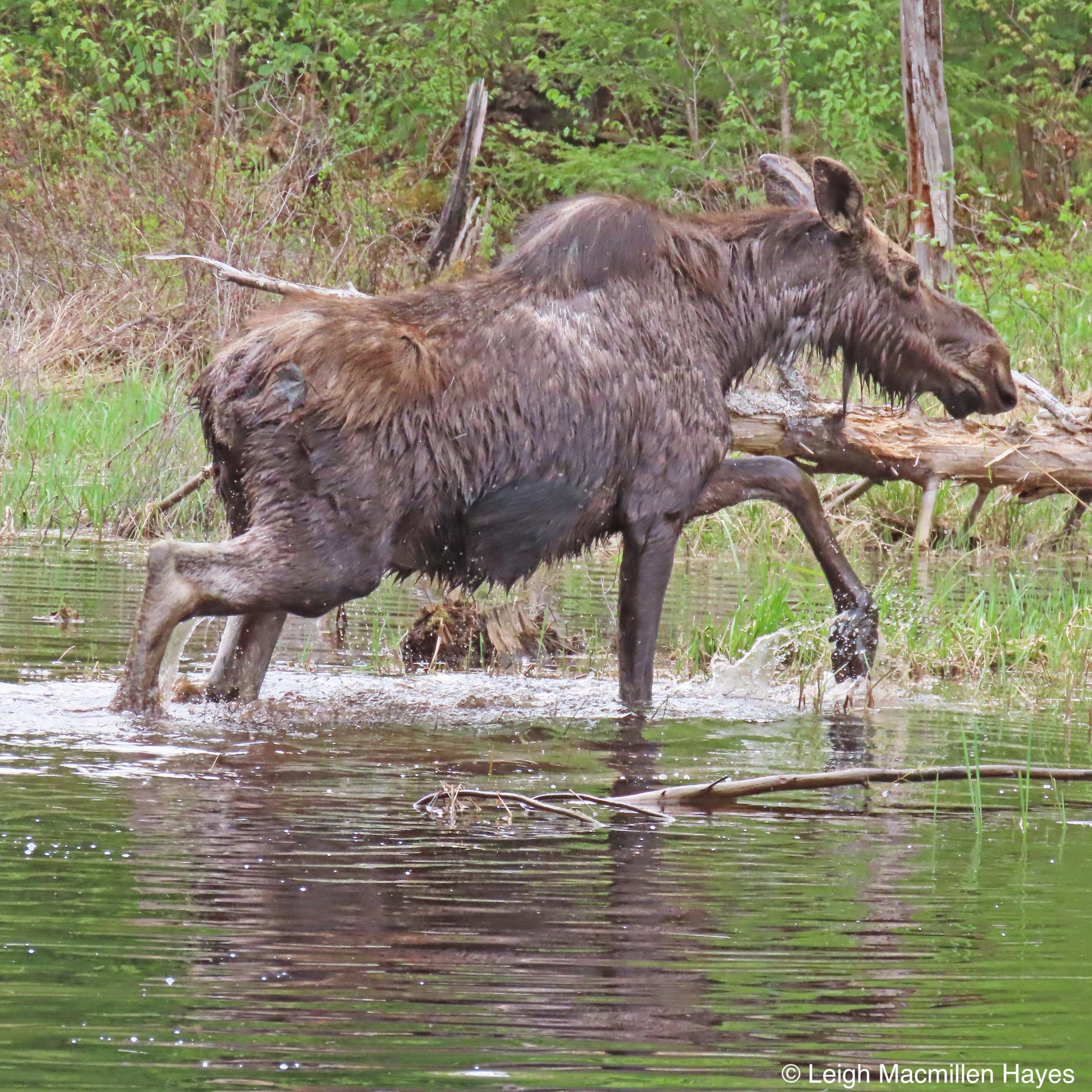
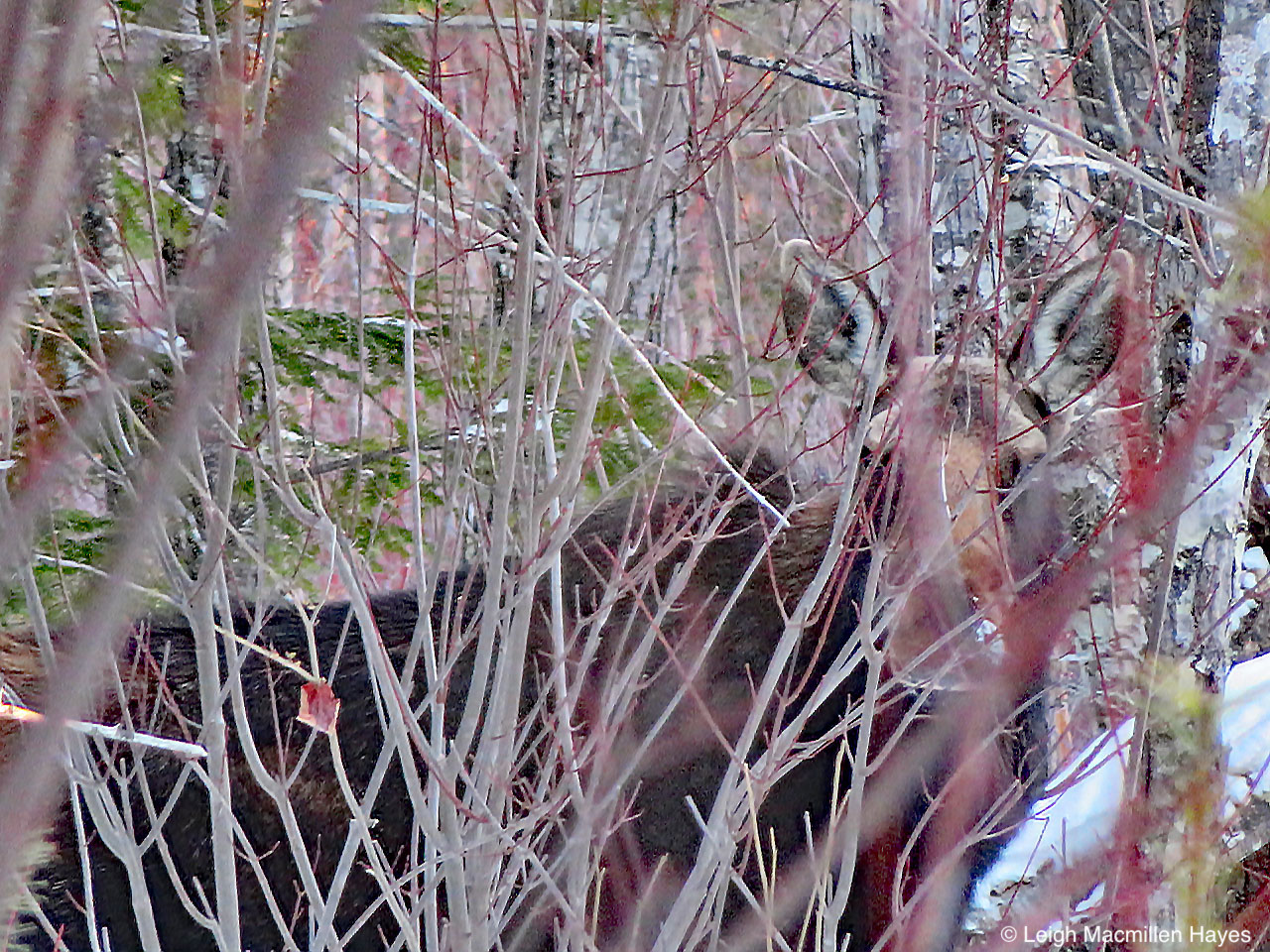
It took me a second 
to realize that I was
staring into the eyes
of a moose,
and another second
to silently alert My Guy
while grabbing my camera.
She tip-toed off
as we relished our time
spent in her presence
and at the end of the day
had this Final Count
on a Moosed-up Mondate:
Painted Trillium 59
Red Trillium 3
Cow Moose 1
One was certainly enough!
Some of the best hours
I spend outdoors
include scanning
Great Blue Heron rookeries
to count adults and chicks
and get lost in the
sights and sounds
of rich and diverse wetlands.
Fluffy little balls
pop up occasionally
in the nests and the
let their presence be known
as they squawk
feverishly for food.
And in the mix of it all
Nature Distraction
causes a diversion of attention
when one swimming by
is first mistaken for a Beaver
but reveals its tail
and morphs into a Muskrat.
I give thanks to the Herons for these moments.
What began as a "Wruck, Wruck" love affair
continued
for longer than usual
and due to
a rainy spring and summer
I was treated to a surprise
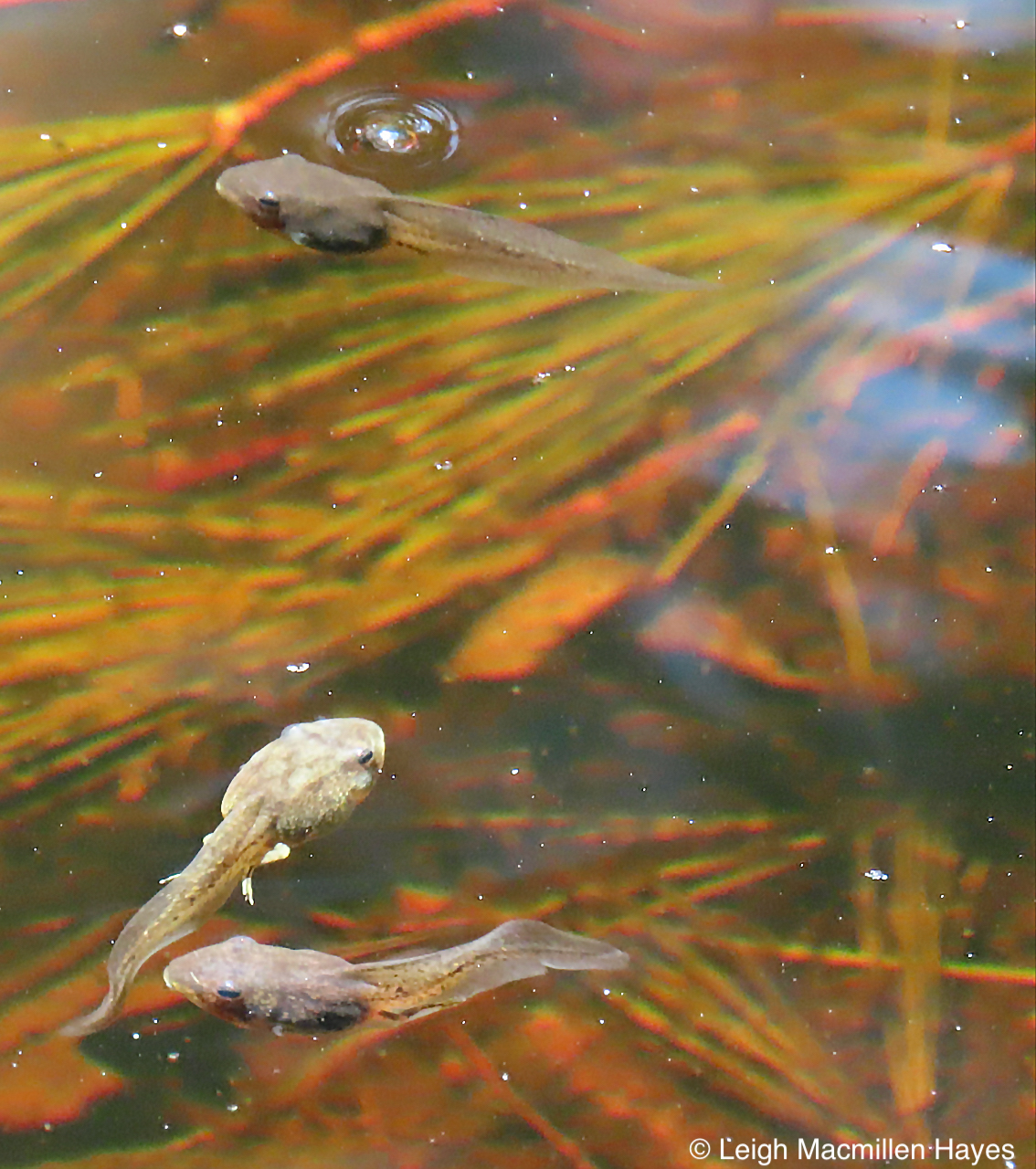
in the form of developing frog legs.
In the midst of my visits
one day I heard
the insistent peeps
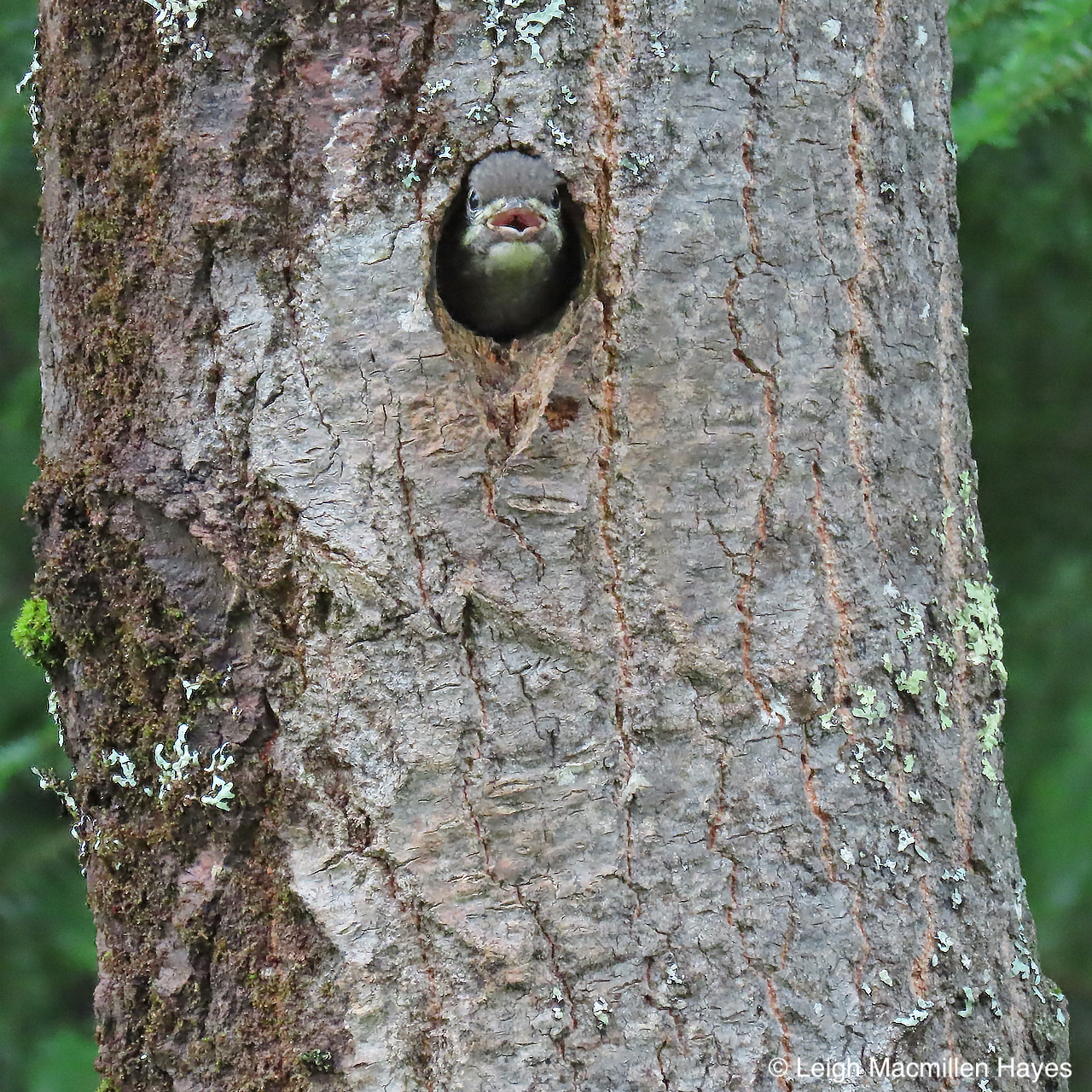
of Yellow-bellied Sapsucker chicks
demanding a meal on wings,
which their parents
repeatedly provided.
Walking home 
from the pool
another day,
I was honored
to spend about ten minutes
with a fawn,
each of us curious
about the other
until it occurred to me
that its mother
was probably nearby
waiting for me to move on,
so reluctantly I did,
but first gave thanks
that something is always happening
right outside my backdoor.
While admiring shrubs
that love wet feet,
I counted over
one hundred branches
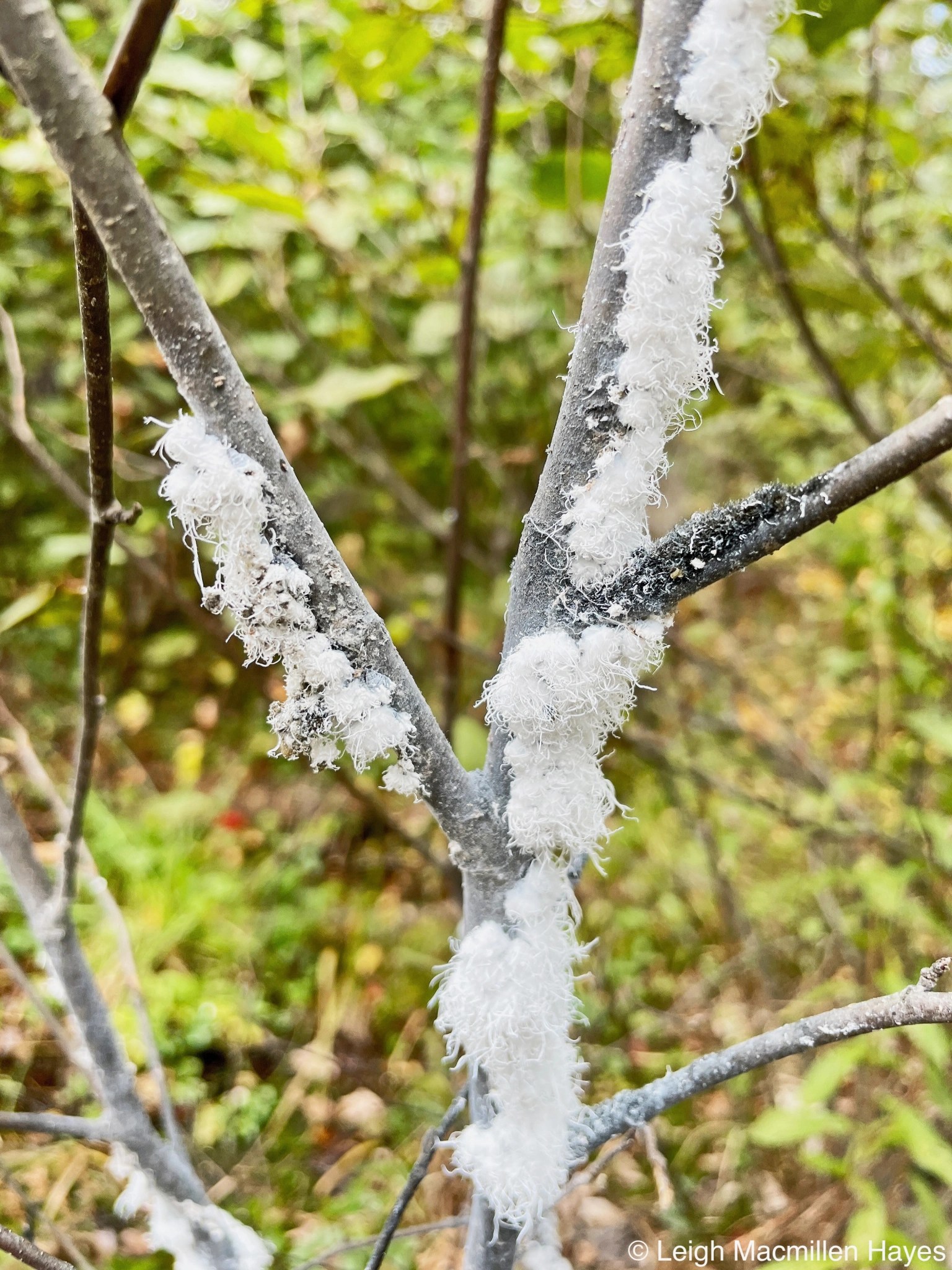
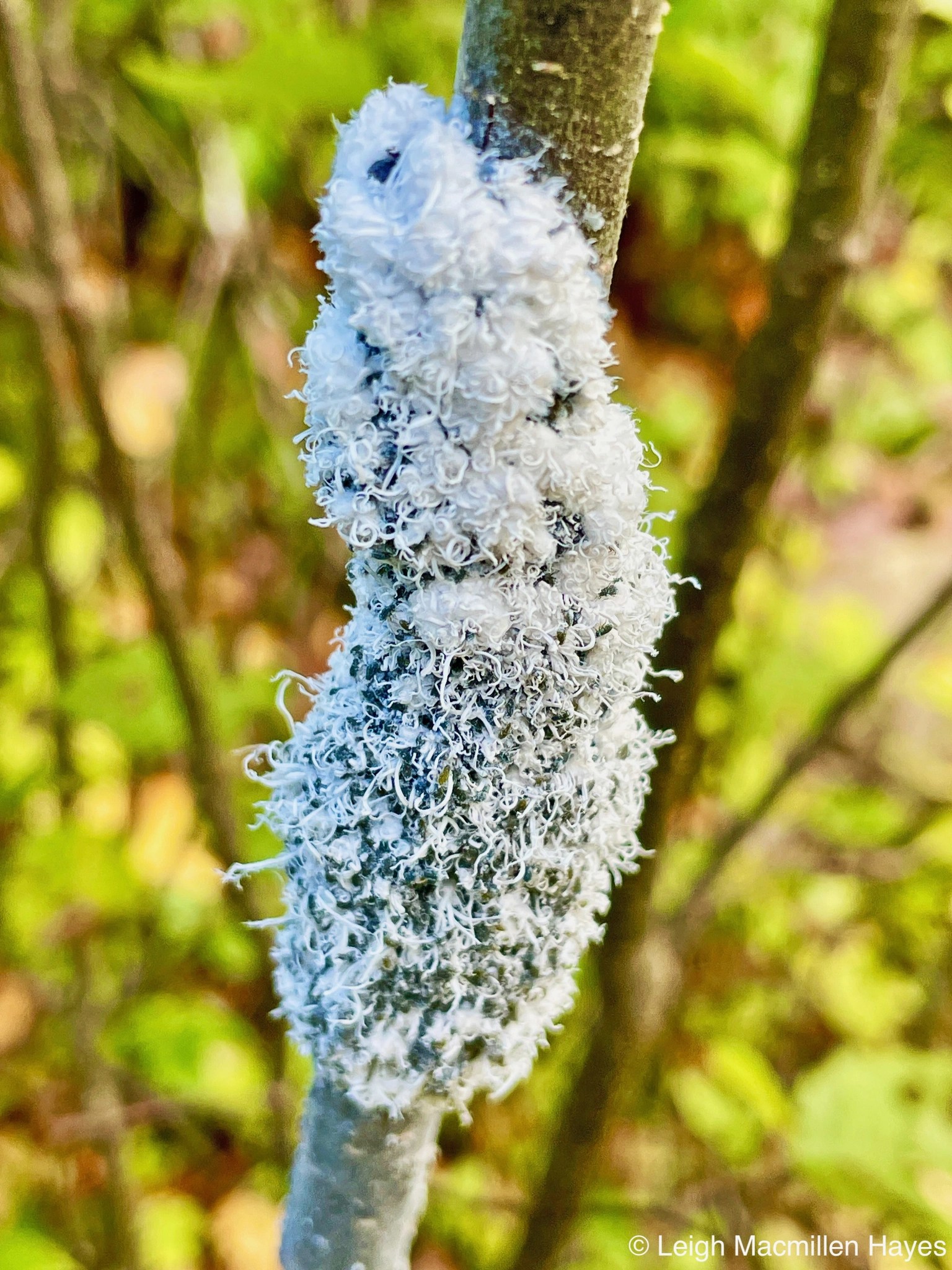
coated with white fluffy,
yet waxy ribbons.
Theirs is a communal yet complex life
as the Woolly Alder Aphids
suck sap from Speckled Alders.
Communal in that
so many clump together
in a great mass.
Complex because
one generation reproduces asexually
and the next sexually,
thus adding diversity
to the gene pool.
Along with the discovery
of coyote scat,
and Beech Aphid Poop Eater,
a fungus that consumes
the frass of the Aphids,
it was an omnivore, herbivore, insectivore kind of day.
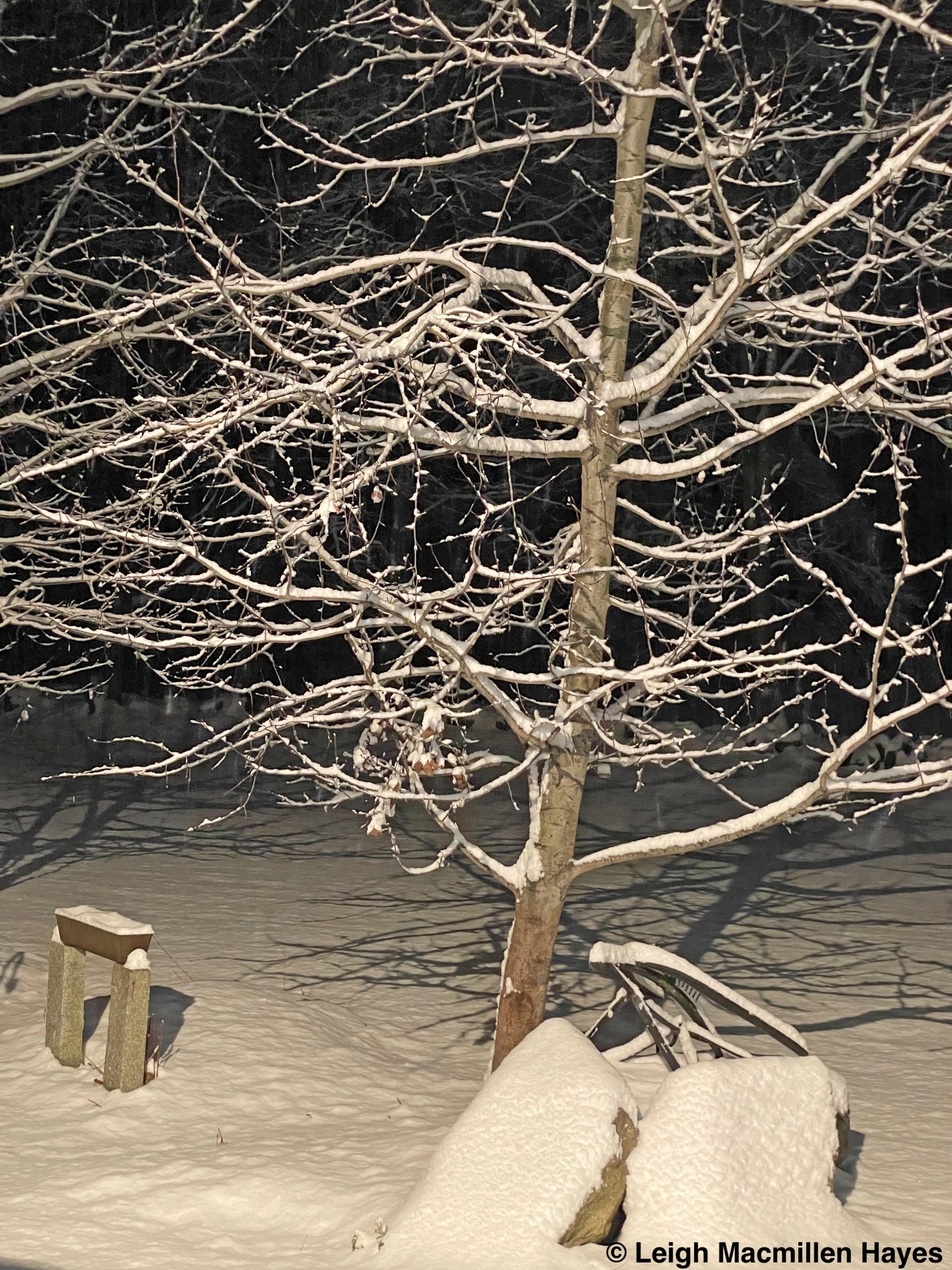
Awakening early, 
a certain glow
in the sky
pulled me from bed
and I raced downstairs
to open the door
and receive the quiet
that snowflakes create.
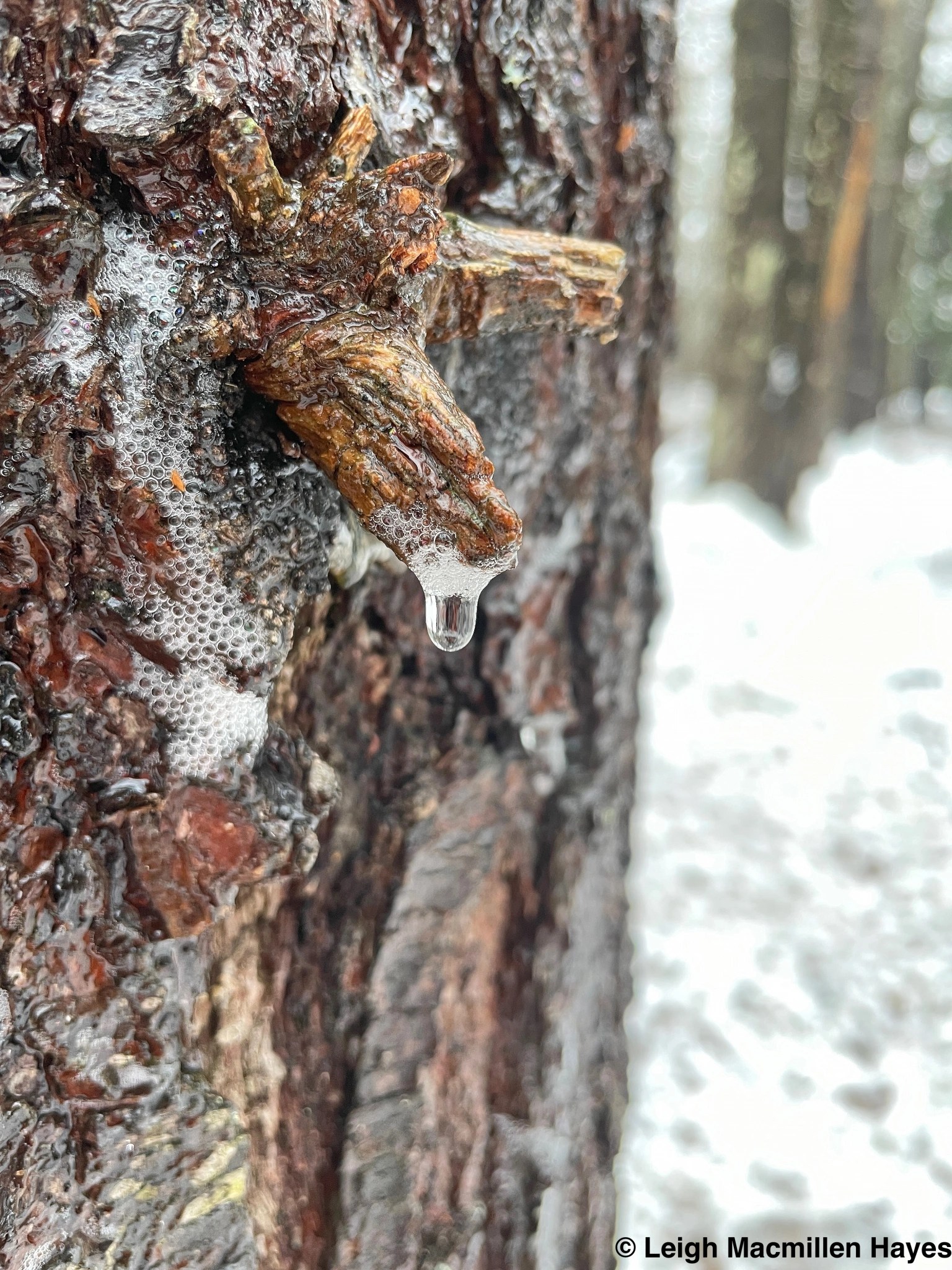
The snow eventually
turned to rain,
which equally mesmerized me
as I watched
droplets elongate
and quickly free fall,
landing on bark below
in such a manner
that caused them
to mix with sap salts and acids.
The result was
White Pines foaming
in the form of
Pine Soap
with its hexagonal shapes:
worth a natural engineering wonder
and I gave thanks for being present.
Occasionally, 
it's the action
outside the backdoor window
that keeps me standing sill
for hours on end,
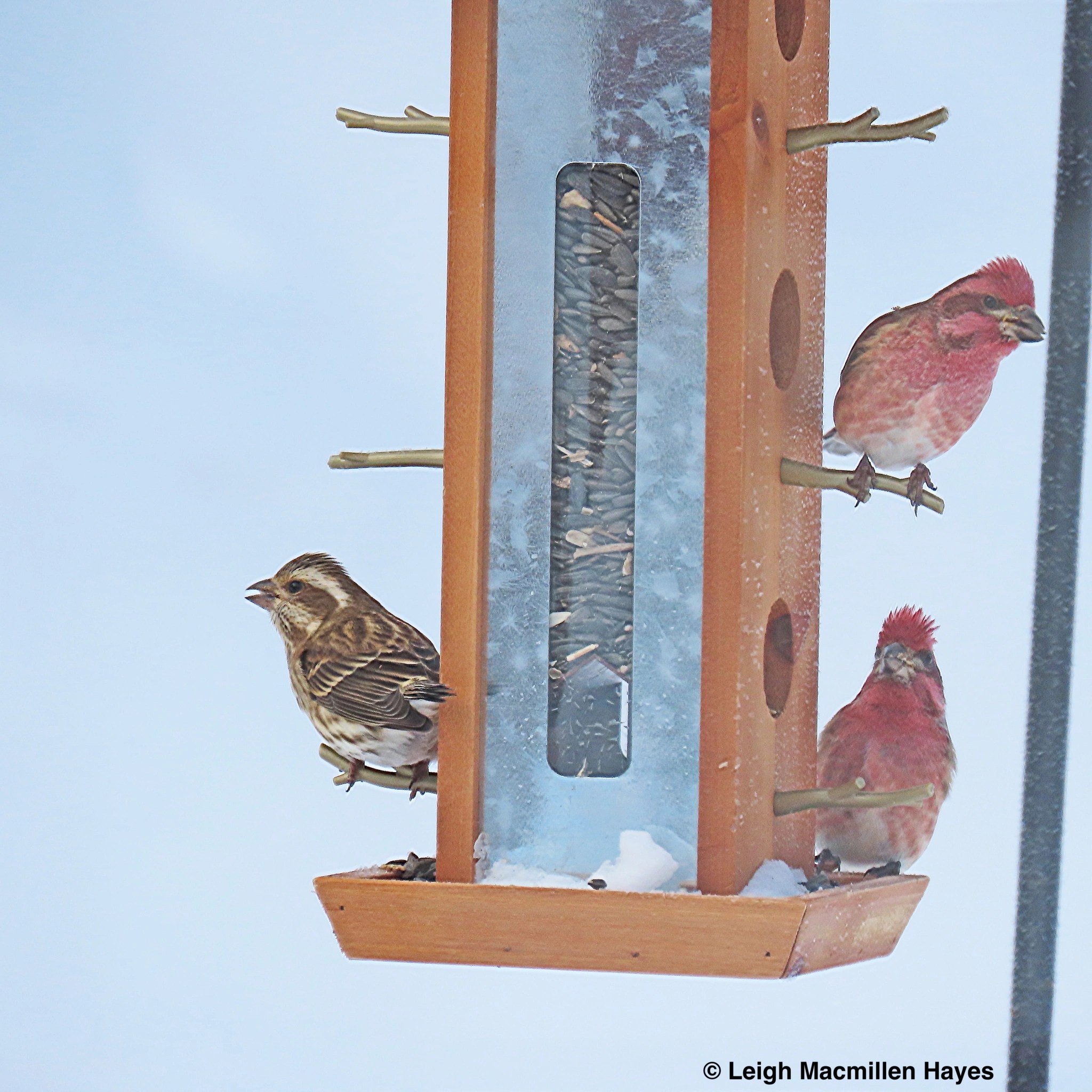
as a variety of birds fly
in and out
of the feeding station,
such as these Purple Finches,
the males exhibiting
bad hair days.
Bird seed is not 
just for birds
as the squirrels prove daily.
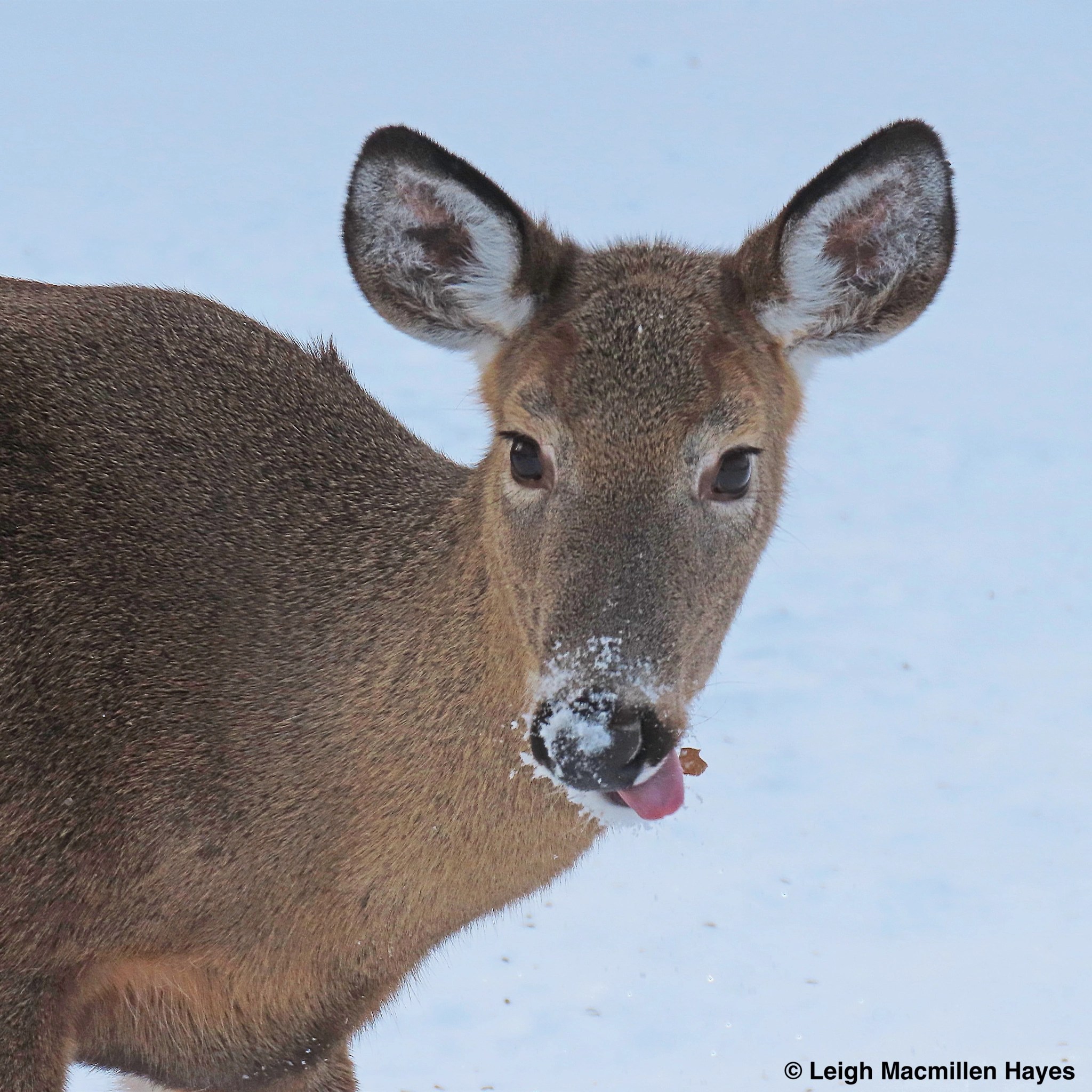
And White-tailed Deer
often make that
statement at night.
But this day was different
and they came
in the morning
using their tongues
to vacuum the seeds all up.
At the end of the day,
my favorite visitors
were the Bluebirds
for it was such a treat
to see them.
But it was the mammals
who made me realize
not every bird has feathers.
These are samples 
of the Thin Places
I've stumbled upon
this past year.

They are a
cause for celebration,
participation,
and possibility.
My mind slows down
and time seems infinite
as I become enveloped
in the mystery.

I give thanks
that each moment
is a gift
and I have witnessed
miracles unfolding
that did not
seek my attention,
but certainly captured it.

And I thank you again
for being
one of the many
to wander and wonder my way.

A Moosed-Up Mondate

Some stories are best told in the wrong order and this one is such. Or at least that’s what I think. You see, My Guy and I headed north today, not far north either. Maybe a little over a half hour from home.

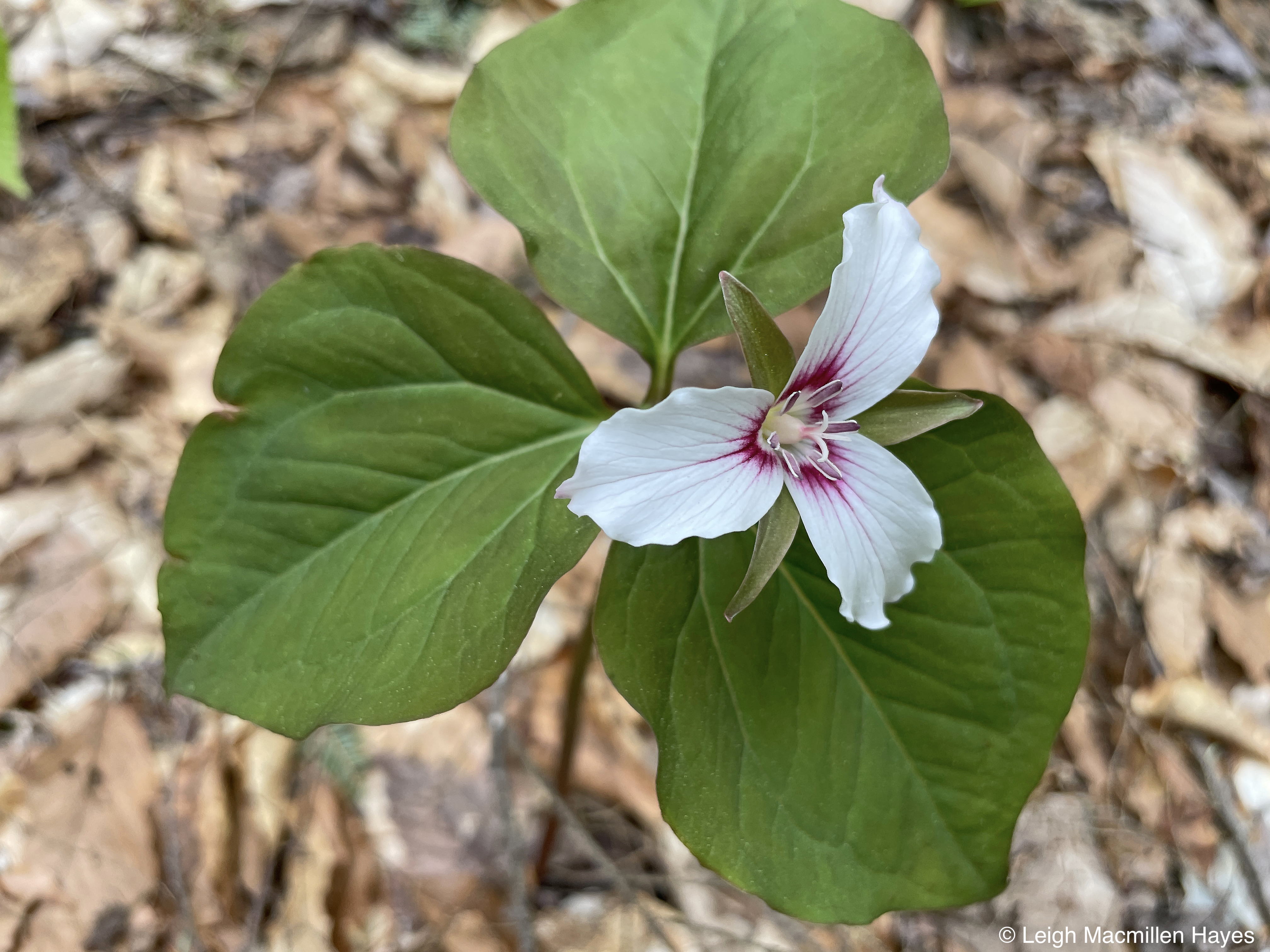
We went in search of one of his quests–Lady’s Slippers. We knew it was too early for them to be blooming in our area of western Maine, but thought we’d look anyway. Along the way, I decided to count Painted Trillium because My Guy always comments that there are a trillion trillium blooming near trails at this time of the year. And I need to honor so many of them with a photograph. I wanted to know if he is right and we’ve never counted trilliums before. He didn’t join me on this mission, but I did notice he frequently paused near one.

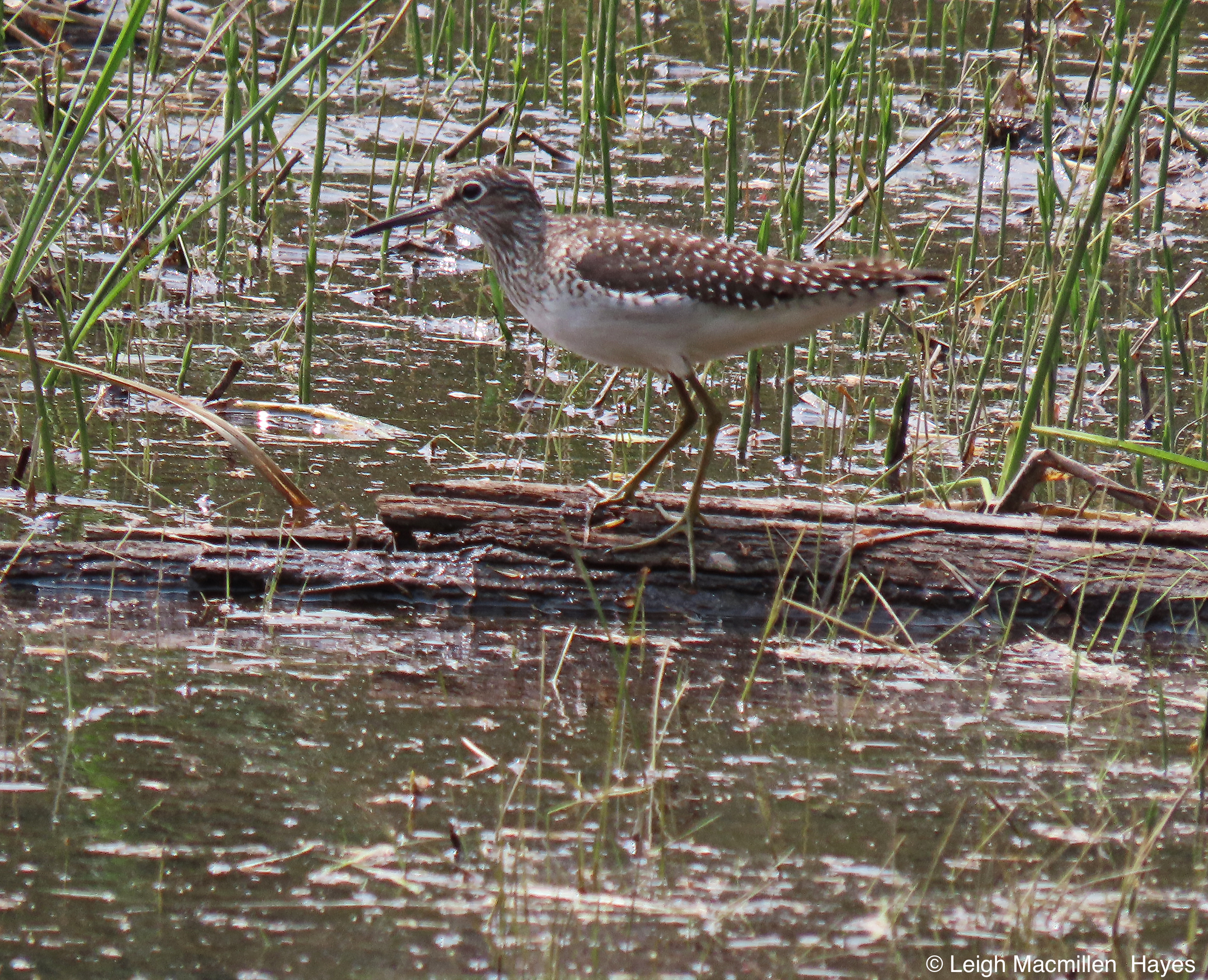
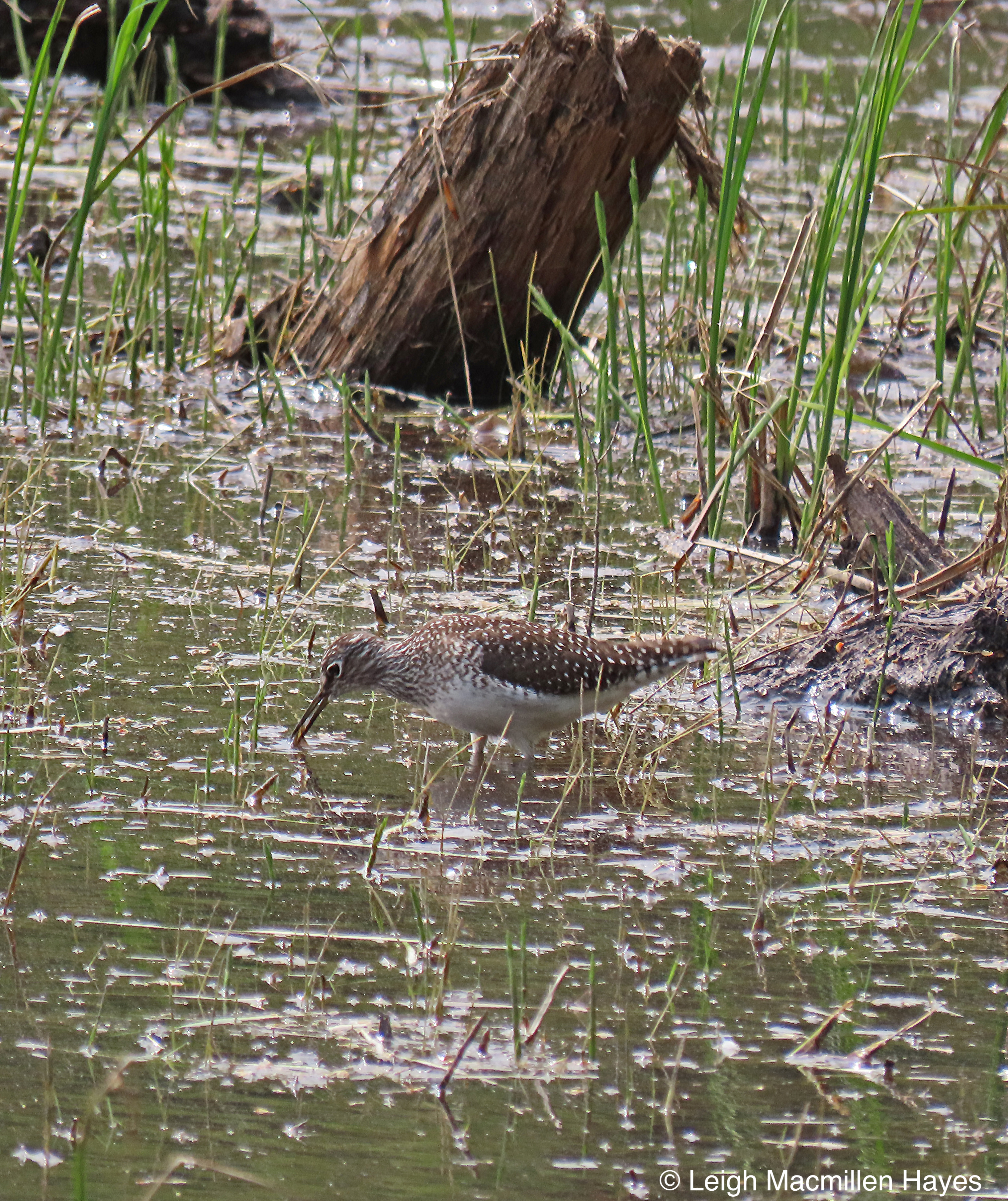
In the midst of our journey, we stopped beside a wetland and didn’t spot the Solitary Sandpiper at first, but then it moved. Constantly. As is its habit to provoke its food source into moving.

What it saw with those be-speckled eyes, I’m not sure, but I do think aquatic insects and amphibians were on its menu.

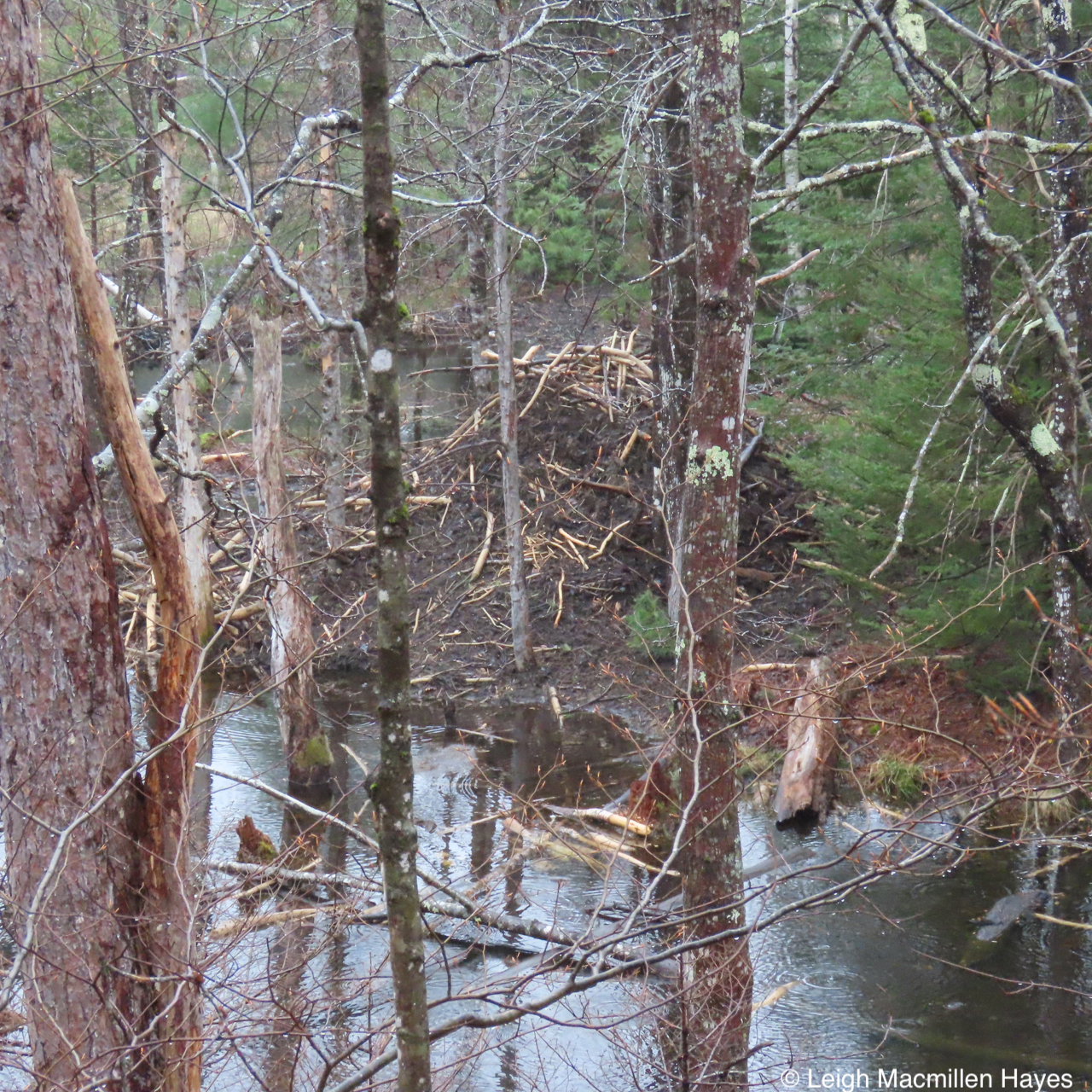
After a wee bit, we came to the beaver dam that bisects the trail, where fresh mud indicated someone was at home. It’s a tricky crossing, but I’m here to say we were successful on the way up and back.

Onward and upward, my count continued and while most often the Painted Trilliums were solitary like the sandpiper, these five represented numbers 41, 42, 43, 44, and 45.

We also found a few Red Trillium, aka Stinking Benjamin, to honor.

Approaching the summit, My Guy checked on his favorite Lady’s Slipper bouquet, but it’ll be another two or three weeks before we’ll be counting their blossoms.

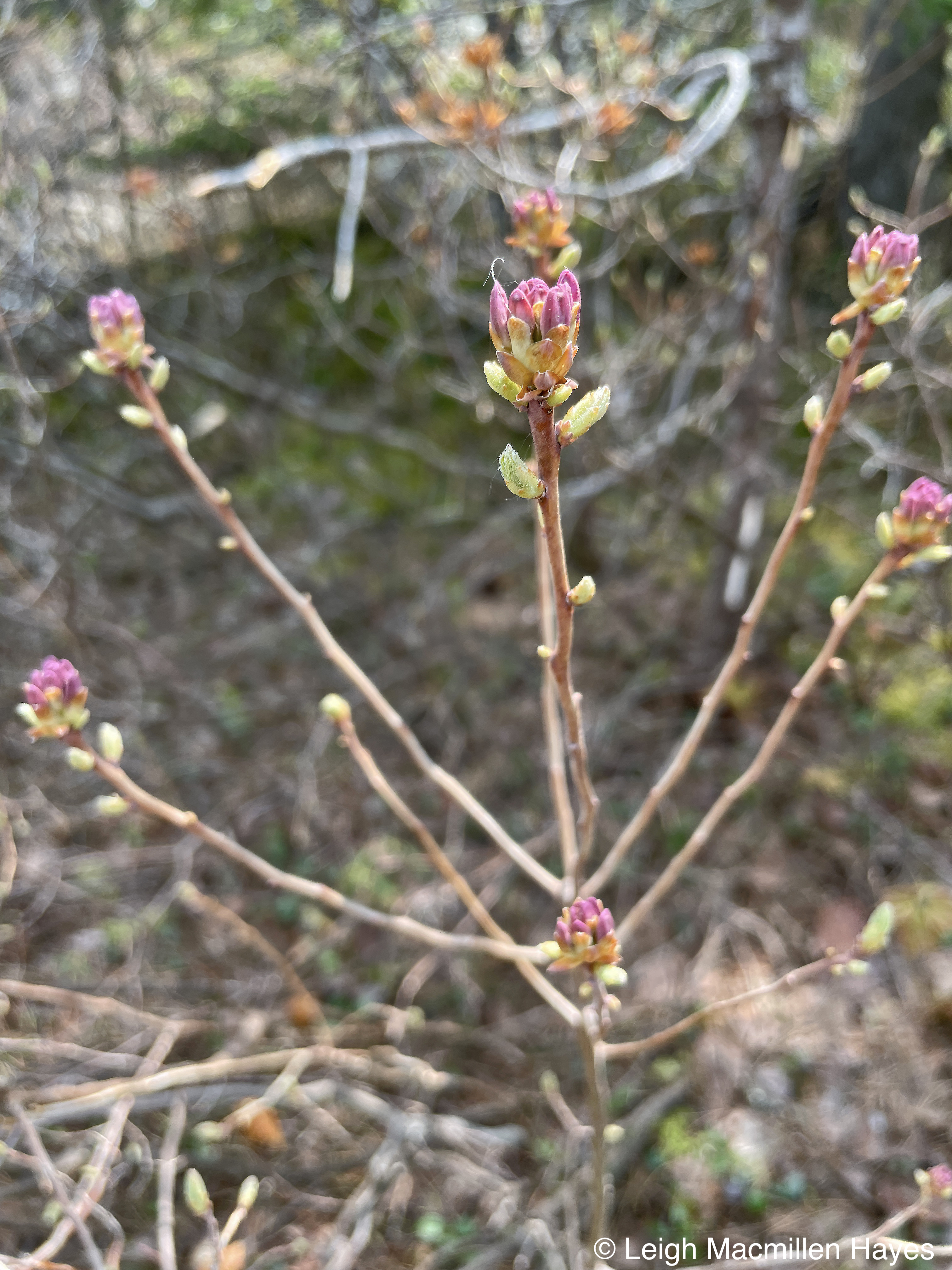
And I checked on the Rhodora, also offering a peek into the future.

Lunch upon lunch rock offered a hazy view of the mountains beyond. And it served as our turn-around point as this is an out and back trail.

BUT . . . remember at the beginning of this tale I said I was presenting things a wee bit out of order? Back toward the beginning we approached the beaver dam silently because sometimes we are treated to moments with the beaver as it tries to rebuild the dam. As we rounded a corner, we heard water dripping. It was just not quite in a beavery sort of way.

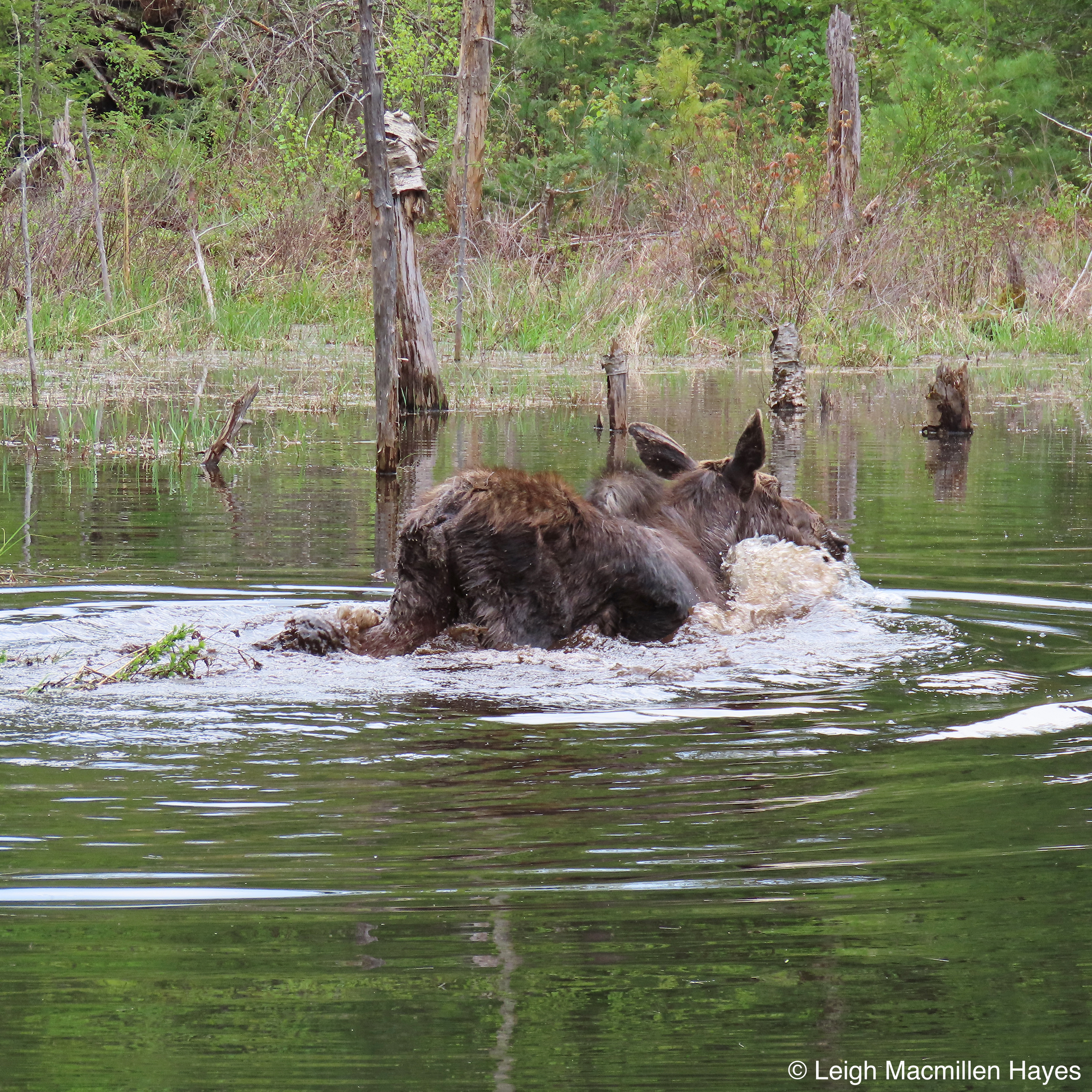
That’s because it wasn’t a beaver, but rather a Cow Moose. This photo was taken just moments after she and I looked at each other from her spot about fifteen feet from where I stood. It took me a second to realize that I was starring into her eyes, and another second to silently alert My Guy and grab my camera. And then she turned and started across the water, not an easy task in a beaver pond filled with many fallen trees.

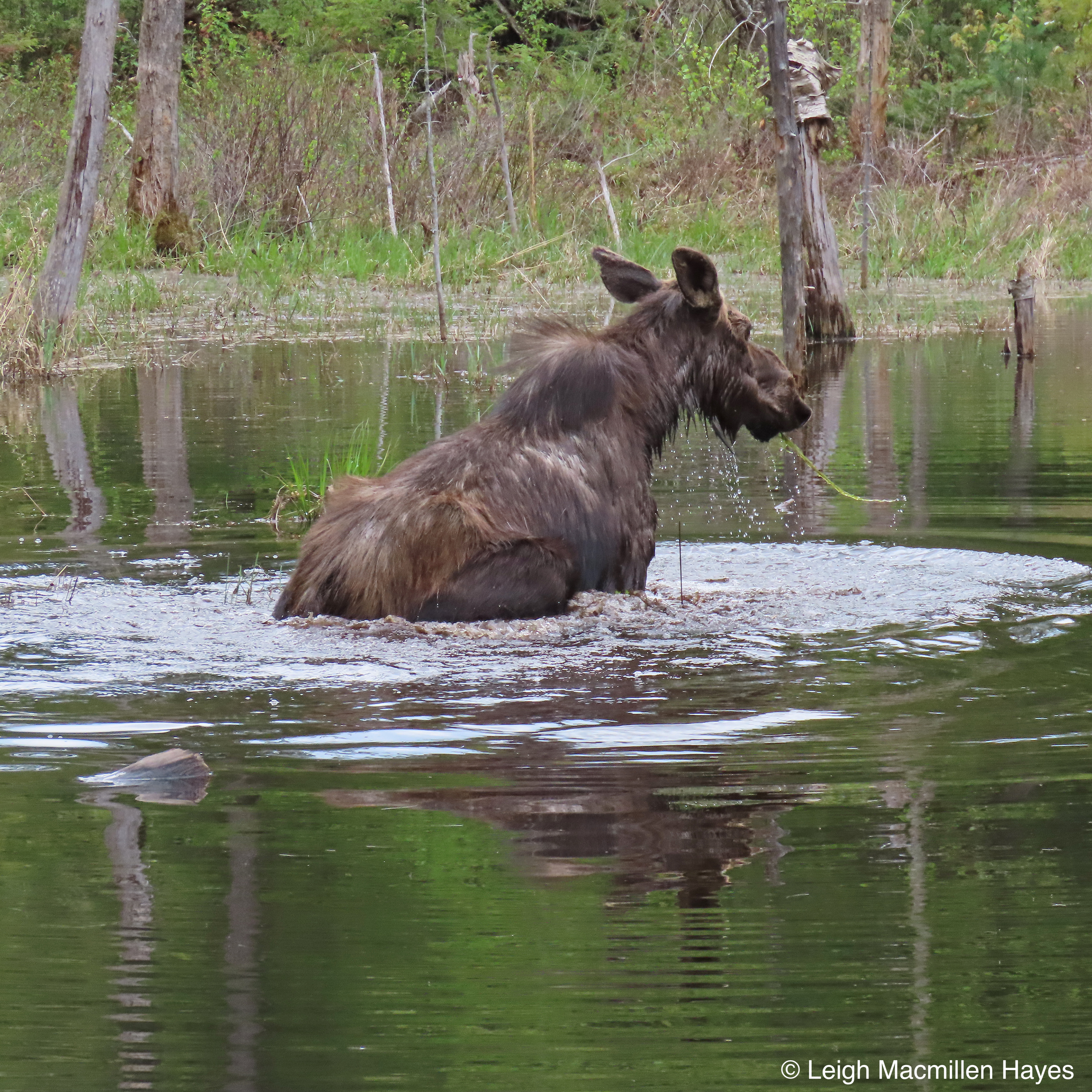
She’d been dining as you can see from the vegetation dangling from her mouth.

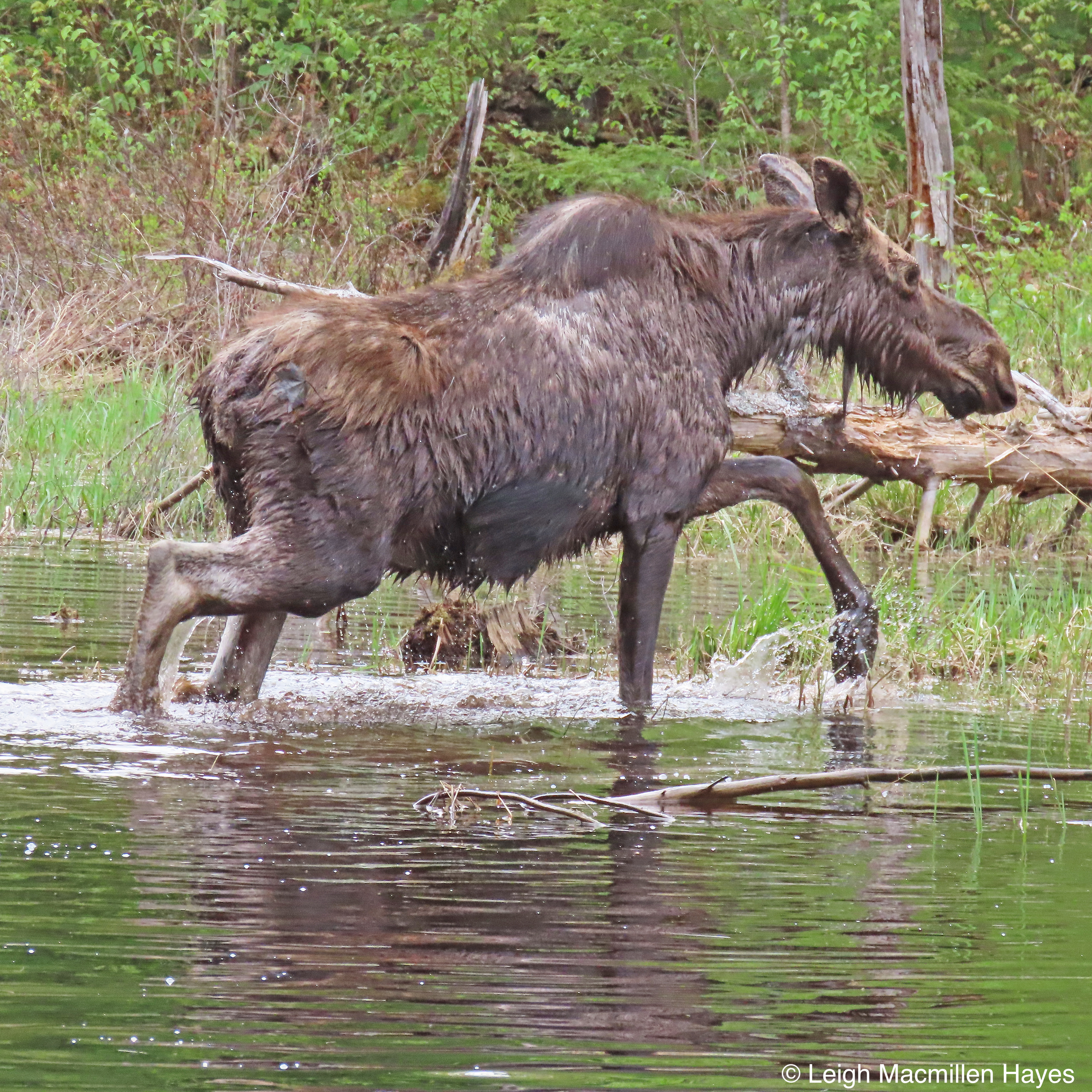
Look at that face, one only a mother can love. That oversized upper lip. And those warm brown eyes. She did look rather mangy, but that’s a spring thing as she sheds her winter coat.

As she moved off, in her tippy-toe ungulate manner, water dripped from her body.

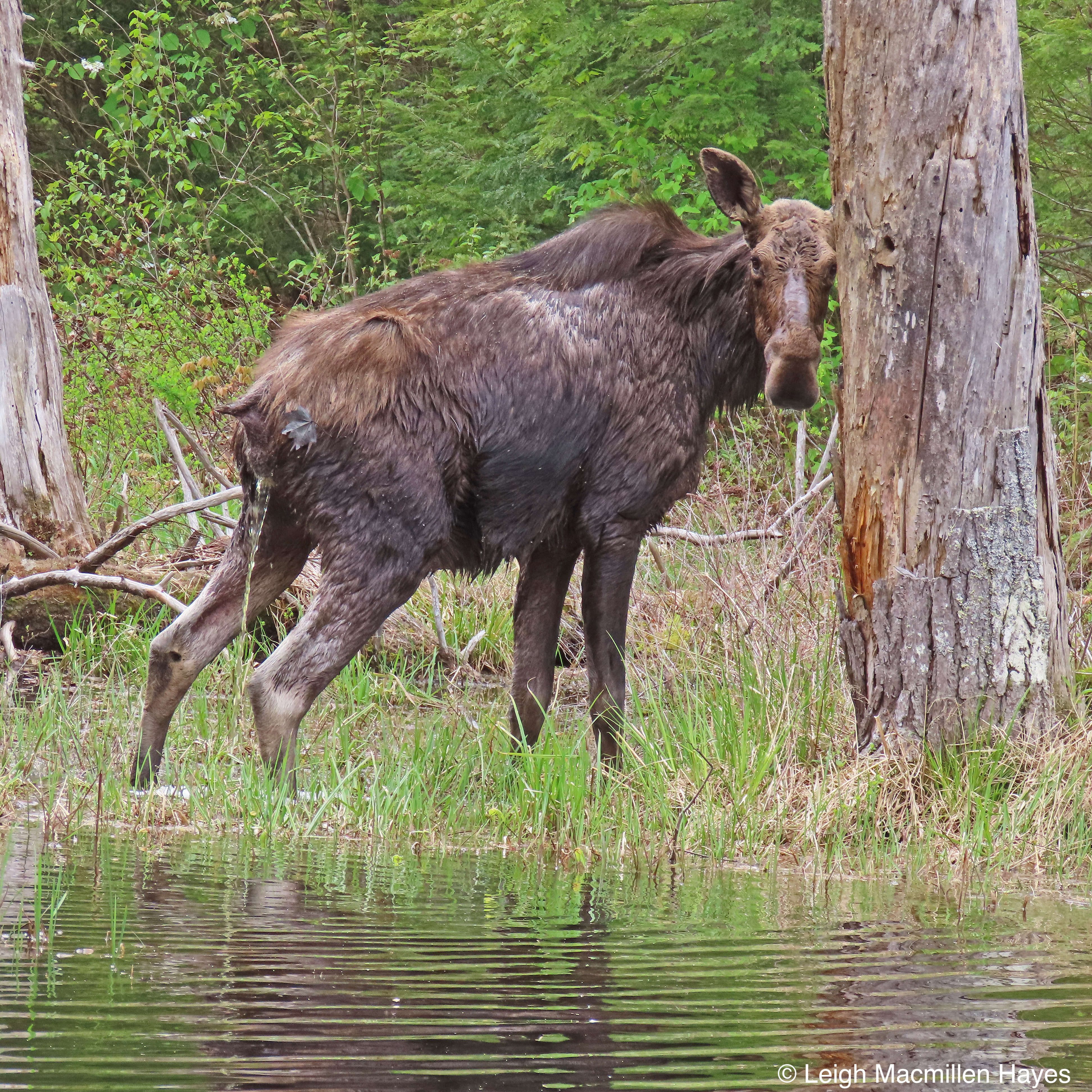
And then she looked back at us and peed. We felt the same way about her–it was a pee-in-your-pants moment.

Finally, she began to disappear into the woods.

And blended right in with her surroundings. How often, we always wonder, is there a Moose in the landscape that we just don’t see.

Especially when it looks like this? Can you spot her now?

We may not have counted Lady’s Slippers on today’s Mondate hike, but we certainly didn’t moose it up, either.

Final count:

Painted Trillium 59

Red Trillium 3

Cow Moose 1

One was certainly enough!

Where The Moose Led Us Mondate

It seems there are never enough rainy days to complete home chores so when today dawned as such I thought that all the contents I’d been sorting from a closet would finally make their way to new homes like the dump store or community clothing closet or back into containers to be stored for another rainy day.

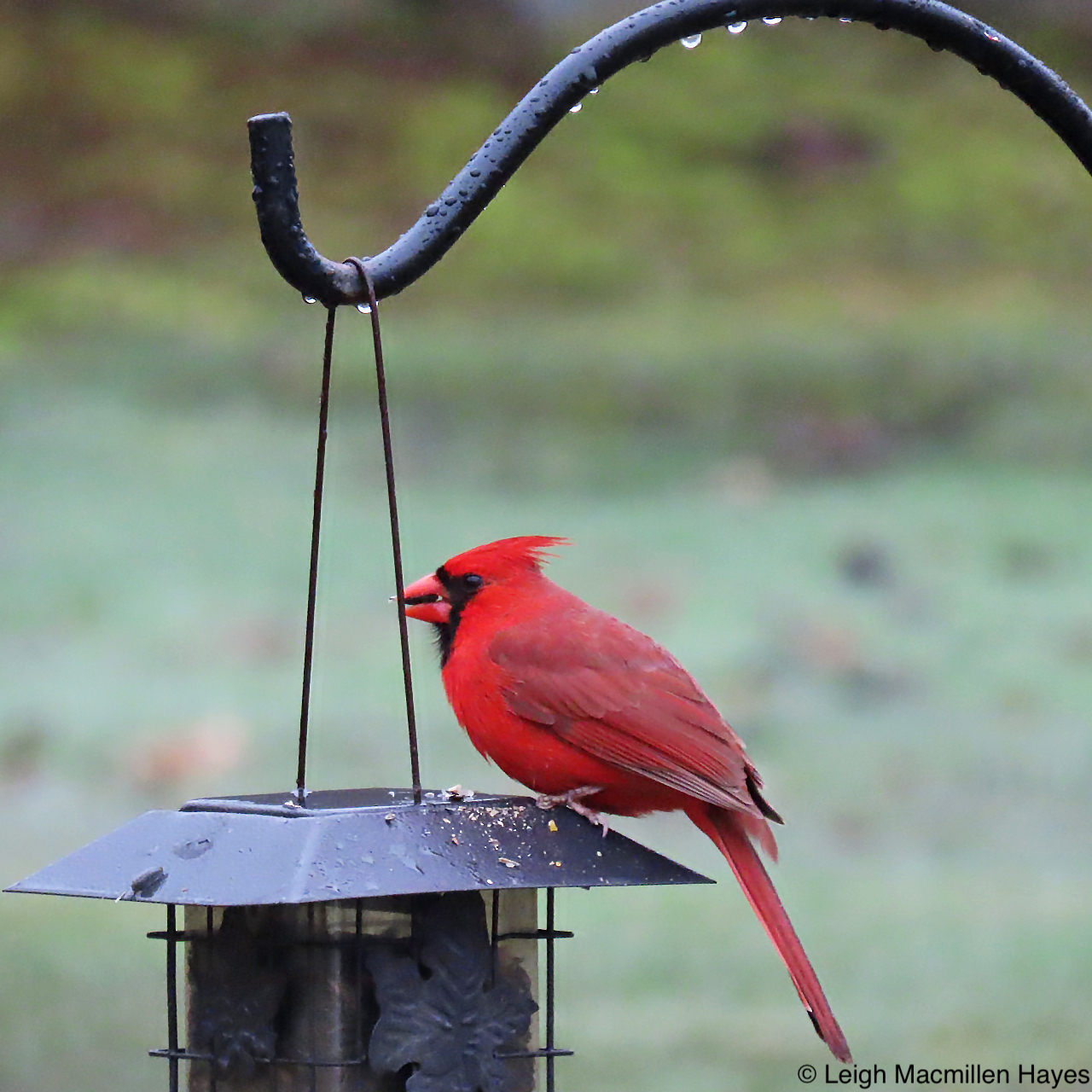
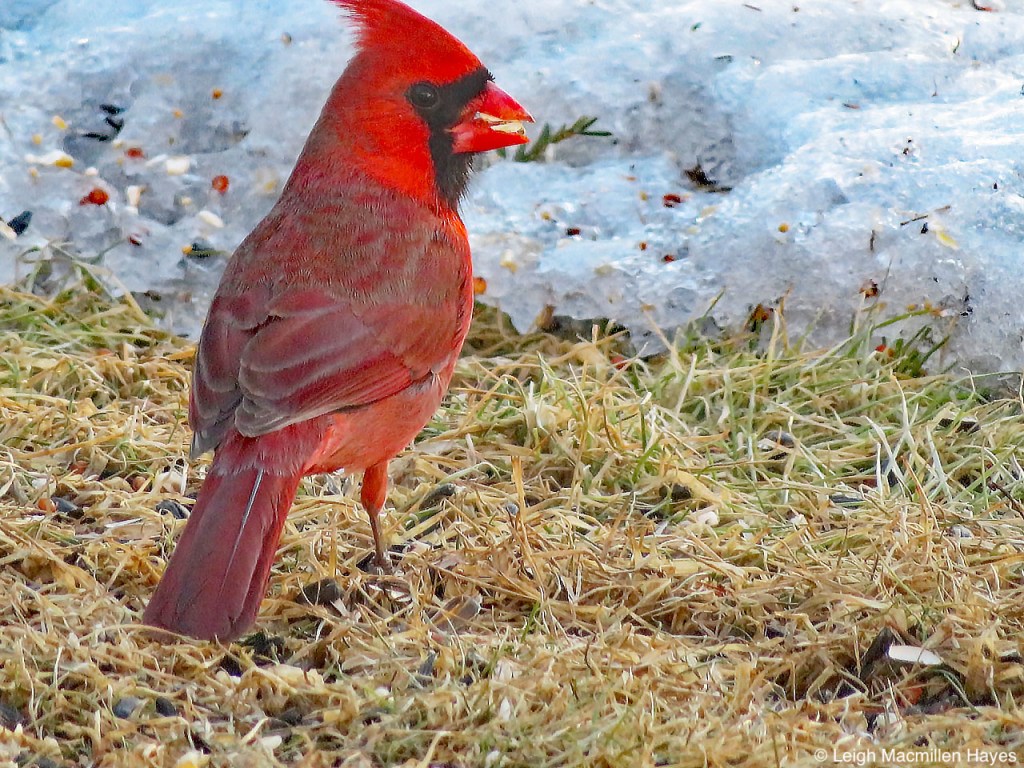
Apparently, I thought wrong for the Cardinal beckoned and we answered the call to head out the door.

When I mentioned a location for today’s hike to My Guy, he agreed that it sounded good, though come to find out, in reality he thought we were going someplace else and even when we arrived at Great Brook, he couldn’t recall our last visit, which was in 2016. Fair enough. I’ve been there many more times.

It soon became apparent that we were in Moose territory and our excitement rose. Actually, on another trail in this same neck of the woods we once spotted a Moose, so all we could do was hope that today we’d receive the same honor.

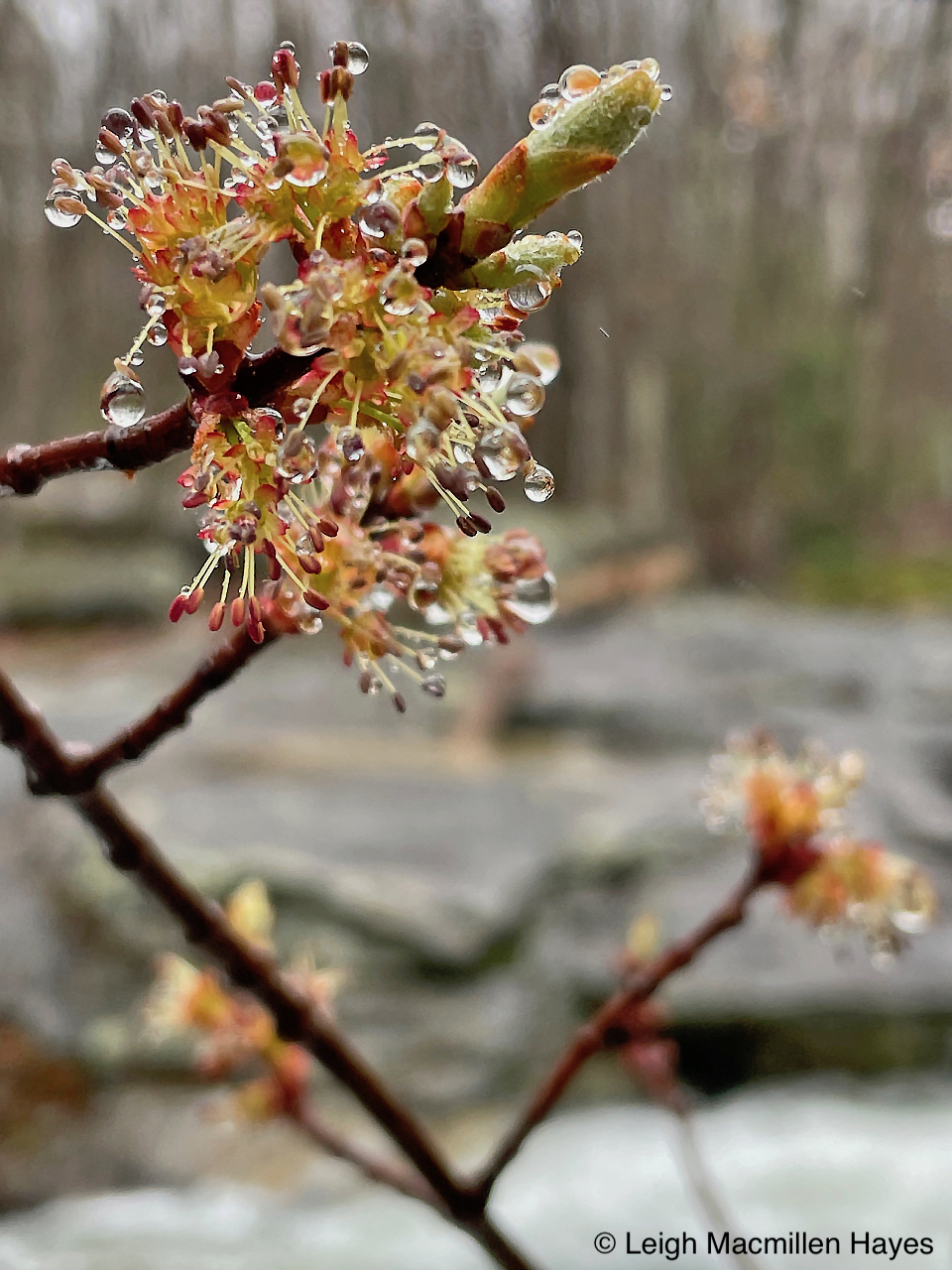
But first, there were other honors to receive, such as this bouquet of flowering Red Maple.

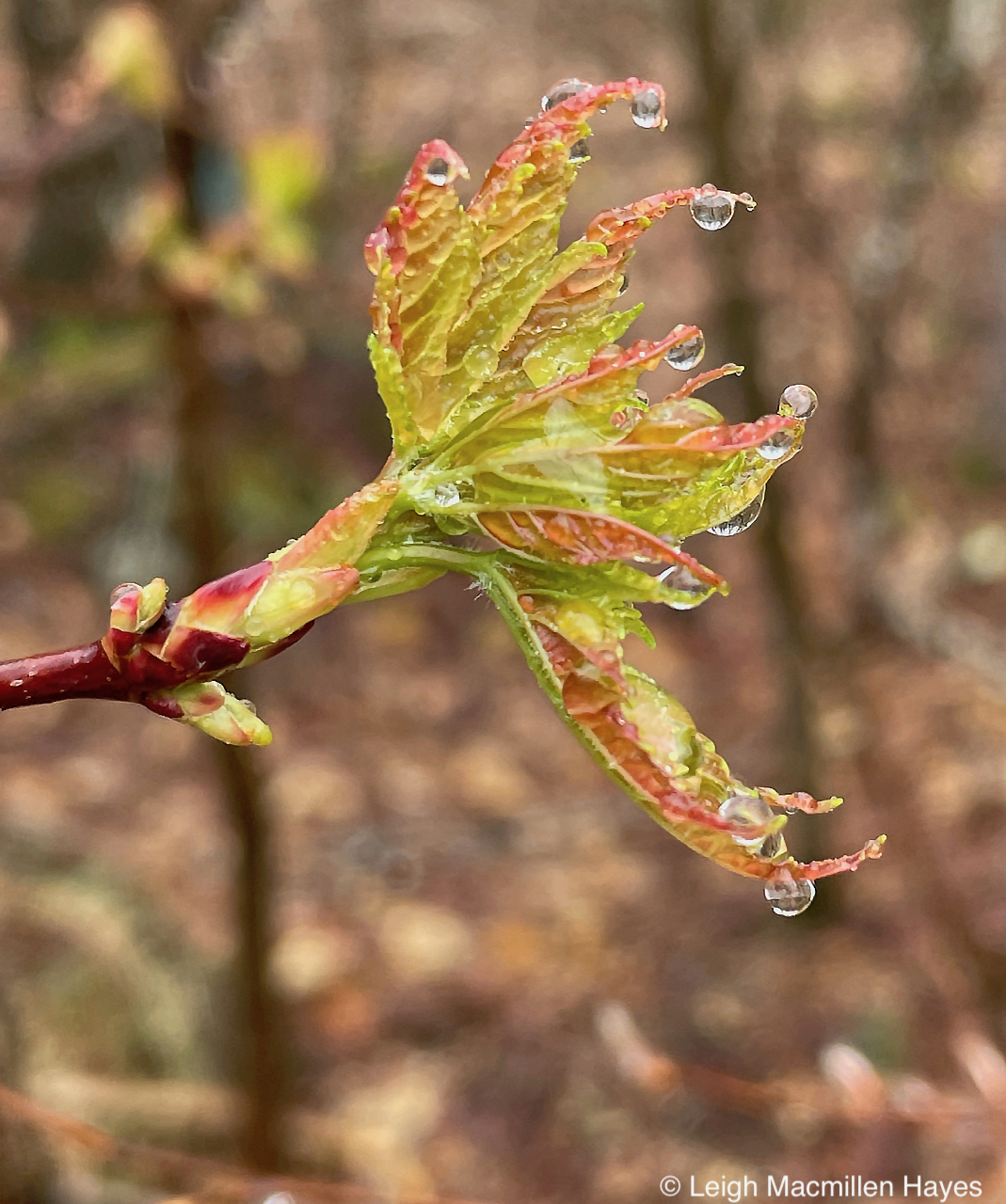
And the first of the season for us, maple leaves bursting forth in all their spring glory of color.

Onward we hiked deeper into the woods where a place one might think of as no place was once some place. This particular foundation has long been a favorite of mine because within is a root cellar.

It’s one I can’t resist stepping into because you never know what tidbit might have been left behind.

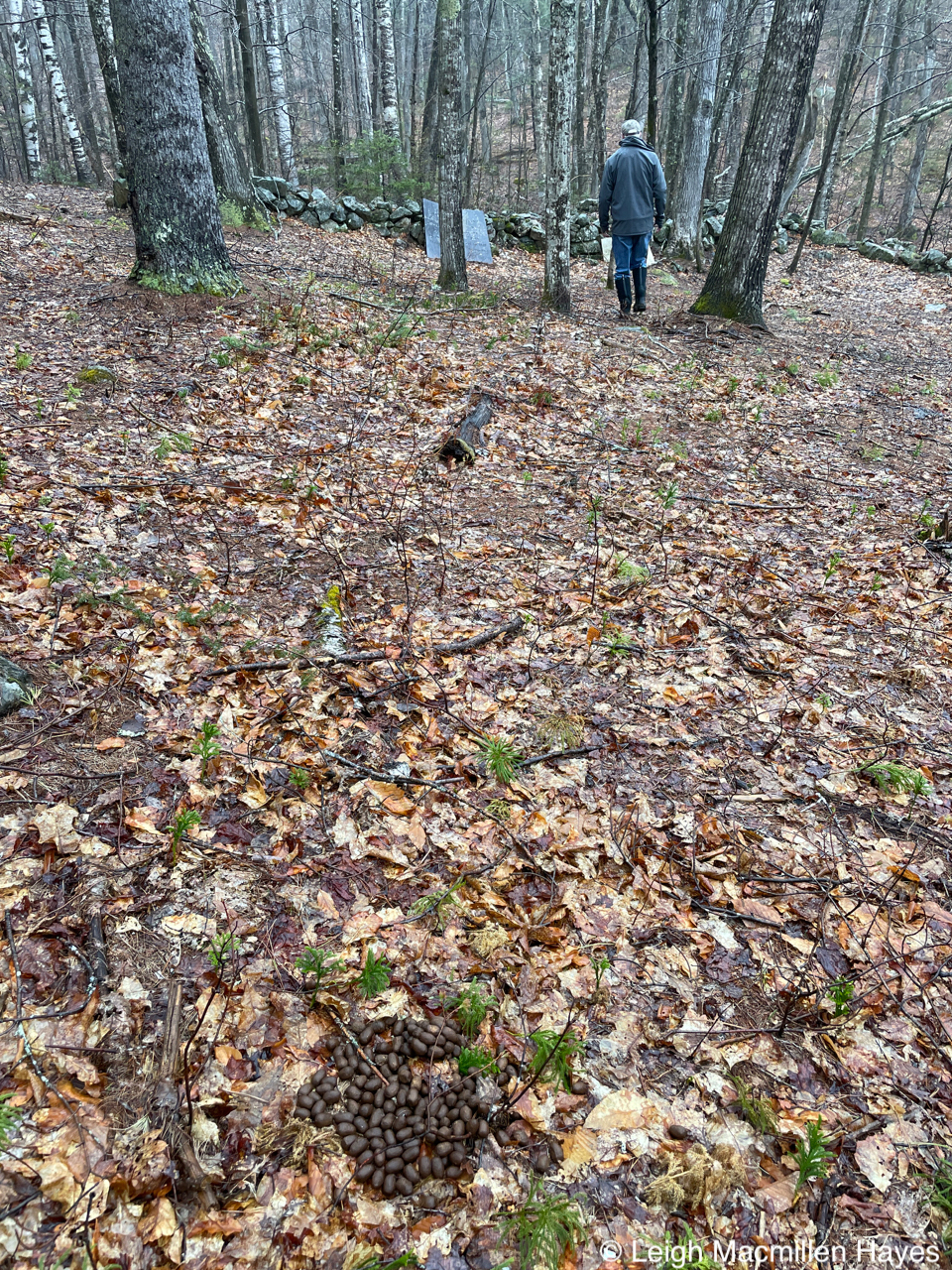
Porcupine scat! Rather old, but still.

My friend, Jinny Mae (RIP), was a talented techie and though the red line isn’t the entire route we followed today, it’s one she and I explored back in 2016. The map is from a section of the 1858 map of Stoneham. And we were at E. Durgin’s old homestead.

Knowing that there were some gravestones in the woods behind the house, we once again followed the Moose who led us directly to the family cemetery. Someone has cleared the site a bit, so it was easy to spot, especially since the trees haven’t fully leafed out.

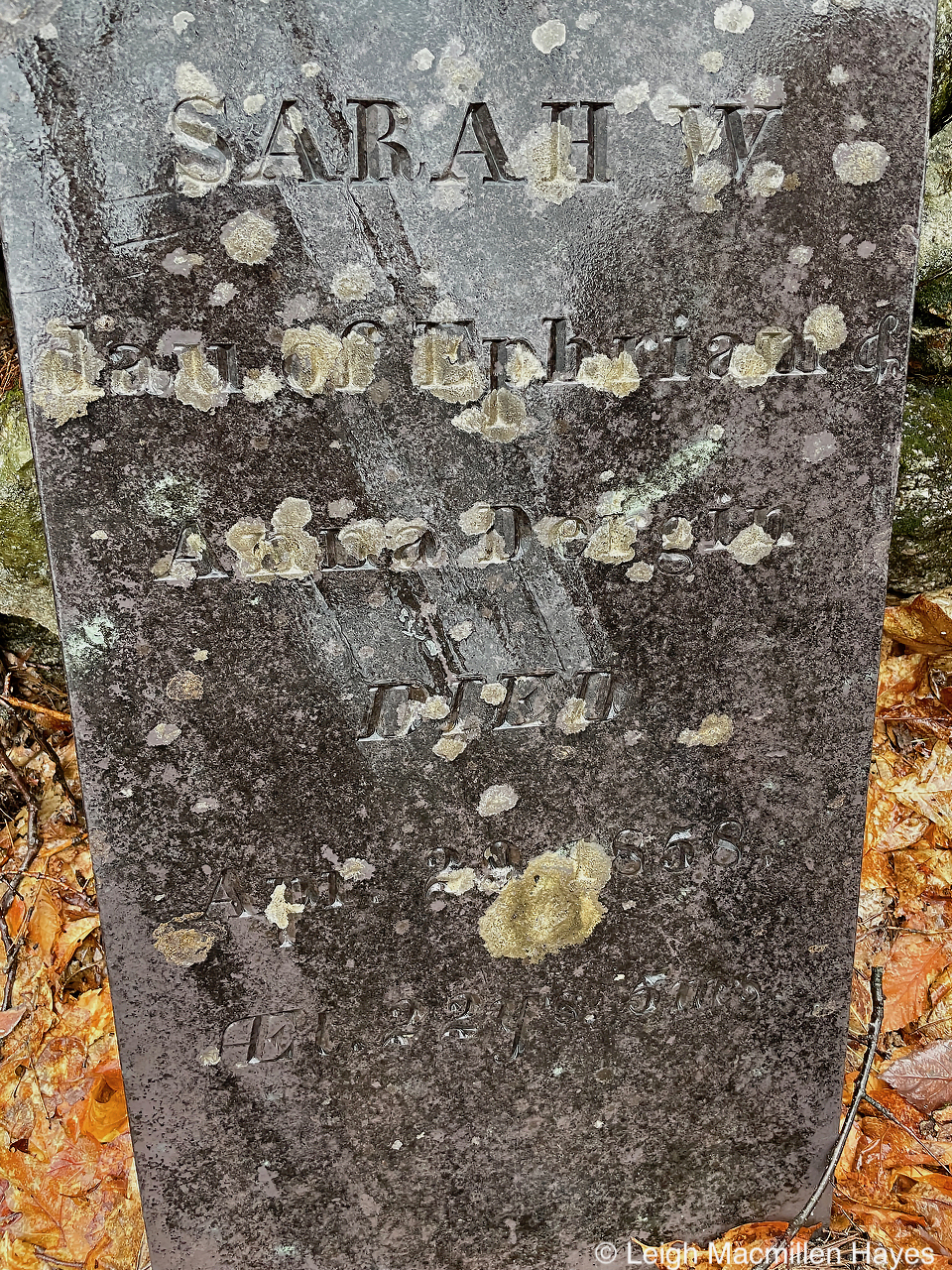
Sarah, daughter of Anna and Ephraim Durgin, is the first tombstone. She died in 1858 at age 22.

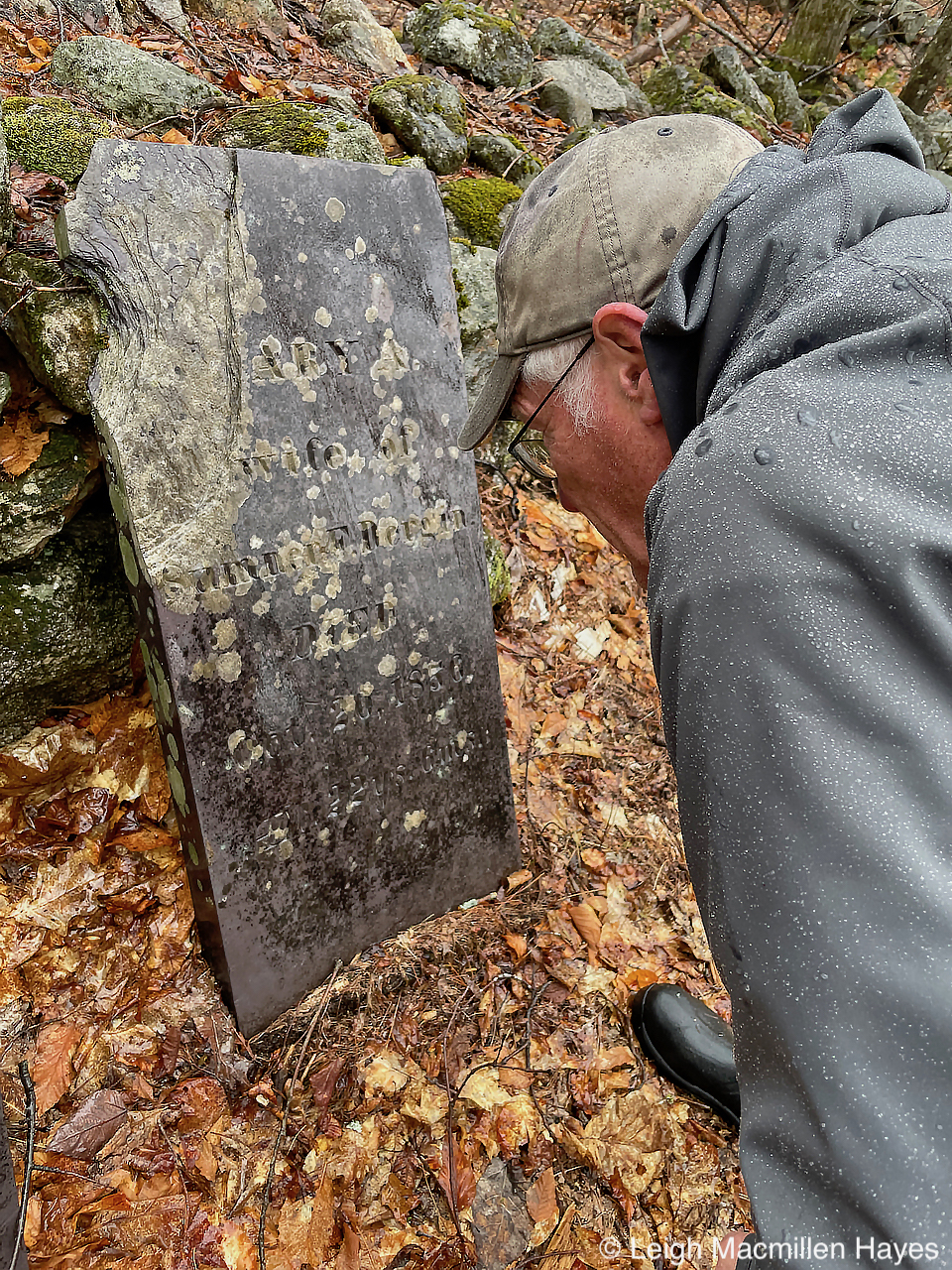
Beside her is the stone for Mary, wife of Sumner Dergin, who died before Sarah–in 1856. She, too, was 22 years old. As best I can tell, Sarah and Sumner were siblings.

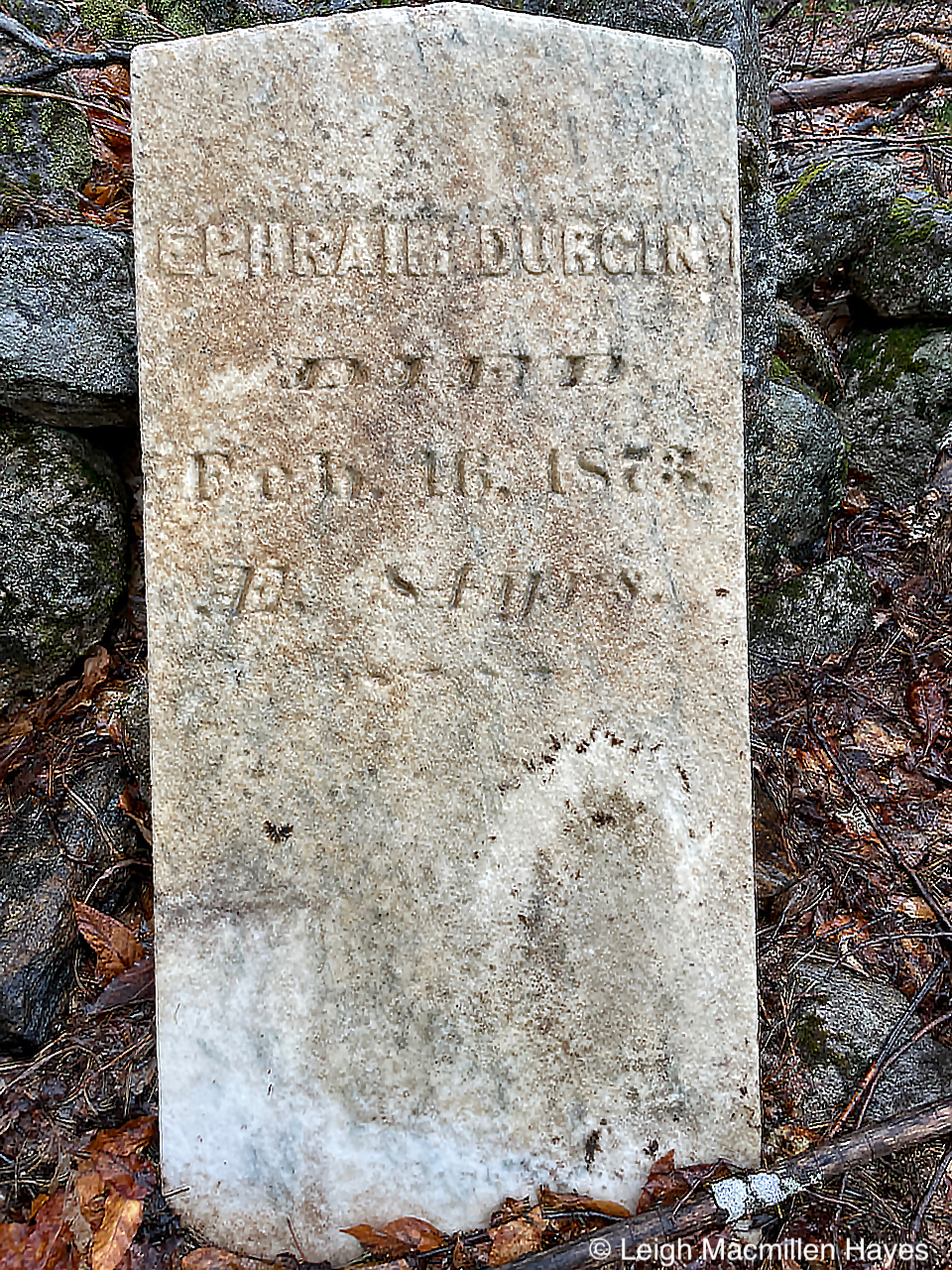
And Ephraim, Sarah’s father, died in 1873 at age 81. Notice the difference in stone from the two girls to Ephraim? Slate to cement. And the name spelling–Dergin and Durgin. As genealogy hobbiests, we’ve become accustomed to variations in spelling.

I found the following on RootsWeb:

8. ANNA3 FURLONG (PATRICK2, JOHN1) was born 1791 in Limerick, Maine, and died 1873 in Stoneham, Maine. She married EPHRAIM DURGIN June 18, 1817 in Limerick, Maine14. He was born April 13, 1790 in Limerick, Maine, and died in Stoneham.

Children of ANNA FURLONG and EPHRAIM DURGIN are:
i.OLIVE4 DURGIN, b. 1811, Stoneham, Maine; m. DUNCAN M. ROSS, April 11, 1860, Portland, Maine.
ii.SALOMA DURGIN, b. 1813.
iii.ELIZABETH DURGIN, b. 1815.
iv.SALLY DURGIN, b. 1817.
v.SUMNER F. DURGIN, b. 1819, Of Stoneham, Massachusettes; m. MARY ANN DURGAN, July 11, 1853, York County, Maine; b. Of Parsonsfield, Maine.
vi.CASANDIA DURGIN, b. 1821.
vii.EPHRAIM DURGIN, b. 1823.
viii.FANNY DURGIN, b. 1825.

Sarah isn’t listed above. But . . . Sally and Sarah were often interchangeable.

By 1880, there had been a change in ownership of the neighborhood homes and the Rowlands had moved into the Durgin house.

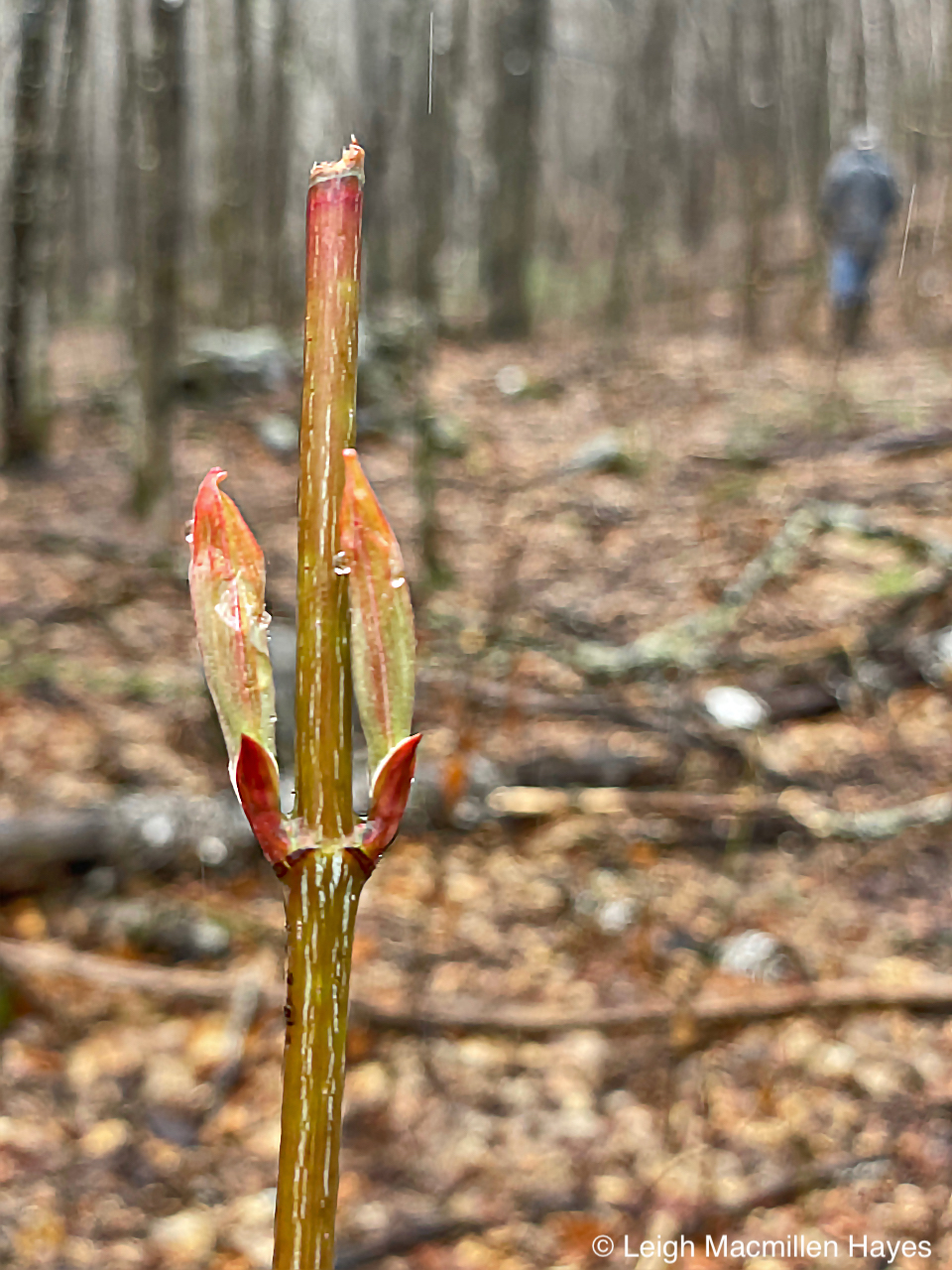
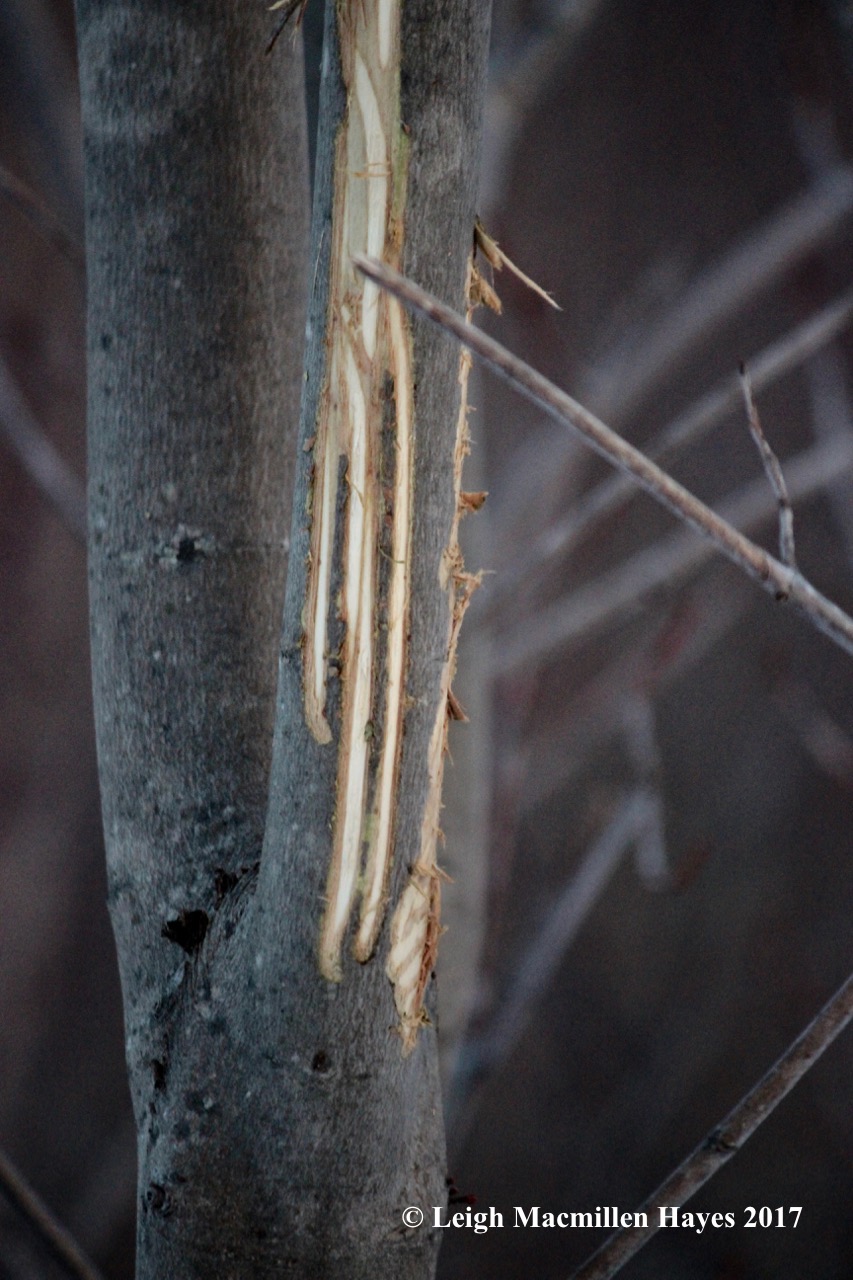
Again, we followed the moose, this time in the form of a Striped Maple browsed upon, curious to see what might be ahead.

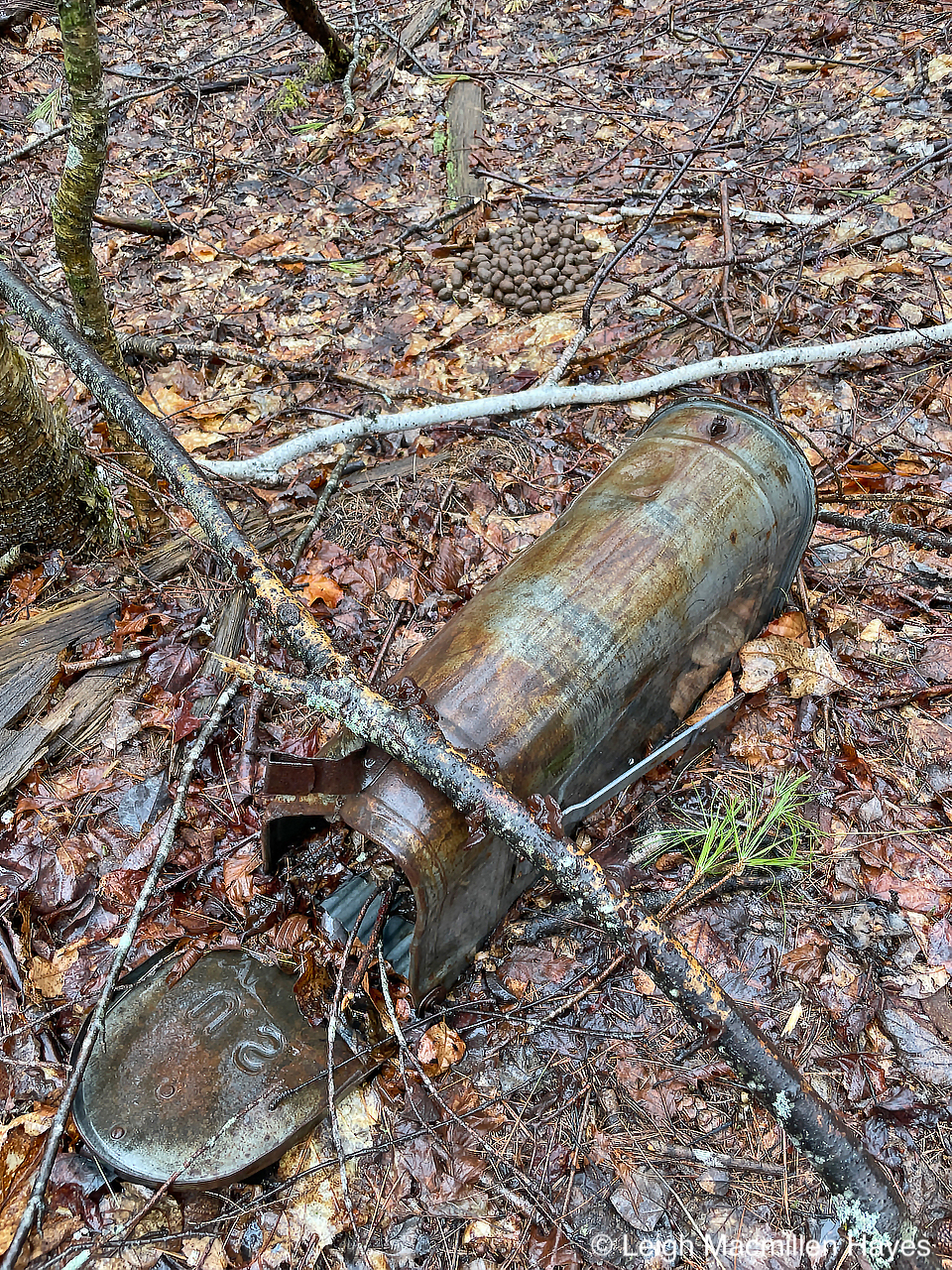
A chuckle. Yes, a mailbox in the middle of nowhere, this spot being a place where someone once had a camp. Our Moose tried to send a letter, but missed by a couple of feet.

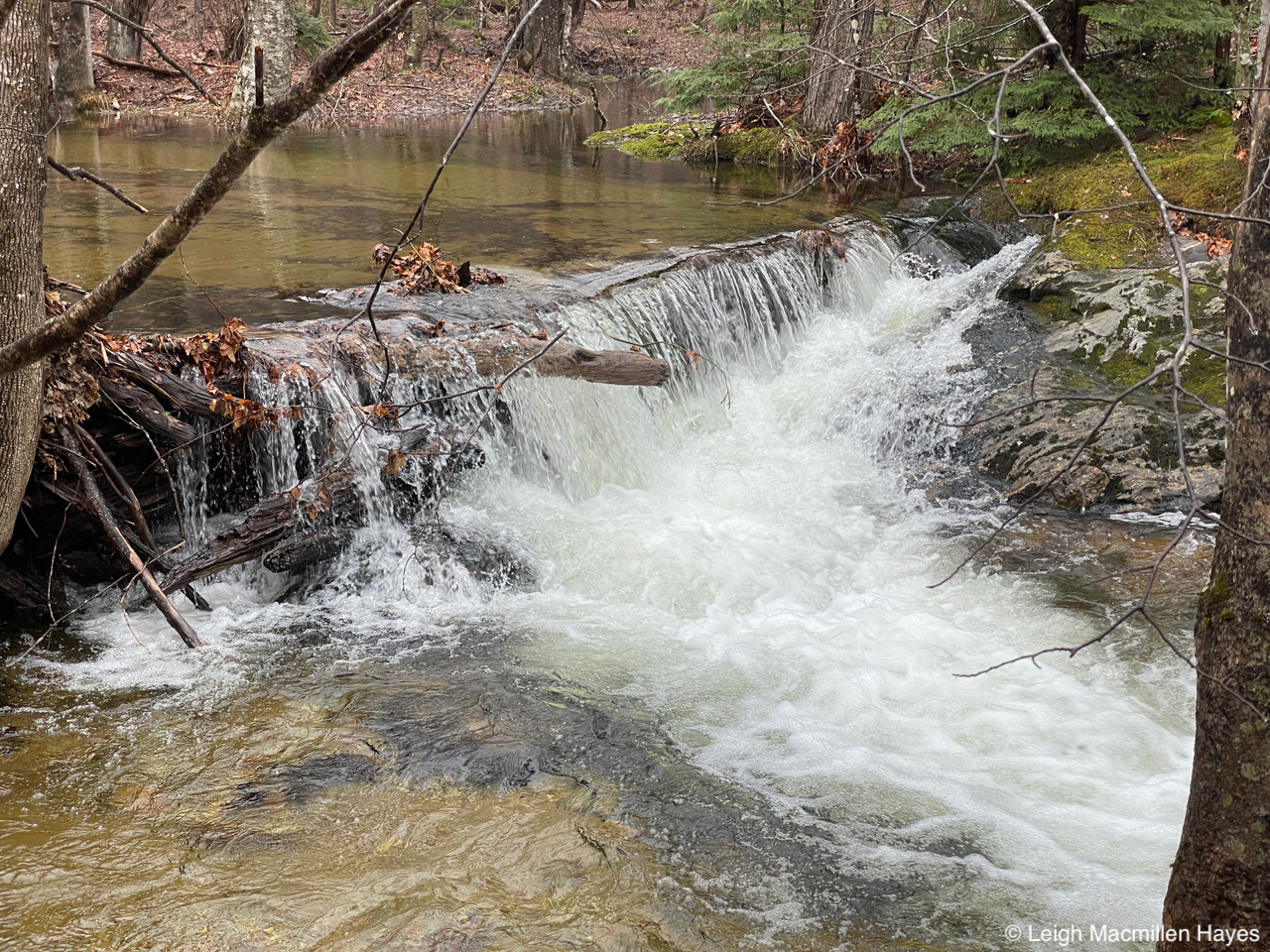
Willard Brook was our next stop and I was reminded that when I first started wondermyway.com, a post about this brook initiated some discussion about the Indigenous stonework found throughout the area. I’ve explored it looking for such and convinced myself in the past that I saw the turtles in most of the stonewalls. In fact, I see them everywhere, but today I was looking at different subjects.

Beside the brook, lots of Hobblebush looked ready to burst into life and we thought how fortunate that the moose hadn’t decided to dine. Yet.

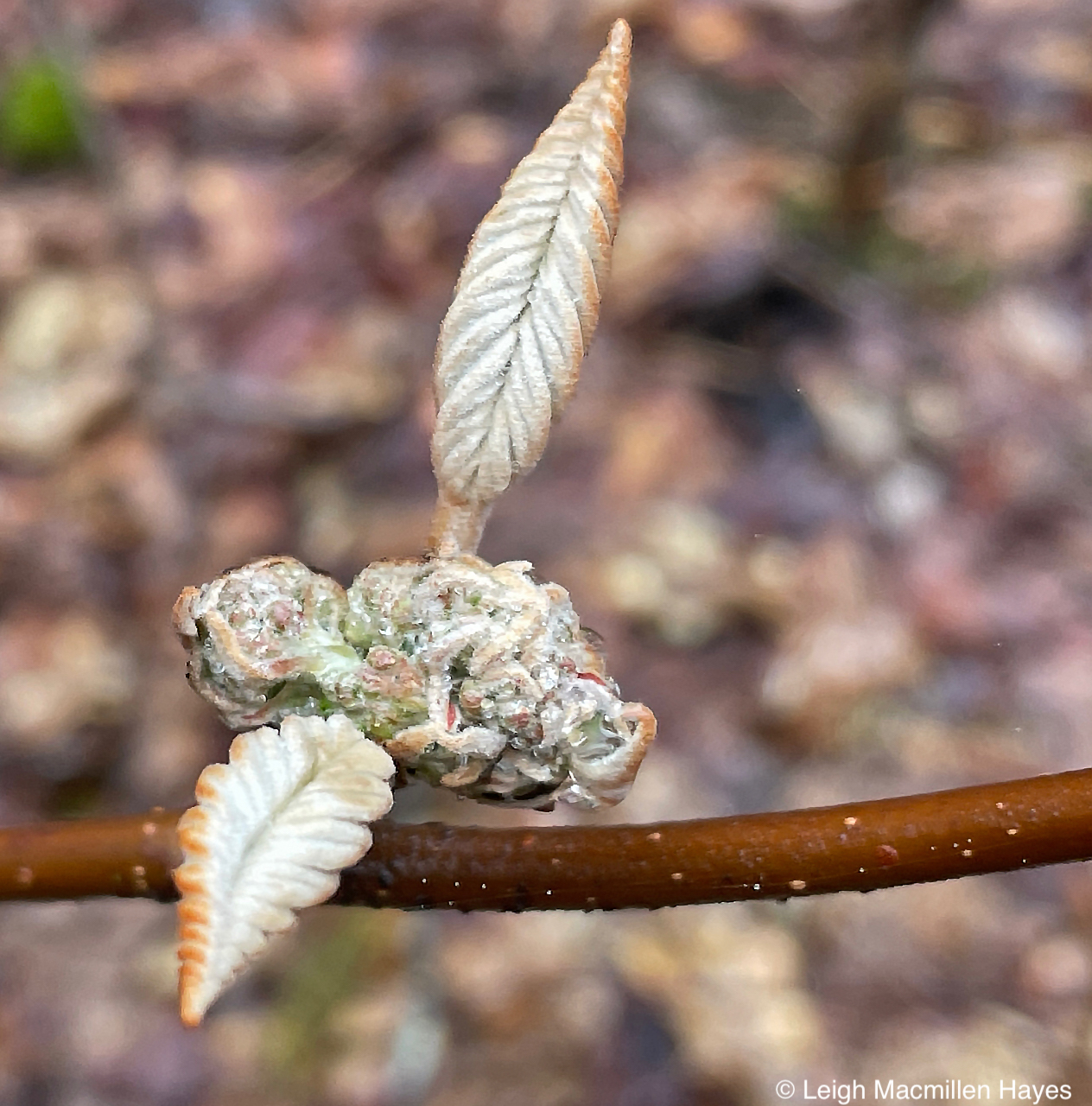
There were even tiny Hobblebush leaves to celebrate for their accordion style.

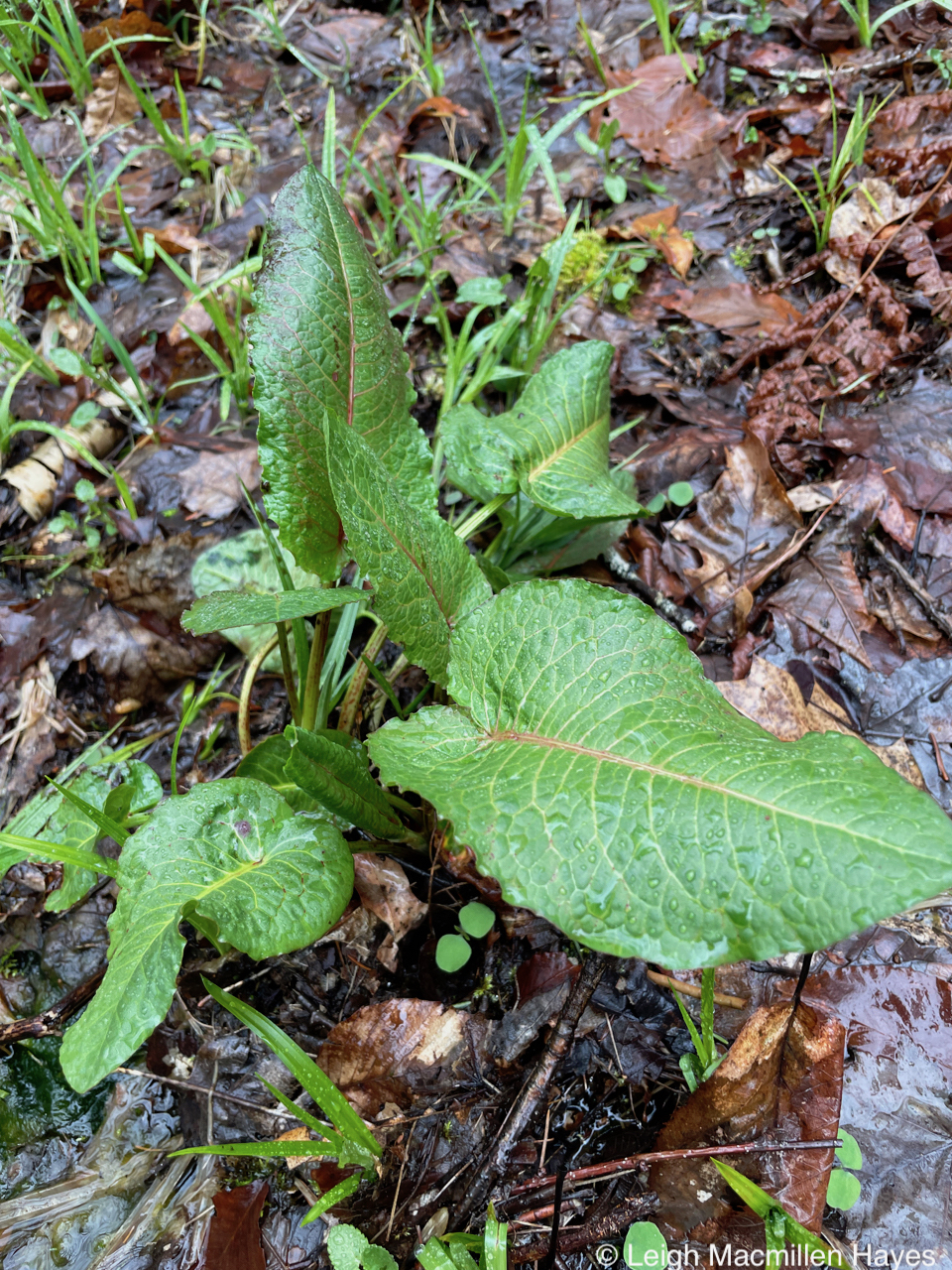
And Broad-leaved Dock looking quite happy and healthy.

Back to Great Brook we eventually wandered, still with no actual Moose in sight.

But beside the brook I did spot some Trailing Arbutus buds preparing for their grand opening.

As we walked back on the dirt road we’d walked in on, we paused beside a beaver pond where Spring Peepers sang their high-pitched love songs. I made My Guy scan the area with me because just maybe . . .

or maybe not. We did spot a Mallard couple. Oh well, We still had fun discovering everything else where the Moose led us on this rainy day.

And when we arrived home I had an email from an acquaintance double-checking with me that the print he found on his shore front of Kezar Lake was a moose print. Indeed it was!

(And now it’s time to prepare for Big Night. Finally. The temperature is in the 40˚s; it’s been raining all day and will continue tonight; and though lots of amphibians have moved to their native vernal pools, I think there will be some action tonight and we’ll be able to help them cross the road safely.)

Happy 7th Birthday to you, wondermyway!

Seven years ago today I gave birth–rather a record at my age. It was February 21, 2015, when I welcomed wondermyway into the world. It’s been quite an adventure that we’ve shared together and one of my favorite things to do each year to celebrate is to take a look back.

As I reviewed this past year, the reality hit home. I’ve written less than half the number of posts of any other year. That all boils down to one thing. Time. There’s never enough. Oh, I’ve taken the photos, and had the adventures, but I haven’t made the time to write about all of them. Sometimes, they sit off to the side in my brain and I think I’ll use some of them together in a cumulative post, and there they sit.

That all said, I’ve had more views and visitors this past year than any other. Views = 24,955; Visitors = 16,994. Followers = 701. And over the course of wondermyway’s lifespan, the blog has received 121,765 hits.

An enormous heart-felt thanks to all who have joined me for any or all of these journeys. I get excited to share with you and love hearing from you.

In case you are wondering, my guy and I did have a Mondate this afternoon–along Bemis River and then up to Arethusa Falls in Crawford Notch, New Hampshire.

It was here at the falls that we celebrated wondermyway.com with a couple of those Bavarian Haus chocolates we purchased last Monday.

And now for a look at a few excerpts from posts I made during the past year, beginning with March 2021. To read or re-read the entire post, click on the link below each photo.

The Invitation Stands

It took me by surprise, this change of seasons. Somehow I was fooled into thinking winter would hold its grasp for a wee bit longer because I don’t like to let it go.

Even Winter Dark Fireflies, who don’t carry lanterns like their summer cousins, and aren’t even flies as their name suggests (they are beetles), knew what was happening before I did for in their adult form they’d been tucked under bark in recent months, but in a flash are now visible on many a tree trunk as they prepare to mate in a few weeks.

But . . . this spring will be different.

How so? And what invitation still stands? Click on the link under the beetle’s photo to find the answers.

Whispers Along The Trail

“The way to be heard isn’t to shout,” said the Reverend Dr. Sam Wells of St. Martins in the Fields, London. “It’s to whisper.” But who are the whisperers?

Listen for the slightest murmur of Trailing Arbutus’s delicate blossoms beneath its leathery leaves.

Hear also the soft words of a rattlesnake-plantain explaining that its striking veins may suggest “checkered,” but it actually goes by “downy” in common speak.

You’ll have to click on the link under the photo of the Trailing Arbutus flowers to hear what other species had to say.

Surveying the Wildlife of Charles Pond

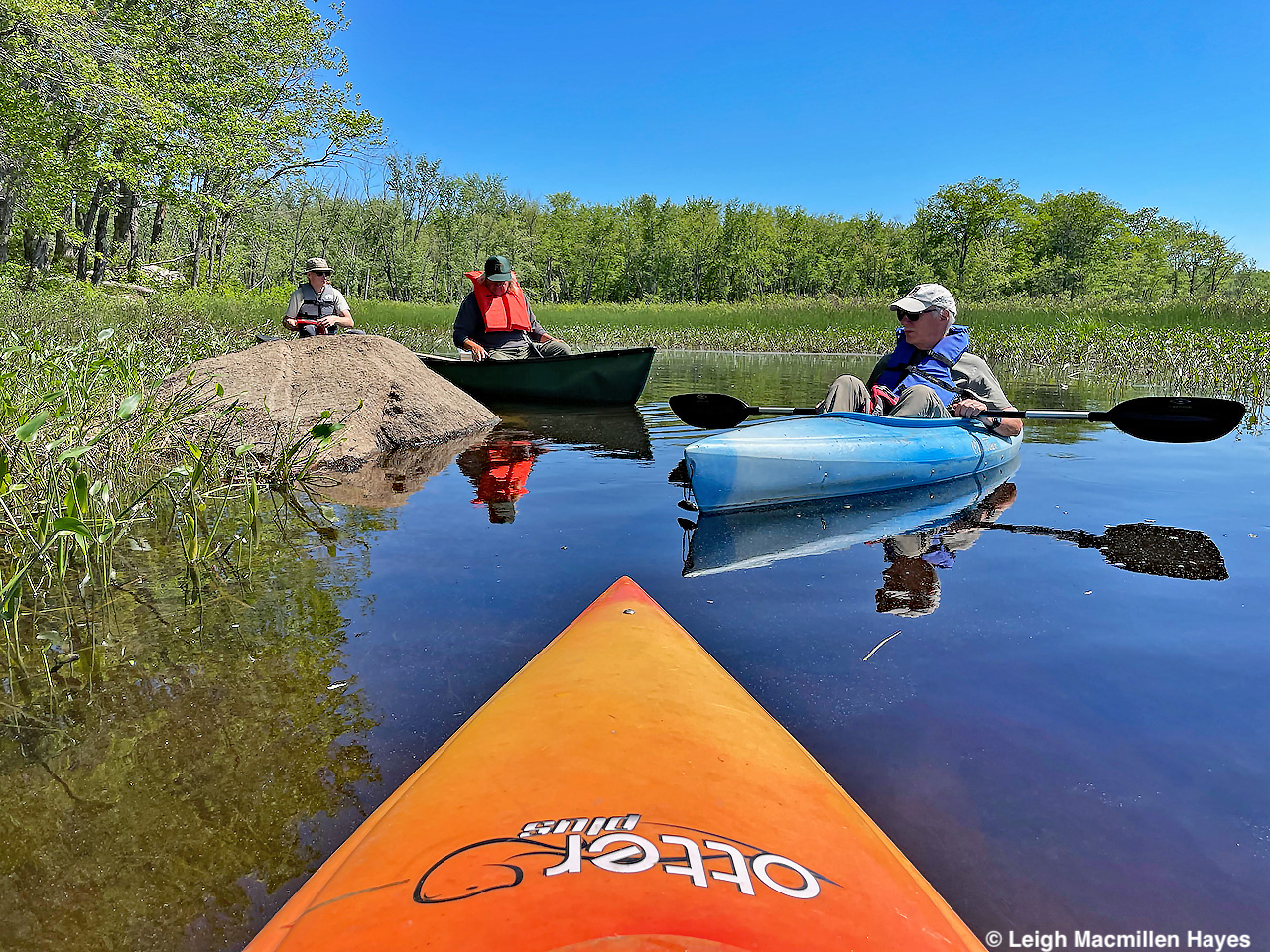
For the past two weeks at Greater Lovell Land Trust we’ve had the good fortune to conduct a wildlife survey in the waters that surround the newly acquired Charles Pond Reserve in Stow, Maine.

MDIFW maintains a comprehensive database on the distribution of Maine’s amphibians and reptiles, as well as terrestrial and freshwater invertebrates and the data we’ve collected will add to the bigger picture. What we discovered was just as important as what we didn’t find.

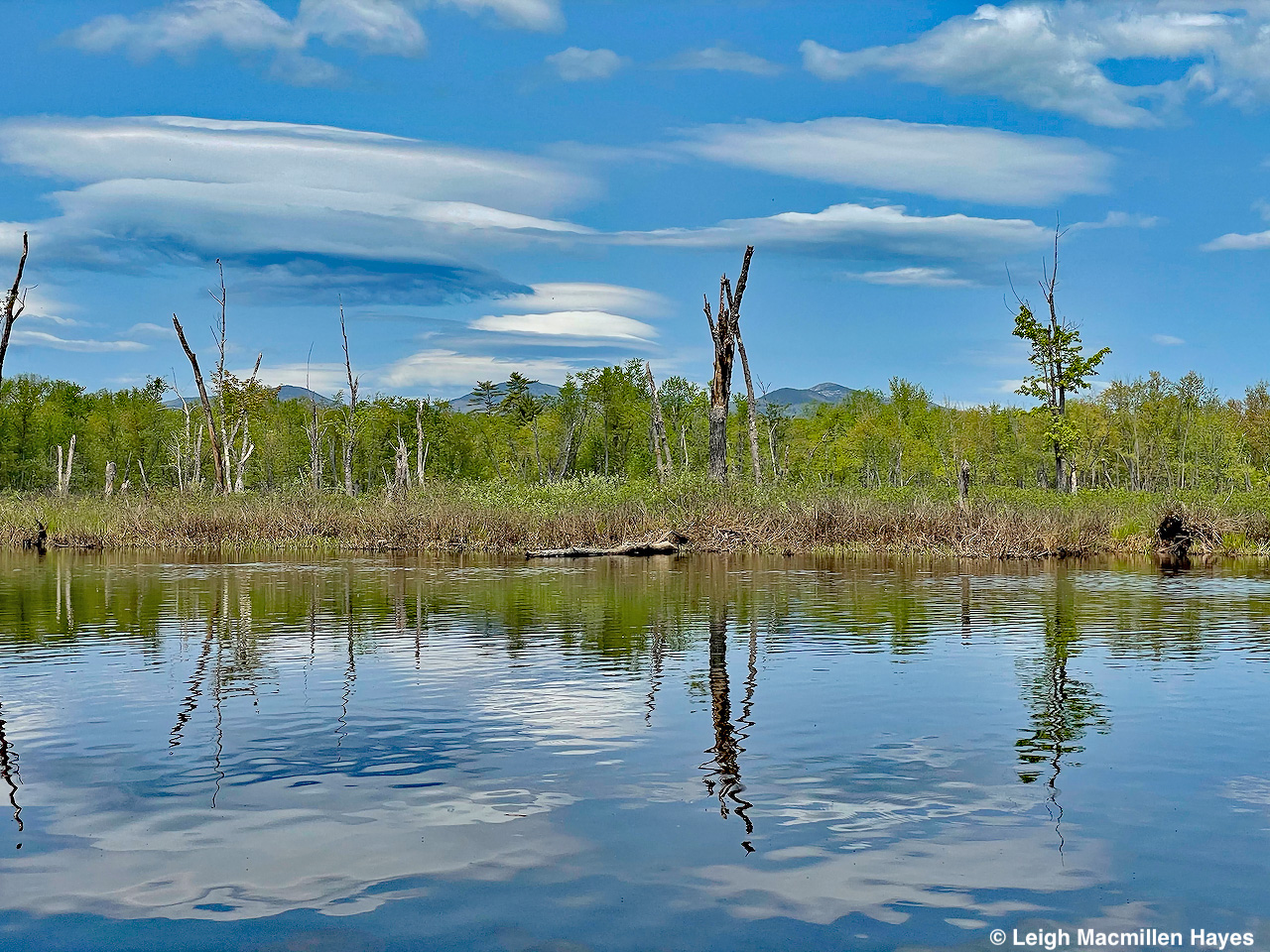
The survey began with a day of setting and baiting fifteen traps in the pond and associated rivers. What’s not to love about spending time in this beautiful locale, where on several occasions lenticular clouds that looked like spaceships about to descend greeted us.

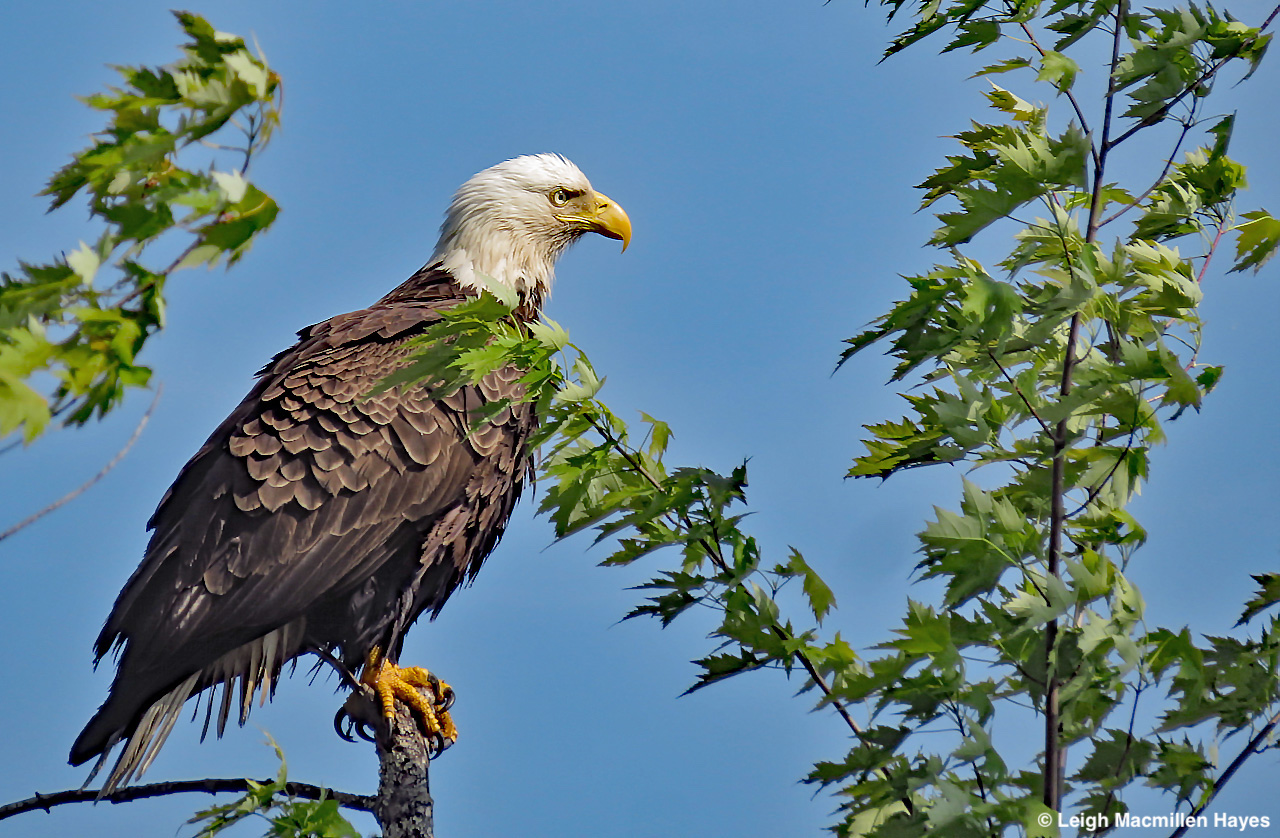
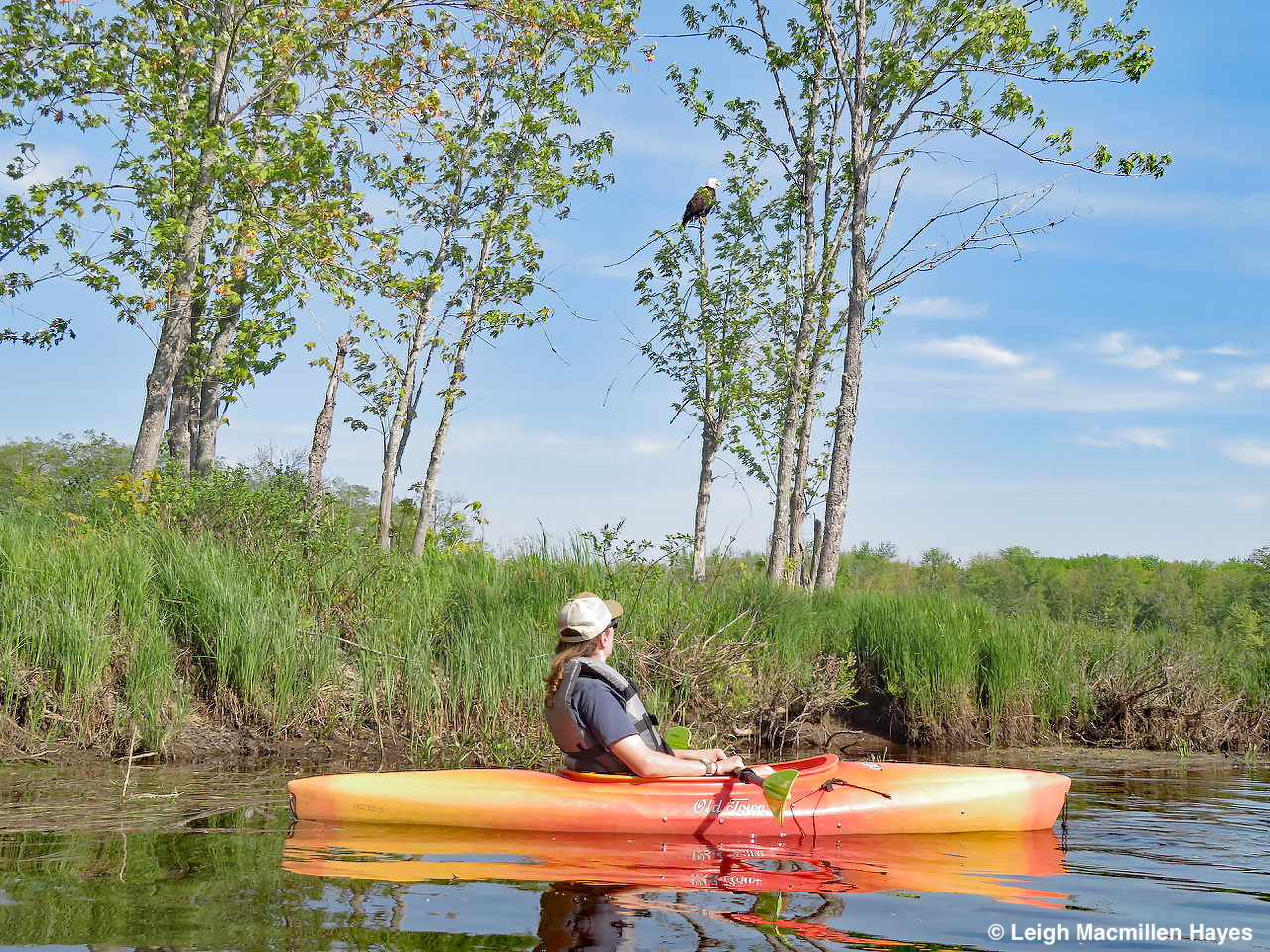
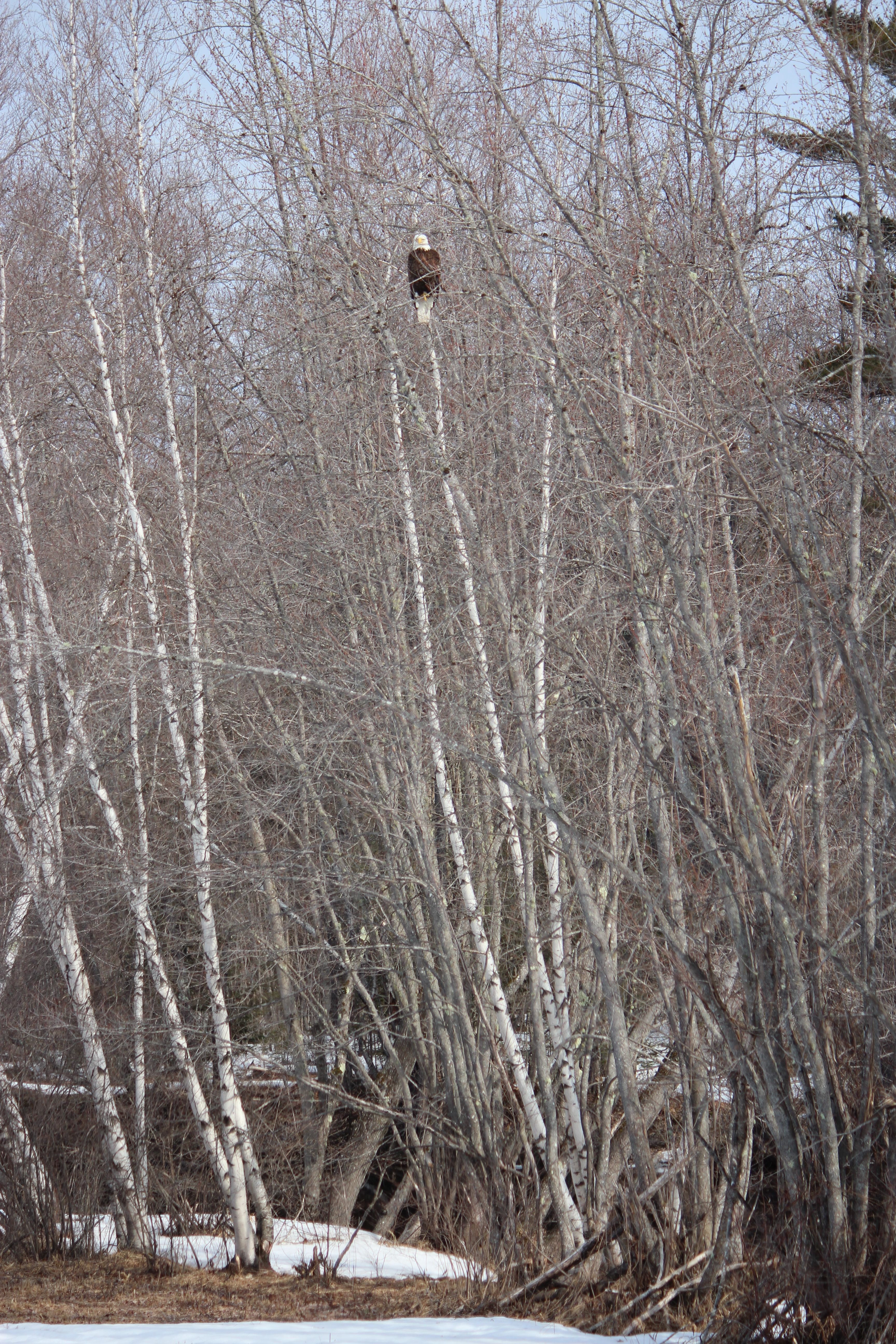
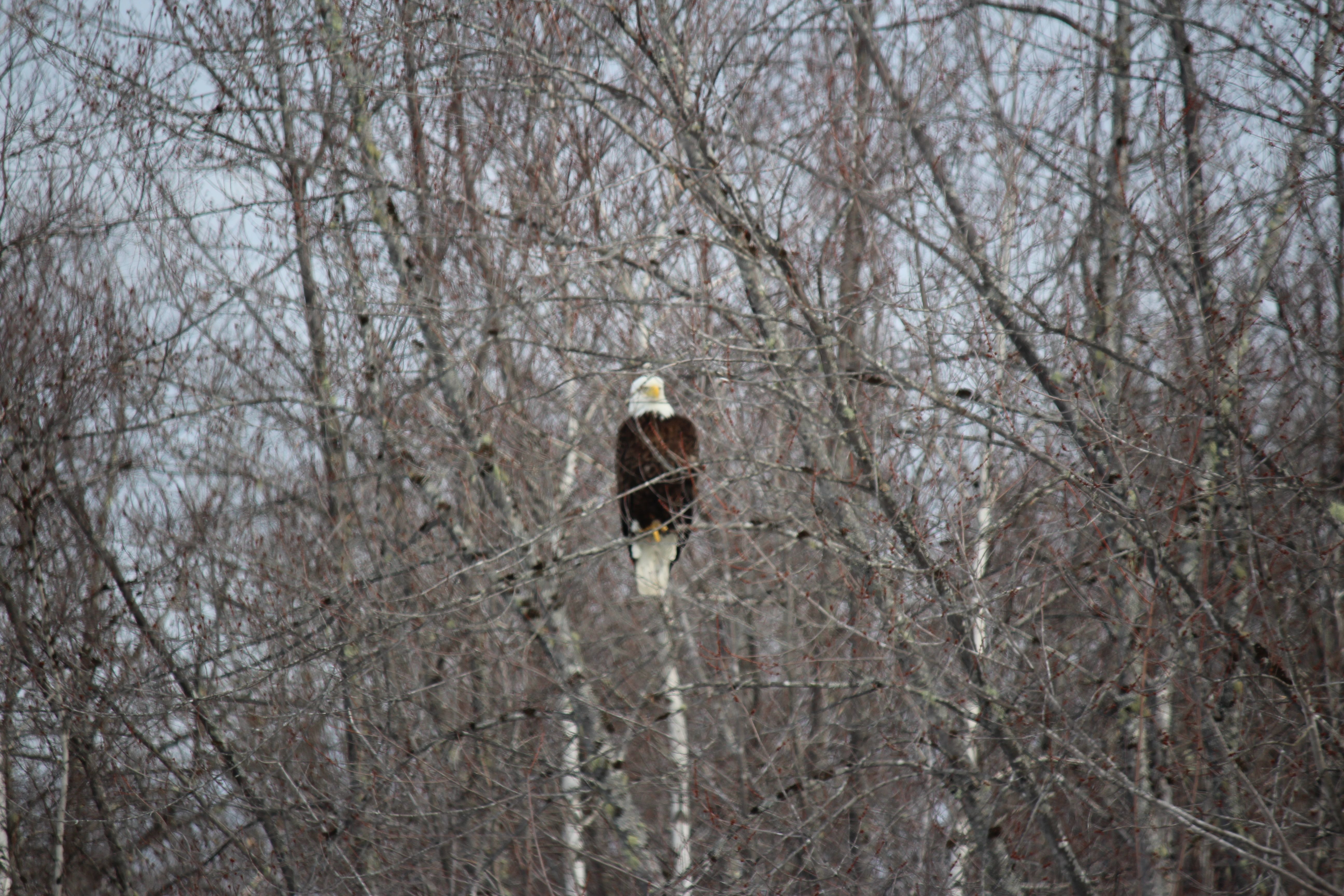
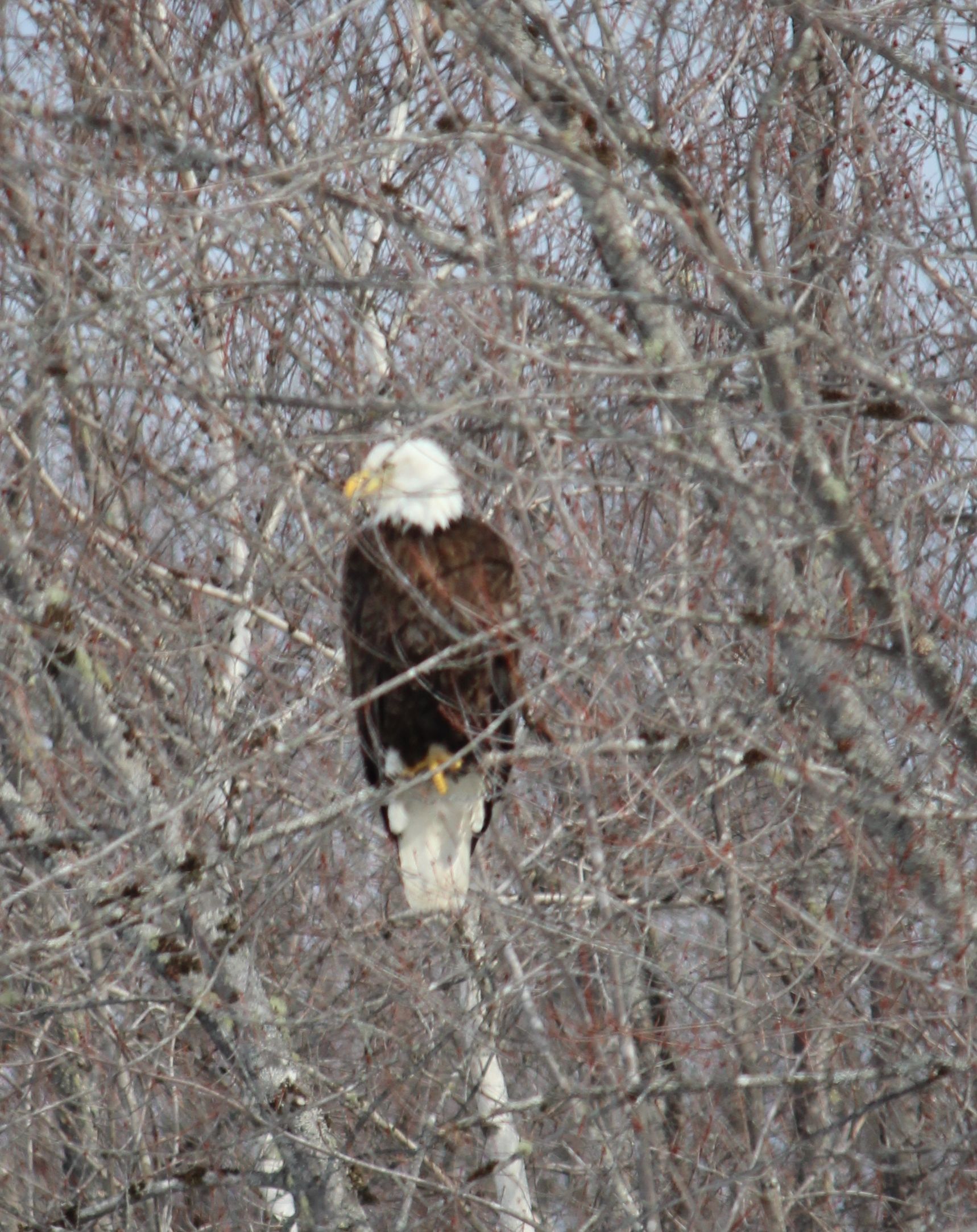
Our favorite bird sighting was this bald eagle, who found a silver maple snag at the outlet of Cold River into Charles Pond. I was a wee bit nervous as that was Change The Trap Bait Day, and I had a bag of stinky old sardine cans in my lap as I paddled a kayak.

He was intent, however, on something else and barely gave us a glance.

This story of the survey would not be complete, however, without the absolute best sighting that occurred on the last day. Our mammal observations on almost every trip included a muskrat, plus occasional squirrels, and once a beaver. From our game camera set up at various locations, and from tracks and scat, we also know that coyotes, raccoons, otters, a bobcat and a black bear share this space.

But . . . you’ll have to click on the link under the Bald Eagle photo to figure out what our best sighting was.

The Saga of a Vernal Pool

Warning: Some may find parts of this post disturbing. But it is, after all,  about the circle of life. 

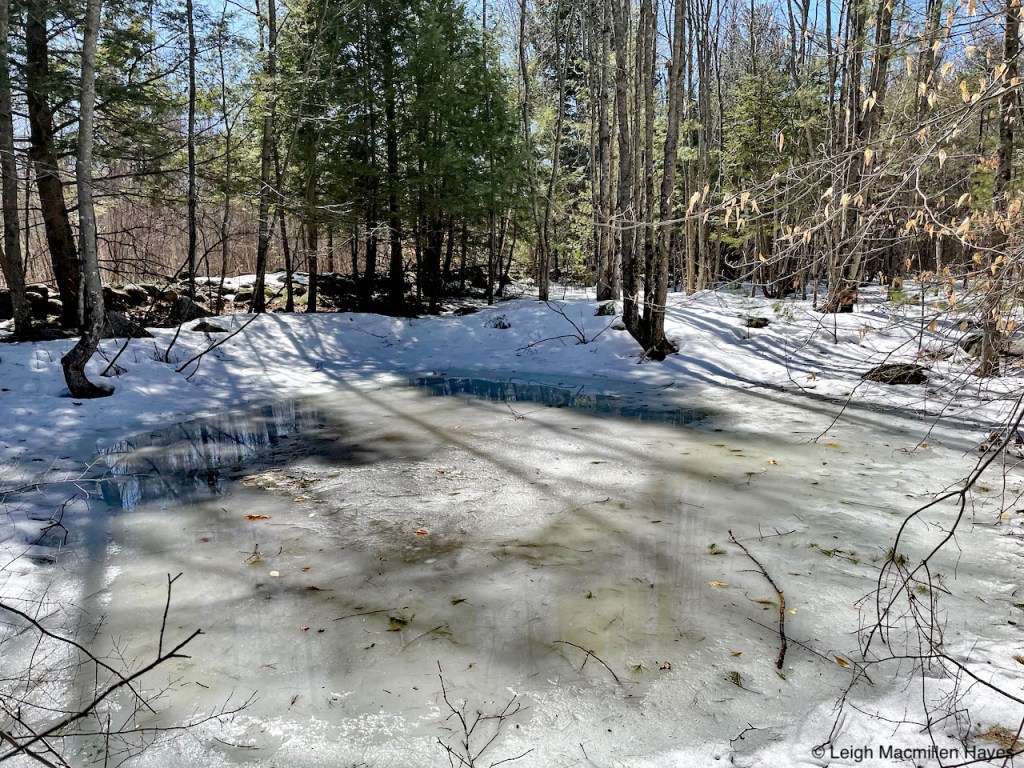
A climbing thermometer in March signaled one thing amidst many others: the time had arrived to check the vernal pool. 

Completely covered with ice at the start of my explorations, I noted puddling on top and knew it was only a matter of days. 

Not wanting to rush the season, though truly I did, I rejoiced when the edges melted because life within would soon be revealed.

And then one day, as if by magic, the ice had completely gone out as we say ‘round these parts. It was early this year–in late March rather than April. That same night I heard the wruck, wrucks of Wood Frogs, always the first to enter the pool. 

The next day he had attracted his she, grasping her in amplexus as is his species’ manner. 

Ah, but how does the story end? Click on the link under the photo to find out.

Consumed by Cicadas

I walked into a cemetery, that place of last rites and rest, looking for life. It should have been a short visit, for finding life in such a location hardly seems possible, but . . . for two hours yesterday I stalked the gravestones and today I returned to the same spot where I once again roamed, and then continued up the road to another that surprised me even more.

Upon the granite wall that surrounded the Hutchins plot, two small, but actually rather large in the insect world, nymphs crawled and paused, crawled and paused. And my heart sang as it does when I realize I’m in the right place at the right time.

Click on the link under the photo to see the story of the Cicadas unfold.

Not Just An Insect

Out of curiosity, and because it’s something I do periodically, I’ve spent the last four days stalking our gardens. Mind you, I do not have a green thumb and just about any volunteer is welcome to bloom, especially if it will attract pollinators.

There were millions of other insects, well, maybe not millions, but hundreds at least, flying and sipping and buzzing and hovering and crawling and even canoodling, the latter being mainly Ambush Bugs with the darker and smaller male atop the female.

But why the title, “Not Just An Insect”? Ahhh, you know what you’ll need to do to find the answer.

A Collection of Mondates

Every Mondate is different, which goes without saying, and the adventure always begins with a question, “What are we going to do today?”

The answer is frequently this, “I don’t know, you pick.”

The instantaneous reply, “I asked first. You need to figure it out.”

We did figure it out. Over and over again. This collection happens to include places that make us happy and many of our family members and just looking back puts a smile on my face. Oh, and the selfie–taken at the same place where we went today–only in September 2021.

Beautiful Maine

A vacation loomed in front of us. Where to go? What to do?

Click on the link, Beautiful Maine, to see what surprises awaited us as we got to know our state a wee bit better.

Pondering the Past at Pondicherry Park

Before today’s deluge began, I slipped into Pondicherry Park in Bridgton, Maine, to fill the innermost recesses of my lungs with November air, and at the same time my brain with memories of so many people who have traveled these trails with me from Ned Allen, former executive director of Bridgton Historical Society, to Loon Echo’s Jon Evans, and Lakes Environmental Association’s Alanna Yanelli and Mary Jewett, and friends and friends and friends, including the late JoAnne Diller, Sue Black, and Jinny Mae. But today’s journey also included memories of one I took two years ago with Becky Cook, who shared her remembrances of growing up along South High Street and romping through these trails as they were part of her backyard. If anyone ever had a sense of this place, it is Becky.

This post is full of information of an historic and natural nature. Go ahead, click on the link above to learn more.

Following the Circle of Life

Upon an aimless journey into our neck of the woods a pattern soon emerged, though I didn’t realize it at the time. Sometimes, it’s best that way. To be present is the key.

Click on the link to find out more about the pattern.

Good Hair Mondate

The temperature dipped overnight and wind picked up out of the WNW but given the destination we had chosen, we knew if we dressed appropriately we’d be fine because we’d be in the woods most of the time, unlike last week’s walk where we were completely exposed to the elements on Popham Beach. That said, it was cold today.

But what could good hair possibly have to do with this Mondate? You’ll have to read it to find out.

The Duck’s Tale

Dear Readers, This post may not be for the faint of heart, but it’s something those of us who track find incredibly exciting as we try to interpret the gory story. Yes, you read that correctly. Blood and guts are to follow. You are now forewarned, and if you decide not to read on, I totally understand.

So how is this stuffed beaver connected to a gory story?

Starring wondermyway, episode 3 on LRTV

Finally, settle into a comfy chair and click on the following link to listen to fourteen minutes of wondermyway: wondermywayIII.

Thank you. Thank you. Thank you.

I hope you’ll continue to wonder along with me as I wander through the woods.

Surveying the Wildlife of Charles Pond

For the past two weeks at Greater Lovell Land Trust we’ve had the good fortune to conduct a wildlife survey in the waters that surround the newly acquired Charles Pond Reserve in Stow, Maine. Our hats are off to Alanna Doughty of Lakes Environmental Association (LEA) for her willingness to be the lead on this project and work in collaboration with us. Alanna, you see, has conducted previous surveys for Maine Inland Wildlife & Fisheries (MDIFW) at LEA properties, and was trained by wildlife biologist Derek Yorks to set these up.

MDIFW maintains a comprehensive database on the distribution of Maine’s amphibians and reptiles, as well as terrestrial and freshwater invertebrates and the data we’ve collected will add to the bigger picture. What we discovered was just as important as what we didn’t find.

The survey began with a day of setting and baiting fifteen traps in the pond and associated rivers. What’s not to love about spending time in this beautiful locale, where on several occasions lenticular clouds that looked like spaceships about to descend greeted us.

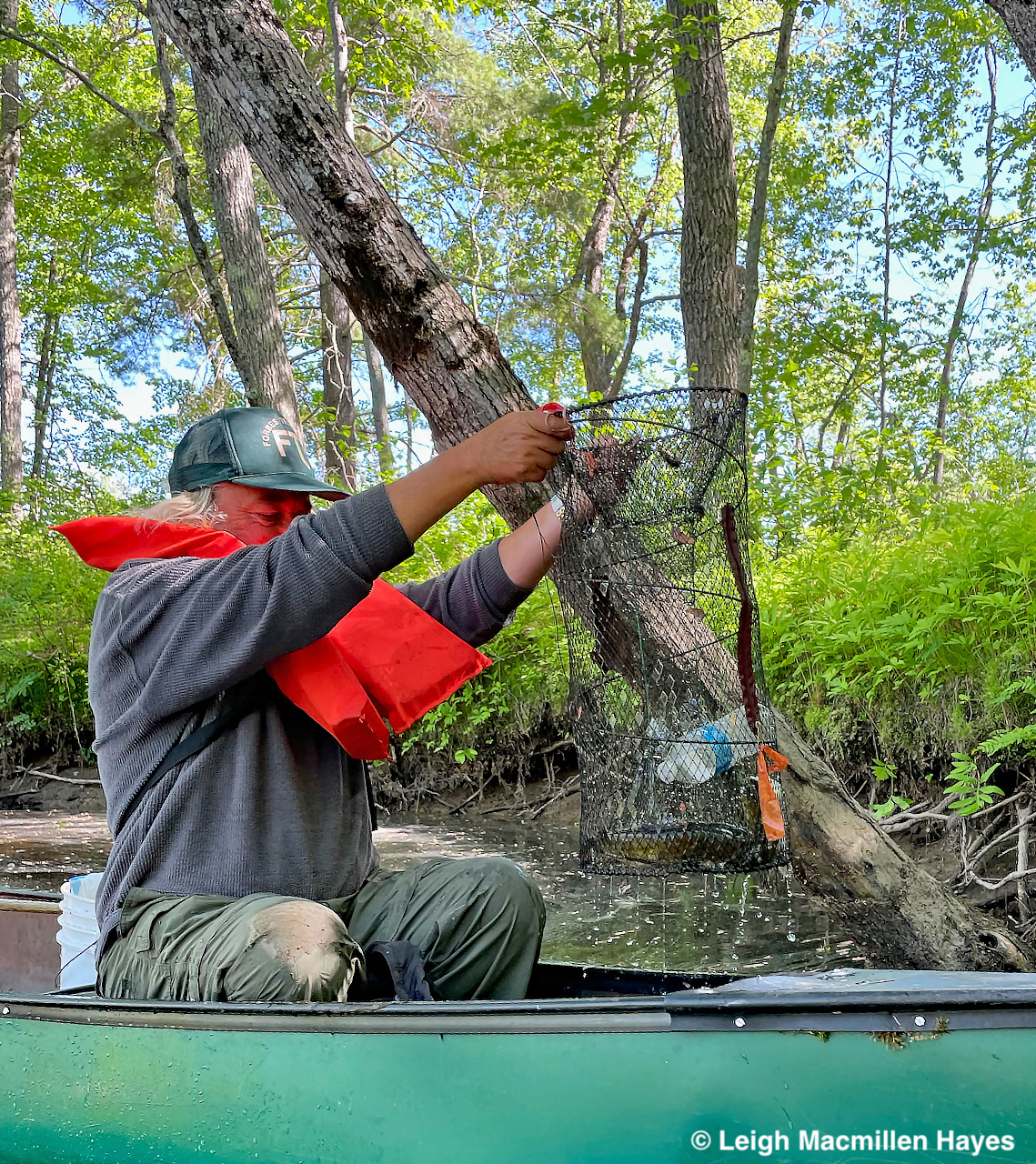
Each trap was given a number to identify on subsequent days, and all were marked with waypoints on a GPS map of the area. The traps were designed so critters could get in from either end without harm, but could not escape . . . until we recorded them and set them free, that is. An empty water bottle helped each trap stay partially afloat, thus allowing any captured turtle an opportunity to surface for air since unlike fish, they don’t have gills. And each trap was baited with a can of sardines in soybean oil, opened just a tad to release the oil, but not enough for the critters to eat the fish. That was the messy . . . and stinky part of the task. But I swear my hands and wrists currently are less wrinkled than the rest of my arms.

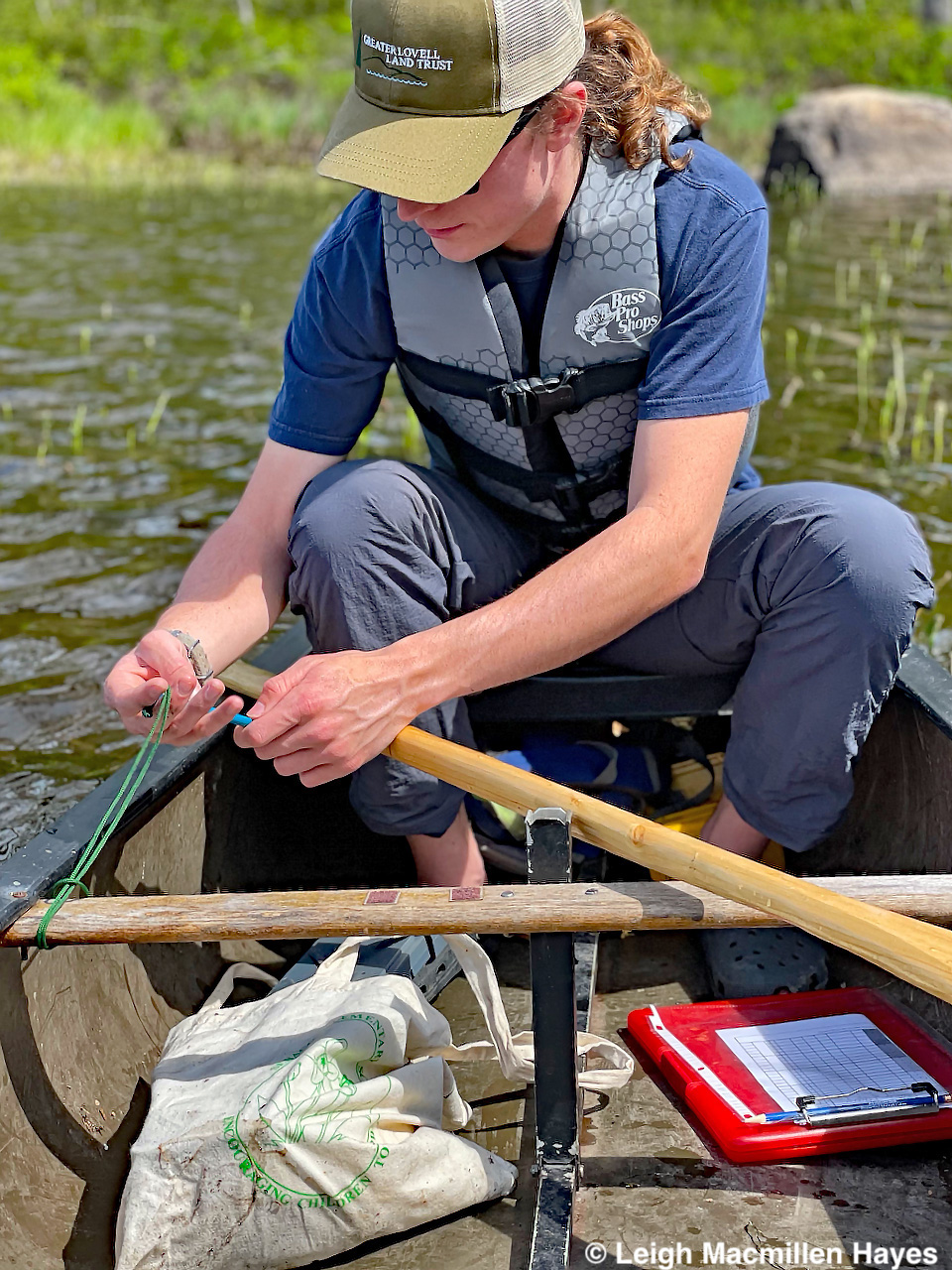
As Alanna on the right, showed GLLT’s Executive Director Erika Rowland, on the left, and me on day 2, the information we needed to collect included air temp at the beginning of each set of five traps, water temp at every trap, plus we had to document turtle species and any bycatch. And if we moved traps, which we ended up doing a day or two later, we needed to note that as well, and remember to change the location on GLLT’s iPad.

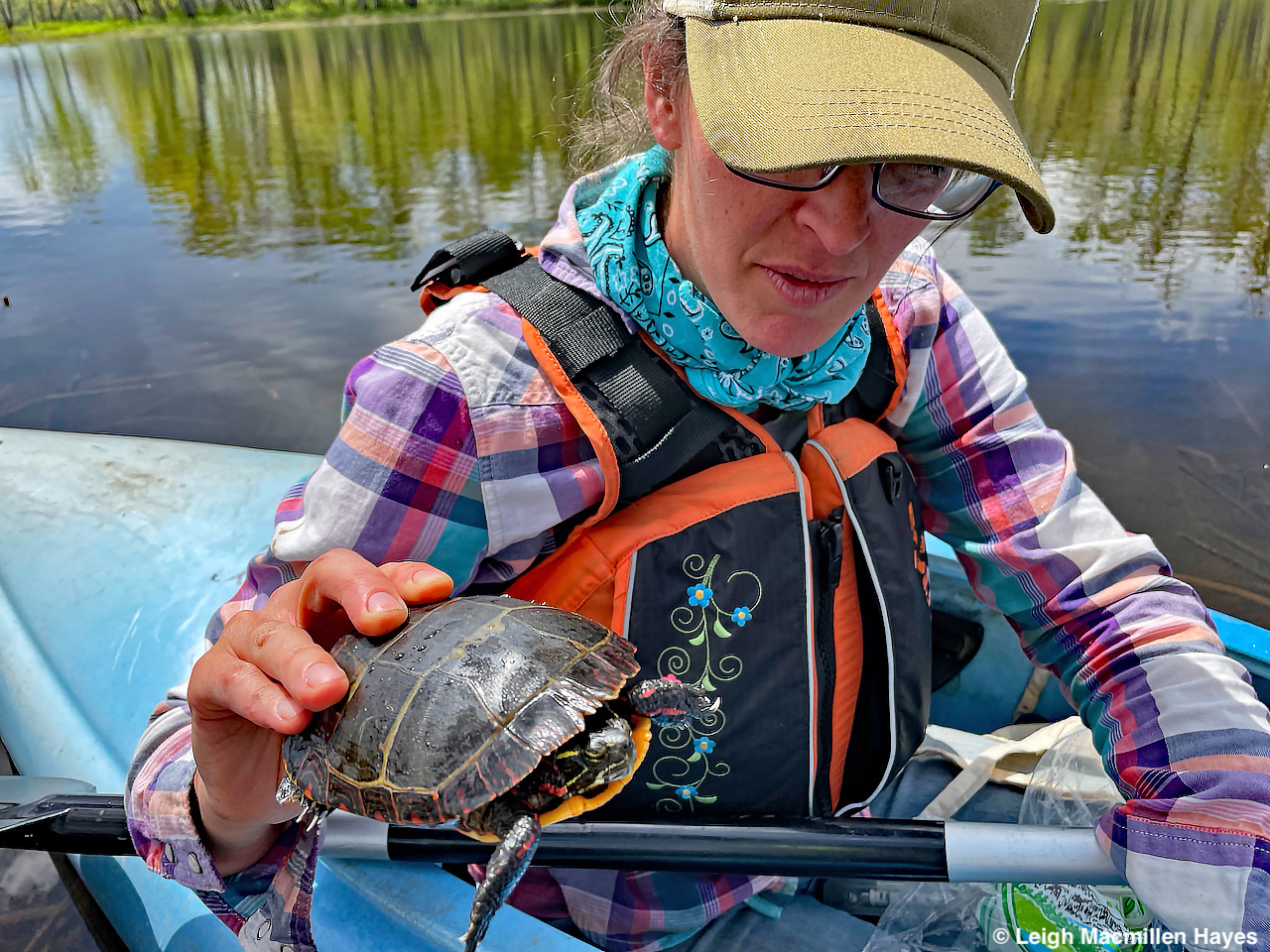
We felt skunked at first, because a bunch of our traps were empty, but soon learned that every day would be different. Our first painted turtle, however, was a reason to celebrate.

In no time, it became routine, and GLLT’s Land Steward Rhyan Paquereau, Erika, and I took turns sharing the tasks of the daily trips. If it sounds like a hardship, it was not.

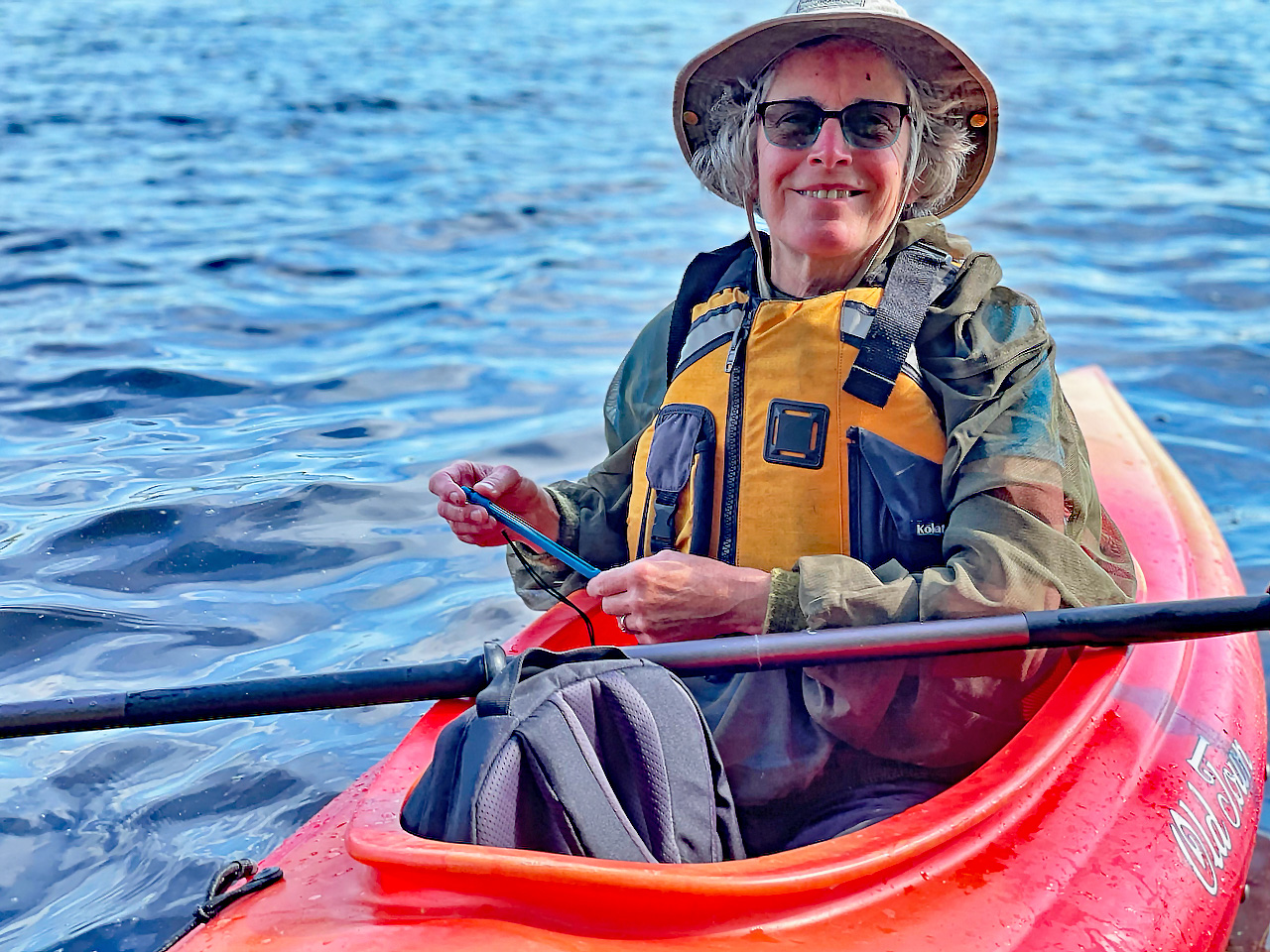
Even GLLT’s Office Manager, Alice Bragg, had an opportunity to spend time checking traps with us and taking the water temperature.

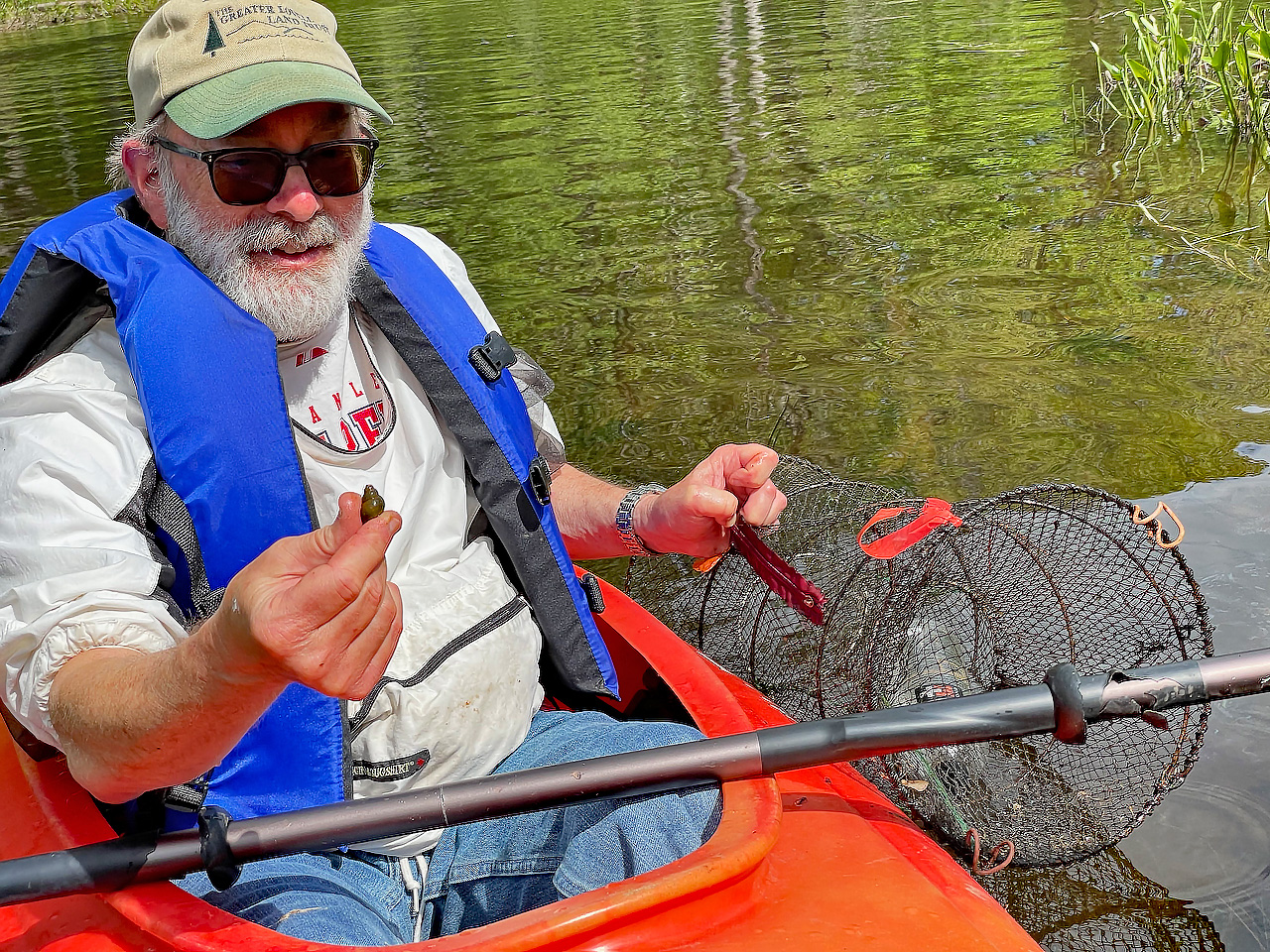
With confidence that we knew what we were doing, well, sorta knew, we invited all volunteer docents and board members to get in on the fun. Of course, my email to them mentioned the stinky soybean oil and feisty mosquitoes, but that did not deter. Often, if something was in the trap it would wiggle upon our approach, but sometimes, as Pam Marshall learned, it wasn’t until you picked it up to check, that the real action began.

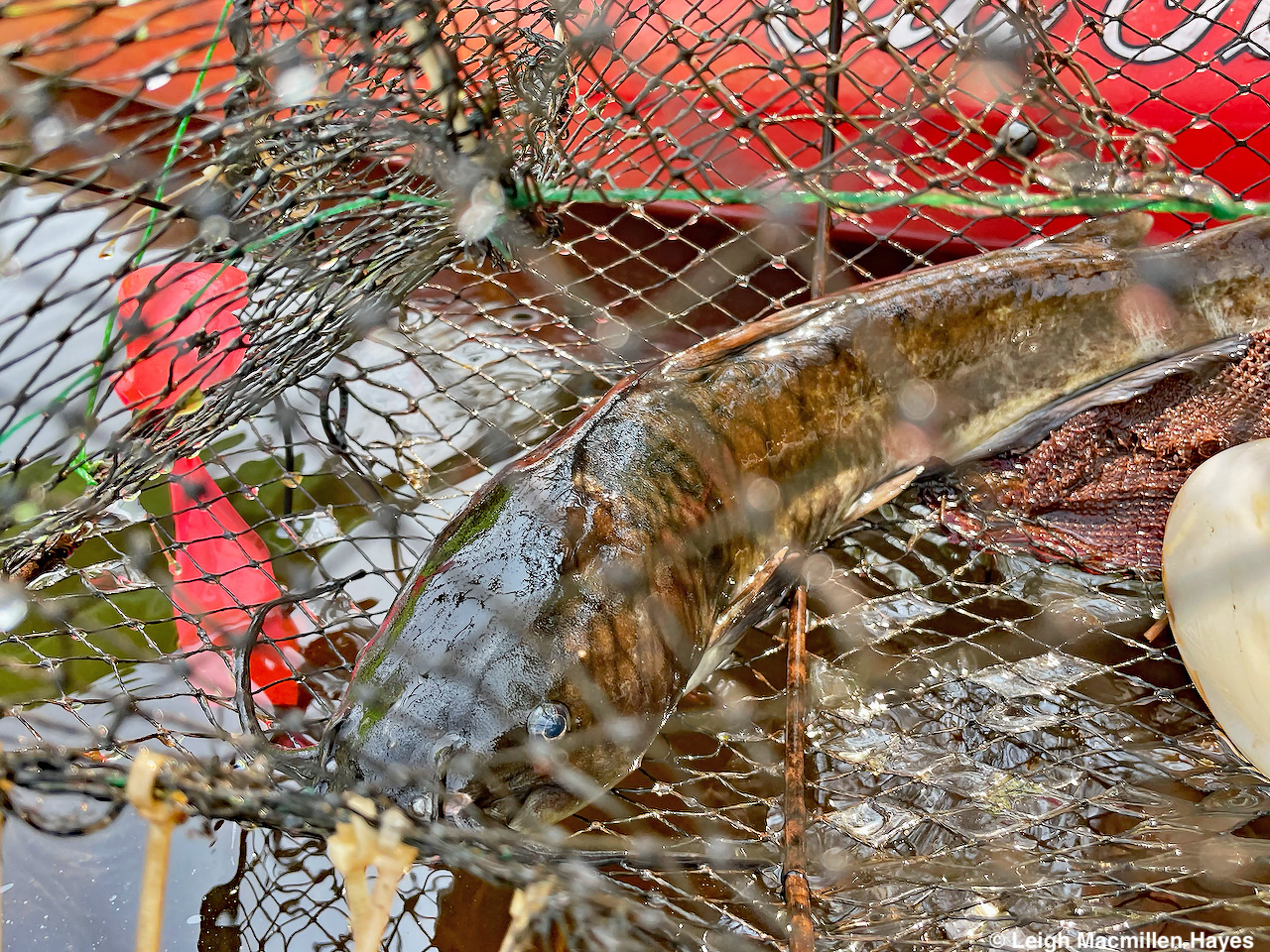
A hornpout, aka brown bullhead, started flipping around and there was a moment of surprise.

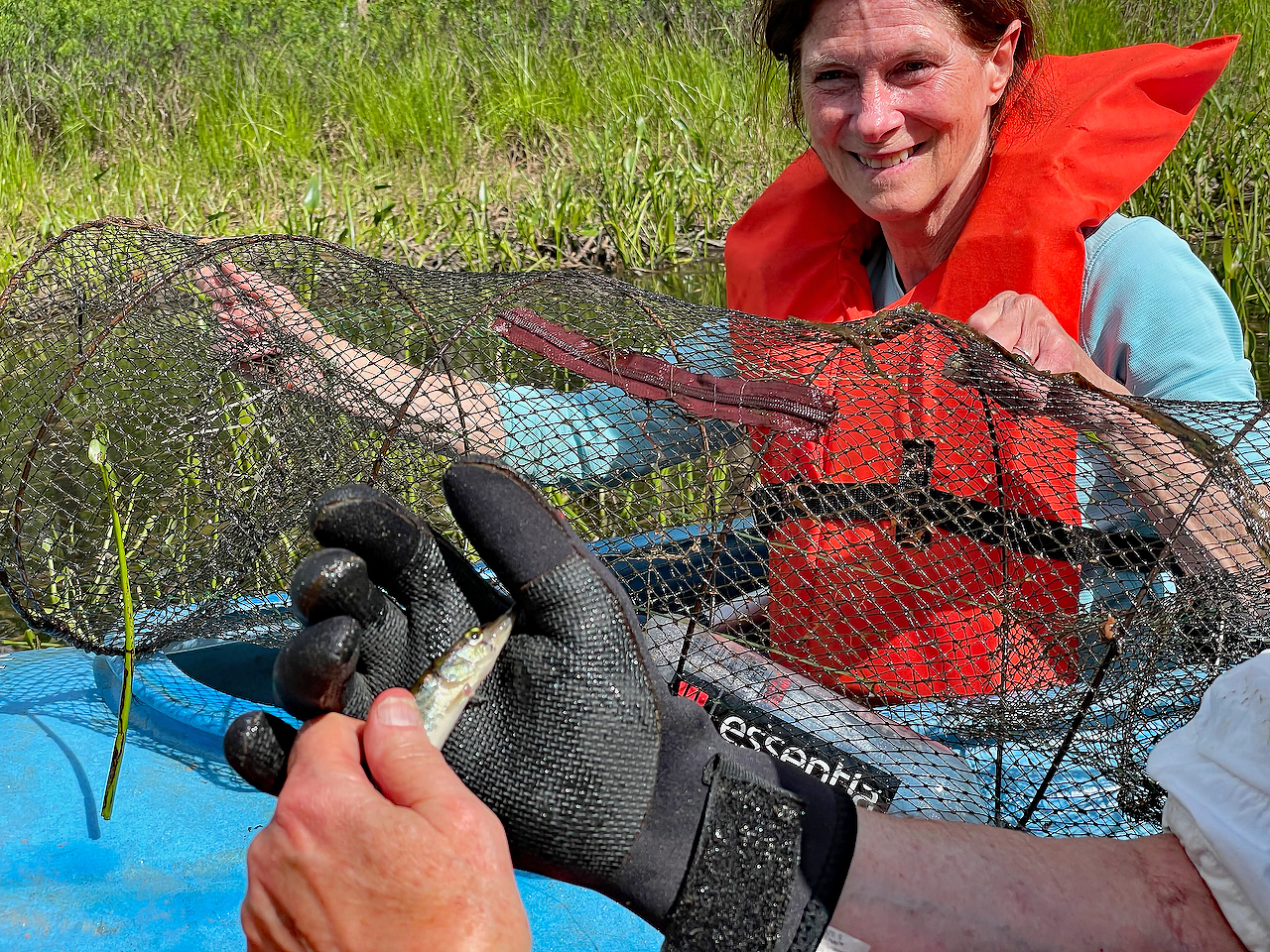
I knew nothing about freshwater fish at the beginning of the survey, and still don’t know a lot, but am learning. Hornpouts are native catfish who come out at night to feed, vacuuming up worms, fish and fish eggs, insects, leeches, plants, crustaceans, frogs–you name it.

They have a thick rounded body, and a broad, somewhat flattened head with a distinctive set of “whiskers” around the mouth called barbels, which they use to find prey. Their fins have sharp saw tooth spines that can be locked in an erect position as we soon learned and wearing gloves was the best way to try to pull one out if the release zipper on the net wasn’t working. With no scales on their skin, they were a bit slippery, but we managed.

On another day, when volunteers Pippi and Peter Ellison and I had to wait out a fast-moving rain storm that initally left us soaked and chilled, the first catch of the day was a water scorpion. At the time, I kept calling it a walking stick, because it does resemble one. But this is an aquatic insect. It’s not a true scorpion, despite its looks. It uses its front pincer-like legs to catch its prey. And its tail actually acts as a kind of snorkel, rather than a sting, allowing it to breathe in the water.

Once the rain stopped, the Ellisons and I carried on and they were well rewarded. All told, they released the biggest variety of species from this small snapping turtle, to several painted turtles, a crayfish, and several fish species.

In the very last trap, Pippi also pulled out a giant water beetle.

On another day, one of Bob Katz’s finds was a freshwater snail. Thankfully, it was not the large, invasive Chinese Mystery Snail, but rather one of the 34 natives.

As was often the case, teamwork played a huge role in the process of removal of not only the species, but also the stinky sardine cans that were replaced with fresh ones every other day. That didn’t stop Joan Lundin from smiling about the chores to be completed on a super hot day when the air temp hit 90˚.

While some days were downright cold or windy, and whitecaps made crossing the pond a real challenge, others offered calm waters and Basil Dixon and Bruce Taylor joined Rhyan and me for one of the latter.

Up Cold River, much to our surprise, Basil hoisted out a trap filled with four hornpouts.

They waited impatiently for a photo call and release and in moments were on their way.

At the very next trap, Bruce discovered four as well, this time all being painted turtles.

They looked as grumpy as the hornpouts, but who could blame them. Painted turtles are common throughout Maine and in fact, the most wide-spread native turtle of North America. This colorful turtle’s skin ranges from olive to black with red, orange, or yellow stripes on its extremities.

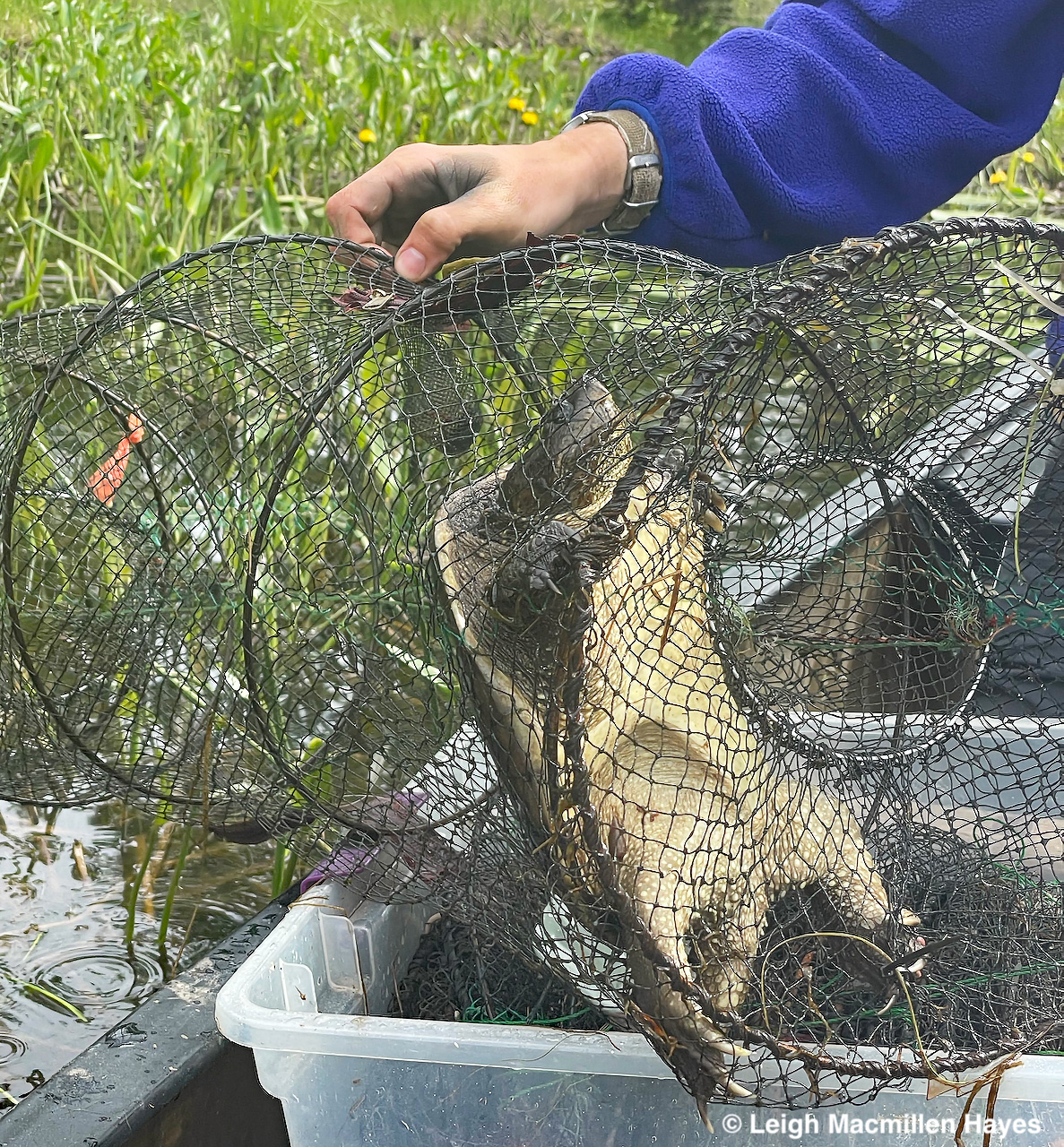
Each time we went out, I prayed we wouldn’t find a large snapping turtle in the trap and that if we did, Rhyan would be with me. Several times, we had to replace traps because big snappers had torn the mesh, and twice we released small snappers, one feistier than the other. On the very last day when we were pulling the traps out because the study was drawing to a close, as luck would have it, Rhyan was with me and we caught not the biggest snapper we’ve ever seen, but still one of decent size.

Notice the plastron, or bottom shell, and you can actually see the bridges that connect it to the much larger top shell or carapace. The zipper on this particular trap had been sewn shut because apparently in a previous study another snapper had torn it, but Rhyan carefully unstitched it to let the turtle swim free.

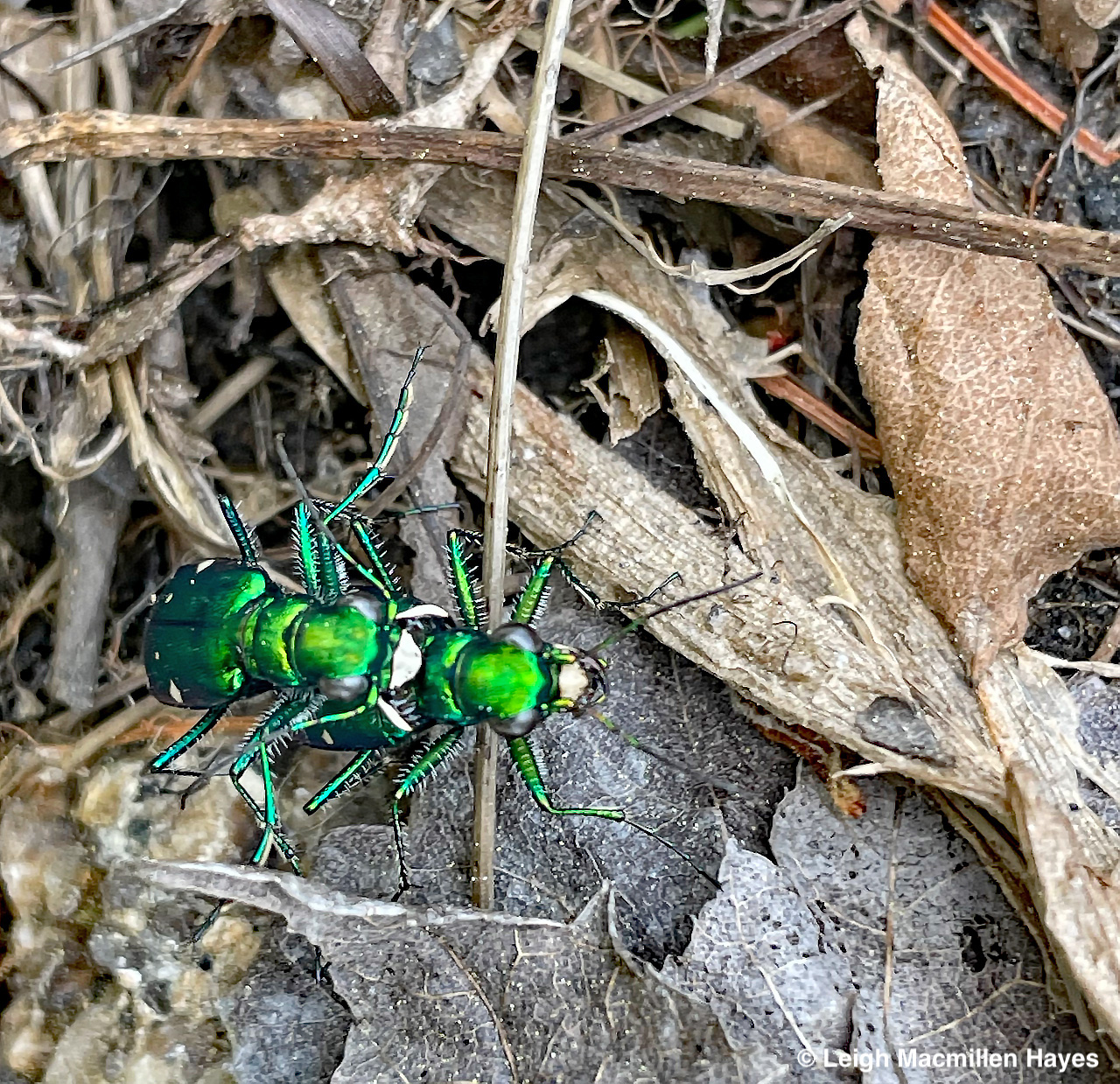
So, the thing about visiting the same place on a regular basis, is that you get to know so many of the community members, such as the six-spotted tiger beetles who chose that very moment to move rapidly across leaves and rocks by the pond’s edge as they mated. Their large eyes, long legs and sickle-shaped mandibles are characteristic of these metallic green beetles. Usually, however, I can’t get close for a photo because like some dragonflies, as soon as I take a step, they fly ahead a few feet and land until my next step. I was grateful that canoodling slowed them down at least a tad.

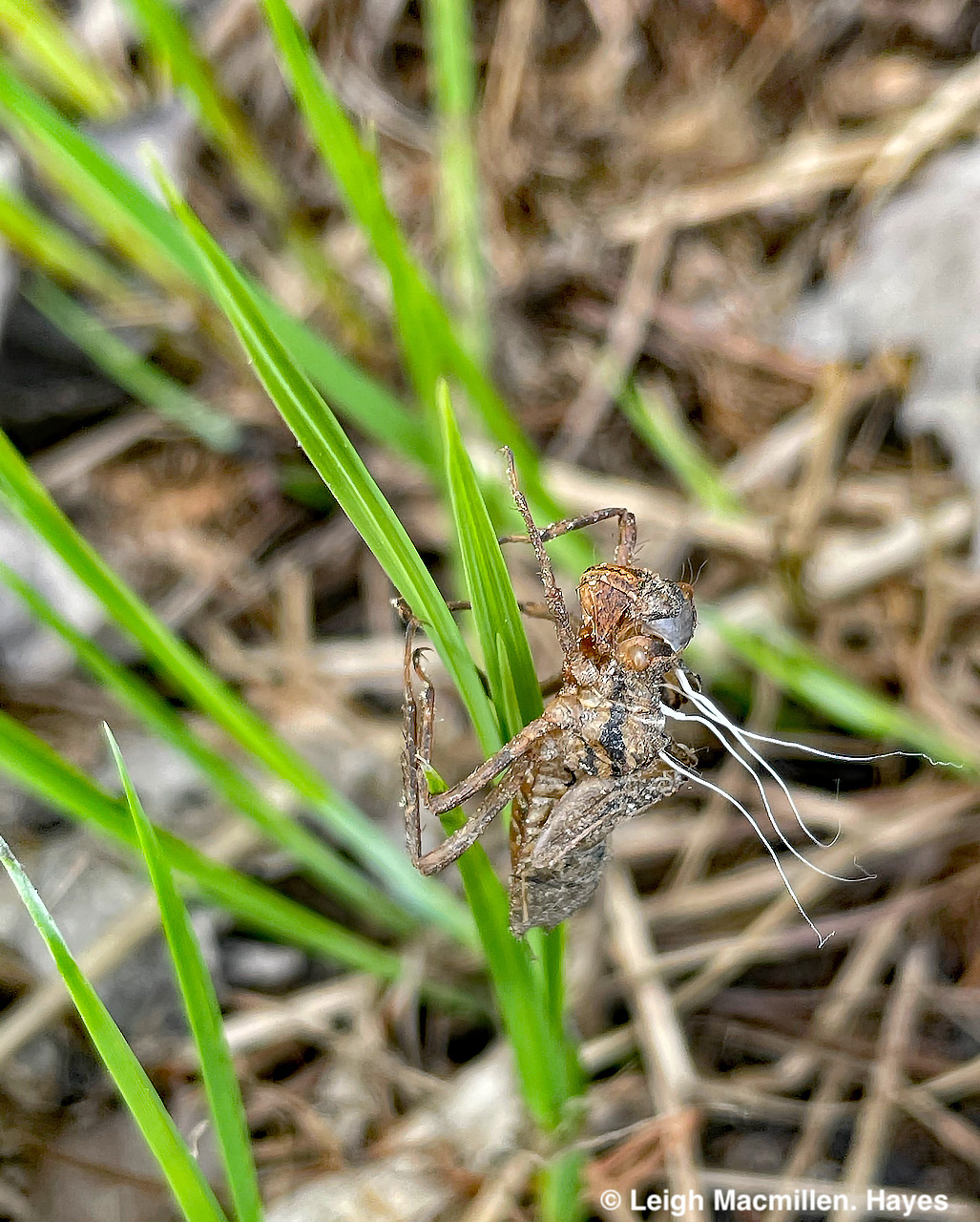
Did I mention dragonflies? Each day more exuviae were added to the stems and leaves of terrestrial and aquatic vegetation. Though fragile, the casts of exoskeletons retain the exact shape of the full grown nymph. You might think of it as a kind of death mask for that previous aquatic stage of life. In each exuvia there’s a hole located behind the head and between the wing pads where the adult dragonfly emerged, literally crawling out of itself. The white threads that dangle from this exit hole are the tracheal tubes.

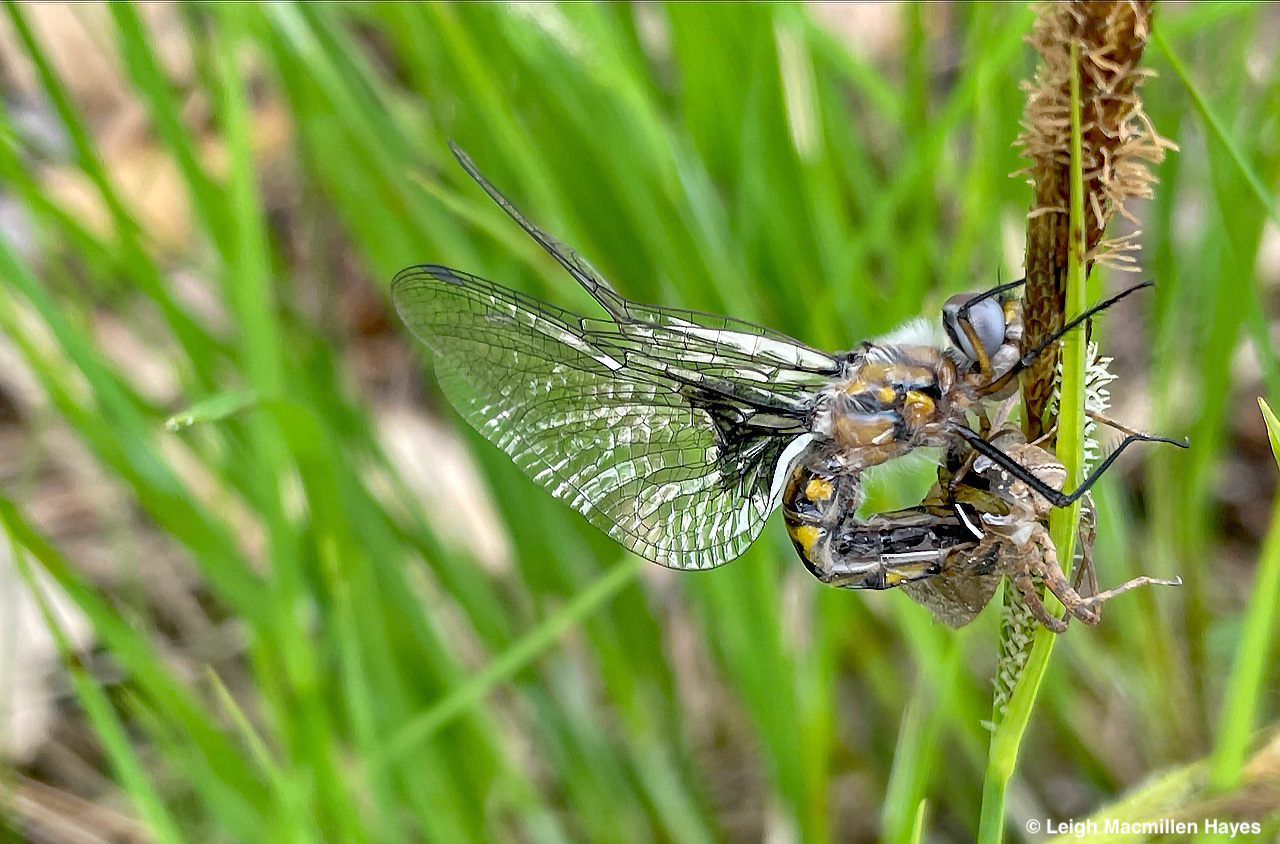
For a couple of hours after we’d finished the survey on the day Pam was with me, we watched this dragonfly that for some reason could not completely escape its larval form. It was obvious by its coloration and body/wing formation that it had been trying for quite a while to free itself–there was still life in it as we watched it move its legs and wings, but we didn’t interfere (though a part of us regretted that) and the next day I discovered it in the same position, but lifeless. Two days later, it was gone and I had to hope a bird had a good meal.

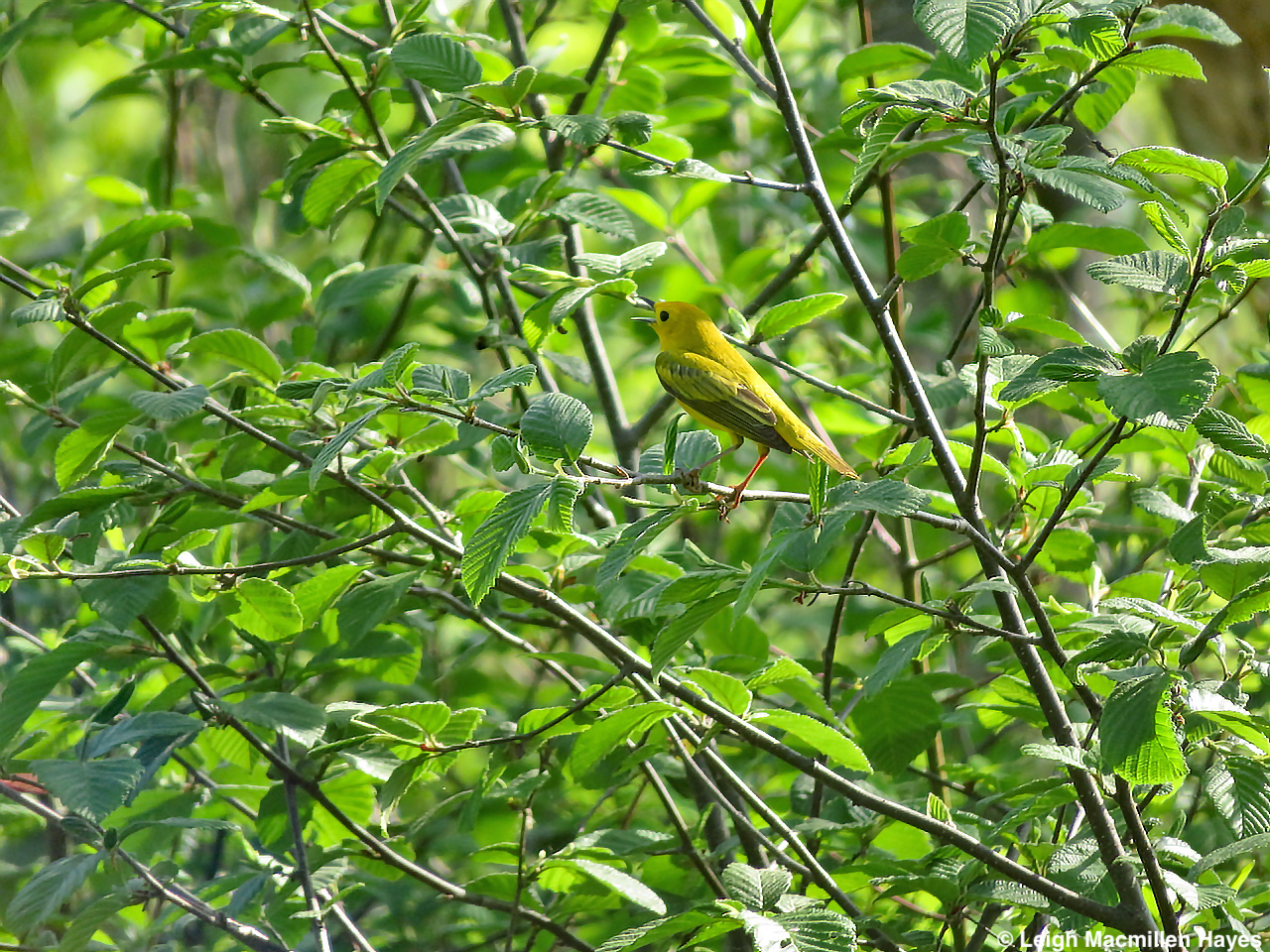
Speaking of birds, we saw them and delighted in listening to them, like this yellow warbler, and herons, osprey, orioles, red-winged blackbirds, tree swallows, one lonely loon, and even a hummingbird.

But our favorite bird sighting was this bald eagle, who found a silver maple snag at the outlet of Cold River into Charles Pond.

I was a wee bit nervous as that was Change The Trap Bait Day, and I had a bag of stinky old sardine cans in my lap as I paddled a kayak. As you can see by the context of this photo, Rhyan and I weren’t far from him at all.

He was intent, however, on something else and barely gave us a glance.

On the sandbar below, stood a sandpiper.

At last, however, the eagle flew, the sandpiper didn’t become a meal, and we watched as the bigger bird landed in a pine where we’ve spotted it before. We still had two more traps to attend to that day, and both were located below the eagle’s perch, but it left us alone.

The smallest birds that delighted us we heard first for they were constantly begging for a meal. All of the first week, we knew they were there by their sweet peeps, but it wasn’t until the second week that we began to spy them. And their demands for food began to sound louder and more adult-like. Unfortunately, the excavated hole used as a nest, was located in a spot where the afternoon sun made it difficult to see, but again on that last day the Kodak moment arrived.

Turtles, too, entertained us not only from the traps, but from their much happier places, basking on rocks or fallen logs. Typically, they slid off the substrate as soon as we approached, but this one actually let us pass by as it remained in place.

Because the water was shallow and clear, occasionally we spied one swimming below. Erika and Rhyan also paddled over one large snapper on a day I wasn’t out for the survey, but our snapping turtle finds tended to be on the smaller side–thankfully.

This story of the survey would not be complete, however, without the absolute best sighting that occurred on the last day. Our mammal observations on almost every trip included a muskrat, plus occasional squirrels, and once a beaver. From our game camera set up at various locations, and from tracks and scat, we also know that coyotes, raccoons, otters, a bobcat and a black bear share this space. But . . .

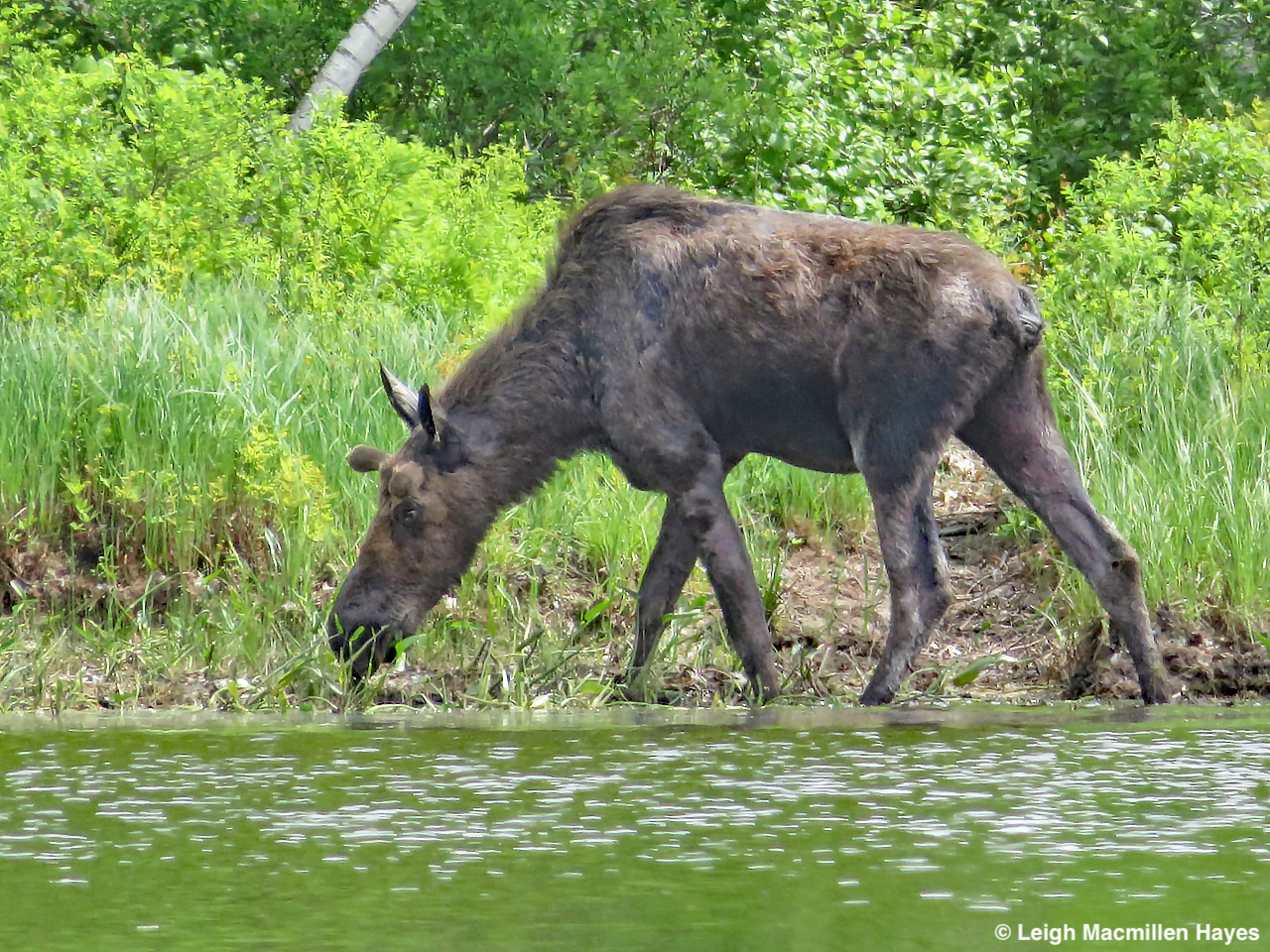
as we paddled the canoe across the pond, Rhyan spied the young bull moose first. We’d seen moose tracks on the road way and every day hoped today might be the day. At last it was.

For a few minutes we sat and watched as he dined upon vegetation.

He seemed not bothered by our presence; mind you we were farther away than appears.

For a while, he browsed in one area, and then began to walk along the edge. And we gave thanks that the stars were aligned, but felt bad that one more volunteer, Moira Yip, who was supposed to be with us, hadn’t been able to make it.

Finally, the moose stepped out of the water and we knew our time together was coming to a close.

He gave one sideways glance and we said our goodbyes.

And then he disappeared from Charles Pond for the moment, and so did we.

What an incredible two weeks it was as we surveyed the wildlife of Charles Pond. Many thanks to Erika and Rhyan, to all of the volunteers who joined us (including Nancy and Brian Hammond who went on a day that I wasn’t present) and especially to LEA’s Alanna, and MDIFW’s Derek Yorks for letting us complete this assessment.

It was an honor and a privilege to be part of this project.

The Invitation Stands

It took me by surprise, this change of seasons.

Despite all the clues from fading otter prints . . .

and not so deep moose tracks . . .

to reverse tracks raised above the snow cover as a result of a frozen crust followed by wind and warmer temperatures.

But still, somehow I was fooled into thinking winter would hold its grasp for a wee bit longer because I don’t like to let it go. The faces hiding in the ice knew otherwise.

As did the constitution of pond ice that despite recent brisk days and nights began to react to the sun’s rays and display the tea-stained color of organic matter decomposing in the water below.

Even Winter Dark Fireflies, who don’t carry lanterns like their summer cousins, and aren’t even flies as their name suggests (they are beetles), knew what was happening before I did for in their adult form they’d been tucked under bark in recent months, but in a flash are now visible on many a tree trunk as they prepare to mate in a few weeks.

The same is true of the Winter Stoneflies who only recently started crawling out of the water. and drumming as an announcement that they too are ready to let the mating season begin.

The birch trees also knew before I did and made sure to let last year’s catkins release their scaled fleur de lis, thus scattering the seeds that look like tiny winged insects upon the snow where they’ll join the melt down and eventually find a moist spot upon which to germinate.

And so it is that spring snuck in a few days after St. Patrick’s Day as it always does, but still surprising me and now I join others and anticipate the changes to come.

But . . . there’s something different about this spring. Oh, I’ll still stalk vernal pools until they dry up.

I’ll marvel at each and every tiny bud preparing to bloom like those of Trailing Arbutus.

I’ll spy on spiders and insects for hours on end.

I’ll continue to look for fine specimens of scat, including otter filled with shiny, mica-like fish scales . . .

and coyote that at first glance I might think is bobcat, but the tapered ends offer one hint of its owner . . .

and the sight of bones and toenails tucked within remind me that bobcats are true carnivores who grind the contents of a meal so no bones are typically visible in their deposits, while such do show due to the omnivore appetite of a candid. I will be sure to question the meal based on the color of the fur as well as the contents.

But . . . this spring will be different. Yes, such was the same a year ago when we all moved into our bubbles. Now, though, there’s a glimpse of hope on the horizon and with that comes an assimilation to being with others and I can’t help but wonder, how will I react? I’ve become so accustomed to this forced insulation, and I have to admit that there are parts of it that haven’t bothered me, perhaps because I don’t mind being in my own space.

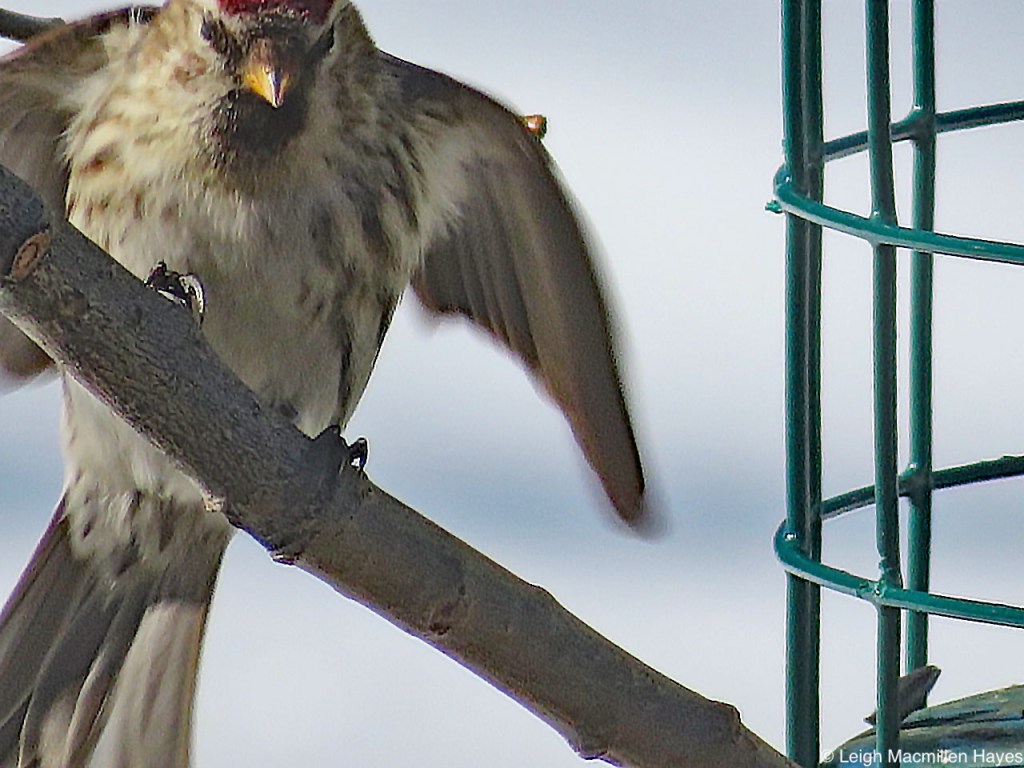
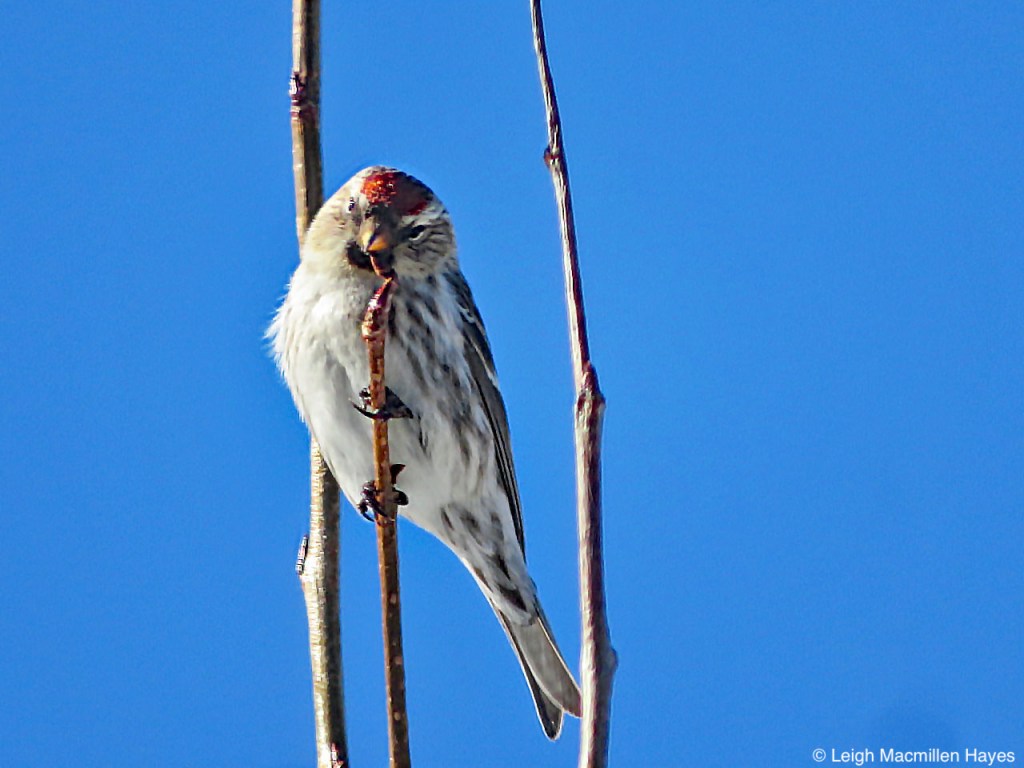
The question has been on my mind a lot lately and the answer flew in this morning as I listened in on a ZOOM church service. Just as it was to begin a small flock of Common Redpolls arrived to check out our birdfeeders.

“Invite in” were the words I heard another utter on the computer screen.

Indeed. Each day this past week, the variety of birds at the feeders grows, some species arriving at their breeding grounds, while others like the Redpolls pause before passing through. For the most part, our feathered friends accept the presence of others. An over-the-shoulder look being what it is, they remind me that I must behave like them and be open to opportunities.

As the snow melts, I realize that I must share space with all who wander here . . .

including the deer who tried to walk the labyrinth path.

The Invitation Stands. Spring is indeed here and I invite you to join me for a wander when you are able so we can wonder about nature’s communities together. I look forward to welcoming you back with a smile . . . though please don’t expect a hug.

Top Notch Tracking

“Want to go back to Becky’s?” was the message I received last night.

My instant reply, “Yes!”

And so we did, Pamela M. and I.

We chose Moose Alley as the first trail to follow, though traveling in a counterclockwise pattern to change things up a bit. If you joined us for our journey there a few weeks ago, you’ll recall that we found lots of moose sign and even a few beds. Oh, I know, this is indeed a sign, but . . . it wasn’t exactly what we hoped to discover.

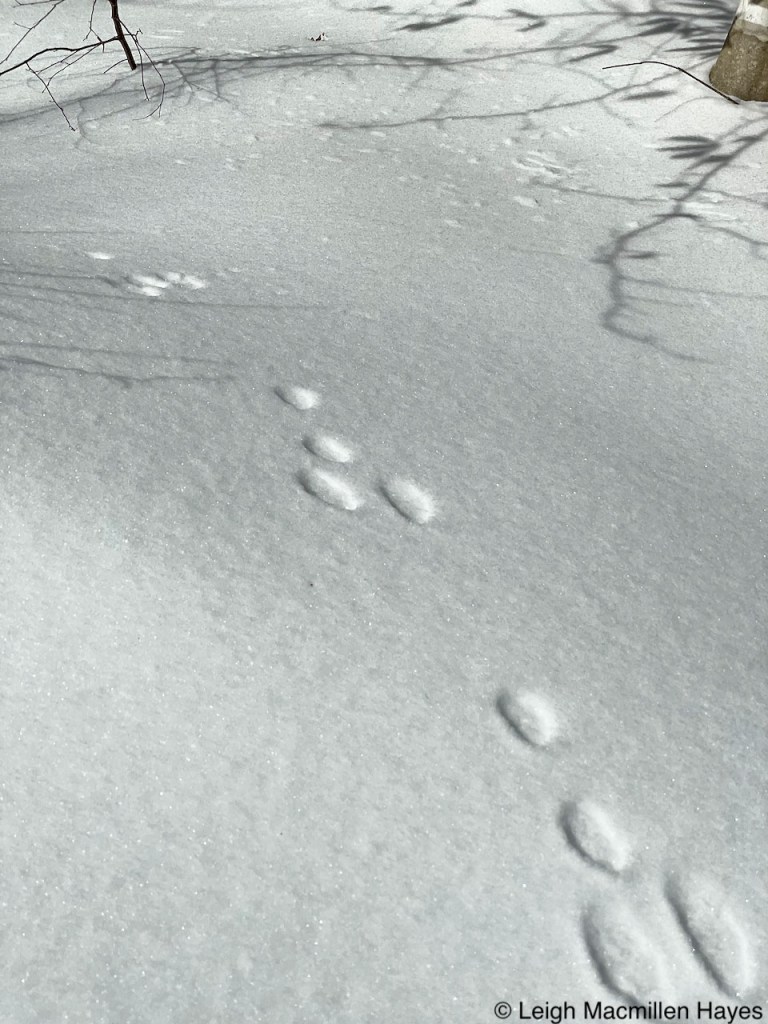
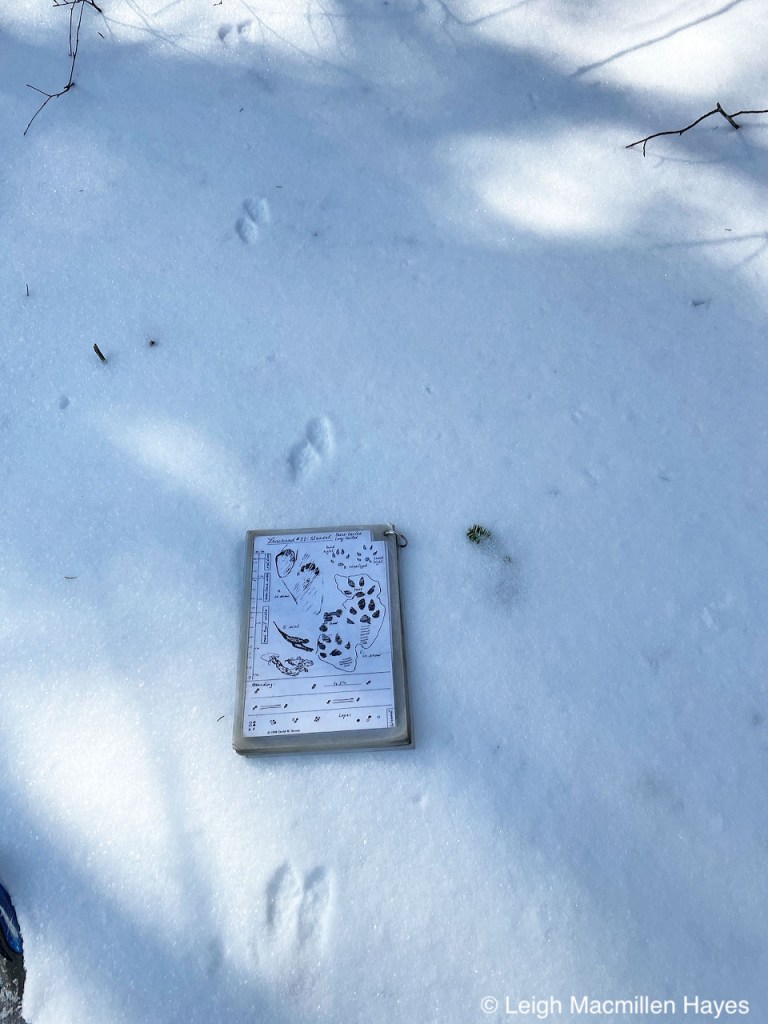
Within seconds of beginning today’s journey, tracks of a snowshoe hare pretending to imitate a snow lobster made themselves known.

We soon began to realize that the hare crossed the trail . . . frequently. One hare? Two? Or even more. One thing we did notice was that there was a least one of a slightly smaller size than the rest and now I regret that we didn’t measure the print and snap a photo. Oh well, maybe the next time. There’s always time for another trip to Becky’s.

There were some domestic dog tracks and we had to remind ourselves not to be confused by those, but we did spy coyote and possibly fisher along the way as well. More certain we were, however, when we occasionally spotted prints on the diagonal of a bounder. We quickly nailed down the identification to either ermine or long-tailed weasel by the size and track pattern.

After a bit, we found another moose sign. But still no moose prints.

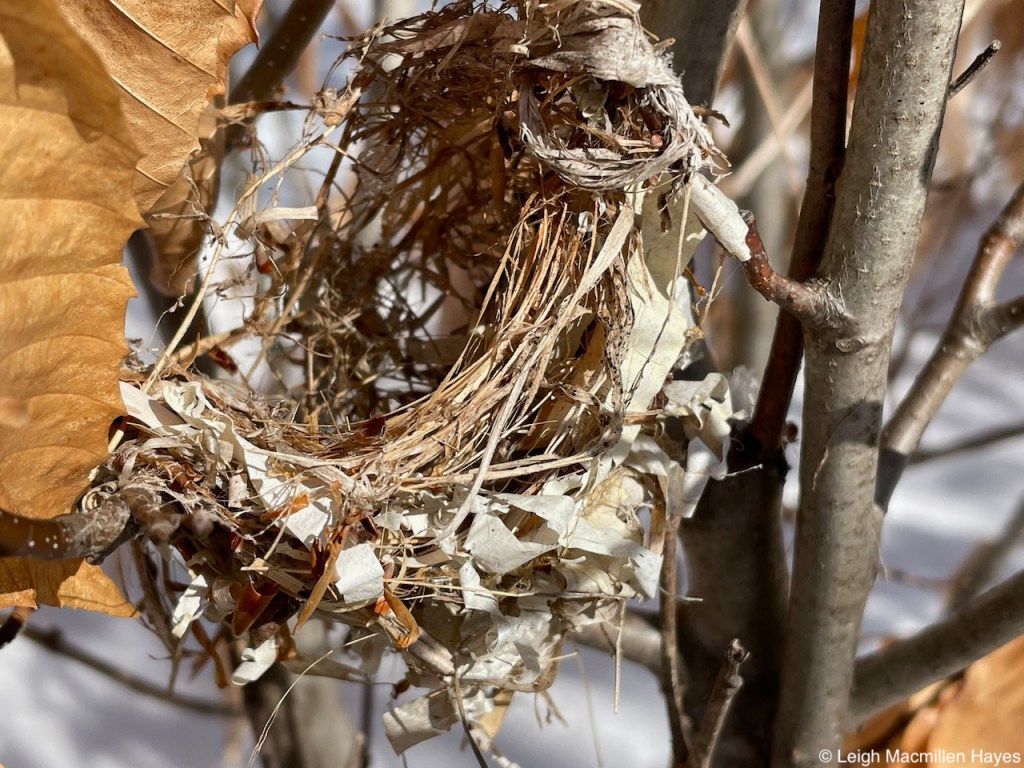
So, we decided to explore the land around and beside the bog to see if the moose was just off trail. In our search, we found an old vireo nest tucked away in a beech sapling. On first thought it seemed the bird had built it rather close to the ground, but a second thought was the realization that the ground was probably two feet below our feet for such is the depth of the snow all of a sudden.

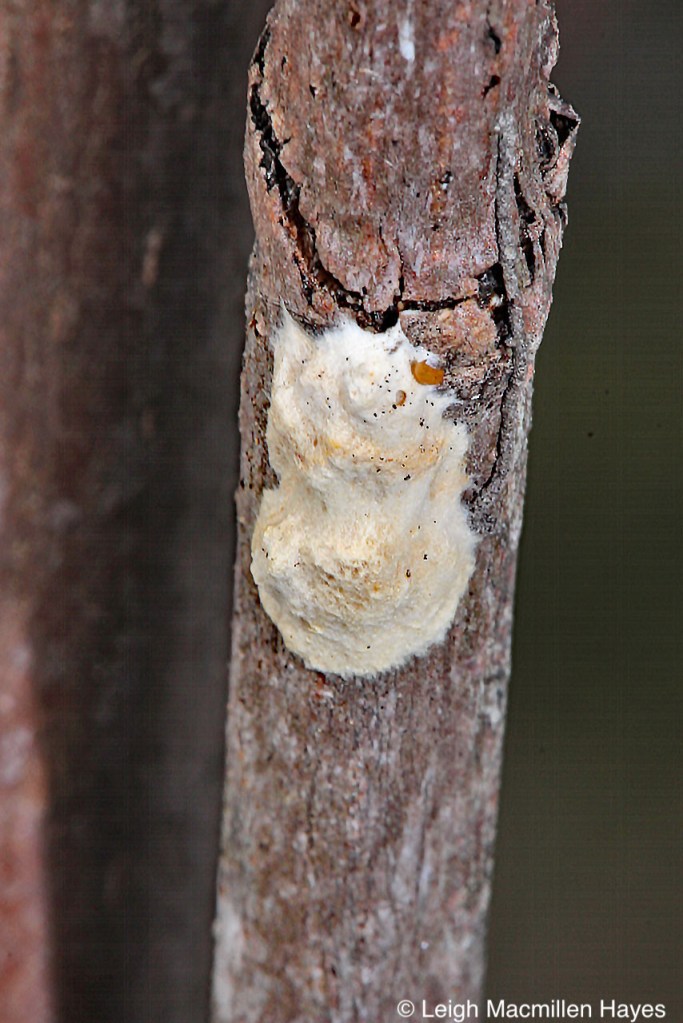
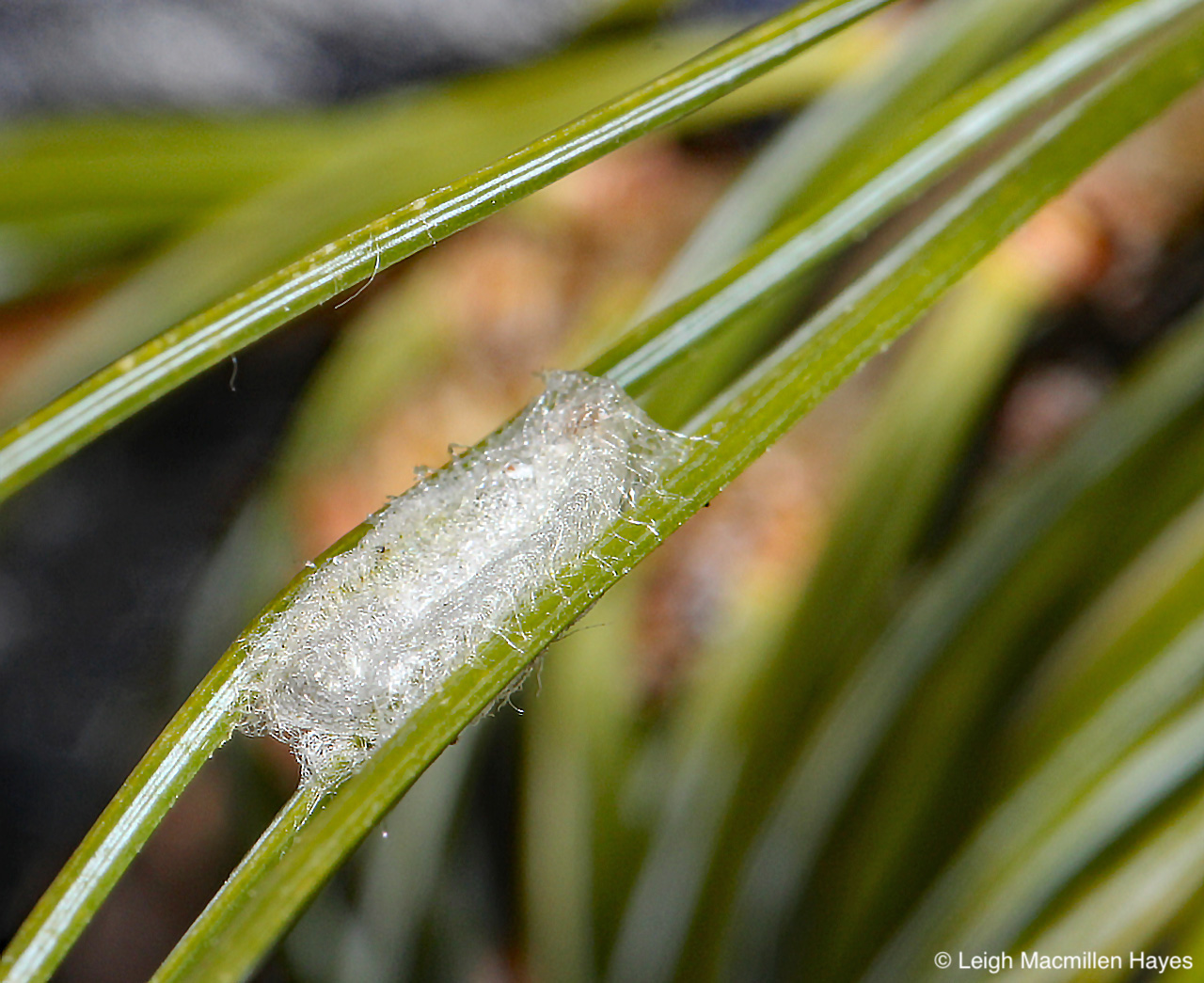
We also found a small cottony egg sac on red maple bark and wondered if it was deposited by a moth.

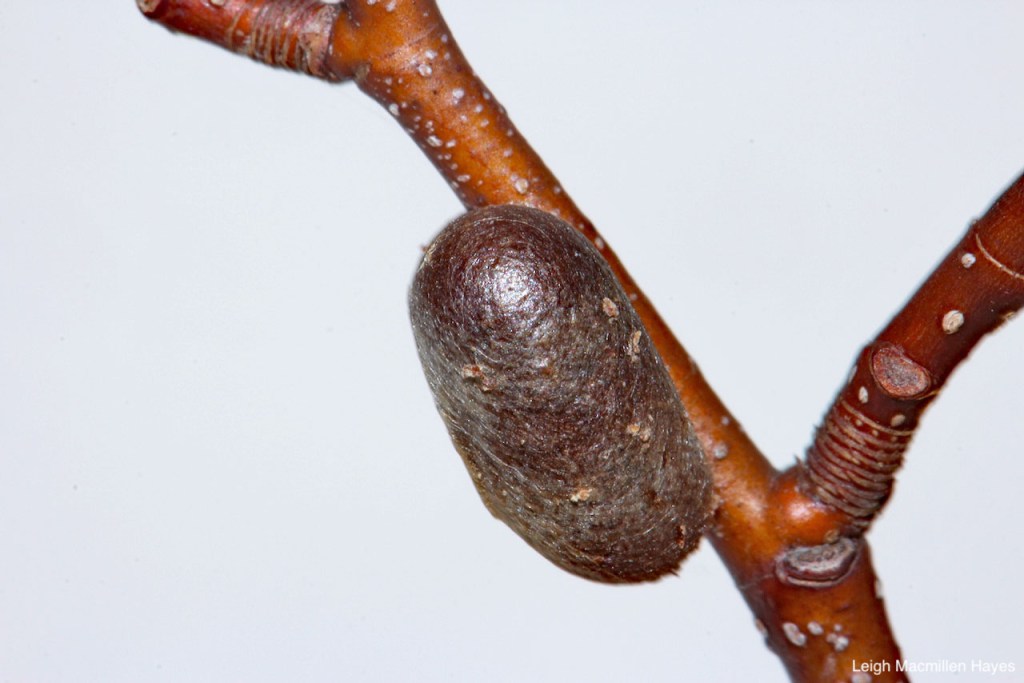
And an intact sawfly cocoon. Quite often we encounter these with perfectly cut lids meaning the adult fly had previously emerged–as in six months previous at least.

But, just as we know we should follow a track for a ways to make a correct identification, or walk all the way around a tree to study its bark, we were also reminded to look at the backside of the cocoon. Had a bird tried to dine? Or perhaps a wasp parasitized the sawfly? We’ve been spending a lot of time lately focused on bug forms in winter, but thankfully still have so much more to learn.

The bog, itself, was beautiful and we followed the edge of it for a wee bit, until that is, we saw water and thought better of our intention to locate the moose for which it was named.

Back on Moose Alley, we made our way downhill and then a depression about fifteen feet off trail stopped us. And, of course, we had to tromp through the snow to check it out. Though we made quite a disturbance with our snowshoes, there was only one possible track about ten feet behind us and five feet off trail. Then we noticed a ball of scat.

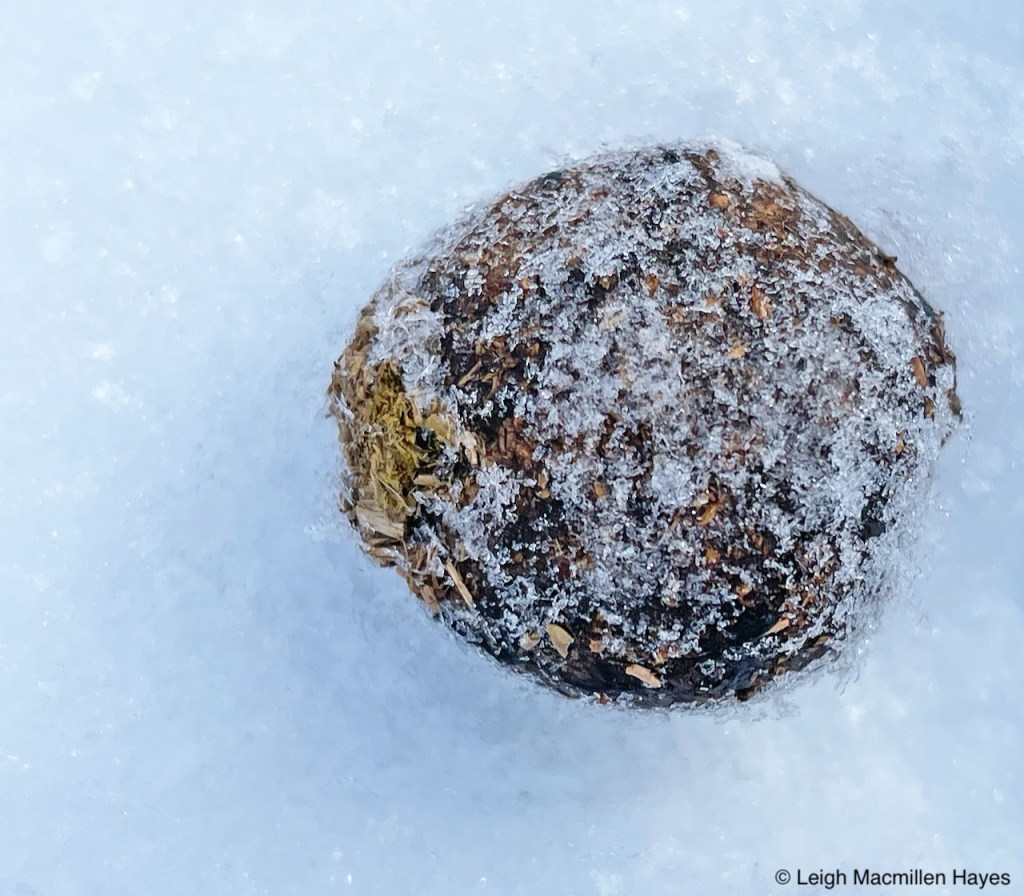
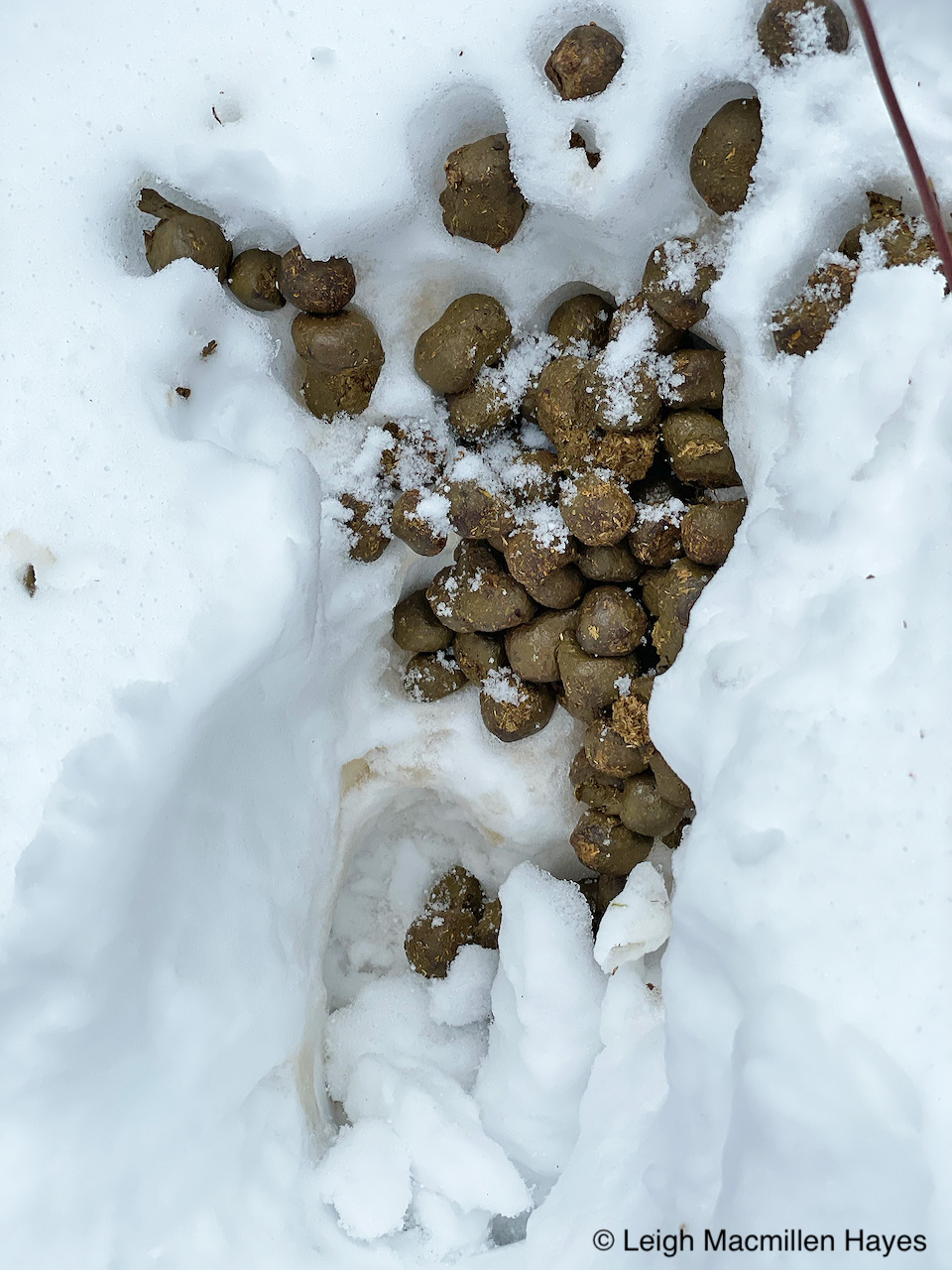
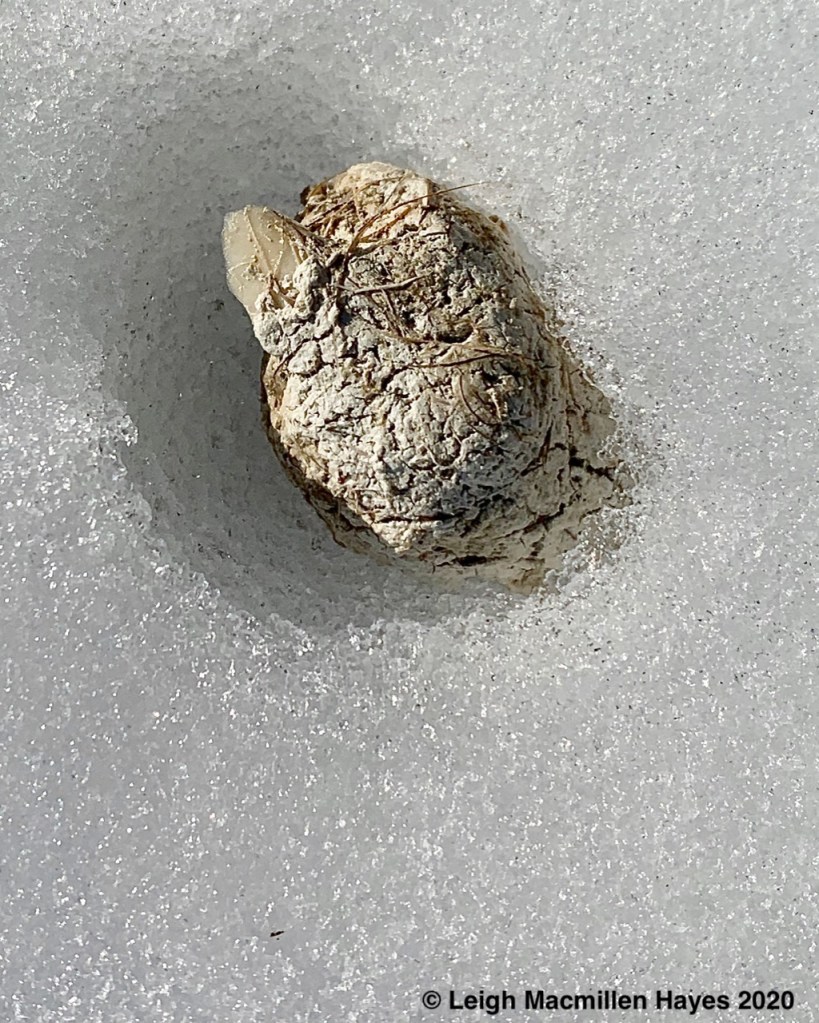
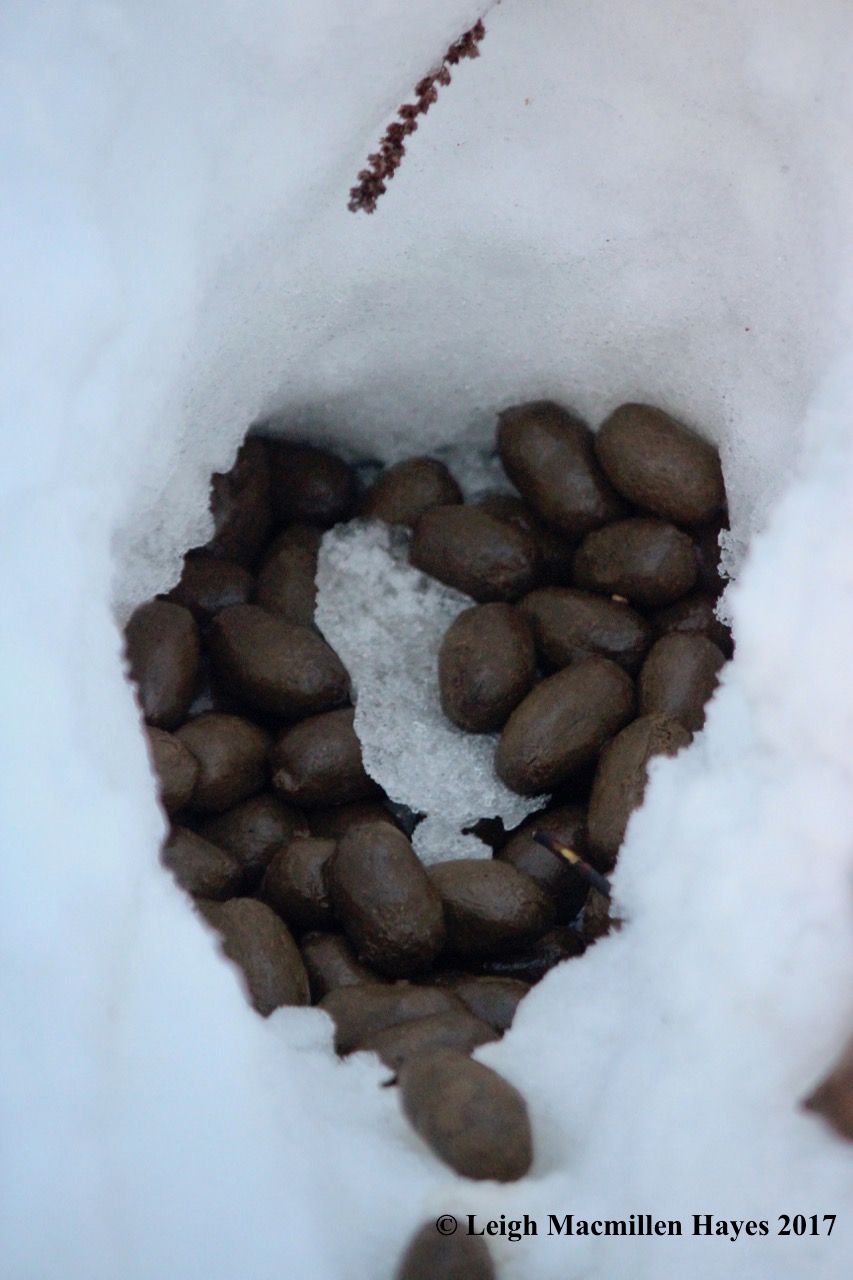
Being the mighty investigators that we are, once we realized the sawdusty scat was from a moose, we got down on all fours to investigate the broken depression. When we started digging we discovered more moose scat frozen inside. But still, we pondered. There were no other tracks. The depression was several feet across, but not large enough for a moose. We hadn’t seen any deer tracks. And it seemed odd that it the crusty chunks were not smoothed out by the body heat of an ungulate. Still, we did consider a small flying moose. How else would it have gotten to that spot?

Walking back to the “prints” that were closer to the trail, we examined them again. And noted a bit of tunneling. Maybe they weren’t prints after all.

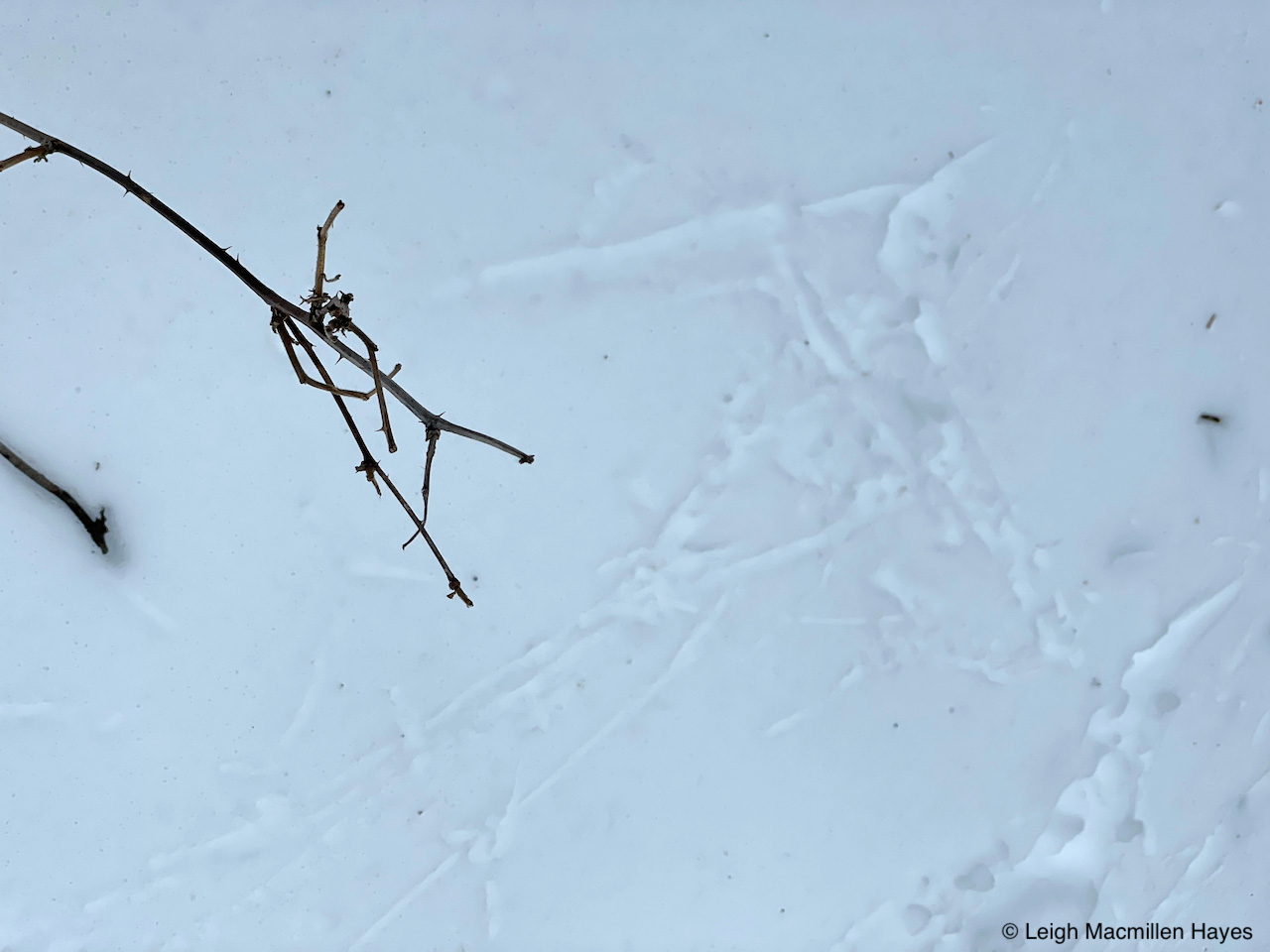
And then we spied a bird track a few feet beyond. Turn on the light bulb please. Could it be that the ruffed grouse, who burrows into deep, soft snow to hide from predators, and scares the daylight out of us when it explodes out of its hiding spot, had blasted through the crusty layer of snow to spend the night. Was it surprised to find moose scat in its chosen spot?

Once we began spying the grouse tracks, we realized they were everywhere. Just like the snowshoe hare. The question remains: which came first?

While the grouse was searching for birch seeds upon which to dine, the hare made its meals of the woody foliage stems. Like a moose’s winter scat, the hare’s is also quite sawdusty in texture given its food source.

Did I say the grouse’s tracks became quite ubiquitous? And we began to find more holes like that made by the flying moose, I mean grouse.

The thing that really struck us was the thickness of the crusty layer and the energy the grouse had to use in order to blast into and out of it. Some call them fool’s hens, but they struck us as being rather smart about penetrating solid slabs.

Eventually, our own need for nourishment and energy renewal brought us to a halt in a sunny spot at Moose Alley’s intersection with Loop Trail. We each found a stump upon which to dine and while we sat quietly, chickadees entertained us with their quick seed gathering foray and calls to each other.

To take it all in, Pam struck a pose the reminded me of a certain famous person; she just needed wool mittens ;-)

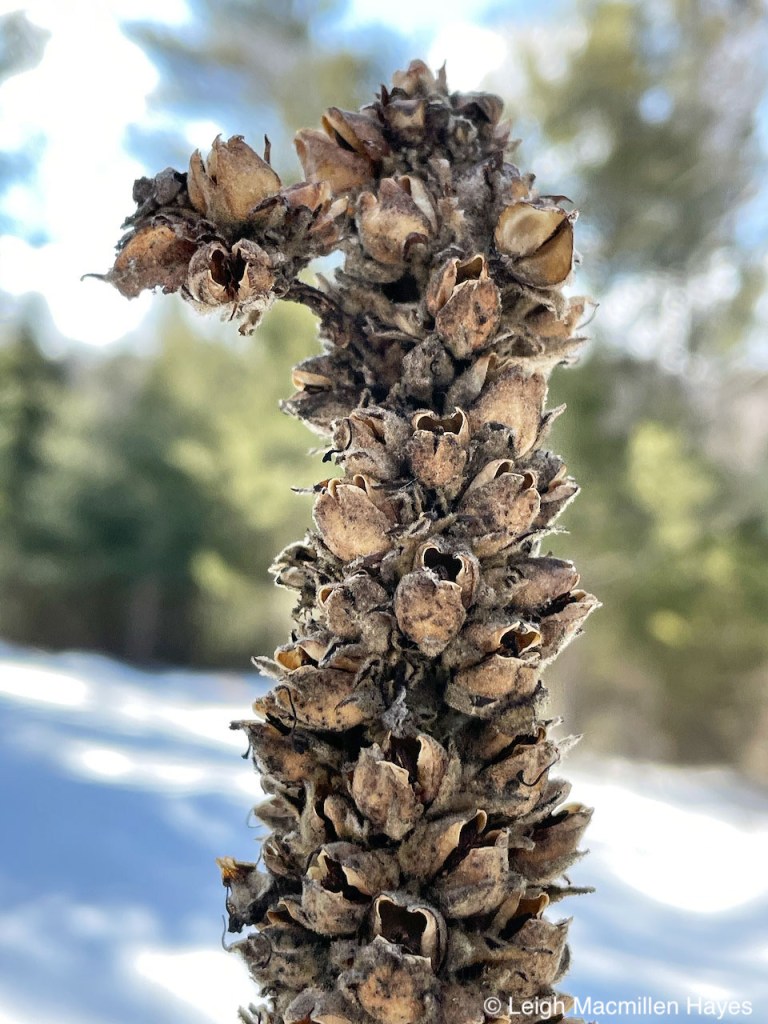
Eventually we stood and moved along, pausing briefly beside mullein in its winter form–hoping against hope that a spider or another insect might make itself known. No such luck, though we did admire the size and structure.

More domestic dog tracks shouted their names by their behavior, but we soon discovered prints of a strict carnivore who had recently moved through the forest with intention.

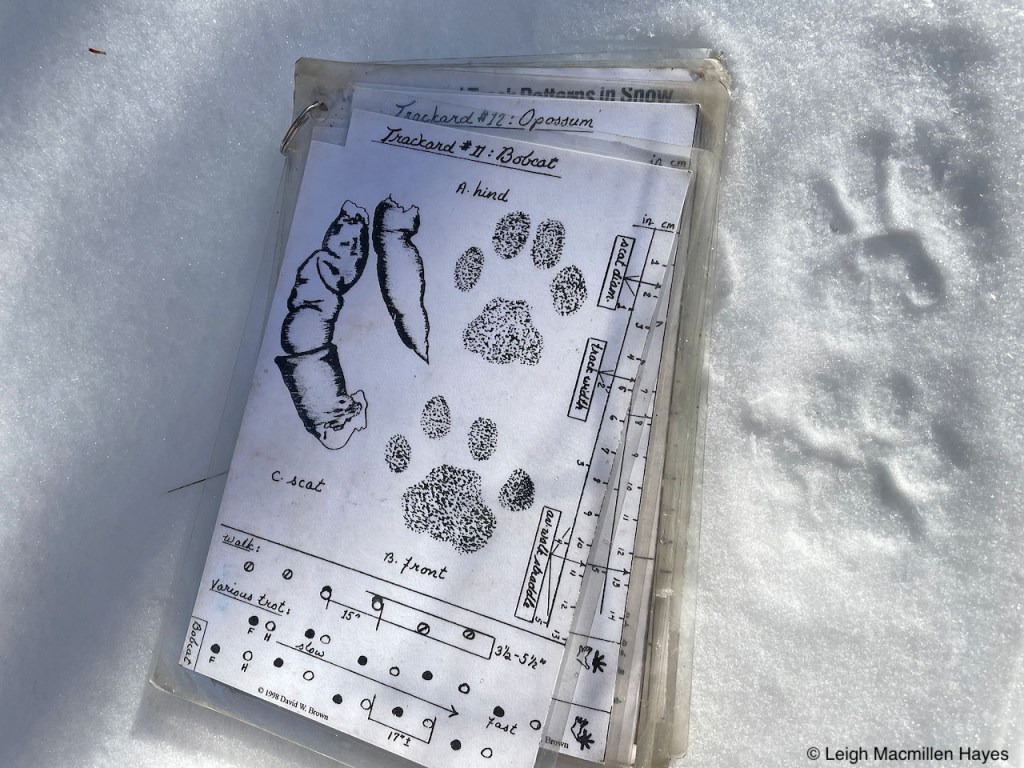
By the four toes, no visible nails, and shape of the ridge and heel pad, we knew it to be one who says, “Meow.” Well, maybe not exactly like a domestic cat, but still a feline, in this case a bobcat.

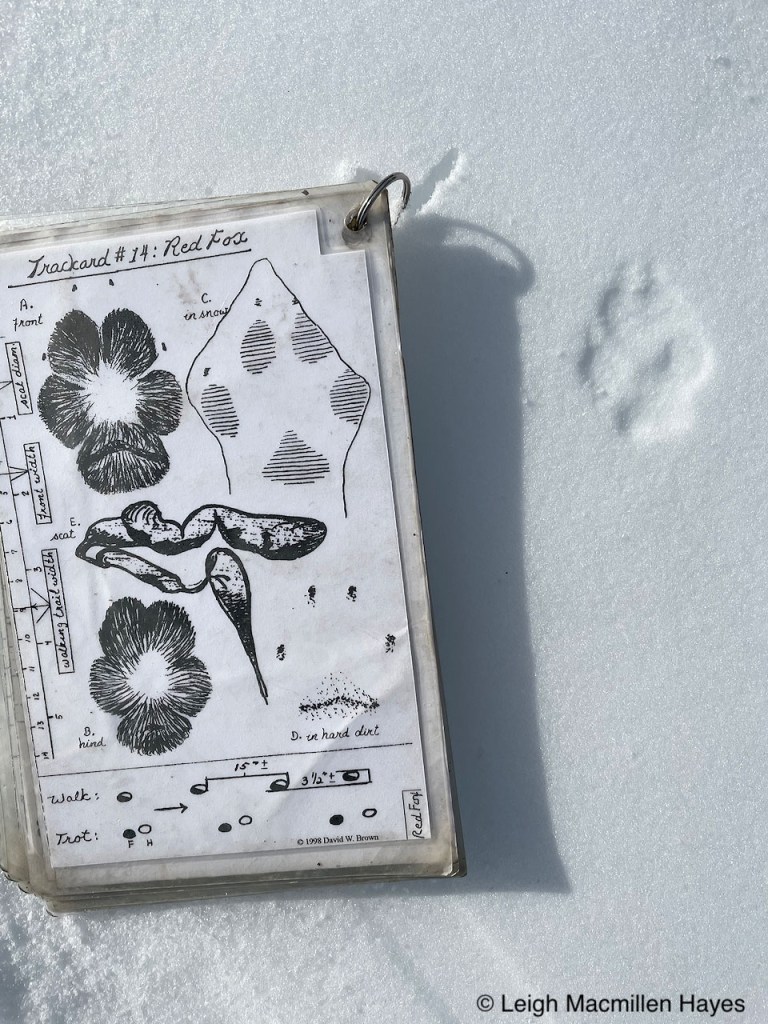
Our final find of the day was the track of a red fox. Oh, we’d seen squirrel and mouse as well. And maybe a few others I’m forgetting to mention. But moose?

Just as Marta and Kristoff wanted nothing to do with us, we suspect the moose was the same. That means only one thing.

We must return to Notch View Farm on Route 113 in Evans Notch again . . . and again . . . and maybe again.

As for today, with powder upon the crusty layer of snow, it was a Top Notch Tracking day.

P.S. Thank you, Becky and Jim.

Ghost of the North Woods

For almost thirty years I’ve roamed this particular wood and for the most part you’ve eluded me.

Oh, I’ve seen you cross the field. And heard your snort in the distance.

You’ve taught me to recognize your old prints by their figure-eight or egg-timer resemblance and heart-shaped fresh impressions.

Your depth compared to mine has been another indicator of your identification.

Occasionally I’ve stumbled upon your beds, old and fresh, and recognized them as places where you take a rest in the middle of the day or night.

I’ve learned to examine said beds for artifacts left behind including wisps of tubular hair meant to insulate.

And always, your calling card includes scat and urine.

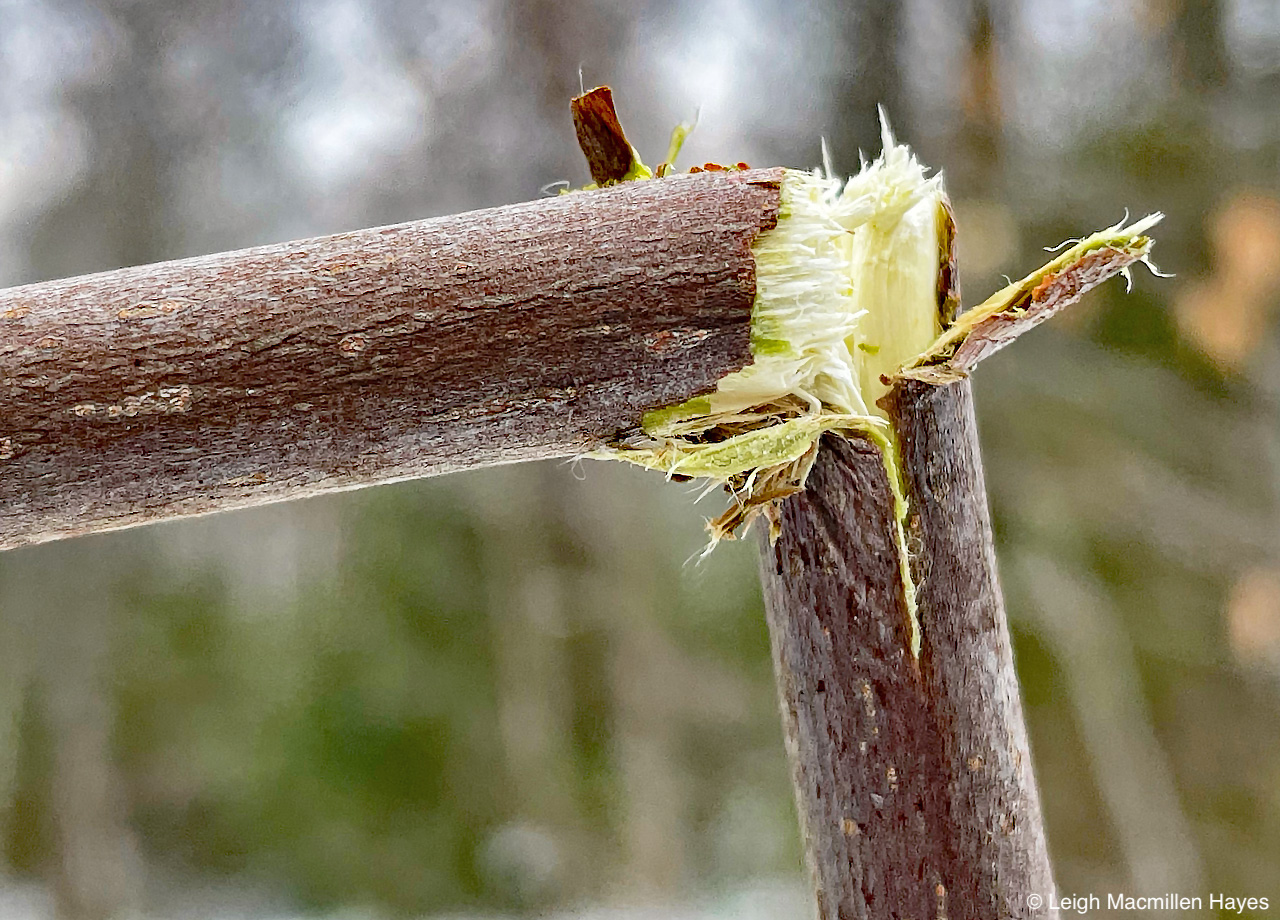
Above the scat at a height only you can reach, you tag the trees with mini flags after ripping off their buds with your lower incisors yanking against that toothless upper palate.

After finding so many signs year after year, today . . . today I spied an uprooted tree at the very spot I thought might be a good place to stop and spend a few hours in silence. As I made plans to do such in the near future, the tree moved.

And transformed into you!

You looked at me. I looked back in complete awe.

And while I thought we were having a staring contest, I later realized you continued to feed as I continued to photograph you.

Standing beside you and way more interested in dining that wondering about me, your yearling.

Our time together lasted ten minutes. Or was it twenty?

Who knows? Who cares? What mattered was that in this woodland that has served as my classroom for all these years, you showed that your priorities had everything to do with food and nothing to do with me.

Thankfully, or so it seemed, my presence didn’t interrupt your dining for I know that in winter tree buds and bark offer some sustenance, but still you loose weight at a time when you most need it, especially if you are expectant.

When at last you and your youngster departed, despite your sizes, it was as if you walked through the forest in silence. My every move comes with a sound like a bull in a china shop, but you . . . Alces alces, you weigh over one thousand pounds, stand six feet at your shoulder, and move through the forest like a ghost. For that reason and because you let me spend some time with you today, February 11 will henceforth mark the day that I celebrate the Ghost of the North Woods.

This post is dedicated to my grand-nephews: Andrew, Finnegan, and Maxy Moose. I trust they will someday meet my moose or their own.

Laughing At The Notch

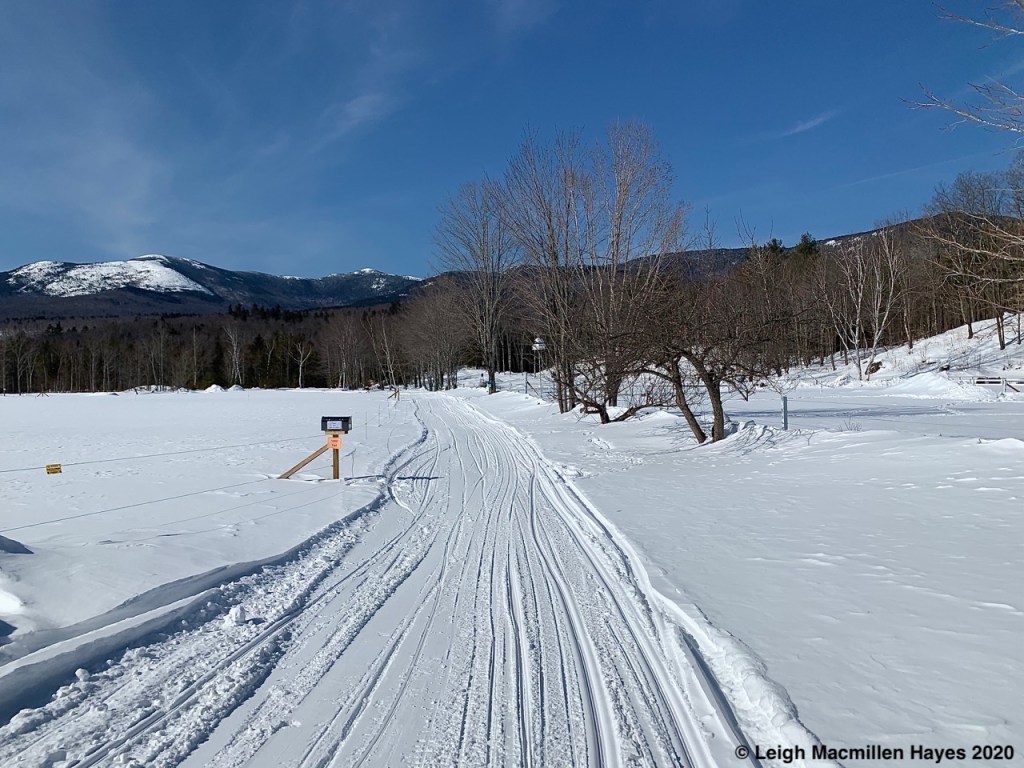
The word went out last night: “Trails aren’t perfect but much better than they were! We need a few people to snowshoe Moose Alley so I can get the snowmobile up there. Jim is going to snowshoe some tomorrow and the more it is packed down the sooner I can groom up there. 😁 Both bridges are done. Still waiting on the snow roller.”

Nothing like a challenge and so I immediately contacted a few peeps and asked if they were in. They didn’t hesitate and we agreed to meet at the trailhead at 11am. After all, our services were needed.

We’d first explored this property a year ago and fell in love immediately and have returned once or twice since, but not at all in the last six or seven months. Therefore . . . it was about time. Ah, but what is time?

It took us at least a half hour to move beyond the farmhouse, for every three feet we needed to stop and chat–asking each other questions and offering suggestions about a Bugs in Winter course we’re enrolled in and trying to better understand.

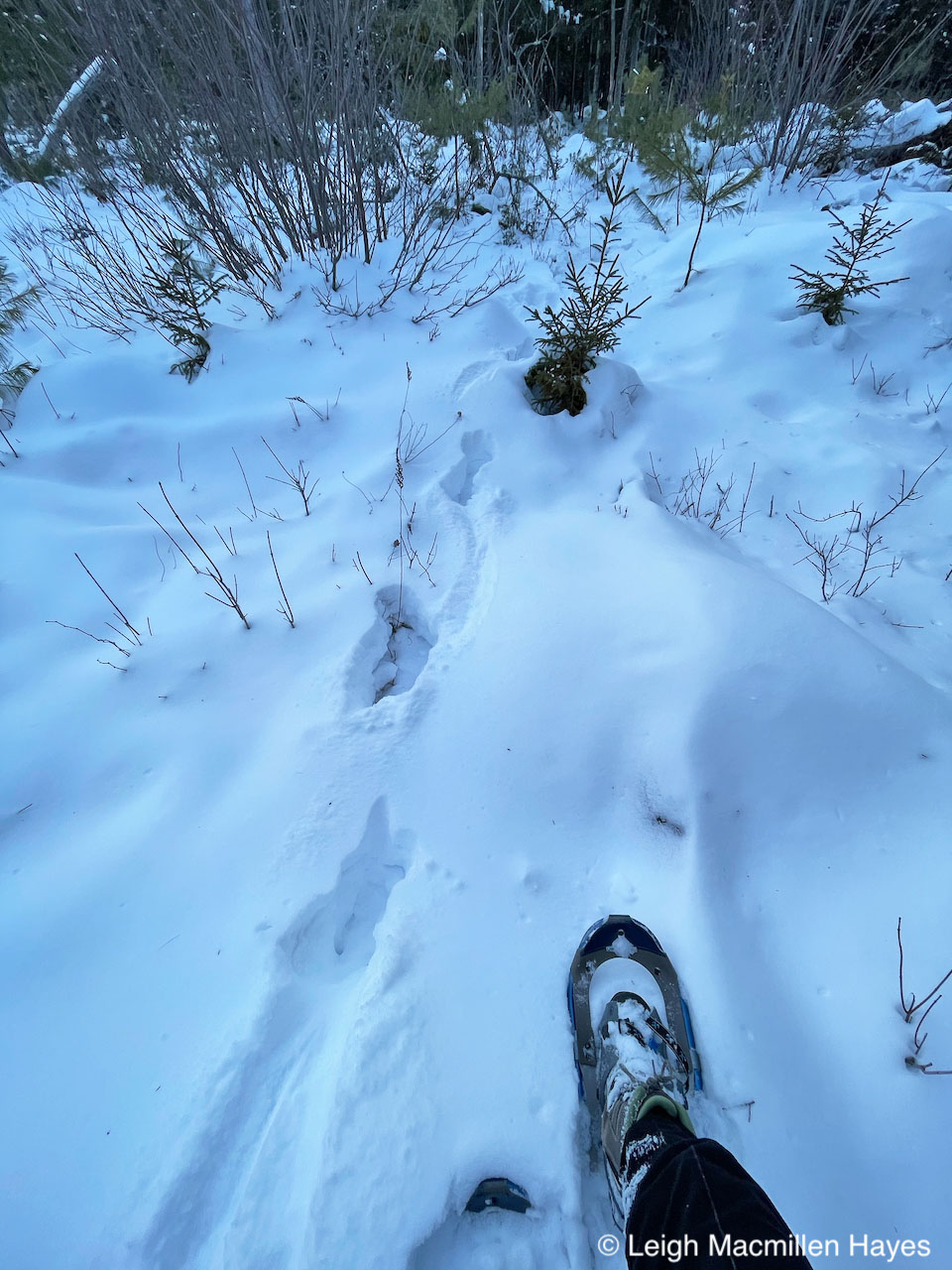
But . . . another reason for loving winter soon presented itself, first in the form of snowshoe hare prints, the toes actually showing in present snow conditions.

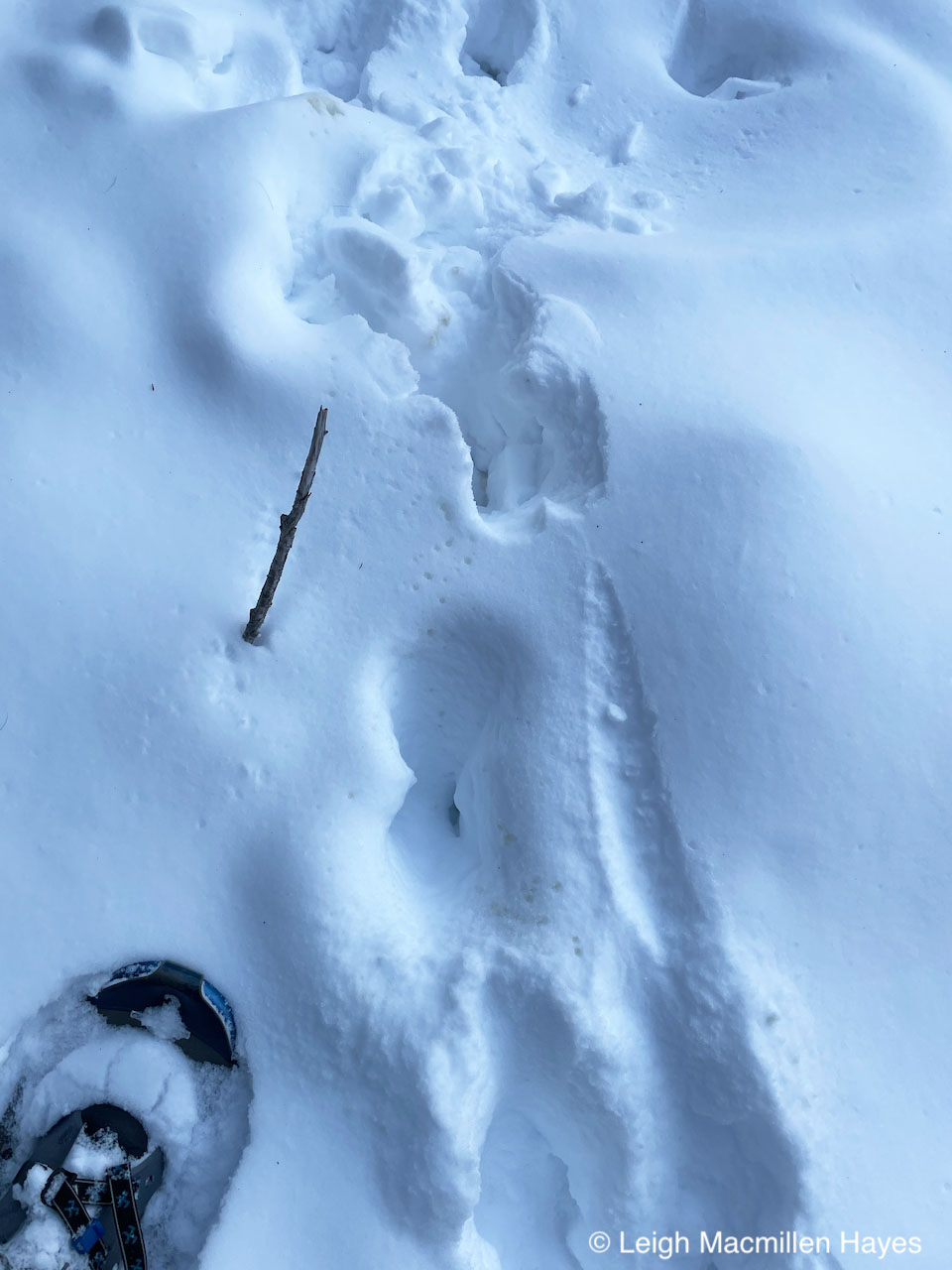
The print left behind by a mature White-tailed Deer measures about two inches across, while a Moose print is about 4.5 inches. This one at three inches, with a deep depth in the snow, spoke to us as a youngster of the latter.

And right behind that a bed. A Moose bed. The smooth, rounded edge indicated the mammal’s back, with its legs folded below (left side of the photo) and head just left of the beech sapling.

Scat and urine presented themselves in a variety of spots including filling individual prints.

As we followed the track, we noticed another design in the snow that took a moment to interpret for it didn’t present a pattern that bespoke a bird or mammal.

Examining the Red Maple sapling that dangled over the design in the snow, however, solved the mystery–and we chuckled as the story began to make sense. In the act of dining on fresh buds, the Moose broke the branch, which consequently dangled below, and wrote its own story in the snow.

Slipping further off trail, (sorry Becky, but we couldn’t resist) Moose tracks led to another bed and we realized by its size and the size of related prints, that this was a bigger animal. Mama perhaps? Again, we could see how she bedded down, her legs tucked under as is the typical fashion.

A bit further on and another, deeper Moose track. Notice how far down the animal’s foot sank in comparison to my snowshoe. Yikes.

A tramp through the woods and we found the bed of a larger Moose. Actually, there were two in this area, and maybe we missed a third, but the point is that there’s an active clan in these woods and our hearts rejoiced.

Finding a scat-filled print shaped like a heart certainly added to our joy and brought more chuckles in the midst of admiration and awe.

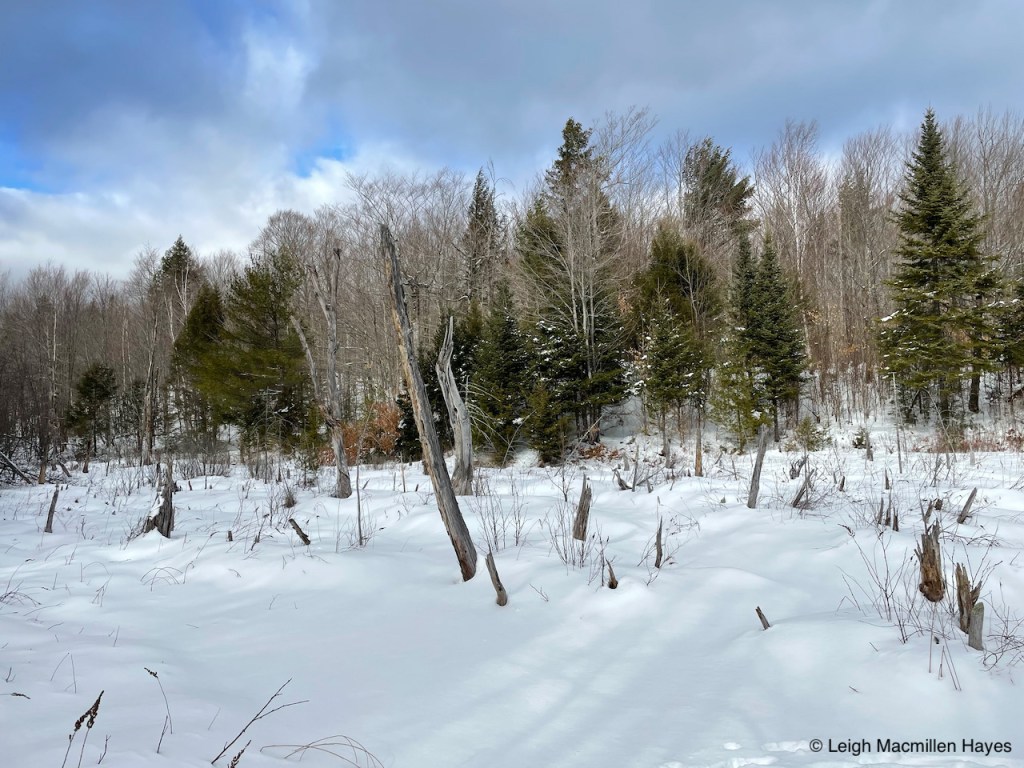
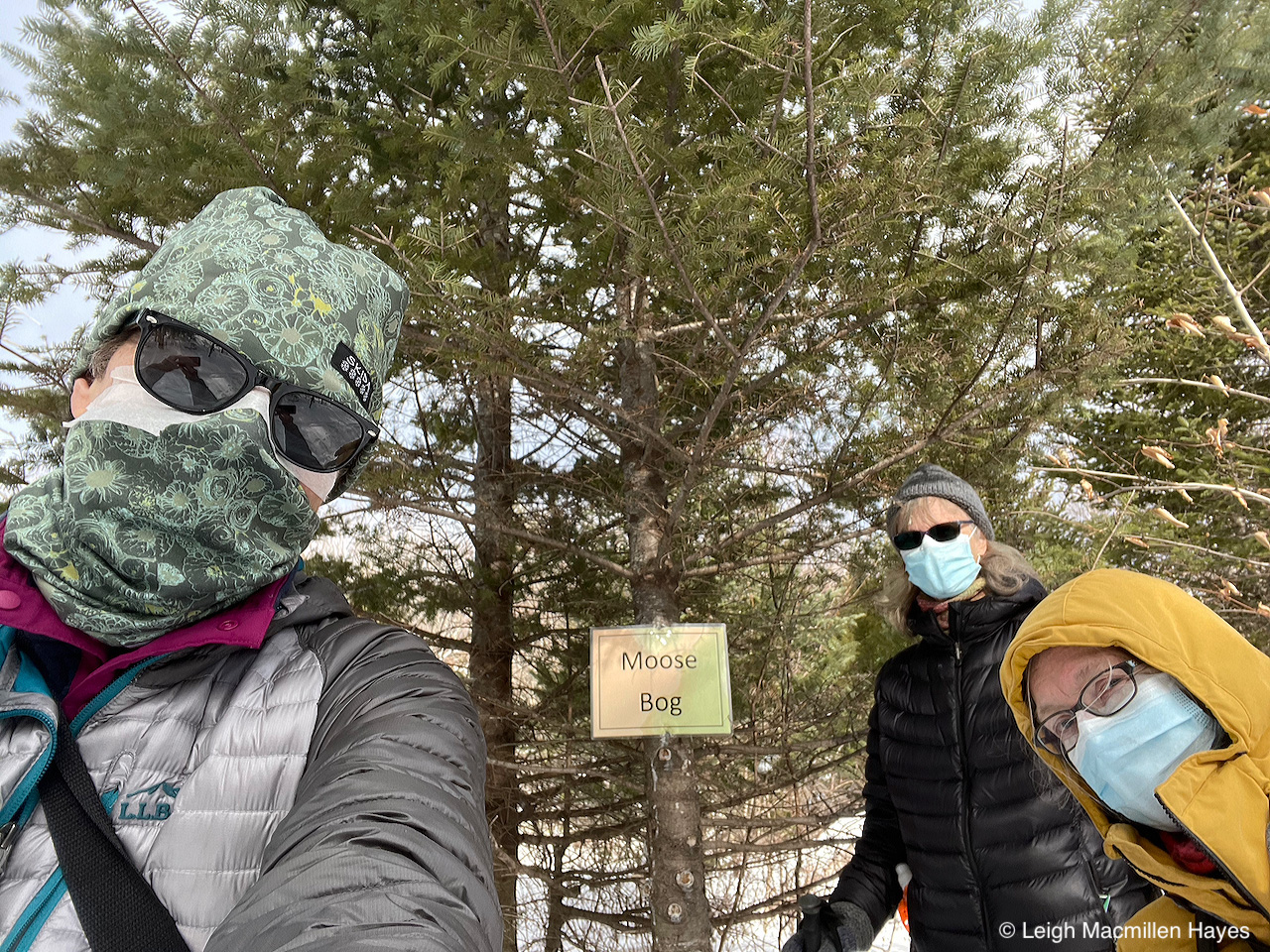
Suddenly, though there was nothing sudden about it for it took us about 2.5 hours to reach this point, we found ourselves standing beside Moose Bog–and scanned the landscape for an anomaly, hoping beyond hope that we might spot a family member seeking sun. That wasn’t to be.

Despite the lack of an actual sighting of a Moose, we were tickled to know that we snowshoed in their recent presence and so we posed and said, “Cheese.” Can you see our smiles?

In the same spot we looked for a species we first encountered in this very area last year. And found it upon the very same structures–a Speckled Alder and American Beech. It’s a sooty mold known scientifically as Scorias spongiosa or, my favorite and drum roll please . . . Beech Aphid Poop-Eater: A fungus that consumes the scat (frass in insect terms) of a Beech Blight Aphid (not the same as Beech Scale Insect that causes Beech Bark Disease). We’ve more to learn, but were regaled with the opportunity to spot it in the same spots again.

Our insect hunt included a Winter Firefly, some Pine Sawfly Cocoons, these former Gypsy Moth pupating cases and a few unknowns.

This tiny cocoon attached to two pine needles was one such find. With further study I trust we’ll confidently be able to state its name and origin. Lots of further study. We have so much to learn and appreciate the ability to notice, bounce questions off each other, and wonder.

There’s so much to wonder about . . . and to think we’d only explored one trail in the midst of many. When we began our exploration at 11am, I told Pam and Pam (aka Pam Square) that I needed to hit the road by 4pm in order to take a phone call at 5. Exactly five hours later we made our way. back to the trailhead. And as you can see, the sun was heading over the hills.

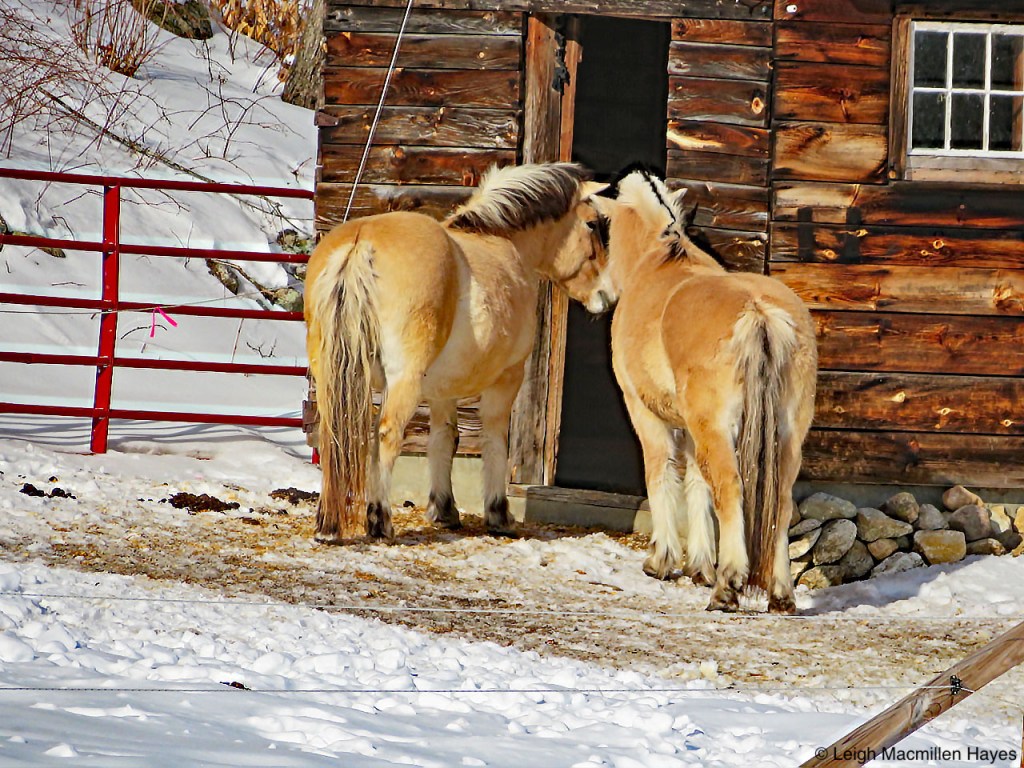
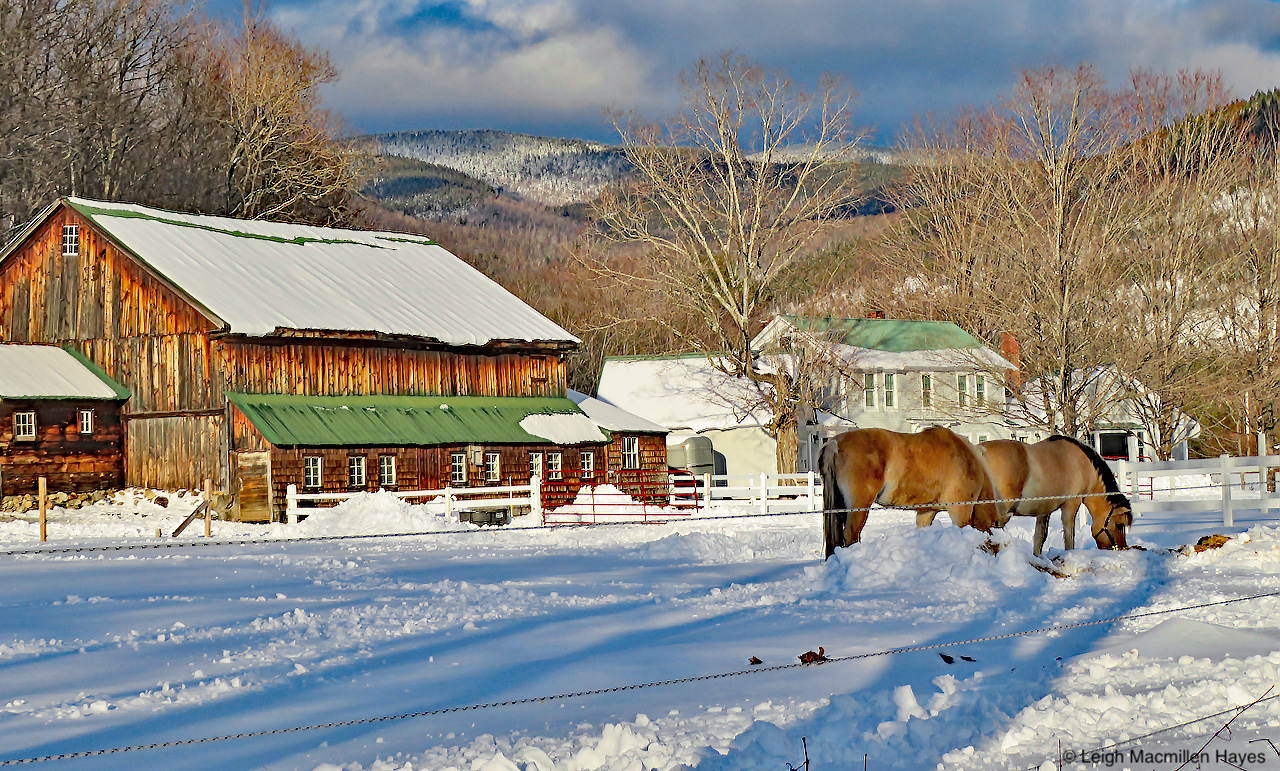
At last, back to the farm we were, home of among others, two Norwegian Fjord horses named Marta and Kristoff blankety, blank, blank, he being the younger of the two.

Marta looked a bit bored with us and ready to fall asleep. We noted her trimmed bangs and longer mane.

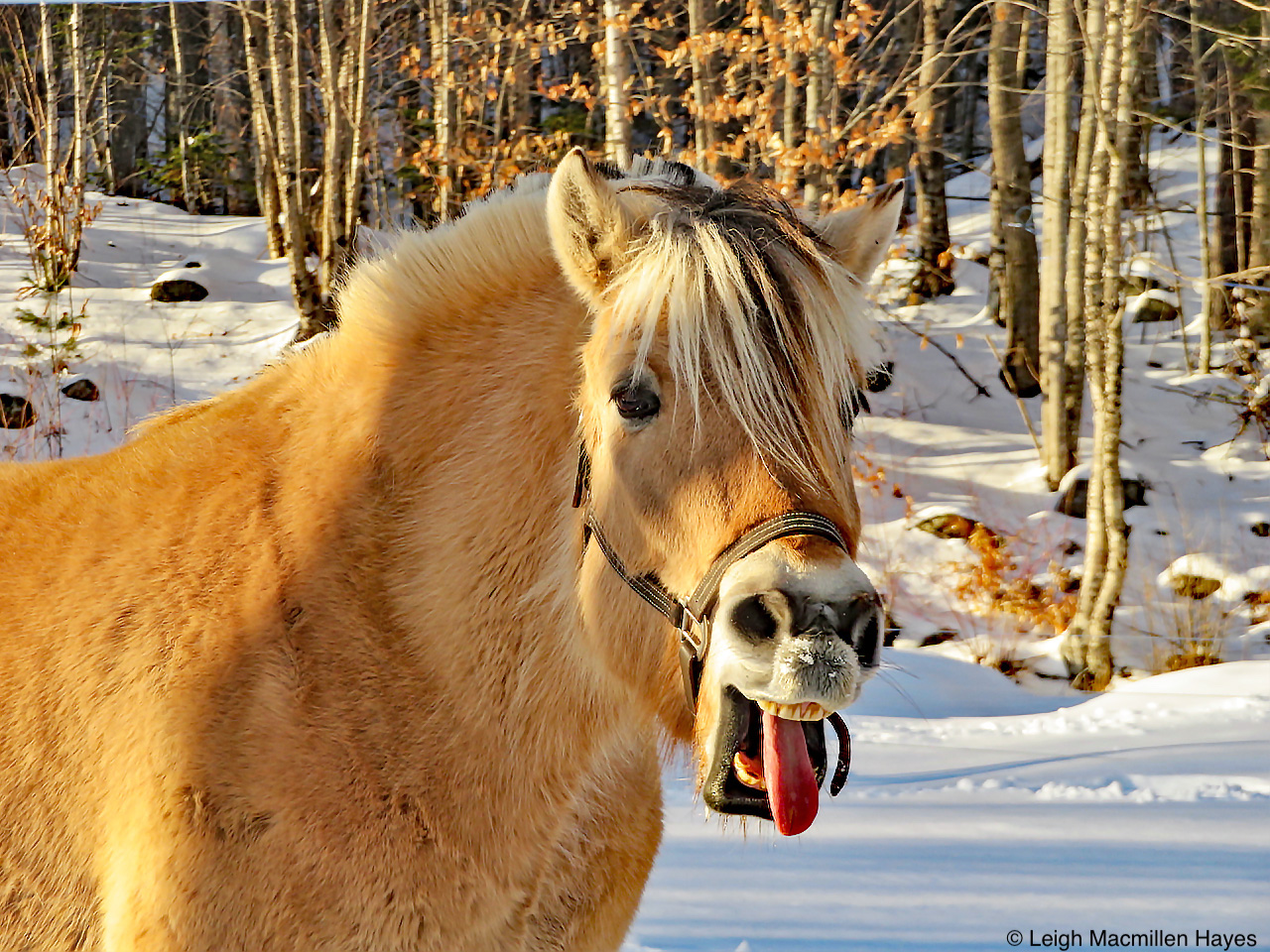
Young Kristoff was more ready to pose, his bangs longer than groomed mane.

He seemed to understand our adventure–sticking his tongue out as if to comment on some of our questions and interpretations.

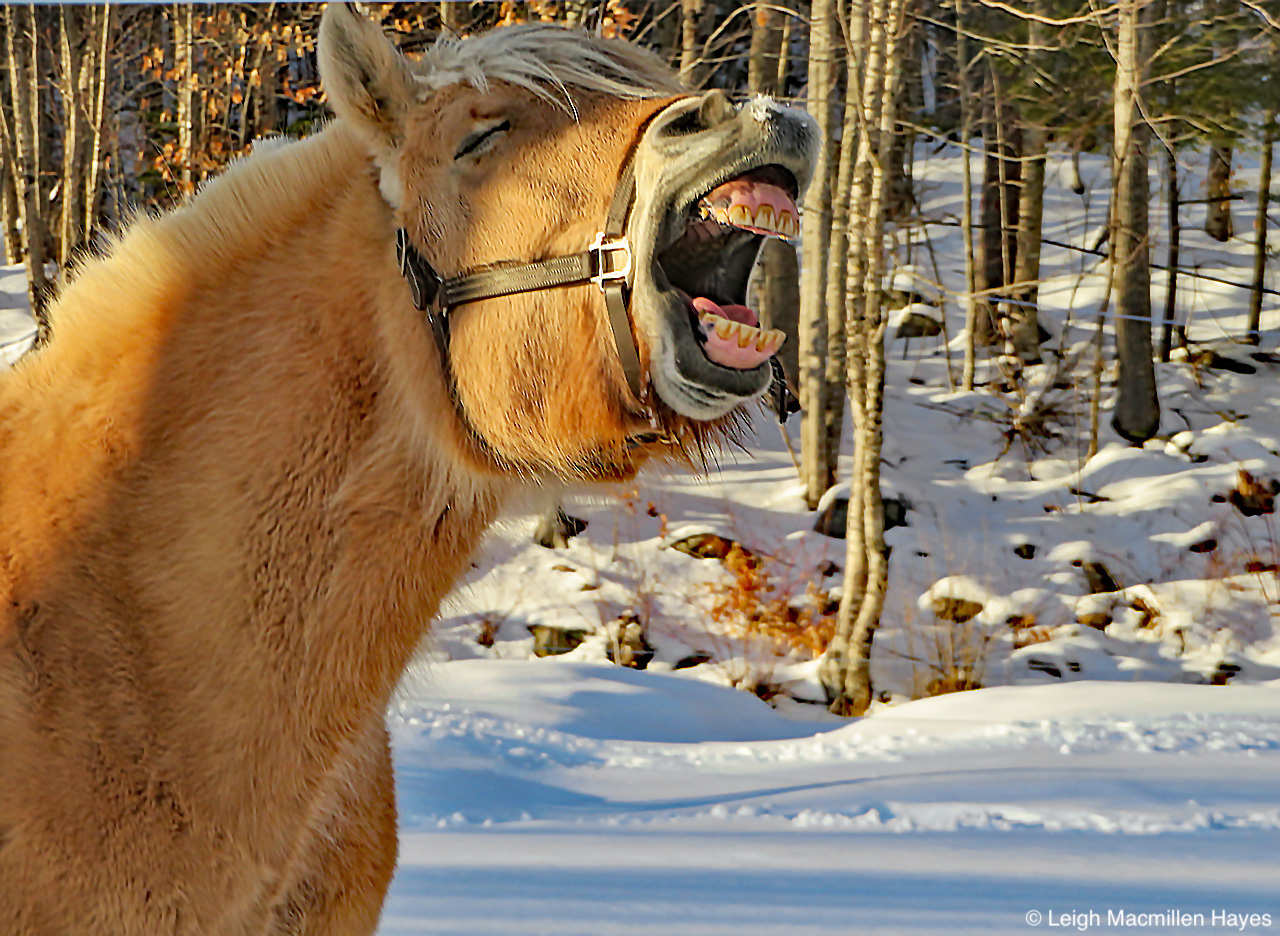
And laughing at other times. It’s OK, Kristoff, we laughed a lot as well as we explored the land you know as home at Notch View Farm on Route 113 in Chatham, New Hampshire, just over the Maine line.

Thanks be to Becky and Jim for sharing their land with all of us. There’s so much more to it, but we love taking the slow tour.

Today's Mystery Tour

The message arrived in the form of a text: “Meet me at North Fryeburg Fire Station at 10:30. I’ll drive.”

And so we did. Upon our meeting we realized we’d each left some gear home, but between us, much like we share a brain, we shared resources that would benefit us along the trail. The back of the Subaru packed with snowshoes and hiking packs, up the road we rode, one of us driving while the other two anticipated the near future.

Beside two Norwegian Fjord horses named Marta and Kristoff blankety, blank, blank, (cuze one of their owners couldn’t remember his full name), our driver did park.

Before us, a groomed trail presented itself–leading to infinity and beyond or so it seemed.

And within a mailbox, tucked into plastic sleeves, maps and track charts were available.

Rather than take either, we took photos of the map; and knew that we had a set of David Brown’s Trackards for our trail finds.

We were still by the road and farmhouse, when we noticed sap buckets tied to Sugar Maples and realized that the season had begun.

One of our good fortunes, and we had many as the day progressed, was to stumble upon Jim, the owner of the property who explained to us that the sap had only just started to flow and he had 200 trees tapped. Sap season can be fickle, but we hope the good fortune his land shared with us could be returned many times over in the form of gallons of syrupy sweetness.

Up the trail we finally tramped, stopping frequently to take in as many treasures as possible as we tried to gain a better understanding of the world that surrounded us.

One item that drew our attention was the thick twig and dome-shaped bud of an ash. Its corky leaf scar below the buds was filled with a smiley face of dots we knew as bundle scars–where sugar and water had flowed between last year’s leaf and twig/trunk.

By the shape of the leaf scar, its bud dipping into the cup and creating the form of a C, we knew its name: White Ash. Had it been a Green Ash, the bud would have sat directly atop the leaf scar, which would have looked like a D turned on its side.

I keep trying to come up with a mnemonic to remember these two species and may have just discovered such: C = cup = white cup of coffee; D = hmmmm? So much for that thought. Stick with C and if it doesn’t look like that, chances are it’s a D.

We paused beside many buds, examining them all for their idiosyncrasies, but equally prevalent on the trail were the tracks left behind by so many critters. Deer, snowshoe hare, birds of varying sizes, chipmunk, red squirrel, and the list went on. Red fox were part of the forest mix. And coyote as well. We so wanted bobcat and several times tried to convince ourselves that such was the case, but indeed, our further study made us realize it was no more than a wish.

We also wanted porcupine tracks and bear claw trees to make themselves known. We searched and searched for all three: bobcat, porcupine, and bear claw marks, but found none.

What we did discover, however, was the namesake of the trail upon which we tramped. My, what deep impressions it had left.

Perhaps the creator was Sasquatch?

No indeed. Where it had traveled upon the trail we followed before it traversed cross country, it left discernible prints that gave another sense of its size and we talked about the fact that its stomach would have been at our eye level.

By the crescent-shaped halves and dew claw marks, we knew that somewhere in the forest beyond moved a moose. Actually, by the number of tracks we saw on the trail, we thought that at least two had traveled this way.

And directly above we could see that it had dined, for the tags on the Red Maples where buds had once been bespoke its breakfast source.

At last we came to Moose Bog and briefly let our minds slip into seasons to come and offerings yet to be, but quickly pulled ourselves back into the moment and reveled in the fact that beside the sign was a sign left behind by the one for whom the bog was named.

The impressions were so deep that we decided to measure them.

Fifteen inches. We had barely sunk in an inch or two on our snowshoes, so the moose’s prints lead us to realize the immensity of its weight.

While in the same area, an abnormal growth on Speckle Alder gave us pause. At first glance, we recalled the fluffy colonies of Woolly Alder Aphids and wondered if what we saw was somehow related. A bit of white appeared in the structure, but it didn’t quite match anything we’d seen previously or our understanding.

About twenty feet down the trail, we found it again, this time on an American Beech twig. The curious thing, it only grew on one side.

Upon closer examination, we realized it looked a bit like elongated coffee grounds, and within our hands, its brittle structure quickly splintered into tiny specks.

It wasn’t until I contacted Maine Master Naturalist Anthony Underwood several hours later that we realized we were on the right track. Anthony is my go-to entomologist and I bug him (pun intended) frequently for identification or explanation. He never fails to reveal some amazing fact.

Today’s find: The Beech Aphid Poop Eater! What? Yup. A poop-eating fungus. We were thrilled to discover that we were on the right track thinking it was related to aphids, and we knew that ants like to farm them so they’ll secret honeydew, but . . . a poop eater. The natural world just got more otherworldly for us and our wonder will never cease.

Trees continued to attract our attention, but upon the trail were a slew of tracks, the prints of coyote and fox especially decorating the way. And then, and then some coyote scat and pee, the former so full of hair and a selection of the latter at another spot that sent us all staggering from the strong scent.

A bit further on we found an older coyote scat that contained large bone chips. Do you see one in the upper left-hand corner of the specimen?

We also found fox scat filled with hair and seeds, for like coyotes, omnivores are they.

And then, some small, cylindrical shapes within a print.

X marked the spot where the latter scatter crossed its own path.

And then it flew off. Who dat scat? A Ruffed Grouse.

At least five hours after we began our tramp, the farm house finally came into view. And so did Becky, one of the owners. She was actually looking for us for so long had we wandered.

We’d taken a photo of the trail map, as I said earlier, before we set off, but never again did we look at it. No wonder Becky was worried about us. The trail we followed was only eight tenths in length, but because we’d stopped every three steps or so to look at the next best thing, it had taken us five plus hours to complete the loop.

We chuckled again for after meeting up with Becky and reassuring her that we were fine and happy and well (super well and thankful for such was the day and all that her land had offered us), we wondered if she and Jim had made a bet on how long it would take us to travel the last few hundred feet to the road.

There were still things to note, including sap seeping into buckets.

Red maple buds growing more bulbous with age also garnered our focus.

As for our mystery tour: we were treated to the Moose Loop at Notch View Farm on Route 113 in Evans Notch. That would be in North Chatham, New Hampshire.

As we were greeted, our journey ended, with a smile from Kristoff and grins across our faces for the finds we’d discovered, understandings we’d made, and time spent together exploring.

Many, many thanks to Jim and Becky Knowles for sharing their land with all of us, and for Pam K for discovering this treasure and providing the mystery tour. Well done.

PS. Our last few hundred yards took about 25 minutes–who placed the correct bet on our time–Jim or Becky?

It was a dark and dreary day . . .

I’m working on a challenging article and can’t quite figure out how to introduce the topic. After a bunch of attempts, I suddenly had an inspired idea . . . drop the pen, walk away from the legal pad and head out the door.

And so I did despite the freezing rain that was falling atop this morning’s snow. Heading down a trail I haven’t had a chance to step upon in months, I realized that I was among old friends who had passed by prior to the storm.

In fact, every where I went for the next two plus hours, they had been there before me.

Their tree of choice also gave away their presence and I fear that there won’t be too many red maple leaves in bloom come spring. Imagine this: a moose needs to consume fifty to sixty pounds of vegetation daily–that’s a lot of buds, twigs, and bark.

With their lower incisors and hard toothless upper palate, they grabbed the twigs and yanked to pull the buds off for consumption. Left behind were their calling cards–long dangling tags. Some were at least three feet above my head.

Also think about that moose face–homely and ungainly as it may be with a large upper lip that can wrap around the twig in order to dine, and the bell or dewlap dangling below its mouth.

With utter glee I found some hair stuck to one twig and it wasn’t the hollow shafts of its dense coat, so I wondered if in the process of browsing, hair had come off its face or dewlap.

As I said, the moose had traveled throughout the woods and I began to follow their tracks exclusively, for they always lead to coppiced red maples that are trying to make a comeback in these woods that were logged within the last five to ten years.

It was on one of the trees that I did find the hollow hair shafts, and I’ve used black arrows to try to point them out to you. There were three which seemed to intersect at the point where the twig had been swiped. Notice how straight they are, especially in contrast to the slender, curly hair.

The more I looked, the more soft, curly hairs I found. Hmmm, I have a feeling any of my hunter friends can enlighten me, for now I’m considering belly hair? Is it softer? Or am I correct in thinking about the chin hairs?

It doesn’t matter. Well, it does because I’d like to know.

And maybe the chickadees were trying to tell me as they flew in and landed on maples while singing their “Chick-a-dee-dee-dee” song. But what mattered most was that I got outside and cleared my brain and came up with an introduction to the challenging article: It was a dark and dreary day . . . oh drats, I can’t use that–especially since despite the snow and rain, I hardly found it dark or dreary.

I think instead, I’ll begin in the middle and see where the article takes me from there. In the meantime, though I didn’t see them, I’m tickled to know that there are still several moose in the woods behind our house.

Keep an Open Mind

While I always head out with expectations of what my forest wanderings will offer, I’m happily surprised time and time again with the gifts received.

o-deer

And so it was the other day when a friend and I happened upon this trophy in an area I’ve only visited a few times. We’d been noting the abundant amount of deer tracks and realized we were between their bedding and feeding areas and then voila–this sweet sight sitting atop the snow. It now adorns a bookcase in my office, a wonder-filled addition to my mini natural history museum. (I’m trying to give Henry, Jessie, Violet, and Benny of the Boxcar Children series a run for their money in creating such a museum.)

o-deer-1

Being on the receiving end of such a gift can lead to want or greed. And when I spied several deer crossing the trail before I slipped into the woods today, I expected to find numerous more antlers.

Certainly, I thought I’d find at least one, but the possibility for several seemed realistic given the local population.

o-deer-tracks

To that end, I followed fresh tracks and examined areas they’d pawed as they sought acorns and mosses. My eyes scanned the surface, but perhaps it was the fault of the fresh layer of snow that hid the possibilities. Then again, we’d only received a few inches of fresh white stuff and it was rather warm for a January afternoon, the snow’s surface dotted with drip drops.

o-landmark

I didn’t pay attention to my direction as I moved and then suddenly found myself nearing an old landmark, surprised as usual that it still existed. I did notice that the deer didn’t travel below this widow maker. Nor did I.

o-moose-tracks

Eventually my wanderings found me following tracks left behind by a larger mammal.

o-gray-birch-forest

I worked my way through a thicket of gray birch, those early successors in an area logged about ten years ago, and then heard a sound–a crashing noise.

o-red-maple-browsehair

As I stood still and waited, I looked around. Everywhere, the young gray birch and red maple buds had been nipped. Everywhere. It was almost as if no tree had been left untouched. Sometimes I noted traces of hair.

o-moose-rub-2

There was no further sound of crashing branches, but plenty of evidence of who had been crisscrossing through these woods on a regular basis. Signs indicated action and I had visions of antler velvet being rubbed off.

o-bent-branch

Sometimes bent . . .

o-moose-rub-3

and other times completely broken, I saw moose behavior that meant antlers in my future.

o-moose-rub-1

On some trees, rubs were smooth in the middle and ragged on the ends, with points scratching the surface. At least that’s what I thought I was seeing.

o-moose-food-1

Scrapes, those areas where the moose had used their lower incisors to pull bark and the cambium layer from the trees, were also visible everywhere I looked.

o-moose-bed-1

In a matter of minutes I found a bed and that’s when I realized that this was probably the moose I’d frightened off, given the freshness of the structure.

o-moose-heart

One of my favorite parts of the find–moose scat within a moose track. And all in the shape of a heart.

Indeed, no antlers. Indeed, other offerings. And a reminder to keep an open mind. And heart.


Nature’s Never Static

Mid-morning found me slipping into my smiling place where I decided to follow a route I usually save for snowshoe season.

slipping into the woods

I know it will come eventually, but the realization that we can’t predict when the first snowstorm will arrive or how much snow we’ll get over the course of the year reminded me that nature is never static.

trail boggy

I, for one, am looking forward to snow and hoping for lots of it because it will be so much easier to make my way through this boggy area.

creeping snowberry

In the meantime, I focused my attention on the ground–checking each step as I went. It’s easy to get caught on the slash the logger left behind. And when I looked down, I noticed things I don’t get to see once the white stuff falls, like the creeping snowberry that grows abundantly here.

hawk 1

Pausing frequently to look around, I suddenly noticed I had company.

hawk 2

The curious thing–this sharp-shinned hawk slowly made its way east, while further down the trail

bird flock 2

a flock of birds chitted and chatted as they moved among the tree tops.

chickadee

An ever curious chickadee landed nearby to check me out. And visa versa.

goldfinch

A goldfinch sporting its winter coloration also paused to peek. Lucky for all of them, the hawk was headed away rather than closer. Maybe it had already feasted.

mud

Eventually I found mud. I LOVE mud. With each step it squelches and squerches as it sucks my boots in and I pull them out. (And takes me back to Clinton Harbor at low tide, where my father always insisted that people paid millions of dollars to sink their feet in mud.)

my tracks

The beauty of mud here in western Maine is that prints are well defined and easily identified–homo sapien, female, average height and weight, just over middle age, blue eyes–wait a second. I wish I could read that much information in the prints I find, but I’m satisfied to be able to identify the animal to species.

coyote 2

Reaching into my pocket, I discovered I had my trusty six-inch ruler–left there since early spring. It helps to give perspective of a print–in this case a coyote. Middle toes parallel, nails leaning inward, 2 inches across, x-shaped ridge between toes and heel pad.

coyote and bobcat

I love it when nature happens side-by-side. Coyote on the left and bobcat on the right. The coyote had passed this way more recently, when the ground was softer and moved through quickly as evidenced by the slide into position. The classic C of the bobcat’s ridge between toes and pad is clearly visible.

 moose 2 directions

Moose frequent the area and I’m not sure if this is the same one passing to and fro or two different moose. It’s obvious that the first print was made as the animal moved in the direction of the ruler and the second shows the moose moving away.

deer, direction change 1

And then there was the deer that decided to change directions. Did it hear the mighty hunter coming along? Or another predator? Maybe me, though I suspect these prints were fresh last night and not this morning.

ice-mud

The other thing about mud–combined with ice it becomes nature’s artwork.

ice ground 2

Sometimes it sits upon icy pedestals begging to be noticed.

ice puddle abstract art

And ice itself is ever forming, ever changing. That’s the thing about nature. It isn’t static. Nor am I. Growing. Evolving. Seeking. And thankful for the opportunity.


Three-Season Mondate at Back Pond Reserve

OK, so it wasn’t three seasons all packed into one Monday date, but walking up the   Mountain Trail at GLLT’s Back Pond Reserve in Stoneham today brought back memories of previous visits by my guy and me.

yellow

The woods are awash in golden-green yellows right now, especially where the trees include beech, big-tooth aspen and striped maple.

a dose of red

Climbing higher, variations of red join the carpet display.

summit 3 of 5 Kezars

We were surprised by how quickly we reached the summit, which is what got us recalling previous visits.  Today, the water of three of the Five Kezars sparkled while Pleasant Mountain stood watch in the background.

summit, summersummit, winter

As I looked through my photo files, I realized we have never hiked this trail in the spring. In the summer there are wildflowers to make us pause, and winter finds us exploring mammal activity–thus our treks are slower.

summit, Mt Washington

Today’s view included snow on Mount Washington, the grayish-white mountain located between the pines.

Ganong chocolates

As we enjoyed the view, we topped off our PB&J sandwiches with the last couple of truffles we had purchased at Ganong Chocolatier in St. Stephen, New Brunswick, earlier this month.

water bottle 2

And water, of course.

which way do we go?

Instead of letting the arrows confuse us, we turned 180˚ and followed the connector trail between the Mountain and Ron’s Loop. It’s not on the map yet and still needs some work, but it’s full of surprises–only a few of which I’ll share right now.

winter, connecting trail

We’ve always enjoyed this trail and today realized that though it’s much easier to follow than it was a few years ago, many trees have blown down along the way.

numerous trees 2

They’re easy enough to climb over. If you go, do know that there are two or three mucky spots along this trail as well, but again, easy to get around.

lone red pine, connecting trailred pine, winter

This lone red pine always makes us wonder. Perhaps it found its way here via a seed on a skidder?

winter bobcat prints

Today we found moose tracks, plus red fox and coyote scat. If there was bobcat scat, it was obscured by the leaf litter, but we know they frequent this area.

winter, snowshoe hare

We also know the bobcat’s favorite meal lives here–we saw this guy in early March and of course, always see his prints on winter treks.

artist's conkcrowded parchment, connecting trail

Lion's Mane past peak

A couple of fun finds along the way–artist’s conk, crowded parchment and an old lion’s mane.

the bridge on Ron's Loop

winter, the bridge at Ron's Loop

The bridge on Ron’s Loop is all decked out with autumn colors–a contrast to its winter coat.

honoring Ron

We’re forever thankful to Ron for his leadership and foresight,

bench on Ron's Loop

even when we can’t see the plaque that honors him.

Kendra and Jewell

We met no other people on the trail today, but one of my fondest memories dates back two years when one of GLLT’s interns, Kendra, offered her arm to Jewell for a safe journey. Once upon a time, Jewell was Kendra’s Sunday School teacher and on this summer day, Kendra was Jewell’s guide.

water bottle by Ron's Loop

As we walked into the parking area of Ron’s Loop, we noticed that someone had left behind a water bottle. If it’s yours, it’s still there.   wasp nest Ron's Loop

Each time we visit, we take a moment to check out the wasp nest at the kiosk.

Ron's Loop kiosk, Jan 2015

We can’t remember when we first noticed it, but it’s been there for a while.

coffee sign

One last thing to note before we walked back to the Mountain trailhead where our truck was parked–Magnolia coffee. Wish I’d ordered more than one this past year. Dark roast.

One Mondate–three seasons. And now the quest is to turn it into a four-season destination. Stay tuned.

Signs of Life

I headed up to the vernal pool this afternoon with every intention of pausing along the way to sketch.

Mt Wash

The only snow left is atop Mount Washington.

vp1

Egg masses continue to accumulate. Blue sky with a few cumulous clouds, warm sunshine (almost too warm, but I’m not complaining), a gentle breeze, white-throated sparrows singing to each other–signs of life were everywhere.

FROG

Including this secretive wood frog. From above, his coloration matched the leaves beside and below.

frog2

We eyed each other as he floated near a large mass of eggs that have turned green with envy, I mean algae, in the past few days.  Their egg masses can include 500-1,500 eggs. Yooza!

sally eggs

Salamander eggs are either clear or opaque, like these two masses. They usually contain anywhere from 30 to 250 eggs.

at mansion road

My guy was sanding the dock at camp and I had finished several writing projects this morning, so I decided that rather than sit and sketch, I’d walk out to the log landing. Walking along the snowmobile trail was like walking in Clinton Harbor at low tide. The mud squelched underfoot, sucking in my boots. Rocks underneath felt like clams–maybe I was just hungry.trail

I headed down the logging road with mixed emotions. My heart cried, but my head knew better. Like other paths that I’ve frequented over the years, I loved this one and knew its quirky features well enough that I recognized the slightest change. Yup, that’s change you see in front of you. This logging operation has been going on for two years. Prior to that, the gray birches, paper birches and speckled alders, plus hemlock and white pine saplings bordered the old road. It was last logged about thirty years ago so those species grew in first. They’ve all been hacked down to make room for the equipment and trucks.

gray birch

I went in search of beauty and life among the destruction. Sometimes, you just have to look for it.

moose

One of the good things about such an operation is that it provides easy vegetation for wildlife, like the moose that are frequenting the trail.

moose bobcat

The herbivores, like moose and deer, love the easy feeding. And the bobcats like that the herbivores are easy feeding.

bobcat

A closer look at the bobcat tracks.

bobcat1

And even closer. I don’t often see bobcat claw marks, but muddy conditions warranted their use. In the back of the foot pad, you might see the imprint of hair.

bob scat

I was bound to find this. Bobcat scat–filled with dark organ meat and lots of hair. Bobcats, being carnivores, grind their prey right up with their sharp-pointed molars.

coyote scat

Coyotes, on the other hand, are omnivores and their molars are flatter, thus big bone chips pass through. The funny thing (to me anyway) about this scat, is that it looks exactly like some I found near the beaver lodge pond that I shared in yesterday’s May Day Celebration. Both were filled with extra large bone chips and hair. I took some of the scat I found yesterday. Today, I left it all.

Yes, my fetish for scat continues, but I only take a sample that will be an effective teaching tool. Really. And, I need to keep in mind that scat is a sign for other mammals–health, wealth and status quo are all wrapped up in it. If I take it, they have to work harder (or scat more) to get the word out about who and where they are. So, the next time you wander with me and we see some scat and I get all buggy-eyed over it, give me a nudge. OK, enough about scat.

weaselsquirrel

Dinner anyone?

Weasel and squirrel.

turkey

And the ubiquitous turkey.

landing

This is the second of two landing areas. When the job is completed, we’ll have new trails to explore via snowshoe–it’s rather wet and the trails are currently covered in a lot of slash.

The logging operation is a one-man job and he’s been selective. The end result, as ugly as it may look now, is that the ecosystem will be healthier because of this project. Grasses, wildflowers, shrubs and tree saplings will grow in–early succession. And the fauna will follow.

eggs at landing

The vernal pools associated with the area are still here for the most part–and show signs of life. I found wood frog and salamander egg masses. Even startled a couple of frogs, including a bull frog.

single

And just when you think that wood frogs only return to their natal vernal pools . . . here is proof they’ll take advantage of any water.

eggs

An opportunist recently used a wet depression in the landing.

Signs of life. No matter how devastated an area may look, they’re there.

Thanks for joining me on today’s wonder-filled wander.

We Will Be Known Forever By The Tracks We Leave

So said the Dakota Sioux, who were woodland people. That Native American proverb was with me today as I moved along a logging road behind our land. A muddy, sometimes frozen, sometimes gushy and smushy, logging road.

coyote and deer

I think I missed the party. Deer and coyote prints were abundant and if I’d only visited a few hours earlier, I may have seen some of the action. But, part of my problem is that I don’t walk like a Native American, who supposedly could move through the woods with fabled stealthiness. Of course, that may be referring to a much grassier woodland than we know–especially in a logging area where slash is left behind. But, logging or not, I clunk along–crackling through ice, splashing through puddles, sloshing through mud and crunching through snow. I’m hardly quiet–ever.

ice and rocks

The logging road has changed over the last two years, but it’s not all bad. I get to see sites like this where the water and rocks make art together.

It used to be that the gray and paper birch, those early succession trees, hung over the road. After a heavy snowstorm, my guy and I, or a friend of ours (that’s you, D.B), would snowshoe down the road, trying to relieve the trees of some of their burden. It was rare that anyone else ever went there, so the three of us made it our mission to take care of the trees. Those trees are all gone now to make way for the logging truck, but their offspring will soon fill in the space.

In the meantime, a playground has been created for our local wildlife. And play they did. Their tracks are everywhere–traveling to and fro.

bobcat

Including bobcat.

moose

And moose.

moose 1deer

Moose and Deer

muddy boots

Not to be left out, I also got a bit muddy.

my boot

And left behind my own set of prints.

landing

I crossed the landing and decided to return home via one of my snowshoe trails. This time I was walking on top of the snow for the most part–thanks to last night’s low temperature.

following snowshoe trail

As usual, I stopped frequently to scan the woods, looking for movement or some anomaly. I startled a few ruffed grouse, who in turn startled me. Of course, I couldn’t catch it in film.

grouse

But I did capture this moment. A grouse must have burrowed into one of my former boot prints–maybe because the snow is crustier some nights. It munched the fungus on a small branch and left a pile of its trademark scat.

Sometimes, when we’re on a hike and I pause to take a photo or extropolate on something I see, my guy points to my tracks and says, “I wonder if the deer look at these and say, ‘A human came this way. Don’t you detect a whiff of PB&J?'” I have to remind him that he likes making discoveries just as much as I do.

fresh deer

A little further along, a flash of movement. I looked up and saw only the tail of a deer as it dashed across my trail. But it left behind a bit of a muddy footprint. Dew claw marks and all.

And then the  crème de la crème . . .

moose scat

Moose scat. Mind you–it isn’t fresh. You can see the hemlock needles atop it. But it’s a firm winter scat–I’m thinking it was deposited earlier this season.

moose scat 1

My glove loved modeling in these photos. Ya know, some people make jewelry out of moose scat. I didn’t have a container to collect this today, but I know where it is. Maybe tomorrow or sometime in the near future. And maybe I’ll think about Christmas presents–hmmm . . . who wants to be on my list?

snowmobile trails

Finally, I’d finished the loop and found myself back on the snowmobile trail.

Red maple

Time to look at the Red Maple twigs.

red maplesketch

It won’t be long now before they burst into flower.

I hope you’ll find some time to search for tracks during this mud season. And think about the tracks you leave behind–literally and figuratively. I’ve left some that would best be washed away in the rain, but others that I wish could last forever.

Thanks for wondering my way.

Eagle Eyes

CL market

Today’s Mondate began with the ritual PB&J creation at home. Our destination was a hiking trail in New Hampshire, but on the way, we realized the need for gas. So . . . a jig here and a jag there over the bumpy backroads and we landed at Center Lovell Market. While my guy was inside paying for the gas and chatting with a friend who works there, he was handed a slice of blueberry cake just out of the oven. He brought it out to share with me–and I sent him back in, hoping he’d buy the whole thing. Such self-restraint. He only purchased one piece–a good decision, certainly. But really?

Eagle 1

We made our way back to Harbor Road in North Fryeburg, where something in the landscape caught my eye.

Eagle 1a

Always an impressive sight.

Eagle 2

A mature Bald Eagle checking out the area around Charles River, near the old course of the Saco River.

trail parking sign

Our destination–Province Brook Trail. This hike is for my friend, P.K., who first introduced me to this trail in her summer backyard a few years ago. While she winters in Florida, I hope she’ll enjoy today’s view.

We had to park on South Chatham Road, in South ChatHAM, New Hampshire. I once interviewed Frank Eastman, a South Chatham native, who informed me that it’s pronounced ChatHAM, not Chat’em, because H-A-M spells ham. A lesson I’ll never forget.

trail men

While we walked along the snowmobile trail, aka 2.5-mile Peaked Hill Road or Forest Service Road 450, two members of the White Mountain National Forest trail crew came along to close gates–a sure sign of spring.

pot hole

Seeing a few potholes like this one, we could understand why.

moose printmoose

We opened our eagle eyes and things began to appear.

Moose 3

Criss-crossing the trail, through snow and mud, moose prints.

bearbear 1

Our eyes are forever scanning beech trees–on the lookout for bear claw marks. We weren’t disappointed.

hairy scat

On the trail, we saw several old scat samples. Coyote or bobcat. This one is all hair. I’m leaning toward bobcat–but am open to other conclusions. There were no obvious tracks to make a certain id.

yellow birch

And here–one very large Yellow Birch growing on granite.

yb2

Yellow Birch seeds find optimum growing conditions on moss-covered rocks, stumps and logs. Once the tree establishes itself, it clings to the rock and sends its roots in search of the soil below. Hemlocks do the same.

trail head

Finally, we reached the trail head. Oops, I lopped off the head of the hiker on the sign.

trail closed

Province Brook Trail is currently closed to snowmobiles and ATVs, but we walked around the gate and continued on.

ice

Still plenty of ice in the streams beside the trail.

snow:brook

And lots of snow.

polypody fern

Polypody Fern peeking out from under a snow-covered rock.

hobblebush

And Hobblebush preparing to bloom.

glacial erratics

Lots of glacial erratics along the way. This one supports an entire community.

mushrooms

The tree in the center invited a closer look.

mush 1

Fan-shaped Artist’s Conks.

mush 2

Their white pore surface.

mush 3

Looking skyward.

mush 4

And a sense of perspective.

 pond1

At last, we reached Province Pond.

shaw mtn

Shaw Mountain is in the background–we’re saving it for another day.

Allen-snow

On our way to a forest service shelter that was built in the 1930s (I know this because I read it in Hikes & Woodland Walks in and around Maine’s LAKES REGION written by my friend, Marita Wiser), the deep snow caught us a few times. My guy is knee-deep.

brook crossing

It pays to let him go first. I can then figure out where not to step. Here, he’s contemplating the brook crossing to the shelter. It was actually quite easy.

Shelter

A sheltered lunch locale–just right for those PB&J sandwiches.

lunch viewlunch 2

Best view in the house.

initials

I’ve a feeling these walls could tell many tales.

snowing

It was snowing as we headed back down the trail. Yet another wintery-spring day.

Eight miles later, we were thankful for the opportunity to stretch our legs and use our eagle eyes.

Thanks for wandering by to wonder.