Bogging With Bridie

We parked on the little dirt connector road between Route 160 and Lord Hill Road, close to Bog Road, because we knew the conditions would be such that driving into Brownfield Bog would be impossible. Besides, walking would offer more time to catch up on each other’s lives. Well, I’m afraid I did most of the talking, but at least my friend Bridie is up to speed on my life. Hers is so full of students and research and writing, that just having time to breathe in the fresh air of her childhood backyard was enough.
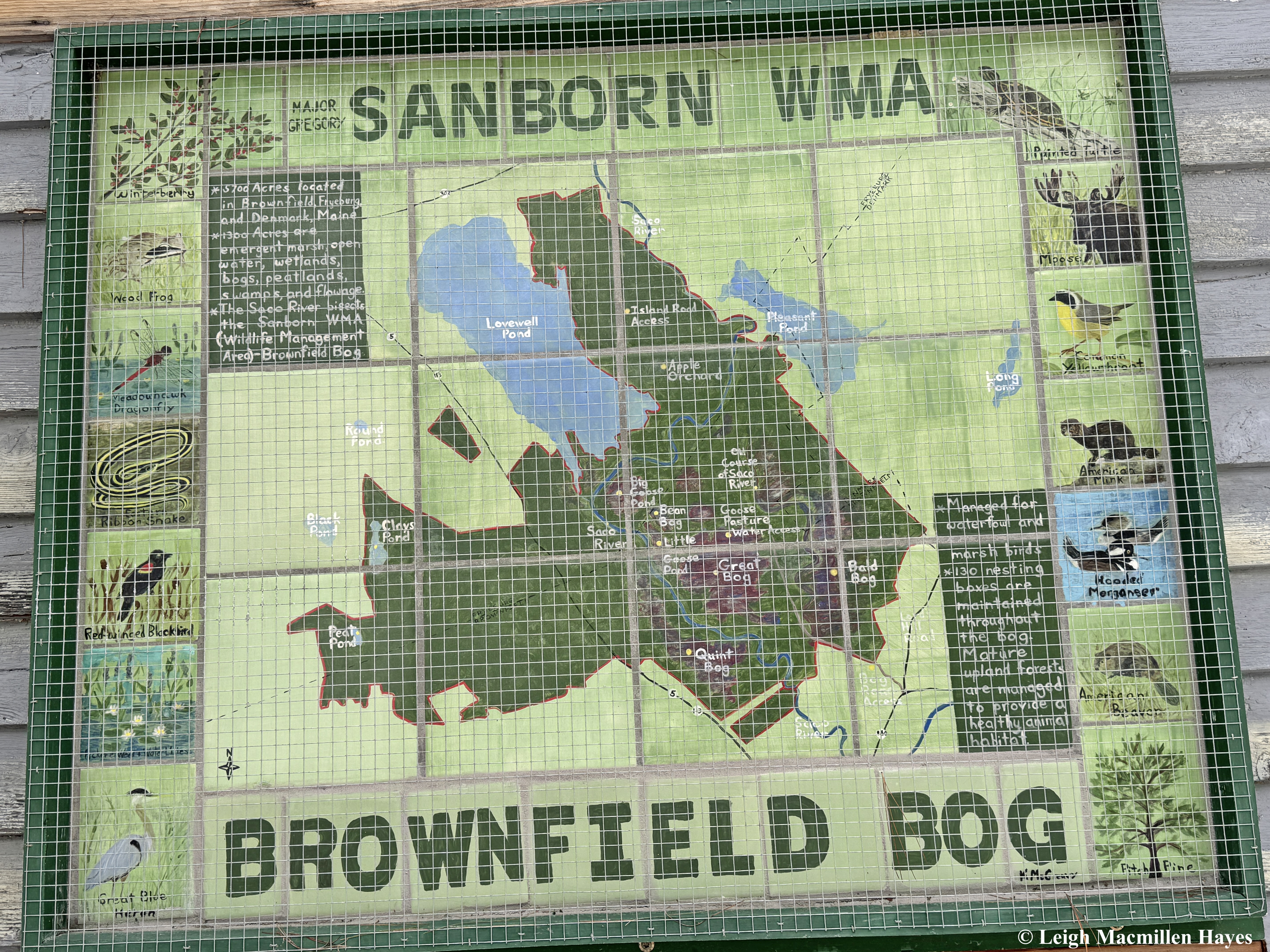
At the old shed, we paused to admire the work of her mom, Kathy McGreavy, a potter who created this tile map of Brownfield Bog in 2017 as her capstone project for the Maine Master Naturalist program. And we wondered how many of the same species we might see or encounter today.
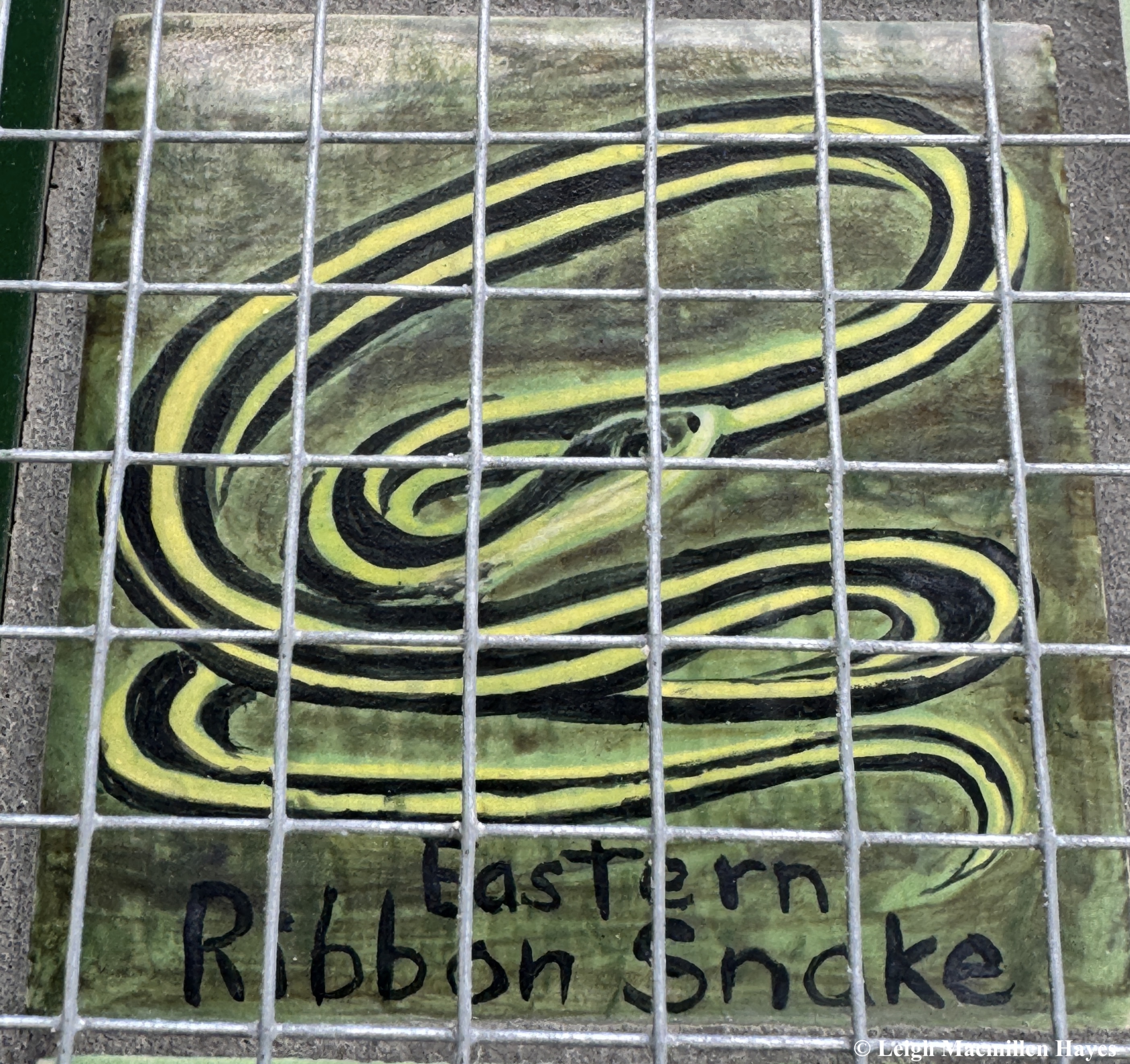
One particular tile always elicits a shared memory, for I was with Bridie when we spotted an Eastern Ribbon Snake slither across the road and down into the water.

It was then that I learned that Ribbon Snakes are a species of special concern in Maine, and rather uncommon. Since then, I’ve seen at least one more in the bog and a few more in several other local spots, but each sighting is special, and always I return in my mind to that first time.

And why the wire across the tile art work? It seems woodpeckers like to peck at the tiles and Kathy had to repair a few a year or two ago.

We couldn’t go out on the bog today, as we had done previous winters. After all, we are on the cusp of spring, and didn’t trust the ice. But from the edge we admired Pleasant Mountain forming the backdrop–and always giving us an idea of where home is located.

Down a side road, which we were able to walk being not flooded (yet), we found our way to Pirate’s Cove along the Saco River and the water is high and mighty and muddy. For a few minutes we watched in silence. Well, we were silent, but the river wasn’t.

Returning to the main drag, we made our way back to the Old Course of the river and were greeted by the most delightful bird chorus, including the conk-le-rees of the Red-winged Blackbirds.

With their bright red shoulder patches bordered below in yellow, they were calling from high perches among the shrubs.
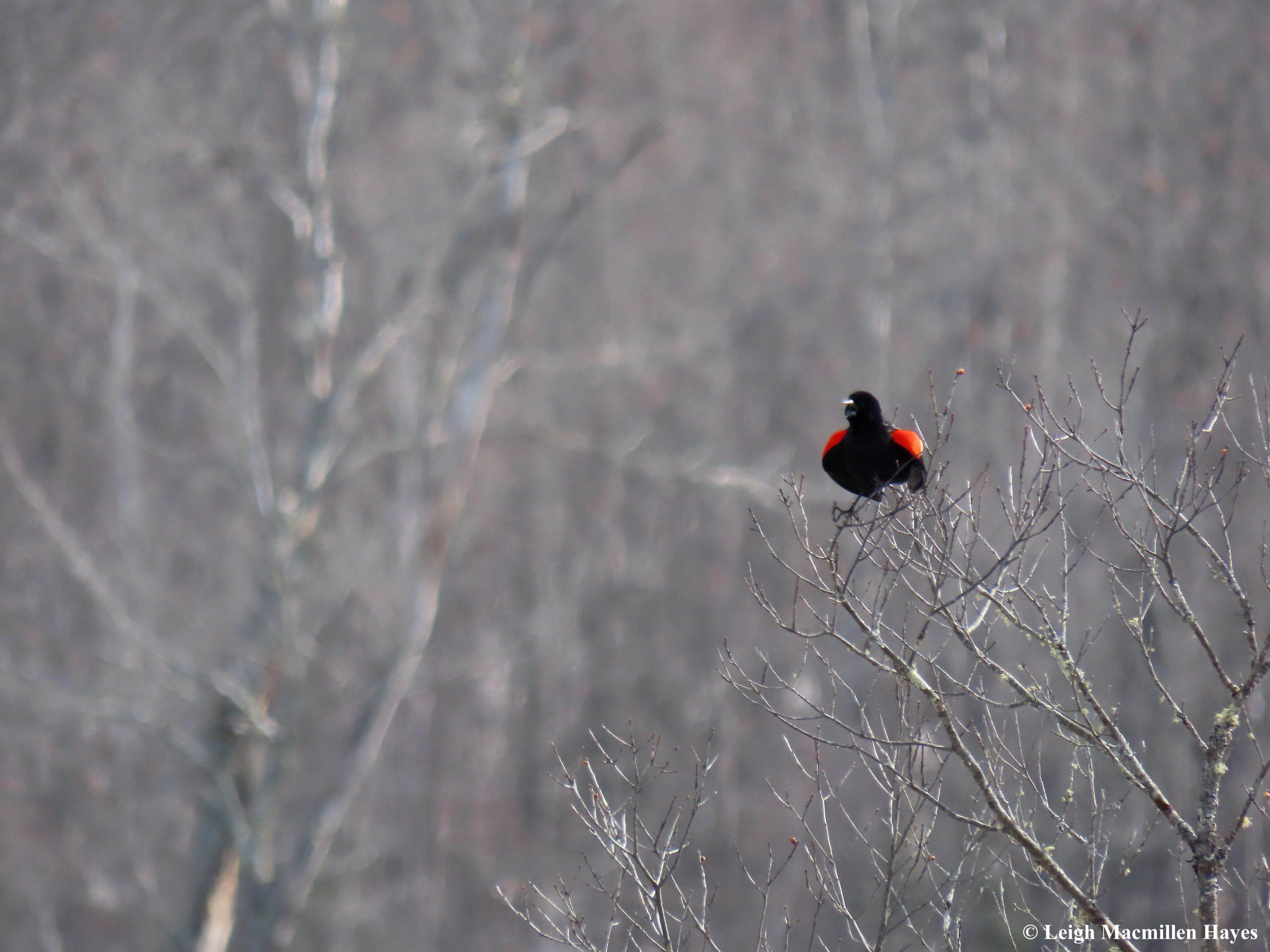
Puffing out while calling is indeed a breeding activity, and so the race is on. May the best males find a mate.

Our other bird sightings included this White-breasted Nuthatch, plus Hairy Woodpeckers, American Tree Sparrows, Canada Geese, and a thousand Wood Ducks. Or so it seemed. The fact that they moved every time we spotted them, even if two hundred yards away, might mean that there weren’t quite that many, but rather that we kept meeting the same ones in different locations.

We also saw signs of Pileated Woodpecker works. Not only do they excavate holes while in search of Carpenter Ants, they also shred and chisel and in these woods, that seems to be a favorite activity. We wondered why, but couldn’t come up with an answer.

We did, however, do what Bridie taught me to do a million years ago and searched for scat. Bingo! Though we saved this thought for another day, we did wonder if we dissected the scat, would we be able to tell about how many ants had been consumed?

And no adventure with Bridie would be complete without some tracking in the mix. Our snowpack is quickly dwindling and where three days ago at home, we still had a foot, now there are lots of bare spots and what snow is left might be only about four inches.

That said, we relished the finds we did make, including lots of Vole tunnels like these. And I reminded Bridie that she was the one who introduced me to the subnivean layer, that microhabitat between the ground and the bottom of the snowpack (think back to Thanksgiving 2024), which provides insulation and protection for many animals, like the Voles, who happen to be on everyone’s dinner menu.
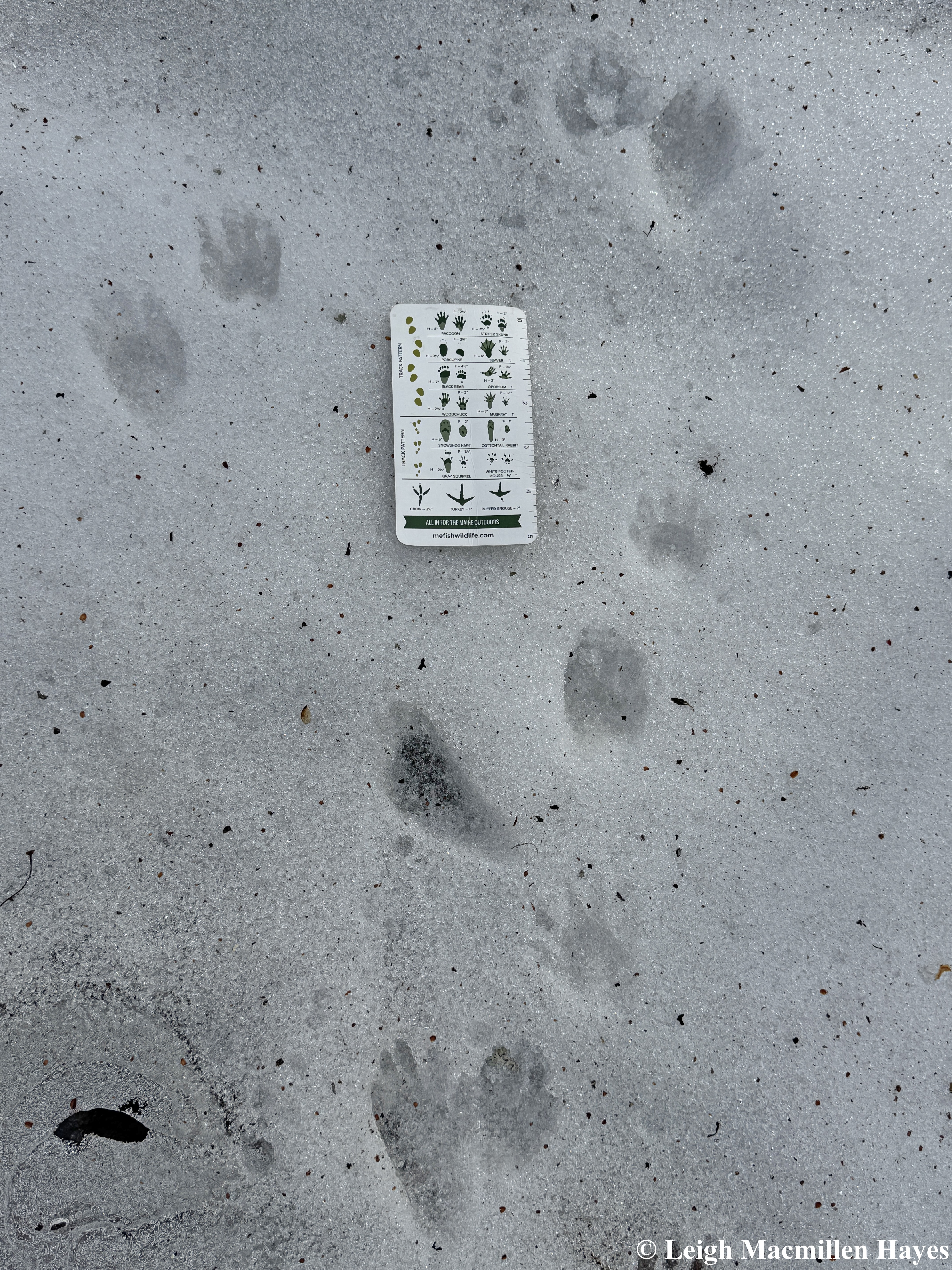
Our other finds included Raccoon tracks,

Mink,

and Coyote,

plus a family of Coyotes on some sand at Goose Pasture.
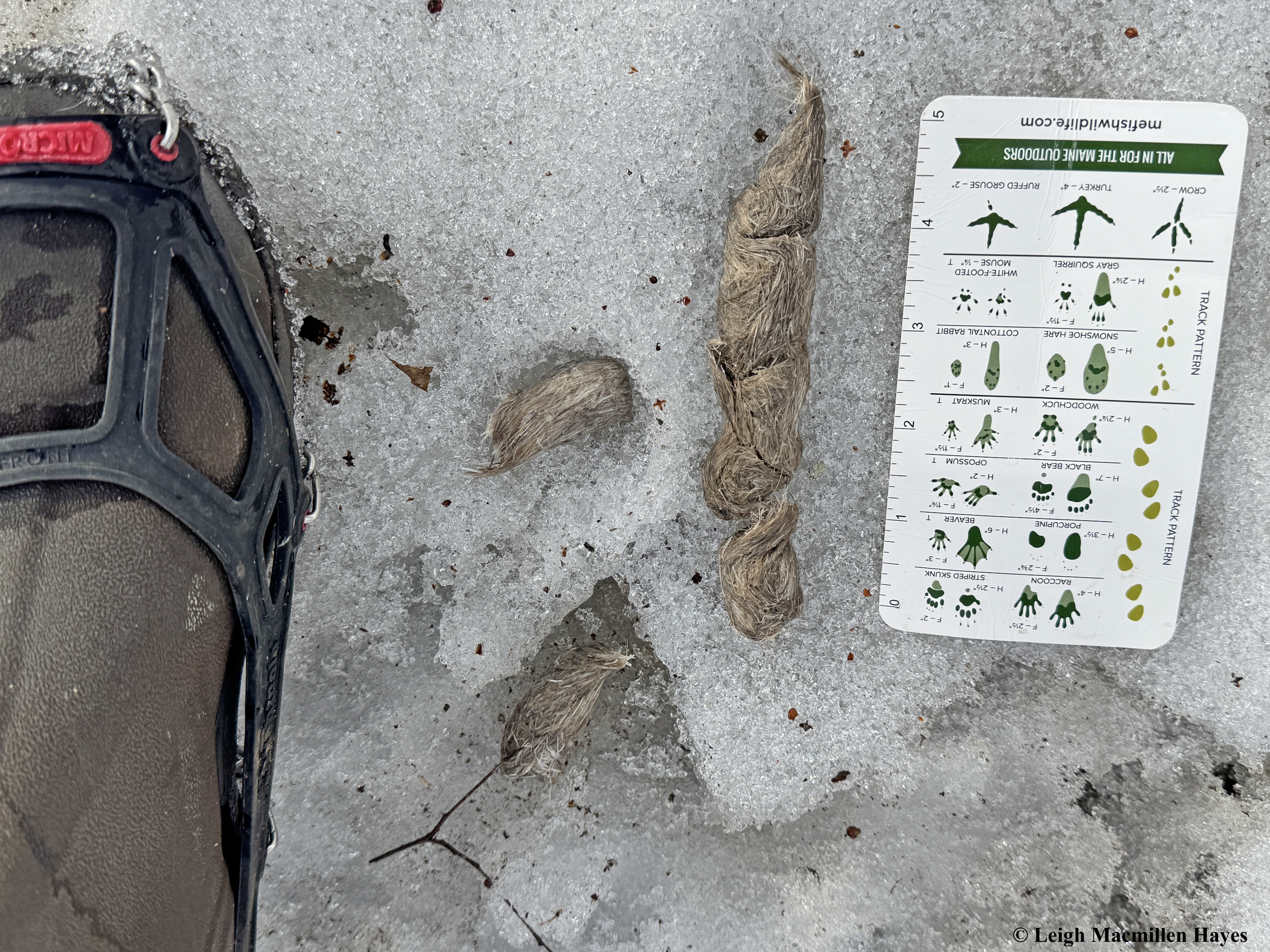
And, of course, our adventure could not be complete without discovering several Coyote scats.

And just for good measure, we met one large Six-spotted Fishing Spider.
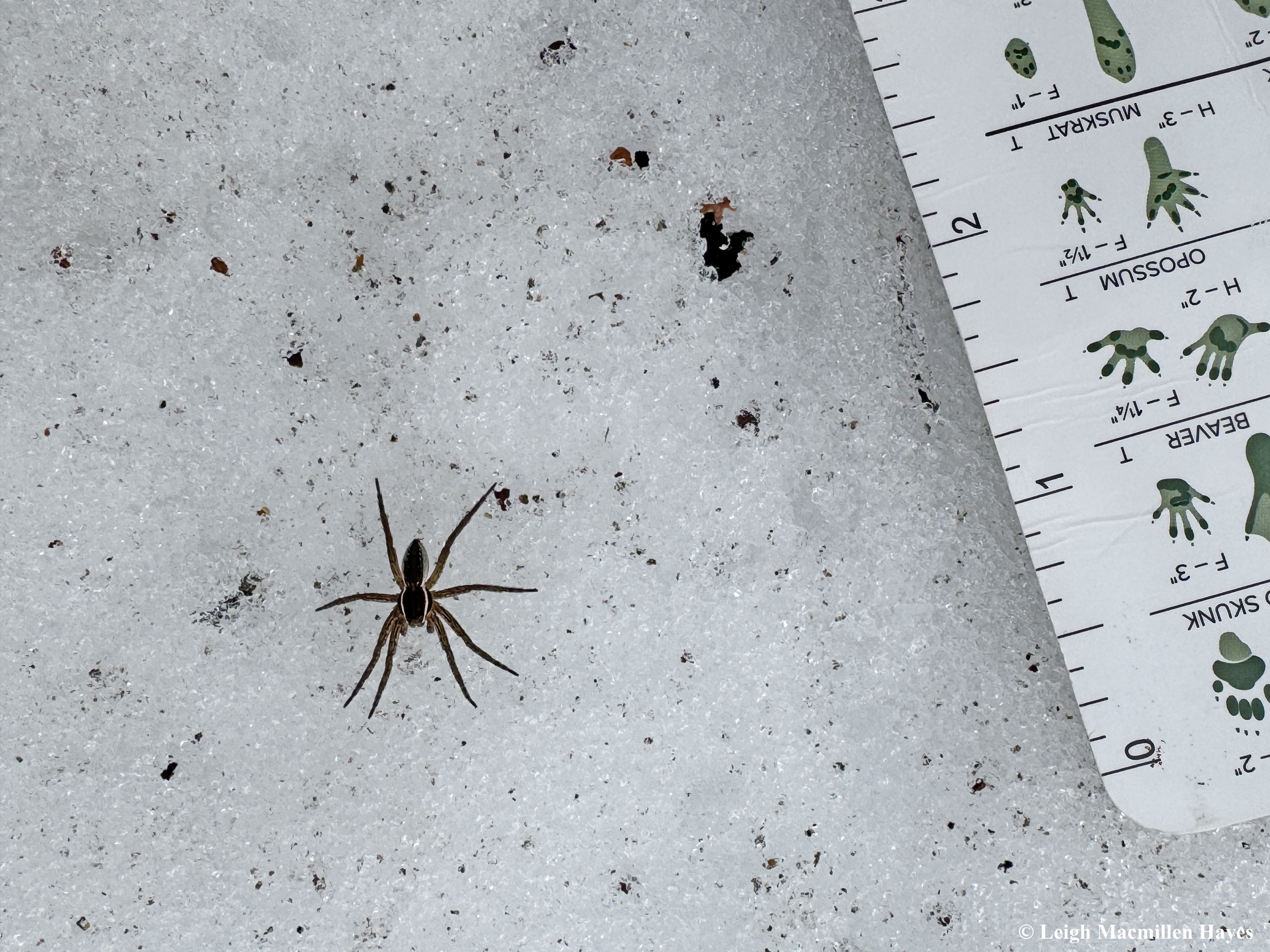
Okay, so it wasn’t really as big as the close-up made it look.

There were also beaver works in various places, though we suspected this was a wee bit old, but not older than a few months ago based on the color of the wood. The warmer temps made the sap flow a bit.

There are a bunch of well-mudded lodges in the bog, but we didn’t see any hoped for activity today.

We did, however, discover some scent mounds and know that claiming territory is an important assignment that will become more significant as the ice begins to melt and the two-year-olds leave the lodge to venture off on their own and claim a territory.

Next, we turned our focus to a few shrubs, including the Winterberry. While I still have some dried bright red berries as decorations in my house, most of the berries on branches have shriveled and we wondered why the birds hadn’t dined on them when they were ripe.

What we discovered, much to our delight, was that some had been procured by little brown things, presumably mice, and had been consumed in a bird’s nest. It’s illegal to take bird nests without a permit and this is one reason, they are recycled into homes for other critters.

What totally surprised us about the Winterberry, however, was that we found one shrub with the berries still bright red and plump, as if today was December 18th and not March 18th. Again, we wondered why.

We also found a few of last season’s cranberries hiding under their leaves. That reminded me of another day I’d spent searching for cranberries in the bog years ago–and though I told Bridie about it, I’ll save that two-day story for another day.
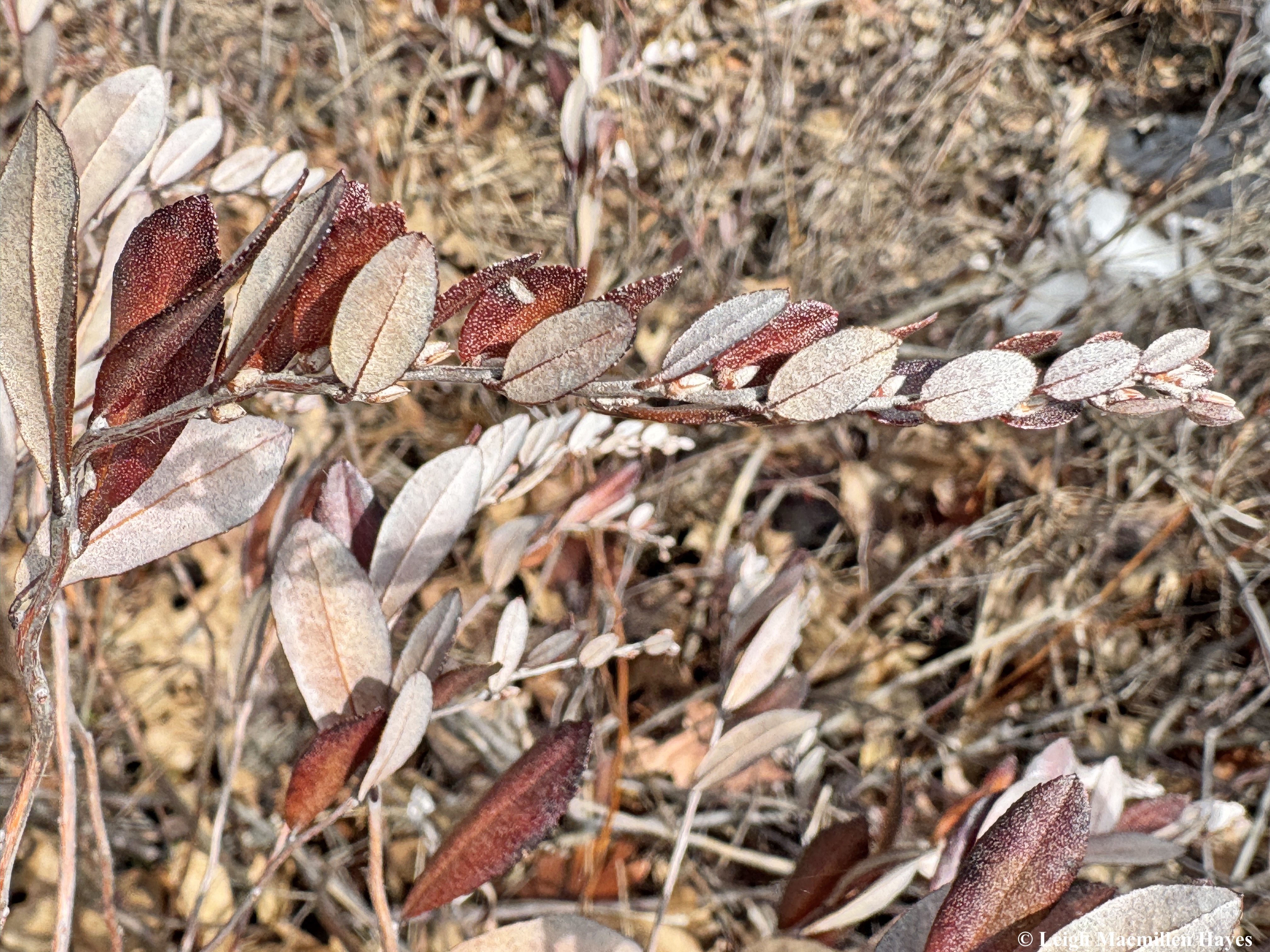
Leatherleaf also had offerings to provide, in the form of little flower buds along the woody stems.
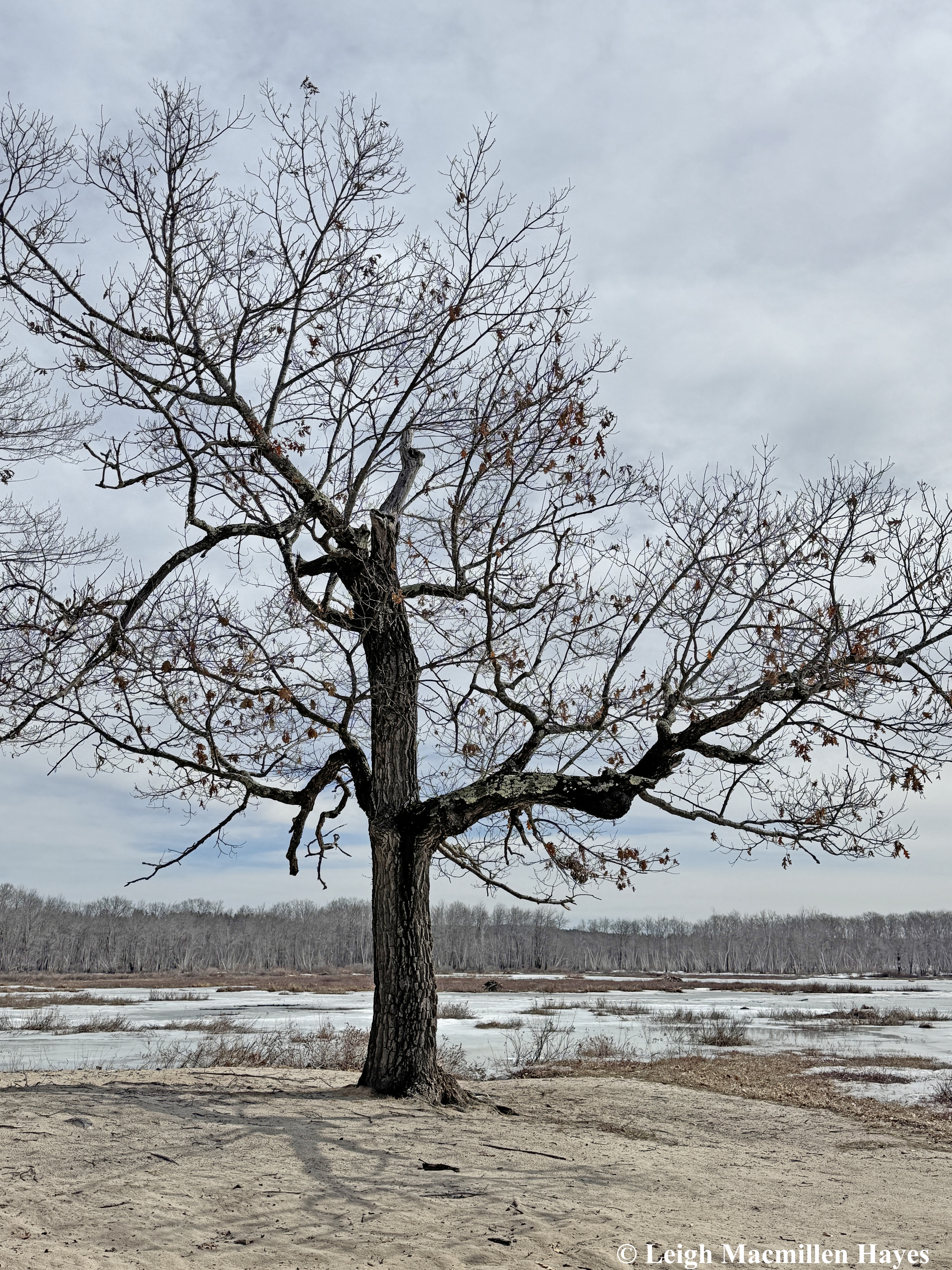
At last we reached the old Oak at Goose Pasture and stood there for a bit taking in the sun and warmth and feeling like it was a bit of a beach day. But, our time together was coming to a close, and we knew this would be our turn-around point.

That said, there were a couple of other gifts to share together, as today was the first day this year that the two of us saw Pussy Willows in bloom.

And, drum roll please, we heard them before we spotted them way over on the other side of the bog, but their distinctive call told us to look that way and sure enough there were two Sandhill Cranes.
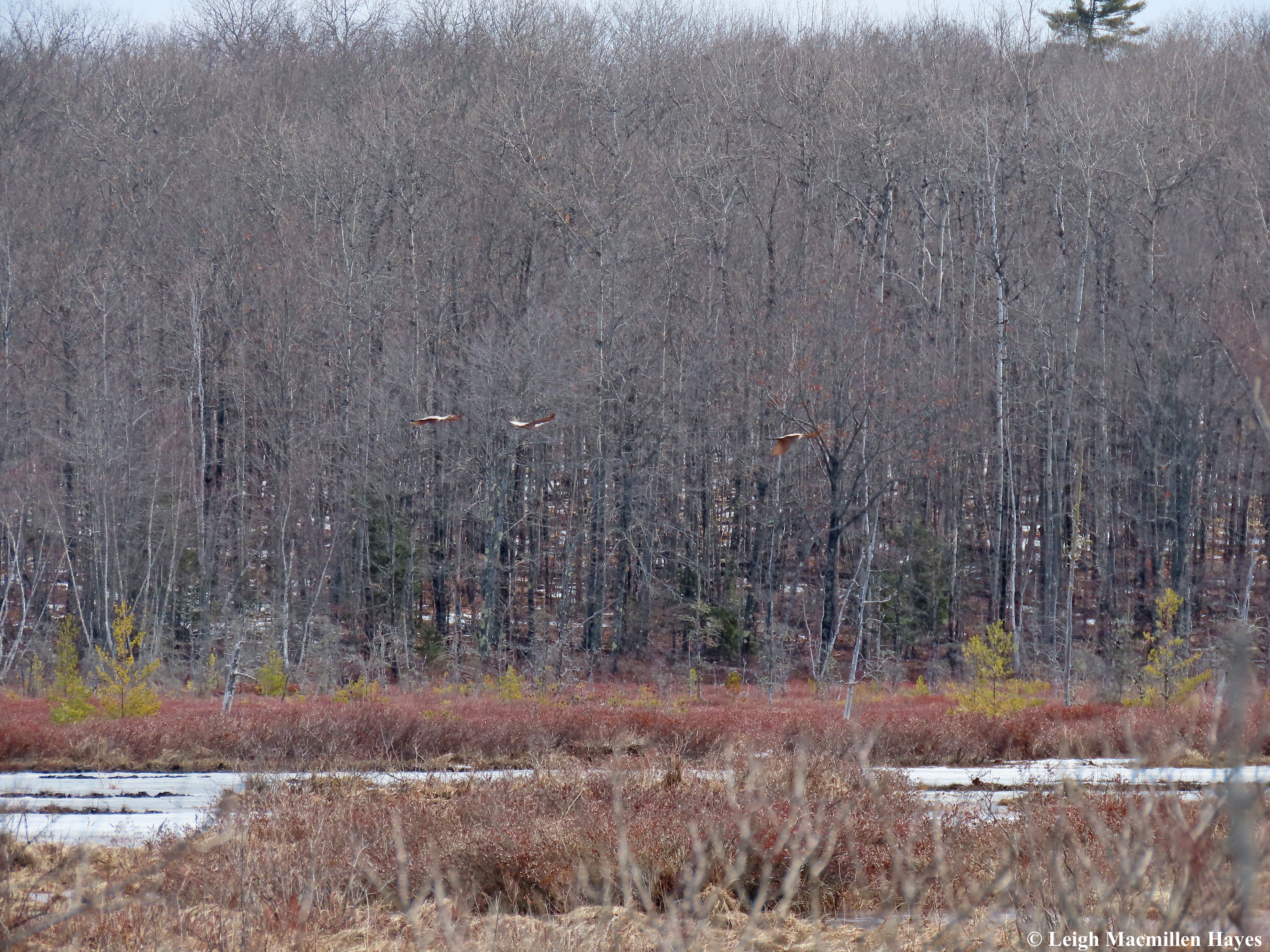
Like the Wood Ducks they flew, but the two morphed into three as we watched them take to the air.

We’d been blessed. In so many ways.

And at the end of our time together, after traveling 6.2 miles, we needed to say our goodbyes.

The thing is, she wasn’t really with me, which I realized when I went to put my arm around her for our selfie shot. But, in my mind, she was and I had the best time Bogging with Bridie today, her birthday.

Happy Birthday, Bridie McGreavy!

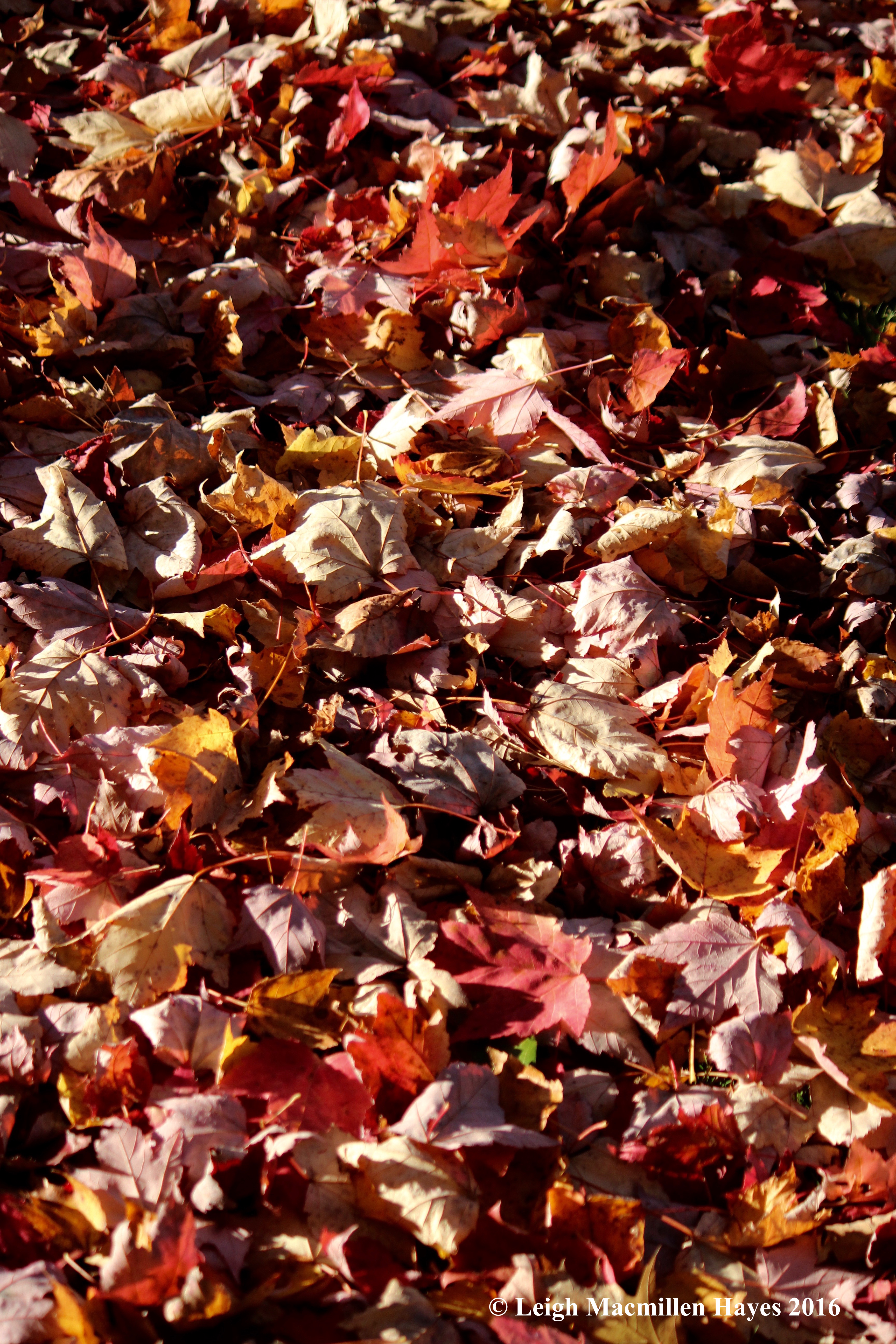
Celebrating the Work of the Leaves

In response to shorter days
and sunshine's declining density,
leaves begin the age old process
leading to their demise.
Like so many others, 
I make time to honor
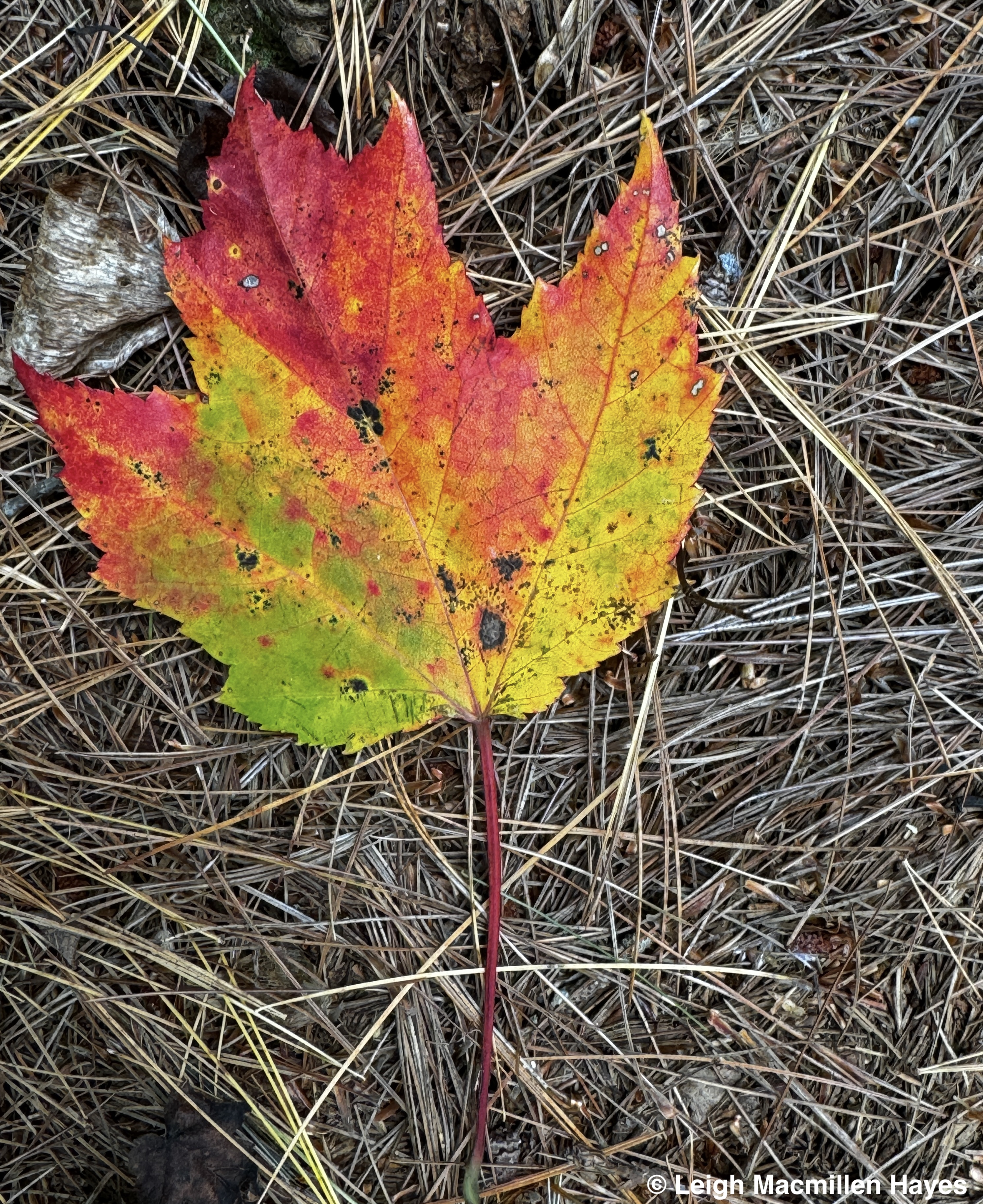
the tapestry they weave
before they fall.
Chlorophyll, the green pigment
we associate with summer,
and necessary for photosynthesis,
slows and then stops manufacturing food,
and the leaves go on strike.
Veins that carried fluids
via the xylem and phloem close off,
trapping sugars, and promoting the production
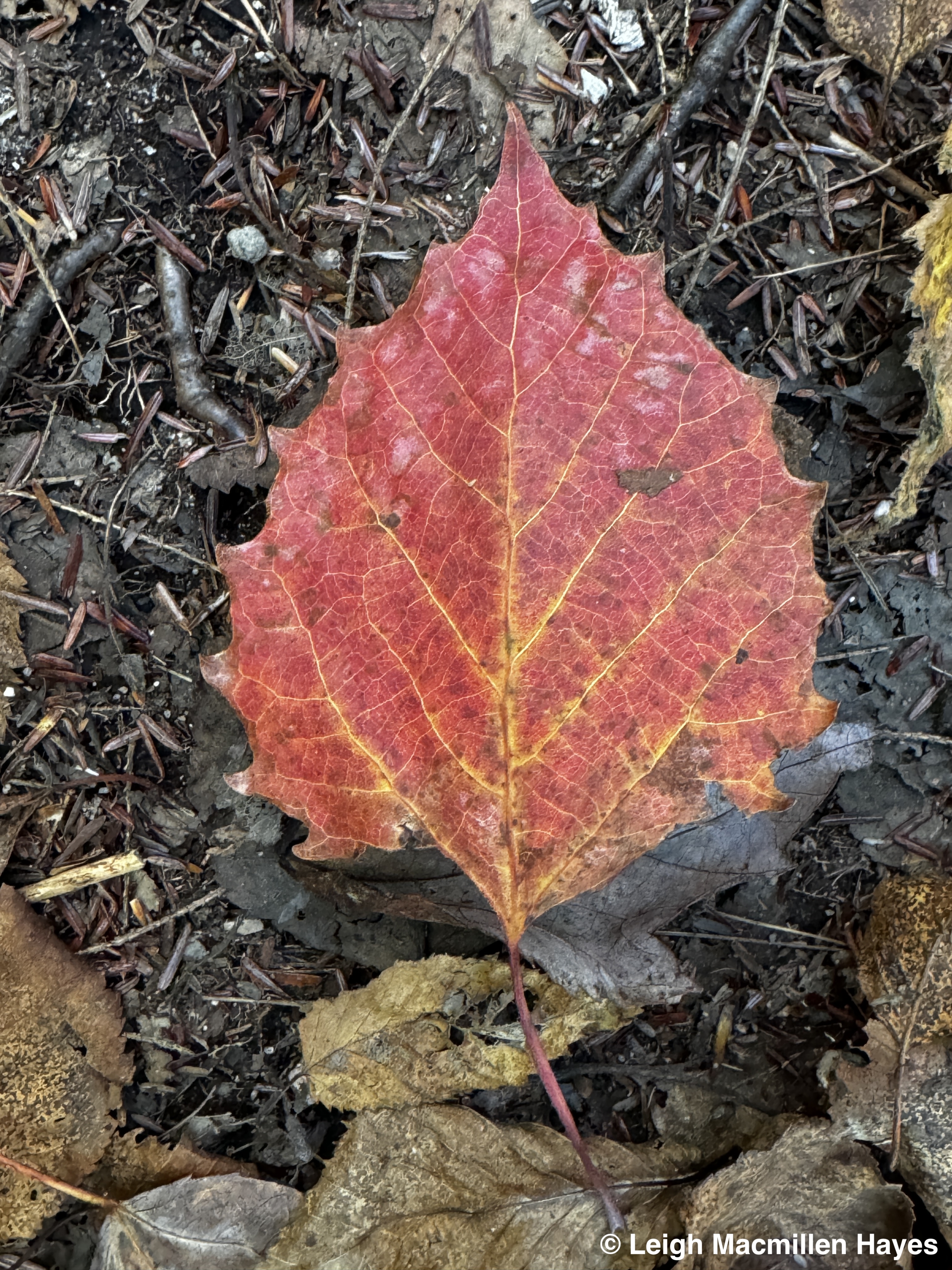
of anthocyanin, the red color
we associate with Red Maples and Silver.
Though in the same family, 
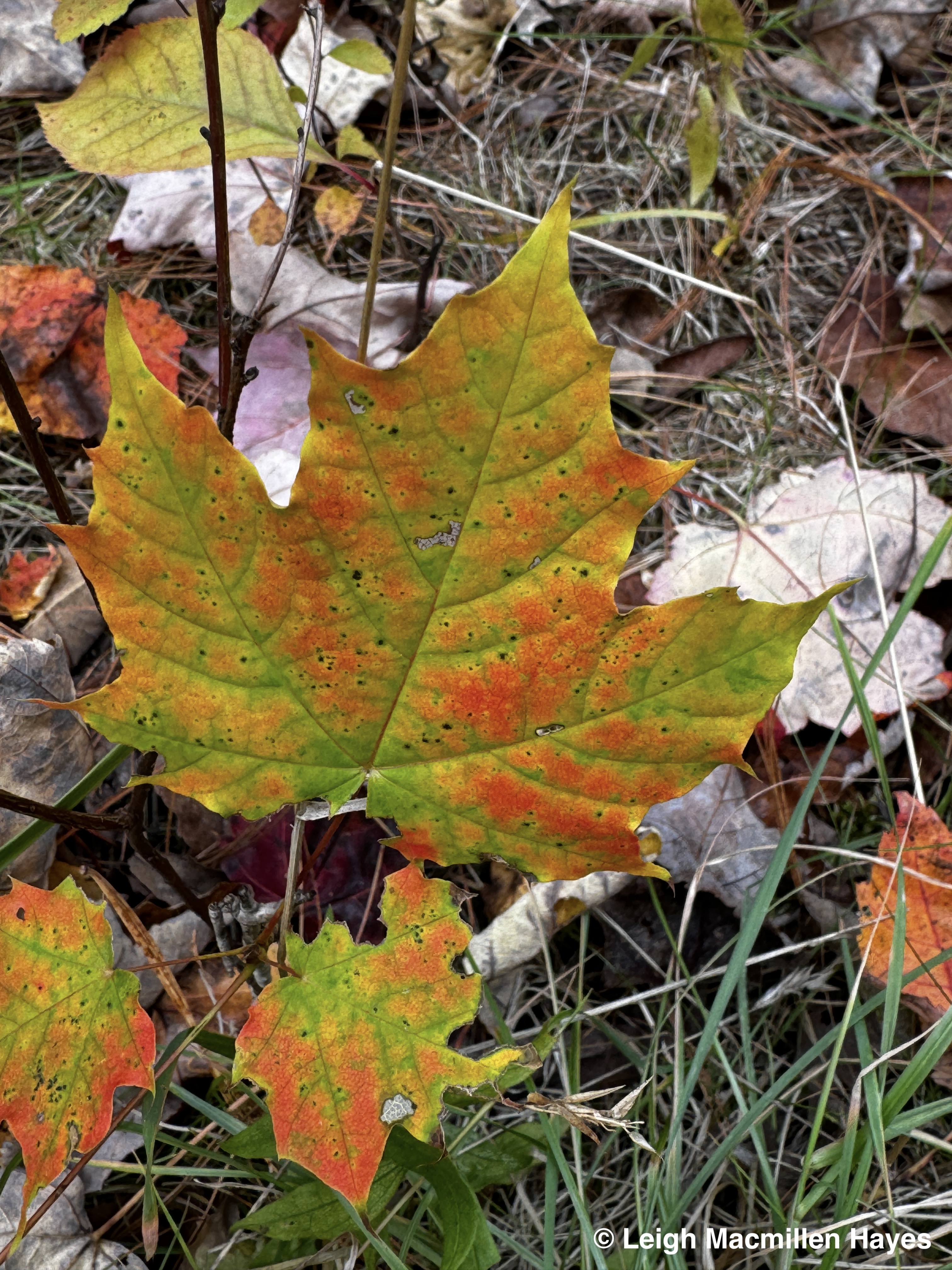
Sugar Maple displays
the yellows and oranges
of the ever present Carotenoids,
which had previously been masked
by Chlorophyll.
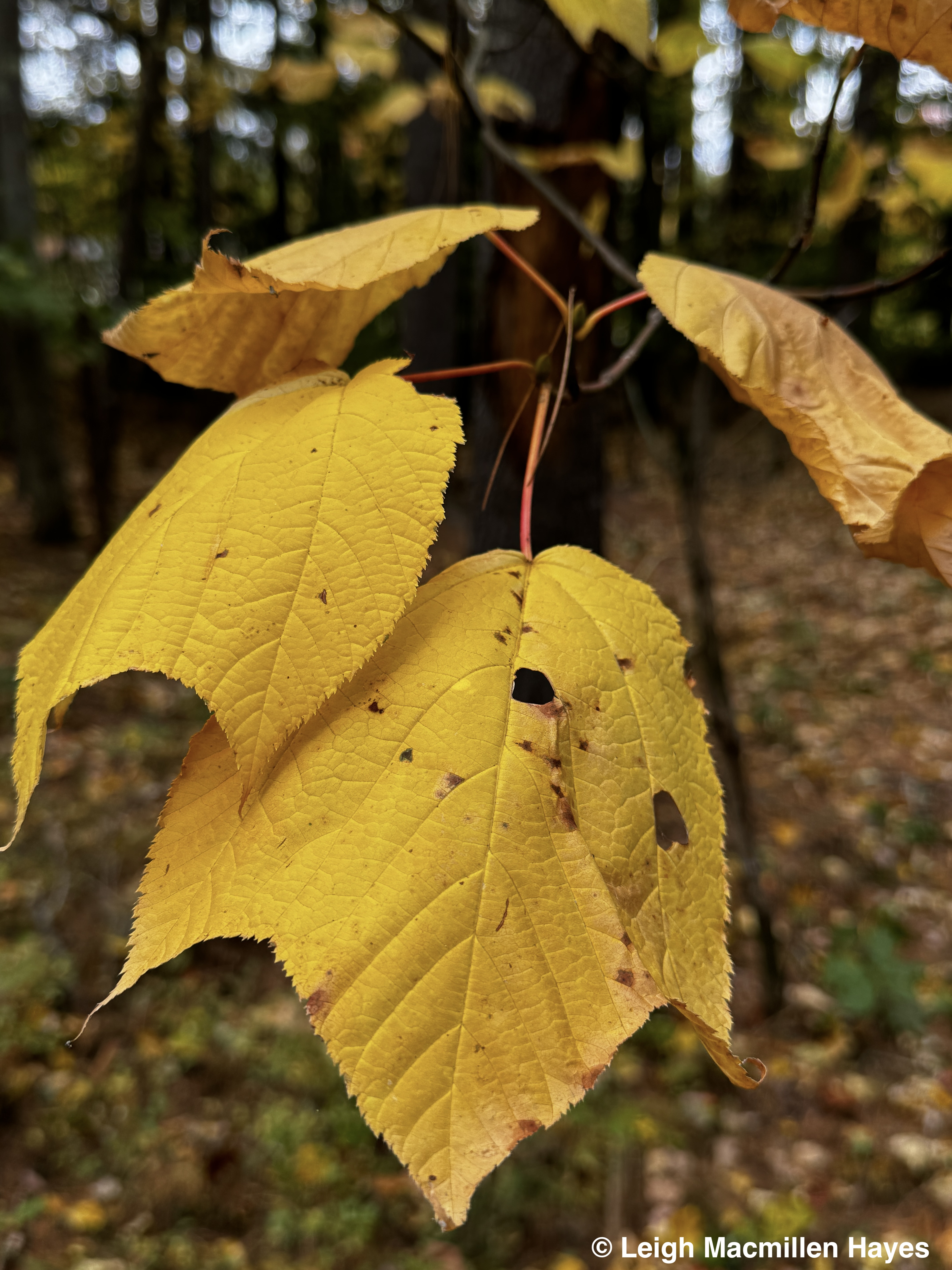
Stripped Maple knows
only one hue,
making it easy
to spot its large display of brownish yellow.
One of my favorites
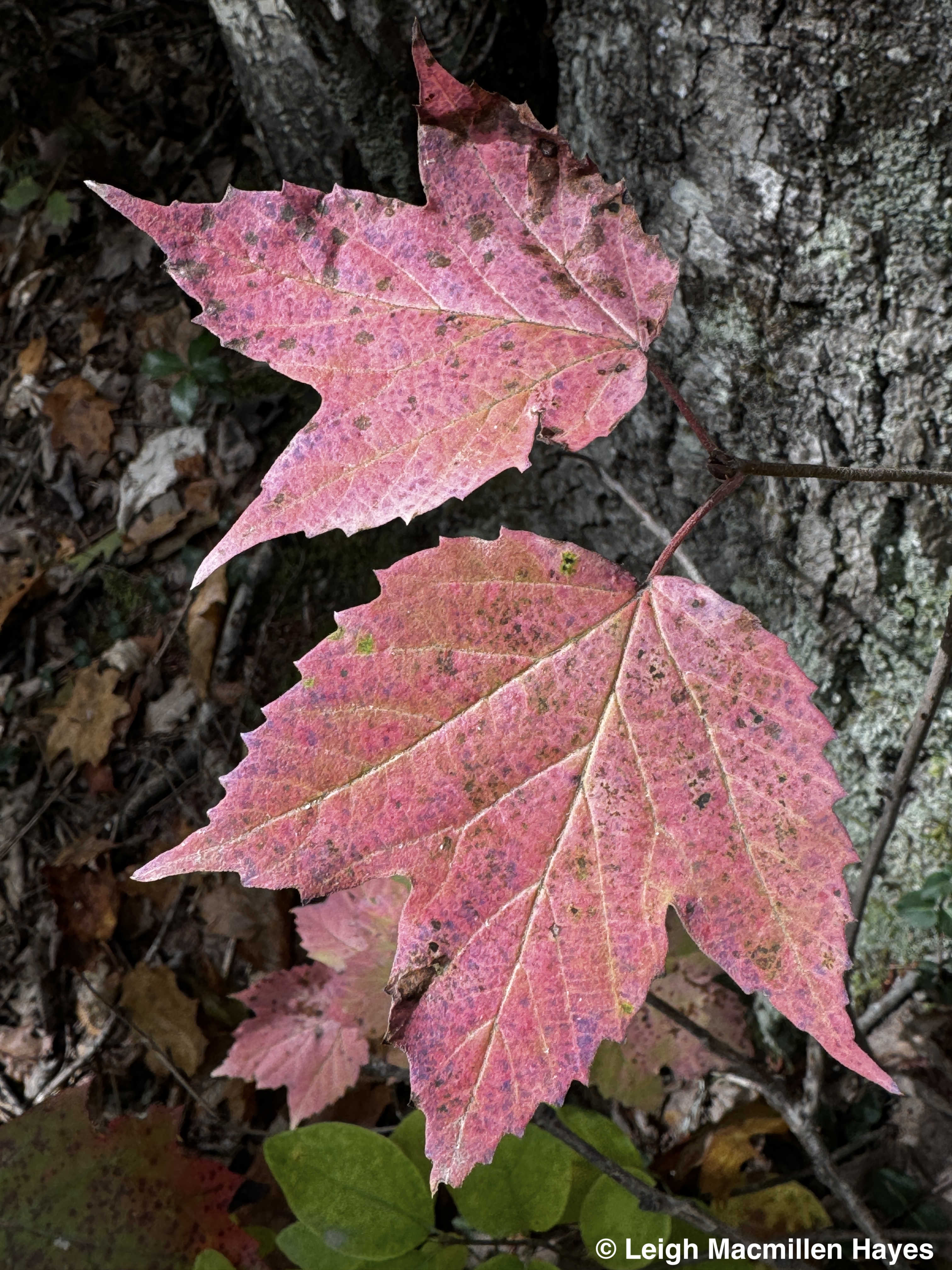
is the reddish-pinky-purples
of Maple-leaf Viburnum,
a shrub with maple-shaped leaves.
Ash follows suit,
though its leaves
are the quickest to drop
and disappear into the forest floor.
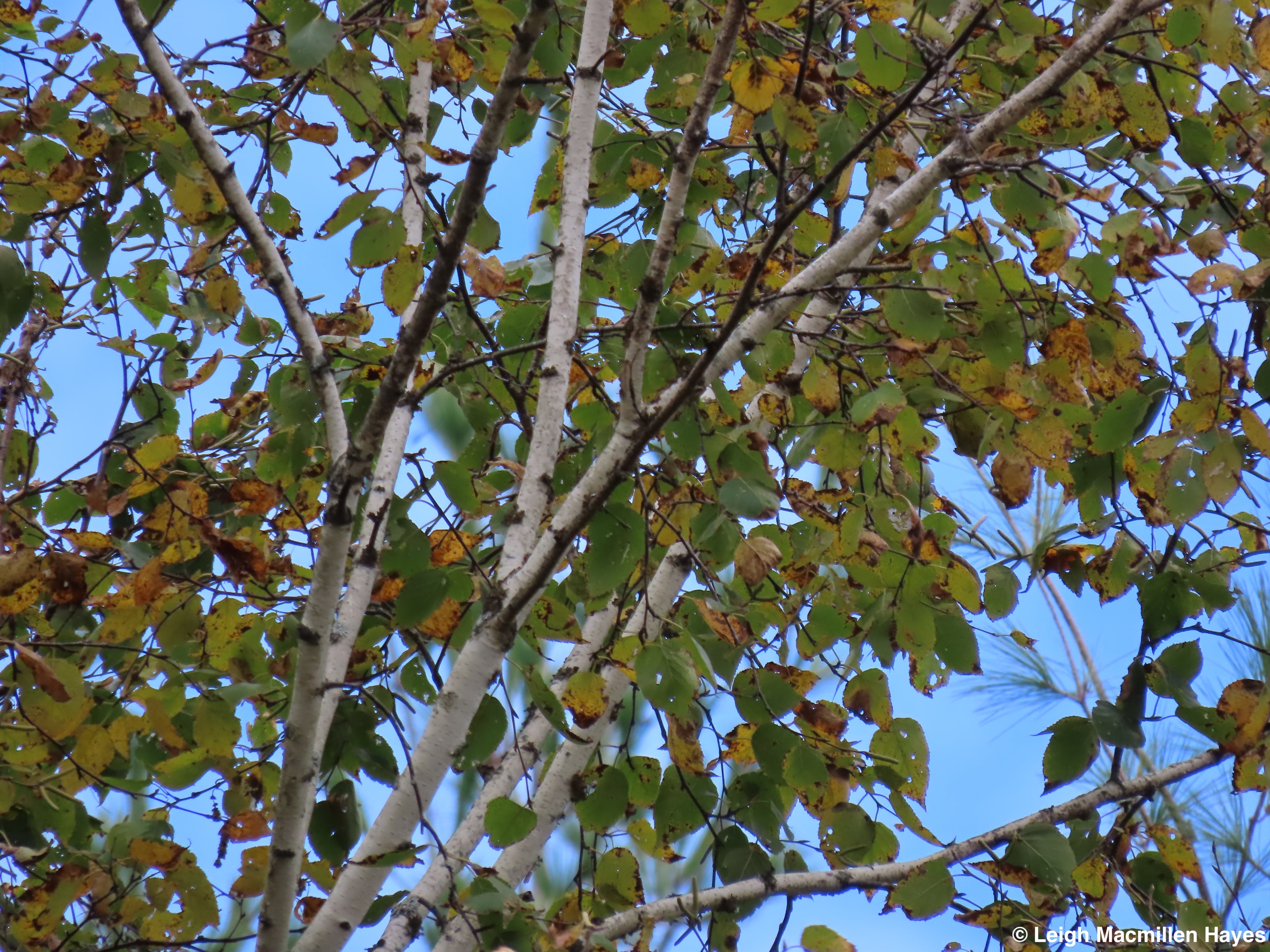
Big-tooth Aspens turn a golden yellow,
but other colors
have a tendency to seep in
and create a striking picture.
American Beech, 
Paper and Gray Birch
show off a yellow
to golden bronze presentation.
And a little late to the show, 
Northern Red Oaks
put their colors on display
after other species
have already dropped their leaves.
Not really a part of the foliage, 
but still important because it is present,
is the splotchy display caused by Anthracnose fungi,
a result of too much rain stressing trees
and not allowing them to properly respire.
Once connecting tissues 
between leaf petioles and their twigs
form a seal,
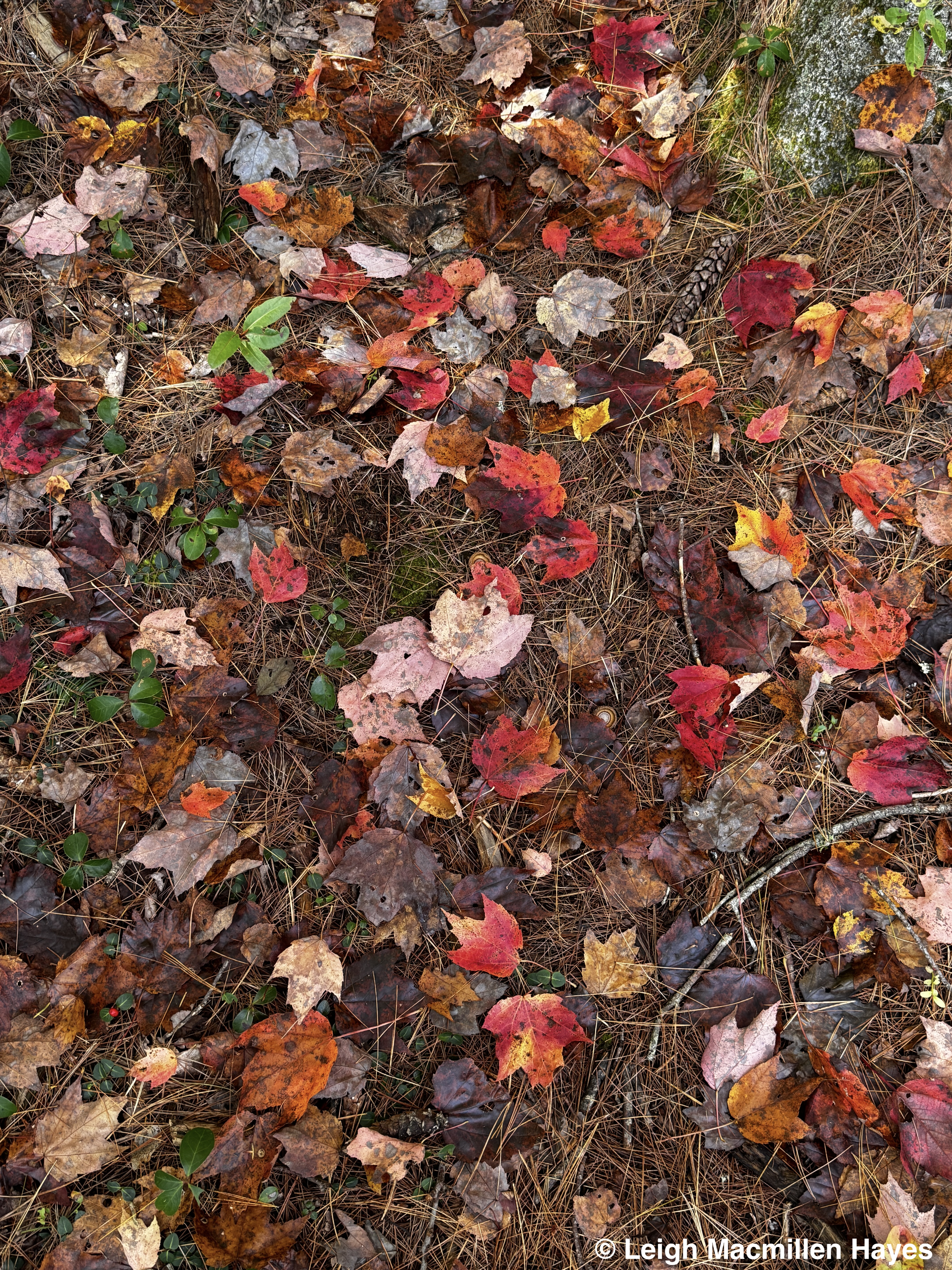
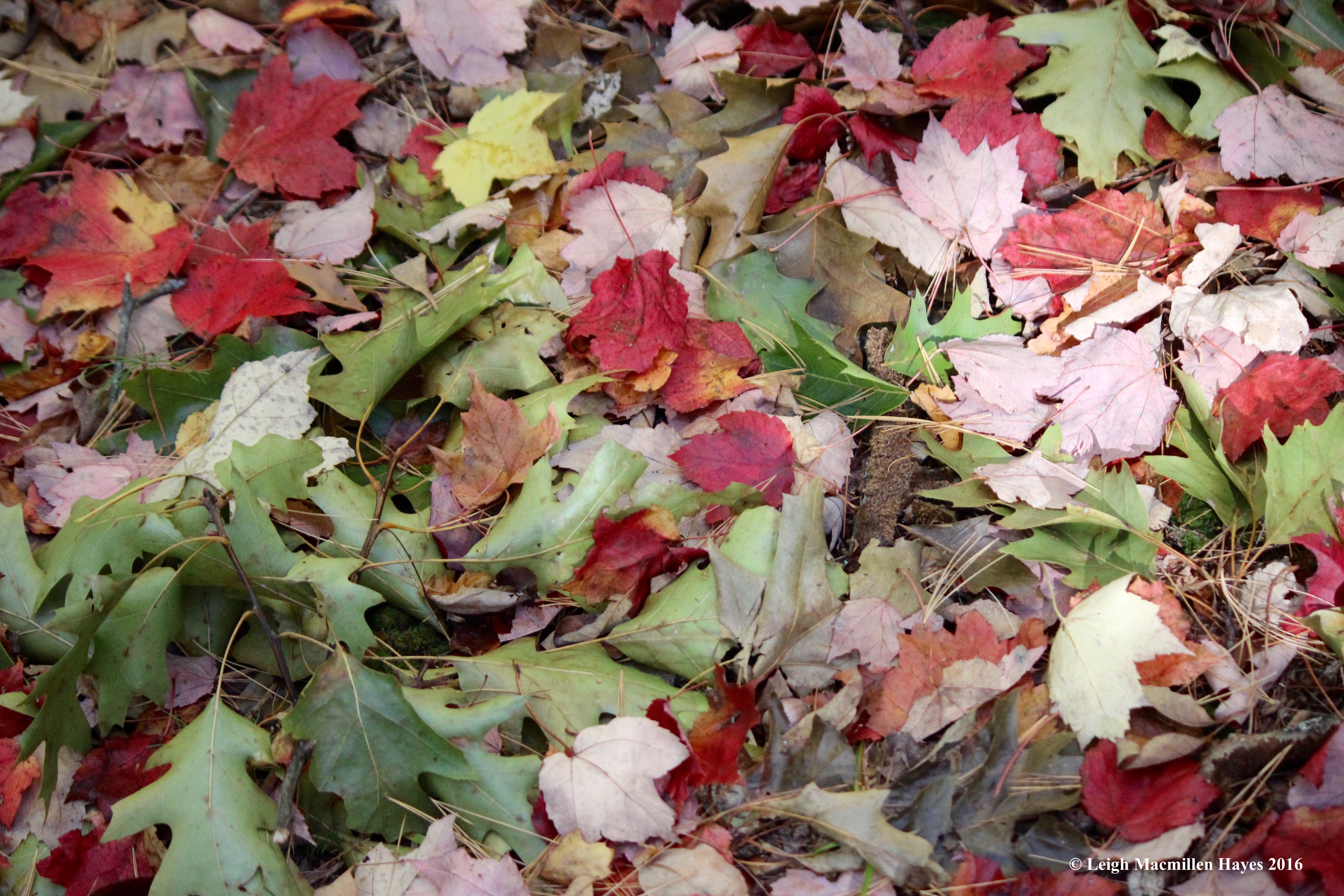
the forest floor is colored with gems
that will eventually turn various shades of brown
as they decompose and restock the soil with nutrients,
plus provide food for numerous organisms. And shelter.
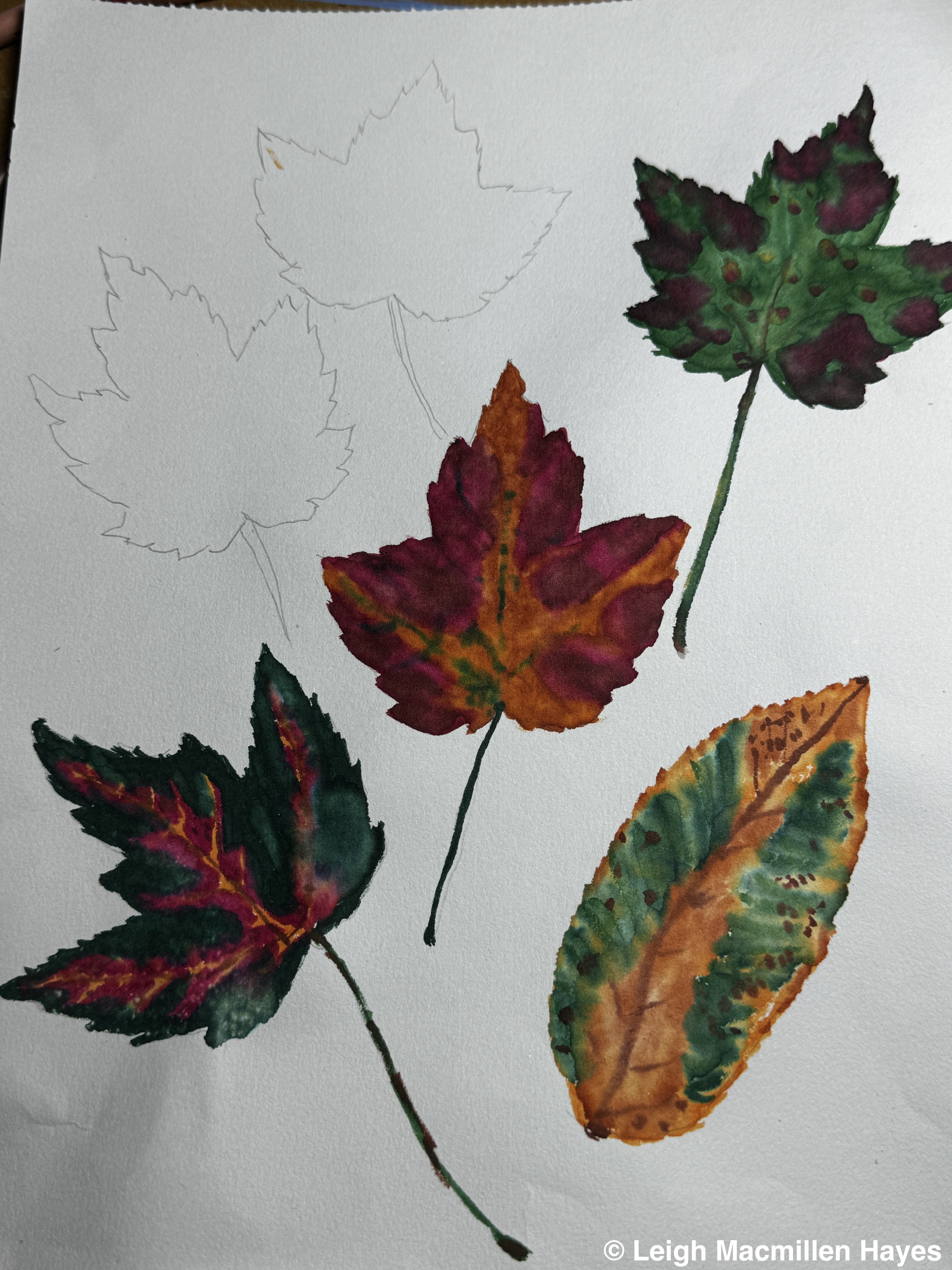
In a Senior College (Lifelong Learning) class
this past week,
I attempted to use watercolor pens
to capture the colors.
And then at home, 
I tried to do the same,
only this time using watercolor pencils
to show off the vibrant variety of hues.
In doing so, 
I was forced to slow down
and notice how the color changes
often followed the veins
in this biochemical process.
Fall foliage is fleeting,
and I give thanks
that every year
we can celebrate the work of the leaves.

The Long Farewell

Saying goodbye is so hard to do, yet at some point we all must. These last few days I’ve been trying to wrap my brain around how best to do that and not feel melancholy.

But then again, maybe the future isn’t all that far off. Wait a minute. Blueberries in flower? Yes! Sadly so. Over the past week or so friends, relatives, and I have noticed various species flowering due to warmer than normal autumn temperatures. These of the low-bush variety are along the path that my neighbor mowed through the field where I’ve spent many a glorious hour observing.

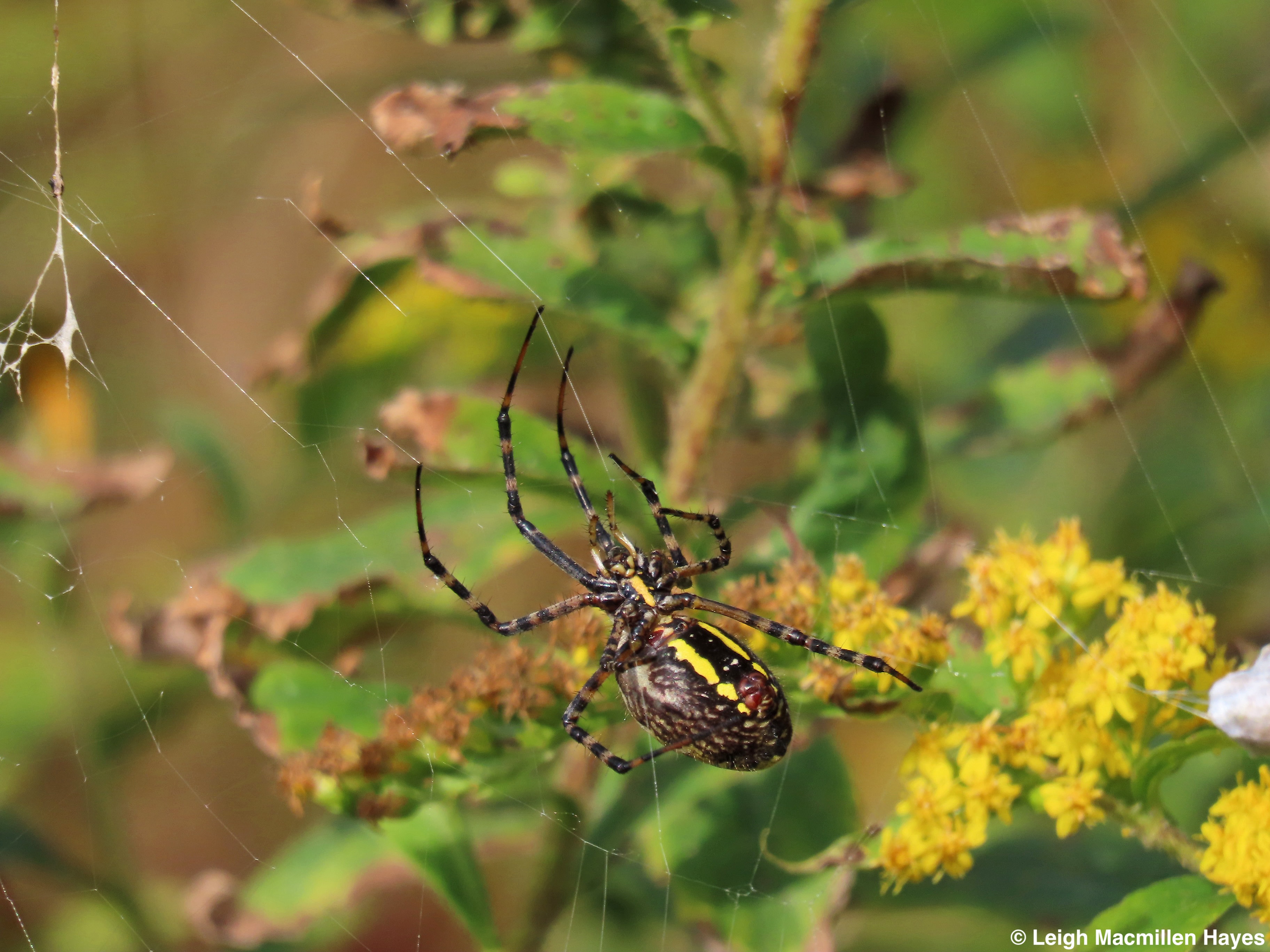
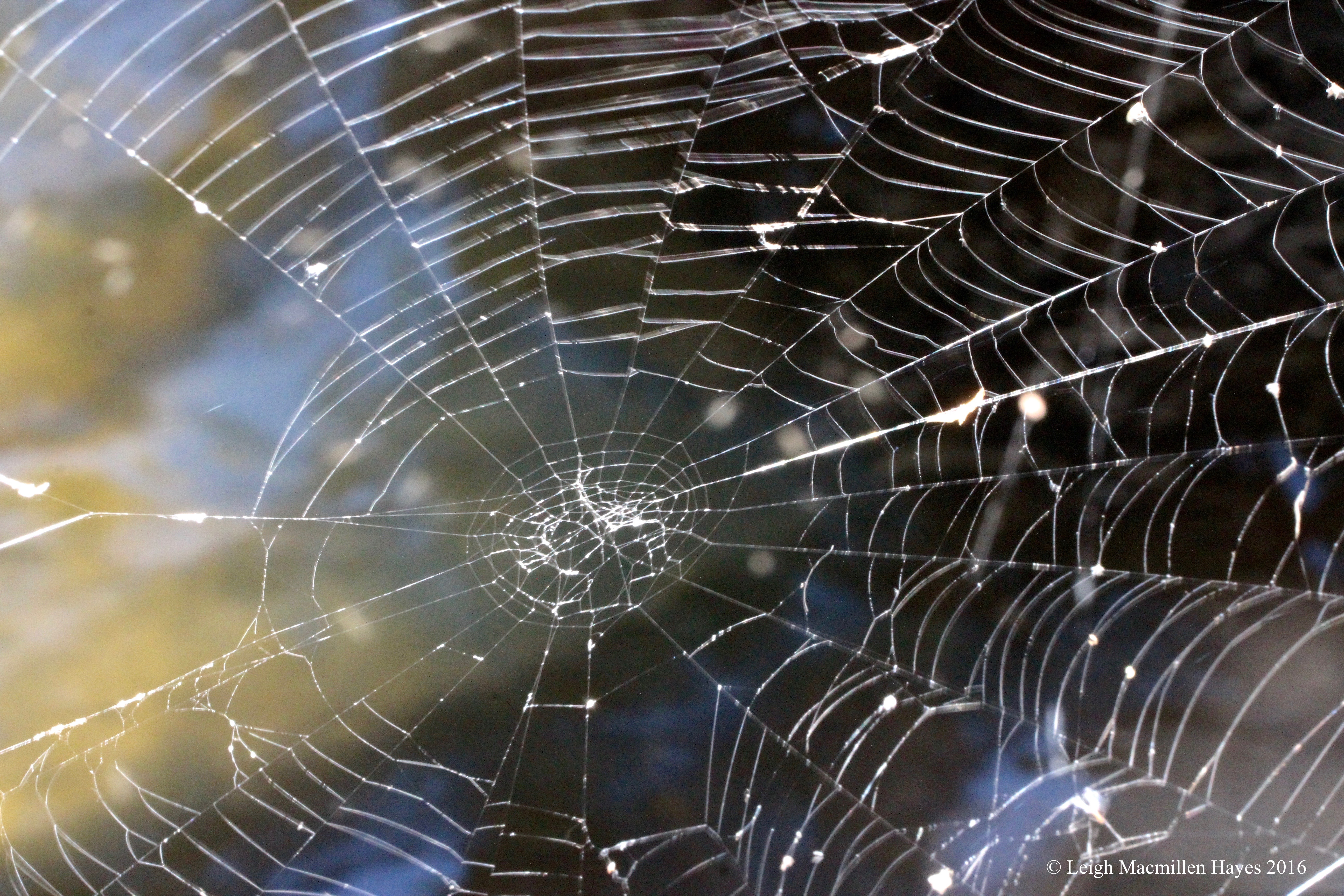
It’s in the same field where I delight in spotting bowl and doily spider webs and this one, a funnel web with the funnel weaver sitting inside waiting for a meal to arrive.

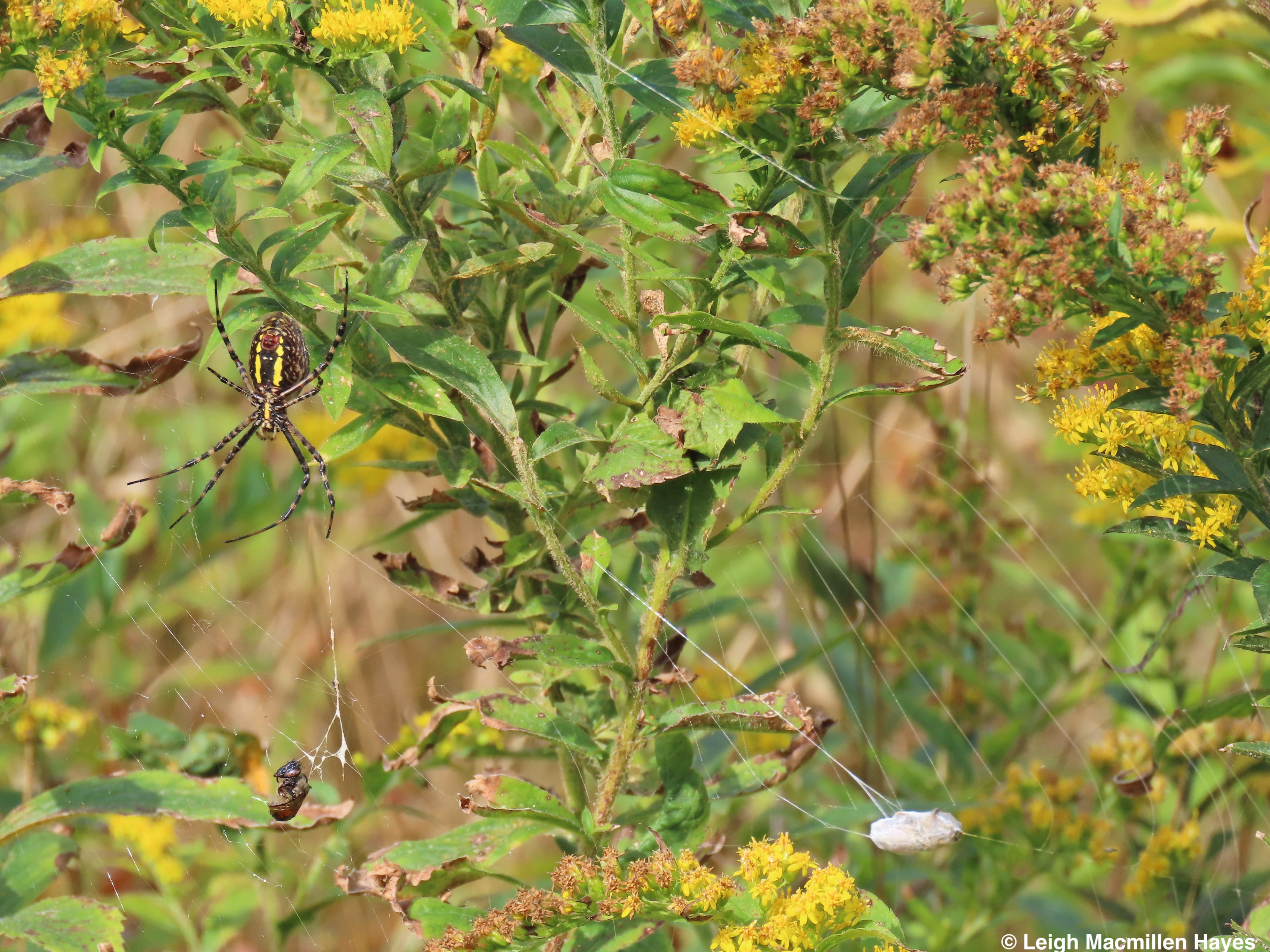
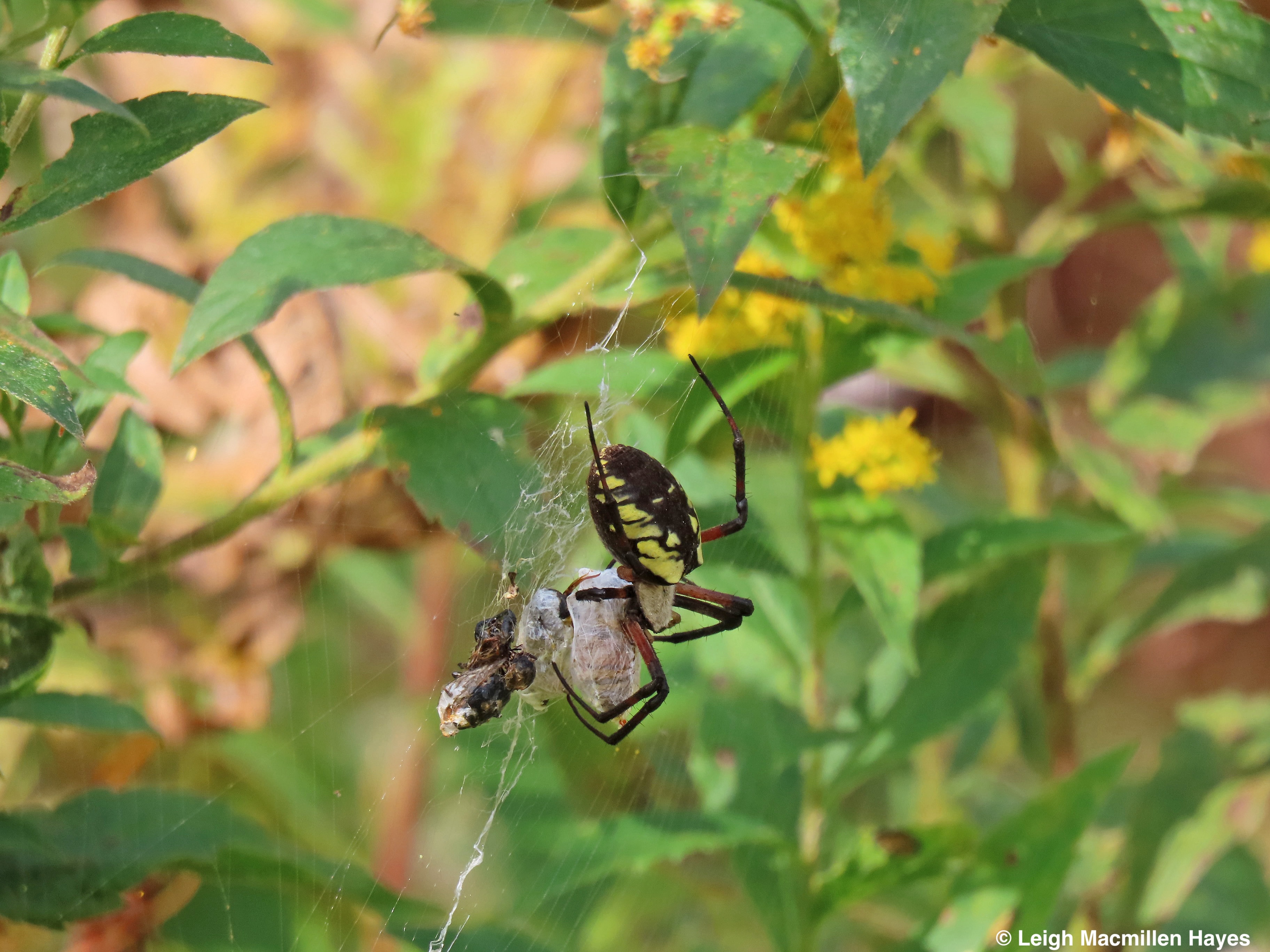
Orb weavers have also been mighty abundant this year and at first I assumed this was Ye Olde Black and Yellow Garden Spider that I love to watch at work–usually wrapping its prey as this one was doing.

Before I say more, take a look at the silk coming out of its spinnerets. I like this explanation by Naturalist R.J. Adams about spider silk: “Within each spider’s abdomen are a variety of silk glands which can vary in number depending on the species. Some of the oldest lineages, including relatives of California’s tarantulas and trapdoor spiders, have only a single type of silk gland, while some orb weavers can have up to eight different kinds. Each gland produces a protein-rich liquid which connects to numerous minute spigots at the tip of the spider’s spinnerets. When silk is needed, tiny valves behind each spigot control its release, and as the fluid is compressed through the spigot’s openings, tension orients the molecules into a solid, thread-like structure.”

Liquid. Spigots. Thread. What an amazing invention!

As I watched the spider move away from its packaged meal, walking so confidently on those guide lines, I realized its coloration was a wee bit different than that of the Black and Yellow Garden Spider.

Not only was the design/coloration different, but also the fact that there was no Zig-zaggy stabilimentum, an ultraviolet runway of multiple threads which perhaps provides stability or attracts prey or tells others to stay away, a trademark of the Black and Yellow.

That’s because this was a Banded Orb Weaver with a different pattern. And now I can’t wait to look for these again next year.

Until a couple of days ago, I was still seeing Black and Yellows, but not as frequently as I had all summer long. It seemed like this gal had stocked her pantry, perhaps knowing her days were coming to an end.

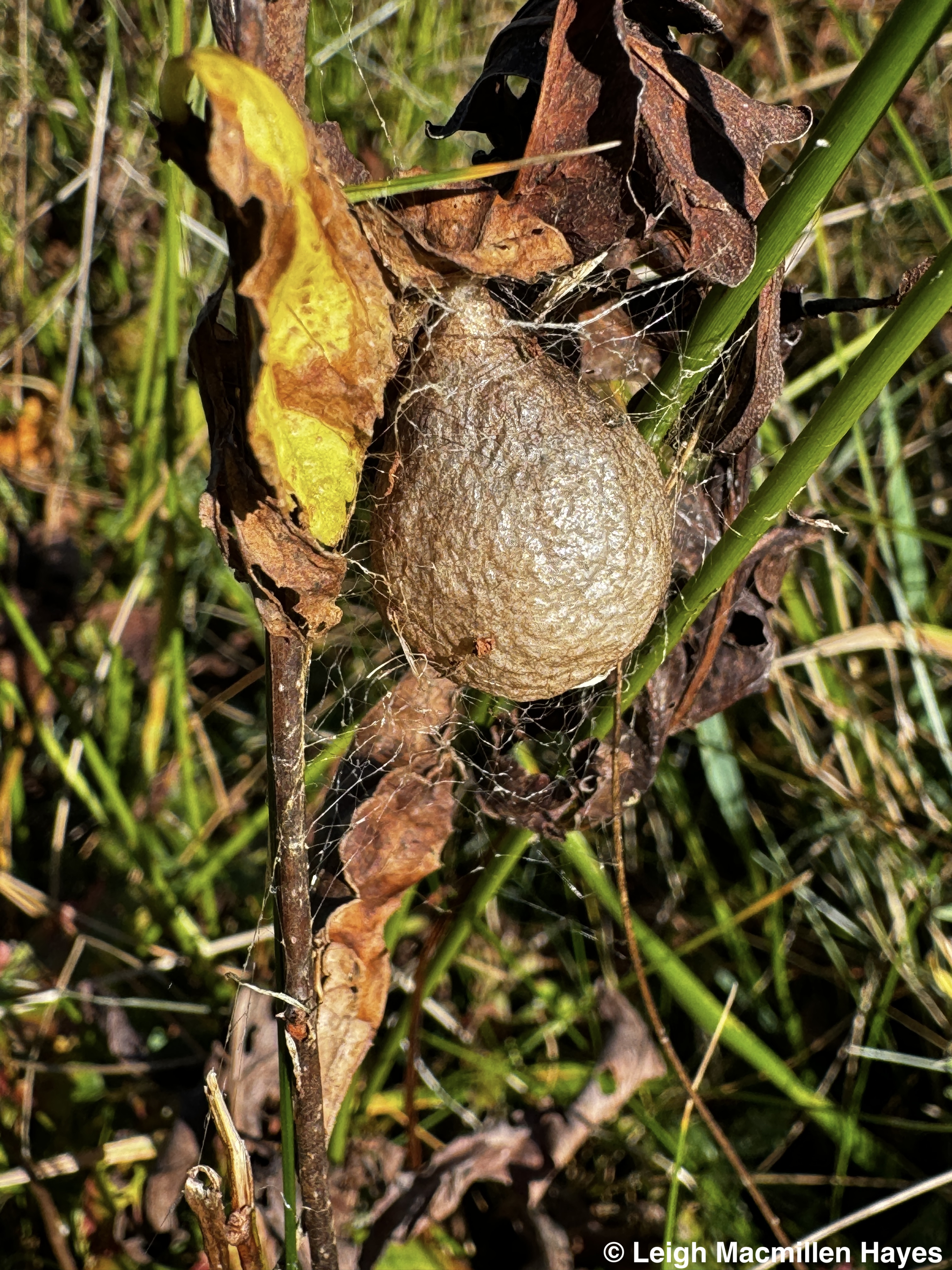
The good news is this sac, soft on the inside and parchment-like on the outside, was created by a Black and Yellow, and within her eggs will survive the winter months. Where there is one sac, I suspect there are dozens more.

Do you see them? The egg sacs I mean? No, I don’t either. Camouflage is the name of the game as the goldenrods and asters go to seed.

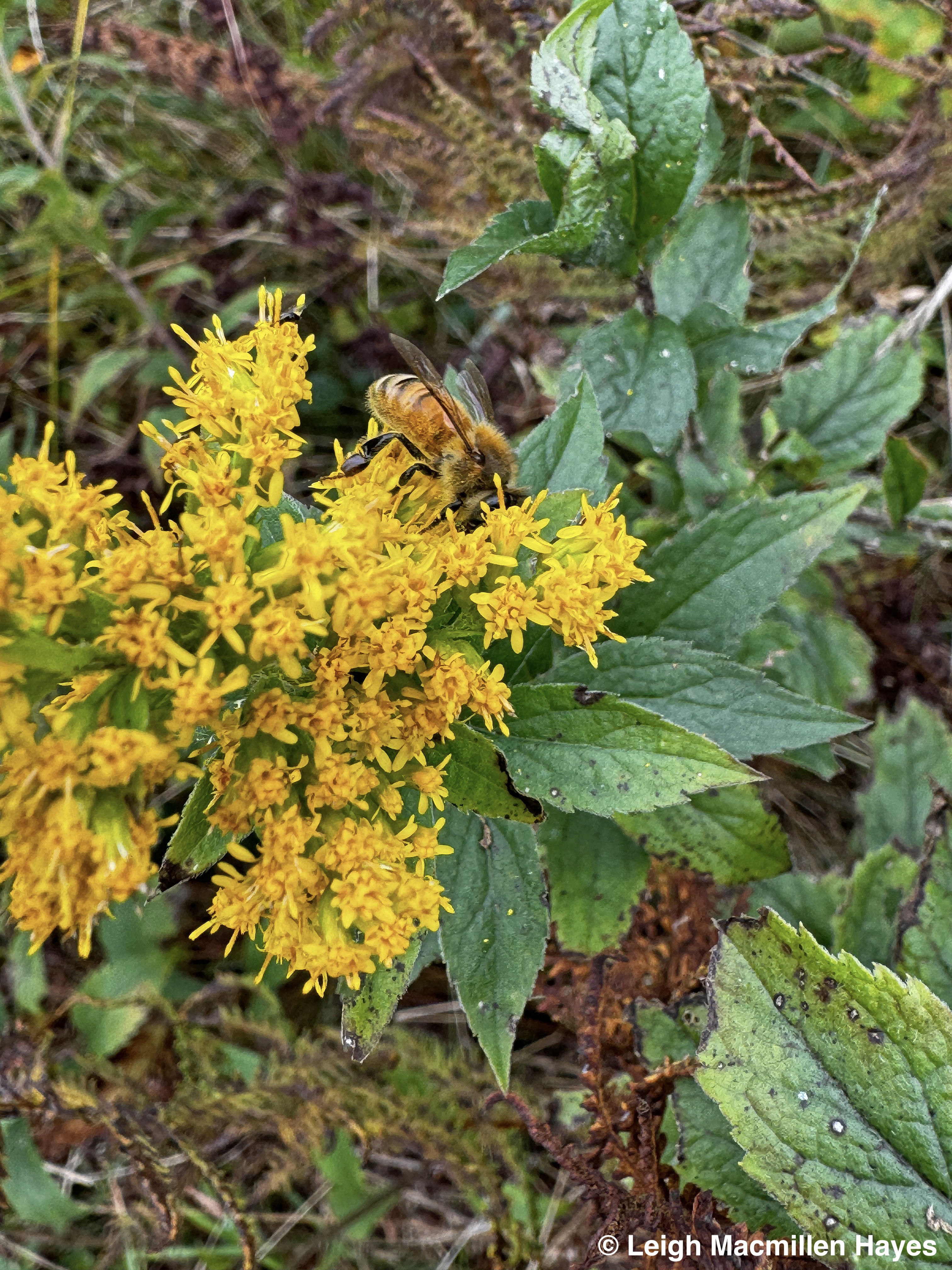
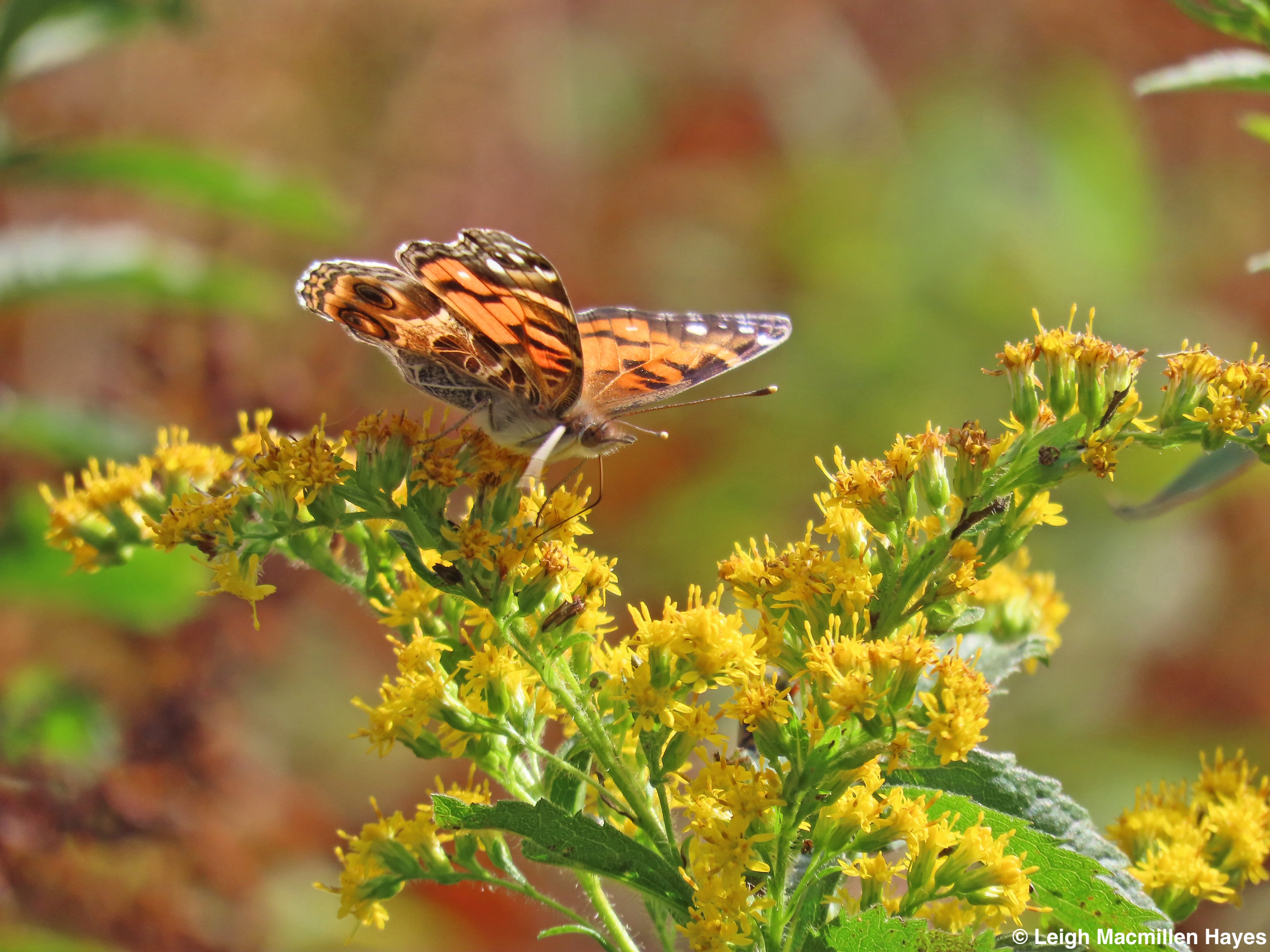
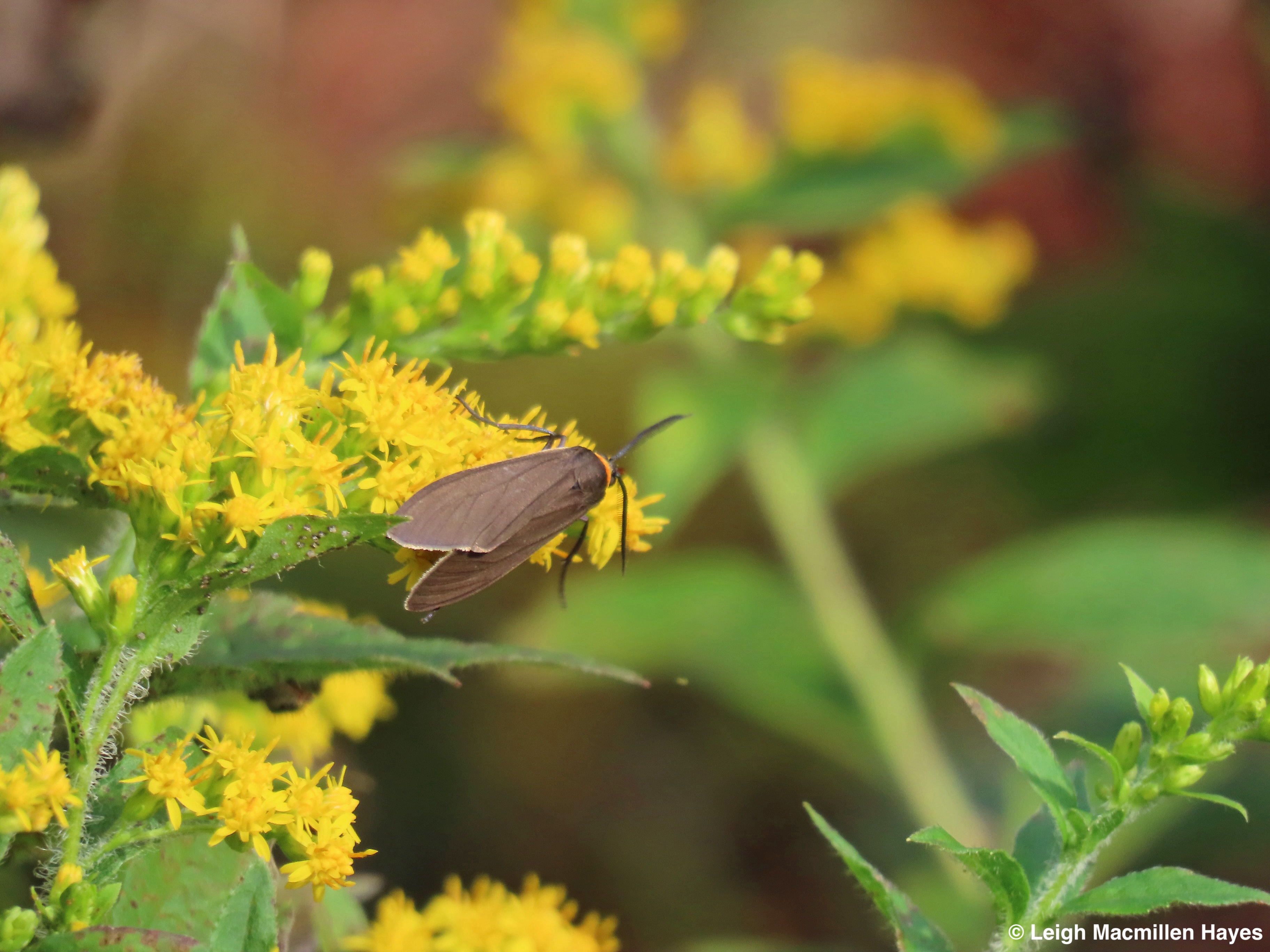
Despite or because most of the flowers have gone to seed, those that still thrive are the subject of heavy pollination activity. Frenzied in fact. From Honey Bees to . . .

an American Lady, to . . .

Female Pearl Crescents (gender ID based on orange color of antennal clubs versus dark colors for males) and their counterparts who all greet me each day, to . . .

Yellow-collared Scape Moths, to . . .

Locust Borers, to . . .

long-bodied Sweetfern Underwing Moths, to . . .

Paper Wasps, to . . .

Bumblebees, this one special because it showed me that its proboscis is orangey-reddish, to . . .

Flower Flies with big eyes.

The plants literally tremble with all the activity so it’s easy to figure out where the insects are located.

The best part of greeting so many is that occasionally a tiny new visitor enters the scene and I have to watch for a few minutes to get a good read on who it might be as it flits and flutters and finally lands.

It wasn’t the diminutive size that made my heart skip a few beats, but rather the color when the Eastern Tailed-Blue Butterfly opened its wings–a mixture of blue and pink that made me think of skyblue-pink we often see at sunset.

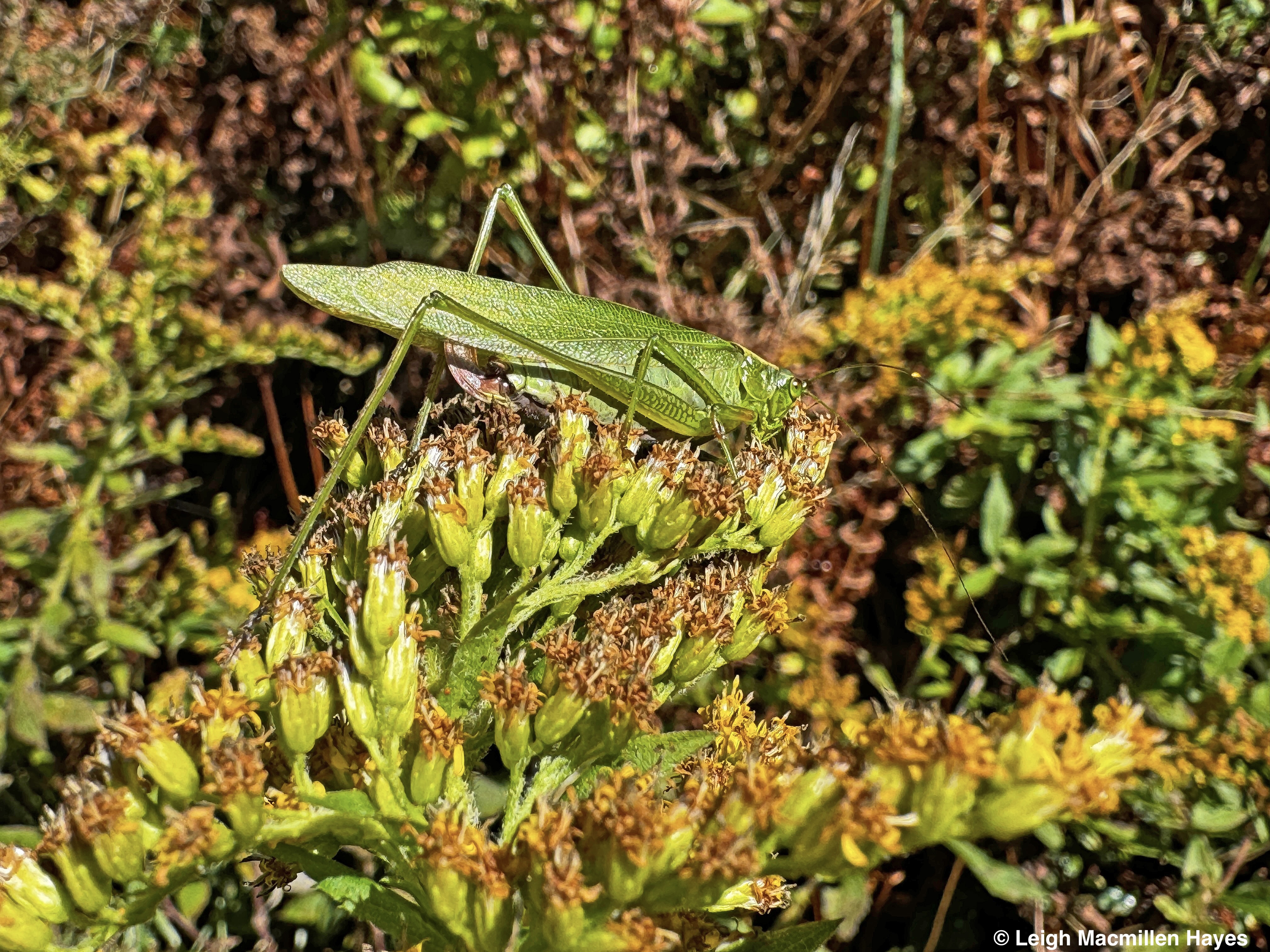
And then another sighting stopped me in my boots. It’s camo is incredible and it could simply be another goldenrod leaf.

But rather, it is a Katydid, only the second I’ve spotted this year. Katydids always make me happy because they remind me of my forever-since-birth friend and at about the same time that I spotted this insect she just happened to comment on a photo I’d taken during a hike this past week–of a mountain stream–because it reminded her of our “fishing” adventures as children, sticks being our poles and leaves our fish. Katydid. Of course she did.

But of all my finds, my heart was the stillest for this magnificent creature, also a gossamer-winged butterfly. I noted it first on August 3, 2024, and again on August 26. But to see one on October 4, 2024 . . .

Incredible. And RARE! I contacted Dr. Ron Butler once again as he’s one of the co-authors of Butterflies of Maine and the Canadian Maritime Provinces.

Different Bat Time, but same Bat Place for this sighting.

Ron’s reply, “Lucky you. I’ve only seen them in more southern states. I’ll add this to the database.”

Lucky me indeed. According to the book, White M Hairstreaks have only been spotted in our region four times (prior to the three I’ve now noted) and they were seen from late July to late August. So, um, that can now be updated to early October.

BUT . . . what does that mean? Ron has only seen them in more southern states. Blueberries are flowering in October. My nephew shared a photo with me this past week of a Lilac blooming in New Hampshire.

Climate change.

All that said, saying goodbye to all that the field has offered this summer and early fall is not easy. I’m going to miss the spiders and butterflies I had the honor of greeting each day. Oh, I know there’s so much more to come as the days grow shorter and temperatures drop and my favorite season arrives. I live where I do because of the change of seasons.

Still, it’s a long farewell as we transition from one season to the next and for that I’m grateful.

When Is A Moss Not a Moss?

Sometimes I need to slow my brain down to figure things out. And other times . . . I need to slow my brain down to figure things out.

That’s exactly what I’ve been trying to do lately. Figure things out. Green things. Evergreen things. That means they add color to the forest floor year round.

Pour a glass of water or a cup of tea and join me as I take a closer look.

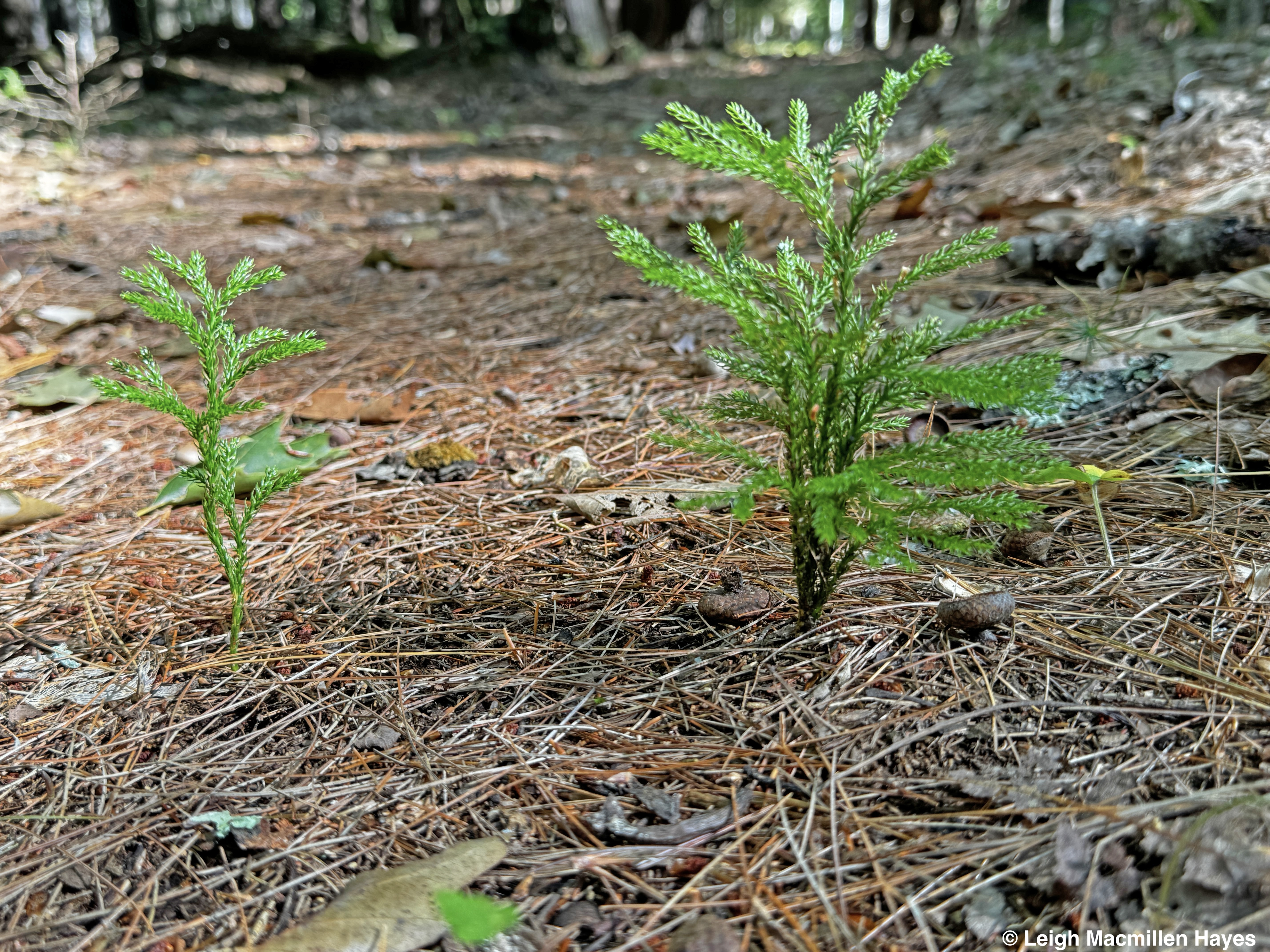
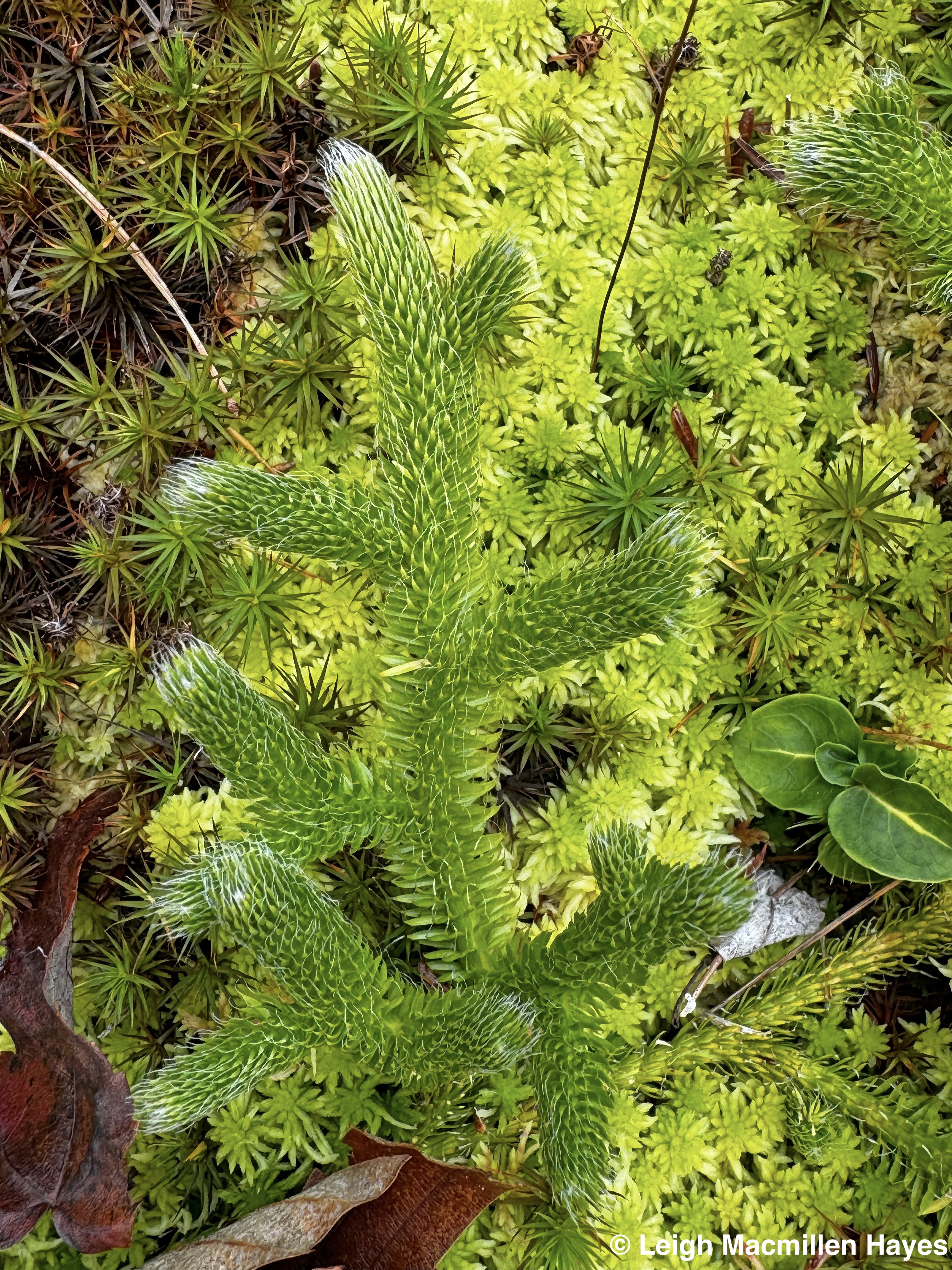
At first glance, these green growths appear to be miniature trees. But what I wanted to know was this: is the smaller “tree” on the left directly related to the larger “tree” on the right?

There was only one way to find out and though you aren’t looking at the same two in this photo, the question was recently answered when I began to dig into the ground and a friend lifted up the root system. If you look closely at this photo, the two species we were studying looked less similar than the two in the previous picture.

But indeed they were connected . . . with underground horizontal stems called rhizomes.

Meet Dendrolycopodium obsucurum, aka Flat-Branched Clubmoss or Princess Pine. Some of you know this well as your parents used to create Christmas decorations with it. I caution you–don’t be like your parents. Well, in this case anyway.

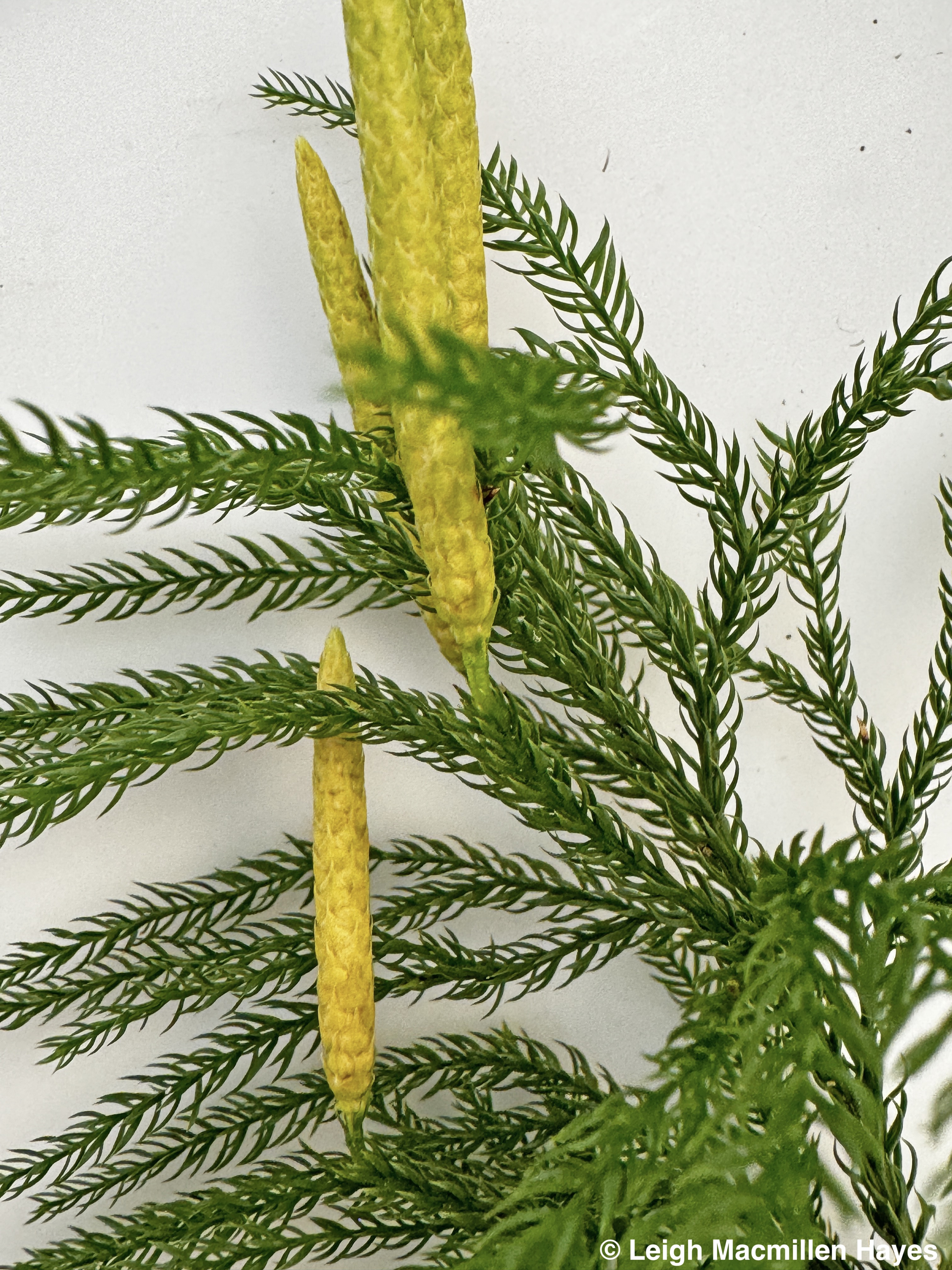
Clubmosses are vascular plants like our trees and flowers (but not mosses), thus they conduct water and food through their xylem and phloem. Their reproductive strategy is primitive. See that yellow “candle” or club? That is the strobilus (strobili, plural form) with structures called sporangia (sporangium). Some clubmosses have this structure and others have sporangia formed on the plant’s leaves. More on sporangia later, which means you’ll have to continue reading.

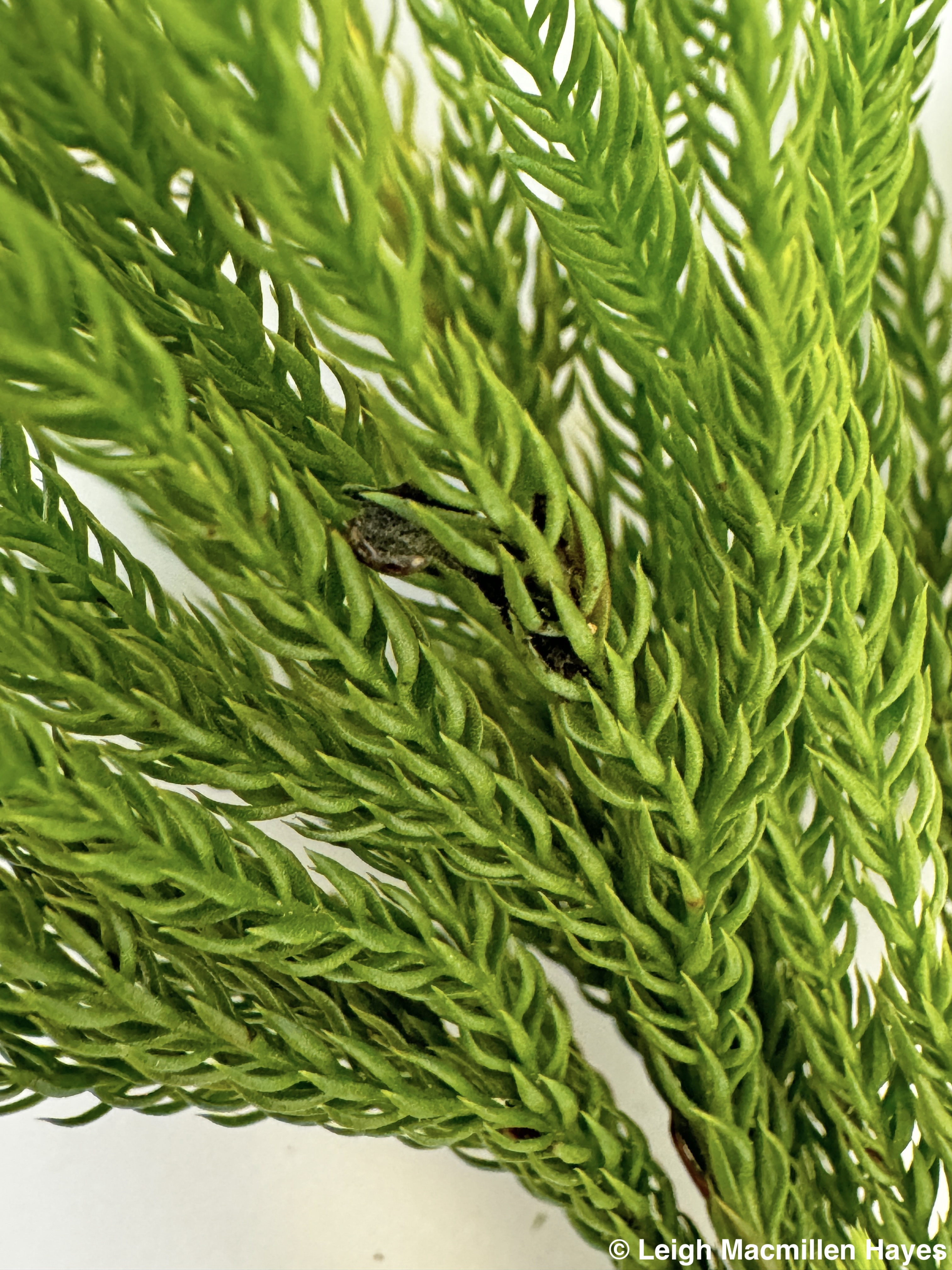
As I get to know these green things better, I’m trying to figure out their idiosyncrasies. And just when I think I know, I get zapped. But . . . the species above is closely related or a variant of the first species I shared. And sometimes they look super similar. The Flat-topped has smaller leaves on the lower part of its branches, but without a loupe, I can’t always spot that. And even with a loupe, my mind gets boggled. Am I seeing what I think I’m seeing. One thing that has helped me is that species, Dendrolycopodium hickeyi, or Hickey’s Tree Clubmoss, prefers drier soil. But really, they could be twins. And truth be known, they do hybridize.

Right now, I’m thinking that Hickey’s leaves, as shown above, are consistently the same length and thicker in presentation as the branches are more rounded than those of the Flat-branched.

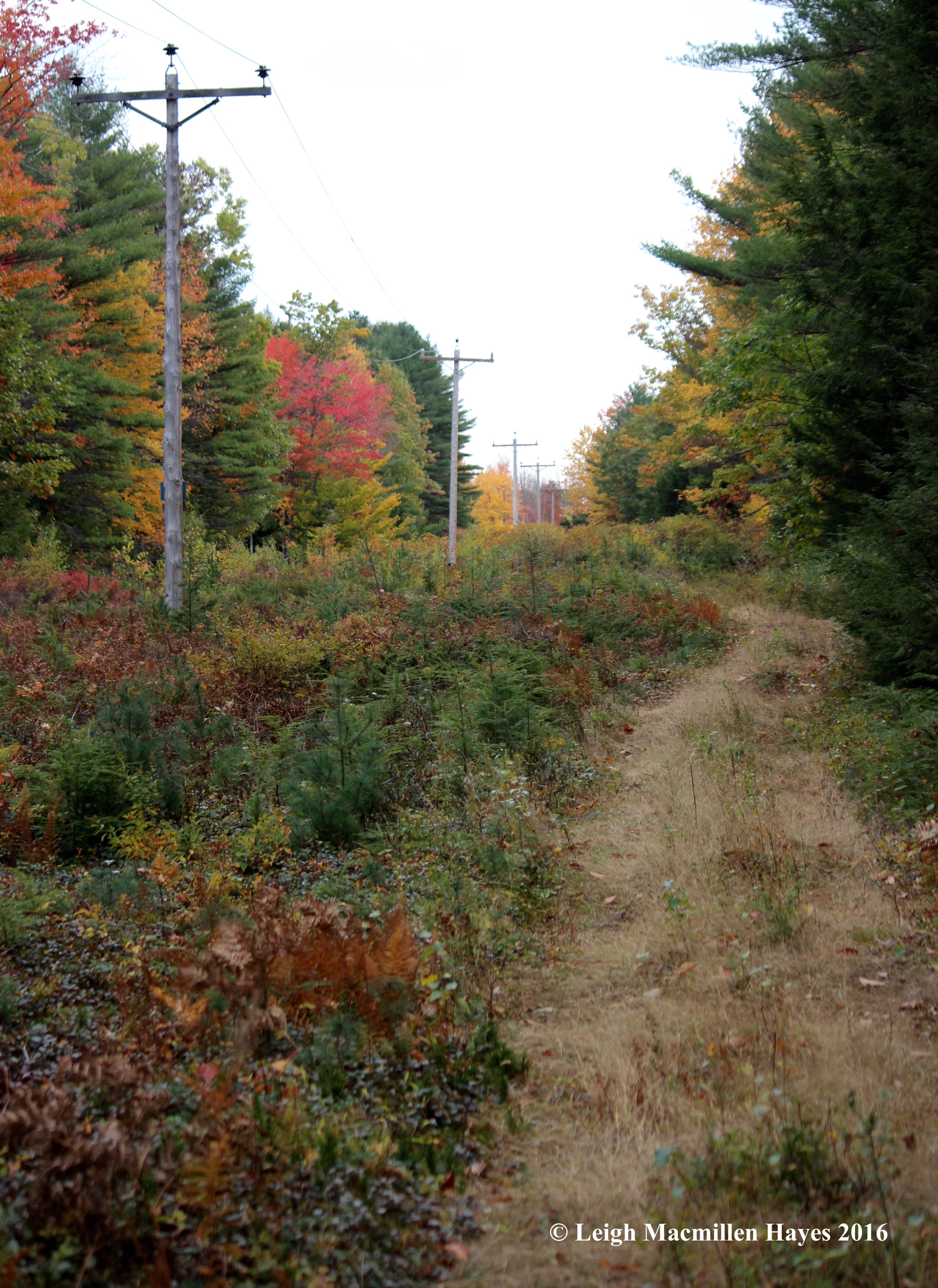
On our land, it grows abundantly along Central Maine Power’s Right-Of-Way and like Flat-branched has underground rhizomes. In fact, this afternoon I had a vision of a bedspread from my youth that I turned into roads and drove little rubber cars and trucks along when I played “Town.” I could easily have driven my little cars from one “tree” to the next and followed the rhizomes as if they were invisible roads.

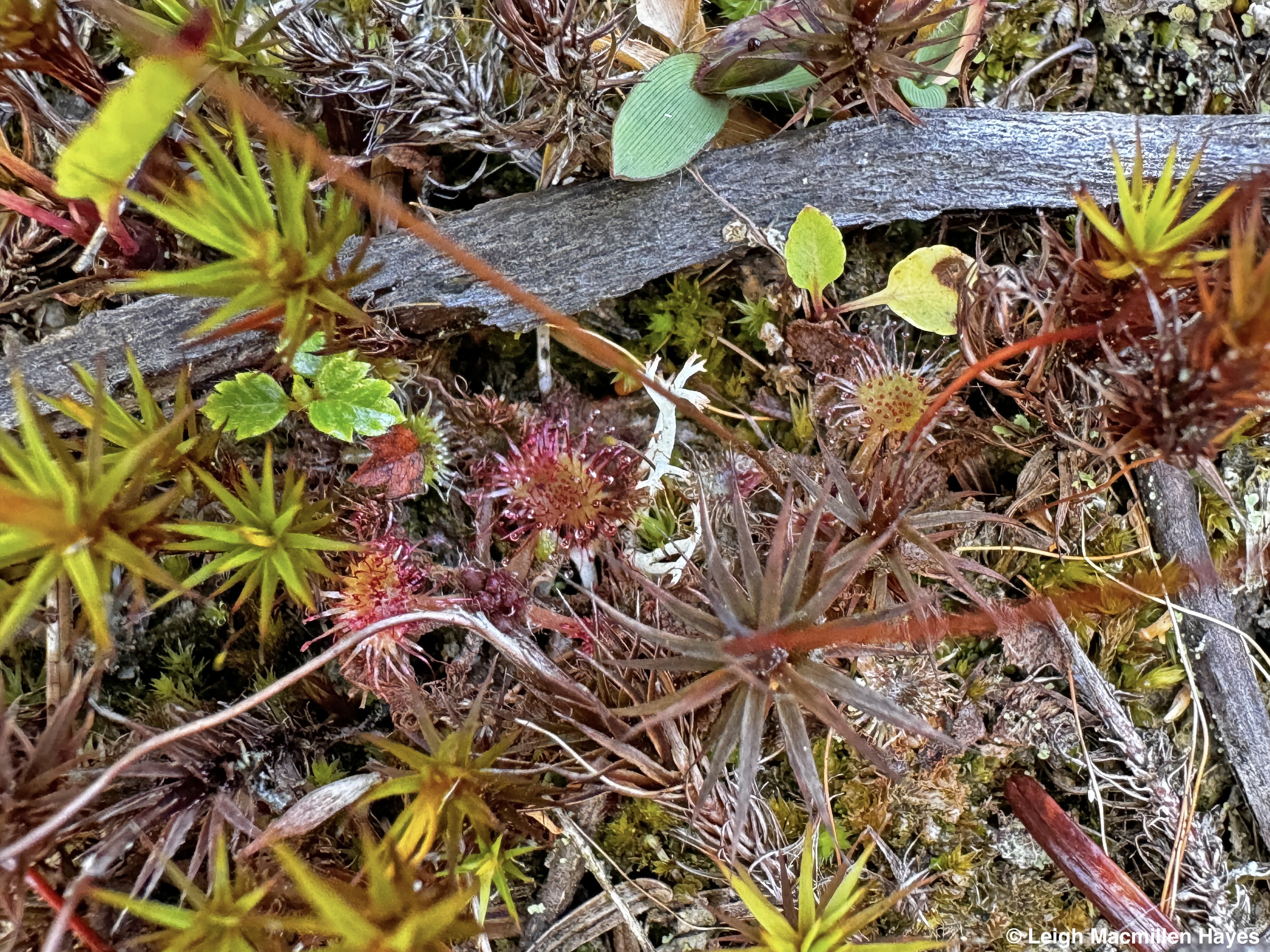
Cool sights reveal themselves when I do slow down like this and I thought that CMP had killed the Sundews that grow under the powerlines when they sprayed herbicides along the route several years ago. I’d given up on being the guardian of such special plants, and was delighted to discover their dried up flowering structures today and locate the wee carnivorous leaves below. Yahoo! High five for Sundews!

Where Flat-branched and Hickey’s have underground rhizomes, this particular member of the club features horizontal stems that are above ground runners.

And while the previous two were tree-like in structure, this one reminded me of a cactus.

Furthermore, I got all excited because I thought I’d discovered a species considered threatened in Maine. I talked myself into it being Huperzia selago or Fir-Moss. It looked so much like the black and white sketch in my field guide.

Until I realized the Fir-Moss has a sporangia-bearing region in the upper stem. And my species has strobili located at the tips of long slender stalks. And there is no mention of those transparent hairs in the description of the Fir-Moss (after all, it’s not Fur-Moss), but Running Ground-Pine or Staghorn Clubmoss does have this feature. Thus, this is Lycopodium clavatum.

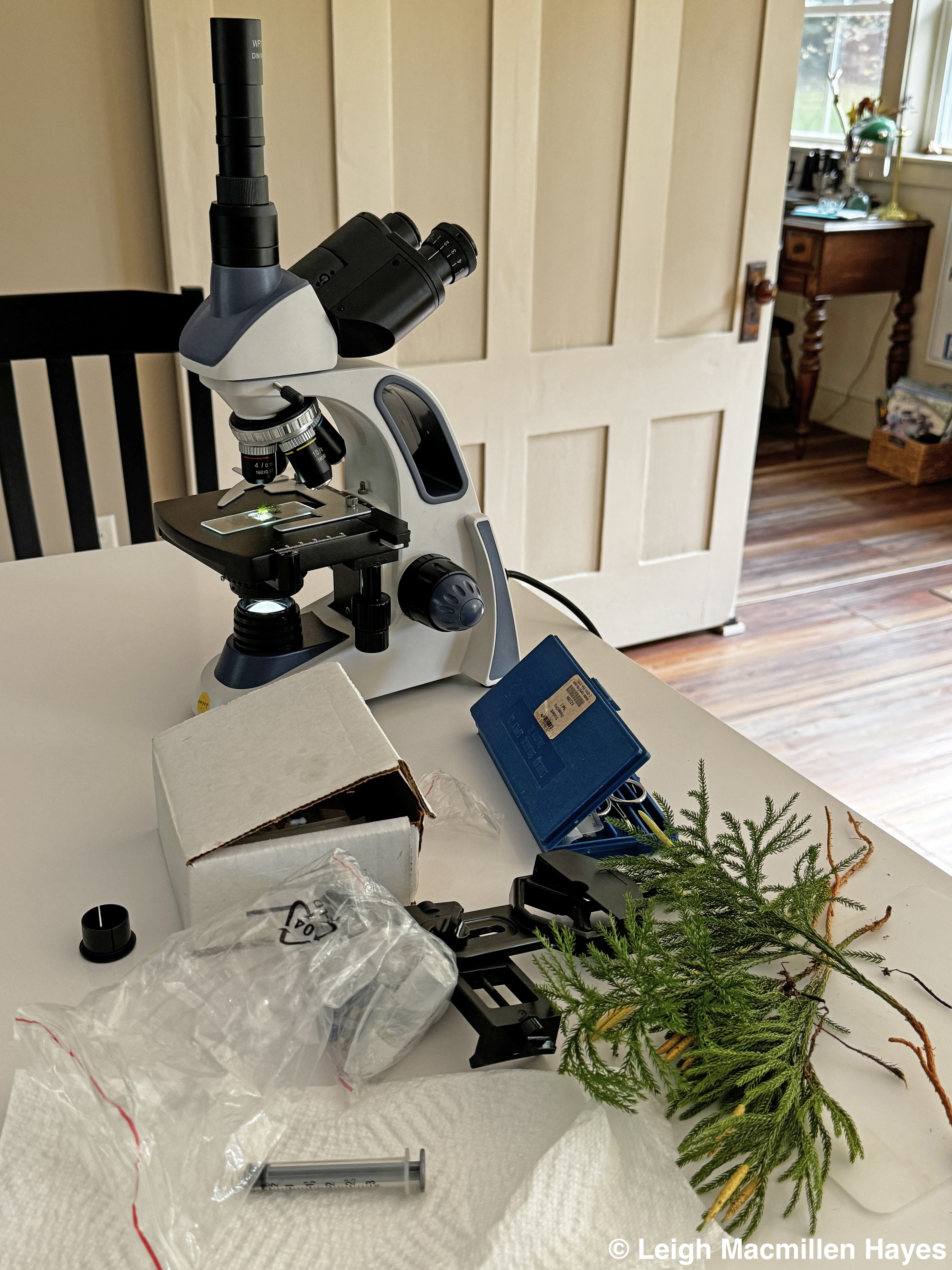
Back at home, it was time to set up the mini-lab and take a closer look. I try not to collect too much; in Ferns & Allies of the North Woods, Joe Walewski suggests we “consider the 1-in-10 rule: collect no more than one for every ten you see.”

The microscope has opened a fascinating world to me–as if it weren’t already fascinating enough. And see the pattern of cell structures–an art form all its own.

And then there was the strobili that covered the sporangia. That word sounds like dessert and this look at the structure made me think it could be some decadent butterscotch offering.

I cut a cross-section and was surprised to see the hollow center.

All those minute spores. Actually, I accidentally nudged a few as I walked in the woods this weekend, and had the honor of watching the “dust cloud” of spores being released.

One family member that doesn’t live in our woods, but is located close by is this, Diphosiastrum digitatum or Fan Creeping-Cedar, so named for its resemblance to cedars.

This specimen had followed me home a few weeks ago, and when I pulled it out of my now warped field guide, for so damp were the pieces that I stuck in there, it had dried into a flattened form of its former self.

I stuck a piece under the microscope and again was floored by the thickness and cell structure.

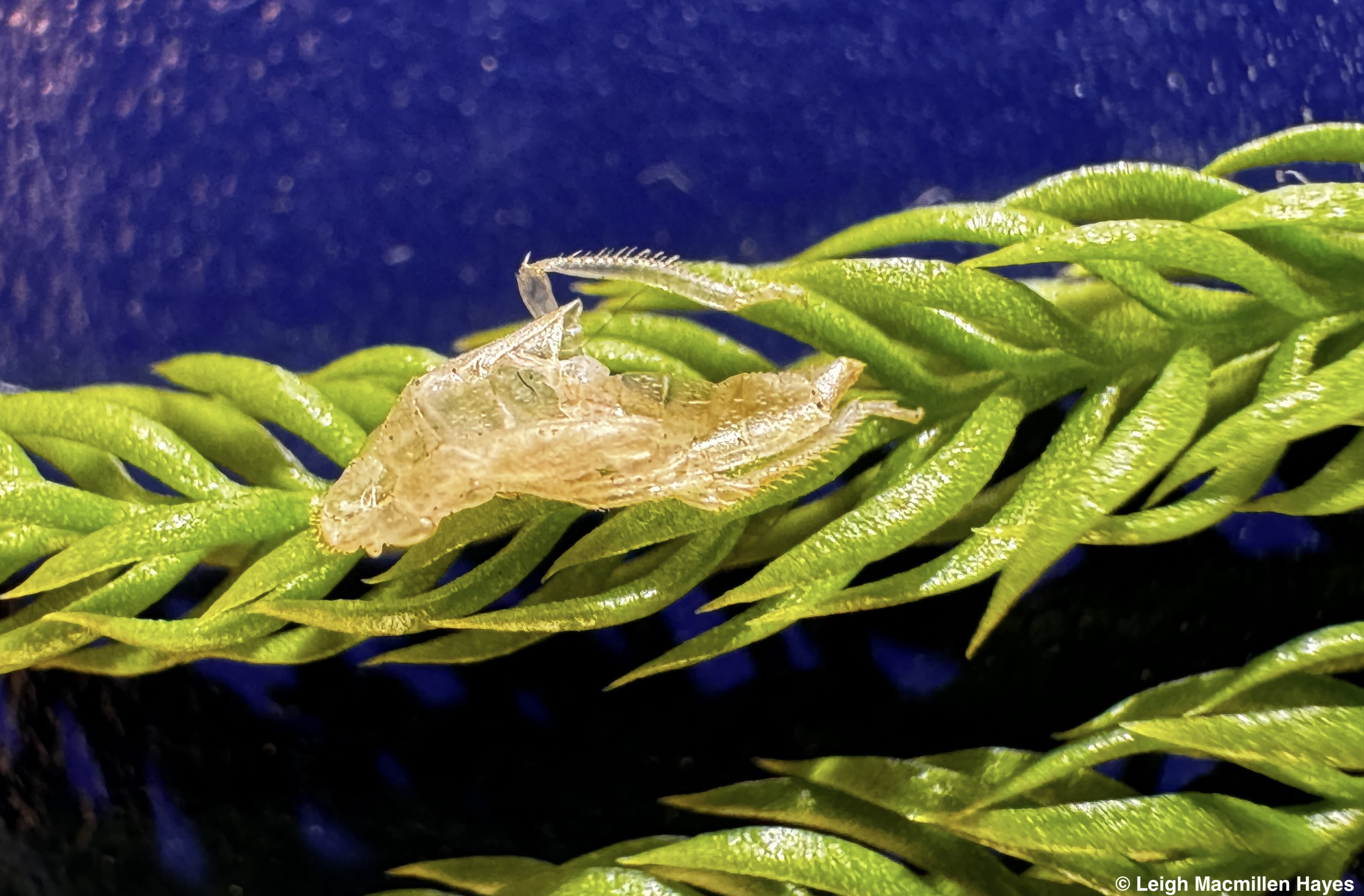
And then I had a surprise. A hitchhiker! Do you see the long legs?

Here’s another look. I don’t know who this was, but I do know that it was minute in size and it appeared to be a shed skin after the insect had molted.

Suddenly I was eager to find more. And so I checked out a piece of the Flat-branched . . . and wasn’t disappointed.

Here it is again. The second critter that is. Or was. And now I can’t wait until next spring and summer to find out what tiny creatures use these structures as places to molt. And maybe feed. The mouth structure, if that’s what it is on this one, appears to be almost fan-like and kind of reminds me of that on a slug.

The home lab grew into an art room as the hours passed.

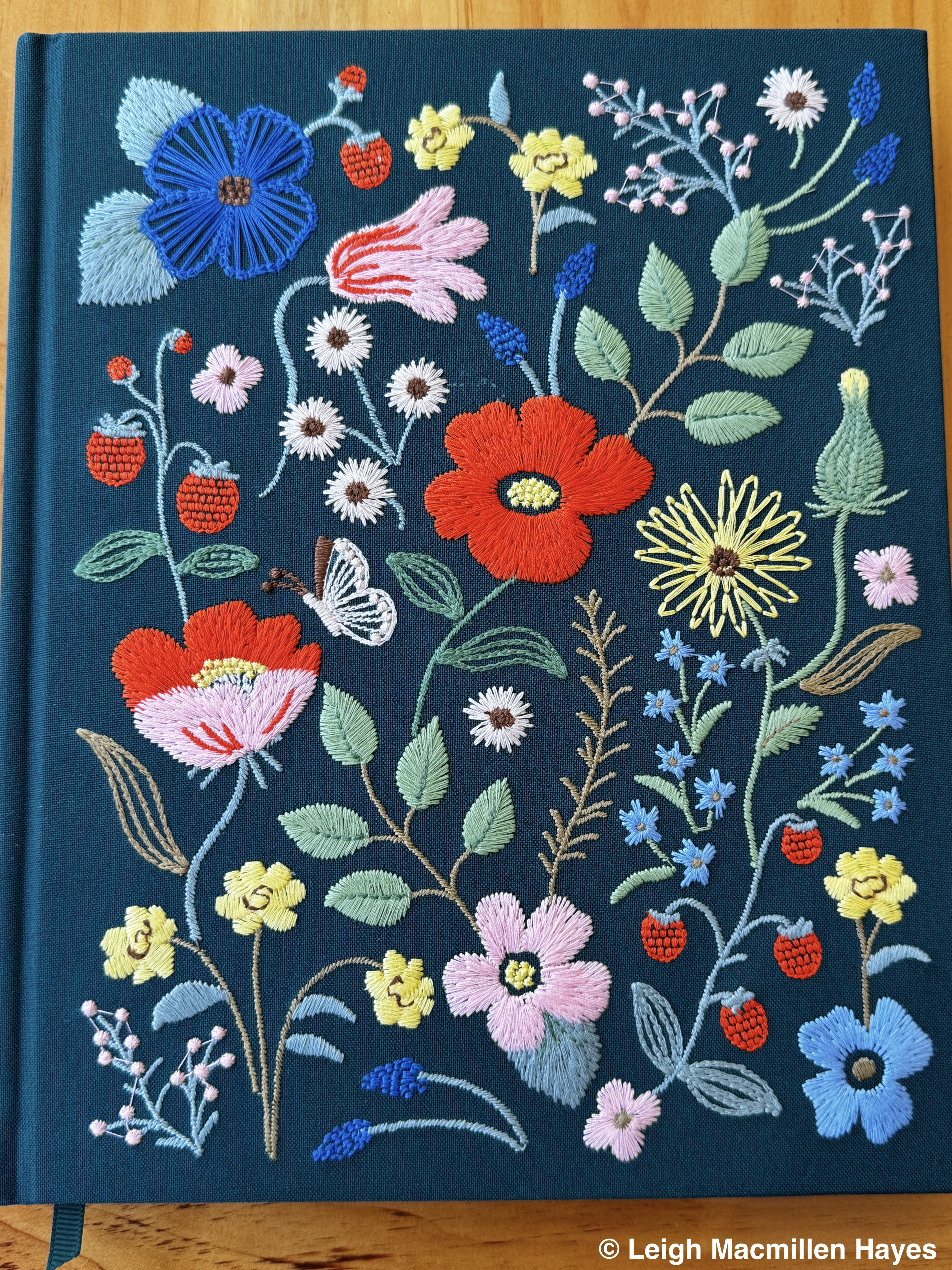
Recently my sister gifted me a sketch book and it begged to be opened. After running my fingers over the cover first, of course.

I have the perfect bookmark to mark the pages, created for me this past year by one of our first playmates.

Getting to know a species better through close observation and by sketching is one of my favorite pastimes. And I’m so glad I slowed my brain down, especially when it came to hickeyi on the left and obscurum on the right. The differences seem so obvious with these two examples, but step out the door and I suspect you may be thrown off course as well.

When is a moss not a moss? When it’s a Clubmoss, which is actually an ally or relative of ferns. And horsetails. All are non-flowering vascular plants.

Before you depart, dear reader, please remember that these are ancient plants that take a long time to germinate as most need a symbiotic fungi to provide nutrition to the gametophyte stage (think gamete, eggs, and sperm). They may lie dormant underground for up to seven years and then take up to fifteen years to develop reproductive structures. In the great coal swamps of the Carboniferous period, they reached heights of possibly 100 feet, something I have a difficult time comprehending when I look at their small forms in our woods. Their growth is slow and they deserve our respect.

And now I can’t wait to meet some others and get to know them as well. I spotted One-Cone Ground-Pine or Lycopodium lagopus on a hike the other day and kick myself for not taking its photograph. All in their own time. I’ve made a start and hope you will do the same.

Tail-end Greetings

Despite a frigid temp and wind chill in the negative numbers, today was a day to head out the door and check on an old friend or two. I wasn’t sure I’d find either, but since so many work from home these days it was worth taking a chance.

Two years ago there was evidence that the first had spent some time sleeping in the den, but on that day, though I knocked and knocked, no one answered the door.

This morning, however, I spotted the family name hanging on a shingle right by the front door and suspected a greeting in my future.

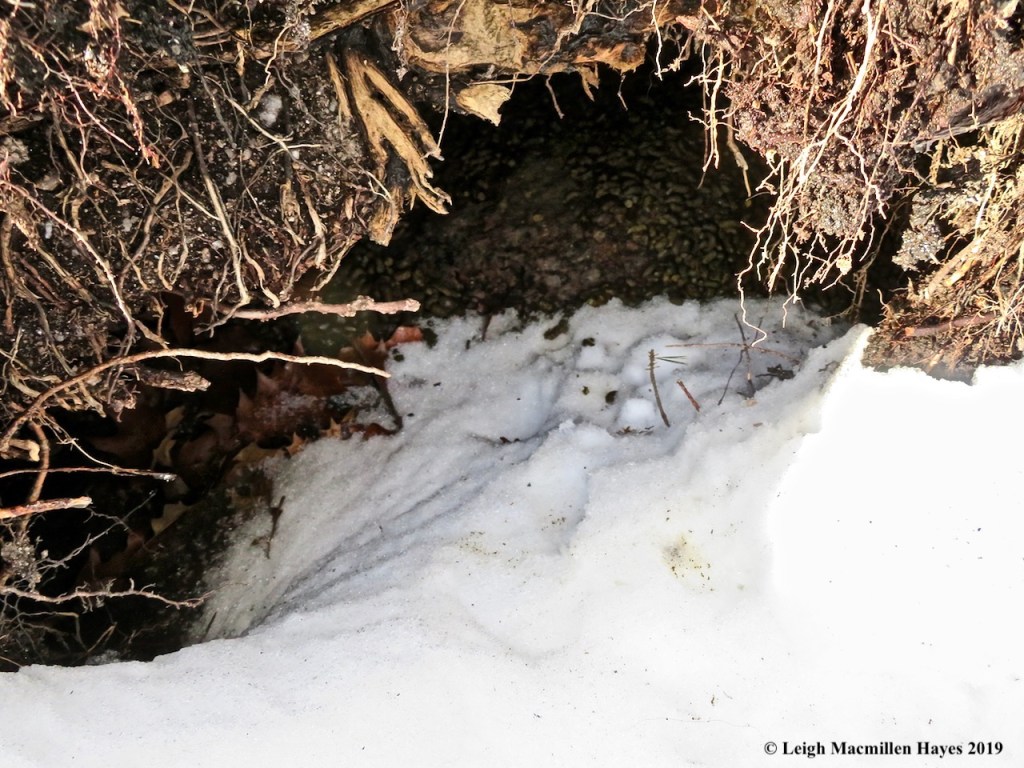
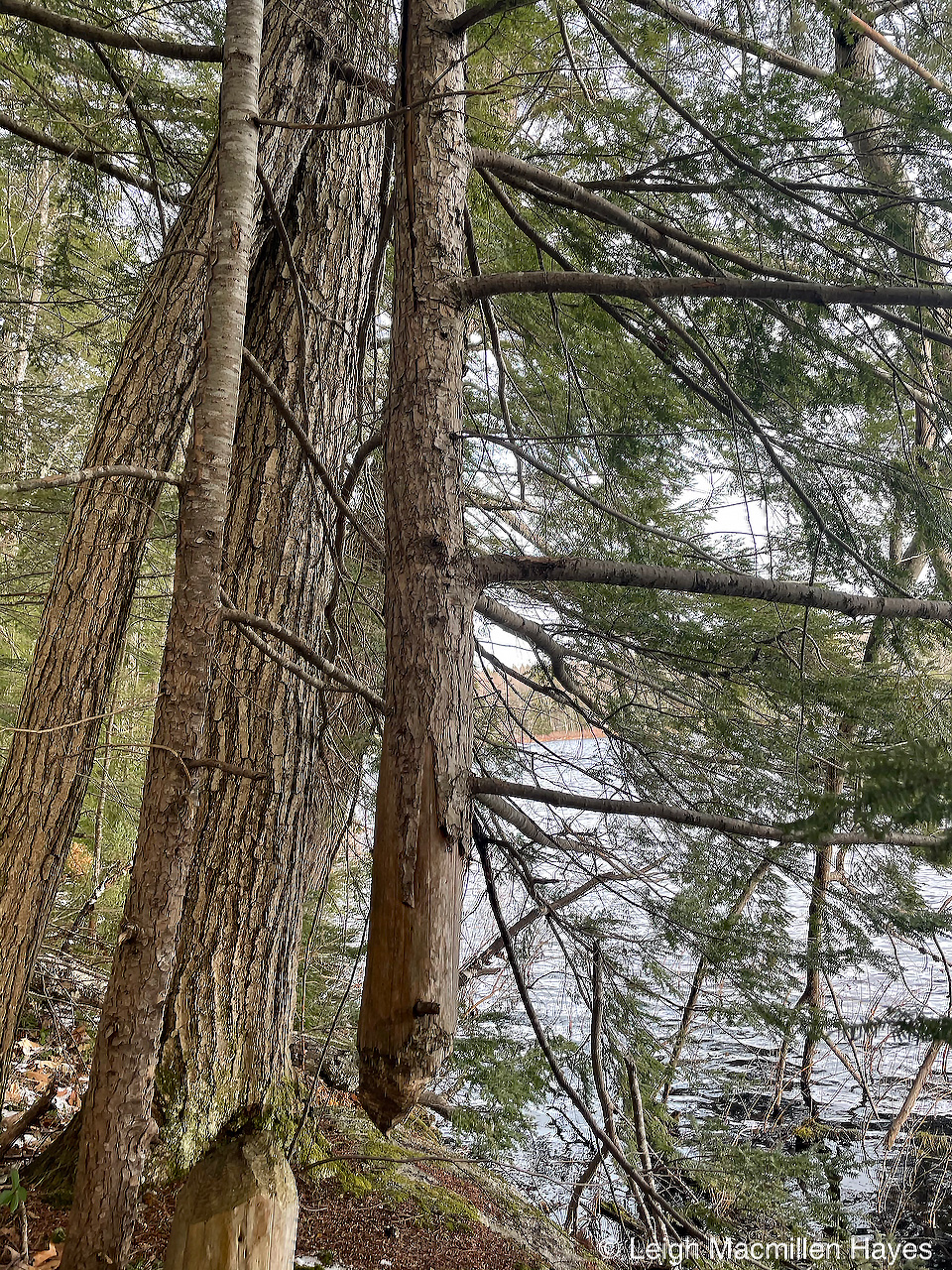
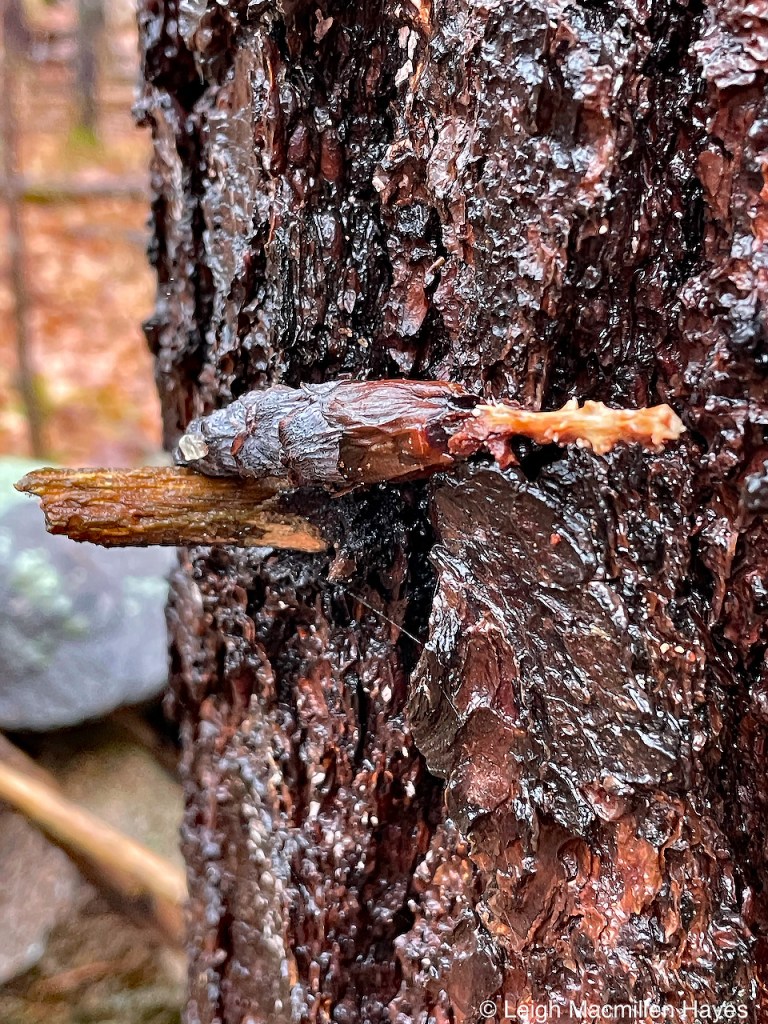
Beads of sap accessorized a brand new tapestry of grooves that spelled out Erethizon dorsatum, aka North American Porcupine. And my heart began to sing. Maybe. Just maybe.

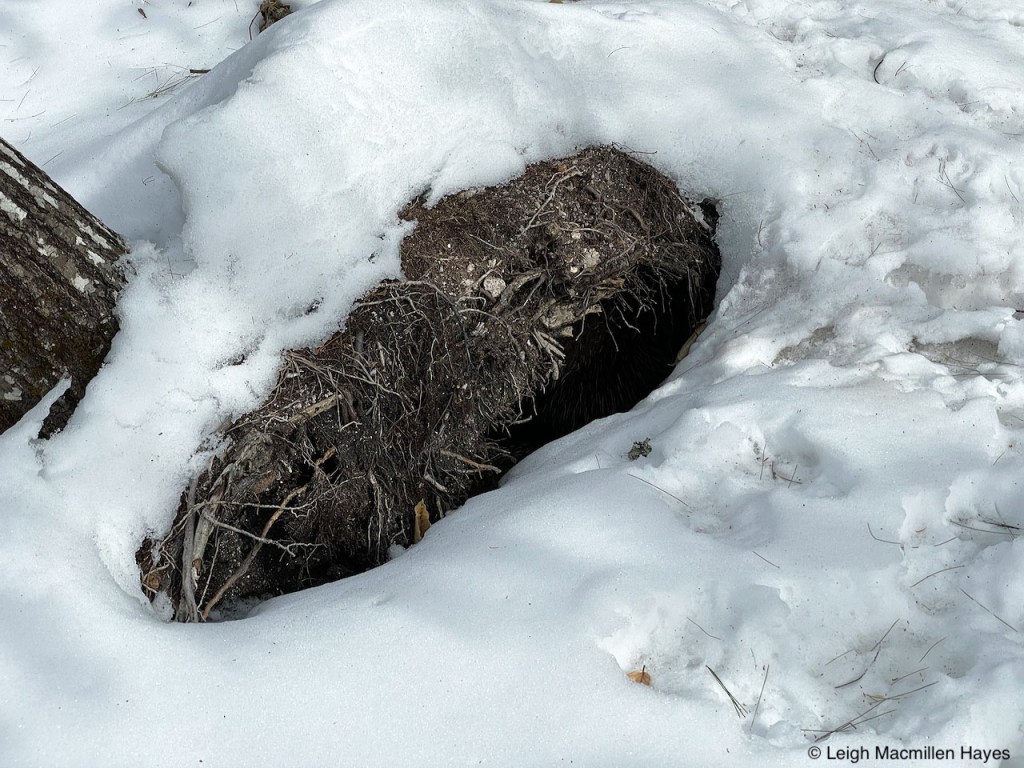
To the front door I again ventured. And noted that familiar pattern of tracks on the welcome mat. Maybe. Just maybe.

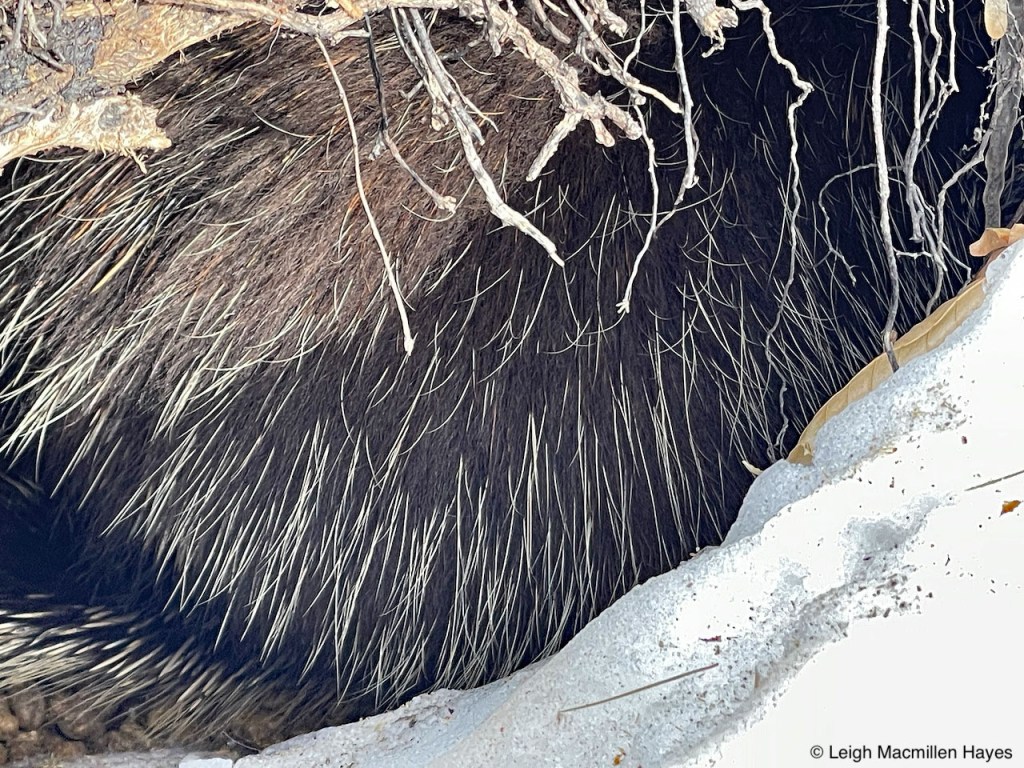
My heart stilled. After years of stalking a variety of porcupines, this was a first for me–to actually spy one within its winter den. And in so doing, I garnered a keen look at its quill-covered backside and tail. A porcupine’s body is covered with at least 30,000 quills on its back, shoulders and the upper surface of its tail, but it’s not only those large stiff hairs that complete the animal’s coat. Their fur also includes fine hair as you can see in the mix here.

We visited for a bit, but I soon realized our conversation was one-sided–me asking questions and answering for my friend who slept quietly in hopes of gathering energy for a night-time feeding frenzy.

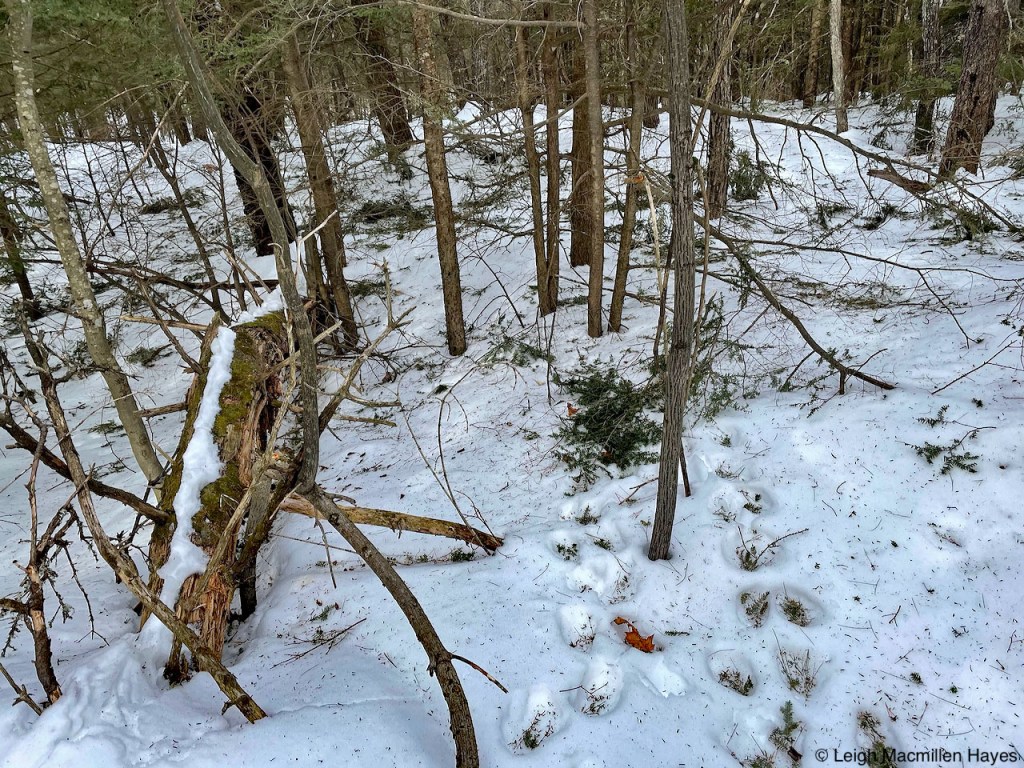
Eventually, I moved along the trail, that is until I noted where my friend, or one of its kin, had crossed and descended down the steep ledge, a path I chose not to take.

Turning in the opposite direction, I decided instead to follow a track which turned into an intersection of roadways–all created by my friend.

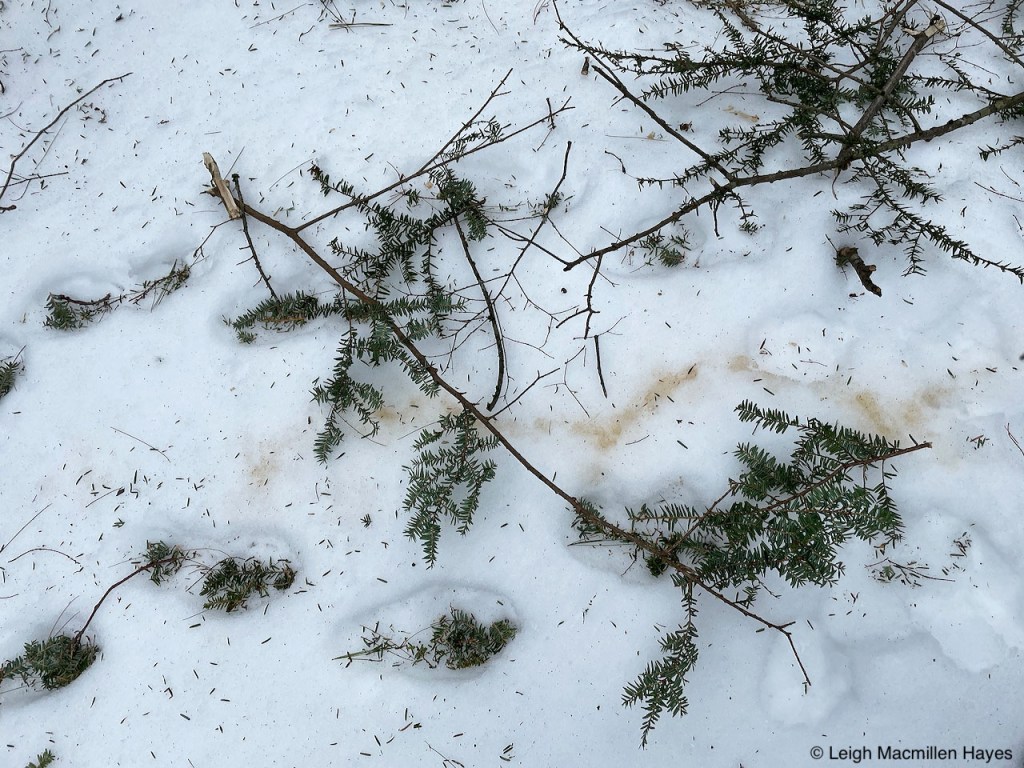
Step into the living room as I did today. By the dropped hemlock twigs, I recognized the carpet design on the floor.

Angle-nipped twigs were part of the room’s wall decorations.

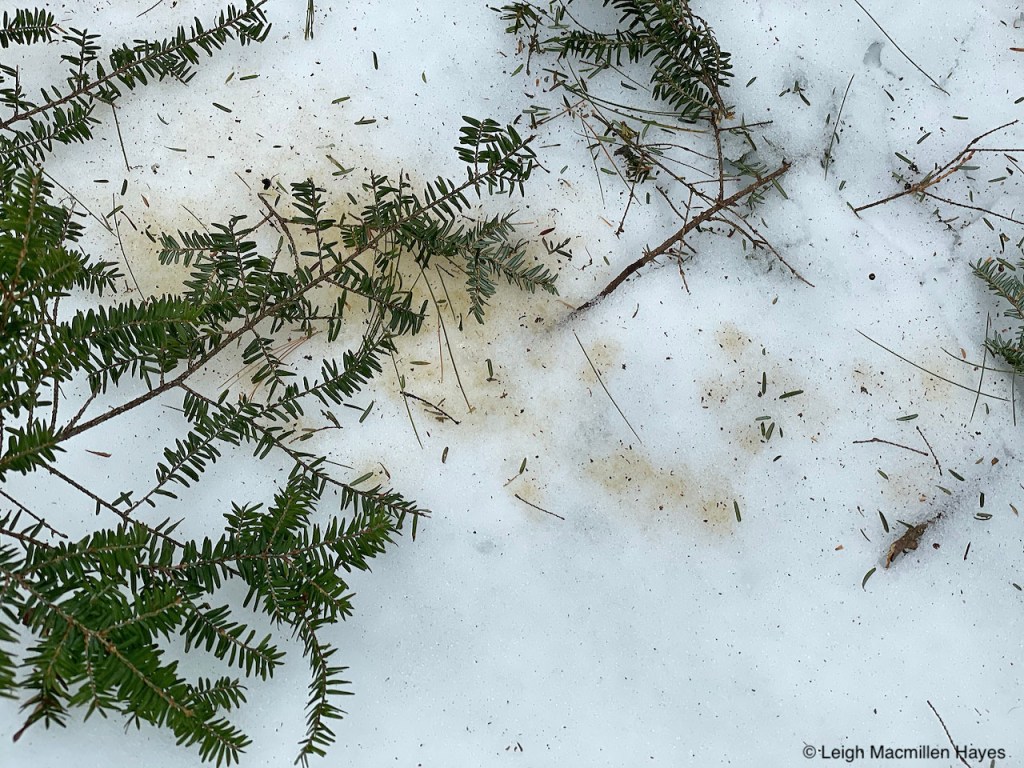
Dribbles of pee, and there were lots of them, added to the aura, some of it a few days old.

Other samples were more recently shared.

And scattered among it all, like dust-bunnies in any room . . . SCAT!

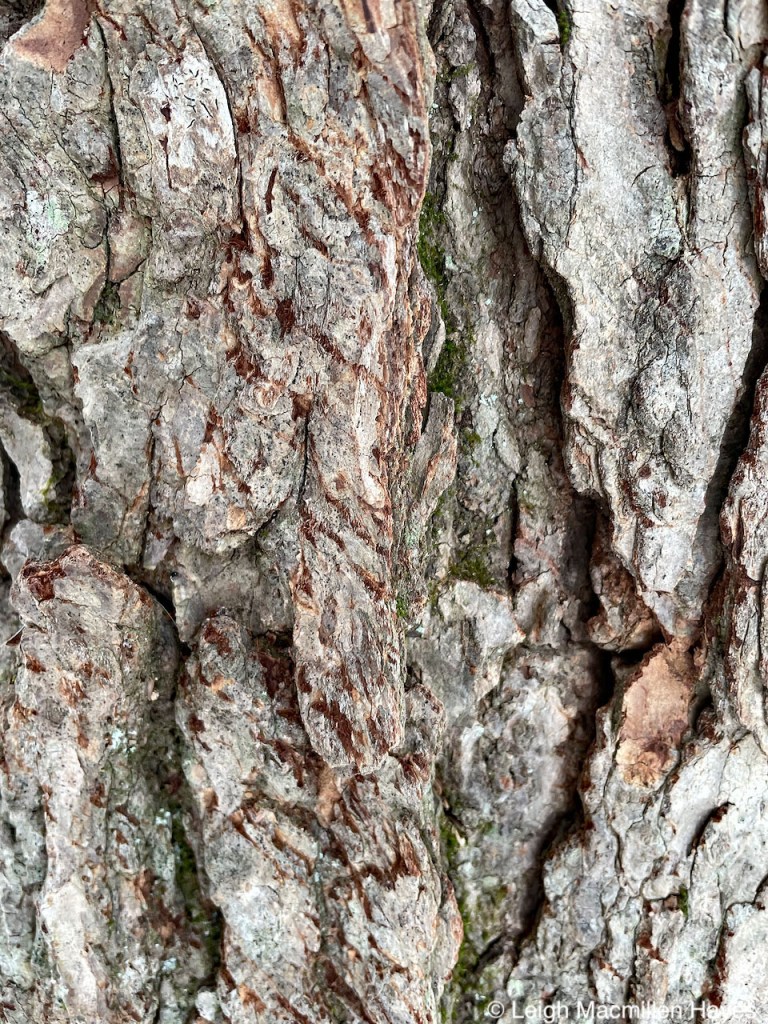
Upon a hemlock frequently visited for that’s what porcupines do, frequent the same tree year in and year out that is, I spied claw marks indicating the staircase upon the uneven bark substrate.

And so it was that because I was in the vicinity, I decided to check on my other friend who lives about a tenth of a mile away. The last time I visited in November 2020, it was obvious that my pal had been by, though I couldn’t say exactly the last time this bedroom had been used.

Spotting a track in the right locale, I decided to see where it might lead.

Bingo. Tracks and even a few scats led to a small opening below the boulder.

Like with my other friend, on hands and knees I went and was well rewarded.

Notice how porky friend one and two both had their tails facing out–a defensive move incase a predator shows up and needs a little needling to remind it of who is boss. But . . . being a friend, I felt honored to be able to spend a few minutes with each–neither of us disturbed by the other.

Having spent that time with those two friends, I did feel a bit of porcupine greed and went in search of several other friends located in different areas. I really wanted an eye-to-eye meeting like this one in January, but still . . . today I was blessed with a tail-end greeting of my porky friends and who can complain about such?

Look The Otter Way

Though we’re currently not gathering in groups such as Greater Lovell Land Trust’s Tuesday Trackers, which typically convenes when the first flakes fall, the mammals are still on the move, crisscrossing our lands as they hunt for food. With the latest snowstorm, a hike up the Flat Hill trail at Heald and Bradley Ponds Reserve revealed tracks of a red fox or two, red and gray squirrels, mice, a fisher, and the resident porcupines.

But . . .at a different locale, that being John A. Segur Wildlife Refuge East on Farrington Pond Road in Lovell, there were other signs and tracks left behind following an earlier Nor’easter.

For starters, a beaver chew, which turned out to be only half a success on the sawyer’s part.

For rather than the top of the tree topple as planned, it got hung up in its neighbor’s branches. Such is the case in maybe one out of every eight or nine attempts, especially along a shorefront as wooded as this.

Then there were the prints made by a mouse, presumably scampering along a downed tree that had collapsed on its own accord and landed in the water. On more than one occasion a track like this led to the end of a log in water and one has to wonder: why did the mouse scurry that way?

A larger mammal also left behind its telltale footprint—the chevron in the heel pad almost identical to that which David Brown sketched in his Trackards. Other clues to the identity of the creator included the size and the X between toe pads and heel. Perhaps the mouse scampered because the fox was trotting?

And then. And then there were the prints that might fool anyone who is just putting on his or her track eyes for the first time in this snowy season. And that would include me. The pattern of the overall track didn’t seem correct, but the icy clump left behind almost matched. Could it be a black bear? My heart be still.

Or . . . perhaps a moose. Flummoxed I was. One other possibility entered the brain because each print seemed rather rounded, but there was no other sign to make one feel certain about the creator’s species. What was obvious, however, was that it had gathered ice much like I was upon the underside of my micro-spikes and constantly I had to stomp the ground to loosen the frozen ball or risk walking on high heels. The latter I know not how to do.

Later I learned from Land Steward Rhyan Paquereau that a local resident rides her horse at JAS East. If only the horse had left behind a calling sign in the name of manure!

Other mammals, however, did leave plenty of signs announcing their frequent visits to this land trust property, including using this large boulder near the water as a frequently visited latrine.

There were piles of older scat filled with bones and scales that had grayed with age and practically disintegrated. An otter’s diet consists of birds, bird eggs, turtles, aquatic plants, and small mammals, but their favorite meals are crayfish and fish, thus the bones and scales.

There were fresher examples, also filled with scales indicating the meal of choice. Oh dear, I hope you aren’t dining on breakfast or lunch as you read this ;-) Otter scat can be tubular in shape, or look as if it was squirted. Sometimes it takes on a reddish hue, a la crayfish.

And where there is scat, there might even be urine. Scat and urine and anal gland emissions at the latrine all include information that we might see or smell, but more importantly, that another otter can interpret. The latrines are communal and it may be that one otter is announcing its intention to seek a date in the upcoming months or he may know where the best fishing spots are located and is willing to share the secret.

Part of the fun of looking for otter action is the discovery of a slide used repeatedly as you can see by the two different directions of the prints in the light snow covering.

Placing David’s Trackards on the side, gives a sense of width of one print on the right, and a discerning eye may see the second footprint located diagonally behind on the left. Weasels are bounders and their print pattern is typically on the diagonal.

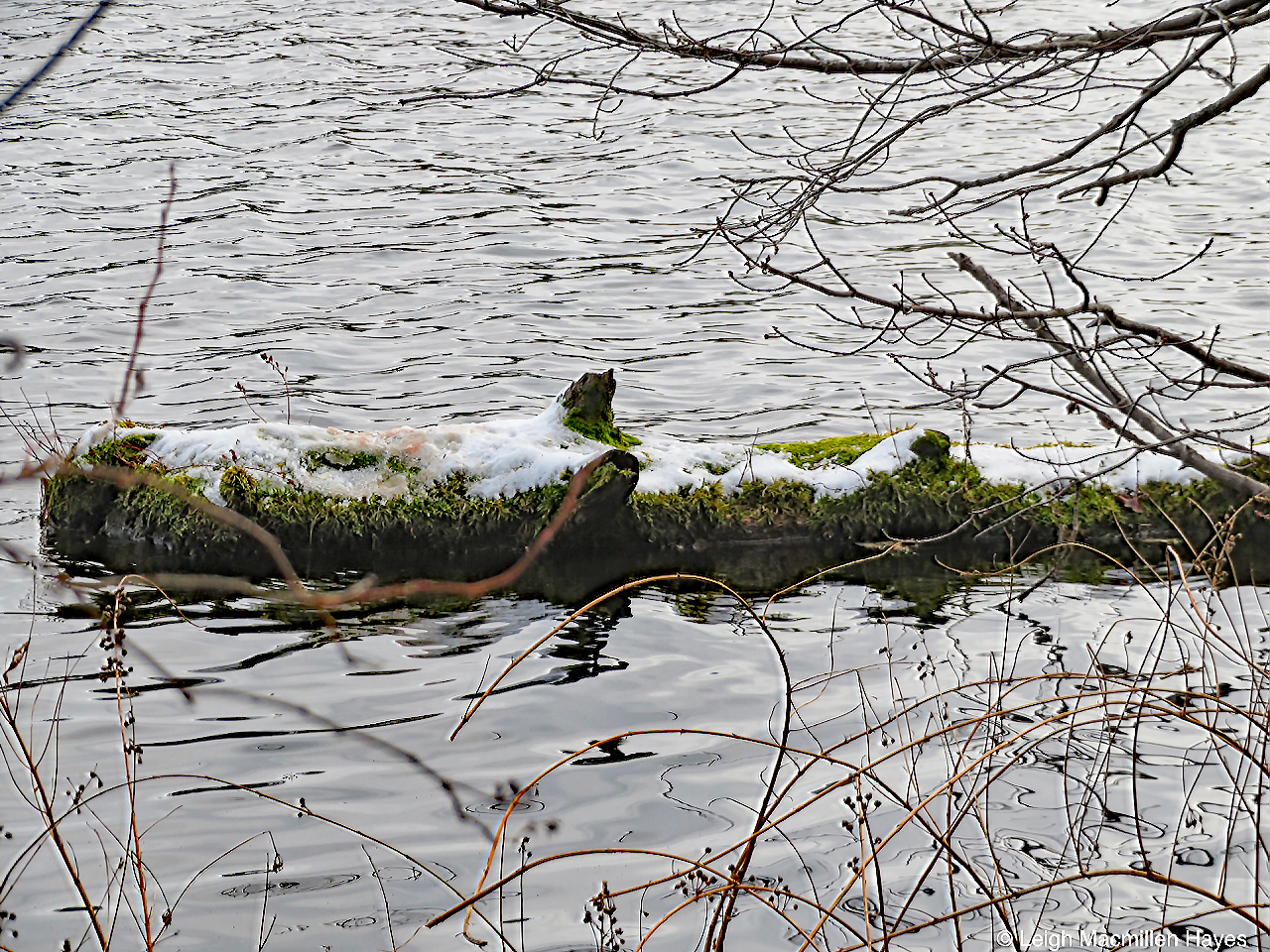
And where else might there be tracks? Why, upon a log in the water that tells the rest of the story. Or perhaps it’s the beginning of the story, for the log served as a dinner table.

And based upon the blood left behind and location of the site, I’d surmise it was a fish that had been devoured.

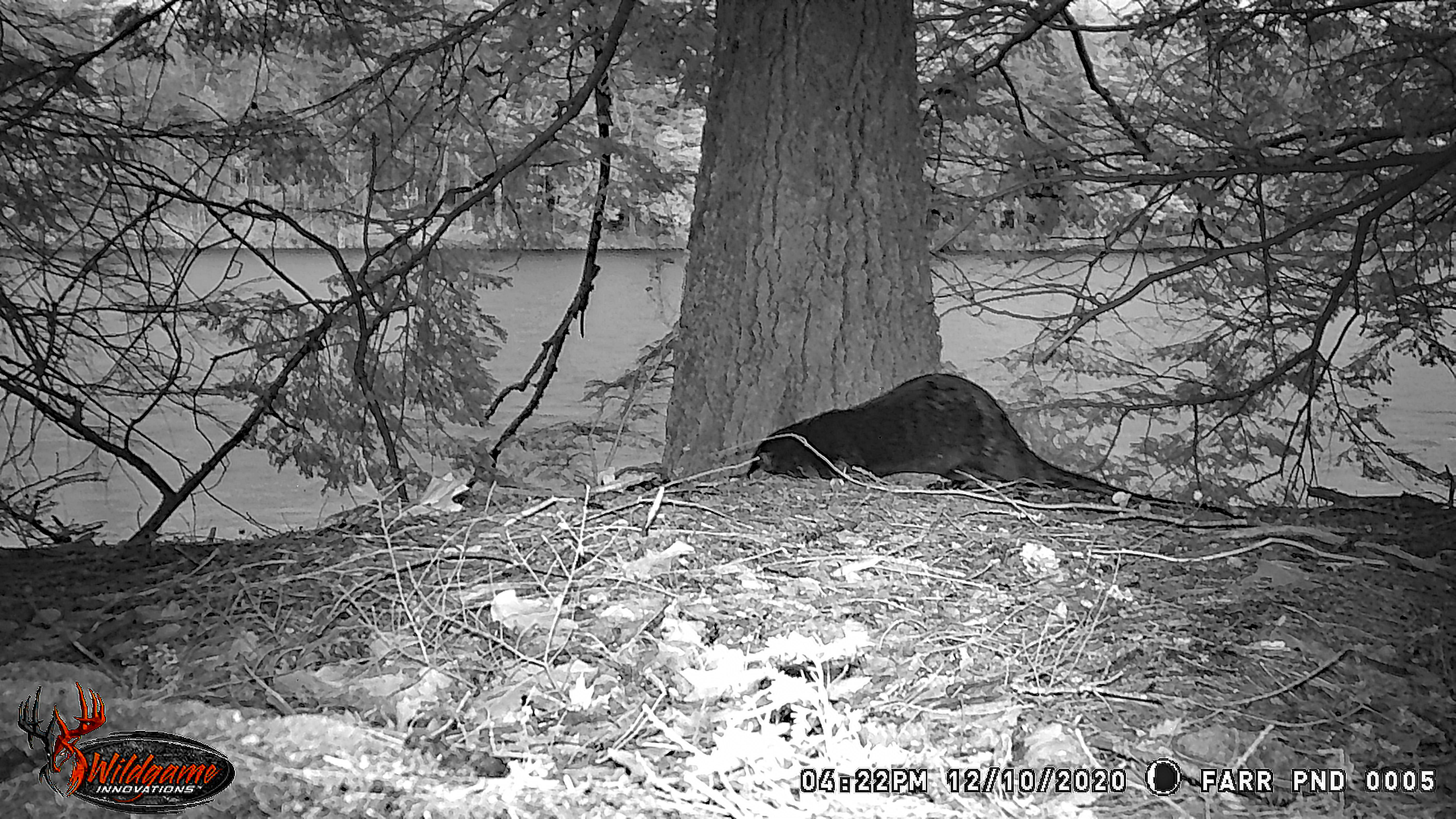
Knowing that this was a frequently used area, it was time to set up a game camera a day later. And the next day, the action began.

Two hours later, another shot—we know not if it was the same or a second otter, for Rhyan had happened upon three of them frolicking in the water a day or so before my visit. Otters tend to follow a circuitous route in their home range, visiting the latrines over and over again to defecate, scent mark, and roll around as a means of spreading oil throughout their coats to make them waterproof, which is why our frigid temperatures don’t affect them.

The next morning it appeared that two or maybe three, romped by the latrine. A day or so before I visited, Rhyan had seen three frolicking in the water. Chances are it’s a momma and her kids appearing to “play,” which in otter speak means she’s teaching them how to hunt or some other survival skill.

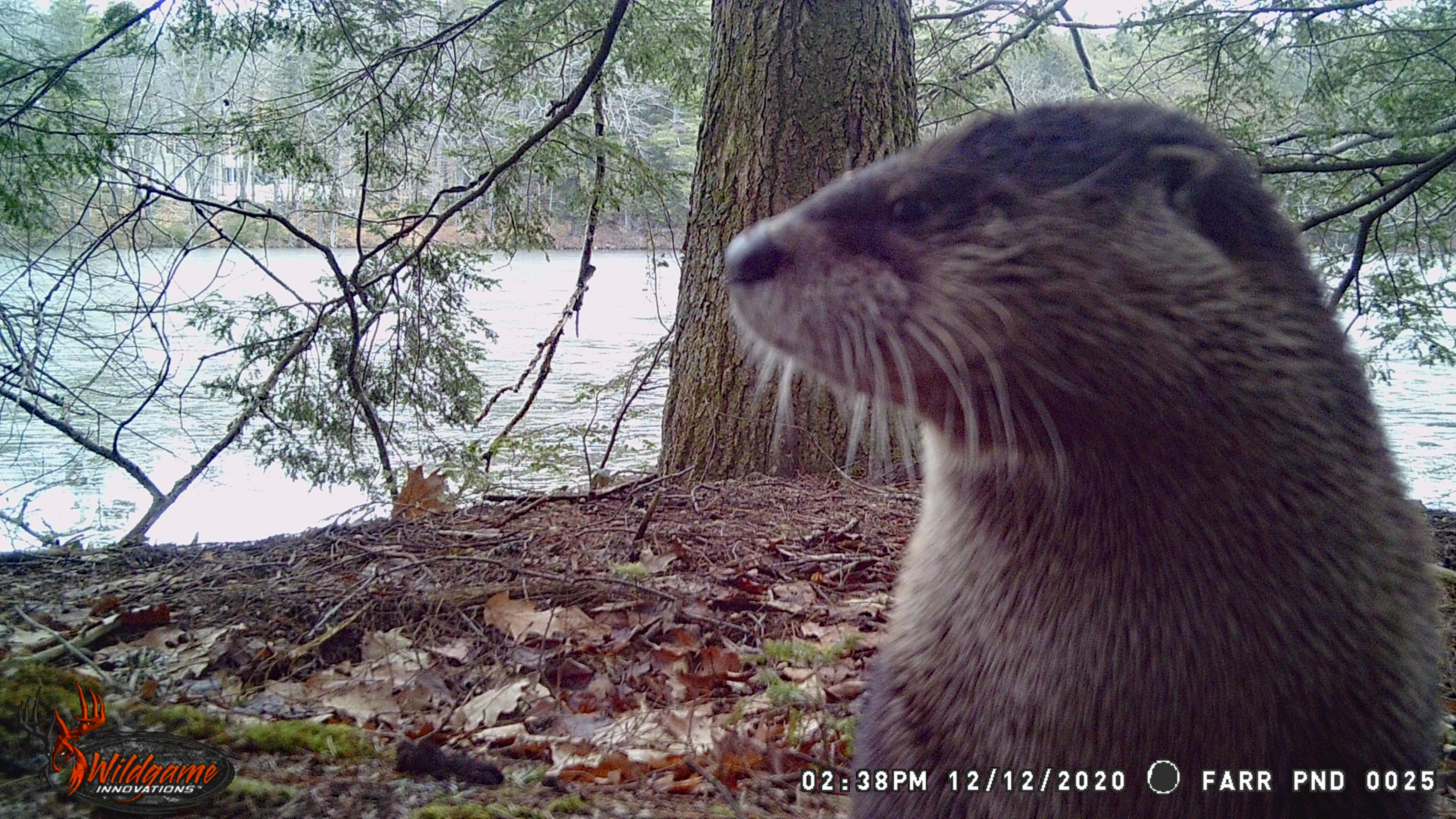
Two days later and our friends made it obvious that they are active both day and night. The trick to seeing one: being present. Or, as we did, using a game camera to capture some of the action.

Because you never know when one might to decide to pose for a selfie and look the otter way. Naturally.

My Heart Pines

Fourteen months ago I wrote Ode to Pinus Strobus, showing my respect for the mighty pines that inhabit our woods. Curiously, it was a rainy day then. And today dawned the same, though even more curiously, today we turned the calendar to December 1, yet the temperature rose to 57˚, like a summer day as we approach winter in western Maine.

Needing a fresh-air break mid-day, I ventured into our woodlot, where part of a fertile fern clinging to a dead tree branch about five feet above the ground garnered my attention. How did it end up on the tree, I wondered. Given that I’d been picking up branches from last night’s gale-force winds, I suspected it had somehow been torn from the rest of the frond and blew onto the branch. Maybe.

Below it, perched in a more stable manner, was a half eaten pine cone and this time my interpretation was much clearer for frequently I’ve been scolded by a Red Squirrel on this trail. He must have been dining on a branch above, out of danger’s way, and for some reason I don’t know, let the cone slip from his front paws where it fell and landed between a branch stub and piece of bark that was partly dislodged from the tree.

A glimpse at the base and I was 98% certain my story was correct for a large midden or refuse pile of cone scales and cobs removed by Red in order to consume two tiny seeds located inside each scale decorated the forest floor.

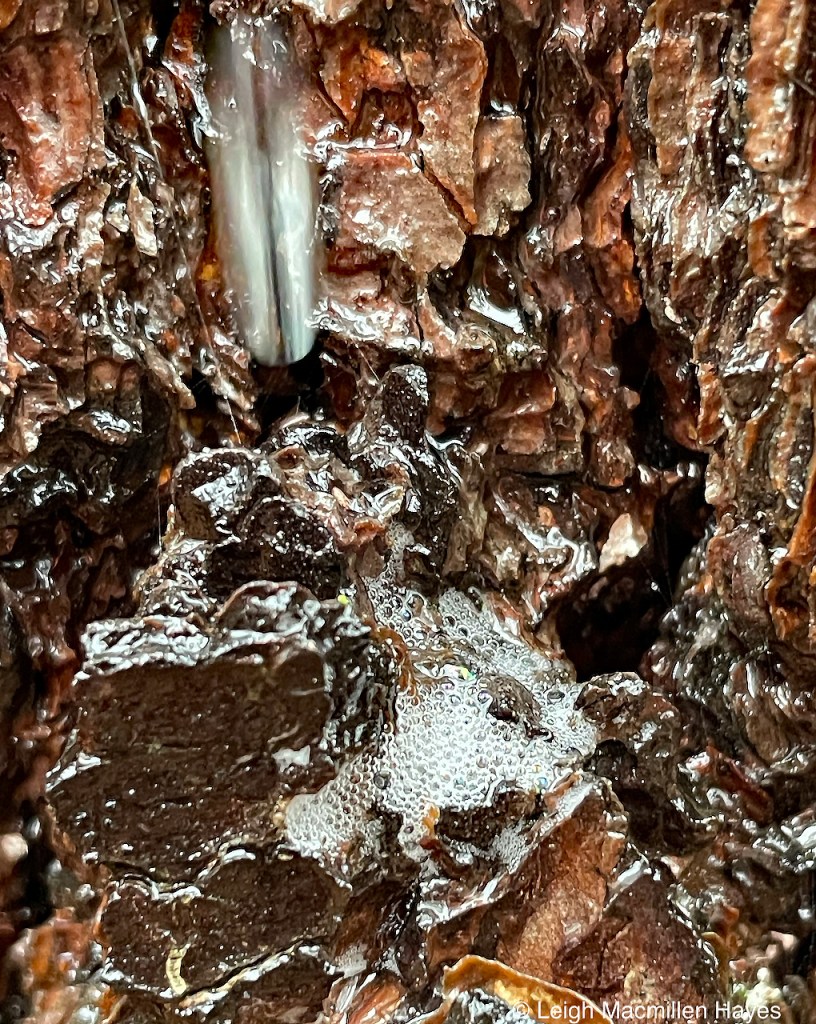
Because I circled the tree to further examine the midden, and because it was raining, I shouldn’t have been surprised by my next find, but the froth that forms on pines as the result of a chemical interaction when rain drops pick up oils and air in the bark furrows bubbles through that oily film and the end result is pine soap never ceases to amaze me. Plus I love the rainbow colors.

With great patience, I watched the drops drip onto the froth and realized that if I counted to twelve I might get to see a drop just before it let go.

And could almost capture its journey.

As if that wasn’t enough to make my day, I was stepping away from the tree when I discovered a hickory nut on the edge of the midden. One of the manners in which a Red Squirrel opens a hickory nut is to split it in half. Notice the grooves along the edge created by the squirrel’s incisors.

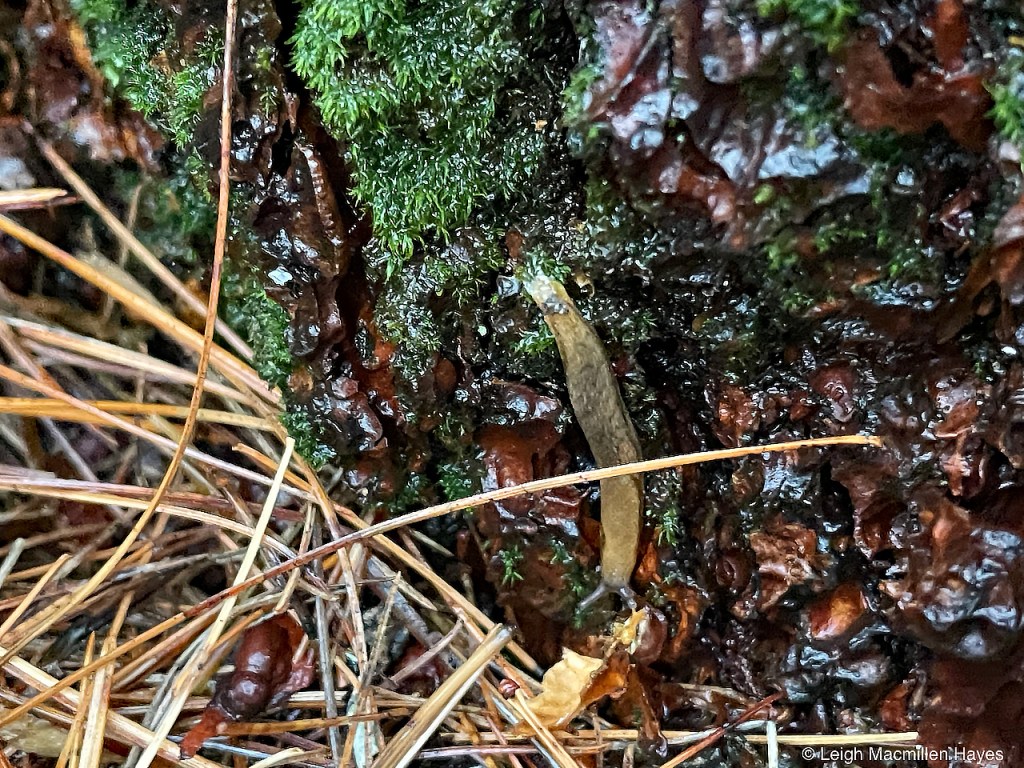
By this time, I was hungry and maybe a wee bit damp, and ready to follow the path home, but . . . a sudden look at the tree’s bark, and I spied life.

The life of a slug is interesting and not to be rushed. No longer was I.

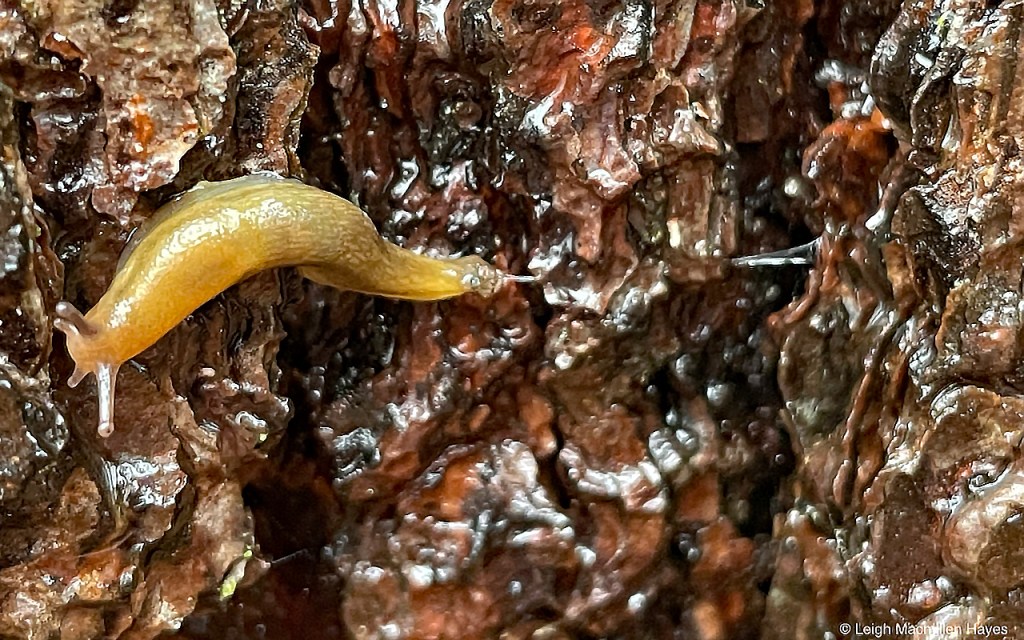
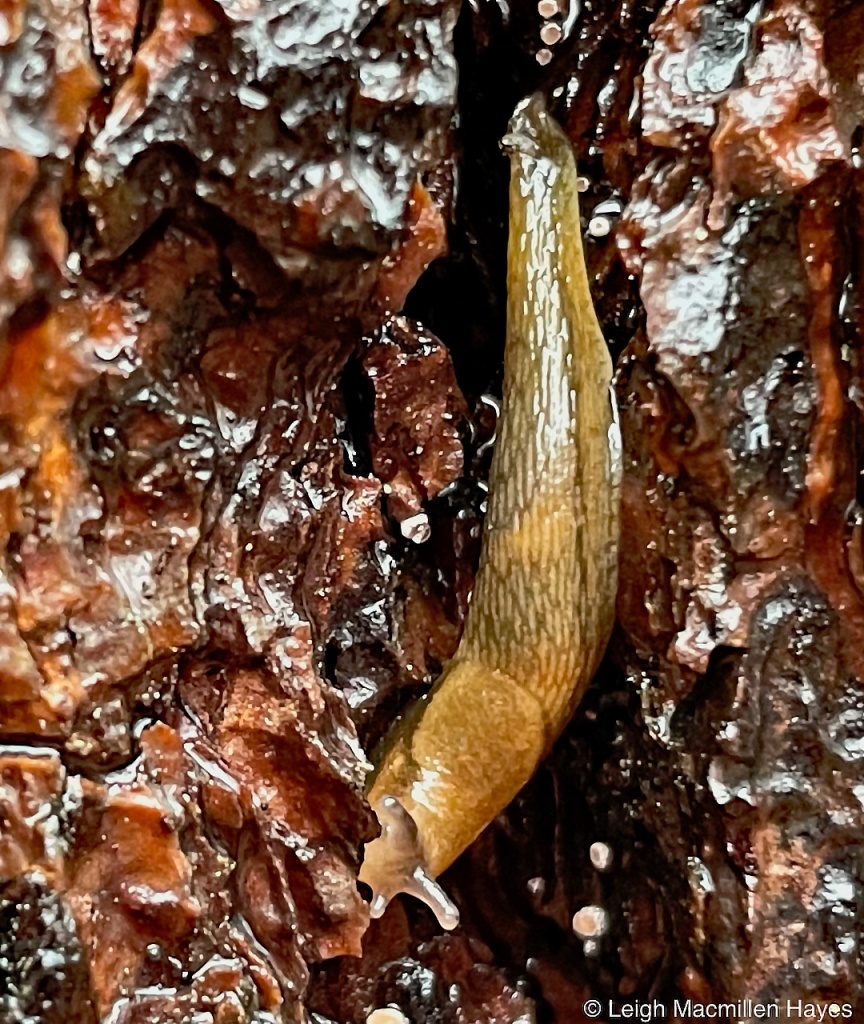
For almost an hour I watched four slugs as they moved at their own slow pace into and out of the furrows of the pine. These terrestrial gastropods (gastro=stomach; pod=foot) create a layer of mucus that they secrete so that the “foot” under almost the entire length of their bodies can move rather smoothly.

Their heads include two sets of tentacles that they can retract (and grow back should they lose one). The upper tentacles are light sensitive and have eyespots at the tip of the stalks. They also use these to smell.

The lower tentacles are for feeling and tasting.

And then there’s the mouth, that funky-looking line to the left of the tentacles in this photo. The radula is a tongue-like organ covered with thousands of raspy tooth-like protrusions–the better to scrape or brush particles from the surface of a tree or plant.

Here’s another cool fact about snails; they are hermaphrodites, meaning each one has both male and female sex organs.

As my snails headed in each and every direction, I at last pulled away, though I did stop to examine other trees on my way home, but found nothing else to look at. ;-) Or at least, nothing else to report.

An hour or more later, I slipped out the door again, curious to check on the action upon that one pine. The fern had blown to the ground. The cone was still lodged between the branch stub and bark. The rain had slowed and froth diminished, though remnants of it remained. The hickory nut had disappeared. And I could only find one slug who was making its way to the safety of its underground habitat.

But . . . because I went back, I spotted an Assassin Bug.

For those who love to wander and wonder, I hope you’ll be still and have an experience similar to what this tree offered me today.

My heart pines . . . naturally.

People versus Nature: who wins?

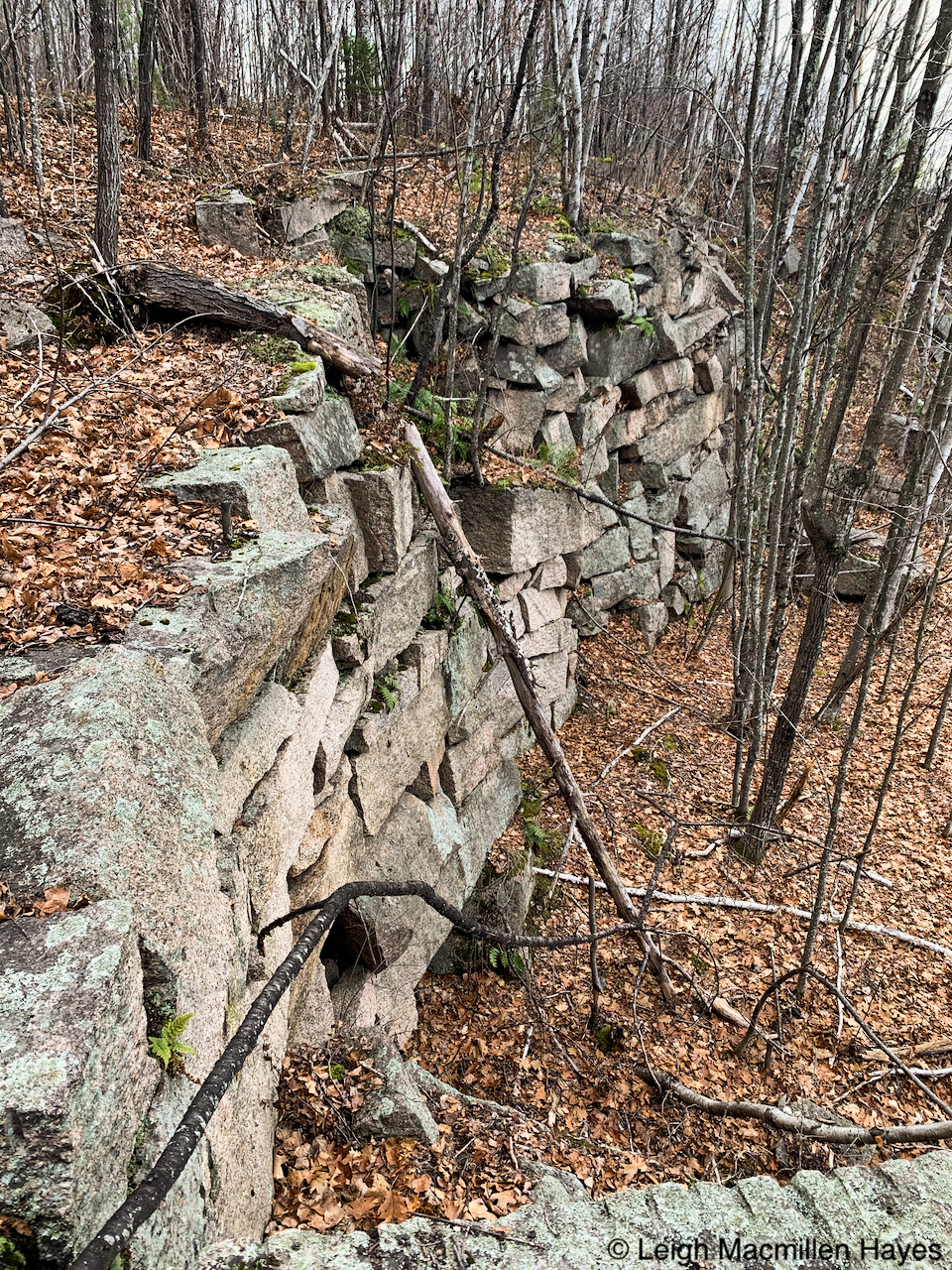
Artifacts. In the woods. A sign.

A sign of the past and the present. A sign of people. A sign of nature.

The people story may have ended 72 years ago in this space . . .

but the nature story continues with many interesting twists and turns along the way.

The people may have tried to defy nature . . .

but nature has a way, whether we like what emerges from it or not.

And figuring out the procession of the nature story, as much as some of it may not please us, is still intriguing.

People and nature.

People versus nature.

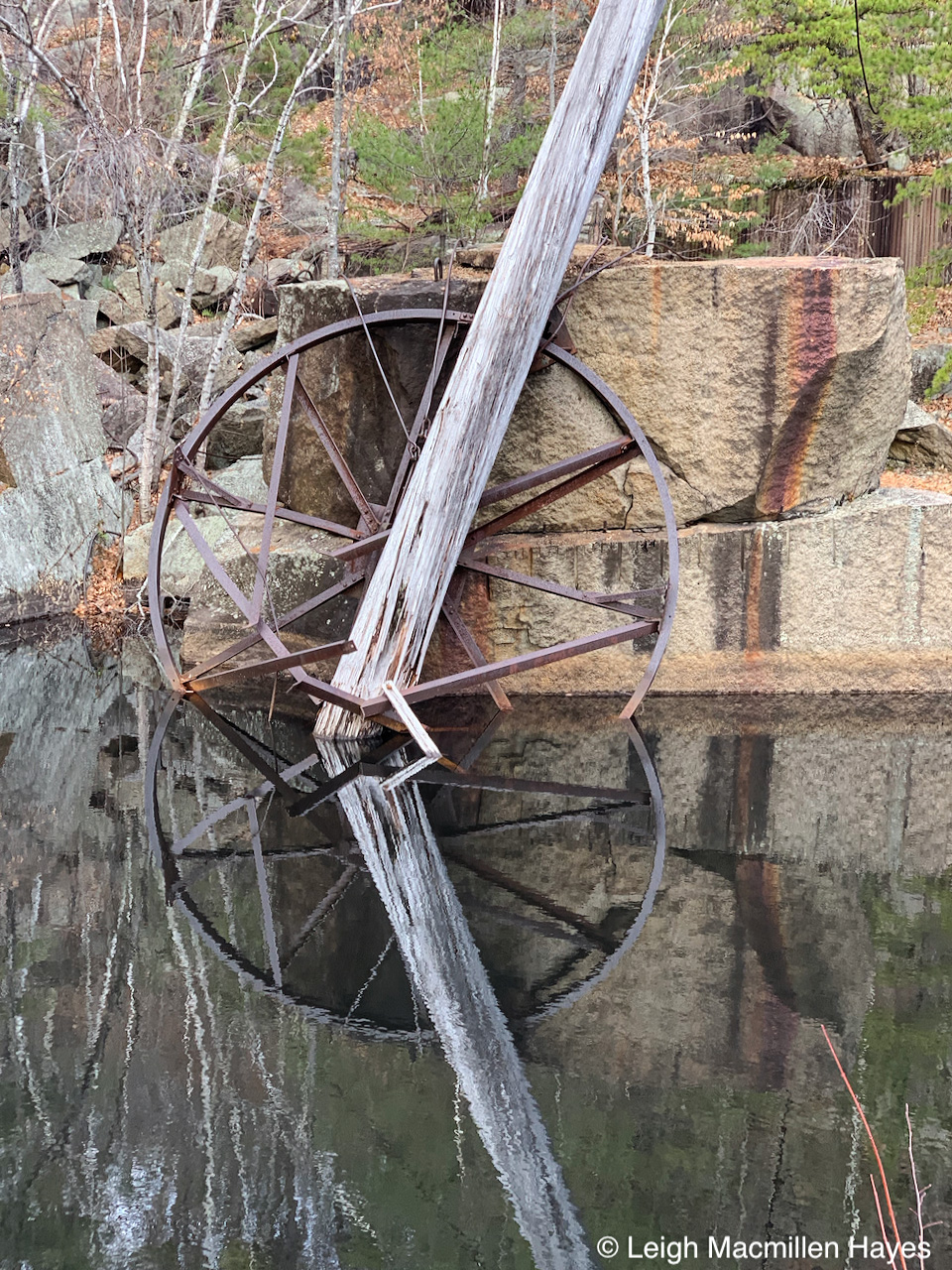
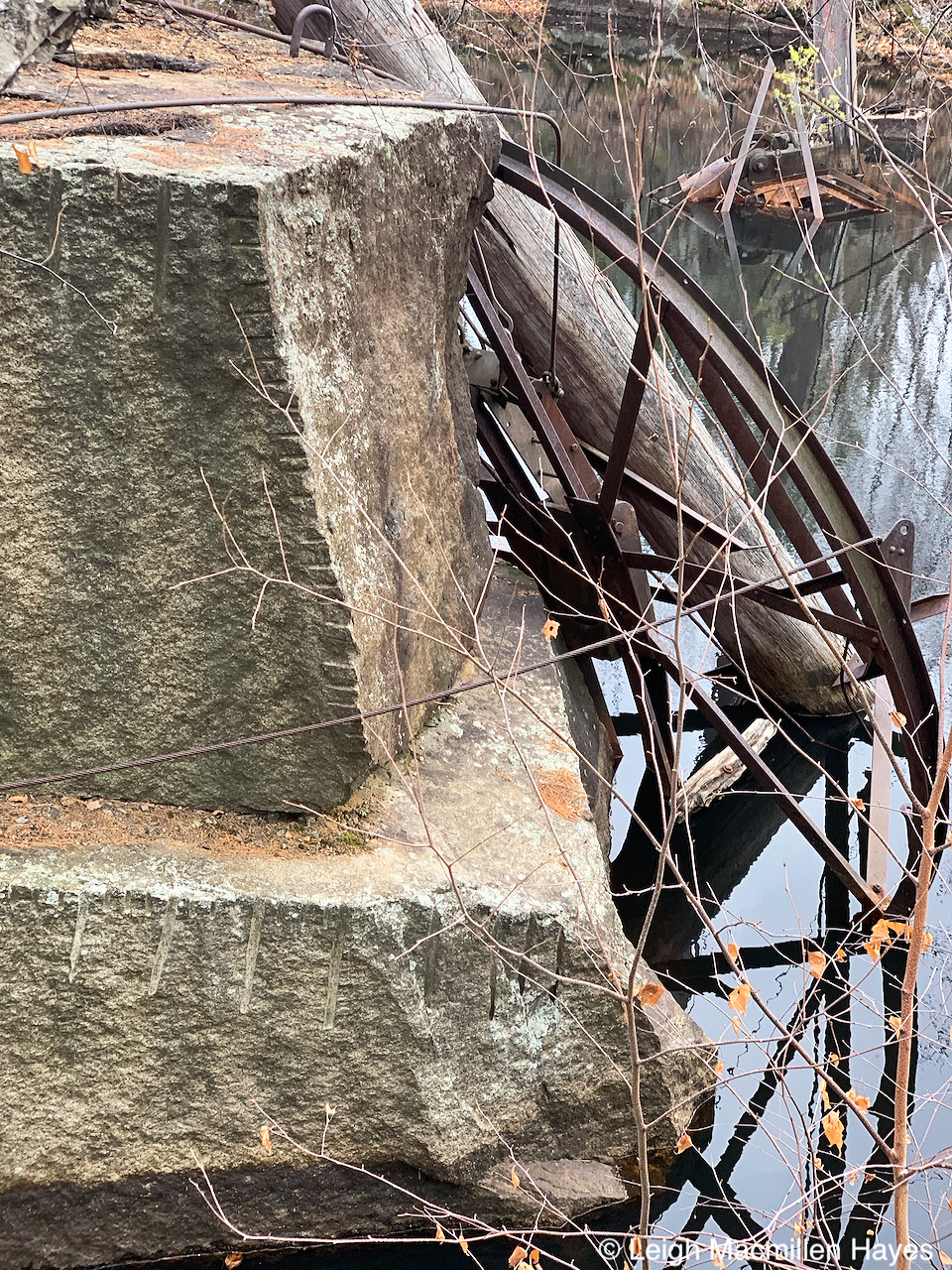
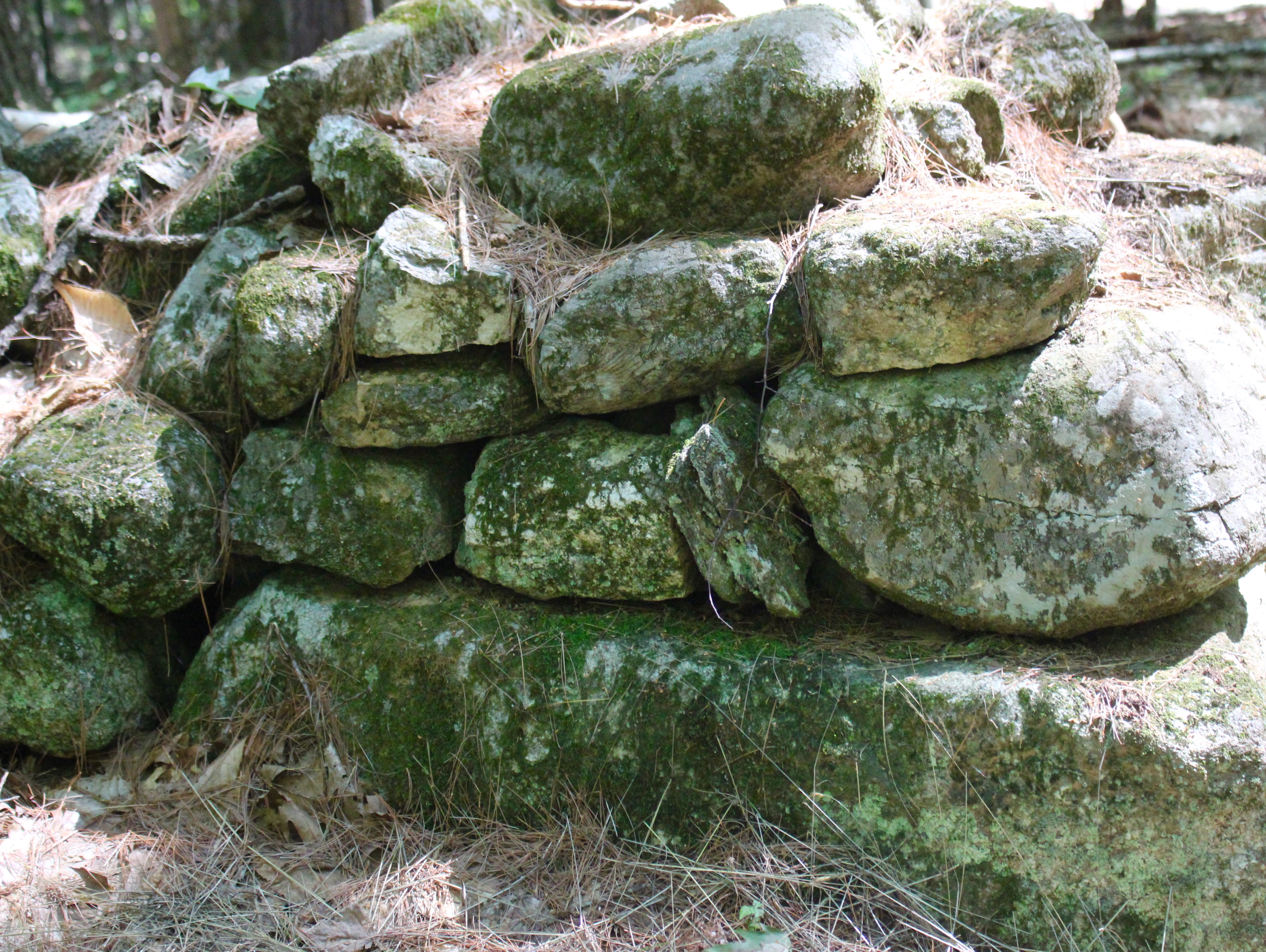
Who wins? In the end, nature reclaims her own as the lichens demonstrate on this quarried granite.

Stymied by Nature

To the vernal pool I wandered on this overcast, drizzly, rainy day.

I thought for sure I’d later expound upon the deciduous trees that surround it and their leaf colors for such was the carpet at my feet as it reflected the sky above, despite the lack of water in the pool.

But . . . it was the conifer trees that shouted quietly for my attention, their offerings much more subtle than their broad-leafed cousins. First, there was a firefly that made me wonder how he could move so quickly and gingerly in an upside down manner.

Take half a minute and watch his progress.

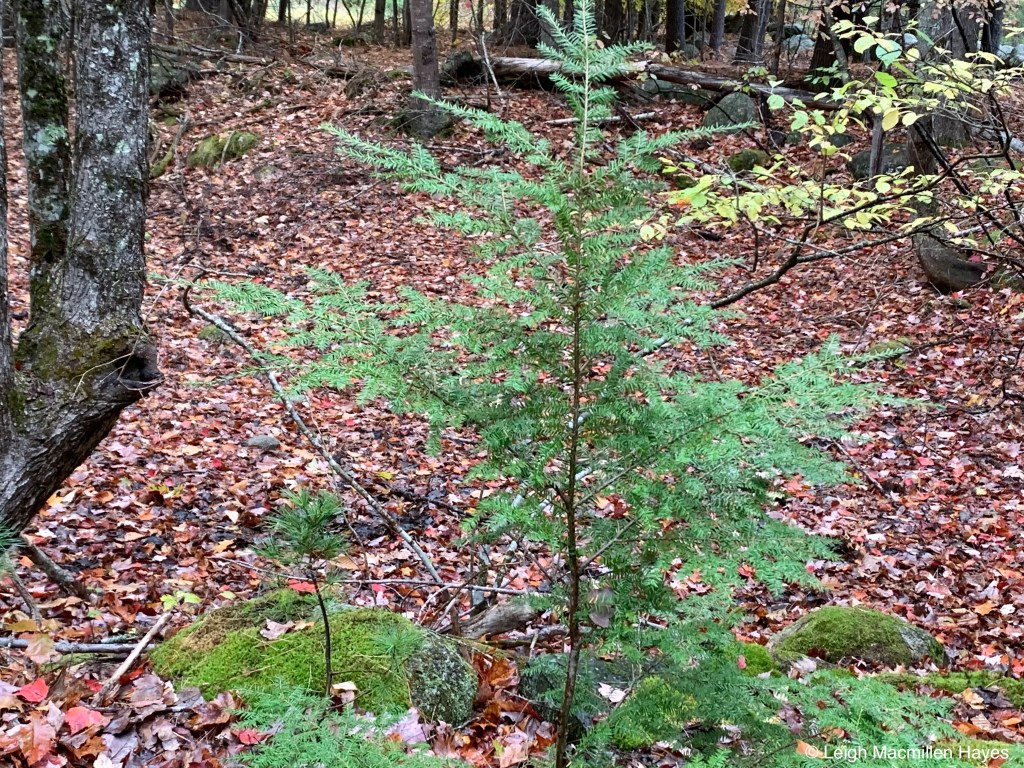
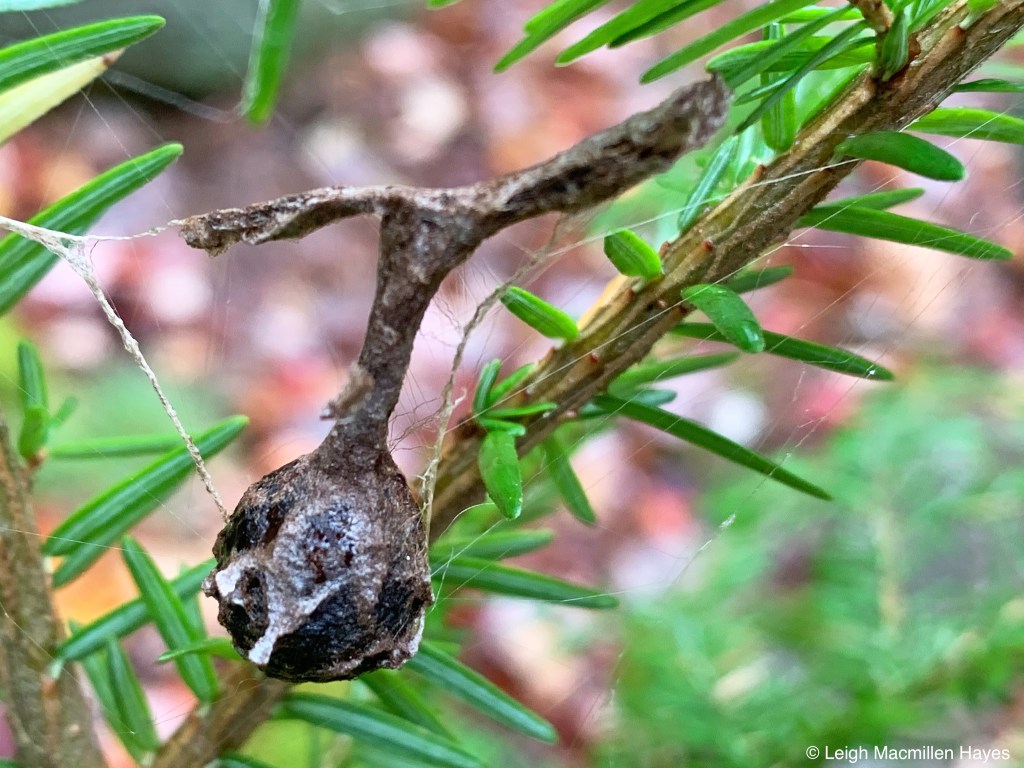
From the pine sapling I moved over to a hemlock on the far side of the pool. Something dark dangling below its branches begged to be inspected.

It was (is) about two inches long and felt almost leafy when I touched it. Protruding from it were several spikes that weren’t really sharp.

I looked at it from as many angles as I could. And found it curious that it appeared to be performing a split at its upside down base (meaning the top portion in the photo).

Some serious webbing held it in place and what appeared to be sap decorated it.

What could it be? I wondered if we’d ever been introduced before and like so many I’d forgotten its name. Perhaps a moth cocoon inside a spider web? Or a gall that dropped from a tree and got caught in the web? Or a spider egg sac? I looked for a spider and found one. Do you see it in the lower left-hand corner? Rather tiny compared to the alien object. Was the object an alien? Something from outer space? I suppose I could have split it open to see what it contained, but I decided to look around for others like it. And found absolutely none. Knowing that, I could hardly destroy it and so it’s still dangling from the hemlock and I’ll visit from time to time to see if the mystery solves itself. (Please don’t tell me if you know because that will ruin the fun of making a discovery.)

Oh, I did have one other thought, that it might be related to a hemlock cone gone awry, but when I stopped to look at cones on another tree, that theory didn’t make sense. It was there, however, that I spotted a flying insect that wasn’t flying. It, too, was a dangler.

Though my identification wasn’t definite, I suspected it was a member of the flower fly family. Curious enough, just moments before spotting the fly, I’d noticed a couple of blueberry flowers blooming. These are strange times, indeed.

A few more steps and I began to notice one I am familiar with: the tube created by a Pine-Tube moth. The larva ties needles together with silk as a form of protection in which to pupate. The tubes then get lined with more silk and are usually half as long as the needles because the larva eat the ends off. Though the larva may eat their way through several tubes over the course of a winter, I suspected this one was currently active because one needle stuck loosely out of the end. Inside, someone must have been dining.

And then . . . and then . . . I spied a small inch-worm type caterpillar. A Pine-Tube Moth larva?

Again, I wasn’t sure, but it seemed to display the right behavior.

I didn’t have all the answers today, but I know right where I met my acquaintances and hope that the next time we meet I’ll recognize them and perhaps will greet them by name. Chances are, though, that when I head out the back door to look for them, something else will shout quietly for attention and I’ll meet new things in the forest that will also leave me stymied by nature.

Nature’s Denouement

Due to today’s inclement weather, I postponed a Tracking expedition and thought it might be a good day to become a couch potato. But still, my feet itched to get outside as the raindrops fell.

And then a text message arrived: “Potential loon trapped in the ice; rescue happening on Lower Bay.” I was in my truck and on my way before I even knew the exact location.

As I drove, rain changed to big slushy balls that struck the windshield with noisy inkblot-shaped splats. I pulled into a parking area to check on the intended meet-up point and learned I was a bit early, so I went for a walk. All around me, the forest was alive with sounds–of wet snow striking marcescent leaves, and birds chirping as they flew from branch to branch. I’d hoped to meet an old friend, Argee, but he was nowhere in sight.

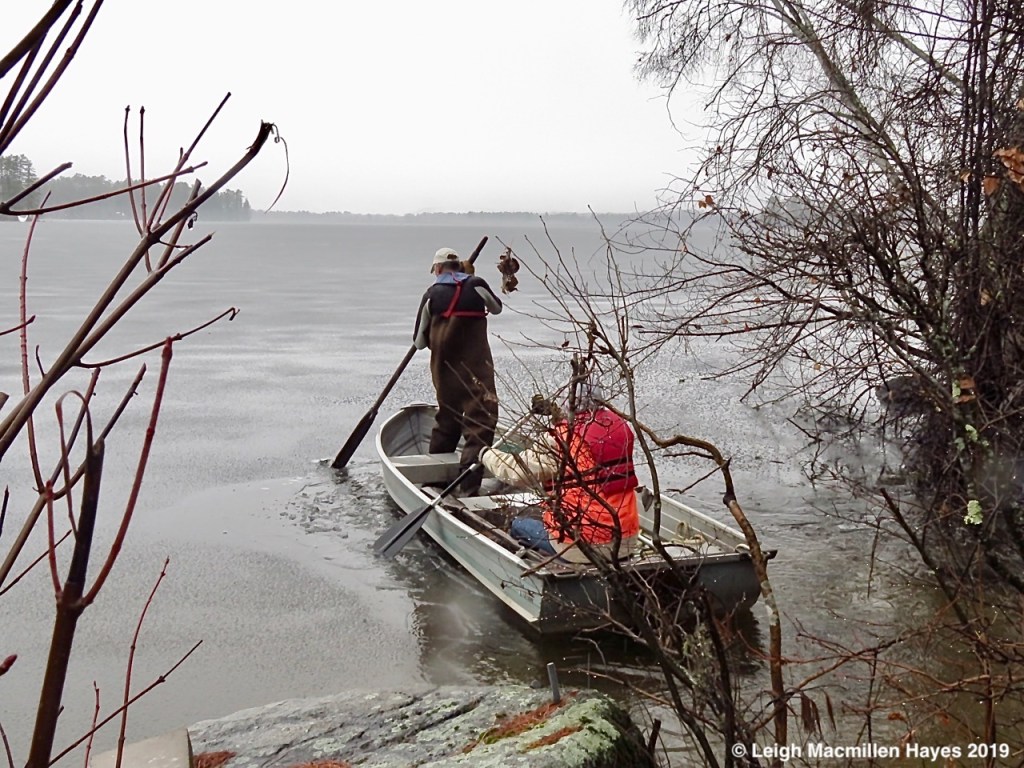
By the time I did join the rescue group, they were already loading an aluminum boat into the lake.

The Lower Bay of Kezar Lake had sealed over this past weekend and was coated with an inch or more of ice.

Thus the need for the rescue mission. An immature loon got caught by the sudden freeze. Thankfully for it, Susan Clout, a local resident, noticed its situation and put out a call for help.

Responders included Heinrich and Linda Wurm, Paul Buckley, Steve Lewis, and Jim Buck.

Donning life jackets, their only gear: paddles, a net and a box. It all seemed so simple. Paddle out, coo to the bird as it might talk to another, and either make open water for it to fly (loons need at least a quarter mile for take off, this one had a circle that maybe measured twenty feet–it was difficult to tell from the shore) or capture and release it on an open section of the lake. As one of the text messages stated about the plan: Evolving.

The task of breaking the ice was daunting and though it looked like they were crossing the Potomac, all they really wanted to do was maneuver part way across the bay.

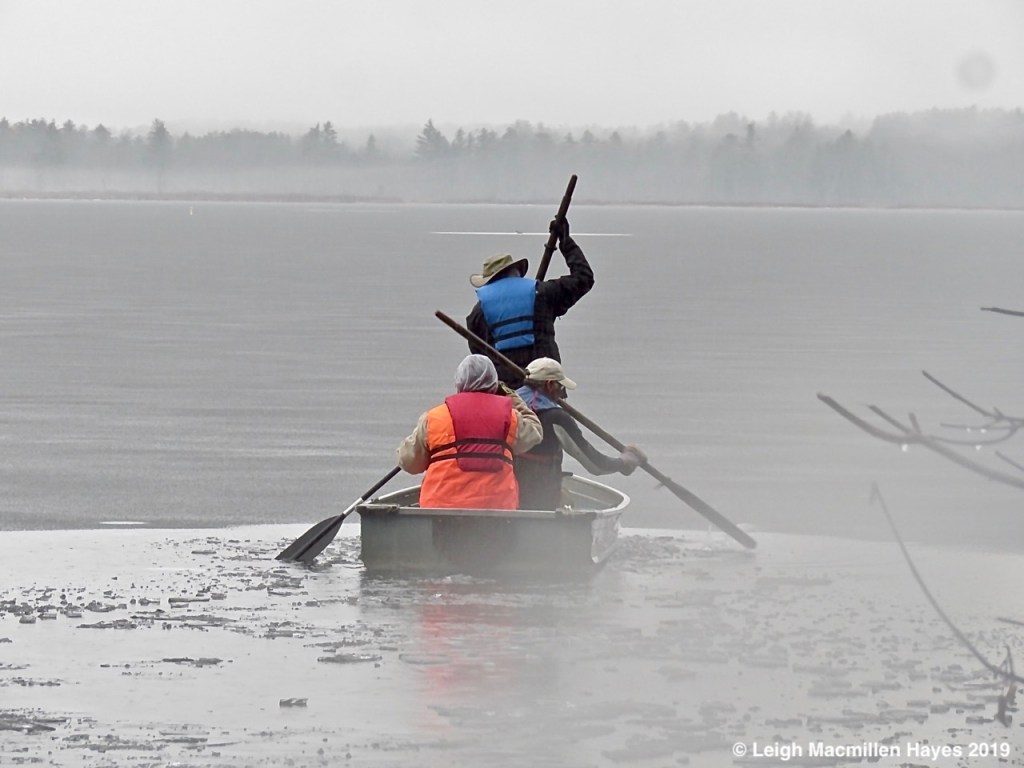
Because it made sense for the person in the bow to stand and break ice as the sternman paddled, stability became an issue and within minutes the boat returned to shore and a third passenger climbed aboard.

Though you can see the circle of open water and it may appear close by, it was all a matter of perspective and they had a long path to create.

Meanwhile, back on shore, those of us who remained behind and felt like we might need to rescue the rescuers, were entertained by Susan as she sang the most delightful lines of a song she’d been writing about the loon’s dilemma.

Back on the water, or rather, ice, progress was slow.

And still the loon swam, occasionally calling out. We interrupted its voice to mean, “I see you. Keep coming my way.”

On board the SS Icebreaker, oarsmen shifted positions because it was tiring to chop continuously.

We kept assuming they were making headway given their position.

And they were. But they still had a long way to go. After 75 minutes, with probably two more hours separating them from the loon, and a cold rain falling, they decided to turn around and hope that higher temps and maybe a breeze in coming days will do the trick. All are hopeful.

I was invited to the scene because my friends’ thought it would make a good story. In the end, my story is nothing compared to the one Nature is writing. She, apparently, has Her own plans for the denouement. We can’t wait to read how She resolves this matter.

Update: November 21, 2019

And here is the rest of the story as Heinrich interpreted it for us: “The loon we were aiming our mission toward took off this morning! Just as the Game Warden showed up the loon started flapping its wings and headed east toward the Narrows. Amazing!

created by dji camera

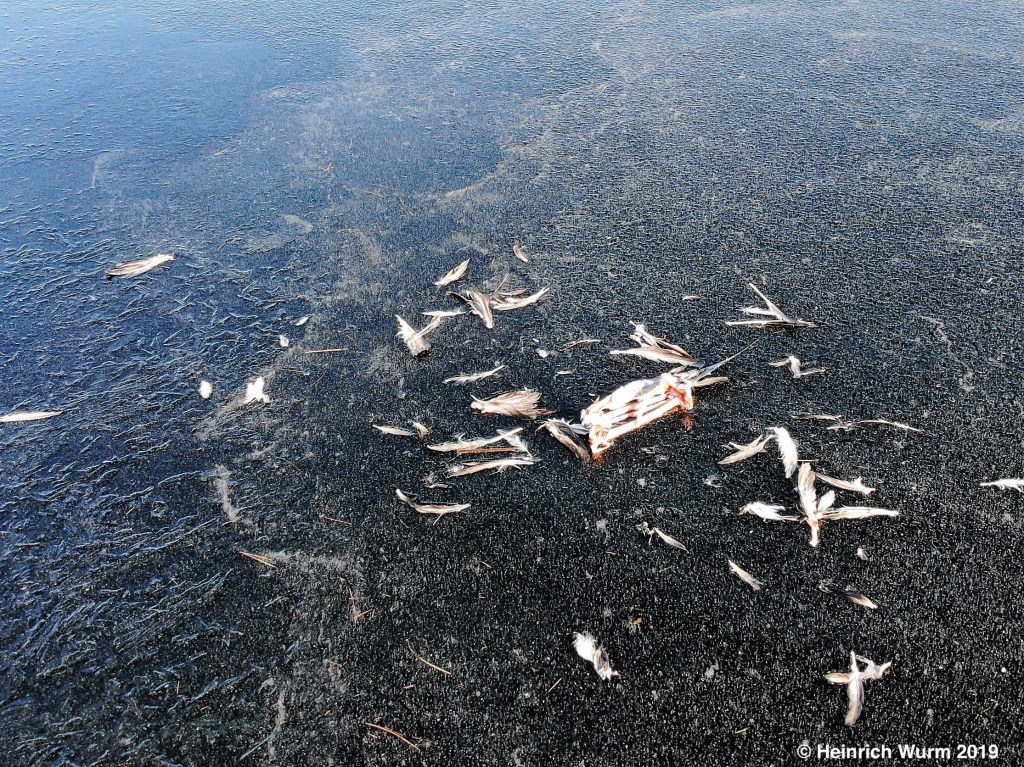
Unfortunately these remnants were left near the other open space
where a loon had been sighted before.

I later learned that two Bald Eagles were spotted near the loons.

Nature’s Denouement: Find a balance.

Detecting the Nature of Wilson Wing

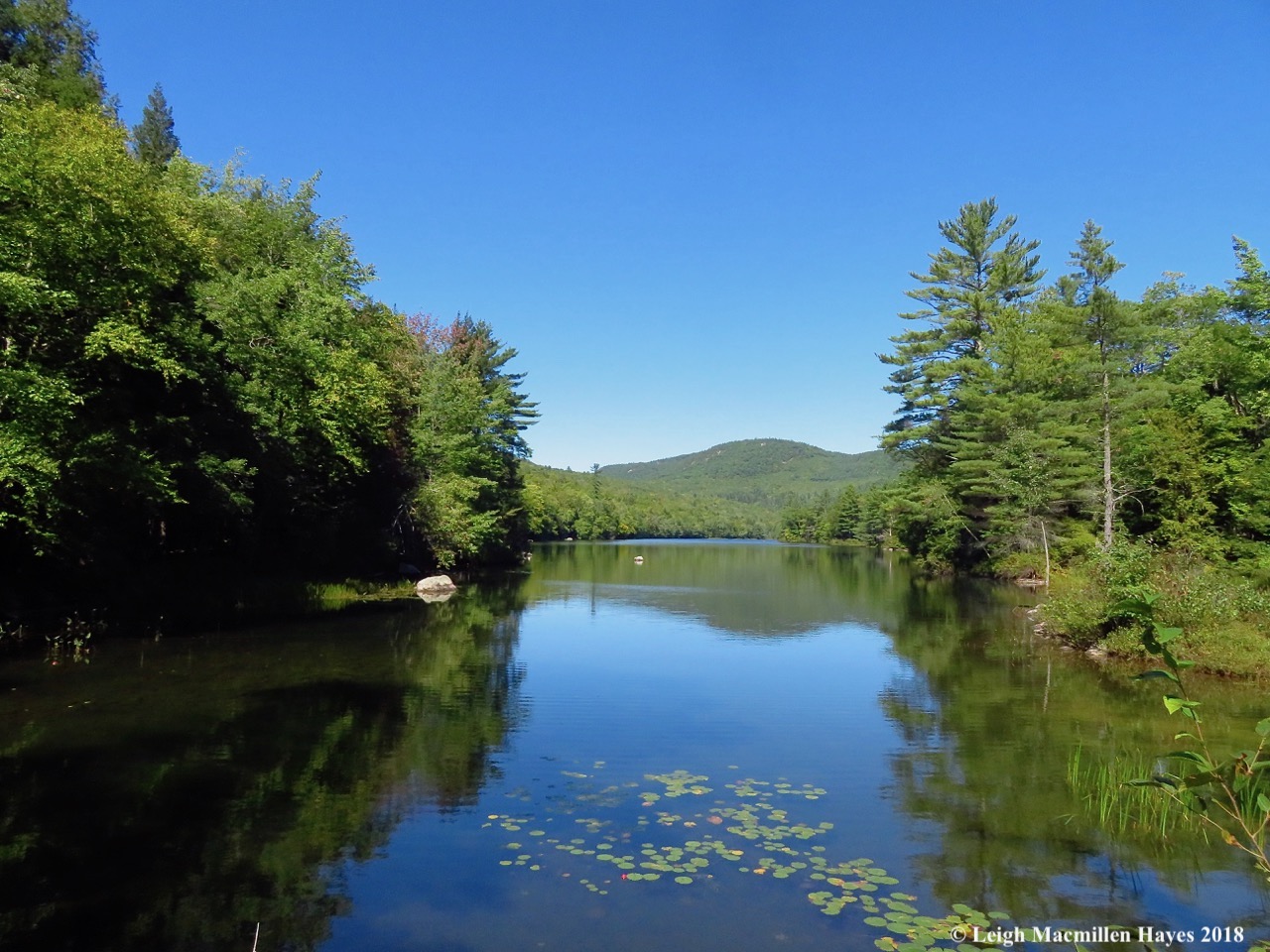
Before heading onto the trail beside Sucker Brook at the Greater Lovell Land Trust’s Wilson Wing Moose Pond Bog Preserve on Horseshoe Pond Road in Lovell, today, a friend and I walked down the road to the pond where we hunted for dragonflies and frogs.

1-Horseshoe Pond

There wasn’t a cloud in the sky on this first day of fall and a crisp day it was, bringing smiles to our faces and adding sweatshirts to our attire.

3-green frog

Though we saw a few darner dragonflies and even a meadowhawk, it was the green frogs that we spent the most time trying to spy for they blended in well with their grassy surroundings at the water’s edge.

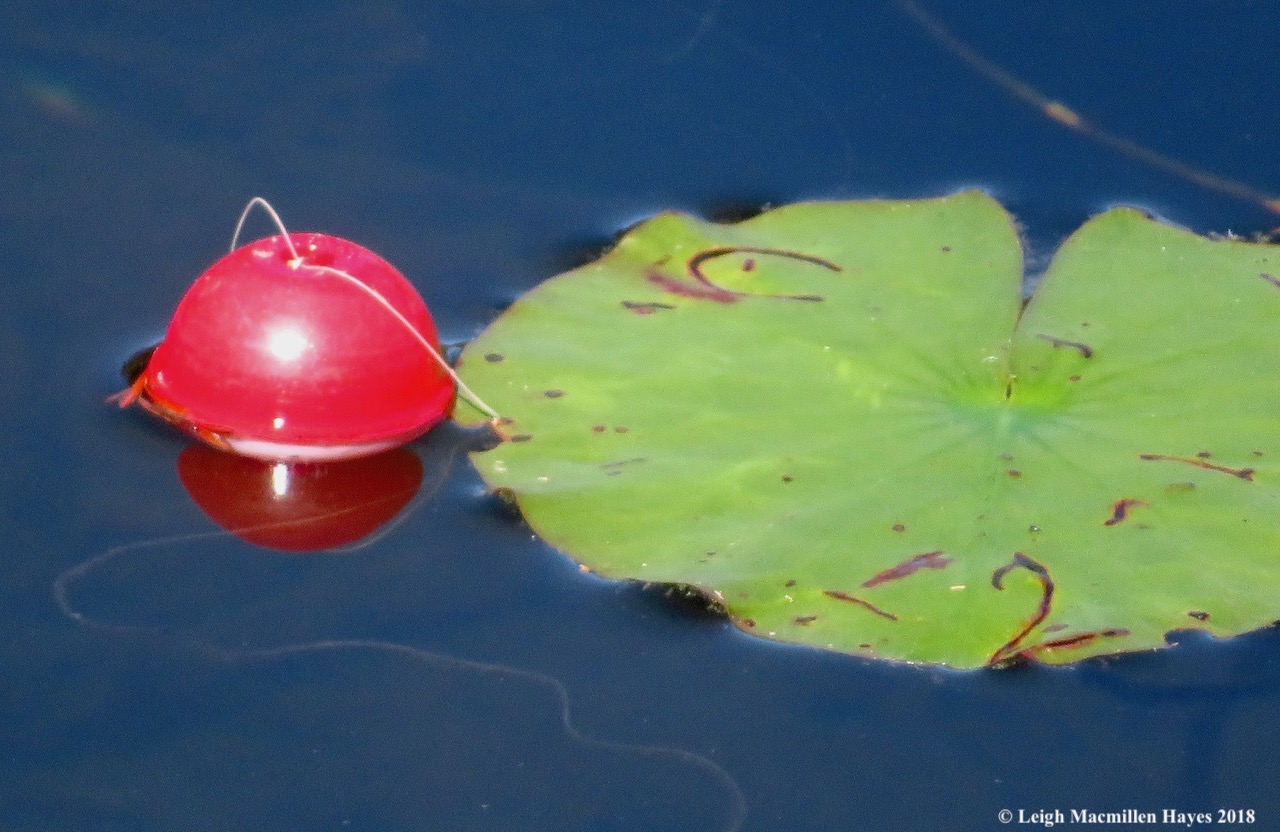
2-bobber

A bit further out, and unfortunately beyond our reach, we spotted a bobber and fishing line. While it offered a picture filled with color and curves, the reality wasn’t so pleasant.

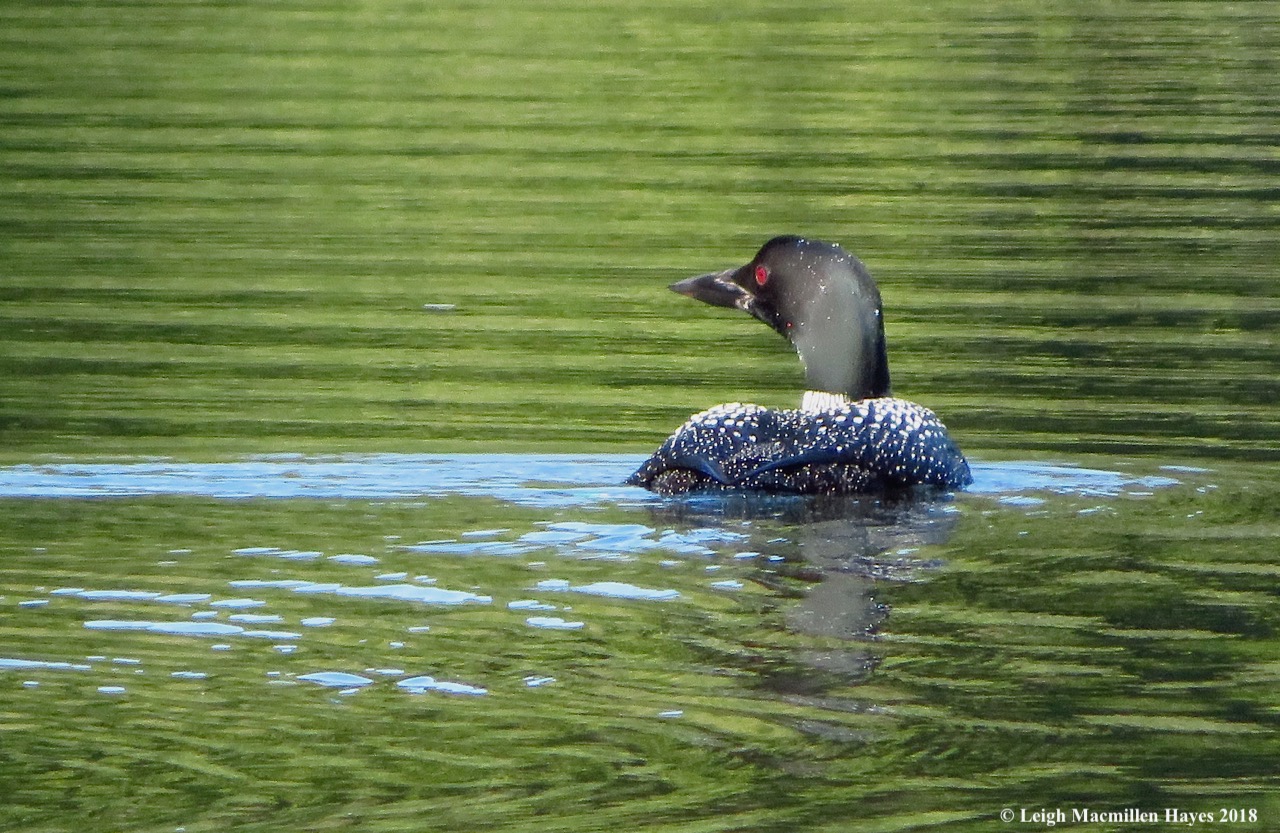
4-Common Loon

Nearby, this loon and a youngster swam and fishing line left behind is bad news for them as they could get tangled in it. Please, please, please, if you are near the Horseshoe Pond boat launch, and have the means to retrieve the bobber, do so. And if you are anywhere else in this world, do the same–for the sake of all birds everywhere.

7-Sucker Brook

At last, we pulled ourselves away from the pond and followed the brook that flows from it–Sucker Brook.

5-Jack in the Pulpit

Right away, we were in awe of the Jack-in-the-Pulpit plants with fruits still intact. Jack is actually a curious plant and sometimes channels its feminine side. While the plant starts life as a male, if the soil is poor, it turns female, flowers and bears seed. It could turn male again. In the case of what we saw today, meet Jill.

6-thin maze polypore

As our journey continued, we noted fungi everywhere. Some had rotted and added to the earthy smell of the woods. Others displayed their unique structures, colors, and lines, including the Thin-mazed Polypore.

11a-earth tongue

We also found at least one Black Earth Tongue, its common name reflecting its tongue-like appearance as it stuck up from the ground.

11-Dead Man's Finger

And in keeping with human body parts, we noticed a singular Dead Man’s Finger. But . . . its presentation offered questions we couldn’t answer. It was our understanding that on Xylaria longipes the young fruiting bodies would be covered with a whitish or gray powder in the spring. The powder isn’t really a powder, but rather the asexual spores of the species. So, did we find a confused youngster? Or was it an oldster parasitized by a mold?

10-Choclolate Tube slime

Speaking of molds, we stumbled upon a log featuring a feathery appearance reminiscent of antennae on a moth or butterfly. Well, maybe a collection of antennae. A huge collection.

10a-chocolate tube slime

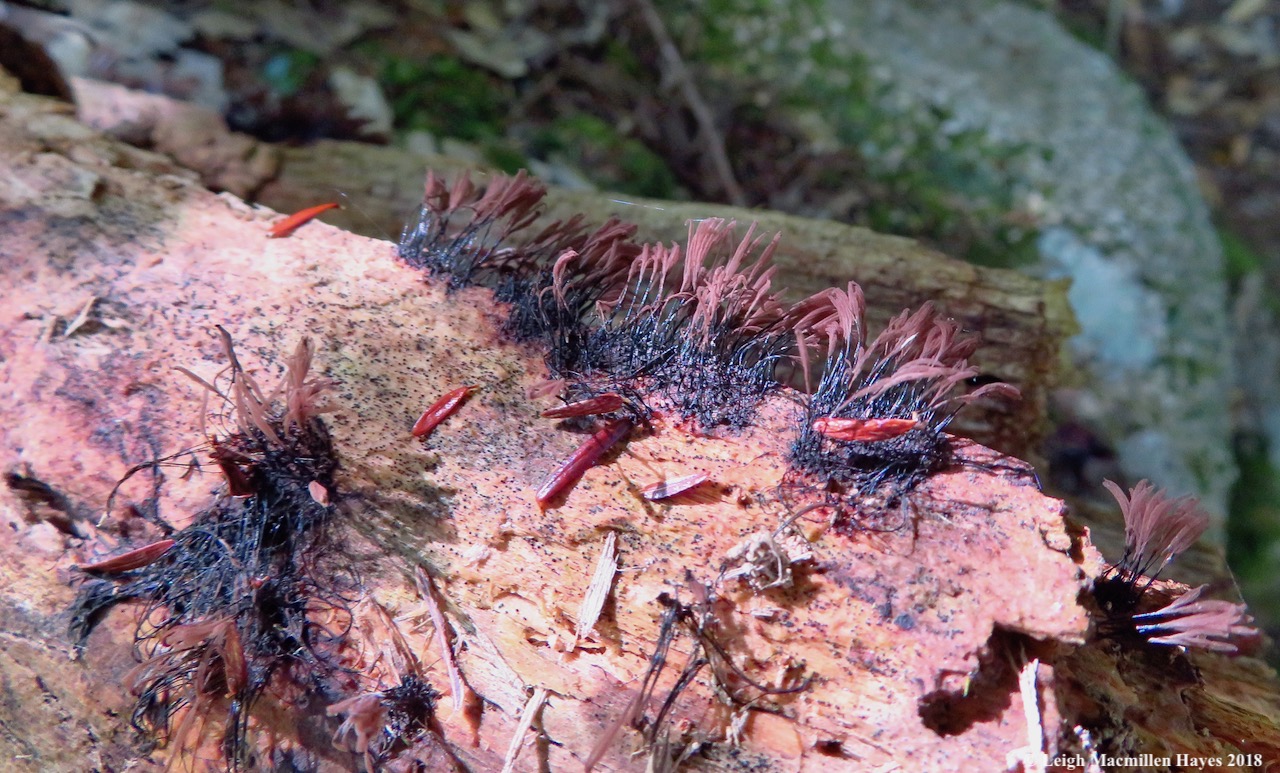
Turns out it was Chocolate Tube Slime, a new discovery for me. In his book, Fascinating Fungi of New England, author Lawrence Millman describes it as “dozens of erect, brown tubes mounted on thin, seemingly polished black stems.” Bingo.

9-green frogin sucker Brook

Also appearing a bit chocolate in color was another green frog. And being the first full day of autumn, I began to realize that my time spent admiring amphibians and dragonflies will soon draw to an end. But . . . on the horizon . . . tracks and scat ;-)

8-Conocephalum salebrosum

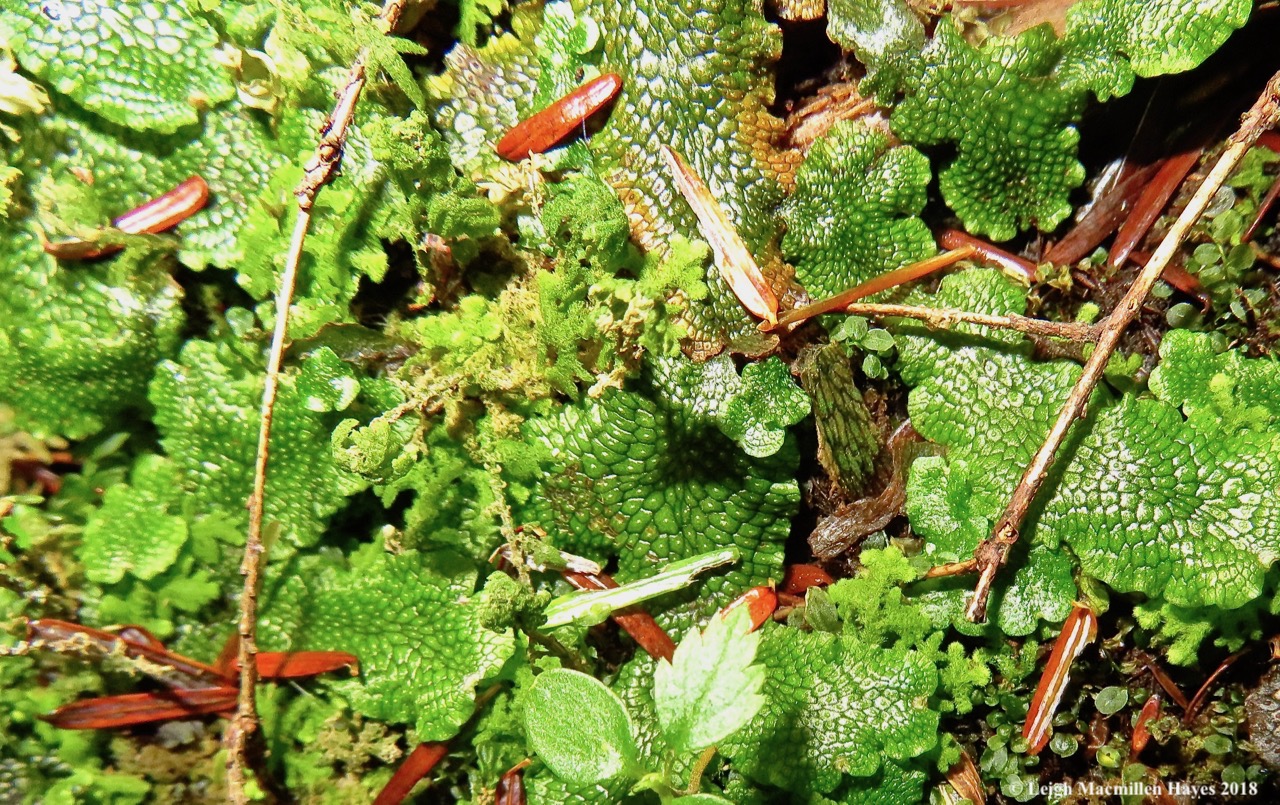
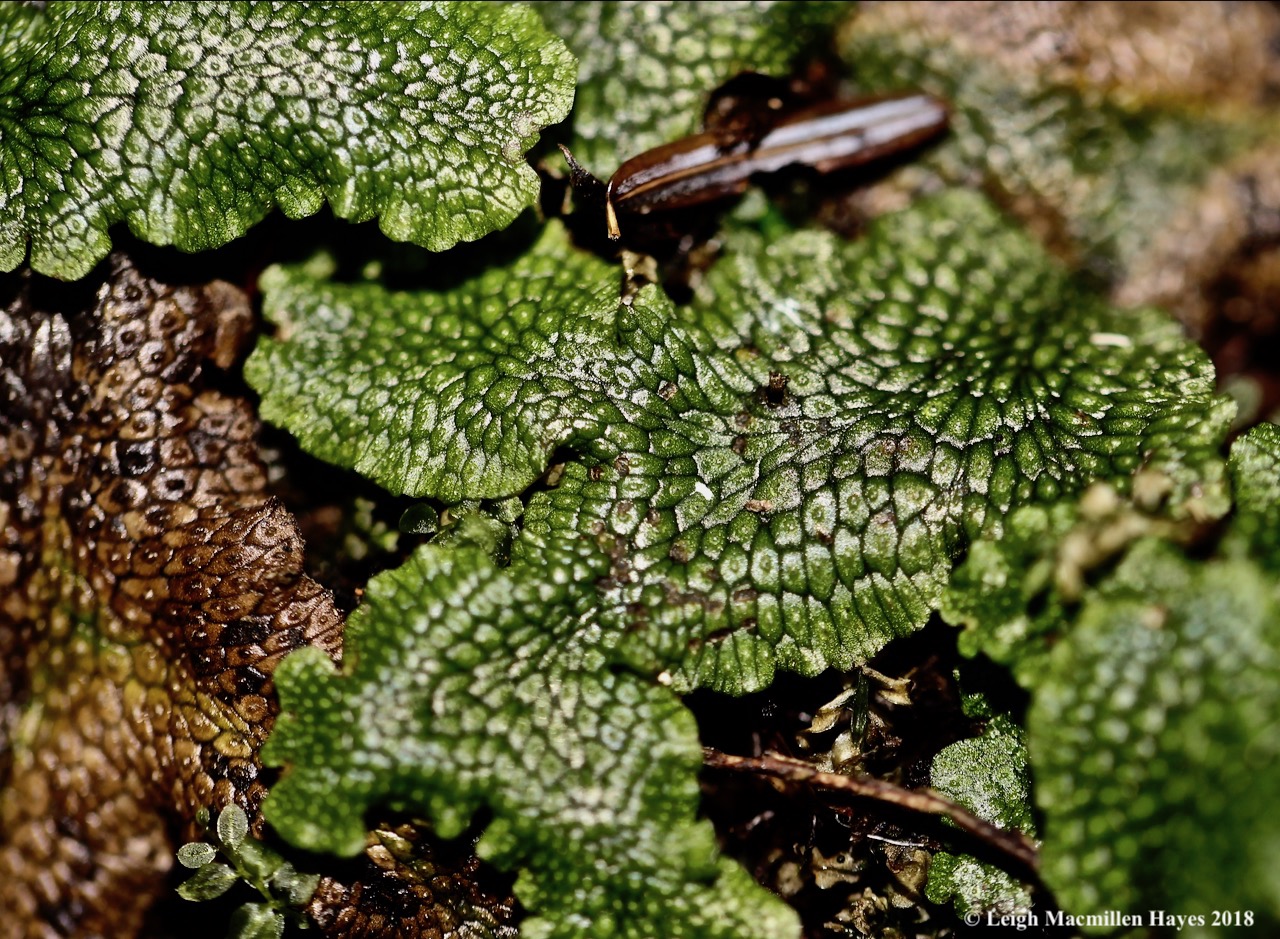
Because we were beside the brook, and we’d seen this species before, we searched each and every rock and weren’t disappointed. Conocephalum salebrosum showed off its snakeskin-like leaves.

8b-cono

The conspicuous grooves of the thalli on this liverwort defined the surface and gave it that snakeskin appearance.

12-Moose Pond Bog

Continuing on, we finally reached the platform and climbed up to look out toward Moose Pond Bog. Of course, we hoped to see a moose. No such luck. We did spy one dog named Bella and her owner, Meg Dyer, the Lovell Rec Director, out for a Sunday walk in the woods. But they were on the trail below us and not in the bog. One of these days . . . maybe we’ll see a moose. When we least expect it, that is.

12-winterberry fruits buried

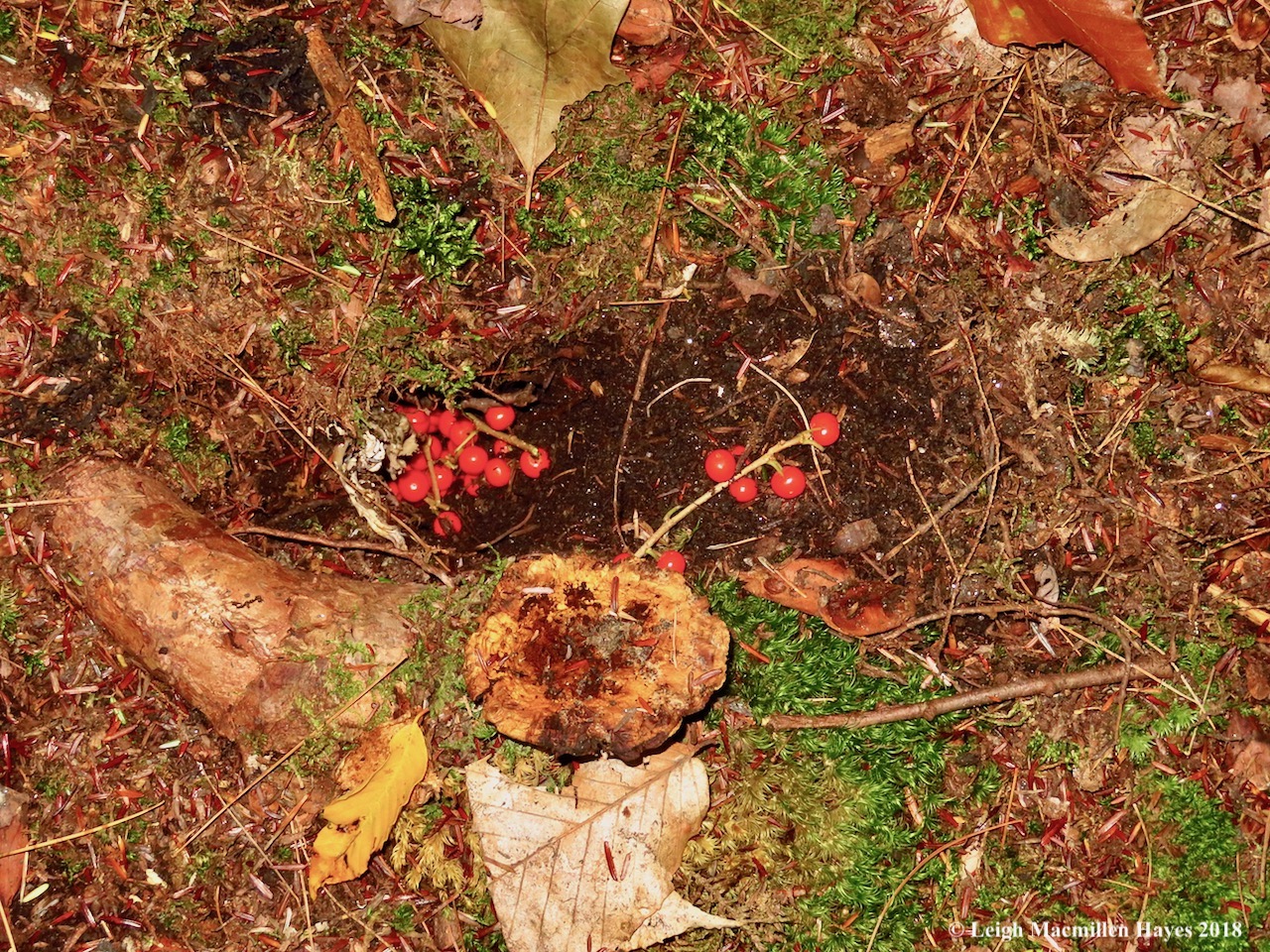
Back on the trail ourselves, our next great find–winterberries in a recently dug hole about four inches deep. Who done it? We poked the hole with a stick and determined that it didn’t go any deeper or have any turns, such as a chipmunk might make. Nor did it have a clean dooryard, which they prefer. Turkey? Perhaps. Squirrel?

13-winterberries among midden

We think we answered the question for on top of a tall hemlock stump that has long served as a red squirrel diner, some red winterberries appeared among the pine scales left behind.

14-liverwort?

Almost back to the road, we crossed the final bridge and then backtracked. We knew our destination was up the streambed it crossed over and were thankful that it held not much water. That meant we could climb up and take a closer look at the large boulders in the middle. And it was there that we made a new discovery.

14a-Peltigera aphthosa

You see, in the past we’ve not been able to get too close to the boulders and from a bit of a distance we were sure we had looked at more snakeskin liverwort. But our ability to get up close and personal today made us question our previous assumption. Suddenly, the gray-green leafy structure took on a more lichen-like appearance. Though its color wasn’t the same, it very much reminded me of rock tripe.

14c-Peltigera aphthosa

We studied its lobes and structure, including the tiny warts and questioned ourselves as we continued to examine it. I kept thinking it was an umbilicate based on the way it adhered to the rock substrate.

14b-Peltigera aphthosa

A little research and I think I’ve identified it correctly, but know some will alert me if I’ve assumed too much–Peltigera aphthosa, aka Freckled Pelt Lichen, also called Spotted Dog Lichen. The bright green center indicated it was wet. From borealforest.org, I learned that the little warts contain tiny colonies of cyanobacteria, which supply the lichen with nitrogen.

15-Racomitrium aciculare?

And right beside the lichen, we found a moss that also reminded us of a liverwort for it resembled Bazzania. But . . . if I identified this correctly, it’s Racomitrium aciculare. Some know it as Yellow-fringe Moss.

15a-Racomitrium

In his book, Mosses, Liverworts, and Hornworts, Ralph Pope described it as “common on wet rocks along streams and under waterfalls.” In watery seasons for this particular stream, that would be its exact location–under a waterfall.

16-dry stream bed

Today, the stream bed leading down to Moose Pond Bog and Sucker Brook was just about dry. But . . . because of that we were able to take a closer look.

In fact, it took us almost four hours to follow the mile or so trail, but it was all about taking a closer look through our 10X lenses and cameras, slowing down our brains,  and channeling our inner Nancy Drew as we paid attention to clues and tried to decipher the scene around us–all the while detecting the nature of Wilson Wing.


A Slice of Life in the Rookery

We only had an hour and we had a task to accomplish as citizen scientists for Maine IF&W’s Heron Observation Network. Our mission, which we chose to accept, was to count the number of nests, the number occupied, the number not occupied, the number with residents, the number of immature, the number of mature, the number of . . . you get the picture.

h1b-rookery

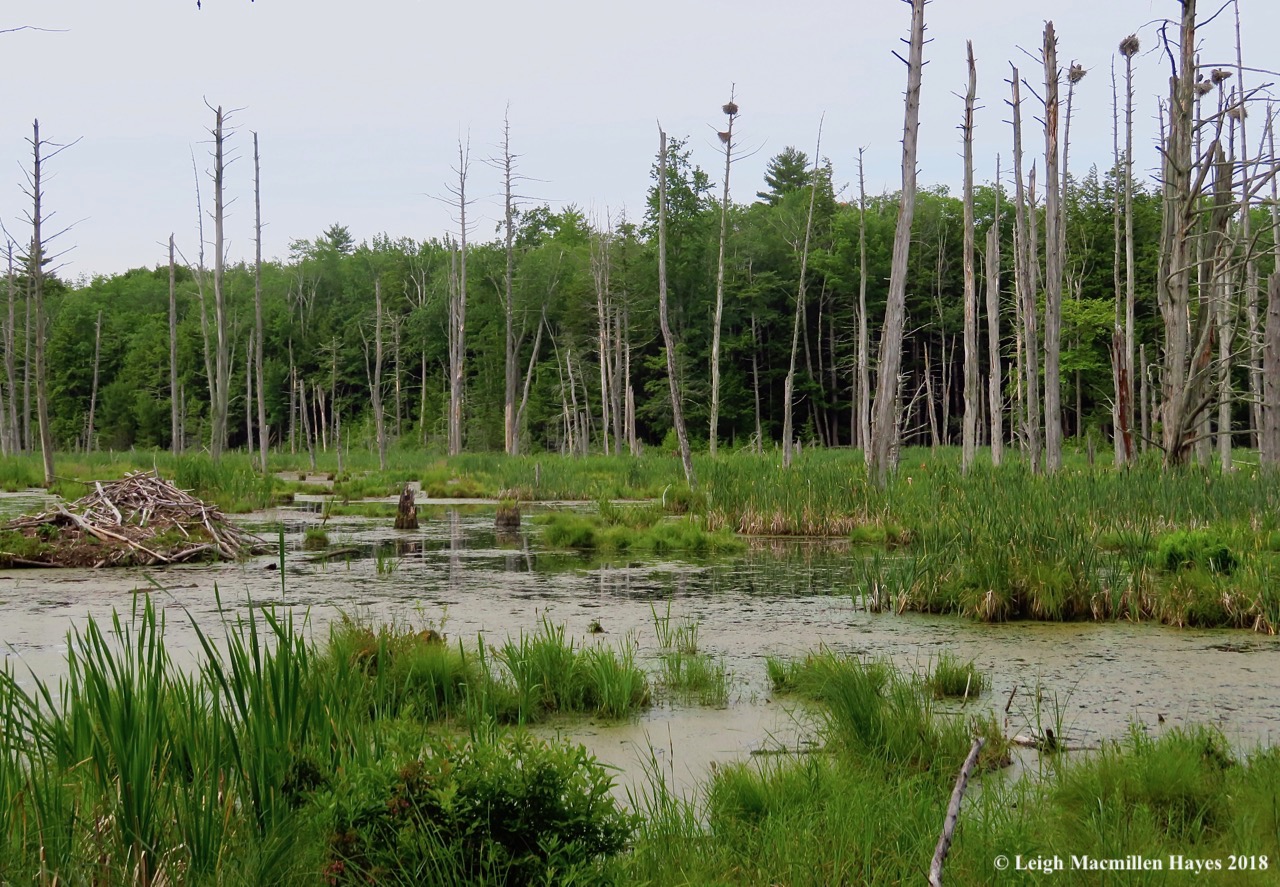
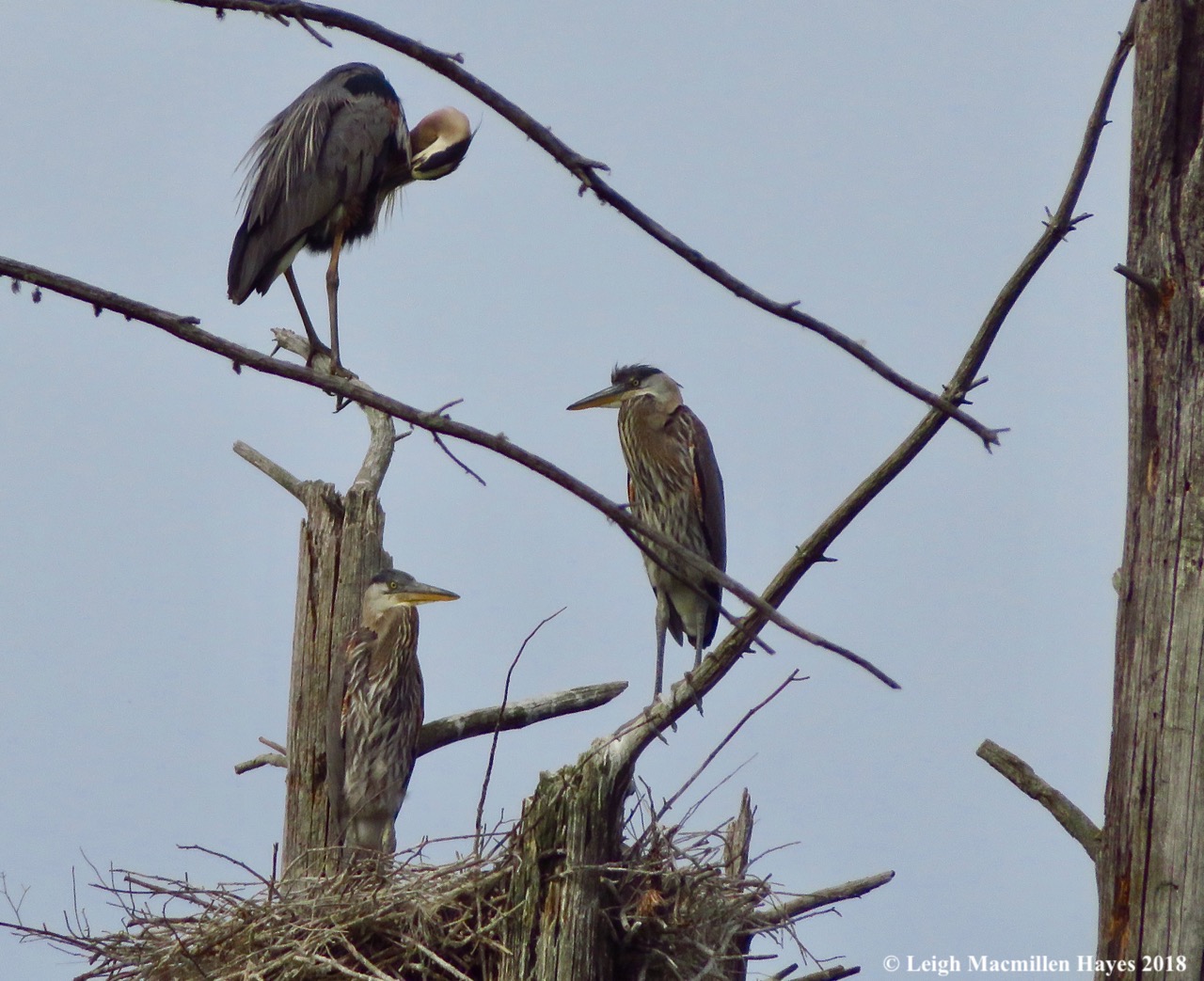
In the past, this was the largest inland rookery in the state and supported 40+ active nests, but over the last few years the numbers had dwindled and today we found only nine. Of those nine, three were inactive. Where have all the birds gone, we wondered.

h1-wood duck

As we started to focus on the scene before us, one member of our team spotted a wood duck surveying the beaver pond from a limb on one of the many old snags.

h2a-heron chick

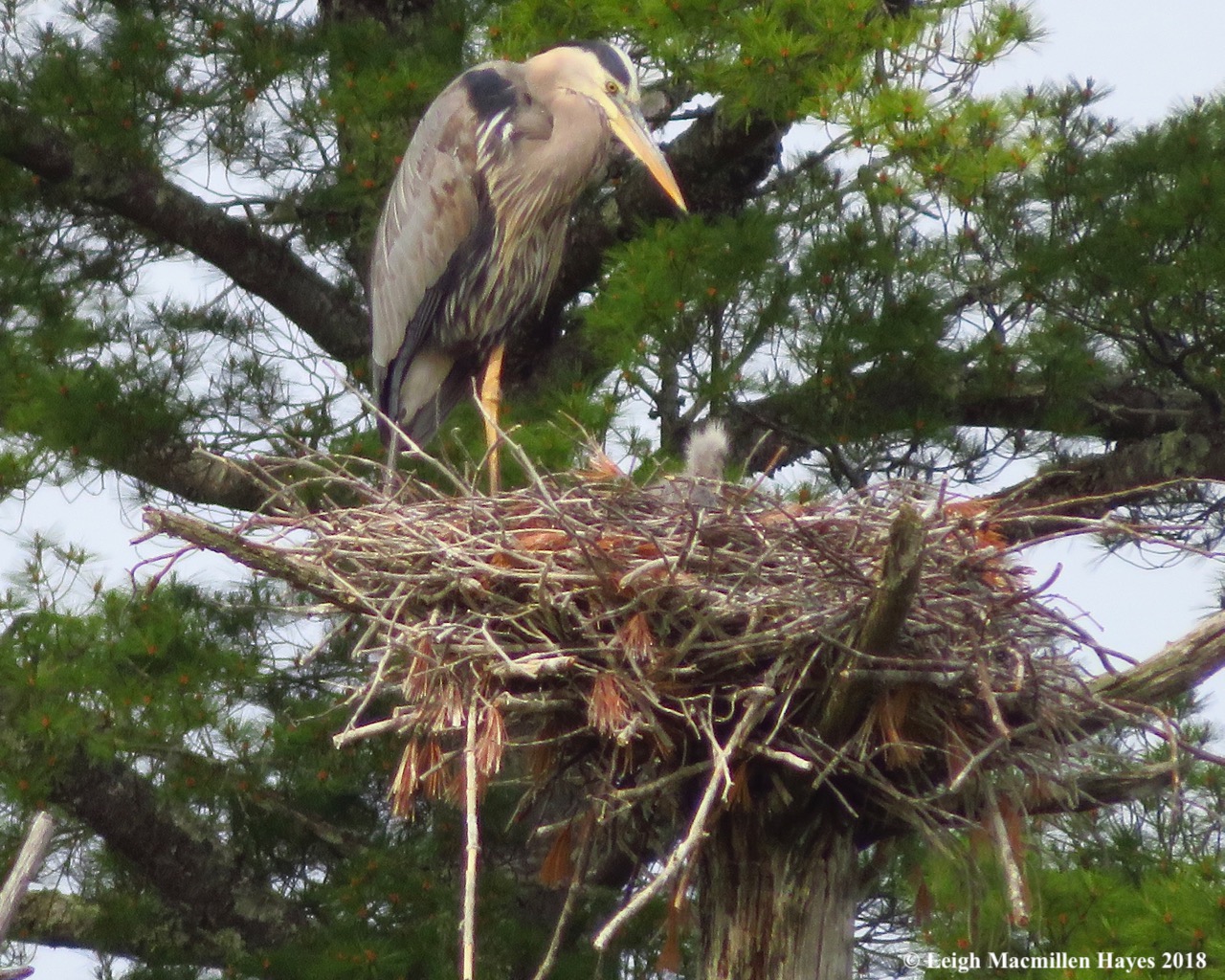
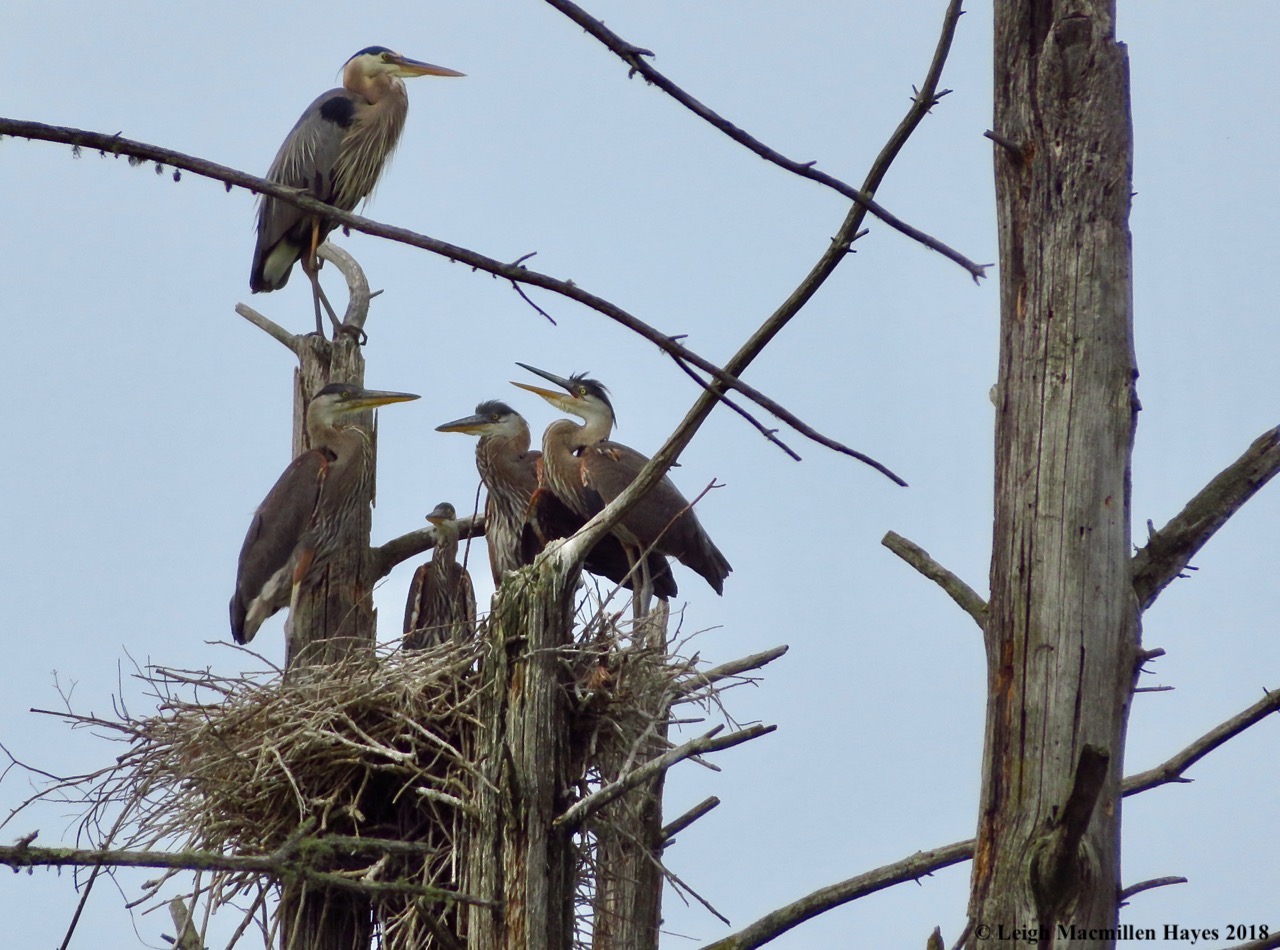
And then we looked upward. Counting isn’t always easy–in fact, it’s never easy. One immature–check. More than one? Well, we could see a lump representing another bird. Was it one lump or two? Over and over again, we counted.

h3-standing still

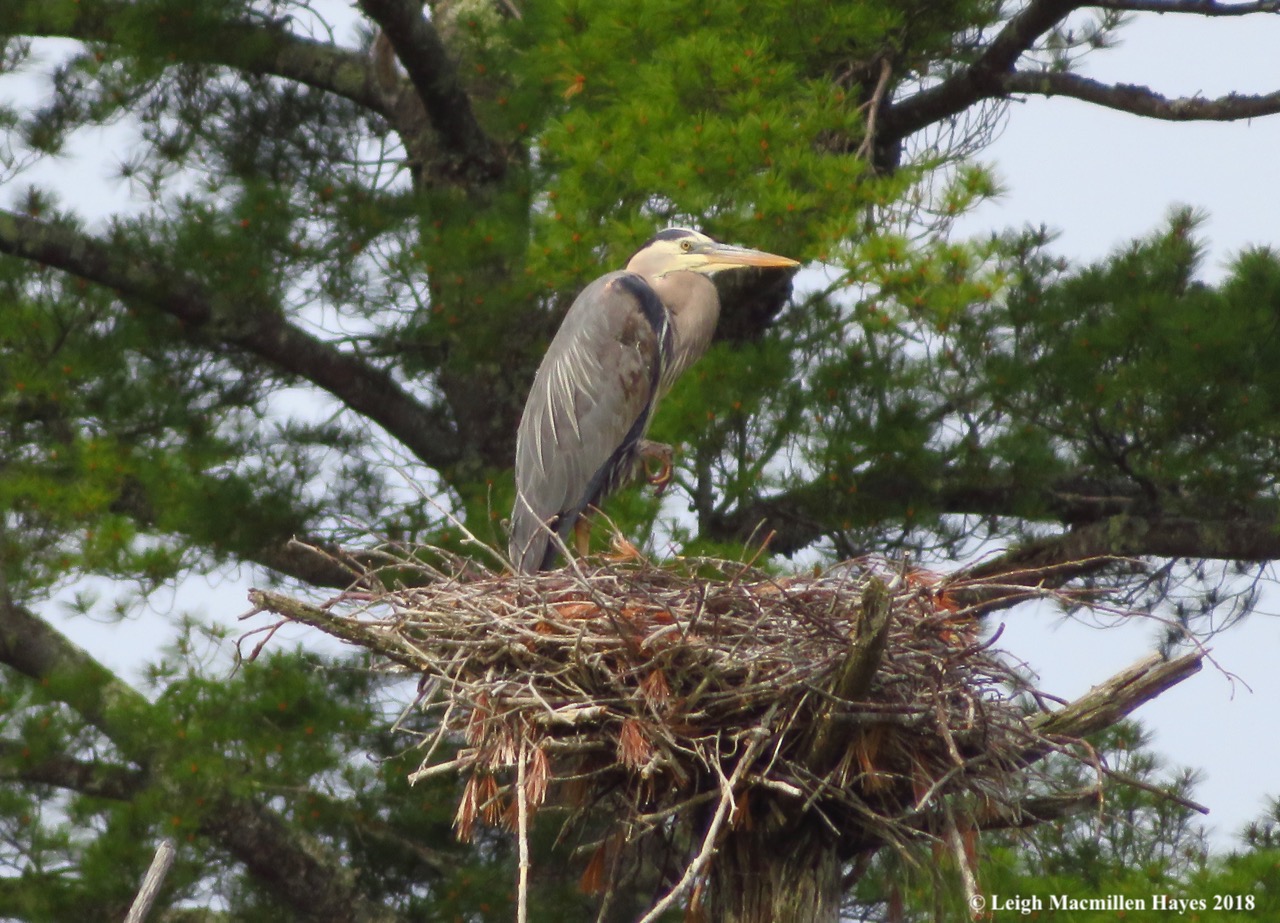
And then there was this nest that was hidden from our sight at first, only because it seemed to blend in with the pine tree behind it. Again we wondered–why was this adult standing on it? Was this a sentry watching over all of the nests why the other parents were off fishing? Usually, though, experience told us that sentrys stood on higher branches–the better to watch for predators.

h29-sentry

Like this.

h2-otter

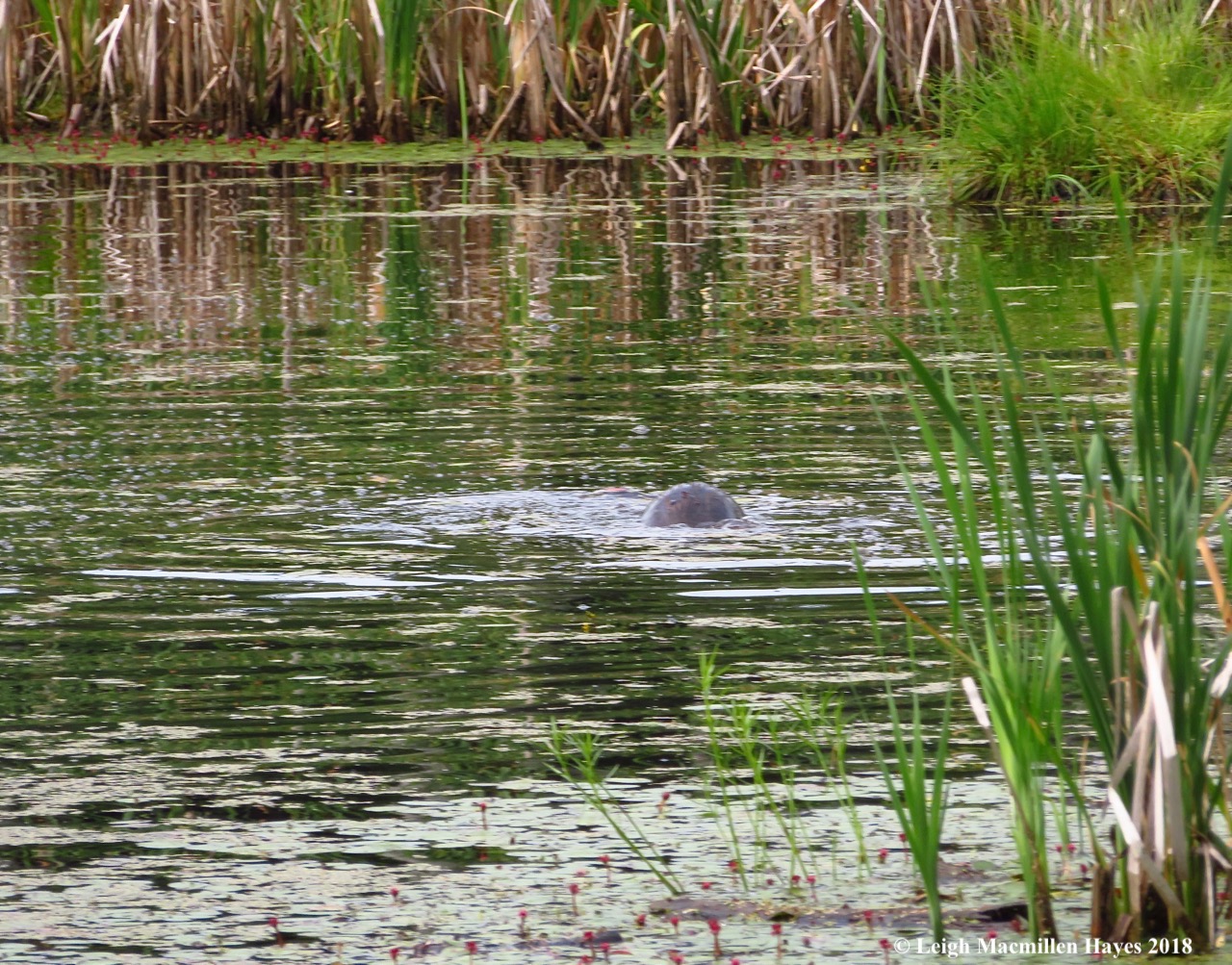
Suddenly we heard a commotion in the water and noticed action near the beaver lodge. What was it?

h4-incoming

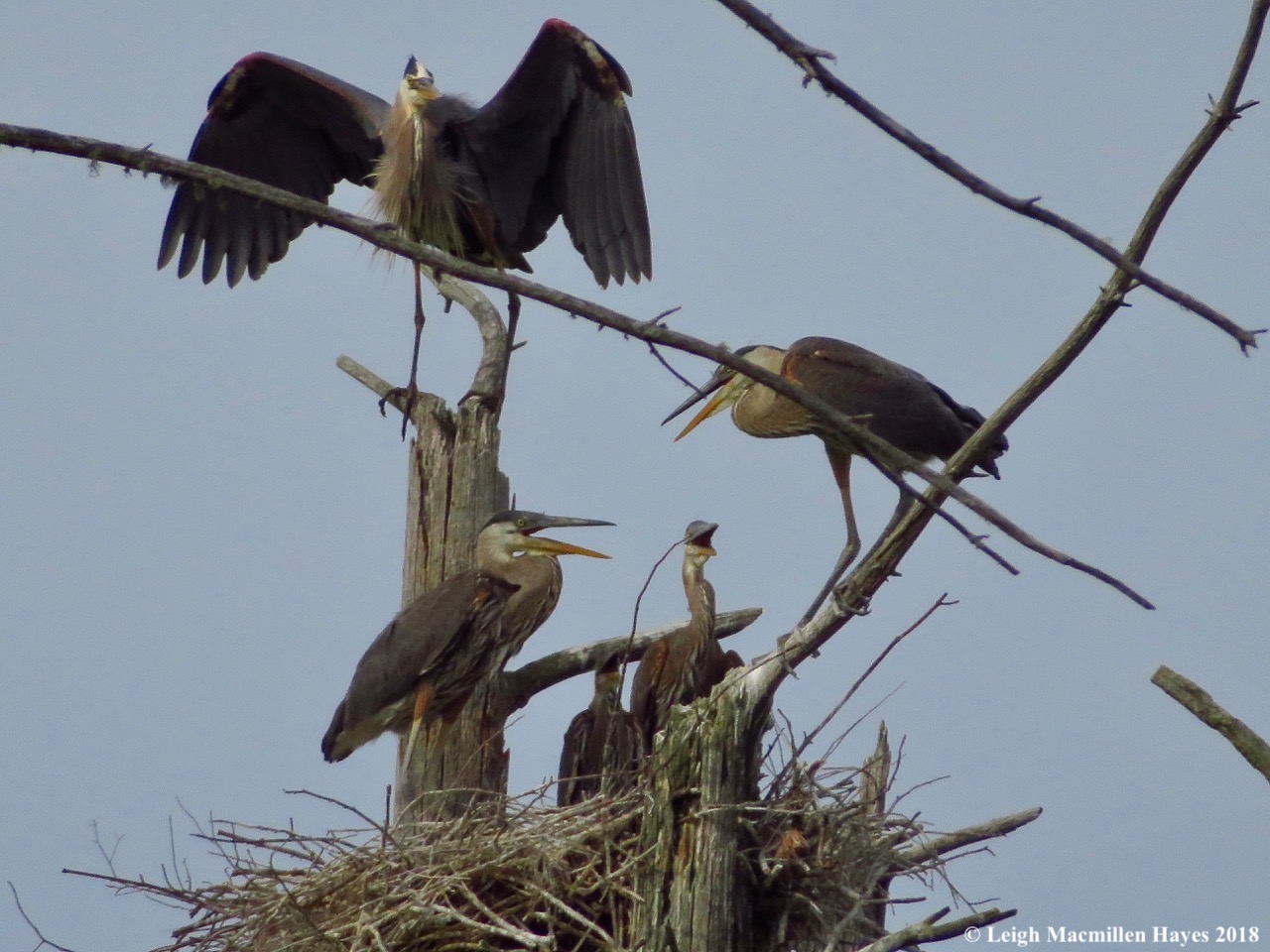
And then the sound of the youngsters crying frantically made us look upward again, where we spied an incoming adult.

h5-landing

The kids exclaimed their excitement because a meal had certainly arrived.

h6-begging for food

We could almost see their smiles as they anticipated the goodness they were about to receive.

h7-what? No food?

But . . . no food was regurgitated despite the kids’ squawks.

h9-meanwhile-mouths have closed

Finally, they quieted down and looked rather disgusted.

h10-preening

And Momma preened.

h11-wood duck family

Back in the pond, a family of Wood Ducks swam among the flowering Watershield.

h12-movement above

And up again, we noticed slight movement in the nest.

h13-a chick with downy feathers

Could it be?

h14-red winged

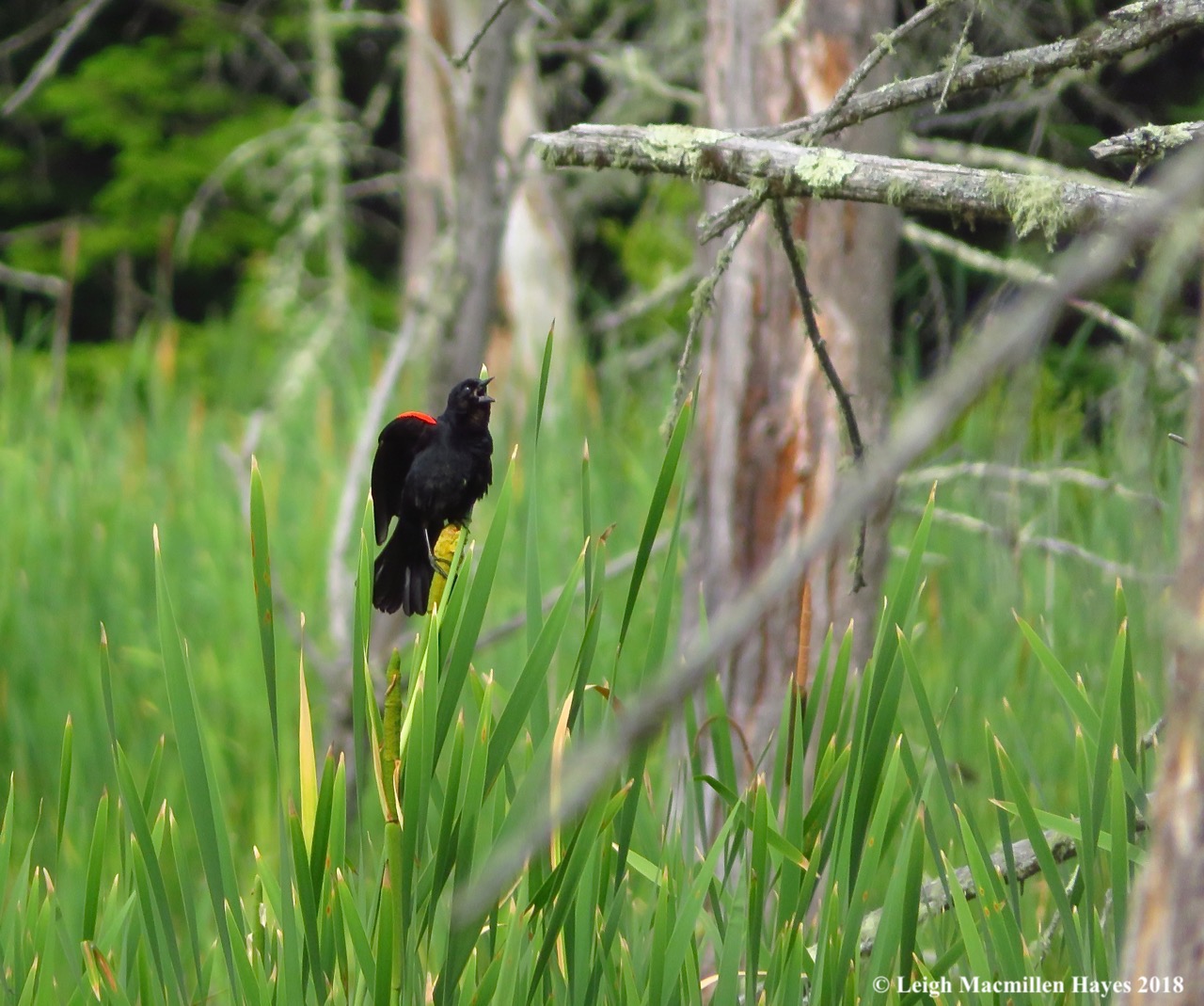
Before we answered the last question, a Red-winged Blackbird paused . . .

h15-singing

sang . . .

h16-did you hear me?

and looked around as if to say, “Did you hear me?” We did.

h17-another incoming

More squawks from above and we saw another adult fly in.

h18-what did you bring?

It seemed Dad had joined Mom and the family was complete.

h19-I'm off

But only for a second, as Mom took off.

h20-snacks?

“Where’d Mom go?” and “What’s to eat?” was all Dad heard.

h21--watching from nearby

She didn’t go far, but like all mommas, she needed a few minutes of time to herself.

h21-baby chick revealed

Meanwhile, back by the pine, that little bit of fluff moved some more.

h22-stretching my wings

And someone else needed to stretch his wings.

h24-otter again

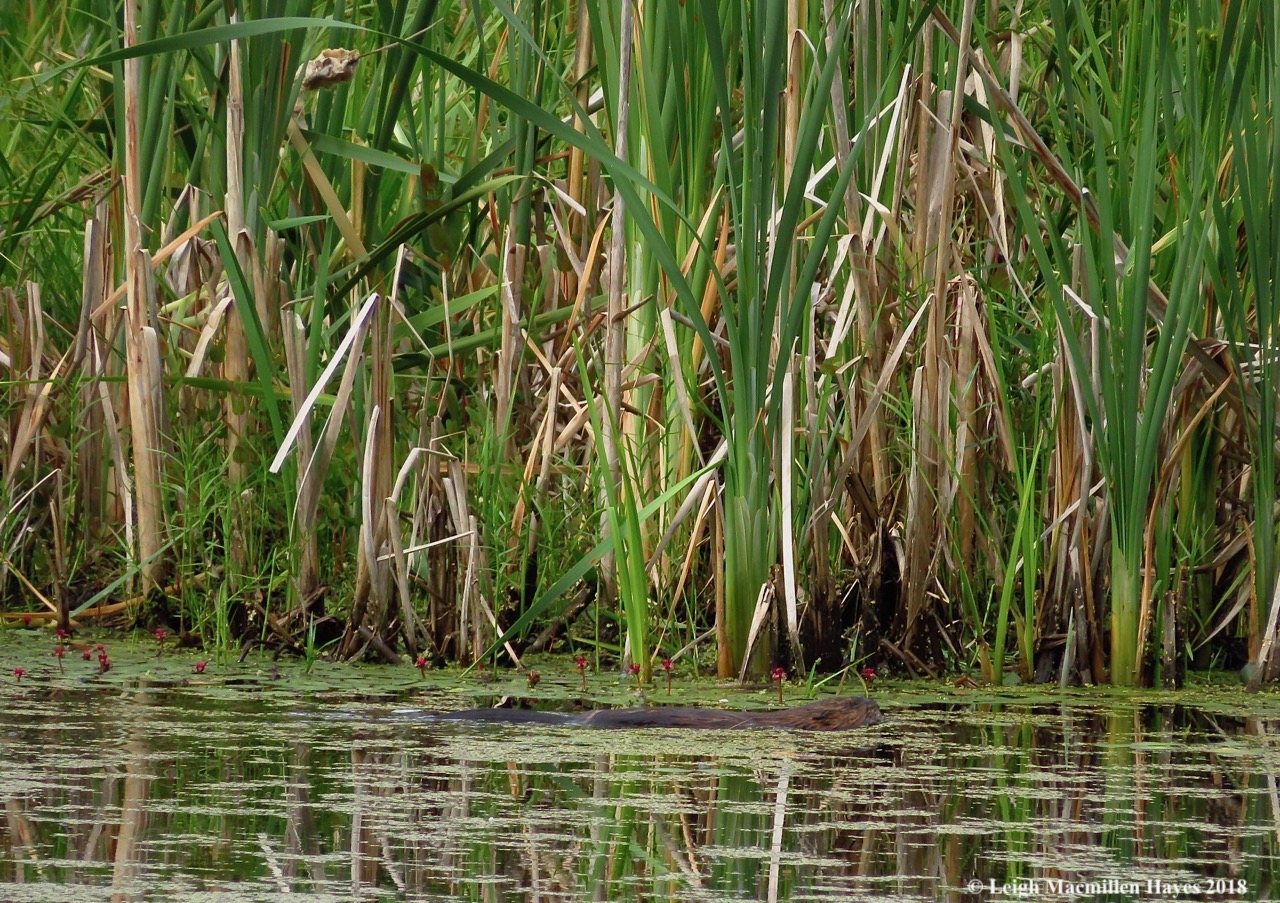
It was like watching a tennis match, for our eyes moved back and forth, up and down–especially when we heard movement in the water again and saw the same something undulating through the water.

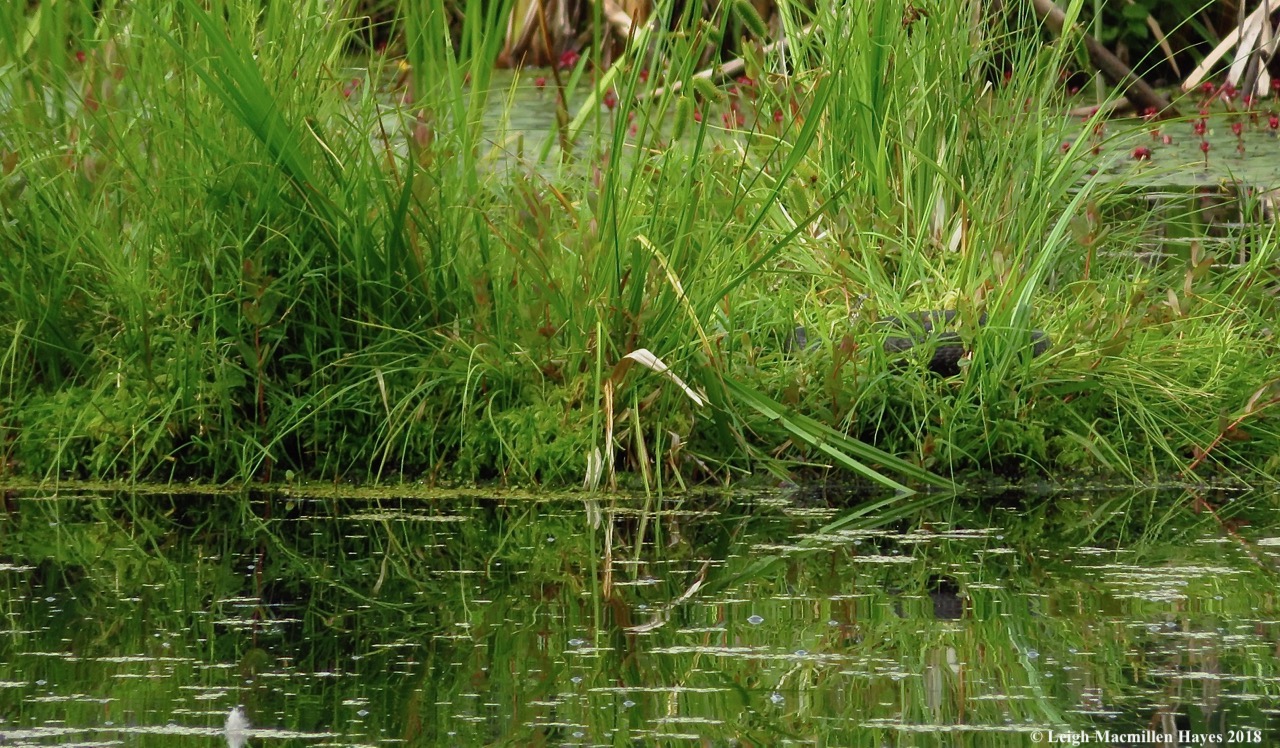
h26-water snake

We weren’t the only ones watching all the action from a hidden location–a water snake on a hummock across the way did the same.

h28-don't you have any food?

Skyward, the family unit came together again. And still no food. The kids were getting impatient.

h30-have a stick

And then one parent left briefly and returned–with a stick for the kids to add to the nest, perhaps heron-speak for clean the house first and then you’ll get a snack.

h31-what's he thinking?

“We did it,” they tried to tell her, but Mom had her eyes on something else.

h27-beaver again

Her focus wasn’t on the beavers that swam back and forth below. Oh, and if you think this is the hump that had been making the water boil, you are mistaken.

h32-there he goes again

“Mom, bring back lots of fish . . . pleeeeease,” the kids cried as she took off again. “We’ll even eat frog legs.”

h33-picking twigs

But she had her eyes on other things–sticks from one of the abandoned nests.

h34-got one

She pulled one out.

h36-did you see what he just did?

And the kids looked away and one complained to Dad about all the housework they were expected to do and they still hadn’t received their allowance.

h25-checking us out

Unfortunately, it was time for us to head to work, but our undulating friend returned.

h37-otter

Great Blue Herons, Wood Ducks, Red-winged Blackbirds, Water Snakes, Beavers . . . and a River Otter! A slice of life in the rookery.


Celebrating Place–Naturally

Once the snow melts it will be more difficult for me to wander and wonder in the woods I explore all winter given its spring/summer water level and logging slash. And so I make the most of these days–trying to notice as much as I can before I can notice no more (or at least until next winter).

l-bushwhack 1

Though I’d promised myself I’d not go again in an effort to not disturb the deer, promises are meant to be broken. And from that came a lesson–the deer are sticking to the snowmobile trail and field edges where tender bark of young red maples and hemlocks, plus swelling buds meet their needs for the moment. So, it was OK that I broke my promise, for the deeper I tramped, the fewer tracks I encountered.

l-spring tails1

Today’s warmer temps in the low 40˚s found the springtails hopping about on any and all surfaces.

l-pileated hole

As is my habit, I checked on a pileated woodpecker hole when I saw bark and wood scattered atop the snow. Deep was this excavation in search of nourishment.

l-pileated scat-seeds and ant

And chock full was the scat below, which contained insect body parts and seeds of the dreaded bittersweet. Beside the scat, a springtail sought to placate its own food needs which among other things includes plant material and animal remains.

l-red maple bull's eye

Turning to another tree, I landed on a perfect bull’s eye! The target fungus that affects many red maples makes for an easy ID.

l-crustose, liverwort and moss

Lichens have also been a focus of late. What I like about this one, the circular green with the black disks of a crustose lichen (possibly bark disk lichen), was its location beside a liverwort (the beaded brown Frullania eboracensis) and a moss that I didn’t key out. Tree bark has its own structure and texture, but so often others also call it home.

l-shield lichens on rock

Rocks also serve as a substrate and this one featured a couple of leafy foliose shield lichens, their colors enhanced by yesterday’s inch of snow.

l-hair lichen and beard lichen

And dangling from a branch, two forms of fruticose (branching or fruit-like structure–) lichens. The dark is a hair lichen, while the green a beard–seems about right with the hair above the beard.

l-lichen garden

On another maple I spied a garden–you’ve got to liken it. (Corny joke that always manages to enter a lichen conversation.)

l-frullania 1

I’ve often paused beside Frullania eboracensis, a liverwort with no common name, but today several trees shared displays of mats called Frullania asagrayana, so named for a botanist and natural history professor at Harvard University from 1842-1873–Asa Gray.

l-frullania asagrayana 1

Its shiny, overlapping chain of red-brown leaves reminded me of caterpillars crawling along the maple bark.

l-spirea:steeplebush

Casting my eye elsewhere, steeplebush in its winter form offered an artistic presentation.

l-bracken fern1

And as the snow melts, last year’s bracken fern made an appearance.

l-speckled 3

One last shrub made me stop. Minus any catkins or “cones” for which it is known, I had to think for a moment about the speckled alder. But those speckles or lenticels through which gas exchange occurs, and the buds and leaf scars were give aways.

l-speckled buds and leaf scar

The two bud scales meet at their edges and look like miniature footballs. But it’s the bundle scars where leaves were formerly attached that make me laugh. That vascular system looks like a face–two round eyes, a funny shaped nose and a round mouth, as if it’s exclaiming, “Ohhh” or “Wow.”

l-Pleasant Mtn in background

At last I reached my turn-around point. I could see Pleasant Mountain in the distance and knew where I was in the world. This is my place and I love every opportunity to celebrate it–naturally.

Everybody Loves Raymond? Mondate

My guy and I were up for an adventure this morning as we headed off to a property recently acquired by Loon Echo Land Trust. I’d been there once before, but at that time there was no trail system and I certainly hadn’t climbed to the summit.

r-forest-climb

We were on a 356-acre property bisected by a paved road. First, we hiked the upper section, passing through a hardwood forest.

r-white-oak-green-leaves

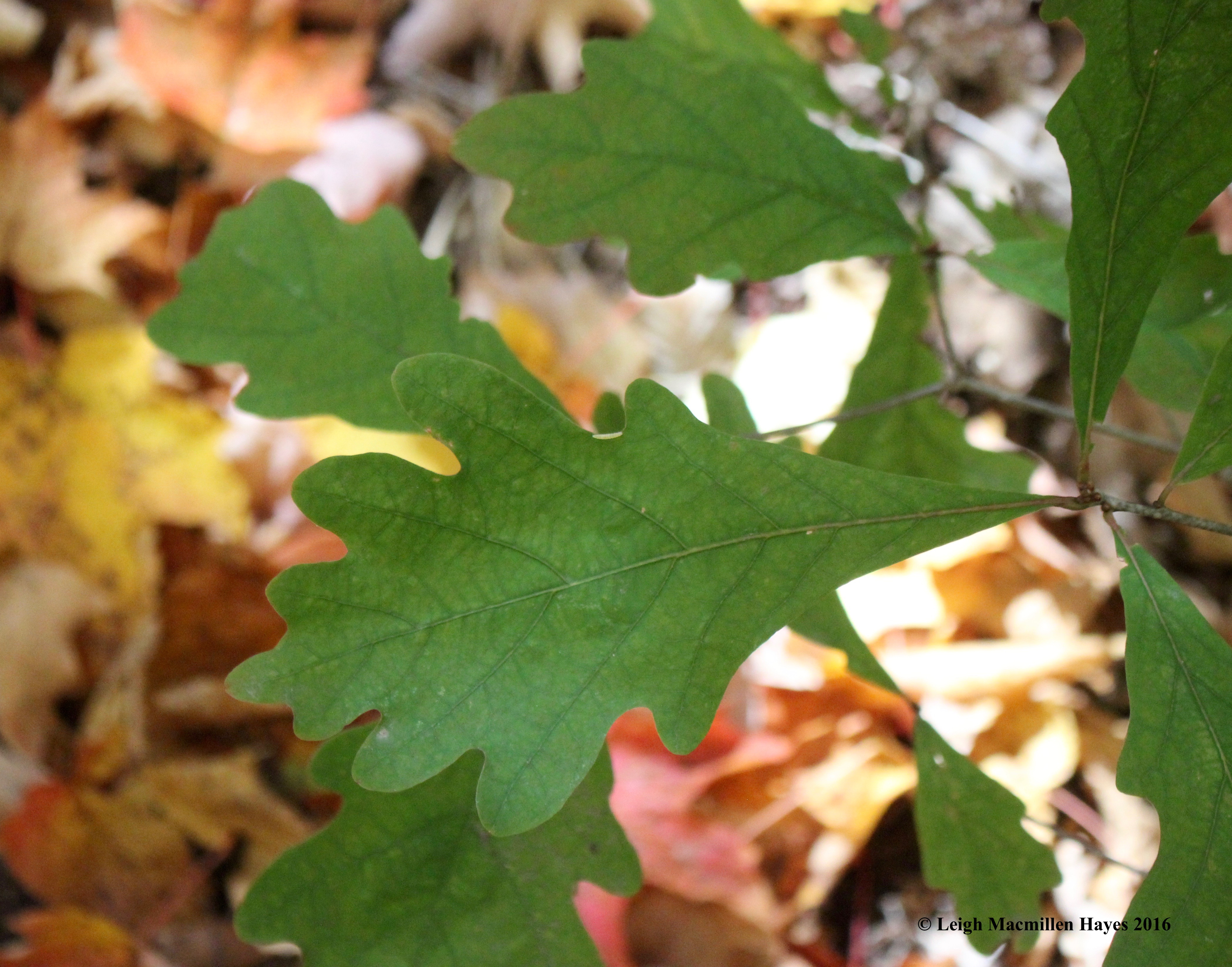
Immediately, I realized we were in the presence of one of my favorites–noted for the mitten-ish presentation of its leaves. One would have to be all thumbs to fit into this mitten, but still, my heart hums whenever I spy a white oak.

r-white-oak-red-color

Or in this case, many white oaks, some exhibiting the wine color of their fall foliage.

r-white-oak-bark

And the bark–a blocky look that differs greatly . . .

r-red-oak-on-bm1

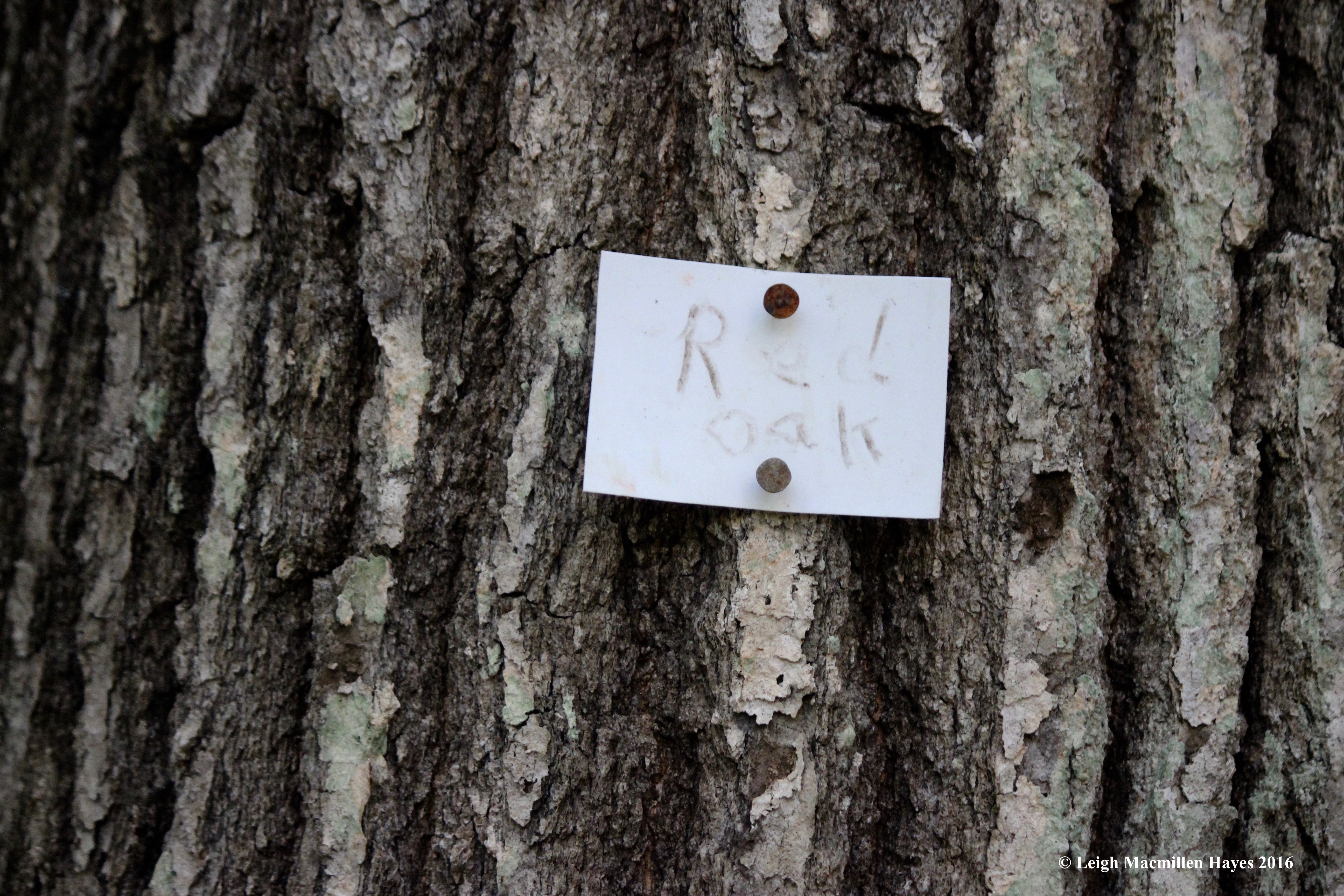
from the ski trail ridges of red oak.

r-hophornbeam-bark

Hop Hornbeam also grows abundantly in this forest.

r-approaching-forest-summit-yellow

As we neared the summit, we noticed that the sky view had a yellowish tone reflected by the ground view. Most trees were of the same age due to past logging efforts, but the predominant species was sugar maple.

r-basswood-2

Another favorite tree also grew abundantly here. I think they are also favorites because I don’t see them as often. In this case, the bark, though furrowed and ridged like a northern red oak, featured an almost combed flattened ridge.

r-basswood-leaf

And its leaves–oh my! Notice the asymmetrical base? And the length–my boot is size 8. American basswood–an important timber tree that is known to share the community with sugar maples and hornbeams–all of which provided that yellow glow.

r-raymond-summit-view-1

At last, we reached the vantage point.

r-skyward

Above us, a mix of colors and species.

r-oak-leaves

Before us, a mix of white and red oak leaves.

r-crescent-view-3-1

And beyond us, the view of Crescent Lake

r-crescent-rattle-1-1

and Rattlesnake Mountain.

r-ladybird-1-1

While we admired the view, ladybird beetles (aka ladybugs) swarmed us. Well, not exactly in swarm formation, but more than is the norm.

r-green-trail-tag

After admiring the view for a while and wondering about the ladybirds, we backtracked a bit and decided to explore the green trail, assuming that it looped about the summit.

r-dry-leaf-sound

The trail conditions changed constantly, and one thing we realized was that the leaves had dried out and we wished we could have bottled their scent along with our crispy footfall as we trudged through–the smells and sounds associated with autumn.

r-bear-claw

Eventually, we entered a beech commune and what to my wondering eyes should appear–bear claw marks? We ventured closer, circled the tree and looked at others in the neighborhood before determining that our eyes had perhaps played a trick on us.

r-garter-snake

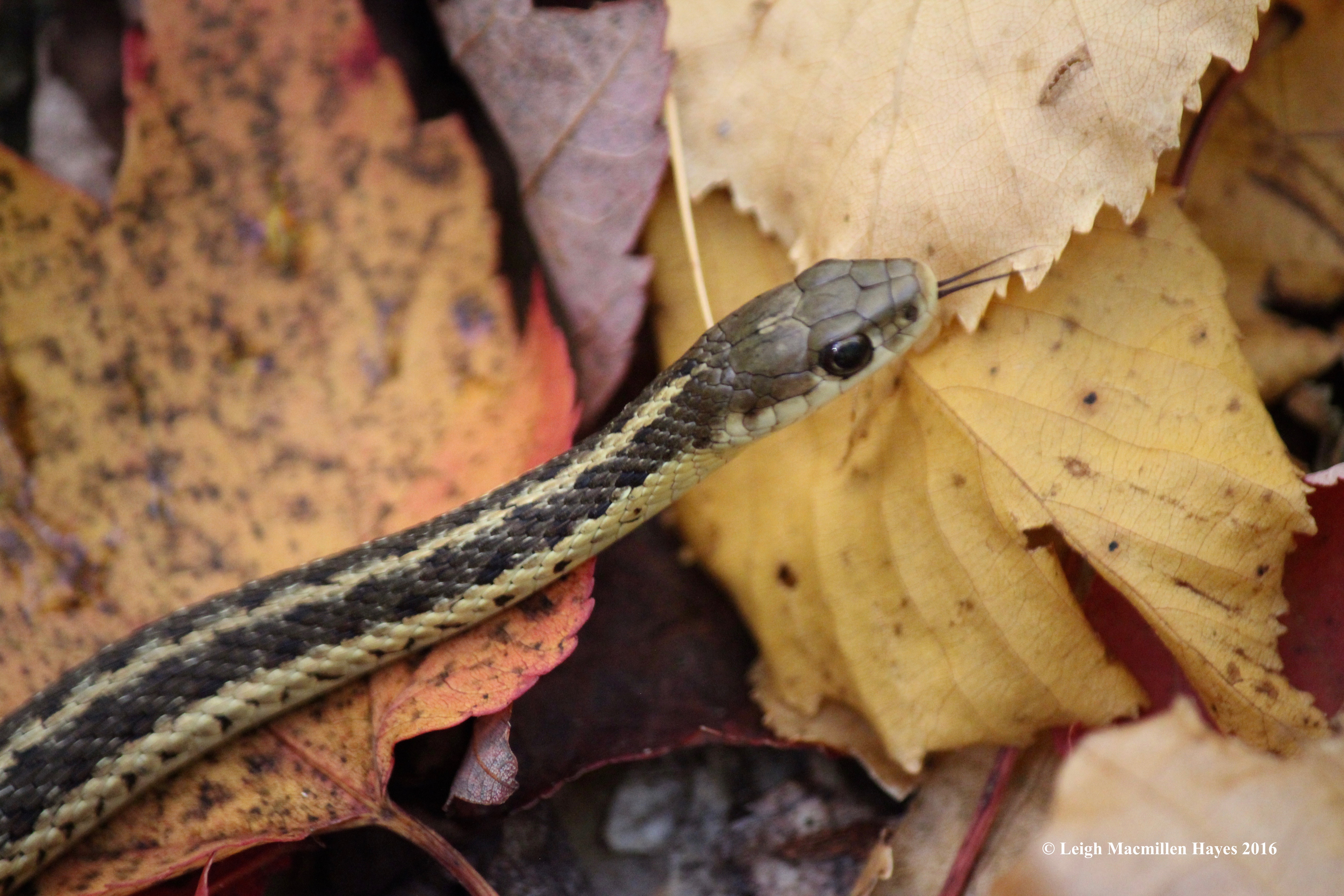
That was OK because within seconds a twig moved at our feet.

r-snake-tongue

We watched as its tongue darted in and out, red tipped with a black fork.

r-lunch-rock

Finally, we moved back to what we’d named Ladybird Lookout and found lunch rock where we topped off sandwiches with Bailey’s Irish Cream fudge a la Megan and Becky Colby. Life is good. Life is very good. (And we know a town in western Maine that would benefit greatly from a bakery–just saying, Megan!)

r-trail-ribbon-art

After lunch, we climbed back down and crossed Conesca Road to check out trails on the other side. There is no trail map just yet, but we never got lost. And we appreciated the artwork nature created of manmade marks.

r-forest-across-the-street-stonewall

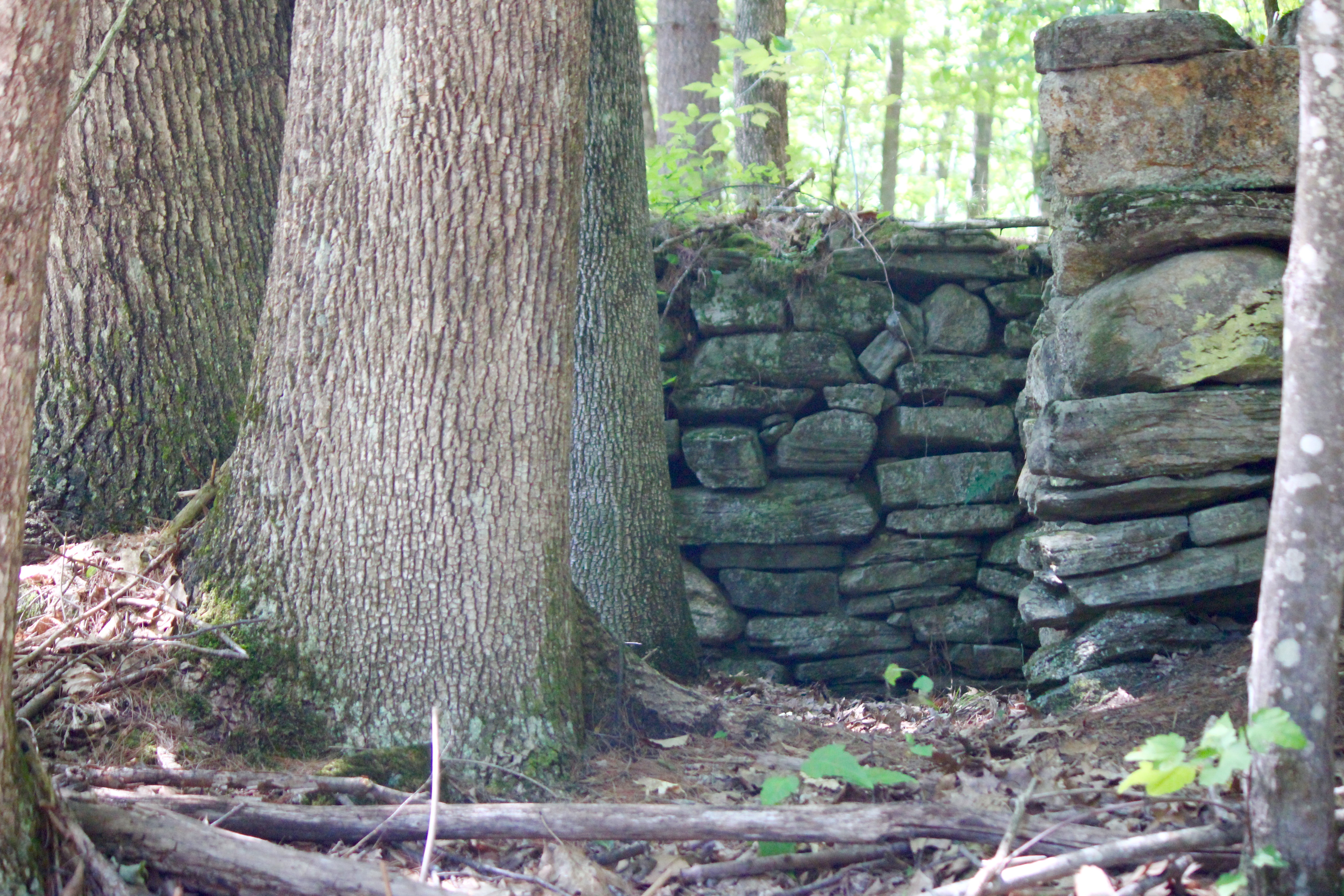
This space offered a different feel where hardwoods combined with softwoods. And more stonewalls crossed the property, speaking to past uses.

r-hole-pink-flags

It’s here that we noticed an area demarked by pink flags and stopped to wonder why. Note to self–excavated hole and debris mean beware.

r-bee-himve

Upon closer examination, an old hive. So who dug it up? We had our suspicions.

r-mushrooms-1

We also noticed a fungi phenomena.

r-mushroom-growth

Fungi on fungi? Honey mushrooms attacked by something else?

r-mushroom-growth-3

The displays were large

r-mushroom-fungi

and otherworldly. I don’t recall ever seeing this before.

I sent the photos to Parker and Jimmie Veitch, of White Mountain Mushrooms, and Jimmie responded with this explanation:

“That’s what mycologists call “rosecomb” mutation, where a mushroom’s gills start forming on the cap in a really mutated fashion. It’s been reported in many mushroom species but I haven’t seen it in this one (Armillaria AKA honey mushrooms). As far as I know, no secondary fungus is involved.

The suspected cause (not so nice) is ‘hydrocarbons, phenols and other compounds contaminating the casing or contacting the mushroom surface. Diesel oil, exhaust from engines, and petroleum-based pesticides are thought to be the principal source.'”

r-red-leaves

As we concluded our visit, we passed over one more stone wall decorated with red maple leaves.

r-beginning-of-bri-mar

And then we hopped into the truck and traveled a couple of miles south to conquer another small mountain–one visible to us from Ladybird Lookout. (I really think LELT should name it such.)

r-brimar-milkweed

Here the milkweed plants grew abundantly.

r-brimar-white-oaks-in-field

In the field leading to the trail, the property owners planted white oak saplings in hopes of providing food for wildlife. Um, by the same token, they’d enclosed the saplings in plastic sleeves (reminding us of our findings in Ireland) to keep deer at bay.

r-brimar-ferns

The understory differed and ferns offered their own autumn hues.

r-brimar-evergreen-wood-fern

In contrast were the many examples of evergreen wood ferns.

r-bri-mar-beech-markings

We soon realized that quite literate bears frequented this path and announced their presence.

r-crescent-from-bri-1-1

At last, the view opened and we looked back at the opposite shore of Crescent Lake, though realizing that our earlier ascent was masked by the trees.

r-panther-from-bri-3-1

Turning about, Panther Pond came into view.

We’d spent the day embracing Raymond because everybody loves Raymond.

r-raymond-forest-sign

r-brimar-trail-sign

Raymond, Maine, that is. Loon Echo Land Trust is gearing up to celebrate the Raymond Community Forest that we explored this morning and the Bri-Mar Trail up Rattlesnake Mountain has long been traveled by many. In fact, when I used to write copy for the local chamber of commerce, I spent some time learning about Edgar Welch, who was the fastest man on foot and ran up Mount Washington at least once a year. He lived in Raymond and worked for David McLellan, who was partially blind from a Civil War injury. Because Mr. McLellan’s farm was at the foot of Rattlesnake Mountain, the sun would set one hour earlier than elsewhere in town. According to legend, after work each day Edgar ran up the mountain and moved rocks. Finally, he’d moved enough to let the sun shine on the farm for an hour longer. Another story has it that one day a man bet Edgar that he could beat him in a race to Portland. The man would race with his horse and buggy, while Edgar ran. When the opponent pulled into the city, Edgar was waiting for him. I love local lore.

And everybody loves Raymond. Well, my guy and I certainly gained a better appreciation for this town today.


In Constant Flux

Ever so slowly, the world around us changes.

h-starting-point

Sometimes it’s as obvious as the leaves that fall.

h-bee-on-flower-1

And other times, it’s a bit more subtle, evidenced by the bees that have slowed their frantic pace as they make final collections.

h-leaf-carpet

Mid morning, I headed down the cow path in search of other signs of change.

h-oak-branches-1

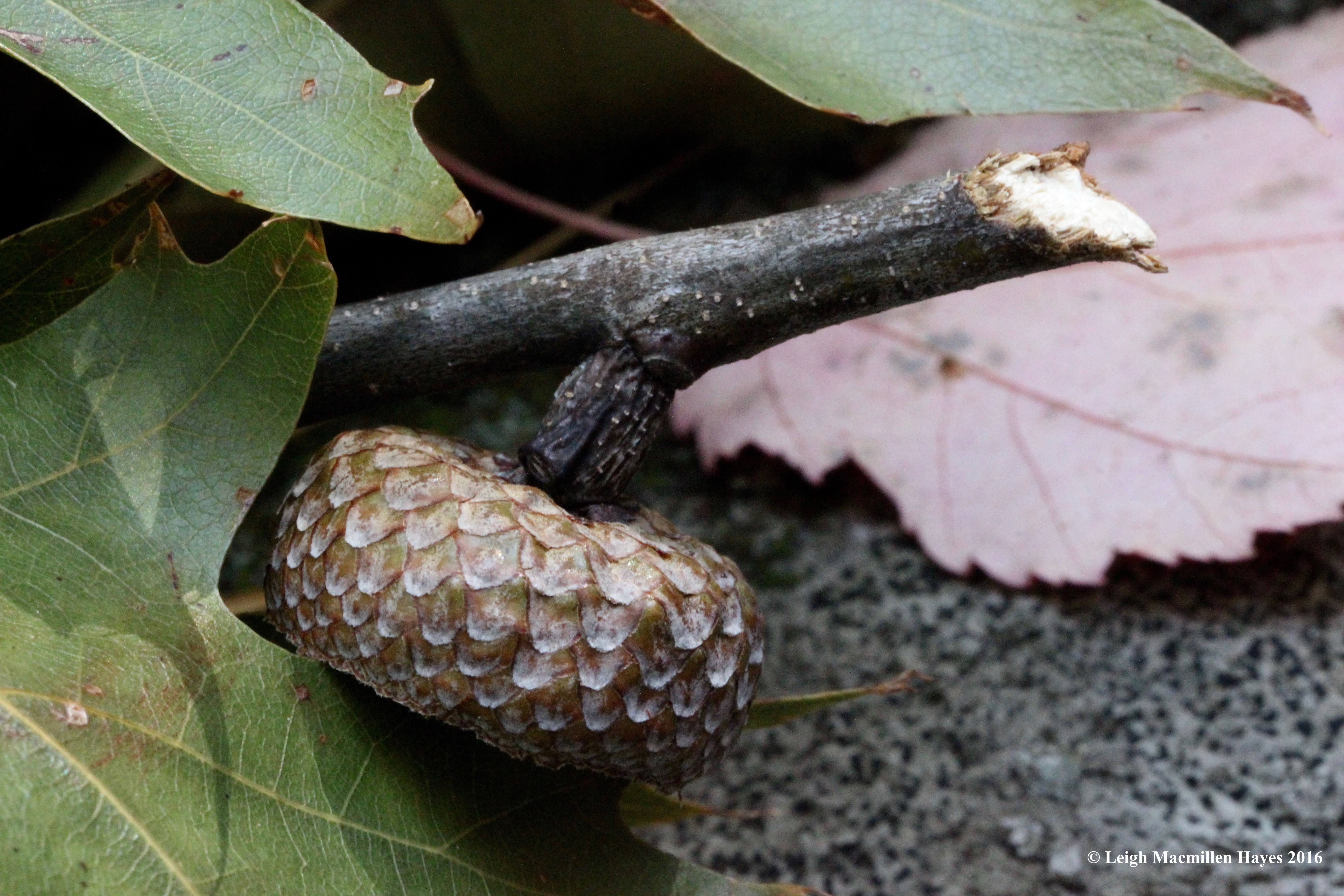
As I walked along, I began to realize the interdependence of all. Under the northern red oaks–many  chopped off twigs.

h-porcupine-works

The angled cut and empty cap indicated the work of porcupines seeking acorns.

h-leaves-on-hemlock

I found maple leaves pausing on hemlocks,

h-pine-needles-on-spruce

pine needles decorating spruce trees,

h-leaves-in-puddles

and occasional puddles offering a rosy glow. Eventually, all of these leaves and needles will break down and give back.

h-life-on-rock-1

I found life on a rock, where lichens began the story that was added to by mosses. The creation of soil was enhanced by a yearly supply of fallen leaves and needles gathered there. And then a seed germinated, possibly the result of an earlier squirrel feast.

h-orange-peels1-1

I found orange peel and many other fungi aiding the process of decomposition so that all the fallen wood and leaves will eventually become part of the earthen floor.

h-forest-succession-3

I found a healthy stand of trees and ferns competing for sunlight in an area that had been heavily logged about ten years ago.

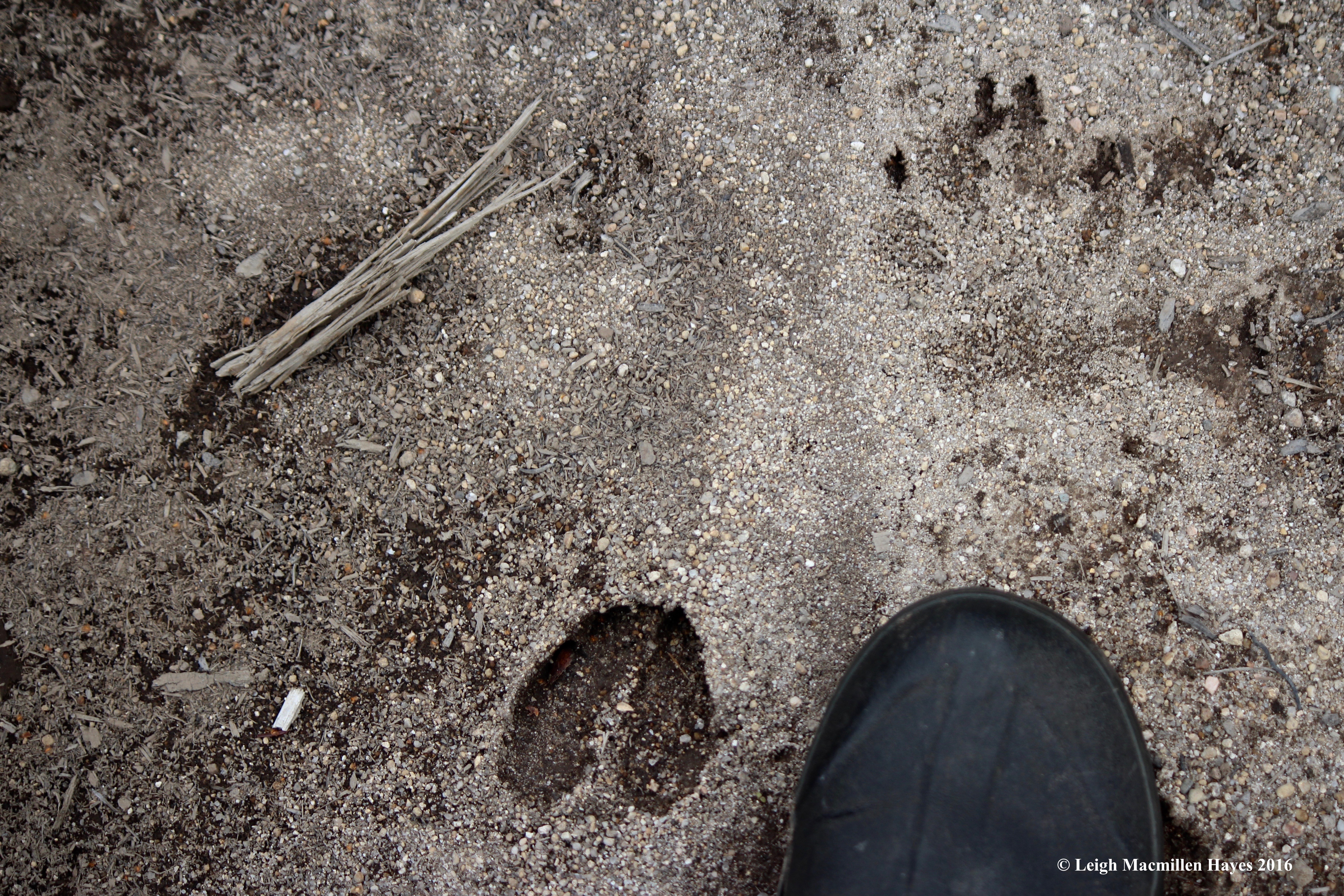
h-deer-and-bobcat-prints

I found evidence of those who spend their lives eating and sleeping in this place.

h-aster-seeds

I found seeds attached

h-seeds-on-the-fly

and those on the fly–heading off in search of a new home.

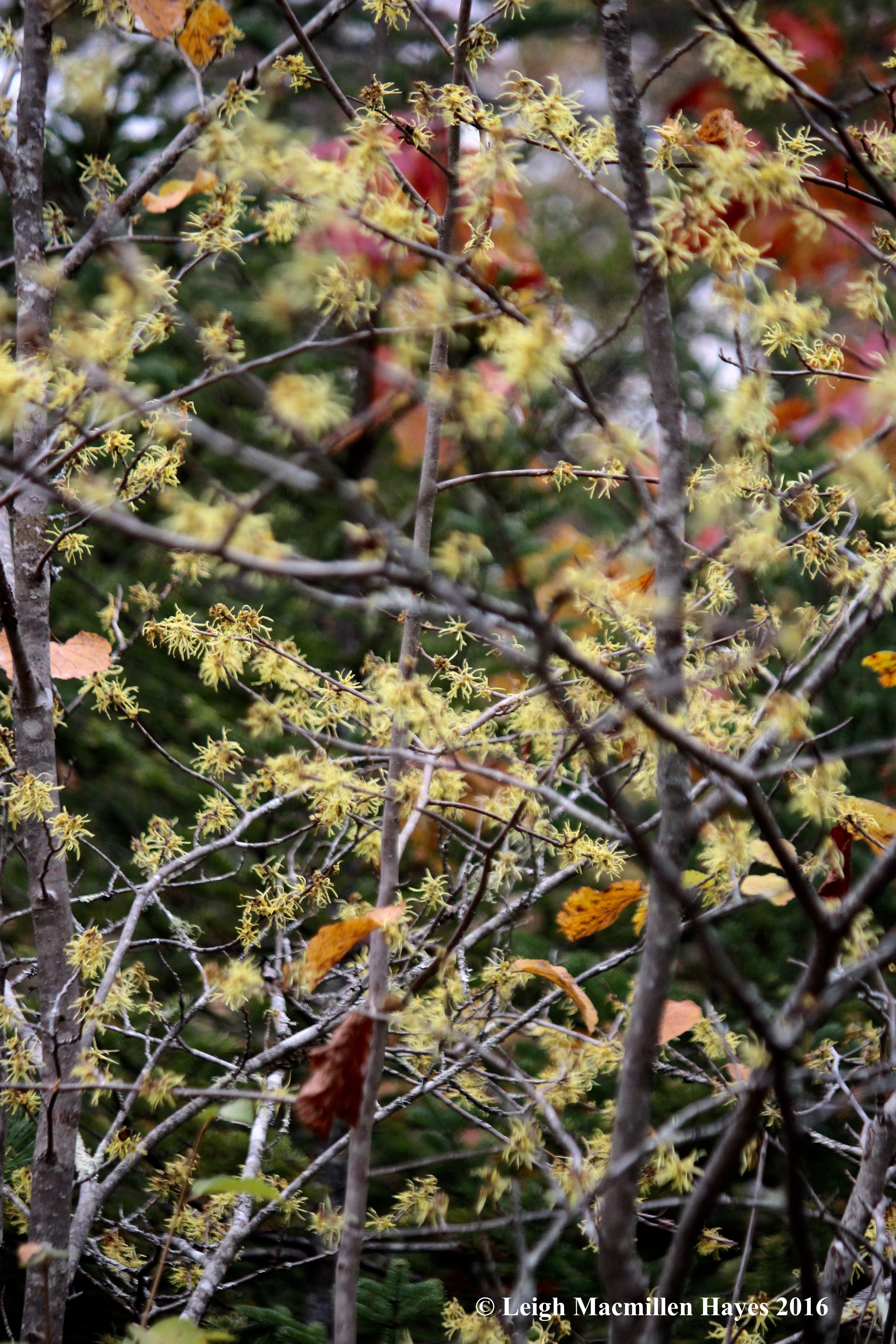
h-witch-hazel-flowers-galore

I found the last flowers of fall

h-witch-hazel-1

exploding with ribbony blooms.

h-power-and-nature

After bushwhacking for a few hours, I found the snowmobile trail, where man and nature have long co-existed.

h-home-2

At last I found my way across the field rather than through our woodlot, thankful for the opportunity to take in the colors of the season one more time.

At the end of the day, I’m once again in awe as I think about how we, and all that we share this Earth with, are dependent upon each other and the abiotic forces that surround us.

And with that comes the realization that the scene is in constant flux and so am I.


Book of September: Forest Trees of Maine

The other day a friend and I made plans for an upcoming hike. Before saying goodbye, she said, “Don’t forget to bring your tree book.”

t-cover (1)

Really? I have at least thirty books dedicated to the topic of trees. But . . . I knew exactly which one she meant: Forest Trees of Maine. I LOVE this book–or rather, booklet. You’ll notice the tattered version on the left and newer on the right. Yup, it gets lots of use and often finds its way into my pack. When I was thinking about which book to feature this month, it jumped to the forefront. I actually had to check to see if I’d used it before and was surprised that I hadn’t.

Produced by the Maine Forest Service, the centennial issue published in 2008 was the 14th edition and it’s been reprinted two times since then.

t-b:y 2 (1)

In previous years, the book was presented in a different format. Two editions sit on my bookshelf, and I need to share with you two things that didn’t find their way into the most recent copy.

From 1981: Foreword–“It is a pleasure to present the eleventh edition of Forest Trees of Maine. 

Many changes have occurred in Maine’s forest since 1908, the year the booklet first appeared. Nonetheless, the publication continues to be both popular and useful and thousands have been distributed. Many worn and dog-eared copies have been carried for years by woodsmen, naturalists and other students of Maine’s Great Out-Of-Doors.

We wish the booklet could be made available in much greater quantity, however, budgetary considerations prevent us from doing so. I urge you to use your copy of Forest Trees of Maine with care. If you do, it will give years of service in both field and office.”

Kenneth G. Stratton, Director.

From 1995: One of two poems included. I chose this one because it was one my mother often recited.

Trees

I think that I shall never see
A poem lovely as a tree.

A tree whose hungry mouth is prest
Against the earth’s sweet flowing breast;

A tree that looks at God all day,
And lifts her leafy arms to pray;

A tree that may in Summer wear
A nest of robins in her hair;

Upon whose bosom snow has lain;
Who intimately lives with rain.

Poems are made by fools like me,
But only God can make a tree.

~Joyce Kilmer

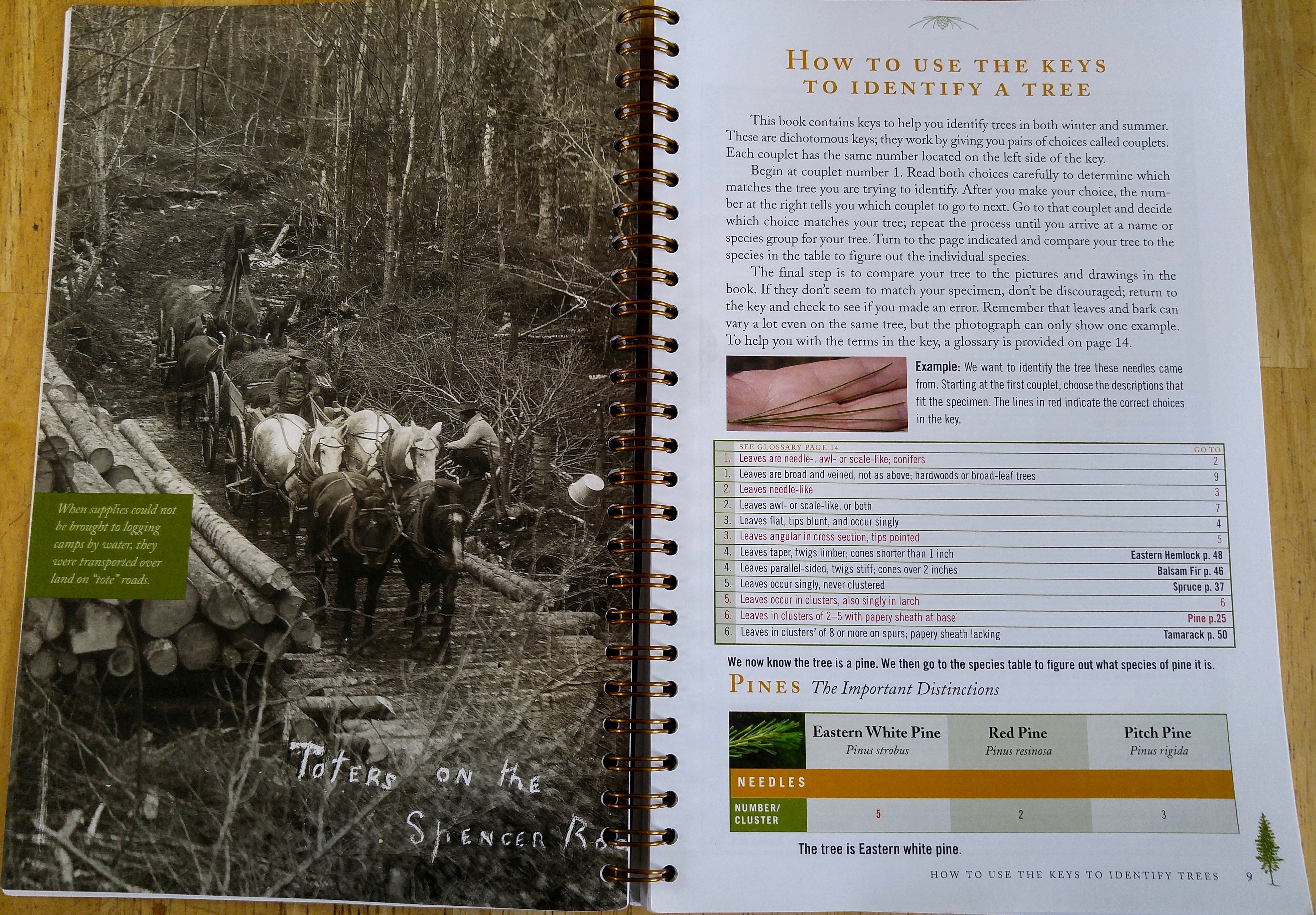
t-how to use keys (1)

The most recent edition of Forest Trees of Maine provides a snapshot of the booklets history and information about the changes in the Maine landscape. For instance, in 1908, 75% of the land was forested, whereas in 2008, 89% was such. The state’s population during that one hundred year period had grown by 580,457. With that, the amount of harvested wood had also grown. And here’s an intriguing tidbit–the cost of the Bangor Daily News was $6/year in 1908 and $180/year in 2008.

Two keys are presented, one for summer when leaves are on the trees and the second for winter, when the important features to note are bark and buds.

t-leaves (1)

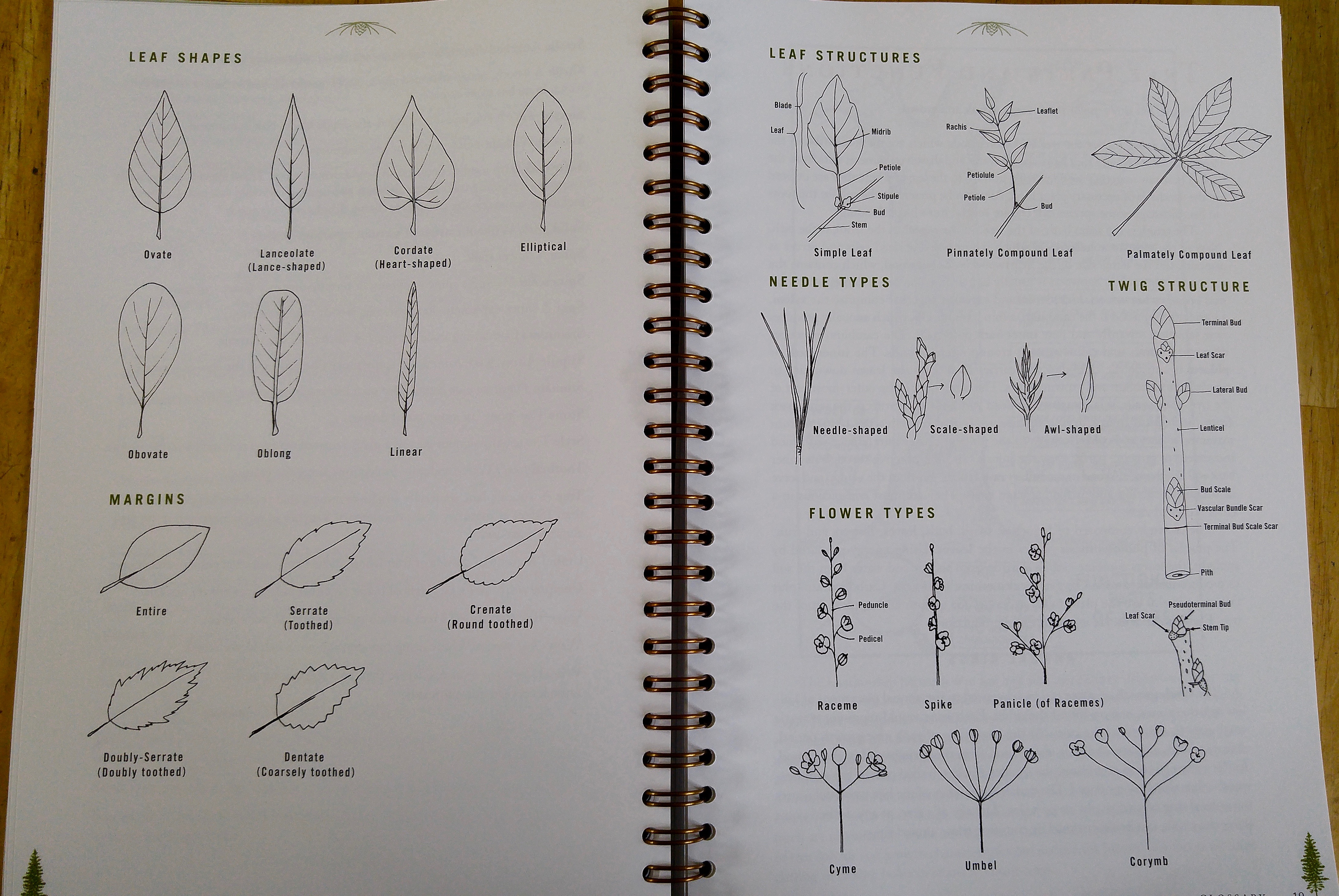
t-glossary (1)

Terms for leaf shapes, margins and structure, twig structure, plus needle types and flower types are illustrated and various terms defined.

t-tree parts (1)

There’s even information on how a tree works because they do–for our well-being and for the benefit of wildlife.

t-white pine (1)

And then the descriptive pages begin. Each layout includes photographs, sketches and lots of information, both historical as in the King’s Arrow Pine, and identifiable as in bark, leaves, cones, wood, etc.

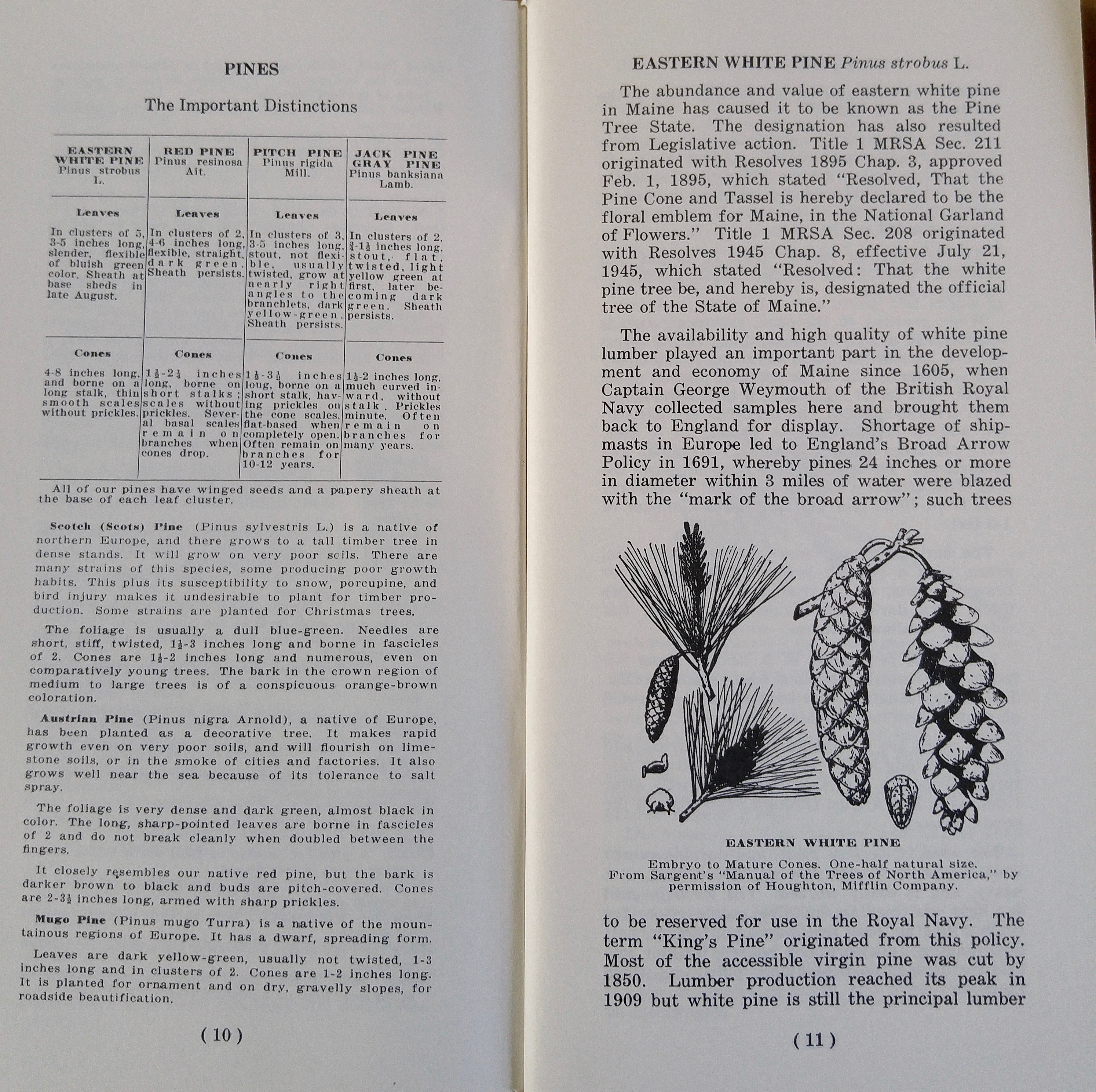
t-pines blue book (1)

1981

t-pines yellow book (1)

1995

Though some of the information is the same, it’s fun to note the differences from the two earlier publications.

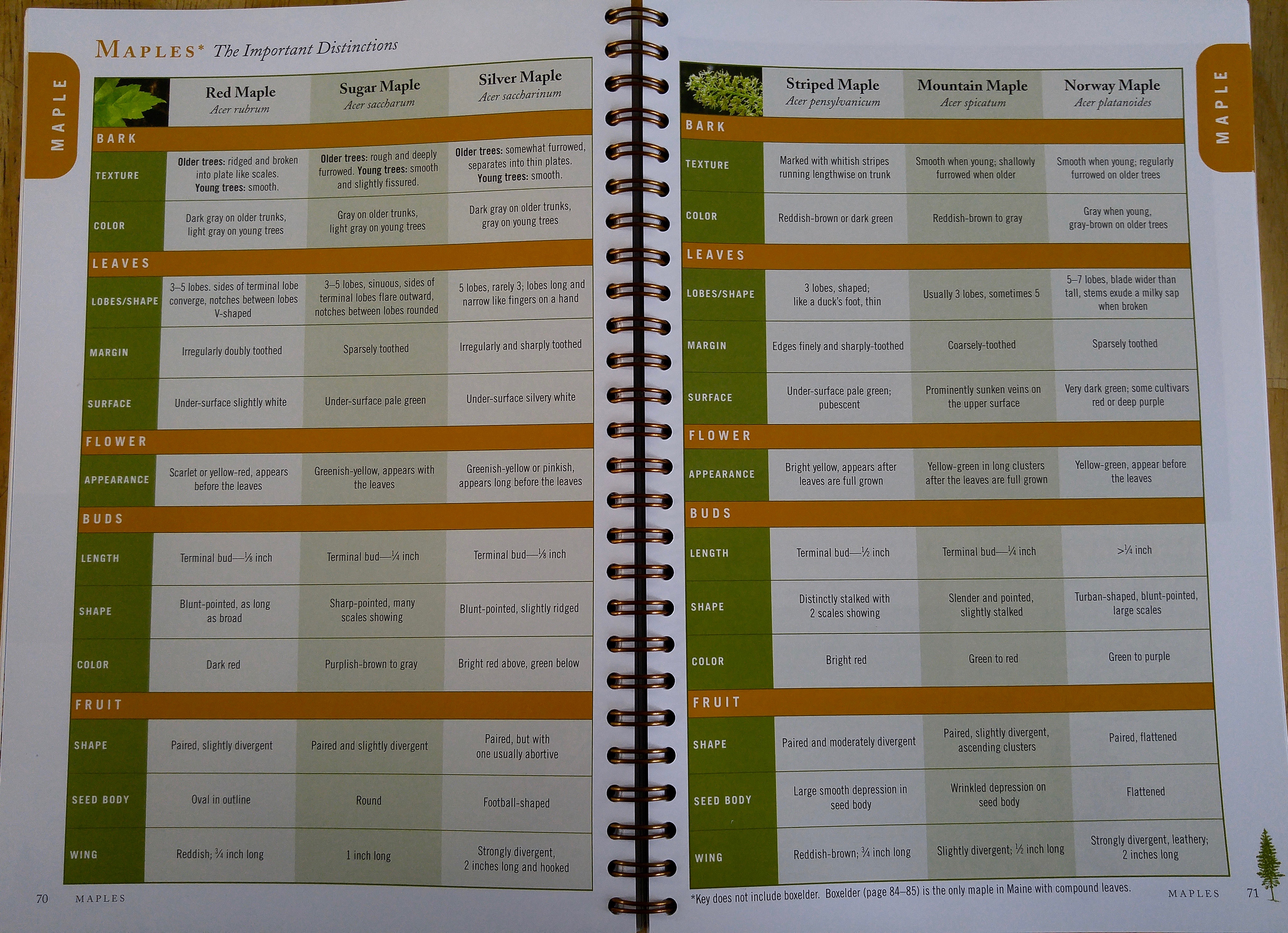
t-maple key (1)

At the beginning of each family, major descriptions are noted in an easy to follow format.

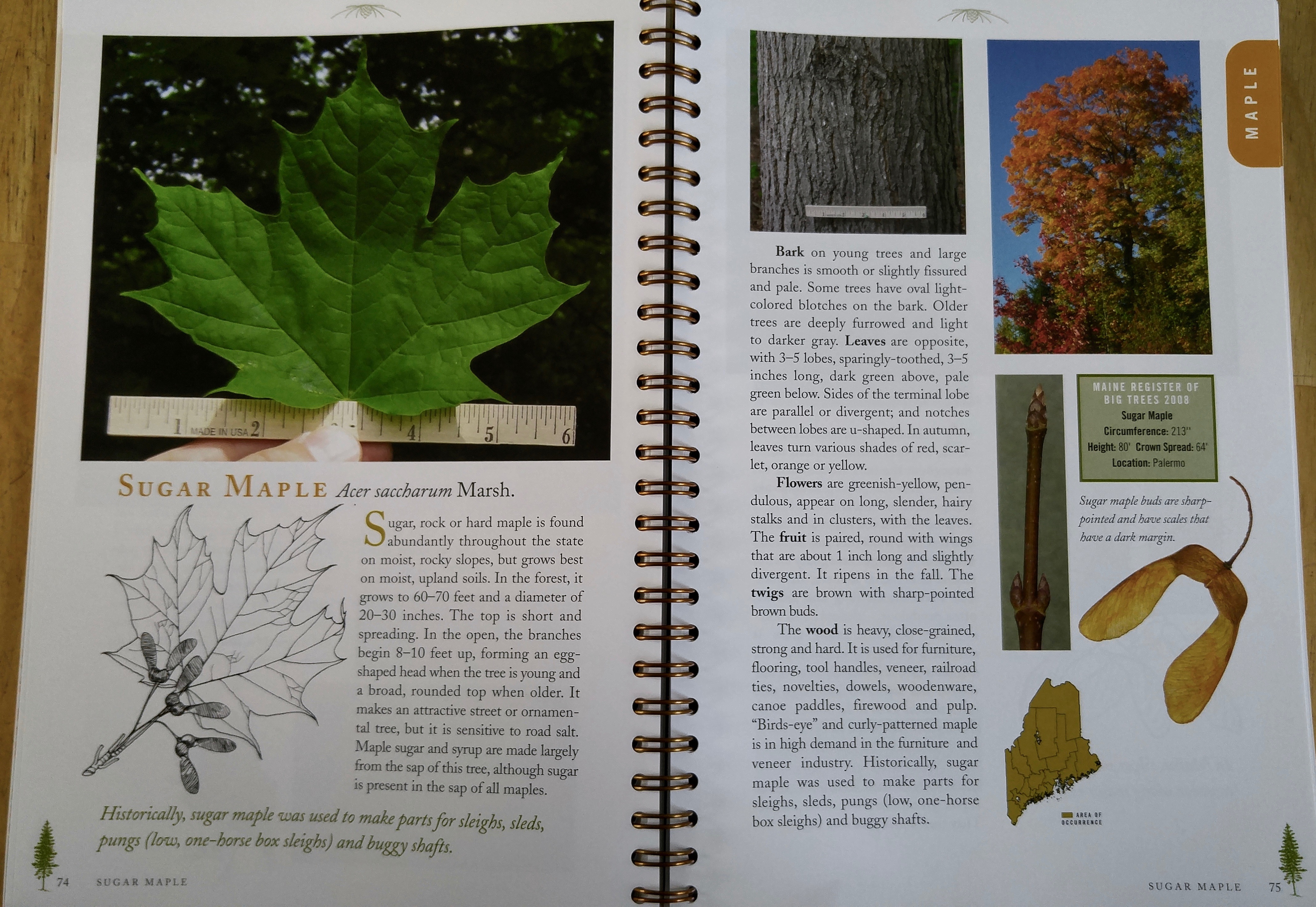
t-maple (1)

And like the conifers, the broadleaves are portrayed.

Tomorrow, when my friend and I venture off, I’d better remember to pack this booklet. She’s peeked my curiosity about what she wants to ID because I’ve climbed the mountain before and perhaps I missed something. She already has a good eye for trees so I can’t wait to discover what learning she has in mind for us.

This Book of September is for you, Ann Johnson. And it’s available at Bridgton Books or from the forest service: http://www.maineforestservice.gov or forestinfo@maine.gov.

Forest Trees of Maine, Centennial Edition, 2008, published by The Maine Forest Service


Sundae School

I went on a reconnaissance mission this afternoon and visited a land trust property I’ve never stepped foot on before. My intention was to scope it out for possible use with a future Maine Master Naturalist class. My realization from the get-go was a happy heart. I can’t wait to return and take others along so we can make discoveries together.

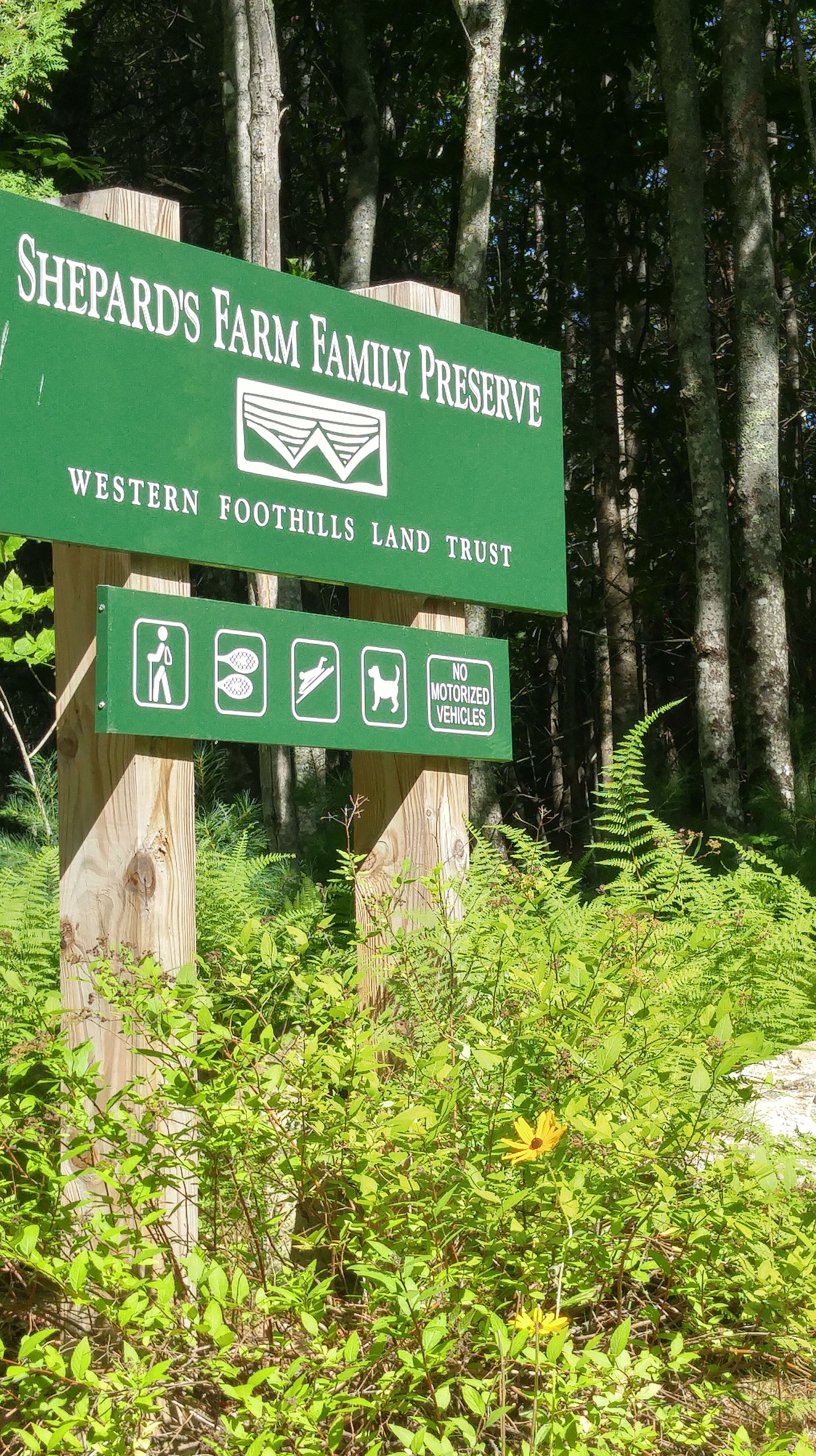
n Preserve sign

I’ve only been on one other Western Maine Foothills Land Trust property, so had no idea what to expect. The small parking area for Shepard’s Farm Preserve is at 121 Crockett Ridge Road in Norway. (Norway, Maine, that is.) This is one of seven preserves owned by the trust. I should have known I’d enjoy myself immensely just by the name. Though we spell Shephard with an “h,” it’s a family name for us. Who knows–maybe there’s a connection.

n-trail sign

On the back of the brochure I grabbed at the kiosk, I read the following: “Originally owned by Benjamin Witt, the high undulating pasture of Shepard’s Farm Family Preserve was transferred to Joshua Crockett in 1799, Charles Freeman in 1853, John Shepard in 1910, and to Bill Detert in 1984.” Mr. Detert and his family donated the property in memory of his wife, Jan, to the WMFLT in 2010.

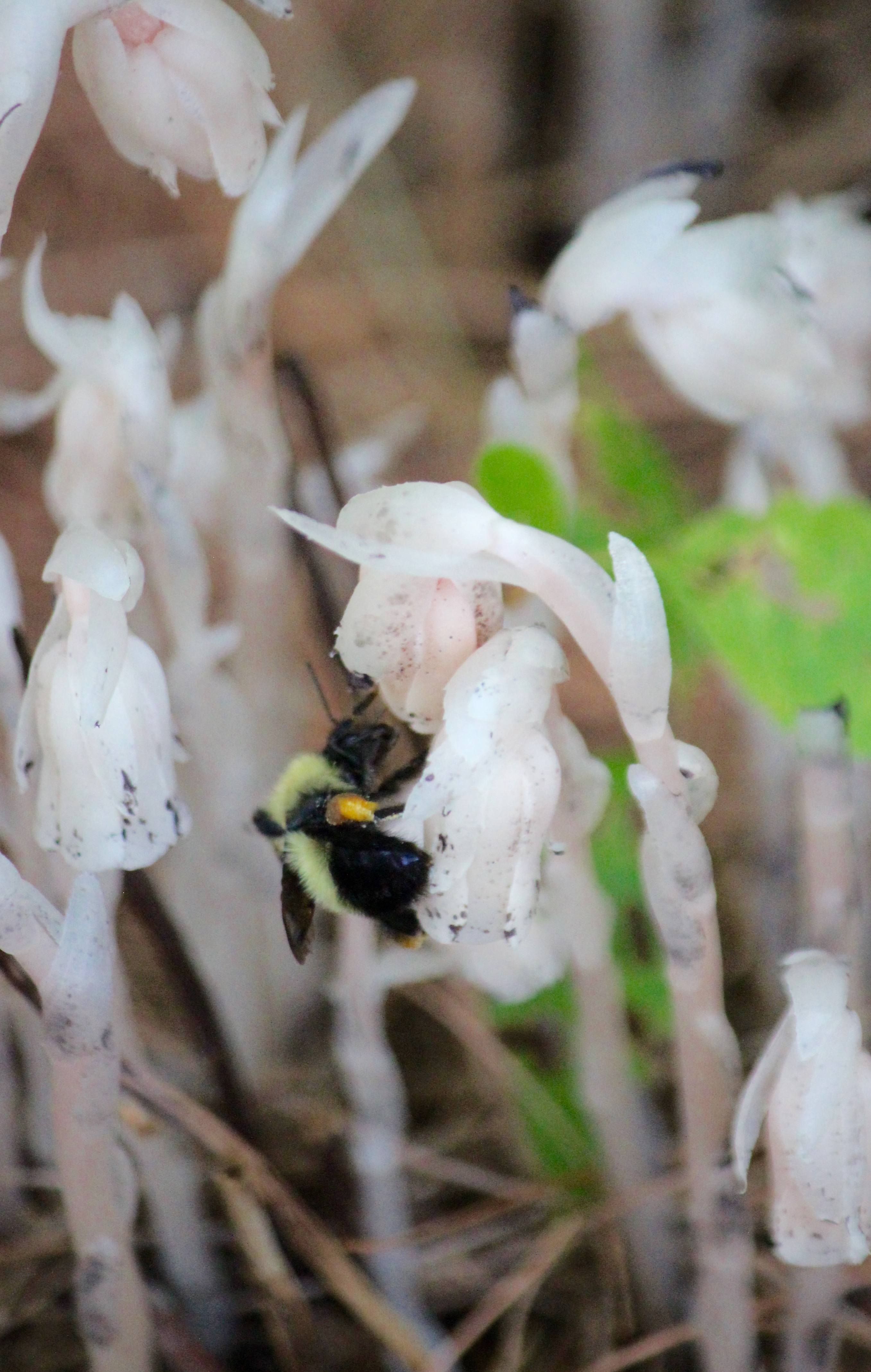
n-Indian pipe bee 1

My lessons began immediately. What to my wondering eye should appear, but a bee pollinating an Indian pipe. And in the middle of the afternoon. Huh? I’ve always heard that they are pollinated by moths or flies at night. Of course, upon further research, I learned that bees and skipper butterflies have been known to pay a visit to the translucent flowers. Add that to the memory bank.

n-Indian pipe

As I continued along the trail I found the upturned mature flower and again wondered–who stopped by for a sip of sap? Lessons should evoke further questions and a desire to learn more.

n-hawkweed

The trail offered other familiar flowers, like hawkweed,

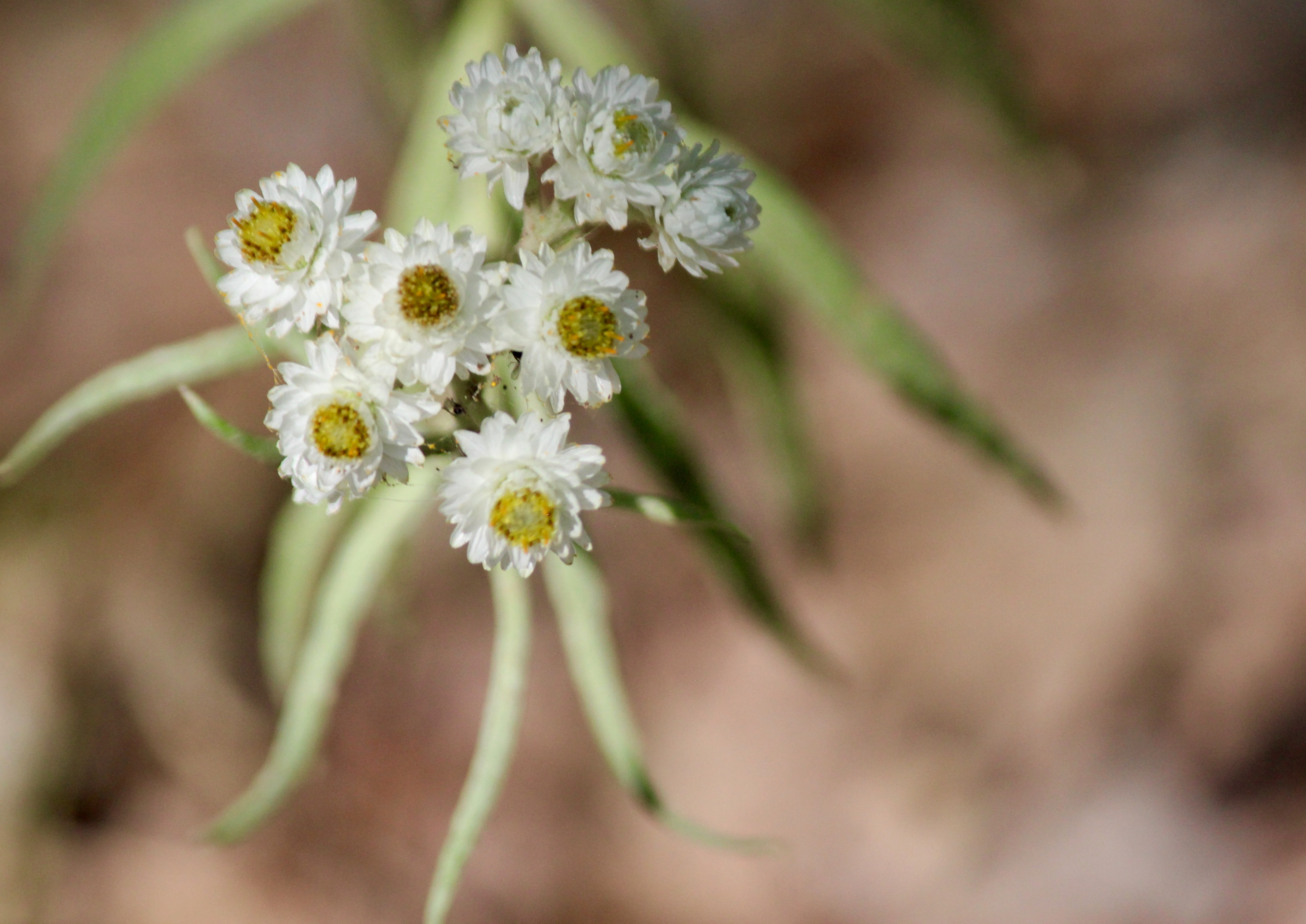
n-pearly everlasting

pearly everlasting, goldenrods and asters, Queen Anne’s lace, boneset and jewelweed.

n-monkeyflower 3

And then I come upon a wildflower I don’t recall meeting before. The lesson included a look at the leaves, their arrangement on the stem, and the flowerhead.

n-monkeyflower 1

The answer to the quiz–lavender-flowered Sharp-winged Monkeyflower. Monkeys in the woods! You never know. Sometimes I think that red squirrels sound like monkeys when they chit at me, but in this case, it’s the fact that the flower looks something like a monkey’s face.

n-thistle young and old

Further on,  I spotted a favorite that I don’t see as often as I’d like. What I didn’t realize is that thistles are in the aster family. Always learning. Its presence here is referenced by trail conditions, which change periodically from mixed hardwoods to softwoods to open places. Thistles prefer those open places–fields and waste places. Hardly waste in my opinion. Rather, early succession to a woodland.

n-bee on thistle 2

A bee worked its magic on the flowerhead so I moved in for a closer look.

n-bee on thistle1

As with any flower, it was a pollen frenzy.

n-thistle with seeds

Seconds later–maturity! Well, maybe not quite that fast.
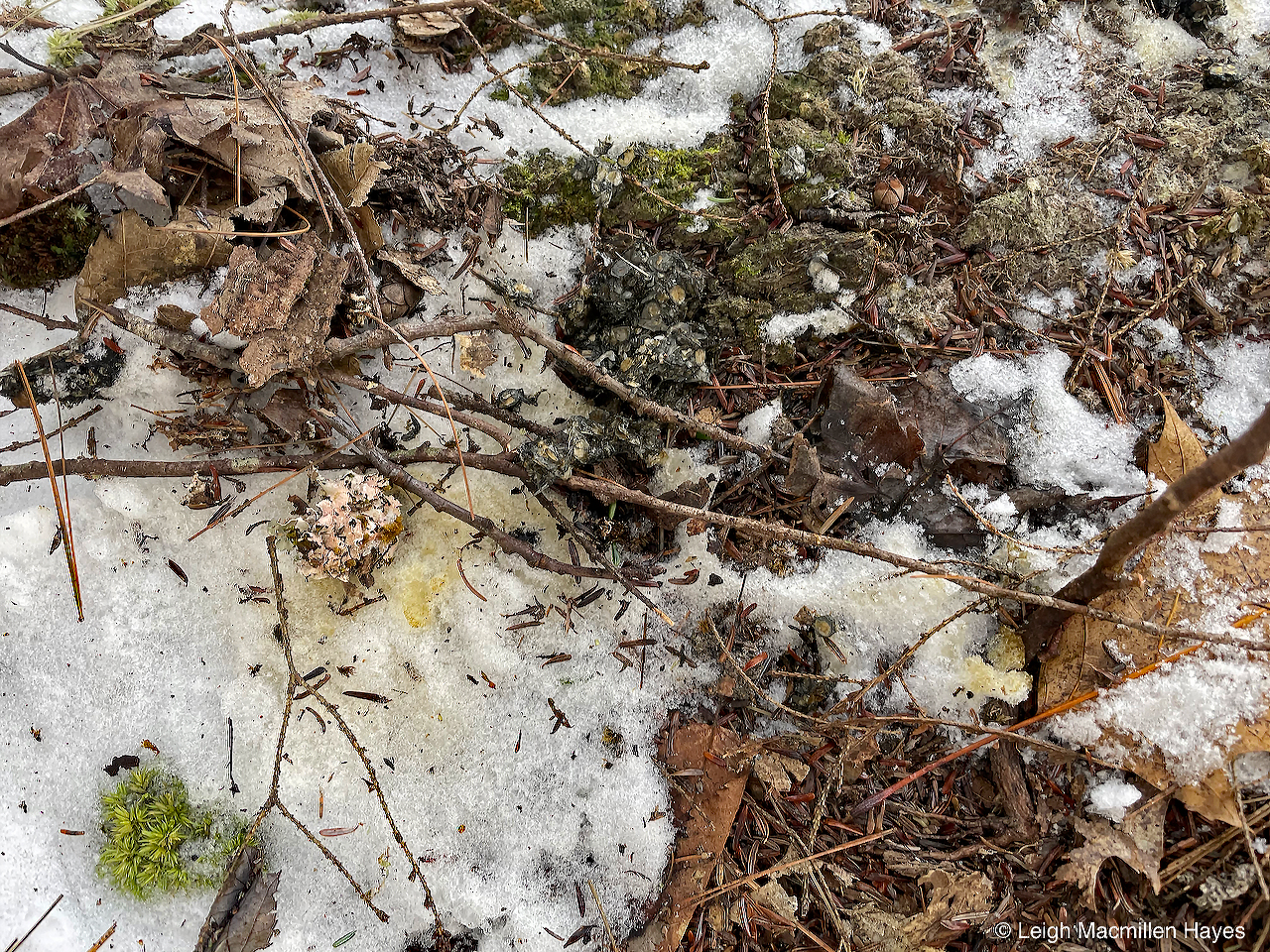
n-thistle seeds 1

But the seeds had developed their downy parachutes and the breeze was a’blowing.

n-thistle seed 2

They knew it was time to leave the roost and find a new classroom.

n-trail ferns

Another lesson worth more time was a look at the natural communities along the trail. Bikers and hikers share this space, but what I found fascinating was the constant change.

n-trail hay

The original trail for the Shepard’s Family Farm Preserve was located on a 19-acre parcel. Recently, the Witt Swamp Extension was added, which almost circles around a 250+ acre piece. Hay covers some of the new trail right now–giving it that farm-like feel and smell.

n-trail 1

I’m not certain of the mileage, but believe that I covered at least 4-5 miles in my out and back venture over undulating land and through a variety of neighborhoods. The trail conditions–pure bliss. No rocks or roots to trip over. Instead, I could look around for the next lesson.

n-cedar bark

One of the things I love about hiking in Norway is that I get to be in the presence of cedar trees–Northern white cedar.

n-cedar leaves

I’m fascinated by its scale-like leaves.

n-deer tracks

So are the deer, who feed on the leaves during the winter months.

n-dry stream

I found only deer tracks, and noted that all stream beds were dry, though the moss gave a moist look to the landscape. We’re experiencing a drought this summer.

n-red leaf

Due to that lack of rain, some red maples already have turned and colorful leaves are beginning to float to the ground.

n-porky 3

Deer aren’t the only mammals that inhabit this place. From the trail, I noticed hemlock trees with bases that looked like perfect gnome homes. And then I spotted this one that invited a closer look.

n-porky den

A pile of porcupine scat–the pig-pen of the woods. Even Charlie Brown would note a distinct odor.

n-toad camo

And in true “Where’s Waldo” tradition, a young American toad crossed my path. The camo lesson–blend in for safety’s sake.

n-turtle 2

Being former farmland, stonewalls wind their way through the preserve. And my childhood fascination with turtles was resurrected. Do you see it?

n-turtle 3

How about now? Hint: the head is quartz.

n-turtles

And this one? They’re everywhere. It makes me wonder if it was a style of the times.

n-stone wall ending

I crossed through a gap in the stonewall and noted two smaller stones topped by a large flat one. A reason why? The questions piled up. I need to ask the teacher.

n-stonepile

And then there were the stone piles. Why so many smaller stones around a boulder? What I love about this spot is that a hemlock took advantage of the boulder and grew on top of it.

n-stone structure 2

And another favorite find–a stone structure.

n-stone structure, flat

Created with rather flat field stones.

n-stone structure 1a

It’s near a stonewall, so I surmised it was a shed of some sort rather than a root cellar for a home. I could be wrong, but am thrilled by the opportunity to see it.

n bird sculpture

One of the coolest features of this property is that it’s home to sculptures created in the 1970s by Bernard Langlois, including this bird in flight. The sculptures were made possible recently by the generosity of his widow, Helen Langlois, Colby College and the Kohler Foundation.

n-bird lady 2

Mrs. Noah is my favorite. She has stories to tell and I have lessons to learn.

It’s Sunday and by the time I finished hiking I was hot. I’d intended to check out a few more preserves, but the thought of a creamsicle smoothie at a local ice cream shop had my focus–until I pulled in and saw this posted: “Cash and local checks only.” No cash. And though our checks would be local, I didn’t have any with me either. Lesson learned.

I drove home and made my own sundae.

Our I Dos

Twenty-six years ago we both said, “I do.” And those two little words have stuck with us ever since.

t-road

The road has had a few bumps and turns, but relatively speaking, it’s been an easy path to follow.

t spider web

Sometimes the web we’ve woven has torn, but we’ve learned to mend it when necessary.

t-birds nest fungi

We’ve filled the nest and watched our sons disperse, and welcomed them home again.

t-orchid pollinator

We’ve found fulfillment  . . .

t-pollen

and tried to share it with others.

t-wings

We’ve each grown wings and let the other fly.

t-pleasant mtn

We’ve cherished the beginning of our journey and give thanks for all the uphill moments.

sunset 3

At the end of the day, we don’t know what the future holds, but we appreciate the past.

Happy Anniversary to my guy. If I had to do it all over again, I’d still say, “I do.” And I know you would too.

Searching for the Source of Sweetness

I wore down a path between gardens today as I traipsed from one to the next and back again. But if air space is anything like lawn space, then those who visit the garden via flight have created their own well-worn passageways as they also search.

w-post face scrub

My mission was to see the hummingbird again. But, this little guy, no longer than a half inch, stood atop a false dragonhead yet to bloom and waited to be noticed.

w-face scrub

He even took the time to scrub his face as I watched.

w-double or triple daylily

Continuing my wander, I stopped by the daylilies and made a discovery. We’ve lived in this house for more than two decades and I never realized until today that we have some double daylilies. The previous owners had green thumbs and we’ve benefited from the fruits of their labor. But how had I missed this before? I know we have double daffodils, but loved my new find. Especially as this past weekend, my friend Beth invited us to her hundred acre wood and her mom showed us their daylily gardens. Beth’s mom, Mary, talked about hybridizing the lilies and so she’ll know best about this.

w-lily pollen

When I revisited the flowers later in the day, the sun shone brilliantly on them, enhancing their orangeness. Correct me if I’m wrong, but what I think has happened is that the petal formed along the stamen and imbedded the anther, thus it looks like a petal with grains of pollen. Crazy cool. And beautiful. And yummy.

w-fritillary1

That wasn’t the only shade of orange worth wondering about. And it was no mistake the this fritillary butterfly chose the beebalm on which to land.

w-frit 2

Check out its mouth. A butterfly feeds through a coiled mouth part called a proboscis. When not in use, the proboscis recoils and is tucked into position against the butterfly’s head.

w-frit 3

Since the proboscis is narrow and straw-like, it allows the fritillary to extract sweet nectar from tubular-shaped flowers. Suck away, dear fritillary.

w-hummoth 1a

The fritillary wasn’t the only beebalm visitor with a coiled proboscis.

w-hummoth 3

I actually heard it before I looked up and saw this moth. It sounded like a hummingbird and flapped its wings as fast or nearly as fast as a hummingbird and shared the name hummingbird. This is a hummingbird moth.

w-hummingbird moth 1

Notice how the proboscis begins to unfurl as it approaches the flower.

w-hummoth 3a

While it hovers, it probes.

w-hummoth 4

Searching deep for the source of sweetness, where others can’t reach.

Wondering About Nature’s Complexity

As I sat on the porch of our camp this morning, three wafts of smoke blew up from the ground along a pathway to the water. And my heart swelled. Earlier, I’d been out between raindrops taking some photos and my eye was drawn to that very spot. My photos didn’t come out so well, but I believe what I was looking at were bird’s nest fungi. They were cup-like in shape and some were filled with minute eggs, while others were covered in an orangey blanket.

I suspect it was the latter that caught my attention from the porch. It had started to rain and this fungus depends on rain for dispersal of its egg-like capsules that contain the spores. The hydraulic pressure of a raindrop falling into the nest causes the capsule to spring forth, emitting spores in a puff. I could have sat there all day waiting for it to happen again, but . . .

1 hawkweed

there were other things to look at and wonder about. The bird’s nests weren’t the only ones ready to send forth new life. While the hawkweed seeds embraced the raindrops, they waited for a breeze to send their young into the greater world.

2Oleander aphids on milkweed

And then I returned home, where I found some other cool things. It all depends upon your point of view, I suppose, but check out these Oleander mites on the underside of a milkweed leaf. They are so named because they also like Oleander.

4ant milking aphids

Those weren’t the only aphids wandering about. The little gray dots on this leaf are actually another form. So here’s the scoop on ants and aphids. While aphids suck the sugar-rich fluids from their host plants, the ant strokes (milks) the aphids with its antenna to get them to secrete waste (honeydew), which has a high sugar content. And we all know that ants love sugar. Honey-dew just took on a whole new image.

3cranefly

Tucked under the lady ferns, I found a cranefly. I’m always searching for orange in support of our young neighbor who was recently diagnosed with leukemia. When I started posting a photo a day in his honor, I didn’t realize how important it would become to me–making me think about all that he and his family are enduring on a daily basis. He is in remission, but still undergoing treatment and will need a bone marrow transplant. This cranefly almost became today’s post, but a daylily dragon won out for Team Kyan.

5mystery

So dear reader, I enjoy teaching you, but now need you to teach me. I found this under another leaf on a shrub. And I often see the same thing stuck to our house. It reminds me of a caddisfly case. What is it?


7daylily

No mystery here. But still, the complexity . . .

8mallow

enhanced by raindrops.

c9omplex world

Nature is complex, but oh so worth a wander. And certainly worth a wonder.

Thanks for stopping by today.