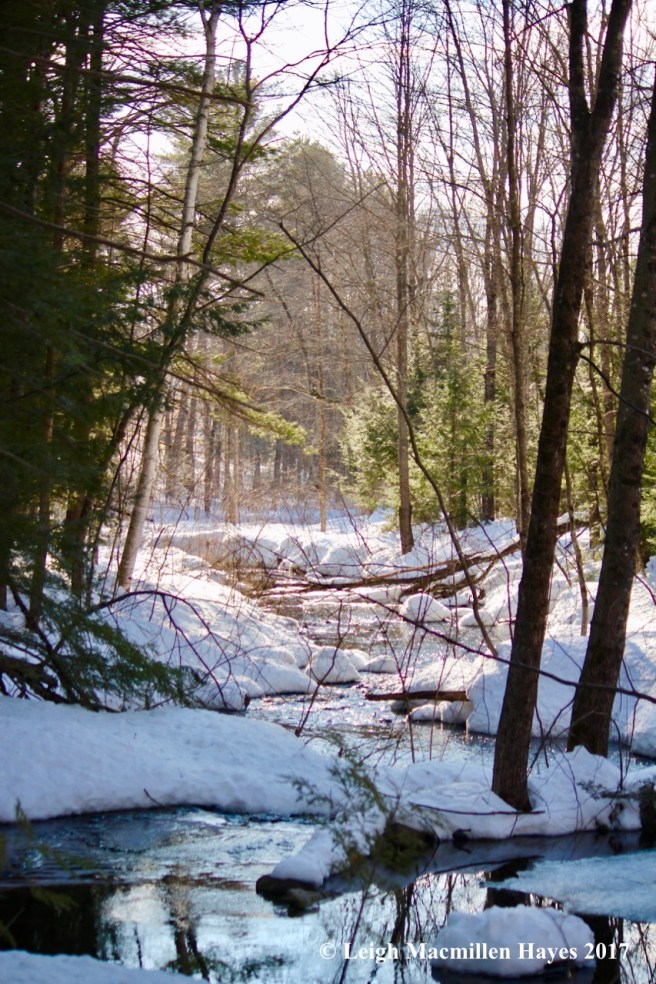
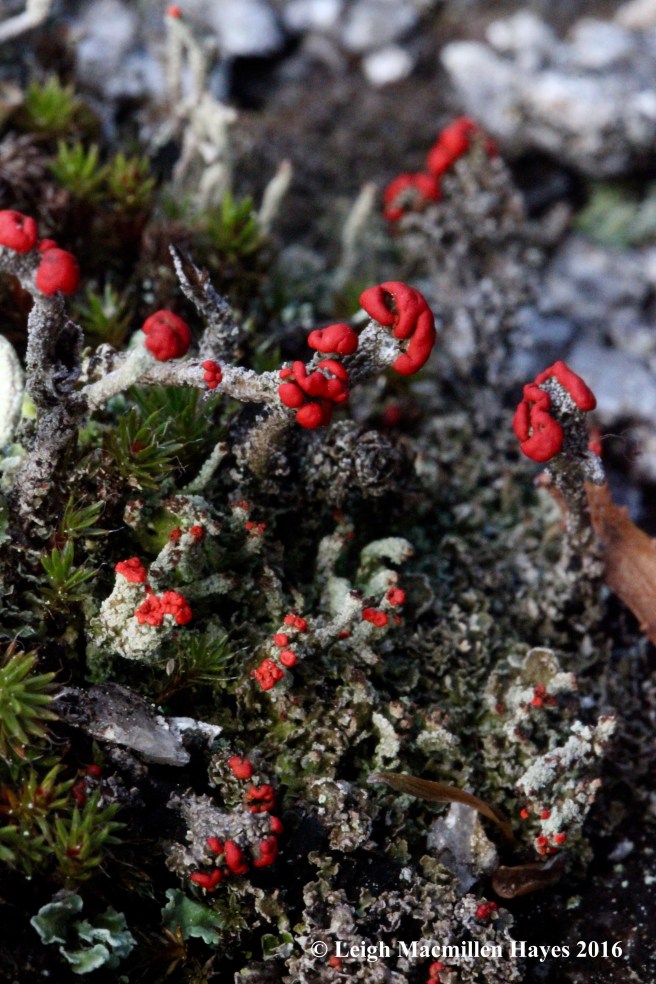
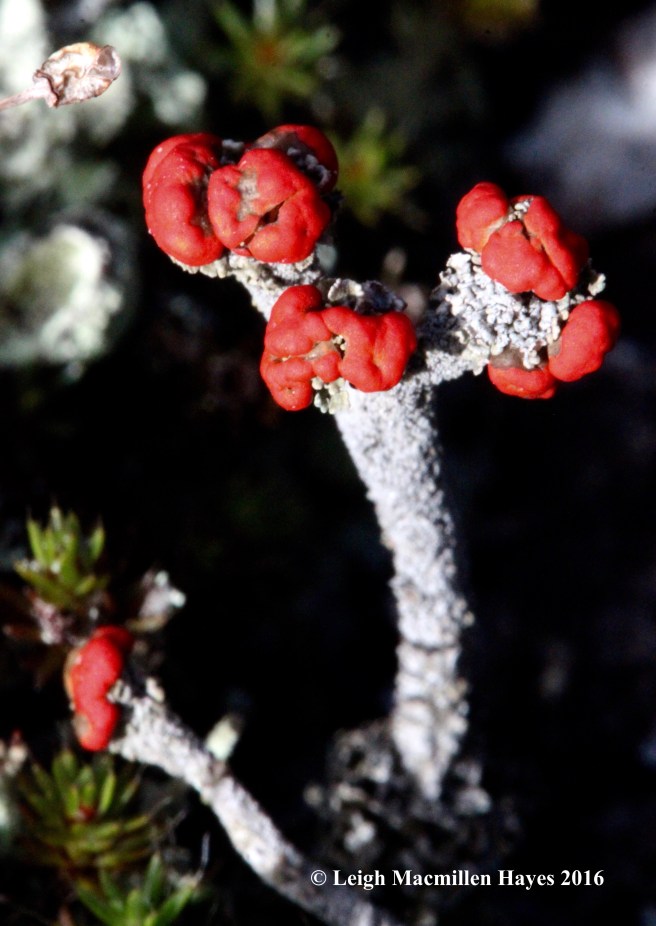
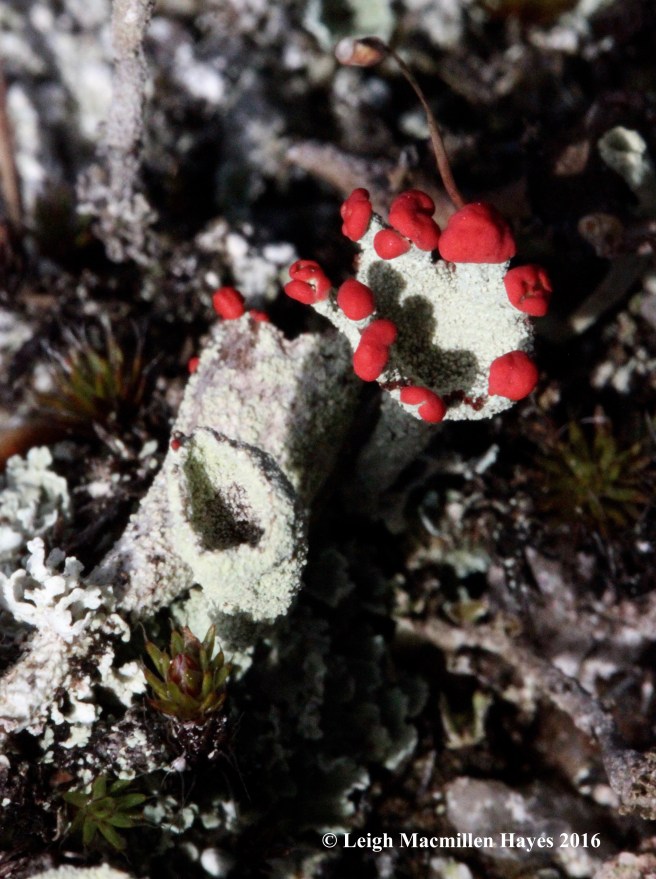
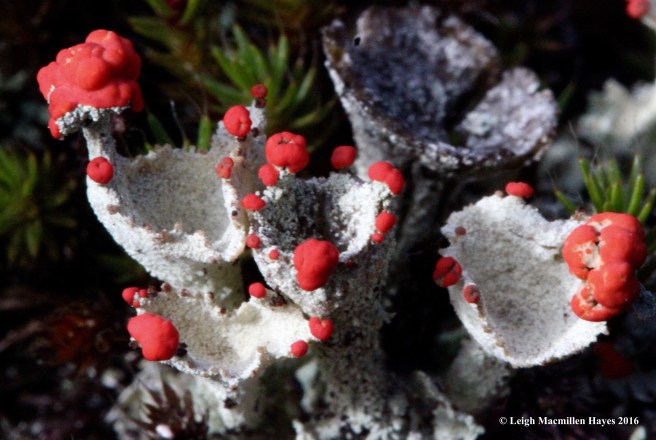
April Showers bring . . .

May showers!

v-green yard

It feels like it has rained every day for the past week, but the grass is certainly green.

v-pool (1)

And the vernal pool full. Between today’s downpours I visited it a couple of times, so excited by my findings.

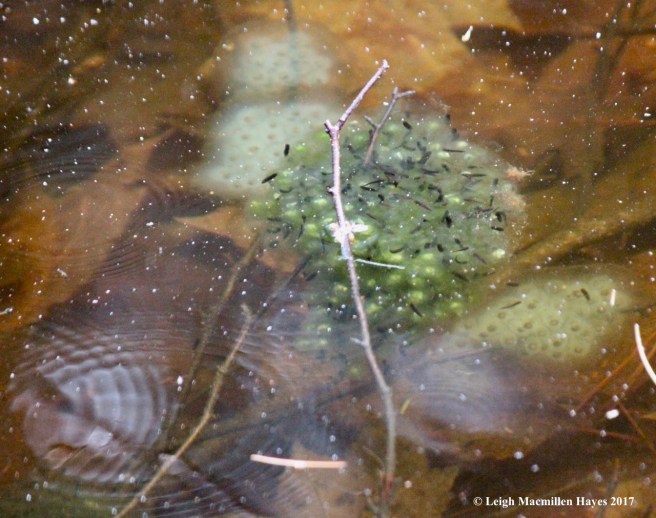
v-wood frog eggs developing

The wood frog eggs had turned green with a symbiotic algae and I could see the tadpoles developing inside.

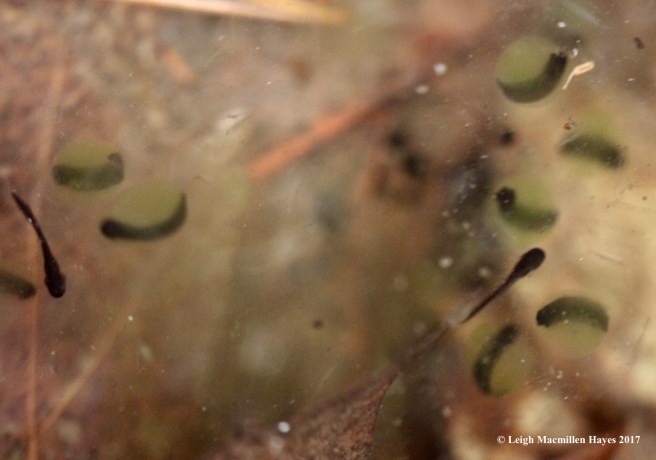
v-tadpoles 2

The green coloring made the their eggs contrast with the salamander masses. I was thrilled to see movement among the green and realized that . . . drum roll please . . .

v-tadpoles 6

my babies were slowing hatching. Of course, they are mine–even though the frog pond is located on a neighboring property. I’ve been an expectant mother for several weeks, and now . . . I’m nervous about the future, as any parent would be.

v-tadpoles 1

Will my babies survive? Will they have an opportunity to transform into their terrestrial forms?

v-tadpoles 7

Or will the pond dry up too soon as it has the last few years? I guess I’ll be forced to continue to stop by. Oh darn! One thing I have noted since the ice melted: I’ve yet to see a predacious diving beetle and there are hardly any mosquito larvae flipping about. That’s good for the tadpoles on one end of the spectrum and not so good on the other. To be food and to eat food.

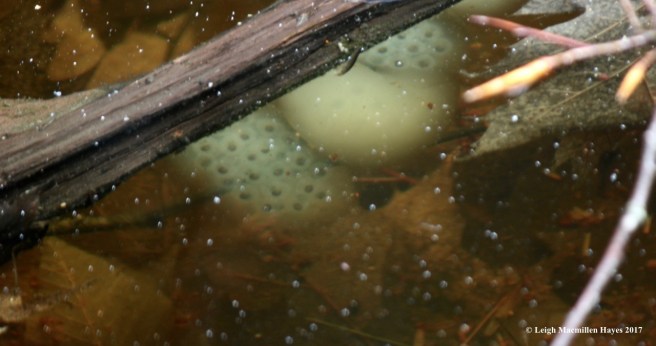
v-sallie eggs 1

I also wondered, will the  white and opaque masses of the spotted salamander eggs turn green like they are supposed to–also dependent on a symbiotic algae?

v-hole 4

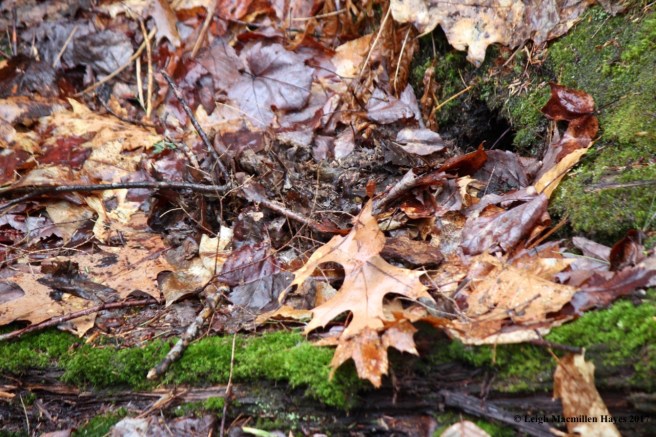
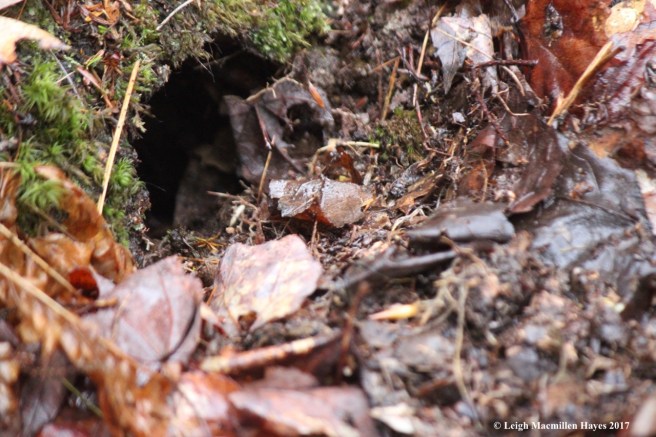
After checking on my wee ones, I walked the pond’s perimeter and noticed activity at a spot I’ve been keeping an eye on in the southwest corner. Well, not current activity, but recent. For the first time this year, a hole has been excavated.

v-hole 3

It’s the same hole that was excavated last year. Darker debris was piled in front.

v-hole1

At about three or so inches across, I wondered who owned it. Too small for foxes, and certainly too wet. Too big for chipmunks and a dirty dooryard. Could it be a mink? Do they leave a messy dooryard? I found the same hole excavated last year, but never any other evidence of the maker. I’ll continue to check for any other signs.

v-raindrops

My eyes reverted back to the pool, where raindrops and reflections created an artistic display.

v-maple dust lichen

And then I pulled myself away, frozen were my fingers. The greenness of the world continued to show its face everywhere I turned from the maple-dust lichen to . . .

v-white pine

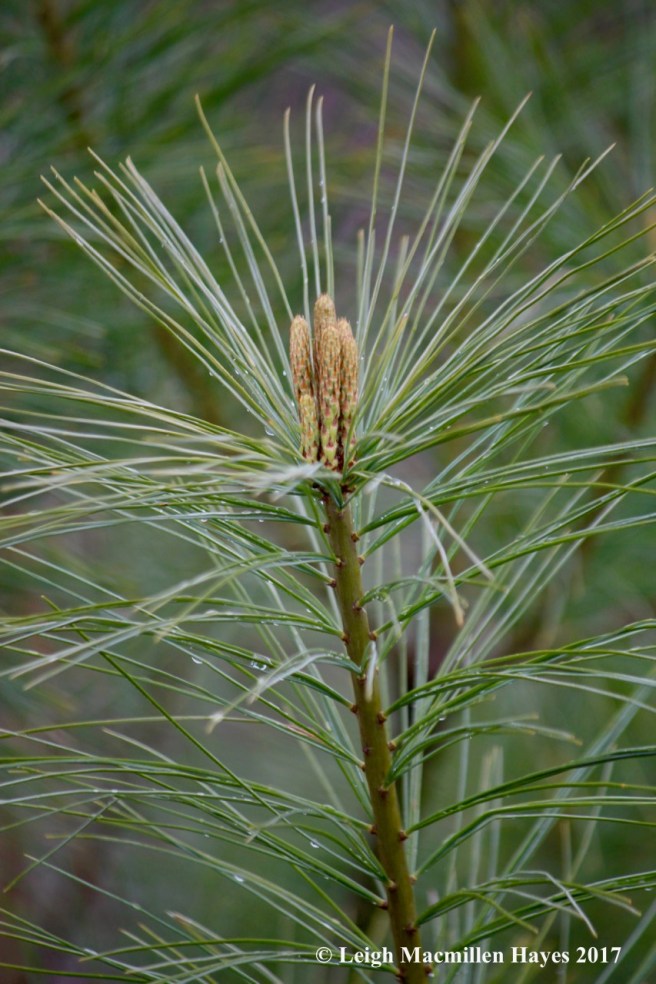
young white pines, their candelabras growing long,

v-maple leaf and samara

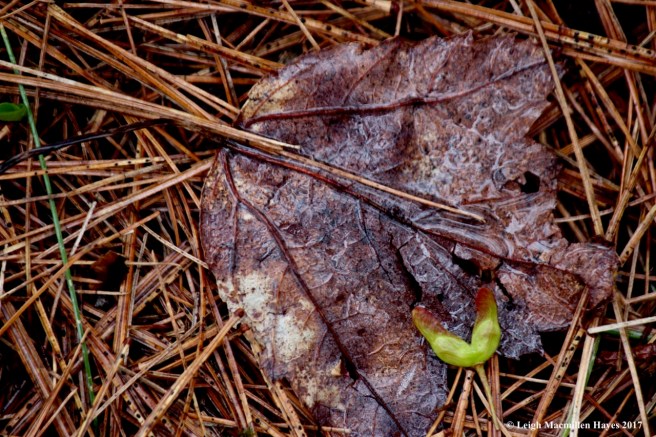
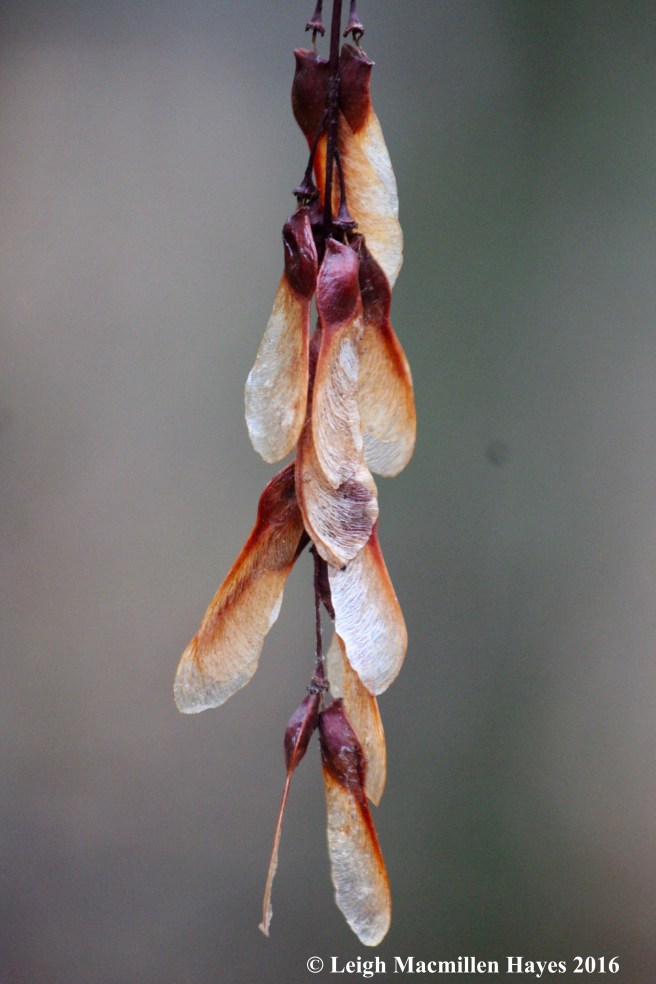
red maple samaras upon old leaves,

v-cherry 1

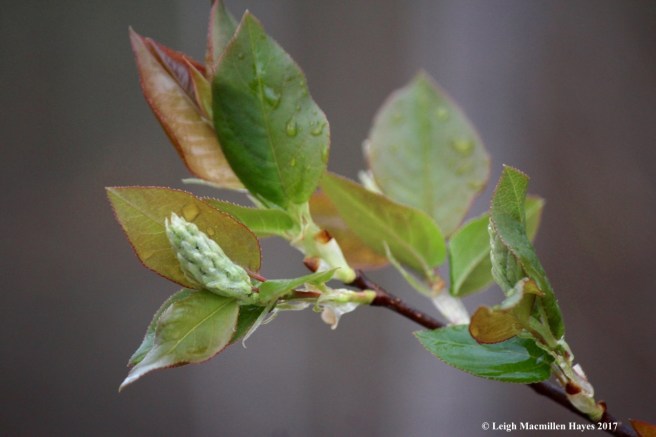
and cherry flowers developing.

v-mayflower1

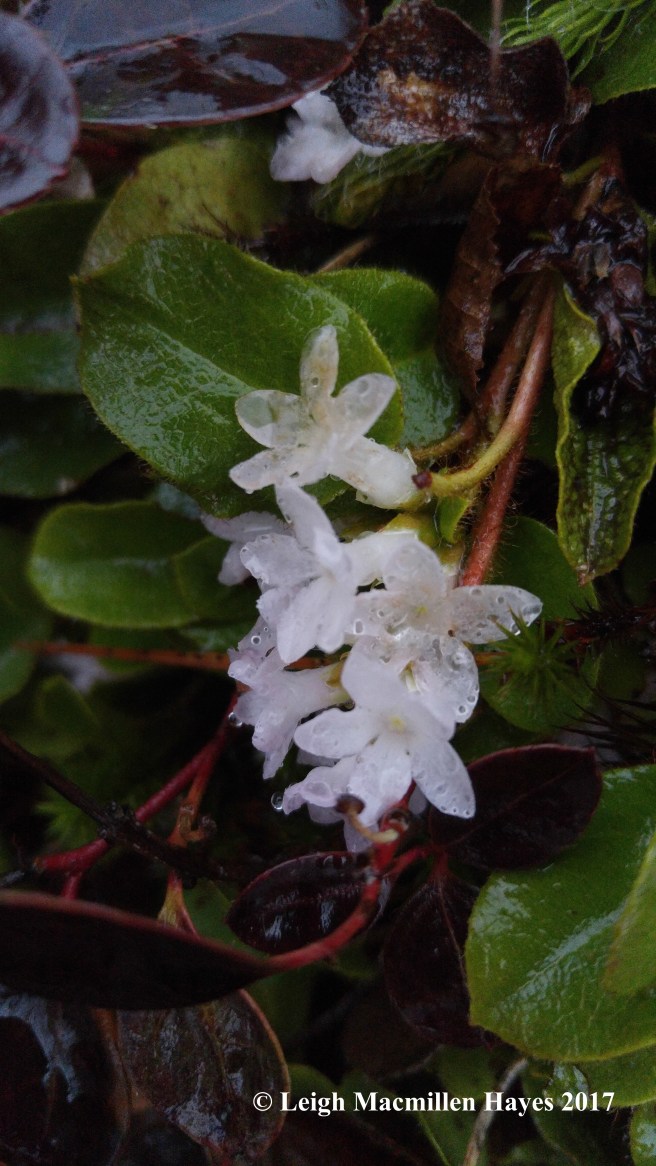
What do April showers bring? Mayflowers (trailing arbutus), of course,

v-Canada mayflower 2

Canada mayflowers,

v-tulip 1

and garden May flowers.


Honoring the Earth

It would have been so easy to stay home last night, curled up on the couch beside my guy while watching the Bruins play hockey. After all, it was raining, 38˚, and downright raw. But . . . the email alert went out earlier in the day and the evening block party was scheduled to begin at 7:30. And so, I piled on the layers from a wick-away shirt to Under Armour, a turtleneck, sweater, LL Bean vest and rain jacket. I slipped into my Bogg boots and made sure I had the right gear–smartphone for photos, reflective vest, headlamp and flashlight. With a visored hat on my head to shield my glasses from the rain, I was finally ready. Out the door and down the road I went, headed to the Lakes Environmental Association‘s office for Big Night.

h-Big Night Patrol 3 (1)

I wasn’t the only one crazy enough to attend the party. Our number was about twenty. I think the best part was that we ranged in age from 6 to almost 60, the latter being me–the oldest kid on the block. And in that mix, one teen who was celebrating his 15th birthday (Happy Birthday, Kyle), and several teens who had never attended before but came because one of their crowd was an annual participant. We even had two policemen in the mix–and though their job was to slow traffic and keep us safe, they had as much fun as we did completing our mission.

h-spotted sallie 2 (1)

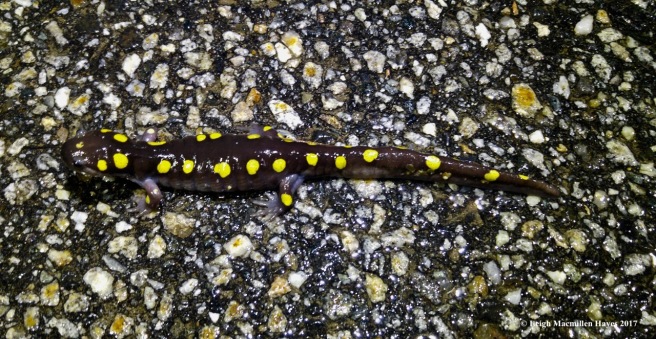
Said mission–to help spotted salamanders . . .

h-spring peeper 1 (1)

and spring peepers cross the road.

h-redback salamander (1)

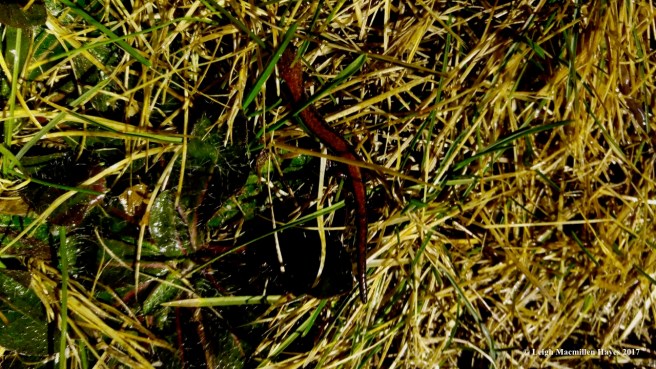
We did so for a while and then headed back to our vehicles. Just before reaching the spot where we’d all parked, someone spotted this redback salamander–I smiled because its the symbol of the Maine Master Naturalist Program.

We were wet. We were cold. And we were happy. As nature would have it, Big Night preceded Earth Day–a perfect beginning.

h-candy lichen

Earth Day began appropriately with a board meeting at Lakes Environmental, where among other topics, Dr. Ben Peierls, the new research director of LEA’s Maine Lake Science Center, shared with us his plans for the water quality testing laboratory. Ben addressed us first so that he could drive to Portland and join the March for Science. We continued our meeting, but were thankful for his representation. Meanwhile, directly outside and all around town, another gathering was taking place as many people participated in an Earth Day cleanup.

By the time I left the meeting pleased with all that had been accomplished, I was ready for a solo adventure to find out what the Earth wanted to share with me since most of the snow melted this past week. Despite being another raw day, or maybe because of it, the candy lichen brought a smile to my face. I think one of the cool things about this lichen is that even though its salmon-colored fruits stand atop stalks, this is really a crustose (crust-like) lichen, the bluish-green surface being the actual structure.

h-juniper berries

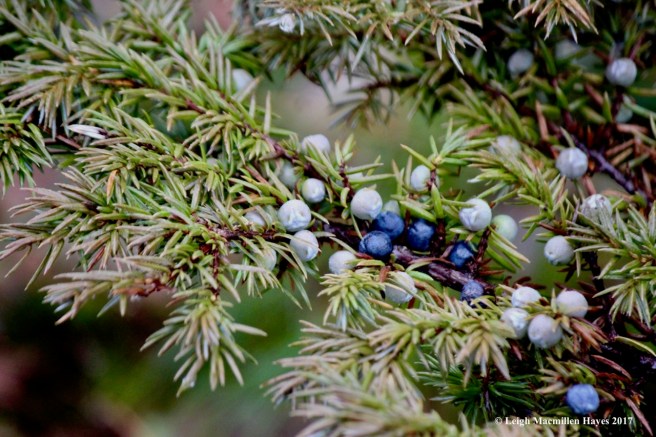
Near the candy lichen, the bright blue of some berries stood out on the common juniper. They remain on the shrubs all winter and it seemed only a wee bit ago they looked all withered. Today’s offerings were plump and pretty.

h-pine droplets

And then there were the raindrops, each waiting its turn to continue the journey toward the earth. I had to wonder what else it might fall upon before reaching its final destination–each little ball encapsulating nourishment.

h-lambkill

One of the receivers, sheep laurel, which displayed its own new life.

h-trailing arbutus

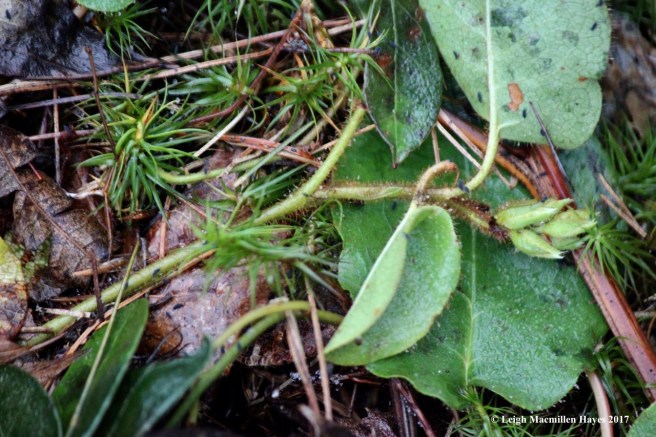
And at the base, trailing arbutus. One year ago, as I noted in my Earth Day post, it was already in bloom. This seemed a reminder from Mother Earth that we need to practice patience.

h-wild turkey

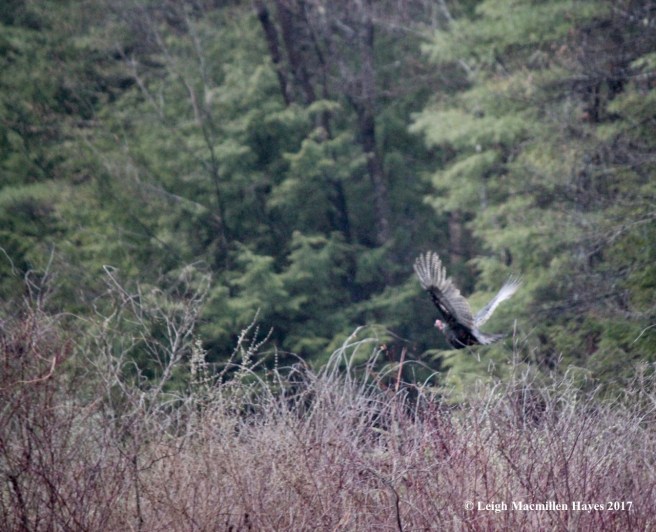
I continued my mosey, as quiet as could be, and so was startled when one large, exotic bird, and then another, and a third flew off from behind a stone wall. And then I realized they were wild turkeys–who truly are exotic if you take a look at all the colors in their feathers.

h-tinder conks on beech

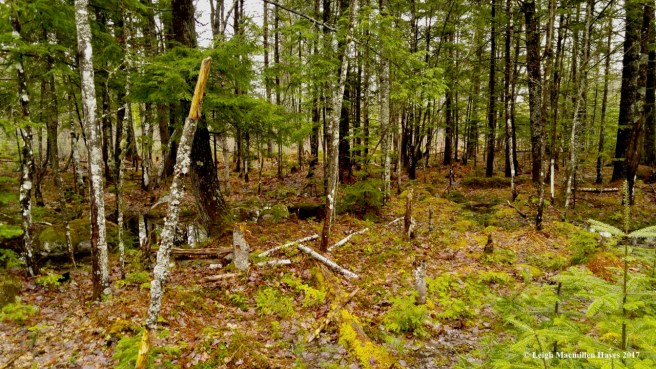
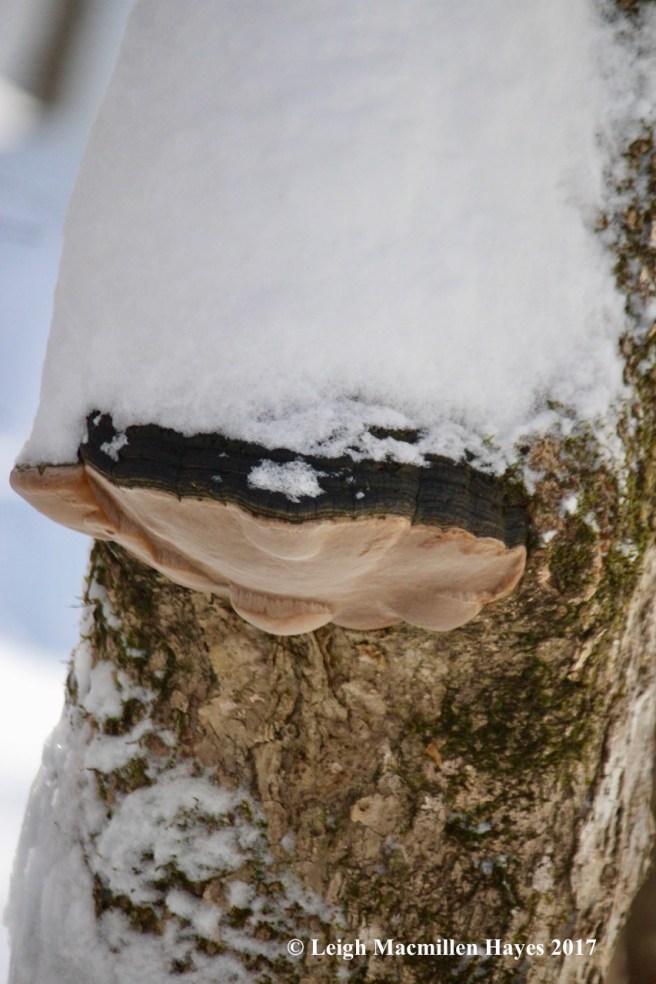
I’d been on the snowmobile trail, but traveling was difficult given some remaining icy snow and deep ruts filled with water. As if I needed an excuse, I decided to slip into the woods. One of my first delights–tinderconks lining a tree as I looked up.

h-moss covering

But really, it was the thick moss coating at the top of the tree that first drew my attention. Several trees in the neighborhood displayed the same fashion.

h1-woods south (1)

My wander was aimless, taking me through boggy areas . . .

h-snow1

and small sections where snow still blanketed the ground.

h-deer prints in snow

Besides plenty of deer scat, I found prints . . .

h-deer hair

and hair.

h-deer hair bubbles

Raindrops enhanced the hair.

h1-moose scat 1 (1)

And though I suspect they’ve moved toward open water, there was plenty of evidence that the moose had also spent the winter in these woods.

h-moose hair

They, too, have shed hair–preparing for the summer scene.

h-moose maple

A couple of months ago, I’d been concerned that the moose had consumed all the tree buds, but the red maples showed me otherwise.

h1-woods south 2 (1)

At one point, I stood for a while atop a rock and looked to the south.

h1-woods north (1)

And then to the north. It was as I stood there that I heard a repeated sound. It began with a few slow beats, and then a swift series of beats. All seemed muffled. It finally occurred to me that I was listening to a ruffed grouse. Eventually, I followed the drumming and came close to the one beating its wings against a log–the work of a displaying male. I didn’t bother to seek out the actual bird for I knew I’d startle it and it would fly off, so I let it drum in peace, thankful for the opportunity to at least hear it. Really, it was a first for me. Oh, I’ve possibly heard it before, but only today did I recognize it for what it was.

h1-widowmaker (1)

For a while, I was fake lost . . . and then I heard another repeated sound that lead me to a widowmaker and I knew exactly where I was. But where was the maker of the sound?

h-owl 1

In a tree above me.

There were actually two barred owls and I was so thankful for the honor of listening to and watching them on this Earth Day.

I was also thankful for all the privileges bestowed upon me. The privilege of living. The privilege of noticing. The privilege of questioning. The privilege of understanding. The privilege of wandering. And especially, the privilege of wondering. Thank you for your offerings, Mother Earth. I am honored to know you.


Book of April: How to tell the Birds from the Flowers

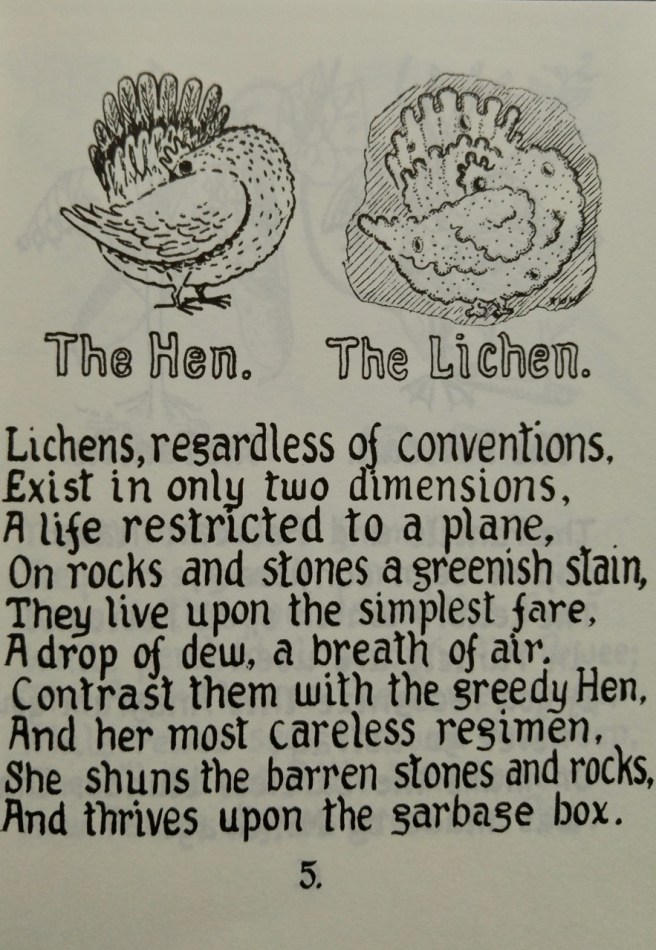
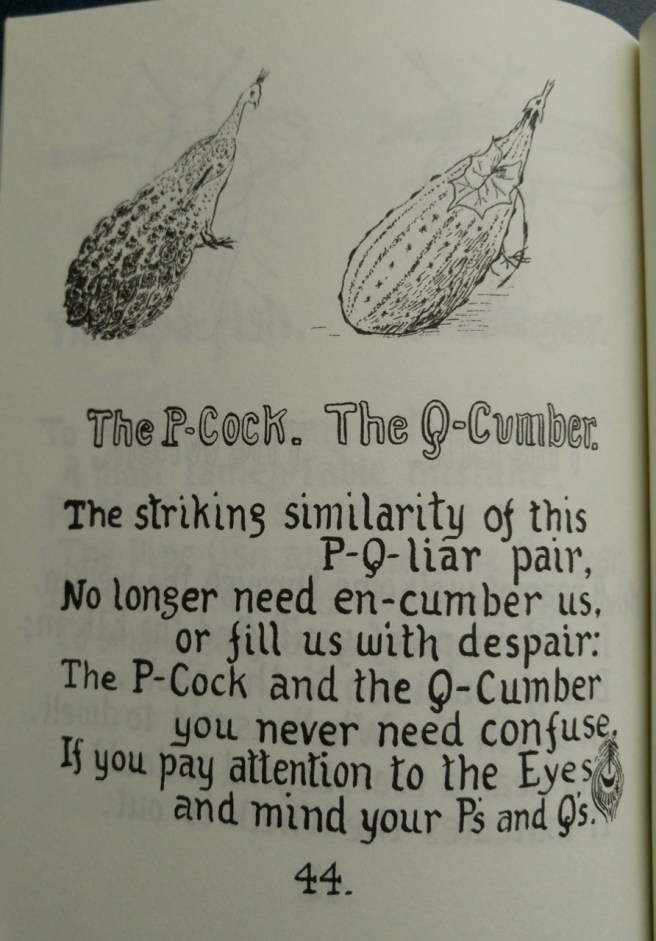
It’s April Fools’ Day and I can’t think of a more appropriate book to share as Mother Nature showers snow upon us than How to tell the Birds from the Flowers and other wood-cuts by Robert Williams Wood.

b-11 (1)

A friend found this delightful little ditty at an independent book store in Brattleboro, Vermont, several months ago and couldn’t resist purchasing it for me. Thank you, A.J. 

Can you see from the cover what Wood had in mind? 

b-9 (1)

And his language–Flornithology? Oh my. Artistic license met poetic license. 

The first edition was published in 1917–in Kent, England. According to a little research, Mr. Wood was born in England, but went on to become a physicist at Johns Hopkins. And they say (whoever they are) that he had no sense of humor.

Read on: 

b-8 (1)

b-7 (1)

After this introduction, it gets even better (in my humble opinion). 

b-6 (1)

Whimsical rhymes and . . .

b-5 (1)

clever sketches;

b-2 (1)

Similarities and . . .

b-4 (1)

differences.

b-1 (1)

All found in the natural world. 

b-3 (1)

Doesn’t this just make you smile? The man lacked a sense of humor? Hardly.

And we know the Mother Nature also has a sense of humor. This isn’t the first time it has snowed on April first.

At the back of the book is a list of other facsimile reissues from Pryor Publications. Here are a few titles worth considering: Punishments in the Olden Times, Manners for Women, Manners for Men, A Plain Cookery Book for the Working Class and Why Not Eat Insects.

And on the back cover: “This updated edition originally published in 1917 now includes how to tell ‘The Eel from the Elephant,’ ‘The P-Cock from the Q-Cumber’ and ‘The Elk from the Whelk’ to name but a few. This book will be invaluable to those who are short sighted or just plain confused, the rest of you may even find it amusing.”

I think I fall into the latter group and that’s what A.J. had in mind (right?) when she gifted it to me because I find it quite amusing. 

Happy April Fools’ Day. 

How to tell the Birds from the Flowers and other wood-cuts (is he referring to himself?), versus and illustrations by Robert Williams Wood, 1917.

Celebrating Place–Naturally

Once the snow melts it will be more difficult for me to wander and wonder in the woods I explore all winter given its spring/summer water level and logging slash. And so I make the most of these days–trying to notice as much as I can before I can notice no more (or at least until next winter).

l-bushwhack 1

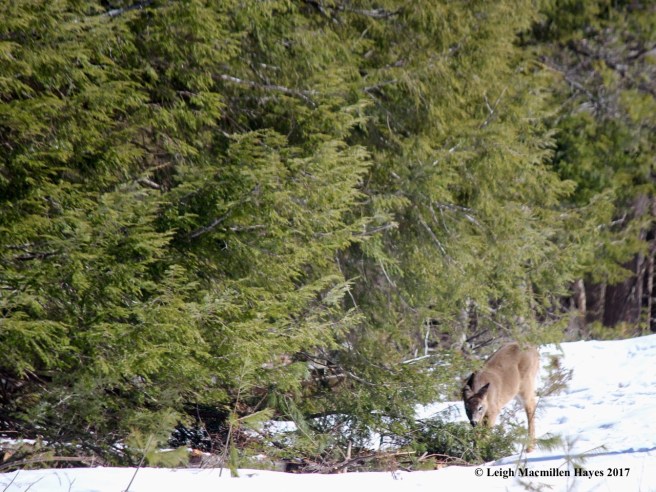
Though I’d promised myself I’d not go again in an effort to not disturb the deer, promises are meant to be broken. And from that came a lesson–the deer are sticking to the snowmobile trail and field edges where tender bark of young red maples and hemlocks, plus swelling buds meet their needs for the moment. So, it was OK that I broke my promise, for the deeper I tramped, the fewer tracks I encountered.

l-spring tails1

Today’s warmer temps in the low 40˚s found the springtails hopping about on any and all surfaces.

l-pileated hole

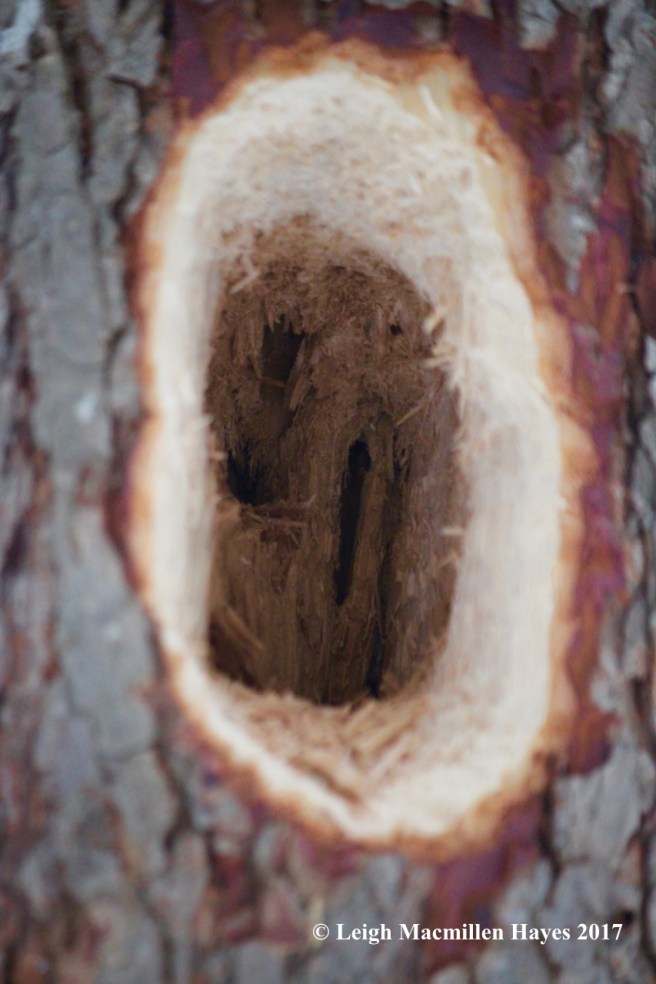
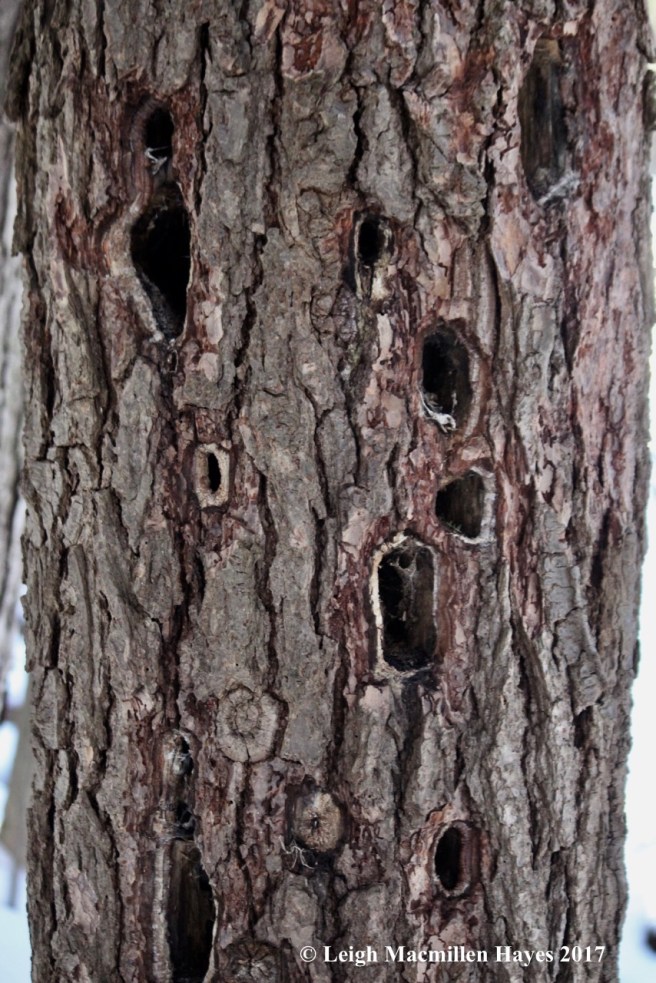
As is my habit, I checked on a pileated woodpecker hole when I saw bark and wood scattered atop the snow. Deep was this excavation in search of nourishment.

l-pileated scat-seeds and ant

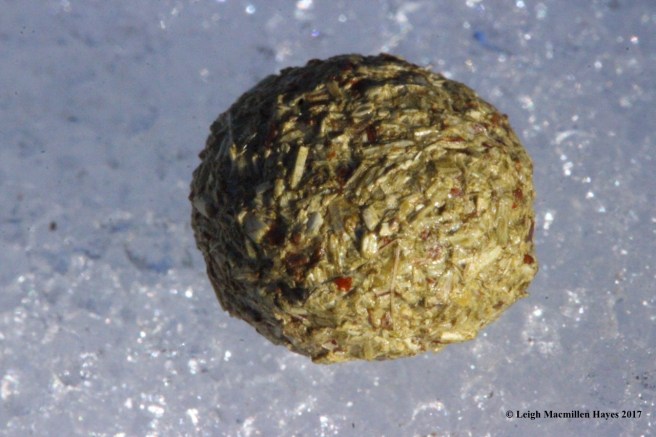
And chock full was the scat below, which contained insect body parts and seeds of the dreaded bittersweet. Beside the scat, a springtail sought to placate its own food needs which among other things includes plant material and animal remains.

l-red maple bull's eye

Turning to another tree, I landed on a perfect bull’s eye! The target fungus that affects many red maples makes for an easy ID.

l-crustose, liverwort and moss

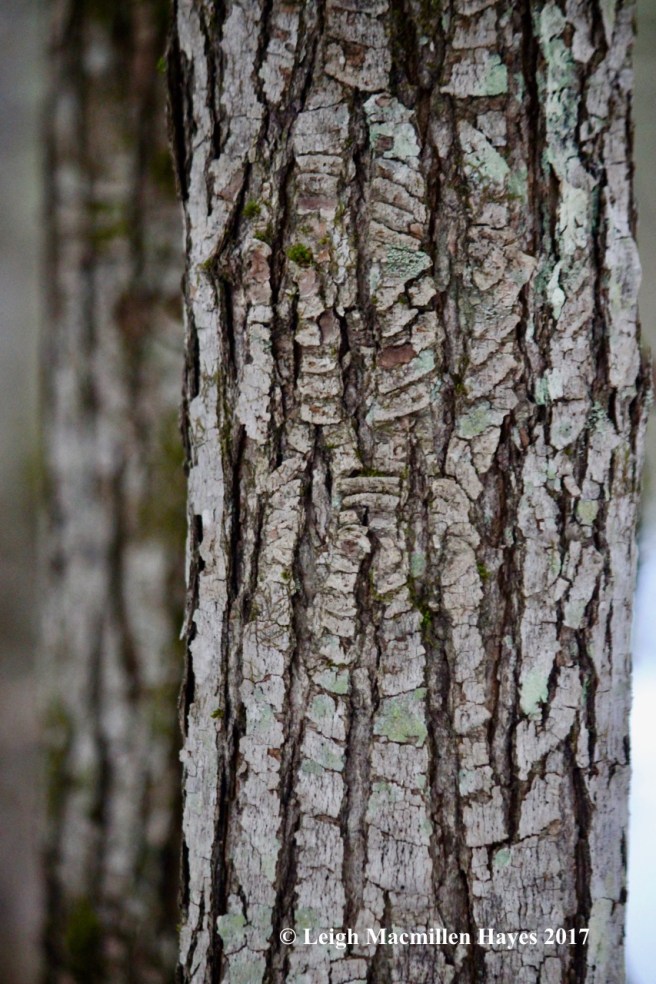
Lichens have also been a focus of late. What I like about this one, the circular green with the black disks of a crustose lichen (possibly bark disk lichen), was its location beside a liverwort (the beaded brown Frullania eboracensis) and a moss that I didn’t key out. Tree bark has its own structure and texture, but so often others also call it home.

l-shield lichens on rock

Rocks also serve as a substrate and this one featured a couple of leafy foliose shield lichens, their colors enhanced by yesterday’s inch of snow.

l-hair lichen and beard lichen

And dangling from a branch, two forms of fruticose (branching or fruit-like structure–) lichens. The dark is a hair lichen, while the green a beard–seems about right with the hair above the beard.

l-lichen garden

On another maple I spied a garden–you’ve got to liken it. (Corny joke that always manages to enter a lichen conversation.)

l-frullania 1

I’ve often paused beside Frullania eboracensis, a liverwort with no common name, but today several trees shared displays of mats called Frullania asagrayana, so named for a botanist and natural history professor at Harvard University from 1842-1873–Asa Gray.

l-frullania asagrayana 1

Its shiny, overlapping chain of red-brown leaves reminded me of caterpillars crawling along the maple bark.

l-spirea:steeplebush

Casting my eye elsewhere, steeplebush in its winter form offered an artistic presentation.

l-bracken fern1

And as the snow melts, last year’s bracken fern made an appearance.

l-speckled 3

One last shrub made me stop. Minus any catkins or “cones” for which it is known, I had to think for a moment about the speckled alder. But those speckles or lenticels through which gas exchange occurs, and the buds and leaf scars were give aways.

l-speckled buds and leaf scar

The two bud scales meet at their edges and look like miniature footballs. But it’s the bundle scars where leaves were formerly attached that make me laugh. That vascular system looks like a face–two round eyes, a funny shaped nose and a round mouth, as if it’s exclaiming, “Ohhh” or “Wow.”

l-Pleasant Mtn in background

At last I reached my turn-around point. I could see Pleasant Mountain in the distance and knew where I was in the world. This is my place and I love every opportunity to celebrate it–naturally.

Changing Focus Sundate

Because we’d traversed the trails along the western portion of Sebago Lake State Park a few weeks ago, my guy and I thought we’d try the eastern portion today. The sun shone brilliantly and there was a slight breeze as we drove down the park road to the boat launch parking lot.

s-map (1)

Studying the map, we decided to follow the Outer Loop in a counter-clockwise fashion.

s-following my guy (1)

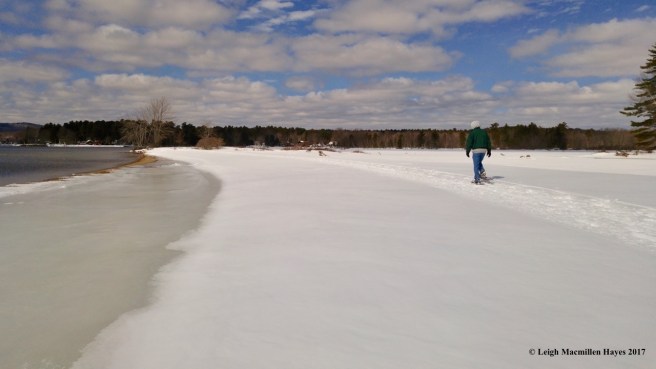
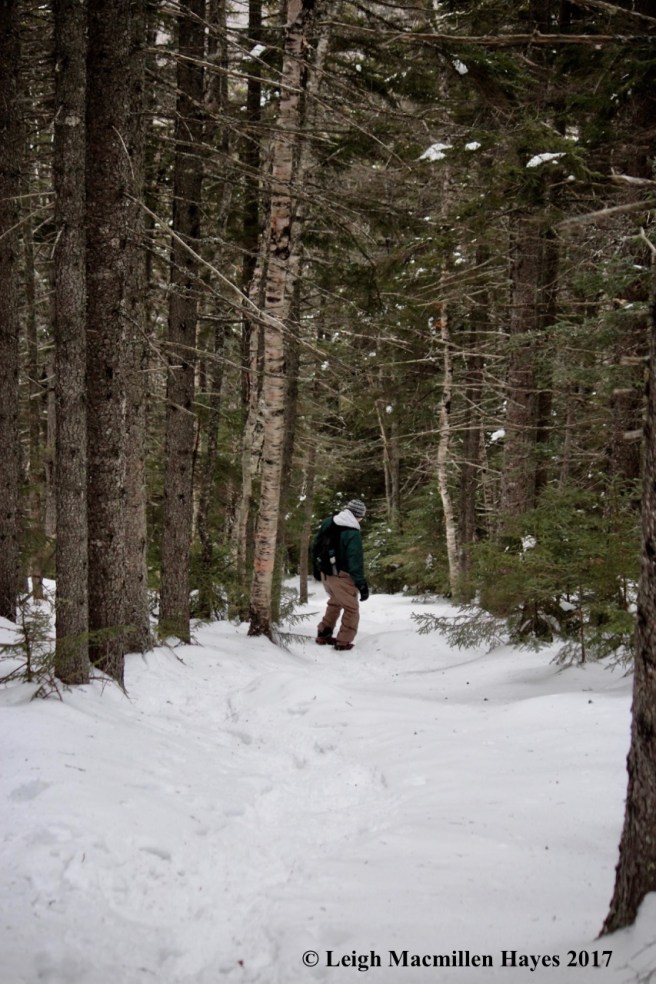
Snowshoes were a must, but the trail was well traveled. My guy’s attire spoke to the breeze and a bit of a chill that greeted us.

s-songo 6 (1)

Whenever we could, we took in the view of the Songo River that winds its way from nearby Brandy Pond in Naples to Sebago Lake on the Casco side of the park. This river has been the focus of the Lakes Environmental Association for the past ten years as it was once heavily infested with variable-leaf milfoil. Thanks to LEA’s good works, the invasive aquatic plant has been eradicated, though the milfoil crew conducts routine check-ups each summer.

s-sandbar 2 (1)

When we reached the lake, we chose a diversion and followed the trail along the sandbar.

s-Songo from sandbar (1)

It offered a backward view of the lagoon and we could hear Canada geese honking from the open water.

s-picnic tables (1)

And then we turned and headed to the beach. The park service grooms the trails for cross-country skiers and snowshoers, making for an easy hike when we stayed on trail, which we did for the most part today. Picnic tables and outdoor grills were abundant and we had our choice.

s-Sebago lunch view

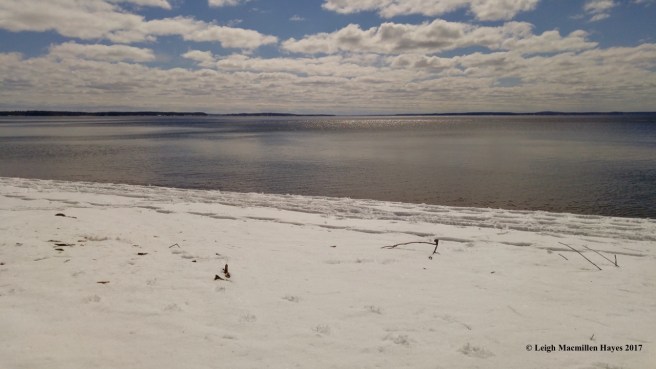
We chose one in the sun for it had little snow on it. This was our lunch view. As Maine’s second largest lake, Sebago Lake is twelve miles long and covers a surface area of 45.6 square miles. The maximum depth is over 300 feet and its mean depth is just over 100 feet. The 105-mile shoreline touches the towns of Naples, Casco, Raymond, Windham, Standish, Sebago, and Frye Island. All that and we’ve never spent any time on it. We’ll have to fix that in the future.

s-water (1)

Water clarity is excellent and the bottom can be viewed at 45 feet. That’s all good news for Portland and surrounding towns for the lake is the source of their drinking water–thanks to the Portland Water District.

s-songo river out of focus

We followed the trail along the boundary of the park, passing through hemlock groves and mixed hardwood communities. But really, there wasn’t much change in the terrain and we decided we much preferred the west side. A couple of hours later, we were happy to be back beside the Songo River, having completed the loop. And we were ready to change our focus.

s-wasp 3

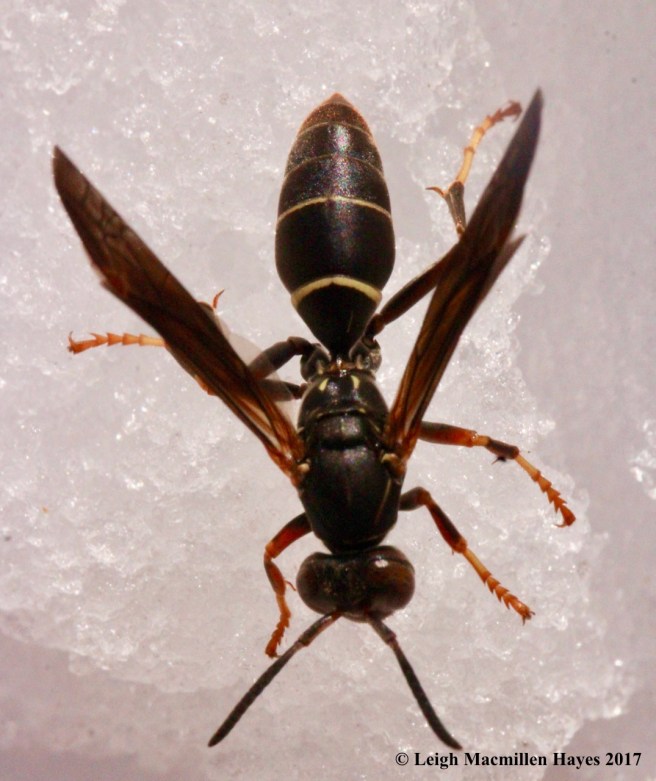
Back at home, my guy decided to revamp our grill. And I decided to snowshoe some more. By 2:30, the temp had risen into the 40˚s and I didn’t bother with a jacket or gloves. Right off the deck, I found my first great find–a wasp moving sluggishly on the snow’s surface. Those wee claws at the end of its foot (tarsus) must have been frozen.

s-script lichen

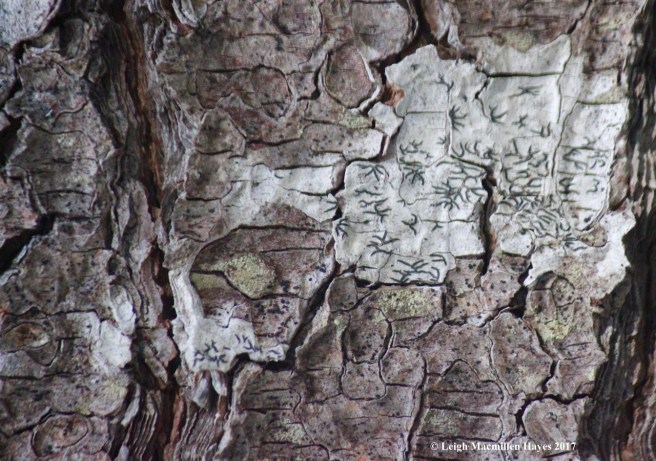
I didn’t go far, but spent lots of time in quiet admiration. There were things to notice, like many, many mammal tracks. And this crustose lichen which is a script lichen. It’s “script” could easily be mistaken for a branching plant.

s-oak gall

Each time I stopped, I wondered what I might see that I hadn’t viewed before. And I wasn’t disappointed. One oak had several twigs with woody growth forms where buds should have been swelling. I decided they were galls and conducted some research when I returned home. I think the tumor-like swelling is a gouty gall that grows on oaks. Apparently, it’s created by a wasp. Hmmm. Not the one I saw, but a tiny wasp of the cynipidae family. The galls provide food and protection for the developing larvae.

s-red bud insect

I found another protective covering on the maleberry that grows near the cowpath. I’m not sure what insect created this cozy home, but being in the wind tunnel that comes down the powerline, its rather impressive that it still exists.

s-vernal pool

My last stop was the vernal pool. I wasn’t the only one who paid a visit. I found snowshoe tracks created by a neighbor who had stopped by to look and deer tracks that crossed the front edge of the pool. I think the snow will melt eventually and life will begin again for the spring peepers, wood frogs and salamanders–it always does.

I’ve said it before and I’ll say it again. I love winter. But . . . I can feel a change of focus in the air and see it in all that surrounds me. I guess that’s why I love being a New Englander.


Beware the Ides of March

As I write, snow flurries float earthward landing atop the almost two feet of snow we received yesterday. Perhaps I should have heeded the soothsayer who warned Julius Caesar to “Beware the ides of March,” in Act 1, Scene 1 of Shakespeare’s play about the Roman politician. 

But I didn’t. I stepped out the door this morning and took my friend, Judy Lynne, with me for today is her birthday, thus making March 15 a day of celebration rather than one to be dreaded.  

As for “ides,” that word refers to the day in the middle of the month. Every month has a day that divides it in half, therefore, every month has an ides. But still, in the play it sounds so ominous–and is eventually.

And as for Judy, she missed the blizzard (and all our winter weather) because she teaches in China. And she is not at all like the Roman soldiers. Rather, Judy embraces every person and critter around the world and sheds love wherever she goes. 

p-porky

Since she can’t be in western Maine to enjoy the results of a late season storm, she’ll have to travel vicariously–beginning with the porcupine who didn’t let a little snow stop him from plowing through. Those of us who know Judy travel in a similar manner as she shows us parts  of the world we may never actually visit. 

p-Mount Wash

The view of Mount Washington will help her get her bearings. It is this and Pleasant Mountain and our orientation to them on the horizon that help us recognize our place in the world.

p-snowshoe hare

I didn’t expect to see many tracks this morning, but was pleasantly surprised. Besides the porcupine, I saw deer, mouse, red and gray squirrel, chipmunk and these. I can’t give you lobsters for your birthday, Judy, but I can give you the lobster-like prints of snowshoe hare. 

p-AMC bridge

I often don’t know where I’m headed when I walk out the door, and today was no different. This journey took me into Pondicherry Park where I stopped by the AMC bridge and thought about Judy’s ability to cross bridges with people of other cultures, no matter how deep the snow may be.

p-AMC bench

Today, however, if she wanted to pause after making such a crossing, she’d need a shovel, such was the depth on the bench by the bridge.

p-willet brook from bench site

Together, we headed down the trail to the viewpoint beside Willet Brook. Judy is an artist and I had visions of her recreating this scene of winter snow and spring ice. This picture of transitions reminded me of the changes in her life as she interviews for jobs in other countries.

p-Willet 2

The change will be difficult as she leaves behind friendships formed in the last five years, but I trust in reflection she’ll know she’s making the right choice.

p-false tinderconk

As I snowshoed, I found a few things I knew, but didn’t necessarily understand. Bumps in the road you might say, Jude, or at least on the spore surface of a false tinderconk.

p-hammered, green shield and cocoon

Because she loves design and has an insatiable curiosity, I knew she’d enjoy taking a look at the shield lichens, both hammered and common green.

p-cocoon 2

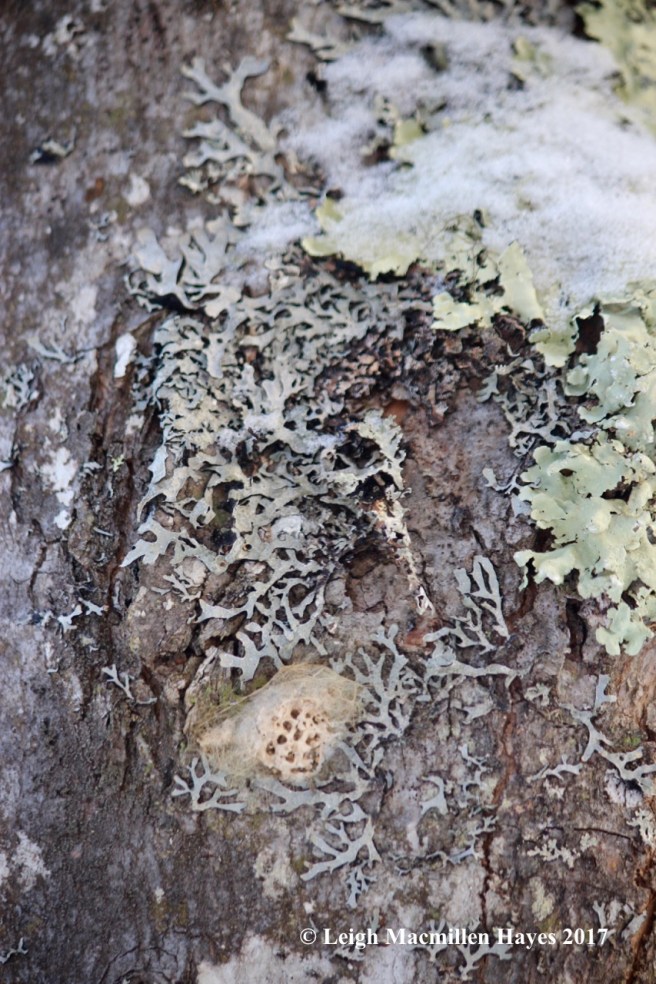
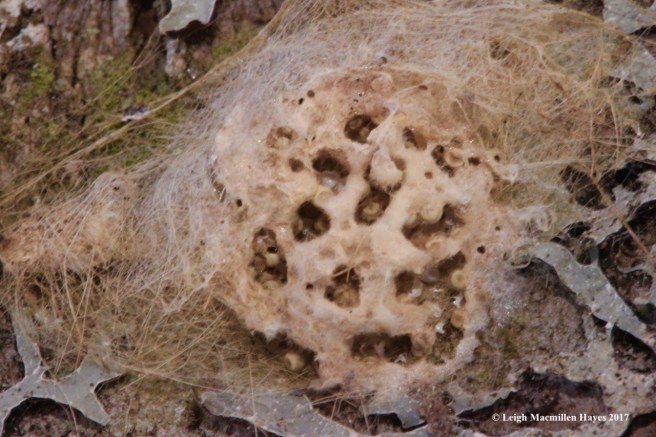
And that would have brought her to notice something else on the bark. She’d have laughed as I stuck my chin against the tree to get a closer look at the silky-hair cocoon embedded on the lichen. Perhaps a tussock moth?

p- Hooded Merganzer

As I wound my way back, I checked Willet Brook again–and spied a hooded merganser swimming away, its crest described as a hammerhead. Hammershield, hammerhead. Methinks Judy will nail down a new job soon.

p-beech bud breaking

And then there was the beech bud already breaking–I’ve seen this happen in previous years; a few scales bursting open before their time.  For Judy, it would have turned into a science lesson for her Chinese high school students. And perhaps a drawing lesson for art class.

p-deer, maple leaves on ground

Throughout the park, I didn’t roam alone for deer tracks were obvious everywhere and I saw three of the creators. But it was the leaves atop the snow that made me pause and I’m sure Judy would have done the same.

p-maple leaves

Occasionally I spot a single withered maple leaf on a tree, but this tree was covered and it made no sense. Maples aren’t typically marcescent–they don’t retain their leaves like beech and oak. It wasn’t until I stepped back and looked at the tree that I finally understood; this was a branch that had fallen when the tree was still in leaf and the deer browsed the tips of some branches, though I trust they didn’t find much nutrition for they moved on. I laughed again and heard Judy roar with me.

p-deer crossing stream:watercress

At the stream below the spring, I noticed the deer had walked right through the water to get to the other side.

p-watercress 1

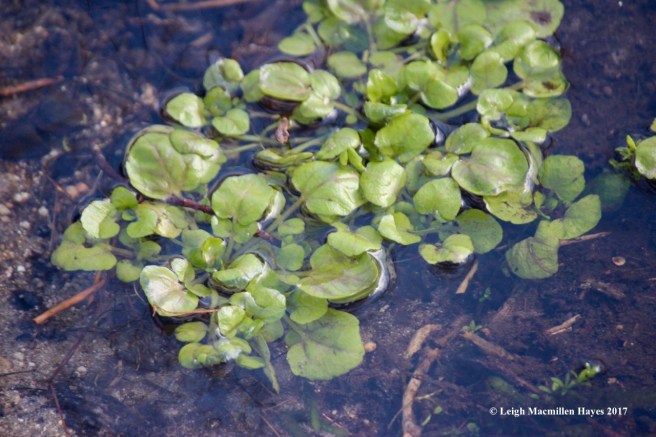
I couldn’t tell for sure, but trust they sampled some wild watercress that grows freely there. And I thought of the foods Judy has sampled during her time in China and other travels.

p-deer crossing bridge

Not all of the deer chose to walk through the water. Some actually crossed the bridge. It struck me that they learned to use it to get to the other side. Judy has learned so much about herself and the world as she’s crossed bridges I’ll never set foot on.

p-dunning bridge 1

The best bridge of all awaited, its roof supporting the weight of the snow. This bridge was built by many to honor a community member, whose wife just happened to be the reason Judy and I met 25 years ago. Wow–it’s been that long since we practiced breathing techniques in Lamaze class .

p-snow on Dunning bridge

One of the cool things this morning because I was the first one there, the peaks and valleys left behind by the storm. If she’d been here, Judy would have taken the very same photo.

p-ducks 1

I went to the bridge to see the other ducks that frequent this location. The sight of the snow-topped rocks and vegetation made me think of frosting and guess who also teaches a cooking class–yup, Judy.

p-ducks 4, black:mallard hybrid?

Within the mix, what I think are two black ducks. I’m still learning my birds, but it did look like one may be a hybrid–a cross between a black duck and a mallard. Of course, I could be wrong on all accounts. No matter–what does matter is that they all get along and that’s what is important to Judy. She’s also a great believer in random acts of kindness and has performed so many good deeds for others.

p-robins 2

I was almost home when I saw some color in the gray birches–more color than the berries being eaten.

p-robin 3

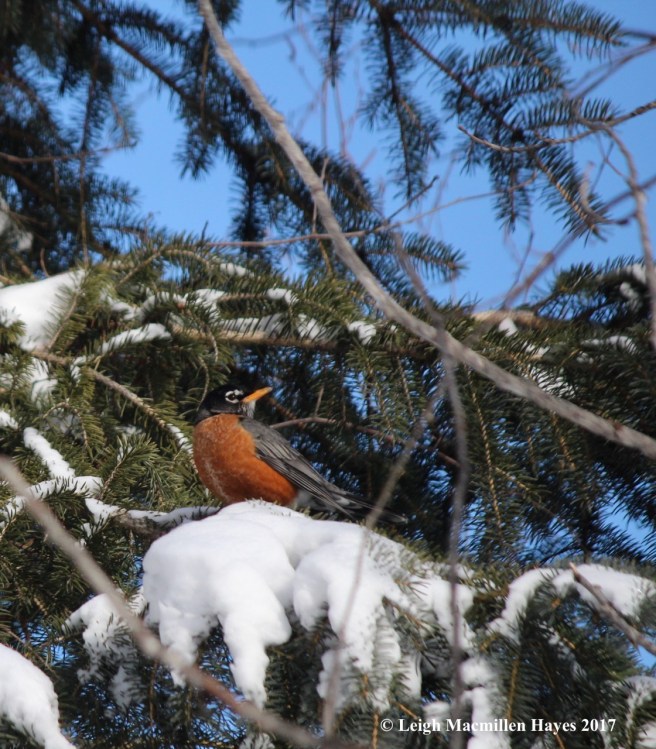
A flock of robins dined on the “junk” food of the bird world–bittersweet berries.

p-robin 1

After one drank some snow, it showed off its rufous-colored breast, reminiscent of Judy’s red hair.

This one posed atop the snow-covered branch seemed a mighty fine representation of our move from one season to the next. (Or might it be one country to the next, Jude?)

In the end, today’s journey reminded me once again to Be Aware–the eyes of March. And be thankful.

I am thankful for my friend, Judy Lynne, born on the Ides of March, but not actually reading this until the day after her birthday. I’ll be forever in awe of her.

Because I Wandered

It’s still cold and blustery. Oh, we had warm spells in January and February. But now it’s March. And it’s Maine. So wind chill in negative to single digits shouldn’t come as a surprise. Nor should the impending Nor’easter predicted for this week. Only more than a foot of snow possible.

Today’s cold wasn’t nearly as frigid as yesterday’s and when I stepped out the back door, I could feel the warmth of the sun penetrating my outer being. It worked wonders for my inner being as well.

o-quaking aspen

My first stop was beside the quaking aspen tree. Yesterday, some Maine Master Naturalist students and I examined tree buds and their characteristics. I love looking at these and do so every day since the tree is right off our back deck.

Varnished scales protect the  aspen’s leaf and flower buds as they lay dormant through the winter. Its flower is produced within a catkin and already the cottony part of the seeds is appearing, much like a pussy willow.

o-striped maple

As I moved into the woodlot, I stopped to re-admire the only striped maple that grows here. Last year a deer used the lower portion of the bark as an antler rub. Yesterday, as we stopped to look at the characteristics of its bark, we noticed it’s been used most recently as deer food. This tree is barely larger than the circle formed within my thumb and pointer finger–and I have small hands. How much more deer attention can it take?

o-gray fox tracks

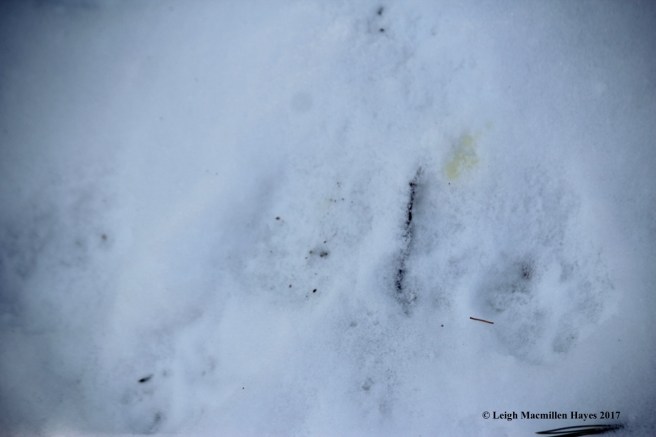
As I looked at the striped maple, my eyes were drawn to the activity of another mammal. Out came my Trackards and I took measurements. I knew by the walking pattern that it was a canine. And I knew by the size that it was a fox. But red or gray was the question. I suspected the latter because I could see details clearly in the soft snow atop the hardened crust.

o-gray fox prints

Measurements and a look at a bunch of prints confirmed my suspicion. Rather than stay on the path, I decided to backtrack the fox’s trail.

o-gray fox and coyote 1

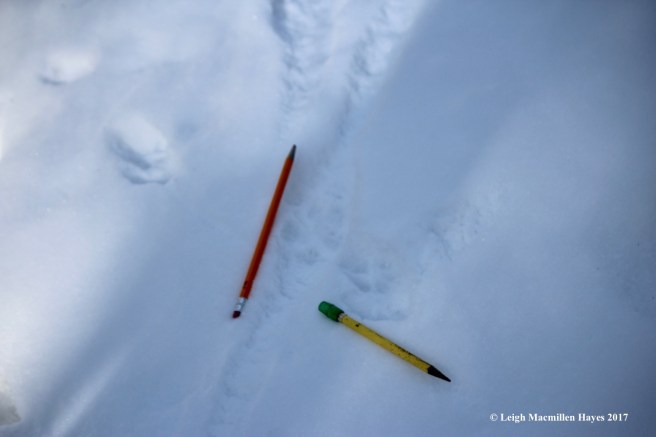
Within minutes, I realized another mammal had traveled in the opposite direction. Also a canine.

o-gray fox and coyote intersect

And atop a double-wide stone wall, I found where the coyote (follow the red pencil) and gray fox (yellow) crossed paths. Not at the same time, I’m sure, but given the track conditions, I don’t think they were too far apart. We saw neither set of tracks as we examined trees and lichens in the same area yesterday.

o-gray fox sat and peed

I also found where the fox sat and then peed. Not much odor–in case you’re wondering.

o-turkey plus

My journey took me across a few more stone walls and through a hemlock grove. I lost the fox, but followed the coyote and then I found others including squirrels, deer and turkeys.

o-turkey wings

It looked like the turkeys had been dancing on an ice-covered puddle. And then perhaps they took off for the wing marks were well defined. Did they fly because the coyote approached? Or was there another reason? Time to head up into the trees for the night, maybe? It’s difficult work for these hefty birds to lift off.

o-many travelers

Everywhere I went, others had been before me. It seemed the prey followed the old logging routes and predators crossed.

o-bs lichen

My own wander became a bushwhack meander. And a few lichens called me in for a closer look. My inclination was to quickly brush off all the gray foliose (leaf like) lichens as weedy hammered shield, but I suspect there was some bottleshield lichen in the mix and realize I need to look again. I’m forever a student–thankfully.

o-crustose mosaic

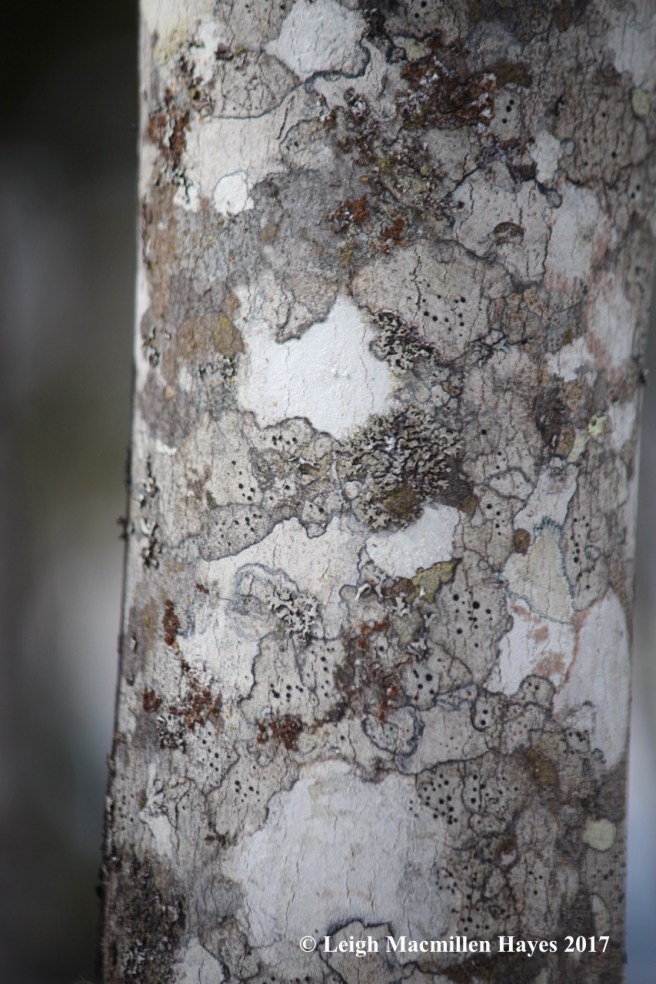
While there were specks of shield lichens on a young maple tree, the variety of flattened crustose lichens covered so much of the trunk that it was almost difficult to distinguish the bark color.  The mosaic pattern suggested a painting–naturally.

o-beech 1

The buds and leaves of the beech trees also asked to be noticed. It’s been my experience that younger American beech keep their leaves throughout the winter–perhaps because their buds are lower to the ground and therefore easy targets for hungry herbivores. There are other theories as well, but I think it’s key to note that it’s the younger trees who keep their leaves, or in the case of this one, those that remain were on the lower branches.

o-beech leaves

They remain until the tree buds begin to break or leaf out. The word to describe this leaf retention is marcescent (mahr-ses-uh nt), which means withering but not falling off. Their rattling in the slightest breeze may be enough to keep those herbivores at bay.

o-beech 4

In the tree’s silhouette, the pointed buds stood out,

o-beech scales


each one a cylinder of overlapping scales in opposite orientation on a hairy stem.

o-witch hazel leaves

That, of course, led me to another marcescent tree that loves this wet woodland, the witch hazel. Its leaves have always intrigued me with their wavy margins and asymmetrical base. But it’s the winter color of the withered leaves that I also find attractive.

o-witch hazel scalpel

And its naked buds, which don’t have waxy scales like the aspen or beech. Somehow the fuzzy hairs must provide enough protection for the winter months.

o-witch hazel bracts

Everything is fuzzy on a witch hazel, including the bracts left from last fall’s ribbony flowers,

o-witch hazel pods

and the woody, two-seeded pods that ripen a year after the flowers have formed. These split open in the fall as the seeds were forcibly ejected.

o-moose scat

I wandered for hours and miles and never saw any prints from the moose that frequented these woods earlier in the season. But, where the snow had melted under a spruce, I found evidence that blended in with the leaf litter.

o-moose browse

And in an area I used to frequent prior to the logging operation of the last few years, I found more sign. The ruler is mine and this side shows centimeters.

o-coyote x2

When I reached the former log landing, my coyote friend made its presence known again. Actually, one became two as they had walked in single file and then split apart several times. They were on the hunt and a snowshoe hare was in the vicinity.

o-cherry

I followed the main logging trail for a while and then turned off to explore unknown territory. But . . . before turning, it was the maroonish color of the cherry bark that warranted attention. And the lenticels–raised, elongated and horizontal imprinted on my brain.

o-deciduous forest

My meanderings continued and again I saw lots of predator and prey activity. Even a porcupine, though that shouldn’t come as a surprise. Finally, I walked into an area of young red oak, red maple and gray birch and knew I was approaching familiar ground. And so I stepped onto the snowmobile trail.

o-deer 1

All along, I’d thought about the many tracks I’d seen, but no mammals . . . until I approached our cowpath. I wasn’t the only one headed that way.

o-deer browsing first

The deer herd seems to have survived this winter well. I’ve yet to find evidence that suggests otherwise.

o-deer browsing

And I felt blessed that I was able to move as close as possible despite the crunching of the snow beneath my feet. The wind was in my favor. And then, it heard me, flashed its white tail and ran down the cowpath. Perhaps we should rename it the deer path for a cow hasn’t walked on it in decades, but like me, the deer use it almost daily.

My day was made because I wandered.


Focusing Our Eyes at Wilson Wing

I almost canceled our Tuesday Tramp this morning. The weather seemed iffy and though that doesn’t often stop us, road conditions do. But Mary and I exchanged a few e-mails and decided that even though we were the only two available, we’d go for it.

w1--deer 1

As we made up our minds, I watched another who also experienced some indecision. Lately, eight deer have spent many moments in the field and our yard, nipping buds along the edge.

w2-deer 2

While the rest of its clan was further out, this one came over the stone wall.

w3a--deer 3a

For me, it was a matter of watching how its legs worked and where it placed its cloven toes.

w4-deer 5

About to visit some trees, it turned suddenly when it realized it was being stalked–not by me but rather a neighbor’s cat. Well, maybe I was as well, but I was indoors.

w6-deer 6

Gingerly, it moved in for a closer look.

w7-deer 7

Tail down, it seemed curious to make a new acquaintance. And the big, tough cat–it ran home.

w8--Sucker Brook 1

And so, I packed up and met Mary for our adventure at the Greater Lovell Land Trust’s  Wilson Wing Moose Pond Bog Preserve on Horseshoe Pond Road in Lovell. We’d had a dusting of snow overnight and weren’t sure what to expect. Always expect the unexpected.

From the start, we found older coyote tracks that we decided to follow. Those led us to mink tracks that began near Sucker Brook. For a while, we followed both as they ran parallel, the mink tracks being much fresher. And then we stood in one spot and realized we were encircled by coyote, mink, red squirrel and short or long-tailed weasel tracks. We could have gone home then, but of course we didn’t.

w9-ice skirt

We decided to follow the brook for a while, hoping to see otter tracks and a slide. Instead, we were treated to aprons of ice surrounding boulders and tree roots.

w10-hoar ice

Some hoar frost at a hole made us wonder who might be within.

w11-mink tracks with tail drag

And our eyes again recognized that we were still on the trail of the coyote and mink. All along, we were curious to see the drag marks left behind by the mink’s tail. Unless it was carrying something–another option.

w12-Sucker Brook 2

As we stood and looked about, movement caught our eyes and we realized we were looking at the mink. Unfortunately, neither of us thought to capture it in a photograph, but it will remain forever in our mind’s eye. While I did exactly what I tell others not to do–tried to follow it for a couple of minutes–Mary stood and listened. A sound above make her crick her neck.

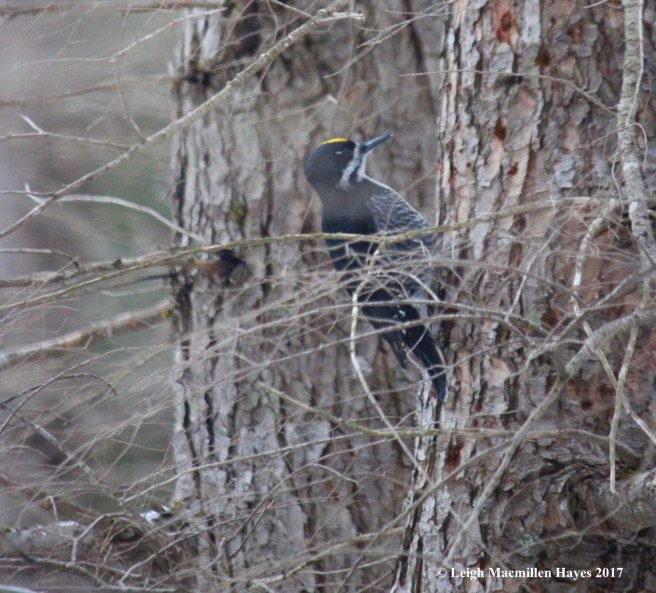
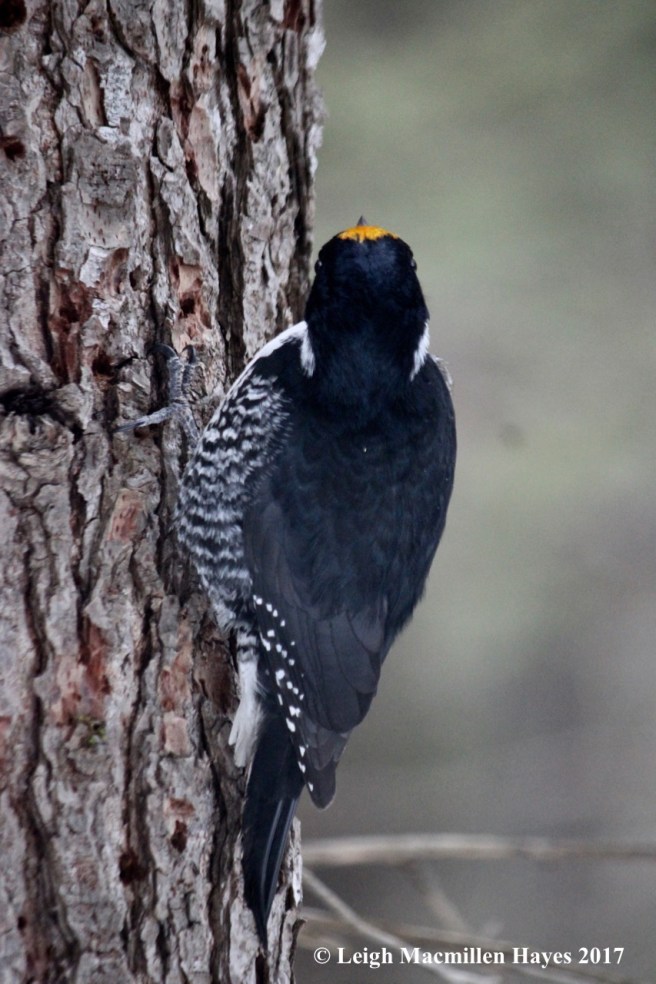
w13-black backed woodpecker

On a dead trunk, a woodpecker foraged among the bark scales. We watched it for a while, trying to note its features from below and we then moved on.

w14--hobblebush

My visits to Wilson Wing are never complete without a stop to worship the hobblebush. For those anticipating spring, it’s only a few weeks away. It won’t be long and these naked leaf and flower buds will unfurl and I’m sure I’ll share their blooming glory with you.

w15-Moose Pond Bog

Another stop that I can’t pass by is a climb up the stairs to the platform–the perfect viewing spot for the bog.

w16-car

Finally, we continued along the trail and I realized my focal points were redundant of all past visits, but it’s fun to view some of these in various seasons. For those who know, this is the old blue vehicle.

w17-lungwort

And right near it, my favorite of all foliose lichens–lungwort, indicative of unpolluted air. At Wilson Wing–indeed.

w18-hemlock catkins ;-)

We crossed the last little stream, found some deer tracks and a beaver chew, and then decided to follow the trail back rather than the road. One of our stops included admiring the hemlock catkins. (Smiley face)

w19-black backed 2

And then we returned to the woodpecker. By now he was our woodpecker, just as the mink that we saw and other critters we didn’t see were also “our mink” and “our coyote,” etc. It’s amazing how even when we don’t see the mammal, recognizing that it has passed through is enough to excite us. But this bird . . . oh my.

w20-black backed 3

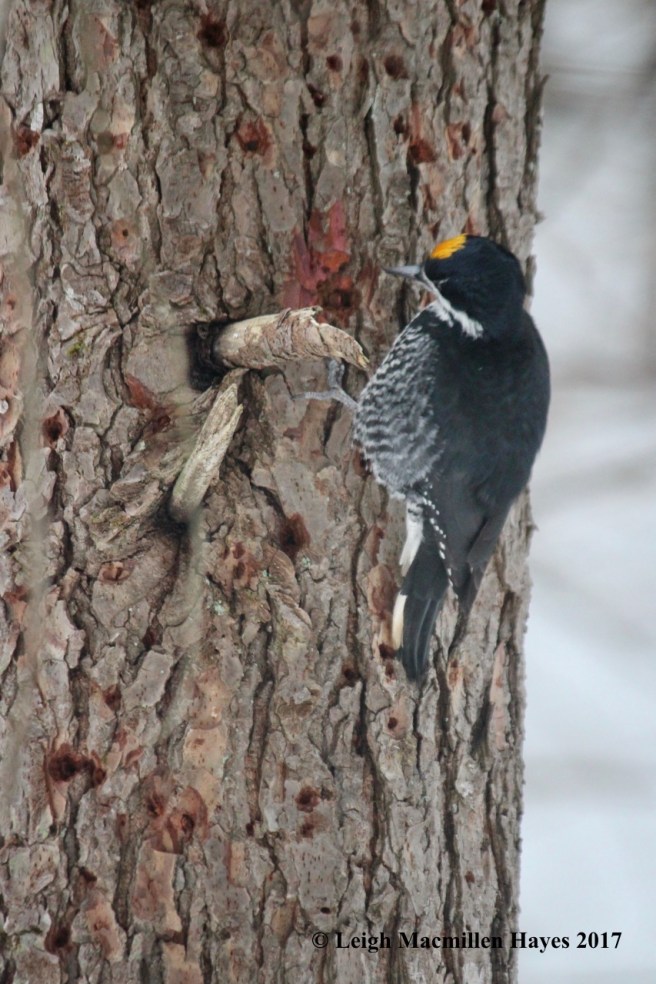
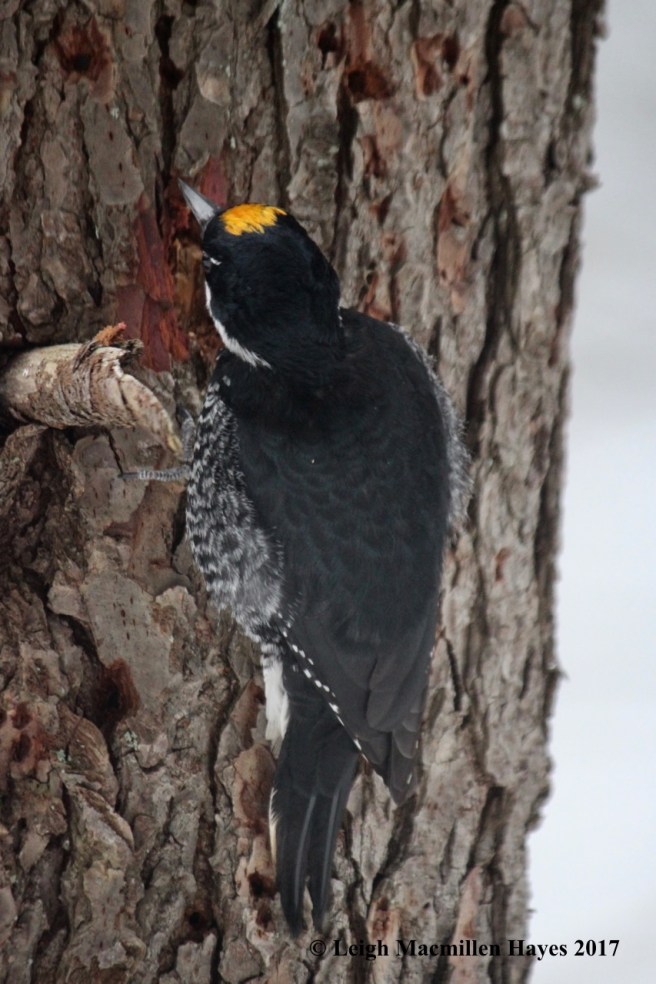
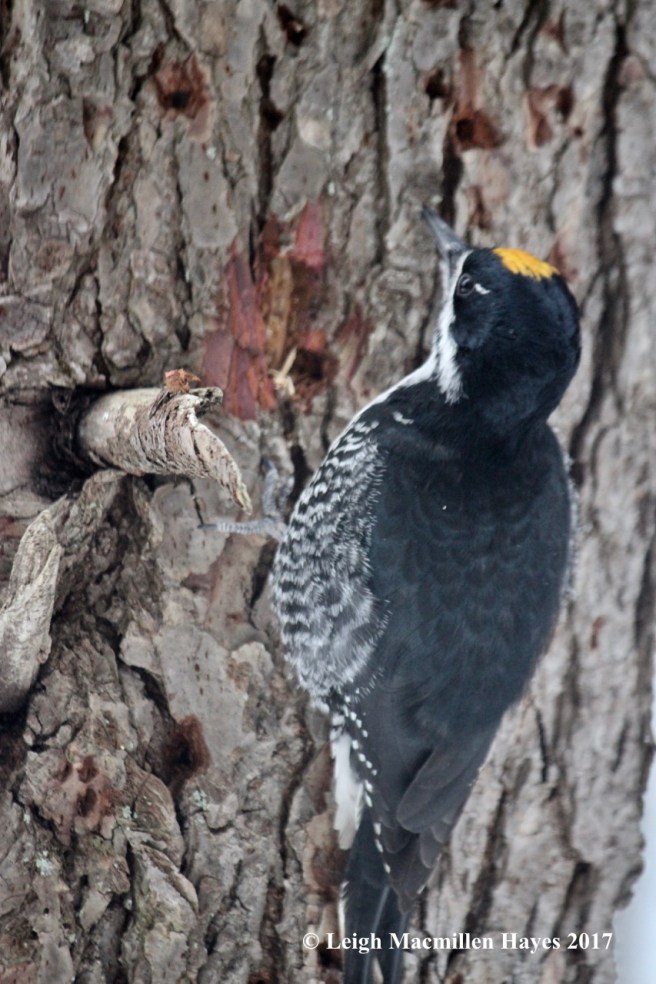
We noted the orangey yellow crown as it cocked its head.

w26-black backed 8

Its face was black and white, including a black mustache and white eye line.

w22--black backed 5

We were surprised by its stocky build.

w24-black backed 6

And those black and white barred sides or flanks weren’t like the woodpeckers we normally see.

w25-black backed 7

It worked constantly, flaking the scales off the trunk as it searched for insect larvae.

w27-black backed 9

Cinnamon colored underbark revealed itself where the bird had recently excavated.

w28-black backed 10

As it contemplated its next move, it didn’t seem to mind our admiration.

w30-black backed 11

With its strong beak, it probed and probed.

w31-black backed 12

Then held its head back and . . .

w32-black backed 13

probed some more.

w33-black backed 14

First it cocked its head to the right.

w36-black backed 17

And then back to the left.

w38-blackbacked 18

Frequently, it paused for a brief break. Or perhaps it was dining and we didn’t know it.

w40-black backed 21

We were mesmerized.

w39-black backed 20

And delighted . . .  for we’d had the opportunity to focus our eyes on so many wonders, but especially the mink and this . . . a black-backed woodpecker. This was a rare opportunity for these birds seldom show themselves, especially this far south–all the more reason to be thankful that we decided to go for it and focus our eyes on the nature of Wilson Wing Moose Pond Bog Preserve.

Knowing Our Place

It doesn’t matter how many times I explore the same space, I’m always amazed at the opportunity to learn something new. And so it happened at the Holt Pond Preserve this very morning. It’s one of my favorite hangouts in western Maine on any day, but today–it added some new notches to the layers of appreciation and understanding.

h-willow

Because  Grist Mill Road that bisects part of the preserve serves as part of the snowmobile trail in the winter, parking occurs on the sharp curve that marks the end of Perley Road and beginning of Chaplin Mill Road. (You have to know you are moving from one road to the next because there are no road signs.) A couple of parking spots have been plowed and its from those that this first sight was viewed. I was a bit confused when I saw alder catkins and cones, with pussy willows growing among them. On the same shrub? Shouldn’t be. And it wasn’t. Rather, a closer look cleared the confusion when I realized that the two shrubs favor the ditch at the edge of Emerald Field.

h-tingley-brook

I was with Alanna Doughty, Education Director for Lakes Environmental Association and our intention was to focus on tracks. But . . . we suffer from Nature Distraction Disorder, thank goodness, and so our NDD forced us to notice all things, including the beauty that is Tingley Brook.

h-moss-green

And the way the snow and morning sun enhanced the color of mosses decorating old maple trees.

h-green-ash

The mosses weren’t the only shade of green in the neighborhood. A young ash tree angled across the path and its D-shaped leaf scar helped us identify it as a green ash.

h-beaver-dam-1

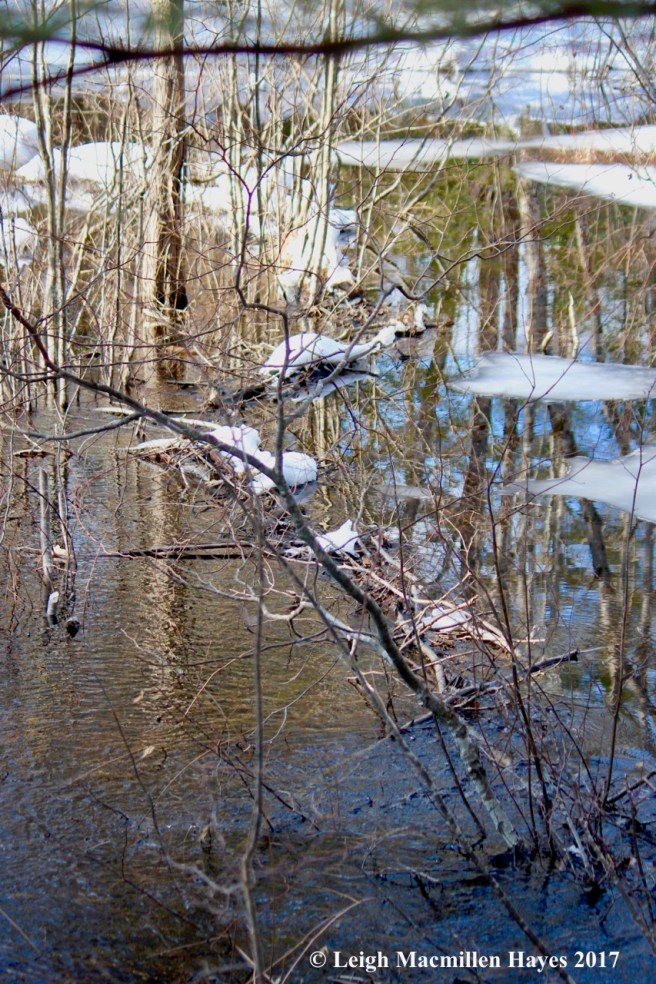
As we moved along, we spied a new beaver dam and began to notice their works in the vicinity.

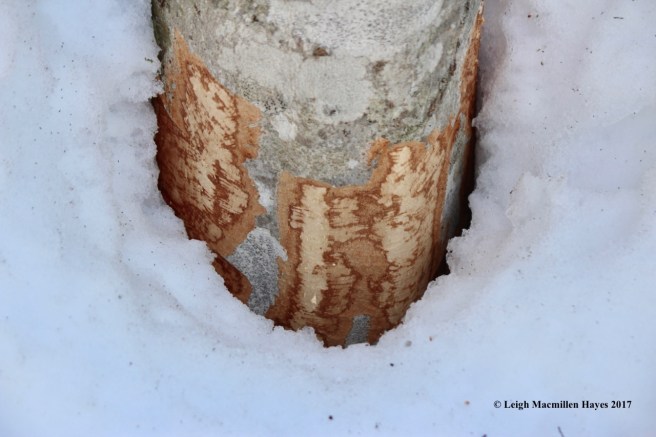
h-beaver-chews-near-dam-1

We know what trees they chose for construction.

h-beaver-on-beech

And we wondered why they didn’t finish the job on this beech tree. Will they return? Only time will tell.

h-squirrel-works

Though we periodically saw downed hemlock twigs, some appeared to be wind drops. But, these drew us in for closer inspection.

h-squirrel-nibble

Through a hand lens, we spied the works of a different mammal–in this case, red squirrel. Ends of twigs were cut and dropped and then their buds nipped. But that wasn’t all we noticed. We were wowed by the petioles and how those little stems attached the needles to the twigs. And the tiny warts on the twigs. And . . . and . . . and. Who knew there was so much to admire about a hemlock twig?

h-beaver-dam-2

We continued on, turning from the brook to Muddy River, where  a larger and older beaver dam easily identified itself given the snow cover.

h-canoe

We followed some indiscernible tracks of a perfect walker and then lost them by the time we reached the canoes–also hiding under the white blanket.

h-red-maple-swamp

At the canoes we could have turned and found our way out, but ever curious, we continued on toward the red maple swamp. And then we decided to take a different course. Rather than follow the boardwalk, our usual pathway, we took advantage of the current conditions and decided to walk through the swamp toward the Muddy River. Earlier, we’d noted that a snowmobile had passed along the river and though we’d questioned the choice of its driver, we felt a compelling drive to take in the view from a different vantage point.

h-lodge-1a

With that in mind, and all caution thrown to the wind, we crossed the Muddy River to take a closer look at the beaver lodge we normally admire from a nearby boardwalk.

h-lodge-5

h-beaver-lodge-3

h-beaver-lodge-back-side

We took it in from all sides, noting the fresh saplings added during fall reconstruction, as well as the mud. It was a warm day–and we wondered if we might have seen steam rising had the temperature been colder.

h-muddy-river-from-lodge

It was from here that we looked back across the river to the hemlock hummock and boardwalk area where we normally stand. There was a certain satisfaction in being on the other side for a change.

h-tamarack-2

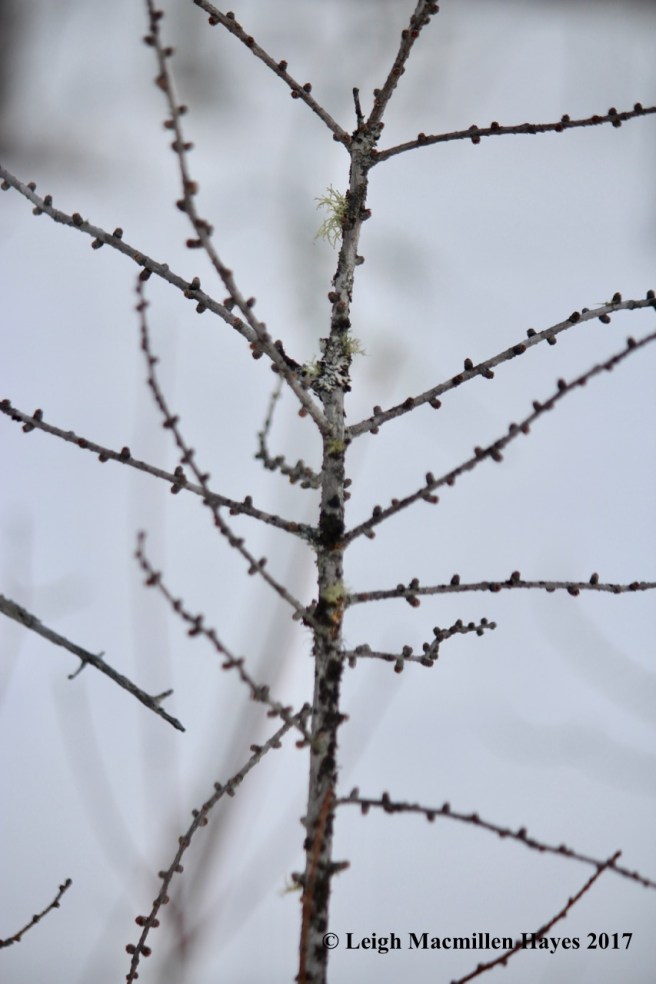
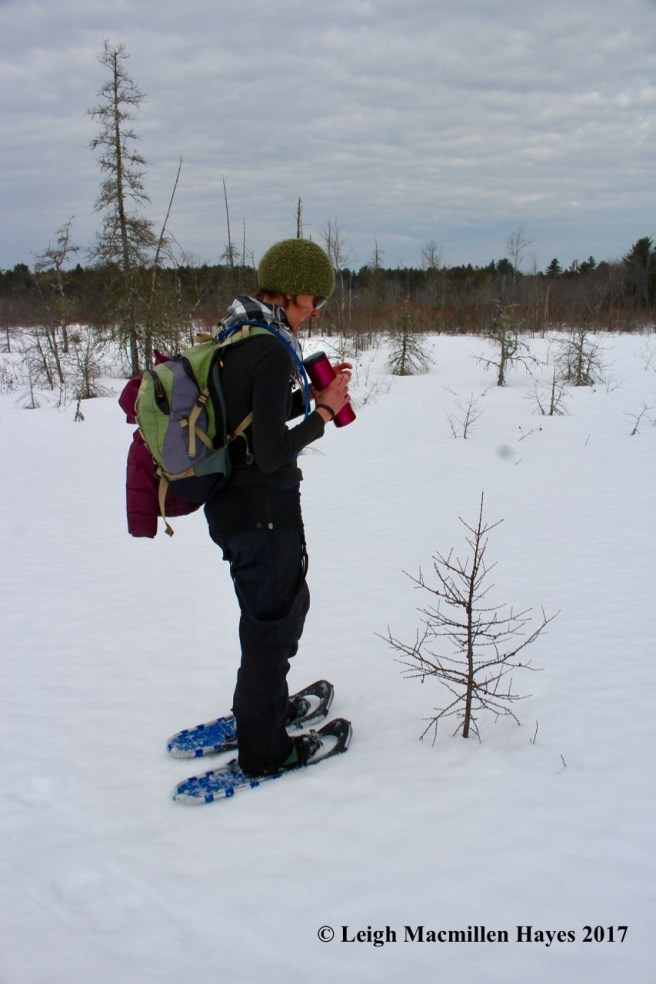
When we made our way back to the red maple swamp, a little tree drew our attention. Small in stature, yet big in personality is the tamarack or Eastern larch. It’s our only deciduous conifer and somehow we’d missed its existence in the swamp all these years, perhaps because we don’t often actually walk through the swamp. While larches have needles, they typically turn yellow and then drop, leaving behind a winter form that yields horizontal branches with nubs.

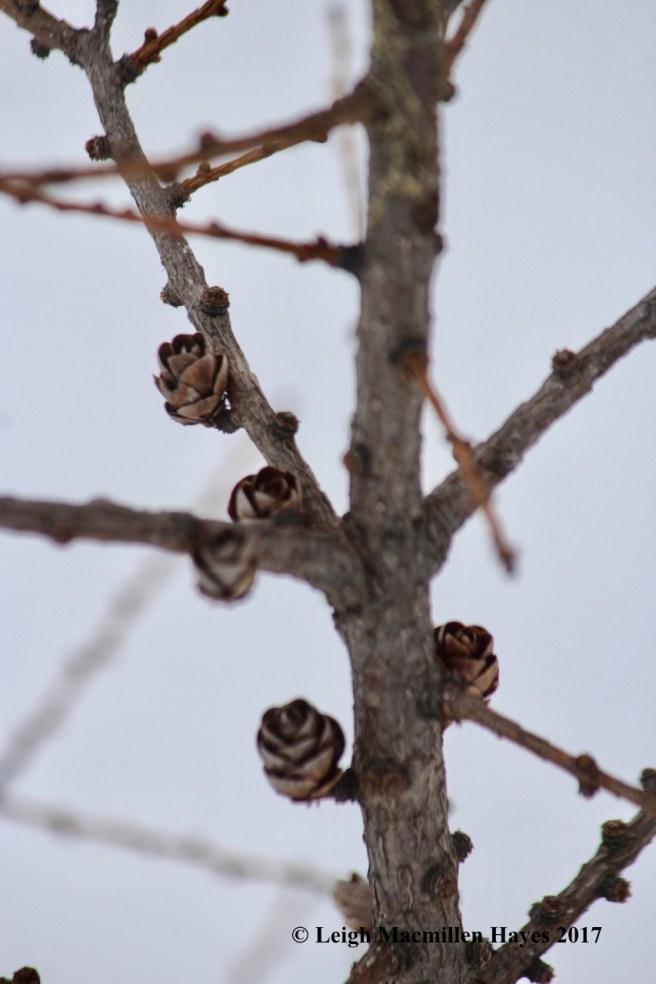
h-tamarack-cones

We noted that though the fruits reminded us of hemlock cones, on the larch they stand upright in contrast to those that dangle on their cousin’s branches.

h-holt-pond-and-bear-trap

Once we realized we were looking at larches, we started to see them everywhere. Finally, we pulled ourselves back to the river’s edge and continued our journey to Holt Pond.

h-holt-pond-outlet-2

Again, we found tracks that had been bleached out by the warm sun of the last few days, but we surmised a member of the weasel family had bounded along, crossing the outlet of Holt Pond.

h-alanna-1

We crossed the quaking bog, home to spaghnum moss, pitcher plants, sundews, cranberries, and so much more. But our attraction was overwhelmingly to today’s tree of choice–more larches.

h-tamarack-lichens-1

While we appreciated the young ones, we were completely in awe of the grandparents, who had grown long beards and supported a variety of barnacles in the form of lichens.

h-variety

Foliose and fruticose, they added texture and color to the presentation.

h-tamarack-winter-twig

Some describe the branches as wart-like, but we saw roses.

h-tamarack-lichen-maze

And a composition of structure and age and growth that spoke to an art form.

h-alanna-at-tamarack

All warranted further examination.

h-barbed-wire-on-tamarack

And then we realized there was also another sign of the tree’s history–barbed wired wrapped around and growing through the trunk. Stonewalls in one section of the preserve speak to a former farmer’s need to keep livestock from entering the swamp. But the barbed wire was a distance from the walls and quite far out in the swamp and so we wondered who had placed it there and why.

h-nest-2

At last it was time to turn back. And as we moved closer to shore and the speckled alders, a bird’s nest made itself known. Grasses, cattails and leaves were woven into the structure that was securely attached to the shrub’s branches.

h-layers

Before following the river back to the woodland trail, where we realized some tracks we’d followed earlier were those of a bobcat, we looked at the layers from the swamp to shrubs to deciduous trees to conifers to blue sky and clouds–and the colors mixed within.

And we knew that we’d shared an appreciation for the time –getting to know each other and our place better.


Universal Love

Dedicated to my guy and all who wander and wonder with me.

When I wander, hearts frequently speak to me . . .

v1-damselflies

of joy . . .

v2-sally

and growth,

v3-hobblebush-leaves

rhythm,

v4-tree-1

and inner . . .

v5-tree-3

secrets.

v7-lichen-1

Some hearts are well-rounded,

v8-overset-pond

others gigantic,

v9-lichen-2

and occasionally there are those missing a part, but still pulsing with life.

v12-moose-track

A few are lopsided and . . .

v11-moose-scat

sometimes overflow.

v13-deer-heart

A rare find is one pawed by a deer (deer heart!)

v14-snow-heart1

While a few dangle,

v15-snow-heart-3

support is often appreciated.

v16-hoar-frost

Always, they offer an outer expression of life within.

v17-to-my-guy

All speak the universal language of love.

v10-metal-heart

And whenever I arrive home, I’m treated to a heart created for me by my guy.

To him I say, “I love you.”

And to all of you readers who have taken the time to  wander and wonder with me for almost two years, I extend my heart-felt thanks.

Happy Valentine’s Day.


Seeing Red

I wander through the same woods on a regular basis, sometimes following old logging roads and other times bushwhacking through the understory–a mix of young conifers and hardwoods that are slowly reclaiming their territory. Always, there are water holes to avoid as this is a damp area, so damp that in another month I probably will have to curb some of my wandering habits because it will become difficult to navigate.

h-maleberry-buds

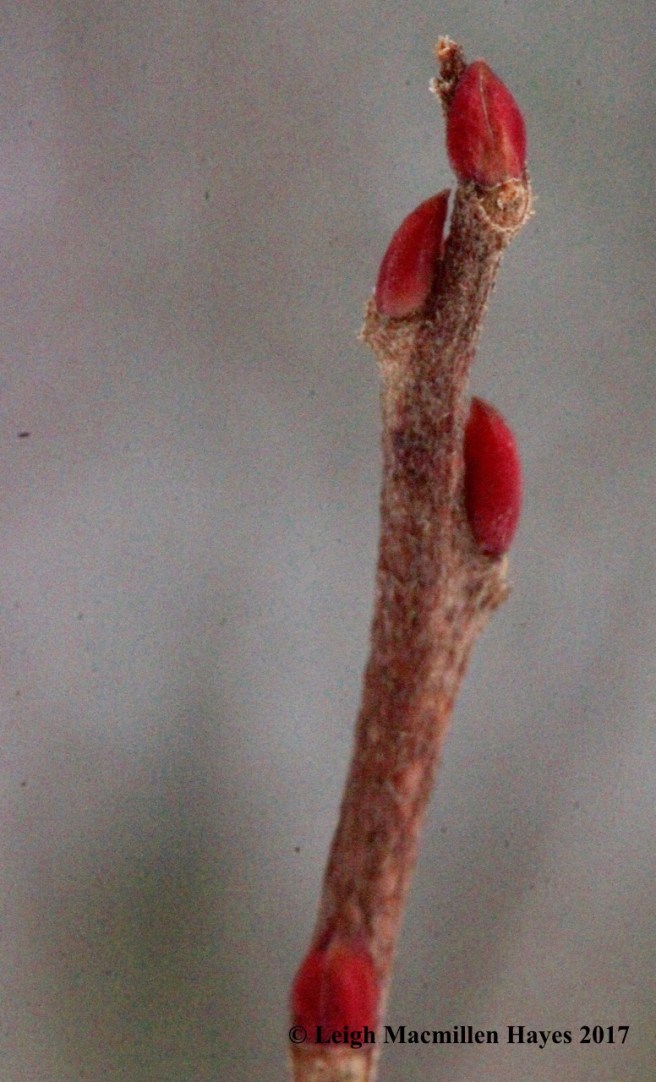
But it’s that same water that gives life to the flora and fauna that live therein, such as the buds on the maleberry shrub. Notice how downy the twig is. And the bright red bud waiting patiently within two scales–preparing for the day when it will burst forth with life.

h-maleberry-pods

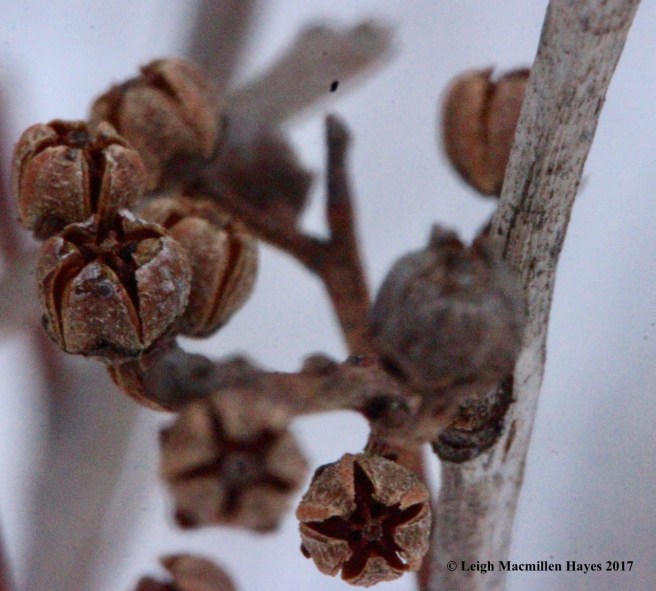
On the same shrub exists evidence of last year’s flowers, now capsules reddish-brown and five-celled in form.

h-red-maple-buds

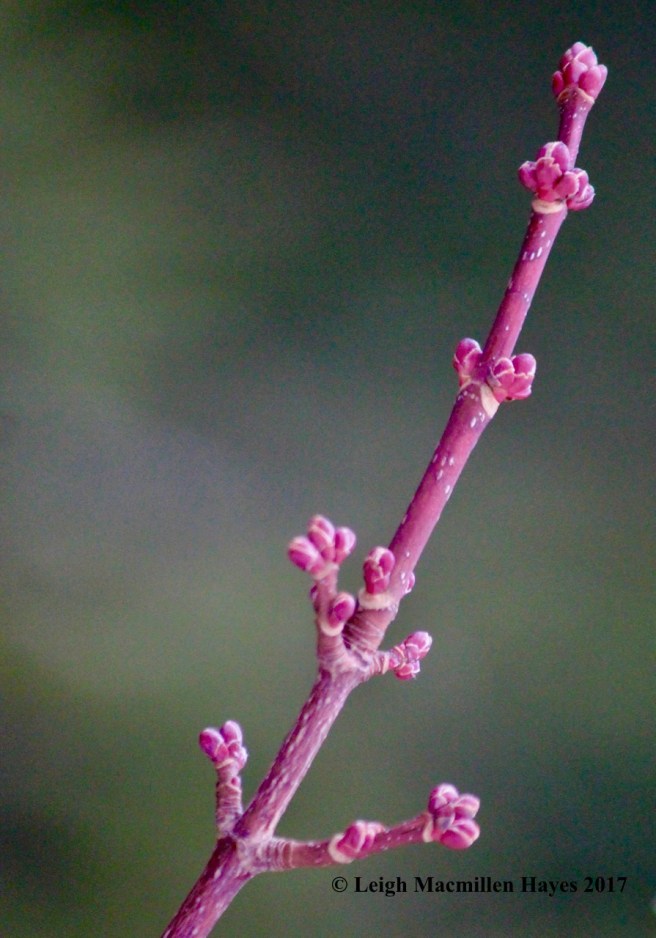
And like the maleberry buds, the red maples buds grow more global each day, some with three scales of protective covering and others more.

h-snowflakesbuds

Today was a day of contrasts, from sunshiney moments to snow squalls, as well as greens to reds, tossed in with a mix of browns and grays.

h-moose-scrape

Continuing my venture, I soon realized I wasn’t the only one enjoying red. The moose and deer with whom I share this place, also find it a color of choice–especially the bark of young red maple trees.

h-moose-scrape-2

As I looked at the tree trunks, I could sense the motion of the moose’s bottom incisors scraping upward and then pulling against its hard upper palate to rip the bark off. Everywhere I turned, the maples showed signs of recent scrapes.

h-moose-rub

Less frequently seen were antler rubs such as this one, where the middle was smoothed by the constant motion and the upper and lower ends frayed. Such finds offer noted differences between a scrape and rub–the former has tags hanging from the upper section only and the teeth marks stand out, while the latter often features a smooth center with the ragged edges at top and bottom. But . . . like us, nature isn’t perfect and not everything is textbook, so I often have to pay closer attention.

h-moose-bedscat

I saw more than red and so I could hardly resist a moose bed filled with scat and urine. I’m always in awe of the sense of size and again I saw motion, of this large mammal laying down to take a rest and perhaps a few hours later, getting its feet under itself to rise again, do its duty and move on to browse some more.

h-witch-hazel-scattered

Deer tracks were even more numerous than moose and the solidness of the snow allowed them to travel atop the crust. At one point I spied something I didn’t recall seeing before–witch hazel capsules decorating the snow.

h-witch-hazel-pod

At this time of year, these grayish tan capsules persist on the trees, but their work was completed in the fall when they expelled their two glossy black seeds.

h-witch-hazel-bud-nibbled

Ruffed grouse, wild turkeys and snowshoe hare like witch hazel buds. As do deer, who rip them off in the same fashion as a moose and leave a tag behind–as a signature.

h-witch-hazel-bud

Not all were eaten–yet. Notice these buds, ensconced in dense reddish/yellowish/brown hairs rather than the waxy scales of the maleberry and maple. And the shape extending outward from the twig, almost in scalpel-like fashion. Yeah, I was still seeing a hint of red.

h-witch-hazel-flower-bracts

If I wanted to carry my red theme to the extreme, I could say that the bright yellow bracts that formed the base of the former flowers were framed in red, but really, it’s more of a hairy light tan along their rims. Eventually, the bracts will develop into seed capsules and next autumn they’ll be the ones to shoot their seeds with a popping sound. We always talk about that sound and refer to Henry David Thoreau for as far as I know he was the one to first hear it. This past fall, a friend tried this and like Thoreau, he was awakened during the night by the seeds being forcibly expelled. (Credit goes to Bob Katz for that experiment.)

h-british-soldiers

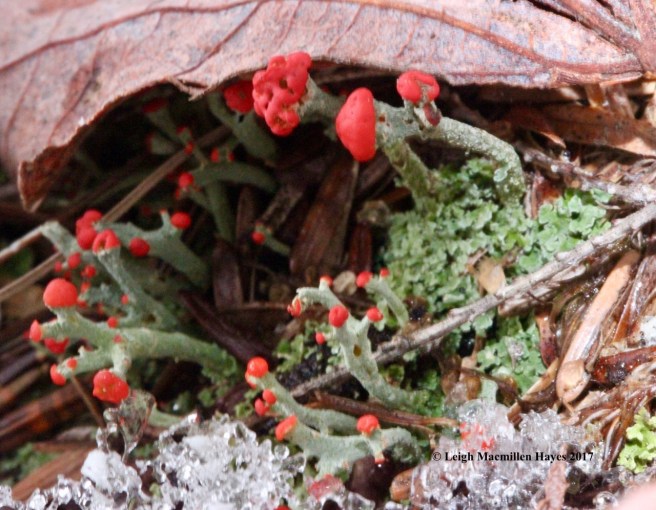
Back to red. Under the hemlocks where the deer had traveled, I was looking at some mosses when these bright red soldiers showed their cheery caps–it’s been a while since I’ve seen British Soldier lichens, most of it buried beneath the snow.

h1-red-oak-bark

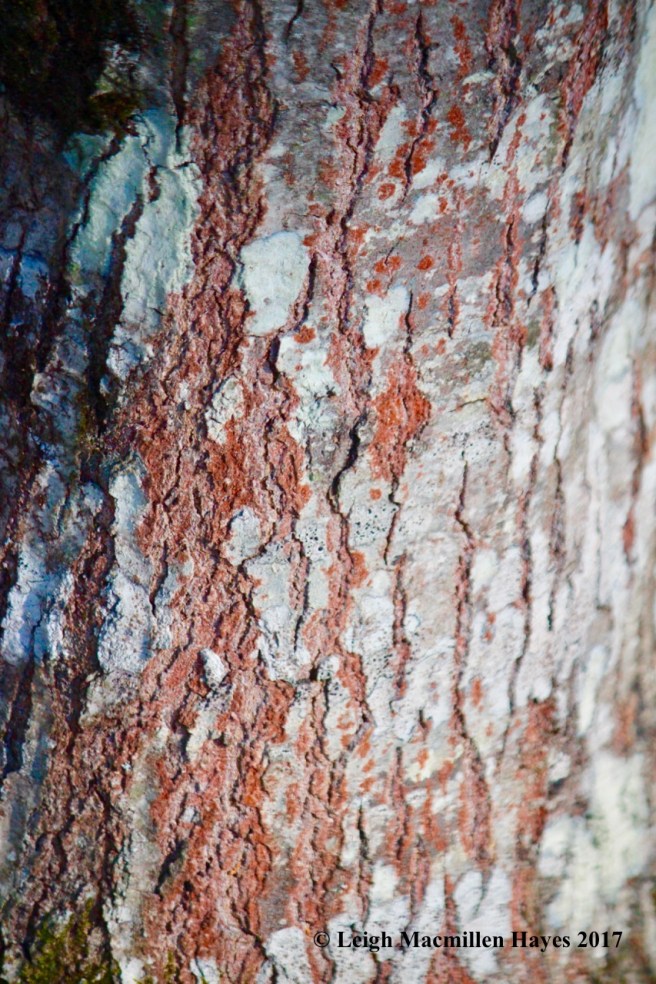
As I headed toward home, a red oak beside the cowpath asked to be included. It seems in winter that the rusty red inner bark stands out more in the landscape, making the tree easy to identify. Of course, don’t get confused by the big tooth aspen, which slightly resembles a red oak at the lower level, but a look up the trunk suddenly reveals similarities to a birch.

h1-acorn-cap

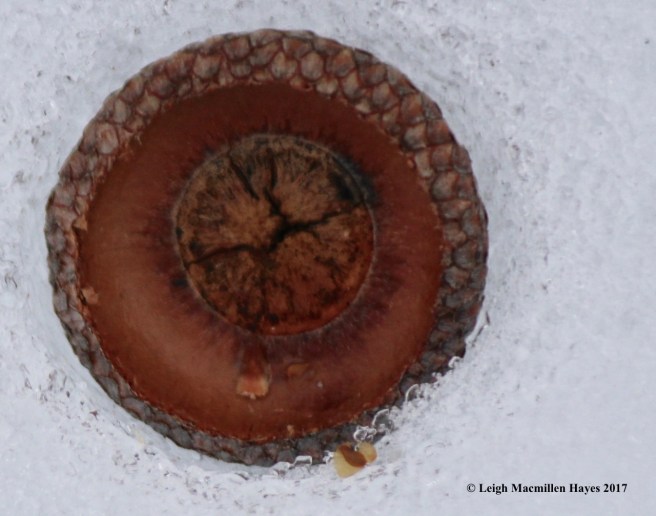
Many of the acorns have been consumed after such a prolific year, but their caps still exist and the color red was exemplified within the scales.

h1-icicles

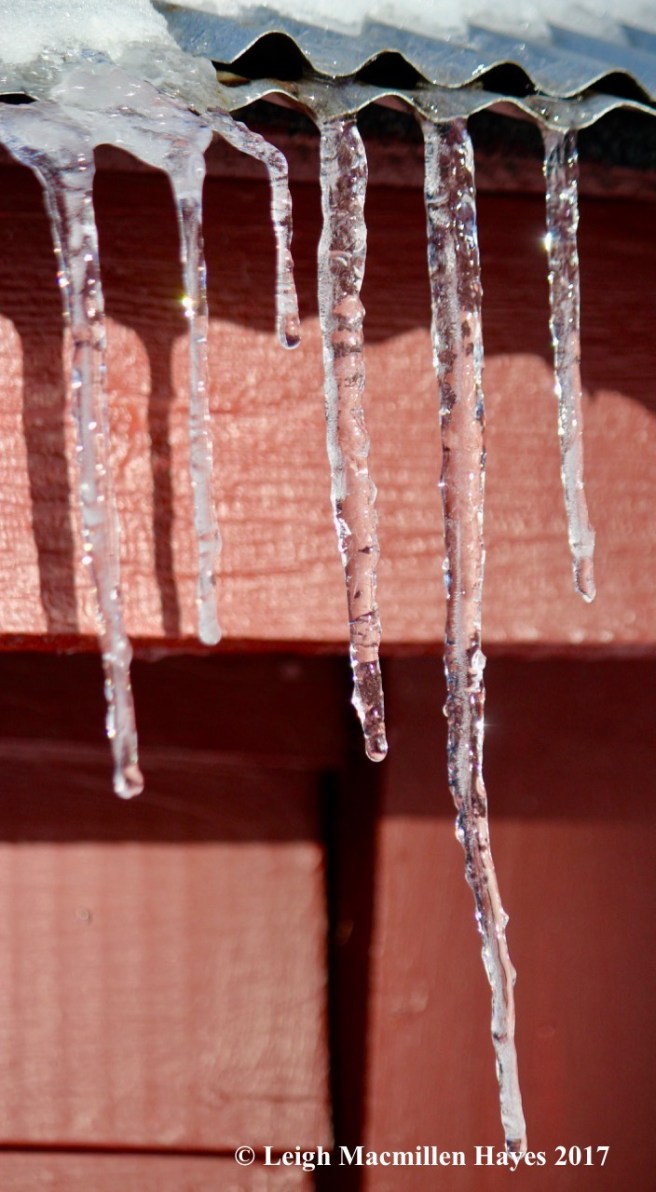
Back at the homestead, I walked by the shed attached to the barn where icicles dripped–again speaking to this day. By that time the snow squalls had abated and sun shone warmly, but a brisk wind swirled the snow in the field into mini whirling dervishes. My cheeks were certainly red.

h-cardinal

My red adventure was completed at the bird feeder. A happy ending to scenes of red.


Circle of Life

Searching for circles

c-fluffy-dust-lichen

as a reflection of life

c-woodpecker-holes

revealed uniqueness.

c-hare-scat

Beginnings and endings intertwined

c-acorn-cap

deleted any lines defined.

c-whitewash-lichen

The alpha and omega

c-hemlock-stump

designed with layers between.

c-sweet-fern-swirls

And a variety of form

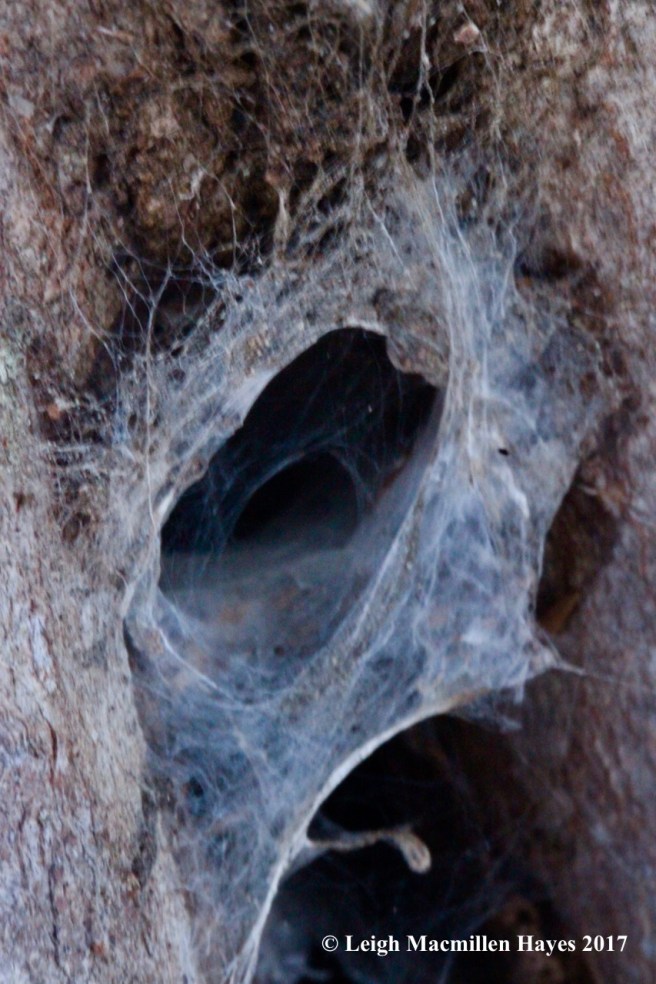
c-funnel-web

in presentations never ending.

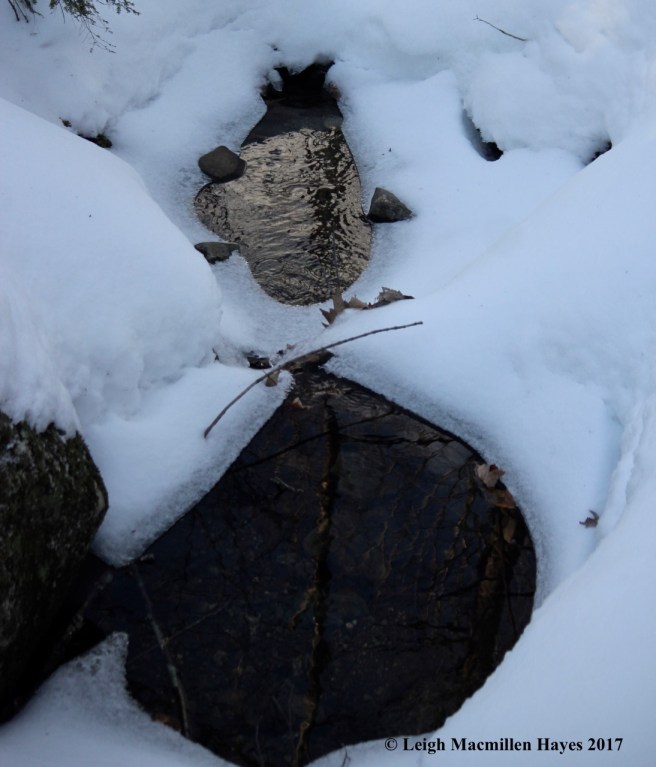
c-stream-edges

Names describe some as rounded

c-bulls-eye-target

and others: bull’s eye,

c-pinecone-spiral

spiral,

c-pine-whorl

whorl,

c-birch-catkin-stack

and cylindrical.

c-open-ended-twig

But what about those incomplete?

c-question-mark

Did life slip out

c-ice

or slowly drip away?

c-tree-wound

And wounds left behind

c-tree-healing-wound

that never fully healed?

c-pine-needle-spokes

The answers, like shapes,

c-frullania-asagrayana

aren’t always obvious.

Circles sought and circles found.

No two alike.

My hope–that we end as we began—the circle completed around a life well embraced.

A Shiver of a Mondate

When we awoke I checked the thermometer. Negative 6˚. By the time lunch was packed, hot cocoa poured into thermos and bodies decked in layers, I checked again. Negative 8˚. But a sunny negative 8˚. With only a slight breeze.

j-covered-bridge

And so we drove to Jackson, N.H. This town holds fond memories for us, including our wedding night spent up the street before we departed for Ireland the next day. That was 26 years ago.

j-trail-sign

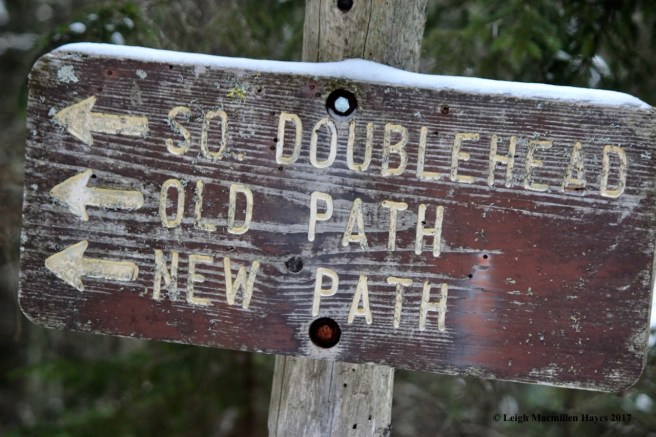
It had been about eleven years since we’d last hiked the North and South Doublehead Loop that we chose for today. That was a December hike, with not as much snow. Our first inclination this morning was a snowshoe hike. Seconds before we were about to pull out of the driveway, my guy mentioned micro-spikes. And so he ran back into the house and grabbed both pairs.

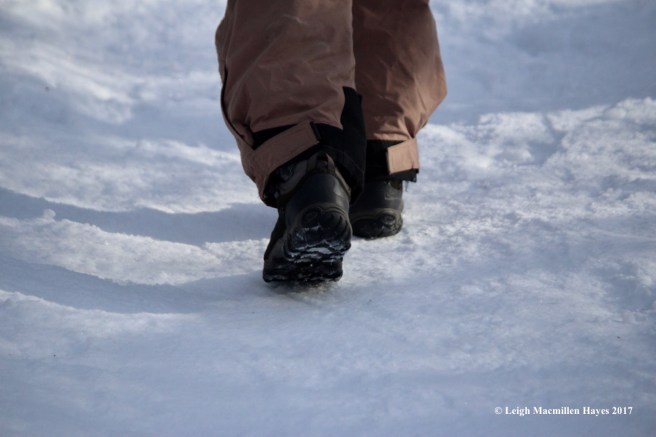
j-no-spikes-hiking

Brilliant move as the trail was extremely well packed. In fact, at the start, though I donned mine, he stowed his until necessary. Not wearing snowshoes meant not going off trail, but I was with my guy and knew that destination was of prime importance. I didn’t mind as the snowshoes would have been more cumbersome.

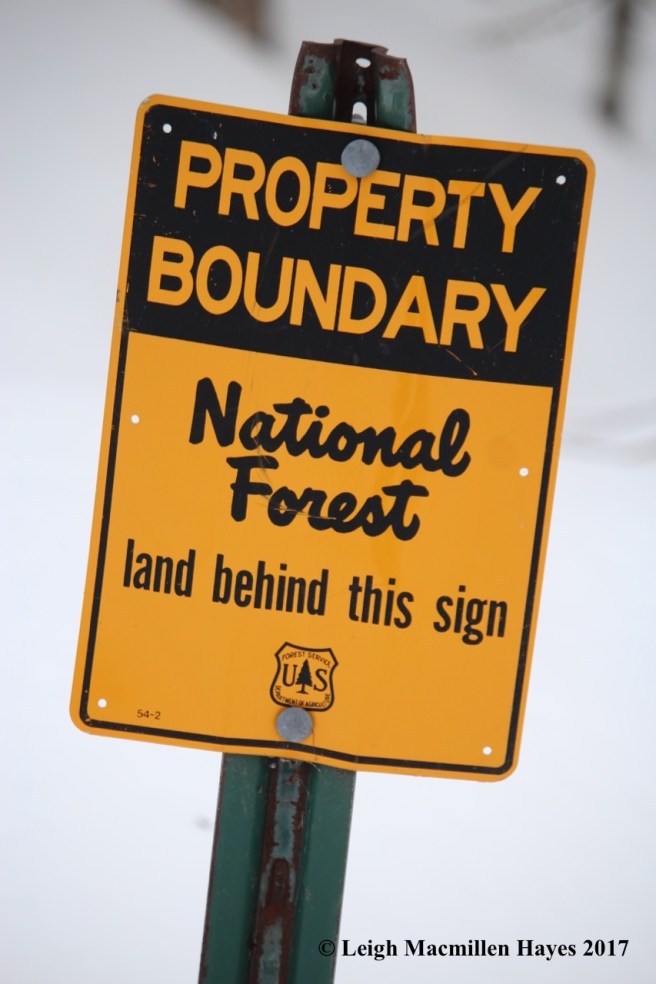
j-national-forest-sign

In mere minutes we’d crossed into the National Forest, aka the  White Mountain National Forest.

j-ash-and-maple

Though we were on an upward climb, the traveling was easy, affording the opportunity to look around and take in the sights, including the sharing of nutrients by an ash and a maple. Grafted though they were, they grew on their own; each dependent upon yet independent of the other–a mirrored reflection of the relationship my guy and I are honored to share.

j-hoar-frost

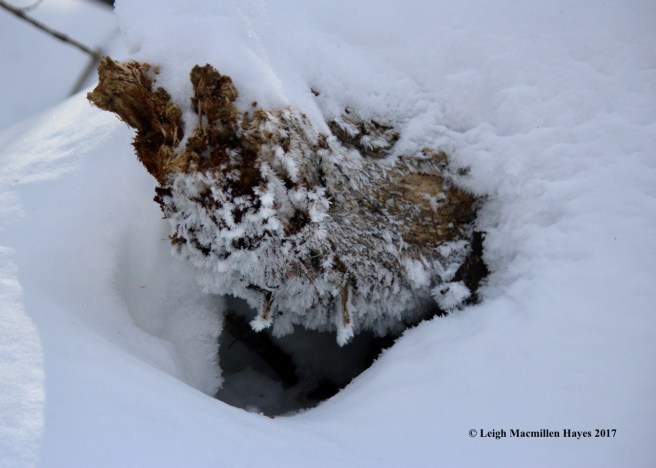
We were still a wee bit chilly (well, maybe more than a wee bit), but knew we weren’t the only ones dealing with the low temps. Squirrel tracks led in and out of this upturned tree and the hoar frost indicated life snuggled therein.

j-snowshoe-hare

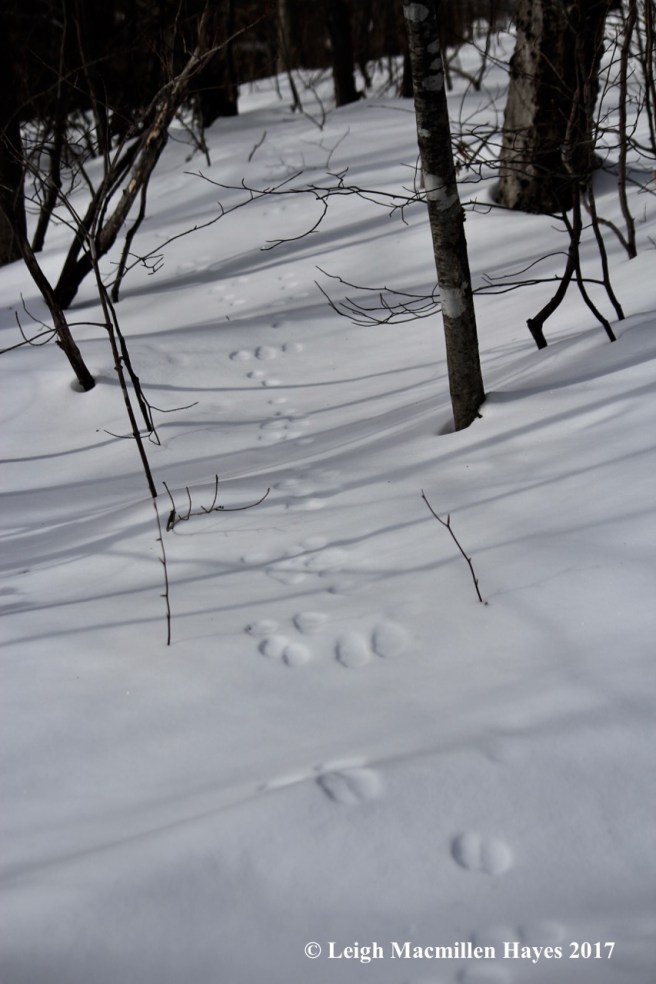
Every where, snowshoe hare tracks crisscrossed our path. I hoped we’d see at least one, if not ten, but that wasn’t to be. We were rather loud, each footstep seemingly an echo in the crisp air.

j-lungwort-1

We took several water breaks, including one by this tree covered in lungwort. I was excited to see the lungwort, but at the same time realized that my lens cap was missing. How many can one person loose? And to think that this one was tethered to my camera.

My guy, being MY guy, took off down the trail, assuming it would be visible and he’d find it in no time.

j-lungwort-2

For me, it was a time to spend a few minutes noticing. The ridged and pitted surface of lungwort is said to resemble lung tissue–thus the common name. During the Renaissance era, when the physical form of a plant was thought to determine its use, tree lungwort’s similarity to the structure of a lung led to the belief that it healed respiratory problems.

One of the things about lungwort is that it does absorb and fix nitrogen from the atmosphere, so it’s always a good find.

j-shivering-beech-leaves

As I waited, I listened. Besides the voices in my head, I heard a woodpecker tapping and beech leaves shivering.

My guy returned, sweaty from climbing down and up again, as well as empty handed. But we made a plan to continue the lens-cover rescue mission on our way down.

j-community-change

And so up and up and up we climbed. The ski trail, on which we ascended, is only 1.2 miles long, but it is steep. Eventually, we both realized the community was changing and knew we were approaching the summit.

j-beard-2

It was here that Old Man’s Beard Lichen decorated the trees and made me think of hermits spending time on these mountain tops.

j-cabin

Suddenly the cabin at North Doublehead came into view. It could have been the perfect hermitage, but rather it has hosted many a crowd over the years. The cabin was built as a Civilian Conservation Corps (CCC) project in the early 1930s, as was the ski trail by which we climbed upward. It’s available for rental through the WMNF and sleeps eight.

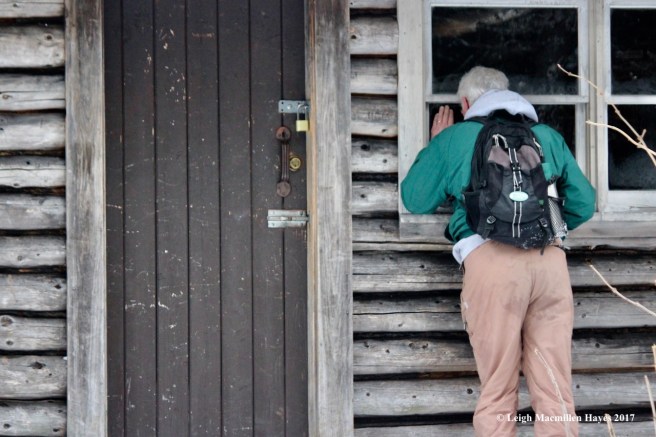
j-cabin-anybody-home

My guy had taken off his hat to let some heat escape. And then he peered inside. A Peeking Tom he ain’t, but curious he is.

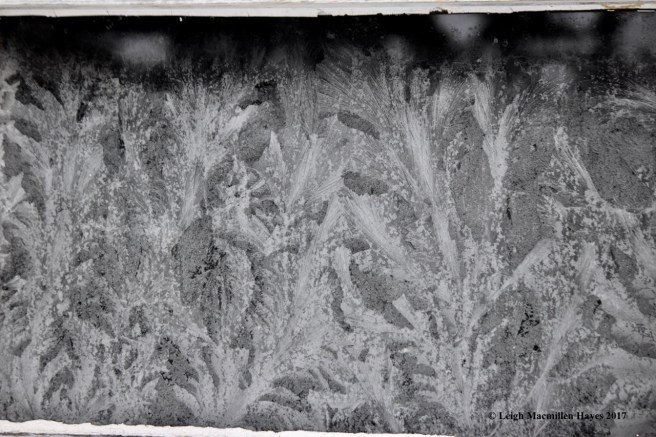
j-cabin-window-ice

Not all of the windows offered a view within, but their artwork spoke of the lack of heat on a cold winter’s day.

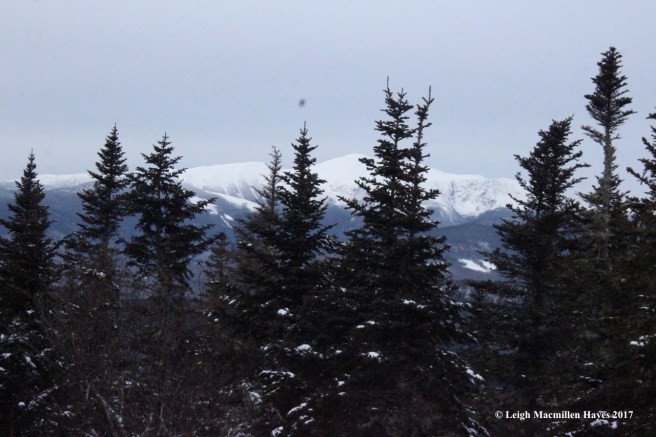
j-cabin-view-1

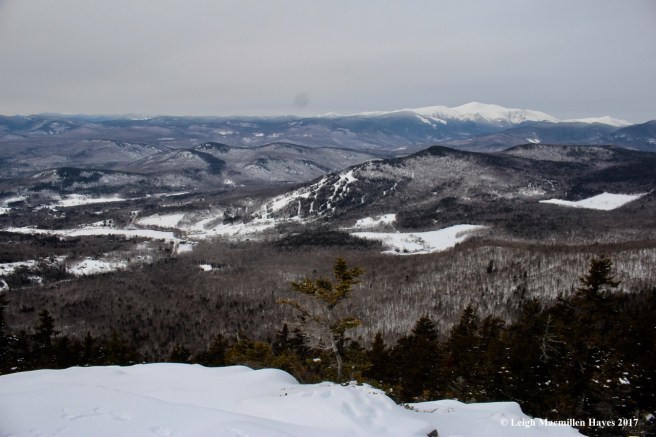
I stood upon a rock that I thought would become lunch rock and took in the view of Mount Washington.

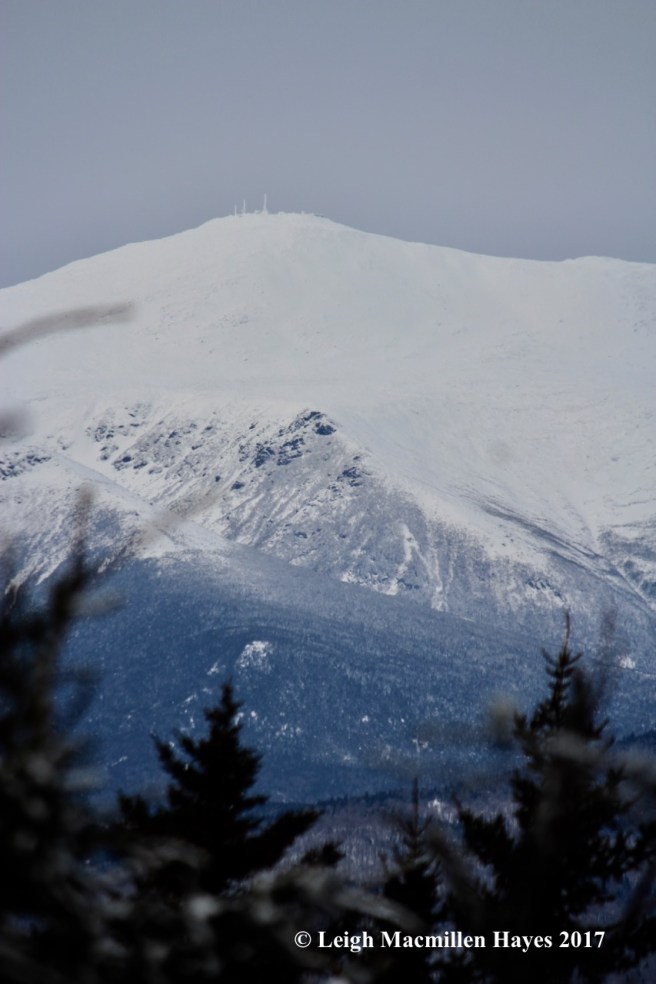
j-cabin-view-rime-ice

We could see the towers atop, but the telephoto lens enhanced the view and we knew that despite how we felt at any time of this day, the rime ice that coated the buildings was a mere indication of what the crew dealt with on New England’s highest peak.

j-cabin-trails

My guy was feeling the chill after sweating so much and so we followed the trail, a steep decent to the col between the two summits.

j-lunch-spot

Finally, at the next intersection, his body temp had regulated and we found lunch ground, no rocks in sight. Frozen PB&J and hot cocoa fortified us yet again.

j-south-doublehead-view

The climb to South Doublehead was by far the easiest, and the view most dramatic. We didn’t stay too long as it was there that we felt the breeze.

j-looking-south-view

j-mt-wash-from-south-doublehead

j-black-mtn-ski-area

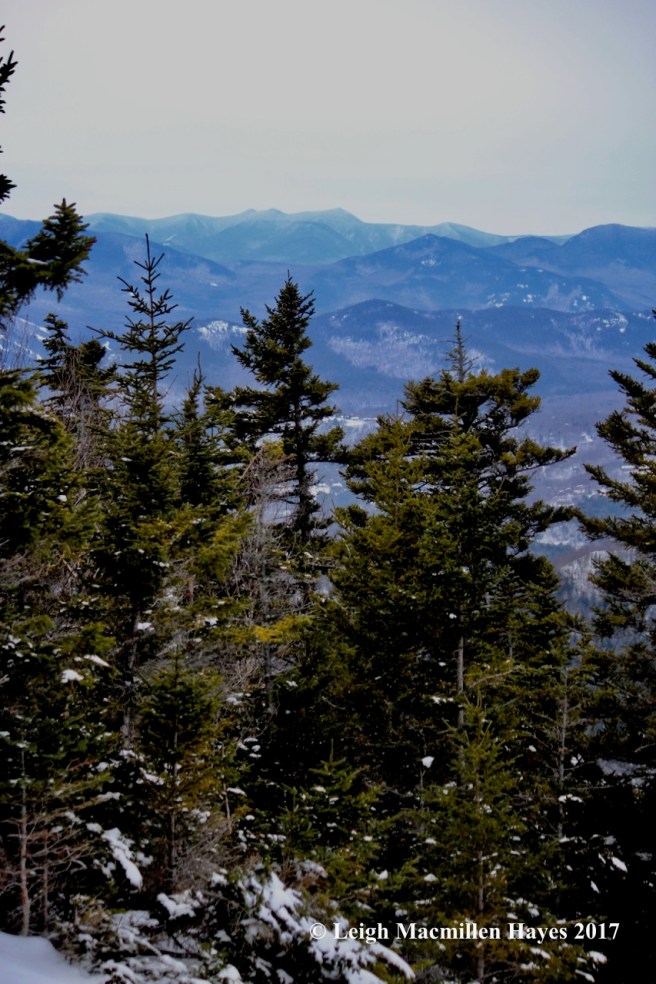
But the view–oh my! It took our breath away. Or maybe that was the wind chill? At Black Mountain, we could see they were taking advantage and had fired up the snow machines.

j-hobblebush

We returned to our lunch spot where I wanted to grab a pic of the hobblebush buds. As I shifted my backpack something fell to the ground–my camera lens cover. We gave thanks that we wouldn’t have to retrace our steps when the Old Path intersected with the Ski Trail down below.

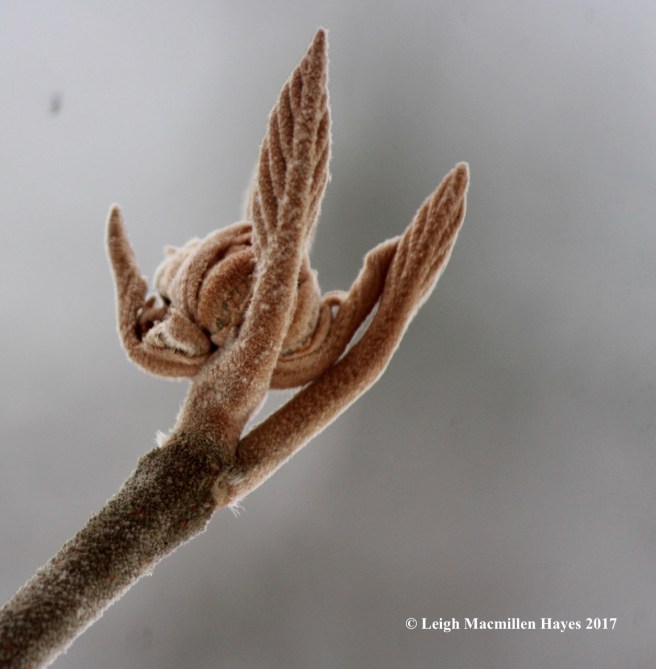
I knew my friend Jinnie Mae would tease me about not being able to resist a hobblebush, but really, check out those naked leaf buds that surround the also naked flower bud. The leaf buds on most of our trees and shrubs survive the winter with a waxy coating. Both hobblebush and witch hazel, however, don’t have such a luxury, though I have to wonder if  their hairy coating adds an insulating layer.

j-climbing-down

At last we climbed down the Old Path, a steep and straight descent for the most part that found us using the crab-style of downhill hiking–a sideways approach to keep from slipping. Despite that, it’s a beautiful trail, cathedral-like among the steeples of the spruces, firs and birches.

j-dragonfly

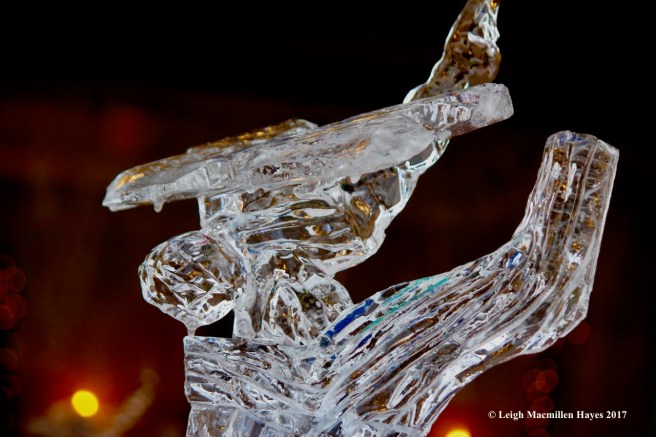
We finished our hike and then returned to Jackson, where glistening objects on the porch of The Wentworth Inn forced us to jump out of the truck. What to our wondering eyes should we spy? A dragonfly,

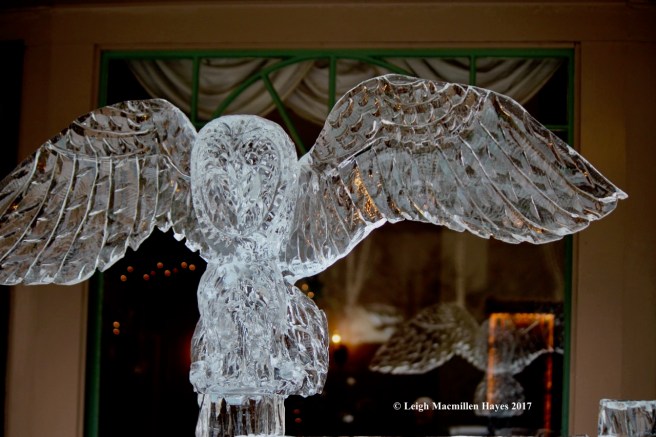
j-owl-1

owl,

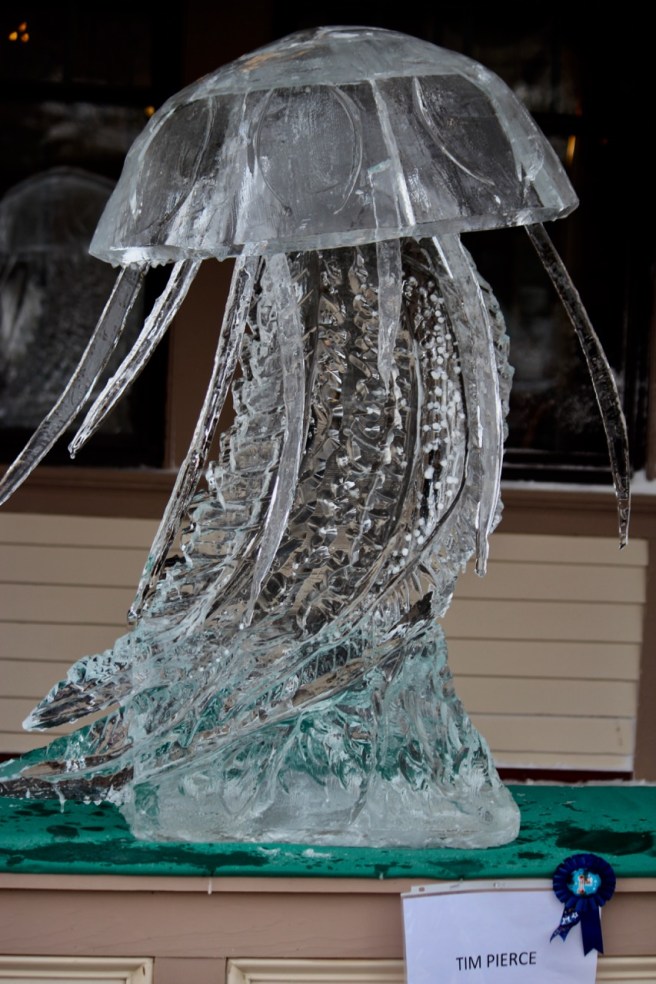
img_5420

and jellyfish?

I’d thought for sure we’d see some form of wildlife all day, but these ice sculptures were as close as we got. The latter cracks me up as it seems such an oxymoron to see a jellyfish carved out of ice. Oh, there was also a cactus.

The perfect ending to our shiver of a Mondate.

Forever a Student

Once the rain let up, I donned my Boggs and headed out the door in mid-afternoon, not sure where exactly I was headed. But after reaching the snowmobile trail, I decided to turn south. Since the spring, I’ve been to the vernal pool on the neighboring property numerous times, but not much beyond in that direction.

h-new-bridge

Part of the reason was that a local industry, of which we now have so few, was constructing a new building and had cut off the trail. Oh, I could have bushwhacked around the project, but the other part of the reason is that it’s a heavy tick zone and I normally avoid it come warmer weather. Given the new building, I wasn’t sure what to expect today, but as I passed through the stonewall, I discovered they’d added a bridge over a new water diversion and the trail was open. I’m glad for the small industry, but simultaneously sad that the willows are gone. No more pussy willows in the spring. Or willow galls, though I suppose that’s good news. And who knows, perhaps some viable willow seeds will spring forth in this place–a hypothesis to be tested.

h-artist-conk-top

After crossing behind the building, I moved through an opening in the next stone wall, and felt right at home again–in one of my local classrooms. This is one where I’m often the solo student, as was the case today.

h-artist-conk-2

I revisited an old stump, where art class was about to begin. The underside of the artist’s conk welcomed a sketch, but I left the canvas blank for another day.

h-gate

In social studies class, I took a look at former land uses. The wall opening and split stone gate bars helped me envision the fields that once were cleared. I followed several walls, which switched from single to double and even double-double, or so it seemed as one section was at least six feet wide and a football field long (The New England Patriots are winning in CA right now!). Barbed wire indicated the need to keep animals out and flat land with trees not a hundred years old spoke to the land’s former plowed use.

h-vp

A few minutes later, I moved over an old rock mound and stood before my science teacher–another vernal pool. As I recalled, this one dries out early in the season and grasses and other vegetation grow prolifically here. But unlike the smaller pool closer to home, this one held some water from the recent rain.

h-boots

As any student should, I stepped through the door and sunk my feet into class.

h-cinnamon-fern

Cinnamon ferns reminded me that they keep their fuzziness right up to the end.

h-birdnest-1

I wondered about strips of paper birch dangling from a young sapling and then realized I was looking at the remains of a nest–maybe a vireo.

h-seeds

I questioned how the long-beaked sedge seedheads came to be bent over–by weather or wildlife or just because their time had come?

h-vp-bulrush-a-grass

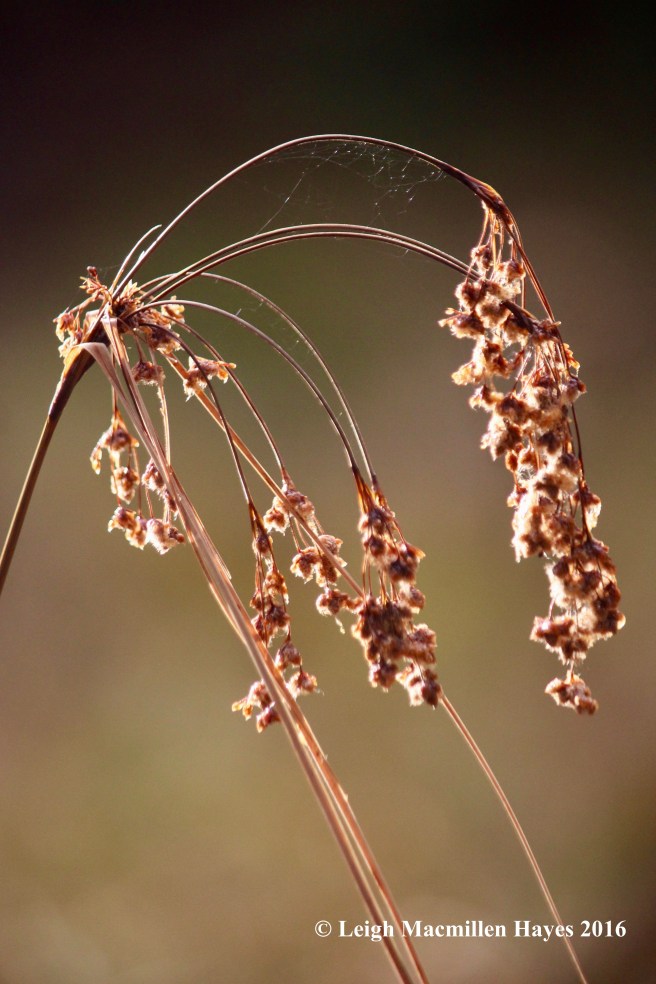
While bulrushes (actually a grass) offered flowing fountains pouring into the future, their seeds still clung–as did a spider web.

h-vp-steeplebush-web

And more spiders eluded me, though their webs stood strong among the steeplebush capsules.

h-vp-crystal-ballseeds

A few raindrops dangled like ornaments from a holiday decoration.

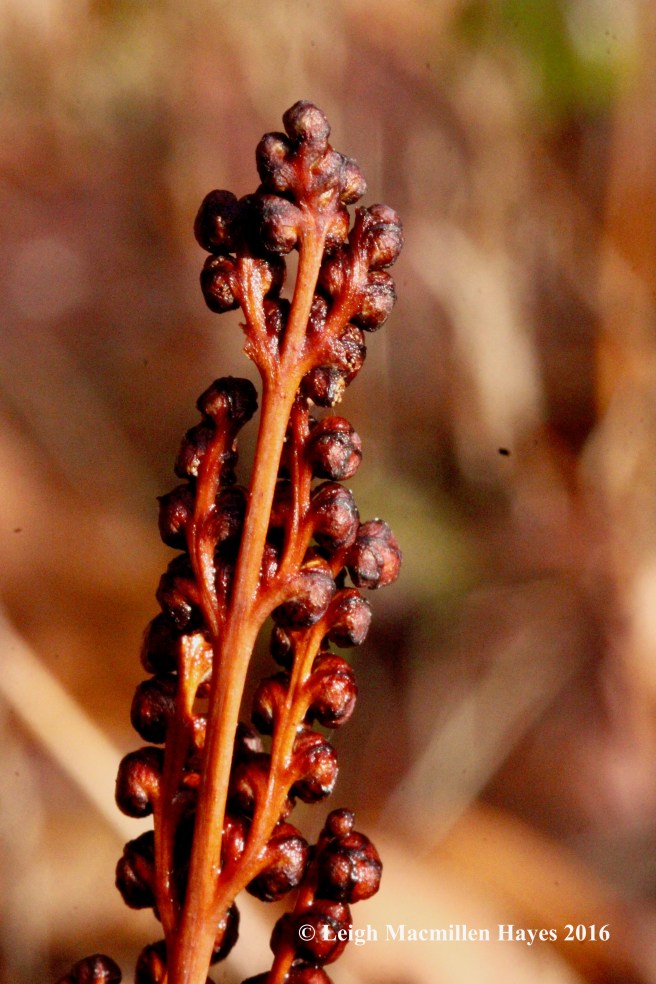
h-vp-backside-of-sensitive-fern-beads

And bead-like spore structures on sensitive fern’s fertile stalk waited for another day to spread their good news.

h-lichen-or-fungus-2

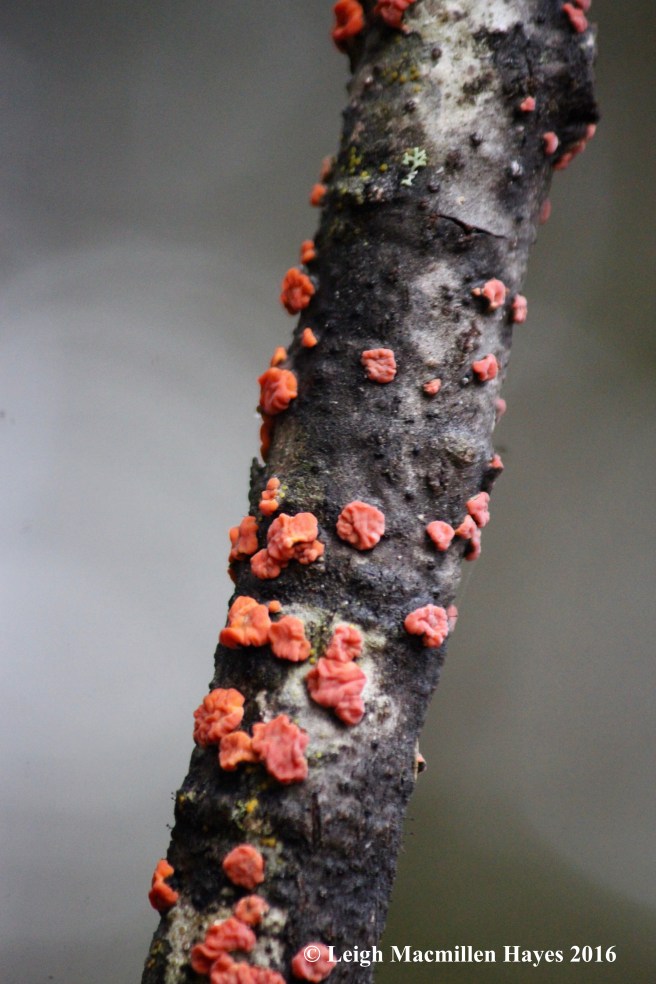
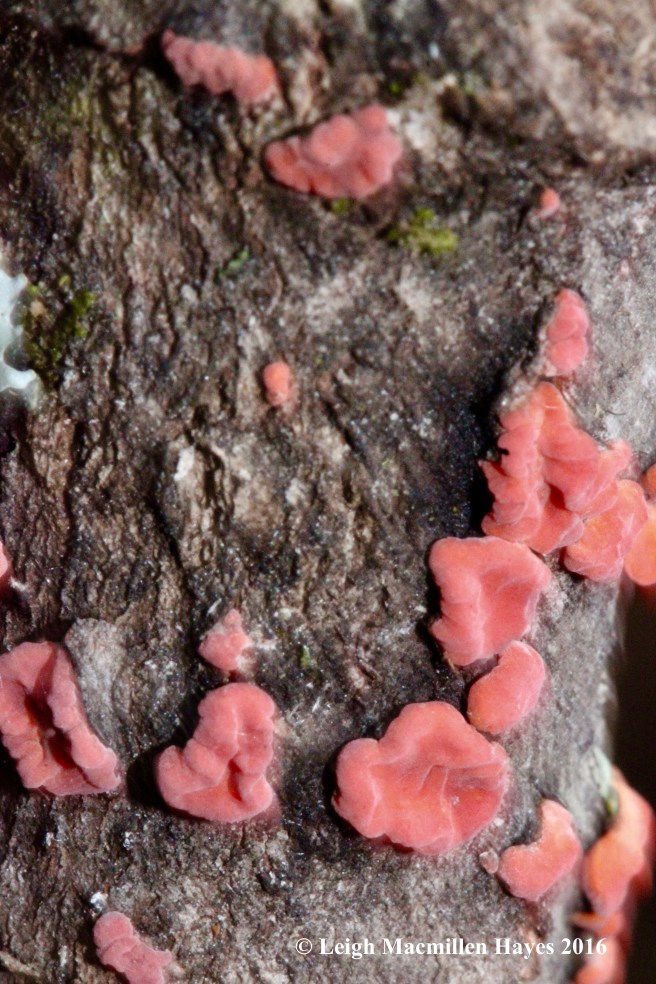
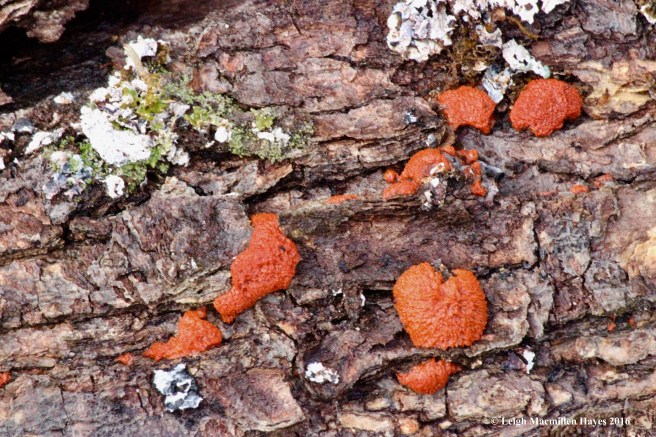
I finally left the vernal pool, but before heading back down the hallway, small salmon-colored growths stopped me. Lichen? Fungi? I didn’t think I’d ever seen it before and so it was a new lesson.

h-lichen-or-fungus

My first thought–lichen. In a way, it resembled the tops of British Soldiers that grow prolifically here. But my latest thought is red tree brain fungi (Peniophora rufa) . I may be wrong, but that’s what being a student is all about.

h-woodpecker-1

With each new lesson, I was also thankful for those that were reinforced, such as the chisel-like and shredded works of pileated woodpeckers. I used to think such trees were the result of bear activity.

h-woodpecker-2

I’m always awed by the resulting sculpture left behind by those powerful birds–their strong beaks stabbing away at the bark until they’ve consumed a meal of carpenter ants and beetles. Thankfully, their skulls are thick and spongy–allowing their brains to absorb the impact of such repeated drilling.

h-field-succession-layers

At a field, I paused to admire the layers–a testament to field succession. These woods are constantly changing.

h-male-turkey-scat-j

One thing that doesn’t change is the signature of a Tom Turkey–usually offered in straight or J formation.

h-slime-3

h-tubifera-ferruginosa

h-slime-2

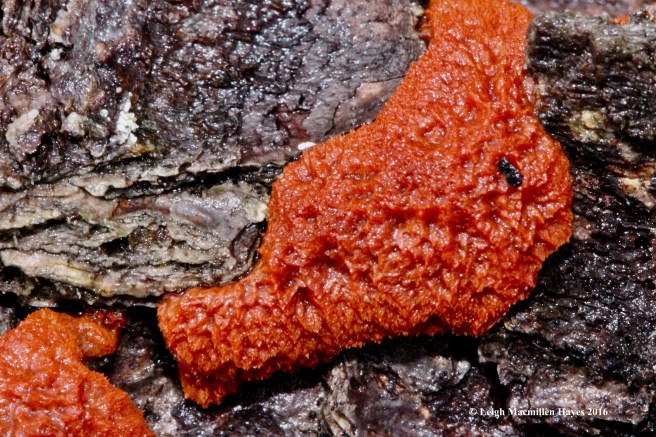
At another wetland, I poked around and then my eye focused in on something decorating a fallen tree. A slime mold perhaps? Red raspberry slime? In one rendition it seemed to have a crater-like surface, while another was more flower-like with petals spraying from a center.

h-hemlock-cinnamon

At last I entered a hemlock forest where the cinnamon inner bark stood out on the wet trees. If not for the scales, I realized it would be easy to confuse this bark with that of red oak, but a quick look up the trunk and the answer was obvious.

h-striped-maple-seeds

As I walked back toward home, I looked along parts of the trail I’d skipped while exploring in the woods. And I wasn’t disappointed when I discovered one of the few striped maple trees–still bearing the seeds it produced last year. Why did they cling still? When released, will they be viable?

h-pine-suds

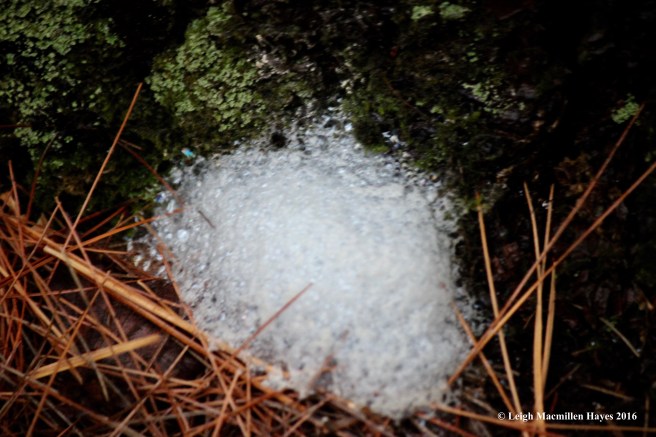
And then, a sight I was hoping for presented itself when I returned to our woodlot. Froth at the base of a pine tree. It’s not unusual and occurs following a rain event such as we’d had all night and morning. I had hoped to see some foam today, and felt rewarded for my efforts. So what causes the tree to froth? Well, like all lessons, there are several possibilities. Maine Master Naturalist Science Advisor Fred Cichocki recently had this to say about it: “I’ve noticed this phenomenon often, and in every case I’ve seen it’s associated with white pine, and always after a dry spell followed by heavy rain. Now, conifers, especially, produce hydrocarbons called terpenes (it’s what gives them their lovely pine, balsam and fir scent). These hydrocarbons are hydrophobic by nature and form immiscible films on water. During a heavy rain, water running down the trunk of a white pine picks up terpenes on the way. Air (having accumulated in bark spaces, channels, etc. perhaps under slight pressure) then “bubbles” through terpene-water films producing a froth. Recall the cleaning products PineSol, and the like. They are made from terpenes, and produce copious bubbles when shaken. One could get the same result directly by shaking terpentine in water, or by bubbling air through a terpentine-water mixture with a straw  . . .  Of course, it may be that other substances (salts, etc.) enhance the frothing.”

No matter how much I have learned on this life-long course, there’s always more. I certainly don’t have all the answers and for that I am thankful. I’m forever a student.


So Many Unknowns

On this historic election day, a few friends and I took to the woods with the intention of absorbing not only the sun’s heat, but the warmth of each others company. Yes, occasionally our conversation turned to politics and wonder about the future, but for the most part, we just wanted to wander together.

h-vp-1

Our first spot for consideration–a vernal pool tucked away in the woods.

h-vp-2

In true v.p. behavior, it dried up during the summer drought, though as we moved about we experienced a sinking feeling–muck obscured by grasses and leaves. This particular pool is home to fairy shrimp and their eggs cases are protected under the leaf litter until water returns. The amazing thing about fairy shrimp–those eggs can survive long periods of drying and freezing. We trust we’ll have the opportunity to meet the next generation.

h-wintergreen-1

Sometimes our eyes were tricked by what we viewed and we questioned how things could be so.

h-wintergreen-with-candelabra

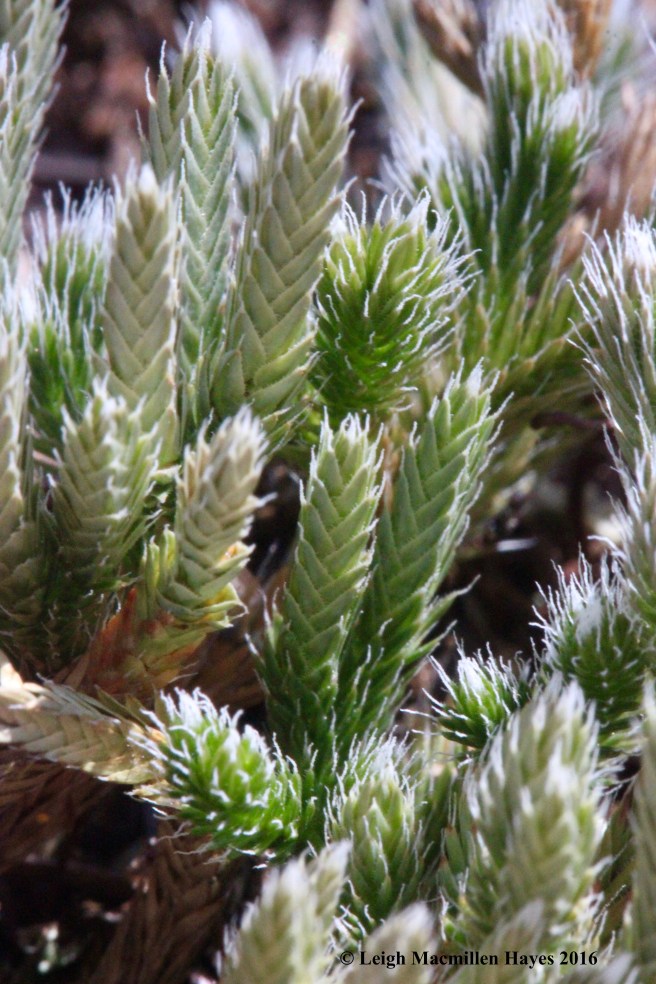
But upon a closer examination of the facts, we realized that a club moss was merely growing near the wintergreen and the wintergreen hadn’t taken on a strange candelabra form.

h-clearing

Our questions continued, however. Why was the ground completely cleared in the middle of the trail? Mammal behavior? We noted boot prints and wondered about human interaction. Finally, we moved on, unable to understand the reasoning, but knew that there are some things we’ll never fully comprehend.

h-green-oak-leaf

In another place, we noticed a green red-oak leaf. A holdout perhaps that preferred the way things had been and didn’t want to follow the rest of the group?

h-hawkweed-1

Occasionally, we calmly debated the structures before us as we considered shape and hairiness and growth pattern and location before we determined species–in this case, hawkweed.

h-wood-art-1

And other times, no need for questions, no need for answers. Pure admiration for the presentation was enough.

h-ladybird-beetle

When we were again drawn in for a closer look, in this case at the white fuzzy beech scale insect, we suddenly realized there was so much more to observe, such as the black ladybird beetle.

h-spiny-leaf-beetleladybird-hatching-from-pupa-stage

And then, something we didn’t understand at all. What was this spiny creature? And what was emerging from it? We left with that question floating among us. It wasn’t until doing some research later that I came to what may be the answer. Was it a ladybird beetle emerging from the pupa stage? How I wish we could go back and find it again and look at it with a different mindset.

h-alt-dog-lichen-1

Drawing close to the finish of our journey together, we spied something we’ve passed many times before, but never noticed.

h-alt-dog-lichen-2

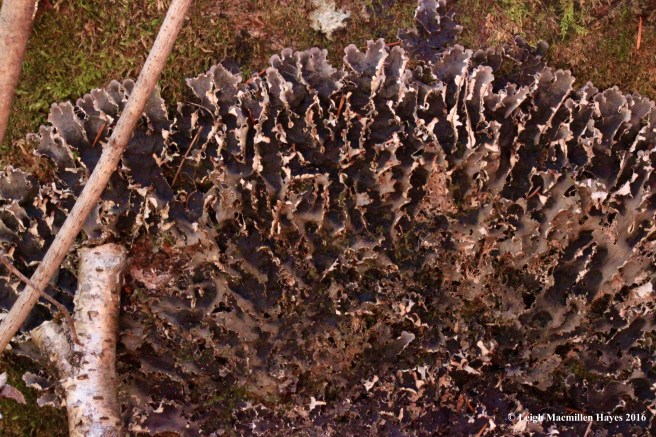
Again, we’ll need to revisit the mossy boulder, but we determined it was a dog lichen. Why dog? Was it so named for the white “fang” like rhizines on its lower surface?  Or did the lobes remind someone of dog ears? Based on the large, fan-like shape, my leaning is toward Peltigera membranacea or Membrane Dog Lichen. But, I could be easily swayed on its ID.

h-milkweed

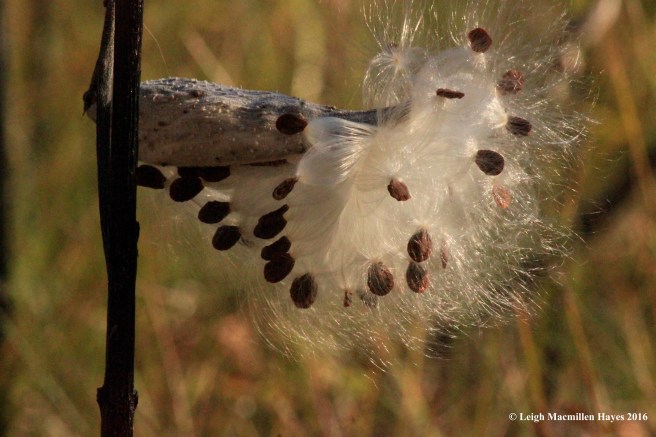
A short walk and hours later, we finally passed a field of milkweed, their seeds blowing in the slight breeze like flags on a pole.

It was time to say goodbye to friends who will head south this weekend before I headed back to “reality” and colored in those little ovals.

I think we all came away thankful for the questions raised and knowledge shared, but still . . . so many unknowns.

Focus On The Forest Forage

When Jinny Mae beckons, I always answer. Oh, maybe not in the affirmative every time,  but as often as possible I join her for a forest forage. Ours is not so much to collect anything physically, though sometimes a pinecone or some scat have been known to jump into our packs, but rather to visually and mentally take in all that we see.

j-november-day

Today was the perfect November day for such an adventure. As the breeze blew, the cloud formations kept changing and the sun poked in and out. We were at times chilled and other times warmed–but always happy to be tromping through the woods and across fields in search of great finds.

j-droplet-on-big-tooth

Sometimes our finds were as simple as raindrops left behind on leaves in the pond.

j-rock-island-1

But a great deal of our time found us on our hands and knees yet again, oohing and aahing among the complex lilliputian world of lichens.

j-rock-foam

We plopped ourselves down, realizing that no matter where we stepped or sat, we were destroying some form of lichen that was older than time as we understood it. No sooner did we begin to focus when we realized we were beside Rock Foam Lichen (Stereocaulon saxatile).

j-rock-foam-2

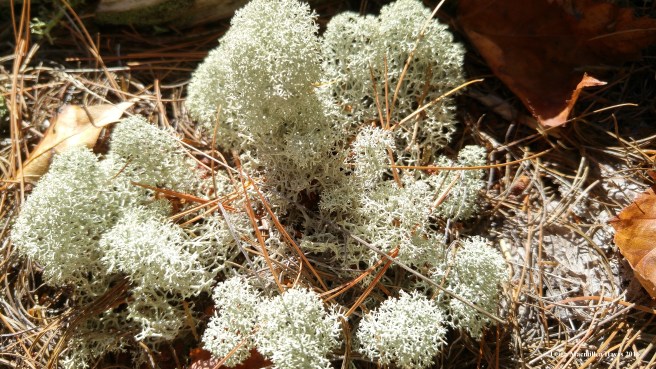
Perhaps we’ve seen it a million times before, but today we met it for the first time. Its granular surface that speaks to its common name was visible even without a loupe. Though it grew near reindeer lichen, its presentation was different and it was singular rather than colonial. Now, if we can only remember its name the next time we meet–Rock Foam, Rock Foam, Rock Foam.

j-brits-2

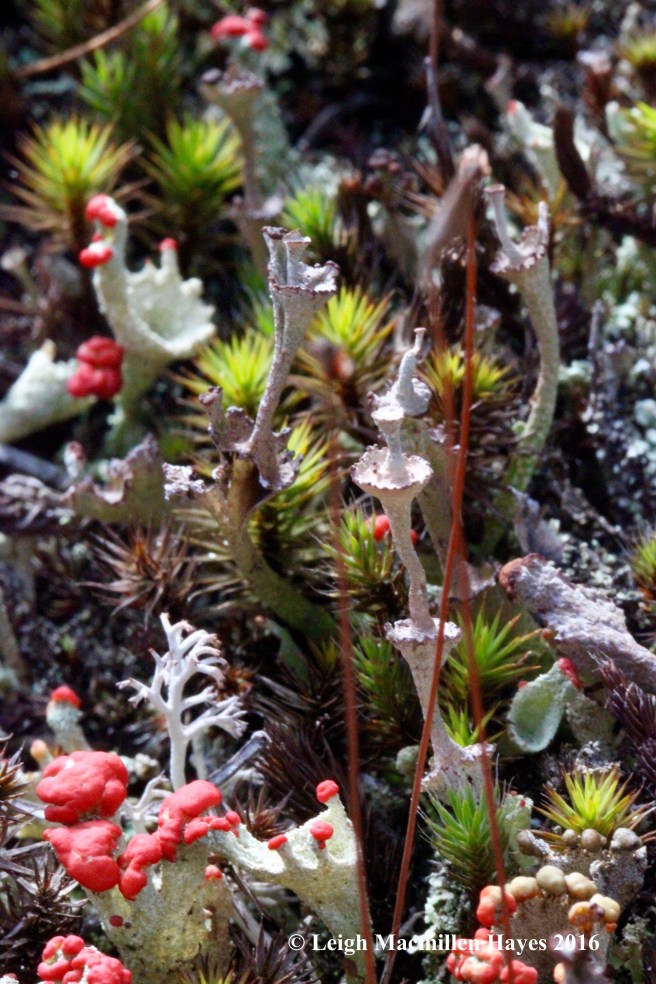
We are not ones to resist a more familiar friend, and so British Soldiers (Cladonia cristatella)  also captured our focus. Despite their diminutive size, those bright crimson caps shouted for recognition.

j-brits-3

The thing we reminded ourselves of today is that British Soldiers grow in a branching formation.

lipstick-powderhorn-and-common-powderhorn

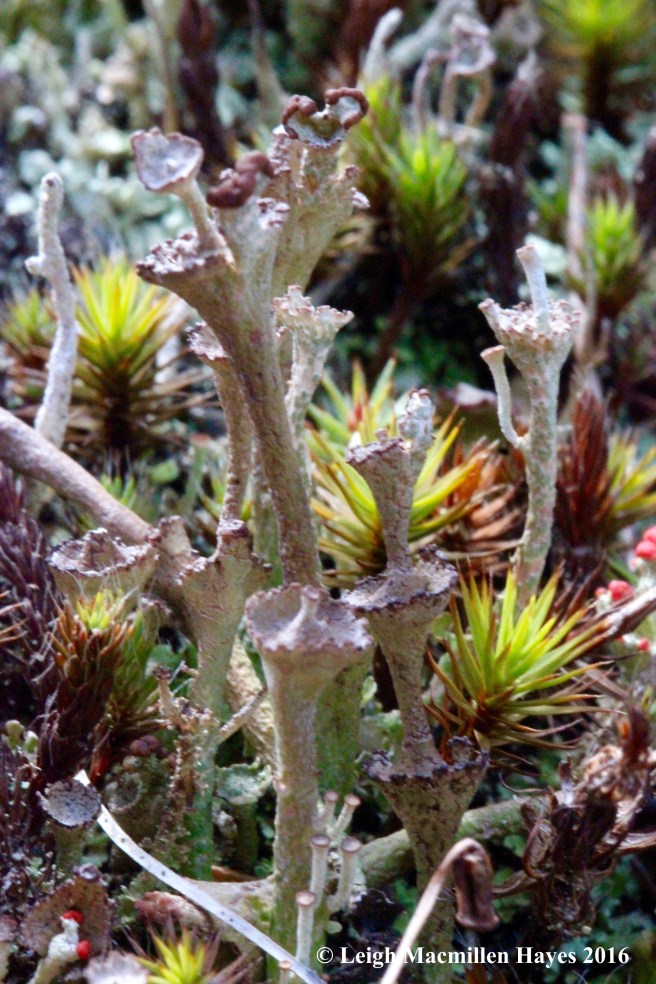
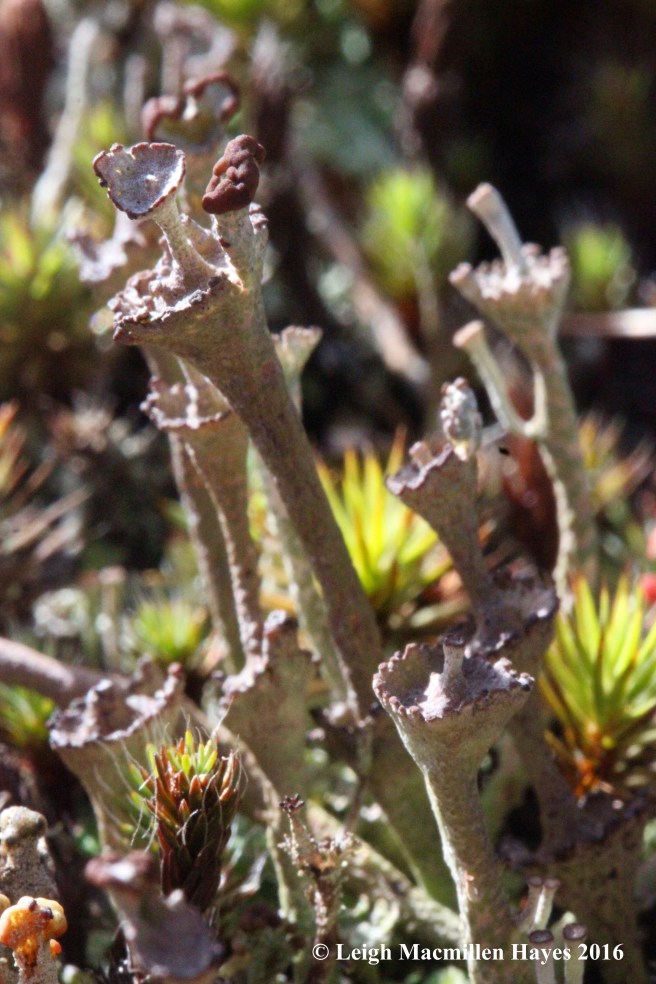
In contrast, their cousins, the Lipstick Powderhorns (Cladonia macilenta), sport red caps atop unbranched stalks. Also standing out to the left in this photo are a few Common Powderhorns (Cladonia coniocratea)–recognizable for their lack of a cap.

j-red-fruited-pixie-cup

It seemed we couldn’t get enough of a good thing and as we scooched along the granite surface trying not to destroy too many lichens and mosses, we found a third red-capped variety.

j-red-fruited-pixie-2

Red-fruited Pixie Cups (Cladonia pleurota) brought smiles to our faces due to their goblet formation topped with those outlandish caps along the margins. We were immersed in Cladonia heaven.

j-lichens-galore

And then . . . and then . . . and then just as our eyes trained on the red caps before us, something else made itself known.

j-ladder-lichen-cladonia-cervicornis-subsp-verticillata

We spied another cousin that I’ve only seen once before: Cladonia cervicornis ssp. verticillate.

j-ladder-2

Its growth formation is rather unique. In one sense, it reminded me of a sombrero, but in another sense, I saw fountains stacked one atop another, each giving forth life in their own unique fashion. But rather than being called Fountain Lichen, its common name is Ladder Lichen–perhaps referring to the fact that the pixies can easily climb up and up and up again.

j-candy-2

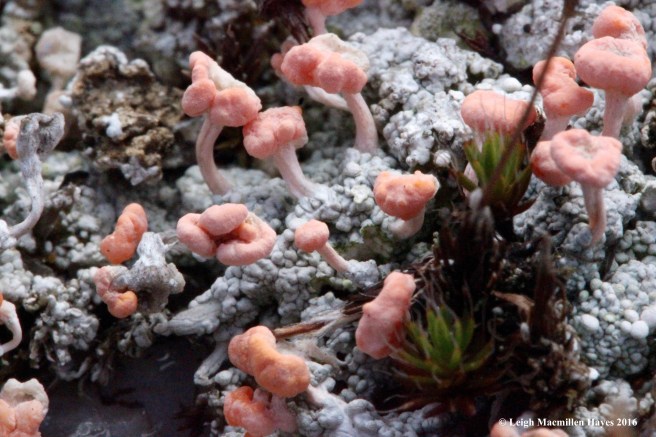
One of the lichens that grew abundantly in this place is the Candy Lichen (Icmadophila ericetorum). This one has been long admired for its salmon-colored fruits that rise above the pale grayish-green crustose formation. Today’s realization–that crustose wasn’t as flat as one might expect. In fact, its appearance  was rather lumpy and almost brain like.

j-brown-beret-1

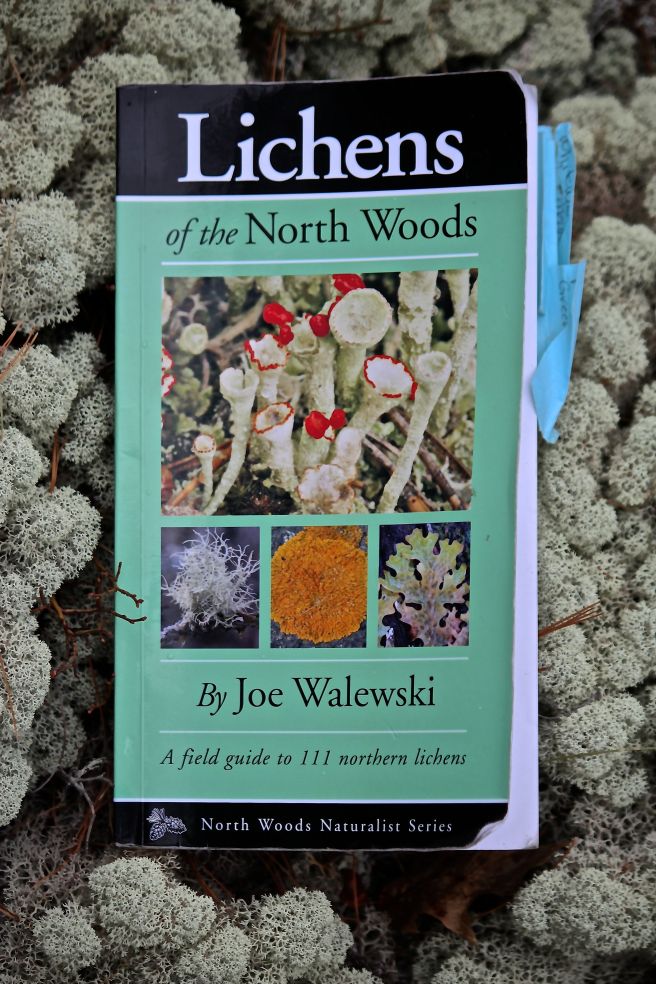
And beside it, one that I hesitate to name, but will take a stab at anyway–Brown Beret Lichen (Baeomyces rufus). I based my attempt upon a description in Joe Walewski’s book: Lichens of the North Woods. Walewski states: “Crustose pale green to gray green surface with short fruticose stalks topped with a dull brown cap.” I may be totally wrong, but that’s what learning is all about.

j-shield-6

We next became equally enthused by the rock shields and their brownish disks.

j-british-among-shields-1

And living among them–British Soldiers.

j-shields-fertile-2

While the foliose formation of the shield lichens spread outward in radiating patches, the apothecia that housed spore production sat atop rounded bowls with rolled-in margins. Based on the margins, my guess was that this was Cumberland Rock Shield (Xanthoparmelia cumberlandia). Maybe it was enough knowing it was a rock shield.

j-shield-bug-2

And speaking of rocks and shields, while we looked, the surface of the rock moved.

j-shield-bug-1

A shield bug, aka a stink bug, crawled along, barely pausing to let us admire the variety of colors it presented.

j-rock-island-2

At last we left the rocks behind and moved on through the woods. Jinny Mae still had a couple more things to show me.

j-common-stinkhorn-1

While my camera had a difficult time focusing on the minute fruiting structure of green stain fungi, it had no problem with the Common Stinkhorn (Phallus ravenelii). It’s reportedly the most common stinkhorn in New England, and yet I don’t find anything common about it. As apparent from the “cracked shell” and lack of a stalk yet, this one was just hatching from its embryonic or egg form. We got down to sniff and noted merely a strong mushroomy odor.

j-purple-crust-1

With one more wonder to ponder, we returned to Jinny Mae’s home, where she showed me a rotting maple branch decked out in purple.

j-purple-2

My first thought because I’d been wearing my lichen eyes–a foliose lichen. But upon further reflection, I think it’s a crust fungi. Whatever it is, again, I’ve never seen it before. But as we noted all day long, once our eyes are focused, things make themselves known.

j-mt-wash-2

At last it was time for me to find my way home. My forest forage with Jinny Mae had come to an end for another day, but my mind’s eye is still focused on our wonder-filled finds.

In Constant Flux

Ever so slowly, the world around us changes.

h-starting-point

Sometimes it’s as obvious as the leaves that fall.

h-bee-on-flower-1

And other times, it’s a bit more subtle, evidenced by the bees that have slowed their frantic pace as they make final collections.

h-leaf-carpet

Mid morning, I headed down the cow path in search of other signs of change.

h-oak-branches-1

As I walked along, I began to realize the interdependence of all. Under the northern red oaks–many  chopped off twigs.

h-porcupine-works

The angled cut and empty cap indicated the work of porcupines seeking acorns.

h-leaves-on-hemlock

I found maple leaves pausing on hemlocks,

h-pine-needles-on-spruce

pine needles decorating spruce trees,

h-leaves-in-puddles

and occasional puddles offering a rosy glow. Eventually, all of these leaves and needles will break down and give back.

h-life-on-rock-1

I found life on a rock, where lichens began the story that was added to by mosses. The creation of soil was enhanced by a yearly supply of fallen leaves and needles gathered there. And then a seed germinated, possibly the result of an earlier squirrel feast.

h-orange-peels1-1

I found orange peel and many other fungi aiding the process of decomposition so that all the fallen wood and leaves will eventually become part of the earthen floor.

h-forest-succession-3

I found a healthy stand of trees and ferns competing for sunlight in an area that had been heavily logged about ten years ago.

h-deer-and-bobcat-prints

I found evidence of those who spend their lives eating and sleeping in this place.

h-aster-seeds

I found seeds attached

h-seeds-on-the-fly

and those on the fly–heading off in search of a new home.

h-witch-hazel-flowers-galore

I found the last flowers of fall

h-witch-hazel-1

exploding with ribbony blooms.

h-power-and-nature

After bushwhacking for a few hours, I found the snowmobile trail, where man and nature have long co-existed.

h-home-2

At last I found my way across the field rather than through our woodlot, thankful for the opportunity to take in the colors of the season one more time.

At the end of the day, I’m once again in awe as I think about how we, and all that we share this Earth with, are dependent upon each other and the abiotic forces that surround us.

And with that comes the realization that the scene is in constant flux and so am I.


On Hands and Knees to Wonder

When I invited Jinny Mae to join me at Loon Echo Land Trust’s Bald Pate Preserve this afternoon, she eagerly agreed. And three hours later, I know she had no regrets. Though we never reached the summit, neither of us cared. Our minds were boggled by all that we had noticed.

b-foster-2-1

Somehow we managed to beeline our way to the Foster Pond Lookout. And then we slowed down. To a stop.

b-shield-2

And so we got rather personal with the rock substrate as we took a closer look. At lichens. For what seemed like ever, it was thought that lichens were symbiotic life forms consisting of Freddy Fungus and Alice Algae, who took a liken to each other and their marriage formed a single organism. Sometimes, cyanobacteria or blue-green algae was tossed into the mix. The fungus provided shelter (algae can only live where they won’t dry out and so being surrounded by fungal cells meant Alice could live outside of water), while either of the photosynthetic partners, algae or cyanobacteria, produced food from the sun.

It’s no longer just a story about Freddy and Alice living together, however. New scientific research deems another partner in the mix–yeast, which also provides protection. I feel like just stating that puts me way out of my league.

b-shield-1

Our goal wasn’t to understand those relationships per say. We just wanted to spend some time looking and developing an eye to recognize these structures while appreciating their life’s work that often goes unseen.

b-shield-on-rock-2-1

Some grow at an especially slow rate–think hundreds of years rather than decades. That in itself, should stop us in our tracks. And yet, as we stand 5+ feet above those that grow on rocks, we hardly notice them.

b-green-shield-5-1

The  dark brown fruiting bodies, called apothecia, are where spores are produced and life continues. Walk tenderly, my friends.

b-toadskin-2

Jinny Mae’s excitement over the toad skin lichen was contagious. Notice its warty projections–much like the skin of an American toad, which varies in color.

img_6343

I spied this toad a few days ago, but its skin certainly helps qualify the lichen’s common name.

b-toad-skin-lichen-3

If you look in the center, you can see the point where the lichen attached to the rock–the belly button of this particular lichen making it known as an umbilicate lichen.

b-toad-skin-lichen-wet-and-dry

And among the favorite finds of the day, Jinny Mae was the first to spy this. It had rained this morning and everything was dry by the time we hiked, but some signs of moisture remained. In this case, it’s wet toad skin contrasted by dry toad skin. If you are willing to give up some water from your water bottle, you can create the same contrast. And note the black dots–its fruiting bodies or apothecia where its spores are produced.

b-british soldier patch (1).jpg

The more we looked, the more we saw.

b-Gritty British soldier lichen.jpg

British soldiers were topped by their brilliant red caps–forever announcing their presence.

b-pixie 1.jpg

Pixie-cup lichen stood like goblets, ready with magical potions.

b-pixie-cup-filled-to-the-brim

Some were filled to the brim and almost overflowed with life.

b-reindeer-1

We marveled at the green,

b-reindeer-gray

gray,

b-reindeer-foam-1

and foam-like structure of reindeer lichen. These are treats for reindeer and caribou, neither of which frequent our region except for one night a year.

b-yarn-moss

And then we looked at the next layer in succession on a rock. Once the lichens have established themselves, mosses move in. Did you ever think about the fact that mosses don’t have flowers, stems or roots? Instead, they feature tiny green leaf-like structures and microscopic hair-like structures. They send their “hairs” into the crevices created by the lichens and anchor themselves to the rocks. Today, we found a moss neither of us remember seeing before.

b-yarn-moss-2

To us, it offered a square presentation and we debated its identity. While we thought it may be yellow yarn moss, I’m now leaning toward medusa moss–though their leaf edges are smooth and these are obviously toothed.  Do you know? Which ever it is, we were wowed.

b-view-from-the-rock-1

We finally moved on, hiking to a false summit to take in the western view.

b-polypody-among-rock-tripe-1

The late afternoon sun and breeze played havoc with our views, but we eventually reached the rock tripe wall, where common polypody took advantage of the living conditions.

b-tripe-wall-1

The lichen covered a ledge, some of it green from the morning rain, but surprisingly much of it still brown. Like the toad skin lichen, rock tripe are umbilicate and attached to the rock at a single point. They reminded me of elephant ears flapping in the breeze.

From there, we headed down. Our pace on the slow side all afternoon.

And sometimes we had absolutely no pace at all, unless you consider the motion (and grunts) as we got down on our hands and knees and even our bellies to take a closer look. It was all worth a wonder. And we did.


Be Together Mondate

It took us a while to get our act together this morning, but by 10:30 we were finally at the trailhead for the Baldface trails off Route 113 in Evans Notch. Okay, so true confession, I did not want to hike these trails. For thirty years I’ve managed to avoid them, but my guy promised me this morning that if I wasn’t comfortable we could turn back at any point.
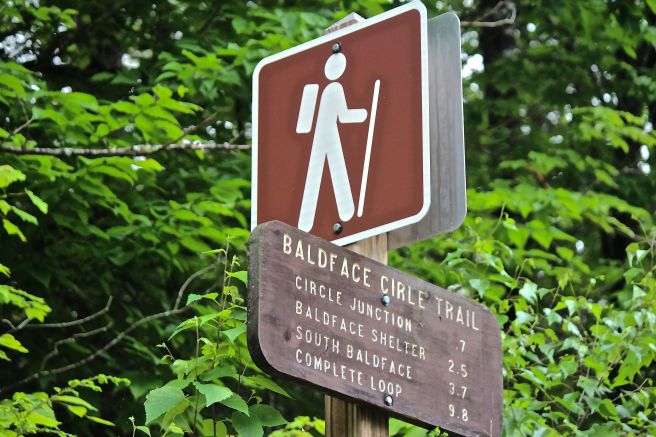
b-start sign

And so our Mondate began.

b-ph emerald 3

The first .7 miles were familiar to us as we’d passed this way many times in the past, often with friends or family in tow. The destination, Emerald Pool. A forever nippy Emerald Pool.
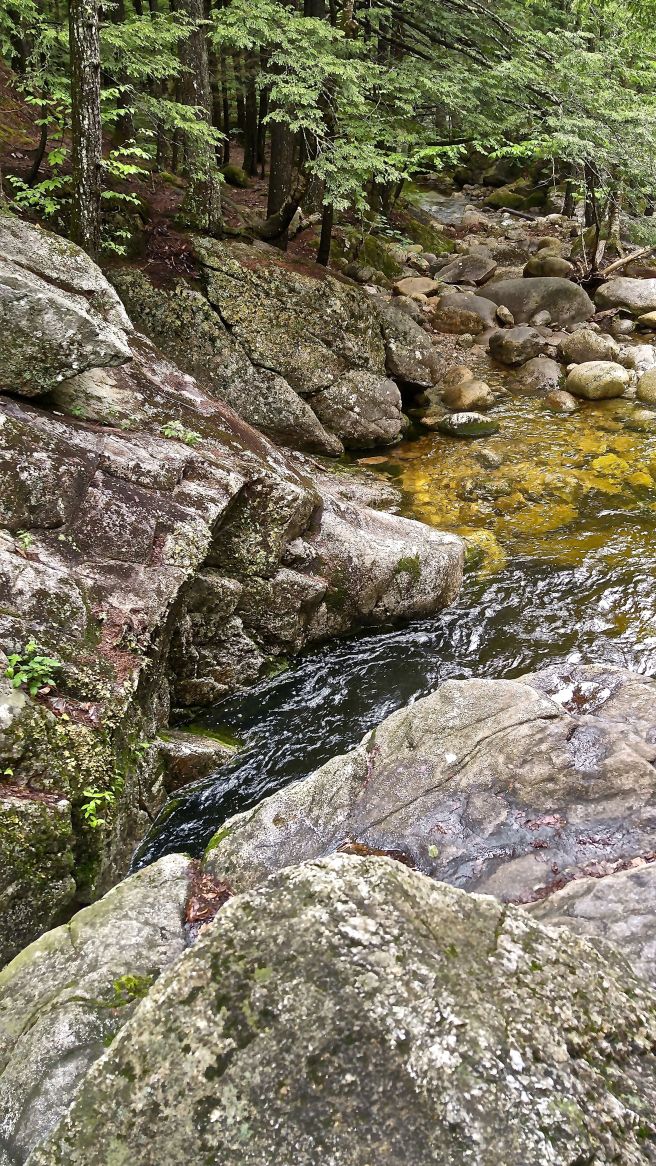
b-ph emerald 2

We stood above the pool today and shared memories of past visits. And the people that made those visits memorable.

b-ph emerald above

Even the water above the pool provided hours of entertainment in days gone by.
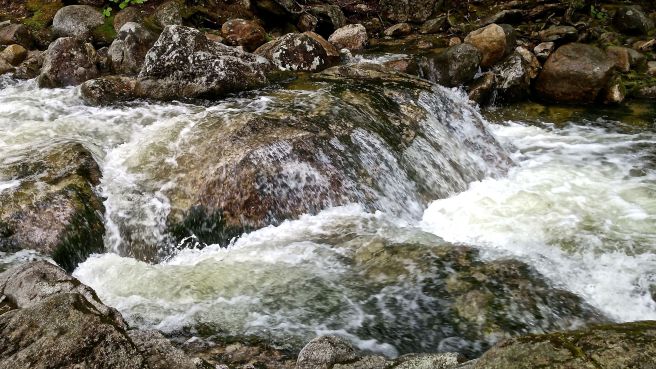
b-ph emerald above 2

Today, it was the water’s force and volume, increased since last night’s rain, that gave us pause.

But we couldn’t pause for long. We had a mountain to conquer. And so, we headed back to the main trail and at the junction followed the Baldface Circle Trail . . . until it disappeared before our eyes. We backtracked but couldn’t figure out what we’d done wrong, except that we couldn’t see trail blazes anywhere. And so we retraced our footsteps until the trail petered out again. And then we decided to bushwhack and climb uphill because it only made sense that we’d find our way. At last, success–we found yellow blazes and an obvious trail. But . . . we didn’t know if we were on the Circle Trail or Slippery Brook Trail.

Our plan had been to hike up the first and down the latter. Out came the map and compass and we were fairly sure we were on the latter trail. To be certain, we hiked a wee bit, until we came to the brook. Yup. So, decision time. Turn around and head back to the other trail or continue on because we’d already come so far. We continued on. Plan B when we didn’t even know we had a Plan B.

b-ph brook 3

And Slippery Brook held its own tribulations. The water–oh how it flowed. It didn’t bother my guy and within seconds he stood on the other side grinning back at me. Meanwhile, I hemmed and hawed. And hawed and hemmed. How in the world? I thought perhaps I should return to Emerald Pool and wait for my guy to complete the round trip. He wasn’t buying that. Neither was I, truth be told. But sometimes my head gets the better of me. He knew that. And so he dropped his pack, took off his boots and sloshed through the cold water to grab my pack.
b-ph brook crossing 2

I didn’t have a choice. I had to follow him. And so I did. Of course, this guy knows I’ll follow him anywhere.
b-lunch rock

We continued on the Slippery Brook Trail and a delightful trail it was. I kept waiting for the bald face to show, but it wasn’t to be. The worst part, if there was one, would be the mosquitoes. It poured last night and the trail was rather wet, but still, it provided a pleasant climb. We paused for lunch beside a stream where the mosquitoes abated.
b-ph mayfly1

One of the things I like about stopping for lunch, besides eating because I’m always hungry, is taking time to notice. Mayflies.
b-mtn maple1

The deeply impressed veins of mountain maple leaves.

b-sugar maple

And u-shaped lobes of sugar maples.

b-dogwood

Dogwood.

b-beech fern1

And beech fern.

b-bunch:hobble

Following lunch, we continued to climb and noticed things like the great pretender–a bunchberry posing as a hobblebush flower.

b-ph moose works

And moose works carving the greenery.
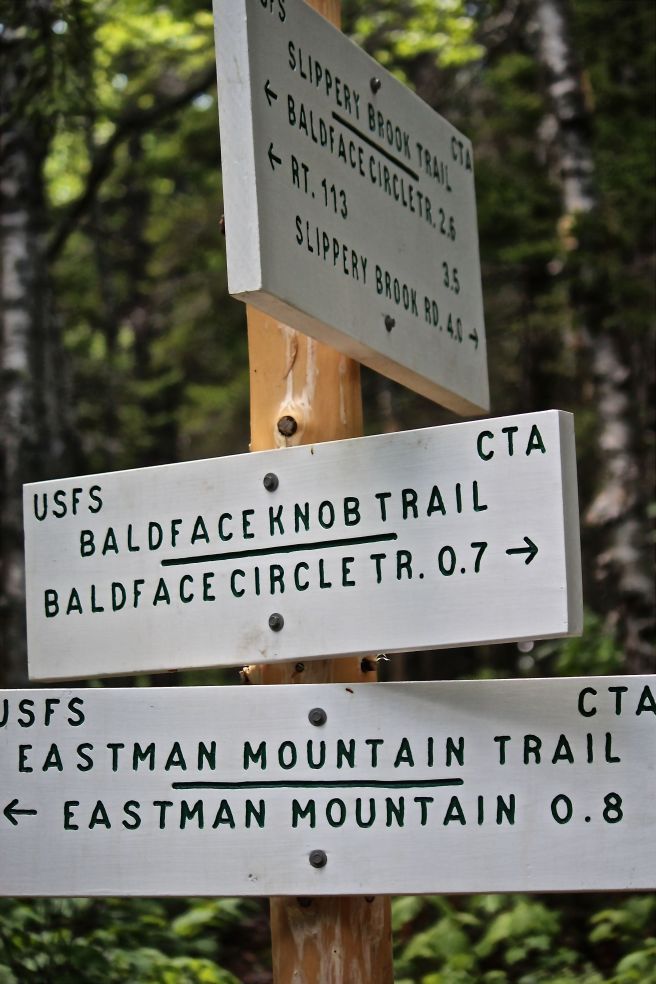
b-halfway sign.jpg

At last we reached our halfway point at 3.5 miles. I kept wondering–where is the bald face that I’ve been dreading? The Slippery Brook Trail was a delight, be it long, with no bald rocks in sight.

While we climbed, I’d not only noticed my surroundings but also planned my funeral. I know who I want to conduct the service and he’s out of town this week. I figured that was OK. My guy would just have to delay it for a bit. And I thought about who might come and how the different folks would interact with each other. It’ll be a celebration of life, of course. And people should be encouraged to get outside and notice. Maybe they could go on a group walk.
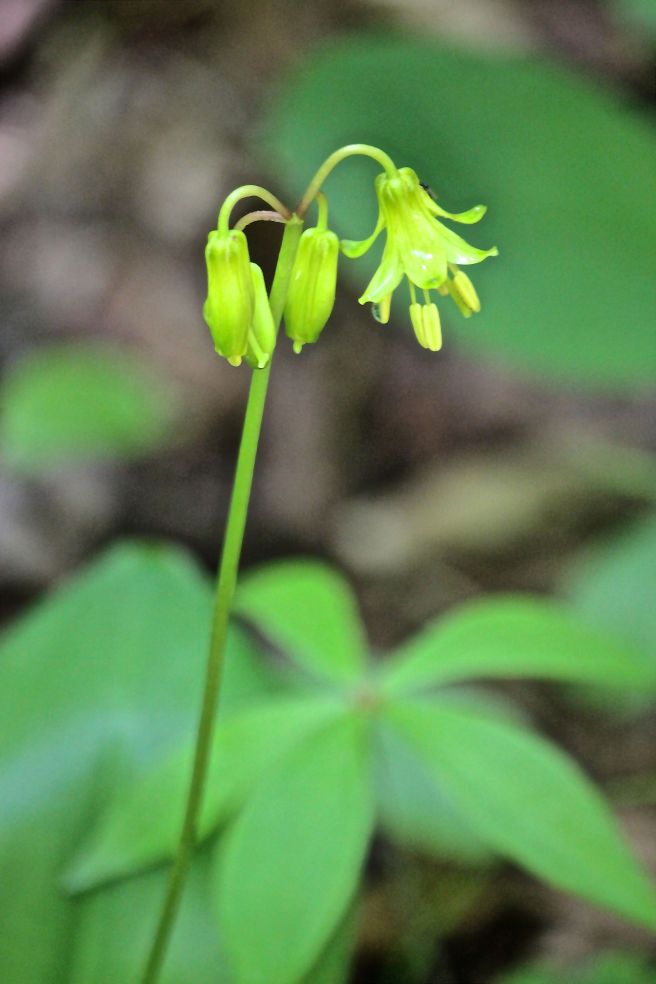
b-yellow clintonia.jpg

And then we followed the Baldface Knob Trail where the yellow clintonia grew in such abundance that my guy actually started to ID it. I’ll make him a naturalist yet. ;-)

b-lady's x2

Equally abundant were the lady’s slippers.

b-ph trail up

And then we met my nemesis. But really, it wasn’t so bad. All that worry for naught. I could do this. If we decided to hike down this way, I would survive.
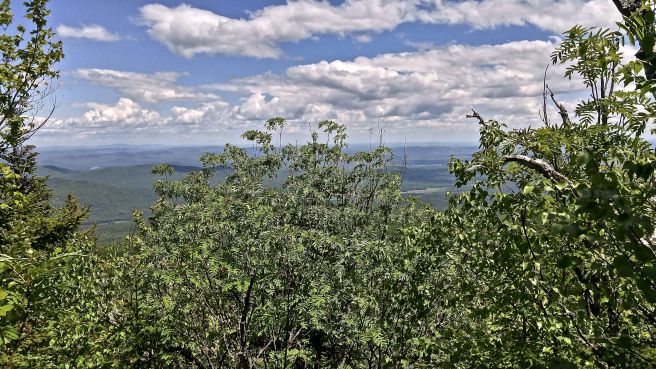
b-ph first view

At last we reached our first vantage point with the world we normally inhabit spread out beyond.
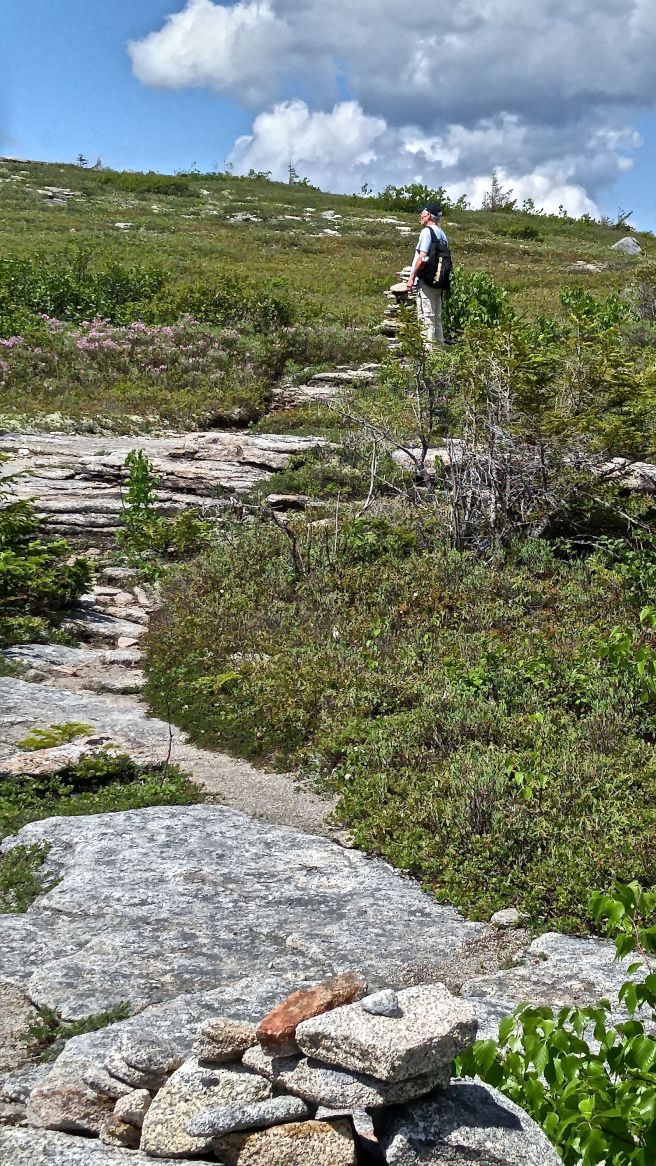
b-ph hiking up

It just kept getting better, and cooler and windier–a relief for our sweaty bodies. But . . . the black flies increased significantly. I swallowed a few. All that swarmed must have been males because they didn’t bite. But they certainly were annoying.
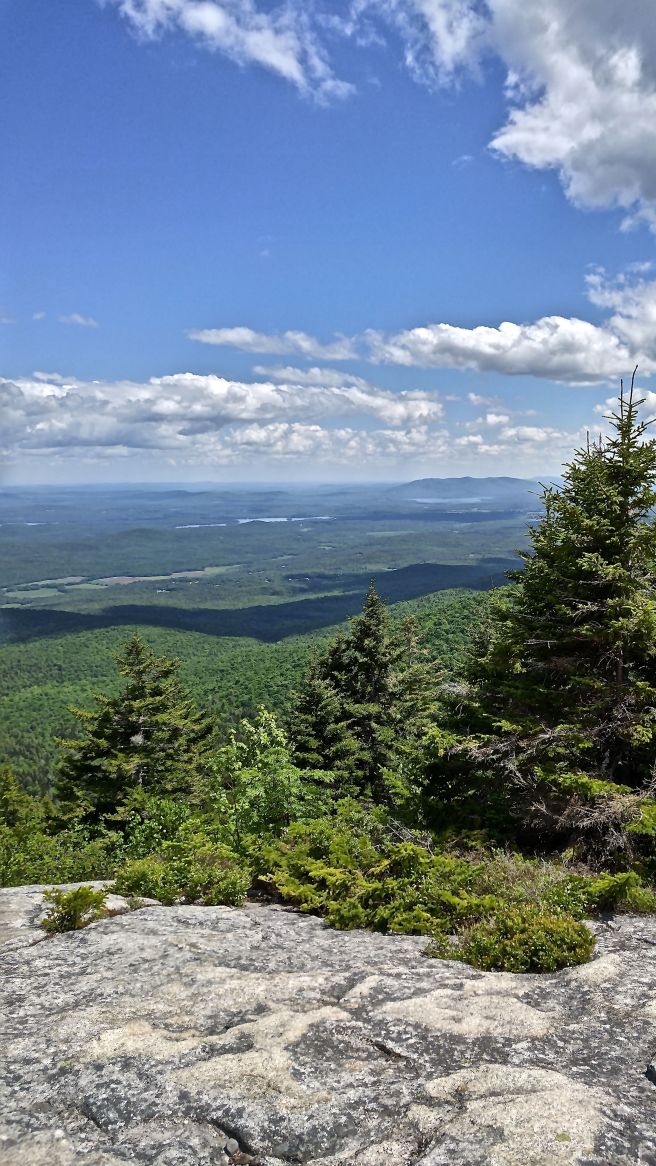
b-ph Pleasant Mtn

As we approached the top of the Baldface Knob we recognized our neighborhood with Pleasant Mountain in the backdrop.

b-ph panoramic

A 180˚ panoramic provided half of the picture. I thought I caught the other half, but it’s not to be. South Baldface was behind us and completely doable. We decided to save it for another day because it was getting late and we weren’t certain about the trail before us.

b-ph chokeberry

Among the selections at our feet, chokeberry
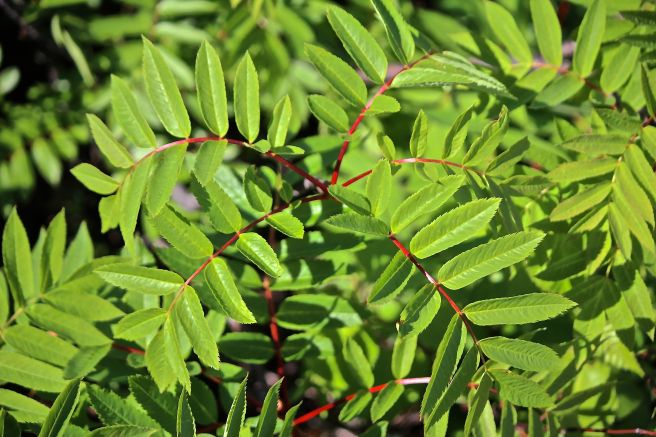
b-summit mtn ash

and mountain ash.

b-hummer 3

At eye level–a hummingbird moth who moved in supersonic speed.
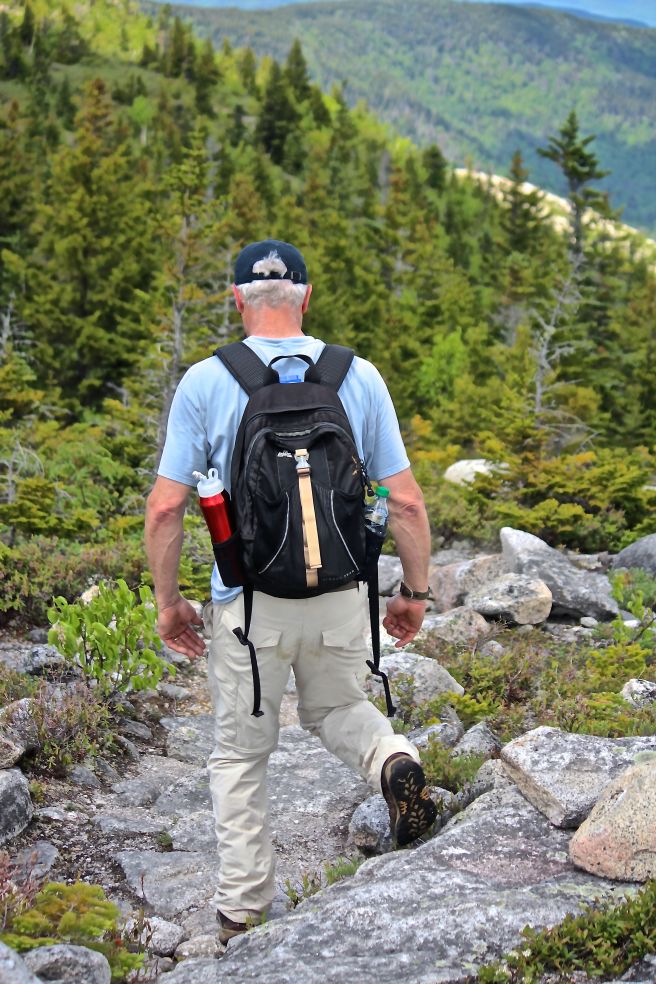
b-hiking down 1

And then we followed the path down.

b-ph forever view

The world stretched before us

b-ph hiking down 3

to infinity and beyond. My guy insisted that parachutes were available at this spot, but they must have been previously claimed because I couldn’t find one . . . anywhere. And believe me, I looked.
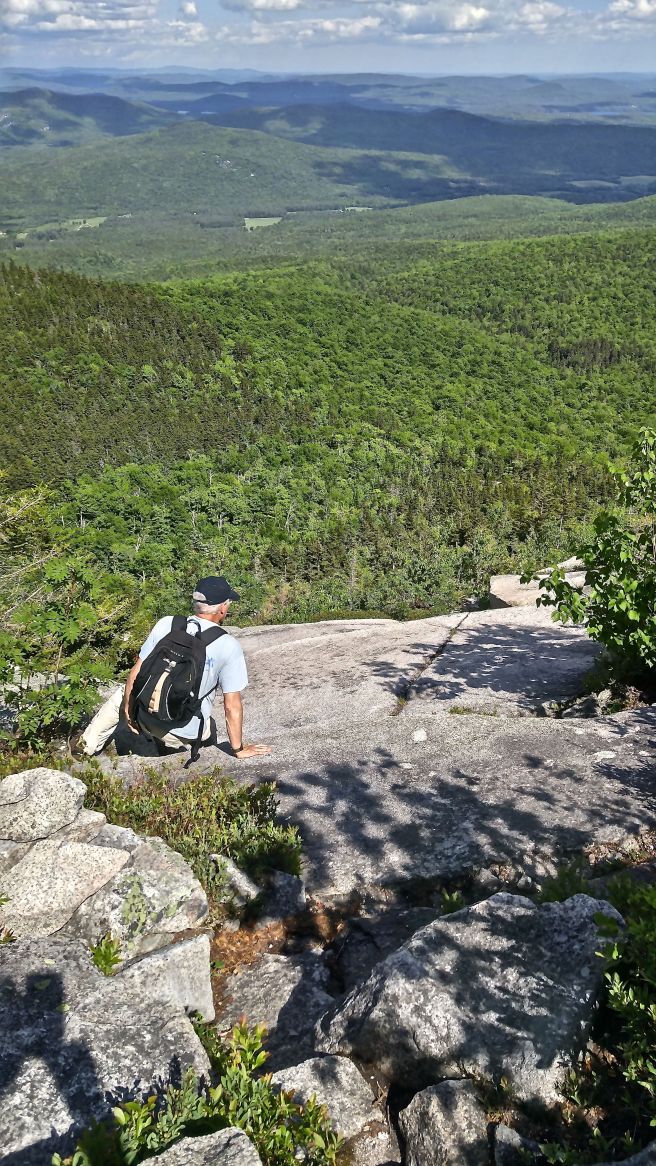
b-ph heading down

It all seemed so innocent from the top, but really, it was a scramble. A major scramble that lasted a long time until we got back into the hardwood forest. Our footing–precarious and often wet. We both have a fear of heights in open spaces. My guy has forever had such a fear–my own is newly developed and I know not its source. Oy vey. We were in over our heads, but had no choice. I kept thinking about a rescue mission, but I don’t think they show up for those who whine. We practiced our crab walks, slid and skidded and hugged rocks and trees as we made our way down this precarious trail.

b-ph lichens1

The lichens were beautiful and we got to see them up close and personal. We also practiced our trust jumps. Yup, several times my guy positioned himself to catch me as I jumped. Remember my funeral plans on the way up. I was preparing as we climbed and facing the inevitable as we descended.
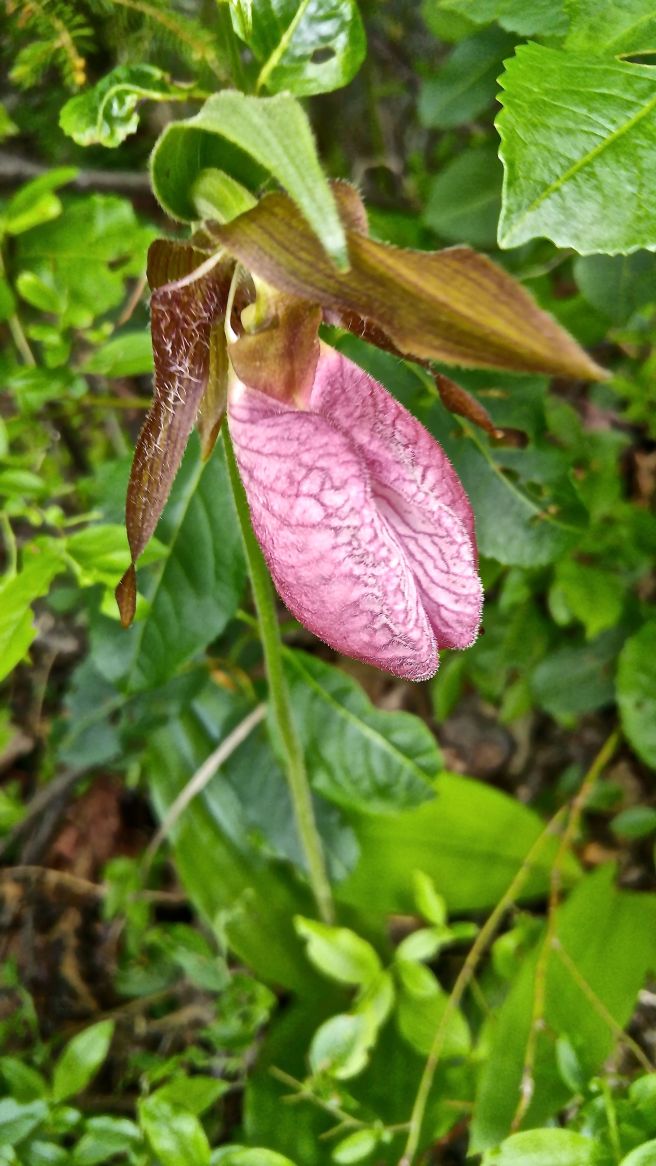
b-ph lady 2

Finally, we were rewarded with a more even trail–sort of–and lady’s slippers.

b-ph chandler 5

About a mile before the trailhead, we followed a spur to Chandler’s Gorge.
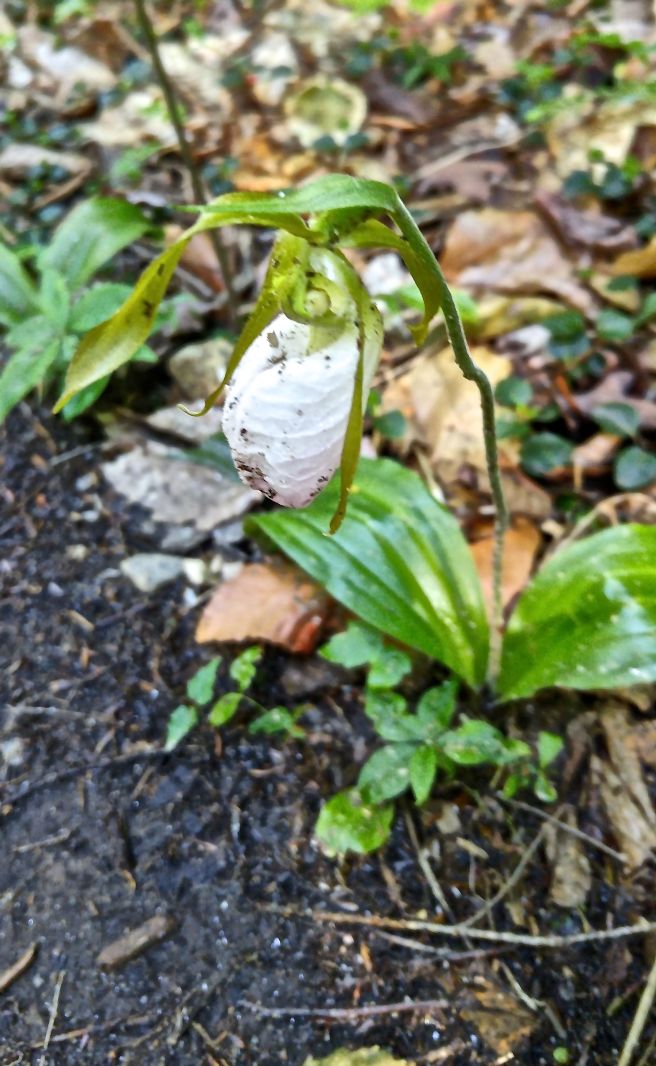
b-phdirty lady

On the way out, I realized I wasn’t the only dirty lady.

Oh, and we found where we zigged rather than zagged at the start of the trail. Honestly though, we both realized that if we’d hiked up the Baldface Circle Trail, we probably would have turned back. So as luck would have it, we went the right way.

Since we were on stable ground, I mentioned my fears to my guy. He admitted he’d had the same. And when I said I was sure we’d both fall when I jumped down and he caught me several times, he said at least we’d be together.

Be together on a Mondate. That’s what it’s all about.



Book of May: Lichens of the North Woods

Everywhere we look as we hike (or even drive), be it ground, rock or tree, lichens make themselves known.

b-greenshield

Some are easy to ID even if we are driving 60mph (on the highway, that is), like common greenshield. Others, however, require closer examination and consideration. And that’s why this month’s book is . . .

b-book

Lichens of the North Woods by Joe Walewski. From the get go, it’s another one of those books where it feels like the author is by my side. “Welcome to the Lilliputian world of lichens!” he begins.

Lilliputian indeed! And complex. But Walewski helps the rest of us develop an understanding of such complexity. Through illustrations and photographs, he presents us with Lichen Biology 101. And then he takes us into the field, showing us how to collect and preserve our specimens.

He explains how to use the field guide and then gets into the nitty gritty. I appreciate that the book is divided into the three substrates–ground, rock and tree–though sometimes I need to remember that though the lichen I’ve found appears to be on a rock, it might be listed under ground because the soil has built up over time.

Within each of the three sections, he further divides it by type: crustose (think those lichens that appear to be flat like a crust of bread), foliose (leafy like foliage) and fruticose (branching like grape branches). Common greenshield is leafy–therefore a foliose lichen.

For each lichen, Walewski includes a photograph, description, chemistry, similar species and nature notes.

Finally, there is a glossary, followed by titles of interest, and a list of lichen groups and Web sites.

It’s a small book, measuring 8 x 4.5 and only about a half inch thick, so it’s easy to toss in the backpack.

b-Quill 2

Walewski’s study focuses on Minnesota, but here in the Northeast, we have many of the same varieties.

I’ve encouraged you to develop your bark eyes in the past. This summer, look out! We’re going to work on our lichen eyes. And any puns you wish to share are most welcome :-)
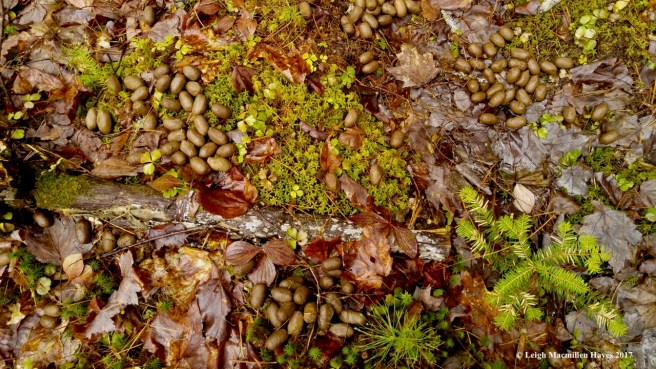
I found my copy of Lichens of the North Woods at Bridgton Books. Look for it at your independent book store.

Lichens of the North Woods, Joe Walewski, Kollath+Stensaas Publishing, 2007