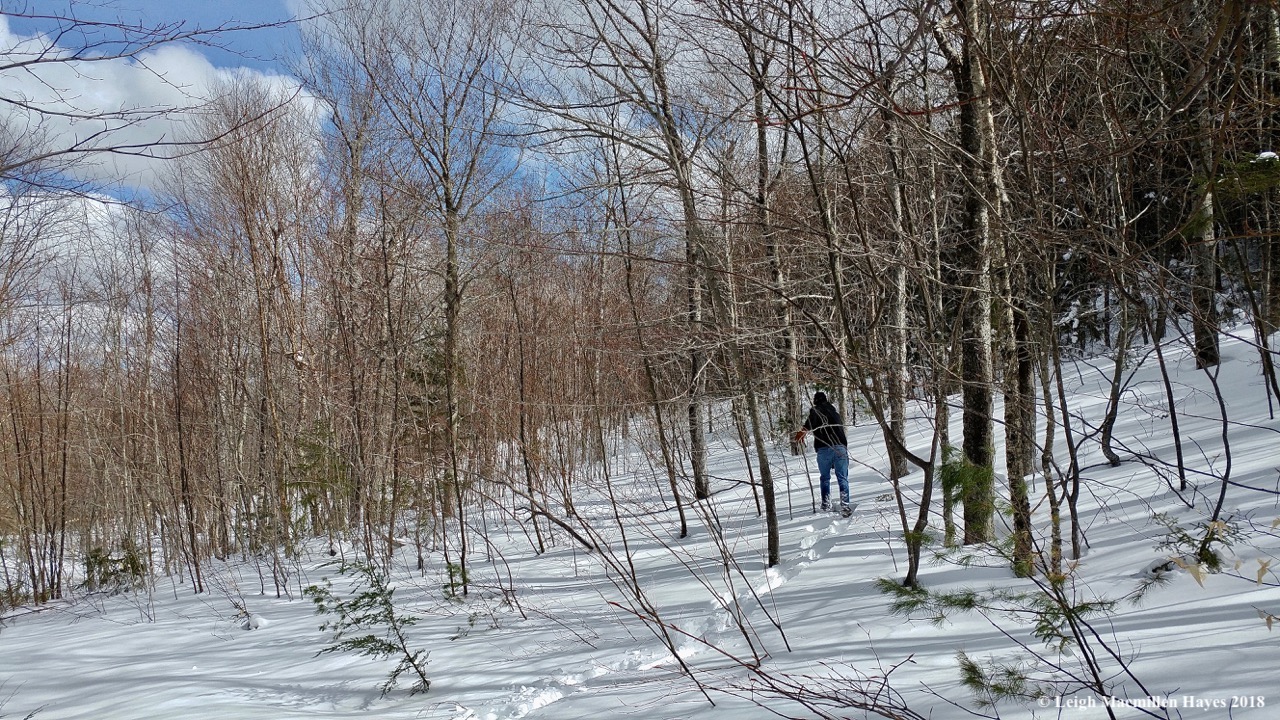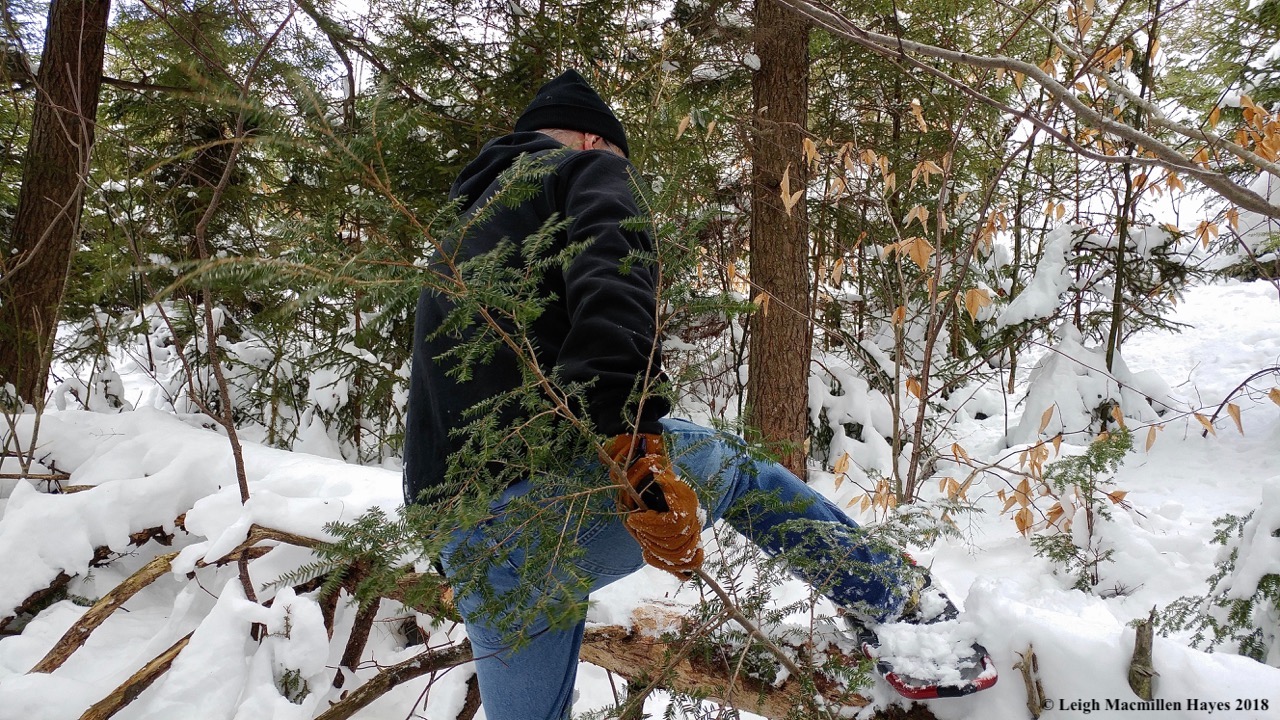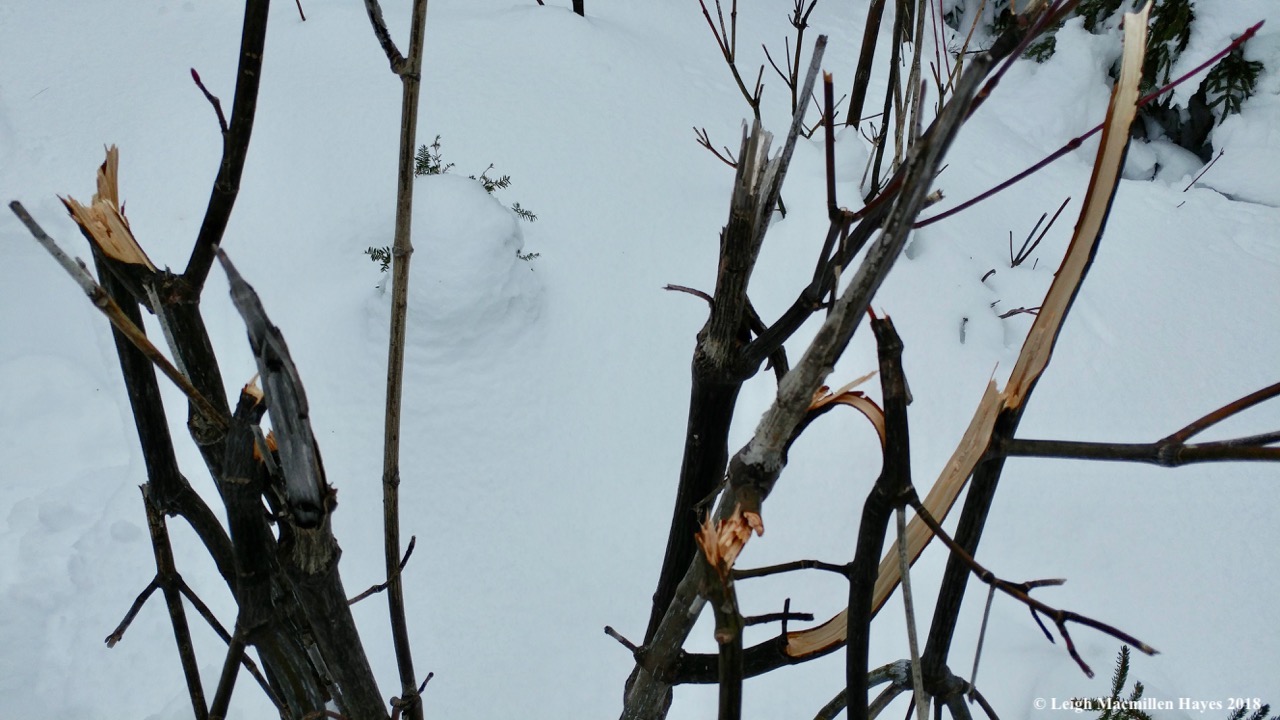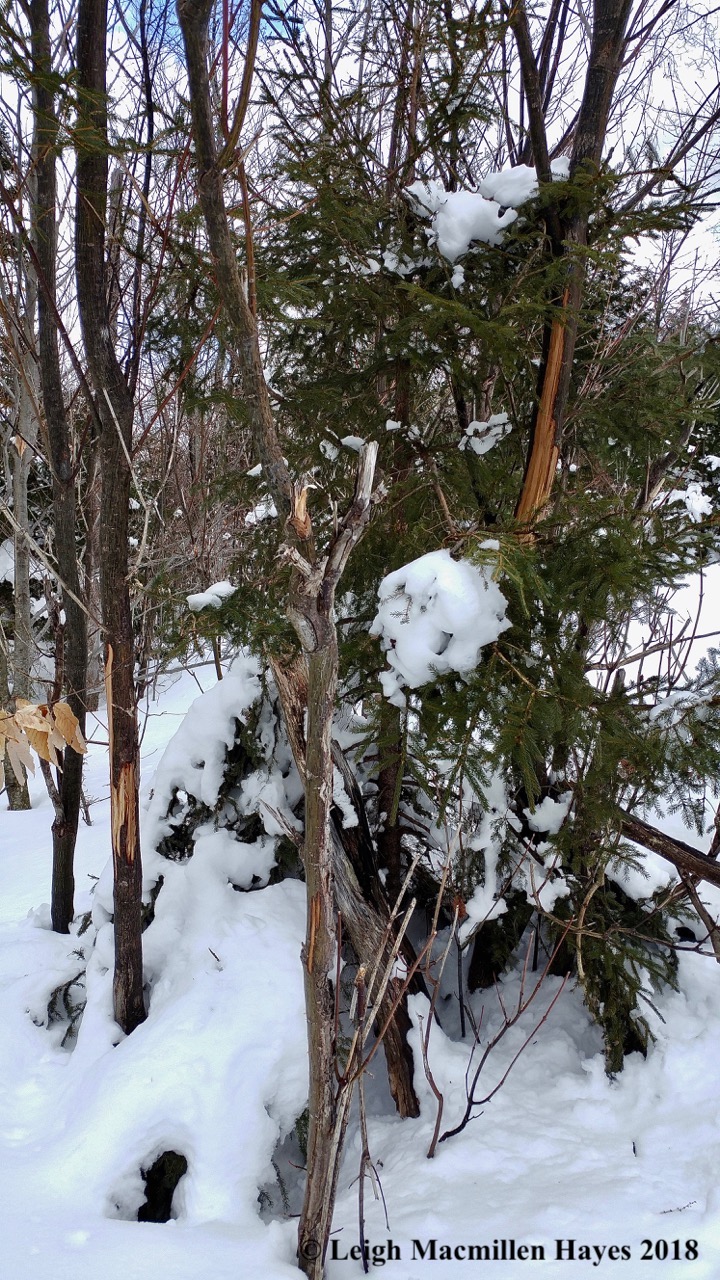
Mondate Preserved

The other day a sign caught our attention as we drove to Overset Mountain and we realized we had new trails to explore. But, we, or rather I, drove by  so fast that we didn’t know which local organization owned the property. 

If my guy read these posts he would chuckle or guffaw at my comment about driving too fast for he is of a different opinion. But suffice it to say that we didn’t read the name of the land trust on the sign and so this morning I contacted Loon Echo Land Trust because in my online research, their name was associated with the property. Maggie quickly let me know that I needed to contact Lee at Western Foothills Land Trust and violà. 

Both have been involved in the Crooked River Forests Project for as is stated on the LELT website: The Crooked River has been identified as a priority for conservation as it is the largest tributary to Sebago Lake, with 38% of the inflow, and it offers local recreational opportunities and is situated above high quality sand and gravel aquifers. The river has been identified in the state’s Natural Resources Protection Act as an Outstanding River Segment with AA status; free flowing with the best water quality. This trout fishery is home to one of only four native populations of landlocked salmon in the state and is known to host one species of anadromous fish (American eel) and is thought to historically host Atlantic salmon and sea lamprey.

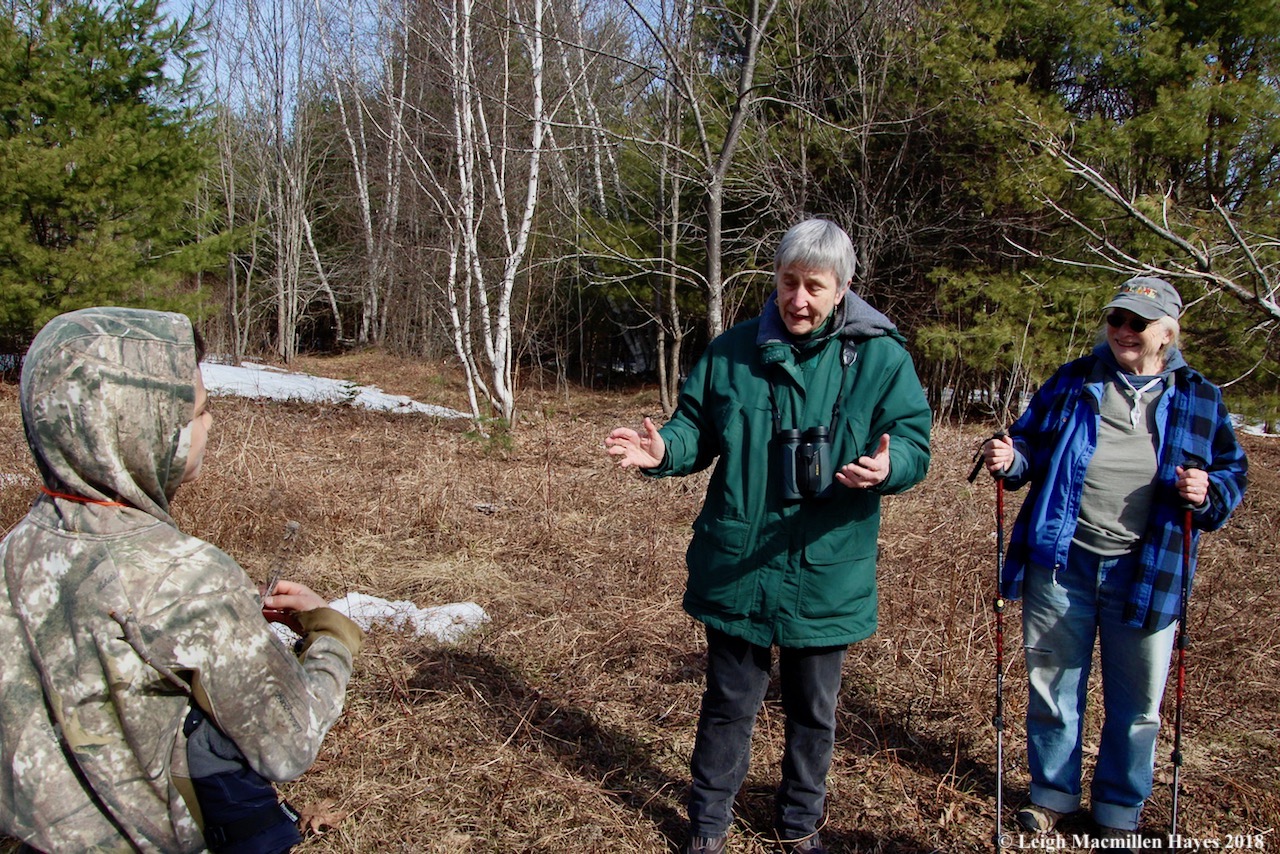
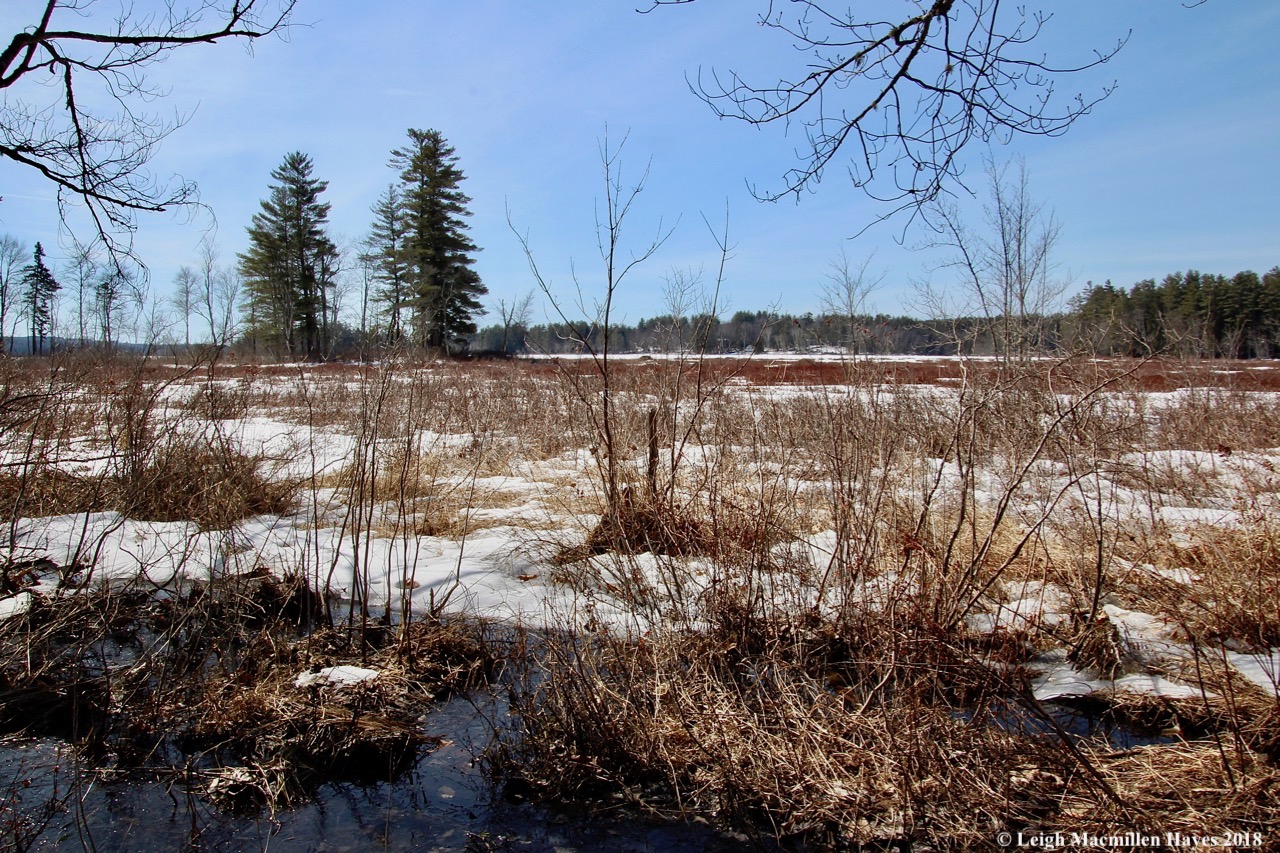
As I pulled up to the sign today, however, the ownership was obvious. The name, Two Bridges, was not so. The area has long been named such, and all we could imagine is that twin bridges once spanned the Crooked River in the area where we stood. 

Since the parking lot was under construction, for the property won’t officially open for another two weeks, we parked on Plains Road rather than Route 117 in Otisfield. 
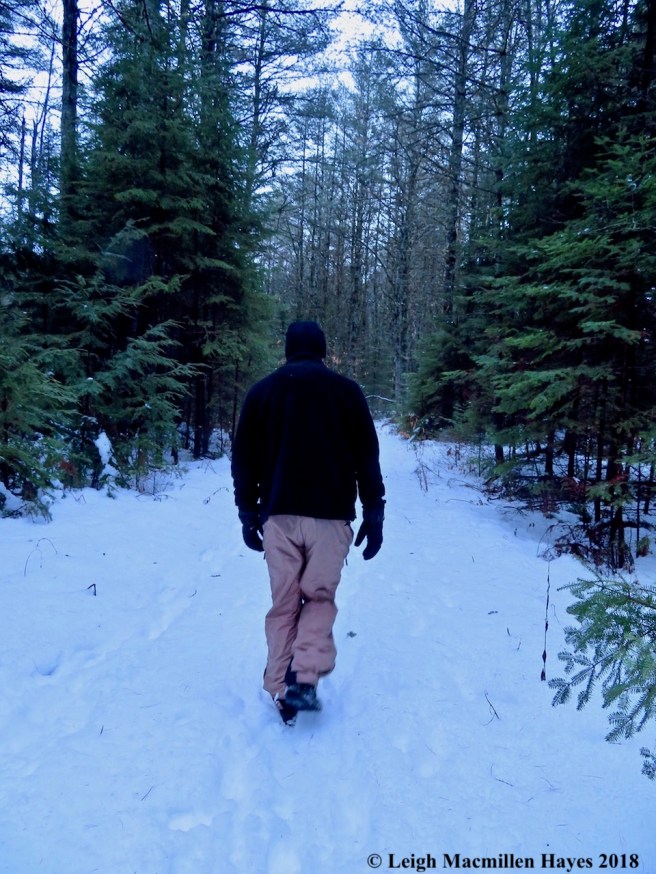
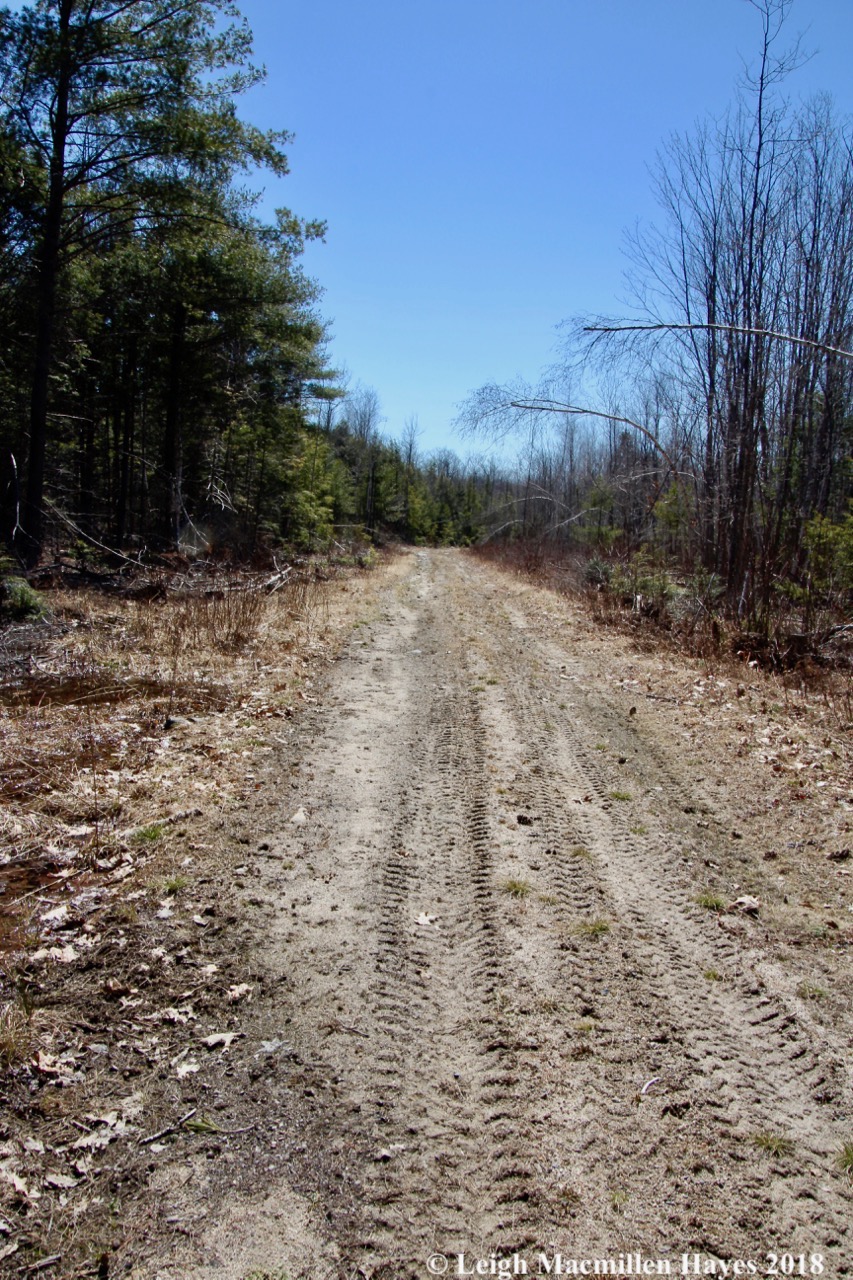
At the start, the trail was wide and straight, and we both hoped for a change. Oh, don’t get me wrong. It was lovely and we had fun naming all the evergreens, including white and red pine, hemlock, balsam fir and red spruce, for those were the most abundant species, with a few young beech, red maples and red oaks thrown into the mix. But . . . we wanted diversity. And we wanted to walk beside the river. 

Soon, thankfully, we came to a Y in the road and a new sign post, or so we imagined it to be. We chose the trail to the right since it was closer to the water. 
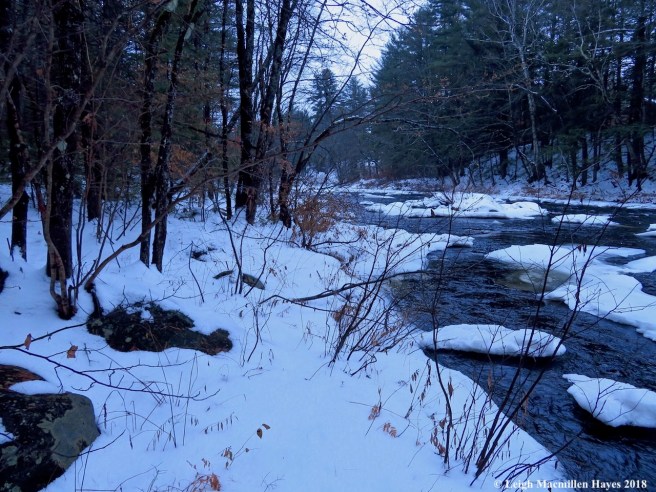
And within minutes our reward awaited. That being said, we’d followed a spur to the riverbank and since there were no telltale pieces of flagging we suspected it won’t be marked as a public trail. 

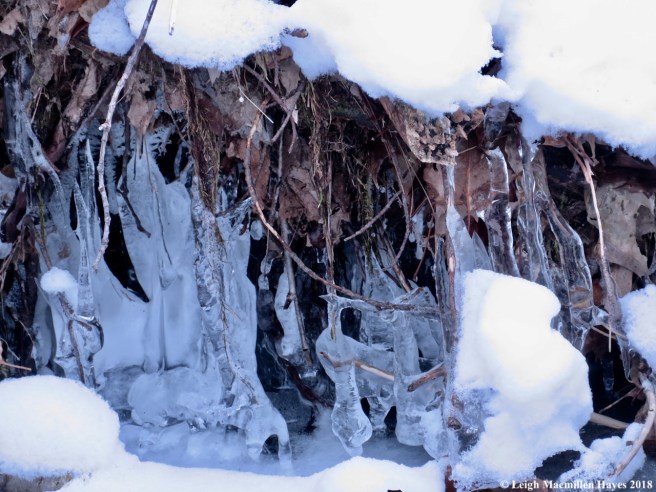
Further along, we again spent time by the river, and noted its sculptures made of decorative roots . . . 
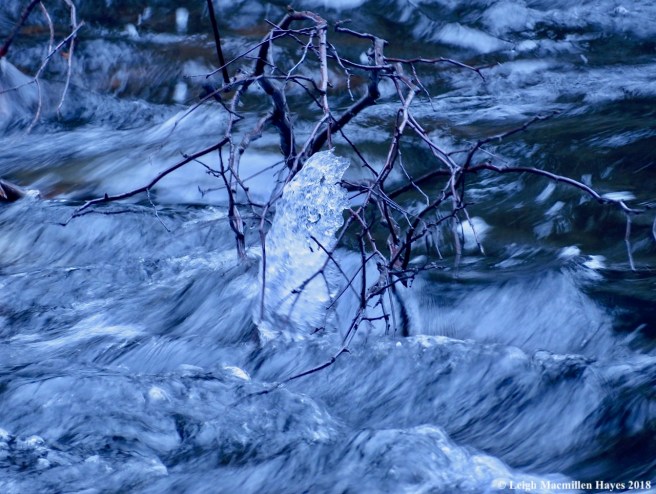
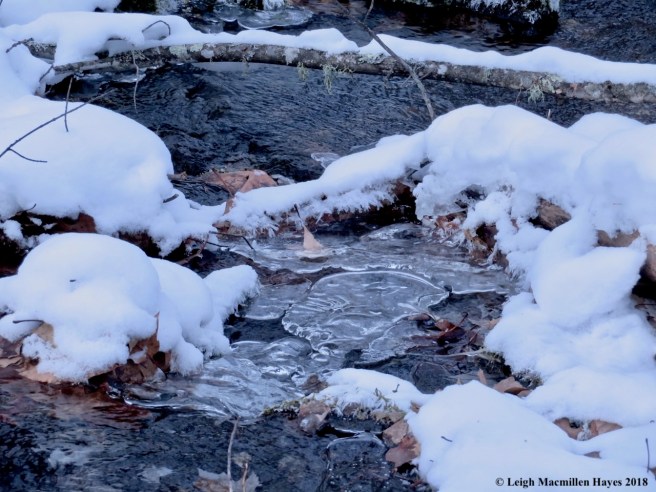
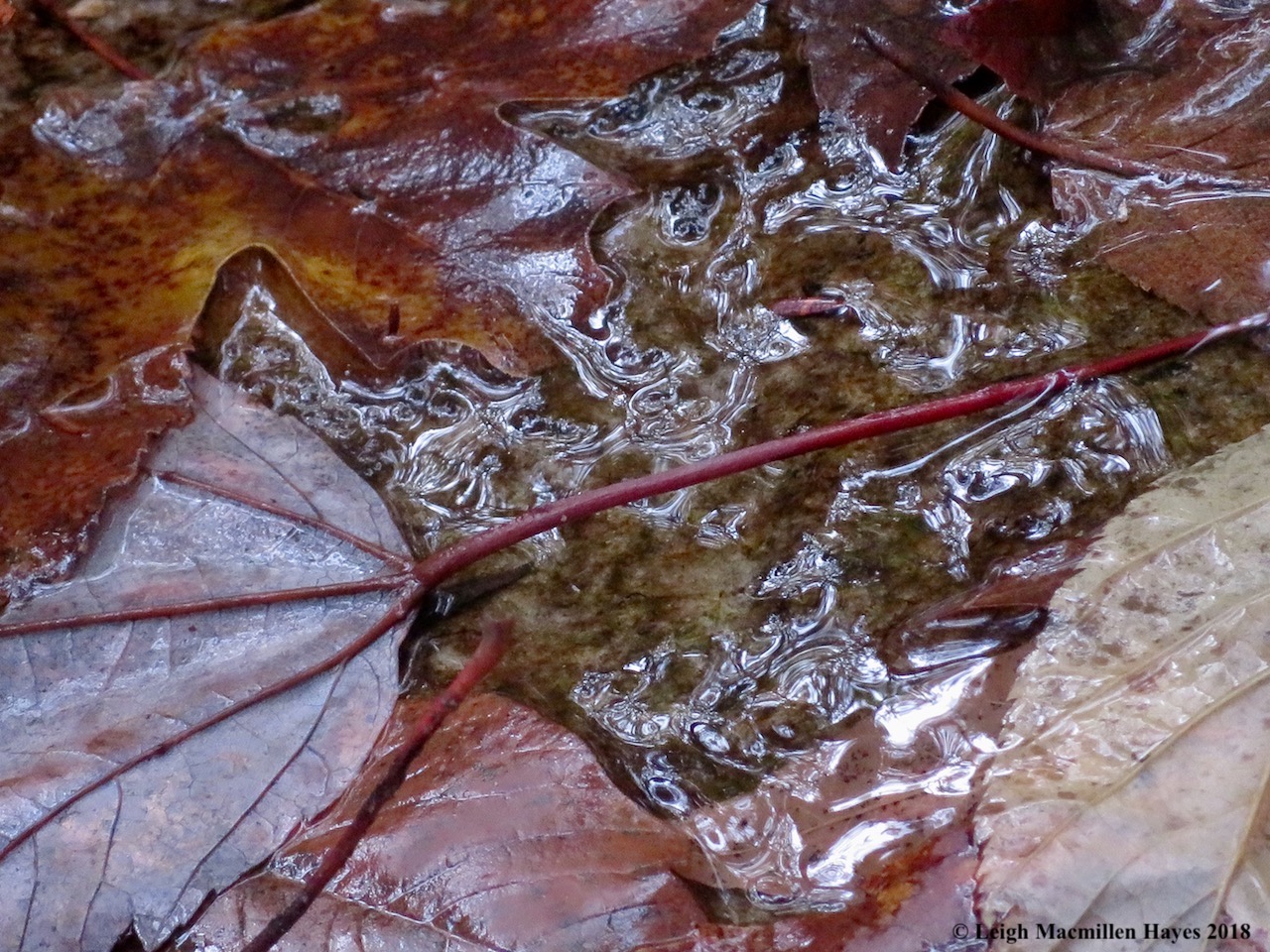
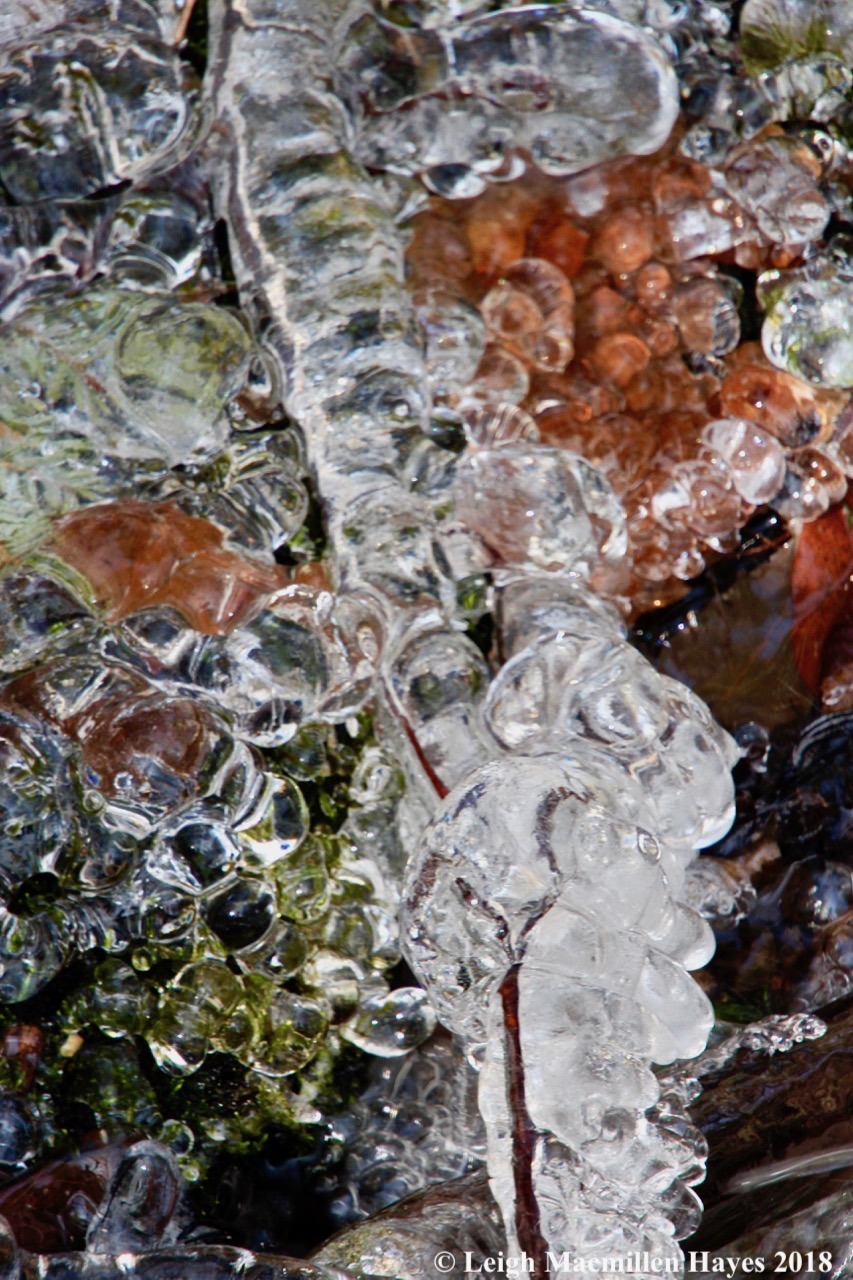
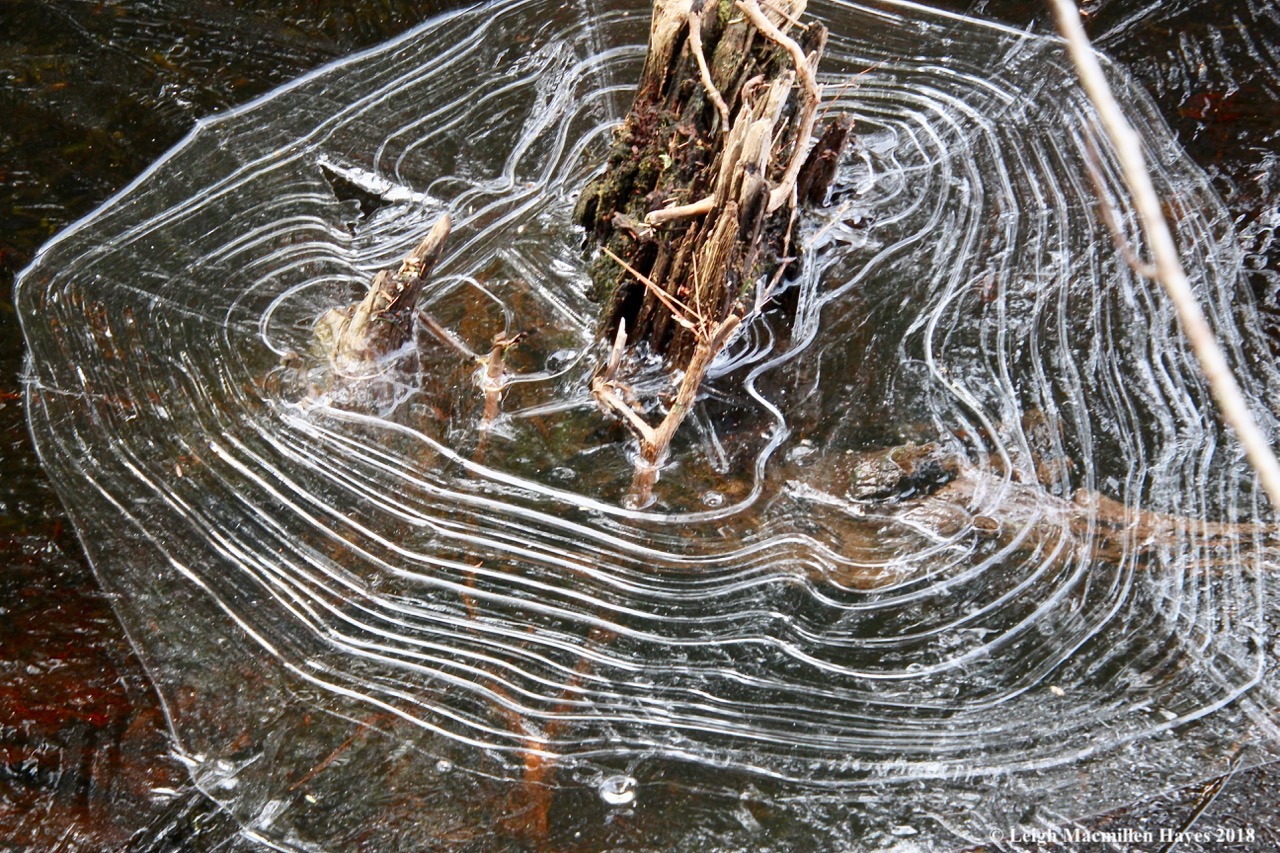
and splashes of ice. 

And in the mix–a rare sight indeed: an ice disc, this one being about three or four feet in diameter and spinning in an eddy. 

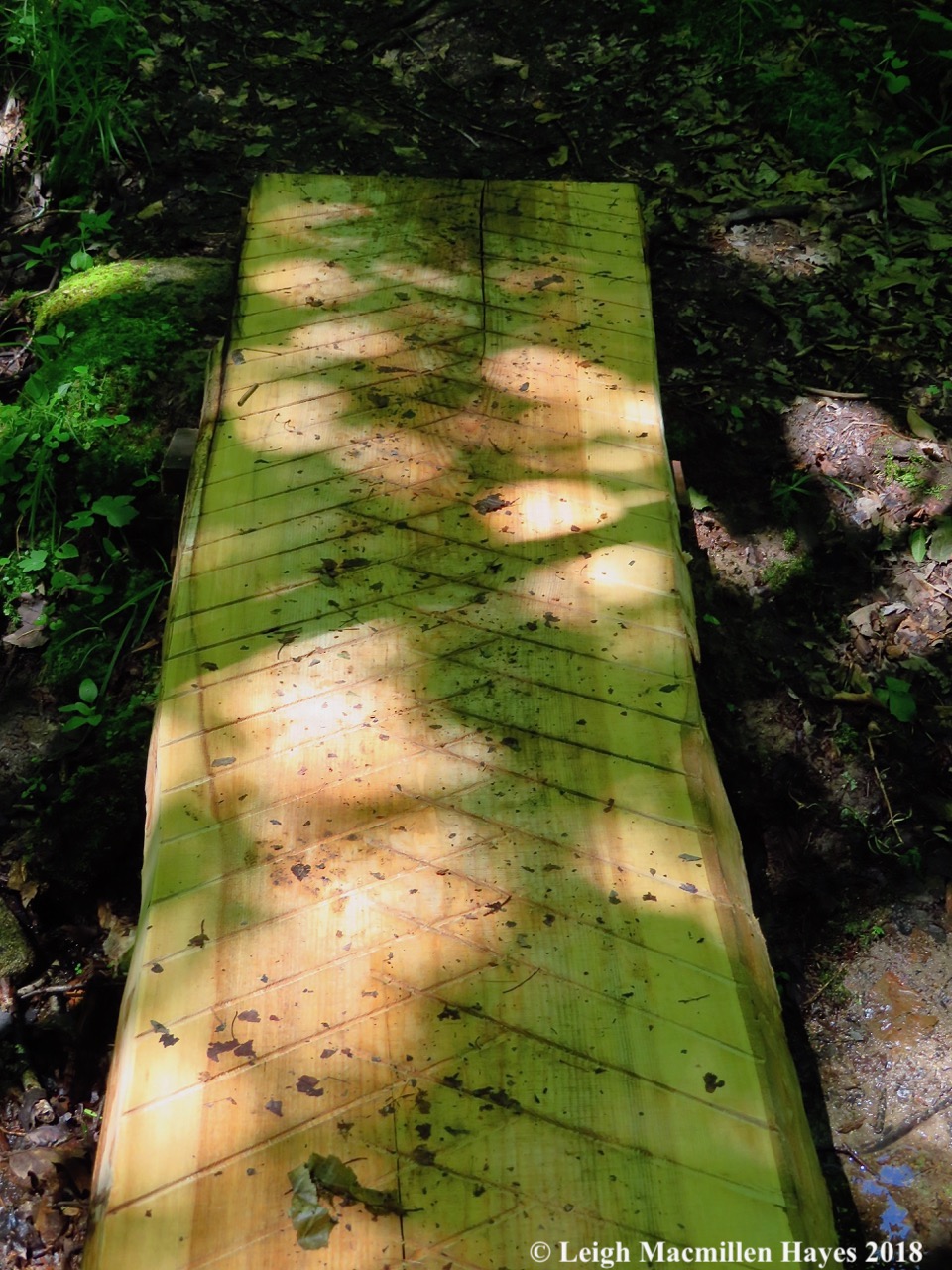
Eventually, the trail took us across a bridge constructed by the land trust in October 2017 that will provide the landlocked salmon and brook trout with another mile of spawning habitat.
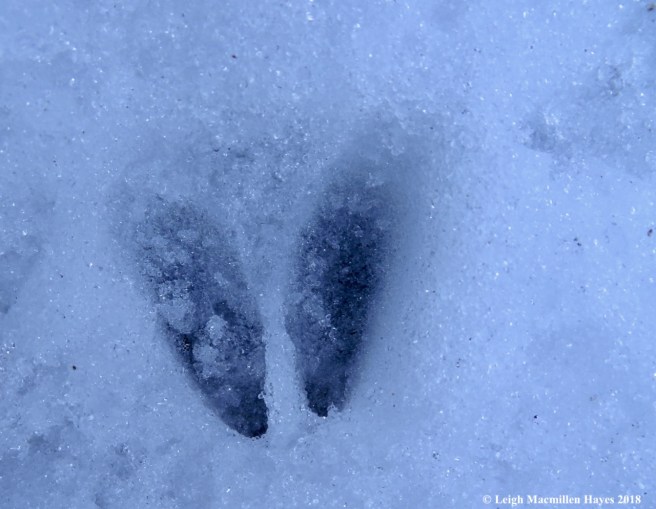
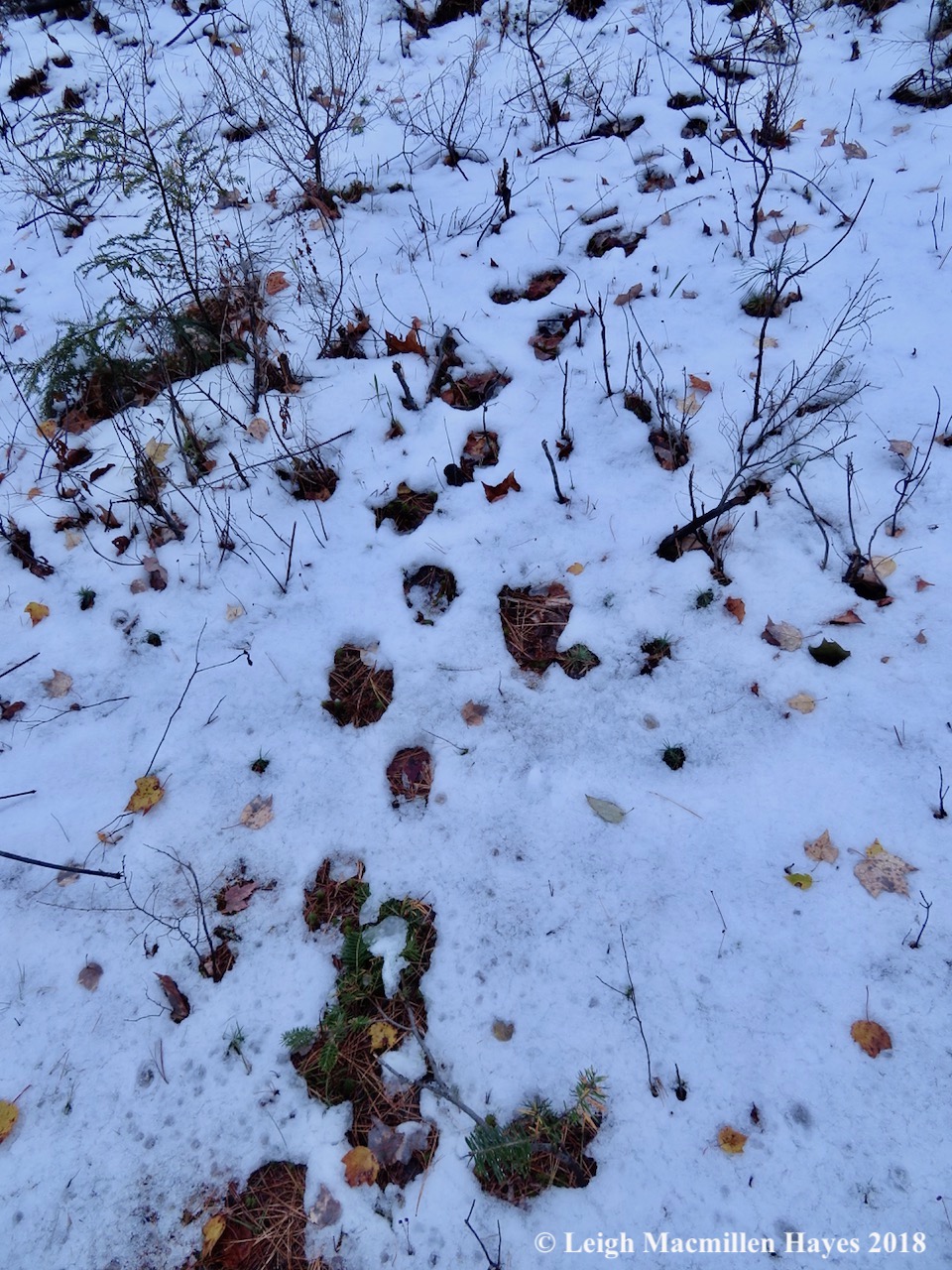
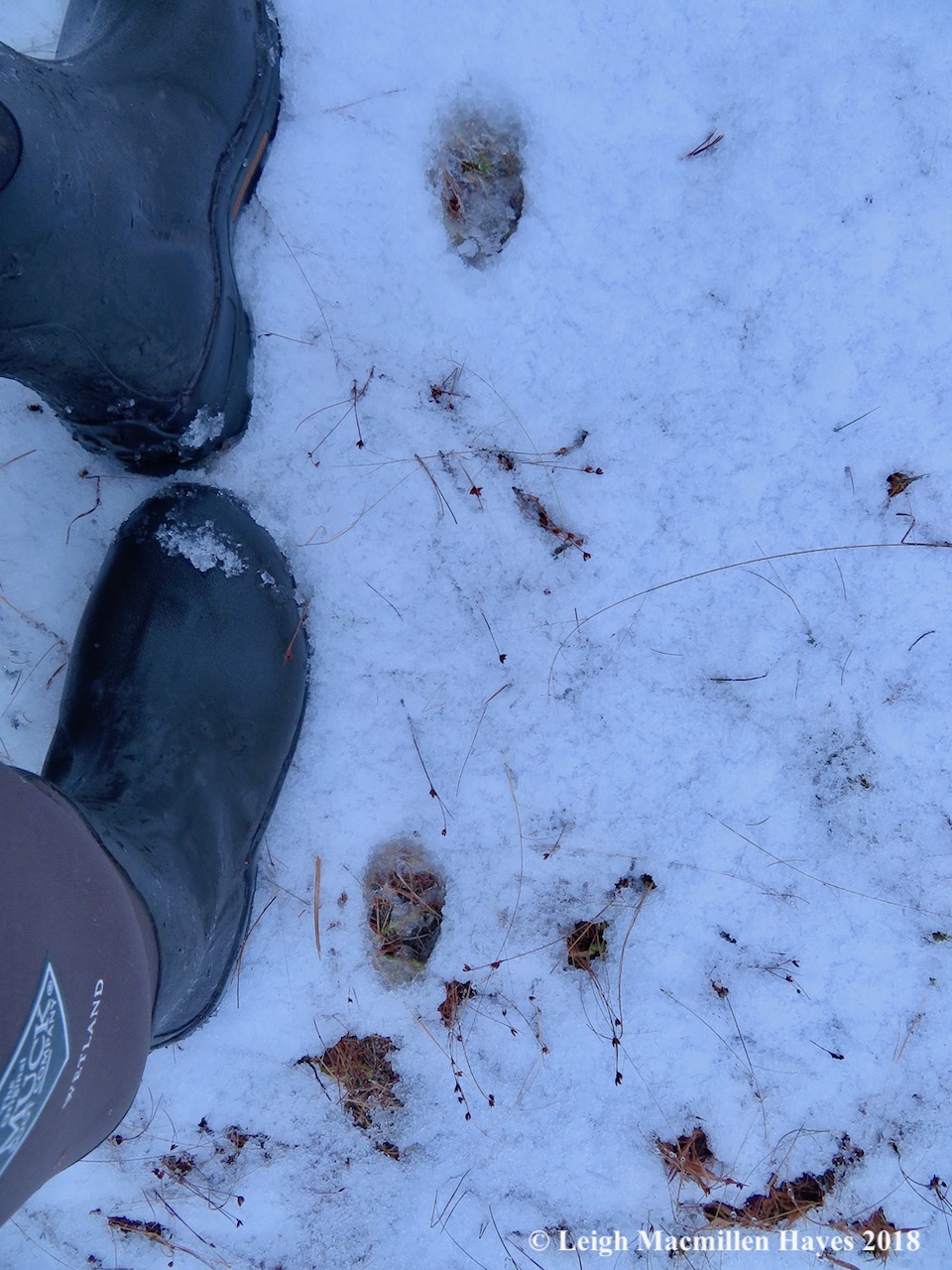
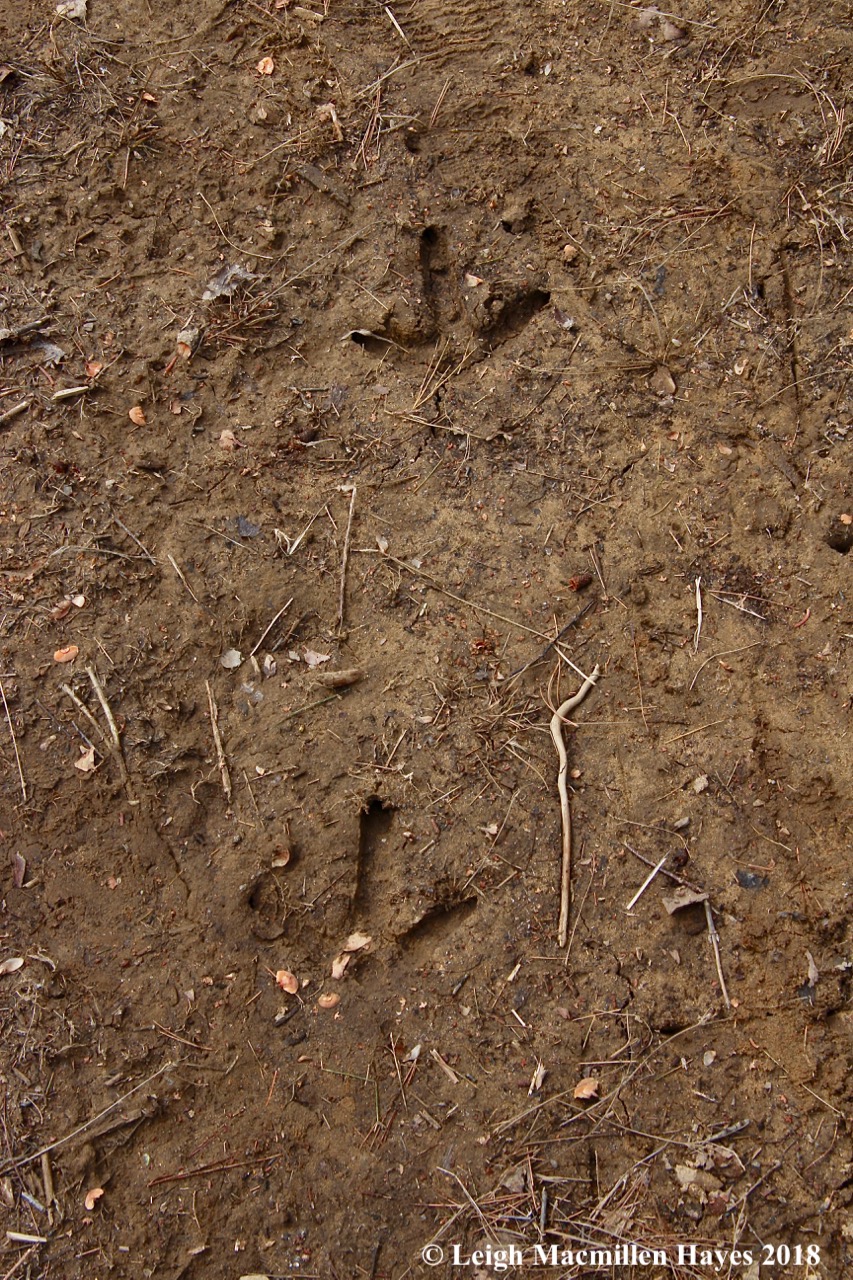
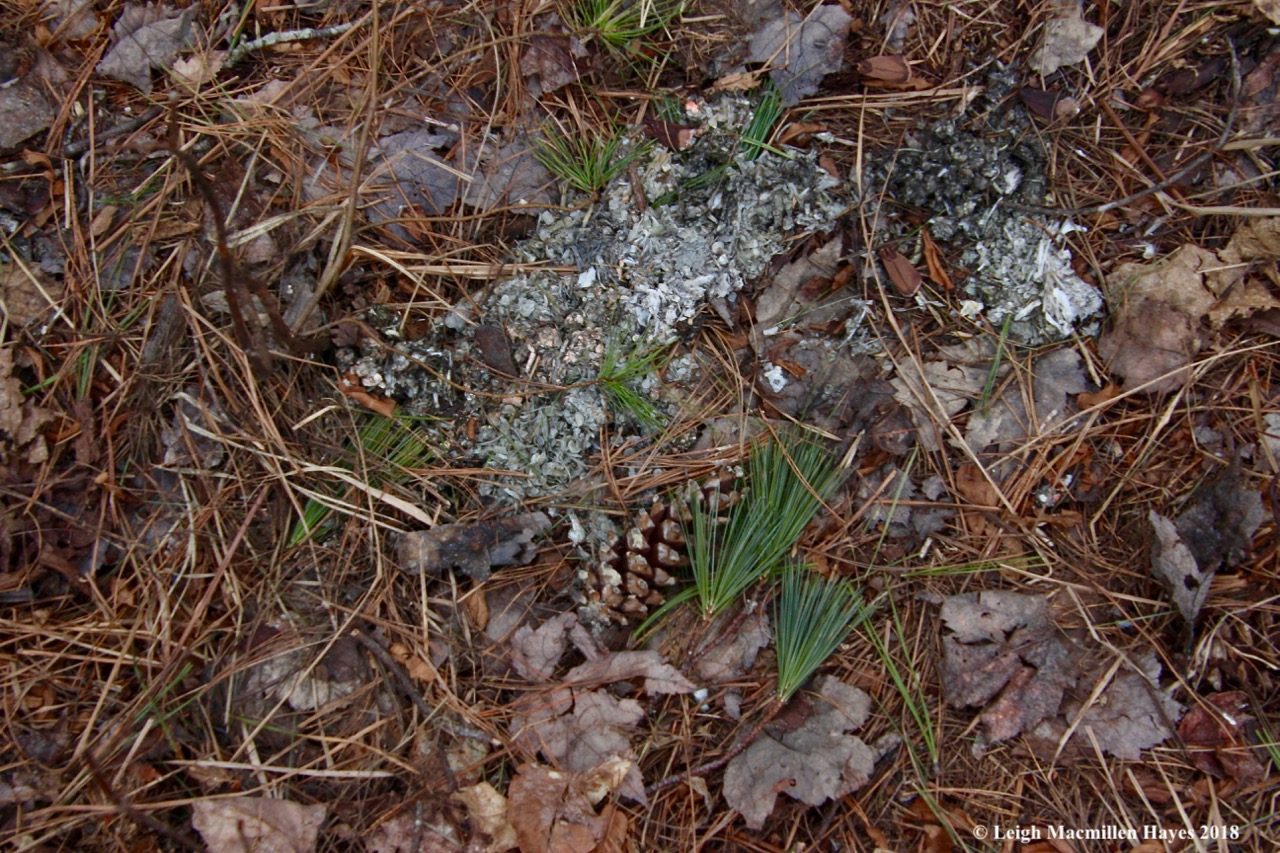
And that’s not all. We saw plenty of evidence that mammals inhabit the space from deer . . . 

to fox . . .
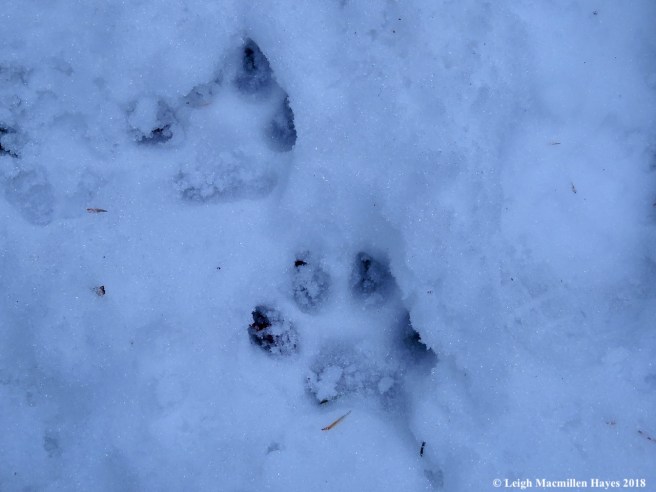
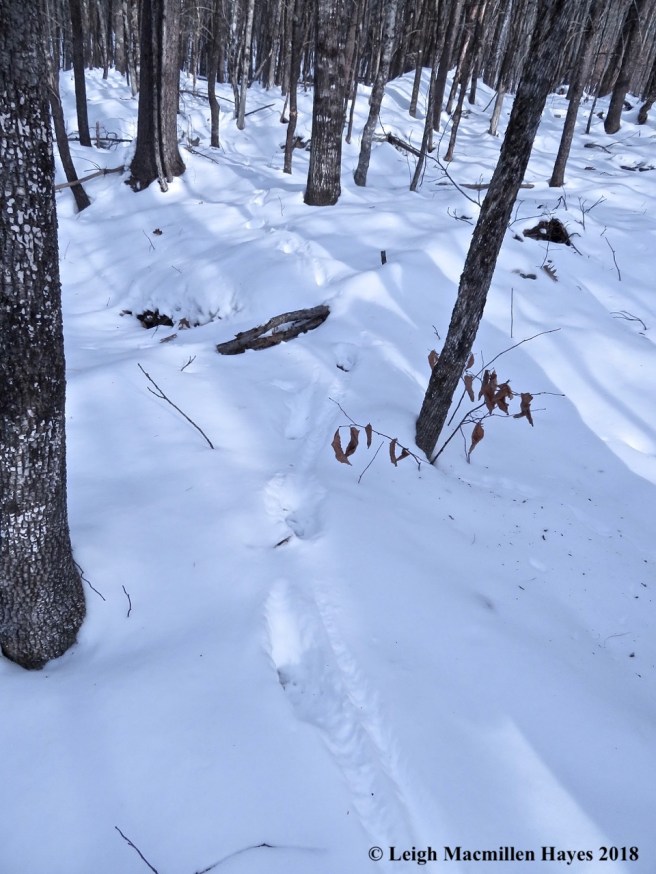
to bobcat! 

There were several intersections, and we kept turning toward the river, which took us along trails more to our liking as they narrowed and twisted and turned through the forest. 
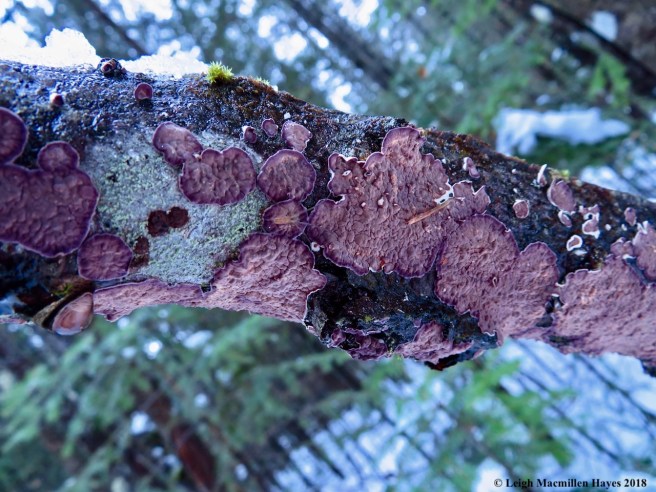
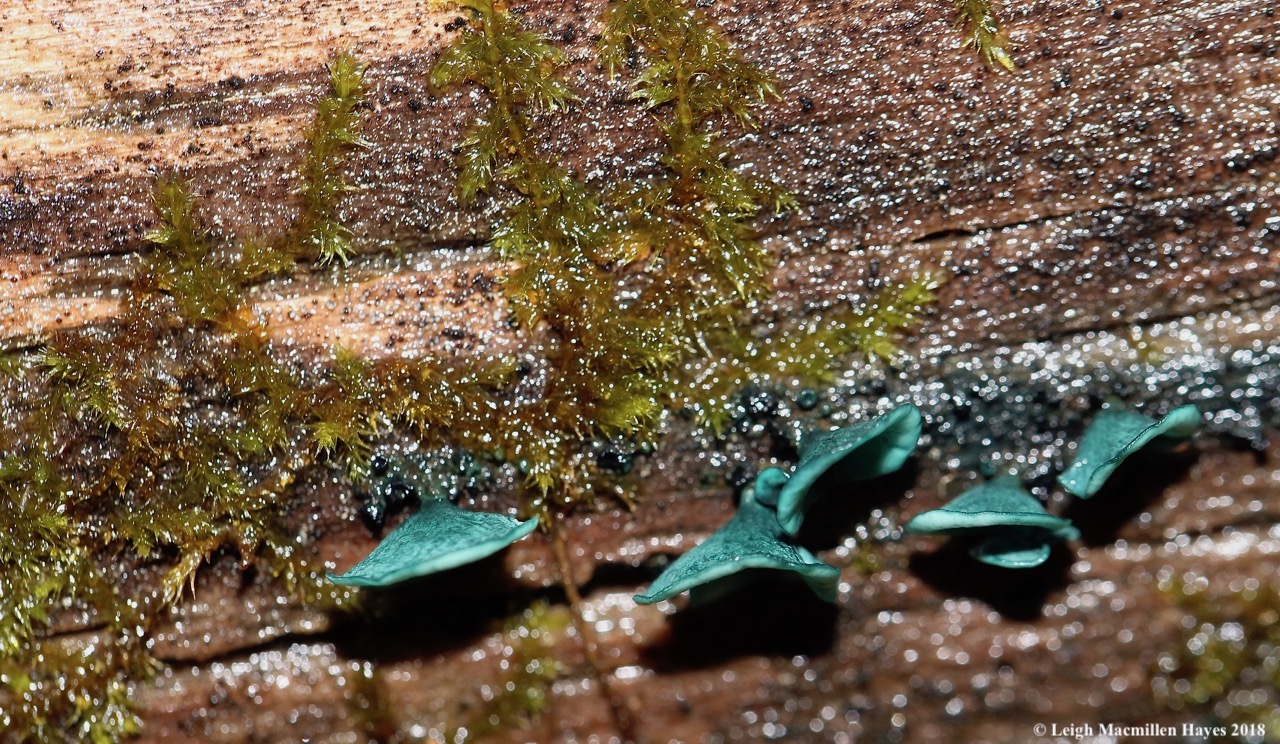
At one point, a tree arched over the trail and its purple crust fungi added a different color to the display. I think it was Phanerochaete crassa. 

My guy pointed out the hugging cousins–a white pine and hemlock and I was reminded of my finds on Black Friday. “I knew you’d like it,” he commented. He knows me well. 

Because we were in an evergreen forest, we noticed several examples of witches’ brooms. No, they were not the variety that one might have expected on Halloween night. Instead, dense masses of shoots rose from a single point on an otherwise normal branch and created a nest-like structure. Their cause: fungi, viruses, bacteria, mites or aphids. 
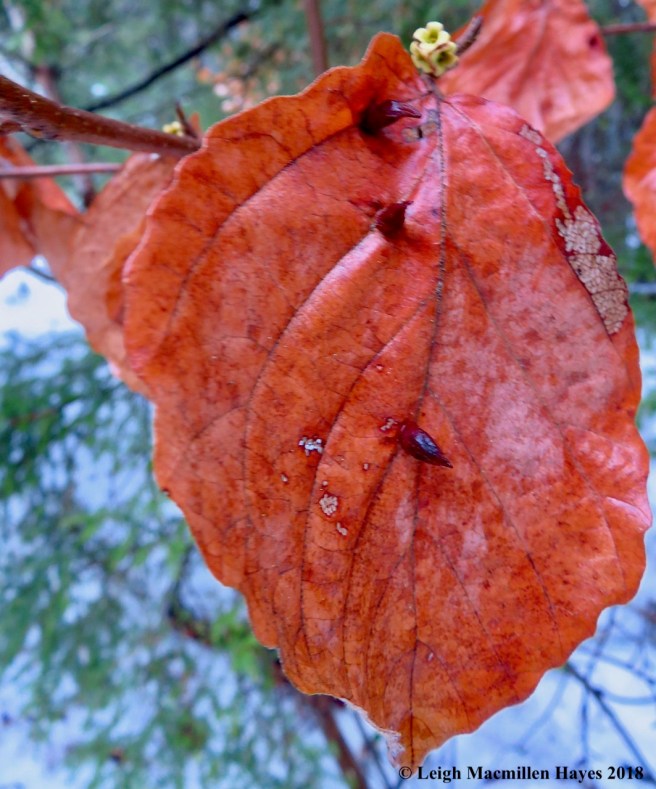
Speaking of the latter, aphids created the cone galls we knew as witch’s hats on witch hazels that grew near the river. The little structures provided both food and shelter for the critters that developed within. 
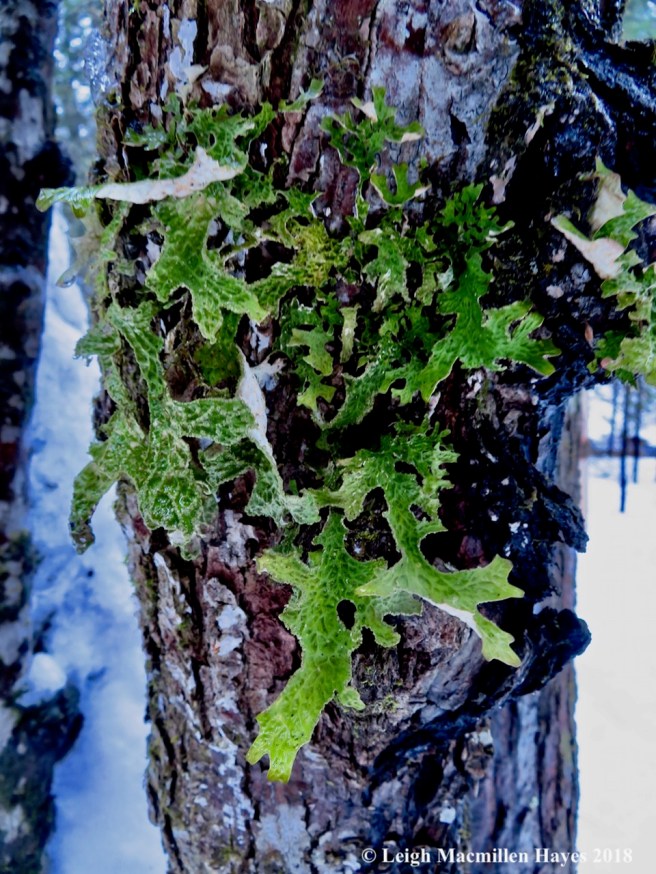
We also spied lungwort on a few hardwoods, its leafy structure springtime green as it photosynthesized in response to the flurries that floated earthward during the morning hours. 

And then the forest’s canvas began to draw our attention, from snowcapped artist conk (Ganoderma applanatum) fungi . . . 

to icy reflections, . . . 

man-made sculptures, . . .

and dazzling trail markers. We spied another made of pipe cleaners and a soggy feather and wondered.

We didn’t walk the entire trail system, but left knowing that we’d return for further explorations. 
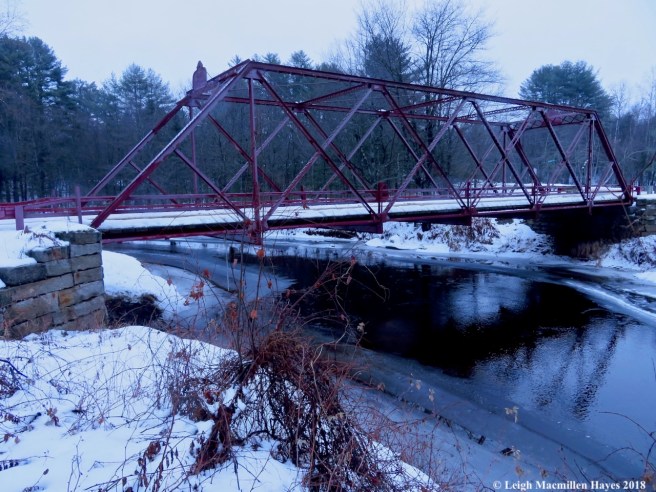
Because we were in the neighborhood and my guy had never seen it, I drove along Plains Road to the Ryefield Bridge. Listed on the National Register of Historical Places, the structure was built in 1912 as a double-intersection Warren truss bridge. 
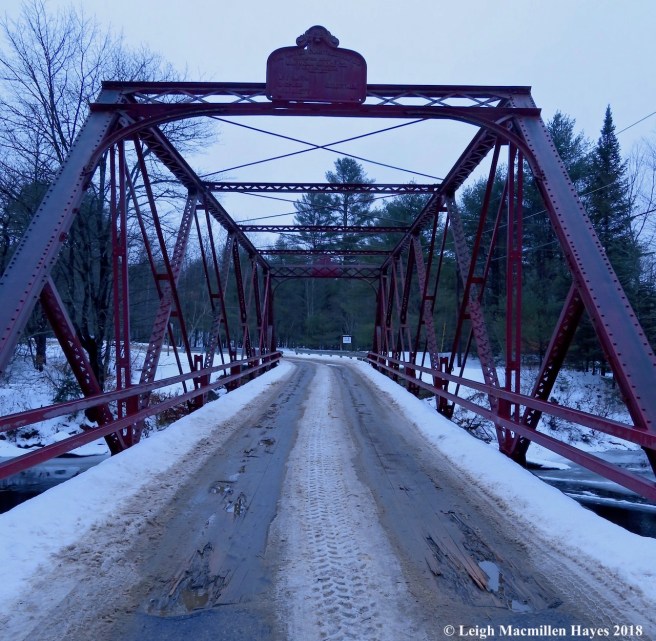
The bridge spans the Crooked River between Harrison and Otisfield and is still used today. In fact, we walked and drove across it. 

One of our favorite parts was the sign at the top, which not only stated the construction company, but also honored the selectmen of the day. 
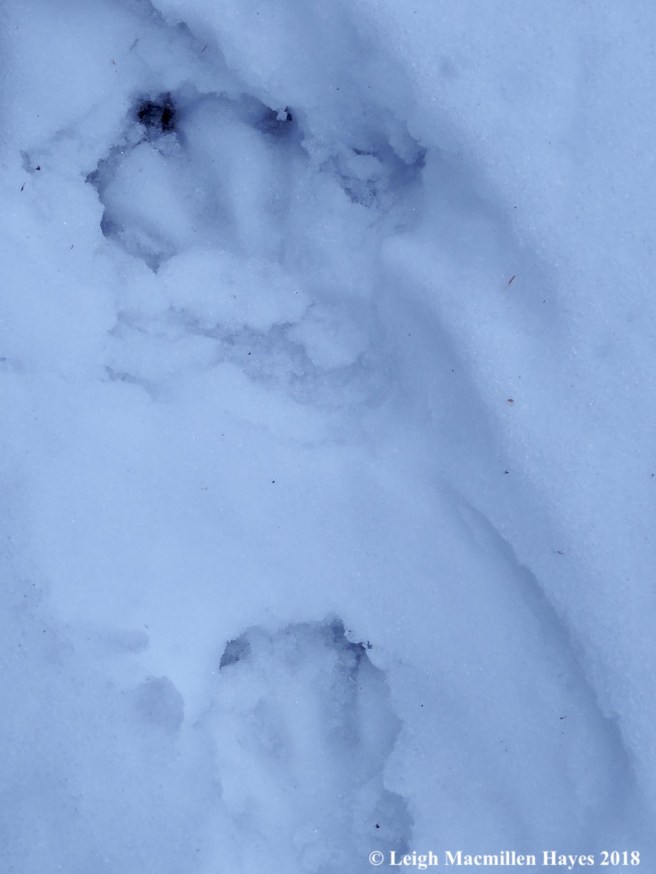
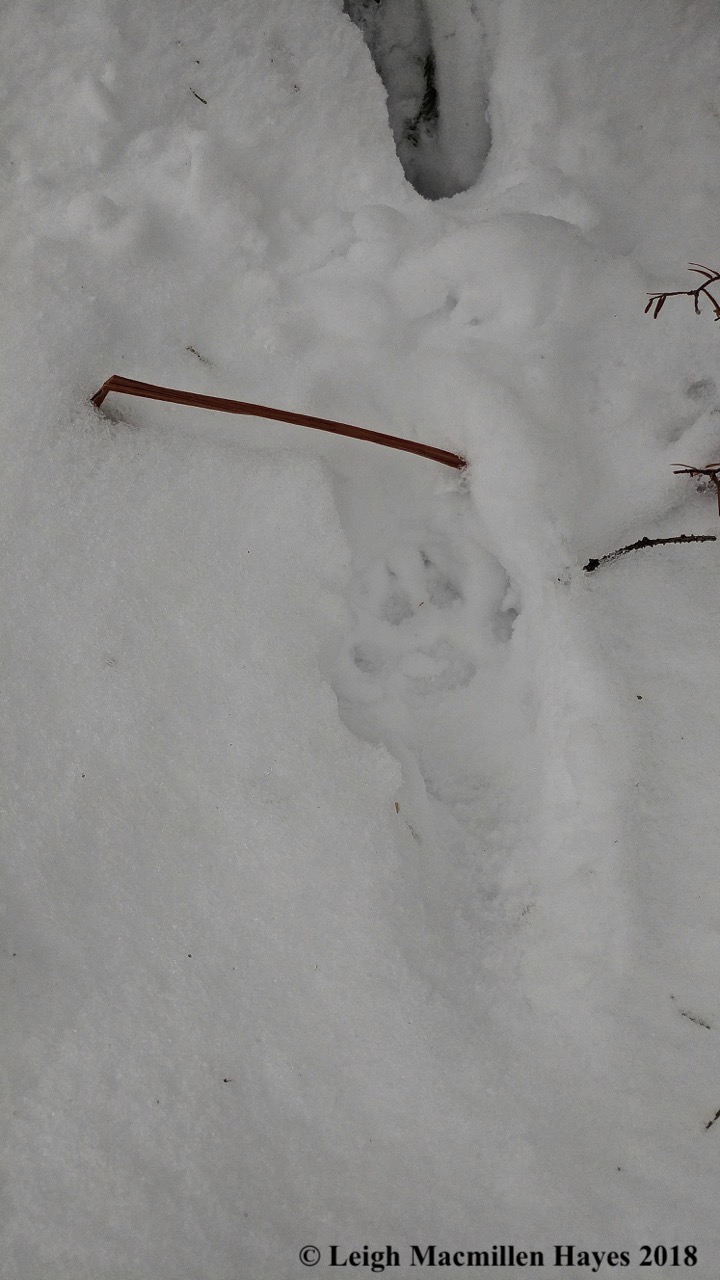
My excitement about the bridge was equally matched by some prints I spotted when I stepped into the snow to take a photo from the river bank. Beaver prints! Like the ice disc in the river, beaver prints have always been a rare find. Often, I can see their pathways, but not decipher their tracks for their tails swish out the features. 
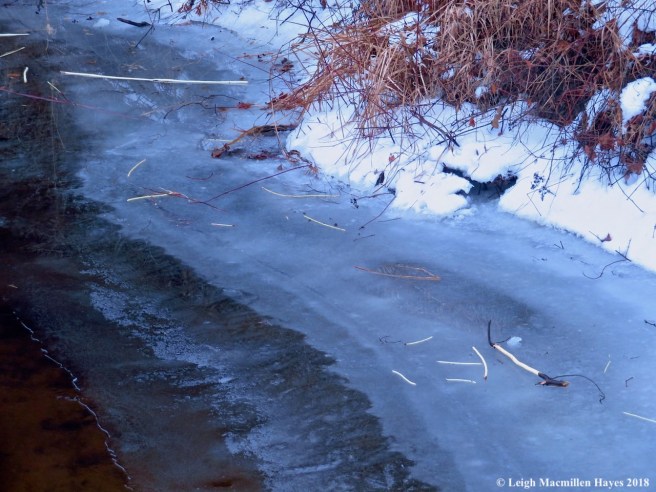
But today, not only the tracks and a trail down to the water, but beaver chews, their snack sticks, left behind on the ice. 
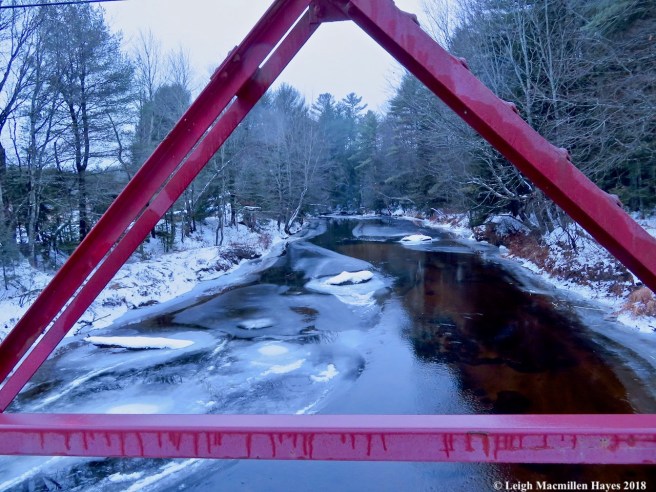
We took one final look before heading home–Crooked River framed by the bridge. And we both gave thanks on this Mondate for a land and a bridge preserved. 

Overset Point of View

Winter hiking is our favorite, but what to wear on our feet is always a question. Today, we chose our hiking boots over winter boots and micro-spikes rather than snowshoes. 

We trusted L.L. Bean would have approved, especially given that we would be hiking in his hometown of Greenwood, Maine. We were, after all, wearing hiking boots purchased in his flagship store and various other products featuring his name. Don’t tell him that while our snowshoes, which remained in the truck came from his place, we’d purchased our micro-spikes at EMS. 

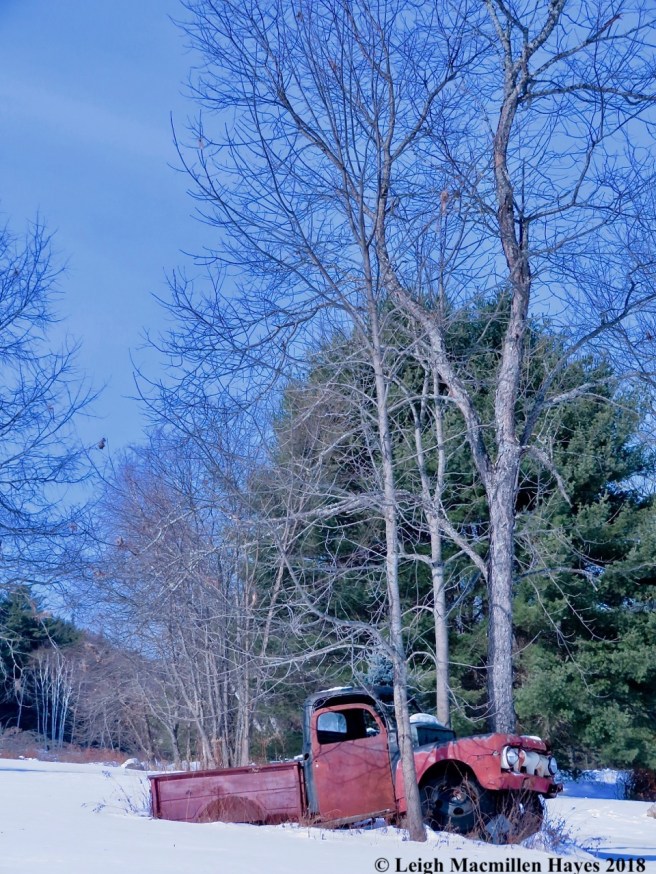
Before turning onto Willis Mills Road and heading toward the trailhead parking area, we first past by a cemetery of sorts, where old trucks and various truck-related equipment have gone to rest. 

And then, in a matter of minutes we were on the trail and our focus changed to all things natural, including weasel tracks. Notice the diagonal orientation in the pattern. 

It made perfect sense to see weasel prints because we were near the Sanborn River and though I didn’t take the time to measure them, but the size of the straddle I assumed mink. 

For over a mile we walked beside the river and loved the sights and sounds it offered, and especially the splash-created icicles. 

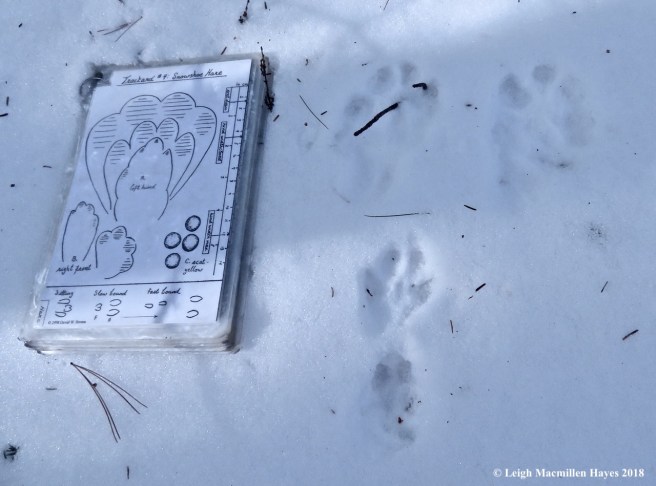
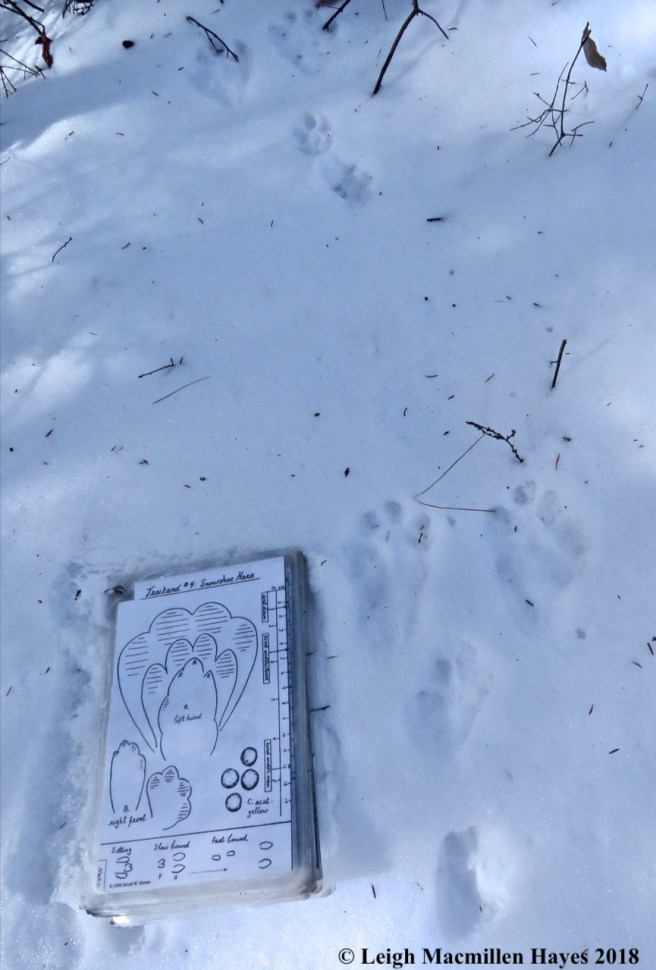
When we weren’t focused on the river, we noted its neighbors including snowshoe hare prints that were rather fresh. Some will remember that I refer to them as snow lobsters, for quite often the impression of the four feet (front two being their hind feet which swung around and landed parallel; back two on an angle being the front feet) looks rather like the large marine crustaceans visitors often equate with Maine. 

With David Brown’s Trackards as a reference, it was easy to imagine the hare’s motion. (Note: visit my book review linked to Trackards in the sentence above and you can locate David’s website. His books and ID cards are available for sale and he mentions that you can get a good deal just in time for Christmas.)

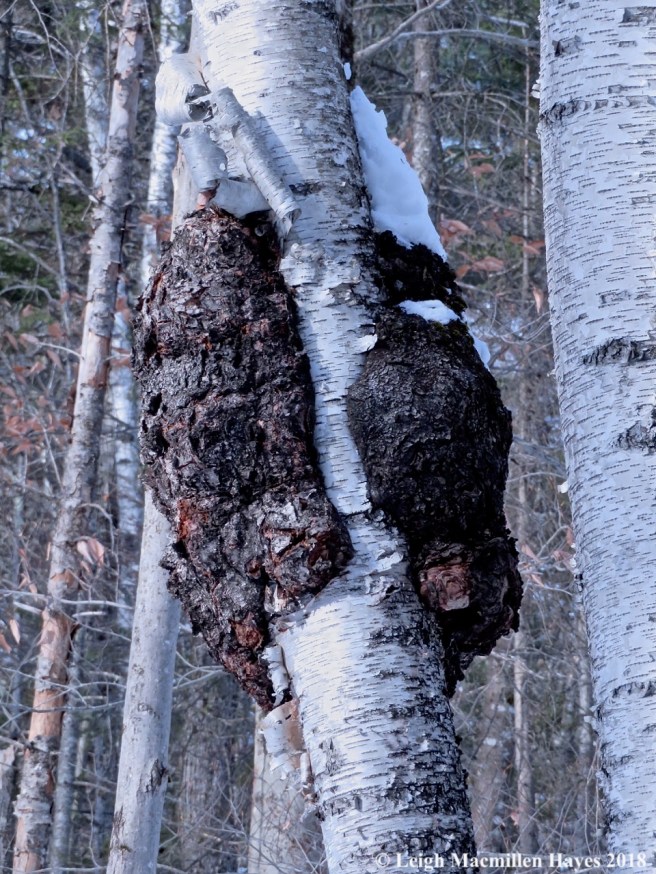
It wasn’t only tracks and ice that drew our attention. As we crossed from the river to the pond via a connector trail, we noted a huge burl that looked like two bear cubs holding fast to a paper birch.

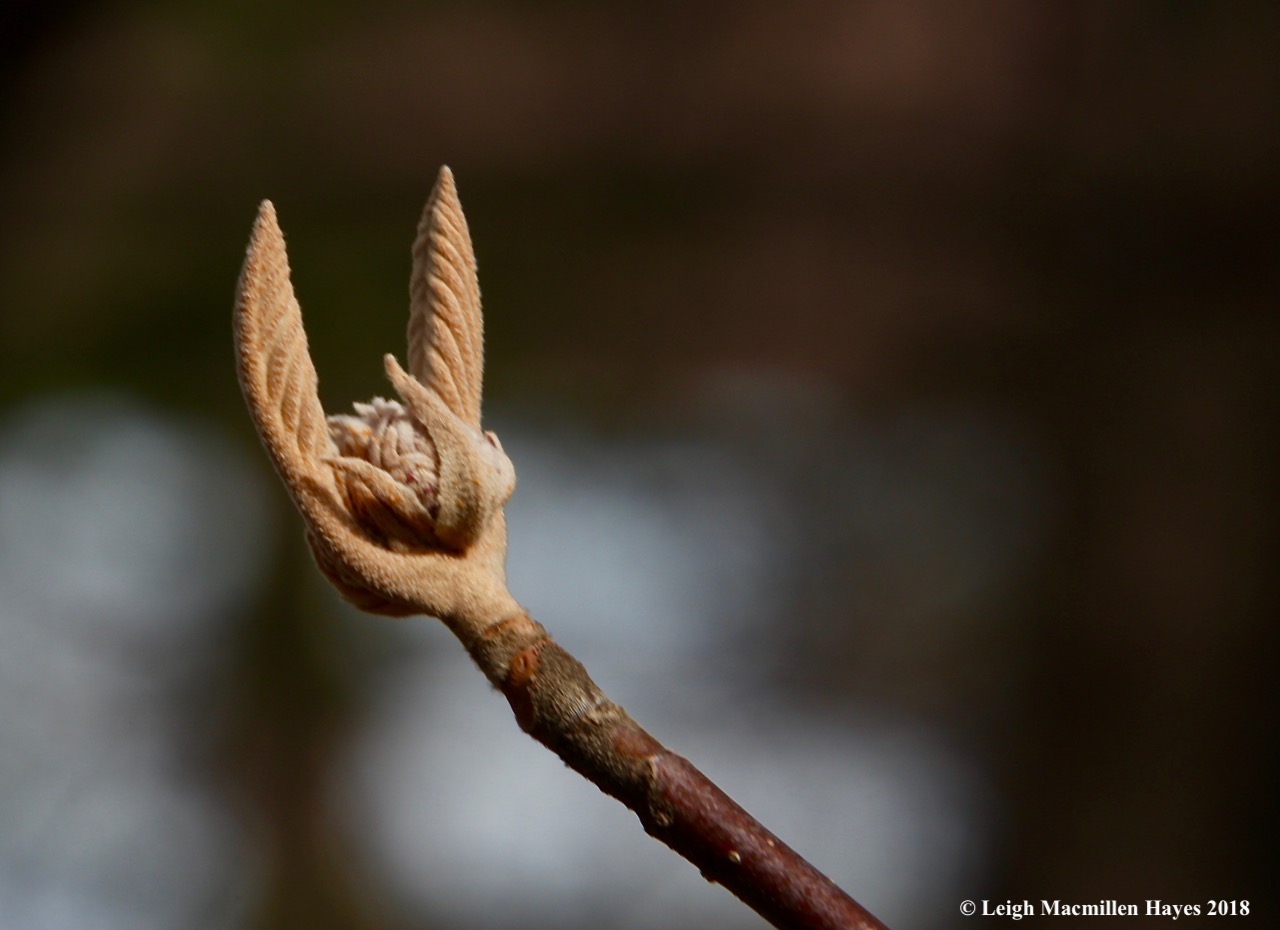
Along the way there were also some examples of my favorite shrub, hobblebush. We always refer to their buds as being naked for they aren’t covered in waxy scales like most. And look at those leaf and bundle scars. Following them down the twig, its fun to note the changes in age from the fresh tan scars to the two below getting grayer and more wrinkled in age–much the way we do. 

As we continued on, the snow depth increased, but fortunately a family of four had passed through before us and created a trench. 

We knew we were close to the pond when we began to see canoes tucked among the trees and snowed in for the season. I’d say “for the winter,” but winter is still a month away. 

At last, Overset Pond stretched out before us. 

And Overset Mountain in the background became our next destination. 

But first, we had to walk the length of the pond as it narrowed, and then cross over a series of bog bridges below an old beaver dam. 

As I waited for my guy to get to the other side before I ventured forth, I noticed something on the dam that brought yet another smile to my face. 

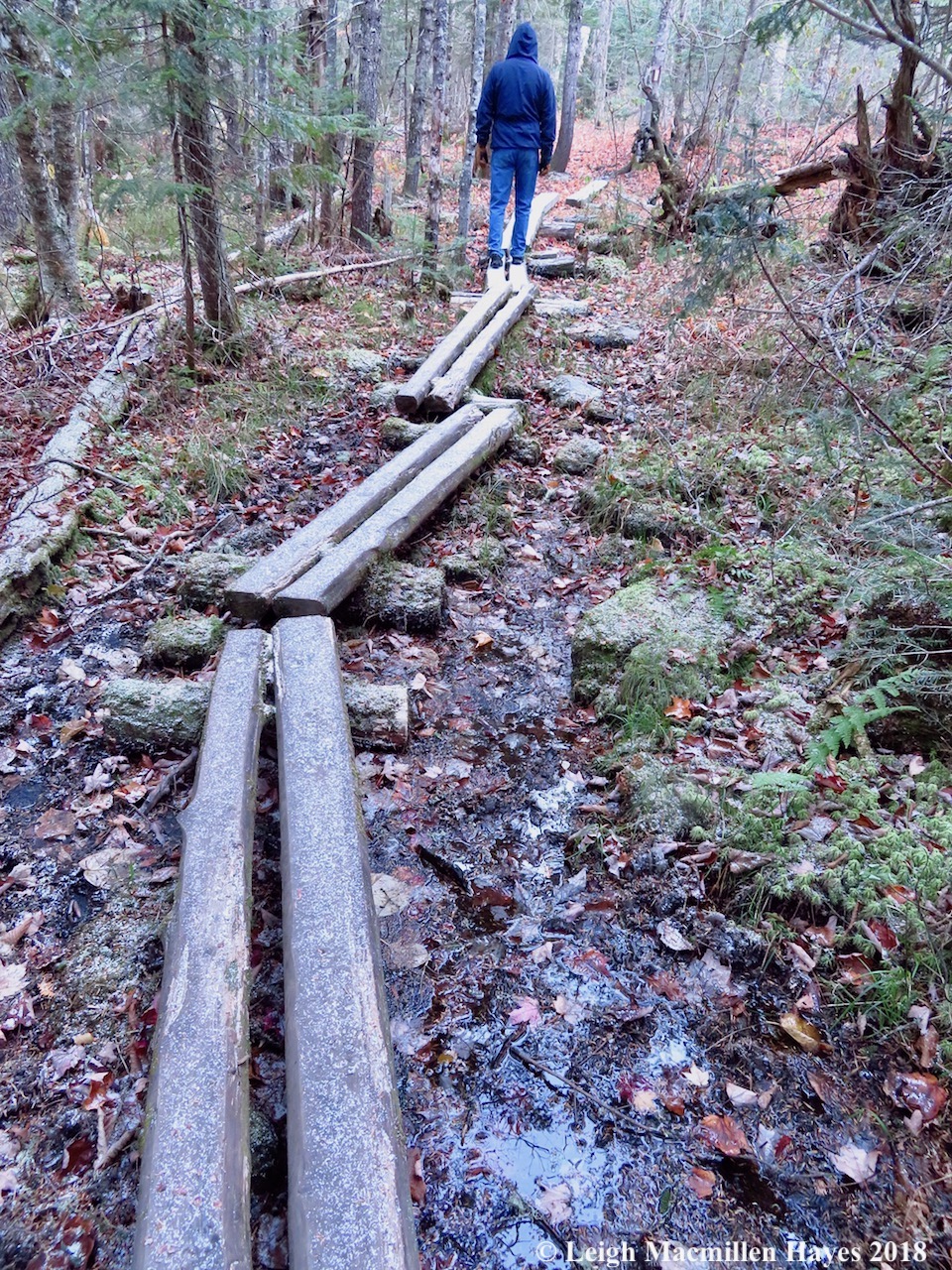
But first, I had to get to the other side–which I surprised myself and did without hesitation. Prior to this crossing, we’d walked on at least ten other bog bridges, some easier to conquer than others. This was the longest and featured several different levels, but we were both successful in our attempts. 

And so I rewarded myself with another look at the dam–and the otter slide that crossed up to the pond. Do you see the otter’s prints? 

Feeling great about the crossing (because I’d been dreading it), we began the upward climb. Our spikes were a good choice because they gave us some traction on slippery leaves and rocks, but they did gather occasional clumps of snow. We got into the habit of banging them against any available rock to declump the frozen snow. As we moved upward, the snow depth deepened to about a foot. 

The family we’d passed on their way out had told us the mountain had been challenging, but they had neither snowshoes or micro-spikes and we could see where they’d slid frequently on rocks hiding below the snow. We moved with relative ease even as our heart rates increased and at last my guy looked down over his kingdom. Actually, it’s the kingdom of Mary McFadden and Larry Stifler. Through their generosity, many trails in the area are open to the public. And through the work of their employee, Bruce Barrett, those trails are well maintained.

Below . . . Overset Pond in the shape of a heart. What’s not to love. 

After a brief apple and water break, we began our descent on the loop trail. The trees growing beside and on the boulders reminded me of the truck graveyard . . . naturally. 

Our overall descent passed quickly. In no time at all, we came upon more canoes swamped with snow. 

At last the trail came to an end and we followed a snowmobile trail for at least a mile back to the truck–our six mile journey completed. 

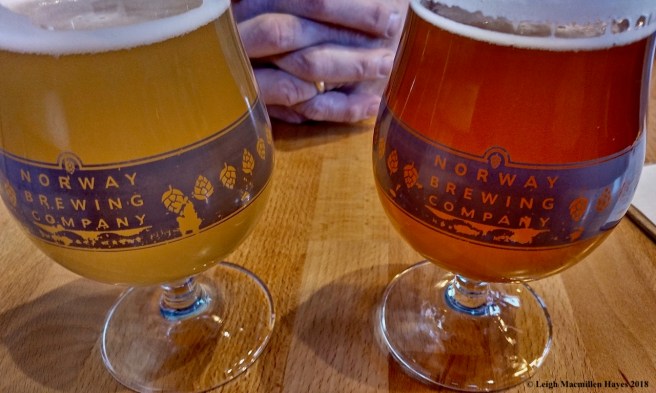
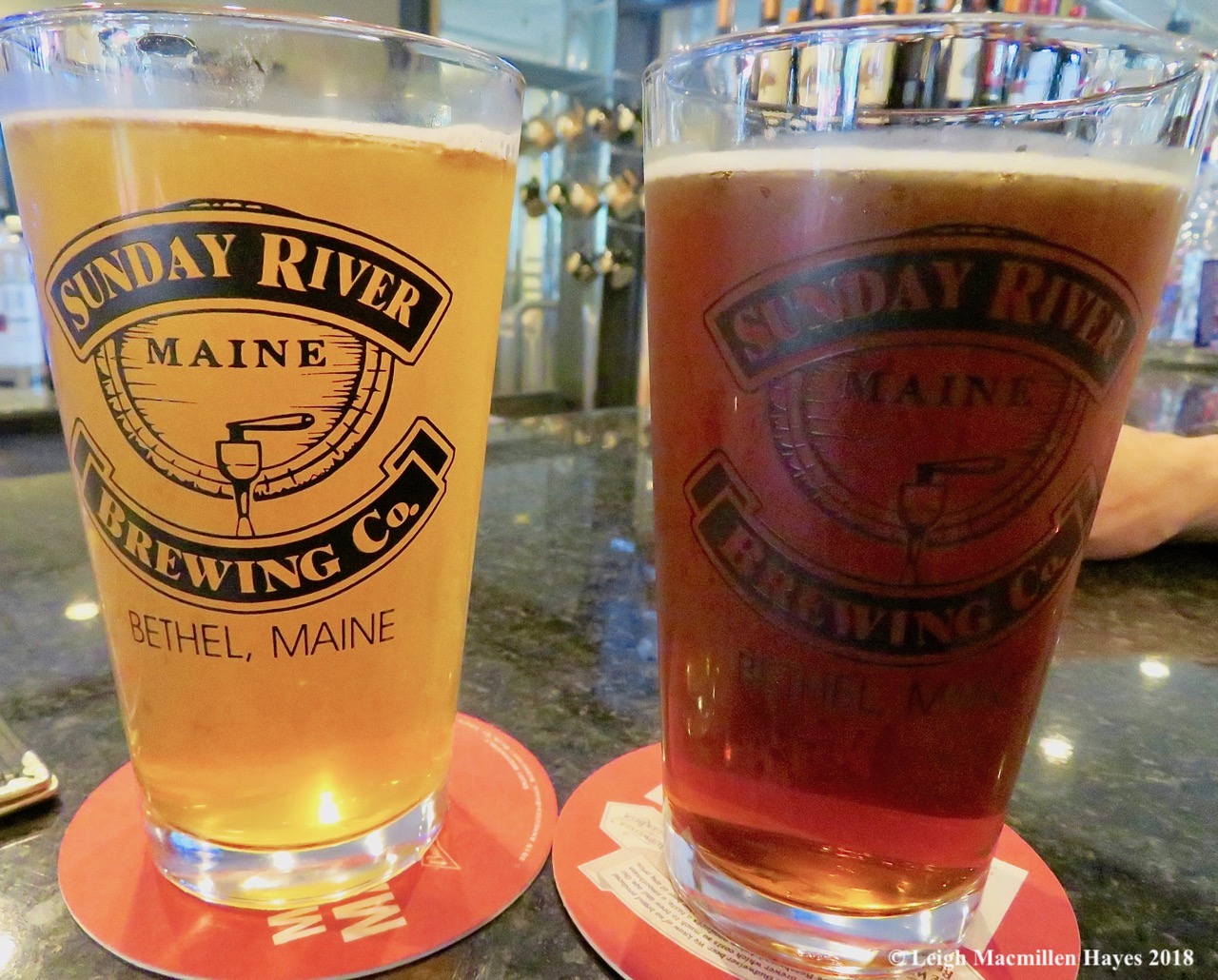
We’d planned to enjoy a brew and burger at Norway Brewing Company after the hike and were thrilled with our choice. He sipped Life’s a Peach on the left–a new brew just released today and made with Maine peaches. My choice on the right–Left Turn. 

We played Rummy while we waited and then ate our burgers with gusto. We knew they’d serve as lunch and supper, a meal we’ve named lupper in the past. 

At the end of the day, we were beat (still are) but happy. Thought I’d hoped to see some wildlife other than the occasional squirrel, that wasn’t to be. But we saw plenty of tracks and I was especially pleased with those of the weasel, hare and otter. 

And, of course, the tree trucks!

The Overset Point of View–worth a wander. 

Black Friday Lit Up, Naturally

With a mantra of “Shop Locally,” I did just that on this Black Friday 2018. Thankfully the time to take advantage of the doorbuster sales wasn’t limited and so it was okay that I didn’t pull into the Flat Hill parking lot until 1pm. 

Turns out, as in any shop today, the aisles were a bit crowded with customers searching for items on clearance and other great deals. 

I paused for a bit in aisle one, where I contemplated the Made-in-Maine artwork and thought about those on my Christmas list. Perhaps a water scene for Marita  because she likes the gurgling sound of a brook. 

For Pam K., I decided on an ice sculpture to add to her winter home. 

And for Pam M., I was sure that an abstract piece would be just right–especially as it echoed the mountain range and transformed into a bird, only sorta/kinda M.C. Escher in style. 

There were others on the list to consider and the decisions became more difficult as the selection increased in aisle two. Mouse, vole, squirrel both red and gray, deer and coyote tracks all were on display and the sign indicated I could buy one and get one free. But which one to buy? And for whom? 

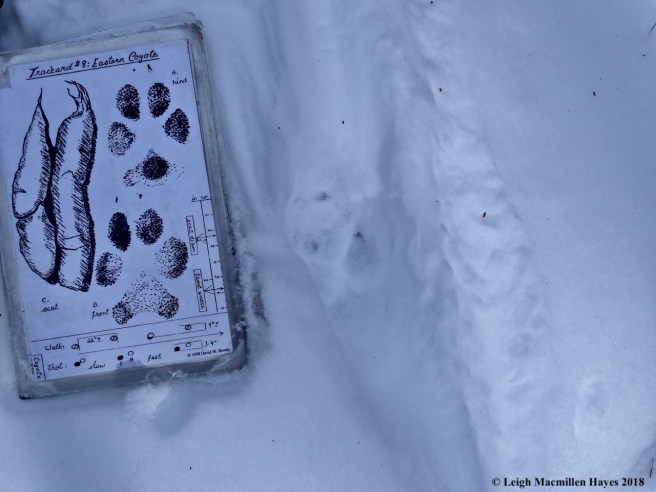
And then just like that, it became clear–the coyote track for Simon because he’d caught on quickly to the squirrel patterns and appreciated that the predator was hungry. 

For every one set of tracks, there were fifty others, especially those of the mice and squirrels. But I chose the porcupine trough as my “get one free” when I saw it on the climb up the hill. 

The trough with its pigeon-toed prints and sashaying tail would be perfect for Bob.

Of course, I could have mixed and matched the prints, but thought it best to keep them separate. 

Continuing the dash for more must-have gifts, I spied a mossy maple polypore on a lower shelf and thought immediately of my guy. He doesn’t like to consume mushrooms, but there’s something about the mossy maple that draws his attention. 

And then on an end cap I saw the kissing beech/maple out of the corner of my eye and turned to read the sign: Limited in Quantity. On impulse I purchased it. Maybe I’ll stick it on my guy’s bureau and he can wrap it up for me. I’ve done that before ;-)

There were a few free surprises. Not all freebies are created equal, but I really liked the bronze ornament that would be a nice addition on our Christmas tree. 

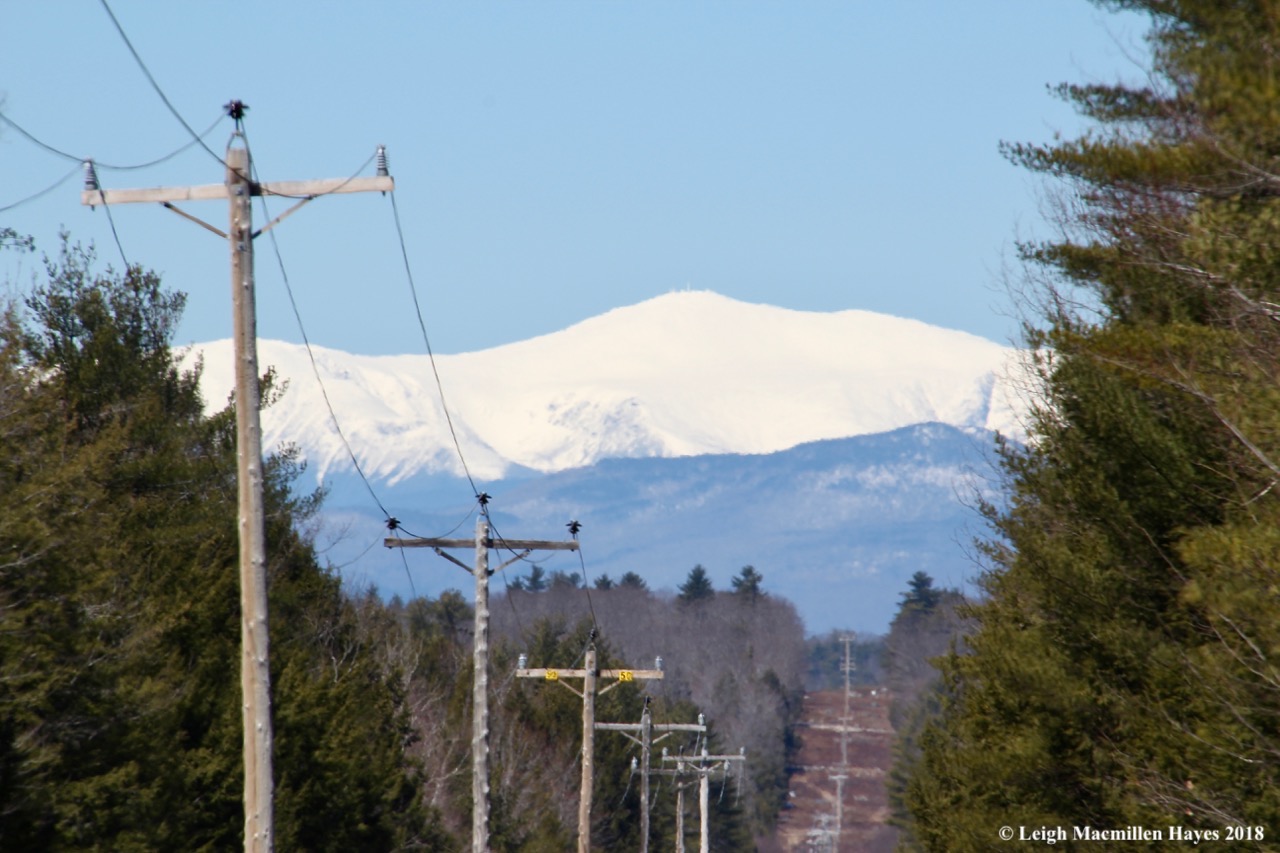
At last it was time for a little break at the Flat Hill Cafe. Today, the view offered more bang for my buck as Mount Washington glistened white behind the other mountains. 

Also enjoying the view and the oxymoron of the name Flat Hill were fellow shoppers Bob, Pam K., Marita, Simon and Pam M. I made sure they didn’t see what was in my pack and visa versa. I do so hope they are as excited as I am about the gifts I purchased for them.

When the cafe got crowded, we decided to walk back down the main aisle together toward the check out. And then a few of us remembered we had coupons for the seasonal section. But . . . alas, we were too late. It was the only part of the store that was closed because everything had sold out. The stepping stones were  covered with water and ice to keep us from venturing any farther. We turned around, only a bit disappointed that our shopping adventure was about to come to an end, but understood that being a three-season section we had taken our chances by arriving so late in the day. 

No matter. The view from Perky’s Path thrilled us. All afternoon, we enjoyed the lighting, and especially the sun as it lowered–making this Black Friday light up, naturally. 

I highly encourage you to visit; the doors are open all hours and it’s a great place to shop in style. 

Today’s Black Friday Lit Up, Naturally experience was brought to you by the Greater Lovell Land Trust’s Flat Hill, Heald Pond Road, Lovell. 

Amazing Race–Our Style: episode ten

I can’t believe we are still in the race, but we are. And so last night the clue arrived as mysteriously as ever and a wee bit vague: Drive west and then south, following Routes 16, 125, and 111. Find your way to Stonehenge.

While we were certain that Route 111 in New Hampshire was not going to put us on a flight to England’s Stonehenge, we decided to follow the directions and see where we ended up.

We did note that Team Speedy was ahead of us as we drove south on Route 16, but in Ossipee they turned right onto Route 25. Oops, wrong number, but we weren’t going to tell them that.

Two and a half hours later and BINGO! We’d found our destination.

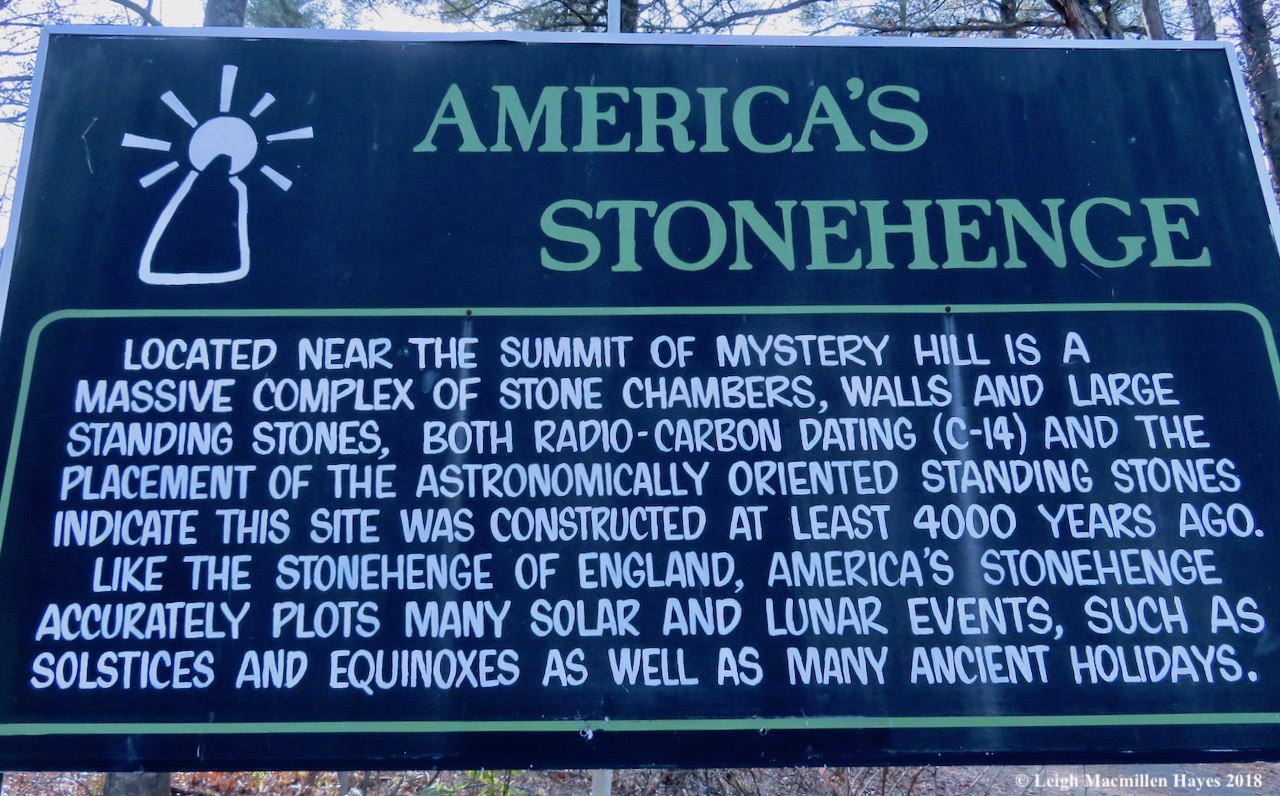
0-America's Stonehenge sign

America’s Stonehenge in Salem, New Hampshire. Who knew? I’d lived in New Hampshire for ten years prior to moving to Maine in 1986 and never heard of this place. But . . . apparently the time had come.

We entered and watched a brief introductory film. First named “Mystery Hill Caves,” the name was changed to America’s Stonehenge in 1982 because researchers believed that better reflected their understanding of the site.

Was it built by a Native American culture or a migrant European population? Who knows? But what we did learn is that carbon dating has helped age some of its features at over 4,000 years old, making it possibly the oldest man-made construction of  chambers, walls and ceremonial meeting places in the United States.

The site has been under continuous research and there are a variety of theories about its origin. Our main challenge was to observe and learn.

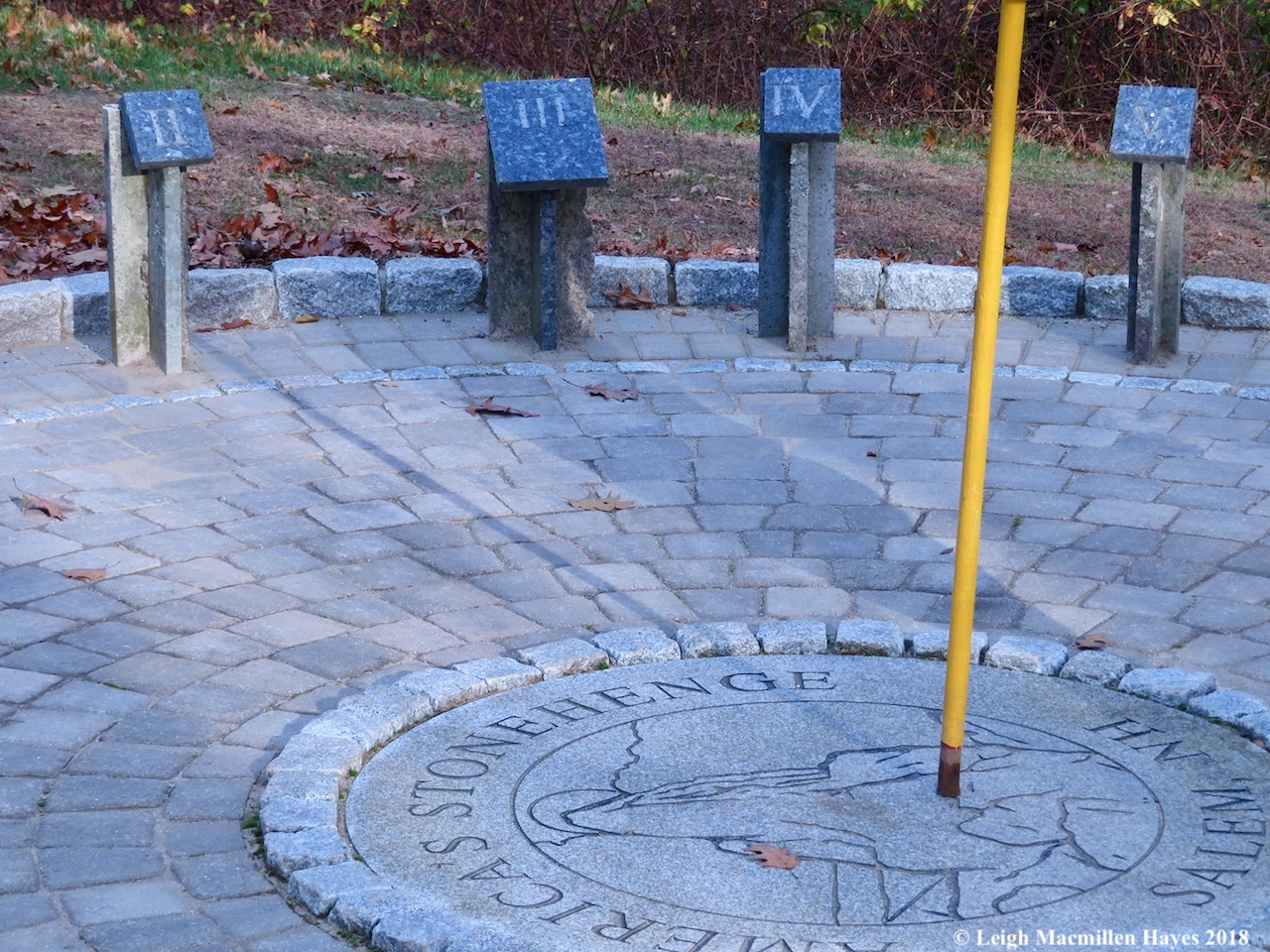
1-Sundial

But first, one of us had to determine the time of day. My guy rose to the occasion and placed the pole in the center of the sundial.

2-Sundial 2

“2:11 pm,” he said. Pretty darn close for it was actually 2:09, but we were told to proceed.

3-Wigwam

The first part of the journey included a Three Sisters Garden of corn, pole beans, and pumpkins. There’s a replica of a dugout canoe and a wigwam for such were found on the property, plus some pottery and other artifacts.

4-Well of crystals, Pattee Area

And then we worked our way up the hill and into the maze of chambers. Some referenced astrological events; others were the works of Jonathan Pattee who built a wooden structure upon some of the chambers, but it burned in 1855 and his son later sold off some of the artifacts; and William B. Goodwin, the first researcher to own the property.

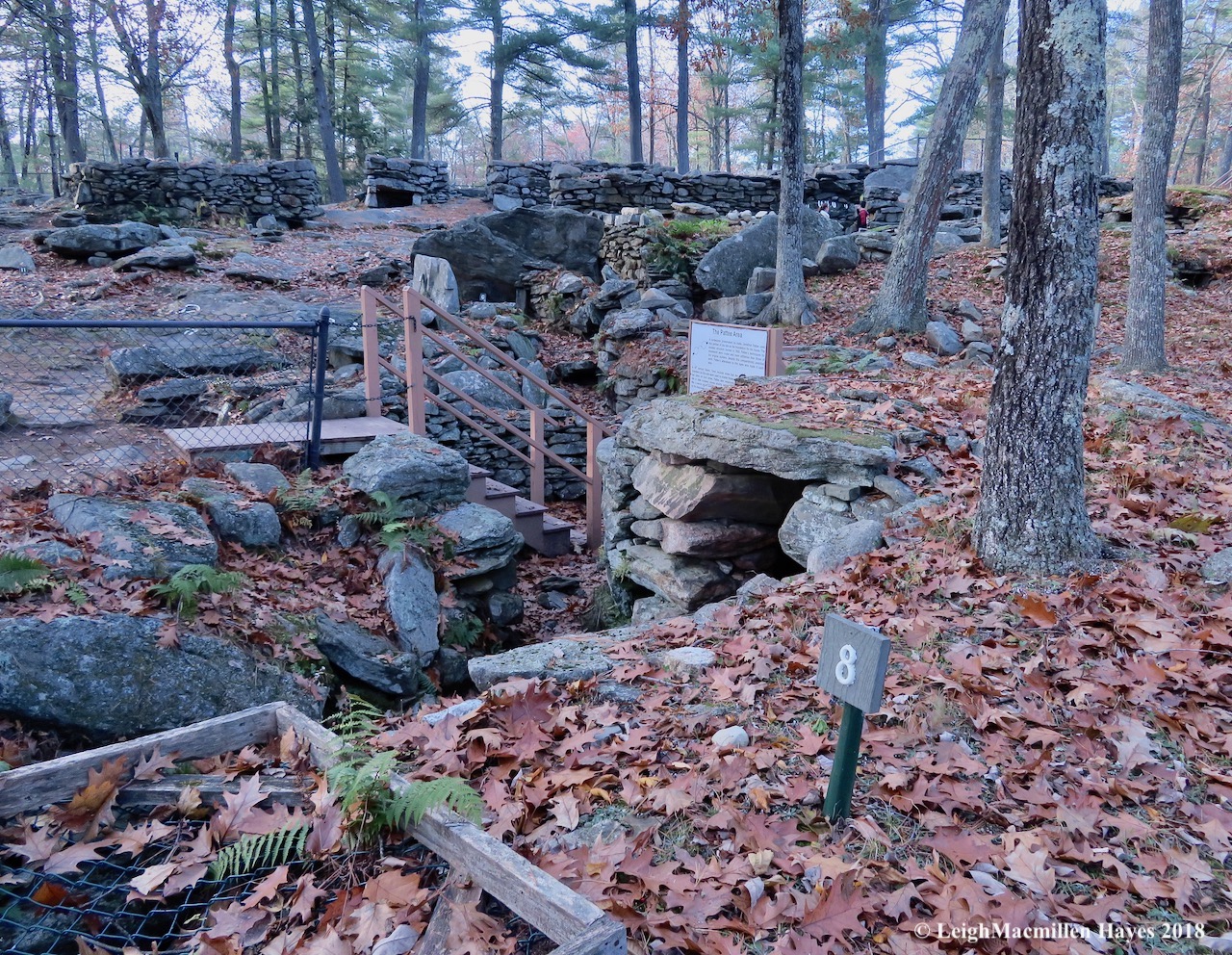
Fortunately for us, many items worth noting were labeled. Number 8 was an Upper Well, also known as the Well of Crystals because excavations in 1963 proved that quartz crystals were found in a vertical fault twenty-two feet below. Such crystals may have been worshipped or used for tools by ancient cultures.

5-Pattee Chamber, root cellar

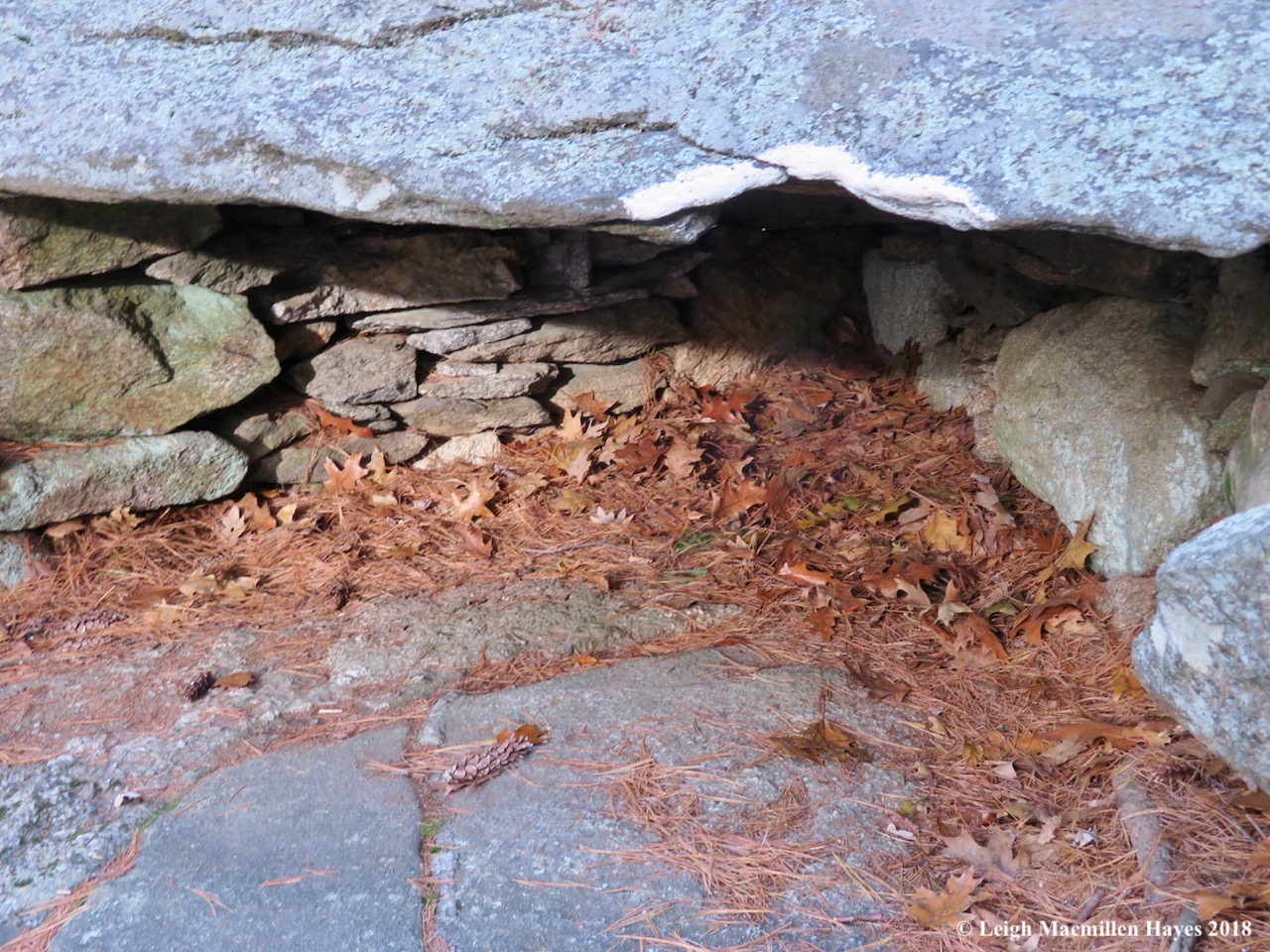
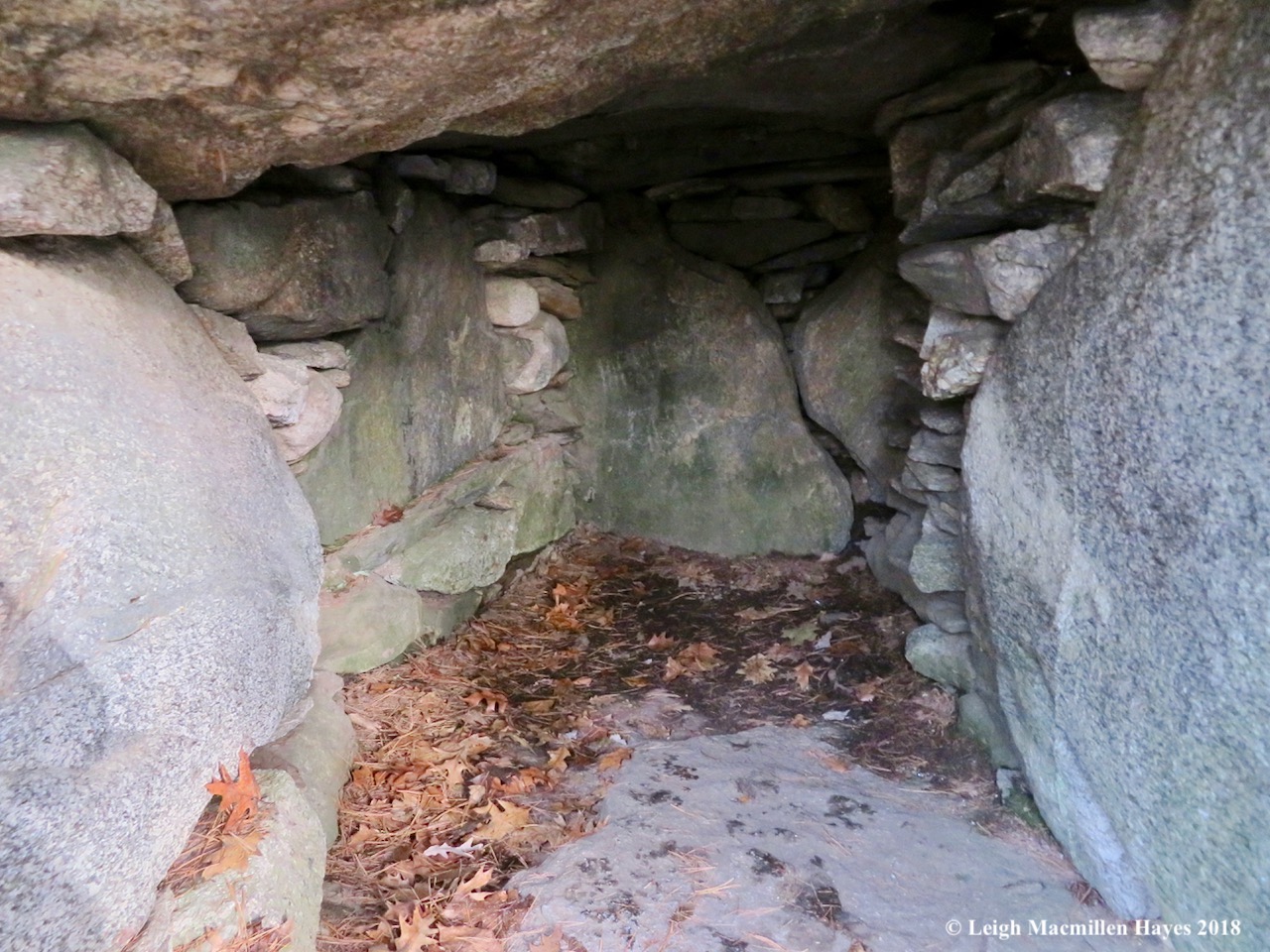
By the well was the Pattee area, and so I ventured down and stood before a chamber that may have served as either his family’s root cellar or at least storage space.

6-Chamber in Ruins

Nearby was a collapsed chamber. The roof slab that now stands upright is estimated to weigh 6.5 tons. And here’s the cool stuff–tree roots near the back wall of the chamber were carbon dated to the late 1690s, indicating the walls were built prior to Mr. Pattee’s residency. Further research indicated the following: “In 1969, charcoal that had sifted into the walls was found below these roots at two to four inches above bedrock and dated to 1400 BC. In 1971, a third and even older date of 2000 BC was obtained.” There’s more, but that’s enough to be mind boggling. BC?

7-True south pointing wall

The astrological importance of the site was noted throughout and we found the True South Pointing Wall.

8-south facing chamber

Directly opposite of it was the entrance to a south facing chamber. For me, the curious thing about this chamber was that it was damaged in a 1982 earthquake–and I quickly recalled that quake as I remembered feeling its tremors.

9-The Pulpit

Then there was The Pulpit. It’s believed that quarrymen used this spot as a staging area to load stones onto wagons in the 1800s, thus giving the property another chunk of historical value. It’s also thought that Mr. Goodwin had the upper part of the structure reconstructed by his crew for he believed that the site was built by Irish Culdee Monks.

I have to say that my guy and I weren’t beyond that interpretation for some of the chambers reminded us of Newgrange, a Neolithic passage tomb alleged to be older than Stonehenge and the Great Pyramids. Constructed during the Stone Age, about 5,200 years ago, Newgrange is a large circular mound in Ireland that covers 300 feet in diameter and stands 36 feet high. A stone passageway leads to three small chambers. Some describe it as an ancient temple, a place of astrological, spiritual and ceremonial importance. Hmmm . . .

10-The V Hut

Another interesting chamber from our point of view was the V Hut, so named for its shape. This one reminded us of the Mystery Structure in Lovell, Maine, for part of it forms a similar sort of V shape.

11-East-West Chamber

Throughout the journey, our focus was brought back to orientation of chamber openings. So the curious thing about this particular one and the one opposite of it–they had an east-west orientation. All other openings faced south.

12-Wqll restoration

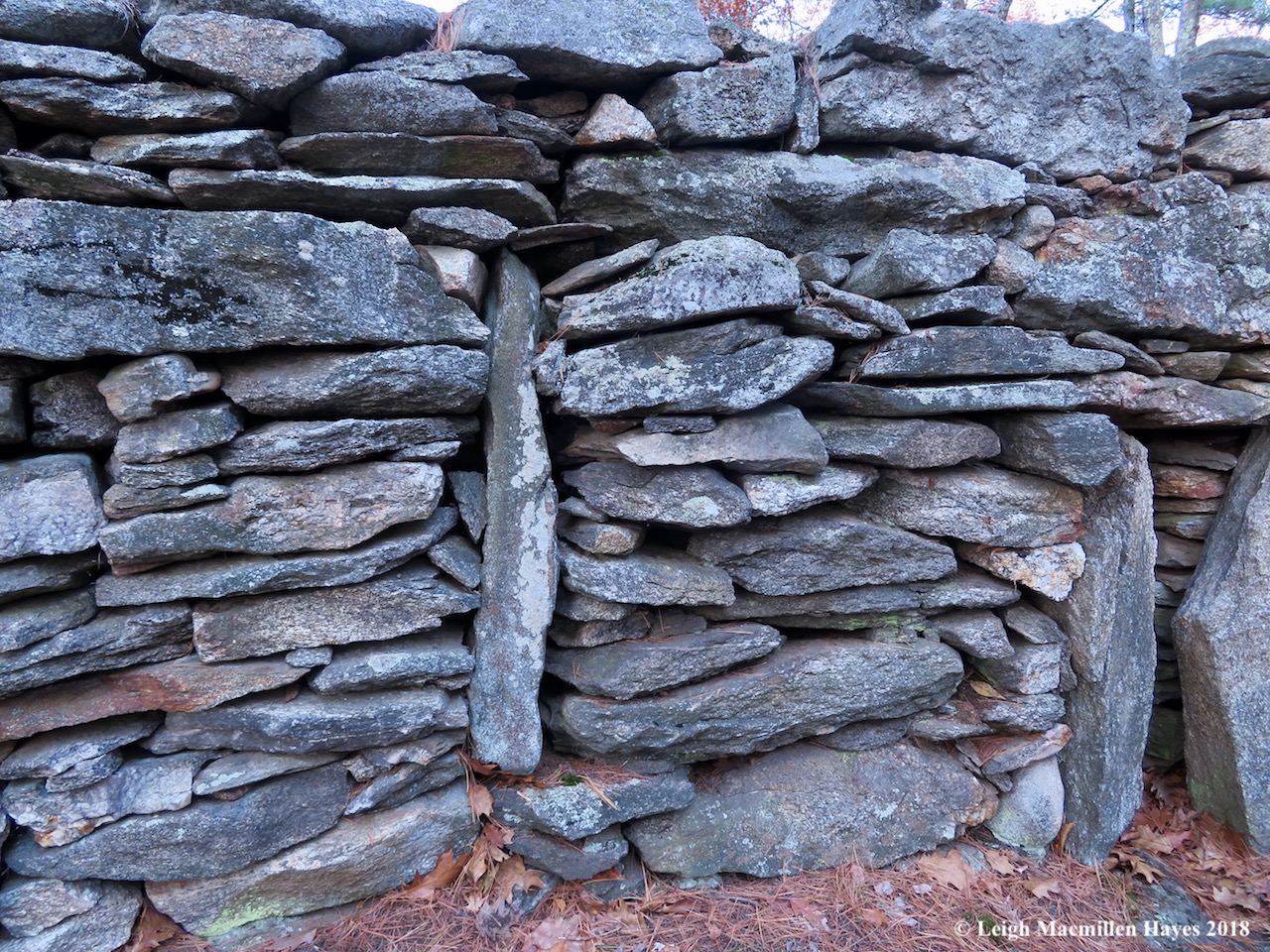
The outer wall of the East-West Chamber offered a different look than any we’d previously seen. Using photographs from the Goodwin era, the outer walls were restored in the late 1970s.

14-Wall and pathway to Oracle Chamber

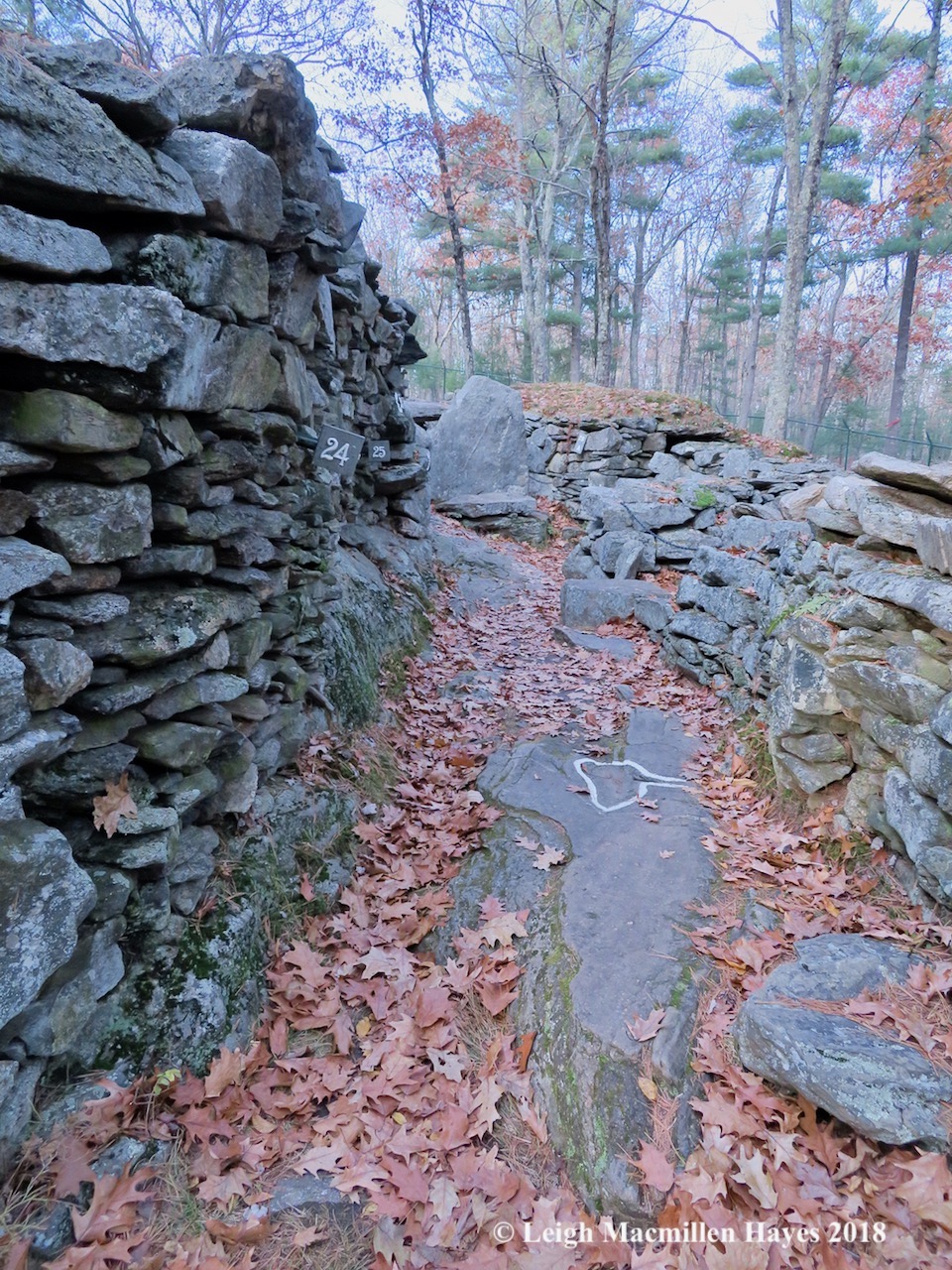
They led to a wonder-filled pathway. Do note the white paint–that was used throughout to feature key points. Though I thought it ghastly, it did serve its purpose and the drawing you see on the bedrock was part of a very important drainage system. Curiously, the area was well drained, but when we later walked surrounding trails we had to work around water obstacles–why can’t we figure out today how to make the water move in an effective fashion?

15-Drill marks and wedge marks

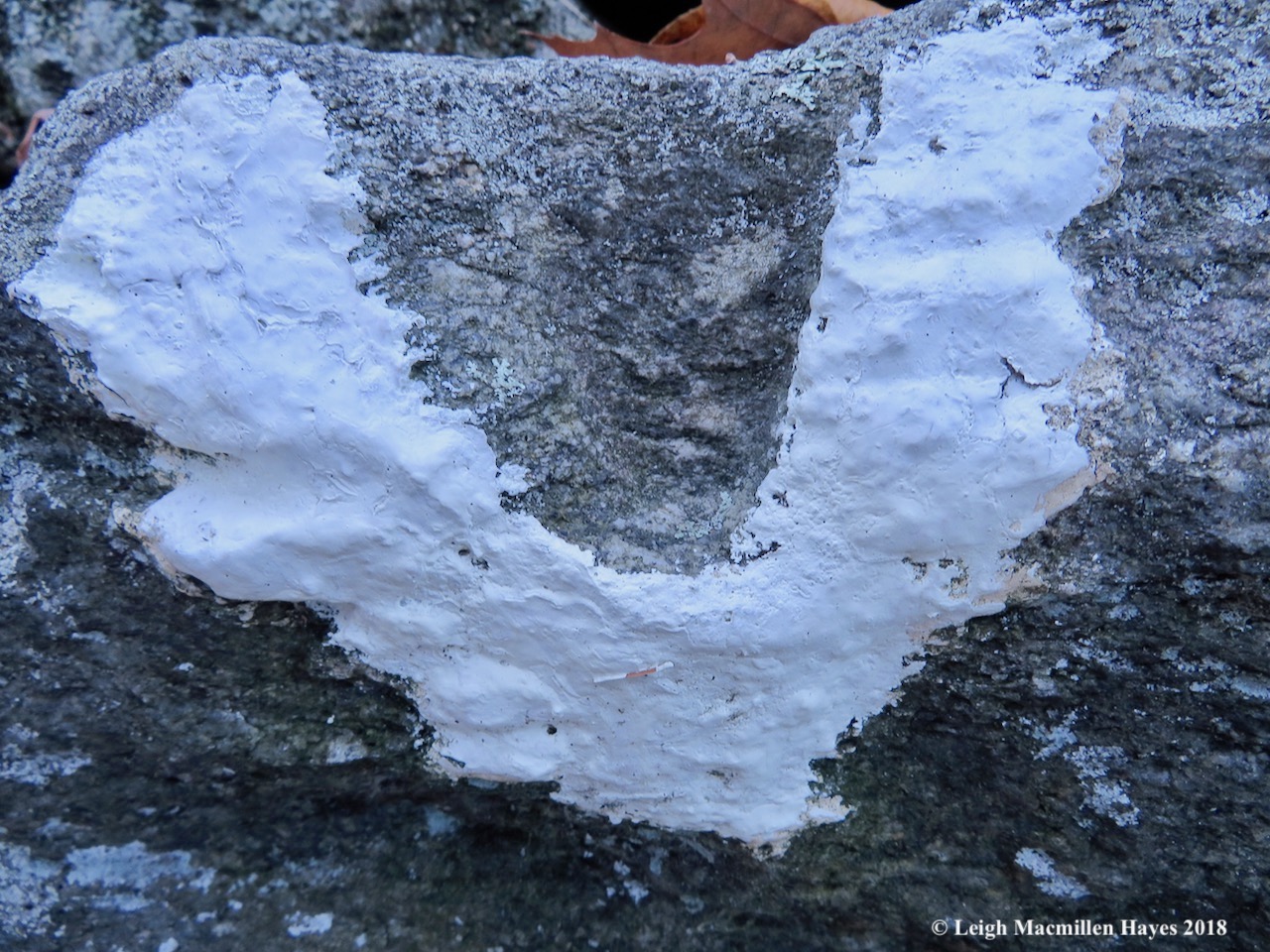
The pathway we were traveling led to the Oracle Chamber. And then there was more white paint. But, take notice. The U-shape above was painted around drill marks probably made by those 1800s quarrymen as they broke off slabs.

But it’s the Vs that were of even more interest.

16-Wedge mark

The V wedges were similar to those found at ancient sites in Europe we were told. Before the invention of the steel drill in the early 1800s, stone masons apparently made these V wedges.

17-Sundeck with orbs

Now all oracles need a sundeck and lo and behold, such existed. As we admired it, a few orbs did the same and we had to wonder about the ghosts living among the rocks. They certainly had stories to tell.

18-Oracle Chamber

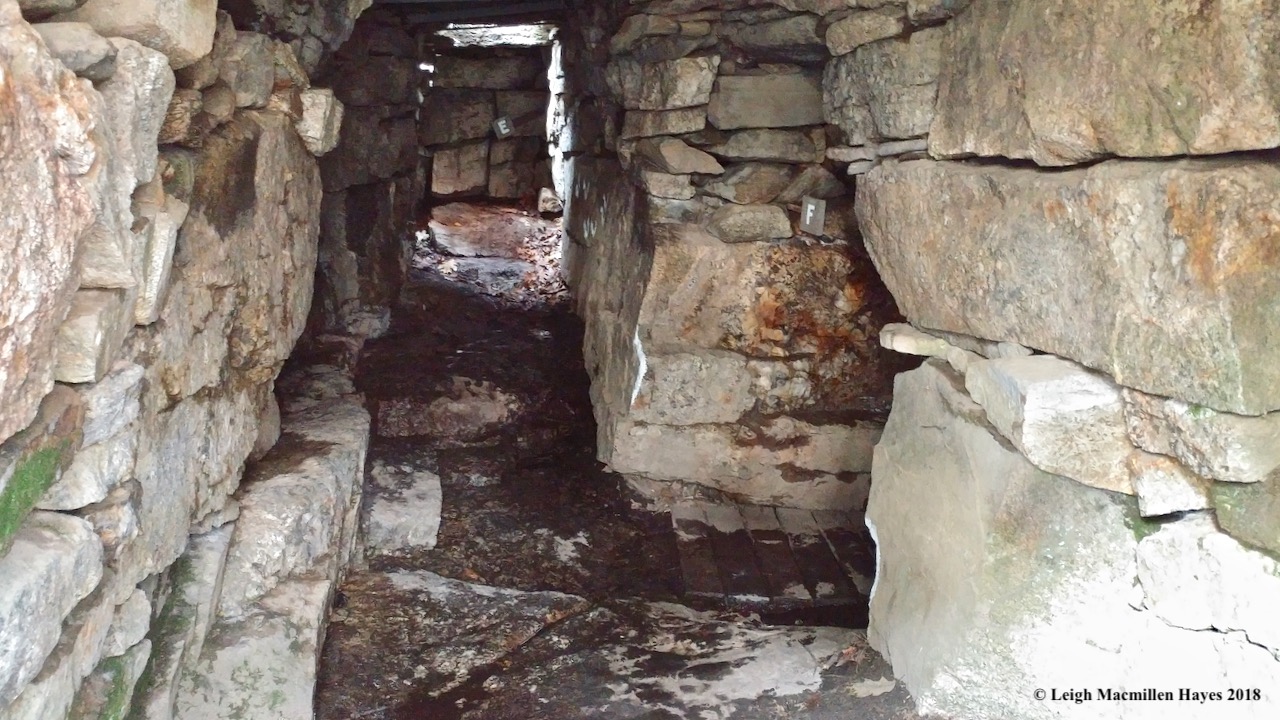
The Oracle Chamber was known to be the most important area with a variety of features including an upper drain, secret bed, speaking tube, roof opening (see the sunlight coming through at the end of the chamber?), seat, closet, and deer carving. It was actually rather dark and we could locate some of the features, but never saw the deer carving, which would have been a treat.

20-Sacrificial Table

Before we’d entered the Oracle Chamber, we’d viewed one of several tables within the complex.

21-Sacrificial Table 2

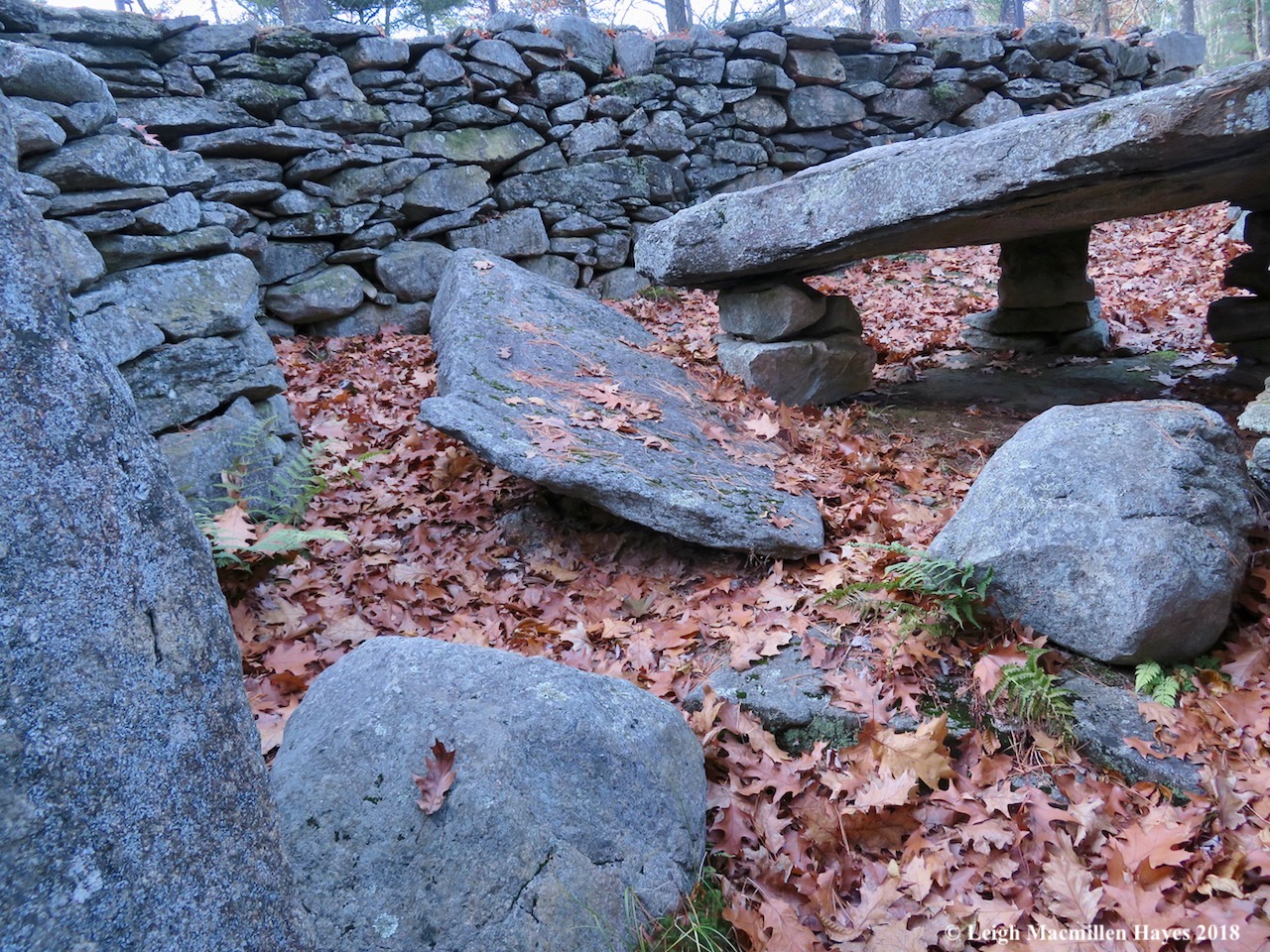
But it wasn’t until we were standing above it that it made more sense. The Sacrificial Table was a 4.5 ton slab with a grooved channel. Its a point of controversy for the site, but some believe that because of its size it was used for sacrifices. The oracle had a speaking tube in his chamber located directly beneath it that adds to the assumption.

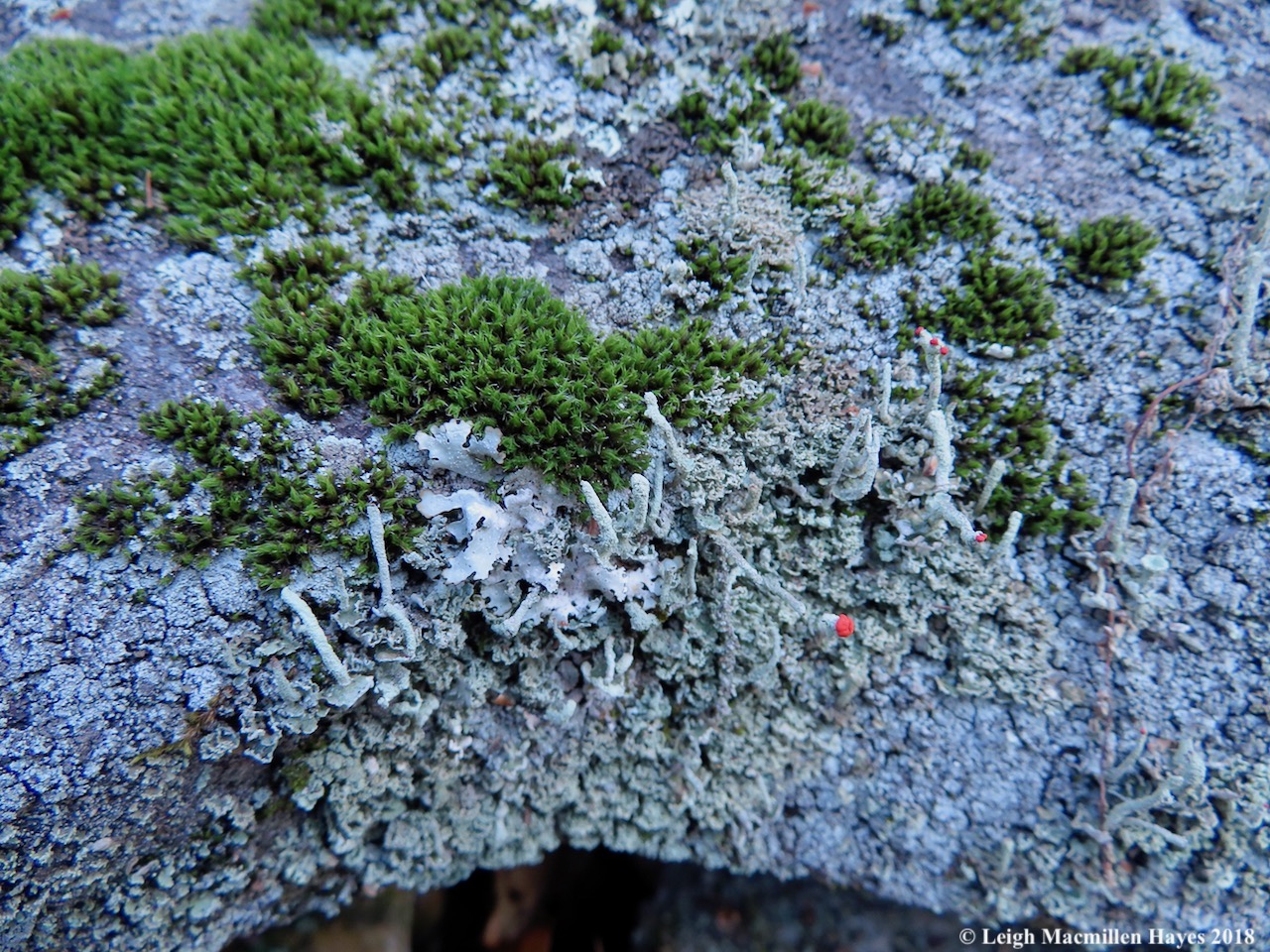
16a-if lichens and mosses could talk

If only mosses and lichens could talk, the tales they could tell. But then we wouldn’t have mysteries to consider.

30-Marginal wood fern

Speaking of such, one of our challenges was to identify a fern that grew among the rocks. It had several key features, including the fact that all of its fronds grew from a central point in a circle and it was still quite green–as in evergreen. A quick look at its spore arrangement on the underside and the answer was clear–marginal evergreen wood fern.

28-Black and Red Oak

We also had to name three colors represented by the oak leaves on the grounds: Black, red,  and . . .

29-White Oak

white.

23-Astronomical Calendar with view cuts

And then it was time to climb the Astronomical Viewing Platform. I was initially put off by the sight of the modern structure and thought perhaps it was a children’s playground tossed into the mix. But . . . thankfully I was wrong. Constructed in 1975, from the platform you can view the major astronomical alignment stones, including true north for summer and winter solstice. Trees were cleared in 1967 along the various important date sights and are still maintained. When the structure was first constructed, there were probably no trees atop the bedrock. This afternoon, as we looked out, our view included the November 1st sunset.

24-Nov 1 Sunset

We followed the trail toward the November 1 Sunset Stone.

26-Winter Solstice Sunset Monolith

And were equally excited to note the Winter Solstice Sunset Monolith. This was the first monolith that researchers suspected to be a solar alignment. On December 21, 1970, the shortest day of the year, it was photographed. Because the Earth’s tilt has changed, it’s a bit off these days, but would have marked the southern most set of the sun almost 4,000 years ago. Wow!

33-White Pine map

Before we left, we had another challenge: to find something that reminded us of the maze we’d just journeyed through–and in many ways the pine tree’s route system seemed to provide a map.

31-Alpaca

We also needed to pay homage to the alpacas who now call this place home and in their own way bring us back in time. The earliest evidence of man at America’s Stonehenge was 7,400 years ago as proven by evidence from a fire pit, and alpacas were domesticated about 5,000 years ago–in South America.

32-Modern day message

That being said, our final challenge was to find a more up-to-date representation and a message etched onto a rock seemed to fill the bill.

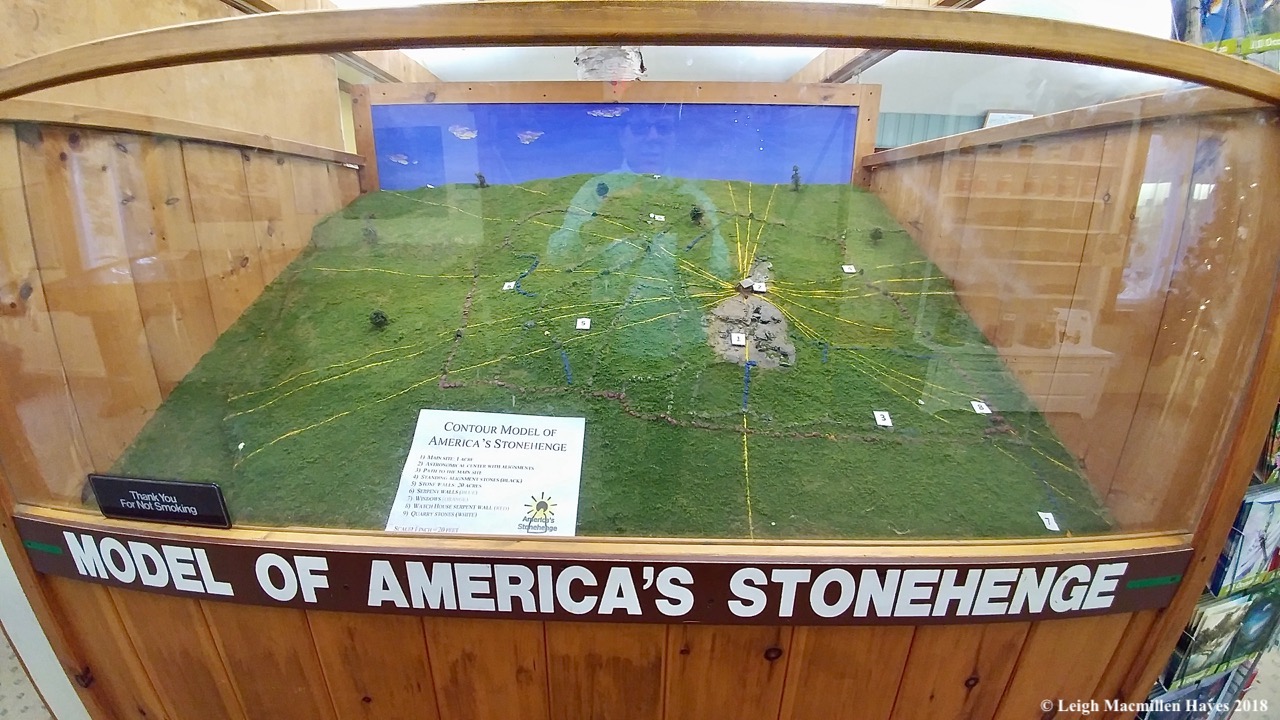
34-Astronomical Calendar and contour model

Back into the museum we journeyed and imagined ourselves into a contour model of the property with yellow lines representing the various astrologically important dates and sight lines. We’d also learned that a line can be drawn directly from America’s Stonehenge to England’s Stonehenge along the Solstice.

When our time was done, we were more than wowed. And had a lot to absorb about our learnings.

But, we were in a race and as quick as we’d wanted to be, we feared we were too slow.

Team Speedy, however, apparently went way off course when they turned onto Route 25. They were the last to cross the mat and have been eliminated. (Quietly we were heard to  mutter: YES!)

Team Purple won this leg as she has done several times even though she’s solo. And still sporting her sandals despite the colder temps.

We actually placed second today and were thrilled. We’re still in the race!

Only two more episodes to go. It’s down to Team Purple, Team Cape Cod, Team Livermore and us. Who will be the final three? Stay tuned for The Amazing Race–Our Style: episode eleven.

I Spy . . .

This afternoon’s goal: To find a Christmas Tree to decorate for the Christmas at Ladies Delight Walk on December 1st. For the reconnaissance mission, I joined the Coombs family at the GLLT’s Chip Stockford Reserve.

The Coombs children are homeschooled by their amazing mother, Juli, and though they learn many lessons at home, they are also well educated in the outdoors. In fact, they are among my favorite naturalists.

And they belong to a 4-H Homeschool group that will decorate a tree(s) with biodegradable ornaments prior to the December 1st walk.

1

And so we set off on our tour looking for just the right tree. But . . . as is always the case with this family, there was so much more to see.

2

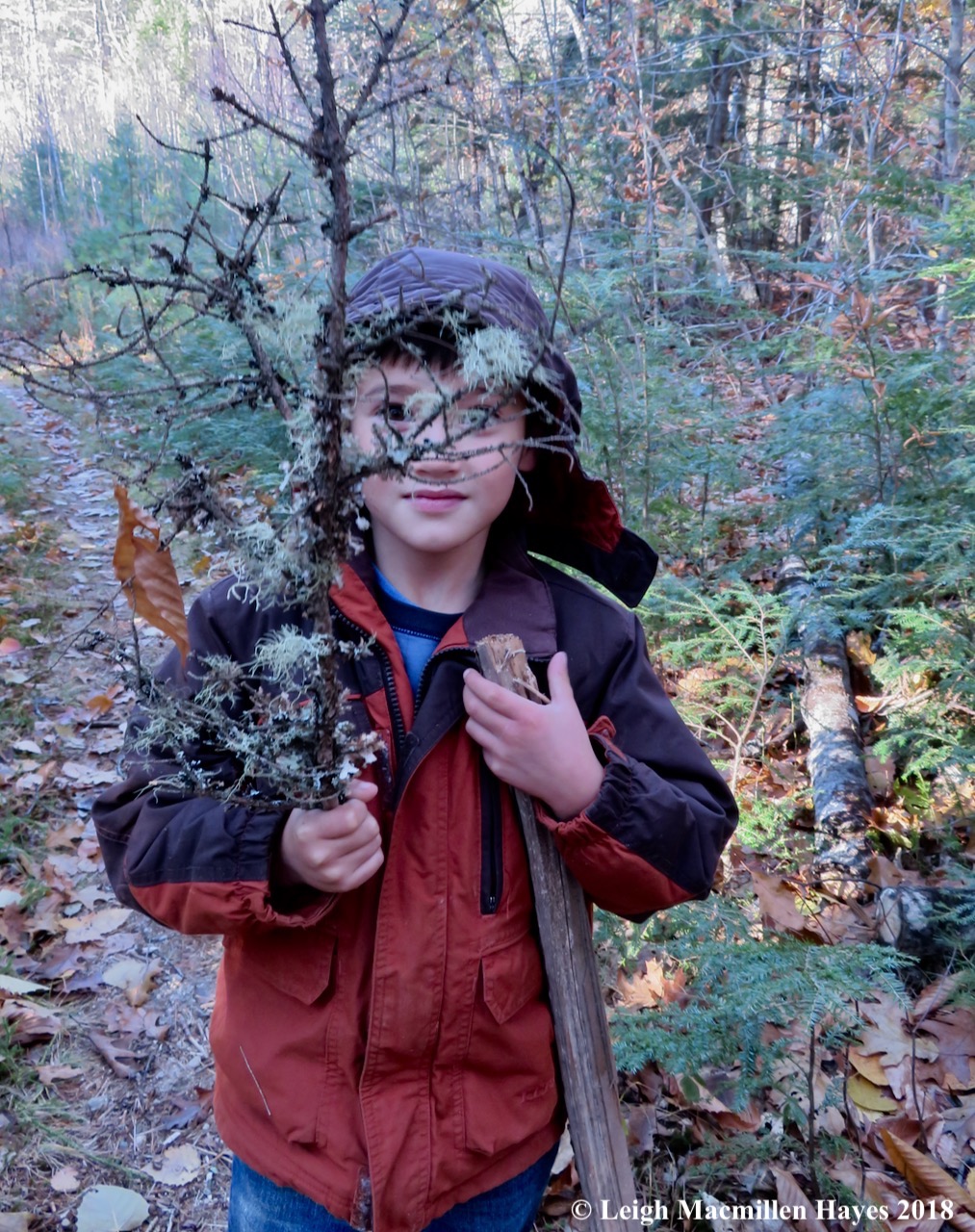
Since Juli is a Maine Master Naturalist Program student, so are her children. And every topic she studies, they study, so it was no surprise to me that six-year-old Wes picked up stick after stick loaded with various forms of lichens.

3

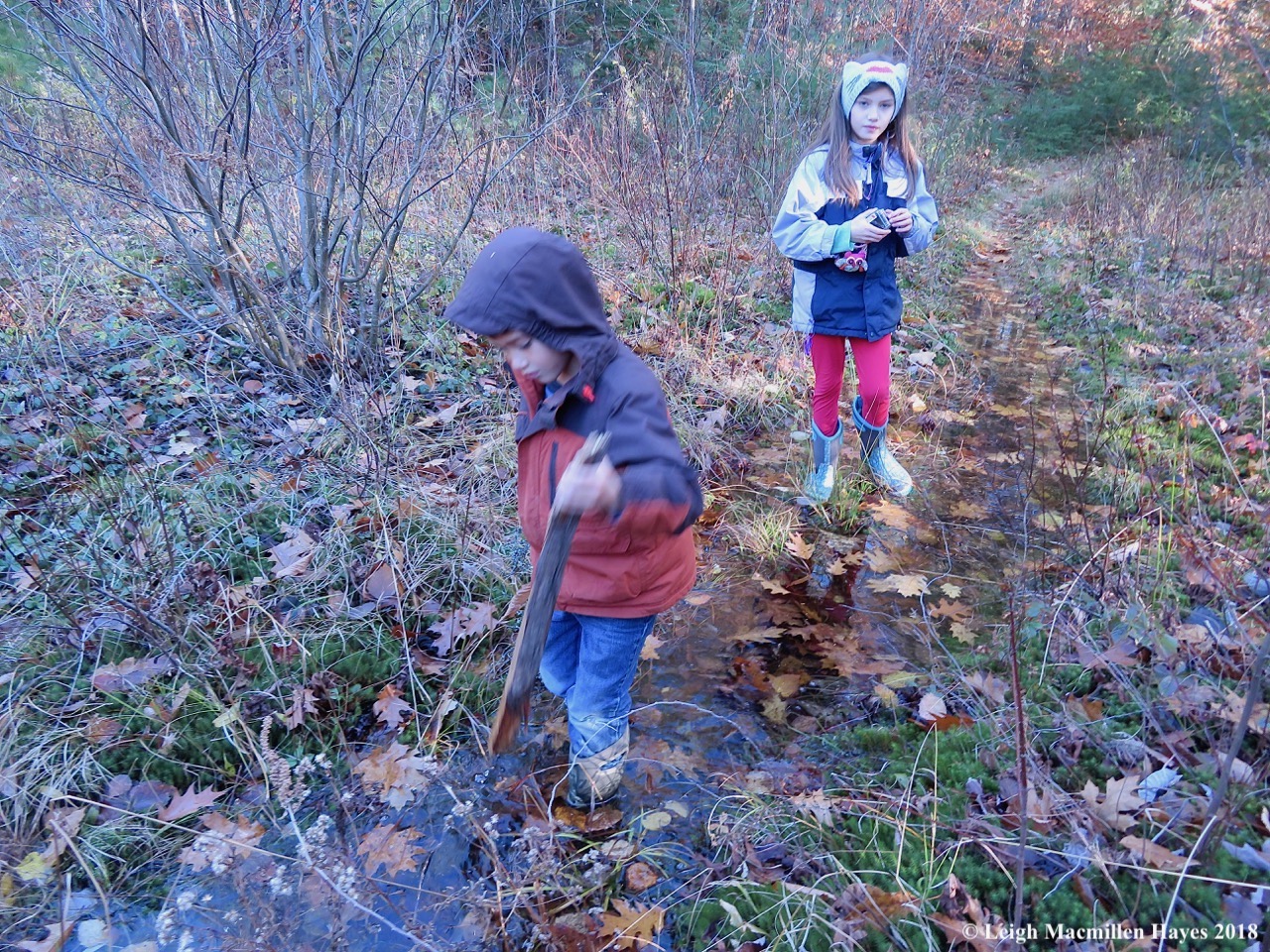
Of course, they are children, ranging in age from six to eleven, and puddles are invitations. The family motto is this: No puddle shall remain unsplashed.

4

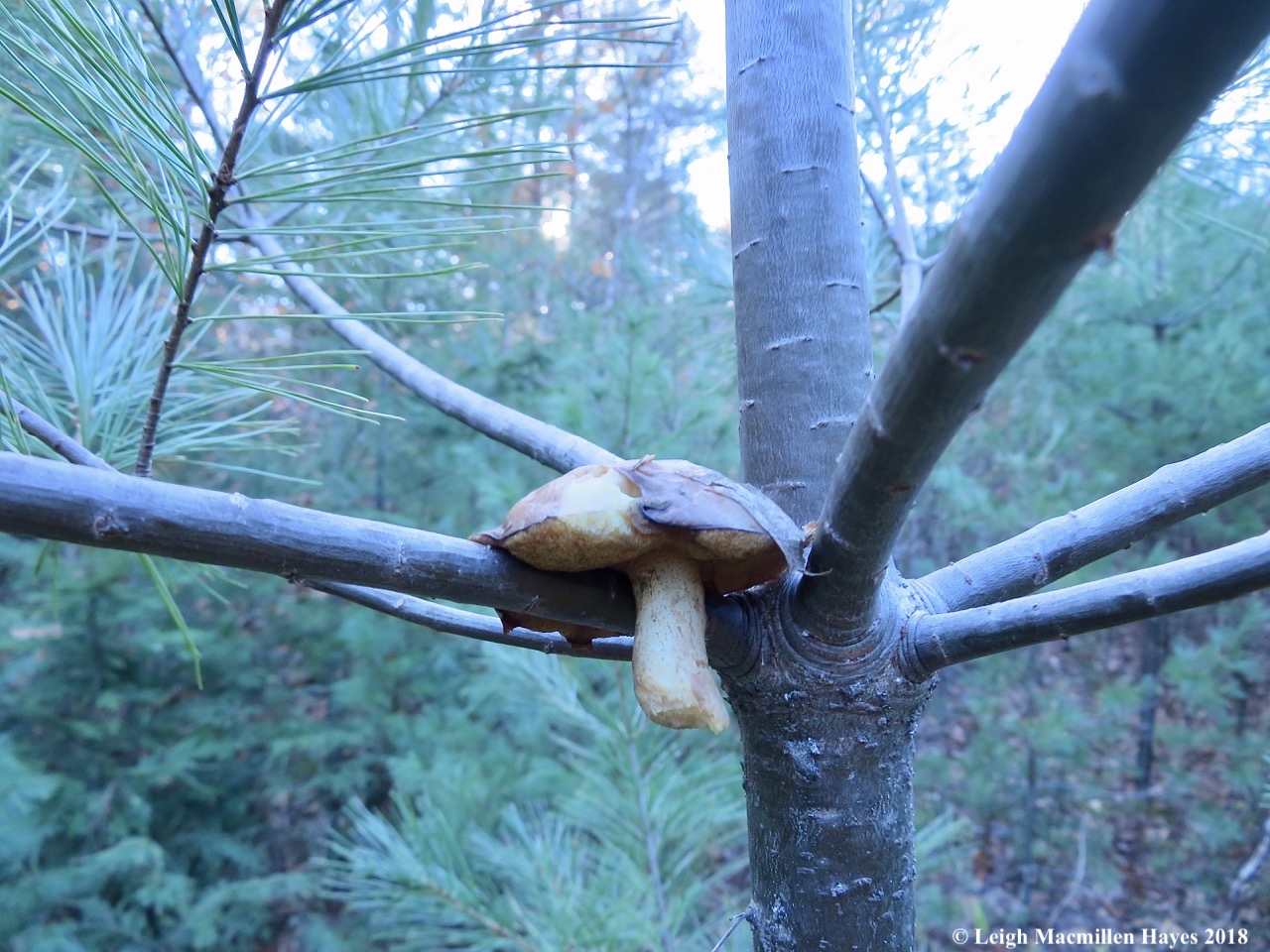
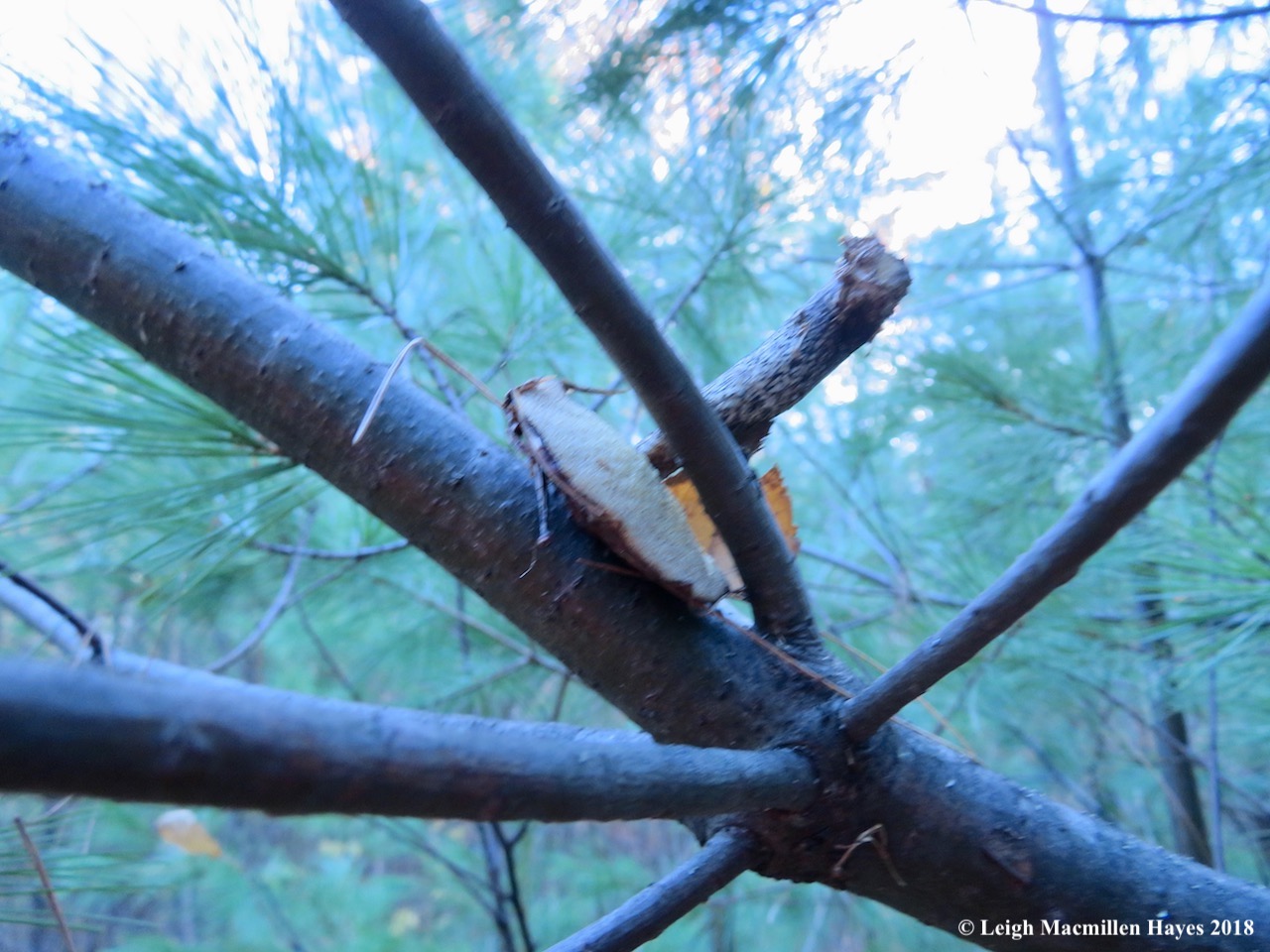
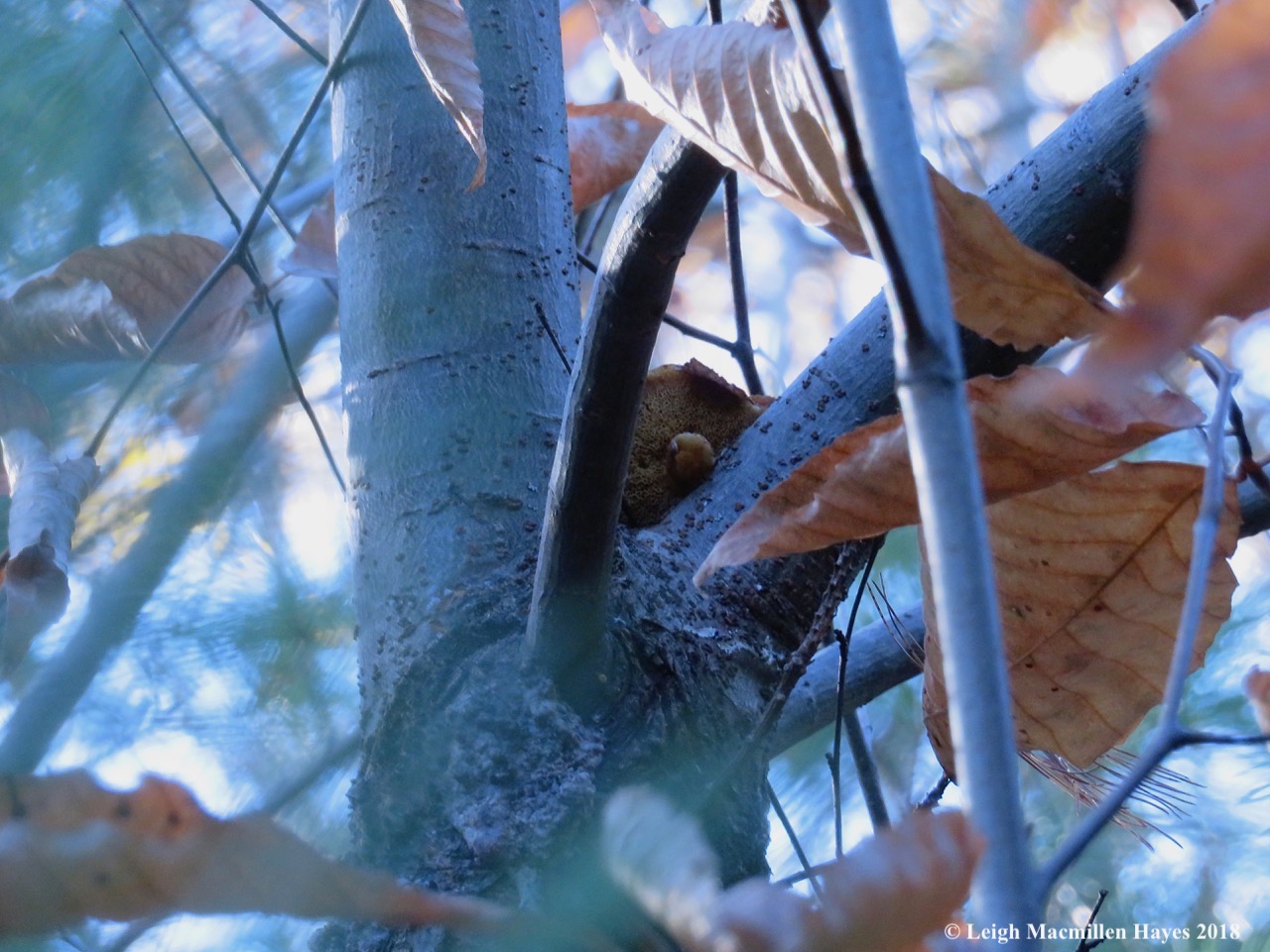
But just after the puddle, at the start of an old log landing, we began to notice something else. A mushroom drying on the whorl of a White Pine.

5

As we stood and looked at the first, someone among us spied a second.

6

And then a third, and so it went. We knew that squirrels dried mushrooms in this manner, but never had we seen so many. It dawned on us that we were standing in a squirrel’s pantry. One squirrel? Two squirrel? Gray Squirrel? Red Squirrel? One Fish, Two Fish, Red Fish, Blue Fish.

7

For a while we paused by an erratic boulder and looked at the lichens that grew atop it. The kids and their mom also checked the sand under and behind it and I told them that the only critter sign I’d ever noticed was that of a Ruffed Grouse sand bath–and I only recognized it as such because I’d startled the two birds and they startled me as they flew off. In fact, on another hike this morning at the GLLT’s Five Kezar Ponds Reserve, friend Teresa and I had startled a grouse and we talked about how the bird’s explosive behavior makes us feel as if we’ve encountered a moose.

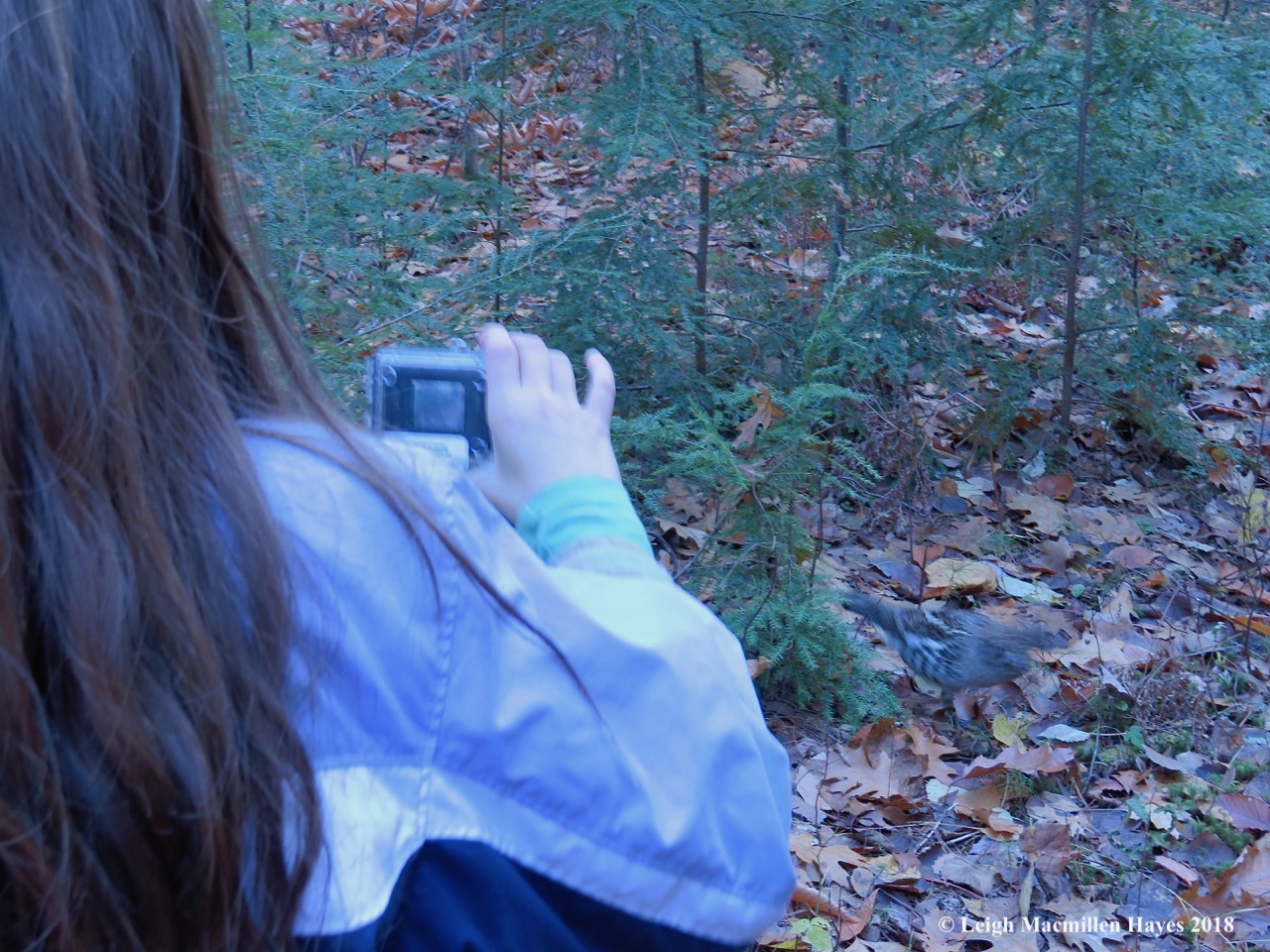
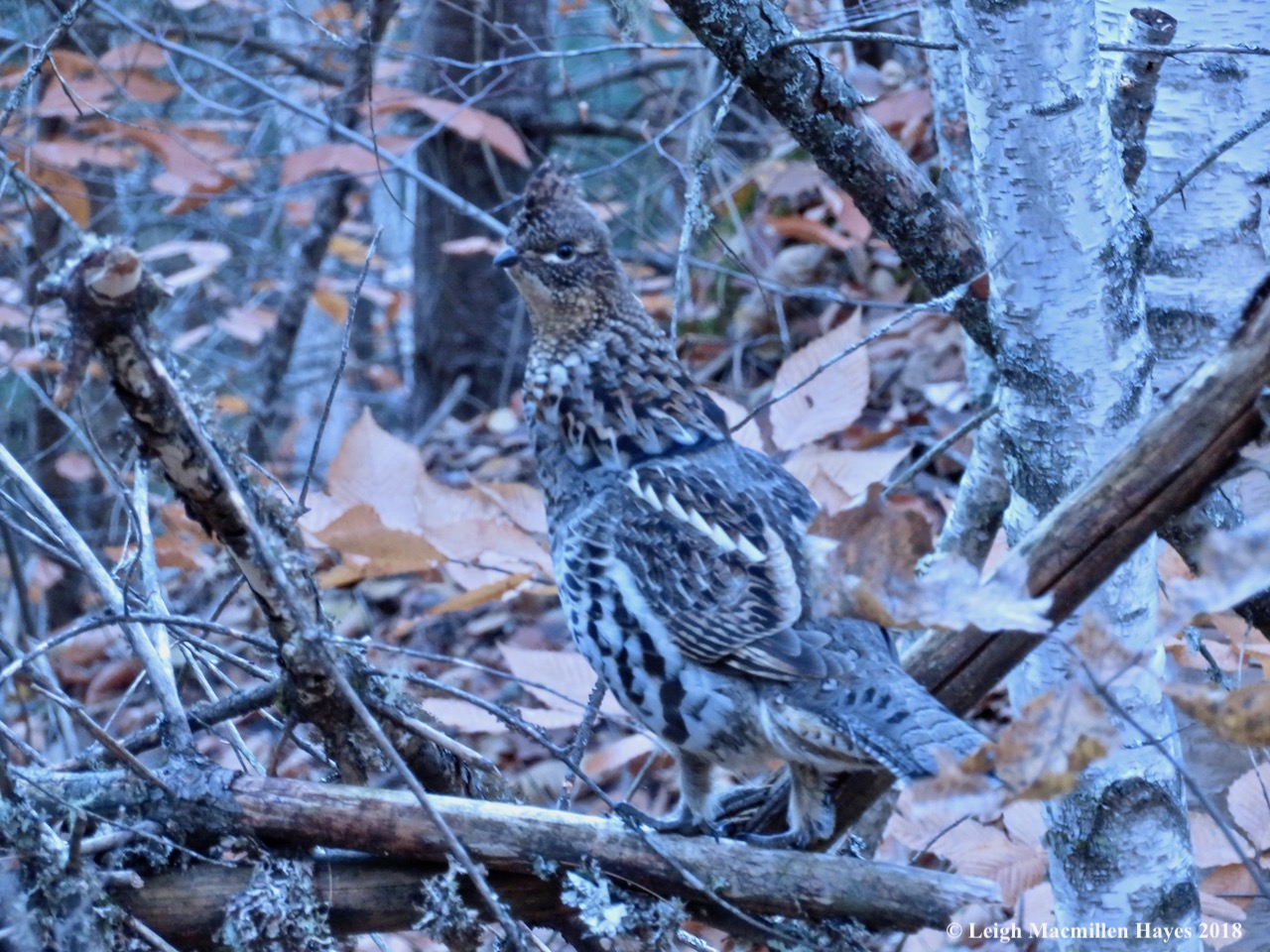
Well, just beyond the boulder, as we all chatted and moved about with quick motion, Caleb spotted something and told us to stop. A Ruffed Grouse!

8

It threw leaves about as it sorted through them in search of seeds and buds and we all watched in silence.

9

As we stood or sat still, the bird moved this way and that, making soft clucking sounds the entire time.

10

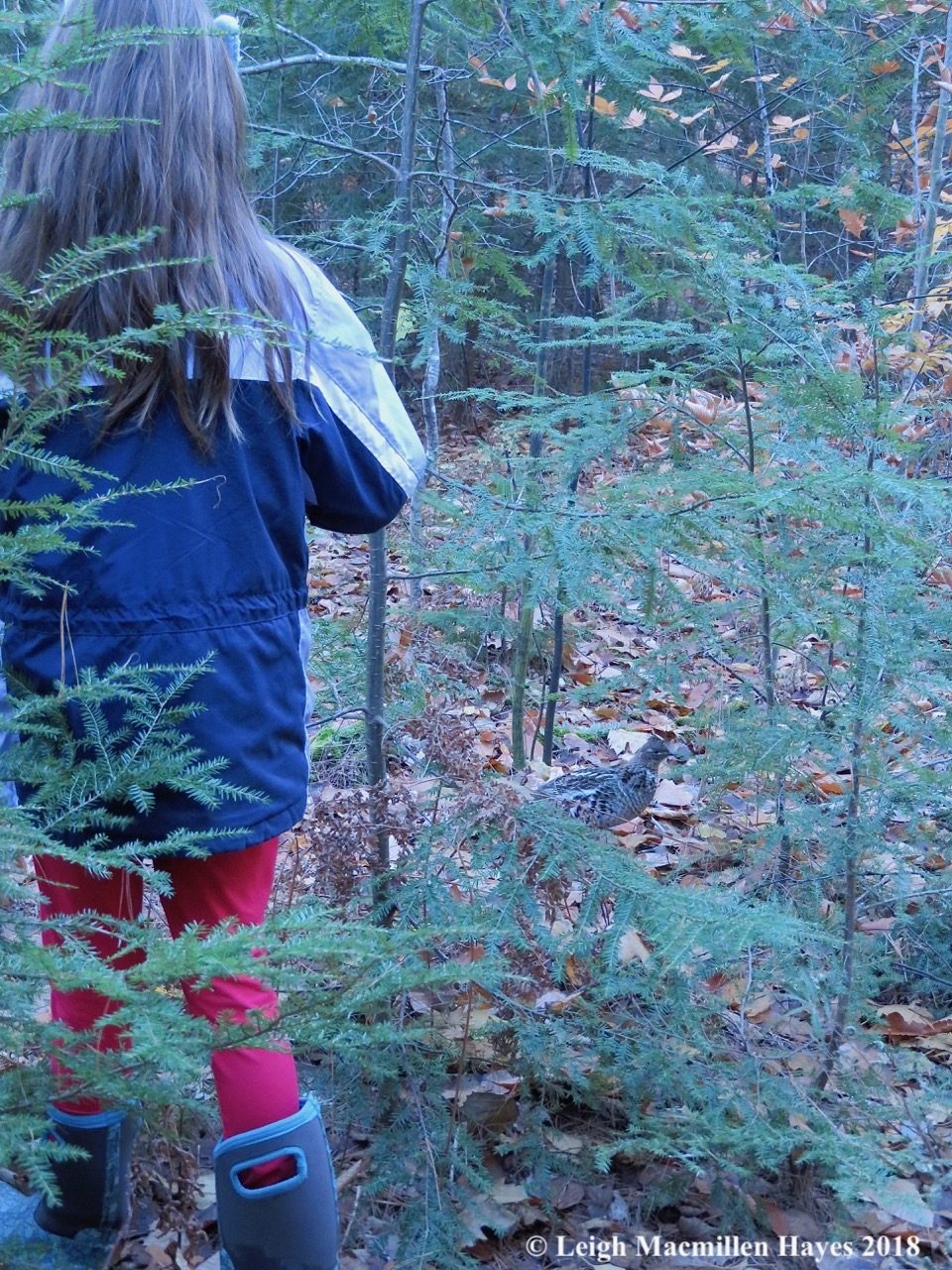
Ellie stood in front as the bird moved a few feet ahead of her and crossed the trail. I kept looking back at Juli in wonder. How could this be? Why wasn’t it disturbed by us? I’ve spotted Spruce Grouse in higher elevations and they are much “friendlier” or less wary of people, but I’d never been able to get up close to a Ruffed Grouse.

11

Our fascination continued and we noted its feathered legs, making us think perhaps it had pulled on some long johns for a cold winter night.

12

It eyed us and we eyed it back–our minds filled with awe.

13

Think about this: four children and two adults and we were starting to get fidgety because we’d been still for fifteen or more minutes and we had begun to whisper our questions and still . . . it let us watch.

14

And it let Ellie be the Grouse Whisperer for she began to follow it off the trail. Eventually, it climbed up a fallen tree and she knelt down beside, taking photos as it stood less than a foot from her. How cool is that?

15

We were all wowed by the experience, but when Ellie finally turned back, we continued on . . . sometimes running and other times pausing to ride imaginary horses.

16

Or listen to Birch Polypores! Yes, Juli did listen for it’s part of an assignment for the Maine Master Naturalist class. So what exactly does a Birch Polypore sound like? “I couldn’t hear the ocean,” she said with a smile.

17

And what does it smell like? “Wood.”

18

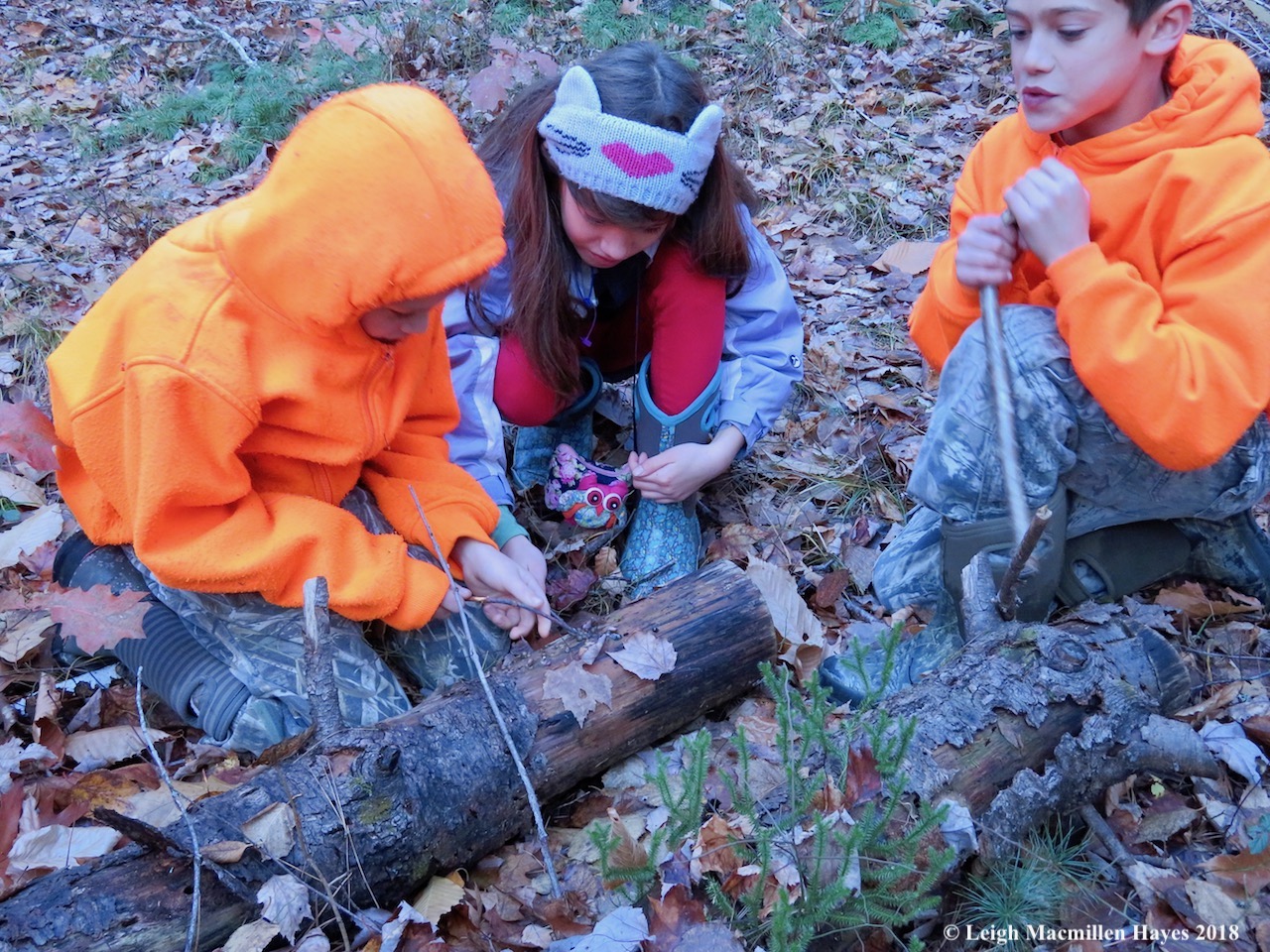
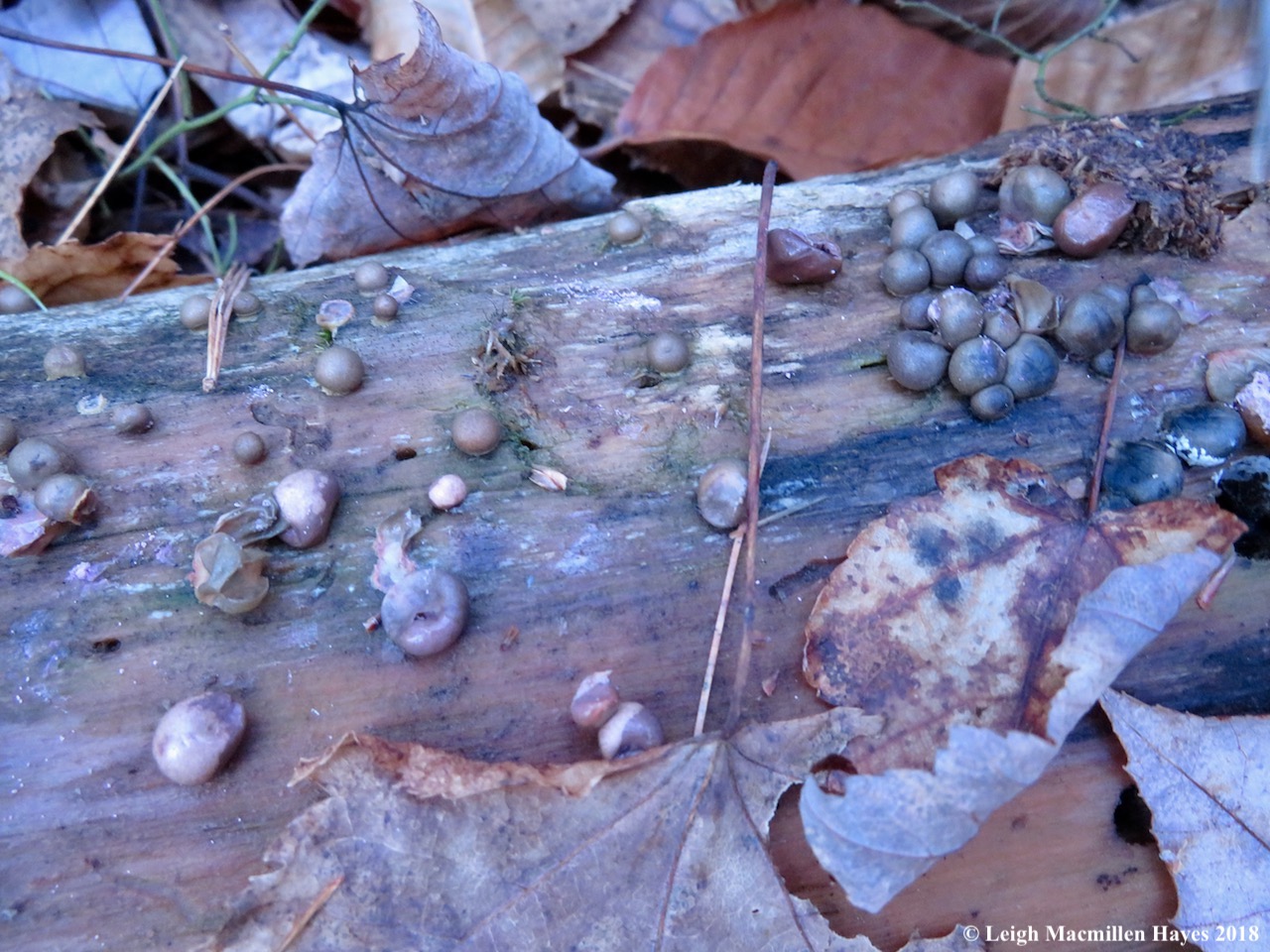
The next moment of glee–poking Wolf’s Milk Slime Mold and watching it ooze.

19

“It’s cool and gross at the same time,” said Ellie.

20

Onward and again, more fungi drying in trees as Aidan pointed out.

22

We even found a few stuck on spiky spruces much like ornaments might be and we reminded ourselves that we were on a mission and still hadn’t found the right tree to decorate.

23

At last, however, we did. And then we made our way out to the spur and recently opened view of Kezar Lake’s Lower Bay and Cranberry Fen, plus the mountains.

24

This became our turn-around point as it was getting cooler by the minute and the sun was setting. We promised Wes we’d look only at our feet as we followed the loop trail down, though occasionally we stopped again to admire more fungi tucked onto tree branches and a set of trees that formed a rainbow arched over the trail.

As for the fungi, we wondered if we were seeing so many because last year’s mast crop of pinecones, beech nuts, and acorns didn’t exist this year. And when the 4-H club returns in a couple of weeks to decorate the tree, will the mushrooms still be there? Will there be more? How long do the squirrels wait before consuming them? So many questions and so many lessons still to be learned.

25

And so many things to spy. We were honored with the opportunity to do just that and my heart smiled with the knowledge that the kids appreciated it as much as their mom and I did.

I spy . . . we spied . . . INDEED!

Oh, and  please join the GLLT for Christmas at Ladies Delight. I have the inside word that there will be hot cocoa and cookies somewhere along the trail.

December 1, 9:30 – noon
Christmas at Ladies Delight: The Maine Christmas Tree Hunt is a fun holiday scavenger
hunt to find decorated trees in western Maine. We’ll search for the decorated tree along the Bill Sayles Loop at the Chip Stockford Reserve and may add a few of our own biodegradable ornaments along the way. Location: Chip Stockford Reserve, Ladies Delight Road, Lovell.
Degree of Difficulty: Easy.

Election Day Tramp

It always strikes me that no matter how often one travels on or off a trail, there’s always something different that makes itself known–thus the wonder of a wander.

And so it was when Pam Marshall, a member of the Greater Lovell Land Trust, joined me for a tramp at the John A. Segur Wildlife Refuge West on Farrington Pond Road this morning. She had no idea what to expect. Nor did I.

13-puff balls to pop

It was misty when we met, but neither of us was daunted by the weather. Ever so slowly, we made our way over the wet leaves, roots, and rocks, pausing frequently–especially each time we saw puff balls. How can one resist poking or squeezing them to watch the spores waft out like smoke. The skin of mature puffballs split prior to releasing spores. And we . . . we helped the process a wee bit.

20-blue stain fruiting

Green stain fungus also drew our attention. Its fruiting bodies were minute, but well worth wet knees for a closer examination.

19-hexagonal-pored polypore

With Pam in the lead for most of the way, she kept finding cool stuff, like this hexagonal-pored polypore.

1-Sucker Brook Outlet

It took us a while, but we finally reached the wetland by the Sucker Brook Outlet where blueberry, maleberry and leatherleaf shrubs added color to the otherwise gray day.  For a while we stood under the protection of a large hemlock and took in the scene in silence.

2-Silhouettes on Lower Bay and cotton grass

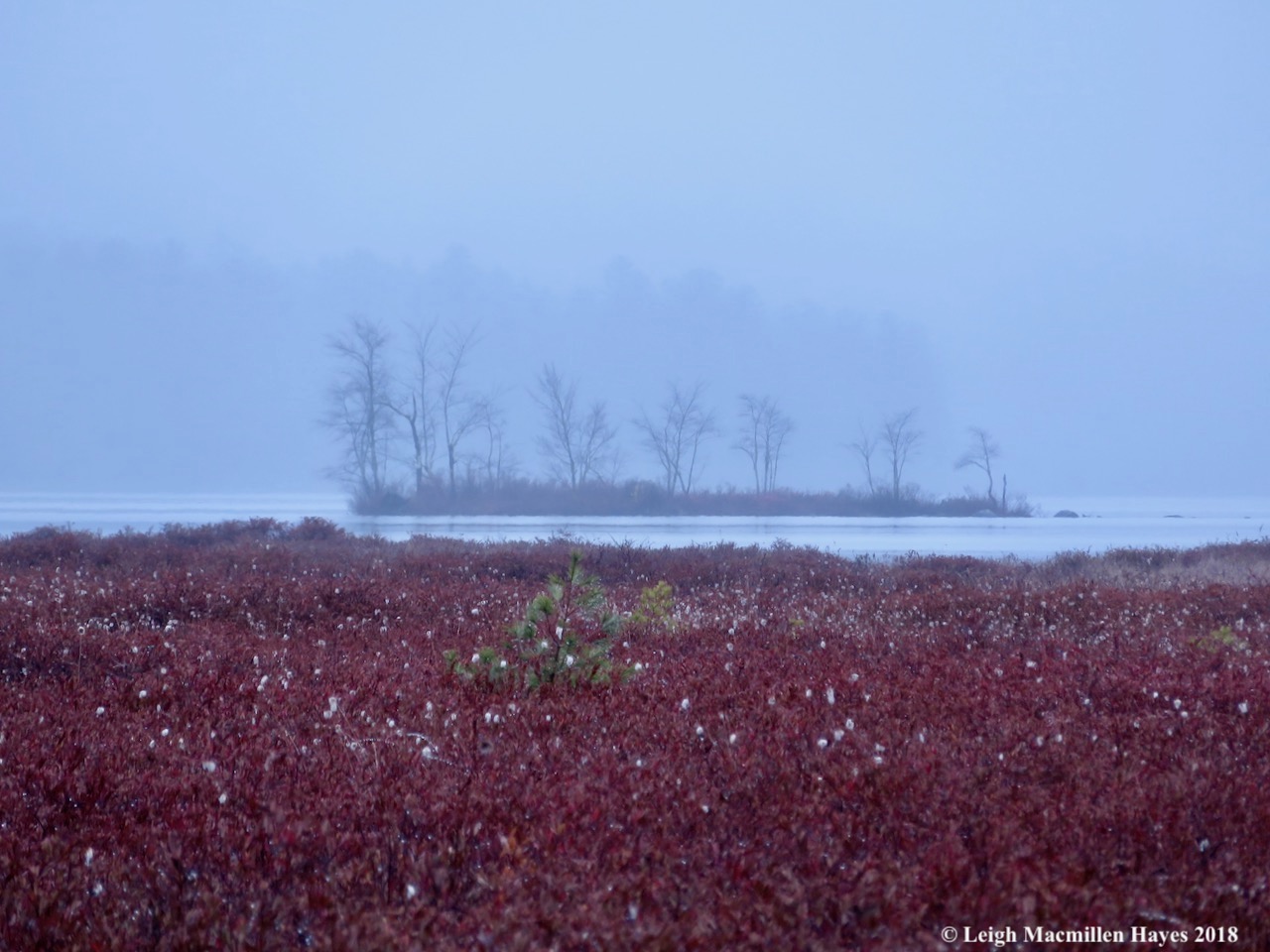
From our vantage point, an island in Kezar Lake’s Lower Bay looked like a ghost ship. And in the foreground, cotton grass still touted its tufted heads.

3-beaver lodges

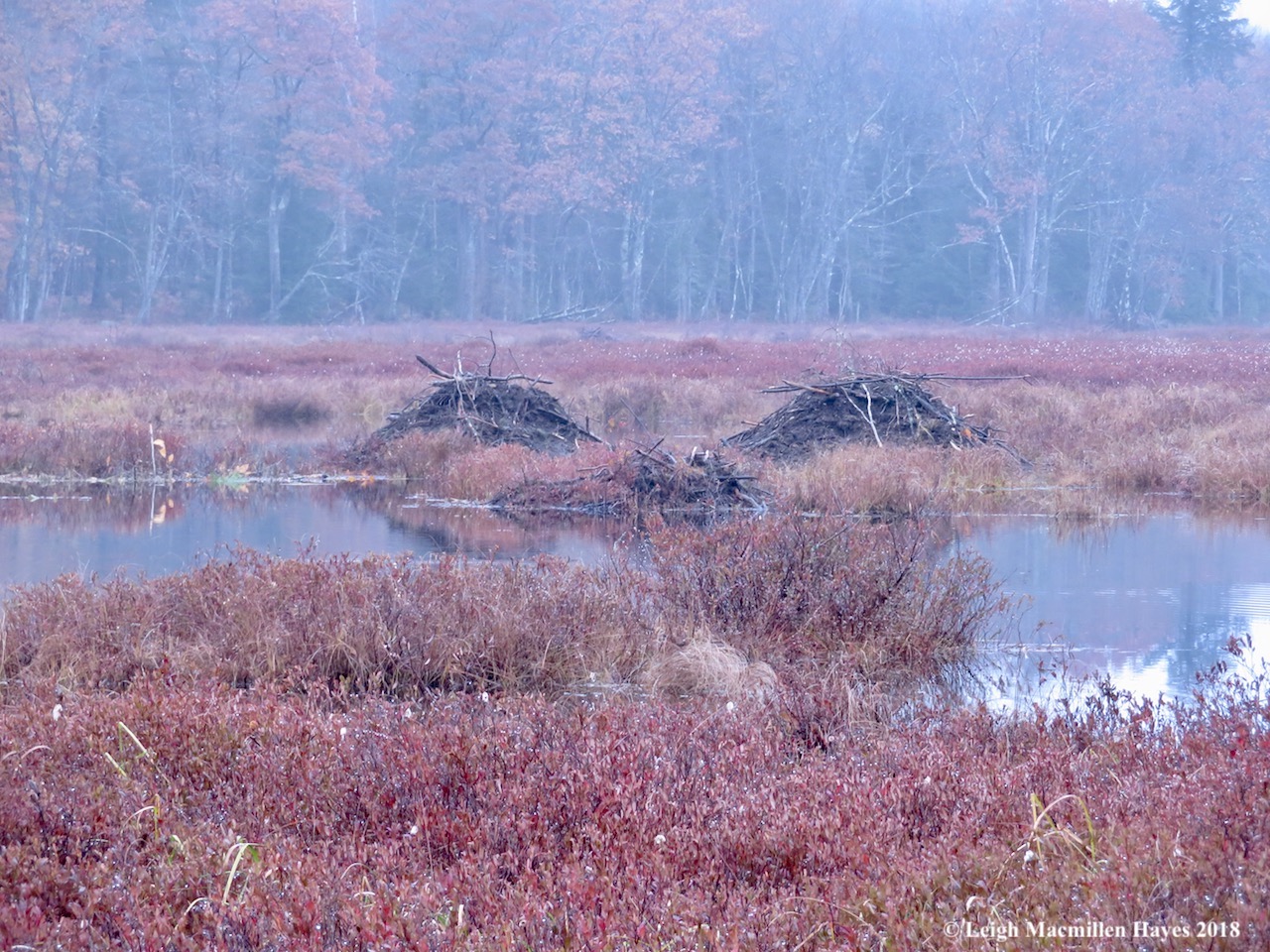
At our feet we could see some aquatic plant roots floating in the water, a beaver treat, and trusted by the mud on the lodges that there had been recent activity. Perhaps they rested indoors before planning to spend time later in the day preparing for the cold months ahead.

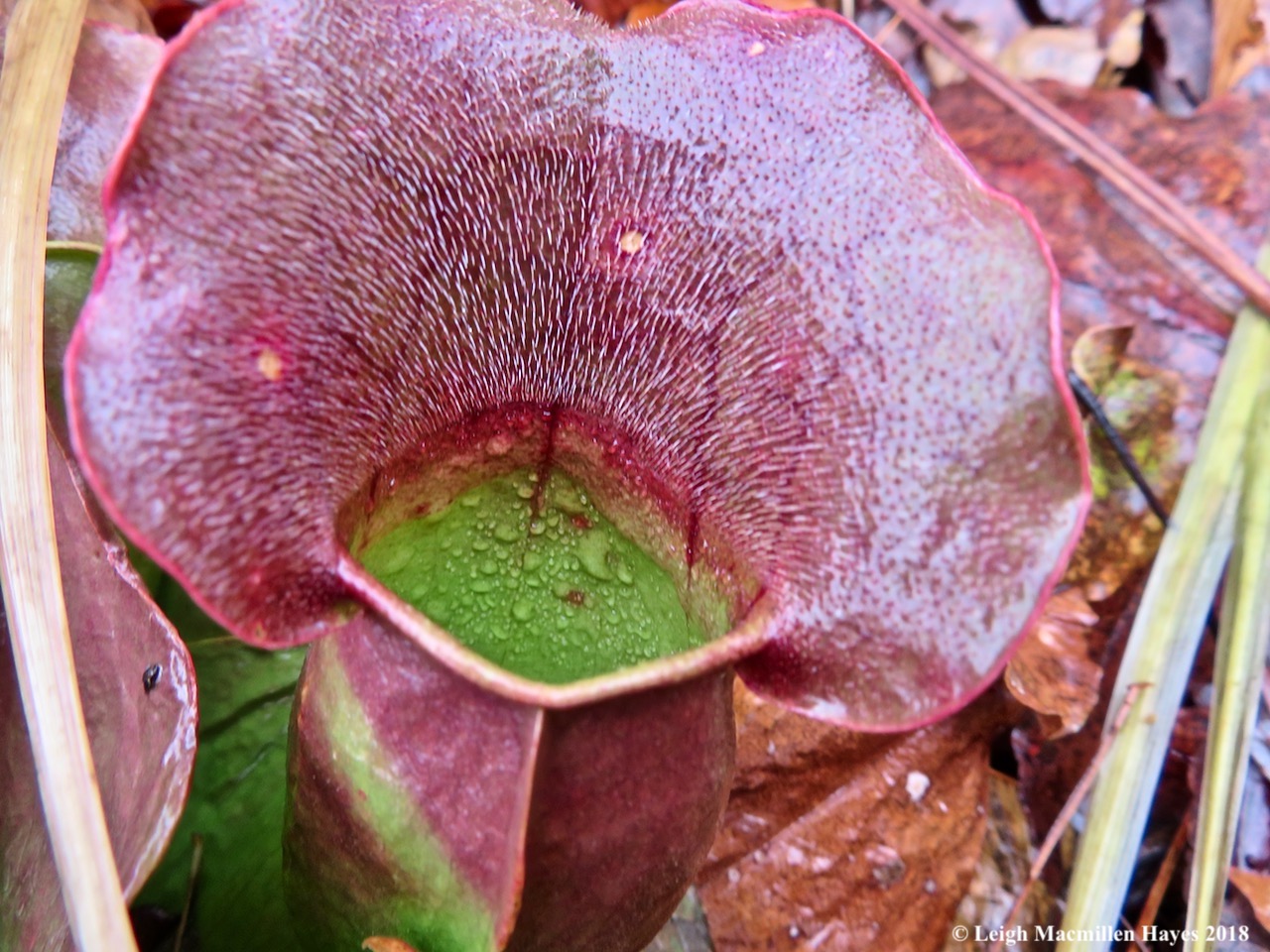
4-Pitcher Plants

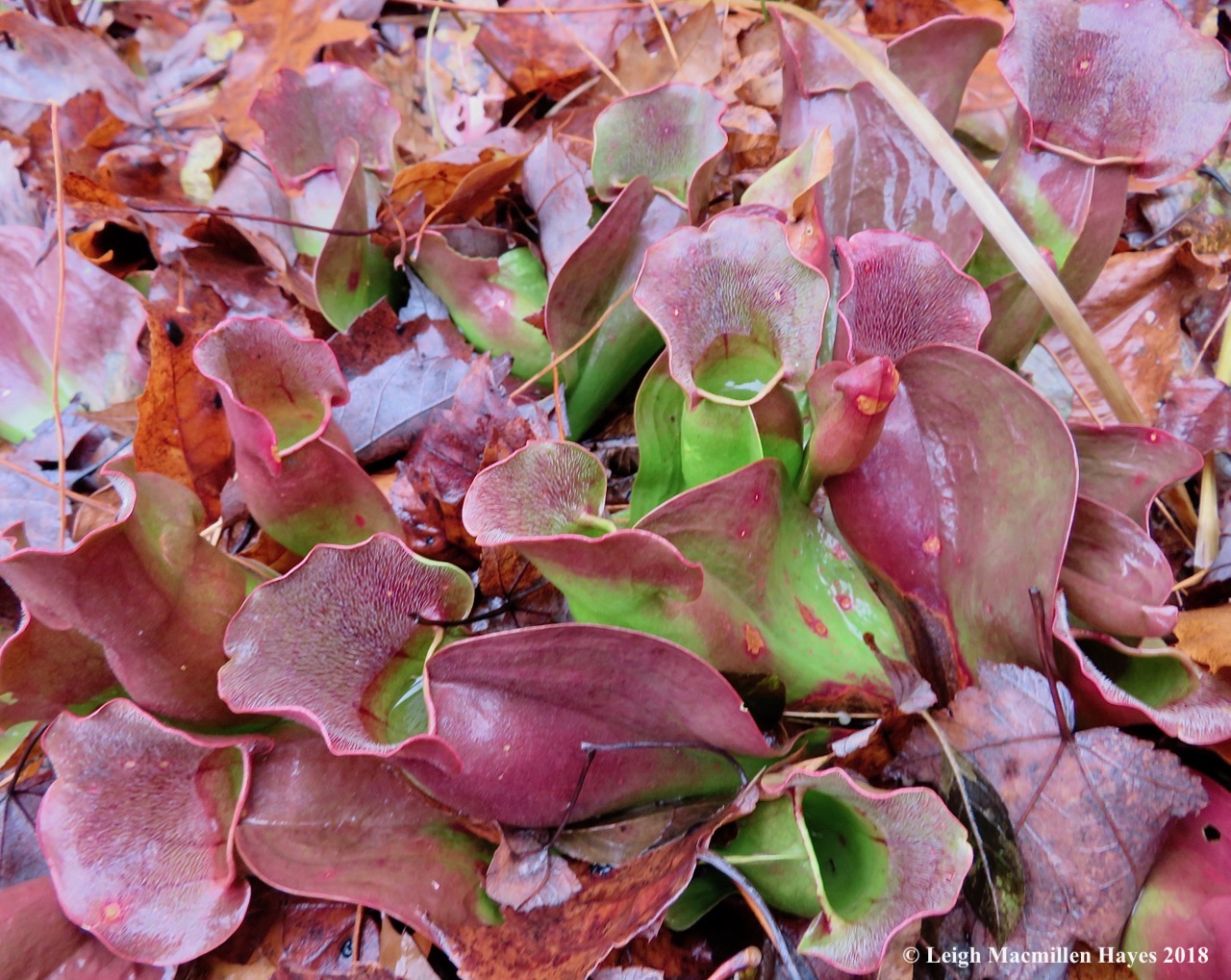
After a while and because I knew they were there, I took Pam along the edge of the brook for a short distance to locate several pitcher plants. Someone once photographed them in their young green form and described them as rare. While helping Dr. Rick Van de Poll, principal of Ecosystem Management Consultants (EMC) in Sandwich, New Hampshire, set up study plots at Lakes Environmental Association’s Highland Lake Reserve in Bridgton during July 2017, we had to watch where we stepped to avoid crushing pitcher plants. It was a perfect time to ask Rick about the green color. Were there green pitcher plants in Maine? And if so, were they rare? He explained that it was just a matter of sunlight and age, all would eventually take on a redder hue in veins and then overall leaf coloration as they matured.

5-pitcher plant runway

This morning, we found some sporting brighter red leaves.

6-spiders within and webs above

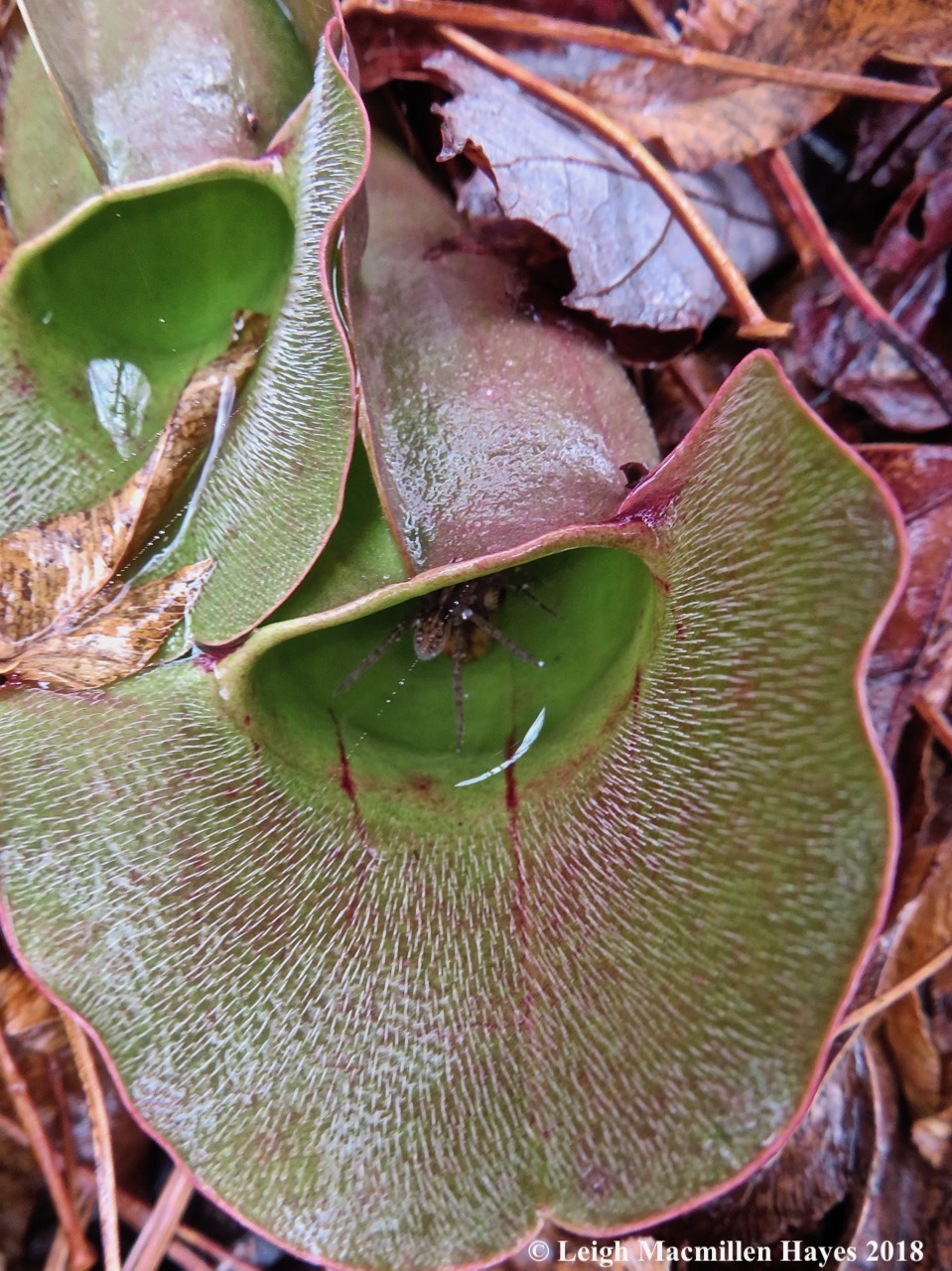
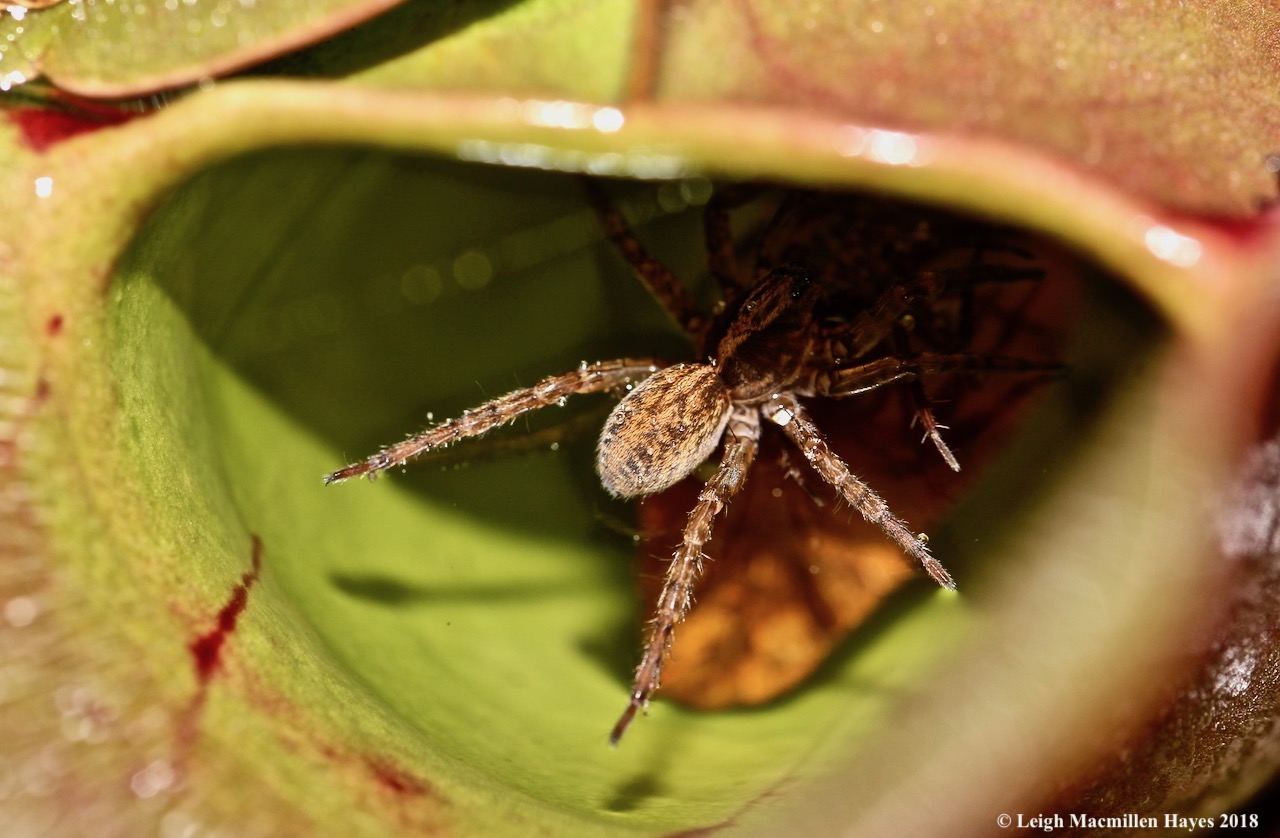
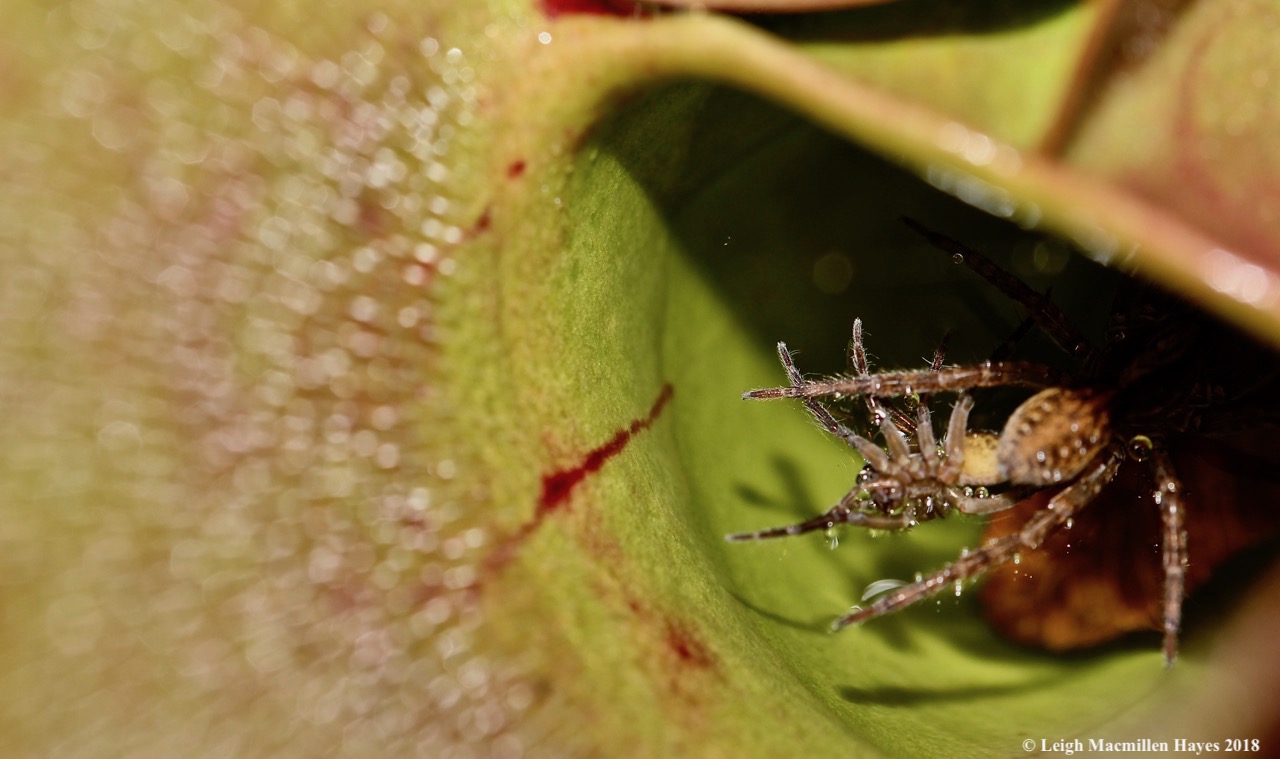
And another plant that was duller in color. Since we were in the locale where the green plant had been discovered, I trusted that it was beginning to show its age. It was the duller one that drew most of our fascination. Carnivorous pitcher plants obtain nitrogen and phosphorus by eating insects. Their oddly-shaped leaves form a pitcher partly filled with water and digestive enzymes. The spout is a hairy landing platform for insects attracted by red venation and nectar glands. Imagine this: an insect crawls to the edge of the leaf, aka pitcher, slips on the downward-sloping hairs and plunges into the liquid below where enzymes and bacteria break it down. Any chances for escape are zapped by those stiff hairs. Do you see what we saw? A spider web across the top of the leaf? And within?

8-larger spider manuevering the smaller one

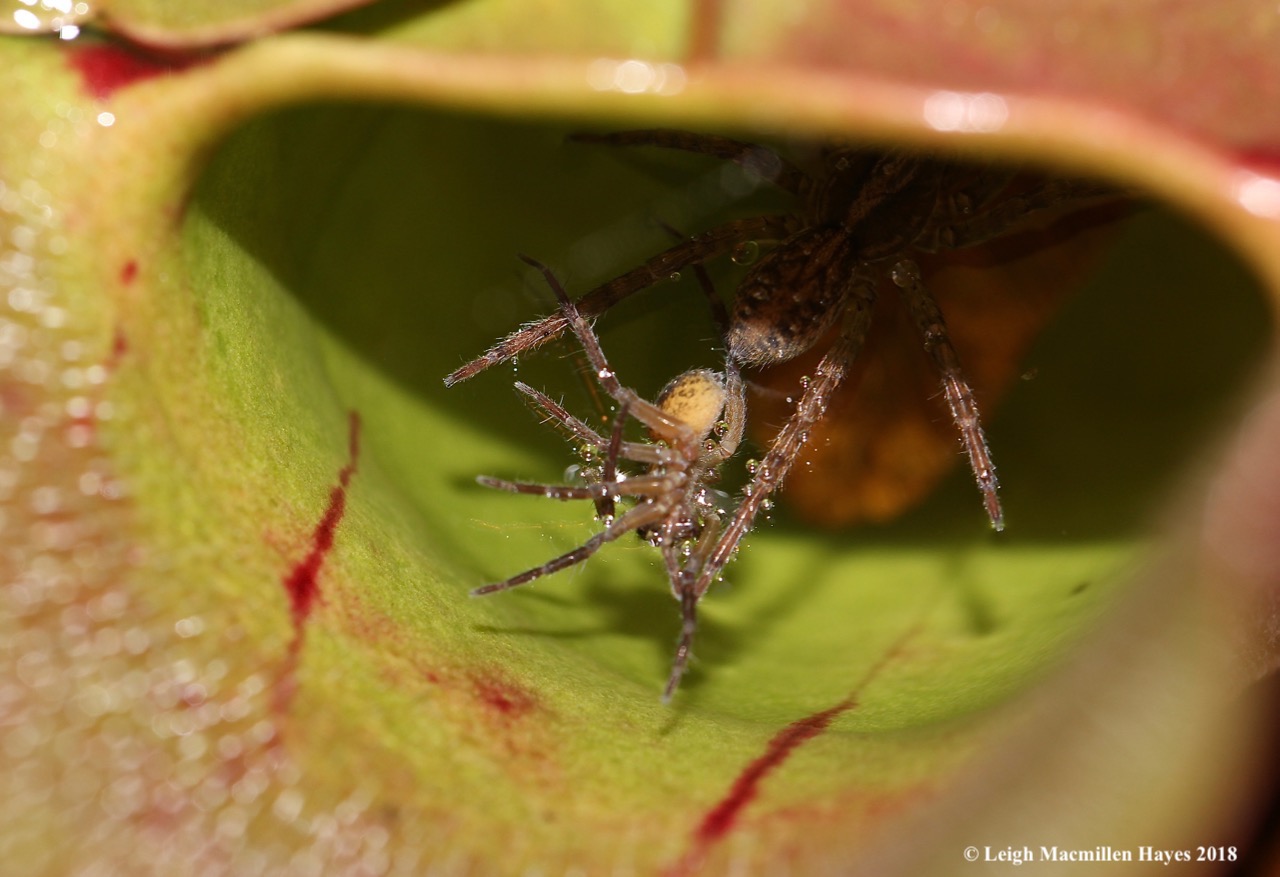
Dueling fishing spiders.

9-pulling it under its body

And so we watched.

10-and out again

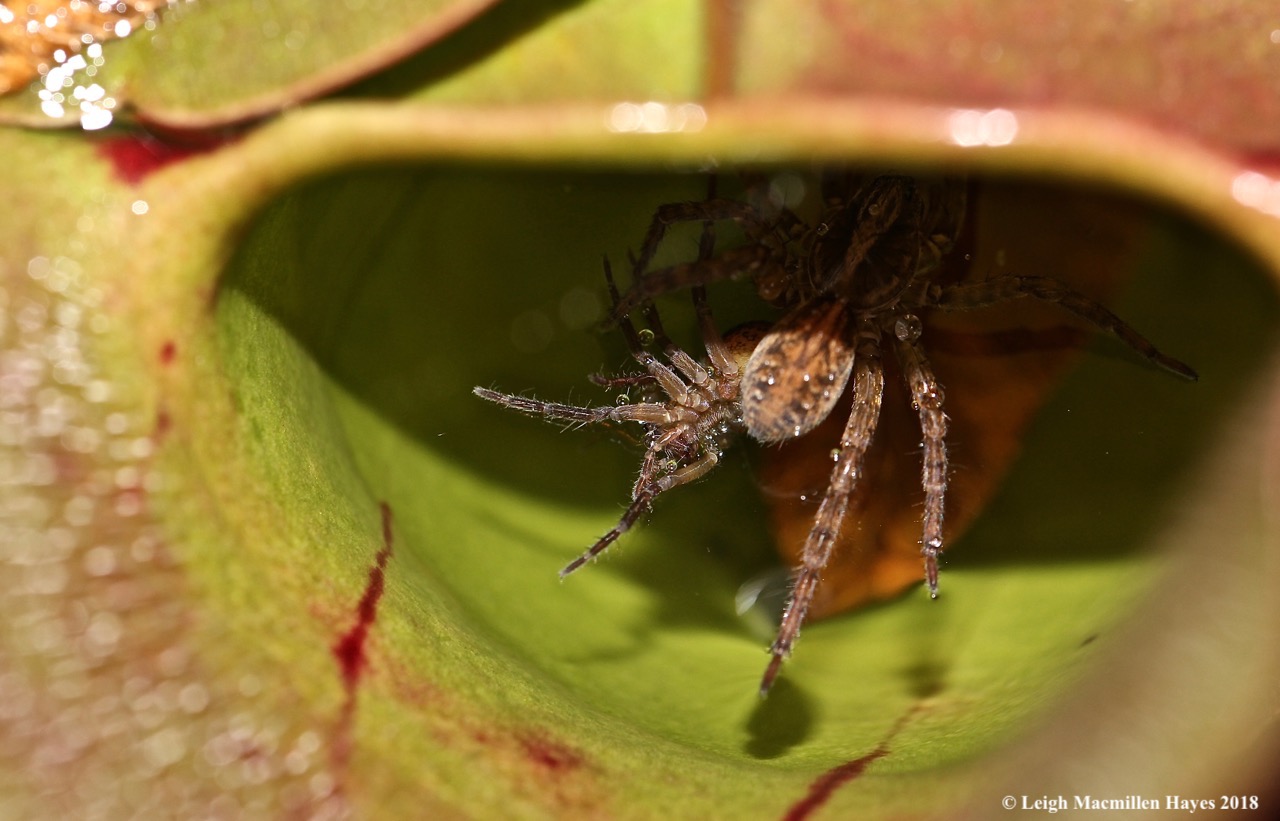
The larger one continuously manipulated the smaller one, which appeared to be dead. Back and forth under its body, it kept moving the smaller kin.

11-and back under

Was it trying to eat the other? One last meal before it too succumbed to the plant? Was it trying to move past the dead spider so it could try to climb out? Should we save it?

12-let 'em be

In the end, we left the action with questions in our minds and didn’t interfere.

7-watching the spider action

Except, that is, to take photographs and make a film. Again, our knees were wet and we didn’t care.

14-pigskin puffball 1

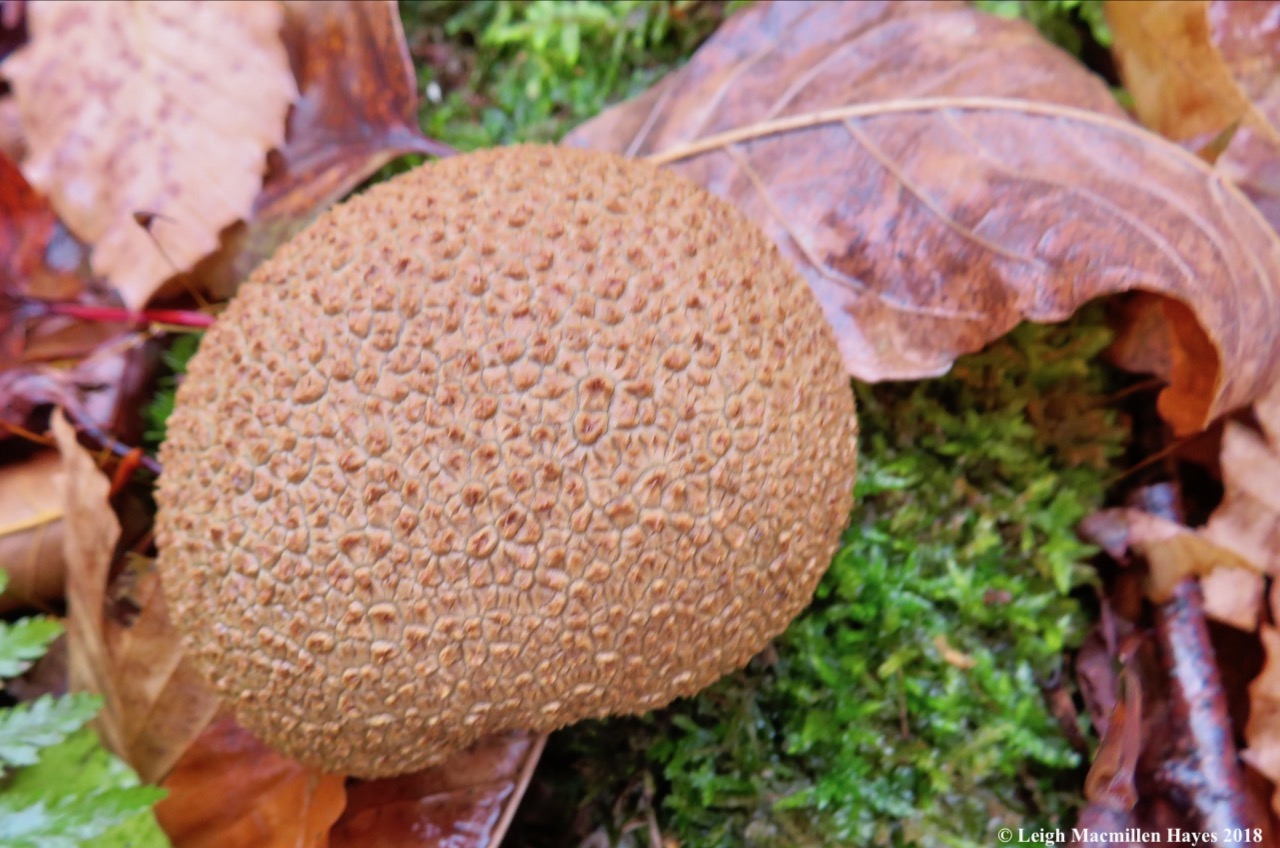
Back on the trail, we found an area where Earthballs decorated some old lumber slash. Their warty outer skin drew our attraction.

15-skin of pigskin

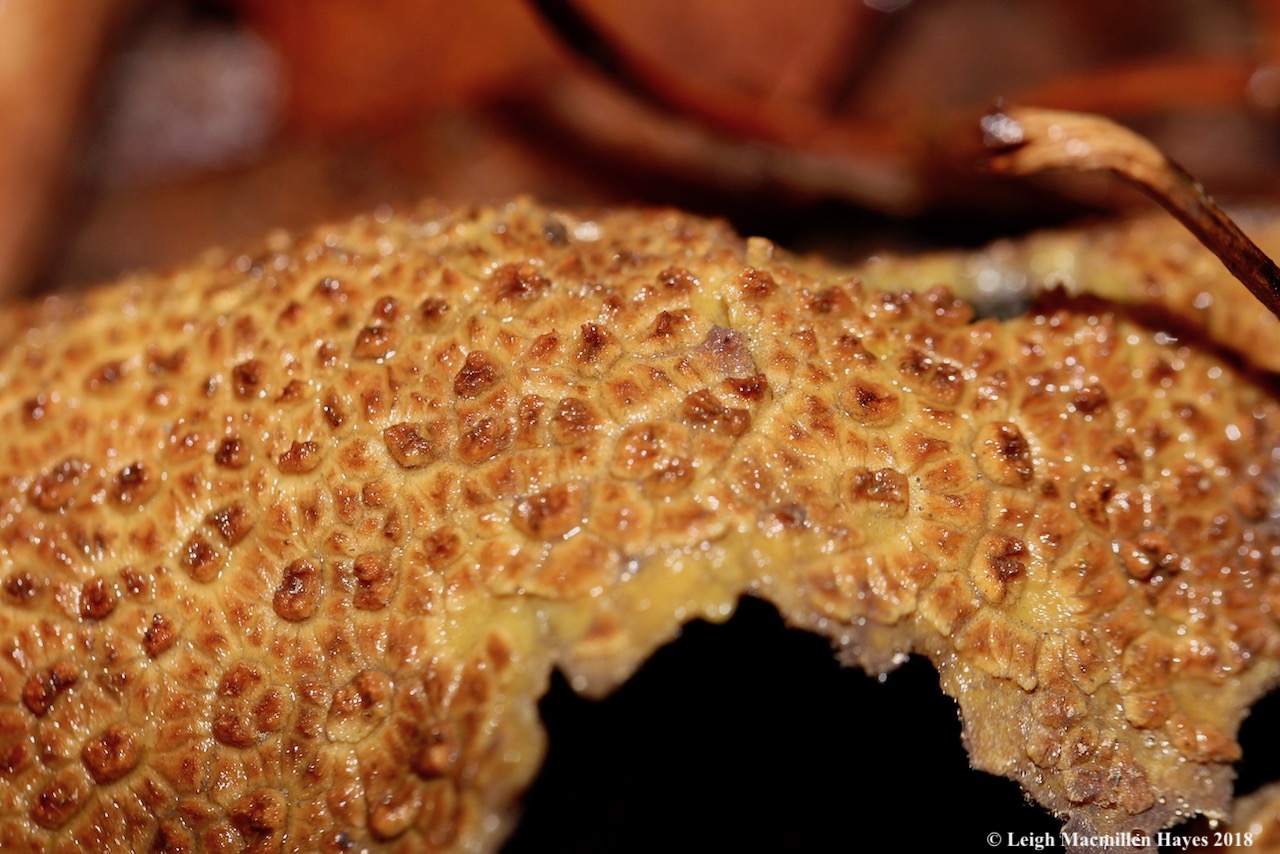
Another common name for Scleroderma citrinum is Pigskin Poison Puffball. Since it’s football season, it’s good to note that footballs used to be made of a pig’s . . . bladder and not its skin, though historically they were called pigskins. Rather than feel leathery, these seemed more rubbery, thus the reference I guess.

15-popping pigskin

And because they were puffballs, they invited a poke.

16-an explosion of spores

From a couple of slits, mature blackish spores erupted. I had to chuckle for no matter with whom I share a trail, puffballs always invite the same reaction–pick up a stick and give it a jab. And each time we share the same moment of glee. And our inner child is released one more time. Thankfully.

18-insect within pigskin

Of course, we found ourselves on our knees yet again when Pam spied something within an Earthball that had exploded prior to our visit. Upon closer inspection, it turned out to be an inanimate insect that looked like it was covered in spores. Canary in the coal mine?

25-Pam and the bear scat

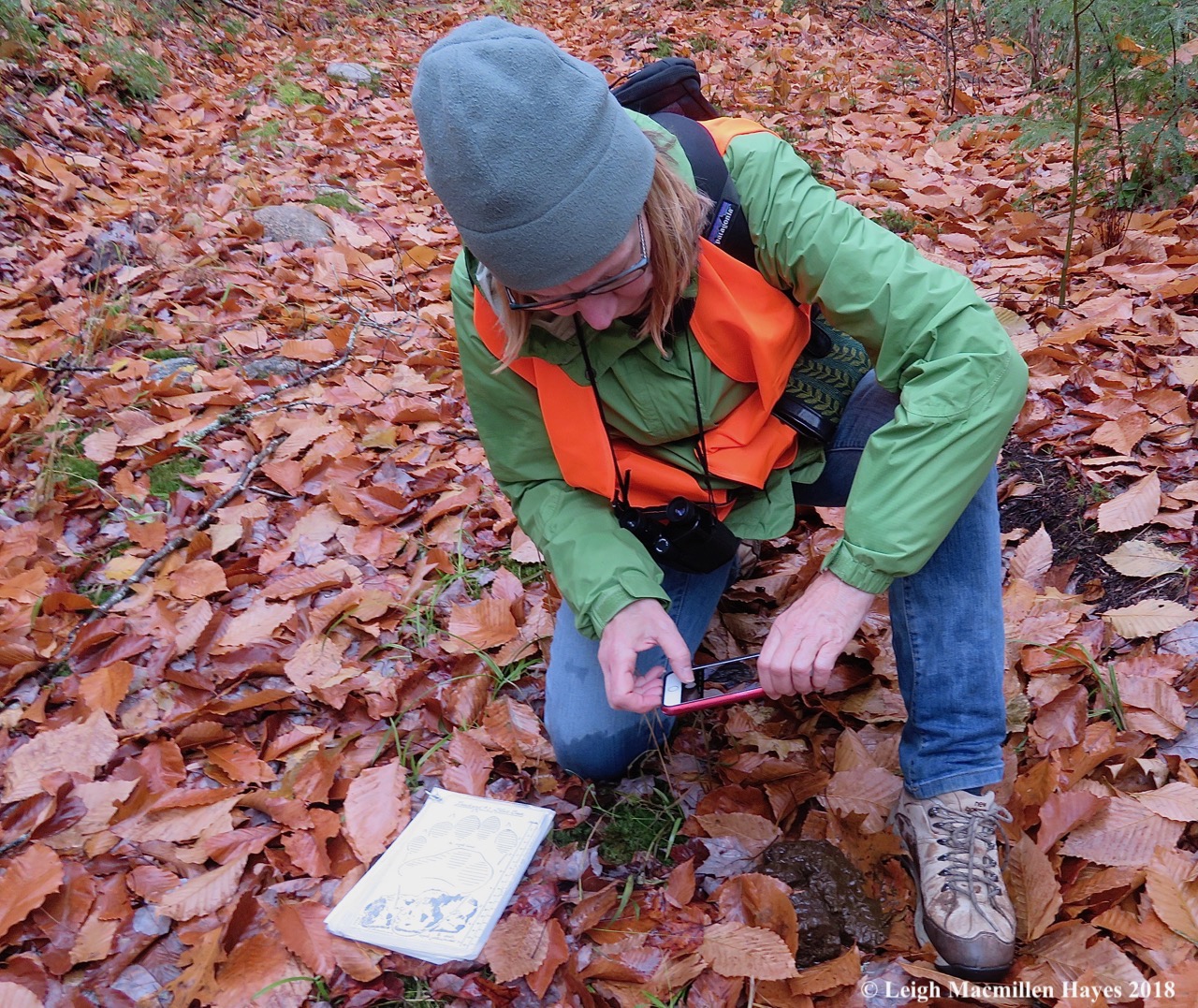
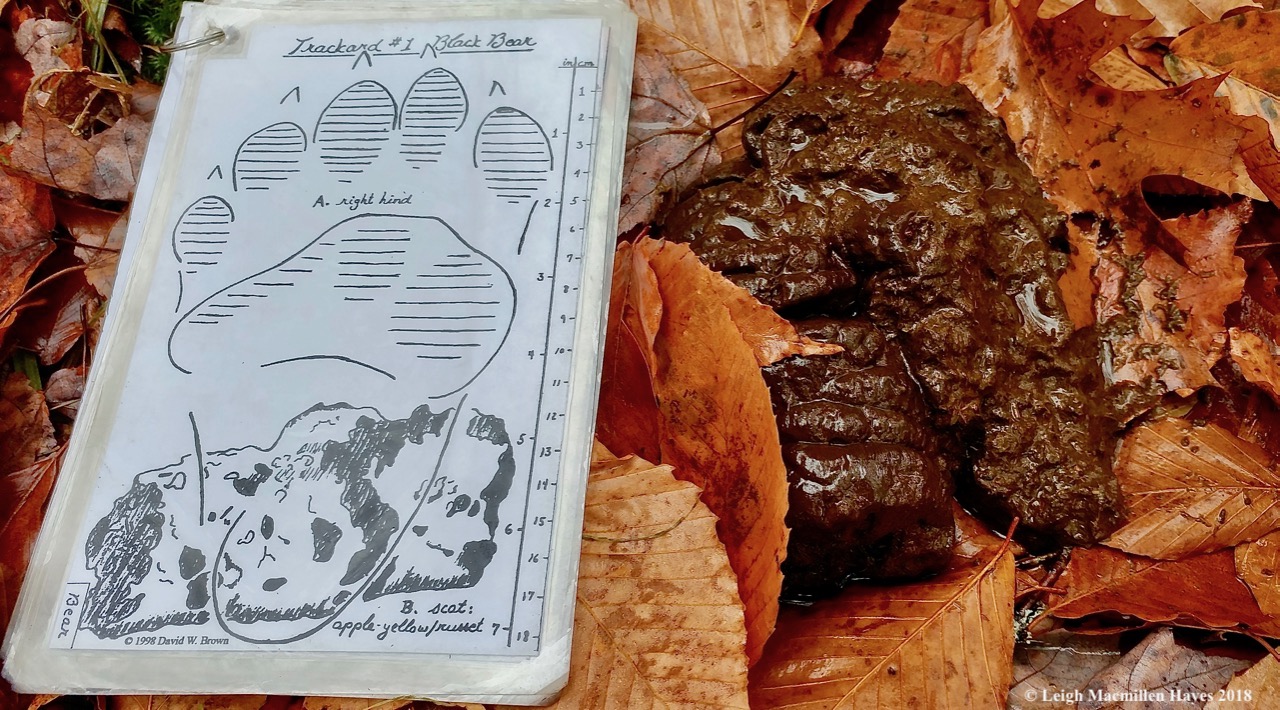
Our next great find was of a different sort and I had to pull the Trackards from my pack while Pam got down for another upclose and personal look. Notice her knee?

22-bear scat

Black bear scat! Indeed. Cylindral and large. We looked for tracks, but conditions were such that we didn’t find any. The scat was enough for this day.

24-Tamaracks

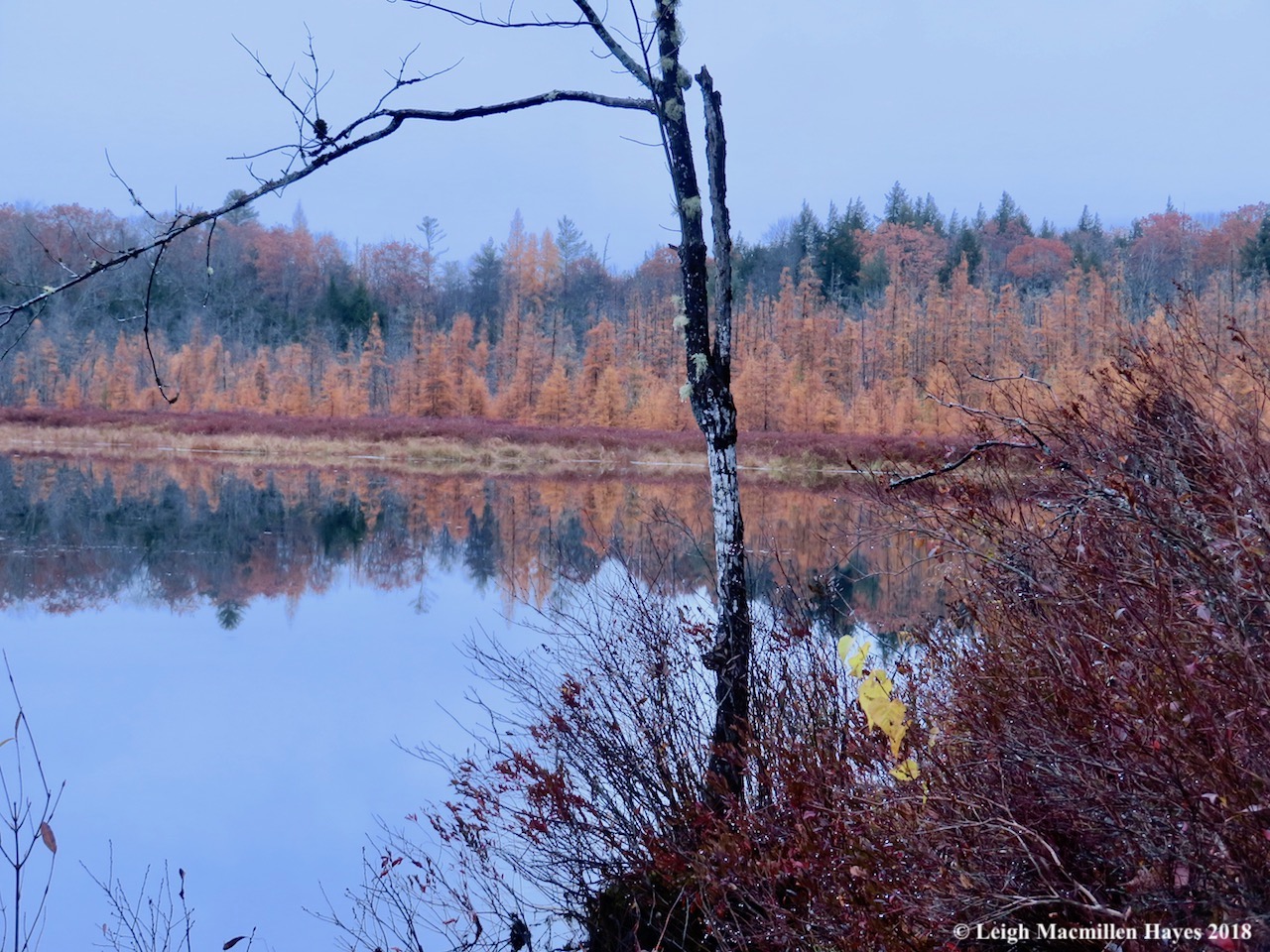
If you go, we strongly encourage you to follow the green trail all the way to the bird/wildlife viewing point along Sucker Brook. Today, the tamaracks on the shore to our right added a tone of bright beauty to the overcast day.

25-Sucker Brook--beaver lodge

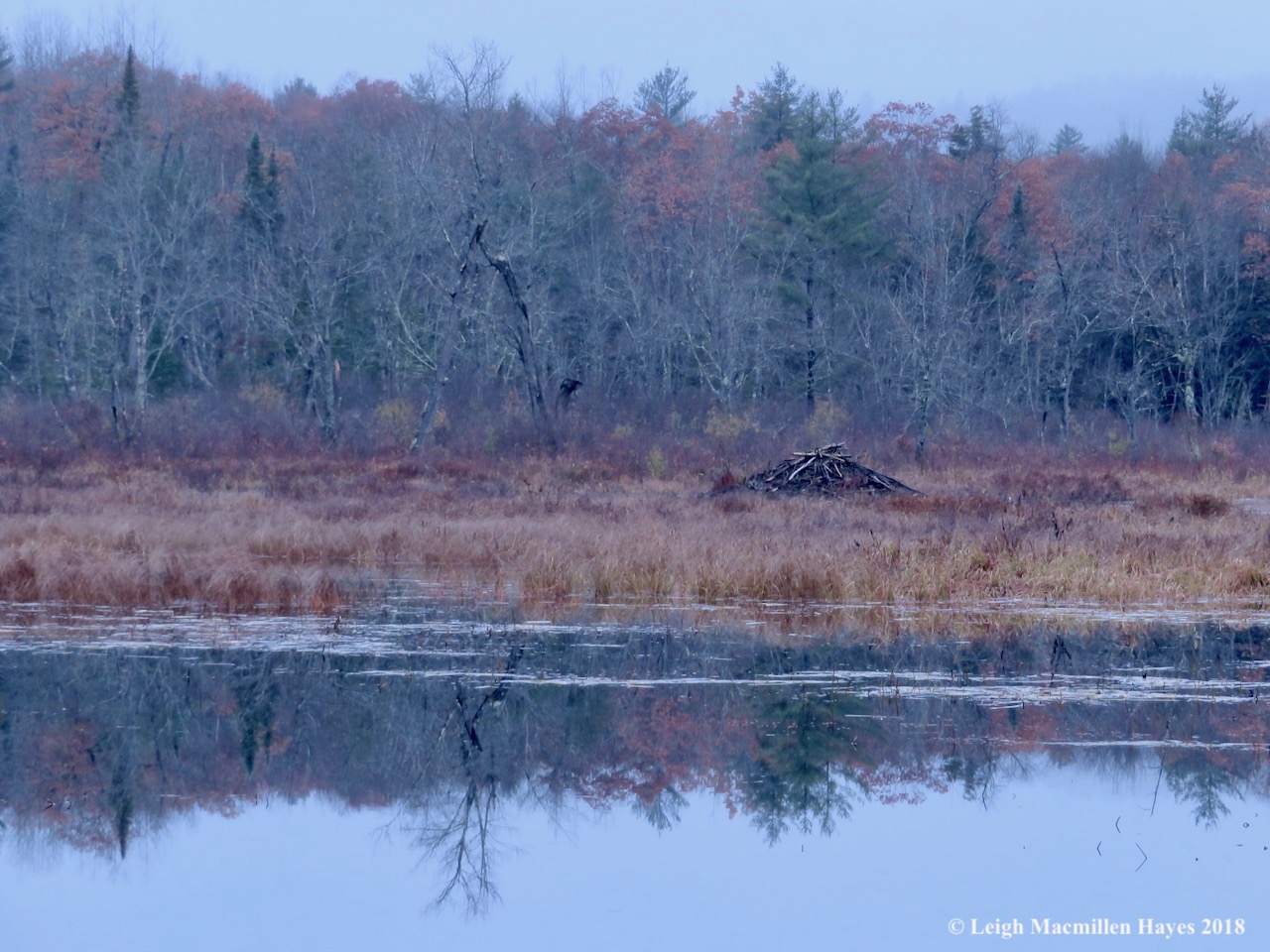
And another old beaver lodge also looked like it had received a mud treatment. We could see some beaver chew sticks in the water by the edge of the brook and so we knew again that there had been recent activity. It just means we’ll have to return for another visit if we want to catch some action–perhaps earlier in the day.

In the meantime, we let the view point become our turn-around point and quickly (sorta) followed the blue trail back for we both needed to move on to the rest of our day.

But . . . despite the mist and occasional raindrops, we elected to tramp. And were delighted with the results. Here’s hoping the rest of the day goes like that.


Focus on Home Mondate

Some days are meant to be spent at home, especially when there’s yard work to finish up before the snow flies. And so today was just such a day and my guy chose to work on the leaves while I finished putting the gardens to bed and mowed one last time for this year.

1-bird's nest fungi

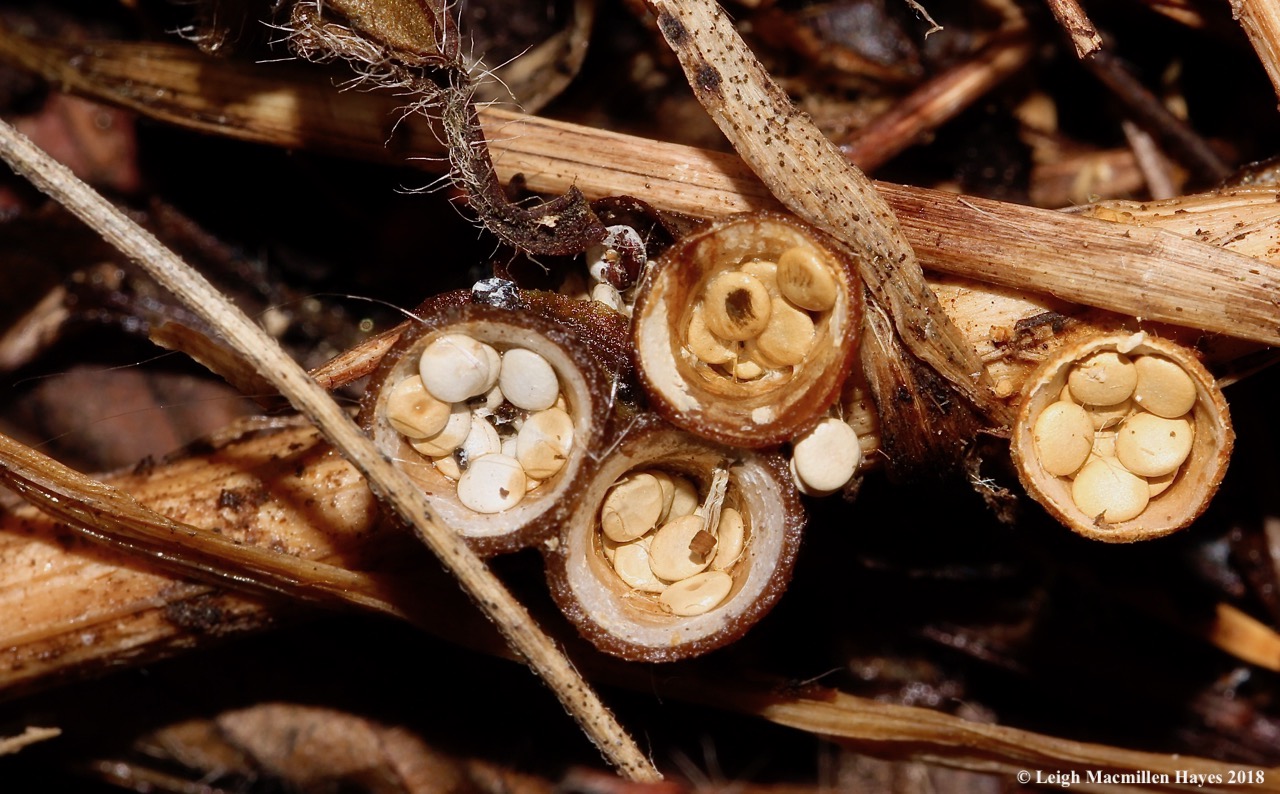
It was while putting the garden to bed that I made a discovery–a form of bird’s nest fungi, this one being Crucibulum laeve! The structure is so named because it resembles a tiny bird nest. Prior to spore distribution, each “nest” is covered with a yellowish lid. Inside, the little disc-shaped “eggs” are called peridioles, which contain the spores. When a raindrop falls into the nest, the eggs are projected out of the cup. I’ve had the honor or watching that one rainy day, but it was one of those “you had to be there” moments that will live on in my mind’s eye.

2-porcupine tree

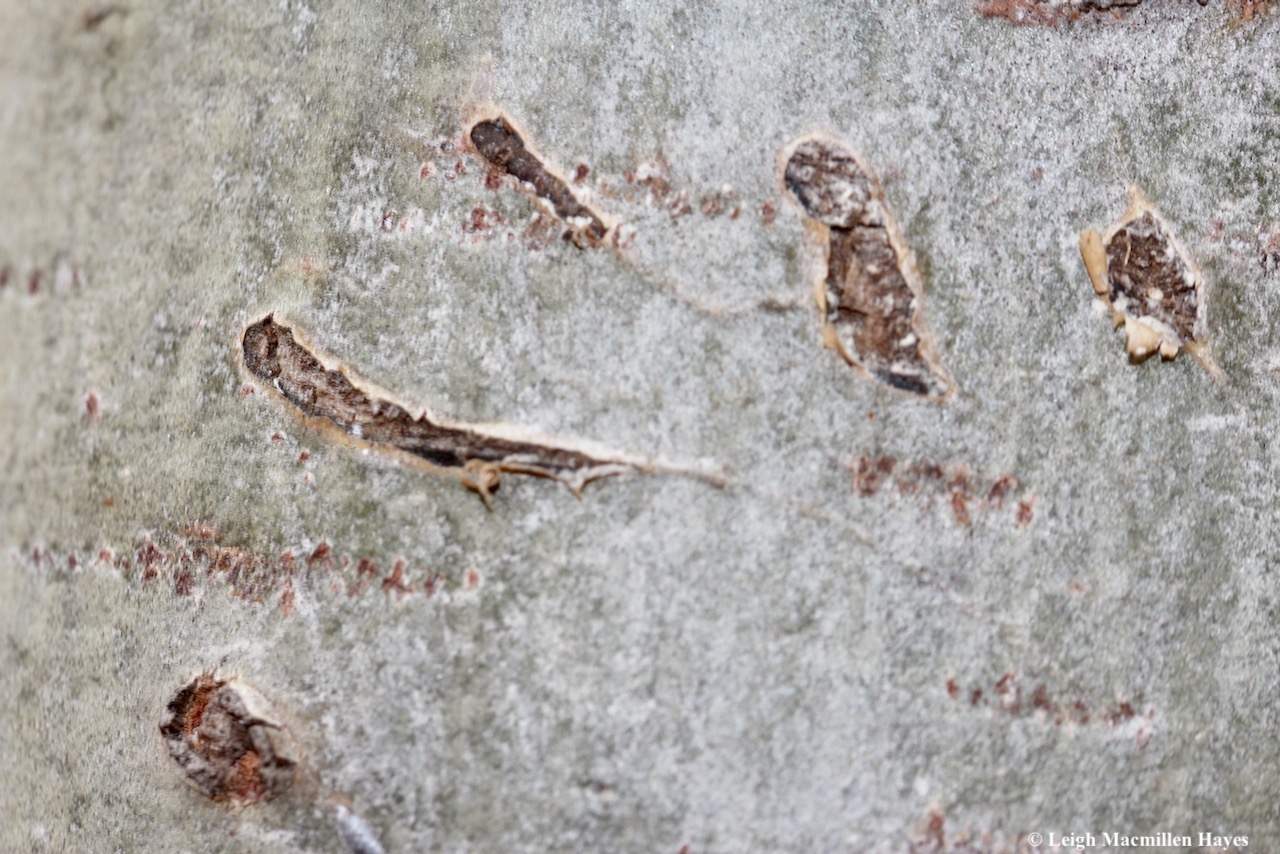
In one of the gardens stands a rather decrepit Quaking Aspen. It’s a favorite tree for woodpeckers and porcupines. thus it’s terrible condition. And usually I post photos of bear claw trees, but this particular aspen sports many, many porcupine scratches, some new and others older, such as these.

3-lady bug

As I looked at the bark to notice what else might be about, I spotted a spotted ladybug. We’d had a frost overnight, but she continued to move, however lethargically.

12-bagworm

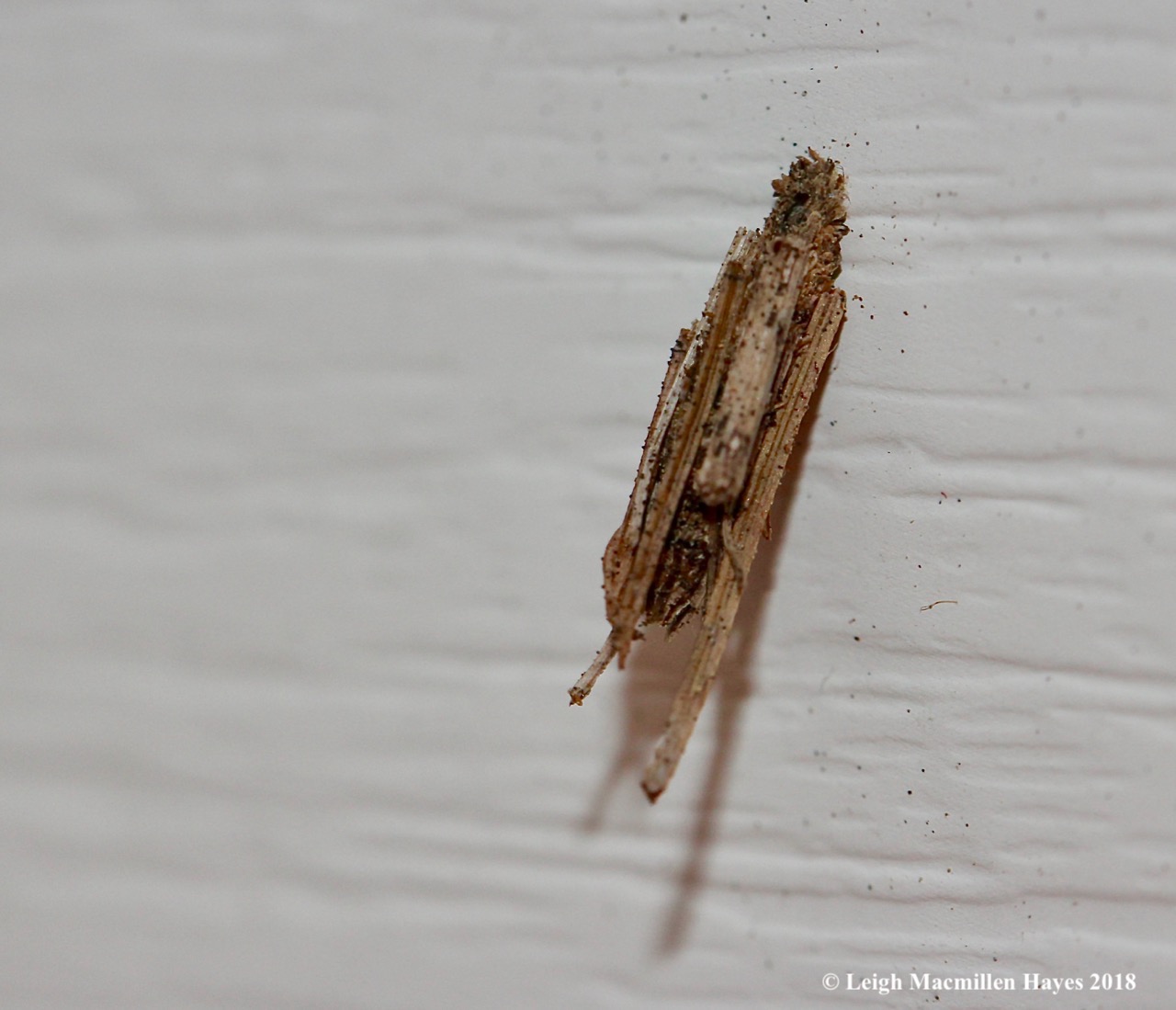
By the kitchen garden, I found another insect I’d forgotten all about these last few weeks–the caterpillar larvae of the Psychidae or bagworm moths that construct cases out of silk and environmental materials, much the way a caddisfly might. It’s the perfect camouflage from predators such as birds and even other insects.

4-milkweed seed

Everywhere throughout the garden were milkweed seeds, some wearing beaded skirts that will likely keep them in place. That’s fine with me, for I love milkweed. Even if this one does eventually fly away on a whim and voluntarily plant itself in another location, I know that my plants will produce more seeds for they also increase their population via underground tuberous rhizomes. Some call them invasive; I call them welcome.

12-hole in yard?

I’m not so sure the creator of this large hole in the yard is welcome. I know my guy wasn’t impressed. It’s about a foot wide and deep. We suspect one of “our” woodchucks. I’d rather think it was excavated by the beautiful red fox that crosses the yard several times a day, but it’s a bit away from the fox’s route.

5-mealy pixie cup lichen

My wander eventually took me from the garden to the stone walls, where lichens form their own little gardens and support such species as the Mealy Pixie Cups, a fruticose lichen with a stalk or podetia below the cup.

6-Rock Shield

Foliose-styled rock shield lichens grow abundantly on the rock’s surface, their success due to the numerous disk-shaped structures called apothecia. Reproductive spores develop on the rolled edges of the brown berets, awaiting the time when conditions are just right for them to move on and grow into a new lichen.

7-Cinder Lichen

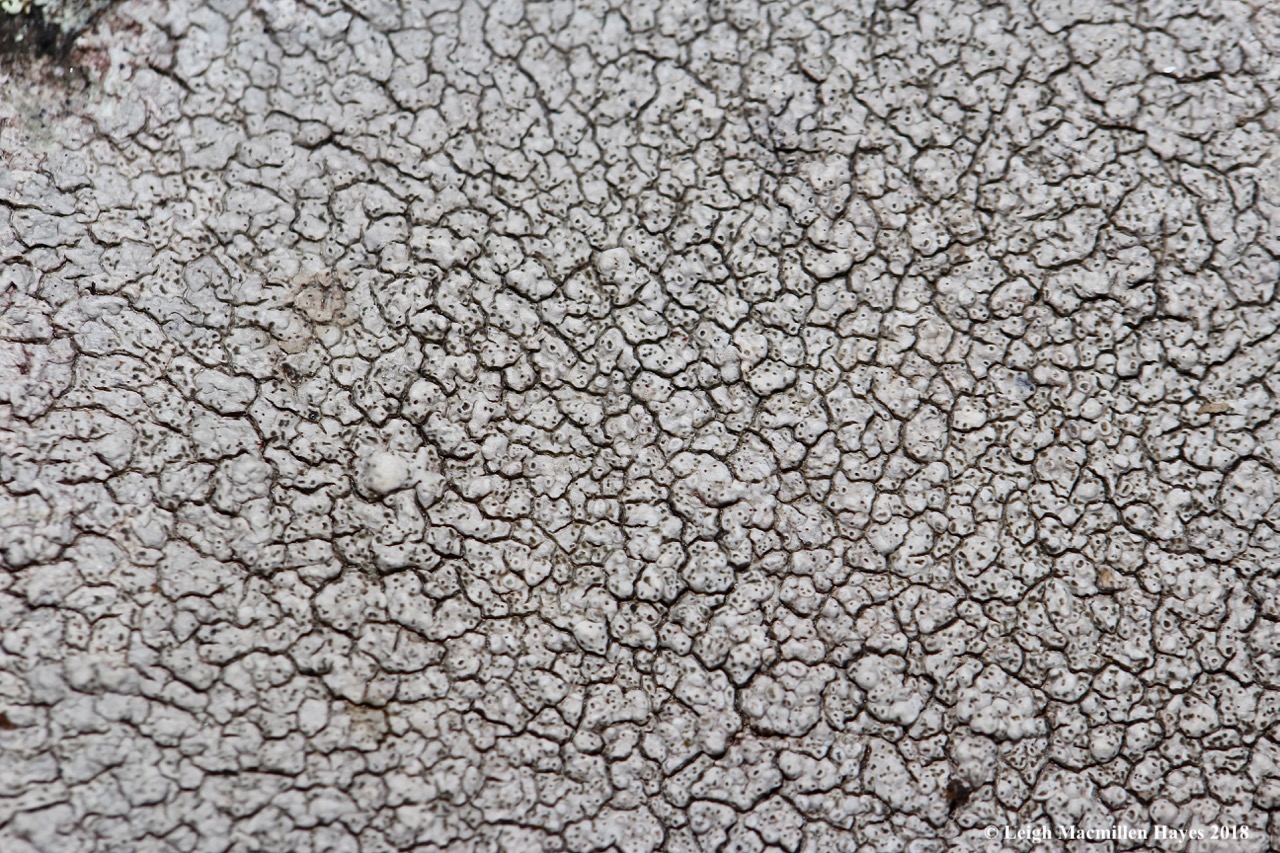
Crustose lichens were the most plentiful with their painted on appearance, like this ash-gray Cinder Lichen that reminded me of a mosaic piece of artwork.

8-Concentric Boulder Lichen

One of my favorite crustoses, however,  was the Concentric Boulder Lichen with its raised blackish-brown apothecia. Each time I saw the pattern created by the little disks, I felt like I was looking at a maze.

9-tent caterpillar egg cases

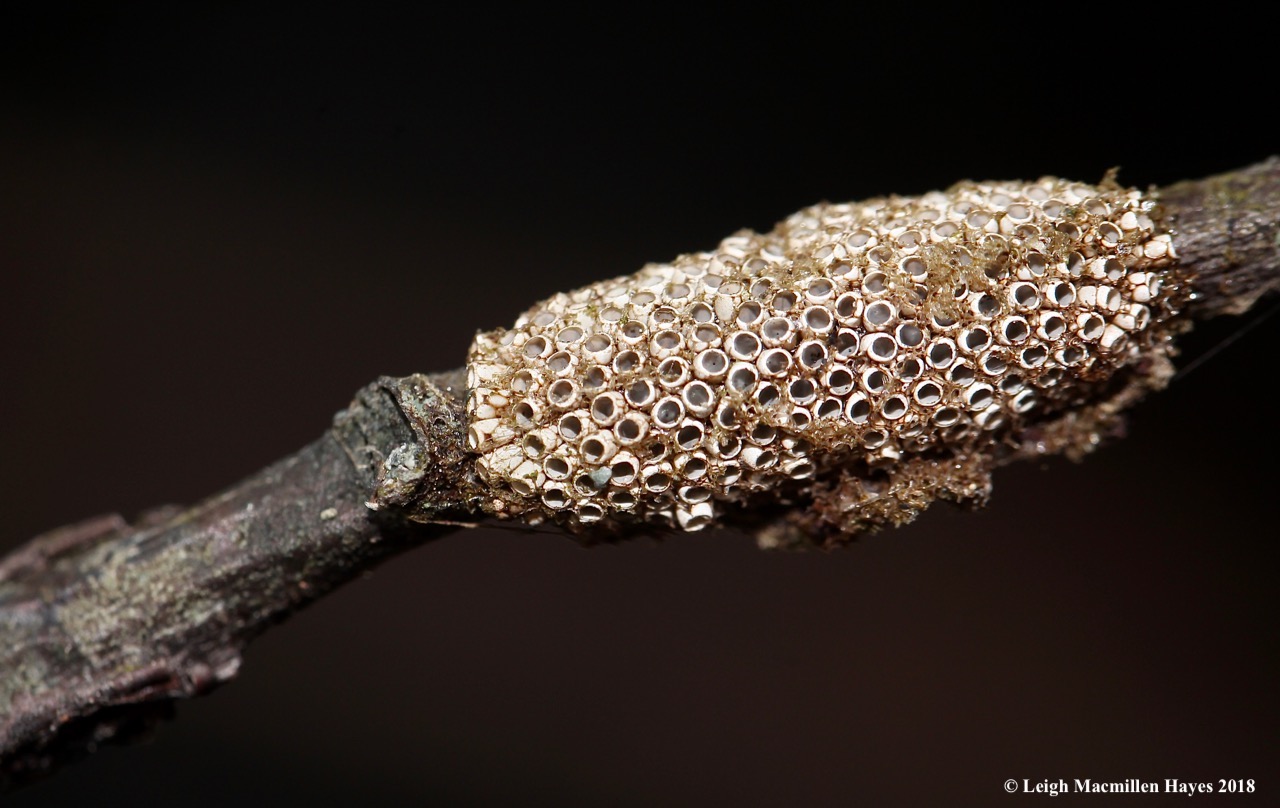
And then I stepped over the wall and turned my attention to some trees. That’s when I spied numerous tent caterpillar eggs cases. The Eastern Tent Caterpillar overwinters as an egg. Each one is part of a greater mass of anywhere from 150 to 400 eggs. They encircle a branch and are almost impossible to see, until your eye begins to recognize the structure. This was an old one and no longer had the shiny varnish-like coating that will help keep winter at bay.

11-red maple flower and leaf buds

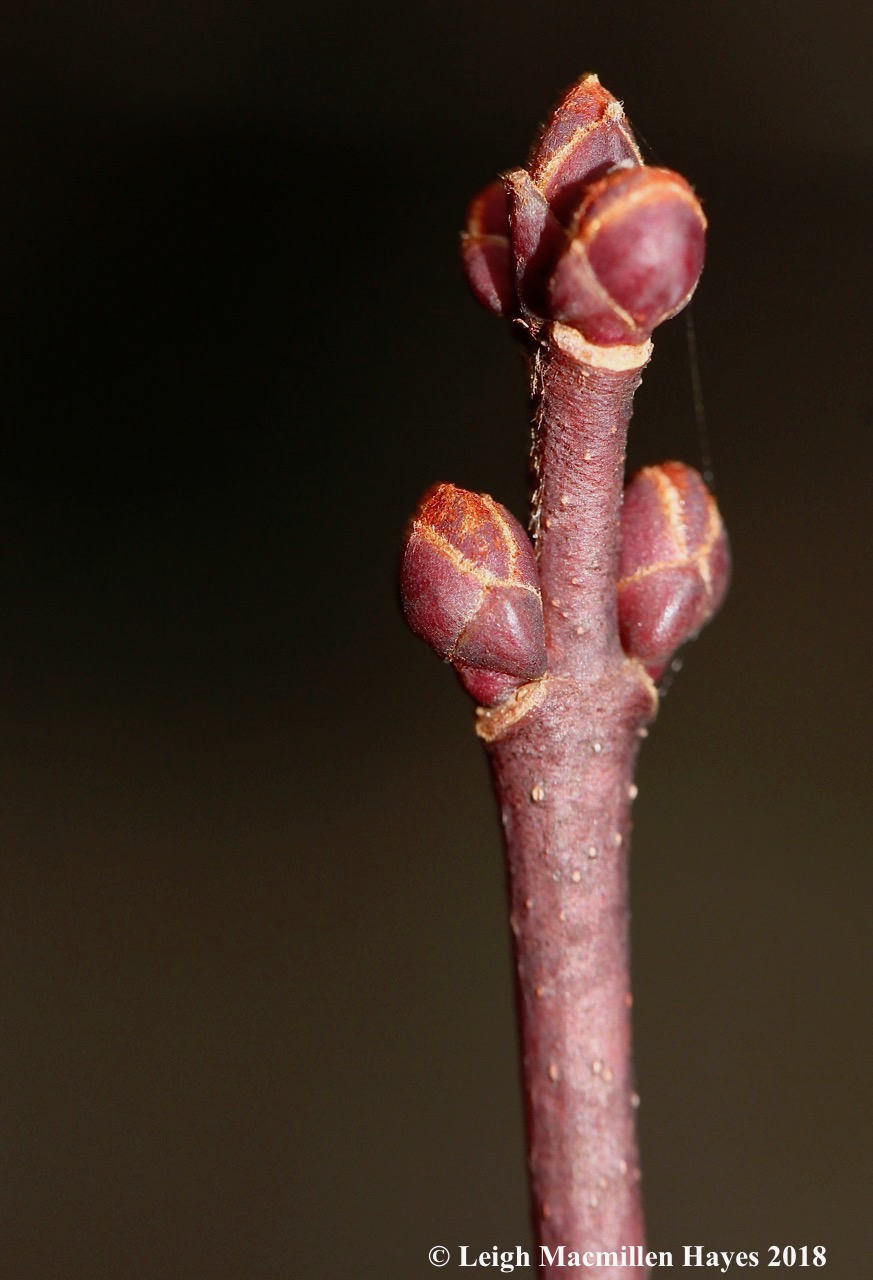
Also keeping winter at bay were the waxy scales of tree leaf and flower buds. The buds formed in the summer and now must wait for February’s warm sun before they begin to swell and ready themselves for next spring’s bloom. In the meantime, they are snug inside their tight structures.

10-tube caterpillar tube

My next great find–tubes or tunnels created by the Pine Tube Moth. Last summer, larvae hatched from eggs deposited on the needles. Though Eastern White Pine needles grow in packets of five (W-H-I-T-E or M-A-I-N-E is a mnemonic we use to remember how many needles on the white pine, spelling “white” for its name or “Maine” because it is the state tree.) Anyway, the tube moth used silk to bind a bunch of  needles together, thus forming a hollow tube. Can you see the silk at the top? Notice the browned tips–that’s due to the larvae feeding on them. Eventually the overwintering larvae will pupate within the tube and in April they’ll emerge. Two generations occur each year and those that overwinter are the second generation. The good news is that Pine Tube Moths are not considered a significant pest.

13-pinesap winter capsules

One of my favorite finds as I headed down the cowpath toward home was actually an old friend–Pinesap in its winter capsule form. Pinesap is similar to Indian Pipe, another Monotropa (once turned speaking to its flower that turns upright after fertilization). The creamy whitish flowers developed into woody capsules. As the capsules mature, the structures become erect. Once ripened, seeds will be released through slits that open from the tip to the base of the capsules.

14-False Tinder Polypore

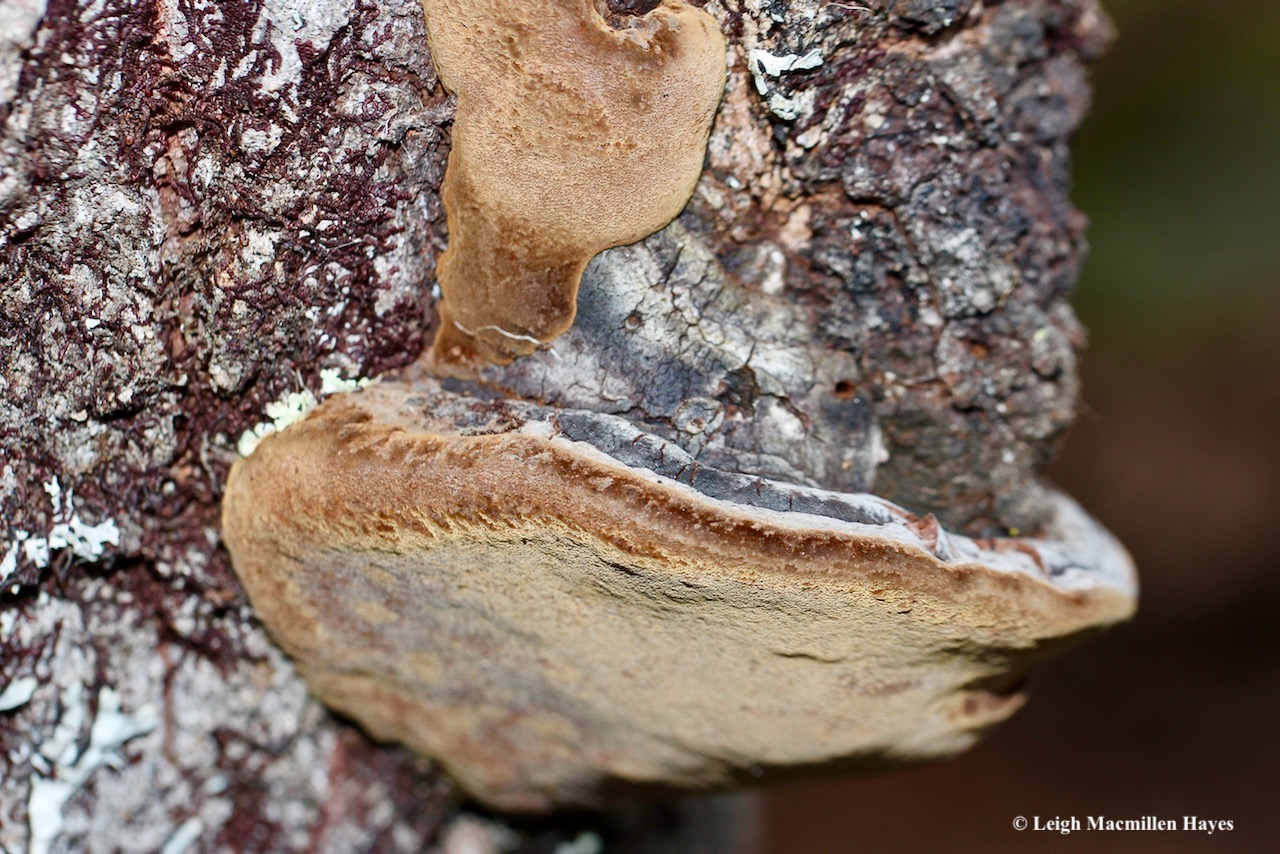
I was back in the grassy part of our yard when I passed by a tree in the corner and made a new discovery–a false tinder conk or polypore, with its black fissured cap. My very own Phellinus ignarius! While a Tinder Conks pore surface is usually concave, in the false specimen, it’s angled downward from the rim to the tree.

I know my friend Faith will see a smiley face in the upper spore surface; it rather reminds me of a weasel.

We never left home today, my guy and me. Our focus was on the yard, but mine was a wee bit different than his. And for those of you who have been asking–these photographs were all taken with the Canon Rebel T3i. Yep, that’s the one that got wet when I decided to flip off a boardwalk last May.

Bishop Cardinal Reserve: Where (Wo)Man and Nature Intersect

Perhaps we should have tiptoed and tried to silently pass through the woods much the way a fox or bear might, but that is not our habit. And so on today’s Tuesday Tramp for the Greater Lovell Land Trust, we chatted and wondered aloud as we hiked along the  trails of Bishop Cardinal Reserve on the upper side of Horseshoe Pond Road in Lovell. Consequently, our wild mammal sightings were non-existent. Despite that, we saw soooo much.

9-docents Bob and Pam

Our team was small this morning, with only docents Bob and Pam joining me, but still we made plenty of noise as we looked about.

4-bear pole

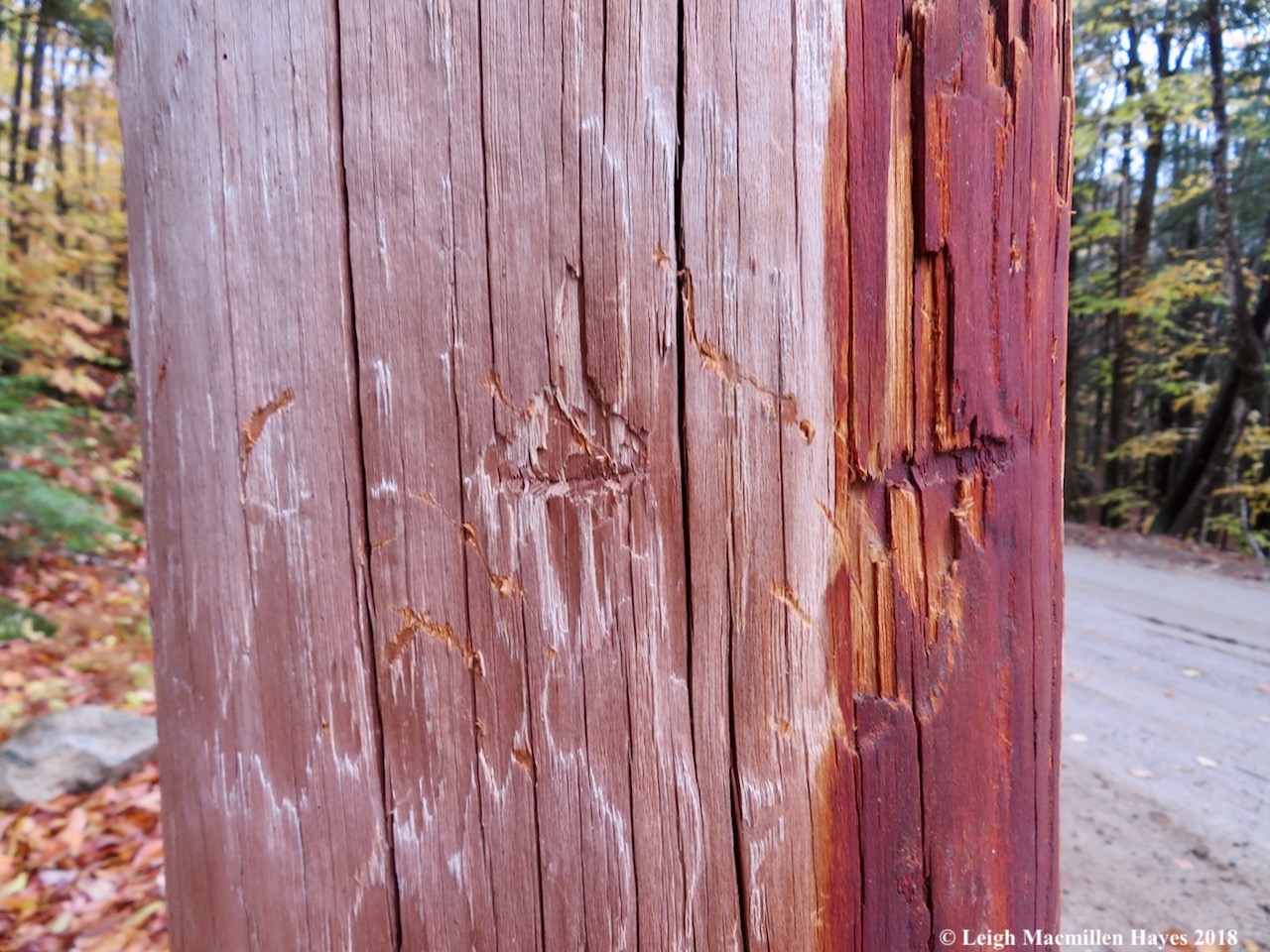
The first sign of mammal and human interaction, of course, was the telephone pole beside the trailhead. If you’ve traveled with me either literally or virtually before, you know how I LOVE a telephone pole. It’s not the fact that such brings electrical power and other modern day amenities to our homes, but instead the realization that bears are attracted to them and like to leave a mark as they claw and bite at the anomaly in the forest surroundings. I always check for hair left behind, but today was disappointed to find none.

5-scratches on bear poles

Despite the lack of hair, there were a few newer scratches worth celebrating.

6-spider

And a small spider tossed into the mix. The temperature was on the chilly side as the wind blew, but not cold enough to begin the process of accumulating glycols in its blood (e.g., antifreeze) that would allow the spider to supercool. By physiologically adapting via special antifreeze compounds, the tissues of some Maine spiders remain unfrozen at temperatures well below freezing, and thus avoid turning into little blocks of ice once winter sets in. Of course, had it been a little bit cooler, this spider probably would have hidden in the leaf litter below rather than trying to send a telegram via the phone pole.

7-bear tree

A little further along the trail, however, we did find more bear sign in the form of claw marks on beech trees. And that raised the question: Do bears only climb beech trees? No. But, beech bark is one of the best to show off their signature scratches.

10-Pam's bear tree 1

After I showed Pam and Bob a couple of trees with claw marks, they began to look about and Pam spied one I’d not noticed before.

10-Pam's bear tree

Congratulations on your First To Find (FTF) Award, Pam! Well deserved.

11-deer skull

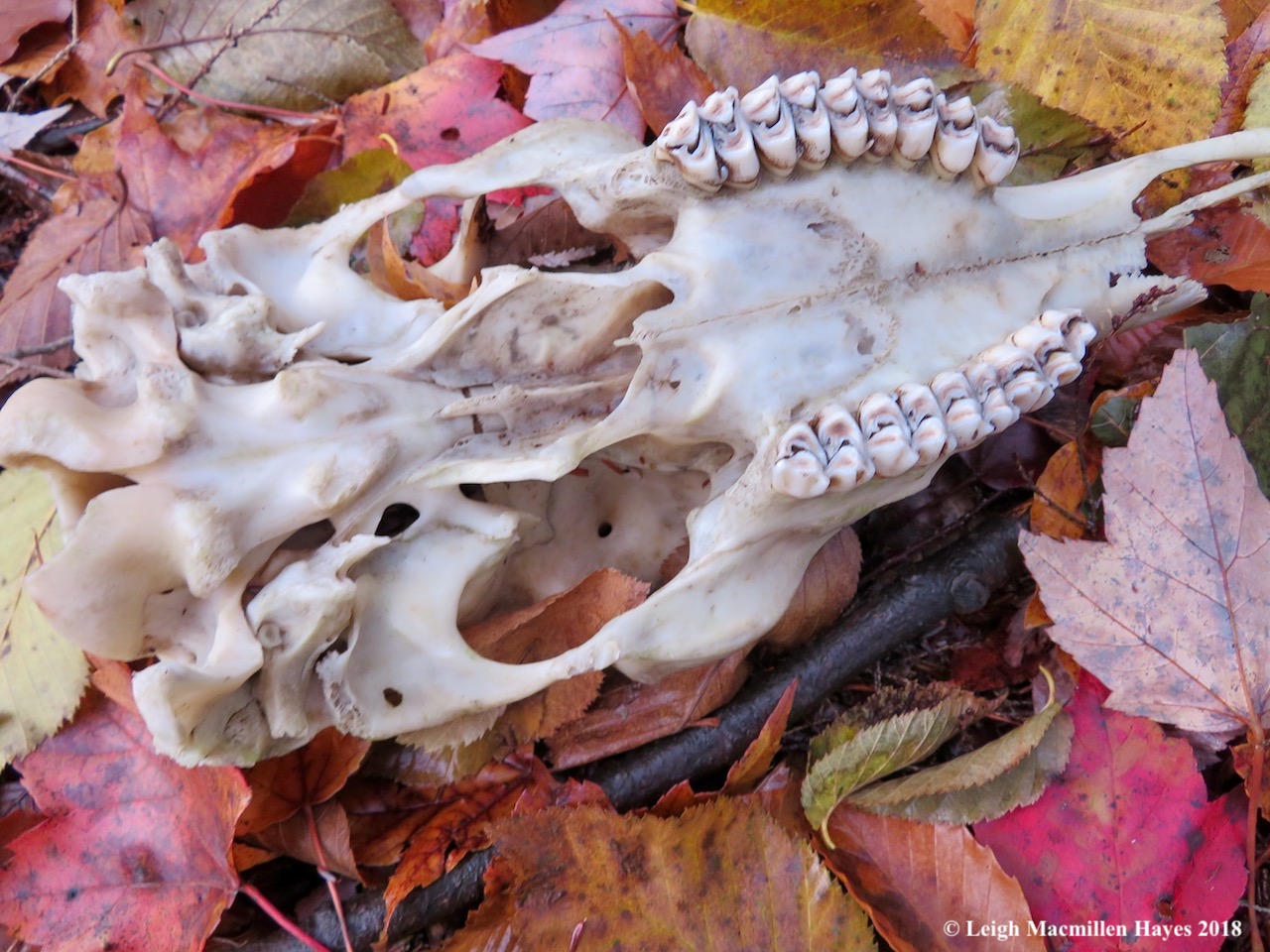
It wasn’t only bear sign that made the walk intriguing. A year and a half ago, this same couple had spied an entire deer carcass along the lower part of the trail. And so when we arrived in the vicinity today, we looked around. And eagle eyes Pam spied half the skull atop the leaves. What had happened to the deer? Human interaction? Old age? It was a rather large skull.

12-herbivore teeth

My, what flat teeth it had. Because herbivore teeth are highly specialized for eating plant matter which may be difficult to break down, their molars tend to be wider and flatter, thus allowing the animal to grind its food and aid in digestion.

13-lower jaw

We looked about for other bones and had to satisfy ourselves with a lower jaw. Had the rest of the skeleton been scattered and we just couldn’t see it below the recent leaf cover or had mice and other rodents dined on the bones from which they sought calcium? Coyotes, bears, and even another deer may also have moved the bones and found their own nourishment. Whatever happened, we knew it had been recycled . . . naturally.

14-coyote scat

And not far away on the edge of a bridge over a stream . . . coyote scat. It was not fresh, but fresher than the deer skull event, and full of hair. On what did the coyote dine? Snowshoe hare? Gray squirrel? Some other delectable offering? We weren’t sure.

15-squirrel storage

Dinner in the woods came in many forms, however, and on a fallen tree about four feet from the ground we found a mushroom turned upside down. Despite recent wind storms, we didn’t think it had blown up to that spot. Instead, a squirrel had set it there to dry. A squirrel’s food pantry is far bigger than a kitchen cupboard. Would it remember where it had placed the mushroom? Probably. Would another squirrel discover and snag it? Possibly.

16-squirrel storage

But there were others set in different spots to dry, so the original cacher might have some success in retrieving the food it had stored.

17-icy formation

As our time drew to a close, we noticed patterns in the mushrooms imitated by icy spots in a stream that spoke to the morning’s chill.

18-Horseshoe Pond Road

But the sun had come out and we relished its warmth as we headed back to our vehicles and on into the rest of our days.

16a-man-made wonder

Before doing so, however, there were two more sights to commemorate–the man-made line up of doors found deep in the woods . . .

2-Sand castle

and rain-made castles along the road side.

Bishop Cardinal Reserve–where man and nature intersect.


Put The Lawn Furniture Away Holiday

I don’t know the why of it, but it seems that each year when we plan to put the lawn furniture away, the forecast either includes wind gusts or snow. Well, yesterday it snowed. Not a lot of snow, mind you. But enough.

1-snow on the kayaks

It was, however,  melting quickly when we stopped by camp to begin our autumn chores.

3-porcupine tracks

Upon our return home, I diverted my attention for a bit and headed off into the woods, where much to my delight, tracking opportunities made themselves known. Though I didn’t see any of the creators, I smiled with the knowledge that I can share this land with them. Along the way I found a porcupine track pattern,

4-coyote--18 inch stride

plus a coyote with a stride of about nineteen inches (when you don’t take a tape measure it pays to improvise),

5-snowshoe lobster

and my favorite for this first tracking day of the season . . . a snowshoe lobster–I mean hare.

6-moose scat

Another favorite sighting, which I spied a few times–rather fresh moose scat the size of chocolate nuggets. (And no, I didn’t collect it to make jewelry. ;-))

7-my own track

As I moved, I left behind my own tracks and wondered if the mammals looked at those and knew I’d passed by. “Middle-aged female, the one who stalks us,” they might comment if they could talk. But really, it’s by my scent that they probably know me best. “Stinky middle-aged female . . .”

7a-leaves enhanced by snow

It wasn’t just tracks that caught my attention. The snow, spotted with tree drips, enhanced the color and borders of the foliage, making each leaf stand out.

7b-leaves under slush

In contrast, a more muted tapestry formed where foliage was trapped in slush-topped puddles.

8a-melted snow on sugar maple

And then there were those leaves turned upside down. I was fascinated by the variation of size in the water drops left behind as the snow melted. Every dot enhanced the pastel back-side colors . . .

8-melted snow on big tooth aspen leaf

and acted as a scope by showing off segments of venation.

9-snowdrops on grass

Patterns changed depending on the shape of the structure to which they clung.

10-goldenrod

And all were momentary for each drop eventually did what they do . . . dripped.

11-tachinid fly

While I admired the beauty, I wondered about the goldenrod that still bloomed and reminded me that though it had snowed and we’ve had some rather cold days, today was a bit warmer and it’s not winter yet. But those cold temps of a few days ago, I think they caught some by surprise, including this tachinid fly that dangled from another flower stalk.

12-hickory tussock moth caterpillar

And several times I found hickory tussock moth caterpillars frozen in place. While I admired the way the melted snow drops clung to the hair, I wondered about what I was seeing. Was it a shed skin? Or had this caterpillar been taken by surprise with weather conditions?

If you know, please enlighten me.

As it was, I needed to finish my wander for there was more furniture to put away on the homefront.

13-red-backed salamander

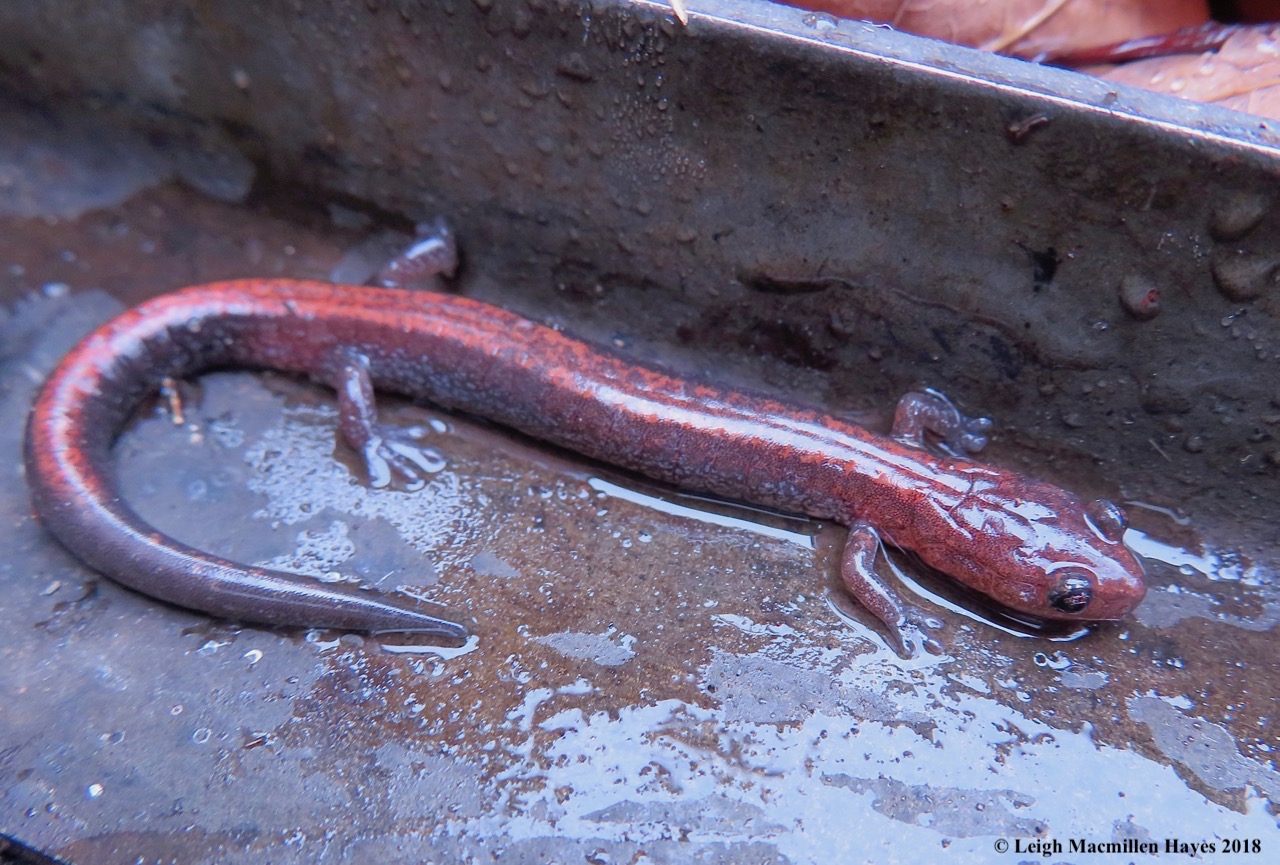
And when we opened the cellar hatch door to store the table and chair downstairs, another discovery was made . . . an Eastern red-backed salamander on top of the first step.

The day probably should have been named “Day After the First Snow Storm of the Season” but instead it was our “Put the Lawn Furniture Away Holiday.” Not everyone celebrates this day, but we do because as exciting as it is to bring the furniture out in the spring, it’s equally exciting to put it away and anticipate the coming season. Oh, and when we pull it again in the spring, you can trust that it will snow at least one more time.


What the Tree Spirit Knows

As I drove to Lovell this morning to take a photo for the Greater Lovell Land Trust’s winter newsletter, the crisp outline of a snow-covered Mount Washington made me realize that I had a short, unintended hike in my immediate future.

1a-Flat Hill view

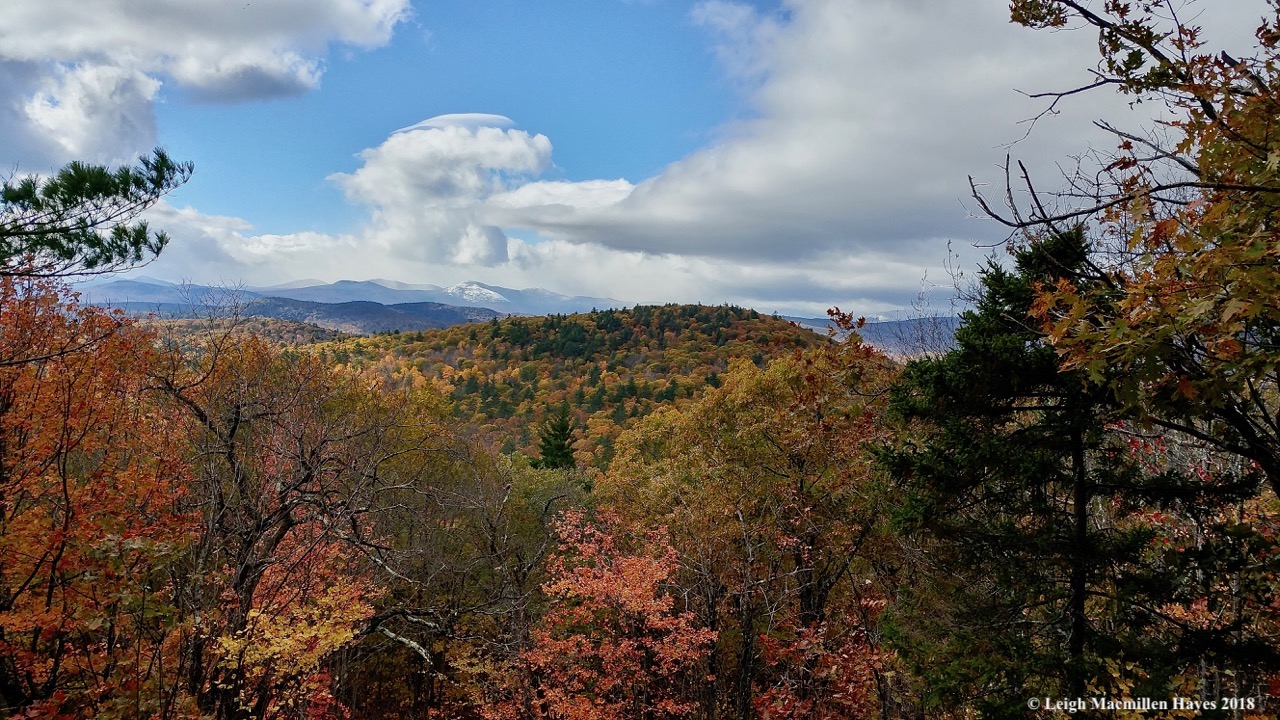
Yesterday, I’d climbed the Flat Hill Trail at the Heald and Bradley Ponds Reserve to take another photo for the newsletter–that one of the view from the summit of snow falling in the White Mountains. This past summer, staff and volunteers of the land trust had made some trail changes and opened several views, the one from Flat Hill being the most dramatic and the foliage, snow and sky enhanced the opening. But . . . today’s view was different and I knew I needed to capture it again.

Page 3 a

So . . . after a staff photo shoot at the Kezar River Reserve of Stewardship Associate Dakota, Associate Director Aidan, and Office Manager Alice, I headed north.

1-voss sign

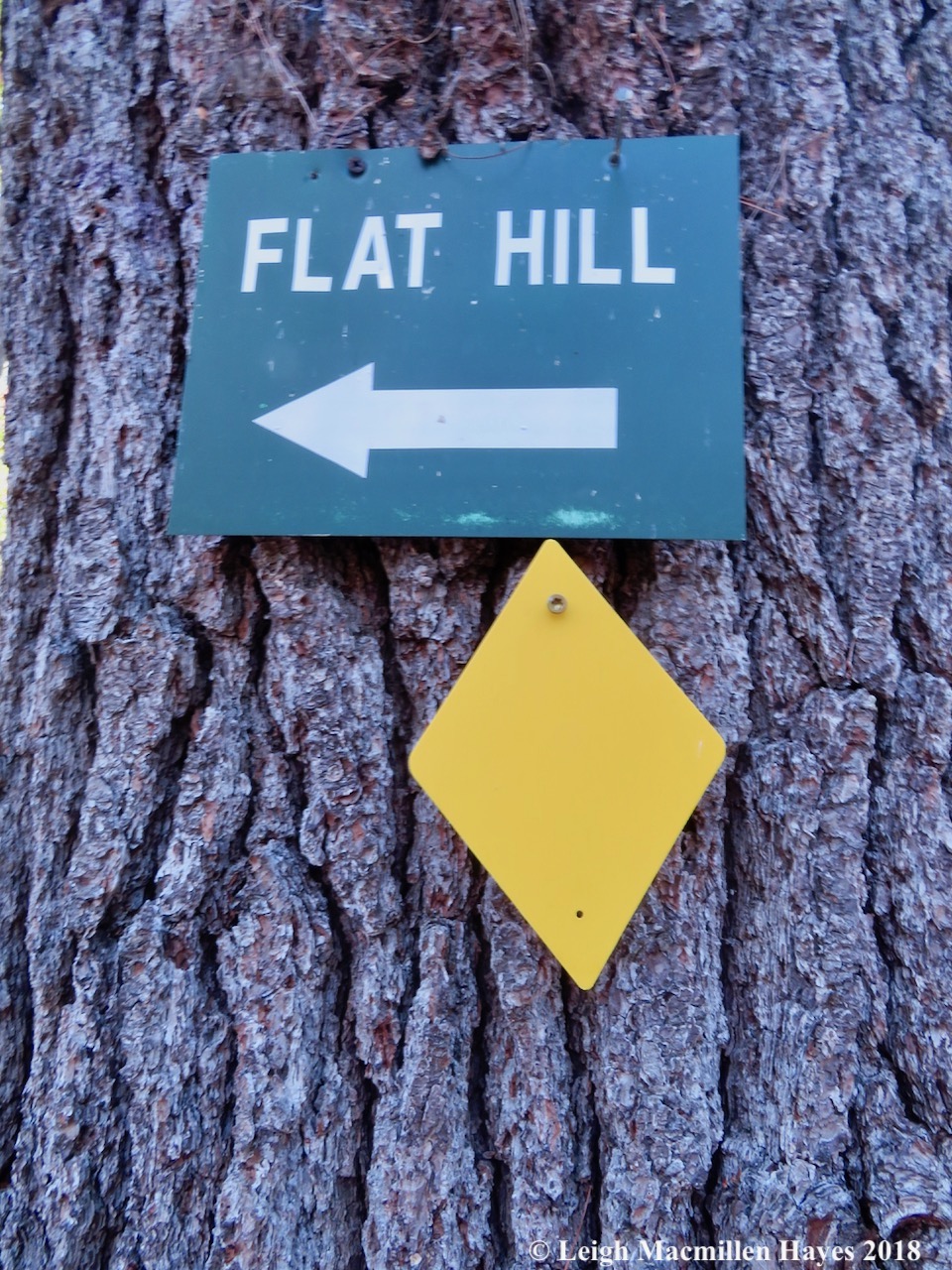
And laughed at myself for yesterday I never noticed the yellow Voss blazes that had been mounted to mark the trail. The hope is that eventually all the trails will be signed with different colored diamonds that will ease navigation.

2-big tooth aspen

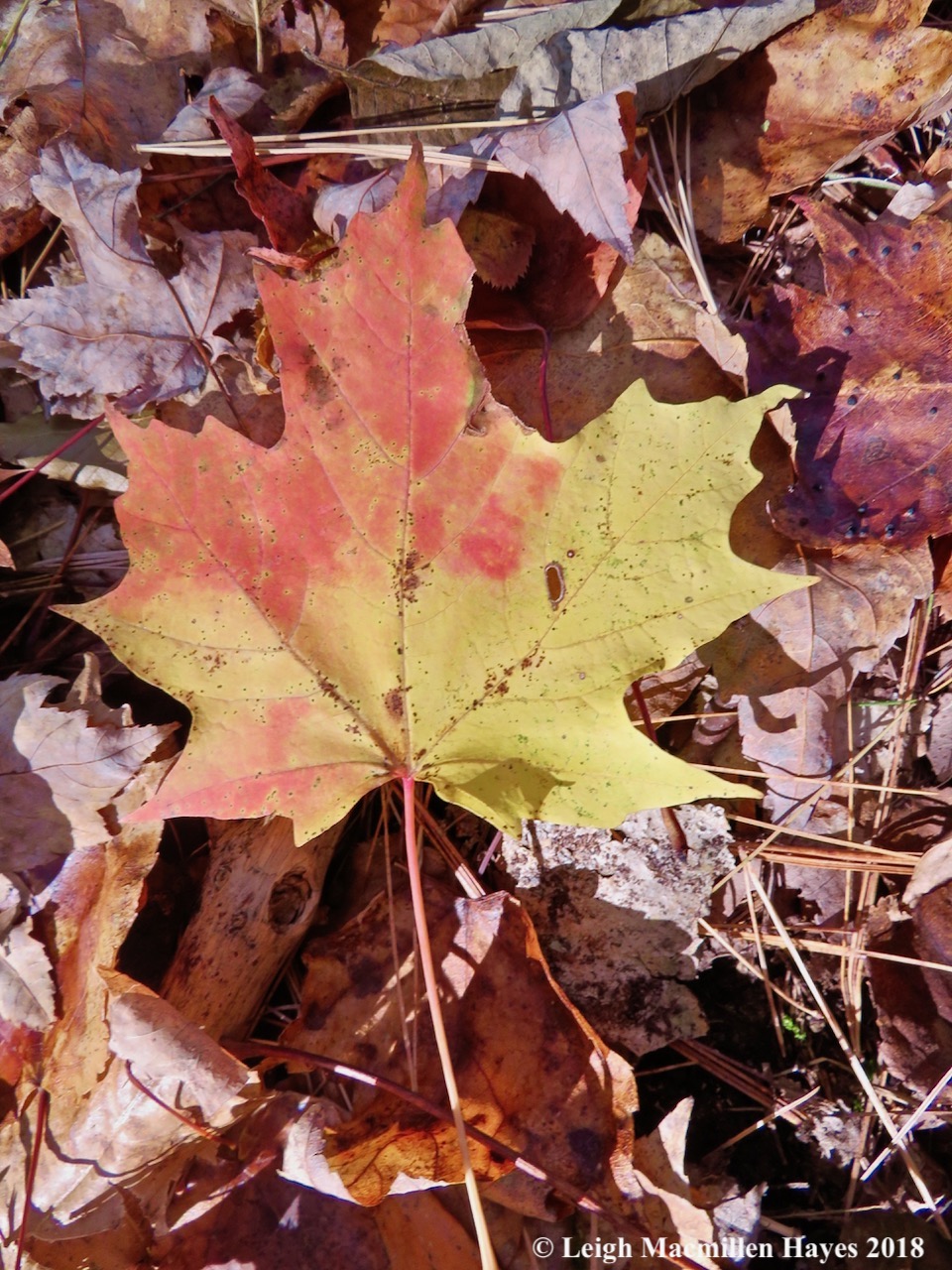
It’s a trail I know well, even with a new backwards S curve about two thirds of the way up that erased a steep and slippery portion and so instead I focused on those sights at my feet. While many leaves had already begun the long process of decomposition as they slowly break down and give nutrients back to the earth from which their trees grew, a few still sparkled like gems, including this Big-Tooth Aspen, aka poplar.

3-sugar maple

I was thrilled to discover Sugar Maple, defined by the U shape between its pointed lobes;

4-red maple

its V between lobes and toothier cousin, Red Maple;

5-striped maple

and even toothier kin, Striped Maple, known ’round these parts a goosefoot because its shape is similar. Some of us also refer to it as nature’s toilet paper for it’s large, soft, and easy to identify. You wouldn’t think of confusing it with poison ivy.

The curious thing about the Maple family, like all families in our northern New England forests, is that while the shape and color of the leaf helps us specify the family origins, each leaf within the family is different–whether in color or flaws or insect bites or galls. But despite their differences, they are all family.

6-large red oak

With the Striped Maple, I thought I’d found the largest species of the day, but a few more steps toward the summit revealed a rather large Northern Red Oak leaf.

7-even larger basswood leaf

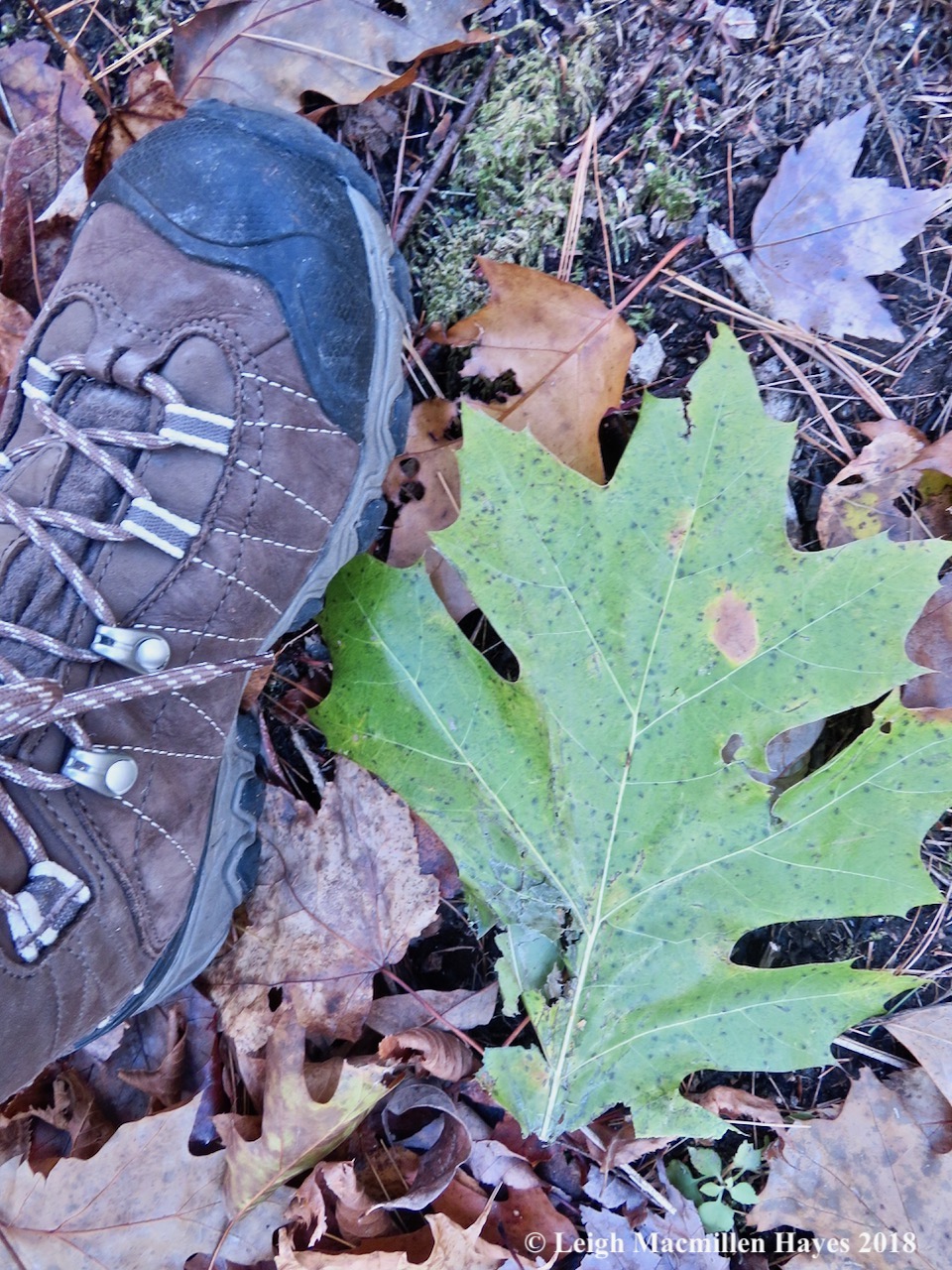
And then the biggest of all–Basswood. My hiking boots are size 8. And the leaf–also a size 8, with an asymmetrical base. That must prove a challenge when trying to find the right fit.

13-polypody ferns

Focusing on the leaves took my mind off the climb and within no time I’d reached the summit where Polypody ferns in their evergreen form decorated the northwestern corner of an otherwise bald rock.

14-red maple flower and leaf buds awaiting
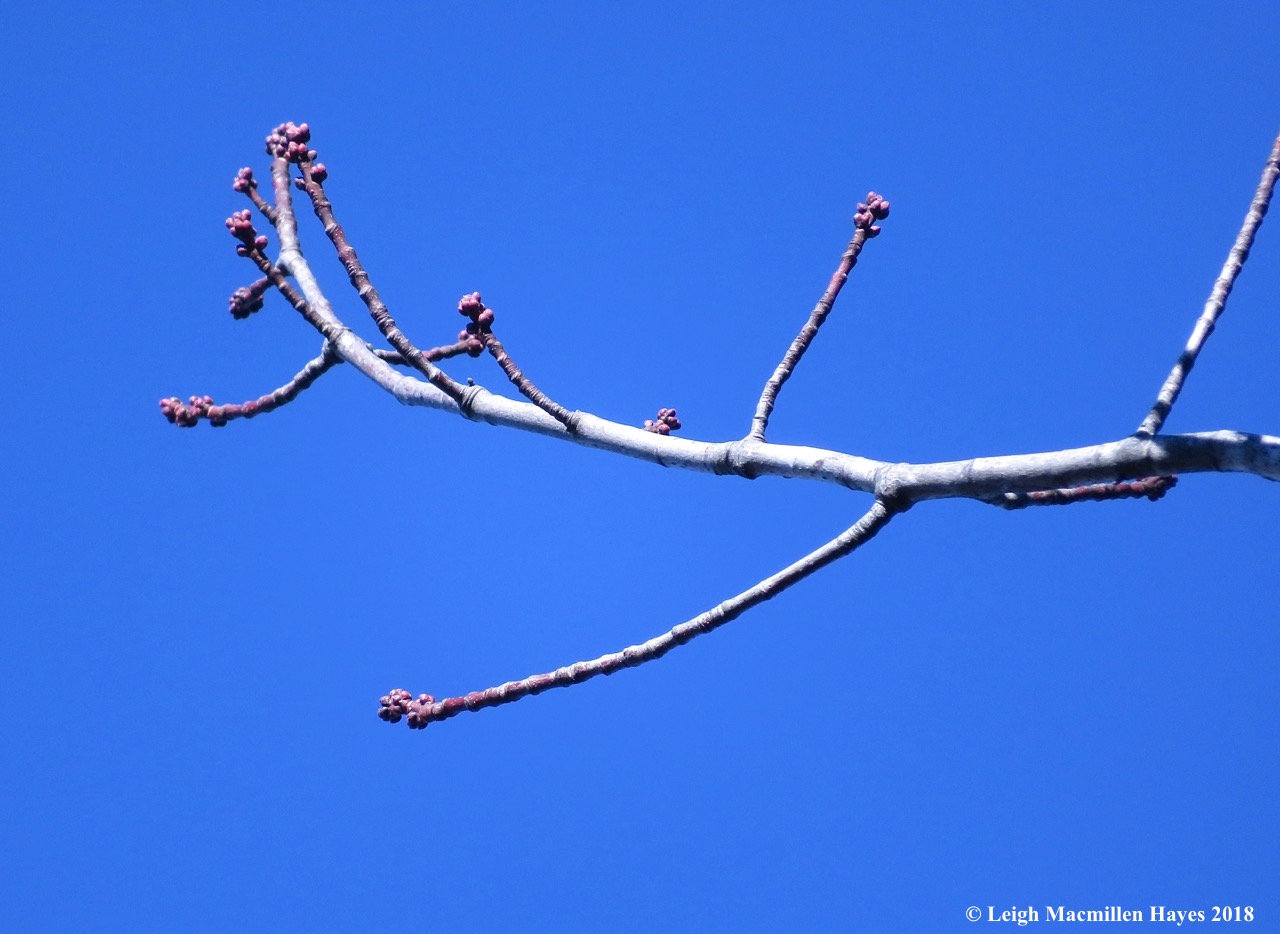
From the ferns where I’d planted my feet, I looked skyward and noticed the leaf and flower buds of a Red Maple, all tucked inside their waxy scales. It was the right place to be for as the north wind blew and my cheeks turned rosy red, I looked to the west.

9-Baldfaces to Carter Dome

Yesterday’s view had been transformed. No longer was it snowing from the Baldfaces to Carter Dome, with Mount Washington the whitest of all, posing between them. But still, it was chilly.

10-telescoping in on Mount Washington

A slight push on the camera lever and I pulled the scene a wee bit closer.

16-Perky's Path

At last I pulled myself away and hiked down, but so delightful was the morning, that I knew my newsletter work would have to wait a few more minutes at the intersection with Perky’s Path, for I felt the calling.

17-wetland--old beaver pond

It’s a wetland I visit frequently and once upon a time about five years ago it was filled to the brim with water because beavers had dammed it for their convenience.

18-suds reflect leaf

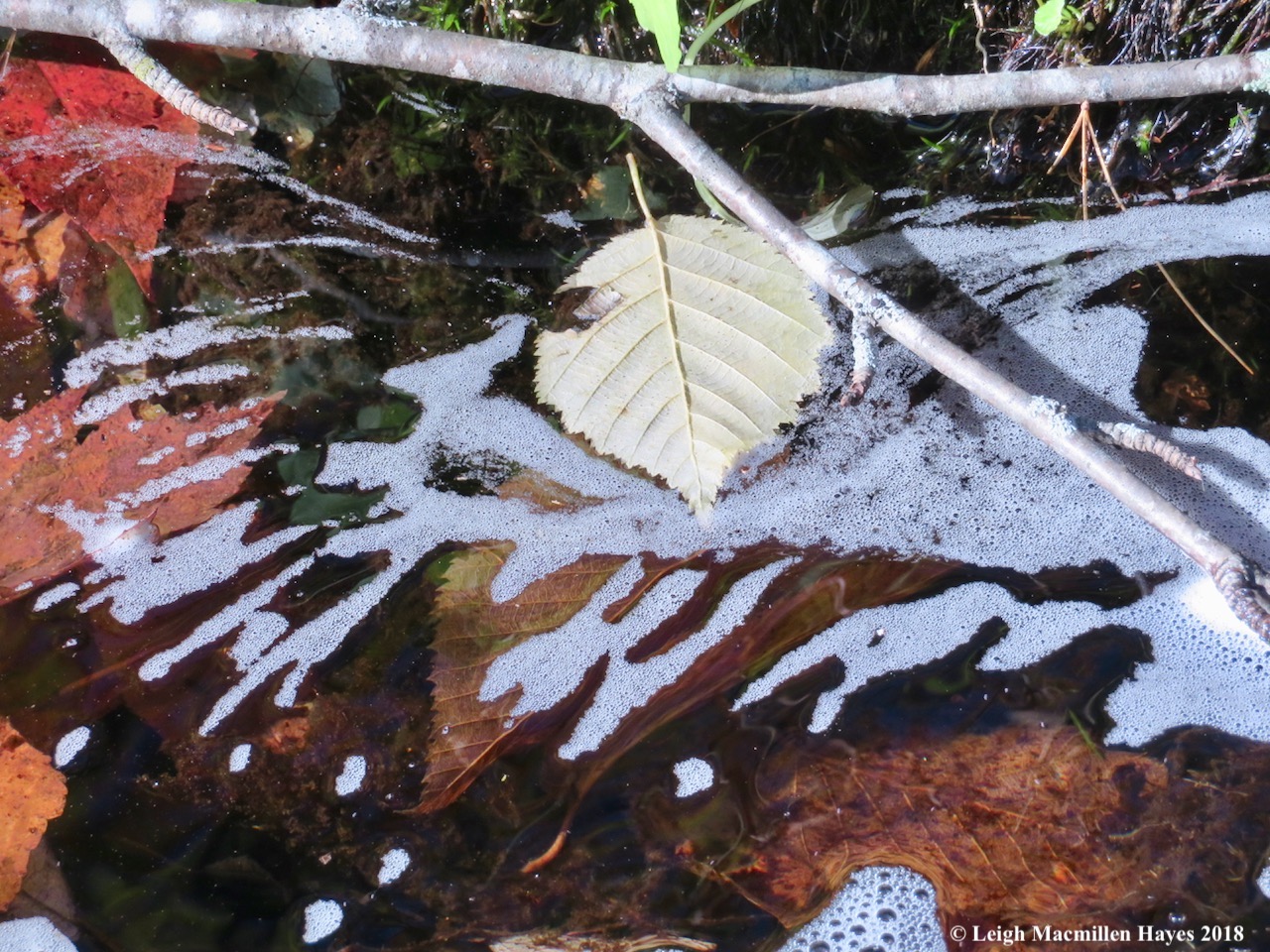
The only water today was found in a small stream that flowed through, its origin at Bradley Pond and terminus at Heald Pond. I stopped at the rock stepping path to admire what the water had to offer, including suds forming their own rachis or mid-vein from which side veins extended, a sideways rendition for the birch leaf caught between twigs.

19-view from the rock

In the middle of the stepping stones is a large flat rock. It was there that I settled in for a while, enjoying the feel of its sun-absorbed heat and the sound and views offered as the brook flowed slowly forth.

21-view from the bench

At last I pulled myself away and continued toward the bench that overlooked the wetland. All was quiet on this brisk day, but its a place of life and love and change.

22-back to the wetland

From there I continued to circle the old beaver pond to the point where I knew it had formerly been dammed. Climbing over and around moss-covered rocks, and into former stream beds, I made my way to the edge of what I used to call an infinity pool for the water was once at the dam’s upper level.

23-view from the beaver dam

Once I reached the dam, making my way one step at a time, for it was rather tricky footing at times, I discovered life on the other side. For all the years I’ve been involved with the land trust, I’d never seen this edge from this view. My surprise included the almost bald rocks.

25-coyote scat full of bones

Stepping from boulder to boulder, I made my way into the wetland a wee bit, but along the way realized someone had visited prior to me. Actually probably almost a year prior given the conditions of the scat left behind. Based on its shape, size, and inclusion of multiple bones plus lots of hair, I suspected a coyote had feed on a hare.

26-spider view

The coyote and I weren’t the only ones who knew of this secret place. A wolf spider darted in and out among the leaves, more afraid of me than I was of it.

27-spatterdock

And then I discovered something that perhaps they both already knew: the water supported a small colony of Spatterdock, a plant that will need to be added to the list of flora for this property. Do you see the ice on the Micky Mouse ear leaves?

28-ice

Ice had also formed around a fallen log, its swirls portraying a high-heeled boot that certainly might be appropriate in an ice sculpture but not on ice.

28-tree spirit

All of what I saw the tree spirit already knew. And yet, it allowed me to make discoveries from my feet to the sky.

29-Mount Washington summit

And every layer between. I know he’s not there anymore, but can’t you imagine Marty Engstrom on top of Mount Washington?


Amazing Race–Our Style: episode nine

“Drive to Newry and receive your next clue,” was the message we received midday yesterday and so as soon as my guy closed his store and sent in an order for more merchandise, we hopped into the truck and began our journey north. In Newry, just beyond Bethel, we found out we were to continue on to Rangeley and patronize the local businesses.

1-Moose and snow

First, however, we had to get there. Darkness enveloped us and flurries confused my vision as I drove with caution through Grafton Notch to Errol, New Hampshire, and then back into Maine toward our destination. Our wildlife sightings: two raccoons, a snowshoe hare still brown in color, a couple of deer and a cow moose and the bull moose you might see to the left of the first telephone pole. We were excited to say the least. And, I had proof that my slower speed was apropos–cuze my guy was teasing me.

3-the place to ourselves

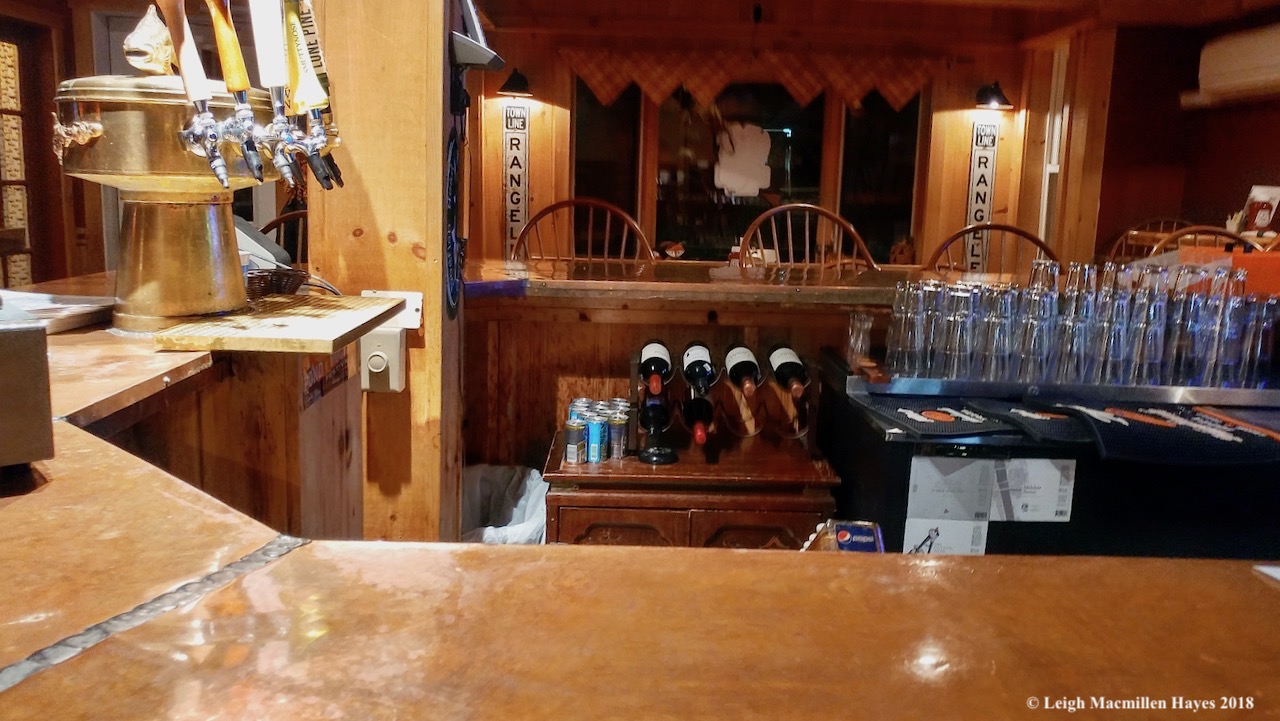
It was almost 8:00pm when we pulled into town and stopped at Parkside and Main for a burger. The restaurant closed at 8, but owner Kash Haley was gracious and told us to relax. So between plays in the football game, and bites of our burgers, we oohed and  aahed as one of the waitresses shared photos of her grandchildren with us.

2-hanging out at Parkside and Main

And then once all the patrons and staff had left, we sat for a bit longer at Kash’s insistence and enjoyed the game and each others company while he cashed out and sanitized the kitchen.

4-blue sunrise, blue sky in morning, snowflakes are forming

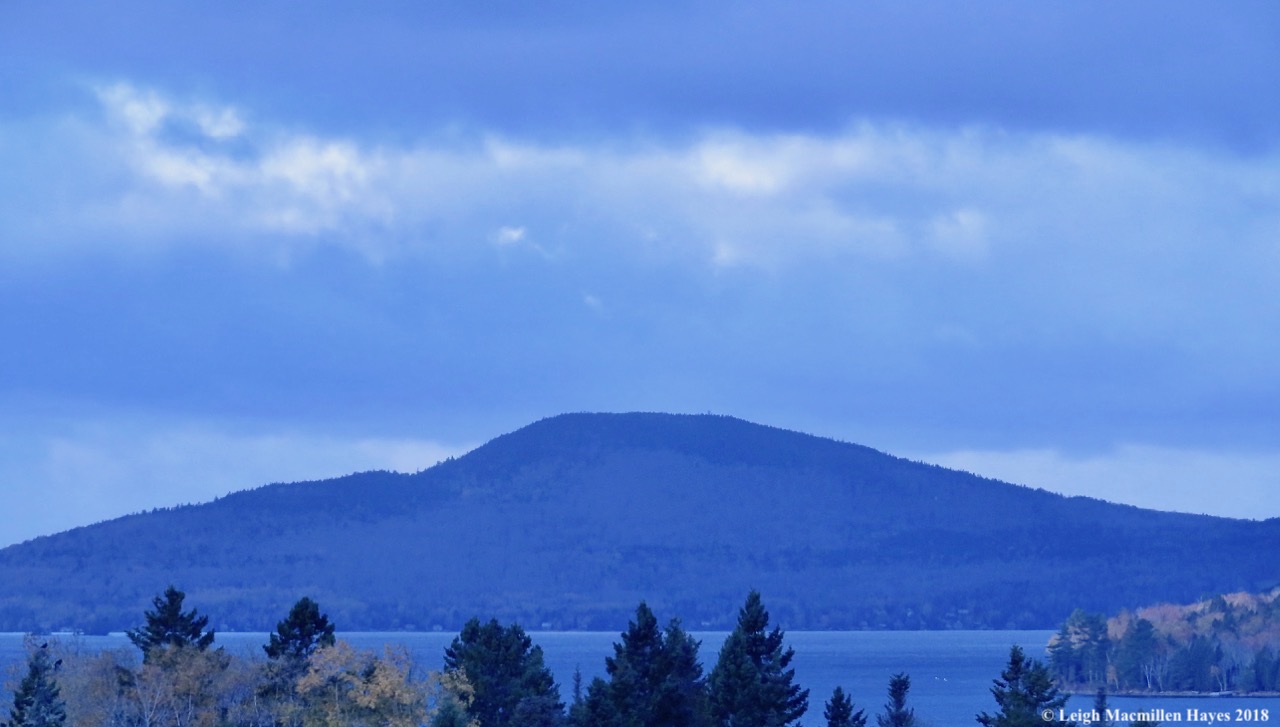
This morning found us rising to a blue sky over Rangeley Lake. Doesn’t the saying go like this: Blue sky in the morning, snowflakes in the offing? For they were and we knew we had to dress appropriately for a day outdoors. But first, we had a few more local businesses to visit, the first being Keep’s Corner Cafe for breakfast and then we grabbed sandwiches from Woody’s Deli at Loony Bin Variety. And with the check came our next clue: “Rangeley–equator to pole, it’s all the same.” Huh?

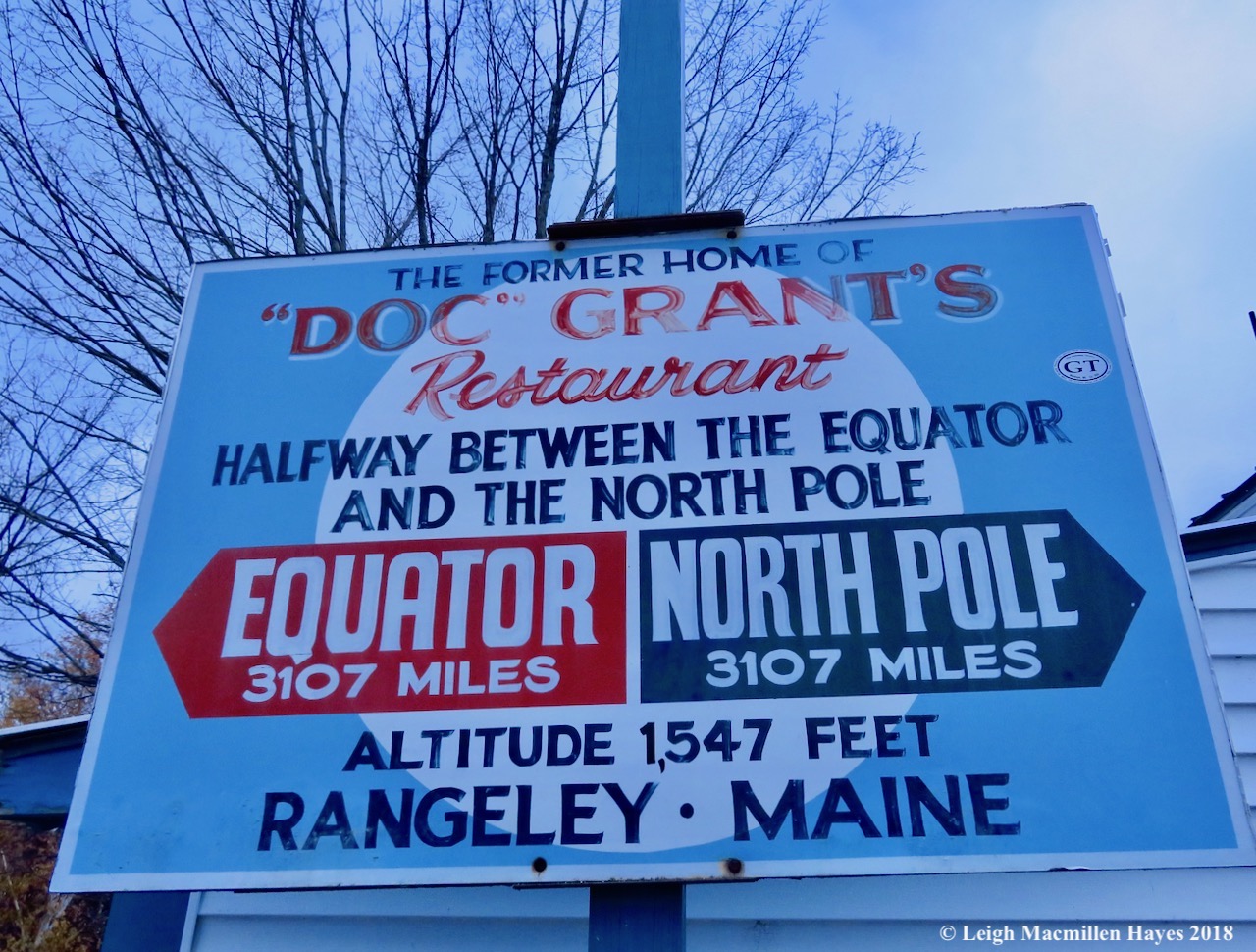
5-halfway between equator and north pole

But, we did our research and sure enough, the western Maine town of Rangeley is located precisely between the Equator and the North Pole. How cool is that? And it was at that sign that another clue appeared. “Choose one: Either explore Orgonon or Find your way to the giant AT sign and seek the piazza.” Several years ago we’d snowshoed the trails at the Wilhelm Reich Museum, aka Orgonon, so we chose the latter for today’s challenge. The AT we understood to be the Appalachian Trail, but a piazza on the trail? Would there be a hut with a porch? Perhaps a fancy porch?

6-AT

A few miles south we found the giant AT. And across from the parking lot on Route 4 we spied the opening to the part of the trail we thought we should follow.

7-red fox scat

And so we ventured forth, stopping moments later for a couple of deposits of red fox scat. Another critter to add to our 24-hour menagerie.

8-sluice

We crossed a sluice way of the Sandy River, and imagined the history stored in the rocks.

9-snowflakes gathering

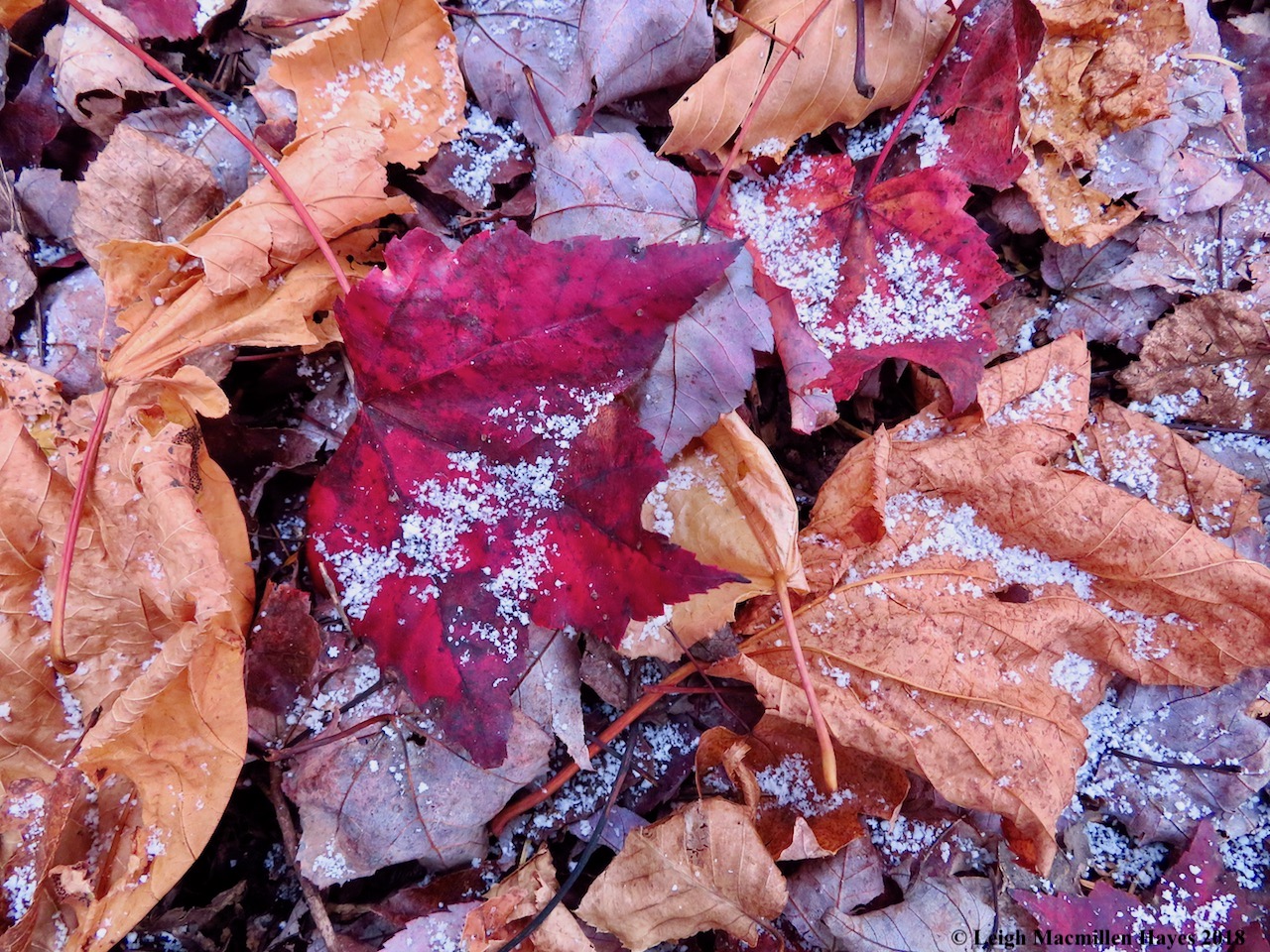
As we hiked, snowflakes decorated the variety of maple leaves.

10-snow on trail

And we began to notice that our journey would pass through a variety of natural communities and over various obstacles including roots,

11-boardwalks

boardwalks,

12-rocks and roots

and rocks mixed with roots.

16-Piazza Rock

My guy was in the lead, though he commented throughout that I wasn’t far behind, trailing only by a few footsteps. But when he reached a certain point, I’d been looking down for careful foot placement and so I didn’t know what he was exclaiming about–until I looked up. At. Piazza. Rock.

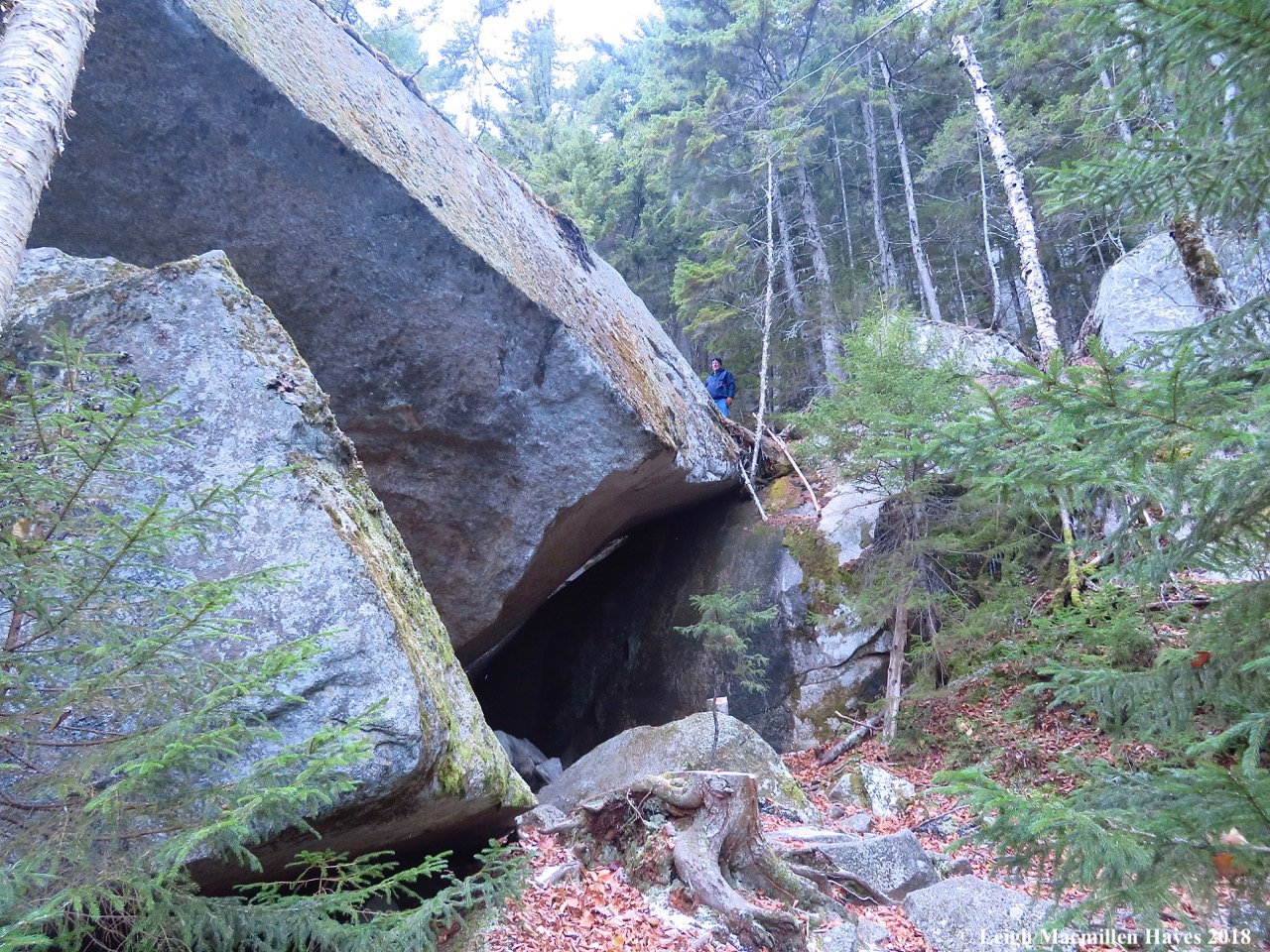
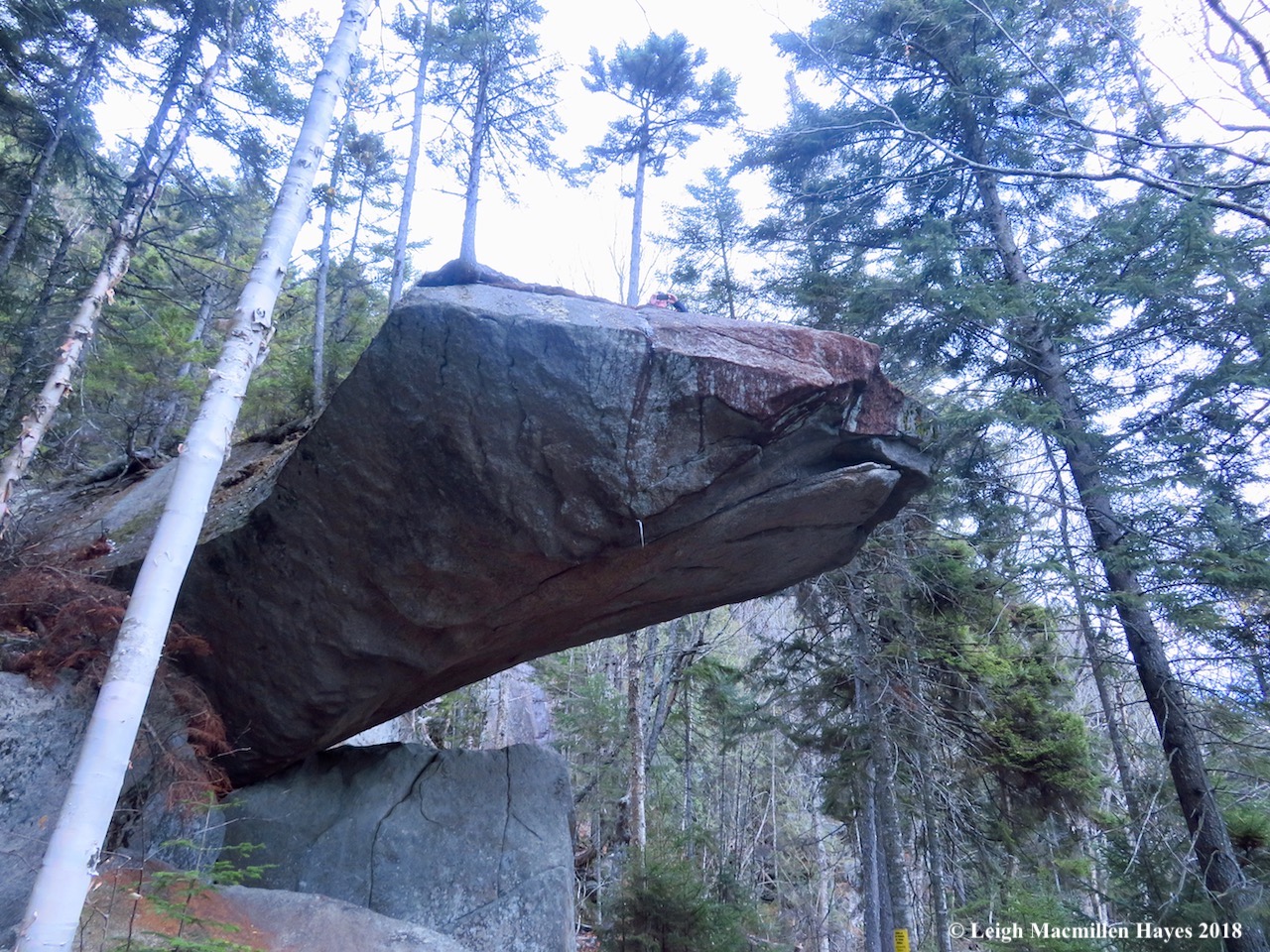
From Maine Trailfinder we discovered this tidbit: “According to the geological notes about this area, ‘The granite of Saddleback is jointed into huge building blocks. An unusually large one has slid out of its place in the mountain side and, instead of breaking and skating down the slope like the others, has balanced across another block to create one-half of a cantilever bridge, forming Piazza Rock.'” Oh, did I mention that we were hiking up Saddleback Mountain?

17-contemplating climb up Piazza Rock

Perspective isn’t gained until one actually stands under the building block. The clue said that one of us must climb atop the structure and the other view it all from below. Thankfully, despite his fear of heights, my chivalrous guy chose the upper path.

18-and then onto the Piazza

He made it seem so simple as he crawled up the rock and then contemplated the platform before him. For a second, he wasn’t sure he’d be able to go further. But, that could mean the loss of points for us. I didn’t say anything to encourage or discourage because I was standing on safe ground below.

19-under piazza rock

My job was to appreciate the boulder from its underside. And certainly I did as I looked up at the stone diving board planted for a giant’s leap.

20-My guy on top of Piazza Rock

And bravely making his way toward the tip–my guy!

21-My guy atop the turtle head of Piazza Rock

I looked up to where he stood–atop a turtle head, for after all, we stood on turtle rock.

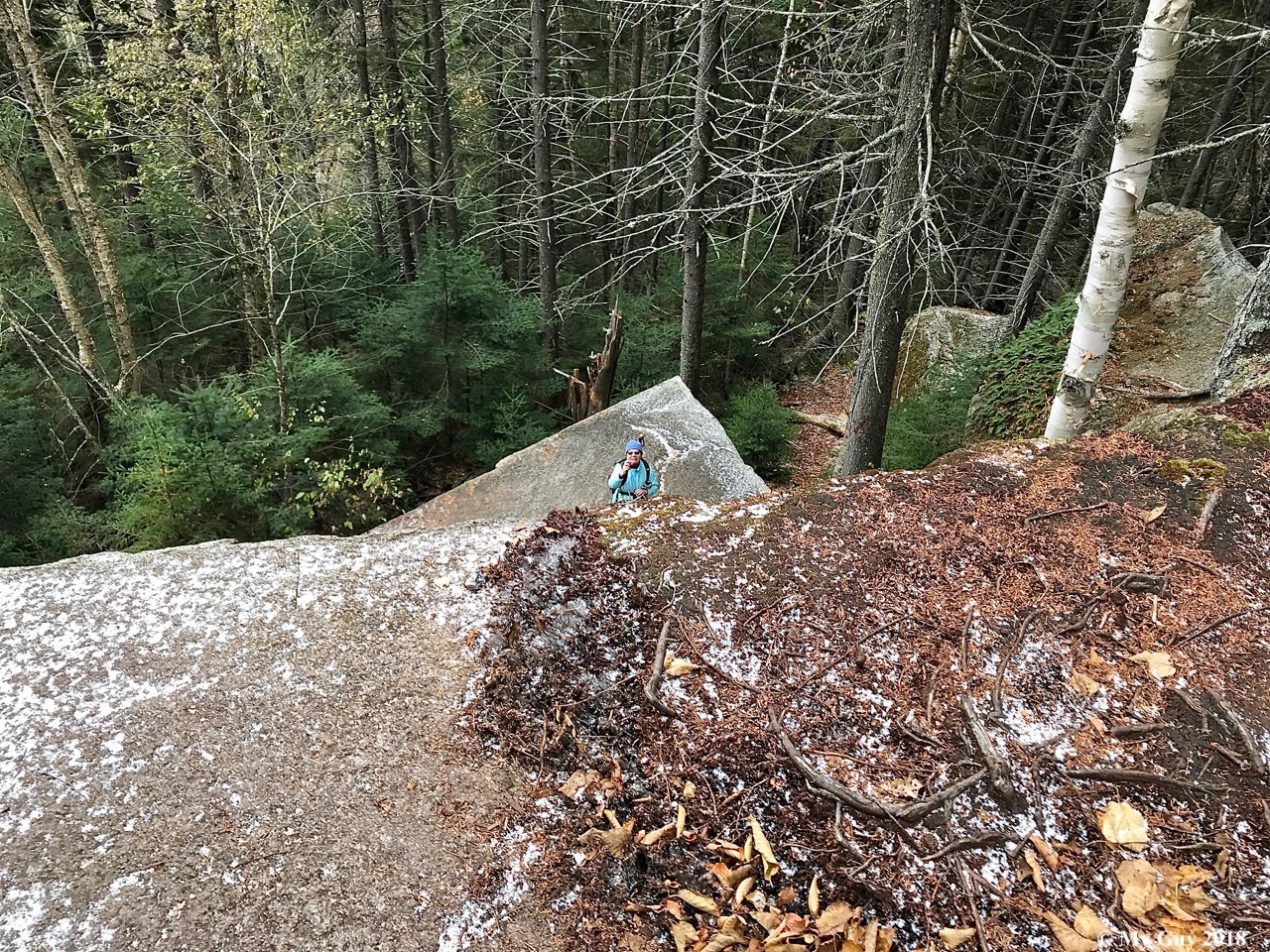
23-looking down at me from Piazza Rock

And he looked down . . .

Later he told me that his father always said as he stepped onto a porch, “I’m going out to the piazza.” Indeed.

28-climbing onward

Interestingly, both of our fathers accompanied us on this leg of the race for apparently as my guy thought of his dad, I spent some time thinking about my father and how much he would have loved exploring trails such as this one with us.

13-temperature

But, we were in a race and so though we reveled in memories of our fathers, we had to move back to the trail signs and check for our next clue, which was again a choice: “Make the next move or Channel your best bat.”  What?

21-Piazza Rock Hut

We followed the trail, crossed one of many streams and located the Piazza Rock Campsite–all set for the next temporary residents who would leave no trace behind.

22-Privy

It was right behind the hut that we noticed the privy–and location for any who chose to make a move . . .

23-cribbage board in two seater privy

In the game of cribbage that is for a game board sits between the two-seater. My guy might have chosen this for he knew he could beat me, but he was once again chivalrous and suggested we channel our best bats. Team Pink did stop at the privy and we never saw them after that so we wondered if they gave up on their card game and moved on to Orgonon.

25-onto the caves

We, however, continued on and reached “The Caves.” One after the other, we shimmied through, hardly as graceful as a bat might fly.

27-the caves

It wasn’t easy, but we moved in and out and reached our next clue: Locate lunch rock with an aquatic view.

28-Ethel Pond?

Onward we climbed, reaching Ethel Pond first, where the ice at the edge was thin and my guy reminded me that I should approach with care.

29-another wetland

About a half mile up the trail we spotted another wetland. Really, we expected to see a moose in each, but when one expects to see a moose or any other form of wildlife, it doesn’t happen. And it’s truly more enjoyable when the offering is a surprise.

29-ice formations

Speaking of surprises were the first ice formations of the year.

30-crossing to lunch rock

Periodically, we crossed water, but the ice formed best at our last crossing, where lunch rock awaited. We’d made it to the stream that flowed from Moose and Deer Pond, a place we couldn’t necessarily visit, but could appreciate for the wildness it offered its wildlife residents.

Lunch rock stood in front of my guy and it was there that we enjoyed the chicken salad sandwiches we’d ordered from Woody’s Deli at the Lonny Bin.

32-squirrel midden

As we looked about, we discovered that we weren’t the only ones to dine in that vicinity, for the balsam fir scales and cone cobs indicated that the resident red squirrels were also frequent diners.

32a-junco joule=foe of a different feather

And, it appeared, another had also consumed a meal for Junco feathers were plentiful. A foe of a different feather had gained a few joules of energy.

33-back to the sluice

Our lunch spot became our turn-around point and with great speed we made our way back to the sluice in now time at all,  completing our eight mile hike with side trips in 5.5 hours, sorry that we couldn’t summit Saddleback Mountain because we were told to return to our truck by 3:30pm. We actually reached the truck by 3:10. In our minds, another day will find us returning and summiting Saddleback as we really like the trail and were eager to discover what else it had to offer.

34-reaching the mat at Puzzle Mtn Bakery

As we drove toward Errol on our return trip, we spotted Team Mustang stopping just below Orgonon and wondered what they questioned when they stepped out of their car.

We continued on to the starting point in Newry, ready to step on the mat and end this leg of the race, only to discover that we’d made a mistake.

How could that be?

We thought that lunch rock was our turn-around point, but we should have continued about 50 more feet where a spur trail would have led us to Eddy Pond. Oh, we could see the pond, but not get close to it. If only . . . we’d paid closer attention to the map.

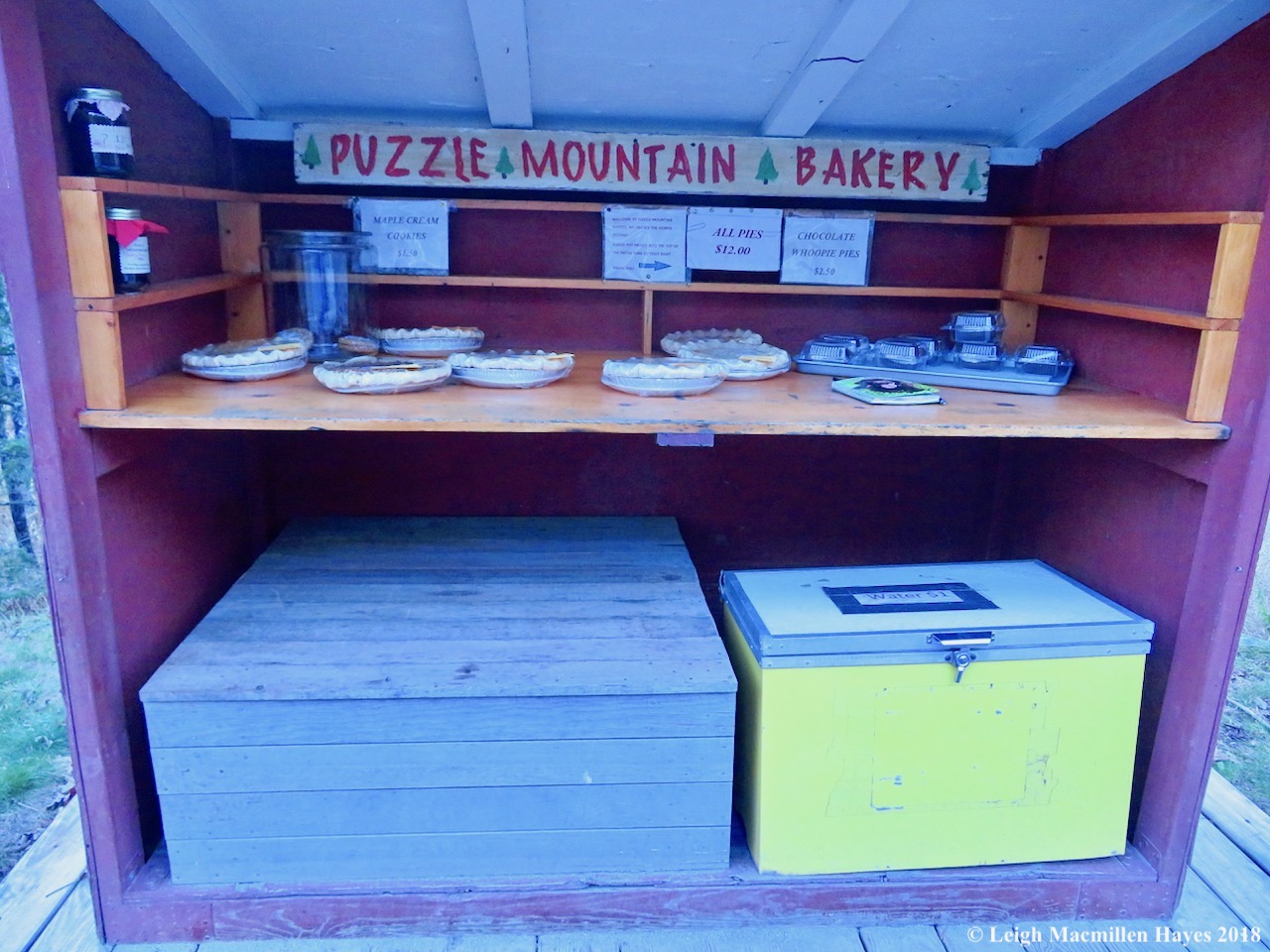
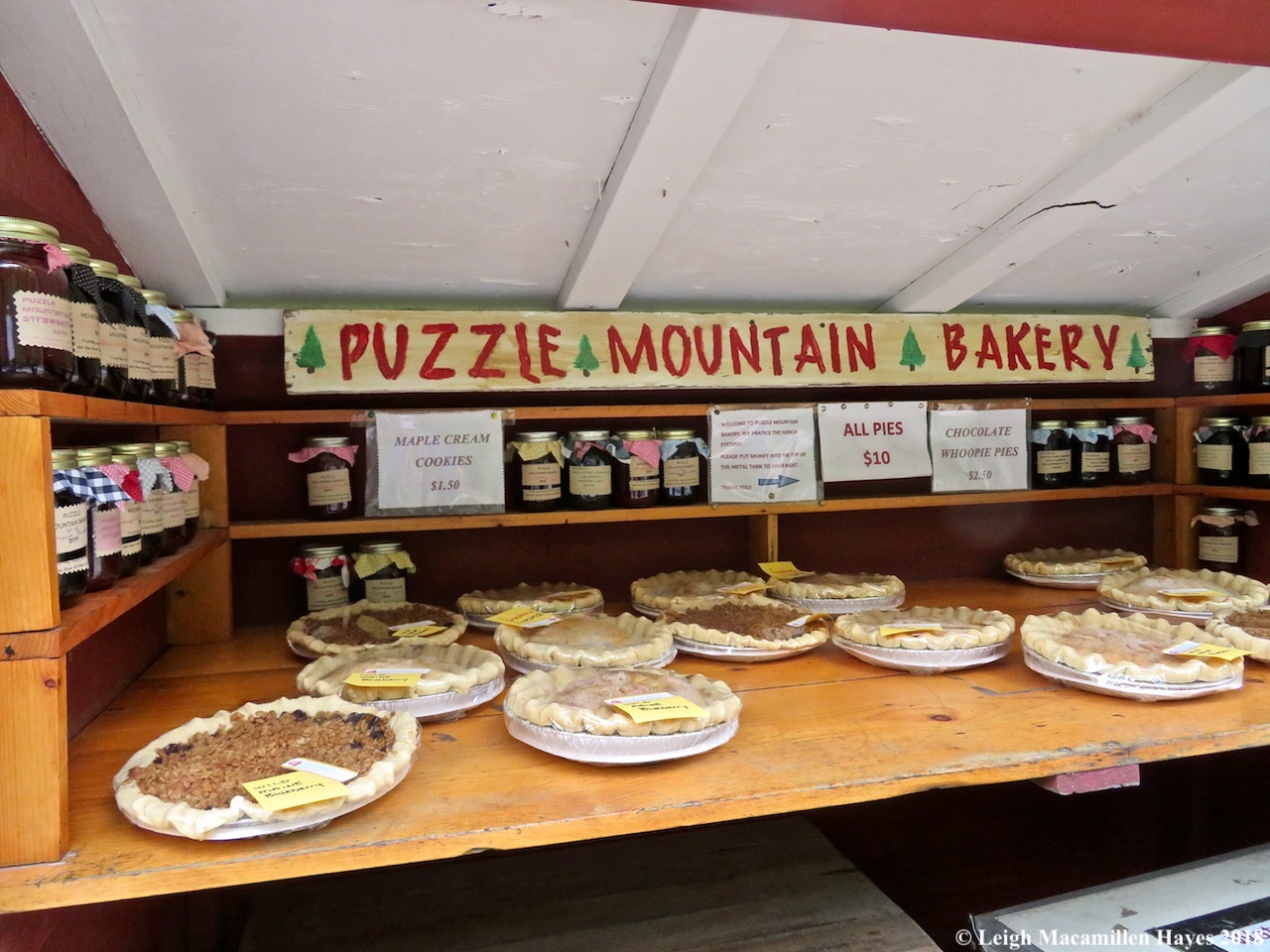
As it was, when we arrived at the mat beside Puzzle Mountain Bakery in Newry, we had to sit for a half an hour and wait. No one arrived. Thankfully. And then we had to answer one important question:  How many streetlights are there in Upton? Eight. Check.

25-the prize

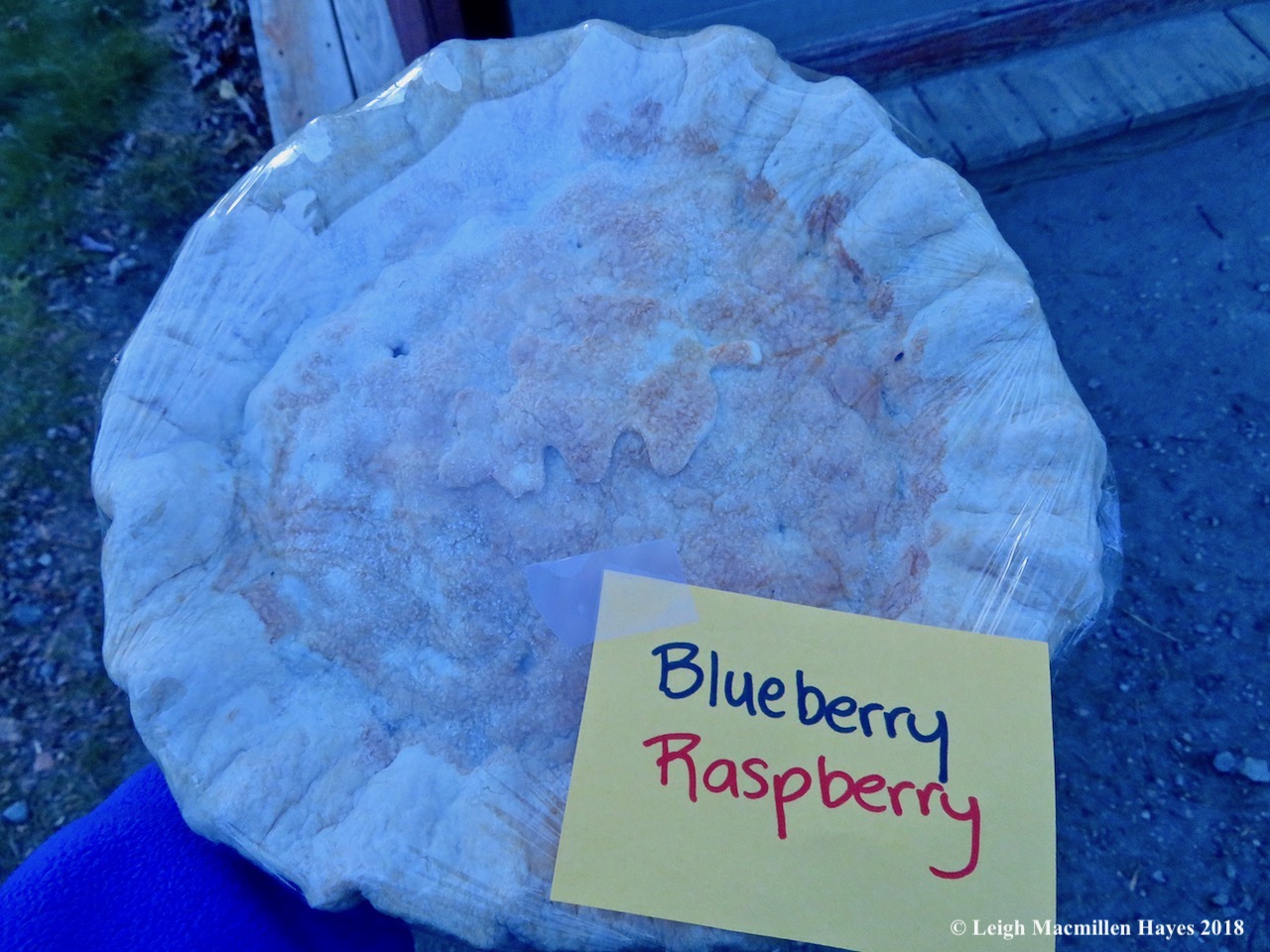
We finished third but got the streetlight question right and so we received a blueberry raspberry pie. YUM.

The Amazing Race–Our Style: episode nine . . . and the fun continues; we’re still in. Phew.


Book of September: wishtree

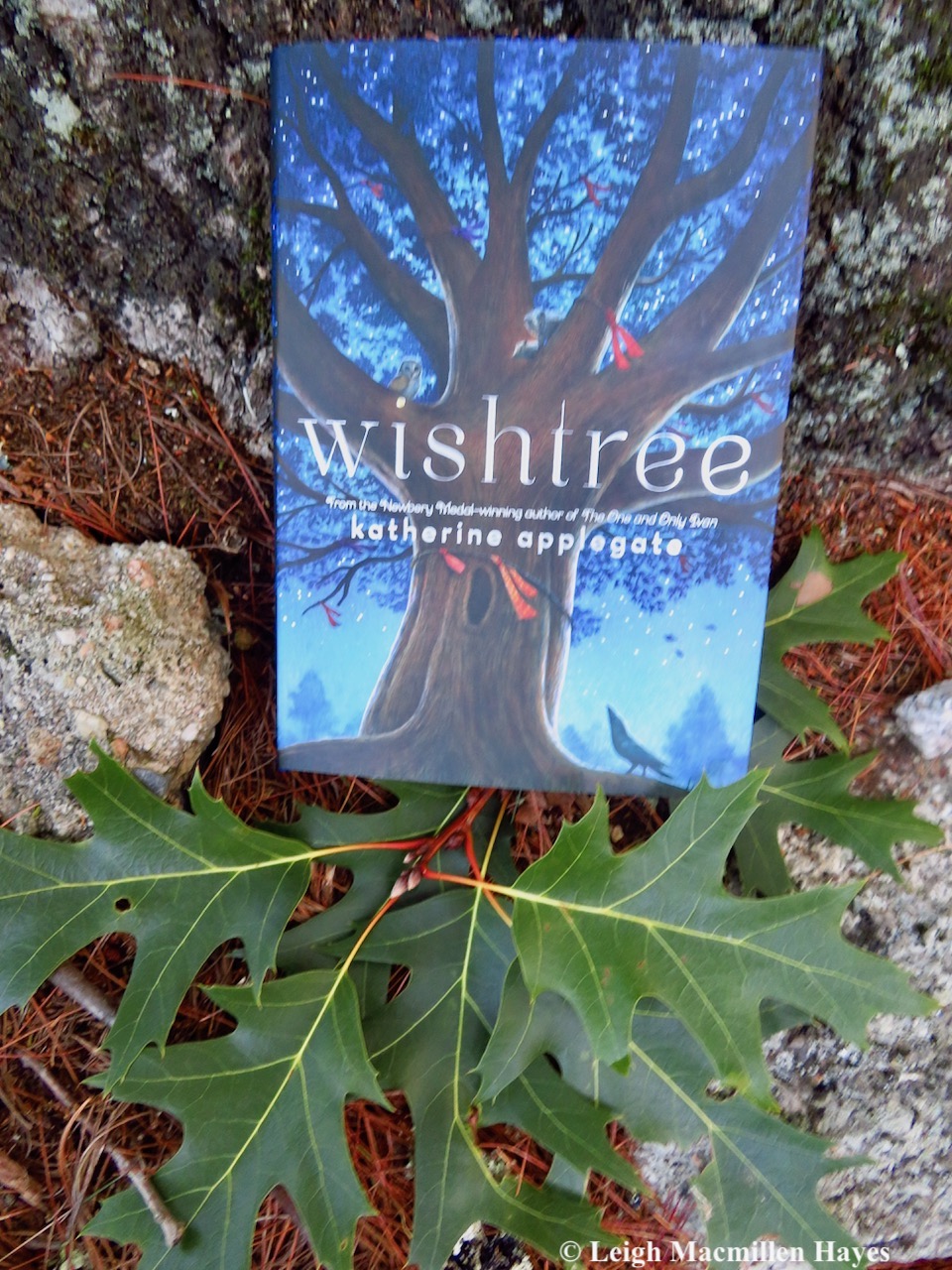
When Alanna Doughty, education director at Lakes Environmental Association, mentioned she’d watched a trailer about a book entitled wishtree by Katherine Applegate and immediately walked to Bridgton Books to purchase it and that night began reading it to her girls and thought I might like it as well, I listened and then drove to the bookstore and purchased it yesterday and here I am today to tell you that you should do the same.

wishtree

In fact, this should be required reading for every child and every adult. Every. Adult. You see, the story is about a northern red oak, but not an ordinary Quercus rubra, for Red, as it is known, can talk. And tell corny jokes. And philosophize, though not in a tedious or pompous way. And teach. All of us. About life. And tolerance.

On one level, it reminds me of our barn, which just happens to be painted red and is towered over by a red oak, and serves as a home, or at least a pass under, for skunks and raccoons and woodchucks and porcupines and red and gray squirrels and mice and the neighborhood cats and all seem to live in perfect harmony beneath it. Well, all except the mice that is.

But the book isn’t just about the animals that call the hollows of the tree home, it’s about the people who live nearby. And really, it’s about all people. In the neighborhood. In the town. In the state. In the nation. Across the globe.

The tale of tolerance is told in such a manner that each short chapter with its surprise ending could stand alone like delectable little nuggets. And maybe they should be read in such a way. One. Chapter. At. A. Time. I rushed through it last night, mesmerized,  but this morning I began reading wishtree again. And actually, I think it shall become a bathroom book, that place where many of my favorites end up so I can return to them frequently for short intervals. Wink.

Scientific terms are subtly introduced. And the sketches enhance the story.

Published in 2017, its a book that is written for our times, but should become a classic, much like The Giving Tree. I don’t want to give the story away, but I do want you to read it. You can learn more by visiting the wishtree website, where you can even add your own wish.

Or be like Alanna, read the story aloud to your children or partner or the air around you, find your own “Red,” and leave a wish and some yarn and snippets of paper for others to do the same.

But especially, don’t forget to take the message of wishtree with you everywhere you go. I hope I remember to do the same.

wishtree by Katherine Applegate, published 2017, Fiewel and Friends, an imprint of mackids.com.


The Amazing Race–Our Style, episode seven

We never know when the clue will appear and so it was a complete surprise to find it this morning. “Drive 50 or so miles north and locate the Big A near the table.”

1-Big A

We took our chances and drove to Bethel and then on to Newry and beyond. Lo and behold–the Big A appeared. And so we parked across the street, slipped into our hiking boots, and began the journey. At the time that we arrived, we were the only contestants, so we wondered if we were behind or ahead.

2-easy path

At first the trail was deceivingly flat. “I’ve got this,” I thought.

3-rungs on rocks

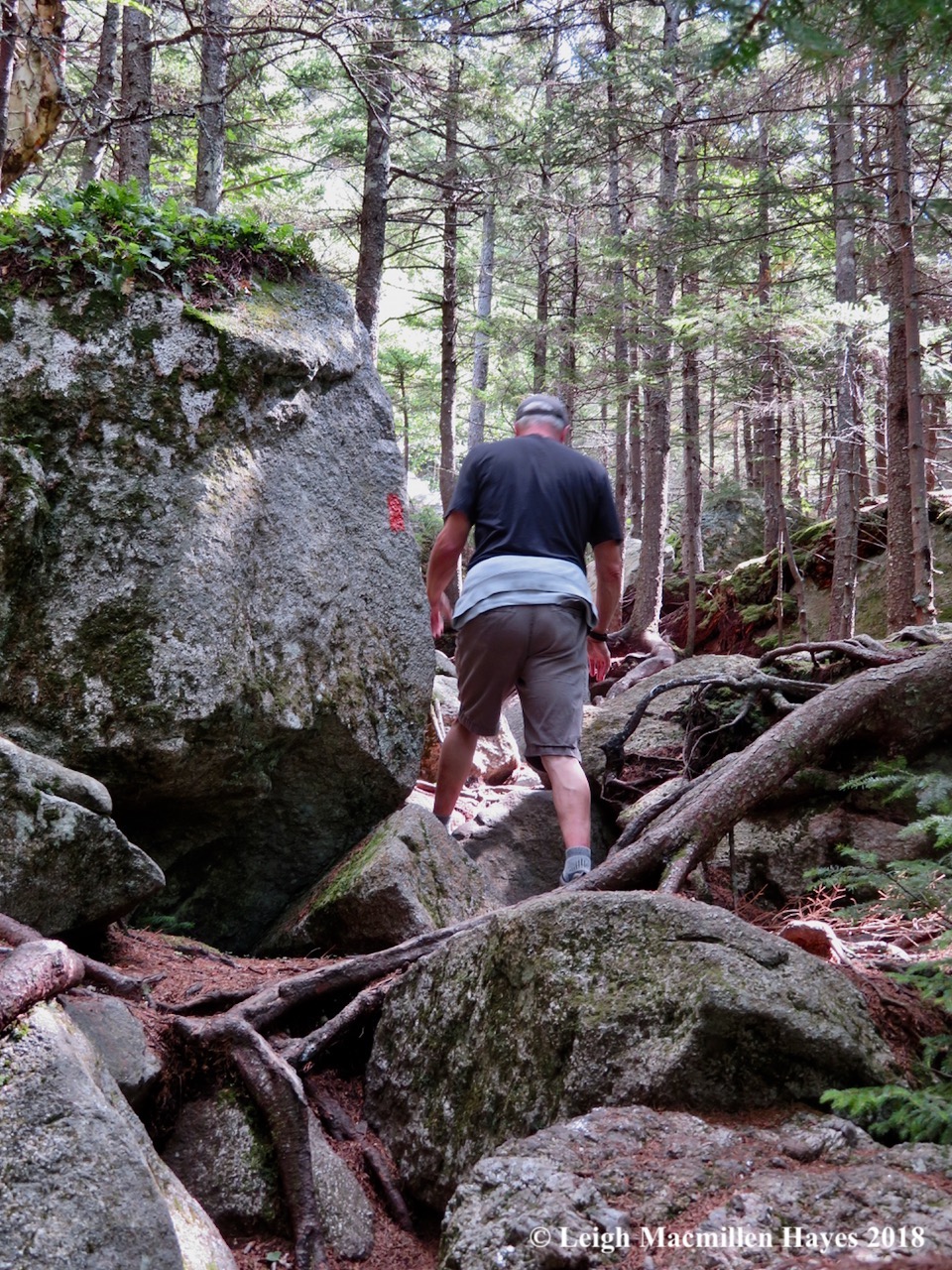
But we soon came to a point where the white-blazed trail headed to the left and the orange-blazed trail to the right. We had a choice to make. White would mean a bit further journey, but it was easier. Orange was much more difficult, but if we played our cards right, we might ascend quickly. It wasn’t long before we realized that our hearts pulsed rapidly. And then we met Team Livermore . . . and passed them. They are younger than us, so I was feeling a bit smug. Until we came to the wrought iron rungs. I guess I was shaking a bit, from the looks of the photo, but really, climbing up the rungs was a piece of cake compared to the rest of the scramble . . .

4-climbing higher

over the steep, boulder-strewn trail.

5-trail map on boulder

Along the way, I paused periodically pretending to note things like a boulder covered with a moss map . . .

6-spider web

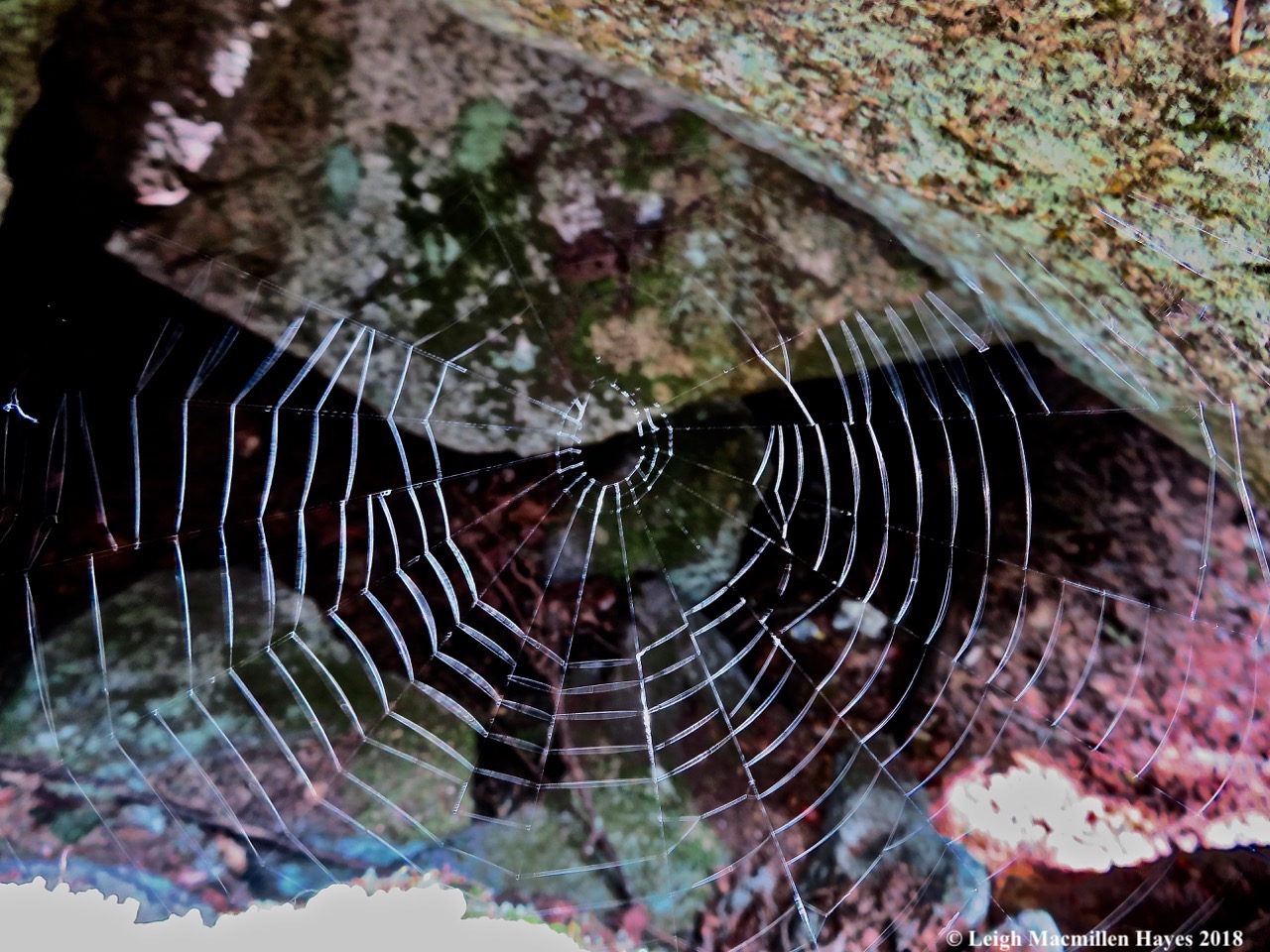
and an orb web sparkling in a bit of sunlight. The truth is that I was catching my breath. After seeing the web I had to put the camera away, for we’d reached a point where we needed the use of both hands. And just above the web my mind shut down as My Guy stepped from one boulder over a gaping hole to the next. He patiently told me where to place each foot, and try as I might, I couldn’t move. I was certain that hole would swallow me whole. Along came Team Livermore and I knew we were skunked, but I had to let them pass. They made it look effortless and so four more times I attempted to make the crossing, and on the fifth try I went for it. And I’m here to write about it, so obviously I lived.

7-contemplating

Team Livermore may have passed us, but we soon caught up and moved ahead. We kept thinking we were about to reach the summit, when the rock would indicate otherwise and at one point we had to hike down a bit before climbing up again, which didn’t seem quite fair given how hard we’d worked. But then again, rock is rock and we certainly didn’t want to climb directly up its face.
11-to the north

At last–success. We found the table we’d sought: The summit of Table Rock.

12-message in the slides?

Before us, The Eyebrow and Old Speck.

13-Sunday River Whitecap

To the south, Sunday River Whitecap.

We didn’t stay too long on top for we weren’t hungry yet. And Team Cape Cod showed up. They’d chosen to come up the easier trail, so we knew we were ahead of them. We do like them though, so we hoped they wouldn’t be too far behind. Just as we started to make our way down, Team Speedy came along via the orange-blazed trail. We’ve had them on our tail in previous episodes and they have a bit of an attitude. That being said, we did what we often do–we practically ran down the blue and then white-blazed trails.
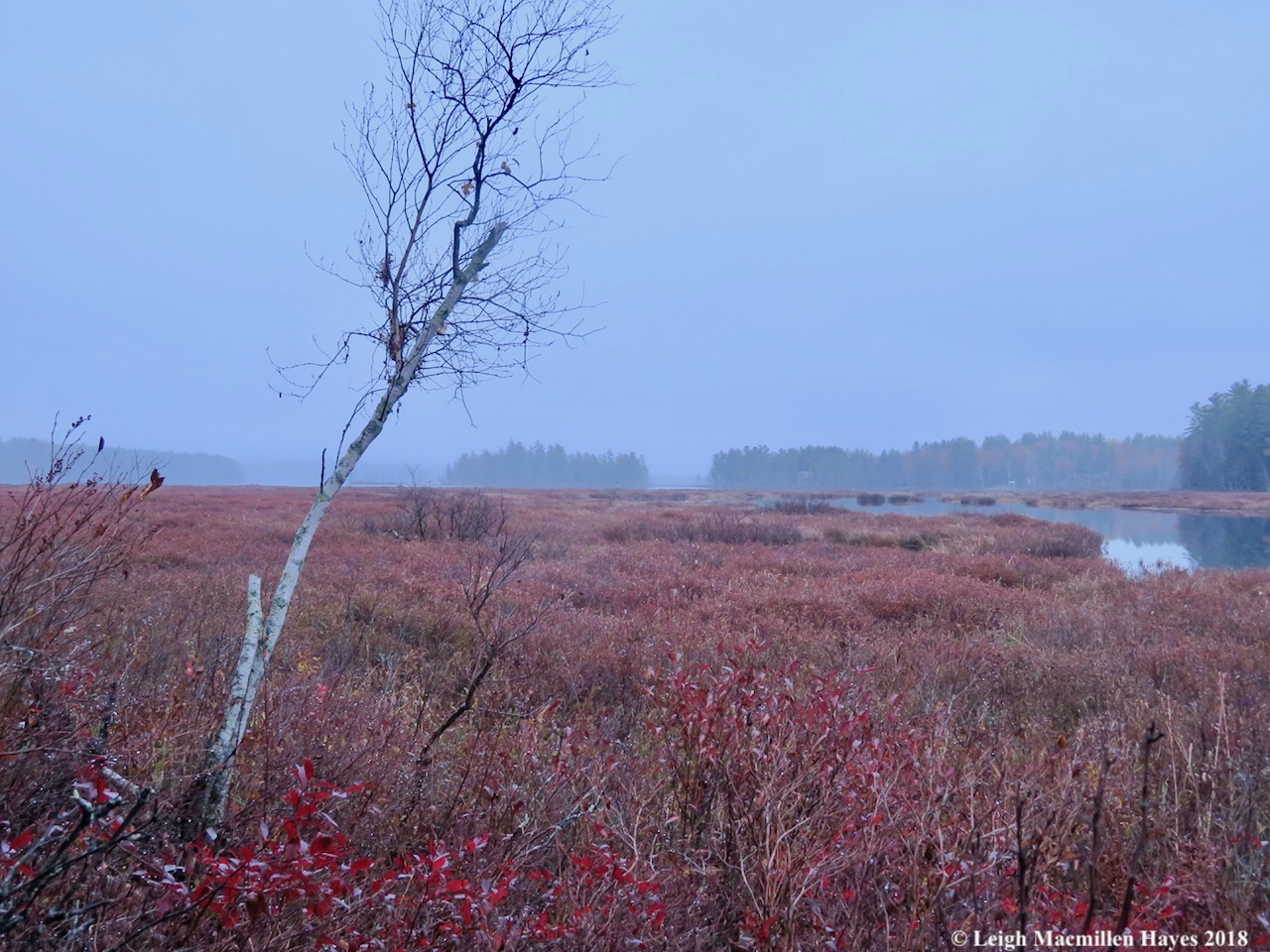
16-lunch rock

At lunch rock, we paused briefly beside the water and contemplated the map for a moment, making sure that we were headed in the right direction.

Further along we met a couple from New Hampshire–thru-hikers who had started in Georgia in March. We had nothing in our packs to offer them in terms of extra food, but bid them good tidings. Soon after, we heard Team Speedy again, and so with even more gusto, we finished our descent.

20-aster

Before moving on, we had a couple of tasks to complete. The first was to share photos of a flower–we chose the purple asters;

19-trillium fruit

a fruiting plant–trillium;

18-cup mushroom

and a fruiting mushroom–ours being one of the cup variety.

21-A # 2

We also had been instructed to find two more examples of the letter A, and so here is one . . .

22-A # 3

and the other. All were in honor of the white-blazed Appalachian Trail.

24-moose cave below

Making our way south on the road, our next clue indicated that we needed to find a moose, or at least evidence that one had been there previously. And so we found this deep cave, which the photo doesn’t do justice.

23-Moose Cave

As the local lore goes, however, a moose once fell in.

26-Mother Walker Falls

We were also instructed to find Mother Walker. We found the falls named for her that flowed through a gorge.

27-mother load of Indian pipe

And we found a mother lode of Indian Pipes, all turned upright because they’d recently been fertilized. But who was Mother Walker? We never found the answer to that question.

29-Screw Auger Falls

With two stops left to make before finding the mat and finishing today’s leg of the race, we needed to locate a screw. Heck, I was with a hardware guy so that should have been easy.

30-upper falls

But this screw was in the form of a water fall. Screw Auger Falls. In the 1800s, settlers had built a saw mill directly over the falls that was powered by the current. A screw auger is a hand tool used for boring holes in hard material. It all began to make sense.

31-Arch

While we were there, we took in a view of the arch, just in case we encounter a question about it should we make it successfully to the end of race.

32-lower falls

And the falls below, were the story of water and glaciers was carved into the bedrock.

33-PIes for Sale

And then, and then, we continued south to a spot where we were told to fulfill our sweet tooth craving.

34-Puzzle Mtn Bakery

As we contemplated all of the possibilities, three folks came along in a truck (two of them from Norway, Maine, and the third visiting from San Francisco), bought a pie and gave us the money to buy one as well. But we had enough money. So we felt awkward, though we promised to pay it forward.

35-cash only

My Guy had just put the $20 into the metal tank when a vehicle from New York pulled in and a young couple stepped out. He walked over and told them about the previous couple, gave them $10 for their pie and asked them to pay it forward. Ahhh. Maine, the way life should be. And is!

36-Moose

At last, our final stop–we crossed the mat and learned we were first yet again.

37-beer

While sipping a celebratory brew, Team Speedy came in. Bingo! They were second in place. Drats. But at least we beat them. We never saw the other teams.

38-My Guy and me!

All in all, The Amazing Race–Our Style, episode seven was most gratifying as we successfully summited Table Rock in Grafton Notch. Thanks to Team Cape Cod for taking a photo of us.

Oh, and dessert tonight will be . . . Maine Wild Blueberry a la Puzzle Mountain Bakery and the kind folks from Norway, Maine.


Flying With John A. Segur

I never had the honor of meeting Mr. Segur, but it was my honor to be his eyes for a short time today as I wandered down the short trail off New Road in Lovell at the Greater Lovell Land Trust’s John A. Segur Wildlife Refuge. Upon his death, a bequest in his name was left to the land trust to preserve habitat for native wildlife to thrive.

The JAS Wildlife Refuge actually encompasses 592 acres and I only explored the .3 mile trail on the western section of the property, but on an extremely hot summer day my finds were enough. Follow me and I think you’ll see what I mean.

j1-Across from the sign and telephone pole

First off, you need to locate the small undefined parking lot. It’s about a mile beyond Foxboro Road, but I don’t pay attention to that. Rather, I look for the “No Thru Trucks” sign and turn on my left-hand blinker as soon as I spot it.

j2-trail and kiosk

Just beyond a couple of boulders placed to keep vehicles from driving down the old skidder trail, stands the kiosk where you can take a look at the trail map and check out some other GLLT materials.

j3-map

As I said, this is just a small part of the overall refuge, but it’s well worth an exploration, especially if you don’t have much time (though some of us have been known to spend at least three hours making our way down and back).

j3a-the trail mowed

Recently, the GLLT’s Associate Team and Intern mowed the trail, making it passable and not quite so tick-infested. But . . . still take precautions. Always! The trail is rather level, so it’s an easy one to travel.

j4-daisy and crab spider

This is a place where you’ll find the ordinary, like a daisy. And trying to decide if “he loves me, he loves me not,” you might see a small crab spider.

j5-sundews

This is also the land of the extraordinary–in the form of the carnivorous Round-leaved Sundews. Check out the glistening droplets at the ends of the hair-like tendrils that  extend from each round leaf. The droplets are actually quite sticky. Just like a spider sensing a bug on its web, the tendrils detect the presence of prey and then curl inward, thus trapping the prey.  The whole leaf will eventually wrap around the insect and in the process of digesting it, the plant will absorb the bug’s nutrients. Sundews tend to grow in areas that lack sufficient nutrients, so this is the plant’s way of supplementing its diet. And if that wasn’t enough–it was just plain beautiful.

All that being said, this is a tiny plant and right now preparing to flower. So, if you travel this way, about a tenth of a mile into your journey, look down at your feet for these minute gems, take a closer look, and then walk with care.

j6-sweet-fern

Further along the trail you’ll see a few species of ferns, as well as the fern that isn’t a fern. Sweet-fern is so named for it’s fern-like appearance, but it has a woody stem and is actually a shrub. It’s yellowish green flowers that first appeared in spring were giving way to greenish brown, burr-like nutlets. In any season, this shrub has such variation to offer, that like hobblebush, I can’t resist honoring it with a million photographs.

j8-raspberries

One of the sweet joys of this trail is that because of previous logging, early succession is taking place in terms of the plants and trees that grow beside the trail, including blackberries not quite ripe and these raspberries already offering a delightful reprieve on a humid summer day.

j14-the field

Eventually, the trail leads to the turn-around point, the old log landing, which also displayed signs of forest succession, for its there that some wildflowers and sweet-ferns grow in the center. At the perimeter, white pines, gray birch and blackberries crowd each other.

j10-four-spotted with food

And on the edge, the dragonflies fly. And dine. This Four-spotted Dragonfly settled on a dead red pine to consume an insect.

j11-4 spotted eating

Ever so slowly . . .

j12-feeding frenzy

the body disappeared into its mouth.

j13-4 spotted, back view

While it was busy eating, I was busied myself in getting as close as possible to enjoy all of its nuances, from the four spots on its wings, to the basal display on the hind wings to the placement of its eyes and colors on its thorax and abdomen. All of those details help in ID.

j15-old coyote scat

And then into the field I went, with a memory of a winter expedition when we noticed that a shrike had deposited a mouse in a tree. Today’s finds included a pile of old coyote scat probably also deposited this past winter that indicated a territory repeatedly marked.

j16-turtle?

I also spied lots of recently made depressions. While one might suspect dust baths by a turkey or grouse, feathers are usually left behind in the process. Instead, the ground was more disturbed and because the landing is close to Bradley Brook, I determined I was looking at recently dug holes made by turtles. Snappers and painted turtles have been depositing eggs recently and these may be the incubation nurseries for their offspring.

j16-racket-tailed emerald

As I turned back toward the trail, I noticed a dragonfly seeking shade, for so hot was it. Notice the bright green eyes of the Racket-tailed Emerald. Thank goodness for those emerald eyes that always help in narrowing down the choices.

j18-common dewberry:sphinx moth

I found it a bit more difficult to ID the sphinx moth that paid a visit to the Dewberries. There are only 1,450 species in the Sphingidae family, but my leaning was toward Nessus Sphinx, though I could be totally off on that one.

j20-Northern-bush Honeysuckle

I was much more confident about my ID of the native Northern-bush Honeysuckle with its greenish-yellowish-orangish flowers. The plant is actually a shrub with a woody stem, and one that moose and deer like. I’ve yet to see a moose print along this piece of the property, but I know its part of a deer yard.

j21-Spotted St. John's-wort

Also springing forth with yellow blossoms was Spotted St. John’s-wort, with its translucent spots on the leaves and tiny black dots outlining its petals.

j22-whorled yellow-loosestrife

And not to be overlooked, the Whorled Yellow-Loosestrife with its cheery flowers extended in a whorl from the stem by long petioles.

j23-hitchiker

My journey wasn’t long, but with all that I saw, I was thankful for the spirit of Mr. Segur that flies over this place.

Just possibly, he graced me with his presence today . . . in the form of Spangled Skimmer.

Self-Guided Tour of Sabattus Mountain

As stories go, Sabattus Mountain in Lovell offers plenty of lore. For starters, there’s the name of the mountain. I’ve heard at least two tales and seen three spellings, but basically the legend is the same–about a Pequawket named Sabatos, Sabatis, or Sabattus, who guided hunters and one day killed a lynx, or was it a mountain lion, before it sprang upon him.

In a July 14, 2017 article, Ed Parsons of the Conway Daily Sun wrote: “Sabattus was born in St. Francis, Canada, and with the influence of French missionaries, was named for St. John the Baptist, shortened to Sabattus. When Roger’s Rangers destroyed St. Francis in 1759, Sabattus was about 10 years old. He was kidnapped and went south with the rangers. Later, he went to Fryeburg with one of them, and spent the rest of his life in the area.

Sabattus had two children with the well-known area healer, Molly Ockett. In 1783, an earlier wife of his returned from a long trip to Canada, and claimed to be his spouse. To settle the dispute, Sabattus took them to the house of Mr. Wiley in Fryeburg so there would be a witness, and the two women fought, “hair and cloth flying everywhere.” Mrs. St. Francis, as Molly Ockett called the former wife, was stronger and won out. Molly Ockett left and moved to Andover, Maine.

There’s also the Devil’s Staircase, but that’s for another day.

s1-sign

Two Land for Maine’s Future program grants, along with funding from the Greater Lovell Land Trust, enabled the State of Maine to purchase 177 acres on and around Sabattus Mountain, protecting hiking access to Lovell’s highest peak. The trail is a 1.6-mile loop to and from the 1,253-foot summit. Sabattus Mountain is now owned and managed by the Bureau of Parks and Lands. The land trust, however, has taken a keen interest in upkeep of the trail system recently because there had been much erosion ever since Hurricane Irene and the State seemed to back off maintaining it. Last year, the GLLT’s three interns built numerous water bars, especially on the eastern trail.

s6-Brent's Loop Trail Sign

Last week, Brent Legere of Lovell Box Company and Western Maine Slabworks, installed new signs to guide hikers on the trail system.

s2-self-guided nature walk

Today, a team of docents, associates and this year’s intern, under the well-organized leadership of GLLT Docent and Maine Master Naturalist Joan Lundin, installed informational signage along the loop.

s3-explaining the plan

The morning began as Joan divided the team into two groups. First she instructed Intern Isaiah (in red) and Stewardship Associate Dakota (in plaid), to take one set of signs up the western trail and leave them beside examples of particular species on the way.

s5-all smiles to go

Then she prepped Associate Director Aidan, and GLLT Docents Nancy and Pam in the plan for the eastern trail.

s4-signs

All signs were laid out and ready to be hauled up the trails for installation.

s12-hi ho

And so, in true Seven Dwarf style, it was hi ho, hi ho and off to work we went.

s7-installing the first sign

Because she’d climbed the trail so often in order to prepare for today’s undertaking, Joan knew right where each sign belonged. At the start, she did most of the installing, showing off her muscle power on this steamy day, despite her petite physique.

s8-yellow birch

Each sign included common and scientific names, plus only a few key characteristics so not to overwhelm those who might stop to read them and look around to locate the particular species. It’s a technique decided long ago by the full team of docents who have undertaken this task each summer for years–always along a different GLLT trail.

s9-striped maple

The natural community along both trails on the loop system transitioned about two-thirds of the way up. For the lower portion, the community consisted of a variety of deciduous trees.

s13-hemlock

Suddenly everything changed. Light turned to shade. Dry turned to damp. Leaves turned to needles. And conifers showed off their unique characteristics.

s14-sphagnum moss

Even the forest floor changed from dried leaves and wildflowers to green mosses, including sphagnum, with its pom-pom shaped heads.

s15-loop trail sign at ridge

As we hiked up the eastern trail, Dakota and Isaiah swung along the ridge line and came down to find us for they had only placed their signs along the western trail as instructed by Joan, and hadn’t yet pounded them into the earth. We chatted as we moved upward, talking about the turn ahead to the ridge, and Dakota told us we’d be pleased with how obvious it was since Brent had installed the new signs. Indeed!

s16-glacial erratic

Of course, we were a group that failed at following directions, and so off trail we went to check on the glacial erratic that we knew stood just beyond a downed tree.

s17-porcupine scat

We also checked underneath, for who doesn’t like to look at porcupine scat. New and old, though not especially fresh, it’s been a winter den for at least 30+ years that I’ve been climbing this mountain.

s18-Canada mayflower

And then Joan redirected us, pulling us back into the mission of the morning and finding a place to post the Canada Mayflower sign–between the granite slabs at our feet.

s19-window on the world beyond

Making our way across the ridge, we paused for a second to look out the window upon the world beyond. It’s from heights like this one that we always appreciate how much of Maine is still forested. At a recent gathering with District Forester Shane Duigan, he said that the state is 85% forested–down from 90% not because of urban sprawl, but instead increased farming.

s20-main summit signs

A few minutes later we reached the main summit, where Brent had posted more signs. They’re nailed to a White Pine and mark the intersection of the ridge trail and western loop, with a spur to the western-facing ledges and scenic overlook.

s21-white pine

That very White Pine was also on Joan’s list as an excellent example, and so it will be noticed for a while.

s22-Keyes Pond and Pleasant Mtn

For a few minutes, we took in the wider view to the south–noting Keyes Pond in Sweden and Pleasant Mountain in Bridgton, both part of the great beyond.

s23-scenic view

And then a quick trip out to the scenic overlook, where the sweeping view included the Lower Bay of Kezar Lake and pyramid outline of Mount Kearsarge in North Conway.

s24-scenic view 2

Turning a wee bit to the north, the view also encompassed more of Kezar Lake, and the White Mountains.

s25-chipmunk

On the way down, we continued, or rather, the rest of the team continued to install the signs while I watched, and one quiet chipmunk with a piece of a leaf dangling from its mouth looked on with approval. We assumed it approved, for it didn’t chatter at us.

s26-teamwork

It seemed the signs on the western trail went into place far more quickly than on the climb up, but maybe it was because there weren’t as many. We did pause for a few minutes as Isaiah and Dakota changed out one sign for another because the species Joan wanted to feature wasn’t as prominent as hoped. But, she was prepared with extra laminated cards and quickly produced a description of an alternate species.

s27-plank

We were nearly finished with our morning’s work when we reached the new plank bridge Brent had placed across a small stream.

s28-white admiral

Back at the parking lot, we were wowed by the sight of pollinators upon the Staghorn Sumac, including a White Admiral Butterfly.

With that, our tour was done for the day, but we’d met several people along the way who were thrilled with the work we’d done. We hope you, too, will partake of the pleasant hike up Sabattus Mountain, and stop along the way to enjoy the self-guided tour. It will be in place until Labor Day weekend.

And be sure to stop by the office on Route 5 and make a contribution to the Greater Lovell Land Trust for we are a membership-driven organization and can’t do such work without your continued support.

P.S. Thank you Self-guided Tour Docents and GLLT staff, plus Property Steward Brent.


Dear Earth

Dear Earth,

In your honor, I decided that on this Earth Day I would head out the back door and travel by foot, rather than vehicle.

e1-Mount Washington

My journey led me down the old cow path to the power line right-of-way and much to my delightful surprise, Mount Washington was on display. It was so clear, that I could even see the outline of buildings and towers at the summit. Thank you for providing such clarity.

e2-vernal pool

Rather than walk to the mountain, I turned in the opposite direction and found my way to the vernal pool, where ice still covered a good portion. You know, Earth, as much as I want this to be a significant vernal pool because it does usually have two qualifiers (and only needs one): more than forty wood frog egg masses or more than twenty spotted salamander egg masses, I know that it is not. I believe it was created as part of the farm based on the rocks at the far end, not exactly forming a retaining wall, but still situated so close together in a way that I haven’t found anywhere else in my extensive journeys of the hundreds of acres behind our house. Plus, it dries up much too quickly to be a natural pool. And each year I’m surprised to find wood frogs, their egg masses, spotted salamander spermatophores, and their egg masses, given that the water evaporates before the tadpoles finish forming. If these species return to their natal vernal pool, Earth, then how can that be since no one actually hopped or walked out as a recently matured adult? Or were these frogs on their way to another pool and they happened upon this one? You know me, Earth–lots of questions as I try to understand you better.

e4-dorsal amplexus

Whatever the answer is, each year you work your magic and on a visit yesterday afternoon, I spied a male wood frog atop a female in what’s known as amplexus, aka, mating. According to Maine Amphibians and Reptiles, edited by Malcolm L. Hunter, Aram J.K. Calhoun, and Mark McCollough, “When mating, the male clings tightly to the females back. Visible contractions of the female’s body signal the onset of oviposition, at which time the male’s hind feet are drawn up close to the female’s vent. As the eggs are expelled, the male releases sperm into the water and strokes the egg mass with his hind feet, which presumably aids in distributing the sperm more evenly.” I looked this morning, but didn’t find any sign of eggs. Don’t worry, Earth, I’ll keep looking because perhaps they were there but hadn’t absorbed water yet.

e5-dead frog

One other thing I saw yesterday that greatly disturbed me was a dead frog in the water. Last year I also found such. My concern is that it was caused by a virus, but perhaps it was old age. Or some other factor. I do have to confess, though, Earth, I intervened and removed the body from the pond. I know, I know, it’s all part of the cycle of life, and I should leave nature to its own devices, but disease was on my mind and I didn’t want others to be affected. I may have been too late. Only time will tell.

e7-leaf variety

When I arrived this morning, I’m happy to report that I didn’t see any dead frogs. For the longest time I stood upon a rock–you know the one I mean, Earth, for you’ve invited me to stand there before. It’s sunny in that spot and the frogs know it well, for that is where they’ll eventually deposit their eggs. As I waited, I looked down at the leaves on the pool’s bottom and noticed how they offered a reflection of the trees above, beech and oak and maple and pine and hemlock. All still displayed their winter colors, but when the pool does dry up, they’ll turn dark brown and form a mat that will provide nutrients for the plants that colonize the area. You’ve got a system, don’t you Earth.

e8-frog 1

I knew if I stood as still as I could, I would be rewarded. While beech and oak leaves, the last to fall from their trees, danced somersaults across those already on the ground and matted by the past winter’s snow, red and gray squirrels chatted and squawked, and chickadees sold cheeseburgers in their songs, my eyes constantly scanned the pool. And in a flash, a frog emerged from under those leaves.

e8-wood frog 1a

For a while he floated, allowing the breeze to push him to and fro within a two square-foot space. But then he decided to climb atop a downed branch. Perhaps he was trying out a calling sight to use once I left.

e9a--wood frog 3

And then, there was another. And after that another. Yesterday I saw a total of six. Today only four. But that doesn’t mean the others weren’t hiding until I left, right Earth? I hope that’s what it meant. One thing you have taught me via the frogs is patience. If I stand still long enough at least one will swim to the surface. And they, too, are patient as they wait: for me to leave; for the gals to come. Well, maybe when the gals do come they aren’t all that patient.

e10-mosquito larvae

I actually returned to the pool a second time today and more of the ice had melted. While in the late morning I couldn’t see any insects on the move, in the early afternoon I eyed thousands of mosquito larvae. Everyone moans about mosquito larvae, Earth, but . . . they provide food for salamanders and the adult form for birds. I’m just trying to look on the bright side.

e11- snowmobile trail

This afternoon, I waited and waited for the frogs to emerge, but either my eyes didn’t key in on them or they decided to wait until I left. So . . . I finally did just that, and did head toward Mount Washington after all, following the snowmobile trail. As you well know, Earth, it was a bit tricky between the snow, soft mud, ruts and rocks exploding from your earth.

e11a-boots

My right foot managed to fall through the icy snow into a hidden rut filled with water that covered my Bog boots. And then my left foot found some mud that squelched with glee. Or was that you squealing with delight, Earth? I had one wet sock, but ventured on.

e11b-Mansion Road

At the junction, I turned to the west, following the log road and remembering the days of yore when my guy and I, as well as neighbor Dick Bennett, used to work up a sweat on a winter day following a snow storm, for it was our duty to you, Earth, to release the snow from your arched gray birch trees. And then, a few years ago, the road became the main route to the timber landing/staging area again, and all of those trees we’d worked so hard to protect year after year were cut to make way for machinery. As much as my heart broke, it does give me time to watch forest succession in action, and I gave thanks that you have such a plan in mind.

e14-deer dance

It also provided a blank stage upon which the does danced and left behind their calling cards.

e12-buck

And Buck sashayed each partner across the floor. The deep dew claw marks and cloven toes indicated he’d made quite an impression.

e11c-coyote scat

All along the way, upon raised rocks in the middle of the “road,” coyote and fox scat was prominent and in the sandy surface I also found their prints.

e18-vernal pool near landing

At the left-hand turn that led to the landing, I was surprised when I shouldn’t have been, for suddenly a million “wrucks” filled the air. I knew the water was there but it had slipped my mind. Thank you for the song of many more wood frogs. Thanks for filling my ears with joy.

e15-wood frog egg masses

And the chance to spy their good works. Thankfully, you make sure that life continues. At least in the form of wood frog egg masses.

e17-wood frog egg mass

I loved their gelatinous blob-like structure, all bumpy on the outside they were. Actually, I believe what looked like one mass, was several, but I didn’t dare step in to check and disturb the frogs that hid below.

e16-wood frog 5

Again I stood as still as possible, and again I was rewarded. For a bit I thought that the frog before me had no arms, but then I realized that they were just plastered to its sides.

e19-wood frog under log

A squirrel sounding bigger than itself caught my attention briefly and I turned unexpectedly. When I turned back, the frog was no longer at the water’s surface, but appeared below a downed gray birch. For a while the two of us remained still. I hoped another frog or two or three or three thousand would pop up, but that wasn’t your plan, was it? It’s okay. One was enough.

e21-log landing

I finally left my one, oops, I mean your one frog alone and continued on to the log landing, noting all the mammal tracks and looking for other signs. There was more scat, but I was disappointed not to find bobcat or moose prints. Where were you hiding them? I suspect the moose had moved to the swamp below.

Rather than go much further, for major ruts from the logging equipment were filled with water, I turned around just beyond the landing and headed back across it. Twenty-five years ago it was a much smaller clearing with a few pine trees. Over the years, I’ve watched it change and the mammal activity as well. And then, about five years ago it was converted back to a landing and I can’t wait for it to fill in again, but my desire and your plan are not necessarily the same, are they?

It all seemed like so much destruction, but I had to remind myself that I am part of the equation, with my own needs for power and wood and food and everything that you provide. And cuts do bring about a change, sometimes for the better, for the trees and the mammals and the birds and the plants and the decomposers and the consumers and all who call this place home. Am I convincing you, Earth? Am I convincing myself?

e22-frog 7

As I passed by the lengthy vernal pool again I decided to revisit the egg masses. I stood on the rock and slowly scanned the area. No frogs. On second glance, there was one right beside the rock on which I stood. And it looked like the same one I’d seen previously. I wondered why. Why didn’t I scare it? Was that you, Earth, taking a peek at me?

e23-Mourning Cloak butterfly

I had one more surprise on my journey–the first butterfly of the season, a mourning cloak. With its wings closed, it wasn’t all that attractive.

e24-mourning cloak

But upon opening them, I saw its beauty hidden within–another lesson, eh Earth? Oh, and your sense of humor. For yes, that was coyote scat on which the butterfly sucked as it sought amino acids and other nutrients. A fly also dined. Yum.

What a day, Earth. Your day. Dear Earth Day. May I remember to treat you so dearly every day.

Sincerely,

wondermyway


Kinship With All Forms of Life

I walked today with intent, as I sometimes do, only that intention morphed between the beginning and ending of my journey. You see, I awoke with a need to reach a certain heron rookery that I’ve helped monitor for the Heron Observation Network of Maine during the off-season,  before the owner of the land returns. It’s a bit of a bushwhack to reach the site and in the past, I’ve accompanied Tom for this citizen science effort. Each spring, we’ve visited it at least once to count the number of nests and adults. Sadly, Tom won’t be joining me this year and so I headed off this morning to see what I might see–and be his eyes.

m1-squirrel

They were big eyes to fill–as big as the red squirrel who paused to watch me and then dashed along a stonewall on a mission of its own making.

m2-brook peek

Initially, the journey was a bit of a bee line as I followed a snowmobile trail. It was there that I delighted in the color of the sky and realized that most of the ice had melted on the beaver pond and brook below. I could have headed down to the water’s edge then, but chose to continue toward my destination.

m3-beaver dam inactive

I was almost there, when an old beaver dam forced me to stop. And then I heard a loud crash. I scanned the area and stood still–listening, waiting, wishing.

And then another noise–of movement. Again, I stood still. Nothing.

m4-land bridge

Finally, I arrived at the land bridge that would lead me to the rookery, but . . . my journey stalled and I realized I’d have to save the crossing for another day. Water rushed over the mossy mounds and because I was alone I decided not to risk falling in. As I stood and admired the flow, I thought some more about Tom and the crossing he is making from this life to the next.

m6-more ice bubbles

And I thought of his sense of wonder and ability to instill such in others, even over something as simple as ice baubles.

m 5-ice bubbles

I could hear an eloquent explanation flow forth from him about the movement of bubbles within an icicle formed on a branch.

m7-ice fingers

And I knew he would appreciate the artistic rendering before our shared eyes–in this case a wee bit reminiscent of M.C. Escher’s Transformation Prints.

m27-forest

At last I pulled myself away from the crossing I couldn’t make and turned back toward the forest from which I’d come. Tom had a hand in the vision of these woods–as a forester and as the executive director of the Greater Lovell Land Trust. His vision included forest management that would benefit wildlife. From where I stood, I saw turkey, deer, bobcat, and squirrel tracks.

A third time, I heard a sound and knew that I wasn’t alone. We never are, are we?

m8-mergansers

Eventually I made my way to the water’s edge and noted Hooded Mergansers in the distance. Around another bend, I spotted Wood Ducks. Tom would have loved it for birding was also one of his passions.

m10-beaver works

Within footsteps I admired the work of another forester who called this place home.

m11-beaver attempt

It seemed he’d sampled some trees and they weren’t to his liking–at that moment. Or perhaps something had startled him and he quickly retreated to the water. Either way, he treated this land as if it were his. For it was.

m12-more beaver

Everywhere, beaver works both old and new decorated the forest.

m18-lodge

And a lodge stood tall still partially surrounded by ice.

m7a-goldthread

But there was more of  the woods to see this day, like goldthread’s evergreen leaves that reminded me of cilantro. And also of Tom’s garden, for which he actually has some seedlings that will be ready to plant in another month and its produce will be enjoyed at a later date by those he loved most. Their dinners will be enriched for one last season by his green thumb.

m13-tiny shell

Next, I spied a tiny, fragile shell that was iridescent on the inside and brown on the outside. It couldn’t be a bird egg. Was it from a snail?  Tom would have known.

m14-holy leaf

And then there was a striped maple leaf like none I’ve ever seen before–almost stained-glass in its offering. It only made sense that it be so hol(e)y for in its life cycle it had provided energy to insects and as it continues to break down it will nourish the earth. Tom would recognize the significance of such–renewal, rather than devastation.

m15-hobblebush

There were other things to note, including a hobblebush flower bud that formed between its praying hand leaf buds.

m21-lungwort

And lungwort that served as an indicator of a rich, healthy ecosystem. Indeed.

m19-heron

I stood for a long time by the water’s edge, thinking of Tom and then I spied it. A Great Blue Heron flew in and landed across the way. My intention was honored. And Tom’s.

m24-rotten apples

At last I headed back the way I had come and passed through a field where a couple of apple trees grow. As I’d journeyed I had noted scat after scat–some filled with apple chunks and seeds. Of course, I rejoiced because I have an affinity for scat.

But Tom, too, would have rejoiced for what he set out to do so many years ago was to create wildlife corridors–those links of joined natural habitat. For Tom, that’s what it’s all been about–maintaining the ecological processes that allow mammals of all kinds to move and continue to be viable. And for the land on which they traveled to also be viable.

His has been a kinship with all forms of life beginning with the minute, like his shiitake mushrooms and the earth within his gardens and ending with . . . there is no ending, only new beginnings. May Tom’s next beginning be through the eyes of a Golden Eagle. As he soars above us, may he approve of the continued good works of others who try to emulate the legacy he will leave behind.

Godspeed Tom. And thank you.


Celebrating Mud Season

Mud Season — unique to northern states, indecisive weather, sloppy. What’s to love about it?

m1-breaking ice

Everything when thirteen Tuesday Trackers headed out for the final expedition until next winter. And no thin ice went unbroken by this hearty group.

m2a-turkey track

Prints in the snow we found along the way, but most were difficult to discern. In the mud, however, they were magnificent and we kicked ourselves for not thinking to bring some Plaster of Paris for great casts those would have made.

m2-Jo tells a snake story

Our tracking efforts were only part of the journey for along the way we were enraptured as we listened to Storyteller Jo Radner share a tale about a water snake, her grandmother, and some visitors to a children’s camp on Kezar Lake . . .

m3-bog

passed through the black spruce peat bog at the Kezar River Reserve on the eastern side and remembered time spent there with GLLT’s former executive director Tom Henderson (I told you, Tom, that you’d be with us and you most certainly were as we felt your spirit and heard your voice among the trees. We decided we need to return in the near future and spend more time getting to know that place–today, it required careful footwork and so we didn’t stay long) . . .

m4-Canada Geese

and finally found our way to Kezar River, where the Canada Geese and a couple of ducks awaited our arrival.

m6-ice

While some ice art in a stream that feeds the river drew our attention, we were there to look for evidence of a mammal that frequents the area.

m6a-otter scat

With youngsters among us, our eyes were more eagle than ever, and one of them found the sign we sought. At first sight, it appeared to be lichen on bark, but then our eyes focused and we knew what was before us–river otter scat.

m6b-otter scat formed

Some was matted as it had disintegrated a bit and only the scales remained, but others were formed in a tubular shape, all filled with fish scales, bones, and crayfish parts.

m7-otter scat

We rejoiced as we’d found a latrine site, a spot the otter returned to as a place to defecate, urinate and roll around in what’s known as a brown-out. It all provided information that we appreciated but meant even more to others of its own kind. “Hi, my name is Otty, I’m good looking and would be happy to meet up for a cup of fish stew. You available?”

m9-MUD

In the same area, we noted slides leading to the water and imagined the otters movement. And then some of our crew channeled their own inner otter and headed down to the feeder stream where the mud was difficult to resist.

m14-MUD

Mud! Worth showing off.

m11-washing off

And then the joy of cleaning off by stepping into the river.

m15a-mud angel

Mud season–celebrated with mud angels.

Eyes of Wonder

On the first and third Tuesday of each month since the snow first flew in 2017, I’ve had the privilege of tramping through the woods with our Tuesday Trackers group. As it happened this month, we were also able to tramp together today–the fourth Tuesday.

Each week, the participants vary as they come when they can. But no matter who shows up, by the end of our two-four hour exploration, we are all wiser for the experience–and filled with gratitude for the opportunity to spend a winter morning in the Maine woods. We are also grateful for the wonder that is right in front of us, not only materializing in the form of mammal tracks, but all manner of things that make up the web of life.

j1-otters romping across the snow

Usually the age of our attendees ranges from 50-something to 80-something. But today we were joined by four little otters who reminded us what it’s like to be a child again as they bounded across the snow’s crust, and rejoiced at the sight of any and every little thing that presented itself from squirrel and chipmunk holes to fungi.

j2-squirrel prints

Of course, we were there to track and though most prints were bleached out from the sun’s March rays, we did find a few that showed well their finer points such as toes.

j14-measuring straddle

And with any discernible prints, the kids reminded us to take time to measure straddle, in this case that of a gray squirrel. We also found what we believed was a bobcat track based on the round shape of the somewhat melted print and the stride.

j3-ice and water

Most of us began the journey with snowshoes, but soon joined the kids and shedded them as we moved from frozen snow to bare ground and back again. And then we discovered water. Actually, a few of us were a wee bit behind, when one child ran up to her mom and said, “A vernal pool.” If it does turn out to be a vernal pool, we feared it will dry up too soon, but that doesn’t mean the amphibians won’t take advantage of the spot in a few weeks. It was half covered in ice, which offered a challenge because two of the boys wanted to break through it with a stick. The third boy did break through–much to his dismay. But as his calm mom said, ” Well, now he’ll know next time.” (Juli–I can’t help but smile–you are the best.)

j4-helping hands

Fortunately, for his sake, we came upon a maple tree with a huge burl on which he sat while others on the journey came to his aid and squeezed a gallon of water, or so it seemed, out of his socks. His mom had an extra pair of mittens in her pack and those covered his toes for the rest of the trek. He wore his boots, of course. While we were there, we wondered about burls and tried to remember what created them. I suggested insects and another thought perhaps fungi. It turns out we were both correct. They may also be caused by bacteria or a virus. What the young lad sat upon was a reaction of the tree to the infestation which resulted in abnormal growth due to changes in the tree’s hormones. Think of its vascular system as a twisted ball of yarn.

j5-sucker brook outlet into Kezar Lake's Lower Bay

After the sock ringing and mitten fitting episode played out, we turned around to take in the beauty of the Sucker Brook Outlet at the Lower Bay of Kezar Lake for we were on the John A. Segur East Wildlife Refuge on Farrington Pond Road.

In the distance, one lad spied a beaver lodge. You might see it as a brown dot on the snow-covered ice directly above a swamp maple snag in the center of this photo.

j6-wintergreen and spring tails

We also looked at our boots, where we rejoiced in the site of wintergreen plants evolving from their magenta winter coats. And spring tails jumping about on the leaf litter like performers in an unorganized circus.

j9-squirrel table

Upon a downed birch tree, a certain young lady found the perfect spot to set up a dinner table for a squirrel. She was kind enough to include a dessert treat by stuffing pieces of a wintergreen leaf into an acorn cap.

j10-ice bridge

Much to the delight of the younger set, they next discovered an ice bridge and took turns walking across it. The rest of us decided to pass on that opportunity, sure that we’d ruin the effect.

j11-tree stump examination

Getting up close and personal was the theme of the morning and everything drew their attention and ours, including a decaying trunk of a hemlock that was downed by a lightning strike several years ago.

j12-tree holes

Because we were curious, we noted holes of the tree’s decayed xylem, the system of tubes and transport cells that circulate water and dissolved minerals. One of the boys decided to see if it worked and poured water onto the stump, which immediately flowed into the holes. We’ve viewed tree stumps and rings many a time, but this was the first time we recalled seeing the holes. No tree stump will go unobserved on our path from now on.

j13-lodges reflect mountains

Our turn-around point was at another spot along Sucker Brook where three beaver lodges reflected the mountains in the backdrop.

j21-beaver lodge

A few of us walked across the ice for a closer look because one appeared to serve as this winter’s home site. We trusted the family within included their own young naturalists.

We were certainly thankful for our time spent with four children who allowed us to look at the world through their eyes of wonder.

(On behalf of Joan, Dave, Steve, Dick, Jonathan, and I, we thank you, Caleb, Ellie, Aidan and Wes. Oh, and your mom as well, or especially–thank you Juli. We’re all in awe of you and the gifts you’ve passed on to your kids.)


Lovejoy Mondate

A man walked into a hardware store . . . and told my guy about a couple of mountains we should climb. And my guy came home and told me. And we looked for trail maps and found none. And we decided to go anyway because we had a sorta idea about where one of them was located.

l1-Lovejoy Mountain Road

And so we drove up Hunts Corner Road in Albany, Maine, and located a road sign that bore the same name as the mountain we hoped to climb–and the road wasn’t plowed. But . . . another man was gathering mail across the street and so my guy asked him about the trail. The man said it would be fine for us to head in and we’d probably get as far as the pond where a few old camps stood, but wouldn’t reach the summit. We weren’t sure we would either, but figured it was worth a try.

l2-my guy way ahead

For those who have followed our Mondates previously, you’re well aware that my guy is often far ahead of me and such was the case today. The snow was deep and journey up a bit of a trudge, but that didn’t stop him. I really don’t mind for it gives me time to take in all that is around me and listen to the voices in my head. And I’ve a feeling he does the same–solving all the problems of the hardware world and any other issues that need to be addressed, plus possibly singing a few tunes to himself. The latter would never occur to me, but that’s another story.

l3-No Name Pond and Round Mtn

Today, we met periodically, the first time being at No Name Pond, where we enjoyed the backdrop of Round Mountain–a hike we’ve previously completed. Truthfully, this pond has no name–at least that I can find on any topo maps.

l4-bear pole

Onward we journeyed, for a few steps–because a telephone pole caught my attention. Do you see what I see? (Karen H.–I took you with me today and mentioned your name several times to my guy–read on.) Bites and scratches courtesy of a black bear.

l5-bearhair

And hair left behind. There was actually quite a bit of hair. But . . . I’d forgotten to put the battery in my Canon Rebel camera and so had to depend on my phone to capture all the moments.

l6-onward and upward

We really had no idea where we were going, and when we came to a Y, chose the left-hand route, which had a few water obstacles.

l7-bushwhack

And then we decided to do some bushwhacking because we had no idea where the road might lead and we assumed the mountain was to our right.

l8-Into the Evergreens

It wasn’t totally an assumption, for I’d downloaded a GPS program recently and played with it a bit. The mountain was to our right, but there was a ledge between us and it.

l9-finding our way

And so we did some traversing, and slipping and sliding, and offered each other advice and occasionally a hand. Well, he offered me a hand, which I gladly accepted. And all the while I dreaded our descent, though we figured we’d probably need to sit on our bums and pretend we were otters–belly up.

l10-over the tree

We finally saw the light of day and assumed the summit was just above. Only one more downed tree to conquer.

l11-me

We did–with lots of giggles thrown in as we practiced our graceful moves.

l12-moose work 1

But, we weren’t at the summit. Instead, we were in moose alley for such was the evidence we found on the numerous striped maple trees.

l13-moose work 2

There were no fresh tracks, but we knew who had dined . . .

l14- moose work 3

by the size of the tooth marks they left behind.

l16-striped maple leaf

Because we were in a striped maple community, my eye was drawn to their moose nipped buds of previous years, but also to the artful twist of occasional dried leaves.

l15- snowshoe hare track

We had also entered snowshoe hare (snow lobster) territory and their tracks were innumerable.

l15-view toward the Balds in Evans Notch

Again, we found ourselves on an old logging road, and then we decided to go off it and bushwhack some more. As we checked the GPS periodically, it showed that we were following a ridge, but still had a ways to trek.

l17-continuing on

We thought we’d been so smart when we left the road, until we swung through the forest and came to a bit of an opening where we realized it was in front of us again. Or at least we thought it was the same road.

l18-winter wonderland

And so we followed it through the winter wonderland.

l19-summit view

And at last, according to the GPS, reached the summit, where the view through the trees was of the Bald Faces in Evans Notch. It wasn’t much of a view–and we wondered if we might have missed one, but decided to save that thought for another time.

l22-cairn?

After treating ourselves to some dark chocolate McVities digestives, we started to follow our tracks back down. About fifty feet away, we spotted a cairn we’d walked right by–it was large and we didn’t know its purpose. To mark the summit? Or did it represent something else?

l23-bobcat print

On the way back down, we paused again–by some prints I’d seen earlier. Yes, Karen–this one is for you. A bobcat indeed. Because of the deep, soft snow, its nails had provided traction.

l24-hiking down

When we reached the spot where we’d done some bushwhacking, we decided to take a chance and stay on the road. It proved the right choice and soon we picked up our previous tracks.

l25-quartz snag

And then we got to see a couple of other things we’d missed on the way up, like this quartz snag. Huh? Funny things grow in trees ’round these parts.

l28-bear tree 3

And big mammals climb trees ’round these parts.

l27-bear tree 2

Yes, Karen, another bear tree. ;-)

l30-final view

Just below that we found ourselves back at the point where we’d climbed up the ledge. And discovered that the road turned to the right. Again, we weren’t sure we were making the right choice, but decided to take our chances. Bingo–it eventually curved around and we found our own tracks once again. We were tickled with ourselves and paused by one of the old camps to take in their view–the same view we’d enjoyed from above, but more open because some trees had been cut.

Roger Lowell had suggested this hike to my guy and the man collecting the mail said that the land belongs to the Stiflers, who own Round Mountain, Long Mountain and Overset Mountain, all hikes that we had enjoyed in the past. We weren’t sure the mountain road we were on was open to the public, but we gave thanks to Roger for the suggestion and the Stiflers for not posting the land. And we toasted this Mondate with sips of water–as we appreciated our love and joy for today’s journey–on Lovejoy Mountain.