Miracle of the Stable

Who knows how it all began. Perhaps it was a teeny, tiny thought tucked away in the back of a mind.

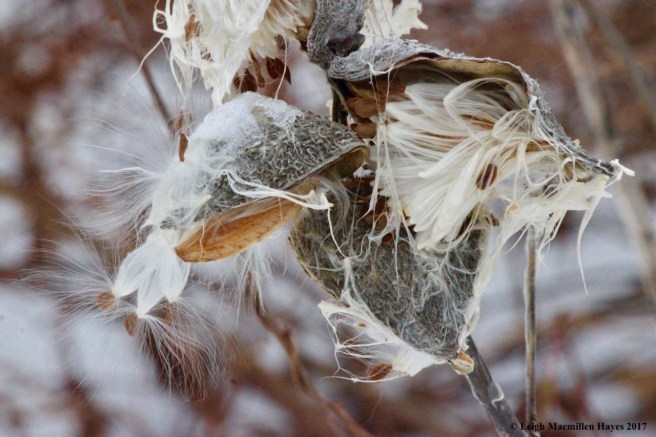
p-milkweed 2

A seed of an idea waiting to express itself in one form . . .

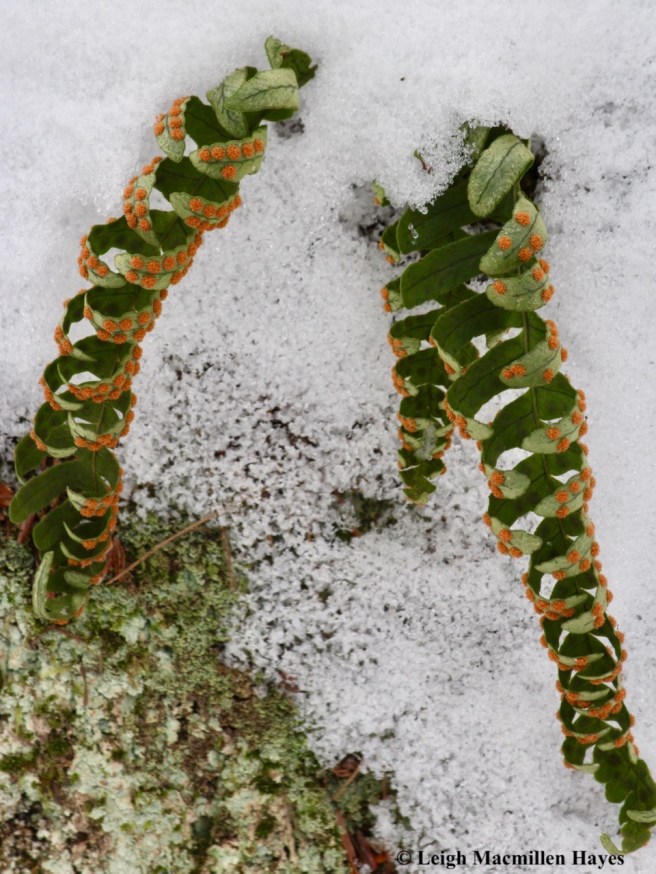
p-polypody

or another.

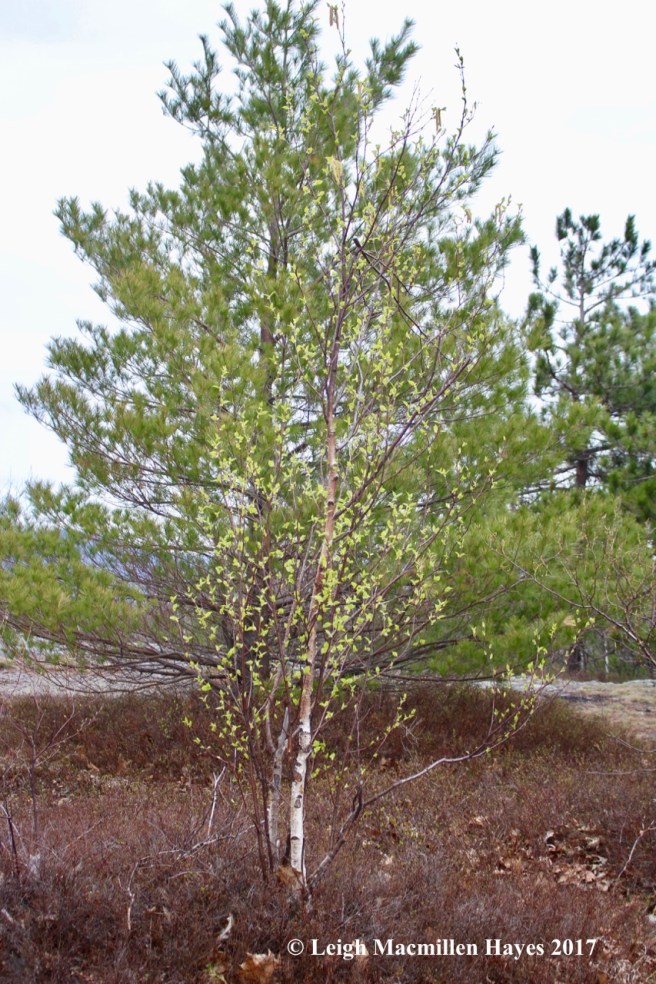
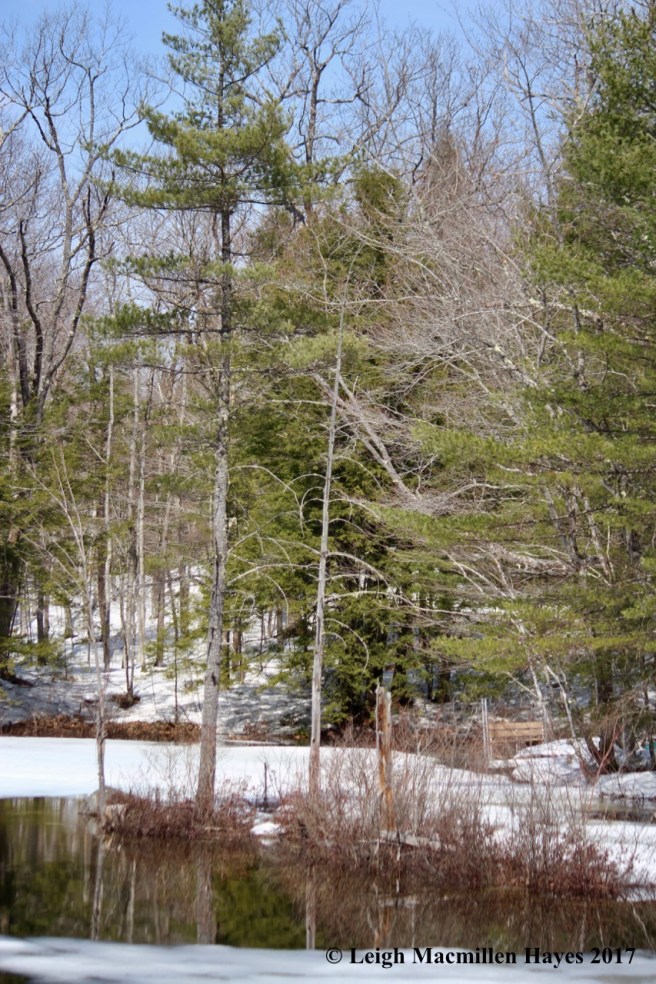
p-yellow birch in pine tree

The seed was sown and sprouted despite adverse conditions.

p-Normway maple leaf

More thoughts followed, some even considered “invasive” despite their exterior beauty.

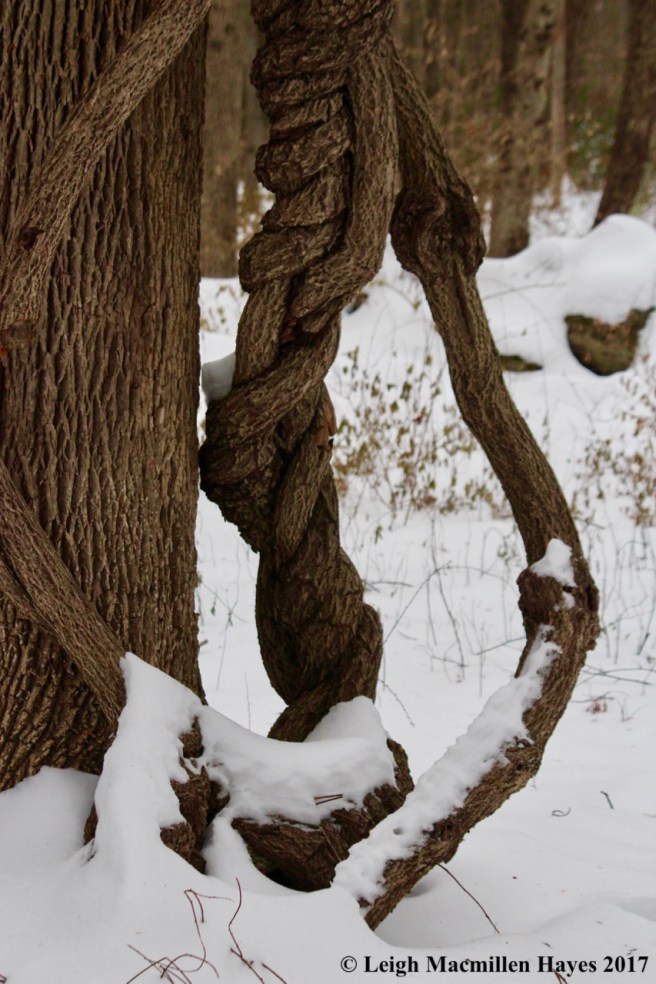
p-bittersweet

Occasionally, the invasive ideas forged ahead and crowded the mind.

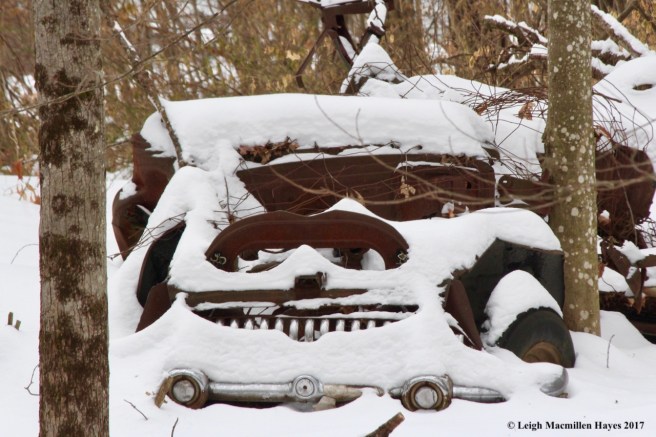
p-car

Certainly, not all the thoughts were natural in nature.

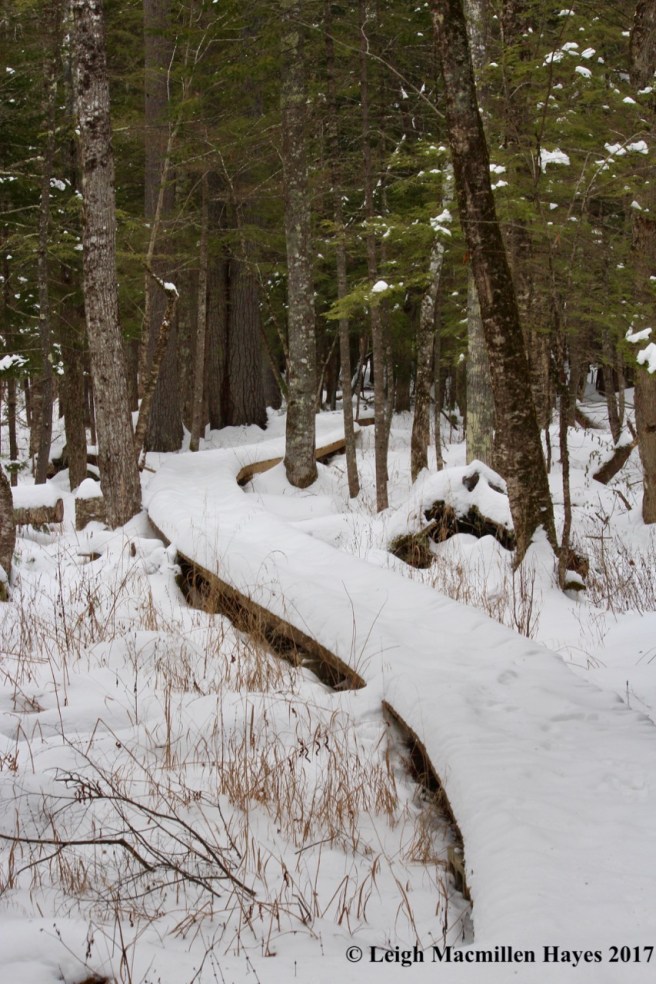
p-boardwalk

But still, new paths formed.

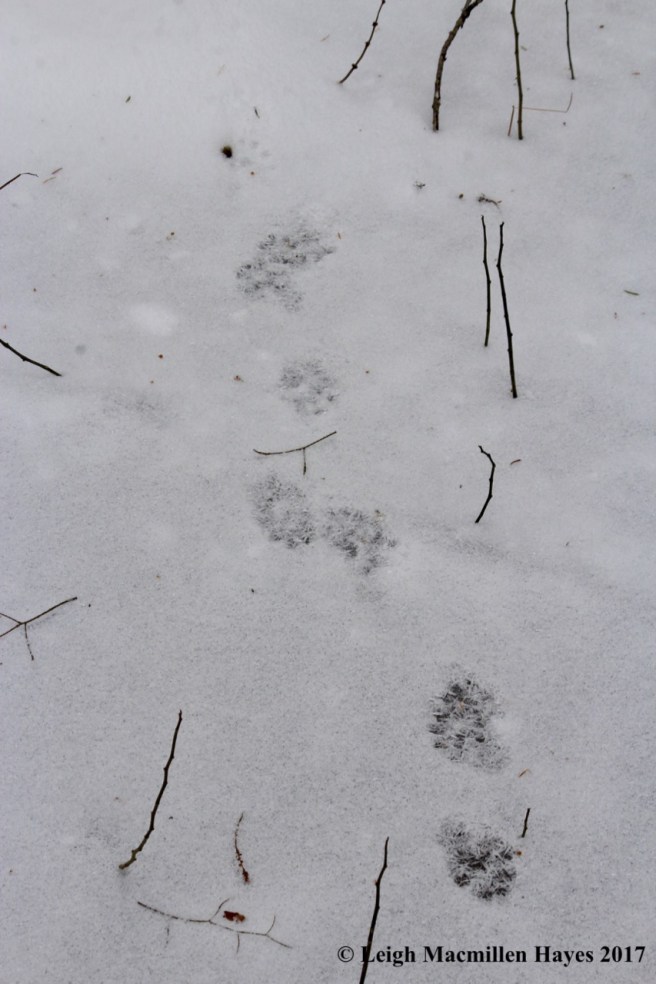
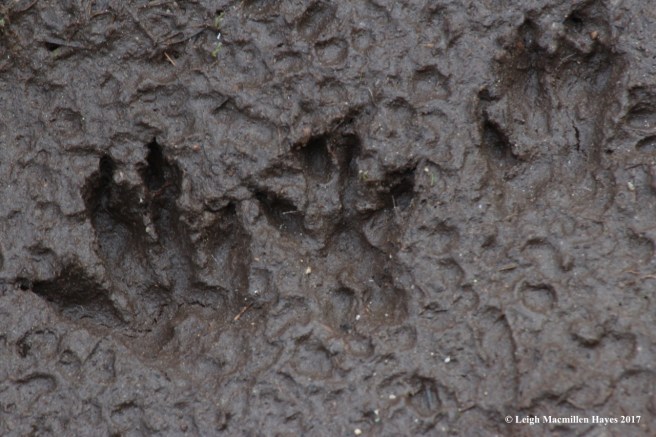
p-fisher tracks

And trails were traveled to and fro on a quest.

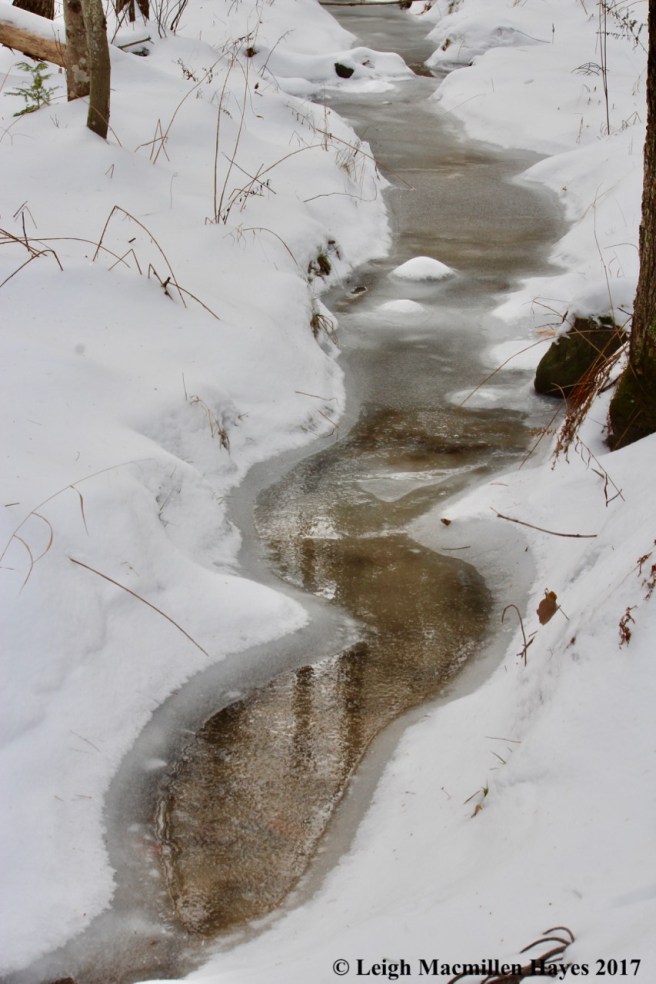
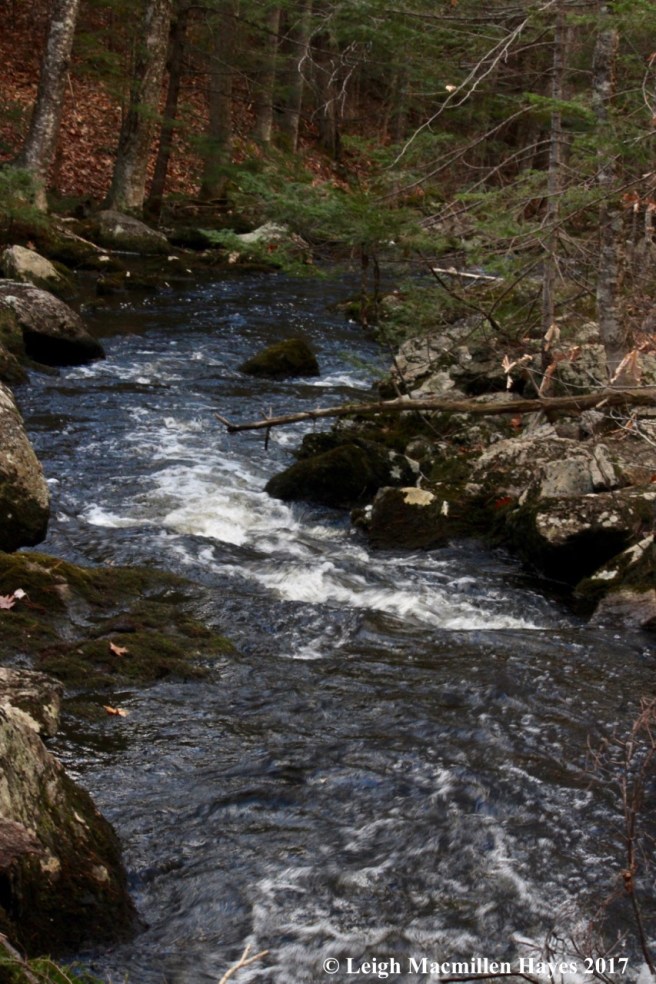
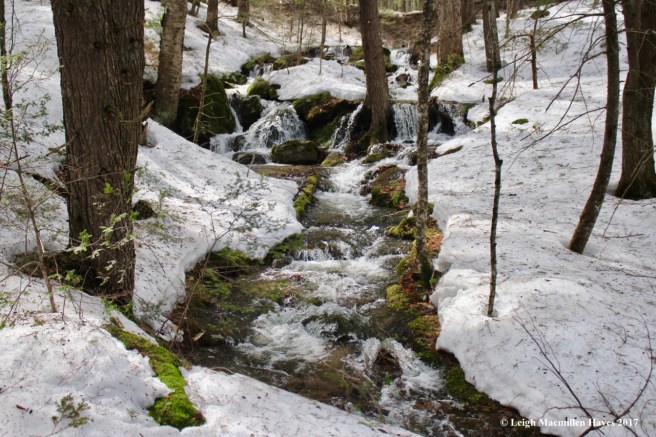
p-stream curves

The path was never intended to be straight and easy.

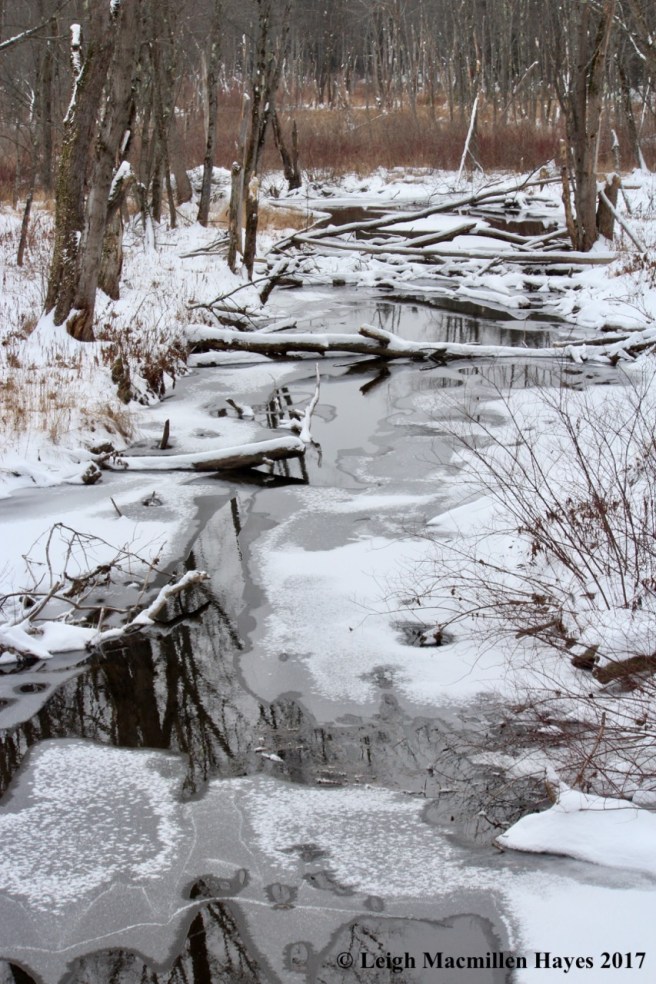
p-Stevens Brook 2

Obstacles became challenges.

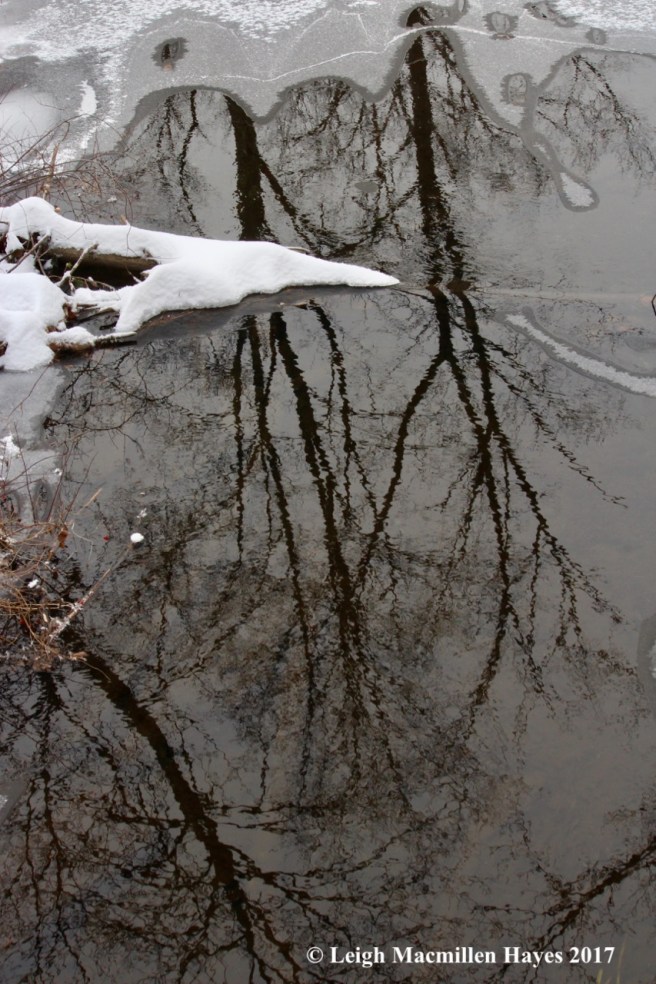
p-brook reflections

And challenges offered reflections.

p-ice feathers

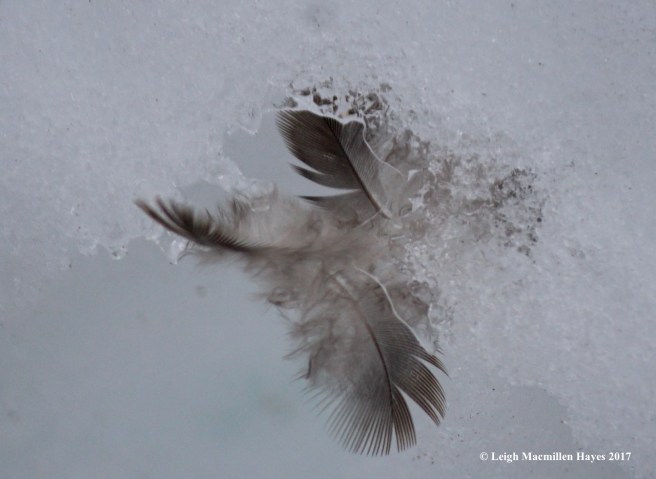
Amidst the offerings, fresh ideas feathered forth fostering education.

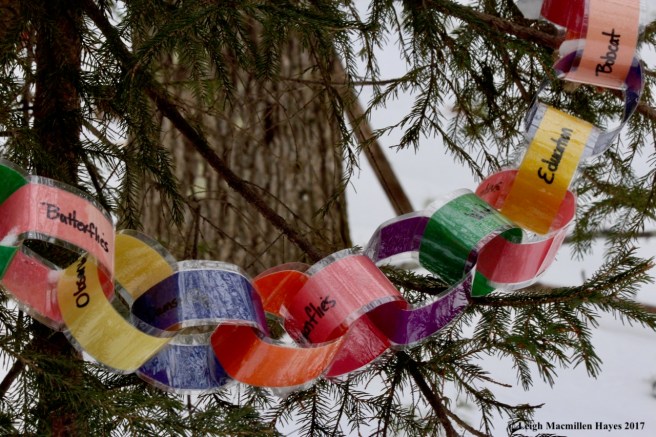
p-garland

And with education, knowledge was linked.

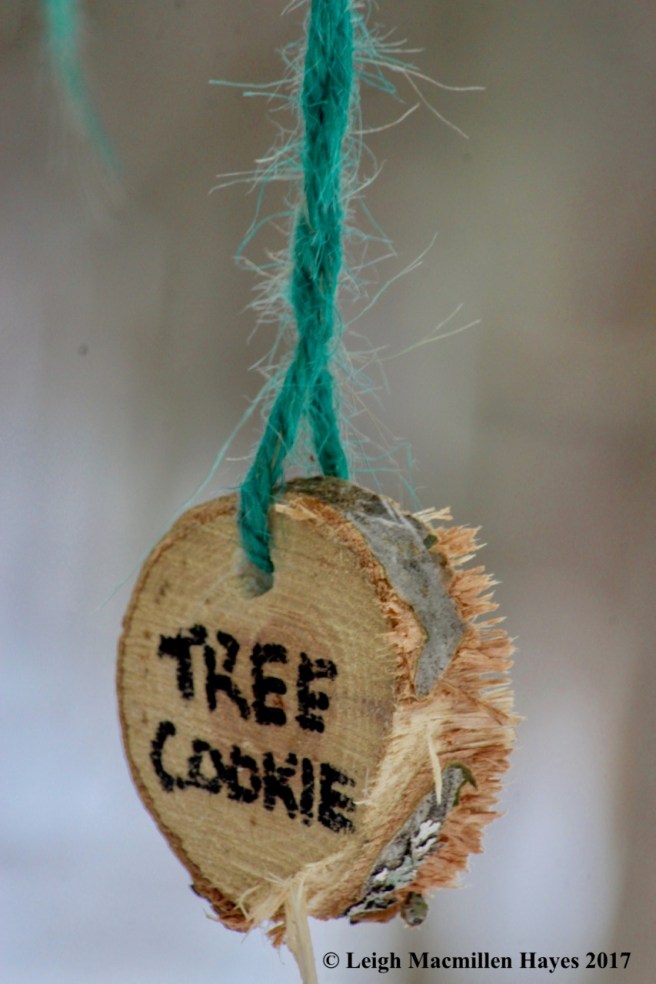
p-tree cookie

Because of all the seriousness, humor became a necessary ornament.

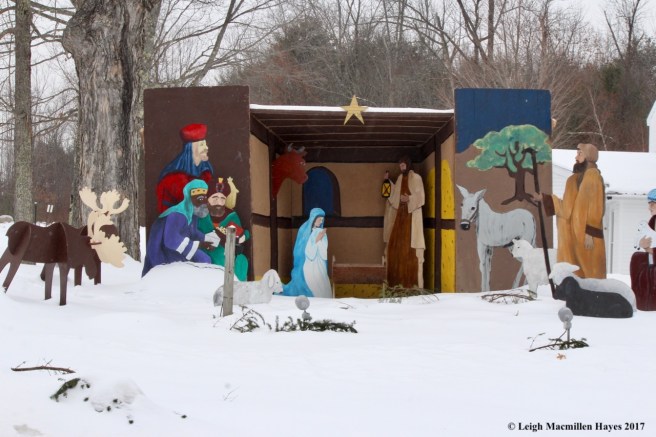
p-nativity

And so it was that moose stood watch with others by the stable in anticipation of a miracle that began with a seed of an idea and expressed the wonder of it all.


On Tippy Toes with Wonder

Snowshoes were a necessity this morning as I wandered, but with them came the constant sound of breaking glass as the frozen layer of ice atop the snow crackled with each  footstep. I doubted I would see anything amazing for so much noise did I make.

o-hemlock cones and seeds

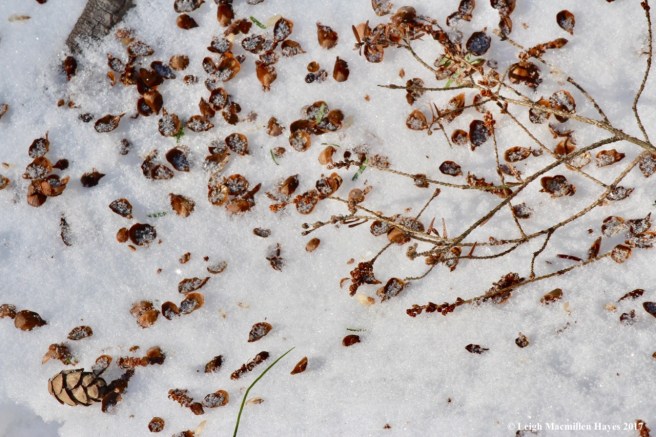
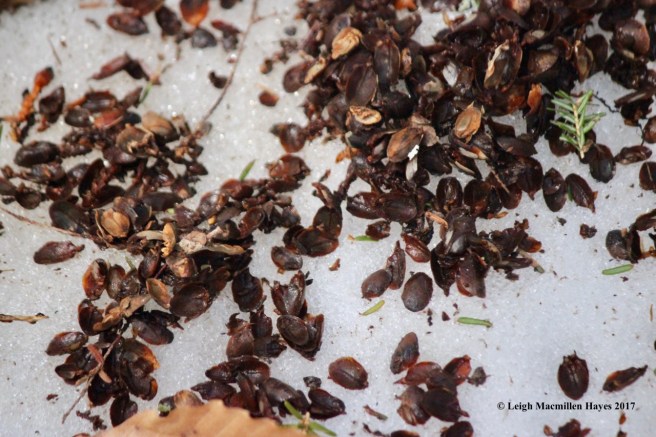
I was right, of course. It was all the usual suspects that show up ever more clearly now that the earth is draped with a snow coat. I only found a gazillion hemlock cones on the ground, most descaled and their seeds consumed by a certain red squirrel.

o-squirrel cache

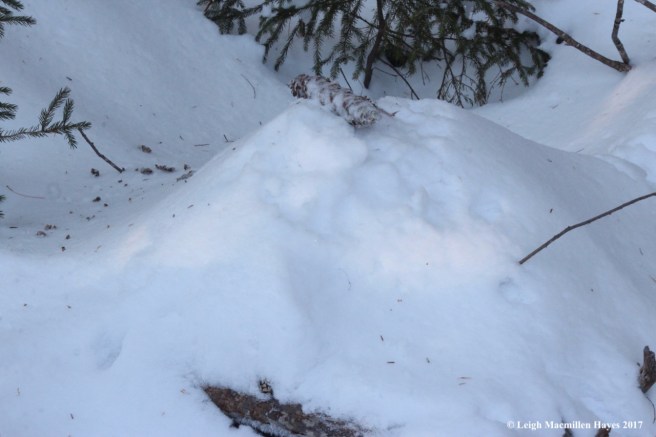
The hemlock cones were below trees near the squirrel cache I’ve been keeping an eye on. Curious thing about the cache–no tunnels to the goods within and one new snow-covered cone stashed atop. Did he decide the hemlocks were easier to deal with at the moment? Will he return to the pine cone cache for dinner? Of course, I’m assuming the work is that of one squirrel, but it could be more than one in the same area.

o-pinecone on hemlock

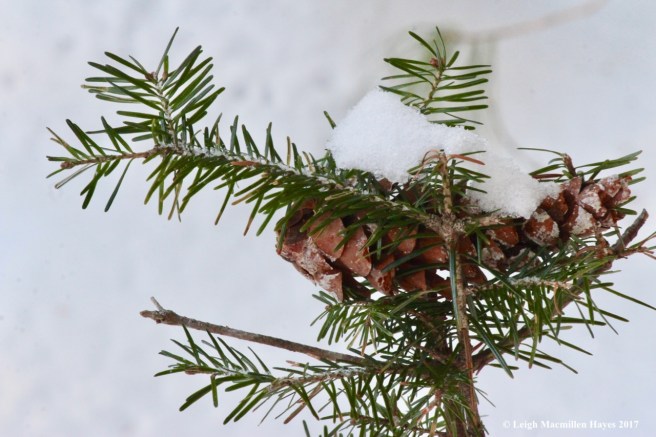
I did spy one that made me chuckle, for one of my pet peeves is when people call all cones “pine cones.” Pine cones grow on pine trees–whether white, red, pitch or jack. Hemlock cones grow on hemlock trees. And balsam cones grow on balsam trees. You get the idea. But what do you call a pine cone on a balsam tree? A tree topper, of course. Or . . . stuck. (And I’ve got the market on corny humor.)

o-turn left

Every which way I turned, there was nothing new to look at.

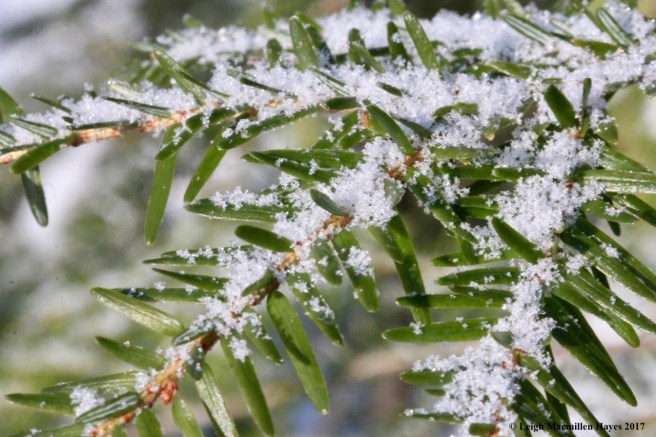
o-hoar frost on white pine

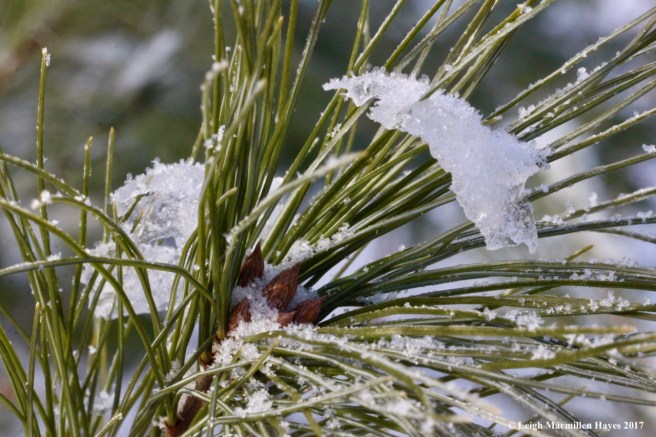
But the hoar frost . . .

o-hoar frost on hemlock

added crystalized ornamentation . . .

o-hoar frost 1

wherever it gathered . . .

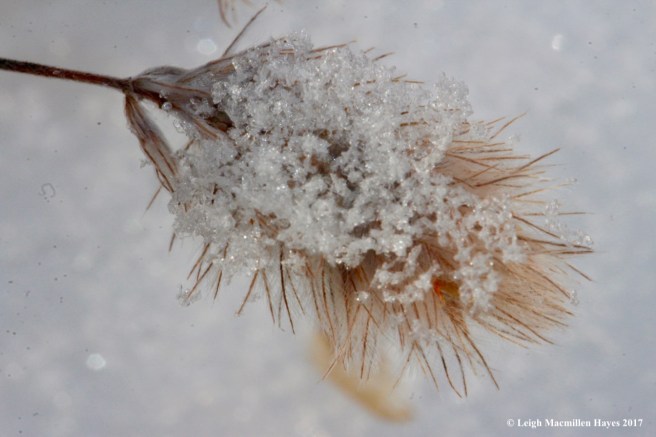
o-rabbit-foot clover 2

from the feathery rabbits-foot clover . . .

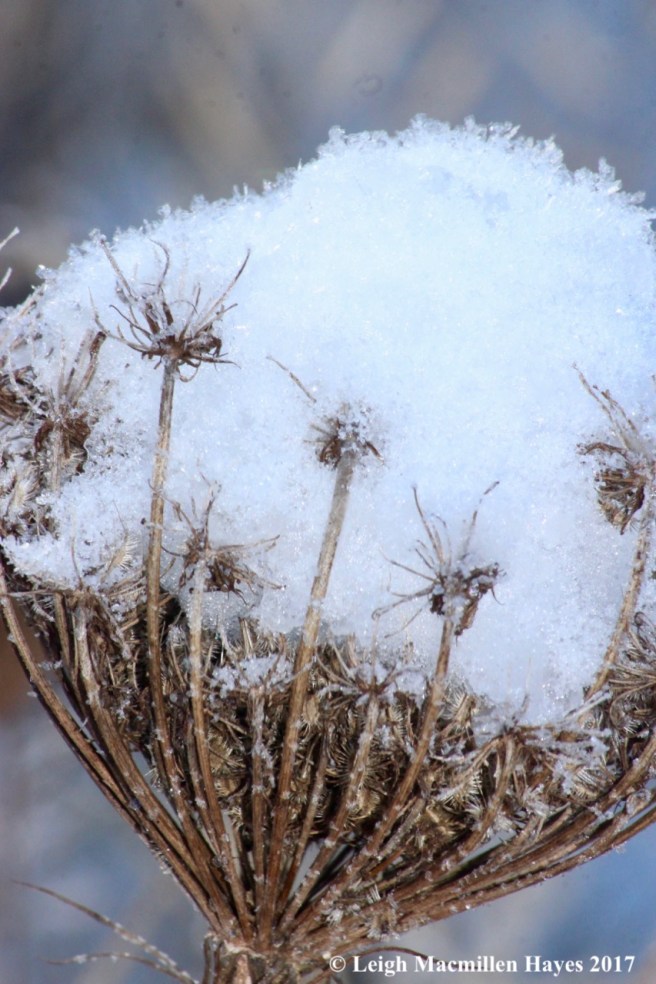
o-Queen Anne's lace 3

to Queen Anne’s lace . . .

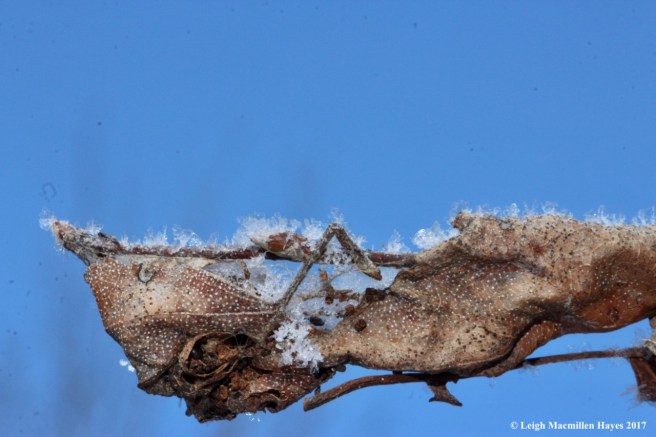
o-gray birch catkin 2

and gray birch catkins. Oh my.

o-ice waves 1

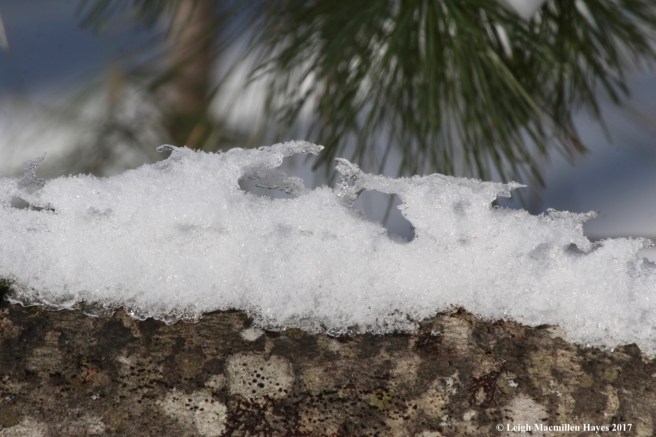
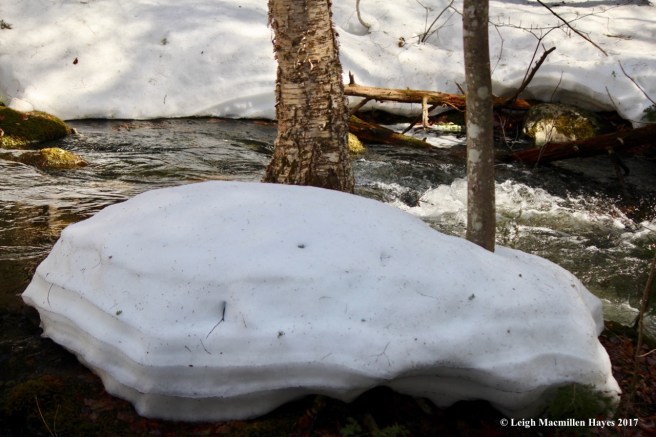
As the sun rose higher, my fascination with hoar frost melted away, but another ice sculpture begged notice–its formation called to mind hills and valleys of waves topped with white caps. And still, how does it do that?

o-goldenrod gall

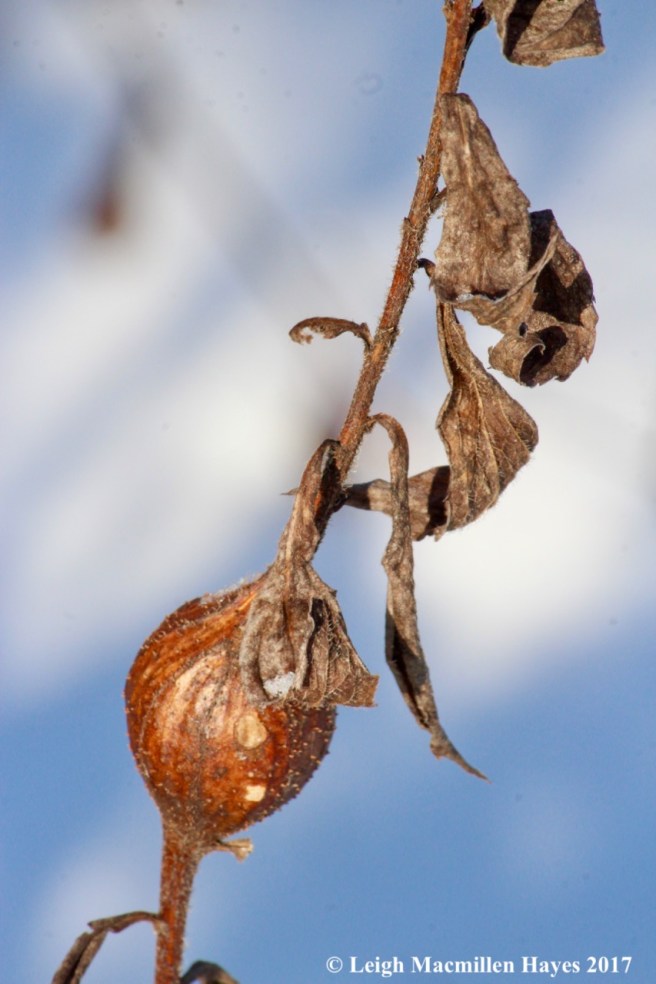
I found goldenrod galls as well, this one with no opening, which may mean the gall fly larva was probably still sheltered within.

o-goldenrod bunch gall

The other was a goldenrod bunch gall created by a midge. Looking like a mass of tiny leaves, it’s also known as a rosette gall for the shape at the top of the stem. In both cases, it’s amazing that insects can change a plant’s growth pattern so dramatically.

o-tracks galore

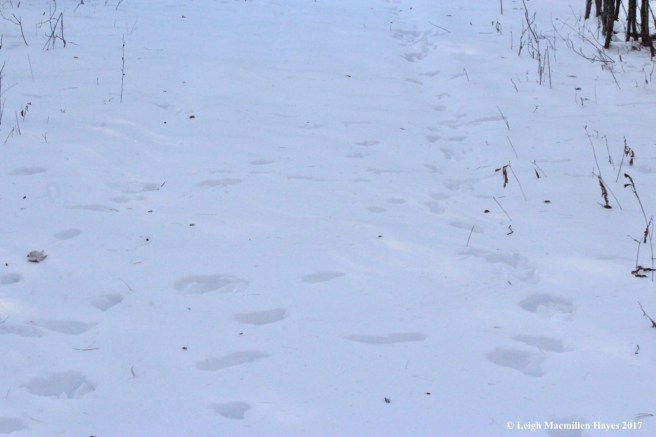
Even the tracks were of all the usual suspects from mouse to moose and I realized yet again how fortunate I am to share this space with them and know all their haunts.

o-right sign

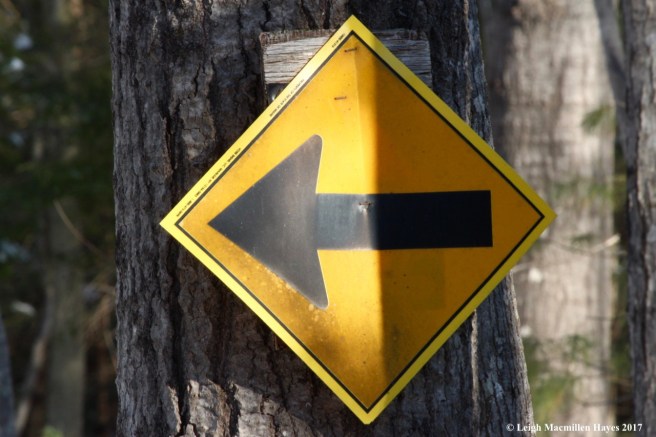
At last I took the right turn toward home.

o-deer beds 1

And under the hemlocks in our woodlot, I counted eleven deer beds and yet, I haven’t seen a deer in a while. This, however, has long been their frequent nighttime hangout.

o-deer beds 2

As I often do when I spy several ungulate beds–I looked at their orientation and as usual each had its back to the other given the smooth curved line–with all eyes and ears on the lookout.

o-moose ice

I also found a rather large print filled with a block of ice–actually, it’s a half block of ice for it fell off of only one of a moose’s cloven toes. I wondered if the moose felt like it was walking on tippy toes until that point.

o-snowshoes

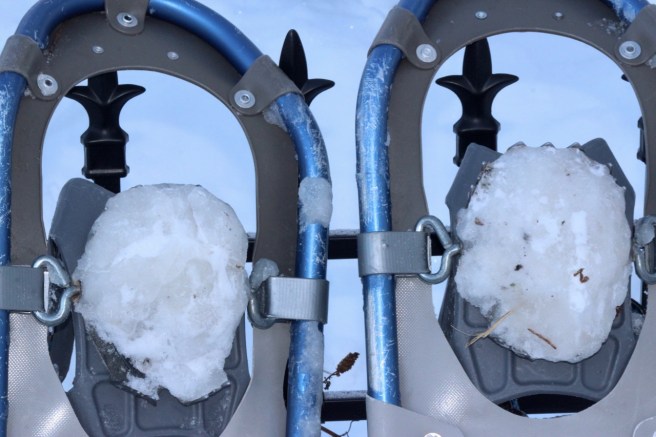
I certainly did, so frozen were the balls of ice on my snowshoes. That’s what I got for working my way through a half-frozen wetland. But it was that same water I had to thank for the creation of the hoar frost.

As awkward as it was, it was certainly fun to observe the world from my tippy toes. And despite the sameness of it all, my mind and heart were filled with wonder.


Like a Charm

White flakes floated earthward today and so I donned my snowshoes for the first time this season and joined the party.

s-snow!

Everywhere I looked, the world had transformed.

s-snow piling high

And ever so slowly mountain ranges took shape.

s-squirrel cache snow

One mountain in particular caught my attention,

s-squirrel cache 1

for I’ve been visiting it and two others nearby over the past few weeks.

s-refectory 1

Where previously, the refectory indicated hours of fine dining,

s-squirrel refectory snow

today there was none. But, I suspect by tomorrow a certain red squirrel that usually squawks at me will be back. Today, he probably hunkered down in his drey, hidden somewhere in the hemlocks above and out of my view. My intention is to keep an eye on him, just as he’ll continue to keep an eye on me, for I want to watch tunnels form and midden piles grow.

s-pinecone scales

After all, he worked hard this past summer and fall harvesting cones and acorns to fill his cupboards in preparation for the winter months. Though those months aren’t yet upon us, even in the fringe he enjoys what he’s gathered.

s-deer rub snow

I left his home base behind and continued on, noting how the snow had gathered–atop the ragged remains of a deer rub,

s-goldenrod snow

balanced on winter weeds,

s-snow tucked within

curled inside leaves,

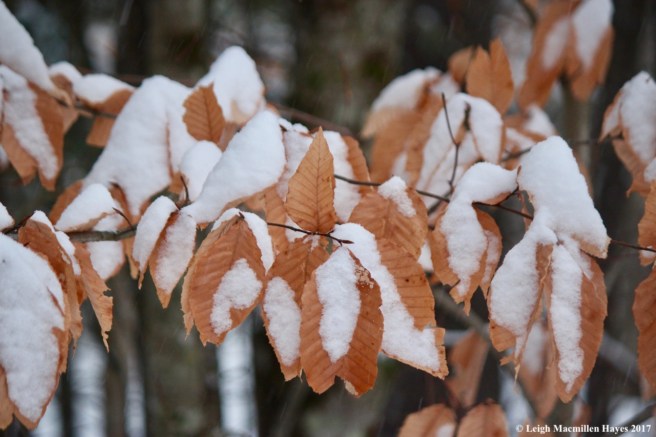
s-snow on beech

and dangling from others.

s-oak and hemlock

A fun find came into view below the towering trees, where the veins of red oak mirrored the structure of the hemlock twigs and needles it was caught between.

s-snow at home

At last it was getting dark and time to return to the homestead.

And it was time to celebrate the only dance for which my feet can match the rhythm–the snow dance. I’m so glad I wore my pajamas inside out and slept with the silverware last night. It worked like a charm yet again.


Christmas on Flat Hill

Two weeks ago the Greater Lovell Land Trust hosted a decorating party for the Fairs, Farms and Fun 4-H Group of Sweden along the trail to the summit of Flat Hill. It was the perfect tie-in to our planned hike to do the same during a guided walk scheduled for this morning.

f-finding the right spot

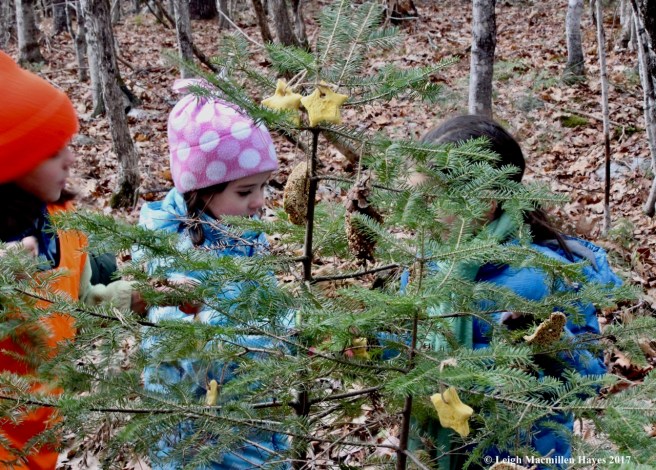
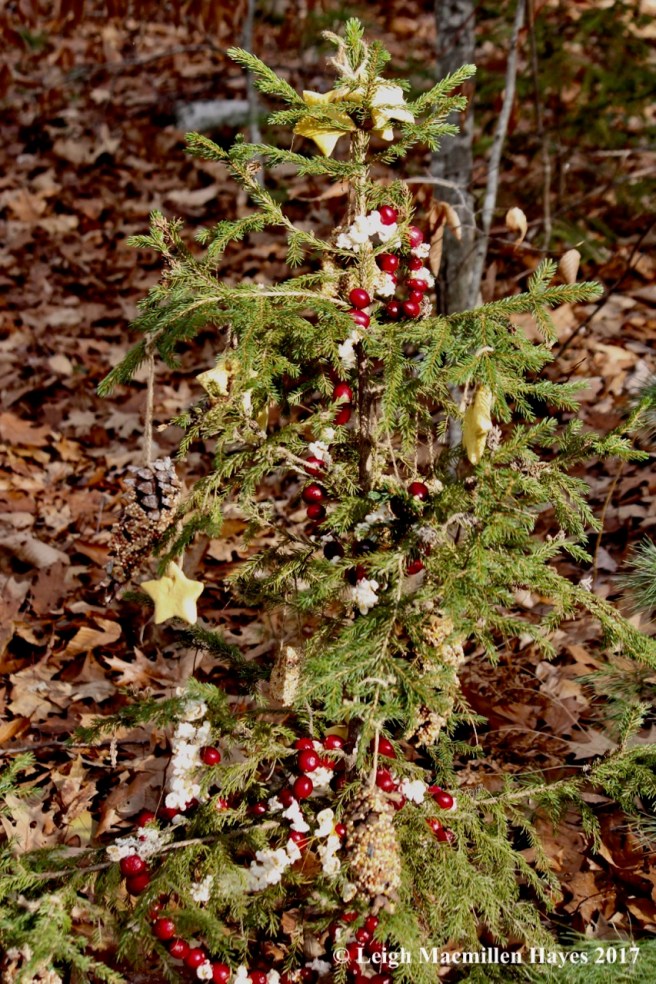
The homeschooled kids in the club had created ornaments with pinecones, peanut butter, and bird seed, plus garlands of cranberries and popcorn.

f-all done

Their efforts were for the first annual Maine Christmas Tree Hunt, a scavenger hunt intended for families to visit trails on several western Maine land trust properties.

f-Christmas Tree

The plan was to decorate one tree along the trail, but they had made so many ornaments that five or six trees actually were transformed into works of Christmas treats for the birds and mammals that call this place home.

f-chickadee

And so this morning we set off to check on the trees the kids had decorated and add a few of our own. We wondered what the ornaments might look like after two weeks. Some pinecones were nearly nude of the bird seed that once coated them. And if you look closely at the bottom left of this one, you’ll see a splash of gray–a chickadee moved quickly as it snatched seeds.

f-cranberries

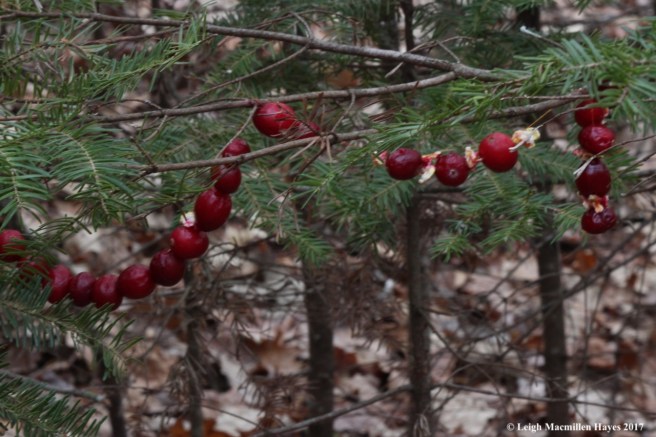
We also discovered that the popcorn was a big hit and most had been consumed, but the tart cranberries remained.

f-ornaments 3

There’s still more out there and we added a few fresh ornaments today, so I highly encourage you to pull on your boots (and it looks like you might need snowshoes as it’s snowing while I write) and head to the trail at the end of Heald Pond Road in Lovell.

f-beech leaf skeleton

While you’re there, take a look around. There’s so much more to see, including skeletons of beech leaves,

f-bear claws

bear claw trees,

f-polypode spores

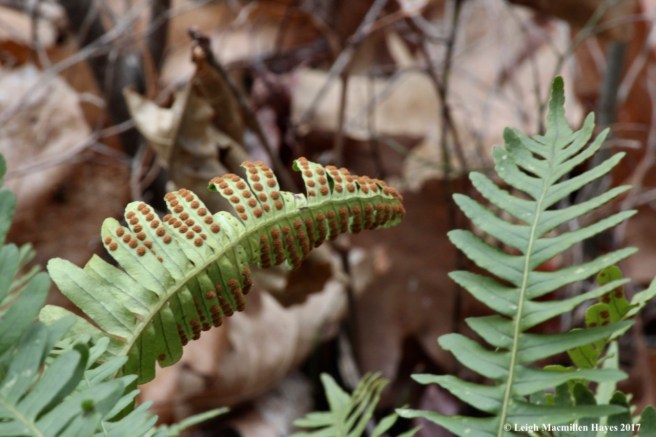
and polypody, some still dotted with sori.

f-baldfaces and Mount Wash

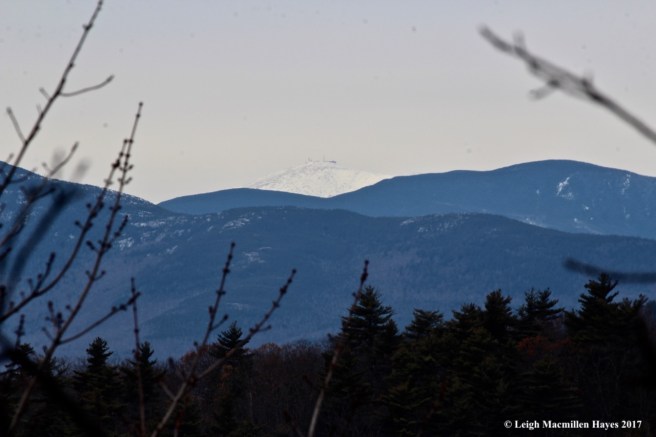
If your experience is anything like ours was, you’ll probably spy Mount Washington standing pure white between the branches of the red maple tree at the summit.

f-mt wash

And if you look closely, you may even see the buildings at the top of the greatest mountain in the Northeast.

f-porky 1

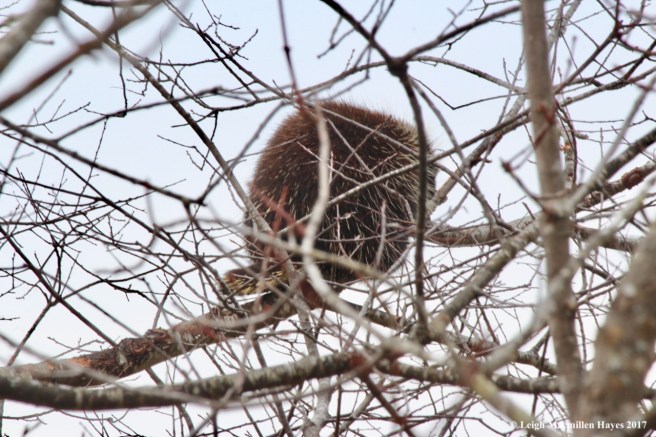
That’s not all that came into view. We occasionally are treated to the sight of the resident porcupine who lives in the area. And today–voilà.

f-porky bites

On our way partially down the back side of the summit cliff, we spied evidence of his work.

f-ice 2

And while we were looking, a crevasse drew our attention.

f1a-ice

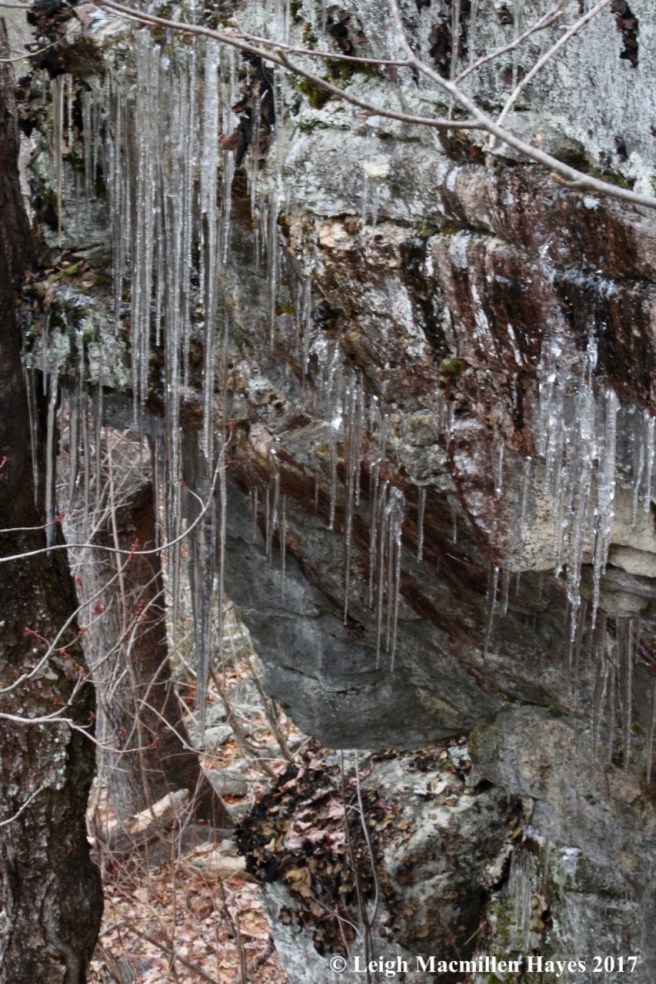
The beauty of ice never ceases to draw out long “Ahhhhhhs.”

f-ice 3

The granite boulders wore the ice like necklaces–reminiscent of quills.

f-porky 2

And we got a tiny bit closer to our prickly friend.

The gifts are plentiful this Christmas season on Flat Hill. Take a hike and enjoy the wonders.

Merry Christmas and Happy Hanukkah from the Greater Lovell Land Trust and me.

Keeping Watch

My feet itched to move along the forest floor and so I followed them and wondered where they might lead.

o-tree buds

The first stop was to examine tree leaf and flower buds packed inside their waxy scales where they will remain protected from the northerly winds until a date unknown.

o-hemlock cones

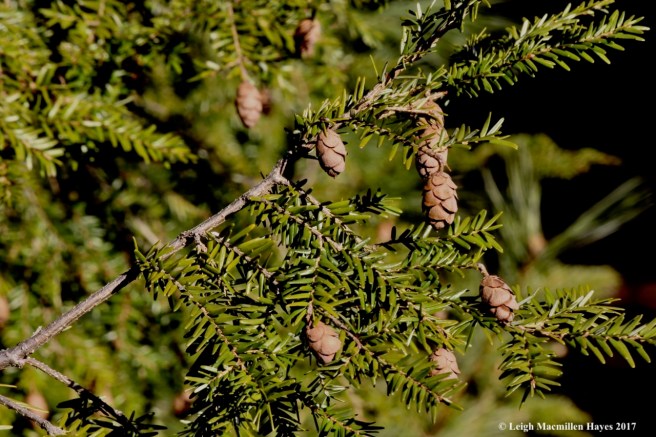
Beside the red maple, Eastern hemlock cones dangled like Christmas ornaments, with woody scales of their own protecting tiny seeds tucked inside until those northerly winds might release them.

o-squirrel dinner table

Everywhere, any possible surface, particularly those a bit raised, became a red squirrel dinner table meant for dining upon this year’s abundant supply of seeds.

o-squirrel chatter 1

And everywhere I was chastised by squirrel chatter for they seemed so sure I wanted to wrestle with them for a few nibbles.

o-upper side, maze polypore

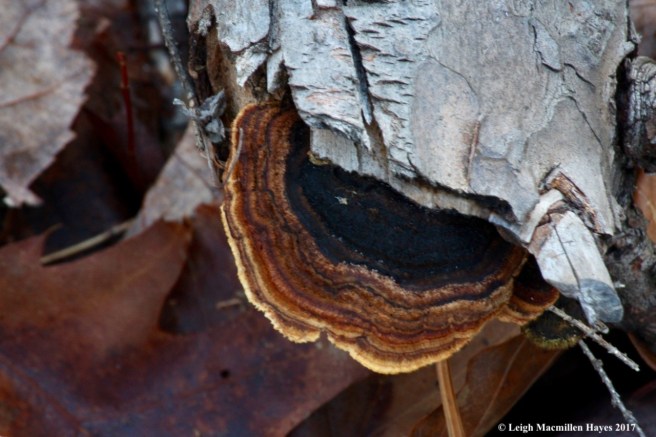
I paused beside mazed polypores, so named . . .

o-underside, maze polypore

for their maze-like underside from which they release their spores.

o-forest 2

Sometimes, my feet moved with ease despite occasional walls of evergreens–and when I encountered such, I pushed on through.

o-slash

Other times, it was over logging slash that I trudged, my feet taking a moment to choose the right balancing spot.

o-watery trail

There was even some island hopping thrown into the mix.

o-bobcat scat

At last I reached a logging road and then different sights filled my heart with hope for I knew that though I saw more than a million red squirrels and heard a variety of birds, including a ruffed grouse, these woods are filled with life (and death). Based on the size and lack of bones, I think this was bobcat scat and the meal was a white-tailed deer.

o-coyote scat

There was coyote scat, both old and new.

o-fox scat

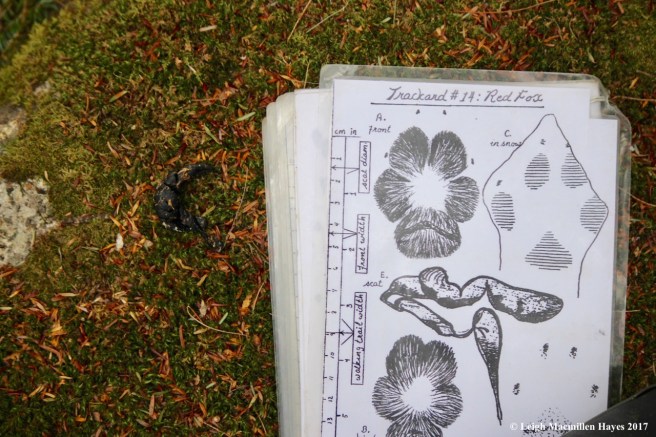
And fox scat reflecting a recent meal–perhaps Sunday dinner.

o-bobcat tracks

And where there is scat, there are tracks–most of the time.

o-moose tracks

Today, I saw signs of bobcat, moose (more than one), deer, fox and coyote and my heart rejoiced for I love tracking season. I also love knowing that these mammals continue to share this space with me–or perhaps it’s that I share this space with them. I think the latter is more likely. I’m just a visitor.

o-ice art 2

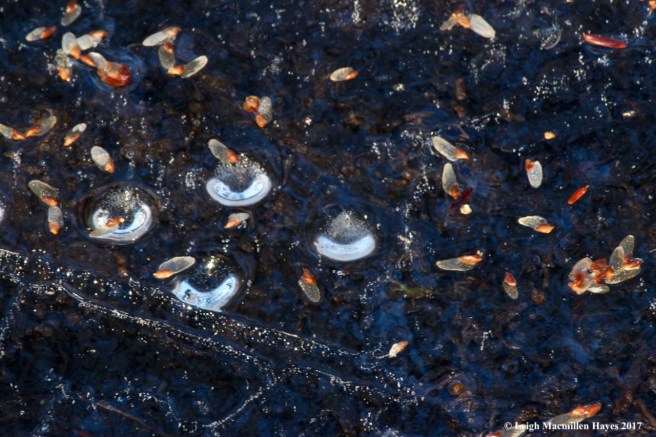
In places, ice also offered sights worth viewing. Atop a frozen puddle, those hemlock seeds I referred to earlier had found their release and their new home–temporarily at least.

o-ice art 1

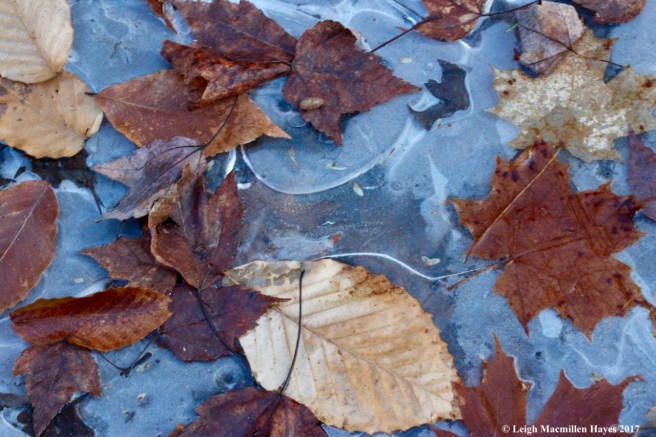
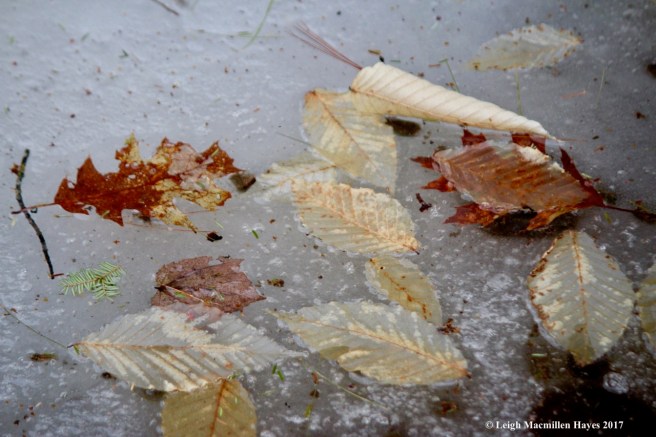
Leaves, cones and seeds intermixed with the ice and created mosaics worth framing.

o-ice art 4

And branches and seeds imitated trees in another work of natural art.

o-ice art 3

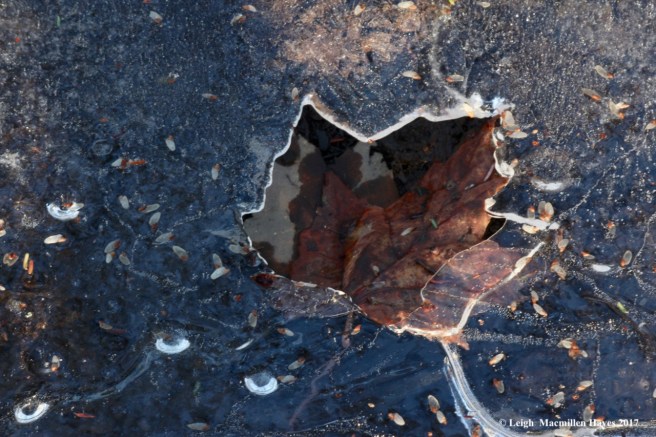
But my favorite was the red maple leaf cut-out that reminded me of Christmas cookie cutters.

Even if roaming through the woods isn’t your comfort level, I encourage you to take a few moments to step outside and look around. In this season of hope, may nature help you find wonder and through that wonder may you find peace within.

Any way you can, please join me in keeping watch.


For the Benefit of All

Living in an area where five land trusts protect land for us and the species with whom we share the Earth strikes me as a valuable reflection of who we are and where we live. Land trusts work with community members to acquire land for permanent conservation through purchases and donations. They also create legal and binding conservation easements that allow residents to protect land holdings in perpetuity, while retaining private ownership. Scenic views, wildlife corridors, flora and fauna, and topography remain, subject only to the whims of nature itself, which is ever-changing.

m1-first lodge

One of the biggest re-designers of the landscape is the beaver. And this afternoon, Jinny Mae and I ventured onto land owned by a friend and under conservation easement by the Greater Lovell Land Trust, to see what changes may have occurred in the past two months since we last visited.

First, we tramped off a logging road and checked on a lodge that was active two years ago. Today, the water level was low and there was no sign of activity. And so we continued on.

m2-pipsissewa

As we climbed up a small incline we stumbled upon a large patch of pipsissewa and had to celebrate our find.

m5-hexagonal pored fungi upperside

Back on the logging road, a tree brought down by one of nature’s recent whims introduced us to a fungi we had not met before–or at least as long as we could remember. And once we saw the underside, we were sure we would have remembered it.

m4-hexagonal-pored

Hexagonal-pored polypore (Polyporus alveolaris) caused us to emit at least six ohs and ahs.

m6-grape fern

Our next discovery–a grape fern. Actually, more than one grape fern once our eyes keyed in on them.

m7-checkered rattlesnake plantain

And then the checkered rattlesnake plantain; and again, once we spied one, we noticed that a whole patch shared the space. We just needed to focus for their presence was subtle amidst the brown leaves.

m8-bees nest 1

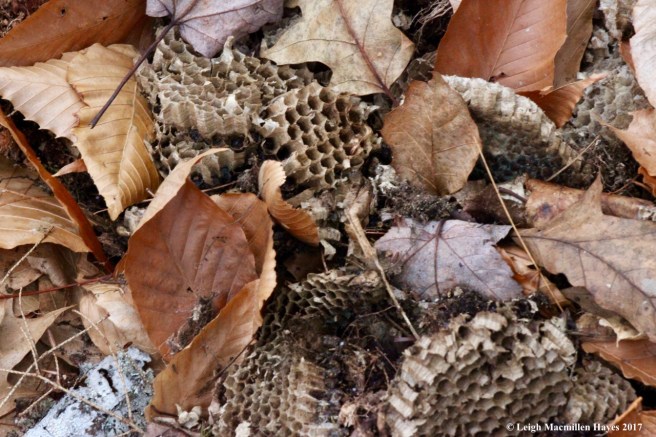
Before we met a snake of another kind, Jinny Mae spotted honey combs on the ground.

m8-excavation site

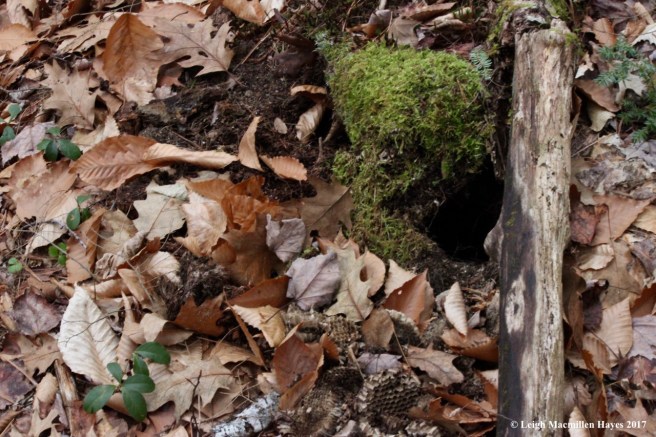
A look about and the realization that a raccoon or skunk had probably excavated the nest.

m9-snake liverwort

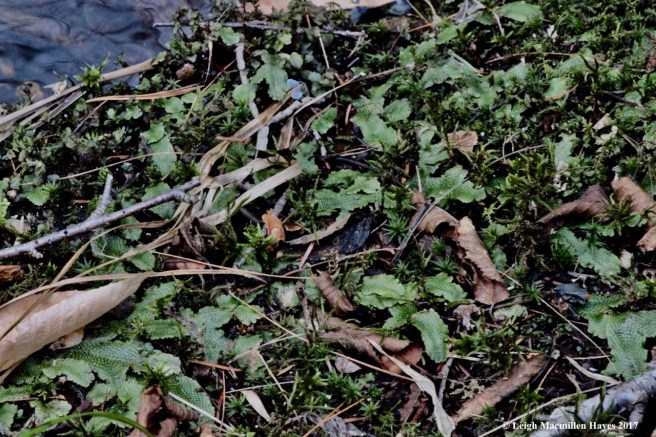
And then we met that other snake. You see, the last time we walked this property, we did see a garter snake. As we began our wander today, we commented that there would be no snakes or toads. But . . . we were wrong. This second snake was a snakeskin liverwort (Conocephalum salebrosum). For us, this was a second in another way for it was our second sighting of the species. Maybe now that we are aware of it, we’ll notice it growing in other places. We do know that its preferred habitat is wet or damp.

m10-umbilicate lichen?

In the same area, but across the brook in a place that we couldn’t reach today due to high water, we saw what looked like an umbilicate lichen, aka rock tripe. The color and substrate threw us off and so we’ll just have to visit again for further study. (“Oh drats!” they said with a smile.)

m11-beaver 1

The liverwort and mystery lichen were our turn-around point. On our way back, we decided to follow the water because we were curious. And within minutes our curiosity was appeased. The beavers we’d suspected might be casually active two months ago, had become incredibly active.

m12-beaver 2

Statue . . .

m13-beaver 3

upon statue . . .

m19-beaver 6

upon statue . . .

m20-beaver 7

upon statue announced their presence. And we acknowledged the fact that they have to turn their heads to scrape off the bark.

m14-beaver 4

Any trees that hadn’t been hauled away had been downed and gnawed upon in situ.

m15-beaver 5

It looked as if this one was a more recent dining adventure for there were wood chips upon the thin layer of ice and a hole showing were the diners had entered and exited the refectory.

m16-oak leaf and ice

Because of the ice, we noted other works of art worth admiring.

m18-lungwort 2

And occasionally, our downward gaze turned upward when we spied trees covered in lungwort worthy of notice.

m21-beaver 8

But really, it was the beaver works that we celebrated the most.

m23-beaver 10

And the fact that thanks to the beavers we learned that the inner bark or cambium layer of a red maple is . . . red.

m23a--not all cuts work in the beavers favor

No matter where we looked, in addition to recent windstorms, the beavers had changed the landscape. The curious thing is that most often the trees landed in the direction of the water, making it easier for them to enjoy their chews of inner bark and twigs in a relatively safe environment, but occasionally, hang ups occurred. And that brought about the question, how is it that most trees are felled toward the water? But not all?

m23a--lodge

While our focus was on the trees along the shoreline, we also kept admiring the water view as well.

m24-lodge

And noted the most recent activity at this particular beaver lodge, including a mud coating to insulate it for the winter.

m28-welcome flag on lodge

We also appreciated that a welcome sign blew in the breeze–in the form of an evergreen branch.

m29-otter scat

And where one finds water and beavers, there are otters. We knew of their presence by the scat left behind in a trail well traveled. Several times we found examples of the same.

m31-main channel open

As the sun lowered while we approached the beaver dam, we quietly hoped to see North America’s largest rodents at work, but settled for sky reflections on water and ice. And the knowledge that by their works and sign, we trusted they were present.

m32-dam1

At last we reached the dam, an expansive one at that. It’s in great shape and so no time had been wasted repairing it. That’s a good thing given that a few flurries floated earthward on this day that felt like winter. There’s food to gather and a home to prepare so work must be efficient.

m33-dam other side

Water trickled through in a few places and ice formed, but the infinity pool created by the dam continued to exist.

m34-brook

And below, the water flowed on–to other beaver dams and otter adventures we were sure. For Jinny Mae and me, our adventure needed to draw to a close. But . . . we made plans to explore again in a few months to see what changes may have occurred–with land owner permission, of course.

As we walked out, we gave thanks for the owners and their appreciation of the landscape and those that call it home today and tomorrow.

From the land comes food and water that benefits the critters who live here and us. It also offers us good health when we take the time to embrace it by exploring, exercising and just plain playing outdoors.

Protection is key. So is education, which develops understanding and appreciation. I know for myself, my relationship with the landscape continues to evolve.

I’m thankful for the work being done to protect the ecosystem. There’s so much I still don’t understand, but with each nugget of knowledge gained, the layers build. Maybe someday I’ll get it. Maybe I never will. Either way, I’m happy for the chance to journey and wonder on properties owned by land trusts and individuals.

Even though we can’t all endow the future of our properties, we can get involved to ensure that these organizations continue to protect land for future generations of humans and wildlife so it will remain in its natural state for the benefit of all.


Time Well Spent

Time. I never seem to have enough of it. Time with my guy. Time with our sons. Time with family. Time with friends. Time to explore. Time to reflect. Time to write. Time to sketch. Time to be . . . in tune with the world around me and my own soul.

b-pileated 1

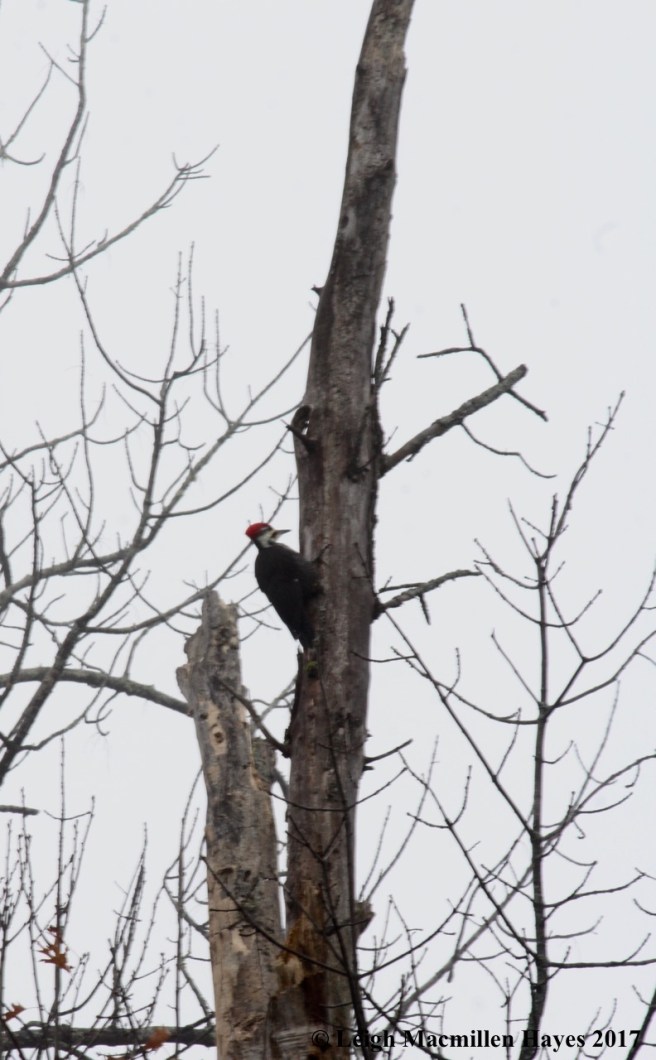
And so today, when I heard a pileated woodpecker as it worked on a dead ash tree by one of the stonewalls, I decided to take a break from my own work and give it the attention it so loudly demanded.

b-pileated 2

Its a repeat visitor to that tree; along with crows and hawks and smaller birds as well. The tree can no longer create its own source of food, but it continues to provide for others, be they bird, insect or mushroom. And I suspect that it secretly shares its knowledge of the world with the younger ash it towers over–to the right. As for the pileated, his time at that tree came to an end . . . for the moment. He’ll be back–probably soon.

b-ash tree 1

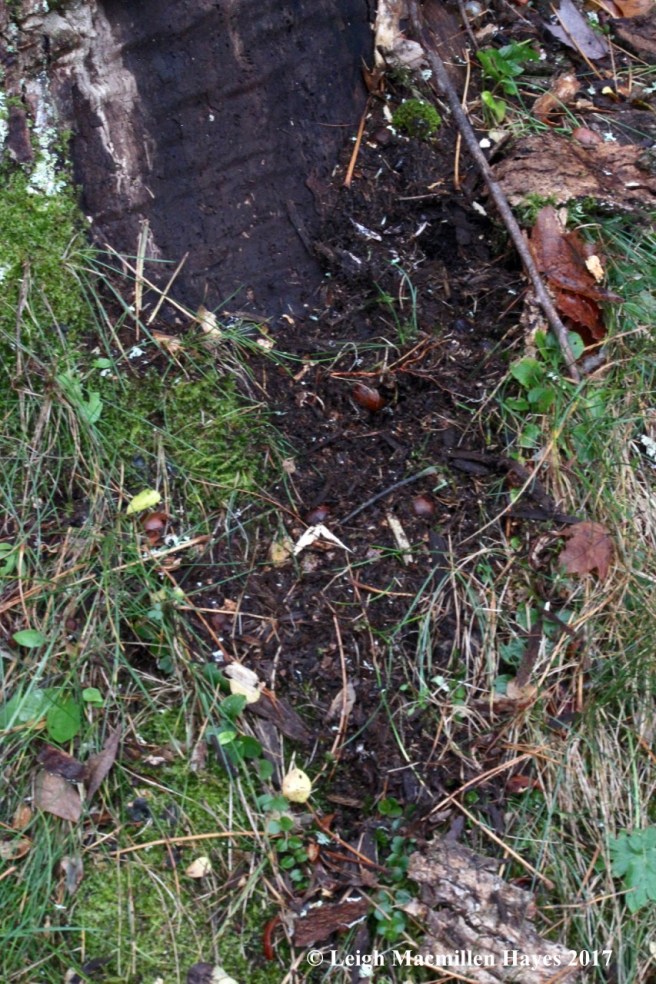
Because I stood below and no longer need to look up, I turned my gaze downward. And then had to pause. What had happened? Who had visited? And scraped the ground right down to the roots? And left a pile of leaves and sticks and other debris at the edge? A mushroom foray? An acorn frenzy? I looked for hair and found none. Turkey? Squirrel? Porcupine?

b-ash tree 2

And at the base of the next old ash, similar behavior.

b-scat 2

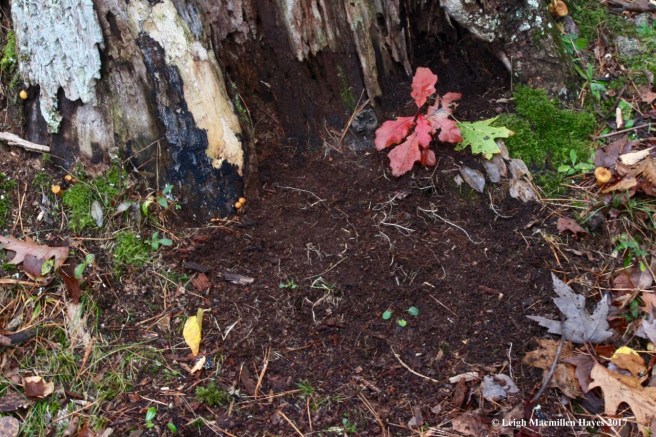
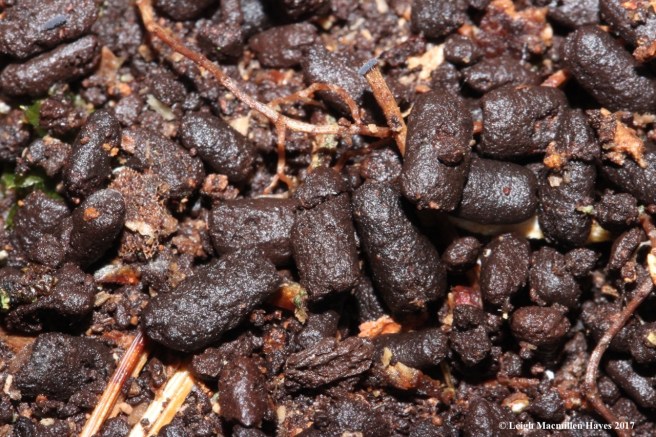
Returning to the first tree, I discovered that what looked like dirt was actually little pellets of scat . . . tiny scat. Tons of scat. A latrine. Did perhaps a meadow vole live somewhere nearby and a predator went after it? I did also suspect that there may have been a bunch of mushrooms that were harvested and in the process the vole’s latrine was exposed. I’m not sure if I’ll ever really know, but since I had stopped to look, I noticed something else.

b-pigskin poison puffball (Earthball)

Tucked near the base of the tree and relatively untouched by whatever had spent some time clearing the area, was a pigskin poison puffball, so named for its outer skin that feels like a football. (In his book, Fascinating Fungi of New England, Lawrence Millman writes: “historical note: footballs used to be made of pigs’ bladders, not pigskin.”) The dark spore mass within seemed to reflect the ashen color of the tree beside which it grew.

b-pelt lichen1

I should have returned to work then, but the puffball discovery and my wonders about the latrine made me want to poke about some more. Since I’d missed the puffball, what else hadn’t I noticed. A few steps to the left upon another tree root–a pelt lichen with many fruits, aka many-fruited pelt. I first discovered this lichen upon Bald Pate Mountain a few years ago, but didn’t know that it grew here–right under my nose.

b-many-fruited 2

Its smooth brown lobes shone brightly due to all the recent moisture, but it was the reddish-brown apothecia or fruiting forms that I found so intriguing. They’re described as saddles, and I suppose if you look at one from the right angle, yes, you can see the saddle-like structure.

b-field dog lichen

On the next tree, another pelt known as dog lichen–apparently named because its fruits reminded someone of dog ears.

b-spring tails 1

The algal component of a lichen goes into food production during rain, and so I continued to peer around. But first, a clump of Indian pipes caught my attention and upon them I noticed springtails doing their thing–springing about in search of food. Their diet consists of fungi, pollen, algae and decaying organic matter. Springtails are among the most abundant of insects, but because they are so small, they often go undetected unless you see them on snow in the winter.

b-mealy pixie cups

And then back to the lichens it was. I found mealy pixie cups in great number growing on a stonewall.

b-pixie cups fruiting

And one large patch looked like it was going to produce another, for so prolific were its fruits of tiny round balls.

b-lichen design

Also among my great finds, were the lichens decorating branches that had fallen to the ground in our recent wind storm. I loved the picture they painted with variations on a theme of color . . .

b-foliose and fruticose

and form.

b-lichen 3

My favorite of all reminded me of so many things–a rose in bloom, waves echoing forth with ripples, and even a topographical map.

Alas, I was short on time and needed to head in, but my finds–were the greatest. Even a wee bit of time spent wondering is time well spent.


Marathon Mondate

As he’s done every year for the past however many, my guy is training for the Moose Pond Half Marathon, a race around Moose Pond in Bridgton and Denmark that supports the Shawnee Peak Adaptive Ski Program. The race is only two weeks away and so this morning he headed off to run ten miles. And afterward, he said he felt like he could have run the additional 3.1 miles that would complete the race. That being said, we headed west to join our friends, Pam and Bob, on a hike at a new preserve in New Hampshire.

The plan was to meet at the trailhead near Hurricane Mountain Road on the Chatham/Conway town line. We knew the road, but not the spot, and were racing to get there, so of course I drove right by. But . . . I spied Pam sitting in their car in the parking lot and probably burned some rubber as I came to a screeching halt and then quickly put the truck into reverse. Fortunately, my guy didn’t get whiplash. It’s a back road, so not well traveled, thus I could drive backwards for a hundred feet or more without any problem–thus is the way ’round these parts. And one of the reasons we love it so.
m-sign 1

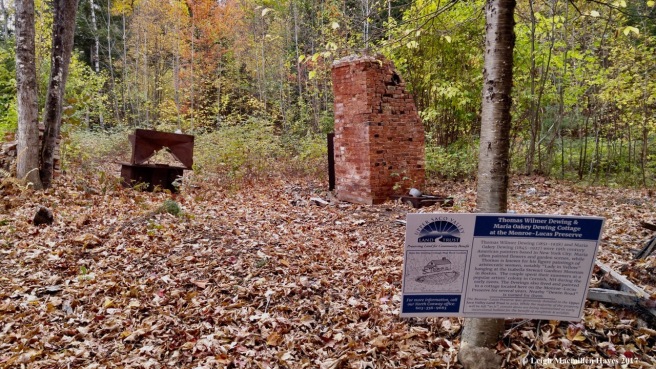
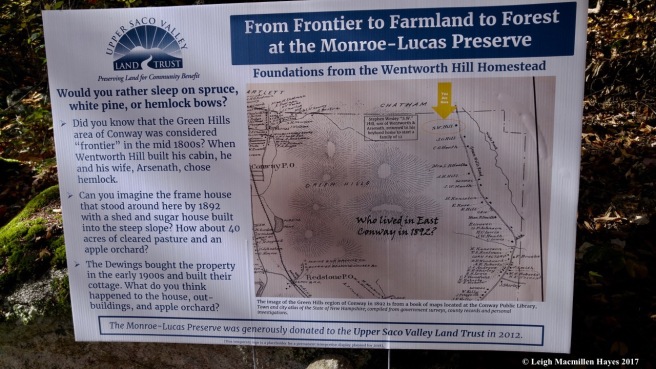
Another is that local land trusts preserve land for the benefit of the species who call this place home, both flora and fauna–and for us so that we, too, may benefit from time spent tramping along trails, making discoveries and forging friendships. The preserve we visited today isn’t quite open, but Pam said she’d heard they plan to open on November 4th. There were no signs on the kiosk or trail maps, but we quickly learned that none were necessary for the route was easy to follow. We were at the Monroe-Lucas Preserve, a 62-acre property donated to the Upper Saco Valley Land Trust.

According to their website: “The land was given to USVLT by Barrett Lucas in honor of his wife, the late Leita Monroe Lucas. Leita’s family has deep roots in East Conway and Redstone, and her father, Ernest “Red” Monroe, also wanted to see the land preserved. Adjacent to the Conway Common Lands State Forest, The Nature Conservancy’s Green Hills Preserve, and the White Mountain National Forest, this parcel builds on an existing network of preserved land, and has wonderful opportunities for future trail development and increased public access. A branch of Weeks Brook also runs through the property, and the property lies within USVLT’s ‘Green Hills’ focus area. The site is also remarkable as the one-time summer residence of the American Impressionist painter Thomas Wilmer Dewing, and his fellow painter and wife, Maria Oakey Dewing. Their cottage, built in the late 1800s, fell into disrepair in the mid-1900s. Now only the chimney remains onsite.”
m-puff ball fungi 1

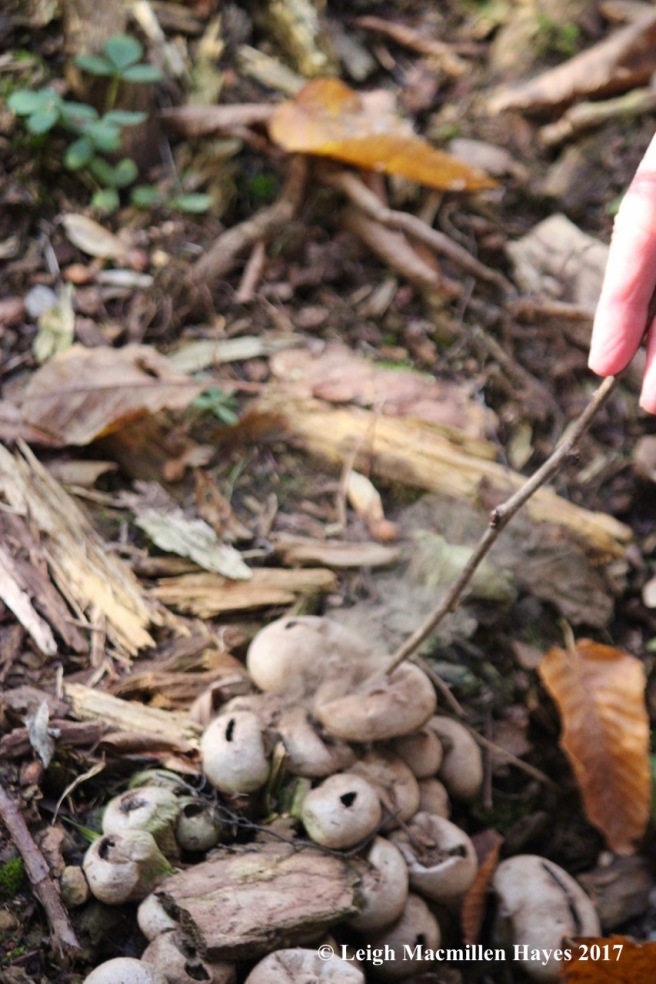
With Pam in the lead, we started up the trail and within minutes the fun began. She spotted a large patch of puff balls begging to be poked. The spores wafted up and away with hopes of finding the perfect place to grow nearby. We assume they will be successful, for within a fifteen foot area, we found patch after patch and knew we weren’t the first to encourage their spores to blow in the breeze.
m-bobcat print

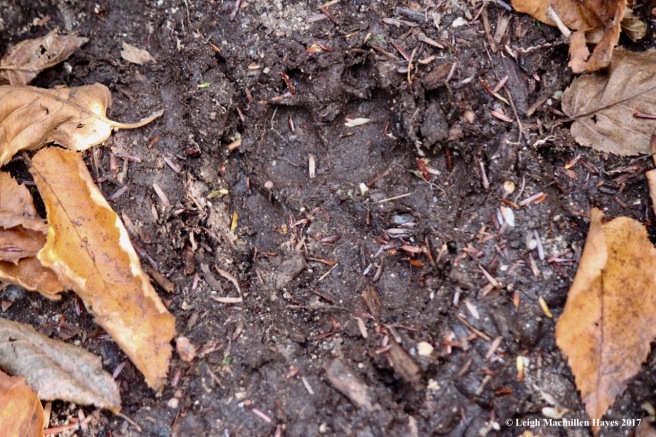
And then Pam began to spy prints in the mud. First, a moose. Then this bobcat–if you look closely, as we did, you may see the hind pad matted down; above that a raised ridge in the form of a C for cat; and four large toes, the two in the center being asymmetrical. Because it was a muddy substrate, we even saw nail marks, especially above the two center toes. Five feet further, we found deer prints. And so we rejoiced in the foresight of the Monroe-Lucas family to protect this land.
m-Weeks brook flowing 1

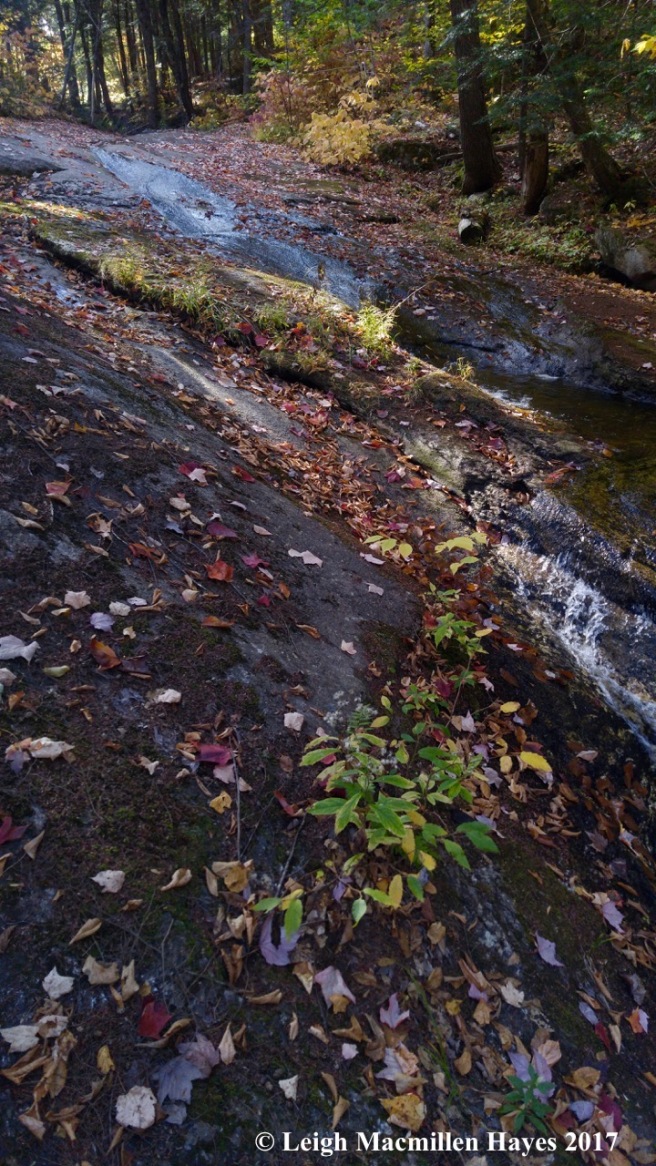
A bit further on, we heard the brook before we saw it–a branch of Weeks Brook that borders the property. We all stood beside and let it mesmerize us.
m-weeks brook 1c

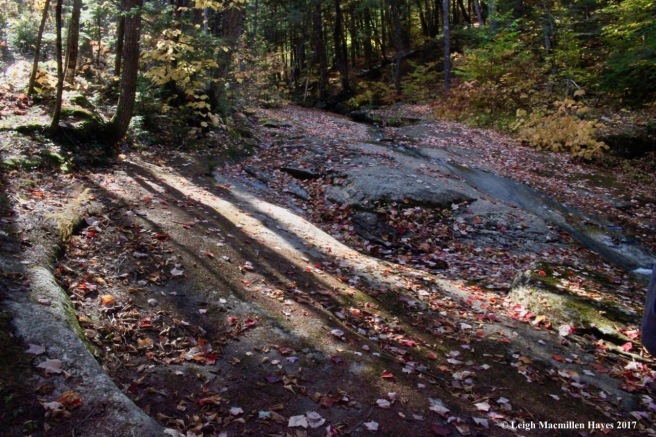
We thought about its forceful action each spring and the eons it took to carve into the rocks along its banks.
m-weeks brook baths

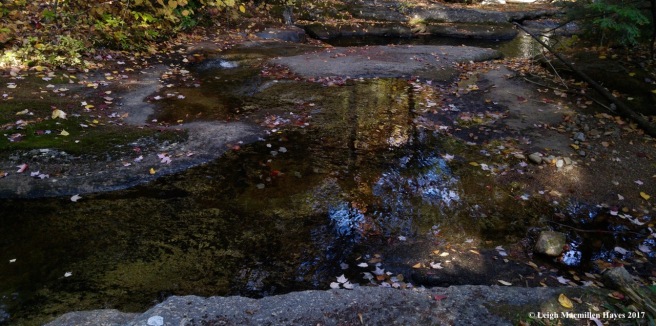
We shared visions of a summer day spent sliding down its smooth channels and slipping into the pools below.
m-weeks brook between the rocks

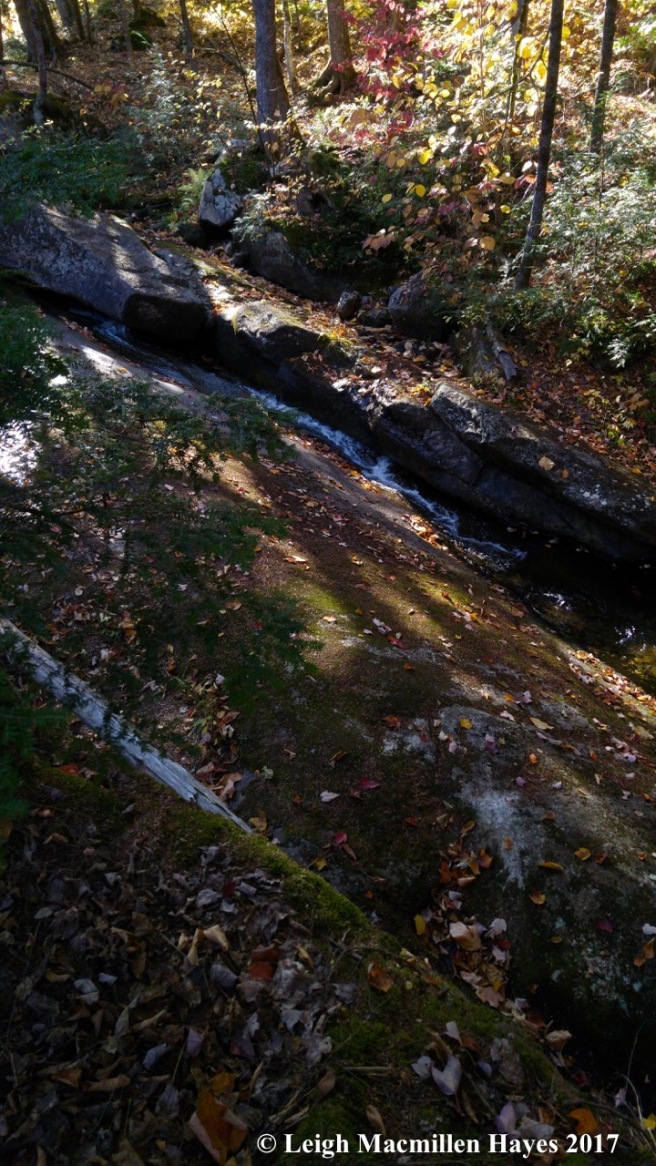
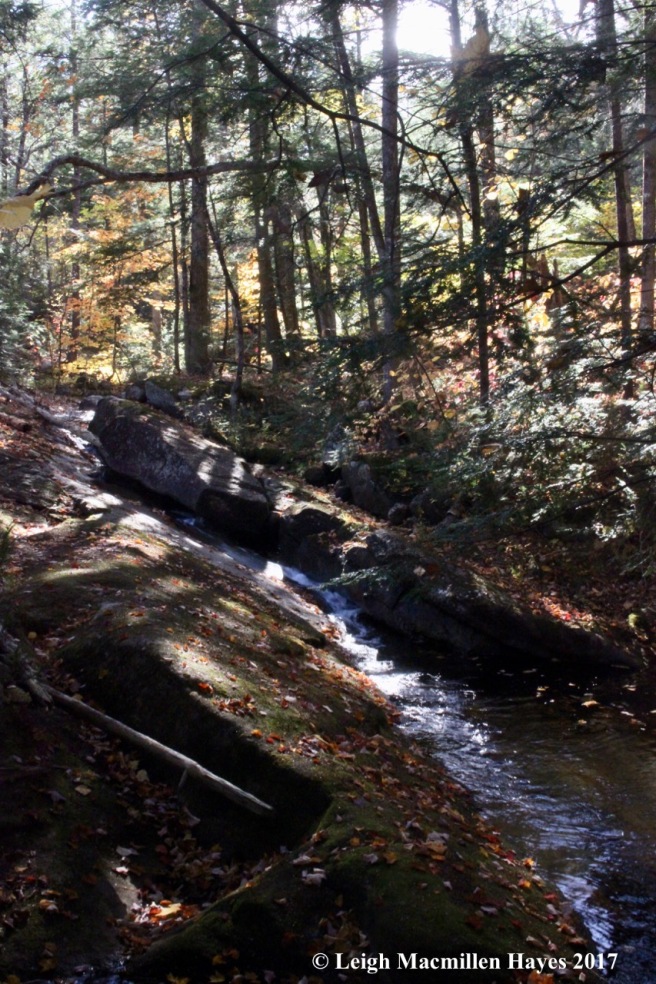
And we marveled at the way it split the granite above . . .
m-weeks brook between 3

and flowed between the shelves.

m-weeks brook bubbles

All the while, it raced to the finish line and we could only assume it made good time.
m-hobblebush flower?

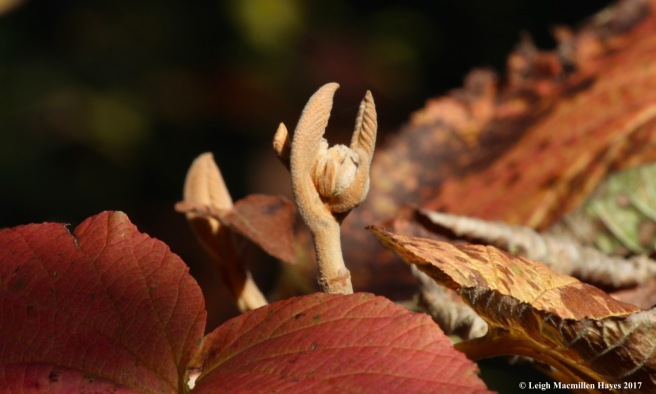
It was beside the brook where the hobblebush grew prolifically and offered a myriad of colors among their leaves and clasping or clapping hands among their buds. Because we were looking, we noticed one flower forming into its globe shape as it usually does in late winter. Was it confused?
m-hobblebush new leaf

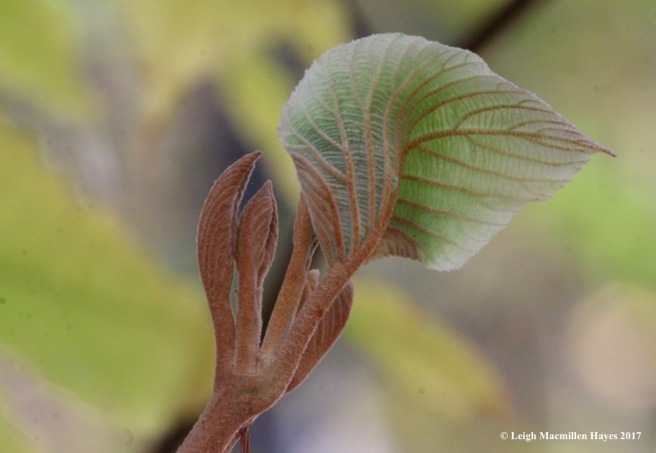
And on another, a new leaf.

m-hobblebush 2

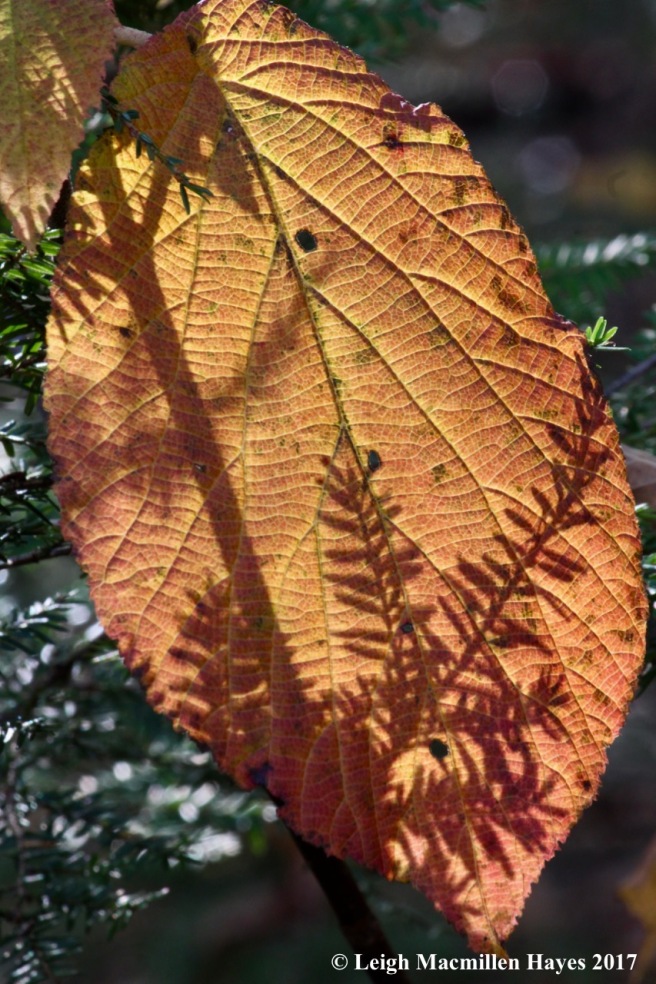
Fortunately, most behaved as they should and gave us an autumnal display worth celebrating.
m-hobblebush:hemlock shadows

One even added some shadow play.

m-mount kearsarge

Eventually, we turned away from the brook and followed the trail down. A peak through the trees and we could see Mount Kearsarge across the way.
m-slime mold 1

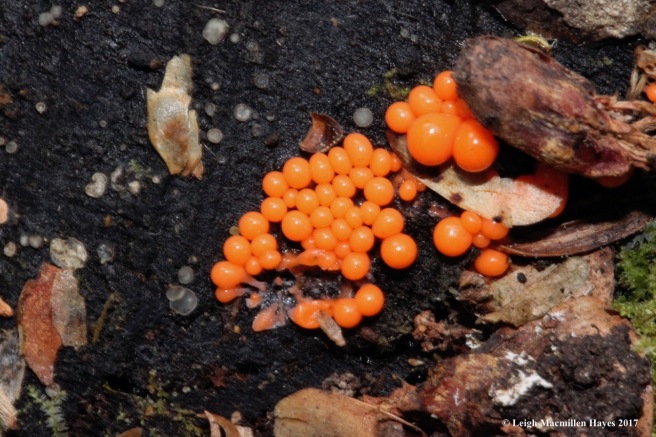
On a tree stump, we found a couple of fascinating fungi including a slime mold all decked out for Halloween.
m-jelly fungi

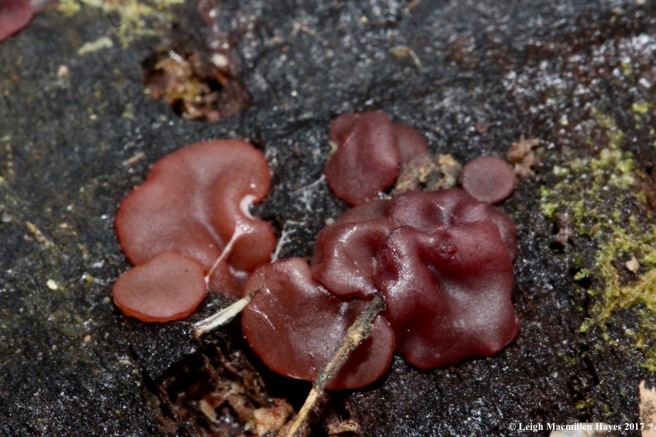
And on the same stump, a display of jelly ear fungi.
m-old moose scat

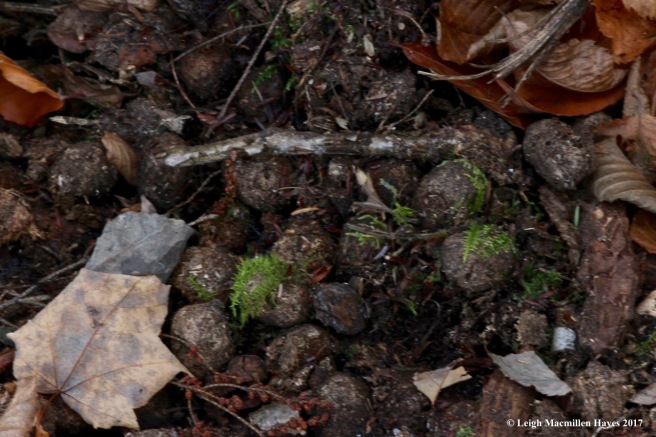
Around the corner was more evidence of moose traffic, though since it was moss-covered, we decided it was a couple of years old. None of us could ever recall seeing moss grow on moose scat before, but it made perfect sense that it would be a suitable substrate. I did wonder how they’d categorize that on a moss ID key–grows on rock, tree, ground, moose scat?
m-pippsisewa

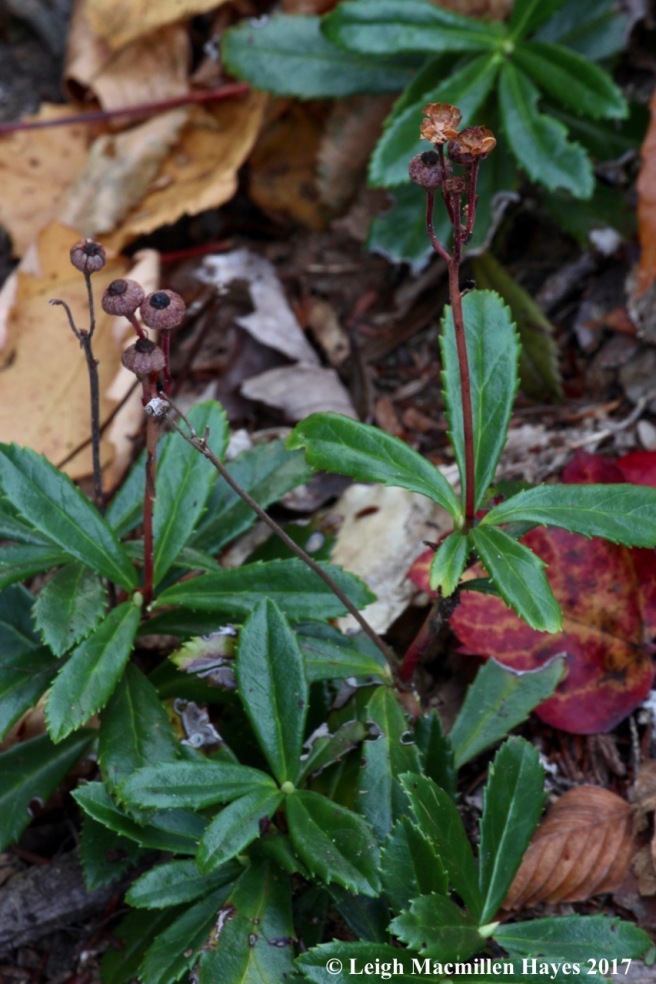
Our moments of awe weren’t over yet. We sent up three cheers for the pipsissewa and its seedpods (Bob, did you take one?),
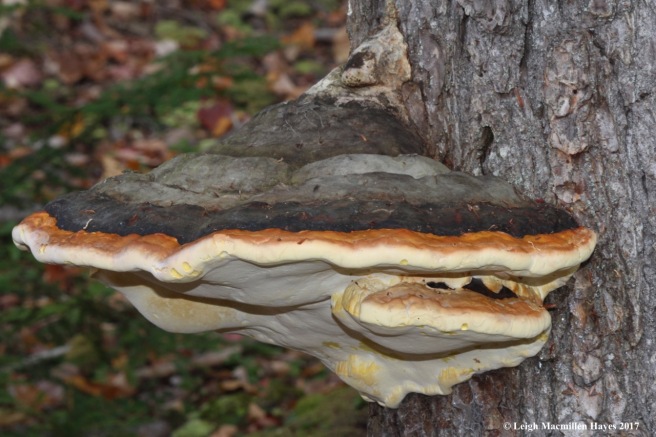
m-red-belted polypore

and red-belted polypore.

m-frullania 2

And then Bob spied the frullania. The smaller, spider-webby display in the lower right hand corner is Frullania eboracensis, a liverwort with no common name. But the larger mass is known as Frullania asagrayana, so named for a botanist and natural history professor at Harvard University from 1842-1873–Asa Gray.
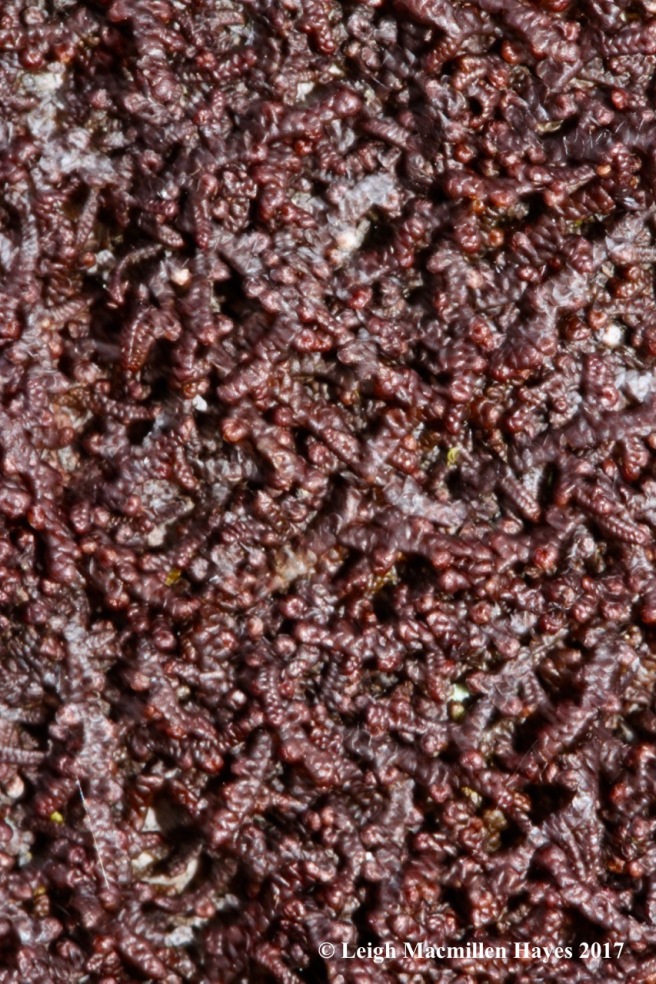
m-frullania

We all went in for a closer look at its worm-like leafy structure.
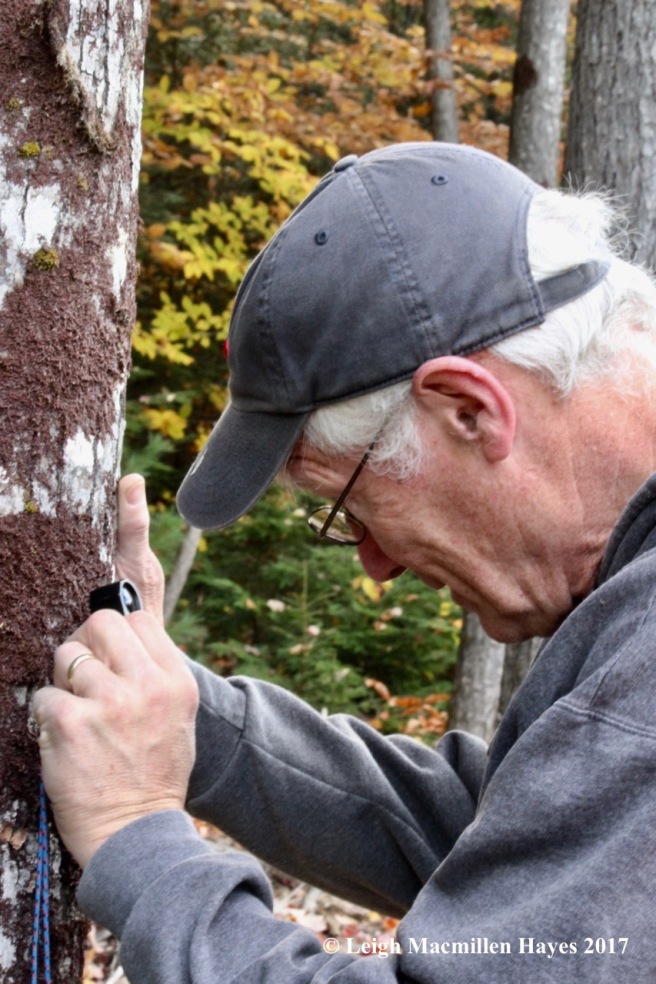
m-frullania and muy guy

Even my guy got into the act, much to his reluctance. And he was certain he didn’t need a lesson on how to use a hand lens. Thankfully, he doesn’t read these blog posts, so I can get away with this. Shhhh.
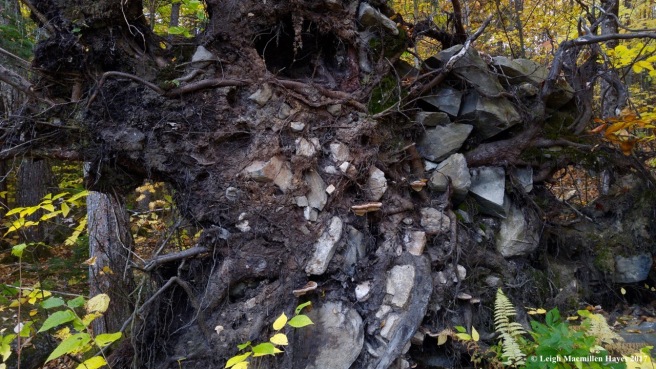
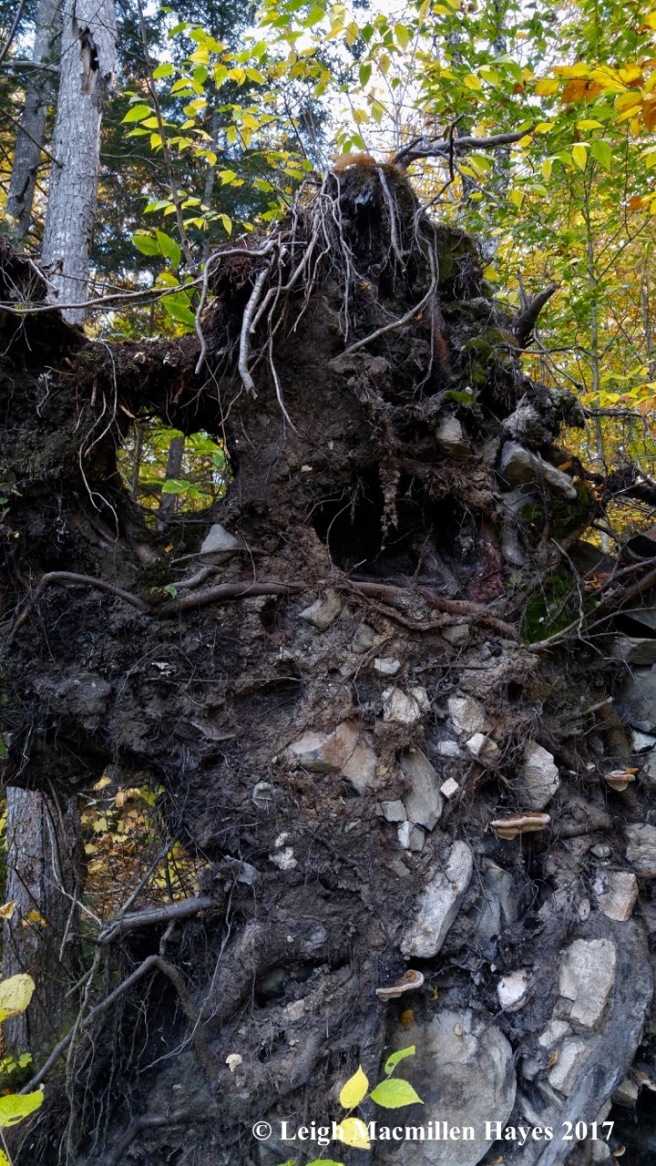
m-uprooted pine 1

Around the next bend, for the trail has enough S curves to make the descent easy, we came upon a white pine long since uprooted. Did anyone hear the crash?
m-uprooted picture frames

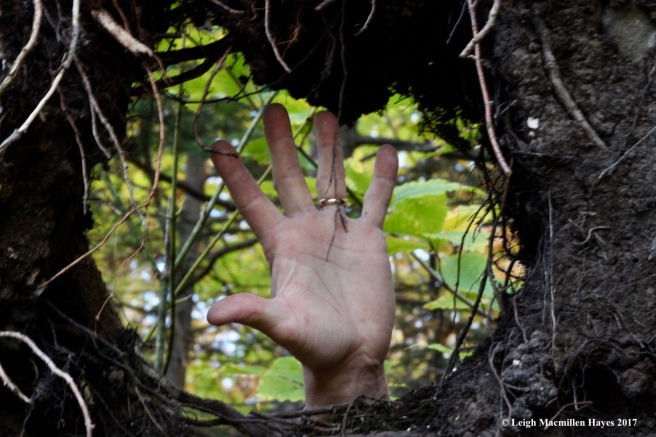
It offered a wonderful view–of more red-belted polypores, the root system and rocks, plus several windows on the world beyond.
m-photo frame hand

If you go, watch out . . . Thing of The Addams Family, might be lurking about.

m-Pam holding a huge striped maple leaf, Bob photobombing

Continuing on, we moved out of the hemlock and pine grove and back into the land of the broadleaves, including one with the broadest of them all–a huge striped maple leaf that Pam spotted; and Bob made sure to photo bomb the Kodak moment.
m-cottage sign 2

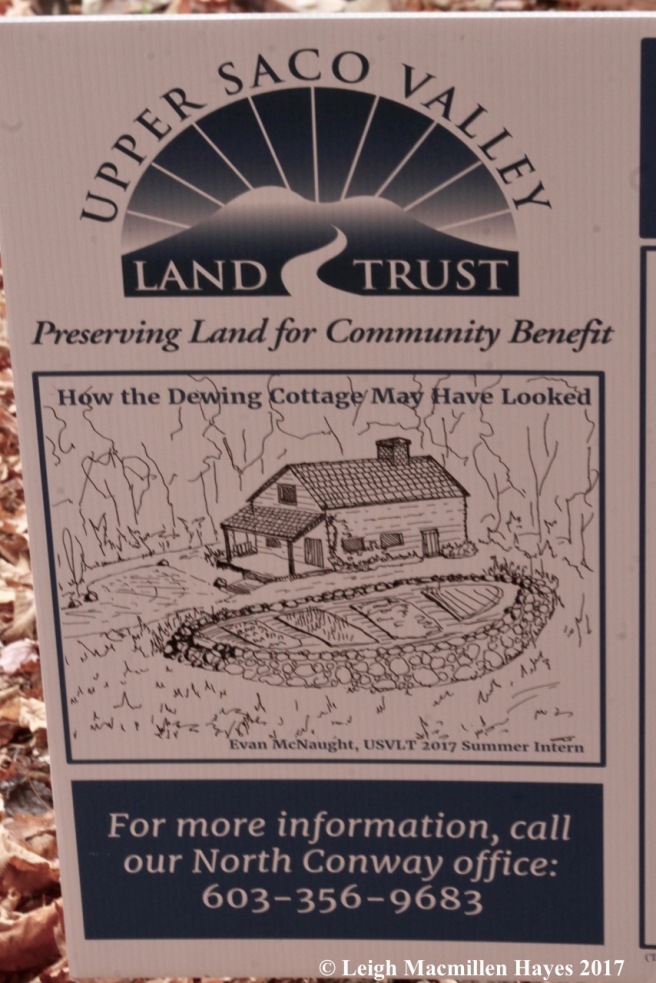
And then, as the trail evened out, we crossed a narrow gangplank to the location of the original cottage. According to a sign posted there, “Thomas Wilmer Dewing (1851-1938) and Maria Oakey Dewing (1845-1927) were 19th century American painters based in New York City. Maria often painted flowers and garden scenes, while Thomas is known for his figure paintings of aristocratic women, notably ‘Lady in Yellow’ hanging at the Isabella Steward Gardner Museum in Boston. The couple spent their summers at a popular artists’ colony in Cornish, NH, during the early 1900s. The Dewings also lived and painted in a cottage located here on the Monroe-Lucas Preserve for several years.

m-site of Dewing cottage 1

All that’s left is the chimney.

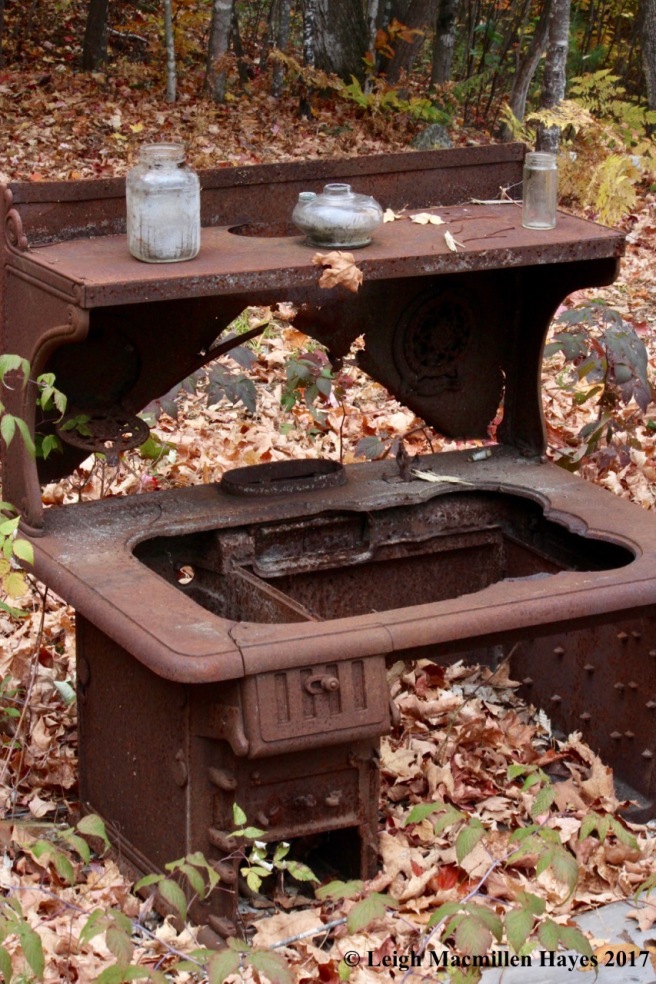
m-cottage stove

And some artifacts.

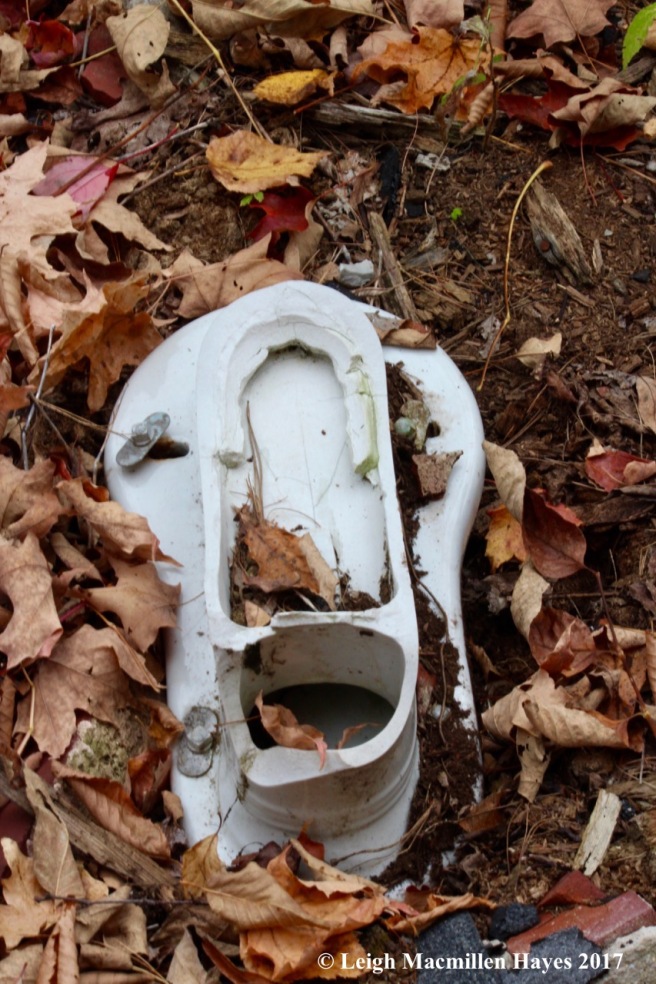
m-toilet

Including the john.

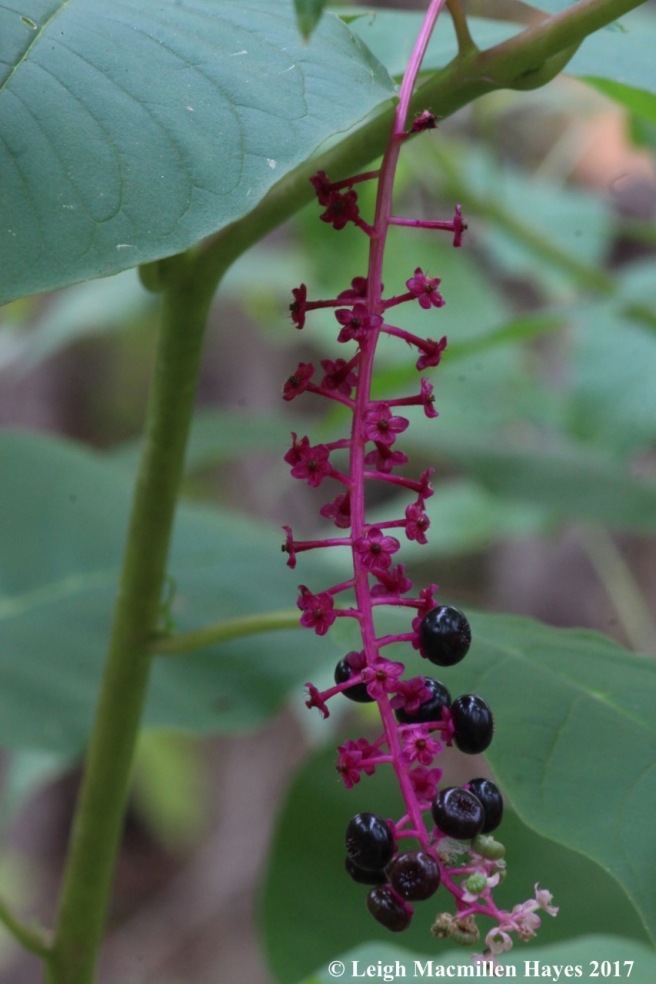
m-pokeweed

Our final view was a pokeweed still in flower and fruit. Again, we wondered about its timing, while appreciating its offering.

With that, we were back at the parking lot, where Bob informed us that our distance was just over a mile and time two hours–hardly record breaking. And hardly a “quickest to the destination hike” for my guy, but he kept finding stumps to sit upon as we gazed more intently on our surroundings; I think he secretly appreciated our slow pace and the opportunity to rest his legs.

If you want support his effort to raise funds for the Shawnee Peak Adaptive Ski Program, stop by and see him. Any and all donations are most welcome.
Wild Willy Wandering Wilderness

There are times when one wanders down a trail and a certain spirit seems to swirl about in the silence of the wilderness. Such was the feeling today as my friend, Joan, and I joined two other friends to explore their land in South Chatham, New Hampshire.

k-Pleasant Mtn

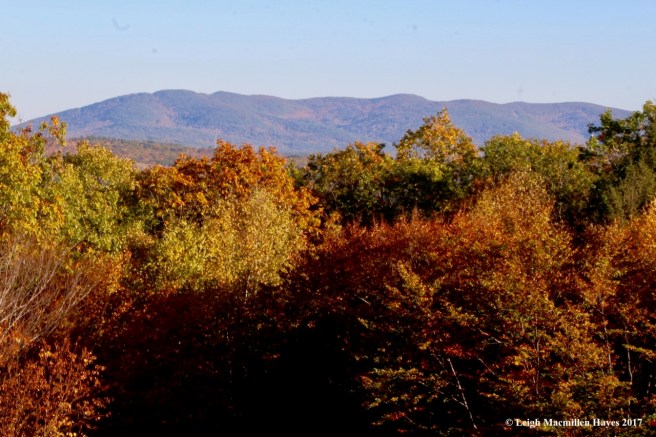
Before we ventured forth, however, we sat upon their deck and enjoyed the view of my hometown mountain–the ridge of Pleasant Mountain, this being a backside view.

k-sensitive pea 2

And then we paused by one of the wildflower gardens they have created with seeds of unknowns sown at abandon.

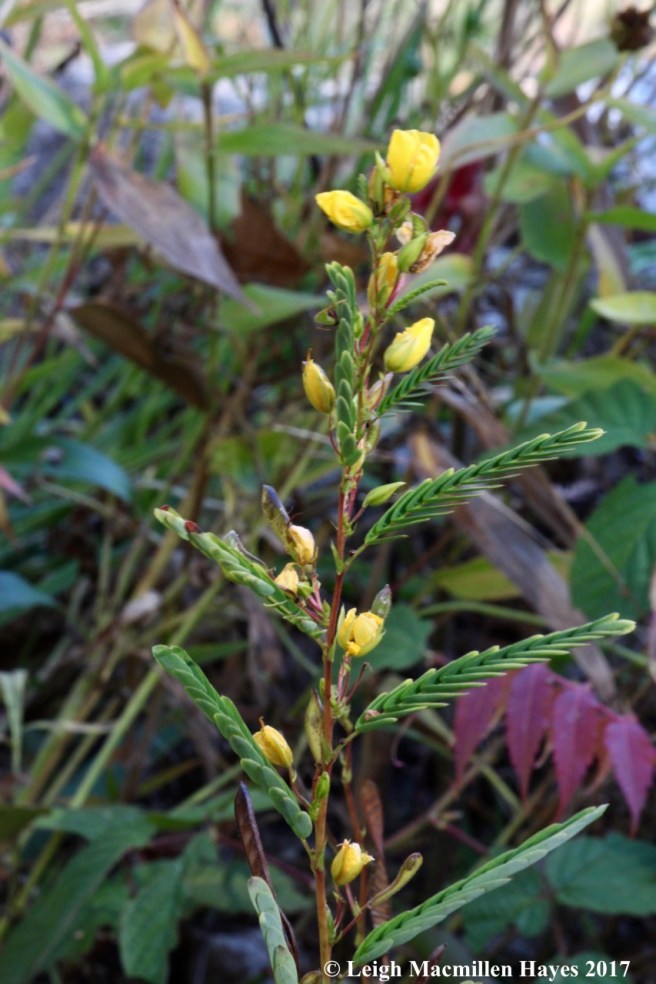
k-Sensitive Partridge Pea

Based on its seed pods that split open on both sides, we knew it was in the pea family, but didn’t know its name. Upon arriving home and keying it out, I discovered it’s a sensitive partridge pea, also know as a wild sensitive plant, the perfect tribute to the trail. Notice the pinnately-divided leaves–they fold up when touched, thus the name “sensitive.”

k-three amigos under the arch

Soon after getting acquainted with the sensitive pea, we continued onto the trail that Pam and Bob (the couple on the left; Joan on the right) have carved out of the land, with the help of their nephew for whom they constantly uttered words of praise. One of his artistic offerings to them was an archway formed from beech saplings.

k-steps by Willy

Another offering–steps created from stones found nearby. But where exactly did he find the stones? That remains a secret for so good is his work. It seemed as if the trail had been there all along as it wound its way up and over, down and around, passing by landmarks worth pausing by.

k-black cherry

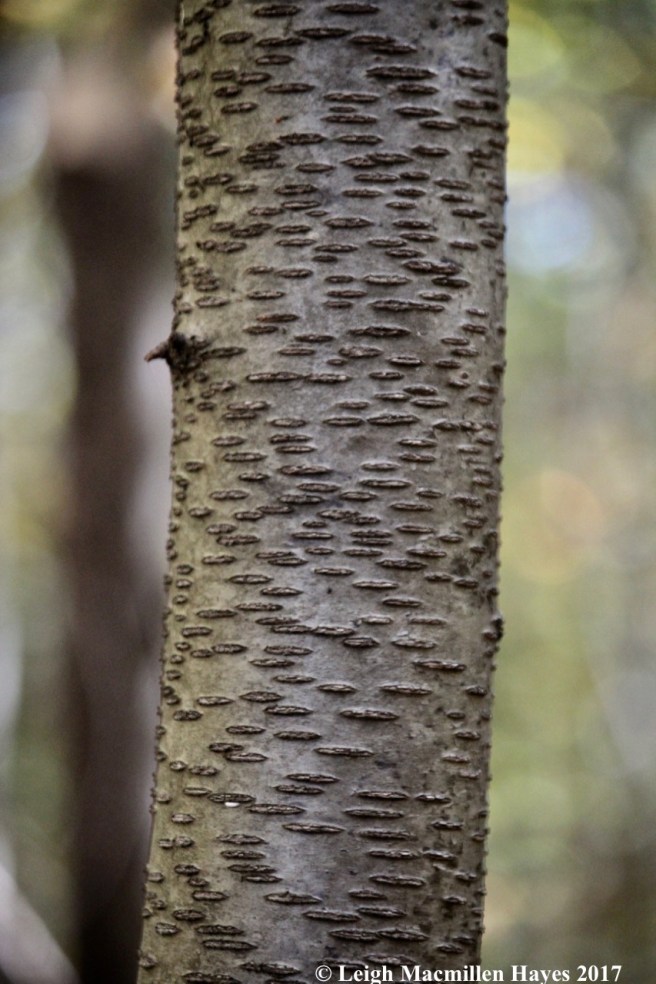
We saw so much, including bark on young trees that we desperately wanted to be black birch (aka sweet or cherry birch), but was really black cherry. Nearby where pin cherry trees that we easily recognized, but this one seemed a wee bit different and we thought maybe, just maybe it was a black birch. But maybe it wasn’t when I opened Michael Wojtech’s BARK later.

k-black cherry 2

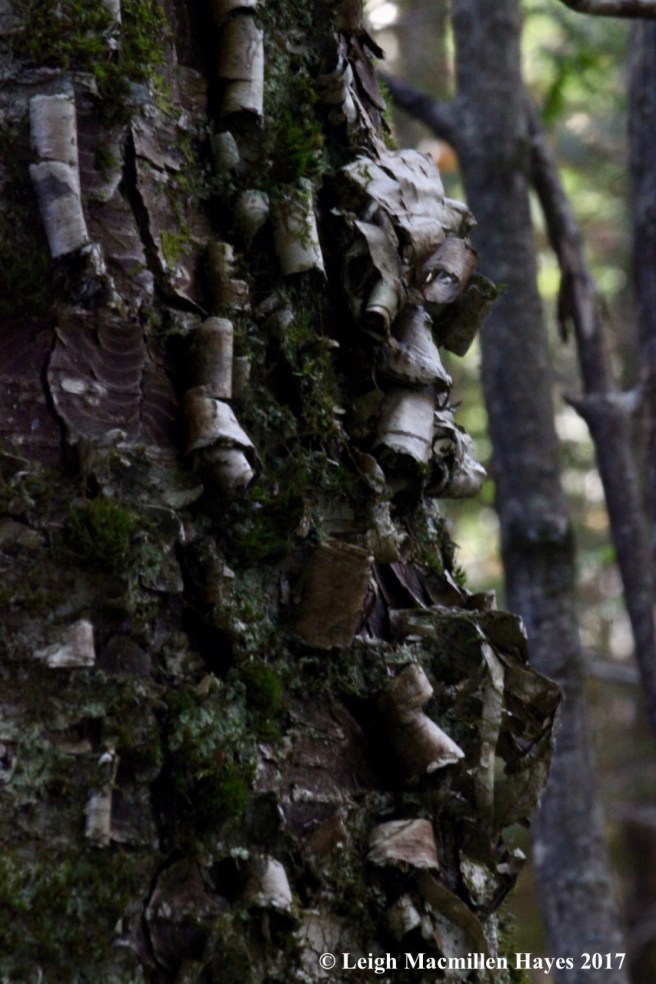
And further along the trail we spied a mature black cherry, its bark we knew for the curled chunks that remind us of burnt potato chips.

k-yellow birch

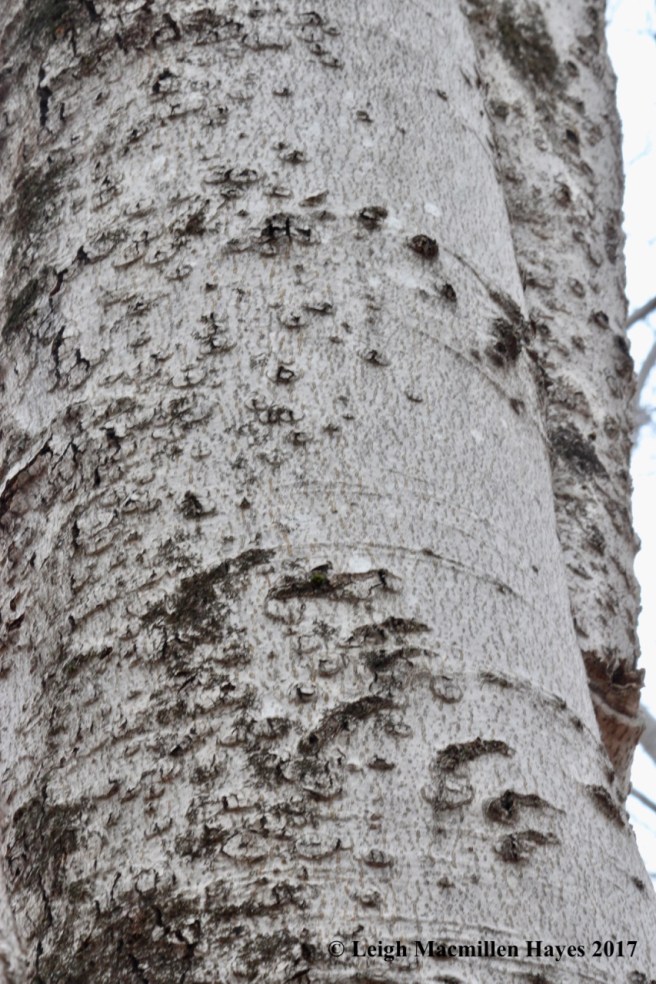
The curls of an old yellow birch also intrigued us and we noted many, many young and a few old members of this family throughout the property.

k-big tooth aspen

It’s a mixed forest and we had fun searching for the big tooth aspen trees, their bark deceptive with a northern red oak look below and birch look above.

k-hemlock and boulder 2

Other landmarks included a hemlock kissing a boulder and . . .

k-Province Brook hemlock root

another with the longest, thickest root we’d ever seen that arched across the land, creating an opportunity for the fairies that live in such an enchanted forest a chance to do the limbo.

k-coyote scat

We discovered what Pam and Bob already knew–it’s more than fairies that inhabit their place. In the middle of the trail, coyote scat presented itself.

k-deer sign

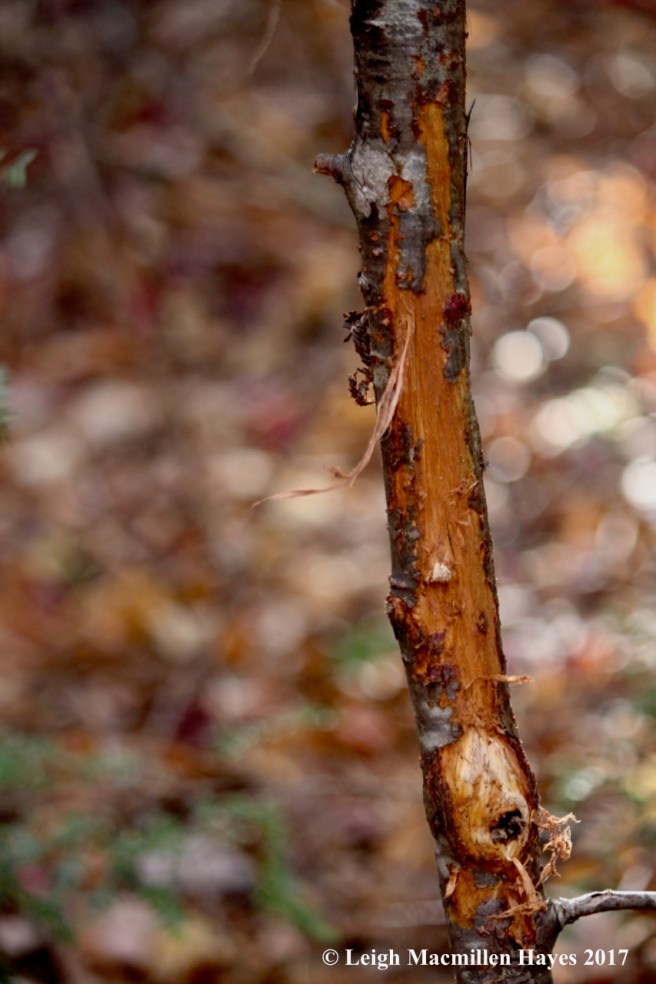
We found lots of deer scrapes, where in previous years they’ve scraped the bark upward to feed on it. But this was a recent visit with tags at both ends of the action, indicating a rub. Deer rub a tree to clean their antlers of velvet–that soft, vascular skin that grows on their antlers. They also rub trees to mark their territory.

k-garter snake1

And our wildest sighting of all–a garter snake enjoying some late afternoon sun. It never moved as we gawked and finally passed by, so really it wasn’t so wild after all. But Pam and Bob shared stories of other sounds and sightings, for this really is a wild land that abuts the National Forest.

k-Province Brook 2

It’s also bounded by Province Brook, where the water’s flow soothed our souls.

k-Province Brook 3

We were embraced by its reflective color . . .

k-Province Brook 4

and life-giving cadence.

k-spirits 1

And it was there that the water spirit . . .

k-spirits 2

rose and embraced us.

k-wood swirls

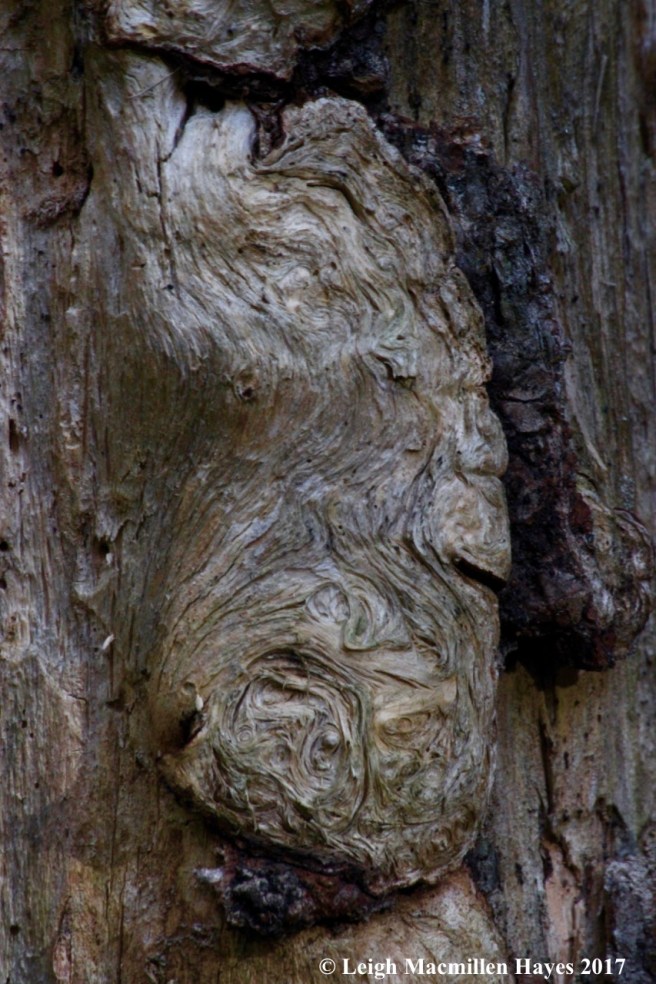
We found it wherever we went and recognized it in various forms . . .

k-afternoon light 2

as it wandered beside us.

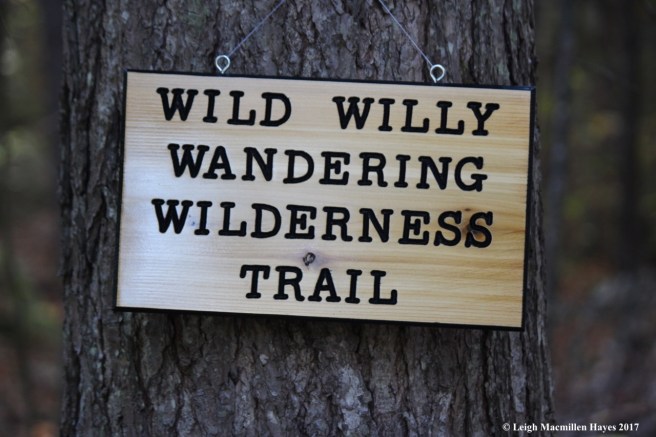
k-sign

Just as we ended our journey, we noticed the sign–Wild Willy Wandering Wilderness Trail. Pam and Bob had told us its name, in honor of their nephew Willis and his hard and creative work in carving out the trail, but they kept the sign a secret until we finished. Hats off to all three of them and their love of the land and for each other. Joan and I were envious of it all and thankful for the opportunity to be embraced by the spirit of this place and these people.


Anybody Home?

Only a few days ago we felt like we were melting as we complained about the muggies and buggies, but those temperatures are now only memories and it’s beginning to feel like fall in western Maine. And so my guy and I bundled up before we followed a trail and did some bushwhacking this morning, exploring a property Jinnie Mae and I had visited only a week and a half ago.

m1-lodge

It was to the beaver lodge that we first made our way, noting all their old works near the water’s edge.

m2-lodge 2

But, we were disappointed that we saw no evidence of new work and it didn’t appear any winter prep was yet occurring. Were the beavers still about? Or had some parasites in the lodge forced them to move on?

m3-infinity pool1

We hoped not for they’ve worked hard in the past to create a home with an infinity pool that would be the envy of many.

m1a--otter scat

We did note that they’d had recent visitors who left behind a calling card in the form of a slide and scat–otter scat, that is.

m5-doll's eye

And we spied the fruits of a former flower that graced their neighborhood–doll’s eye, aka white baneberry.

m4-dam 1

As we circled around the pool, we commented that the dam seemed to be in excellent shape and held the water about five feet above the stream below. But again, no evidence of new wood.

m7-dam works

Despite that, it’s an impressive structure. While some landowners might be upset to have beavers changing the landscape, we happen to know this one and she takes great pride in their works.

m9-dam 2

We stood for a while, indulging in our own admiration while wondering where the beavers might be. Of course, it was close to lunch time for us, and not an active time for them if indeed they were home. Possibly we were misinterpreting the view.

m8-beaver pond

After some time of quiet reflection, we made our way back, crossing the stream just below the dam.

m13-quiet reflection

And then we continued along the old logging road (recently bush hogged, eh Brian? Well done), and bushwhacked some more, crossing another stream to find our way to another reflective spot along the brook.

m12-rookery 2

This time, our destination was that of another stick builder–great blue herons.

m11-rookery

Their spring/early summer nests are equally impressive. I hadn’t visited this spot since April, when the herons were actively setting up home. And I’m not sure it was a successful breeding season for them, but even if it was, they wouldn’t have needed these homes today. The nests will remain–available for grabs next year by those who return.

m16-jack in the pulpit

After a snack by the brook, we pulled ourselves away knowing it was time to head to our own home. Our wildlife viewings had been nil, but we spied a jack-in-the-pulpit in fruit, and that plus the doll’s eye were enough. And the time spent wondering about the critters.

m20-cosmos

Back at our truck, we decided to check on the insect action in the gardens at our friend’s home. Only the bumblebees seemed to be active.

m19-hickory feast

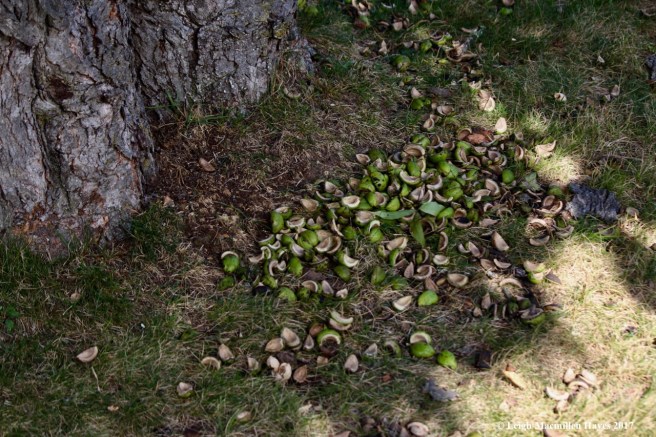
But we saw plenty of activity of another kind–a cache of hickory nut shells at the base of the tree, and really . . . everywhere nearby.

m18-hickory bark

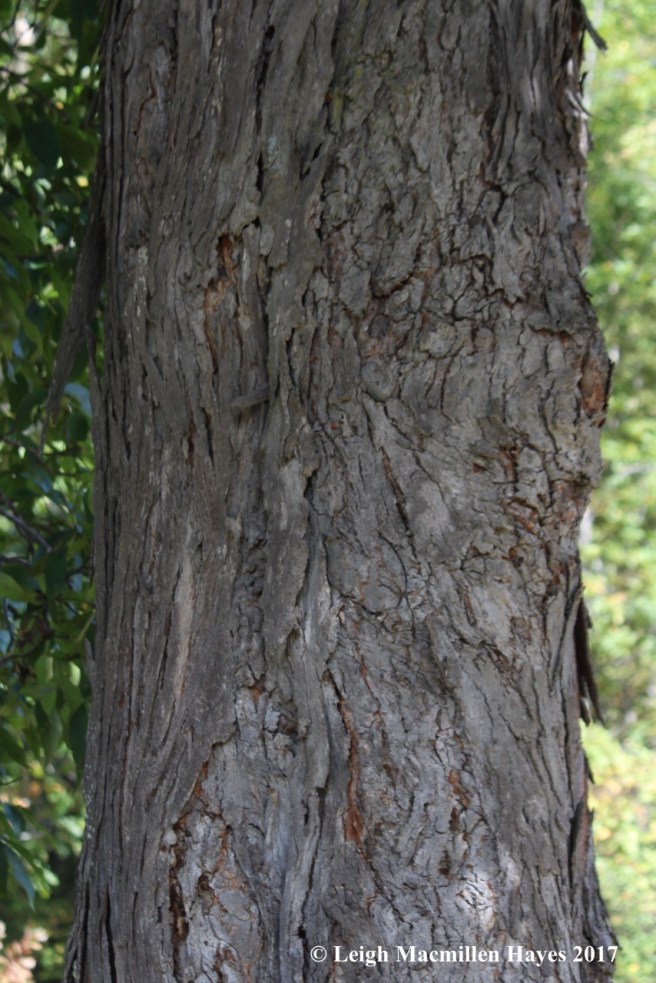
Shagbark hickory is more common south of this spot, so it was a treat to take a closer look.

m17-hickory

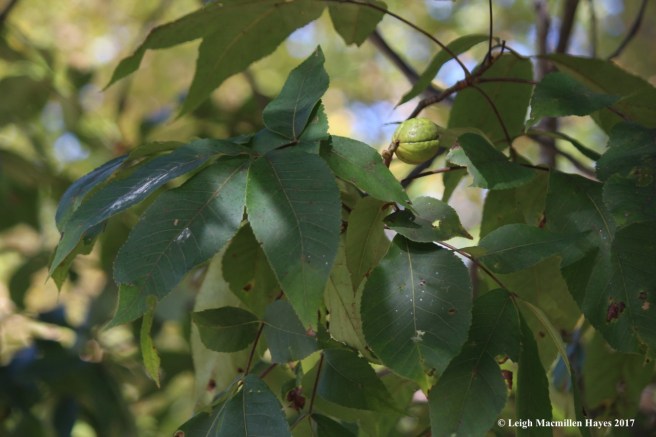
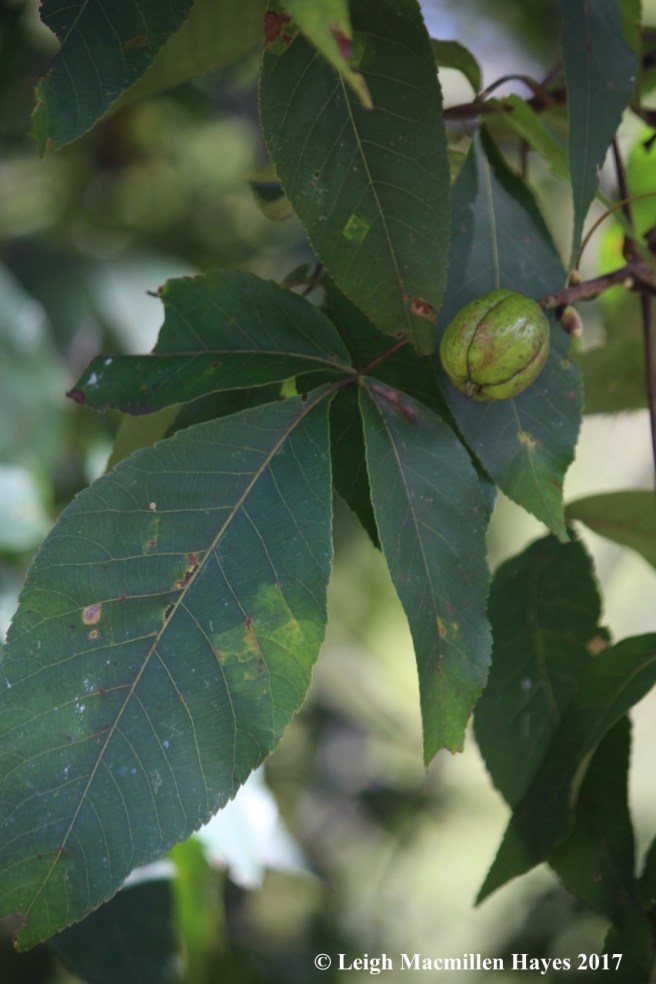
Its alternate leaves are compound, consisting of five serrated leaflets usually (sometimes there are seven).

m18-hickory 2

And of those five, the three terminal leaflets on each twig are the largest.

m21-view of Balds

Once again, it was time to leave this beautiful spot where the fields and forest flow into the mountains. And where the beavers and heron share the place without too much human intervention. Though not a soul was home today, we trust all will return when the time is right.


The Mighty Tracker

“Quick, look at the bird feeder,” my guy said this morning.

I expected some exotic bird and chuckled to myself, a memory of our youngest son telling me about the huge gray bird with a black head and long, long tail that it was in the driveway last week. I showed him a picture of a catbird. Bingo.

So when I did look out the kitchen window, I was taken aback–a large black bear stood at the feeder. I know I should have taken it in a month ago, but took my chances. And then I ran for my camera, not remembering that I’d left it on the counter right next to where I’d been standing. Finally, camera in hand, I dashed out the back door.  And . . .

b-bear !

he’d moved on. At the stonewall, he gave me one backward glance before climbing over it. Consequently, the bear is in this photo on the other side of the wall, but I was so excited I forgot to focus it and my guy and I will be the only ones that truly know it.

b-boots

But, I love to track mammals and so this afternoon I donned my tracking uniform and headed off on the trail to see what I might see.

b-bird feeder

I began at the spot of our first sighting–the bird feeder by the garden.

b-bear impression

All that my closer examination revealed was a few stomped leaves. No hair. Nothing else.

b-stonewall

From there, I kept examining the grass on my way to the stone wall. And then the wall itself and the trees around it. Nada.

b-tree stump

Stepping over the wall, I tried to determine the bear’s next direction. Still nothing to see. And so I started checking the numerous tree stumps, figuring it was hungry and might have looked for ants or other insects. All the disturbance I saw was made prior to this morning.

b-hemlock cones

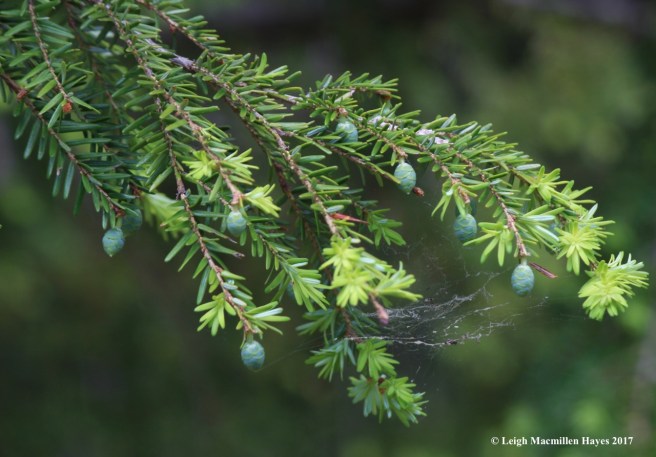
My next decision was to follow the cowpath east and then west, but still nothing to report. I did notice the baby hemlock cones showing off their aquamarine color.

p-gray squirrel

As I walked, I heard some commotion. Did you know that gray squirrels can make more noise than a black bear?

b-deer prints

When I got to the the ruts in the snowmobile trail, I thought I might finally find what I was looking for. Instead, I spotted plenty of deer prints and  . . .

b-squirrel prints

even those made by the squirrels.

b-wood frogs 1

Since I was in the neighborhood, I decided to stop by the vernal pool, thinking perhaps the bear had done the same.

b-wood frog 2:gills

Nothing looked disturbed and the tadpoles showed off their latest growth. This might be the year wood frogs finally hop out of the pool.

b-blue-eyed grass

Not far from the pool, I discovered the first blue-eyed grass of the season.

b-turkey track

And as I returned, I went a bit beyond the cowpath and found turkey prints.

b-turkey and fox prints

There were some coyote prints as well, but one of my favorite print sightings was that of the turkey headed north and fox headed south. The fox print shows where the front foot came down and the hind foot fell almost directly into the same spot thus looking like two sets of front toes and nails pointed inward–direct registration.

Phew, I am the mighty tracker after all.

But that bear–it eluded me. It’s one for our mind’s eye as a memory shared and there it shall remain.


Fawning with Wonder

Though fawning is most oft used to describe someone who is over the top in the flattery department (think old school brown nose), the term is derived from the Old English fægnian, meaning “rejoice, exult, be glad.”

I just knew it was going to be that kind of day when I drove toward Holt Pond Preserve this morning. First, on Route 302, a deer dashed in front of my truck–and I avoided hitting it by mere inches. (And being hit by the woman who was smack dab on my tail.) Then, as I drove up to the summit of Perley Road, a red fox crossed my path.

To top off my feeling of gladness, in the preserve’s parking lot I met up with the most gracious of hostesses, Lake Environmental Association‘s Education Director Alanna Doughty, and the ever delightful host, Loon Echo Land Trust‘s Stewardship Director Jon Evans. Those two dynamos had joined forces to lead a public walk that looped all the way around Holt Pond. Joining the group was a gentleman named Bob and two others–my dear friends Faith and Ben Hall. The Halls had arrived at their summer camp recently and this was my first opportunity to welcome them home. After intros and a discussion about how the two organizations have collaborated on projects including Holt Pond, along with an explanation of how they differ (LEA is about water science and protecting our precious lakes and ponds, while LELT is about protecting the uplands and lowlands that surround the watershed), we headed off on our adventure.

p-oak apple gall 1

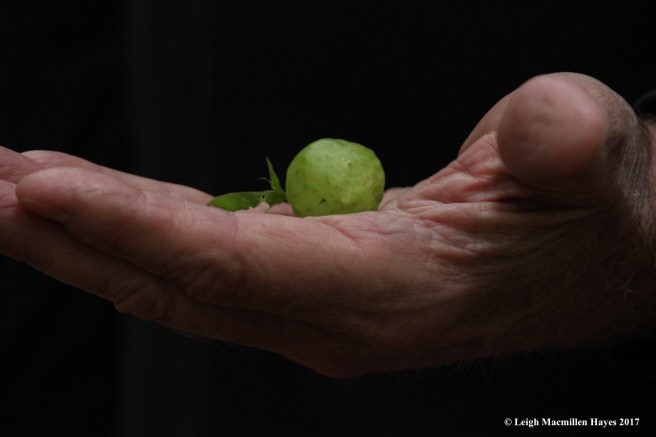
Within minutes, a small, rubbery green ball, about the size of a ping pong ball, caught our attention. This was the result of an apple oak gall female wasp (yes, there is such a species) that crawled up the tree trunk of a Northern red oak earlier in the spring and injected an egg into the center vein of a newly emerged leaf. As the larva grew, it caused a chemical reaction and mutated the leaf to form a gall around it. The leaf provided the larva sustenance. Had we left it alone, once it matured into a wasp, it would have sawed its way out through a small escape hole.

p-oak apple gall 2

Because we were curious, however, Alanna split it open so everyone could see the spoke-like structure hidden inside, that provided support for the developing insect.

I shared with the group a little tidbit I learned last fall in Ireland. When working on the manuscript for the Book of Kells, monks used these galls for the color green, soaking them in beer or mead to create a dye.

p-Alanna and Jon

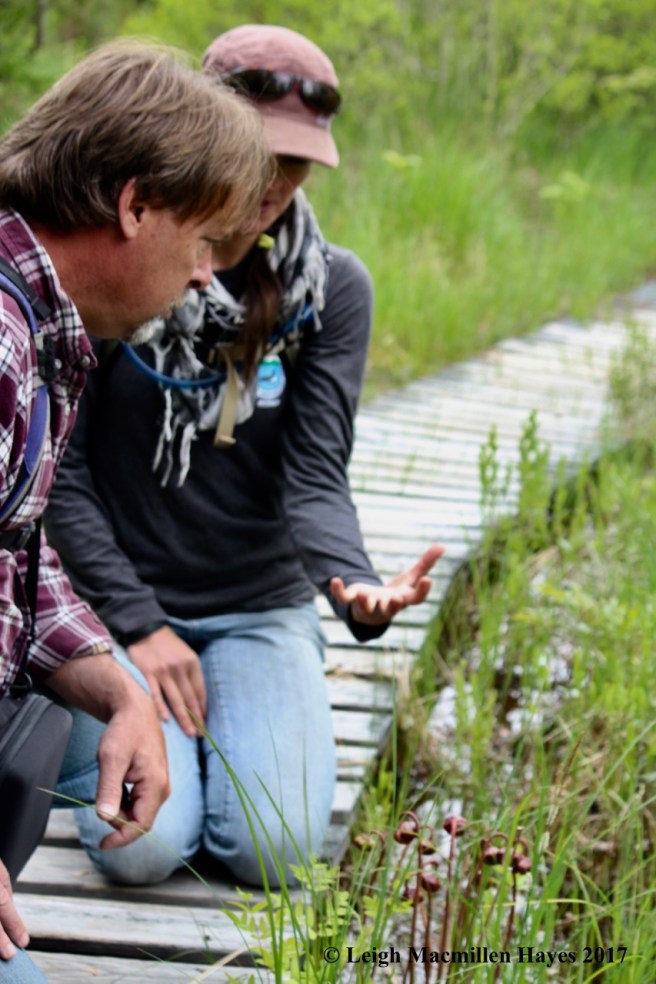
That set the stage and from there on, we paused periodically to wonder, though I think we said at one point that we wanted to get all the way around before 1pm. But there’s so much to see that we had to stop. And because the pitcher plants grow beside the boardwalk, it was hard to ignore them. Being Alanna, she got down on her knees to talk about how this carnivorous plant functions, enticing insects into its pitcher-like leaves that are filled with water and digestive enzymes. Because of downward-sloping hairs  on the leaf, insects can’t climb out and eventually they succumb–allowing the plant to break them down and absorb their nutrients.

p-pitcher plants flowering

Today, the pitcher’s flowers were beginning to bloom.

p-Indian Cucumber Root

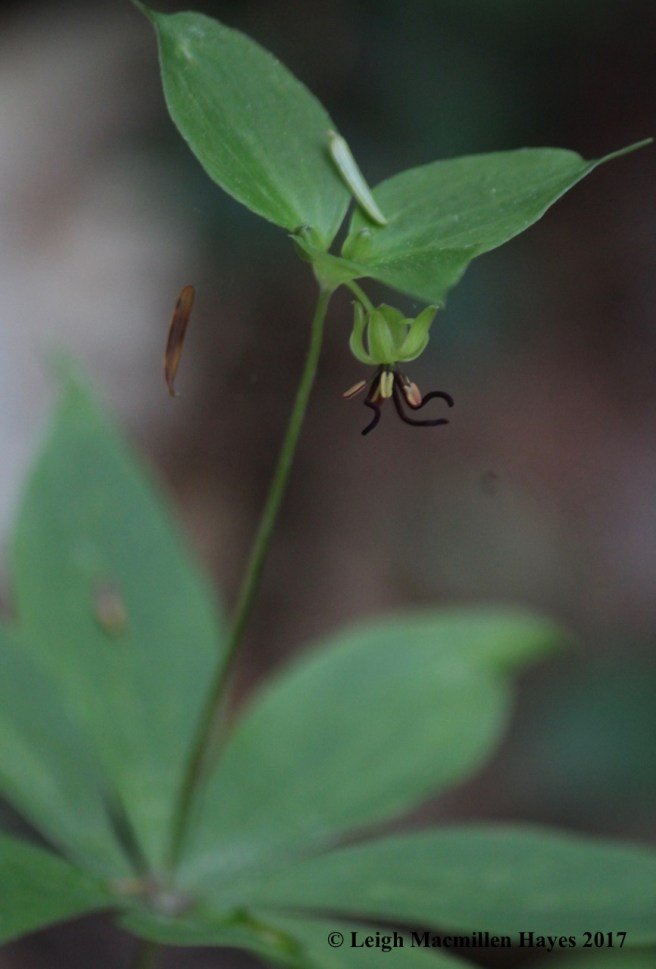
As our journey continued, we stopped to admire other flowers including the Indian Cucumber Root,

p-jack in the pulpit

Jack in the Pulpit,

p-lady's 1

and pink lady’s slipper.

p-Faith on beech

To show off the contorted growth of a tree, Faith graciously took a brief break at the beech.

p-greater bladder sedge

While Jon shared a lot of information about South Bridgton’s historical past, Alanna enlightened us on the works of nature, including the bladder sedge with its inflated, teardrop-shaped sacs that enclose its fruit. Though common, like the pitcher plant flowers, it’s otherworldly in form.

p-nannyberry?

And then we got stumped by one shrub we should have known. Witherod (wild raisin) or Nannyberry? We decided on the latter for a couple of reasons–the petioles (stems) of the leaves were somewhat winged and the veins beneath the leaves were not scurfy. Scurfy? That was a new term for me–meaning rough to the touch or covered with scales.

p-Bob, Alanna, Faith 1

As our journey continued, we passed lots of hobblebush in the understory. But not to be missed were the witch hazels. And more galls, this time the witch’s cap that grows on their leaves and forms a cone-shaped structure much like a witch’s cap. How fitting that the Witch Hazel Cone Gall Aphid (Hormaphis hamamelidis) chose this particular shrub. Having caused the leaf to form a gall around her, mother aphid stayed inside, where she’s protected as she feeds and reproduces.

p-porky 1

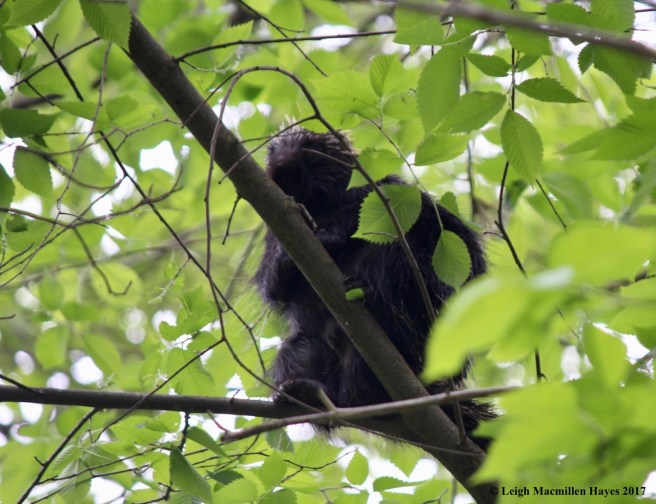
During our journey, we shared brains and eyes. I’m thankful for others who thought to look up, and spotted a porcupine looking down.

p-grouse bath

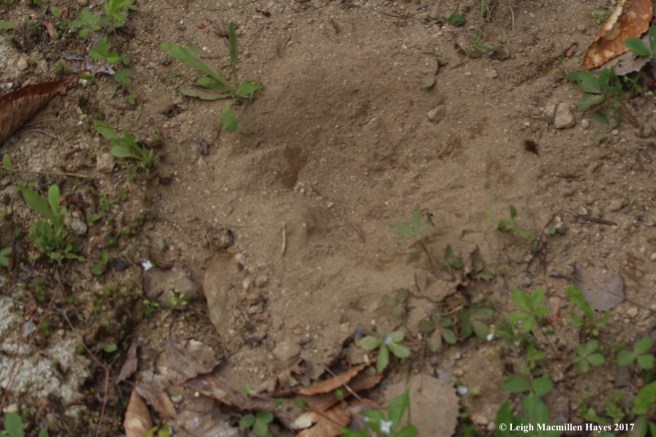
We also looked down, spying the spot where a bird took a dust bath.

p-grouse bath feather

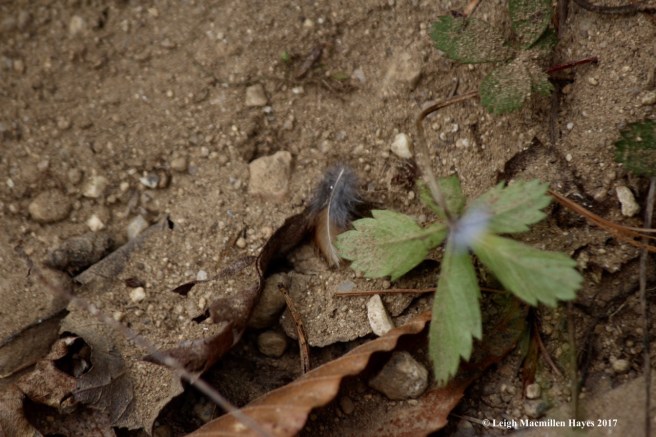
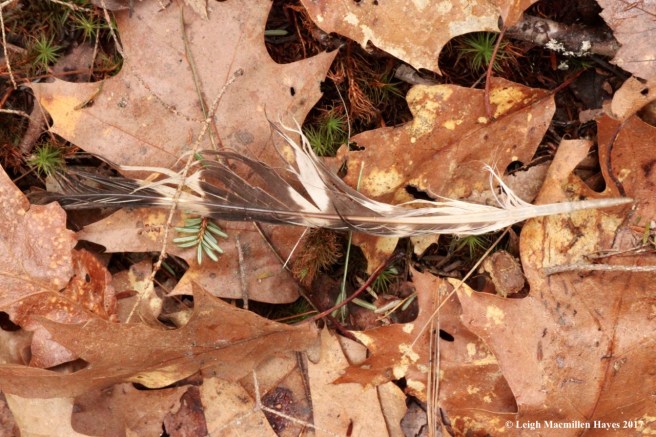
In this case, it was the work of a ruffed grouse that wanted to rid itself of lice and mites. A stray feather was also left behind. Do you see it?

p-fawn 3

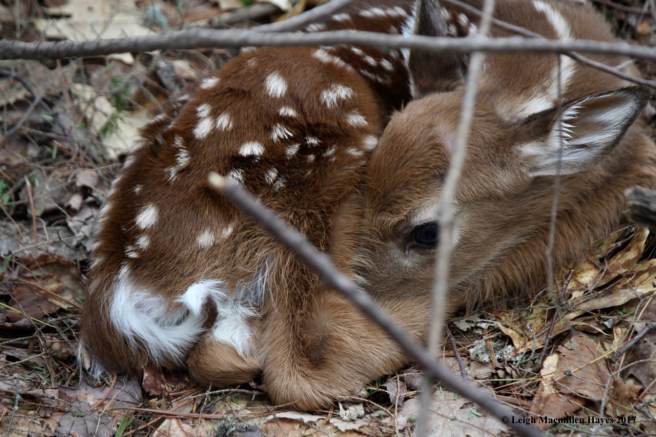
But our best find of all–a young fawn curled up beside the trail. I was leading and talking at the time and didn’t even see it. Faith quietly called me back and I was sure she wanted to show me a snake. We paused quickly to take a few photos and this babe never flinched, obeying its mother’s order to stay put while she went off to feed. (I used to try that at the end of the aisle in a grocery store when my guys were young–but they did their fair share of flinching.)

We’d been blessed–and we all rejoiced while fawning with wonder.


May(be) a Mondate

We headed out the backdoor, into our woodlot, down the cowpath, along the snowmobile trail, veered left behind the church, walked down a driveway, crossed the road and snuck into Pondicherry Park.

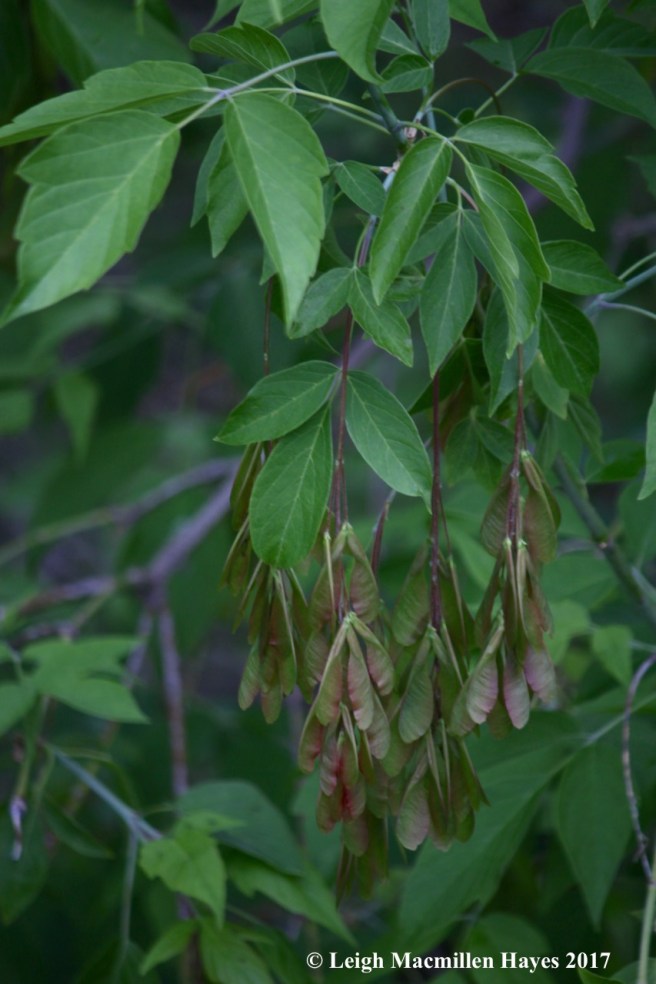
p-NOrway maple and samaras

Or so we thought, but as we stood below this Norway maple with its widely-divergent two-winged samaras, a familiar voice hailed us. Our friend, Dick Bennett, appeared out of nowhere (well, really from somewhere–for like us, he lives nearby and uses these trails frequently to get to town) and so we chatted briefly. He was on a mission and we were headed in a different direction along the multi-layered loop system.

p-crossing the field

Within minutes we followed the path out of the woods and across the field–prepared as we were for rain. Our plan was to retreat when it started to pour.

Once we entered the woods again, we heard a barred owl call from the distance with its infamous “Who cooks for you?” “Our oldest son and his girlfriend,” was our response for they had surprised us this weekend with a visit and prepared last night’s meal.

p-foxhole debris

For the most part we stuck to the trail system, but then we stepped over the wall onto the Lake Environmental Association’s Maine Lake Science Center property because I wanted to show my guy this pile of dirt and stones.

p-fox hole

On a recent bushwhack with a few others, we’d discovered this fox hole and I immediately recalled all the fox tracks and seeing a red fox this past winter not far from this location.

p-boardwalk1

After poking about for a few minutes, we made our way back to the LEA trail and eventually landed at the boardwalk that weaves through a wetland. From there, it was back through the woods to the park trails. I know my guy wanted to move quickly, such were the bugs, but I wanted to take everything in and so he patiently waited from time to time.

p-Canada mayflower

After all, there were visions in white exploding with glory in the form of Canada mayflowers,

p-foamflowers

foam-flowers,

p-wild sarsapirilla

and wild sarsaparilla.

p-gaywings

We also feasted our eyes on visions offering the purplish hue of gaywings, aka fringed polygala.

p-fern stream

And then there were the ferns.

p-cinnamon fern fertile frond

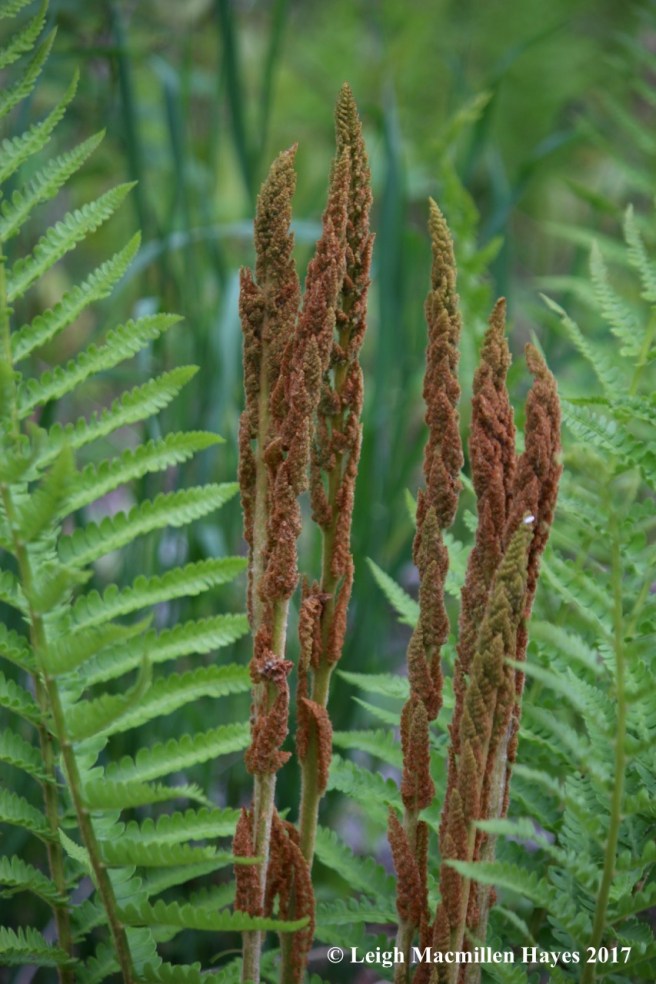
The fertile stalks of cinnamon ferns shouted their name,

p-royal fern

while the royal ferns were much more subtle–

p-royal fern fertile fronds

their fertile crowns practically blending into the sterile fronds.

p-chipmunk

At the chimney by the amphitheater, a chipmunk paused to ponder our intentions and then quickly disappeared.

p-Stevens Brook

We followed the river trail to the Bob Dunning Bridge and noted all the shades of green beside Stevens Brook.

p-boxelder samaras

And then there were other sights to see, like the boxelder and its samaras. Its common name refers to the resemblance of its leaves to elder trees and the use of the soft wood for box making. Its also our only maple with compound leaves. And the samaras differ greatly from the Norway maple we stood under at the beginning of our walk–for the boxelder’s winged seeds more closely resemble upside down Vs or peace signs.

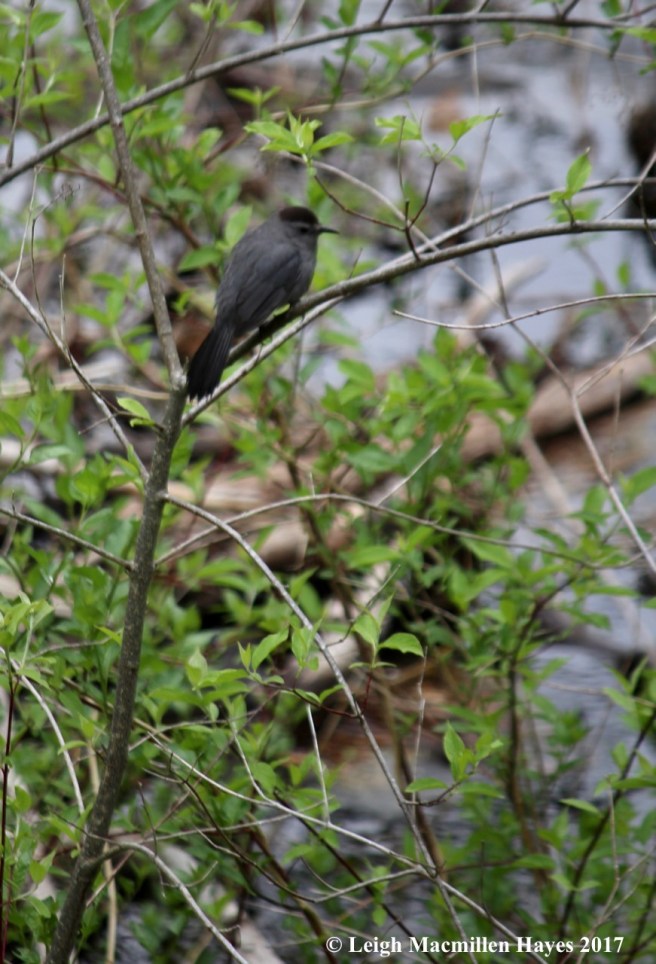
p-catbird 1

As is often the case when stopping by the bridge, the catbirds who nest in the undergrowth paused beside the brook during their foraging expeditions.

p-caterpillars on maple leaf

Nearby, we saw some food meant for them–a colony of Eastern tent caterpillars consuming maple leaves right down to the veins. It seemed like it was time for some units of energy to be passed along the food web.

Besides the wildlife, our only human encounters included a relative crossing the bridge on his way home from work and our friend Dick, whom we’d seen at the start.

For various reasons, May has been devoid of dates and so today’s adventure, though not long, served as our only Mondate celebration for the month–no maybes about it. And it never did rain.


A Boulder Degree

When I began writing this blog in 2015, my intention was to focus on the wonder of the natural world in western Maine. But sometimes, it’s other wonders and points further west (or even east) that grab my attention.

c-Pena Drive 1

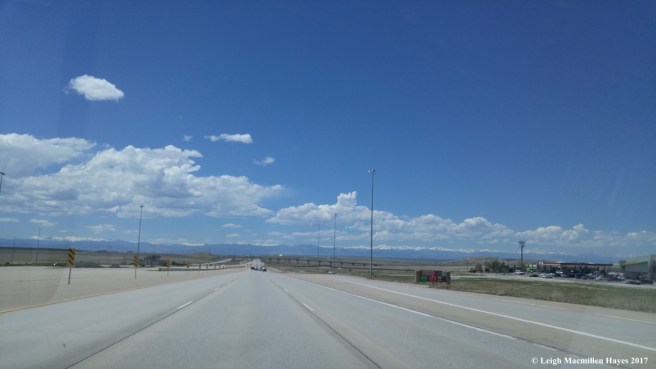
And so it was that midweek last week we headed west of our west and landed in Denver, Colorado, for an extra long weekend. All that being said, this photo with the Rockies in the background made it look like it was sunny when we landed. Not so. It even rains in Colorado, though nothing like we’ve experienced in New England this month, and we landed in the mist on Wednesday night. But we made several trips to the airport and Big Sky country enveloped us.

Not only that, but there were prairie dogs everywhere along Peña Drive. OK, so they aren’t in my backyard, thankfully, but they were incredibly cute. We deal with mole mounds, but prairie dog mounds seem to be even more pronounced. Still . . . I smiled with each sighting.

Our home base for the next four nights was a garden suite in the Arvada home of Donevon and Beth–an Airbnb rental. It was clean, comfortable and located between our two destinations: Boulder and Denver. We highly recommend this two-bedroom space should you be in the area. Don’t forget to say we recommended it–and be sure to pet Maggie.

c-to boulder 4

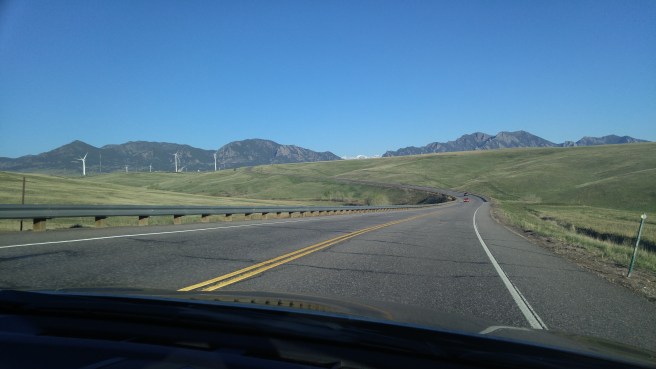
A road traveled often was the one that led us to Boulder and we soon became familiar with the wind farm to the left, which evoked memories of the first wind farm we ever encountered on Prince Edward Island in Canada when our sons were but youngsters. And this past weekend, it was the younger of the two for whom we made the journey.

c-looking toward boulder

His home these past years has been at the base of the mountains, where he’s earned an education on many levels.

c-Pearl Street2

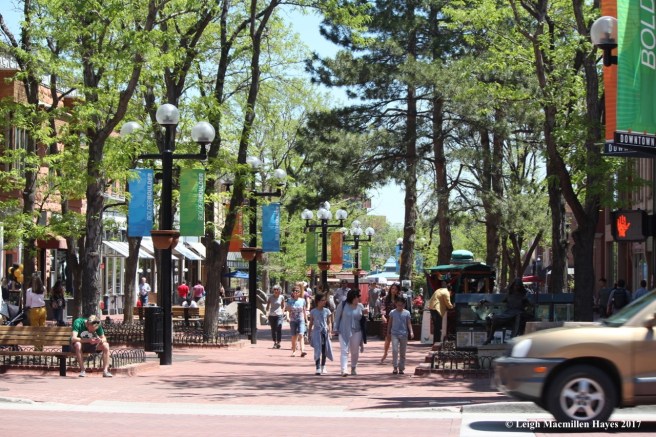
With him, we walked along Pearl Street, mindful always of the artistic endeavors (and similarities to Church Street in Burlington, Vermont).

c-boulder lions

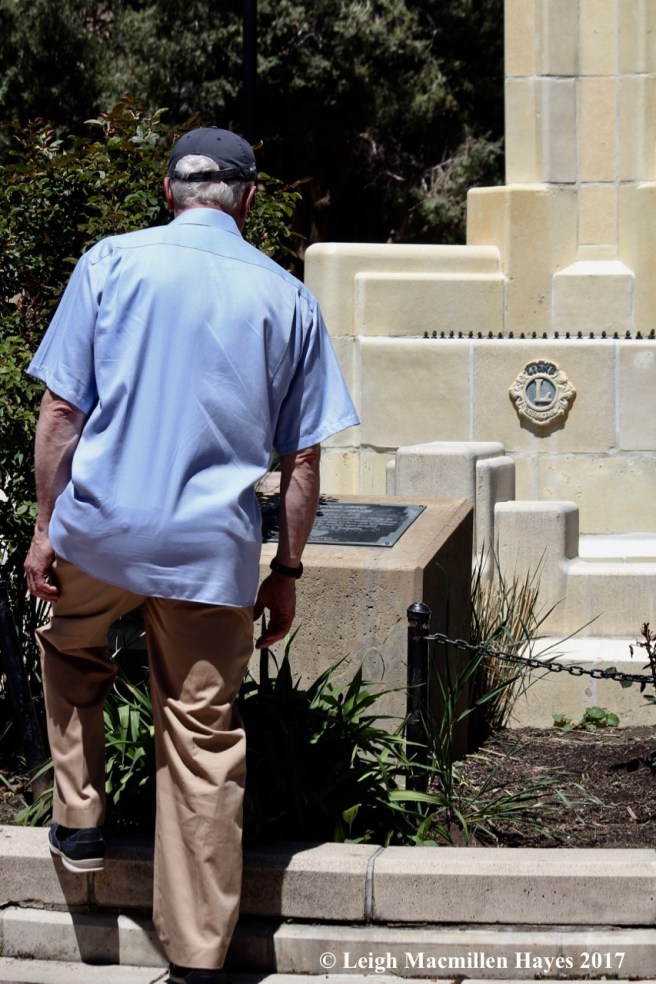
And among it all, one Lion appreciated the work of others who’d built a fountain.

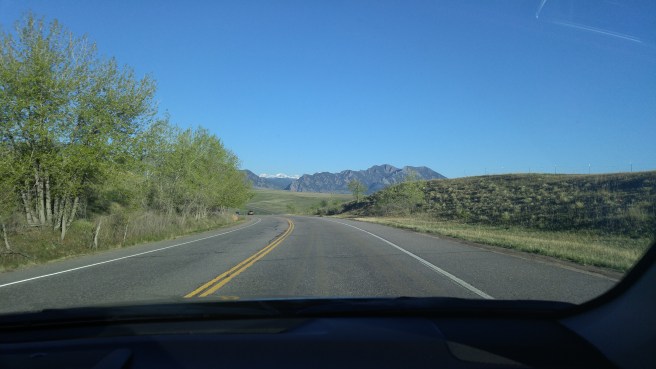
c-peak to peak 2

Then we headed further northwest, toward Estes Park, enjoying the mountain and sky views along the route.

c-Estes Park1

Like Maine, spring was just arriving, adding a contrast from brown and green below to white summits.

c-elk 1

And in the midst of it all . . .

c-elk 2

elk stopping traffic. (Didn’t they know they were supposed to turn to their other right?)

c-Estes 2

We oohed and awed, but had a plane to meet and so we didn’t stay long.

c-16th Street Mall sign

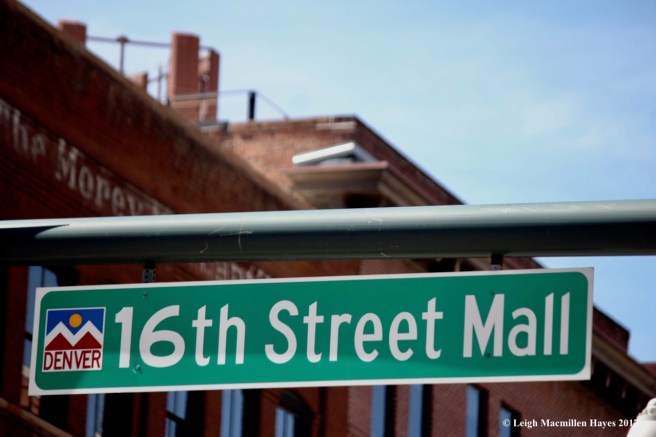
Over the course of our journey we explored Denver as well, where we walked the 16th Street Mall a couple of times.  We lunched and we dined–our companions ever changing, which added to the highlights.

c-16th Street, Denver

In historic terms, 16th is such a blend, though leans more toward the modern than so many back East.

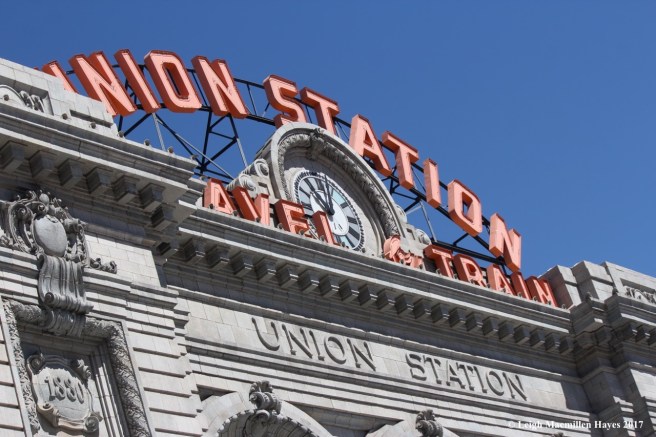
c-union station 1

But, history stood tall . . .

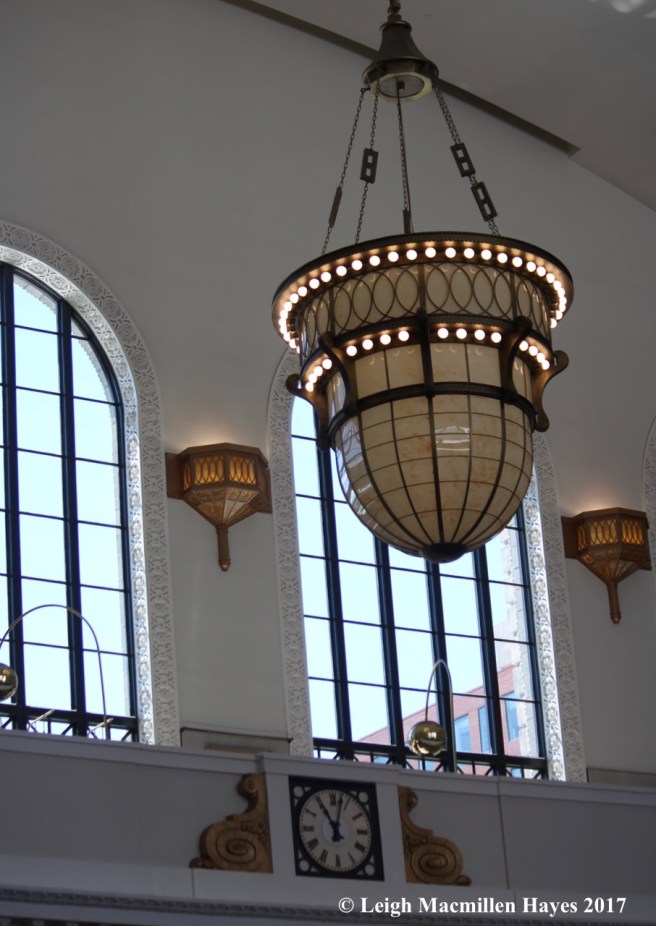
c-union station 2

and lit the way toward the future.

c-tattered 1

No visit is ever complete without a stop at our favorite bookstore–Tattered Cover.

c-aquarium sign

We also made time to learn about the exotic. Or so they seemed to our New England brains.

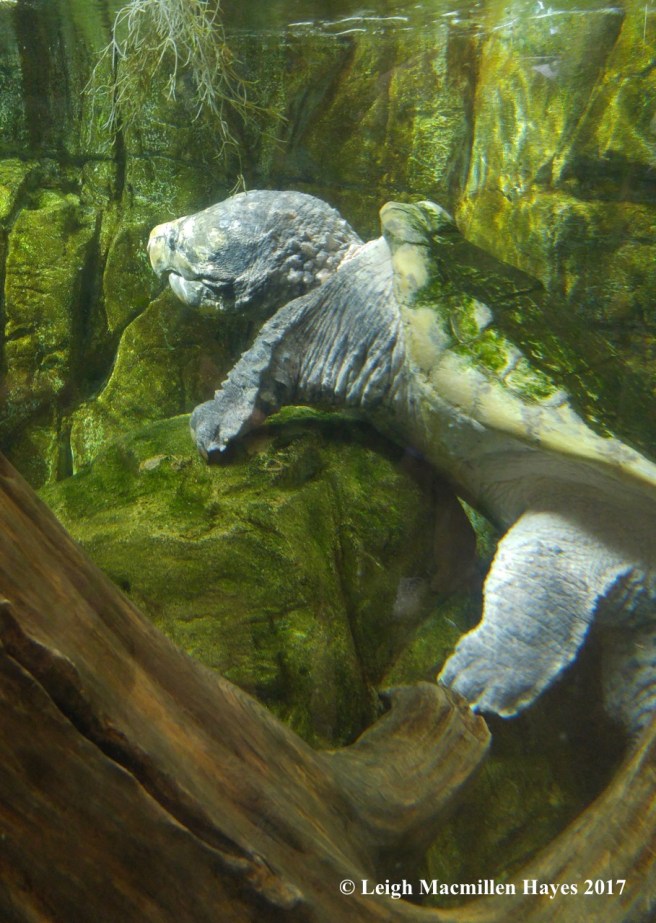
c-turtle 3 (1)

We viewed an alligator-snapping turtle–a first for us. According to a sign, adult males are known to move very little and in fact, may stay in the same location for up to ten years. There’s a lesson in that, I suppose–about perseverance, which our youngest can certainly attest to.

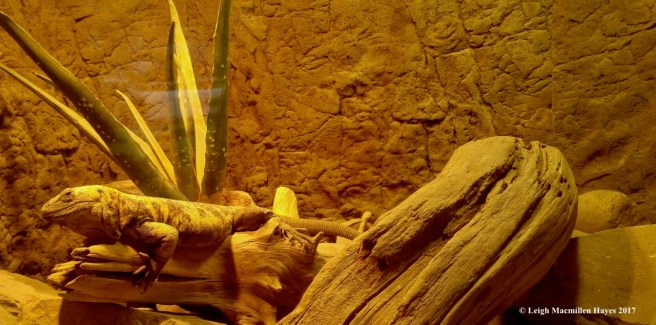
c-lizard 1

We noted the range of scales,

c-rattle 3

differing in patterns and . . .

c-fish scales 1

size. Those pointed to another lesson about diversity among people and their outer skins that shield inner experiences.

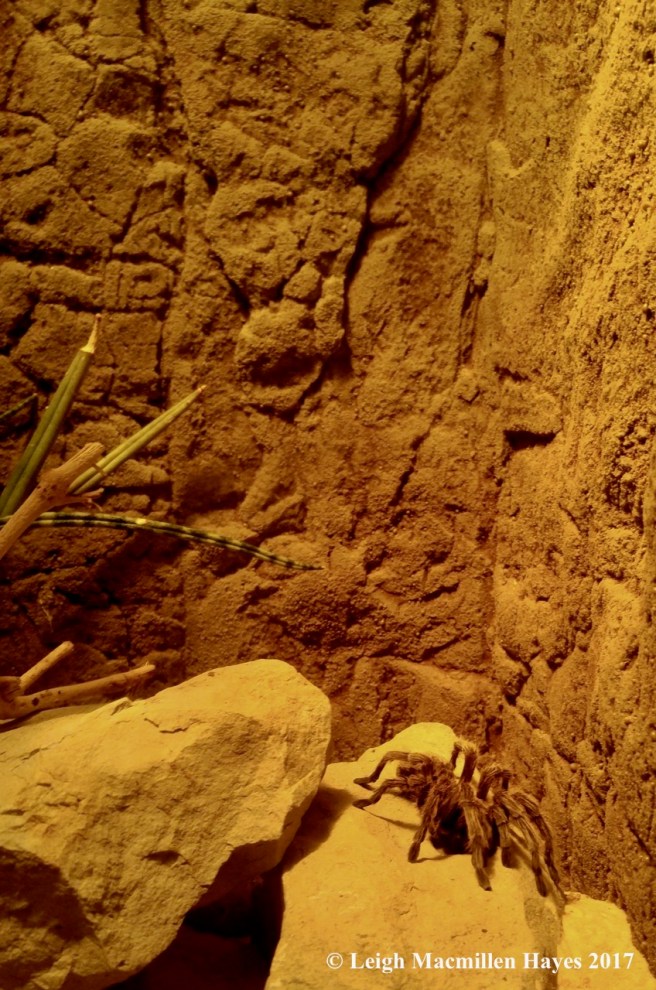
c-spider 1 (1)

While some displays denoted hairy situations,

c-starfish and tropical fish

others demonstrated the creativity that can overcome.
c-starfish 2

There were times when the world looked best from an upside-down position,

c-starfish1

but in the end, stardom ruled.

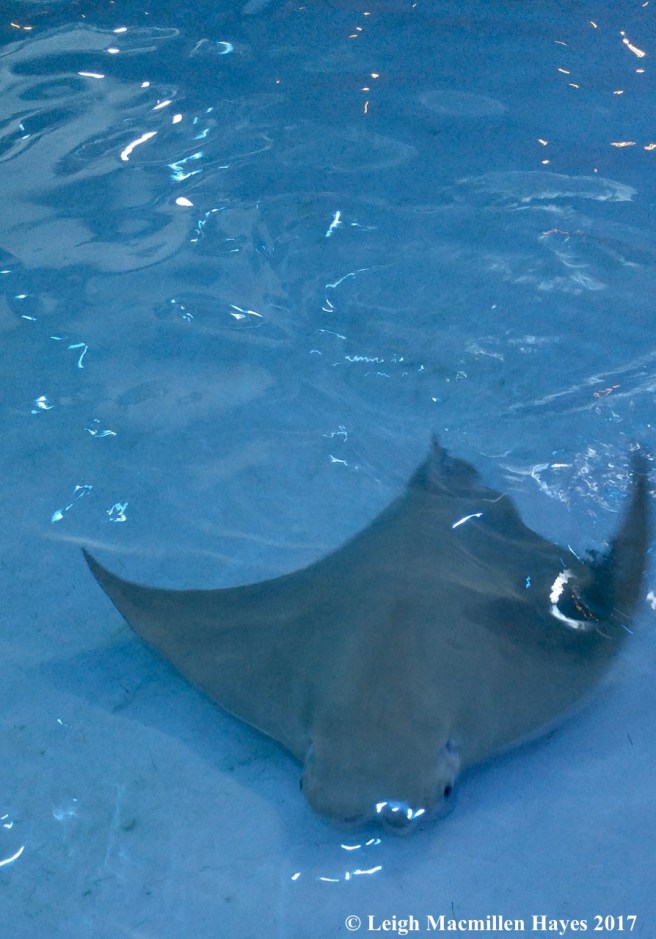
c-sting rays 10

So did rays of another sort, who flapped their “wings” in forward motion.

c-sting rays 11

And then there was the whisperer . . .

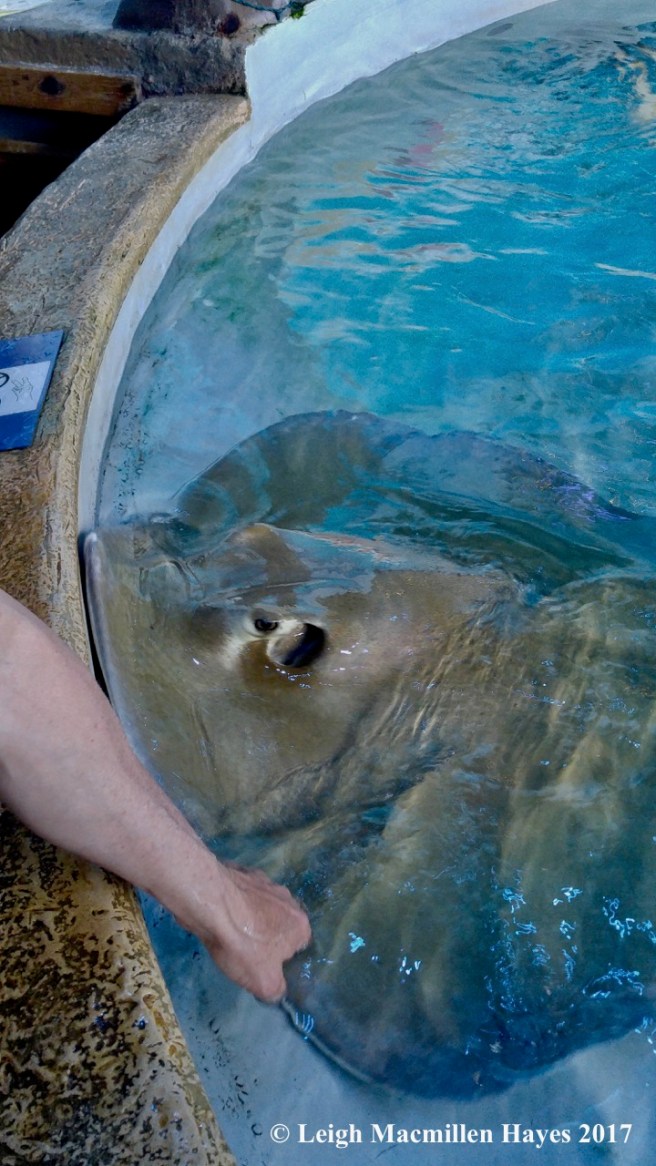
c-sting rays 13

who patiently encouraged slow movement . . .

c-sting rays 14

rewarded with a gentle stroke.

c-tiger 3

In the end, we had our favorites. The sting rays and the king of them all–a least expected resident in the aquarium, a Sumatran Tiger.

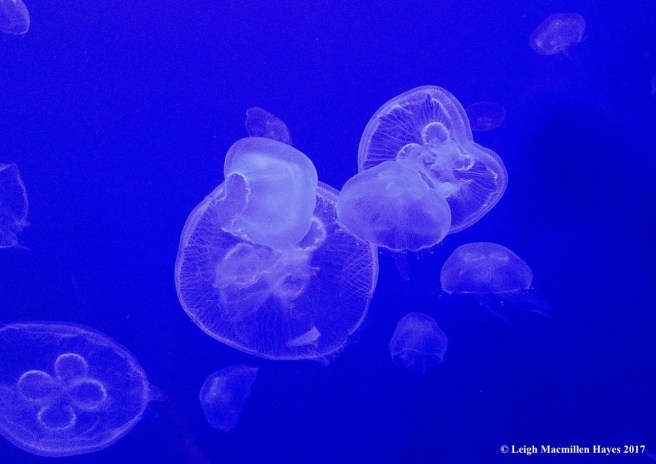
c-jellyfish 2

And jellyfish! Bioluminescent sea nettles–the fireflies of the aquatic world. (Memories swam through my mind of glowing night swims in my own youth.)

c-before the grads enter

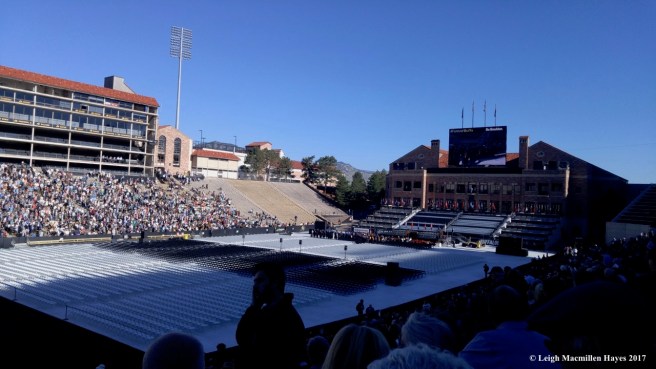
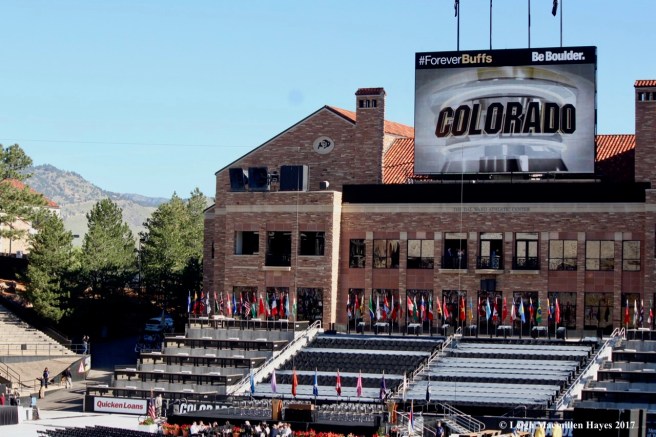
But our main reason for heading west was to watch Folsom Stadium fill up.

c-the stage is set

The stage was set and bag pipes tuned.

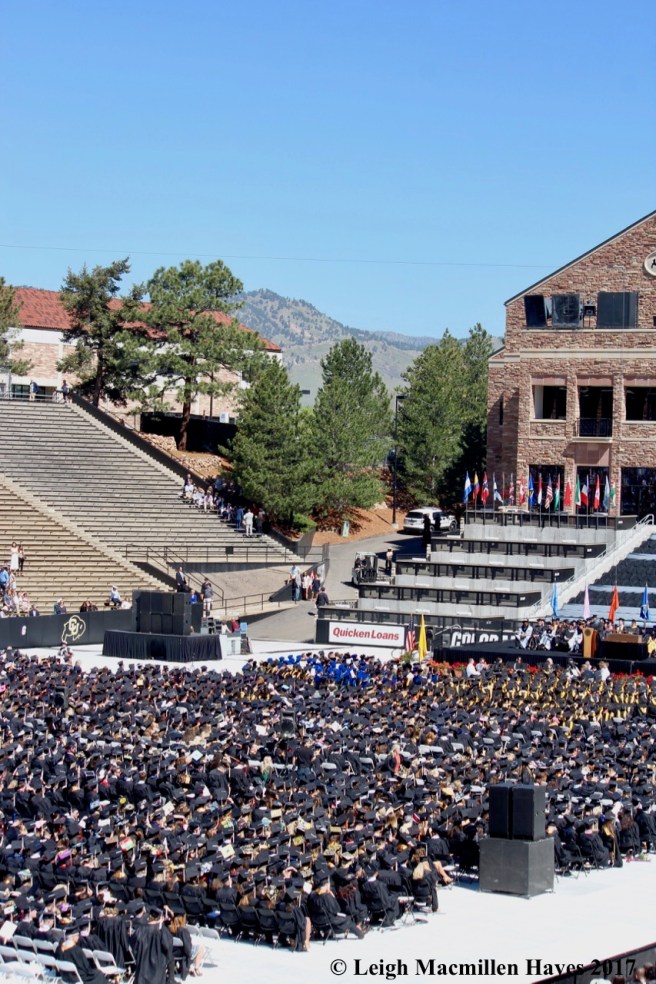
c-grads entering

Ever so slowly, soon-to-be graduates marched in.

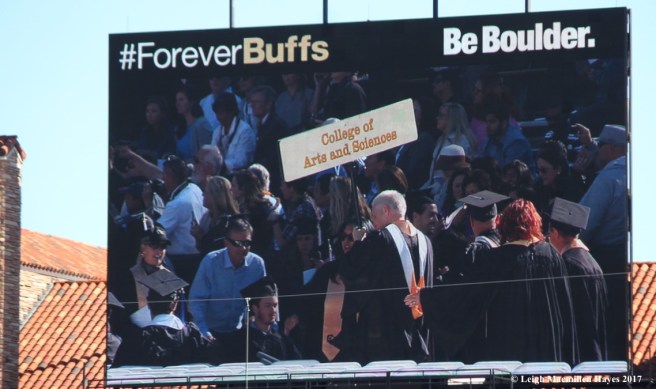
c-college of arts and sciences sign

We were most interested in the College of Arts and Sciences.

c-grads seated

When I sent a text message asking, “Where are you?” I received this response: “I’m sitting down and wearing black.” Ah, that boy! Or young man, I should say.

c-where's waldo? he's here!

But, he could not escape his mother’s eye and she found him in the sea of Waldos. Or rather, Buffs. (Have fun looking.)

c-degrees conferred1

A couple of hours and sunshine later, degrees were conferred and tassels moved over.

c-congrats from cousin

But then, a second ceremony for each school, and this for film studies, where his cousin from Denver (and also a CU grad) joined us and offered congratulations.

c-receiving his diploma

After speeches and honors, at last the diplomas were awarded.

c-it's official

And in the wink of an eye, he was done. Fini.

c-our grad

Our grad tolerated his mom–as the sun shone brilliantly.

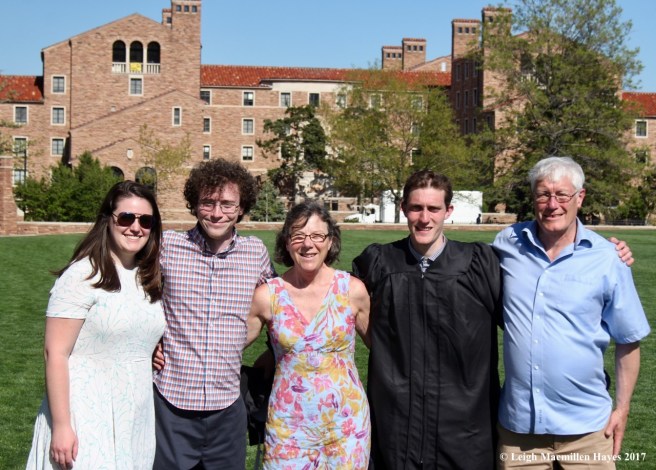
c-our gang 2

We all gave thanks for Pat’s achievements, from Hannah and Shep, to cousin Christian, our grad Pat, and my guy.

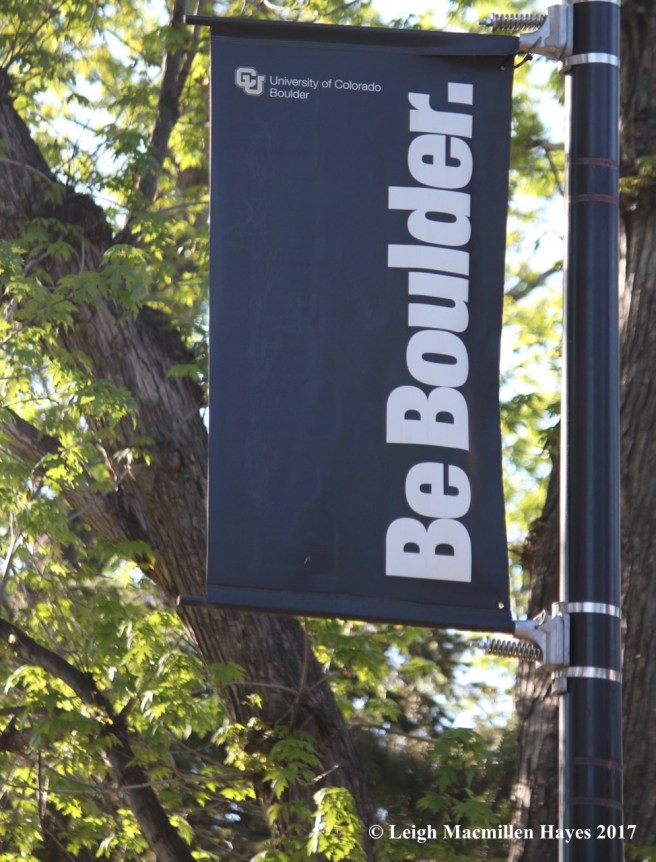
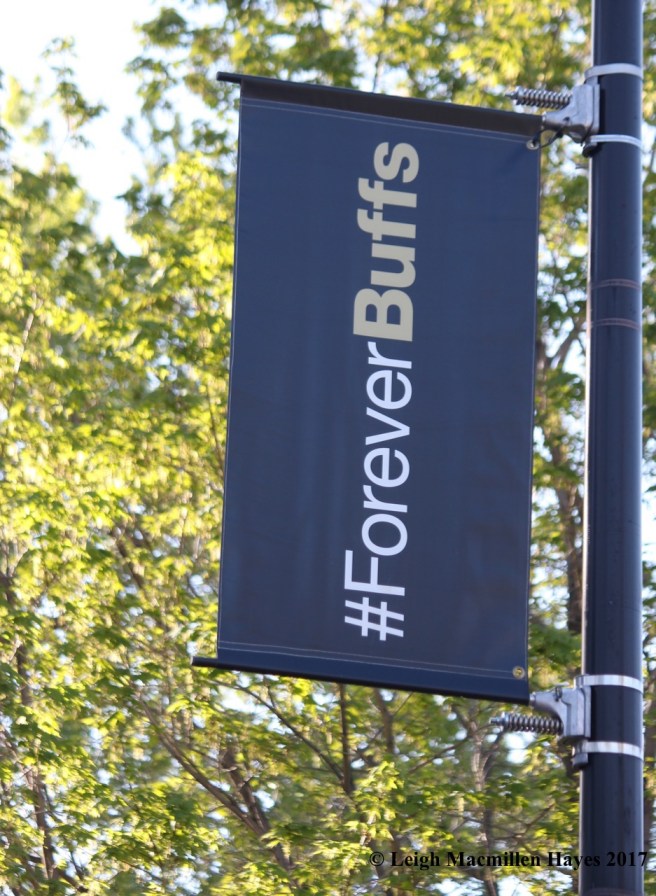
c-congrats class of 2017

The signs . . .

c-be boulder sign

said . . .

c-forever buffs sign

it all.

c-family gathering 1

He did it. And our smiles beamed for our wonder-ful son. Forever a Buff. Congratulations to Pat on your CU Boulder degree. Best. Mother’s. Day. Gift. Ever.

Love/Hate Sundate

Some days are made for hikes and today was one of them. The temperature was right–in the upper 40˚s-low 50˚s. No sun. And no bugs.

So, after church, my guy and I drove to the trailhead for Burnt Meadow Mountain in Brownfield, Maine. At the signs indicating the trail splits in two–North Peak to our right, Twin Brook to the left, we knew we planned on covering the loop, but my guy stopped and asked which way I wanted to ascend the mountain.

Nose scrunched, I replied, “North Peak.”

He chuckled for he knows my love/hate relationship with this mountain.

b-red oak leaves

Today my love began with the new leaves, like that of the red oak,

b-red maple1

red maple,

b-striped maple

striped maple,

b-beech leaves 1

and beech. I worshiped them all for their subtle colors and textures. Spring is the time of year that reminds us to live in the moment, for the natural world demonstrates constant change.

b-trailing arbutus

And then there were the flowers, like the trailing arbutus, aka mayflower.

b-Canada mayflower

And another of a similar name, Canada mayflower.

b-shad 1

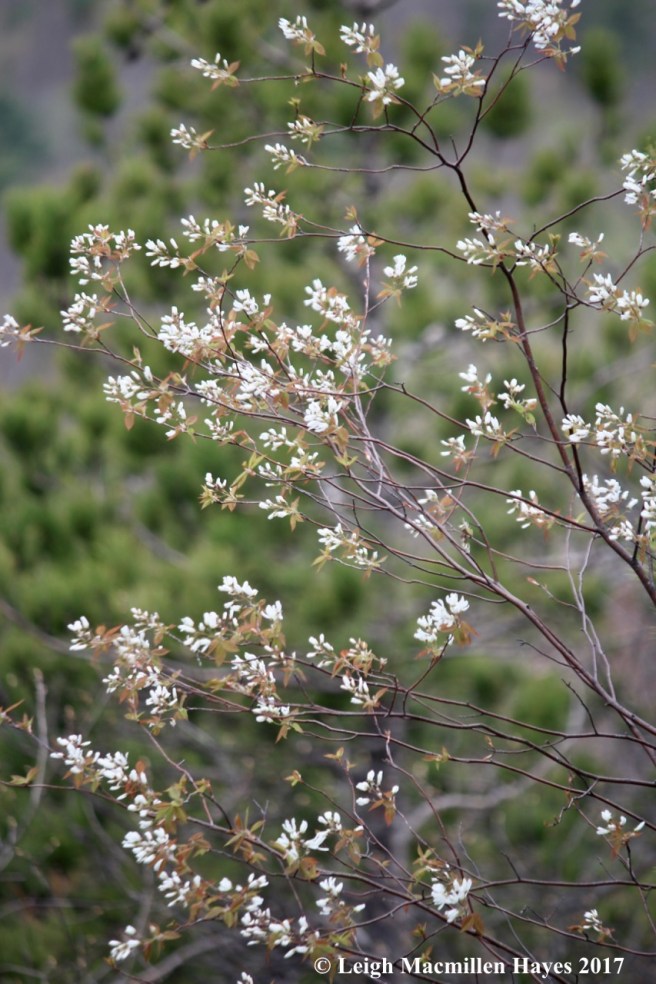
In the shrub layer, occasionally we came upon the beauty of serviceberry or shadbush flowers flowing in the breeze, exhibiting their own take on these fleeting moments.

b-early saxifrage

And cleaving to the rocks as we climbed, early saxifrage. It’s also known as rockbreaker for this habit, and perhaps suggested the Latin name–Saxifraga virginiensis. Saxum-rock and frangere-to break. A funny name for an uncommon display.

b-summit ahead

I did my best admiring my surroundings for I knew what awaited. My guy paused as the summit came into sight,  expecting me to comment. For once, I kept quiet.

b-summit climb

And then, when the time arrived, we both channeled our inner mountain goat and sought hand holds and foot holds as we scrambled up the nasty dash to the top. Ha ha. It’s difficult to scramble when your heart pounds while your body quivers. This is the section I most hate–and as I always told our sons when they were youngsters, hate is a strong word. I knew I could do this for I’ve done it many times before, so I tried not to take too long as I considered my next move. Plus, rain drops began to fall and I didn’t want to be stuck contemplating on slippery granite. But still.

b-lunch rock

Finally–success. We’d reached the flattened top of the mountain–such a welcome relief after that horrible section. You’d think it was miles long the way I carry on about it. The rain drops ceased and we sat on lunch rock to dine–dirty hands and knees our badges of honor.

b-summit 1

Our view from the rock–looking back toward our point of ascension.

b-summit 2

And forward toward Stone Mountain. After lunch, our plan was to follow the Twin Brooks Trail that passes through the saddle between Burnt Meadow and Stone.

b-summit 3

And to our right–looking toward the White Mountains.

b-summit trees:layers

Though the view is almost 350˚, our immediate view behind lunch rock offered layers of life–blueberries, a young paper birch and a white pine.

b-twin brooks trail down

At last we started down. The Twin Brooks Trail is longer, but less of a struggle. That being said, it’s not a walk in the park as there are constant roots and rocks seeking attention.

b-mt washington1

But occasionally there are views. I was afraid we might not see Mount Washington today, but it didn’t disappoint.

b-birch catkin1

On the way down, we were in the land of the birch, their catkins growing long . . .

b-birch catkin pollen

and exploding with life-giving pollen.

b-viola

There were violas to admire.

b-shad 2

And more shadbush.

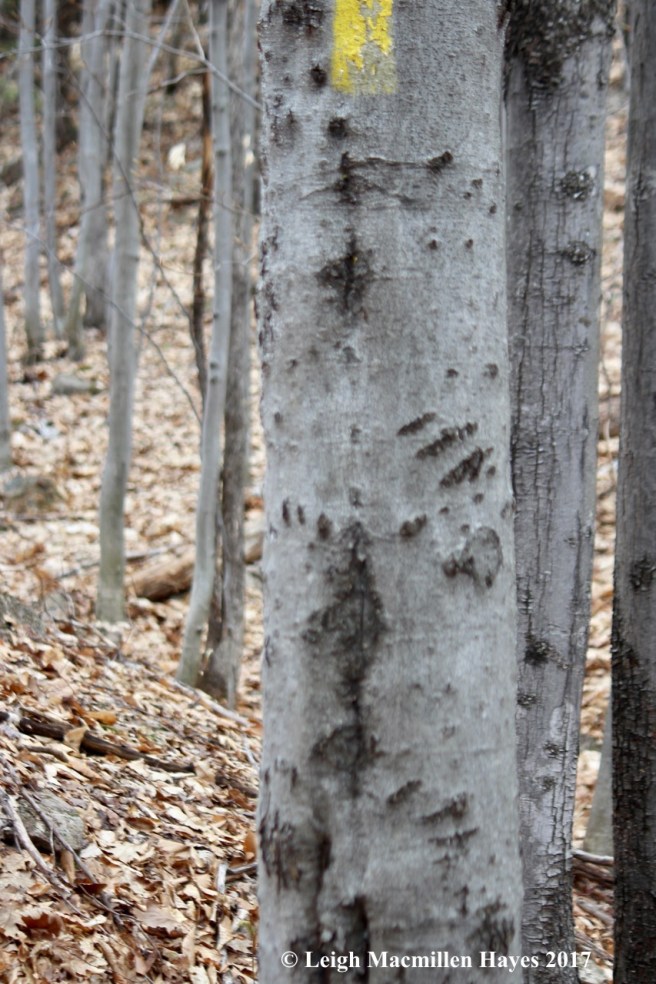
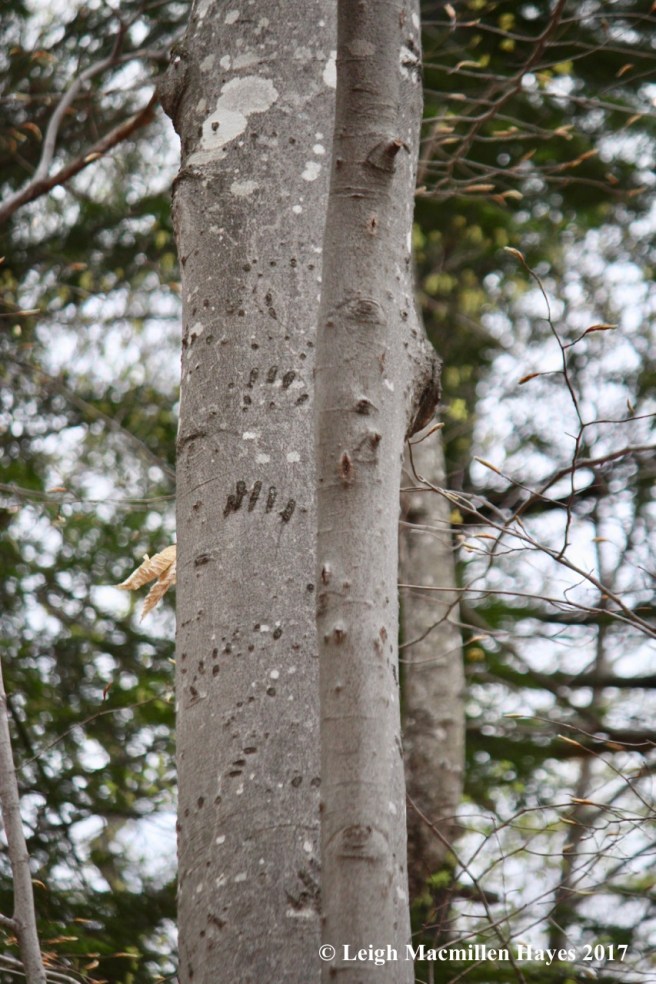
b-bear claws 1

But one of my other favorite things about this trail is the bear claw trees. No matter how many times I see them, they still bring a smile to my heart–and face. And a memory of seeing a bear on the North Peak trail one summer–it sauntered past us, not seeming to care that we were there. I suspect its belly was stuffed with blueberries.

b-twin brook 1

As we continued to descend, we soon heard the sound of one of the brooks for which the trail is named. Quite often on this trail, the water barely trickles, but today it rushed over the moss-covered rocks.

b-logging

Continuing on, we remembered that two hikers we meet at the start said there had been some logging and sometimes it was difficult to follow the trail. At last, my guy found the area they’d referenced. The trails are on private land and so while we couldn’t find some familiar landmarks, we nevertheless were thankful that we were still able to hike there. And, we were mindful to look for the yellow blazes as we stepped over some slash. It was quite doable.

b-bear tree 2:eye level

The result–a bear tree we hadn’t seen before was revealed.

b-bear tree 2:looking up

It must have offered plenty to eat in the past for the tree was well climbed all the way to its crown. Maybe we’d once met the very bear.  Maybe not. Who knows. But it’s worth a wonder.

b-bear of a different sort

A bear of another kind also left behind a sign of its presence. We obviously weren’t the only ones who headed to the mountain for a date.

b-bear tree 3

In one last spot a short way from finishing the loop, we found our last bear tree–again seen because of the logging. I suspect there are many more in these woods and hope they don’t all get cut.

Emerging leaves. Spring flowers. Jagged outcropping. Flowing water. Bear trees.

Really, it was a love/hate/love Sundate–joyfully spent with my guy.


Honoring the Earth

It would have been so easy to stay home last night, curled up on the couch beside my guy while watching the Bruins play hockey. After all, it was raining, 38˚, and downright raw. But . . . the email alert went out earlier in the day and the evening block party was scheduled to begin at 7:30. And so, I piled on the layers from a wick-away shirt to Under Armour, a turtleneck, sweater, LL Bean vest and rain jacket. I slipped into my Bogg boots and made sure I had the right gear–smartphone for photos, reflective vest, headlamp and flashlight. With a visored hat on my head to shield my glasses from the rain, I was finally ready. Out the door and down the road I went, headed to the Lakes Environmental Association‘s office for Big Night.

h-Big Night Patrol 3 (1)

I wasn’t the only one crazy enough to attend the party. Our number was about twenty. I think the best part was that we ranged in age from 6 to almost 60, the latter being me–the oldest kid on the block. And in that mix, one teen who was celebrating his 15th birthday (Happy Birthday, Kyle), and several teens who had never attended before but came because one of their crowd was an annual participant. We even had two policemen in the mix–and though their job was to slow traffic and keep us safe, they had as much fun as we did completing our mission.

h-spotted sallie 2 (1)

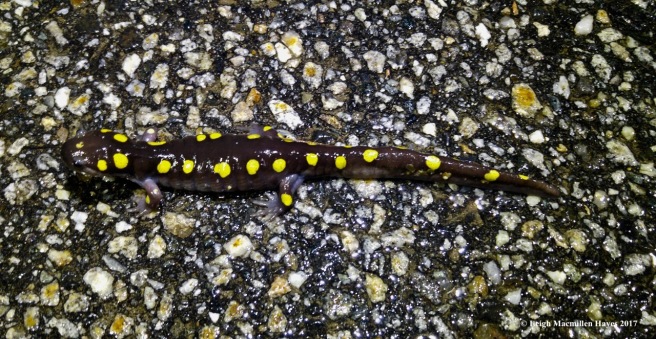
Said mission–to help spotted salamanders . . .

h-spring peeper 1 (1)

and spring peepers cross the road.

h-redback salamander (1)

We did so for a while and then headed back to our vehicles. Just before reaching the spot where we’d all parked, someone spotted this redback salamander–I smiled because its the symbol of the Maine Master Naturalist Program.

We were wet. We were cold. And we were happy. As nature would have it, Big Night preceded Earth Day–a perfect beginning.

h-candy lichen

Earth Day began appropriately with a board meeting at Lakes Environmental, where among other topics, Dr. Ben Peierls, the new research director of LEA’s Maine Lake Science Center, shared with us his plans for the water quality testing laboratory. Ben addressed us first so that he could drive to Portland and join the March for Science. We continued our meeting, but were thankful for his representation. Meanwhile, directly outside and all around town, another gathering was taking place as many people participated in an Earth Day cleanup.

By the time I left the meeting pleased with all that had been accomplished, I was ready for a solo adventure to find out what the Earth wanted to share with me since most of the snow melted this past week. Despite being another raw day, or maybe because of it, the candy lichen brought a smile to my face. I think one of the cool things about this lichen is that even though its salmon-colored fruits stand atop stalks, this is really a crustose (crust-like) lichen, the bluish-green surface being the actual structure.

h-juniper berries

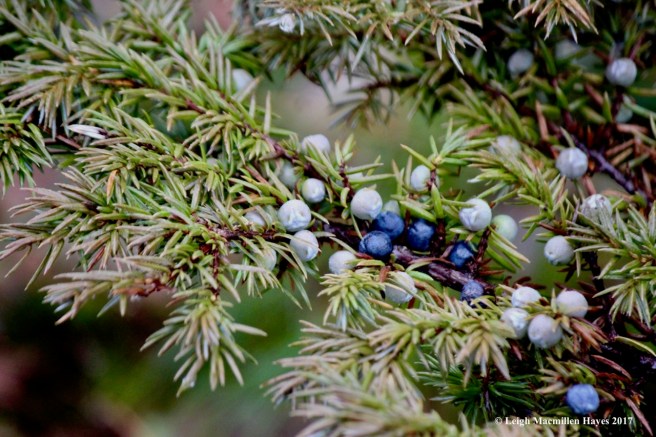
Near the candy lichen, the bright blue of some berries stood out on the common juniper. They remain on the shrubs all winter and it seemed only a wee bit ago they looked all withered. Today’s offerings were plump and pretty.

h-pine droplets

And then there were the raindrops, each waiting its turn to continue the journey toward the earth. I had to wonder what else it might fall upon before reaching its final destination–each little ball encapsulating nourishment.

h-lambkill

One of the receivers, sheep laurel, which displayed its own new life.

h-trailing arbutus

And at the base, trailing arbutus. One year ago, as I noted in my Earth Day post, it was already in bloom. This seemed a reminder from Mother Earth that we need to practice patience.

h-wild turkey

I continued my mosey, as quiet as could be, and so was startled when one large, exotic bird, and then another, and a third flew off from behind a stone wall. And then I realized they were wild turkeys–who truly are exotic if you take a look at all the colors in their feathers.

h-tinder conks on beech

I’d been on the snowmobile trail, but traveling was difficult given some remaining icy snow and deep ruts filled with water. As if I needed an excuse, I decided to slip into the woods. One of my first delights–tinderconks lining a tree as I looked up.

h-moss covering

But really, it was the thick moss coating at the top of the tree that first drew my attention. Several trees in the neighborhood displayed the same fashion.

h1-woods south (1)

My wander was aimless, taking me through boggy areas . . .

h-snow1

and small sections where snow still blanketed the ground.

h-deer prints in snow

Besides plenty of deer scat, I found prints . . .

h-deer hair

and hair.

h-deer hair bubbles

Raindrops enhanced the hair.

h1-moose scat 1 (1)

And though I suspect they’ve moved toward open water, there was plenty of evidence that the moose had also spent the winter in these woods.

h-moose hair

They, too, have shed hair–preparing for the summer scene.

h-moose maple

A couple of months ago, I’d been concerned that the moose had consumed all the tree buds, but the red maples showed me otherwise.

h1-woods south 2 (1)

At one point, I stood for a while atop a rock and looked to the south.

h1-woods north (1)

And then to the north. It was as I stood there that I heard a repeated sound. It began with a few slow beats, and then a swift series of beats. All seemed muffled. It finally occurred to me that I was listening to a ruffed grouse. Eventually, I followed the drumming and came close to the one beating its wings against a log–the work of a displaying male. I didn’t bother to seek out the actual bird for I knew I’d startle it and it would fly off, so I let it drum in peace, thankful for the opportunity to at least hear it. Really, it was a first for me. Oh, I’ve possibly heard it before, but only today did I recognize it for what it was.

h1-widowmaker (1)

For a while, I was fake lost . . . and then I heard another repeated sound that lead me to a widowmaker and I knew exactly where I was. But where was the maker of the sound?

h-owl 1

In a tree above me.

There were actually two barred owls and I was so thankful for the honor of listening to and watching them on this Earth Day.

I was also thankful for all the privileges bestowed upon me. The privilege of living. The privilege of noticing. The privilege of questioning. The privilege of understanding. The privilege of wandering. And especially, the privilege of wondering. Thank you for your offerings, Mother Earth. I am honored to know you.


May I Have This Dance?

Haha. If you know me well, you know I’d rather be a wall flower than step onto the dance floor. I easily managed to avoid all high school dances, except one prom. And then, barely danced at that, probably much to my date’s dismay. After that, so many moons ago, I don’t think I danced again until my wedding–at which time any dear friends in attendance watched with humor at my awkward movements. But today, I felt the rhythm surging through my body.

v-snow on trail

It all began on my way to the vernal pool. Perhaps it was really just a shiver as the breeze blew across the last of the snow, hard packed still along the snowmobile trail.

v-springtails 1

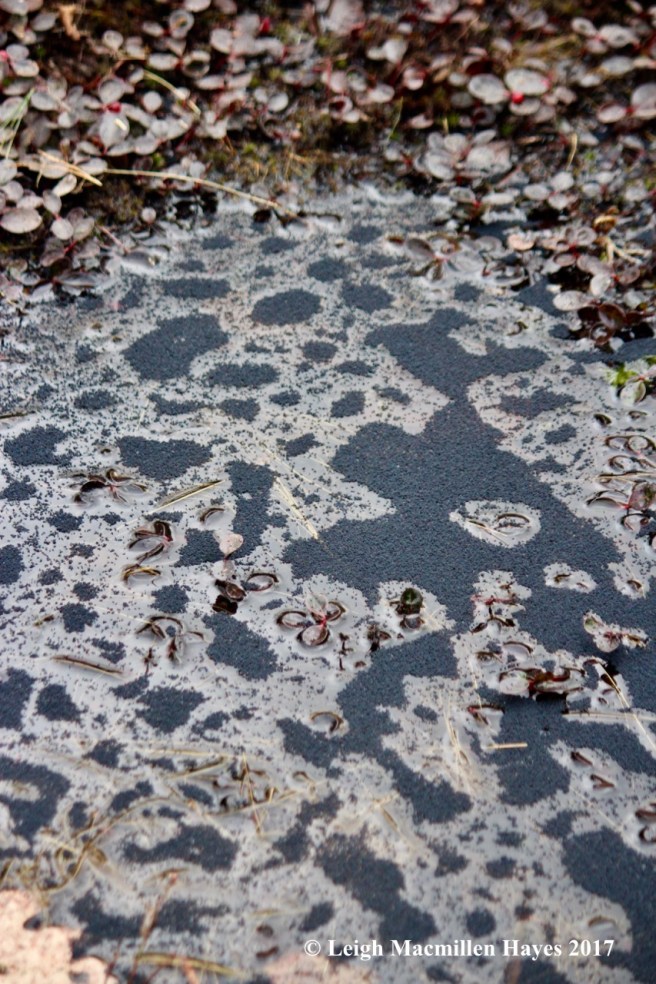
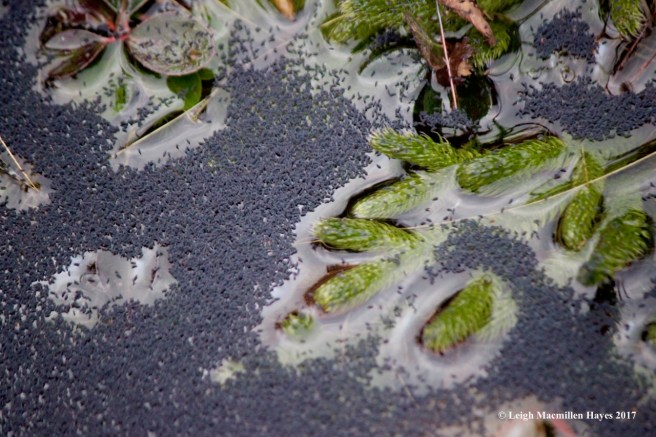
Or maybe it was the depression that held the snowmelt and was covered with an oil slick of sorts . . .

v-springtails 2

which turned out to be a million springtails bopping to their own tunes.

v-trailing arbutus 1

It could have been the sudden sight of so many trailing arbutus plants that got me going.

v-trailing arbutus 2

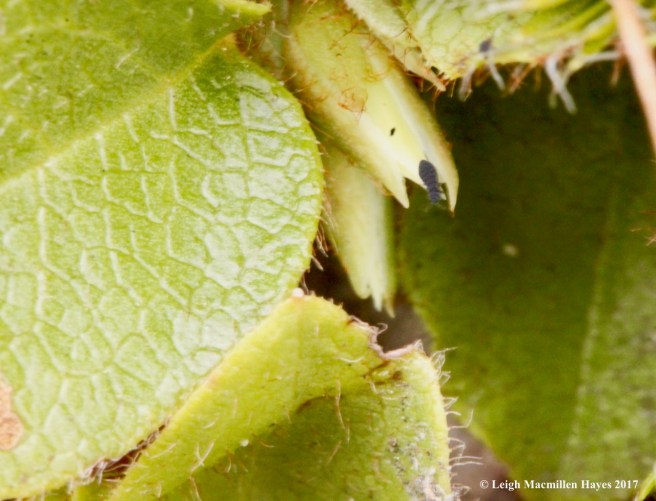
Certainly I wasn’t the only one excited by those flowers yet to be. (Do you see the springtail on the tip of the bud?)

v-vernal pool

Or it might have been the ever shrinking ice cover at the pool that made my feet tap.

v-vp edge opening

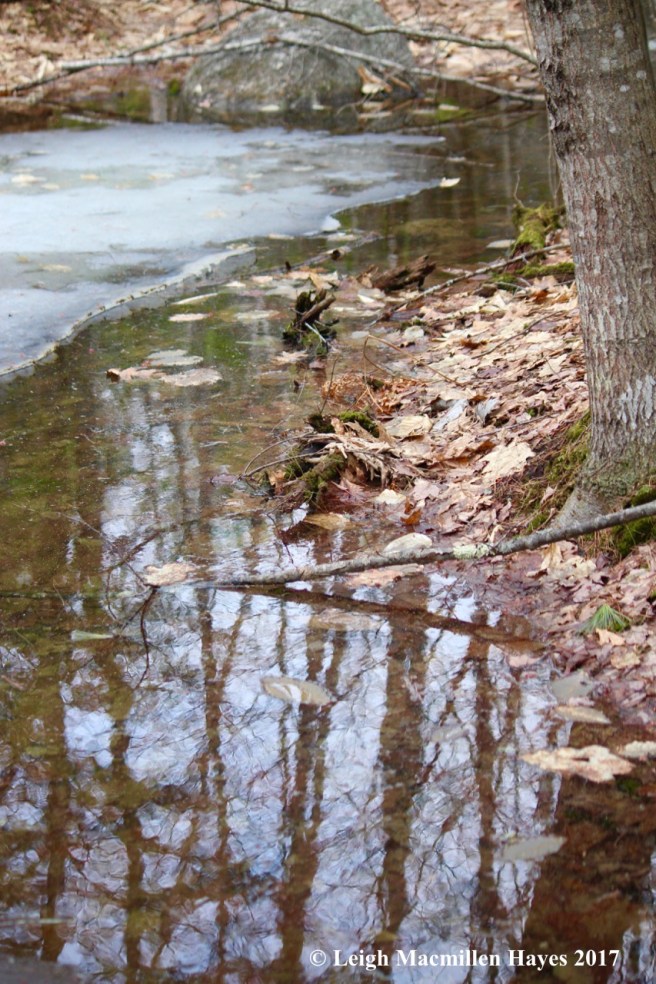
Perhaps it was the fallen beech leaves atop tree reflections that forced me to sway.

v-leaf offerings

Or the way the hemlock, oak, maple and beech leaves intermingled.

v-spermatophores

What I do know is that there was no stopping me once I spotted spotted salamander spermatophores atop leaves in several open sections–the sperm being located at the top of the cauliflower-shaped platforms.

v-frog 1

And then I saw something swim under some leaves that really got me rocking. Do you see the face of the wood frog, hiding as best it could?

v-fox scat beside vernal pool

As I began to circle around the dance floor, I noticed an offering of scat that made me think a red fox had sashayed beside the pool.

v-sharp-shinned hawk feather?

On my own sashay home, I discovered that there were other dancers in the midst–this one possibly a sharp-shinned hawk.

v-woodpecker feather

And after that a woodpecker.

v-junco feather?

And then a junco.

v-red maple flowers 1

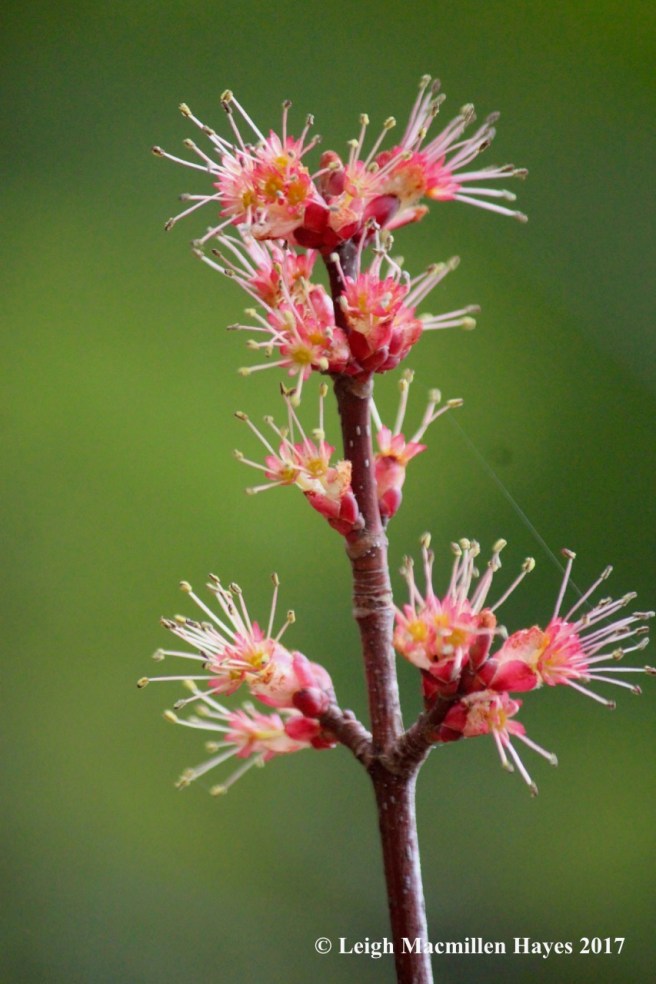
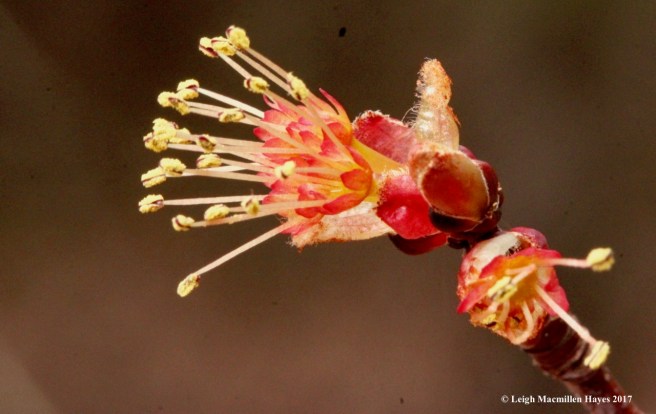
Along the cowpath, the red maple flowers blushed as I might were I to get all gussied up in a flowing dress.

v-red maple flowers 2

Much the way a suitor might wink, so much has happened so quickly. Within the past week the snow melted almost entirely away and winter released its hold on me. Now I’m ready to groove with the choreography of spring’s rhythm. I hope you’ll join me on the dance floor.

May I have this dance?


Just Around the Bend

Due to the generosity of friends, this afternoon I picked up some items for the Lakes Environmental Association’s silent/live auction to be held at the Stone Mountain Arts Center on July 14th. And one of those pick-ups put me in the Horseshoe Pond area where a mourning cloak butterfly danced in the sky as I drove down the dirt road. Alas, I couldn’t photograph it, so it will have to remain in my mind’s eye, but I was excited for it was the first sighting of the season–a harbinger of spring.

w-Horseshoe Pond 1

Back at the boat landing by Horseshoe Pond, I parked, donned my Boggs, and hoped for another butterfly sighting. It wasn’t to be, but the view was worth a pause as I looked at the left portion of this upside-down, U-shaped pond.

w-Sucker Brook from the culvert

The water roared through the culvert and I walked to the other side of the road, where the pond outlet becomes Sucker Brook–which overflowed its main bed.

w-Sucker Brook 2

My friends suggested I might need snowshoes, but of course, I’d left them home. They were right. I should have worn them and dig post holes I did as I followed the brook. Of course, first I had to climb over the dirt-covered snowy embankment by the road in order to get onto the trail at the Greater Lovell Land Trust’s Wilson Wing Moose Pond Bog Preserve. It was worth the effort.

w-snow layers by yellow birch

One of my favorite spots along the brook is this yellow birch tree, which typically stands on stilts atop a rock at the water’s edge. Who would know? For now, those spindly legs are still blanketed under layers of snow.

w-squirrel works

I expected the tracking conditions to be better than they were, but instead needed to focus on signs if I wanted to figure out what mammals came before me. Several middens of cone scales spoke of red squirrels. And there was deer scat nearby.

w-hobblebush 1

Because this is a moist area, hobblebush grows here and I couldn’t resist an opportunity to enjoy its sculptural structure created by downy-coated leaf buds.

w-hobblebush 2

Equally beautiful were the expanding flowers–globe-like in appearance, with subtle hints of green.

w-Wilson Wing Moose Pond Bog

And at the viewing platform, I was forced to climb up. Last year, Moose Pond Bog was a shrunken wetland, or so it seemed given the drought. Today–water, water, everywhere.
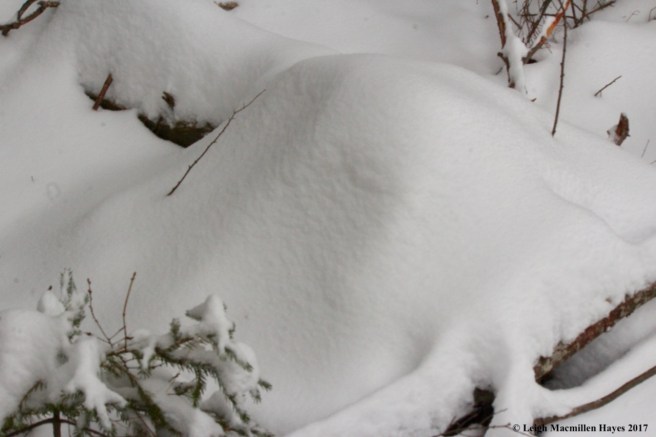
w-wintergreen

Back down the stairs, I searched about in a few sunny spots where the snow had melted. That’s when I spied last year’s berry dangling from a plant still sporting its maroon coloration of winterberry.

w-trailing arbutus leaves

And near it–a sight for spring-needy eyes . . .

w-trailing arbutus buds

trailing arbutus leaves and flower buds. Yes, Virginia, spring will come to western Maine. And we’ll all appreciate it more for it’s a season that never likes to rush.

w-mourning dove feather 1

I continued on and when I paused to look at some common polypody ferns that decorate a boulder, I spotted something else.

w-feathers 3

Feathers of varying sizes were scattered about.

w-mourning dove 1

A mourning dove had served as dinner. But for whom? No matter. Taking advantage,  snow fleas hunted for their own form of sustenance on the only part of the bird left behind.

w-stream 1

Before I climbed up to the road at the end of the trail, I had one more stream to cross–it’s usually a mere trickle, but not today.

w-tinderconks1

Rather than backtrack, I chose to walk the road–a much easier substrate. It was along there that I saw numerous tinderconks decorating one tree. Though they are also known as horse’s hoof, these reminded me more of elephant feet with big toes protruding at the base.

w-dragonfly spot

Back by my truck, I looked for the mourning cloak again–to no avail. Instead, my eyes were drawn to the reflection and memories of dragonfly hunting in this very spot last summer.

w-shimmering heat of the day

And when I looked back out on the pond, I could see the shimmering effect that occurs when the heat of the day meets the cold of the ice. The temperature reached into the 80˚s today. The meltdown has begun. It won’t be long now. From what I saw, spring truly is just around the bend.

Fair-feathered Friends

Thankfully, the prediction for 8-12 inches of snow for today didn’t come true. But it did snow, rain and sleet. And the birds were on the move.

b-red-winged 2

The moment I stepped out the door to fill the feeders and spread seed and peanuts on the ground I was greeted by the kon-ka-reeee of the red-winged blackbirds who stopped by for a few hours. Their songs filled the air with the promise of spring.

b-cowbirds

And with them came a few friends. Or were they? It seemed the cowbirds may have been scheming.

b-cowbird female

Mrs. Cow perhaps choosing others who might raise her young one day soon.

b-song sparrow

Another recent visitor also added its song to the chorus and its streaked breast to the landscape–such is the manner of the song sparrow.

b-tree sparrow1

American tree sparrows, on the other hand, have been frequent flyers all winter. This one paused long enough to show off its bicolored bill and white wing bars.

b-robins

And then there were those who chose to visit from a distance–the American robins appeared as ornaments in the oak and maple trees.

b-crow sentry

Meanwhile, a crow stood sentry–allowing all to eat in peace as it was ever ready to announce any intruders.

b-white-breasted nuthatch

And so they came and went–some upside down like the white-breasted nuthatch.

b-chickadee waiting

Others waiting patiently for a turn,

b-chickadee at feeder

confident in the knowledge that the wait was worth the reward.

b-chick and junco

But not all . . .

b-junco in lilac

that waited . . .

b-junco waiting

remained patient.

b-junco--cigar?

The juncos gobbled the seeds . . .

b-junco with peanut

and the peanuts.

b-junco fight 1a

And like siblings, they squabbled . . .

b-junco fight 1

with attitude . . .

b-junco fight 2

and insistence.

b-junco fight 3

Of course, there was always a winner.

b-junco up close

I love these plump winter visitors with their head and flanks completely gray, contrasting white  breasts and pale pink bills–making the junco an easy ID.

b-gray squirrel

They weren’t the only gray birds to visit the feeders. Oh, you mean a gray squirrel isn’t a bird?

b-squirrel in its tracks

Nor is the red. Don’t tell them that.

b-deer in yard

The same is true of this dear friend, who first spied some action in the distance . . .

b-deer looking at me

and then turned its eyes on the bird seed and me. But with one periscope ear, it still listened to the action to my right.

b-deer flying away

And then as fast as the birds that feed here all day, but flit in and out when they hear the slightest noise or sense a motion, the deer turned and flew off as a car drove up the road.

I played the role of a fair-weather naturalist today as I watched my feathered friends from indoors.

With friends in mind, I dedicate this post to my mom’s dear friend, Ella, who passed peacefully in her sleep the other day. I trust Mom has put the coffee pot on and she, Aunt Ella and Aunt Ruth are watching the birds out the kitchen window. 


The Sun Always Shines

In the grayness of the day sunlight lit my way.

o-skunk tracks

Oh, it wasn’t as bright as yesterday when I wandered in brilliant light under clear blue skies and saw hints of spring, including skunk prints in the snow,

o-algae

and some blue-green algae in a vernal pool that is slowly opening up.

o-ice goddess

But given the temperature and wind, the ice goddess reminded me that winter prevailed.

b-deer 2

This morning presented a different picture that didn’t feature Mount Washington in the background because it was obscured by clouds. Rather than don my snowshoes, I decided to stick to the snowmobile trail for the most part. I wasn’t the only one who ventured that way. Because I wasn’t making as much noise as usual, the deer didn’t hear me approach. And so we stood for many minutes contemplating each other. I didn’t want to scare her for I knew she wouldn’t just stick to the trail and the snow depth continues to be such that she sinks with each step. It was in those shared moments that I began to think about energy and how much she put forth all winter and now continues to do the same as spring evolves. Every day I spy more and more young hemlocks trunks that have been scraped. She and her family are feeding on sunlight, which first feed the insects in the soil and then the trees. At each stage or tropic level of the food chain only ten percent of biomass from the previous level is retained. Thus, a thousand pounds of plant biomass is necessary to support a hundred pounds of an herbivore–that’s a lot of little buds for a deer.

b-bobcat prints

Eventually, she made her way across the powerline and joined her family. I decided to turn around so I wouldn’t disturb them further. And it’s then that I recognized some prints I’d missed previously. My micro-spike print is on the left, beside those of a carnivore–a bobcat, or rather, two. Usually bobcats travel in a solitary manner, but their breeding season is upon them. And those thousand pounds of plant biomass that supported  a hundred pounds of herbivore, in turn support ten pounds of carnivore. The hunt becomes important.

b-motherwort

I did find a few spots where the snow had melted and winter weeds, such as this motherwort, provided hints of future buffet items for the herbivores and omnivores to consume.

b-junco and hemlock needle

And then I came upon junco feathers and knew that a different consumer had benefited from the sunlight offered forth by this little bird. The hemlock needle provides a perspective of size.

b-junco feathers 2

Despite its demise, the feathers surrounded by melting snow created an artistic arrangement. That was my attempt at positive thinking, for like us, all things must eat to survive.

b-white ash opposite

And then a few producers caught my attention and I found myself focusing on young trees and shrubs. I’ve walked past this young tree numerous times and never saw it until today.

b-ash 2

White ash or green? They both look similar, but the leaf scar is the giveaway. It’s shaped like a C or misshapen horseshoe with a deep notch at the top.

b-ash bud

And its terminal bud is domed. In these woods, the ash trees aren’t a preferred food source of the deer–lucky for them.

b-silky 2

Nearby, another neighbor caught my attention and it, too, I hadn’t met before.

b-silky dogwood 1

My assumption was dogwood, given the bright red/purpishish color of its shrubby stems, long-gone fruits and opposite leaf buds. But–red osier or silky? I’ve leaned toward the latter but will have to pay attention as the season moves forward. These did seem to tickle the herbivores fancy from time to time, though not nearly as much as the maples that grow nearby.

b-peanut

As I headed toward home, I stumbled upon another site I’ve seen frequently all winter. Actually for the past few winters. There must be a peanut plantation somewhere in these woods. That, or the blue jays have discovered a good source at someone’s bird feeder.

b-ice goddess

Before heading indoors, I paused to acknowledge another ice goddess, one who also knows the sun’s power and found relief in today’s shadows . . .

b-snow

and flakes. It’s snowing again, this fourth day of spring. Liquid sunshine, for the snow also provides nourishment to all who live here.

You see, the sun always shines . . . even when you can’t feel the warmth of its rays.