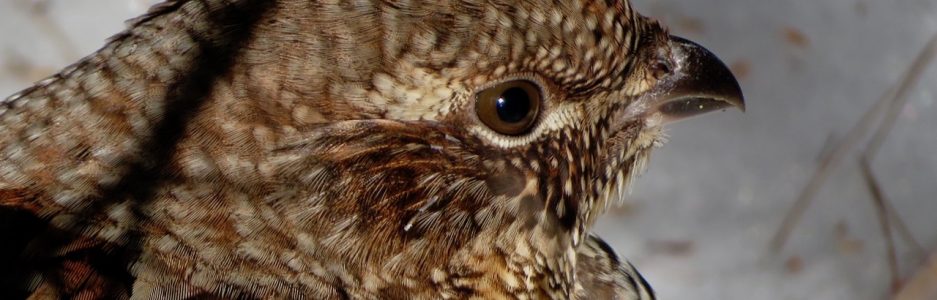
Summer Fly By

It’s the height of summer. I love every season, but wish I could slow this one down and spend more time soaking in all that it has to offer. This week alone is flying by.

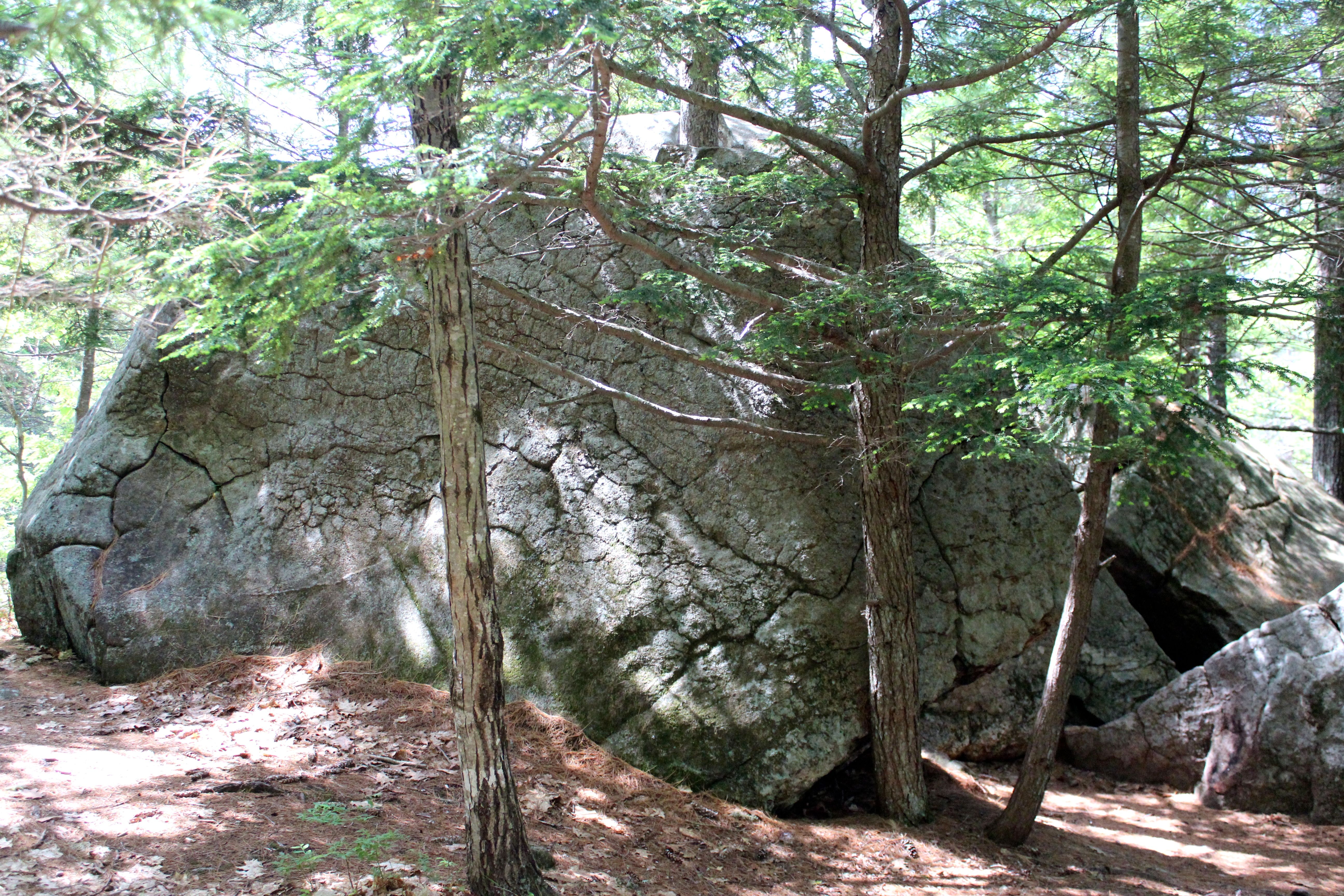
mystery stones

My offerings are a mishmash of what I saw and did during the week, beginning with the mystery stones on the backside of Amos Mountain at the Heald and Bradley Ponds Reserve in Lovell.

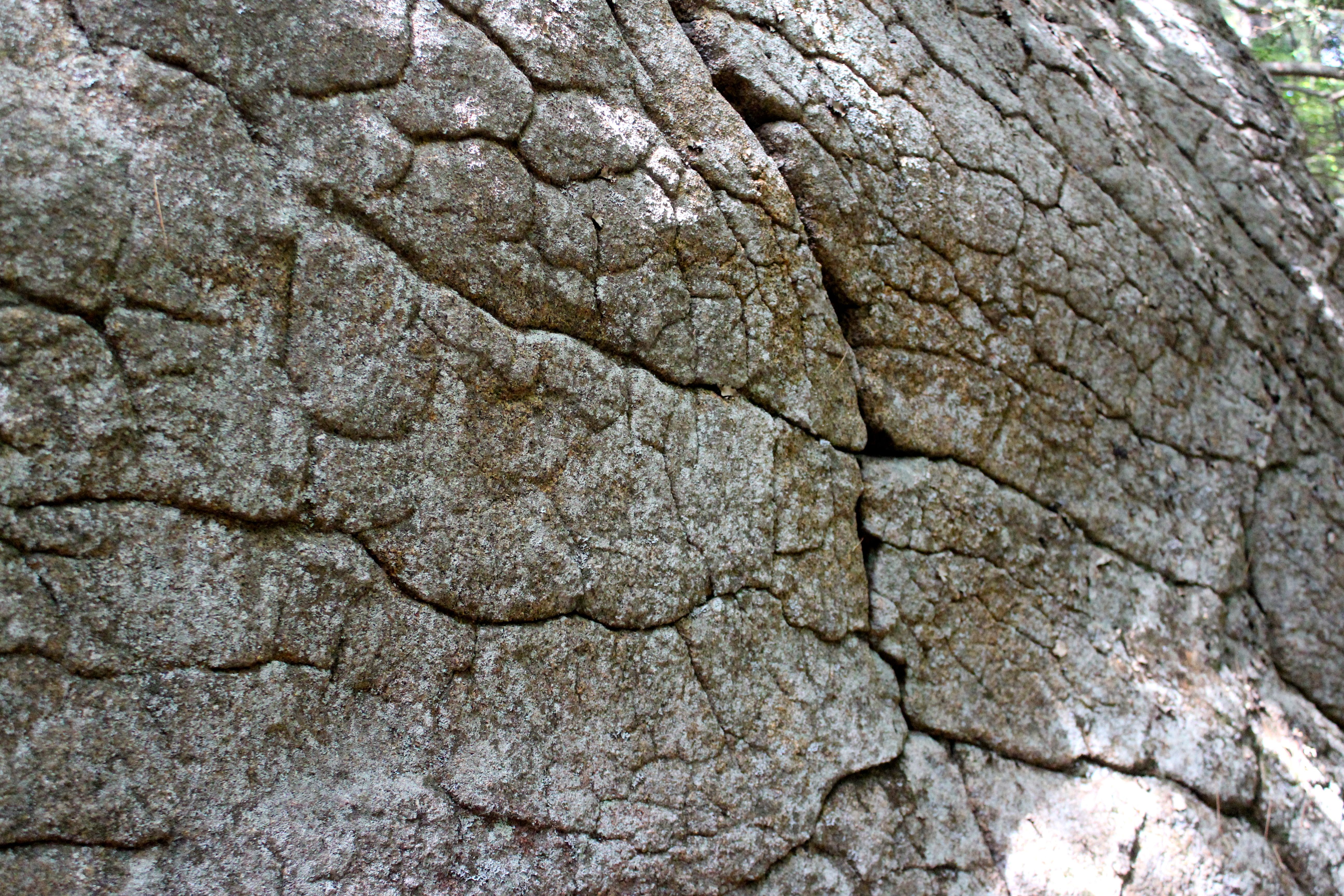
me mystery stones 2

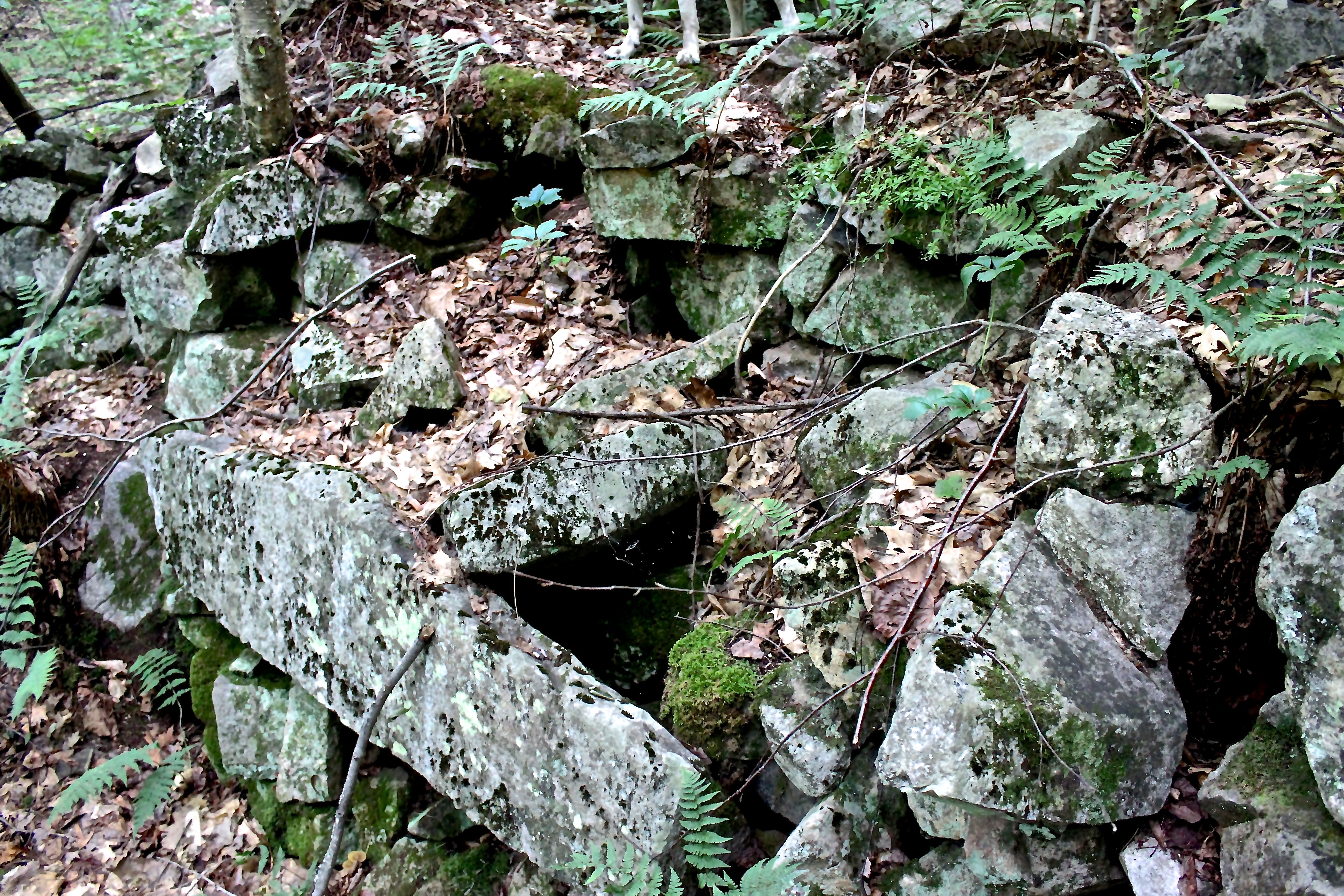
My friend, Jinny Mae, would love this mystery, so I’m going to ask her what she thinks this is all about. It’s a huge structure and I hope some people will want to check it out with me this Saturday during the Family Fun Day–A Celebration of People, Place and Nature hosted by the Greater Lovell Land Trust.
me mystery structure and mystery legs

There’s one more mystery in this photo–four legs. Do you see them?

trail signs

I continued on to the Wilson Wing Moose Pond Bog Preserve to make some tweaks along the newly installed self-guided nature tour beside Sucker Brook.

Shout out to docent Linda Wurm for all the work that went into re-creating and installing the signs. Warning to the wise: Do not hire the two of us for any house renovations. We discovered talents we don’t possess. A humbling experience.

me hobblebush fruit

One of my favorite plants along this trail–hobblebush showing off its fruits.

me hobblebush

And letting us know that times are a-changing. Say it isn’t so–it’s too early for fall colors. I only found it on this one shrub. Phew.

Indian pipe

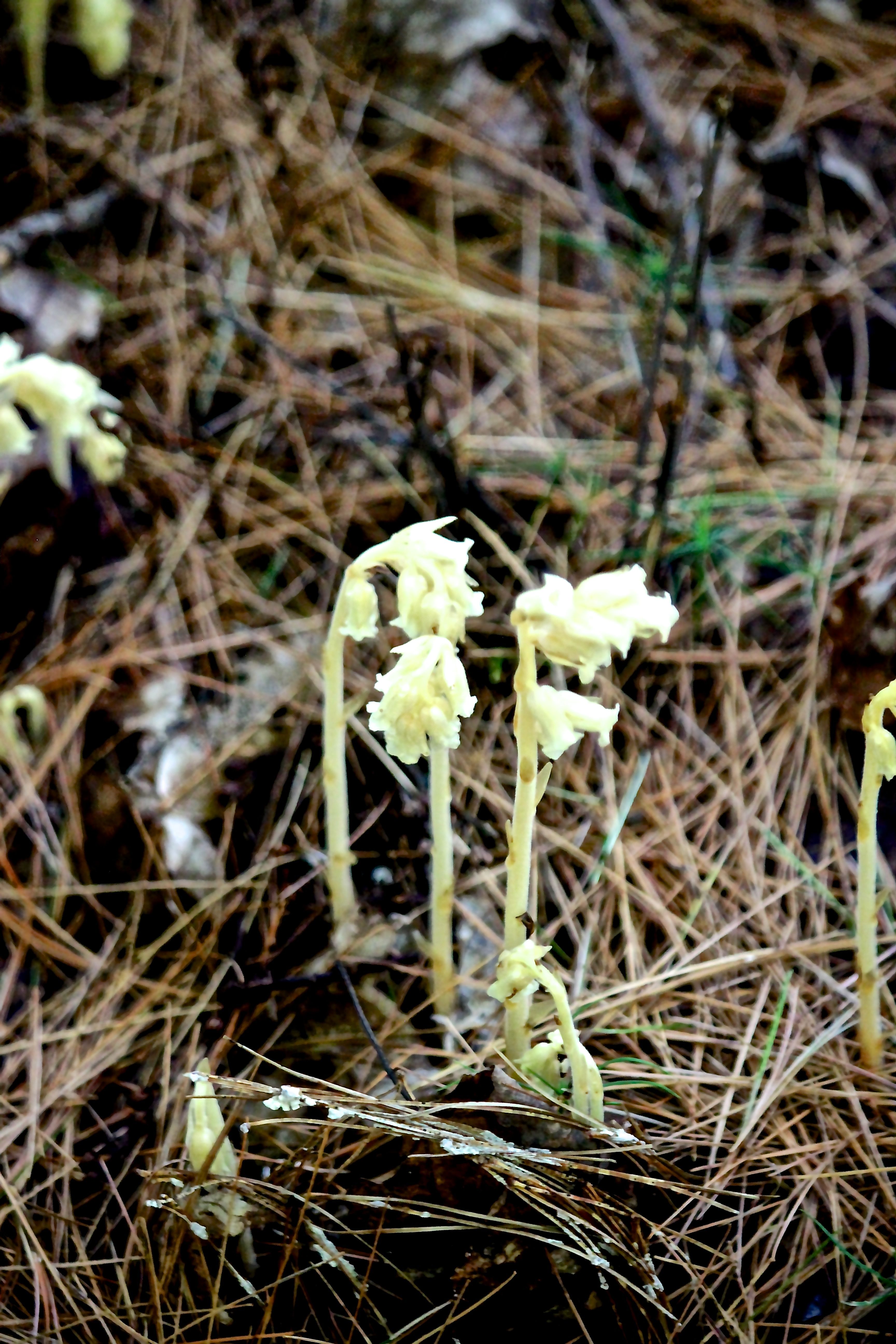
A docent tramp at the Chip Stockford Reserve on Tuesday took a wee bit more than the usual three hours. The loop trail is only about a mile long, but we’re passionate about checking everything out. The parasitic plants were in full bloom, like this Indian Pipe,
pine sap

yellow-flowered pine-sap, and

squaw-root

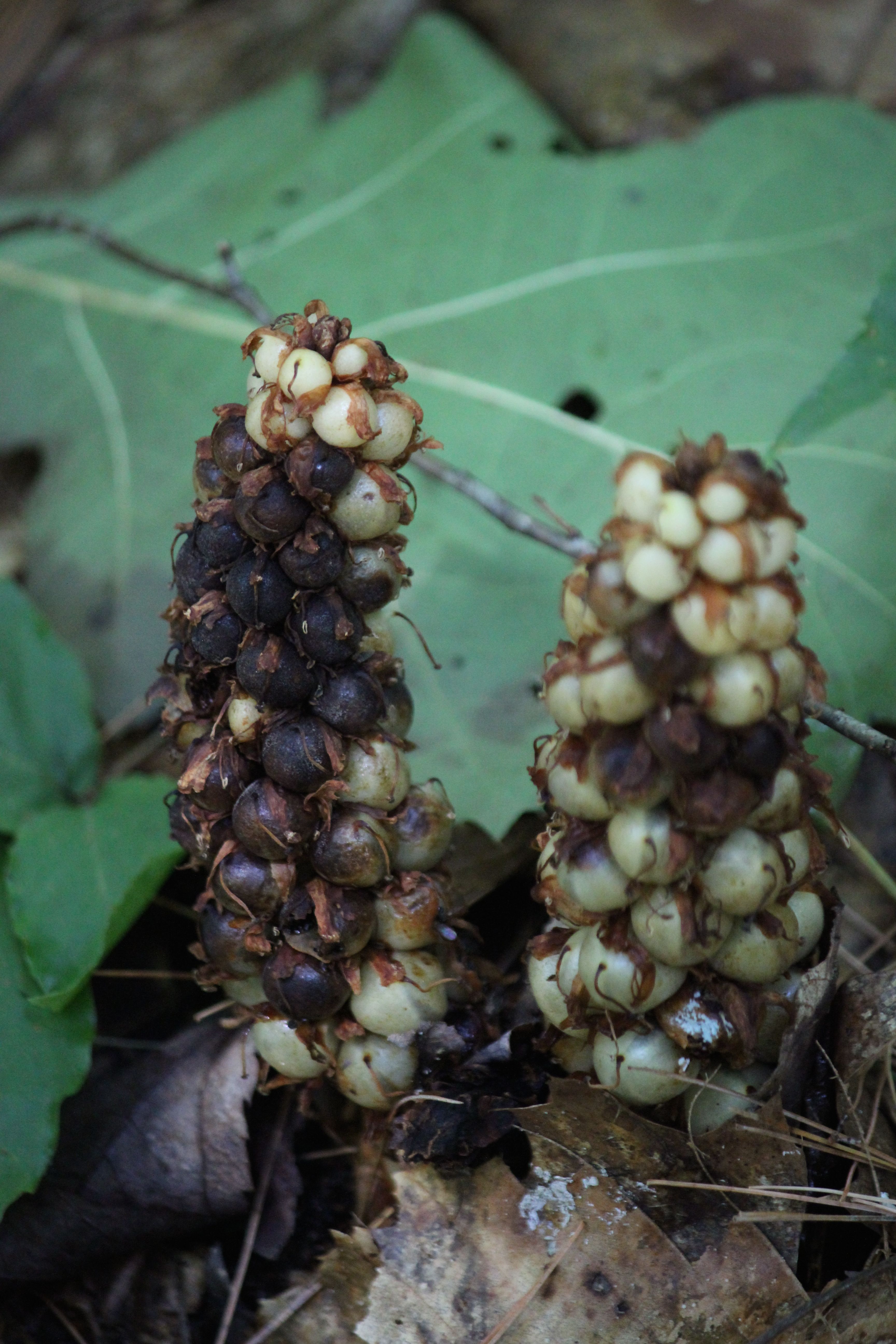
squaw-root. Kind of looks like corn on the cob, doesn’t it? Or a pine cone?

painted turtle

Yesterday, I joined the Lovell Recreation Program for the grand finale to our land trust nature program–a field trip to the Maine Wildlife Park in Gray. Though it can be disconcerting to see wild animals caged, these are here for some reason–and they give us an opportunity to see animals that surround us but are elusive.

me brook trout

What were the kids’ favorites? The turtles and brook trout. Feeding the brook trout especially.

me jf houseme jf house 2

Last night, Brian Fox and Heidi Dikeman, grandchildren of John Fox, hosted a talk for the GLLT about their grandfather and his Yankee ingenuity.  This was John’s house–at the southern end of Heald Pond. Though they thought it funny that I entitled the talk “The Legendary John Fox,” I think it became more apparent as the evening wore on and the stories unfolded that he was indeed a legend in these parts. A magical evening for many who attended.
me dam

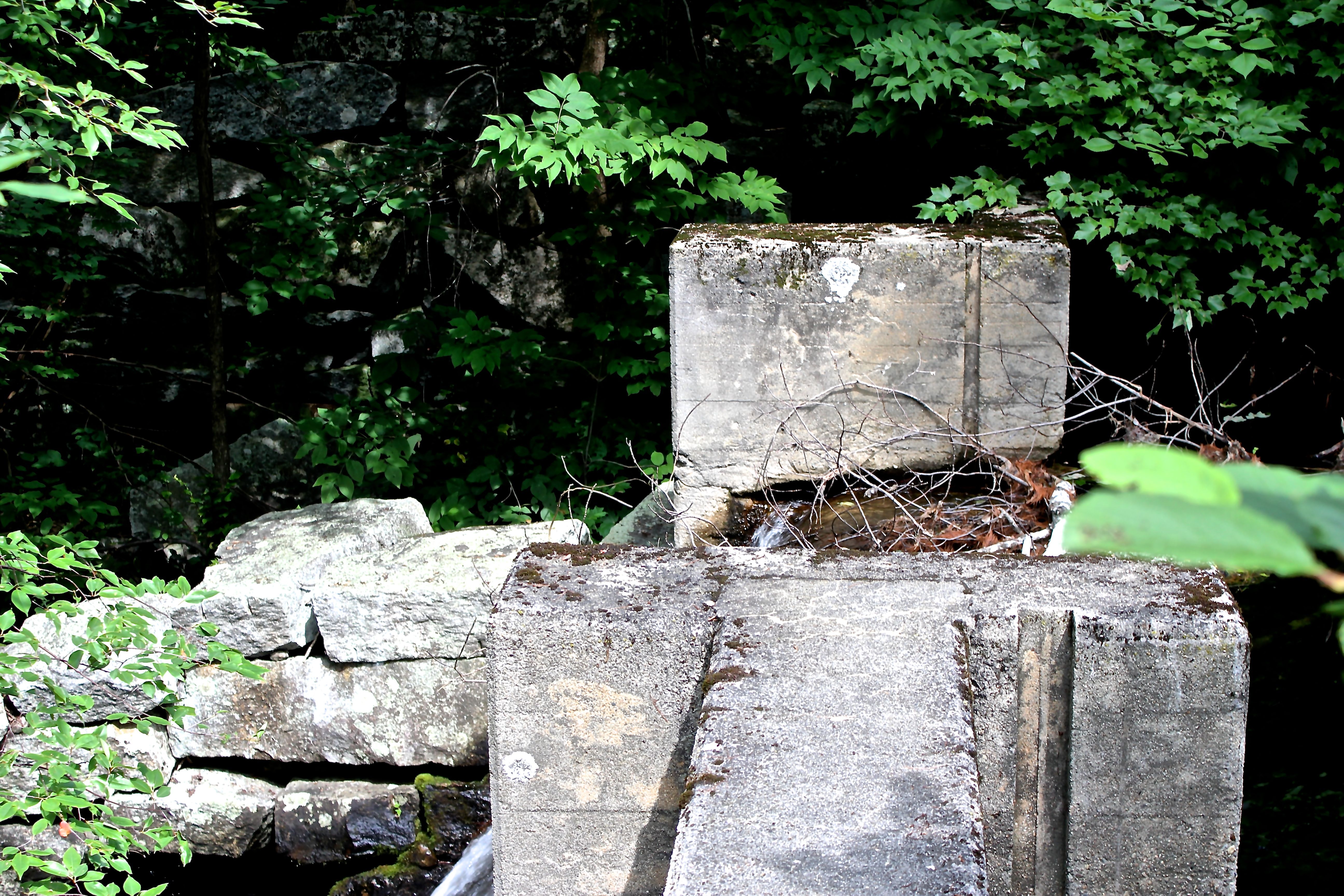
We returned today to learn more about the mill by John’s house. Another shout out–this time to docent Bob Winship, who shared his knowledge of dams with a large crowd. The rocks–a contrast of age and history.

me beech fern

A third shout out to docent Susan Winship for helping us all learn how to identify ferns, like this beech fern with its lowest leaflets pointing diagonally outward, winged attachment to the mid vein, and growth pattern arching toward the ground.

Pam 2

A final shout out to Pam Katz, who starred in her debut appearance as a docent. :-)
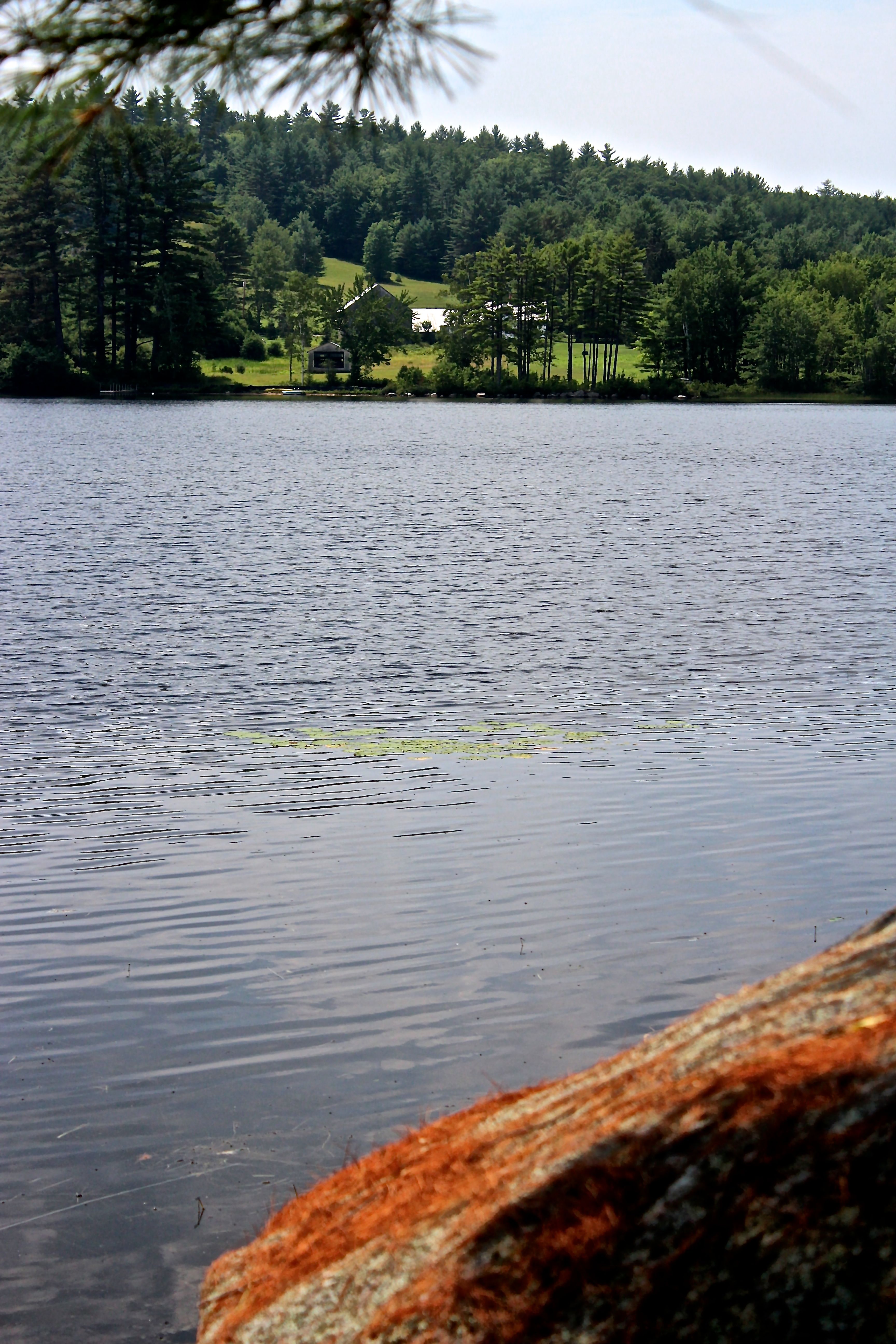
view from otter rocks

We reached Otter Rocks and looked back toward John Fox’s house.

me sr2

My final stop, though the week isn’t over–the Songo River, which is the connection in the chain of lakes–Long Lake, Brandy Pond and Sebago Lake.
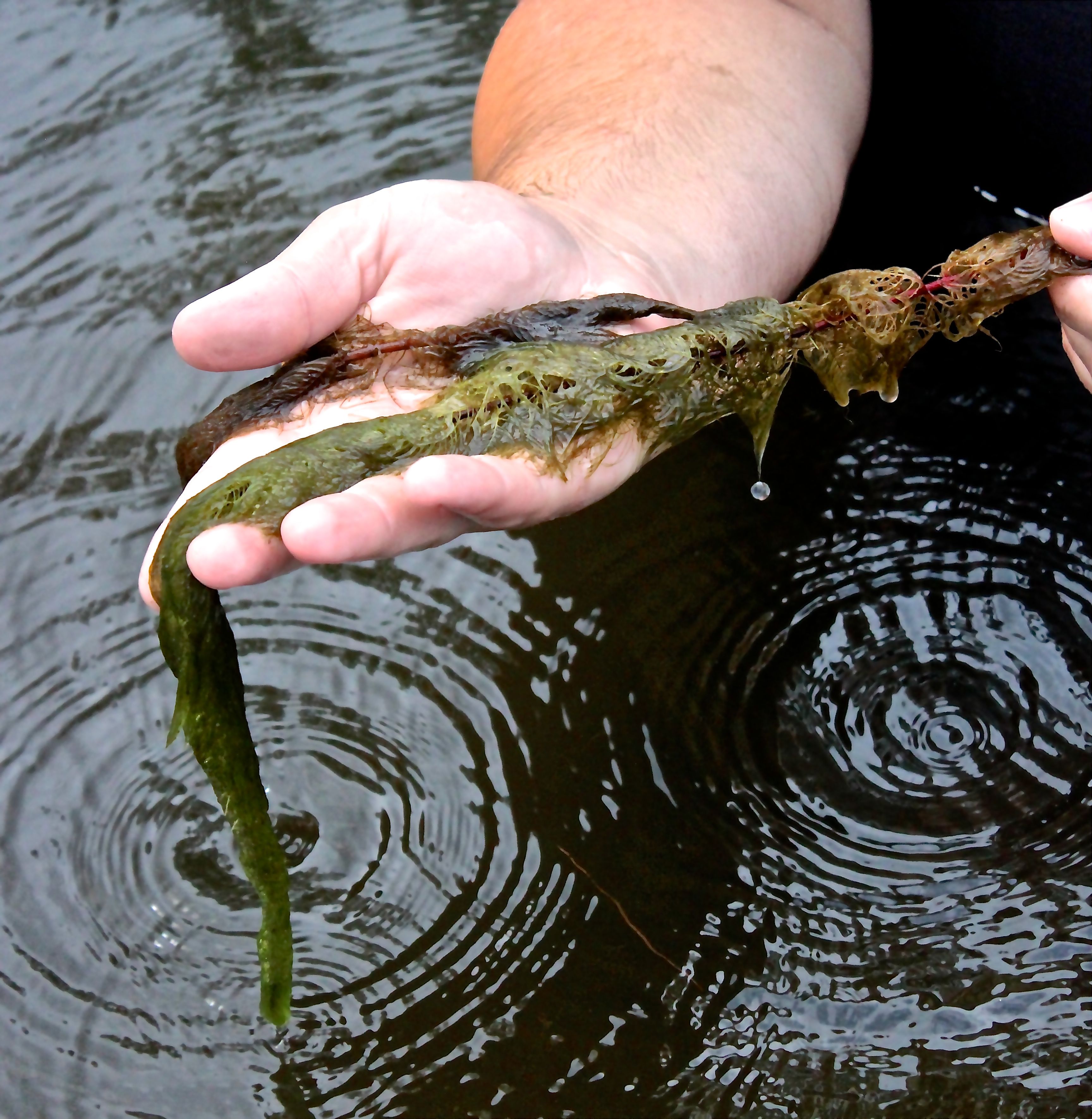
me-variable-leaf

The Songo was the source of a major variable-leaf milfoil infestation that Lakes Environmental Association has been working to eradicate. Notice the red stem? Underwater, it looks similar to our native bladderwort, but that stem is the giveaway.
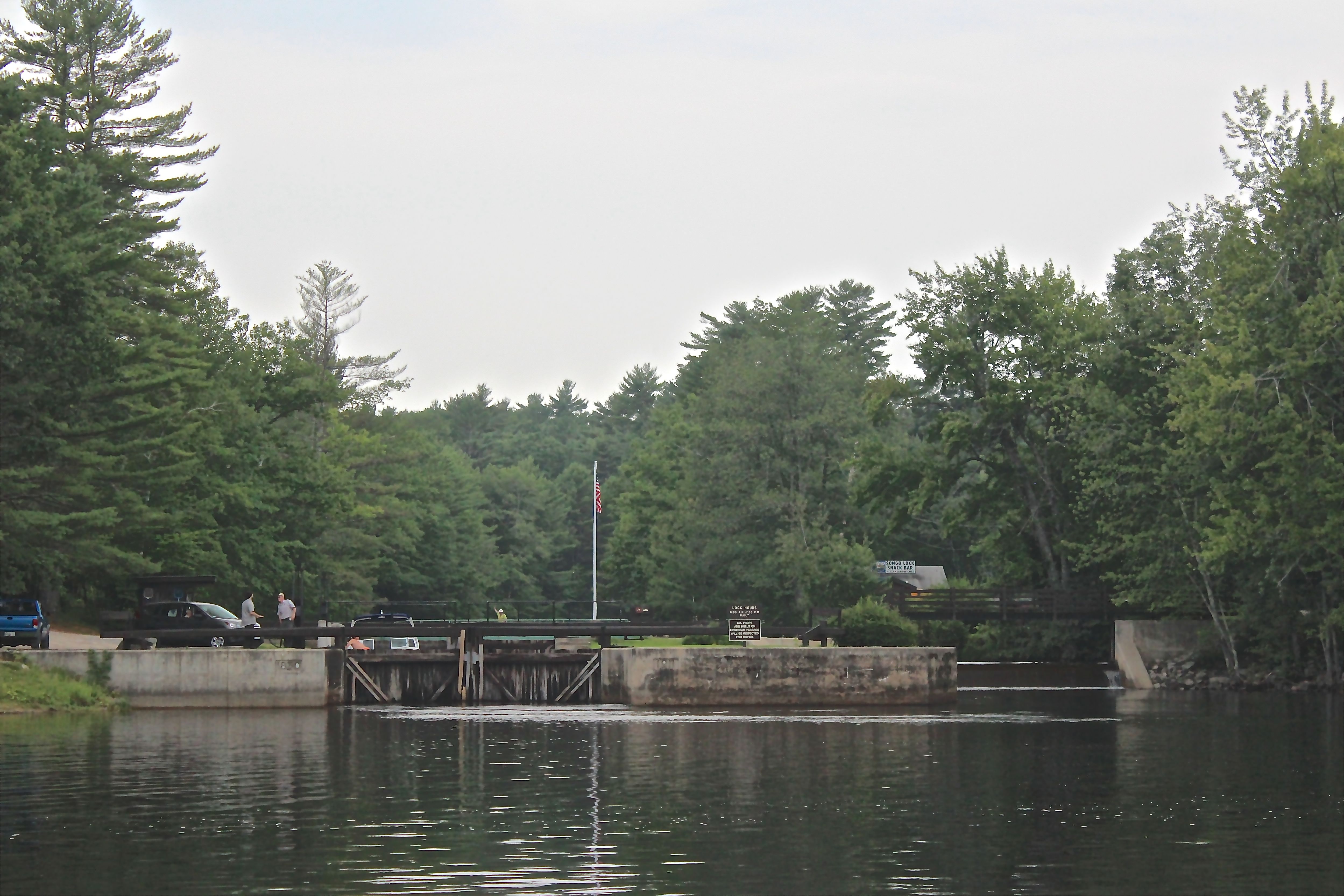
Songo Lock

Among the heavily infested areas–the basin just below the Songo Lock. Today, it’s part of an LEA success story and I get to share that story in a newspaper article.
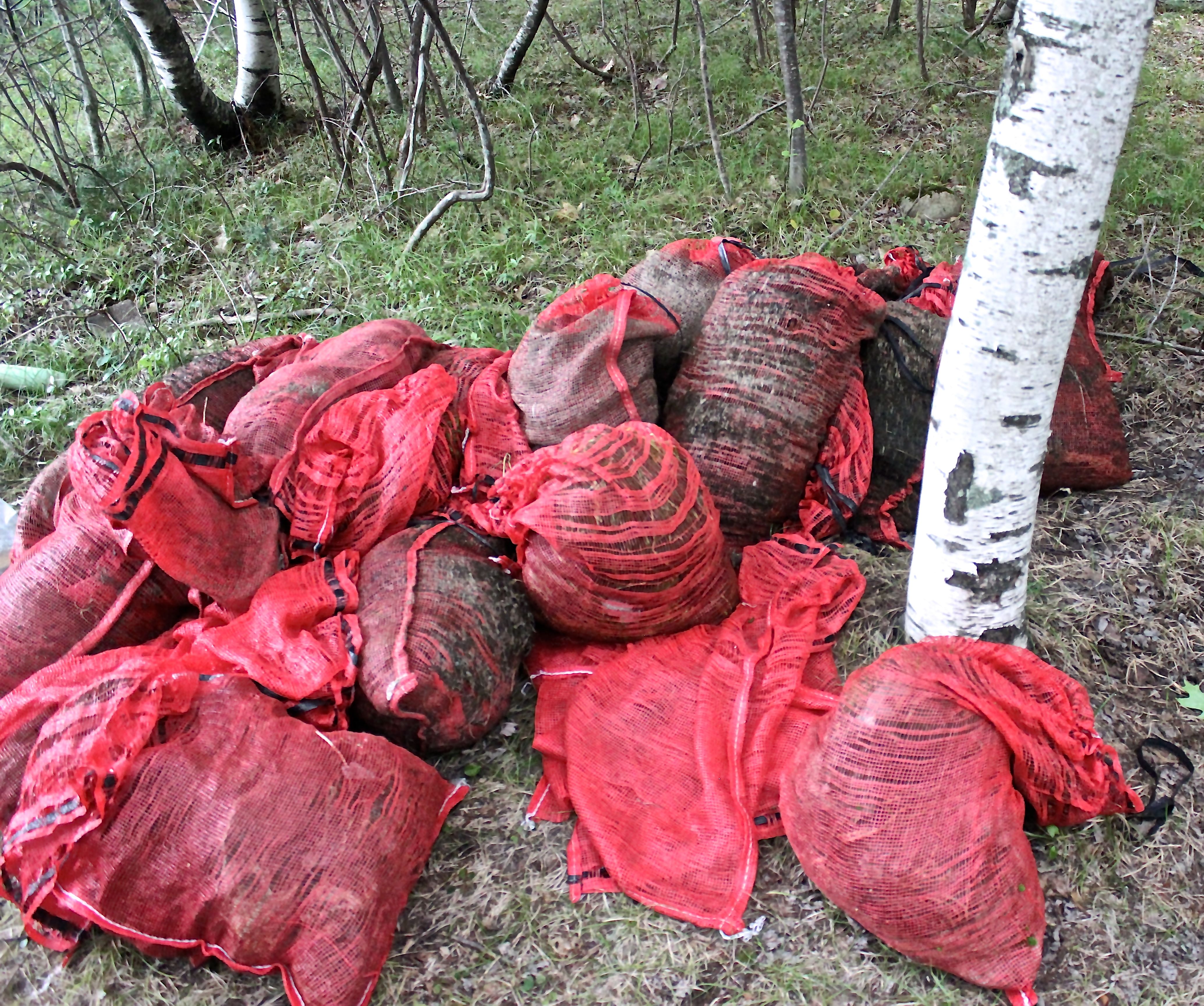
bags of milfoil

These mesh onion bags are filled with milfoil handpicked from the river. But . . . this is nothing compared to the past when the milfoil team used the suction harvester and benthic barriers as their major defense. This pile represents a couple of weeks worth of finds and will warrant a trip to the compost pile soon. In previous years they made daily trips to the compost pile.
me classic boats

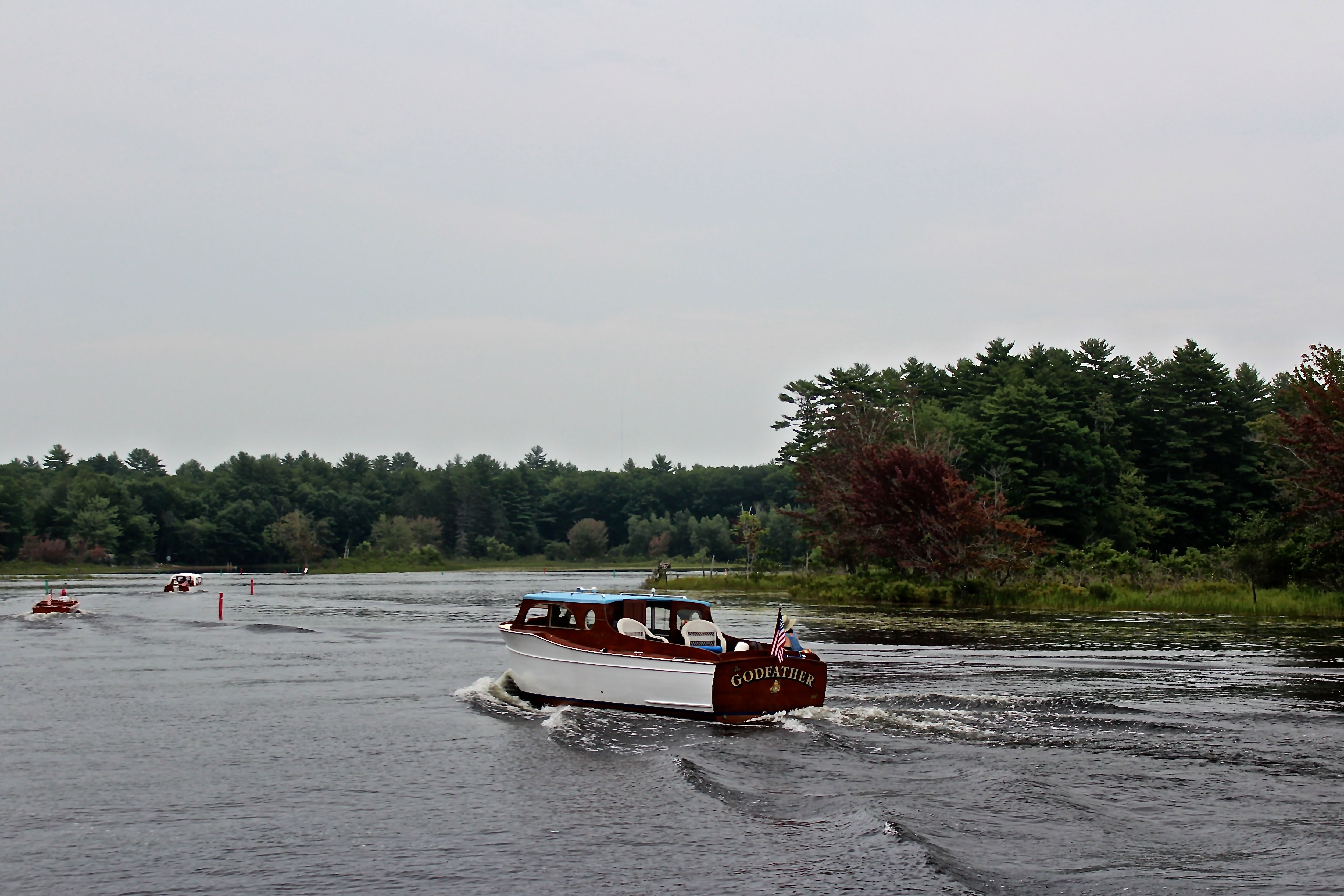
Before leaving the river, we saw a couple of wooden Chris Crafts travel by–enroute to Naples for this weekend’s Antique and Classic Boat Show on the causeway.

me land trust sign

That being said, come to Lovell on Friday afternoon for Bonny Boatman’s presentation on the Uncommon Common Loon, Friday night for the annual education meeting featuring Geri Vistein, conservation biologist for Project Coyote, and on Saturday for the 2nd annual Family Fun Day. Follow the signs.

Summer may be flying by, but we’ll show you how to get out and enjoy it.
Moosey Mondate

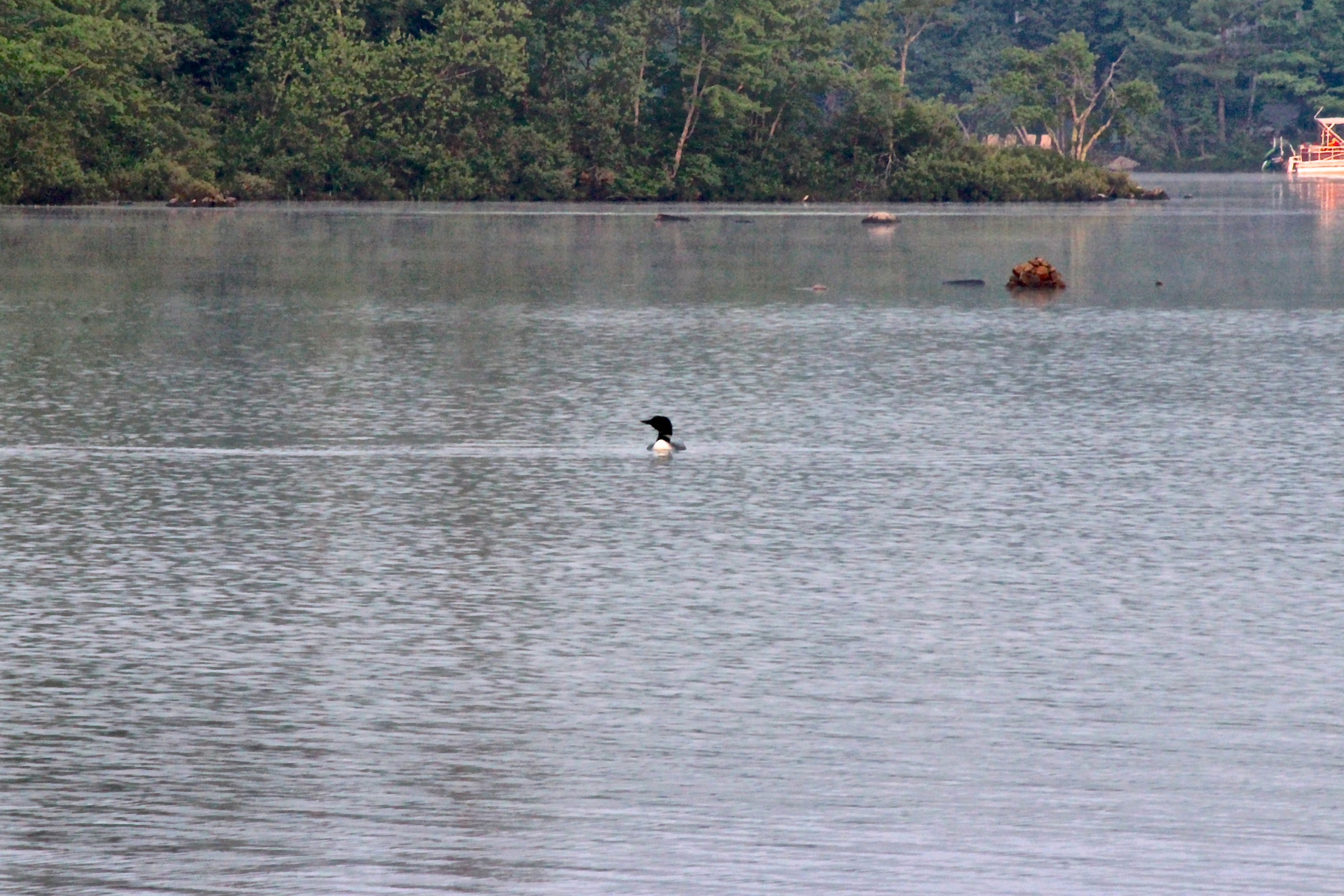
We finally moved to camp yesterday, and awoke early this morning to that hauntingly delightful sound–the cry of the loon.

loon

While I stood on the dock, wishing the pair would come closer, something else caught my attention.

suspendedsusp2

Suspended animation. I couldn’t see the web, but trusted it was there.

Black Mtn

Our Mondate began after we got some chores out of the way. A perfect day to hop in the tandem kayak and head north to Sweden. Thanks to our friends the Neubigs, who purchased the tandem for us years ago. They need to return and use it–just saying.

island shoreline

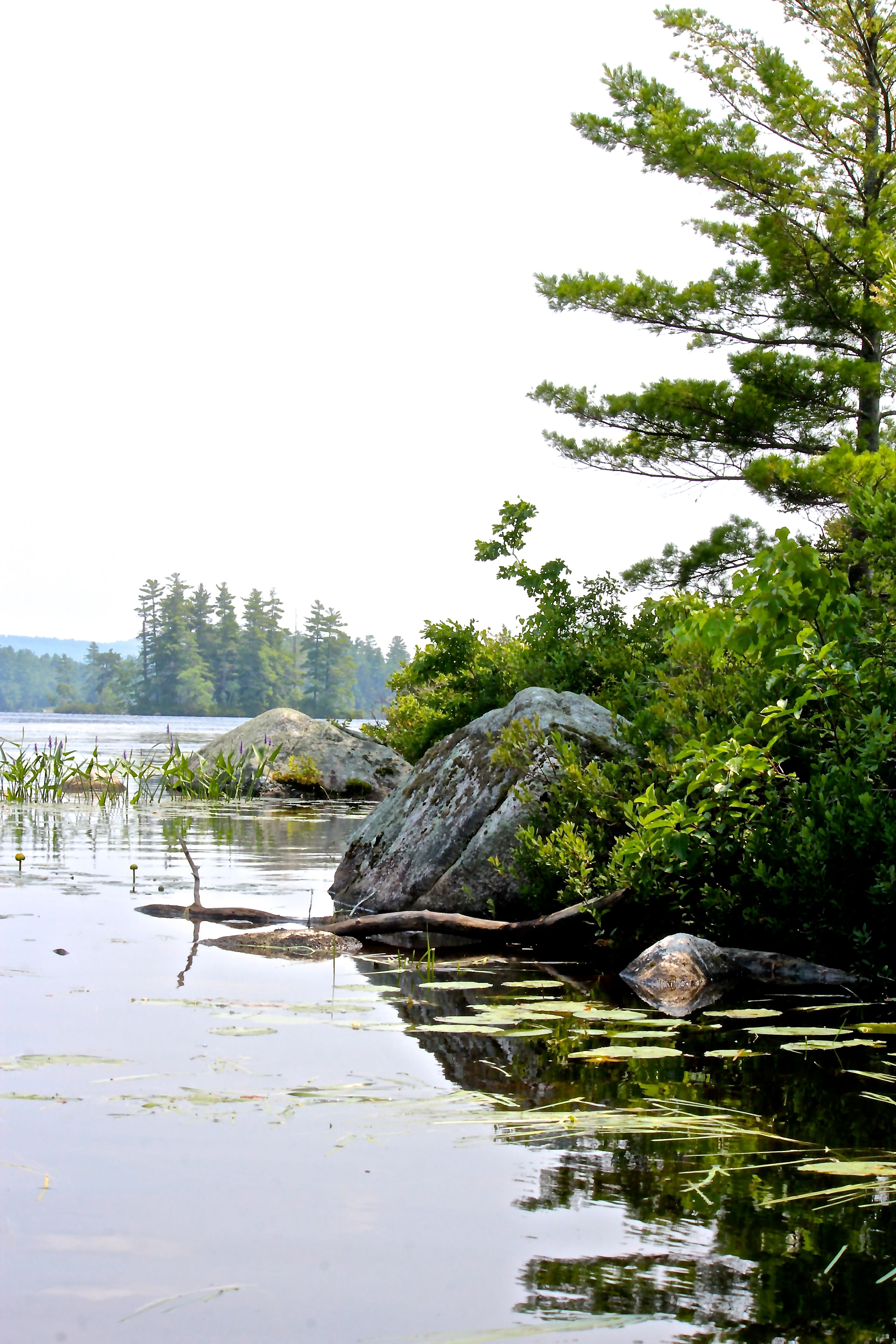
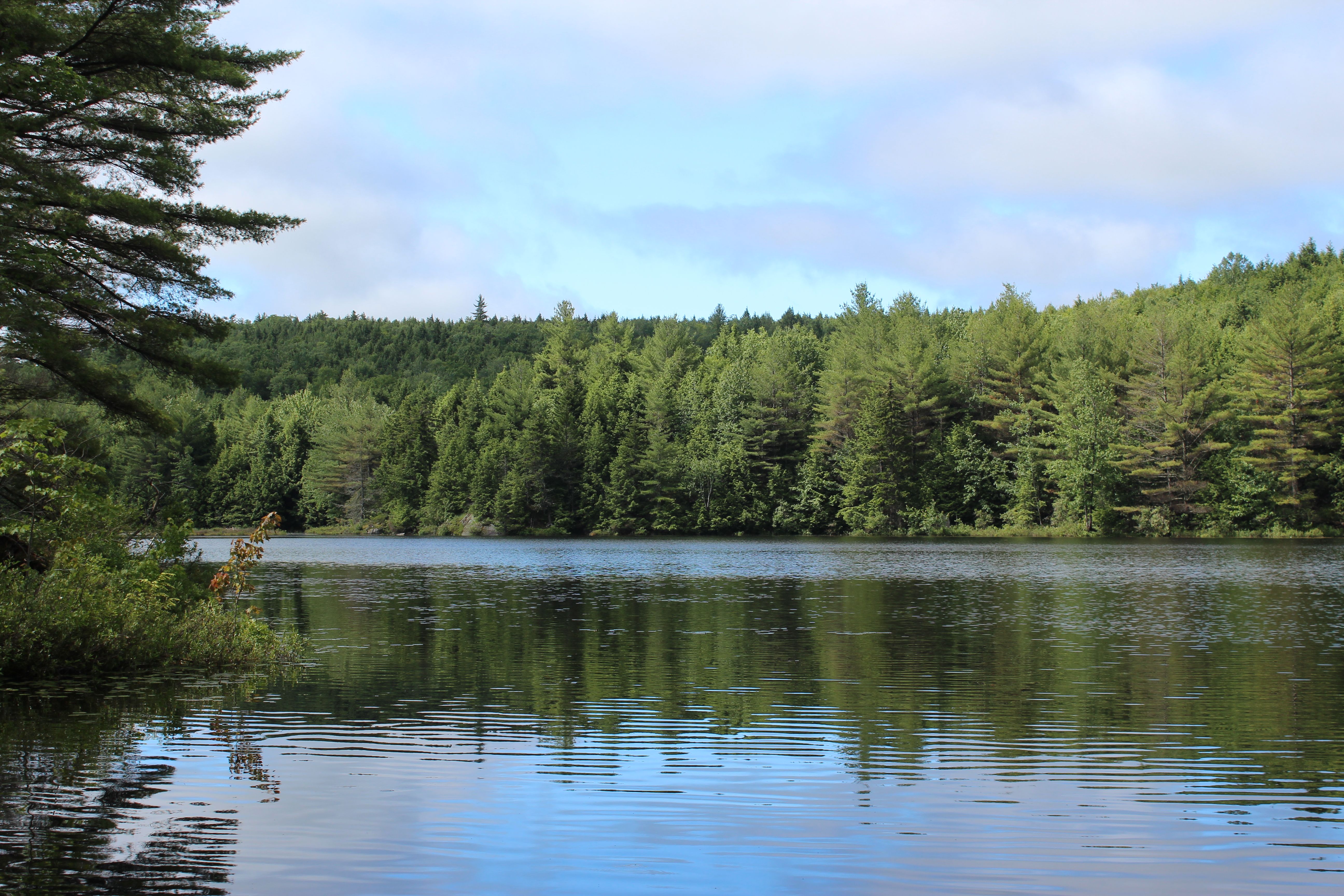
We love the upper basin because there are so many islands and stumps and inlets and coves and beaver lodges and you name it to explore.

tall weeds

The only thing that drove us crazy was the deer flies. Yeah. So we know insects are important for pollination and to provide food for fish, birds, dragonflies and others. But truly, what purpose do deer flies serve, other than to suck our blood? Mind over matter. Don’t scratch and the swelling will go down eventually. Note–like black flies, it’s the females that bite. I’d say, “Go Girls,” but hardly in this case.

dragonfly

Among the many dragonflies was this blue dasher, a common variety near quiet water. If only he would feast on those darn deer flies.

button bush

The buttonbush seems otherworldly with its pincushion styles protruding from each tubular flower.

spadderdock

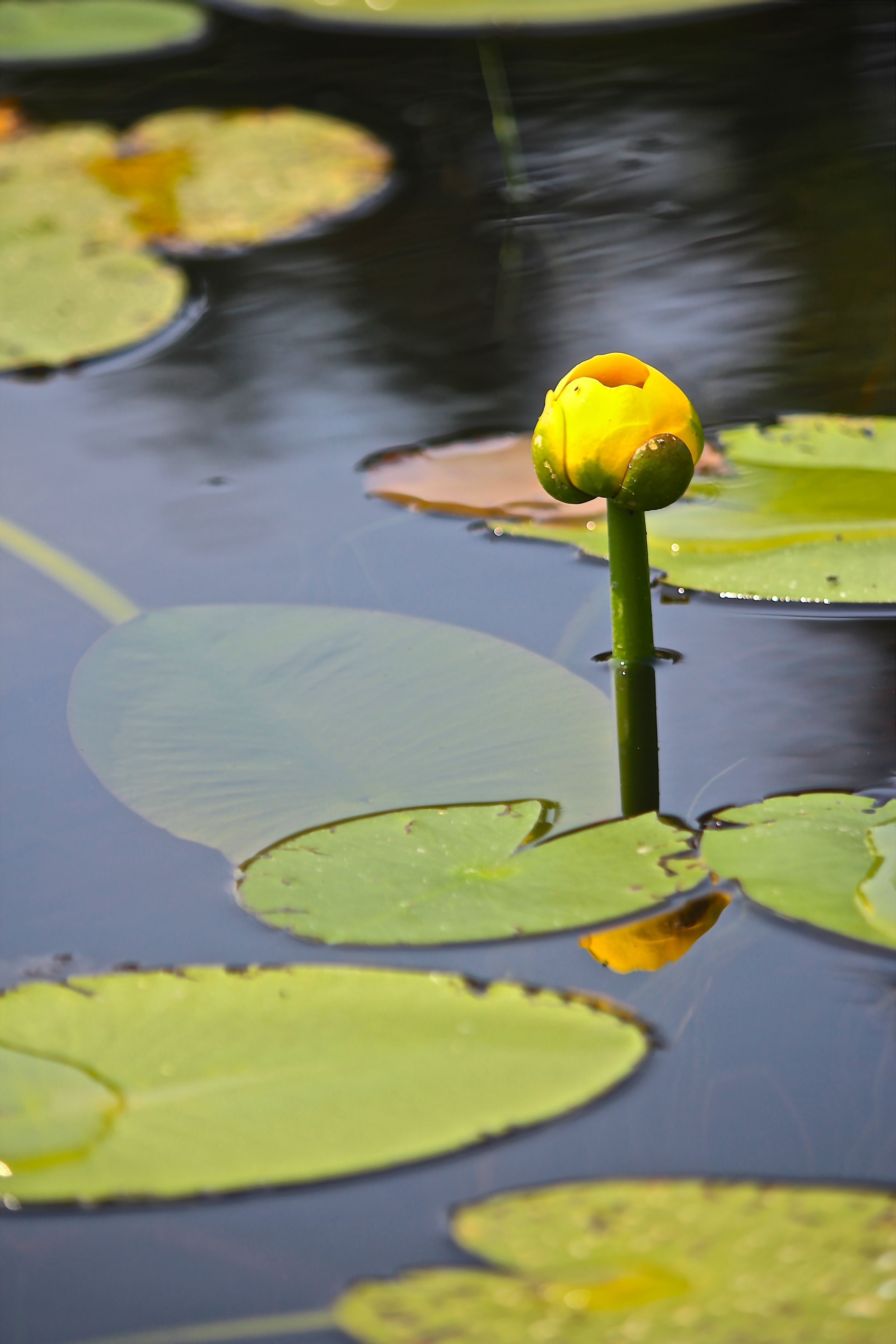
The tight, waxy, petal-like sepals of the spatterdock, aka yellow pond lily or cow lily, stands upright above its leaf–featuring a small v-notch

fragrant water lily

On other ponds and lakes, I’ve seen the fragrant water lily in bloom already, but here it is just beginning to open. Its leaves are larger than those of the spatterdock and notched to the center.

pickerel

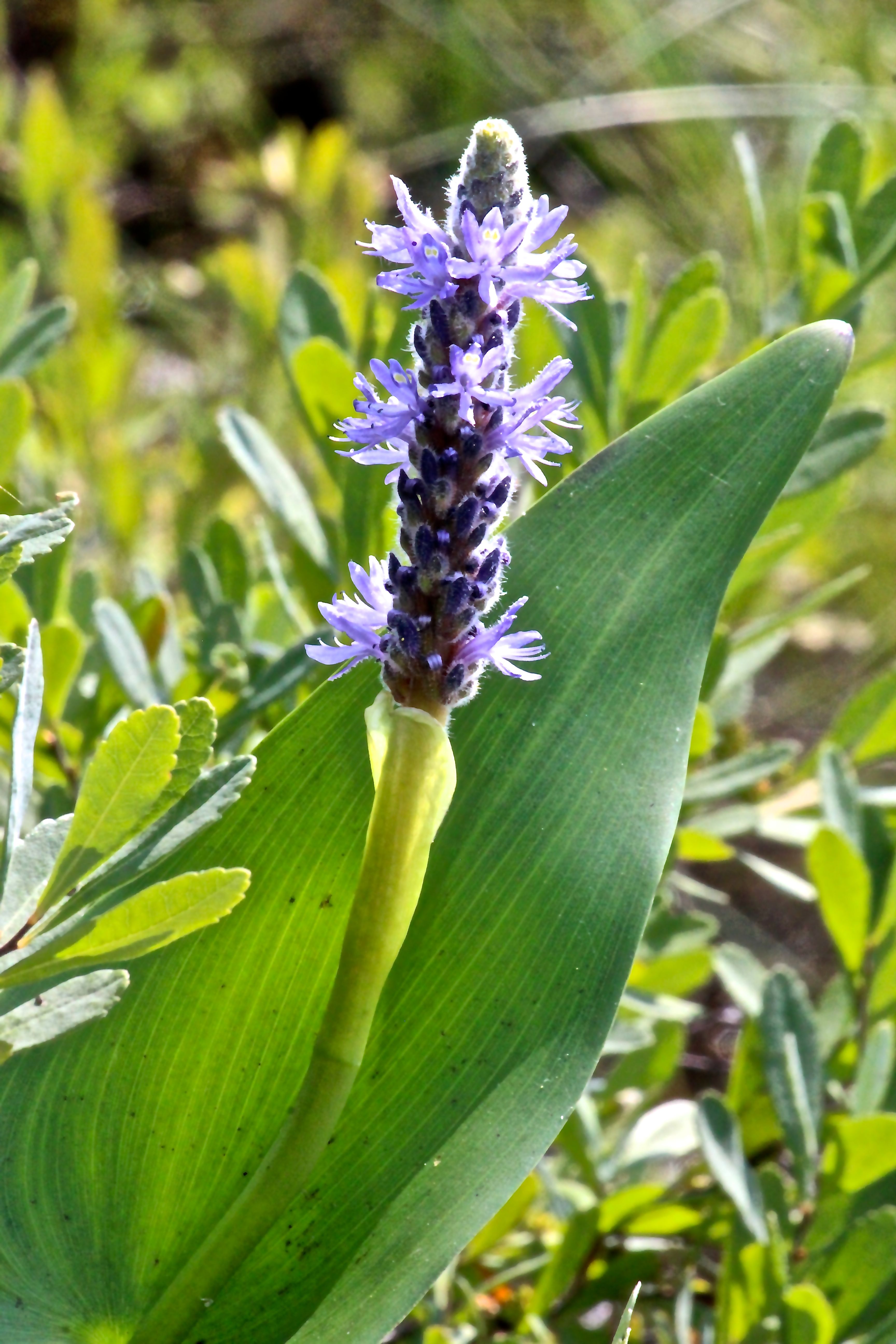
Pickerelweed is like no other. Though the upside-down heart-shaped leaves are long-stemmed and look similar to arrowhead, once the flower blossoms, there’s no mistaking it.
pick 2

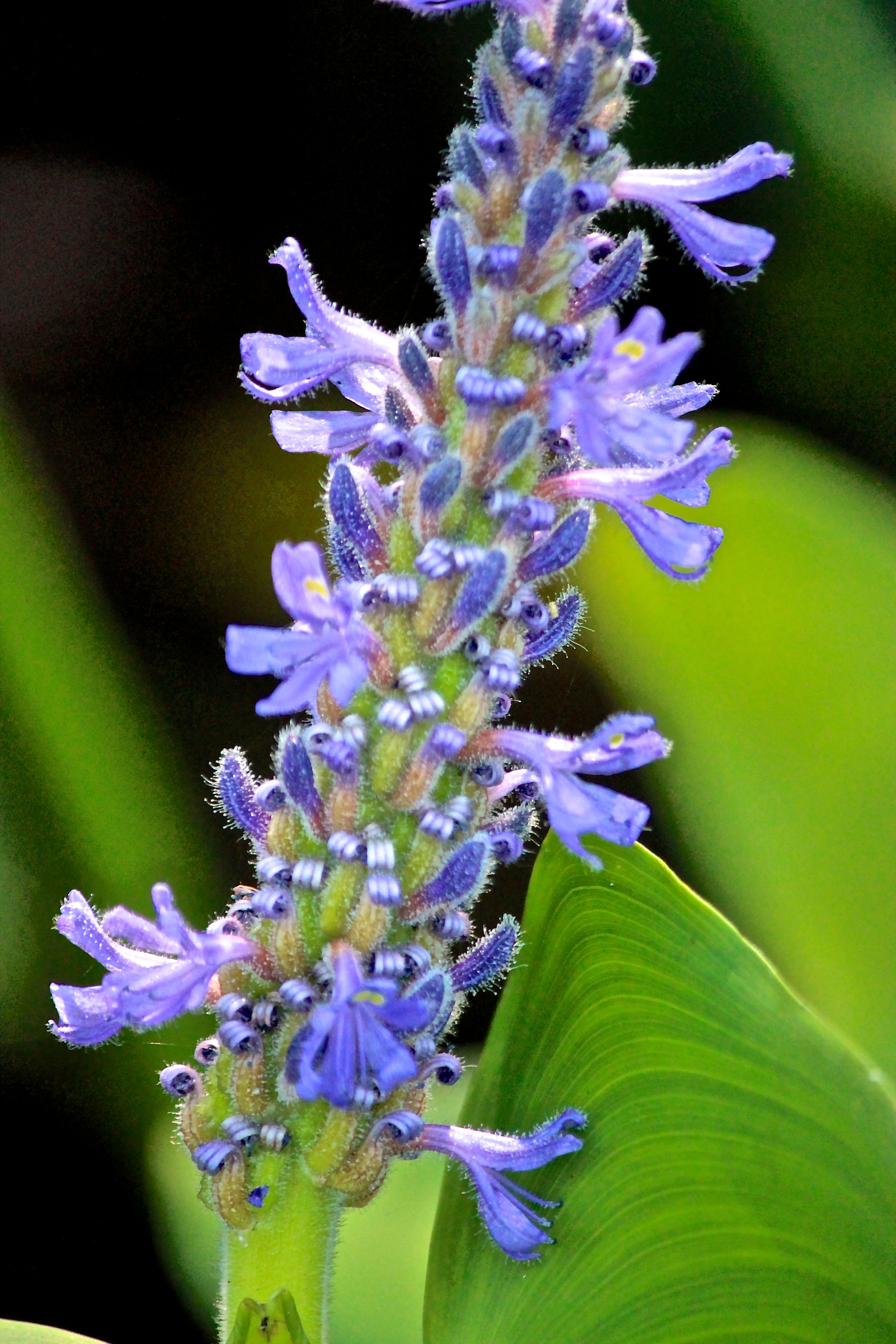
The flowers are worth a second or third look. They grow in spikes along the pond’s edge. And each is covered in hair. Why?

pick 3

Not only that, but each flower is two-lipped. And each lip is three-lobed. And the upper lip has two yellow spots.

sundews 1

The pond was dammed a long time ago and stumps support a variety of life–including the carnivorous sundews beginning to flower.

sundews 2

At first glance, I thought they were the round-leaved variety, but I now think they are spatulate-leaved sundews. Love that name–for the spoon or spatula-shaped leaves that are longer than they are wide.

love is in the air

Love is in the air.

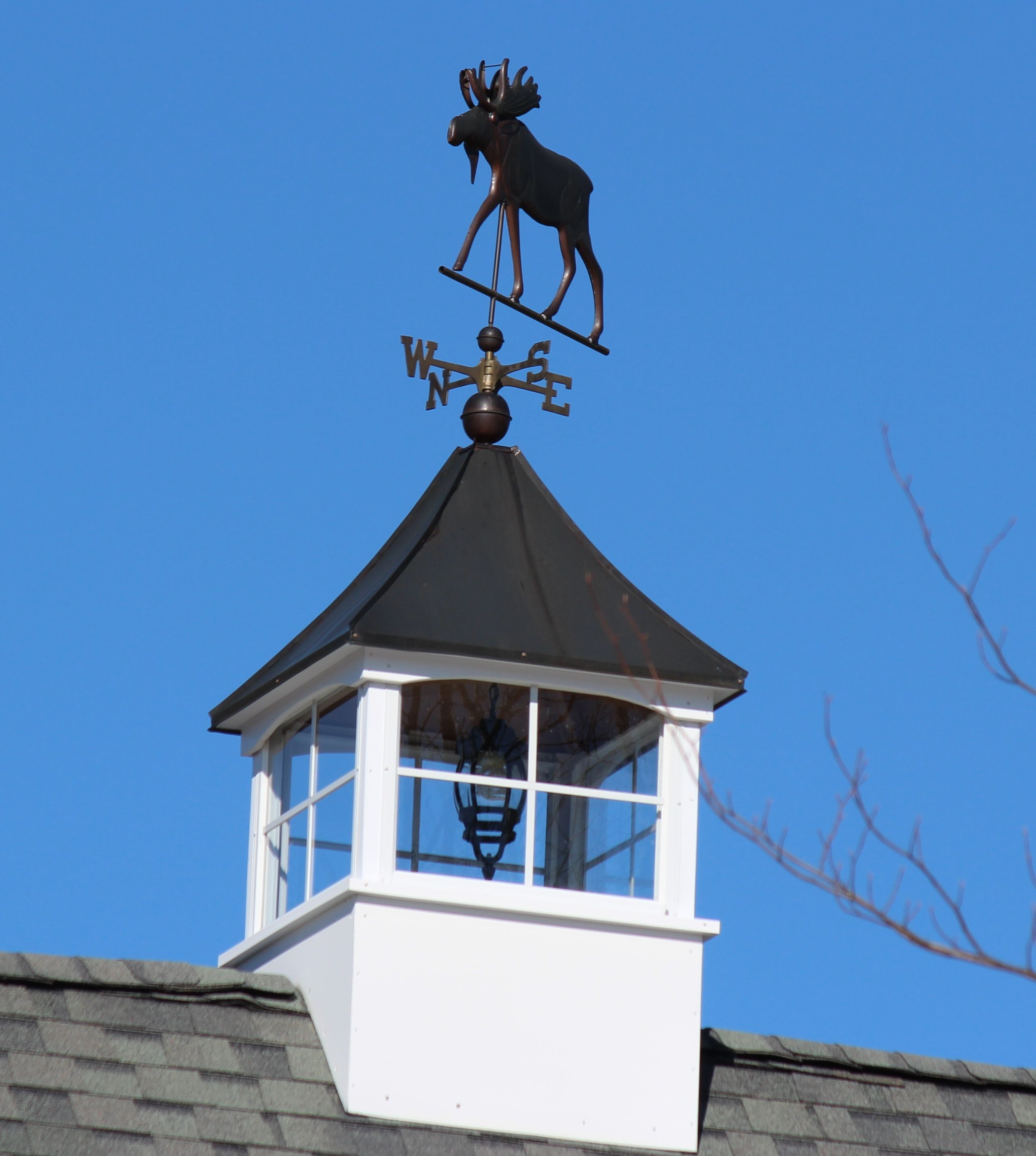
As it should be on a Mondate with my guy well spent on Moose Pond. I bet you thought I was going to post a photo of a moose.

Red Hot Mondate

It’s Monday. Time for a Mondate. But this morning, we each went our separate ways. He to run and then cut some tree limbs in the yard. Me to meet up with a friend and explore a nearby reserve.

whitney pond

I’ve visited this secluded spot three times, all within the last two weeks. And each time I spy something different.

fragrant water lily

The fragrant water lilies are beginning to bloom. They remind me of dainty china teacups.

galls

Near the water’s edge, a pink candy-crystal gall–I’m not sure of the actual name or creator because I’m still trying to identify the shrub. What causes the color?

beaver works

Bushwacking always means great finds like this beaver works. There are several lodges on the pond.

bracken 1

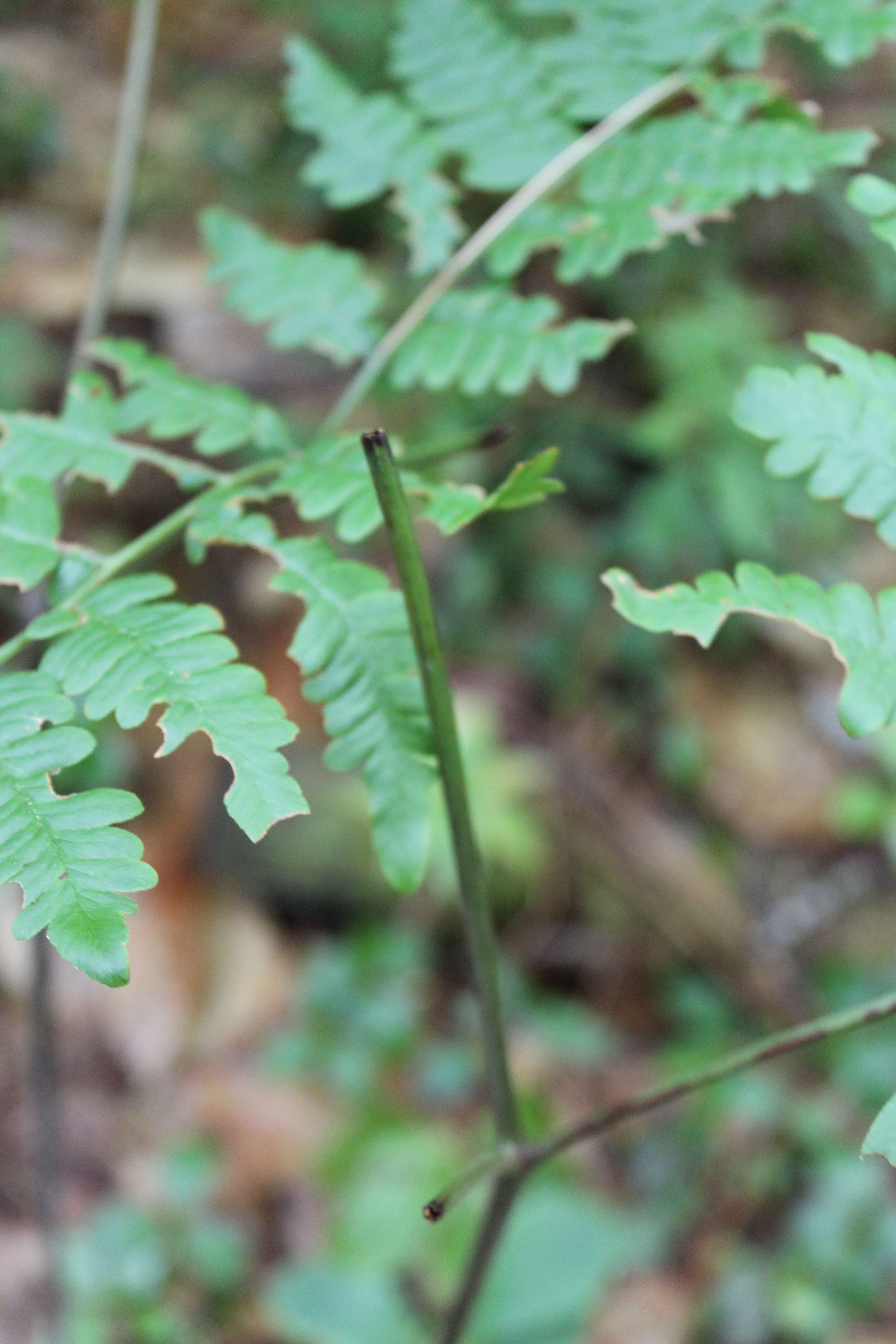
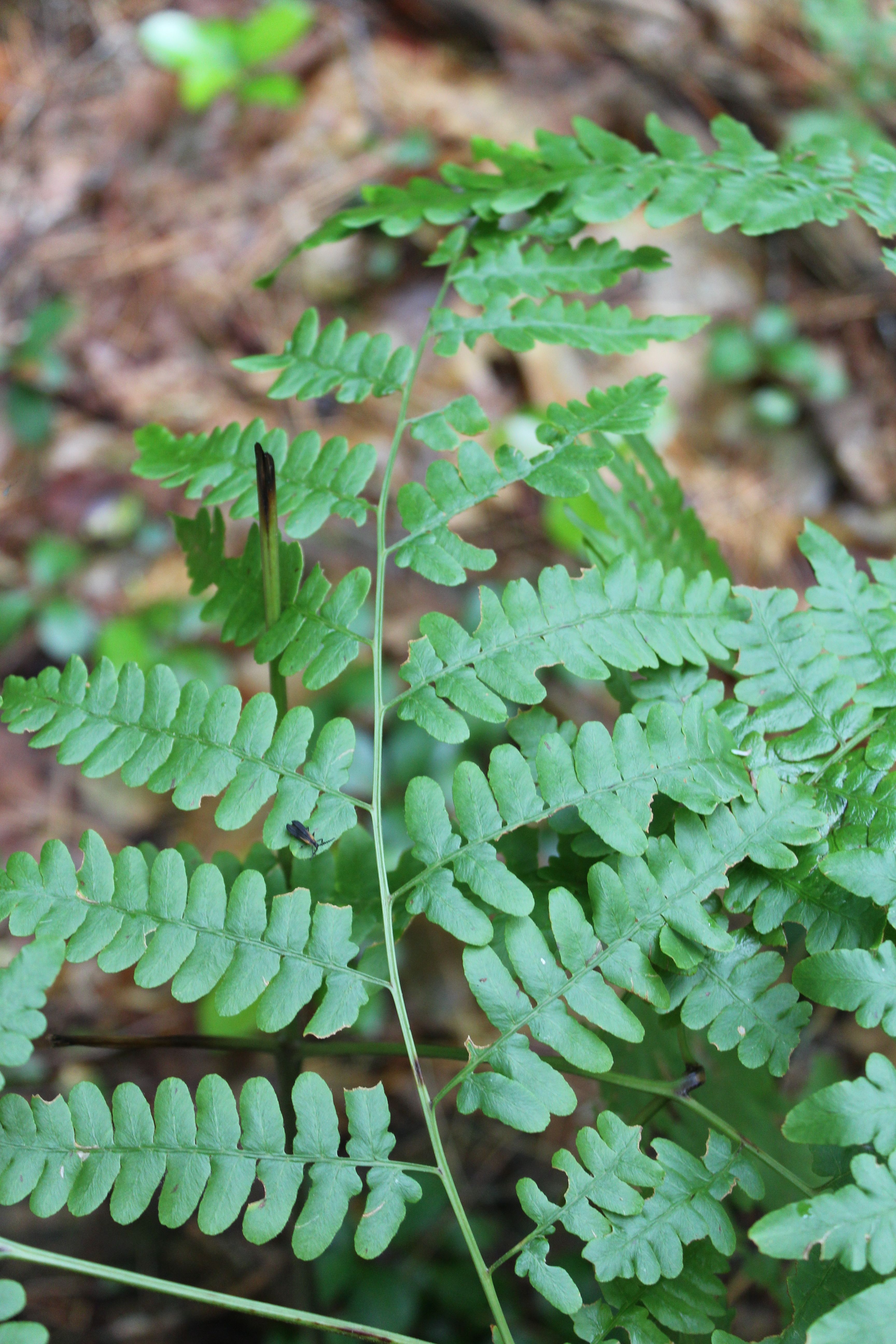
We were surprised to discover that something had been munching on the bracken fern. As ubiquitous as the plant is, we don’t often see that anything has consumed it.

bracken

White-tailed deer are about the only species that can tolerate bracken fern, which can poison some mammals. It produces a chemical thiaminase that prevents cows and sheep from metabolizing thiamine–they get sick and become disoriented. Cornell University’s Department of Animal Science Web site explains it this way: “When ingested, these enzymes split thiamin (Vitamin B1), an important compound in energy metabolism, and render it inactive.”

Here’s the good news about the fern–turned upside down, it makes a great summer hat and may keep mosquitoes off your head as you walk about the woods.

hemlock cones

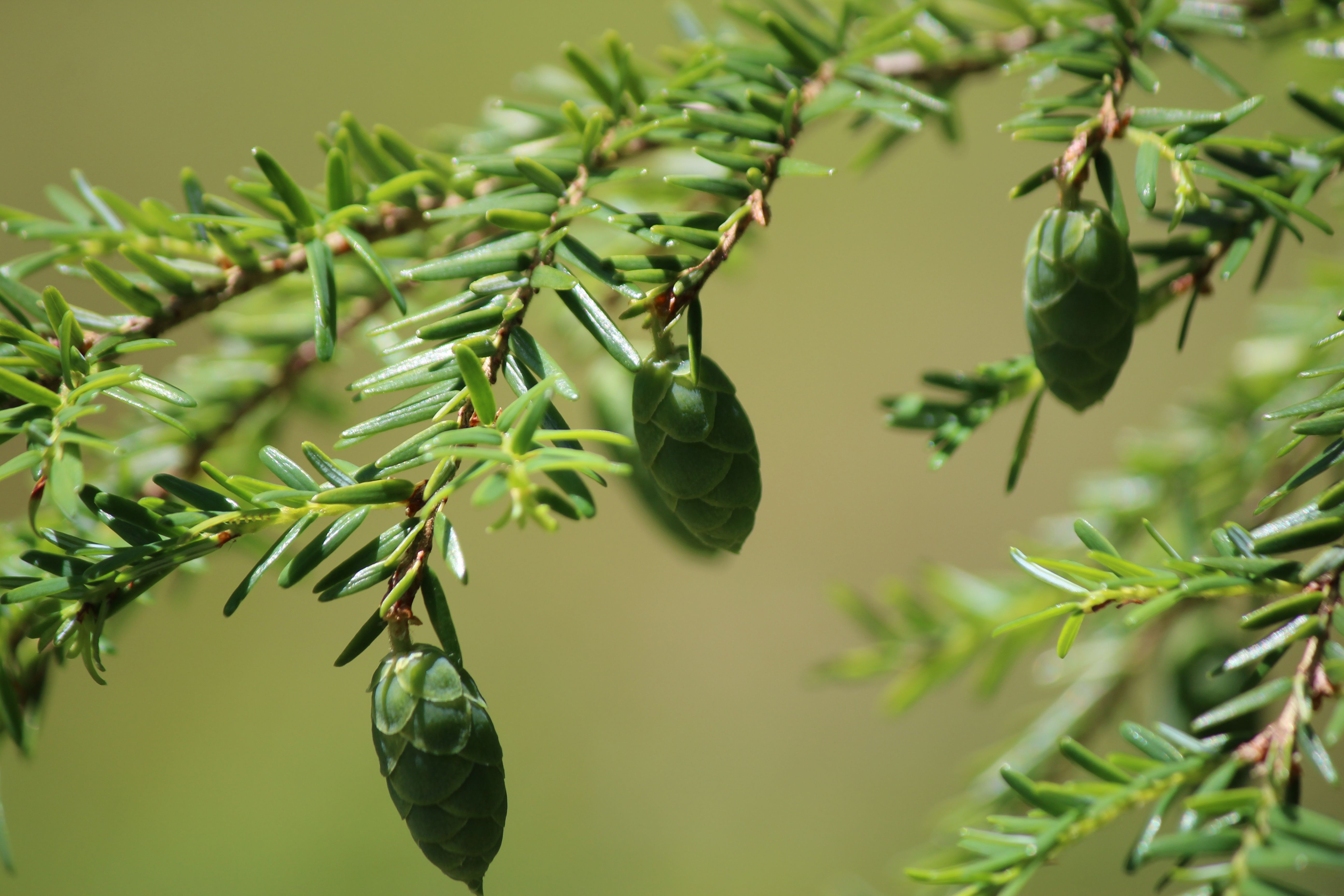
Petite green cones dangle from the ever graceful hemlock trees.

birds

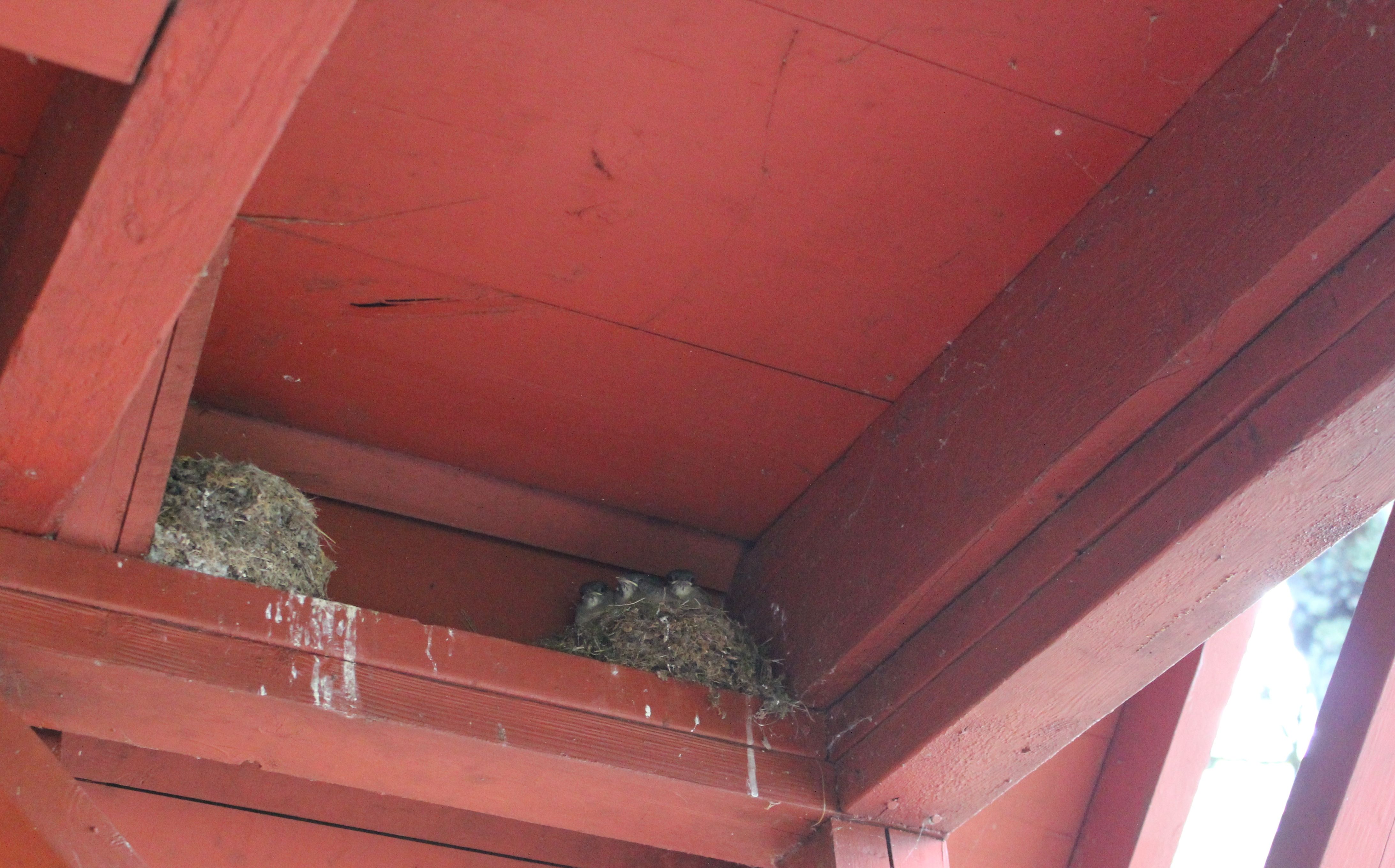
One last view before we headed back down the long and narrow dirt road–baby phoebes all in a row.

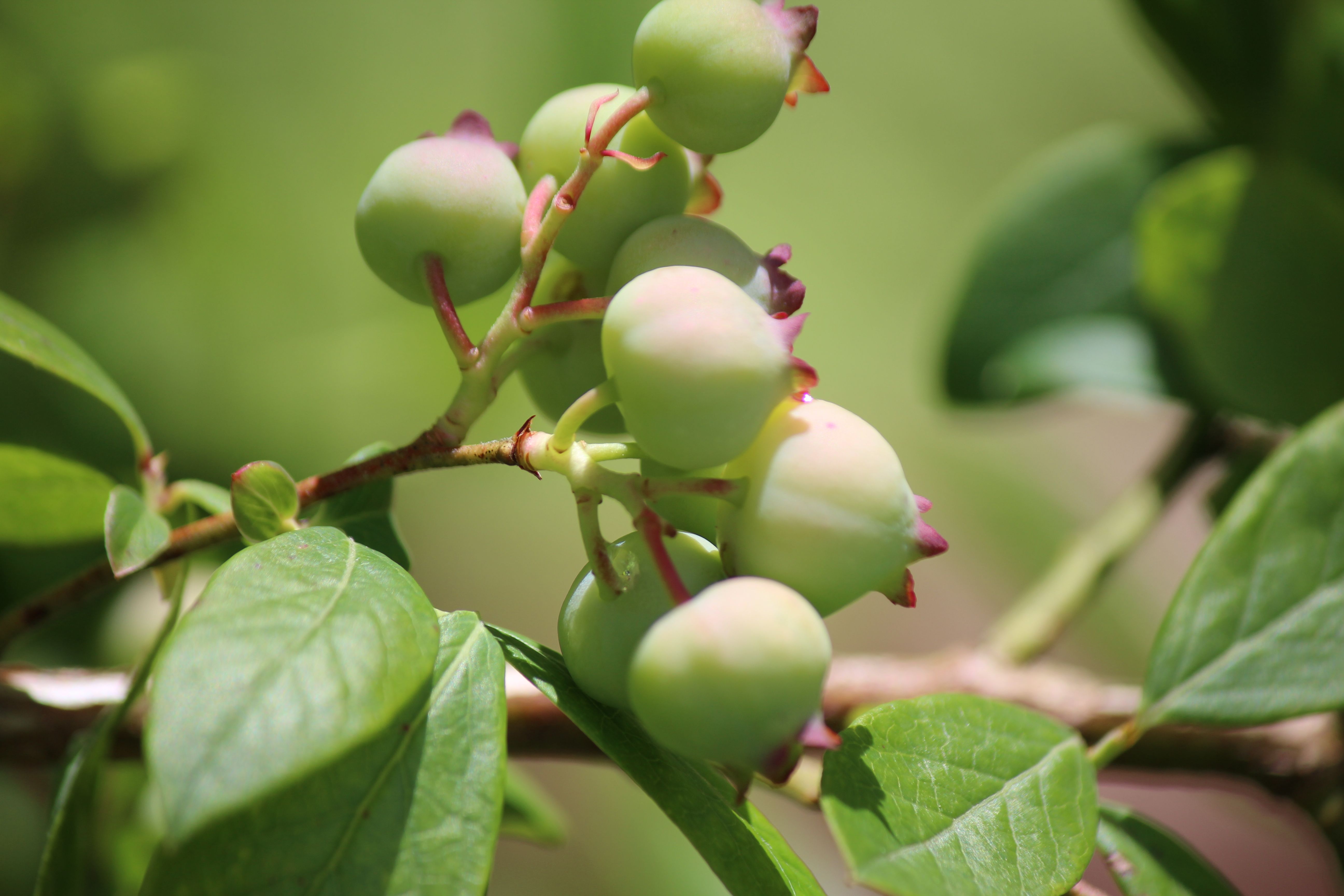
blueberries

At home, I wandered for a few minutes. It won’t be long before we’ll enjoy these.

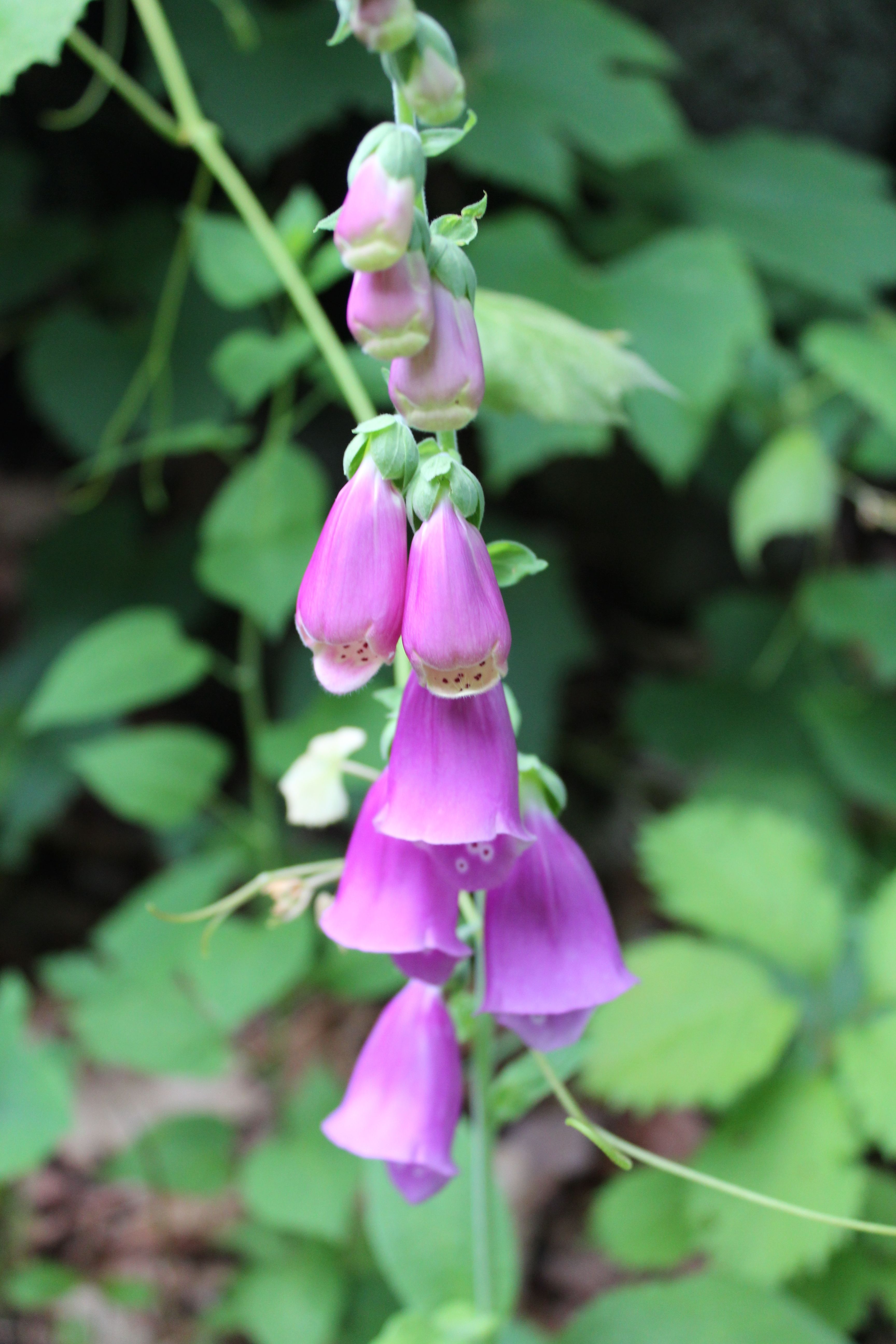
foxglove

The trumpet-like flowers of digitalis–aka foxgloves. OK, so these are also poisonous to humans, cats and dogs. Yeegads. So beautiful and yet . . .

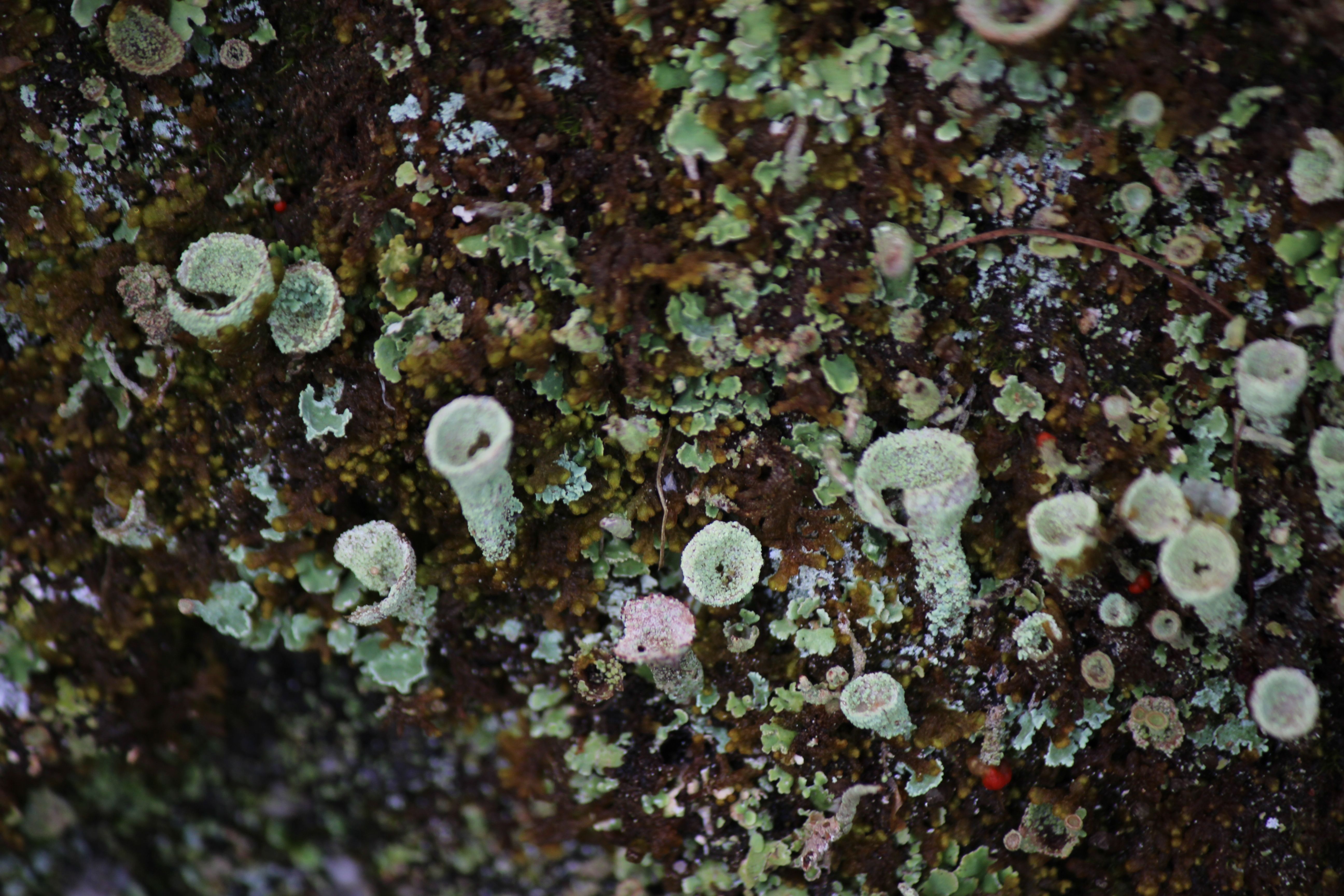
 lichens

A miniature world on the stone wall deserves a longer visit, with journal and colored pencils involved. I shall return to this spot to sit for a bit.

At last, I joined my guy for our Mondate.
barn 2

We’re painting the barn. Starting on the back side of the attached shed, we’ve primed it and late this afternoon I began using the actual color. You can see how high up I could reach. This isn’t the color the rest of the barn will be–but it’s so close you’ll never know the difference, unless I tell you. Oops, just did.

Yup, this was one red hot Mondate. And it looks like there will be more to come.

Taking In The Views

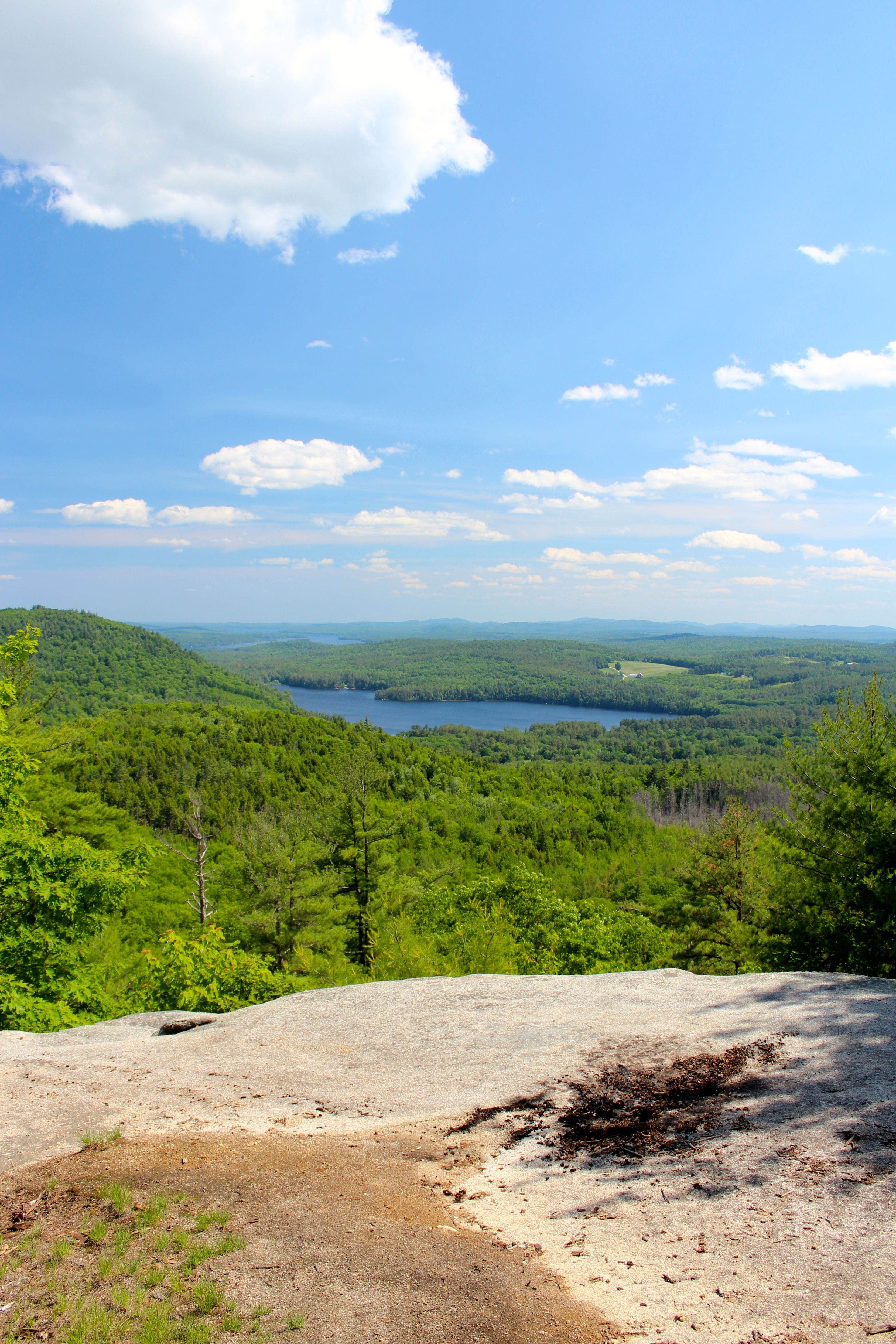
The Pequawket Indians of Fryeburg, knew the 1,100-foot mountain in Waterford as the mountain that would “tire um out” because climbing its steep side wasn’t easy. Fortunately, a much gentler trail that is only a bit steep at the start, has led to the summit of Mount Tire’m for many moons. And that was my trail of choice this afternoon.

While my guys (and a girlfriend) toiled at the family business, I snuck off to the mountain to enjoy the views.

green

It’s located up the street from the quintessential New England village known around these parts as Waterford Flats. Think white clapboard houses, all of which are listed on the National Register of Historic Places. And a triangular green. To the right of the sign is the former Lake House, which for many  years was a high-end restaurant and inn. It’s for sale now. And comes with an interesting history–in 1847, it was known as Shattuck’s Hygienic Institution, or “Maine Hygienic Institute for Ladies” and offered a water cure.

Another house on the  green was home to Artemus Ward, pen name of Charles Farrar Browne, a favorite author of Abraham Lincoln and Mark Twain’s mentor.

Then there’s the  Waterford Library designed by John Calvin Stevens and his son, John Howard Stevens. And the former town office and meeting hall–ladies sat on one side of the room facing their menfolk during town meetings and were not allowed to vote or even speak. Can you imagine?

church

The Waterford Congregational Church was one of Stevens’ designs.

trail head

It’s easy to miss the nondescript trailhead located up the road from the church.

trail sign

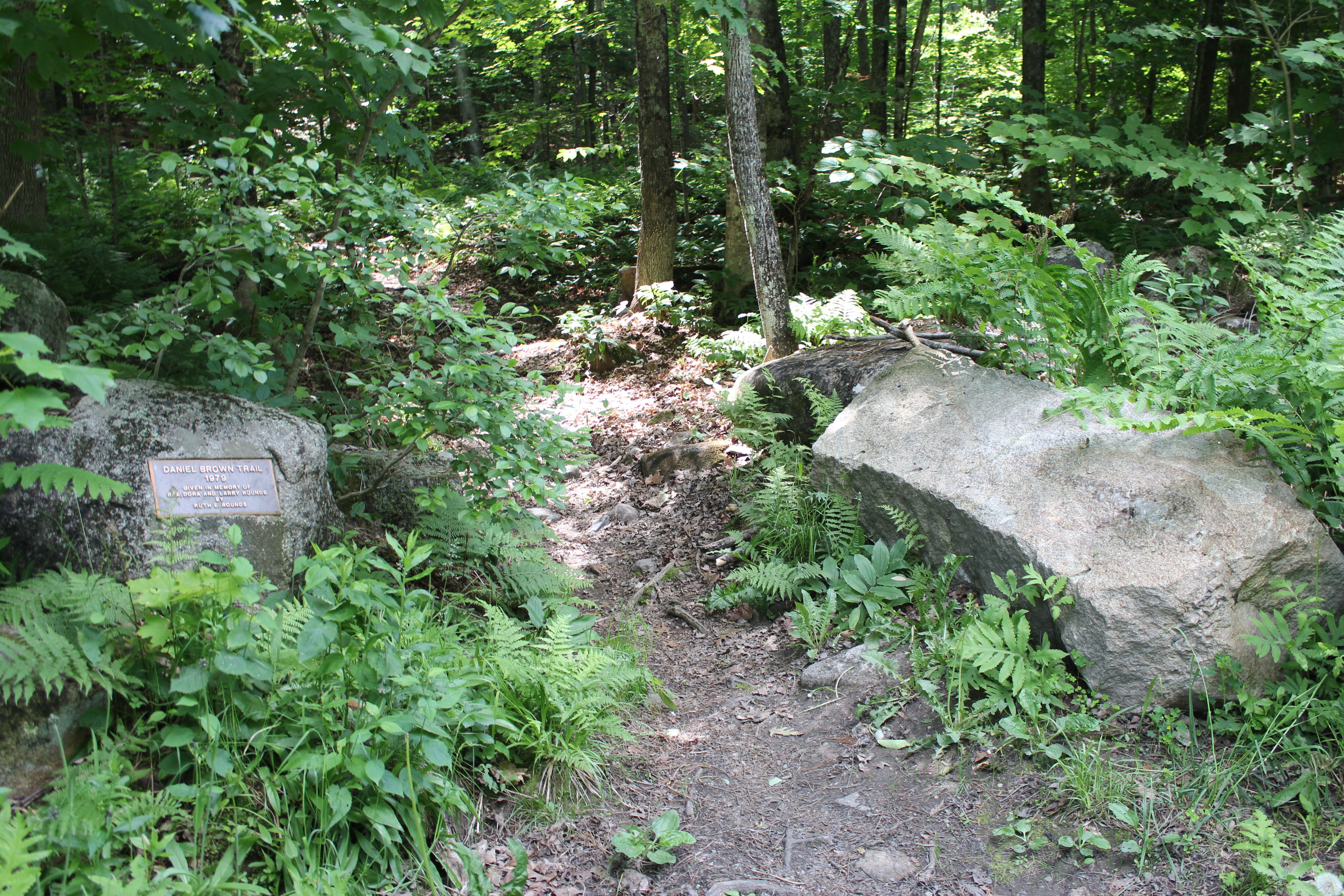
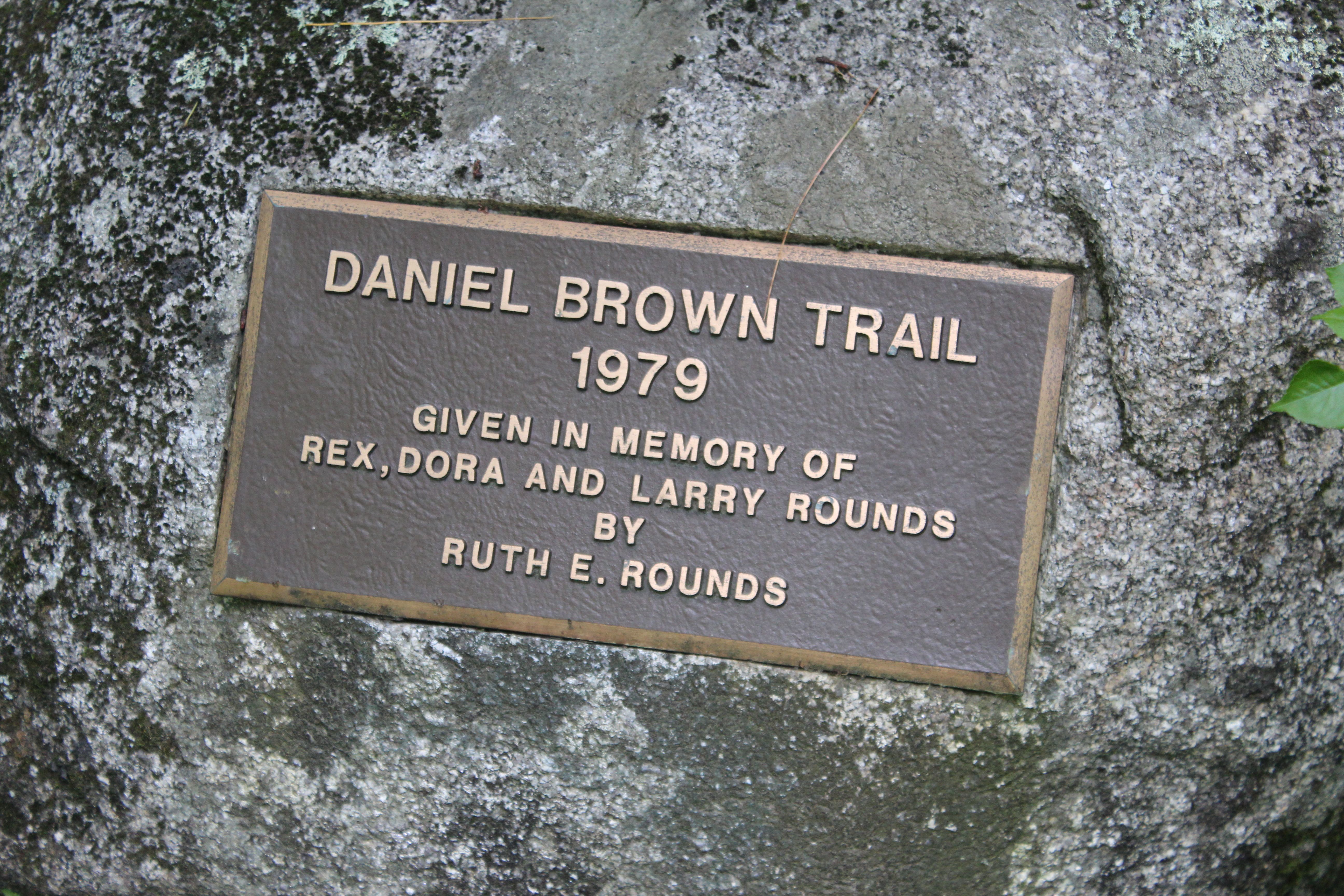
The public path that has traversed the mountain for many years was apparently known as the Old Squire Brown Trail. From what I gather, Daniel Brown owned a large house and farm near Bear Pond–perhaps the Lake House? He was involved in town politics and went on to serve in both houses of state legislature, becoming known as Squire Daniel Brown.

Red trillium

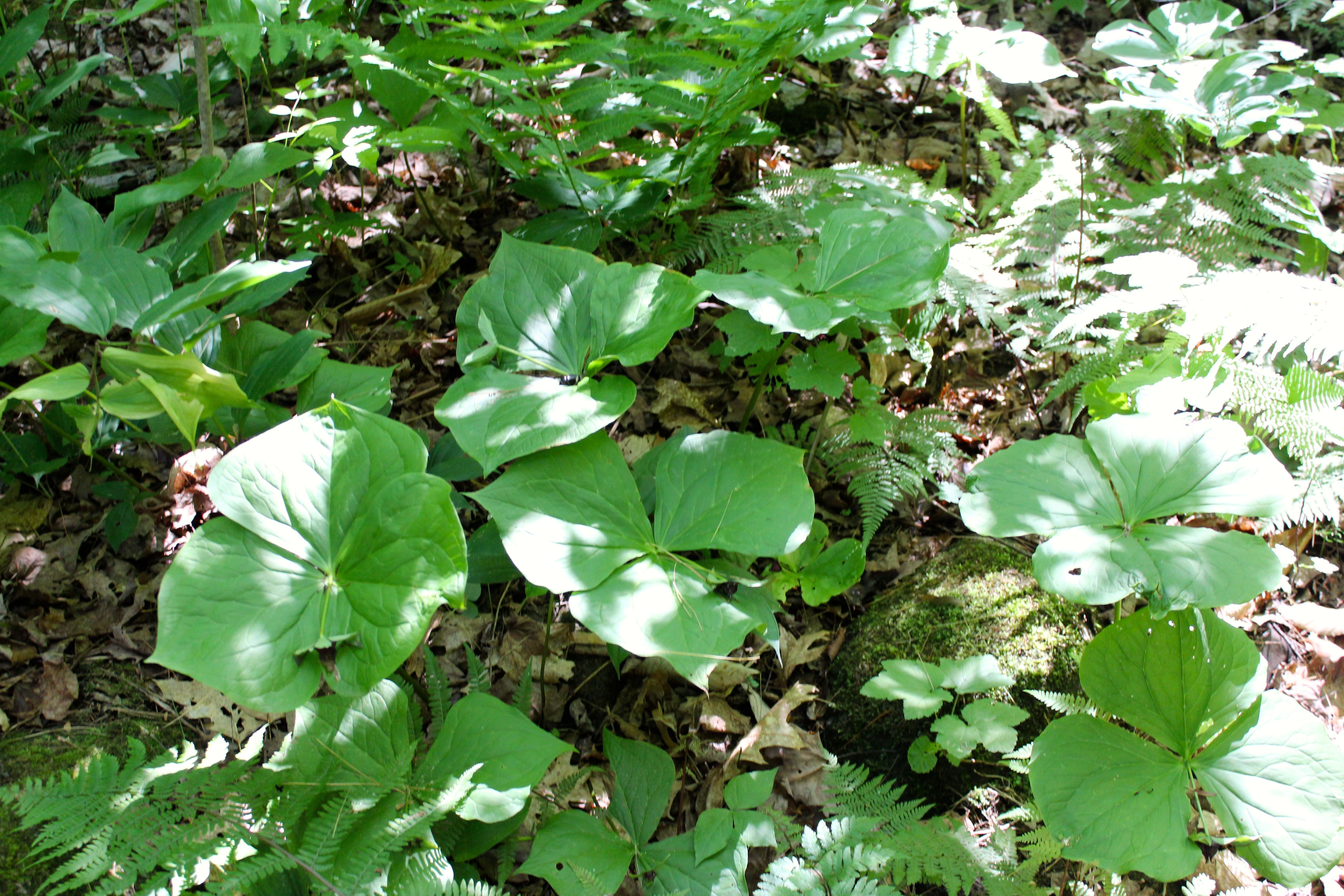
Though the flower is long past, the leaves of Red Trillium reminded me that I need to hike this trail earlier in the spring.

 stonewall

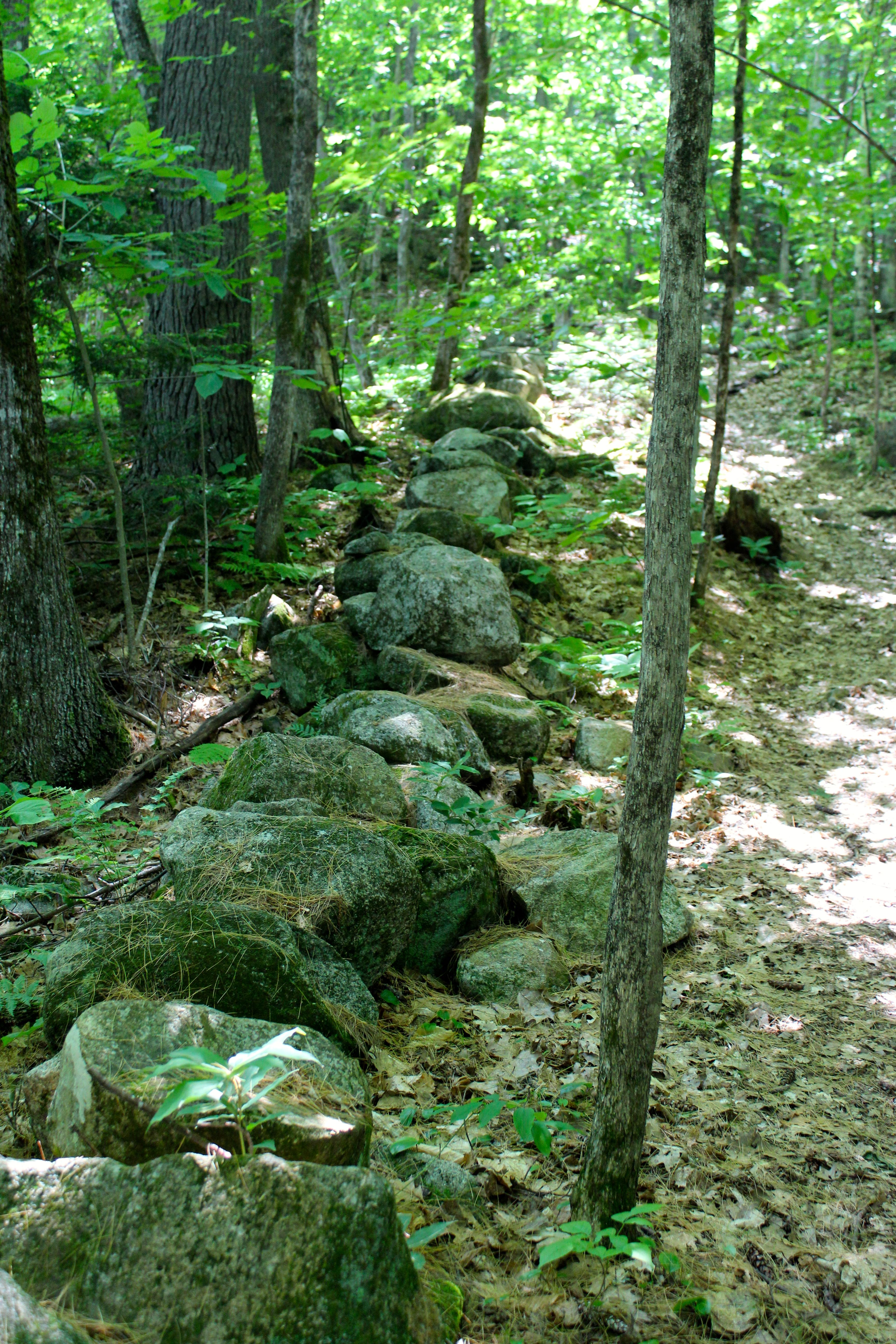
Stonewalls announce that this land was once upon a time used for agriculture.

ash leaves 2

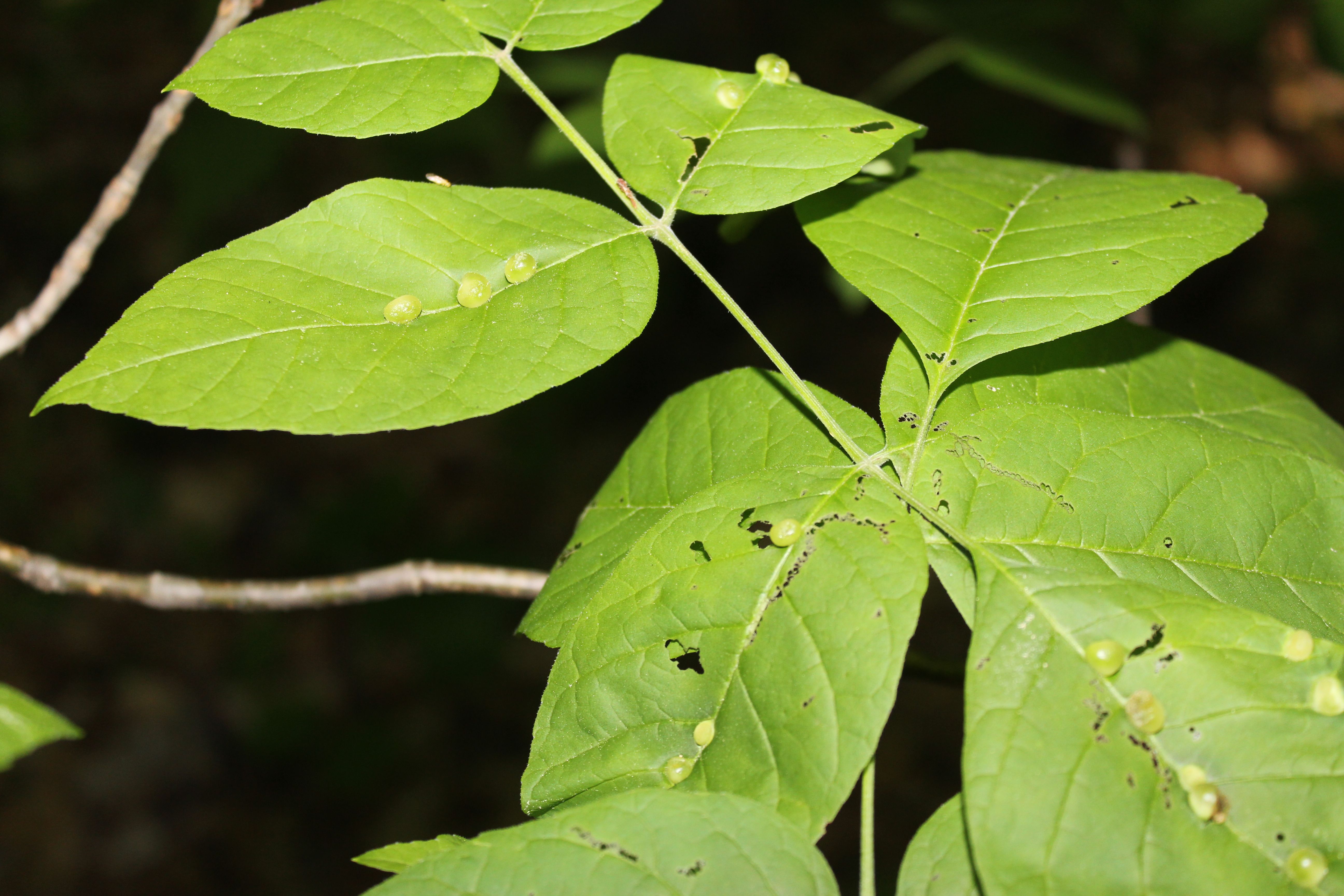
The odd leaf formation of this young ash tree made me stop. It has become host to either a fungus or insects who  are using the leaves as protection while they complete their lifecycle.

ash 2

Another ash has been invaded by mites that cause the raised galls.

challenges along the path

Like most trails, this one provides the rocks and roots that draw my eyes downward, so I pause frequently to look around. It’s just as well that I was alone, because not only was I taking my time, but my mind was so filled with chatter that I doubt I would have heard anyone else speak.

pine needles

On the drive to Waterford, I’d noticed that so many of the white pines are once again suffering from the needle drop fungus. The same was true on the trail. In the newspaper, an article about climate change referred to the needle drop as occurring for only the past several years. Methinks more like ten years. The fungus infests trees during a wet spring, such as we had last year and the resulting defoliation is seen the following year. So–I’m thinking out loud here–though we haven’t seen much rain lately, the needles are dropping because of last year’s infestation. While they look so pitiful right now, within a few weeks, they’ll finish dropping. But . . . do the trees have the energy to survive? And what about next year? Will it be a good year for white pines? And then I think about all the pinecones the trees produced last year–it was certainly a mast year, so maybe it doesn’t affect them to such an extreme. Yeah, this was the sort of chatter I was experiencing.

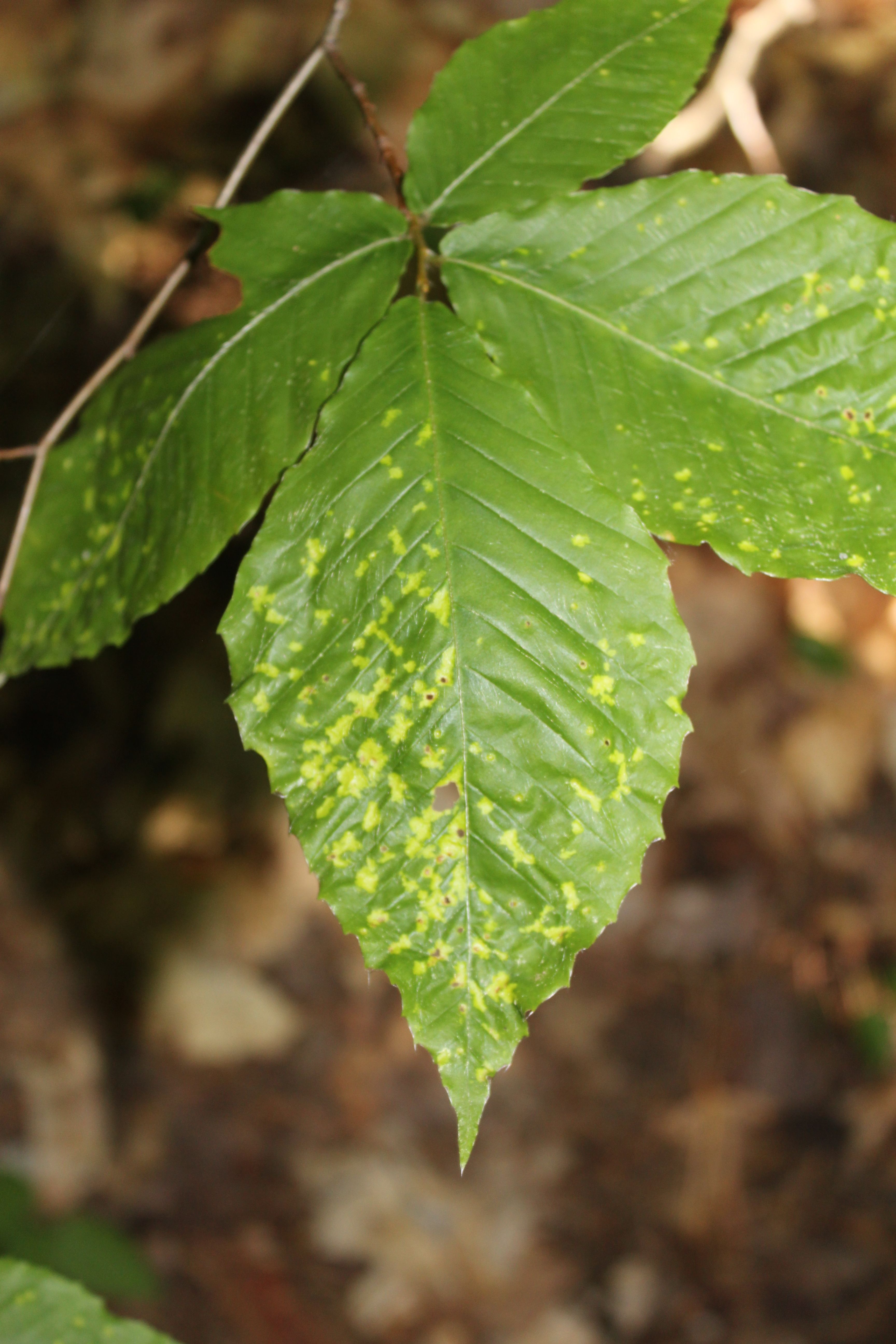
beech spots

Some beech leaves are displaying their own relationship with a fungus. Where only weeks ago, they were the site of beauty as they opened and their hairiness kept insects and others at bay, they can’t fight off everything. Nor can we.

candy pink insects

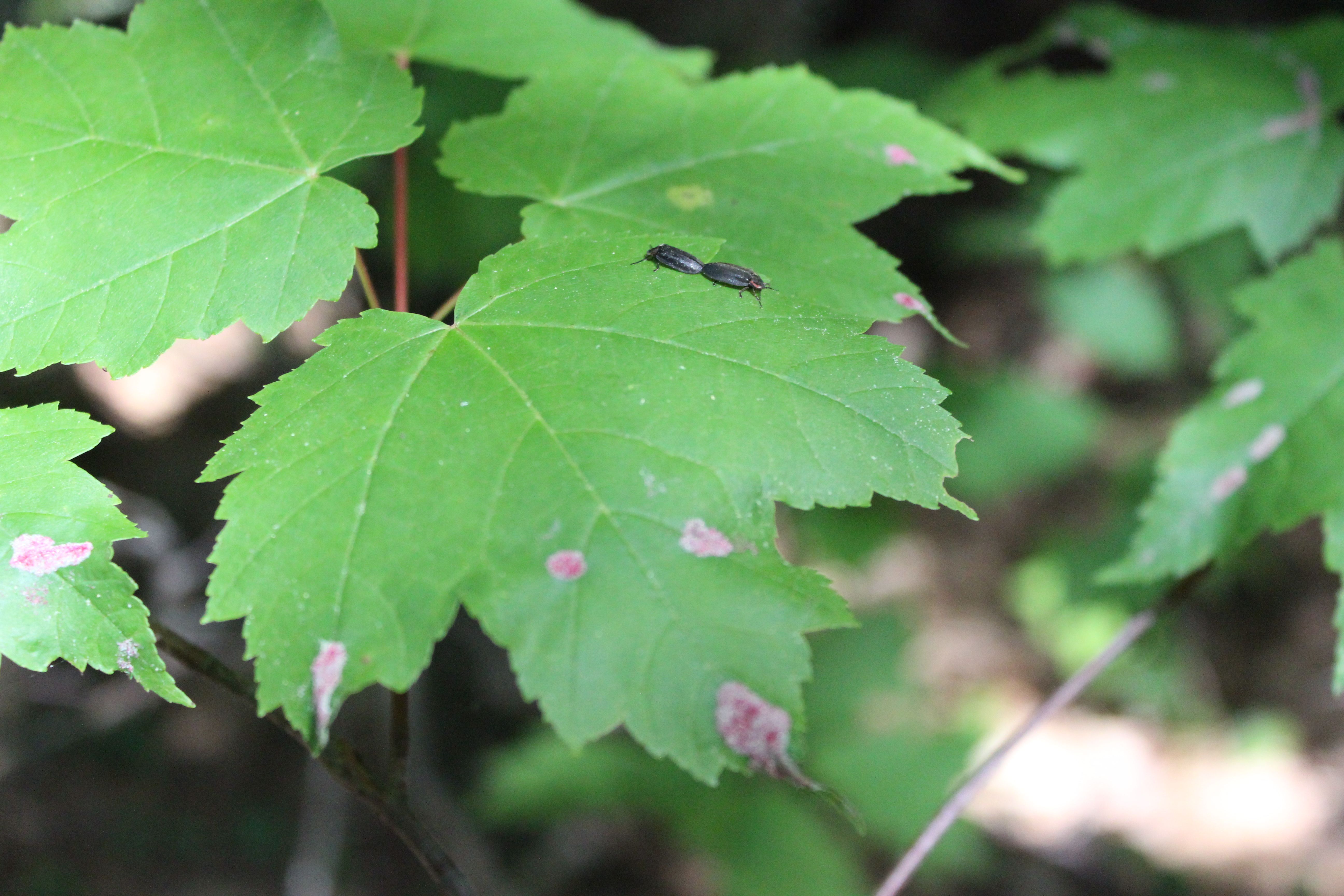
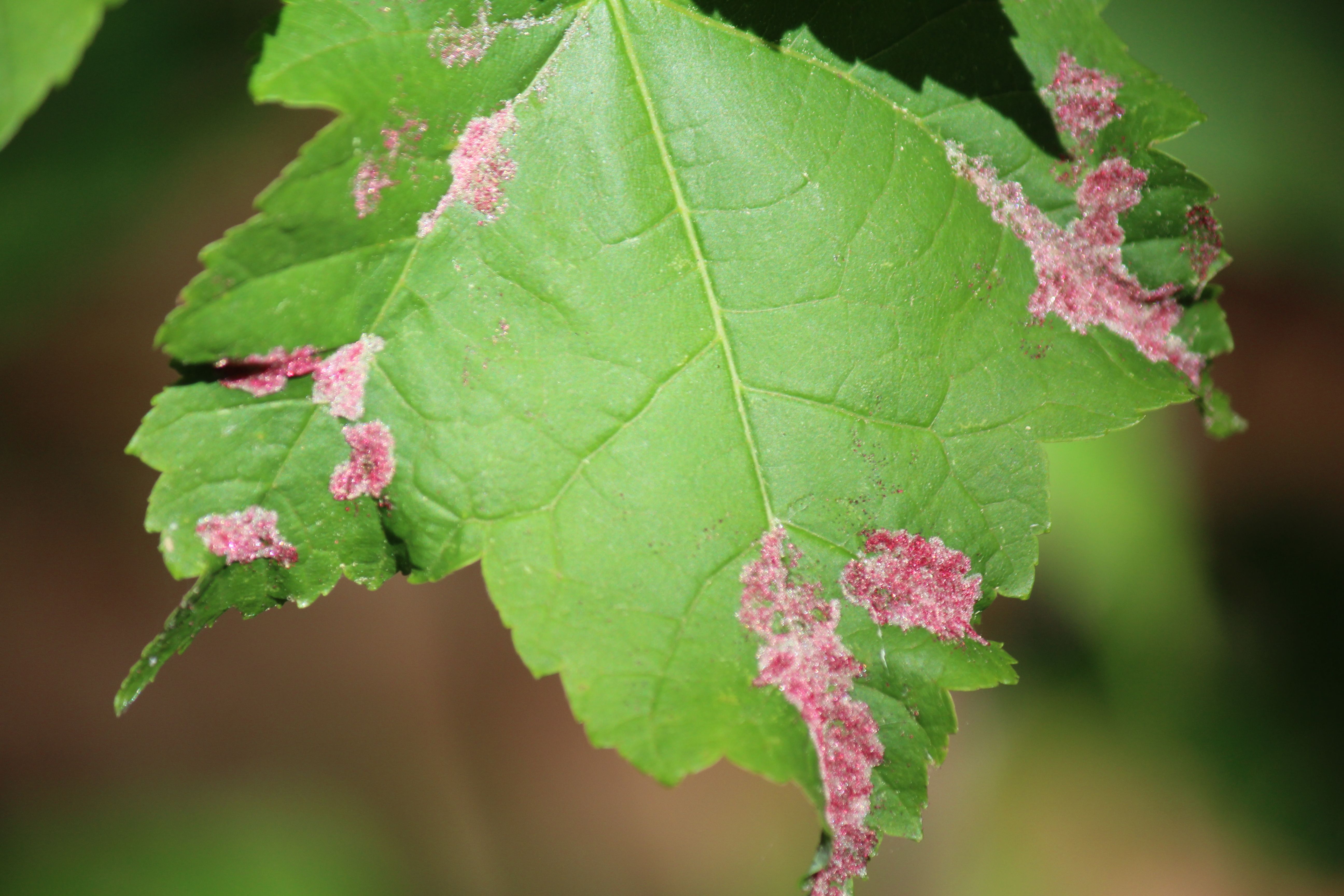
Through my hand lens, the bright pink on the Red Maple leaves has a crystal-like formation. It’s actually quite beautiful.

candy pinkcp2

I had no idea what caused this until I looked it up. These are maple velvet erineum galls, also caused by mites. Apparently they won’t harm the tree, so they aren’t considered parasitic. It’s all a wonder to me. If you do find this, take a close look.

spittle on hemlock

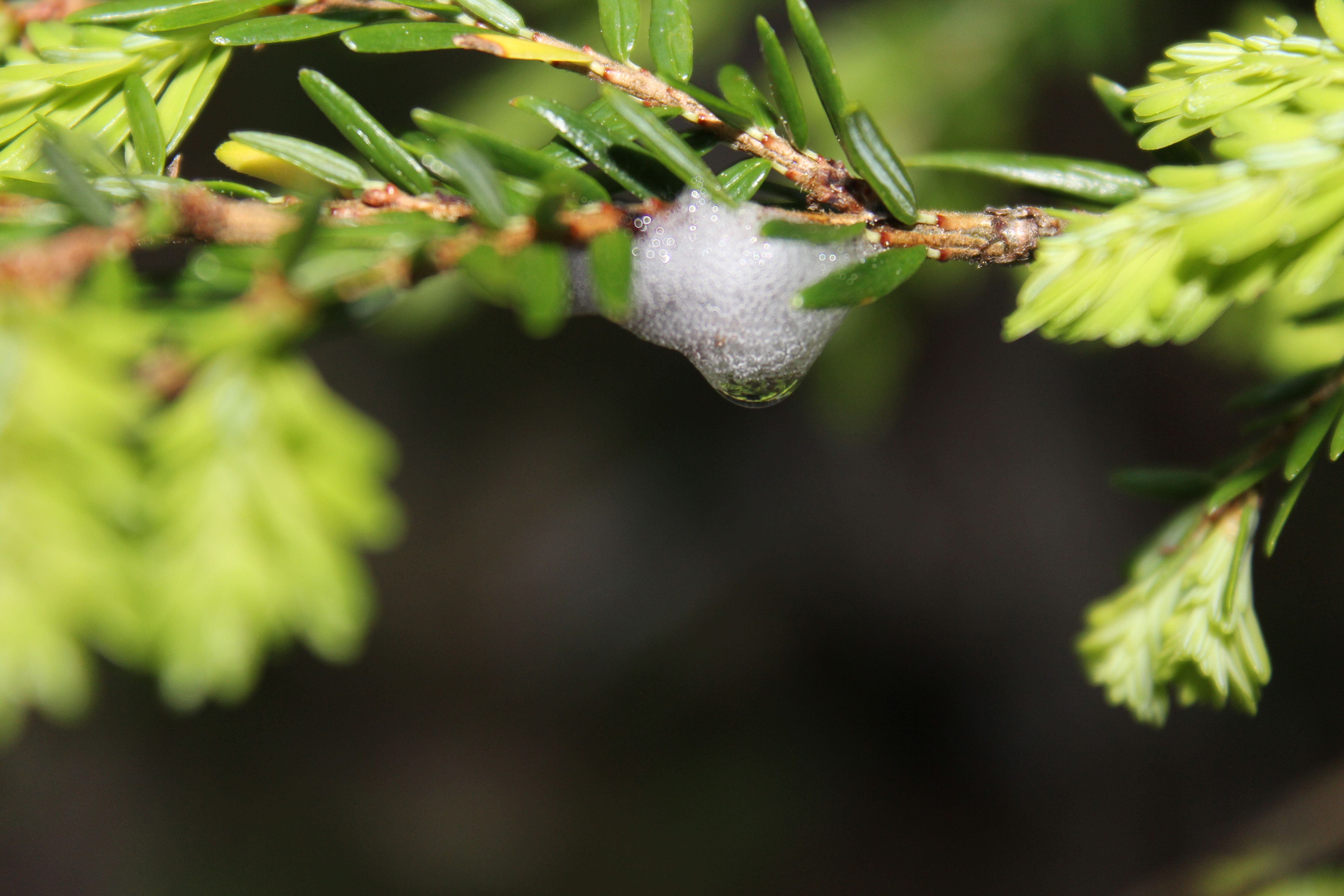
Growing up, whenever we saw spit on wildflowers and grasses, we assumed it was from snakes. A rather scientific observation. Do snakes even spit? And a foot off the ground? I’ve since learned that the foamy substance is the work of Spittlebugs. As the nymphs feed in the spring, they excrete undigested sap and pump air into it.

spittle 2

But I didn’t expect to see this on a hemlock. Turns out–there’s a pine Spittlebug that attacks evergreens. More reasons to keep my eyes open.

Keoka Lake and Oxford Hills

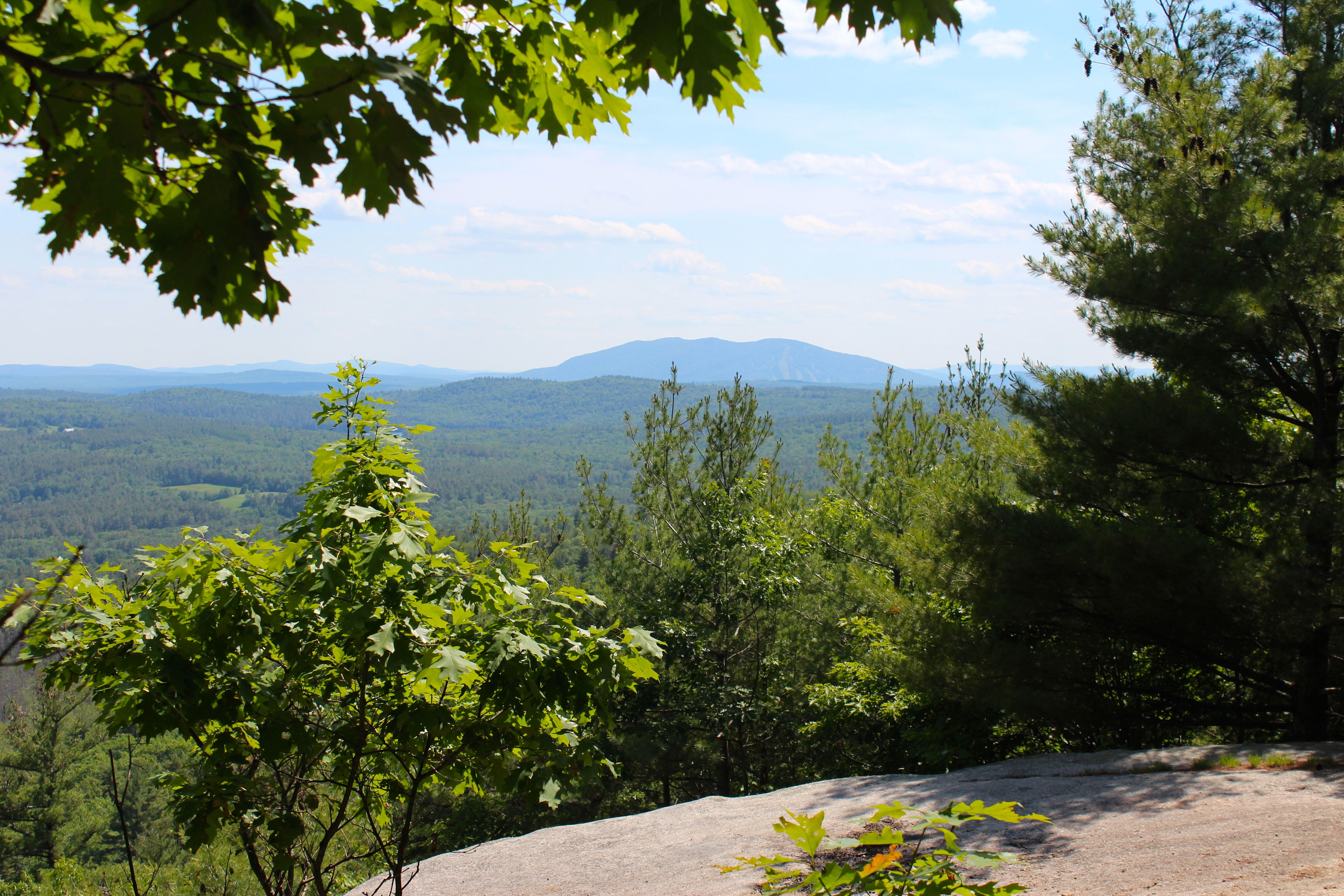
Enough about hosts and fungi. It was time to take in the views. About halfway up, Keoka Lake and the Oxford Hills are visible through a cut in the trees.

gnome home

Gnome homes are everywhere.

view

And finally, the summit with Pleasant Mountain in the background.

BP from summit

And Bear Pond and Long Lake below.

the rocks

No visit is complete without a stop at the glacial erratics.

the rocks split

Maybe I shouldn’t use the plural form as it’s obvious this was all one rock

the rocks 2

that split apart.

tr 5

Perhaps there’s more to come.

As the saying goes, “so much to see, so little time.” Thanks for joining me to take in the views.

Observing the Cycle of Life

The Maine Master Naturalist class of 2015 graduated last night and for the second year in a row I had the privilege of helping students focus their eyes and develop a strong foundation about the natural communities of Maine. And now, they are ready to go forth and educate others.

In some ways, the year reminds me of life in a vernal pool.

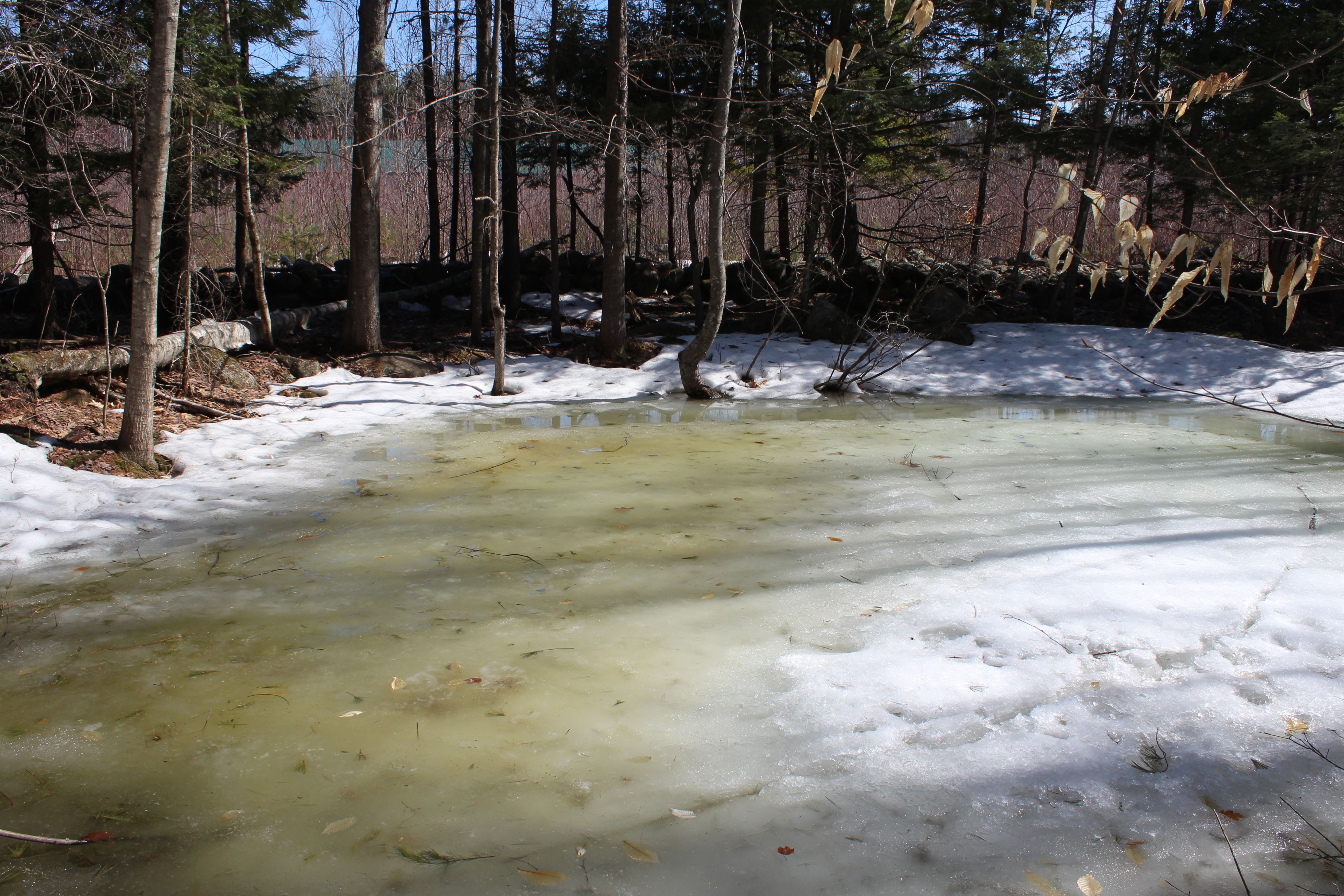
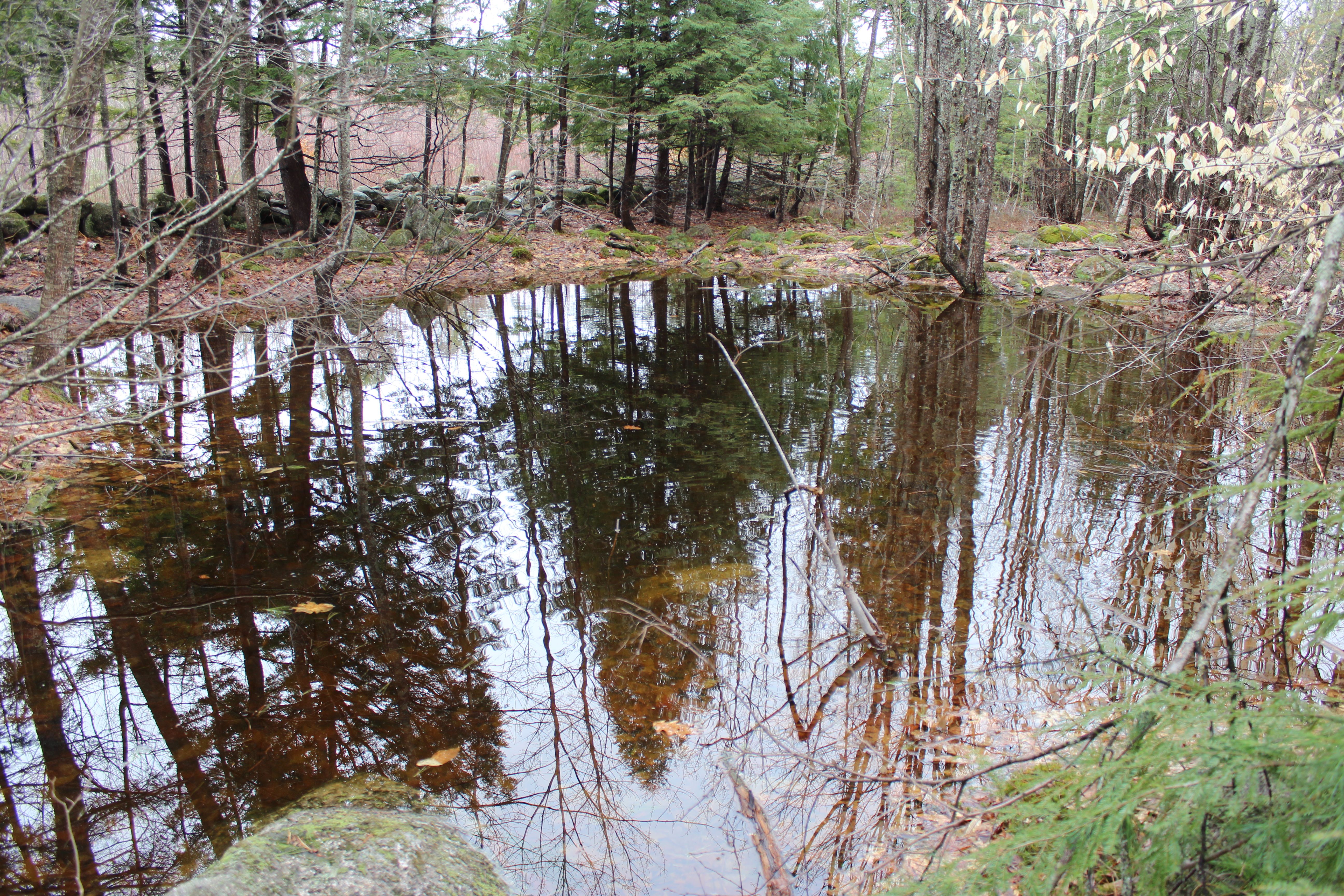
And at the vernal pool I’ve been visiting on a regular basis since March, the transformation continues. I know I’ve included it in several (probably more than several) posts, but today seems like a good day to reflect upon its life cycle.

VP March 25

March 25: A snow-covered depression with some indecipherable tracks crisscrossing the surface.

VP April 4

April 4: Snow, water and slush. Something caused a disturbance.

VP April 12VP April 12 A

April 12: Freeze and thaw and freeze again, trapping newly fallen beech leaves.

VP April 21

April 21: Three days ago, this was still covered in slush. Suddenly, open water.

VP woodfrog eggs, April 21

April 21: The wood frogs didn’t waste any time.

VP April 24

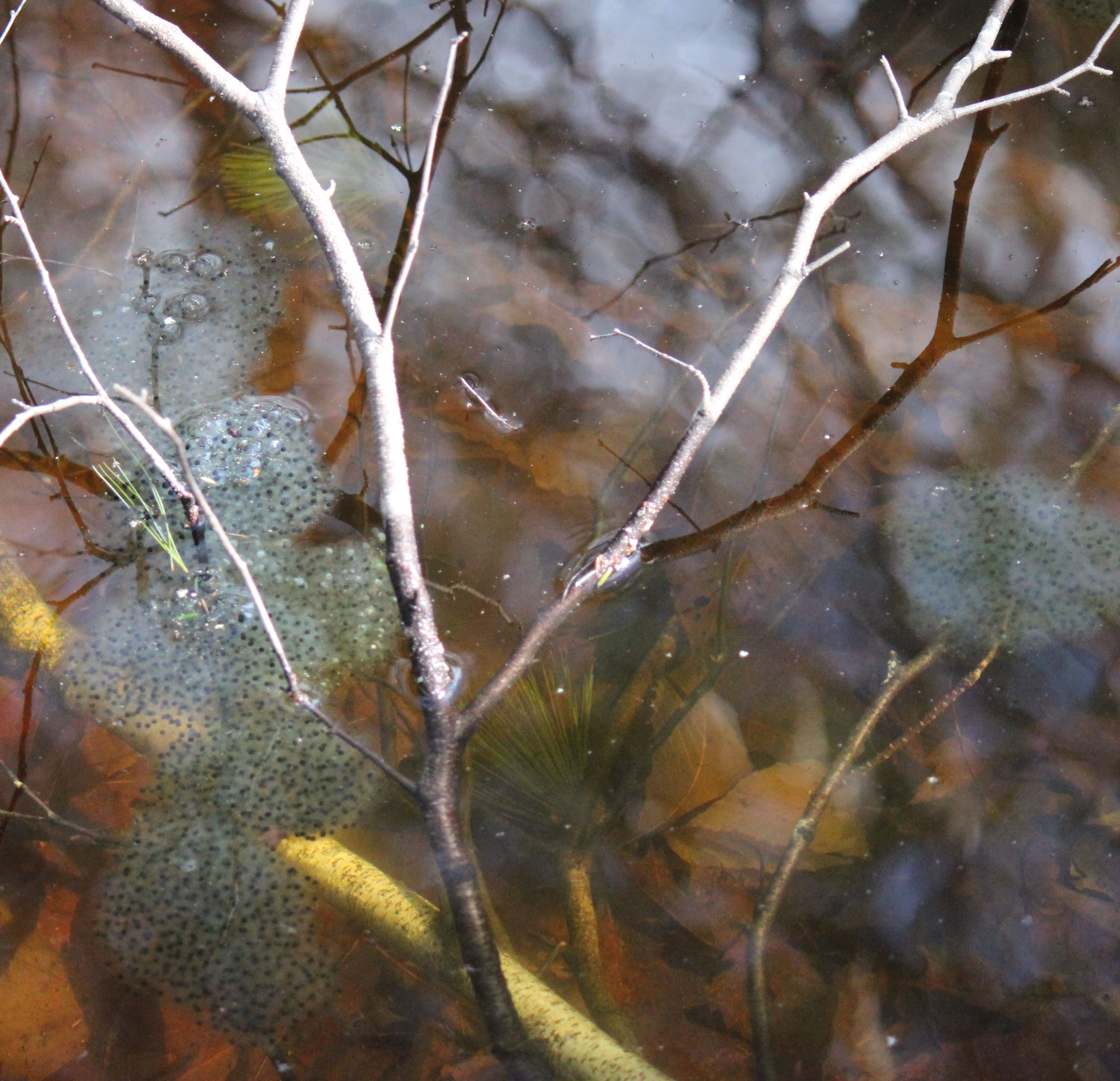
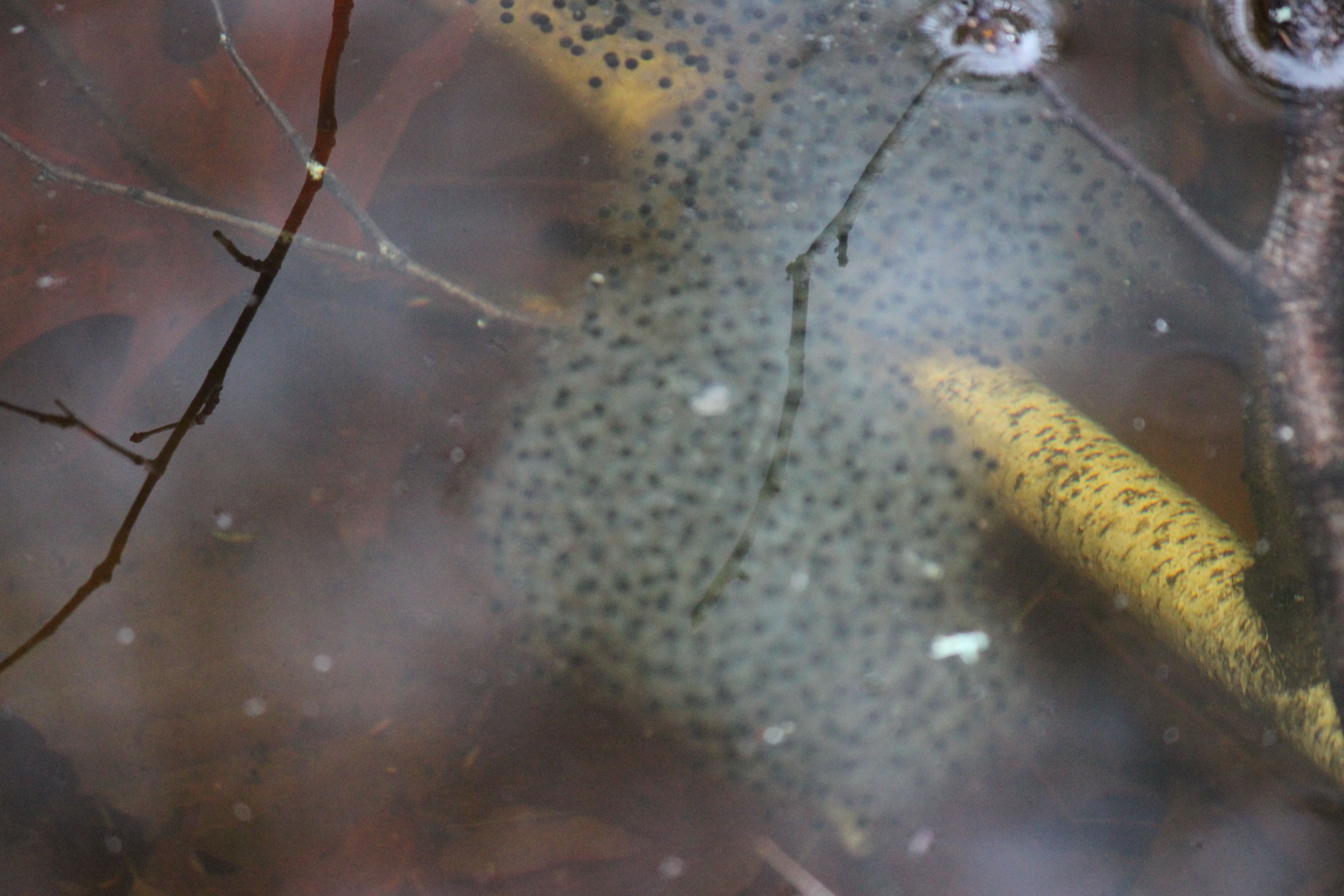
April 24: More and more egg masses appear–attached to the branches or each other, as is their habit.
VP April 28

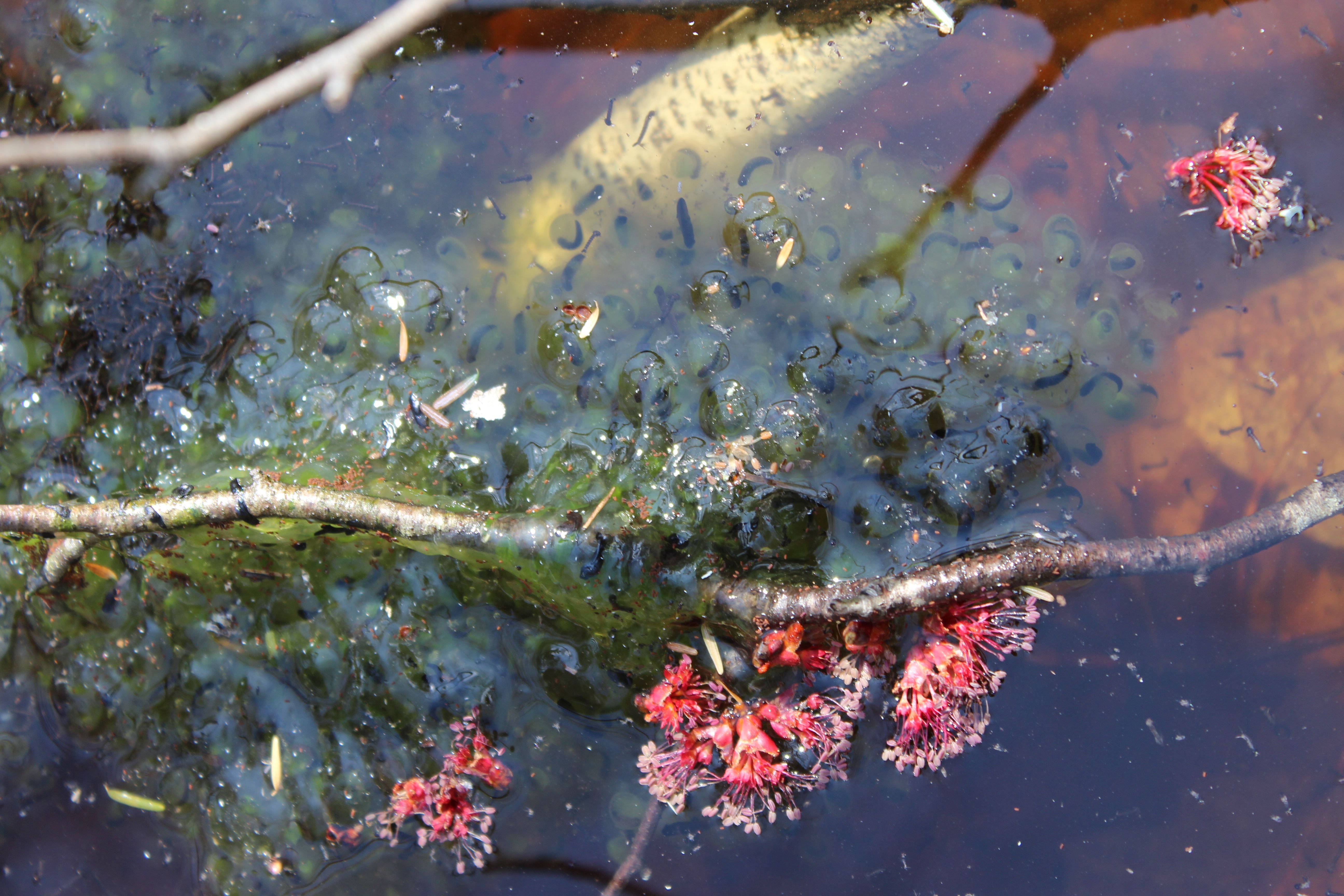
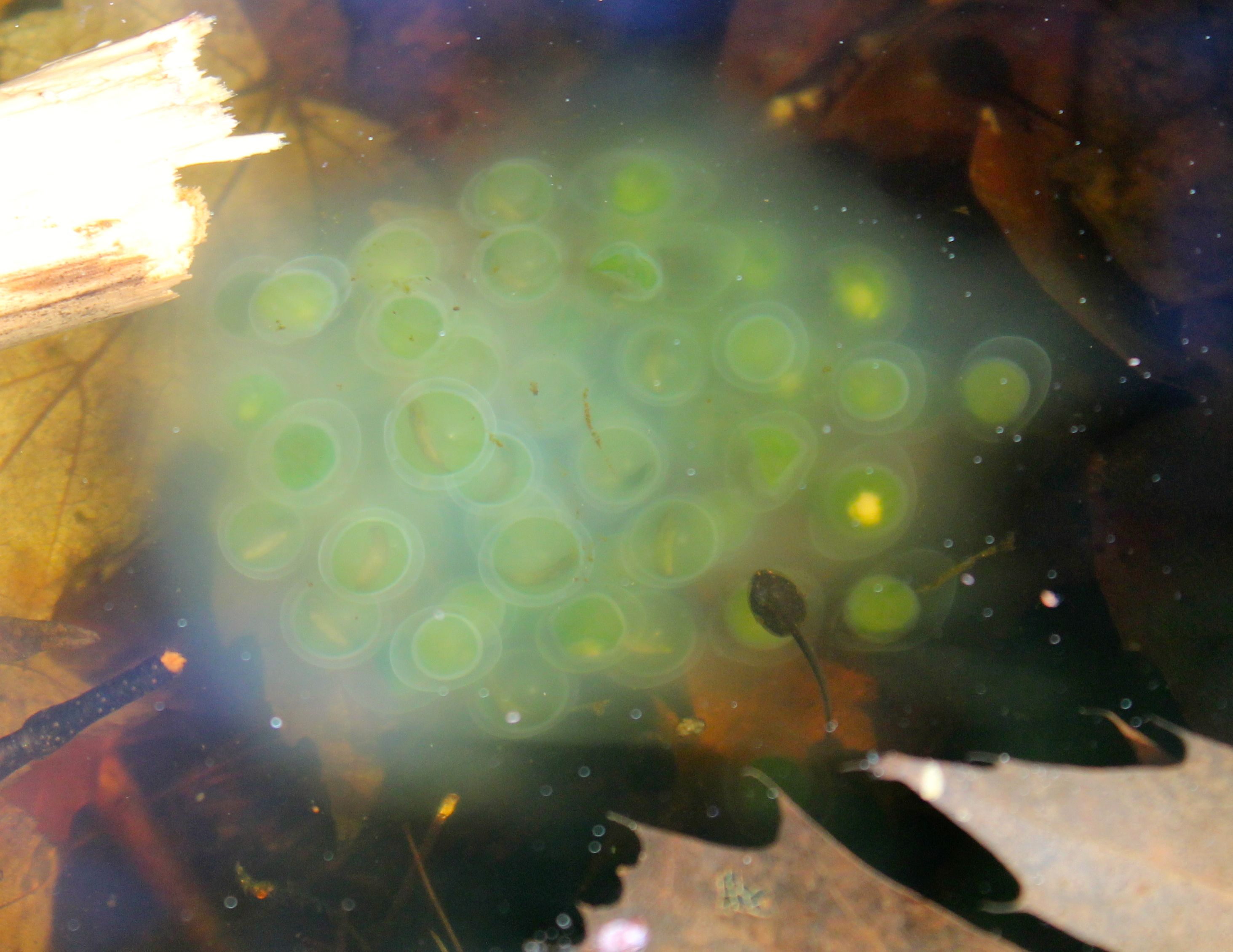
April 28: Though most are wood frog, there are some spotted salamander egg masses in the mix. All are taking on the green tinge from the algae with which they have a symbiotic relationship.

VP Predacious, April 28

April 28: Meanwhile, not even bothering to lurk in the shadows, a predaceous diving beetle swims about.
VP frog May 2

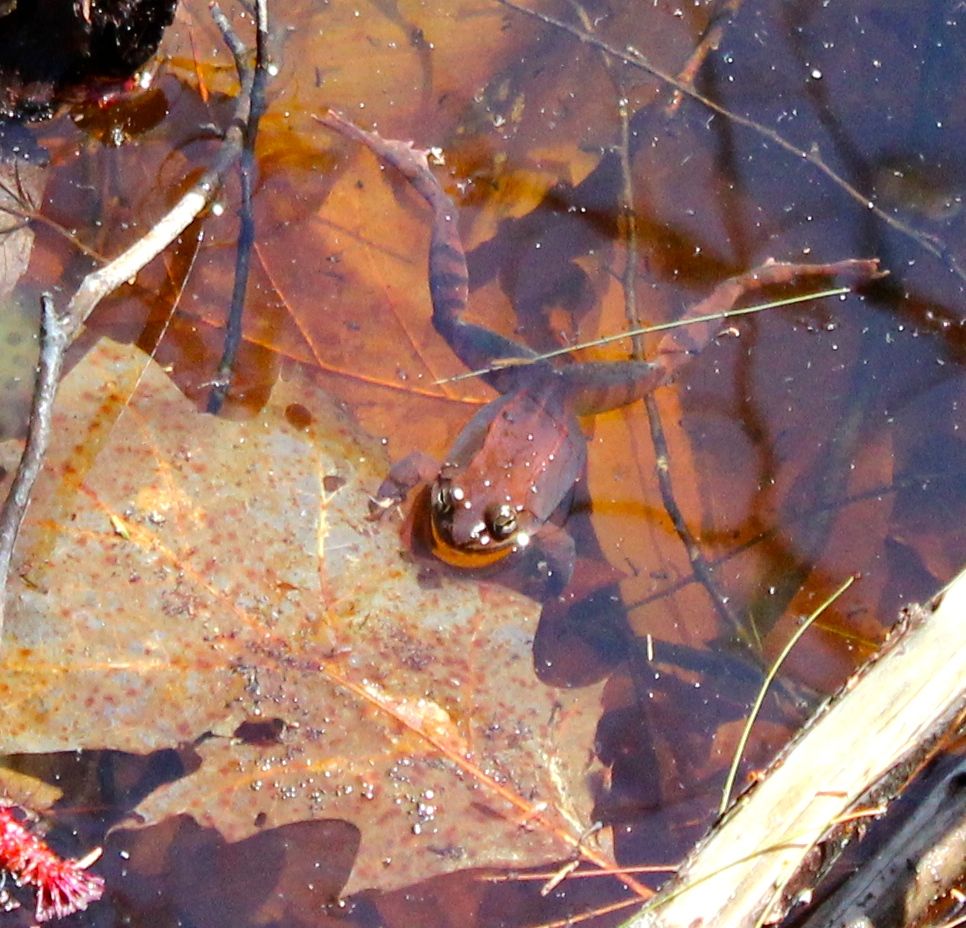
May 2: A well camouflaged wood frog still hopes for some action.
 VP wood frog, sally, May 4

May 4: Wood frog egg mass at top; spotted salamanders mass at bottom.

VP Babies May 4

May 4: Tadpoles at last.

Swarm

May 4: With communal living comes warmth.

VP, larvae, May 4

May 4: Mosquito and other larvae flip-flopping around.

VP, drying up, May 5

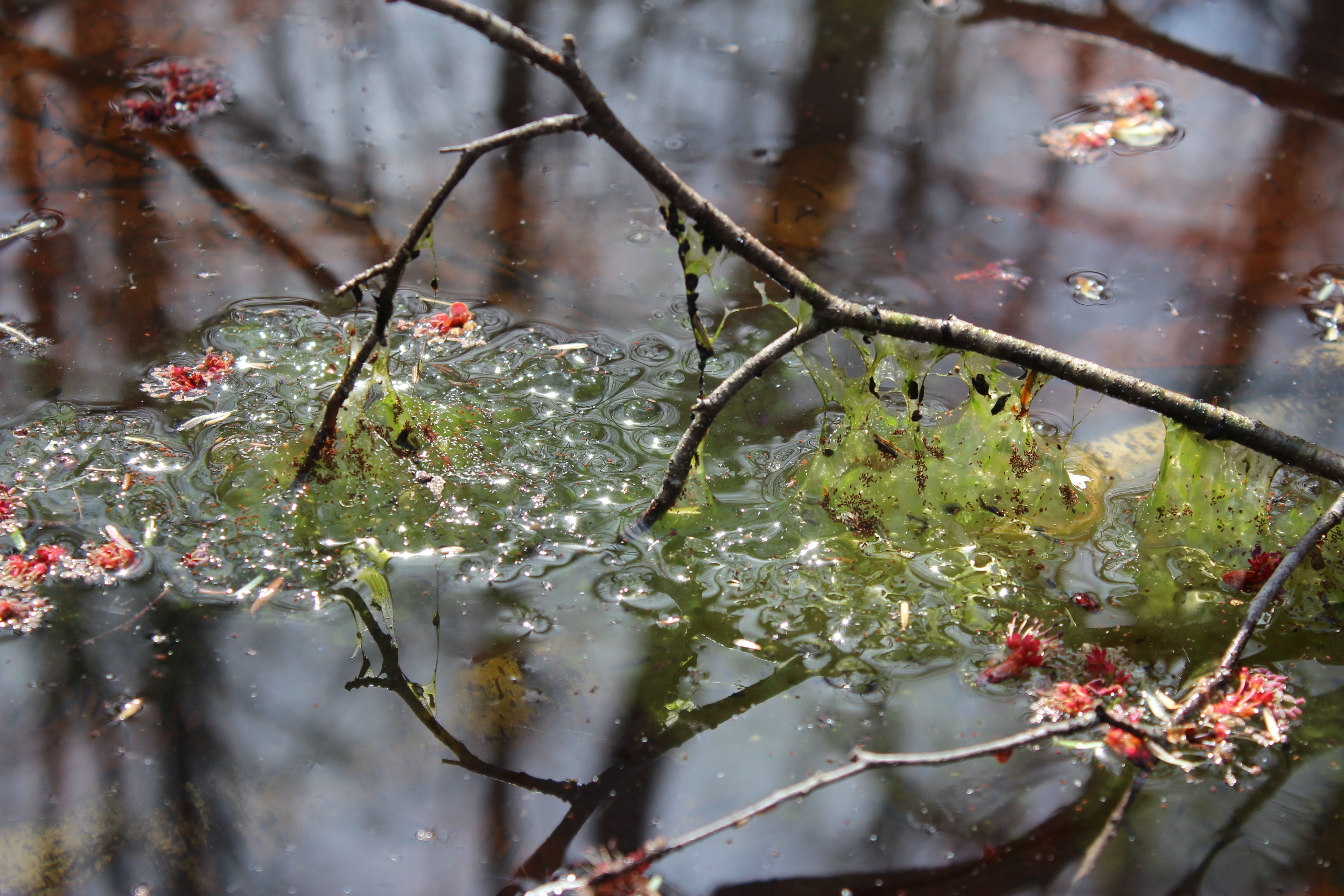
May 5: A sign that the pool is beginning to dry up–egg masses suspended in midair.

VP, life, May 5

May 5: Meanwhile, in the water, life continues. Tadpoles and others feed on the algae.

VP, May 12

May 12: Due to a lack of rain, the pool size decreases.

VP, lower, May 12

May 12: I can only hope that these blobs are just the remains and that most of the tadpoles have hatched.

VP, May 12, more life

May 12: A peek into the variety of life below the water.

May 14

May 14: Shrinking more and more.

VP, May 14, drying up

May 14: Some masses are left high and dry.

VP, May 14, tadpole:sally

May 14: A tadpole visits the salamander embryos.

VP, May 14, peanuts

May 14: Peanut shells. What? There hasn’t been much evidence of any person or critter visiting the pool . . .  until this.

vp 1

May 28: Almost completely dried up.

wet spot

May 28: The only wet spot left.

tadpoles

May 28: Tadpoles make the most of the wee bit of water.

tadpoles galore

May 28: The wet depression boils with action.

peanuts

May 28: And peanut shells are everywhere in the pool, but only one on the snowmobile trail. Another mystery.

With the end of class, eighteen new master naturalists are heading off into the woods to teach others. I hope the tadpoles have a chance to continue their development so that they, too, can hop away from the pool.

As for the vernal pool–vernal means spring and though spring isn’t over, unless we receive a substantial rainstorm, it has almost completed its cycle of life.

Thanks for wandering and wondering with me today.

When I grow up . . .

I want to be like Ursula, my spritely little German friend who is a naturalist extraordinaire and loves to share her knowledge and stories.

Ursula

Always with a smile.

bridge

I had the pleasure of being in her company today, after an hour of birding in Pondicherry Park,

baltimore oriole

where a Baltimore Oriole serenaded us.

dwarf gensing

On to Holt Pond for Ursula’s wildflower walk hosted by Lakes Environmental Association, as was the bird walk. Looking a bit like a disco ball is the blooming Dwarf Ginseng.

cucumber root

Though it isn’t in bloom yet, I saw lots more Indian Cucumber Root today and have a theory I’m questioning about this plant. I know that if it has only one level of leaves, it doesn’t flower or fruit. It needs that second deck to be productive. I’ve heard people say that when it has the second tier it is a two-year old plant, while the first level is a year old. Is that true? The Canada Mayflower, Bunchberry and Wild Oats all do the same. Does that mean that all the single leaves we see are one and all the doubles are two and none reach age 3? Or is it that some years some of these plants put more energy into producing sugar and thus are able to flower, like trees have mast years? And furthermore, am I making any sense?

blueberries

So many flowers and so many of them white or creamy yellow, like these Highbush Blueberries.

red maple 2

Since we were crossing the Red Maple Swamp, I can’t resist showing their development.

green frog

Along the boardwalk that winds through the swamp, we saw this banjo player–a Green Frog. Some call it a Bronze Frog because more than half its body is bronze. Thus the need for those Latin names–Rana clamitans.

hand 1

My friend, CC, squatted down to catch it.

hand 2

And came away empty-handed. :-)

cinn 1

Who do you want to be when you grow up?

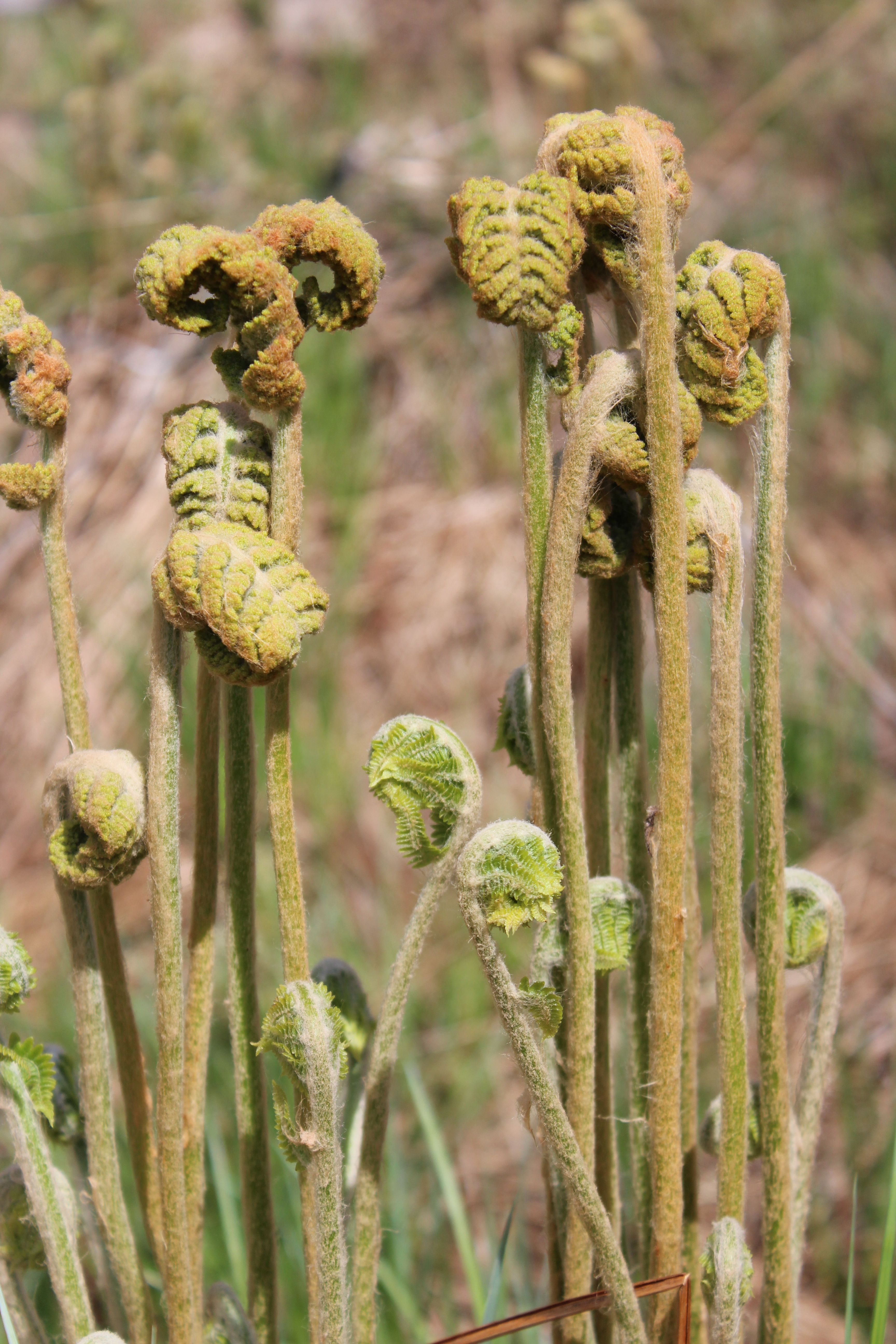
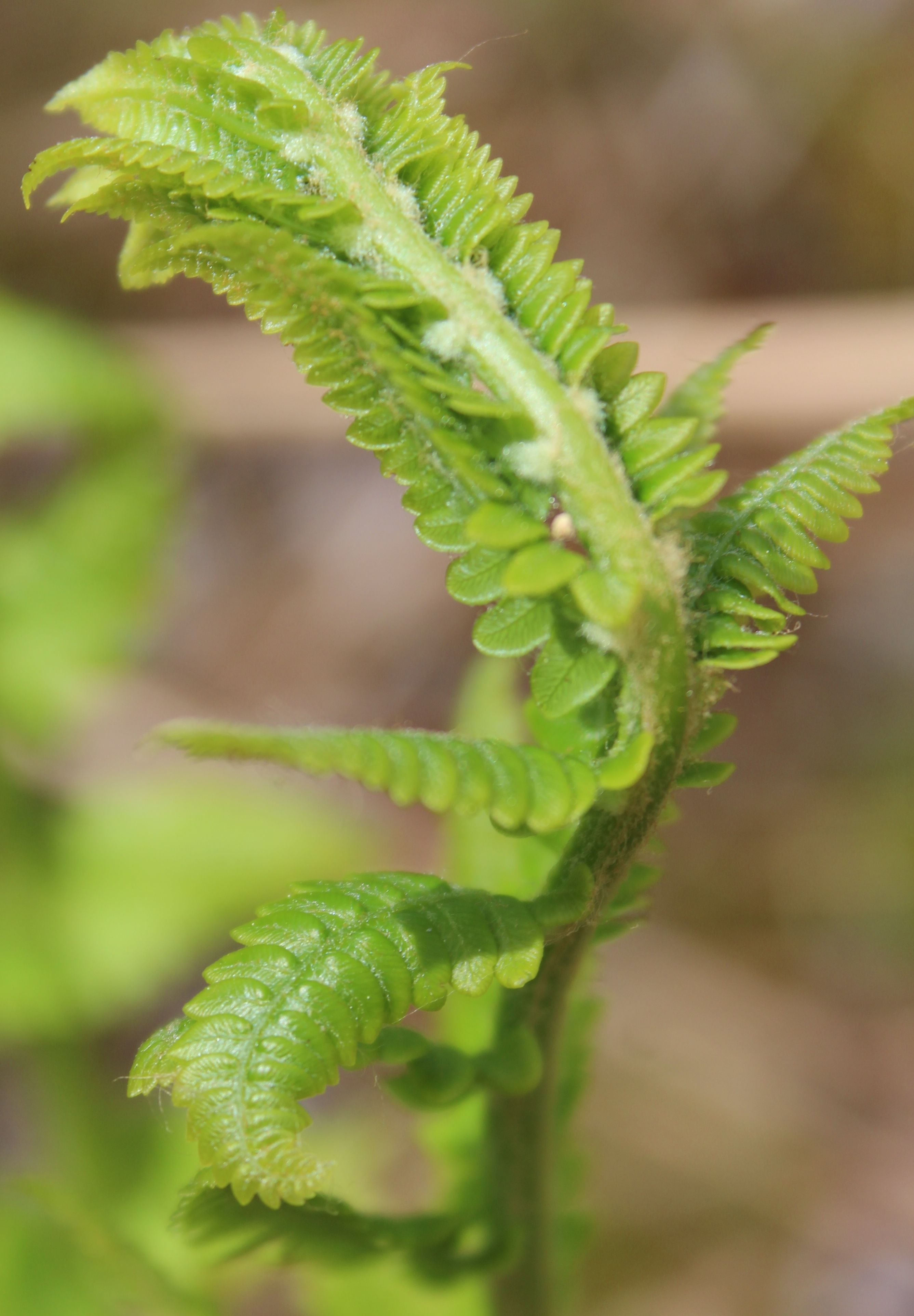
crosiers 2

I pose the question to these crosiers.

cinn 5

Do you see the fuzzy brown wool coat they wear?

cinn 6

Close up.

cinn 7

Ever so slowly . . .

cinn 8

Their fronds begin to unfurl.

cinn 9

And soon we’ll know them as the Cinnamon Ferns they are becoming.

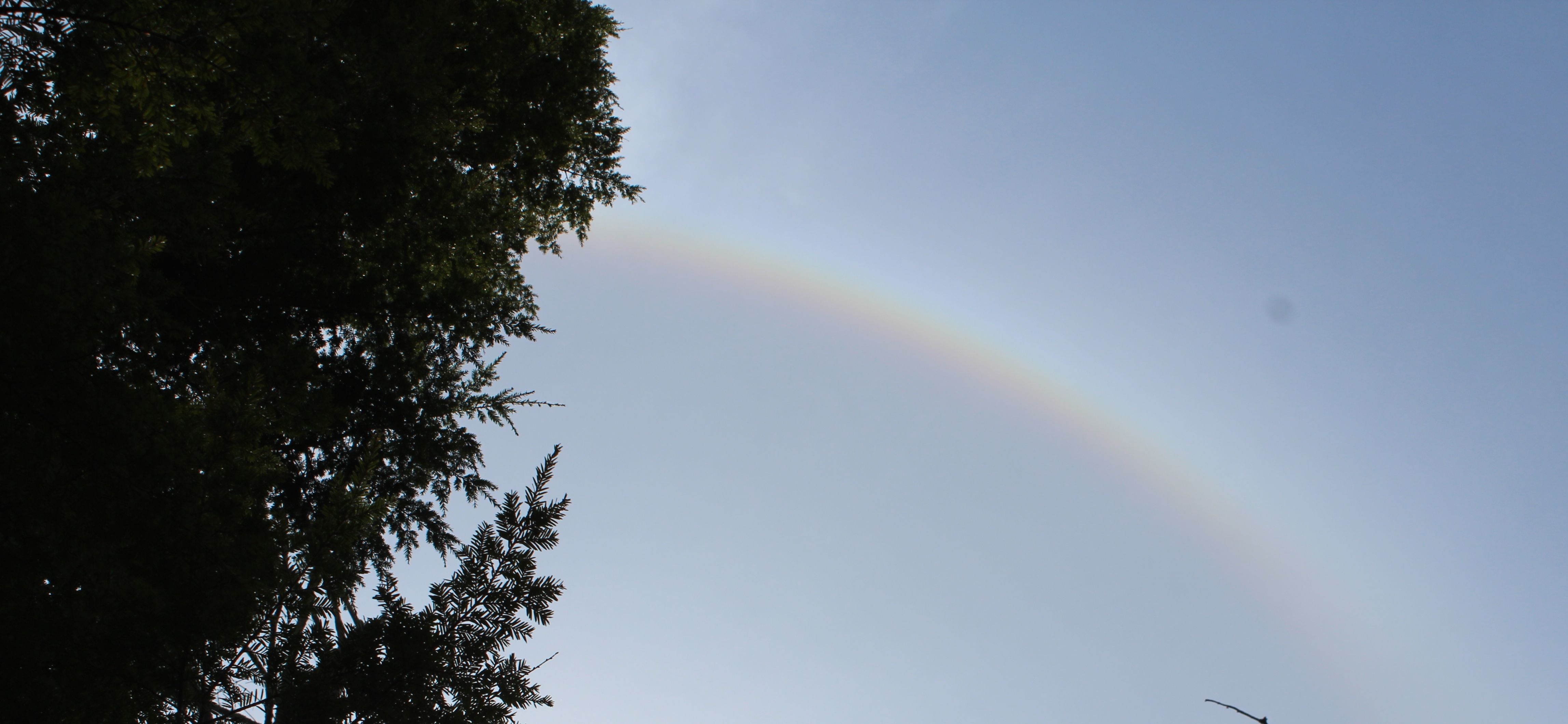
rainbow

Continuing on, one of our leaders, Mary Jewett of LEA, spotted this rainbow around the sun.

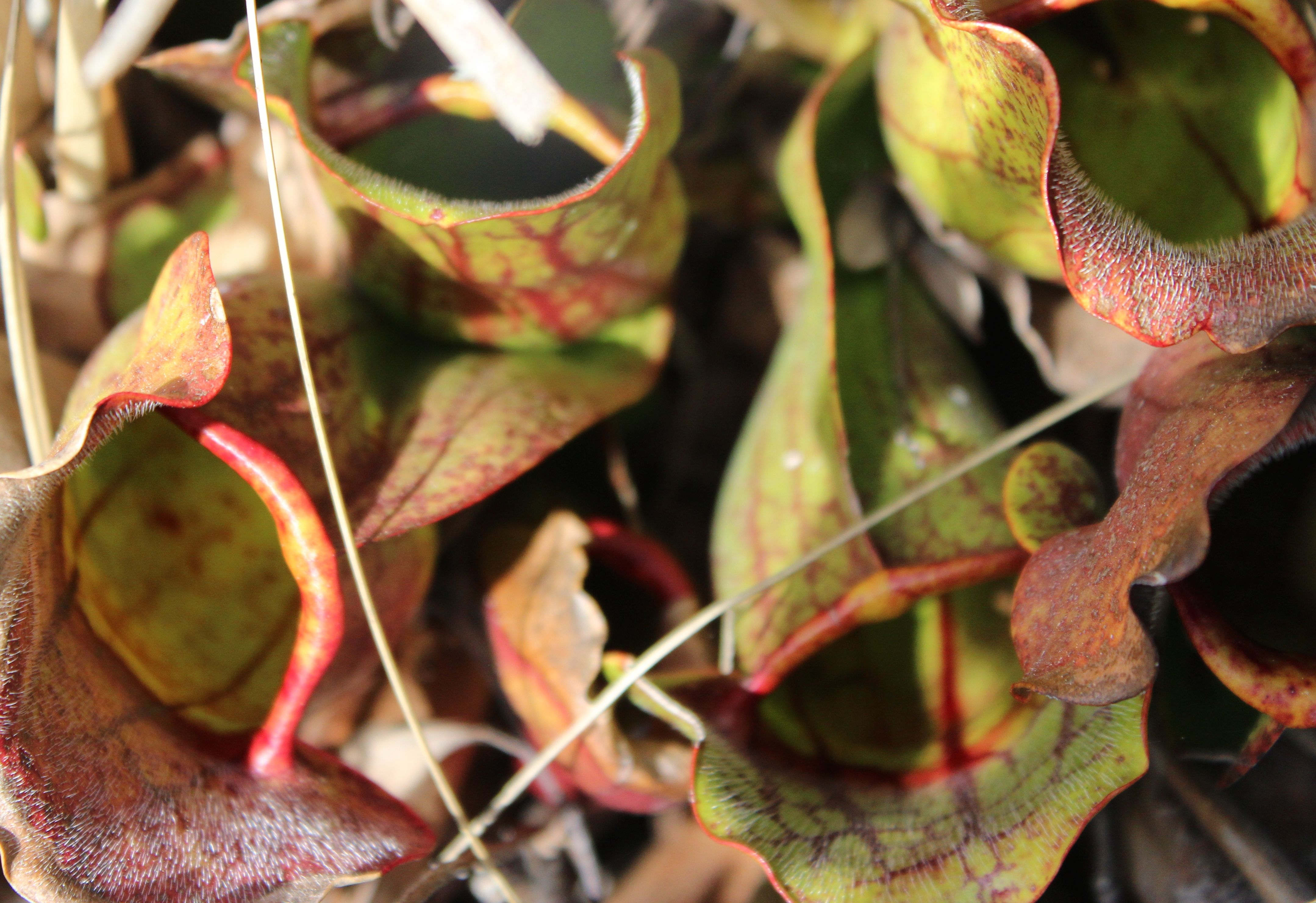
pitcher plant

As is always the case, our heads were bobbing up and down, trying to take in everything there was to see. Pitcher Plants pull us in every time. Well, not literally, thank goodness.

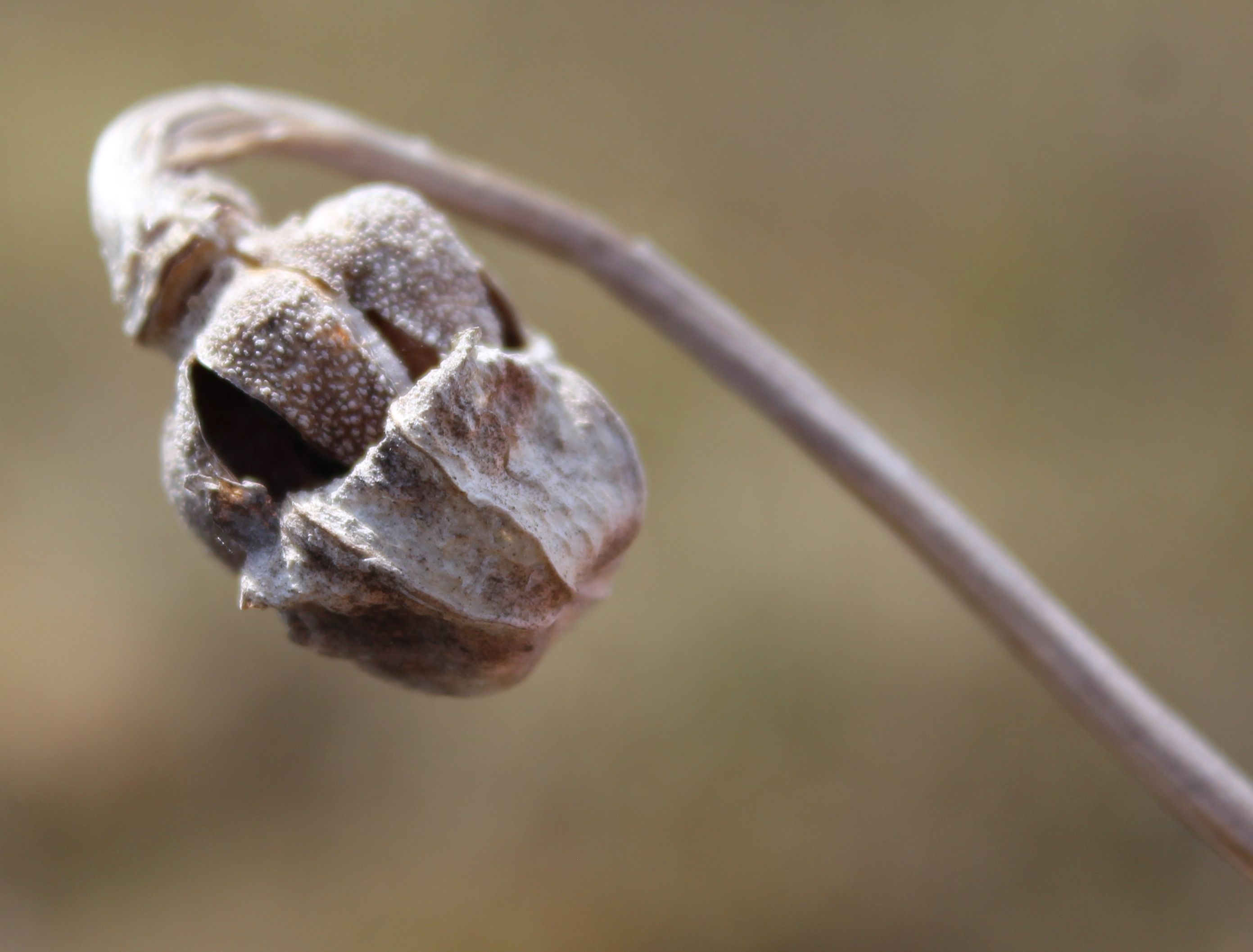
pp seed pod

CC found this old Pitcher Plant seed pod.

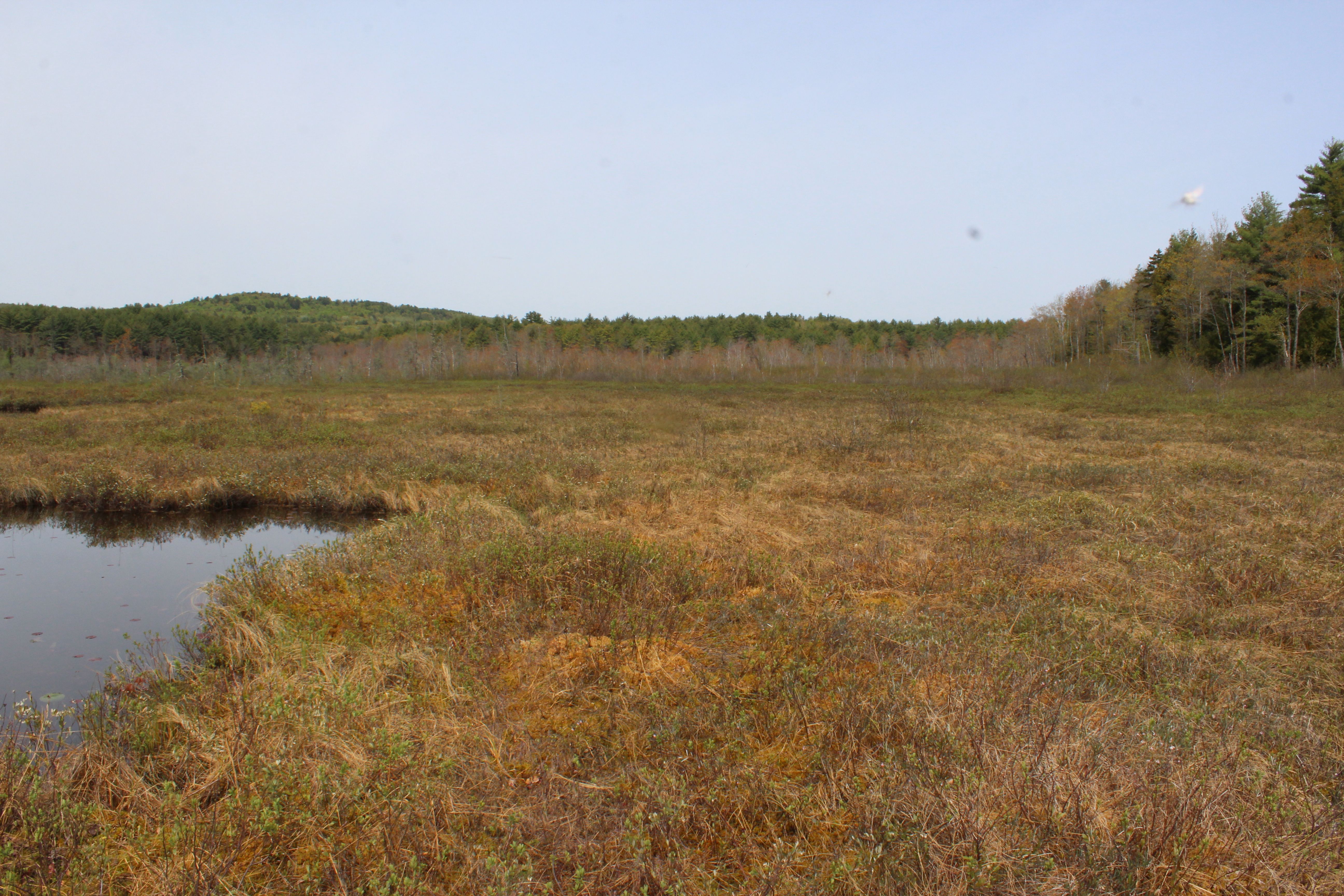
qb

We were on the quaking bog, a mass of sphagnum moss, flowering plants, shrubs and decaying vegetation that floats on the water. It looks safe to step onto, but . . . it too, would like to pull us in and preserve us for eternity.

hp

Holt Pond–like all of us, it’s ever changing as it matures.

It’s Ursula’s energy and engaging personality that wow me every time we share moments wandering and wondering. I don’t want to be her, but it would be an honor to emulate her even a tiny bit.

Who Done It?

tree activity

The first mystery I encountered when I slipped out the door and away from some writing and editing assignments today (yes JVP, I’m working on a rough draft), was this ground disturbance around the base of a dead snag. The pileated woodpeckers have worked on this tree for many years, and I’m not sure why it’s still standing. Actually, there are several of these dead pines in one area and they all look like they’re ready to fall over. But what interested me today was that the pine needles and leaves had been raked back all the way around the tree trunk. Only at this one spot. Who done it? And why? There were some pine cone scales and a cob, evidence of a red squirrel feasting here at some point. But was this ground work done by a squirrel? I’ve never seen that before. I looked for scat. Nada. Scratch marks? Not visible. Would a turkey do this? Or another bird?

Don’t you just love a mystery?

cowpath

The leaves were a bit disturbed all along the cowpath, but that could have been because of today’s wind, or turkeys, or deer.

eggs

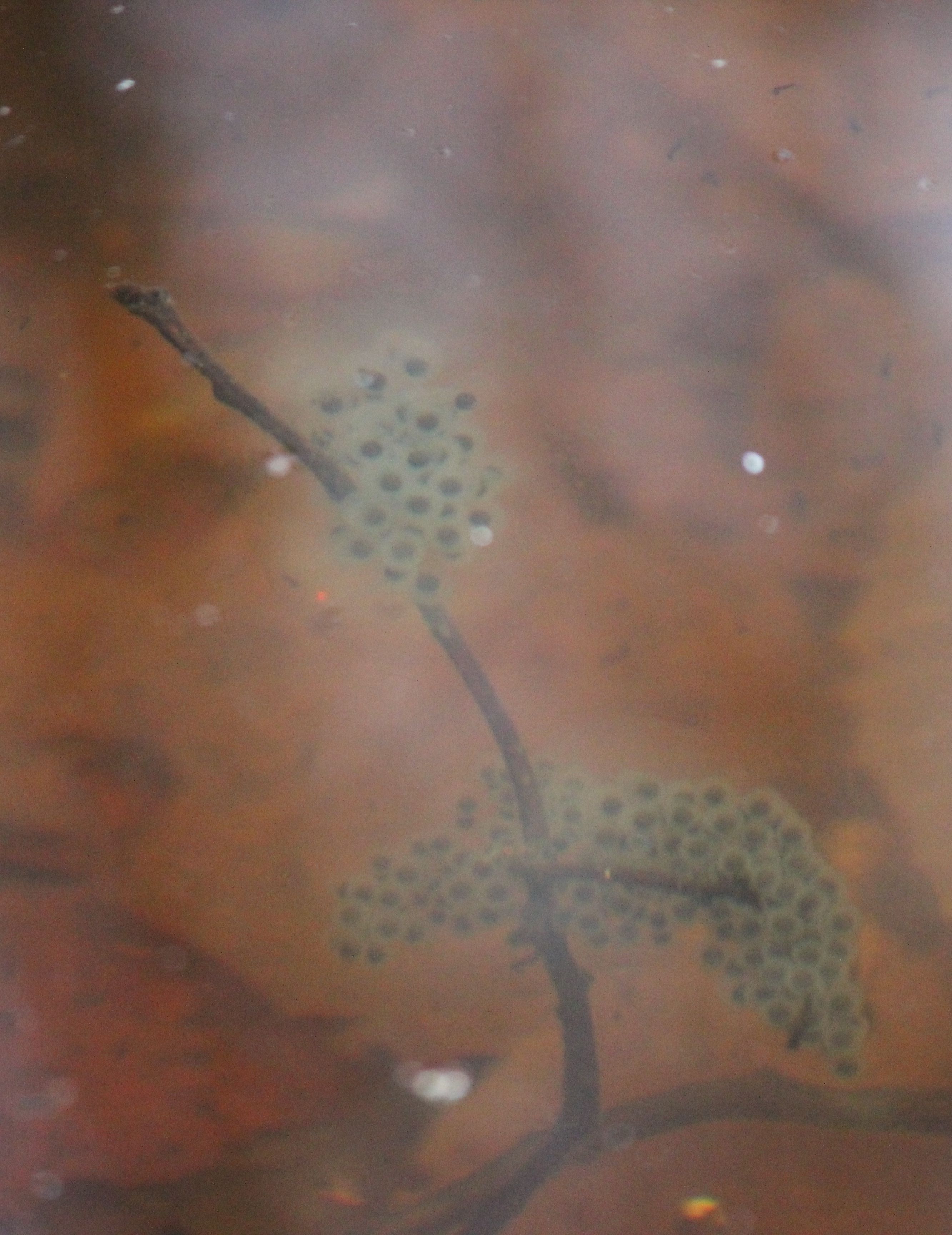
I headed over to the vernal pool. Since the wind was blowing yet again, I didn’t see any action, but the wood frog egg masses look healthy.

eggs 4

And plentiful. As is their custom, the masses are attached to branches and clustered together. Maybe there’s warmth in communal living. It’s certainly a bit chilly today, and yesterday we had hail, snow and rain.

eggs 2

I felt like a million little eyes were looking up at me.

eggs 3

This mass didn’t get the memo about community living.

Usually I see a few salamander masses in this pool as well, but maybe it’s early yet. The ice only melted a week ago.

I walked around the perimeter, noting that as usual, there are no masses on the southern side of the pool. They tend to be clustered on the northeastern side, where perhaps they capture the most warmth of the sun.

msyteryt hole

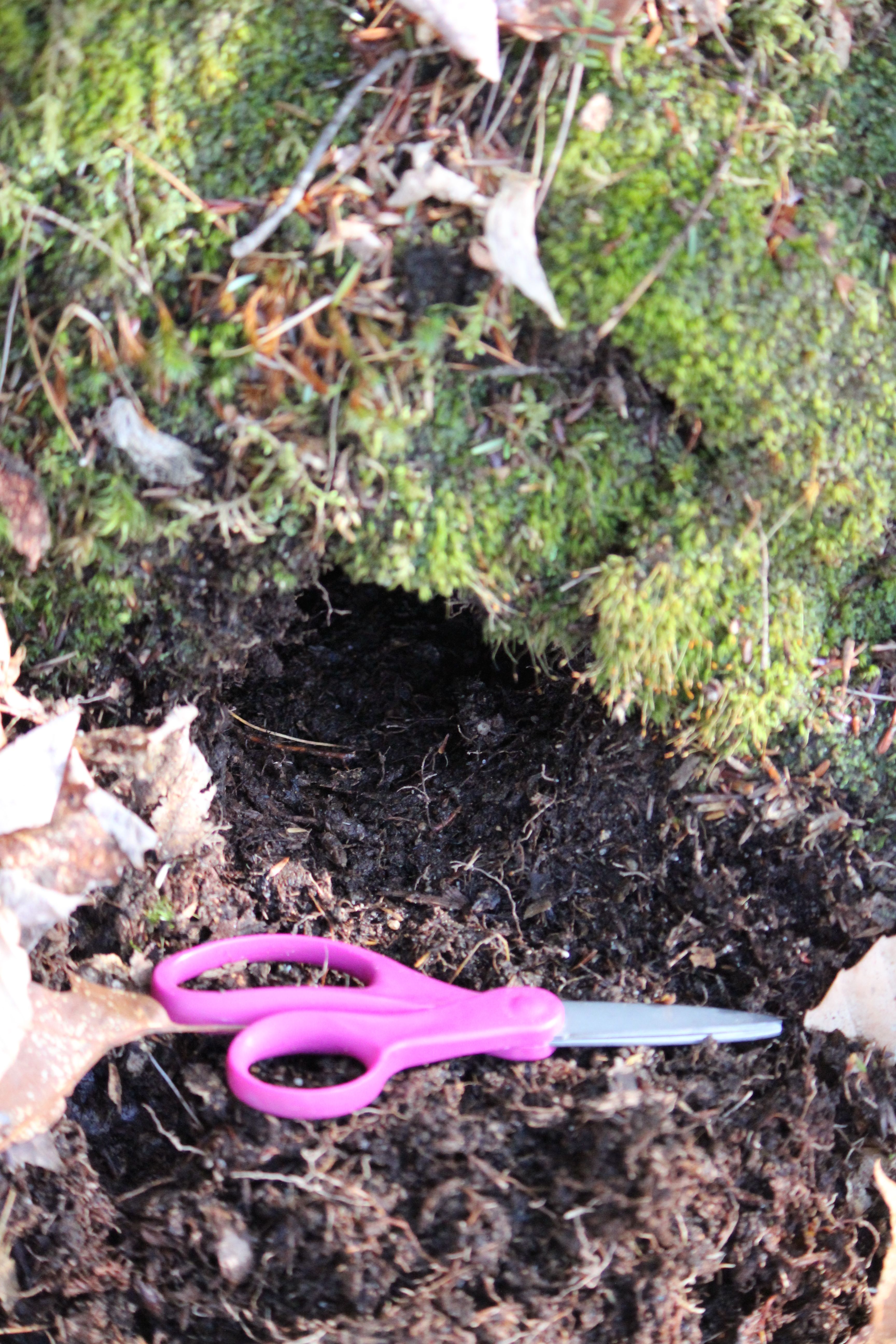
What I did find, though, was a hole about a foot from the pool. The only reference item I had was a pair of kid scissors in my pocket. They are five inches long. That’s about how far back the debris was thrown. A messy dooryard.

mh2

The pink handle is three inches, about the size of the opening. I stuck a stick in and it seemed to end at about a foot, maybe a bit more. Another who done it? Decent size hole; beside pool, but dry; messy door yard; recently dug; no one home. I looked through Mark Elbroch’s book Mammal Tracks and Sign because he has a section devoted to burrows and dens, but so far I don’t have the answer. Will the maker of the hole affect the egg masses? Another good question that remains to be answered.

red maple 2

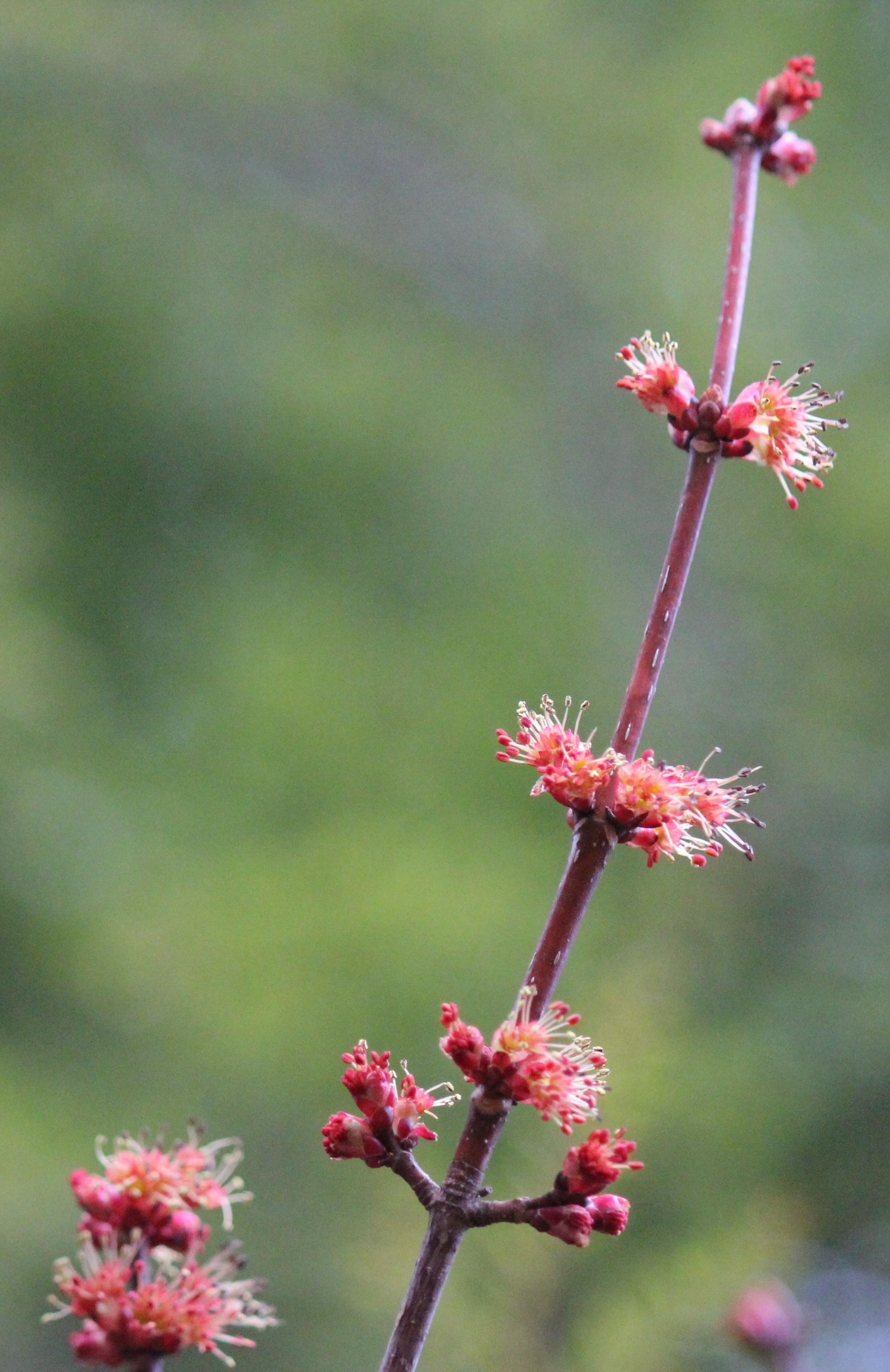
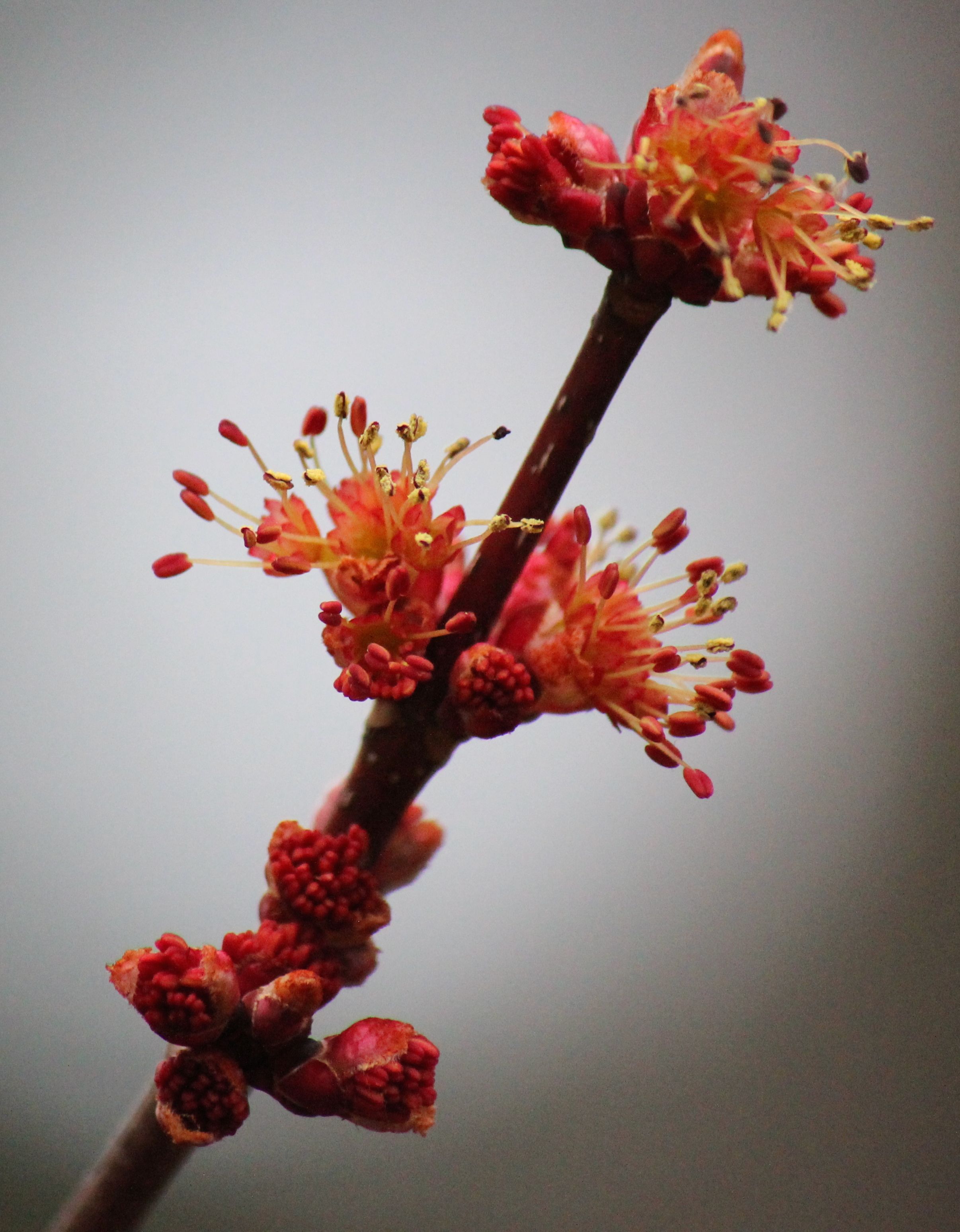
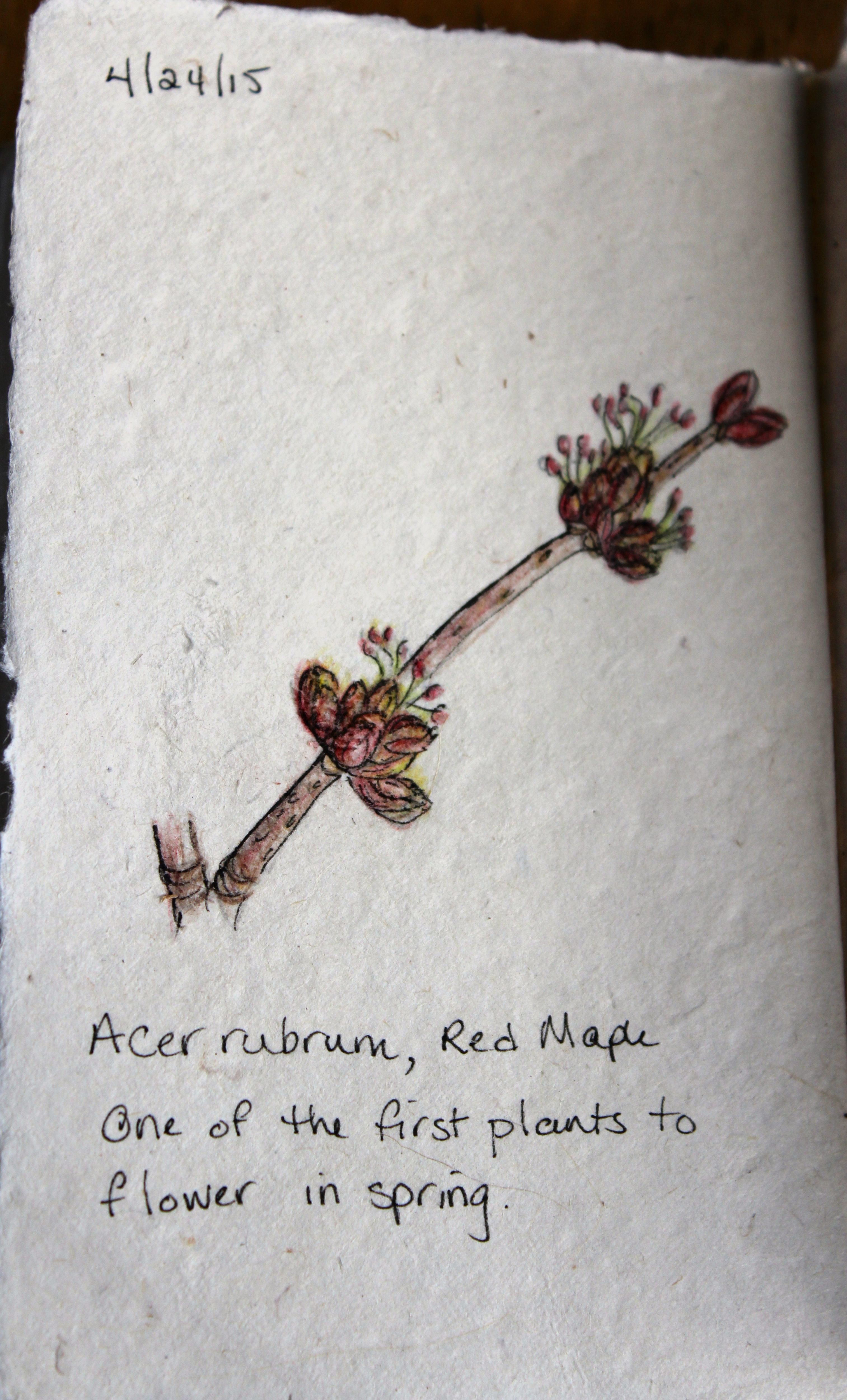
And then it was time to visit another harbinger of spring, the Red Maple flowers. They are bursting with joy . . . and love.

red maple 3

rm 4

rm5

Stamens and pistils in all their glory.

sketch 1

It was nippy, but I took a moment to sketch.

As I wander along the path, I’m thankful for the mysteries and beauty that draw me out and continue to provide moments of wonder.

And I’m thankful for my sister and brother-in-law who encourage me along the way. Happy Anniversary to you!

Walking With Nature On Earth Day

I only got fake lost on my way to Old Point beside the Kennebec River in Madison this morning. The plan was that I would meet K.D., a Maine Master Naturalist student, near the monument honoring Father Rasle. All was going smoothly and I was almost to my destination by 10am–right on time. Maybe it was because I was feeling so smug about getting there without any hassles. Or maybe it was because I’m just not tech savvy.

Somehow, I either plugged the wrong address into Map Quest last night, or Map Quest decided that I should go to the wrong address. Anyway, I turned onto Blackwell Hill Road and drove along looking for the trail head and K.D.’s car. And then I reached the end of the road and had to make a choice. It was a T–turn this way or that (oh my, I’m tired and “turn” and “that” also begin with T). Instead, I made a U turn and headed back to town. Mind you, I had our cell phone with me, and K.D. had given me her number, but I never bothered to jot it down. Lesson learned? Probably not.

I kept hoping she’d stop being polite and just call me. Back in Madison, I pulled over and examined the Delorme map again. Blackwell Hill didn’t seem like the right place because I knew the trail was near the Kennebec River, but it looked like there might be trails off another road in that area, so I turned around.

Again, I hoped she’d call. After a third U-turn, she did. And she was on the other side of town. Yeegads. But as I said earlier, I was only fake lost. I could find my way home (sort of).

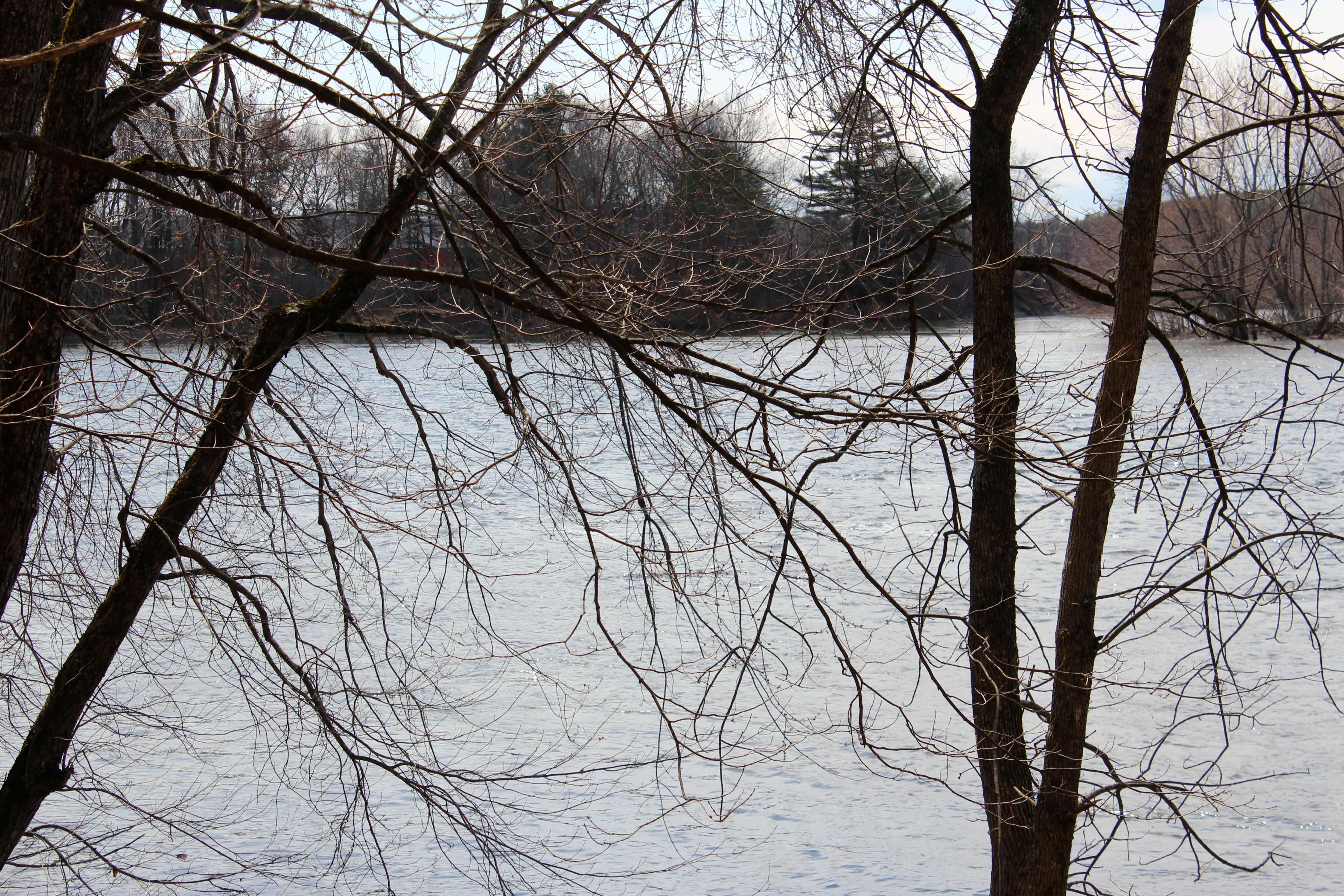
Kennebec River

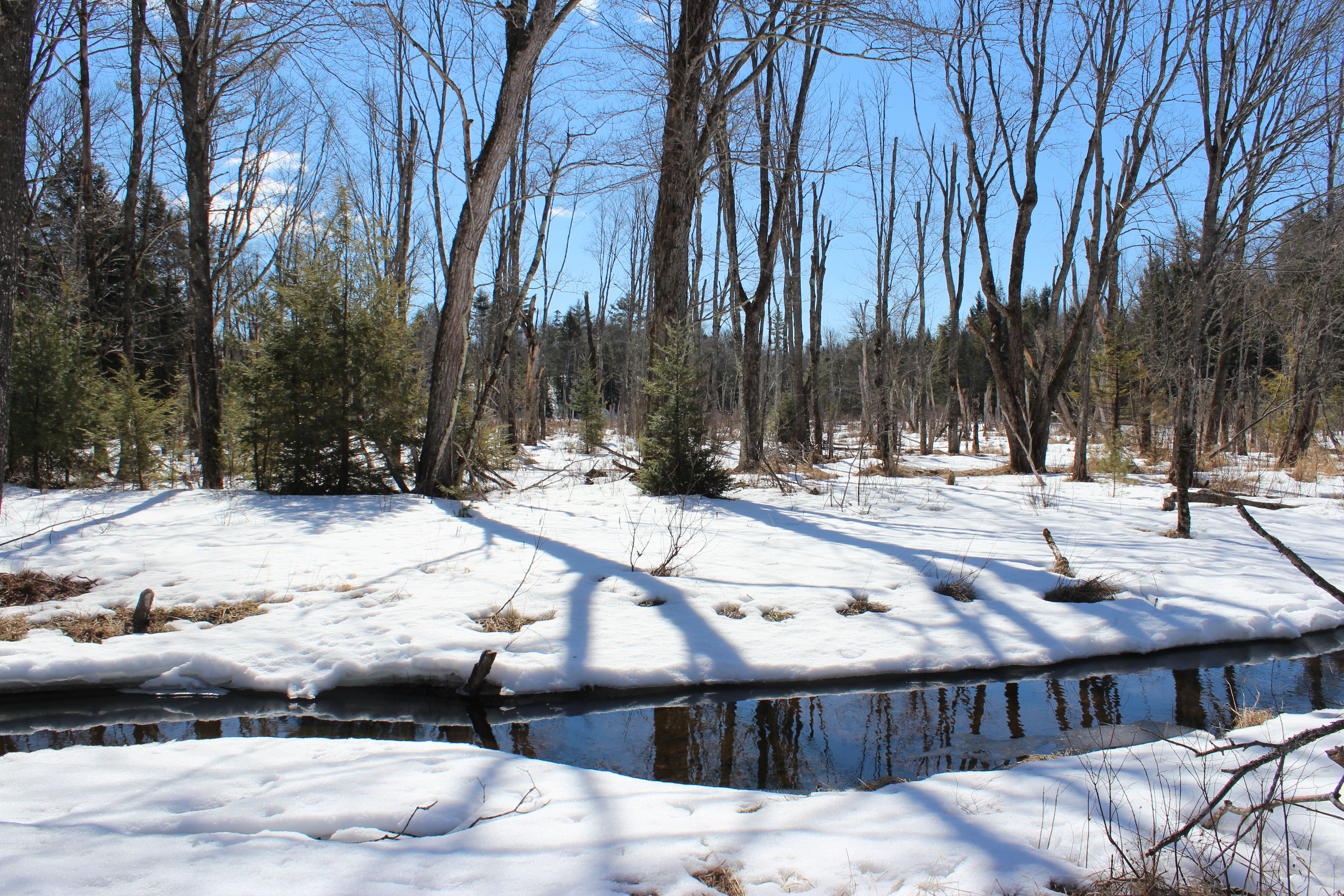
Like all rivers in Maine, the mighty Kennebec was roaring today. Snow melt and rain.

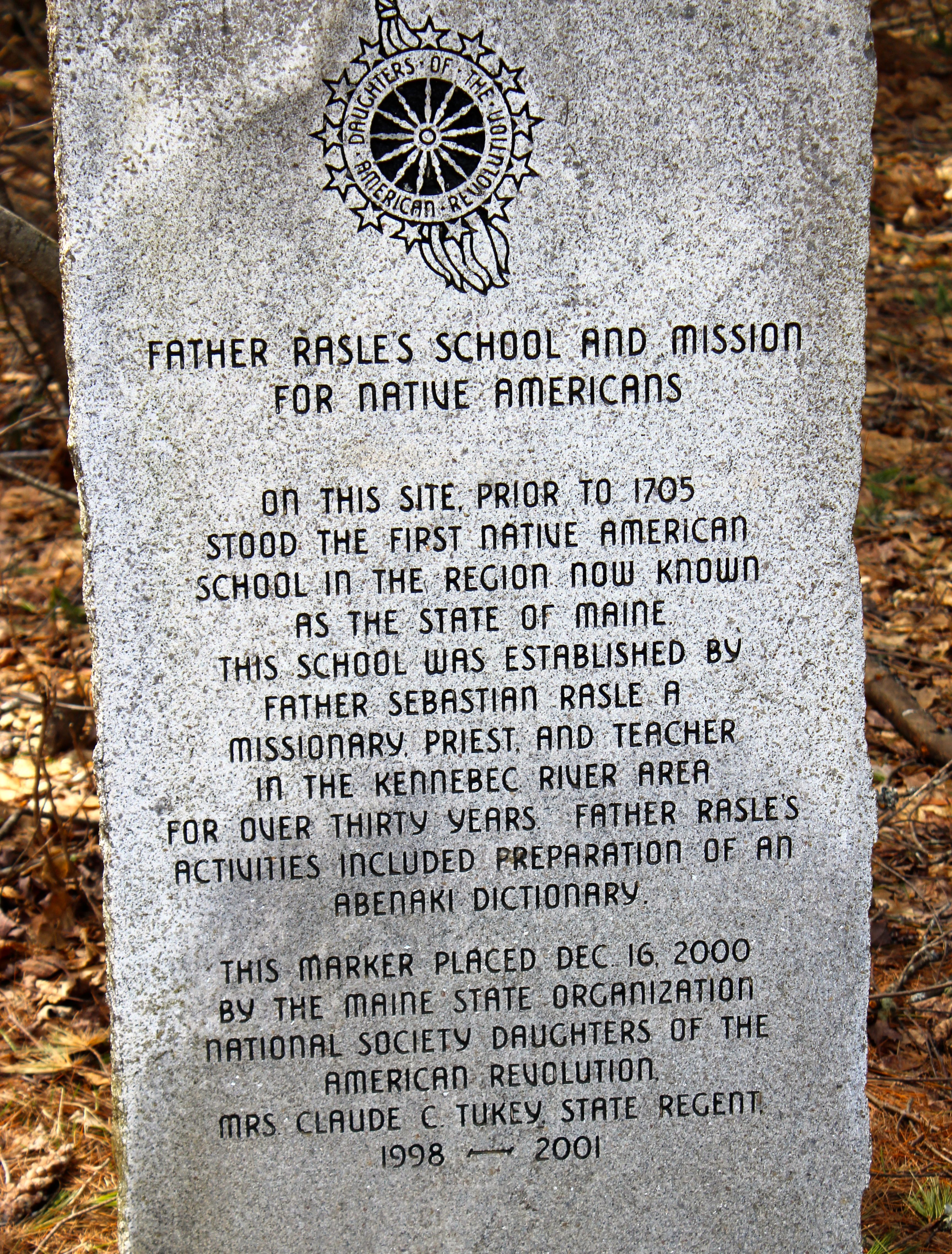
I was meeting K.D. because she’s working on her capstone project for the MMNP course. The focus, a trail that honors Father Rasle, a Jesuit missionary who lived among the Abenaki people and died there during an English raid. K.D.’s plan is to tie the historical aspect of the trail in with the natural world. I’m excited for her and can’t wait to see the final product. I just may have to return for her walk during Madison-Anson Days, but don’t tell her that.

Father R

This is the monument erected in 1833 on what is believed to be the site of the 1724 massacre.

Father R 2

Father Sebastian Rasle (there are several spellings of his name) lived here for 34 years. K.D. said that the western side of the river was the English side and the eastern side was the French side. I think I got that right.

Father R 3

During his tenure, Father Rasle taught the Abenakis and created a dictionary of their language.

start of Sandy River

Though we didn’t try to go down the steep embankment, in this photo is an island and here the Sandy River discharges into the Kennebec. It’s her understanding that the Abenaki people originally settled on the island, but moved to the eastern side, which in the end led to the demise of the reverend and some members of the tribe. Perhaps the vantage point wasn’t as good.

jelly ears

As we walked along, thinking about what had happened here, we also identified species. For K.D.’s project, she’ll stick to the Native American theme–how was it useful to them? I’m not sure about these Jelly Ear’s (Auricularia auricle), but they are a good find anyway–and we found plenty.

Rush

And then there was a large patch of Equisetum, the only descendant of ancient horsetail plants that grew during prehistoric times.

beaver work

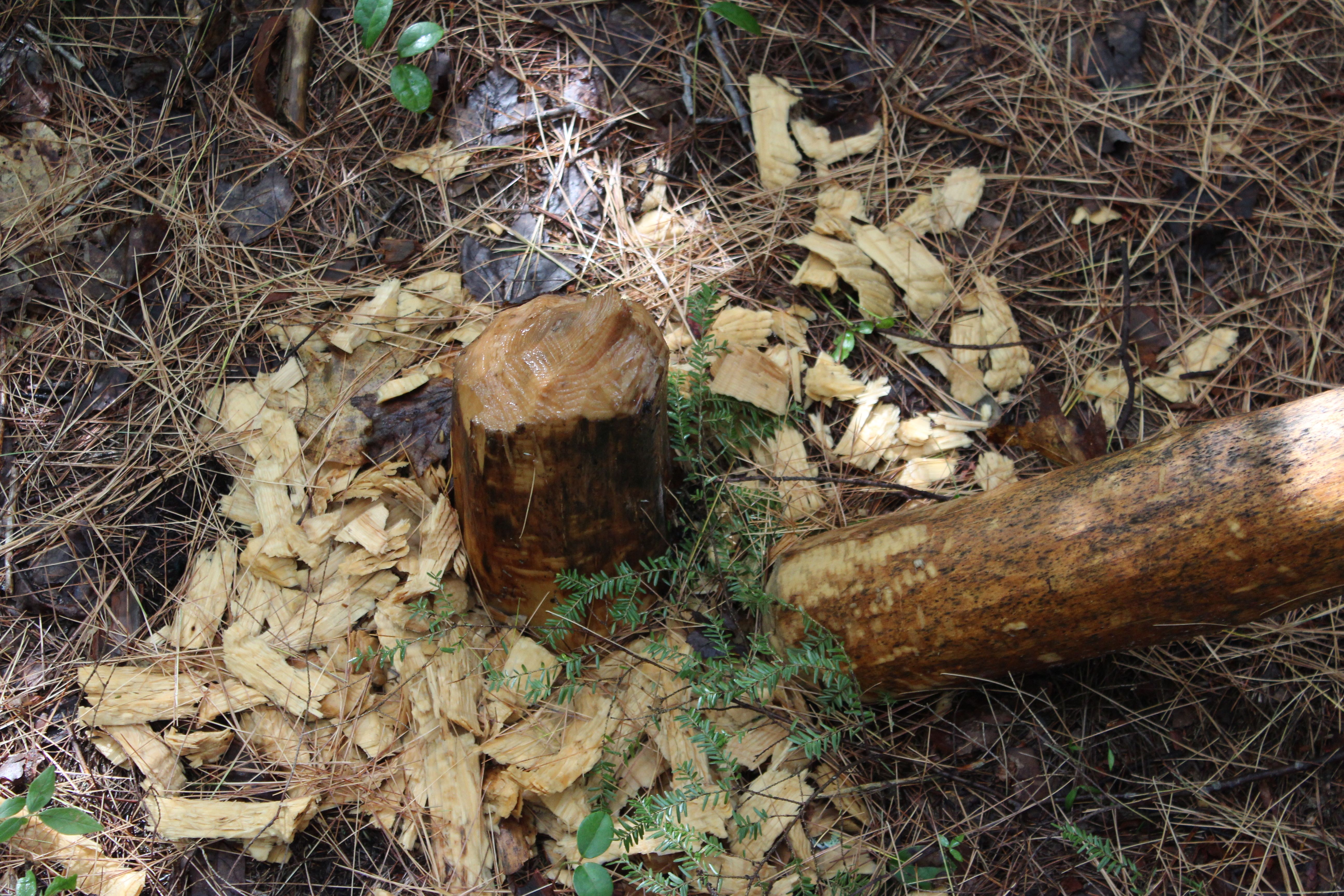
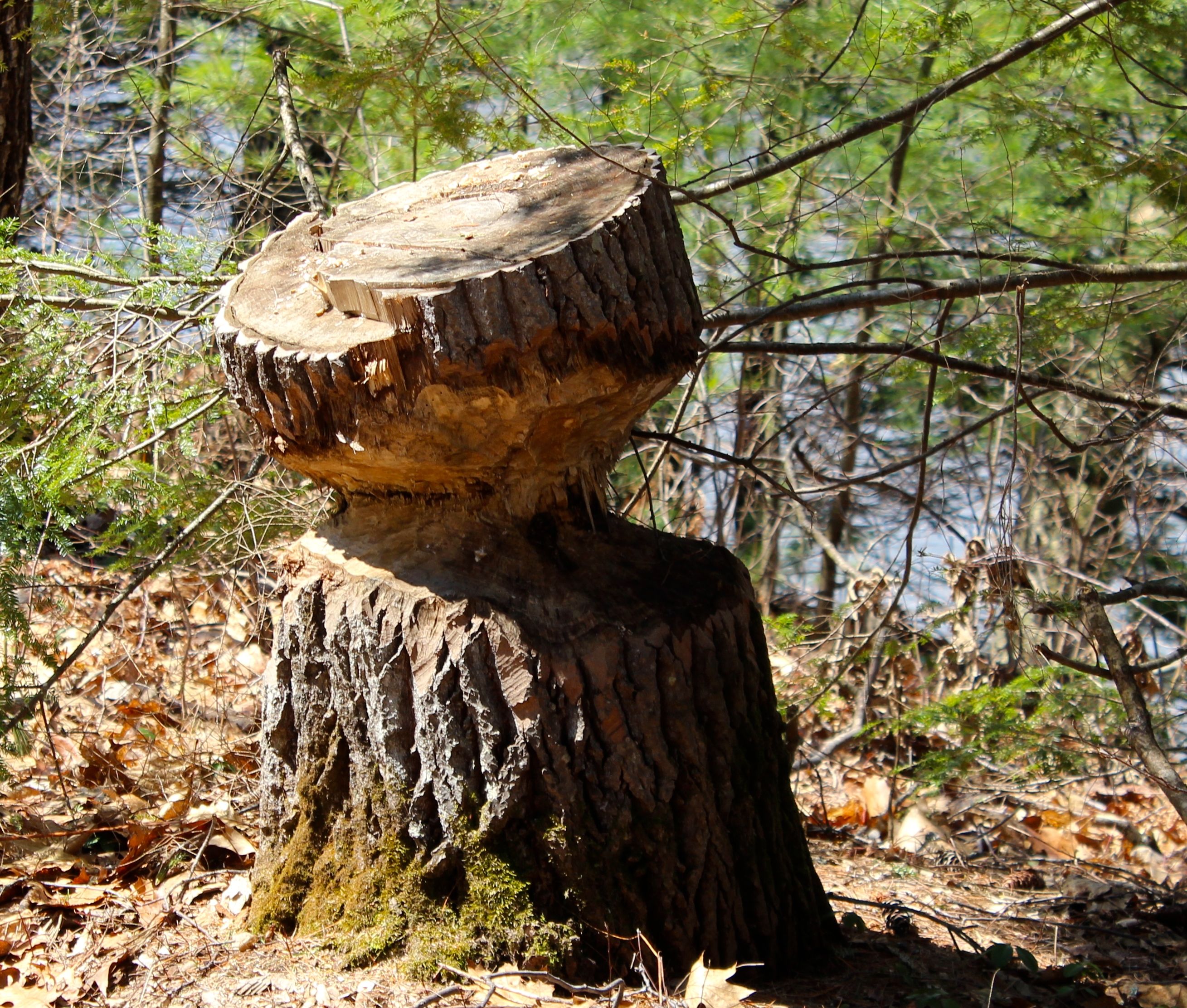
Occasionally, we saw evidence of beaver works. I’m glad that the person who cut this red oak left the chewed section as a monument to these industrious critters.

cellar home

A cellar hole is filled with snow and evergreen wood fern. As it turns out, K.D. believes this was the home of one of her husband’s ancestors. His family dates back three generations in the area.

Hermit thrush

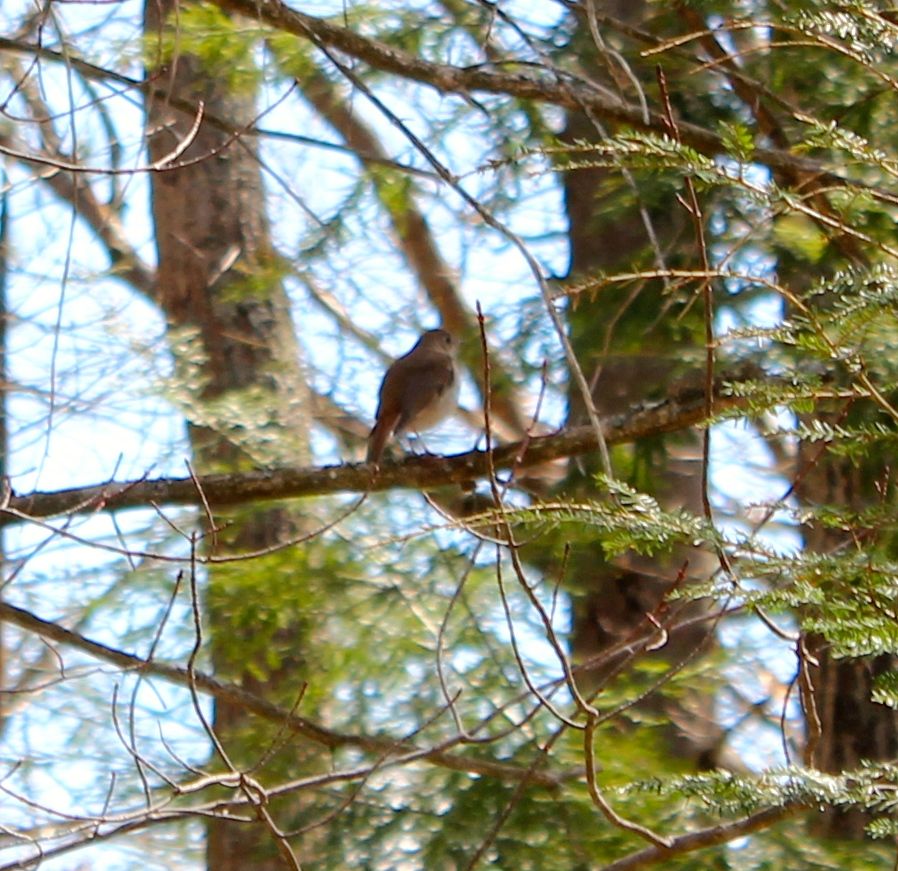
While my bird expertise ends at my backyard feeders that must come down soon, K.D. is an avid birder. With her, I saw my first ever Kinglets today. They are little round balls of action. Golden Eyes played on the river, Tree Swallows soared above and a Bald Eagle sat in a nest watching over all. In this photo–a Hermit Thrush. We watched it for a while and heard another singing nearby.

BL 1

And then we got stumped. Yup, more bark. We think we figured this one out, but if you know better, holler. Black Locust. The bark, light gray, deeply furrowed and intersecting.

 bl bark 3

The ridges are finely cracked. Now that the snow has melted, we looked for leaves on the ground because the branches were high above us. Below each tree, we found what we believed to be dried leaflets that were about two inches long and had entire margins. Again, if you know otherwise, holler.

bl

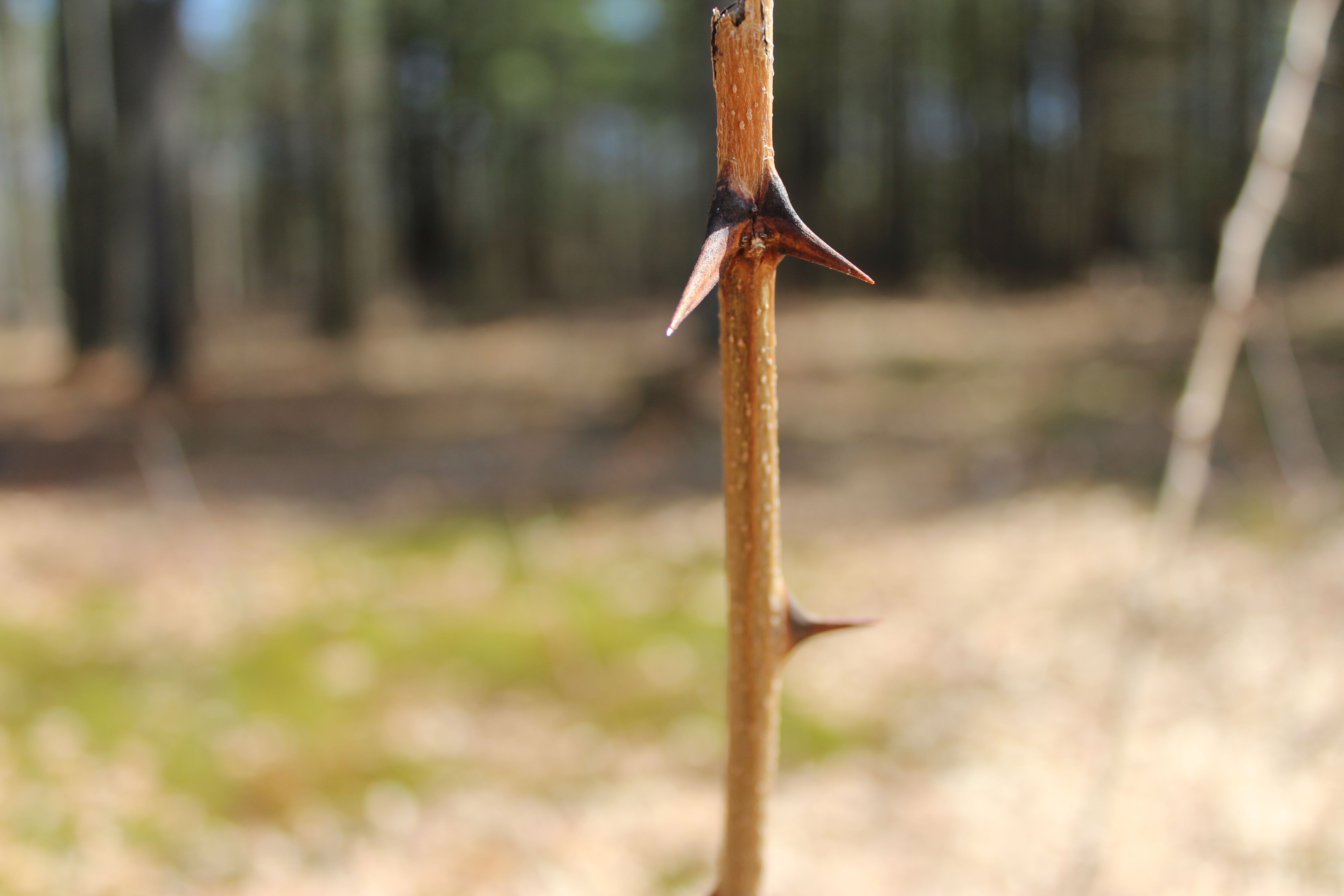
Curiously, we found these Black Locust saplings at a different site along the trail. Apparently, the thorns are found on the branches of young trees–a warning sign to animals. Ingenious.

After three hours (it seems like it always takes three hours), it was time for me to head southwest.

wood frog eggs

Once home, I couldn’t resist the urge to walk up to the vernal pool. The ice melted while we were away this weekend, and already there are wood frog egg sacs. I waited for some action, but between some rain drops and a breeze, they weren’t making themselves known.

red maple flowers

And the other moment I’ve been waiting for–Red Maples beginning to flower. Time to sketch asap.

John Muir quote

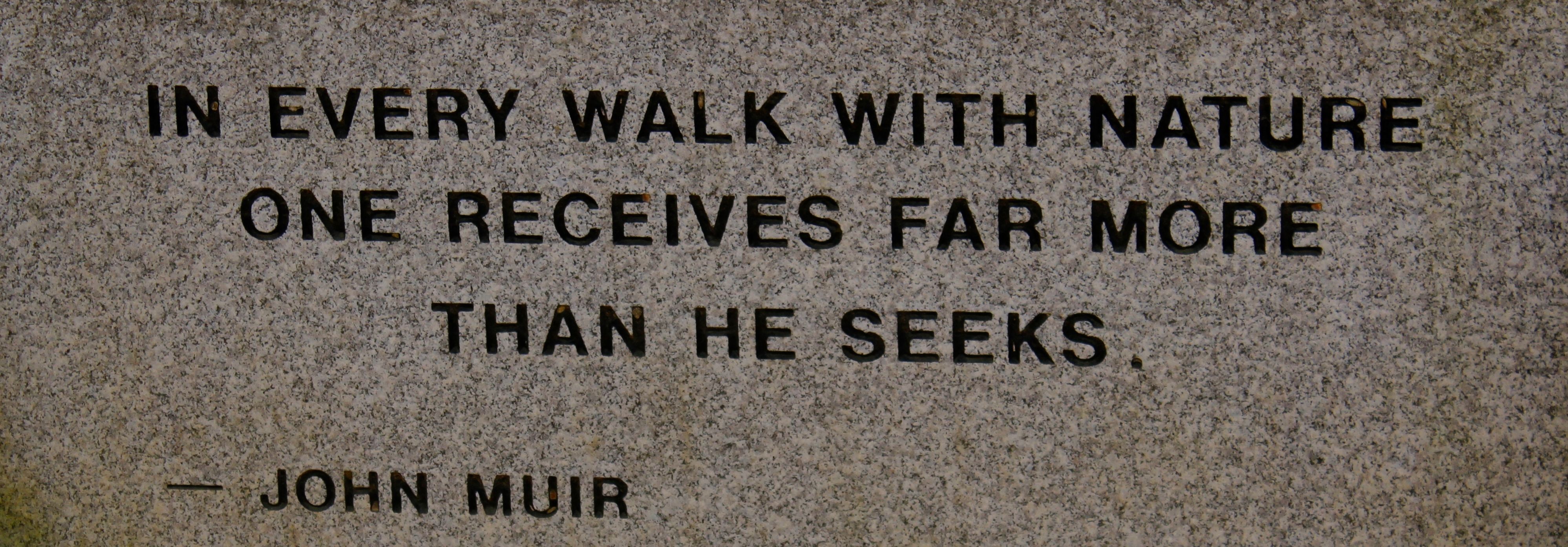
This sign was along the trail beside the Kennebec. I’m thankful for the opportunity to walk and wonder with nature today, to share it with K.D. Happy Earth Day!

Wetland Wonders

wetland 1

The Greater Lovell Land Trust’s Tuesday Tracking group returned to the wetland at the John A. Segur Wildlife Refuge today. It’s one of those places that I could spend hours upon hours exploring and still only see a smidgeon of what is there. I’m overwhelmed when I walk into a store filled with stuff, but completely at home in a place like this where life and death happen and the “merchandise” changes daily.

insect

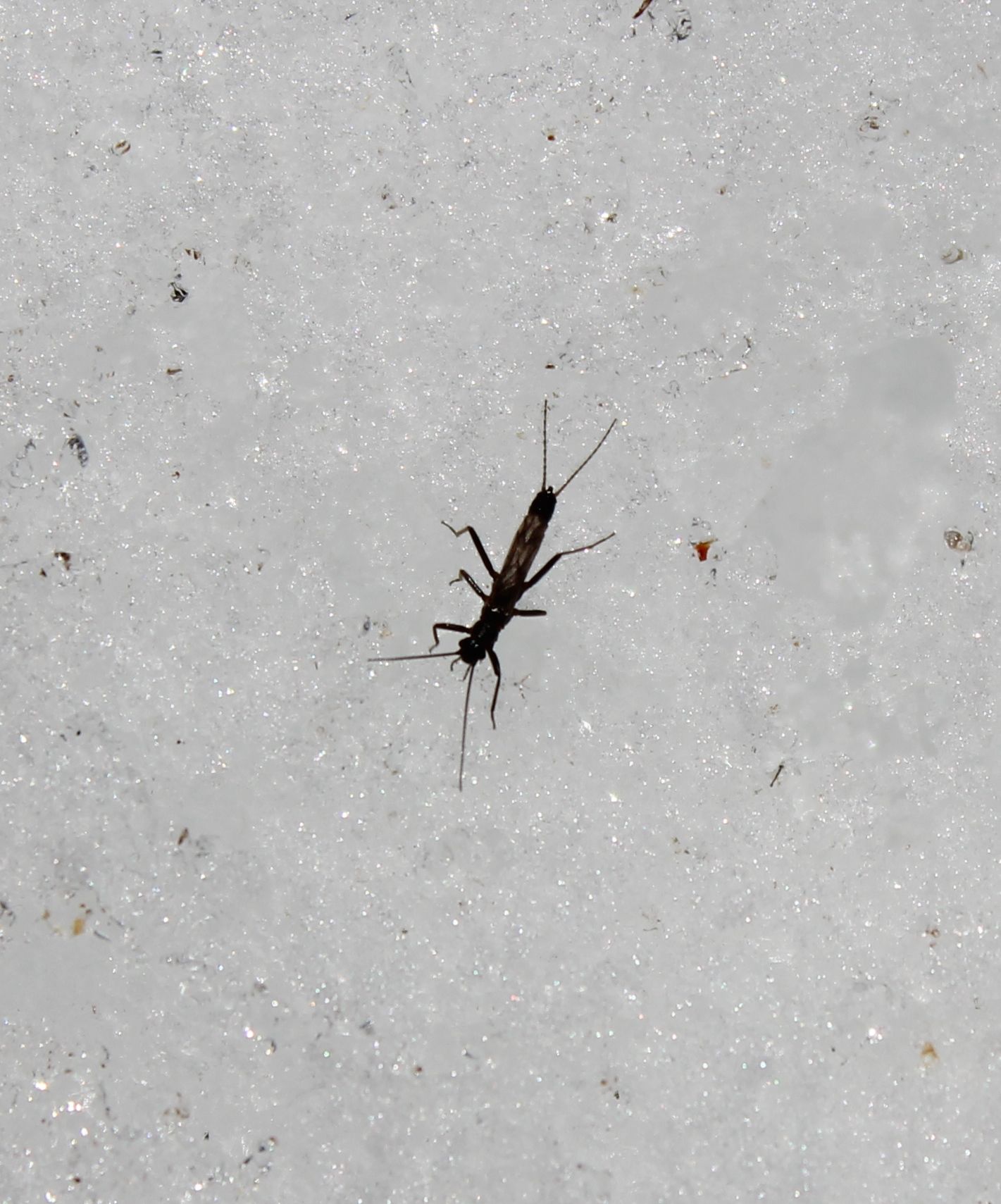
Walking across the snow was this small insect. So . . . we were in a wetland. Tomorrow will be April 1–no kidding. The insect is about an inch long. It has long antennae and a pair of cerci or appendages at the posterior end of its abdomen. I’d say we found a common stonefly nymph. Please correct me if I’m wrong.

artists 1

On first glimpse, this may look like a pile of dried grasses and twigs.

artists's conk?

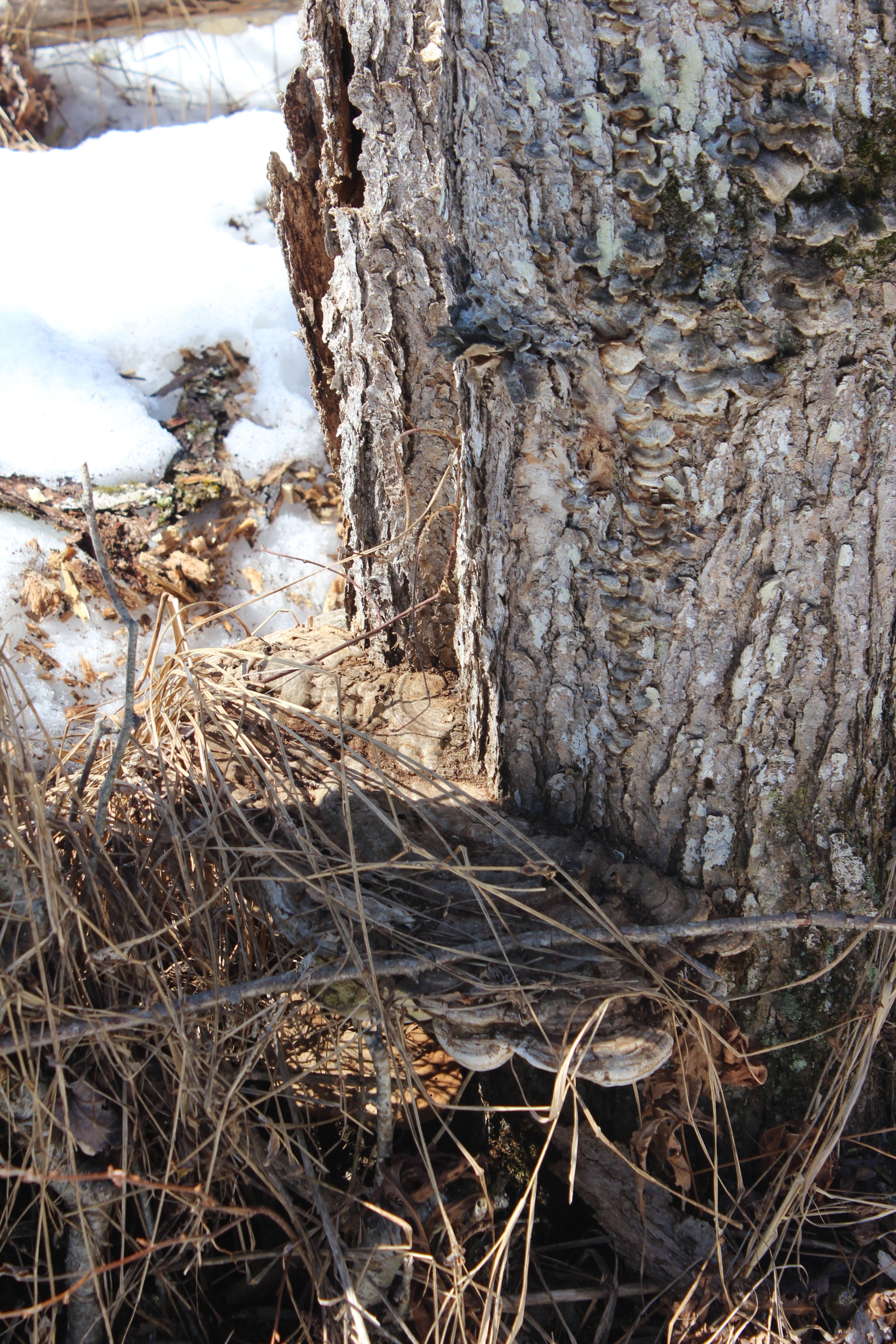
But stepping in for a closer look reveals what I believe is an artist’s conk. An old artist’s conk. We didn’t cut it off, but apparently you can age one by cutting it and counting the layers–much the same way you can age a tree by counting the number of rings.

old beaver lodge

There’s evidence of beaver work throughout the sanctuary, but none of it is recent. So . . . my friend decided to play Queen of the Lodge.

dam crossing

We crossed Boulder Brook via an old beaver dam–one-by-one in the name of caution.

lobster lichenlobster 3

 Color draws us in for closer inspection. I’m betting on Cinnabar-red Polypore (Pycnoporus cinnabarinus) as this one’s ID. If I learn otherwise, I’ll let you know.

lungwort

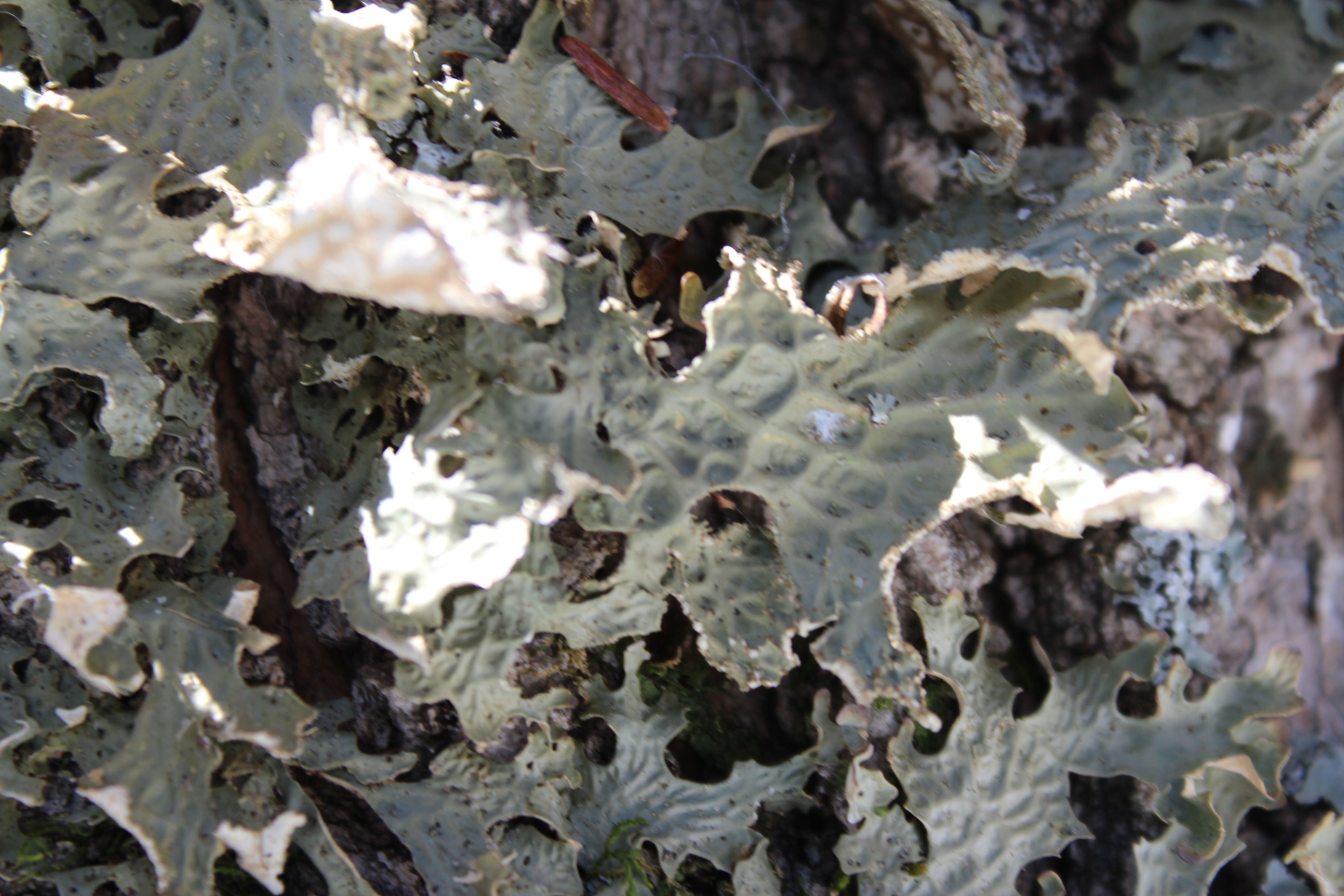
Remember this lungwort I shared last week in my Island Hopping blog?

Lungwort

Same species. Same tree. Nature–worth wondering about.

myatery 1

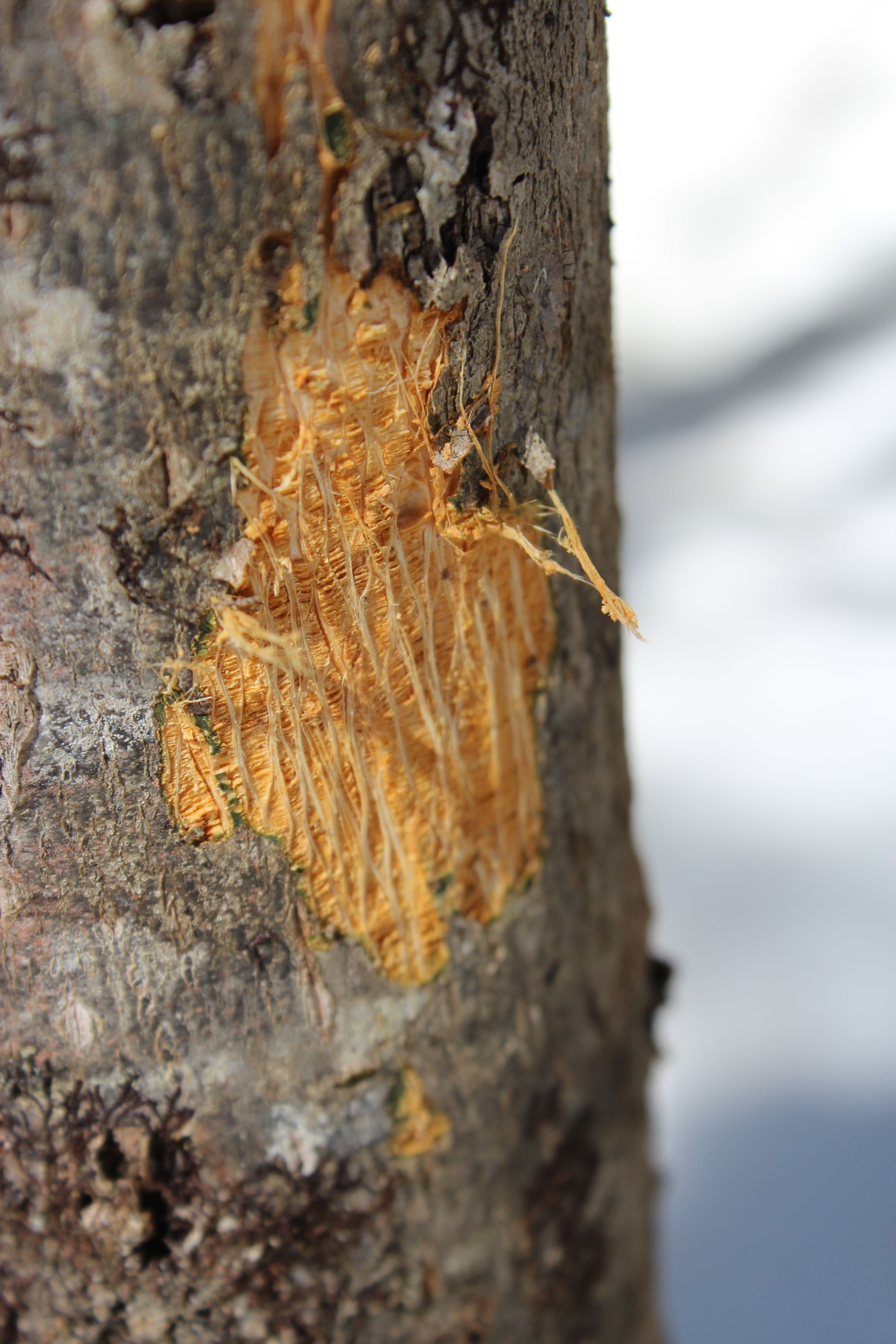
Then there was the mysterious event.

mystery 3

Very fine tags dangle from the upper edge of the scraped bark. Not the work of a deer, beaver or porcupine. Not a hare or little brown thing. Maybe a bird? No holes, just the fine layer of outer bark delicately scraped off.

deer scrape

Here’s a deer scrape as a contrast.

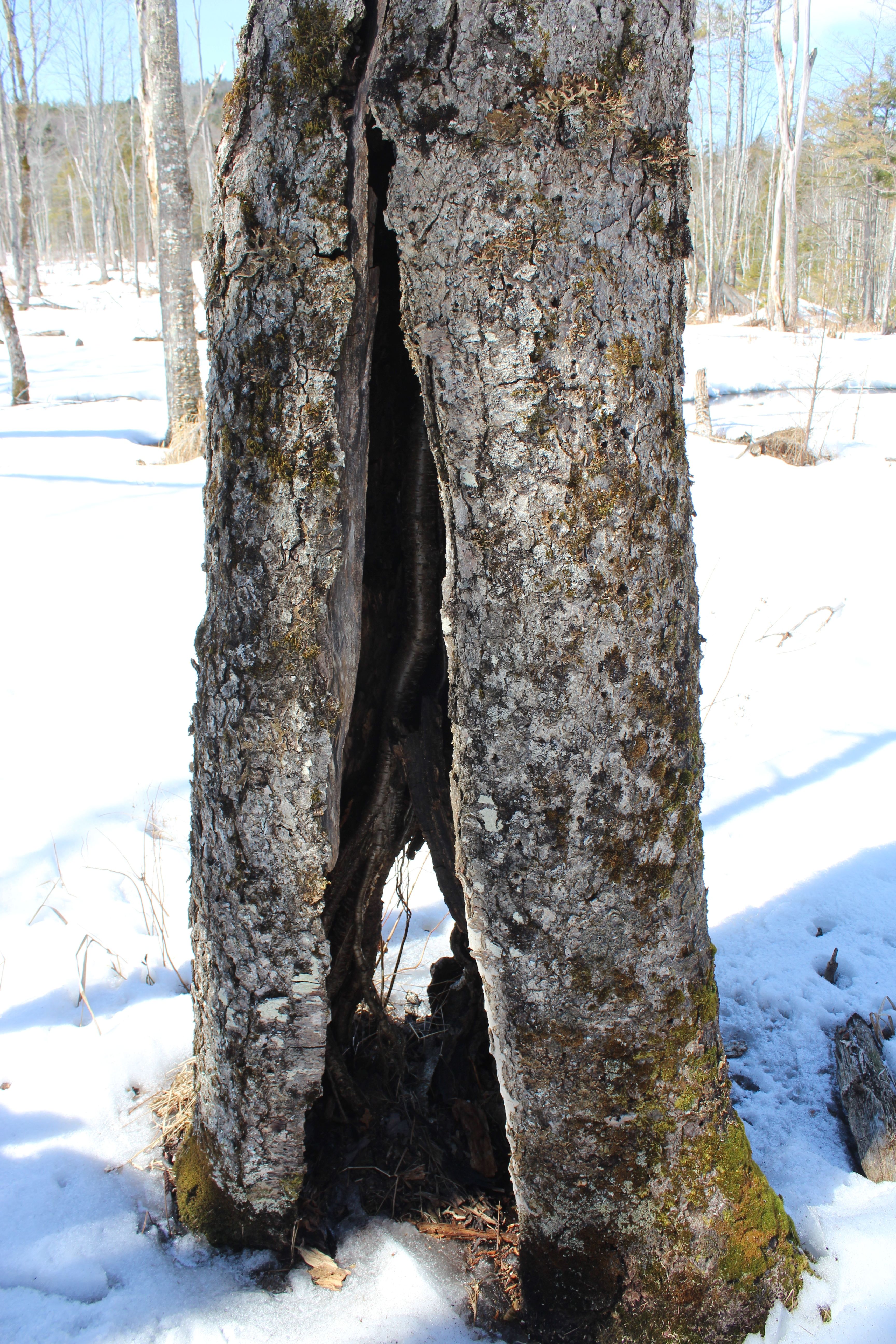
tree within tree

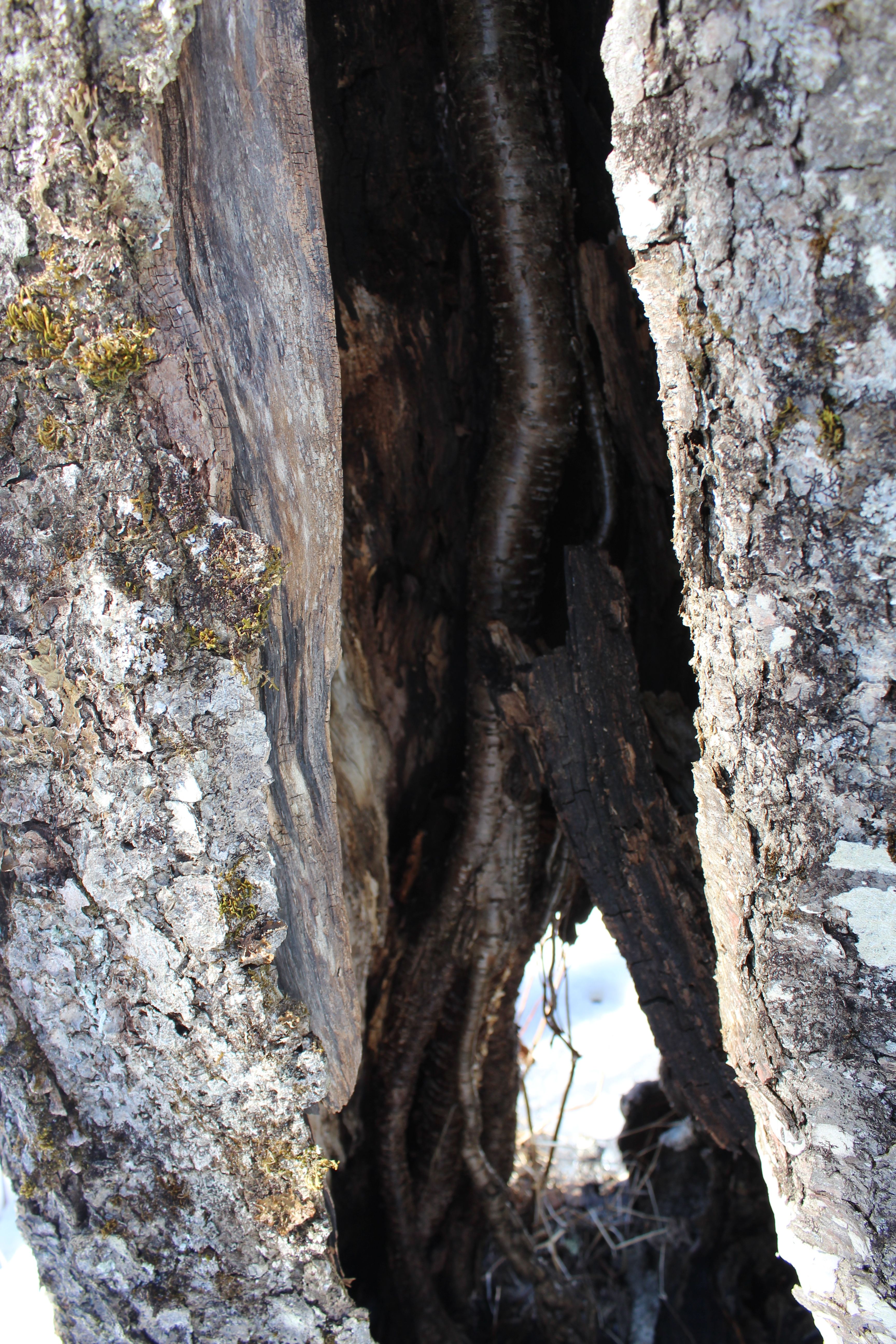
For this next wonder, you’ll have to look closely inside the hollow yellow birch. Peer to the left of the hole toward the rear. Think vertical.

tree 2

Do you see it? It’s in the center of this photo.

tree 3

And here it is further up in the hollowed out tree. A tree within a tree. Another yellow birch or birch root growing up through the center of this dead snag. Life and death. Together. One within the other.

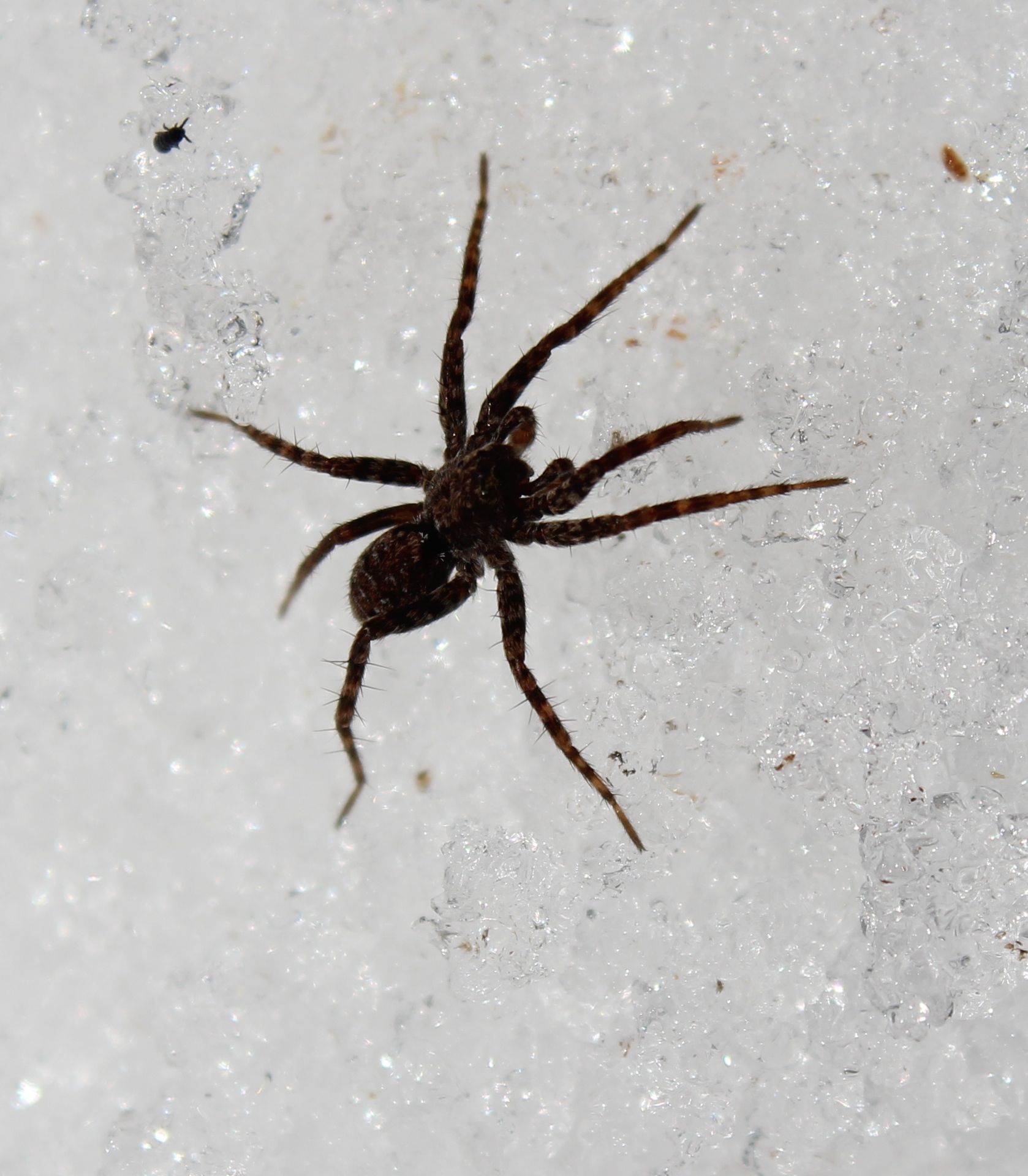
spider

This guy was dashing across the snow, but had the decency to pose for a photo op. Given that he wasn’t wearing boots, I don’t blame him for running along.

crossing dam again

And suddenly, we realized we’d spent over three hours exploring and it was time to head back over the beaver dam.

white pine

On the trail again, we paused to admire spring growth on a small white pine–a mini candelabra.

Thanks for wandering along and wondering my way.

Our Three Hour Tour

HP sign

One of our favorite places in town is a hidden gem–Holt Pond Preserve. We parked at the corner of Chaplin’s Mill and Grist Mill Roads, grabbed our snowshoes and backpack from the truck and walked on snowmobile tracks across the field to begin today’s Mondate.

Tingley Brook

Tingley Brook

At the field’s edge, we passed under the hemlocks, beeches and oaks and into the wild and delicate beauty that the preserve offers.

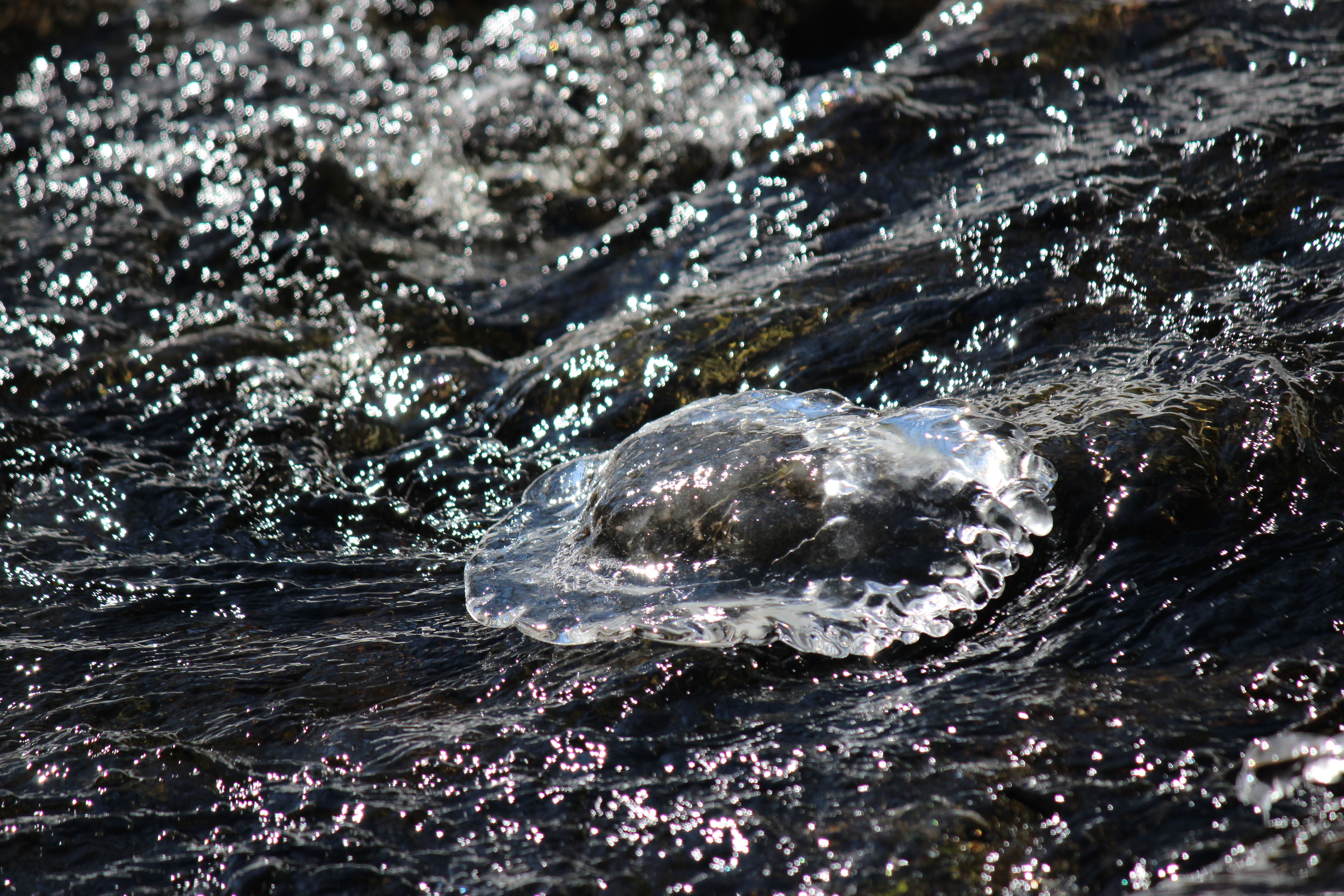
Tingley Brook ice 1

The midmorning light added subtle hints of aqua and pink as the water danced around an ice-capped rock in the brook.

mushrooms and hole

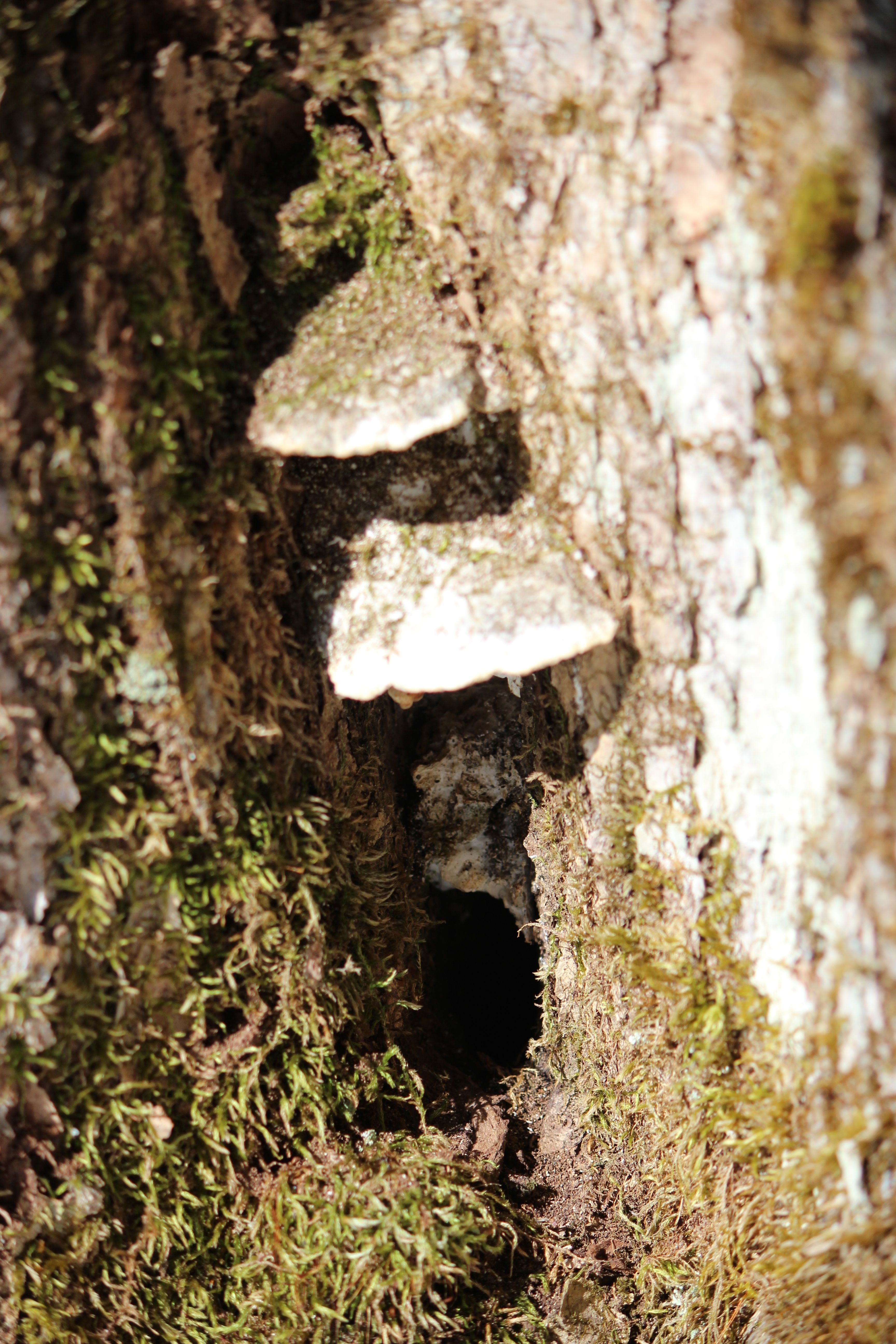
We saw lots of tracks from the mustelid family, as well as snowshoe hare, fox, squirrels, mice and voles. Also, turkeys and grouse. I’m not sure what made the hole and dirt trail beneath the mossy maple mushrooms near the base of this Red Maple. I would not have seen it if I hadn’t leaned in closer to take a photo. I do happen to know that gnomes frequent the area, so just maybe . . .

canoes

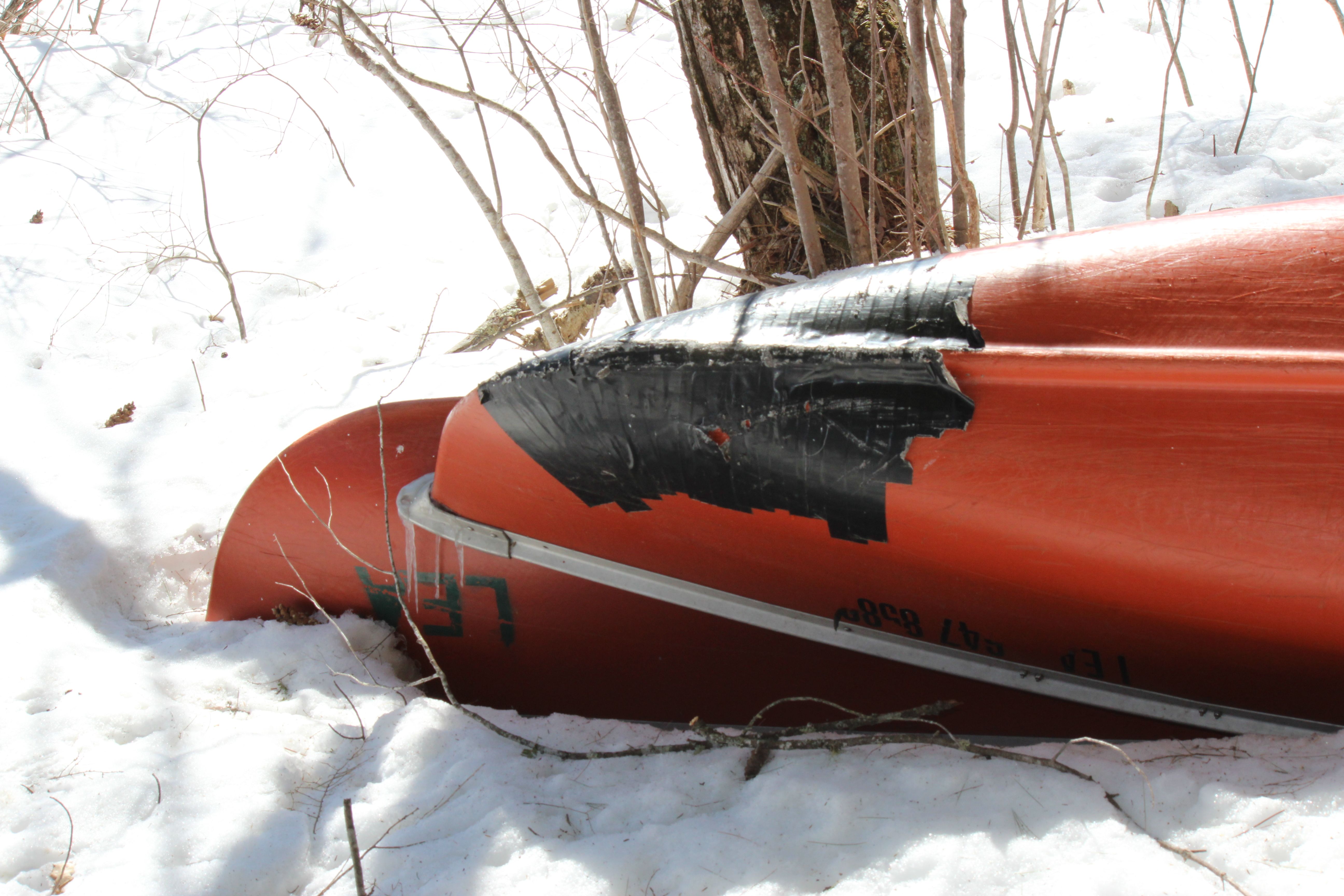
We continued on, crossing Tingley Brook and then making our way beside Muddy River, where the Lakes Environmental Association (LEA) leaves these canoes for anyone to use. Bring your own personal floatation device, paddles, and duct tape. I know where you can purchase duct tape, should you need more. :-)

beaked hazelnut

Near the canoes–a lone beaked hazelnut. Inside this bristly tan husk is an edible nut. Doesn’t it look like a gourd? The name derives from that tube-like protruding beak. I couldn’t believe it was still there as the protein-rich nuts are favorites for red squirrels and chipmunks, as well as ruffed grouse, woodpeckers and blue jays. Humans too.

to Muddy River

We never actually wore our snowshoes today. I hauled mine around on my pole, while my guy stuck his between his jacket and sweatshirt. He said he didn’t need his back scratched for the entire trip.

River to pond

Looking toward Holt Pond from the boardwalk by the Muddy River.

There was only a slight breeze, so the low temp was modified by the brilliant sunshine. Another beautiful day in Maine.

Red Maple Swamp

I think one of my favorite features about the preserve is that the habitat keeps changing–from hemlock groves to red maple swamps to alder thickets to a quaking bog.

Quaking Bog

Though you can’t tell in the winter, the quaking bog is a thick mat of vegetation that formed over the surface near the edge of the pond. A board walk passes across it and one of the fun things to do with a group of people is to have everyone jump at the same time and watch the bog quake. This is also a great spot to visit alone–for quiet reflection.

Holt Pond 1HP South

Views at the pond’s edge–north and south

HP from southwest

We stopped at a rock in a sunny spot along the South Shore Trail to enjoy lunch al fresco. PB&J never tasted so good. Topped off with ice cold water and some Ghirardelli chocolates. :-) As we continued along, we paused to look back across the pond toward the Quaking Bog.

Sometimes we chatted and other times we were each lost in our own thoughts and moving at our individual paces. Similar to my NDD (Nature Distraction Disorder), my guy has his own syndrome–Destinationitis. But, he’s learned to compensate by pausing until I catch up . . . and then he’s off again. That’s OK–it gives me time to spend in my own world.

feathers one

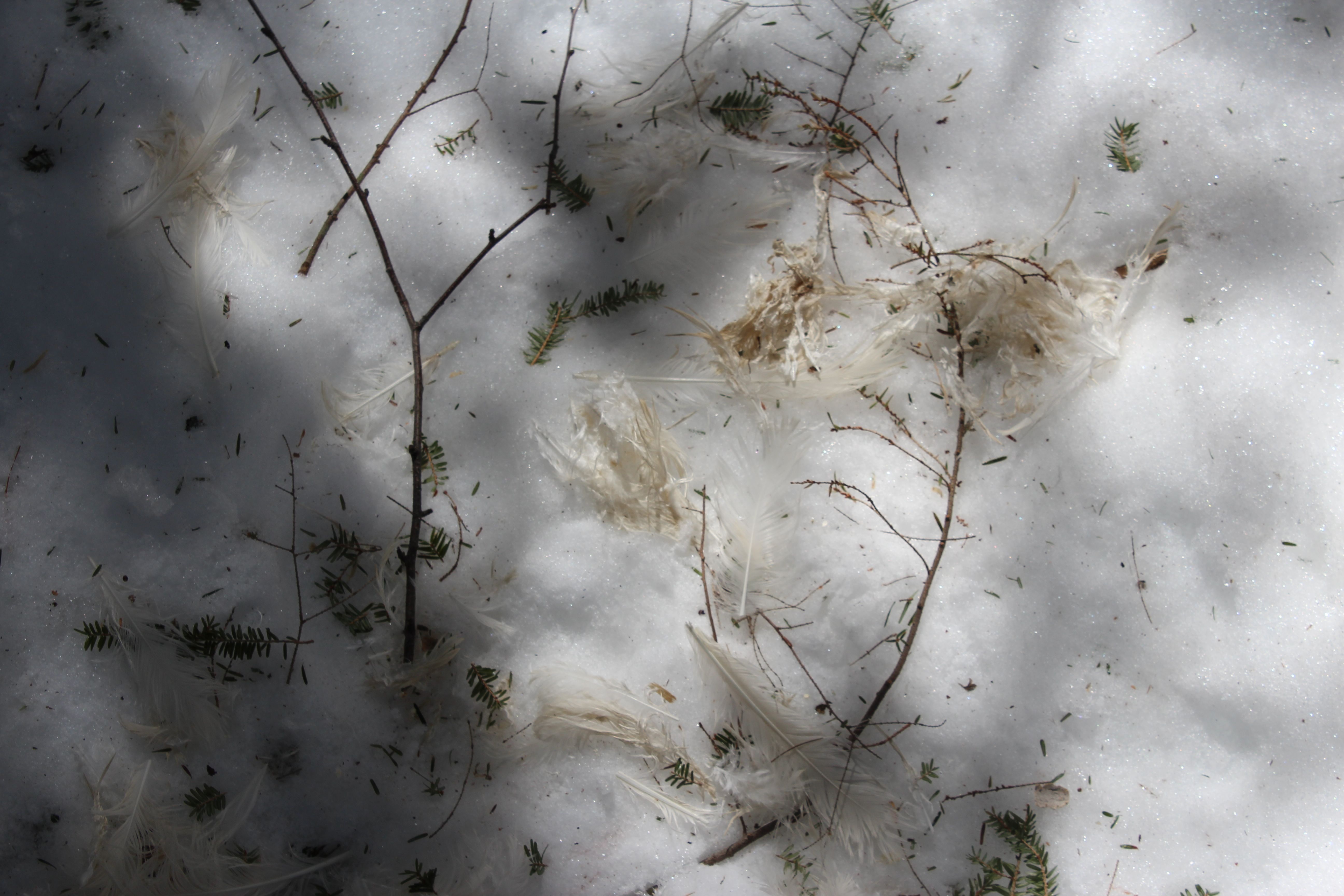
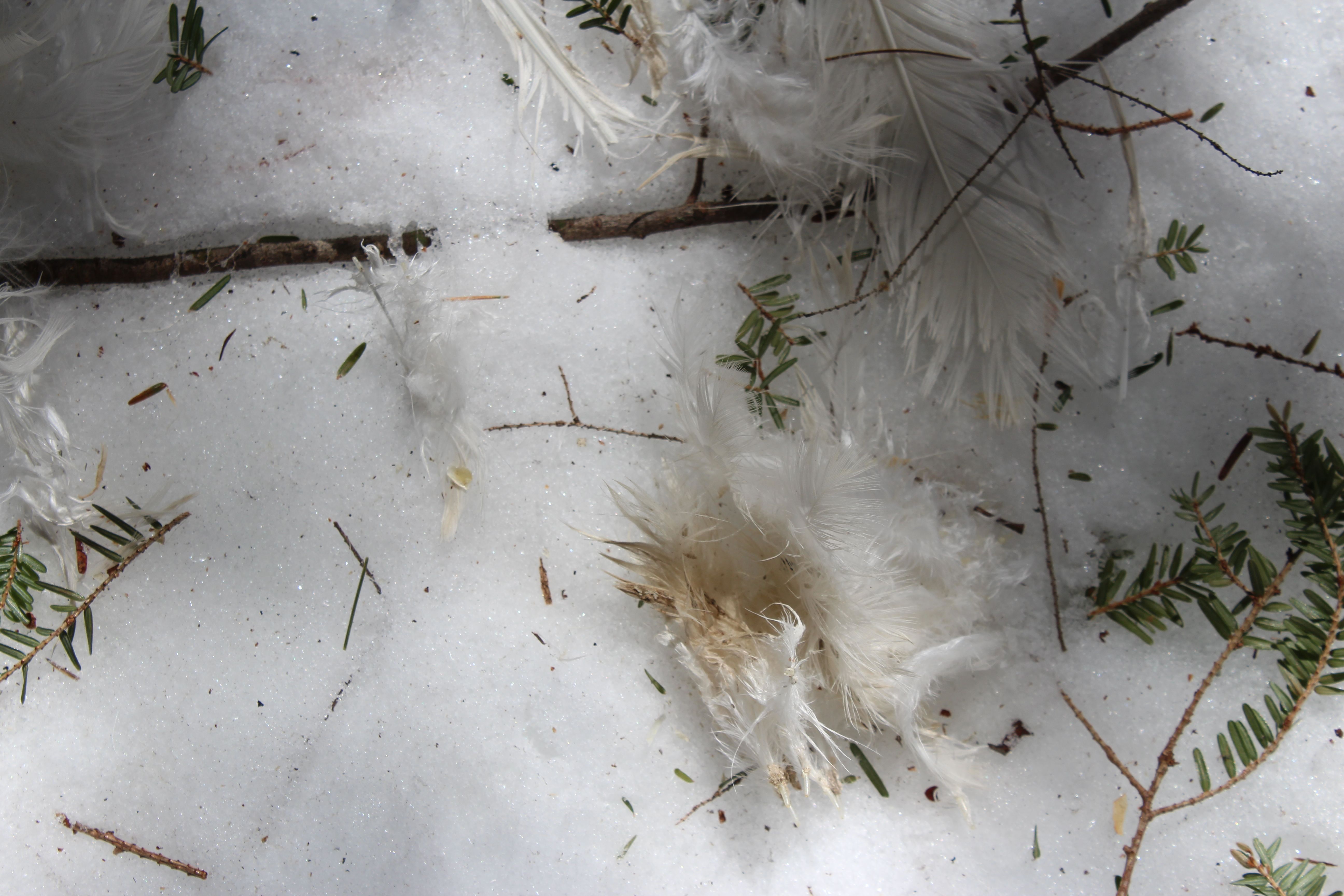
At the edge of a field (we know it as “The Field” because it’s the end of a section of trail that we keep maintained for LEA), we both stopped to look and wonder. Under a hemlock tree and in the middle of the trail, we found these white feathers. Don’t you just love a mystery?

feathers 2

Here’s another look. Some had sheer cuts; others looked plucked. No great place to hang out above. If you know what bird this was or what happened here, please enlighten me.

horse

At least five miles later, we were back on Chaplin’s Mill Road headed toward the truck.

Thanks for stopping by again to wonder my way. I hope you enjoyed the three hour tour.

Sightings Along the Snowmobile Trail

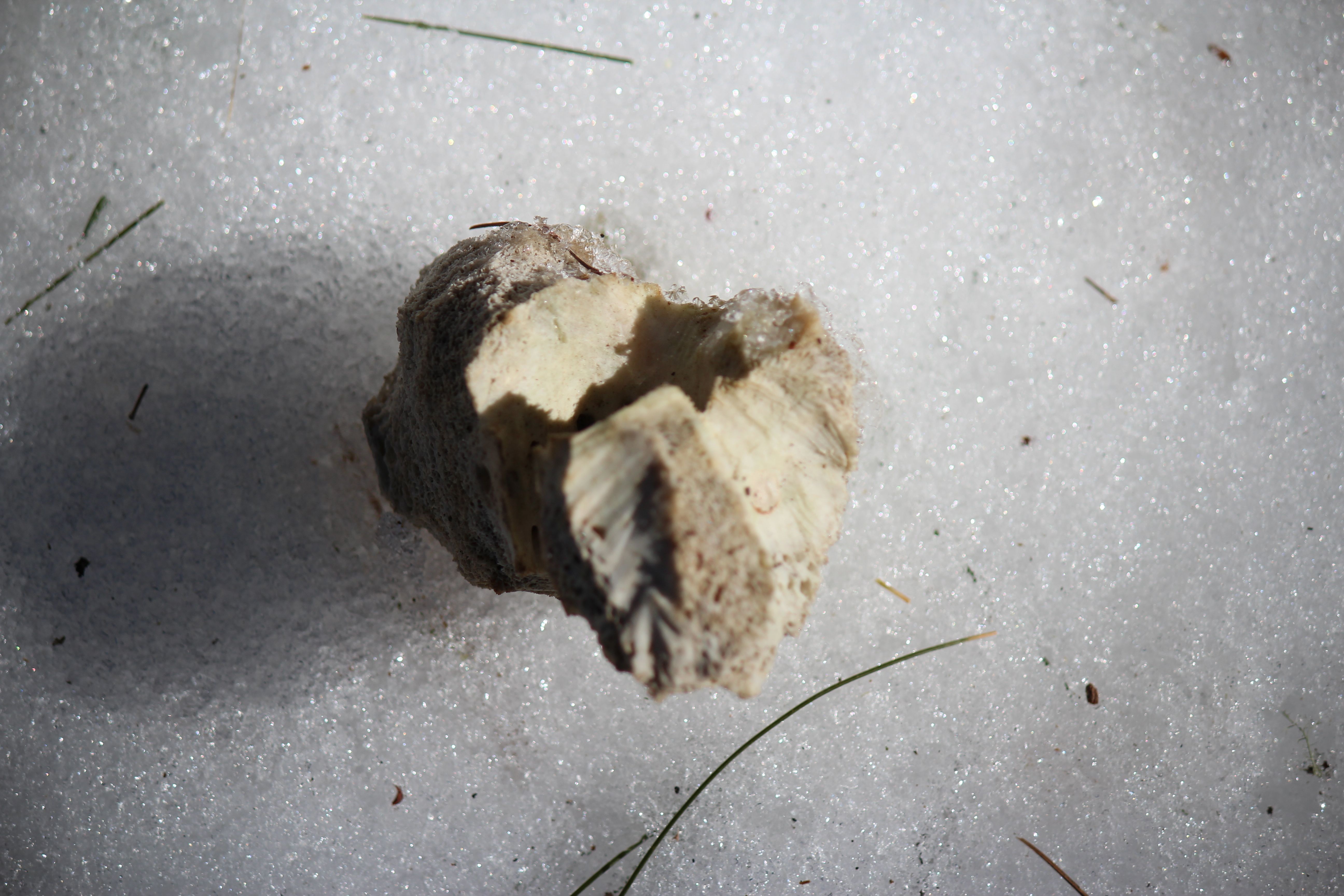
bone mystery

Today’s walk began with a mystery. I actually first saw this about a week ago and wondered about it, but then it slipped my mind–a bone found at the base of a pine tree along one of the trails in our woodlot. A vertebrae? Deer? Or something from the meat market? Our neighbors’ dogs have surprised us before, but I didn’t see any sign of their tracks near this. Maybe it had been under the snow for a while and they left it months ago?

chew marks

Whatever it is and however it got there, it’s providing calcium to little brown things.

tipsy pole

We decided to head north along the snowmobile trail. It follows the power line and is a major thoroughfare in this section. Some of the poles are a bit tipsy. Too much to drink? We know from experience that they have wet feet.

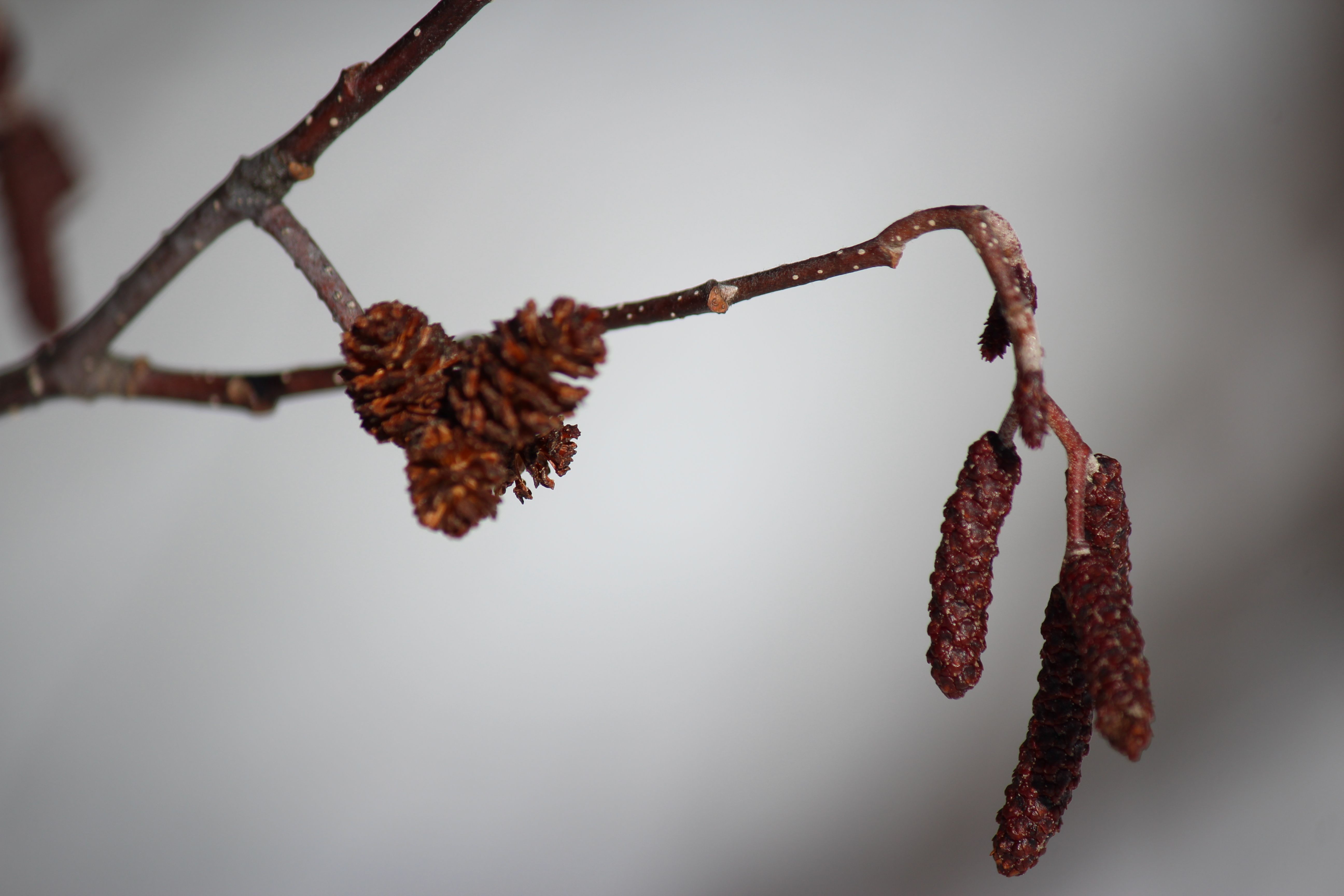
alder

Speckled Alder love the wet soil and are prolific along this section of the power line. Today, their burgundy brown catkins were aglow in the late afternoon sun. The longer male catkins form in the fall. The females, which are much smaller and closer to the trunk, develop into dark brown cones. Alders are pioneers, meaning they’re usually the first species in the transition of cleared land back to forest. I’m trying to learn the differences of catkins among tree species so please hang in there with me (pun intended).

gray birch catkins

I couldn’t reach to get a better look even though the trees were arched over the trail, but these are the male catkins of Gray Birch  (Betula populifolia), dangling near the tips of the twigs. While the males can grow to about three inches long, the erect female catkins will be found among the new leaves and are only about 1/3-inch long.

paper birch catkins

Like the Gray Birch, the Paper Birch (Betula papyrifera), develops catkins in the fall, which remain dormant over the winter. As the leaves develop, they’ll mature. The male catkins seen here are in the typical arrangement of groups of three that droop from the tip of the twigs.

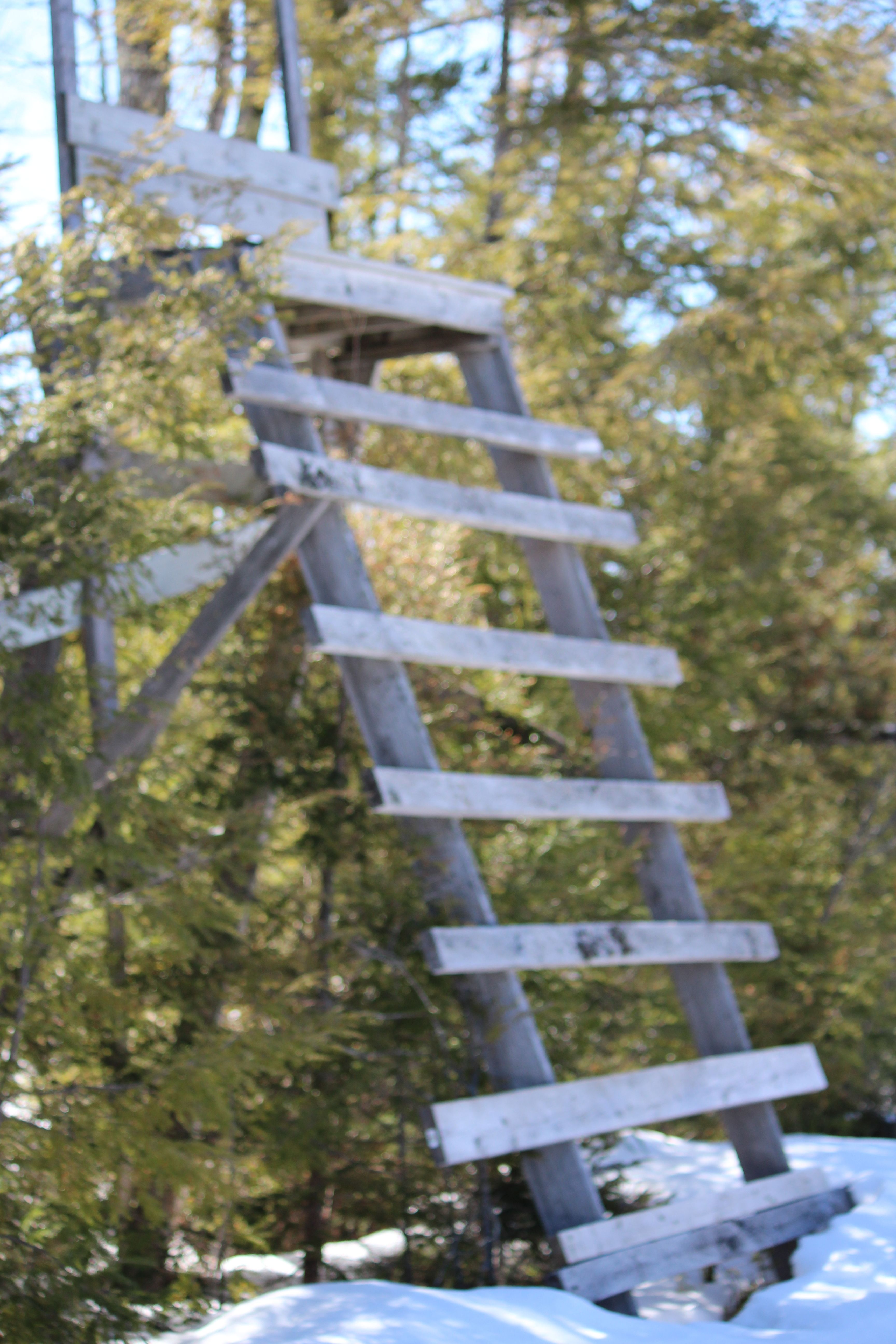
deer stand

There were other things to see along the way, like this deer stand that has been beside the trail for as long as we’ve lived here. I assume it’s still used because it’s in good shape.

To me, it looks like a lifeguard chair. That reminds me–today was definitely not a beach day. Sunny, but still blustery and cold. Nothing some hot cocoa with Peppermint Schnapps couldn’t cure after our walk.

teaberry

As the snow melts along the trail, more and more wintergreen appears. For the most part, the leaves are still showing their fall foliage red, but some greening is taking place. And I saw very few berries so I have to assume that they provided sustenance to the grouse, squirrels and deer that share this space.

flower pot

One of my favorite finds today was nature’s flower pot.

And I’ve been looking for signs of moose in the area all winter. I usually find their tracks, scat and beds somewhere around here. We’ve had the joy of seeing them from our kitchen window during different seasons. But it’s been a while. Finally, today . . .

moosr

atop a barn where the trail intersects a road.

Thanks for wondering my way once again.

Frozen Focus

Beech

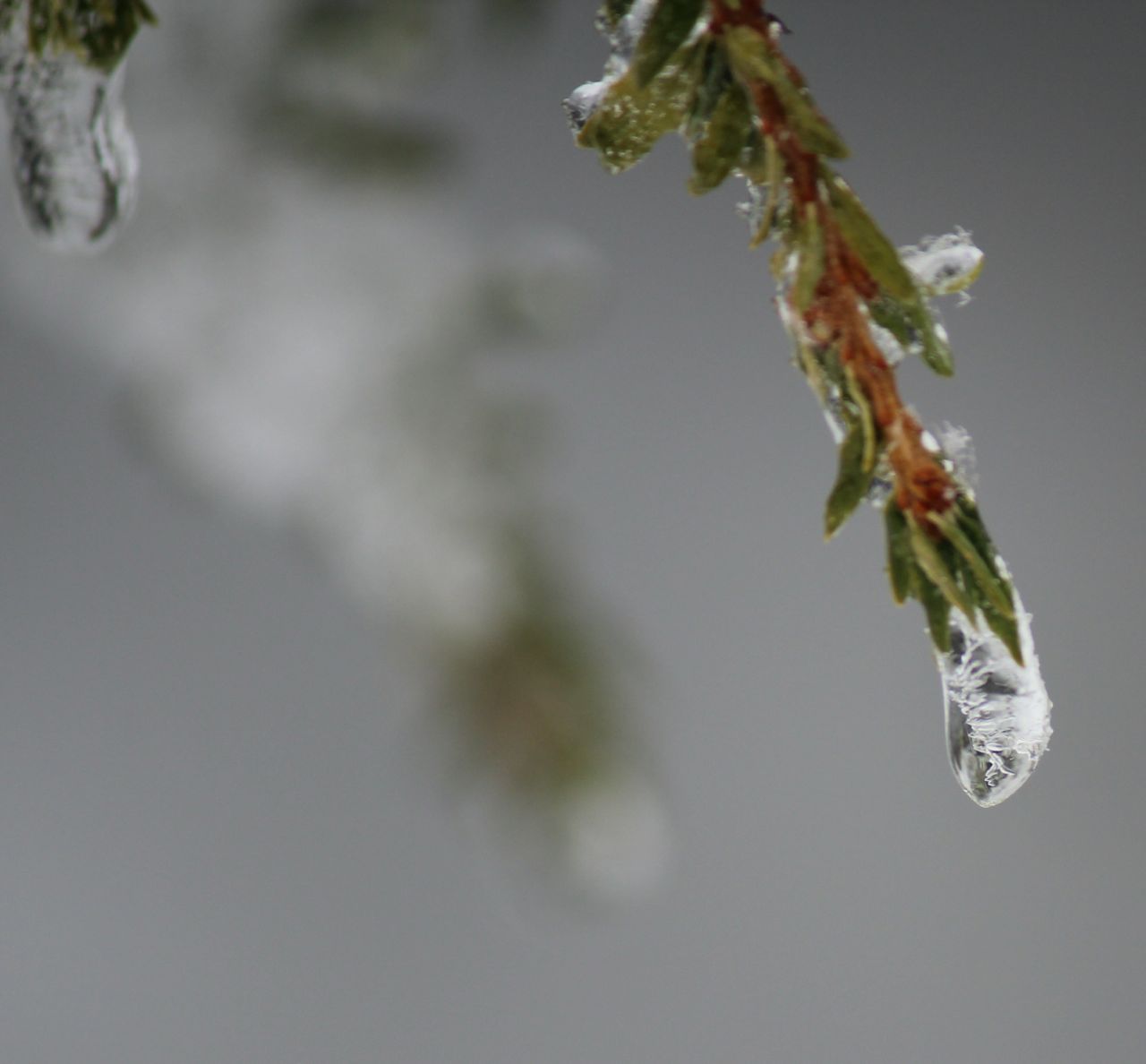
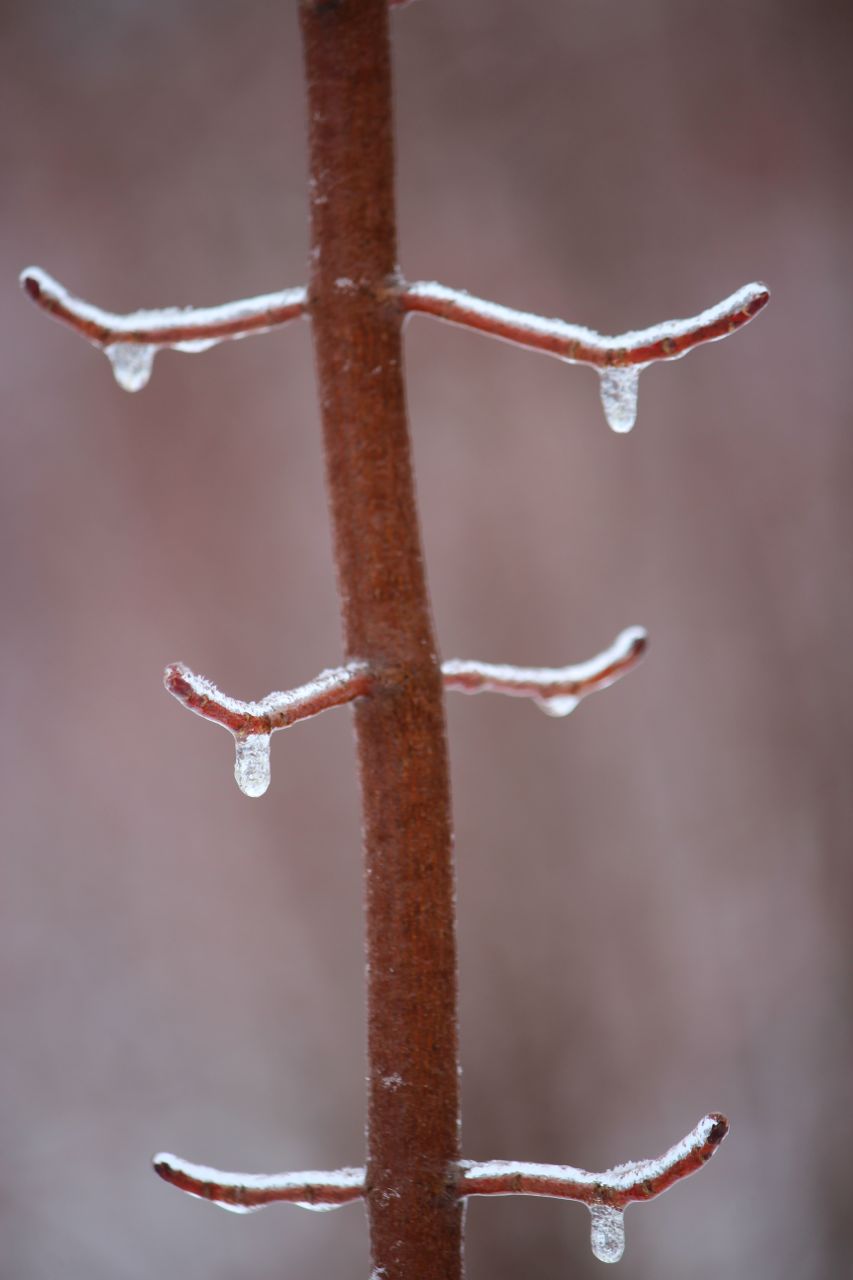
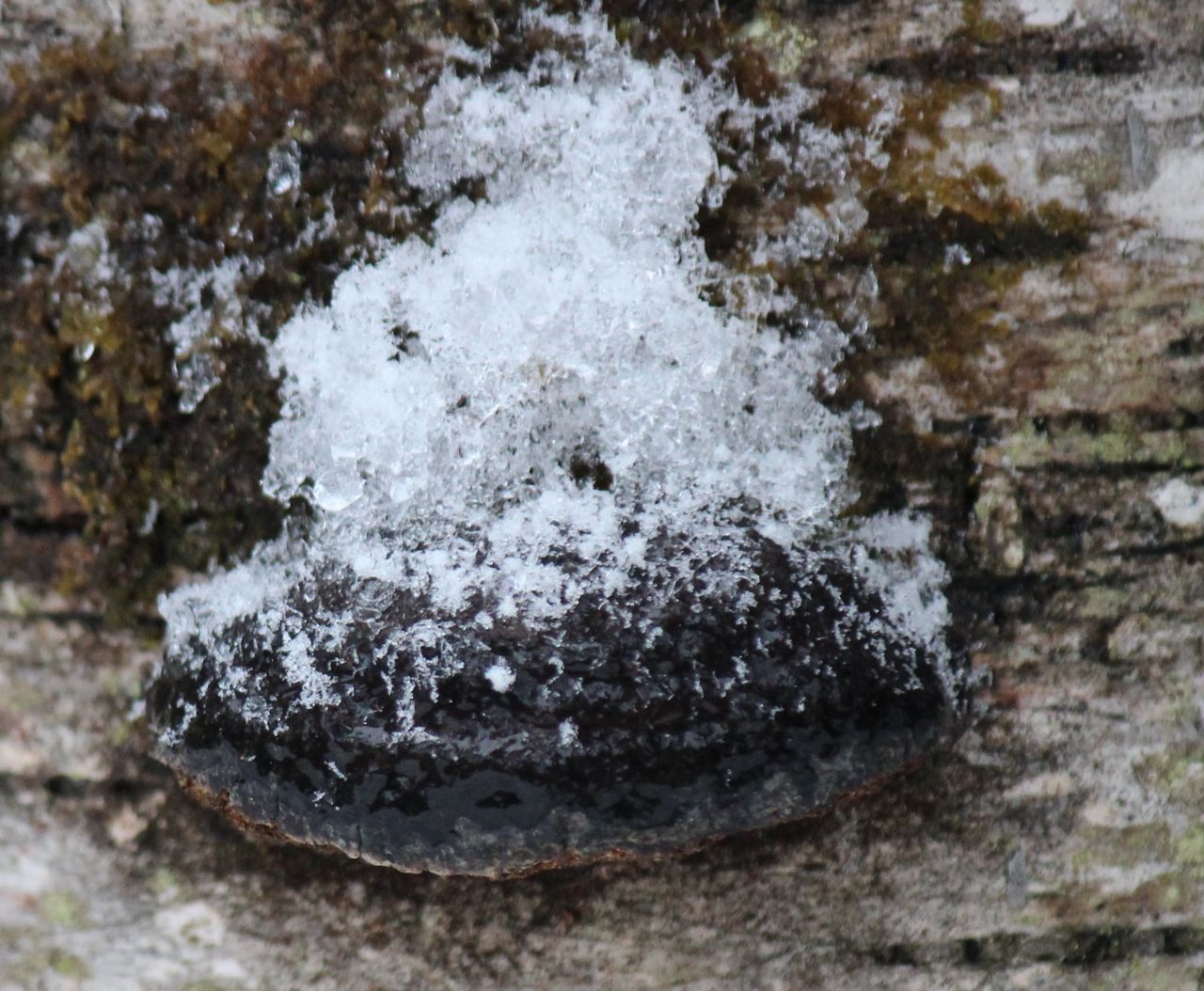
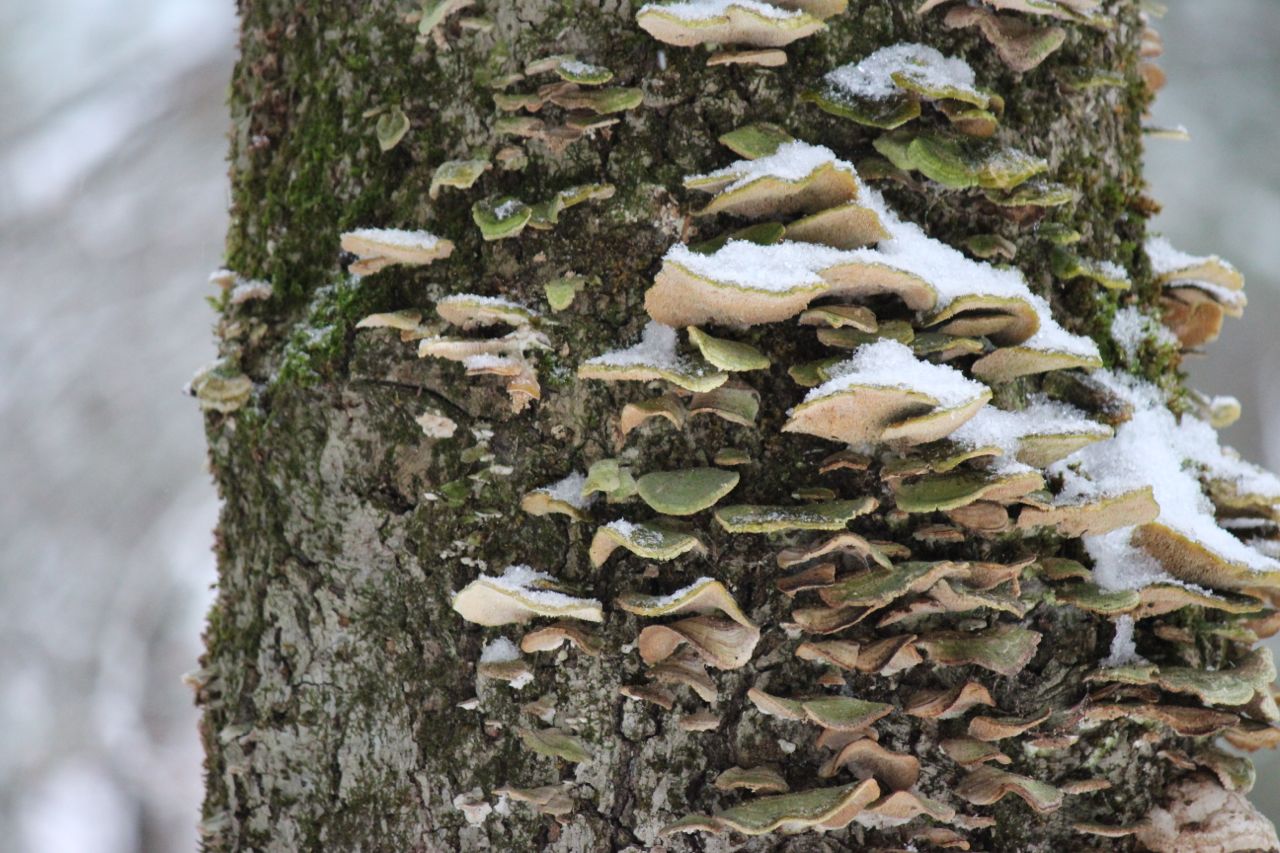
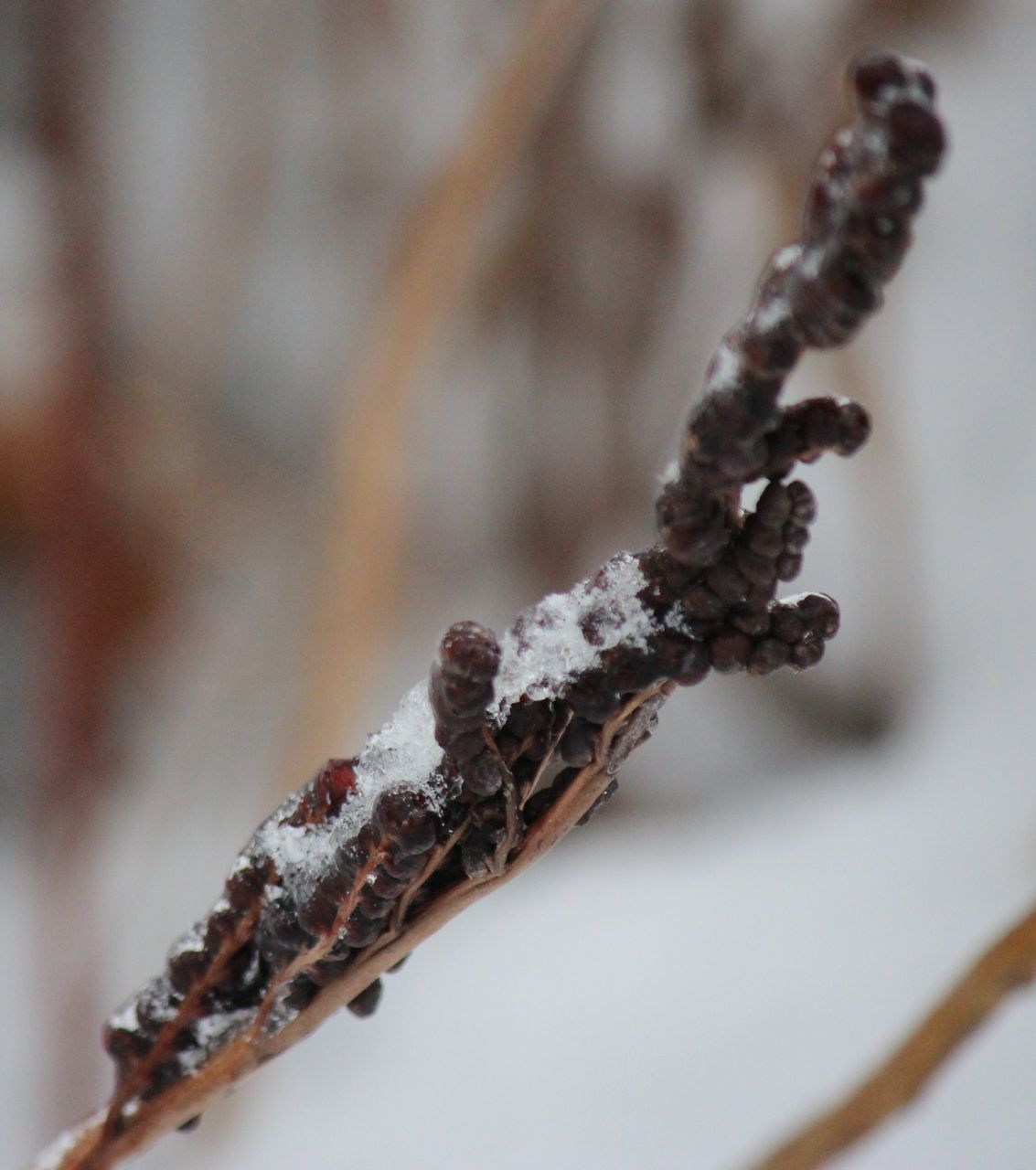
Following last night’s mixed precipitation, I decided to shed my snowshoes and follow the snowmobile trail instead. The ice on this beech caught my eye as I crossed over the stonewall and into the field beside our house. Deer, a kazillion skunks and snowshoe hare had been out and about, but it was the snow and ice that I focused the lens on this morning. Each droplet a gift–I’ll let the photos tell the story.

hemlock 2

red maple 1

white pine 1

white pine 2

witch hazel 1

witch hazel 2

Tinder polypore

turkey tails

sensitive fern

One more thing. In his post, “Things I’ve Seen,” the author of NHGardenSolutions,  shared a photo of a zigzag scar on an Eastern Hemlock. I was wowed by it–had never noticed one before. Until . . . this morning. My find isn’t as zigzaggy as his, but it caught my attention.

crazy hemlock

What caused this? It’s along the snowmobile trail and may have been part of an old logging road. Crazy and beautiful, this mystery makes me wonder.

Thanks for joining me for another wonder-filled wander in the woods.