“Hightailing it Home” published in The Maine Natural History Observer

As some of you know, I not only have a soft spot in my heart for Dragonflies and Cicadas and Beavers and Otters, but also my prickliest friends, Porcupines. And recently I’ve been looking for our neighborhood rodents, which my neighbor sees when she lets her dogs out at night, but they’ve alluded me.

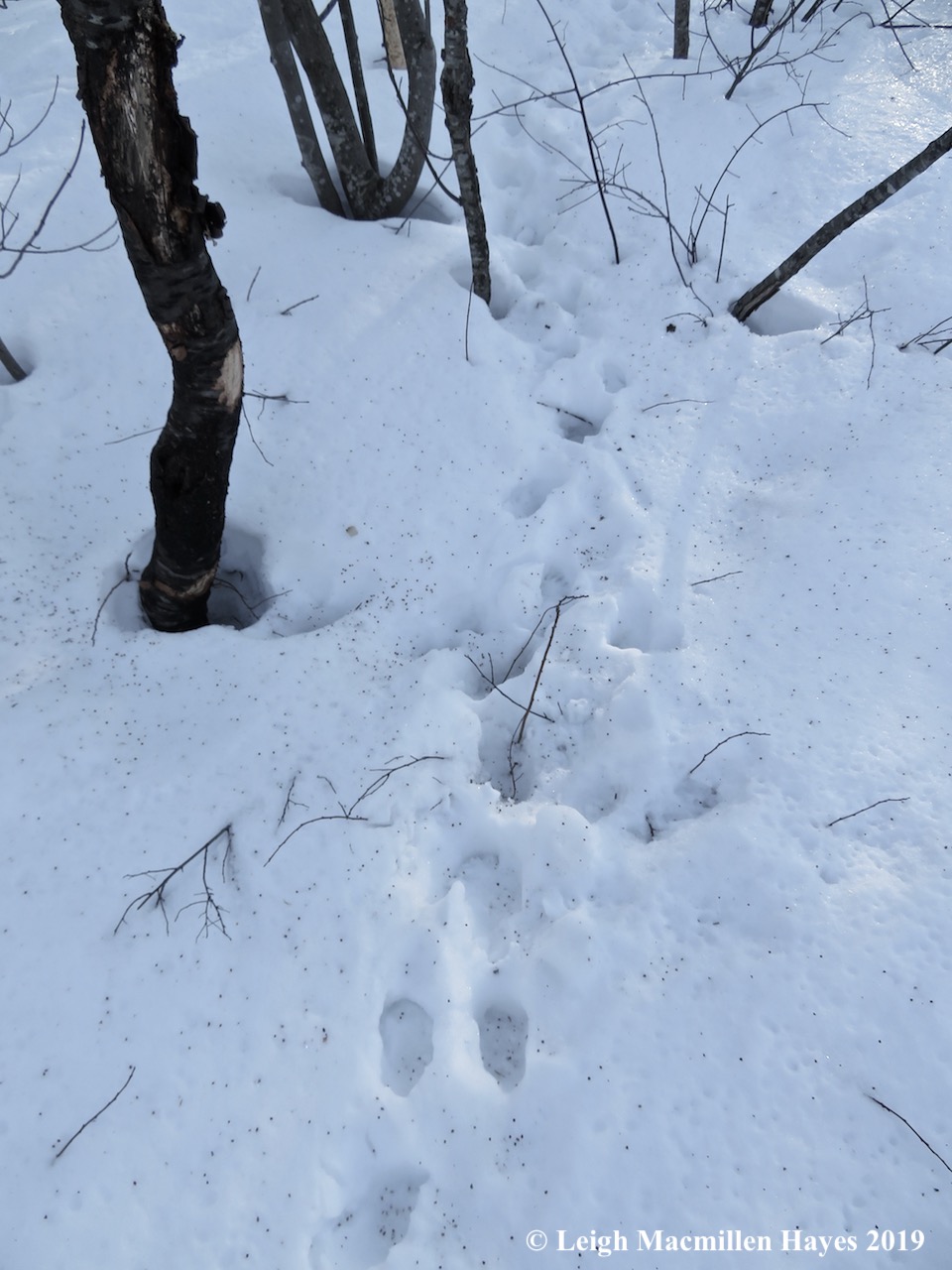
I do keep finding some evidence of their whereabouts, at least where they’ve ventured at night, but have yet to locate a den this winter or even spot a Porcupine waddling through the woods or sleeping on a branch.

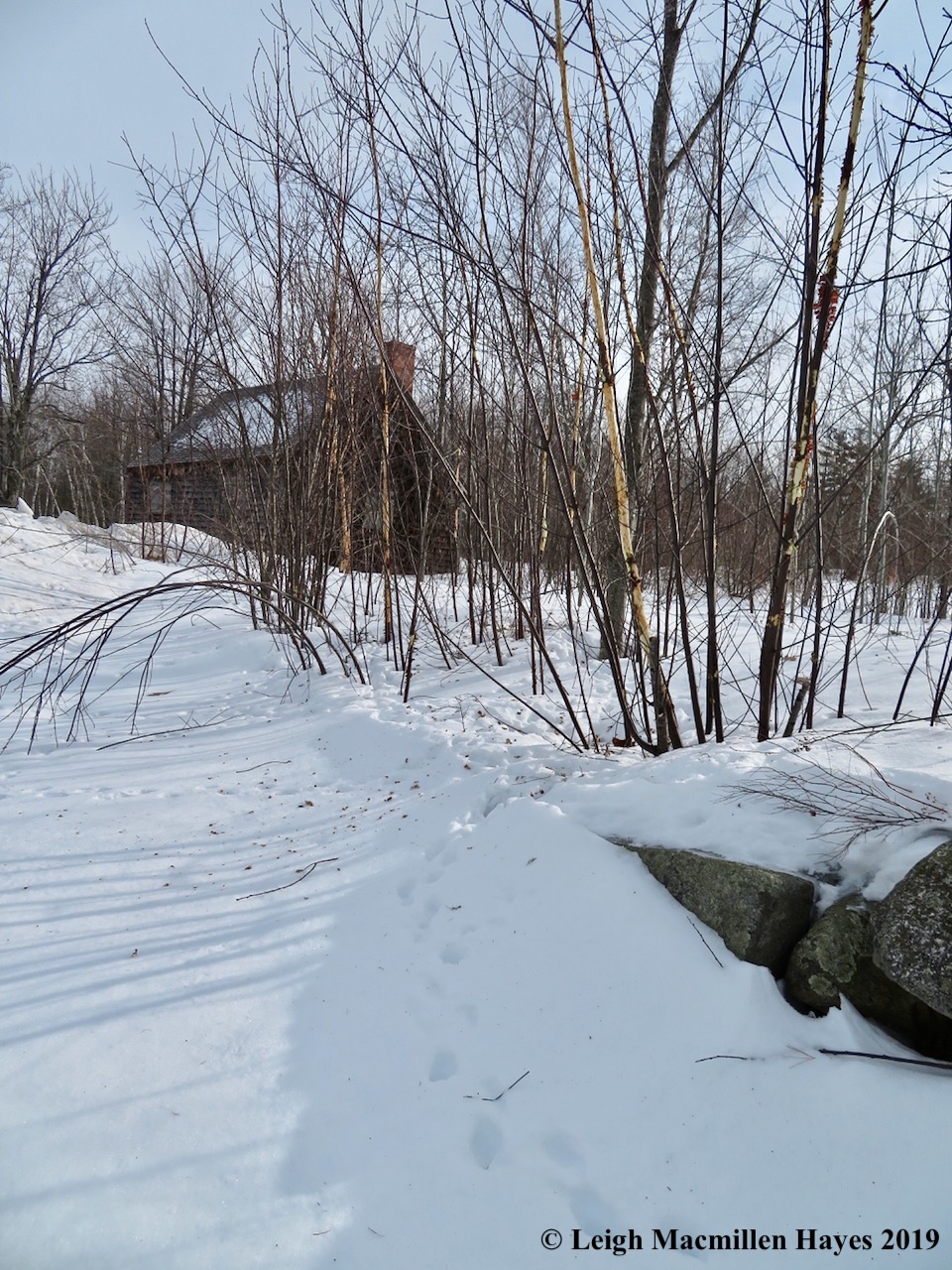
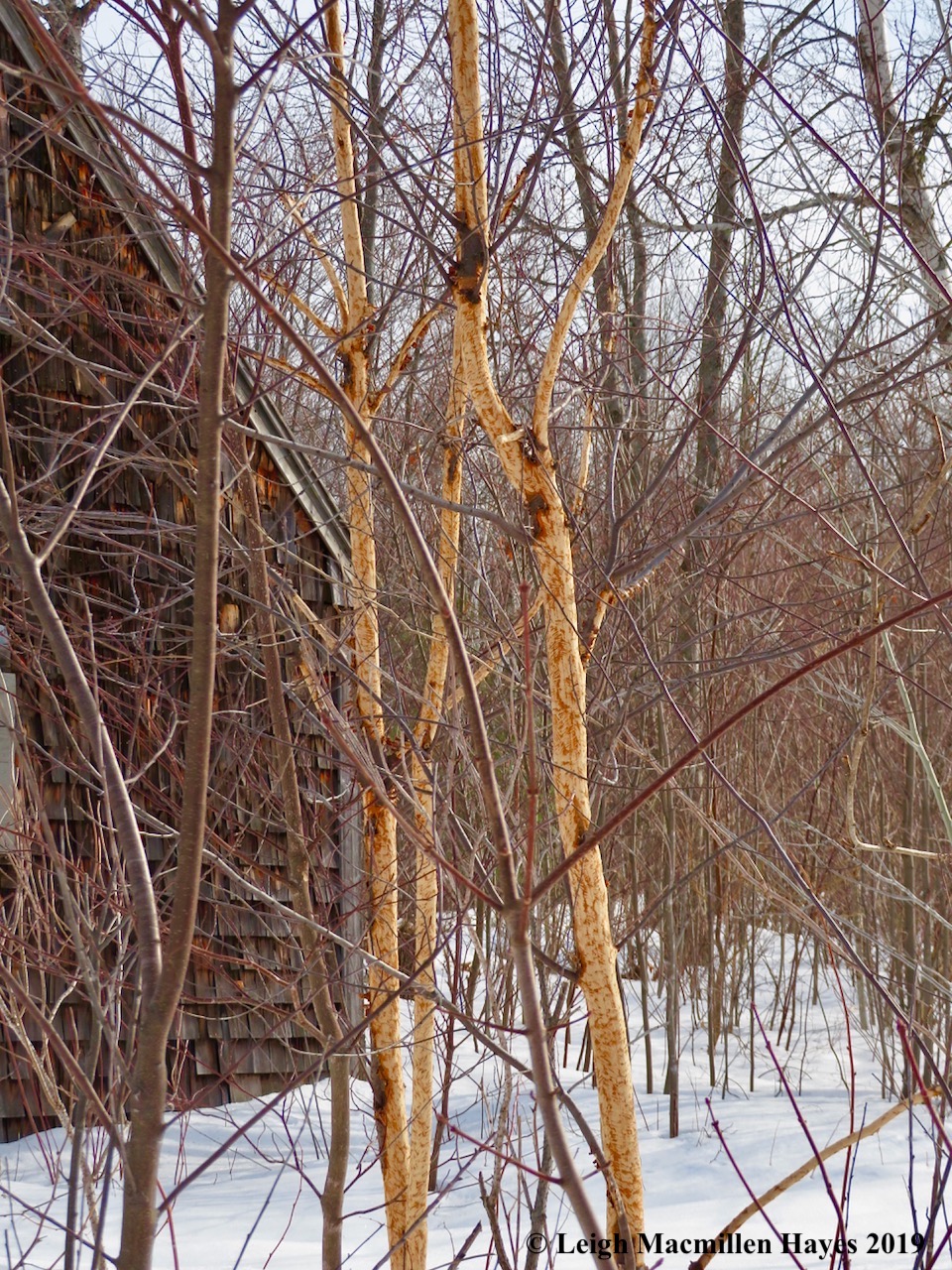
That may be our fault. We’re in the process of saving our barn and have closed up any entrances Porky has used for the last 30+ years and probably longer than that, and tore down an attached shed and we’re having it rebuilt, so except for that one night he spent in the barn loft due to our stupidity of not shutting a trap door, I’m afraid we’ve evicted him. But there is more than one Porcupine in this neighborhood and today I wandered several miles into the woods beyond our land, and came up short-handed.

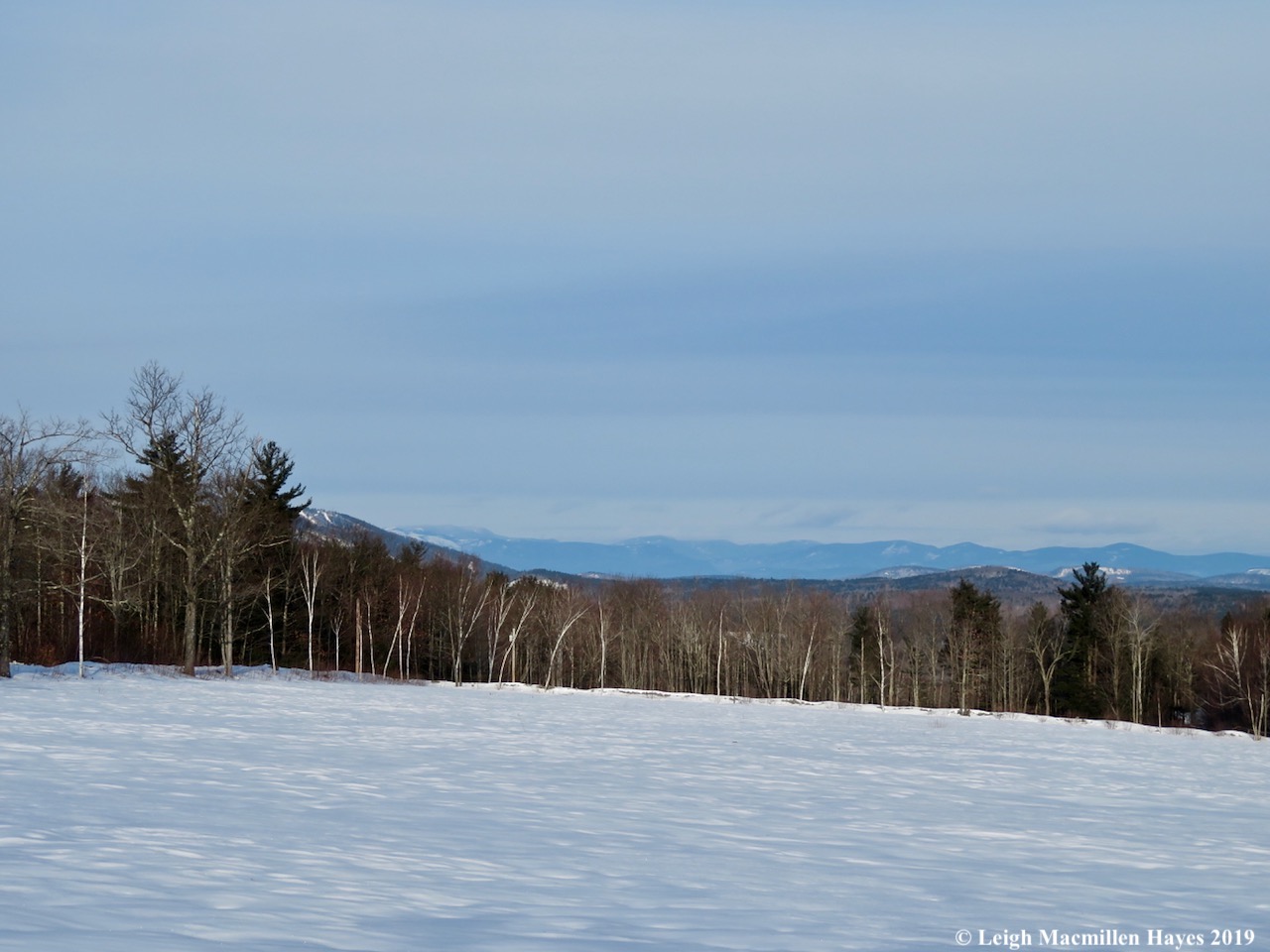
That said, I did spot three deer as I headed out along our cowpath. Do you see them?

We spent at least five minutes together before I decided it was cold and I need to get my mittens back on and keep moving.

Switching gears, I submitted an article about Porcupines to the Maine Natural History Observer for their first issue of 2025 and was tickled once again to have it accepted.
According to their website: Maine Natural History Observatory’s mission is to improve the understanding of natural resources in Maine by compiling historic information and implementing inventory and monitoring efforts of Maine’s natural history.

The Observatory specializes in collecting, interpreting, and maintaining datasets crucial for understanding changes in Maine’s plant and wildlife populations. We are committed to filling data gaps for Maine’s least understood species and creating a legacy of data for use in nature conservation, land use policy decisions, and expanding scientific knowledge.

Specifically, our mission is to:

  • Compile and publish summaries of Maine’s natural history
  • Coordinate local and regional inventory and monitoring efforts of Maine’s flora, fauna, and habitats
  • Facilitate cooperation and exchange of information among organizations, agencies, and individuals conducting natural history research in Maine or caring for natural history collections
  • Engage in other activities related to the advancement of scientific knowledge and education of the public regarding the flora, fauna, and habitats of Maine.
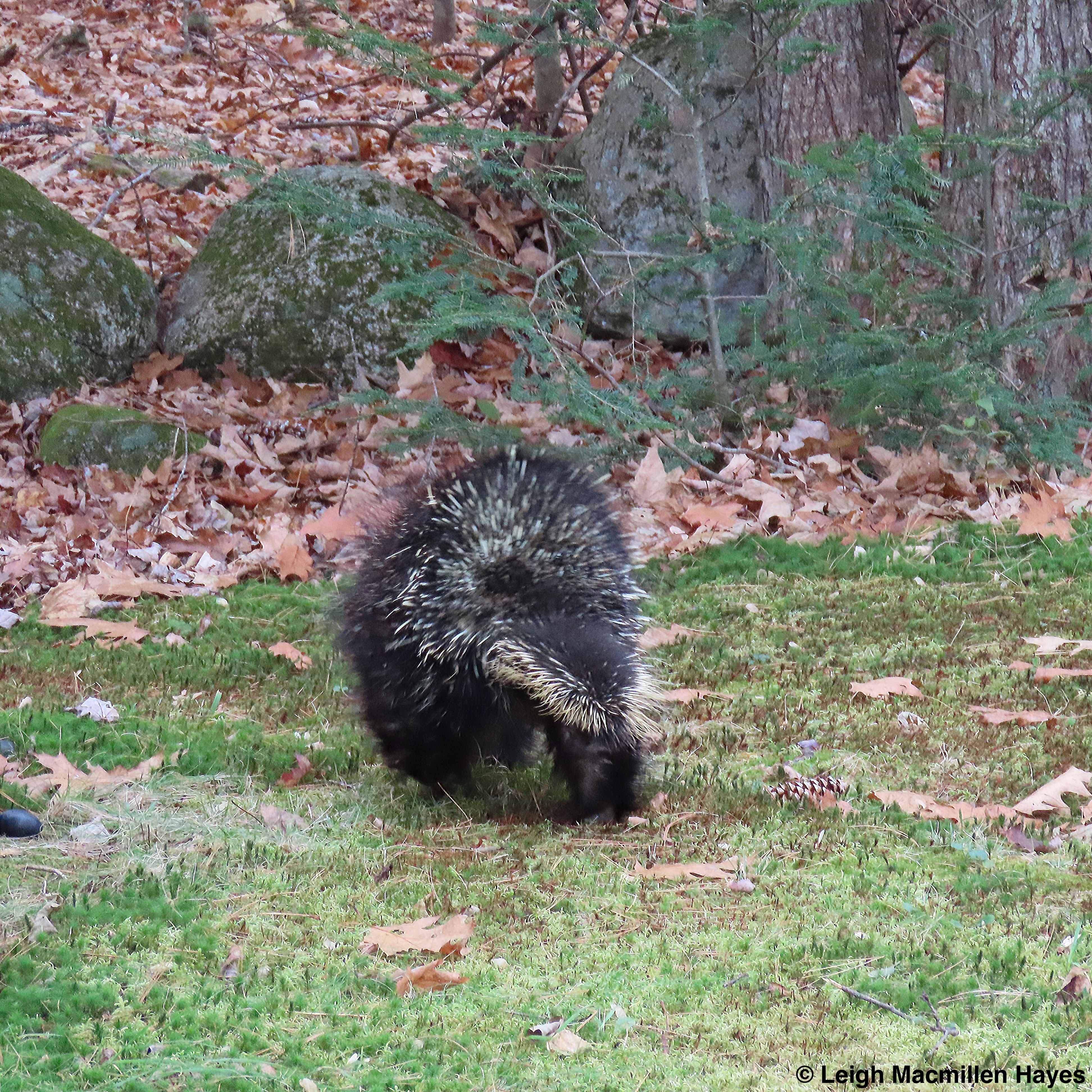
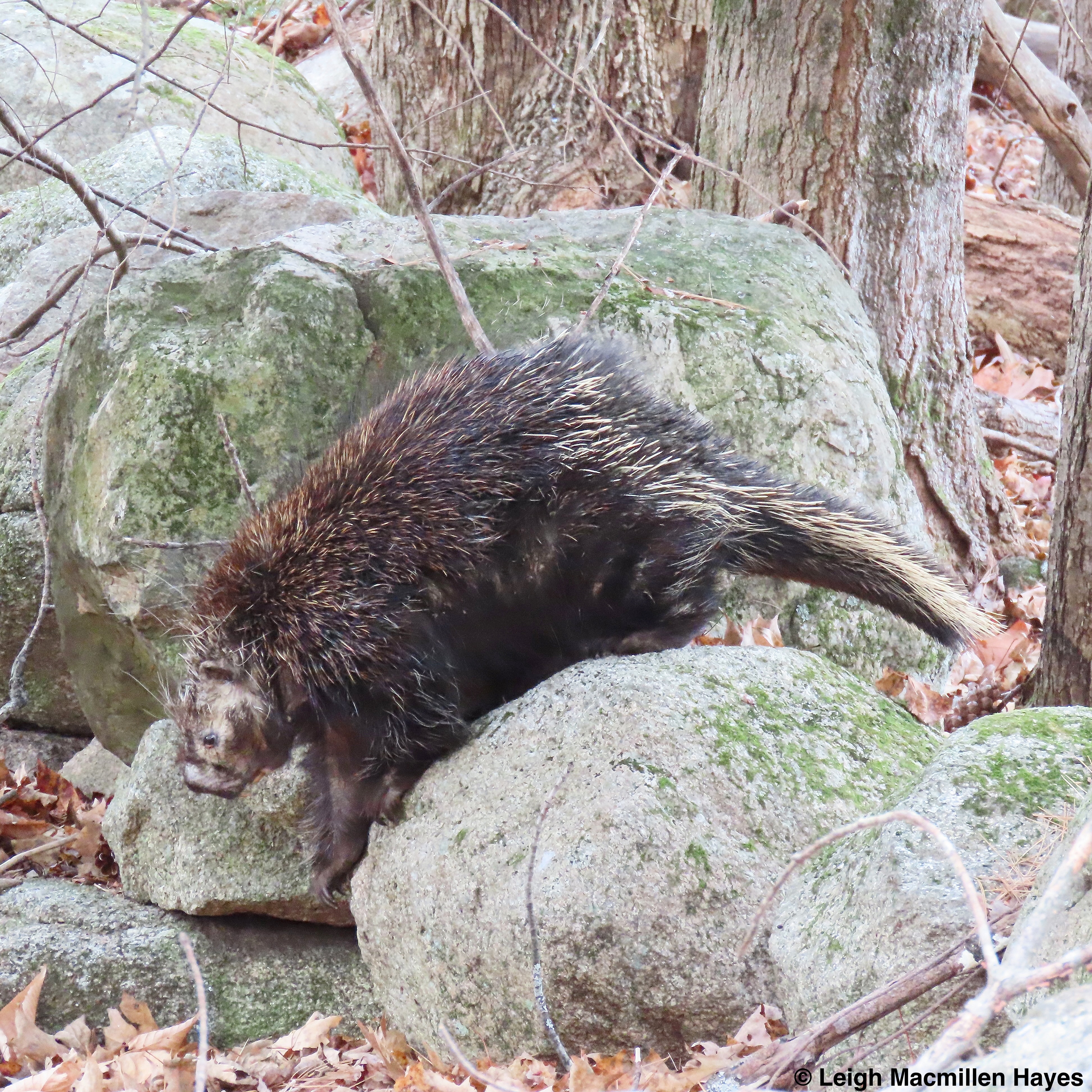
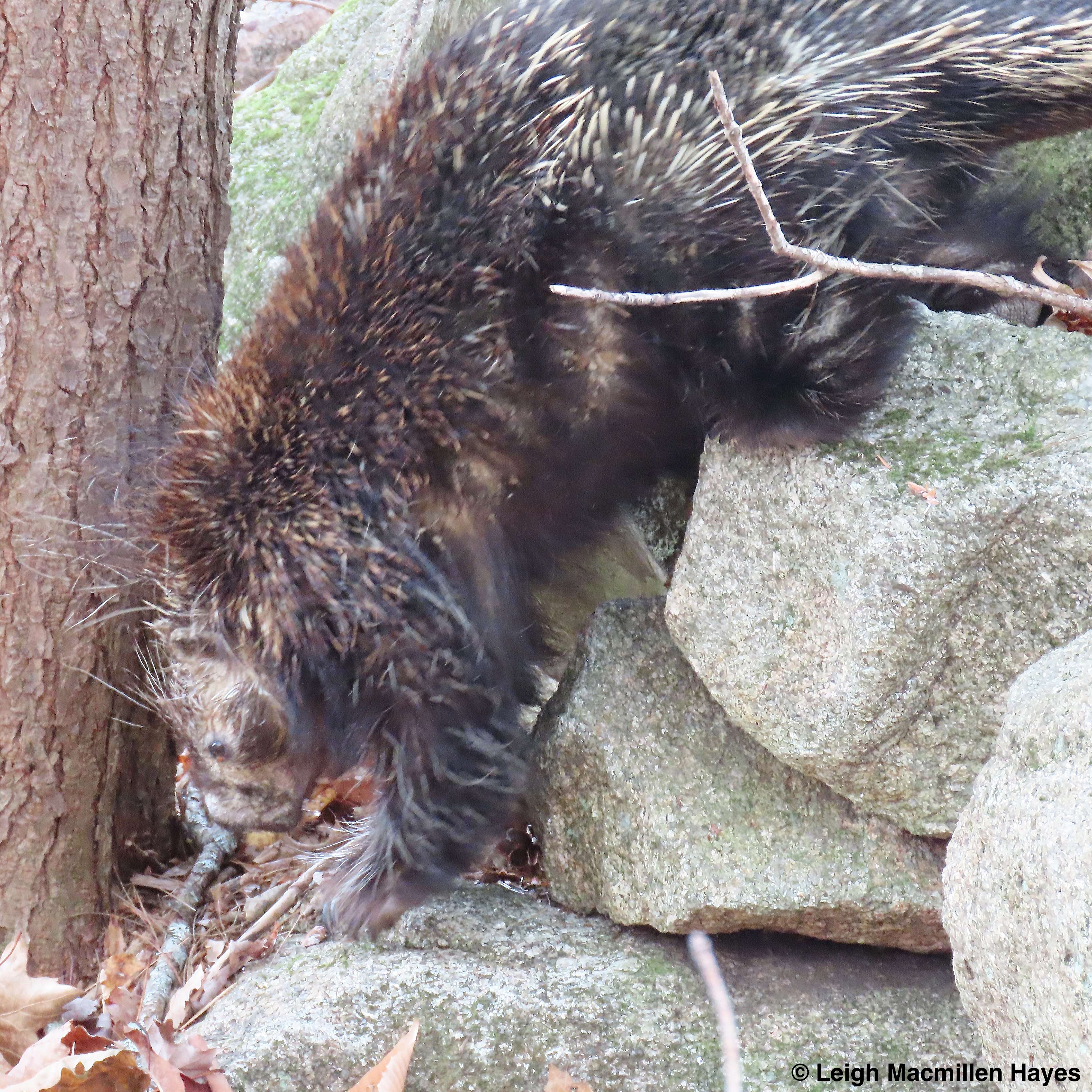
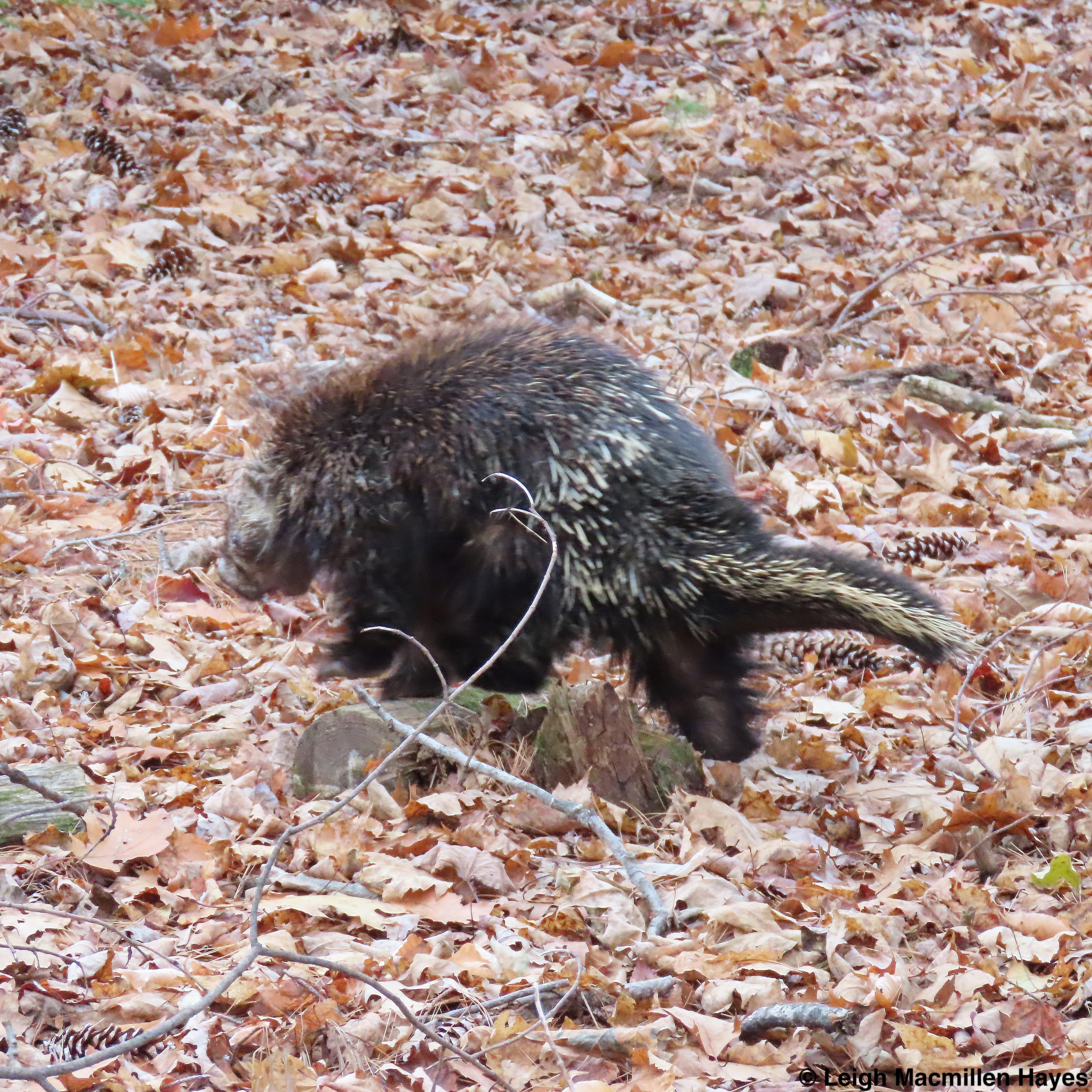
“Hightailing it Home” is about an adventure I had with a Porcupine in February 2024, and again, it was deep in the woods behind our home.
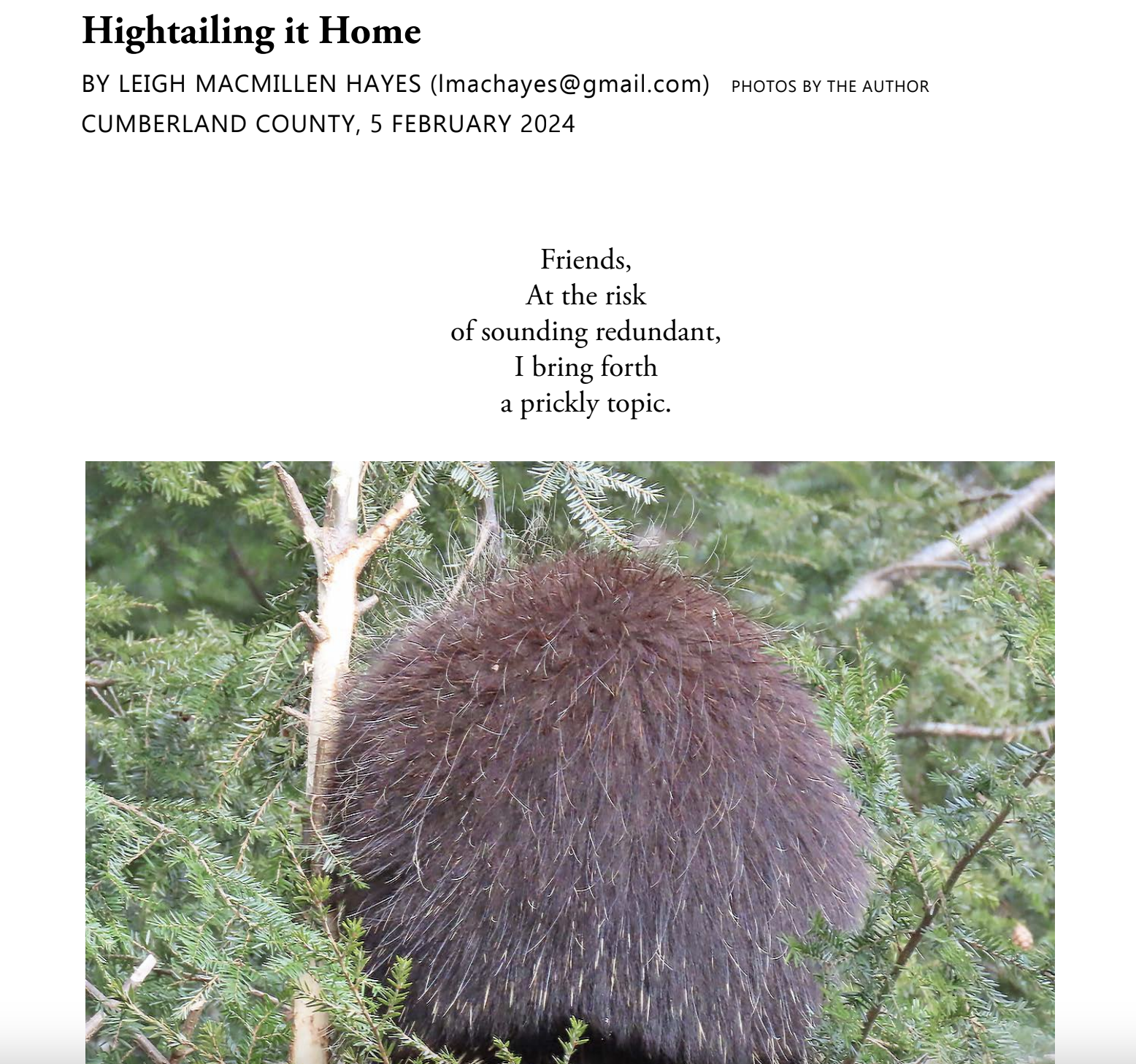
This is the back view that I first encountered that day, before the Porcupine realized I was being a nosy neighbor.

And I’ve included this portion of a page just cuze I love my Porky friends. Look at all those quills! Over 30,000 of them. And yet, his face is so soft, as is his belly.

Apparently I’ve made that love known, for my ten-year old friend and fellow naturalist and artist created a tree cookie ornament for my birthday.
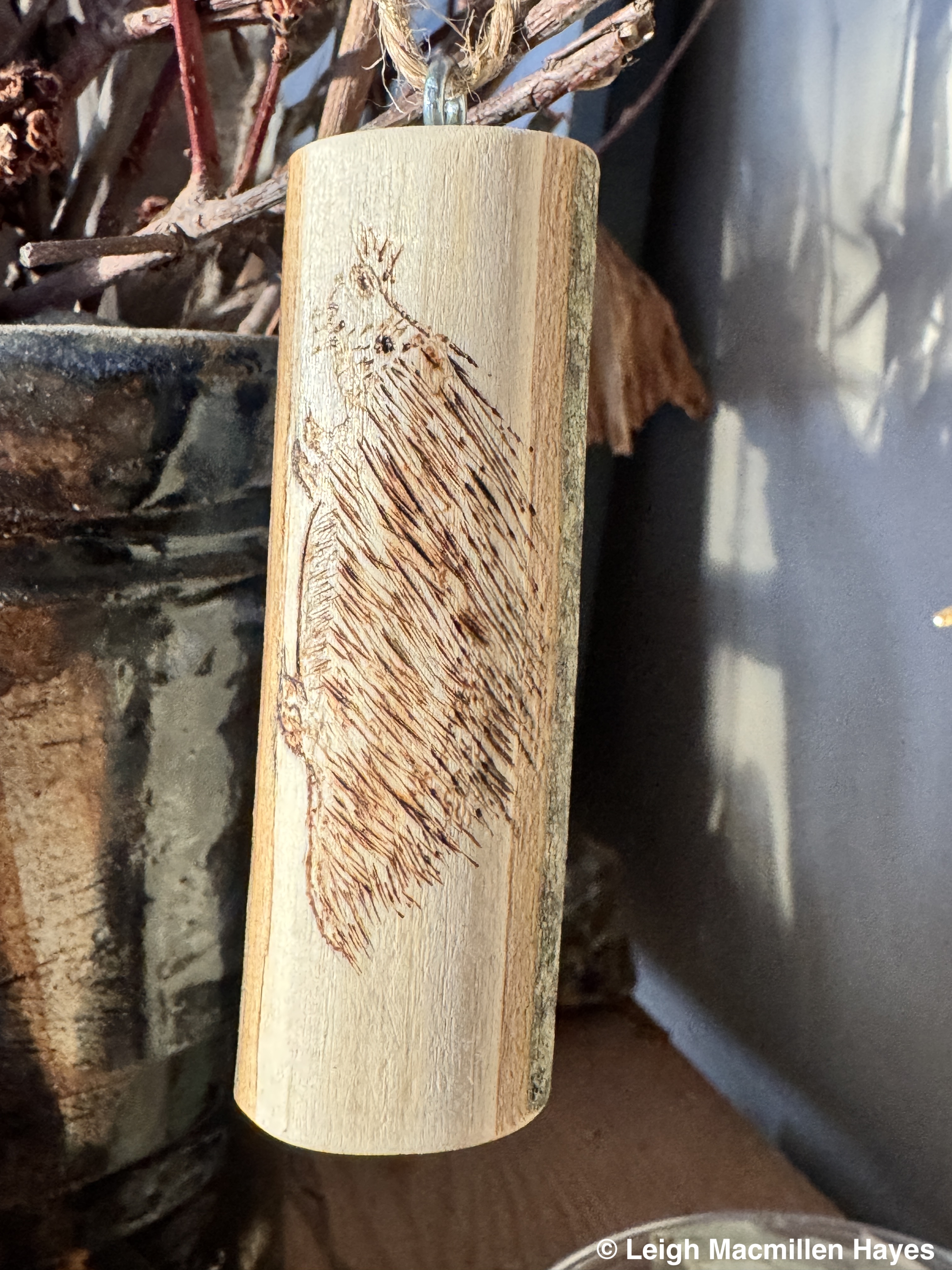
And my Cousin Bob did the same for Christmas. Both ornaments did hang from our tree, but now they are on display in my study.

Okay, back to the MNHObserver 2025, Issue 1, here’s a link: Maine Natural History Observer.

You’ll find “Hightailing it Home” on page 36.

There are some really interesting articles, including one about Maine weather in February 1958!! Perfect for an evening read on another frigid night.

Thank you, Maine Natural History Observer, and especially to Celeste Mittelhauser, Outreach Coordinator.

Here’s to future adventures with Porky and so many forms of fauna and flora who continue to teach me. I sure hope I get to hightail it home following a sighting in the near future.

A Squirrel’s Garden

A lot has happened this week on many different fronts, both personal and public, both positive and not so, some comical (like the porcupine that awoke me one morning because it had managed to climb to the second floor of the barn and toppled our sons’ many “earned” trophies) and others more serious, with some in between thrown into the mix, cuze life happens.

To that end, some of my best moments were spent looking and wondering. In the woods. Of course. In our woods, in particular.

I headed out onto the old cowpath in search of a dear friend, not certain if I’d meet him or at least spot signs of his passing. And it wasn’t a deer I was looking for–although, in a way it was because I haven’t seen a single one in several months and any scat along this trail is from last winter and spring and at that time it was so prevalent that with every step I took, it was there.

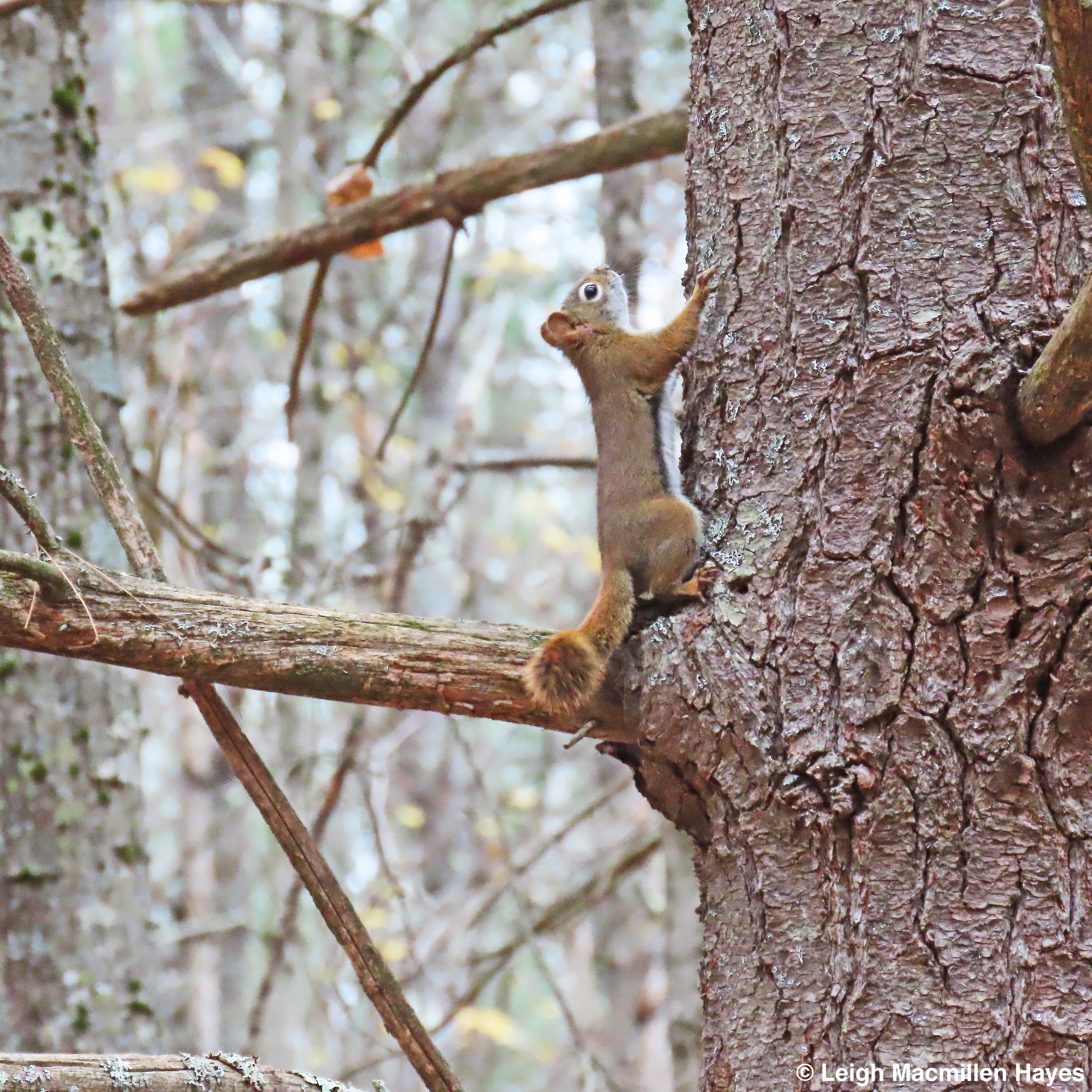
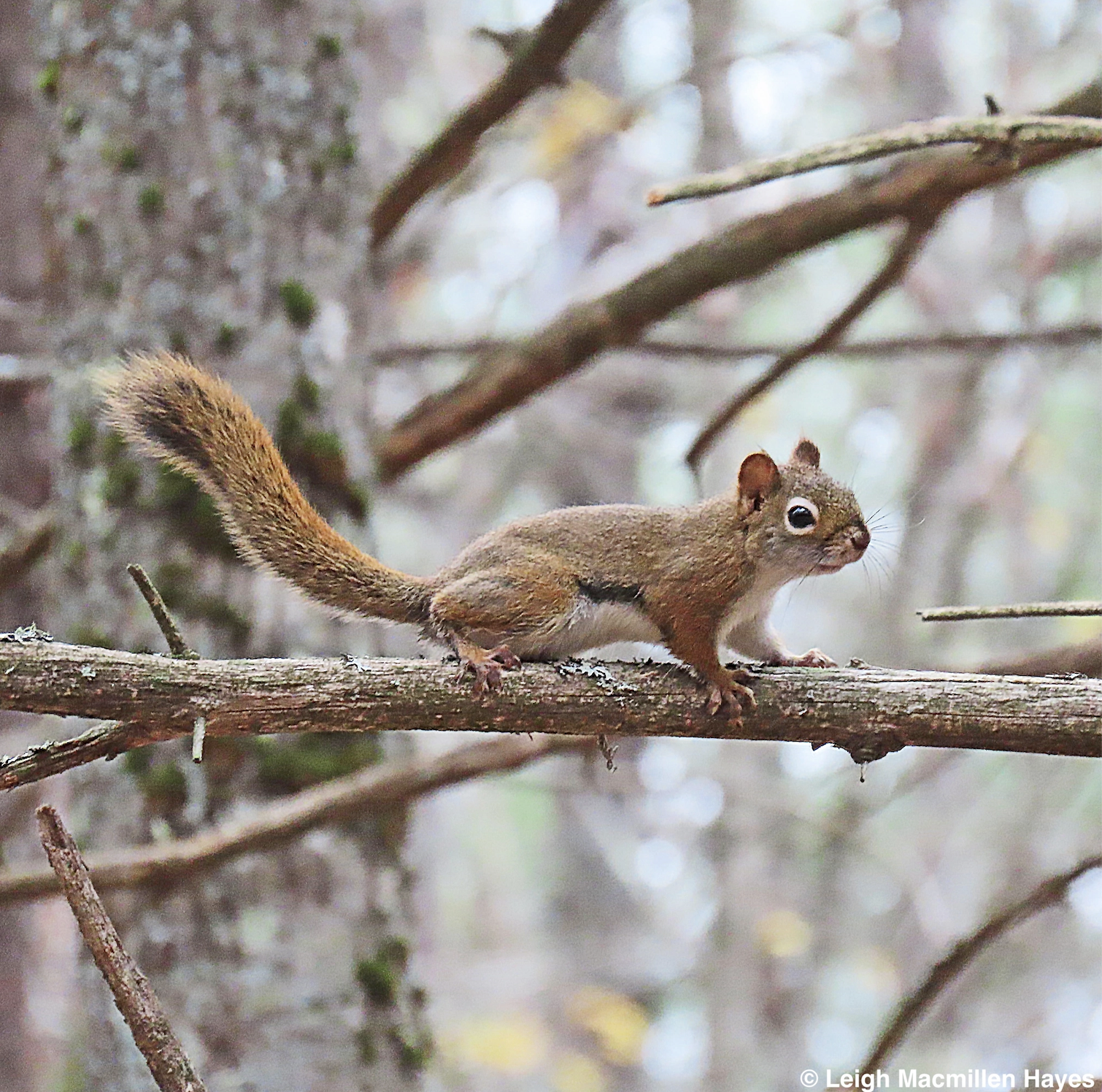
No, it was this little guy that I sought. This photo is from last winter when he and I spent hours eyeing each other.

Though his territory could have been several acres and there’s plenty of land out there to inhabit, he, like me, preferred the cowpath, and especially the stone walls since they served as perfect spots to cache his immense supply of pine cones, and as dining room tables, the better to see any approaching predators.

What he sought were the tiny winged seeds, tucked into each protective scale by the twos. If you’ve ever had the joy of watching him munch, you’ll know it’s fast paced as he deftly pulls the seeds out and discards the scales, getting right down to the “cob” of the cone.

The result is a pile of half consumed scales and a few uneaten seeds and cones not quite yet opened and some scat and its all known as a midden (by us humans anyway) or the trash barrel.

Actually, any high place will do and if it has nooks and crannies to serve as storage shelves all the better. Last year was a mast year for the White Pines in our woods. It takes two years for a pine cone of this species to reach maturity.

This year, there are only remnants of Red’s garbage pails and even they are almost hidden by twigs and leaves and needles.

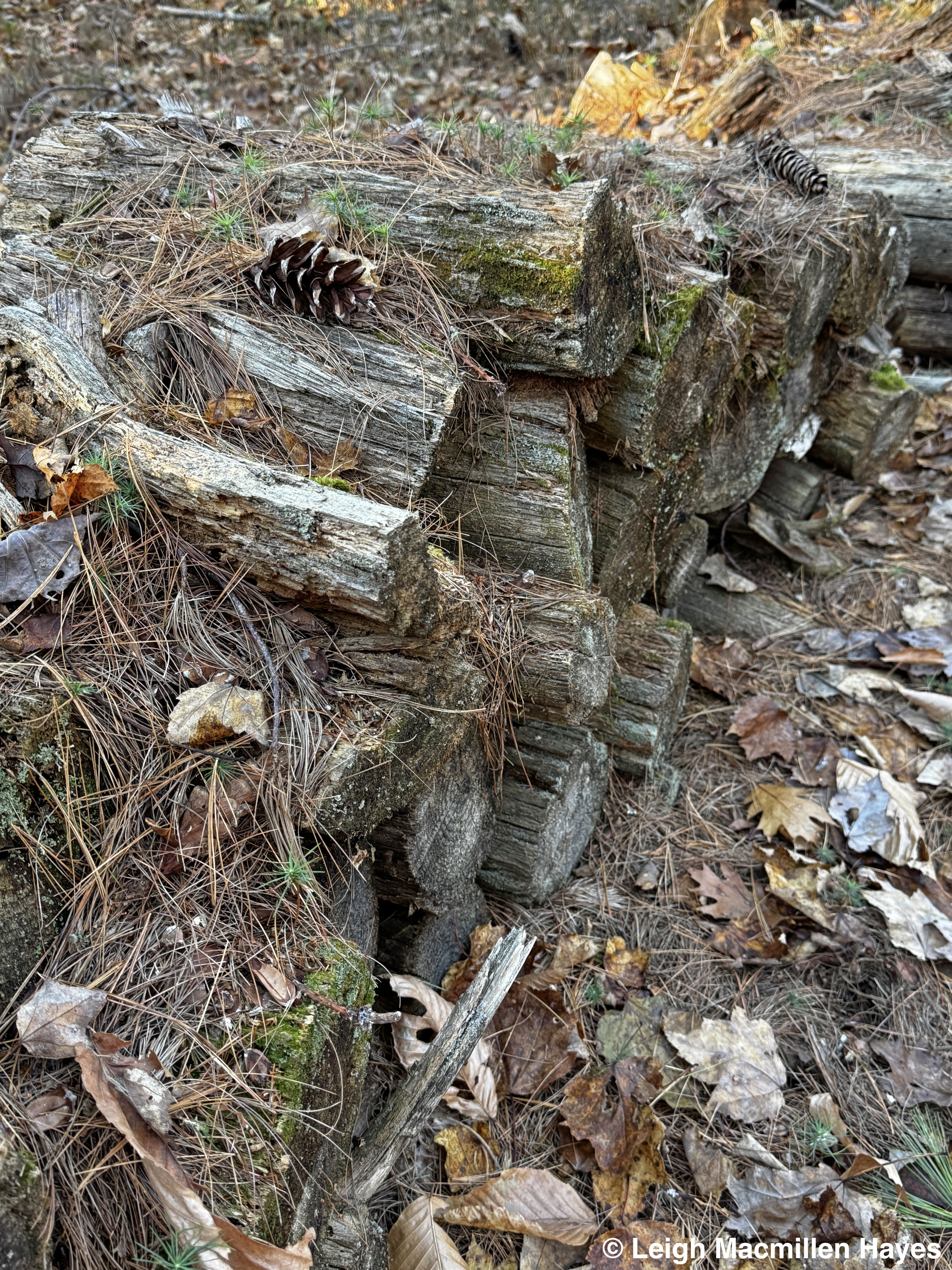
But, while I was exploring his old neighborhood, I discovered something else in this pile that he had used for refrigeration and dining purposes.

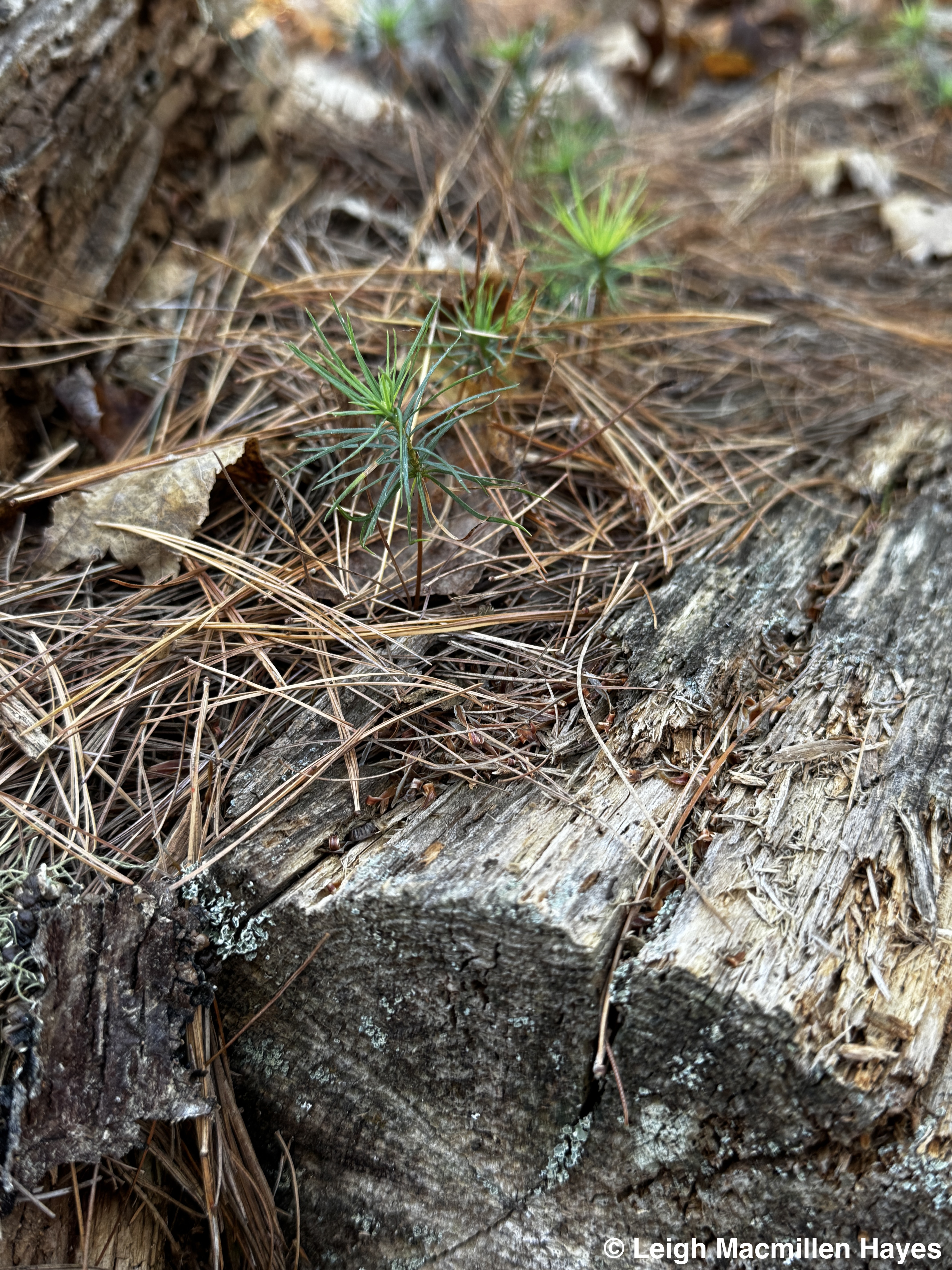
Do you see what I spotted? Babies! No, not squirrel babies. But rather: Miniature White Pines.

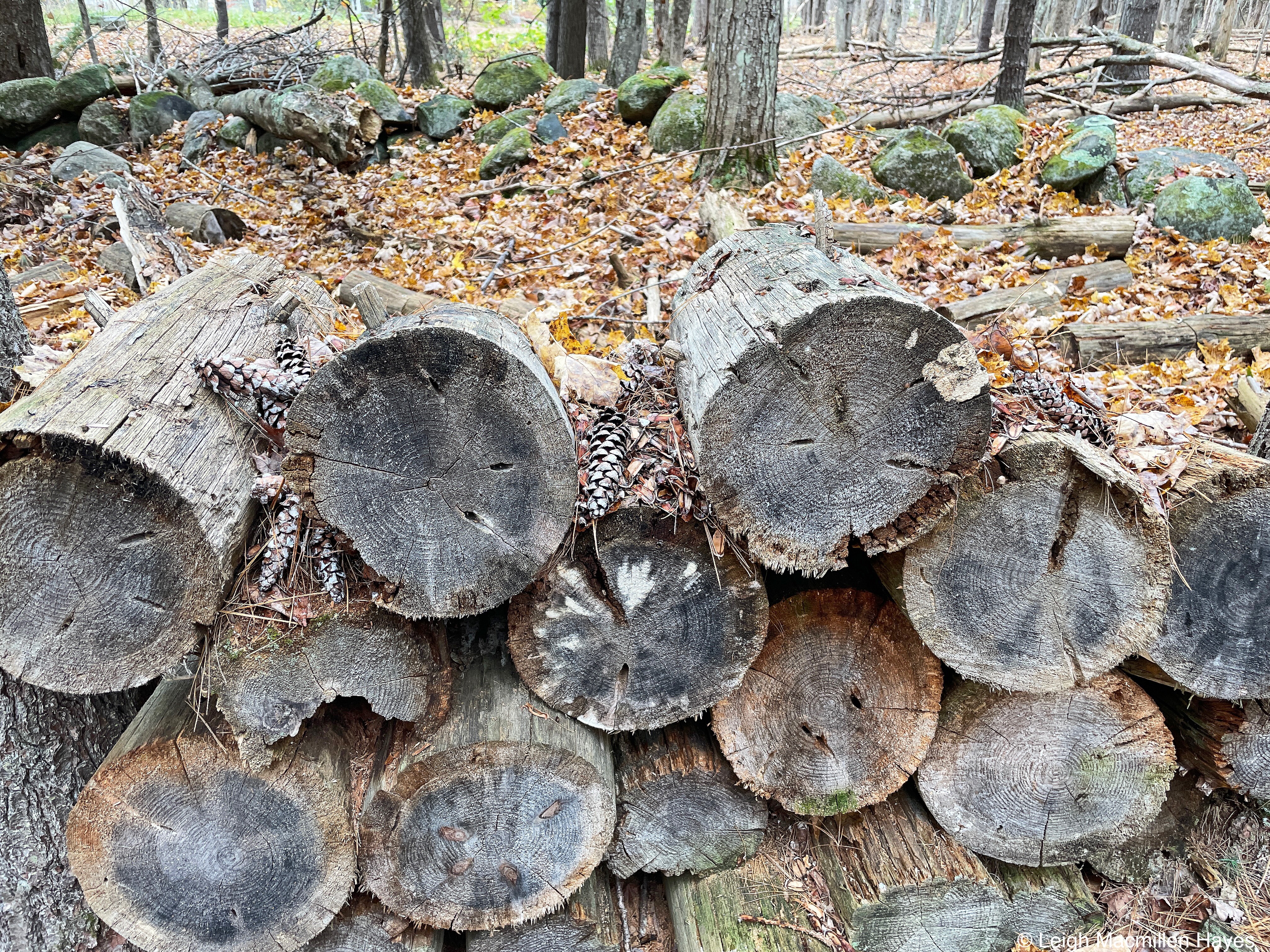
Once I saw those, I checked every stack that we’d cut years ago and found the same story written upon them. The seeds Red had left uneaten found conditions were right on the rotten logs. Will they survive? Maybe a few, but there are plenty more tiny saplings on the forest floor.

The thing is that I found no evidence of Red and not once did he squawk at me, so I suspect either he moved on to a better food source or became a meal for another, passing all of that energy and sunshine he’d consumed on to the next.

This year, it’s the Northern Red Oaks that have produced a mast crop–of acorns. Actually, they did so last year, and the year before as well. For those of us who frequent Red Oak woods, it’s like walking on ball bearings–and can be a wee bit treacherous as they roll under our boots.

Red Oak acorns are filled with tannins and so, unlike their White brethren which are gobbled up almost immediately by rodents and birds and deer among their consumers, it seems a little of this one is nibbled, and then a little of that one initially. Eventually, the tannins leach out, especially if the acorn has been buried for future consumption, and then the entire nut within may be eaten.

As I looked for Red this past week, I found instead his cousins, the Gray Squirrels in action. Where Red Squirrels are very territorial, Grays tend to have overlapping habitats, and there are at least three on our six acre plot of land.

Burying acorns is their way of caching and it’s possible that what I observed was this squirrel leaving a scent mark with its nose so that come snowfall (and I have faith that it will fall–and can only hope abundantly), it can relocate the food supply. What this squirrel misses, another will find. And those that no one finds might turn into oak trees that will feed future generations, just as the pine saplings may someday do.

It’s for these critters and so many more that we ask that no motorized vehicles pass along the cow path, no matter how tempting it may be. (Thank you, Marguerite, for creating this sign for me.)

And if you are in there, you might happen along the rather rough labyrinth I created, a place that like the squirrels, I return to often.

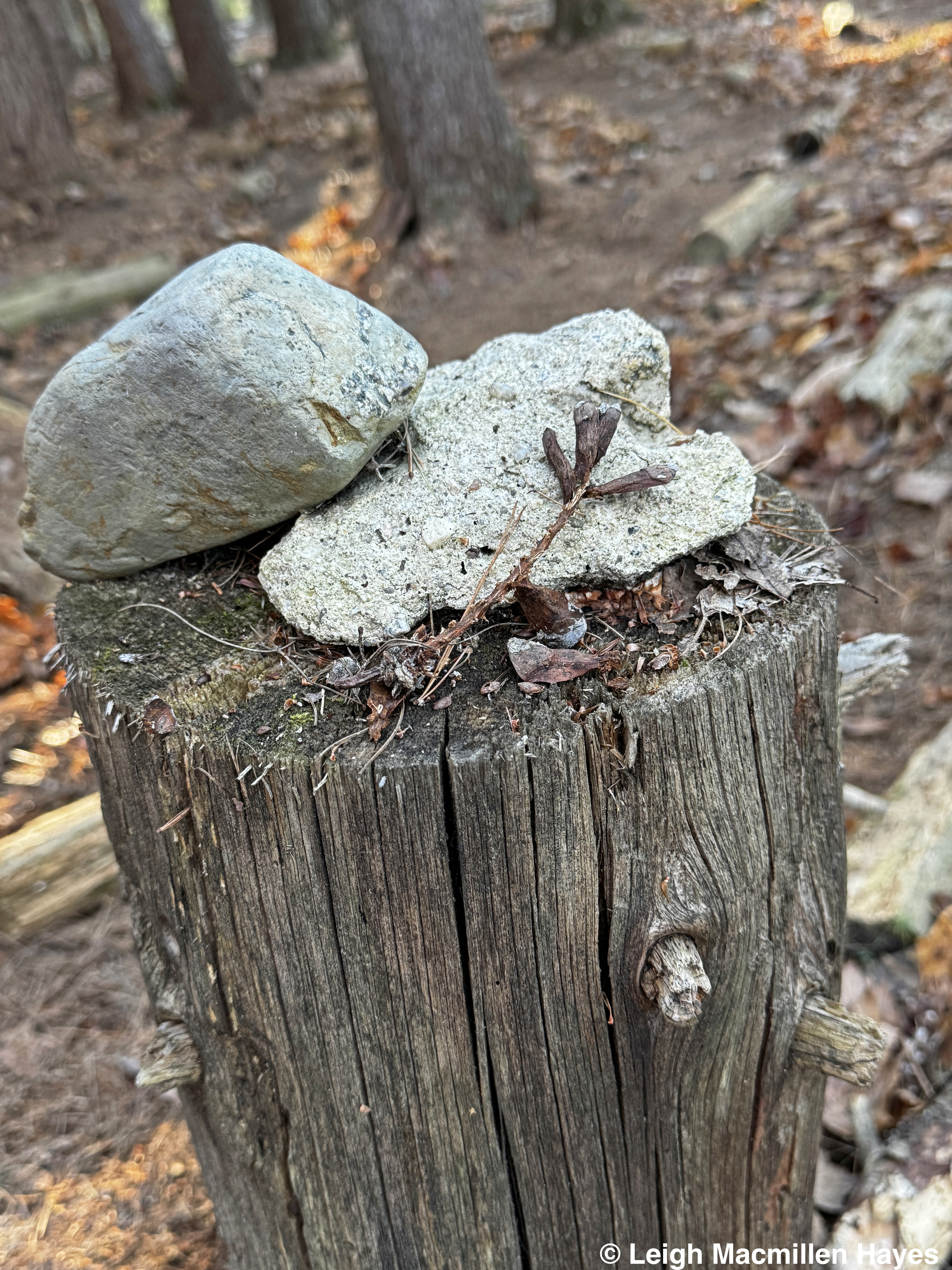
It’s at the start of the labyrinth that brings a smile to my face each time, for Red had visited and his calling card is still there.

Thank you, Red, for planting your Squirrel Garden. And for capturing my mind and heart and soul this week.

Porcupine as Teacher

I walked up two stone steps beside one of our pollinator gardens this afternoon and when I looked up, which wasn’t really up, but rather a few feet ahead instead of at my feet, I was startled.

“Whoa!” I exclaimed.

My sudden companion didn’t even make a peep, which in hindsight is surprising, because its brethren are known to make some various squeaks in different occasions, but it did turn quickly so that its back was facing me, such is its defense weapon.

Yes, in the middle of the day I met a porcupine. If you are a frequent flyer on wondermyway.com, you know that I’m fascinated by these large quilled rodents. And their quills. And especially their scat!

By turning its tail toward me, my friend was ready to go on the defense should I try to get too close. Notice how the 30,000 quills on its back side were raised–a message to me that I should beware.

No, a Porcupine cannot send its quills aflying, but if I nudged it, which I chose not to do, the barbed hairs would have detached easily and I would have been screaming for help.

Instead, my friend decided to move away from me. And I decided to follow at a reasonable distance, giving it some space.

Our property is bordered again and again by stonewalls, some once used to mark boundaries, others to keep animals in or out, and still others served as garden walls, their double-wide structures the garbage pail for small stones that popped up each year during the spring thaw.

My friend had a single wall to conquer and that’s when today’s lesson began.

Actually, it was a few lessons. Maybe the first was noting the coloration of my buddy. We are used to variation in colors of our local Porcupines, but typically they are either black, or black with a lot of white, or brown. This guy seemed to bear the “coat of many colors,” embracing all of the above.

Not only that, he donned a white mask, the opposite of a Raccoon’s black mask. Today that mask earned him a name. From this day forward, he shall be known as Bandit.

The second lesson Bandit taught me is that because his sense of sight is not as prime as his sense of smell, once he was on the stonewall, he had a difficult time making the move down to the next stone.

I moved to the other side of the wall, and watched in awe as he raised his front legs in the air and stood upon his hind legs, rather bear-like in stance it seemed. Okay, so he even looks like a mini bear.

I began to realize that I sometimes channel my inner porky when I’m hiking down a trail. Going up is rather easy, despite the increase in elevation and sweat effort. But coming down. That’s a different story and I need to know where to place each foot. Especially in this autumn season when American Beech and Northern Red Oak leaves are slippery and hide obstacles.

Bandit continued to test his next move for a few minutes. Of course, some of that may have included my presence, and perhaps he was also sensing my odorous being. I have to admit that I hadn’t showered this morning, and for one who has a keen sense of smell, I was probably a bit of a mystery since I didn’t smell like a Fisher or a Bobcat. Those are a Porcupines finest predators–going for the soft hairs on his face or stomach.

Eventually Bandit took a step of faith. I know the feeling because I’ve done the same frequently on a hike and it brought to mind descending South Baldface in Evans Notch, and thinking that I couldn’t possibly lower my body from one ledge to the next, especially given that I couldn’t see a safe spot to place my foot. Or any spot, for that matter. I thought that perhaps I should just wait for a rescue mission, but My Guy did what he does and patiently waited and then talked me over the edge. Bandit talked himself over the edge and that worked for him.

And then I watched him waddle through our woodlot, lifting first the legs on his left side, and then his right.

He traveled close to the stone wall that borders our land and our neighbor’s field and I worried he’d cross over and she’d let her dogs out and quills would fly. Well, not really fly, but you know what I mean.

Thankfully, she wasn’t home yet. And . . .

Bandit had a different idea. He started to climb an Eastern Hemlock on our side of the wall.

Higher and higher he climbed and I noted that like me, he much prefers going up to coming down.

Knowing that he was going up the trunk and would be looking for a place to settle down, and probably wouldn’t go anywhere else for the time being, I decided to leave him be for a bit and check on my friend Red.

I’ve actually been checking on Red frequently these past few weeks and today I noted that he’d finally started to really build up his caches in several places. Cold temperatures have triggered his need to grow the pantry.

And in the meantime, he needed to eat to maintain his stamina.

I also checked on the Northern Red Oak beside another stonewall behind our barn. I suspected that prior to our meeting, Bandit had been feasting upon the abundant acorn crop the tree had produced.

I scanned the acorns for scat, but haven’t turned up any sightings yet. That said, I’m sure it’s there and don’t worry. I’ll continue to search, because, after all, scat happens.

I also intend to keep an eye on a hollow within the tree, which in the past has served as a Raccoon’s retreat. Maybe this year Bandit will do some housekeeping in this place. Or under our barn. Or somewhere else, for the options are endless in our neck of the woods.

Finally, I headed out to the field on our neighbor’s side of the wall and up in the Eastern Hemlock spotted Bandit. Do you see him? I say “him” because males typically are the ones we spot during the day.

I’ve been waiting for such a sighting because it is the time for Porcupines to switch from a summer diet in a field or orchard to a winter diet of acorns and hemlock cones and buds.

Today I give great thanks once again for living in a place where I can spy wildlife frequently and always there is a lesson to be learned. Porcupine as teacher, as it should be.

My Friend Red

It’s been two years since we’ve spent time together, and to be honest, I kind of doubt this is my friend from 2021, but perhaps an offspring. Anyway, what I do know is that last year was not a mast year in my woods and so there wasn’t much food available–the type my friend prefers to survive the winter months. But this year–pine cones and acorns abound.

As I headed down the cowpath that marks one of the boundaries of our property here in western Maine, I knew instantly by the chortling that greeted my ears that things had changed for the better.

You see, my friend is a Red Squirrel. And he spotted me before I spotted him. And then he let me know in no uncertain terms that I was not welcome. What kind of friend is that?

As I looked at the rocks along the inside path of the cowpath, I began to notice garbage piles Red had created, or middens as we prefer to call them, full of cone scales and the inner core or cob.

They were located in high places where Red could sit and eat in peace . . . that is until someone like me comes along, or worse . . . a neighboring squirrel, or even worse, . . . a predator. Given that a cone on this rock was only partially eaten indicated he’d been interrupted mid meal.

Maybe that’s why he continued to chastise me as he climbed higher up the tree.

It takes at least two years for an Eastern White Pine cone to mature. And once they do, Red has a habit of squirreling his way out to the tips of twigs, gnawing the cone stem and letting it fall to the ground. If you spot a pine cone with closed scales such as this, count the number of scales and then multiply that number by 2. That’s the number of pine nuts the cone offers.

And trust that all are still tucked inside.

Pine cones are in a way like Common Polypody ferns and Rhododendrons in that they predict the weather. If it’s dry, the scales on cones will open. If rain and humidity are in the air, the former being today’s weather, the scales will close tightly, overlapping and sealing the seeds from the outside world.

While wet weather dampens seed dispersal, dry windy days are best and that allows the seeds to be carried away from the mother tree.

In the photo above, you can see where the two seeds had been tucked in, close to the the cob, while the lighter shade of brown indicates where the wings or samaras that help carry the seeds were attached to the outer scale.

And I can attest that the sap on the scales is still sticky even though this cone no longer had any seeds stored inside. The sap coats the cones because its the tree’s reaction of placing a bandaid on a wound when its been injured or in this case had a fruit gnawed free.

One would think that Red’s face and whiskers would be covered in sap, and that does happen, but just as it stuck to my fingers initially, eventually it wore off. And Red is much better at grooming than I’ll ever be.

To get to the seeds, Red begins by holding the cone with both front paws, and turns it in a spiral, tearing off one scale at a time. Quickly! And gnawing each tiny seed packet open. The seeds may be small, but they are highly nutritious.

He continued to watch, vocalizing constantly, as I explored his territory below.

Upon every high spot, including tree stumps, there was at least a midden, but also a few cones for possible future consumption, though I did have to wonder if some went uneaten because he realized they were open and thus not viable.

More of the same I found upon some of the cut pine stacks we created long ago that serve as shelter and . . .

Storage! I’ve been looking for a cache for the past few weeks, a squirrel’s food pantry, and today I located a few small ones that I know will grow in the coming weeks. Cool. moist locations like among the logs, but also in the stone wall, offer the best places to keep the cones from drying out.

As he backed up but still chattered at me, one thing I noticed about Red, which will help me to locate him in the future, is that he not only has a reddish gray coat, but between his back and white belly there is a black stripe. Maybe he’s disguising himself so he can go trick-or-treating this week and his neighbors won’t recognize him.

So here’s the thing. Red is an omnivore. And though we associate him with pine cones, especially in the winter, he also eats flowers and insects and fungi and even smaller mammals if given the chance. And acorns. And this year is also a mast year for acorns in our neck of the woods.

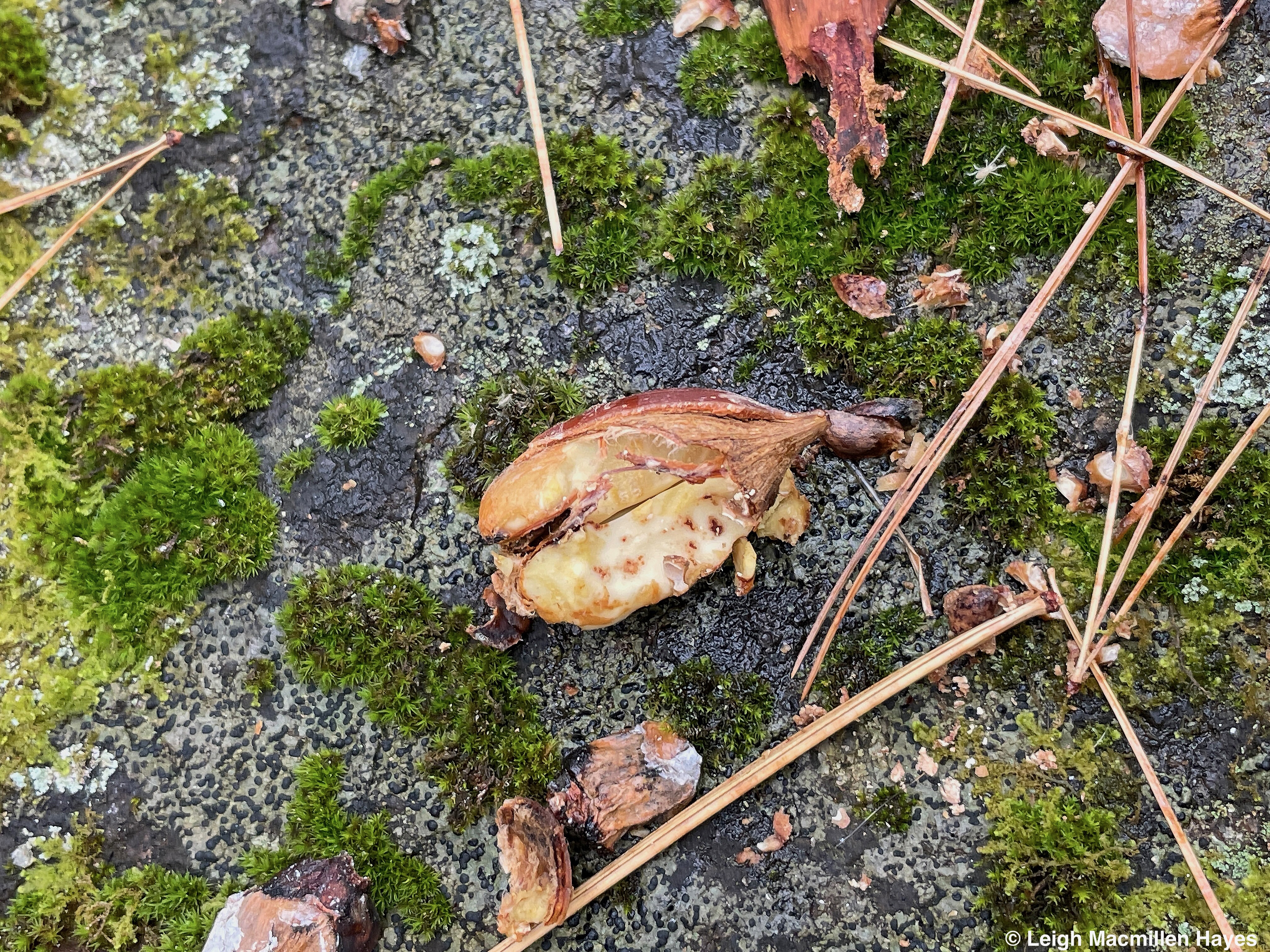
He’d peeled the outer woody structure away and had started to dine, but again, something or someone, and possibly I was the culprit, had interrupted his feeding frenzy.

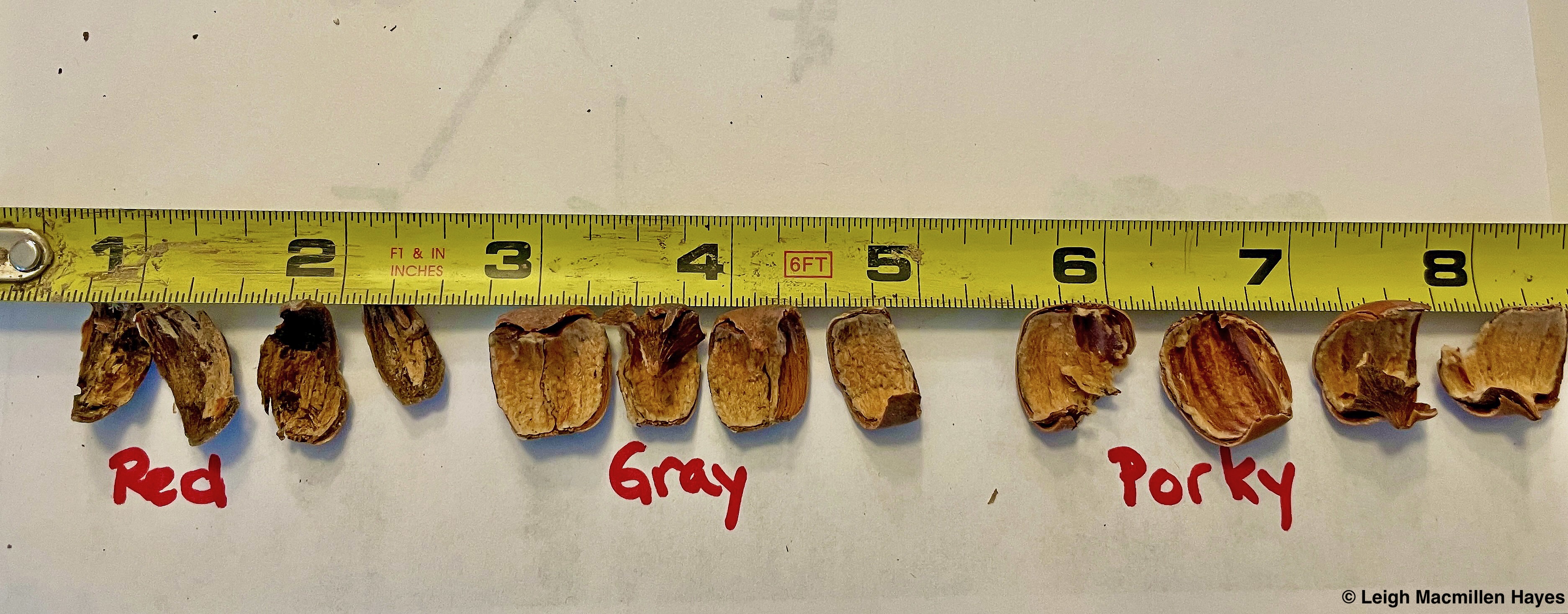
That said, I was delighted to find the acorn shell fragments because already in my collection I had samples from a Gray Squirrel and a Porcupine. Now I have all three and you can see by the tape measure how they compare in size, as well as the manner of stripping. As you can see, Red’s fragments are about a quarter inch in size, while Gray’s a half inch or so, and Porky’s are about three quarters of an inch. And the latter are much more ragged in shape.

Red. My Squirrel Friend. He just doesn’t know it. Maybe by the end of the winter he will because I intend to call upon him frequently to see what else he might teach me.

Beauty and the Brawn: Two Kingdoms

It's a mix of both realms in the natural world;
a kingdom of beauty and a kingdom of brawn; 
and sometimes a kingdom that includes both, 
in such a way that it's all about one's perspective. 
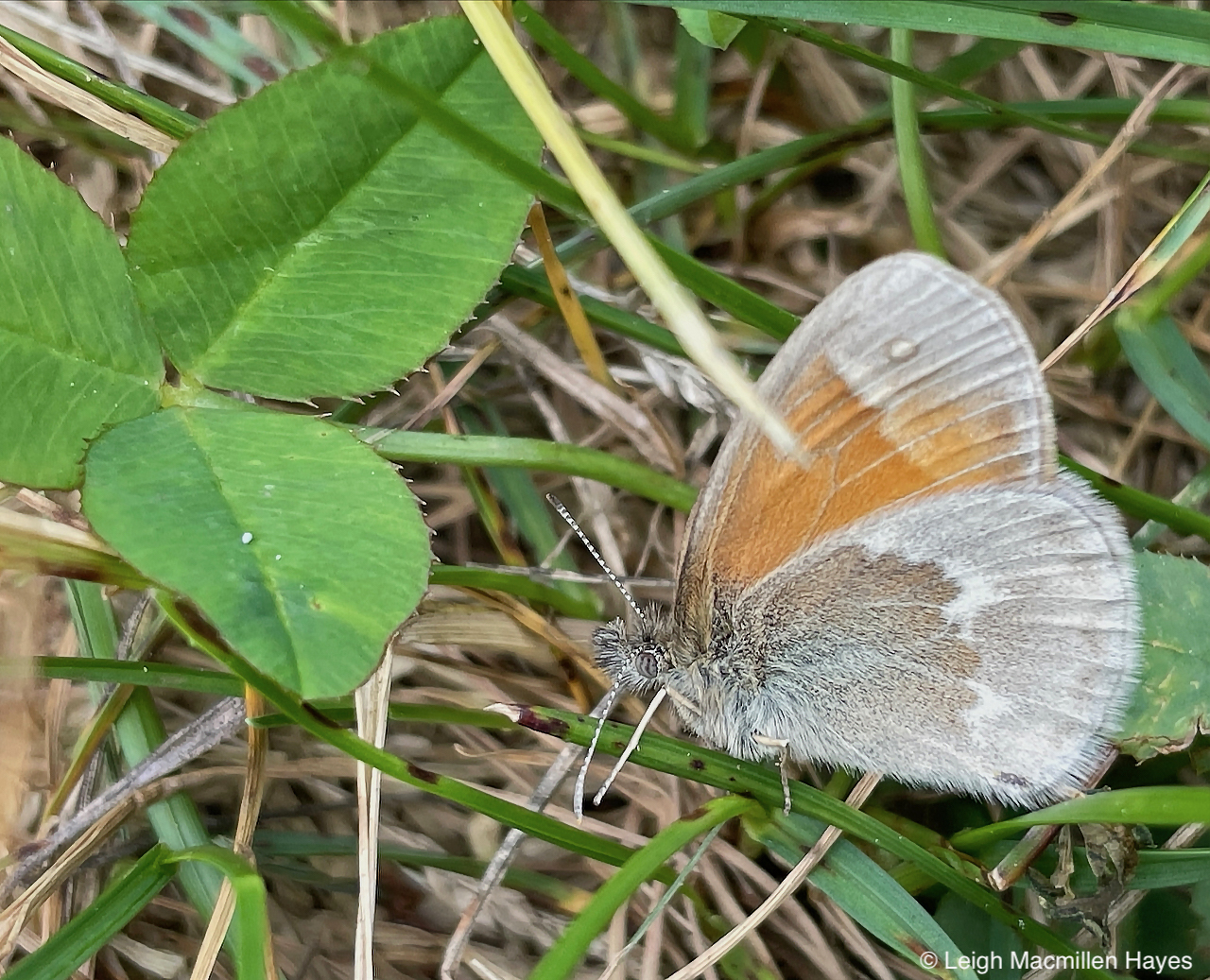
Beauty fluttered in one recent day,
Upon hairy wings of orange and gray. 
The Inornate Ringlet Butterfly
May have lacked adornment, 
But its textures and lines and colors
From the zebra-striped antennae 
To fringed wings gave pause
In its teeny exquisite way. 
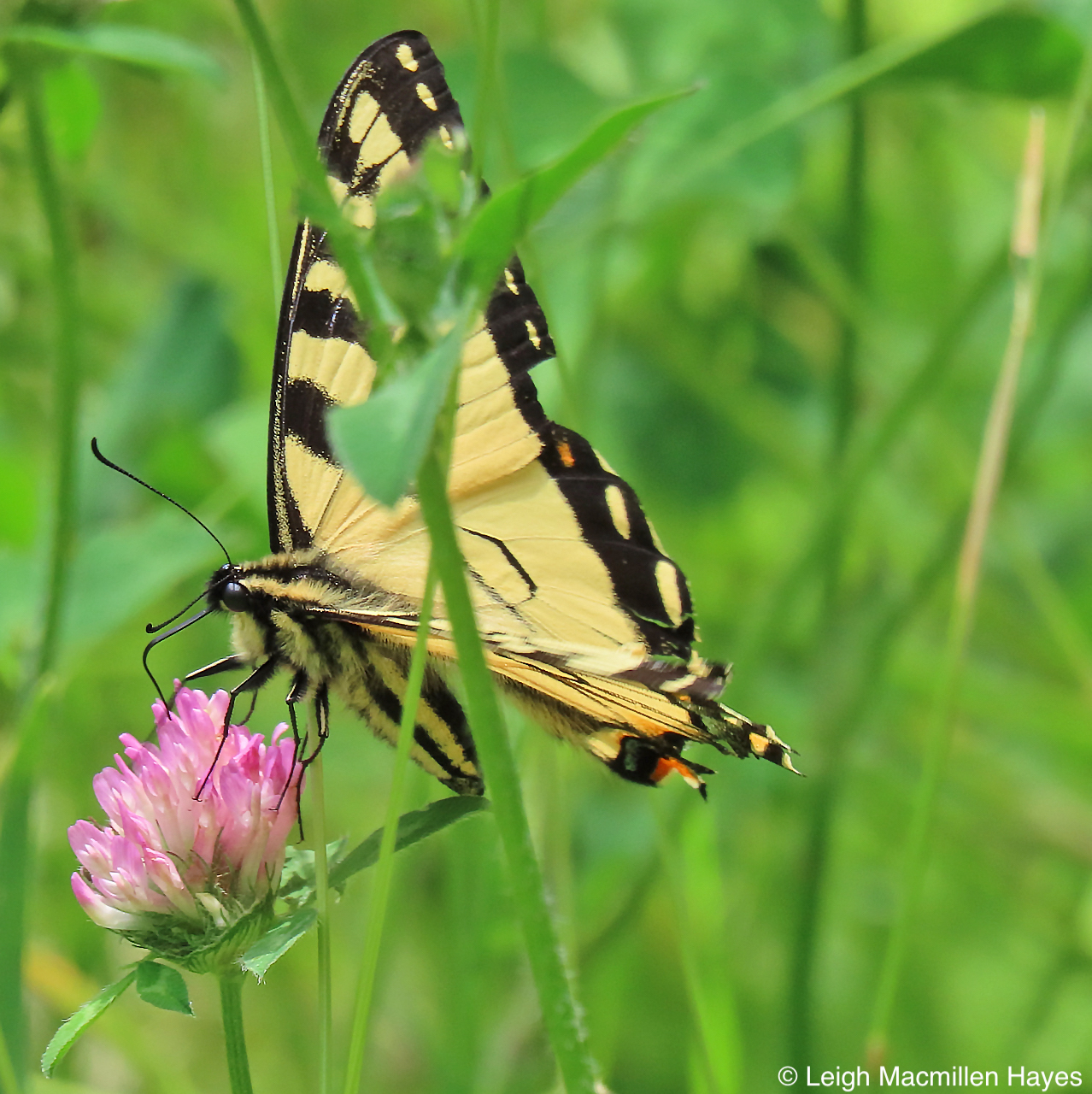
On a much larger scale, 
Upon a clover posed, 
A Tiger Swallowtail seeking sugary nectar
For a quick dash of energy 
As sucked through its extended proboscis. 
While the nectar provides nutrition,
It's not enough for that which is 
Utmost upon the butterfly's mind, 
If it is a mind they have, 
Or perhaps pure instinct
That urges them to reproduce. 
A stronger drink is indeed necessary.
The White Admirals
Embraced the same "thought" 
As they congregated 
On a small pile of scat. 
Mud. fermenting fruit, and carrion
Provide the same, 
That stronger drink
A source of sodium and minerals
That males store in their sperm
And pass on as a betrothal gift 
When they canoodle with loved ones, 
Ensuring that a little extra zing
Gives her eggs a better chance of success. 
Canoodling is also
At the forefront of 
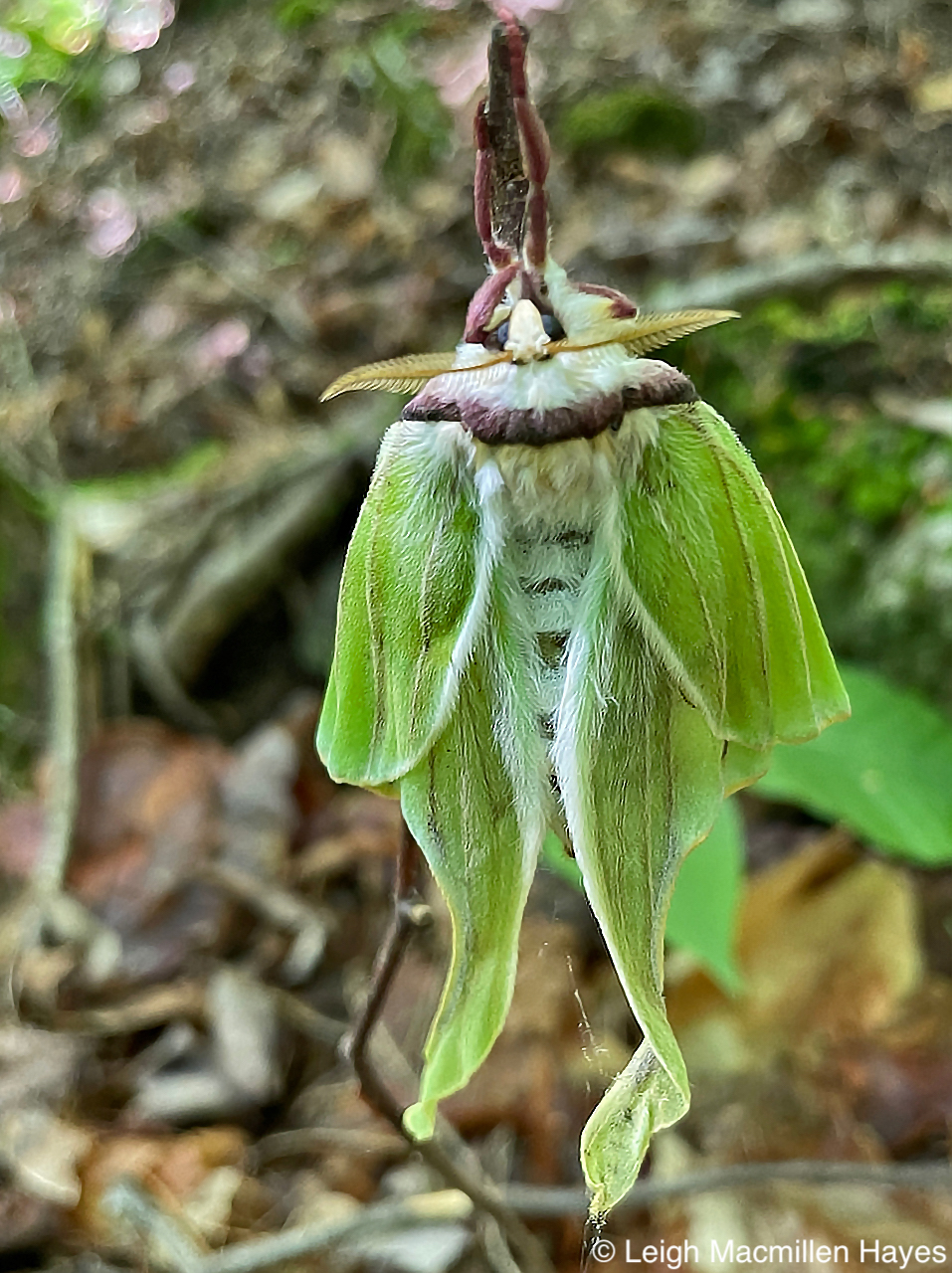
The Luna Moth's adult form,
So much so, 
That it has no mouthparts 
Or digestive system
Despite its large body. 
With less than a week to mate,
This large silkworm moth
Must smell the pheromones 
Of a female counterpart,
and then . . . and then, 
Death doth come 
As is visible by this find. 
But still it provides an opportunity
To note those broad feathery antennae, 
The light green wings that match the color of leaves, 
And the reddish-brown forewing edges 
Branching out like twigs
In an attempt to avoid predators.
Another nectar feeder, 
The Clearwing Hummingbird Moth,
Hovers with its body stationary
As its transparent wings beat
In such a quick manner 
That they are nearly invisible. 
Unlike most moths, 
These take to the air 
Throughout the day. 
The subject matter transitions
From butterflies and moths 
To others such as a female Metallic Green Sweat Bee,
So named for her color 
And preference for seeking salts upon our skin.
Thankfully, unlike some bees, 
She isn't aggressive.
Rather, she's a buzz pollinator,
One who grabs the anther 
Of a flower with her mandibles, 
Curls her abdomen around it,
Vibrates her wing muscles, 
And relishes with glory 
As the anther releases its pollen, 
Which she gathers
Upon her hairy hind legs.
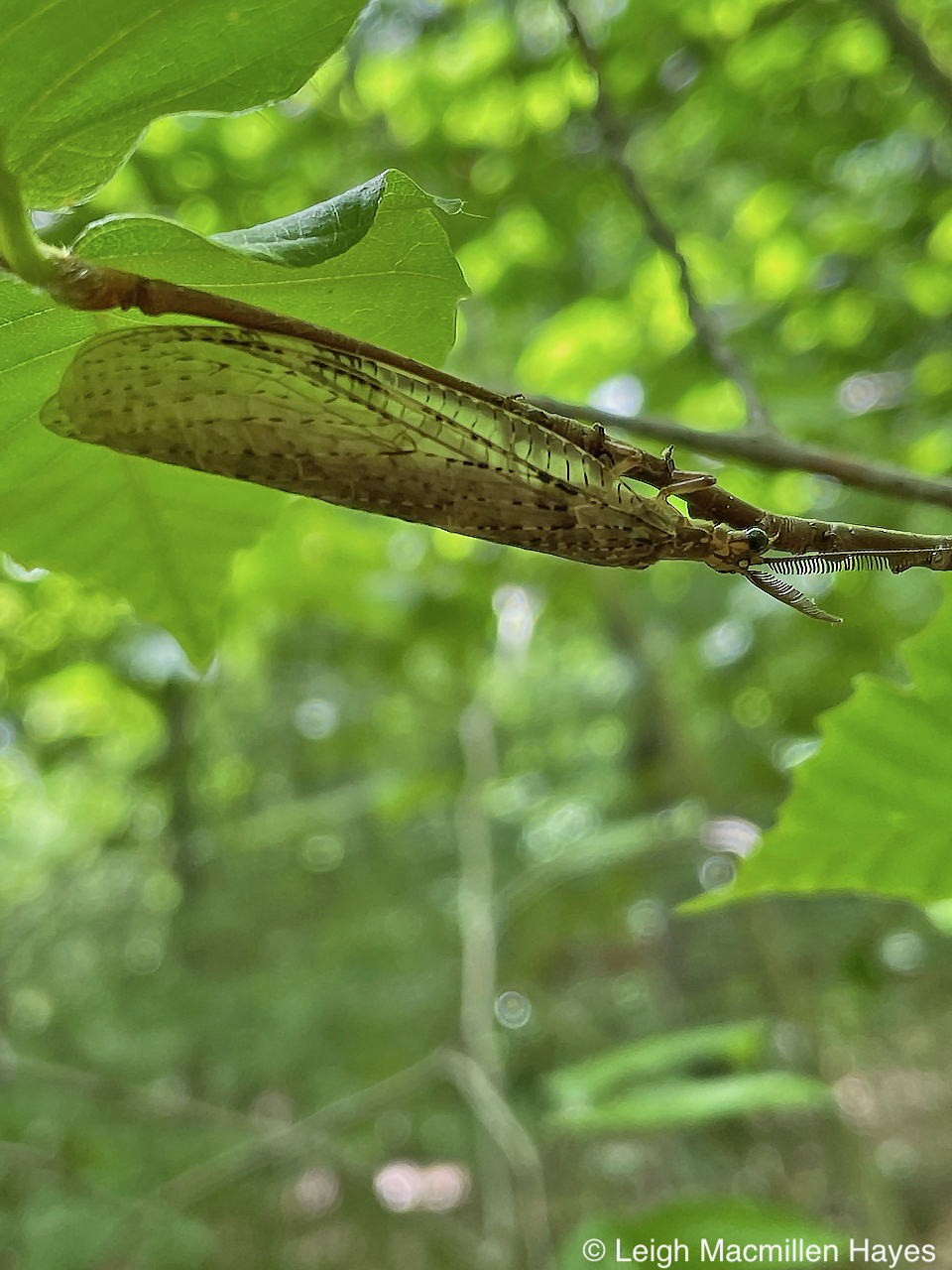
A Spring Fishfly 
I accidentally agreed was a Lacewing
In the field, 
Rests upon a twig 
As is its daytime habit, 
Wings pleated and folder 
Over its shorter abdomen. 
Like the Luna Moth, 
It only lives a few days as an adult. 
The feathery antennae 
Identify it as a male,
One with a twinkle in its eyes. 
Though kind of creepy in nature, 
The Woolly Alder Aphids 
Lead an interesting life. 
Eggs are laid upon Silver Maples, 
And as leaves burst in spring, 
Feeding takes place along the midribs. 
A winged generation soon follows,
Taking advantage that it looks like airborne seeds, 
As it floats through the airways
Until it reaches a Speckled Alder. 
Each little insect is coated 
With waxy streamers that shed water. 
As they imbibe on the Alder's juices
In an effort to gather sufficient nitrogen, 
They release unwanted carbs
In the form of honeydew,
And ants kick into action,
Farming the aphids 
To take advantage 
Of the sweet secretion. 
All is not pretty
In the natural world
Where though some 
Don't have a meal on their minds, 
Others must dine,
Such as this spider, 
That spent several hours
Wrapping a damselfly
For a future meal 
Upon an American Beech leaf. 
That was the first example of brawn, 
An exhibition of physical and muscular strength. 
In the case of the spider, 
I'm not sure I spotted an equal amount of beauty. 
But this Stream Cruiser, 
With its Oreo Cookie coloration
Was a sight to behold,
Despite the fact
That it beheld a meal of it own. 
And finally there was
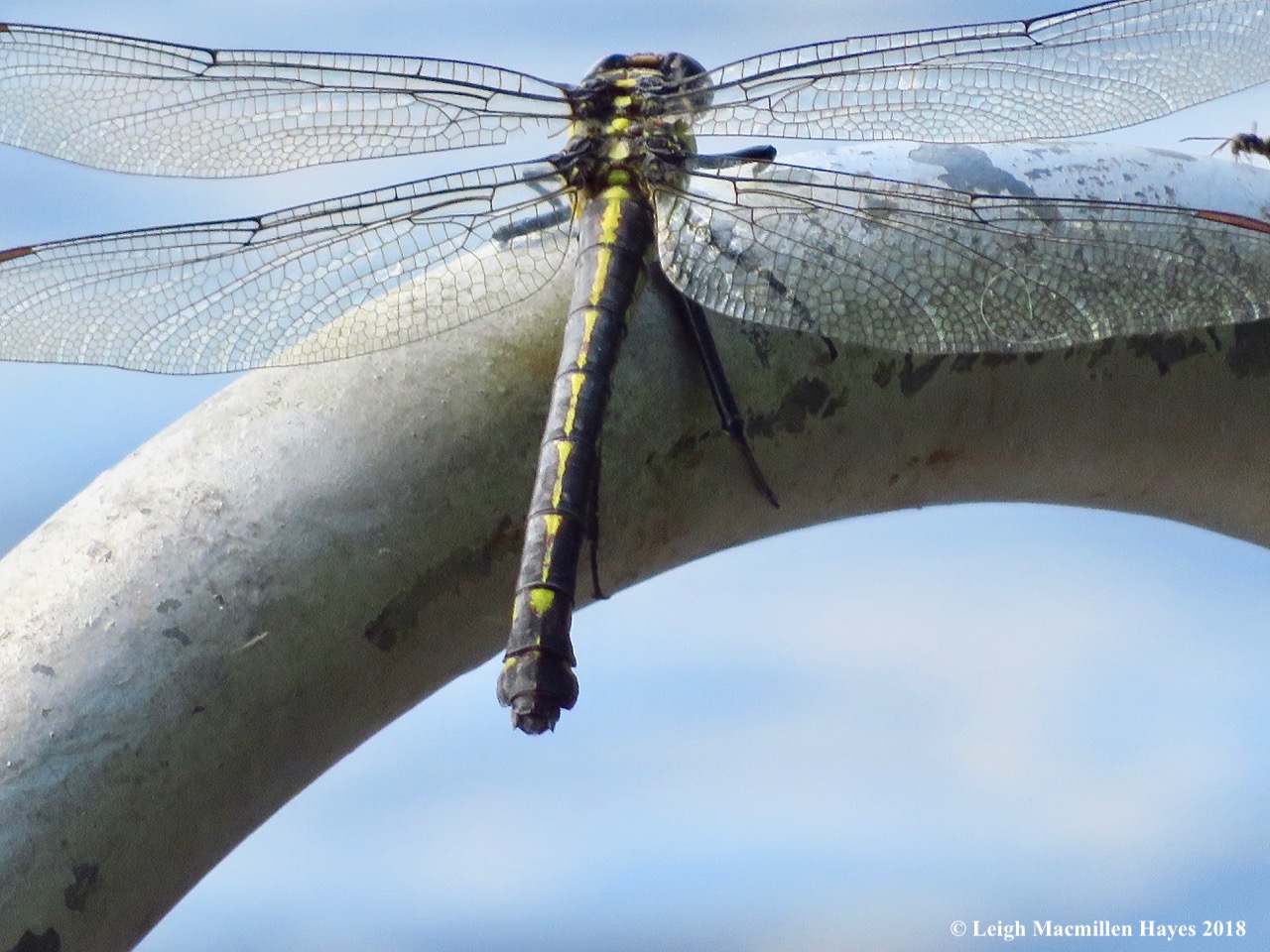
The Dragonhunter, 
A clubtail dragonfly
Revered for its wide tail,
Large size,  
And bright colorations,
But feared for being 
The Monster of the Dragonfly World 
Due to its aerial ambush
Upon other dragonflies and anything else it can eat. 
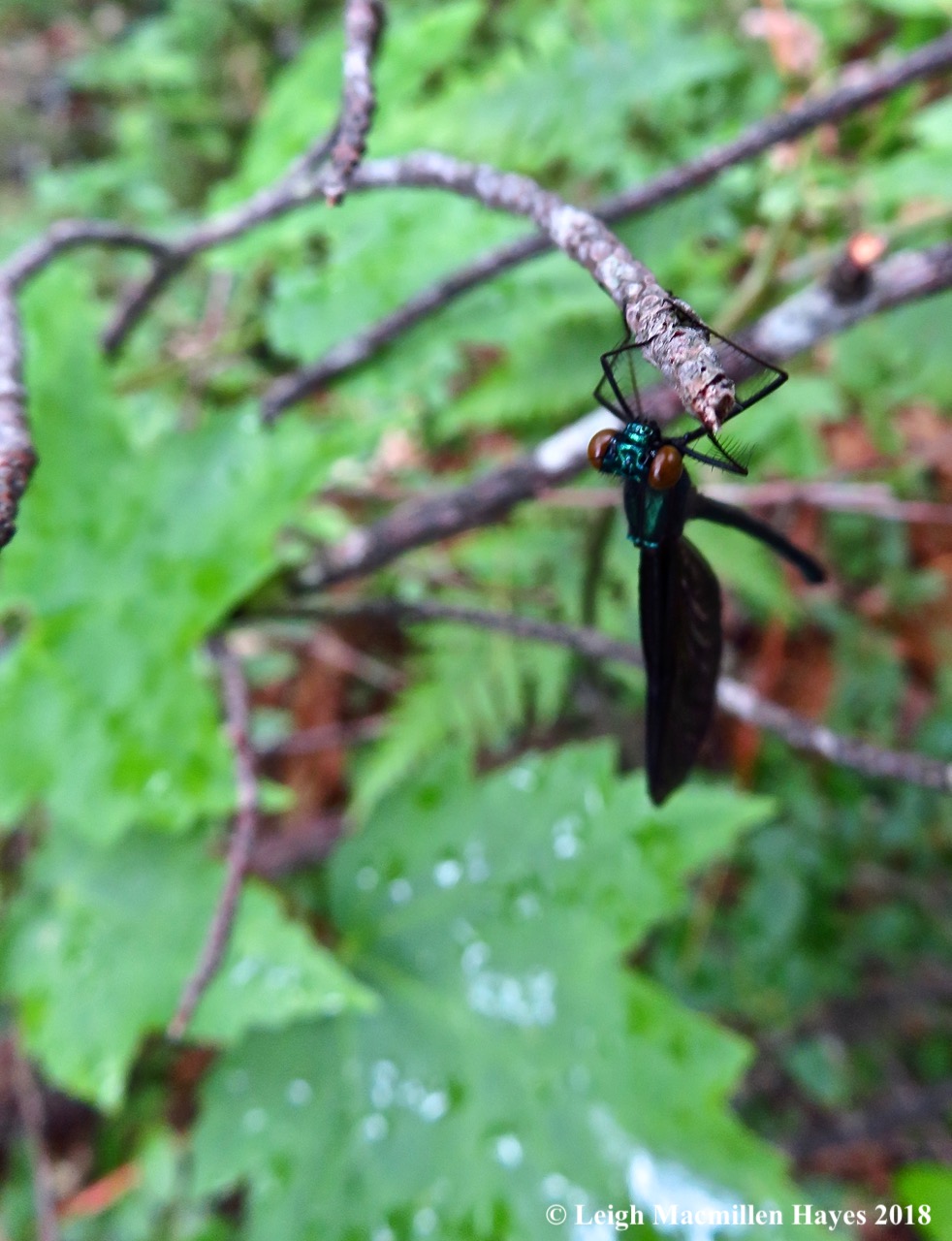
It appears there is possible meal 
Dangling below the feet and wings of this one. 

It truly is a world of beauty,
but I recognize also 
that eating for the sake of reproduction
means that brawn is an important part of the mix
in this world of wonder. 

Two kingdoms indeed. 

The Otherworldly Buttons

Rooted in the spongy sphagnum moss of our western Maine wetlands, a certain shrub makes its home beside Highbush Blueberries and Maleberry and Speckled Alder. It’s a shrub of lax and loose form, its multiple stems sprawling this way and interlocking that way.

I was finishing up an exploration this morning when said shrub stopped me and for the next hour I walked back and forth covering a total of maybe twelve feet that equaled about a half mile all told while admiring the scene that played out before me.

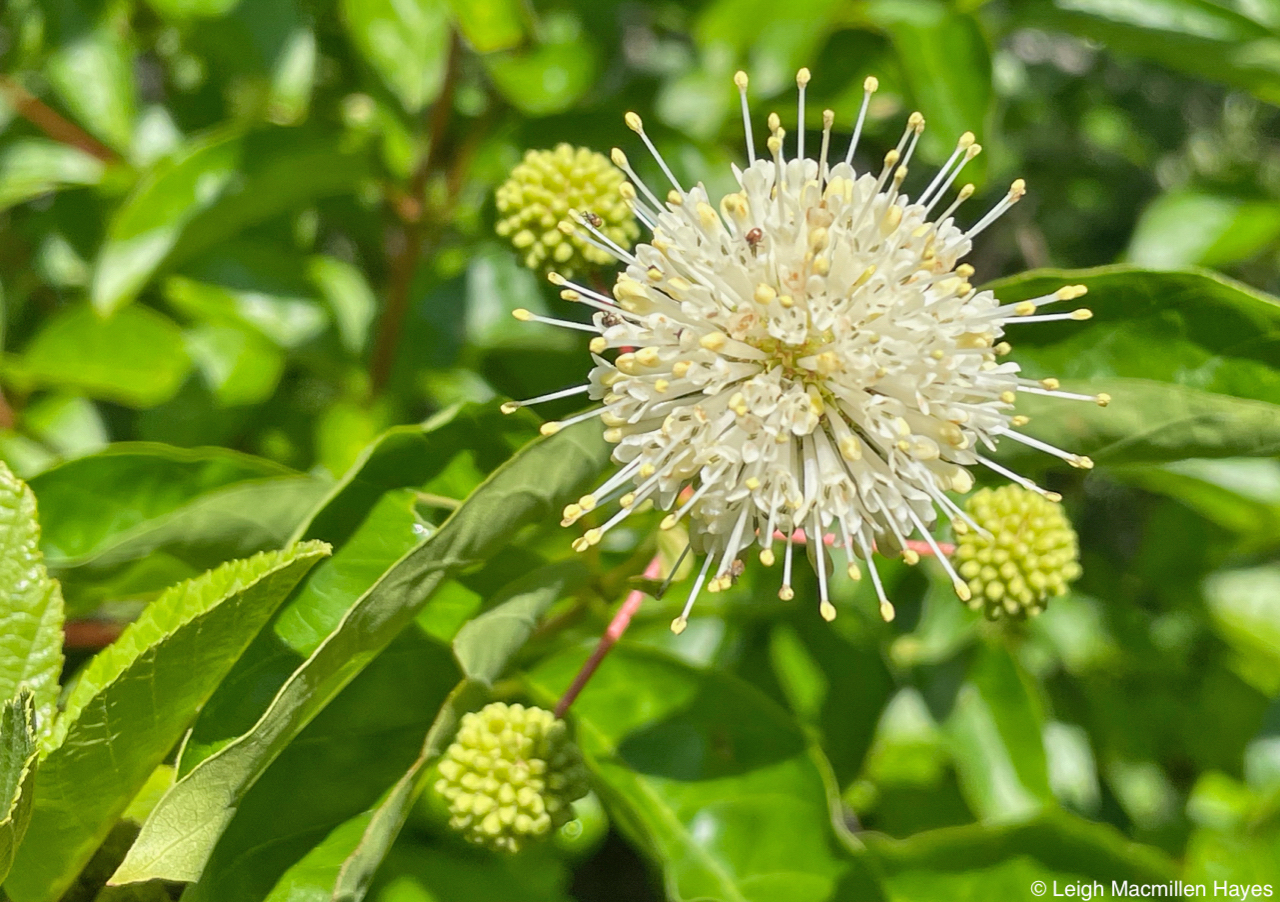
First, there were the conspicuous flowers that never cease to amaze. Dense, spherical, one-inch globes offer nature’s fireworks display in the middle of a summer day. Comprised of many creamy-white tubular flowers so closely packed into a ball, and fringed with protruding pistils that extend beyond the four anthers, the flowers remind some of a pincushion. Set against a backdrop both glossy and dark, the leaves in pairs or threes serve to highlight the fringed beauty of the inflorescence.

As insect magnets, the flowers attract many pollinators including a pair of Flower Longhorn Beetles who couldn’t resist the opportunity to canoodle among the scent so sweet.

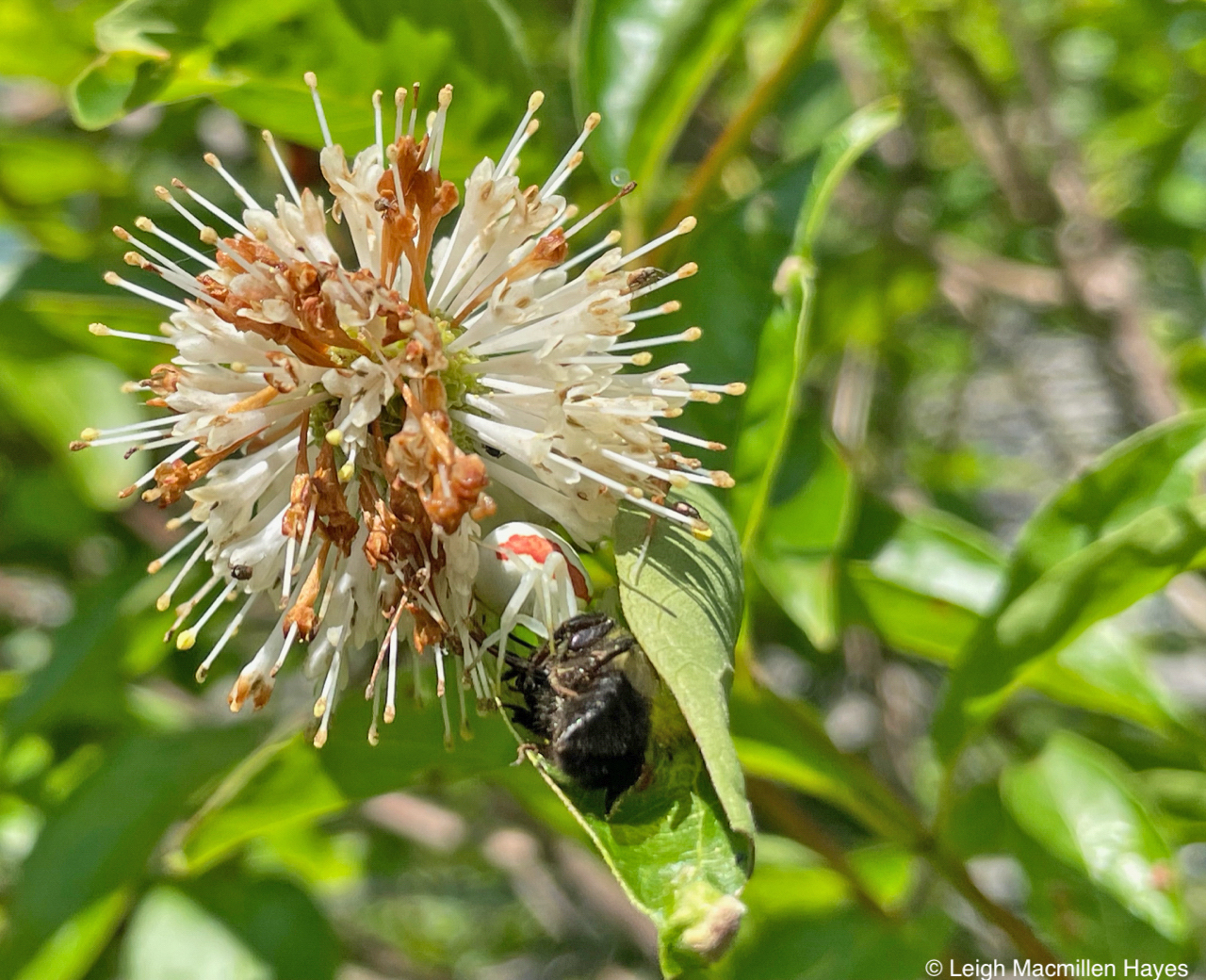
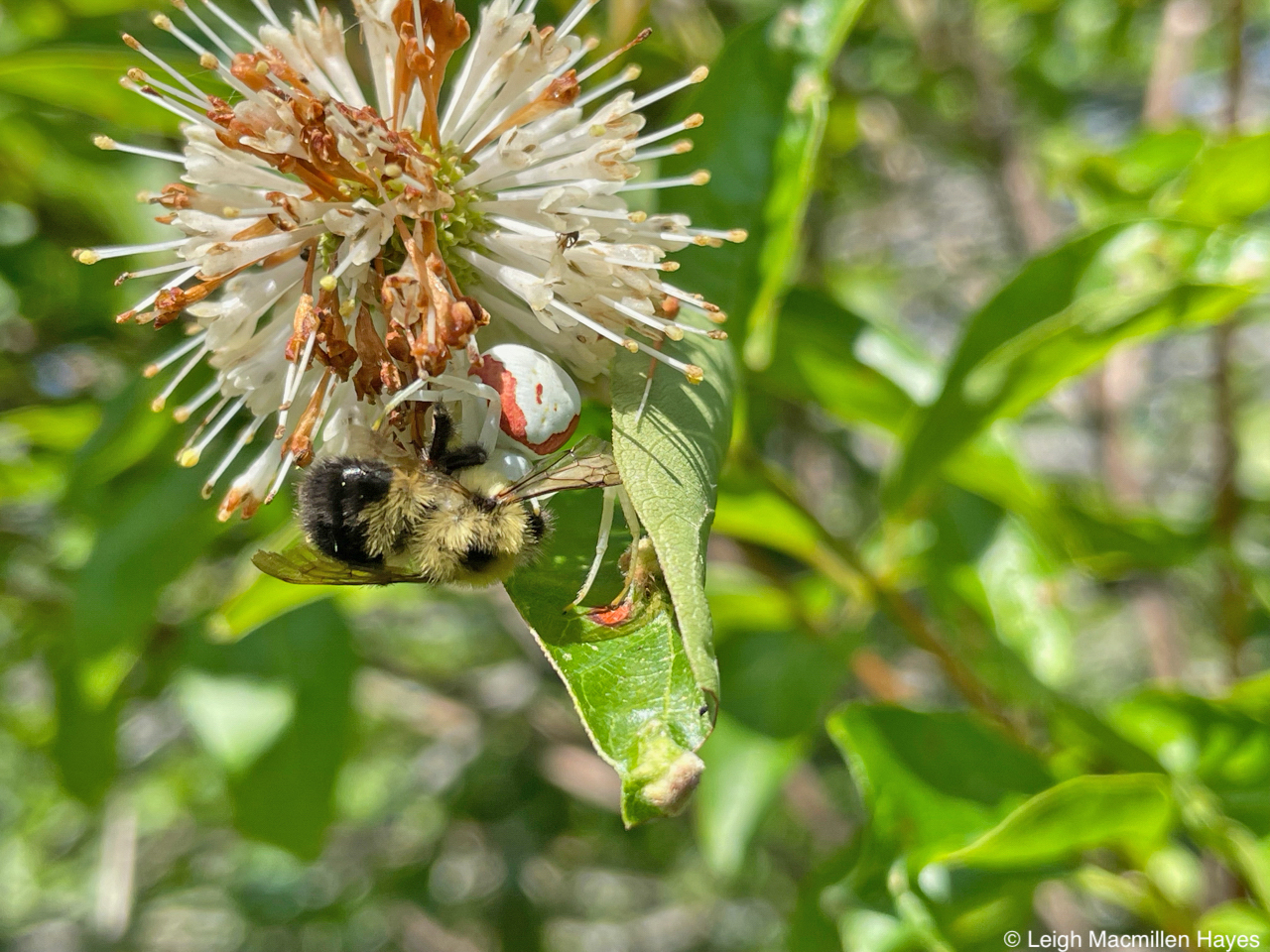
And then I spied another, a predator who had relied on its camouflage much like the flower’s color to keep from being seen in order to ambush its prey. Sit and wait. Sit and Wait. It apparently did so until success was achieved.

As I looked about, I spied a silken thread and wondered if it belonged to the Crab Spider. This species doesn’t build webs, but uses silk to attach drop lines to vegetation just in case in the midst of fervent action while attempting to capture a meal, it slips and needs to get back into position.

In the midst of my observation, in flew a pollinator that we all need to revere for its species is endangered and I felt blessed to have seen this one. It seems only yesterday, when our sons were mere tots, (think three decades ago) that we often spotted Monarchs all over flowering shrubs in August and September. But now, we celebrate each and every one and only this morning a friend sent a photo of a Monarch caterpillar feasting on her Milkweed and so we know we are among the fortunate few to share these special sightings.

Meanwhile, back at Lunch Leaf, I stalked. When its prey was close enough, the spider grabbed it with its two front legs, the longest of its four pairs, and bit into the victim.

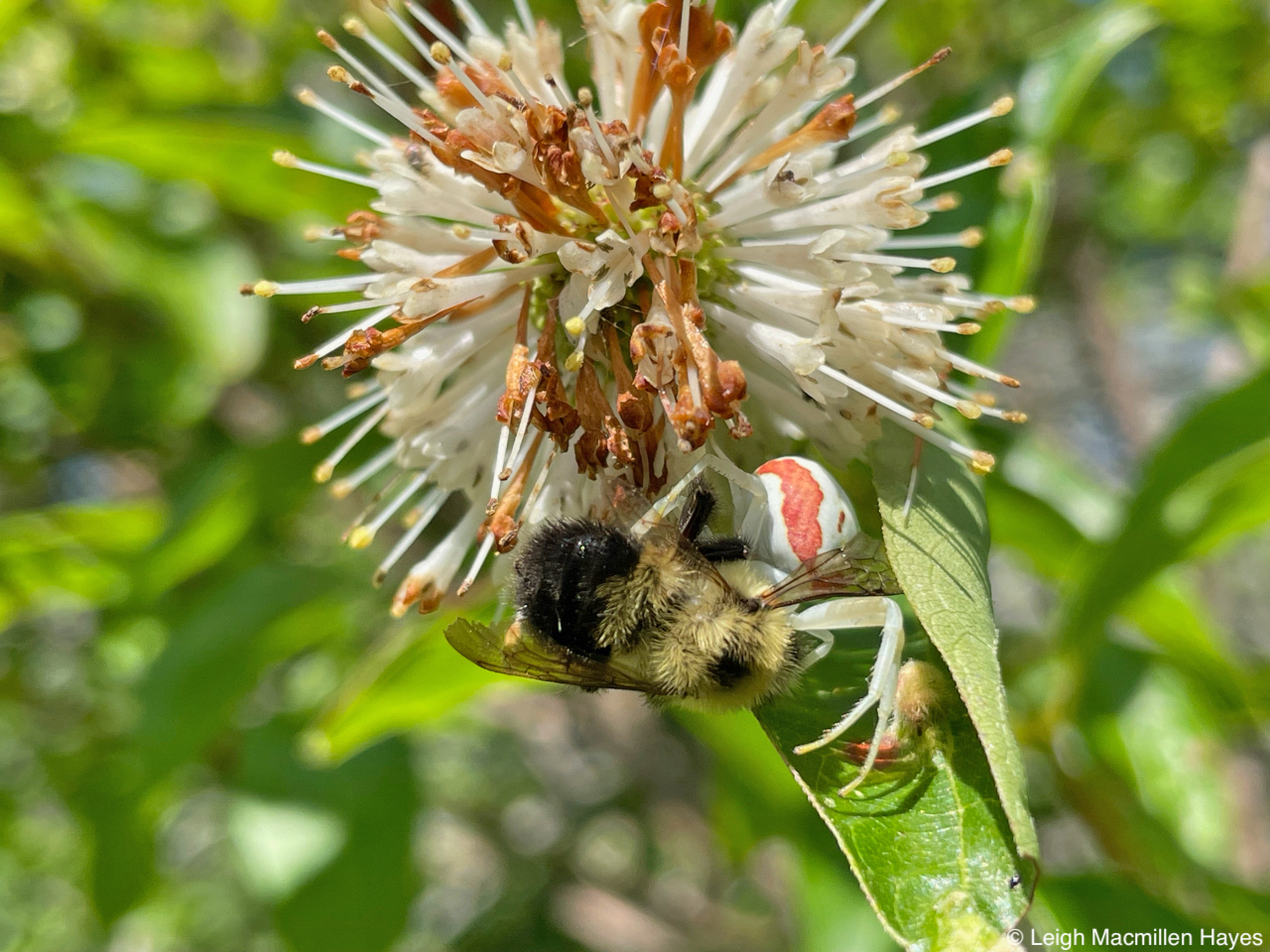
Meanwhile, a Bumble Bee buzzed in, gathering its fill of nectar and pollen, nectar and pollen, until it needed to return to the hive before coming back to collect some more.

Back at Lunch Leaf, venom was injected to paralyze the meal.

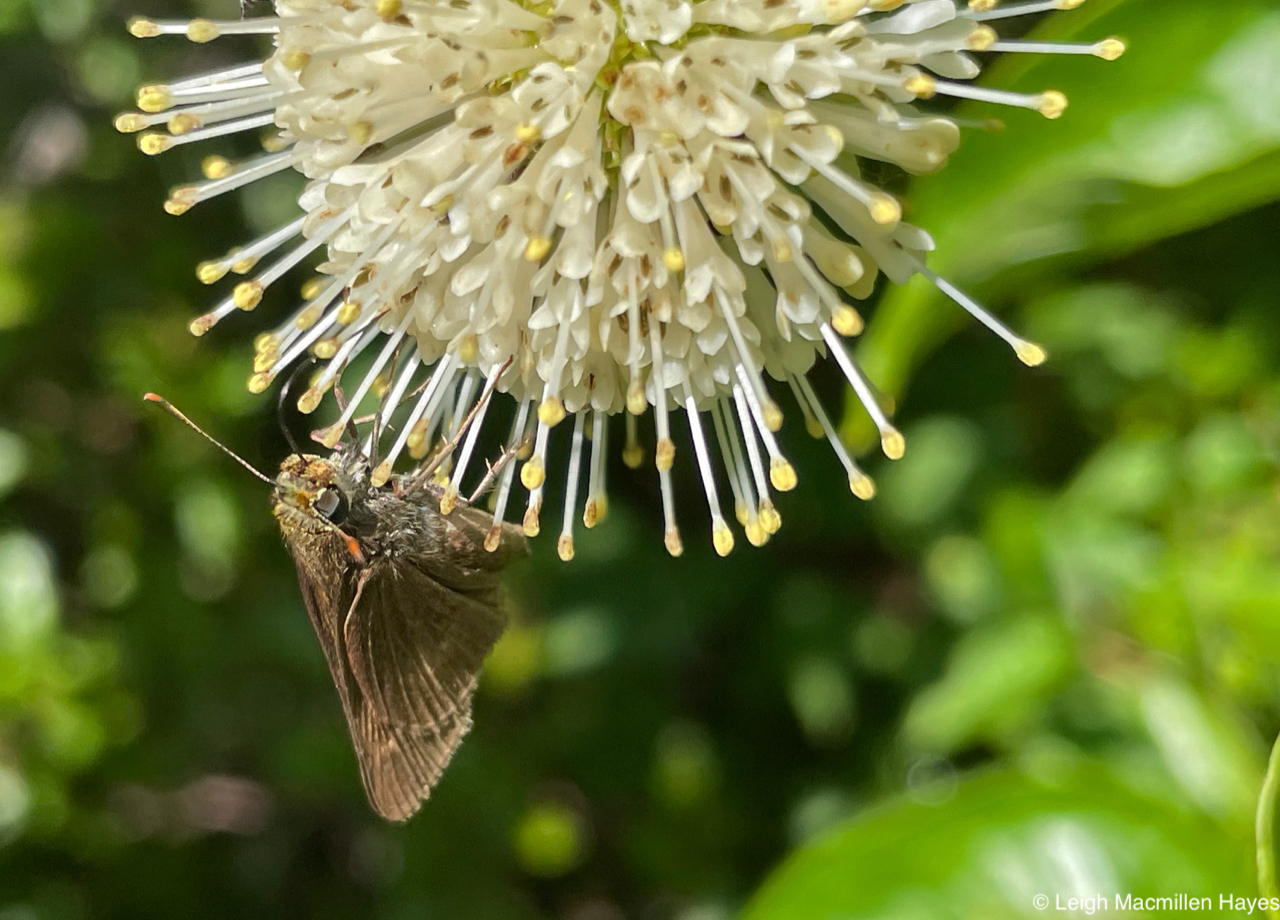
Next, a Dun Skipper made an entrance. Actually about three of them flitted and fluttered from one globe to another.

As for the Crab Spider, it seemed to work on positioning the meal just right.

When the Dun Skipper was positioned just right, I could see its body more clearly and loved how the proboscis stuck down into the flower’s tubular structure. With its deep tube, this inflorescence was designed for butterflies and bees.

Back at the lunch counter, another twist was made.

And atop a different flower head, a Transverse Flower Fly made an appearance, its eyes much bigger than its stomach.

It soon became obvious that prepping a meal takes much work.

The visitors upon the flowers were many and I suppose the lunch choices were as well. While I’m thrilled to have seen so many pollinators, the Crab Spider could only imagine its next meal.

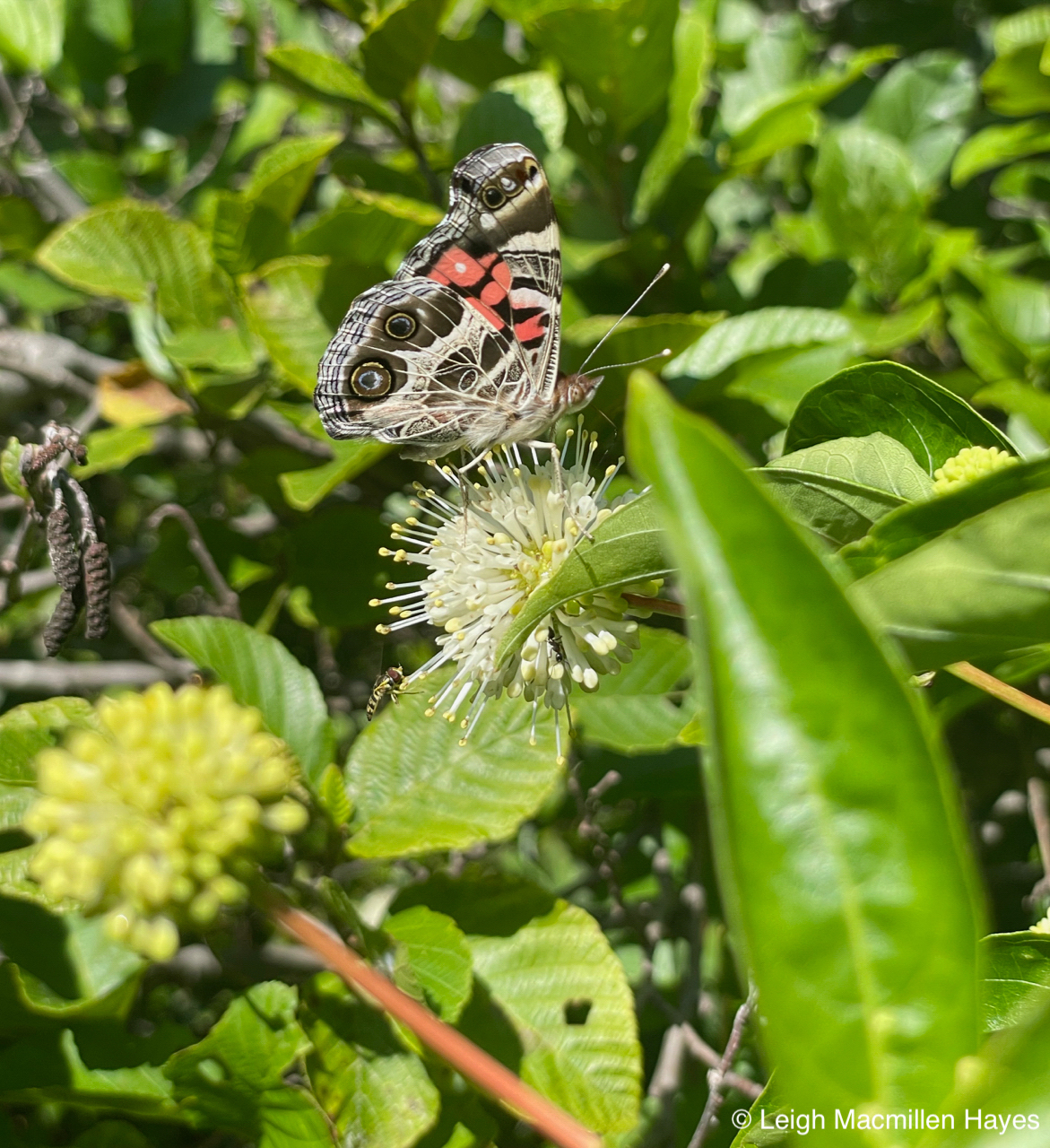
As our time came to an end just after an American Lady flew in, I looked down to make sure I hadn’t worn out the boardwalk and I thought about all the action I’d had the honor of witnessing. Though the flowers drew in smaller insects, they are designed to attract larger bees and butterflies. The Buttonbush (Cephalanthus occidentalis) flowers certainly provide copious amounts of nectar and pollen that make a visit worth the effort for all who stopped by . . . Including the Crab Spider.

I gave thanks to the latter for its diet is well diversified and they are known to contribute to biological controls, but . . . unfortunately, sometimes they feed on beneficial insects like bees.

But I especially gave thanks for all the bees and butterflies who shared their feeding frenzy with me.

Time spent pacing before the satellite-shaped Buttonbush flowers is time spent enjoying an otherworldly experience.   

Starring wondermyway: Take 2

Thanks to Evan Miller at Lake Region Television, and station manager Chris Richard, wondermyway is on TV once again. For this program, Evan added music by pianist Francis Poulenc, which greatly enhances it.

Pull up a chair and click on the link for nine minutes of wondermyway: wondermywayII

After you click on the link above, if you’d like to enlarge the screen, simply click on the icon the arrow points to in this photo. (Not on the photo, mind you {knowing me, I’d probably try that first}, but on the icon on the actual link.)

May this bring you some moments of well being and peace.

Because of the Hare

Yesterday’s torrential rain, sleet, torrential rain, snow, sleet, torrential rain, snow, wind, and cold became today’s frozen snow upon which I could walk without sinking.

Or wearing snowshoes, though I did choose micro-spikes because I wasn’t sure what conditions I might encounter as I headed out to the old cowpath and woods beyond.

It was at the far end of the path that a lot of disturbance drew my attention and I realized deer had pawed and pranced in an attempt to gain something upon which to dine.

Empty caps were all that had been left behind during the ungulates search for a meal fueled by Red Oaks.

A wee bit further, I paused by the vernal pool that will soon seek much of my attention. Today, it shared two things; yesterday’s weather had transformed it from a snowy crust to an icy one; and the neighborhood turkeys, which I’ve yet to see, had stopped by.

But my reason for heading out late this afternoon was to cross over the double-wide wall by the pool and disappear into the saplings that fill the space.

It’s a parcel of land that was nearly clearcut in its day, but since then I’ve welcomed the opportunity to watch forest succession and all that it has to offer in action.

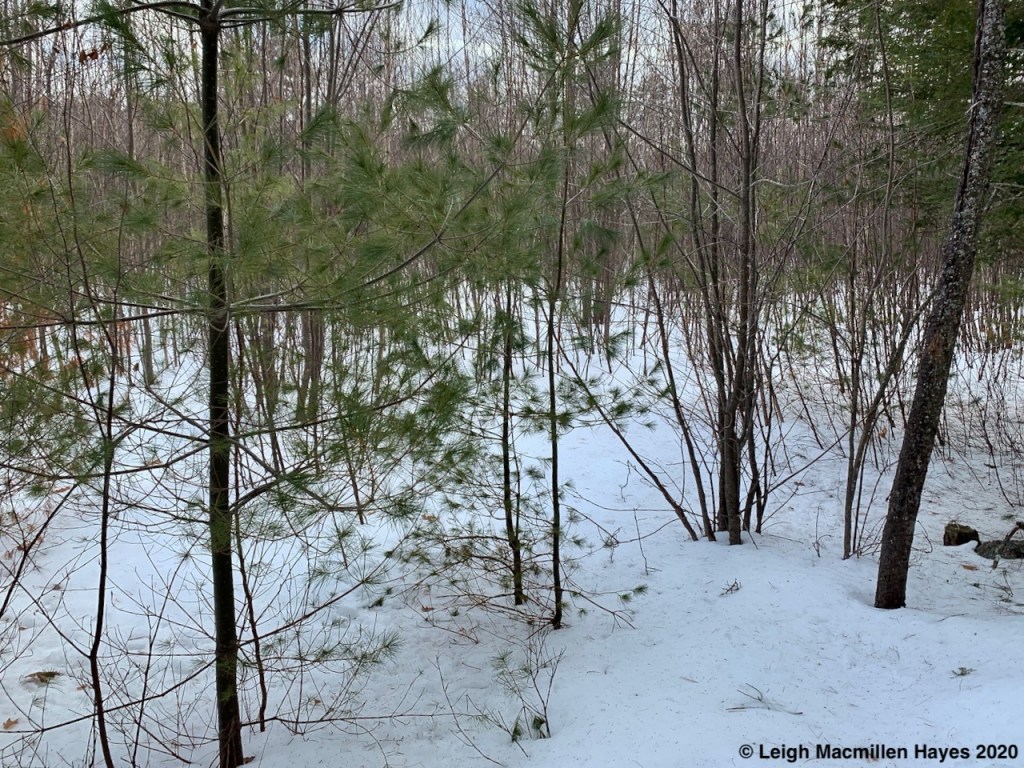
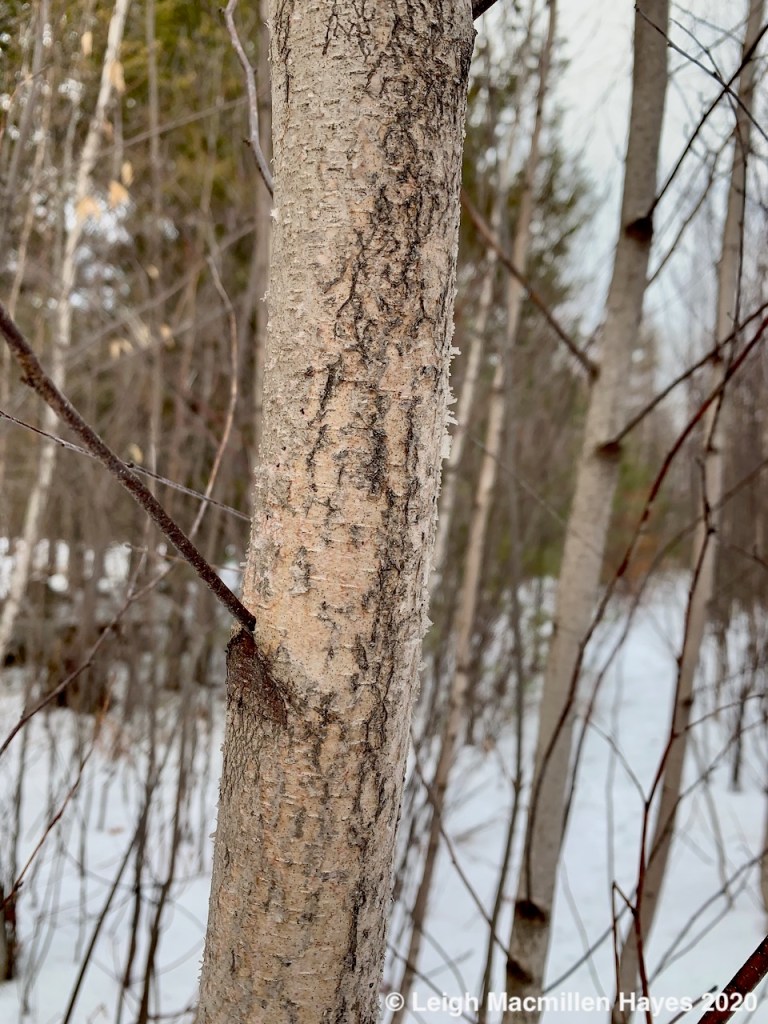
Being an early succession forest, Gray Birch fills the landscape with its twigs atop triangular gray beards. Red Maples and White Pines add their own colors to this place.

At the gray birches’ feet, their catkins filled with fleur de lis scales and teeny tiny seeds that remind me of ever so minute insects with transparent wings, littered the snow. Two actual insects also made themselves known. Do you see them? (Faith and Sara–happy looking ;-) )

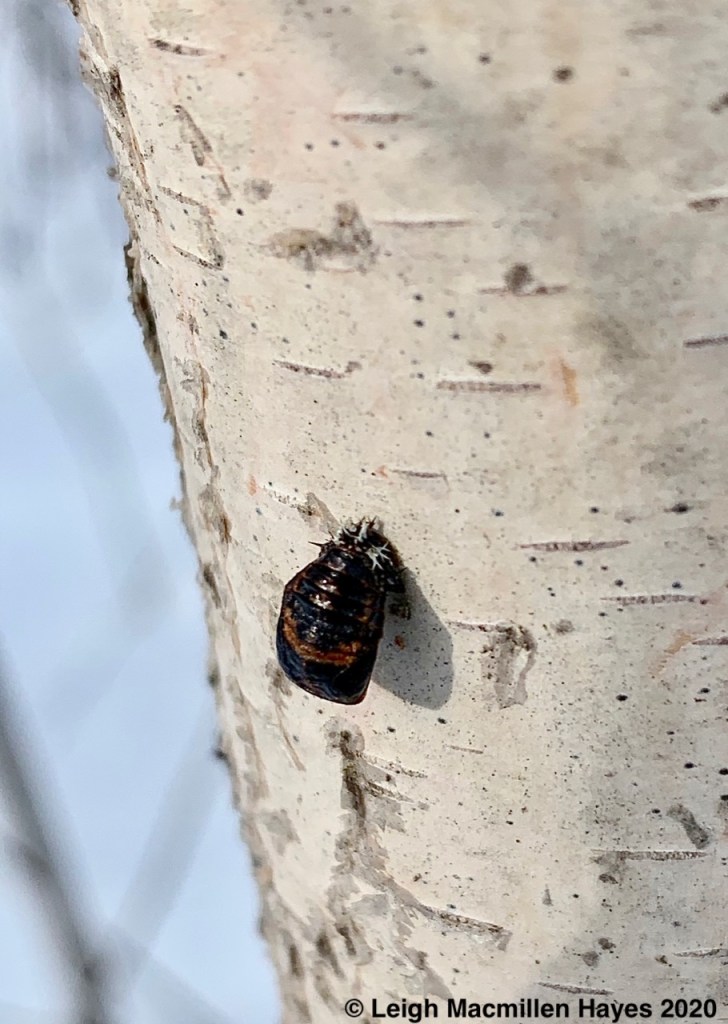
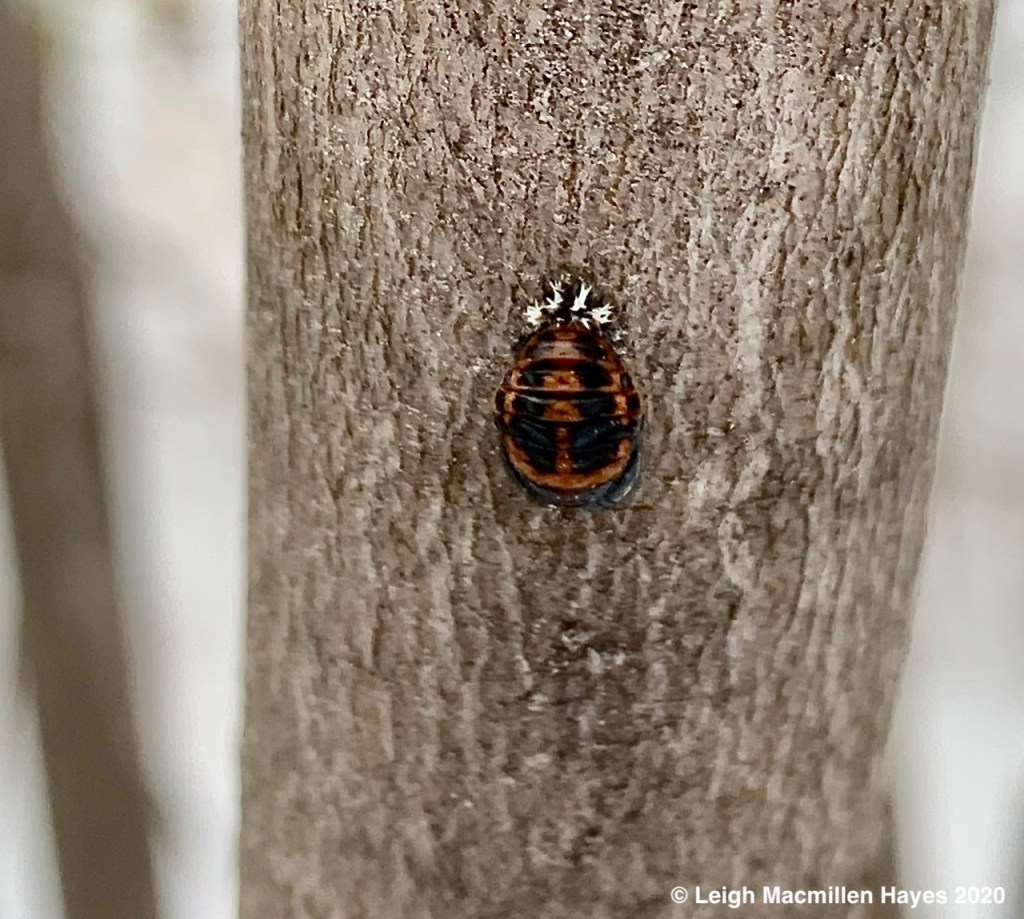
And then another insect came into my sight. Truth is, a friend introduced me to this pupal form of a ladybeetle in late autumn/early winter. Of course we’d never seen it before, but as happens in the natural world, once you see something and gain a wee bit of understanding about it, you suddenly see it everywhere. Until recently, everywhere for this species had been upon evergreen trees. And then we found it on tree bark. Gray Birch to start.

I had much to think about in terms of the ladybeetle, but really, I’d come to this place because of some downed trees. Here and there in this forest swath, trees are bent over for no apparent reason. I think I know the why for I don’t believe it’s because a storm came through or all the trees would have bent over. I suspect it has to do with the fact that so much of the plot consists of gray birch that topple easily with the weight of snow, such is their cell structure. And as they toppled, they took down some pine saplings in the mix.

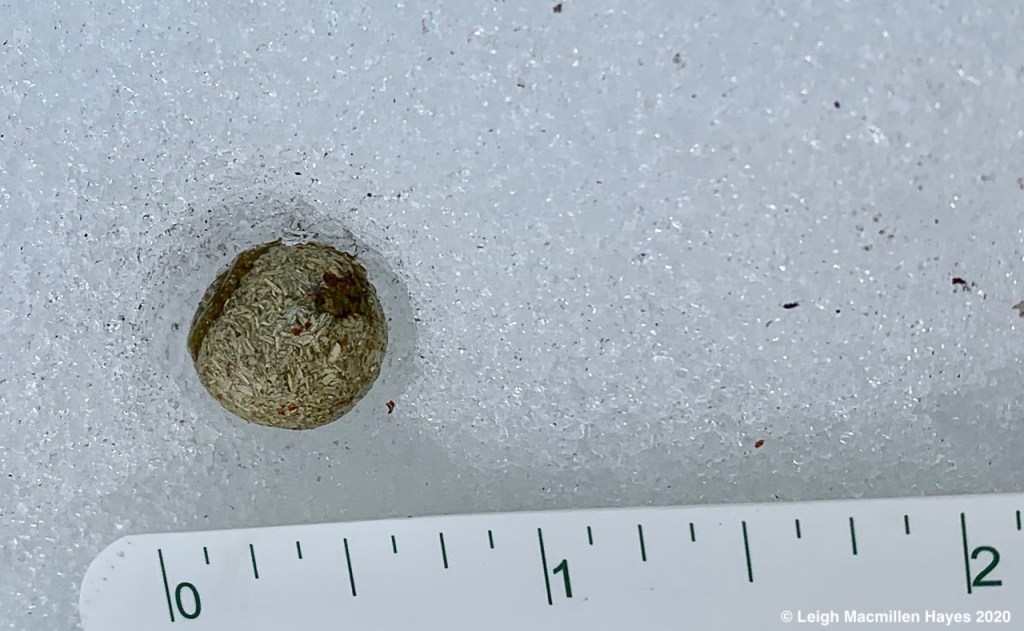
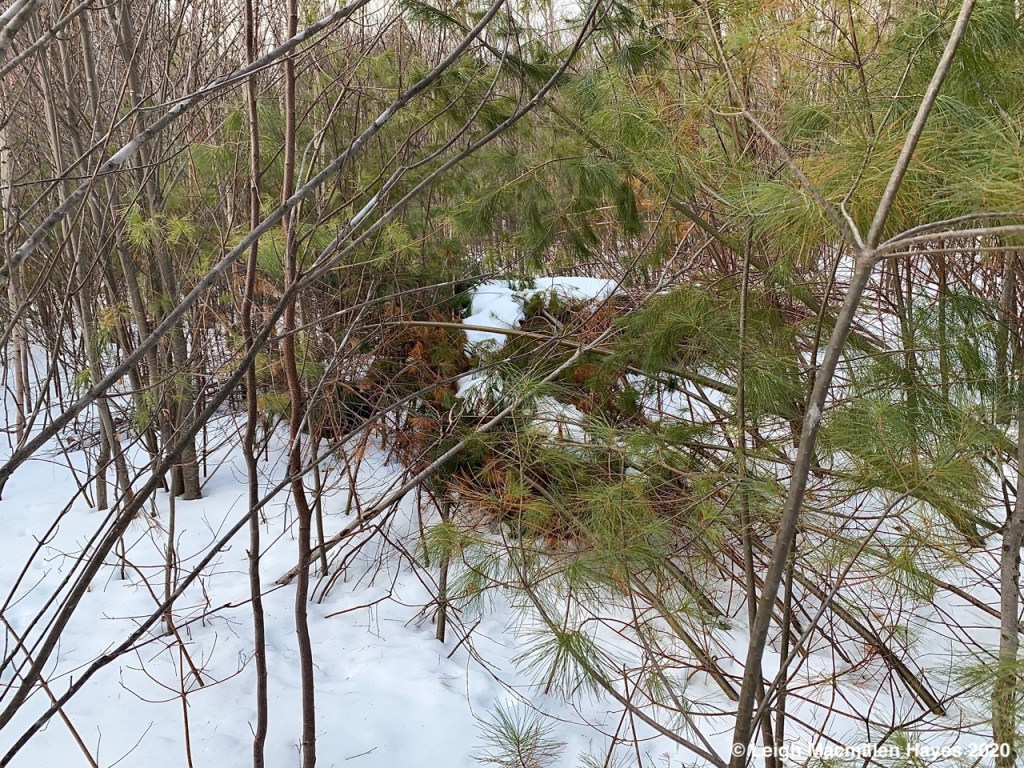
The creator of this scat loves the forms that the downed trees created for it’s a great place to hide when predators or old ladies stop by on the hunt. What I wanted the critter to know was that I was only hunting with a camera. You see, last week I actually spied the scatter as it hopped out of the form and leaped away, its fur slightly streaked brown as is its manner in this between-season time, giving rise to one of its common names: varying hare. It was too fast for my camera and so today I went back in hopes of a second sighting.

By the angled cuts of surrounding vegetation, I’d knew where it had dined.

And by its track, I knew its most common name: Lobster Hare. Okay, so it’s a Snowshoe Hare, but each set of prints always reminds me of the crustaceans of Maine fame.

I tried, oh so hard, to stand still and hoped upon hope that the hare would show itself again.

In my standing still, I did see more ladybeetles in their pupating stage–this one upon a dead White Pine.

And near it . . . another set of downed trees creating another Snowshoe Hare form, that place where the lagomorphs rest during the day. Usually that place is located under evergreens as was the case.

Spying a certain set of prints by the form, I realized I wasn’t alone in my quest. Do you see the C-ridge between the toes? And the asymmetrical presentation of the two lead toes? And the impression of two feet, where a foot packed the sloshy snow of yesterday and a second foot landed in almost the same place? I present to you a Bobcat. ;-)

It led me to yet another Snowshoe Hare form.

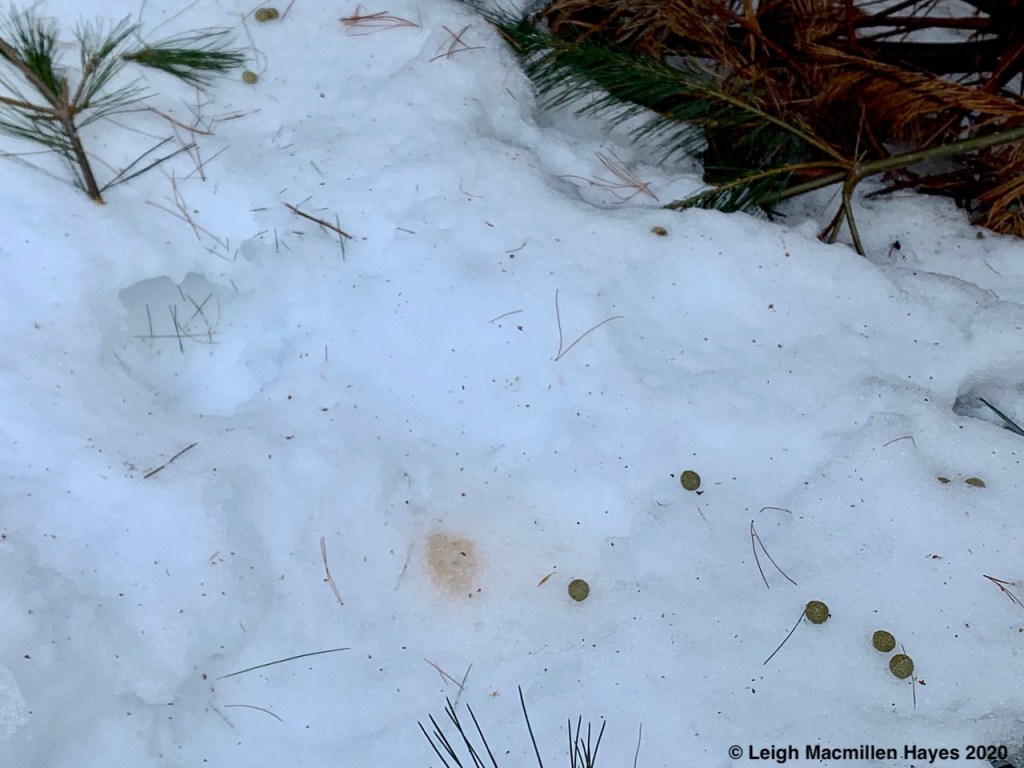
Atop the form were signs of life, much to my delight: prints, scat, and even the orange-red tint of Snowshoe Hare pee.

Still, the Bobcat moved–its track connecting with a run or well-traveled path of a hare.

Following the hare and cat tracks led to yet another “form.”

It was there that I stood for the longest time. And I swear I heard someone munching within. Was it my imagination? Probably. For my imagination also had me hearing all the wild animals of the forest closing in on the hare and me and then I realized that I was the one closing in on the hare and my “fear” was its “fear.” Marcescent leaves that rattled in the breeze and trees that moaned as they bent in the breeze became larger than life creatures of the forest.

As I stood and listened and felt the hairs on the back of my neck stand tall, I spied more ladybird beetles in their larval and pupal stage.

As much as I wanted to understand the life cycle of this beetle and especially how it deals, if it does, with our low winter temperatures, please, please don’t tell me your understanding.

From evergreen to hardwood, I’m in the process of learning the habitat of this species.

Heck, it not only doesn’t just use evergreens upon which to pupate, it also doesn’t depend only upon Gray Birch, given that it can be seen upon plenty of Red Maple tree trunks.

Oh, and as you look, others might surprise you like these puff balls, their spores still ready to pour forth when gently poked.

Over and over again as I waited patiently for the hare, the ladybeetles made themselves known.

Some presentations differed from others and made me wonder about their matter of timing. Were they frozen molts? Were they morphing? If you know the answer, please don’t tell for this is a new learning and I hope to stay on the case.

Still, as first discovered, there were more in the evergreens to spy.

As the sun began to set, I found the Bobcat track once again and it led into the forest beyond.

More importantly, I backtracked its trail and discovered yet another Snowshoe Hare form created by downed trees. In my mind, so many places for the hare to hide. So many places for the cat to explore. And in the mix–me.

I never did see the hare today. Or the deer. Or the turkey. Or the bobcat. But . . . by their signs I knew that we share this space and there were a few others in the mix including porcupines, squirrels and grouse, and I gave great thanks . . . because of the hare.

Stories from the Eye of the Barn

At the top of a lane in South Bridgton, Maine, sits the homestead of the Peabody-Fitch family.

A pioneer settler of Bridgton, William Peabody married Sally Stevens on August 14, 1797, in Andover, Massachusetts. She was the daughter of Jacob Stevens, a ranking member of the surveying crew who came to Bridgton in 1766 to survey the plots of land. He returned in 1768, under contract with the proprietors to develop water power along Stevens Brook and make it serve early settlers.

William built this house in 1797, just three years after Bridgton was incorporated. The house was 30 x 45’, 2.5 stories with a center chimney and six fireplaces: 3 up and 3 down. The Peabodys had ten children, though four died at a young age.

Their fourth daughter, Mary, married George Fitch of Sebago on Dec 21, 1823, and in about 1828 the Fitches took over the hilltop farm. At the time of their marriage, William was in his late 50s and Sally not well. That meant that the house needed to accommodate two families: Mary’s parents and three of her younger siblings, plus Mary and George and their growing brood.

George Fitch added an ell with a new kitchen, larder, pantry and two bedrooms. A shed and carriage house were also included.

By 1856, George Fitch owned 80 improved acres and 128 unimproved acres. The farm produced wheat, Indian corn, oats, buckwheat, maple syrup butter and cheese. In addition, he had a stand of mulberry trees for silk worms. The cocoon, when unraveled, can be spun into silk.

A 40 x 60’ barn was built by Mr. Fitch and friends beside an already existing 40 x 40’ barn to help house his two horses, six milk cows, six working oxen, six other cattle, sixteen sheep and one swine. Hay would have been stored there as well.

The lore of what’s always been known as the Temperance Barn, is that it was supposedly constructed during prohibition without the usual swigs of rum for all who helped in the building process. Following a blog post I wrote in December 2018 about this very property, a granddaughter of Margaret Monroe who gifted the property to the historical society in 1987 wrote the following message: “Hi – I am glad you enjoy my grandmother’s property. A heads up that there is no written documentation from the period re: the barn actually being built without alcohol. My grandmother was prone to making up history. I want to give respect to hardy native Mainers: Monroes were largely summer people. My grandmother also said sherry wasn’t alcoholic and would drink a big glass of it every night before dinner, Lark cigarette in her other hand. Rebecca Monroe.”

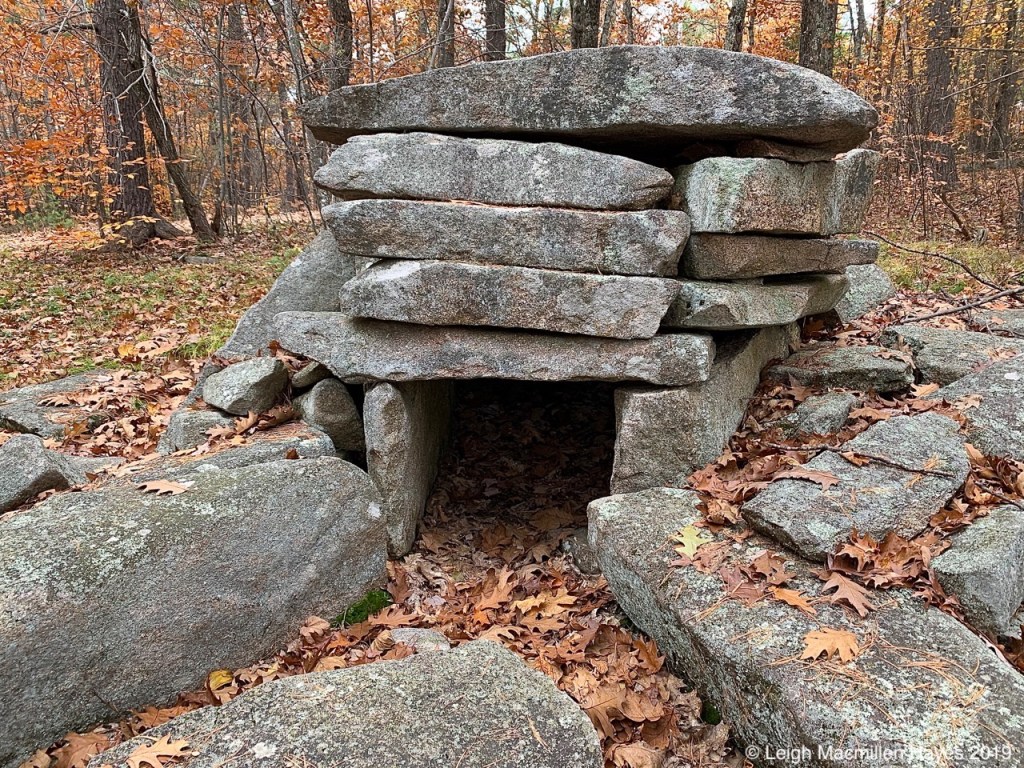
But it was the granite foundation that drew part of our attention today. Apparently, when Mr. Fitch first built the barn, it sat upon a two-foot foundation, but he later raised it by eight feet, perhaps to store manure below.

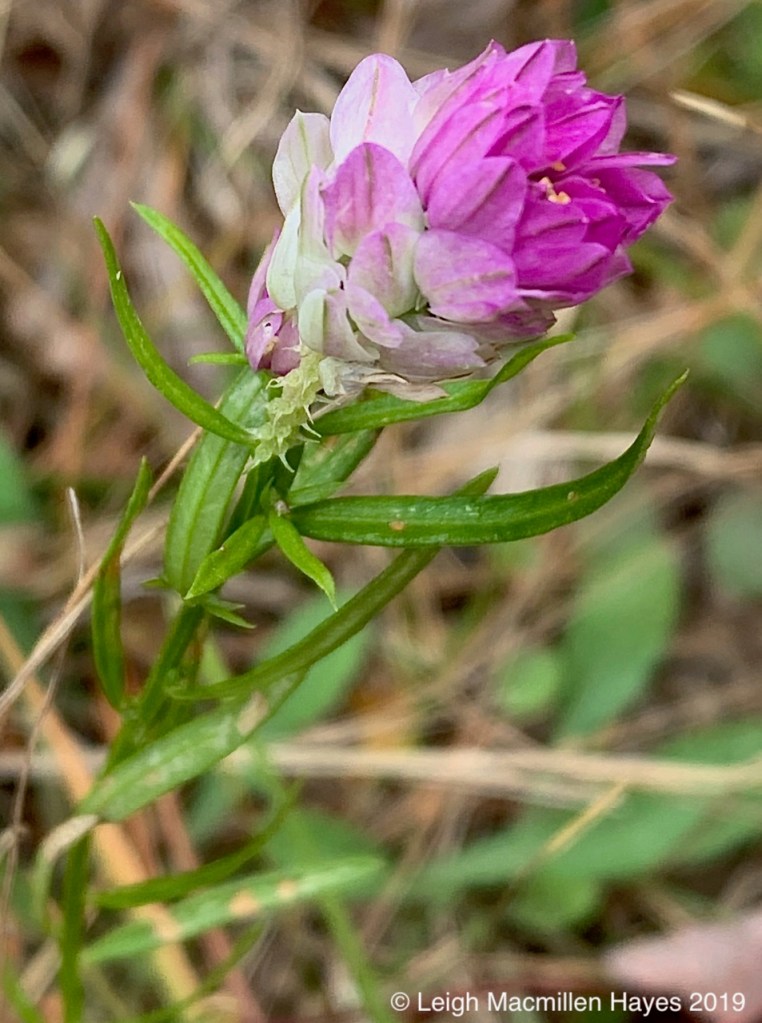
To take a look at where the granite came from, I headed up the trail behind the house, which is owned by the Bridgton Historical Society, to Loon Echo Land Trust’s new Peabody-Fitch Woods that surround the farm with companions Marita, Mary and Steve. Along the way, we saw numerous delicate Purple Milkworts still in bloom.

And really, we took a detour because we wanted to first honor another granite structure that has long stood upon Fitch Hill.

According to an August 17, 1963 article in the Bridgton News, “Enoch Perley, early settler of South Bridgton, built his first house in 1777 and brought his bride to their new home in 1778. (Five Fields Farm location)

As Enoch acquired livestock, he was much troubled by depredations from bears. He built a bear trap on the hill back of his first home . . .

Tradition says that four bears were caught in this trap–not enough! So Mr. Perley later had an iron bear trap made which took care of eight bears. Without a doubt, many were disposed of by him personally. A story is told that in an unarmed encounter with a bear and two cubs beside a wood road at dusk, Mr. Perley allegedly strangled the mother bear with his garters . . .”

The article continues, “The bear trap is built of stone. A large stone door is suspended and as the bear takes the bait, he trips the lever and is caught in the stone enclosure.”

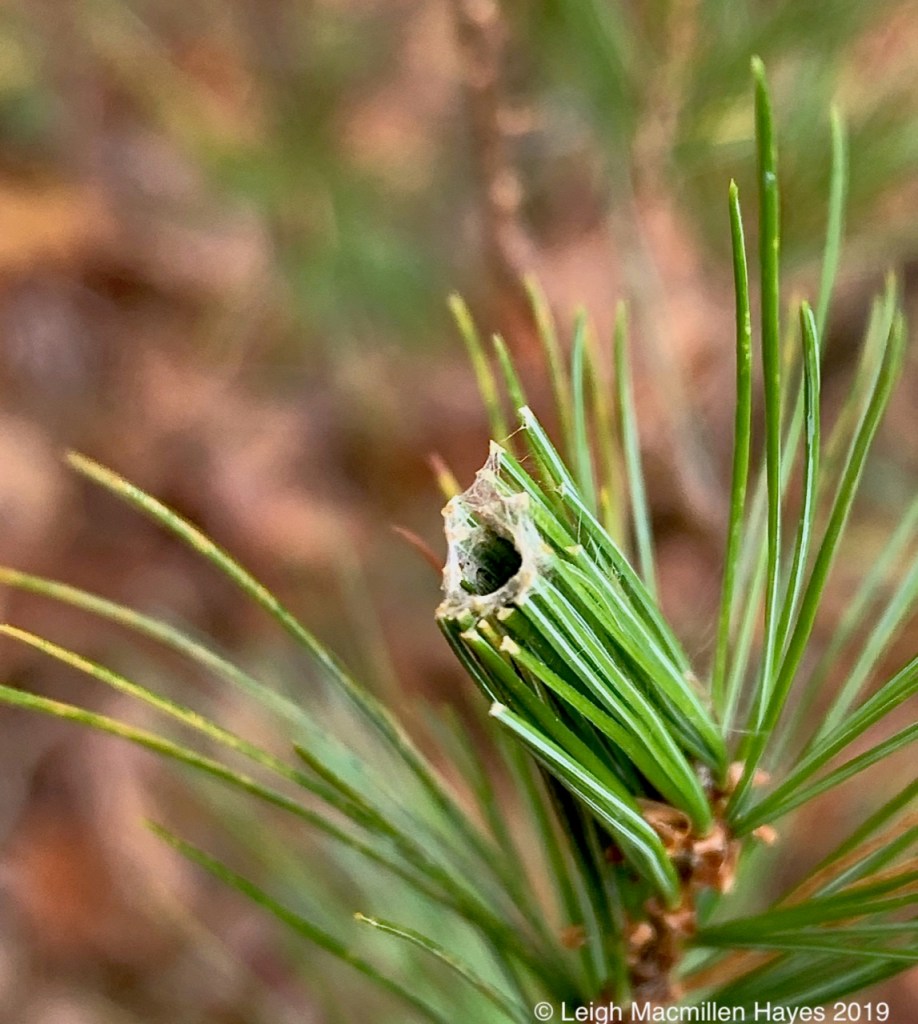
Hiking back down the trail to our second destination located along a spur, we were stopped by an anomaly on a White Pine. An individual Pine Tube Moth caterpillars bound together 10 – 20 needles with silk to form a hollow tube. Though we couldn’t see it, we could see by the evidence that it had moved up and down the tube to feed on the tips of the bound needles, which were much shorter than those that were free. Eventually, the caterpillar will eat itself out of house and home, and move to another set of needles to repeat its tube-making, needle-feeding behavior before it pupates within one.

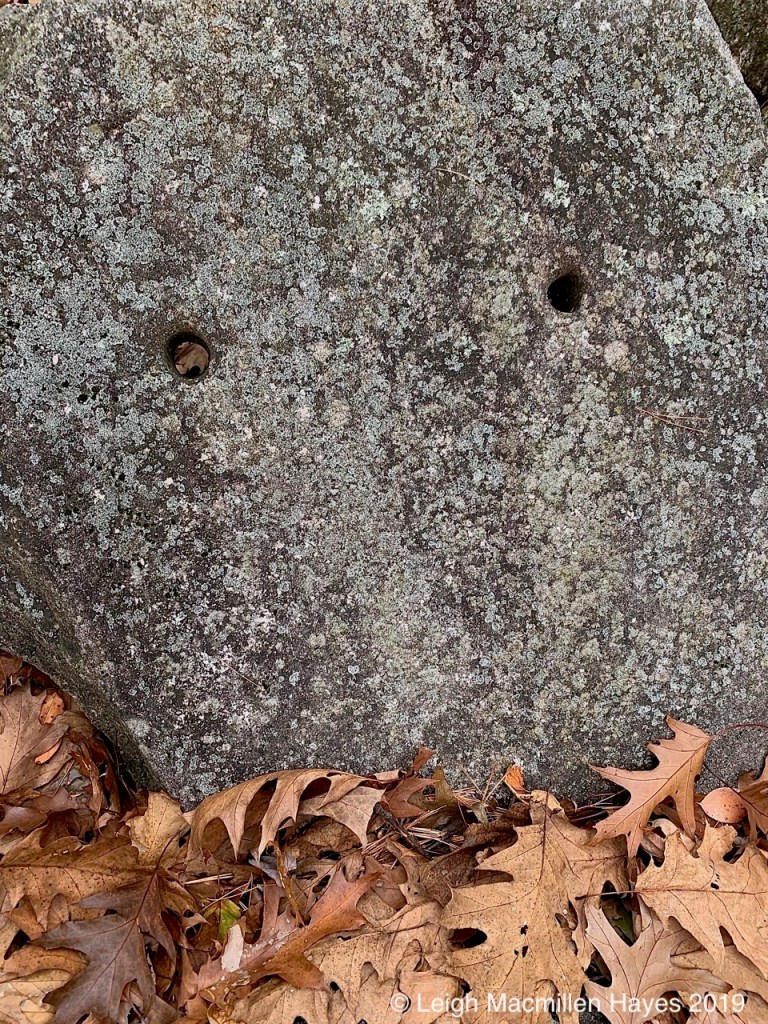
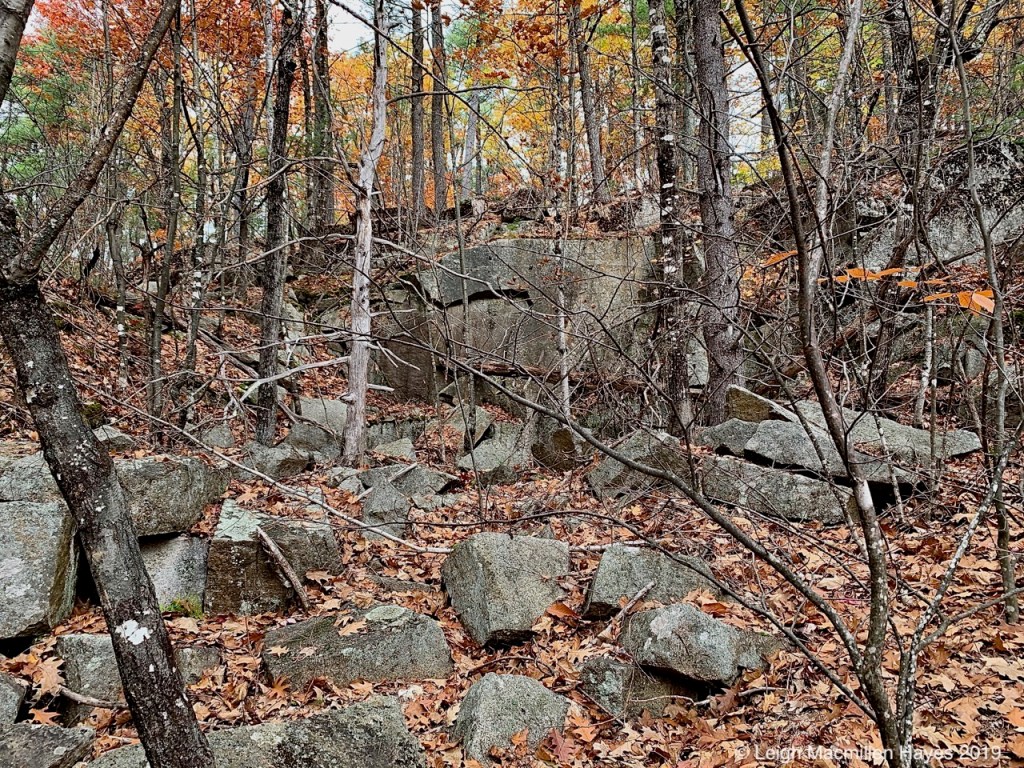
Our second destination was to a quarry we’ve all visited periodically over the years. This was the spot from which the foundations for the barn and other buildings were quarried so long ago.

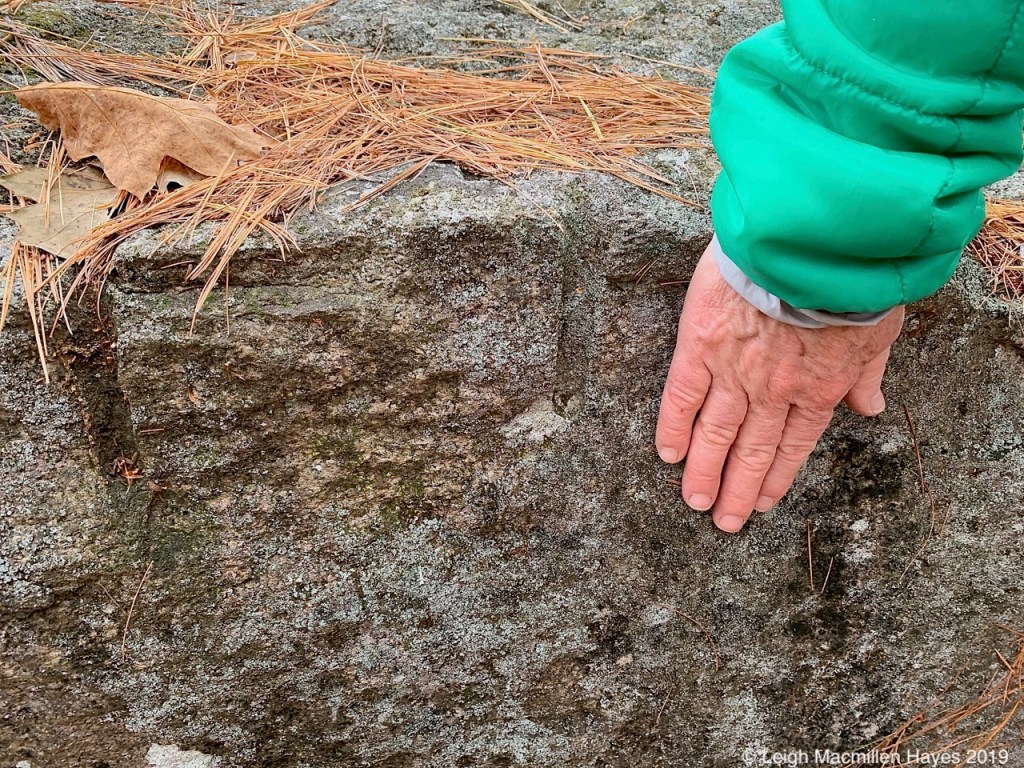
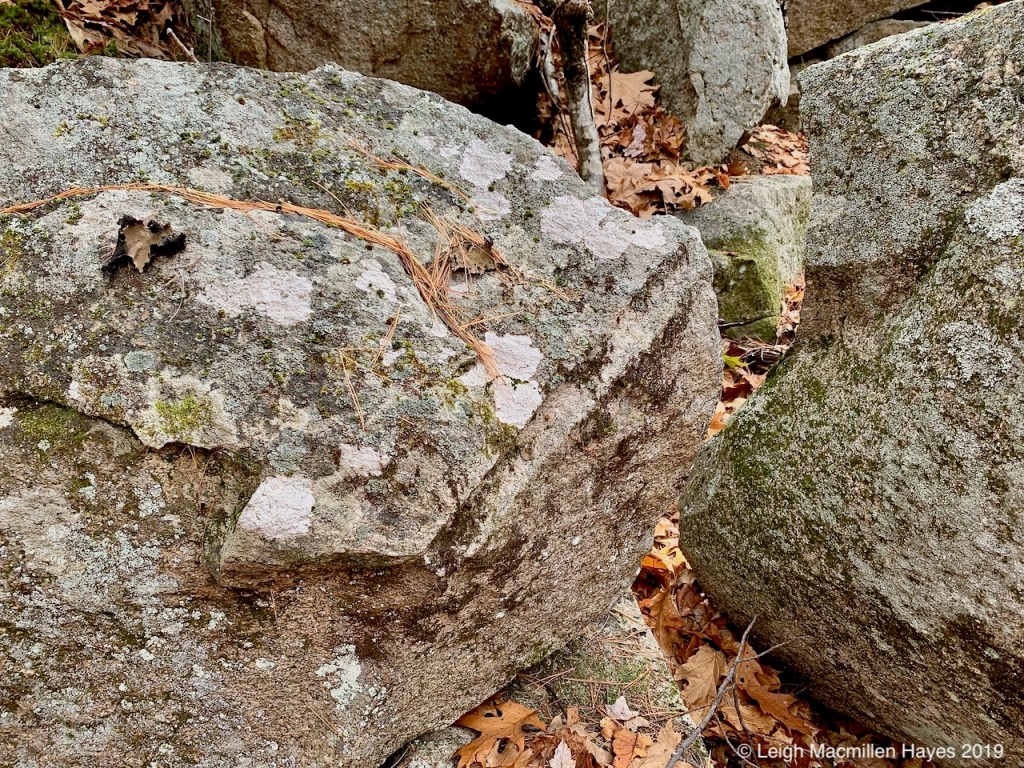
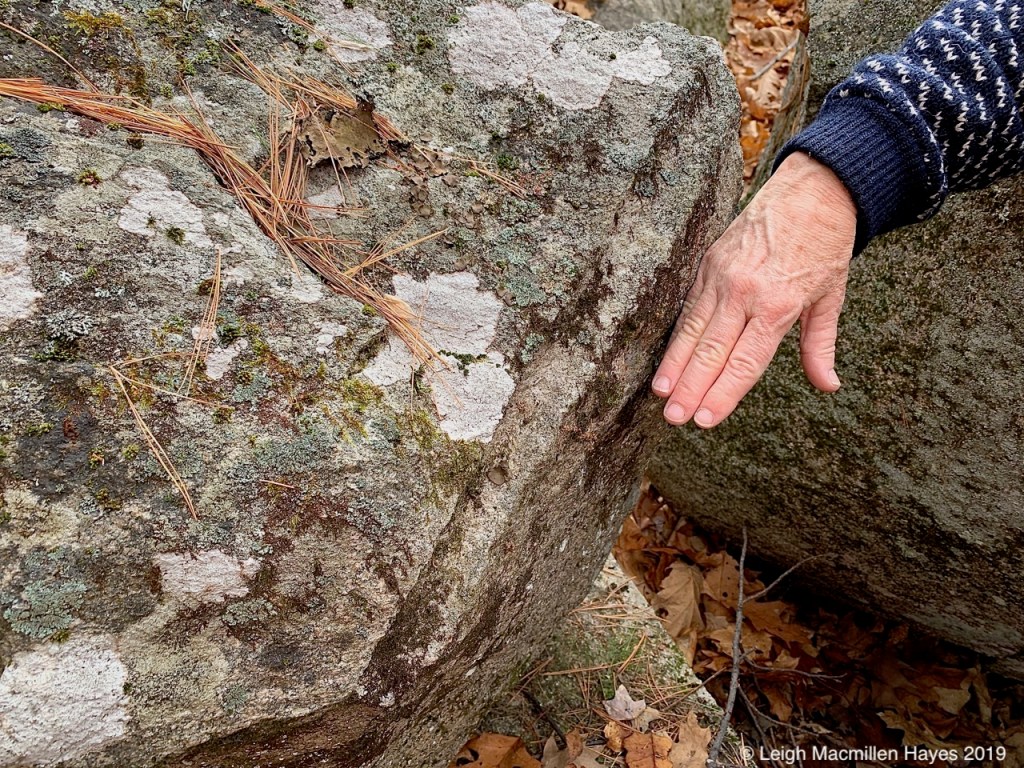
Spaced about six inches apart are the drill marks made by Mr. Fitch and perhaps hired hands. Today, I asked a hand modeler to kindly provide a sense of depth for the drilled holes.

After a brief pause at what we now think of as Quarry #1, the four of us bushwhacked around the side of the hill, following my nose to the next location recently discovered by Jon Evans of both Loon Echo Land Trust and the Bridgton Historical Society.

Quarry #2 was much bigger and deeper.

We poked around and found old drill marks on slabs still in place.

Perhaps one of our favorite finds was a stone that slightly resembled a keyboard, the holes only two or three inches apart.

At a ninety degree angle, they continued down the side of the same stone. What made us wonder the most was the curve in the rock–usually they follow a straight line in the grain, thus giving the stones a uniform shape. This one did not. Maybe the Temperance story really is a legend.

And then we spotted another beauty.

Again, the hand modeler showed off the depth and width of a much wider hole, created with a much deeper and wider instrument.

Below the quarry, we found two slides of rocks and between, what might have been a “roadway” used by oxen pulling sleds in the winter to haul the stone out. We followed it for a few minutes because we thought we’d spied the Narrow Gauge Train Track below, but realized we were fooled by a few patches of reindeer lichen that were lighter in color than the surrounding woods, thus mimicking an open route. One of these days, we’ll explore further. The question remains: Was the rock quarried here and used to support the rail track at certain points along the way, or was it shipped out via train to other destinations?

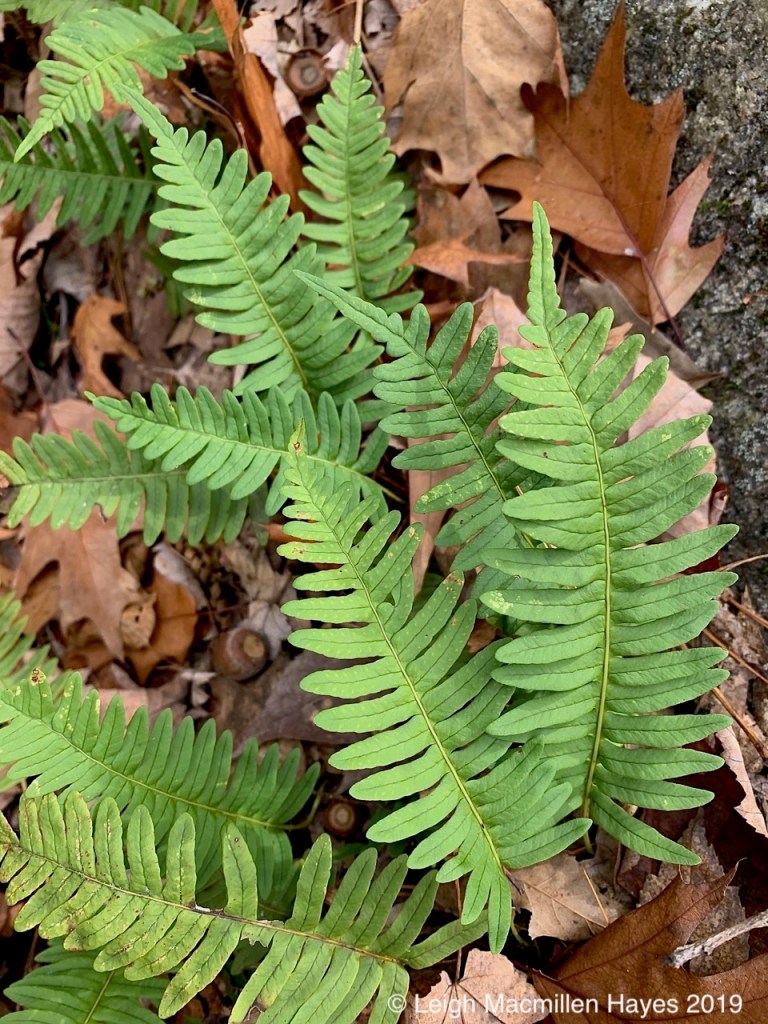
We didn’t know the answer, but did spy a few of my pet species, including Rock Polypody Ferns growing upon granite as is its habit.

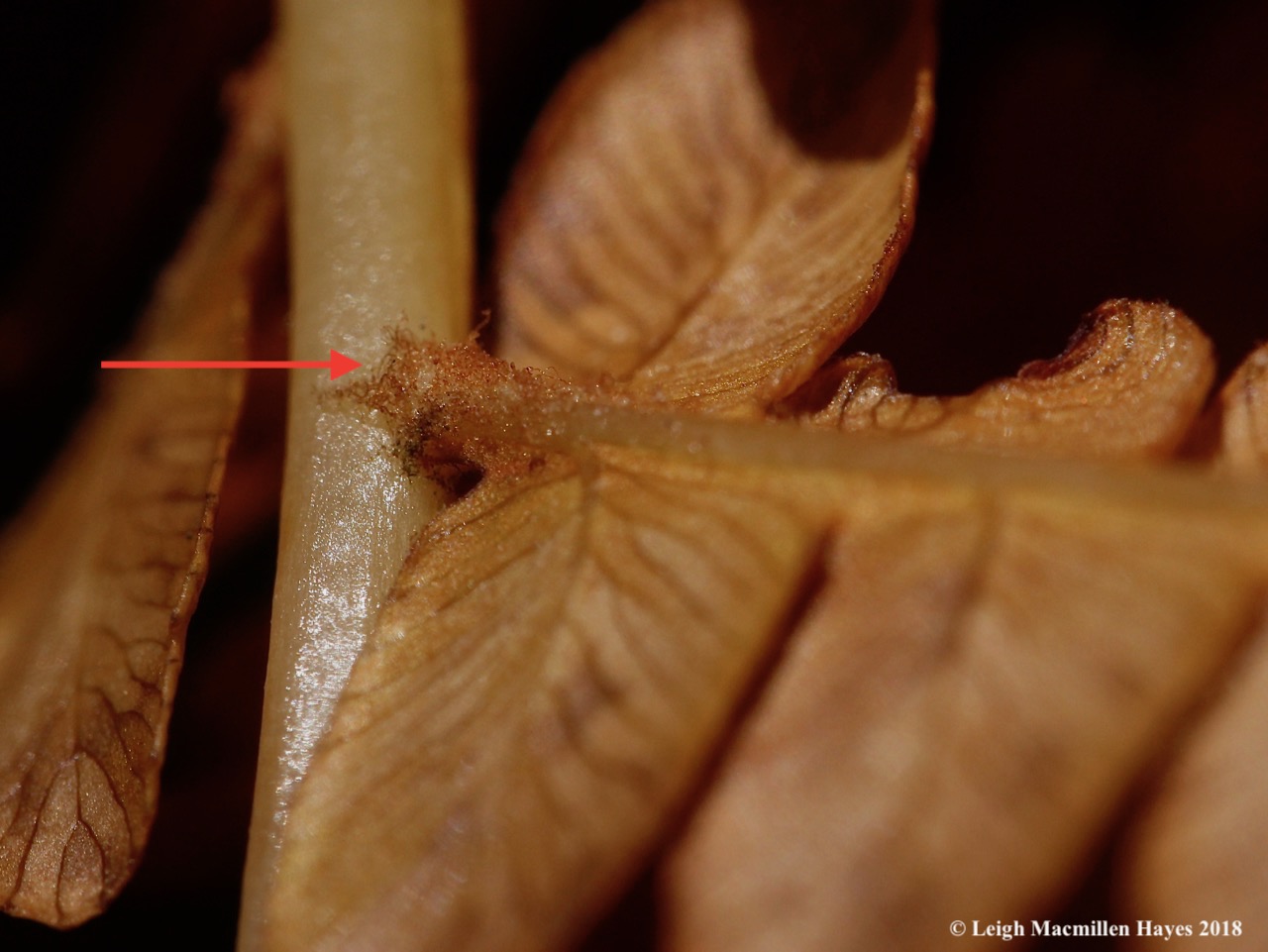
The underside of its fertile fronds were still decorated with mounds of sporangia. While many other ferns feature a membrane covering the sporangia during development, this one does not. Each tiny bubble within the larger “mound” is packed with spores, waiting their turn to catapult into the air.

After a couple of hours, we returned to the field and my companions, Marita, Mary and Steve, kindly posed with Narramissic in the background.

In the end, we departed knowing that there’s much more to the story of this land that perhaps only the eye of the weathered barn board knows as it peeks out from behind fringed bangs, gray from watching all that has taken place for almost two hundred years. If only it wood share those stories.

In the Middle of the Bubble

We were going to go. We weren’t going to go. In the end, we each took a break from work and met at Lakes Environmental Association’s Highland Lake Research Forest.

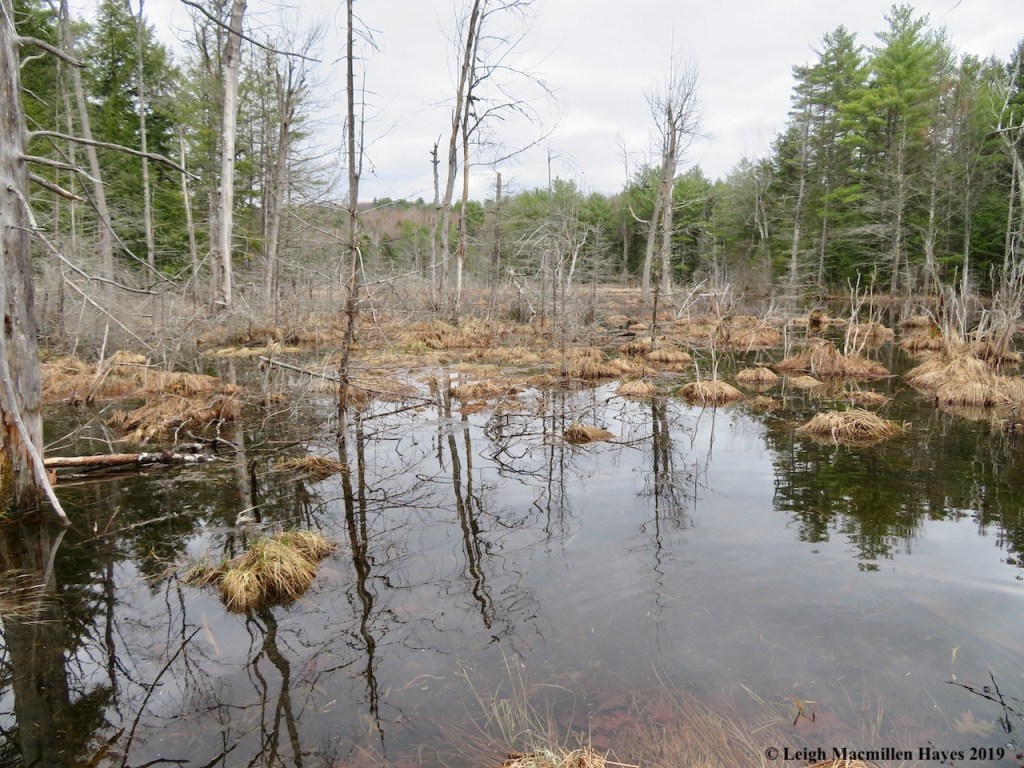
Alanna said we could get away with calling it work because we were, after all, conducting research–on where the vernal pools were located. And so we listened and followed our ears as we bushwhacked through the woods. Peeps and wrucks and trills filled the air and we beelined their way. Suddenly we emerged beside the Red Maple Swamp.

Of course, the symphony cut off upon our arrival, and so after sitting and standing still for a few minutes, we decided to step into the water and search for egg masses. Maybe it was the lighting. Maybe we didn’t look hard enough, though Alanna did find at least one Wood Frog mass after she crossed over a log.

While she was still on the other side, I headed back up onto the land, and a few feet from the water I was stopped in my tracks by a large snake.

Its mouth gaped in a fashion that could almost have been a smile. For a few minutes I watched and the mouth never closed. That’s when I realized that it was dead.

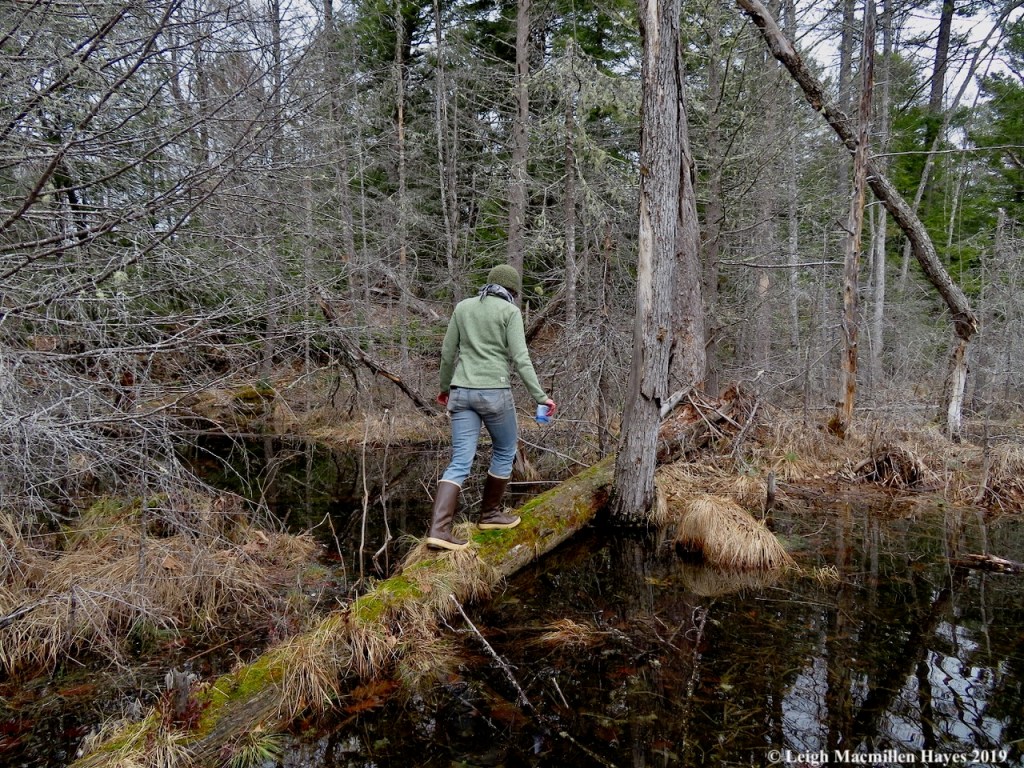
As Alanna made her way back to see it, she found a deep hole and one of her boots filled with water. Being the person she is, she got out of the muck, emptied it, and . . .

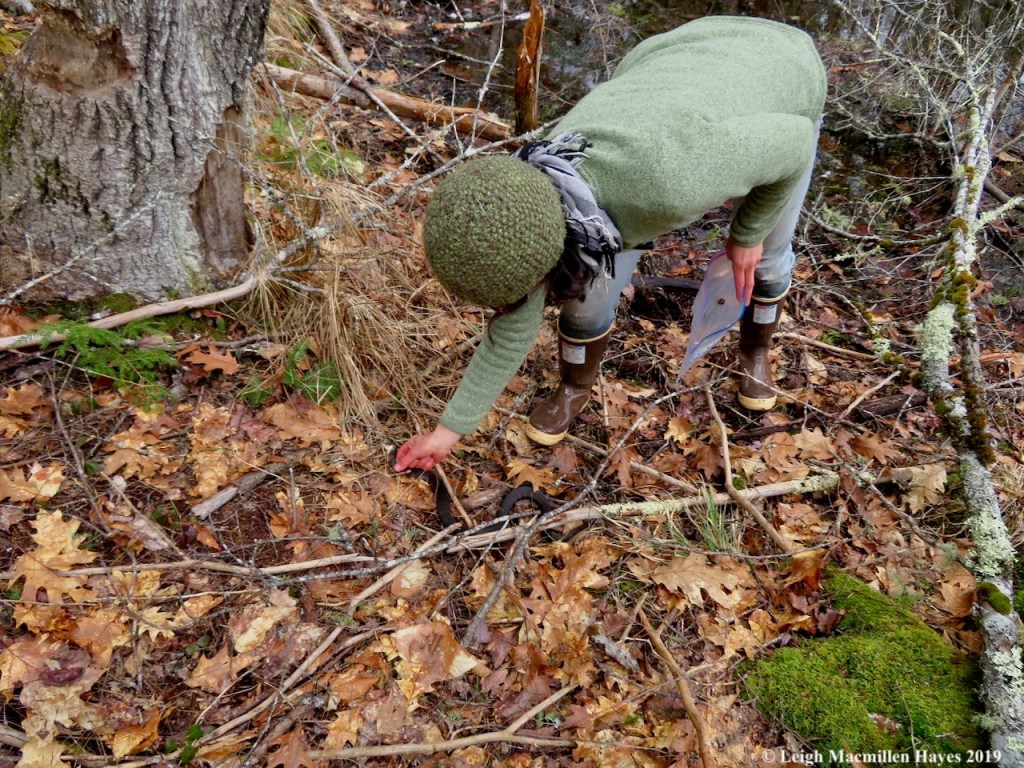
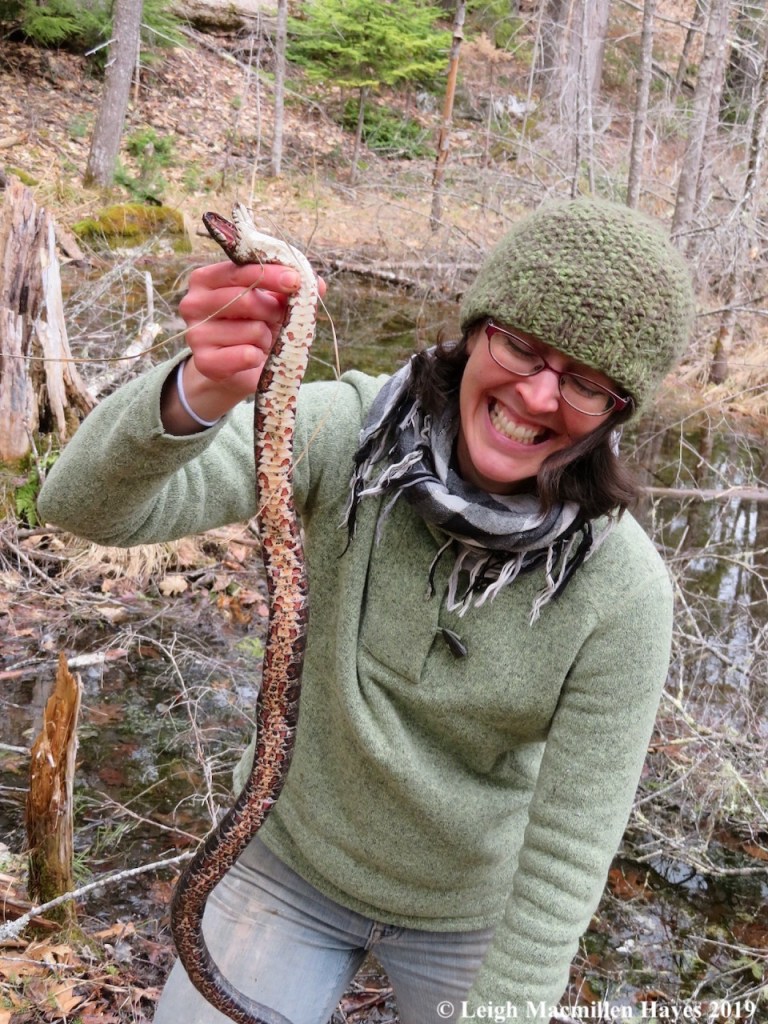
despite the fact that we were both intrigued and a wee bit freaked out about the snake, she picked it up. If you’ve never seen a Northern Water Snake, they are big. And what if it wasn’t really dead, though we were sure that it was. But what if it wasn’t?

It dangled from her hands as over and over again she said, “I can’t believe I’m holding a snake.” Her grinning grimace echoed those words.

Because she’s a collector of fine things like scat, she had brought along a bag and so into it went the snake. Still, she continued to repeat, “I can believe I’m holding a snake.”

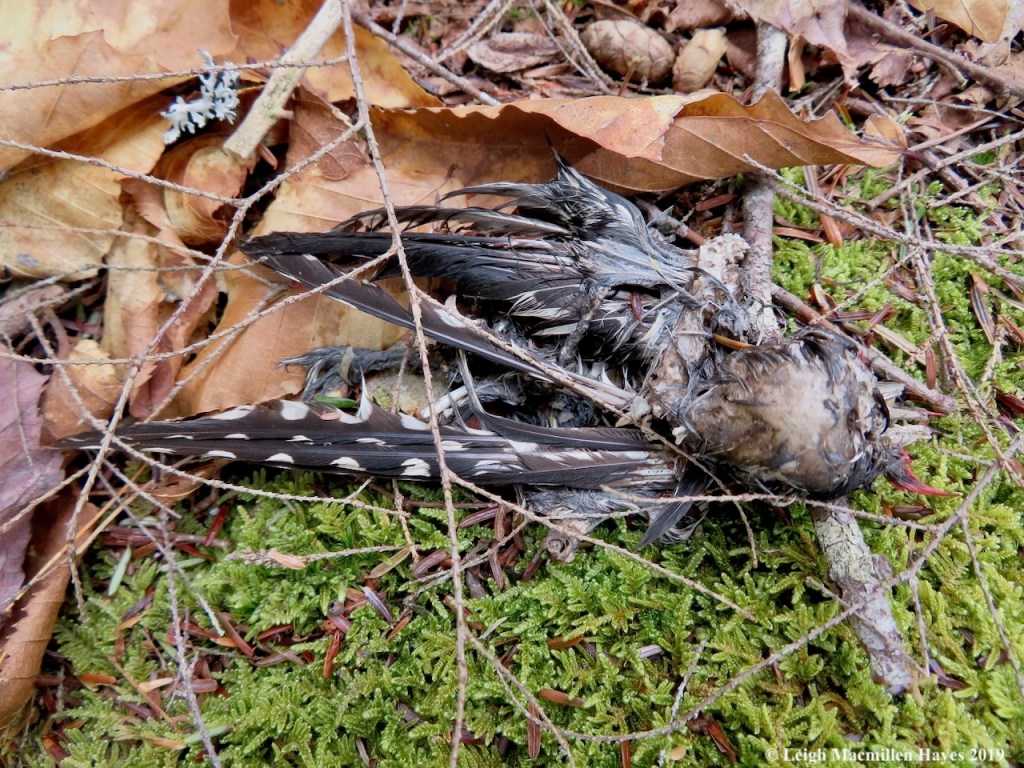
Just a few feet away, we found another kill site. A woodpecker had met its demise.

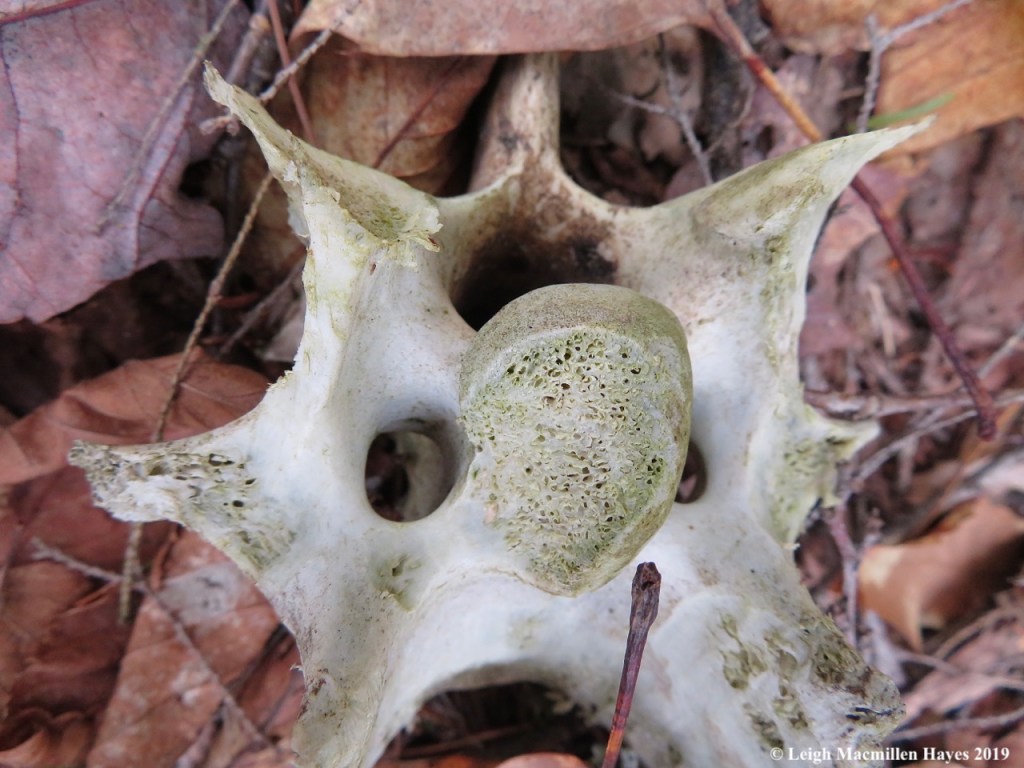
And only feet from that–a deer vertebrae. It became clear that life happens by the swamp; and nearby was an owl pellet filled with bones. We doubted the owl had anything to do with the deer, but what about the snake and bird? Maybe it wasn’t the owl, but some other bird of prey. Why hadn’t the snake been consumed? Or the bird plucked? As usual, more questions than answers. At last we decide to move on because we heard a wetland chorus calling our names on the other side of the next hill.

I followed Alanna until she stopped abruptly. In her path about twenty or thirty feet from the water, another water snake. This one even bigger. And . . . alive. The sun’s rays weren’t strong, but we suspected it was trying to get warm. For a few minutes we stood and watched and then finally decided we could walk by without a problem. And we did. That being said, every step we took after that included a search just in case more snakes lurked about.

The amphibian calls drew us to the area where a river flows through the swamp.

It was there that we found more signs of life including Canada Geese,

Red-winged Blackbirds,

and rather recent beaver works. At that point, Alanna had to depart, but I stayed for about an hour longer and wandered along the edge of the wetland.

My finds continued for where I looked for frogs by a coppiced tree, instead I found a tussock moth caterpillar frozen in time. It had remained attached firmly to the twig all winter because I suspected it had been parasitized by a mummy wasp.

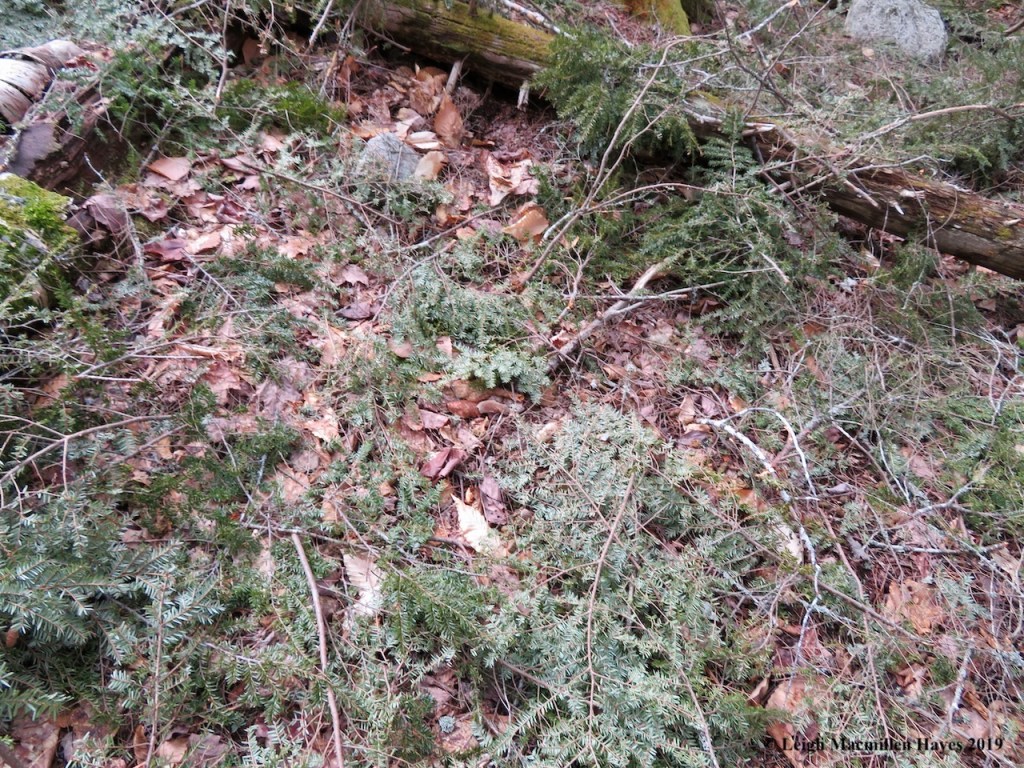
And then it was uphill toward a rocky ledge that I tromped because the ground was carpeted with hemlock twigs. I knew who had cut and dropped them, and wondered if I might spy a den.

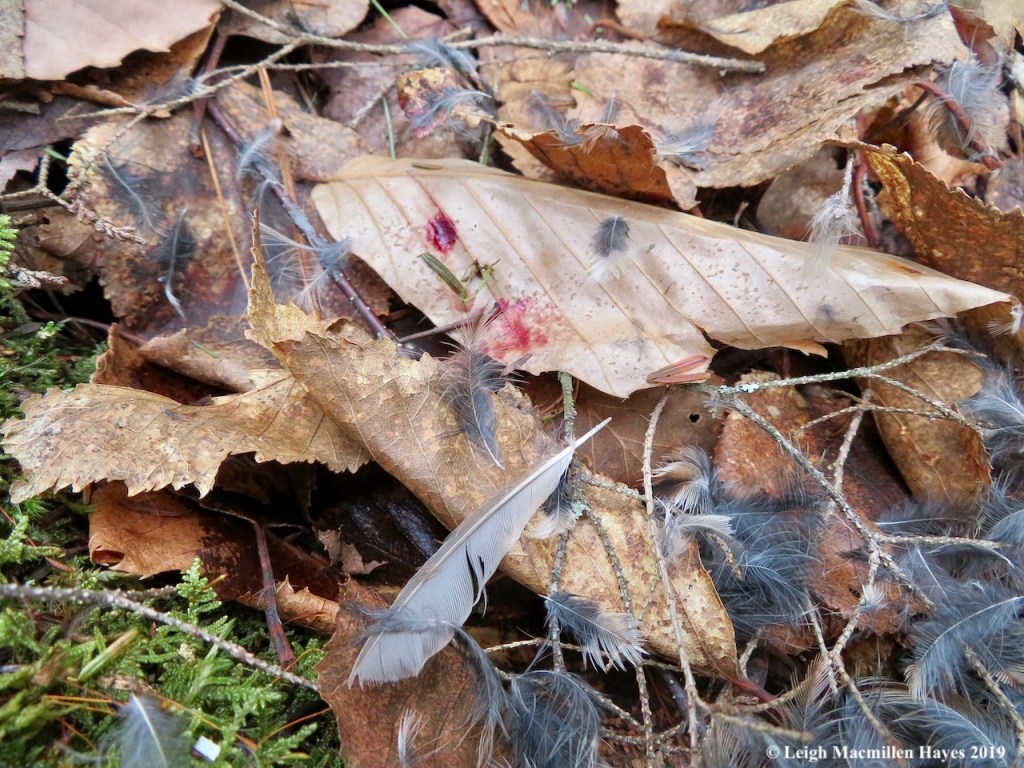
Where I thought there was a den below, I was wrong. But . . . atop the downed tree was another kill site. This time it looked like a Junco had been the source of food.

And on a leaf, the bird’s blood stains.

Not far from the feathers and blood, I did find what I was looking for–a porcupine den and its telltale pile of scat flowing forth.

Murder and mayhem you might think. But death is part of the web of life, which also sustains us.

Today, Alanna and I went seeking egg masses and instead found ourselves surrounded by so many other things. It all made me realize I am only one tiny speck in the middle of the bubble.

Babe in the Woods

This morning dawned bright and brisk and offered a brilliant background for a journey through the almost Peabody-Fitch Woods that Loon Echo Land Trust hopes to add to their holdings. The 252 acres of the proposed project surrounds Bridgton Historical Society‘s Narramissic Farm.

Jon Evans, Loon Echo’s Stewardship Manager and board member of the historical society had asked me to join the walk that would highlight the Peabody-Fitch Homestead built in 1797 and introduce Loon Echo’s new executive director Matt Markot. In the morning light, we circled the house as Jon shared some of the farm’s story.

On the northern side of the house, we paused to enjoy the view, including Pleasant Mountain just beyond the trees to the left of the field. The land trust also owns and protects over 2,000 acres of the mountain that defines this area of western Maine.

Measuring the effect of the cold on the hike’s participants, Jon chose his stop points, where he shared his keen knowledge of the farm and the lands that surround it. For me, it’s always a joy to tramp with him because his connection to the land is personal, and this particular piece even more than most for Jon’s family long ago farmed an adjacent acreage and he grew up traipsing through the very woods we snowshoed today. (And this photo includes Margaret Lindsay Sanborn, mother of Matt Markot, LELT’s new ED who stands to his mom’s right.)

As we circled behind the barn I shared with Jon a bit of knowledge that adds to the lore of what’s always been known as the Temperance Barn, supposedly constructed during prohibition without the usual swigs of rum for all who helped in the building process. Following a blog post I wrote in December 2018 about this very property, a granddaughter of Margaret Monroe who gifted the property to the historical society in 1987 wrote the following message: Hi – I am glad you enjoy my grandmother’s property. A heads up that there is no written documentation from the period re: the barn actually being built without alcohol. My grandmother was prone to making up history. I want to give respect to hardy native Mainers: Monroes were largely summer people. My grandmother also said sherry wasn’t alcoholic and would drink a big glass of it every night before dinner, Lark cigarette in her other hand. Happy Holidays! Rebecca Monroe

It turns out that wasn’t the only story that had more to offer than I’d originally thought to be true. As we were about to pass through a stonewall behind the barn, my eyes cued in on debris below some trees. Certainly it was the work of woodpeckers and I stepped onto the wall in search of scat. Nada.

Looking up at the pin cherry tree, I found not pileated works, but the incisors of another that gave a clue.

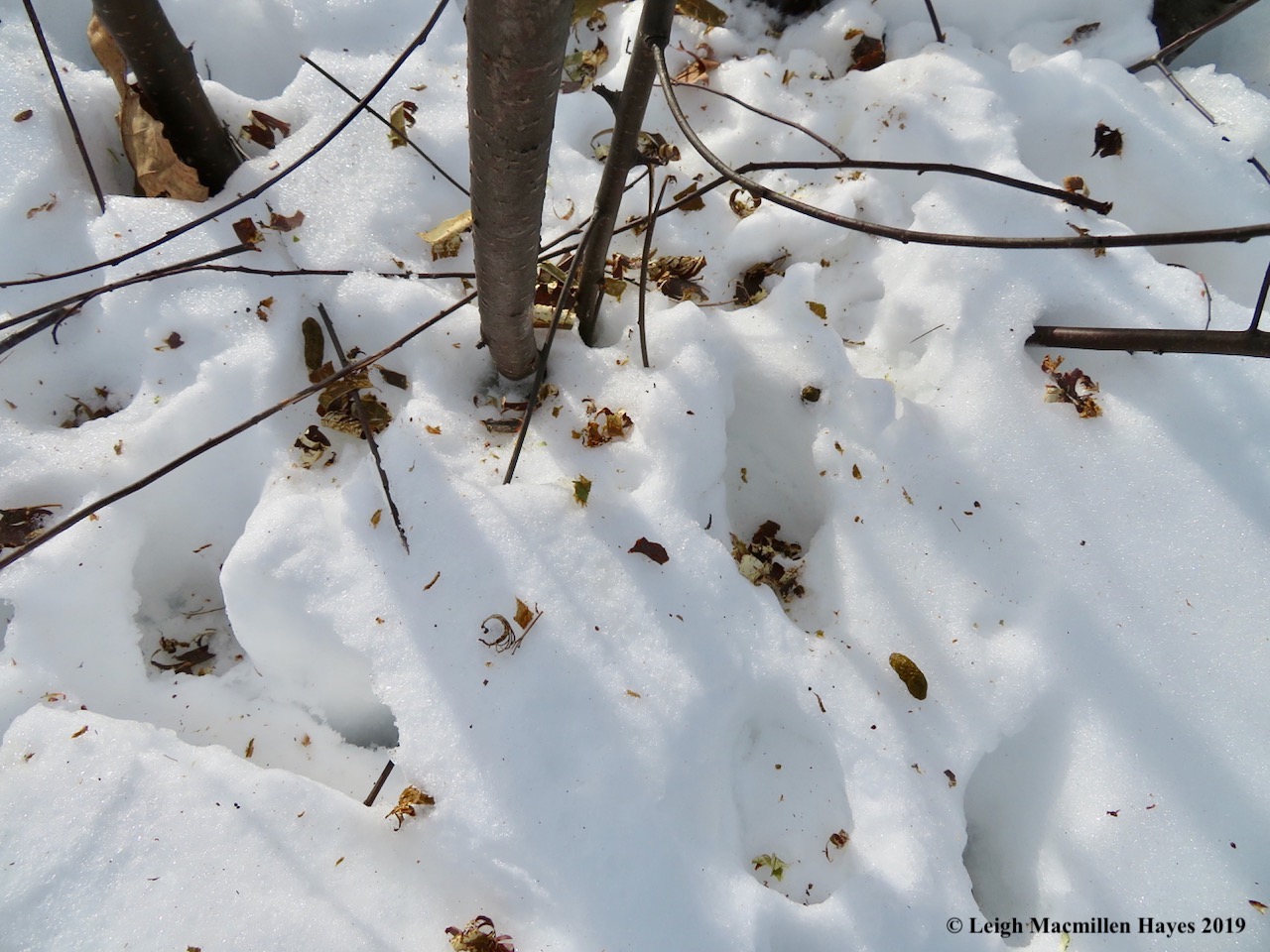
And below, pigeon-toed tracks. Between the incisor marks and tracks I knew the creator, but it didn’t make sense to me, for though I find hemlock twigs below such a tree when a porcupine has clipped them, I couldn’t recall ever seeing bark chips below a porky tree. In my brain, the rodent ate the bark as it sought the cambium layer within. I dismissed it as a lesson to be considered and we moved on.

Jon led us along a colonial road from the historical society’s property to a stonewall that delineated the Peabody-Fitch Woods. We turned onto a trail I’d never traveled before and made our way along another farm road. Periodically, Jon, Matt, and I bounced off of each other as we shared our knowledge about the trees and forest succession that had occurred since the farm was last a working land. We also spied a few mammal tracks, including those of a bobcat.

At last, we circled around and found our way back toward the border between the P-F Woods and farm.

Close to the Temperance Barn again, porcupine tracks crisscrossed to the stonewall where we’d seen their activity at the start of our journey.

Near the parking lot and Blacksmith Shop, more porcupine works made themselves evident–by their tracks and the debarked trees.

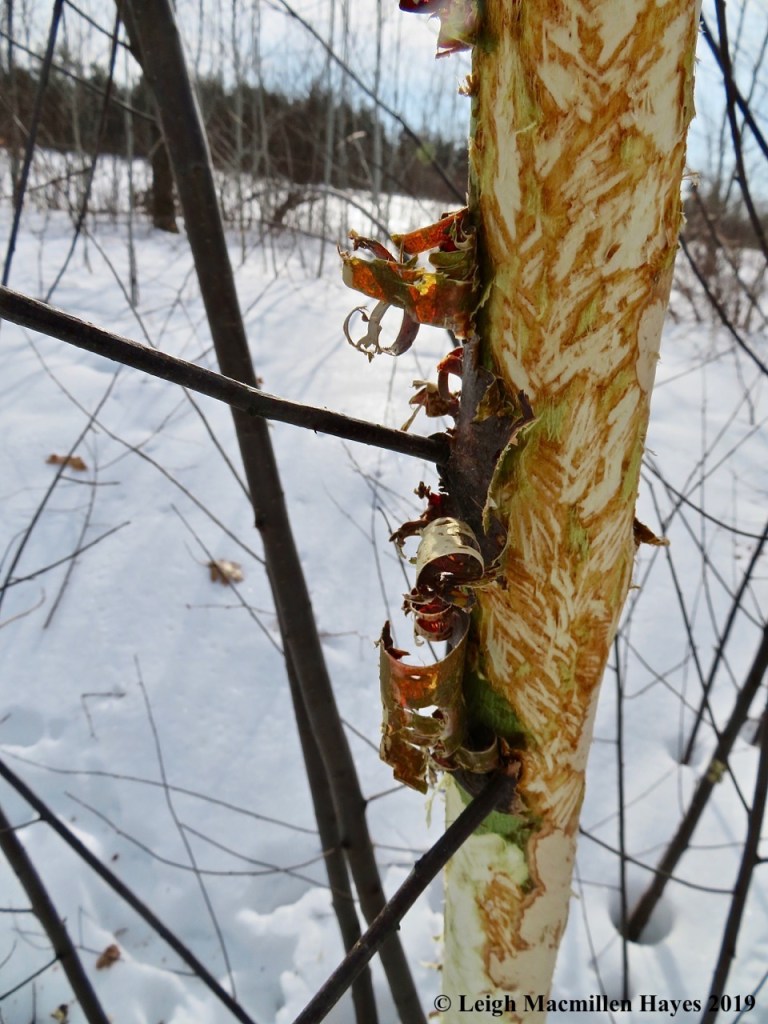
Incredibly debarked trees. I’m always amazed by the fact that porcupines, given their size, can find support on trees and limbs that seem so flimsy. I’ve been told that they’re known to have many broken bones and it makes sense given the precarious choices they make to seek winter nutrients.

Once again, there was bark debris. In the past I’ve always said that beavers leave wood chips, but porcupines eat the bark and cambium layer.

The evidence was obvious given the prints and comma-shaped scat. But the bark debris proved me wrong today.

And I loved that. When Jon first introduced me as a Maine Master Naturalist, he asked how long I’ve been such. “Six years,” I said. And though I’ve spent my sixty years wandering and wondering in the woods and along the coast of southern and northern New England, it was the Master Naturalist class that taught me how to take a closer look.

Do you see the green of the cambium layer? And those incisor marks–how they are at opposing angles? Those I recognized.

But . . . the porcupines taught me something new today.

Six years–I’m still a babe in the woods.

Romancing the Stone Mondate

Visiting a site in winter that is so popular in the summer we actually avoid it unless hiking past offers an entirely different appreciation.

And so between errands in North Conway, New Hampshire, this afternoon, my guy and I donned our micro-spikes to traverse the hard-packed snowy ice trail into Diana’s Bath in neighboring Bartlett.

Upon reaching Lucy Brook, the history of the area was briefly documented on an interpretive panel that provided information about George Lucy who built a sawmill in the 1860s powered by an undershot wheel on the brook and a home not far from its banks.

About 1890, when tourists began making regular visits to the brook, Mr. Lucy added a boarding house and barn, but business never took off the way he’d intended.

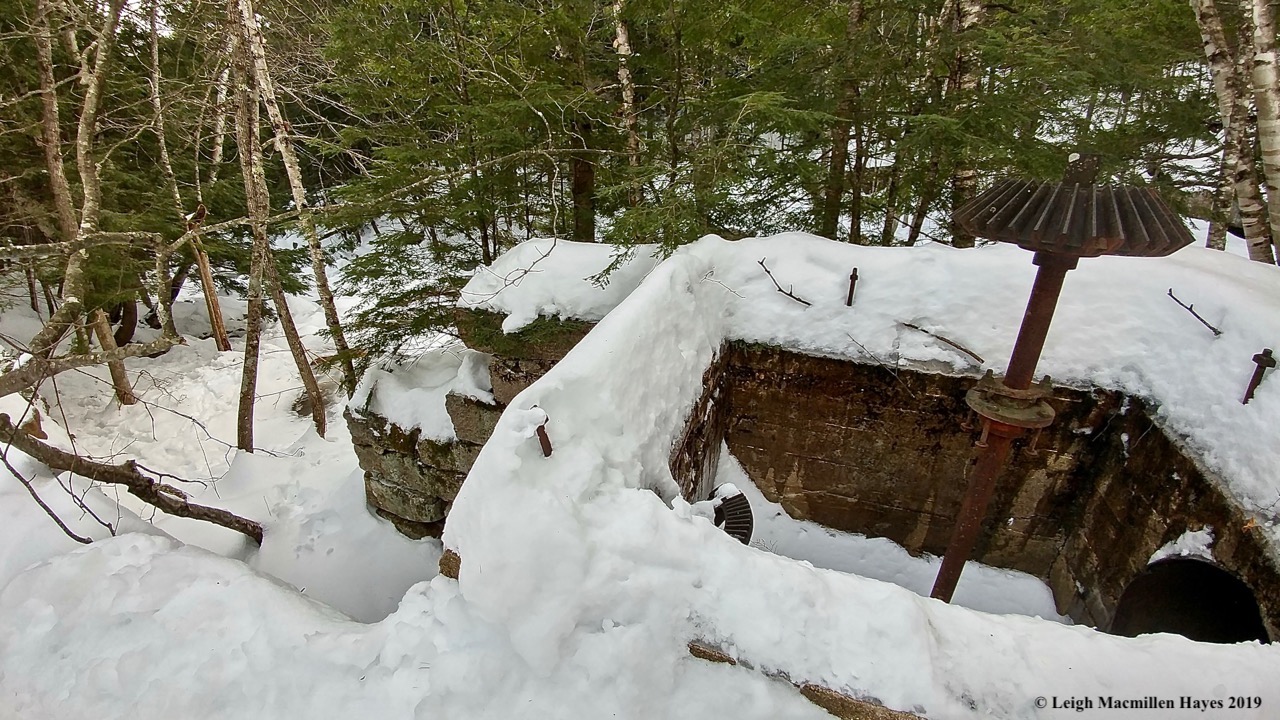
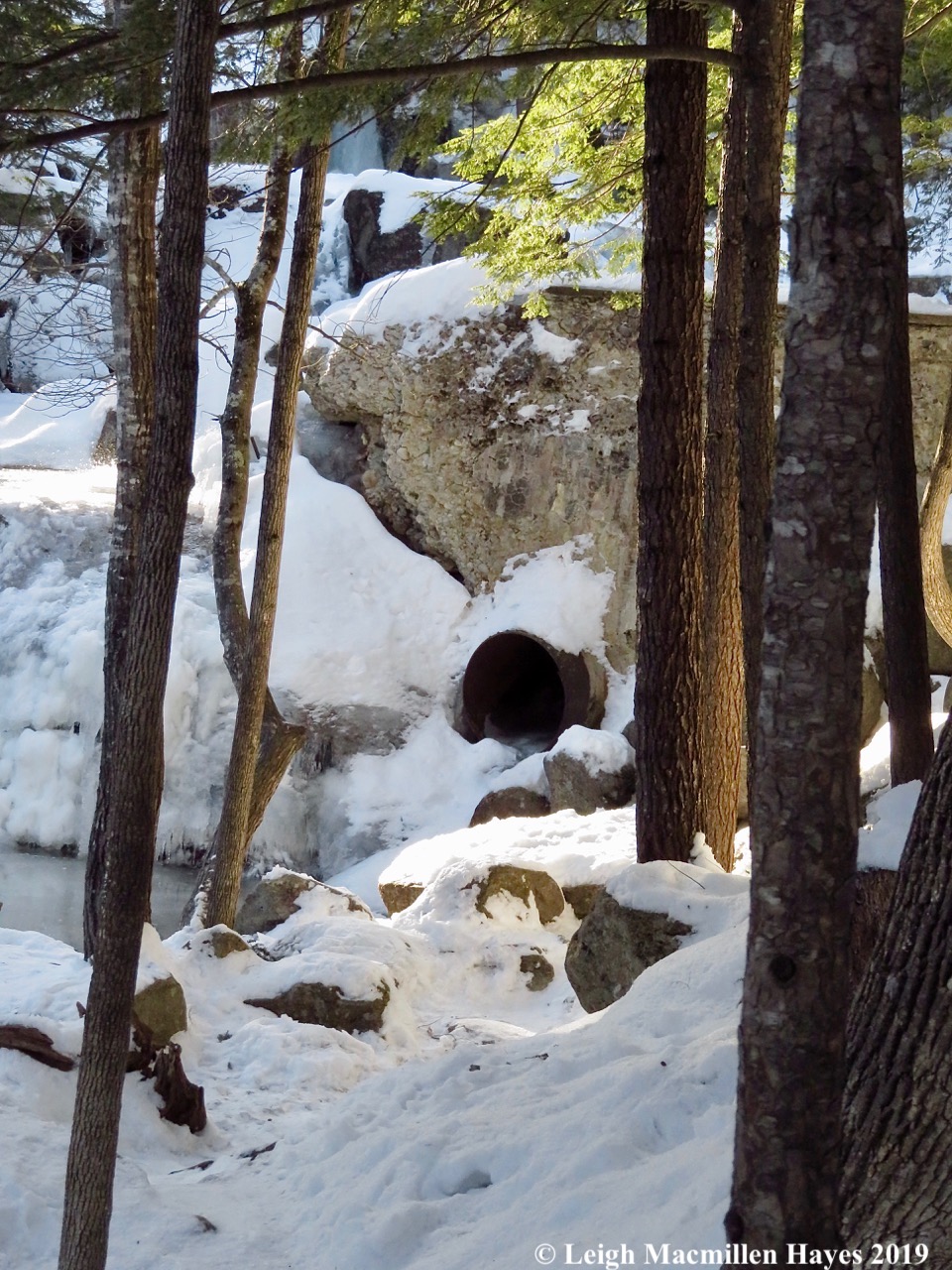
By the 1920s the water wheel was replaced by a turbine fed from a penstock pipe, the remnants of which remained for us to gain a better understanding of the passage of power.

Above the turbine we could see another piece of the penstock pipe burrowed within the ledge upstream.

Before climbing up to it, I walked below the turbine site while my guy stood over and thought about the Lucy family’s history, which in a professional way is connected to his own for the sawmill idea was eventually abandoned as the Lucys realized they could use a portable mill to harvest wood and later descendants owned a lumber yard and then one of them opened a hardware store and he and my guy periodically touch base to share ideas or stock and both could be known as Mr. Hardware.

Upon the interpretive panel, we appreciated a photograph of the sawmill for it aided our comprehension of the view before us.

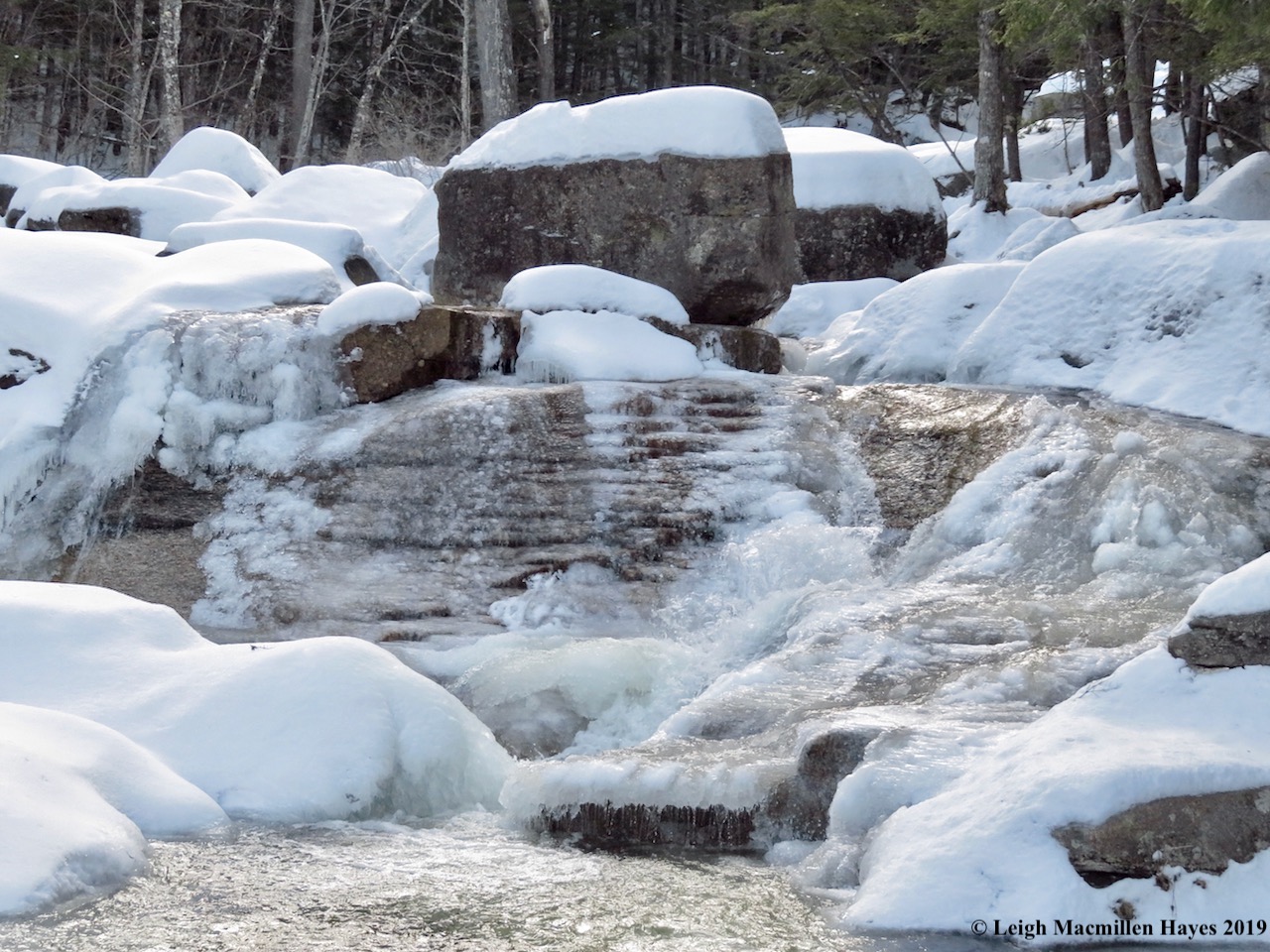
To our best understanding, the cement located above the penstock was part of the mill and dam created by Chester Lucy in the 1930s. Today, water swirled through and flowed over.

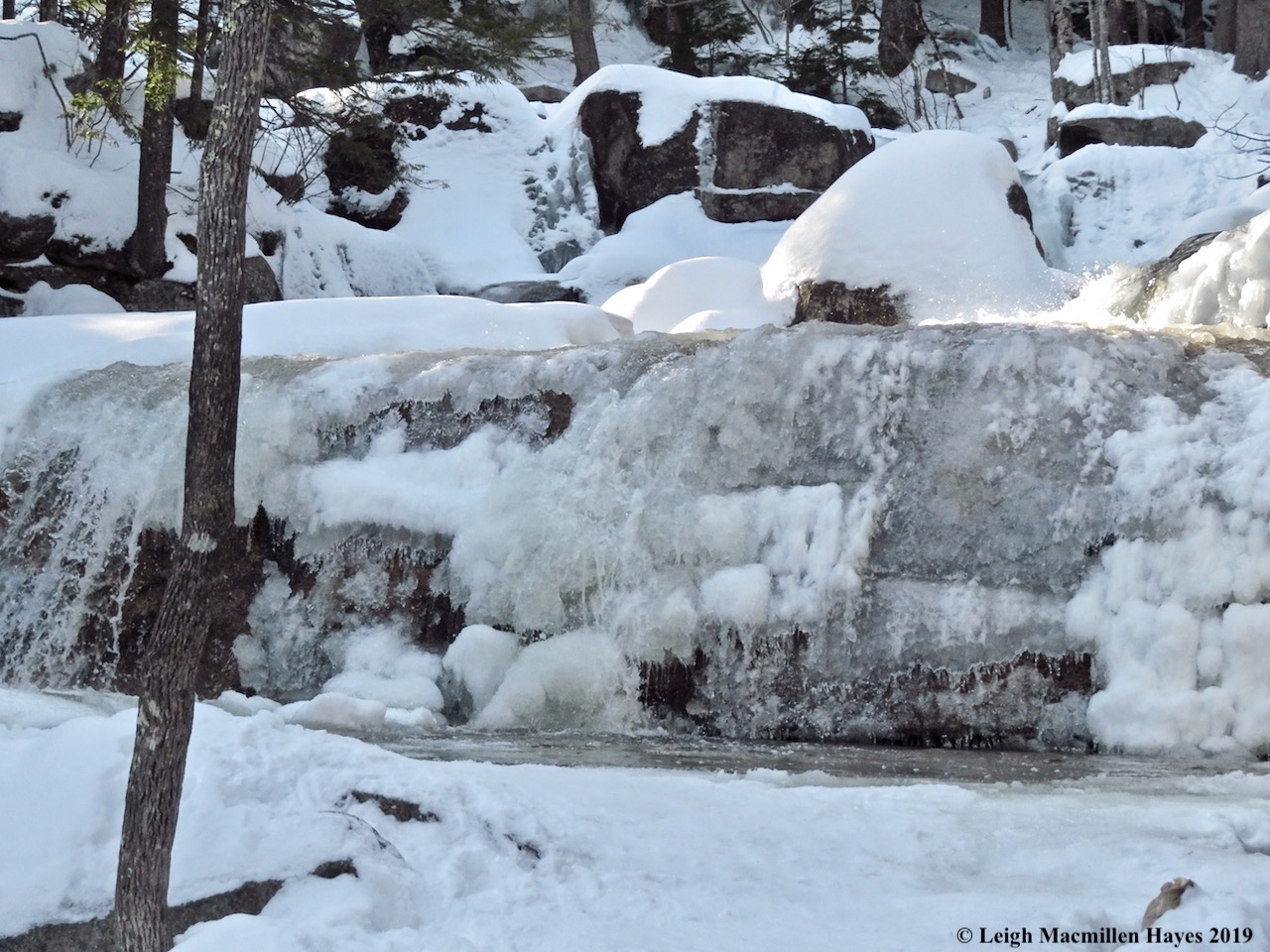
Below, the natural formation of rocks obscured was reflected in the shape of icy indentations.

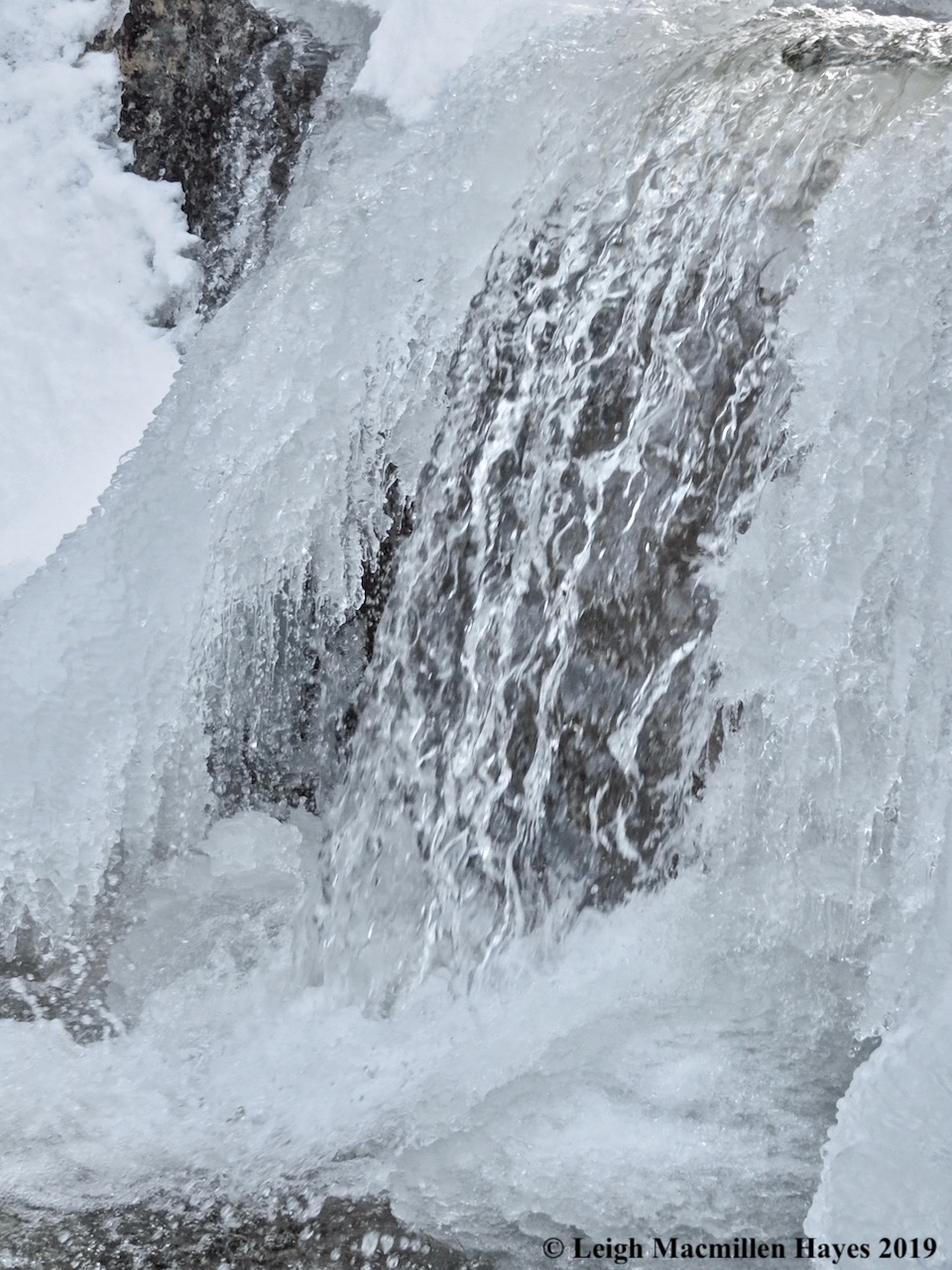
Above, water hugged rocks in mid-cascade and created designs and colors that changed with each moment frozen in time.

We finally moved upward where more baths were plentiful but on this frigid day the thought of a dip was quickly suppressed by reality.

Still, we were intrigued by the power of it all as water gushed between curtains of ice.

As for the name, Diana’s Bath, I’ve heard several renditions including this from Robert and Mary Julyan’s Place Names of the White Mountains (a great bathroom read):

These curious circular stone cavities on Lucy Brook originally were known as the Home of the Water Fairies; tradition says evil water sprites inhabited the ledges, tormenting the Sokokis Indians until a mountain god answered the Indians’ prayers and swept the sprites away in a flood. But sometime before 1859 a Miss Hubbard of Boston, a guest at the old Mount Washington House in North Conway, rechristened them Diana’s Baths, presumably to evoke images of the Roman nature goddess. The pools are also called Lucy’s Baths.”

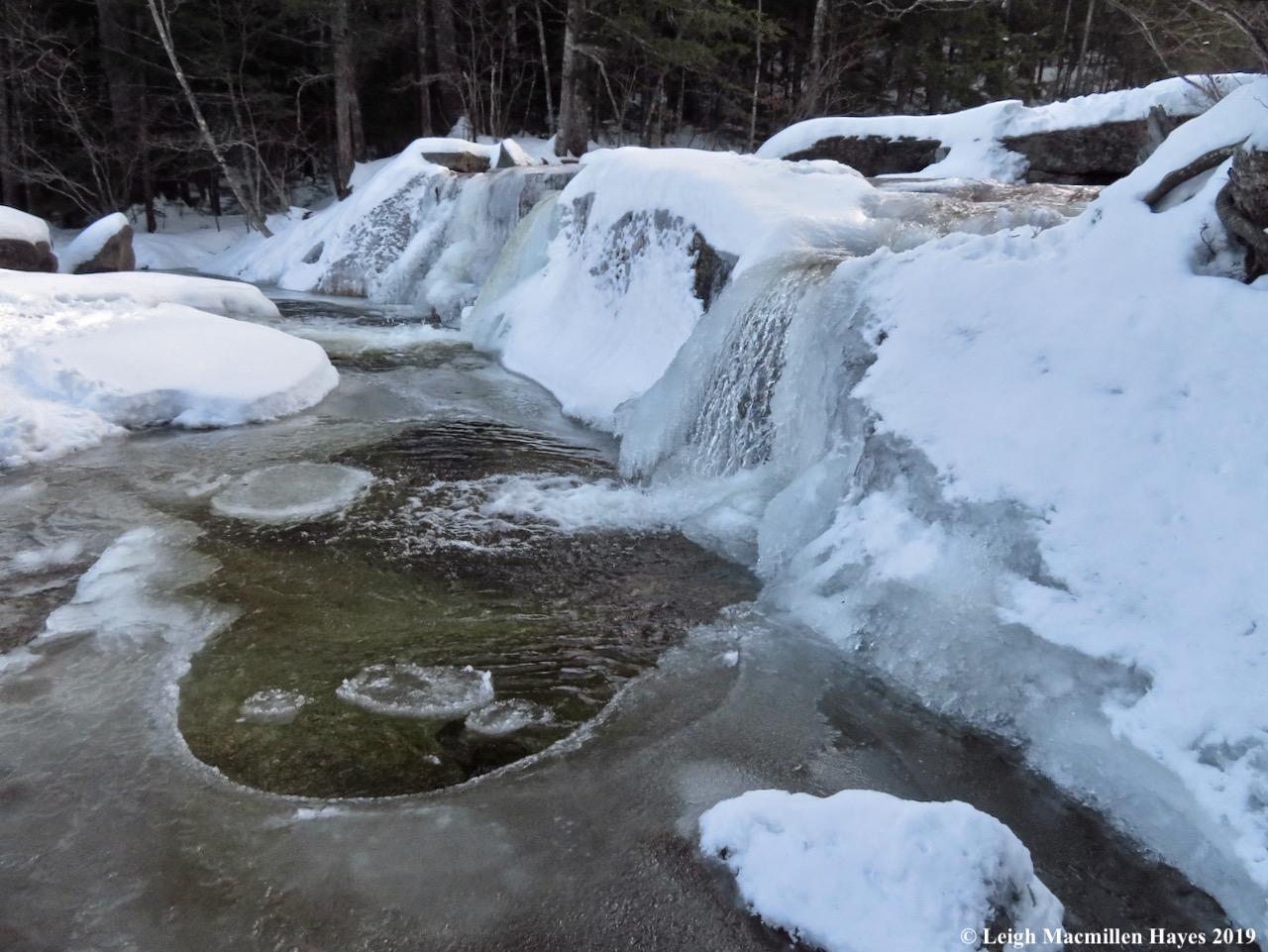
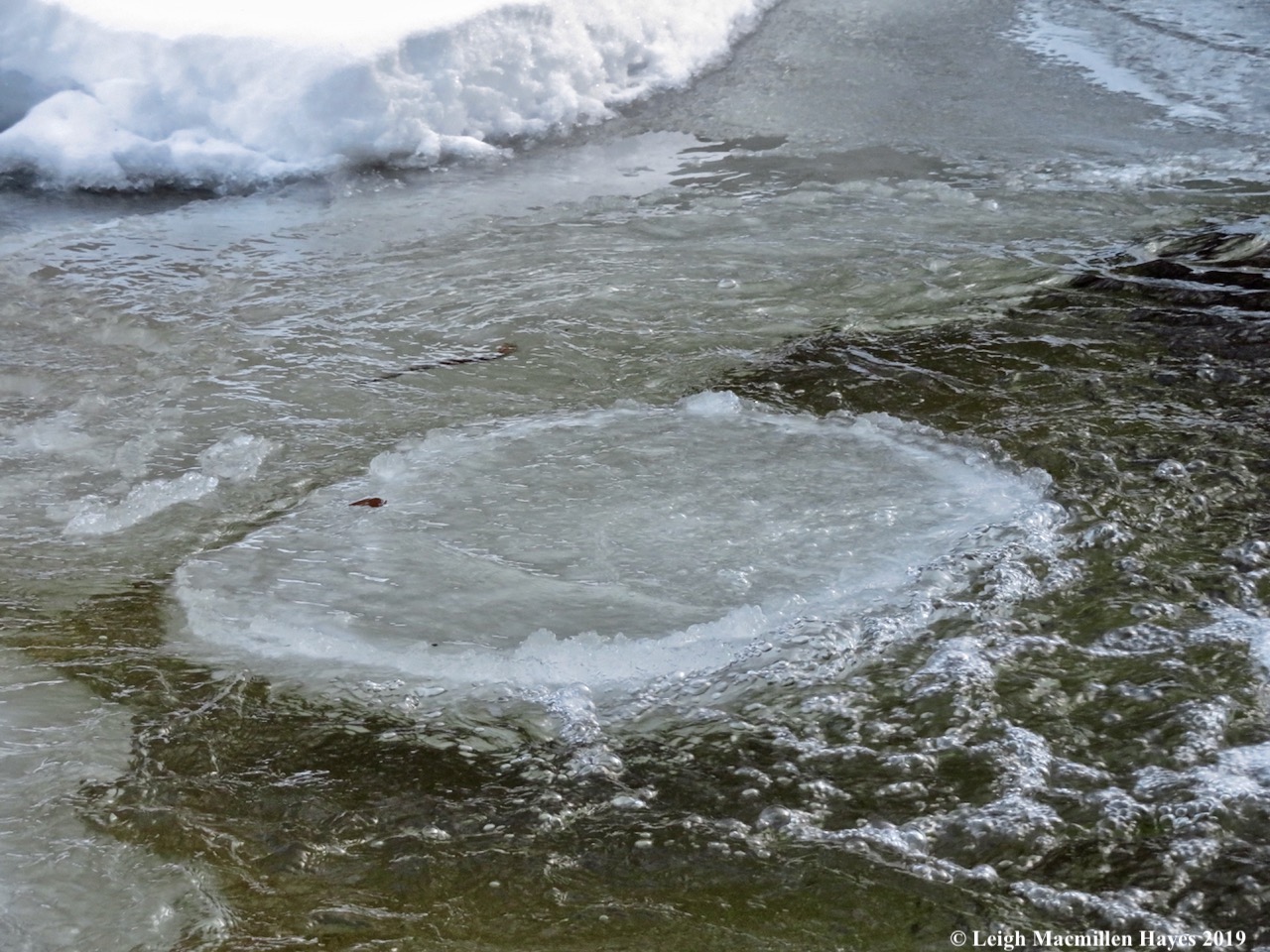
In the midst of wondering, I noticed a rare sight that added to the mystique of this place. Do you see four circular discs in the water? All spun at the same rate despite their varied sizes.

They were ice discs spinning counterclockwise much to my delight. This rare phenomenon was caused by the cold, dense air formed within the eddy at the base of the fall.

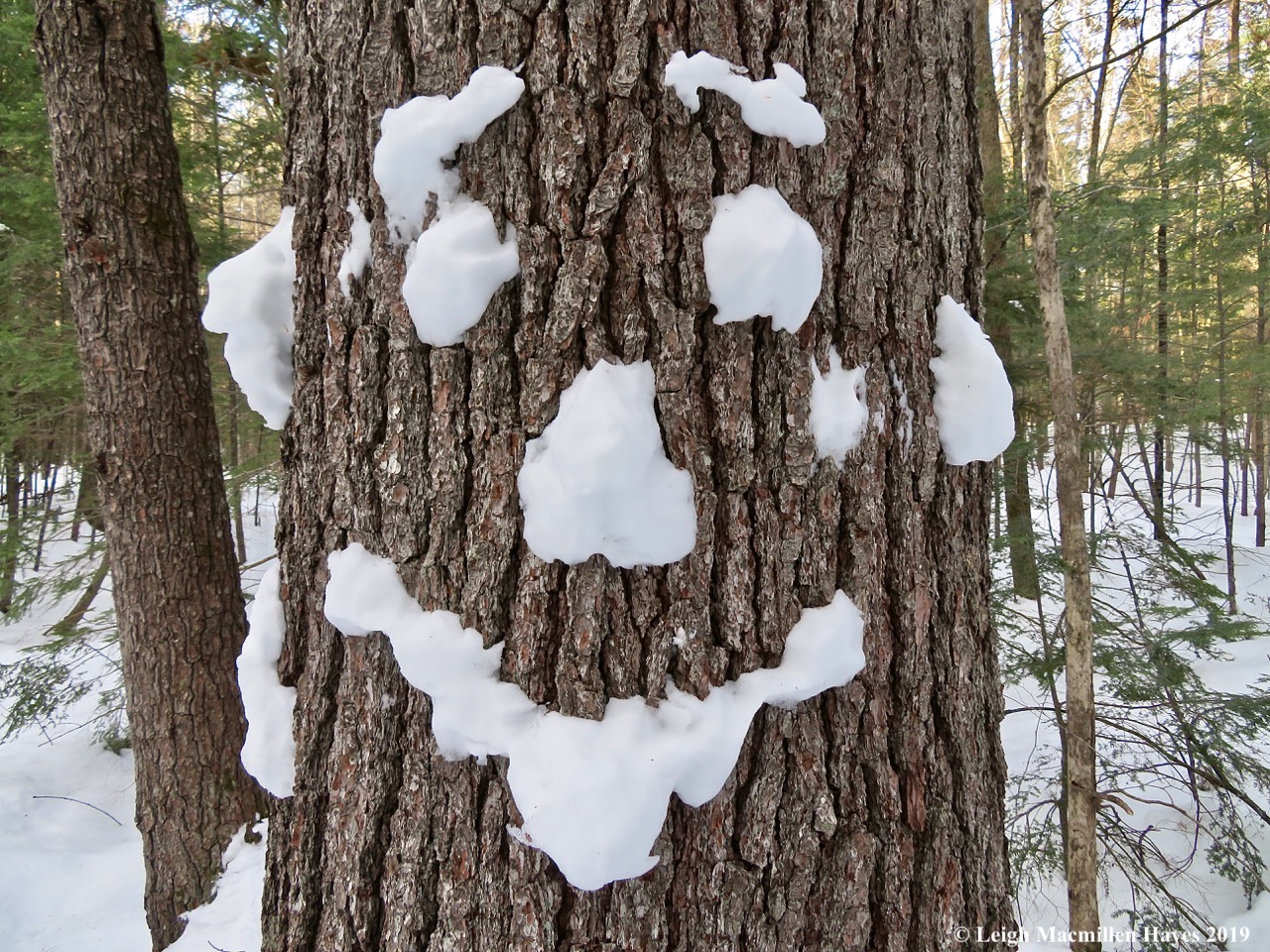
After that sight, we continued to climb until the brook leveled out. And then we pause before the spirit of one made from the same crystals that flowed beyond; one who wore a smile indicating he knew the ways and whys and wonders of the brook even if we didn’t.

As it turned out, he wasn’t the only one.

The woods were full of those who listened like old sages,

and smiled with a secret knowledge tucked within their grins.

Through it all, we felt the love of the universe as we tried to interpret the romance of the stones–icy though they were. And on this first Mondate of 2019, we were grateful for our “dip” into Diana’s Bath. It’s so much better in the winter than summer, especially on a weekday, for there are far fewer people about. But the sprites and fairies. They are there. Some you might even find among the rocks and boulders; I know. I saw a few. And others, might be upon the tree trunks. Or in the midst of the water.

If you decide to Romance the Stones, do know that unless you have a White Mountain National Forest Pass, you will need to pay the $3 fee to park. For some reason, the sprites don’t take care of that. Hmmm . . . one would think.

A “Fen-tastic” Afternoon

I was on a reconnaissance mission this afternoon for next week I’m leading some middle school students into a wetland and talking about forest ecology before sharing the joy of foraging with them.

1-Into the jungle

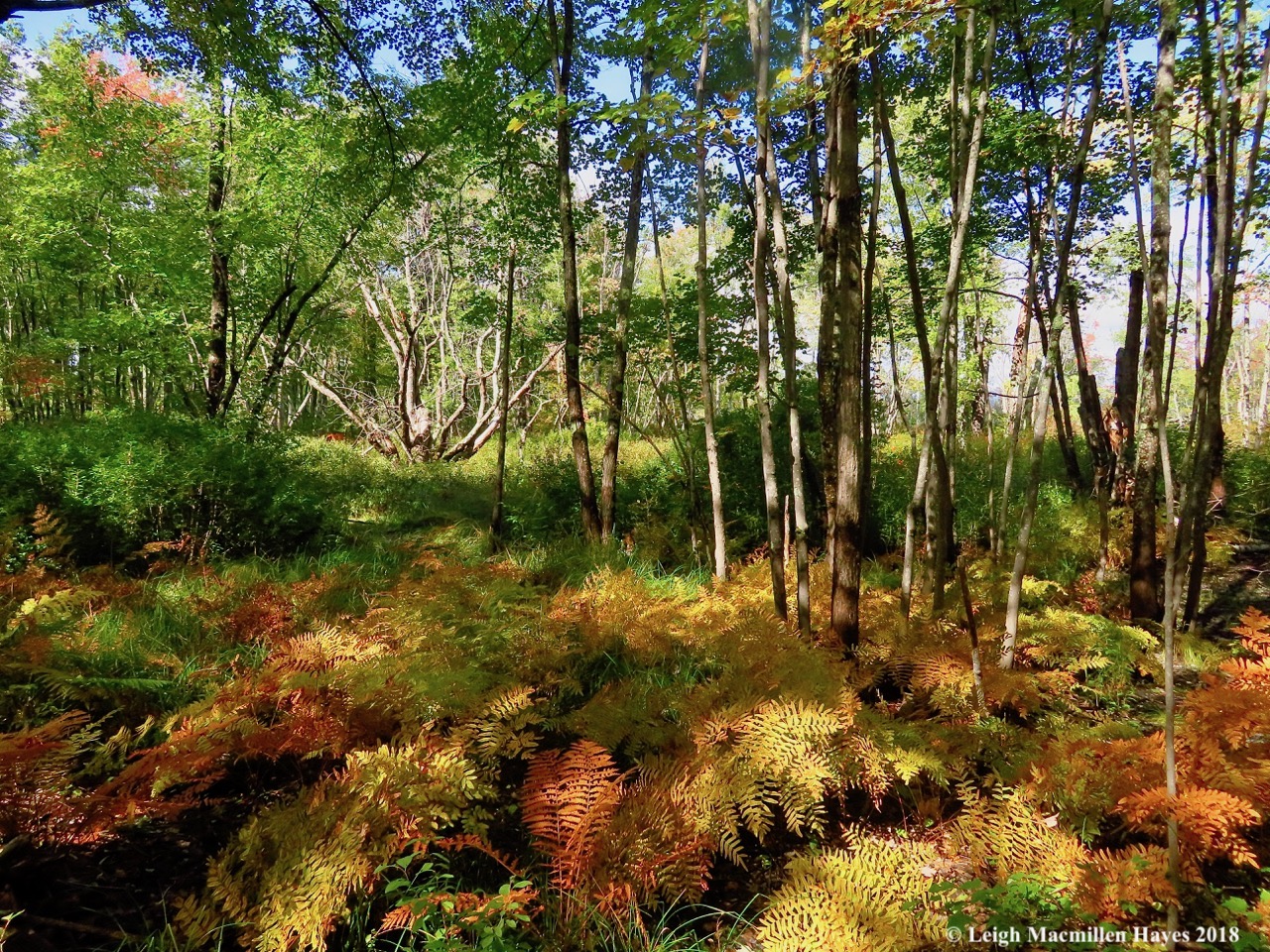
To reach the wetland, it was like walking through a jungle where the ferns grow tall, their fall coloration enhancing the scene. Cinnamon Ferns are a species that easily grow in medium to wet soils in part shade to full shade. The moist, rich, acidic soils, I walked through were much to their liking.

1a-cinnamon fern

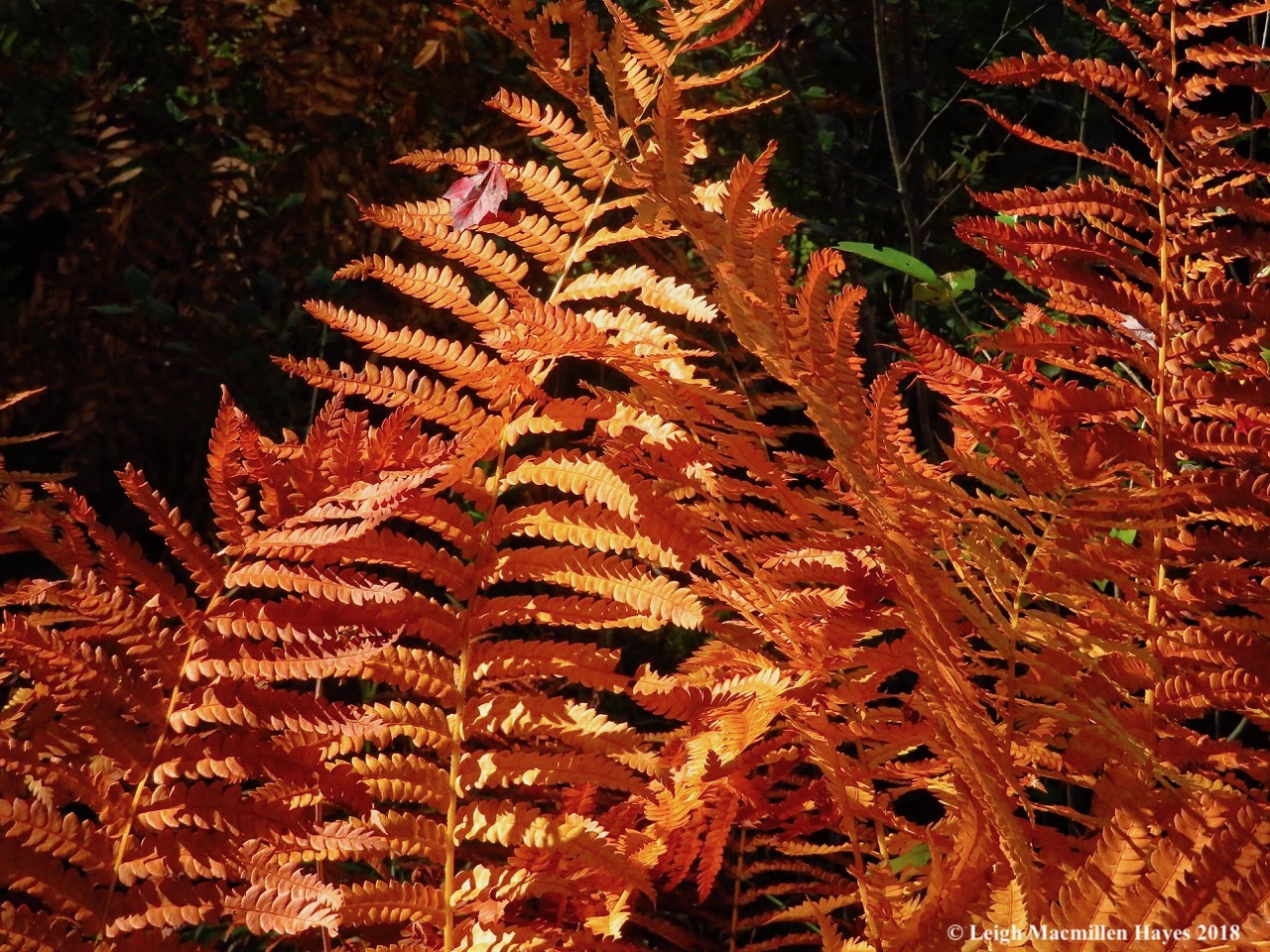
It appeared that they were named for their autumn presentation, but really it refers to the cinnamon-colored fibers found near the frond bases.

1b-hairy underarm

Because they look so similar to their relatives in the Osmundaceae family, the Interrupted Fern, I looked to the back of the frond for confirmation. Sure enough, where the pinnae (leaflet) met the rachis (center stem), a tuft that we refer to as the hairy underarm was present.

2-kettle

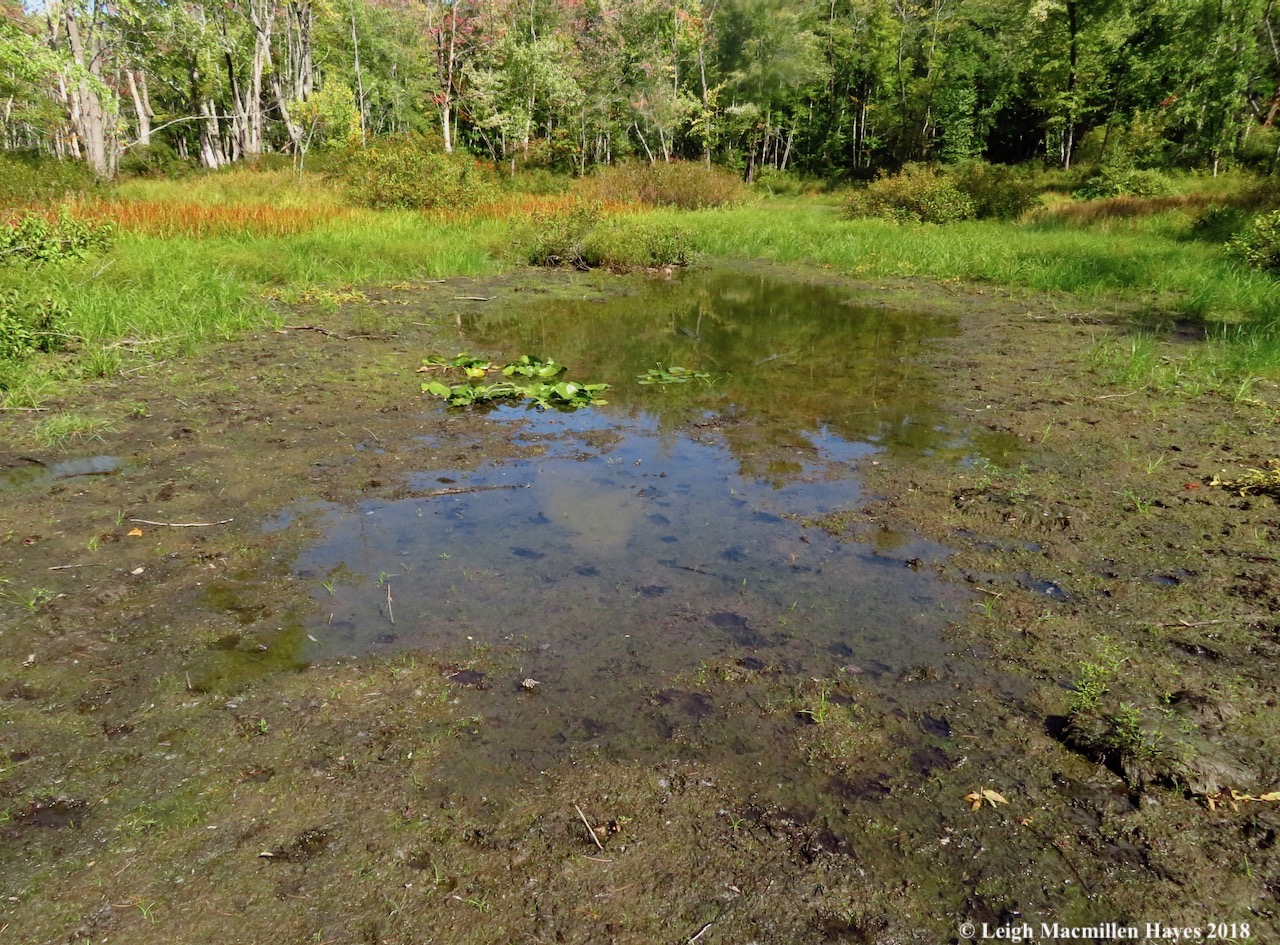
Onward I continued, not sure what the moisture situation might be. So, in the past, I’ve paused by the kettle hole, but never actually entered it. All that changed today and my plan is to take the students into this special place. A kettle hole is a basin created when a large block of glacial ice was left stranded and subsequently melted in place, producing a basin or depression. These basins fill with water up to the depth of their surrounding water table, which currently happens to be rather low.

3-white face meadowhawk

Because the temperature had risen after a damp, chilly start to the day, the meadowhawk dragonflies flew . . . and landed. This one was a White-faced Meadowhawk, aptly named for that face.

4-white face meadowhawk abdomen markings

Its abdomen markings of dark black triangles also help in identification.

4b-autumn meadowhawk dragonfly

Flying in the same airspace where the Autumn Meadowhawks, with their light-colored legs. All other meadowhawks have dark legs.

4c-autumn meadowhawk love

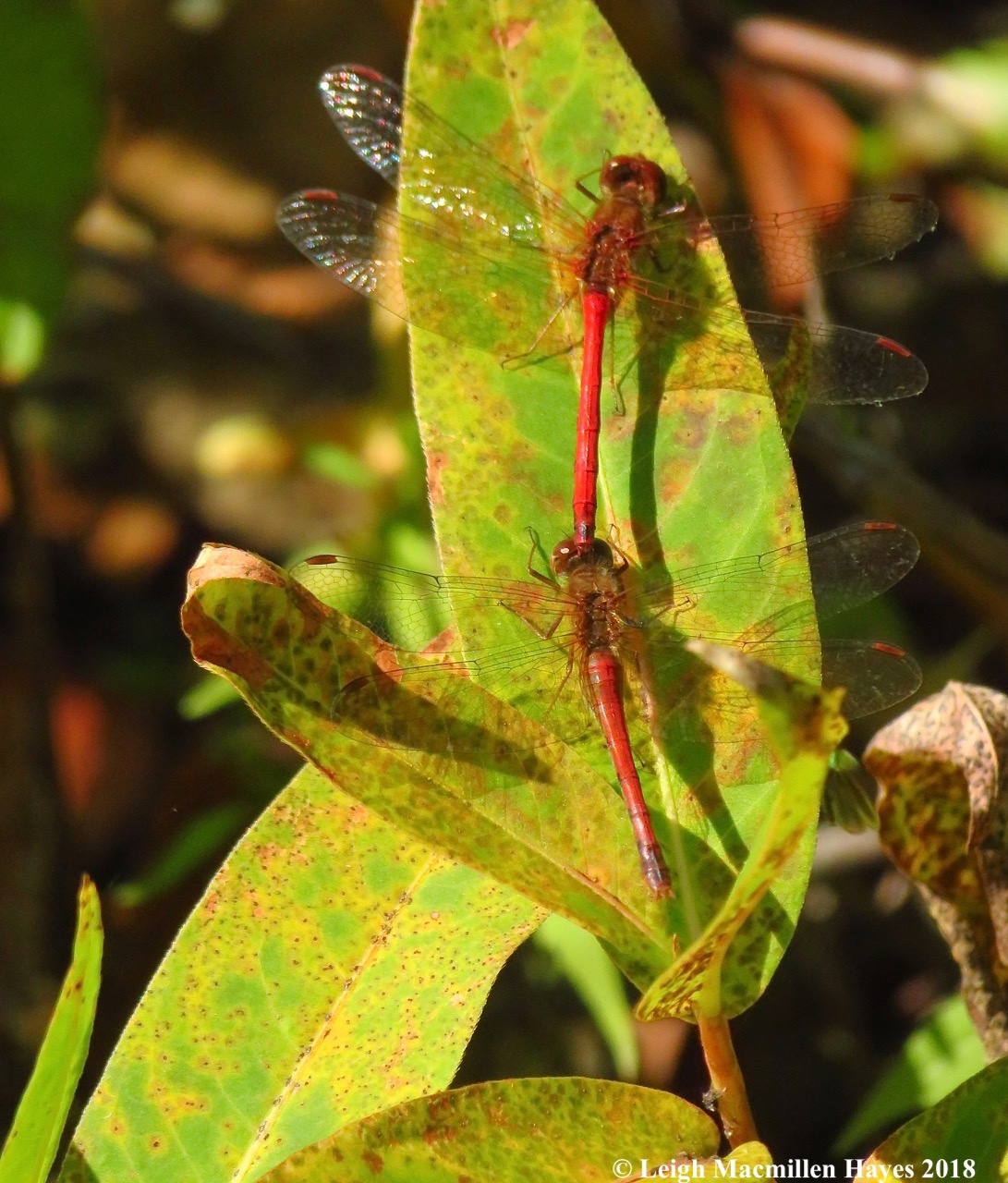
Love was in the air and on the leaf as a pair of Autumns took advantage of the warm weather to canoodle in the sunlight.

4c-dragonfly love everywhere

They weren’t alone.

7-kettle 2

What I learned as I explored was that the kettle was actually a double pot for a second one had formed behind the first. Notice the layered structure of the area from trees on the outer edge to shrubs to grasses and flowers to water.

5-mammal tracks

And everywhere–deer and raccoon tracks crisscrossed through mud and water.

5a-racoon and bird tracks

Bird tracks also joined the mix among the raccoon prints.

6-six-spotted fishing spider

And because I was interested in learning who lived there, I had to pay homage to the six-spotted fishing spider.

8-spatterdock leaves and root

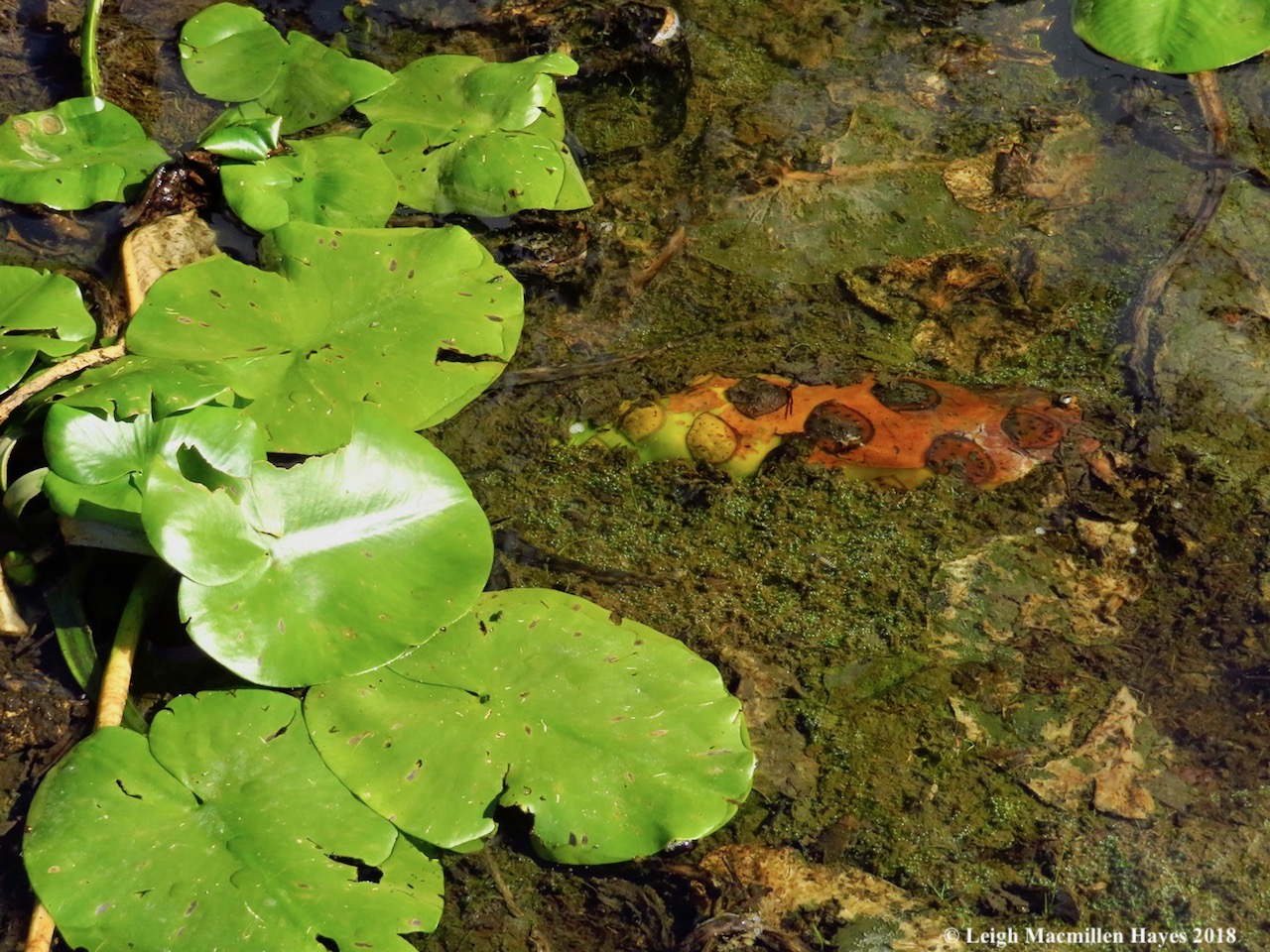
The spider flirted with me as he moved quickly among the spatterdock leaves that sat in the wee bit of water left in the center of the kettle.

9-another kettle

I finally left the kettle only to discover another and again the formation of layers.

10-green teal ducks

The water was a bit deeper and a family of Green Teal Ducks dabbled.

11-bottoms up

Bottoms up!

12-my destination

It took some time and steady foot placement as I climbed over downed trees hidden by winterberry and other shrubs, but at last I reached my intended destination, a cranberry bog.

13-cranberries

And then I spent the next hour or so filling my satchel for so abundant were the little gems of tartness. The best where those hidden among the leaves–dark red and firm were they.

14-some nibbled cranberries

As I picked, I realized I wasn’t the only one foraging. It appeared that either chipmunks or squirrels also knew the value of the flavor–though they only nibbled.

15-October colors layered

Occasionally, or even more often, I looked up to take in the colors and layers that surrounded me–from leatherleaf bronze to blueberry red to Gray Birch and Red and Silver Maples with a few White Pines in the mix.

16-buttonbush

Buttonbush added its own color and texture to the scene.

17-finding my way out

At last I decided to find my way out. (Sorta for I did get a wee bit disoriented.)

18-royal fern fertile fronds

Among the offerings were ferns of a different kind–though still related to the cinnamons I’d seen earlier. The Royal Fern’s fertile crown had months ago shared its spores with the world and all that was left were salmon-colored structures.

21-buttonbush galore, but more

I picked my way carefully and eventually found one of the kettles. And . . . drum roll please . . .

22-two sandhill cranes

two Sandhill Cranes. Others can tell you better than I how long the Sandhills have returned to this area, but it’s been for a while now and some even saw a nesting pair this past summer. My sightings have been few and so it’s always a pleasure.

23-sandhill cranes

I stood still as they moved about and they didn’t seem to notice my presence.

24-sandhill cranes

While they foraged for roots, another also watched.

25-great blue heron

The Great Blue Heron was cautious as they strolled in his direction.

29-bald eagle

And then . . . and then . . . in flew a Bald Eagle. And out flew the heron.

30-cranes flew out

The cranes waited a couple of minutes and then they flew, bugling on the wing.

And I rejoiced. Oh, I still had to find my way out and did eventually cross through a property about a quarter mile from where I’d started. But, all in all from kettles to cranberries to birds, it was a Fen-tastic afternoon as I explored an outlet fen.


Speaking to the Future, Jinny Mae

As a kid, science and history eluded me. Reading, and writing, and even, ‘rithmitic, I embraced. Well, only a wee bit of the latter, though my father thought my abilities were far greater than they were and he saw a bank position in my future. He was the mathematician. It wasn’t a subject for me to pursue. And so I became an English teacher.

And then one day I woke up and found I’d developed an interest in the how and why and the science of stuff. Added to that was a desire to know more about the past. And voila, here I am, some days spending way too many hours pursuing insects in the garden or bark on tree or dragonflies buzzing about. Other days, its following trails of yore and trying to understand the lay of the land and those who came before that interests me. My favorite days are probably those that find me pursuing the two subjects simultaneously.

1-Ambush Bug on Hydrangea

Today, I devoted spurts of time to a hydrangea bush that we rescued from a shady spot in our yard about fifteen years ago and transplanted to a sunny spot. What once was a dying shrub that rarely produced more than one flower is now a healthy specimen laden with blooms. And the insects love it.

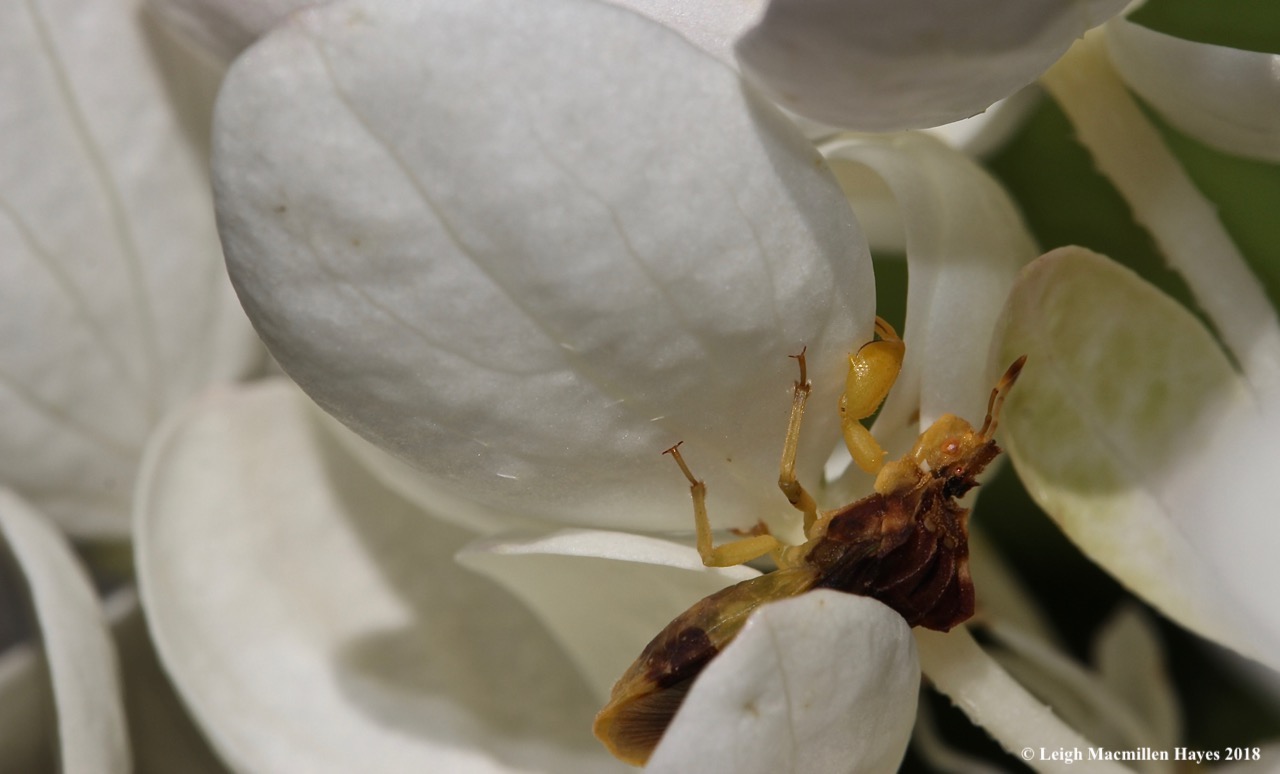
My biggest surprise, however, was to find an Ambush Bug sitting atop one of the newly opened white flower petals. For the first time since I’ve been paying attention, the bug was on something other than a goldenrod and I could truly see its body. I’ve always thought it exhibited a hint of a smile, and do believe I’m correct.

An Ambush Bug is my “iguana” insect for its body structure always brings to mind a neighbor’s iguana that got loose one day and never was spied again when we were kids. (Or was it? Didn’t we find a dead iguana on the old dump road, Kate and Lynn? Was that Rob’s lizard?) Anyway, I think the Ambush Bug resembles an iguana, on a much smaller scale, of course. MUCH smaller.

2-Ambush Bug

Seeing the bug on the white petals really threw me for a loop. Why was it there? What would it ever find to eat? The pollinators no longer bothered with the shrub on which it stood. They’d moved on to the goldenrods and asters below.

And how could this insect behave as one who ambushes when it was hardly camouflaged on the white petal? It must have questioned the same (if Ambush Bugs can question) for it turned this way, then that, and back again, and then moved from petal to petal and flower to flower. Usually, it hardly seems to flex a muscle as it remains in one spot for hours or days on end.

3-eye to eye with Ambush Bug

We studied each other, eye to eye, or perhaps more correctly, lens to lens, until I blinked and it flew off. I trust it landed on a nearby goldenrod, where a meal wasn’t too long in the making.

4-Tiger Moth Caterpillar

Just after the Ambush Bug and I parted ways, I noticed a subtle movement below and watched a tiger moth caterpillar that reminded me of a soft boa scarf one might wrap around a neck quickly slither down another flower on the shrub until . . .  it reached the edge of the final petal and fell to the ground, climbed up a fern frond, found its way back to the shrub and moved on to the world within.

7-grasshopper 1

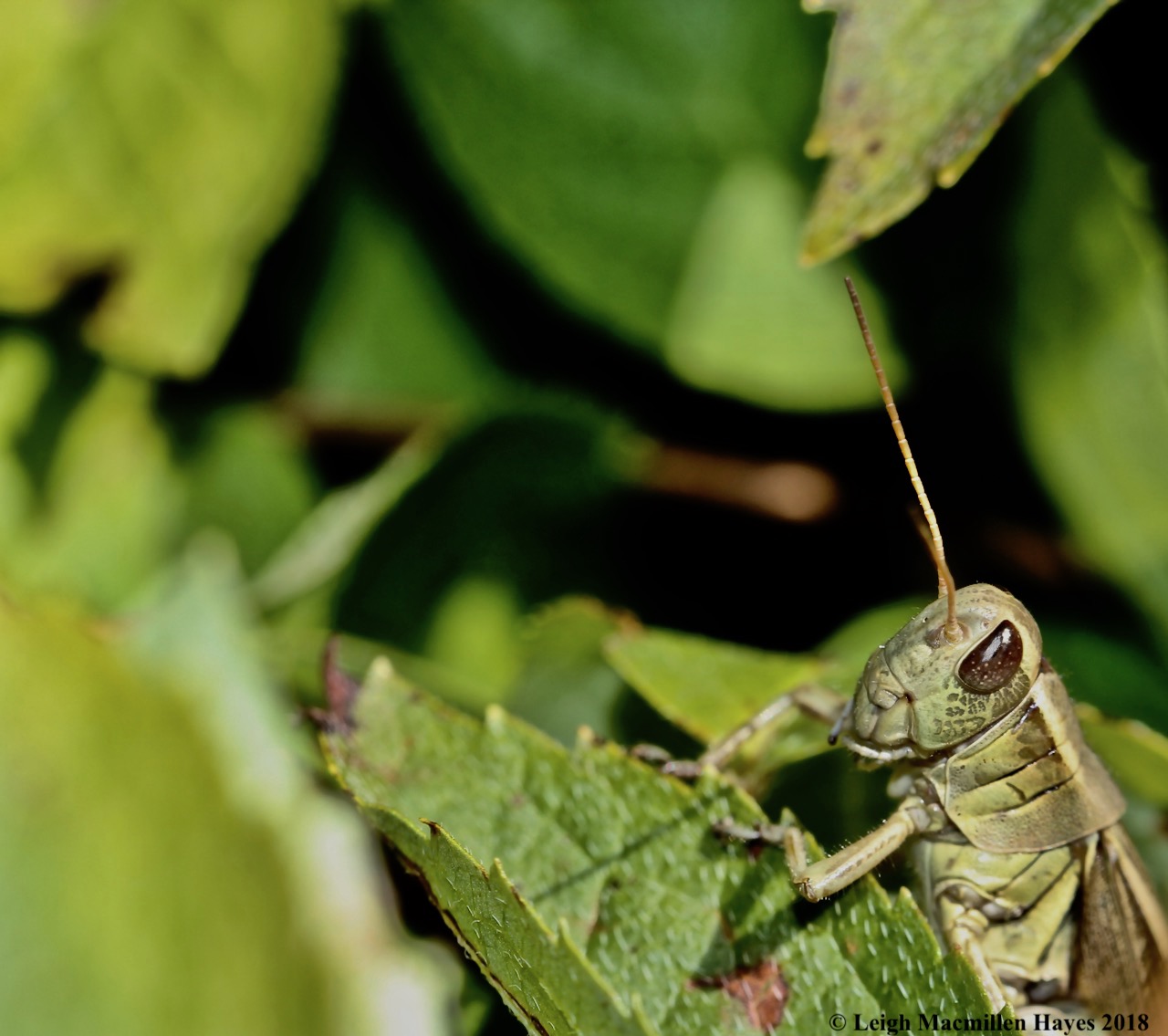
I was beginning to think that all of the insects on the hydrangea would move on or in, but then I met the Red-legged Grasshopper. He set his elbow on the leaf bar and we consulted each other. Would he fly away if I moved into his personal space, I wondered. He wanted to know why I stalked him.

8-red-legged grasshopper

I mentioned his body of armor and the herring bone design and the leg joints and the spurs on its legs that drew my awe.

9-grasshopper

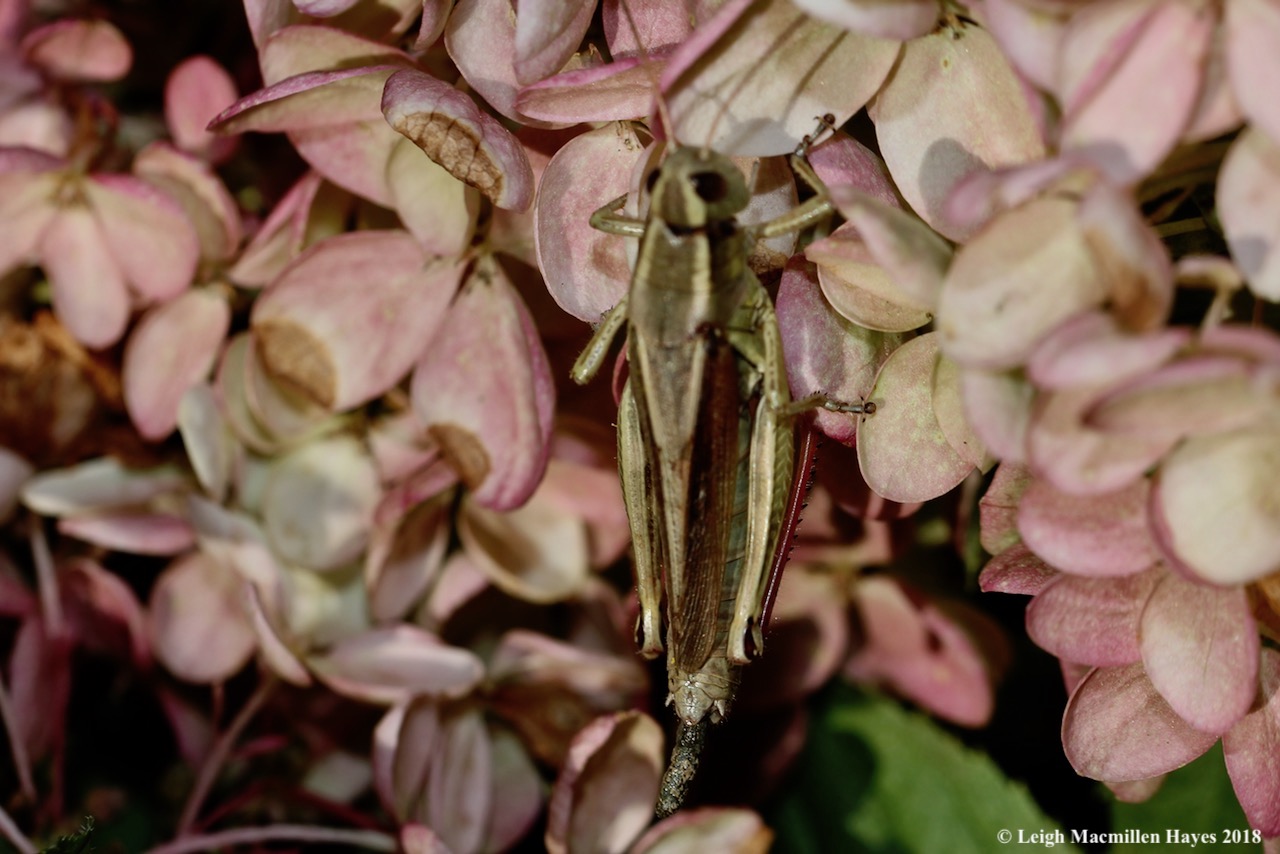
As a solo traveler, I knew it didn’t appreciate that I wanted to share the space. But, I couldn’t resist. Notice its feet and the segments on its abdomen and even the veins in its wings. Did I mention its mandibles?

10-caterpillar scat

As it turned out, there may have been a reason it wanted to be alone, but I was there. To. Witness. The. Poop. A blessed moment. It would have been more of a blessed moment had it pooped on me. Oh, and did I mention that grasshopper poop, like all insect poop, isn’t called scat. Rather, it is frass. Thanks go to Dr. Michael Stastny, Forest Insect Ecologist in New Brunswick, Canada for reminding me of that term. Cheers Mike.

14-shield bug

Another moving about was a shield bug, so named for the shield on its back. It does make me think of a piece of metal one might use as protection. Combine the shield with the grasshopper’s suit of armor and you might think you were spending time in an earlier era. Much earlier.

15-shield bug

But this shield bug didn’t care about the Middle Ages. Instead, it had one thing on its little mind.

12a-shield bug eggs?

Depositing eggs.

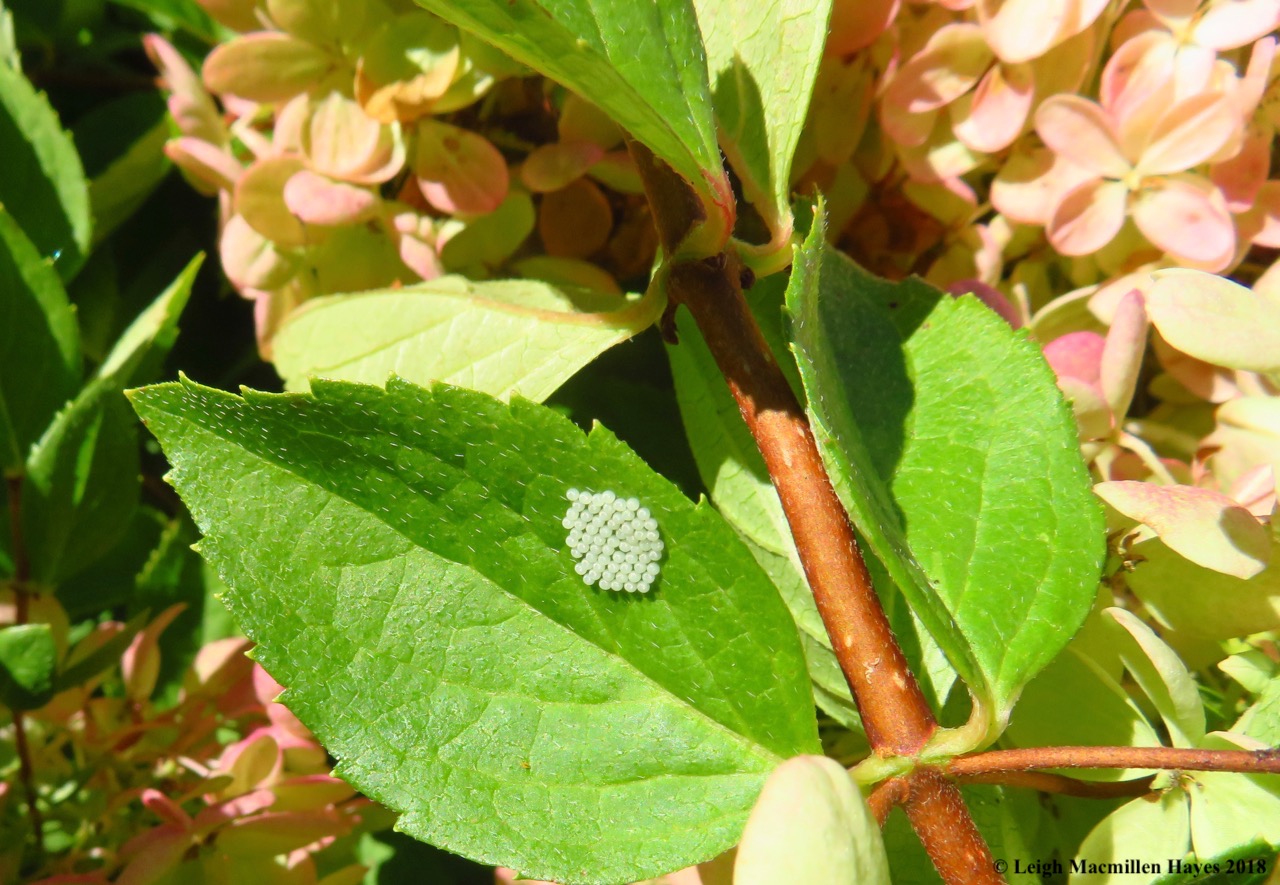
13-shield bug eggs?

Its offering was almost minute, yet pearl-like in structure.

16-wasp within

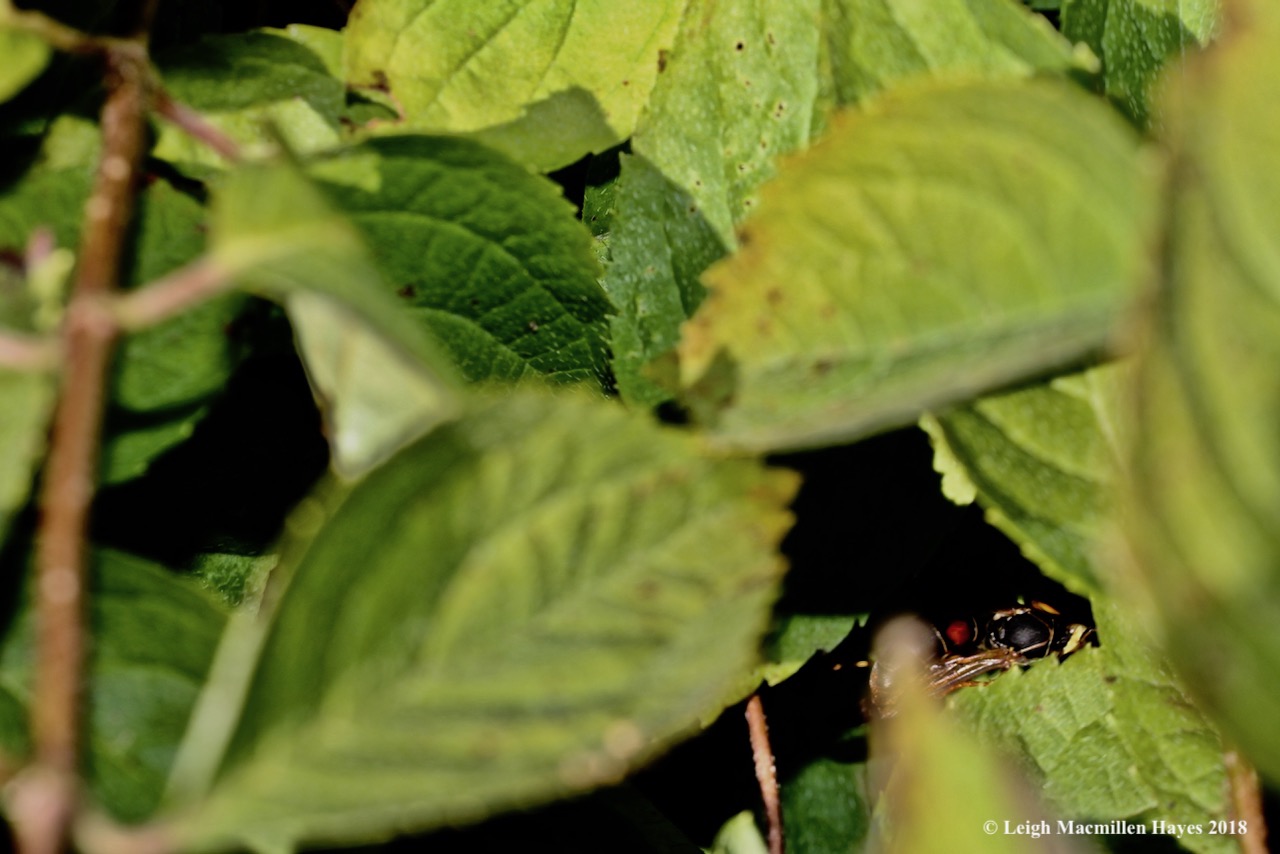
The world I watched on the outside of the hydrangea made me wonder what might possibly go on within. As much as I wanted to break through the branches and take a better look, I knew I’d ruin everything and after all, it wasn’t my place. I did, however, get to witness one moving about briefly for a paper wasp left the goldenrods and heading under the hydrangea leaves to move the pollen about on its body. Why did it go under? Why not pause atop a leaf for such behavior? And how did it escape the inner world without . . .

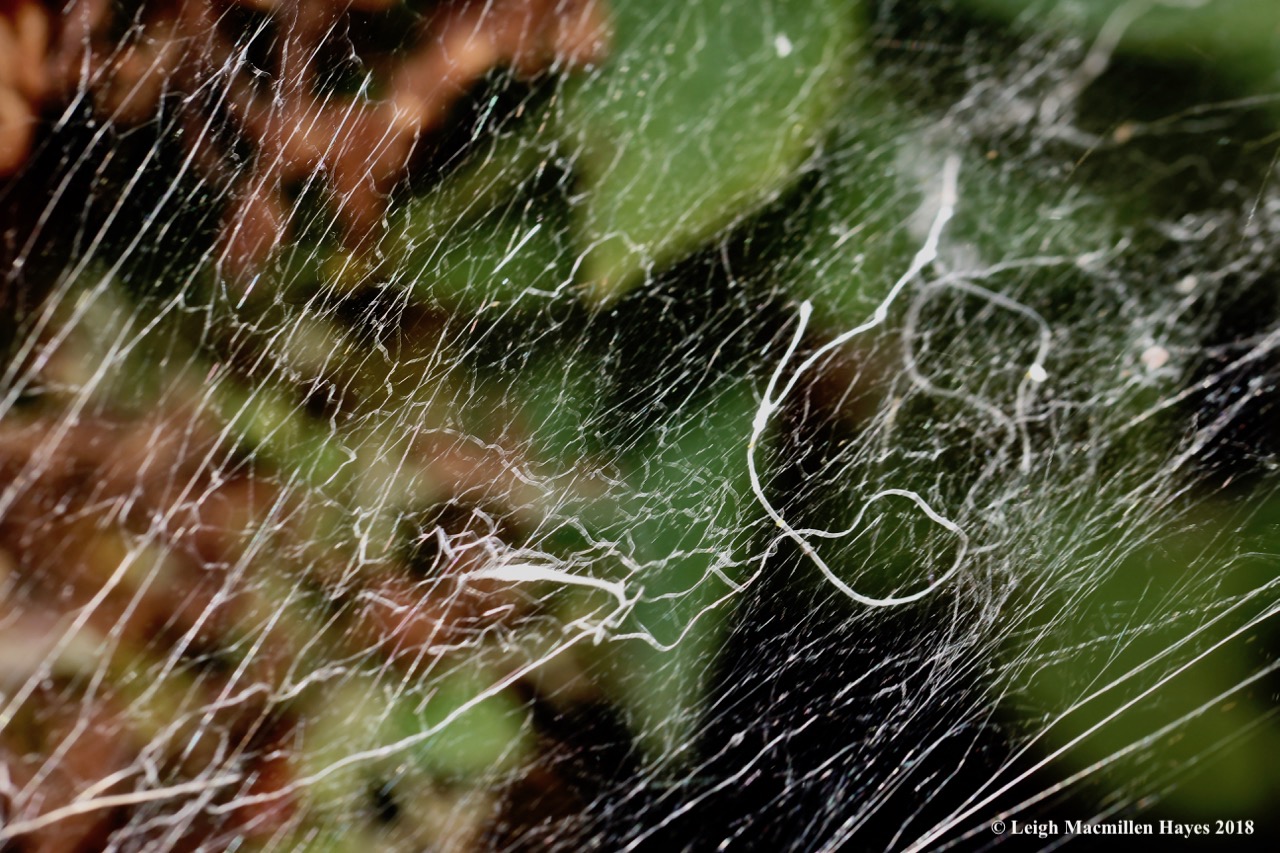
16a-spider web

encountering a spider web? Funnel spiders had practically veiled the entire shrub with their silken structures.

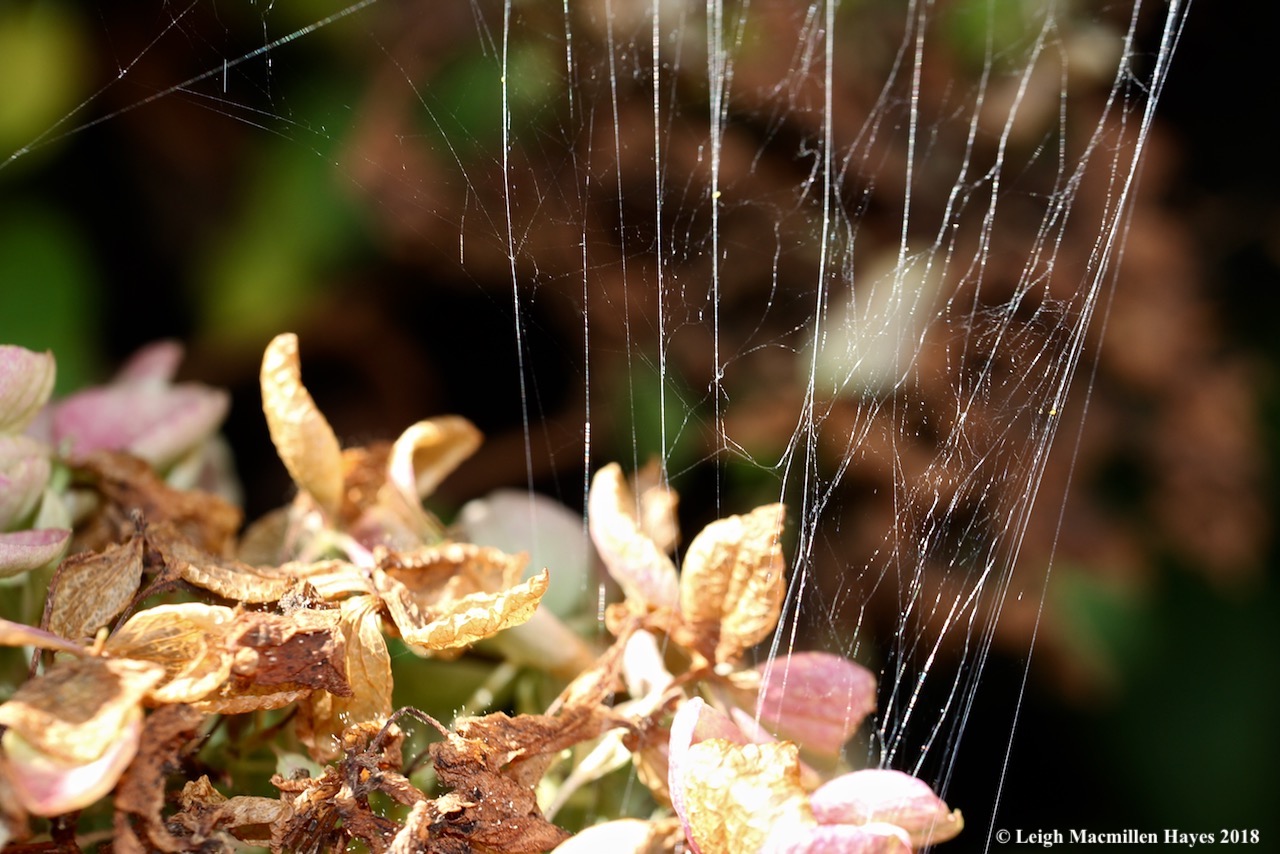
16b-web anchors

Though anchored with strength, they were extremely soft to the touch.

17-spiders

As the day progressed, I kept tabs on three funnel spiders, the mighty weavers that they were. All were wary of daylight.

18-food in front

But one had set up its home on the eastern side of the shrub and so it spent the day in the shade and enjoyed fine dining on a small bee that I assume made a mistake of pausing while shifting some pollen on its body.

19-dining

There wasn’t much left of it by the time this spider had finished its meal.

21-dinner in hand

Later in the day, a web weaver on the western side began to show itself–and it also had a meal secured.

All of the insects and arachnids I saw, and I had to assume even more enjoyed the inner structure of the condo that the shrub certainly was, all spoke not to the past, but to the future.

And with that, I dedicate this blog entry to you, Jinny Mae. You have a better eye and understanding and ask better questions than I ever will. Here’s to the future!

Our Home is Their Home

As I sit in my rocking chair on the camp porch, the cicadas still buzz, with chirps of crickets thrown into the mix and somewhere in the background a constant trill from another. Tree frog? Perhaps, but it seems to carry on for longer than usual. Grasshopper? Maybe. And then there is the occasional call of the loon.

1-camp

What truly attracted my attention earlier today, however, were the other members of the household. Whose home this is, I think I know. Or rather, I thought I did. I thought it belonged to my guy and me. But really, I should have known better for it has never just housed the two of us. There were the boys growing up, and family, and friends, and renters, even. Actually, the latter three knew it before the boys. (Oops, I suppose I should call them young men, mid-twenty-somethings that they now are.)  But, through all these years, it has also housed many others. And so today, I got acquainted with some of its other residents. Rather than the mammals that we know also share the space, e.g. mice, squirrels, and bats, it was the insects and arachnids that I checked out.

2-cicada exuviae

My first find along the foundation was an exuvia of one I listen to day and night–that of a cicada. In their larval stage, cicadas live down to eight feet underground. When the time comes to metamorphose into winged adults, they dig to the surface, climb up something, in this case the foundation, and molt. The  emerging winged insects leave behind their shed skin, aka abandoned exoskeleton or exuvia. It’s a rather alien looking structure, with the split obvious from which the adult emerged.

3-cruiser 1

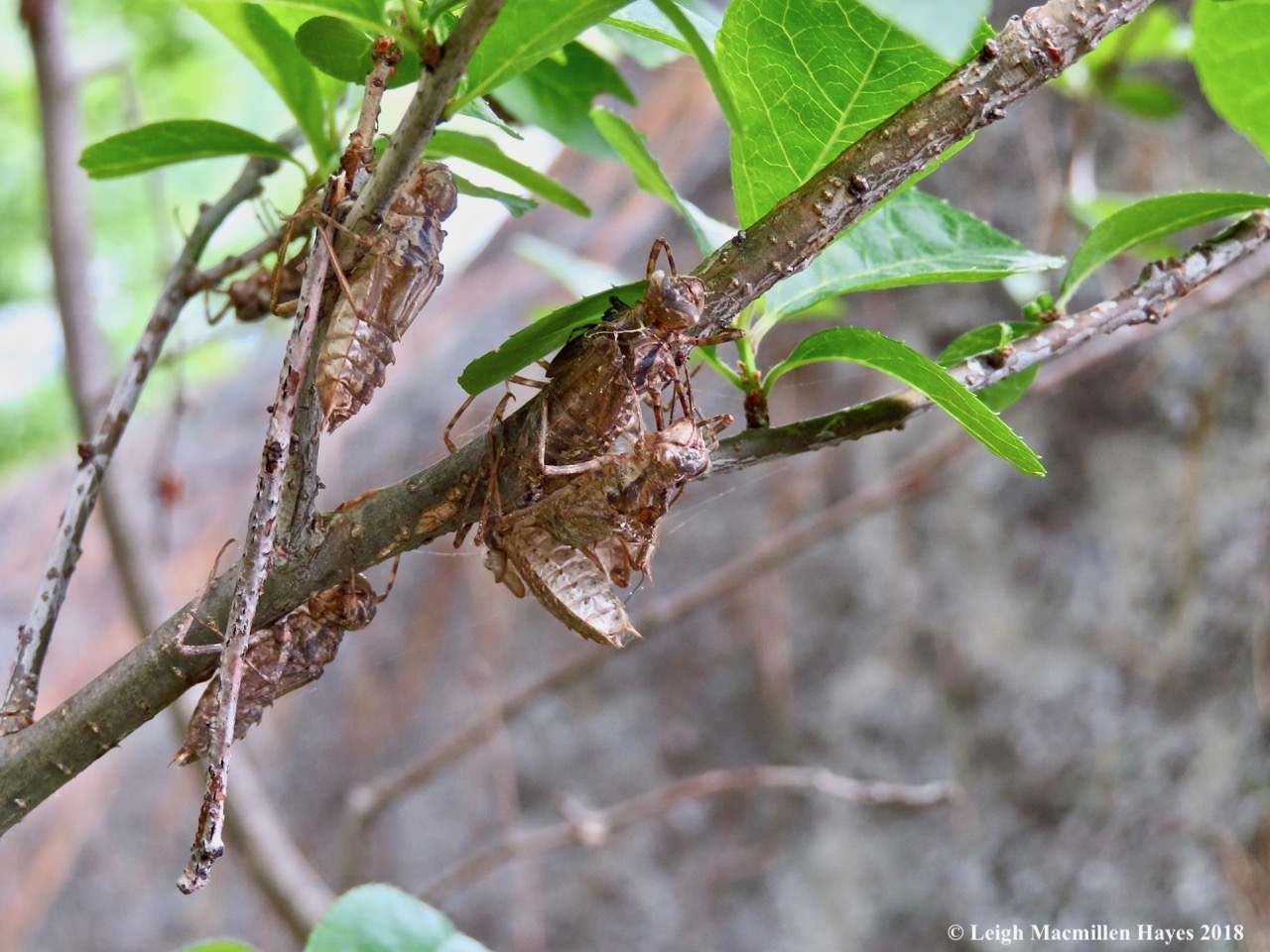
The cicadas weren’t the only aliens along our foundation. It seemed like every few feet I discovered a dragonfly exuvia dangling from the porch floor and now encased in spider webs.

3b-cruiser

One of the cruiser exuviae had dropped to the ground below. But still the structure remained intact. And I now realize that my next task is to head out the door once again in the morning and collect these beauties, the better to understand their nuances.

4-cruiser hiding

I found cruisers hiding under the logs . . .

6-cruiser and cast off spider

and even one tucked in by a basement window that had a shed spider exoskeleton dangling from it.

6a-lancet clubtail dragonfly

There were others as well, but nowhere did I find the exuvia of the one with whom I’ve spent the most time, Sir Lance(t) Clubtail. I suspect his shed skin is attached to some aquatic vegetation for he spends so much of his time by the water, even today, pausing only briefly to rest on the dock ladder.

7-bag worms and pupal case of a pine sawfly

There were other species to meet, including the most interesting of structures, those of the evergreen bagworm cases. I assumed that the young had already emerged, but their homes consisted of material from the trees on which they fed, e.g. pine needles. They struke me as the terrestrial form of the aquatic caddisflies.

And beside the two bagworms was a small, rounded brown case–the pupal case of a pine sawfly. The sawfly had already pupated and in this case no one was home.

8-pine sawfly caterpillar on screen

Oh, but they were and have been for a few weeks. I first realized we had an infestation when what sounded like the drip-drop pattern of a summer rain on a perfectly sunny day turned out to be little bits of green caterpillar frass falling from the trees. Everything was decorated. And then I began to notice the caterpillars–many falling out of trees and landing on the surrounding vegetation, and the house. As would be expected, they climbed toward the sky, hoping, I suppose, to reach the top of the trees. Good luck with that.

9-pine sawfly caterpillars

Some didn’t make it above the foundation, where they encountered spider webs and soon had the juices sucked out of them. Such is life. And today, a winter flock of birds including chickadees, nuthatches, goldfinches, hairy woodpeckers, young robins, and even a brown creeper flew in and some fine dining took place. The raindrops have nearly ceased.

10-Northern Pine Sphinx

That wasn’t the only pine-eating caterpillar to make its home here. On the chimney, I found a northern pine sphinx caterpillar moving full speed ahead.

11-orbweaver

And around the bend, where the chimney meets the camp, an orbweaver spinning some silk in the hopes of fine dining.

14a-calico pennant dragonfly in web

One meal had obviously been consumed–a calico pennant dragonfly. I’d seen a few of those on the vegetation a few weeks ago, but none recently. Apparently, one flew too close to the building. The only way I could ID it was by its wings for the head, thorax and abdomen had been eaten. But the wings have no nutritional value.

11a-Northern Pine Sphinx 2

A short time later I returned to the chimney in hopes of locating the northern pine sphinx caterpillar again. I did. And he wasn’t. He’d apparently turned the sharp corner on the chimney and met his fate.

13- Northern Sphinx 4

Eye to eye. I’m amazed at the size of the insects that find their way to her web. It’s not like they are attracted to it. Instead, they come upon it quite by surprise and she makes fast work of their mistake.

14-pine tree spur-throated grasshopper

Rounding the corner back toward the porch door, one last insect drew my attention. And again, it was related to the pines, such is the local community: a pine tree spur-throated grasshopper on one of the logs that forms the outer wall of our wee home.

Our home is their home and we’re happy to share the space with them. Provided, of course, that they leave space for us to live as well. So far, all is well.


Dying To Get In

When I told my guy that Connie was taking me to Evergreen Cemetery in Portland today, he gave me a questioning look and asked, “Why?”

‘Why not?” I responded.

But really, it was because both she and I have friends who have posted incredible photographs of the natural world that is part of the cemetery and we wanted to discover what it was all about.

e1-evergreen cemetery

At first glance, Evergreen Cemetery may look like Anytown Cemetery for it features gravestones, memorials and tombs throughout. But . . . as we read on a panel near the entrance: “Established by the city in 1854, the cemetery was designed by Charles H. Howe as a rural landscape with winding carriage paths, ponds, footbridges, gardens, a chapel, funerary art, and sculpture. It also includes extensive wooded wetlands. Evergreen was modeled after America’s first rural cemetery, Mount Auburn in Cambridge, Massachusetts.

The cemetery, the second-largest publicly-owned open space in the City at 239 acres, has been host to a variety of wildlife such as geese, ducks, pheasants, swans, turtles, blue heron, fox, mink, deer, and moose. Its spaciousness combined with old growth pine and oak, vegetation, ponds, and surrounding wetland, provides a true wildlife oasis. It is considered a premier birdwatching sanctuary. Maine Audubon utilizes the cemetery for field trips, to include their annual Warbler Weeks conducted in May. Evergreen Cemetery is also a wonderful location to enjoy the vibrant colors of fall foliage in Maine.

e2-sunburst lichen

We didn’t actually spend much time exploring the cemetery itself, though that would be fun to do on a return trip, but as we waited for Connie’s friend Linda to join us, we did look at a few gravestones and were especially enamored with the sunburst lichen that lightened a stone gray morning.

e3-male mallard

Linda was only a few minutes behind us and then we all traveled to the back end of the cemetery, where the Mallards stopped us in our tracks. While you might ask why, remember that we are women of wonder and wonder we did: about his iridescent head,

e4-famale mallard

her lack of ducklings despite four attentive males,

e5-mrs. mallard

why their feet were orange,

e6-duck tweed

and the tweedy pattern of their feathers.

e7-ducklings

And then we spied a couple of other females with ducklings, this one standing tall as she allowed her youngsters to explore.

e7-chipping sparrow

They weren’t the only ones exploring–a Chipping Sparrow was doing the same, though it was almost impossible to see given that it blended in so well with its surroundings.

e8-black swallowwort

At last we pulled ourselves away from the ducks and our view of the car, and started down a trail where flowers and leaves made us take note. Last year, I first met the dark maroon flowers of Black Swallowwort, an invasive. Diminutive and pretty, it was difficult to dismiss them, especially when juxtaposed as they were against a sensitive fern frond.
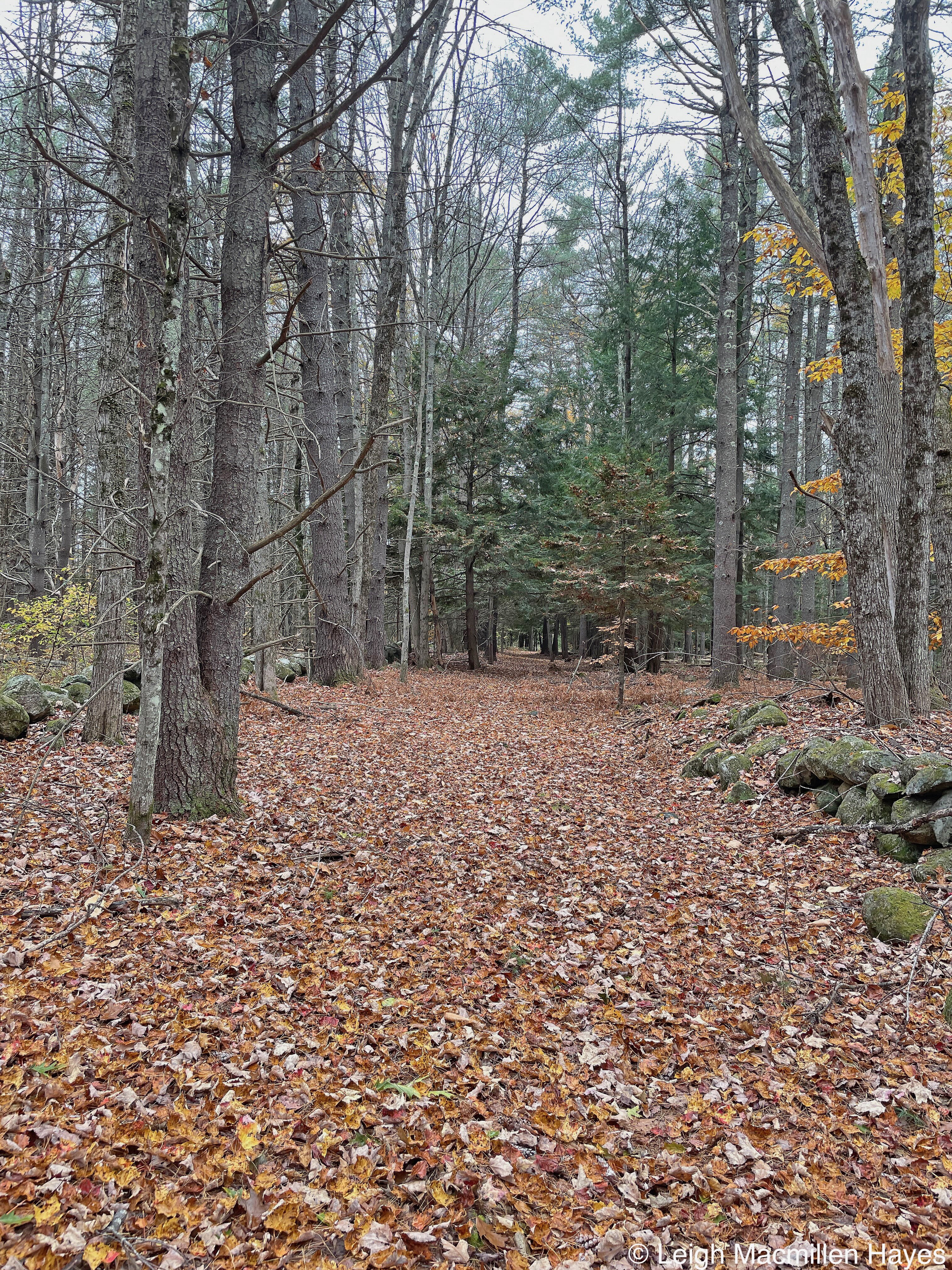
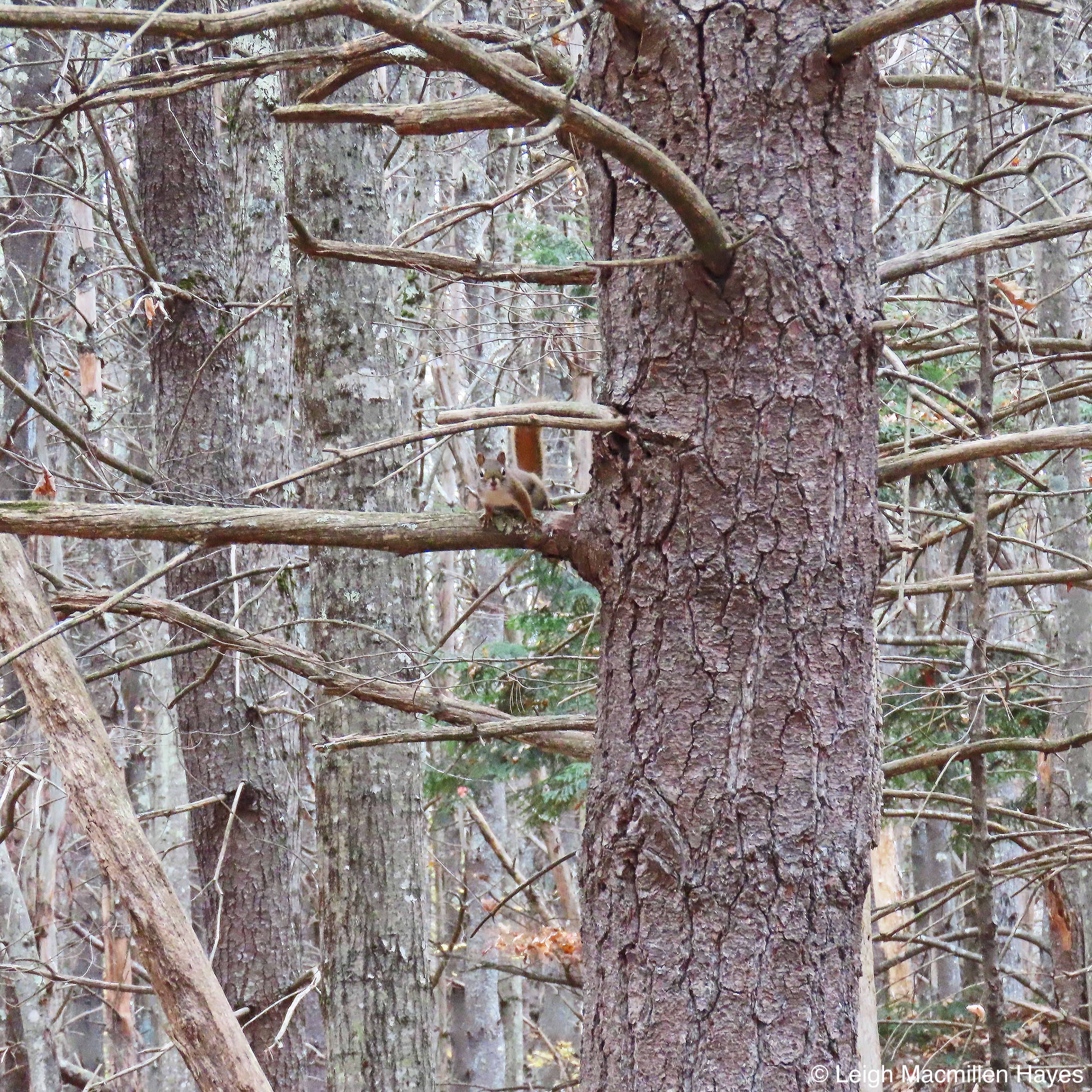
e9-ragged-robin

Connie introduced us to another invasive that she immediately recognized as Ragged-robin. Linda and I were wowed by the pink petals, irregularly cleft.

e10-sunburned oak meat

The natural community kept changing and suddenly we found ourselves under a power line where dried spaghnum moss made us wonder if the land was typically wet. And then we saw something red, and the discarded outer shells nearby spoke to its source. It was the “meat” of an acorn, the red being its “sunburned” presentation.

e11-oak setting root

The evolution of an oak tree–it begins with an acorn.

e12-song sparrow

In the same opening, we watched several Song Sparrows move among the shrubs, and then one paused to serenade us.

e13-song sparrow

Upon finishing, it waited as if for our applause.

e14-arrowwood viburnum

Before moving on, we had one more plant to ID. Thanks to iNaturalist, Connie informed us that it was Arrowwood Viburnum. While we appreciated its umbel of flowers and large-toothed leaves, one stem in particular drew our attention. In a symbiotic relationship, ants stroked brownish-red aphids with their antennae, while the aphids released drops of honeydew sucked from the stem. The process was much like a cow being milked. It was actually rather creepy, but wicked cool and all three of us used a loupe to take a closer look.

e15-American honeysuckle

Back along a woodland trail we continued, again stopping periodically to take in the sights, ask questions, and appreciate our surroundings. Among our finds we discovered the newly forming fruits of a native honeysuckle.

e16-beaked hazelnut

We also rejoiced when we encountered the beaked fruits of Beaked Hazelnut.

e17-mallards

At last we’d completed a short loop, and found ourselves drawn in again by the Mallards, both young and old.

e19-snapping turtle

But then our eyes focused on other residents in the shallow water.

e20-ducks and turtle

And we feared that we’d witness a snapping turtle devour a duckling. We kept encouraging mama to move her kids out of the way.

e21-3 turtles

Especially when we realized the pond was full of snappers and they all seemed focused on swimming to the same focal point.

e22-injured duck

But mamma took her time and let the kids roam freely. We did realize that she had an injured foot or leg and moved with a hop, which added to our anxiety. I also felt a certain affinity with her, given my current one-armed bandit situation due to a broken wrist that is slowly healing. Here’s hoping that she heals as well.

e22-mouth open

As we watched the drama play out before us, we noted two adult ducks hanging out under some alders beside the shore. Suddenly, a snapper approached them quickly and opened his mouth wide. Was he exhibiting aggressive behavior?

e23-mouth closing

We weren’t sure, but as suddenly as he’d approached, he closed his mouth and turned away.

e18-ducklings all in a row

We noticed that turning away was typical turtle behavior. They seemed to get within a couple of feet of the ducks and then turn. Why? We were, however, glad when momma got her ducklings all in a line and moved on.

e25-green heron

We, too, moved on . . . a few more feet toward the car. And then we stopped again to check on the action in the pond. That’s when a Green Heron flew in.

e26-green heron

He was also looking for lunch, though we never saw him succeed in his search.

e27-turtle wars

We did see the ducks and turtles again. And our turtle questions continued for we noticed that they would gather and then one would go after another and the water would boil. An act of aggression? Or a mating ritual?

e28-turtle face

We didn’t have all the answers, but one thing we knew–we’re dying to get into the cemetery again.


Prehistoric Lovell

It only takes a few minutes of time to realize that Lovell, Maine, like all other New England towns, is rich in history–both human and natural. And though we may be able to assign dates to certain events that shaped the town, there are reminders in our midst that predate our understanding.

p3-white admiral

Think about it. According to the American Museum of Natural History’s website, our knowledge of “Butterfly origins is based on the study of living Lepidopteran species. We can often learn about evolution from the fossil record, but there are relatively few butterfly fossils. Those that do exist, like the 40-million-year-old Prodryas persophone, are remarkably similar to modern-day forms—so the fossil record sheds little light on the origin of today’s butterflies.

Many scientists think that the specialized association between today’s butterflies and flowering plants suggests that butterflies developed during the Cretaceous Period, often called the “Age of Flowering Plants,” 65 million to 135 million years ago—a time when dinosaurs also roamed the earth.”

And there I was this afternoon at the Greater Lovell Land Trust’s Heald and Bradley Ponds Reserve admiring a White Admiral, Limenitis arthemis.

p4-white admiral

In quiet reflection above Heald Pond, one seemed to contemplate life. A cool fact about this butterfly is that rather than seeking nectar, the White Admiral is known to extract much of the water and nutrients it requires from mammal scat. Though I didn’t see one on scat today, I knew that the we shared a special connection–scat, after all, happens and has done so since the beginning of time.

p7-dragonfly exuvia

And then there were the dragonflies that may have been older than even the dinosaurs. Certainly by the structure of the exuvia left behind once they emerge, one gets a sense of that ancient time.

p5-chalk-fronted

Today’s great finds at H&B included male Chalk-fronted Corporals that followed me everywhere,

p9-female chalk-fronted

and their occasional female counterparts.

p4-lancet club

There were plenty of Lancet Clubtails,

p6-racket-tailed emerald

and even a Racket-tailed Emerald.

p10-female common whitetail

In keeping with the same theme at the Kezar River Reserve, I spied a female Common Whitetail–which was anything but common,

p11-female and male ebony jewelwings

and atop bracken ferns a female (note her white dots) and male Ebony Jewelwing Damselfly.

Again, the earliest fossils of the Odonata so far discovered come from Upper Carboniferous sediments formed about 325 million years ago. The group of fast-fliers represented by the fossils went extinct about the time of dinosaurs, and yet today we have their relatives to admire.

Even the bracken fern on which the jewelwings paused spoke to an earlier time when it stood much taller than today’s three feet.

p12-snapping turtle

And then on my way home it was a dragon of a different sort that made me stop on a bridge, put the truck in reverse, park it and hop out. The snapping turtle may look much older than all the other species I encountered today, but it has haunted our wetlands for only 90 million years. A young’un in this neck of the woods.

p13-snapper's nails

These critters were the most intimidating, however, as noted by those claws,

p14-snapper's tail

that tail,

p16-snapper's face 1

and its snout.

p16-snaper's wink

Despite that, we shared a wink . . .

p15-snapper's face

and then each went our own way.

The next time you step outside, whether in your backyard or on a land trust property, be sure to pay reverence to those that have brought a prehistoric time closer to home.


The Ayes Have It

I knew I was blessed when I spied a Northern Flicker in the backyard early this morning. This is the one woodpecker that doesn’t behave like a typical family member for it forages on the ground rather than a tree trunk.

e1-northern flicker

From the kitchen window, I watched this guy for a while as he looked for food. I knew it was a male because of the so called black mustache on either side of its bill. But . . . it was the bird’s eyes I was most curious about . . .and their placement on the side of its head.

e2-flicker feeding

Like mammals, birds with eyes on the side are born to hide . . . from predators. His field of vision, therefore, was wide and the ants on the ground were the ones who needed to scurry and hide.

e4-tachinid fly

After dining for a while, the flicker flew off and I stepped out the door–in search of other  sets of eyes to behold–like the red ones of a tachinid fly,

e8-long-legged fly

and metallic green on a long-legged fly. Like the flicker, flies also have a wide field of vision due to the fact that they have compound eyes. Each eye consists of thousands of individual visual receptors, or ommatidia, (singular ommatidium) (om·ma·tid·i·um, äməˈtidēəm.) Each hexagonal-shaped ommatidium (think honeycomb) is a functioning eye in itself. With thousands of eyes on the world, it’s no wonder flies and other insects see us coming–especially when we have a flyswatter in hand.

e7-green and brown stink bug

I kept looking and among the elderberry shrub leaves I found a strikingly beautiful green and brown stink bug, or shield bug, if you’re looking for a more pleasant name. Like all insects, it featured those compound eyes, but I was struck by how tiny they were. Apparently, it was enough to see movement and kept trying to hide from me.

e8-stink bug eyes

Despite its efforts, I could zero in on it even after walking away and returning.

e9a-song sparrow

Eventually I moved my focus to Pondicherry Park, where a variety of eyes greeted me, including those of a Song Sparrow.

e7a

What did he seek? Insects and other invertebrates, such as weevils, leaf beetles, ground beetles, caterpillars, dragonflies, grasshoppers, midges, craneflies, spiders, snails, and earthworms.

e11-slug eyes

What about a slug? I suspected the sparrow would enjoy such and today was a decent slug-like kind of day. But, how does a slug see?

A slug has two pairs of retractable tentacles on its head. The upper, optic tentacles, feature light-sensitive eyespots on the ends. And just like a deer can move each ear independent of the other, slugs can do the same with each eye-stalk. Another cool fact: an eye stalk can be re-grown if something attacks it.

e11a-spider eyes

Further along, I found a wolf spider hanging out on last year’s fertile frond of a sensitive fern. Did you know that spiders have eight legs AND eight eyes? Two of them are large and prominent–the better to see you with.

e11-ebony jewelwing

As I continued to look for the sparrow’s prey, I discovered an ebony jewelwing that I determined had just emerged for it posed as I took numerous photographs. Usually, they flit about like woodland fairies. Unlike its larger dragonfly cousins who have eyes in front in order to hunt, the damsels’ are on the sides. Though zoom-and-swoop attacks may not be possible for the damselfly, it can see all-round–including above and behind– giving it control of its airspace.

e12-barred owl

My wander continued and then I heard a sound and saw some action in a tree about thirty feet off trail. And just like that, in what felt like a miracle of miracles, I realized I was in the presence of the wise one.

With his eyes in front, a Barred Owl is born to hunt. For several minutes we starred at each other and I was honored by his presence. Of course, I hoped he might cook for me tonight, but he let me down. Possibly he had others more in need of supper than I was at the time.

In the end my vote was aye in favor of all the peepers I’d met along the way, both in the yard and the forested park, for I knew that the eyes had it.


Hunkered Down

Three nor’easters in two weeks. Such is March in New England. The latest delivered over twenty inches of snow beginning yesterday morning. And still the flakes fall.

p-chickadee

But staying inside all day would be much too confining and so I stretched my legs for a few hours before giving my arms another workout with driveway cleanup duty. It was much more fun to explore and listen to the chickadees sing.

p-snow on trees

There are a few places in our woods that I find myself stopping to snap a photo each time a snowstorm graces our area. The stand of pines with their trunks snow coated was one such spot yet again. And tomorrow the scene will transform back to bare trunks and so it was one I was happy to behold in the moment.

p-snow on limbs

As was the older pine that grows beside a stonewall along the cowpath and perhaps served as the mother and grandmother of all the pines in my forest–bedecked in piles of flakes, her arms reached out as if to embrace all of her offspring.

p-snow on insulators

With the snow so deep, I felt like a plow as I powered through under the insulated insulators.

p-snow on park sign

Finally, I reached one of the entryways to Pondicherry Park and while I love being the first of the day to leave my mark, I’d secretly hoped someone had trudged before me. But . . . a few steps at a time meant taking frequent breaks to rest and look around.

p-snow on tree trunk

Again, it was the snow’s manner of hugging tree trunks that drew my awe.

p-snow on tree trunk 2

Sometimes it reminded me of giant caterpillars climbing into the canopy.

p-snow on roots

Even the roots of a downed tree took on an artistic rendition.

p1-snow on bittersweet

And that most invasive of species in these woods, bittersweet, offered curves worth appreciating–ever so briefly, of course.

p-snow on fences

Snow blanketed fences of stone and wood.

p-snow on bridge

Enhanced the bridge.

p-snow on bench

And buried a bench.

p-Stevens Brook

Beside Stevens Brook, it looked as if winter still had a grasp though we’re about to somersault into spring.

p-snow on trees reflected

And the reflection in Willet Brook turned maples into birches.

p-kneeland spring

At Kneeland Spring, water rushed forth in life-giving form and the sound was one we’ll soon hear everywhere as streams and brooks overflow.

p-mallards 1

I went not to see just the snow in its many variations, but also the wildlife. I found that like me, the squirrels and deer had tunneled through leaving behind troughs. And the ducks–they didn’t seem at all daunted by the mounds of white stuff surrounding them.

p-mallards 2

In fact, one female took time to preen.

p-mourning dove

I found mourning doves standing watch.

p-Robin

And heard robins singing.

p-snow spider

And because I spent a fair amount of time looking down, I began to notice life by my feet, such as the snow spider–an indicator that the thermometer was on the rise. It lives in the leaf litter, but when the temp is about 30˚ or so, it’s not unusual to see one or more. Today, I saw several. And wished I had my macro lens in my pocket, but had decided to travel light.

p-winter stonefly

Winter stoneflies were also on the move. They have an amazing ability to avoid freezing due to the anti-freeze in their systems.

p-winter dark firefly 2

I also found a winter dark firefly. While the species is bioluminescent, I’m not sure if this one was too old or not to still produce light.

p1-snow on me

At last the time had come for me to head home for not only was the snow still falling, but so was the sky–or so it felt each time a clump hit my head as it fell from the trees.

p-final photo

We’ve got snow! In fact, we’ve got snows! And in reference to a question an acquaintance from Colorado had asked yesterday–“Are you hunkered down?” My answer was, “No, Jan, I’m not. Nor is the world around me. In fact, except for the shoveling, I relish these storms as winter holds on for just a wee bit longer.”