The Ayes Have It

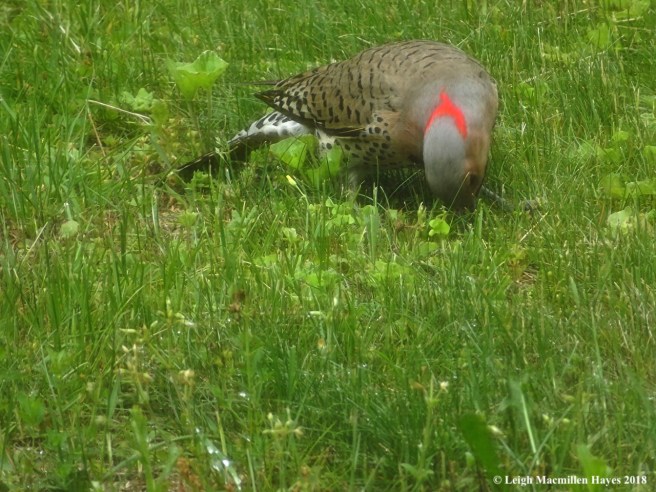
I knew I was blessed when I spied a Northern Flicker in the backyard early this morning. This is the one woodpecker that doesn’t behave like a typical family member for it forages on the ground rather than a tree trunk.

e1-northern flicker

From the kitchen window, I watched this guy for a while as he looked for food. I knew it was a male because of the so called black mustache on either side of its bill. But . . . it was the bird’s eyes I was most curious about . . .and their placement on the side of its head.

e2-flicker feeding

Like mammals, birds with eyes on the side are born to hide . . . from predators. His field of vision, therefore, was wide and the ants on the ground were the ones who needed to scurry and hide.

e4-tachinid fly

After dining for a while, the flicker flew off and I stepped out the door–in search of other  sets of eyes to behold–like the red ones of a tachinid fly,

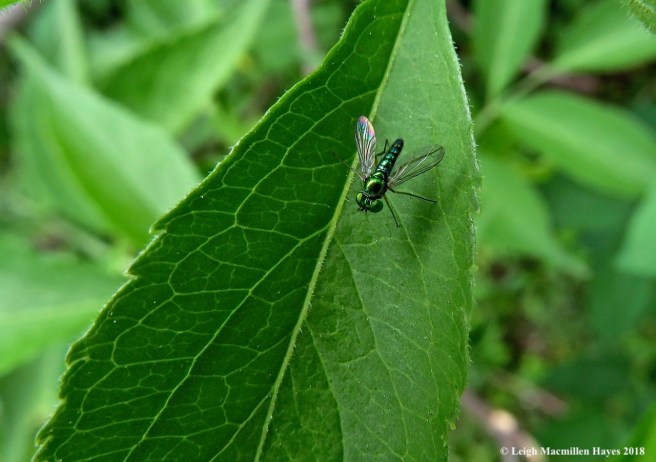
e8-long-legged fly

and metallic green on a long-legged fly. Like the flicker, flies also have a wide field of vision due to the fact that they have compound eyes. Each eye consists of thousands of individual visual receptors, or ommatidia, (singular ommatidium) (om·ma·tid·i·um, äməˈtidēəm.) Each hexagonal-shaped ommatidium (think honeycomb) is a functioning eye in itself. With thousands of eyes on the world, it’s no wonder flies and other insects see us coming–especially when we have a flyswatter in hand.

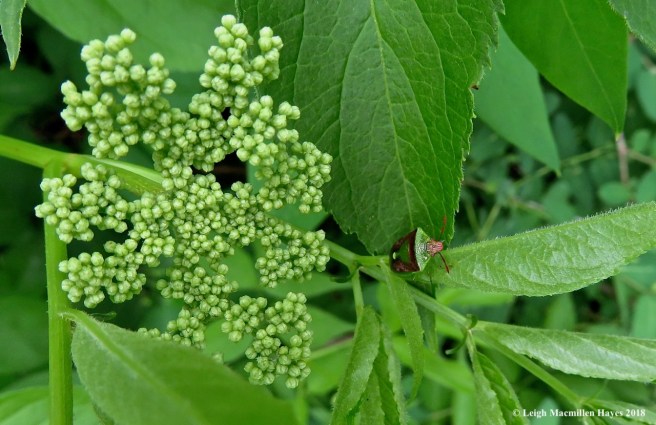
e7-green and brown stink bug

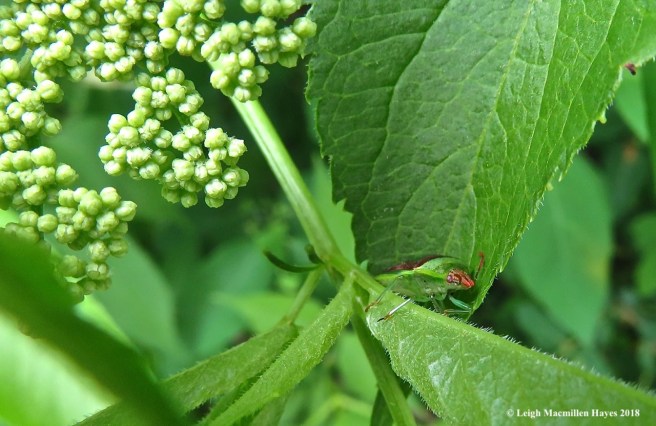
I kept looking and among the elderberry shrub leaves I found a strikingly beautiful green and brown stink bug, or shield bug, if you’re looking for a more pleasant name. Like all insects, it featured those compound eyes, but I was struck by how tiny they were. Apparently, it was enough to see movement and kept trying to hide from me.

e8-stink bug eyes

Despite its efforts, I could zero in on it even after walking away and returning.

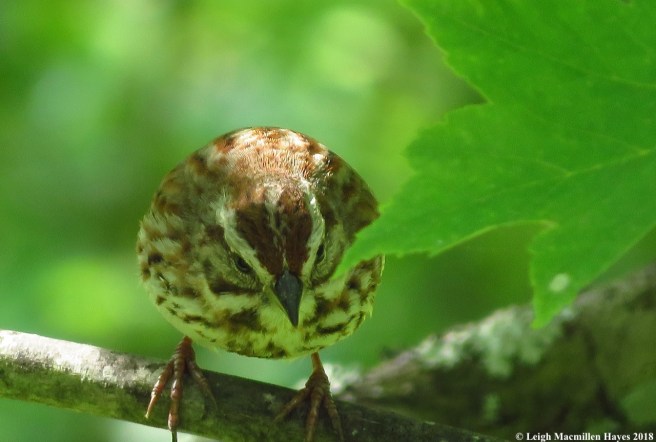
e9a-song sparrow

Eventually I moved my focus to Pondicherry Park, where a variety of eyes greeted me, including those of a Song Sparrow.

e7a

What did he seek? Insects and other invertebrates, such as weevils, leaf beetles, ground beetles, caterpillars, dragonflies, grasshoppers, midges, craneflies, spiders, snails, and earthworms.

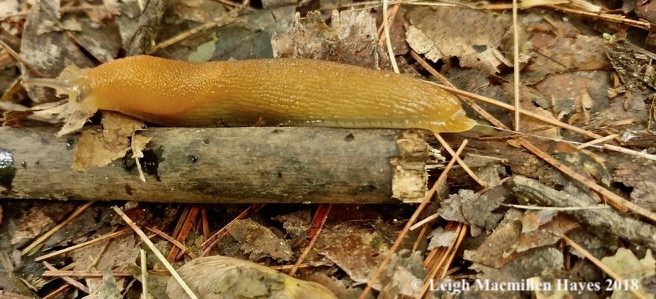
e11-slug eyes

What about a slug? I suspected the sparrow would enjoy such and today was a decent slug-like kind of day. But, how does a slug see?

A slug has two pairs of retractable tentacles on its head. The upper, optic tentacles, feature light-sensitive eyespots on the ends. And just like a deer can move each ear independent of the other, slugs can do the same with each eye-stalk. Another cool fact: an eye stalk can be re-grown if something attacks it.

e11a-spider eyes

Further along, I found a wolf spider hanging out on last year’s fertile frond of a sensitive fern. Did you know that spiders have eight legs AND eight eyes? Two of them are large and prominent–the better to see you with.

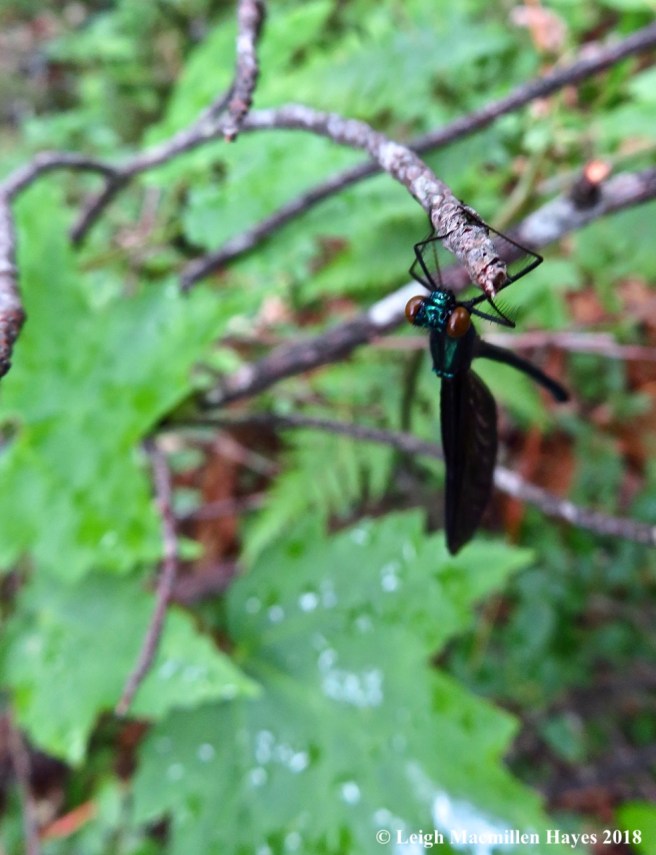
e11-ebony jewelwing

As I continued to look for the sparrow’s prey, I discovered an ebony jewelwing that I determined had just emerged for it posed as I took numerous photographs. Usually, they flit about like woodland fairies. Unlike its larger dragonfly cousins who have eyes in front in order to hunt, the damsels’ are on the sides. Though zoom-and-swoop attacks may not be possible for the damselfly, it can see all-round–including above and behind– giving it control of its airspace.

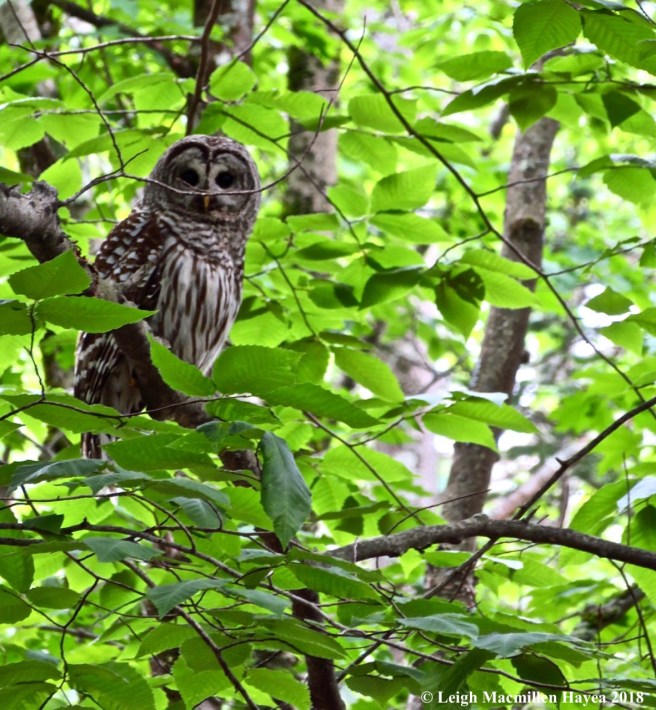
e12-barred owl

My wander continued and then I heard a sound and saw some action in a tree about thirty feet off trail. And just like that, in what felt like a miracle of miracles, I realized I was in the presence of the wise one.

With his eyes in front, a Barred Owl is born to hunt. For several minutes we starred at each other and I was honored by his presence. Of course, I hoped he might cook for me tonight, but he let me down. Possibly he had others more in need of supper than I was at the time.

In the end my vote was aye in favor of all the peepers I’d met along the way, both in the yard and the forested park, for I knew that the eyes had it.


Flexing My Wings with Jinny Mae

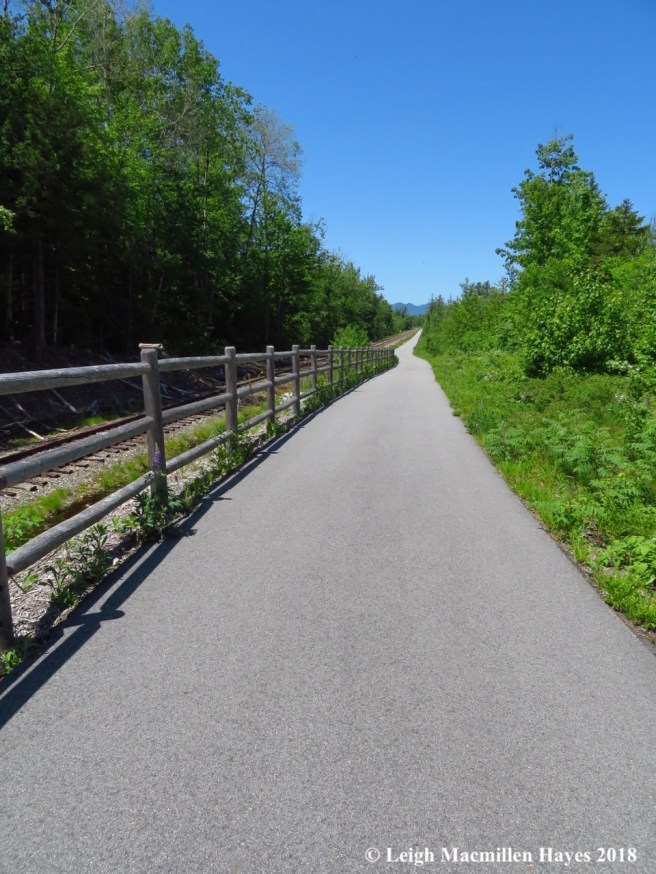
It’s been a while since Jinny Mae and I had wandered and wondered together, but this afternoon the opportunity finally arose. And so we agreed on a time and place (though she did change the time ;-) ), and pulled into the parking lot of the Mountain Division Trail located closest to the Eastern Slopes Airport on Route 5 in Fryeburg, Maine.

m6-Mtn Division Trail

Rather than a rail trail, this is actually a rail-with-trail even though the rail is not currently active.

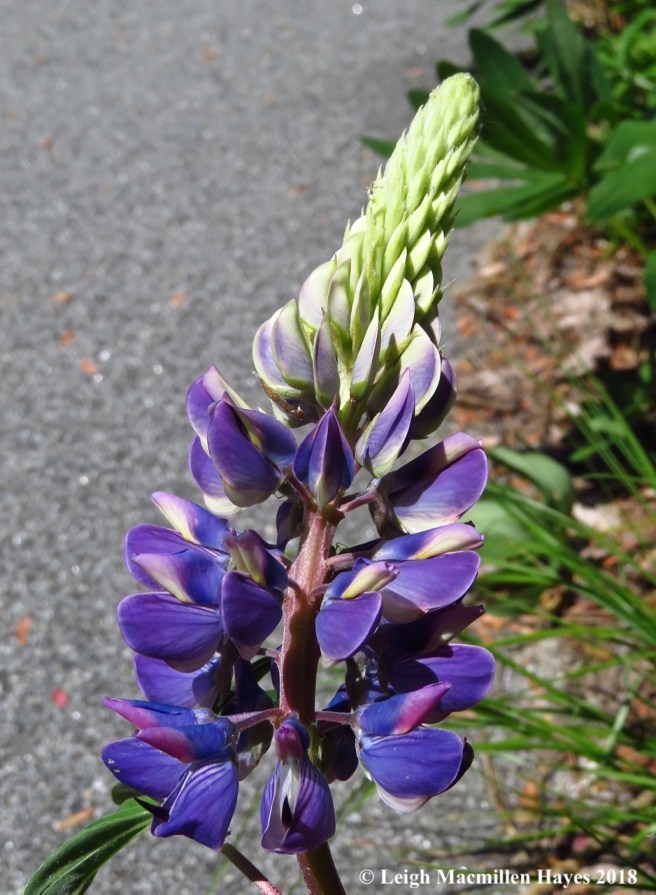
m2-lupine

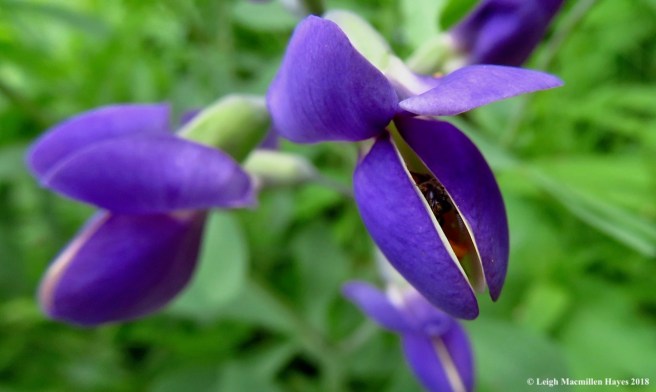
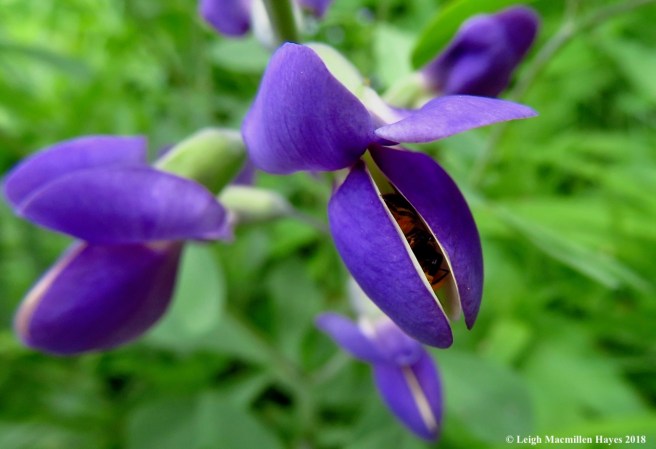
From the start, we were surprised and delighted to see so many lupines in bloom along the edge. Lupines are members of the pea or legume family, Fabaceae. As such, the flowers have a distinctive upper banner, two lateral wings, and two lower petals fused together to form a keel. Those lateral wings earned the plant’s place in this contemplation.

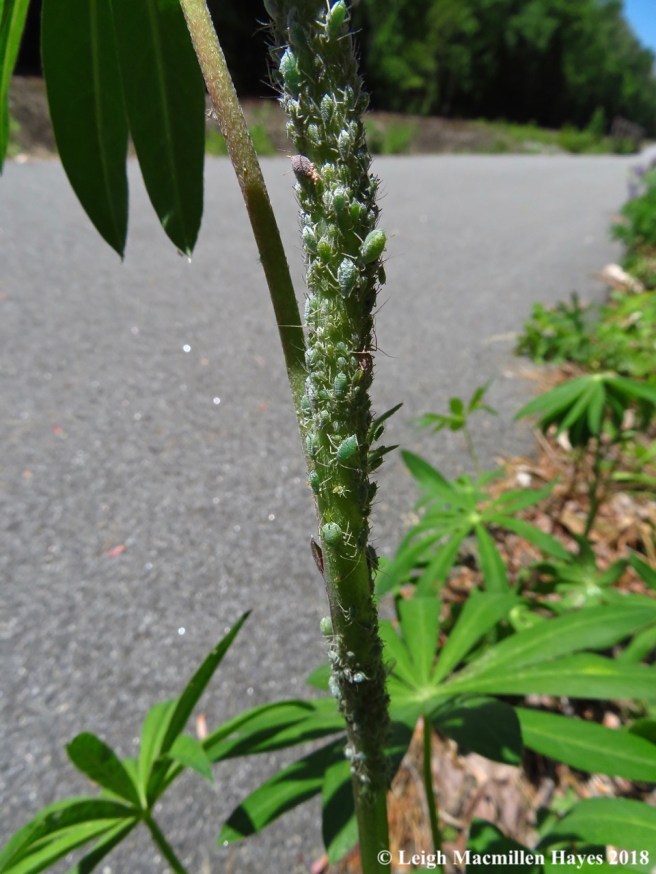
m2a-lupine aphids

Of course, being that not everything in nature is as perfect as we might desire, we did discover destruction in action on a few stems and flowers. Lupine aphids seeking honeydew suck the juices from a plant. They’ll continue to feed until midsummer, even after they’ve destroyed the flower.

While there isn’t much to celebrate about these garden pests, it is worth noting that all aphids are female and give birth to live young, without mating. And another cool fact–once the population grows too large, they will develop wings and fly to a new host plant.

m3-chalk-fronted white corporal

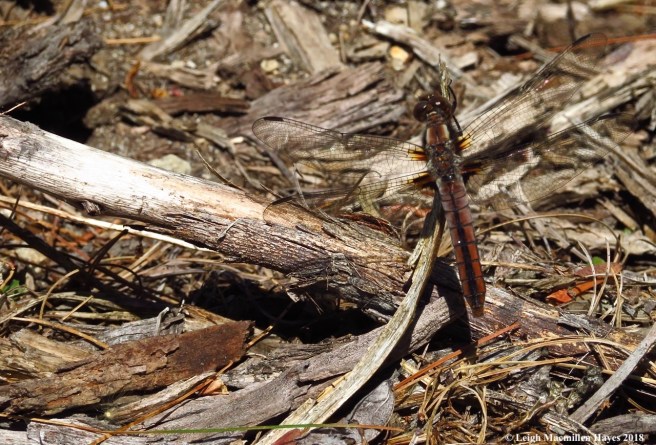
We continued our journey at our typical slow pace and stopped frequently to admire the dragonflies. There were quite a few species, but many spent time patrolling in flight and so we couldn’t photograph them. We did, however, give thanks for the work of all for we felt the sting of only a few mosquitoes. And we appreciated the perchers as well, for by letting us get a closer look we could learn their characteristics, and therefore ID: Chalk-fronted Corporal;

4-four-spotted skimmer

Four-spotted Skimmer;

m5-calico pennant

and Calico Pennant.

m7-ant dragging grasshopper

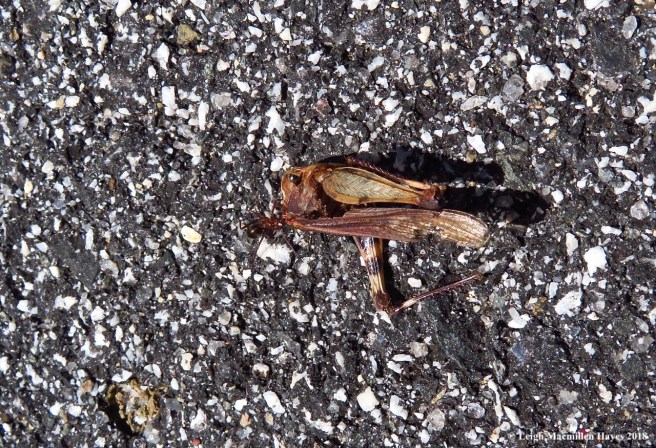
We also noted a crazy ant act. The ant apparently got a great deal at the grocery store and somehow managed to single-anticly drag the remains of a grasshopper home–that’s one flier we won’t see in the air again.

m8-wood sower gall wasp gall

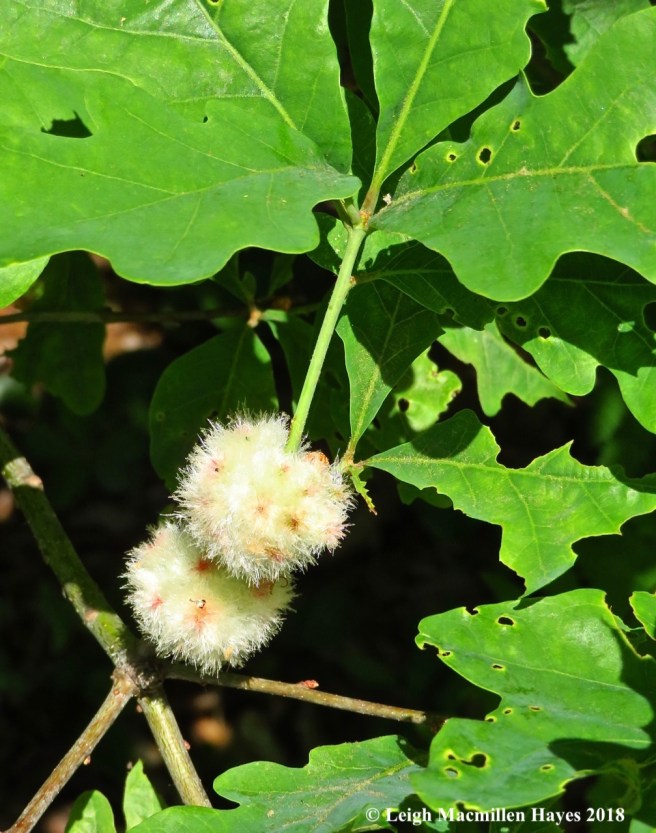
We also stumbled upon another interesting find–the galls of a wood sower gall wasp. As I told Jinny Mae, I’ve seen them before and knew they were associated with oak trees, but couldn’t remember the name in the moment. Maybe if I say it five times fast and spin around three times I’ll remember its name the next time I encounter it. Doubtful.

m8-wood sower gall wasp

The cool facts about this fuzzy white gall with pink polka dots, which is also known as oak seed galls: it only grows on white oak; the fuzziness is actually secretions from grubs of the gall wasp; and within are seed-like structures that cover the wasp larva.

m9-tiger swallowtail

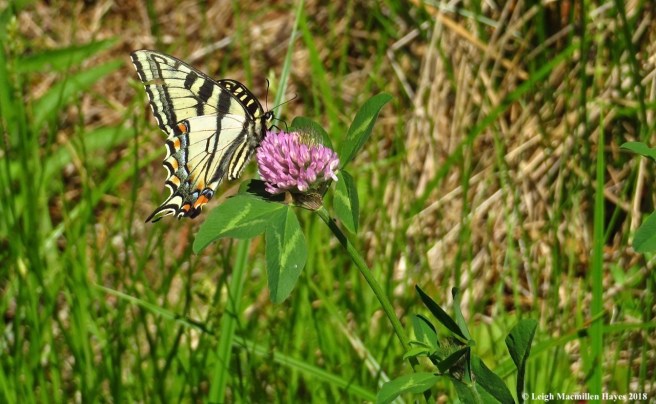
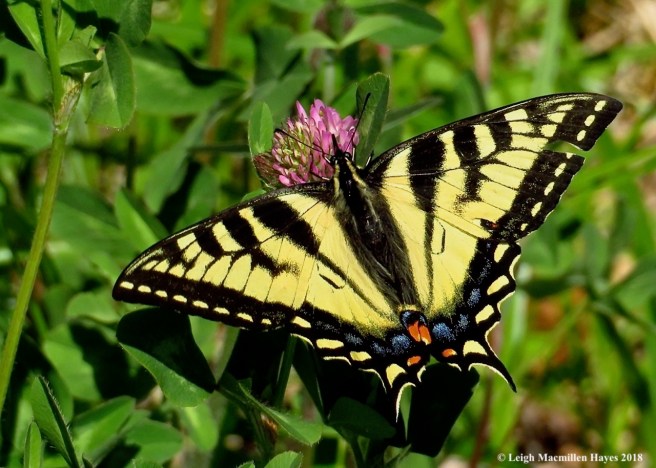
Finally, it was a swallowtail butterfly that stopped us in our tracks and mesmerized us for moments on end. The question was this: which swallowtail–Eastern or Canadian, for both fly here.

m11-eastern tiger swallowtail

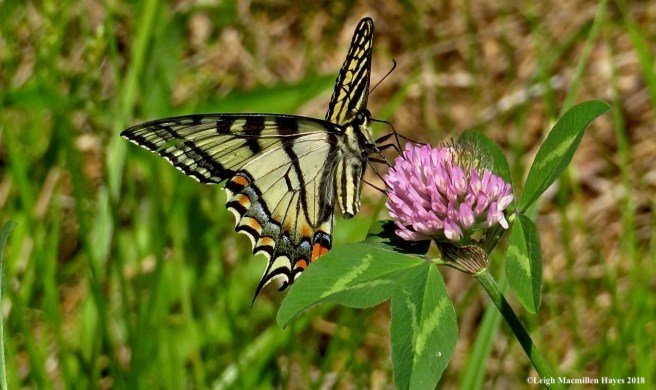
Earlier in the day I’d photographed an Eastern Tiger Swallowtail in the backyard. Tiger comes from the four black stripes, while swallowtail refers to the long tails extending from the hind wings that these butterflies often lose to their prey as spring gives way to summer.

This was a female given that her hind wings featured blue with bright orange accents when viewed from the top. The areas that are blue on the female are black on the male.

And notice her main body, which is a rather muted combo of black and yellow.

m10-canadian tiger swallowtail

Now look at the butterfly Jinny Mae and I each took at least fifty photographs of and do you see the darker body? The Canadians have more black hairs covering their bodies.

m11-probiscus

Also look at the underwings. I regret that I didn’t get a shot of the Eastern’s underwings, but for the Canadian this matches the pattern: Note the yellow band just inside the outer edge on the underside of its forewings. Had it been an Eastern, it would have featured a series of disconnected yellow spots on the black band. The Canadian has a continuous yellow band. And then there are the orange and blue markings.

m13-canadian tiger

At the end of the day all that detail really didn’t matter–Eastern or Canadian, both were tiger swallowtails.

And I gave thanks for the opportunity to flex my wings beside Jinny Mae. It felt so good to fly along the path together again. For those who don’t know, Jinny Mae’s journey has been one of varied wing beats as she’s lived with cancer for the last three years. Her current treatment is going well and we look forward to more flight paths.


Diggin’ the Garden

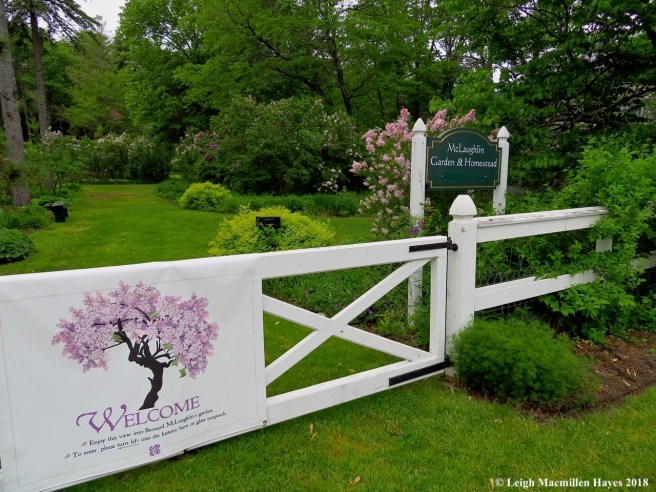
As Judy Lynne and I approached the entrance to McLaughlin Garden in South Paris, it felt as if we were calling on an old friend.

M1 MCLAUGHLIN GARDEN

Maybe that feeling was realized because we passed through the barn, as if visiting a neighbor and searching out back for her.

m9

It was there that we were immediately greeted by not one, but many old friends, including bleeding heart,

m3

forget-me-not,

m7

and jack-in-the-pulpit.

m2

All of these and so much more were the inspiration of Bernard McLaughlin. He began planting the garden in 1936 right on Main Street, though at that time it wasn’t the strip it is now. But that’s part of the wonder of this place for it’s a unique oasis in the middle of our busy lives. As Bernard nurtured his diverse collection of wildflowers, ferns, woody shrubs, trees and over 200 lilacs, he always kept the garden gate open. In 1997, a non-profit was formed to preserve Bernard’s legacy and continue his open door policy.

m3a

We went to smell the lilacs and their heady fragrance did please our noses immensely, but we noted so many other flowers, some which we knew like the old friends above, but made new acquaintances as well. Of course, we’ll never remember all their names, but isn’t it always that way when you meet someone for the first time? Or second or third?

m10

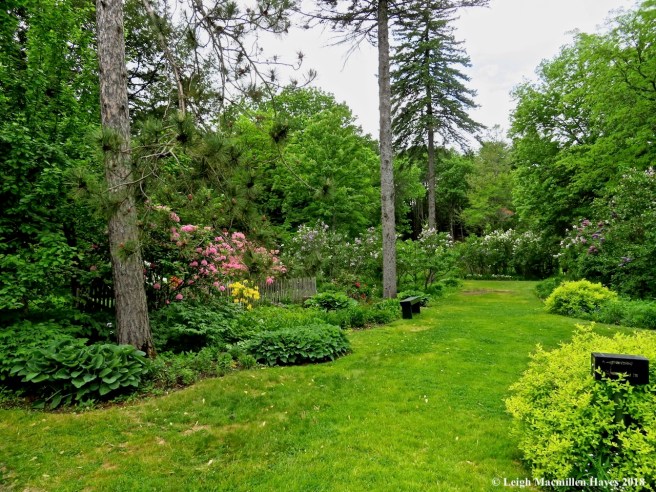
While some paths are grassy, others consist of well-tramped mulch.

m14

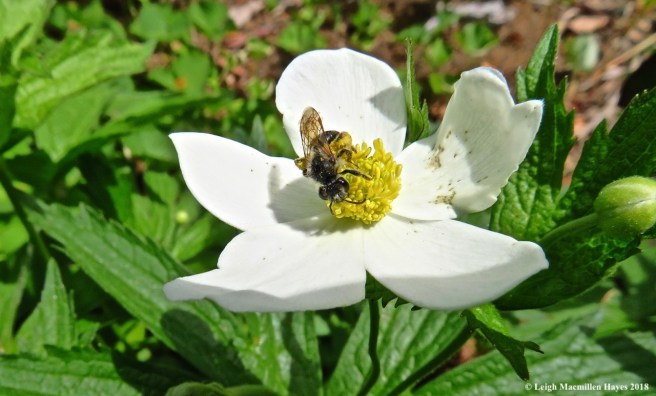
We were in constant awe of the array tucked in beside each other in what at times appeared simply random. Anemones such as this grew near . . .

m4

yellow lady’s slippers. And if you haven’t had the pleasure of meeting a yellow lady’s slipper, then hurry to McLaughlin Garden before they go to seed. We spied them in a few different locations.

m17

Thrown into the mix, common yet exquisite dandelions.

m8

There were azaleas of the most intense orange delightfully juxtaposed beside a purple lilac.

m11

And lemon chiffon yellow enhancing a wooden fence.

m18

We found lupines of a sort that we hadn’t meet before.

m18a

Though they weren’t yet in full bloom, a pollinator buzzed from within,

m18b

relishing the fact that it was first in line at the fountain of nourishment.

m19

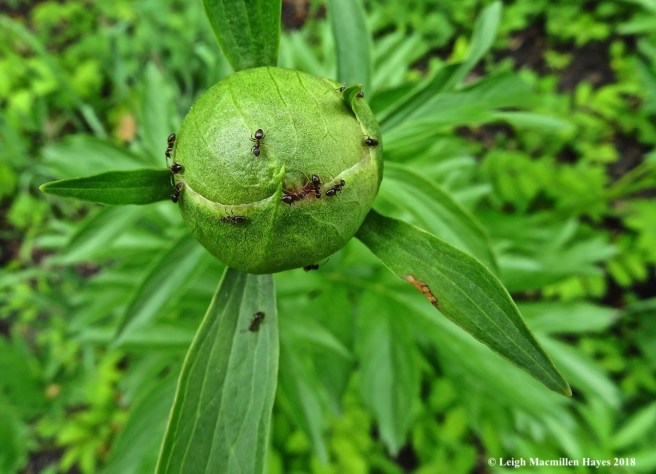
The same was true for the peonies that won’t blossom for another few weeks, but their goodness proved an attraction already.

m12

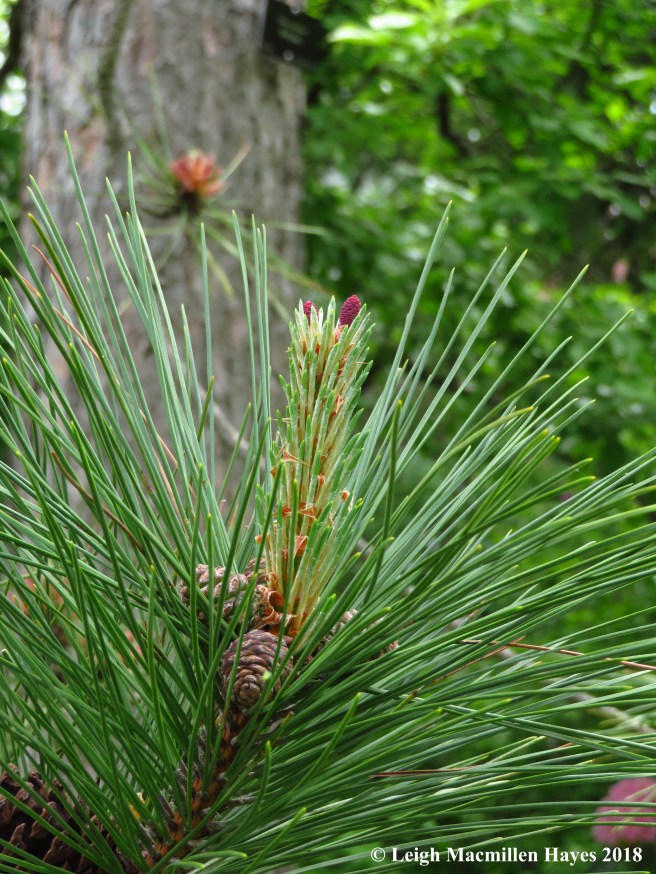
Sometimes our gaze moved upward and we admired the male and . . .

m13

itty bitty female cones on a red pine.

m29

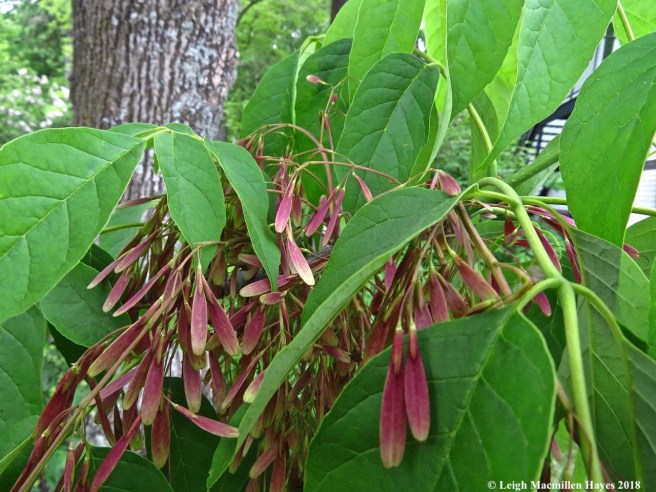
An ash tree also wowed us with its plentiful seed production.

m16

Everywhere, there were hostas adding variations of green and texture.

m24

But among my favorites were the ostrich ferns . . .

m6

and maidenhead ferns. My inner fairy flitted from one step to the next as she climbed this spiral staircase to the ground.

m25

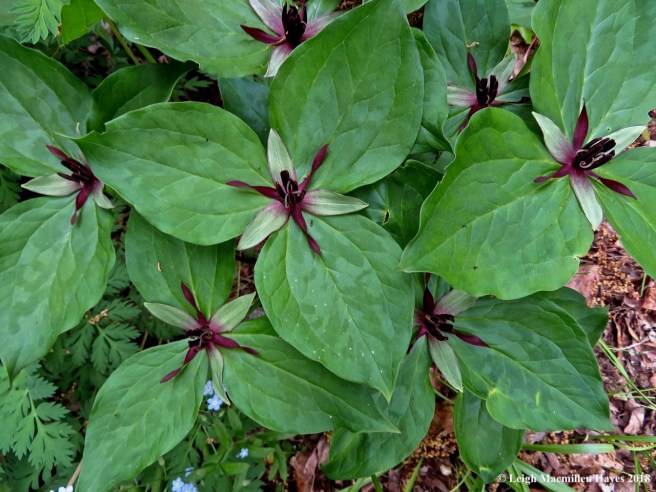
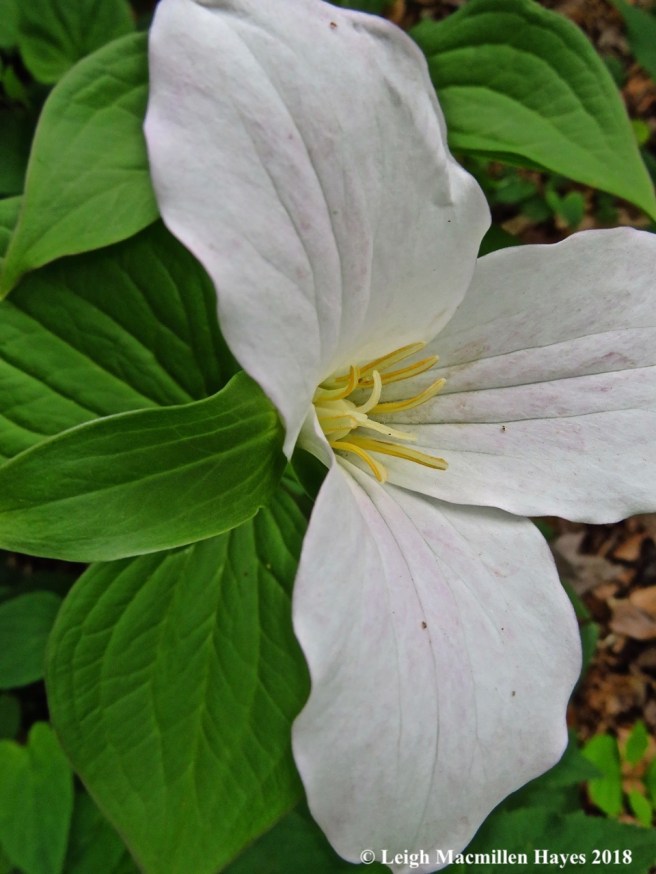
And what should she find growing among the forget-me-nots? Why the most unusual trilliums . . .

m26

one after another . . .

m27

after another .. .

m28

after another. All told, there were seven species of trilliums.

m30

All told, what has been offered here is only a mere glance at Bernard McLaughlin’s garden. You need to experience it yourself and even if you aren’t much of a gardner like me, I trust you’ll be diggin’ the garden.


The Trail To And Fro

The heron rookery was our destination and so friends Pam and Bob journeyed with me, our expectations high.

M1-KENNEDY'S EMERALD

But as nature would have it, we’d barely walked fifty feet when our typical distraction disorder set in–and the focus encompassed the dragonflies that perched on foliage beside the trail. Our first was a Kennedy’s Emerald, named for Dr. Clarence Kennedy, a renowned Ohio State University professor and odonatologist.

M2-BEAVERPOND BASKETTAIL

Among the same fern patch was a Beaverpond Baskettail. It’s the eyes of this species that appealed to me most for I loved their teal color.

M3-IMMATURE CHALK-FRONTED CORPORAL

Every step we took seemed to produce a new combination of colors and presentations, all a variation on the dragonfly theme, including this immature Chalk-fronted Corporal.

M4-MUSTACHED CLUBTAIL

And their names were equally intriguing, this one being a Mustached Clubtail.

M6- SKIMMING BLUET

It wasn’t just dragonflies patrolling the path and one mosquito at a time reducing the biting insect population–for damselflies also flew. When they weren’t canoodling that is. But canoodle away we said, for each interaction resulted in even more predators of our favorite kind.

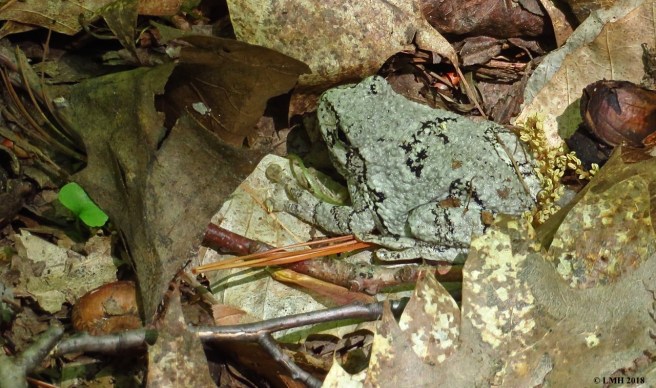
M7-GRAY TREE FROG

And then . . .

M8-GRAY TREE FROG

and then we discovered a predator of another kind. And we rejoiced even more because for all the time we spend in the woods, sighting a gray tree frog is rather rare.

M9-EBONY JEWELWING MALE

Not quite so rare, but beautiful in its unique form was the Ebony Jewelwing and her metallic colors. We spied one male with a white dot on his wings, but he escaped the camera lens.

M10-GARTER PARENT

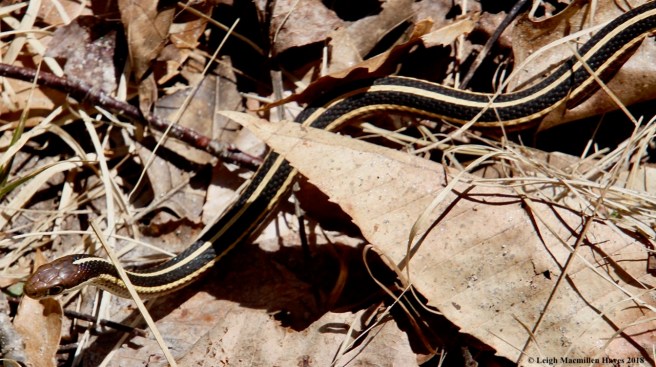
It wasn’t just fliers and hoppers that caught our attention. Movement at our feet directed us to one who preferred to slither through the woods in garter formation.

M11-GARTER BABY

And about a foot away from the parent–one of the young’uns.

M12-ROOKERY SITE

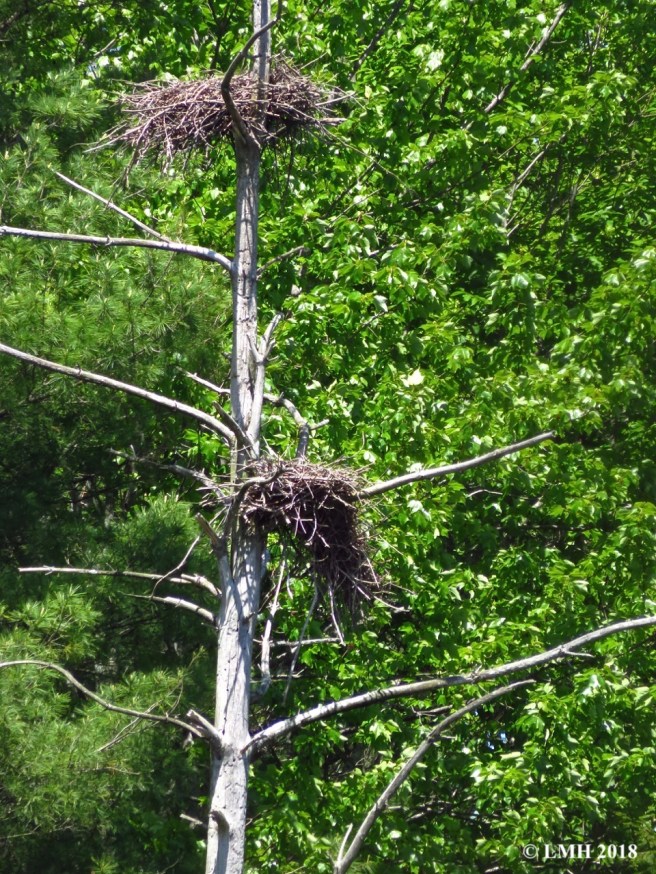
At last we reached our destination and the real purpose for our journey. We were on a reconnoissance mission. Our job was to count nests, young and adults at a heron rookery for the Heron Observation Network of Maine–a citizen science adopt-a-colony network managed for Maine Inland Fisheries and Wildlife by biologist Danielle D’Auria. The project began after a significant decline in the number of nesting pairs of Great Blue Heron was realized in Maine from the 1980s to 2007, and MDIFW listed the bird as a Species of Special Concern.

M13-HERON ROOKERY

Sadly, our count was zero for each category. While last spring the nests were active, something occurred and the colony collapsed before the young fledged last summer. Bald Eagles were the likely suspects of such a decline and as nature would have it, we thrilled with the resurgence of one species at the expense of another. Despite the current failure of the community, we’ll continue to visit each year . . . just in case.

M140WHITE CHALK CORPORALS

But guess what? As we stood there, we noted the activity, or lack thereof, of mature Chalk-fronted Corporals–the female relaxing on the left and male on the right.

M15-DARNER

Every few seconds a Green Darner conducted its own reconnaissance mission.

M17-CANADA GEESE

And then some serious honking from upstream called for our attention.

M18-CANADA GOOSE

And we were reminded of Bernd Heinrich’s book, The Geese of Beaver Bog, for we were in such a place.

m19-immature KENNEDY'S EMERALD

At last, we pulled ourselves away, though I suspect we could have easily spent hours being mesmerized by the magic of the place. Such magic was reflected in the opaque wings of a newly emerged Kennedy’s Emerald dragonfly.

M20-INDIAN CUCUMER ROOT

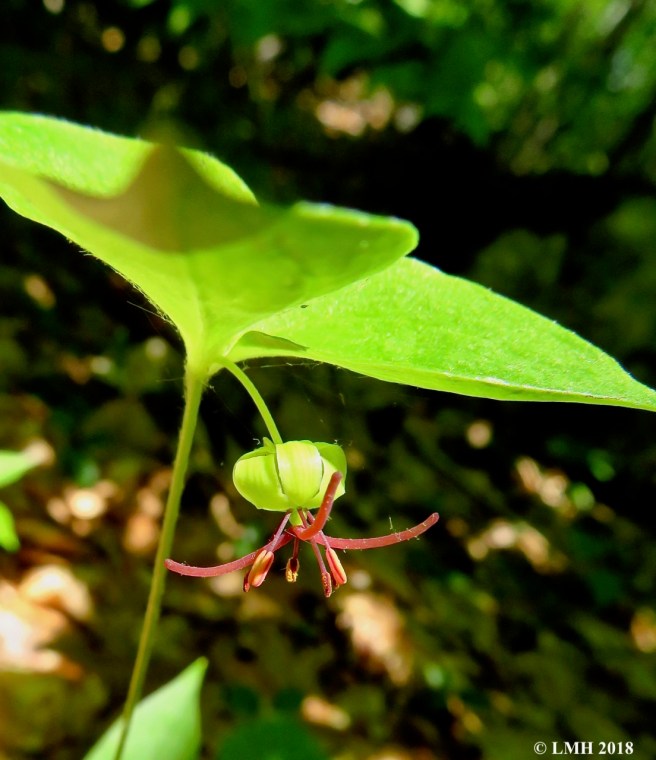
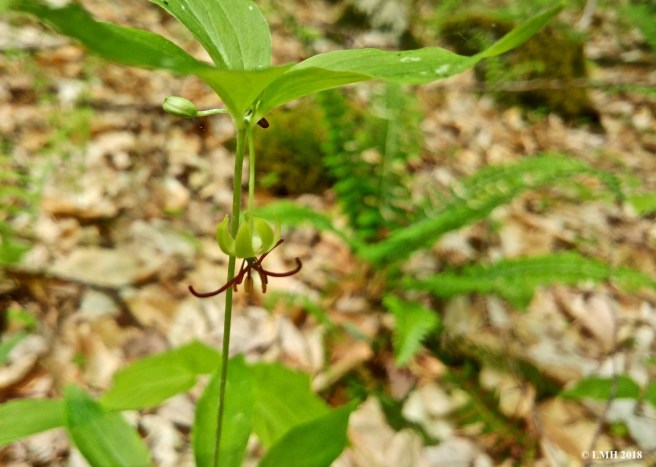
And on the way back, as often happens, we were privy to sights we’d missed on the way in. So it was that an Indian Cucumber Root displayed its unique flower–nodding pale green petals folded back, like a Turk’s cap lily, and from the center emerged three long reddish styles (think female reproductive parts) and several purplish orange stamens. Those styles gave the flower a unique spidery appearance.

M21-GRAY TREE FROG

And then . . . and then one more time not far from where we’d seen the gray frog on our way in, and mere moments after Pam said, “Where there’s one . . .” we found a second.

The heron rookery was our destination, but the trail to and fro offered so many moments of wonder.

Thank you to the family that conserved this land. Thank you to the wildlife in many forms who call it home. And thank you to Pam and Bob for not only accompanying me, but for insisting that I borrow your lightweight Canon Powershoot SX720HS. I might get hooked.

A Rare and Exotic Mondate

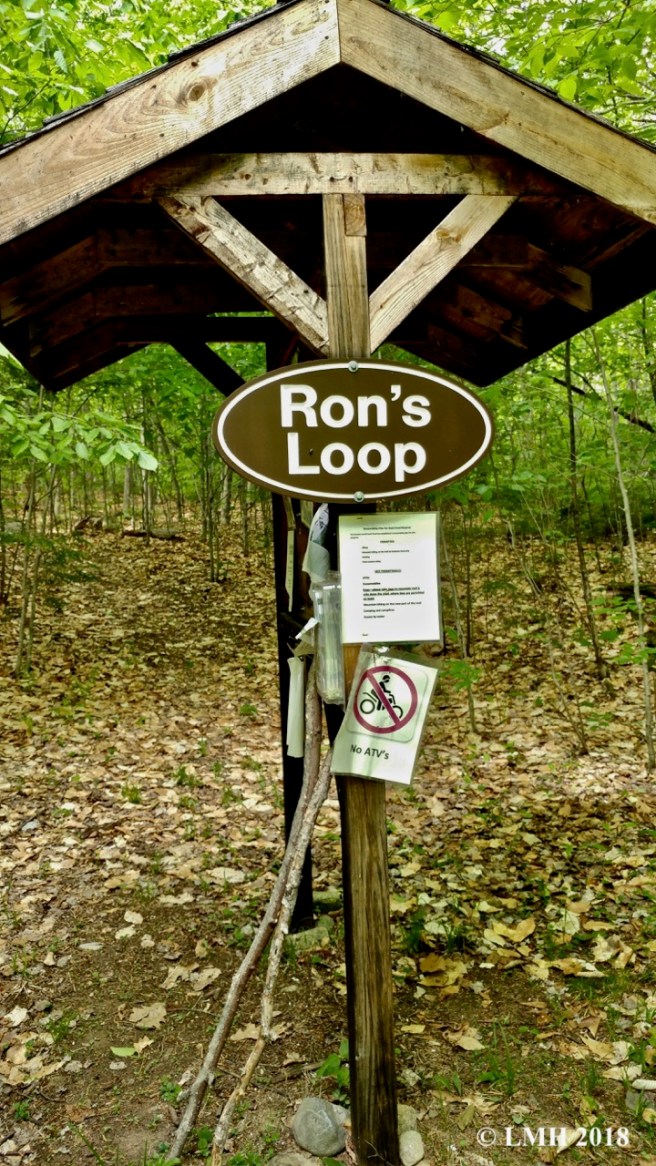
When my guy and I began our journey this afternoon, he thought our mission was simple and two-fold. First, we’d double check road names and directions for a friend’s book that I’m editing. And then we’d hike the easy Ron’s Loop at the Greater Lovell Land Trust’s Back Pond Reserve in Stoneham, Maine.

Y7-RON'S LOOP KIOSK

No sooner had I parked the truck and we hopped out, when I announced that we had a detour to make. Always one for adventure, he followed along. And when I told him our quest, he began to search the forest floor. I have to admit time and again that though he pretends not to care about so much that naturally distracts me, he has a keen eye. Or maybe its just that he likes a challenge. Perhaps, too, he just wanted to make the find and move on for the mosquitoes were robust and hungry.

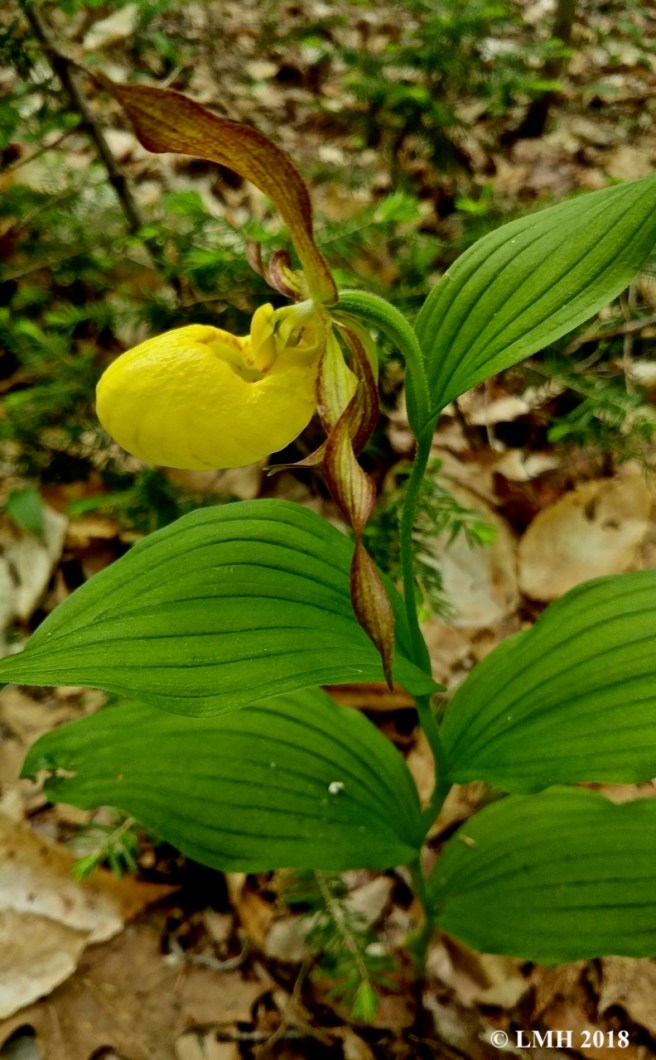
y1-yellow lady's slipper

What mattered most was that he channeled his Prince Charming and was the first to find Cinderella’s golden slipper.

Y4-ALL THE PARTS

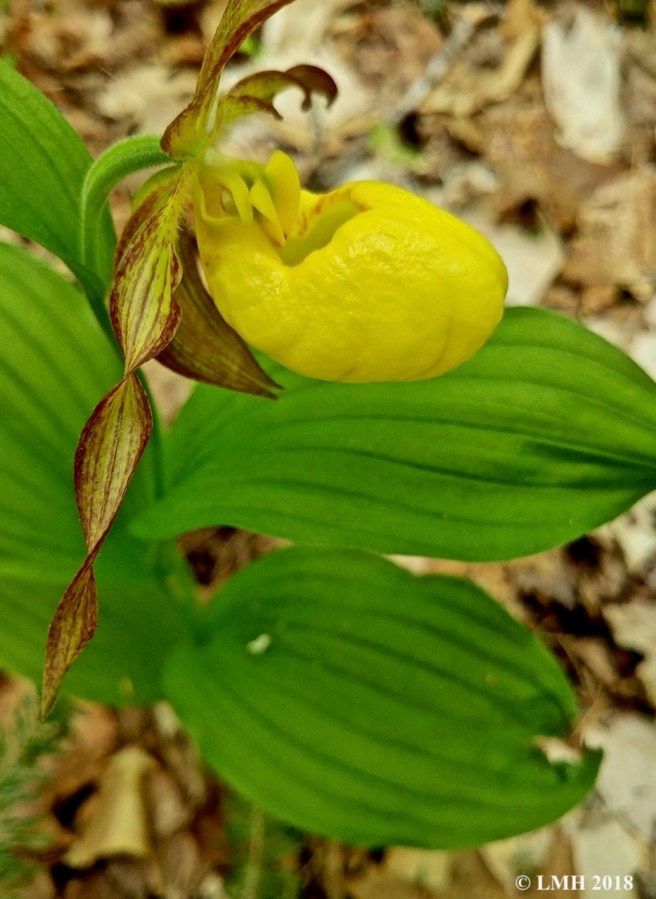
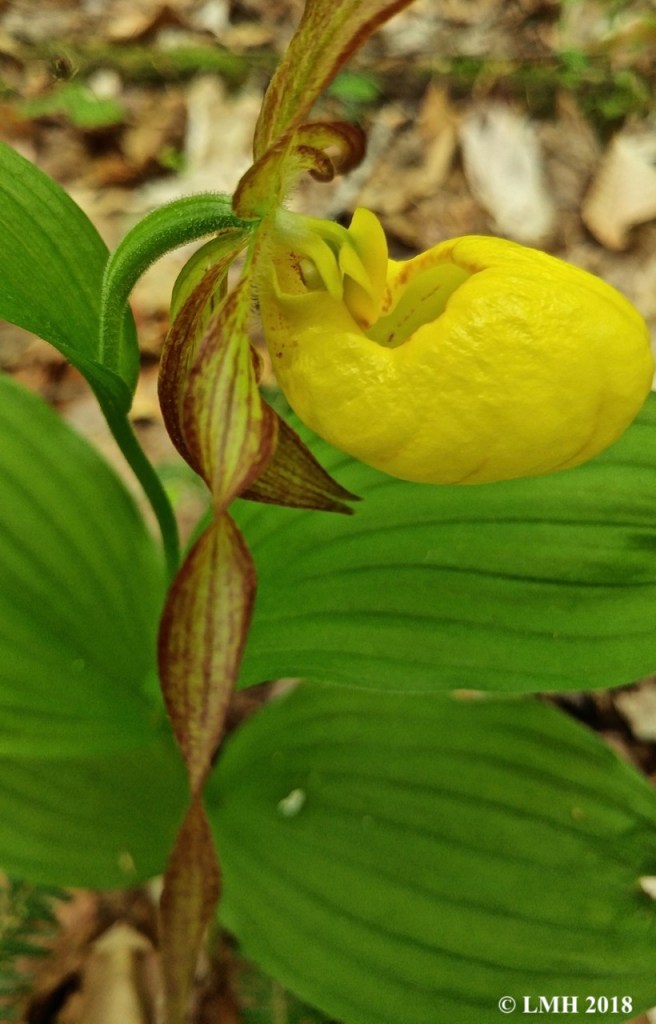
Members of the Orchid family, lady’s slippers feature the typical three petals in an atypical fashion. The pouch (or slipper or moccasin), called the labellum, is actually one petal–inflated and veined.

Y3-TENDRILS

With a purplish tint, the petals and sepals twisted and turned offering their own take on a ballroom dance. From every angle, they were simply elegant rising as they did from their stem with leaves forming a royal staircase.

lady's slipper

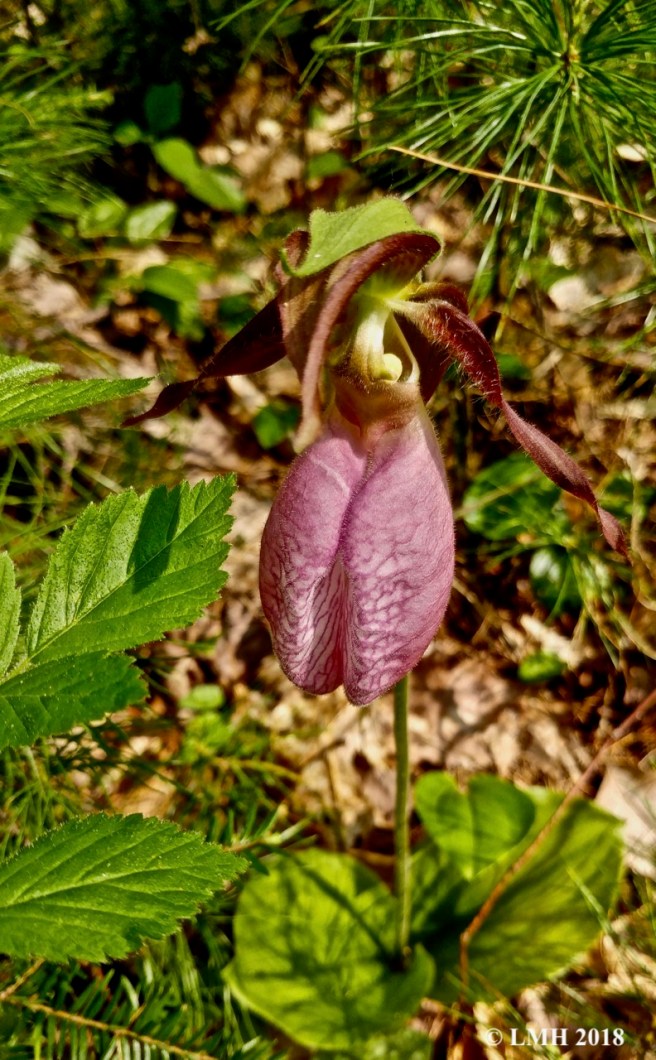
Though we didn’t see any pink lady’s slippers on today’s hike, it’s interesting to note their differences, with the sac of the pink dangling down like a high-heeled shoe, while the yellow is more ballet-like in its presentation. And the pink features two basal leaves, in contrast to the alternate steps of the yellow’s leaves.

Both, however, are in the genus Cypripedium in the Orchidaceae family. The genus name Cypripedium is derived from the Greek words “Cypris,” an early reference in Greek myth to Aphrodite, and “pedilon” for sandal, so named for the fused petals that form the pouch and their resemblance to a slipper or shoe.

Y2--LOOKING WITHIN

All lines on this orchid led to . . . well, not exactly Rome, but certainly the labellum, or sac-like structure. With the rim turned inward, the pollinators found it easy to enter, but much more difficult to exit, the better to rub against the stigma and anthers, thus collecting pollen. Some bees find it difficult to simply fly away from the lady’s charm, but by chewing their way out, they are able to move on to the next and leave a message from the princess in the form of a pollen deposit.

Y7-BEECH COTYLEDON

We finally moved on with the not-so-sweet drone of those larger-than-life mosquitoes buzzing in our ears. And then we stumbled upon one American beech cotyledon after another and were reminded of last year’s mast crop of beech nuts.

Y8-BEECH COTYLEDON

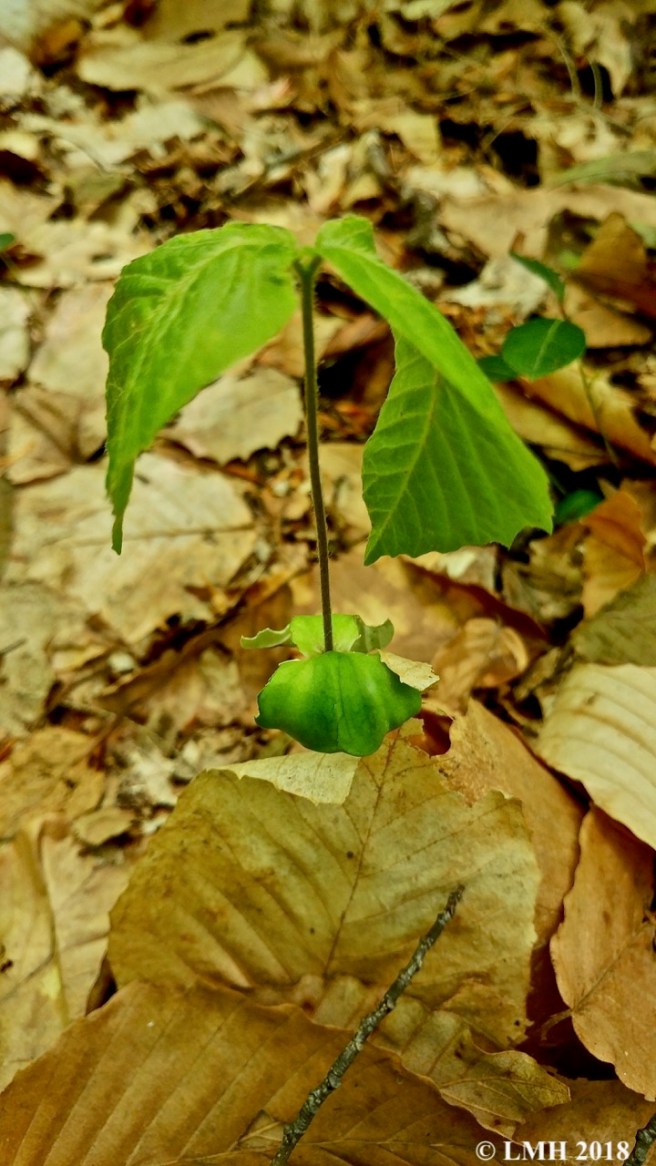
I was again reminded that it’s my duty to bring attention to these structures, the seedling form of beech trees. The lower set of leathery embyronic leaves that remind me of a butterfly, appear before the tree’s true leaves make themselves known. Part of what intrigues me about these seed leaves that appear before the tree’s true leaves is that they contain stored food. Some of these food stores wither and fall off, but in the case of the many we saw today, the cotyledons had turned green and photosynthesized. I also love how the word cotyledon (cot·y·le·don \ ˌkä-tə-ˈlē-dᵊn \) flows off my tongue, much like marcescent, which describes the leaves of this same tree that cling, wither and rattle all winter long.

Y8A-BEECH GROVE TO COME

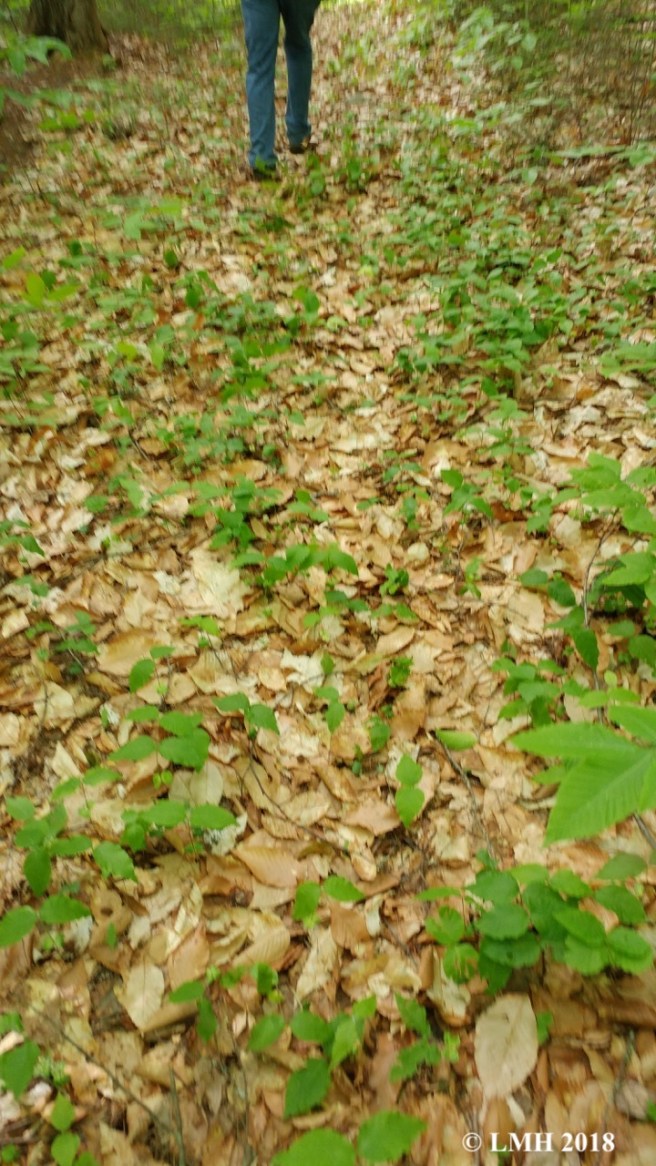
Though I’ve read that seeing beech cotyledons is a rare event and could attest to that fact  in the past, thrilling with each siting, today we noted their ubiquitous nature.

Y9-RED MAPLE COTYLEDON

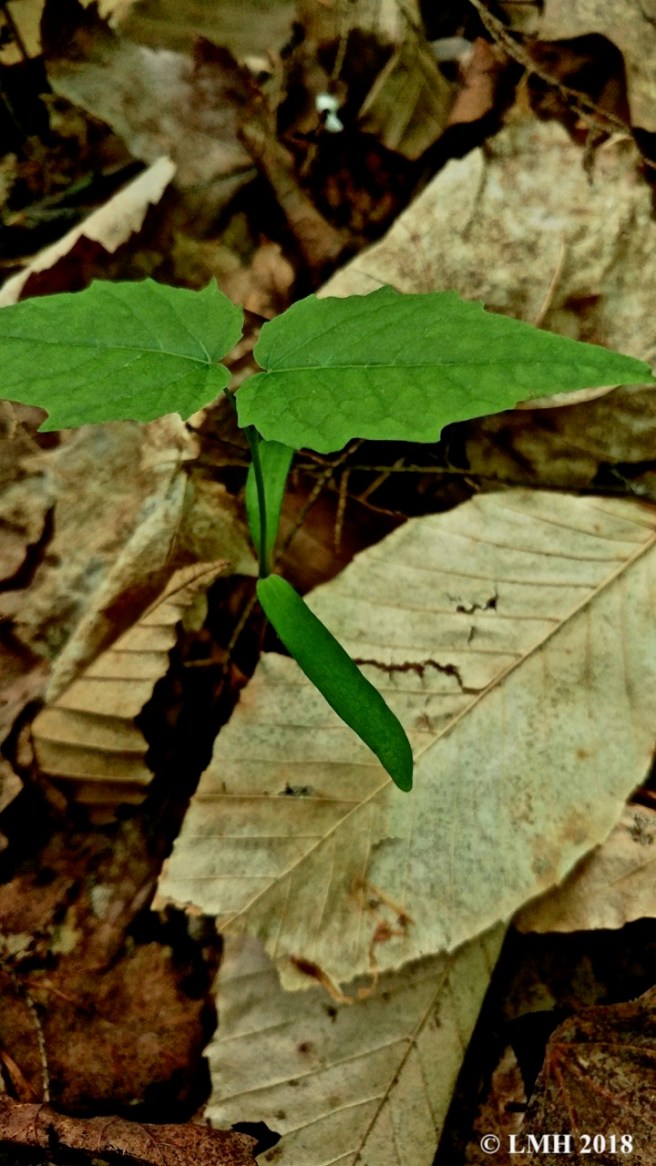
Red maple cotyledons also decorated the trail. If the plant has two seed leaves, such as these, it is a dicot (dicotyledon), and if only one it is a monocot (monocotyledon).

Y10-MAGIC ALONG THE TRAIL

Onward we moved, stopping occasionally as my guy did some trail work because its part of his nature to make a path clear for those who follow. Being a one-armed bandit, my help was still limited, but it won’t be long and I’ll be able to offer two capable hands.

Y11-BUNCHBERRIES

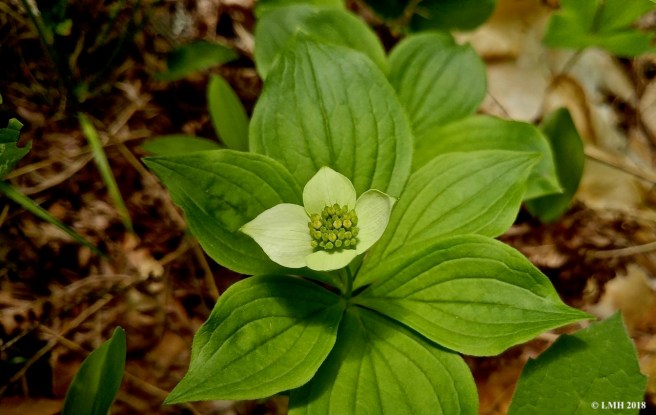
Further along the trail, bunchberries were beginning to bloom. Normally, a bunchberry plant has two sets of opposite leaves. But . . . when one is mature enough to grow a third set, typically larger leaves (perhaps to capture more energy) than the first two sets, it produces four white bracts that we think of as petals. In reality, the bracts were modified leaves. The flowers were in the center–tiny as they were.

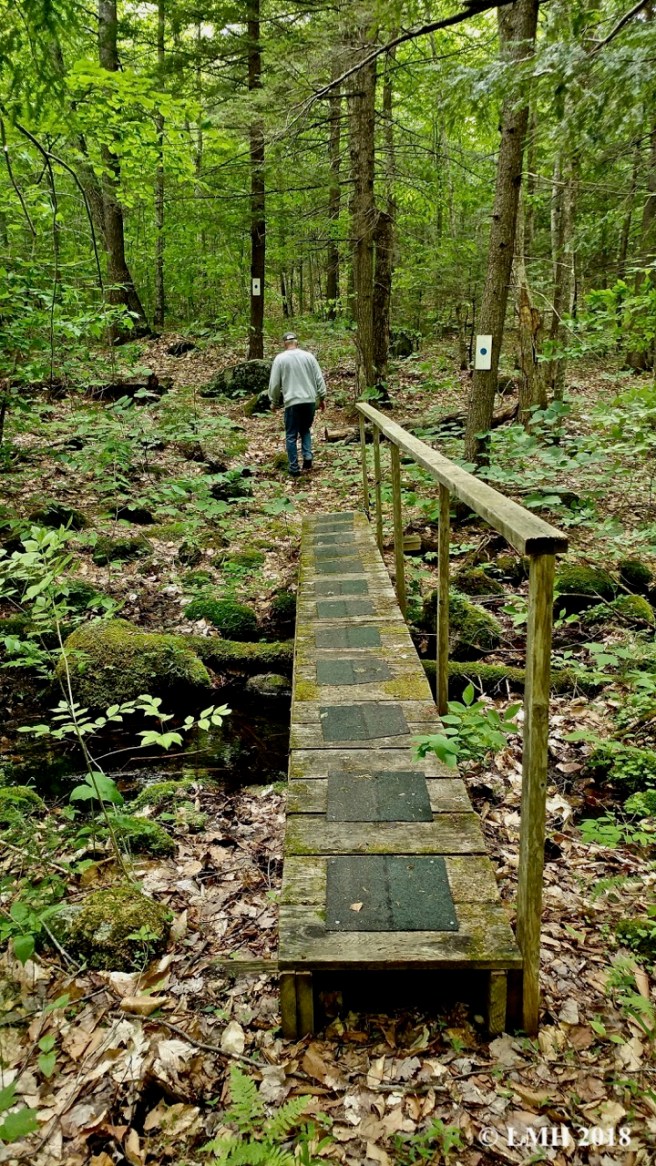
Y12-1ST BRIDGE CROSSING

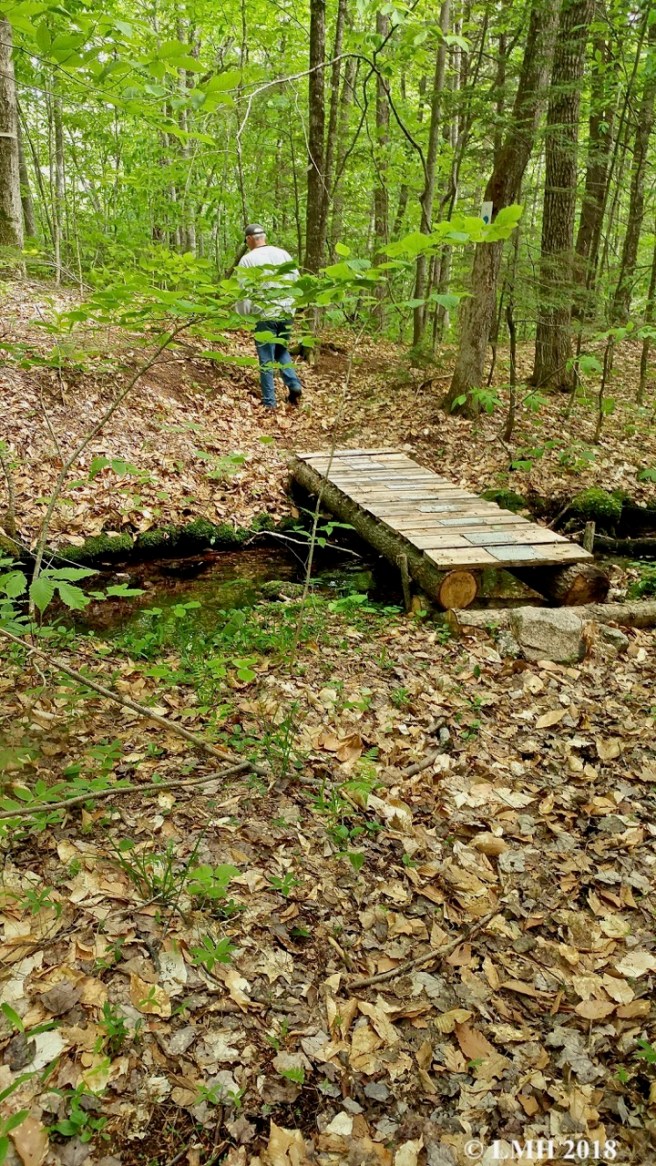
In what seemed like no time, for we moved so quickly, we reached the first bridge. It was at this point that we began the loop back toward the trailhead. And smiles crossed my face as I recalled memories of explorations along the way with so many others.

Y8B-CANKERED BEECH

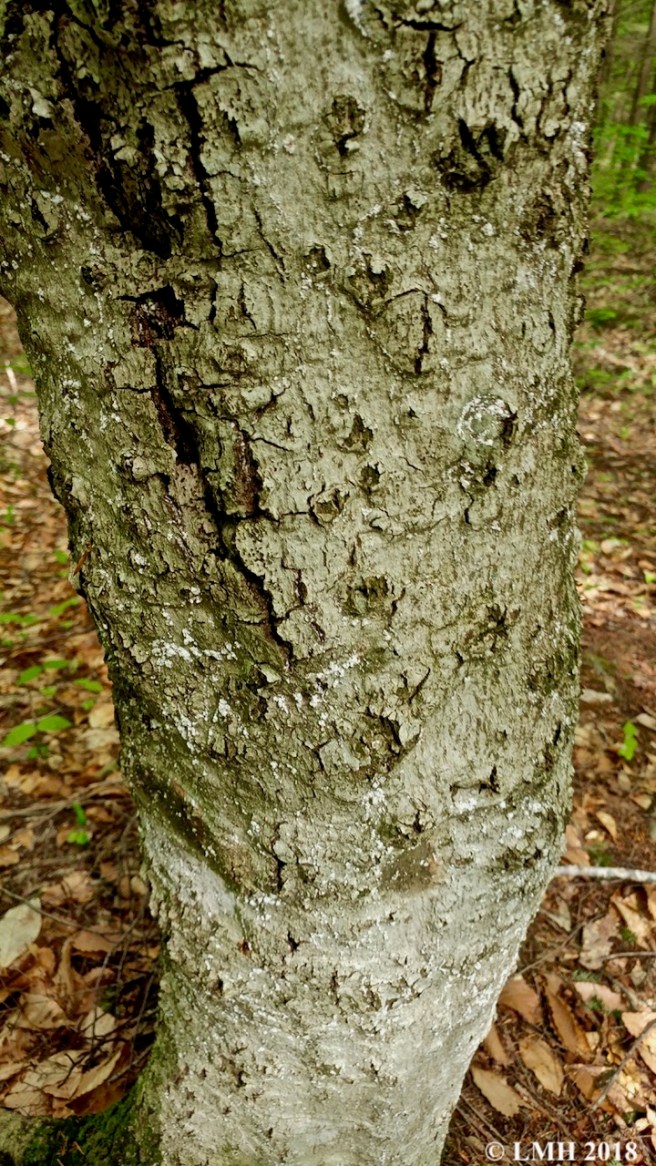
On the way back, we noted so many beech trees that dealt with nectria and we could only hope that within some of those cotyledons there might be some trees resistant to the beech scale insect that delivers such devastation to these trees.

Y13-SEATED TREE

One of my favorite trees along the way sat as it always does, taking a break upon a granite bench.

Y14-TINDER CONK

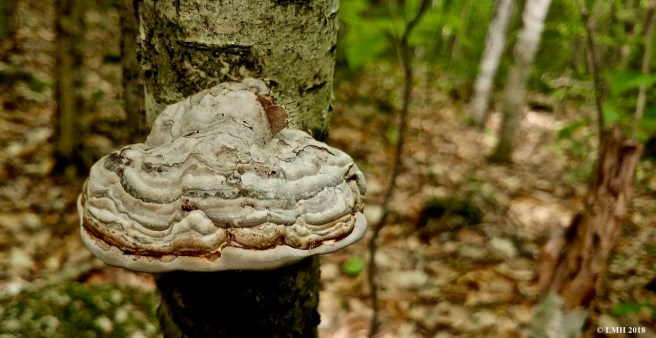
And a tinder conk showed off its form, which for me recalled a childhood spent along the Connecticut shoreline, for it surely resembled an oyster shell.

Y15-INDIAN CUCUMER ROOT

We were almost to the end of the loop when my heart and not my mouth sang with joy once again. While you might give thanks for small blessings like the fact that I’m a great lip sinker rather than the opera star my mind hears, I made my guy stop because the Indian Cucumber Root was in bloom.

Y16-INDIAN CUCUMBER ROOT

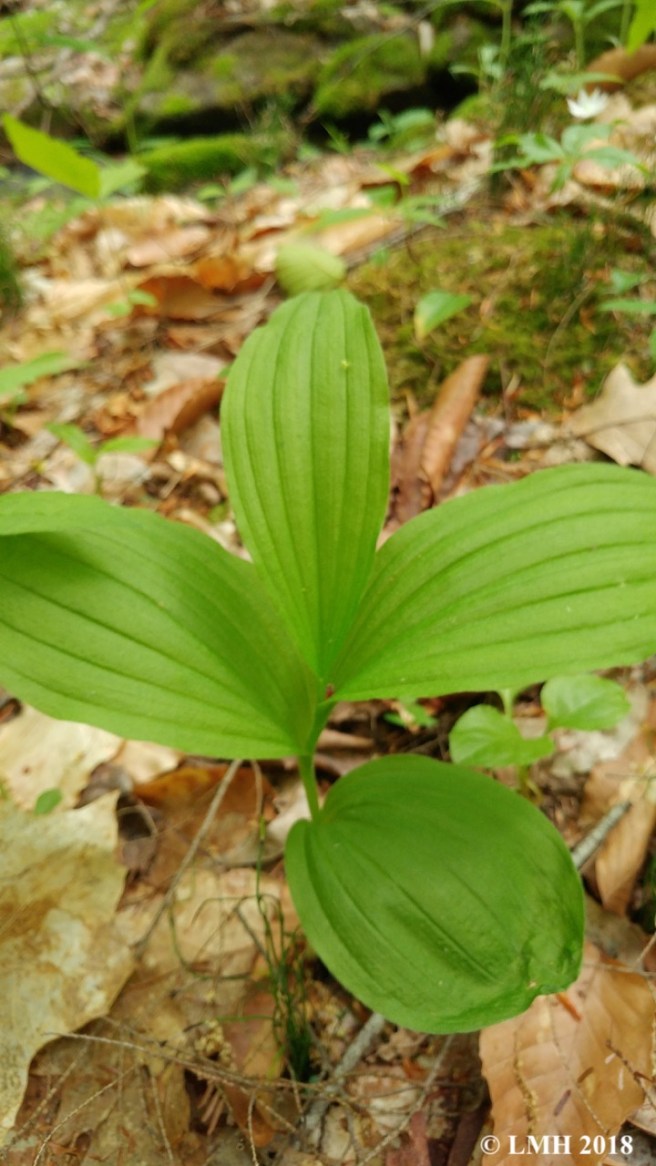
Like the bunchberries that need that third set of leaves in order to fruit, Indian Cucumber Root needs two levels to produce a flower. I’m of the belief that if the structure of this flower doesn’t make you wonder, nothing will. It strikes me as a northern version of a bird of paradise.

Y18-2ND BRIDGE

In what seemed like my shortest adventure along this trail because we didn’t want to overdo our offerings to the female mosquitoes who needed our blood in order to reproduce, we crossed the second bridge back toward the trailhead.

Y19-YELLOW LADY'S SLIPPER WITHOUT FLOWER

It was near that crossing that I checked on a couple of yellow lady’s slippers and as has been true since I first met them–they weren’t in flower. From what I’ve learned, it’s not so odd that the plants have yet to bloom. Apparently, it takes 10-17 years for a seed to mature into a plant capable of blooming. For this plant and the one beside it, perhaps the blossoms are on the horizon.

Y5-ALL PARTS 2

One day they’ll reach the status of their neighbor. For any lady’s slippers, the dance is rather intricate. The stage floor must be painted with an acidic soil and there needs to be a sashay with Rhizoctonia fungi. As the fungi digests the outer cells of the seeds, inner cells escape digestion and absorb some of the nutrients the fungus obtained from the soil–all in the name of a symbiotic dance.

Though our journey flew by on the wings of the world’s largest, loudest, and meanest mosquitoes, our finds on this Mondate afternoon extended from lady’s slippers to cotyledons, bunchberries and Indian Cucumber Root. All appeared rare and exotic.


From the Ground Up

“I am the Alpha and the Omega, the Beginning and the End, the First and the Last . . . The end of a beginning . . . A new beginning . . .” So began Bishop Chilton Knudsen’s sermon shared with over 170 parishioners and guests who attended the Dedication and Consecration of St. Peter’s Episcopal Church in Bridgton on Sunday, June 1, 2008.

Standing behind the pulpit in a site line between the entrance to the sanctuary, altar, cross and a circular pane that provided a window on God through the movement of the trees, wind and sun, Bishop Knudsen reminded us, as our rector, the Rt. Reverend John H. Smith, retired Bishop of West Virginia, had done previously, that the new building was just that — a building. She encouraged us not to get so caught up in the building that we lose sight of our mission of outreach to each other, our communities and the greater world.

St. Peter’s Episcopal Church began as a summer mission in 1962. On September 8, 1974, St. Peter’s-by-the-Lake held its first service of extended ministry. Though it did not have a home of its own, the church provided an Episcopal presence to summer and year-round residents of the Lakes Region by meeting in various locations including people’s homes, Bridgton Academy, and local churches of different denominations. In 2003, the parish voted to purchase a ten-acre lot at the junction of Routes 302 and 93, one mile west of downtown Bridgton.

After renting space for all those years, in 2007, church members enthusiastically supported a capital campaign; through gifts and pledges the full amount of the building cost was raised. Under the leadership of parishioner Beatrice White, a building committee was formed. The Vestry engaged the services of William Whited, Architect, to design a building that would be both beautiful and affordable.
S2-BISHOP KNUDSON BREAKS GROUND

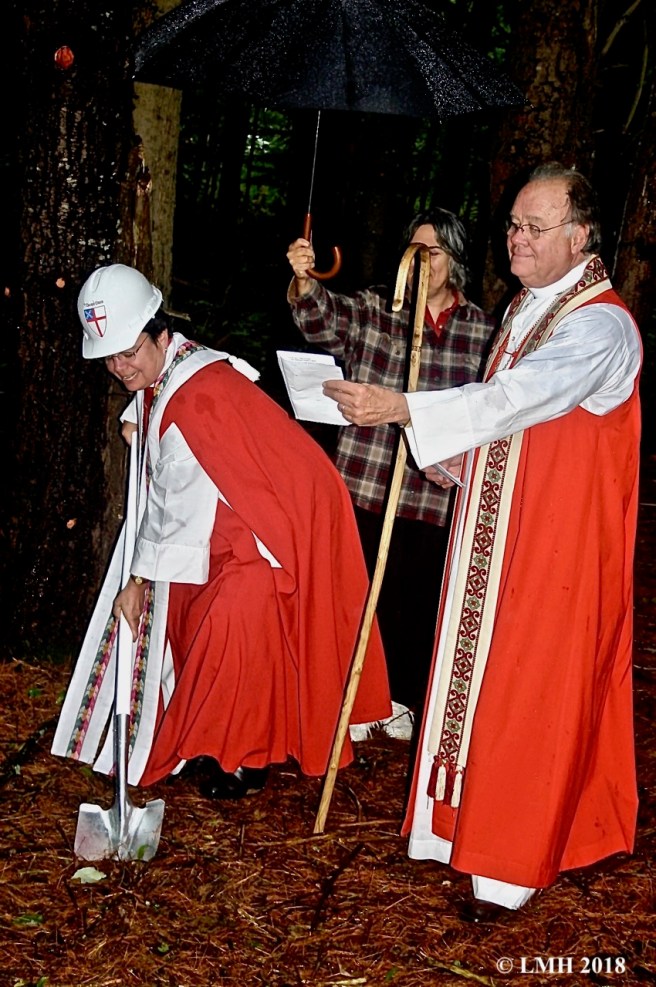
On September 15, 2007, Bishop Knudsen, donning a hardhat decorated with the Episcopal shield, dodged raindrops as she helped break ground.
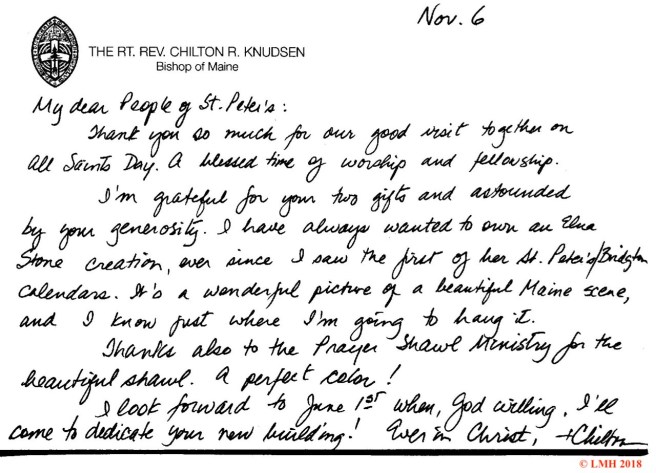
S2A-LETTER FROM BISHOP KNUDSON

Following that initial groundbreaking, parishioners met at the site the first Sunday of each month for prayers and hymns. Rain . . . snow . . . mud . . . the weather presented a few obstacles, but the project proceeded in spite of it.
S3-CHURCH TAKES SHAPE

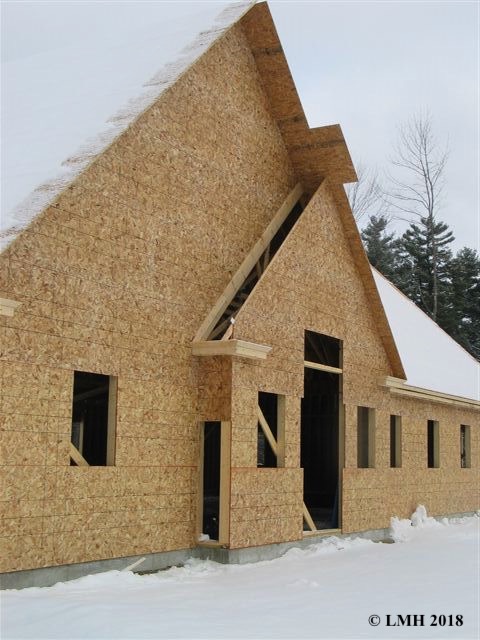
Over time, the building began to take shape.
S4-WINTER

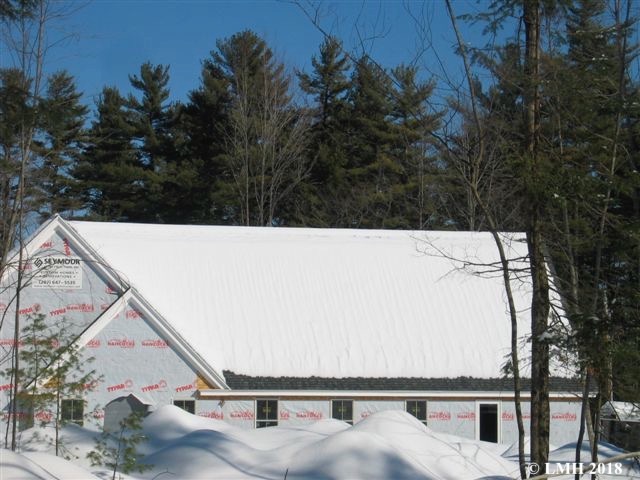
With the advent of winter, it was wrapped in Typar . . and continued prayers.
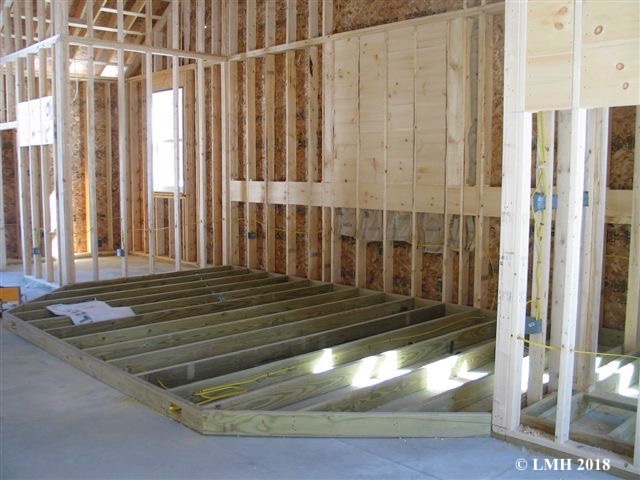
S5-ALTAR

Within, the altar found its formation.

As parishioners, we watched it grow into a structure for worship and fellowship. Upon entering the church for the first service on May 25, 2008, one word was expressed over and over again, “Wow!”

S6-NEW CHURCH DEDICATION

For St. Peter’s, the Dedication and Consecration of the building on June 1st was the culmination of years of discussions, planning, being amazed at fund raising miracles and working together to reach a goal. That grand and meaningful worship service is one that many people never experience unless they build a new church. Using the service of Dedication and Consecration as outlined in The Book of Common Prayer, Bishop Knudsen knocked her crosier and called for the doors to be opened. Gregg Seymour, General Contractor, opened the door and handed the Bishop a hammer as a symbol of his work. Beatrice White presented the building blueprints while Junior Warden Eric Wissmann gave the Bishop a set of purple building keys. A procession including the Bishops of Maine, our rector, a deacon, verger, wardens, crucifer, taperers, parishioners and guests flowed through the narthex into the simple, yet beautiful sanctuary. Following prayers for the building, the Bishop moved about the church and consecrated the baptismal table and bowl, cross above the altar, lectern/pulpit, hangings and parish banner, tapers, piano, kitchen, classrooms and offices, narthex table, credence table, altar shelf, fair linen, and other special gifts. She then celebrated the Holy Eucharist, assisted by the Reverend Christine Bennett, Deacon, and George Wright, Verger. The Eucharistic Bread was baked and offered by the “SPY” group, Saint Peter’s Youth. During Holy Communion, the choir sang “Jesu, Jesu,” accompanied by Evan Miller, Director of Music. Following the service, the parish continued the celebration indoors and out with a reception and pot-luck dinner. 
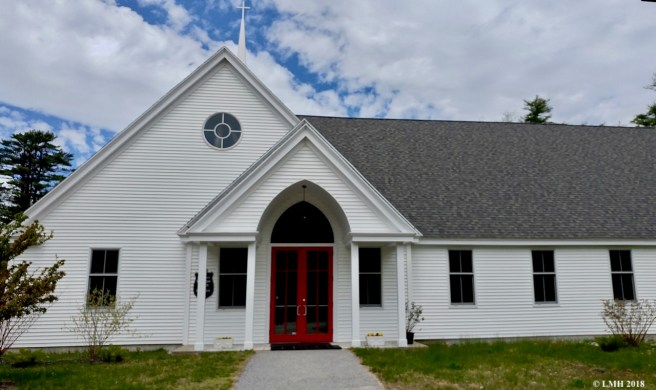
S7-CHURCH TODAY

Fast forward and the parishioners are now preparing for Bishop Steven Lane to visit next week and celebrate the tenth anniversary of St. Peter’s. In all that time, so much has changed . . . including the land. And so this afternoon I spent some time wandering around the grounds in quiet reflection of the people and the place. No, not the church building, though I continue to appreciate its simplicity and still love to gaze out the circular window above the altar.

S8-ANTS ON DANDELIONS

Today, however, I wanted to note all the other species that have gathered here, including the ants seeking nectar. Have you ever gotten as close to a dandelion as an ant or bee might? Did you know that each ray has five “teeth” representing a petal and forms a single floret. Fully open, the bloom is a composite of numerous florets. And equally amazing is that each stigma splits in two and curls.
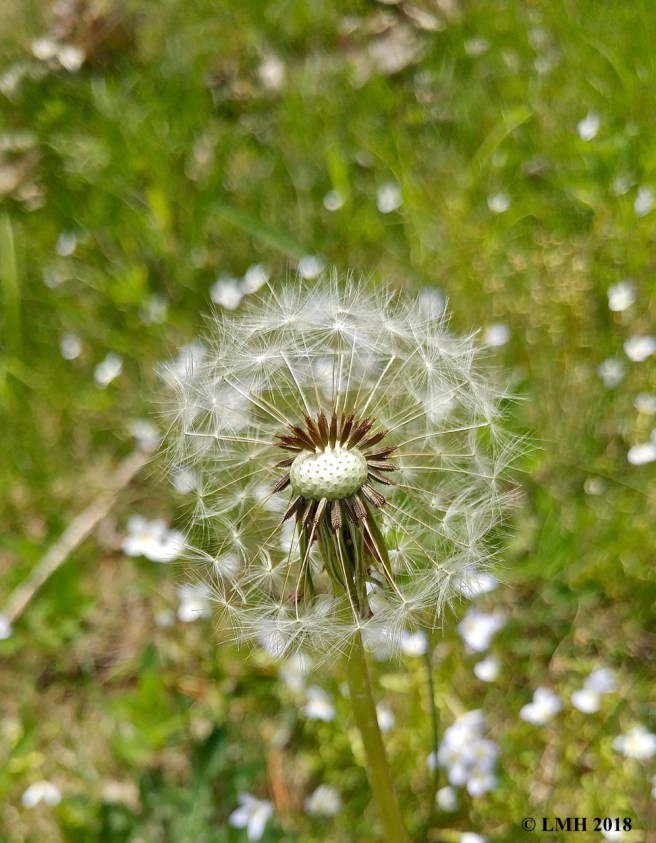
S9-DANDELION SPREADING THE SEEDS

Of course, if you are going to admire a dandelion in flower, you should be equally wowed as it continues its journey. At the base of each floret grows a seed covered with tiny spikes that probably help it stick to the ground eventually. In time, the bloom closes up and turns into those fluffy balls waiting for us or the wind to disperse the seeds, rather like the work of the church. Until then, they look like a spray of fireworks at our feet.

S10-MEMORIAL GARDEN

My wandering led to the Memorial Garden where parishioners with greener thumbs than mine created a small sanctuary for one who wants to sit and contemplate.
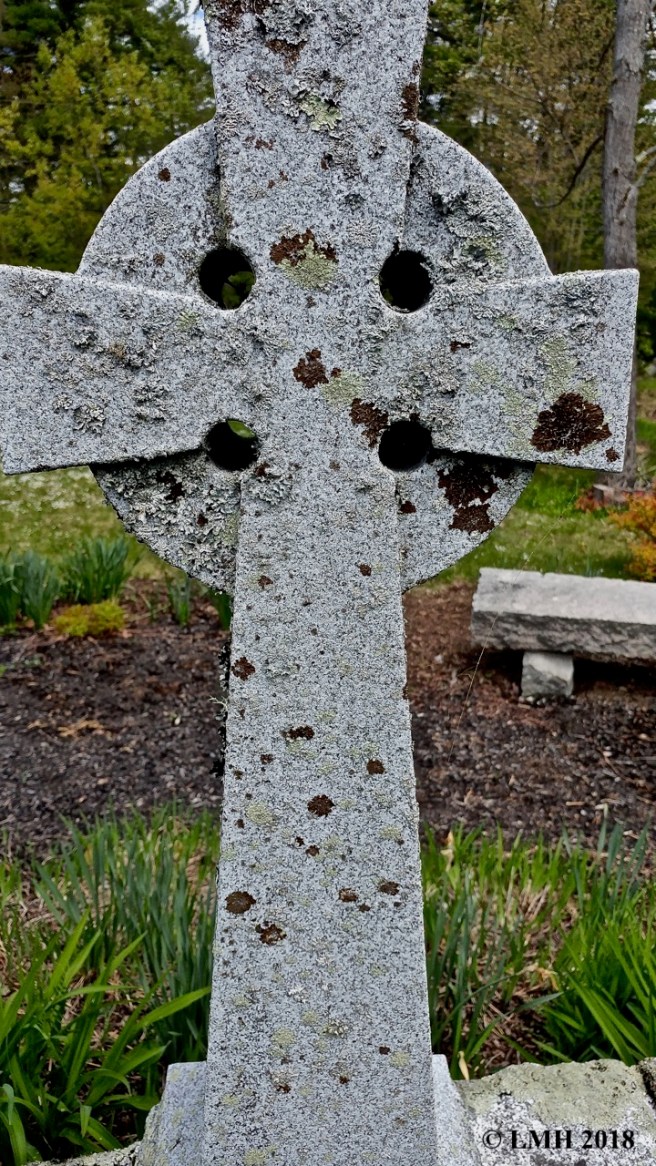
S11-CELTIC CROSS WITH LICHENS

The garden’s center offers a cross depicted in the Celtic tradition. I remember when it was installed as a “clean” piece of granite and realized today that I hadn’t been paying attention, for as is true on any of the surrounding benches, lichens had colonized it, enhancing the circle of life.

S15-GRAY BIRCH

What I really wanted to look at though was the edge where various species spoke of forest succession. I found an abundance of gray birches, one of the first to take root after an area has been disturbed. It’s always easy to spy once you recognize its leaf’s triangular form, which reminded me of Father Dan Warren’s demonstration this morning about the Trinity.

S12-PAPER BIRCH LEAVES

Nearby grew an already established paper birch, its leaf more oval in shape.

S13- QUAKING ASPEN

Then I couldn’t help it and my tree fetish took over. Quaking or trembling aspen showed off its small toothed edges, while . . .

S14-BIG TOOTH ASPEN

its young cousin displayed big teeth. Despite its fuzzy spring coating, insects had already started devouring the pubescent leaves. One of my favorite wonders about both big-tooth and quaking aspen leaves is that they dangle from flattened stems or petioles and ripple in a breeze as they send out messages of good tidings.

S16-BEECH LEAVES

Also along the edge I found a beech tree donning huge leaves that looked like they were in great shape . . . momentarily.

S17-VERY HUNGRY CATERPILLAR

For on the backside, a very hungry caterpillar had been dining on its own form of the Bread of Life.

S17A-FLOWERING DOGWOOD

I found two other young trees that I suspected were planted within the last ten years–the first: flowering dogwood. Growing up in Connecticut, we had a large one in the side yard and so memories of times long ago intermingled with those of the more recent past and my home church, Zion Episcopal, entered into my reflections.
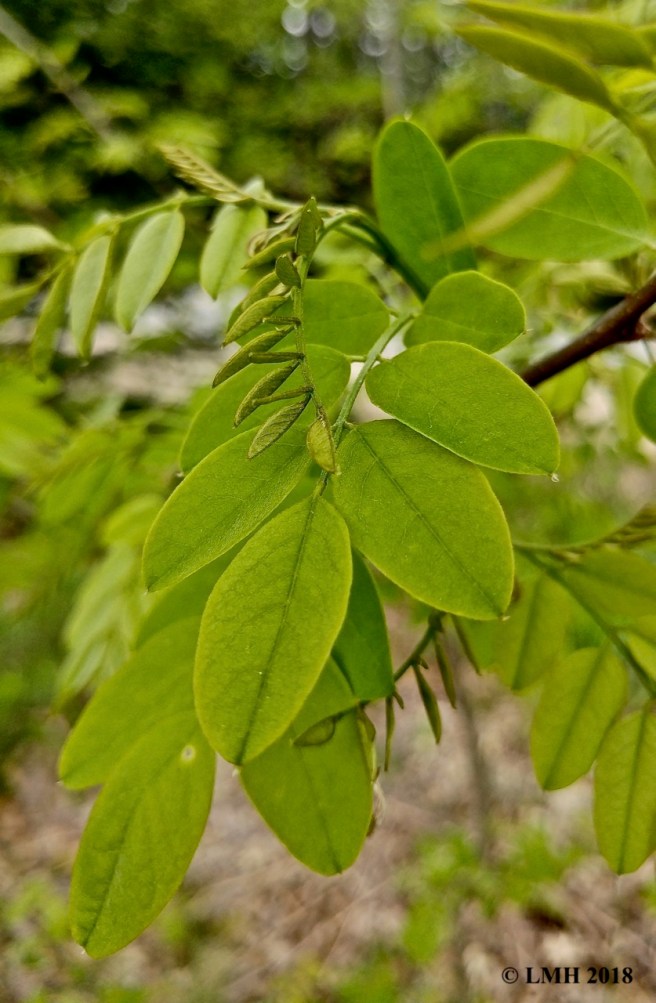
S17B-LOCUST

Like the dogwood, we also had a mature locust looming tall near my mother’s garden. Spying this one, I gave thanks for the ability to span the years, travel many routes, and remain faithful to my beginnings.

S22A-SWEET FERN

Slowly my eyes shifted downward . . . and fell upon a most pleasing sight–sweet-fern. It’s one of those, like hobblebush, that wows the eye in any season.
S18- WILD STRAWBERRY FLOWER

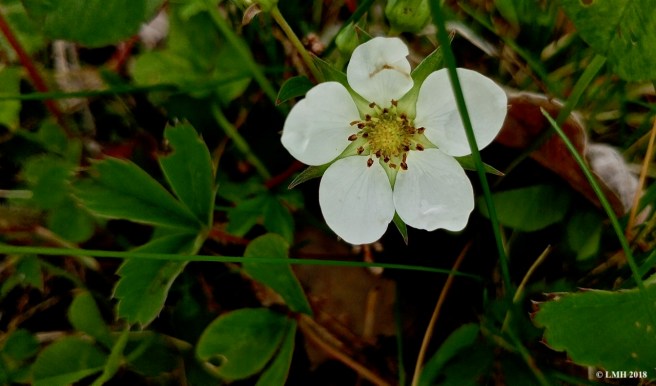
And then I turned my focus to the ground where an incredible variety of flowers either in bloom or still to come, mosses and grasses all shared the common space in seeming harmony, though I suspected there were those that crowded out others. Patches of wild strawberries graced the carpet. Five petals surrounded about twenty stamens and soon a fruit may form–meant to sustain small mammals and birds.

S21-FRINGED POLYGALA

Gay wings or fringed polygala surprised me with its presence. So delicate, so beautiful, so fleeting.
S24-STONE WALLS

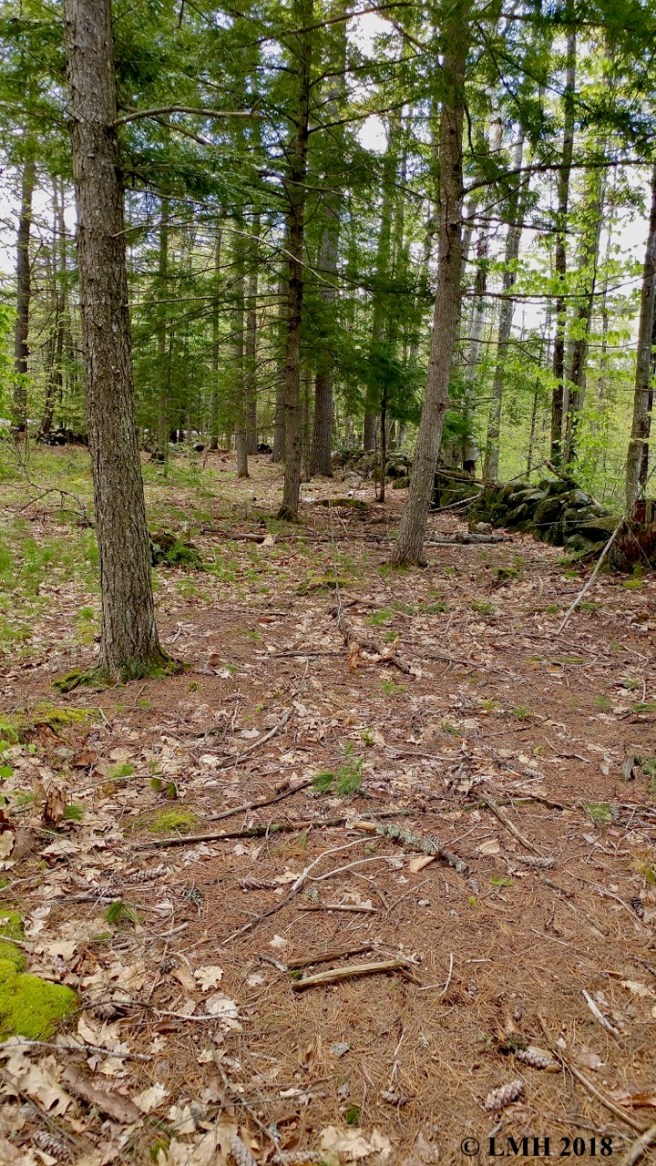
I stepped into the woods beyond the edge and was reminded that ten years ago I wanted to create a nature trail on this property–a place where anyone could partake of a short wander away from reality; a place where someone might be nurtured by nature.

S19-STARFLOWER

A place where the stars above would be reflected in the flowers below.

S20-DWARF GINSENG

A place where flowers like dwarfed ginseng would erase global issues–if only for a moment.
S23-GIANT BUMBLEBEE

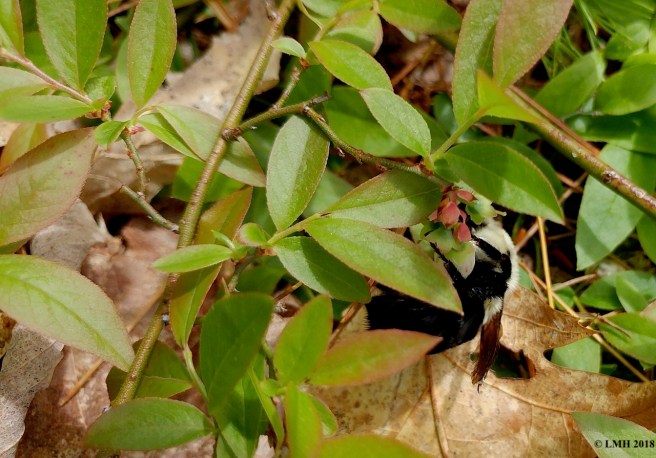
A place where everyone recognized the system and from such recognition began to work together toward common goals.
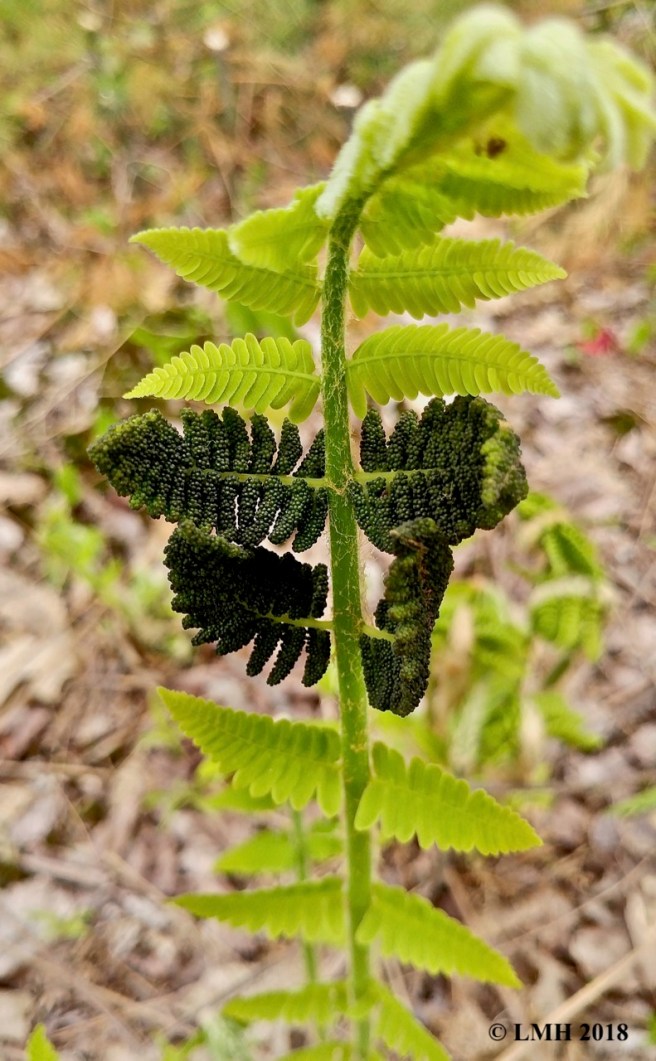
S22-INTERRUPTED FERN

A place where interruptions occurred because life happens, but such were accepted as part of the norm.

S23A-BUMBLEBEE BREAK

A place where one could find a bench upon which to rest before beginning again.

S25-ENTER HERE

Here’s to beginning again St. Peter’s.

Here’s to remembering all those who made this place a reality.

Here’s to maybe someday a nature trail.

Here’s to continuing to create a place where all are welcome whether they pass through the red doors, into the Memorial Garden, or choose to take in the offerings from the ground up.


The Amazing Race–Our Style, episode 4

We’d barely set off on episode 4 of The Amazing Race–Our Style when we hit our first roadblock just around the corner from home. A small patch of roadway at the foot of a friend’s driveway was being paved by the State. Our first challenge–how many state employees does it take to repair such a patch? Fifteen. Two to stop traffic, two to operate equipment, one to supervise, and ten to stand around and drink coffee.

Our next roadblock–a stop at our local hardware store to return a rented chainsaw. Well, truth be told, more like a borrowed chainsaw from the rental department. Regardless, the clock ticked on.

And still, there was one final roadblock–a stop at Prompto Ten Minute Oil Change, where we got to sit and watch the action, which actually took less than ten minutes.

At last, we reached the ticket office of Casco Bay Lines in Portland, Maine . . . as a ferry was departing. The ferry we wanted to be on. C’est la vie.

P1-PORTHOLE

Since we’d missed the boat. we decided to use the time until the next departure to our benefit and ate an early lunch at the Porthole, where we both ordered the scrumptious beer-battered fish sandwich.

P2-GATE 5

Following lunch, we hurried back to Gate 5, not sure if we’d be the only contestants on board.

P4-TICKET:CLUE

When it was time, my guy handed over our tickets and received our first clue.

P6-PEAKS ISLAND

We needed to exit the boat at Peaks Island in Casco Bay. That was easy given that this particular ferry only traveled between Portland and the island.

P7-MIKE'S CARTS

Finally, we were ready to get into the nitty gritty of the day’s adventure. We had a choice–ride all the way around the island on bicycles without stopping or complete a loop that only covered half the island via a golf cart, but included a few stops. Because of my current one-armed bandit situation, we chose Mike’s Carts.

P8-LEARNING TO DRIVE GOLF CART

Another set of contestants made the same choice, which made us realize we still had a chance to stay in the race. Mike explained the finer points of island driving.

P10-MAINE COAST AND ISLANDS

As we made our way to the first island challenge, we enjoyed the views.

P11-CAIRN ALLEY

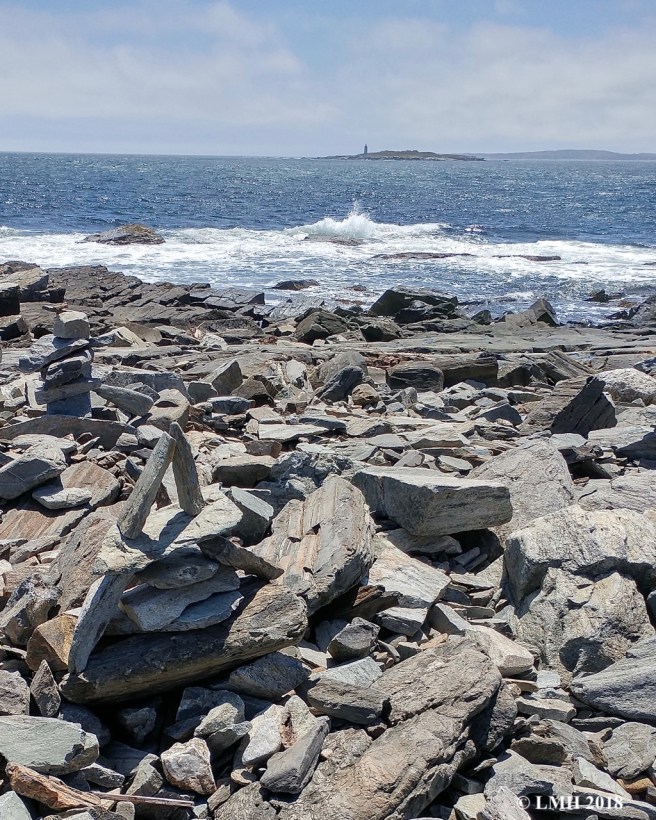
The rocky coast of Maine proved to be much more than that, at least in this section–Cairn Beach. Other contestants passed by this challenge, but we decided to try it.

P12-CAIRN ALLEY

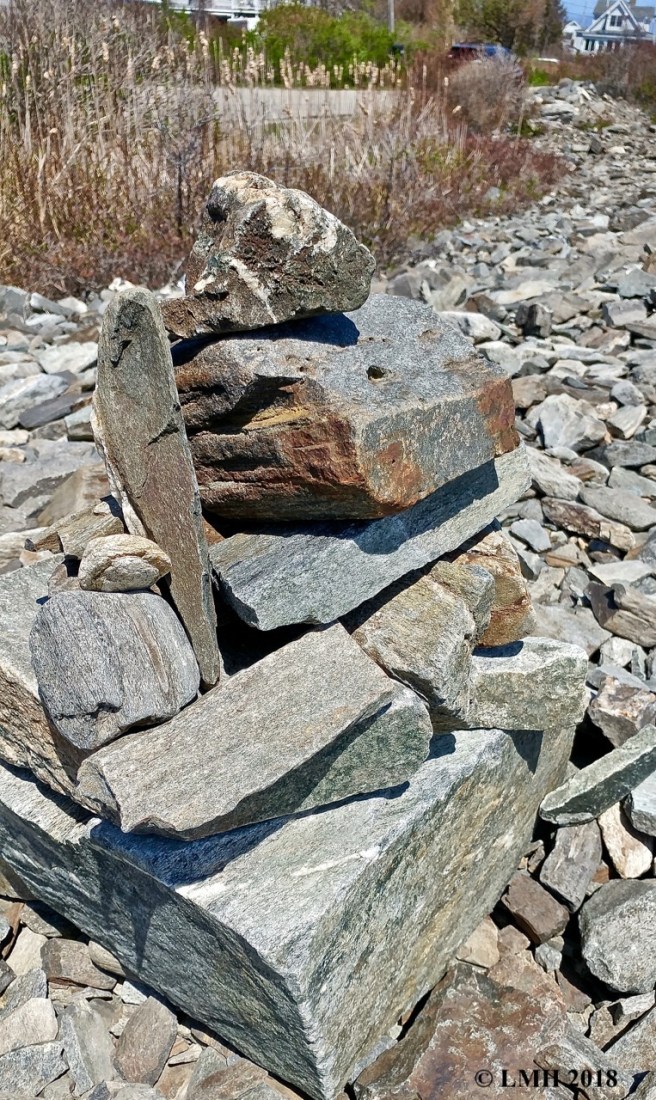
According to the clue, we needed to build a cairn that somehow reflected the surroundings. Examples surrounded us.

P14-CAIRN GROWING

One rock at a time,

P13-BASE OF OUR CAIRN

we created a base until . . .

P15-CAIRN REFLECTION

our final product was an artistic representation of the cattails behind it.

P16-TRAIL TO BATTERY STEELE

Upon completion of the cairn, our next clue suggested the need for batteries. And so we followed a trail away from the water.

P17-BOARDWALK

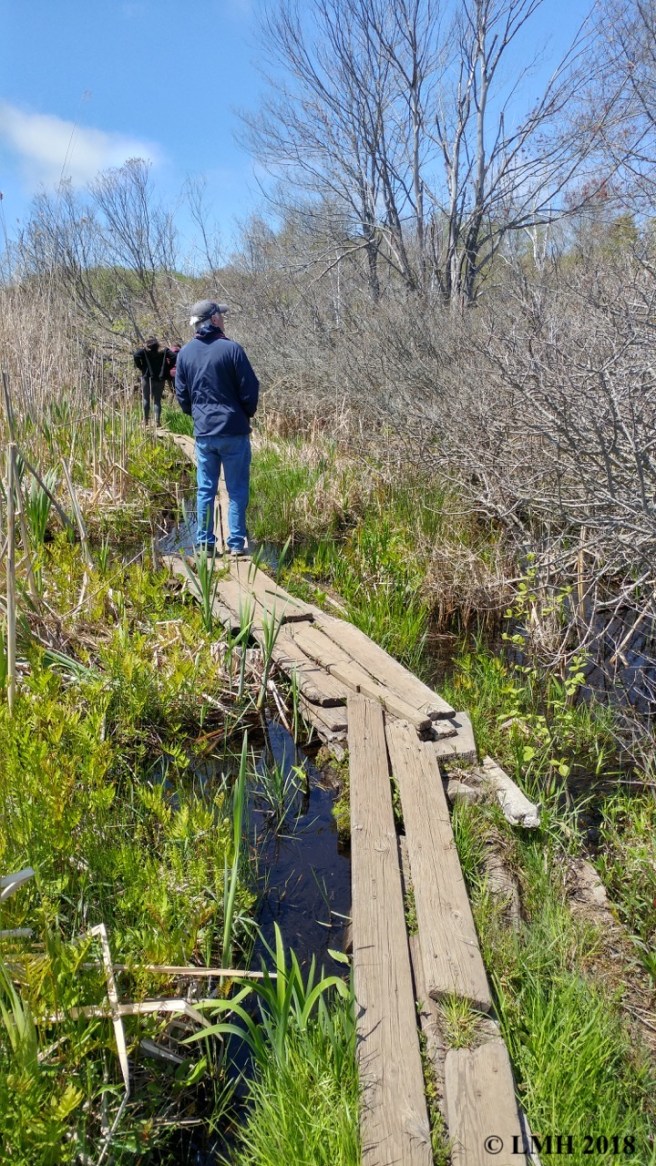
But really, water was a part of it. And a boardwalk–in much worse condition than the one that flipped my feet into the air on last week’s Left-handed Mondate.

P18-TWO WOMEN AHEAD

With great care I followed my guy–for two women we wanted to overcome were ahead of us. All the way along, birds serenaded us.

P20-sausage-shaped boudin

Thankfully, the boardwalk gave way to solid ground and among the offerings at our feet I noted a sausage-shaped boudin–I could only hope we might earn extra points for knowing such.

P19- APPROACHING BATTERY STEELE

The trail led us to a gallery of sorts for its a place frequented by midnight artists. Were we in the right place?

P22--MIDNIGHT ART

The question remained as we admired the creative works–but what did they have to do with batteries? Did the clue refer to the energy of the artists?

P21-BATTERY STEELE

And then the answer was made obvious–we were exploring the Battery Steele constructed in 1942. According to the Peaks Island Land Preserve: “During World War II, Battery Steele was the most important fortification in Casco Bay. Its two 16″ guns, triangulated by observation towers on Peaks Island, Jewell Island, Cushing Island, and Bailey Island, could shoot a shell weighing 2,240 pounds nearly 30 miles at enemy battleships or submarines to protect Portland Harbor.”

If you look closely, you might see my guy starring into a tunnel. The team of two women challenged us to walk down the dark tunnel. They made it about a third of the way before running out while screaming. We accepted the challenge and made it only as far, using my handicap as an excuse to turn around–I couldn’t spy any obstacles in the dark and didn’t want to risk tripping. Would our calm departure overcome their hysteria?

P23-SHORTCUT BACK

No matter, for we knew the outcome was out of our control. Because we’d chosen a cart over a bike, we next needed to locate the road that cut across the island and back toward the harbor. An islander was out for a walk and we stopped to ask if we were headed in the right direction. She told us to stay to the right, cross over at the four corners, and continue down the hill. Bingo. We returned the cart and received our next clue–to locate the smallest store on the island that is open year round.

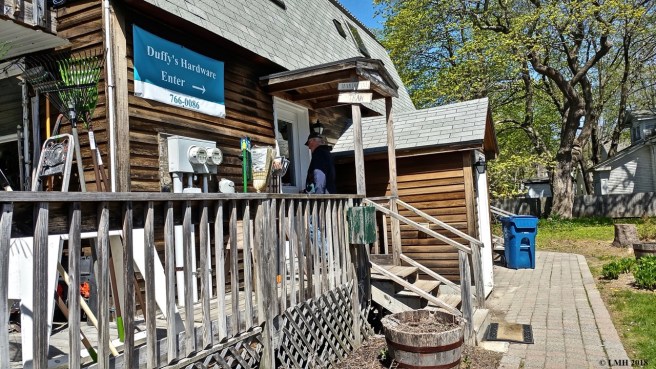
P24-DUFFY'S HARDWARE

And that’s how we ended up in Duffy’s Hardware.

P25-DUFFY'S HARDWARE

It’s a one-room wonder that serves an important niche.

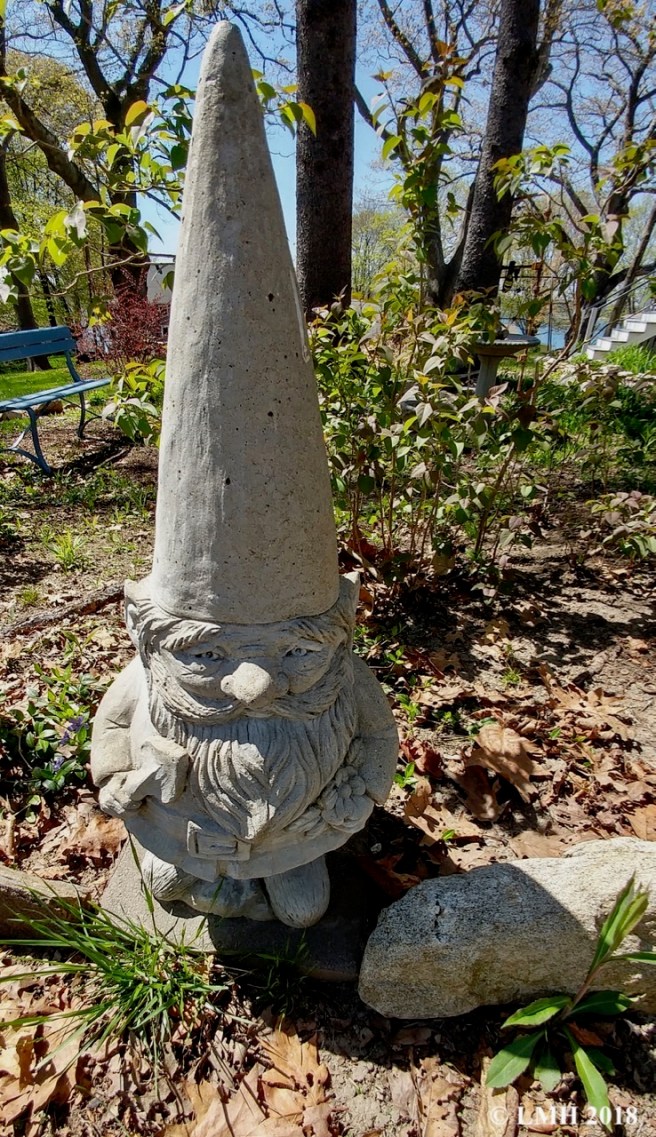
P26-TRAVELING GNOME

With the hardware challenge completed, we next needed to walk along until we discovered the Traveling Gnome. We found it subtly hidden in a garden with Casco Bay forming the backdrop.

P27-LOCKED GATE

The gnome’s clue was to find a way to the beach. We began to worry because time was running short and we found one locked gate after another.

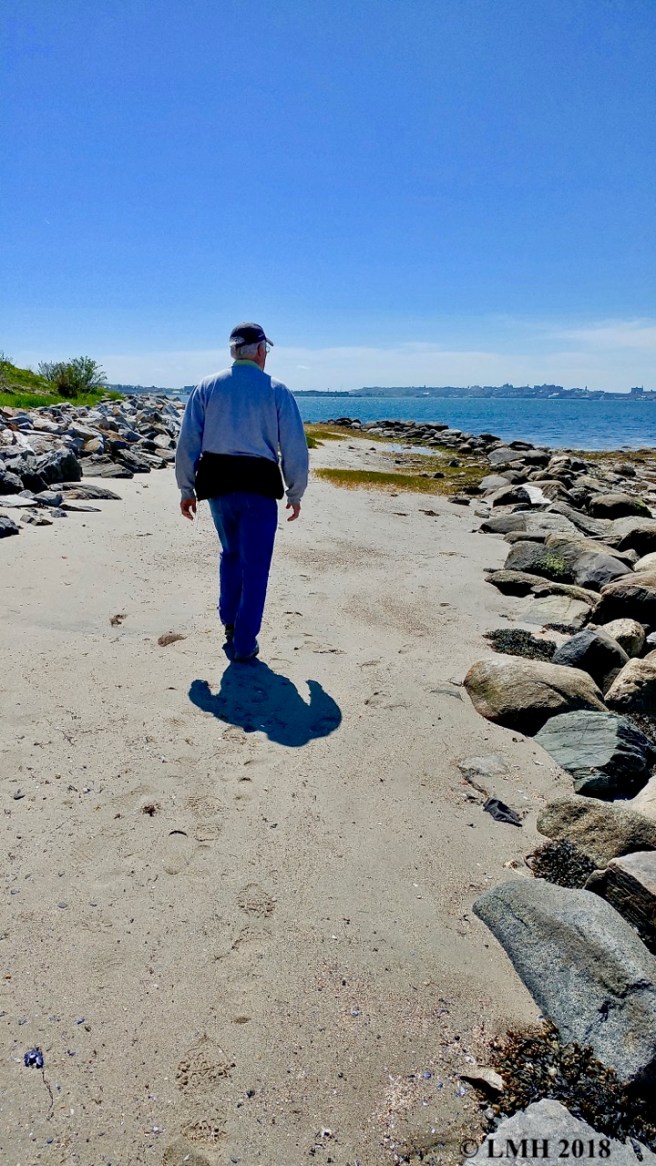
P28-BEACH OF SORTS

But, we don’t give up easily and at last found a slice of sand.

P29-NATURE'S ART WORK

While walking along our goal was to locate three natural representations. The first–nature’s artistic palette.

P30-BRICK

The second–something with an historical reference.

P31-BARNICLES

The third–natural homes aka barnacles.

P33-LOBSTER TRAP MAZE

And then we both had to complete the lobster trap maze. Could we do it successfully?

P34-MAZE

Piece of cake.

P37-ICE CREAM

Speaking of cake, we had some spending money and a wee bit of time before the ferry arrived so we visited the local grocery store to satisfy our need for a sweet treat since the ice cream shop wasn’t open. Among the offerings we found sundaes and purchased two.

P38-ICE CREAM

Ahhhh. But when you are suddenly sidelined by a wrist fracture, consuming some treats requires help and so my guy broke the sundae up for me. It also means letting go of the fact that one might end up with sticky fingers for a while. If only The Amazing Race–Our Style included special credit for overcoming personal obstacles. Hmmm–maybe down the road.

P32-?

We’d completed all of the island challenges when one last question (mark) appeared.

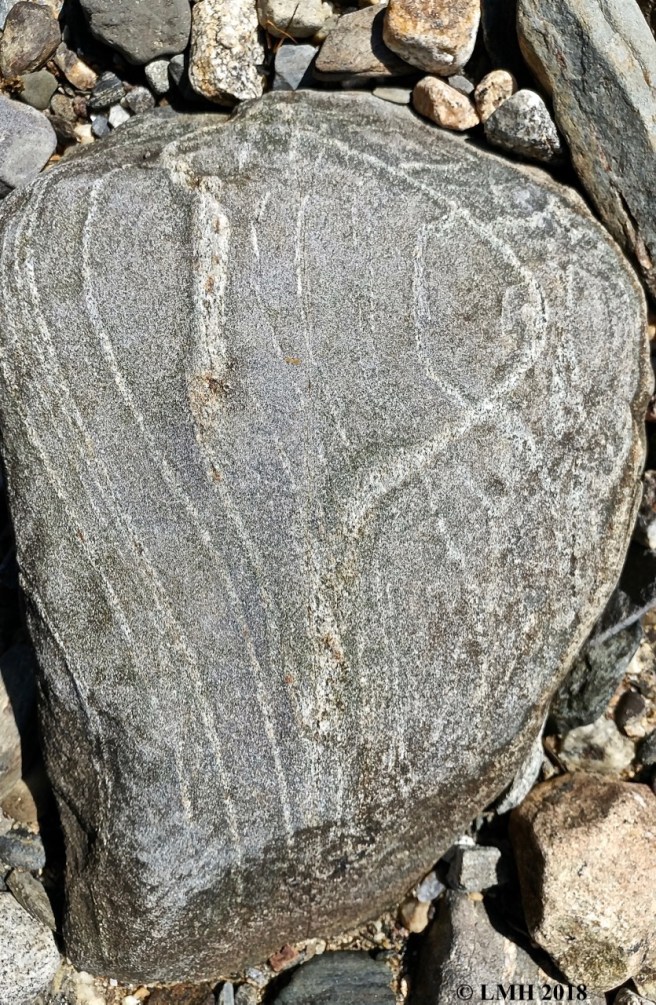
P36-LOVE ROCK

Could you find a stone that represented our relationship and today’s Mondate?

We did. And with that we completed another episode of The Amazing Race–Our Style.


Petals and Wings: A Window of Opportunity

Spring ephemerals. Those species that take advantage of the short stretch of time between snow melt and leaf out. We celebrated such today at the Greater Lovell Land Trust’s Heald and Bradley Ponds Reserve as we ever so slowly walked along the orange trail from the Flat Hill parking lot and then looped around on Perky’s Path.

S1-GATHERING

But first, we gathered in the parking lot where Docent Peter explained that he thought I was crazy when I suggested a May date for a flower and bird walk. He’d not been in Maine during May previously and only this week learned the joys of birding with minimal leaf cover. I think he’s hooked. And I’m still crazy.

S4-WILDFLOWER GUIDES

Our journey began with Docent Linda locating wildflowers that are opportunists who bloom early, get pollinated and produce seeds before the deciduous trees blanket the floor of the forest in shade.

S2-STINKING BENJAMIN

Among those early bloomers was one that stinks! And yet, it’s exquisitely beautiful. Stinking Benjamin is one of its common names because of the flower’s malodorous scent. Of course, you need to get down on your hands and knees to get a whiff.

S5-HAND LENS

Our focus wasn’t just on flowers and birds as we all soon realized, for it seemed that many things caught our attention, including the seeds of deer tongue grass. As a collective group, we suffered from Nature Distraction Disorder.

S6-WILD SARSAPIRILLA LEAVES

Because of such, we observed more than just the flowers that were in bloom. In one instance, the flower was yet to come, but the leaves in their early stage were worth noting. Linda pointed out that the color of wild sarsaparilla’s new leaves was reminiscent of poison ivy. But, poison ivy has leaves of three.

S7-BEECH LEAVES

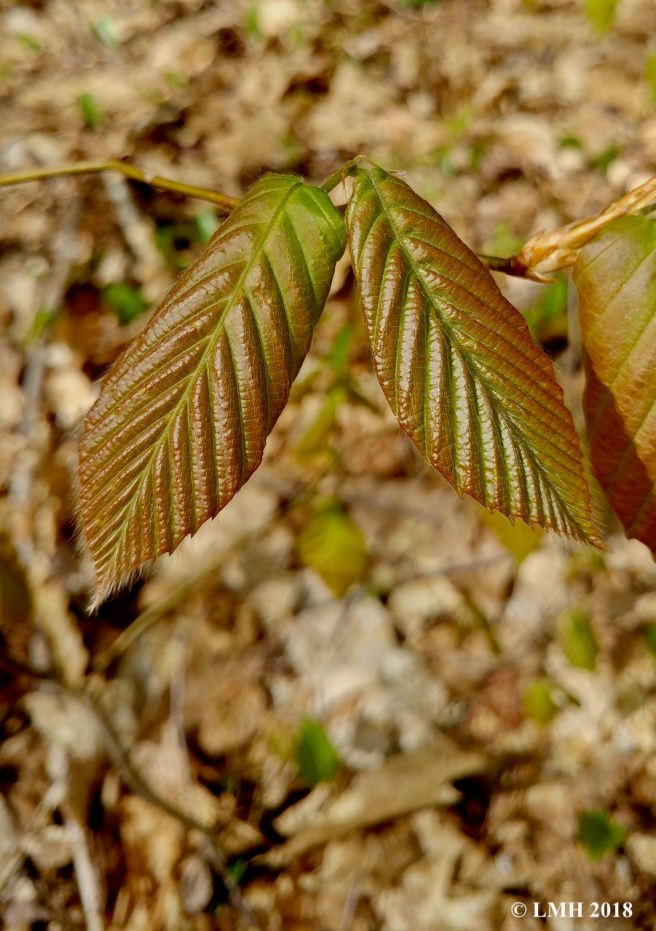
And that reddish tint that we saw in the sarsaparilla, beech and other leaves? The various hues of color in leaves was caused by the presence of pigments called anthocyanins or carbohydrates that are dissolved in the cell sap and mask the chlorophyll. As our spring temperatures rise and light intensity increases, red pigment forms on a leaf and acts as a sunscreen to protect the plant from an increase in ultraviolet rays.

S8-BIRDING

We’d been looking down for a while, but then bird song pulled our attention to the tree tops. Without the use of my Cannon Rebel, which is currently enjoying what I hope will be a successful rice bath :-( , I couldn’t capture the many warblers we spied. Some, as Peter, and his wife Molly, told us, were only in the area temporarily to fuel up on insects before continuing the journey to their breeding grounds in Canada.

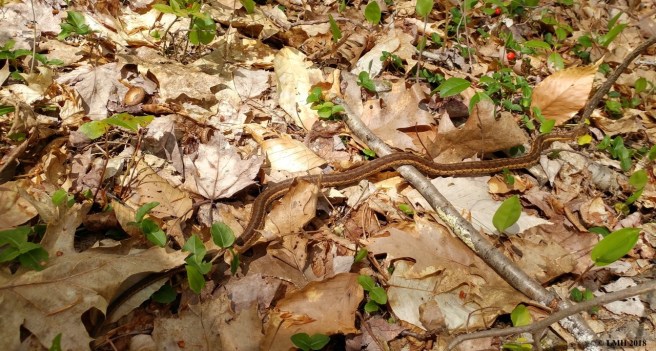
S10-GARTER SNAKE

And looking at our feet once again, another in search of insects. We saw a garter snake who stayed as still as possible while we ogled it. Was it cold and trying to soak up warmth from the sun? Or did it stay still in hopes we wouldn’t spy it?

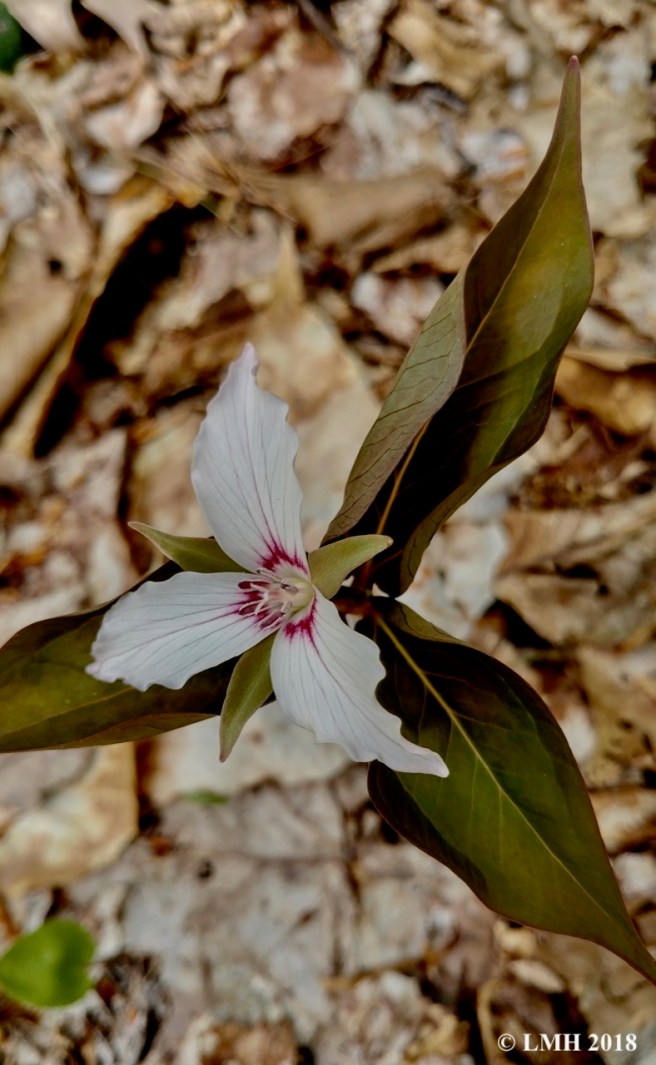
S11-PAINTED TRILLIUM

We finally left the snake in peace. And paused next to gaze upon a painted trillium.

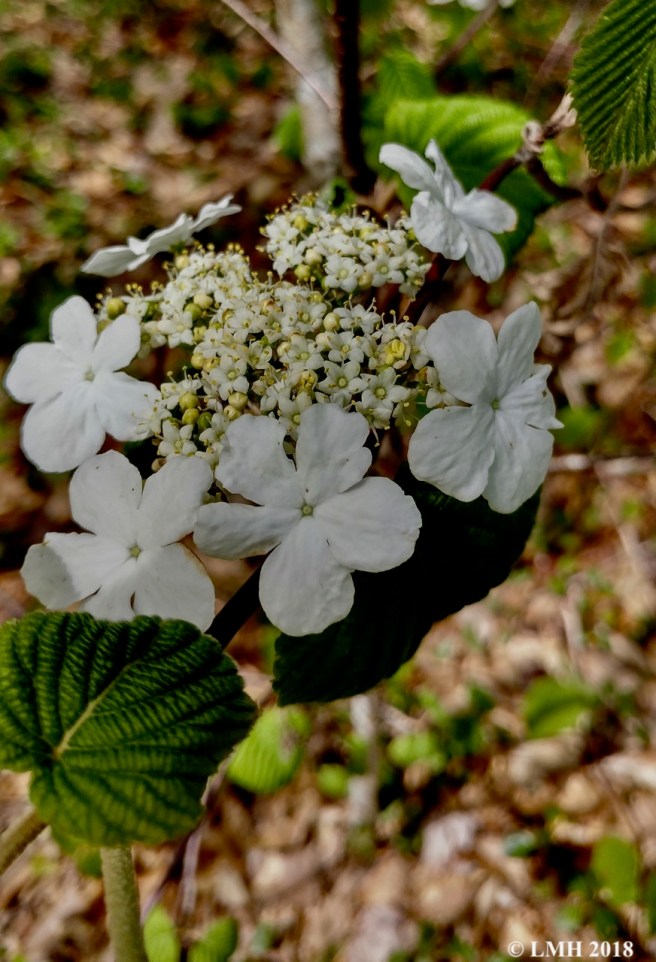
S12-HOBBLEBUSH FLOWERS

Almost two hours after our start, we approached the wetland and overlooking bench. It was there that a hobblebush laden with blossoms caught our attention in the shrub level. The hobblebush bouquet was really an inflorescence or lacy cluster of tiny fertile flowers surrounded by a halo of showy, yet sterile bracts. Those larger, sterile flowers attract insects while the tiny fertile flowers do all the work of seed production. Nature has its way.

S13-BIRDING BY THE BENCH

It was at the bench that bird song again greeted us and we looked above the shrubs toward the tree limbs above.

S14-BIRDING

For many of us, we looked through our binoculars at birds we’d only heard of before, including a Bay-breasted Warbler. Peter explained that he’s participating in the citizen science project to update the Maine Birding Atlas and so he uploaded the 38 species identified today to the e-bird website.

S15-LINDA TURNS HER FOCUS UPWARD

Even though she’d spent a lot of time directing our attention to the beauty at our feet, Linda was also in awe of those who moved above, however, she was heard to comment that it’s a whole lot easier to ID flowers that stand still.

S16-BEECH FERN

As our journey finally continued, we found a patch of beech ferns with their own variation of today’s theme, for each leaflet attached to the rachis in a winged formation.

S18-FRINGED POLYGALA

Another that spoke to the theme was a flower that hadn’t quite yet bloomed–fringed polygala, aka gay wings.

S17-SPRING PEEPER

Despite all the flowers and birds, our NDD followed us right to the end–when we spotted a tiny spring peeper . . .

S21-GREEN FROG ON A LOG

and then a green frog.

S22-FEMALE WHITEFACE SKIMMER

While the frog marked the end of our journey, I moved on to the GLLT’s Kezar River Reserve, where another winged critter flew at the flower level–the first dragonfly of the season: a female whiteface skimmer.

Today was filled with petals and wings and all things ephemeral. I hope you’ll have a chance to take advantage of this short window of opportunity.


Left-handed Mondate

Yesterday I discovered a male ring-necked pheasant in our backyard–a most unusual sighting. As I watched, he headed over a stone  wall and into our woodlot where he cackled and beat his wings in hopes of attracting a mate. The only responses he received were gobbles from Tom Turkey. And so it went for a while . . . cackle . . . gobble . . . cackle . . . gobble.

This morning we were awakened at 5 a.m. to the same mating calls. Who needs a rooster?

w1

When I stepped out the back door, neither bird was anywhere to be seen or heard.

w2

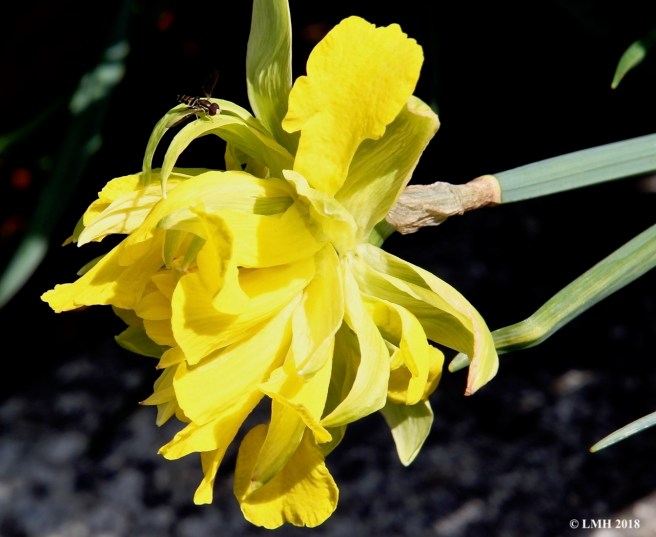
But the double daffodils that came with our house showed off their cheery faces to all who looked.

w3

And by the road, the magnolia we planted about fifteen years ago added its own pastel palette to the scene–however momentary.

w4

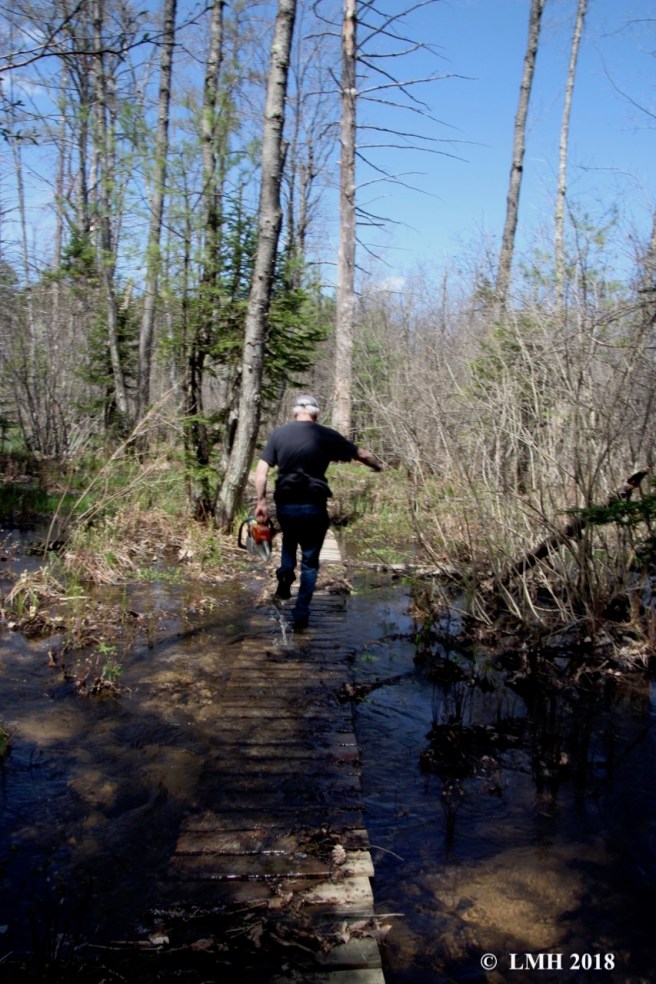
By late morning, we changed our focus from the yard to a woodland a few miles away for today was the day we chose to work on the section of trail we steward at Lake Environmental Association’s Holt Pond Preserve. 

w5

There were trees and limbs to clear. And trimming to be done as well. The last time we were on the Southern Shore Trail, which was only a couple of months ago, we noted a few trees that would need our attention, but today there were between fifteen and twenty.

w11

Occasionally, as my guy used the chainsaw and I waited to clean up, I spied old friends like a wild oat or sessile-leaved bellwort in bloom.

w6

And then I made a discovery that had eluded me in the past–a spotted wintergreen. It was an exciting find for it’s listed as S2 ranking, meaning “Imperiled in Maine because of rarity (6-20 occurrences or few remaining individuals or acres) or because of other factors making it vulnerable to further decline.”

w7

We were close to an outlook by Holt Pond when we saw the spotted wintergreen, Chimaphila maculata, and so we paused to take in the view looking across to the quaking bog as we dined atop a stump.

w10

From there we moved on, making rather quick progress to the “field,” a former log landing where the forest is slowly reclaiming its ground.

w8

As we approached we startled a ruffed grouse and came upon a familiar sight at this spot for the trail through the field has always provided a dust bath for these birds.

w9

And on the edge of the “tub” a telltale downy feather.

w12

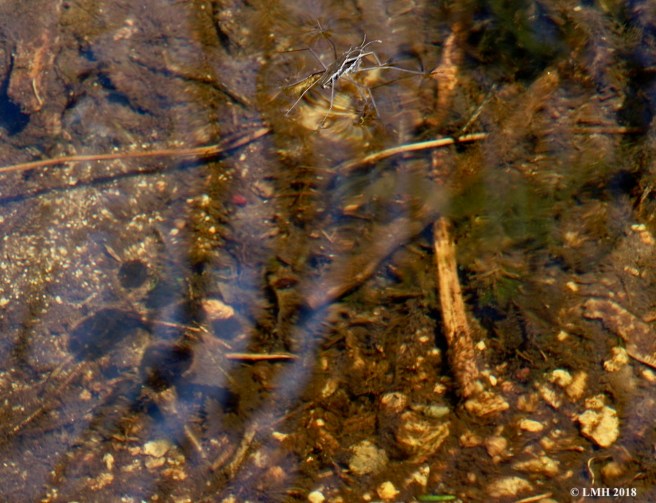
Typically, when doing trail work, our turn-round point is the field for that’s what we’d agreed to years ago. Today, we decided to keep going and made a small stream our end point. We shifted a bridge and watched the water striders for a while. Apparently, love wasn’t just in the air, but on the water as well.

W13

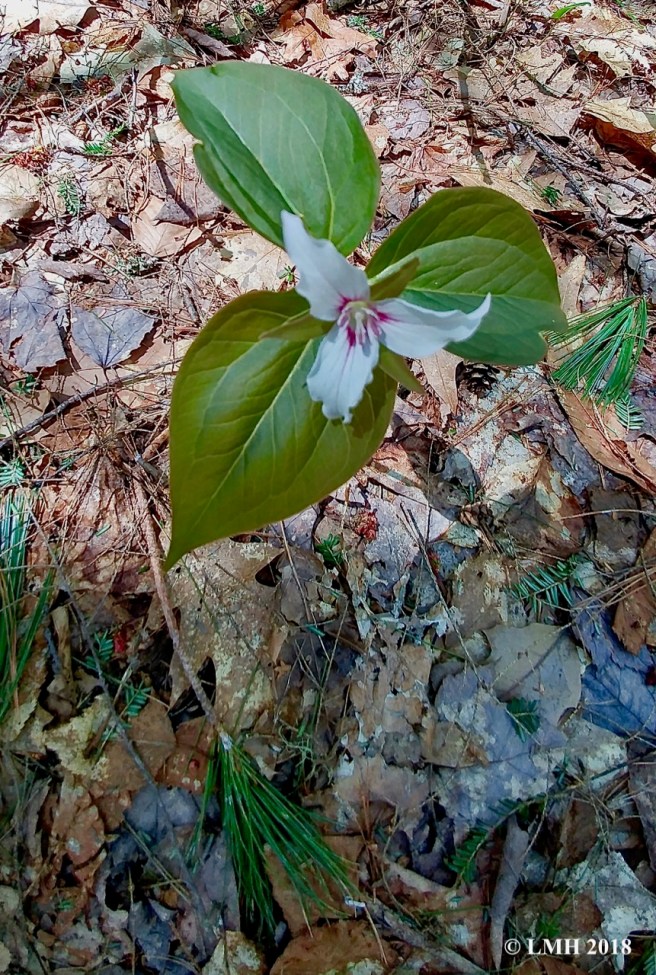
On the way back, I was delighted to discover my first painted trillium of the season. I sensed my guy’s groans for he knows I’ll exclaim over and photograph each one I see–not satisfied until I reach a trillion trilliums.

W14

Oh, and there were fern crosiers to celebrate, especially the scaly spiral of the Christmas fern.

w15

At last we reached the beginning of our section of trail and I told my guy that I wanted to go down by the water for a moment, but not cross the boardwalk because my hiking boots leak. He put the saw down, contemplated the water, and made the crossing. From the other side he suggested I join him since the water wasn’t that deep. Before I did so, however, he asked me to move the saw off the trail and out of sight. As I started to hide it, he crossed back over and said, “I’ll take it in case we need it.” And back again he went, the saw in his left hand for he’s a southpaw. He’d just reached the other side when I stepped on the boardwalk and began to carefully move, ever mindful of my boots . . . until those very boots slipped out from under me. Down I went. Crash. Bam. Smash. On the wood. My right forearm took the brunt of the fall and my camera ended up in the water.

My guy came to the rescue as he lifted me up . . . though first I insisted on the camera being saved. And now I have used the hunt and peck method to type this story for I am a southpaw for the next six to eight weeks as I recover from a fracture to the ulna and radius. That’s how today became a left-handed Mondate.

The camera is also in recovery mode–here’s hoping a rice bath will work wonders.


Cinco de Mayo, Naturally

The hour and a half drive to Litchfield, Maine, was worth every second on this fifth day of May. The spring tapestry that spread before my eyes had me oohing and aahing around each bend in the road for such were the colors–so many shades of greens, mixed in with reds and magentas and pinks and yellows. It was almost intoxicating.

But . . . a photograph will have to wait for another day for I needed to reach my destination and catch up with my peeps–fellow classmates from our 2012-13 Maine Master Naturalist class. For the last five years we’ve tried to get together quarterly. It doesn’t always work out, but this year we’re making a concerted effort.

s1-Smithfield map

Today’s destination was the vernal pool at Smithfield Plantation, a 103-acre property the town of Litchfield conserved. If you look carefully, you might see a reflection of Sharon, who has lead many a school group along the trails and knows the property intimately.

s1a-Sharon T

Before we headed to the pool, she oriented us to the site.

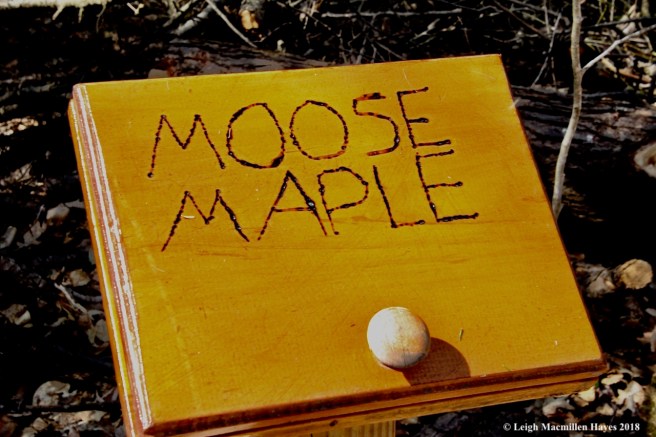
s2-moose wood

One of the things Sharon explained was that a Boy Scout had created an interpretive tree trail and so we paused at one of his stops to admire the craftsmanship.

s2b-moose wood maple leaf

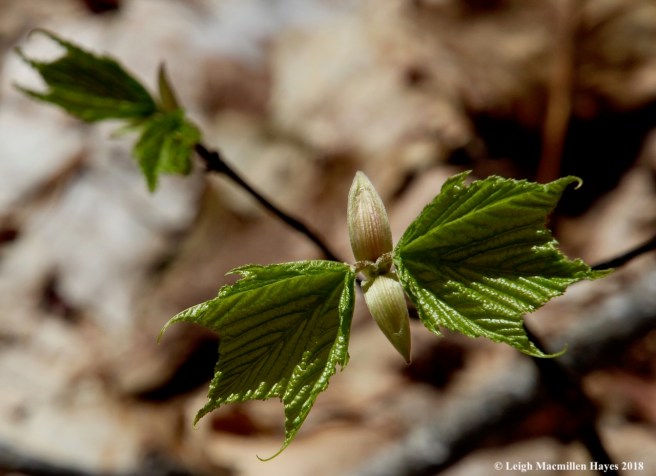
Indeed, right behind the sign, a striped maple, aka moose maple, shared its newly emerged pastel buds and leaves.

s2a-moose maple

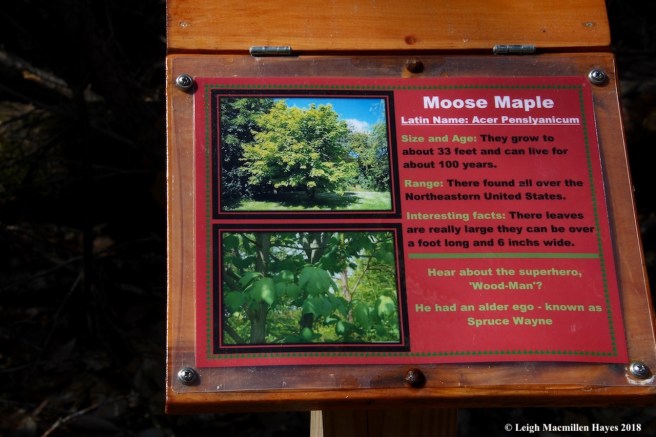
And then we lifted the lid to reveal the information. OK, so there were a few typos for the grammar police, but on each of his cards, he included a joke. What a great idea as that would certainly appeal to the younger set. It definitely appealed to those of us who are still ten years old in our minds.

s4-hobblebush

And on the opposite side of the trail, we spotted another type of moose wood–hobblebush just beginning to flower. Both striped maple and hobblebush are favorite foods of moose, thus their nicknames.

s3a-clintonia

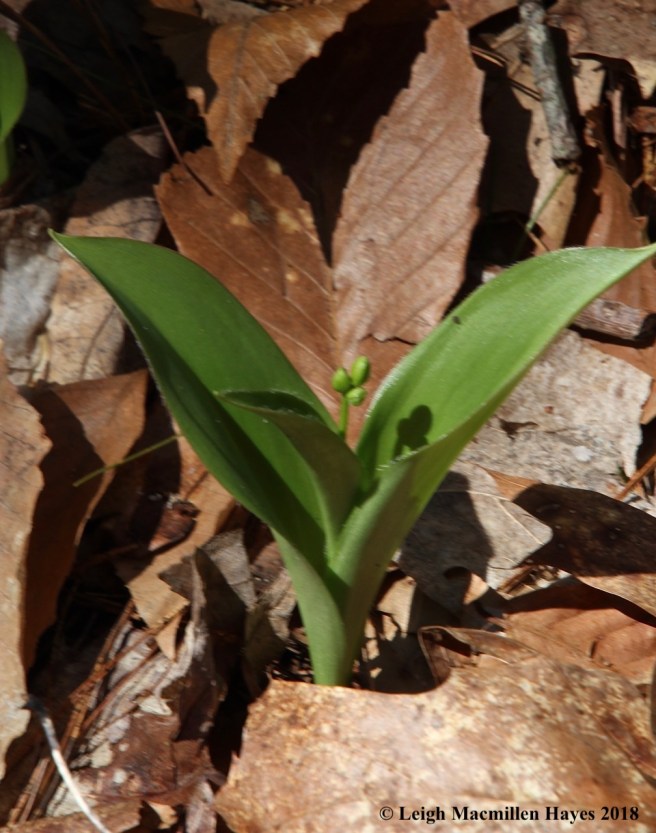
Onward we walked until a patch of leaves stopped us. And our brain-sharing began. We thought we knew what the plant was, but then questioned ourselves as it wasn’t in flower yet. Each season, we need to relearn some. Despite the lack of flowers, we decided to key it out in Newcomb’s Wildflower Guide using two other descriptors–leaves both basal and entire.

s3-clintonia 1

For those familiar with Newcomb’s that meant of the three numbers in the locator key, we didn’t know the first, but went with 22 for the second and third representing basal leaves and entire leaves. Then we tried, 122, 222, etc.

s3b-clintonia buds

And landed on our first suspicion: 622–Yellow Clintonia or Bluebead (Clintonia borealis).

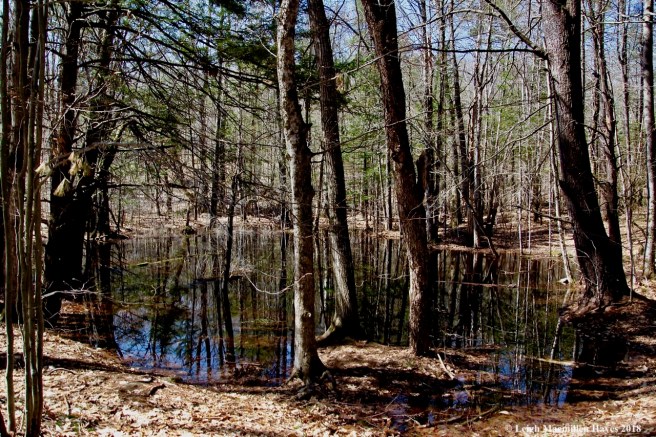
s6-vernal pool

The trail wasn’t long, but as one might expect, it took us a while to reach the vernal pool. And then we were stopped in our tracks and didn’t approach it right away.

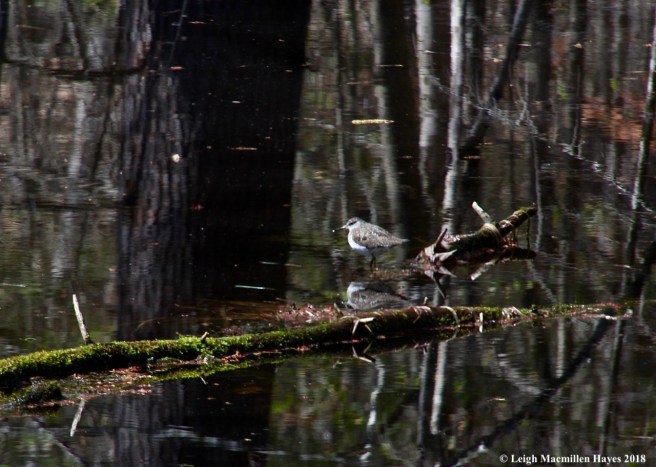
s7-solitary sandpiper

Instead, we stood back and spent a while watching a solitary sandpiper on a downed tree.

s7a-solitary sandpiper

As we watched, it bobbed its tail. And at one point we were sure it took a mid-morning nap. Eventually, the bird flew to another part of the pool and a few minutes later departed.

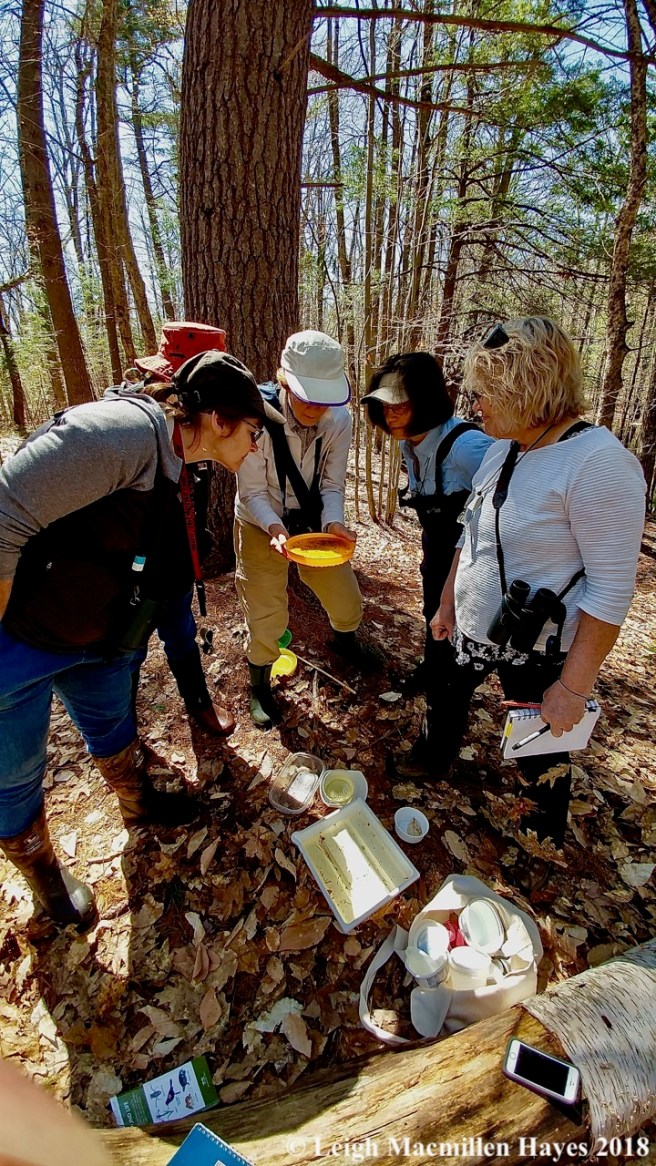
s10-setting up camp

And so we set up camp, dropping some of our gear on the bench.

s10a-setting up camp

And more of it on and beside a log. We had macro-invertebrate charts and vernal pool pamphlets and books, plus all kinds of containers for pond dipping.

s9-Pam's journal

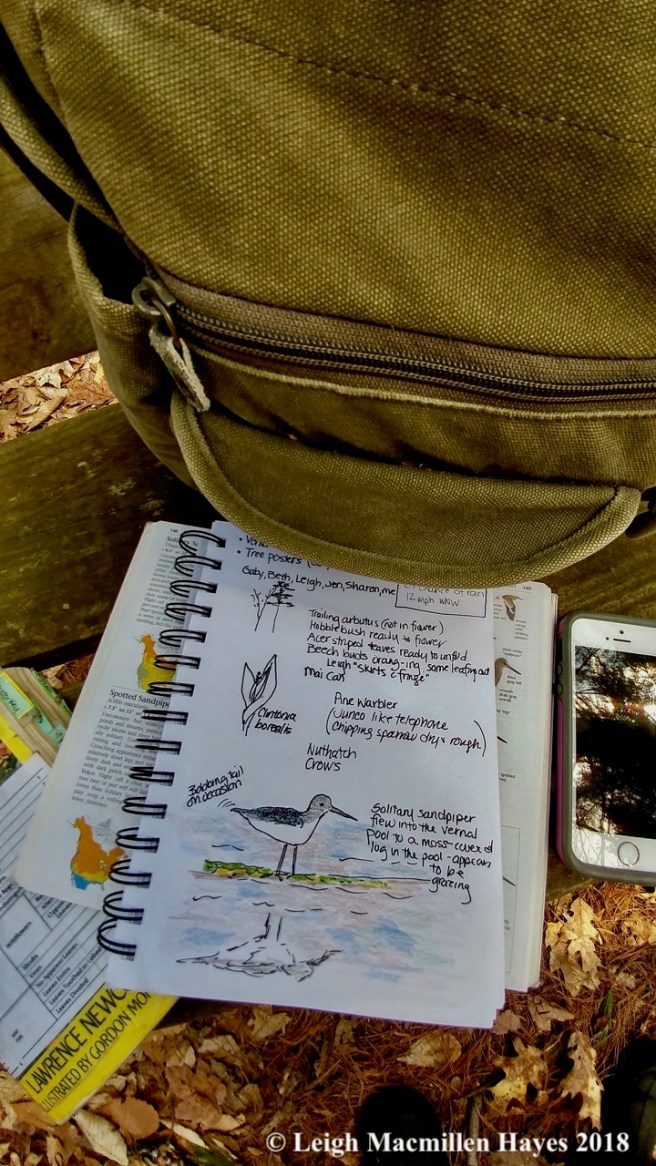
Pam was the smart one and she’d packed her sketch book and colored pencils. That’s one skill we all appreciate for it slows us down and makes us really notice. I, for one, haven’t done enough sketching in the past year and so this was the perfect incentive for the future.

s8-mosquito larvae

As we looked into the pool and Sharon told us what we might find, we immediately noticed the most abundant residents–mosquito larvae doing their whirligig dances.

s11-first fairy shrimp

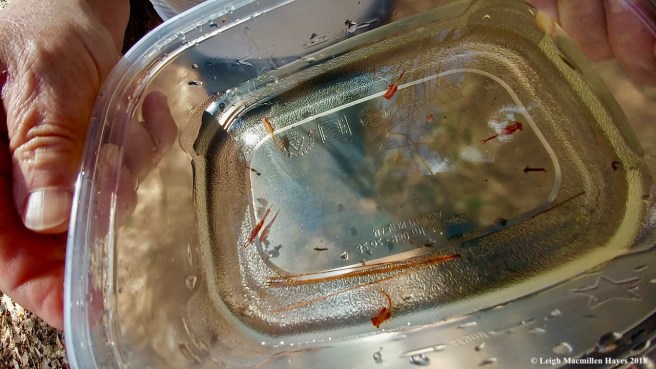
But on her first dip, Sharon pulled up the crème de la crème–a fairy shrimp. Bingo–a significant pool it was as she knew, though not so documented with the state.

s12-examining the fairy shrimp

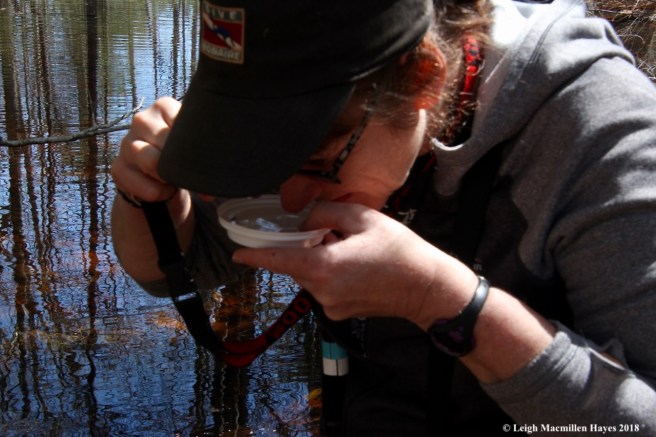
With her loupe, Jen took a closer look.

s13-five fairy shrimp

On Sharon’s next dip she pulled up not uno, not dos, not tres, not quatro, but cinco fairy shrimp.

s13-Pam sketches the fairy shrimp

And so Pam settled in to sketch them in all their glory.

s13-Pam's sketches

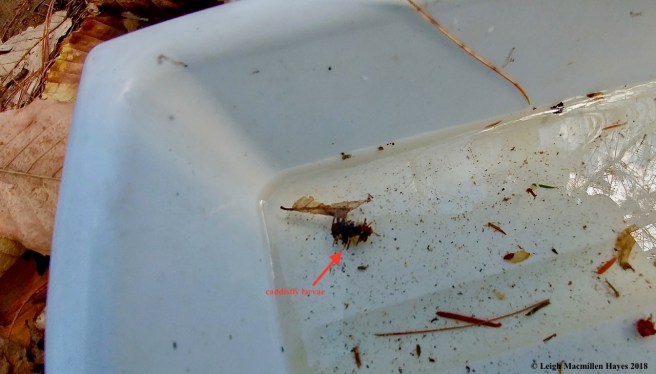
And added a caddisfly larva for we’d also captured one of those.

s14-female fairy shrimp

One of the cool things that Sharon pointed out, the brood pouch at the end of the abdomen, so indicating a female. How cool is that?

s15-caddisfly larvae

And here is our caddisfly, his casing created out of fallen hemlock needles. Caddisfly larvae that create their bodies from woody material are the log-cabin variety. We watched it move about in the tray, sometimes extending its soft body out of the case.

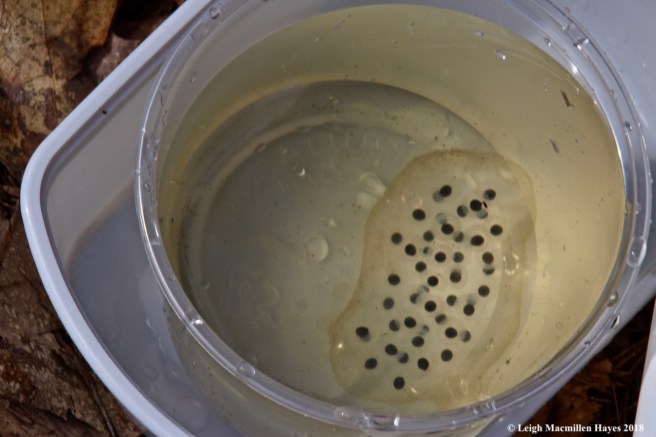
s17-spotted salamander egg mass

The dipping continued and a spotted salamander egg mass was pulled out, but only for us to take a closer look. And then it was returned from whence it came. Notice the individual eggs within the greater gelatinous matrix.

s18-egg mass

After that, Sharon found another reason to celebrate. She’d worn her waders and so was able to go deeper into the water than the rest of us.

s18-tadpoles

A quick dip and she’d pulled up an egg mass that almost melted as life burst forth–tadpoles. The first of the season for all of us.

s20-predacious diving beetle larvae

One last dip revealed one not so kind to all the other species we’d located. Known as a water tiger or toe biter, you can tell that it’s one mean little thing. This was the larval stage of a predacious diving beetle and the tadpoles had everything to fear for like its adult form it was a predator.

s23-Cinco Amigas

After that last find, it was time for us to pack up our gear and leave the pool behind. But, we took with us memories of a delightful spring morning spent exploring together. And . . . we had a chance to catch up, show each other field guides we thought might be of interest, share experiences of our volunteer opportunities, provide suggestions for ways to make a nature program work be it for kids or adults, and realize that we were not alone in any obstacles that may cause an issue during those programs.

What a naturally wonderful way to spend this Cinco de Mayo . .  . con cinco amigas. Thanks Gaby, Beth, Jen, Sharon and Pam.


Mayday Alert

Each time we explore a Greater Lovell Land Trust property, we have no idea what we might discover and this day was no different. For today’s Tuesday Tramp I suggested we visit the Cohen Property near the Lower Bay of Kezar Lake, which was the last acquisition under the direction of the late Tom Henderson. We’d only been there once before–and that was a few months ago when we explored via snowshoes. At that time we discovered ice-covered depressions and so a journey to check them out as vernal pools seemed apropos.

m2-moose print ID

There are no trails yet and so after parking, we followed the road back a ways to the area of our winter expedition. And what to our wondering eyes did we spy on the road? Moose prints! One should always look through a magnifying glass to make certain the ID is correct. Wes confirmed our suspicion.

m2-scooping

We found sitting water and running water and began to wonder about the wetland and whether what we thought might be a vernal pool really was, for we knew that a v.p. shouldn’t have an inlet or outlet. As the first dips of the day were made, black flies began to swarm around us. We hoped to pick up their larvae in the moving water, but instead we found many springtails.

m3-what did you catch

And a few mosquito larvae as determined by Caleb, Linda and Nancy.

m5-blob and algae

In another spot, we also found a mystery. At first we thought it might be some sort of egg. And maybe it was, but how was it related to the algae that seemed to be a host? We didn’t know, but now that we’re aware of it, we’ll continue to wonder and perhaps become enlightened.

m6-pool?

We checked out “pool” after “pool” and found not one egg mass (except for a false start that fooled us momentarily), which rather disappointed us. Were these really vernal pools? We suspected so as they were shallow and looked like they’ll dry up in the summer, if not before, plus they supported no fish. Were they significant vernal pools? Definitely not. To be a significant vernal pool, the body of water must contain one of the following obligate species: 1 fairy shrimp or 10 blue-spotted salamander egg masses or 20 spotted salamander egg masses (yellow spots) or 40 wood frog egg masses. Fairy Shrimp? No. Salamander egg masses? No. Frog egg masses? No.

m7-examining species

Despite the lack of indicator species, we scooped up water to determine what did live there.

m8-mosquito larvae

The most abundant residents found–mosquito larvae. And do you see the small jar in Ellie’s hand? She created a mosquito larvae aquarium and discovered that they seemed to like the algae she’d added. Perhaps they’d found microorganisms we couldn’t see.

m8a-pointing out antics of mosquito larvae

Watching the acrobatics of the larvae entertained us for a while. They twisted and turned somersaults and wriggled in the water and we soon realized that eggs left behind by last year’s females who had sucked our blood before breeding, must have remained dormant all winter until the snow melted and spring rains began.

m9-chironomid midge larva

We did find another species to admire, that also wriggled in a constant state of contortion–this one being a chironomid midge with blood-red coloration. According to A Field Guide to the animals of Vernal Pools, the color is “due to a hemoglobin-like pigment that helps them retain oxygen. This pigment allows the larvae to survive in water that is very low in dissolved oxygen, as is common in vernal pools as drying proceeds throughout the seasons.”

m10-Trailing Arbutus--May flower

Because I had to meet someone at noon, and Dave knew that it would take us at least a half hour to make the short trek back to our vehicles due to our incessant nature distraction disorder, we had to cut our journey short. Dave was right–as he often is–and we were forced to stop several time, including to sniff a couple of mayflowers, aka trailing arbutus or officially: Epigaea repens.

m11-ribbon snake 1

We finally reached the spot where we’d parked with fifteen minutes to spare when Linda sighted movement beside the tires of my truck and our hearts jumped with joy.

m12-ribbon snake captured

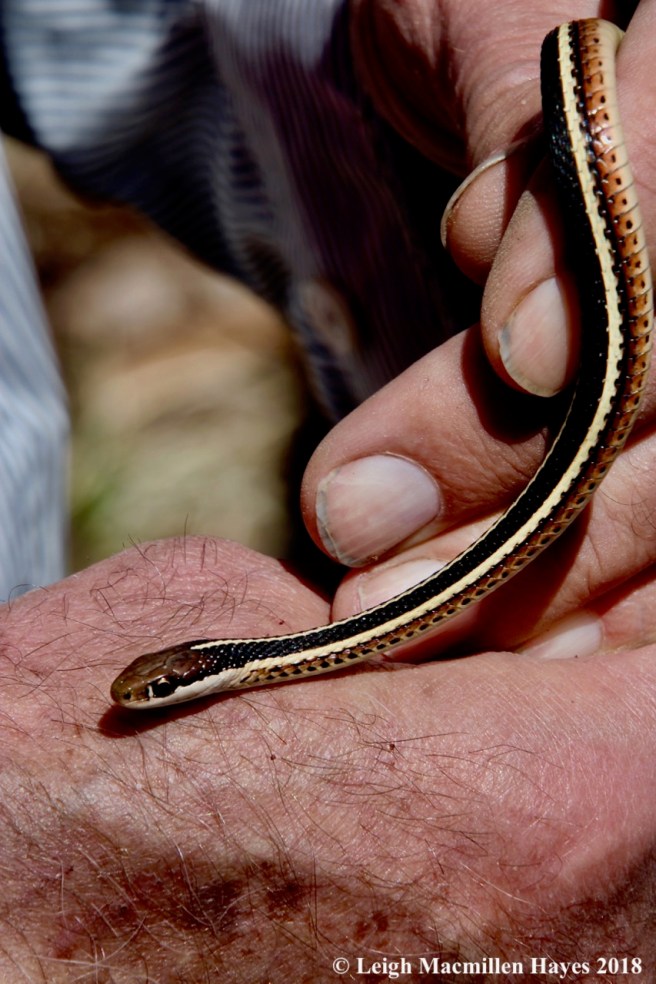
We didn’t want to run it over as we backed out and so Heinrich captured it. What is it? An Eastern ribbon snake, which is a species of special concern in Maine. According to the Maine Inland Fisheries and Wildlife website, “A species of special concern is any species of fish or wildlife that does not meet the criteria of an endangered or threatened species but is particularly vulnerable, and could easily become, an endangered, threatened, or extirpated species due to restricted distribution, low or declining numbers, specialized habitat needs or limits, or other factors. Special concern species are established by policy, not by regulation, and are used for planning and informational purposes; they do not have the legal weight of endangered and threatened species. The Maine Department of Inland Fisheries and Wildlife reviews the list of special concern species at the beginning of each calendar year, and, based on criteria in the Maine Endangered and Threatened Species Listing Handbook , revises the list as appropriate.”

m13-ribbon snake 2

And that is why it’s so important to protect the land. I knew Tom was smiling down upon us due to this find. Interestingly, we also spotted a ribbon snake at the John A. Segur Wildlife Refuge on Farrington Pond Road in early May 2015.

m14-paper birch superhero

Finally, we all departed and I was only ten minutes late for my quick meet-up, after which I headed back down Route 5 to reconnect with my favorite little naturalists at the Kezar River Reserve across from the Wicked Good Store. There’s a tape across the road, which I suspect was put in place by the local snowmobile club when the ice was questionable on the river, but it remains, which given the recent rain is probably a good thing. We’ll take it down soon, but it has prevented the road from becoming more rutted than normal.

Anyway, Wes climbed out of the family’s vehicle with his paper birch armor. He’d spied it in a V between to birch trees on our morning trek and his mom climbed up to retrieve it for him.

m15-brother bomb

Birch Man posed again and again, until his older brother Aidan, sporting a missing front tooth, jumped in front.

m16-root art

The boys stood on a hump of earth beside a tree root. And it was through their eyes that we noticed some interesting finds among the tree’s former life support.

m17-canister cover

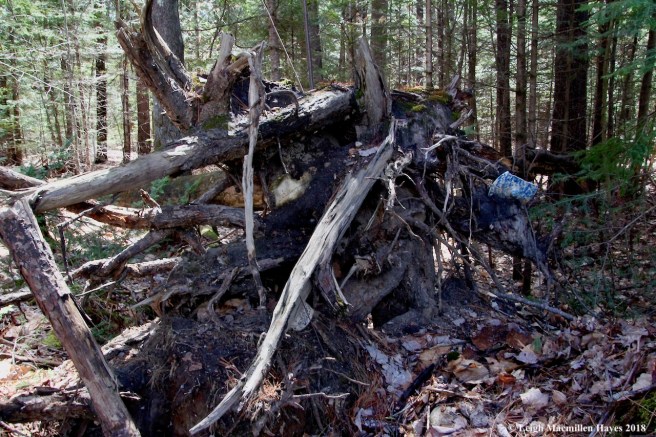
We found pottery and cast iron and realized the tree had grown upon an old dump site.

m19-VW

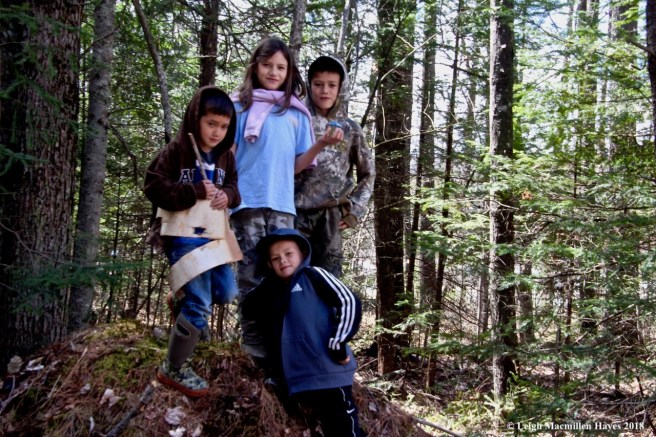
And that hump of earth–the four siblings were sure that it hid a Volkswagen Beetle.

m23-Kezar River

It took us a while to walk down the “roadway” and then the left-hand loop. We made a few discoveries, including coyote scat filled with bones, and the kids did some trail work. At last we reached the canoe/kayak landing at the Kezar River and noted some otter scat and a few slides, plus some fishing lures and line stuck in the trees. It was at that point that the family had to leave, but before they left they asked me what I’d do before I had another meeting in the afternoon. I told them I planned to hike the second loop, which happens to be longer and dips into an interesting ravine.

m23-salamander eggs

That never happened. As it turned out, I stood at the boat launch for about an hour. First, I spied one small clump of salamander eggs.

m24-equisetum

And then realized that the raft before me, which filled the small cove, was equisetum. Where it came from I didn’t know for I couldn’t recall ever seeing it at this property.

m24-Mayfly 1

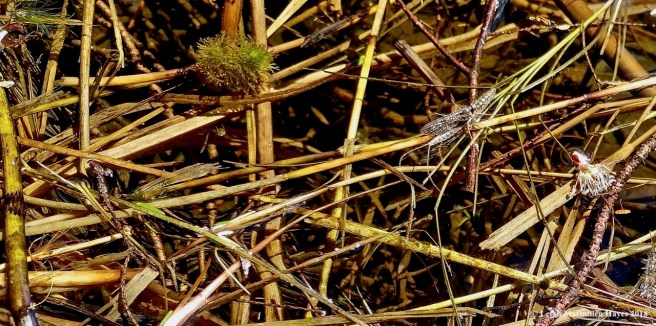
But, regardless, it provided a perfect camouflage for aquatic insects. It took me a while to key in on the species before me, but I knew they were there because every once in a while, one took flight. Do you see the mayfly subimago that had recently emerged? The teenager stood atop its nymph exuvia. Mayflies are unique in that after the nymph emerges from the water as the subimago (that fishermen call a dun), they seek shelter before shedding their skin for the final transformation.

m25-mayfly 2

I really had to focus in order to spot them.

m27-Mayfly

But once I did, they were . . .

m28-mayfly

everywhere.

m29-mayfly larva

And in all forms, including a nymph.

m30-Mayfly up close

The cool thing is that thirteen mayflies are also on the list of species of special concern. Was this one of the species? I have so much more to learn.

m31-water scorpion

As I continued to watch, there was an incredible amount of activity. And then I saw a predator that was about two and half inches long. Do you see it? Not atop the vegetation, but rather under it in right-hand center of the photo. Behind it, almost to the right edge of the photo, was a bubble at the end of its long breathing tube.

m33-water scorpion

As I watched, it continued to swim forward, the vegetation providing it’s favorite type of habitat. Again, you have to look carefully.

m34-water scorpoin

And again. It was a water scorpion with an oval-shaped abdomen. Do you see it?

m35-ribbon snake

Finally, it was time for my next meeting, but as I walked back up the trail I reflected upon the wonders of the day and the work of the land trust under Tom’s leadership. Creating corridors is important for mammals, but also for all critters that share the various habitats.

There was no need to put out a distress signal today. Indeed. With others and alone, I was thankful for the opportunity to be gifted with such sightings: Mayflowers and Mayflies! And a water scorpion. Topped off with a ribbon snake. May Day Alert of the best kind.


Lichen Province Brook Trail

My guy completely surprised me this morning when I asked where he wanted to hike and his response, “Province Brook Trail.” Though we’ve travelled many trails repeatedly, he often prefers to explore a new place. Me–I love those repeats for there’s always something new to see, as well as the familiar.

p1-trail sign

From South Chatham Road in South Chatham (pronounced chat-HAM), New Hampshire, I turned onto Peaked Hill Road, which leads to the trailhead.

p2-gate closed

And quickly parked the truck for the gate was still closed. That meant an almost three-mile hike to reach the trailhead. We didn’t mind as it’s a Forest Service Road and easy to walk upon, even as it gradually climbs.

p3-trail sign

Along the way, we noted where some of our favorite bear trees were located, but decided to leave them for another day. Instead, we were eager to move on and hoped to be able to get to the shelter. We weren’t sure what the water conditions might be, so promised ourselves only Province Pond. The shelter would be icing on the cake if we got there.

p4-tree spirit

Right away, the trail’s tree spirit whispered a welcome.

p6-yellow birch

And another of our favorite trees begged to be noticed again. It’s an ancient yellow birch that has graced the granite for more than a century. The tree itself, wasn’t in good health, but the roots atop the rock were still dramatic.

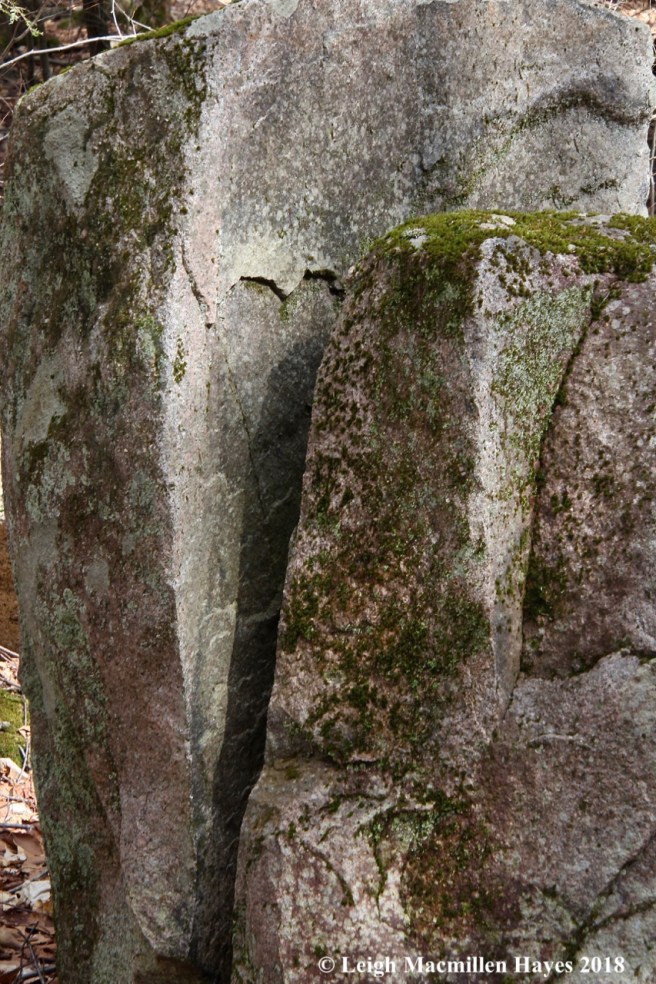
p7-split rock:heart

Conditions were different on the trail than the road, and though it’s a wide space used by snowmobiles in the winter, we had to watch our step for we encountered snow, ice, rocks and mud. But one rock was especially appealing and I’m not sure we’ve ever seen it before. A perfect split revealed a heart tucked within. As it should be.

p8-slow down

Onward and upward, we heeded the sign.

p9-lunch rock

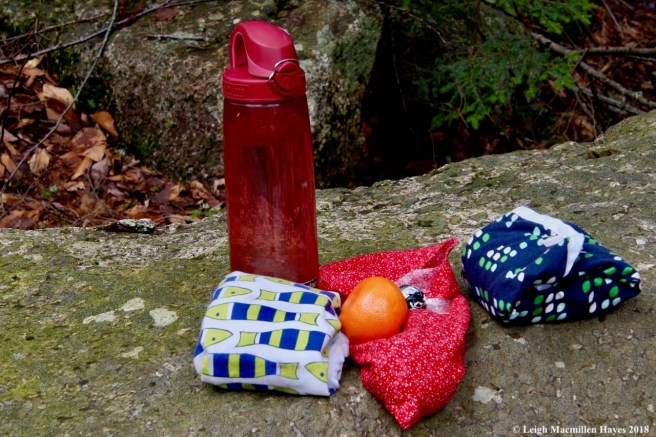
And then hunger overtook our desire to wait until the pond, so we found lunch rock and enjoyed the feast we’d prepared. PB&J topped off with a Clementine and Extra Dark Chocolate Truffle, with water to drink, of course.

p23-Province Brook

Province Brook rushed past while polypody ferns provided a head of hair atop one of the boulders.

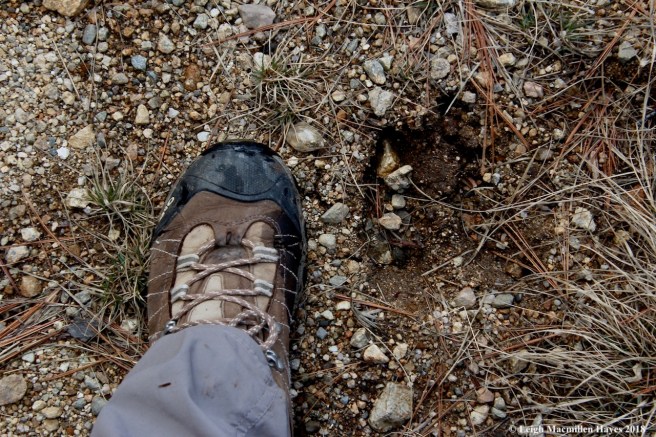
p10-moose tracks

After lunch, we had a wee bit further to travel before reaching Province Pond. At the dam, our excitement heightened for we discovered moose tracks in the snow.

p11-moose tracks

And more in the mud.

p12-Mount Shaw and Province Pond

Before us, the pond and Mount Shaw created a pleasing picture. We listened to the wood frogs wruck, though we couldn’t see them. Nor could we see any moose, but we hoped.

p13-Mount Shaw reflection

As usual, I got hung up on the reflection of the mountain and the subtle colors of spring, which was about a week later than back down the road.

p14-me

As I stood on the dam built to prevent beavers from creating their own, my guy took his first ever iPhone photo. I had to chuckle for it was the same view of me that I typically get of him. And do you notice who carries the pack–on the way up when it’s the most full with lunch and water? He always gets it for the descent, which works for me.

p14a-looking toward the shelter

From the dam, we looked across the pond toward the shelter, a tiny speck of roofline almost visible on the far shore, just right of center. And still we wondered, would we be able to get there?

p15-leatherleaf

Before trying, I noted leatherleaf with buds. Within a month, I suspected those tiny buds will become bell-shaped flowers.

p15a-sweetgale

Beside the leatherleaf, the overlapping burgundy and white scales of sweetgale catkins provided a delightful contrast beside the sky’s reflection on the water.

p16-shelter

We moved on, following the trail to the hut–and made it, the water we needed to cross over not being high at all. Built in the 1930s, the shelter has many stories to tell, and my guy read a few of them.

p17-shelter view

We’d actually saved our dessert, our form of icing on the cake, and so enjoyed the view as we finished lunch.

p18-lungwort on tree

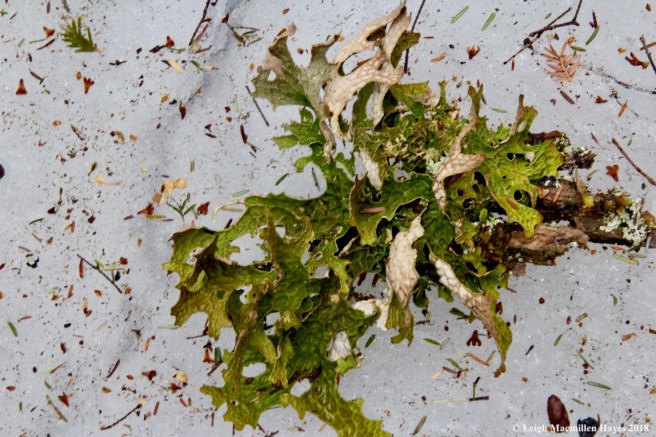
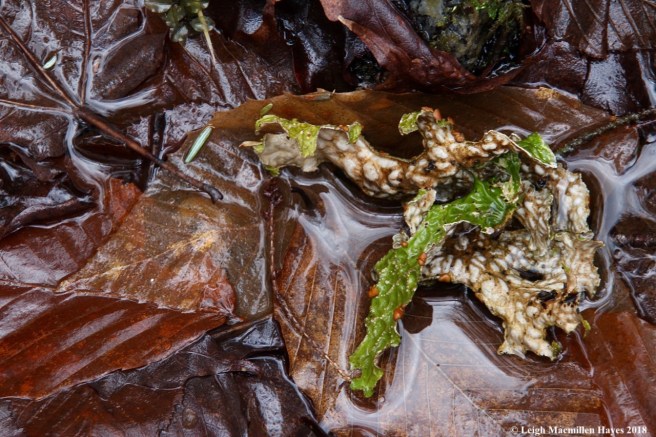
On our way back down the trail, the brilliant green upper leaf of lungwort drew my attention as it has always done. The bright green was due to yesterday’s rain, which set the algae into production. The underside was pale with pockets of cyanobacteria, known as blue-green algae. Though it’s named for its resemblance to lung tissue, it does have a lettuce-like look. According to Lichens of the North Woods by Joe Walewski, lungwort is “found in rich, unpolluted and often very old forests.” Bingo!

p19-lungwort on ground

What surprised me was that we found some on the ground, this batch on snow. Moose have a preference for lungwort. Had they pulled it off a tree?

p20-lungwort apothecia

More surprising was that some had apothecia, its spore-producing structure. Do you see the tiny tans specks along the lobe margins? It’s uncommon to see these and was a first for me. Typically, lungwort reproduces by granule-like masses called soredia that form on the surface, break off, land on a suitable substrate and grown into new lungwort lichens.

About nine miles round trip and our journey was completed. Old joke, but I can’t resist for I was lichen the Province Brook Trail from the start and it just kept getting better and better.


Sallie Savers Celebrate Big Night with LEA

The initial email was sent by Mary Jewett of Lakes Environmental Association in Bridgton, Maine, on Tuesday:

Hello everyone!

Many amphibians have already crossed and laid eggs but there are still some waiting in the woods. Tomorrow evening looks like it will be perfect conditions for an amphibian migration and I would like to get a group together to go out with me. My plan would be to meet at the office at 8pm. With sunset being at 7:40 I really wouldn’t want to start any earlier since the frogs and sallies won’t move when it’s light out.

I want to get an idea of who would be able to come out with me. I have a reporter and videographer coming out from the Bangor Daily News and they would like to get shots of actual people (not just me) and possibly get some quotes from participants. I know that it’s tough to get out with kids since it starts so late but I hope that we can get a diverse group. We also may have the opportunity to check out egg masses that are already in the water!

And then this afternoon, Mary sent this follow-up message:

I have heard from a handful of people who are able to come out tonight so I’m going for it. Here are some details:

Meet at the LEA office building (230 Main Street) at 8pm
We will caravan up to the Masonic Hall and walk to Dugway Road from there.
Bring high powered flashlights/headlamps
Wear warm clothes and rain gear. It looks like the rain may be pretty heavy when we are out there. Good for amphibians but not so great for people trying to stay dry.
Wear reflective clothing if you have some. I have vests available if you don’t have your own.
Do not wash your hands with soap or put on hand lotion or hand sanitizer.
I have spoken to the police and they are going to try and send someone out. They have a training program this evening so we might not see them. This makes it extra important that kids stay with their parents at all times!

b3-amphibian crossing sign

And so we did just that–met at the LEA office first, and then moved on to the Masonic Hall to park before beginning our journey into the wet and wild world of the amphibians.

b1-redbacked

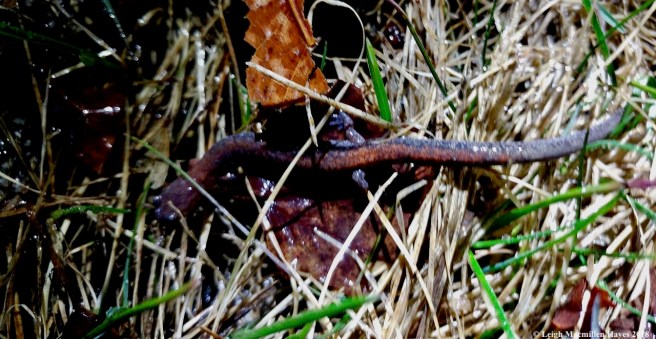
Right away, we noticed worms. And even better, a red-backed salamander. Red backs don’t use vernal pools to mate, but they sure do love rainy nights that offer great opportunities to roam about seeking food.

b2-red backed salamander

We crossed the field from the Hall to Memory Lane, our eyes ever looking for more redbacks, but instead we noted a kazillion worms, each the size of a young snake. And then, after only a few minutes on the road another redbacked graced us with its presence.

b4-Mary explains rules of the road

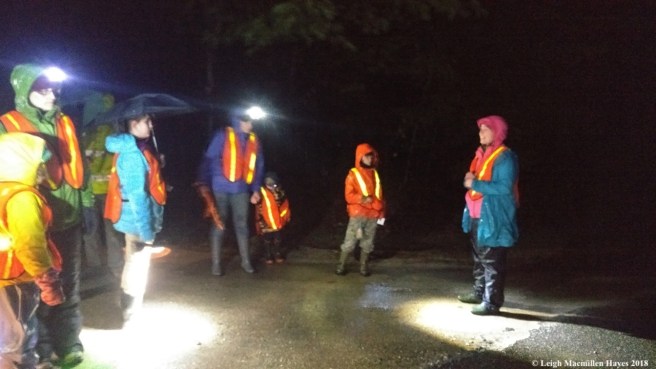
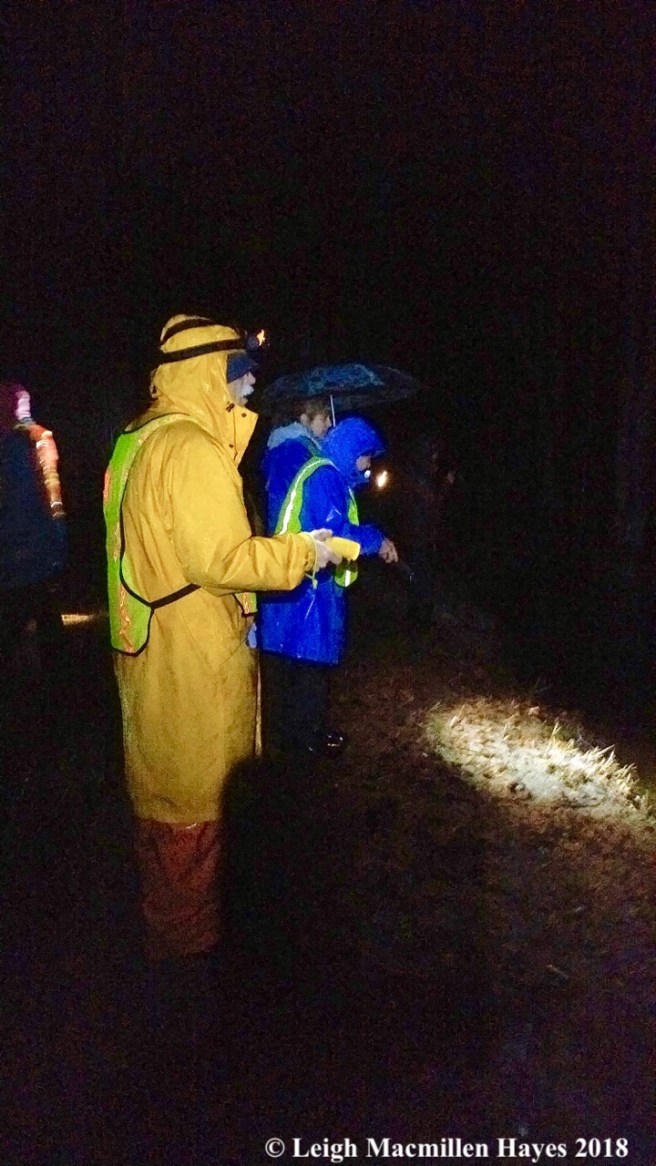
Finally, we reached Dugway Road, our destination, and Mary took a few minutes to remind folks of safety rules. Some years the Bridgton police are able to join us and either shut the road down or at least slow traffic. Such was not the case tonight and so it was important that our crowd of at least twenty ranging in age from four years old to 70+ be cautious.

b4-walking the road

And then the real fun began. We spread out across the road with flashlights and headlamps, walking with care as we tried to notice the little things in life who chose this night to return to their natal pools in order to mate.

b6-spring peeper

Right away, the good times got rolling as we began to spot spring peepers. Really, it was those with eagle eyes who spotted the most, which wasn’t easy given the asphalt conditions. Though we knew better, we did have to wonder if the amphibians chose this road because it provided good camouflage.

b5-first catch- spring peeper

Being the first of the night, Mary demonstrated the fine art of capturing the peeper, explaining first that her hands were damp and had no soap or cream upon them.

Outstretched hands of one of the younger set awaited a transfer.

b5-pass off

The mission was to help the peeper get to the other side of the road. Typically, once captured, we transport them to the side in which they were headed.

b5-final pass off

The release was made into the youngster’s hands and then onward the child holding frog went. Lucky for the frog, there was a culvert at the side and that seemed like the safest place to release it.

b14-into the vernal pool

Further down the road, the songs of the wood frogs and peepers were almost deafening. As we looked into the vernal pool that was still half covered in ice, there was some movement, but the frogs all continued to sing despite our presence, unlike what happens when we approach a pool during the day and they dive under the leaf cover for a few minutes.

b7-spotted salamander

We found enough peepers, but the stars of the night were the spotted salamanders.

b8-sally and worm

The youngest among us picked up one of the ubiquitous worms that marked the night and laid it down beside a sallie.

b9-sally eyes

Sallie didn’t care. It was on a mission and just wanted to move on without our interference. There was only one thing on its mind and we suddenly stood between it and that goal.

b12-salamander

It had a dance to perform before the sun rose and we had a heck of a nerve for getting in the way. I’m always in awe of these creatures who spend at least 11.5 months under the leaf litter and maybe a week or two in the pool. Our rare chance to catch a glimpse of them is on such a rainy night as tonight.

b10-sally on card

Our intentions were in their favor. We only wanted to help save them from the vehicles that passed by.

b11-sally's world

In the end, though, I had to wonder–is this what the salamander’s world looked like as we scooped it up and helped it across.

Possibly, but still, it’s always a thrill for tots, tweens, teens, and all the rest of us to celebrate Big Night with the Lakes Environmental Association. We are the Sallie Savers.

The Amazing Race–Our Style, episode 3

We were a bit confused by the clue–something about an oven and ice and we felt like maybe we were headed to a kitchen. My guy doesn’t cook all that much and I avoid it as much as possible, so we knew this was going to be a tough leg of the race. Surely, we’d be there all night trying to concoct something and the sky would darken on our chance of winning.

To top it all off, it was an equalizer. That meant that though we were early to the starting point, all participants would begin at the same time. And so we had some time on our hands and a few dollars to spend on lunch and libations.

o1-clue

As we sipped, our clue was revealed. And we were ready to heed it, despite our anxiety over the cooking issue.

o2-footbridge

Following lunch, we still had more time to kill and decided to walk across the footbridge in Boothbay Harbor.

o3-ghost harbor

It was a bit of a ghost harbor on this day, but it won’t be long and people and boats and more people will fill this space.

o5-sign of snow

As we walked around town, we did some window shopping–of the best sort.

o4-clock

And then a view at a clock reminded us that we had a place to be by 1:15.

o6-crooked sign

Look for the crooked sign, the clue stated. We found it.

o8-trail conditions

Follow the trail. We did.

o10-mud below

Note the tide. It was obviously out.

o11-bridge

Locate the bridge that connects Oven Mouth Preserve West to Oven Mouth Preserve East. Bingo.

o13-ice house cove dam

But what was below us, we wondered. And that was our next challenge. We had to figure out the configuration of this land. It looked like an old bridge, but rather, it was a former dam that had been used to create an ice pond on the other side of the bridge upon which we stood. Aha–the icy portion of this leg of the race. Our task was to discover its history. Reading a brochure produced by the Boothbay Region Land Trust we learned the following: “In 1880, in response to a growing demand for ice, [the cove now known as Ice House Cove] was dammed to form a fresh-water pond and an ice house was built. The ice was shipped by schooner, mainly to Boston and New York.” Today, any blocks of ice would surely have melted as happened in our water bottles.

o7-garter snake

While we looped around the two peninsulas we had a several other challenges to complete. First, we needed to find three examples of critter sign–other than the ubiquitous red squirrel middens. We checked off number one with a garter snake that slithered past.

o7b-mammal tracks

Number two: mammal tracks in the mud below. We couldn’t get close enough to identify it, but noted the trotting pattern.

o7a-wasp nest

And number three, the remnants of a paper wasp nest.

Another challenge down. How many more to go?

o12-scavenger 2

It wasn’t long before the next presented itself as we wound our way around the property. First, we needed to find evidence of the land’s former use–as a sheep pasture in the 19th century.

o12-scavenger hunt 1

And then the letter D. We never did learn what the D stood for, but . . . we found it.

o15-sausage-shaped boudins

And finally, a sausage-shaped boudin among the folds, formed by the pinching and swelling from compression and shearing.

o13-Cross river

The tide slowly flowed in as we journeyed on.

o14-rip where Back and Cross River met

And at the point where the Cross River met the Back River, we noted a rip current visible in the swirls.

o14-ice house dam and today's bridge

At last we crossed back over the bridge from east to west and then peeked at the dam juxtaposed as it was in the shadow of the modern-day bridge.

o16-oven?

From the outermost point of the west side, we paused to look back toward the dam and bridge–did the early explorers really see this rounded cove as the inside of an oven, thus naming it Ovens Mouth? It was certainly unique. Fortunately, we could enjoy the view without turning up the heat. If they thought it was an oven, we agreed. If it meant we didn’t have to cook, we definitely agreed.

From the brochure, we did learn more history: “This area has always been inviting for maritime activities because of its deep-water access and protected location. Settled in the mid-1700s, one of the region’s earliest shipyards was located here and both British and American vessels hid in the coves during the Revolution. Soon after the Civil War, the property came into the hands of the Tibbets-Welsh family, who owned it for more than a hundred years.”

o17-kissing tree

We had one last challenge to complete before finding our way to the mat. Our final mission: to note three sights that represented our relationship.

Kissing trees–check.
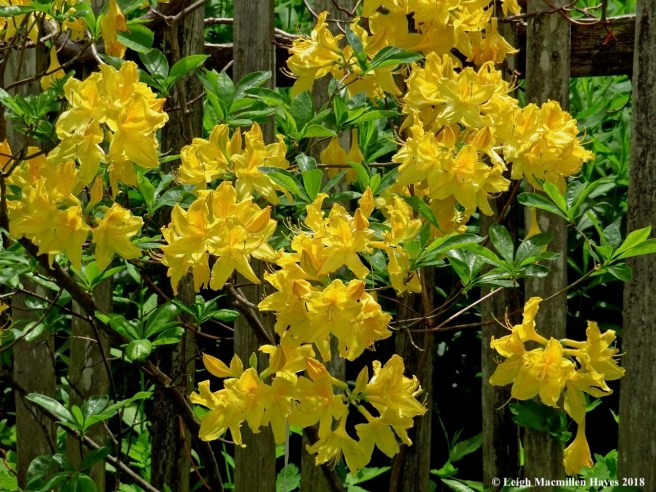
o17-heart

A heart-shaped rock–check.

o17-pigeons

Whispering sweet nothings–check. (Note the heart-shaped white cere on their bills. And no, he is not picking her nits. Well, even if he is, isn’t that a loving move?)

Once again, we managed to stay ahead of other contestants, didn’t squabble too much, avoided our worst fears and completed the assigned tasks without much stress. In the third episode of our imaginary rendition of The Amazing Race–Our Style, we landed on the mat in first place once again. What’s next? Stay tuned.


Dear Earth

Dear Earth,

In your honor, I decided that on this Earth Day I would head out the back door and travel by foot, rather than vehicle.

e1-Mount Washington

My journey led me down the old cow path to the power line right-of-way and much to my delightful surprise, Mount Washington was on display. It was so clear, that I could even see the outline of buildings and towers at the summit. Thank you for providing such clarity.

e2-vernal pool

Rather than walk to the mountain, I turned in the opposite direction and found my way to the vernal pool, where ice still covered a good portion. You know, Earth, as much as I want this to be a significant vernal pool because it does usually have two qualifiers (and only needs one): more than forty wood frog egg masses or more than twenty spotted salamander egg masses, I know that it is not. I believe it was created as part of the farm based on the rocks at the far end, not exactly forming a retaining wall, but still situated so close together in a way that I haven’t found anywhere else in my extensive journeys of the hundreds of acres behind our house. Plus, it dries up much too quickly to be a natural pool. And each year I’m surprised to find wood frogs, their egg masses, spotted salamander spermatophores, and their egg masses, given that the water evaporates before the tadpoles finish forming. If these species return to their natal vernal pool, Earth, then how can that be since no one actually hopped or walked out as a recently matured adult? Or were these frogs on their way to another pool and they happened upon this one? You know me, Earth–lots of questions as I try to understand you better.

e4-dorsal amplexus

Whatever the answer is, each year you work your magic and on a visit yesterday afternoon, I spied a male wood frog atop a female in what’s known as amplexus, aka, mating. According to Maine Amphibians and Reptiles, edited by Malcolm L. Hunter, Aram J.K. Calhoun, and Mark McCollough, “When mating, the male clings tightly to the females back. Visible contractions of the female’s body signal the onset of oviposition, at which time the male’s hind feet are drawn up close to the female’s vent. As the eggs are expelled, the male releases sperm into the water and strokes the egg mass with his hind feet, which presumably aids in distributing the sperm more evenly.” I looked this morning, but didn’t find any sign of eggs. Don’t worry, Earth, I’ll keep looking because perhaps they were there but hadn’t absorbed water yet.

e5-dead frog

One other thing I saw yesterday that greatly disturbed me was a dead frog in the water. Last year I also found such. My concern is that it was caused by a virus, but perhaps it was old age. Or some other factor. I do have to confess, though, Earth, I intervened and removed the body from the pond. I know, I know, it’s all part of the cycle of life, and I should leave nature to its own devices, but disease was on my mind and I didn’t want others to be affected. I may have been too late. Only time will tell.

e7-leaf variety

When I arrived this morning, I’m happy to report that I didn’t see any dead frogs. For the longest time I stood upon a rock–you know the one I mean, Earth, for you’ve invited me to stand there before. It’s sunny in that spot and the frogs know it well, for that is where they’ll eventually deposit their eggs. As I waited, I looked down at the leaves on the pool’s bottom and noticed how they offered a reflection of the trees above, beech and oak and maple and pine and hemlock. All still displayed their winter colors, but when the pool does dry up, they’ll turn dark brown and form a mat that will provide nutrients for the plants that colonize the area. You’ve got a system, don’t you Earth.

e8-frog 1

I knew if I stood as still as I could, I would be rewarded. While beech and oak leaves, the last to fall from their trees, danced somersaults across those already on the ground and matted by the past winter’s snow, red and gray squirrels chatted and squawked, and chickadees sold cheeseburgers in their songs, my eyes constantly scanned the pool. And in a flash, a frog emerged from under those leaves.

e8-wood frog 1a

For a while he floated, allowing the breeze to push him to and fro within a two square-foot space. But then he decided to climb atop a downed branch. Perhaps he was trying out a calling sight to use once I left.

e9a--wood frog 3

And then, there was another. And after that another. Yesterday I saw a total of six. Today only four. But that doesn’t mean the others weren’t hiding until I left, right Earth? I hope that’s what it meant. One thing you have taught me via the frogs is patience. If I stand still long enough at least one will swim to the surface. And they, too, are patient as they wait: for me to leave; for the gals to come. Well, maybe when the gals do come they aren’t all that patient.

e10-mosquito larvae

I actually returned to the pool a second time today and more of the ice had melted. While in the late morning I couldn’t see any insects on the move, in the early afternoon I eyed thousands of mosquito larvae. Everyone moans about mosquito larvae, Earth, but . . . they provide food for salamanders and the adult form for birds. I’m just trying to look on the bright side.

e11- snowmobile trail

This afternoon, I waited and waited for the frogs to emerge, but either my eyes didn’t key in on them or they decided to wait until I left. So . . . I finally did just that, and did head toward Mount Washington after all, following the snowmobile trail. As you well know, Earth, it was a bit tricky between the snow, soft mud, ruts and rocks exploding from your earth.

e11a-boots

My right foot managed to fall through the icy snow into a hidden rut filled with water that covered my Bog boots. And then my left foot found some mud that squelched with glee. Or was that you squealing with delight, Earth? I had one wet sock, but ventured on.

e11b-Mansion Road

At the junction, I turned to the west, following the log road and remembering the days of yore when my guy and I, as well as neighbor Dick Bennett, used to work up a sweat on a winter day following a snow storm, for it was our duty to you, Earth, to release the snow from your arched gray birch trees. And then, a few years ago, the road became the main route to the timber landing/staging area again, and all of those trees we’d worked so hard to protect year after year were cut to make way for machinery. As much as my heart broke, it does give me time to watch forest succession in action, and I gave thanks that you have such a plan in mind.

e14-deer dance

It also provided a blank stage upon which the does danced and left behind their calling cards.

e12-buck

And Buck sashayed each partner across the floor. The deep dew claw marks and cloven toes indicated he’d made quite an impression.

e11c-coyote scat

All along the way, upon raised rocks in the middle of the “road,” coyote and fox scat was prominent and in the sandy surface I also found their prints.

e18-vernal pool near landing

At the left-hand turn that led to the landing, I was surprised when I shouldn’t have been, for suddenly a million “wrucks” filled the air. I knew the water was there but it had slipped my mind. Thank you for the song of many more wood frogs. Thanks for filling my ears with joy.

e15-wood frog egg masses

And the chance to spy their good works. Thankfully, you make sure that life continues. At least in the form of wood frog egg masses.

e17-wood frog egg mass

I loved their gelatinous blob-like structure, all bumpy on the outside they were. Actually, I believe what looked like one mass, was several, but I didn’t dare step in to check and disturb the frogs that hid below.

e16-wood frog 5

Again I stood as still as possible, and again I was rewarded. For a bit I thought that the frog before me had no arms, but then I realized that they were just plastered to its sides.

e19-wood frog under log

A squirrel sounding bigger than itself caught my attention briefly and I turned unexpectedly. When I turned back, the frog was no longer at the water’s surface, but appeared below a downed gray birch. For a while the two of us remained still. I hoped another frog or two or three or three thousand would pop up, but that wasn’t your plan, was it? It’s okay. One was enough.

e21-log landing

I finally left my one, oops, I mean your one frog alone and continued on to the log landing, noting all the mammal tracks and looking for other signs. There was more scat, but I was disappointed not to find bobcat or moose prints. Where were you hiding them? I suspect the moose had moved to the swamp below.

Rather than go much further, for major ruts from the logging equipment were filled with water, I turned around just beyond the landing and headed back across it. Twenty-five years ago it was a much smaller clearing with a few pine trees. Over the years, I’ve watched it change and the mammal activity as well. And then, about five years ago it was converted back to a landing and I can’t wait for it to fill in again, but my desire and your plan are not necessarily the same, are they?

It all seemed like so much destruction, but I had to remind myself that I am part of the equation, with my own needs for power and wood and food and everything that you provide. And cuts do bring about a change, sometimes for the better, for the trees and the mammals and the birds and the plants and the decomposers and the consumers and all who call this place home. Am I convincing you, Earth? Am I convincing myself?

e22-frog 7

As I passed by the lengthy vernal pool again I decided to revisit the egg masses. I stood on the rock and slowly scanned the area. No frogs. On second glance, there was one right beside the rock on which I stood. And it looked like the same one I’d seen previously. I wondered why. Why didn’t I scare it? Was that you, Earth, taking a peek at me?

e23-Mourning Cloak butterfly

I had one more surprise on my journey–the first butterfly of the season, a mourning cloak. With its wings closed, it wasn’t all that attractive.

e24-mourning cloak

But upon opening them, I saw its beauty hidden within–another lesson, eh Earth? Oh, and your sense of humor. For yes, that was coyote scat on which the butterfly sucked as it sought amino acids and other nutrients. A fly also dined. Yum.

What a day, Earth. Your day. Dear Earth Day. May I remember to treat you so dearly every day.

Sincerely,

wondermyway


Tramping with Teresa

It was a sad week. It was a happy week. Both, of course, are understatements. But that’s how life is. And so today, four days after Tom Henderson, the executive director of the Greater Lovell Land Trust, passed from his human form to that of an otter, his partner Teresa and I escaped to the woods.

Like Tom, I want to be reincarnated as an otter, for they seem to have the most fun.

s1-peering in

And fun it was as Teresa and I parked near the Leach Link Trail and walked down Stone House Road for I was afraid we’d get stuck in the mud and snow. OK, so I like to have fun, but getting stuck wasn’t high on my list of “this is a blast” must dos. Maybe it’s my advanced age. ;-)

Actually though, I was glad for the opportunity to walk the road, because I knew what I wanted to show Teresa. But, she discovered a few other things worth looking at first. Curiosity was the name of our game and nothing would go unexamined–much like an otter would move through the landscape.  And so, at the old camp that rarely seems to see much use, we peered through the windows.

s2-peering up

And up to the eaves where another home showed its facade.

s3-pole 1

As we continued on, we played telephone. Remember that game where you sat or stood in a line and passed a message along and by the time it reached the last person, the message was totally changed and somehow quite humorous? Well, the rules were a wee bit changed today and our telephone was more like tag. In black bear tradition. All along the road, we stopped to check the poles for signs left behind like the upside down 1.

s5-pole 17

Scratches and bite marks marred the poles in a way that made our hearts beat with wonder.

s6-pole

And that hair, oh my! Who needs lions and tigers?

s7-gate

At last we reached the gate . . . and walked around it. Six hundred acres of the Stone House property is under conservation easement with the Greater Lovell Land Trust thanks to the foresight of the owners and guidance of Tom.

s9-airfield looking back toward the mtns

Onto the airfield we walked and then turned around for the view was as commanding as usual. To our right, the Stone House, built over a hundred years ago with granite quarried on the grounds. In front of us, the mountains of Evans Notch, including the Bald Faces and the Basin Rim. And immediately before us, the military airstrip built in the 1940s for training exercises during WWII.

s11-Rattlesnake Brook

Onward we continued until we reached Rattlesnake Brook and the old orchard.

s12-rattlesnake brook

The water soothed our souls.

s13-Colts Foot

And then a spot of color caught Teresa’s eye. Coltsfoot, a perennial that resembles dandelions, and is the first flower to appear in spring.

s14-colts foot

Tom would have known this, but I never trust my own information about foraging–Coltsfoot can be tossed in a salad to add an aromatic flavor, blended with honey to remedy a cough, or dried and chopped up, then mixed into pancake batter. But . . . don’t take my word for it. Tom was the chef. My best culinary creation–popcorn.

s15-false hellebore

False Hellebore or Indian Poke was our next spring ephemeral. I’ve always been drawn to its ribbed leaves, but today noticed something different–the stiff-haired growth that embraced it. Rhizomes? I’m not sure.

s15-wider open

As we walked, we paid constant attention to our foot placement for the young plants were everywhere and we knew other plants were also just emerging. And so we tiptoed.

s20-ostrich fern fertile frond

The feather-like fertile fronds of last year’s ostrich fern also drew our attention.

s16-beaver works

And beaver works that suggested a visitor in the fall of 2017.

s17-rattlesnake brook

As drawn as our eyes were to the plants at our feet, reflections in the water and life in general graced our afternoon.

s14-cliffs

We noted the cliffs above where Peregrine Falcons nest.

s22-stream

Continuing on, another stream spoke to us–its water murmuring our thoughts . . .

s23-water fall

and mirroring our memories.

s23-Shell Pond

A wee bit further, we stepped down toward Shell Pond and enjoyed the view offered.

s24-beaver lodge

Including a lodge inhabited by local residents.

s25-cherry bark

On the way back we were stopped in our tracks by a cherry tree almost totally debarked by a bark beetle.

s26-cherry bark

We both knew beaver and porcupine trees and had seen the hieroglyphics left by bark beetles before, but never had we seen such fresh work. Black cherry bark is often described as burnt potato chips and as Teresa noted, all had spilled out of the bag and lay on the ground.

s27-fork in the road

Our adventure ended at the fork in the road. When you come upon it, don’t take it ;-) But do pause.

Pausing was the name of our game today as we traversed five miles together and shared Tom moments while channeling our inner otter. Thank you, Teresa, for tramping with me. I can’t wait to do so again.

P.S. And with that, I’m proud to say, “It’s a boy!” I’m a great aunt again–to Baby Gormley who was born yesterday morning. May he develop a sense of wonder about the natural world and follow his inner otter.

Craning My Neck

I’ve spent a lot of time thinking about living in the moment lately, a concept that really drove itself home during the years that my mother dealt with dementia and I was forced to realize that each time I left the room, my return was a new visit; a new adventure. And now, so many friends are dealing with issues that make every second precious and I realize once again the importance of slowing down and noticing and making the most of being present. Now.

f1

Such was the case this afternoon when I joined two friends who had pulled in from their winter home in Florida this week. We met at one of the parking lots for the Mountain Division Trail in Fryeburg, Maine, a rail trail that makes one feel like you could walk to the White Mountains in a matter of miles. But, to get back to the moment, the original plan had been to travel the trail with two different friends and then one had to back out and I found out that the Florida friends had returned and so I invited them to join the other and me, and then my other friend had to back out and so it was the Florida duo and me. And it was so fabulous to spend time with them that we walked rather quickly, which completely surprised me when I thought about it for I know that they love a slow journey. But we had much to catch up on and because the trail is paved we didn’t have to think about foot placement and perhaps that’s what spurred us on.

f2-tamarack 1

At last, however, it was spurs that stopped us, for one of them spied a branch with upward facing cones and little spurs and she wondered what it was. The cones certainly looked like hemlock cones. But why were they upright? And what happened to the needles? When I explained that it was a tamarack, she again questioned it for she’s always been here in the autumn when the needles are a brilliant yellow and she thought those needles stayed on all winter. Not so, I explained, for a tamarack (larch, hackmatack–take your pick of common names) is our only deciduous conifer in northern New England. The golden needles fall the same as maple leaves.

f11-pussy willows

We also put on the brakes when she spied pussy willows–a sure sign of spring in their Zen-like presentation.

f20

Onward we marched, catching up on past months. But then, as the day would have it, first he had to turn around and head back to the parking lot and then a short time later she had to do the same. And that got me thinking about how the walk had evolved. I was sorry that the two I had originally planned to share the trail with couldn’t join me, but equally thankful for the two with whom I did travel. Living in the moment means embracing a change in direction.

f3-evening primrose basal rosette

The rail trail is four miles long in one direction and I turned around at the 2.5 mile marker. On my return, I was entirely surprised by the offerings that had escaped my attention previously, like the beauty of an Evening Primrose’s basal rosette.

f4-pitch pine cone

It’s fractal fashion was reflected in the pitch pine cones I spotted on the ground and surrounding trees.

f5-pitch again

The pitch pines always draw my fancy and I was especially intrigued by the past, present and future–as I tried to live in the moment. It’s not as easy as it sounds for we so often get caught up in what was or what could be.

f8-red oak

The past produced fruits long since deployed.

f10-speckled alder catkins

The future grew longer before pollinating the shorter.

f7-trailing arbutus in bloom

But in the moment–I spied the first blossoms of Trailing Arbutus.

f9-spotted salamander spermatophores

My return journey was much slower than the first leg, for there was so much to see. Included in the expedition was an examination of a small vernal pool. And what to my wondering eyes did I see? Spotted salamander spermatophores–those little chunks of sperm left behind by males atop cauliflower-shaped platforms.

f14-wood frogs quaking

As if that wasn’t enough, further on I heard a familiar quack and knew wood frogs were active though I couldn’t see them.

f15-wetland

And still further I discovered a wetland I’d never noticed before. Spring peepers sang from the far edges. It was all a surprise for on the walk out I’d told my friends from Florida that I hadn’t seen or heard any vernal pool action yet.

f15a--chipmunk

I just need to spend more time listening and waiting and letting it all play out before me, the same as the chipmunk that was sure I couldn’t see him.

f16-Canada geese

After a three-hour journey, I found my way back to the truck and then decided to take some back roads home. As I passed through farmland where cornfields are prolific, I noticed movement. I so wanted the movement to be another bird, but it was a huge flock of Canada Geese that attracted my attention. Again, I had to live in the moment and enjoy what was before me.

f17-sandhill cranes

And then I turned into the harbor, and was pleasantly surprised for suddenly my eyes cued in on those I sought who stood tall.

f17a--sandhil cranes

And preened.

f18-sandhill cranes

And craned their necks. Sandhill Cranes. In Fryeburg, Maine. They have returned to the harbor for at least  the past five years, probably more and I’ve had the privilege to hear them fly over several times, but today was the first time I was honored to see them. Thank you, Parker, for the tip.

I craned my neck and gave thanks for the moments spent in their presence and lifted up several people who will benefit from a dose of this medicine–Tom, Jinny Mae and Lifeguard Wendy: this one is for the three of you.


Greenwood Nature Mondate

We love Maine both for its natural beauty and historic nature. And so it was today that we enjoyed a wee bit of both as we headed off to Greenwood.

m1-Greenwood City sign

More specifically, Greenwood City.  According to the town website, “The first saw and shingle mill was constructed at ‘Greenwood City’ in 1805. In the mid-1800s, the wood industry moved to the Village of Locke’s Mills as a result of the railroad and a fire which destroyed Greenwood City.” Apparently, the city had been the economic and civic center of Greenwood, but the fire of 1862 changed everything. Nevertheless, this was our kind of city and our intention was to climb the mountain to the left of the sign–Peaked Mountain.

m3-Maggie's Nature Park sign

For years now, I’d heard of Maggie’s Nature Park, but never gave it much thought as a destination. That all changed today. The park encompasses 83 acres of mixed forest across the street from South Pond. It was gifted to the town by Maggie Ring, who had placed it under conservation easement with the Mahoosuc Land Trust. According to an article by Josh Christie in an April 2016 issue of the Portland Press Herald, “As Ring told the MLT in 2005, ‘I gave the land so my grandchildren and everyone else’s grandchildren can enjoy these woods. I want them to enjoy some of God’s good earth.’” 

Our plan was to begin on the orange Ring Hill Trail, and consistently stay to the right as we wove our way around the hill and up Peaked Mountain before descending via Harriet’s Path and finishing with the yellow trail.

m4-elbow tree

Because the temperature was on the crisp side, the snow pack was firm, though there were icy portions in the hemlock grove, and bare trail and ledges as well. As we began, we immediately noted an elbow tree, so formed probably when another tree landed upon it.

m4a-cedar

Moving along at my guy’s brisk speed, I was delighted to note the variety of trees, including cedar, and couldn’t help but imagine the teaching opportunities.

m6-evergreen wood fern

Where the snow had melted, shades of green drew my attention. And with a new season ever so slowly unfolding, I realized I needed to practice my fern ID and so I slowed my guy down for a wee bit. I think he secretly welcomes the breaks for he always finds a rock upon which to sit. One of the characteristics that helped in this ID was the first downward pointing pinnule–it being shorter than the one next to it. I also noted that the stipe or lower stalk, was shorter than the blade, and it was grooved.

m6a-evergreen wood fern

A look at the underside added to my conclusion for last year’s sori were round and all in a row between the midrib and margin. So what was it? Evergreen Wood Fern or Dryopteris intermedia if you choose to get technical. I choose to brush up on my fern ID.

m5-icicles

As we continued along Ring’s Hill, we took in the views from the ledges and under them as well, where icicles pointed toward the land they’d nurture.

m7-snack log

Eventually we followed the yellow blazes to the summit of Peaked Hill–and what to our wondering eyes should appear at a downed log near the view point? Two Dove eggs–the dark chocolate species. A perfect reward for our efforts. But really, the trail required little effort due to its well-executed construction with many zigs and zags to prevent erosion. We hardly felt like we were climbing yet we constantly moved upward.

m8-Mount Abram

The summit of Peaked offered the best views–this one being of Mount Abram, with its ski area at the top and to the right. The ski area is closed for the season, but snow still covered the trails that we could see.

m9-blueberry bushes

Also within our view–highbush blueberry buds suggesting a delightful treat for another day.

m9-toad lichen

And common toadskin lichen reminded me that Big Night is coming soon–that special rainy night(s) when we become sally savers and help amphibians cross that the road to their natal vernal pools. Stay tuned for that–there might be some migration later this week.

m10-trail well marked

All along, we’d noted the trail markers–bright colors and frequent placement made it easy to stick to the trail. But one caused me concern for it looked like it pointed us over the edge.

m11-trail makers

Not to worry, it was merely noting a junction and curve–my guy came in from the right because he’d chosen to follow the ledge from the Mt. Abram viewpoint, while I chose to return to our snack log and then follow the trail to meet him. Together again, we journeyed to the left as the trail markers indicated.

m12-marker curving 'round rock

Rather than stay on the Peaked Mountain Trail all the way back to the parking lot, we continued with our right-hand-turn progression and chuckled when we found one trail marker painted around the curve of a rock–so indicating yet another zig.

m13-dead end

A short spur on the red trail, aka Harriet’s Path, lead to one last point of view.

m14-pond view

South Pond below with Buck and Lapham Ledges in the distance–hikes saved for another day.

m15-boulder field

We looped back to the yellow trail and continued down through a boulder field–one more piece of what made this hike so interesting. It wasn’t long after that we completed the journey, but talked immediately about returning in other seasons for so delightful a trek it was. I can’t wait to see what flowers it has to offer and we both could only imagine it decked out with autumn’s tapestry.

m17-Greenwood Cattle Pound

On the way home, because I was driving, we had one last stop to make–by the Greenwood Cattle Pond built in 1835 just north of the city. Pounds were important features to secure stray animals prior to the invention of barbed wire and the stones would have stood taller than they do today, but still . . . another piece of history saved for this one is on the National Register of Historic Places.

At the end of the day we wondered why it had taken us so long to discover Maggie’s Nature Park, but thankfully we now have. And we gave thanks to Maggie Ring and her vision to protect “God’s good earth” for all of us. We loved the nature of Greenwood on this Mondate. Indeed.

P.S. Another claim to fame for this town: LL Bean was born in Greenwood in 1872.


Kinship With All Forms of Life

I walked today with intent, as I sometimes do, only that intention morphed between the beginning and ending of my journey. You see, I awoke with a need to reach a certain heron rookery that I’ve helped monitor for the Heron Observation Network of Maine during the off-season,  before the owner of the land returns. It’s a bit of a bushwhack to reach the site and in the past, I’ve accompanied Tom for this citizen science effort. Each spring, we’ve visited it at least once to count the number of nests and adults. Sadly, Tom won’t be joining me this year and so I headed off this morning to see what I might see–and be his eyes.

m1-squirrel

They were big eyes to fill–as big as the red squirrel who paused to watch me and then dashed along a stonewall on a mission of its own making.

m2-brook peek

Initially, the journey was a bit of a bee line as I followed a snowmobile trail. It was there that I delighted in the color of the sky and realized that most of the ice had melted on the beaver pond and brook below. I could have headed down to the water’s edge then, but chose to continue toward my destination.

m3-beaver dam inactive

I was almost there, when an old beaver dam forced me to stop. And then I heard a loud crash. I scanned the area and stood still–listening, waiting, wishing.

And then another noise–of movement. Again, I stood still. Nothing.

m4-land bridge

Finally, I arrived at the land bridge that would lead me to the rookery, but . . . my journey stalled and I realized I’d have to save the crossing for another day. Water rushed over the mossy mounds and because I was alone I decided not to risk falling in. As I stood and admired the flow, I thought some more about Tom and the crossing he is making from this life to the next.

m6-more ice bubbles

And I thought of his sense of wonder and ability to instill such in others, even over something as simple as ice baubles.

m 5-ice bubbles

I could hear an eloquent explanation flow forth from him about the movement of bubbles within an icicle formed on a branch.

m7-ice fingers

And I knew he would appreciate the artistic rendering before our shared eyes–in this case a wee bit reminiscent of M.C. Escher’s Transformation Prints.

m27-forest

At last I pulled myself away from the crossing I couldn’t make and turned back toward the forest from which I’d come. Tom had a hand in the vision of these woods–as a forester and as the executive director of the Greater Lovell Land Trust. His vision included forest management that would benefit wildlife. From where I stood, I saw turkey, deer, bobcat, and squirrel tracks.

A third time, I heard a sound and knew that I wasn’t alone. We never are, are we?

m8-mergansers

Eventually I made my way to the water’s edge and noted Hooded Mergansers in the distance. Around another bend, I spotted Wood Ducks. Tom would have loved it for birding was also one of his passions.

m10-beaver works

Within footsteps I admired the work of another forester who called this place home.

m11-beaver attempt

It seemed he’d sampled some trees and they weren’t to his liking–at that moment. Or perhaps something had startled him and he quickly retreated to the water. Either way, he treated this land as if it were his. For it was.

m12-more beaver

Everywhere, beaver works both old and new decorated the forest.

m18-lodge

And a lodge stood tall still partially surrounded by ice.

m7a-goldthread

But there was more of  the woods to see this day, like goldthread’s evergreen leaves that reminded me of cilantro. And also of Tom’s garden, for which he actually has some seedlings that will be ready to plant in another month and its produce will be enjoyed at a later date by those he loved most. Their dinners will be enriched for one last season by his green thumb.

m13-tiny shell

Next, I spied a tiny, fragile shell that was iridescent on the inside and brown on the outside. It couldn’t be a bird egg. Was it from a snail?  Tom would have known.

m14-holy leaf

And then there was a striped maple leaf like none I’ve ever seen before–almost stained-glass in its offering. It only made sense that it be so hol(e)y for in its life cycle it had provided energy to insects and as it continues to break down it will nourish the earth. Tom would recognize the significance of such–renewal, rather than devastation.

m15-hobblebush

There were other things to note, including a hobblebush flower bud that formed between its praying hand leaf buds.

m21-lungwort

And lungwort that served as an indicator of a rich, healthy ecosystem. Indeed.

m19-heron

I stood for a long time by the water’s edge, thinking of Tom and then I spied it. A Great Blue Heron flew in and landed across the way. My intention was honored. And Tom’s.

m24-rotten apples

At last I headed back the way I had come and passed through a field where a couple of apple trees grow. As I’d journeyed I had noted scat after scat–some filled with apple chunks and seeds. Of course, I rejoiced because I have an affinity for scat.

But Tom, too, would have rejoiced for what he set out to do so many years ago was to create wildlife corridors–those links of joined natural habitat. For Tom, that’s what it’s all been about–maintaining the ecological processes that allow mammals of all kinds to move and continue to be viable. And for the land on which they traveled to also be viable.

His has been a kinship with all forms of life beginning with the minute, like his shiitake mushrooms and the earth within his gardens and ending with . . . there is no ending, only new beginnings. May Tom’s next beginning be through the eyes of a Golden Eagle. As he soars above us, may he approve of the continued good works of others who try to emulate the legacy he will leave behind.

Godspeed Tom. And thank you.


Celebrating Mud Season

Mud Season — unique to northern states, indecisive weather, sloppy. What’s to love about it?

m1-breaking ice

Everything when thirteen Tuesday Trackers headed out for the final expedition until next winter. And no thin ice went unbroken by this hearty group.

m2a-turkey track

Prints in the snow we found along the way, but most were difficult to discern. In the mud, however, they were magnificent and we kicked ourselves for not thinking to bring some Plaster of Paris for great casts those would have made.

m2-Jo tells a snake story

Our tracking efforts were only part of the journey for along the way we were enraptured as we listened to Storyteller Jo Radner share a tale about a water snake, her grandmother, and some visitors to a children’s camp on Kezar Lake . . .

m3-bog

passed through the black spruce peat bog at the Kezar River Reserve on the eastern side and remembered time spent there with GLLT’s former executive director Tom Henderson (I told you, Tom, that you’d be with us and you most certainly were as we felt your spirit and heard your voice among the trees. We decided we need to return in the near future and spend more time getting to know that place–today, it required careful footwork and so we didn’t stay long) . . .

m4-Canada Geese

and finally found our way to Kezar River, where the Canada Geese and a couple of ducks awaited our arrival.

m6-ice

While some ice art in a stream that feeds the river drew our attention, we were there to look for evidence of a mammal that frequents the area.

m6a-otter scat

With youngsters among us, our eyes were more eagle than ever, and one of them found the sign we sought. At first sight, it appeared to be lichen on bark, but then our eyes focused and we knew what was before us–river otter scat.

m6b-otter scat formed

Some was matted as it had disintegrated a bit and only the scales remained, but others were formed in a tubular shape, all filled with fish scales, bones, and crayfish parts.

m7-otter scat

We rejoiced as we’d found a latrine site, a spot the otter returned to as a place to defecate, urinate and roll around in what’s known as a brown-out. It all provided information that we appreciated but meant even more to others of its own kind. “Hi, my name is Otty, I’m good looking and would be happy to meet up for a cup of fish stew. You available?”

m9-MUD

In the same area, we noted slides leading to the water and imagined the otters movement. And then some of our crew channeled their own inner otter and headed down to the feeder stream where the mud was difficult to resist.

m14-MUD

Mud! Worth showing off.

m11-washing off

And then the joy of cleaning off by stepping into the river.

m15a-mud angel

Mud season–celebrated with mud angels.