America the Beautiful

This morning’s rain and overcast sky embraced the melancholy emotions of this day as we remembered  family, friends, acquaintances and strangers who have served our country, especially those who died during times of conflict.

And then the sun shone.  It didn’t mean that we stopped remembering. But it did shine a light on the beauty that surrounds us and that we have the opportunity to observe if we so choose. Because of the service of others, we’re fortunate in that regard–we get to choose.

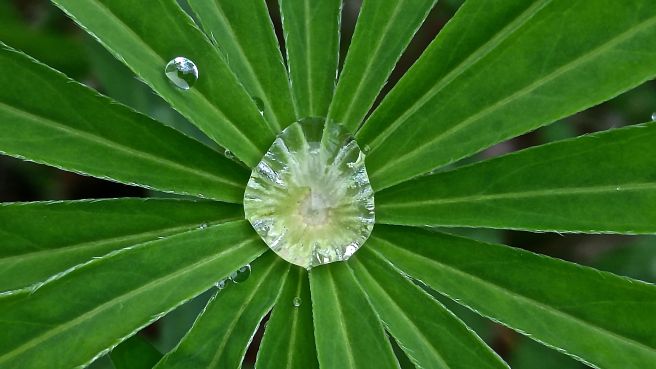
ph droplet on lupine leaf

I chose to step out the back door and notice.

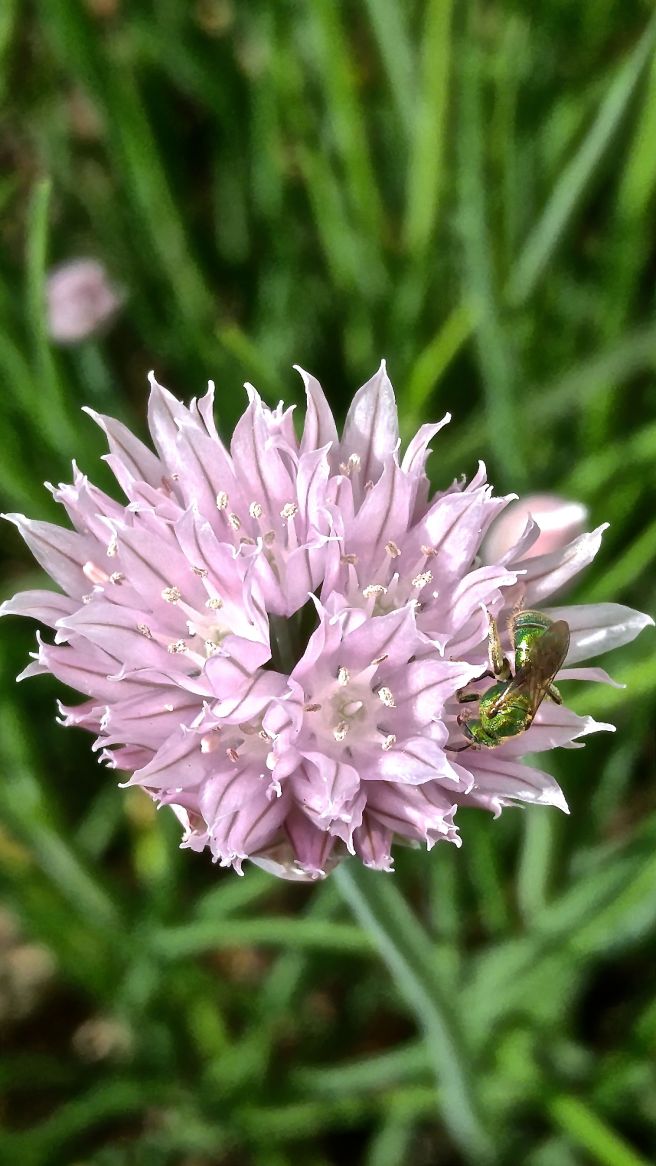
ph-chives 2

Visitors upon chive florets.

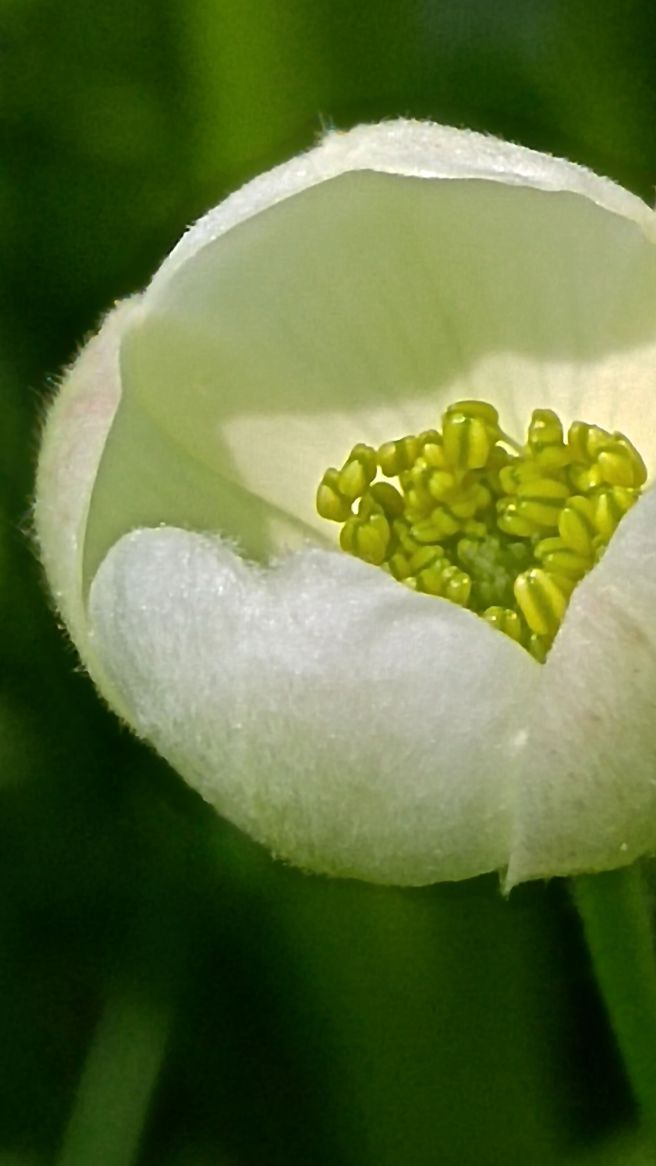
ph-anem2

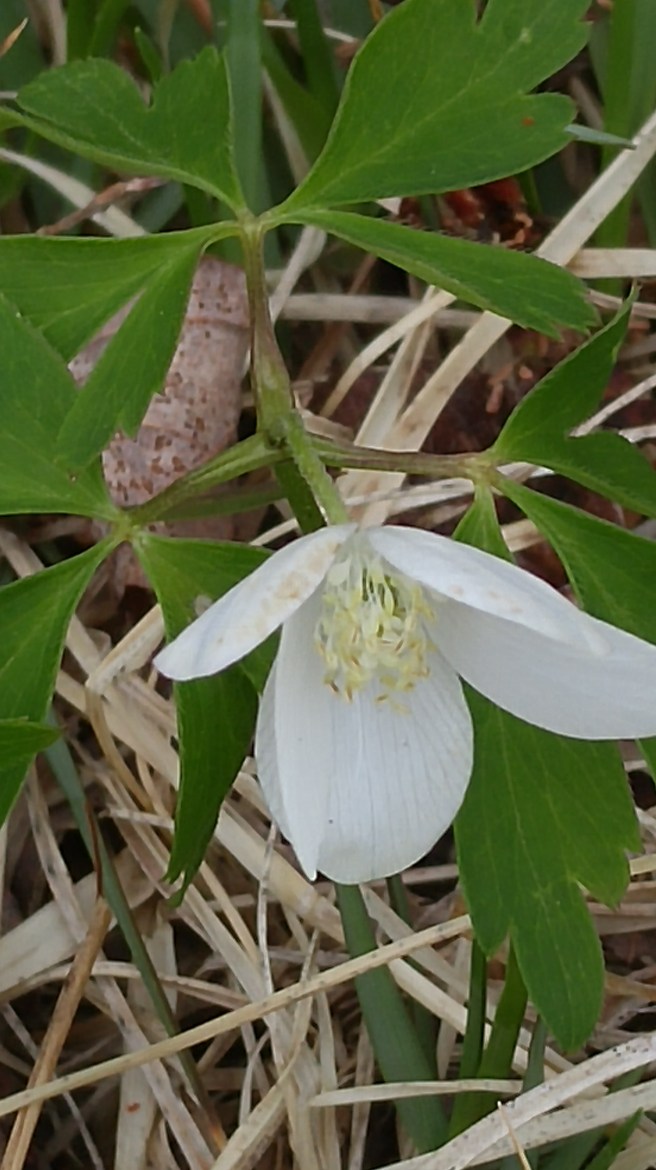
Unfolding Canada anemone.

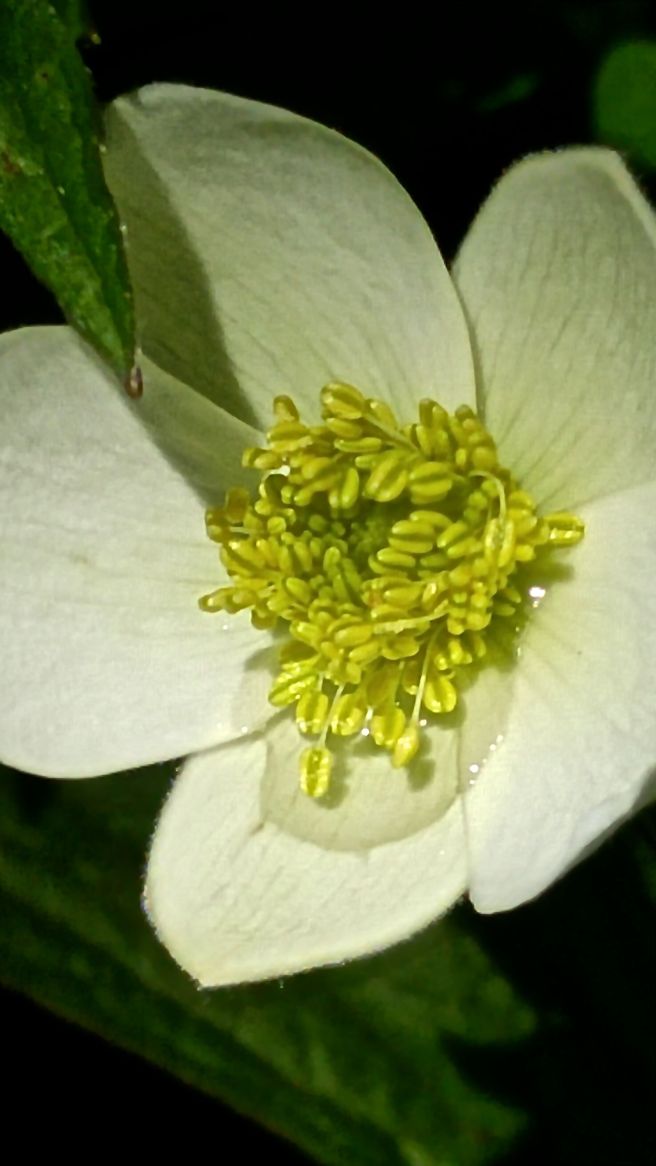
ph-anem3

And the first to open.

ph-cherry

Black cherry blossoms all in a column.

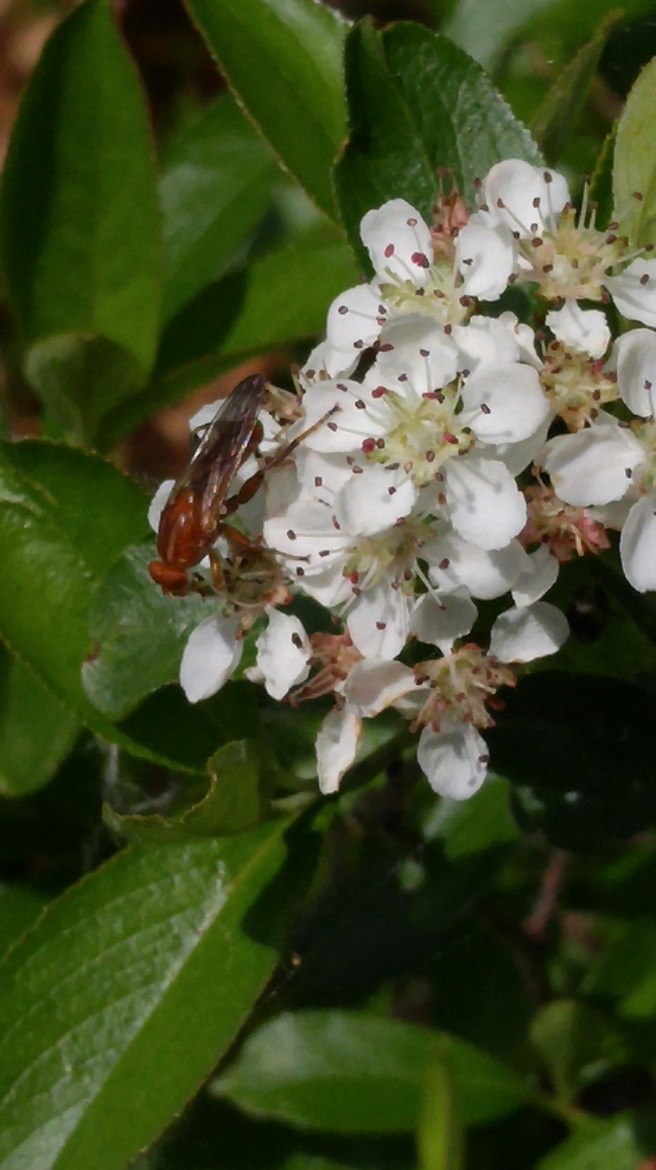
ph-chokec2

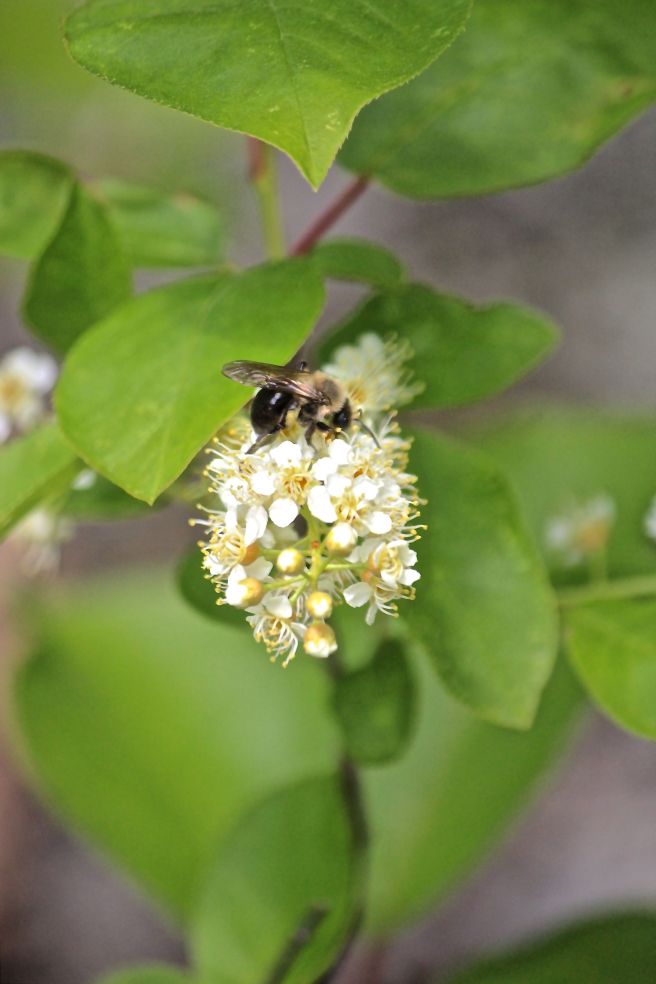
And chokecherry blooms in terminal clusters.

ph-hemlock cone1

Blue-green baby hemlock cones.

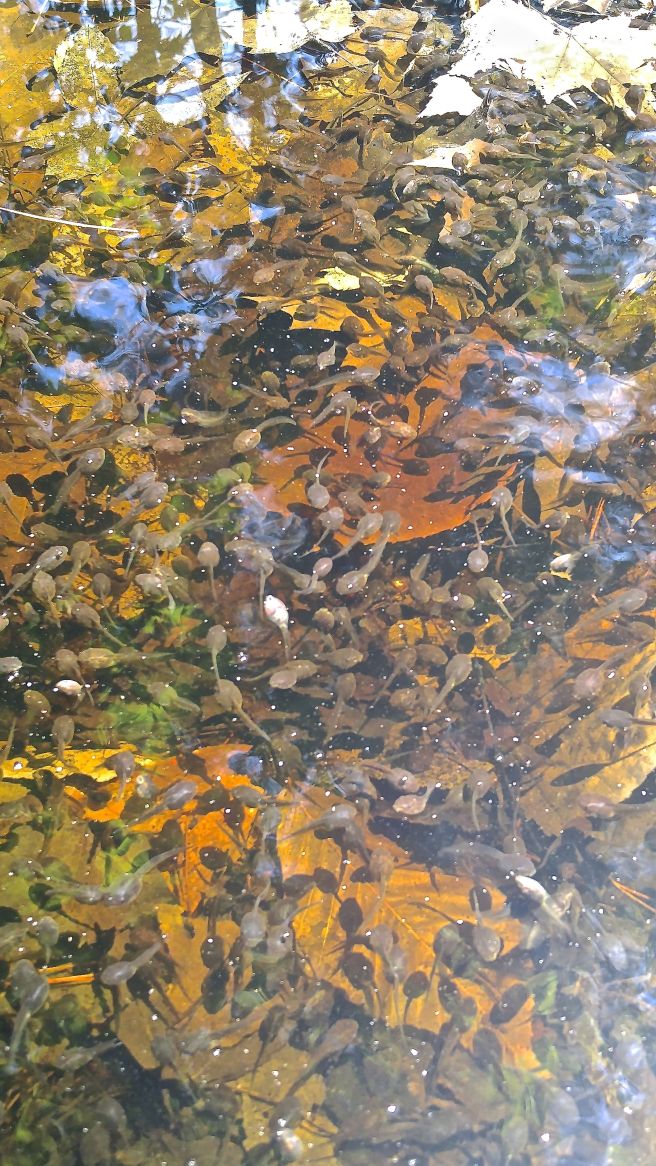
ph tad 6

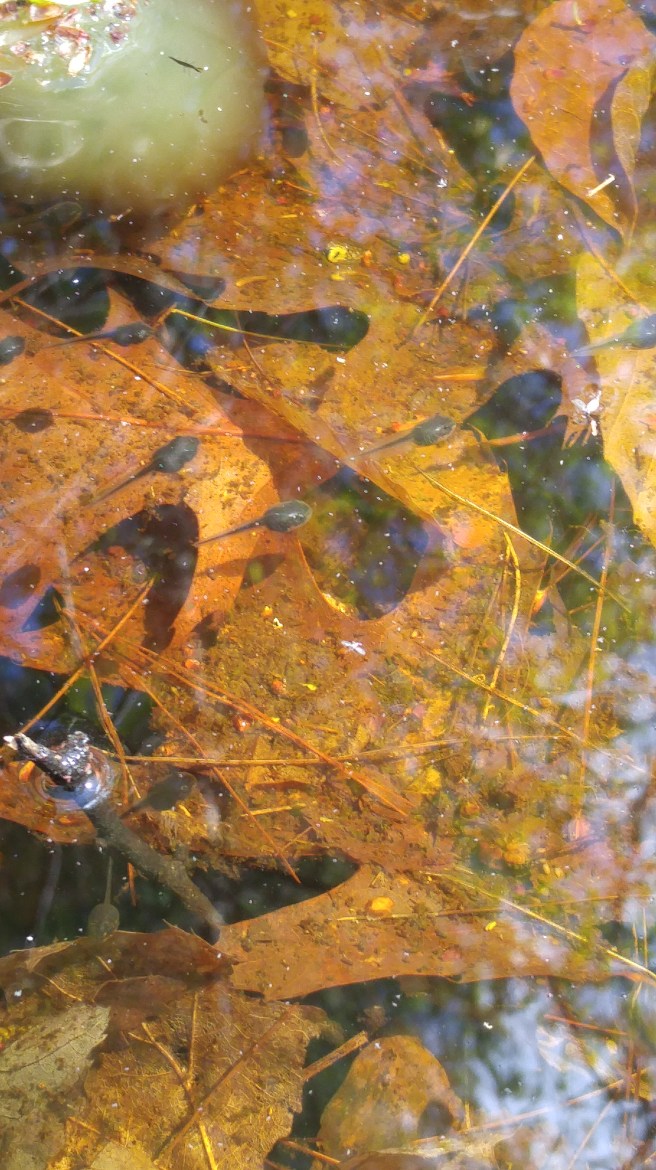
And life teeming in the vernal pool.

I’m thankful for the freedom of choice. America is beautiful.


The Stars of Miles Notch

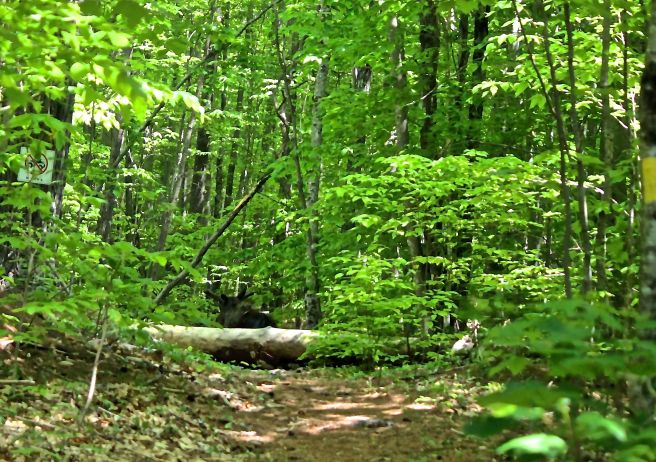
We only had to hike about a hundred feet along the Miles Notch Trail off Hut Road in Stoneham to discover that this was the perfect choice for a hot day in May. Well, sorta perfect. A little less heat and humidity would have cinched the deal. But, take a look:

m-moose

I heard something off to our left and tried to get my guy’s attention. He was looking down and didn’t see our trail partner at first. We found all kinds of evidence that this path was more well trodden by moose and deer, bear and coyote, than human beings. I think we both could have turned around at that point–happy for the sighting.

But . . . we continued our journey, not sure of our destination. Oh, we had a map. And actually met an acquaintance on the road who gave us an apt description as he used his hands to demonstrate the ups and downs of the trail. He was quite accurate in his description.

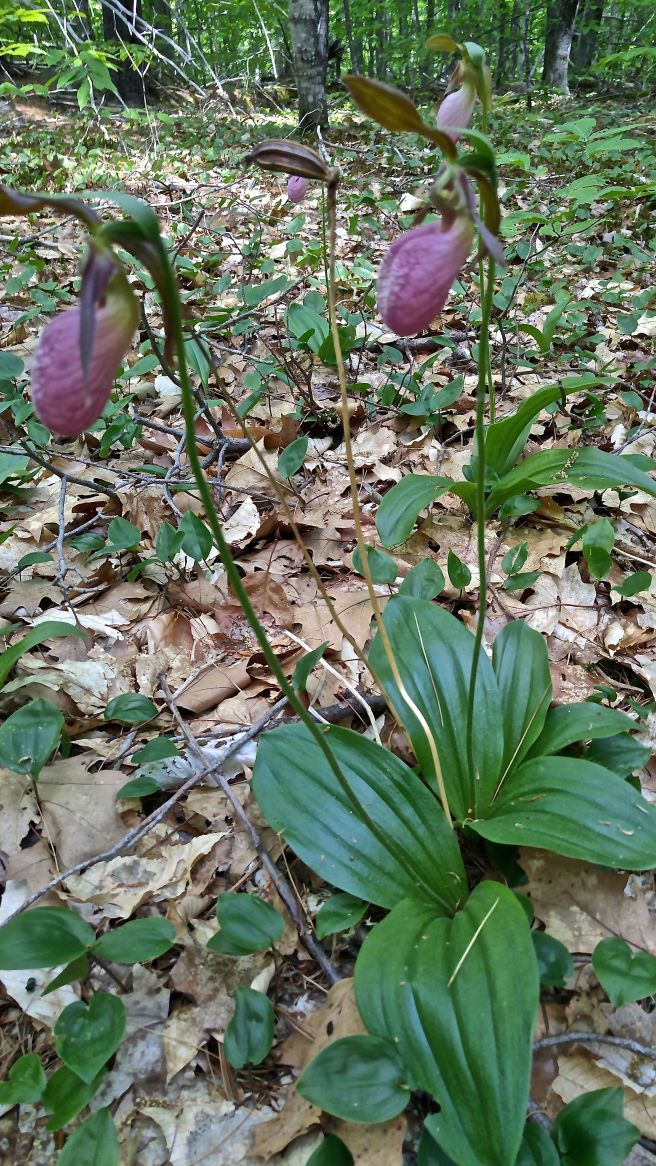
mph-lady's 3

There were other stars to encounter.

m-lady 1

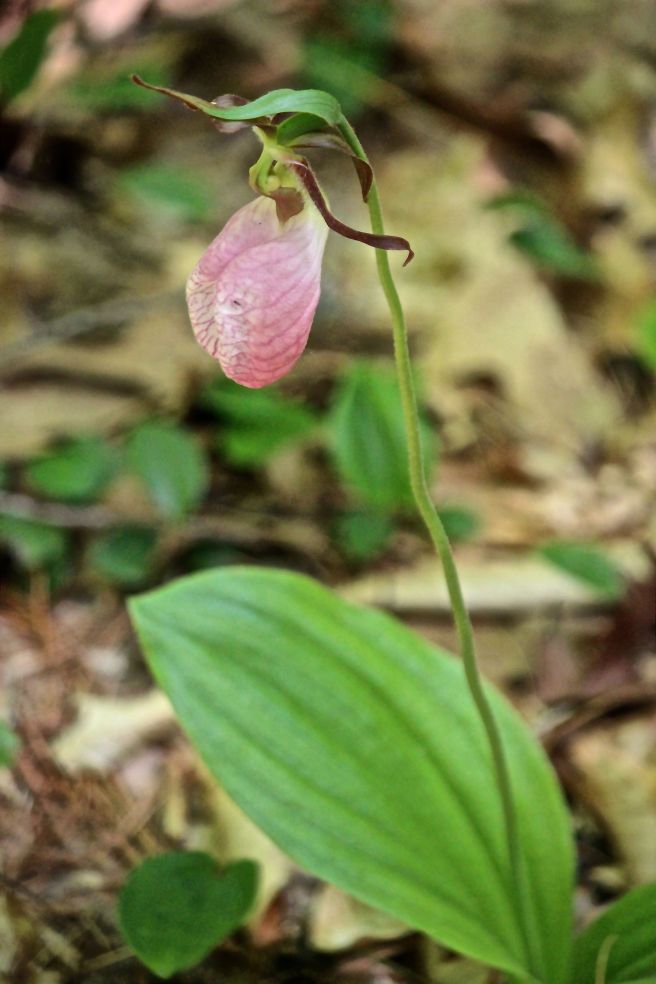
Meet our lady friends.

mph-lady 2

Each as beautiful as the next.

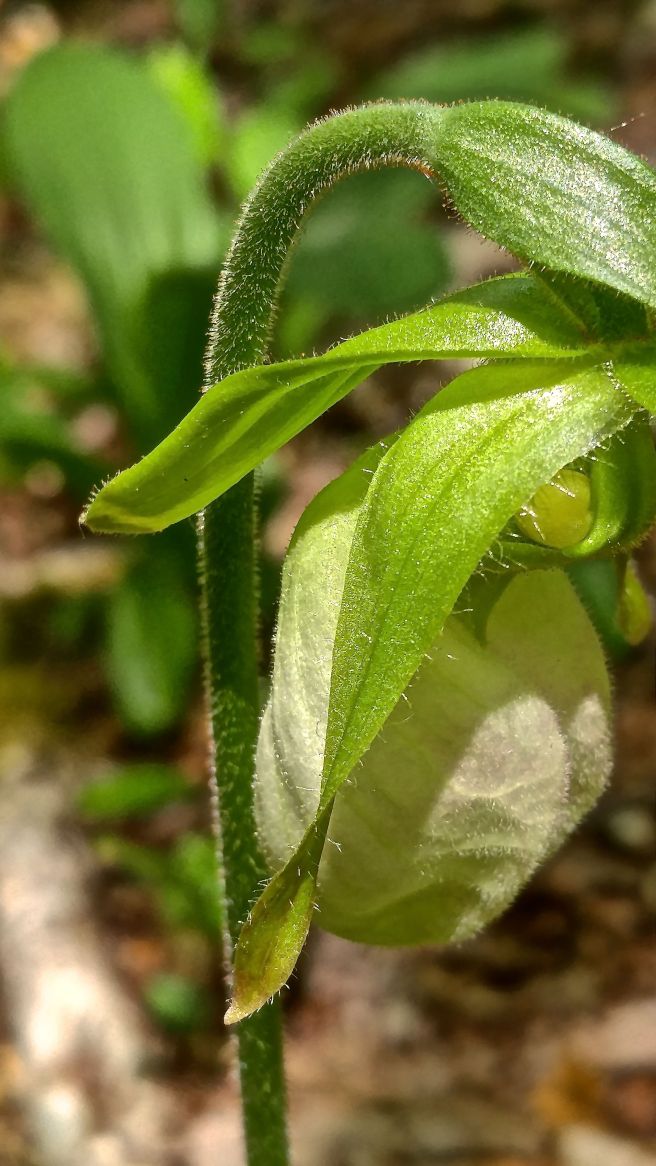
mph-lady 3

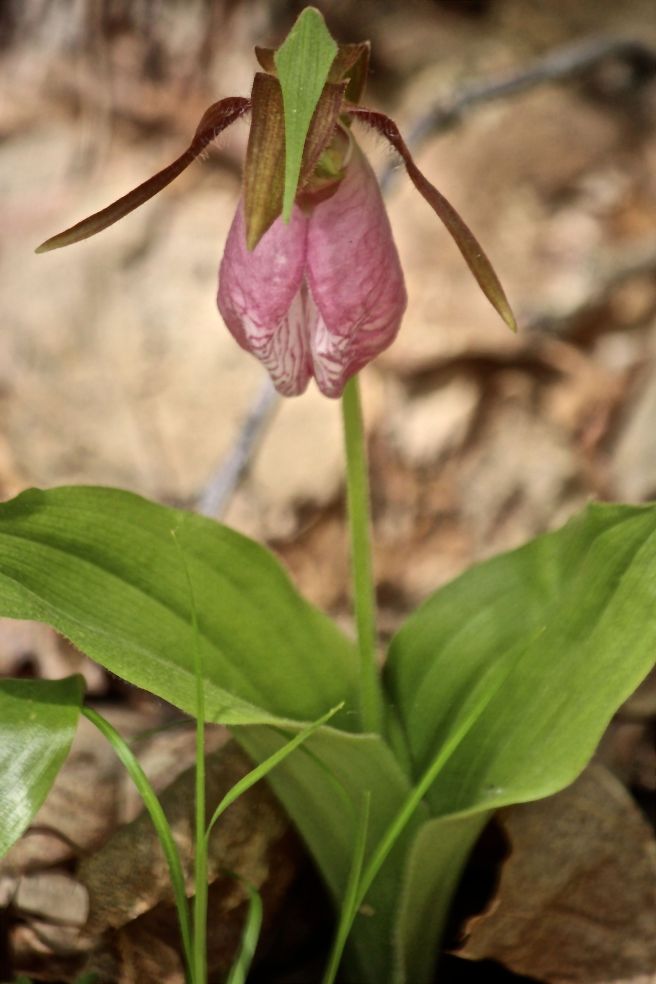
They wear exotic slippers indeed.

m-rosy 3

Equally plentiful–rosy lampshades dangled below twisted stalks.

m-striped maple flowers

Another dangler beneath striped maple leaves–more umbrella-like in presentation.

mph yellow clintonia

Yellow rays of sunshine beamed up at us.

mph-trill 1

And delicate splashes of color reminded us of paintings.

m-trill brown1

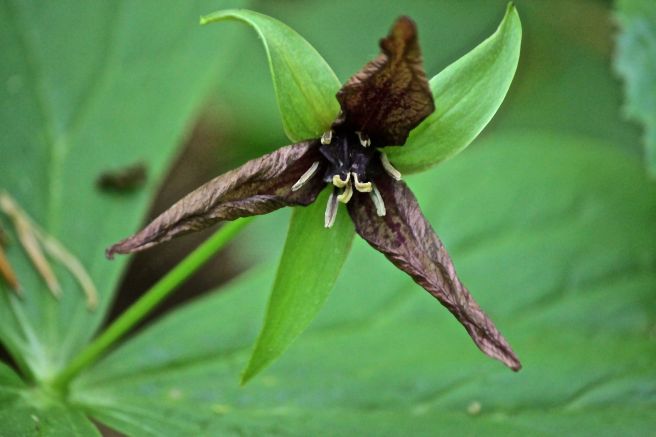
We even found a darker version of the red theme. I was extremely hot at this point and had visions of ice cream in my head–chocolate, of course.

mph-gargoyle 2

Not everything was beautiful, but still, the gargoyles were amazing.

m-bear 1

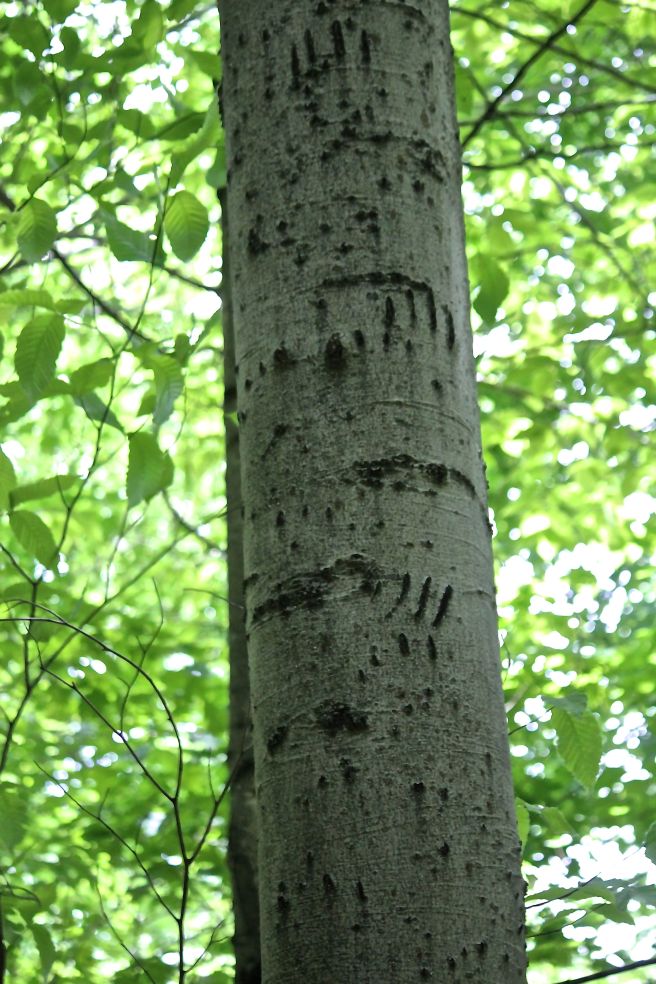
And, of course, we found some bear trees. Lots of bear trees.

m-stream

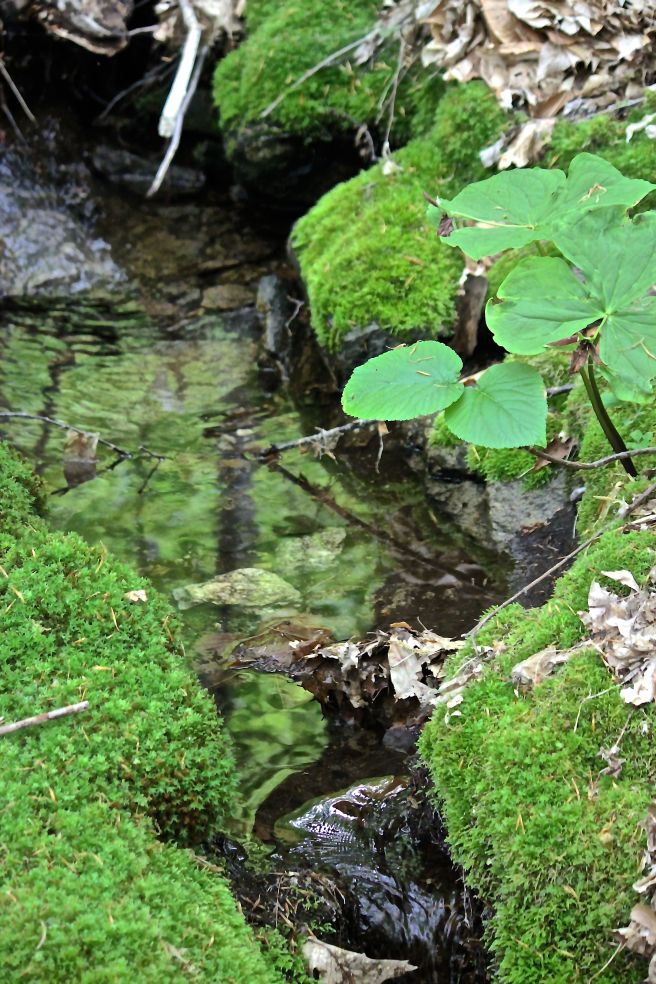
We crossed several streams–respites from the heat–where we dipped our hats and washed our faces.

m-trail sign

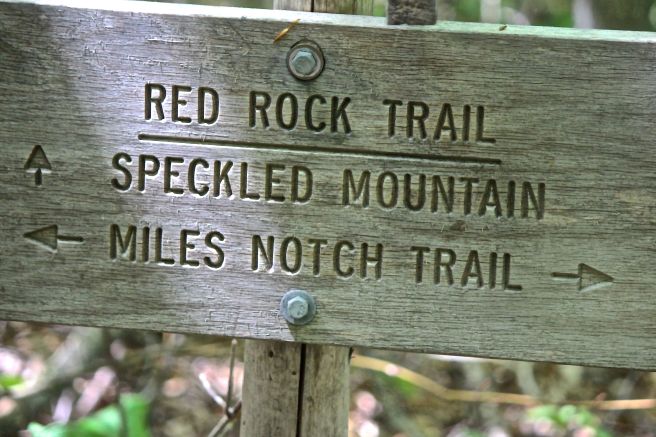
For a while we followed the trail toward Red Rock Mountain, but it was hot and we were tired and we had to pick our youngest up at the airport, so we turned around.

I should mention that we had passenger flies, blackflies and mosquitoes for the entire journey–not biting because we were well covered in bug stuff, but  certainly annoying.

That didn’t matter because eight miles later we’d seen plenty of stars, and it’s memories of them that will stay with us.

Oh, and the ice cream–I ate Denali Chocolate Moose Tracks and my guy feasted on Orange Blossom–at The Homestead in Lovell.

Searching for The Beautiful

Here is the world. Beautiful and terrible things will happen. Don’t be afraid.” -Frederick Buechner

My lovely neighbor posted this on her Facebook page last night in reaction to the sudden turn her family’s journey has taken. And so, while she went in search of the beautiful this morning, and found it in a few surprising places, I did the same. Of course, the terrible also presented itself.

This one is for you, Binaca–and your amazing ability to always put a positive spin on life.

ph-Stevens Brook

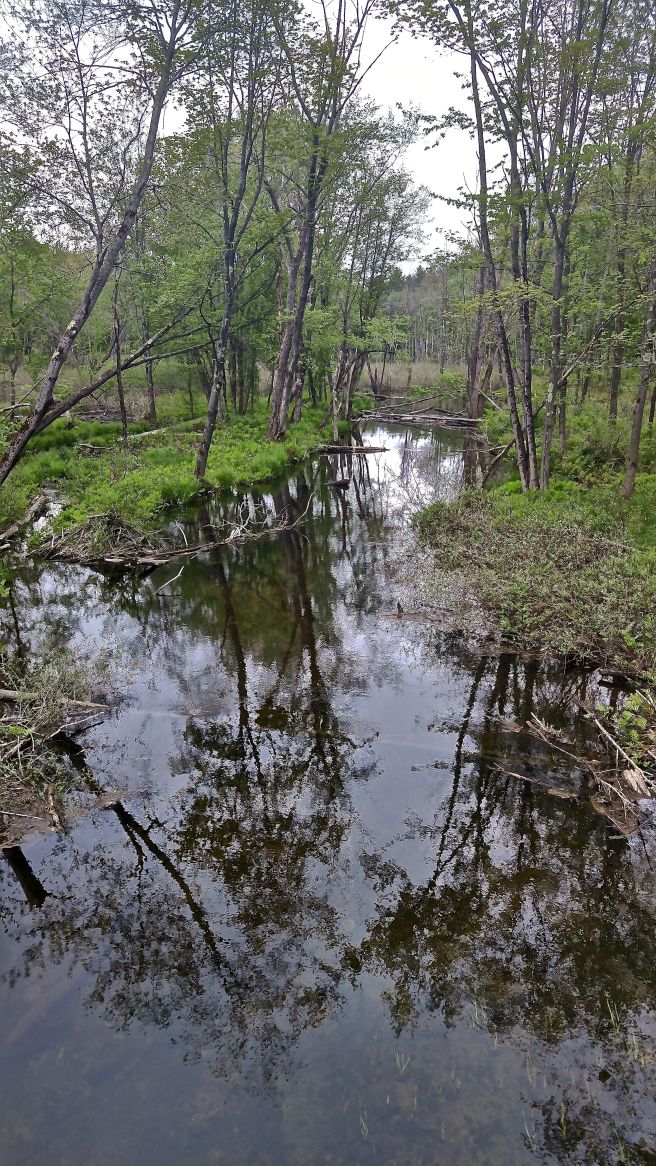
While muted colors reflected in the calm water,

p-yellow warbler 1

a yellow warbler foraged on a nearby willow.

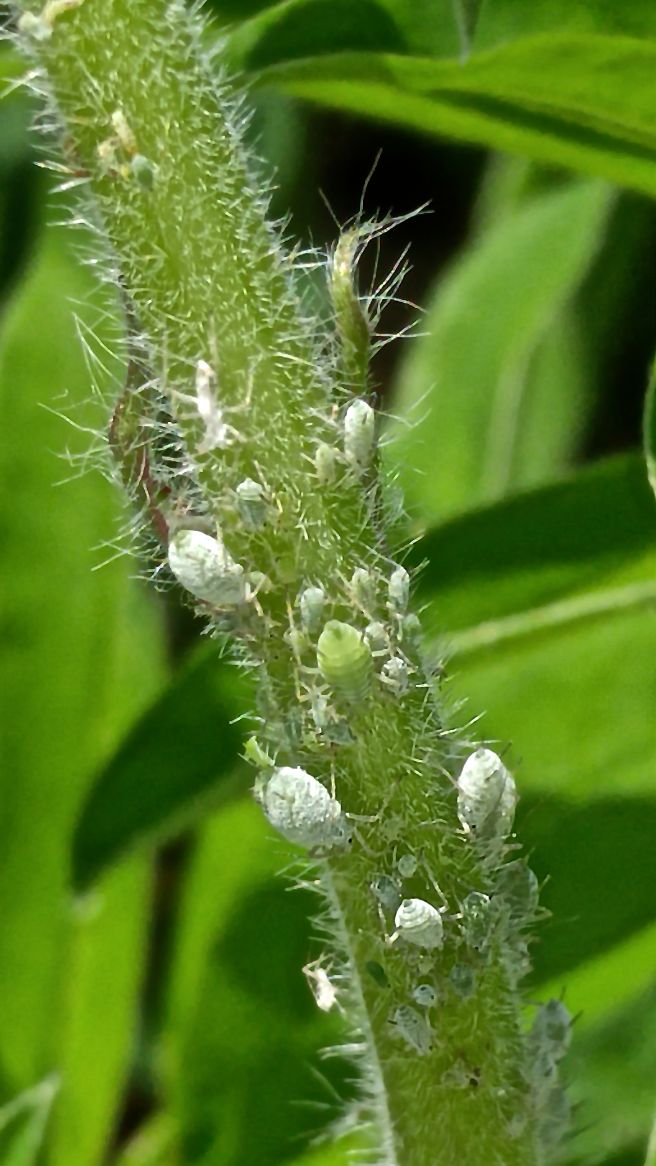
ph-aphids1

I trust he found plenty to eat because food seemed plentiful everywhere I turned, from teeny tiny to . . .

ph-stinkbug horns1

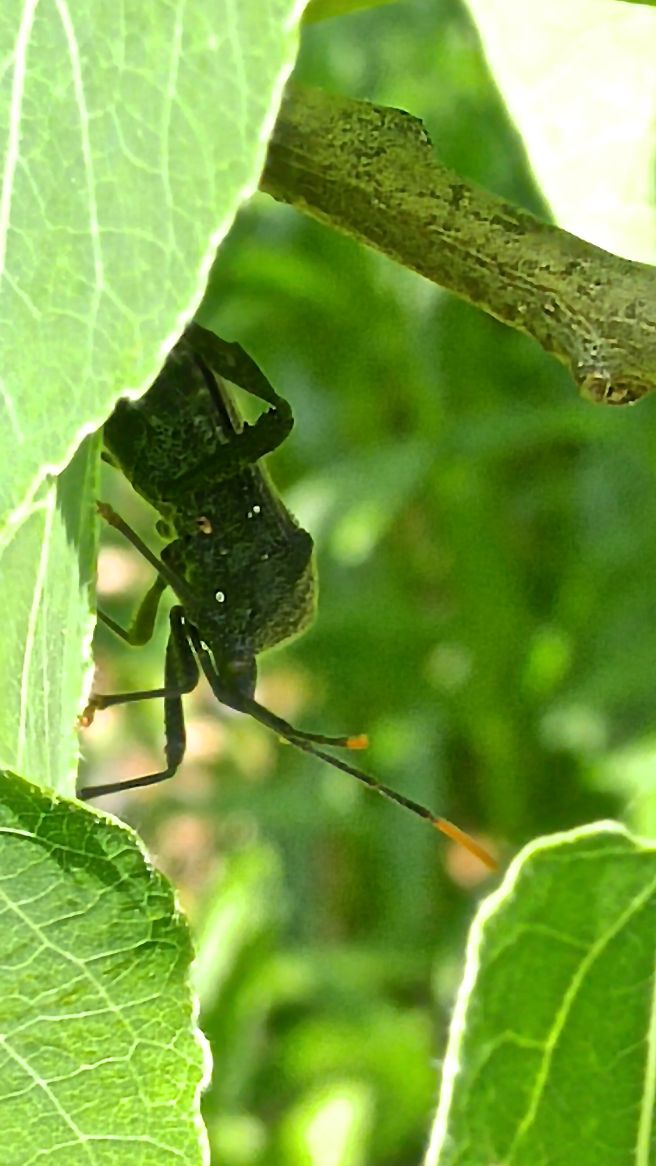
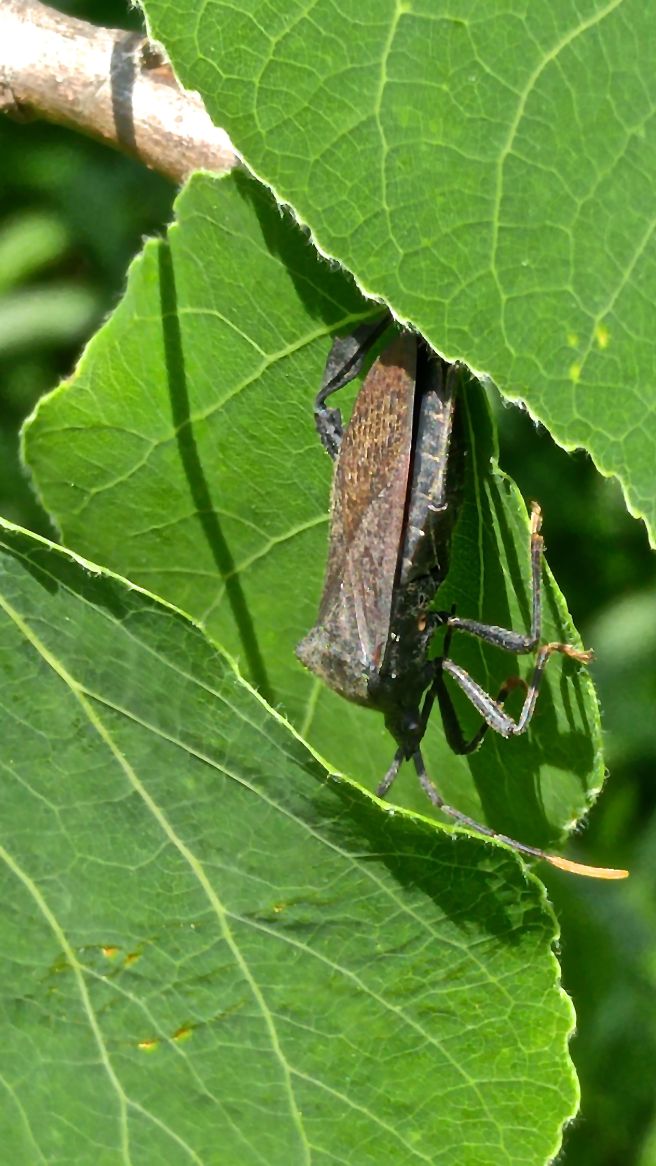
super-sized!

ph-stinkbug

(I hope this is a predator species of stink bug and not a plant eater.)

ph-lupine 4

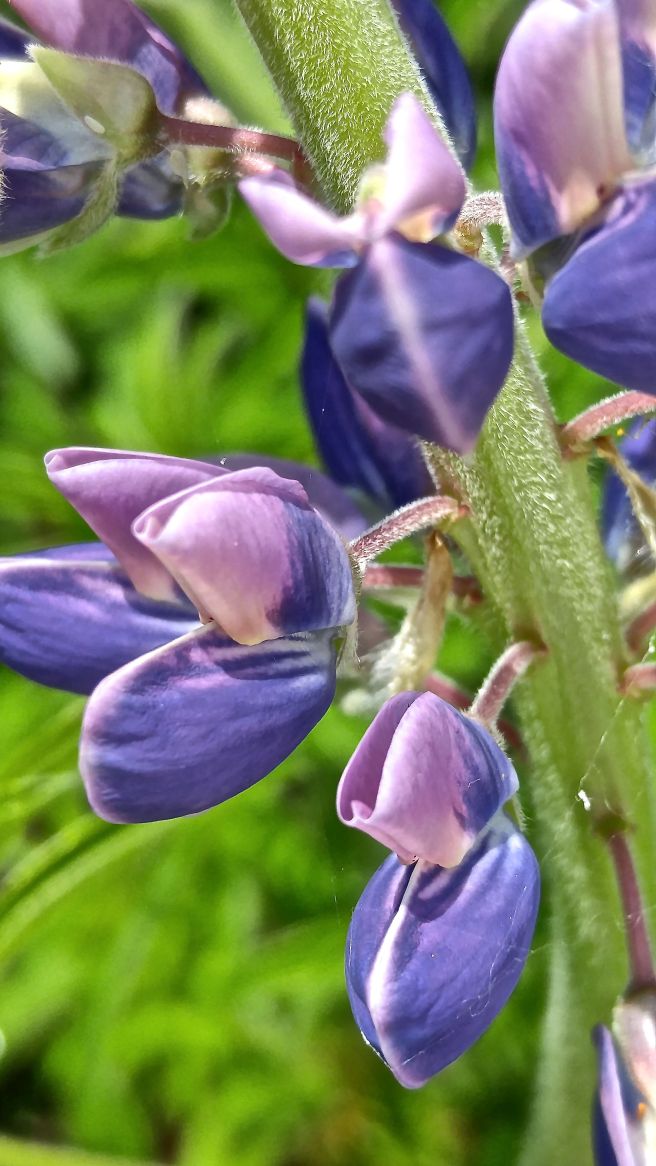
Hairy coverings didn’t necessarily mean the aliens wouldn’t invade.

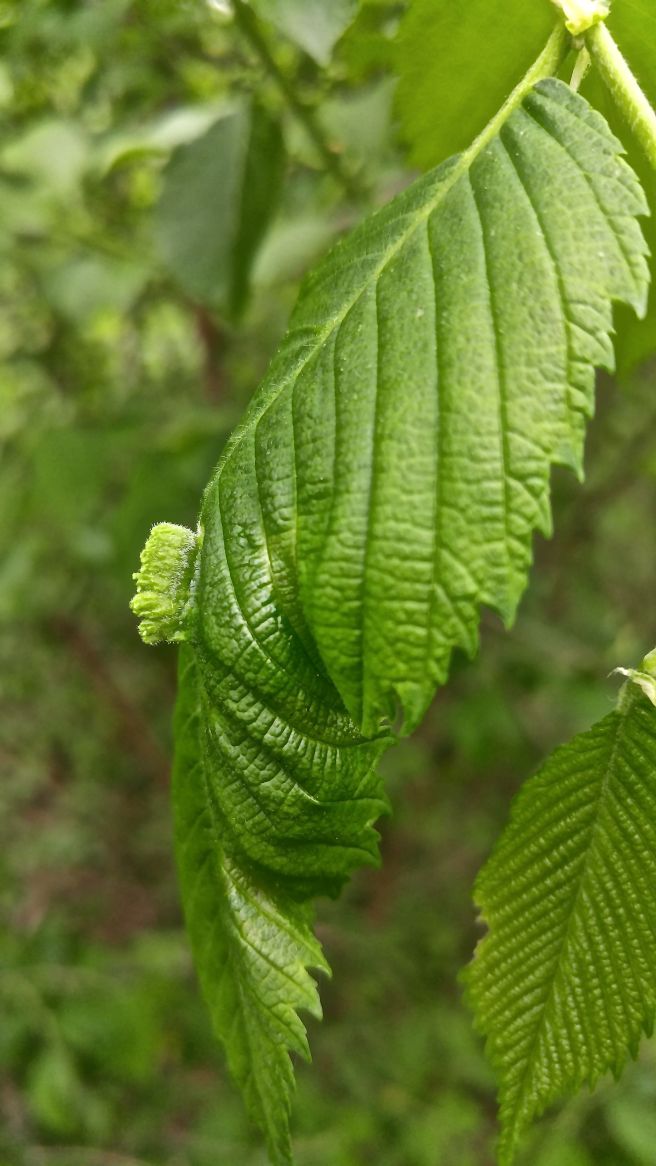
ph-elm growth

And despite not always seeing the muncher, I was amazed by the patterns created, including this rooster’s comb.

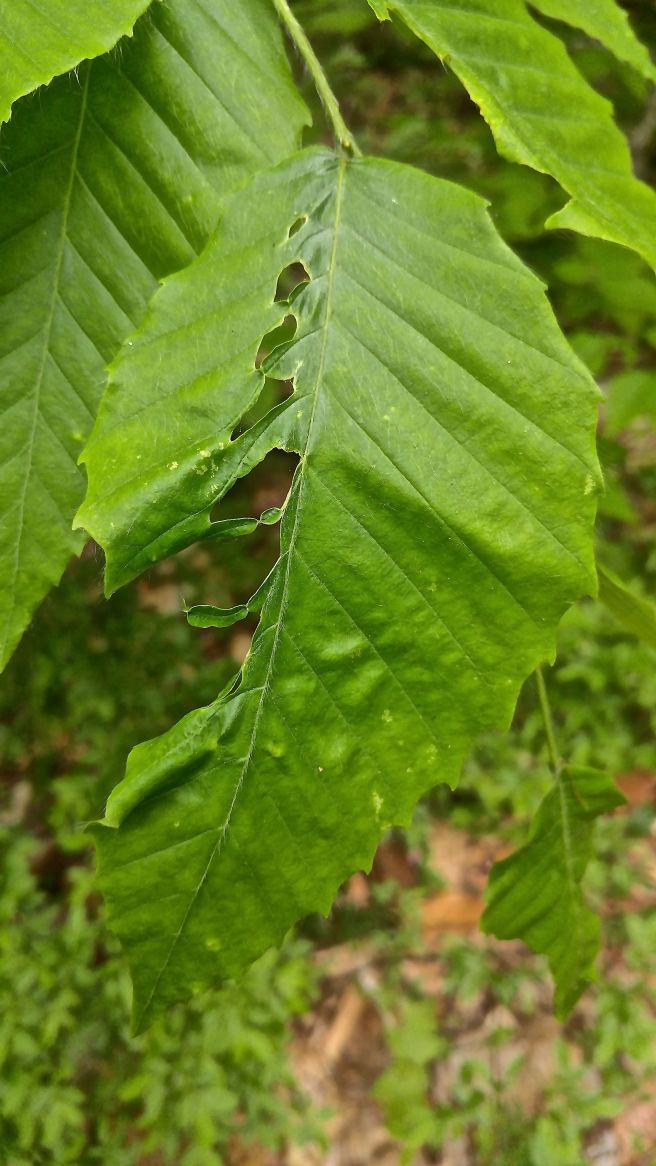
ph-leaf munch1

And then there were diminishing holes to admire and wonder about–reminiscent of skipping stones jumping across the water’s surface.

p-dandy bee

Some visitors were most welcome.

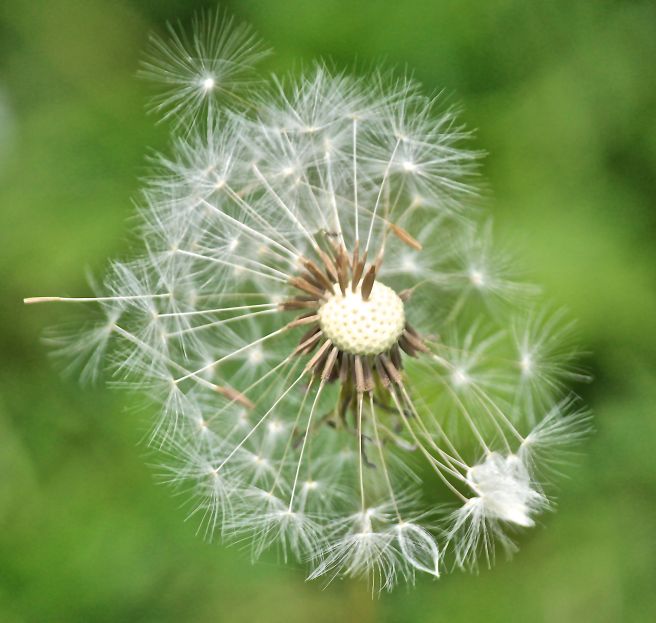
p-dandy seeds

And because of them, I could see the future blowing in the breeze,

p-box elder

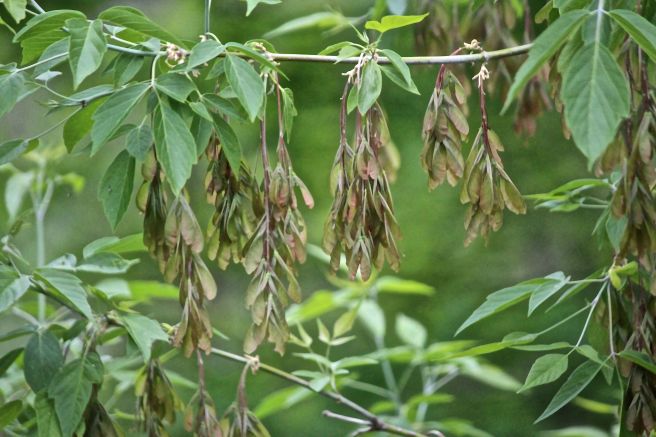
and pouring forth with seeds of hope.

ph-balsam growth1

New opportunities graced the tips of twigs.

ph-phlox2

And the beautiful was visible in buds and blossoms.

ph-lupine1

Stop your searching, Binaca, for you are the beautiful.


A Closer Look

In my continued quest to capture spring, I spent the morning taking a closer look.

p-ph star1

Lest I take myself too seriously, let me begin by saying my inspection wasn’t always as thorough as it might have been. I was wowed when I discovered a four-flowered starflower. I know they can produce up to five, but typically I see one, two or three flowers. Um . . . I think this is actually two plants. Oops. The great discoverer I have yet to become.

p-ph sars1

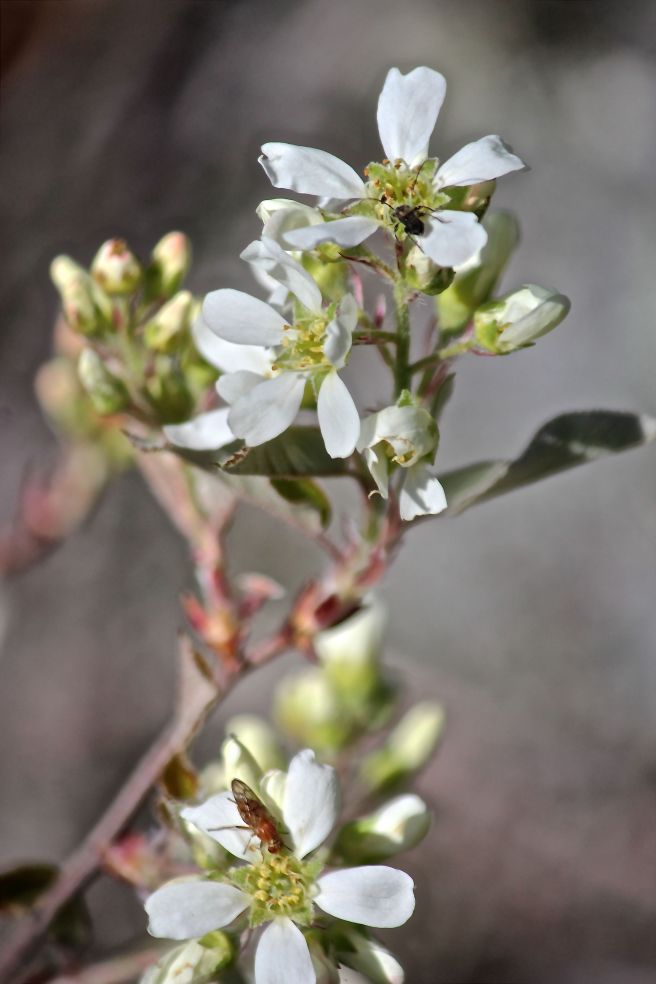
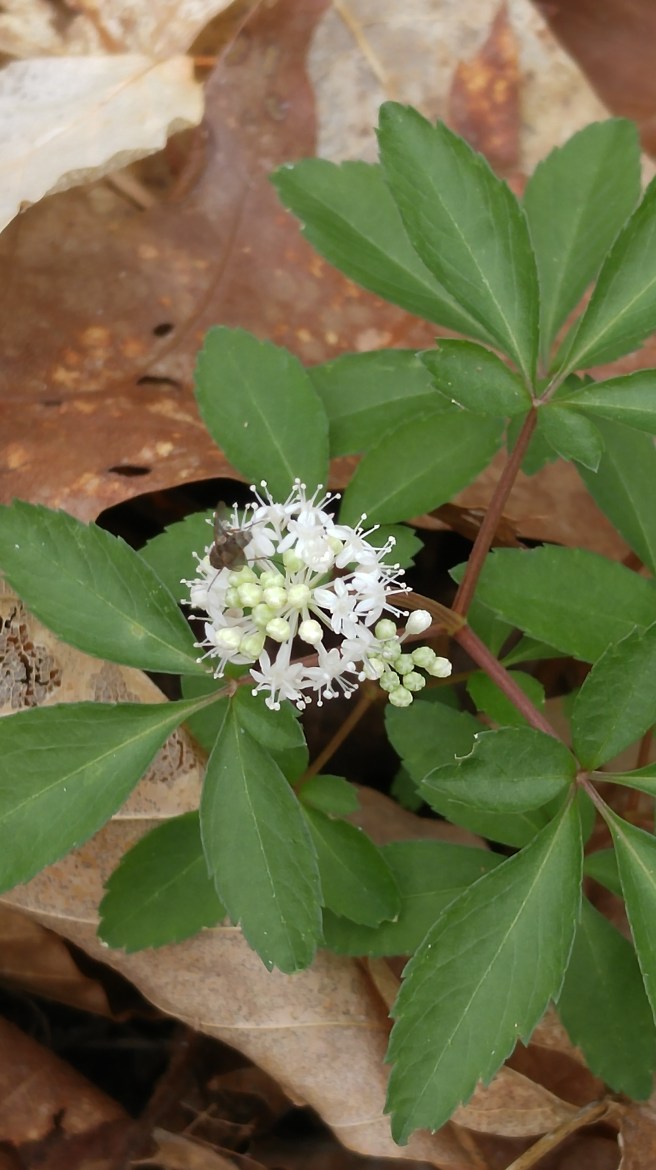
But check out the wild sarsaparilla with its three globe-shaped umbels.

p-ph sars 2

I don’t know if I’ve ever actually noticed the green-petals that fold back. And it’s a tad bit hairy.

p-ph buttercup

Whenever I see the common buttercup I’m transported to my childhood–we placed it under each other’s chins. If your chin reflected the yellow glow that meant you liked butter. Mine never failed.  ;-)

p-ph foam1

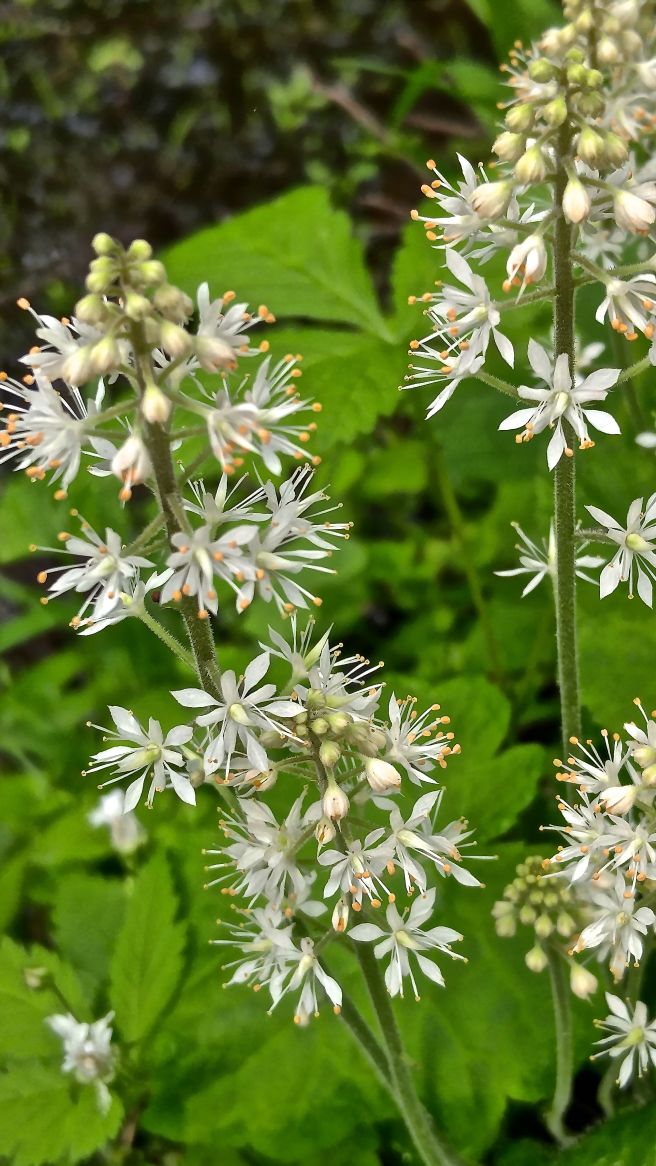
And then it was the tiarella that pulled me down.

p-ph foam 2

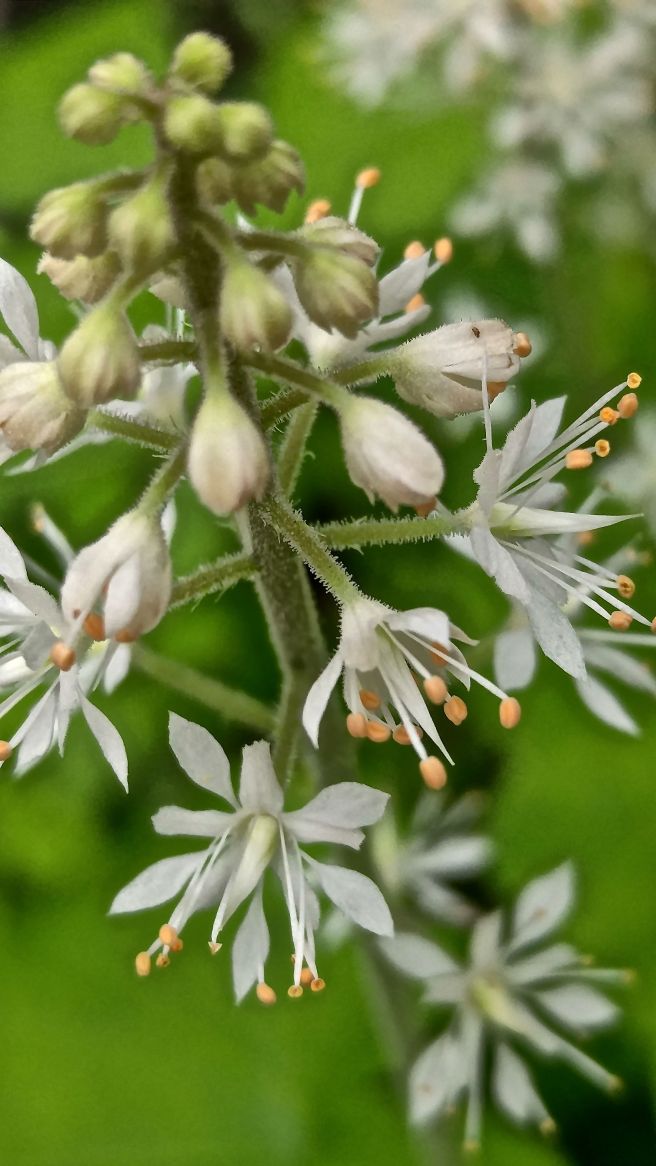
Its terminal cluster of flowers is said to resemble foam, thus the common name of foam flower.

p-ph foam 3

Holy stamens! Each spray of a flower consists of five sepals (outer circle that appear petal-like), five petals that narrow as if they form a stalk, ten yellow-anthered stamen and two pistils, one of which is longer than the other. Amazing. And more hair!

p-ph gaywings

Because it’s equally beautiful, bountiful and birdlike–I couldn’t resist another pause for  fringed polygala or gaywings.

p-elm2

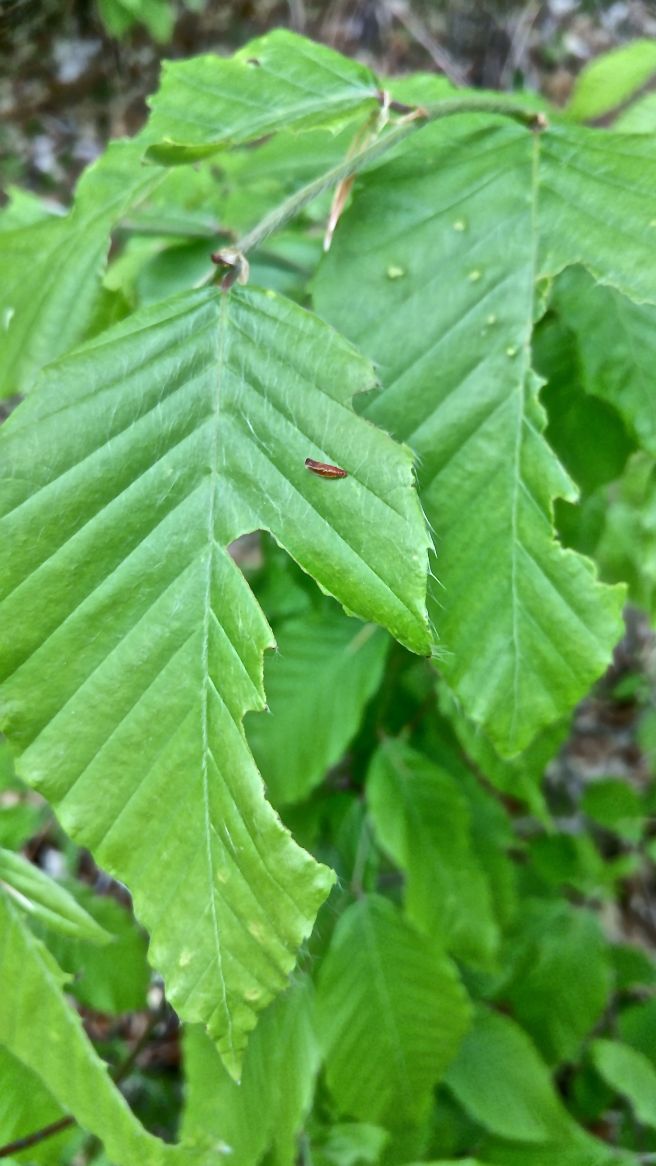
The next attention getter–the double-toothed American elm leaf with its asymmetrical base.

p-ph beech leaves

I love to contrast it with beech leaves. Apparently, both are quite tasty.

p-ph caterpillar 1

And I found a culprit. One of many. I know that the caterpillars and insects have to eat, but  it seems like the leaves work so hard to protect themselves only to be munched upon in a short span of time. So much for the protective hairs.

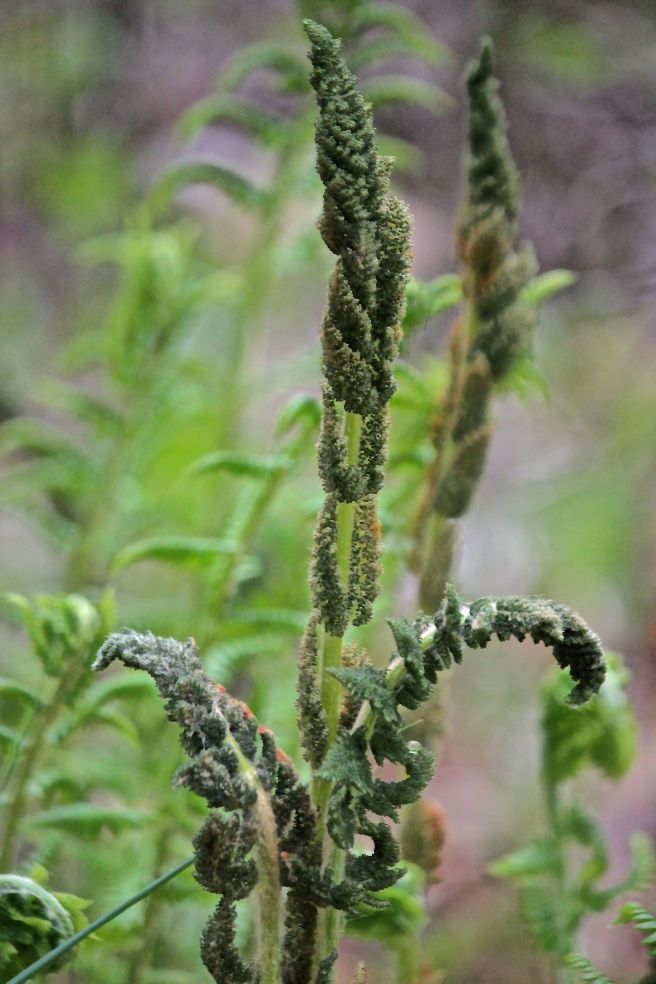
p-cinnamon2

What I really wanted to focus on, however, was the ferns. Last week’s crosiers are this week’s fronds and fertile stalks.

p-ph cinn2

I guess I’m most fascinated by the manner of the tiny green spore beads clustered together–in some ways they mimic the shape of a frond. Again, hair.

p-cinnamon 3

Already, a few are turning the cinnamon color for which they are known.

p-ph crane 2

Upon one, I found a crane fly. Check out those body segments and spindly legs. Adult crane flies, like May flies, don’t eat. Their mission in life–to mate and lay eggs.

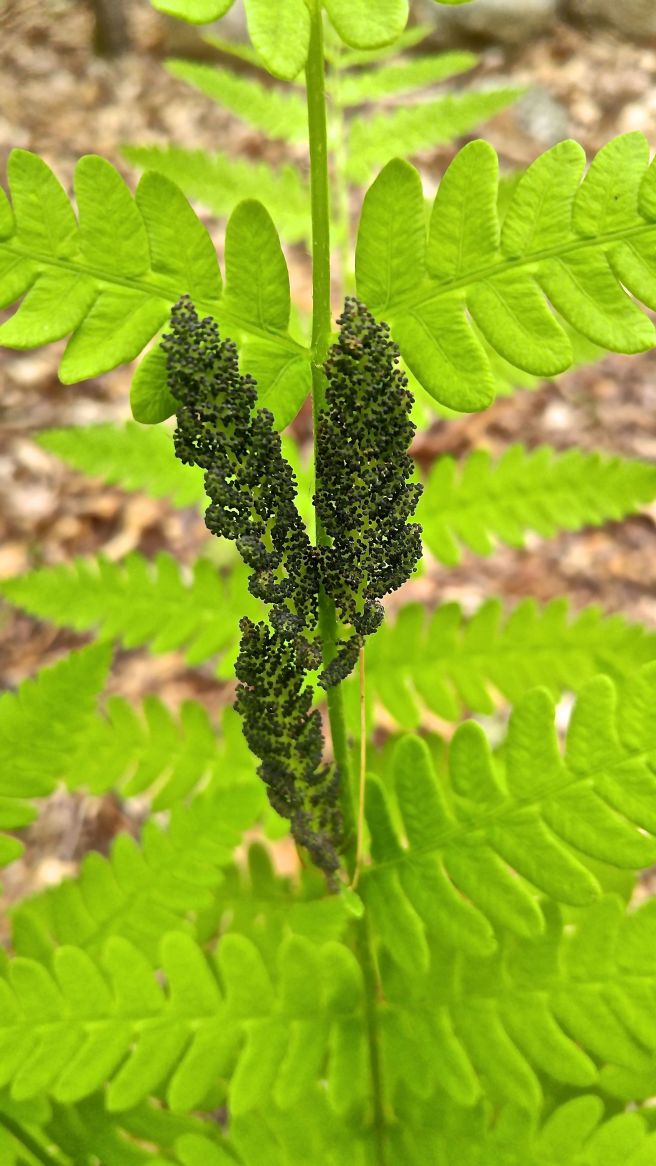
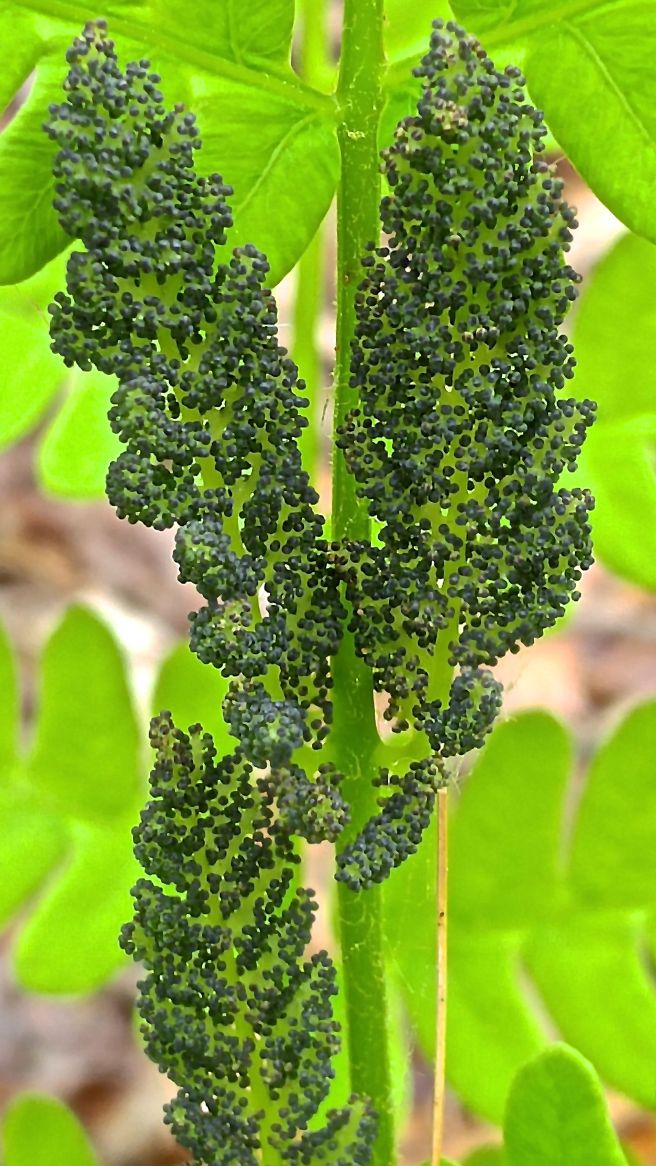
p-ph interrupted 2

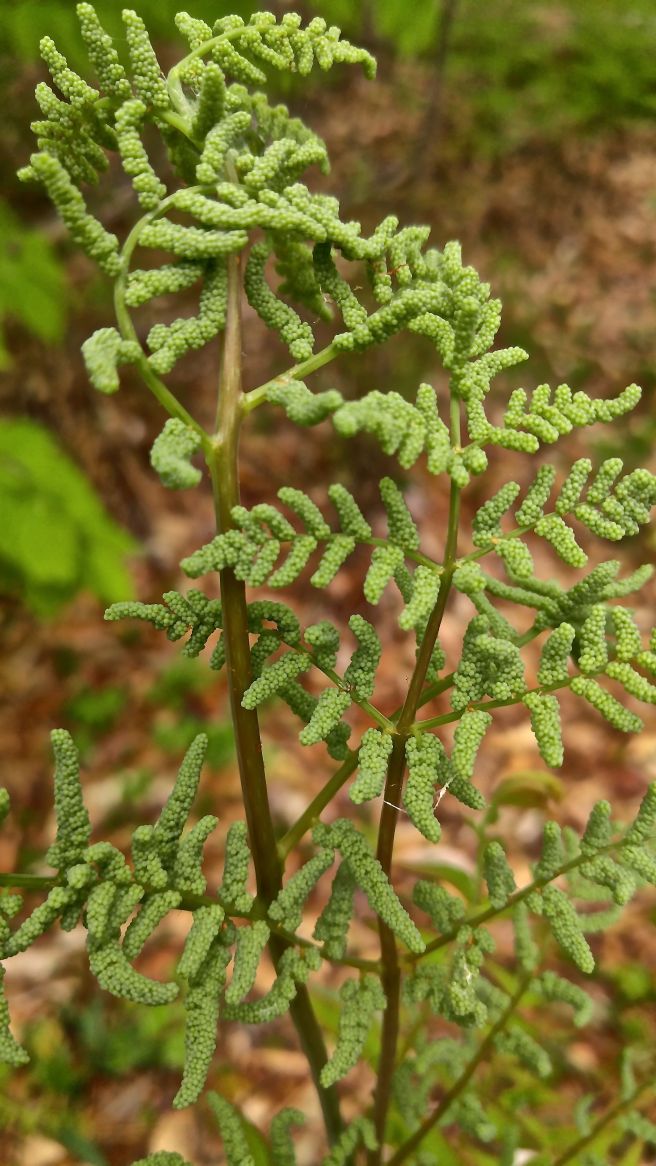
Because they like the same conditions, interrupted fern grows nearby. In this case, the fertile leaflets interrupt the sterile ones.

p-ph inter 3

It’s another beady appearance a tinge darker in color and the presentation is different.

p-ph royal 2

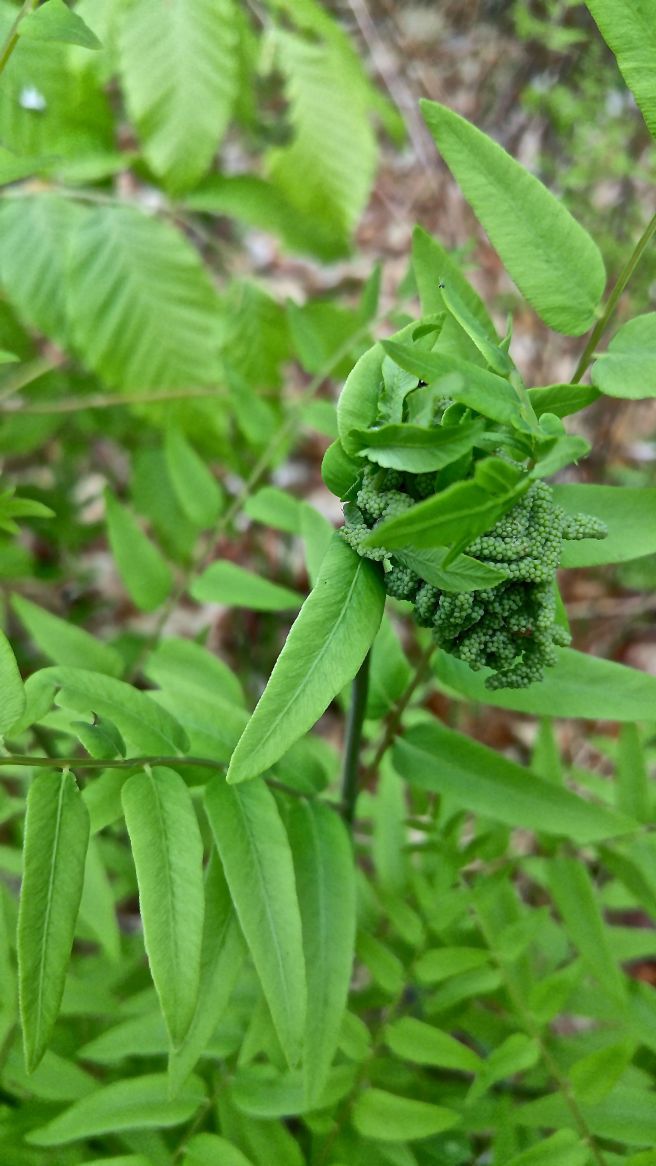
I think my favorite of all (don’t tell the others) is the royal fern. Maybe it’s because my friend Judy calls me the queen. I’m not sure what I’m the queen of, but I do love the crown that is beginning to unfurl.

p-ph royal1

Maybe it’s the elegant structure. Or that fact that no other is like it, so I can easily identify it. The spore cases are clustered at the tip of the fern giving it a bit of a crown appearance.

p-ph dew

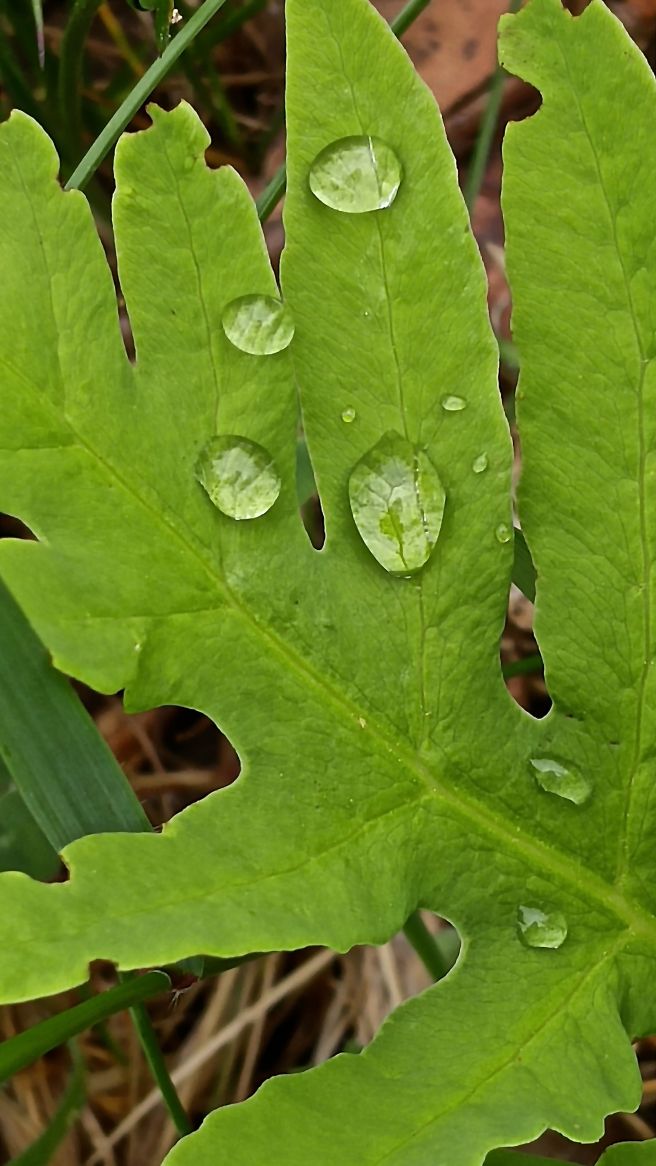
The other fern that grows in this place hasn’t developed its separate fertile stalk yet. What drew me to the sensitive fern this morning was the drops of dew that gathered on the frond–and offered a magnification of its veins. A glimpse into its life-giving force.

I hope you’ll make time this spring to take a closer look and wonder about the world around you.


Hawk-eye Mondate

Some Mondates are shorter than others and such was the case today. But . . . we made the most of it as we walked up the trail to Hawk Mountain in Waterford.

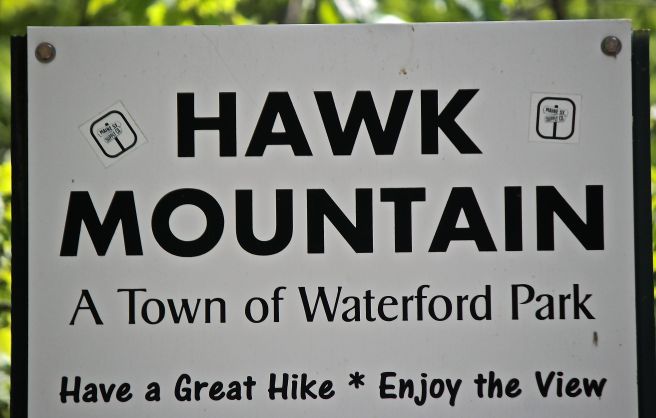
hm-sign

It’s a half mile trek up a dirt and gravel road–just right when you want a great view and time is short. Of course, you could spend hours at the summit, but we weren’t there long.

hm-interrupted1

On the way up, I noticed interrupted fern in its interrupted form. Fertile leaves toward the middle are densely covered with sporangia (spore-bearing structures). I’m fascinated by their contorted, yet beautiful structures.

hm-lady1

Another favorite–lady’s slippers. Again, its structure is beyond my understanding.

hm-cyrstal and long2, ph

At the summit, we paused briefly and gazed toward Crystal and Long Lakes.

hm-white oak 4, ph

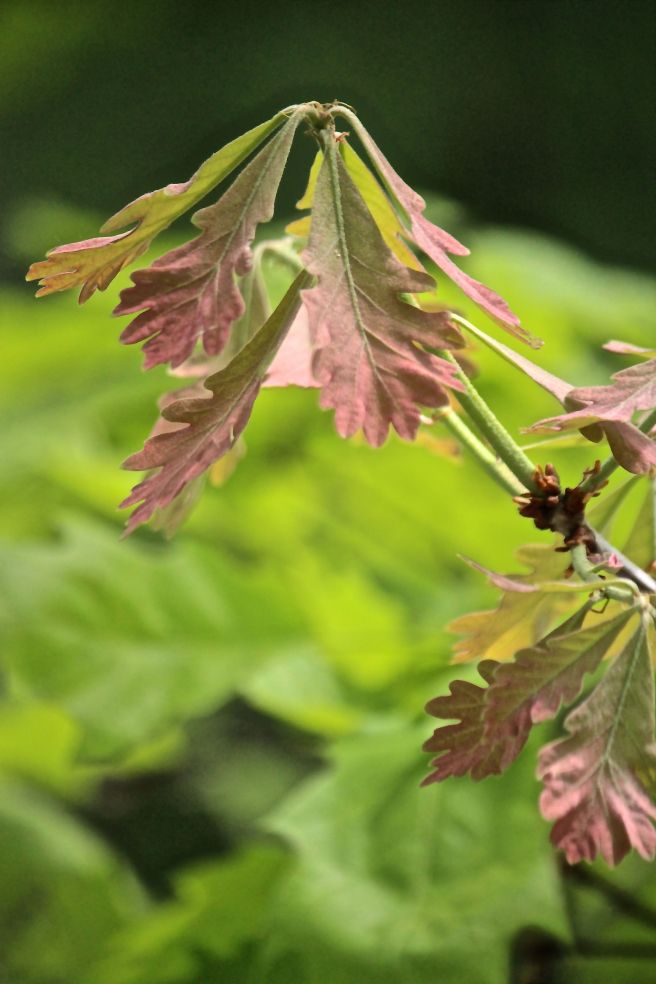
While my guy moved on to the better vantage point, I stopped several times. First, it was the color of these leaves that slowed me down. Have you noticed how spring foliage provides a subtle play on fall foliage? A few friends and I have been thinking about this lately, and this morning I had the opportunity to pick the brain of Dr. Rick Van de Poll, a well-known mycologist/naturalist/educator.

hm-red maple 1

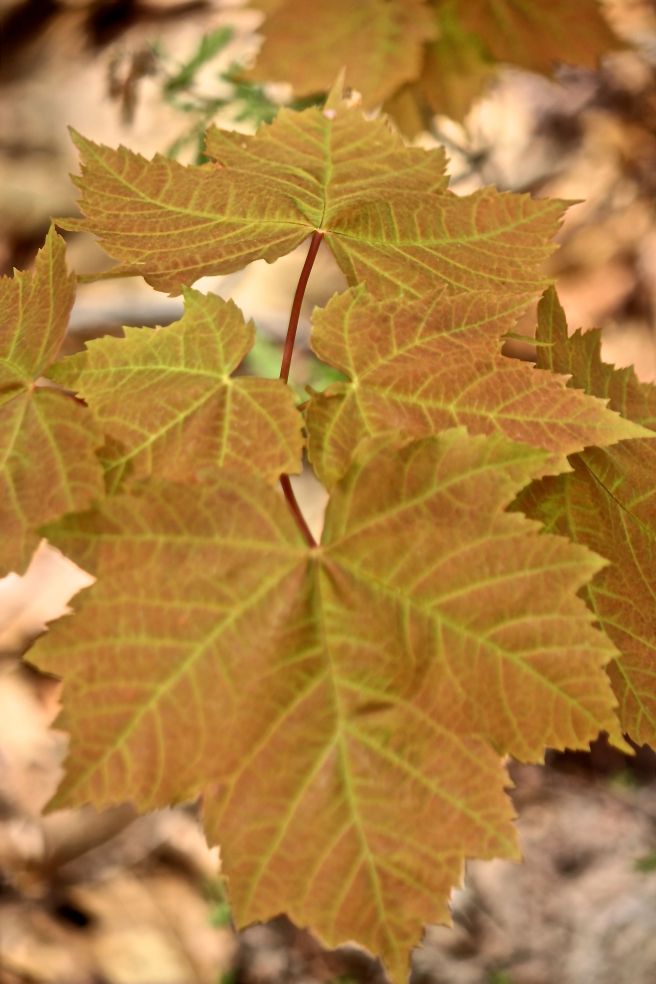
He reminded me that the various hues of color in leaves is caused by the presence of pigments called anthocyanins or carbohydrates that are dissolved in the cell sap and mask the chlorophyll. As our spring temperatures rise and light intensity increases, red pigment forms on a leaf and acts as a sunscreen to protect the plant from an increase in ultraviolet rays.

hm-white oak1

It wasn’t only the color that caught my eye. Take a look at the lobe shape of the reddish leaves and that of the green in the background. In my continuing personal citizen science project to informally connect the dots of where white oaks meet red oaks, I added another pin on the map. Rounded lobes=white oak in the foreground. Pointed lobes=Northern red oak in the background.

hm-bee1

As I headed toward my guy, I noted that the cherry trees were abuzz.

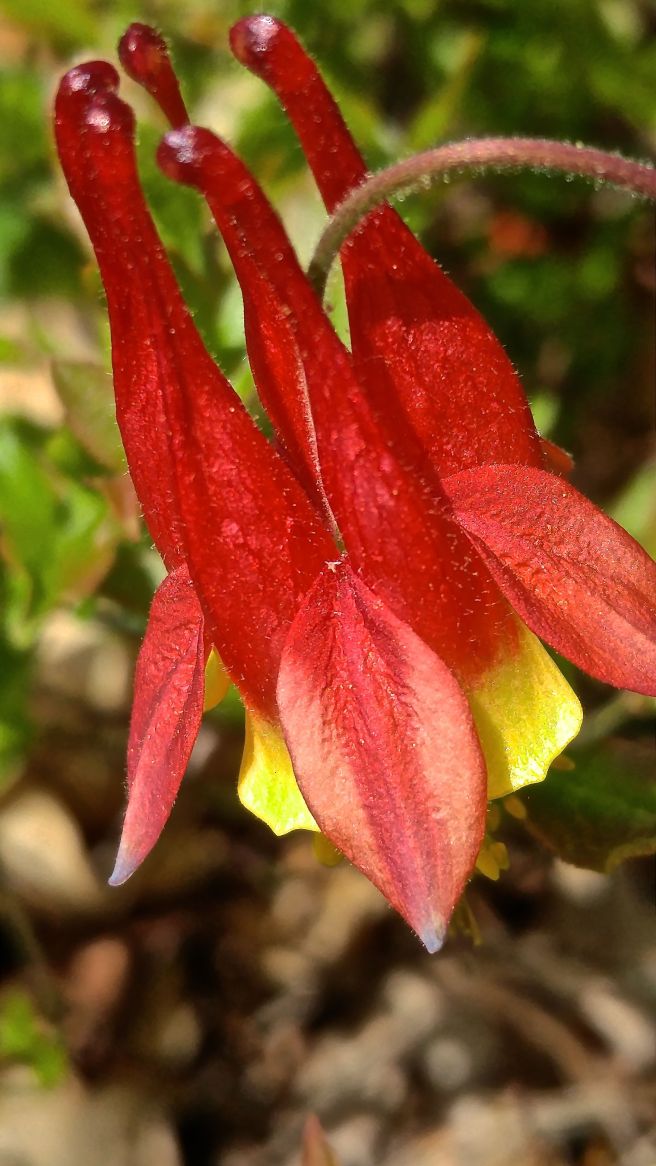
hm-wild columbine1, ph

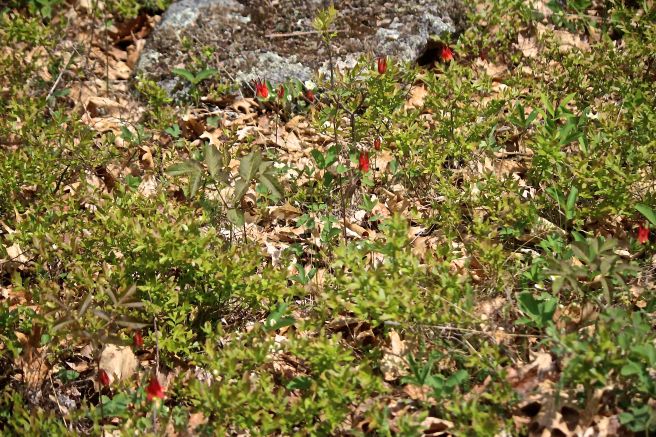
And hiding among the rocks at the base of a tree–another treat for the eyes. Wild columbine. Splendid indeed.

hm, cyrstal and long, ph

Equally splendid–the view from the ledges. Crystal and Long Lakes again.

hm-bear river

Bear River below. I always expect to see a moose here. Or maybe a bear. One of these days.

hm-pm1, ph

Pleasant Mountain and my guy.

hm-dragon5

As we walked back down the trail and concluded our Mondate, we celebrated the fact that dragonfly season has begun. With their hawk eyes, may they capture and consume a kazillion black flies and mosquitoes.


Wallowing in Wonder

We knew what flowers we’d show off and had a general idea of what birds we’d see when we headed down the trail from the Flat Hill parking lot at the Greater Lovell Land Trust’s Heald and Bradley Ponds Reserve in Lovell early this morning. But from the get-go this turned into one very special hike that filled us all with the wonder of life.

p-silent march

Maybe it was because we headed off on a silent march, the better to take in the cacophony of bird songs. With Linda and Heinrich in the lead, our intention was to make a bee-line to the viewing platform. Linda encouraged everyone to note the flowers along the way–with a promise to stop and celebrate them on the return trip. We’d decided during a pre-hike that we wouldn’t follow the loop trail around Perky’s Path. We wanted this to be a different experience.

p-ph view from bench

The view from the bench was beautiful, but the birding there was only so-so, much to our dismay.

p-ph birding 2

On to the bridge we moseyed. Our one disappointment, we didn’t hear the American bittern that had entertained us with its toilet plunger call during the pre-hike.

p-ph birding1

But that didn’t stop us from raising our binoculars frequently–for red-winged blackbirds, Canada geese, blue jays, several species of woodpeckers, sparrows, warblers, wood ducks, chickadees, a wood thrush and more. We heard the ovenbird and vireos, but never caught sight of them.

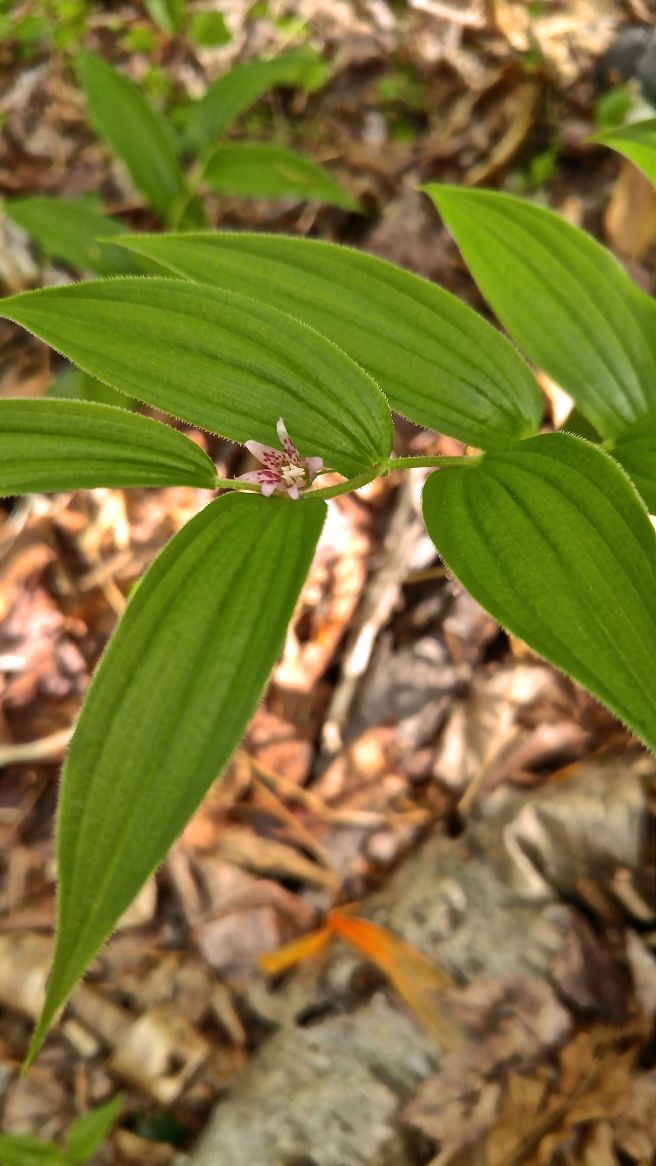
p-ph rosy 2

While Heinrich was our birding guide, Linda used the area just beyond the bridge to begin our examination of flowers.

p-ph rosy 1

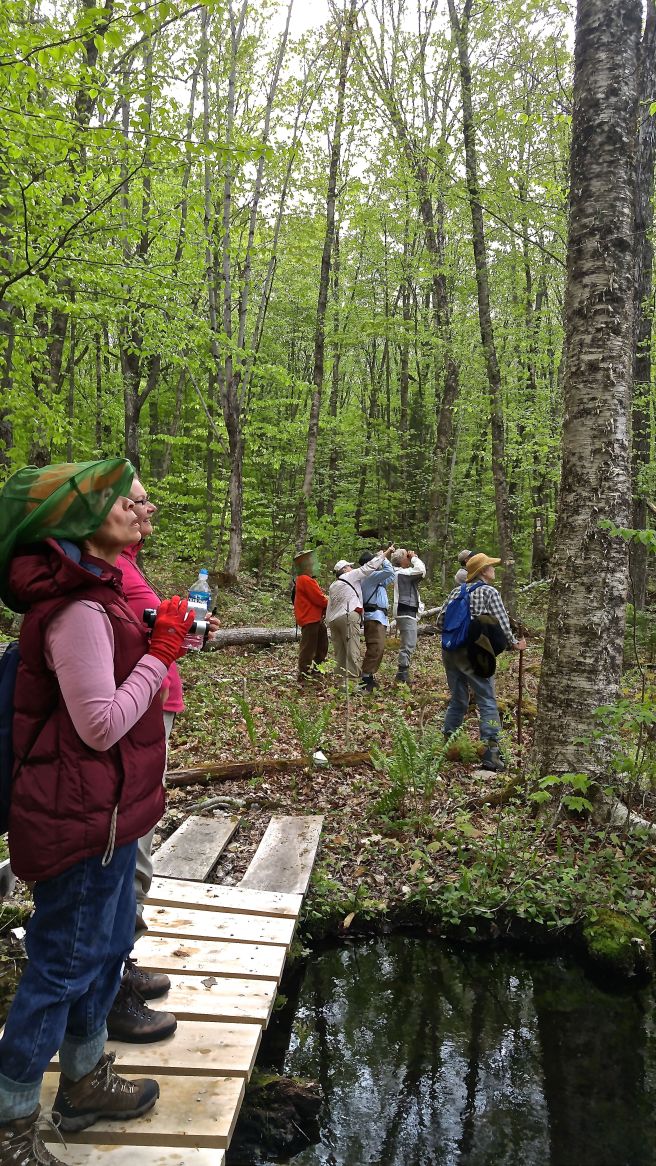
It was while we were moving in for a closer look at the rosy twisted-stalk, that someone spied what became the center of our attention for the next hour.

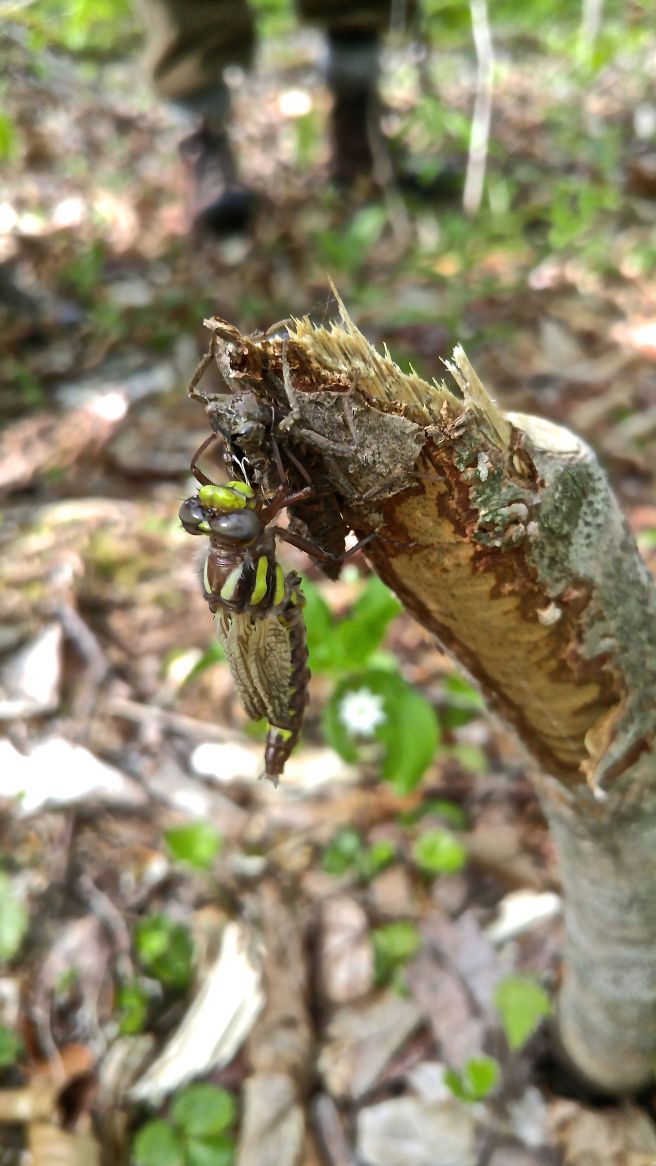
p-dragon begin1

A dragonfly had just split open its exoskeleton and emerged from the nymph stage. Of course, we were standing by a beaver pond, and so it seemed only appropriate that it would use the top of a sapling cut by a beaver.

p-ph dragon middle 4

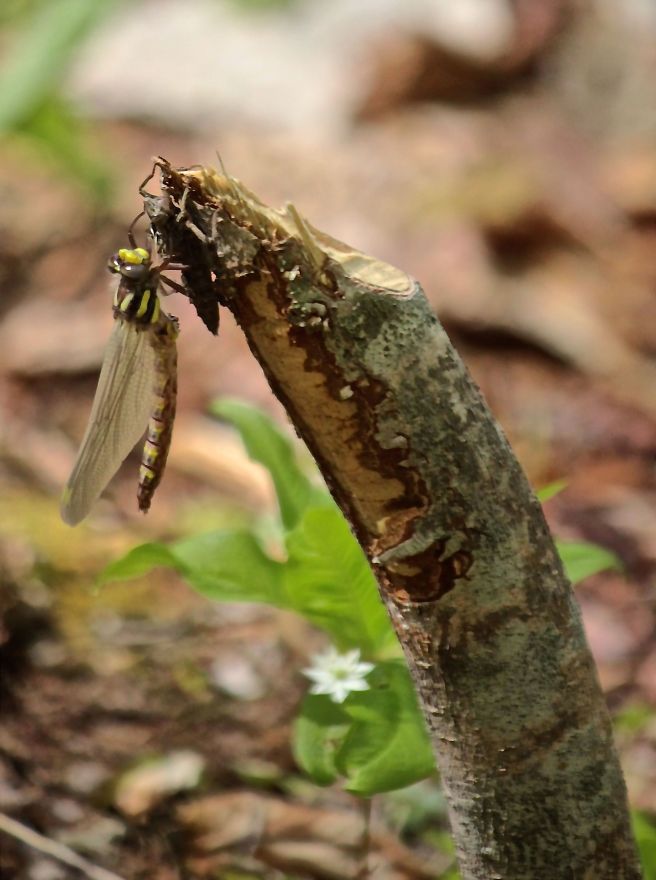
By pumping air into its body, the adult slowly grew larger.

p-dragon end 1a

As it inflated the wings with blood pressure, they began to extend.

p-ph dragon end7

The veinous wings remained folded over its back as we continued to watch.

p-ph early coralroot orchid 2

We were in that one spot for a long time, but when Linda inquired if anyone wanted to start back, all were silent. We did, however, take our eyes off the dragonfly for brief moments. And because of it, we got to know a small area rather well. A few of our discoveries included  the yellow-green, early coral-root orchid, which has no leaves,

p-ph starflower 7

star flowers with their seven petals, seven stamens and sometimes seven leaves, though the latter wasn’t consistent,

p-ph yellow clintonia

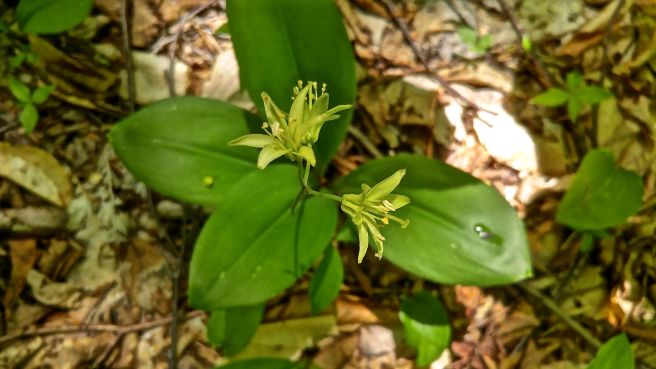
and yellow clintonia, aka bluebead lily.

p-ph springtails 1

We also saw hot chili pepper on the leaf litter and . . .

p-spring tails 1

in the water. Springtails galore. Yes, aka snow fleas, but obviously we can see them even when there isn’t snow on the ground.

p-dragon end 1b

As we explored, we continued to keep a watchful eye on our friend. In fact, he became “our” dragonfly. An hour later, the melodic song of a Baltimore oriole pulled us away and we finally started back along the path.

p-cloak 5

We paused frequently to admire the flowers and leaves, but then another flyer slowed us down and became “our” mourning cloak as it settled on a fallen tree and then fluttered amongst us. Happy were we to have shared such moments of awe.

p-ph pack on Amos

Though our walk had lasted longer than intended, I wasn’t ready to head home, so once everyone left, I turned back and climbed Amos Mountain using the Saddle Trail. It was hot and buggy, but I went for a reason and wasn’t disappointed.

p-amos 1

Among the grasses and violets,

p-ph wild strawberry

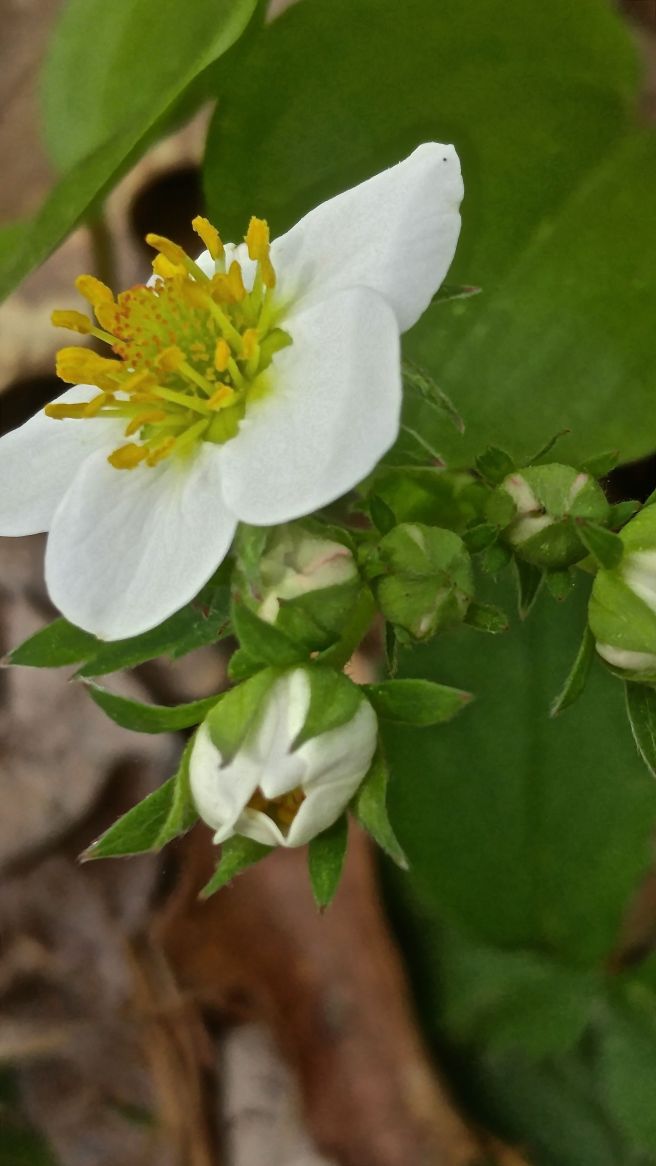
the wild strawberries grow. But that’s not all.

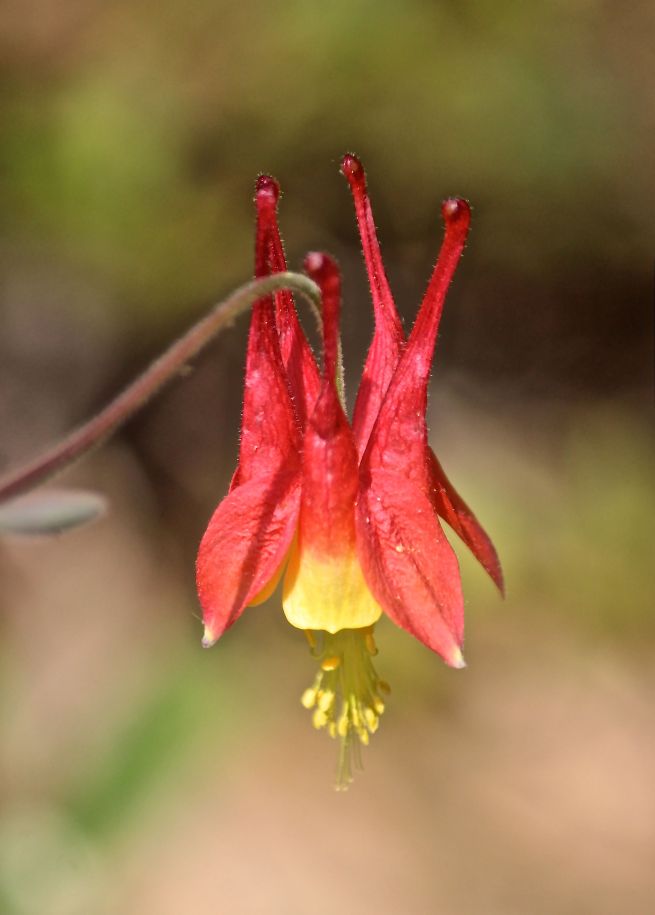
p-ph colum 5

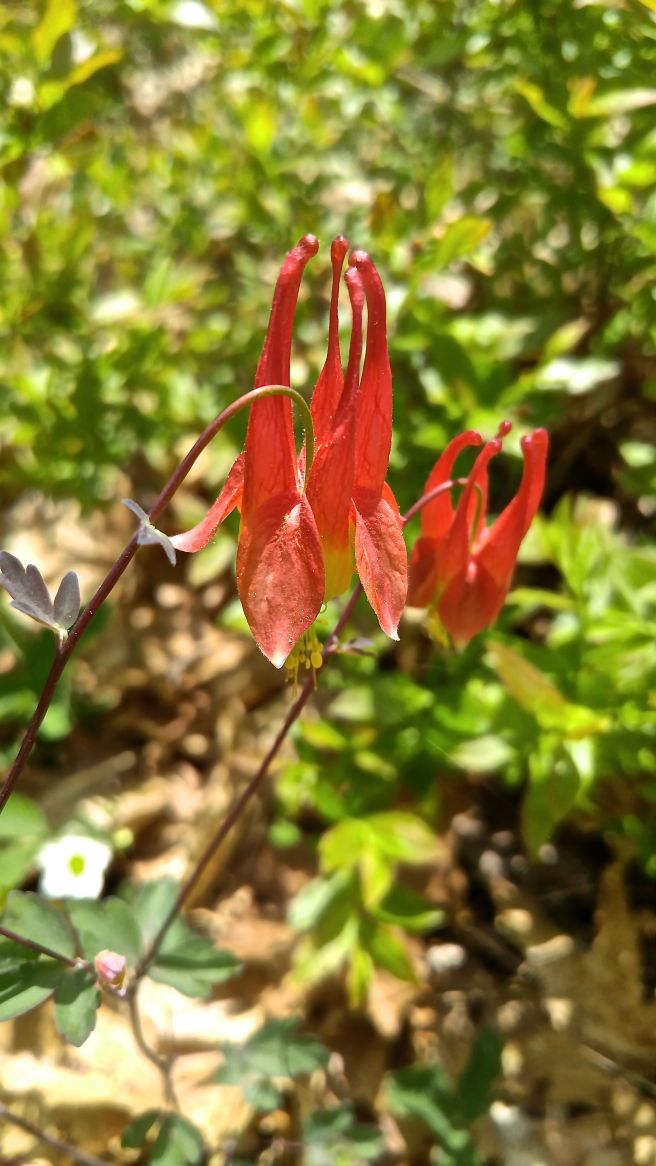
It was the spurred red and yellow flowers of wild columbine that I wanted to see.

p-ph colum 4

Their heads drooped dramatically.

p-columbine 1

Numerous yellow stamens projected downward and surrounded the green pistils with their long, thin styles, creating the look of an ornate lantern dangling from a post–thus its other common name, little lantern. I really don’t care what it’s called. Spending time in its presence was all that mattered.

The same was true for our dragonfly experience. We wallowed in wonder today and let nature reveal its glory.

Three Times A Charm

One might think that following the same loop through the woods in slow motion three times in one day would be boring. One would be wrong. My friend Joan and I can certainly attest this fact.

Round One: 9 am, Wildflower and Bird Walk with Lakes Environmental Association co-led by birder/naturalist Mary Jewett of LEA and the ever delightful botanist Ursula Duve.

h-hobblebush

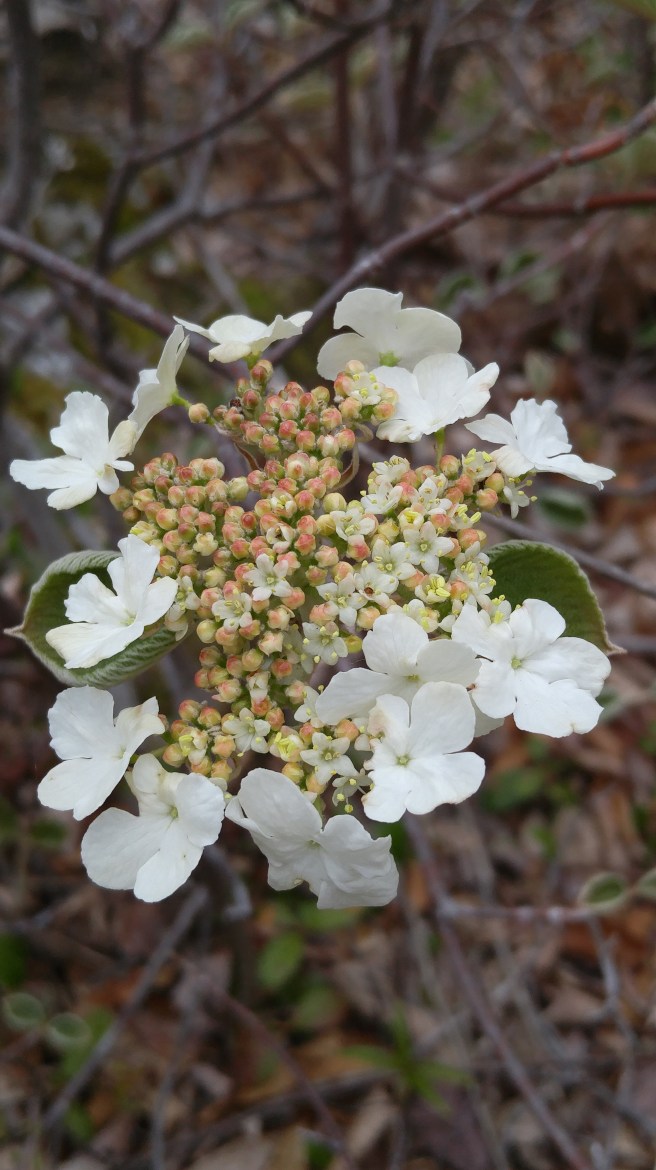
In abundance here, the hobblebush bouquet–a snowy-white flower that is actually an inflorescence, or lacy cluster of tiny fertile flowers surrounded by a halo of showy, yet sterile bracts. Yeah, so I’ve showed you this before. And I’ll probably show it again. Each presentation is a wee bit different.

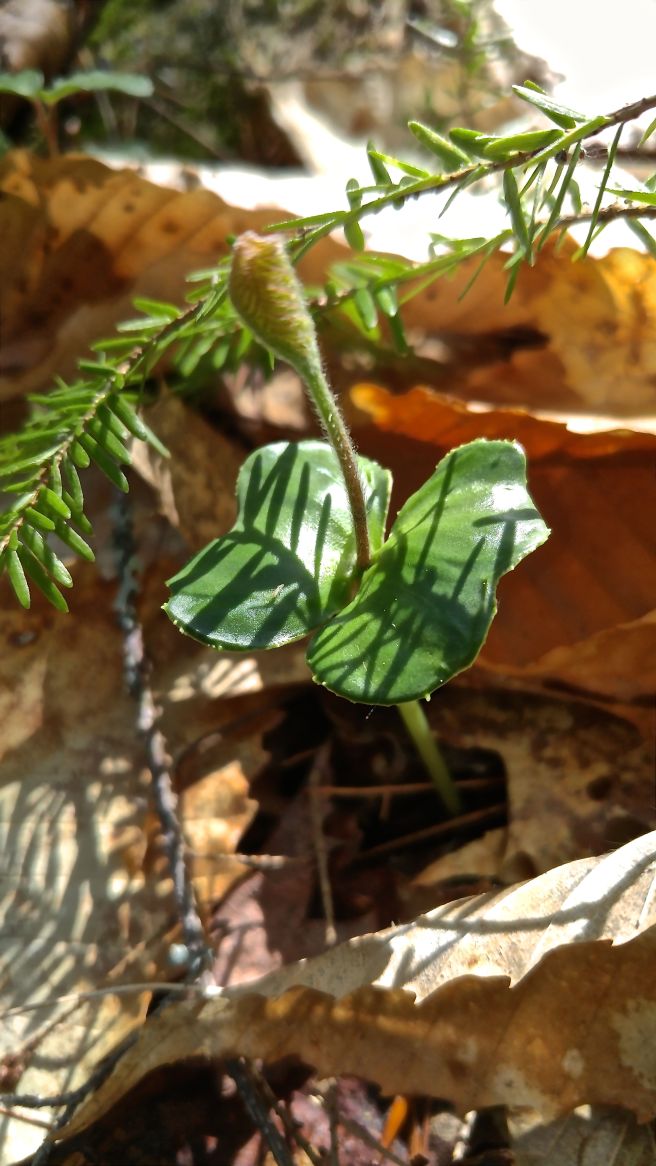
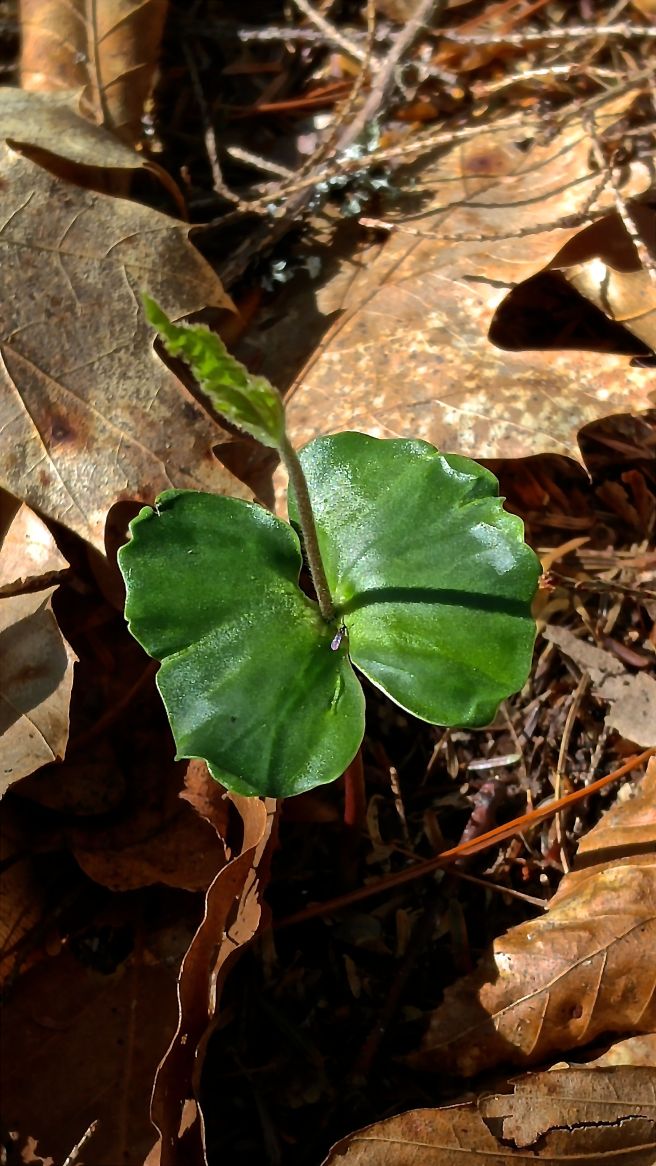
h-beech cotyledon1ph

And then we spied something that I’ve suddenly seen almost every day this week.

h-beech coty 4ph

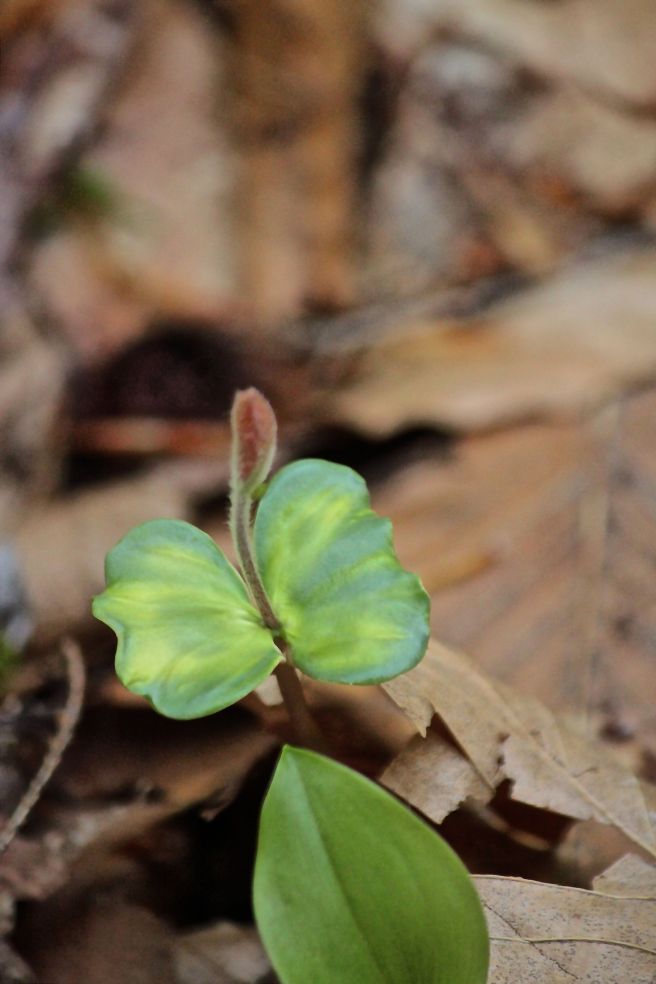
The cotyledon or seed leaf of an American beech. Prior to Monday, I don’t know that I’ve ever seen this and yet, since then I’ve continued to discover them almost every day. Worth a wonder.

h-beech coty 3ph

Think about it. The journey from seed to tree can be a dangerous one as the root is sent down through the leaf litter in search of moisture. Since the root system is shallow, lack of moisture can mean its demise. When conditions are right, a new seedling with a rather strange, yet beautiful appearance surfaces. The seed leaves of the beech, aka cotyledons, are leathery and wavy-margined. They contain stored food and will photosynthesize until the true leaves develop, providing a head start for the tree. I realize now that I’ve seen them all my life in other forms, including maple trees, oak trees and vegetables. But . . . the beech cotyledon captures my sense of wonder right now, especially as it reminds me of a luna moth, which I have yet to see this year.

h-green frog 2

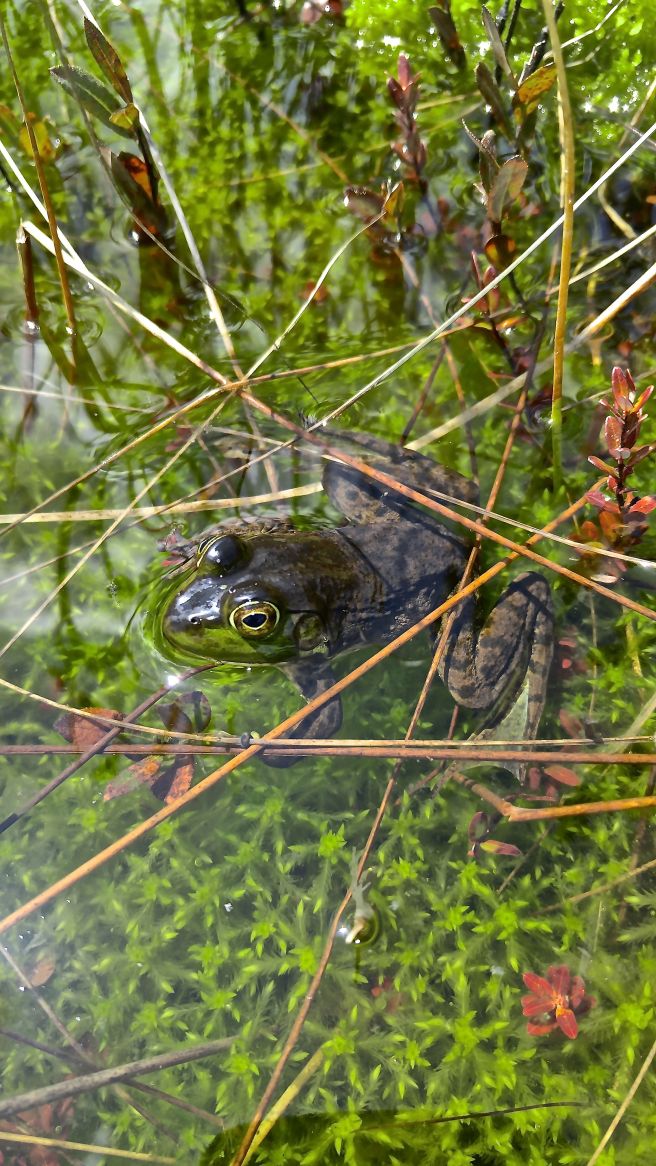
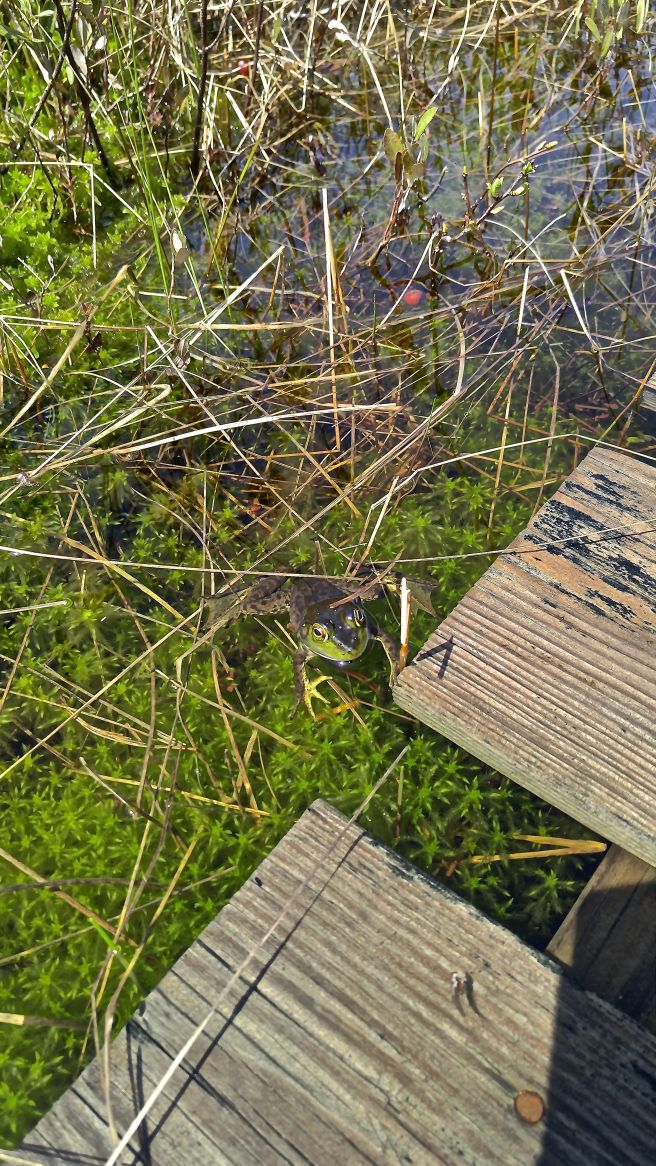
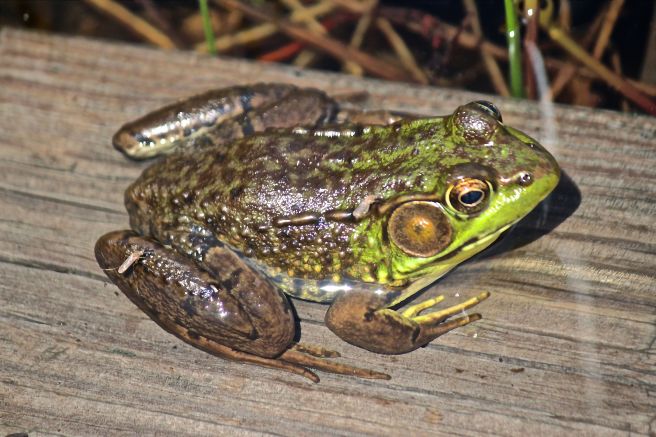
Crossing the first boardwalk through the red maple swamp, a large male green frog tried to hide below us. Notice the large circular formation behind his eye. That’s the tympanum, his visible external ear. A male’s tympanum is much larger than his eye.

h-rhodora ph1

Other red maple swamp displays included the showy flowers of rhodora and their woody capsules.

h-rhodora1

Ralph Waldo Emerson knew the charm of this spring splendor:

The Rhodora

On being asked, whence is the flower.
In May, when sea-winds pierced our solitudes,
I found the fresh Rhodora in the woods,
Spreading its leafless blooms in a damp nook,
To please the desert and the sluggish brook.
The purple petals fallen in the pool
Made the black water with their beauty gay;
Here might the red-bird come his plumes to cool,
And court the flower that cheapens his array.
Rhodora! if the sages ask thee why
This charm is wasted on the earth and sky,
Tell them, dear, that, if eyes were made for seeing,
Then beauty is its own excuse for Being;
Why thou wert there, O rival of the rose!
I never thought to ask; I never knew;
But in my simple ignorance suppose
The self-same power that brought me there, brought you.

h-LEA group

To avoid getting our feet too wet, we spread out as we walked on the boardwalk through the quaking bog.

h-five morning

Morning light highlighted the layers from the pond and sphagnum pond up to Five Fields Farm and Bear Trap above.

h-trill 1

And because it was ever present, I couldn’t resist pausing to admire the painted trillium once again (don’t tell my guy).

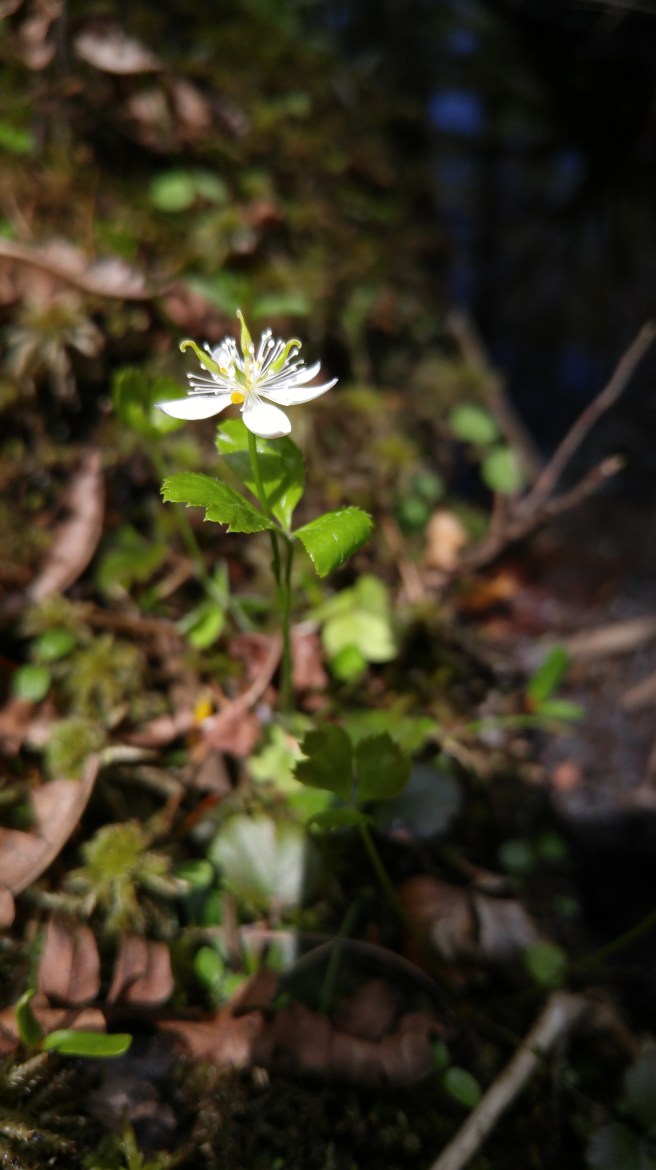
h-dwarf ginseng1ph

One plant that I will always associate with this place and Ursula, who first introduced me to it years ago, is the dwarf ginseng. I love its global spray of flowers and compound leaves. But maybe what I love most is its beauty in diminutive form–just like Ursula.

Round Two: Noon, Lunch and a walk with my dear friend Joan.

h-bigtooth aspen

After returning to our vehicles following the morning walk, Joan and I grabbed our lunches. And I paused in the parking lot to enjoy the silvery fuzziness of big tooth aspen leaves. The quaking aspen in our yard leafed out a couple of weeks ago, but big tooth aspen leaves are just emerging. Like others, they begin life with a hairy approach–perhaps as a protective coating while they get a start on life?

h-muddy riverlunch

We ate lunch beside Muddy River where the spring colors were reflected in the water.

h-blueberries 1ph

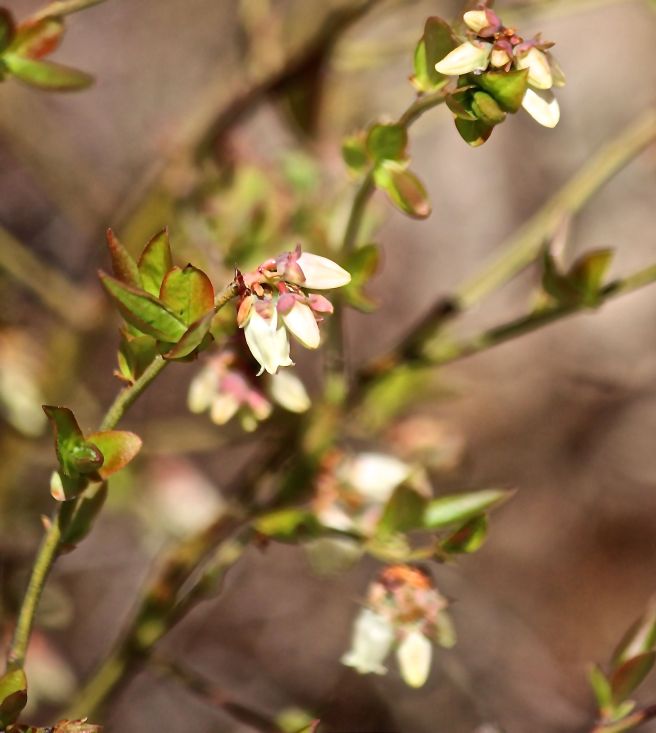
And then we heard something jump in the water, so we moved silently like foxes as we tried to position ourselves and gain a better view. In the back of our minds, or perhaps the front, we wanted to see a turtle, beaver or especially an otter. Not to be. But we did see highbush blueberries in flower.

h-bee 1

And the bees that pollinate them.

h-pitcher 5ph

In their out-of-this universe form, we knelt down to honor the pitcher plant blossoms that grow along a couple of boardwalks.

h-red maple samaras

We were wowed by the color of the red maple samaras,

h-red winged

prominent shoulder patch of the red-winged blackbird,

h-cranberries

and cranberries floating on the quaking bog.

h-lone larch

And then our eyes were drawn to the green–of the lone larch or tamarack tree

h-green 9ph

and the green frogs.

h-green 8ph

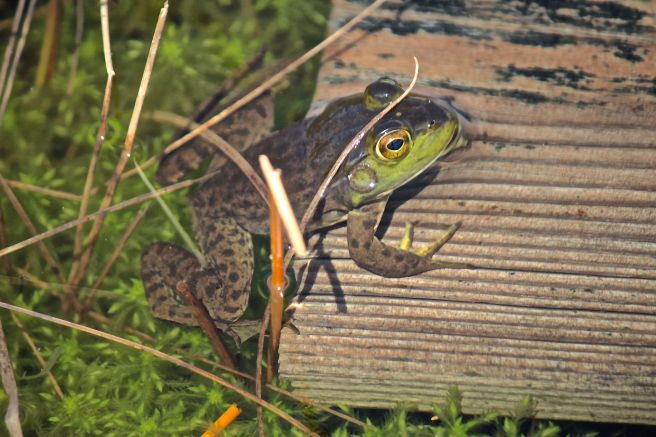
I spent some time getting to know one better.

h-green 3

She even climbed out to accommodate me–I’m sure that’s why she climbed up onto the boardwalk.

h-green 6

Or maybe she knew he was nearby. What a handsome prince.

Round Three: 2:30pm, Joan and I (co-coordinators of the Maine Master Naturalist Bridgton 2016 class) were joined by another MMNP grad, Pam Davis Green, who will lead our June field trip to explore natural communities at Holt Pond.

h-striped maple flower

h-spriped flowers 2

Cascading down from the striped maple leaves, we saw their flowers, which had alluded us on our first two passages.

h-speckled 2

The cottony white masses of wooly alder aphids decorated many of the speckled alders in the preserve. In a symbiotic relationship, ants stroke the aphid with their antennae, while  the aphid releases a drop of honeydew, much like a cow being milked. It’s actually rather creepy.

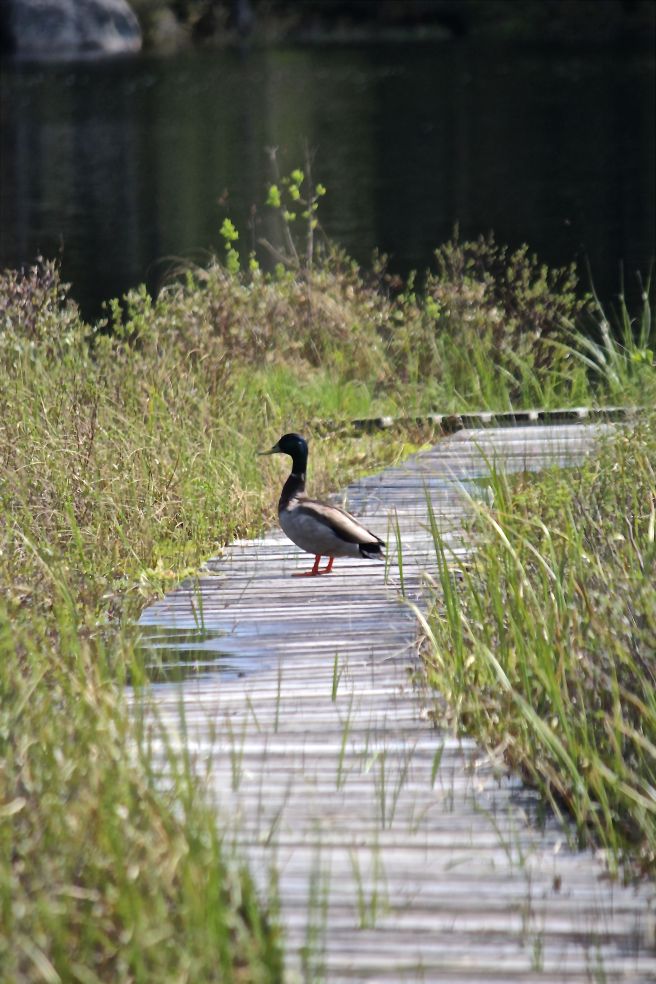
h-duck

Two Canada Geese squawked from another part of the pond, but Mrs. Mallard stood silently by.

h-tree pants

Our final sight brought a smile to our faces–someone put his or her pants on upside down!

We hope that charms your fancy. Joan and I were certainly charmed by our three loops around and those we got to share the trail with today.

We also want to thank Ursula, Mary and Pam for their sharings. And we send good vibes and lots of prayers to my neighbor, Ky, and Pam’s brother-in-law.       

 

 

Bright Eyed and Bushy Tailed

That’s how I’m feeling these days–bright eyed and bushy tailed as I soak in the sights and sounds of spring.

p-maple flower1

I love the glow of new life

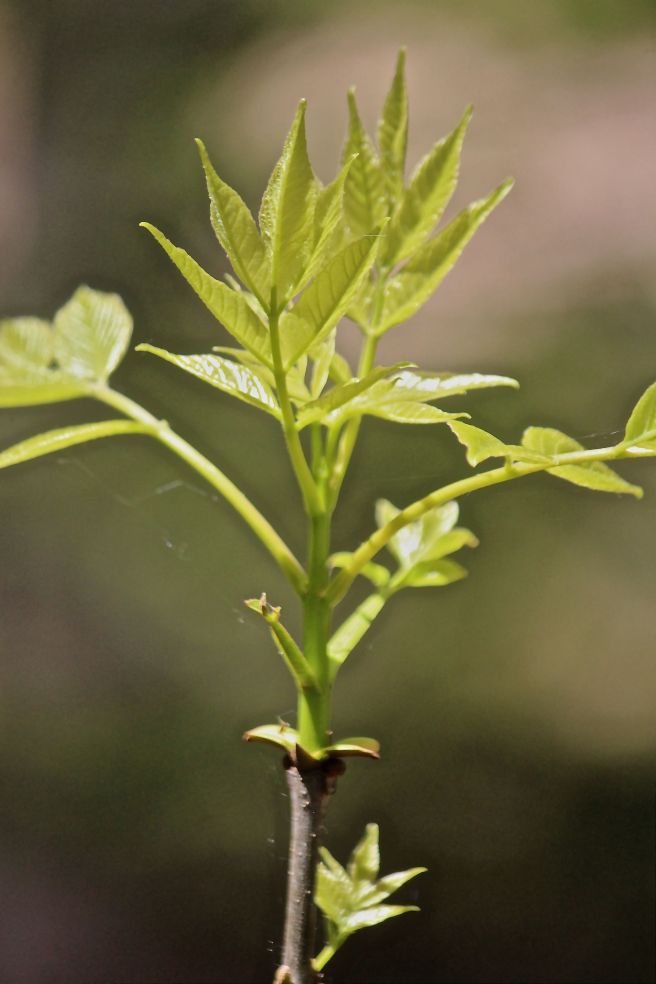
p-white ash

in the morning light.

p-gold2

I love the explosion of floral sunshine

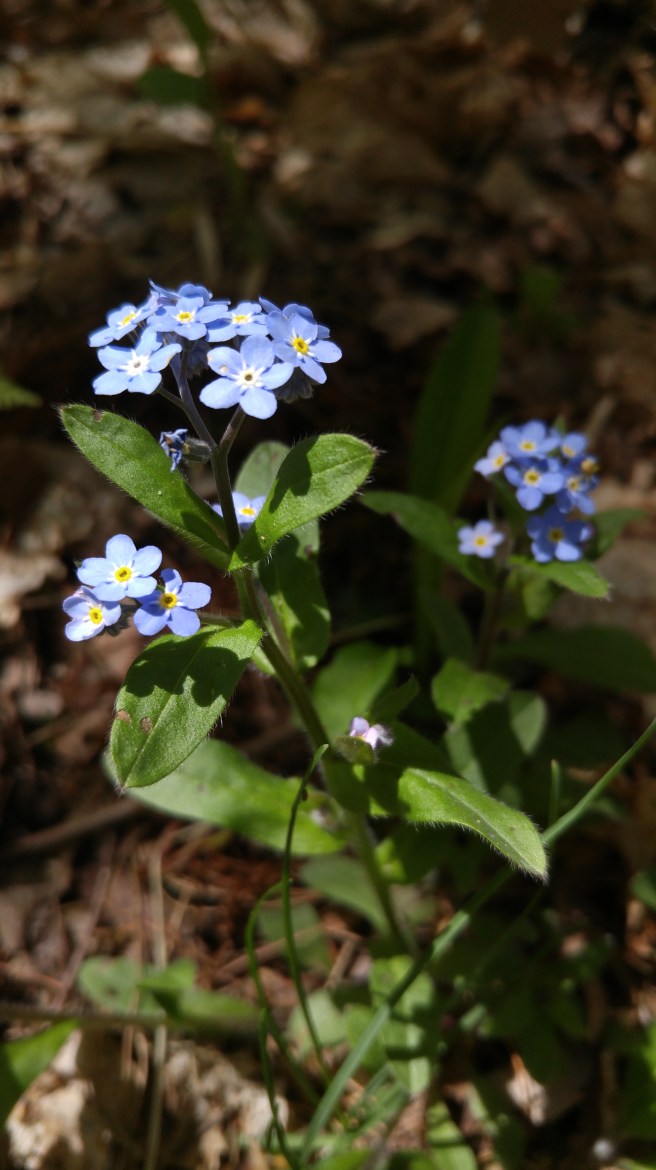
p-forget

in a variety of manners.

p-crosiers

I love the spirals of protection

p-crosiers royal1

in unison of unraveling.

p-bee3

I love the quest of seekers

p-cherry2

in search of sweetness.

p-vp10

I love the transformation of life

p-vp2

in stages of development.

p-red squirrel

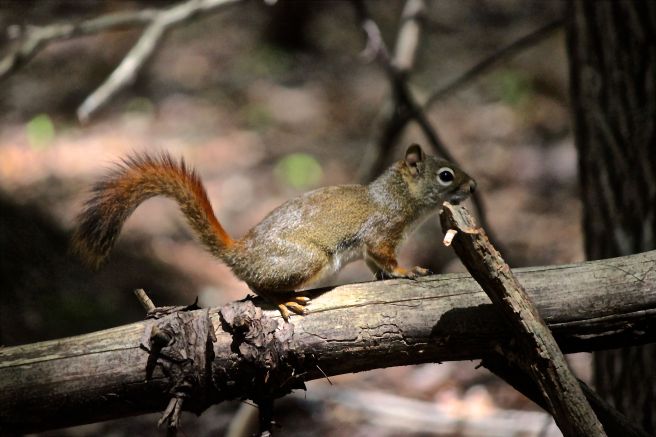
I love being bright eyed and bushy tailed

p-squirrel 2

in my continuous quest.


Another Day Mondate

We knew when we couldn’t find the trail we were looking for yesterday that we’d return today. What we didn’t know was how brisk it would be, but thankfully we were prepared. We both packed extra layers and I was thankful for a winter hat and gloves. Mid-May in Maine.

a-horses

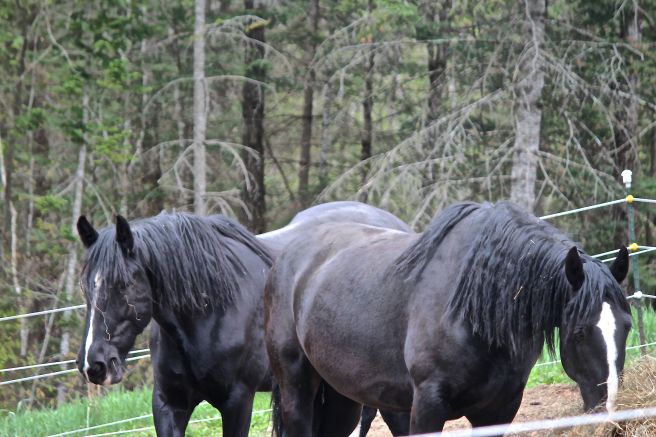
We also didn’t expect to park across from a horse farm.

a-tree down

But wind gusts reaching 30 mph had toppled a tree, preventing us from driving to the trailhead. I questioned our intelligence as we approached the tree and downed wires. My guy was certain we’d be fine. I let him go first. No fireworks. So I followed and looked back to take a photo. Generators hummed in several yards. Apparently, this is normal procedure.

a-albany sign

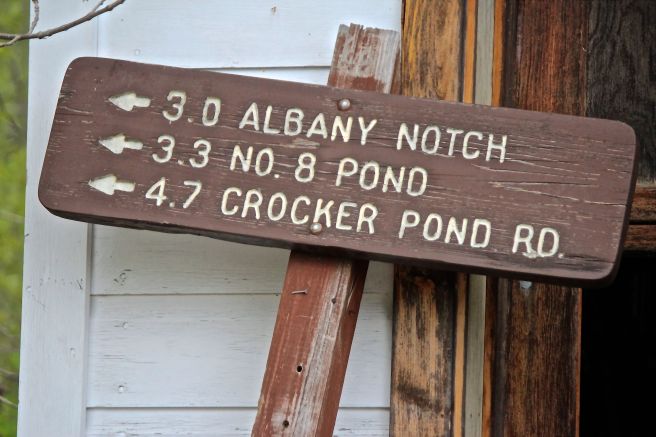
Two weeks ago, we’d climbed Albany Mountain from Crocker Pond Road. Yesterday, we tried to climb from Birch Avenue in Stoneham, but found ourselves wandering and wondering along a snowmobile trail–we caught glimpses of the mountain, but it alluded us. So today, determination set in. We were going to conquer the mountain again.

a-crossing brook.jpg

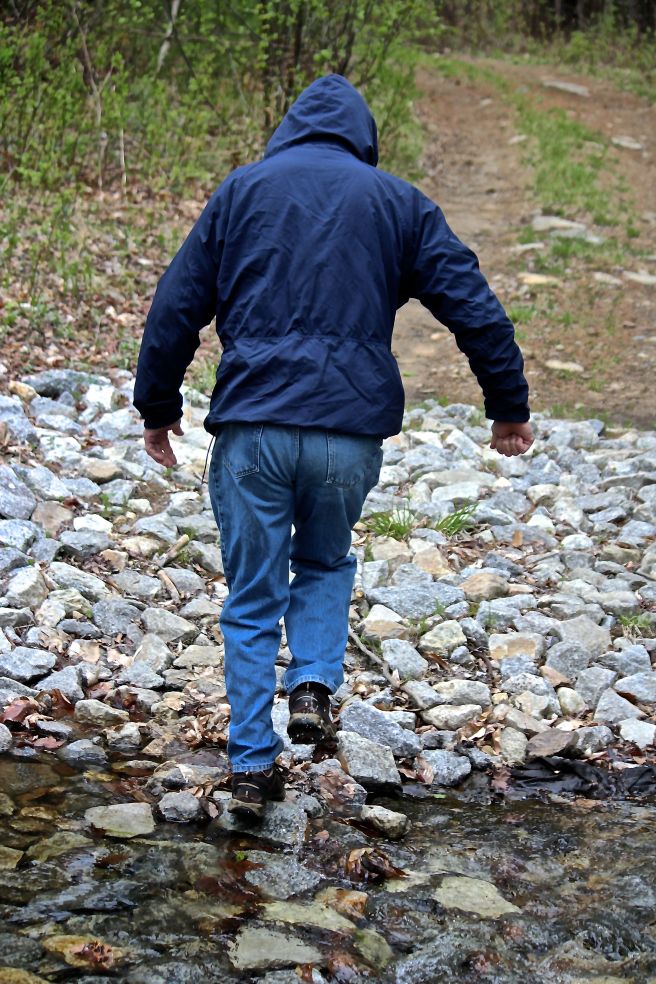
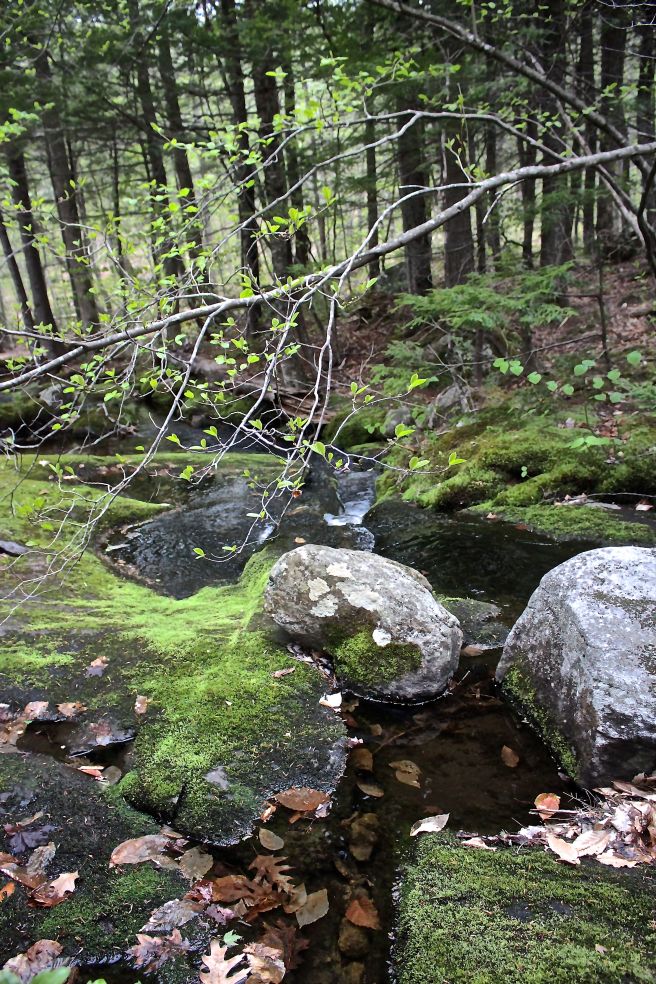
Back across the brook we trudged. Actually, this was one of about five brook crossings. There’s something to be said for the snowmobile trail–usually there were bridges. Not to be this time around.

a-veery

We had company at the beginning of our journey. A veery kept pace with us and peered about as it foraged for food.

a-lunch rock

Within about ten minutes of finally getting onto the actual trail, we found lunch rock–as if on cue, for it was noon.

a-lunch rock 2

PB&J always tastes better in beautiful surroundings.

a-trill 1

The soil was rich and moist–we can attest to that as we slogged through mud following moose tracks much of the way. Trilliums thrive in such conditions and painted trilliums showed their bright faces. Three leaves, three leaf-like bracts and three petals–one triangle layered upon the next in elegant symmetry.

a-trill 6ph

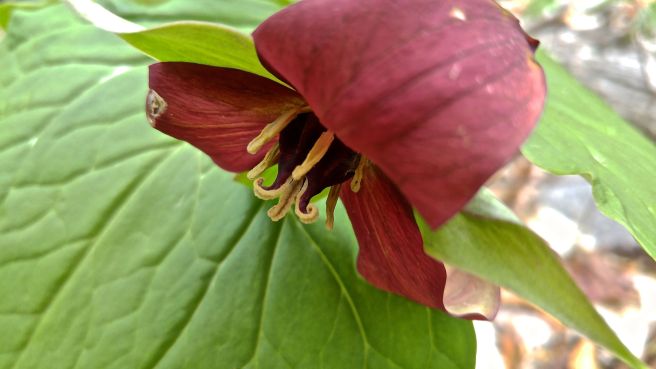
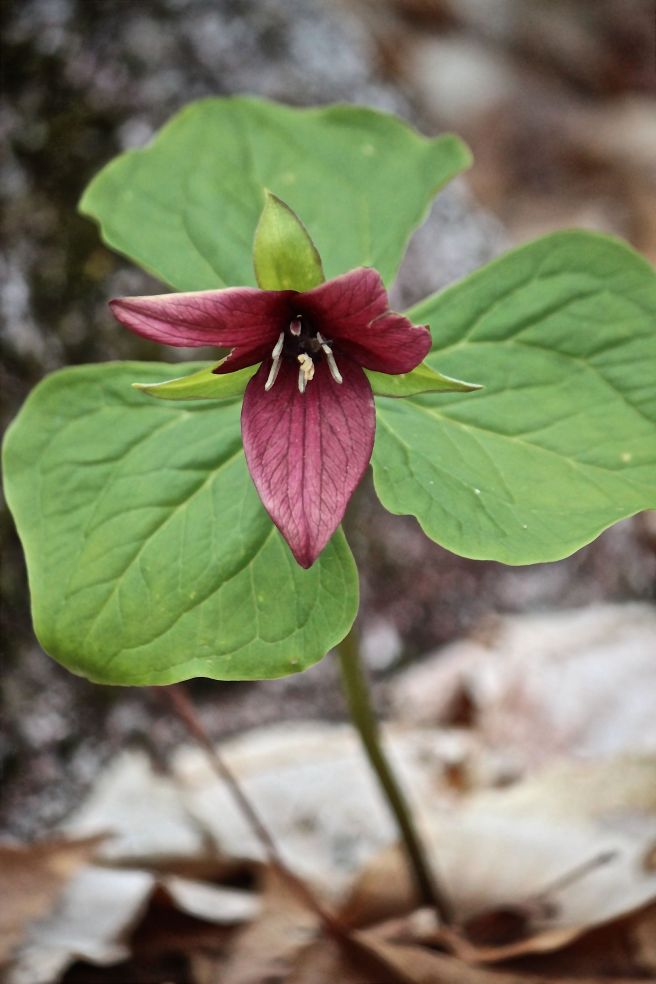
Meanwhile, the regal bloom of a red trillium shared the continuation of the series of three–trilliums have a pistil with three parts surrounded by six stamens. My guy asked if I have a trillion pictures of trilliums. Maybe–but certainly not enough.

a-burl, ph

We paused to admire  a large burl.

a-beaver, ph

And passed through an old beaver bog into a hemlock grove.

a-mystery 1

Though it was much too cold for butterflies, I found one in the form of a plant. Actually, it rather reminded me of a luna moth.

a-striped maple

As we began to climb, we were in the land of the striped maple and hobblebush. I promised myself I wouldn’t photograph the hobblebush flowers. But this striped maple–ahhhhh.

a-snail, ph

My guy is fast, even after going for a run this morning. I, however, was happy to discover that I wasn’t the only one moving at a snail’s pace.

a-5 petals1

Continuing up, cherry and

a-shadbush, ph

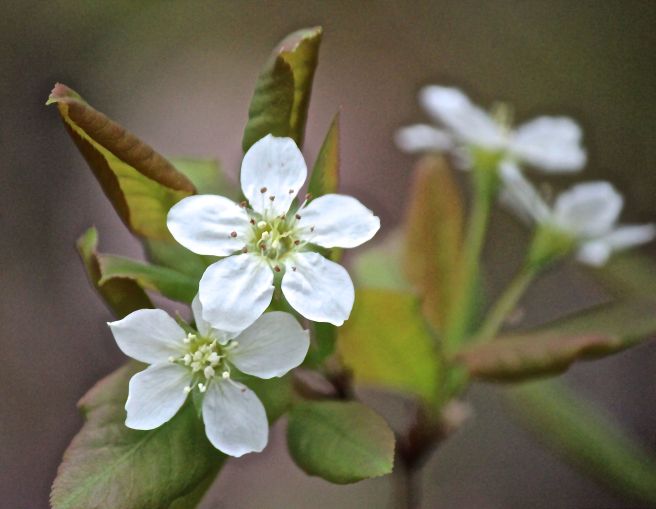
shadbush displayed their dainty faces.

a-near summit

Up and down through the notch we continued until at last we approached the summit.

a-mtn view1, ph

Yesterday, we marched to the beat of a different drummer. Today, we took in the scene toward Kearsarge and the Baldface Mountains. Rock, lichens, mosses, shrubs, trees, mountains, valleys, lakes, clouds–all verged on the horizon. We knew we were blessed.

Thanks for wondering my way on another day and a Mondate to boot.


On Another Day

Today was a perfect day for a hike–cool temps and a breeze kept the bugs at bay. And so my guy and I headed off after lunch with a destination in mind. Backpack–check. Camera–check. Map–check.

And with the latter, it all ended.

a-squiggly sign

We’d hiked our intended trail once before within the last ten years, but remembered that back then we had a difficult time following it. We were sure, however, that we could find our way today and we did. Until, that is, we reached a junction and read the snowmobile trail signs. Our gut told us to go straight but because we were on a snowmobile trail, the signs listed destinations. We looked at the map, looked at the signs, and convinced ourselves to turn right.

a-hobble 3

And so we journeyed on, enjoying the beauty of hobblebush even as it forced us to do what it was named for–hobble through the undergrowth.

a-hobble 2

But how could we resist such beauty. Or should I say, how could I resist such beauty–my guy trudged on. I think it’s the complexity of the blossom that intrigued me most–large, five-petaled, sterile flowers encircled petite and fertile, waxy-white flowers. Why big showy flowers surrounding such tiny ones complete with stamens and pistils? Perhaps the outer sentry attract insects for the sake of pollination.

a-round-leaved violet 2

Also thinking about pollination–those purple runway lines of the round-leaved violets.  I’m not a fashion girl, but it’s flowers like this that make me realize you can combine a variety of colors to make a statement.

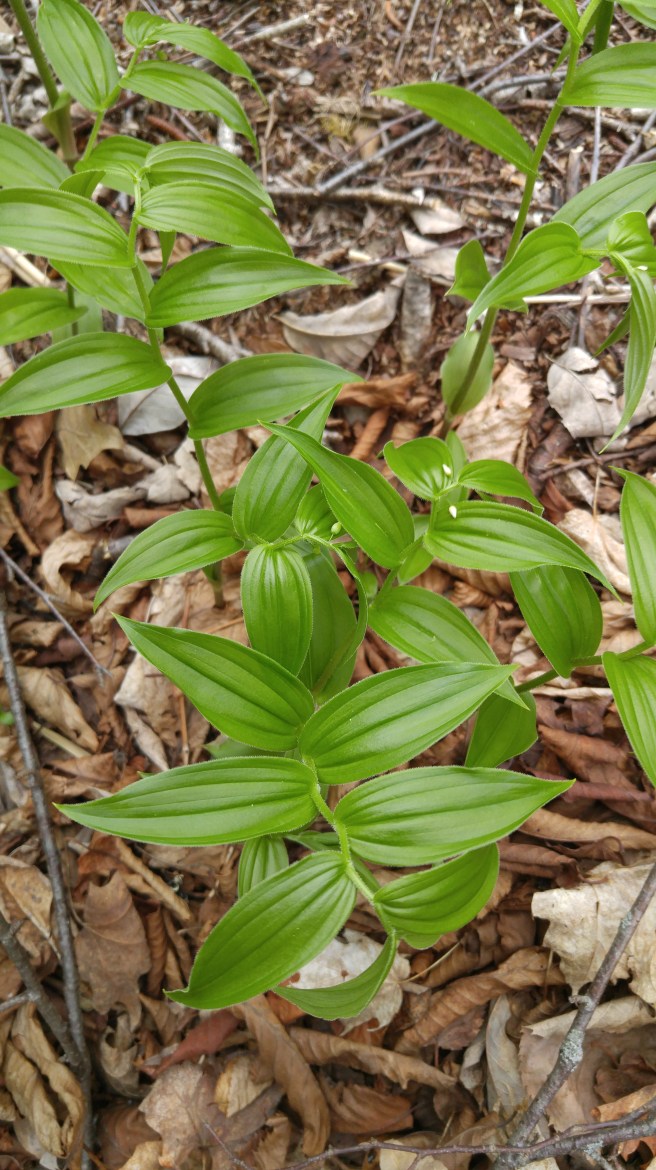
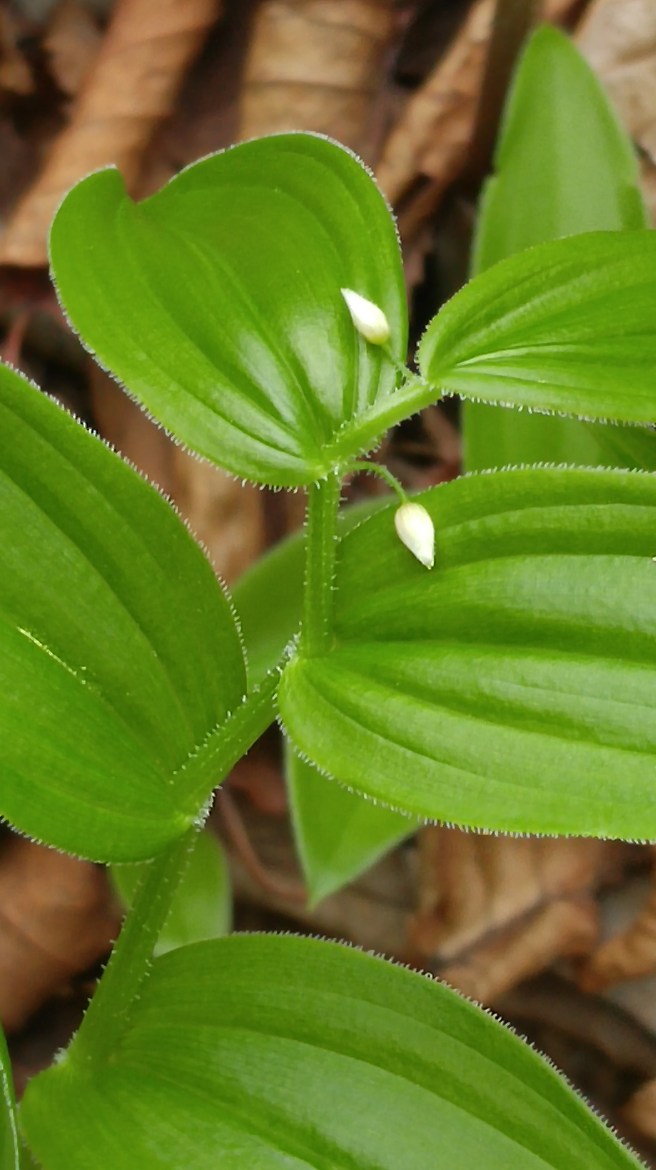
a-rose twisted stalk

A much more subtle display of color–rose twisted-stalk. Not a great photo, but the  flowers dangled below the twisted stalk. Why rose?  The bell-shaped flowers that occur singly at the leaf axils are pale rose in hue. Why twisted? Because at each leaf junction the stem takes a distinct twist.

a-sarsaparilla

Adding to the subtle color of the season–sarsaparilla. I love the fact that this particular example shows the variety in the finely toothed compound leaves–in this case, two leaves sporting five leaflets, while another consists of three. It’s the three that sometimes gives this plant an undeserved bad rap–leaves of three, leave them be, refers to poison ivy. But this is not P.I. as we used to call it when I was a kid.

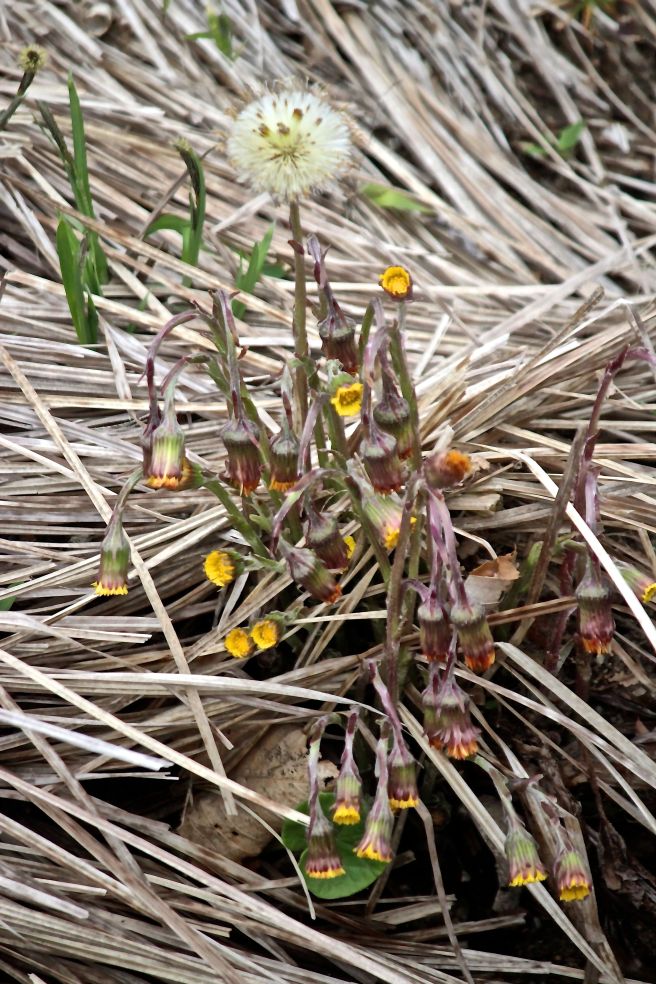
a-coltsfoot1

Another sorta look-alike, coltsfoot that resembles a dandelion. The difference–a coltsfoot seed ball retains its flower parts.

a-spring color

As the tender new leaves emerge, the landscape softens.

a-oak 1

From subtle colors

a-beech 3

to hairy fringes

a-sumac 1

and fuzzy coatings, the world embraces a softer point of view.

a-wet trail

Though we continued to make delightful discoveries, it was evident that we were on the wrong trail.

a-brook crossing.jpg

After a couple of hours, we turned back.

a-trail blaze.jpg

And at the point where we ignored our gut feelings and decided to turn right, we checked on the other trail–and found that it was blazed. Oh well.

We’ll save it for another day.


Beulah’s Mystery

One of the fun happenings in my life is that friends send me nature photos and ask me to help them ID a species. Sometimes I know immediately what it is and can ask them questions to help them get to the answer. Other times I’m as stumped as they are. Thus was the case today, when I drove to Brownfield to look at a tree growing in the field beside an old farmhouse.

t-beulahs 2

Beulah’s farmhouse, to be exact. My friend’s brother recently purchased it and the adjacent barn. Though the farmhouse is a fixer-upper, Beulah’s sign looks as if it was created yesterday.

t-tree1

This is the tree. If you know it right off, my hat goes off to you. I was in my Forest Trees of Maine mode and kept looking at it from that perspective. It’s overall appearance didn’t match what I know. We began with the key and slowly (painfully slowly as the black flies swarmed us–mind over matter, mind over matter), worked our way through the choices, two by two.

t-dwarf shoots

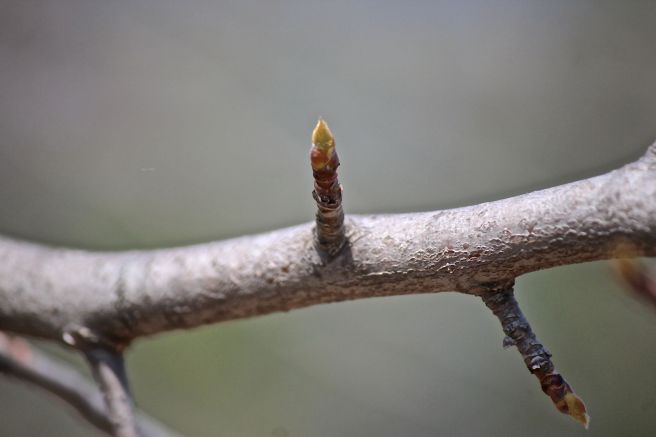
Because it’s not in leaf yet, we used the Winter Key. With each question, we paused to examine the tree–looking at the alternate leaf shoots, hairy scaled buds, pith, bark–every detail. We considered its location in the middle of a farm field, where the land sloped slightly and was rather dry. We also looked at the ground and found decaying leaves as well as deer scat. As I suspected, it wasn’t in the key. So I came home and scoured other books. I think I reached the answer and that the deer scat is actually a clue. Do you know? Now you may say so.

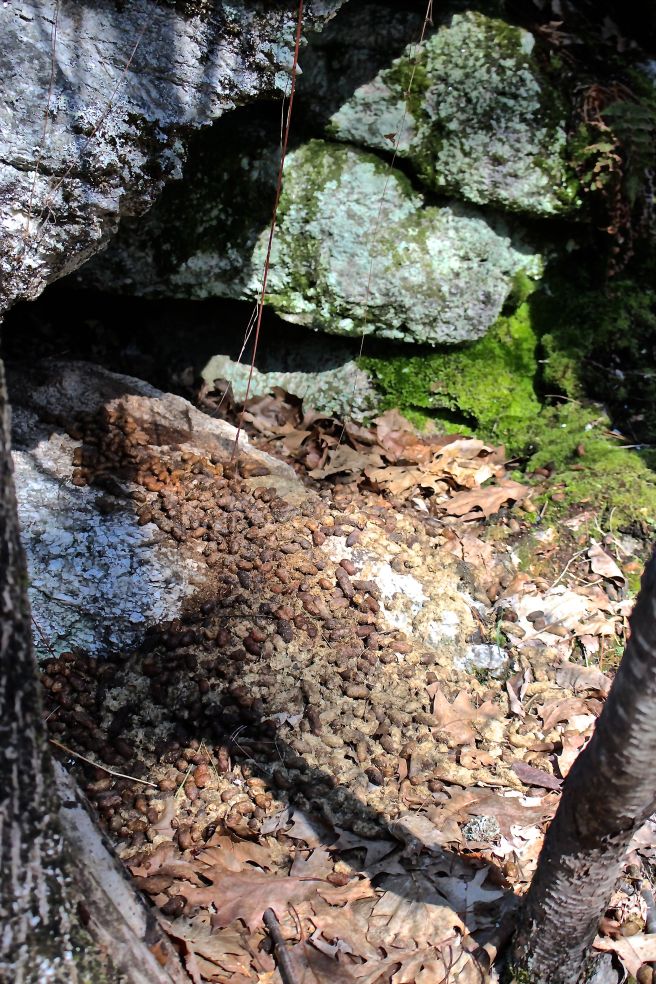
t-porky den

On our way to see one more cool thing, we paused to look at a den located beside the old foundation. Though much of the scat has since been removed, plenty of it and numerous quills painted the picture of who’d created this pigpen.

t-critter 2

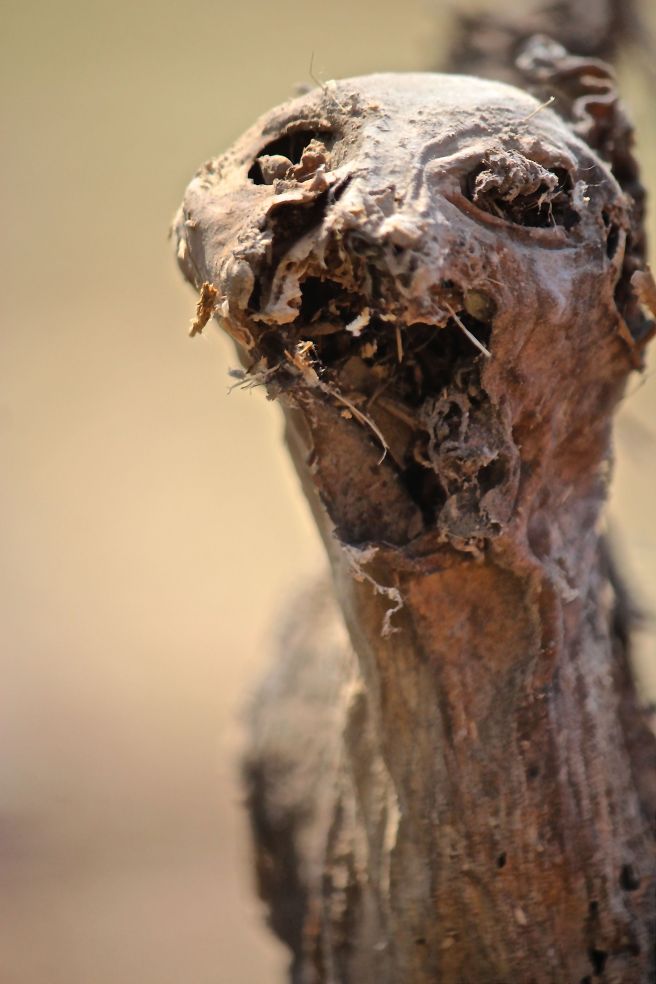
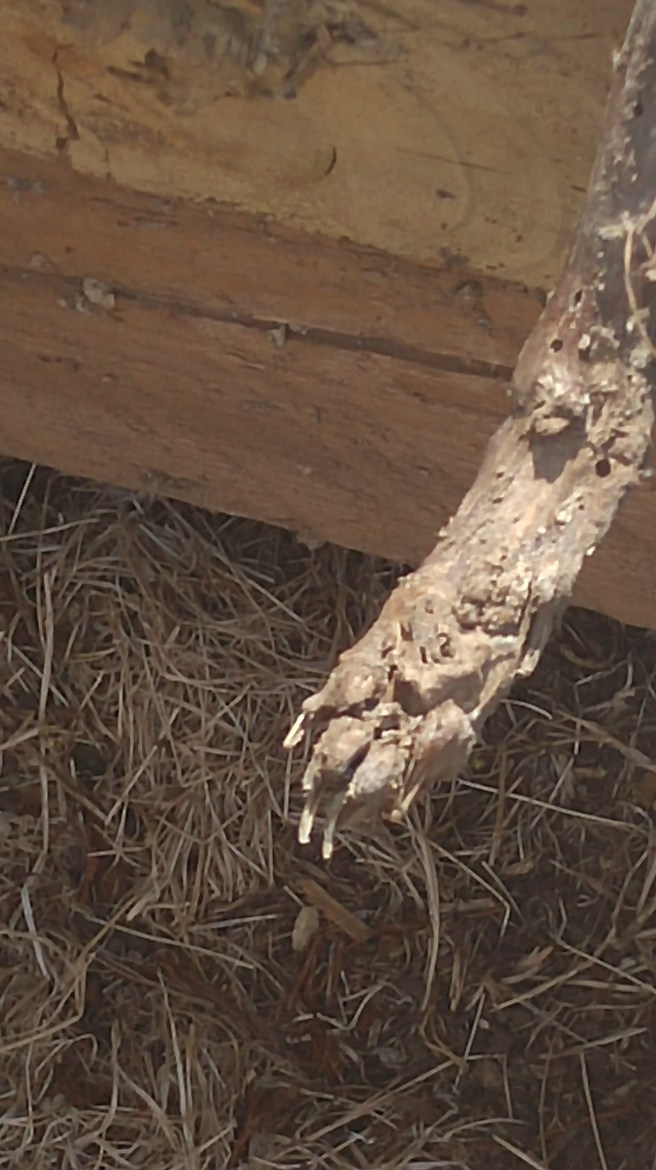
And then they had one more mystery item to show me. I hope this doesn’t freak you out. It’s part of many renovations in old farmhouses–a dried-up animal carcass. The front of the face was missing, but as we say, eyes in the front, born to hunt.

t-critter 1

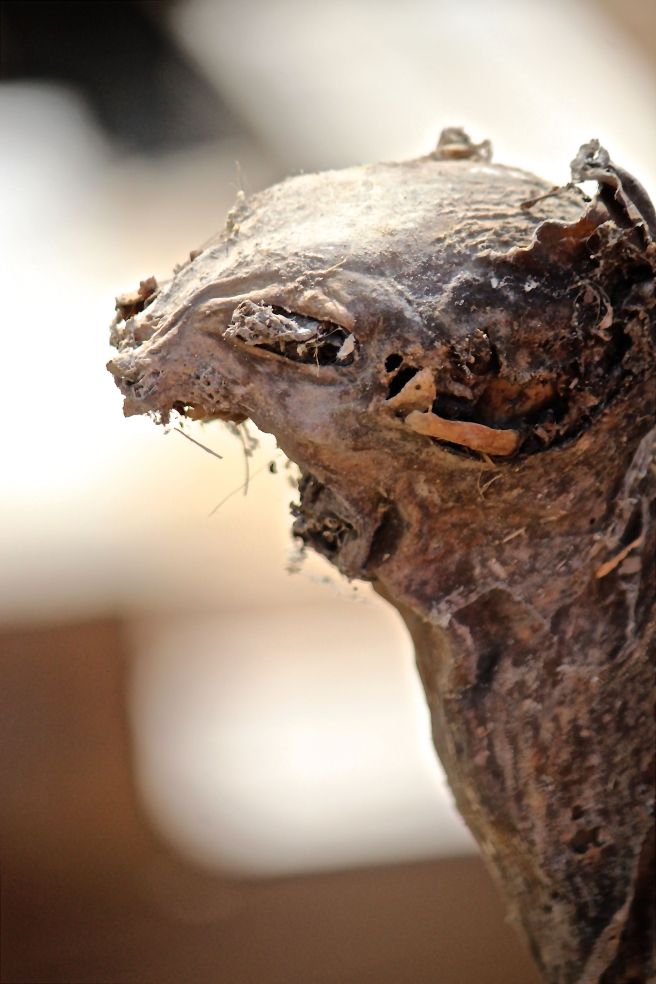
A side view of this handsome critter. Can you see the ears?

t-critter 4

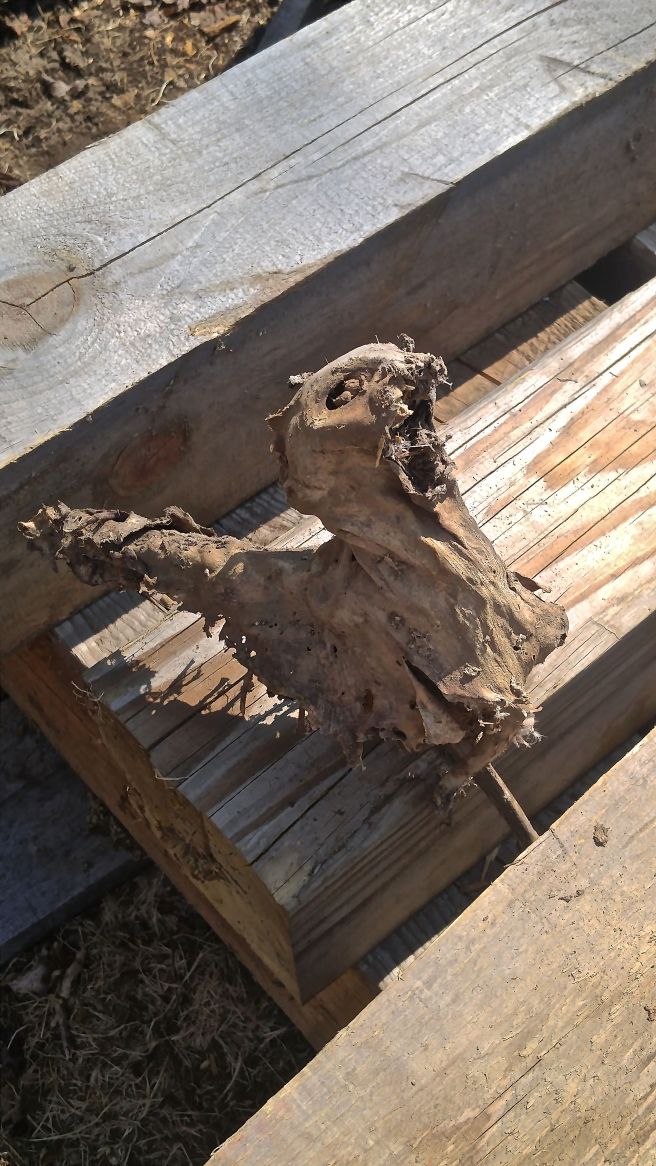
Talk about all skin and bones.

t-critter pads

And then the foot pads and nails. Four toes, nails, about the size of a nickel. Do you know?

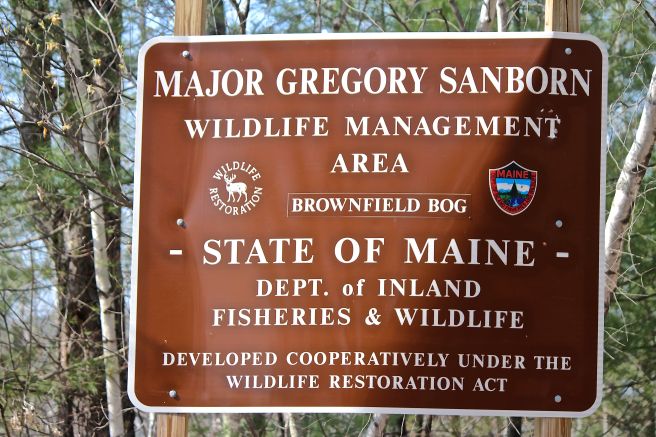
t-bog sign

Because I was in the neighborhood, I visited Brownfield Bog and continued my afternoon exploration. (Yeah, I had work to do, but playing hooky for a couple of hours is allowed once in a while if I don’t abuse the privilege–ah, the life of a freelancer.)

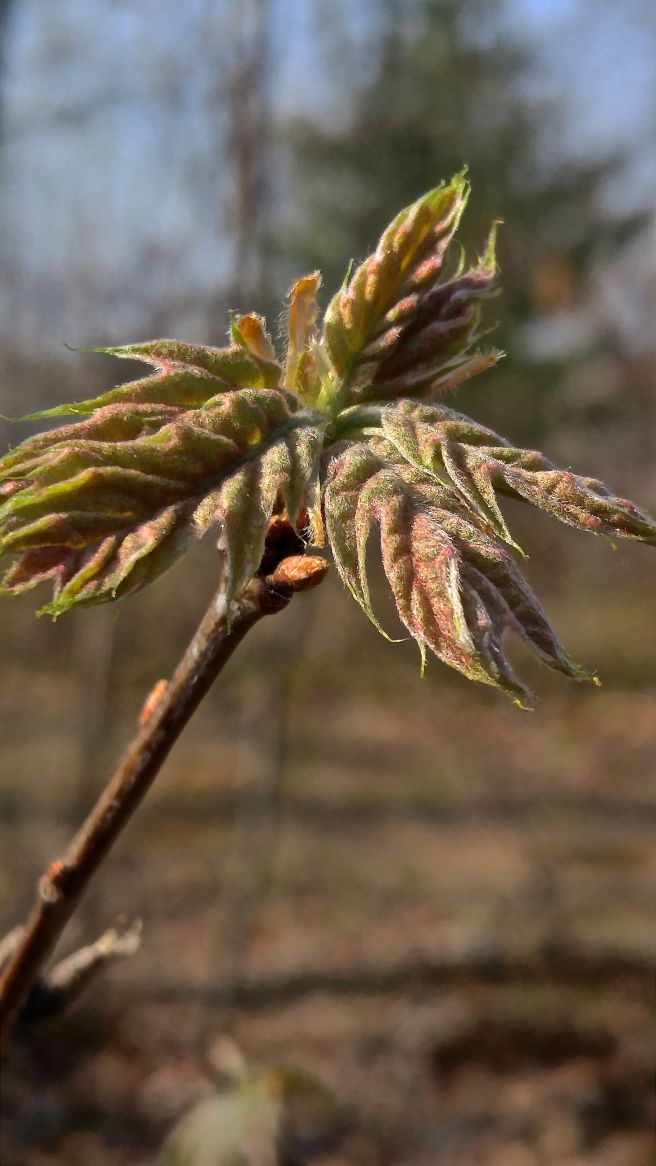
t-red oak emerging

I remember suddenly becoming aware of spring colors about thirty-five years ago, when I taught  school in New Hampshire by the convergence of the Pemigewasset and Merrimack Rivers. Until then, I’d never realized that tree leaves emerge in a variety of colors–they all weren’t suddenly green. (BTW– do you see the spittlebug? )

t-red oak mini leaves

In a quickness equal to fall foliage, spring colors may not be as flashy, but their subtle beauty deserves notice.

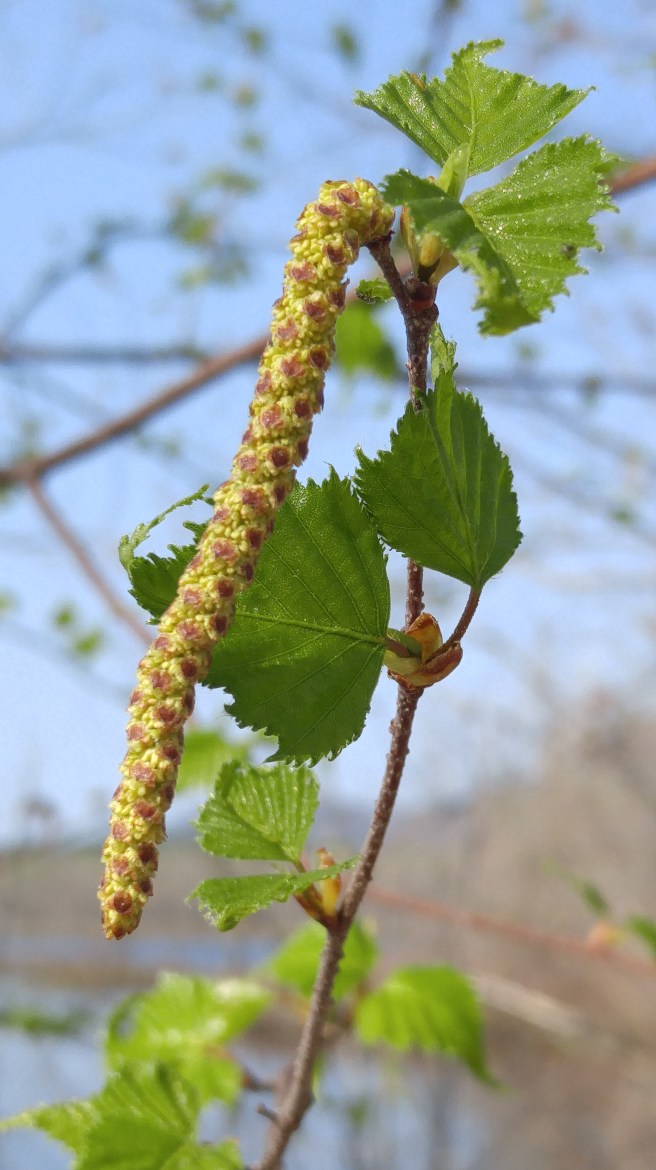
t-gray birch 2

And those leaves that are green offered their own reasons to stop me in my tracks as I took in the details–in this case the double-toothed elephant’s trunk. What? Notice the shape and outer margin of the leaf.

t-gray birch 4

The lovely elongated catkins demanded a glance that lasted more than a second.

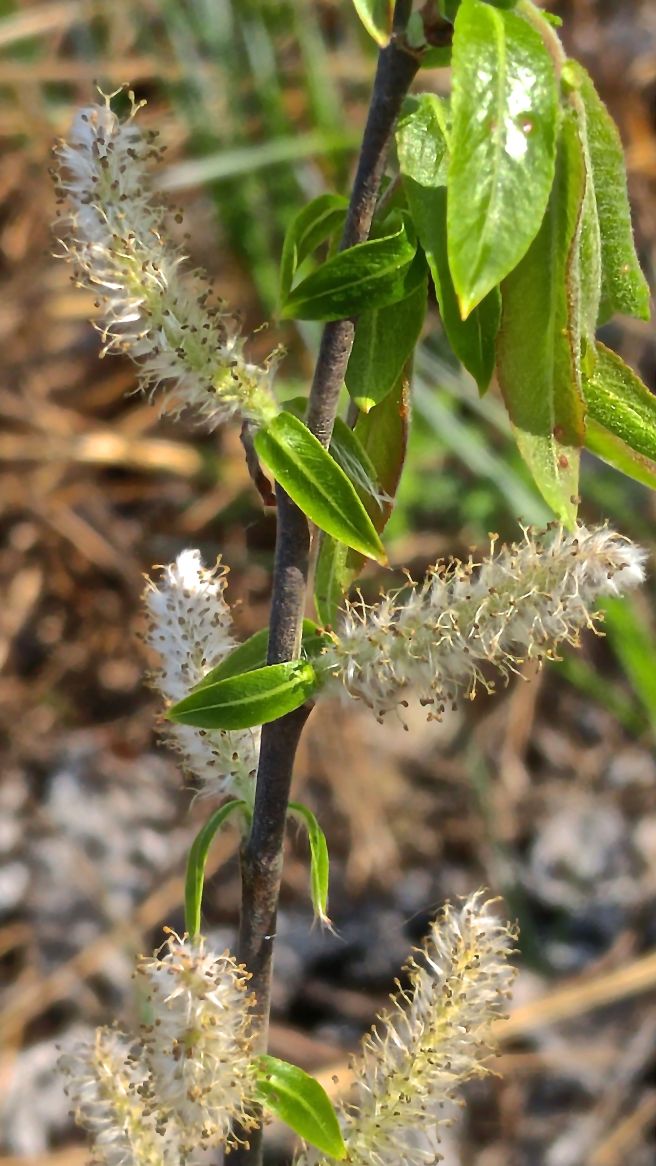
t-willows cat1

Adding a festive fuzziness to the celebration of spring was another set of catkins.

t-willow gall

Unwittingly, this shrub also played host to a gall gnat midge that overwintered in a structure created by the reaction to a chemical released by the larva–what would have been leaves were forced to harden into a pine cone look alike.

t-bog colors 2

The subtle colors graced the meadow,

t-pleasant

were reflected in the bog,

t-river

and blessed the Saco River.

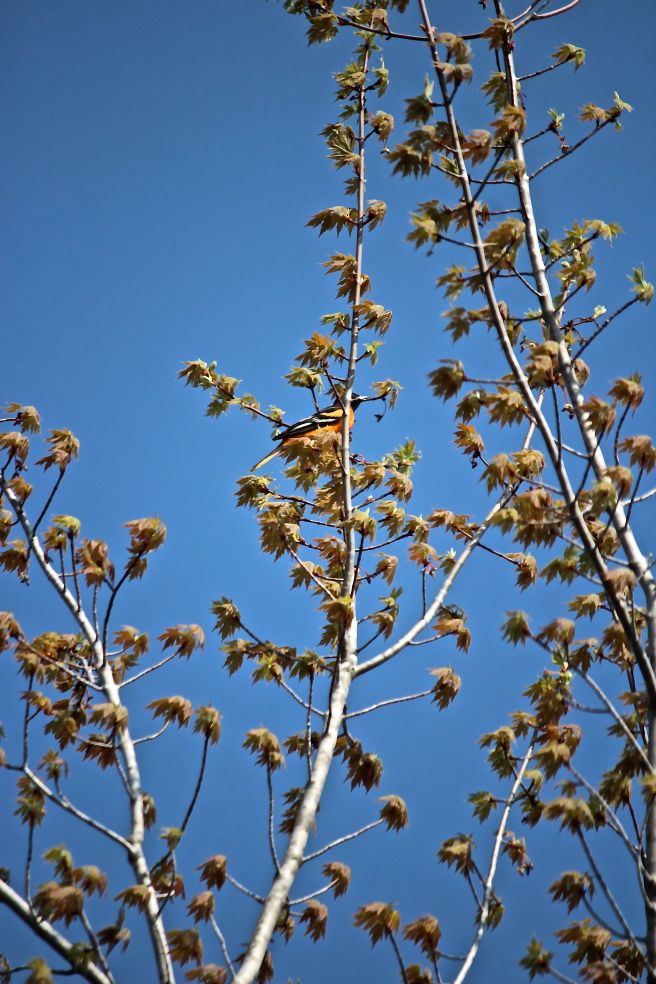
t-baltimore 2

There were bits of flashy color–do you see who was feeding on the upper branches?

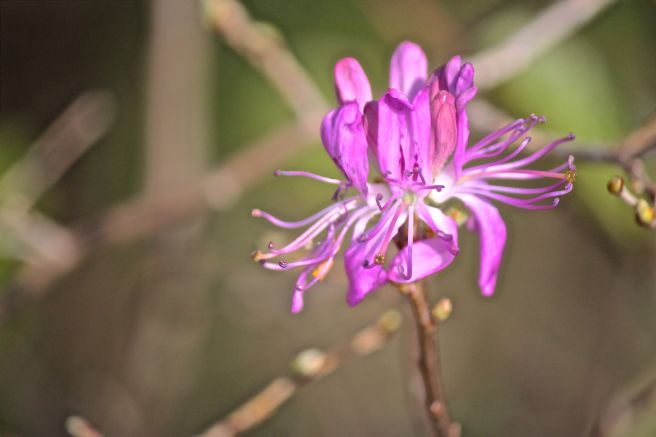
t-rhodora 1

And this spring beauty exploded with love and life.

At the end of my journey, I was grateful to P&K for an excuse to step away from my desk and check out the mystery standing in Beulah’s field. Especially as it led me further afield.

Spring In Slo-Mo

Spring is so fleeting in Maine. Oh, I know, it lasts the usual three months and the beginning and ending overlap with its seasonal partners, but really . . . one must take time to pause and watch or you’ll miss the most amazing action that occurs in slow motion right outside the window–and beyond.

s-red trill 1

Jinny Mae and I drove beyond today to catch a glimpse of this most splendid season.

s-red trill 10

Among the offerings, red trillium also known as stinking Benjamin. The Benjamin part is from benzoin, a mid-16th century word derived from the French benjoin, that refers to “a fragrant gum resin obtained from a tropical tree of eastern Asia, used in medicines, perfumes, and incense.”  It’s been tagged “stinking”  because its nodding flower has an unpleasant odor. We didn’t bother to sniff. We were too busy being wowed by the fact that it surrounded us in great number.

s-red trill 2

That smell, however, is of extreme importance. Along with the flashy coloration, the odor helps to attract pollinators–green flesh-flies that prefer to lay their eggs on rotting meat. Though this isn’t the perfect nursery, the flies assist the plant on the procreative end. And in this spot, stinking Benjamin rules, but I prefer to think of it as red trillium.

s-red trill back

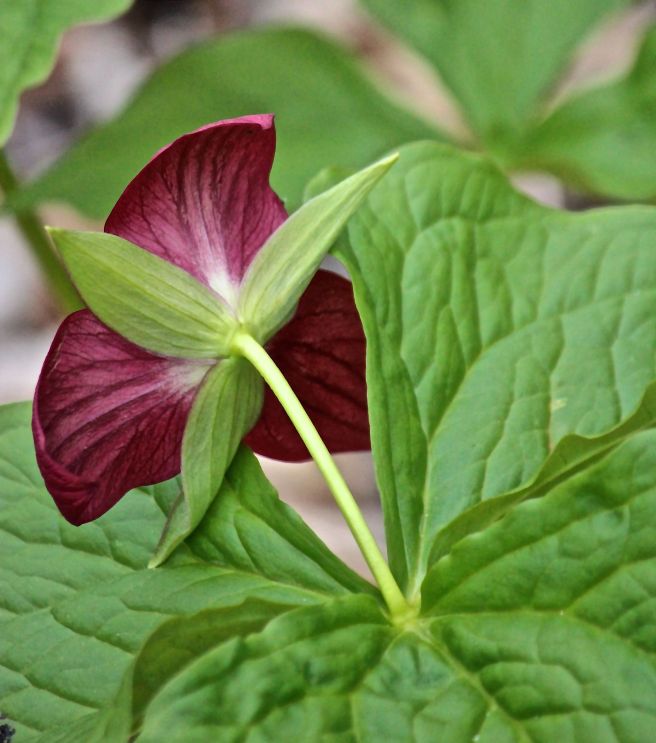
Even from the backside, its design is one to behold.

s-false 1

Equally abundant were the leafy structures of false hellebore.

s-fals3e4

I was mesmerized by its pattern.

s-wood 2

Unlike the trillium, wood anemones have little scent.

s-wood 1

Their graceful heads drooped, perhaps because the day threatened rain.

s-bellwort 3

The offerings included sessile-leaved bellwort (aka wild oats),

s-dutchmen1

Dutchman’s breeches with leaves as interesting as their flowers,

s-ginseng 2

the delicate white flowers of dwarf ginseng,

s-twisted 4

and  zigzag pattern of clasping twisted stalk.

s-twisted1

Its key features are minutely-toothed leaf margins, stalkless leaves that clasp the stem, and flowers dangling below.

s-twisted 3

The flowers hadn’t opened, but the closer we got, the more we appreciated its finer details.

s-hobblle 1

Ever so slowly, as is the case in all things, hobblebush flowers began to bloom.

s-hobble2

Outer sterile flowers form a ring around the delicate inner flowers that are fertile. Nature has a way of protecting its own.

s-colts 2

When we first spotted the fluff ball of seeds across the brook, we thought we were looking at dandelions. And then we saw the scaled stalks and lack of leaves. Coltsfoot it is.

s-cinnamon 3

It wasn’t just the flowers that had us getting down on our hands and knees. There was the brownish wool covering of the cinnamon fern.

s-ostrich 1

And the hairless ostrich fern

s-ostrich 2

with its crook-shaped crosier, reminiscent of a bishop’s staff.

s-christmas 2

But my favorite today was one I’d never noticed before.

s-Christmas 4

Oh, I know it’s a Christmas fern, but the tightly-wound, silvery-scaled crosiers were new to me. It was yet another chance for us to wonder how we could have missed something that’s been here all along.

s-striped maple 1

And then we looked up. Well, sort of up. Striped maple leaves slowly opened in the understory.

s-red maple 1

And have you ever noticed that young red maples are a tad hairy along the margin?

s-beech 6

Even hairer, beech leaves.

s-beech 7

All winter long, bud scales enclosed leaves that are now slowly emerging.

s-beech 8

They’re absolutely beautiful in their plaited and hairy state.

s-beech 2

What leaves me wondering (ah, a pun), is the fact that these leaves are so hairy. It seems the hairs are intended to keep insects and others at bay.

s-beech 1

And yet, it won’t be long before the insects discover that beech leaves make a good meal and home.

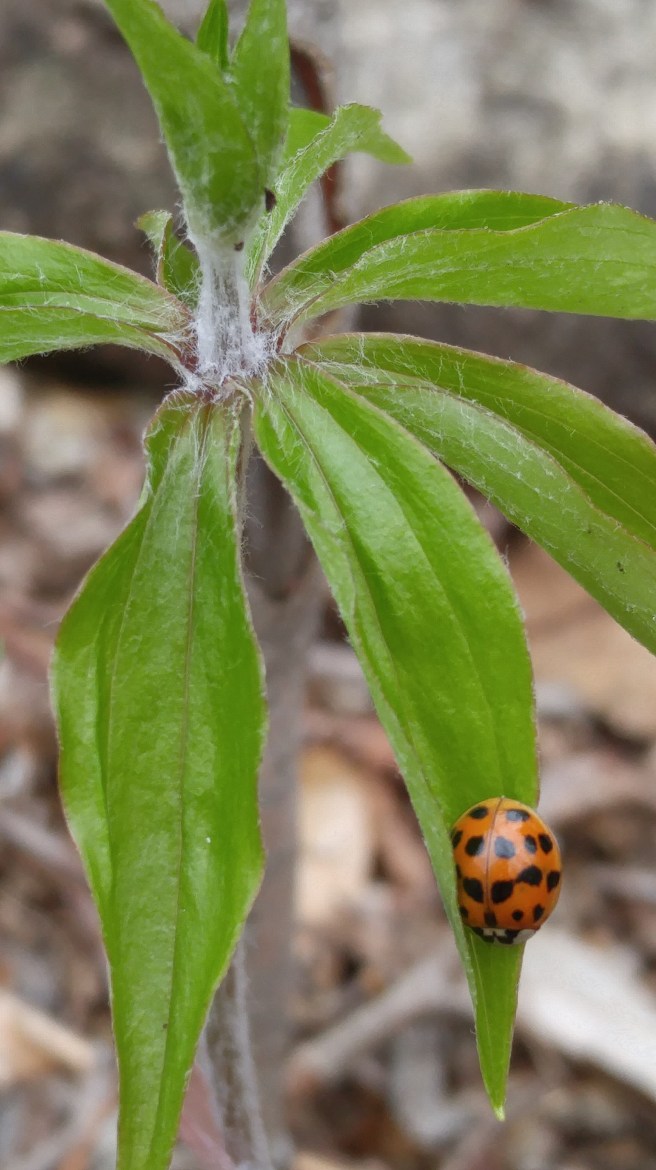
s-ladybug

Speaking of insects, we found a ladybug presumably feeding on aphids–already. So why do ladybugs sport  bright orange or red color and distinctive spots? To make them unappealing to predators. They can secrete a foul-tasting fluid from their leg joints–the coloring is therefore intended to shout out,  “I taste awful.”

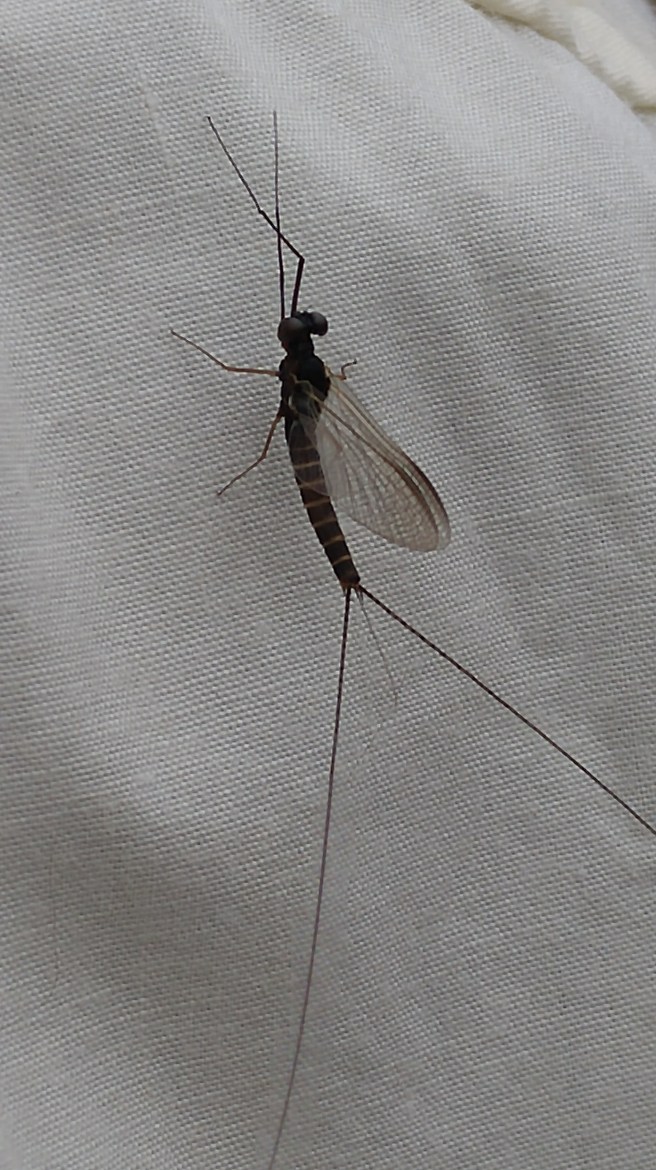
s-Mayfly 1

And Jinny Mae sported her own insect–a Mayfly, known to be more fleeting than spring, landed on her jacket. Oh, and did I mention the black flies? They swarmed our faces, but we practiced mind over matter.

s-brook

We were in one of the most beautiful places on Earth,

s-shell1

as evidenced by brook,  pond and mountains beyond.

s-gorge 4

And then there was the gorge.

As we watched the water rush through, we gave thanks for a day spent moving in slo-mo to take in all that this fleeting season has to offer in its spring ephemerals.

Our Place

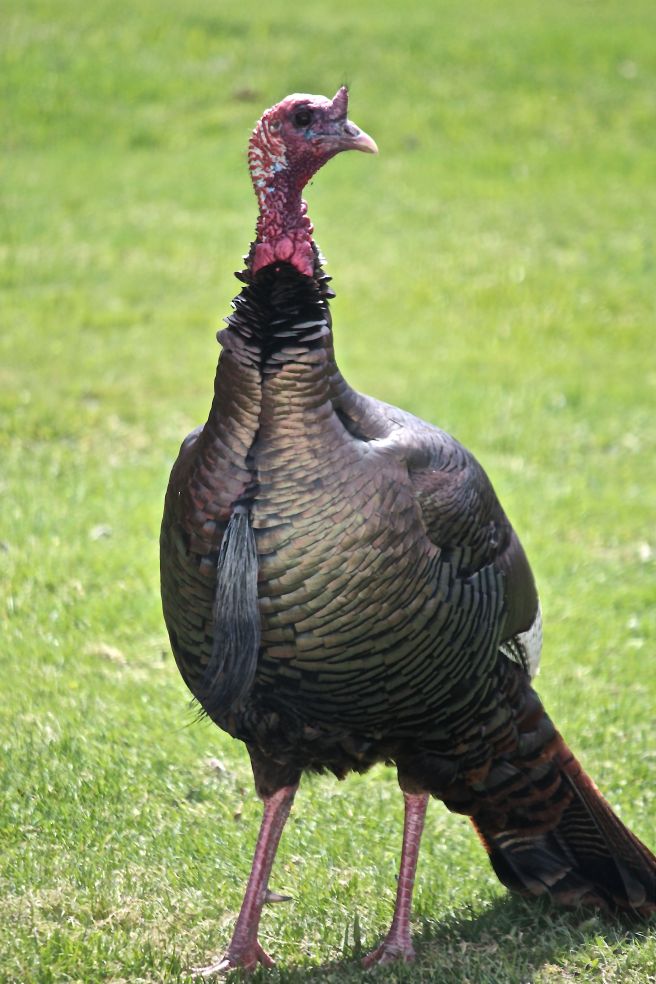
h-tom2

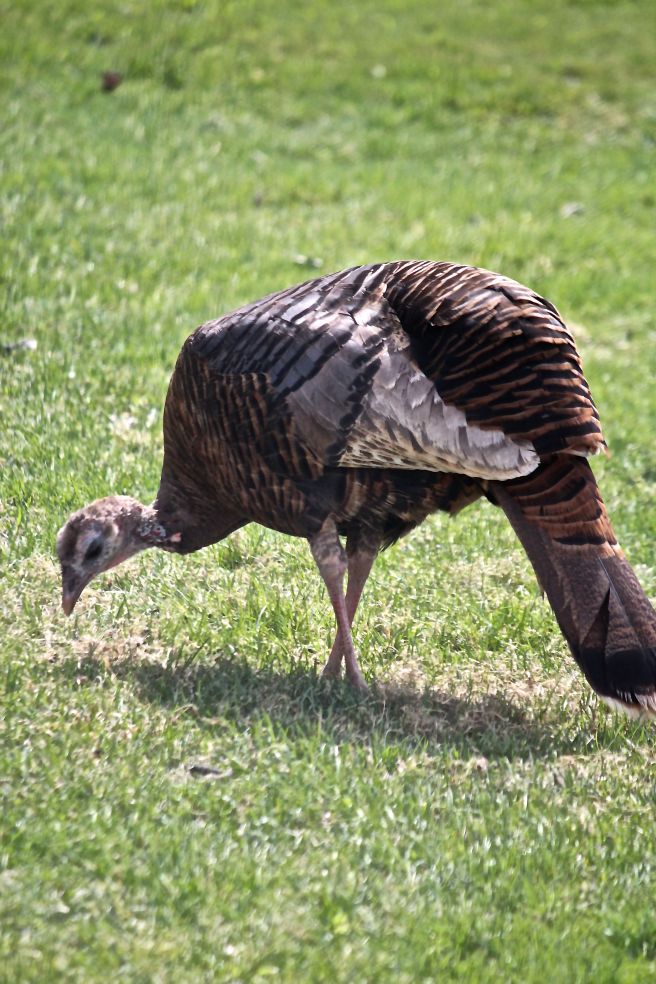
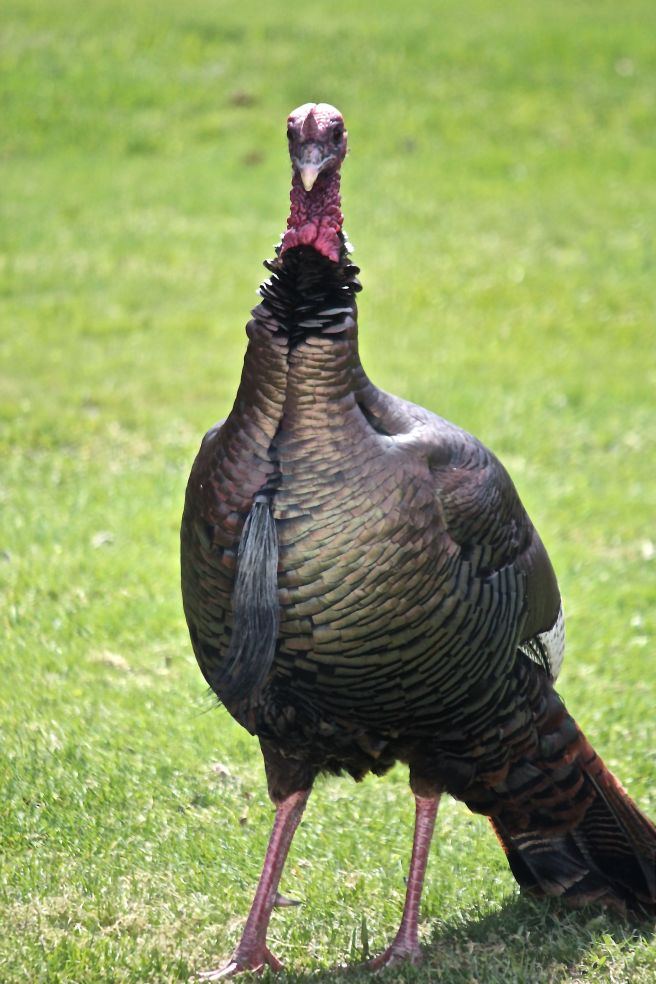
Gooble. Gooble. Gooble. Gooble. Gooble. Gooble. Gooble. Seriously . . . is all that noise necessary? Apparently it is. Mr. Tom felt the need to awaken us at this morning’s first light with his non-stop gobbling–his way of calling the hens to join him. Disclaimer: I didn’t take this photo until later in the day. In all his ugliness, I have to say that he really is a handsome fellow.

h-female turkey

The hens who hang out with him don’t appear to care, but maybe they’re just playing coy.

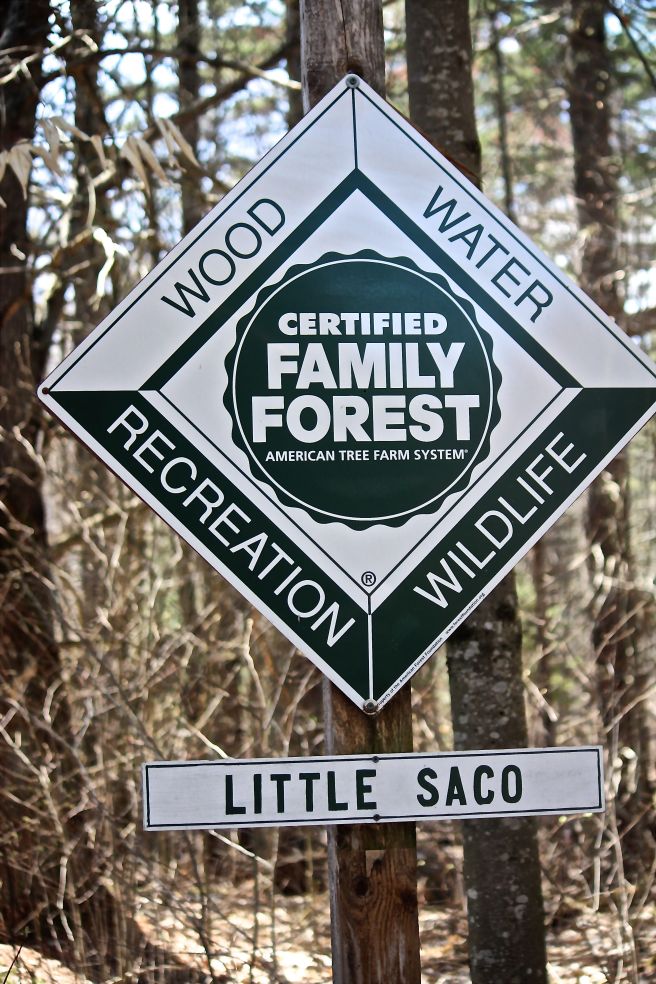
p-little saco sign

We left them to the bird seed scattered on the ground and drove to Farnsworth Road in Brownfield for a hike up Peary Mountain. The trail is located on private property and we’re thankful that it’s open to hikers. Much of it is a snowmobile trail as well.

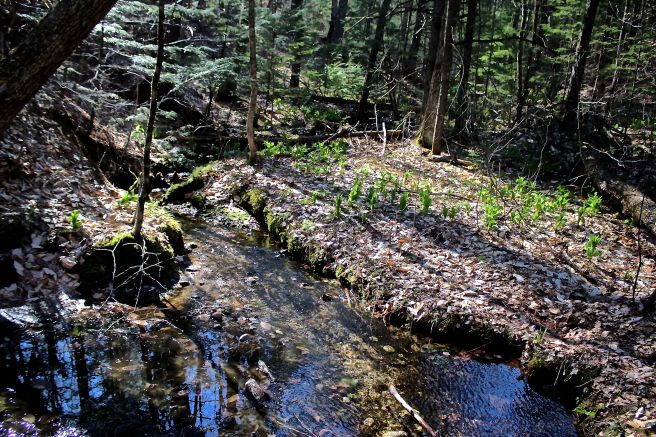
p-Little Saco

The Little Saco flows over moss-covered rocks beside the lower part of the trail.

p-false 4

As we followed it, bright green growth in the damp soil warranted a closer look.

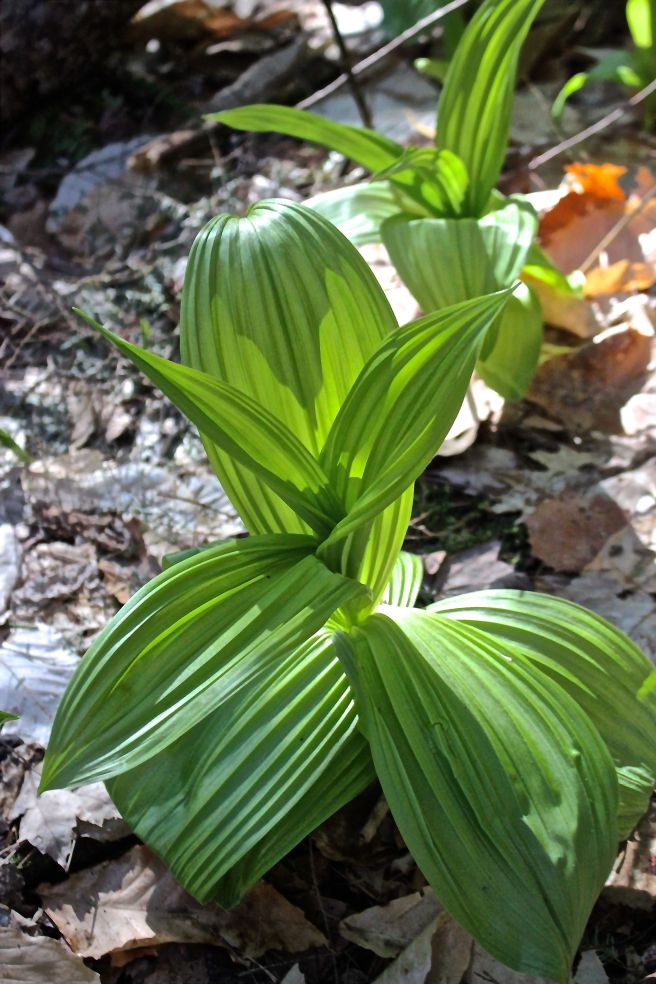
p-false hellibore 2

A true sign of spring–false hellebore with its corrugated leaves.

p-striped 2

There are plenty of other signs, including the pink and green striped maple buds. I’m missing my macro for these moments of early glory, but so it is.

p-beech 1

While some beech trees still have a few marcescent leaves clinging until they can no more, I noticed a few buds beginning to burst.

p-summit sign

At a stone wall, the trail suddenly turns 90˚ to the left.

p-fdn 2

But in the opposite direction–the remains of an old foundation.

p-fdn ledge 2

And above, a ledge from whence the stones presumably came.

p-porc scat

The ledge continues to provide a dwelling–for critters like the porcupines who keep the hemlocks well trimmed.

p-bluets

As we climbed to the top, delicate bluets showed their smiling faces.

p-bench view1

And then we emerged on the 958-foot summit, where the bench view is glorious. The small mountain was named for Admiral Peary. Apparently, his mother’s family, the Wileys, lived in neighboring Fryeburg. Upon graduating from Bowdoin College in 1877, Peary lived in Fryeburg and conducted survey studies of the area for a couple of years, before moving to DC and later leading an expedition to the North Pole.

p-mount wash

If you’ve seen similar views of the big mountain, its because it’s part of our place.

p-my guy view

I followed my guy along the ridge line to the end–where the view turned homeward.

p-pointing

My guy made a point of recognizing landmarks from Mount Tom and Lovewell Pond along the Saco River to Pleasant Mountain and Brownfield Bog.

p-Pleasant 2

If you look closely, you’ll notice a horizontal line just below the bog–that’s the Saco River. And the little mountain to the left of Pleasant Mountain–Little Mountain in West Bridgton.

p-Pleasant Road1

The only part of the view that we don’t get–the new road that was constructed up the backside of the mountain within the past year. It worries us. And that is why we appreciate the efforts of Loon Echo Land Trust for protecting most of the rest of the mountain.

b-pitch pine

We headed home for lunch and to pull out the lawn furniture.* And then we parted ways, my guy to attend a celebration of life for an old friend, and me to climb Bald Pate. My purpose–to look at the pitch pines and jack pines.

b-pitch 2

In bundles of three, the stiff needles surround the male pollen bearing cones on the pitch pine.

b-jack pine1

Jack pine features two needles per bundle–think Jack and Jill.

b-peabody & sebago

From the summit, I paused to take in the view of Peabody Pond and Sebago Lake beyond. It doesn’t matter how often I climb to the top of this 1,100-foot mountain, the view is ever changing.

b-mount wash1

And again, I could see Pleasant with Mount Washington in its saddle. This time, however, I was on the opposite side looking at the front of Pleasant Mountain. You may wonder about the road–it leads to two cell towers near the Southwest Ridge summit.

b-sweet fern 1

As I made my way to the Foster Pond Lookout, I stopped frequently to enjoy the ever-artful presentation of sweet fern.

b-blueberries

And I noticed another sweet offering that many of us will enjoy this summer–blueberry plants in bloom.  A year ago next week, I saw the same on this very mountain. Seems early, but I think they’re well protected in a sunny spot.

b-foster pond 2

I’m sure had my guy been with me, he would have named a color chip that matched Foster Pond–perhaps turquoise blue best described it in that moment.

b-bird treat 1

Heading back to my truck, I noticed some bird treats dangling from the trees. Perhaps our turkeys will fly to South Bridgton.

h-tom 3

Apparently not. Back at home, Tom had returned. He’s a frequent visitor to our place. And we’re frequent visitors to the area beyond our backyard. It’s all really his place and our place.

* If you live in our area, expect at least one more snowstorm. It always snows once we pull out the lawn furniture.


Every Day is a Gift

It’s Earth Day and yet, I wanted to hibernate. That didn’t go so well. First, I looked out the living room window this morning and noticed a skunk staggering as it walked in circles–like a dog chasing its tail–only the skunk kept falling to the ground and then getting up and continuing in the same fashion. So I called the game warden. A neighbor did the same and a short time later an animal control officer put the skunk out of its rabid misery.

a-blues1

And then I was supposed to co-lead a hike in Pondicherry Park, but still in hibernate-mode, I managed to get out of it. My excuse–work load. Which was true, but staying focused wasn’t happening. So, I headed out the back door and decided to change my point of view. The high bush blueberry leaf buds began to do the trick as they offered their gift of quiet beauty.

a-red map2

a-red maple 1

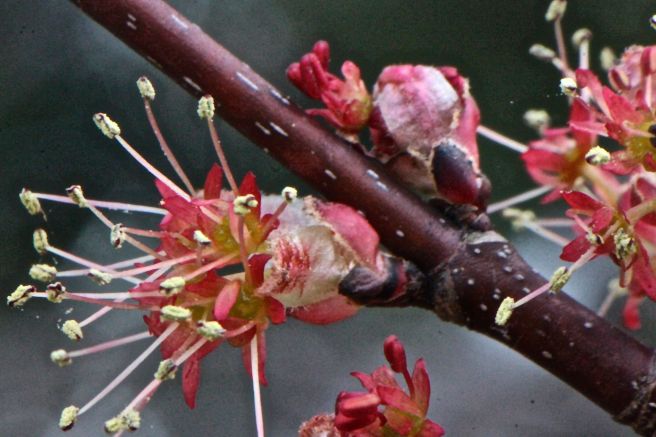
Nearby, red maples practically screamed for attention. Male flowers have long, extended stamens that are coated in dusty yellow-green pollen. The females have a well developed ovary with two long stigmas but the stamens are reduced in size and non-functional. Just seeing them lifted my mood.

a-ta1

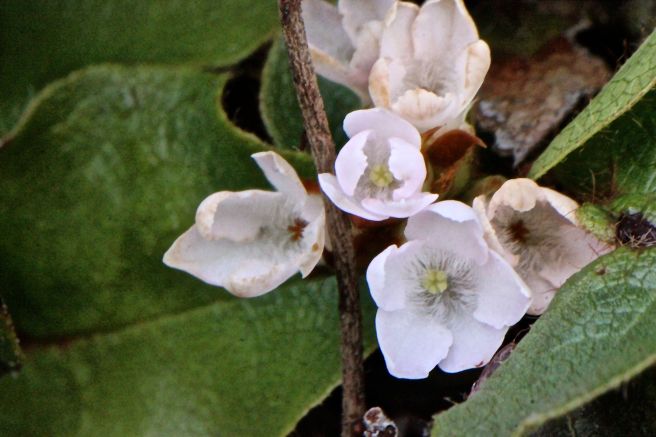
As I made my way to the vernal pool, I stopped to smell the trailing arbutus, aka Mayflower. But sniff as I did while squatting on all fours, I couldn’t smell the soft scent people rave about. And I have a good sniffer. For me, the gift of this wildflower is all in the joy it brings as one of our first to bloom.

a-tad 4

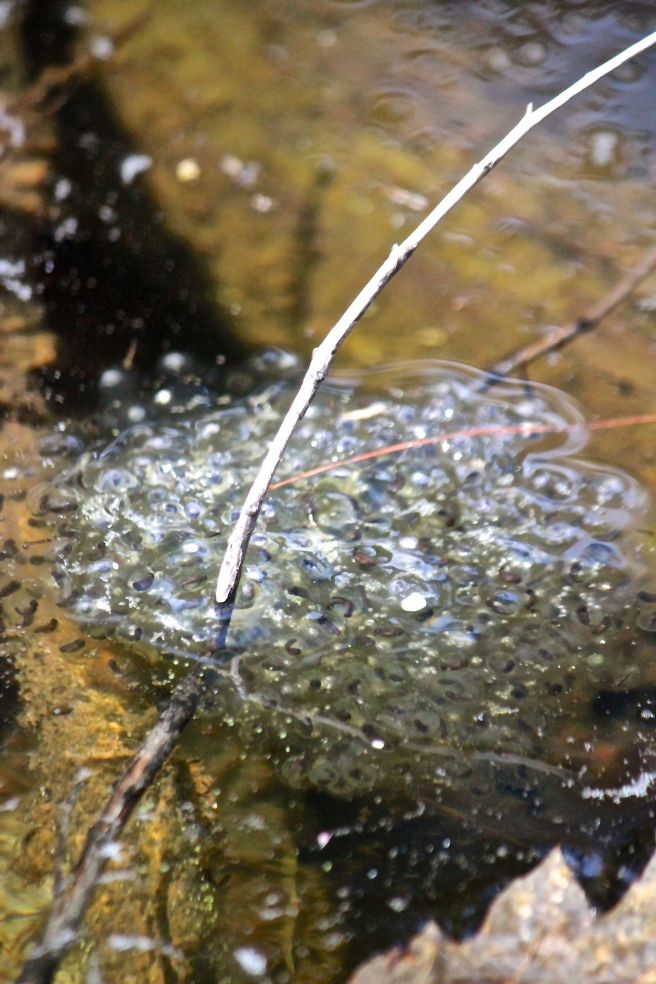
My next stop, was of course, the vernal pool that I frequent on a regular basis. While something has been disturbing some of the egg masses, others continue to develop.

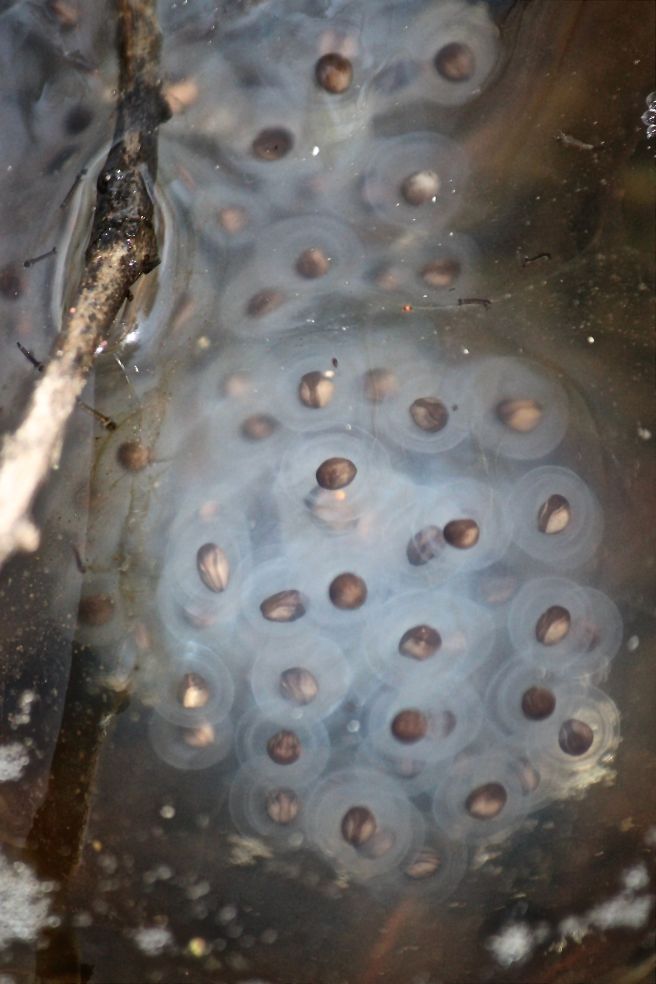
a-tadpole 1

Each little tadpole swims about in its jelly-covered egg, offering a gift of hope.

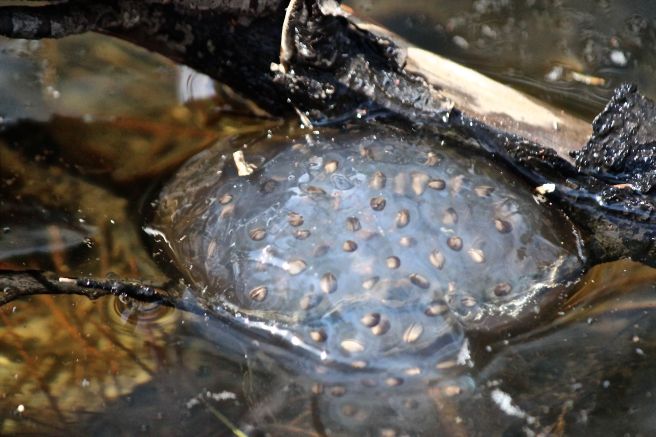
a-sally3

Salamander eggs also are enjoying the warmth of being encased in jelly–especially where the sun shines upon them. It’s most helpful for development when the egg masses can float to the top of the pond and take advantage of the sun’s heat.

a-sally 1

For now, each little pod within the orb reminds me of coffee beans.

a-water st2

While standing silently beside the pool, I began to notice other forms of life, including the water striders. Do you see the two mating? These wonders of the natural world appear to skate on water, but really its the water-repellant hairs on their hind and middle legs that allow them to glide nimbly across the surface. They offer a gift of amazement.

a-mosquito1

Their favorite food happens to be abundant in this pool–mosquito larvae. I have to say it’s a food offering, but also a gift to all of us–we should celebrate the water striders as much as we do the dragonflies.

a-tom 2

I left the pool and realized I was among the turkeys. Tom was ready to offer his gift to his harem. Such a handsome dude.

a-grady 4

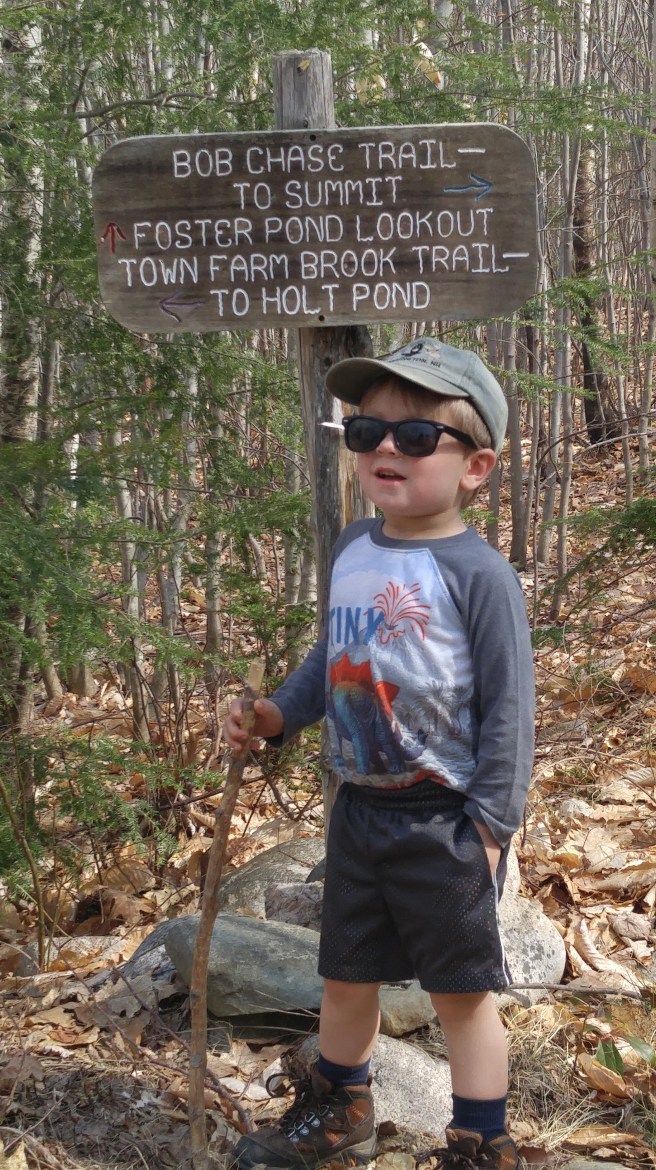
And with that, I realized that I was ready to join the world again so I drove to the trailhead for Bald Pate to join Loon Echo Land Trust for an Earth Day hike. The leader of the gang was this precocious tyke. At three years old, I kept insisting he’s 33. He kept telling me he’s only three. It can’t be. Though this was his first mountain to climb, I suspect there are many more in his future. He offered just the right tonic today and I fell in love.

a-view

As we climbed, we paused to look west and admire the view. Though the sun wasn’t truly shining, the day was getting brighter, literally and figuratively.

a-pitch cone

At the summit, we took time to examine the pitch pine cones with their prickly scales. Sometimes beauty has an edge.

a-grady and carrie mean pose

Before we descended, our little hiking buddy posed with his mom, the outgoing executive director of Loon Echo. Carrie will be missed and we wish her and her family well as they prepare for their move to Wisconsin in a couple of months. Her dedication to land conservation is to be admired. And that mean-looking grin–oh my.

a-adam 1

Also to be admired and the reason our local community and those beyond have been dealing with extreme shock these past couple of days–Adam Perron, who’s life was snuffed out two days ago in a tragic accident. Adam was the milfoil dude and a naturalist/educator at Lakes Environmental Association in Bridgton, where I serve on the board (and chair the ed cmt). He was also a student in the Maine Master Naturalist Program (Falmouth 2014) when I served in my first year as a mentor, so we spent many hours carpooling to classes and field trips and solving all kinds of environmental problems–in our opinions at least.

a-adam2

He was most at home in places like Holt Pond, where he loved to share his knowledge with others. R.I.P. Adam. I’m grateful for the gift of time spent in your presence. It strikes us all that your candle was snuffed out way too early, but as a friend reminded me today, we never know when it is our turn. Here’s to you, Beth and Abby.

And to everyone else, hug the ones you love and don’t forget to wonder. Every day is a gift.


From Peak to Shining Peak

Maybe we’re a wee bit crazy. Maybe there’s no maybe about it. My guy and I climbed Pleasant Mountain again, only this time we took a much longer route than yesterday.

p-Bald sign

After leaving a truck at the Southwest Ridge trail, we drove around the mountain and began today’s trek via Bald Peak. It’s always a good way to get the heart beating, but then again, any of the trails up the mountain will accomplish that mission.

p-bald stream 2

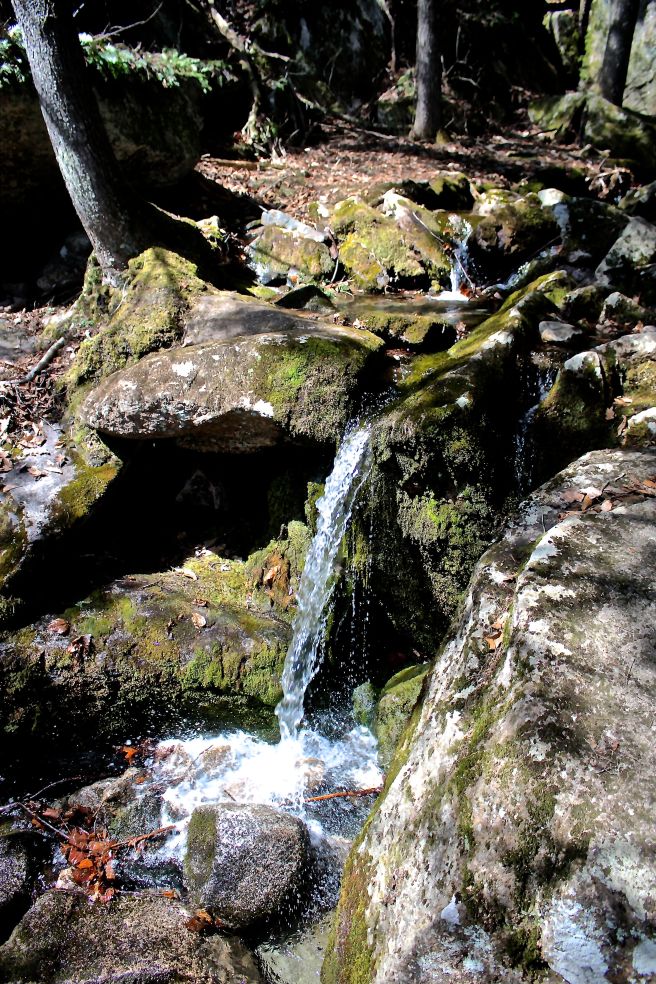
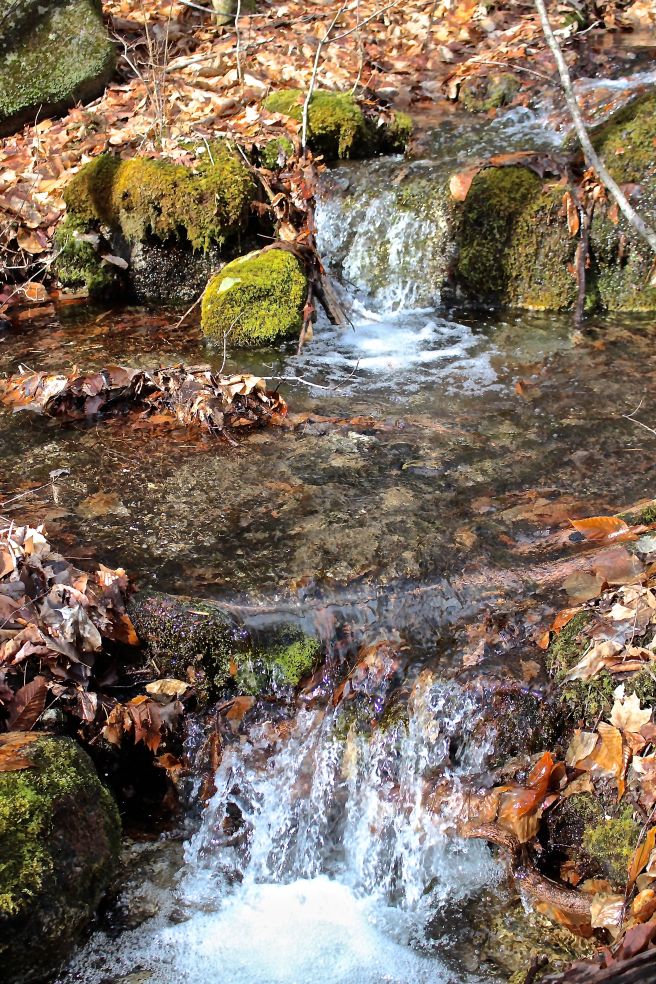
One of my favorite features of this path is the voice of the stream–water rippled with laughter as it flowed over moss-covered rocks before splashing joyously below.

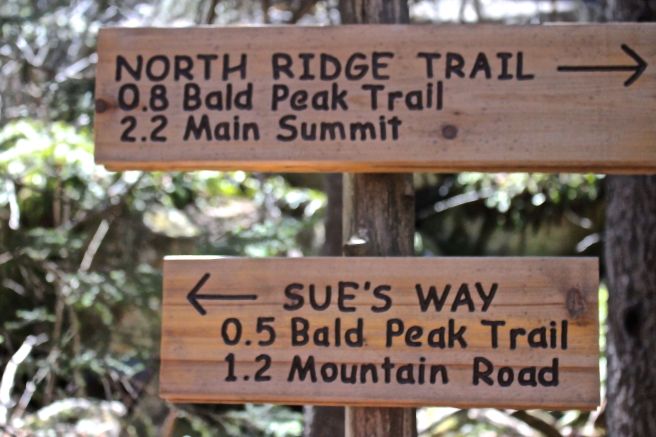
p-Sue's Way signs

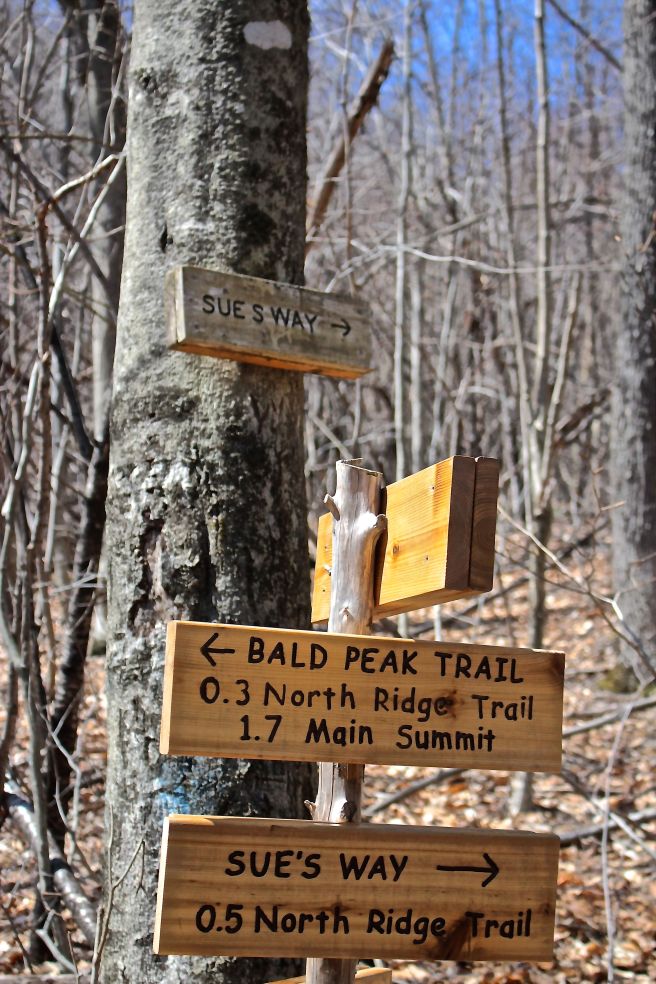
And then we turned right onto Sue’s Way. We never knew Sue, but are thankful for this path carved in her honor.

p-Sue's snow on East

Across the ravine, snow still clung to the East slope at Shawnee Peak Ski Area.

p-Sue's porky

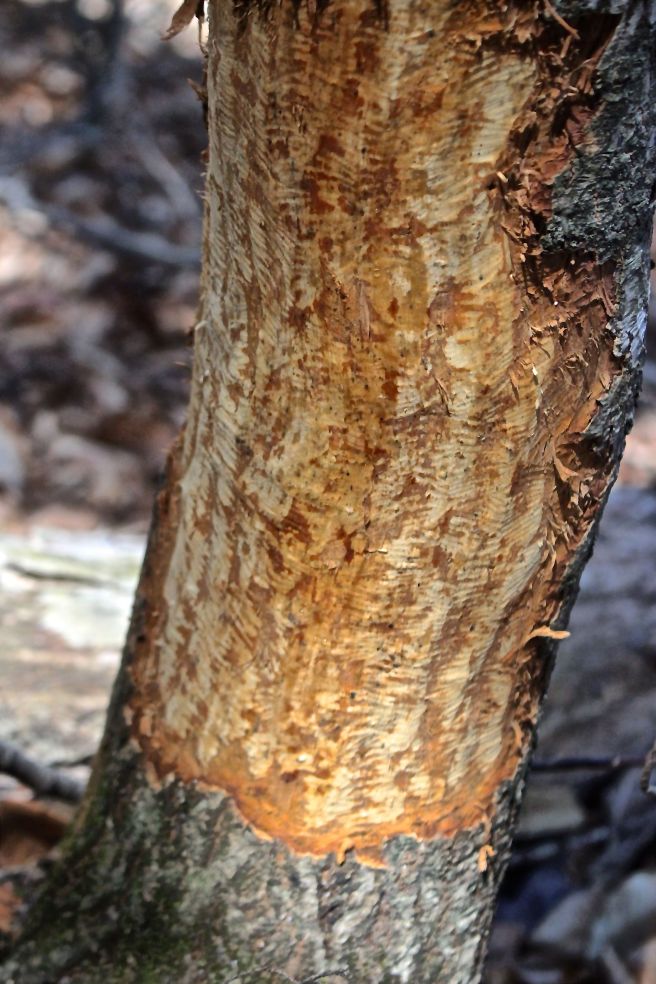
Oaks, beech, hemlock and yellow birch form most of the community, feeding the needs of their neighbors–including porcupines.

p-Sue's 2

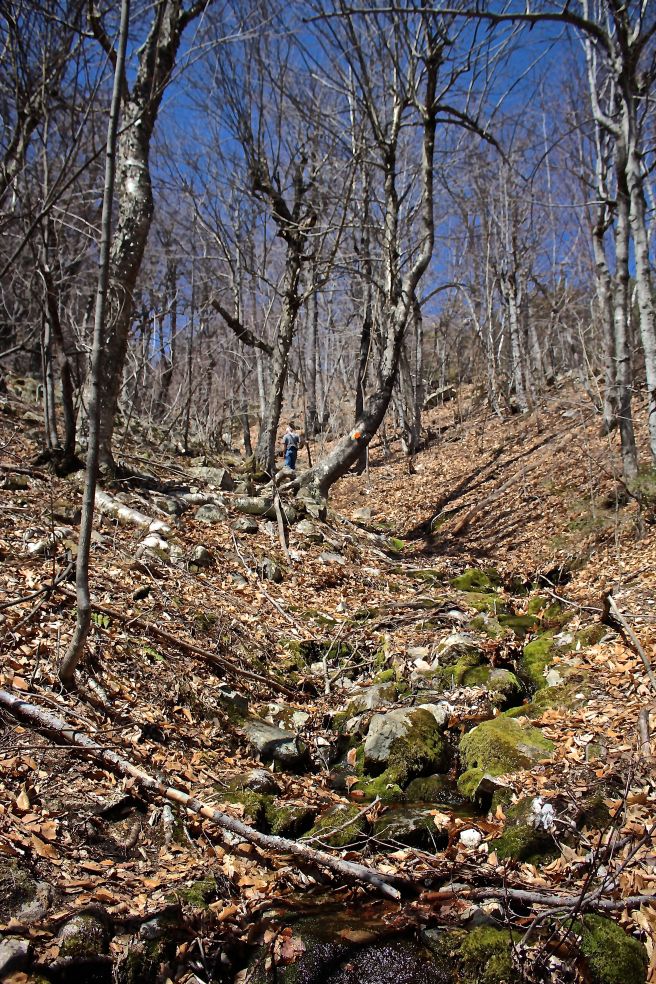
We followed the trail as it embraced another stream and watched the landscape change.

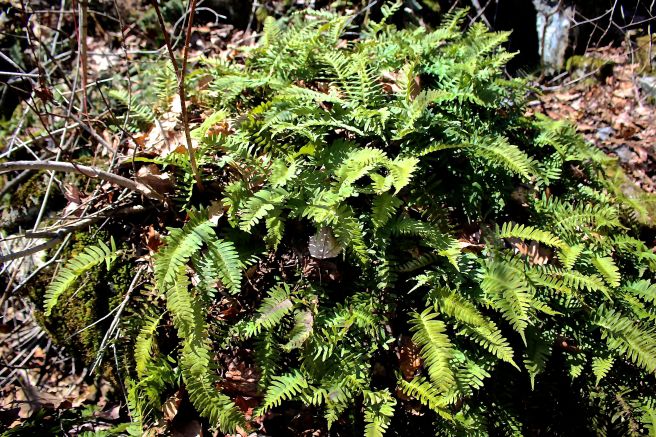
p-Sue's polypody

Eventually, we were in the land of large boulders and ledges, all decorated with common polypody and moss–an enchanted forest.

p-shawnee chair

At the top of Sue’s Way, we detoured to our first peak–Shawnee Peak.

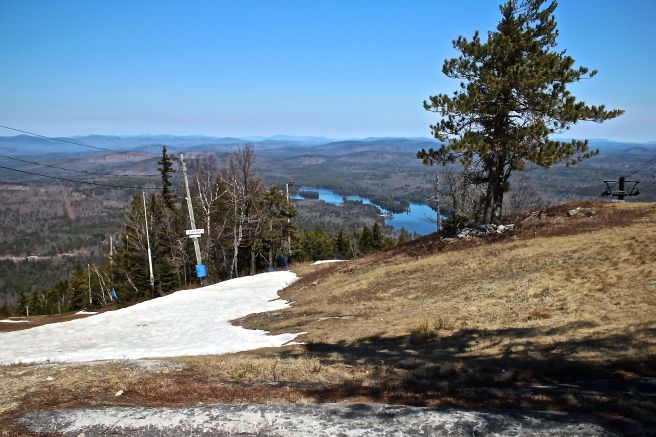
p-shawnee

Splotches of snow signified the end of a season.

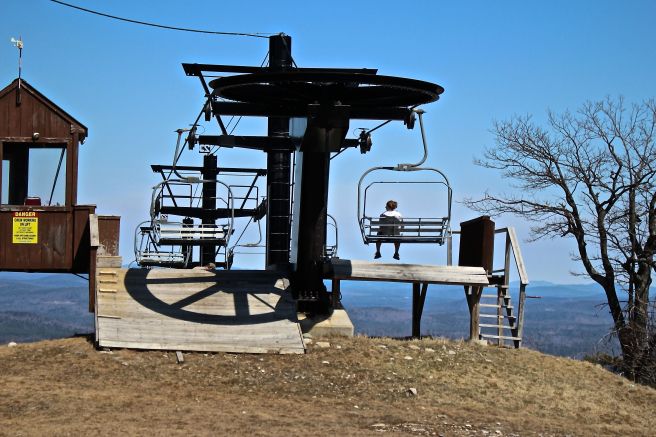
p-Shawnee chair 1

The Pine chairlift silently rested, its duty accomplished until it snows again.

p-shawnee ski chair 2

And in the shack, the back of ski chair spoke of past adventures and adventurers.

p-signs by mtn

From there, we followed the North Ridge Trail to our first official peak.

p-north peak trail ice1

Despite today’s warmth, ice still reflected movement frozen in time.

p-north peak pines

North Peak has always been one of my favorite spots on this mountain. In the land of reindeer lichen, blueberries and dwarfed red pines, we ate lunch–day two also of ham and  Swiss. This is becoming as much of a habit as climbing the mountain.

p-Mtn W from lunch rock

When we stood up on lunch rock, our view included the master of all New England mountains glowing in the distance.

p-north peak

In a few months, the treasures of this place will give forth fruitful offerings.

p-ridge line

With North Peak behind, our view encompassed the rest of the peaks.

p-Bald Peak, Mtn W and Kezar Pond

Continuing down and up again, we heard plenty of quaking coming from a vernal pool about one hundred feet off the trail. And then we were atop Bald Peak, where Mount Washington again showed its face, with Kezar Pond below.

p-bald peak causeway

The other side of the trail offered a photo opp of the Route 302 causeway that divides the north and middle basins of Moose Pond.

p-ft again

Our decision today was to hike the mountain in a backward fashion as compared to our normal routes, so we approached the main summit from the Firewarden’s Trail.

p-summit crowd

Once again, many others also took advantage. We did chuckle because except for one guy, of all the people we encountered, we were the oldest. The youngest–a baby in a backpack.

p-SW sign

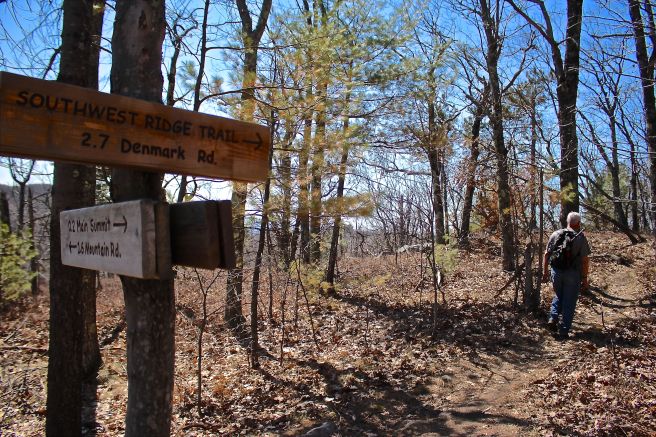
At the junction below the main summit, we began to retrace yesterday’s footsteps on the Southwest Ridge Trail.

p-SW mayflower

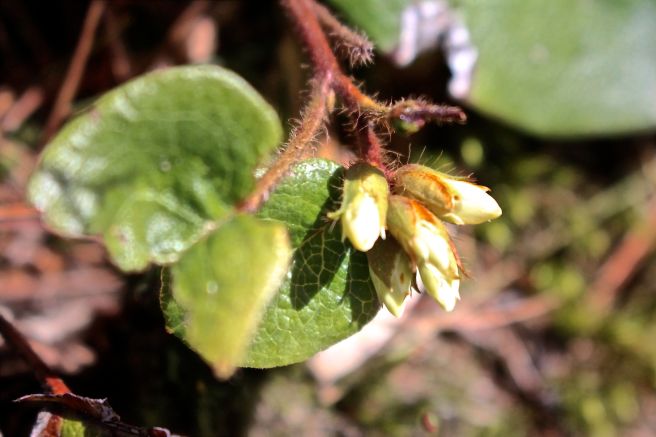
The sunny exposure made this the warmest of all trails and the Trailing Arbutus prepared to make its proclamation about the arrival of spring.

p-SW Hancock

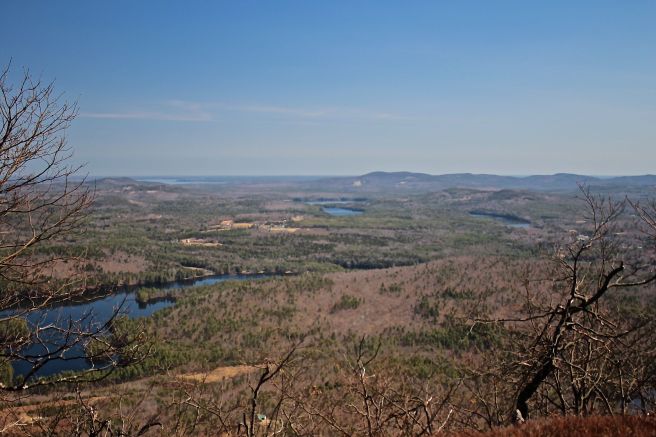
Near the teepee, I felt compelled to capture the ponds again. Another beautiful day in the neighborhood.

p-SW 2

After chatting with a family at the teepee, we began our descent. Of course, someone was mighty quicker than me.

p-SW 3

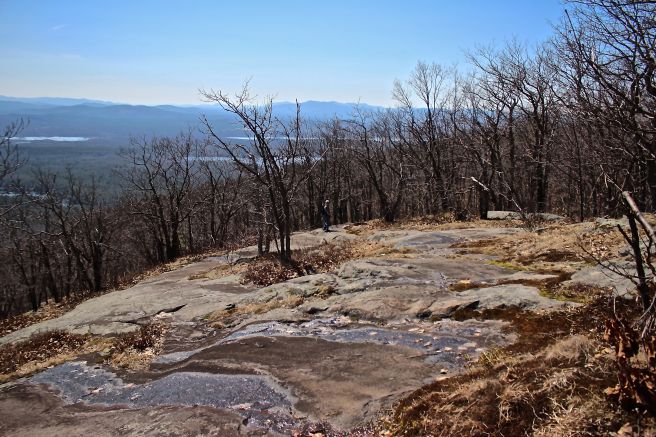
Where no trees grow on the bedrock, cairns showed the way.

p-SW mnts

Before slipping into the forest again, I was thankful for the opportunity to capture the  blue hue of sky, mountains and ponds.

p-cairns final turn

We made our final turn at the three cairns and

p-SW final

followed the path down–though we did begin to think that maybe they’d moved the parking lot.

p-LELT

Over six miles and four hours later, we had Loon Echo Land Trust to thank once again for protecting so much of the mountain and maintaing the trails. We reminisced today about how our relationship began at a halloween party held at the ski area thirty years ago and the number of treks we’ve made along these trails since then. Whether hiking to the ledges or teepee, making a loop or walking peak to peak on a sunshiny day such as this–it never gets old.


On The Verge Of Change

Change is in the air. Stepping out the door this morning, I was immediately treated to the sight of wet mammal tracks on the deck.

b-raccoon tracks

The hand-like shape was hardly a surprise since at least two raccoons visit the bird feeders on their nightly rounds.

b-wintergreen

My next source of delight–frost embracing wintergreen berries and leaves.

vp1

And then I paid my respects to the vernal pool. While there, I spent some time reflecting on Bridie McGreavy, who celebrates her birth this day, and many moons ago introduced me to the sacredness of place–especially this delicate space.

Vp2

Feather ice formed after yesterday’s melt and last night’s cooler temps.

As I did last year, I intend to document the pool on a regular basis–noting its evolution over time. This year’s big question: Will Big Night happen earlier than normal? I’m already receiving reports from others of spring peepers singing their songs.

b-brook 2

And then I was off to the GLLT’s Back Pond Reserve in Stoneham. My friend, Parker, and I were on a quest to locate species that would be good indicators of rich soils. He’s much better at knowing about this than I am, so I tagged along–thankful for the opportunity to bushwhack beside the stream that eventually flows into Back Pond while learning from him.

b-bass 2

We found a dead tree that stymied us for a few minutes, but though it has some ash-like tendencies, we came to the conclusion that it was a basswood–one of those indicators we were seeking.

b-basswood bark

Only thing–during our entire search, we only found two.

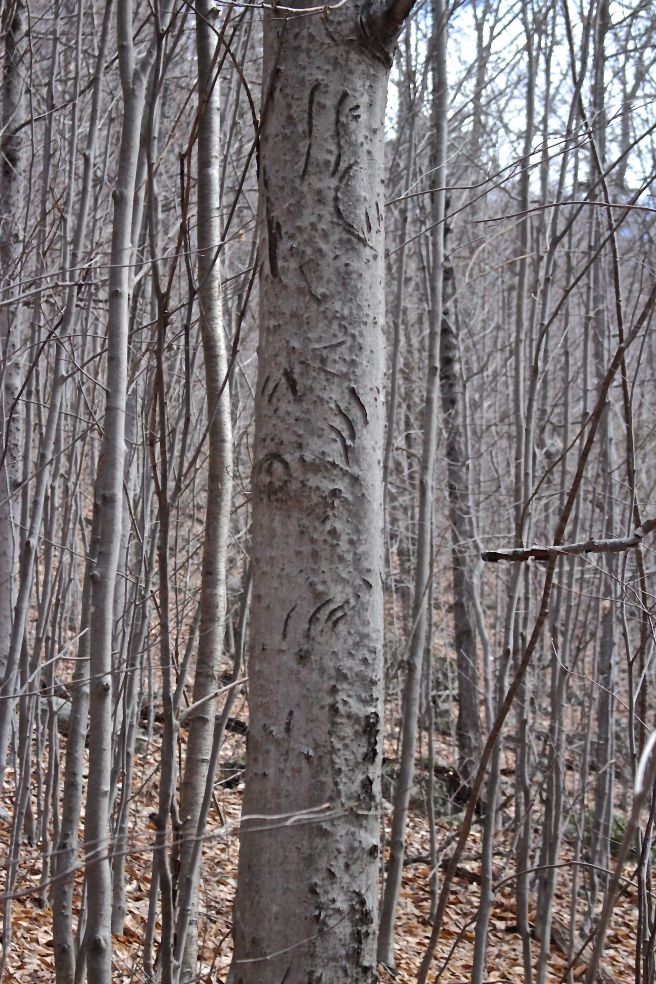
b-bear tree

But that’s OK because there was so much more to see. Though I’ve spotted other bear trees in these woods, this one features the best sign. My guy will be jealous that he wasn’t with us to find this one.

b-crowded parchment

For many of us, Parker is our fungi guru. He and his brother became interested in mushrooms at a young age and have studied them extensively. They know only Latin, I speak only common. And so, I present to you crowded parchment (Stereum rameale). 

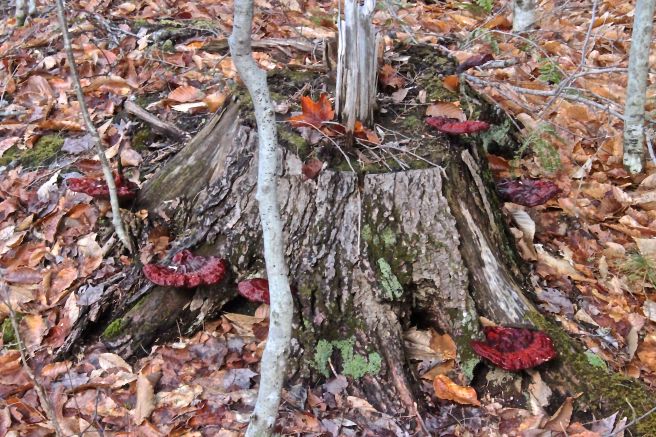
b-hemlock varnish shelf

Hemlock varnish shelf (Ganoderma tsugae) grows prolifically in these woods. These old fruiting bodies are still beautiful in their offering.

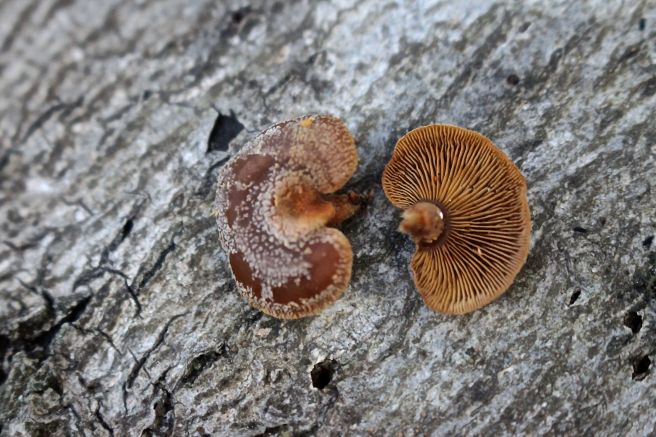
b-panellus stipticus?

And though it didn’t get dark while we were there, Parker found Panellus stipticus, a bioluminescent species. Check out those gills on the underside. According to Lawrence Millman in his book Fascinating Fungi of New England, ” . . . specimens in the Northeast glow more obviously than specimens in other parts of North America.” So  if you are ever in these woods late at night, don’t be freaked out by a light greenish glow. It just might be nature’s night light.

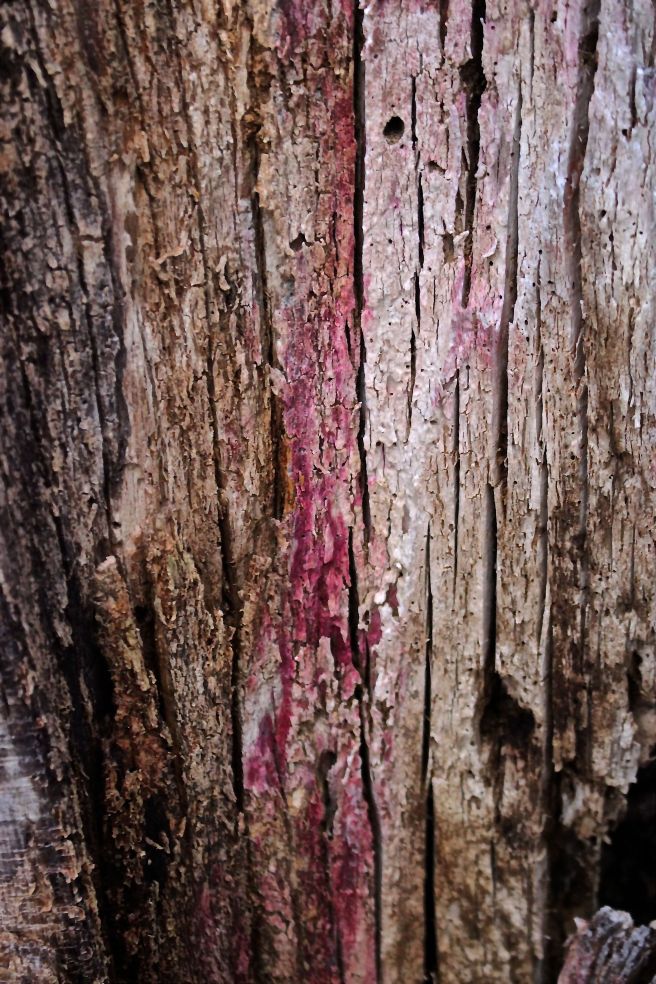
b-magenta fungi

The fun thing about exploring with Parker is that he’s not afraid to say, “I don’t know.” Such was the case with this magenta fungus we found on the inner bark of a rotting stump.

b-hemlock:hop hornbeam 2

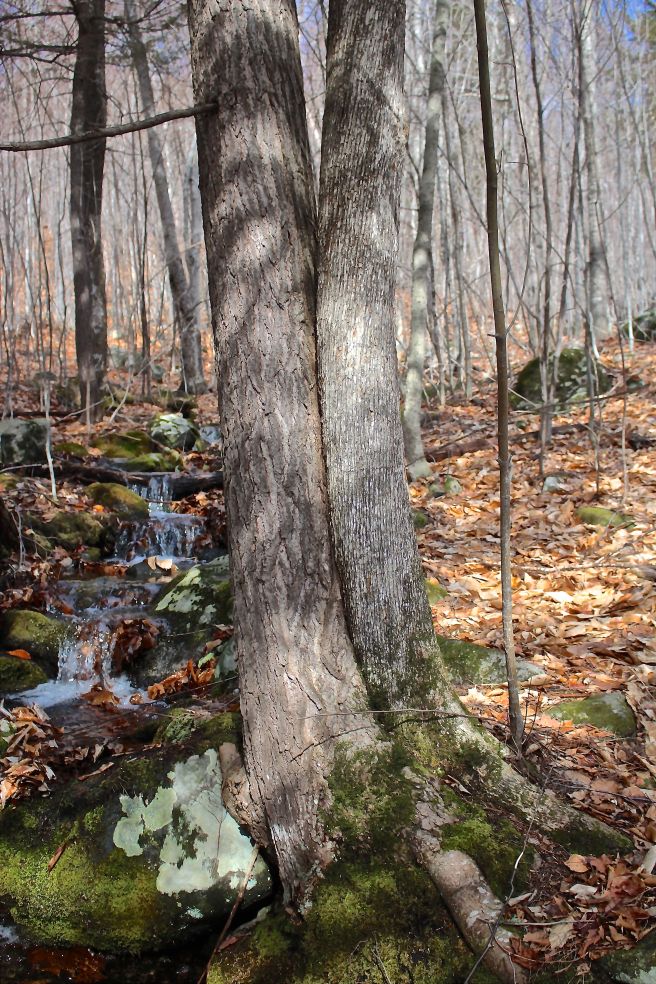
I don’t know why I’m surprised every time I see two trees sharing a space,but I am–this time hemlock and hop hornbeam.

b-brook sans ice

We continued beside the stream for most of our climb and eventually came upon the trail that connects Ron’s Loop to The Mountain.

b-lichen on tree

A few things stopped us along the way, including this lichen that neither of us could conclusively identify,

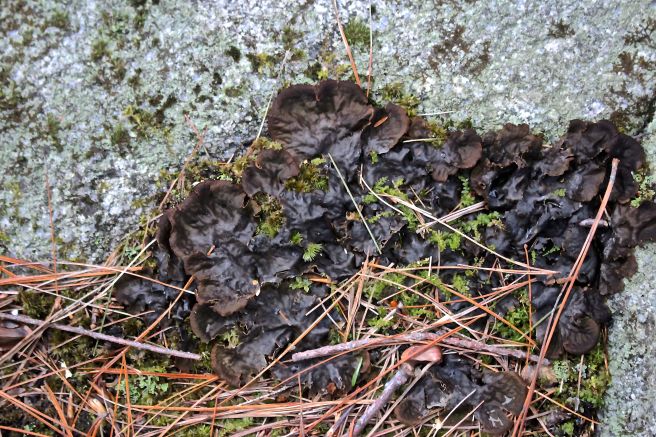
b-rock lichen

what I believe is peppered rock tripe,

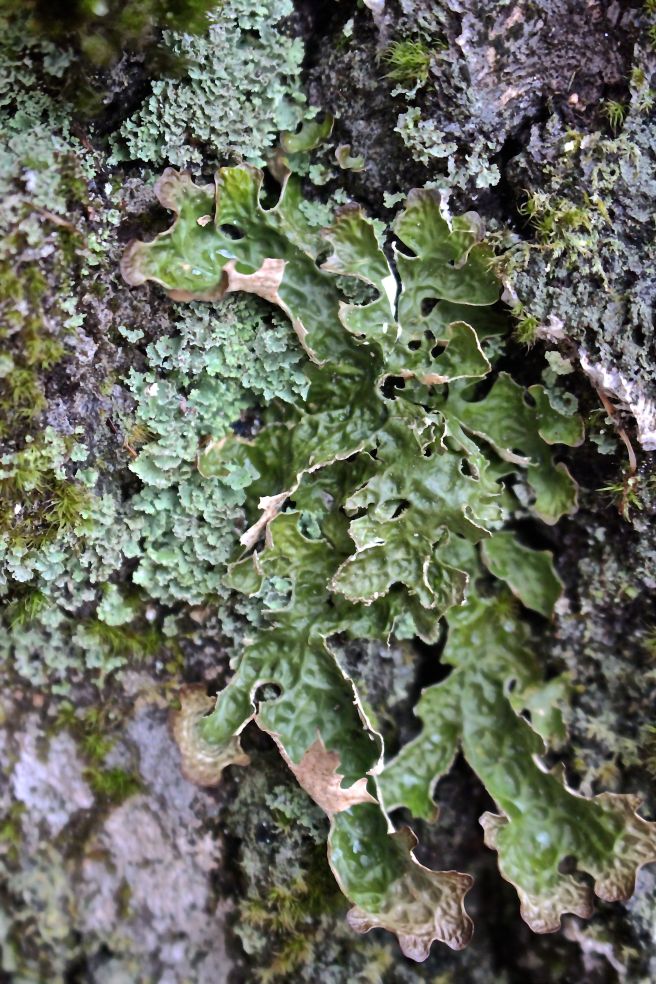
b-lungwort, lichens

and the glorious bright green state of lungwort. The thing that gave us pause about the lungwort wasn’t so much the lungwort as the lichen and moss garden that also decorated this tree.

b-mtn bog

And then we were literally stopped by water. Our intention to reach the scenic view over the Five Kezars was prevented by this boggy area. A vernal pool?

b-mtn bog 2

Certainly a wetland. We explored for a few minutes and wondered about the species that will appear here in the next few months.

b-boulder field

Then we returned to the stream, crossed over and paid a visit to the boulder field for a closer examination.

b-rock tripe 1

Like the lungwort, much of the rock tripe was also green today–a testimony to recent rain and yesterday’s hail.

b-tripe center

Two things to note–how it grows from the center umbilicus, like an umbilical cord, thus its Latin name: Umbilicaria mammulata; and the fact that it’s creating a garden on the up-rock side, where mosses and humus and seeds gather.

b-rock tripe water 2

I found a drier brown specimen that had captured several drops of water and held them still.

b-redbacked

Upon our decent, we stumbled upon a redback salamander–the first of the season for both of us. It seemed rather lethargic so we covered it with leaves and wished it a safe life. Redbacks are terrestrial and don’t have an association with vernal pools, though they are sometimes spotted on Big Night as we help the salamanders cross the road.

b-rose moss 1

A mossy display on several rocks in a seepage meant we had to pause again.

b-rose 2

We believe this is rose moss (Rhodobryum ontariense), but our ID was quick.

b-rose 3

Based on the description in  Common Mosses of the Northeast and Appalachians, “the shield-shaped leaves are widest above mid leaf and end in needle point.” Yup.

b-wood sorrell

And then we realized we have to get our wildflower eyes back on. The wood sorrel (Oxalis montana) leaves stumped us initially, but what else could it be?

b-wood sorrel 2

Other than a luna moth, that is! Doesn’t it remind you of one?

b-foamflower?

Without a flower, it’s difficult to ID a plant. My first choice: Foamflower or False Miterwort (Tiarella cordifolia), but my second choice based on the blunt-toothed leaves: Naked Miterwort (Mitella nuda). Time . . . and blossoms will tell.

b-orchid?

Our final find of the day left us with differing opinions. I said shinleaf (Pyrola elliptic). Parker said Corallorhiza maculate, which is a coralroot. A friend of his who is an orchid expert agreed. I guess we’ll have to revisit this place to confirm.

We’re on the verge of change and the seasons may collide with a Nor’easter in the offing.


Same Old is New

Same old, same old. Sometimes it feels that way as we travel familiar trails and recognize members of the community. And so it seemed today.

a-fdn 1

We paused to check on a few neighbors along the Homestead Trail at the Greater Lovell Land Trust’s Heald and Bradley Ponds Reserve, but no one was home.

a-signs

And so we decided to climb to the summit of Amos Mountain.

Along the way, I realized we weren’t the only ones exploring this property–several times we saw where a mink had bounded across, even enjoying a short downward slide in the midst of its journey.

a-summit view

From the summit, Kezar Lake stretched before us as we ate our PB&J sandwiches and Girl Scout cookies–Lemonades™.

a-whiting to pleasant

And another view, Whiting Hill in the center foreground and a peek at our beloved Pleasant Mountain, visible just to left of the center pines.

a-stonewalls 1

On the way down we decided to explore the stonewalls for a bit, at times terraced and following the contour of the mountain.

a-bear 3

And that’s when the same old started to change. Yes, we found another bear tree.

a-bear 4

And on what side of the tree should we find the claw scars? Why the north of course, adding to our unscientific theory that bears climb trees on this side. Typically, the northern side is the uphill side. Our mission is to continue to pay attention to this–tough job that we choose to accept.

a-stonewalls 4

Sometimes the walls appeared to enclose pens.

a-stonewalls 6

And other times they opened–perhaps to pastures?

a-northern white cedar

As we wandered and wondered about the walls the farmer had created and why, we noticed other things we’ve somehow missed upon previous visits, including this northern white cedar tree.

a-stonewall fdn

In what today appears to be the middle of nowhere, a small foundation. House? Shed? Sugar shack?

a-red-belted polypore

We climbed a hill to see what was on the other side and found this red-belted polypore (Fomitopsis pinicola) growing on an Eastern white pine. In Lawrence Millman’s Fascinating Fungi of New England, he says this is “apparently not a picky fungus. F. pinicola has been recorded on more than 100 different species of tree hosts.”

a-stonewall last

The snow had softened since we first started so we did some slipping and sliding as we followed another stonewall back to the trail.

a-3 birch

And then my brain kicked into birch tree mode. These woods are filled with paper, gray and yellow birch. And next week, the GLLT will host a “Which Birch Is It?” walk about the birches and their relatives.

a-yellow bark

The ribbony curls and whorls of yellow birch bark are signatures of this tree that can change in color from silver to yellow to reddish brown and circle back to silver again in old age. Did you know that a yellow birch can live to 200 hundred years, unlike its cousins, the gray birch and paper birch? Gray birch live about fifty years and paper reach a ripe old age of somewhere between 50 and 150 years.

a-yellow 4

Another cool fact about yellow birches: the interior of dead branches begin to decay quickly, even while still on the tree; eventually reduced to mush, the trees rid themselves of these non-productive limbs quite easily with the help of wind. Look for tubes of outer bark  filled with rotting wood on the ground.

a-birch stitch

Also becoming visible as the snow melts, paper birch bark from downed trees. It seems curious that the lenticels resemble stitches, especially considering that Native American’s built sturdy, lightweight canoes from birch bark; the bark was stretched over a framework of white cedar, stitched together and sealed with pine or balsam resin. All the components exist in these woods.

a-tripe 1

Back on the trail, a few other things revealed themselves, including smooth rock tripe (Umbilicaria mammulata). No matter how many times I see this, it’s never the same old.

a-tripe 4

In great contrast to the smooth upper surface is the coarse pitch black of the underside reminding me of fresh tar–kind of like what town crews are using to fill pot holes right now.

a-tripe 3

The greenness of the upper side was witness to the melting snow.

a-liverwort

Similarly, lungwort displayed its dryer gray presentation because it lacked moisture.

a-heading out

As we continued down the Gallie Trail, bypassing the Homestead, it seemed that we were back in the land of the sameness.

a-speckled catkins 2

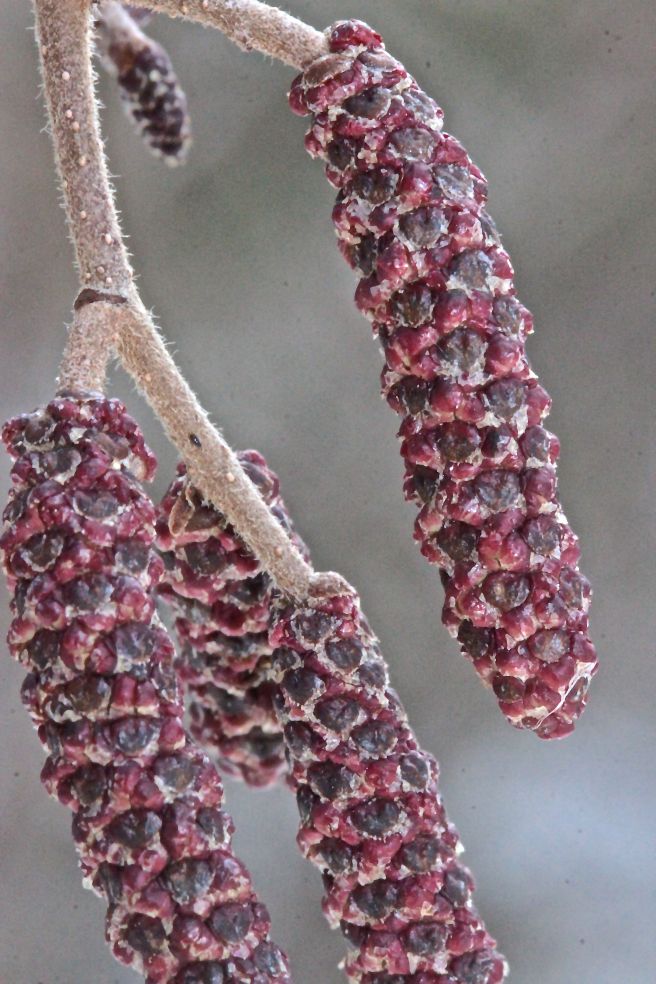
But . . . speckled alder, a member of the birch family, is about to come into its own. While the burgundy brown male catkins hang from the ends of twigs, smaller female catkins await the release of pollen.

a-speckled leaf

Speckled alders are pioneer species–that first step in natural transition of farm land or logged land back to forest. In this instance, it’s both of the former.

And that’s not its only claim to fame. Speckled alders are nitrogen fixers. Atmospheric nitrogen absorbed by bacteria live in nodules on the alder roots and change into a form of nitrogen plants can utilize as fertilizer, thus fertilizing fields that may have been depleted of nitrogen by years of farming. Its leaves are also rich in nitrogen, so when they fall they help to fertilize soil. For some reason, this one chose to hang on, but its moment will come. In the meantime, it offers grace in form and design.

a-gumdrop 2

Equally graceful, the hairy bracts and seed head of Black-eyed Susans (Rudbeckia hirta) found near the parking lot.

It’s all always been here. It’s all the same, day in and day out and yet it’s all new. Change is the only constant–offering moments of wonder.


Leaping Mondate

My guy happens to be Irish so it seemed only appropriate that I propose to him today following the example that St. Brigid set when she struck a deal with St. Patrick. Yes, we’ve been married for 25+ years, but I proposed anyway.

And he accepted. So today’s Mondate found us at Roberts Farm Preserve in Norway. Norway, Maine, that is.

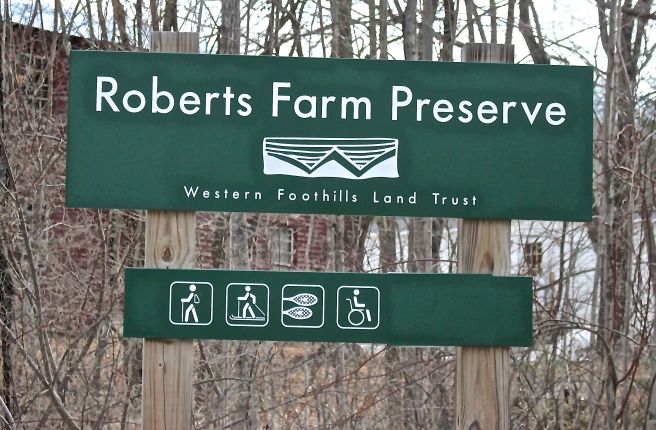
R-sign

In her book, Hikes and Woodland Walks in and around Maine’s LAKES REGION, my friend Marita Wiser states that the preserve was “farmed by the Pike and Roberts family for 200 years.” She adds, “The property was purchased by the Western Foothills Land Trust in 2007.”

r-parking

Though the trails are mostly maintained for Nordic skiers, we didn’t see any today.

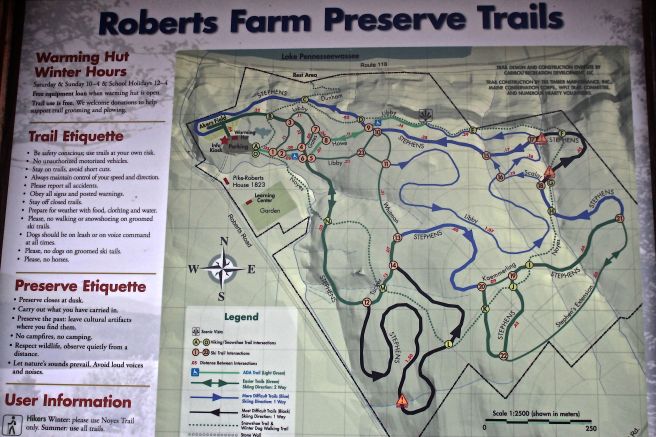
r-trail map

Had it been open to skiers, we wouldn’t have been able to do what we did–follow the network of trails around the perimeter of the property.

r-cherry bark

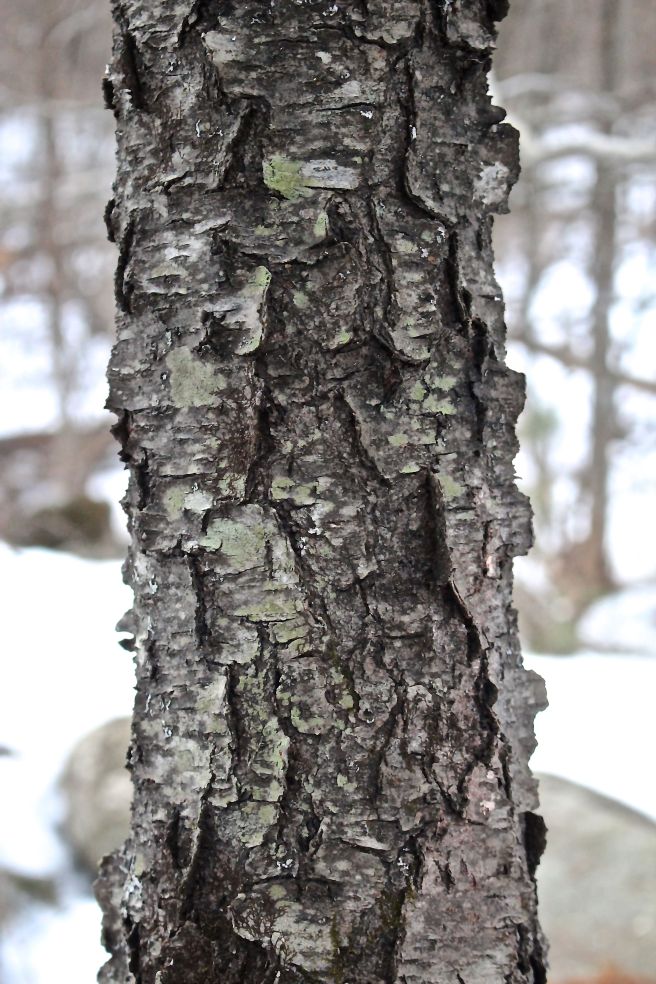
We’d only walked a few feet when I had to pause–the burnt cornflake look of black cherry bark insisted upon being noticed.

R-Northern White Cedar

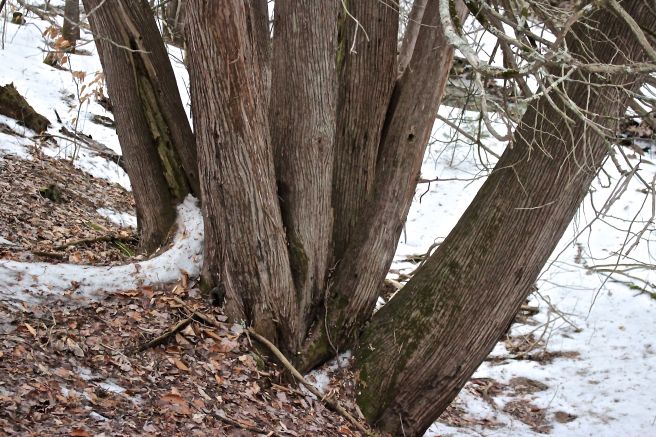
Visiting here a couple of times previously, one of the things I’d come to like about it is the opportunity to gush over Northern white cedar bark.

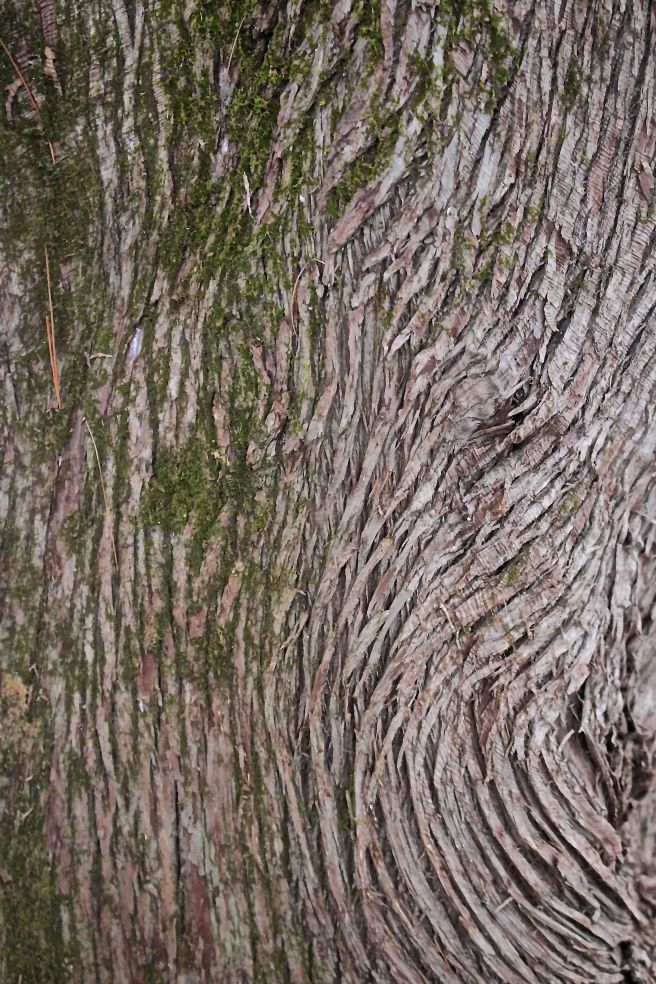
r-northern white bark2

I love its red-brown color, sheddy strips that intersect in diamond formations and habit of spiraling left and then right with age. In his book BARK, Michael Wojtech states of the cedar: “In the 1500s, the native Iroquois showed French explorers how to prevent scurvy using a tea made from the bark, which contains vitamin C. The name arborvitae means ‘tree of life.'”

r-northern white leaves

Equally beautiful are its flat sprays of braided, scale-like leaves.

Since I’m on the topic of tree bark, I have two others to share, including this one–the red inner bark of Northern Red Oak made a stunning statement.

r-hop hornbeam bark

Displaying its shaggy presentation was the hop hornbeam.

My heart leaped (appropriate movement for today) when I saw these papery fruits on the ground–hop hornbeam is named for its fruiting structures that resemble hops.

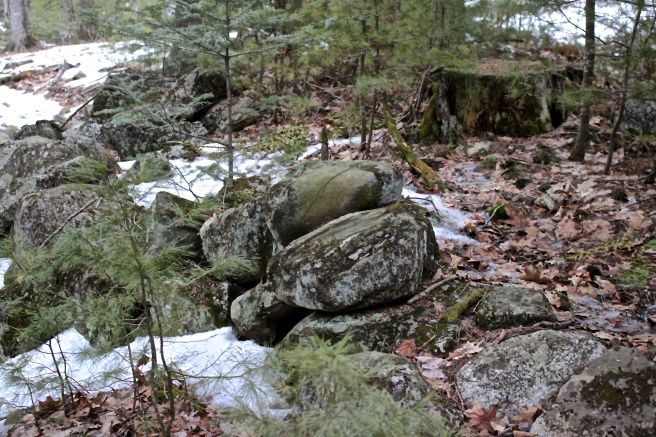
r-stone wall

Stone walls crisscross the preserve and provide evidence of its former use as a dairy farm.

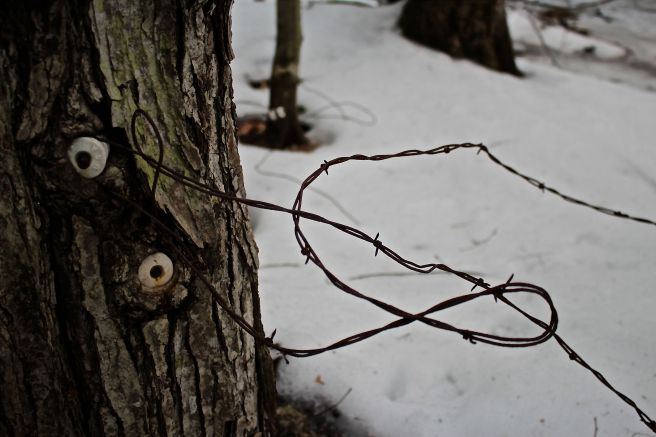
r-barbed wire

Barbed wire adds to the story.

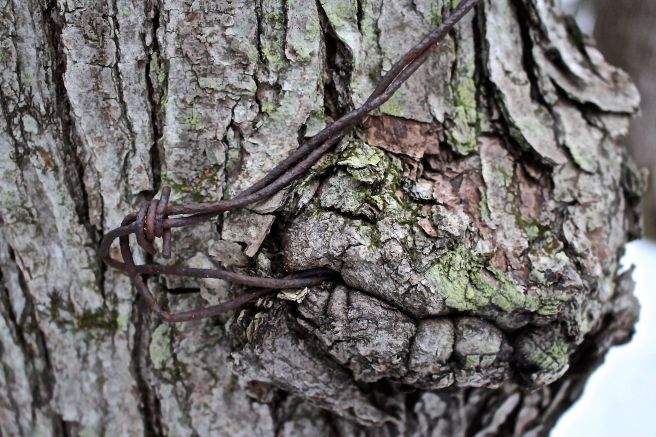
r-barbed wire grimace

Installed long ago, this tree formed a grimace in response.

r-large pine

Along the edge of some walls stand much happier trees–those that were allowed to grow tall and wide in the sun, like this Eastern white pine. Perhaps it provided a bit of shade for Roberts’ Jerseys.

r-generation gap

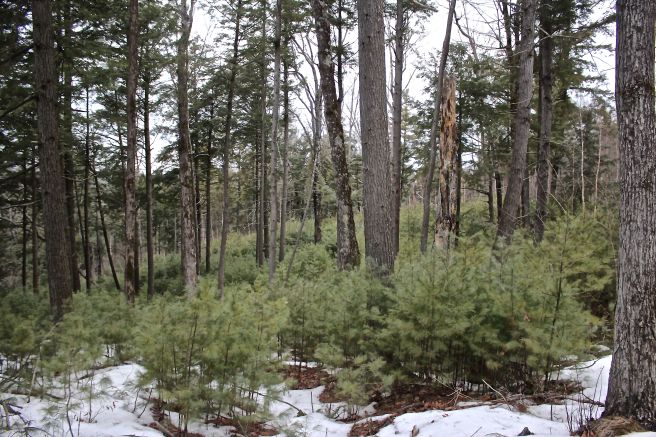
The land was farmed until 1968. Since then, it returned to woodland, was sold and logged and sold another time–finally to the land trust. Generational gaps are visible throughout. This is the perfect place to take some youngsters and ask them to locate a white pine that matches their age.

r-brook 2

We cross several streams that I’m sure sustained the farm and its inhabitants. Today, they sustain the wildlife that wanders here, including deer.

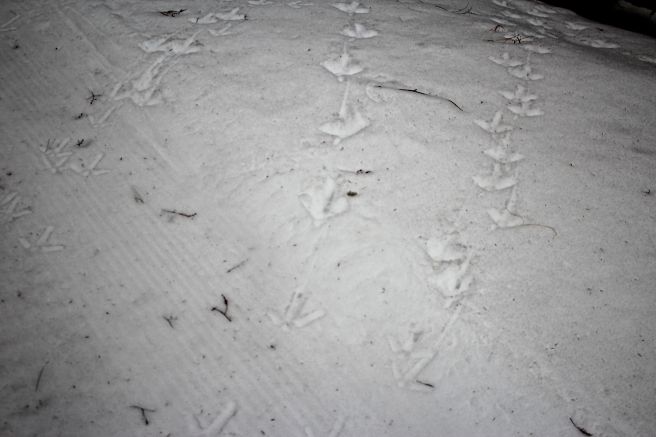
r-turkey trot

We realized there had been a recent turkey trot and

r-voles 1

vole convention.

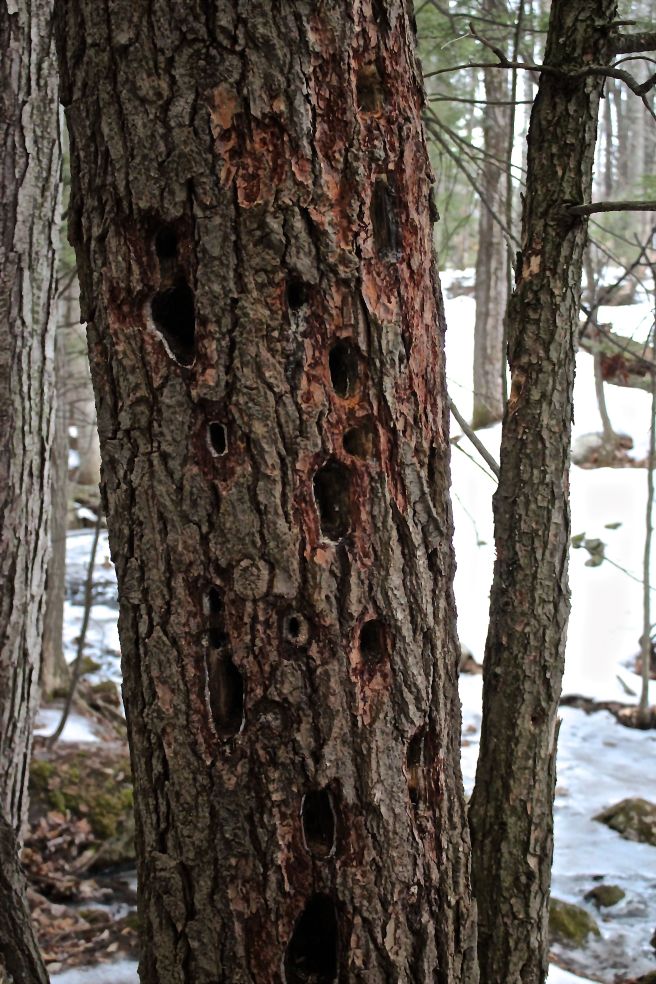
r-pileated condo

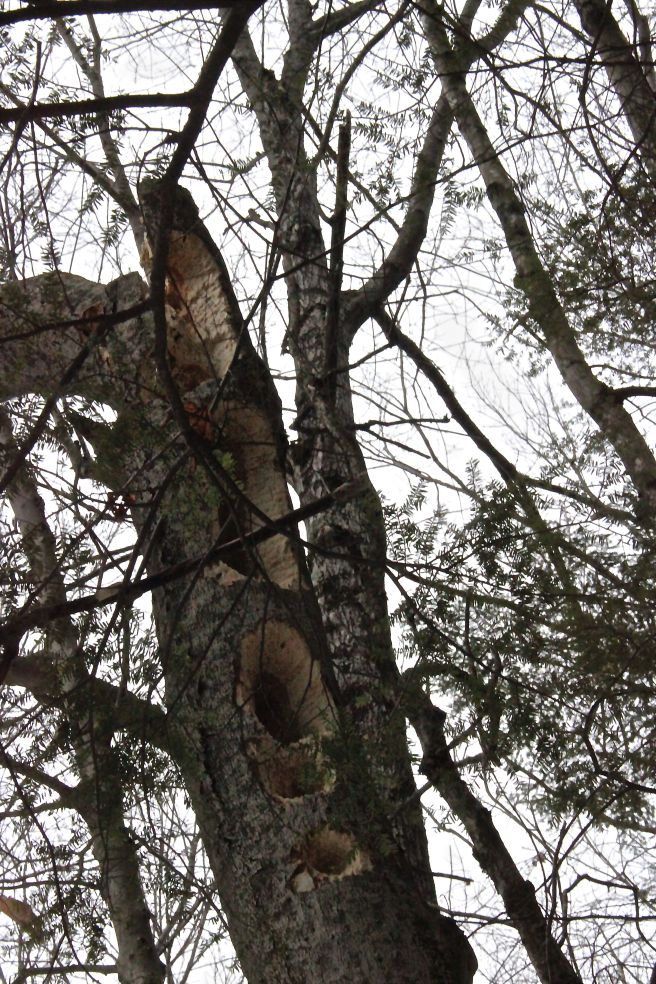
Birds also have played a major role in this community. This pileated woodpecker-created condominium has been around for a while.

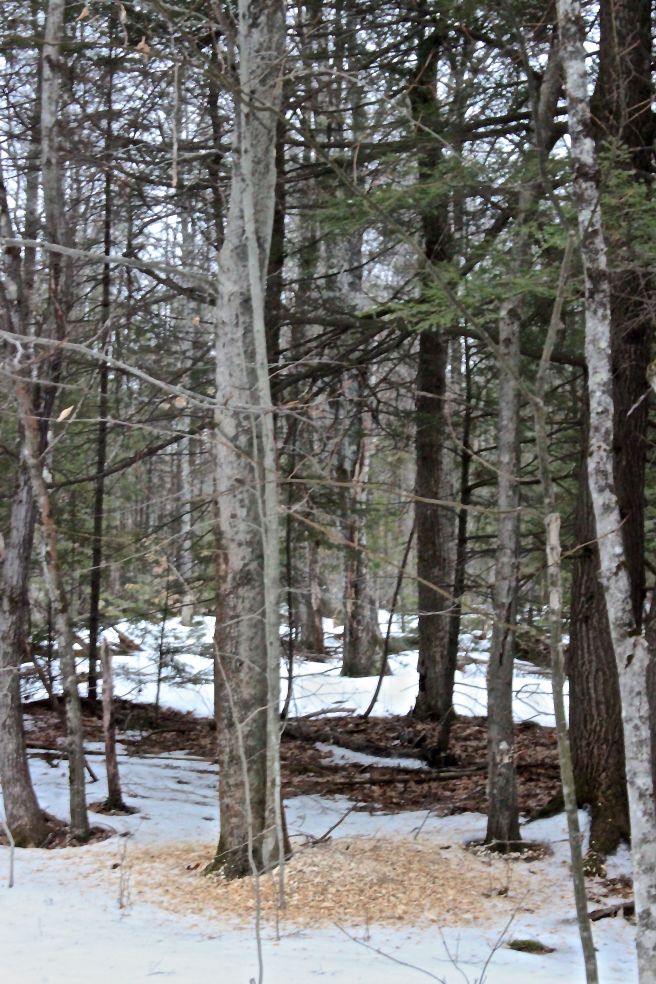
r-pileated pile

From the trail, I spied the largest pile of wood chips I’ve ever seen and of course, had to investigate.

r-pileated tree

The old beech was recently excavated for new condos.

r-pil pile 2

Below, the wood chip pile was a couple of inches deep.

r-pileated scat 1

r-pil scat 2

The best part–lots of scat cylinders filled with insect body parts. Good stuff to see.

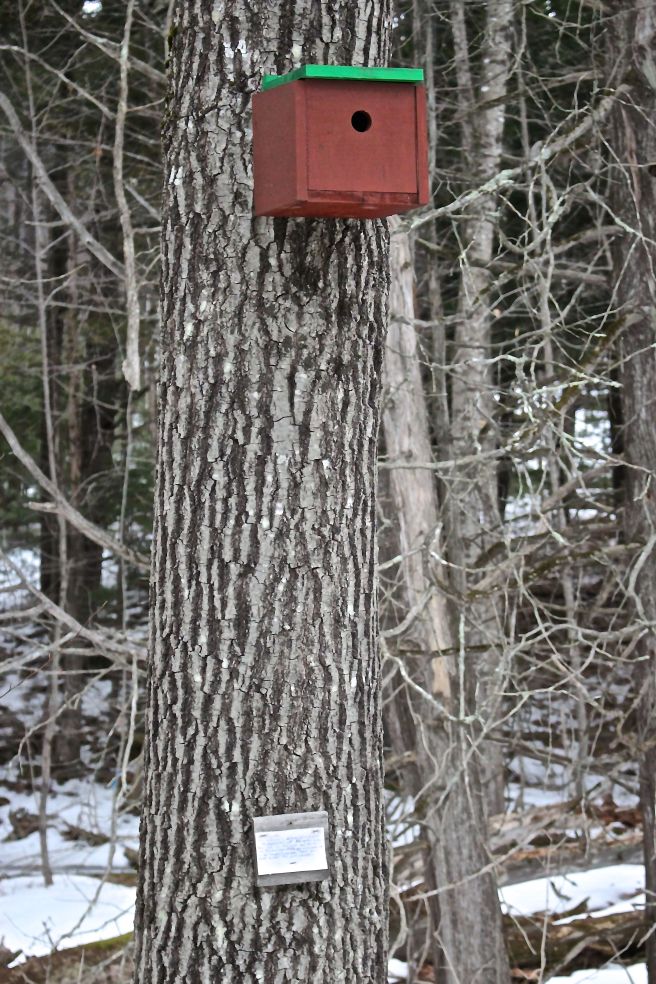
r-birdhouse

Pileated woodpeckers aren’t the only ones in the building industry.

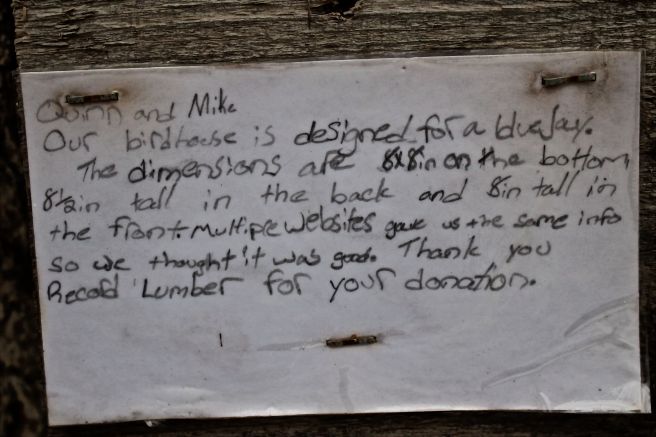
r-birdhouse sign

I think you’d agree that Quinn and Mike did a fabulous job constructing this birdhouse.

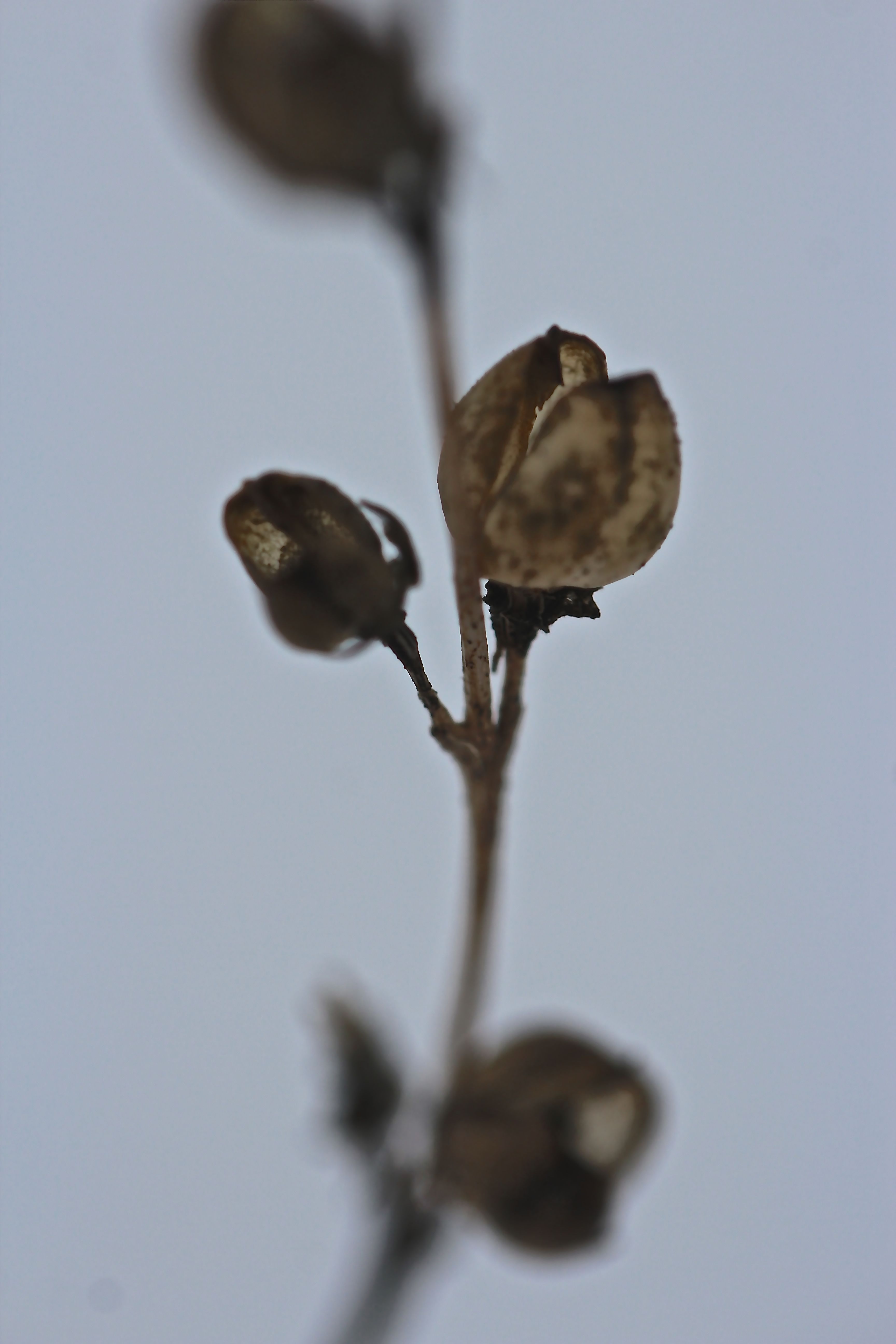
r-mullein capsules

In several open areas we spotted the winter display of common mullein.

r-mullein 2

Its crowded performance of two-parted capsules atop a tall, fuzzy stem made it easy to identify.


The pointed prickly bracts of thistles also offered a winter show.

r-lungwort on ash

Lungwort tried to hide on the backside of an ash tree, but I found it. I only wish we’d had rain, or better yet, snow, recently, because I love the neon green that it becomes once it is wet.

r-lunch rock

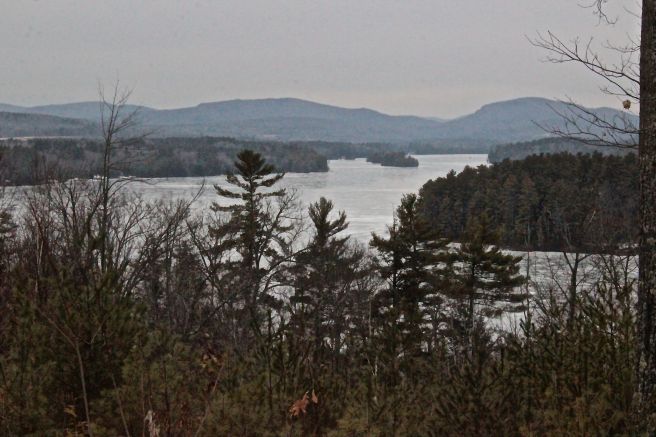
Be careful what you wish for. Though the day was sunny at the start, it began to rain as we ate our sandwiches on lunch rock overlooking Lake Pennesseewassee, aka Norway Lake.

r-lake 1

It wasn’t a downpour, but enough that it encouraged us to eat quickly and move on.

r-beaked bud

Well, I didn’t move far. Within steps, I found a shrub I was seeking yesterday–beaked hazelnut.

r-beaked hazel

It’s a member of the birch family and features catkins–the male flowers that will release pollen this spring to fertilize the shrub’s delicate red female flowers.

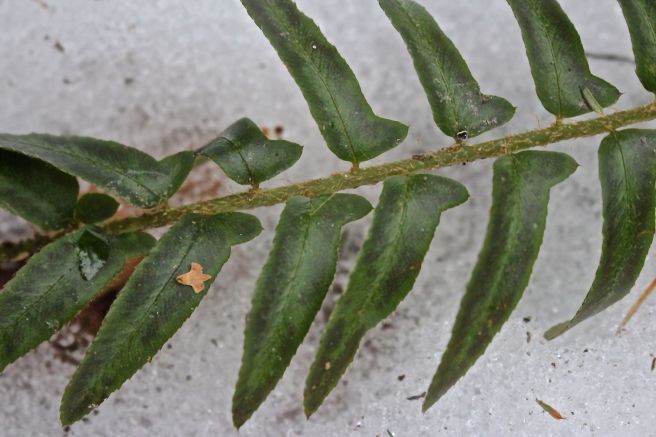
r-christmas fern

Another quick find–Christmas fern–one pinnae topped with a birch fleur de lis.

Typically, during the winter there is only one trail open to hikers. Today, however, we figured it would be OK to walk on the ski trails because they are either icy or bare. It was definitely a micro-spike kind of day, which has been more the norm this year.

r-painted cow

Other than birds and squirrels, we saw no wildlife. But we did stumble upon the “Painted Cows” created by Bernard Langlais in 1974 and gifted to the land trust by Colby College and the Kohler Foundation.

We had planned to explore the inner network of trails, but the cold raindrops drove us out. Despite that, I think my guy enjoyed himself as much as I did. And he was extremely patient each time I paused. Sometimes he even gave me a heads up–I took that to mean he didn’t mind that I had to stop, wonder and photograph. This is one Leap Date I hope we don’t forget.


Gallivanting Around Great Brook

It’s been a couple of months since Jinny Mae and I last checked in on the doings in the Great Brook neighborhood off Hut Road in Stoneham, Maine.

H-Forest Road 4

Forest Road 4 isn’t plowed in the winter. That’s OK. We welcomed the opportunity to admire our surroundings as we hiked above the brook. So much to see that is so often missed as one drives.

h-paper birch blue

Though the temperature was on the rise, the blueness of a few paper birch trees reminded us that it’s still winter.

h-sphagnum

We found sphagnum moss looking a bit frosty but cheering us on with its pompoms.

h-chaga

On more than one yellow birch, chaga offered its medicinal qualities in quantity.

h-yellow and white partners

We came upon a special relationship–a yellow birch and a white pine. Rooted in this place, they embrace and share nutrients.

h-yellow birch:white pine

Forever conjoined, they dance through life together.
h-GB1

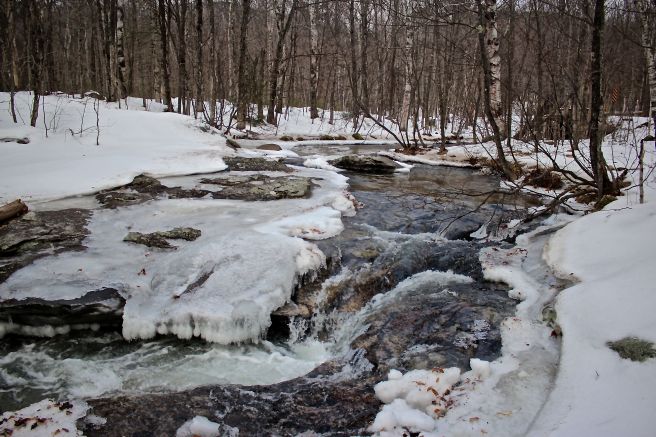
Finally beside the brook,  we couldn’t see the rocks below very well, but watching the water race over them gave us a better understanding of the forces that have smoothed their surfaces.

h-GB south

In a few more months, we’ll stand here and wonder where all the water went.

h-ice drips& bubbles

But today, it was the ice formations that we couldn’t stop admiring. Bubbling water below and dripping ice above, each adding to the other and both constantly changing.

h-ice 2

So much variation on the same theme as coursing water freezes into ice while at the same time carving into the rocks below.

h-ice pedastle support

Looking beneath, we noticed pedestals shaped like elephant legs providing support to shelves above.

h-gb ice castle

Occasionally, we saw crystalline turrets, translucent arches and frozen chandeliers of castles captured in ice.
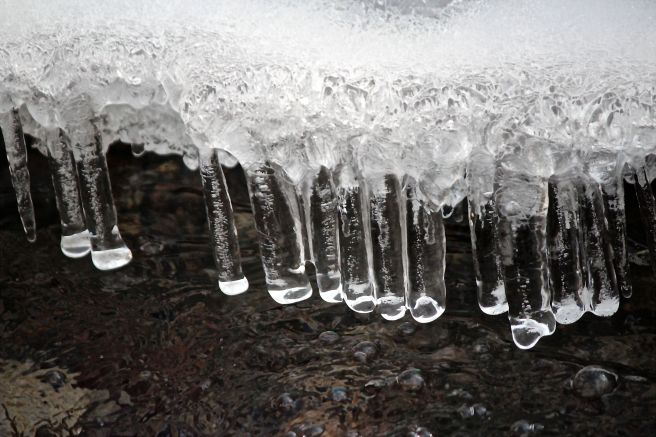
h-sets of ice feet

Sometimes, it seemed like ballerinas danced on their tippy toes. That’s what water really is, isn’t it–a dance through time with changing tempos along the way?

H-GB

We crossed Great Brook and then paused for a moment as we decided which trail to follow.  We took the road less traveled by. I laughed when Jinny Mae referenced Robert Frost’s poem. My former students don’t read this, but that was one of the poems they had to learn and recite. And my guy–poor soul–knows it through association. Actually, he’s a better soul for that reason.

h-tree owl 2

So you may not see it, but Jinny Mae and I did–an owl hidden in the ash bark. Not a live owl, mind you. Well, that depends on your perspective, I suppose.

h-heal all

Within minutes, we knelt to admire Selfheal or Heal All (Prunella vulgarism) and its hairy calyces.

h-survey sign

We stood by the survey marker sign and realized it had been attached for many years.

h-survey marker

Perhaps 51 years!

h-frullania 1 on red oak

h-frullania 2

On a red oak, we pause to look at the reddish-brown liverwort–Frullania. There’s history in this species–dating to the earliest land plants. No matter how often we see it, and we see it often, we feel privileged.
h-leaves and ice

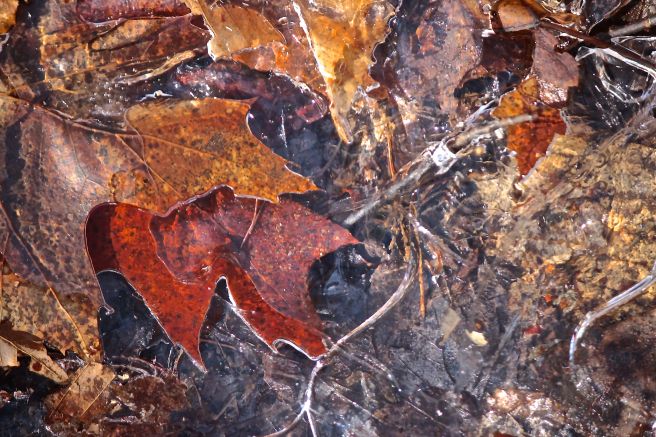
The trail switches from snow to ice to water and back again. Ice covered leaves draw our appreciation.
h-fnd 1a

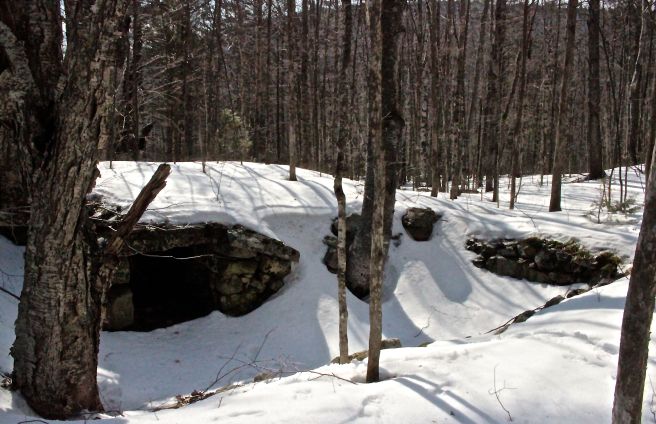
In the neighborhood, we pause to check on the local families.
h-fdn 1 chamber

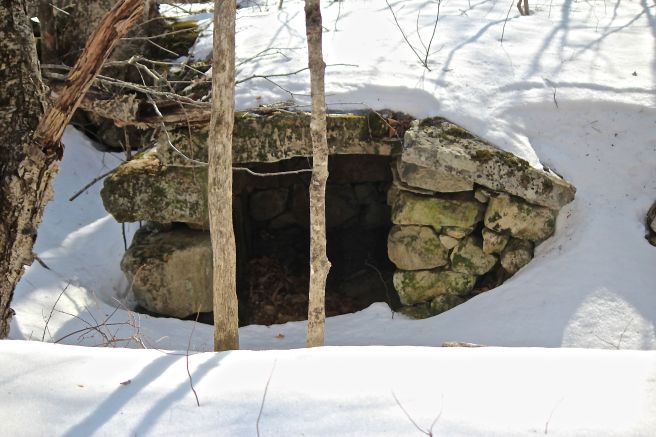
I climb down to the root cellar and discover that the porcupines haven’t visited all winter. Old scat still present in there, but nothing new.

H-Fdn 2

Moving up the colonial road, we come to the second residence.

h-fdn 2 yellow birch on mantel

Atop the mantel grows an old yellow birch. Like any TV screen above the fireplace, it offers an ever-changing display.

h-brook upland

We moved toward Shirley Brook, where we were once again in awe of ice.

h-water and ice1

Water and ice: a relationship in constant flux–at the moment.
h-brook structure

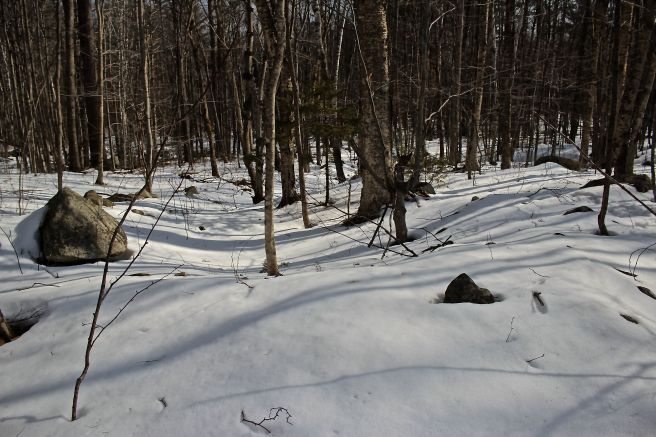
Beside the brook is a stream that’s currently dry. We look edat the snow-covered stonework that crosses over it and realized we need to return and try to figure out what the structure might have been and why it was built here. Stuff like this adds to the intrigue. Man-made. When? Why?

h-spider 3

Poor Jinny Mae. She had to wait for me constantly as I shifted from one lens to the next. But check out this spider.

h-stone piles 1

We are the queens of bushwhacking and love discovering the stories hidden in the woods. In this neighborhood, lots of stone walls tell part of the story. Rock piles enhance the chapters.
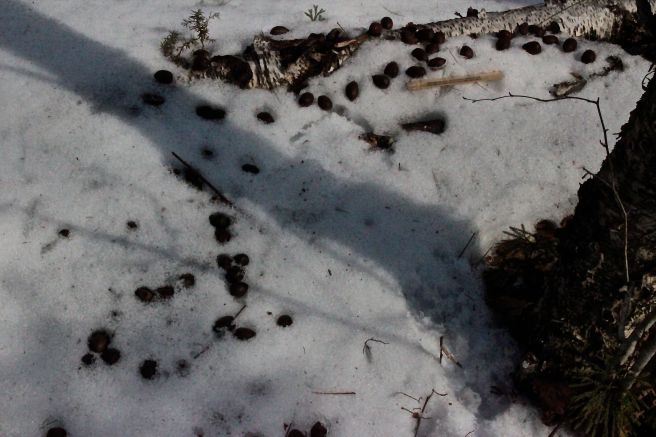
h-moose scat 1

And then we found more. Fairly fresh moose scat insisted upon our attention. We’d noted that there were some old snowshoe hare runs and we found some moose browse on a nearby striped maple, but we were surprised that there weren’t many fresh tracks. Where have all the mammals gone?
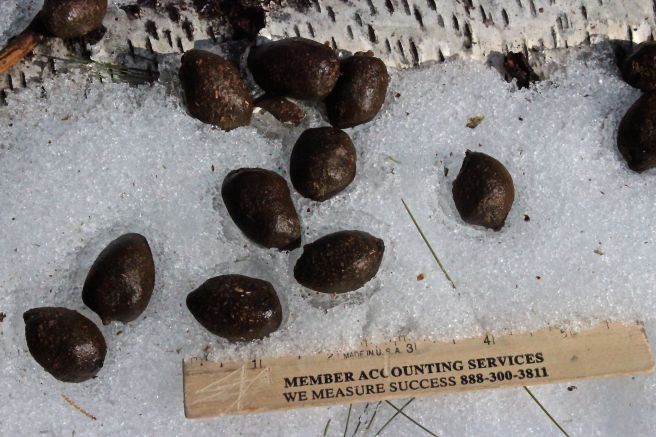
h-moose scat 2

This scat is some of the biggest moose scat we can recall seeing. A few gems followed me home.
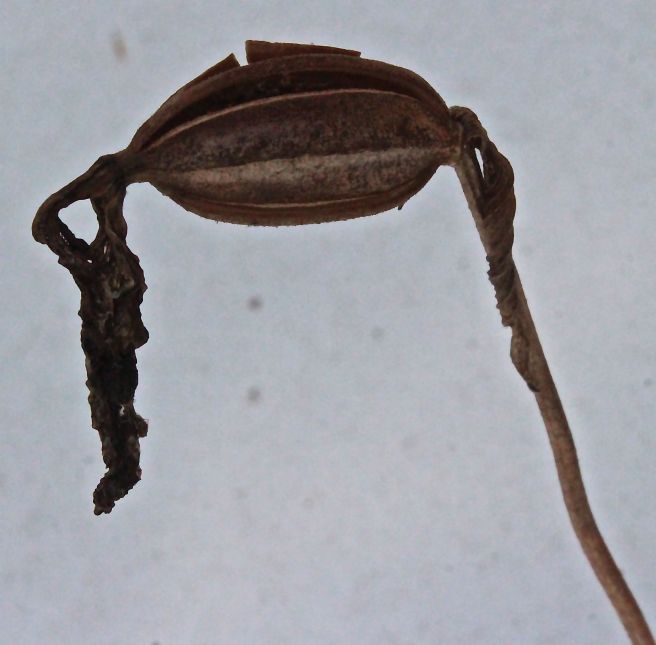
h-lady's slipper

And then we happened upon something neither of us have seen before–at least that we are aware of. We had our ideas about what winter weed this is, but since we haven’t encountered it before our sense of wonder kicked in.
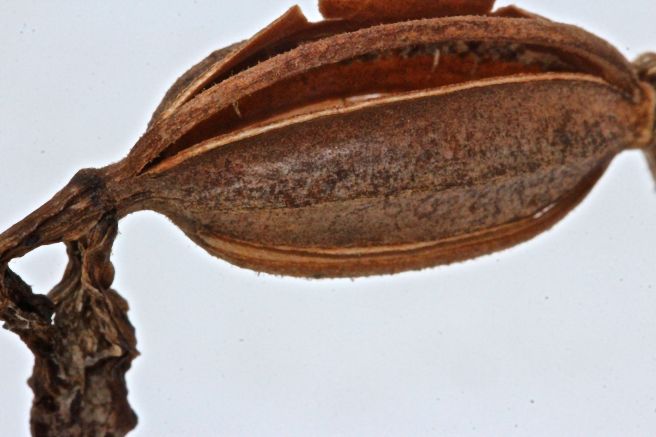
h-lady's slip pod 2

Back home, I looked it up in Weeds and Wildflowers in Winter by Lauren Brown. The capsule is woody and about two inches long. As you can see, it’s closed at both ends, but opens along slit lines–six in all, actually.

h-lady's bract at base of pod

At the back end, a long, curved bract.


And at the front, the slipper gone by. Yup–Lady’s Slipper (Cypripedium acaule). And the reason we didn’t recognize it–because it’s a rare find in the winter woods. Wow.

h-bear 1

We’re on our way out when we spotted these marks on beech bark. We’d looked and looked because we know this is bear territory.

h-bear NW

Compared to other bear trees, these claw marks are newer than most I’ve seen. Jinny Mae was as excited about the find as I was. I’d told her earlier as we scanned the trees that my guy has come to an unconfirmed scientific conclusion that bear claw marks appear on the northern side of trees. This one didn’t let us down. Based on the location of the sun that’s grew lower in the sky, these are on the northwestern side of the tree.

At last it was time to drive home.

Gallivant: go from one place to another in the pursuit of pleasure or entertainment. Over five miles and almost five hours later, we were thankful for the opportunity we shared today to gallivant around Great Brook.
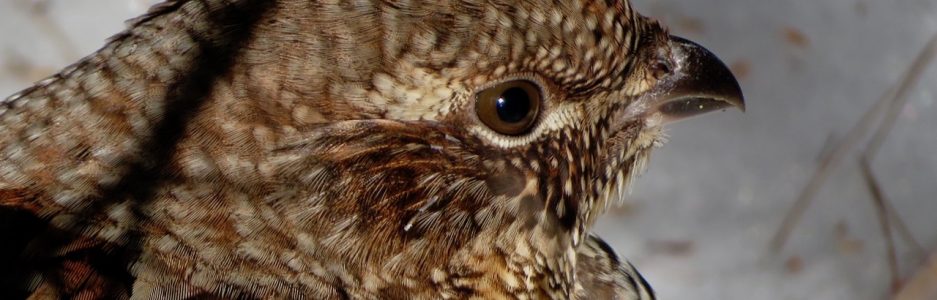


Some Call Them Weeds

Shades of brown, gray and green dominate the winterscape now that we finally have some snow. It’s those browns that frequently draw my focus as I admire the woody skeletons of bygone summer wildflowers. Of course, some call them weeds.. I’ll admit that they do grow prolifically–especially in land cleared by humans, e.g. the field and power line I frequent.
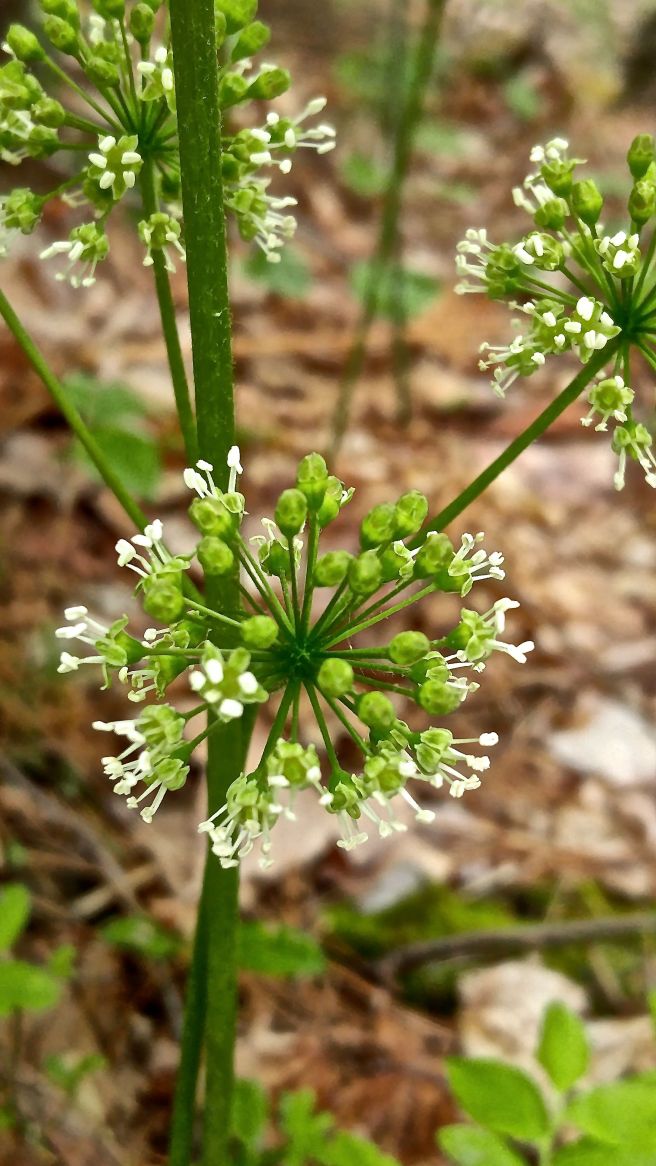
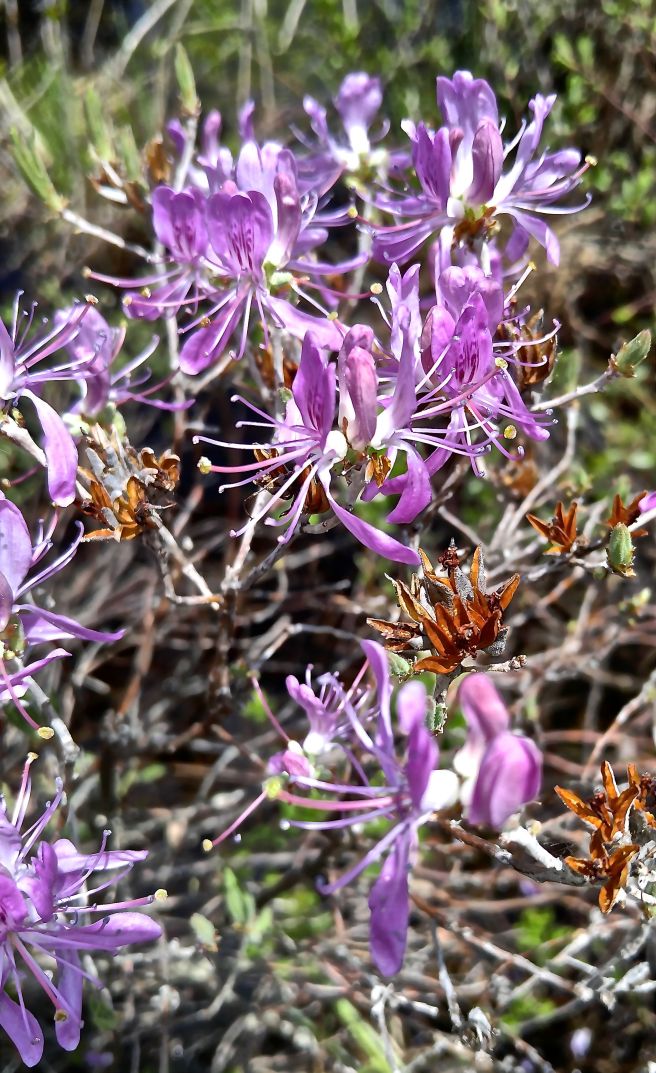
But . . . come meet a few of my winter friends.

Indian Tobacco

This is Indian tobacco (Lobelia inflata). Guides say it tends to be alone, but I’ve seen it grow in colonies as well. The papery calyx is all that is left now.

IT 2

Inflata refers to the inflated seedpods, which are two-chamber capsules that split open to drop their seeds.

iT 4

Minute and scaly, the seeds self sow.

bugleweed

I struggle with the ID of this member of the mint family. Knowing it is a mint is the easy part. Notice the square stem? I believe it’s bugleweed or water horehound, but I’ve also toyed with motherwort. Either way, both feature toothy calyces that whorl around the stems. I keep flip-flopping because the dried seedpods seem larger than bugleweed, but all were on single stems and the area is known to be wet–though not consistently. Maybe knowing it’s a mint is enough.

spirea 3 meadowsweet

Both hardhack (steeplebush) and meadowsweet are members of the Rosaceae family. Their dried fruit structure is known as a follicle, meaning it splits open along one line–like a milkweed. But these two plants have five follicles encircling a central point.

goldenrod 1 goldenrod 2

Showy goldenrods grow abundantly and it’s no wonder given all their seeds. They depend on the wind and my snow pants to disperse. I refer to plants that stick to my clothes as volunteers. And if they are sticking to me, then they are also sticking the fur of mammals that move about this area. Today I found deer, bobcat and squirrel tracks.

achene

Both goldenrods and aster seeds have small, single-seeded fruits called achenes. A receptacle holds the fruits in place until they’re ready to head off on their own.

goldenrod 4

Check out the crown of hair, called a pappus, on this aster. These act like parachutes and enable the fruits to float along in a breeze, thus spreading the flowers far and wide.

a or g 5

While the goldenrod flowers tend to grow in dense clusters, aster flowers are found in a single arrangement.

A turn to folklore explains how the goldenrods and asters are related. Two young girls talked talked about their future. One, who had golden hair, said she wanted to do something that would make people happy. The other, with blue eyes, said that she wanted to be with her golden-haired friend. When the two girls told a wise old lady of their dreams, she gave them some magic corn cake. After eating the cake, the girls disappeared. The next day, two new kinds of flowers appeared where the girls had walked: Asters and Goldenrods.

g gall 2 Goldenrod bunch gall

Another way to identify goldenrod in the winter is to look for these galls. The goldenrod ball gall, on the left, is a round gall in the middle of a stem. In the spring, the Goldenrod gall fly lays her eggs on the stem. Hatched larvae chew their way into the stem and the gall starts to develop. The other is a Goldenrod bunch gall created by a tiny fly called the Goldenrod gall midge. It looks like a mass of tiny leaves. While it stops the main stem from growing, tiny branches extend outward.

spider 2

Though not an insect, I did find a spider on the snow today.

 bouquet

And then I came in, bringing a few finds with me. My guy is lucky–bouquets come cheap around these parts.

sketch

Some call them weeds. I call them volunteers who add beauty in any season.