The Perks of Perky’s Path

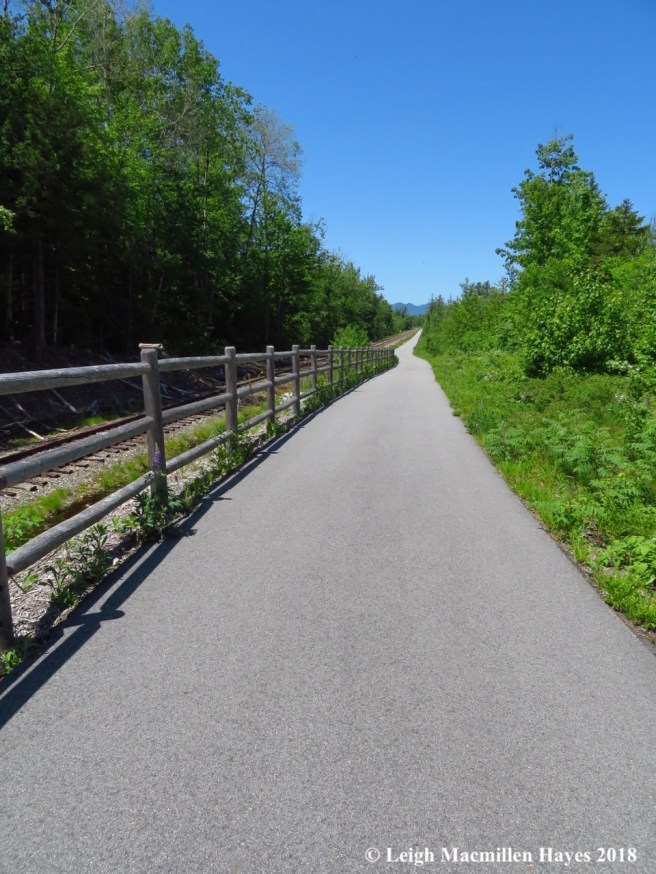
It’s such a sweet trail and so named for Juanita Perkins, a local photographer and naturalist who was an avid member of the Greater Lovell Land Trust. To follow in her footsteps is not an easy task, but today I journeyed along the path trying to see what Juanita might have seen.
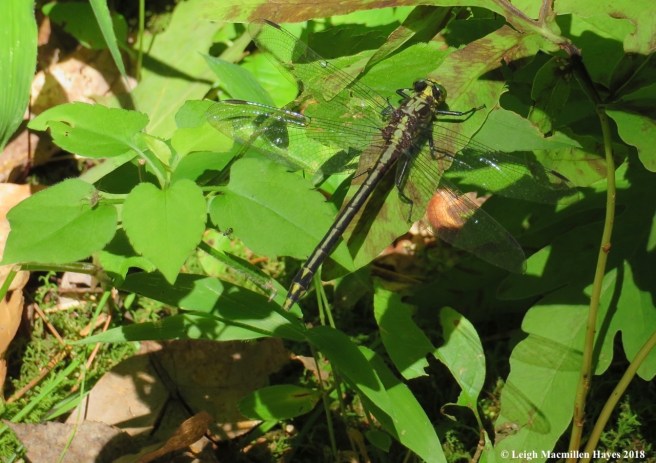
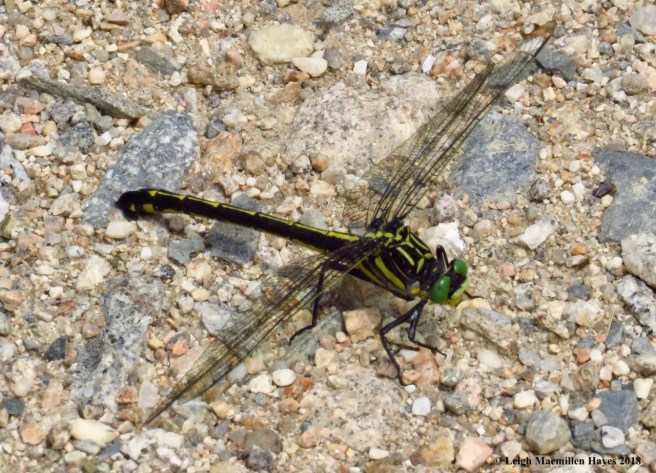
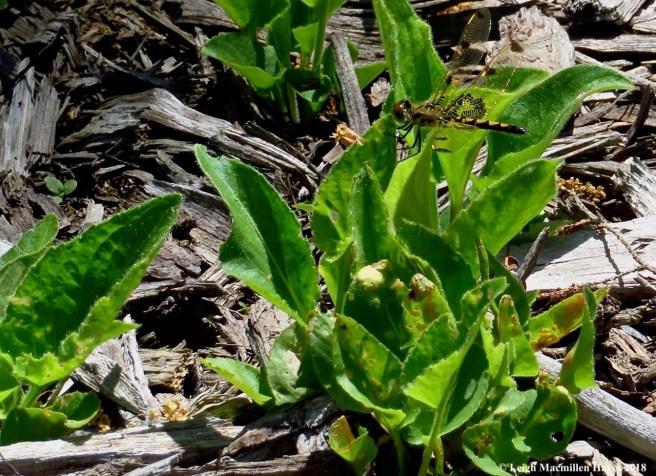
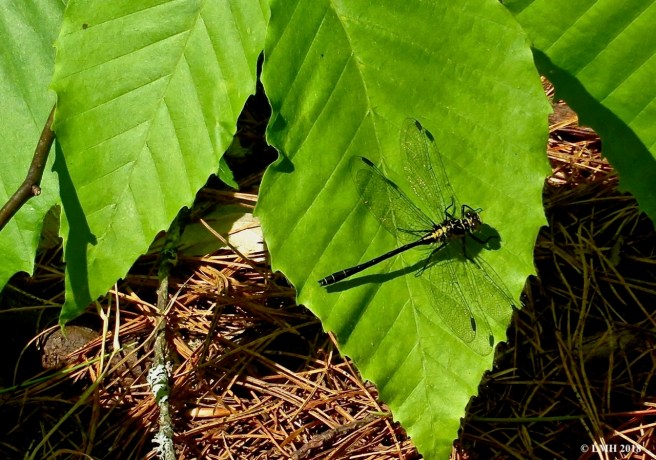
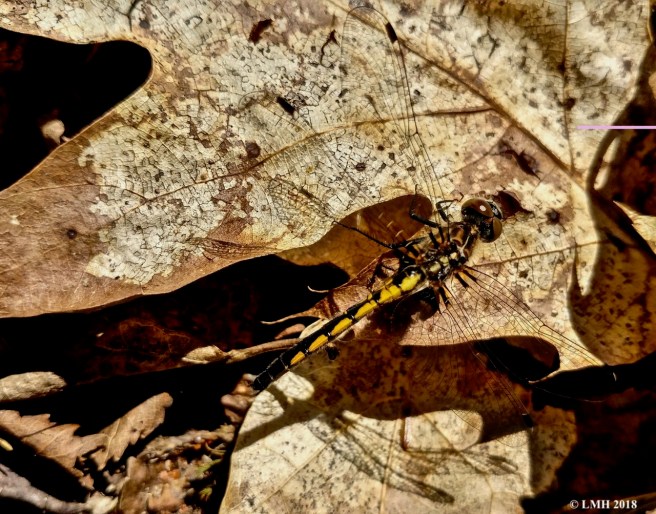
1-lancet clubtail

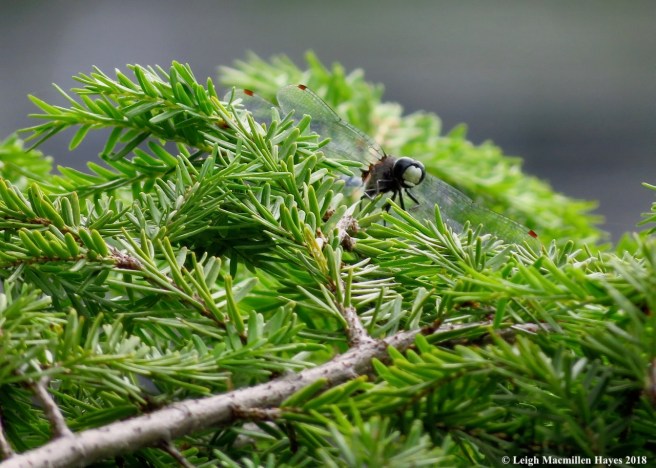
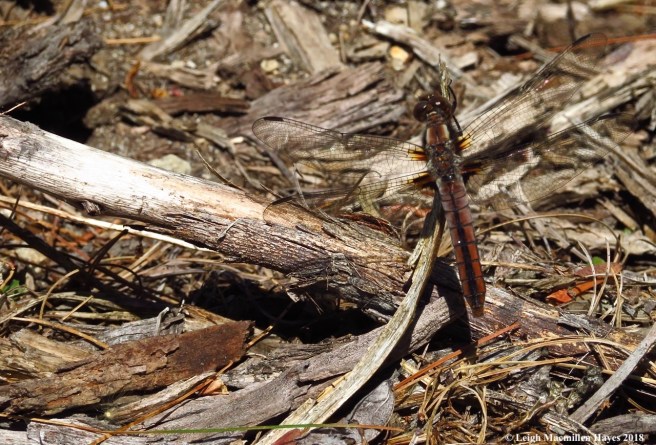
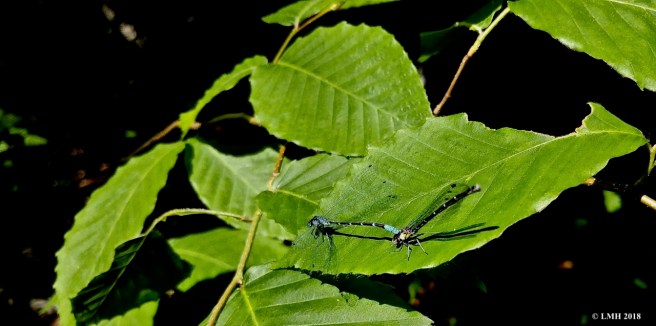
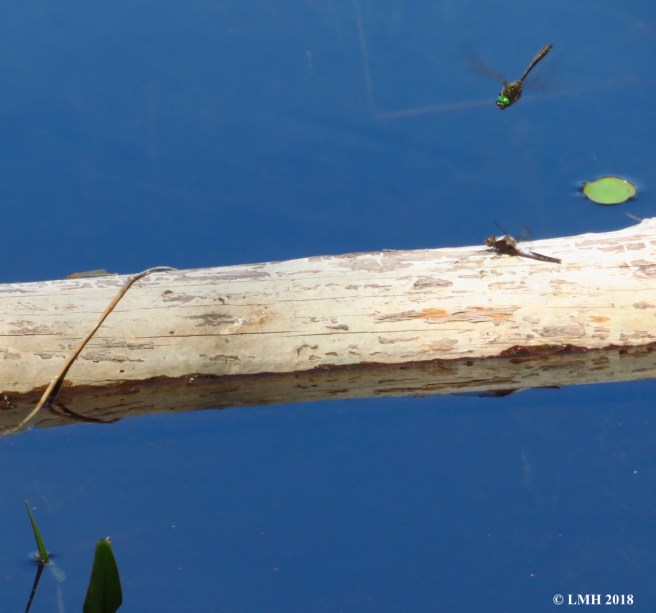
Immediately upon stepping down the trail, a clubtail dragonfly landed in front of me. Identifying dragonflies has become one of my passions of late, but still I struggle. And go back and forth. Lancet Clubtail or Pronghorn? I lean toward Lancet only because I’m not sure Pronghorns are a Maine species. But it’s to Dragonflies of the North Woods that I turn, and the abdomen that I try to zone in on. The abdomen consists of ten segments. Lancet: segment 8 has a smaller top spot and segment 9 is all yellow on top, (except for the female’s top spot which is narrower). Pronghorn: segment 8 has a smaller top spot and segment 9 is all yellow on top. Segment 10 has a narrow stripe. The Maine Odonata survey does not include the Pronghorn and so I find myself deciding on the Lancet. Suffice it to say, this is a clubtail.

2-ebony jewelwing damselfly

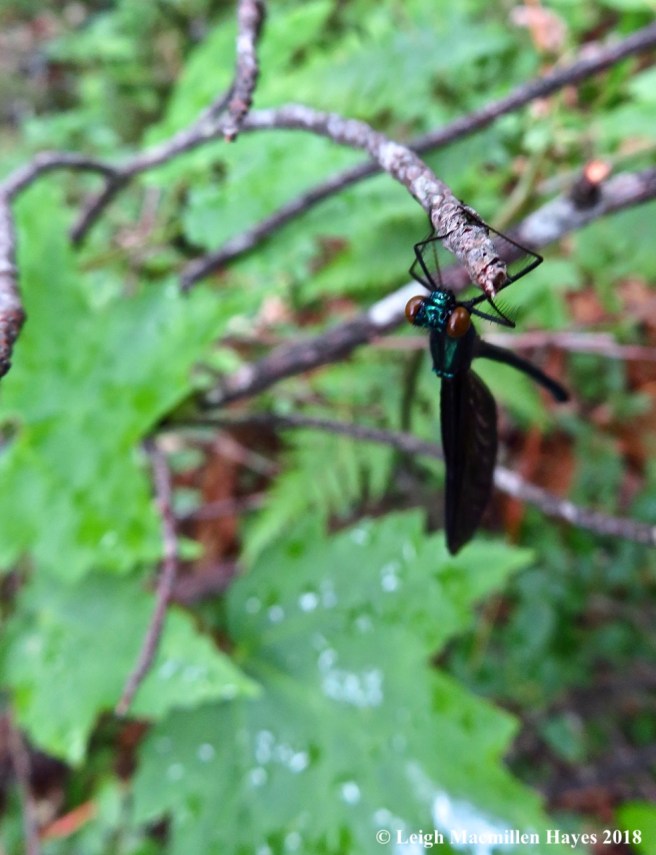
A much easier species for me to ID is the ebony jewelwing damselfly. Several danced and posed by the brook leading from the wetland the path encircles to Heald Pond. I trust that when Juanita traveled this path, she too saw the jewelwings dance, their bodies as bejeweled as their wings–maybe more so. A female’s wings are smokier in color than the males and each is dotted with one white spot at the tip.

3-male ebony jewelwing

The male’s wings are more ebony in color and body more metallic. This handsome fellow had three ladies in waiting so he couldn’t pause for long.

4-trail sign

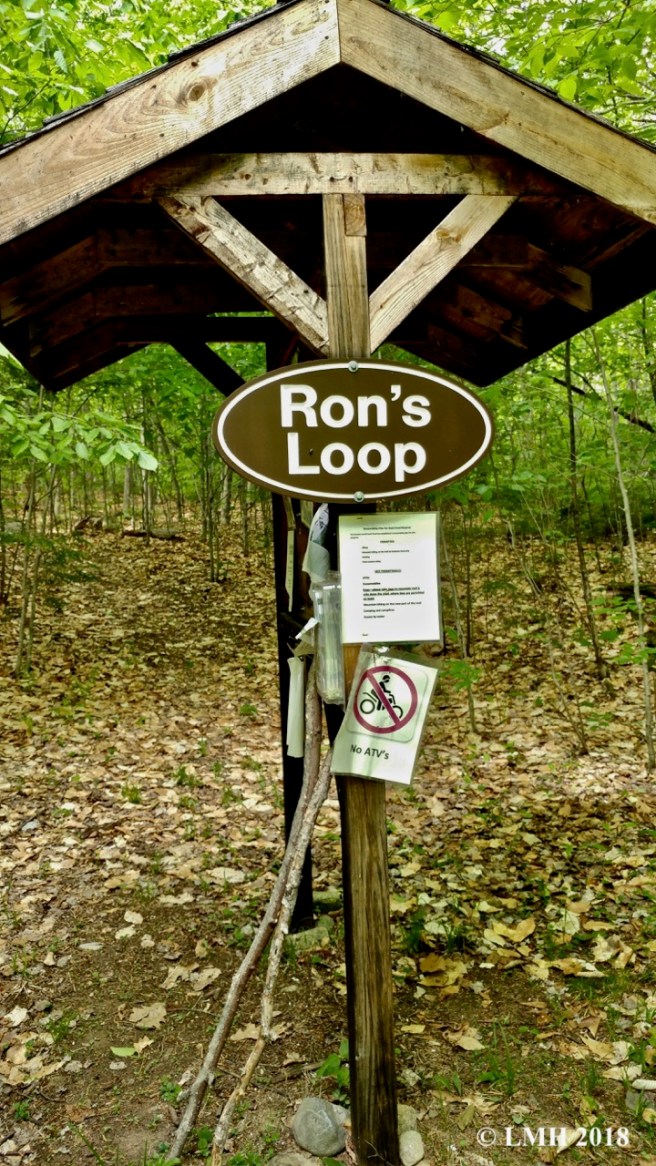
Though I refer to the entire loop as Perky’s Path, in reality I hadn’t even reached it by the time I encountered the “You Are Here” sign. I’d actually been walking along a snowmobile trail that is part of Heald and Bradley Ponds Reserve.
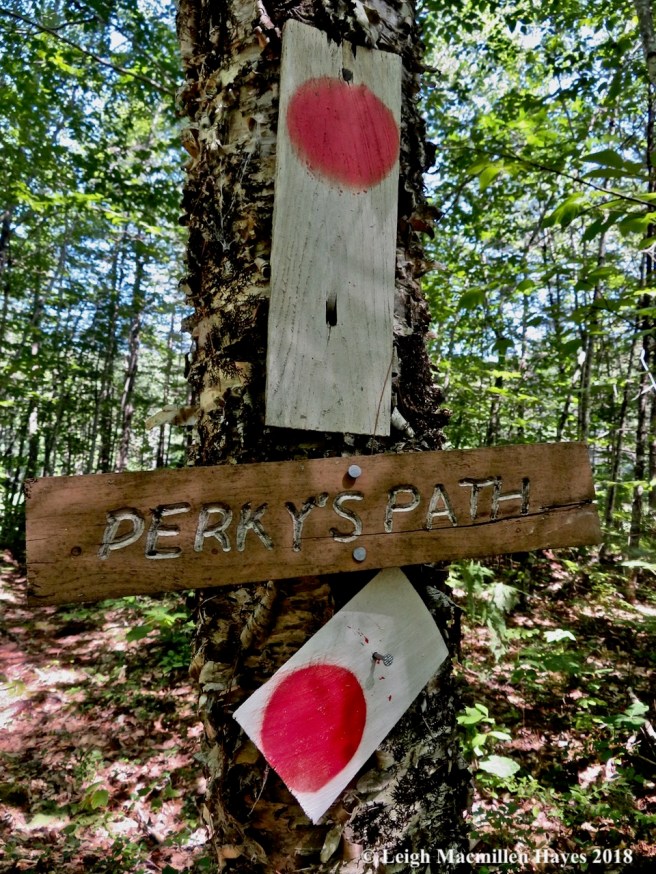
5-perky's path

It was a couple of tenths of a mile later that I finally stepped onto the path blazed with orange.

6-bench

One of my favorite hangouts is the bench located along a short spur. Usually I spend moments on end, but today I was eager to move on.
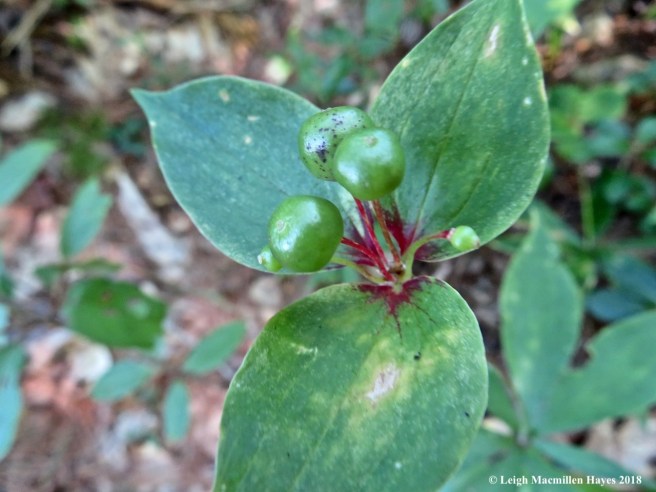
7-Indian Cucumber Root

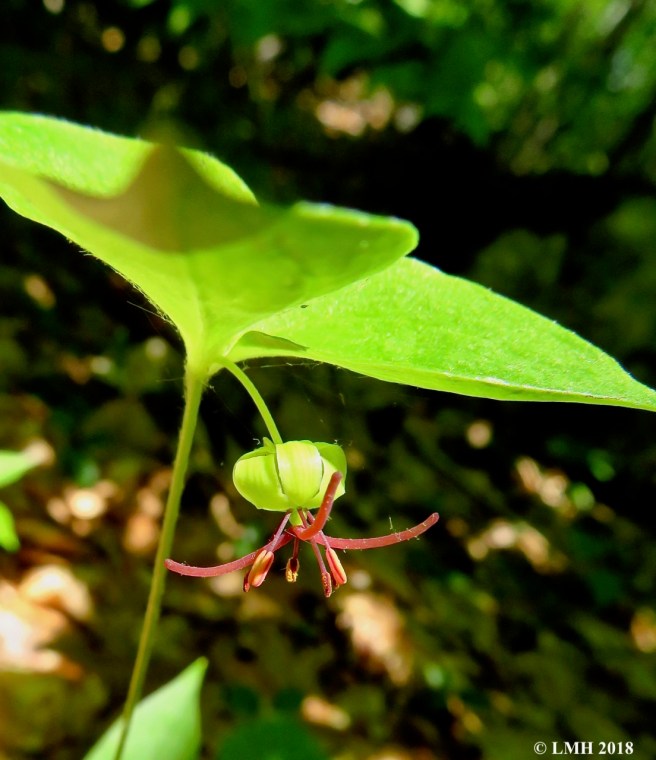
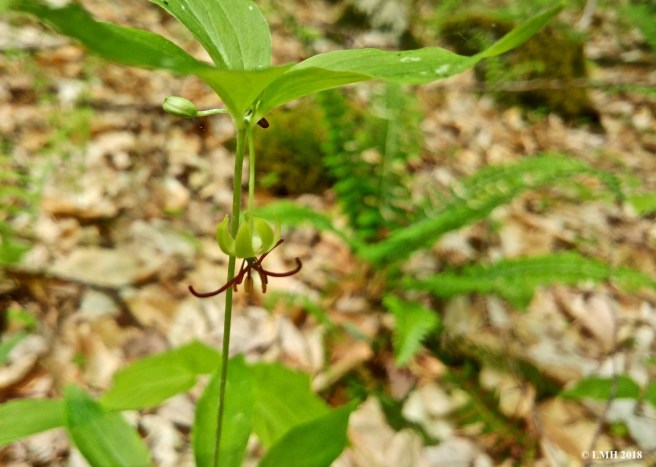
Along the spur trail, I did note one of my favorite fruits beginning to ripen–that of Indian Cucumber Root. And as it ripens, the base of the leaves turn red. All I could think of is that the red is a sign to birds–come dine at this table. You won’t regret it.

8-trillium fruit

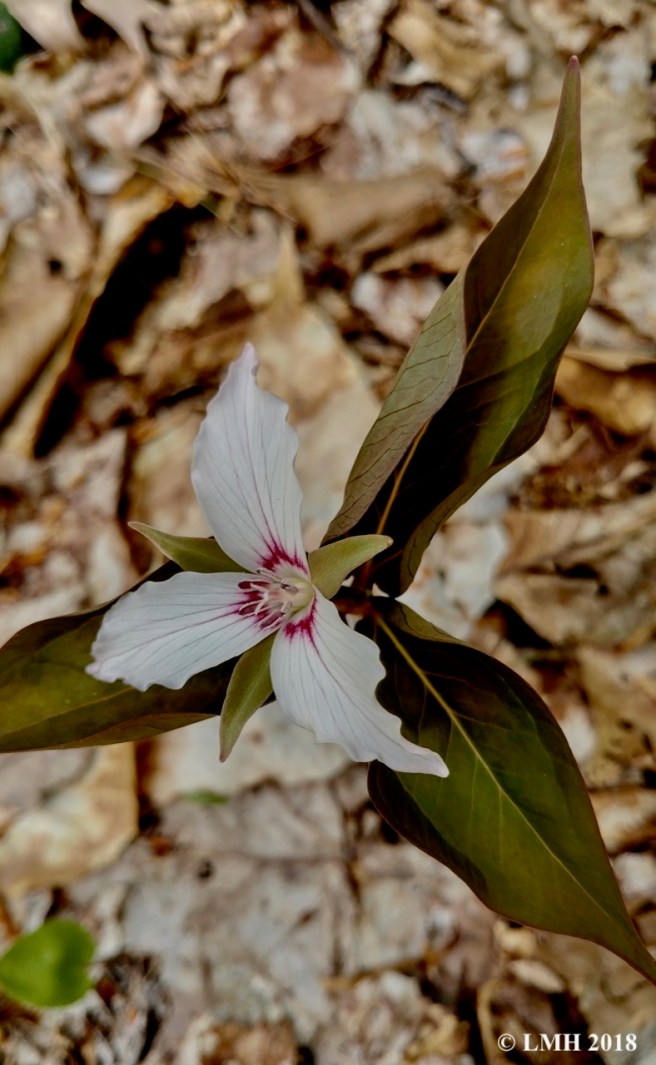
Another red fruit stood upright above leaves of three–that of a painted trillium.
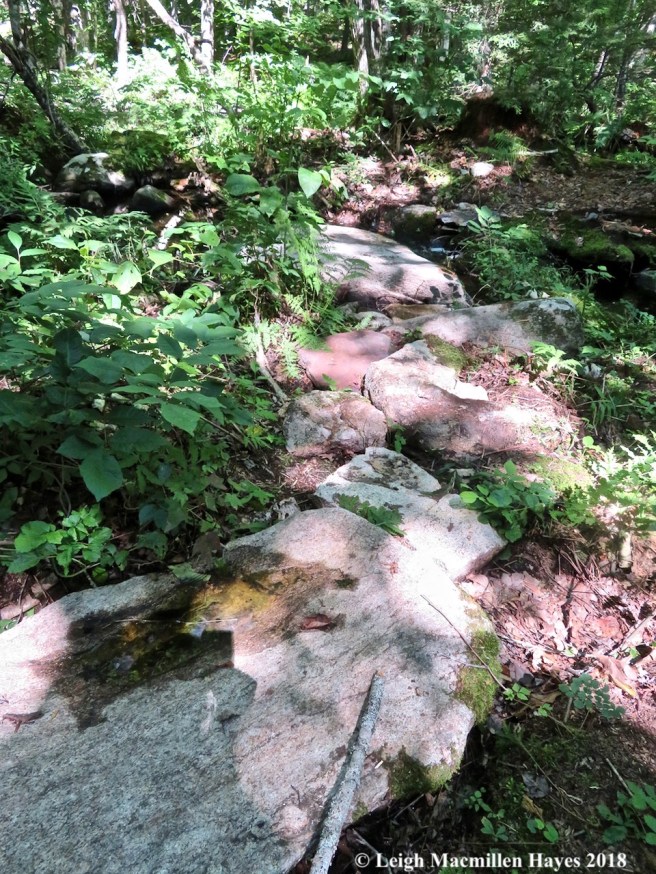
9-new stone bridge

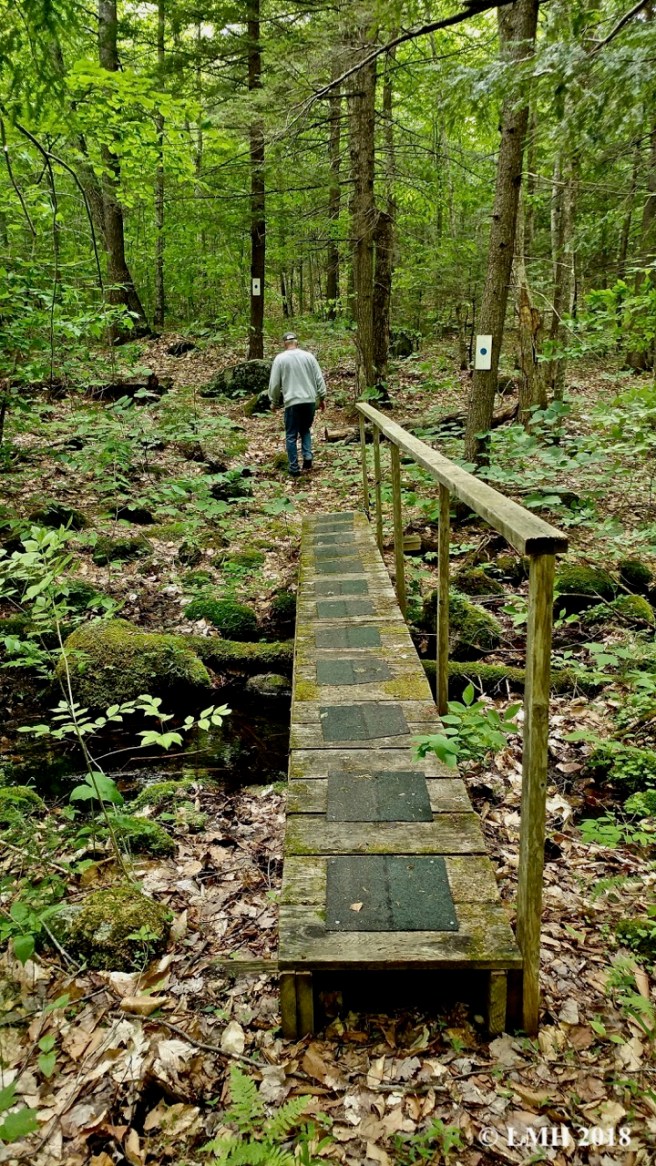
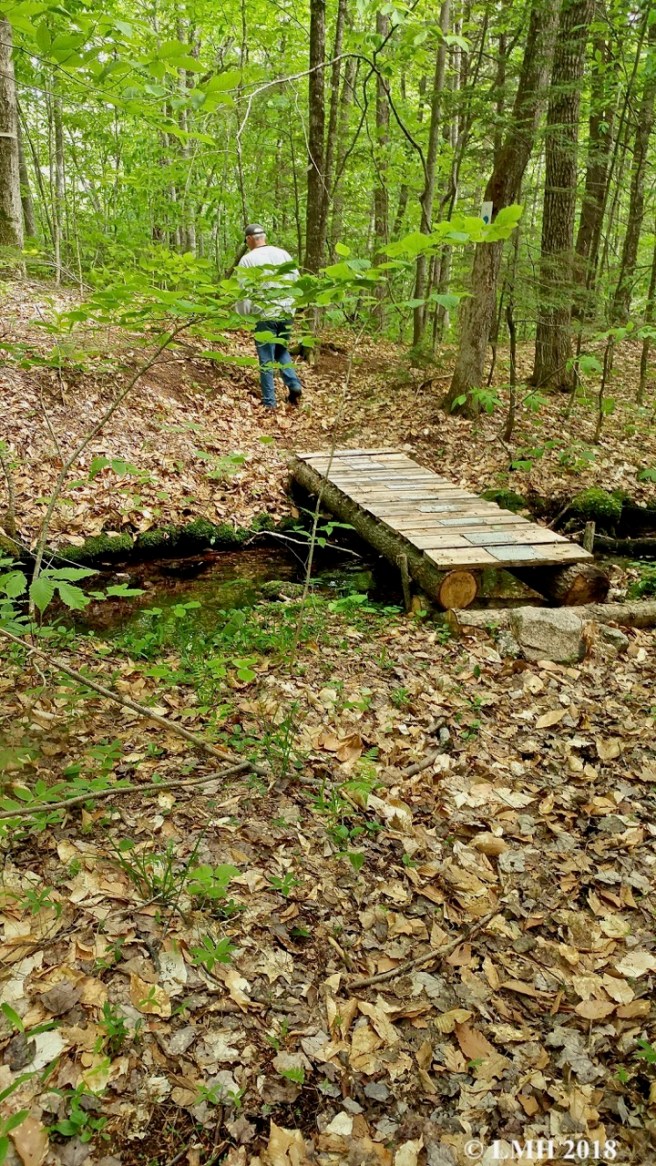
It’s been six years since Juanita Perkins passed away and I don’t know when she last walked the path, but at that time, where the stream from Bradley Pond flows into a beaver wetland before continuing on toward Heald Pond, she probably crossed the water via a wooden bridge. Time and weather had taken their toll on the bridge and so at the beginning of this summer a group of volunteers and a couple of GLLT staff members pulled the wood out and placed flat rocks as stepping stones. It makes for a magical crossing, especially as it slows the wander and encourages one to notice the surroundings. Though we never officially met (I do remember her dropping off photographs at a local gift shop where I worked for several summers back in the late 1980s), I trust she would appreciate the change.

10-stream archs

Of course, I’ve always been one to enjoy water and all its variations. By the stepping stones (boulders), smaller rocks below the surface added to the overall arching effect, creating an interconnection. I felt a sense of Juanita’s time spent on the path woven into today.

13-jewelweed

By the water, there were a variety of flowers to note, including whorled asters and cardinal flowers, but it was the jewelweed that brought a smile to my face. I don’t understand why, but one of the sepals forms a pouch-like structure with a long spur. Jewelwings and jewelweed–indeed, a very special place.

11-Golden Spindle

Adding to the wonder right now due to recent and much appreciated rain are all the fruiting forms of mushrooms and this path has its fair share. I’m not great on my identification of boletes and others, but there are a few individuals that I remember from year to year. It’s the fact that their spores are everywhere and those spores form hyphae, that then forms mycelium, that then eats anything organic, that when mating is successful forms fruit, is wicked cool. We’re wowed by the fruit, but really, we need to honor the entire system. And so I honor the Golden Spindle,

12-white spindle fungi

White Spindle (which I don’t recall ever seeing before),
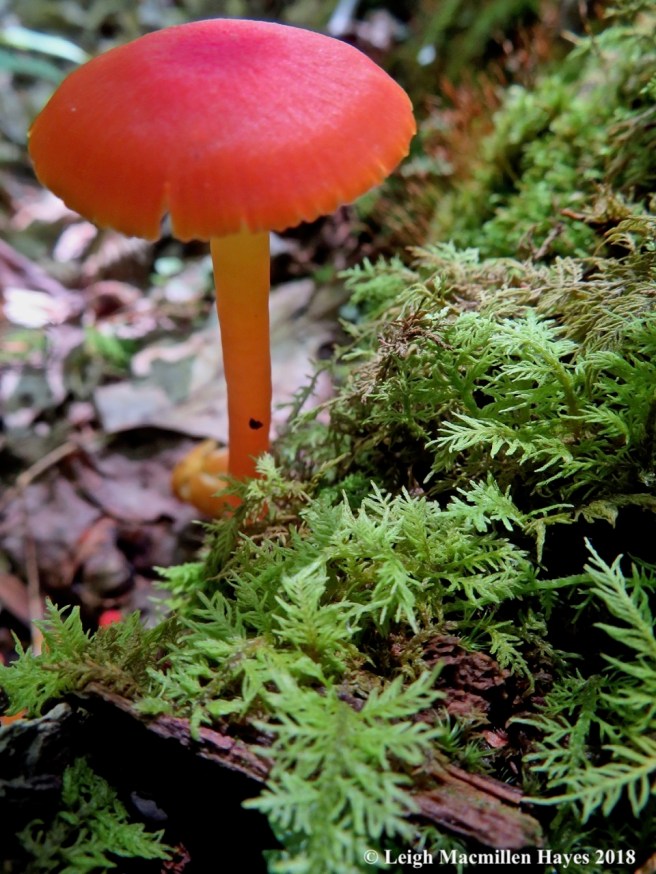
12b-scarlet waxy cap

Scarlet Waxy Caps,

12a-earth tongue fungi

and Earth Tongues.

14-into the wetland

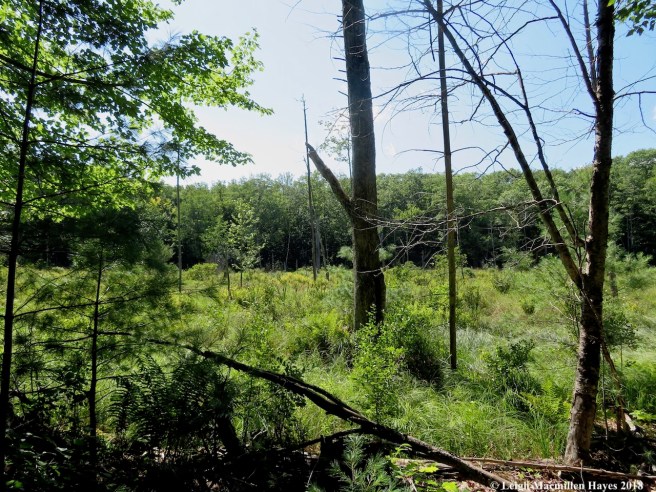
And then I slip off the path and down to the wetland, wondering what else I might see.
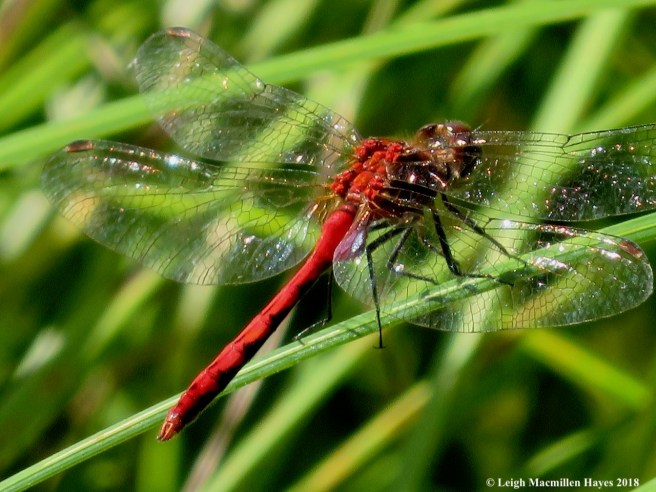
15-cherry-faced meadowhawk

Instantly I am rewarded with numerous sightings of Cherry-faced Meadowhawks, their wings all aglow.
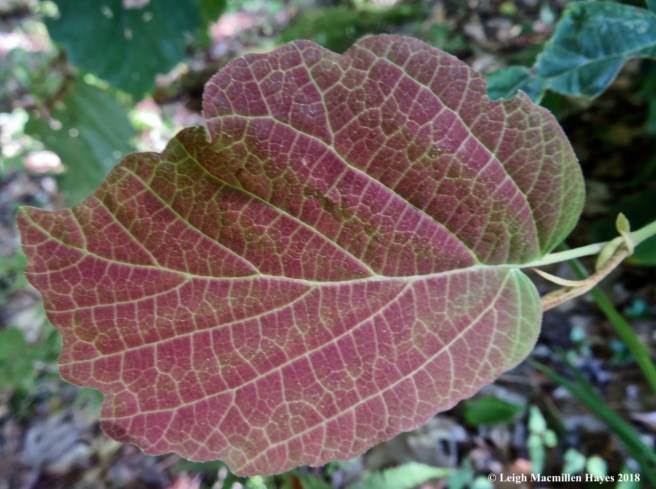
16-hobblebush leaves

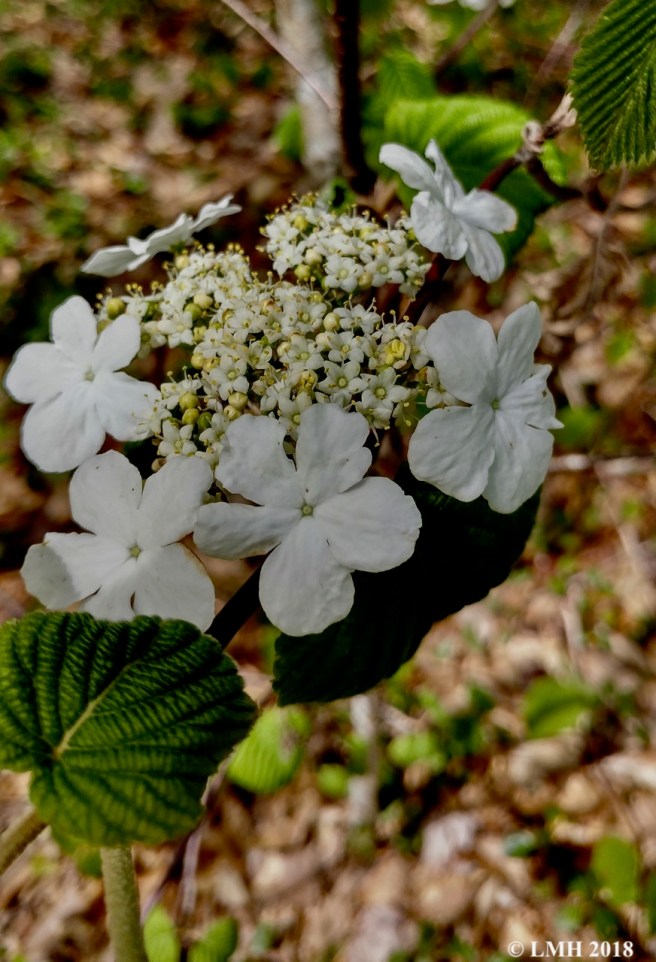
They aren’t the only shade of red in the vicinity, for some of the hobblebush leaves have taken on their autumn hue already. (Say it isn’t so!)

16c-brook to wetland

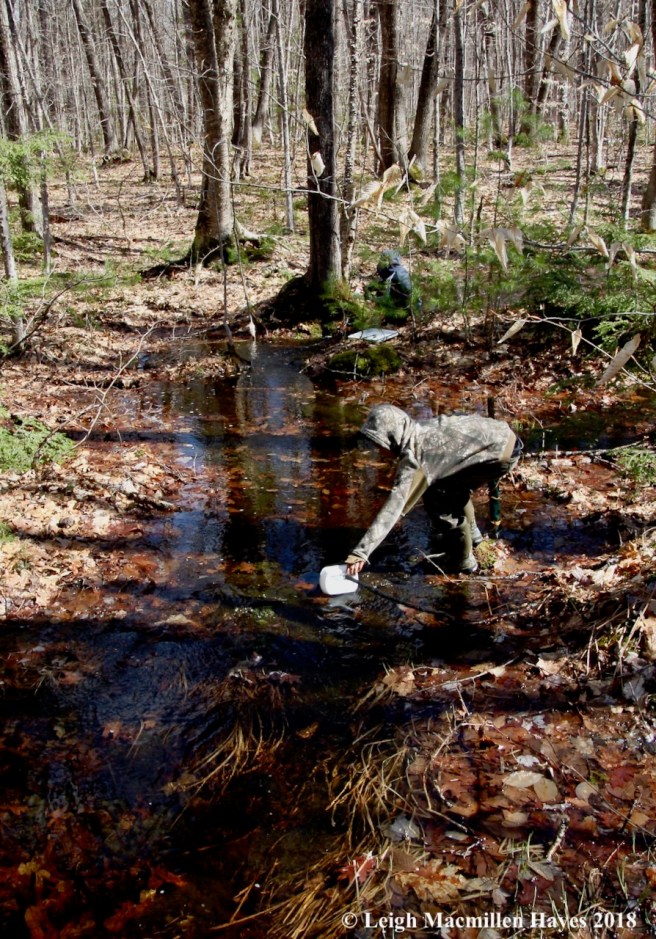
I almost complete the loop and reach the bridge crossing just before the parking lot at the end of Heald Pond Road, when I decide to follow the stream bed back toward the wetland. I suppose I did so because I wanted to extend my journey and my time honoring Juanita.

16-green frog

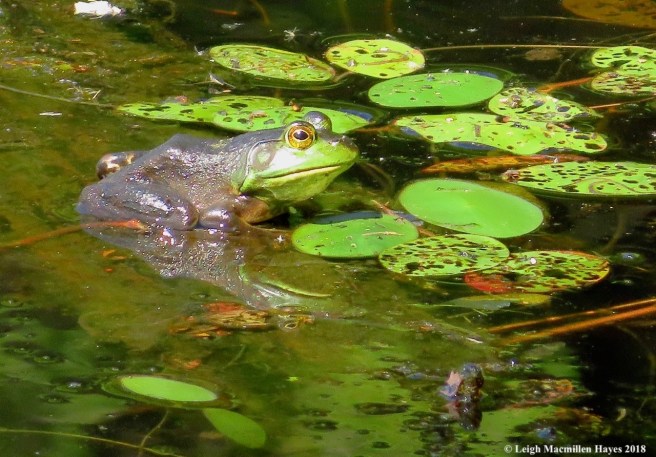
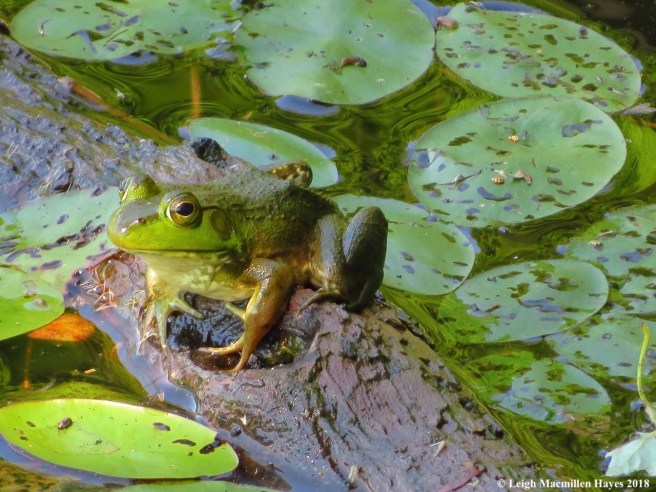
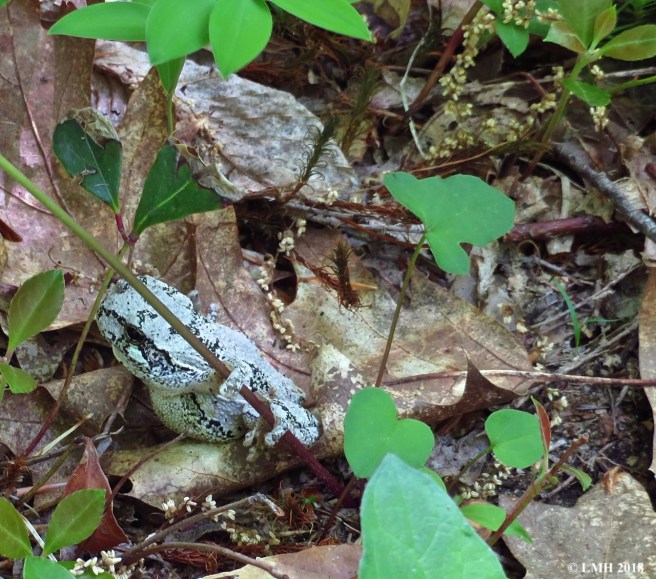
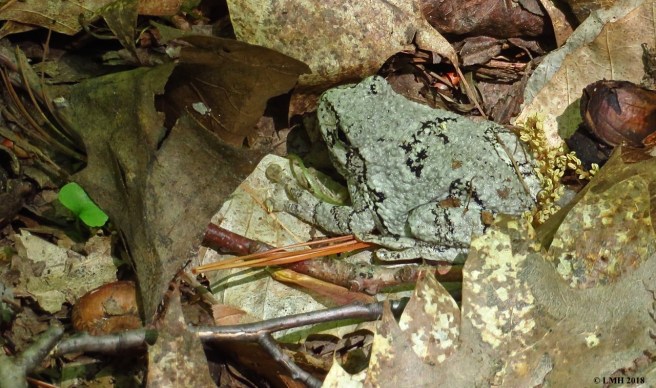
Here and there, where pockets of water exist, green frogs either try to hide from me or make sudden leaps.
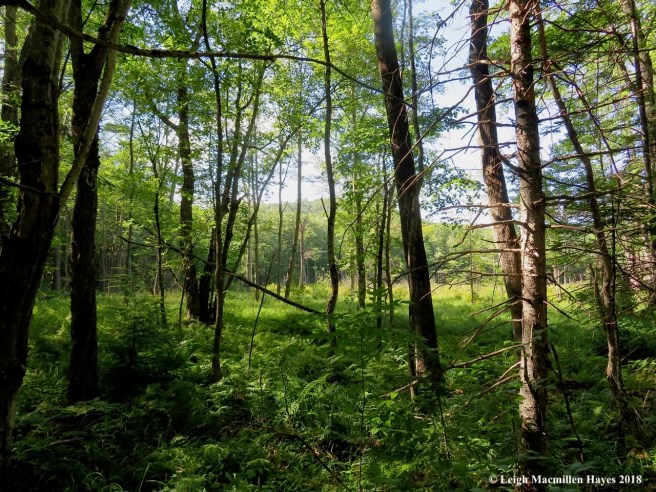
17-back to the wetland

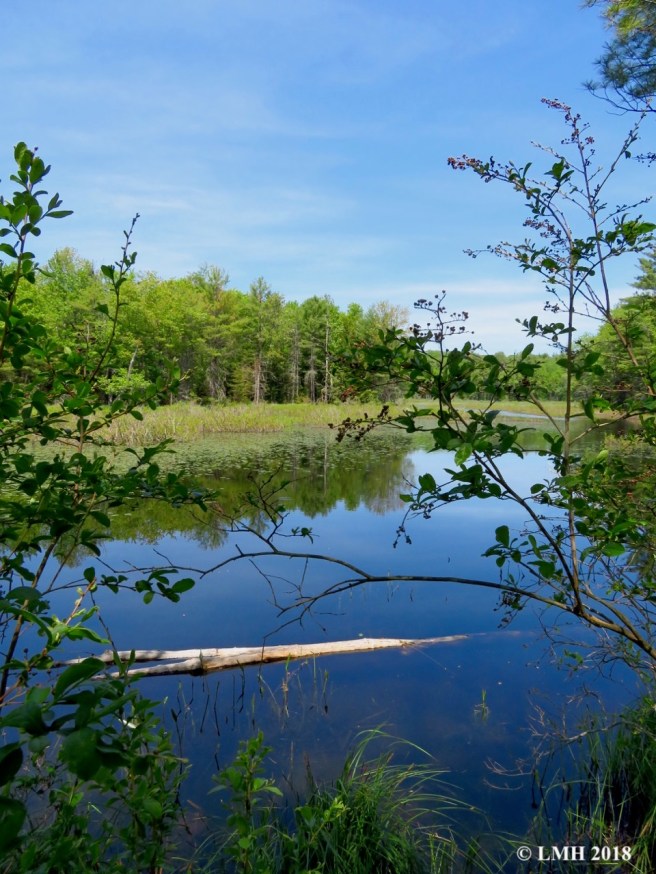
I bushwhack back into the wetland, not wanting to let go, and forever thankful for Juanita. Every time I wander her way, I discover new perks along Perky’s Path.


Filling Our Buckets Mondate

Our day began with a journey to Green Thumb Farms in western Maine because we were curious about their native blueberry sod. We had hoped to see some, but that wasn’t to be and instead we were given a contact number for a sales rep. Our hope is to purchase a couple of pallets worth and use it as one more filter system at our camp in our continuing efforts to protect water quality. We recently learned that we qualified for a LakeSmart Award, but don’t want that to stop us from finding other ways to create a more lake-friendly property. Stay tuned on the sod because once we figure that out, it will be a story worth telling.

1-lunch spot, Eaton Village Store

From Green Thumb Farms we zigged and zagged along the back roads until we reached Eaton, New Hampshire. Lunch awaited at the Eaton Village Store on Route 153. Inside, one wall is covered with mailboxes and the post office. Grocery and gifty items are displayed in an aisle or two. And then there’s the lunch counter and a few tables for the eatery. A most pleasant eatery. The menu is simple, food fresh, and all served with a smile and conversation.

2-falling snow sign

Oh, and one more thing. They are eternal optimists! Or procrastinators like me. Heck, eventually there will be falling snow to watch for again.

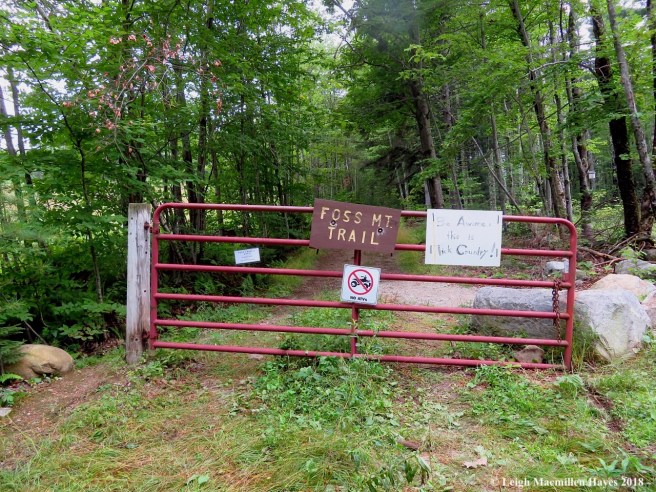
3-Foss Mtn Trail

After lunch, we zigged and zagged again, winding our way up a road we once remember sliding down–in the winter on our bellies with our eight and ten year old sons in tow. Our destination today was much easier, though I did put the truck into four-wheel-drive to reach the trailhead parking lot for Foss Mountain. I’d told my guy about the blueberries and views and neither of us gave a thought to today’s weather for in the newspaper the forecast predicted it to be “rather” cloudy, “rather” being a rather unscientific term. It turned out to be more than “rather.” And raindrops fell, but still we went.

4-Foss Mtn Map

We examined the sign and my guy was thrilled with the possibilities.

6a-no picking

Some fields, however, were closed to public picking for a private operation leased those from the town.

5-Ryan Bushnell Blueberry Operation

Off to the side, we spied their sorting machines. Note the blueberry color of the equipment.

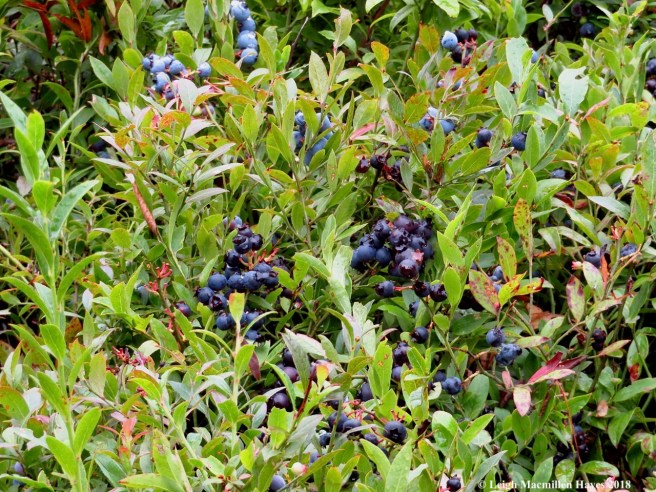
6-blueberry envy

And the abundance of blueberries.

7-hands in pockets

After testing a sample to make sure they were acceptable for human consumption, my guy stuck his hands in his pockets to avoid further temptation.

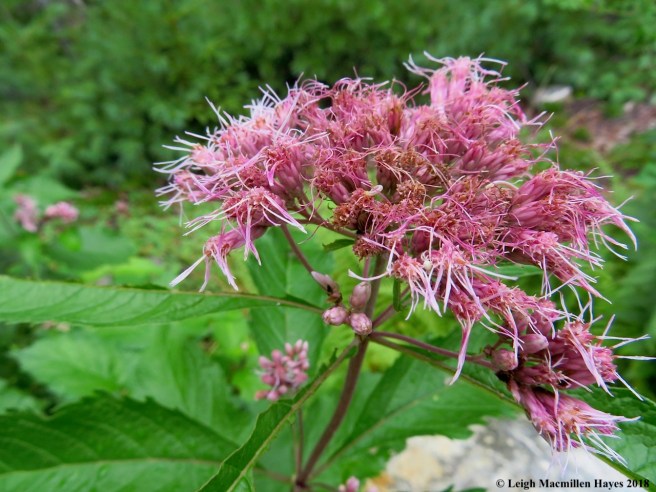
8-Joe Pye Weed all in disarray

Upward we journeyed, following the path of this property that is owned by the Town of Eaton. Along the way, a large patch of Joe Pye Weed shouted for attention, its petals disarrayed much like my own hair on this misty of days.

9-into the fog

The habitat changed and still we climbed–anticipation in every step my guy took at full speed.

10-pick blueberries sign

At the next natural community boundary, where conifers gave way to saplings and undergrowth, my guy rejoiced. At last we’d reached the promised land.

11-my guy disappeared ;-)

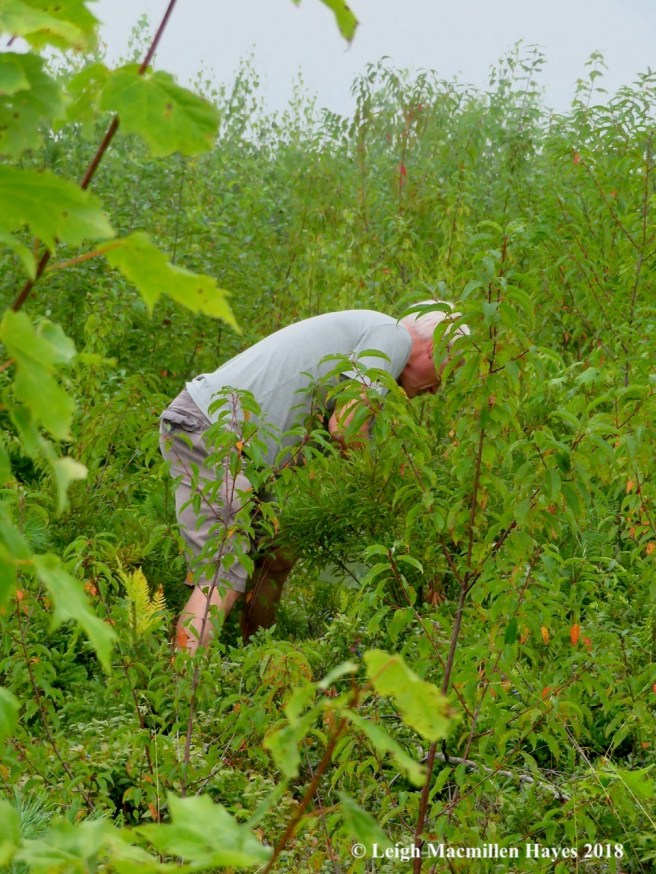
And immediately he stepped off the trail to find those tiny blue morsels that bring him such delight.

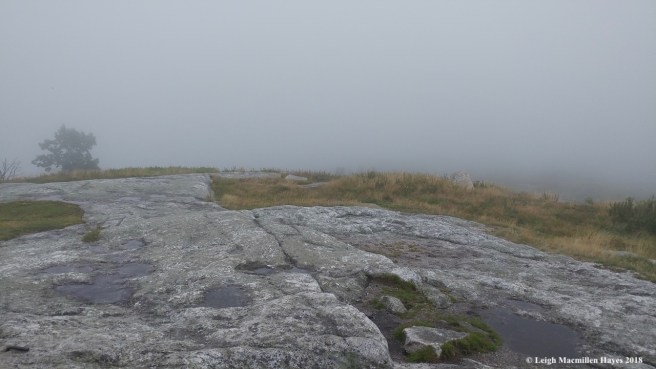
12-summit fog

While he picked, I headed toward the summit, where a blanket of fog enveloped the view. It didn’t matter, for our focus zeroed in on what was before us rather than being swept up with the beyond.

14-my guy picking

From my place at the top, I could see him below–a mere speck intent on filling his bags to the brim.

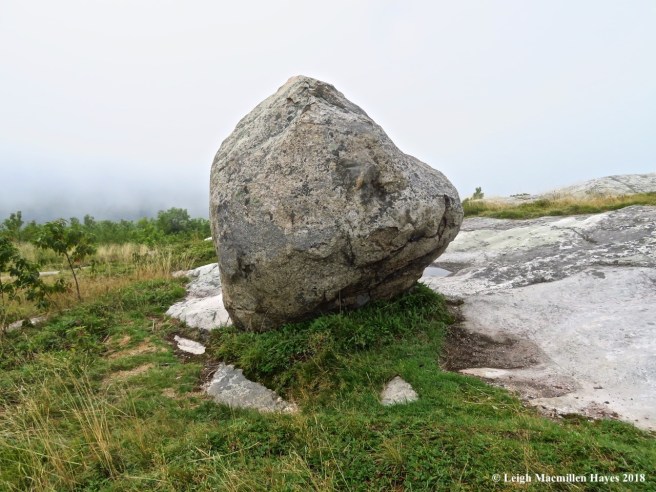
15-erratic

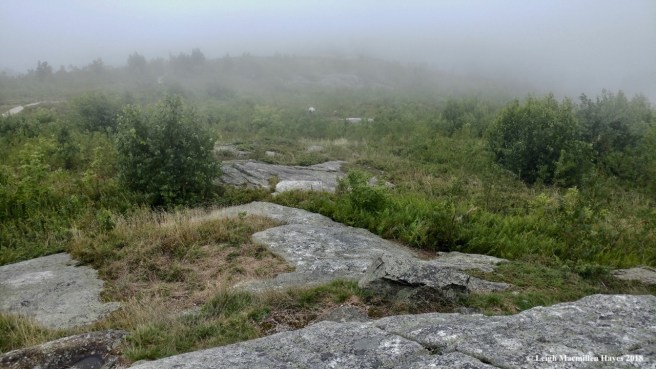
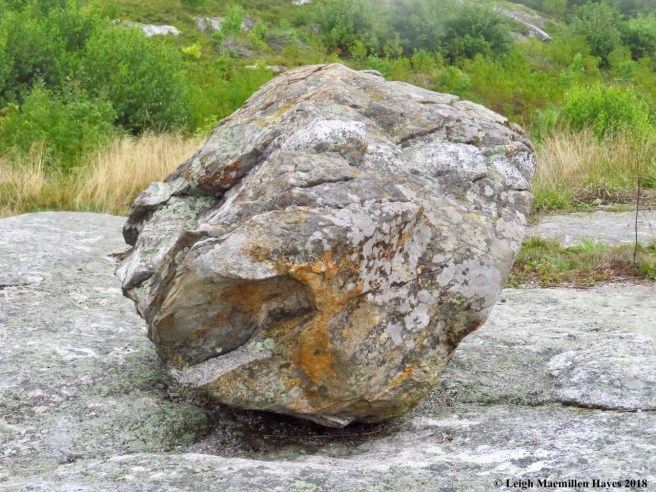
I began to look around and felt an aura that made me feel as if I was in Ireland rather than New Hampshire. The fog. The green. The gray. The world disappeared.

16-more colorful eratic

And the world before me opened up.

17-Common goldspeck lichen (Candelariella vitellitta

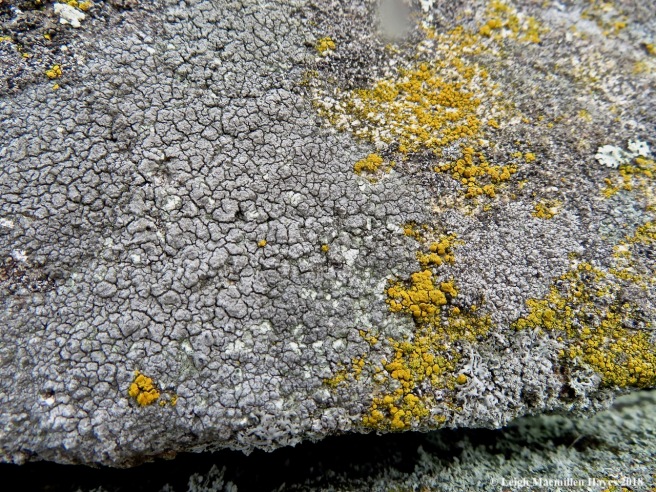
Like yellow caterpillars that are all the rage right now, Common Goldspeck Lichen inched across the granite face.

18-granite-speck rim lichen

Beside it, Granite-speck Rim Lichen stood out like tiles in a mosaic work of art.

19-fog danced across ridge

Meanwhile, the fog danced across the ridgeline, twirling and whirling in a ghostly quiet manner, its transparent gowns touching the ground ever so tenderly before lifting into the next move.

19-my guy picked some more

And my guy found a new location and picked some more.

15-steeplebush

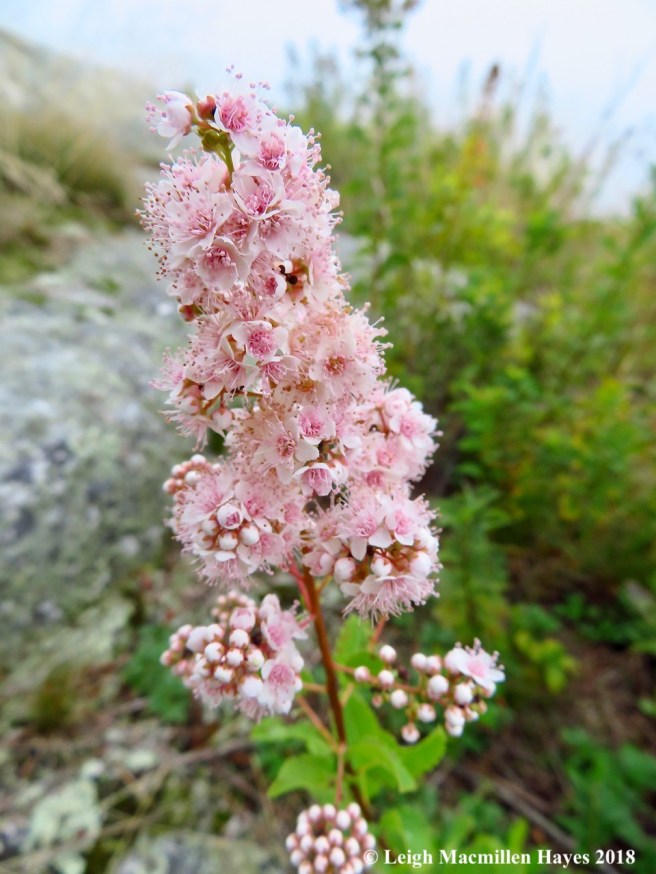
My attention turned to the Steeplebush, a spirea that grew abundantly at the summit, its flowers of pink offering a tiny splash of color to brighten any day.

25-American Copper Butterfly

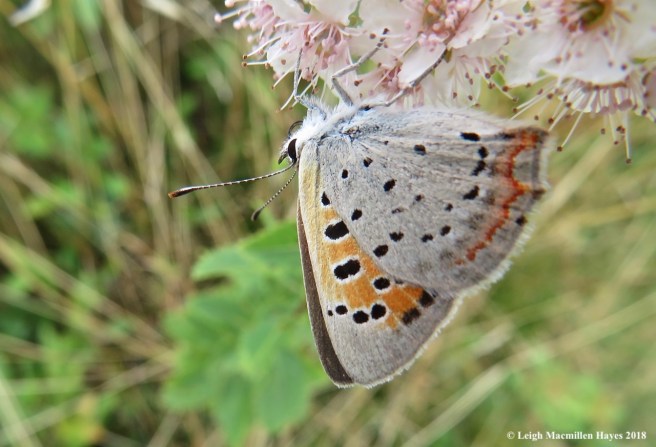
The American Copper Butterfly and a bumblebee also found the Steeplebush much to their liking.

26-American Copper

And I, I couldn’t pull my eyes away from admiring this tiny butterfly and its beautiful markings.

28-American Copper Butterfly

From every angle that it posed while seeking nectar, I stood in awe–those striped antennae, giant black eyes, copper-silver color, and hairy scaled wings.

21-chipmunk

And then there was another, which I thought was a bird when I first heard it scamper out of the bushes.

22-chippie eating berries

But Chippie soon made himself known and I discovered that he, too, sought those little morsels so blue. Competition for my guy.

23-fog lifts a bit

Ever so slowly, the fog lifted a bit and even the sun tried to poke through for a moment or two. Still, my guy picked–somewhere. I couldn’t always see him, but trusted he was in the great beyond.

24-cedar waxwings

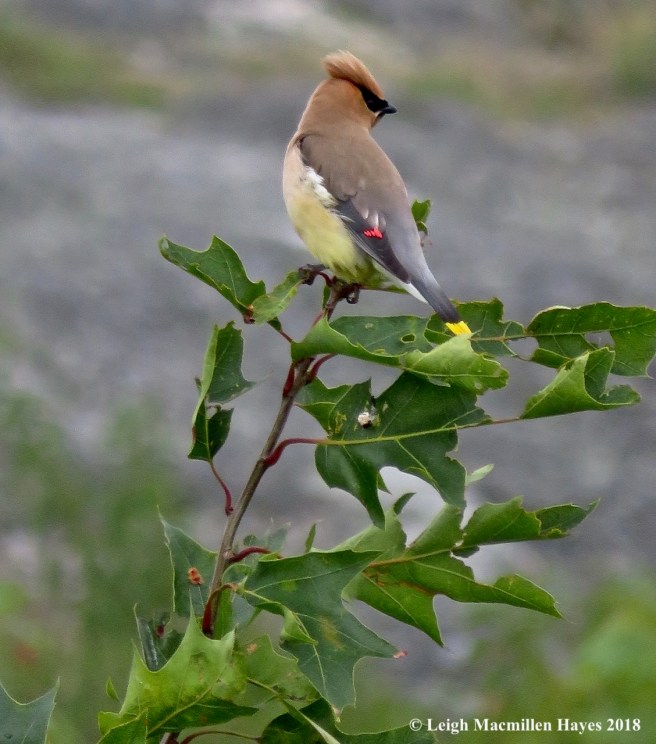
Much closer to me, three Cedar Waxwings circled the summit over and over again in a counter-clockwise pattern. Thankfully, they also paused, eyeing the potential for their own berry picking sights from the saplings on which they perched.

24-cedar wax wing bad hair day

I fell in love . . . with their range of colors:  cinnamon, black, gray, brown, red, yellow, and white. And the bad-hair day tufts, for like the Joe Pye Weed, the Cedar Waxwings and I also shared a resemblance.

29-My guy finishing up

At last my guy finished up, though not before standing on a yonder piece of granite, looking west and calling for me. “I’m up here, behind you,” I shouted softly into an almost silent world, where the only sounds came from cicadas and crickets and occasionally the Cedar Waxwings.

30-blueberry caterpillars

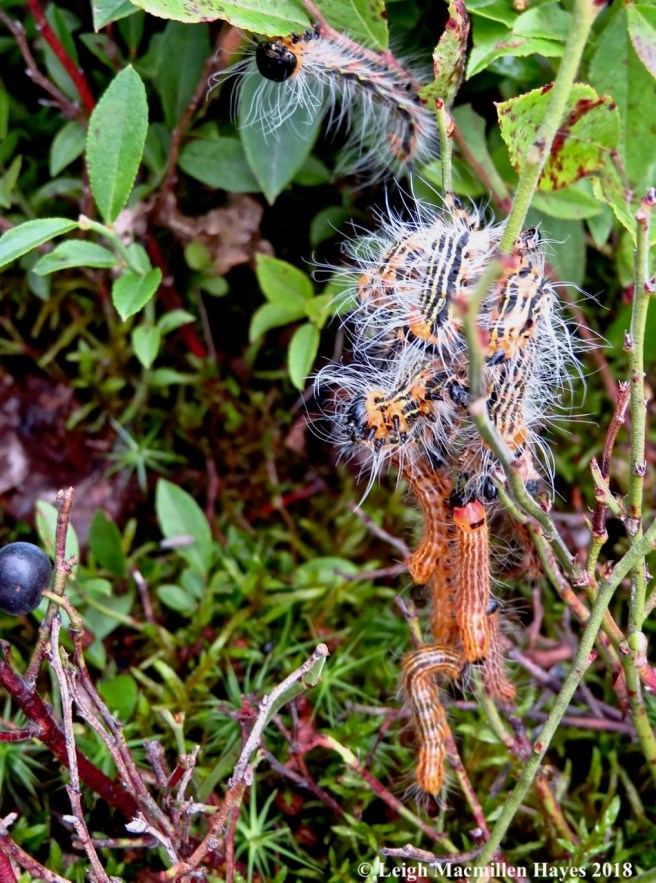
As we made our way down, he stopped again for about a half hour to pick some more in a spot he’d noted on the way up. And I looked around, discovering other blueberry lovers among us–Yellow-necked Moth Caterpillars were slowly stripping some bushes of their greenery.

35-blueberries!

At last we passed by the forbidden fields, where my guy later confessed he felt like we were in Eden.

31-Burnt Meadow Blueberries in operation

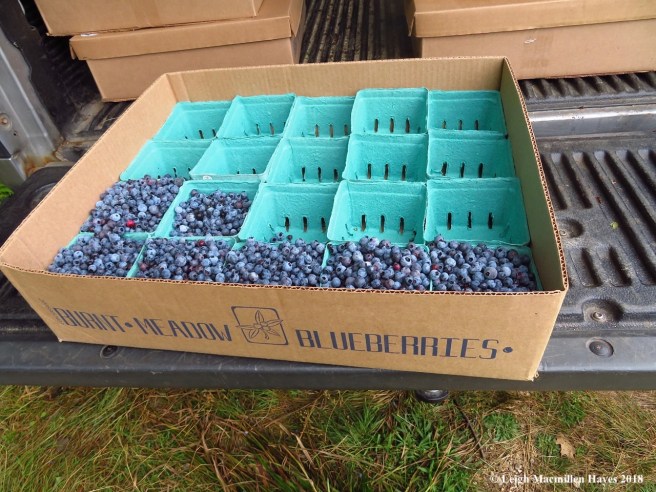
Ryan Bushnell of Burnt Meadow Blueberries was at work, raking and sorting the sweet morsels of blue.

32-Blueberries!

It was his business to make sure each pint would be filled by day’s end.

33-Filling the buckets

We wanted to chat with him more about the operation, but he was intent upon working and so after the initial greeting and a few more words, we knew it was time to move on. Mr. Bushnell’s buckets would be filled over and over again. (And I suspected that upon seeing this operation, my guy, should he ever decide to retire from his hardware business, may just ask to work in the field–the blueberry field.)

Our buckets were full as well–for my guy, it was bags of blueberries to freeze for future consumption. For me, it was all that I saw as I poked about the summit, thankful that I wasn’t distracted by the 360˚ view. We did indeed fill our buckets on this Mondate.


A Berry Pleasant Mountain Hike

Thirty-two years ago I moved to Maine (the only place I’ve ever lived where the number of years counts as bragging rights) and Pleasant Mountain quickly figured into my life. The first day I drove past it on Route 302, I was killing time before a job interview and one look at Moose Pond with the mountain looming over it and I knew I very much wanted to live here. A couple of days later, I received the phone call I’d been waiting for and principal Larry Thompson said it was only a matter of formality that my name go before the school board. By the next week, I was packing up in New Hampshire and making my way further north. I’d found a place to live that meant I’d pass by the mountain on my way to and from school each day. And then that October I attended a Halloween party with friends at the ski lodge of what was then called Pleasant Mountain Ski Resort. I was an olive and I met this guy dressed as a duck hunter. Turns out he’d never been duck hunting, but had a great duck puppet and he could turn its head with the stick within. He certainly turned my head!

Thus began the journey with my guy. Our first hike together–up the Southwest Trail of Pleasant Mountain. That first winter, he taught me to downhill ski, well sorta. My way of turning that first time included falling as I neared the edge of the trail, shifting my body once I was down on the snow, begging for the components of a steak dinner, rising and skiing across at a diagonal to the opposite side only to repeat my performance. Dinner was great that night! And well deserved.

Time flashed forward four years, and at noon on August 4, 1990, we were married; our reception in the Treehouse Lounge at the Ski Resort. In all the years since we first met and then were married and beyond, we’ve skied (though I have managed to avoid that concept more recently) together and with our sons before their abilities outgrew mine, snowshoed and hiked and grown only fonder of the place we call home. Our intention yesterday was to climb the mountain in celebration of our 28th anniversary, but the weather gods outpouring of moisture was not in our favor.

Today, however, dawned differently and so mid-morning we made our way with a plan to hike up the Bald Peak Trail, across the ridge to the summit, and down the Ledges Trail. We’d left the truck at the Ledges, ever mindful that the last thing we want to do after climbing down the mountain is to walk 1.5 miles to reach our vehicle.

1-heading up

As I’ve done over and over again in the past 32 years, I followed my guy–over rocks and roots and bald granite faces.

2-Pinesap

Once in a while I announced the need for a stop because my Nature Distraction Disorder ticked into action. In this case, it was Pine-sap, or Monotropa hypopitysMono meaning once and tropa turned; hypopitys for its habitat under a pine or fir. Also called Dutchmen’s Pipe, this is a parasitic plant that obtains all its nutrients by stealing them from the roots of a host tree. It doesn’t enter the host directly, but through a fungal intermediary. And like Indian Pipe, it has no green tissues. It differs from I.P. in two ways, its yellow color as compared to white, and two to eleven flowers versus a single flower. In my book of life, both Pine-sap and Indian Pipe are great finds.

3-Moose Pond below

I didn’t let my NDD get the better of me too often on the way up. It was extremely humid and so we did stop frequently, but also kept a pace that worked for both of us and soon emerged onto the ridge where a look back through the red and white pines revealed a peek of the causeway that crosses Moose Pond.

5-hidden camp

Employing the telephoto lens, I spied our camp hidden among the trees, only the dock and our little boat showing. It’s amazing how obvious all the neighboring camps seemed when viewed from up high.

7-ridge line trail

After the climb up, the ridge always seems a cinch as the pathway wanders through blueberries, pines and oaks.

6-lunch rock

At last we found lunch rock, a place to pause in the shade and enjoy our PB&J sandwiches. We’d packed cookies for dessert, but decided to save those for later. My guy, however, had accidentally unpacked my work backpack and discovered a few pieces of a dark chocolate KitKat–my stash when I’m tired at the end of the day and need a pick-me-up before driving home. It looks like the purchase of another KitKat is in my near future for we topped off the sandwiches with a sweet treat.

8-picking blueberries

After lunch, my guy’s eyes focused in on one thing only. That is after he moved away from his original spot behind the rock we’d sat upon for our repose. Unwittingly, he’d stirred up a yellow jacket nest and managed to walk calmly away, only one bee stinging his leg.

14-blueberries

While his attention was on the gold at his feet–in the form of low-bush blueberries, I turned my lens in a variety of directions. Oh, I helped pick. A. Wee. Bit.

9-Lake Darner Dragongly

But there were other things to see as well and this dragonfly was a new one for me. A few highlights of this beauty: Do you notice the black cross line in the middle of the face. And on the thoracic side stripe, do you see the deep notch?

10-Lake Darner Dragonfly

Both of those characteristics helped in ID: Meet a Lake Darner. Even the male claspers at the tip of the abdomen are key, for they’re paddle-shaped and thicker toward the end. Though he didn’t pause often, Lake Darners are known to perch vertically on tree trunks. I was in awe.

11-grasshopper

All the while we were on the ridge, the Lake Darners flew about, their strong wing beats reminiscent of hummingbirds, so close did they come to our ears that we could hear the whir. And then there was another sound that filled the summer air with a saw-like buzziness–snapping and crackling as they flew. I couldn’t capture their flight for so quick and erratic it was, but by rubbing pegs on the inner surface of their hind femurs against the edges of their forewings, the grasshoppers performed what’s known in the sound world as crepitation. Crepitation–can’t you almost hear the snap as you pronounce the word?

12-coyote scat

It wasn’t just insects that caught my eye, for I found a fine specimen of coyote scat worth noting for it was full of hair and bones. It was a sign bespeaking age, health, availability, and boundaries.

12A

Turns out, it wasn’t the only sign in the area and whenever we hike the trails on Pleasant Mountain these days, we give thanks to Loon Echo Land Trust for preserving so much of it. According to the land trust’s website: “Currently, Loon Echo owns 2,064 mountain acres and protects an additional 24 acres through conservation easements.”

13-picking some more

Our time on the ridge passed not in nano seconds, for my guy was intent on his foraging efforts. I prefer to pick cranberries, maybe because they are bigger and bring quicker satisfaction as one tries to fill a container. But, he leaves no leaf unturned. And enjoys the rewards on yogurt or the possible muffin if his wife is so kind, until late in the winter.

15-middle basin of Moose Pond

As we slowly moved above the middle basin of Moose Pond, I found other berries growing there.

14-lingonberries

Among them, lingonberries were beginning to ripen. They grow low to the ground, below the blueberries, and resemble little cranberries. In fact, some call them mountain cranberries. Like blueberries, they like acidic, well-drained soil. For all the leaves, however, there were few fruits and I had to wonder if the birds were enjoying a feast.

16-huckleberries

Huckleberries also grow there, though not quite as abundantly as along our shorefront on Moose Pond. They’re seedier than blueberries, though the local squirrels don’t seem to mind. Both red and gray harvest them constantly as they move throughout the vegetated buffer in front of camp.

17-summit fire tower

It took some convincing, but finally my guy realized that we needed to move on and so we gradually made our way to the summit, where the once useful fire tower still stands as a monument to an era gone by.

18-summit view in the haze

Our pause wasn’t too long for so strong was the sun. And hazy the view, Kearsarge showed its pointed profile to the left, but Mount Washington remained in hiding today.

19-ledges view of Moose Pond's southern basin

The journey down was rather quick. Perhaps because we were so tired, it felt like we just rolled down. But we did stop to admire the view of the southern bay of Moose Pond in Denmark. Our intention was also to eat the cookies we’d packed once we reached this point. Through both bags we hunted to no avail. I remembered packing the cookies under our sandwiches. And then moving the sandwiches to the second pack, but leaving the cookies. Did we accidentally take them out after all? Were they on the kitchen counter? In the truck? The final answer was no on all fronts. We think we must have taken them out at lunch rock and they never made it back into the pack. I had moved the backpacks with great calmness once we discovered the yellow jacket nest. Just maybe the yellow jackets are dining on some lemon cookies. Perhaps it was our unintended peace offering.

20-hiking down following this guy

After a five plus hour tour, filled with blueberries and sweat, I followed my guy down. We’ve spent the greater part of our lives following in each other’s footsteps and it’s a journey we continue to cherish, especially on our favorite hometown mountain.

Here’s to many more Berry Pleasant Mountain Hikes with my guy.


Mondate Made for Ducks

We didn’t know what we were going to do when the day dawned in all shades of gray.  With the forecast suggesting thunderstorms in almost any hour, we decided it wouldn’t be a day for boating or hiking.

w1-Wolfeboro

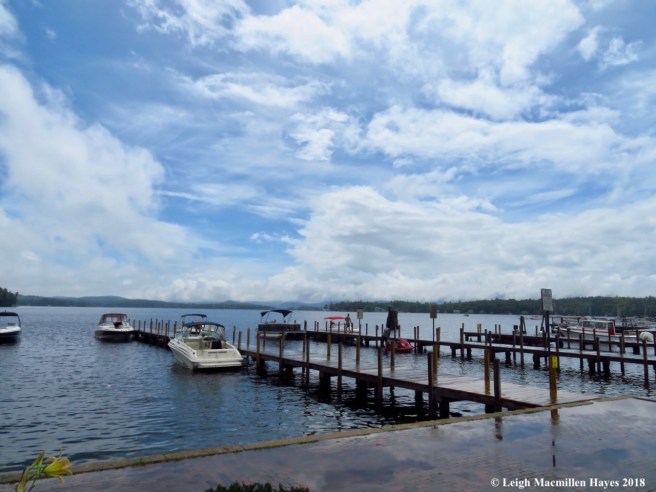
Finally, after chores, errands, and lunch, we drove a wee bit west and then south to Lake Winnipesaukee, my old stomping grounds of almost forty years ago. On the way, we passed through variations of the same theme: gray skies, gentle raindrops, flash downpours. But when we arrived, though the raindrops still fell, blue sky and a slew of clouds offered a beautiful mottled reflection upon the water’s surface.

w2-Wolfeboro sign

We’d decided to explore Wolfeboro, New Hampshire, a town with a year-round population not much bigger than our own. Like all resort towns in New England, however, it swells in size during the summer months. The same is true here in Maine. And on rainy days, the downtown is always full.

w3--approaching the water

Despite all the tourists, the locals do like to hang out at their favorite spots.

w3-mallard looking down

And check on all the action.

w4-on the dock

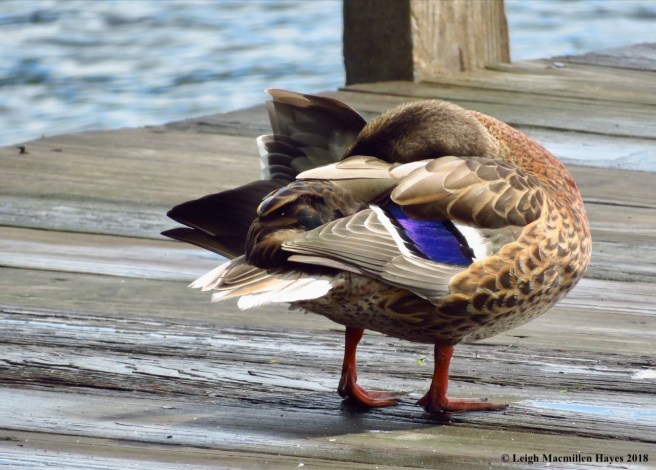
Some prefer to preen.

w5-reaching under the wing

Can’t you just feel the goodness of this action–grooming those feathers to keep them in the best condition?

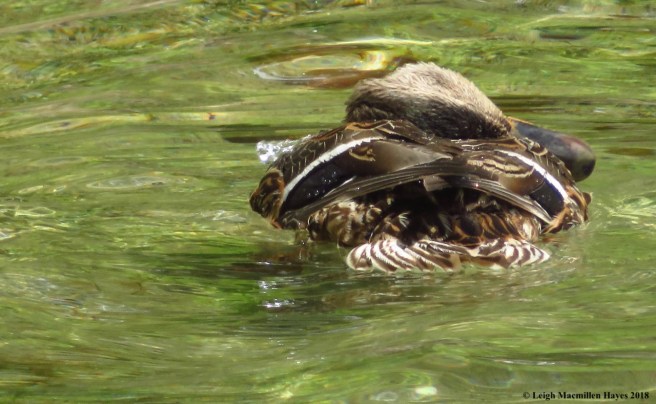
w6-even deeper under the wing

With so many feathers to cope, whether to moisturize with oil to keep them flexible and strong, to align for waterproofing and insulation–especially against the heat of the summer sun, to arrange aerodynamically for future flights, or to remove parasites and body lice that may carry diseases, it’s all part of a day’s work on the waterfront.

w7-in the lake

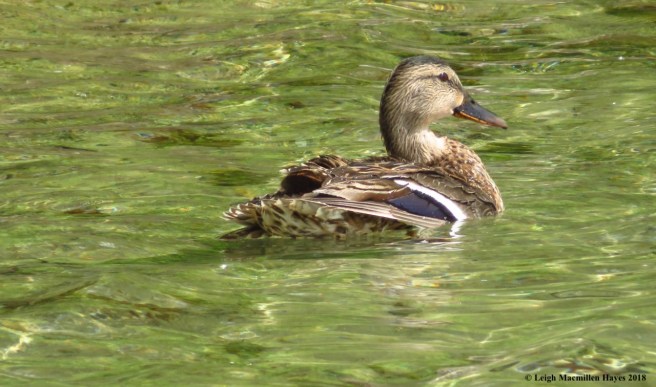
Even those in the water, both mallards and American black ducks, were not immune to the action of the hour.

w8-taking a bath

In order to reach every feather and nibble or stroke it from base to tip to get it aligned just so, ducks become contortionists as they assume odd positions.

w9-shaking it off

And after, they shake, shake, shake, their feathers falling into place as if according to a greater plan.

w9-meeting Daffy

As the rain subsided and sun shone forth, we did a bit of nibbling ourselves, on ice cream cones. It turned out nibbling on ice cream and any other human food was not allowed for the ducks per signage, but that didn’t keep them from sampling the flora of a nearby park.

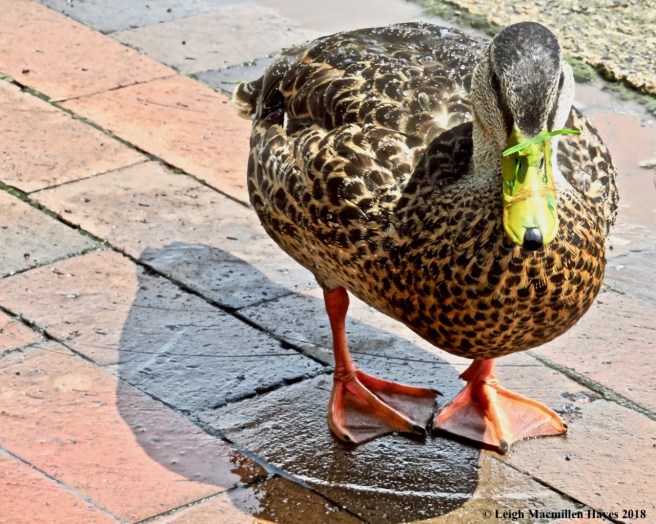
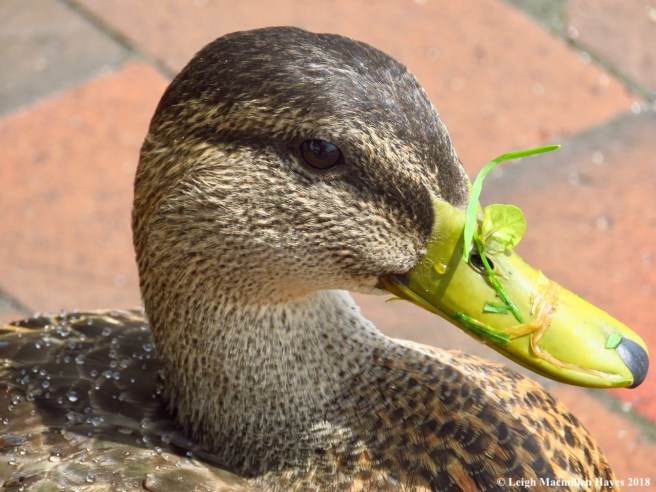
w10-nose decorations

One forager in particular, came away with an arrangement that reminded me of the Easter bonnets we used to wear when we were kids. I could almost hear the Irving Berlin song, Easter Parade:

In your Easter bonnet, with all the frills upon it,
You’ll be the grandest lady in the Easter parade.
I’ll be all in clover and when they look you over,
I’ll be the proudest fellow in the Easter parade.
On the avenue, Fifth Avenue, the photographers will snap us,
And you’ll find that you’re in the rotogravure.
Oh, I could write a sonnet about your Easter bonnet,
And of the girl I’m taking to the Easter parade.

w12-into the hardware store

We left that parade route and made our way through town, pausing as one might expect at the local family-owned hardware store. Of course, my guy felt right at home and spent some time chatting with the owner as they compared products and store layout.

w12-view out the window

I admired the view of the birdhouses on a sill.

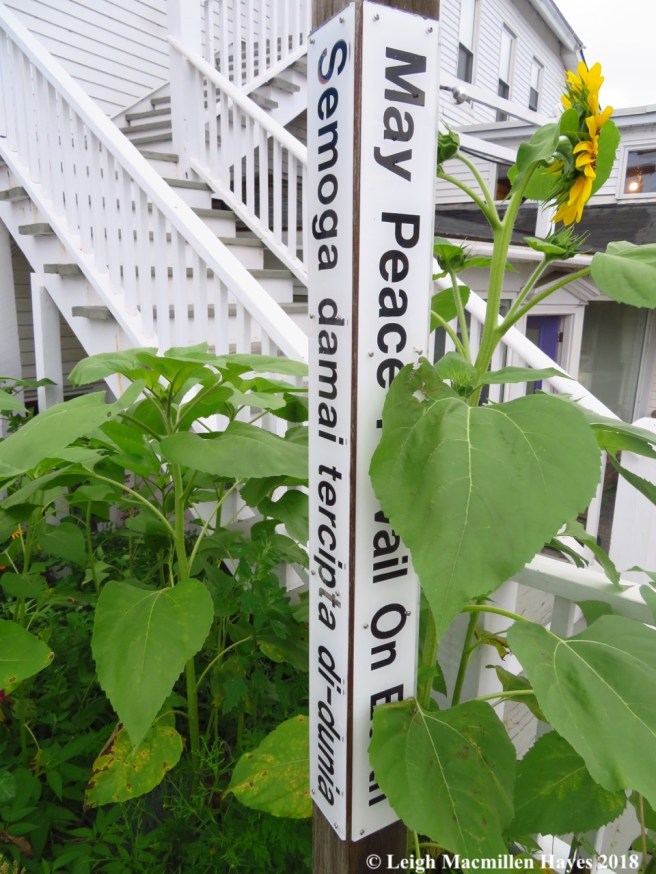
w13-signs about town

Back on the road, we noticed one beautiful garden after another in front of each shop and some bore signs worth sharing: May Peace Prevail On Earth. Indeed.

w13-rain

Eventually, the sky opened again and sent forth its refreshing goodness. We’ve been in need of rain as we’ve been experiencing a moderate drought and so celebrated the nourishment it brought to the earth and us as well.

w15-rainsdrops and blue sky

Then, with a mad dash, we ran back to the truck, noting the rain drops juxtaposed against the blue sky.

w16-duck salad

It was certainly a Mondate made for ducks, especially those who liked to wear their bonnets made from foraged salad on their bills.


Loon-atic loon antics

I wasn’t sure what to expect this morning when I drove to an undisclosed body of water for a boat trip to see an eagle chick in a nest. The reality was that though I’ve seen many eagles and twice had to cover my head with my hands for fear I was about to be dive bombed, only to discover the bird quickly grabbed a fish not far from my location, I’ve never seen an eagle nest.

l1-pontoon boat

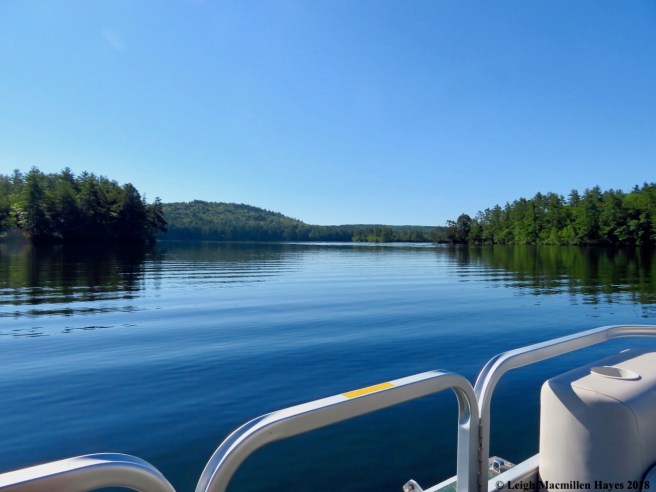
And so, I was graciously met at a camp road and escorted to the dock, where we boarded a pontoon boat for the expedition.

l2-common loon

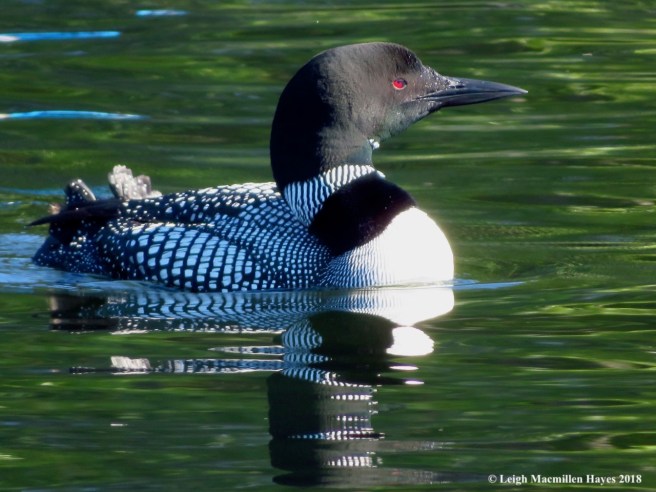
Within minutes of leaving shore, we spied several common loons and paused to watch them swim . . .

l3-preening loon

and preen. Feathers are important to loons and all other birds, for they provide protection from weather, including rain and sun. Aerodynamics also come into play, for the feathers give the body a smooth contour and help reduce drag in the air. To preen, the loon grasps a feather with its bill and works on it from base to tip, getting rid of oil, dirt, and parasites. The bird then repositions the feathers, straightening out the barbs on either side of the shaft–thus providing a smooth, weatherproof coat. To aid in the weatherproofing, the bird collects oil from a gland on top of the base of its tail and spreads it over the smooth feathers.

l4-eagle nest

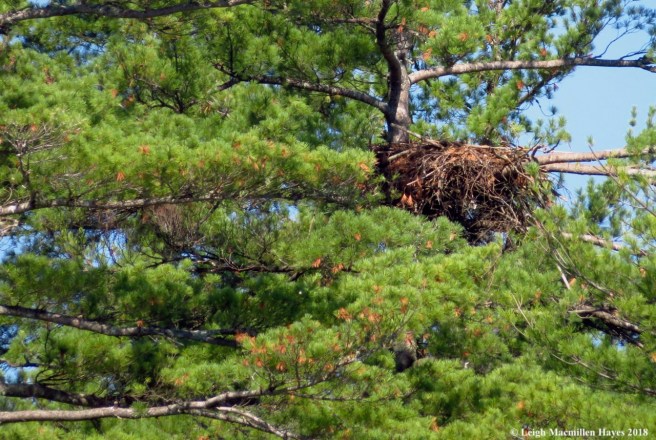
At last we pulled away, my hostess (M) and host (S) eager to show me the eagle nest and a young fledgling. With apt directions, they pointed out the tree and told me where to focus the binoculars and then my camera. I was pretty sure I found the spot.

l6-eagle nest

But alas, a few minutes later they realized they were pointing to the wrong tree. A trip refund was surely in order, but . . . they regrouped, scanned the tree tops again and found the actual nest. Though it was difficult to tell from our location below and because they may have been hunkered down, we didn’t think we saw any birds, but we maybe we did. It apparently wasn’t feeding time and mom and pop were nowhere to be seen.  M  and S were disappointed, but I wasn’t. My first eagle nest! And maybe some babes, but even if not . . . my first eagle nest!

l7-crazy loon

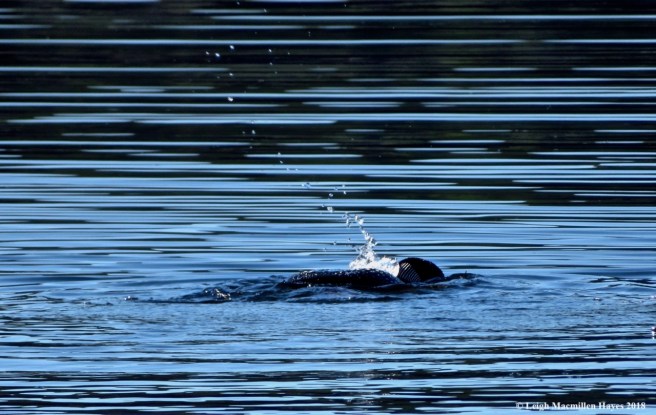
Suddenly, splashes of water caught our attention and we turned in our seats to focus on the action closer to the boat.

l8-crazy loon

A loon undulated in the water in a most frantic fashion, moving back and forth in about a ten-foot space.

l9-crazy loon

Whatever was it doing? We panicked. What should we do?

l10-crazy loon

Each time it pulled its head up, we noticed its beak was wide open. Was there a fishing hook stuck in its mouth? S pulled out his cell phone. Who should he call? Kappy Sprenger, a local wildlife rehabilitator? Or the Maine Warden service?

l11-crazy loon

Again and again, it thrashed on top of the water and our concern rose with each movement.

l12-crazy loon

We each developed our own scenario, none of them ending with a positive outcome.

l13-loon family

Meanwhile, another adult approached with two youngsters in tow.

l15-good in mouth

The second adult found a smidgen of food to dapple in the water and offer to the chicks.

l16-plant or fish?

Fish are the primary food source for loons and they’ll catch whatever species they can. But . . . they also feed on crayfish, aquatic insects, and sometimes vegetation.  What we saw being offered was indecipherable.

l17-bigger fish

Meanwhile, the thrasher came up with a big catch. Had it been going after a fish all that time. Was it not the victim, but rather the predator? Indeed. But why was its mouth always wide open and not closed like a spear? Was it chomping on the fish? How could that be? Loons can’t break up their food the way mammals do, for they have no teeth.

l18-gulp

Whatever the answers to our questions, the outcome, or rather, income was obvious and the loon quickly consumed its prey.

l19-down the throat

Do you see the intake making its way down the bird’s throat? Swallowed whole, the fish would be ground up in the loon’s gizzard, a muscular structure that is part of the a bird’s stomach.

l21-taking cover

At the same time, the other adult felt the need for a shower, while a curious chick peered below a wing. To shower, a loon rises up and splashes.

l22-shaking off the water

A vigorous body shake follows–it’s all part of their maintenance routine. The splashing and shaking help to settle their feathers back into the proper place, whether for beauty during mating season, or weatherproofing the rest of the year.

l21a

And then it was time to peer into the water again, ever in search of the next meal.

l23-chicks

We learned something new today, M, S, and I: That what we might interpret as loon-atic behavior may actually be otherwise. Perhaps the lesson was meant more for the chicks than us, but we were suddenly wiser.

Thank you, M & S, for sharing your special place with me. And here’s to tomorrow’s 2018 Maine Audubon Loon Count. I suspect I won’t see any loons in the area I’m assigned to, and if I do, it will certainly not compete with today’s crazy loon antics.

Christmas in July Mondate

We did celebrate Christmas in December as has long been the tradition, but for one of his presents my guy received a box with a photo and a set of oar locks. It made absolutely no sense to him. Why oar locks? And why a photo of a boat that needed some work and was sitting in someone’s barn. By now, you know where I’m going with this. As did he, once he gave it a moment’s thought.

The back story is that it was a selfish gift for we do have a fleet of boats already, including a 12-foot aluminum that has seen its own set of better days. The rest of our boats are man/woman-powered, from canoe and kayaks to sailfish and rowing shell. But a boat with a motor–other than the aluminum that has been a piece of yard art since our youngest went off to college so many years ago–had not been in our possession for three or four years. And even then, we only enjoyed it sporadically for it always seemed to have an engine issue of one sort or another. Finally, we sold it as is. And thankfully haven’t heard since if it isn’t.

But . . . our trips beyond the northern basin of Moose Pond had been more limited, and I like going for the occasional tour. So when our Wiser friends (Marita and Bob), said they were planning to sell their circa 1988 Maine Guide Boat last fall, I jumped on the opportunity and turned it into a Christmas present. First, however, they intended to sand and stain the woodwork and paint the interior. All the better for us, I figured. And I didn’t care when the job would be completed for it wasn’t like we’d be boating in January.

c1-SS Christmas

They kindly dropped the refurbished boat off last week and again it sat. Until today, when my guy had a chance to make a couple of minor adjustments, like adding the registration stickers and some epoxy to a couple of spots on the stern.

c4-trimming a branch

While the epoxy dried, there was a branch dangling over the side of the dock that needed to be trimmed. We love hiding behind the trees, and so haven’t done what most have–cut the bottom third of the branches off view-blocking trees. Even making this minor adjustment didn’t feel quite right, but we did need a place to dock the boat. And it wasn’t the first time we’d made such a cut in the same spot. I guess we were just surprised at how much the tree had grown since we last docked a boat there.

c2-Canada geese at neighbors

Of course, while he sawed the lower part of the branch off, I looked around and spied Canada geese visiting the neighbor’s well-groomed property. There were at least 25 geese in all, each leaving a multitude of gifts as thanks for the neighbor’s hospitality.

c5-boat launched

And then the boat was launched without much fanfare.

c6-lancet clubtail dragonfly

Unless you consider the fact that a Lancet Clubtail Dragonfly stopped by frequently to check on the happenings.

c7-variable dancer damselfly

A Variable Dancer Damselfly also kept taking a look, and even checked out the boat’s seats.

c3-bryozoan mass

Meanwhile, as I was exclaiming over the clarity of the water, I noticed a Bryozoan mass, a most definite gift for the tiny colonial aquatic creatures that connect their tubes together and form the jelly-like blob, effectively filter particles from the water. The animals live in the tubes and extend their tentacles that capture even smaller microscopic organisms for food. The gelatinous species, also known as moss animals, is native to North America.

c5-motor added

Ah, but it was a boat we were there to focus on and a four-stroke motor that’s been sitting dormant in the basement was attached to the stern. Fresh gas and a quick pull of the cord and we were in business.

c9-onto the northern basin

Off we headed onto our section of the pond.

c10-Shawnee Peak Ski Area

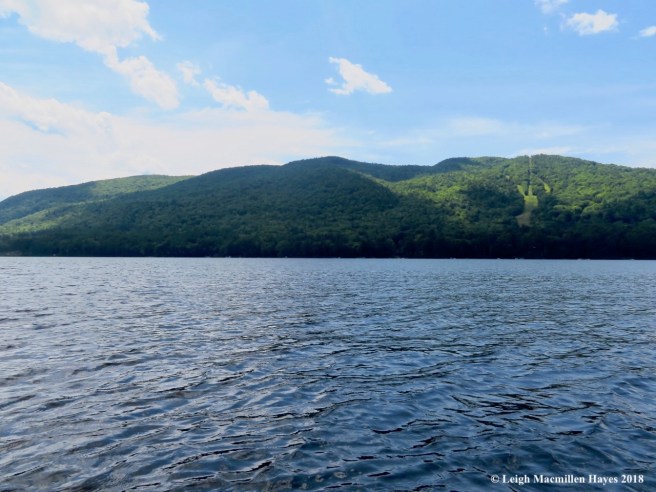
A turn to the left and the slopes of Shawnee Peak Ski Area at Pleasant Mountain appeared before us.

c11-under Route 302 Causeway

Another turn to the left and then to the right and we passed under the Route 302 Causeway into the much larger middle basin.

c12-Loon and chick

It was there that more gifts were to be presented.

c12-loon chick

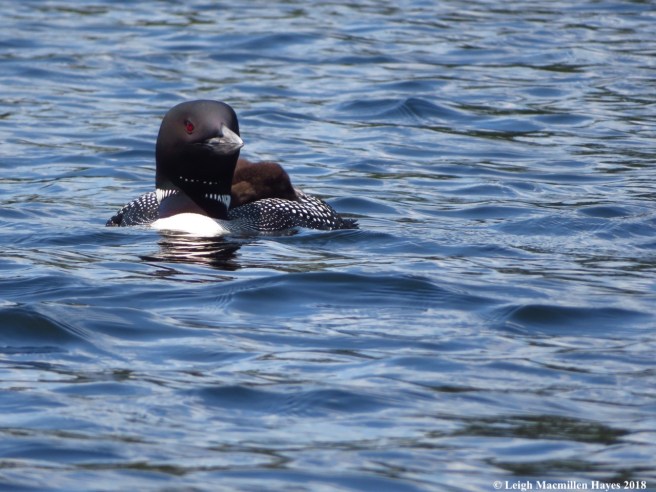
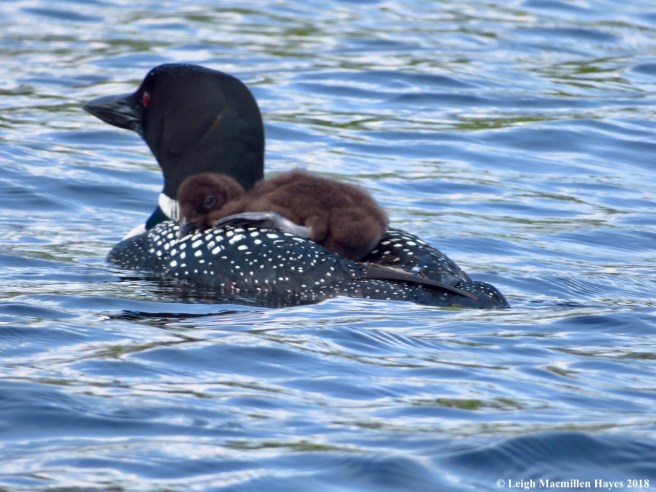
Momma or Poppa Loon, for one can’t tell the difference from this angle, with a chick snuggled on its back.

c14-momma or poppa and chick

Always a favorite sight.

c15-Camp Winona

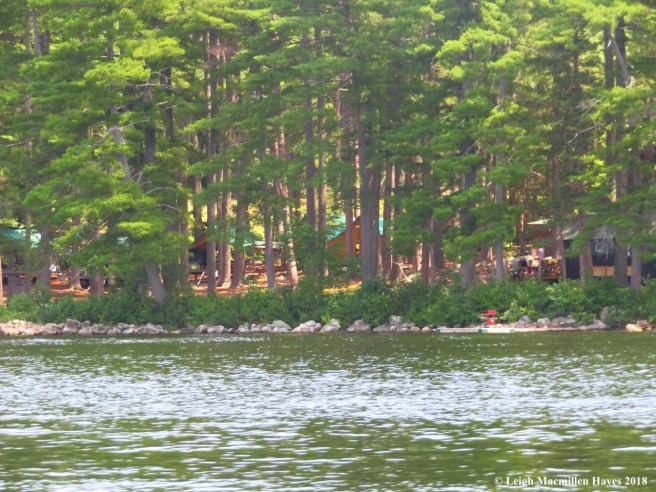
We had stopped the engine by the loons and drifted for a bit. But then it was time to move on toward Camp Winona, where not a camper or counselor was to be seen by the platform tents or any of the waterfront. We thought of stopping to visit our friend, Camp Nurse Rosemary, but weren’t sure if she was working today and so on we chugged at our ever so slow speed, which was much to my liking.

c18-unicorn

Thankfully, it was fast enough to keep away from the pond monster, Moosey the Unicorn. We sure do share this water body with a variety of creatures.

c16-Pleasant Mountain and East Ski Area

Across the way, most of the ridge line of Pleasant Mountain came into view and we made a discovery.

c16-East Ski Area-lobster

It looked like a lobster! Or maybe it was a crayfish, since we were on Moose Pond.

c19-home captain

Eventually we turned around, saving the southern basin for another day.

c20-backing into the dock spot

Our maiden voyage in our new/old boat came to an end as my guy successfully backed it into its resting spot at the dock. And Sam Adams helped us toast the adventure as we christened the boat: S.S. Christmas.

Christmas in July was certainly celebrated on this Mondate.


Taking Flight

Morning had broken . . .

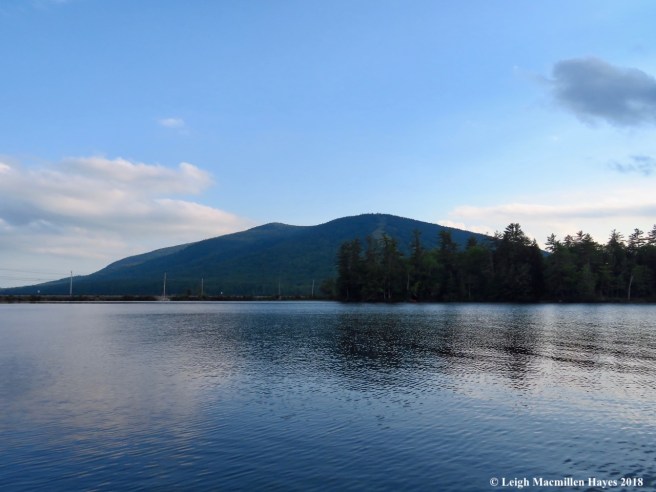
h1-morning has broken

and Pleasant Mountain’s reflection marked a new day.

h2-variable dancers conducting variable dance

New life was also in the making as the Variable Dancer Damselflies practiced the fine art of canoodling. I’d never noticed an oviposition aggregation before, but it made sense if it minimized the threats a couple receives from unattached males. Plus, if the spot was good enough for one pair to lay their eggs, then it must be fine for another. And so I learned something new today.

h3-slaty skimmer

Perhaps it also cut down on predation, though I couldn’t stay long enough to note if the Slaty Skimmer that hung out above turned either pair into breakfast. If so, I hope they at least had a chance to leave their deposits.

h4-Hemlock covered bridge

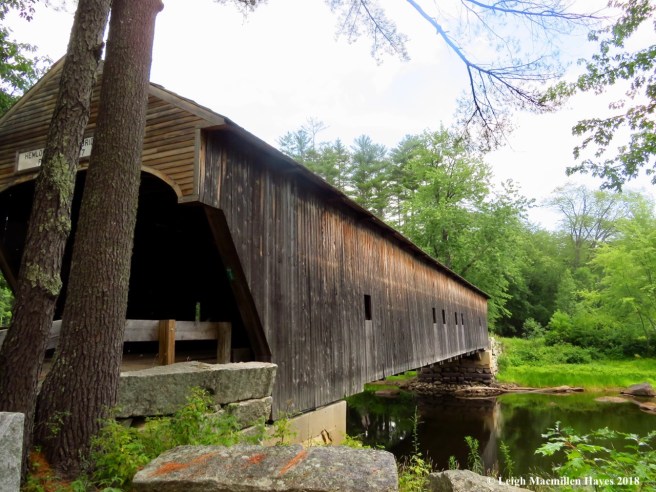
That was my morning view, but I changed it up a bit this afternoon and darted across the Hemlock Covered Bridge that spans the Old Course of the Saco River in Fryeburg. Built in 1857 of Paddleford truss construction with supporting laminated wooden arches, the bridge is a quaint and charming reminder of days gone by.

h5-bridge

Though reinforced in 1988 so you can drive across, it’s even more fun to glide while admiring the work of our forefathers and . . .

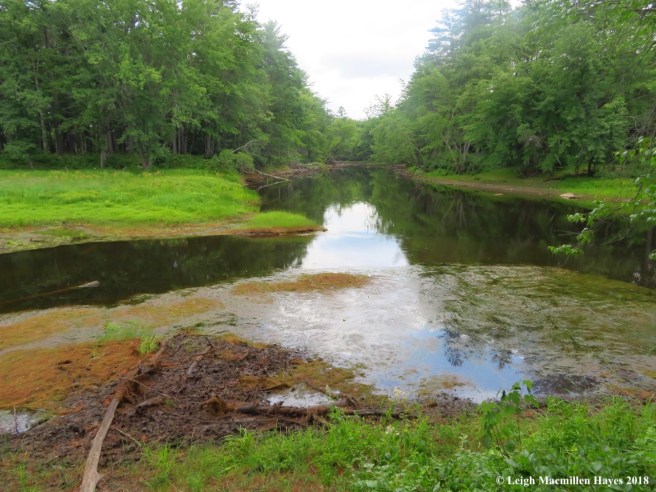
h8-water low

peer out a window at the river from Maine’s oldest remaining covered bridge.

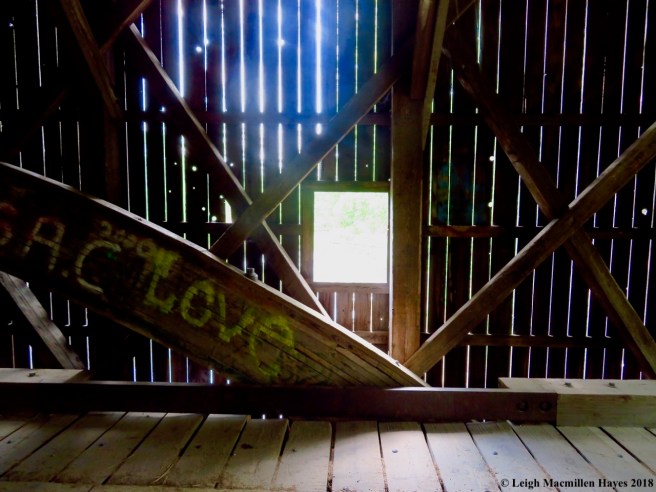
h6-LOVE

The handiwork of more recent travelers . . .

h7-love lasts forever

was also clearly visible.

h9-river jewelwing-female, white dots in sync

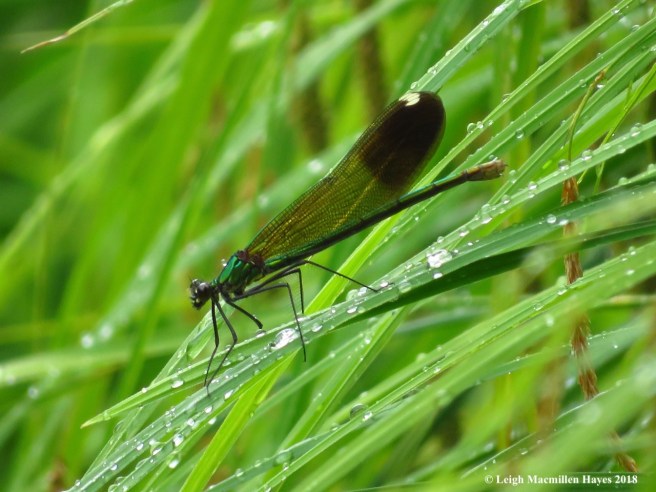
Down by the Old Course, I spotted a female River Jewelwing, the white dots on its four wings showing off in the day’s light. Just prior, a few sprinkles had fallen and one teeny droplet rolled down her thorax. A few even teenier ones clung to her legs.

h10-Hemlock Covered Bridge

With one more look back to reflect upon the bridge, I was then ready to set sail again.

h11-Mt. Kearsarge

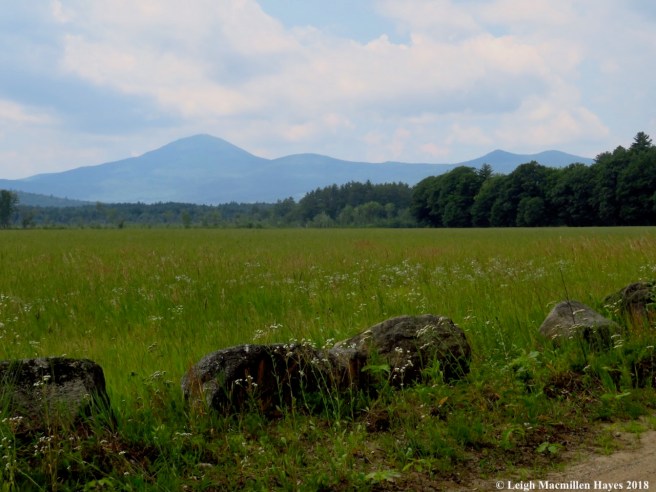
Heading toward Frog Alley, the view across the fields included Mount Kearsarge amid the summer haze that had developed.

h18-Mount Tom

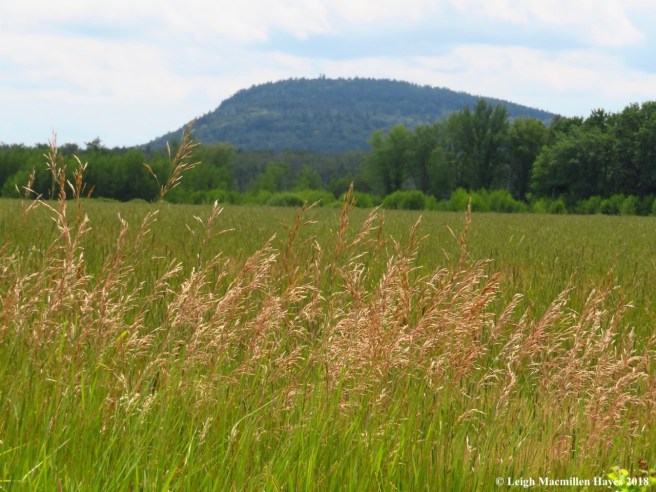
Mount Tom was more clearly visible for it was so much closer.

h12-Dianthus armeria, Deptford pink

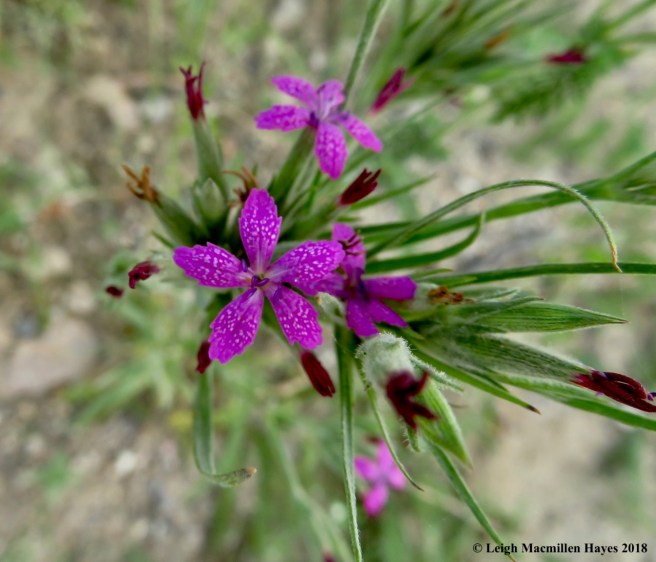
But what I really stopped to look at where those things closer to the ground, like the brilliant pink Dianthus with their petals all spotted and toothed at the tips.

h14-bindweed

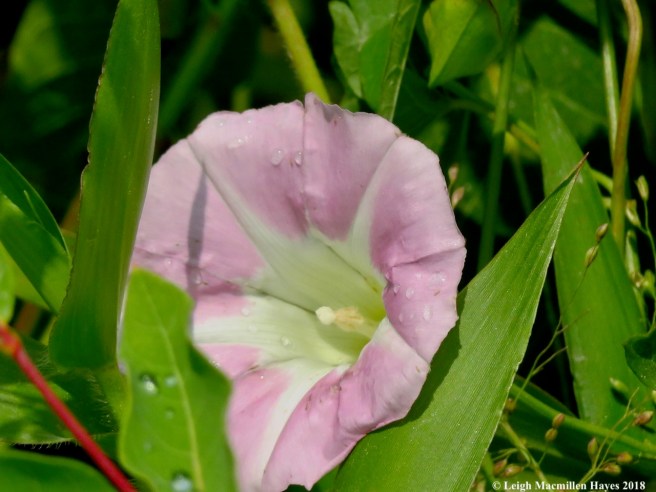
Offering a lighter hue of pink, a bindweed twined its way through the roadside wildflowers.

h13-honeybee on milkweed

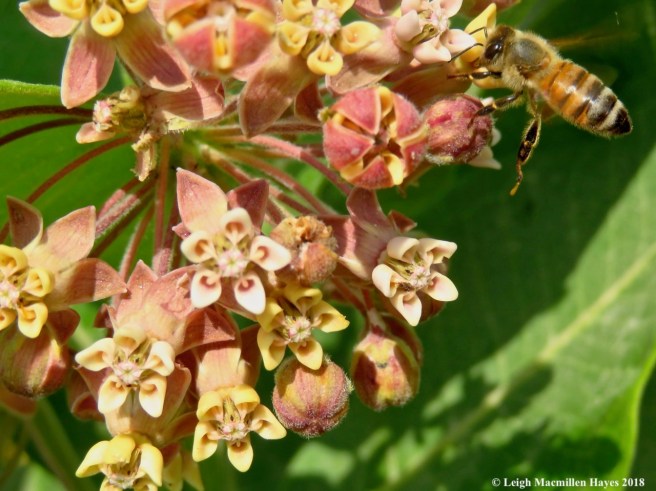
Also with shades of pink and the yellow complexion of those flowers already pollinated, milkweed was in full bloom and the ants and some flies were making the rounds, but I only saw one honeybee taking advantage of the sweet nectar. It reminded me that the same was true on the milkweed growing in my garden where, at most, I’ve seen four honeybees rather than the usual swarms.

h17-sulphur cinquefoil

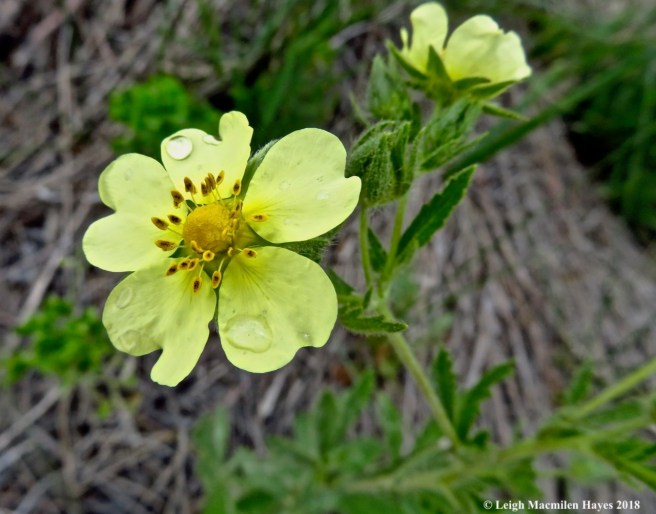
And then there was the subtle yellow of the Sulphur Cinquefoil showing off its cheery face despite a few tear drops. Actually, it may have cried for only a few drops had fallen from the sky and we really do need a soaking rain.

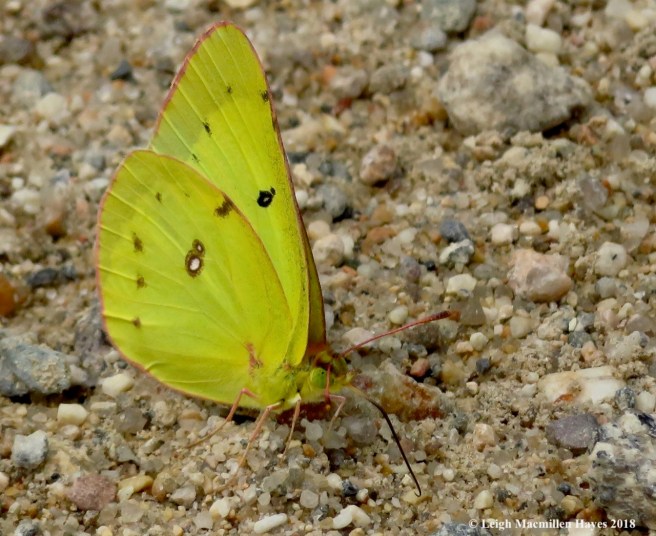
h16-clouded sulphur butterfly

As if taking a cue from the cinquefoil, Clouded Sulphur butterflies flitted and danced along the road.

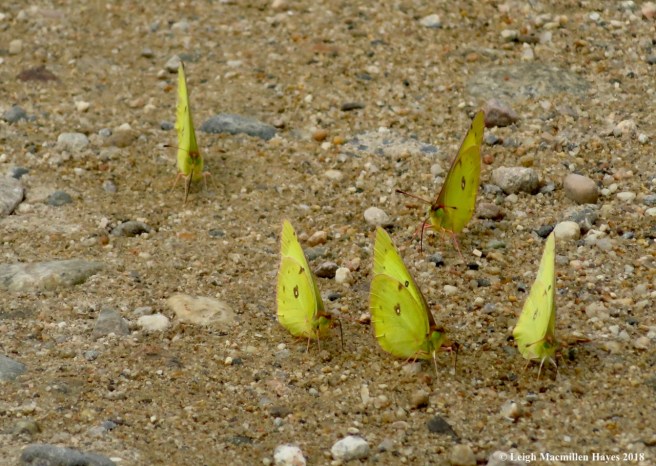
h16- clouded sulphurs puddling

And then I realized that they kept gathering in groups. It’s a form I’d read about but never observed before–puddling. This was a male habit and apparently their intention was to suck nutrients from the wet ground. I guess even a few raindrops served the purpose.

h15-dragonhunter

Before I moved on again, my heart was still as more yellow entered the scene in the form of a striped thorax and I realized I was watching a Dragonhunter Dragonfly. Though it wasn’t so easy to see the tip of tail once it landed, as it flew about in my vicinity it kept its abdomen curved down–a habit of these big guys.

h29-Fryeburg Bog

The Fryeburg Bog was my next landing and though I didn’t head out to the water that was more like an over-sized puddle, I found plenty to focus on.

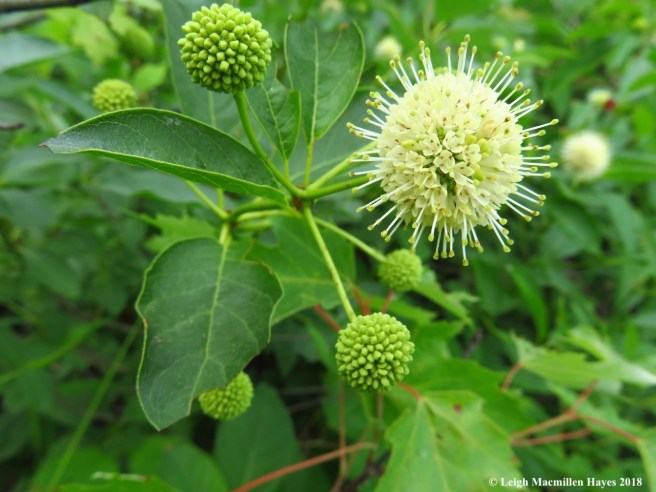
h19-buttonbush

For starters, the Buttonbush had begun to bloom and I loved its otherworldly presentation.

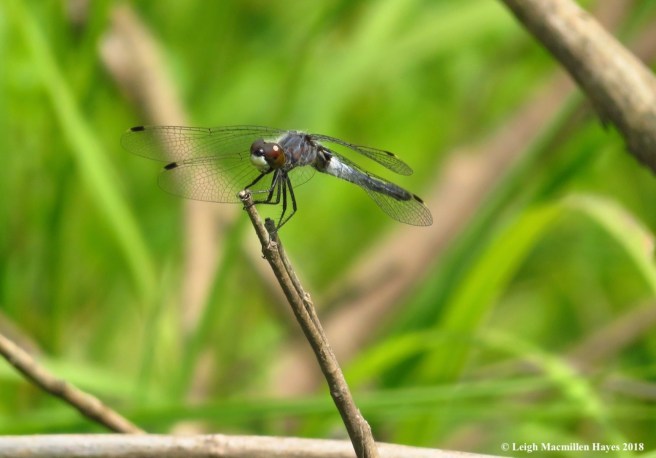
h21-frosted whiteface

It was there that I saw the smallest of dragons, in the form of the Frosted Whiteface.

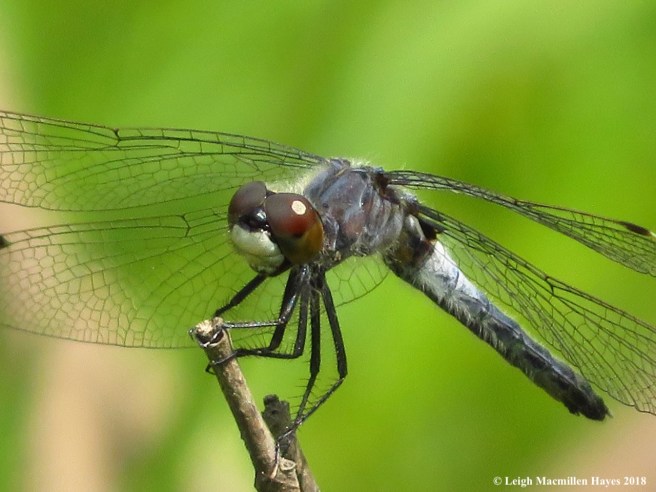
h22-frosted whiteface

At most, he was about 1.5 inches long–quite probably the smallest of the species that I know.

h20-ruby meadowhawk

It was there that I also spotted my first Ruby Meadowhawk of this year.

h23-ruby meadowhawks canoodling

And then there were two! And in the future, obviously, there will be more.

h23--late afternoon snack

And finally, it was there that I noticed a Song Sparrow had nabbed a butterfly snack–all part of the circle of life.

h30-Smarts Hill

My final stop on today’s journey was at Popple Hill Brook along Smarts Hill Road in Sweden.

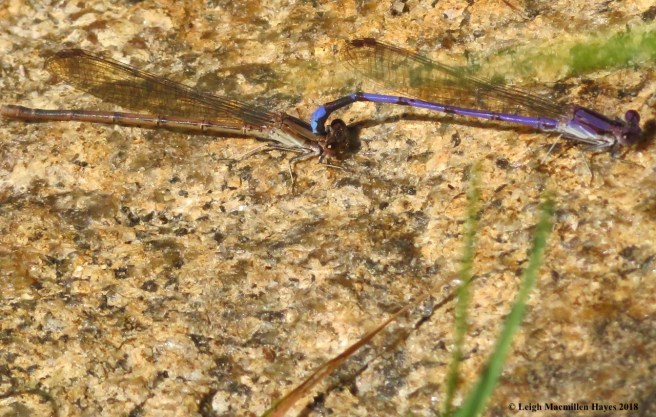
h25-variable dancer

And like the Variable Dancers I’d seen this morning, I found many more beside the brook. Not only was the male’s purple coloring stunning, but notice those silvery legs.

h26-variable dancers canoodling

Of course, where there is more than one dragonfly or damselfly, there is love.

h27-variable dancers canoodling

As my tour began, it ended–with the Variables dancing to their heart song.

h28

And with that, I flew back to camp, where the mountain’s reflection was conducting its own dance routine as the sun began to slip toward the horizon.

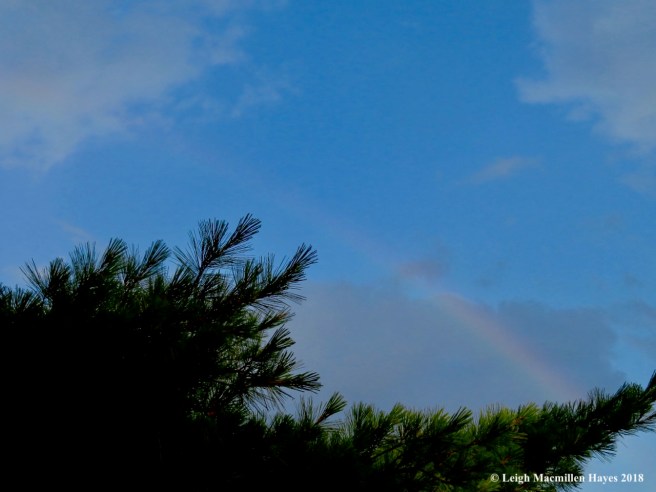
h31-rainbow

And a few more raindrops produced a rainbow in the eastern sky.

Thanks for taking flight with me on this wonder-filled wander and soaring above some of the areas that are so unique and yet we tend to overlook them.


Upta Camp

It’s been a gray day and a quiet day–the right mix of ingredients for a perfect day. And except for saying goodby to my guy this morning, the only conversations I have had, too numerous to count, were with myself.

c2-gray squirrel

Well, maybe that’s not quite accurate, for I did talk to a squirrel, but in unusual squirrel manner, it stayed as still as could be and didn’t respond. Together, however, we eyed our domain.

c5-mayfly

It turned out we weren’t the only ones with big eyes that chose to hang out all day. Attached to the screen was a Mayfly subimago–the teenage form of the insect.

c6-close up

Mayflies are unique in that after the nymph emerges from the water as the subimago (that fishermen call a dun), they seek shelter before shedding their skin for the final transformation. I’m tickled that this dun chose our porch screen on which to rest.

m6c-close up

Notice the cloudy wings–that’s a clue as to its age. It can take a few minutes to two days before a subimago transforms into a clear-winged imago or spinner, though the actual metamorphosis is quick. Will I see it? You know I’ll keep watching.

c6-sawfly insect case

In the meantime, there was more to discover, including a sawfly insect case featuring the tiny hole where the insect chewed its way out.

c19-round-leaved sundew

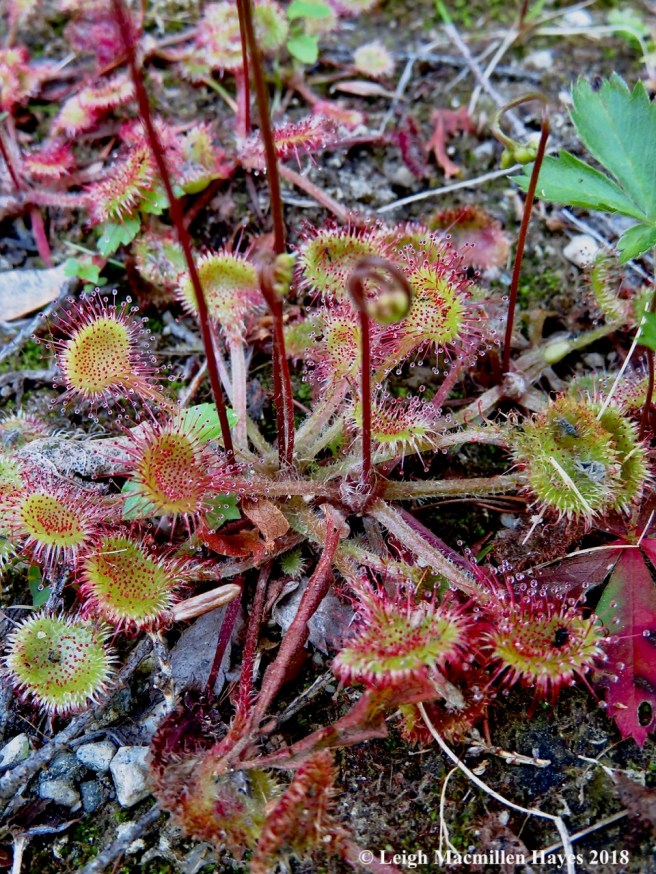
As I looked about, I made one extremely exciting discovery–at least to me. Since 1986, I’ve stalked this land and today was the first time that I noticed the carnivorous Round-leaved Sundew growing here. Its leaves were filled to the brink with insect parts.

c18-round-leaved sundew

Perhaps that was why it looked so healthy and ready to flower. Expect to meet it again in future blog posts. (I warned you.)

c14-swamp rose

I also spotted a few Swamp Roses offering a bright contrast to the day’s overcast reflection.

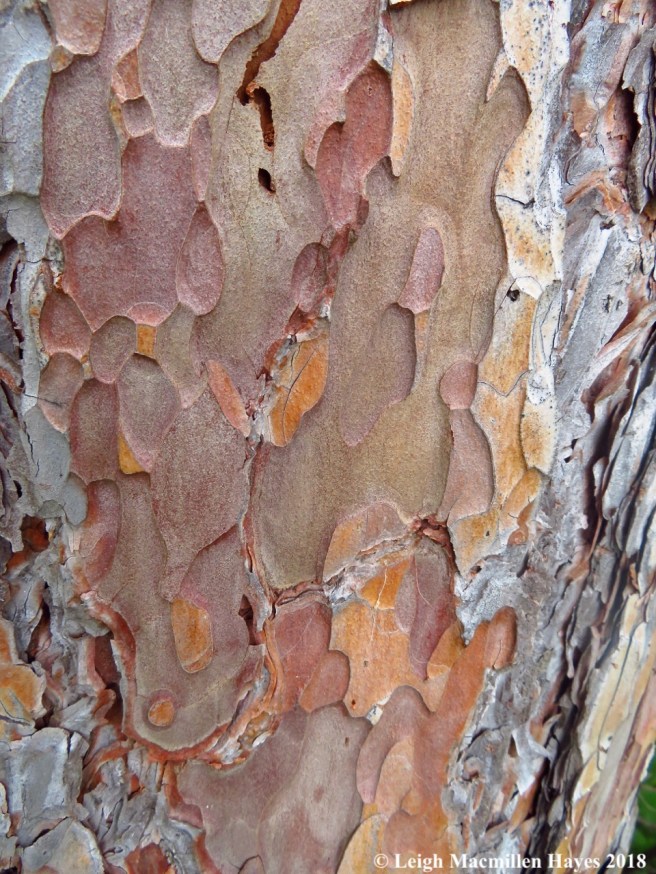
c13-red pine

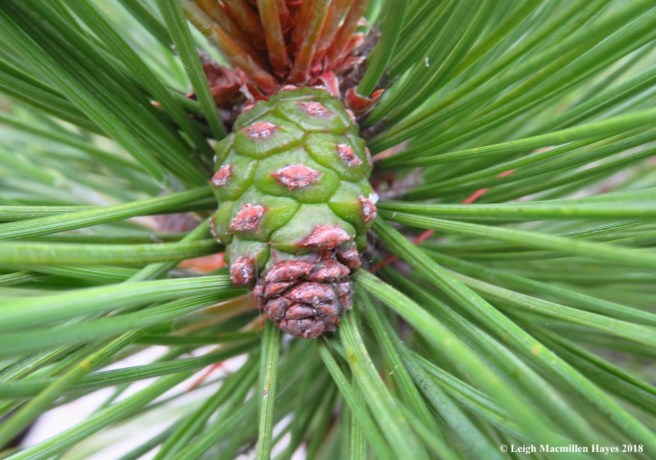
Featuring its own display of color was my favorite red pine–all pink-orange-gray hued in a jigsaw puzzle manner.

c15-red pine cone developing

At the ends of its branches I found young cones growing larger and greener.

c16a-spider

And old cones offering the perfect camouflage for a spider that had created a large network in which to trap its prey. I think it was of the garden cross variety, but without breaking the web, I couldn’t get too close, and I didn’t want to ruin all of its work.

c17-dragonfly exuvia

Entangled in a bit of another web and dangling from the floor of the porch and beside the foundation was a skimmer dragonfly exuvia. Today wasn’t a flight day for dragonflies, and so I had to wonder–where do they hide when the sun doesn’t show its cheery face?

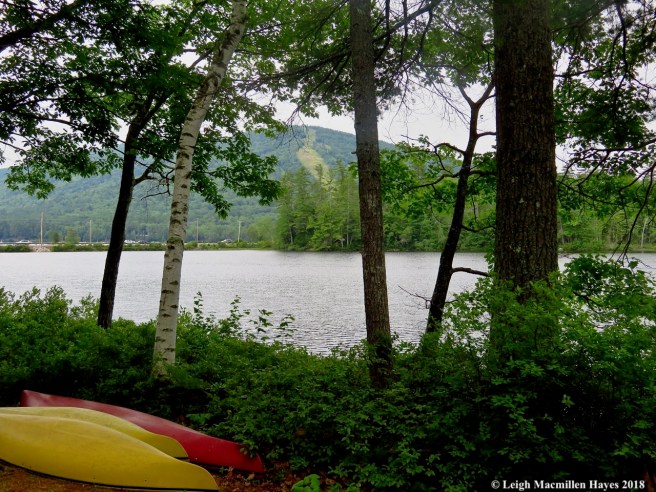
c1-camp view

Perhaps in the buffer zone of vegetation that surrounds Propinquity, our point of view.

c2a-dock view

It only took us about a month longer than usual . . .

c2-Pleasant Mtn

to make the long journey (7 miles) to the water’s edge.

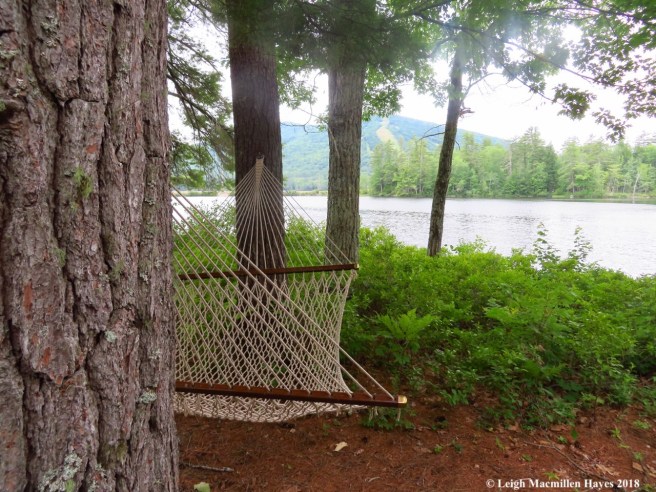
c20-hammock

But at last we’ve arrived.

c21-hammock view

Upta camp. The way life should be.


Flying With John A. Segur

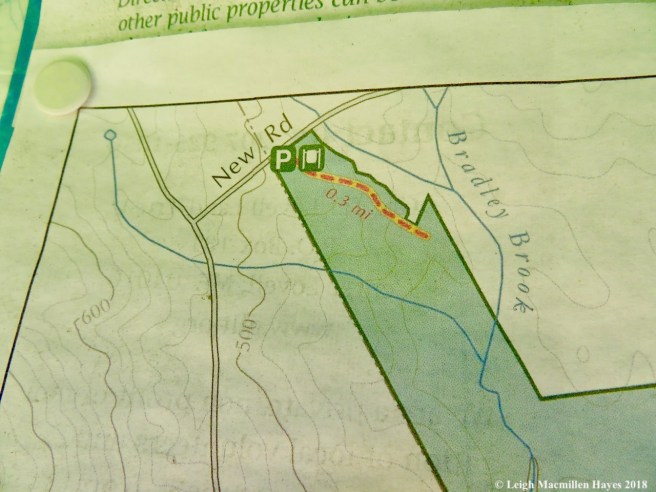
I never had the honor of meeting Mr. Segur, but it was my honor to be his eyes for a short time today as I wandered down the short trail off New Road in Lovell at the Greater Lovell Land Trust’s John A. Segur Wildlife Refuge. Upon his death, a bequest in his name was left to the land trust to preserve habitat for native wildlife to thrive.

The JAS Wildlife Refuge actually encompasses 592 acres and I only explored the .3 mile trail on the western section of the property, but on an extremely hot summer day my finds were enough. Follow me and I think you’ll see what I mean.

j1-Across from the sign and telephone pole

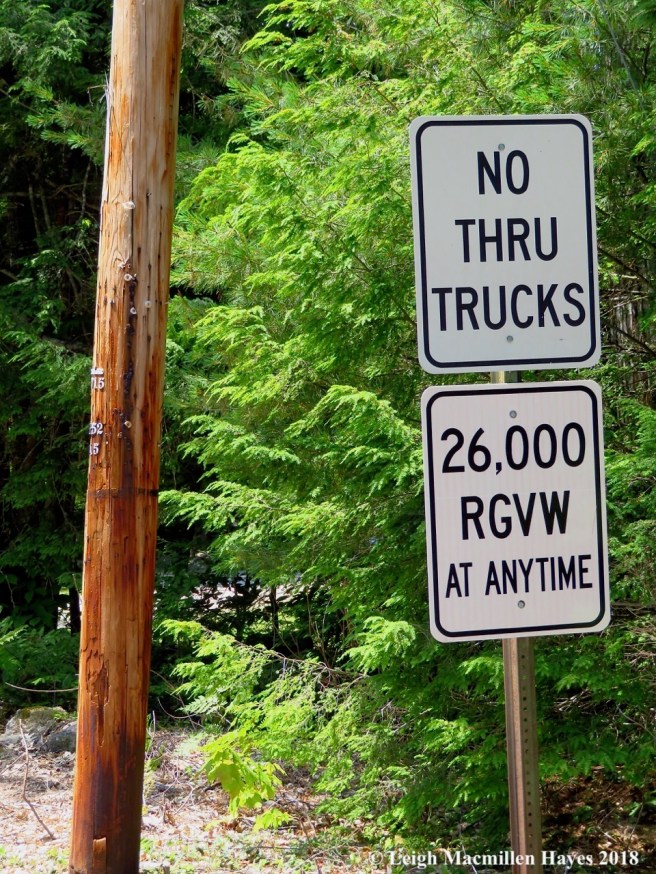
First off, you need to locate the small undefined parking lot. It’s about a mile beyond Foxboro Road, but I don’t pay attention to that. Rather, I look for the “No Thru Trucks” sign and turn on my left-hand blinker as soon as I spot it.

j2-trail and kiosk

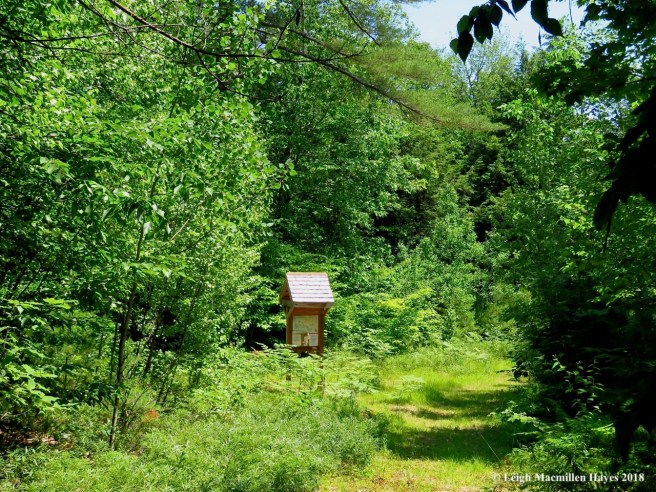
Just beyond a couple of boulders placed to keep vehicles from driving down the old skidder trail, stands the kiosk where you can take a look at the trail map and check out some other GLLT materials.

j3-map

As I said, this is just a small part of the overall refuge, but it’s well worth an exploration, especially if you don’t have much time (though some of us have been known to spend at least three hours making our way down and back).

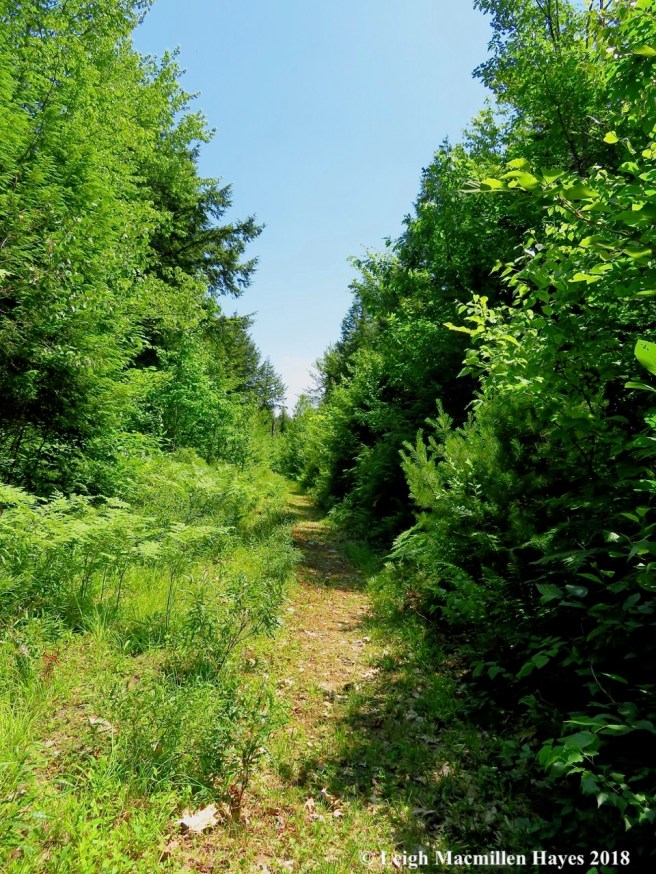
j3a-the trail mowed

Recently, the GLLT’s Associate Team and Intern mowed the trail, making it passable and not quite so tick-infested. But . . . still take precautions. Always! The trail is rather level, so it’s an easy one to travel.

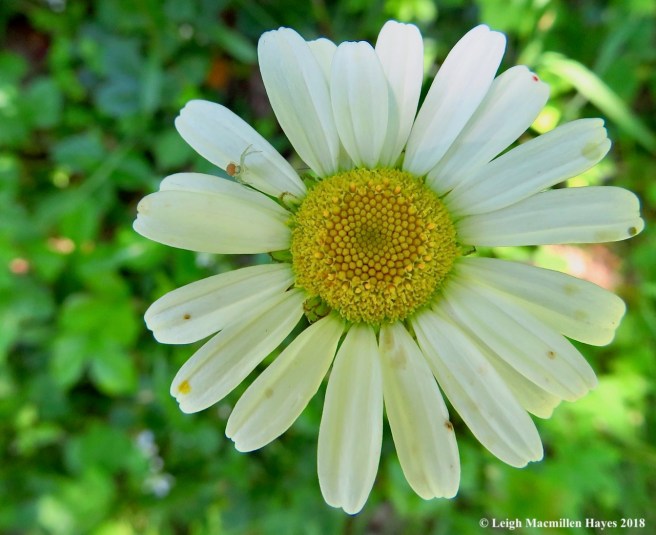
j4-daisy and crab spider

This is a place where you’ll find the ordinary, like a daisy. And trying to decide if “he loves me, he loves me not,” you might see a small crab spider.

j5-sundews

This is also the land of the extraordinary–in the form of the carnivorous Round-leaved Sundews. Check out the glistening droplets at the ends of the hair-like tendrils that  extend from each round leaf. The droplets are actually quite sticky. Just like a spider sensing a bug on its web, the tendrils detect the presence of prey and then curl inward, thus trapping the prey.  The whole leaf will eventually wrap around the insect and in the process of digesting it, the plant will absorb the bug’s nutrients. Sundews tend to grow in areas that lack sufficient nutrients, so this is the plant’s way of supplementing its diet. And if that wasn’t enough–it was just plain beautiful.

All that being said, this is a tiny plant and right now preparing to flower. So, if you travel this way, about a tenth of a mile into your journey, look down at your feet for these minute gems, take a closer look, and then walk with care.

j6-sweet-fern

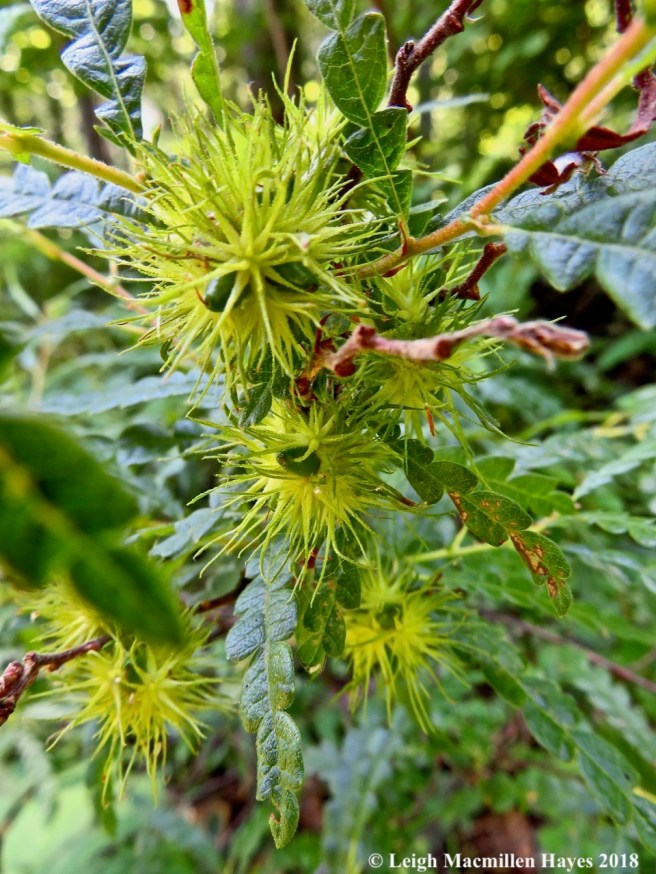
Further along the trail you’ll see a few species of ferns, as well as the fern that isn’t a fern. Sweet-fern is so named for it’s fern-like appearance, but it has a woody stem and is actually a shrub. It’s yellowish green flowers that first appeared in spring were giving way to greenish brown, burr-like nutlets. In any season, this shrub has such variation to offer, that like hobblebush, I can’t resist honoring it with a million photographs.

j8-raspberries

One of the sweet joys of this trail is that because of previous logging, early succession is taking place in terms of the plants and trees that grow beside the trail, including blackberries not quite ripe and these raspberries already offering a delightful reprieve on a humid summer day.

j14-the field

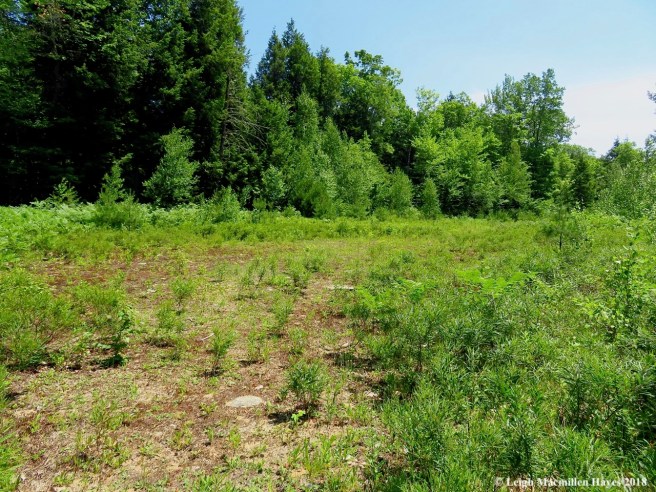
Eventually, the trail leads to the turn-around point, the old log landing, which also displayed signs of forest succession, for its there that some wildflowers and sweet-ferns grow in the center. At the perimeter, white pines, gray birch and blackberries crowd each other.

j10-four-spotted with food

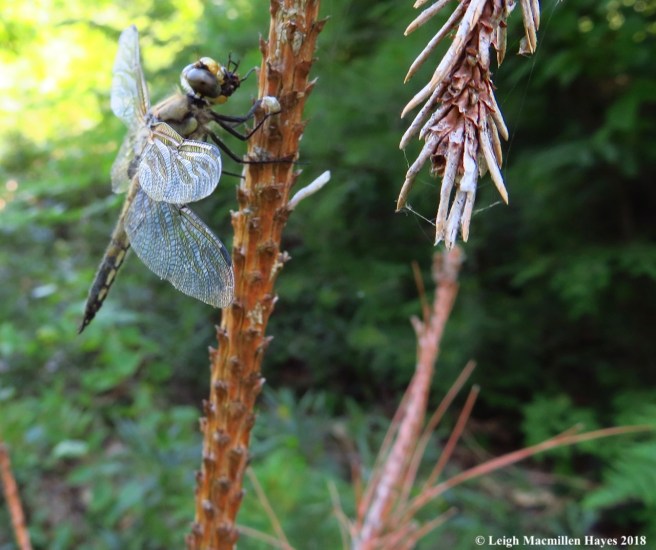
And on the edge, the dragonflies fly. And dine. This Four-spotted Dragonfly settled on a dead red pine to consume an insect.

j11-4 spotted eating

Ever so slowly . . .

j12-feeding frenzy

the body disappeared into its mouth.

j13-4 spotted, back view

While it was busy eating, I was busied myself in getting as close as possible to enjoy all of its nuances, from the four spots on its wings, to the basal display on the hind wings to the placement of its eyes and colors on its thorax and abdomen. All of those details help in ID.

j15-old coyote scat

And then into the field I went, with a memory of a winter expedition when we noticed that a shrike had deposited a mouse in a tree. Today’s finds included a pile of old coyote scat probably also deposited this past winter that indicated a territory repeatedly marked.

j16-turtle?

I also spied lots of recently made depressions. While one might suspect dust baths by a turkey or grouse, feathers are usually left behind in the process. Instead, the ground was more disturbed and because the landing is close to Bradley Brook, I determined I was looking at recently dug holes made by turtles. Snappers and painted turtles have been depositing eggs recently and these may be the incubation nurseries for their offspring.

j16-racket-tailed emerald

As I turned back toward the trail, I noticed a dragonfly seeking shade, for so hot was it. Notice the bright green eyes of the Racket-tailed Emerald. Thank goodness for those emerald eyes that always help in narrowing down the choices.

j18-common dewberry:sphinx moth

I found it a bit more difficult to ID the sphinx moth that paid a visit to the Dewberries. There are only 1,450 species in the Sphingidae family, but my leaning was toward Nessus Sphinx, though I could be totally off on that one.

j20-Northern-bush Honeysuckle

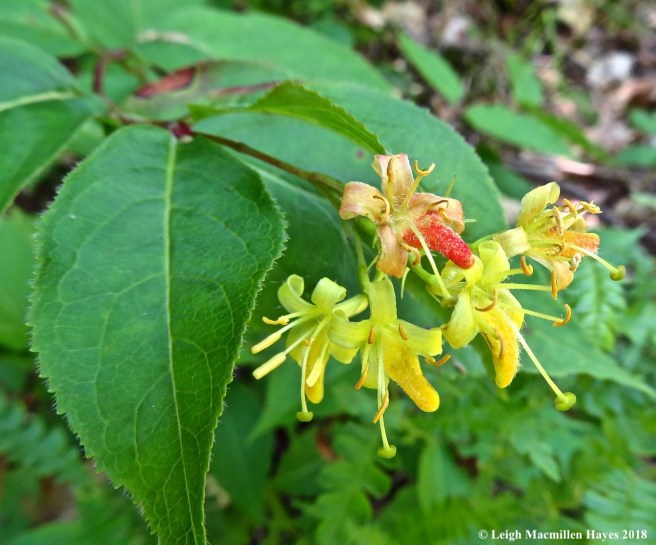
I was much more confident about my ID of the native Northern-bush Honeysuckle with its greenish-yellowish-orangish flowers. The plant is actually a shrub with a woody stem, and one that moose and deer like. I’ve yet to see a moose print along this piece of the property, but I know its part of a deer yard.

j21-Spotted St. John's-wort

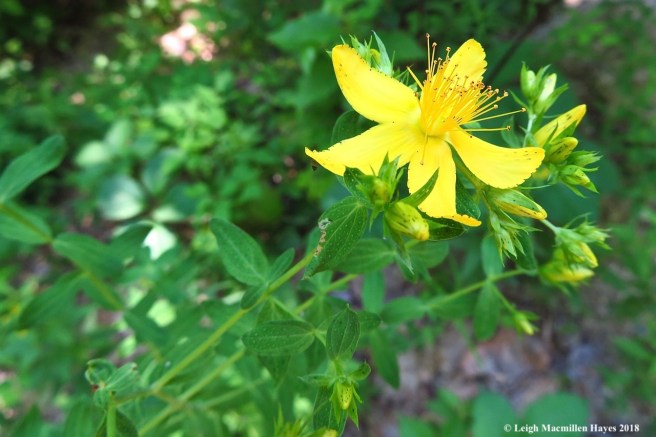
Also springing forth with yellow blossoms was Spotted St. John’s-wort, with its translucent spots on the leaves and tiny black dots outlining its petals.

j22-whorled yellow-loosestrife

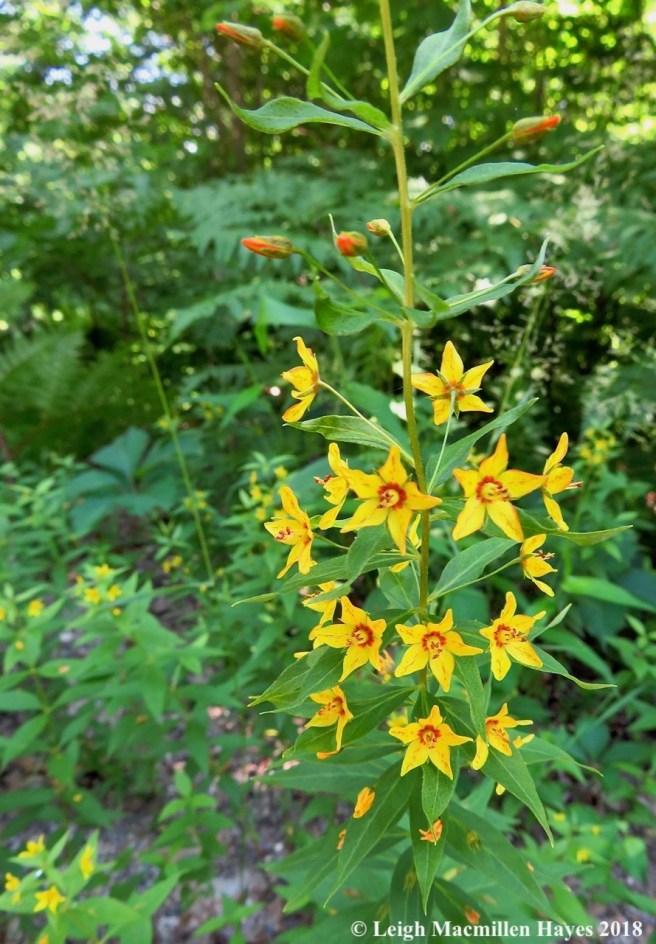
And not to be overlooked, the Whorled Yellow-Loosestrife with its cheery flowers extended in a whorl from the stem by long petioles.

j23-hitchiker

My journey wasn’t long, but with all that I saw, I was thankful for the spirit of Mr. Segur that flies over this place.

Just possibly, he graced me with his presence today . . . in the form of Spangled Skimmer.

Book of July: HIKES & Woodland Walks in and around Maine’s LAKES REGION

If you think I’ve promoted this book before, you are correct, for HIKES & Woodland Walks in and around Maine’s LAKES REGION by Marita Wiser was featured as the Book of October in 2016.

m1-cover

But . . . I’m thrilled to announce that Marita has published the Sixth Edition, aka 25th Anniversary Edition, of her hiking guide and it’s available at local stores as you read this. Or you can order directly from her, and I’ll tell you how later in this review.

m2-signed copy

Before I tell you about changes since the Fifth Edition, let me say that I’m a bit biased for I’ve had many the pleasure of hiking the trails mentioned within with Marita, and sometimes her lovely daughters, and she once again offered me the kindness of letting me edit. She even paid me. How cool is that? And then gave me a signed copy.

m4-blaze orange

To top it off, I modeled blaze orange with her youngest, Marguerite! If you’d like me to sign your copy, I’d be happy to do so ;-)

To keep things fresh, Marita recast her rating system with two green circles meaning easiest and one green equaling easy. That was to differentiate between those like Holt Pond or Pineland Farms, which have well-groomed and fairly flat trails (or boardwalks–just watch out when wet), from Pondicherry Park or Mount Ti’rem, where the terrain varies more, but still isn’t enough of an elevation change to meet her guidelines for a blue square indicating moderate such as Mount Will or a black diamond meaning hard like Mount Chocorua.

She also added some color photos as you can see from above, but I love that she kept some classics, including a few of her daughters that were taken twenty years ago.

The centerfold map is also in color and shows not only where the trails are located, but their degree of difficulty as well.

One of the final new additions is what she’s titled “The Lure.” What is there about a trail that might attract you to it? Marita spells out those keen features such as “wheelchair accessible,” “plenty of vertical for a cardio workout,” “interesting old foundation,” and “the Rock Castle.” There are more, but you’ll need to purchase the book to read them all.

r8-mount kearsarge 1

Among the new trails Marita recommended in this edition is the Red Tail Trail that leads to Black Cap Mountain in North Conway. My guy and I had the privilege of introducing her to that one fine day last fall.

s-Marita, Bruce and Gary 2 (1)

Together, she and I discovered the well-built trail that Bruce, the property manager, and his assistant, Larry, were building on Long Mountain in Albany.

l9a-teepee and islands in background

She’s also kept in the classics like Pleasant Mountain and . . .

c-heading up 1

Mount Chocorua and their varied trails.

I’d give away all the surprises if I told you more.

Oh, and one more thing I like about this book is that it’s an all-local effort with Marita’s writing, her mother’s sketches, an old friend’s work on the map, my fine editing skills, Laurie LaMountain of Almanac Graphics (and Lake Living magazine fame) on design, and production of the final product at Cardinal Press in Denmark. Denmark, Maine, that is.

m3-back cover

You may purchase a copy of HIKES & Woodland Walks in and around Maine’s LAKES REGION, which is printed on recycled paper with soy-based ink, at your local shop, including Bridgton Books where its long been a best seller. And if you don’t live locally, but still would like to buy a copy, the information on the back cover as seen above provides all the details you need.

HIKES & Woodland Walks in and around Maine’s LAKES REGION by Marita Wiser, designed by Almanac Graphics and self-published at Cardinal Printing, both of Denmark, Maine, 2018


Capturing Peace at Deer Hill Bog

The minute I stepped out of the truck, a loud, rather unharmonious musical performance, greeted me at Deer Hill Bog in Stow, Maine. Rather than the Peeper and Wood Frog chorus of spring, the summer symphony was performed by Bullfrogs and Green Frogs, but mainly the former.

d1-approaching the bog

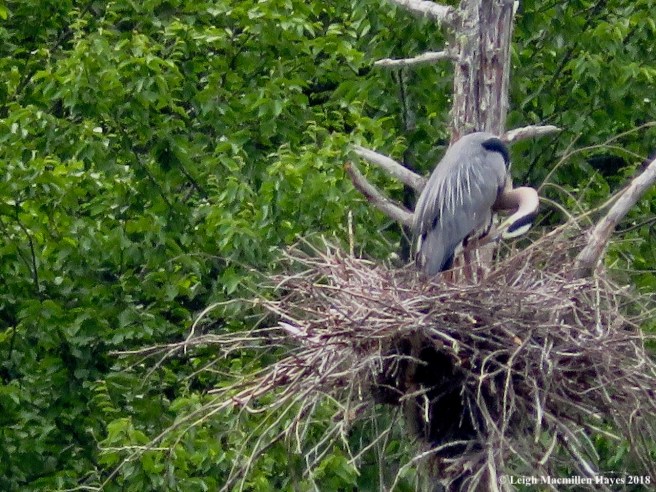
It was about nine a.m. when I caught my first glimpse of the bog, a result of man and nature working together. An old wood dam combined with a beaver dam created the 25-acre body of shallow water. From moose and Great Blue Herons to aquatic plants and tiny organisms, over 90 species call the bog home. Though I truly expected to spy a moose, that opportunity was not meant to be. I did go, however, because of the Great Blue Herons. Friend JoAnne reminded me the other day of the old rookery, so I decided to check on it.

d2-heading toward the blind

But first, I made my way toward the wildlife viewing blind.

d3-bird blind

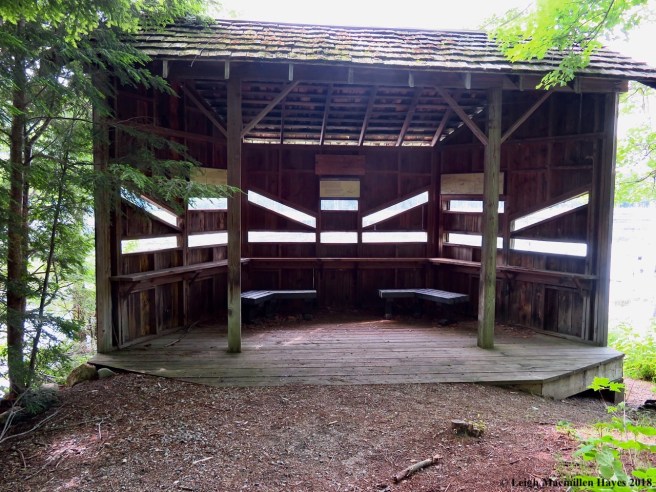
The blind featured benches, cut-outs for viewing and informational posters–a quiet place to watch nature in action.

d5-inside the blind

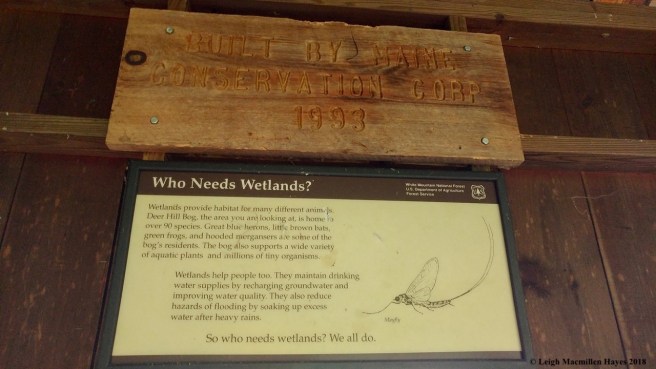
It was built in 1993 by the Maine Conservation Corp and is maintained by the White Mountain National Forest. Two more panels described some species of wildlife one might expect to see.

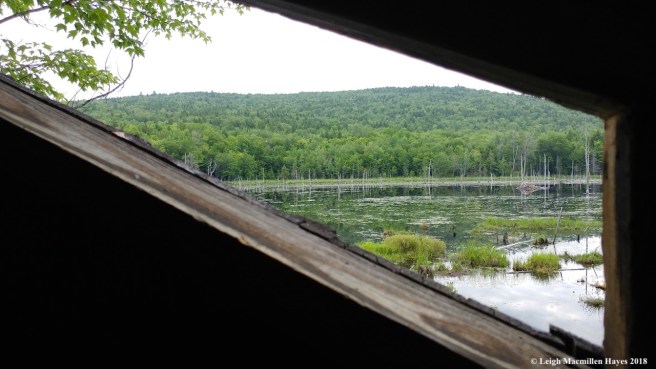
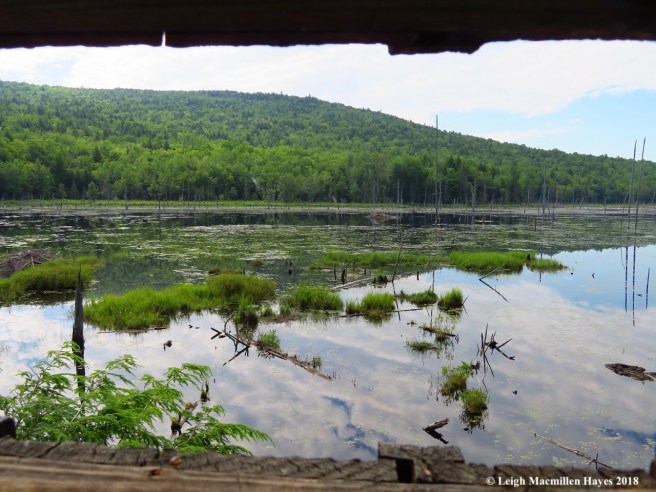
d6-view from the blind

And, of course, the cut-outs provided a bird’s eye view . . .

d6a-another view

of life in the bog.

d12-bullfrog

But, I’m not very good about staying undercover, and so around to the side and front of the blind I went. And stood as still as possible, for the Bullfrogs quieted upon my approach, as I expected they would. A few minutes later they again sang, “rumm . . . rumm . . . rrrrrumm,” the notes all in bass.

d30-fish

The water practically boiled with small fish jumping, but my freshwater fish knowledge is limited and my best guess was that they were bait fish of some sort.

d8-three lodges

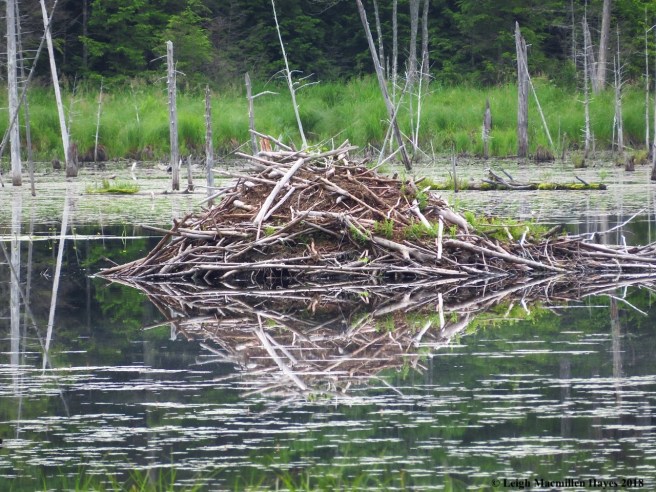
Looking around, I noted three beaver lodges, each of a different size. None looked active, but it was a warm summer morning and perhaps they were sleeping inside.

d8-adult heron

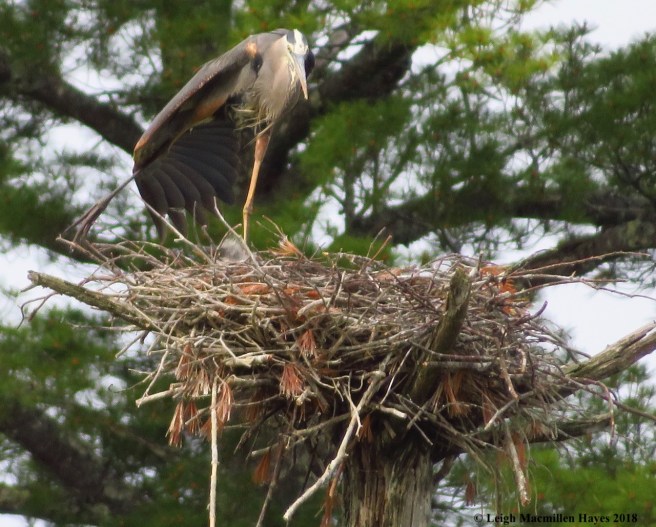
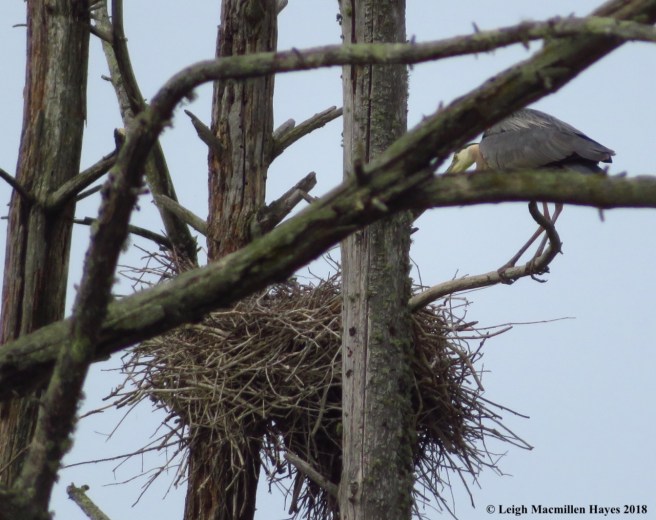
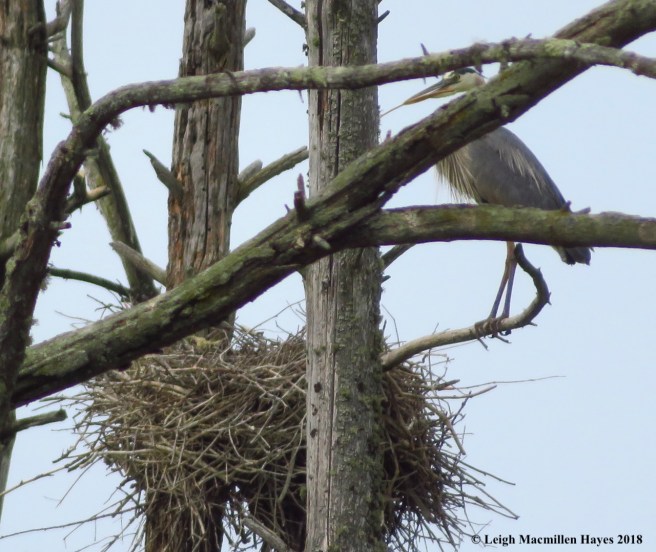
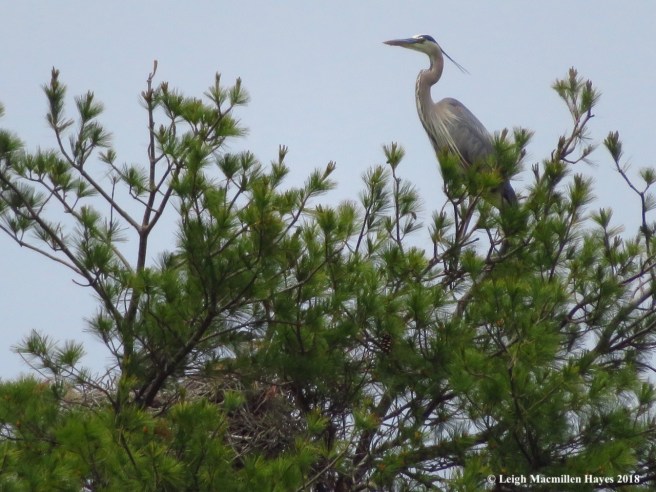
And then I spied two heron nests–on the first I saw only an adult who spent much time in preening mode.

d13-heron feeding

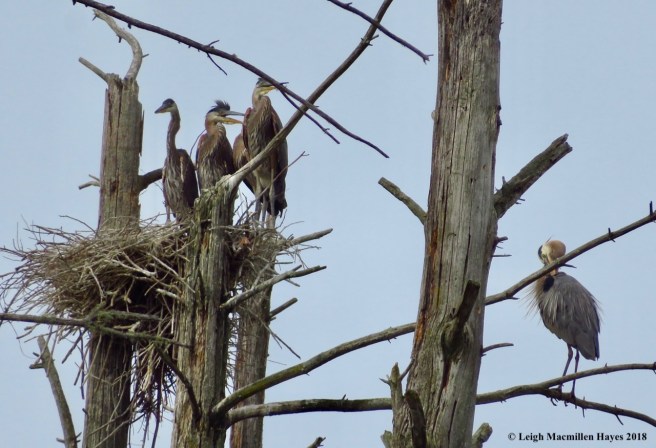
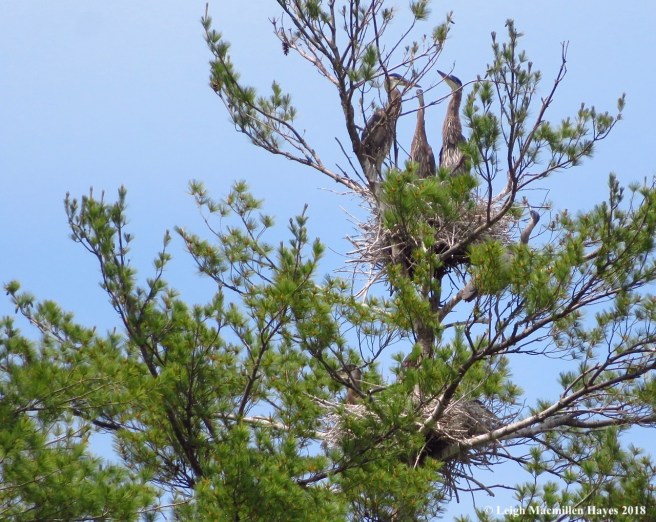
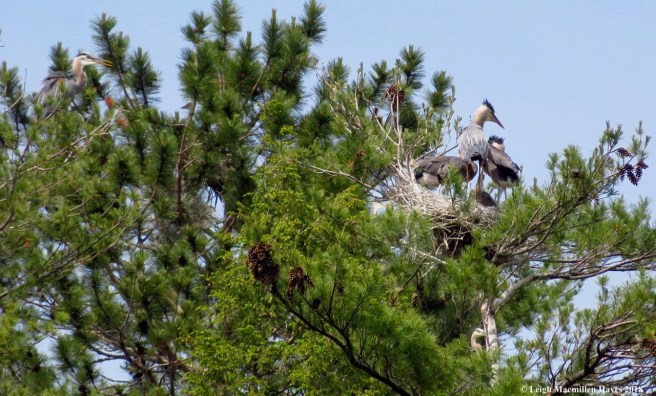
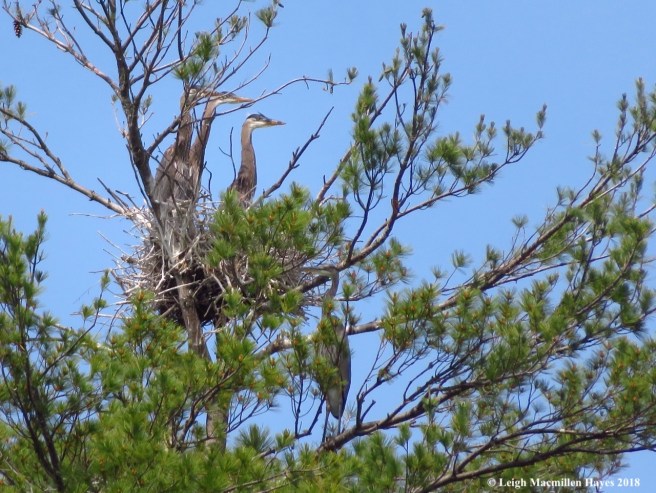
The second nest I was sure was empty–until an adult flew in and three immatures squabbled for the food about to be regurgitated by the parent.

d14-bullfrog

And back down to bog level, another Bullfrog doing what they seemed to do best–waiting patiently, with nary a rumm, though the sound seemed to travel in waves down the bog.

Frogs are ectothermic animals, which means they depend on the environment to maintain their body temperature, therefore many jumped onto fallen logs to catch a few rays. It may also have been that the height gave them a better view of the local action.

d15-bullfrog

This one did eventually turn, making it a fine time to examine his body a bit. How did I know it was a male? His eardrums or tympanums, those circles located directly behind the eyes, were larger than the eyes. In females, they are about the same size.

d10-clubtail exuvia

There were other things to look at, like the exuviae of a clubtail dragonfly. Notice how far apart the eyes were. Eye position is one key to determining species.

d11-frosted whiteface dragonfly

Other characteristics included the white face of the Frosted Whiteface.

d16a-slaty skimmer dragonfly--black face:brown eyes

And the black face and brown eyes of a Slaty Skimmer.

d16-slaty skimmer dragonfly

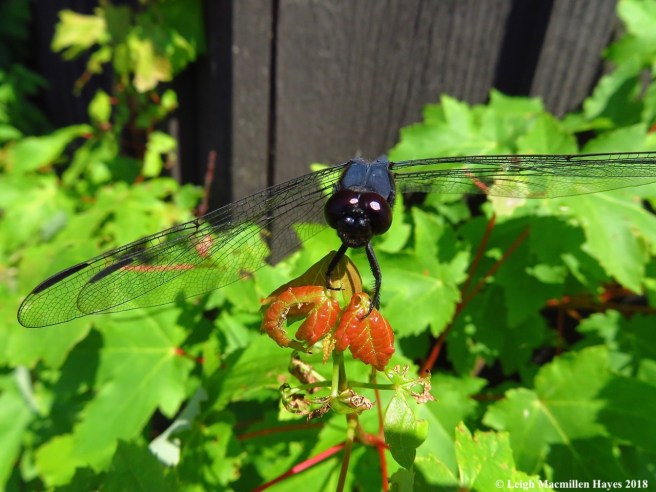
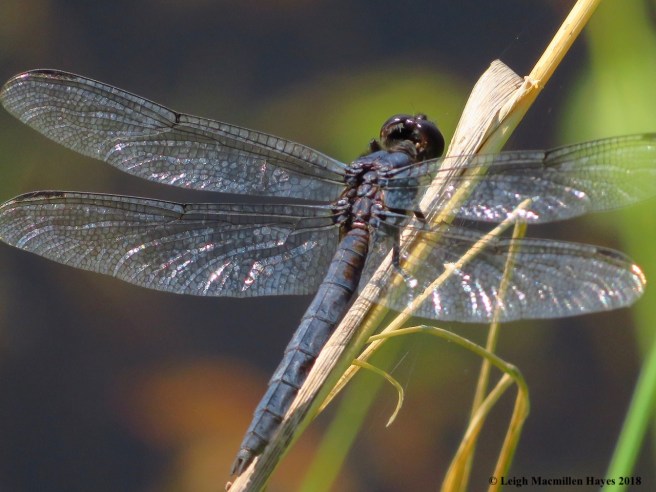
The slaty part of its name came from the fact that male’s body is entirely blue–slate blue.

d17-bullfrog

Again a rumm-rumm-rrrrummm.

d24-bullfrog

It seemed there were female frogs around, but they didn’t care about the males’ singing talents–at least not in my presence.

d16-red-winged blackbird

And an o-ka-leeee.

d18-frosted whiteface dragonflies

In the midst of it all, some canoodling by a pair of Frosted Whitefaced Dragonflies connected in their love formation.

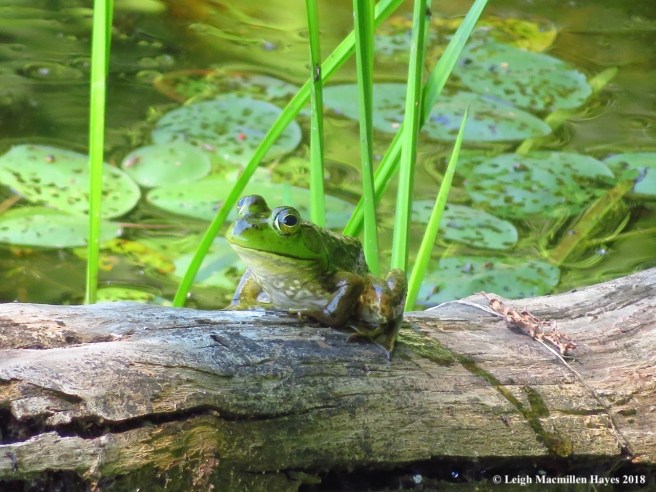
d20-green frog

Plunking rubber bands to the beat of plunk-plunk-plunkplunkplunk were the Green Frogs. This one was so identified by the dorsalateral folds that ran from its eyes along the sides of its back and down toward its former tail.

d21-grackle

Wood Ducks and Merganzers swam further away from my spot, but Grackles flitted in and out, up and down on the ground, fallen trees, and rocks, ever in search of fine dining.

d27-grackle

In between foraging for insects, crustaceans, mollusks, fish, and frogs, oh my, they sang their guttural song that was often followed by a high-pitched whistle.

d22-painted turtle

There were also painted turtles to admire. Well, I only saw one, but suspect there were others.

d25-painted turtle

It slipped into the water and then came up on a nearby log, another species that valued the sun’s warm rays.

d26-bullfrog

And another. Really, they were everywhere. Did you know that a frog’s pupils are horizontal so it can look forward, backward, and up and down. The better to see me,  dinner, and predators on the quick.

d28-two frogs

Sometimes frogs yelp, and it was such a sound that brought these two to my attention. Because of the sun’s position, I couldn’t get a clear take on their gender, but I watched them both jump onto the log simultaneously. At first they were side by side, but then one shifted further to the right. Had they been mating? Had one male tried to jump onto another thinking it was a female? Had something bigger than them been on the hunt?

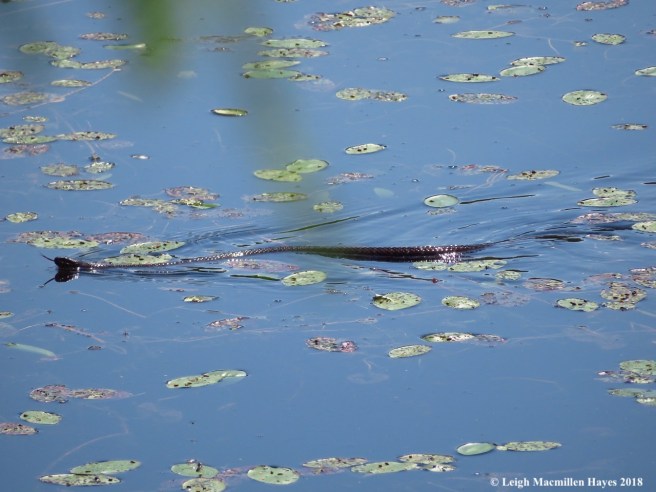
d31-water snake with tongue extended

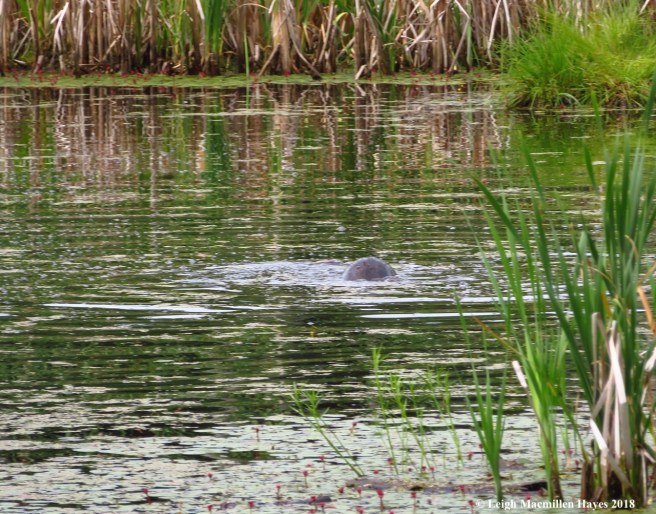
I may never know why the frogs jumped, but this water snake was making the rounds. Every once in a while it made the water boil and I knew something was consumed. Can you see his forked tongue sticking out?

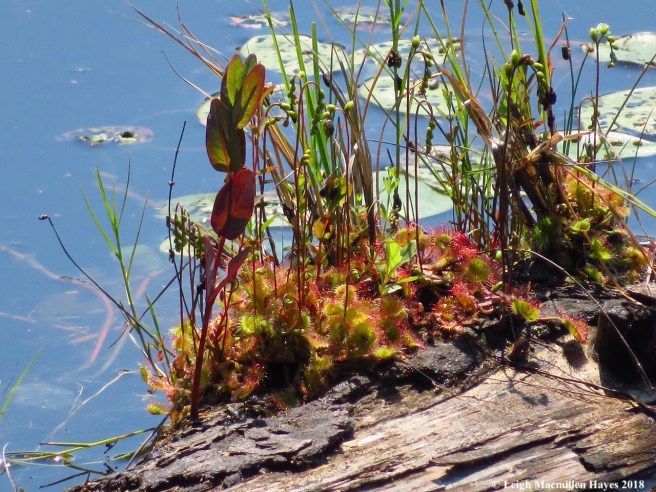
d29-sundew about to flower and marsh st.john's wort

At last my bog time was drawing nigh, and yet there was so much more to see, including Round-leaved Sundews and Marsh St. Johnswort on log islands.

d30-bullfrog

And one more Bullfrog to provide a last note to the morning’s wonder.

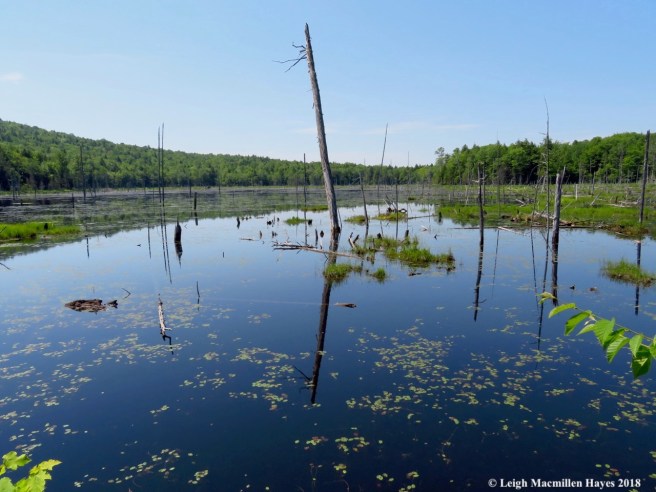
d32-bog

Though to some, the bog may look like a place of death, and death does happen there, it’s also full of life. It’s a place of biodiversity and hidden beauty. And this morning I was thankful to have it all to myself–the only human sounds I heard were of my own making. Deer Hill Bog–a magical, wonder-filled place to capture peace.

Maybe everyone needs a bog visit.

P.S.  The frog sounds were borrowed from https://srelherp.uga.edu/anurans/sounds as I’m not tech savvy enough to have recorded them. But do click on them, because it gives you a sense of this place. You’ll need to turn up the sound on your computer and possibly will need to press play when you click on the link.


Self-Guided Tour of Sabattus Mountain

As stories go, Sabattus Mountain in Lovell offers plenty of lore. For starters, there’s the name of the mountain. I’ve heard at least two tales and seen three spellings, but basically the legend is the same–about a Pequawket named Sabatos, Sabatis, or Sabattus, who guided hunters and one day killed a lynx, or was it a mountain lion, before it sprang upon him.

In a July 14, 2017 article, Ed Parsons of the Conway Daily Sun wrote: “Sabattus was born in St. Francis, Canada, and with the influence of French missionaries, was named for St. John the Baptist, shortened to Sabattus. When Roger’s Rangers destroyed St. Francis in 1759, Sabattus was about 10 years old. He was kidnapped and went south with the rangers. Later, he went to Fryeburg with one of them, and spent the rest of his life in the area.

Sabattus had two children with the well-known area healer, Molly Ockett. In 1783, an earlier wife of his returned from a long trip to Canada, and claimed to be his spouse. To settle the dispute, Sabattus took them to the house of Mr. Wiley in Fryeburg so there would be a witness, and the two women fought, “hair and cloth flying everywhere.” Mrs. St. Francis, as Molly Ockett called the former wife, was stronger and won out. Molly Ockett left and moved to Andover, Maine.

There’s also the Devil’s Staircase, but that’s for another day.

s1-sign

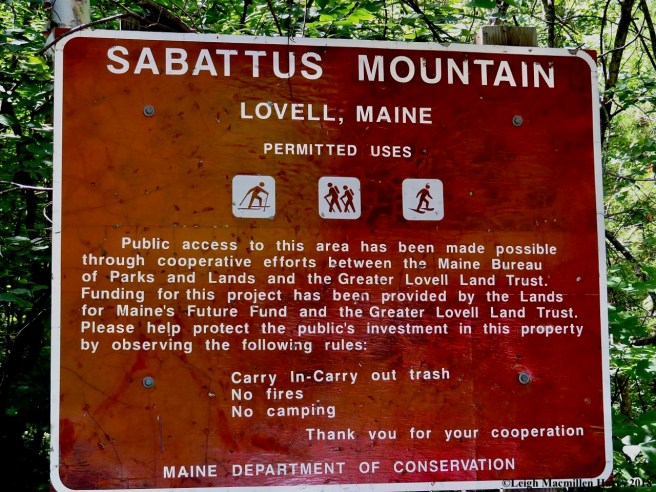
Two Land for Maine’s Future program grants, along with funding from the Greater Lovell Land Trust, enabled the State of Maine to purchase 177 acres on and around Sabattus Mountain, protecting hiking access to Lovell’s highest peak. The trail is a 1.6-mile loop to and from the 1,253-foot summit. Sabattus Mountain is now owned and managed by the Bureau of Parks and Lands. The land trust, however, has taken a keen interest in upkeep of the trail system recently because there had been much erosion ever since Hurricane Irene and the State seemed to back off maintaining it. Last year, the GLLT’s three interns built numerous water bars, especially on the eastern trail.

s6-Brent's Loop Trail Sign

Last week, Brent Legere of Lovell Box Company and Western Maine Slabworks, installed new signs to guide hikers on the trail system.

s2-self-guided nature walk

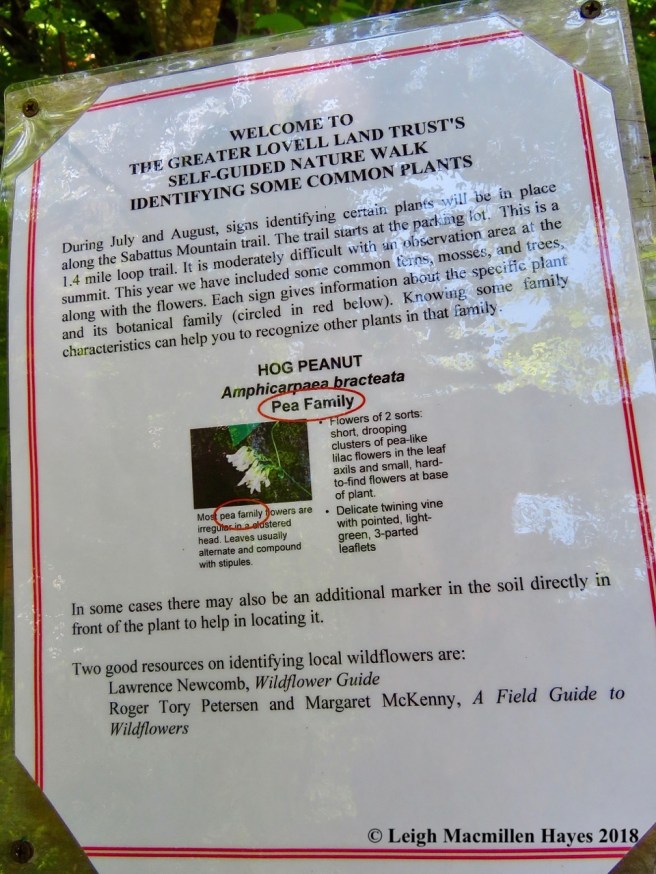
Today, a team of docents, associates and this year’s intern, under the well-organized leadership of GLLT Docent and Maine Master Naturalist Joan Lundin, installed informational signage along the loop.

s3-explaining the plan

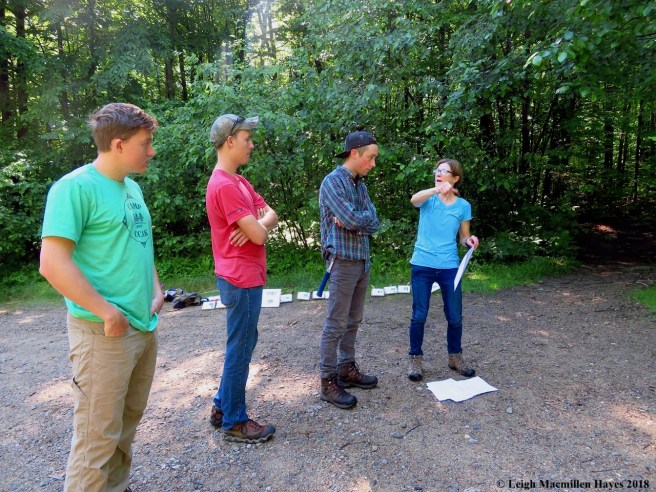
The morning began as Joan divided the team into two groups. First she instructed Intern Isaiah (in red) and Stewardship Associate Dakota (in plaid), to take one set of signs up the western trail and leave them beside examples of particular species on the way.

s5-all smiles to go

Then she prepped Associate Director Aidan, and GLLT Docents Nancy and Pam in the plan for the eastern trail.

s4-signs

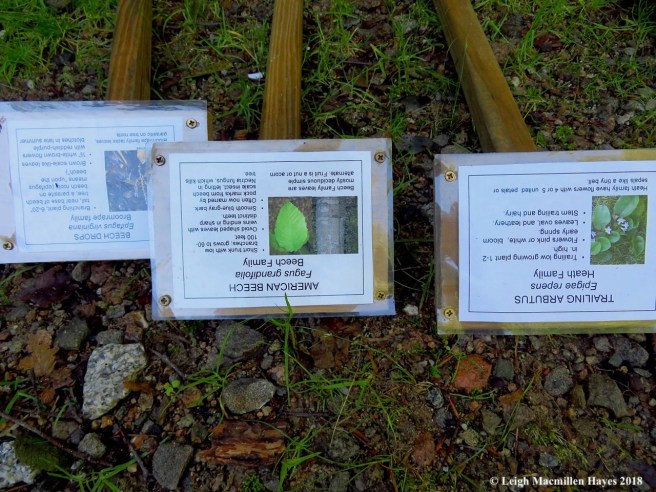
All signs were laid out and ready to be hauled up the trails for installation.

s12-hi ho

And so, in true Seven Dwarf style, it was hi ho, hi ho and off to work we went.

s7-installing the first sign

Because she’d climbed the trail so often in order to prepare for today’s undertaking, Joan knew right where each sign belonged. At the start, she did most of the installing, showing off her muscle power on this steamy day, despite her petite physique.

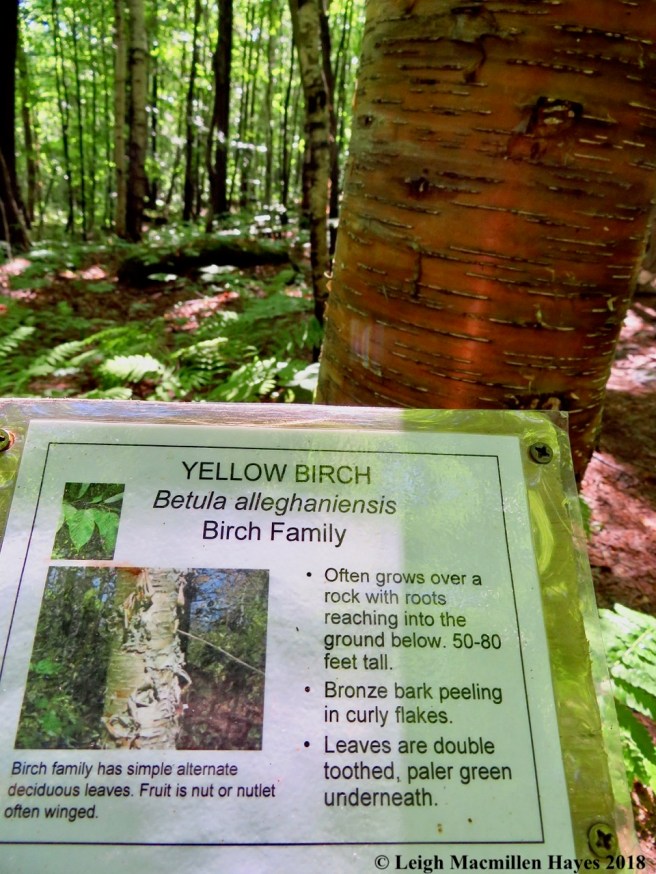
s8-yellow birch

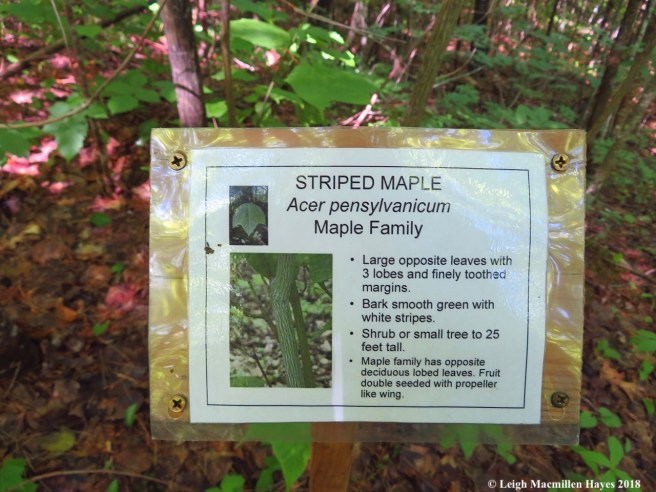
Each sign included common and scientific names, plus only a few key characteristics so not to overwhelm those who might stop to read them and look around to locate the particular species. It’s a technique decided long ago by the full team of docents who have undertaken this task each summer for years–always along a different GLLT trail.

s9-striped maple

The natural community along both trails on the loop system transitioned about two-thirds of the way up. For the lower portion, the community consisted of a variety of deciduous trees.

s13-hemlock

Suddenly everything changed. Light turned to shade. Dry turned to damp. Leaves turned to needles. And conifers showed off their unique characteristics.

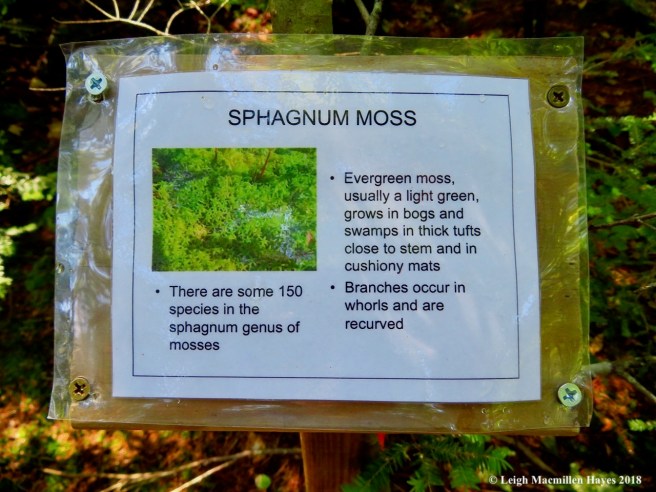
s14-sphagnum moss

Even the forest floor changed from dried leaves and wildflowers to green mosses, including sphagnum, with its pom-pom shaped heads.

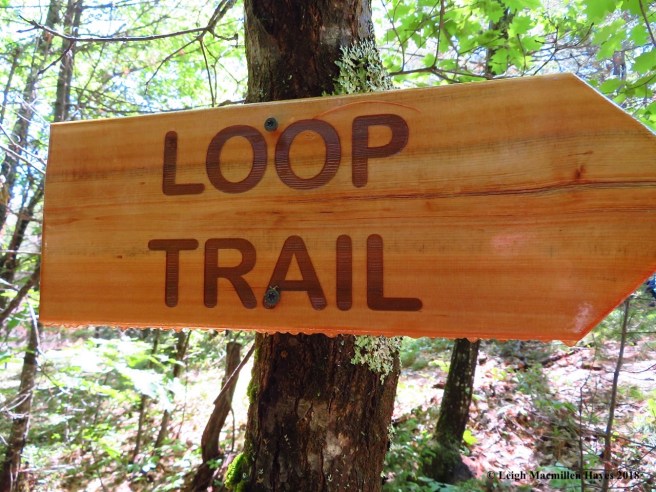
s15-loop trail sign at ridge

As we hiked up the eastern trail, Dakota and Isaiah swung along the ridge line and came down to find us for they had only placed their signs along the western trail as instructed by Joan, and hadn’t yet pounded them into the earth. We chatted as we moved upward, talking about the turn ahead to the ridge, and Dakota told us we’d be pleased with how obvious it was since Brent had installed the new signs. Indeed!

s16-glacial erratic

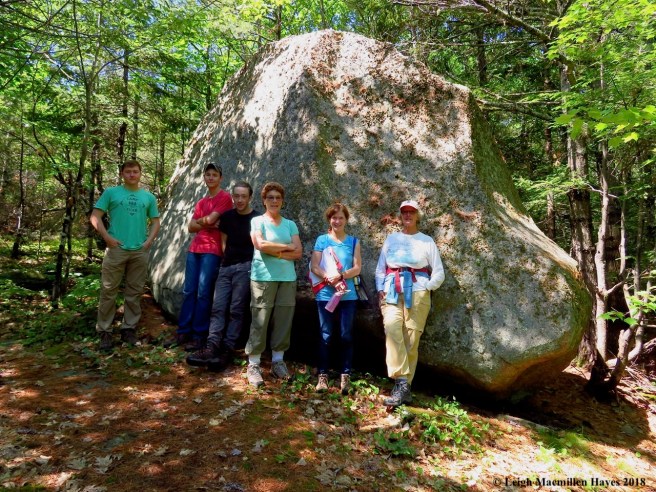
Of course, we were a group that failed at following directions, and so off trail we went to check on the glacial erratic that we knew stood just beyond a downed tree.

s17-porcupine scat

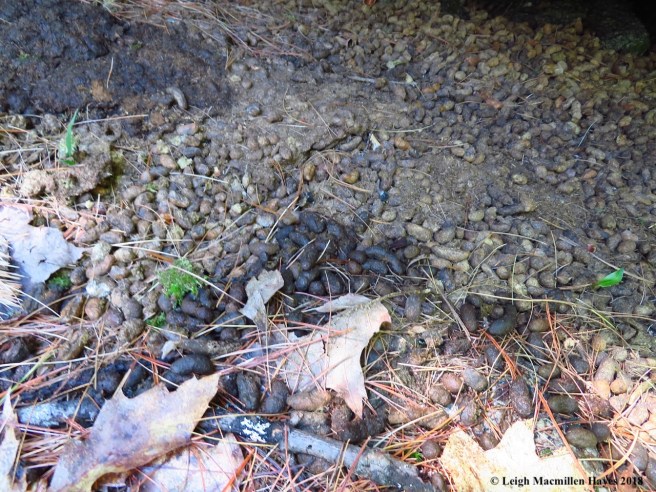
We also checked underneath, for who doesn’t like to look at porcupine scat. New and old, though not especially fresh, it’s been a winter den for at least 30+ years that I’ve been climbing this mountain.

s18-Canada mayflower

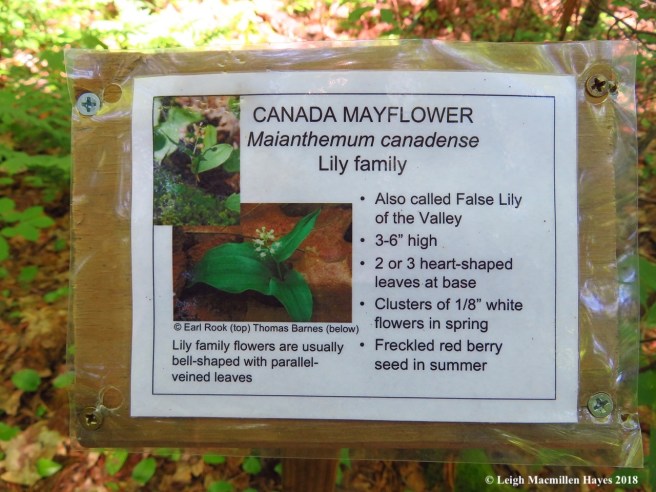
And then Joan redirected us, pulling us back into the mission of the morning and finding a place to post the Canada Mayflower sign–between the granite slabs at our feet.

s19-window on the world beyond

Making our way across the ridge, we paused for a second to look out the window upon the world beyond. It’s from heights like this one that we always appreciate how much of Maine is still forested. At a recent gathering with District Forester Shane Duigan, he said that the state is 85% forested–down from 90% not because of urban sprawl, but instead increased farming.

s20-main summit signs

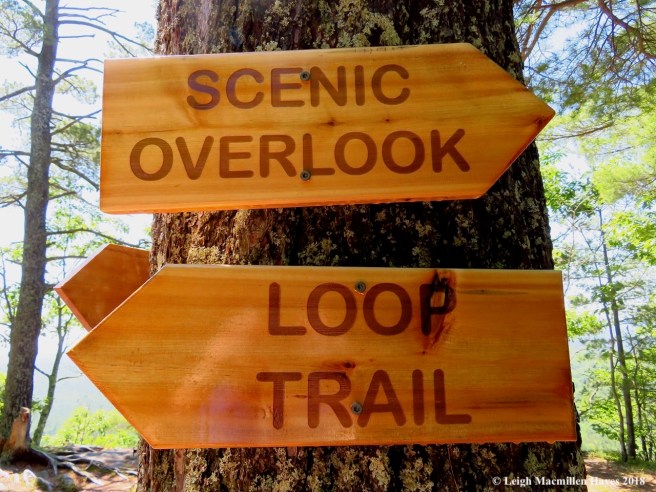
A few minutes later we reached the main summit, where Brent had posted more signs. They’re nailed to a White Pine and mark the intersection of the ridge trail and western loop, with a spur to the western-facing ledges and scenic overlook.

s21-white pine

That very White Pine was also on Joan’s list as an excellent example, and so it will be noticed for a while.

s22-Keyes Pond and Pleasant Mtn

For a few minutes, we took in the wider view to the south–noting Keyes Pond in Sweden and Pleasant Mountain in Bridgton, both part of the great beyond.

s23-scenic view

And then a quick trip out to the scenic overlook, where the sweeping view included the Lower Bay of Kezar Lake and pyramid outline of Mount Kearsarge in North Conway.

s24-scenic view 2

Turning a wee bit to the north, the view also encompassed more of Kezar Lake, and the White Mountains.

s25-chipmunk

On the way down, we continued, or rather, the rest of the team continued to install the signs while I watched, and one quiet chipmunk with a piece of a leaf dangling from its mouth looked on with approval. We assumed it approved, for it didn’t chatter at us.

s26-teamwork

It seemed the signs on the western trail went into place far more quickly than on the climb up, but maybe it was because there weren’t as many. We did pause for a few minutes as Isaiah and Dakota changed out one sign for another because the species Joan wanted to feature wasn’t as prominent as hoped. But, she was prepared with extra laminated cards and quickly produced a description of an alternate species.

s27-plank

We were nearly finished with our morning’s work when we reached the new plank bridge Brent had placed across a small stream.

s28-white admiral

Back at the parking lot, we were wowed by the sight of pollinators upon the Staghorn Sumac, including a White Admiral Butterfly.

With that, our tour was done for the day, but we’d met several people along the way who were thrilled with the work we’d done. We hope you, too, will partake of the pleasant hike up Sabattus Mountain, and stop along the way to enjoy the self-guided tour. It will be in place until Labor Day weekend.

And be sure to stop by the office on Route 5 and make a contribution to the Greater Lovell Land Trust for we are a membership-driven organization and can’t do such work without your continued support.

P.S. Thank you Self-guided Tour Docents and GLLT staff, plus Property Steward Brent.


A Slice of Life in the Rookery

We only had an hour and we had a task to accomplish as citizen scientists for Maine IF&W’s Heron Observation Network. Our mission, which we chose to accept, was to count the number of nests, the number occupied, the number not occupied, the number with residents, the number of immature, the number of mature, the number of . . . you get the picture.

h1b-rookery

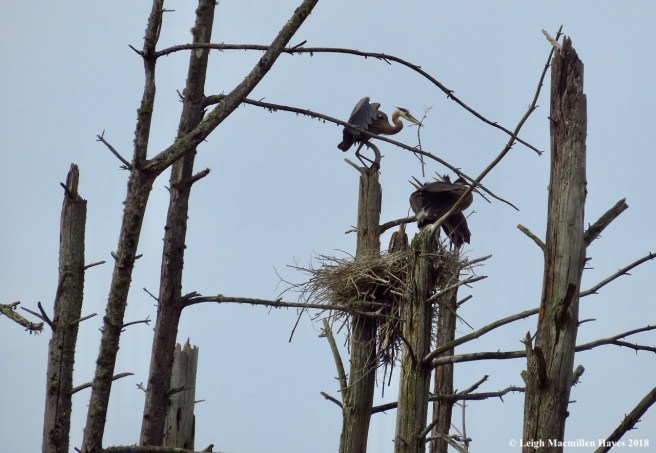
In the past, this was the largest inland rookery in the state and supported 40+ active nests, but over the last few years the numbers had dwindled and today we found only nine. Of those nine, three were inactive. Where have all the birds gone, we wondered.

h1-wood duck

As we started to focus on the scene before us, one member of our team spotted a wood duck surveying the beaver pond from a limb on one of the many old snags.

h2a-heron chick

And then we looked upward. Counting isn’t always easy–in fact, it’s never easy. One immature–check. More than one? Well, we could see a lump representing another bird. Was it one lump or two? Over and over again, we counted.

h3-standing still

And then there was this nest that was hidden from our sight at first, only because it seemed to blend in with the pine tree behind it. Again we wondered–why was this adult standing on it? Was this a sentry watching over all of the nests why the other parents were off fishing? Usually, though, experience told us that sentrys stood on higher branches–the better to watch for predators.

h29-sentry

Like this.

h2-otter

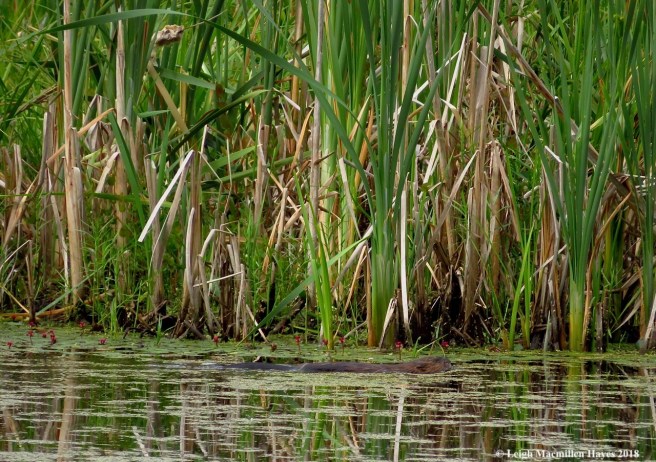
Suddenly we heard a commotion in the water and noticed action near the beaver lodge. What was it?

h4-incoming

And then the sound of the youngsters crying frantically made us look upward again, where we spied an incoming adult.

h5-landing

The kids exclaimed their excitement because a meal had certainly arrived.

h6-begging for food

We could almost see their smiles as they anticipated the goodness they were about to receive.

h7-what? No food?

But . . . no food was regurgitated despite the kids’ squawks.

h9-meanwhile-mouths have closed

Finally, they quieted down and looked rather disgusted.

h10-preening

And Momma preened.

h11-wood duck family

Back in the pond, a family of Wood Ducks swam among the flowering Watershield.

h12-movement above

And up again, we noticed slight movement in the nest.

h13-a chick with downy feathers

Could it be?

h14-red winged

Before we answered the last question, a Red-winged Blackbird paused . . .

h15-singing

sang . . .

h16-did you hear me?

and looked around as if to say, “Did you hear me?” We did.

h17-another incoming

More squawks from above and we saw another adult fly in.

h18-what did you bring?

It seemed Dad had joined Mom and the family was complete.

h19-I'm off

But only for a second, as Mom took off.

h20-snacks?

“Where’d Mom go?” and “What’s to eat?” was all Dad heard.

h21--watching from nearby

She didn’t go far, but like all mommas, she needed a few minutes of time to herself.

h21-baby chick revealed

Meanwhile, back by the pine, that little bit of fluff moved some more.

h22-stretching my wings

And someone else needed to stretch his wings.

h24-otter again

It was like watching a tennis match, for our eyes moved back and forth, up and down–especially when we heard movement in the water again and saw the same something undulating through the water.

h26-water snake

We weren’t the only ones watching all the action from a hidden location–a water snake on a hummock across the way did the same.

h28-don't you have any food?

Skyward, the family unit came together again. And still no food. The kids were getting impatient.

h30-have a stick

And then one parent left briefly and returned–with a stick for the kids to add to the nest, perhaps heron-speak for clean the house first and then you’ll get a snack.

h31-what's he thinking?

“We did it,” they tried to tell her, but Mom had her eyes on something else.

h27-beaver again

Her focus wasn’t on the beavers that swam back and forth below. Oh, and if you think this is the hump that had been making the water boil, you are mistaken.

h32-there he goes again

“Mom, bring back lots of fish . . . pleeeeease,” the kids cried as she took off again. “We’ll even eat frog legs.”

h33-picking twigs

But she had her eyes on other things–sticks from one of the abandoned nests.

h34-got one

She pulled one out.

h36-did you see what he just did?

And the kids looked away and one complained to Dad about all the housework they were expected to do and they still hadn’t received their allowance.

h25-checking us out

Unfortunately, it was time for us to head to work, but our undulating friend returned.

h37-otter

Great Blue Herons, Wood Ducks, Red-winged Blackbirds, Water Snakes, Beavers . . . and a River Otter! A slice of life in the rookery.


Meals-on-Wings

I wasn’t sure how I would spend the afternoon, until that is, the phone rang. On the other end of the line (what line?) Mary Jewett of Lakes Environmental Association excitedly told me about her adventures last evening exploring one of my favorite Lovell haunts. She’s an avid birder and is currently participating in the Maine Department of Inland Fisheries and Wildlife’s Maine Breeding Bird Atlas.

For this citizen science project, Mary has chosen several areas of Lovell as her block and so she’s getting to know one of my favorite necks of the woods. Last night, she explained, found her kayaking with her boyfriend on a river that passes through a Greater Lovell Land Trust property. As she talked, she started listing off the birds they saw that are not on the species list for that property, thus nudging me to make sure it gets updated. One in particular pushed her excitement button, and that’s when I knew where I was going to spend the afternoon.

She also told me about a most unusual sight that she caught on film–a porcupine swam across the river, passing in front of their kayaks. Who knew? She surmised it had been chased to the water and just kept going.

k7-kezar river

Anyway, within 45 minutes of the phone call, I was at the water’s edge.

k8-canada geese

The bird life was immediately apparent in the form of Canada Geese, their youngsters growing bigger by the day.

k10-mallard duckling

What rather surprised me was that I watched two Mallard ducklings, but never saw their momma, unless she was hiding under some shrubs. I could only hope that was the case.

k21-kingfisher

There were Red-winged Blackbirds, the males displaying their bright shoulder patches, and even a Belted Kingfisher who sang his rattling song as he flew above the water looking for a meal.

At last I had dallied long enough, for of course I admired the dragonflies and damselflies, but it was time to bushwhack over to a viewpoint where I could stay hidden as my eyes and ears filled with the sights and sounds of . . .

k11a-rookery

a Great Blue Heron Rookery. It had been on my radar to get there, but other events took priority until Mary’s nudge. The moment I started down the trail I heard the chorus of croaks and knew I was in for a treat.

k12-food

Up high in the pines, those massive birds stood, most upon their large platform nests made of twigs and sticks, and apparently lined with moss and pine needles to soften the interior. If you looked closely at the adult upon the nest, its curved throat appeared to bulge a bit.

k13-food

Both parents are known to provide a meal of regurgitated food. Can you see the adult bending down, its beak meeting the youngster’s? Soon, regurgitating the food will stop and instead small fish will be deposited in the nest and the “little” ones will learn to feed themselves.

k14-next meal

After one was fed, another begged for its share of the picnic. It seemed to look up and say, “Hey, where’s mine?” in true jealous sibling behavior.

k15-sentry

By now you may have noticed that the youngsters have black flattop haircuts. Adult Great Blues have thin black plumes that are swept back of the tops of their heads making for easy ID until the young fully mature. And at least one stands sentry, ever on the lookout for predators like eagles and raccoons.


k17-double decker

Great Blue Herons nest in colonies near wetlands such as this. The group of nests is called a rookery–so named for the colonial nests of the Eurasian rook, a bird similar to a crow, but called a rook because of the sound it makes.

k18-birds everywhere

With my eagle eyes, I had to really focus in on the trees, for not all of the nests were obvious from my vantage point on the distant shore. It’s best if you are to observe to keep your distance and remain quiet and hidden so the birds aren’t disturbed during this fragile time in their life cycle.

k19-i'll be back

With the kids fed in nest one, the parent decided to chat with a neighbor before heading off to gather supplies for the next meal.

k20-don't forget us

And the kids next door waited expectantly–ever anxious for the delivery of their own meals-on-wings.


The Ayes Have It

I knew I was blessed when I spied a Northern Flicker in the backyard early this morning. This is the one woodpecker that doesn’t behave like a typical family member for it forages on the ground rather than a tree trunk.

e1-northern flicker

From the kitchen window, I watched this guy for a while as he looked for food. I knew it was a male because of the so called black mustache on either side of its bill. But . . . it was the bird’s eyes I was most curious about . . .and their placement on the side of its head.

e2-flicker feeding

Like mammals, birds with eyes on the side are born to hide . . . from predators. His field of vision, therefore, was wide and the ants on the ground were the ones who needed to scurry and hide.

e4-tachinid fly

After dining for a while, the flicker flew off and I stepped out the door–in search of other  sets of eyes to behold–like the red ones of a tachinid fly,

e8-long-legged fly

and metallic green on a long-legged fly. Like the flicker, flies also have a wide field of vision due to the fact that they have compound eyes. Each eye consists of thousands of individual visual receptors, or ommatidia, (singular ommatidium) (om·ma·tid·i·um, äməˈtidēəm.) Each hexagonal-shaped ommatidium (think honeycomb) is a functioning eye in itself. With thousands of eyes on the world, it’s no wonder flies and other insects see us coming–especially when we have a flyswatter in hand.

e7-green and brown stink bug

I kept looking and among the elderberry shrub leaves I found a strikingly beautiful green and brown stink bug, or shield bug, if you’re looking for a more pleasant name. Like all insects, it featured those compound eyes, but I was struck by how tiny they were. Apparently, it was enough to see movement and kept trying to hide from me.

e8-stink bug eyes

Despite its efforts, I could zero in on it even after walking away and returning.

e9a-song sparrow

Eventually I moved my focus to Pondicherry Park, where a variety of eyes greeted me, including those of a Song Sparrow.

e7a

What did he seek? Insects and other invertebrates, such as weevils, leaf beetles, ground beetles, caterpillars, dragonflies, grasshoppers, midges, craneflies, spiders, snails, and earthworms.

e11-slug eyes

What about a slug? I suspected the sparrow would enjoy such and today was a decent slug-like kind of day. But, how does a slug see?

A slug has two pairs of retractable tentacles on its head. The upper, optic tentacles, feature light-sensitive eyespots on the ends. And just like a deer can move each ear independent of the other, slugs can do the same with each eye-stalk. Another cool fact: an eye stalk can be re-grown if something attacks it.

e11a-spider eyes

Further along, I found a wolf spider hanging out on last year’s fertile frond of a sensitive fern. Did you know that spiders have eight legs AND eight eyes? Two of them are large and prominent–the better to see you with.

e11-ebony jewelwing

As I continued to look for the sparrow’s prey, I discovered an ebony jewelwing that I determined had just emerged for it posed as I took numerous photographs. Usually, they flit about like woodland fairies. Unlike its larger dragonfly cousins who have eyes in front in order to hunt, the damsels’ are on the sides. Though zoom-and-swoop attacks may not be possible for the damselfly, it can see all-round–including above and behind– giving it control of its airspace.

e12-barred owl

My wander continued and then I heard a sound and saw some action in a tree about thirty feet off trail. And just like that, in what felt like a miracle of miracles, I realized I was in the presence of the wise one.

With his eyes in front, a Barred Owl is born to hunt. For several minutes we starred at each other and I was honored by his presence. Of course, I hoped he might cook for me tonight, but he let me down. Possibly he had others more in need of supper than I was at the time.

In the end my vote was aye in favor of all the peepers I’d met along the way, both in the yard and the forested park, for I knew that the eyes had it.


Flexing My Wings with Jinny Mae

It’s been a while since Jinny Mae and I had wandered and wondered together, but this afternoon the opportunity finally arose. And so we agreed on a time and place (though she did change the time ;-) ), and pulled into the parking lot of the Mountain Division Trail located closest to the Eastern Slopes Airport on Route 5 in Fryeburg, Maine.

m6-Mtn Division Trail

Rather than a rail trail, this is actually a rail-with-trail even though the rail is not currently active.

m2-lupine

From the start, we were surprised and delighted to see so many lupines in bloom along the edge. Lupines are members of the pea or legume family, Fabaceae. As such, the flowers have a distinctive upper banner, two lateral wings, and two lower petals fused together to form a keel. Those lateral wings earned the plant’s place in this contemplation.

m2a-lupine aphids

Of course, being that not everything in nature is as perfect as we might desire, we did discover destruction in action on a few stems and flowers. Lupine aphids seeking honeydew suck the juices from a plant. They’ll continue to feed until midsummer, even after they’ve destroyed the flower.

While there isn’t much to celebrate about these garden pests, it is worth noting that all aphids are female and give birth to live young, without mating. And another cool fact–once the population grows too large, they will develop wings and fly to a new host plant.

m3-chalk-fronted white corporal

We continued our journey at our typical slow pace and stopped frequently to admire the dragonflies. There were quite a few species, but many spent time patrolling in flight and so we couldn’t photograph them. We did, however, give thanks for the work of all for we felt the sting of only a few mosquitoes. And we appreciated the perchers as well, for by letting us get a closer look we could learn their characteristics, and therefore ID: Chalk-fronted Corporal;

4-four-spotted skimmer

Four-spotted Skimmer;

m5-calico pennant

and Calico Pennant.

m7-ant dragging grasshopper

We also noted a crazy ant act. The ant apparently got a great deal at the grocery store and somehow managed to single-anticly drag the remains of a grasshopper home–that’s one flier we won’t see in the air again.

m8-wood sower gall wasp gall

We also stumbled upon another interesting find–the galls of a wood sower gall wasp. As I told Jinny Mae, I’ve seen them before and knew they were associated with oak trees, but couldn’t remember the name in the moment. Maybe if I say it five times fast and spin around three times I’ll remember its name the next time I encounter it. Doubtful.

m8-wood sower gall wasp

The cool facts about this fuzzy white gall with pink polka dots, which is also known as oak seed galls: it only grows on white oak; the fuzziness is actually secretions from grubs of the gall wasp; and within are seed-like structures that cover the wasp larva.

m9-tiger swallowtail

Finally, it was a swallowtail butterfly that stopped us in our tracks and mesmerized us for moments on end. The question was this: which swallowtail–Eastern or Canadian, for both fly here.

m11-eastern tiger swallowtail

Earlier in the day I’d photographed an Eastern Tiger Swallowtail in the backyard. Tiger comes from the four black stripes, while swallowtail refers to the long tails extending from the hind wings that these butterflies often lose to their prey as spring gives way to summer.

This was a female given that her hind wings featured blue with bright orange accents when viewed from the top. The areas that are blue on the female are black on the male.

And notice her main body, which is a rather muted combo of black and yellow.

m10-canadian tiger swallowtail

Now look at the butterfly Jinny Mae and I each took at least fifty photographs of and do you see the darker body? The Canadians have more black hairs covering their bodies.

m11-probiscus

Also look at the underwings. I regret that I didn’t get a shot of the Eastern’s underwings, but for the Canadian this matches the pattern: Note the yellow band just inside the outer edge on the underside of its forewings. Had it been an Eastern, it would have featured a series of disconnected yellow spots on the black band. The Canadian has a continuous yellow band. And then there are the orange and blue markings.

m13-canadian tiger

At the end of the day all that detail really didn’t matter–Eastern or Canadian, both were tiger swallowtails.

And I gave thanks for the opportunity to flex my wings beside Jinny Mae. It felt so good to fly along the path together again. For those who don’t know, Jinny Mae’s journey has been one of varied wing beats as she’s lived with cancer for the last three years. Her current treatment is going well and we look forward to more flight paths.


The Trail To And Fro

The heron rookery was our destination and so friends Pam and Bob journeyed with me, our expectations high.

M1-KENNEDY'S EMERALD

But as nature would have it, we’d barely walked fifty feet when our typical distraction disorder set in–and the focus encompassed the dragonflies that perched on foliage beside the trail. Our first was a Kennedy’s Emerald, named for Dr. Clarence Kennedy, a renowned Ohio State University professor and odonatologist.

M2-BEAVERPOND BASKETTAIL

Among the same fern patch was a Beaverpond Baskettail. It’s the eyes of this species that appealed to me most for I loved their teal color.

M3-IMMATURE CHALK-FRONTED CORPORAL

Every step we took seemed to produce a new combination of colors and presentations, all a variation on the dragonfly theme, including this immature Chalk-fronted Corporal.

M4-MUSTACHED CLUBTAIL

And their names were equally intriguing, this one being a Mustached Clubtail.

M6- SKIMMING BLUET

It wasn’t just dragonflies patrolling the path and one mosquito at a time reducing the biting insect population–for damselflies also flew. When they weren’t canoodling that is. But canoodle away we said, for each interaction resulted in even more predators of our favorite kind.

M7-GRAY TREE FROG

And then . . .

M8-GRAY TREE FROG

and then we discovered a predator of another kind. And we rejoiced even more because for all the time we spend in the woods, sighting a gray tree frog is rather rare.

M9-EBONY JEWELWING MALE

Not quite so rare, but beautiful in its unique form was the Ebony Jewelwing and her metallic colors. We spied one male with a white dot on his wings, but he escaped the camera lens.

M10-GARTER PARENT

It wasn’t just fliers and hoppers that caught our attention. Movement at our feet directed us to one who preferred to slither through the woods in garter formation.

M11-GARTER BABY

And about a foot away from the parent–one of the young’uns.

M12-ROOKERY SITE

At last we reached our destination and the real purpose for our journey. We were on a reconnoissance mission. Our job was to count nests, young and adults at a heron rookery for the Heron Observation Network of Maine–a citizen science adopt-a-colony network managed for Maine Inland Fisheries and Wildlife by biologist Danielle D’Auria. The project began after a significant decline in the number of nesting pairs of Great Blue Heron was realized in Maine from the 1980s to 2007, and MDIFW listed the bird as a Species of Special Concern.

M13-HERON ROOKERY

Sadly, our count was zero for each category. While last spring the nests were active, something occurred and the colony collapsed before the young fledged last summer. Bald Eagles were the likely suspects of such a decline and as nature would have it, we thrilled with the resurgence of one species at the expense of another. Despite the current failure of the community, we’ll continue to visit each year . . . just in case.

M140WHITE CHALK CORPORALS

But guess what? As we stood there, we noted the activity, or lack thereof, of mature Chalk-fronted Corporals–the female relaxing on the left and male on the right.

M15-DARNER

Every few seconds a Green Darner conducted its own reconnaissance mission.

M17-CANADA GEESE

And then some serious honking from upstream called for our attention.

M18-CANADA GOOSE

And we were reminded of Bernd Heinrich’s book, The Geese of Beaver Bog, for we were in such a place.

m19-immature KENNEDY'S EMERALD

At last, we pulled ourselves away, though I suspect we could have easily spent hours being mesmerized by the magic of the place. Such magic was reflected in the opaque wings of a newly emerged Kennedy’s Emerald dragonfly.

M20-INDIAN CUCUMER ROOT

And on the way back, as often happens, we were privy to sights we’d missed on the way in. So it was that an Indian Cucumber Root displayed its unique flower–nodding pale green petals folded back, like a Turk’s cap lily, and from the center emerged three long reddish styles (think female reproductive parts) and several purplish orange stamens. Those styles gave the flower a unique spidery appearance.

M21-GRAY TREE FROG

And then . . . and then one more time not far from where we’d seen the gray frog on our way in, and mere moments after Pam said, “Where there’s one . . .” we found a second.

The heron rookery was our destination, but the trail to and fro offered so many moments of wonder.

Thank you to the family that conserved this land. Thank you to the wildlife in many forms who call it home. And thank you to Pam and Bob for not only accompanying me, but for insisting that I borrow your lightweight Canon Powershoot SX720HS. I might get hooked.

A Rare and Exotic Mondate

When my guy and I began our journey this afternoon, he thought our mission was simple and two-fold. First, we’d double check road names and directions for a friend’s book that I’m editing. And then we’d hike the easy Ron’s Loop at the Greater Lovell Land Trust’s Back Pond Reserve in Stoneham, Maine.

Y7-RON'S LOOP KIOSK

No sooner had I parked the truck and we hopped out, when I announced that we had a detour to make. Always one for adventure, he followed along. And when I told him our quest, he began to search the forest floor. I have to admit time and again that though he pretends not to care about so much that naturally distracts me, he has a keen eye. Or maybe its just that he likes a challenge. Perhaps, too, he just wanted to make the find and move on for the mosquitoes were robust and hungry.

y1-yellow lady's slipper

What mattered most was that he channeled his Prince Charming and was the first to find Cinderella’s golden slipper.

Y4-ALL THE PARTS

Members of the Orchid family, lady’s slippers feature the typical three petals in an atypical fashion. The pouch (or slipper or moccasin), called the labellum, is actually one petal–inflated and veined.

Y3-TENDRILS

With a purplish tint, the petals and sepals twisted and turned offering their own take on a ballroom dance. From every angle, they were simply elegant rising as they did from their stem with leaves forming a royal staircase.

lady's slipper

Though we didn’t see any pink lady’s slippers on today’s hike, it’s interesting to note their differences, with the sac of the pink dangling down like a high-heeled shoe, while the yellow is more ballet-like in its presentation. And the pink features two basal leaves, in contrast to the alternate steps of the yellow’s leaves.

Both, however, are in the genus Cypripedium in the Orchidaceae family. The genus name Cypripedium is derived from the Greek words “Cypris,” an early reference in Greek myth to Aphrodite, and “pedilon” for sandal, so named for the fused petals that form the pouch and their resemblance to a slipper or shoe.

Y2--LOOKING WITHIN

All lines on this orchid led to . . . well, not exactly Rome, but certainly the labellum, or sac-like structure. With the rim turned inward, the pollinators found it easy to enter, but much more difficult to exit, the better to rub against the stigma and anthers, thus collecting pollen. Some bees find it difficult to simply fly away from the lady’s charm, but by chewing their way out, they are able to move on to the next and leave a message from the princess in the form of a pollen deposit.

Y7-BEECH COTYLEDON

We finally moved on with the not-so-sweet drone of those larger-than-life mosquitoes buzzing in our ears. And then we stumbled upon one American beech cotyledon after another and were reminded of last year’s mast crop of beech nuts.

Y8-BEECH COTYLEDON

I was again reminded that it’s my duty to bring attention to these structures, the seedling form of beech trees. The lower set of leathery embyronic leaves that remind me of a butterfly, appear before the tree’s true leaves make themselves known. Part of what intrigues me about these seed leaves that appear before the tree’s true leaves is that they contain stored food. Some of these food stores wither and fall off, but in the case of the many we saw today, the cotyledons had turned green and photosynthesized. I also love how the word cotyledon (cot·y·le·don \ ˌkä-tə-ˈlē-dᵊn \) flows off my tongue, much like marcescent, which describes the leaves of this same tree that cling, wither and rattle all winter long.

Y8A-BEECH GROVE TO COME

Though I’ve read that seeing beech cotyledons is a rare event and could attest to that fact  in the past, thrilling with each siting, today we noted their ubiquitous nature.

Y9-RED MAPLE COTYLEDON

Red maple cotyledons also decorated the trail. If the plant has two seed leaves, such as these, it is a dicot (dicotyledon), and if only one it is a monocot (monocotyledon).

Y10-MAGIC ALONG THE TRAIL

Onward we moved, stopping occasionally as my guy did some trail work because its part of his nature to make a path clear for those who follow. Being a one-armed bandit, my help was still limited, but it won’t be long and I’ll be able to offer two capable hands.

Y11-BUNCHBERRIES

Further along the trail, bunchberries were beginning to bloom. Normally, a bunchberry plant has two sets of opposite leaves. But . . . when one is mature enough to grow a third set, typically larger leaves (perhaps to capture more energy) than the first two sets, it produces four white bracts that we think of as petals. In reality, the bracts were modified leaves. The flowers were in the center–tiny as they were.

Y12-1ST BRIDGE CROSSING

In what seemed like no time, for we moved so quickly, we reached the first bridge. It was at this point that we began the loop back toward the trailhead. And smiles crossed my face as I recalled memories of explorations along the way with so many others.

Y8B-CANKERED BEECH

On the way back, we noted so many beech trees that dealt with nectria and we could only hope that within some of those cotyledons there might be some trees resistant to the beech scale insect that delivers such devastation to these trees.

Y13-SEATED TREE

One of my favorite trees along the way sat as it always does, taking a break upon a granite bench.

Y14-TINDER CONK

And a tinder conk showed off its form, which for me recalled a childhood spent along the Connecticut shoreline, for it surely resembled an oyster shell.

Y15-INDIAN CUCUMER ROOT

We were almost to the end of the loop when my heart and not my mouth sang with joy once again. While you might give thanks for small blessings like the fact that I’m a great lip sinker rather than the opera star my mind hears, I made my guy stop because the Indian Cucumber Root was in bloom.

Y16-INDIAN CUCUMBER ROOT

Like the bunchberries that need that third set of leaves in order to fruit, Indian Cucumber Root needs two levels to produce a flower. I’m of the belief that if the structure of this flower doesn’t make you wonder, nothing will. It strikes me as a northern version of a bird of paradise.

Y18-2ND BRIDGE

In what seemed like my shortest adventure along this trail because we didn’t want to overdo our offerings to the female mosquitoes who needed our blood in order to reproduce, we crossed the second bridge back toward the trailhead.

Y19-YELLOW LADY'S SLIPPER WITHOUT FLOWER

It was near that crossing that I checked on a couple of yellow lady’s slippers and as has been true since I first met them–they weren’t in flower. From what I’ve learned, it’s not so odd that the plants have yet to bloom. Apparently, it takes 10-17 years for a seed to mature into a plant capable of blooming. For this plant and the one beside it, perhaps the blossoms are on the horizon.

Y5-ALL PARTS 2

One day they’ll reach the status of their neighbor. For any lady’s slippers, the dance is rather intricate. The stage floor must be painted with an acidic soil and there needs to be a sashay with Rhizoctonia fungi. As the fungi digests the outer cells of the seeds, inner cells escape digestion and absorb some of the nutrients the fungus obtained from the soil–all in the name of a symbiotic dance.

Though our journey flew by on the wings of the world’s largest, loudest, and meanest mosquitoes, our finds on this Mondate afternoon extended from lady’s slippers to cotyledons, bunchberries and Indian Cucumber Root. All appeared rare and exotic.


Petals and Wings: A Window of Opportunity

Spring ephemerals. Those species that take advantage of the short stretch of time between snow melt and leaf out. We celebrated such today at the Greater Lovell Land Trust’s Heald and Bradley Ponds Reserve as we ever so slowly walked along the orange trail from the Flat Hill parking lot and then looped around on Perky’s Path.

S1-GATHERING

But first, we gathered in the parking lot where Docent Peter explained that he thought I was crazy when I suggested a May date for a flower and bird walk. He’d not been in Maine during May previously and only this week learned the joys of birding with minimal leaf cover. I think he’s hooked. And I’m still crazy.

S4-WILDFLOWER GUIDES

Our journey began with Docent Linda locating wildflowers that are opportunists who bloom early, get pollinated and produce seeds before the deciduous trees blanket the floor of the forest in shade.

S2-STINKING BENJAMIN

Among those early bloomers was one that stinks! And yet, it’s exquisitely beautiful. Stinking Benjamin is one of its common names because of the flower’s malodorous scent. Of course, you need to get down on your hands and knees to get a whiff.

S5-HAND LENS

Our focus wasn’t just on flowers and birds as we all soon realized, for it seemed that many things caught our attention, including the seeds of deer tongue grass. As a collective group, we suffered from Nature Distraction Disorder.

S6-WILD SARSAPIRILLA LEAVES

Because of such, we observed more than just the flowers that were in bloom. In one instance, the flower was yet to come, but the leaves in their early stage were worth noting. Linda pointed out that the color of wild sarsaparilla’s new leaves was reminiscent of poison ivy. But, poison ivy has leaves of three.

S7-BEECH LEAVES

And that reddish tint that we saw in the sarsaparilla, beech and other leaves? The various hues of color in leaves was caused by the presence of pigments called anthocyanins or carbohydrates that are dissolved in the cell sap and mask the chlorophyll. As our spring temperatures rise and light intensity increases, red pigment forms on a leaf and acts as a sunscreen to protect the plant from an increase in ultraviolet rays.

S8-BIRDING

We’d been looking down for a while, but then bird song pulled our attention to the tree tops. Without the use of my Cannon Rebel, which is currently enjoying what I hope will be a successful rice bath :-( , I couldn’t capture the many warblers we spied. Some, as Peter, and his wife Molly, told us, were only in the area temporarily to fuel up on insects before continuing the journey to their breeding grounds in Canada.

S10-GARTER SNAKE

And looking at our feet once again, another in search of insects. We saw a garter snake who stayed as still as possible while we ogled it. Was it cold and trying to soak up warmth from the sun? Or did it stay still in hopes we wouldn’t spy it?

S11-PAINTED TRILLIUM

We finally left the snake in peace. And paused next to gaze upon a painted trillium.

S12-HOBBLEBUSH FLOWERS

Almost two hours after our start, we approached the wetland and overlooking bench. It was there that a hobblebush laden with blossoms caught our attention in the shrub level. The hobblebush bouquet was really an inflorescence or lacy cluster of tiny fertile flowers surrounded by a halo of showy, yet sterile bracts. Those larger, sterile flowers attract insects while the tiny fertile flowers do all the work of seed production. Nature has its way.

S13-BIRDING BY THE BENCH

It was at the bench that bird song again greeted us and we looked above the shrubs toward the tree limbs above.

S14-BIRDING

For many of us, we looked through our binoculars at birds we’d only heard of before, including a Bay-breasted Warbler. Peter explained that he’s participating in the citizen science project to update the Maine Birding Atlas and so he uploaded the 38 species identified today to the e-bird website.

S15-LINDA TURNS HER FOCUS UPWARD

Even though she’d spent a lot of time directing our attention to the beauty at our feet, Linda was also in awe of those who moved above, however, she was heard to comment that it’s a whole lot easier to ID flowers that stand still.

S16-BEECH FERN

As our journey finally continued, we found a patch of beech ferns with their own variation of today’s theme, for each leaflet attached to the rachis in a winged formation.

S18-FRINGED POLYGALA

Another that spoke to the theme was a flower that hadn’t quite yet bloomed–fringed polygala, aka gay wings.

S17-SPRING PEEPER

Despite all the flowers and birds, our NDD followed us right to the end–when we spotted a tiny spring peeper . . .

S21-GREEN FROG ON A LOG

and then a green frog.

S22-FEMALE WHITEFACE SKIMMER

While the frog marked the end of our journey, I moved on to the GLLT’s Kezar River Reserve, where another winged critter flew at the flower level–the first dragonfly of the season: a female whiteface skimmer.

Today was filled with petals and wings and all things ephemeral. I hope you’ll have a chance to take advantage of this short window of opportunity.


Mayday Alert

Each time we explore a Greater Lovell Land Trust property, we have no idea what we might discover and this day was no different. For today’s Tuesday Tramp I suggested we visit the Cohen Property near the Lower Bay of Kezar Lake, which was the last acquisition under the direction of the late Tom Henderson. We’d only been there once before–and that was a few months ago when we explored via snowshoes. At that time we discovered ice-covered depressions and so a journey to check them out as vernal pools seemed apropos.

m2-moose print ID

There are no trails yet and so after parking, we followed the road back a ways to the area of our winter expedition. And what to our wondering eyes did we spy on the road? Moose prints! One should always look through a magnifying glass to make certain the ID is correct. Wes confirmed our suspicion.

m2-scooping

We found sitting water and running water and began to wonder about the wetland and whether what we thought might be a vernal pool really was, for we knew that a v.p. shouldn’t have an inlet or outlet. As the first dips of the day were made, black flies began to swarm around us. We hoped to pick up their larvae in the moving water, but instead we found many springtails.

m3-what did you catch

And a few mosquito larvae as determined by Caleb, Linda and Nancy.

m5-blob and algae

In another spot, we also found a mystery. At first we thought it might be some sort of egg. And maybe it was, but how was it related to the algae that seemed to be a host? We didn’t know, but now that we’re aware of it, we’ll continue to wonder and perhaps become enlightened.

m6-pool?

We checked out “pool” after “pool” and found not one egg mass (except for a false start that fooled us momentarily), which rather disappointed us. Were these really vernal pools? We suspected so as they were shallow and looked like they’ll dry up in the summer, if not before, plus they supported no fish. Were they significant vernal pools? Definitely not. To be a significant vernal pool, the body of water must contain one of the following obligate species: 1 fairy shrimp or 10 blue-spotted salamander egg masses or 20 spotted salamander egg masses (yellow spots) or 40 wood frog egg masses. Fairy Shrimp? No. Salamander egg masses? No. Frog egg masses? No.

m7-examining species

Despite the lack of indicator species, we scooped up water to determine what did live there.

m8-mosquito larvae

The most abundant residents found–mosquito larvae. And do you see the small jar in Ellie’s hand? She created a mosquito larvae aquarium and discovered that they seemed to like the algae she’d added. Perhaps they’d found microorganisms we couldn’t see.

m8a-pointing out antics of mosquito larvae

Watching the acrobatics of the larvae entertained us for a while. They twisted and turned somersaults and wriggled in the water and we soon realized that eggs left behind by last year’s females who had sucked our blood before breeding, must have remained dormant all winter until the snow melted and spring rains began.

m9-chironomid midge larva

We did find another species to admire, that also wriggled in a constant state of contortion–this one being a chironomid midge with blood-red coloration. According to A Field Guide to the animals of Vernal Pools, the color is “due to a hemoglobin-like pigment that helps them retain oxygen. This pigment allows the larvae to survive in water that is very low in dissolved oxygen, as is common in vernal pools as drying proceeds throughout the seasons.”

m10-Trailing Arbutus--May flower

Because I had to meet someone at noon, and Dave knew that it would take us at least a half hour to make the short trek back to our vehicles due to our incessant nature distraction disorder, we had to cut our journey short. Dave was right–as he often is–and we were forced to stop several time, including to sniff a couple of mayflowers, aka trailing arbutus or officially: Epigaea repens.

m11-ribbon snake 1

We finally reached the spot where we’d parked with fifteen minutes to spare when Linda sighted movement beside the tires of my truck and our hearts jumped with joy.

m12-ribbon snake captured

We didn’t want to run it over as we backed out and so Heinrich captured it. What is it? An Eastern ribbon snake, which is a species of special concern in Maine. According to the Maine Inland Fisheries and Wildlife website, “A species of special concern is any species of fish or wildlife that does not meet the criteria of an endangered or threatened species but is particularly vulnerable, and could easily become, an endangered, threatened, or extirpated species due to restricted distribution, low or declining numbers, specialized habitat needs or limits, or other factors. Special concern species are established by policy, not by regulation, and are used for planning and informational purposes; they do not have the legal weight of endangered and threatened species. The Maine Department of Inland Fisheries and Wildlife reviews the list of special concern species at the beginning of each calendar year, and, based on criteria in the Maine Endangered and Threatened Species Listing Handbook , revises the list as appropriate.”

m13-ribbon snake 2

And that is why it’s so important to protect the land. I knew Tom was smiling down upon us due to this find. Interestingly, we also spotted a ribbon snake at the John A. Segur Wildlife Refuge on Farrington Pond Road in early May 2015.

m14-paper birch superhero

Finally, we all departed and I was only ten minutes late for my quick meet-up, after which I headed back down Route 5 to reconnect with my favorite little naturalists at the Kezar River Reserve across from the Wicked Good Store. There’s a tape across the road, which I suspect was put in place by the local snowmobile club when the ice was questionable on the river, but it remains, which given the recent rain is probably a good thing. We’ll take it down soon, but it has prevented the road from becoming more rutted than normal.

Anyway, Wes climbed out of the family’s vehicle with his paper birch armor. He’d spied it in a V between to birch trees on our morning trek and his mom climbed up to retrieve it for him.

m15-brother bomb

Birch Man posed again and again, until his older brother Aidan, sporting a missing front tooth, jumped in front.

m16-root art

The boys stood on a hump of earth beside a tree root. And it was through their eyes that we noticed some interesting finds among the tree’s former life support.

m17-canister cover

We found pottery and cast iron and realized the tree had grown upon an old dump site.

m19-VW

And that hump of earth–the four siblings were sure that it hid a Volkswagen Beetle.

m23-Kezar River

It took us a while to walk down the “roadway” and then the left-hand loop. We made a few discoveries, including coyote scat filled with bones, and the kids did some trail work. At last we reached the canoe/kayak landing at the Kezar River and noted some otter scat and a few slides, plus some fishing lures and line stuck in the trees. It was at that point that the family had to leave, but before they left they asked me what I’d do before I had another meeting in the afternoon. I told them I planned to hike the second loop, which happens to be longer and dips into an interesting ravine.

m23-salamander eggs

That never happened. As it turned out, I stood at the boat launch for about an hour. First, I spied one small clump of salamander eggs.

m24-equisetum

And then realized that the raft before me, which filled the small cove, was equisetum. Where it came from I didn’t know for I couldn’t recall ever seeing it at this property.

m24-Mayfly 1

But, regardless, it provided a perfect camouflage for aquatic insects. It took me a while to key in on the species before me, but I knew they were there because every once in a while, one took flight. Do you see the mayfly subimago that had recently emerged? The teenager stood atop its nymph exuvia. Mayflies are unique in that after the nymph emerges from the water as the subimago (that fishermen call a dun), they seek shelter before shedding their skin for the final transformation.

m25-mayfly 2

I really had to focus in order to spot them.

m27-Mayfly

But once I did, they were . . .

m28-mayfly

everywhere.

m29-mayfly larva

And in all forms, including a nymph.

m30-Mayfly up close

The cool thing is that thirteen mayflies are also on the list of species of special concern. Was this one of the species? I have so much more to learn.

m31-water scorpion

As I continued to watch, there was an incredible amount of activity. And then I saw a predator that was about two and half inches long. Do you see it? Not atop the vegetation, but rather under it in right-hand center of the photo. Behind it, almost to the right edge of the photo, was a bubble at the end of its long breathing tube.

m33-water scorpion

As I watched, it continued to swim forward, the vegetation providing it’s favorite type of habitat. Again, you have to look carefully.

m34-water scorpoin

And again. It was a water scorpion with an oval-shaped abdomen. Do you see it?

m35-ribbon snake

Finally, it was time for my next meeting, but as I walked back up the trail I reflected upon the wonders of the day and the work of the land trust under Tom’s leadership. Creating corridors is important for mammals, but also for all critters that share the various habitats.

There was no need to put out a distress signal today. Indeed. With others and alone, I was thankful for the opportunity to be gifted with such sightings: Mayflowers and Mayflies! And a water scorpion. Topped off with a ribbon snake. May Day Alert of the best kind.