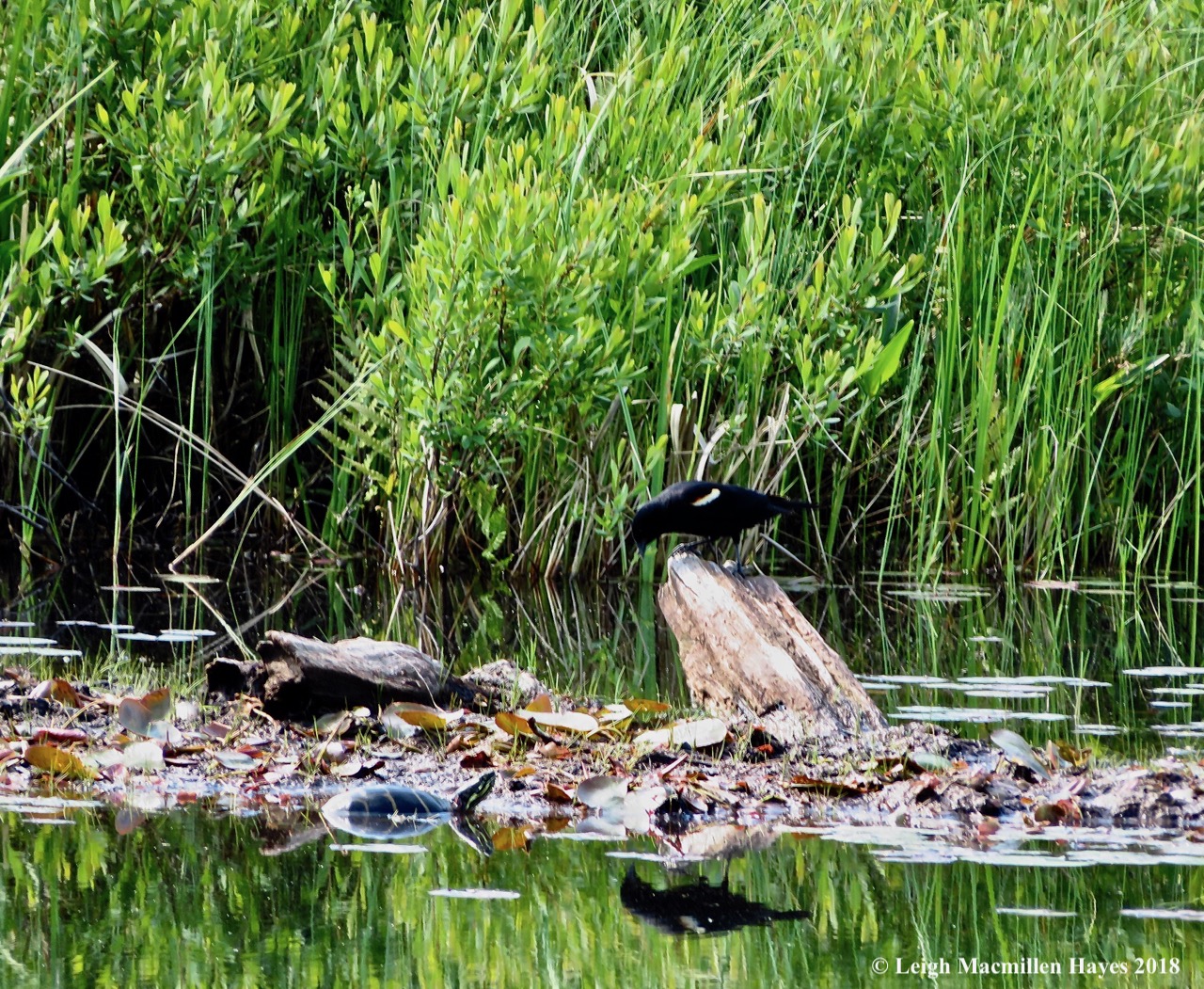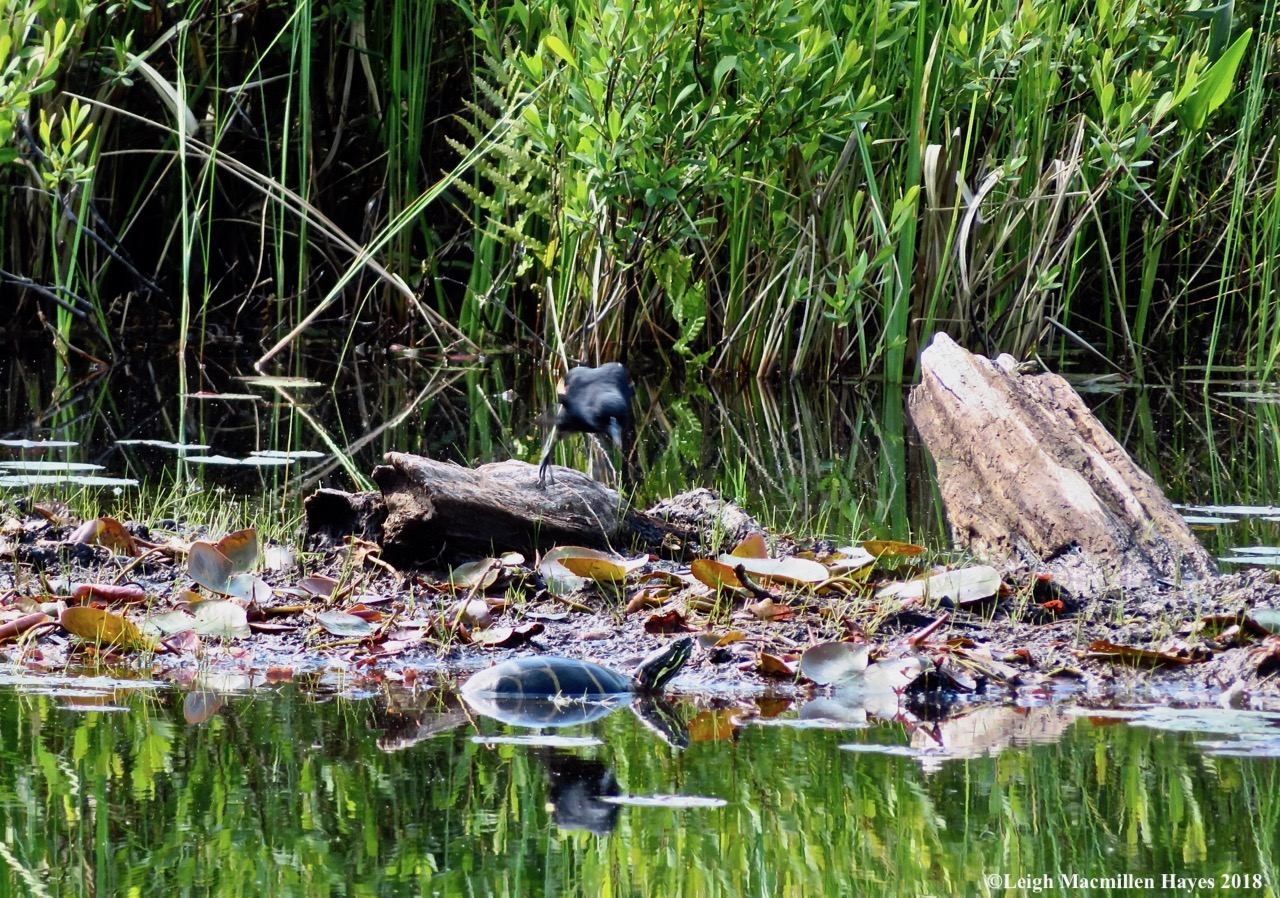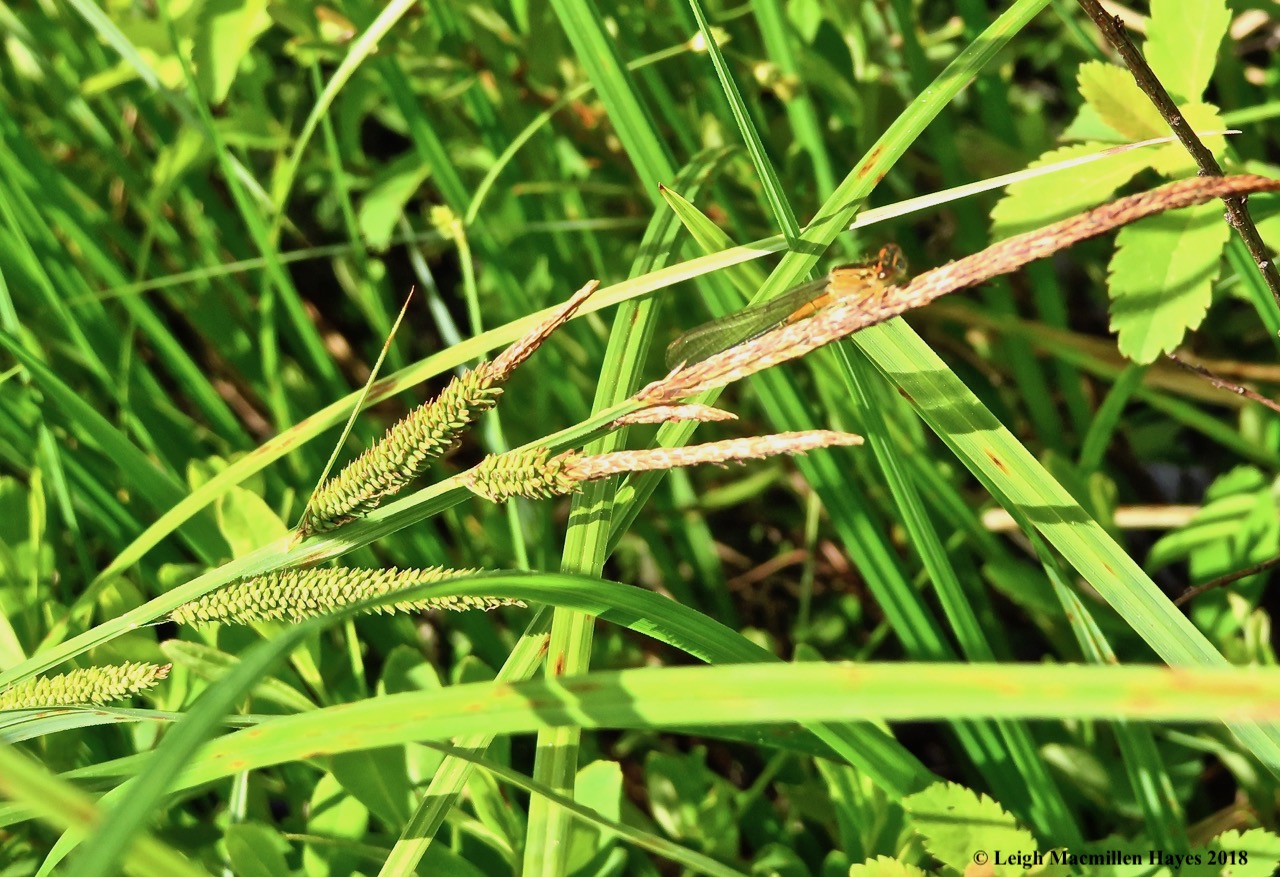
Cinco de Mayo Maine-style

When Pam asked at the end of our slow tour today what my favorite finds were, I named at least five.

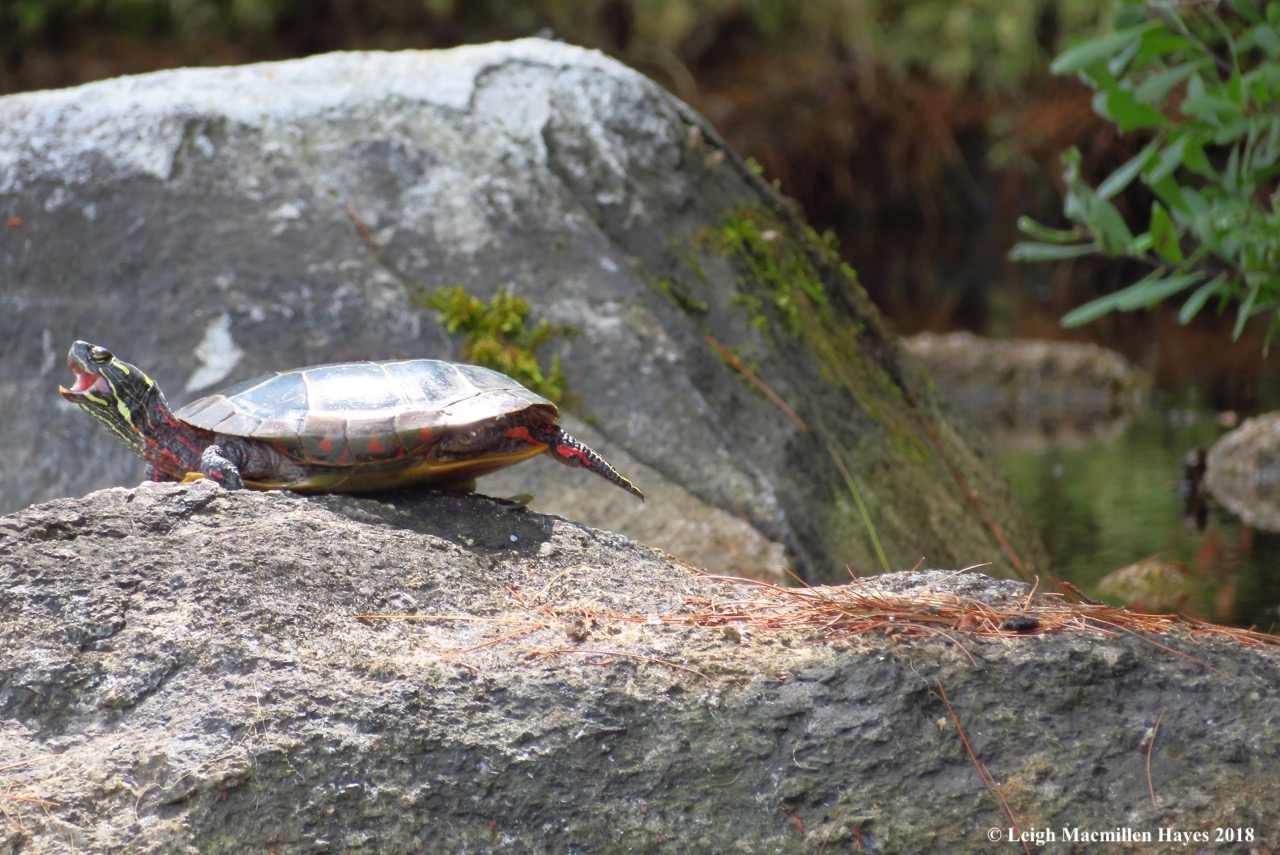
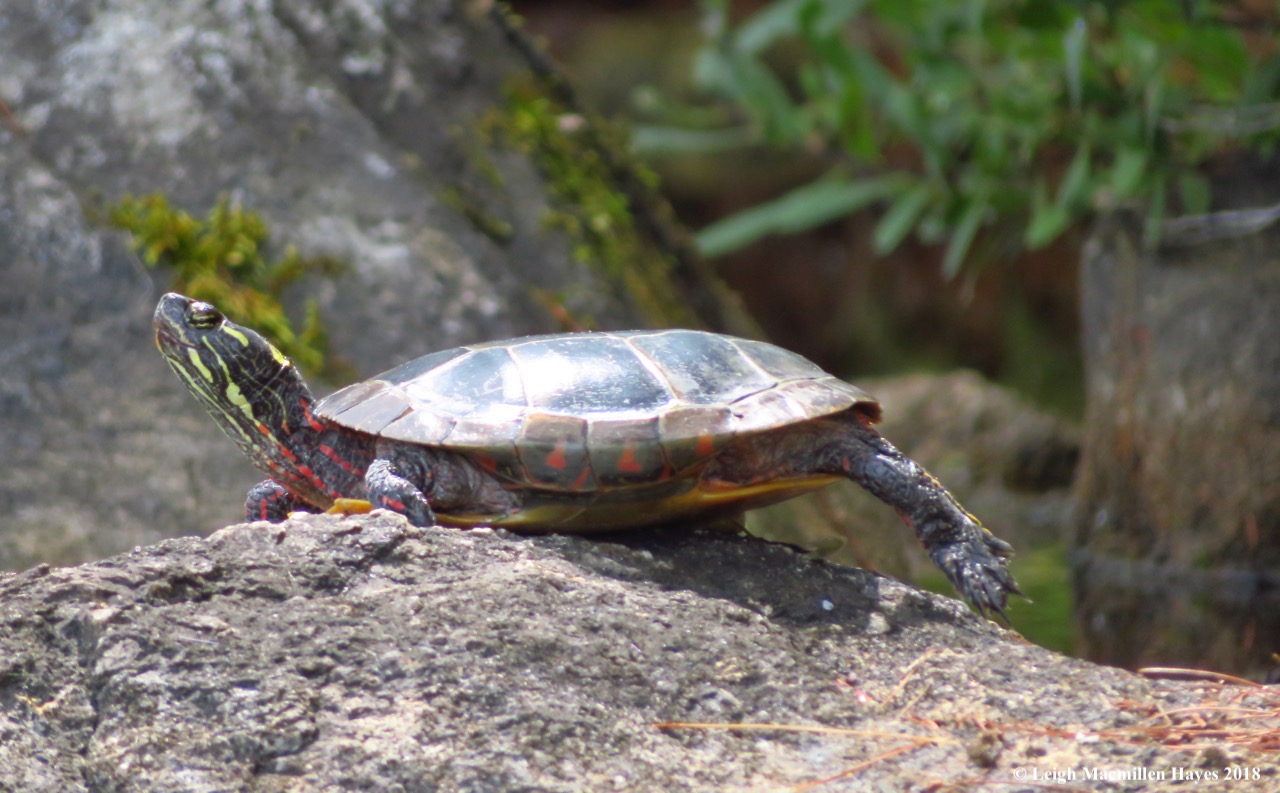
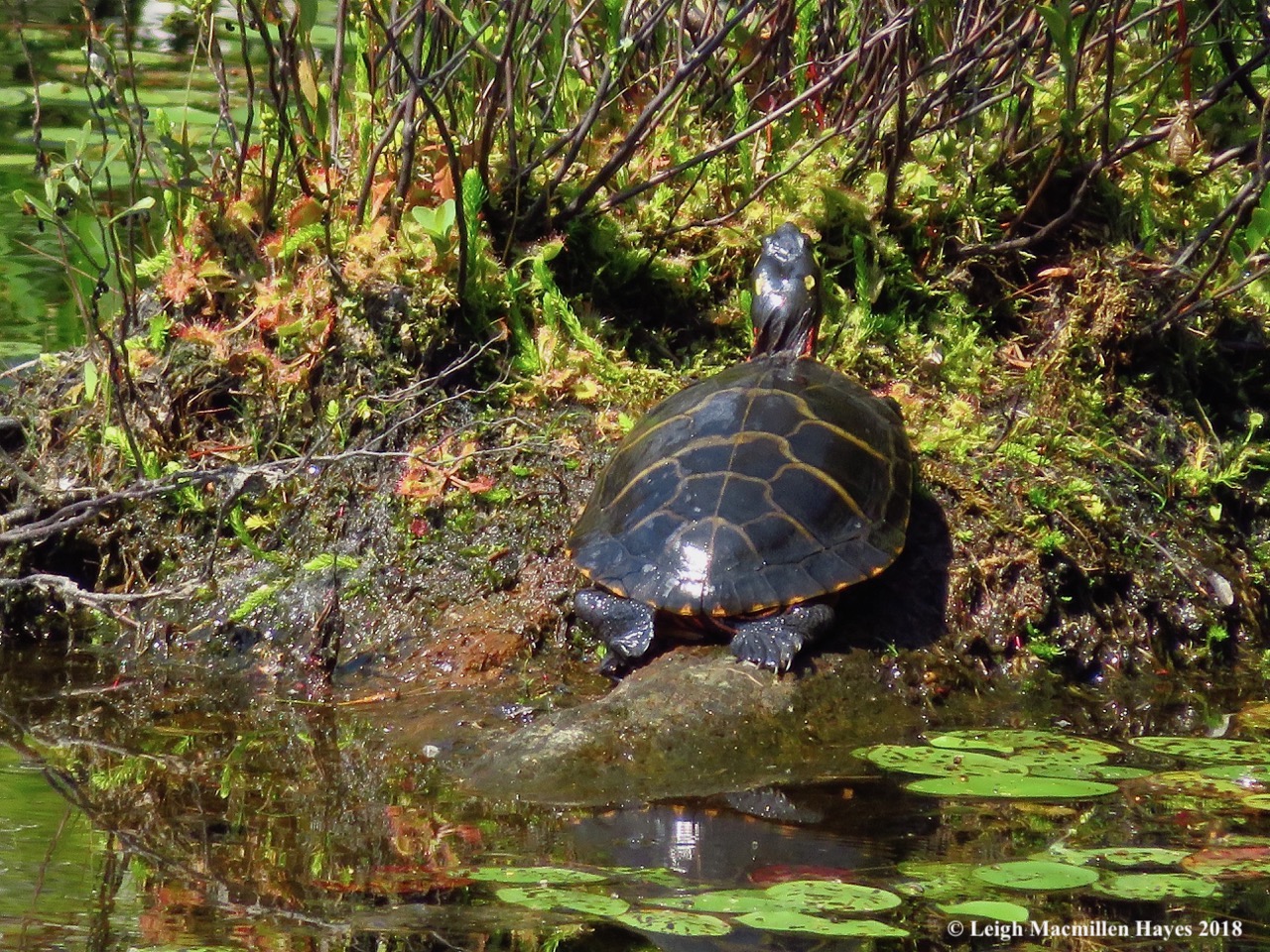
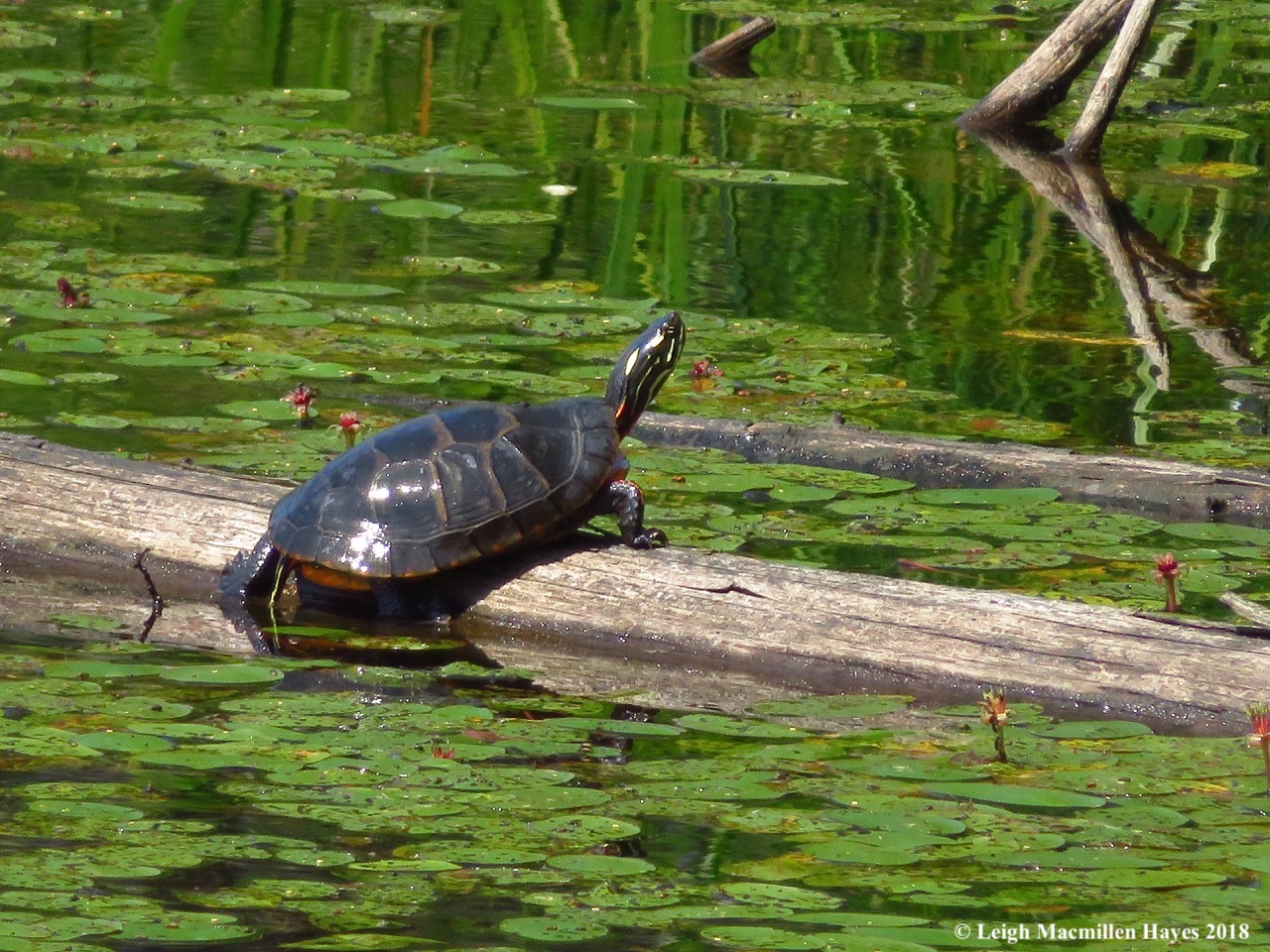
First, there was the Painted Turtle that I spotted on Kezar Lake Road as I drove toward the Greater Lovell Land Trust’s Long Meadow Brook Reserve. After I pulled over and approached him, he did what turtles do and retreated into his shell. Though he wasn’t feeling it, I was in celebration mode, for he represented my first turtle of the season. And I helped him cross the road.
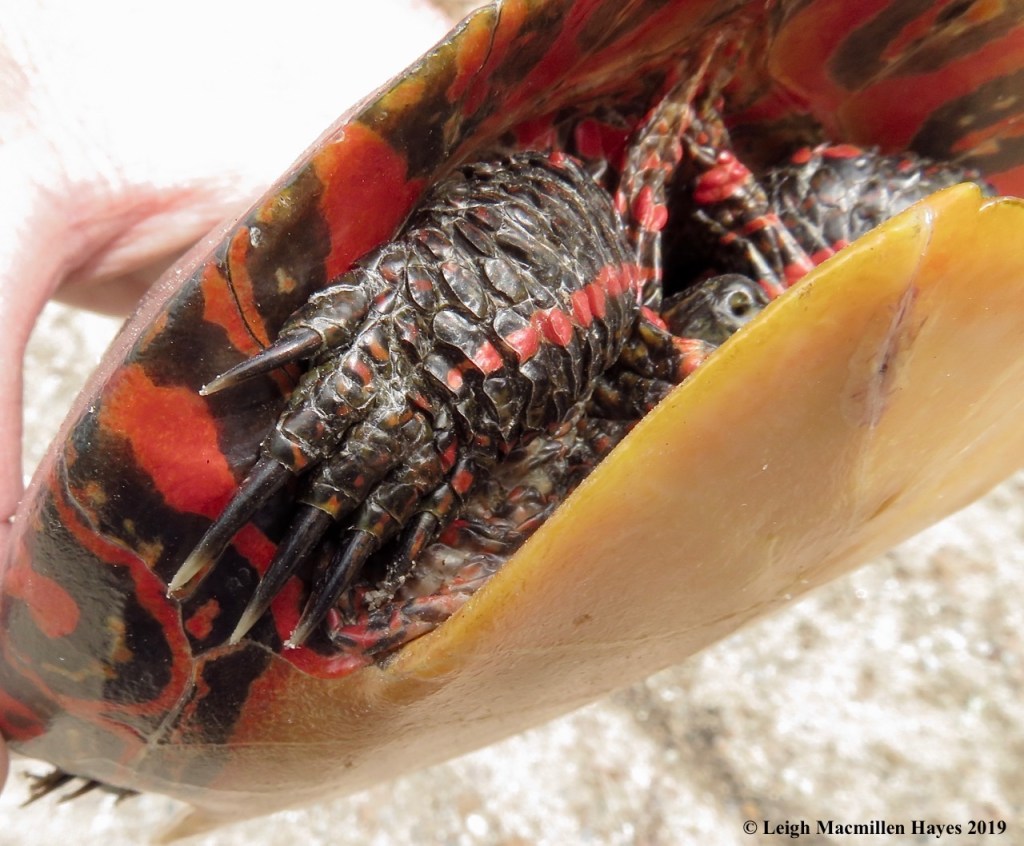
I felt safe calling him a he for males have long fingernails. Can you see him peeking out at me in a not too pleased manner? Can’t say I blame him, but our time together was brief and soon he wandered his way while I wandered mine.

And then, another reason for celebration–Coltsfoot in bloom. I know it’s invasive, but its sunny face and scaly purplish stem that predate its leaves offer a first hint of the season’s promises of colors to come.

Coltsfoot is known by some as Filius ante patrem (the son before the father), because the bright yellow star-like flowers appear and wither before its broad, green leaves are produced.

The next sight to be considered: a small spider that, like the painted turtle, continuously eluded our focus by quickly moving to the opposite side of the beech twig. Can you spy it?

And then there were those tree buds bursting forth with life ready to unfold from within. We were offered a few early glimpses of the future and rejoiced at each sample.
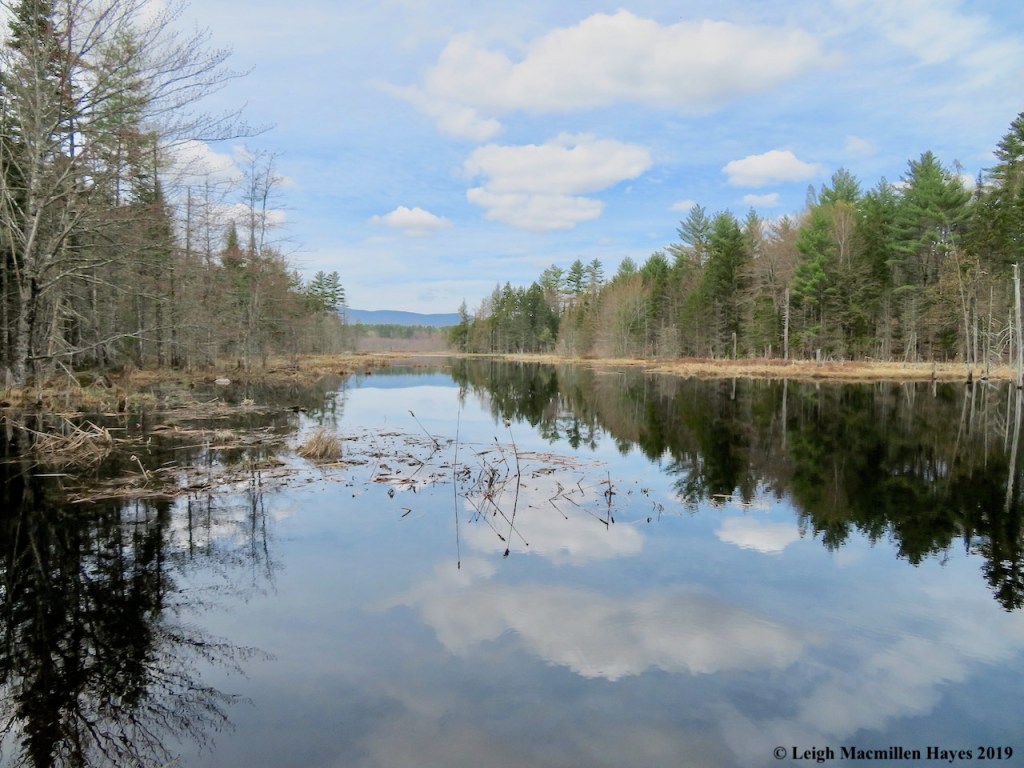
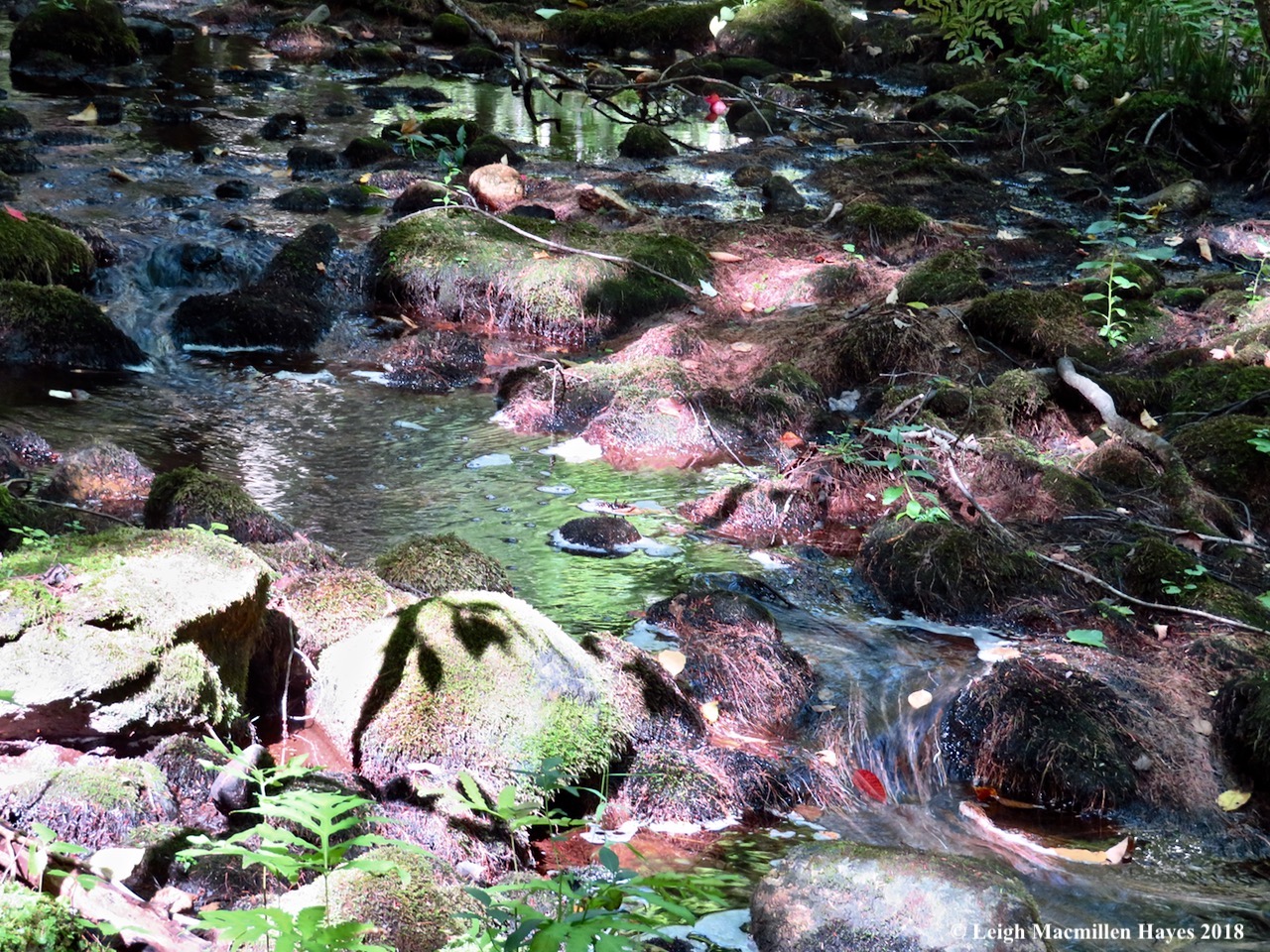
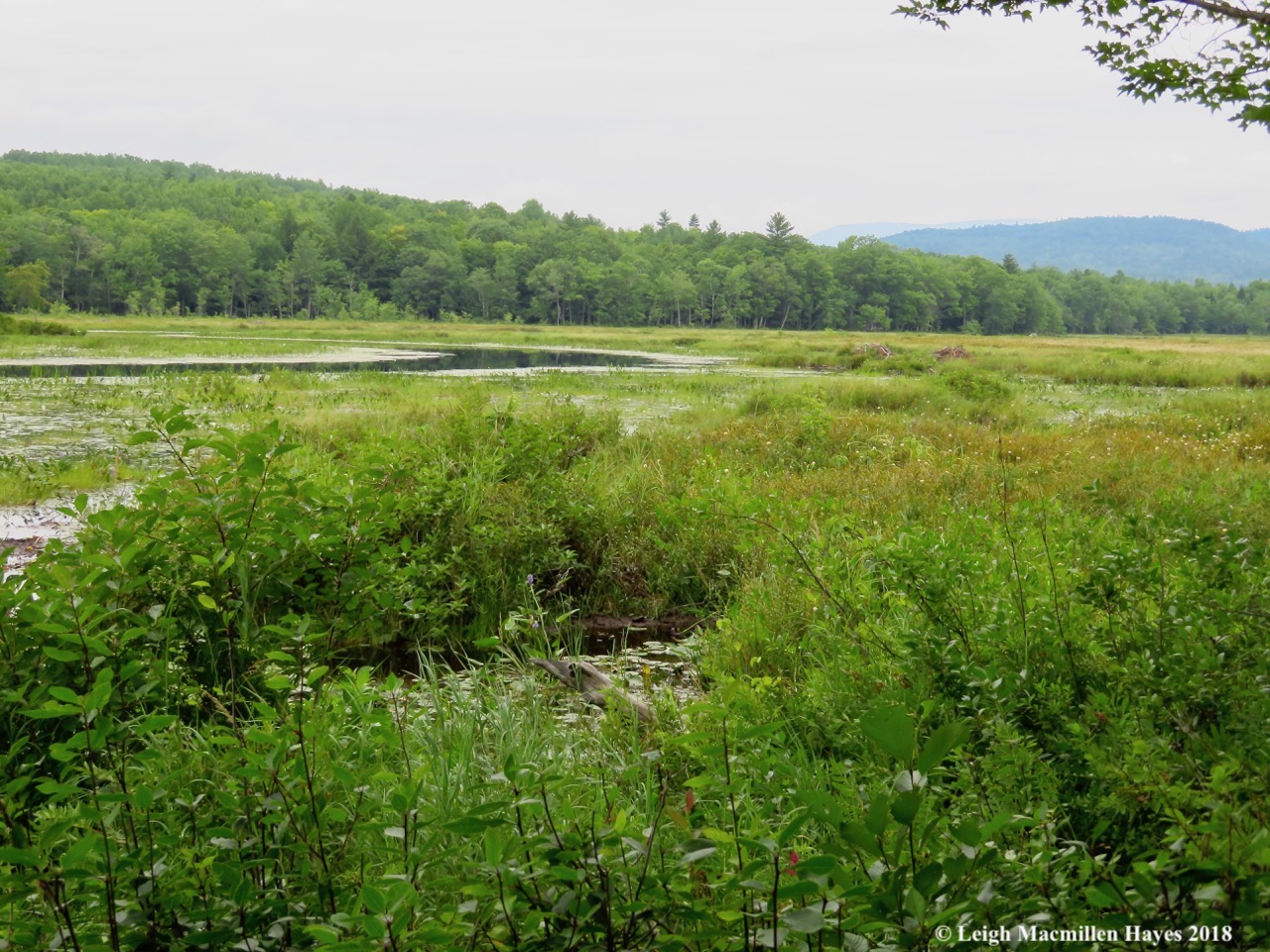
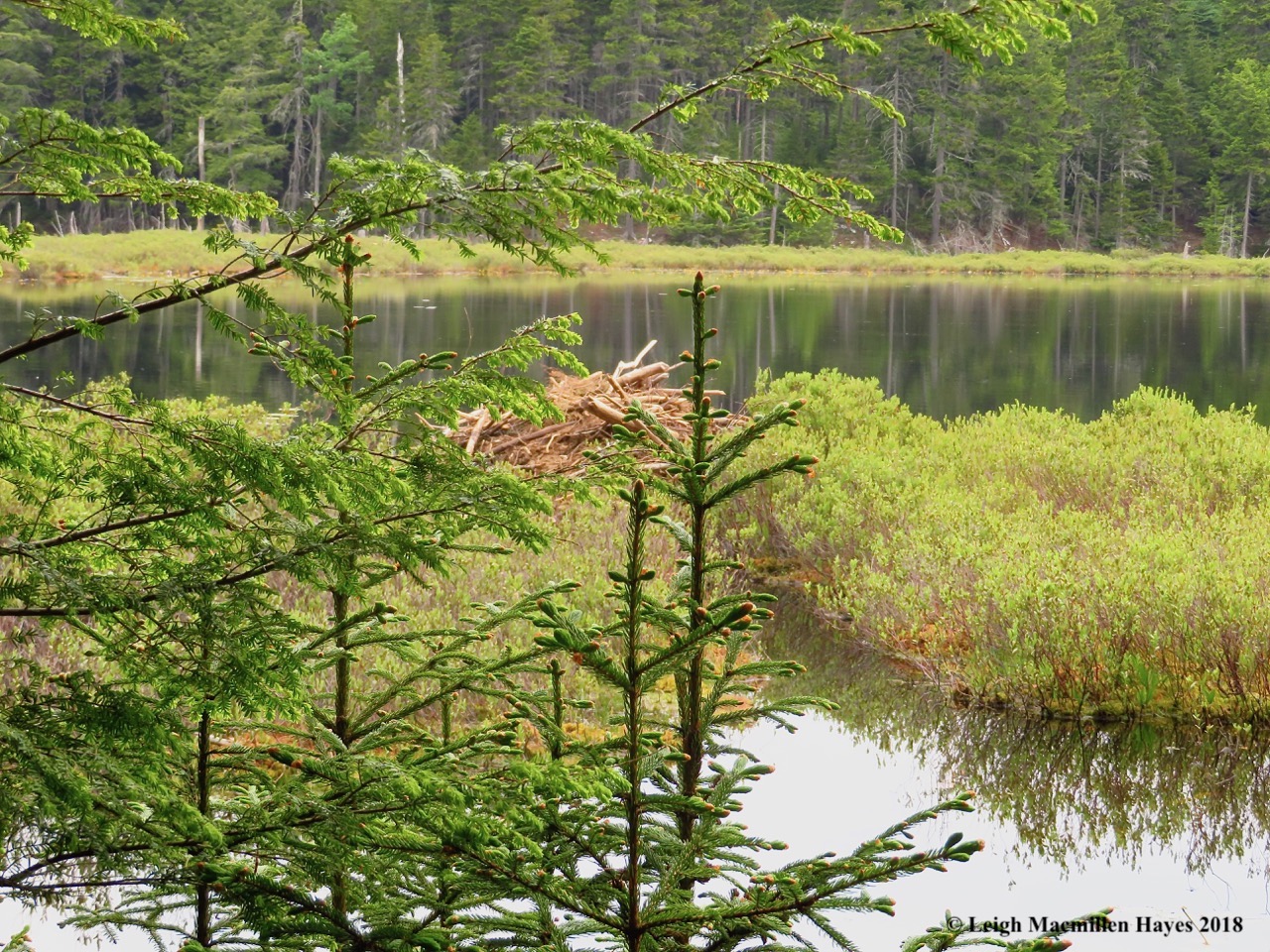
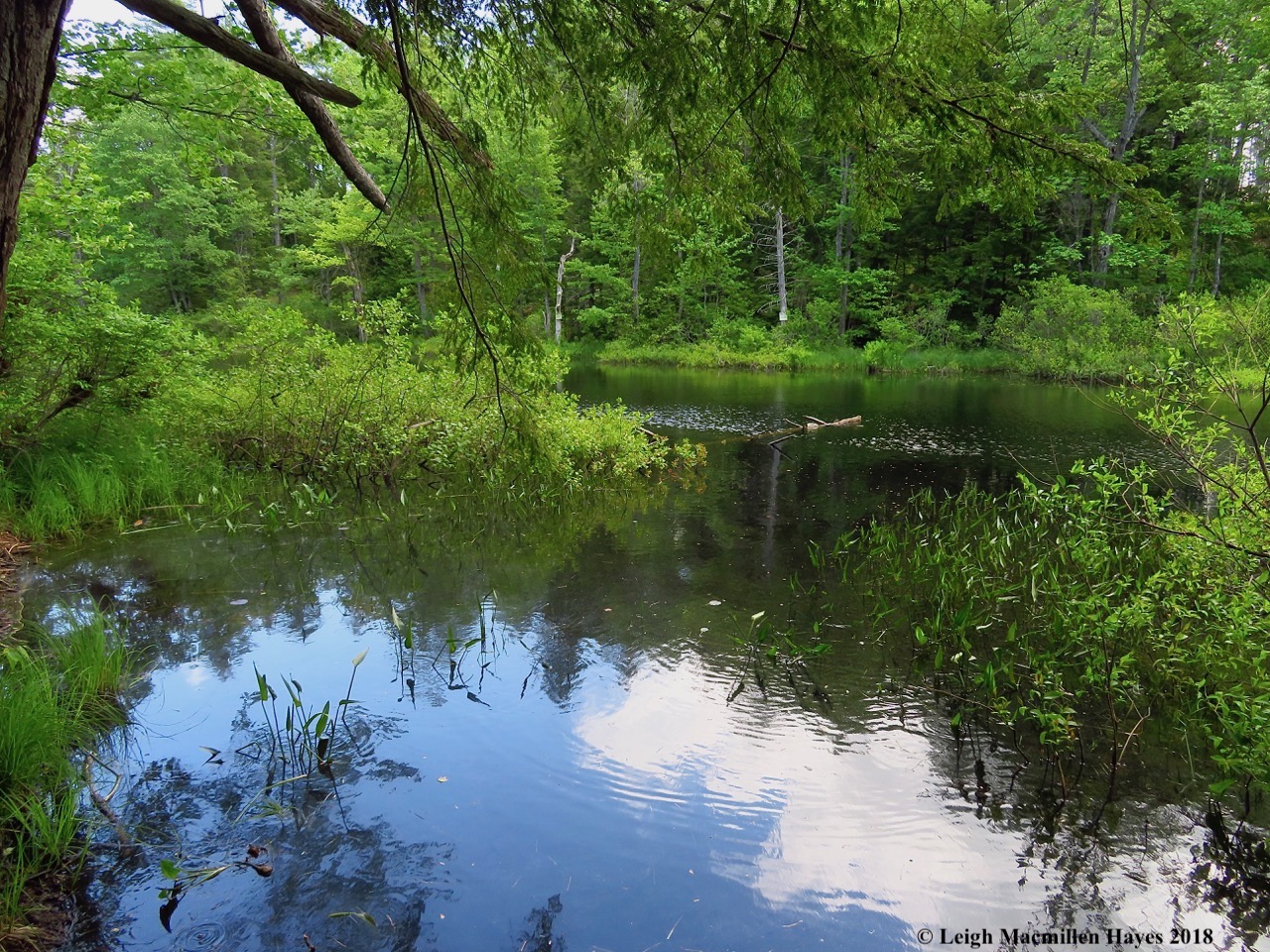
At last we reached Long Meadow Brook, for which the reserve is named. And stood and looked and listened and waited and absorbed. Oh, Pam absorbed some water in her boots thanks to a leak. But she didn’t let that stop her and we each enjoyed the opportunity to let this place soak through our pores for moments that turned into a string of minutes and suddenly an hour had passed.

At long last, we pulled away and began a bushwhack through the woods beside the brook.

In so doing, we found more to celebrate, like a red squirrel refectory upon a rock and we suspected a large hole below the tree trunk and boulder had served as the larder.

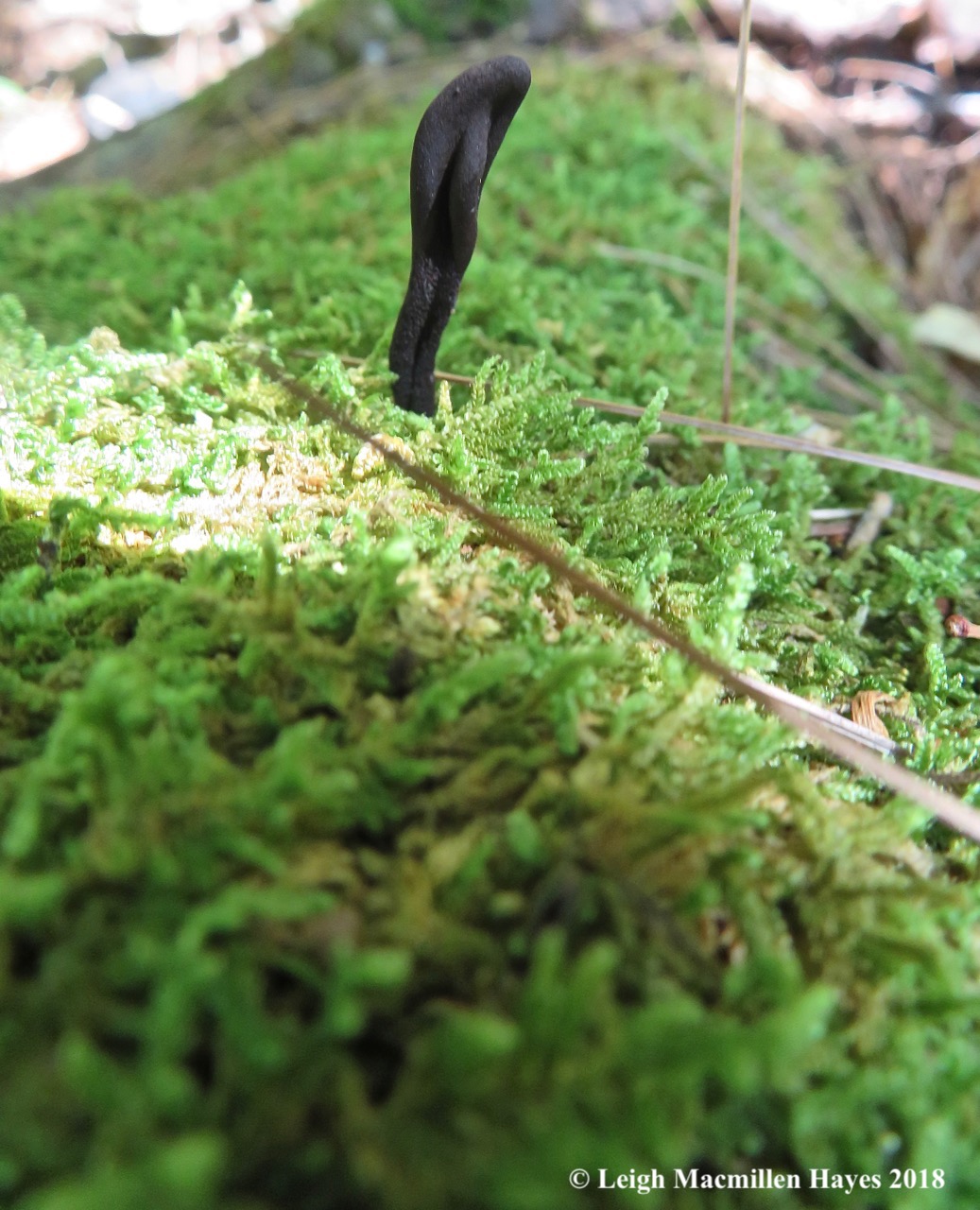
Continuing on, we saw mats of black upon moss by another tree and almost wrote it off as perhaps a fungi we hadn’t met before.

But. It. Moved. As we watched, we realized the constant motion was created by springtails writhing en masse. To say it wasn’t creepy would be lying. Likewise we were fascinated and leaned in closer to watch the swarm upon the moss.
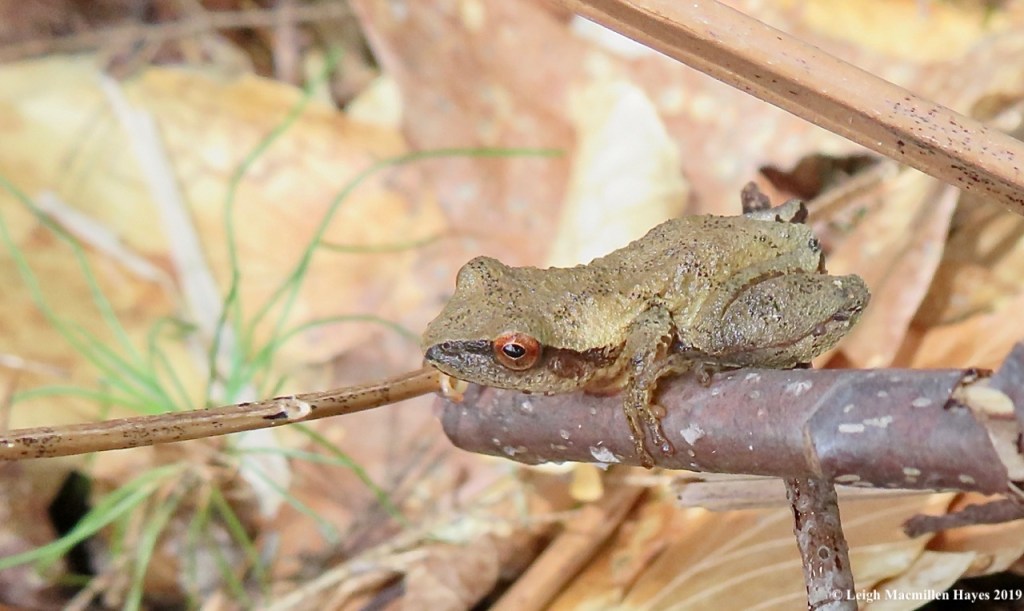
Resting nearby, perhaps having just gorged on some of those tiny little morsels, was another reason for celebration–a spring peeper. We spotted two, but heard a hundred million more, each adding its song to the symphony that arose from the wetland. And suddenly, an interval of silence would interrupt the music, and then one male would peep, and the rest would join in again until they arrived at the next rest symbol upon their sheet music.

Others added their own notes to the orchestra, including a couple of White-throated Sparrows that trilled in our midst.
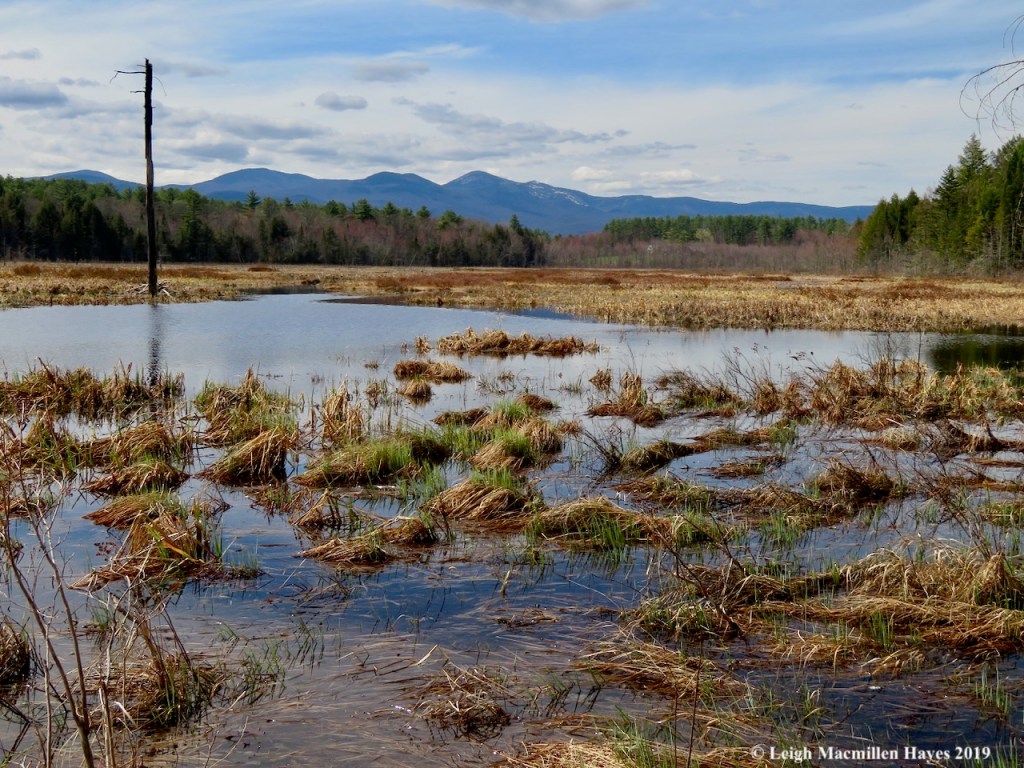
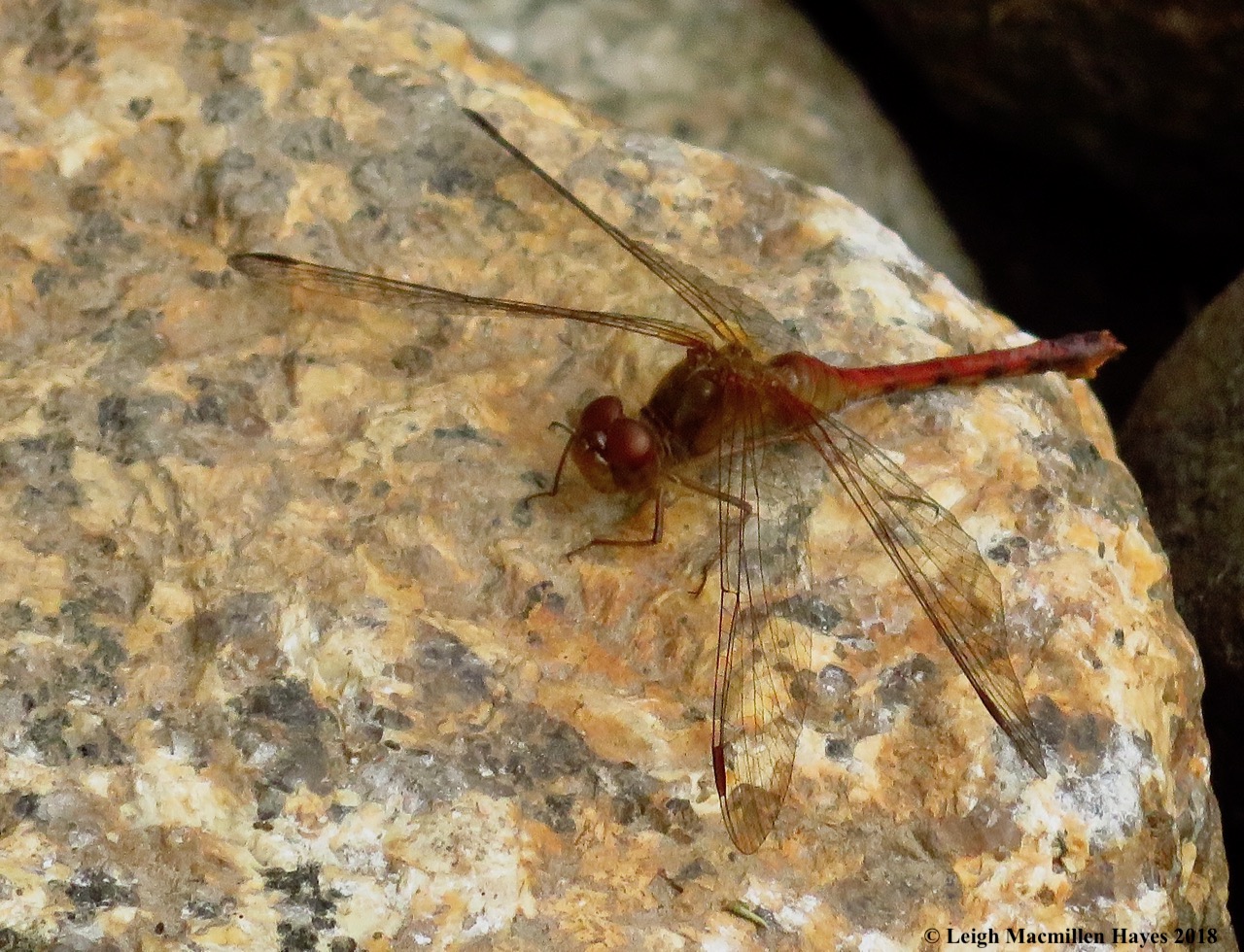
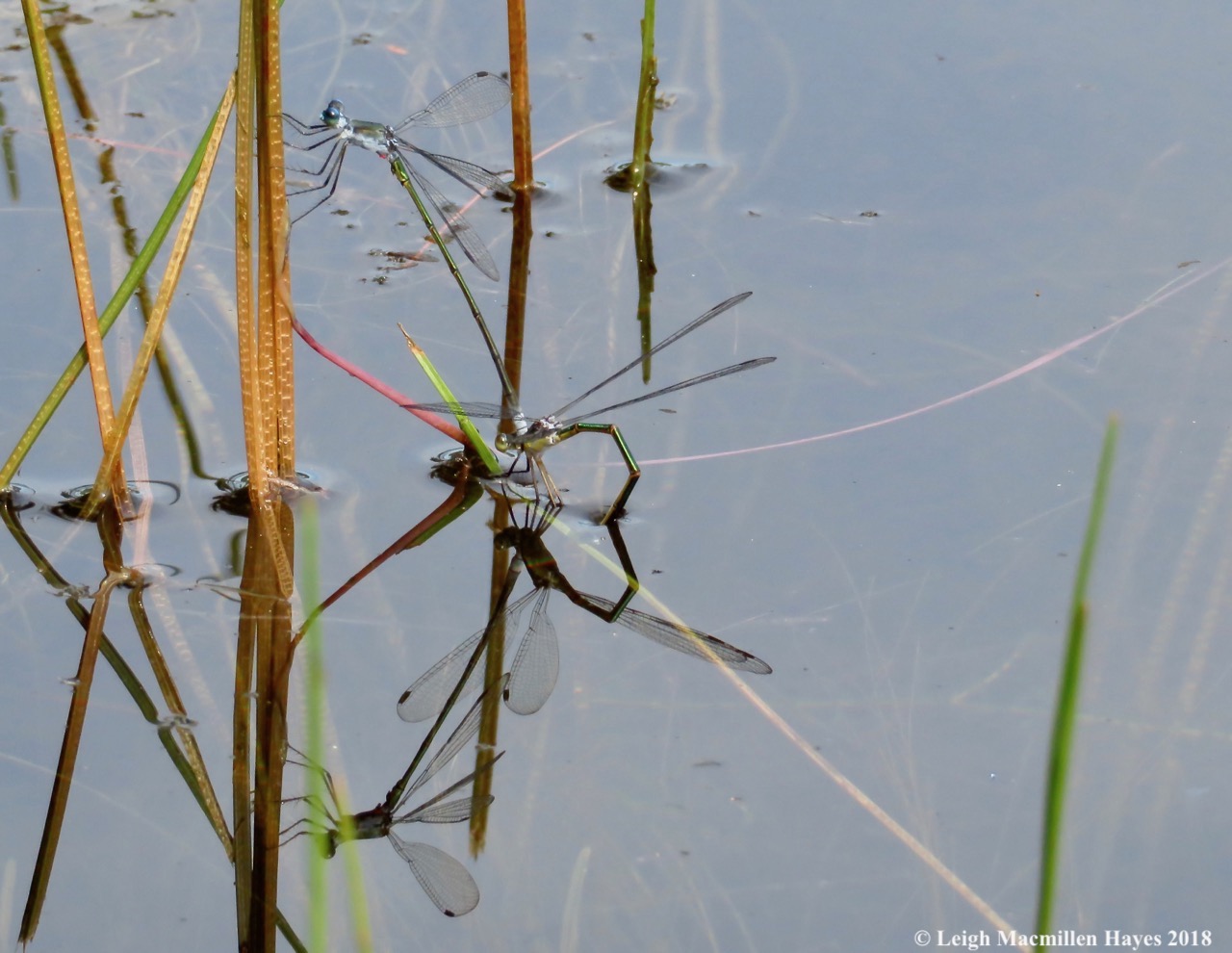
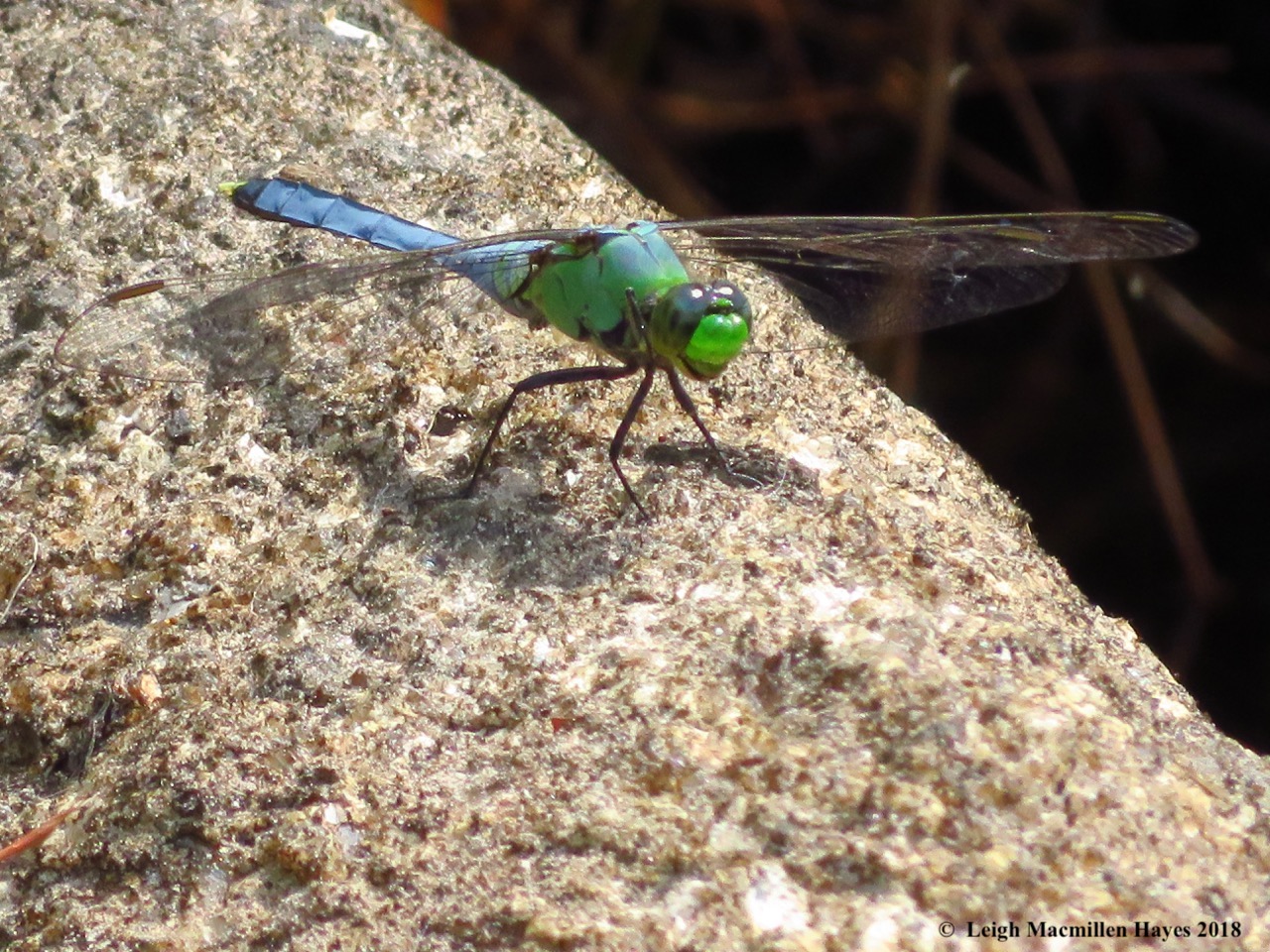
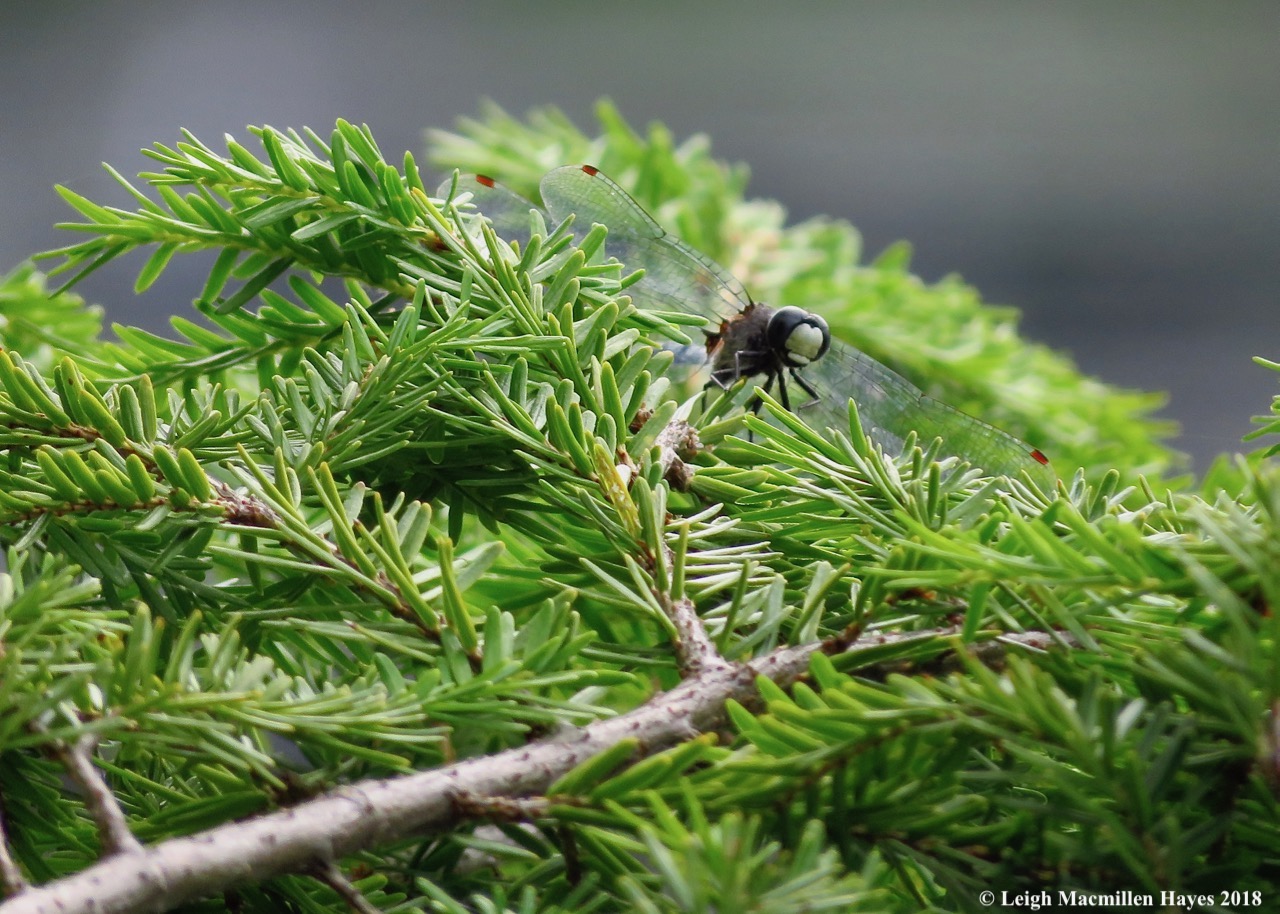
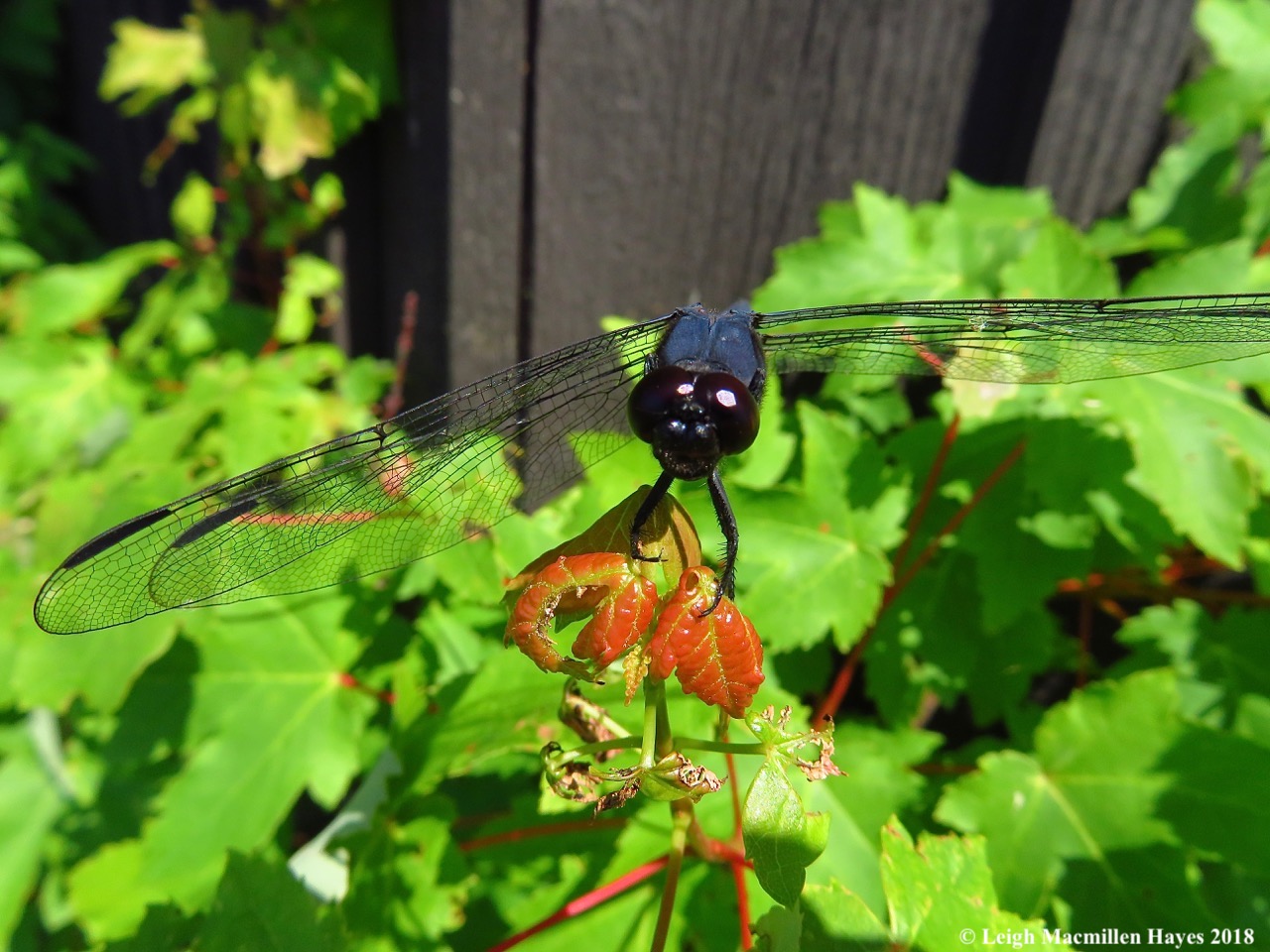
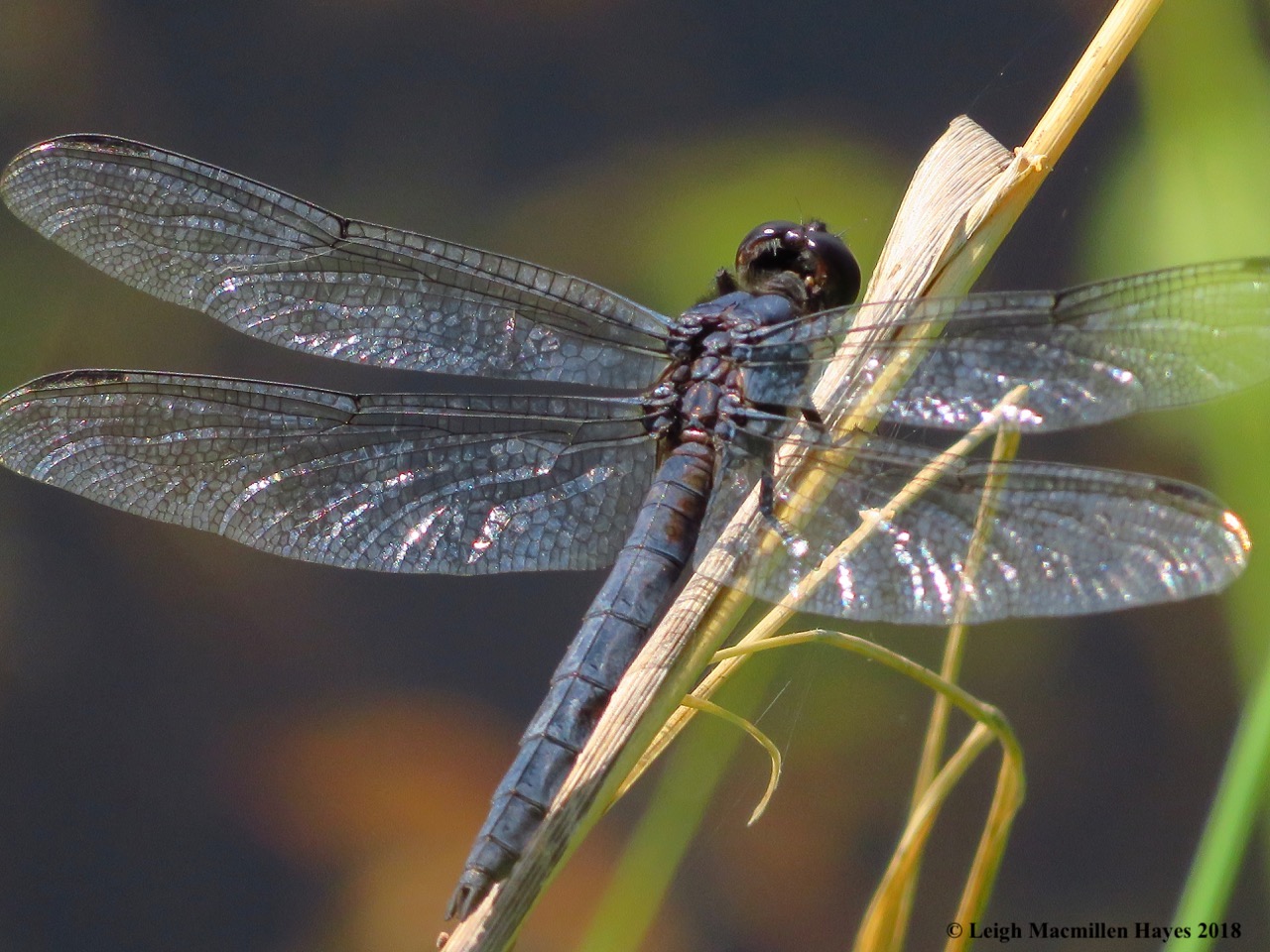
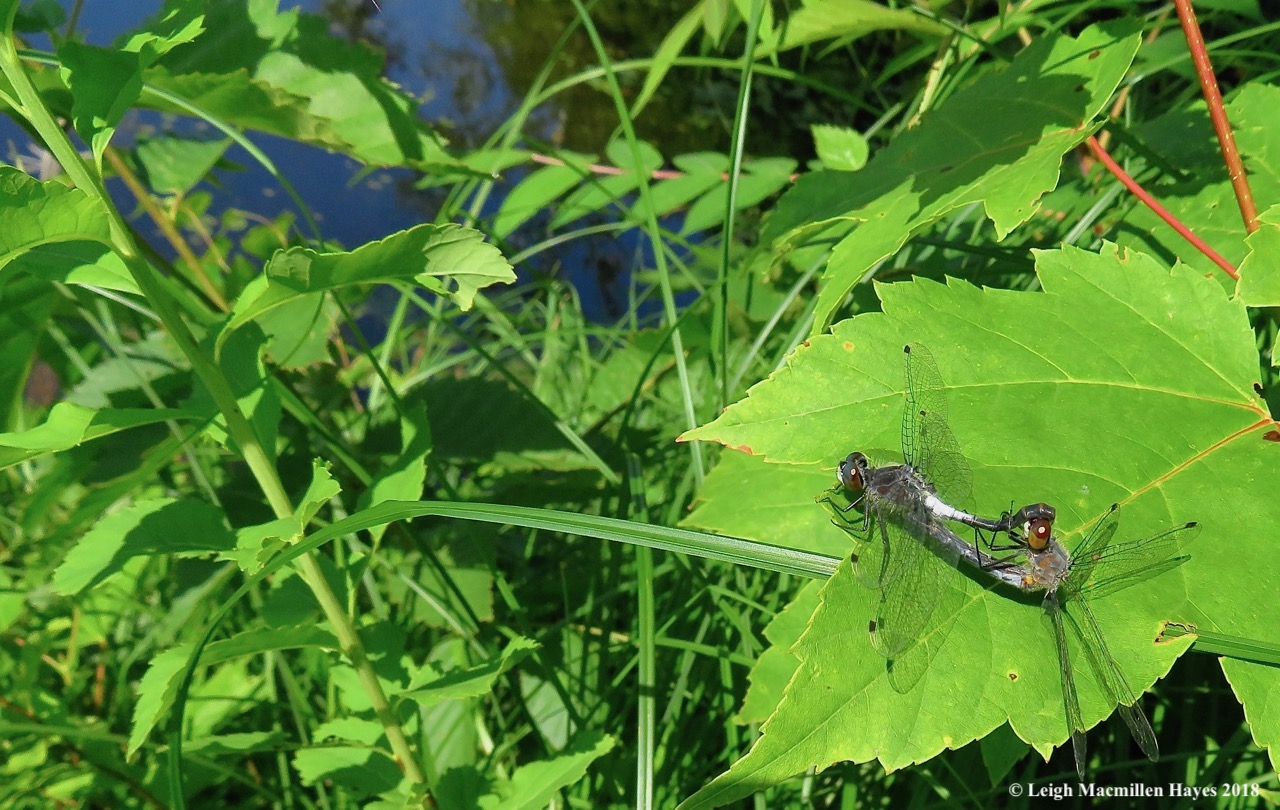
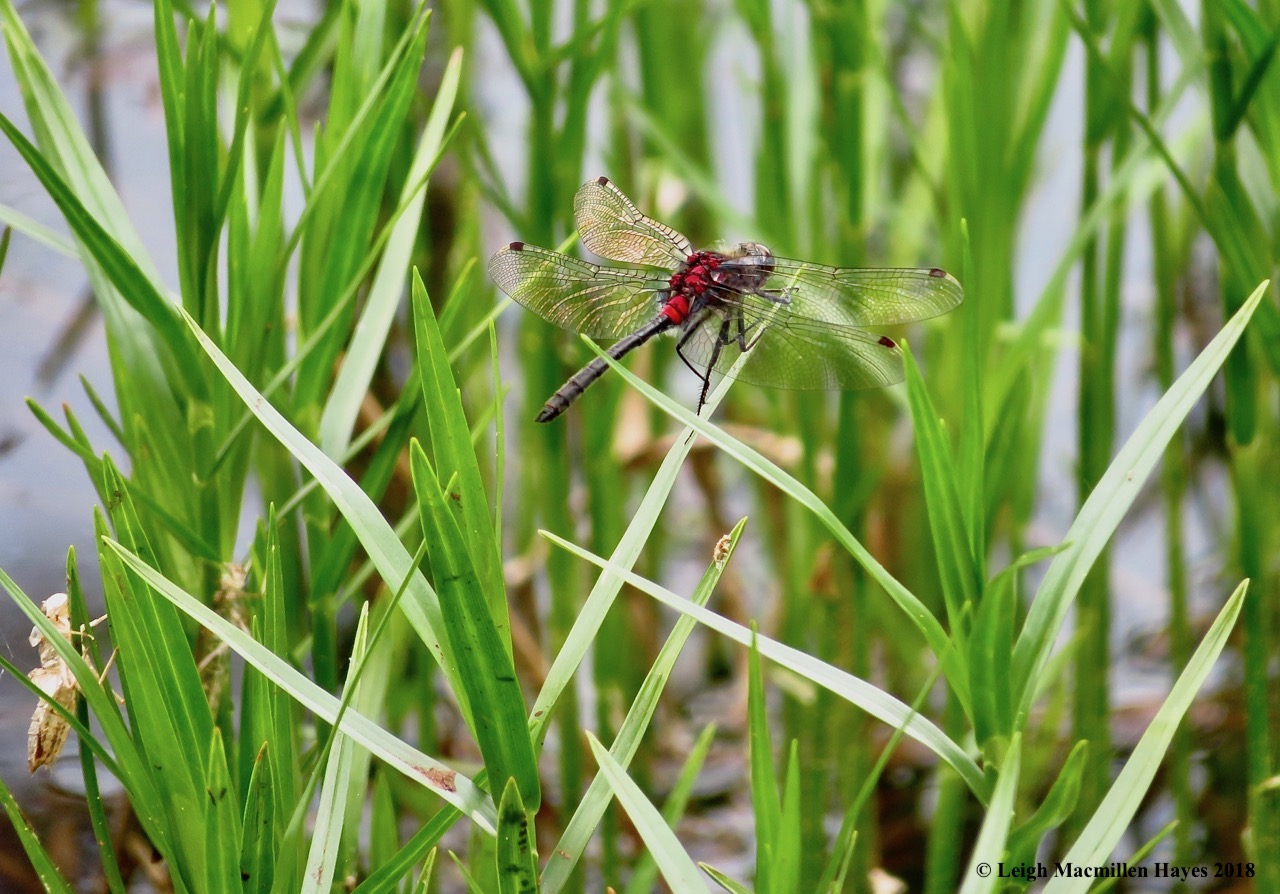
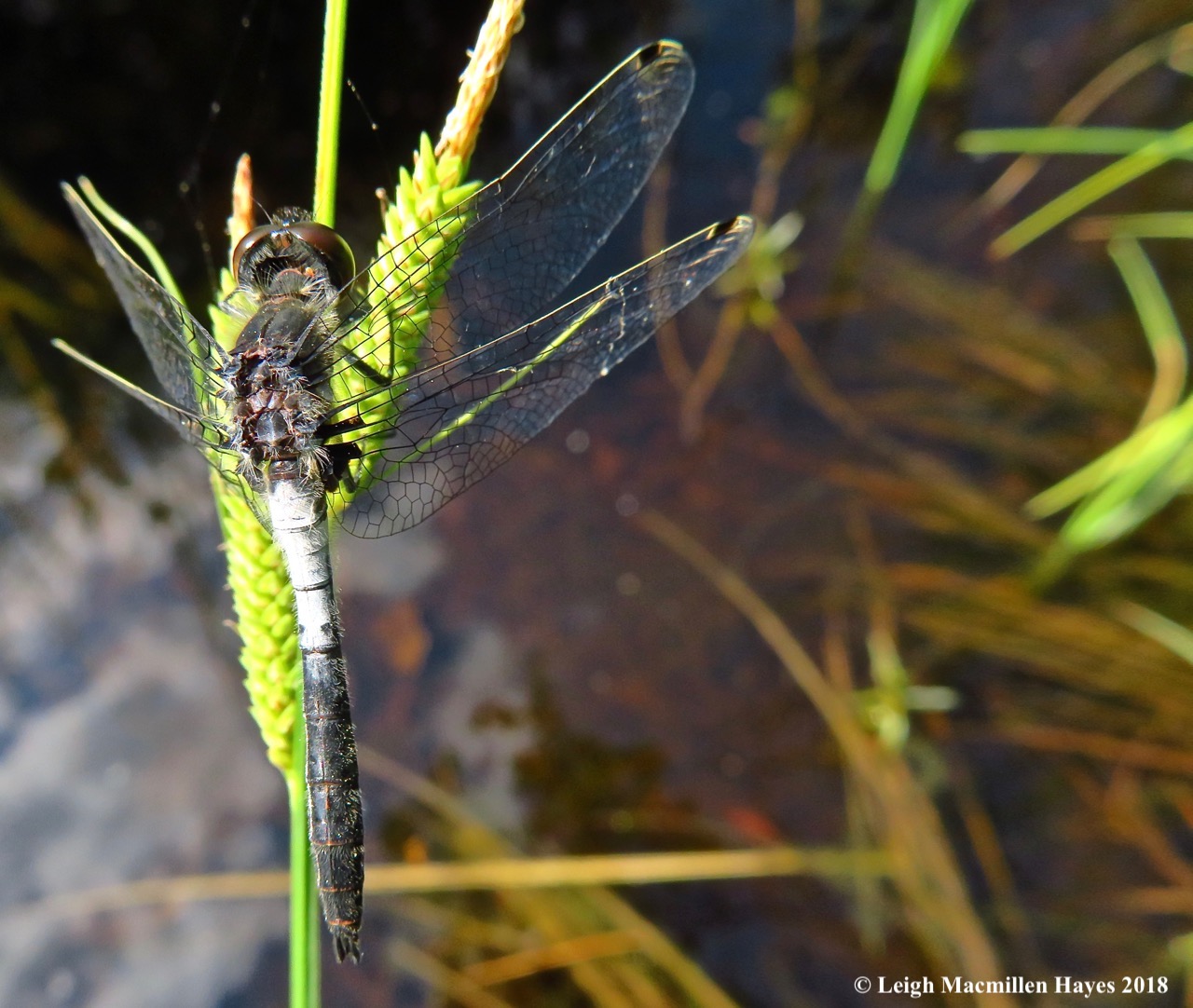
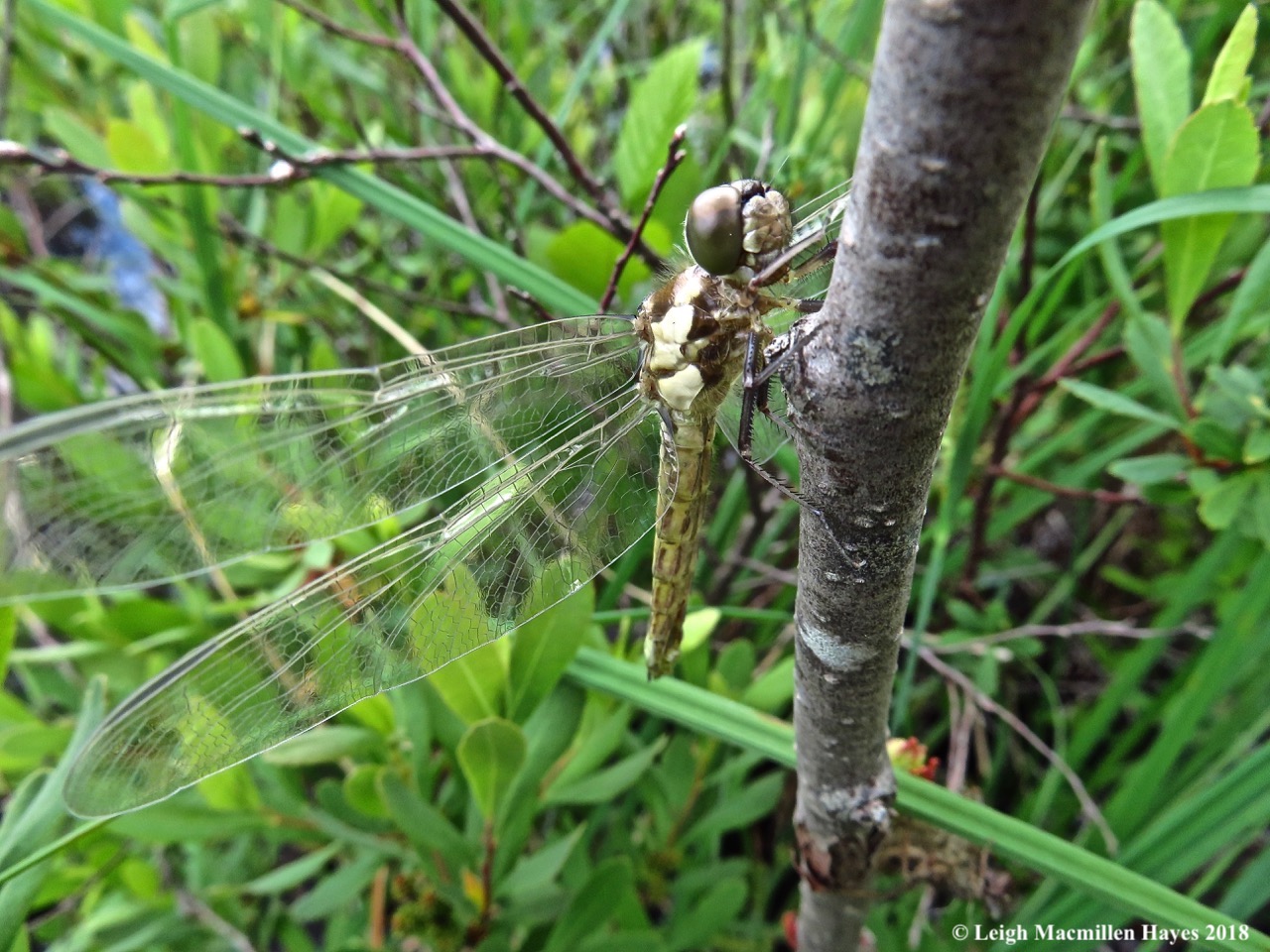
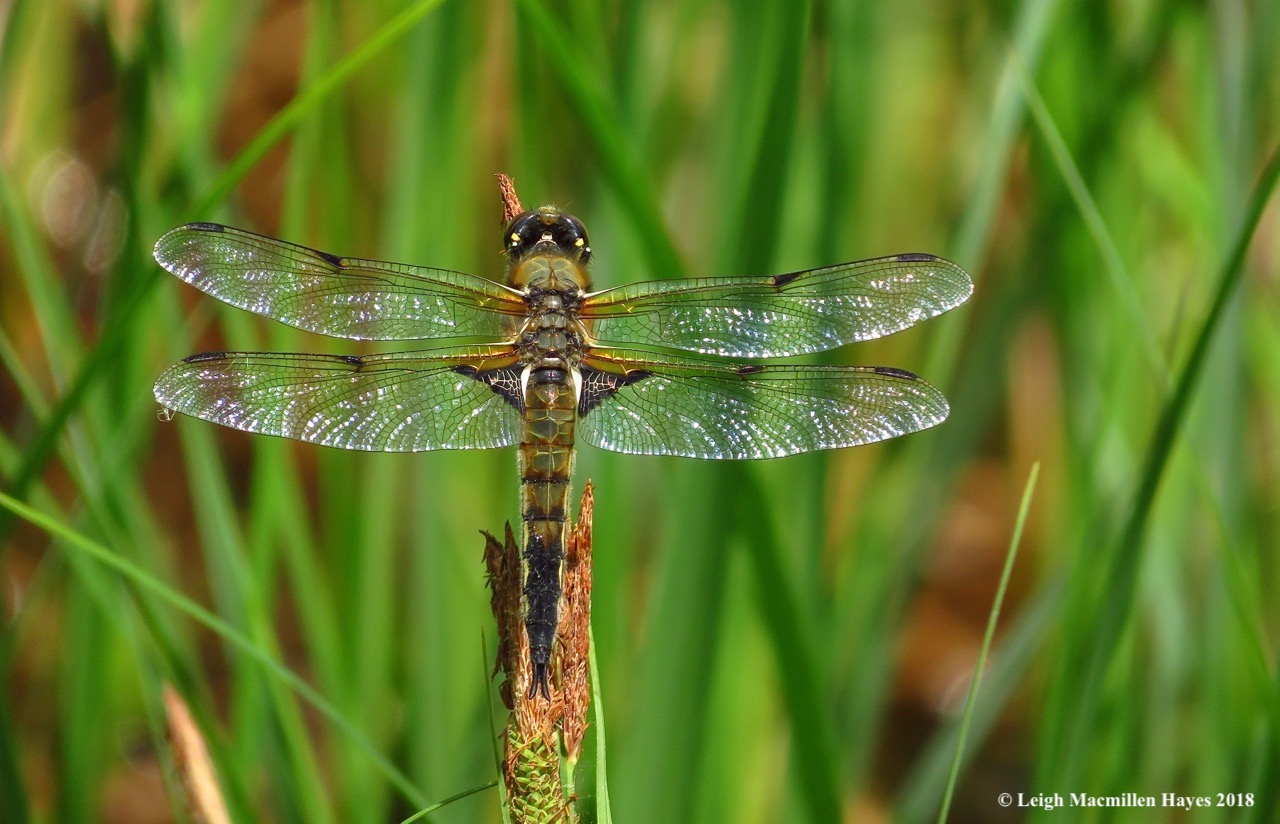
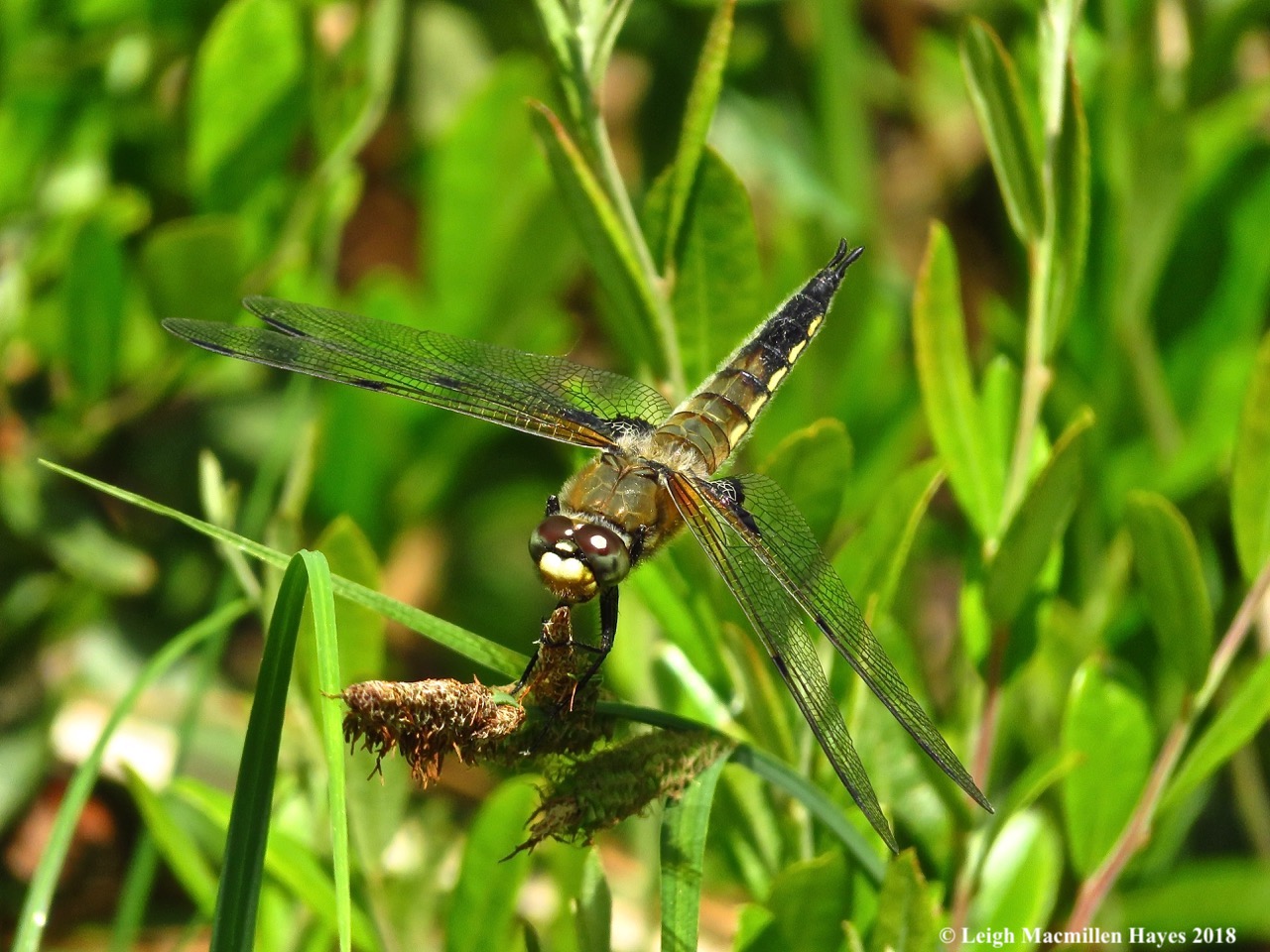
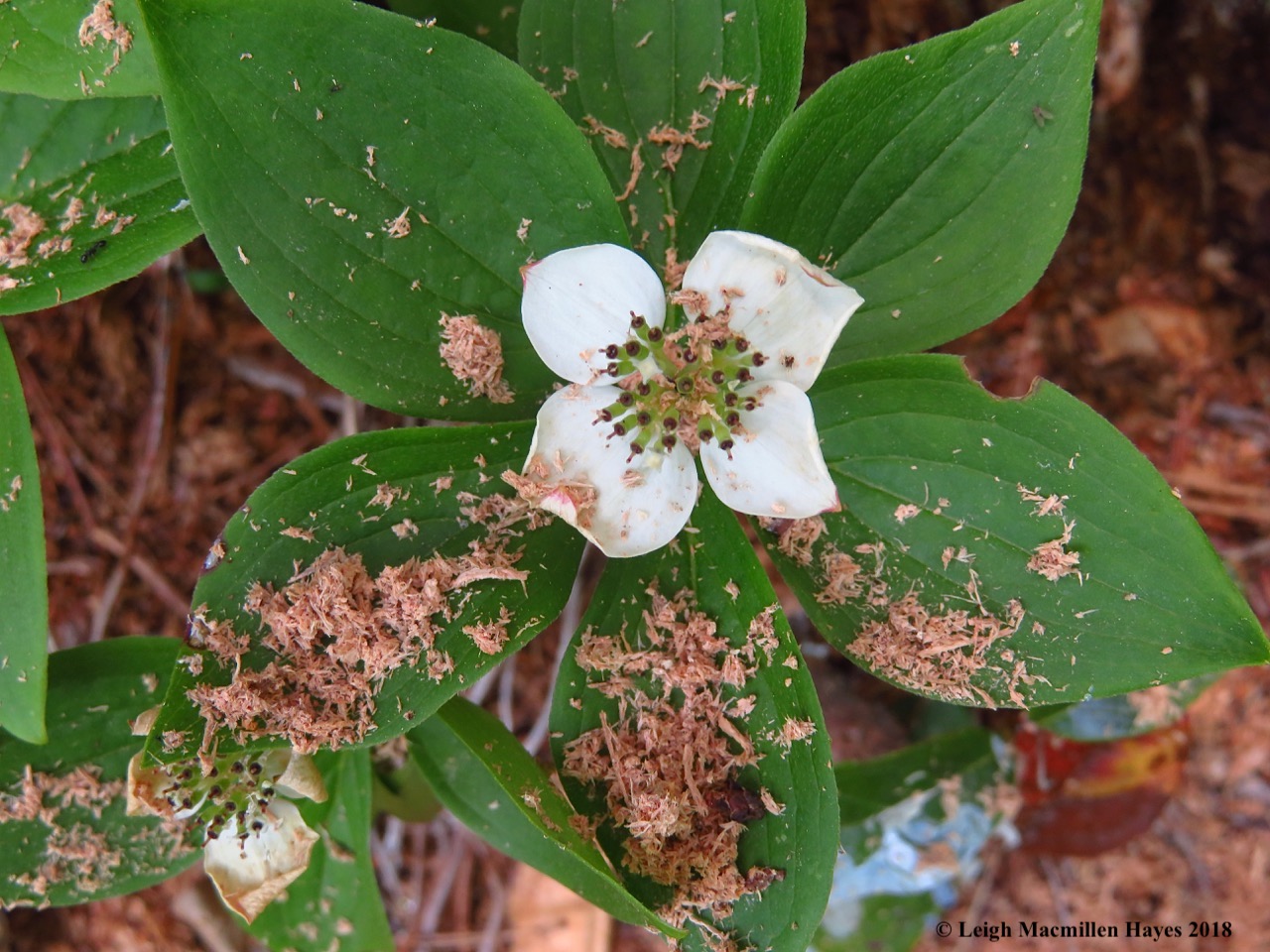
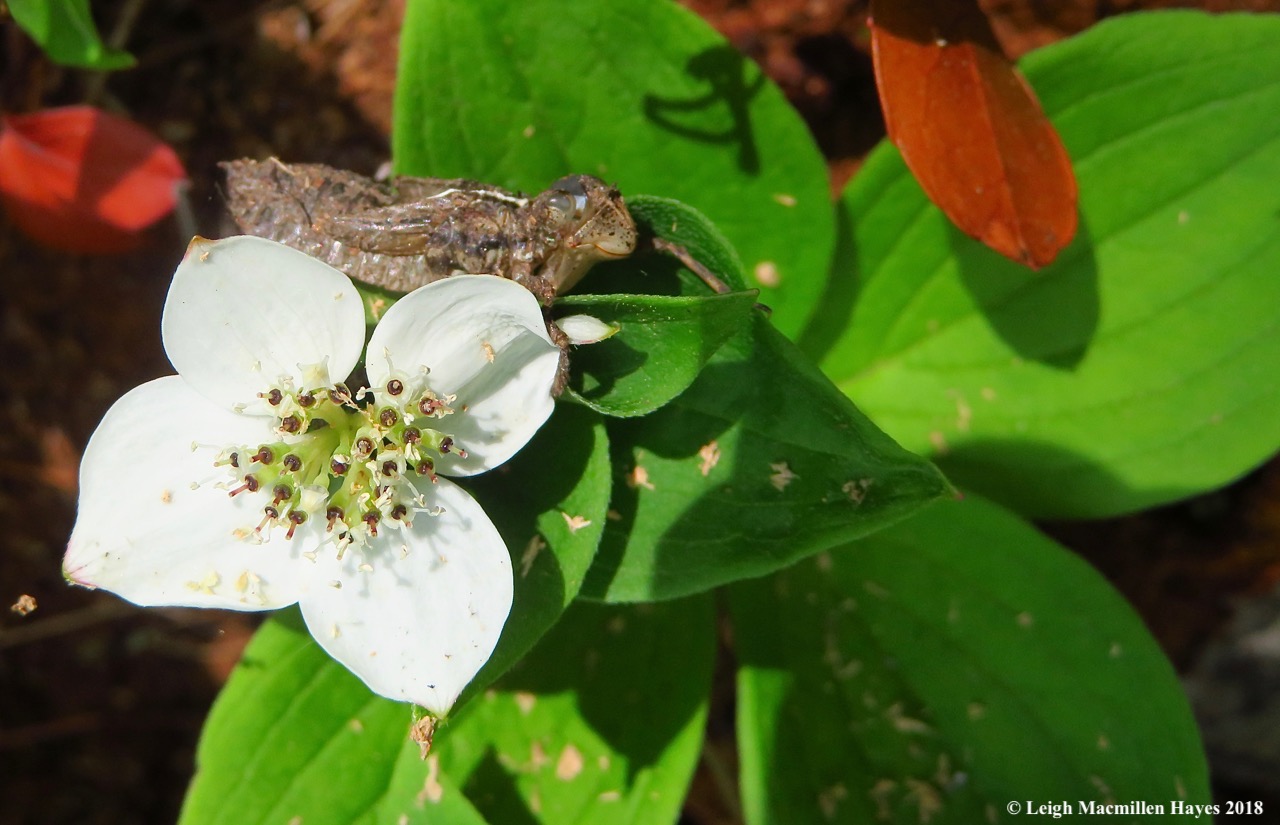
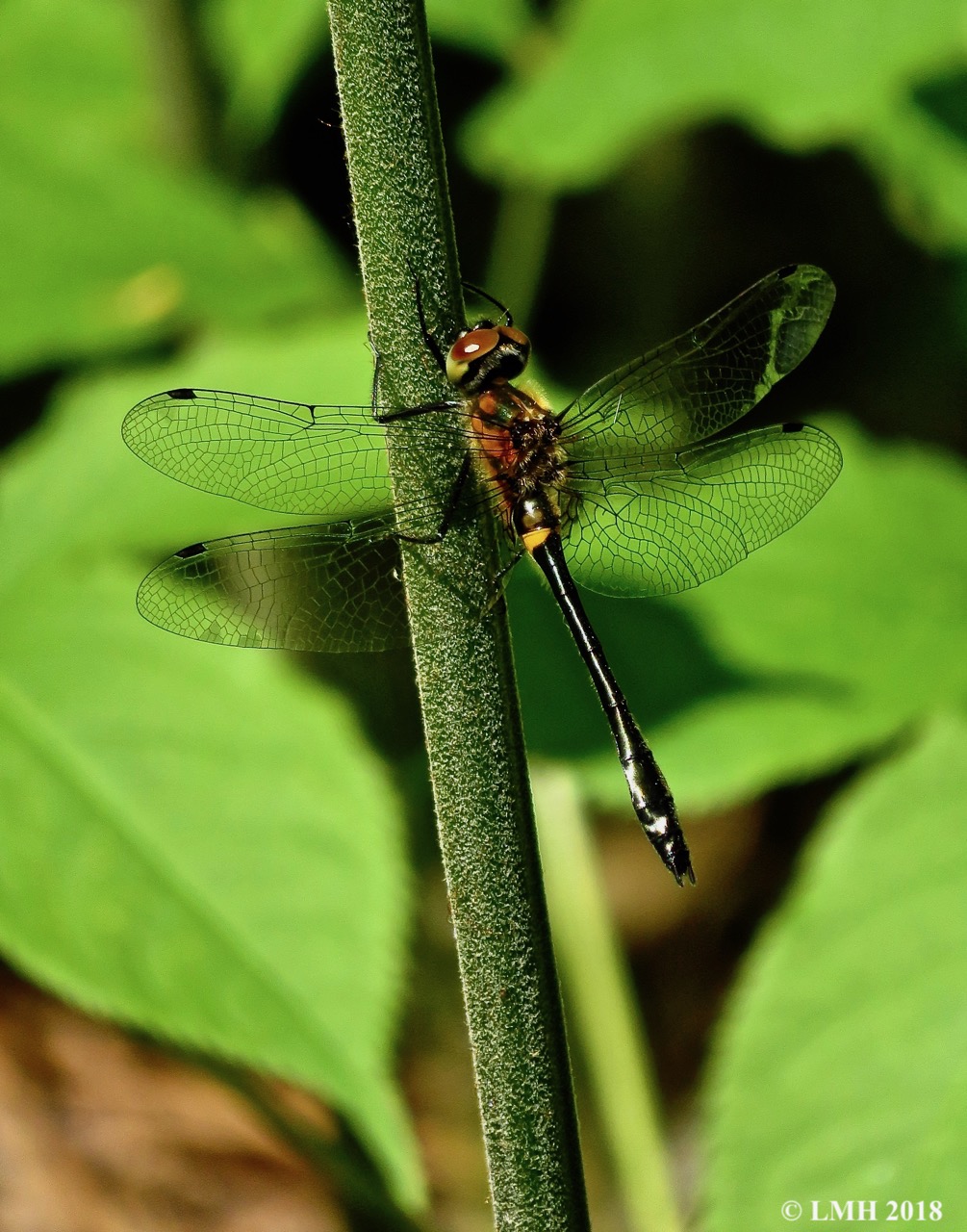
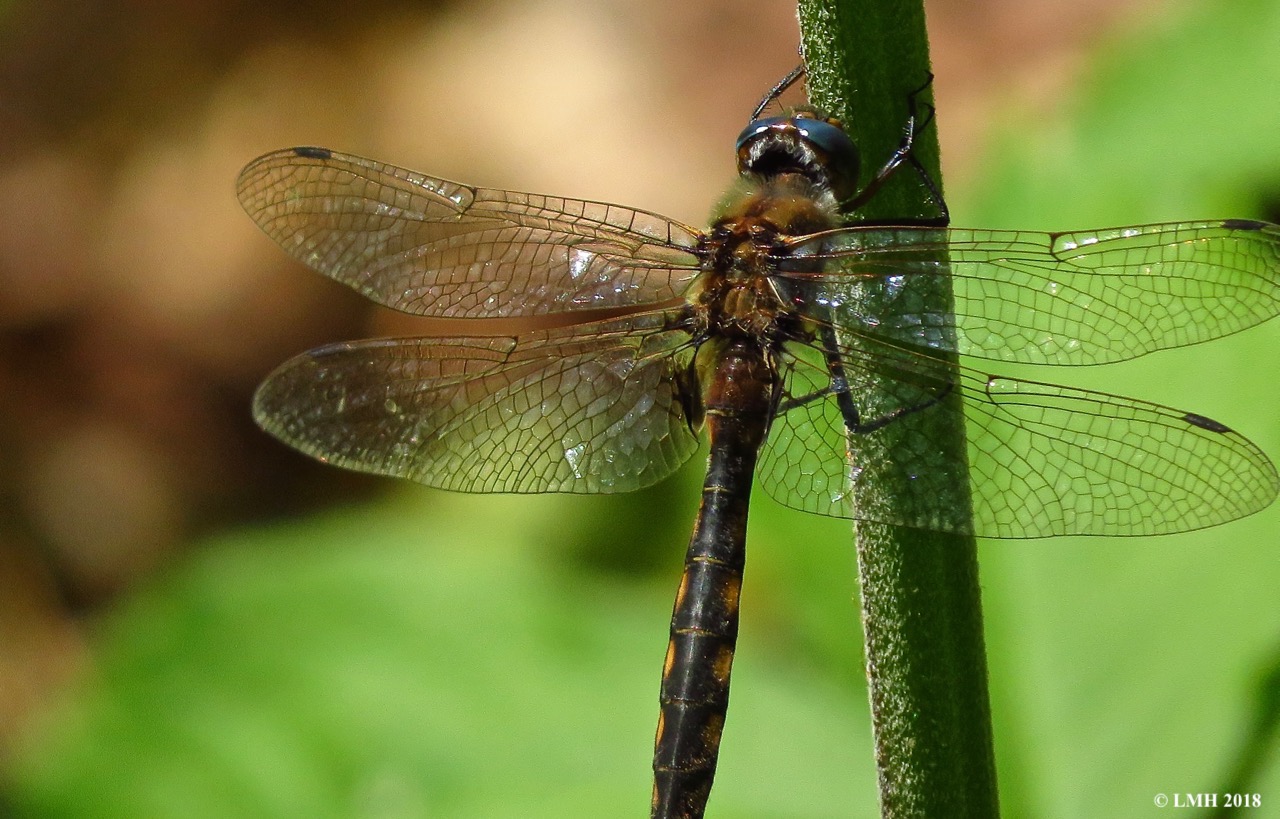
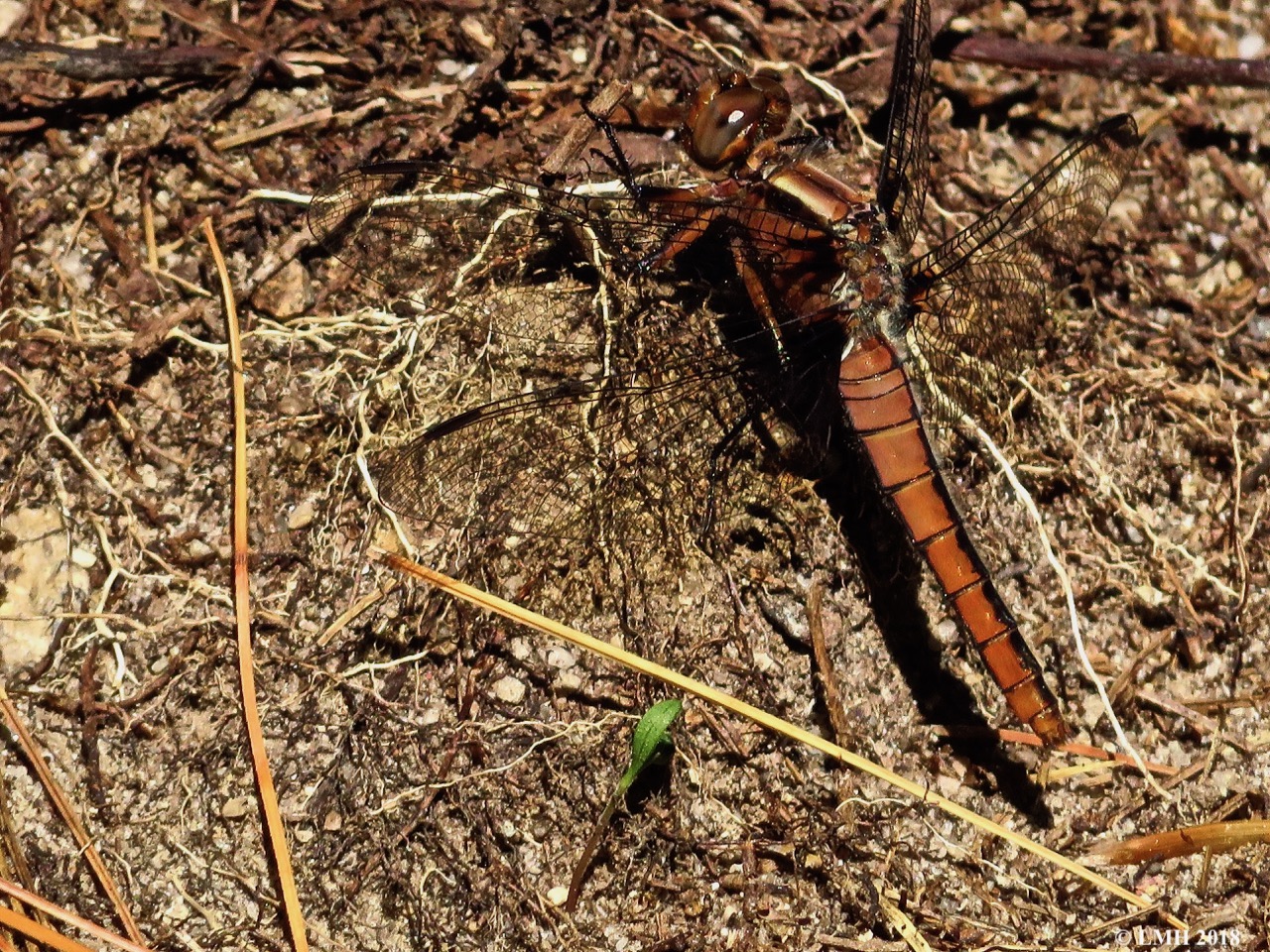
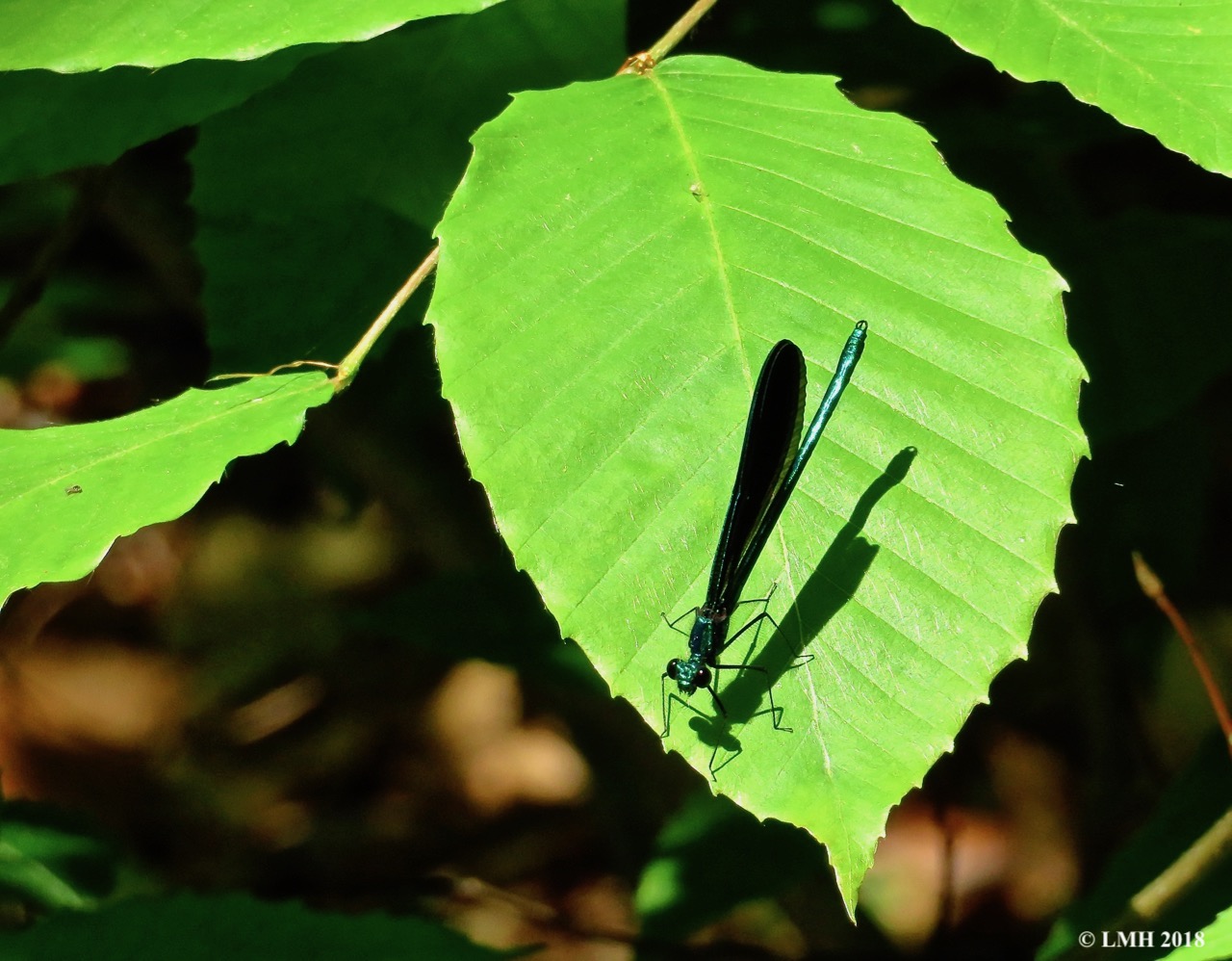
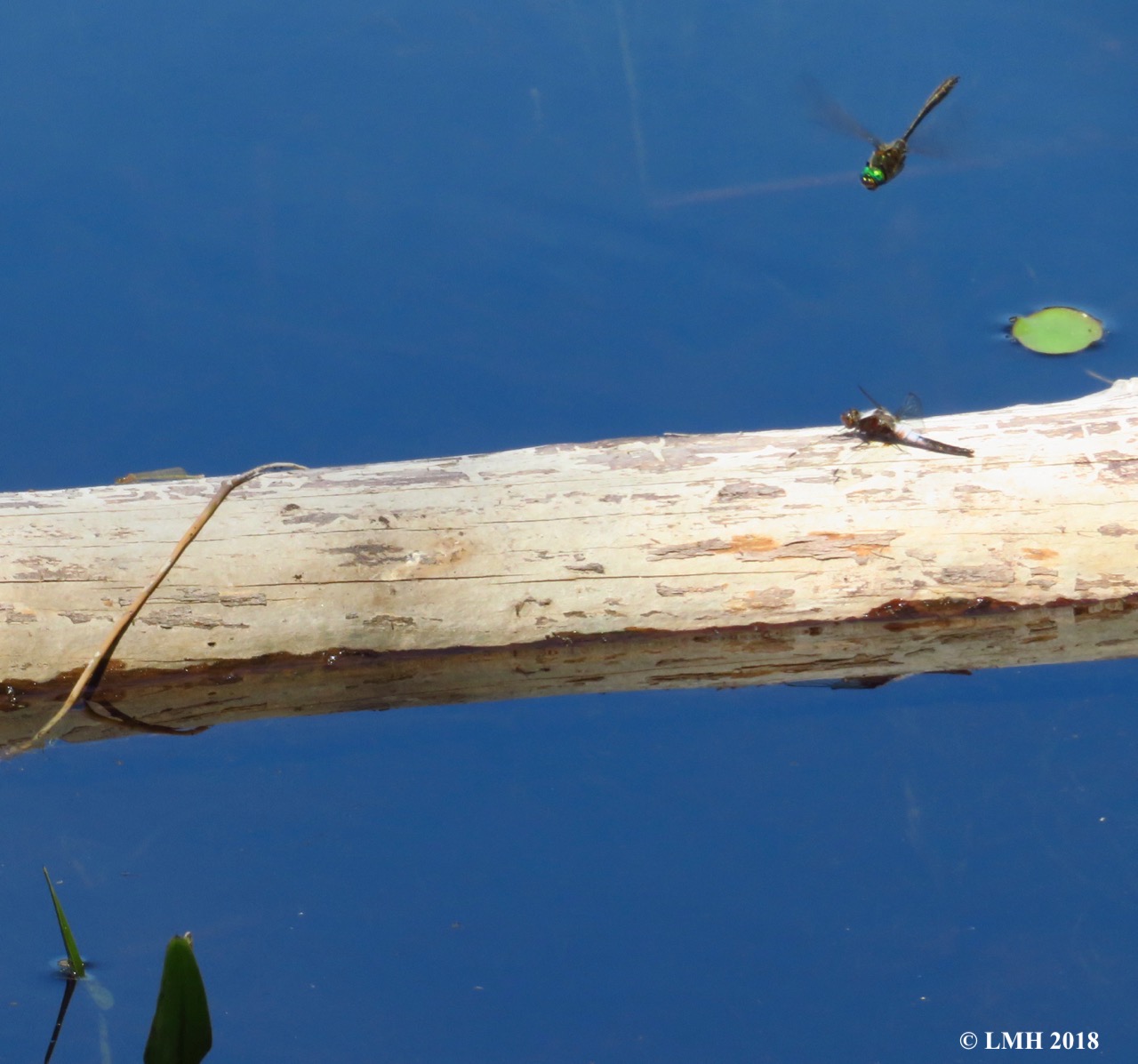
Near the end of our journey, we reached a point where we could see that there was still some snow on the the Bald Face Mountains in Evans Notch, but we spotted a dragonfly and honored Trailing Arbutus flowers and rejoiced. Though our celebration didn’t have a Mexican theme, we still had at least cinco reasons to give thanks from the Painted Turtle to Coltsfoot to Bud Bursts to Squirrel Larders to Creepy Collembola to Spring Peepers to White-throated Sparrows. Really, it was more a Siete de Mayo on this Cinco de Mayo–Maine-style.

Peeking with my Peeps

As has been our custom for the past six years, on a quarterly basis an email is sent out with a date and location and at the agreed upon time any number of grads, teachers, and mentors from the Maine Master Naturalist Lewiston 2013 class gather. Today was one of those days.

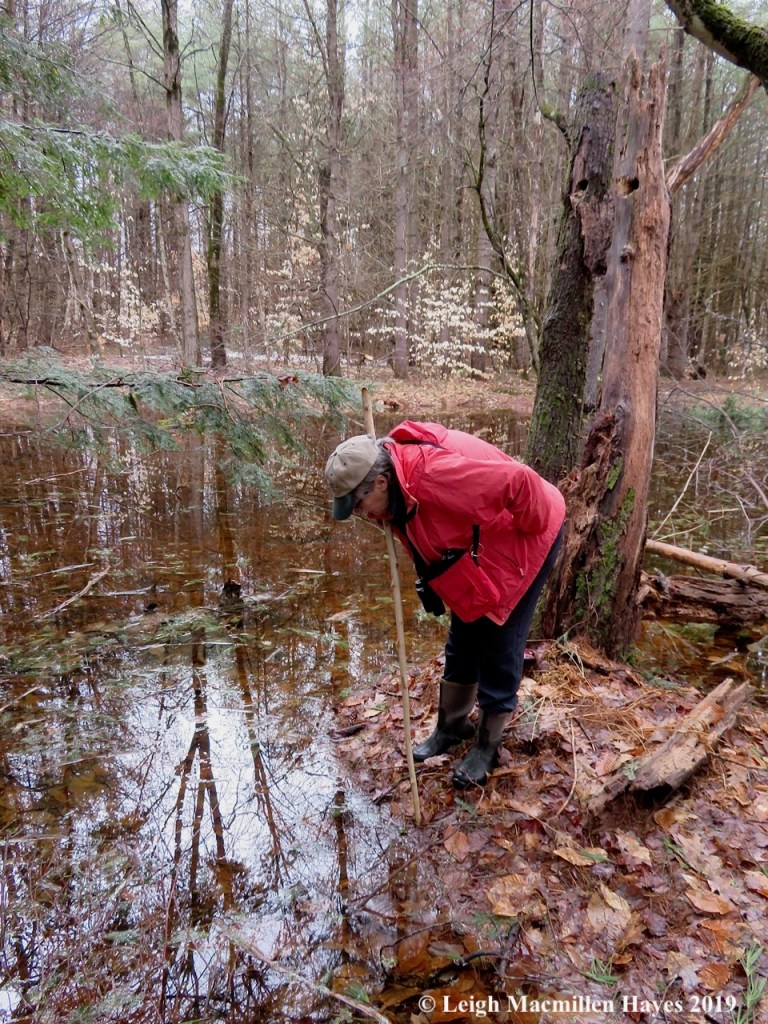
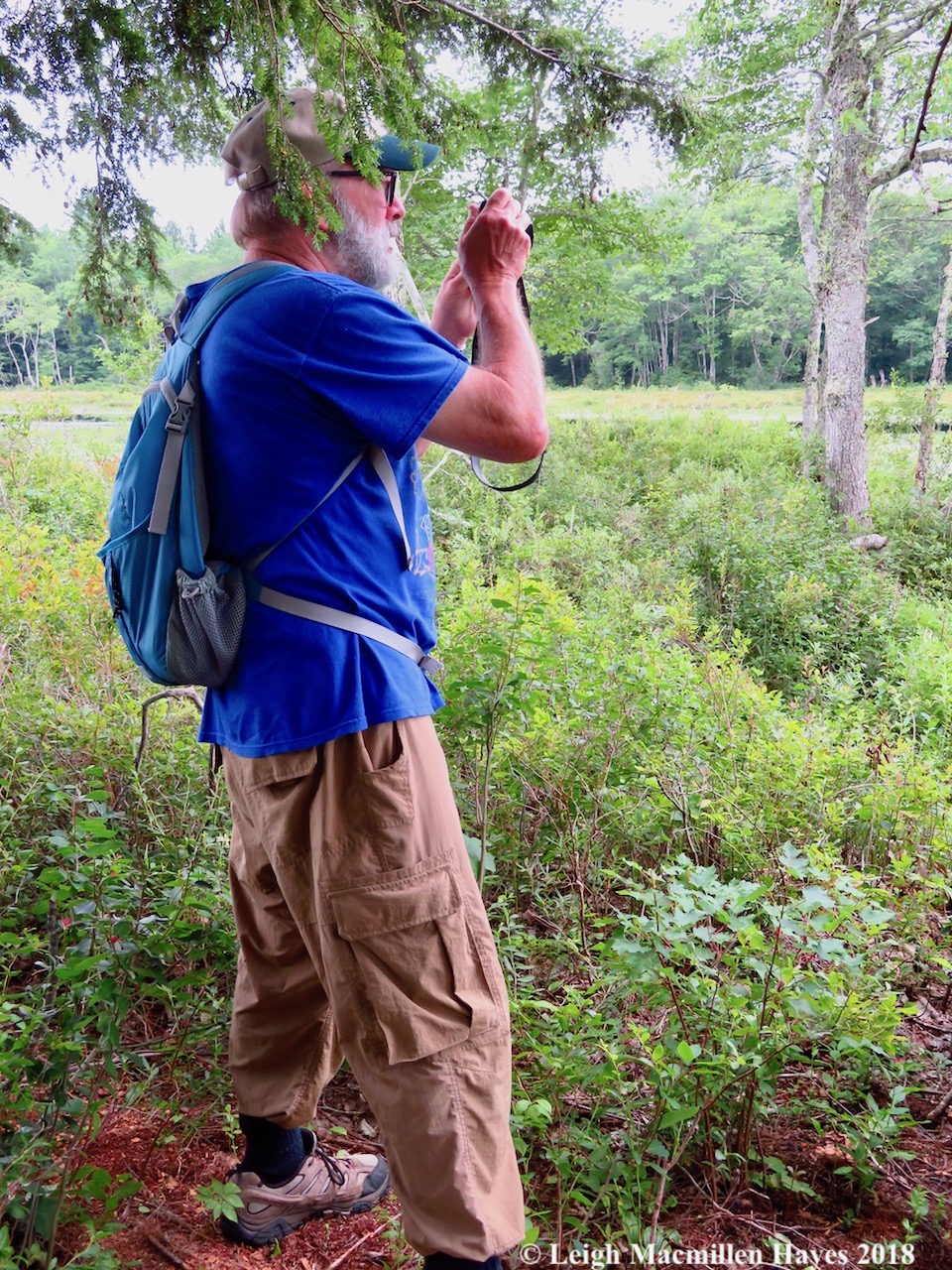
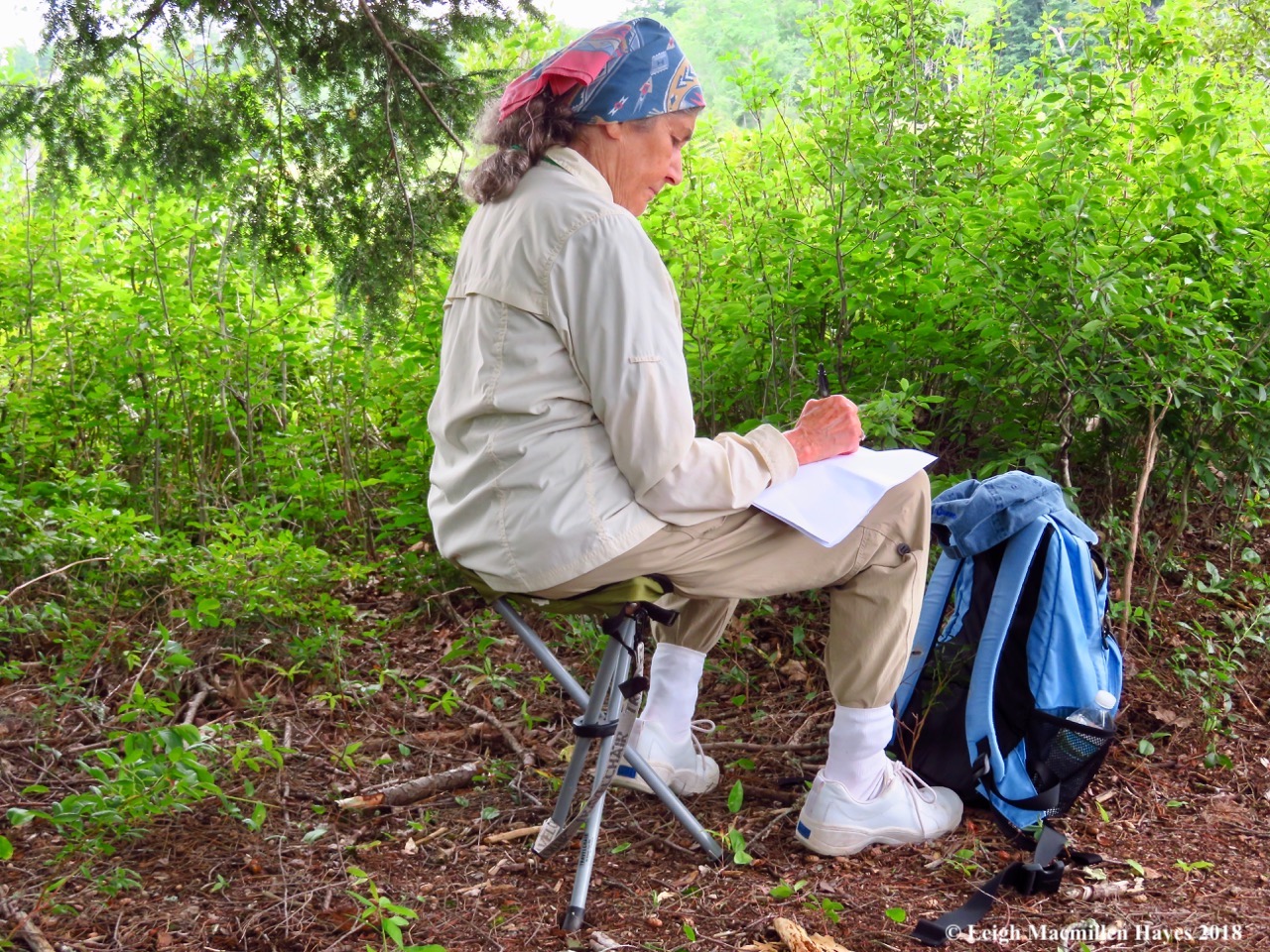
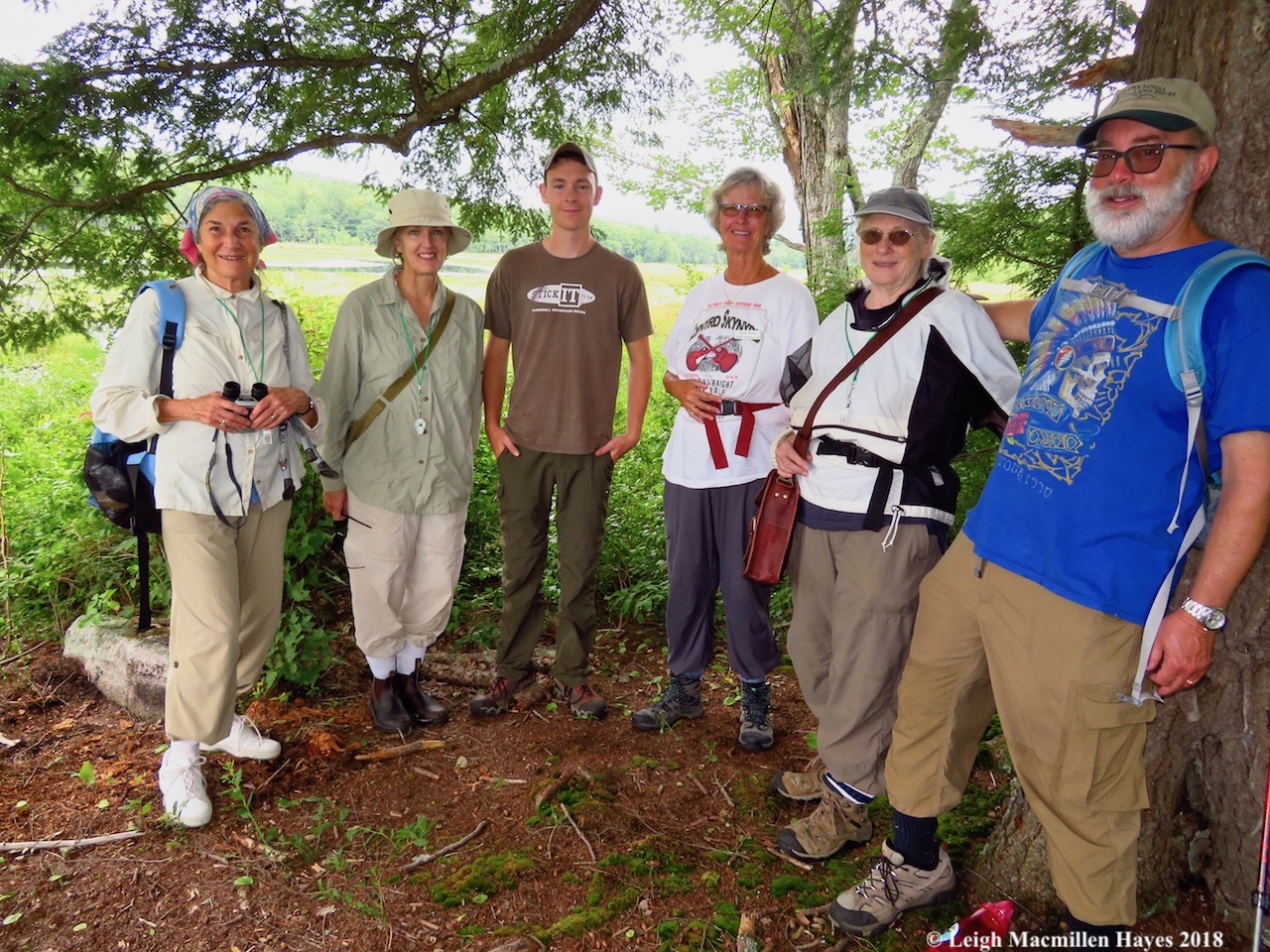
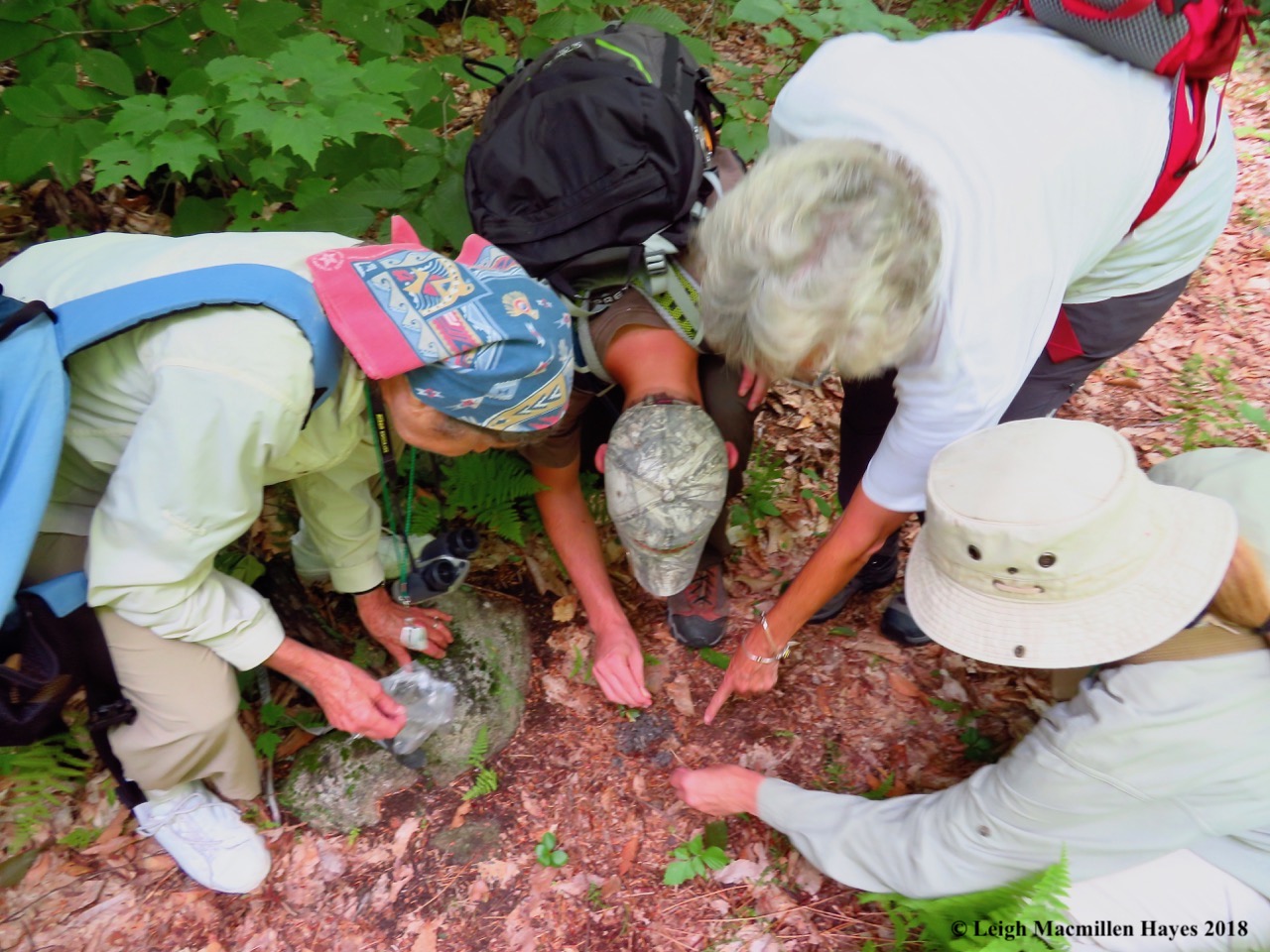
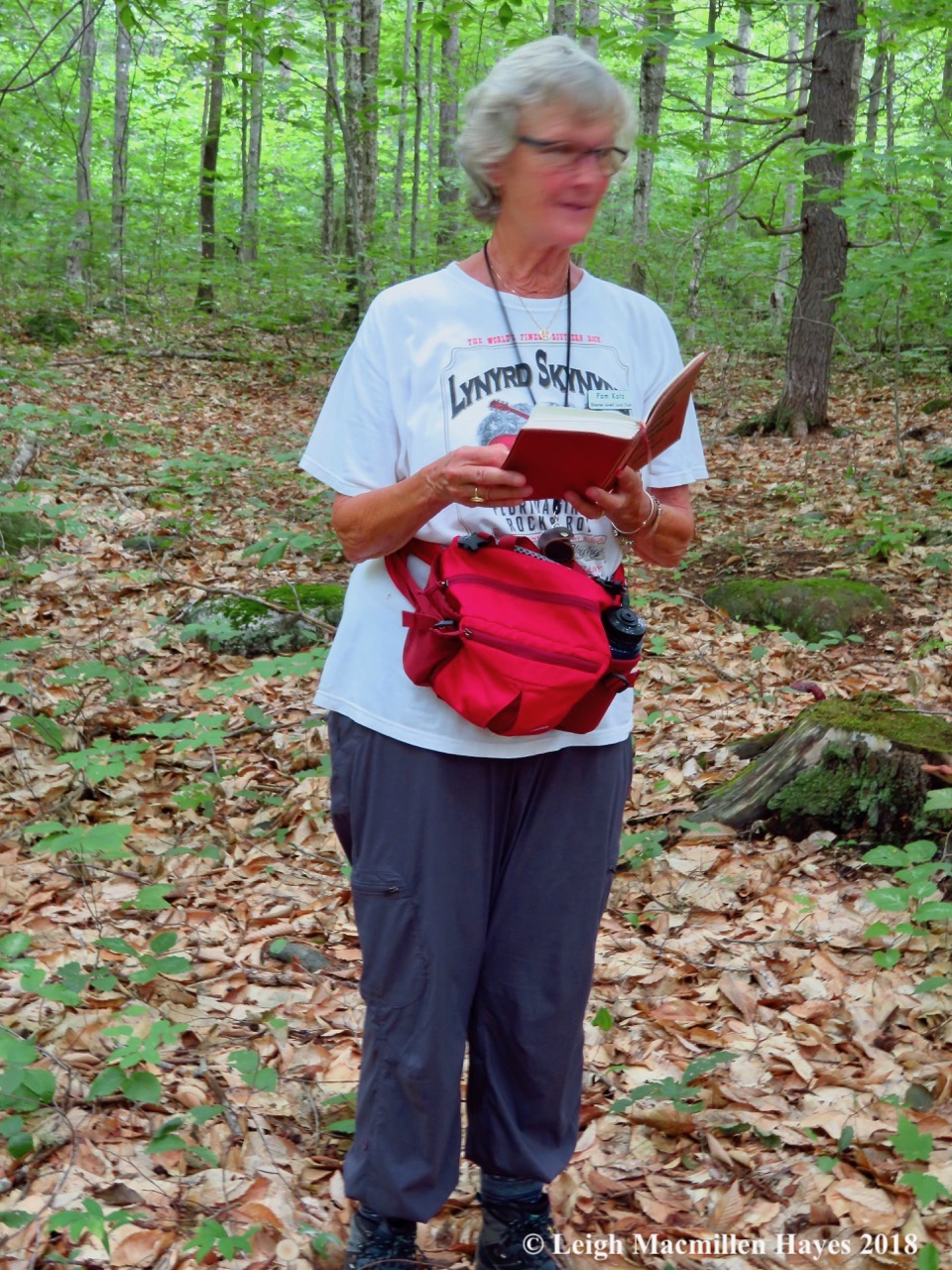
The plan was to explore a vernal pool or two at the Cornwall Nature Preserve on historic Paris Hill, but . . . it didn’t take us (Pam, Beth, Alan, Dorcas, and yours truly hiding behind the lens) long to get distracted when we saw green poking through the many shades of brown on the forest floor.

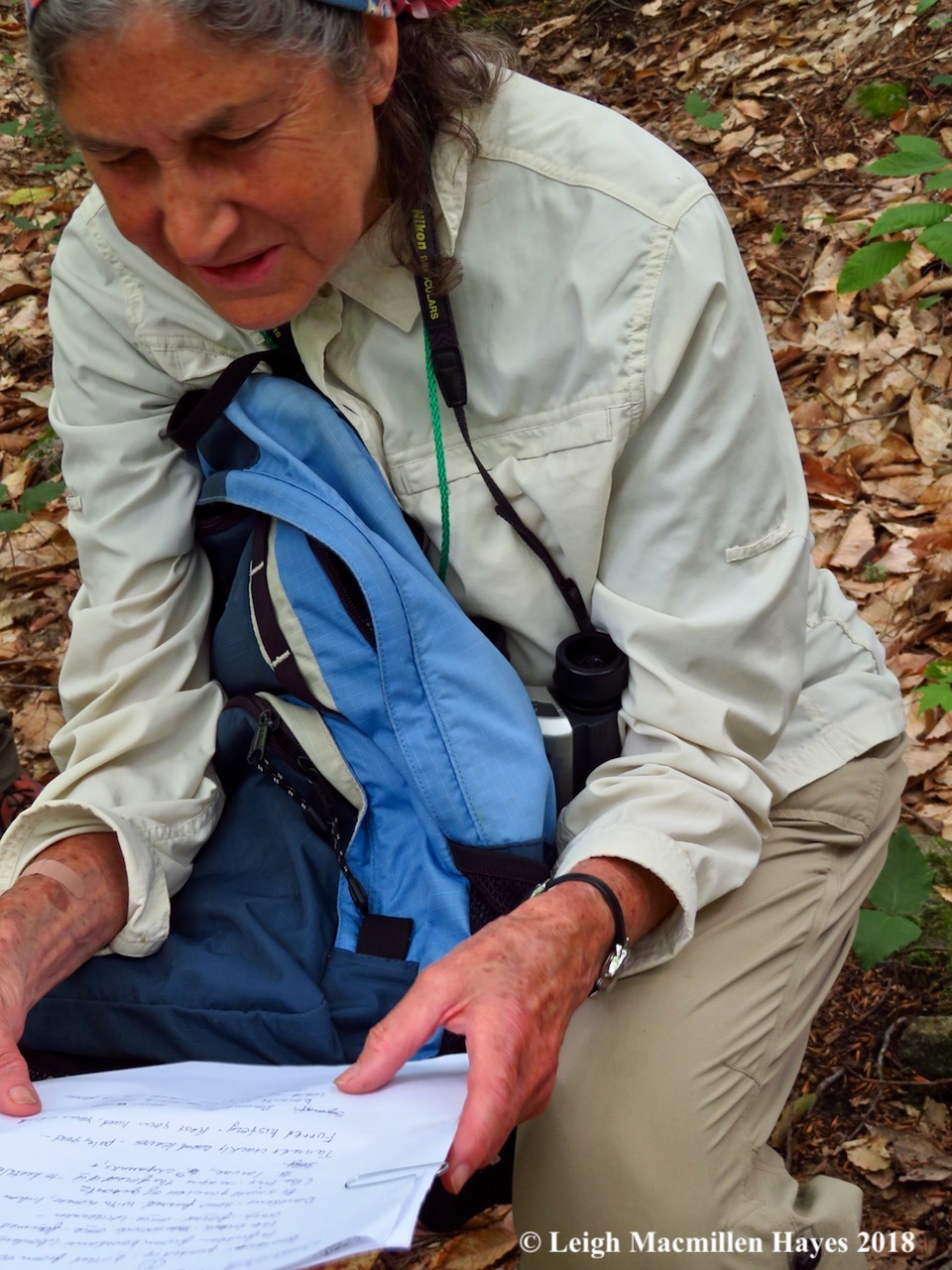
Together, we scrambled through our brains searching for the name. With the season finally feeling like it’s transitioning, we realized we have to dust off the floral flashcards in our minds and start reviewing them. And then it came to us. One year ago, on May 5, we had seen the same at Smithfield Plantation as we celebrated Cinco de Mayo, Naturally. Then, however, we had keyed it out minus the flower. Today, the memory of last year’s ID slowly sifted to the forefront and by its leaves and colonial habit, we felt safe to call it Clintonia borealis or Bluebead Lily.

A few more steps and we started dipping containers into a potential vernal pool that was really too shallow and offered no apparent key characteristics. But . . . there was an owl pellet filled to the brim with hair and bones, the one sticking out by central vein of the leaf a hip bone. (Yeah, so I may sound like a smarty pants, but Dorcas pulled it out and quickly identified the bone by its structure.) Some little mammal, or two, or three, had provided a bird with a meal.

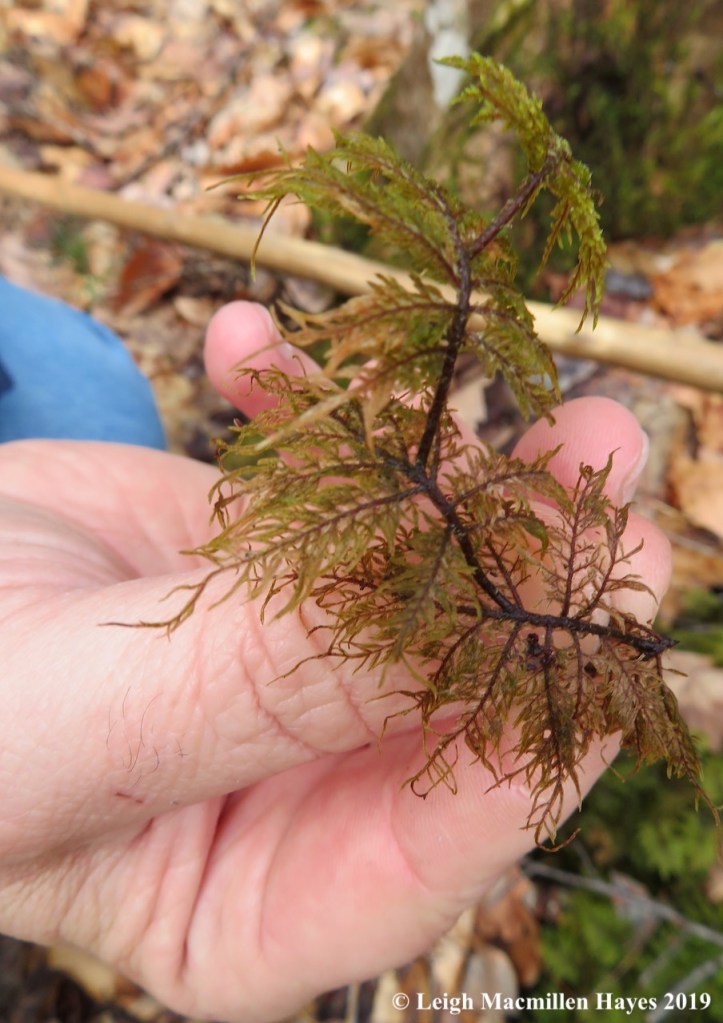
Stair-step Moss (Hylocomium splendens) was the next great find. I would have dismissed it as Big Red Stem or Pleurozium schreberi, and in so doing missed its finer points. Do you see how each year’s new growth rises from the previous, rather like ascending stair steps?

And then there was another new learning, for I’m always referring to this species of fungi as jelly ear or wood ear. But, with Alan the fungi fun guy in our midst, we learned that it’s really Brown Witch’s Butter or Exidia recisa. (Drats–it’s so much more fun to say Auricularia auricula.)

As we admired the Exidia recisa, we realized others were doing the same for we’d interrupted a slug fest. If you bump into Alan Seamans sometime, do ask him about the numbing qualities of slugs. ;-)

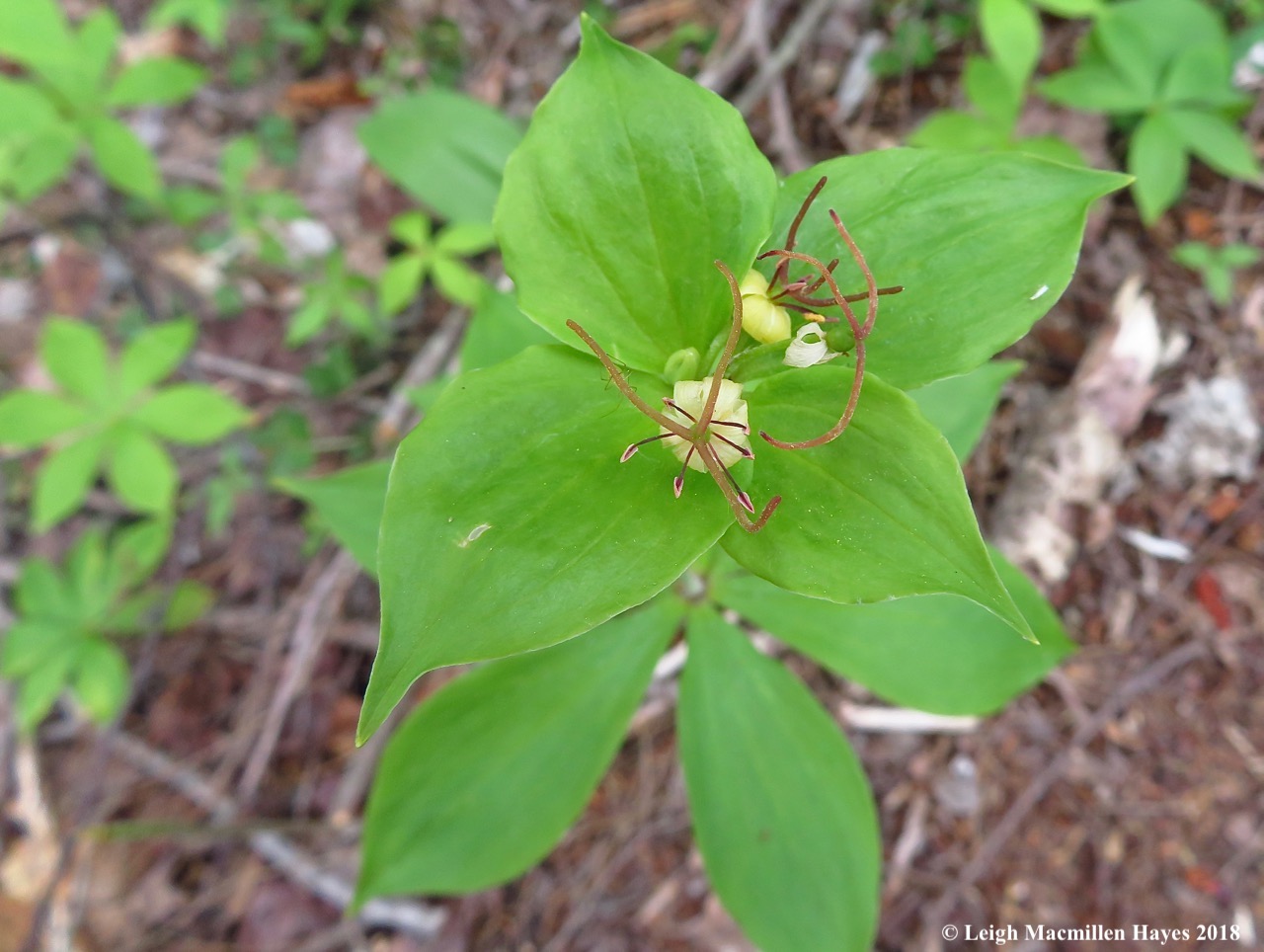
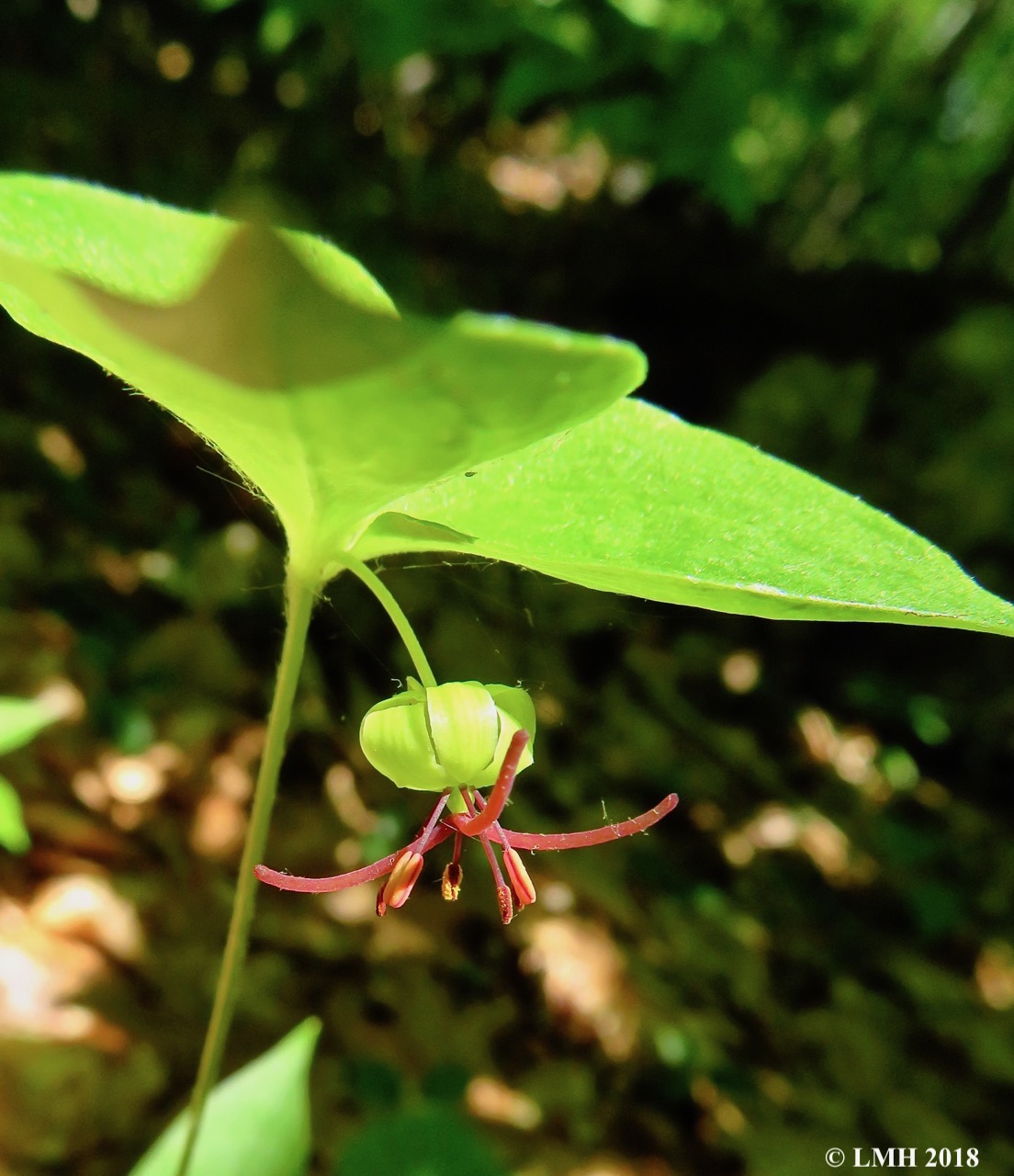
A few more steps and we began to notice trilliums, especially the reds with their leaves of three so big and blossoms hiding. All of a sudden we know the flowers are going to burst open and we can’t wait to witness such glory.

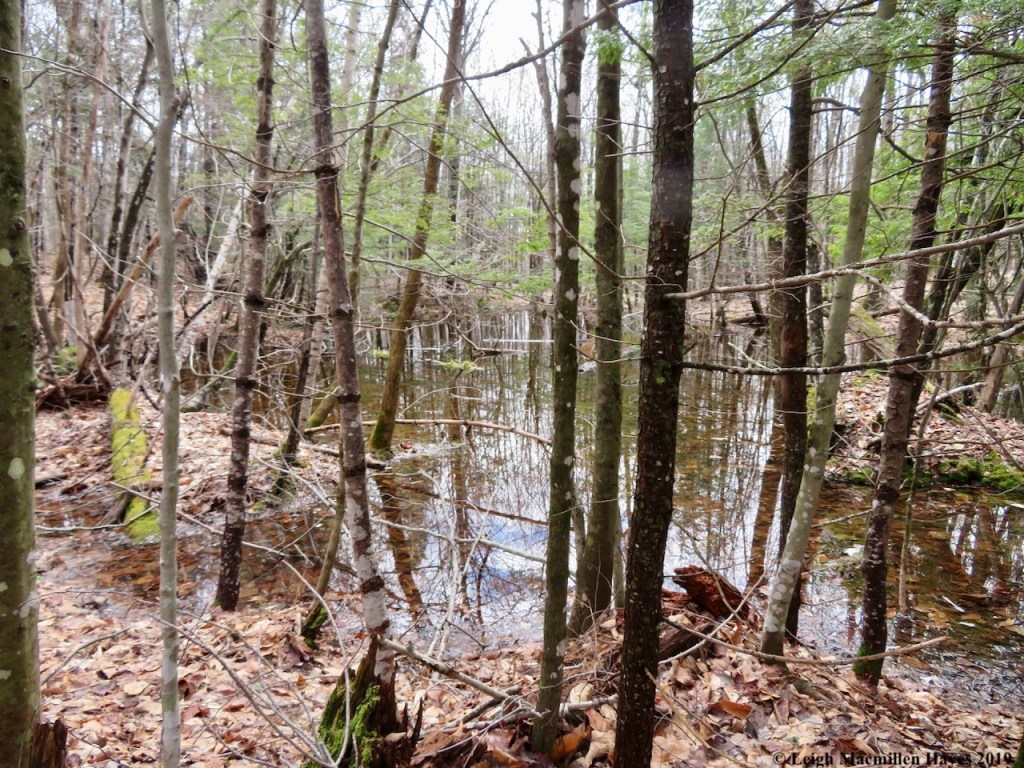
At last we reached the pool of choice, located maybe a half mile from the parking area. Two years ago, MMNP students from the South Paris class discovered Fairy Shrimp in this pool.

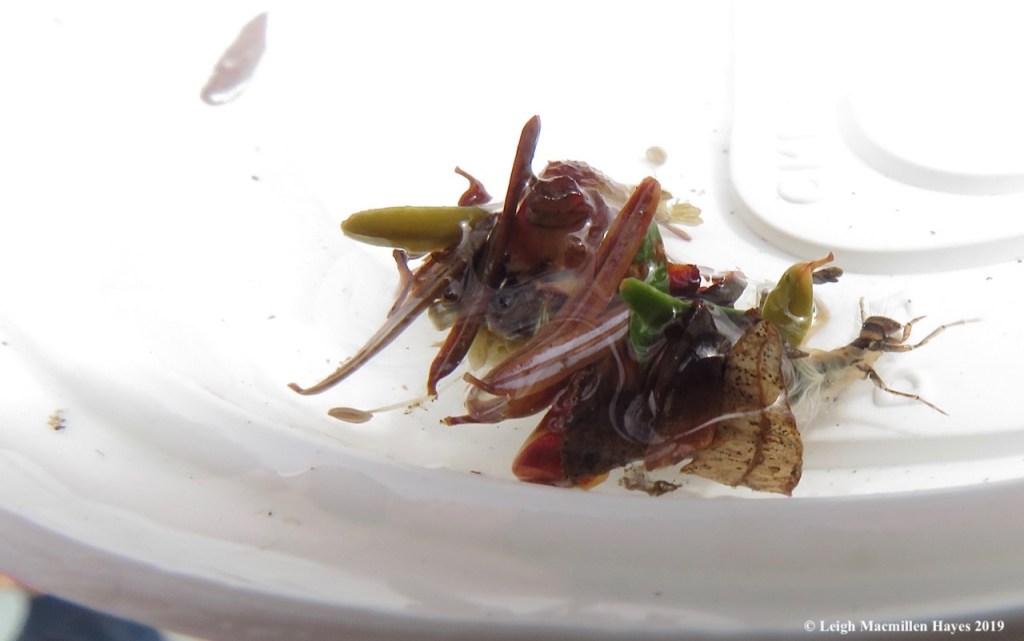
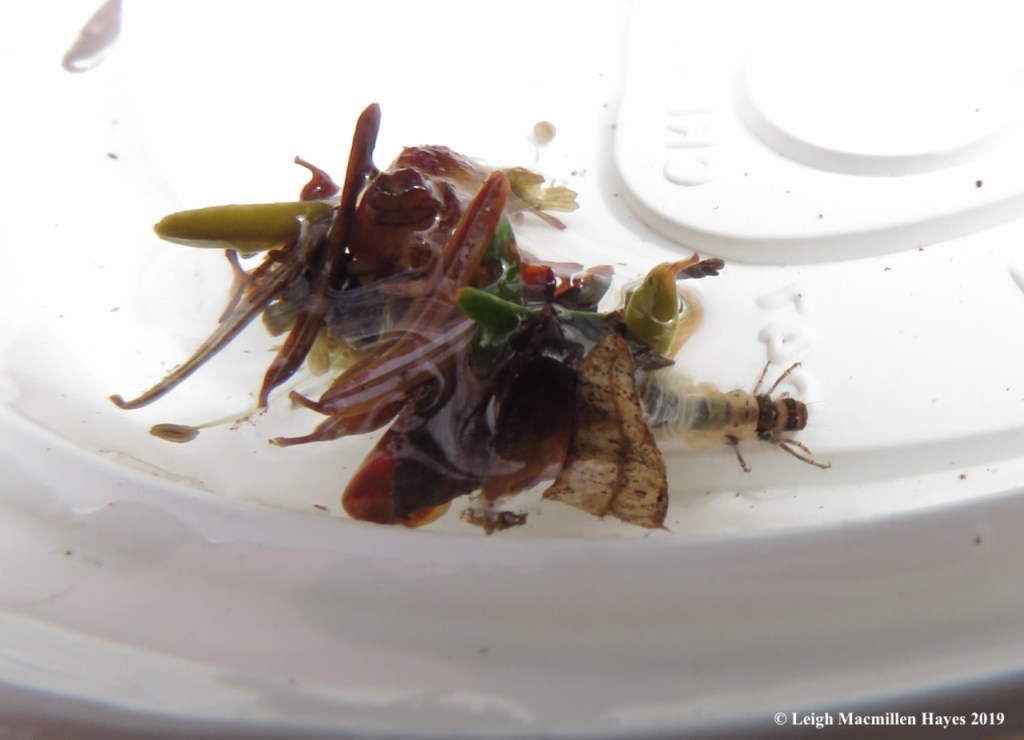
Our best finds today were log cabin caddisflies! At this point in time, the caddisflies are in their larval stage and as such, they construct their temporary shelters from available materials. Think of them as the original recyclers.

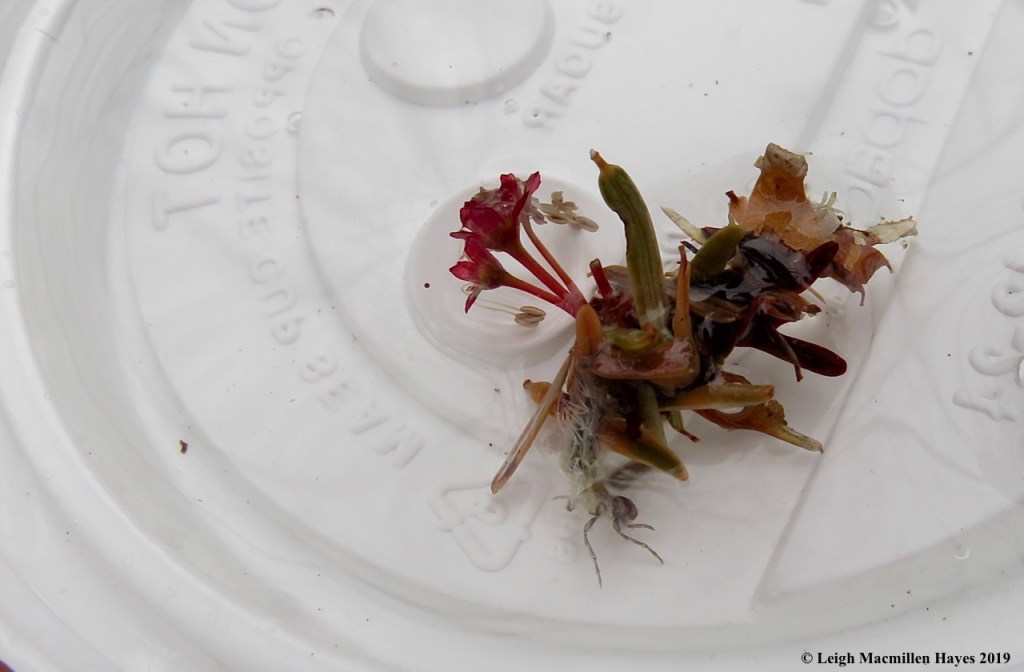
Should a predator be about, like a hermit crab, the caddisfly can retreat into the house of needles or leaves or stones or whatever its preferred building material might be. Apparently, it didn’t mind us and we were honored to watch as the elongated body extended forth while it searched for food. In its larval form, these aquatic insects have a hardened head and first thoracic segment, while the abdomen remains pale and soft. Can you see the three pairs of legs?

The cool thing about caddisflies is that though they may use similar construction materials, no two are alike. Beth called them works of art.

I referred to this one as a she for the case included a Red Maple bouquet.

If you look closely, you might also note some filmy gills on the abdomen. And the grayish thing the Mrs. approached and a second later ignored. It seemed rather leech-like in its behavior, but I think it may have been a Planaria, which is a tiny unsegmented flat worm.

As we dipped for insects, we also noted plenty of Spotted Salamander spermatophores sticking up from leaves and twigs. But we could find none of their milky egg masses and wondered why.

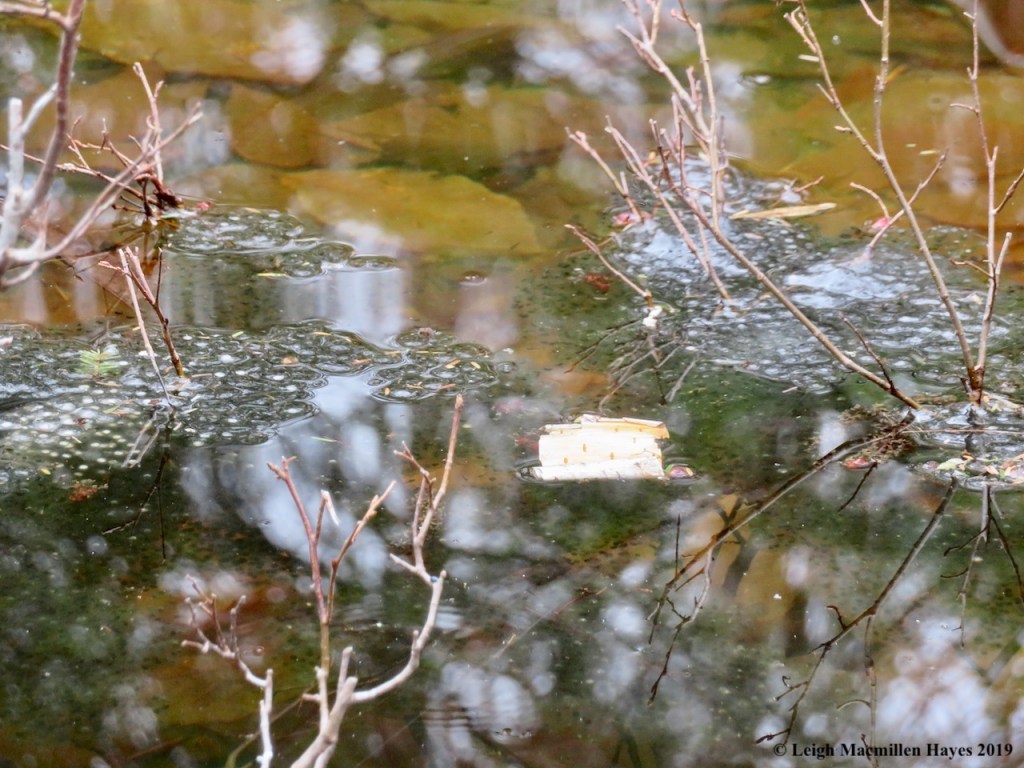
We did, however, spy plenty of Wood Frog masses, some with their tapioca structures bubbling upon the surface, but most attached to the stems below.

And then a chiseled tree section across the pool called to us and so we made our way over to check the wood chips below. Of course, we searched for Pileated Woodpecker scat, but found none. Instead, we spotted a dead frog in the water. And just beyond it, a dead salamander.

It wasn’t pretty, but did make us question what had happened. Were the two amphibian deaths related? We don’t know, but we did note puncture marks on the Spotted Salamander’s underside, and even a nip of the end of its tail. Plus it had one slightly deformed front foot. And we learned that salamanders have poison glands in their skin, mostly on their backs and tails. Did the frog go after the salamander and both died from the experience? Or had another predator entered the pool? And then realized it had made the wrong decision?

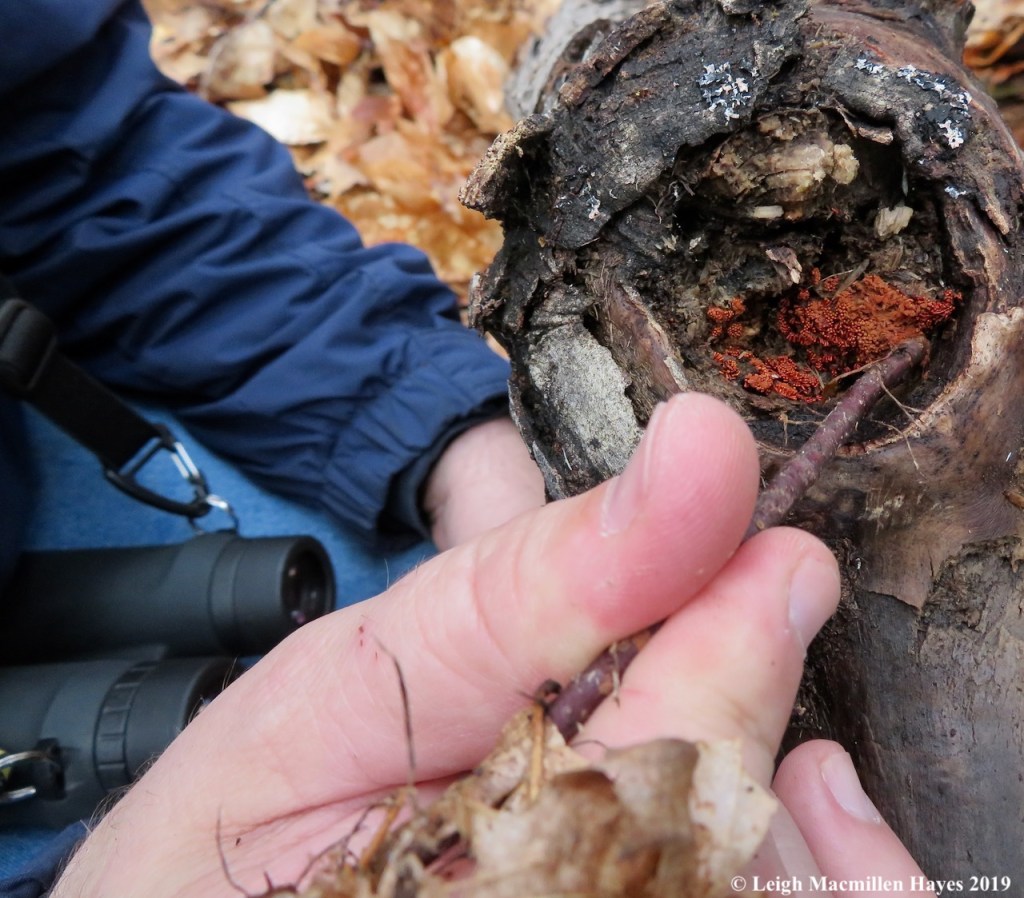
We never did figure it out, but had fun asking questions. And as we stood there, our eyes keyed in on a bit of color at the end of a downed branch. Again, more questions and the use of our loupes as we tried to take a closer look. We debated: slime mold or insect eggs?

After looking closely and continuing to ask question, a quick poke with a twig provided the actual answer as we watched the spores puff out in a tiny cloud. Slime mold it was. Should we have poked it first? No, for that would have been too easy and we wouldn’t have taken the time to consider the possibilities.

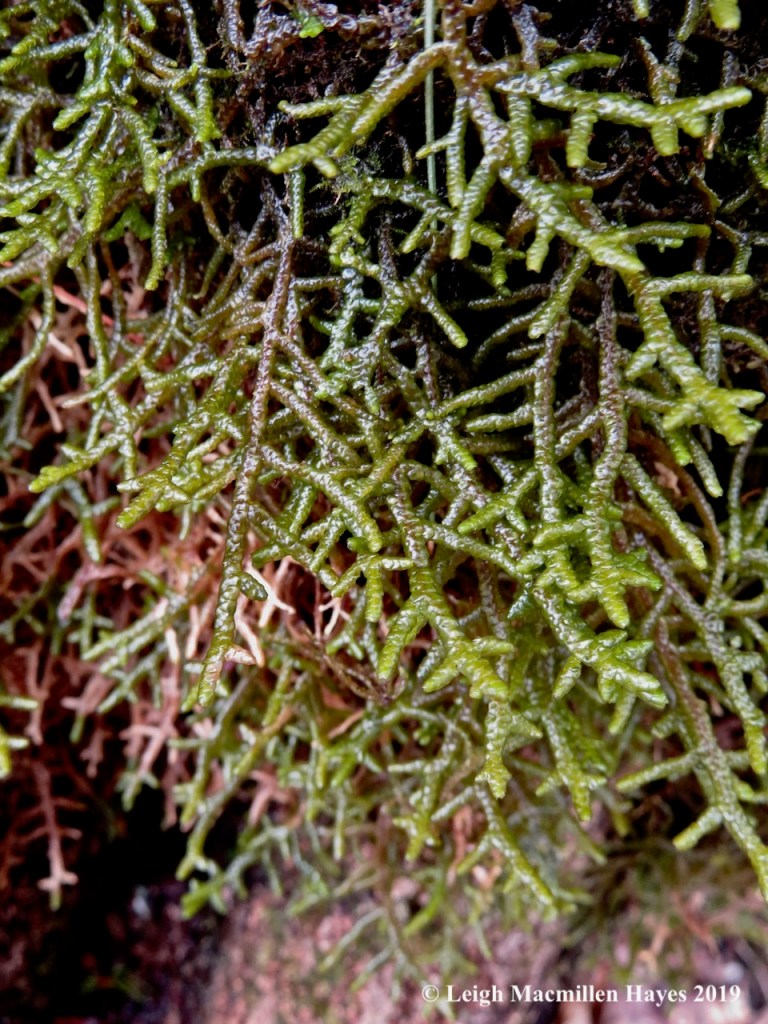
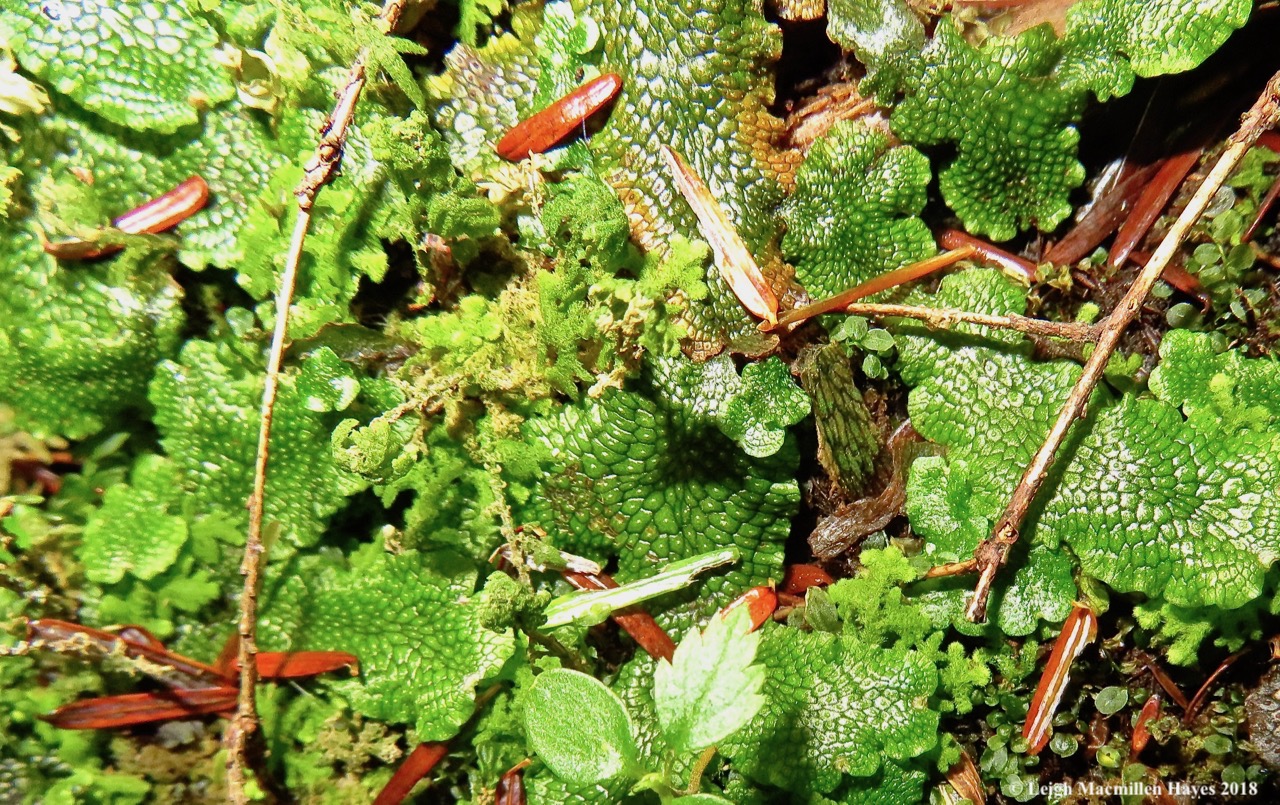
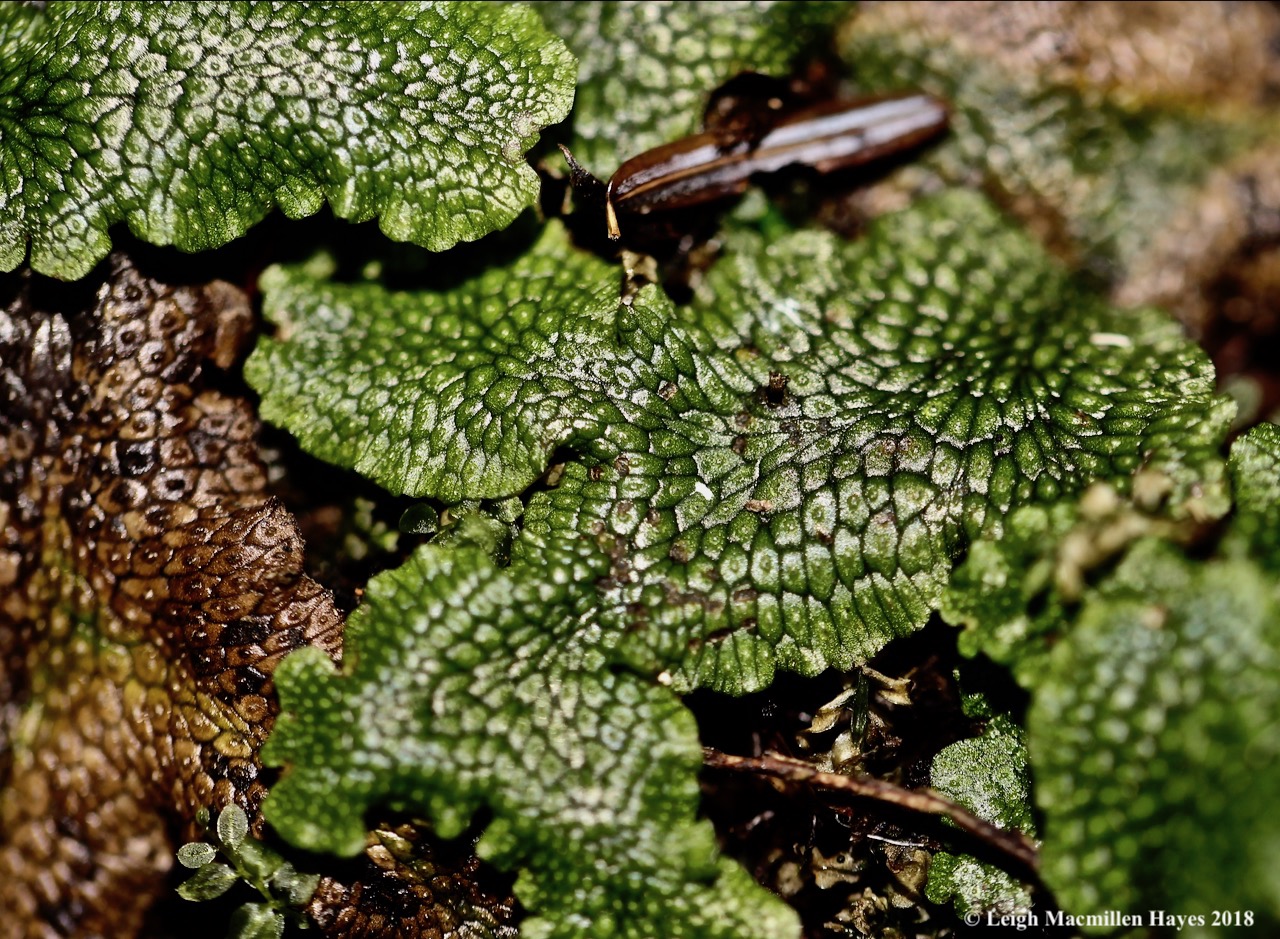
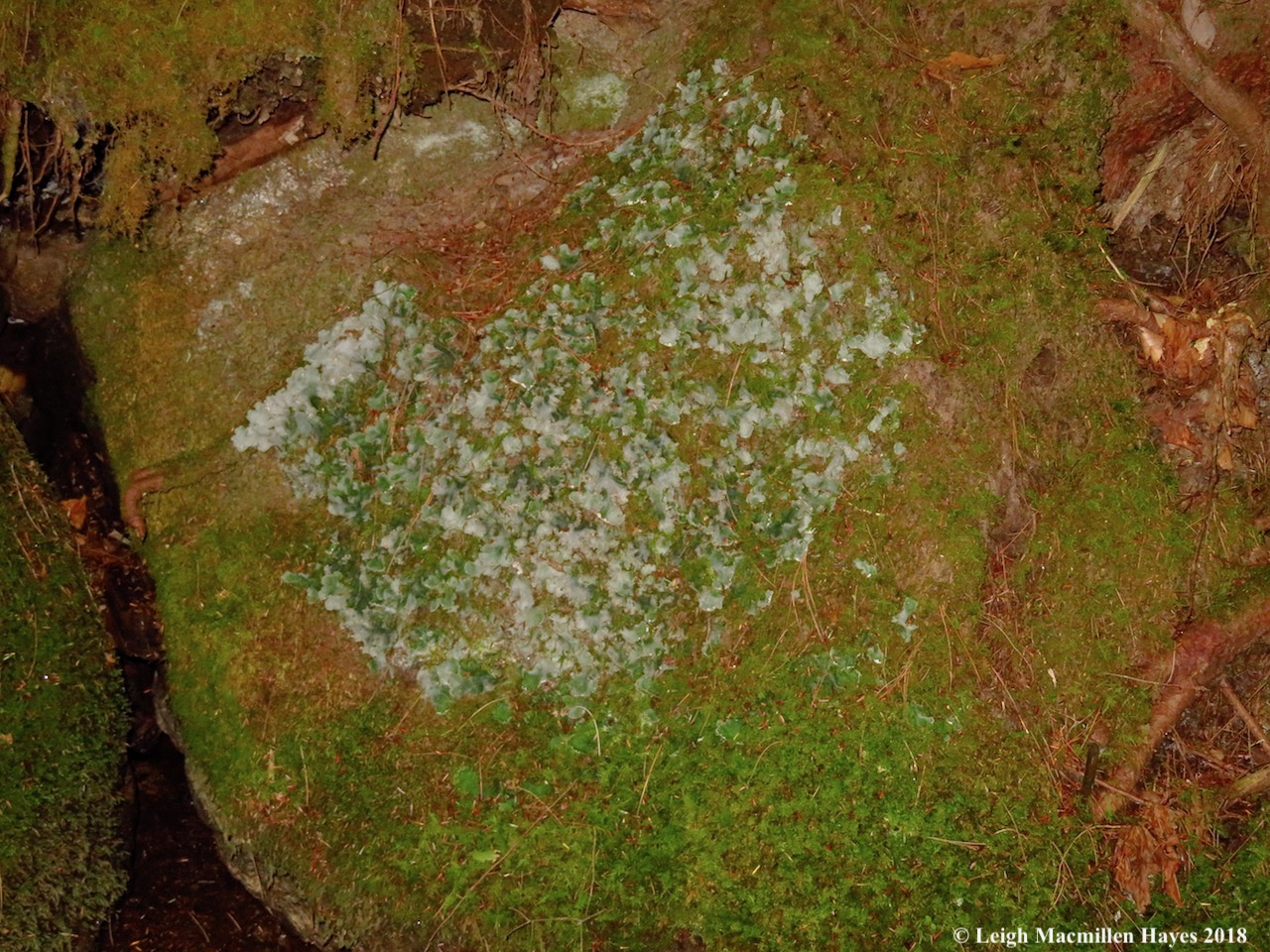
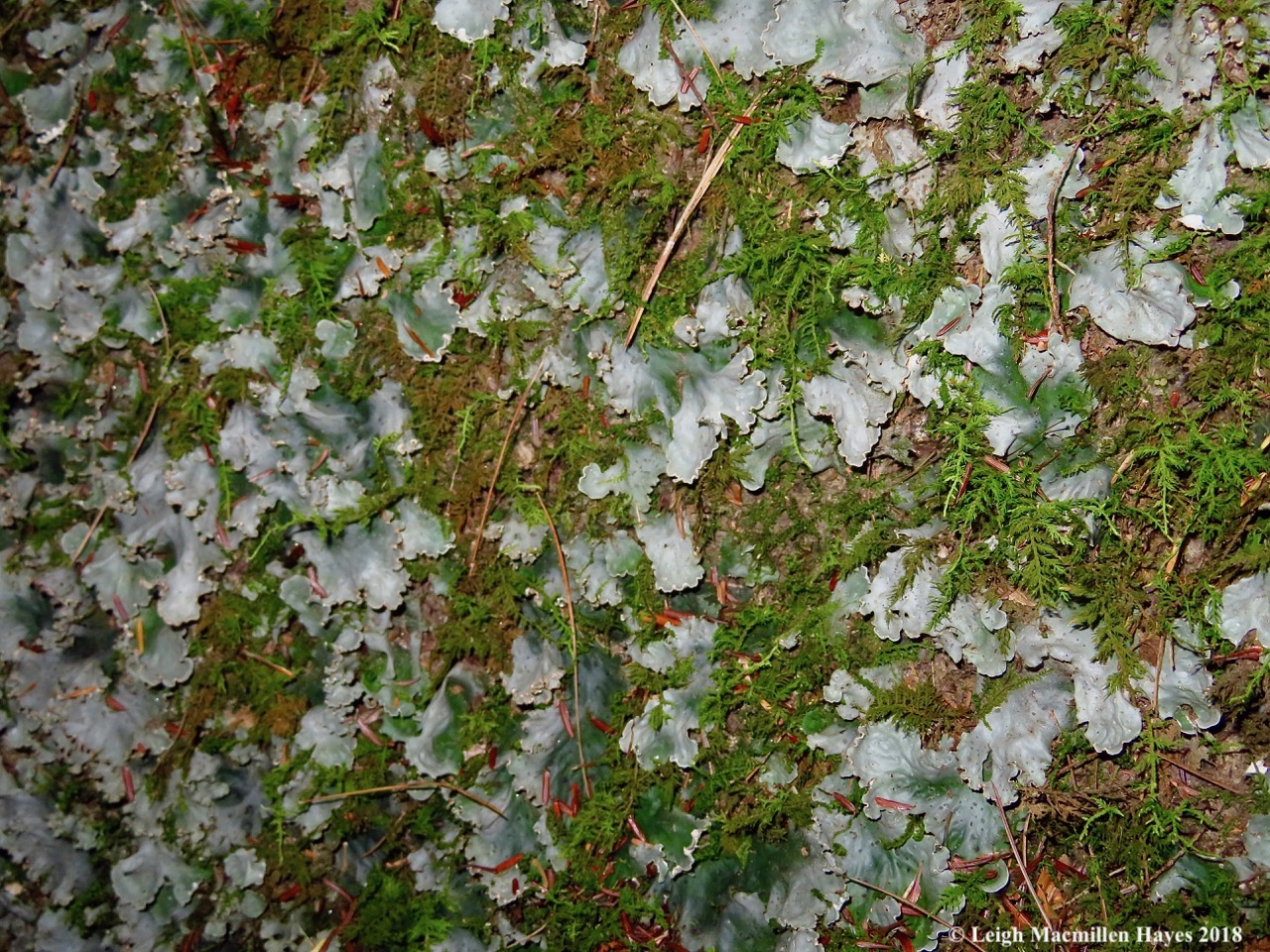
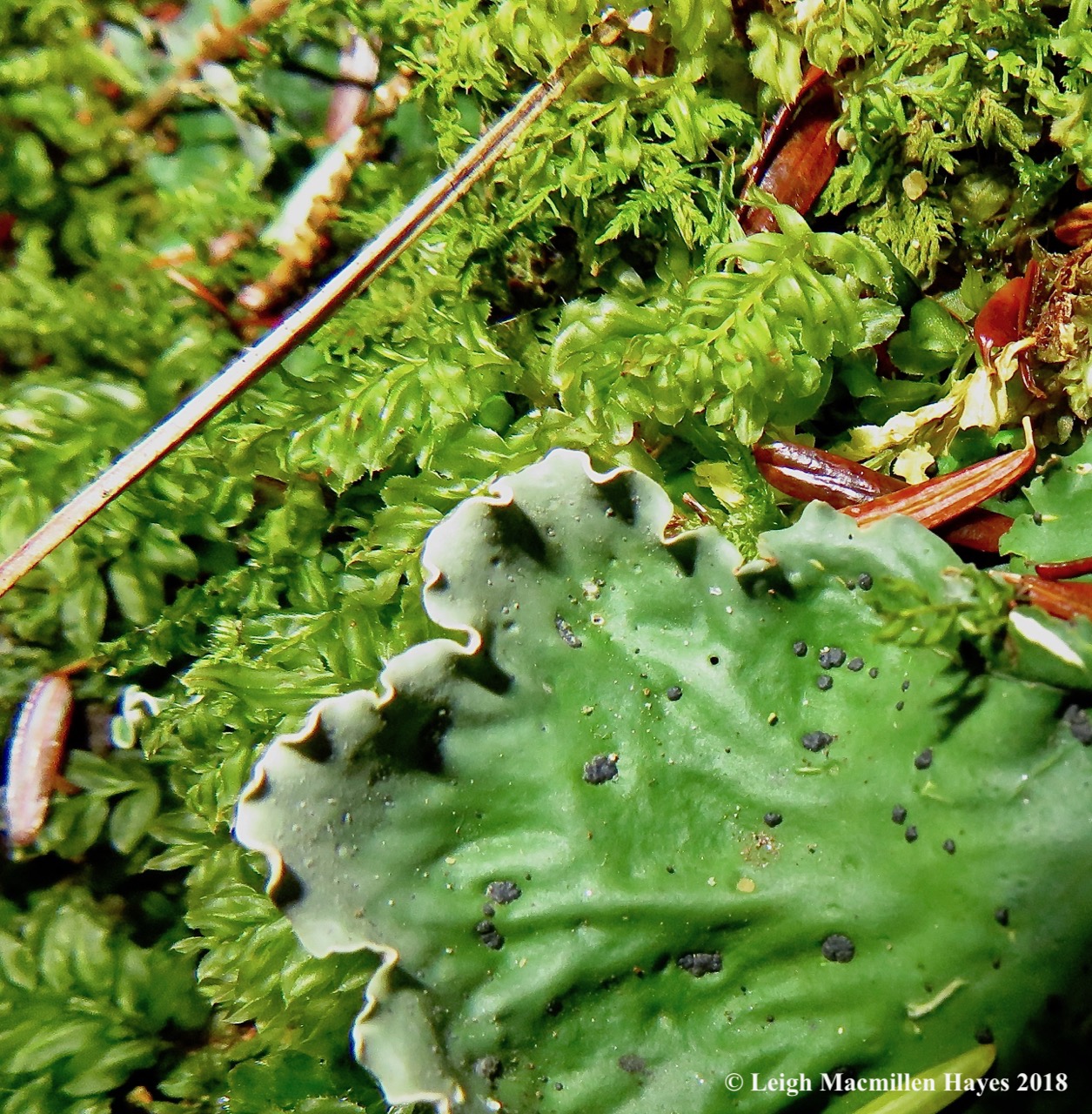
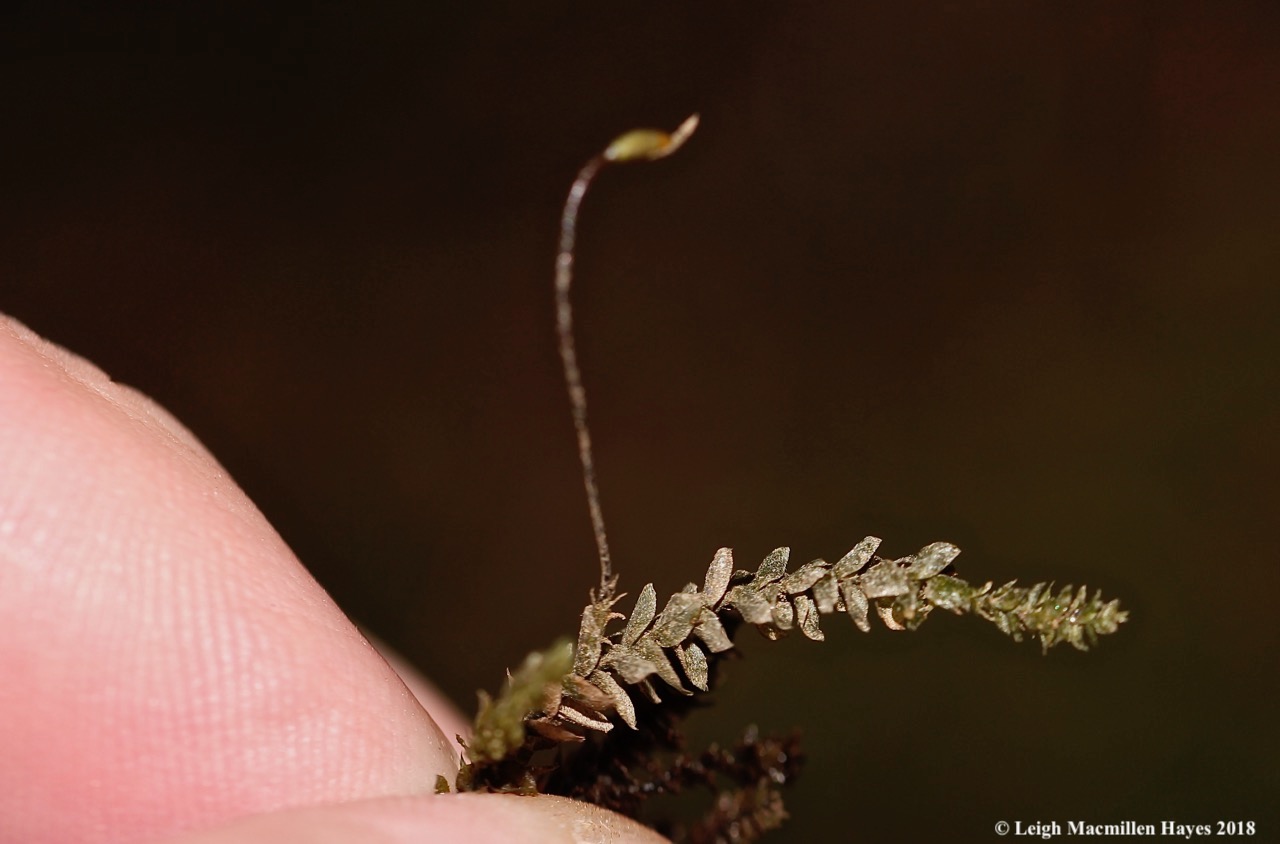
On our way out, there was still one more discovery to make. I could have dismissed this one as a moss.

But, again Alan knew and he explained to us that it was a liverwort known as Porella platyphylloidea. And upon closer examination we could all see its three-dimensional structure as it curled out from the tree trunk.

Almost three hours later, our brains were full as we’d also examined trees, lichens, and other fungi, but our hearts were happy for the time spent in each others company sharing a collective brain.

I’m always grateful for an opportunity to peek with these peeps, even at something as common as a caddisfly because really . . . there’s nothing common about it.

Doubting Spring?

Finicky weather–rain one day and then another, sunshine the next, and then snow in the forecast as it is for Tuesday morning. But still, all the signs are there.

Take for instance the clumps of deer hair that have been shed and now decorate areas where the ungulates do bed.

And the masses of eggs attached to twigs and vegetation within vernal pools, the Spotted Salamander’s a milky white contrasting the Wood Frogs tapioca presentation.

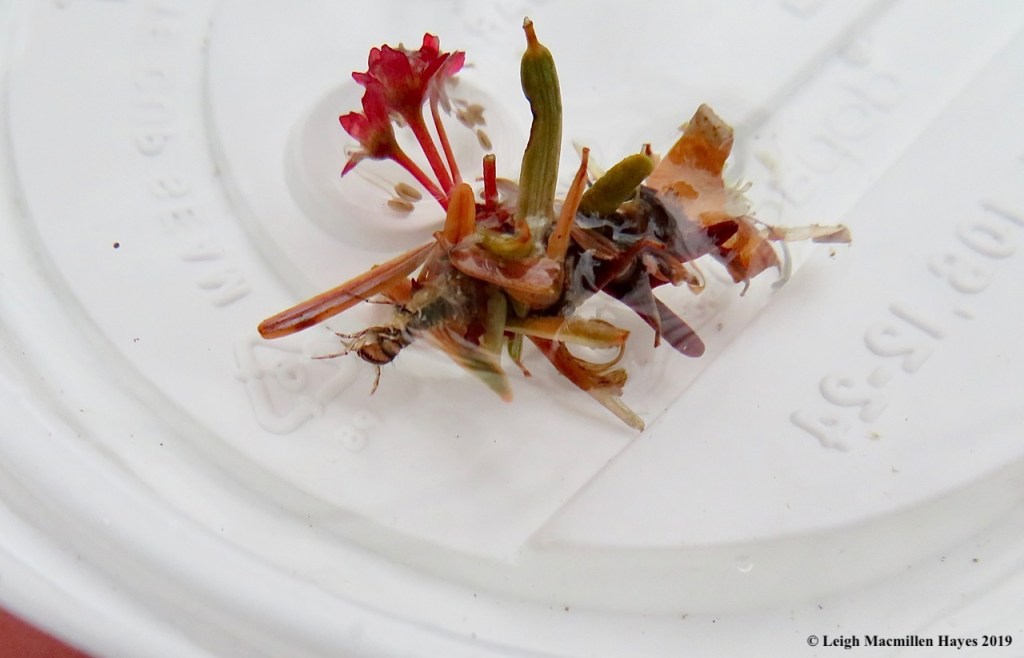
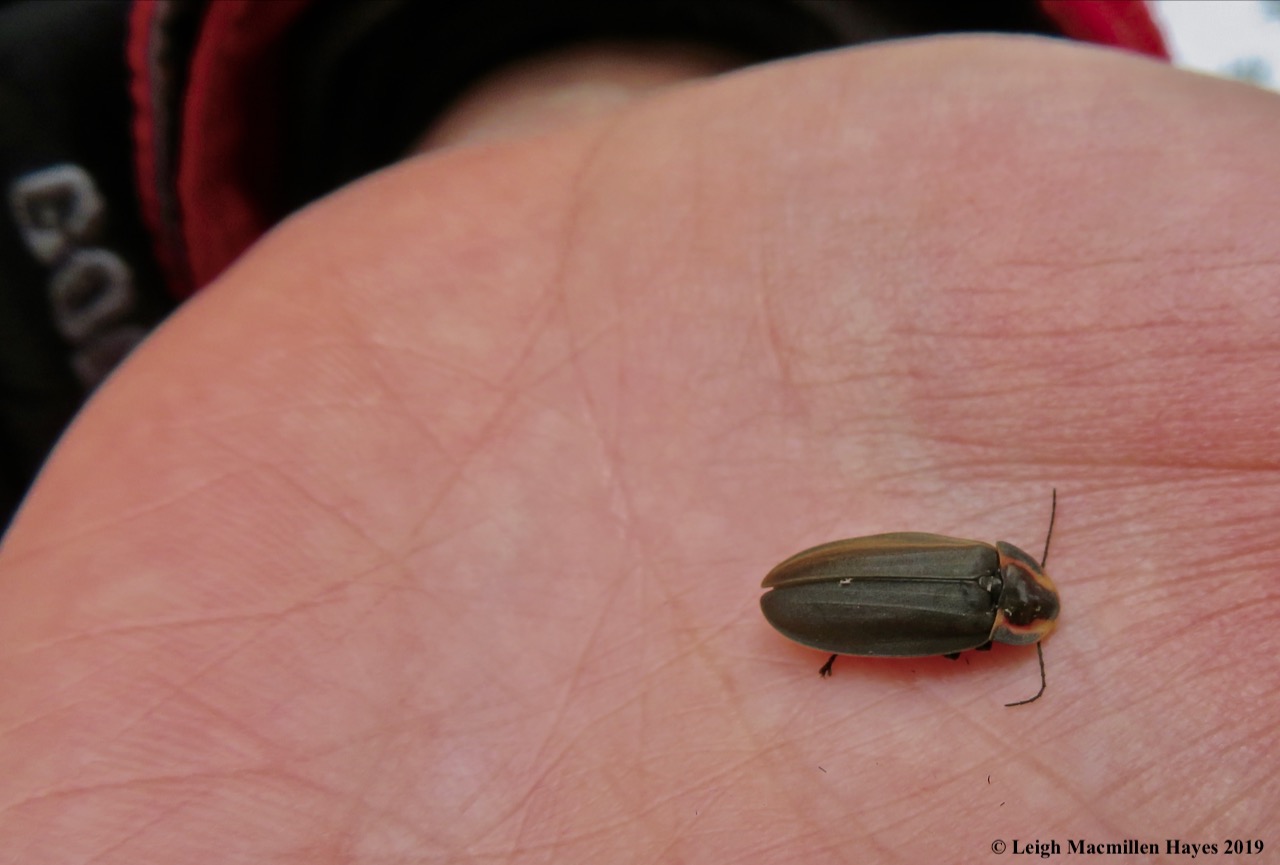
Then there’s the winter firefly in one of his favorite habitats where the water stands still . . . until a breeze ripples across.

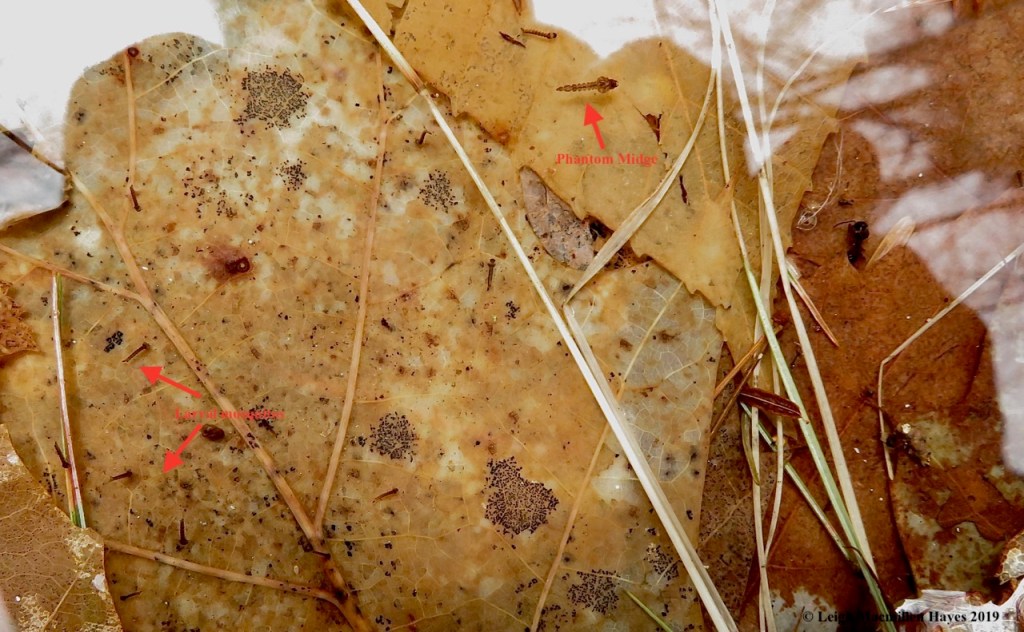
And within the water column, the wriggling Larval Mosquitoes continuously somersault, while the Phantom Midge floats as it waits for a meal to pass by.

Drone flies do just that–fly, their compound eyes announcing alarm as they take in every teensy bit of movement in the surrounds.

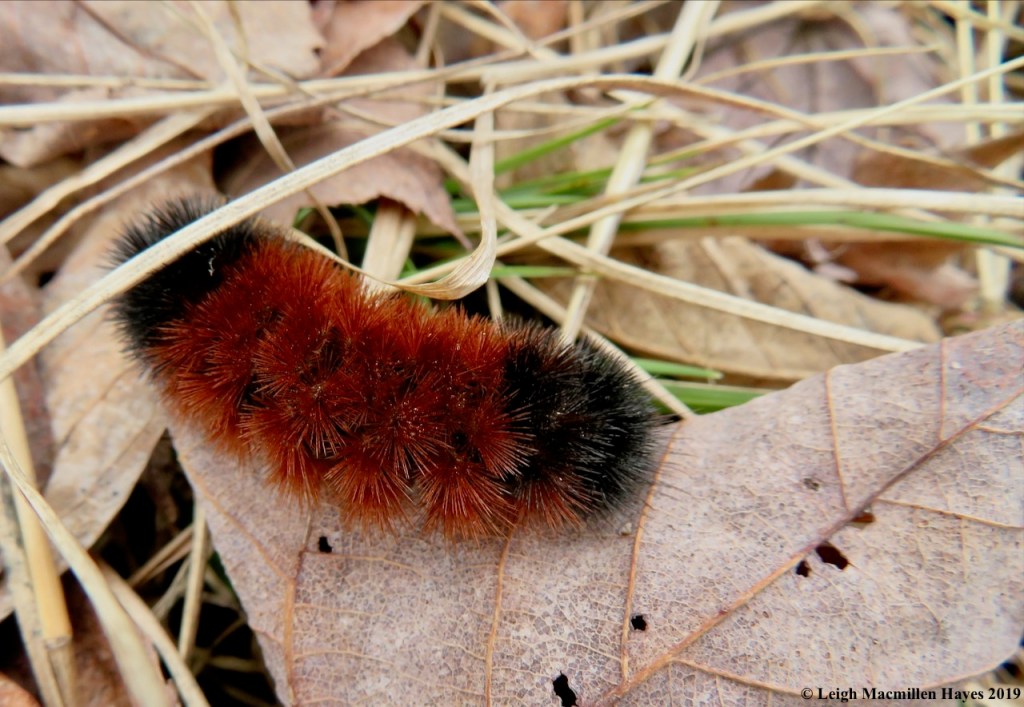
The sight of a wooly caterpillar might make one think the season is six months out, but a cryoprotectant in its tissues so it can literally freeze solid, has thawed and the fuzzy little bear crawls.

The Saco River with Mount Tom behind was another sign, for over its banks had it flowed.

And then, where previously I’d spotted only the vixen, not one or two, but five kits frolicked.

Mom was nowhere in sight, but I trusted she had sent them out to get some fresh air while she cleaned the den.

A move to another location, brought more sights and scents and sounds, but one of the most delightful was that of the sweet-fern–its spicy aroma suddenly filling the air.

And at a semipermanent pool, a few wrucks chorused by distant Wood Frogs.

But by my feet, Eastern Red-spotted Newts swam about camouflaged by last year’s foliage.

One climbed another, and then slide off, any mating waiting for another time. Curiously it also mounted a Bull Frog tadpole, but quickly moved on when it wasn’t well received.

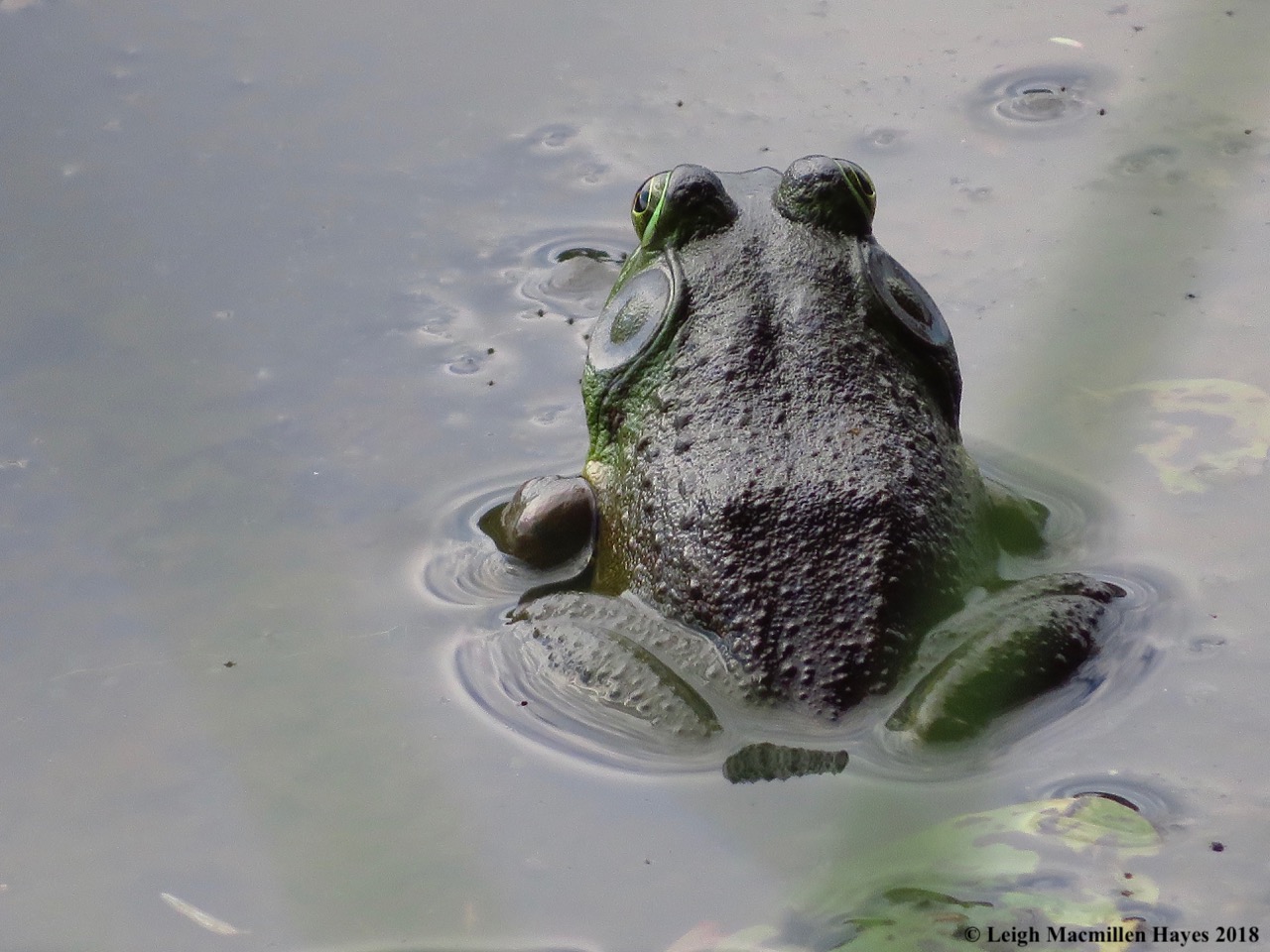
The chunky Bull Frog larvae had overwintered as tadpoles, but their metamorphosis into adult form probably won’t be completed by the end of this season or the next.

In fact, it can take several years for them to completely develop. In the meantime, they sat motionless basking in the diluted sunlight offered.

There was so much to see on this day and only so much time, but from the Red Maple flowers falling to the ground to the Tamarack needles growing with new life, I knew that every moment was fleeting.

This is a time to not let life pass you by. Rather–be like the Bull Frog tadpoles and slow down.

Make time to watch. Every. Single. Subtle. Change. For even though the temperature may still feel raw at times and snow is in the forecast, it really is spring in western Maine. Don’t be a doubting Thomas or you’ll miss the transformation.

In the Middle of the Bubble

We were going to go. We weren’t going to go. In the end, we each took a break from work and met at Lakes Environmental Association’s Highland Lake Research Forest.

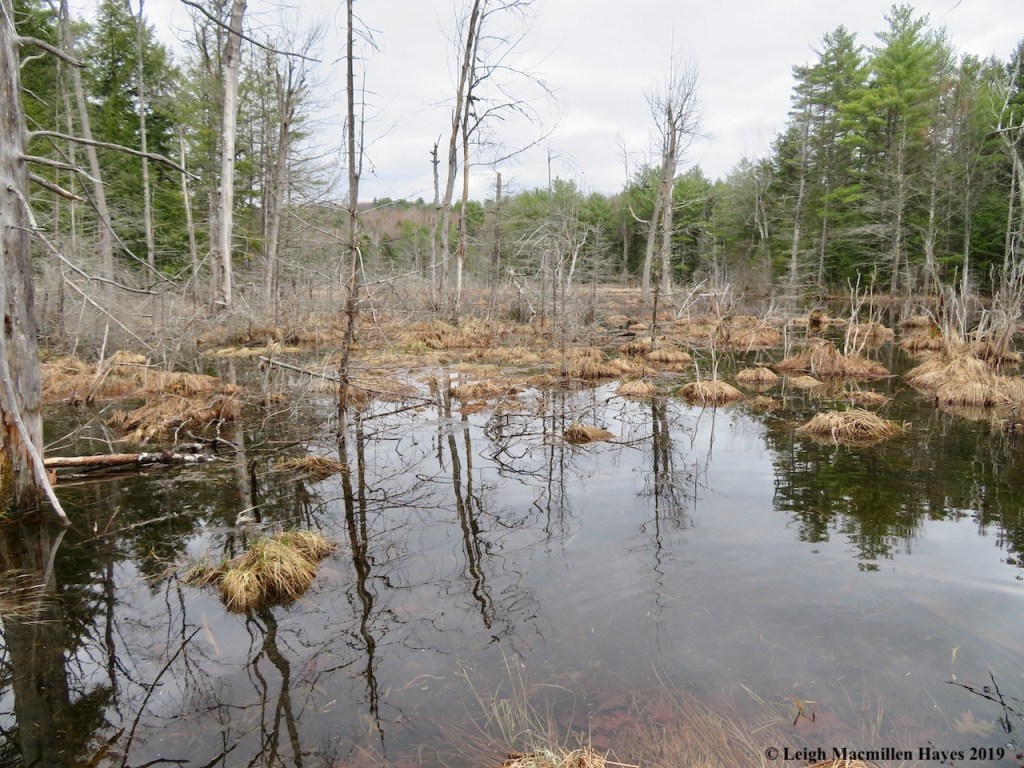
Alanna said we could get away with calling it work because we were, after all, conducting research–on where the vernal pools were located. And so we listened and followed our ears as we bushwhacked through the woods. Peeps and wrucks and trills filled the air and we beelined their way. Suddenly we emerged beside the Red Maple Swamp.

Of course, the symphony cut off upon our arrival, and so after sitting and standing still for a few minutes, we decided to step into the water and search for egg masses. Maybe it was the lighting. Maybe we didn’t look hard enough, though Alanna did find at least one Wood Frog mass after she crossed over a log.

While she was still on the other side, I headed back up onto the land, and a few feet from the water I was stopped in my tracks by a large snake.

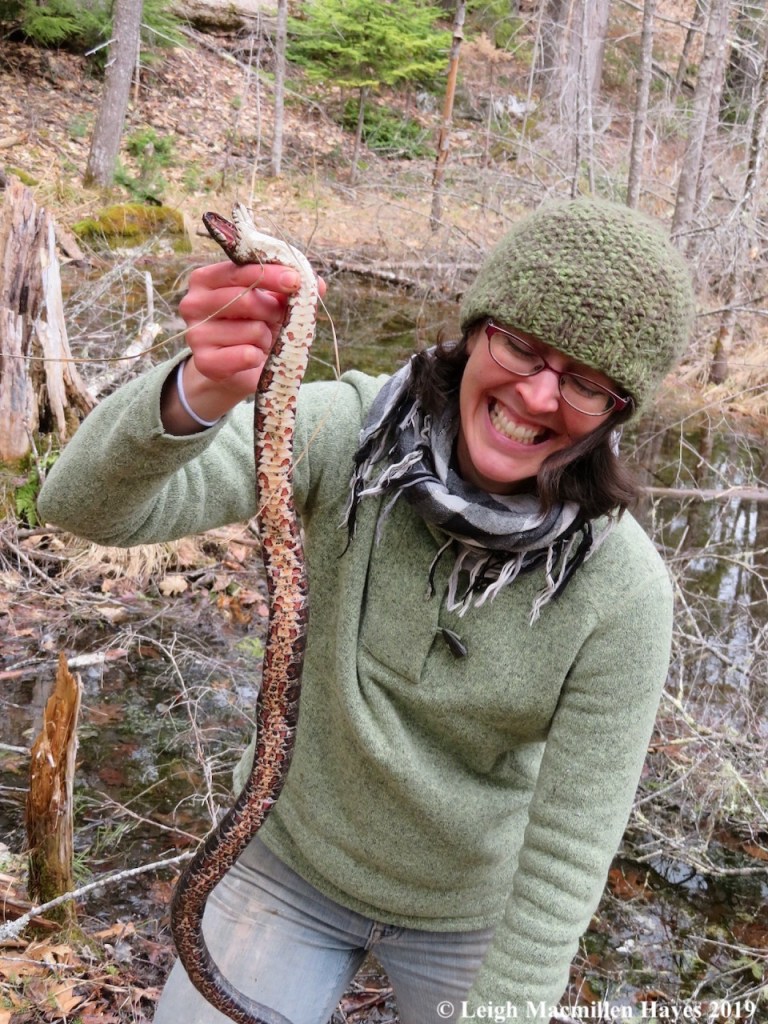
Its mouth gaped in a fashion that could almost have been a smile. For a few minutes I watched and the mouth never closed. That’s when I realized that it was dead.

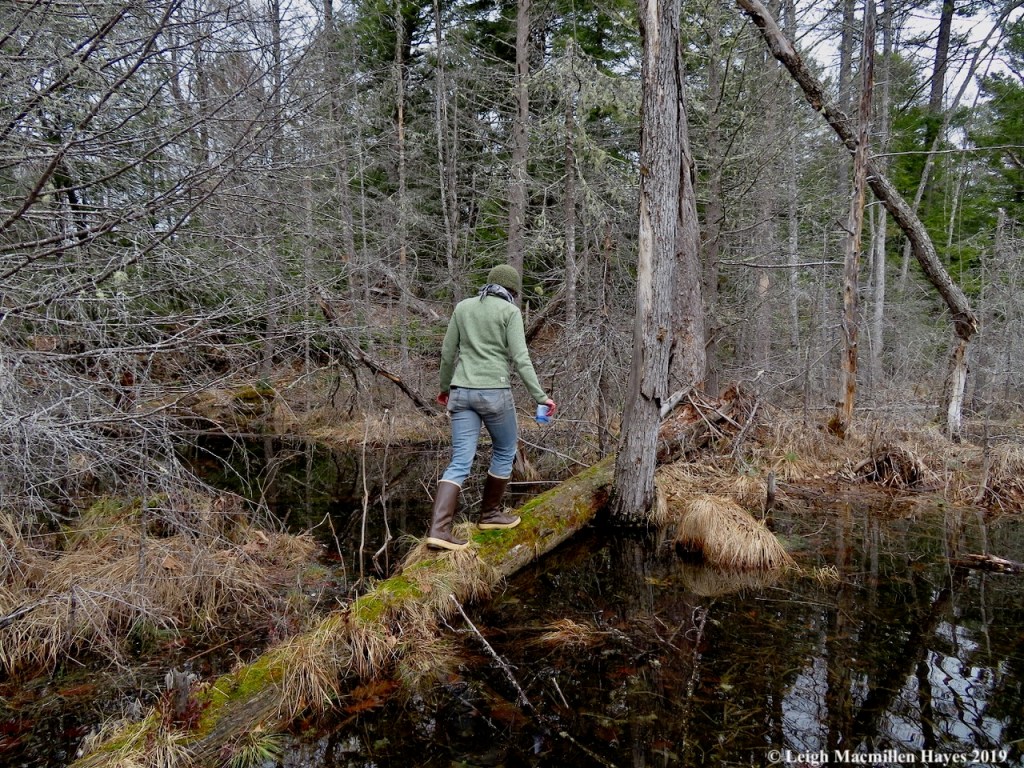
As Alanna made her way back to see it, she found a deep hole and one of her boots filled with water. Being the person she is, she got out of the muck, emptied it, and . . .

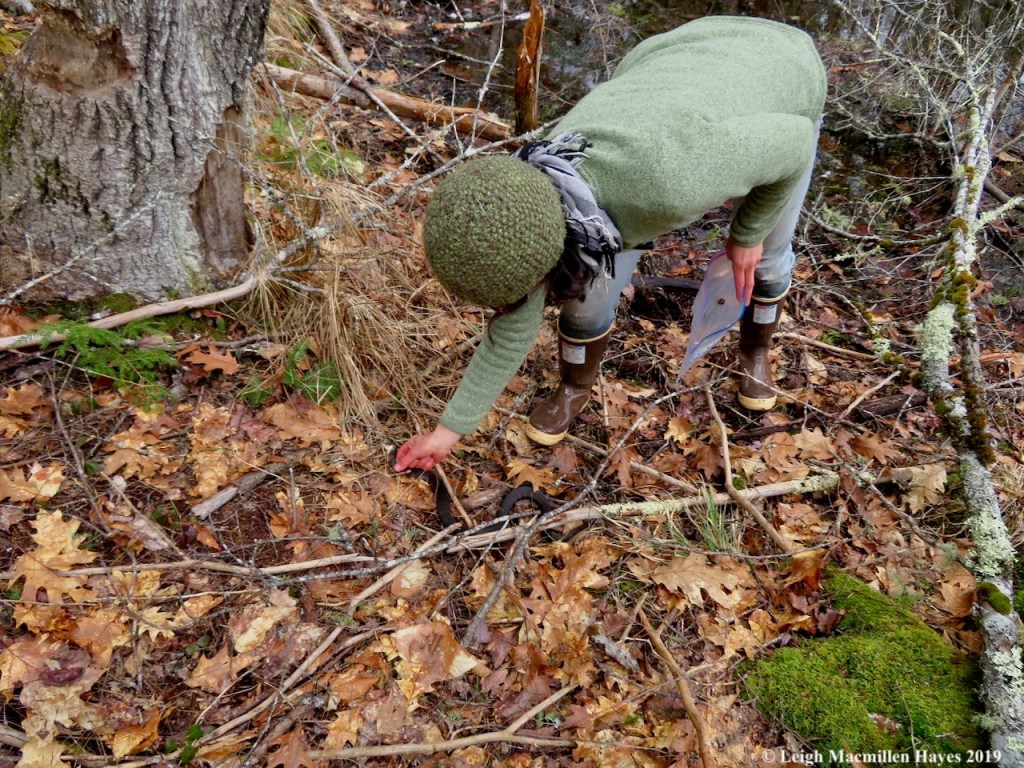
despite the fact that we were both intrigued and a wee bit freaked out about the snake, she picked it up. If you’ve never seen a Northern Water Snake, they are big. And what if it wasn’t really dead, though we were sure that it was. But what if it wasn’t?

It dangled from her hands as over and over again she said, “I can’t believe I’m holding a snake.” Her grinning grimace echoed those words.

Because she’s a collector of fine things like scat, she had brought along a bag and so into it went the snake. Still, she continued to repeat, “I can believe I’m holding a snake.”

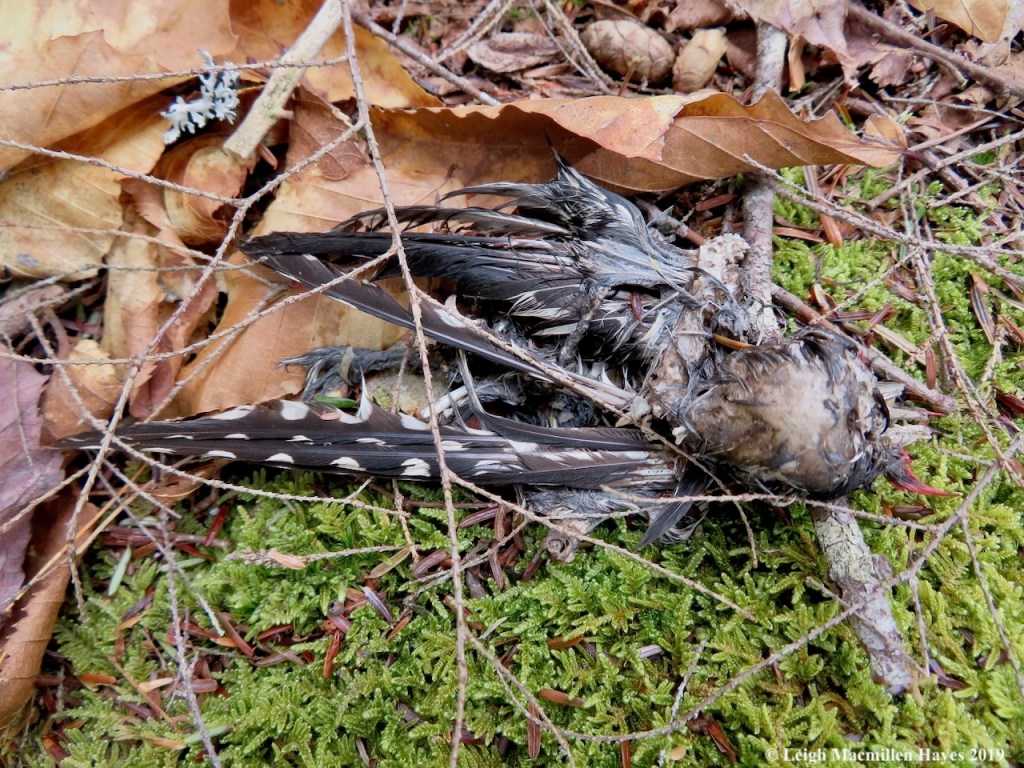
Just a few feet away, we found another kill site. A woodpecker had met its demise.

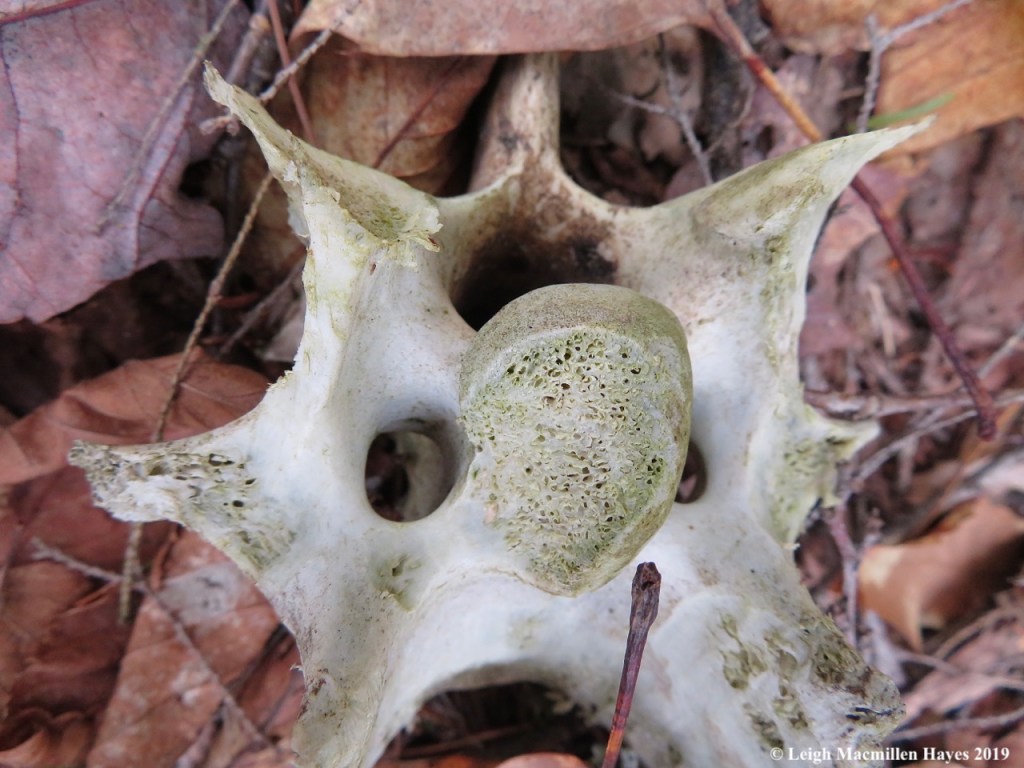
And only feet from that–a deer vertebrae. It became clear that life happens by the swamp; and nearby was an owl pellet filled with bones. We doubted the owl had anything to do with the deer, but what about the snake and bird? Maybe it wasn’t the owl, but some other bird of prey. Why hadn’t the snake been consumed? Or the bird plucked? As usual, more questions than answers. At last we decide to move on because we heard a wetland chorus calling our names on the other side of the next hill.

I followed Alanna until she stopped abruptly. In her path about twenty or thirty feet from the water, another water snake. This one even bigger. And . . . alive. The sun’s rays weren’t strong, but we suspected it was trying to get warm. For a few minutes we stood and watched and then finally decided we could walk by without a problem. And we did. That being said, every step we took after that included a search just in case more snakes lurked about.

The amphibian calls drew us to the area where a river flows through the swamp.

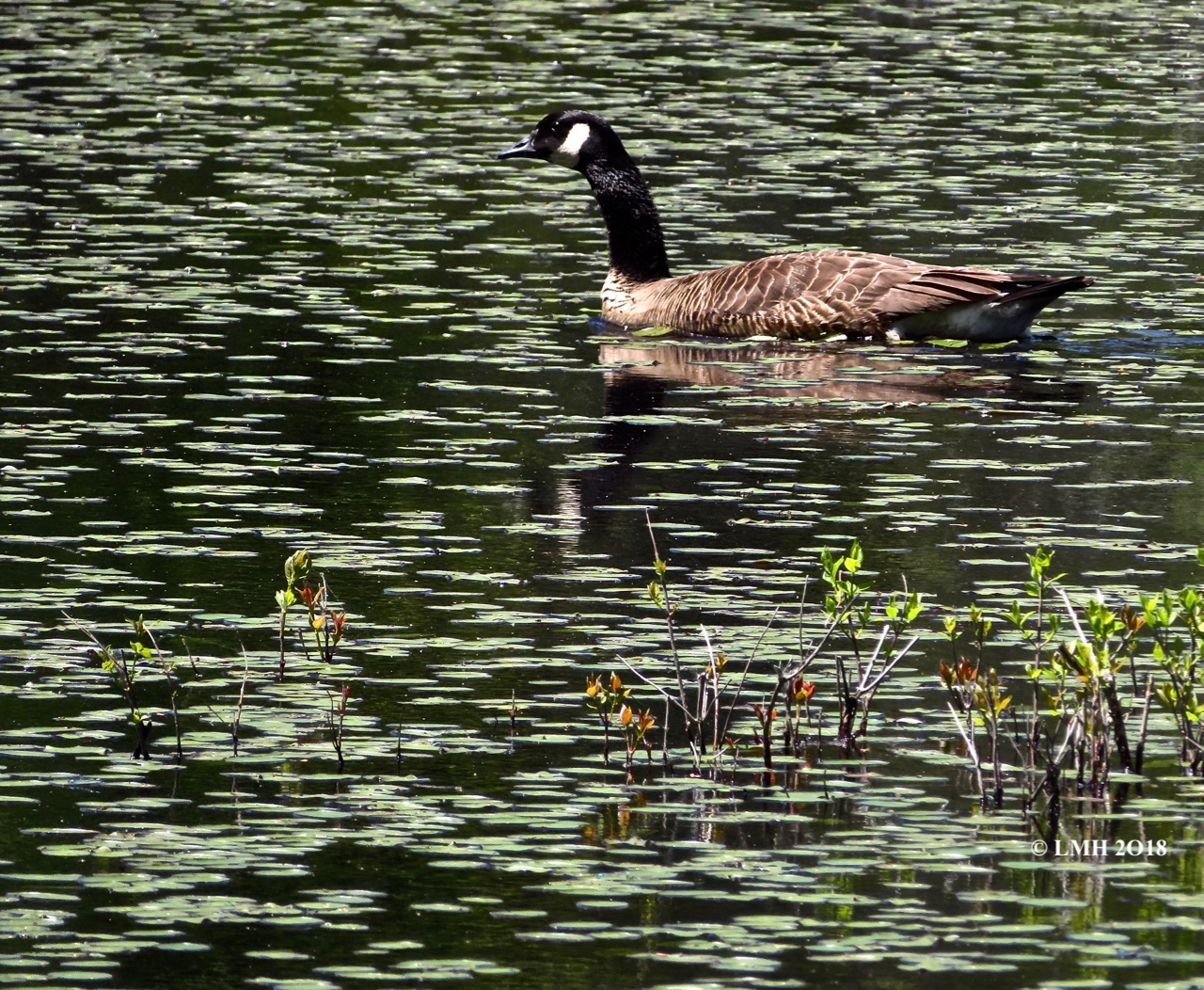
It was there that we found more signs of life including Canada Geese,

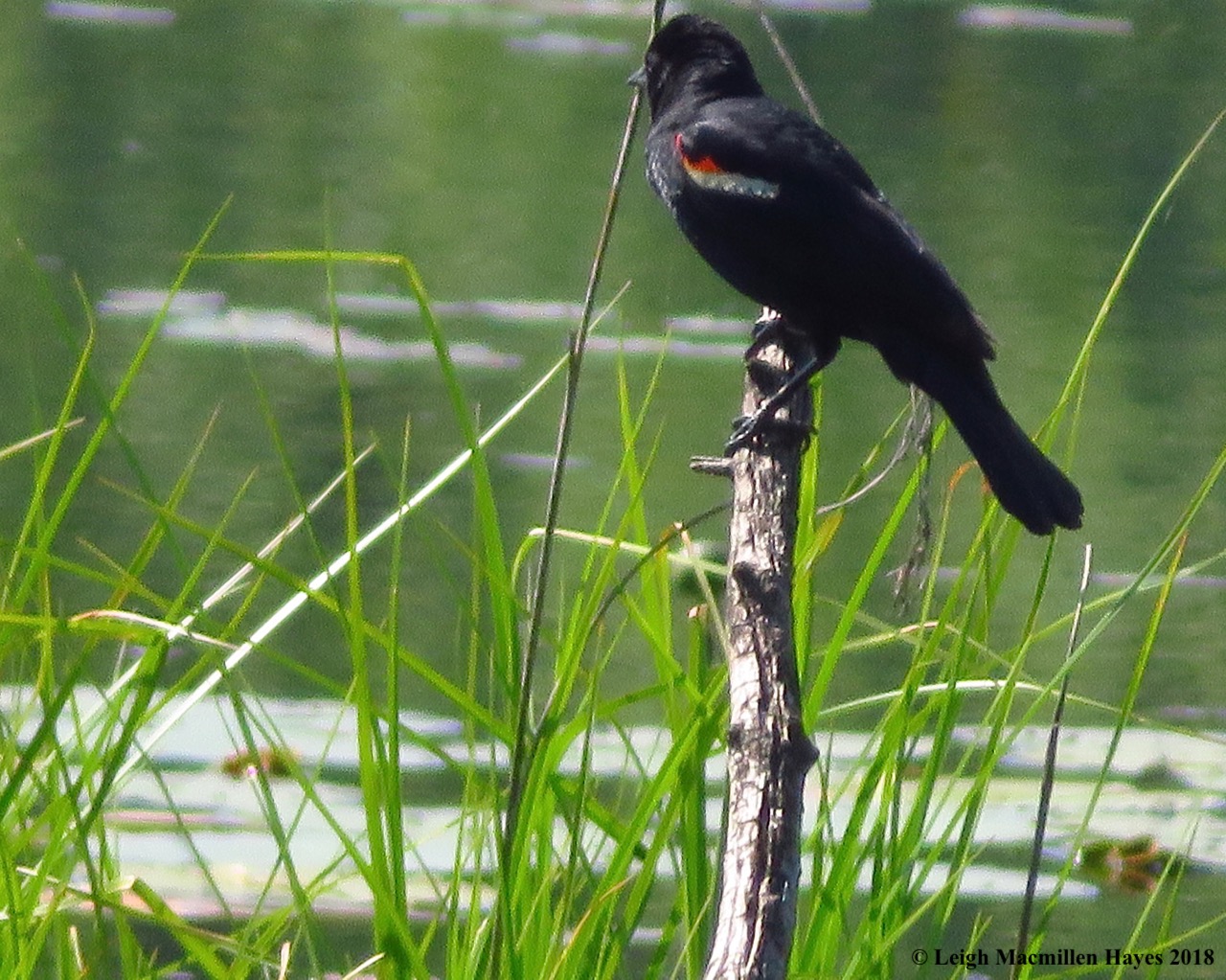
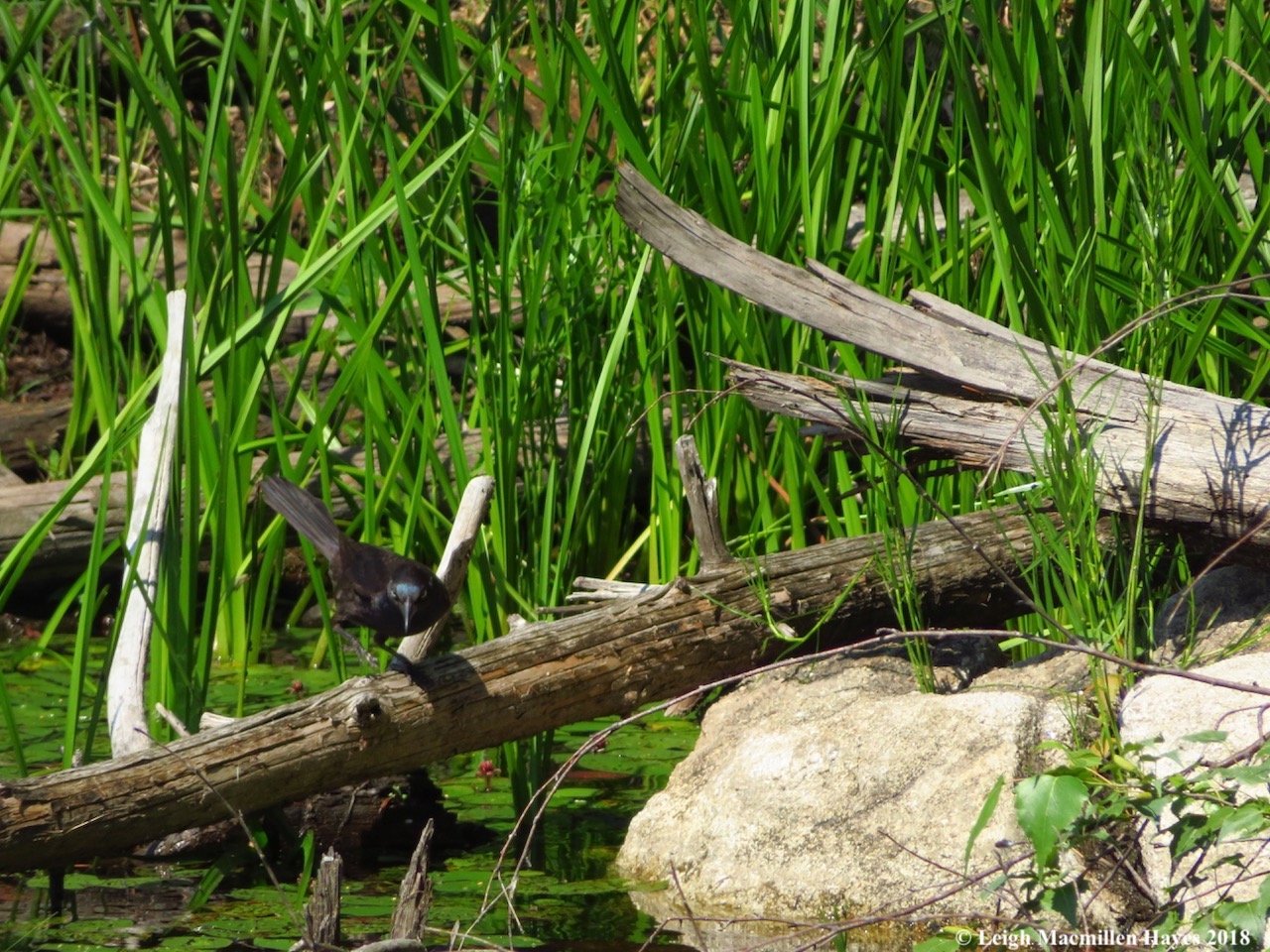
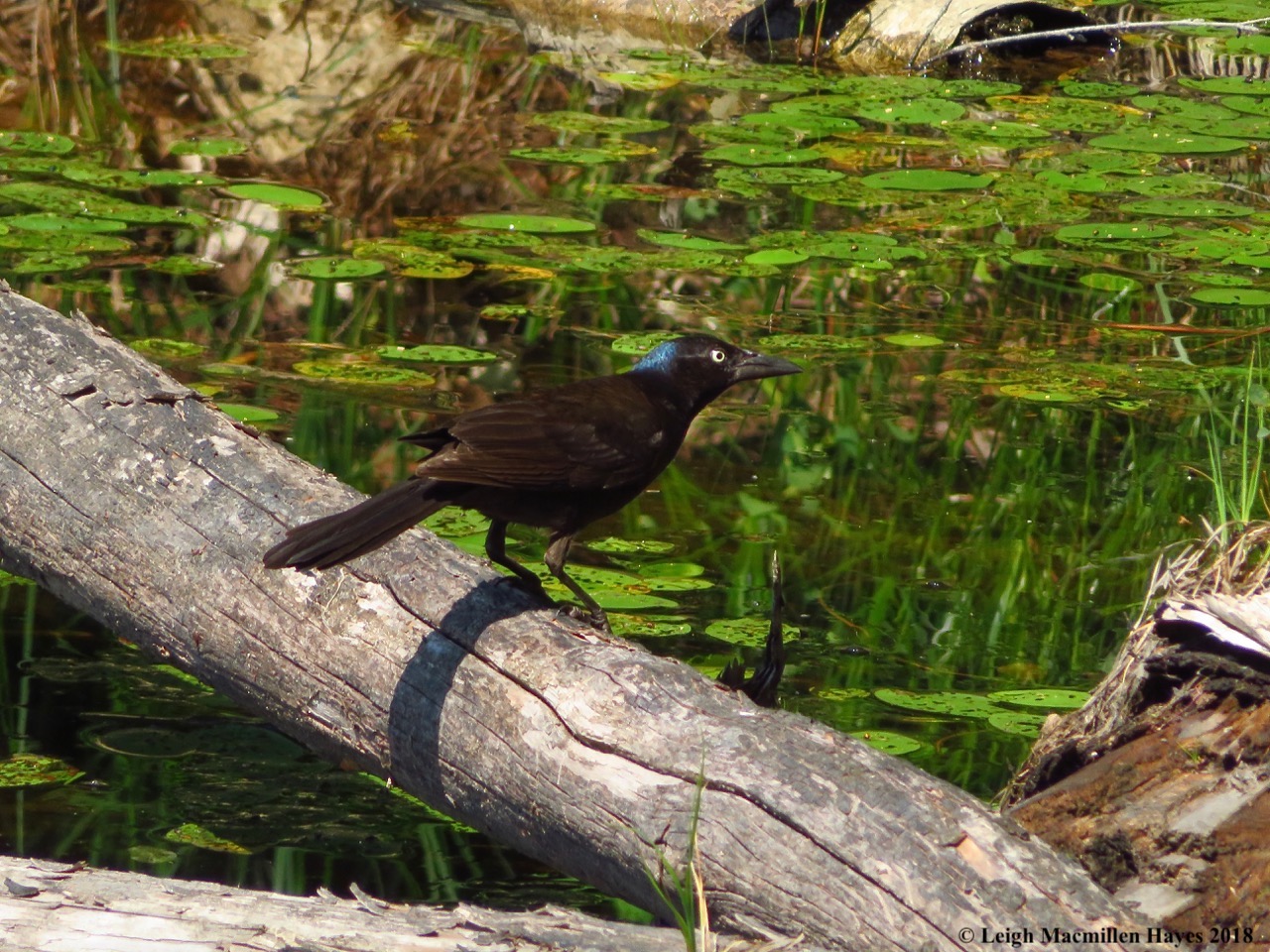
Red-winged Blackbirds,

and rather recent beaver works. At that point, Alanna had to depart, but I stayed for about an hour longer and wandered along the edge of the wetland.

My finds continued for where I looked for frogs by a coppiced tree, instead I found a tussock moth caterpillar frozen in time. It had remained attached firmly to the twig all winter because I suspected it had been parasitized by a mummy wasp.

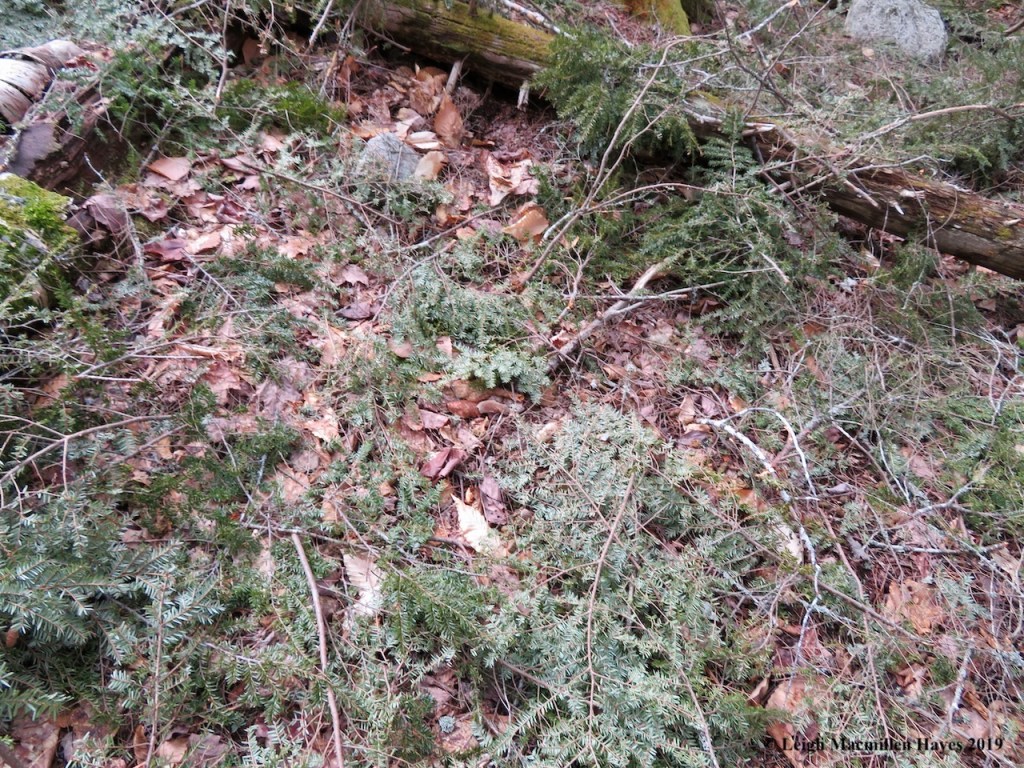
And then it was uphill toward a rocky ledge that I tromped because the ground was carpeted with hemlock twigs. I knew who had cut and dropped them, and wondered if I might spy a den.

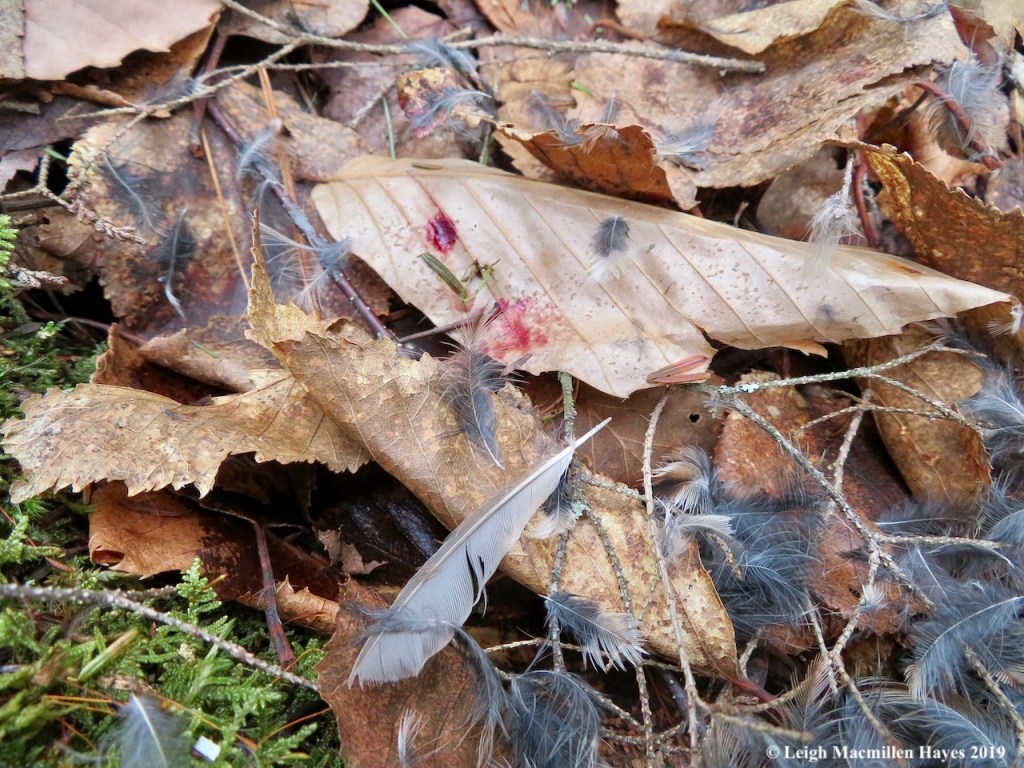
Where I thought there was a den below, I was wrong. But . . . atop the downed tree was another kill site. This time it looked like a Junco had been the source of food.

And on a leaf, the bird’s blood stains.

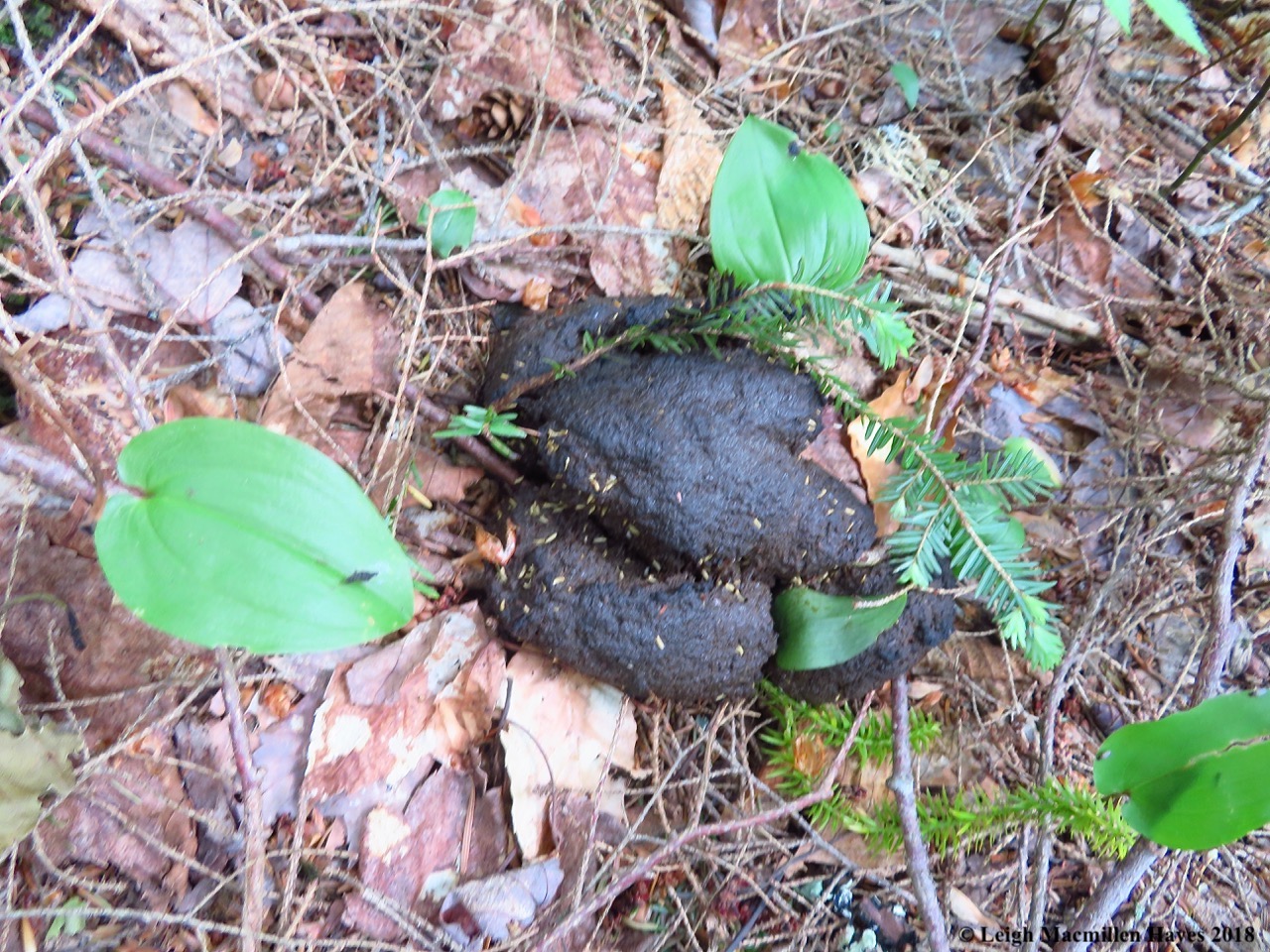
Not far from the feathers and blood, I did find what I was looking for–a porcupine den and its telltale pile of scat flowing forth.

Murder and mayhem you might think. But death is part of the web of life, which also sustains us.

Today, Alanna and I went seeking egg masses and instead found ourselves surrounded by so many other things. It all made me realize I am only one tiny speck in the middle of the bubble.

This Wild Place

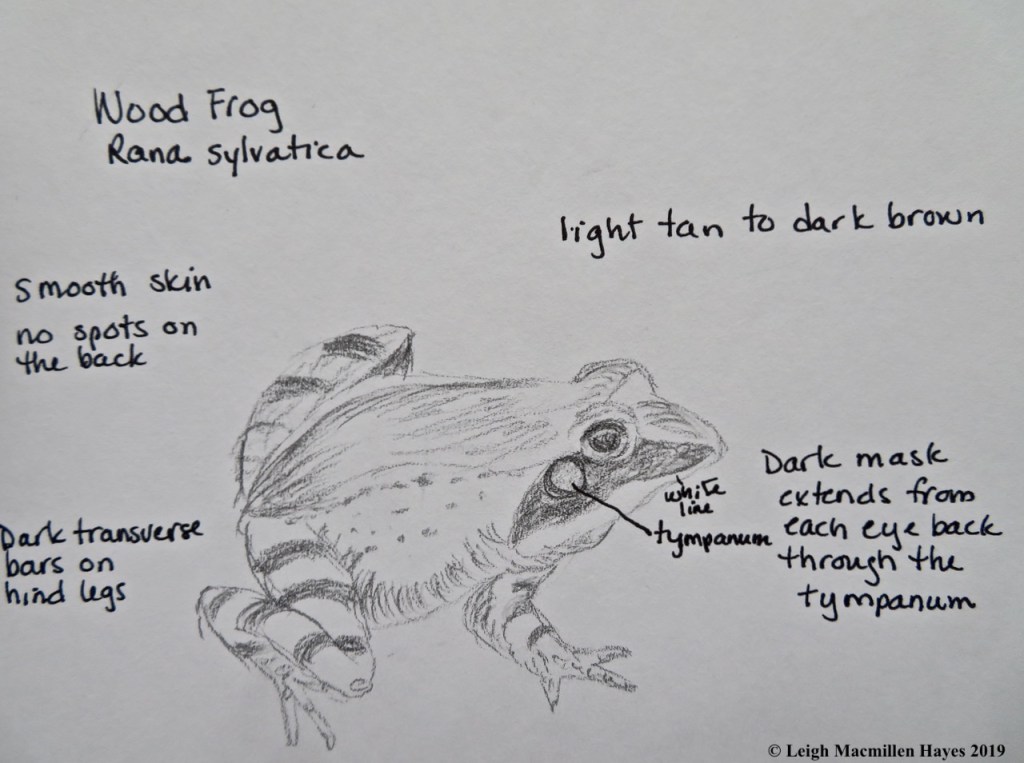
There’s no music quite like the Wood Frog’s defiant chorus, sung when the ice is barely off the vernal pool and the ground still covered with patches of snow. Singing together, they sound like dozens of quaking ducks. Wood Frogs are often the first Maine frogs to break winter’s quiet, beating Spring Peepers by a few days or even a week.

Their vocal prowess extends to silence. Once we approach a vernal pool and they sense danger (perhaps through vibrations), they cut off their song altogether, as though timed by some unseen conductor. The purpose of all this calling is finding a mate, of course. Male Wood Frogs, once they’ve called in some unwitting females, can be tenacious in the extreme–even if their suitor happens to be the wrong species.

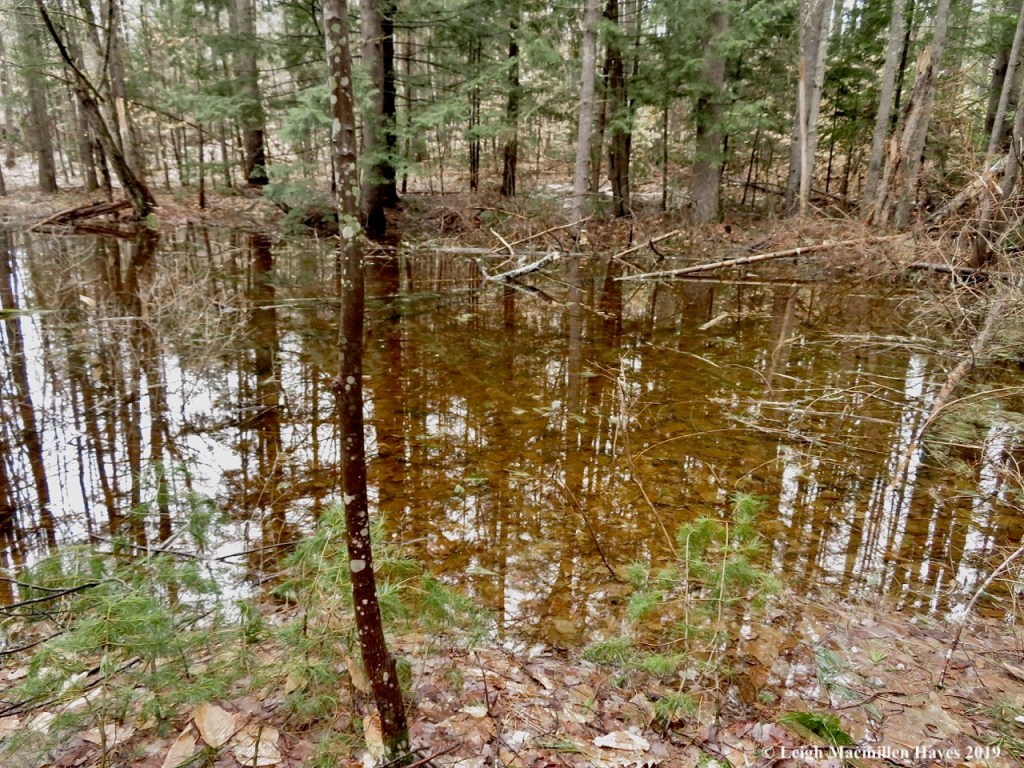
This morning, as Greater Lovell Land Trust Docent Linda Wurm and I approached a pool on the Heald and Bradley Ponds Reserve, the symphony was eerily still.

And so we began to circle around, our eyes scanning the watery surface for clumps of eggs. Our hope was to either see a male hug a female in an iron-lock grasp, forming the mating embrace called amplexus, or evidence of their date.

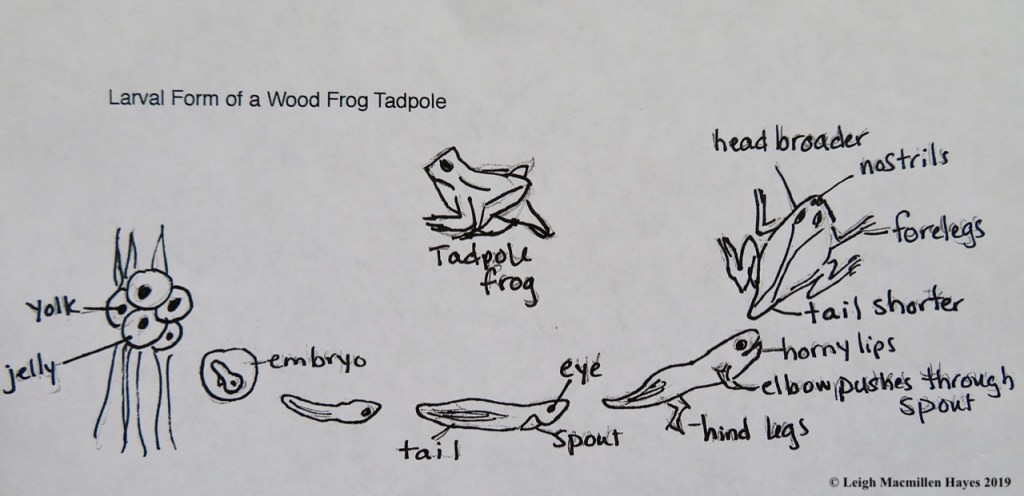
And we were rewarded. At least one female had laid eggs fertilized by a male. As is their habit, the female attached the mass to a twig and the tiny black embryo of each egg was surrounded by a perfectly round, clear envelope about one-third inch in diameter. These gelatinous blobs can consist of up to 1,500 individual eggs. Egg-mazing indeed.

The embryos will hatch into small brownish-black tadpoles in a week or two, or longer given how chilly the water was today. As they grow, their rounded tail fins will become translucent–almost mottled with gold and blackish flecks.

Wood Frog tadpoles grow at varying rates depending on water temperature, tadpole density, and available food resources, but tend to develop within about two months to become adults. Unfortunately for them, but in the web of life good for others, tadpoles often succumb to cannibalism, especially to their larger relatives. They are also eaten by predacious diving beetles, salamanders, turtles, and birds.

We only found one, maybe two egg masses, but this pool isn’t known for many. What it is known for is its Fairy Shrimp population and I’m sorry to report that we found not a one. But, we did spy a few handsome hemlock varnish shelf fungi.

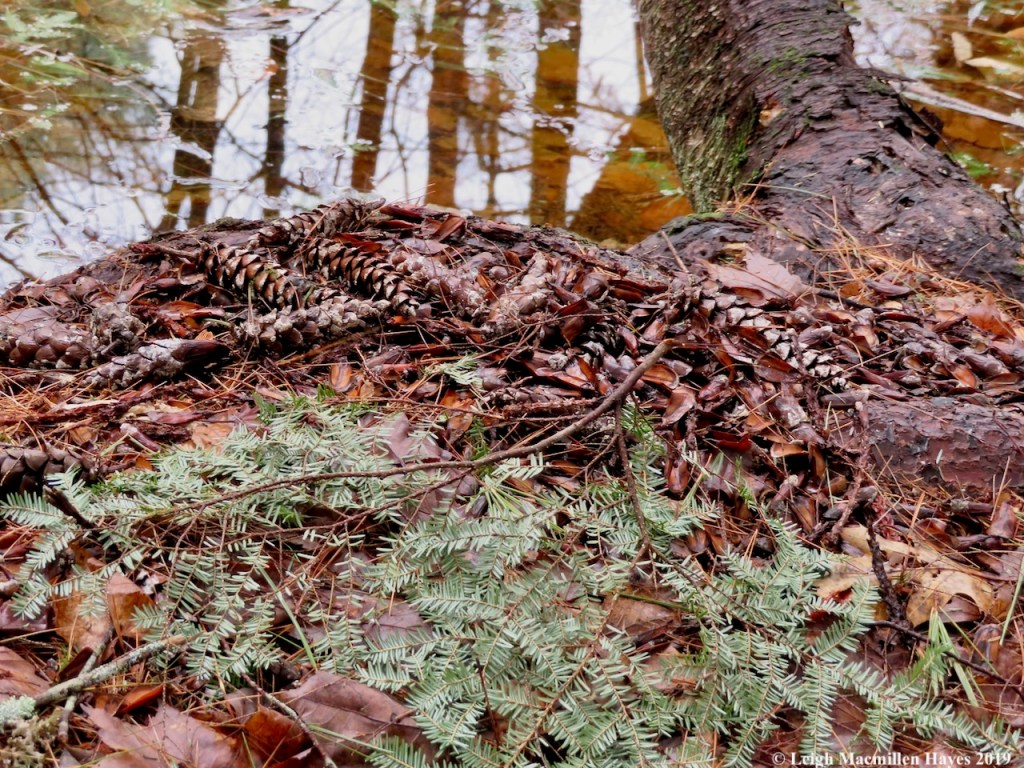
And by them some red squirrel middens that made us happy for we saw few of these all winter.

Right behind the fungi and midden, something else in the water caught our attention and Linda focused with a keen eye.

My photo wasn’t the clearest, but upon some leaves and twigs we spotted spermatophores left behind by male Spotted Salamanders. They remind me of cauliflower, their structures consisting of pedestals topped with sperm. Though we couldn’t see any milky masses of salamander eggs, we hope that on future visits we will.

Spotting a Spotted Salamander is a rare treat. With their bright yellow spots on a sleek, shiny black back, they are even more nocturnal and elusive than the Wood Frogs. They are actually mole salamanders and spend most of their time burrowed underground.

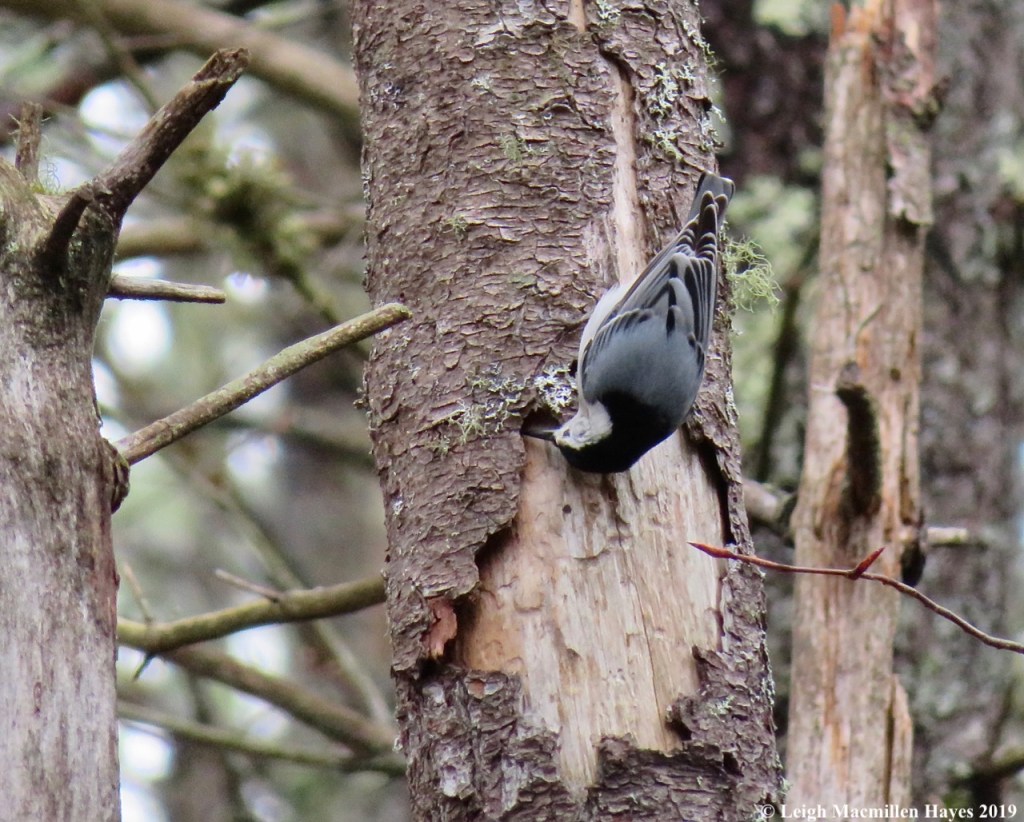
As we circled back around the pool, a White-breasted Nuthatch mimicked our searching eyes and probed under some bark, its long narrow beak seeking beetles.

Every few seconds it took a break and surveyed the world that included us.

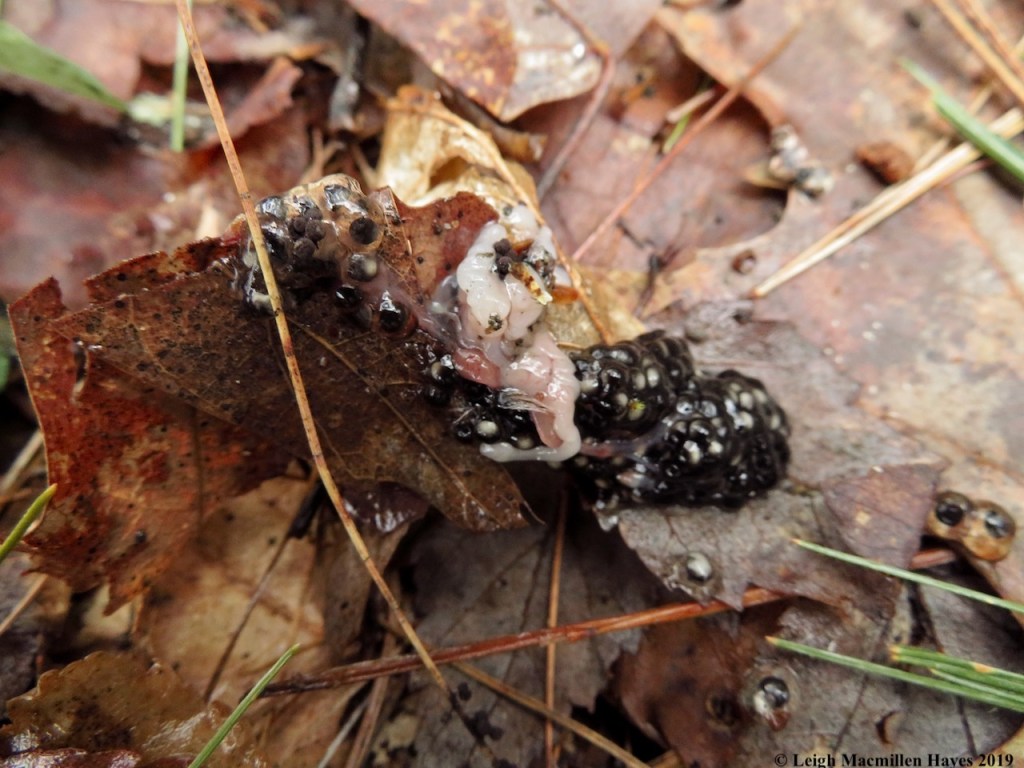
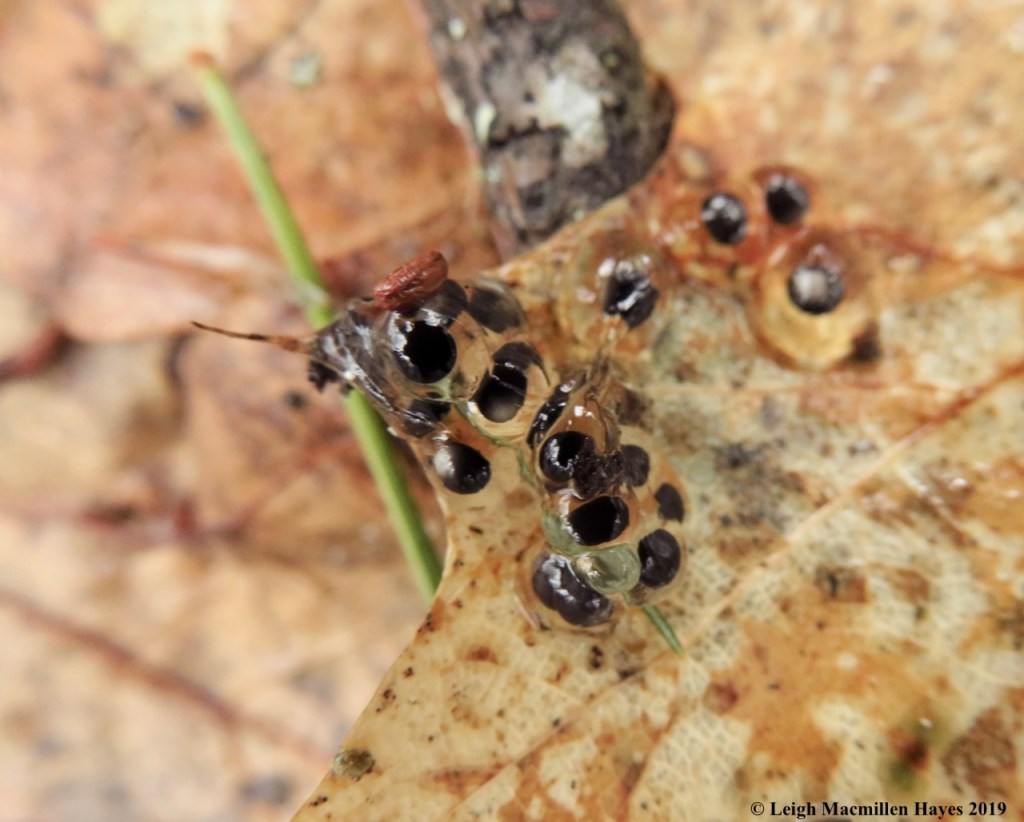
We, too, surveyed the world, and suddenly at our feet we discovered eggs we’d not seen previously. What were they doing about a foot out of the water?

And to whom did they belong? At first I considered Pickerel Frog, but on closer examination I thought they might be Wood Frog.

And then Linda shifted one clump a wee bit with a stick and we found what may have been the entrails. Life happens in vernal pools and this one was no different. Had a predator stopped by? Perhaps a raccoon or skunk or chipmunk or raccoon? But, why didn’t it eat the eggs? Again, so many questions.

With the field microscope, we looked at the eggs again and were almost one hundred percent certain that they were Wood Frog.* We did place some of them back in the water, but wondered if they were viable.

For all the eggs that are laid, it’s hard to believe that only 10% will survive. But the truth is that most die before transforming into adults and leaving their pools. The reasons are varied: the ponds dry up; or they are hunted down by predators: or they die of diseases.

After a few hours, we pull ourselves away, grateful for the time to explore this wild place–full of life . . . and death.

*I’ve reached out to Dr. Rick Van de Poll about the eggs out of water–if, by chance, he responds, I’ll update this post so stay tuned.

And now from Rick:

Hi Leigh!

Fascinating find! Having just seen a few predated egg masses today I can definitively say they are spotted salamander eggs. The blackish coloration is likely imparted by the stomach acids of a raccoon, who apparently gorged and threw them back up, along with a few frog parts. Again, while its not too common to see this kind of things around vernal pools, it does make for for a pretty good ‘who-dunnit’!

Rick

Lessons from the Earth

Dear Earth,

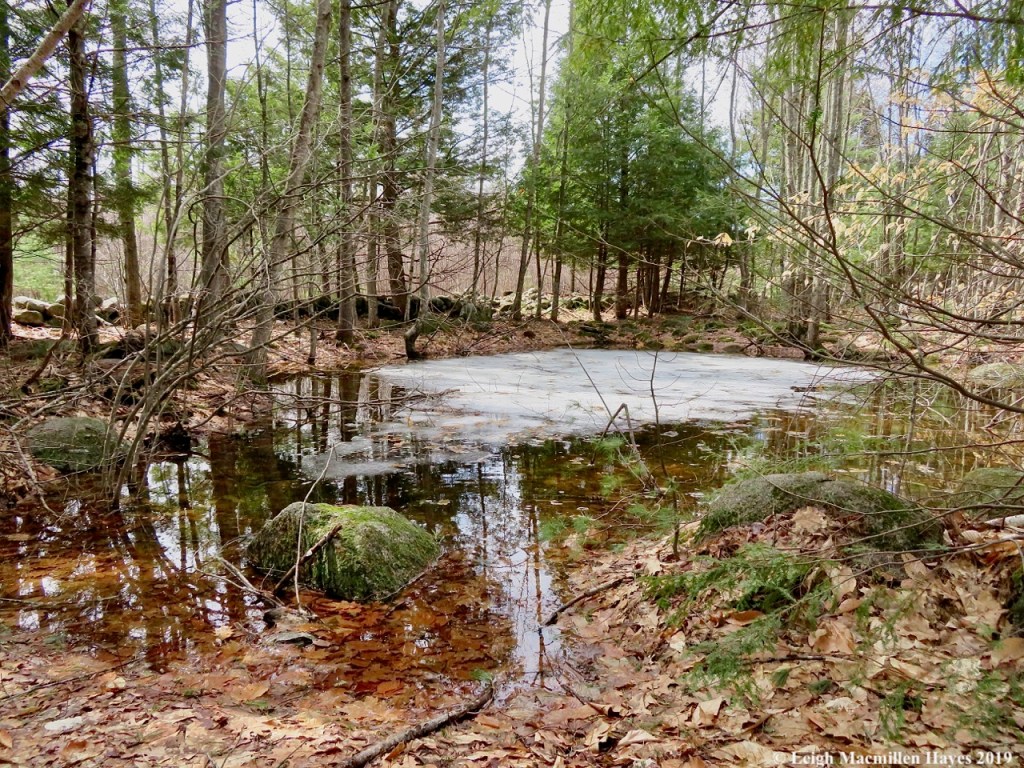
This year found me once again staying in my home territory to honor you and so while my guy did some yard chores, I chose to visit a few of your vernal pools.

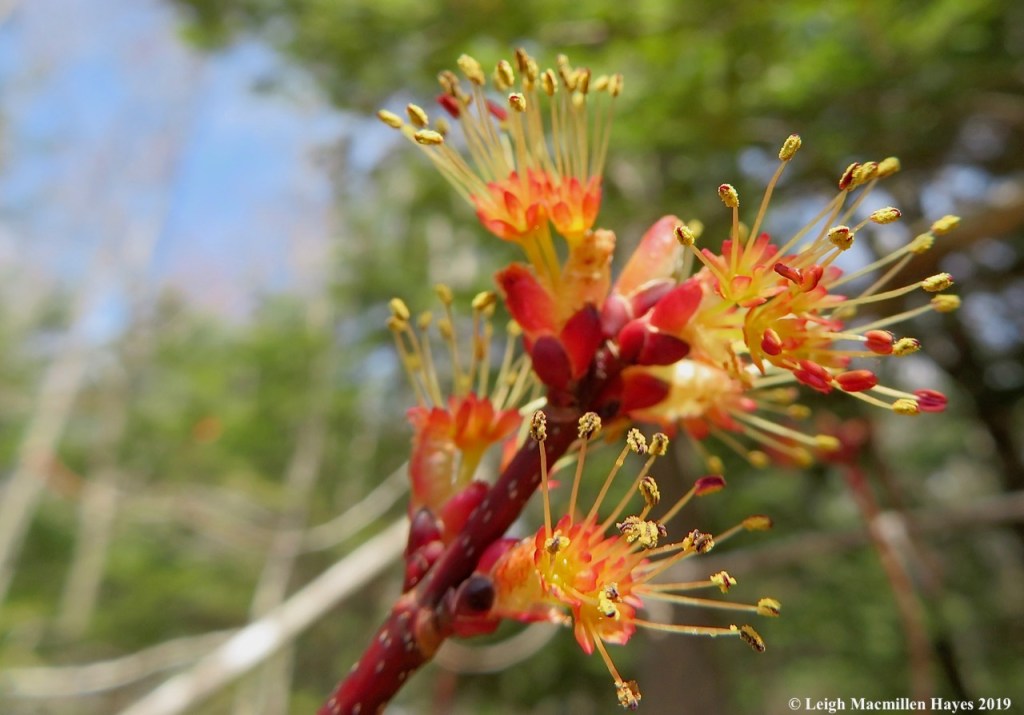
Along the way, I stopped to smell the roses! Opps, I mean admire the flowers of the Red Maples, their pistils and stamen all aglow.

As I approached the first and nearest pool, I new love was in the air for I heard the deep wrucks of the Wood Frogs. That is, until I got to within about ten feet, and then the only sounds were small splashes that barely created ripples as the frogs sought cover under the leafy pool lining.

But, as you’ve taught me in the past, I stood as still as possible and waited patiently. It was then that my eyes began to focus on the pool’s tenants. And I realized that the usual population of larval mosquitoes, aka “wrigglers” already somersaulting their way through the water. That may be bad news for me, but it’s certainly good news for the birds and dragonflies of the neighborhood. While I try to practice mind over matter when I’m stung by a mosquito, I have to remember that your plan to offer “Meals on the Fly” sustains so many others.

And then, and then I spied something disturbing. Actually it was two somethings. Frog legs of two frogs. And even a head. Dinner? For whom? Typically, I rejoice at a kill site for I realize that one species feeds another, but this one disturbed me. Perhaps, dear Earth, it was because I think of this pool as mine even though it’s located on a neighbor’s land, and I want to protect it and all that live within, as well as all who venture to it for nourishment. Eventually, I realized that perhaps someone had been nourished by the frogs, but why didn’t they consume the entire beings? Could it be one of their own species who went into attack mode? I don’t have the answer–but once again you’ve given me more to question. And so in the end I realized I should be grateful for having the opportunity to wonder.

The good news–right behind the two dead frogs was a recently deposited egg mass. Its form made me think Spring Peepers, but I’ll need to watch them develop.

Death. Life. The cycle plays out as if a best seller in this dramatic genre.

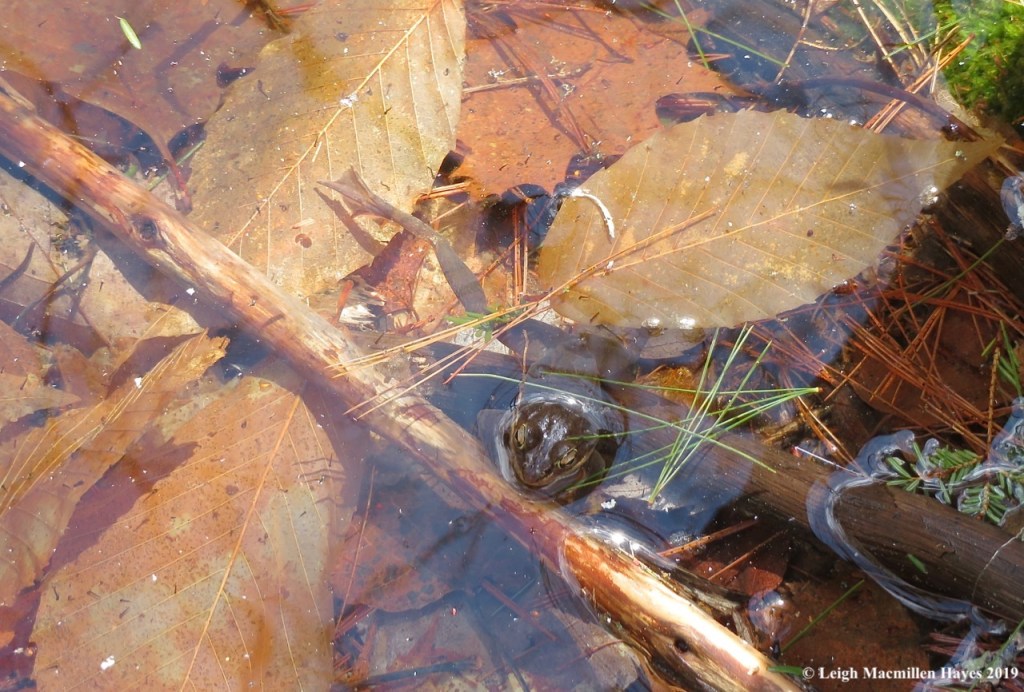
I circled the pool looking for any other unusual sights or clues, but found none. Eventually I stood on my favorite rock and appreciated that you finally rewarded me, dear Earth. A Wood Frog appeared by my feet and we both remained as still as possible–that is until my feet began to fall asleep and I needed to move on.

As you know, dear Earth, I located several more pools, their wruck choruses giving them away. And within one, it was obvious by the egg masses that the lover frogs had found their mates.

Walking back toward home, I got a bit nosey, as you know, and turned over some bark that had fallen from dead trees. To my delight: millipedes, earth worms, bark beetles, slugs, and . . .

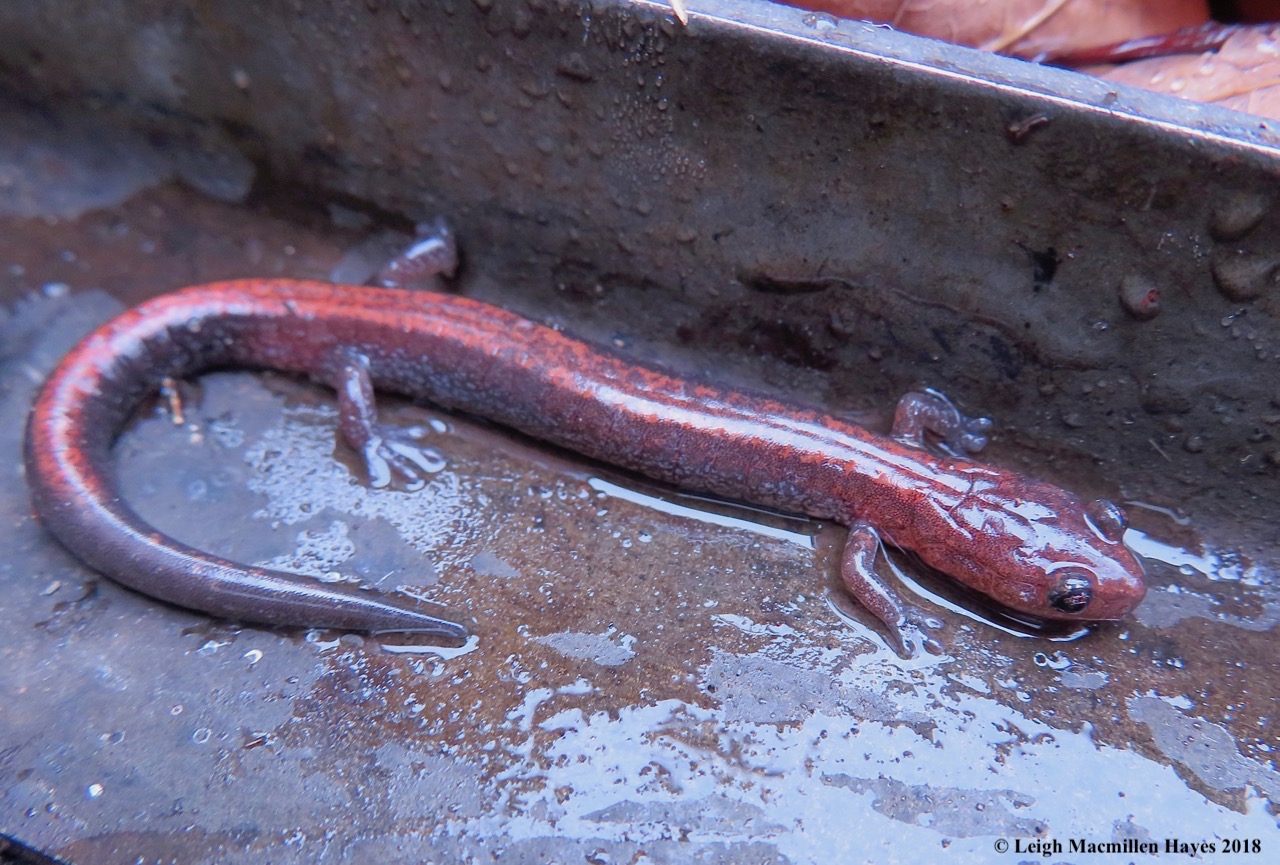
At least five Red-backed Salamanders. That reminded me, dear Earth, that though I wasn’t able to join Lakes Environmental Association for Big Night on Saturday, that rainy night when the temperature ranges about 40˚ and the amphibians decide to return to their vernal pools to mate and folks try to help them cross our roadways to do so, I trust that you made sure the Red-backed Sallies and worms made their presence known in the grass behind the Masonic Hall. Did you?

As for my walk today, I followed our trails and then an old logging road, where the deer and moose and coyotes and foxes and turkeys also roam.

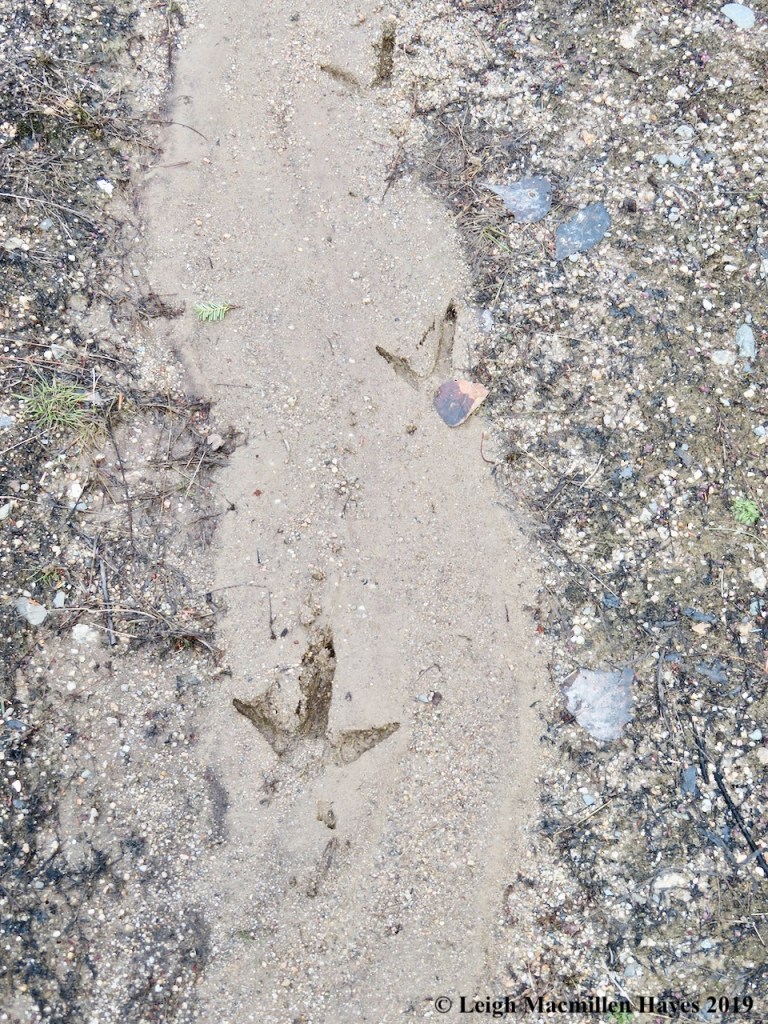
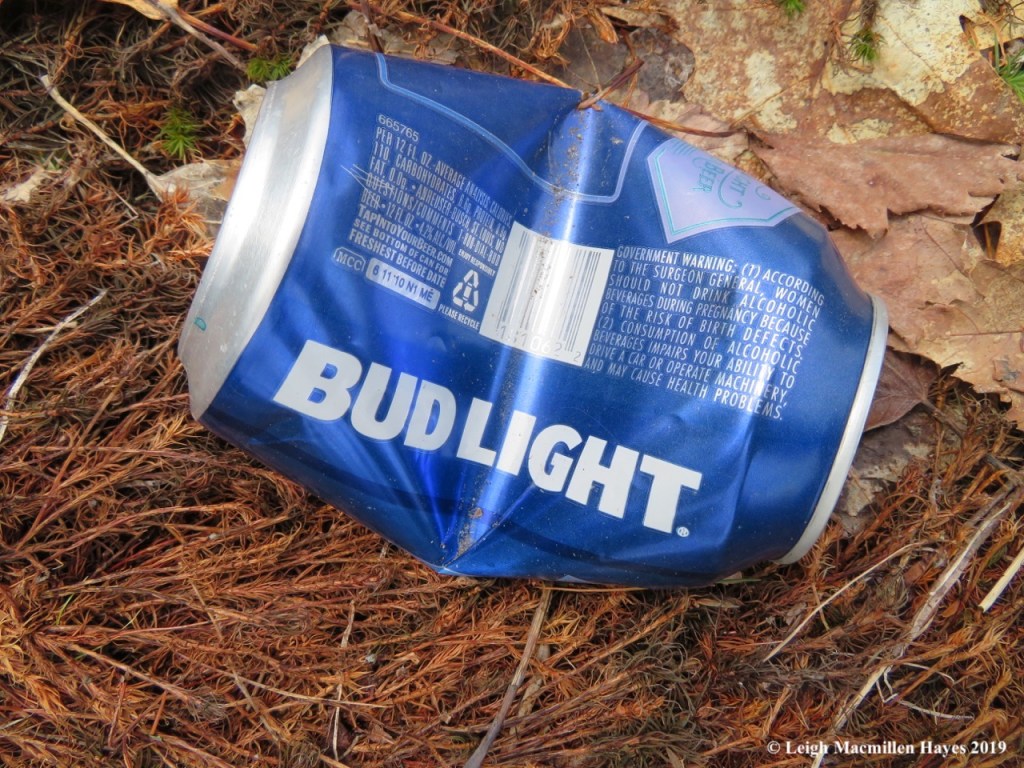
And because part of my journey took me along the snowmobile trail, I picked up some empties and realized that not all turkeys are created equal.

But you don’t judge, do you dear Earth. Nor do you pretend that the world is perfect.

That being said, the sight of my first butterfly of the season, the pastel colored Clouded Sulphur, was rather perfect in my book.

Thanks for once again taking the time to teach me a few lessons . . . lessons from the Earth on this, your day, Earth Day 2019.

Wondermyway Celebrates Fourth Anniversary

My comings and goings are often a tramp through the woods, where I pause frequently to contemplate the world through which I wander. These provide me with glimpses at a small portion of the wonders of the universe. Please join me for a few minutes as I share the mysteries of the hills that have been revealed to me this past year.

The ice delighted our sense of sight, understanding, and artistic form. Like the water from which it was created, it flowed in much variety.

And then . . . as we looked, a motion captured our attention. We were blessed with the opportunity to spend a few moments with a mink as it bounded down the hill before realizing it had an audience.

Next a splash startled us. What caused it? There was no snow high up on the trees that might have fallen. At last we saw the creators. There were actually three–swimming about slowly. Suddenly splashing again, they disappeared into the depths below. And the chambers within. We were in awe and felt honored to have shared a few minutes with members of the beaver family.

Sometimes our stops were to contemplate our next steps–especially when it came to the water that covered the cobblestones. Spying a bird nest, we wondered about its creator. There were some acorn pieces inside, so we thought it had hosted more than one inhabitant. Because we were near water, though most of it still frozen, and the temp was high, we weren’t surprised to find a set of baby handprints created recently by a raccoon.

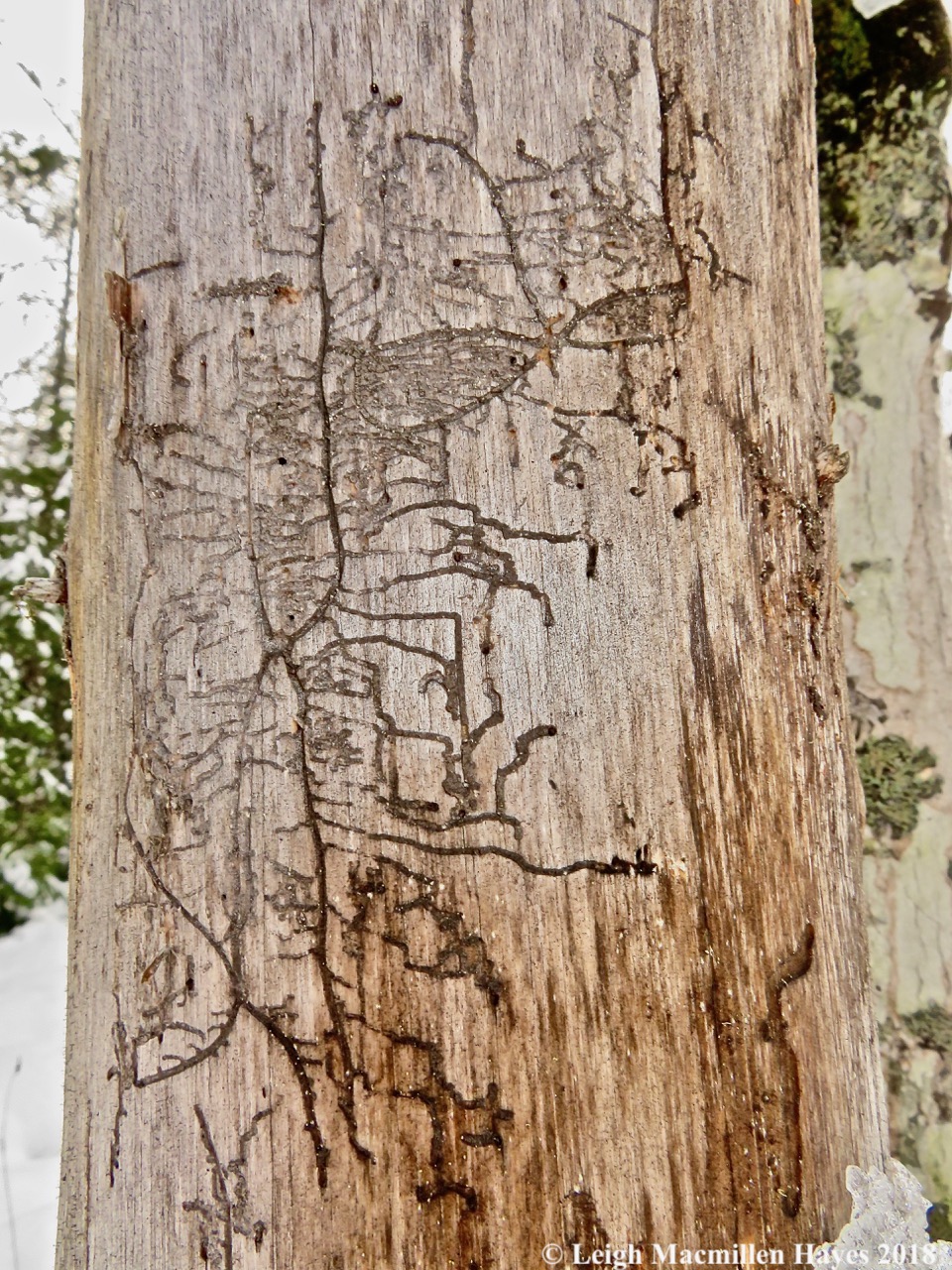
As I stood there looking for a million wild mammals, my eyes focused on the works of something much smaller. Insect egg tunnels on a dead snag read like a story book page. The overall design could have been a map leading to hidden treasures.

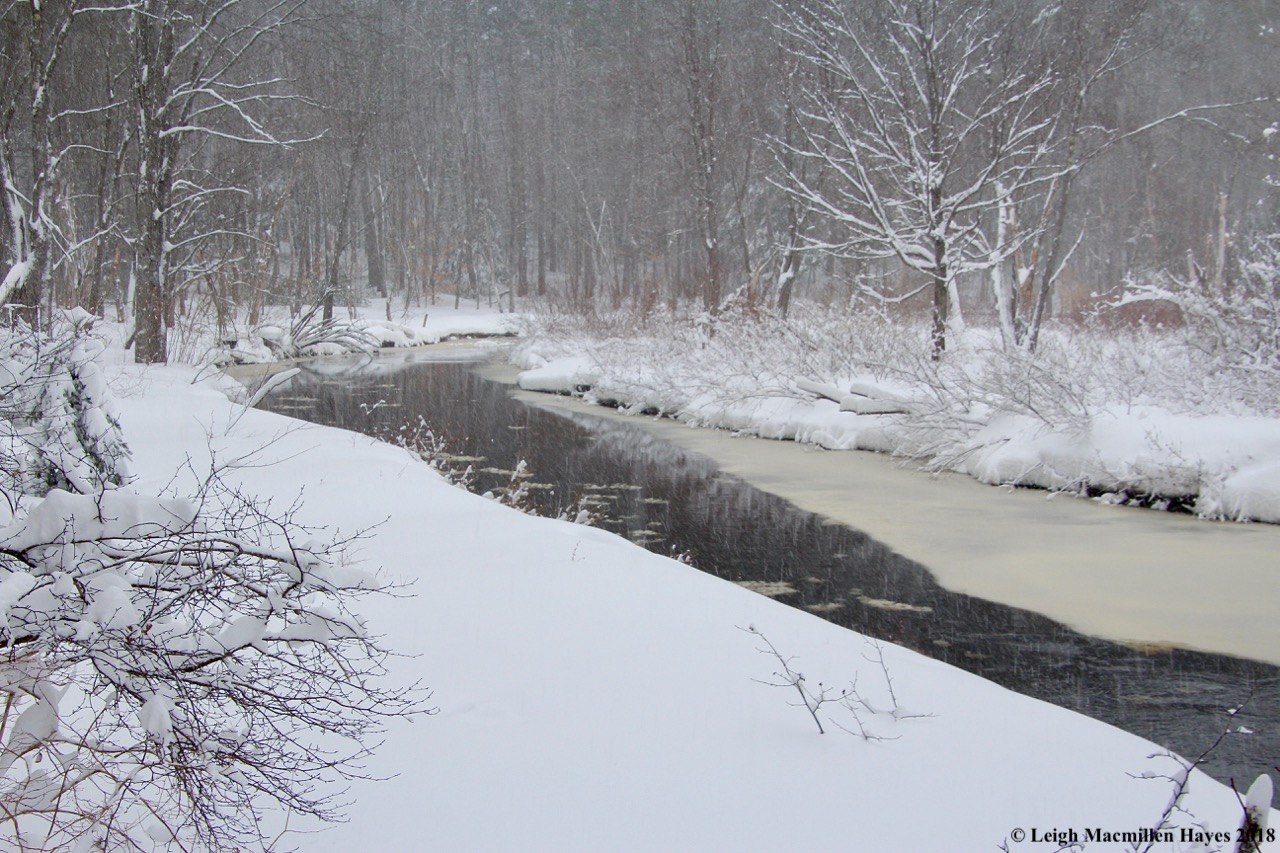
Within each soft snowflake I felt millions of wings brush against my face–reminding me of those I know who are at the moment downtrodden and have hurdles to conquer. Some tiny, others immense, all were angelic in nature. As the flakes gathered together, they enhanced the reflection of harmony with illumination. They brought Heaven down to Earth . . . and reminded me that even in the darkest hours I hope my friends remember that grace surrounds them.

Life, it seems, is always in transition. So it feels, when one season overlaps another.

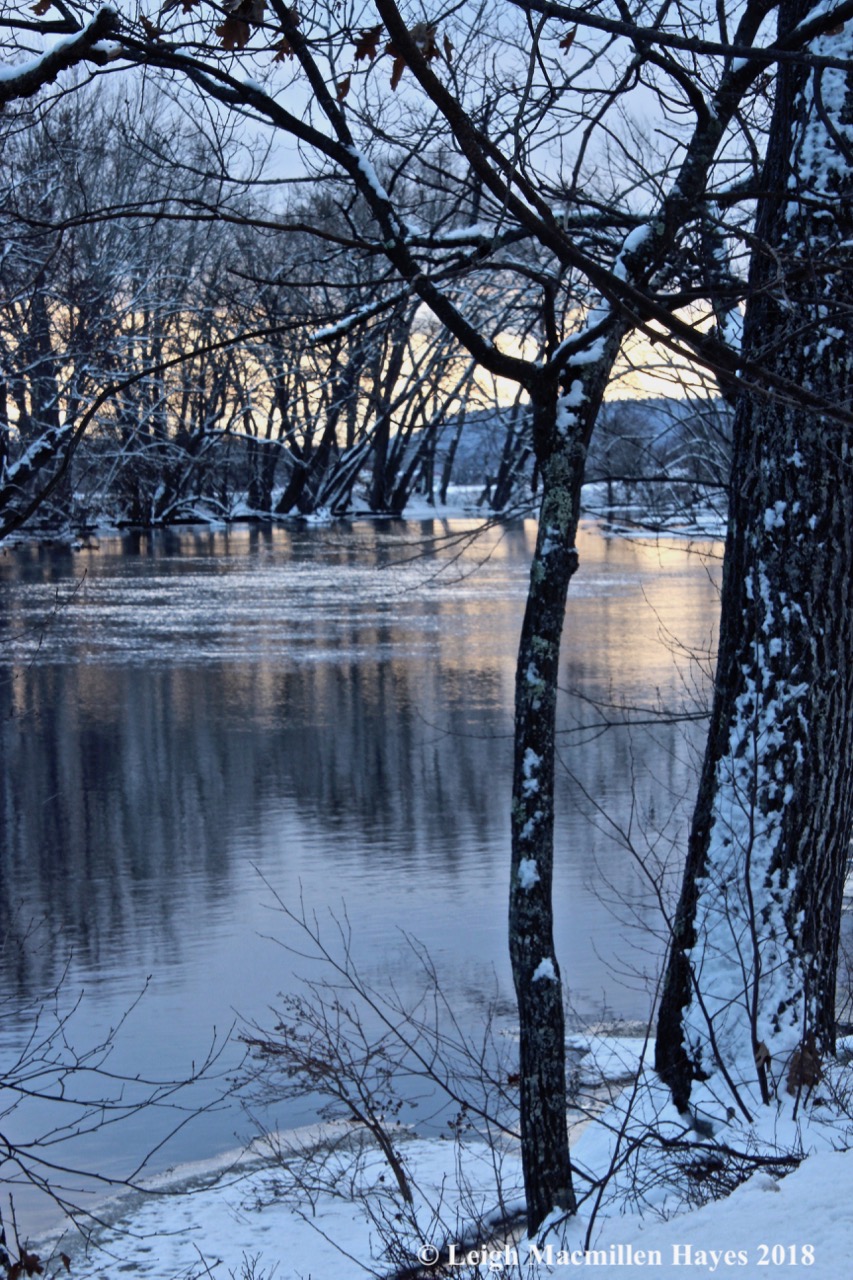
The scene is never the same, nor is the light. What may have appeared monochromatic was hardly that. When the sun began to set, the water harbored reflective moments as it transformed the views from crisp representations into impressionistic paintings.

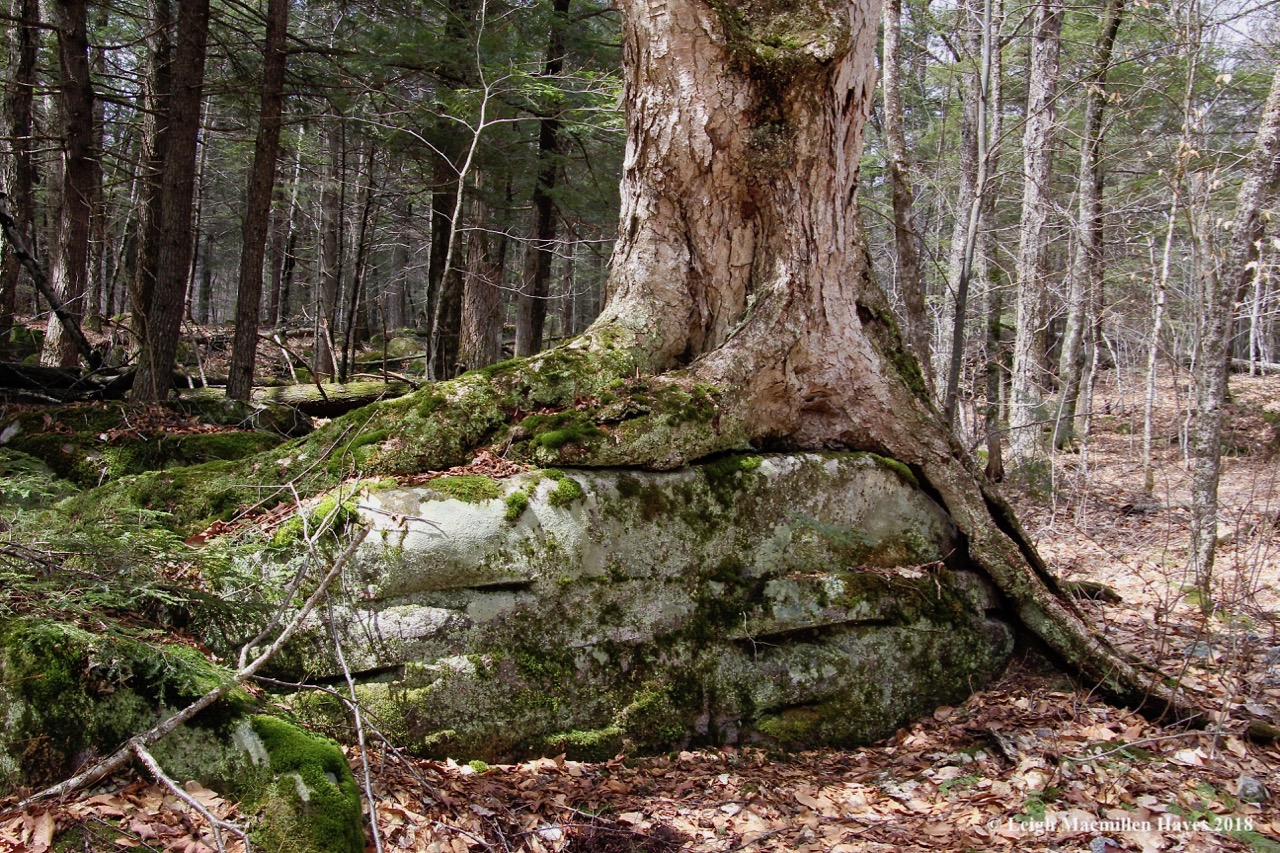
Right away, the trail’s tree spirit whispered a welcome. And another of my favorite trees begged to be noticed again. It’s an ancient yellow birch that has graced the granite for more than a century. The tree itself, wasn’t in good health, but the roots atop the rock splayed out in support of a life to be continued.

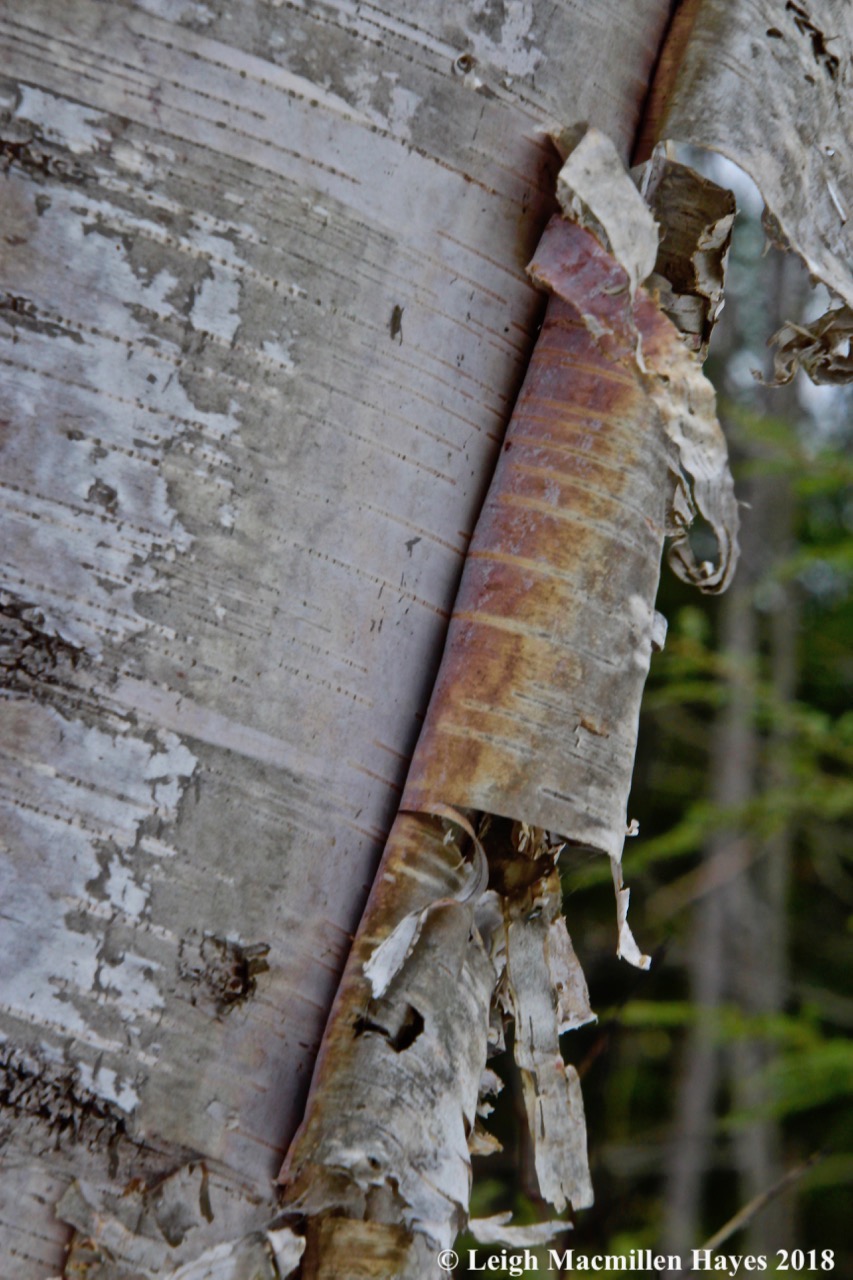
Beside it stood one that some know as white; I prefer to call it paper. The curled-back birch bark offered hues of a different color reminiscent of a sunrise in the midst of a graying day.

And not to go unnoticed, bark from another birch had fallen to the ground. It too, offered subtle pink hues, but it was the stitchery created by the tree’s pores that drew my eye. They reminded me of a million zippers waiting to reveal hidden secrets.

Near the stonewall along the cowpath stood tall an old pine that perhaps served as the mother and grandmother of all the pines in my forest. Today, bedecked in piles of flakes, her arms reached out as if to embrace all of her offspring.

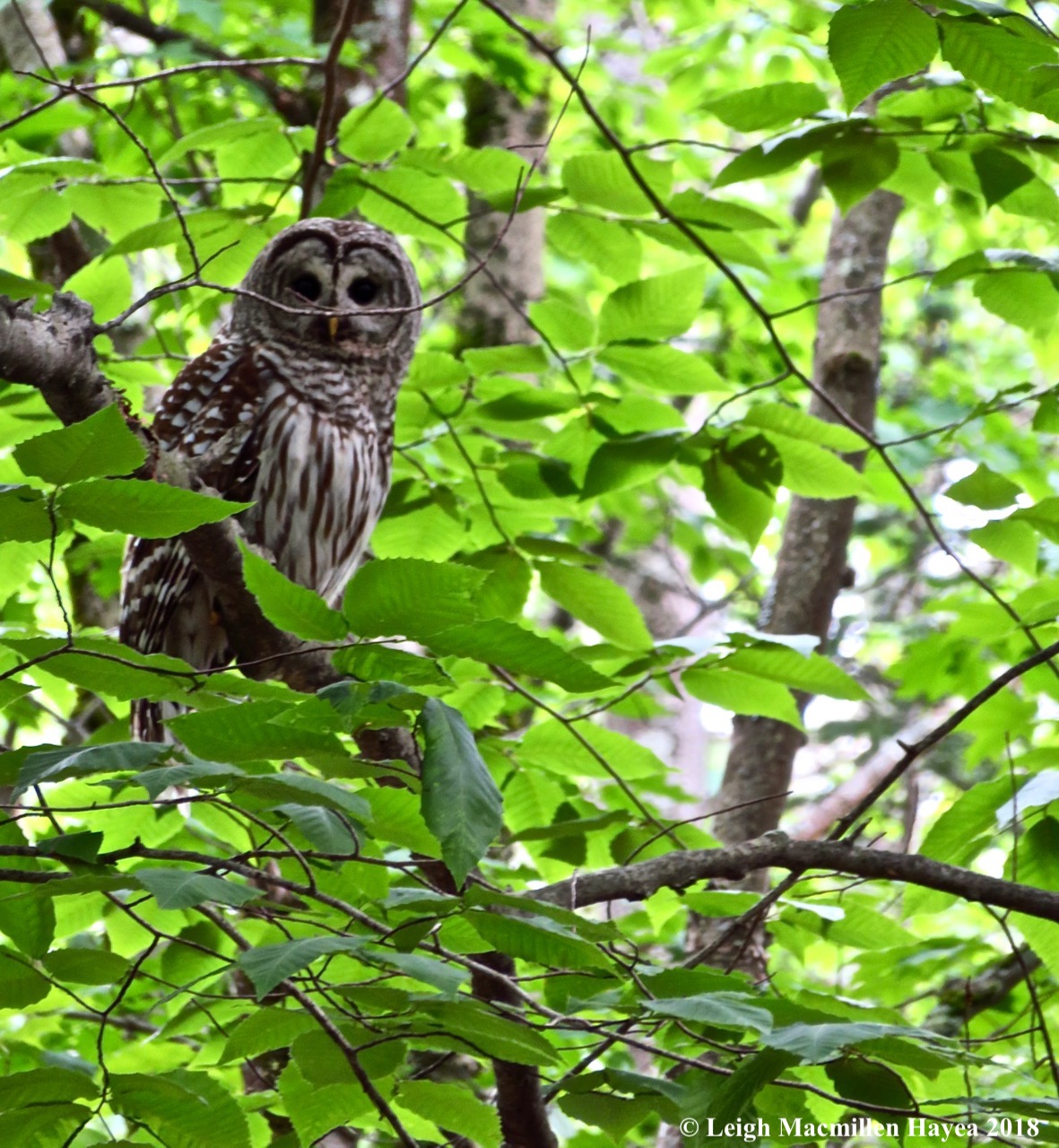
I had only walked a wee distance when I heard a Barred Owl call, “Who cooks for you? Who cooks for you all?” It was noon, after all, so it seemed totally appropriate. Suddenly, I heard a response somewhere ahead. For about five minutes they echoed each other. And then the world was silenced.

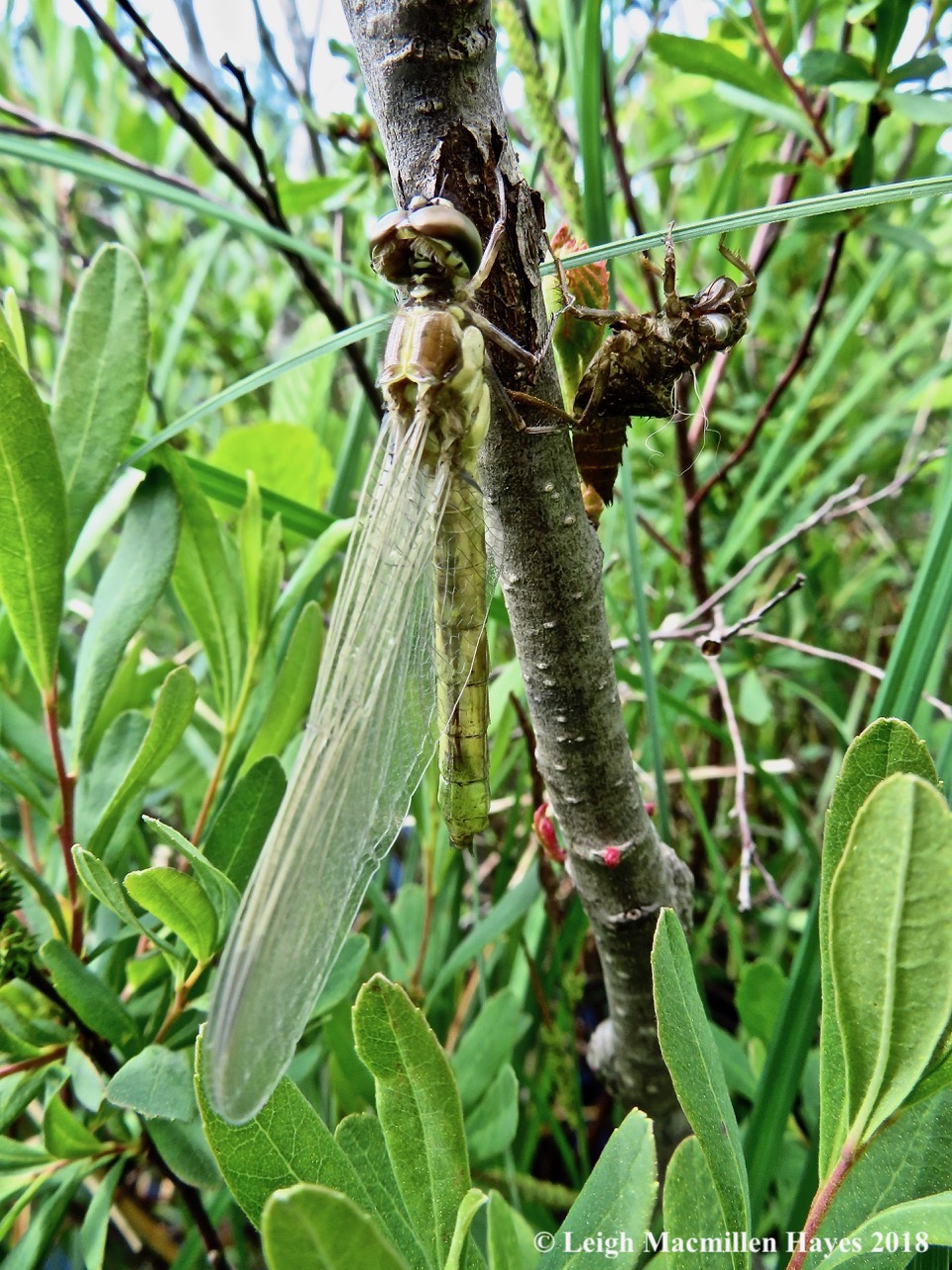
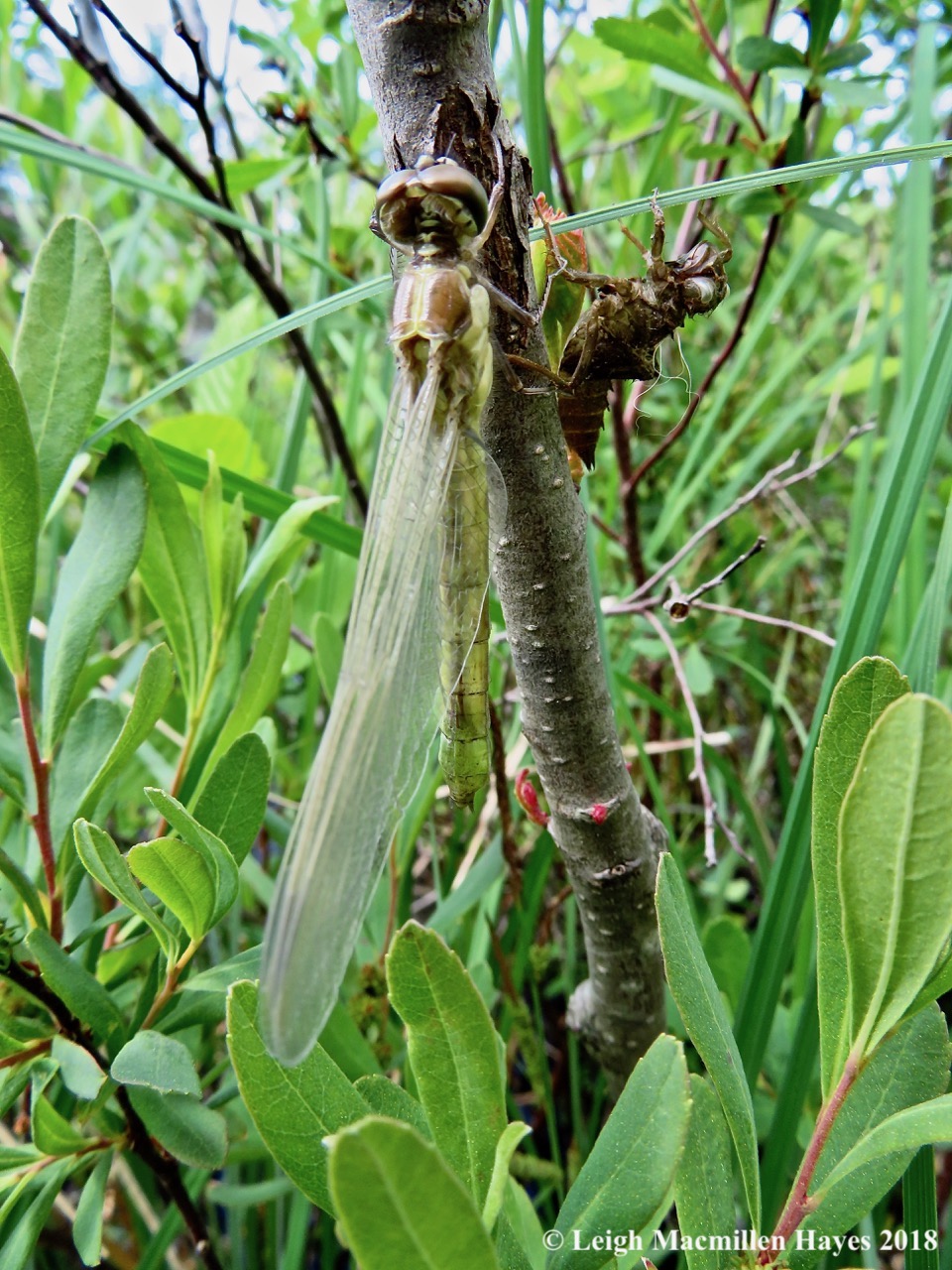
At last we reached the boardwalk, where we embraced stillness and listened to the green frogs strum their banjo voices and red-winged blackbirds sing their conk-la-ree songs. Our gaze became more focused when we realized we stood in the midst of a newly emerged dragonfly. We felt a sense of caretakers for suddenly it was our honorable duty to watch and protect this vulnerable being from becoming prey. With wonder, we observed it slowly change position and suddenly spread its wings. For at least an hour we stood sentry and noted the slightest movements while we delighted in how the breeze occasionally fluttered through the dragonfly’s wings. And then, in a flash, it flew off and we were proud parents who had sent our offspring into the world.

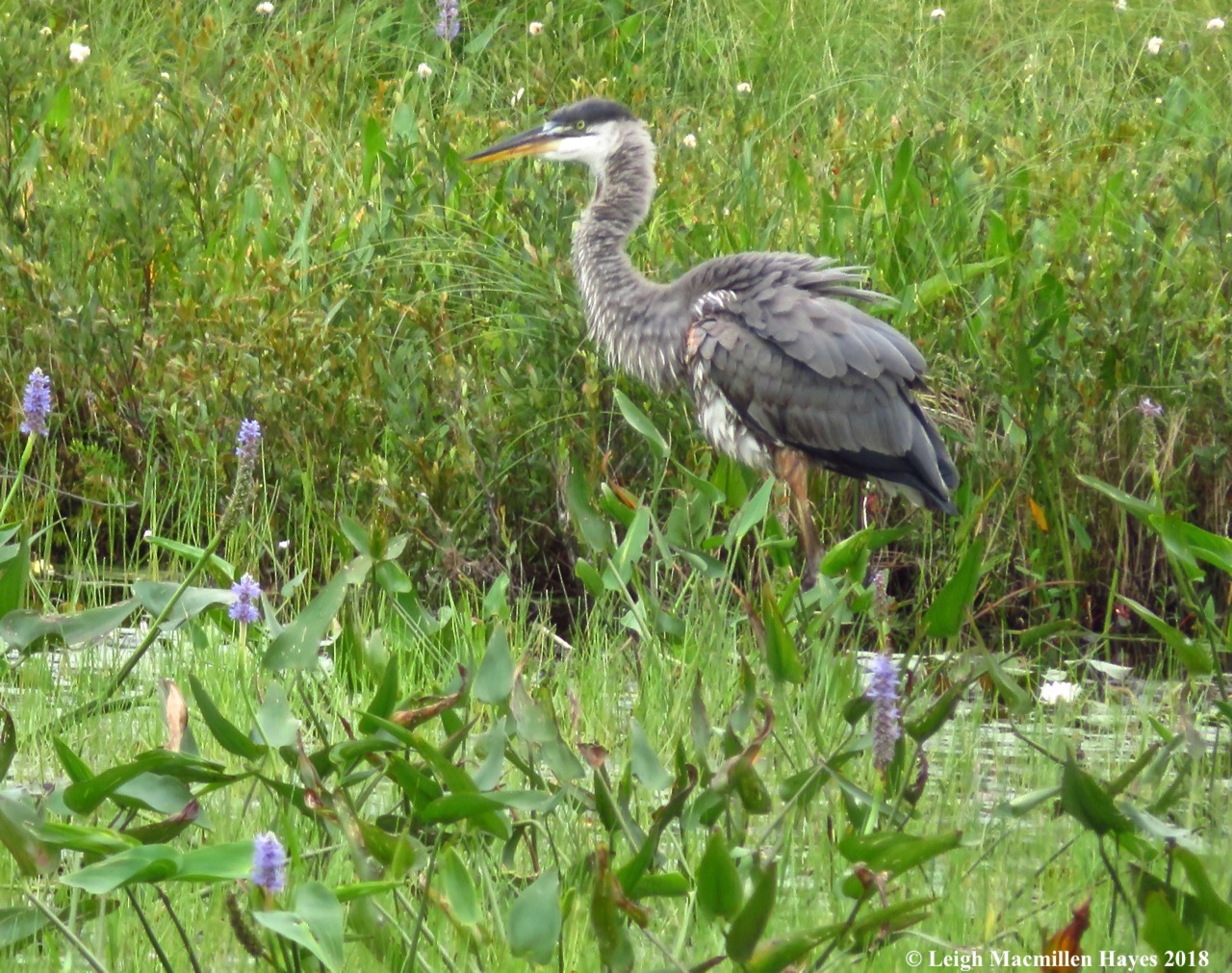
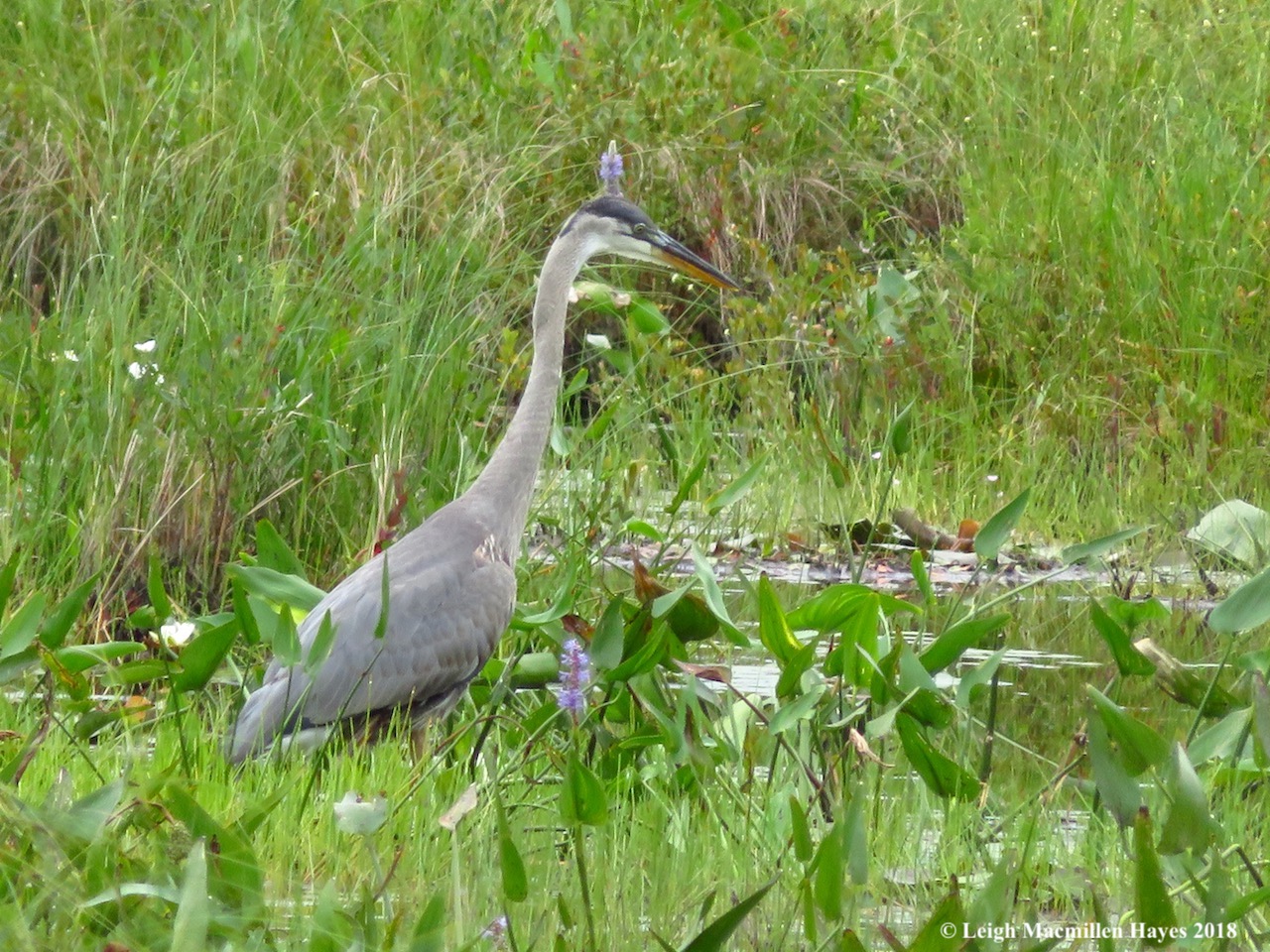
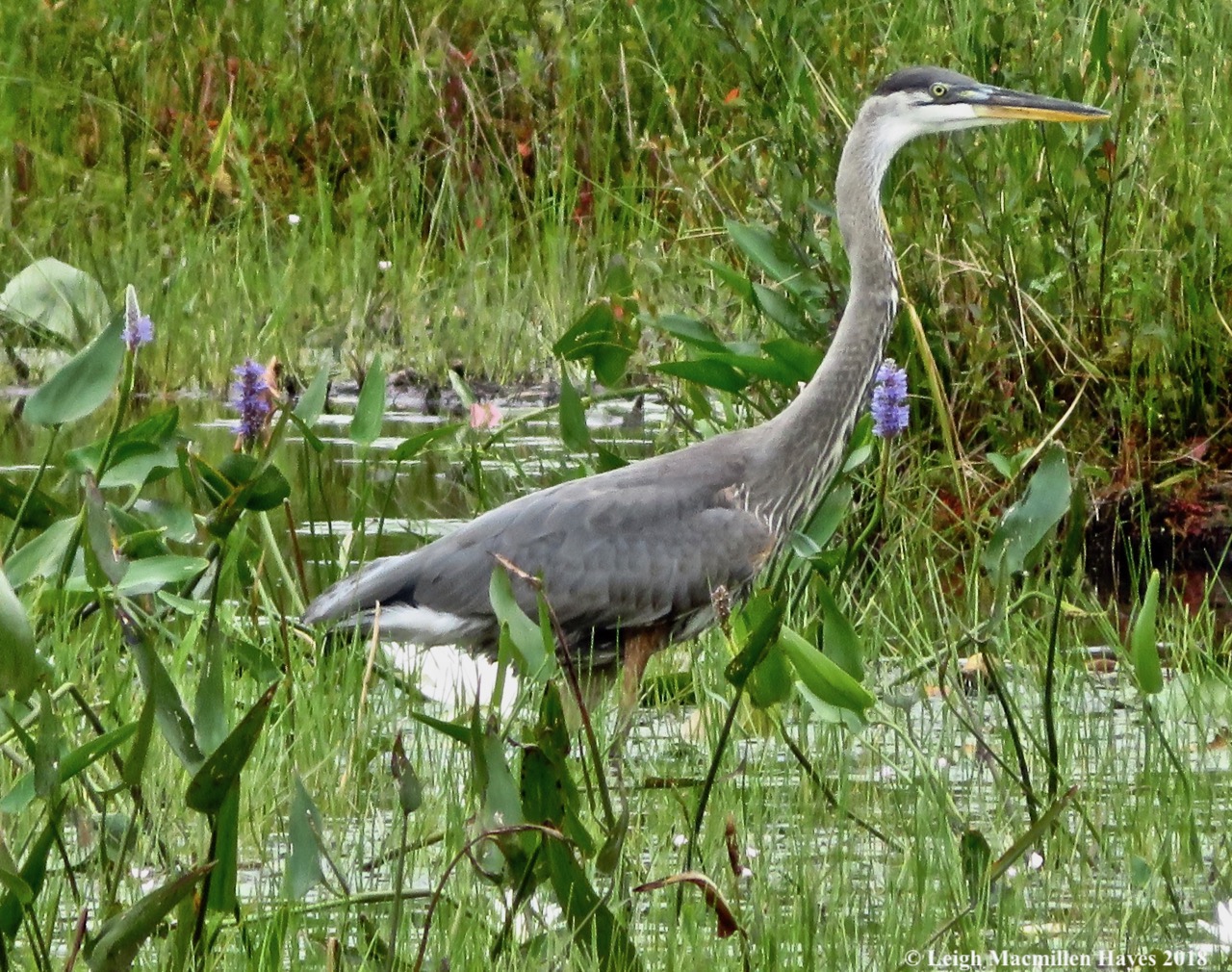
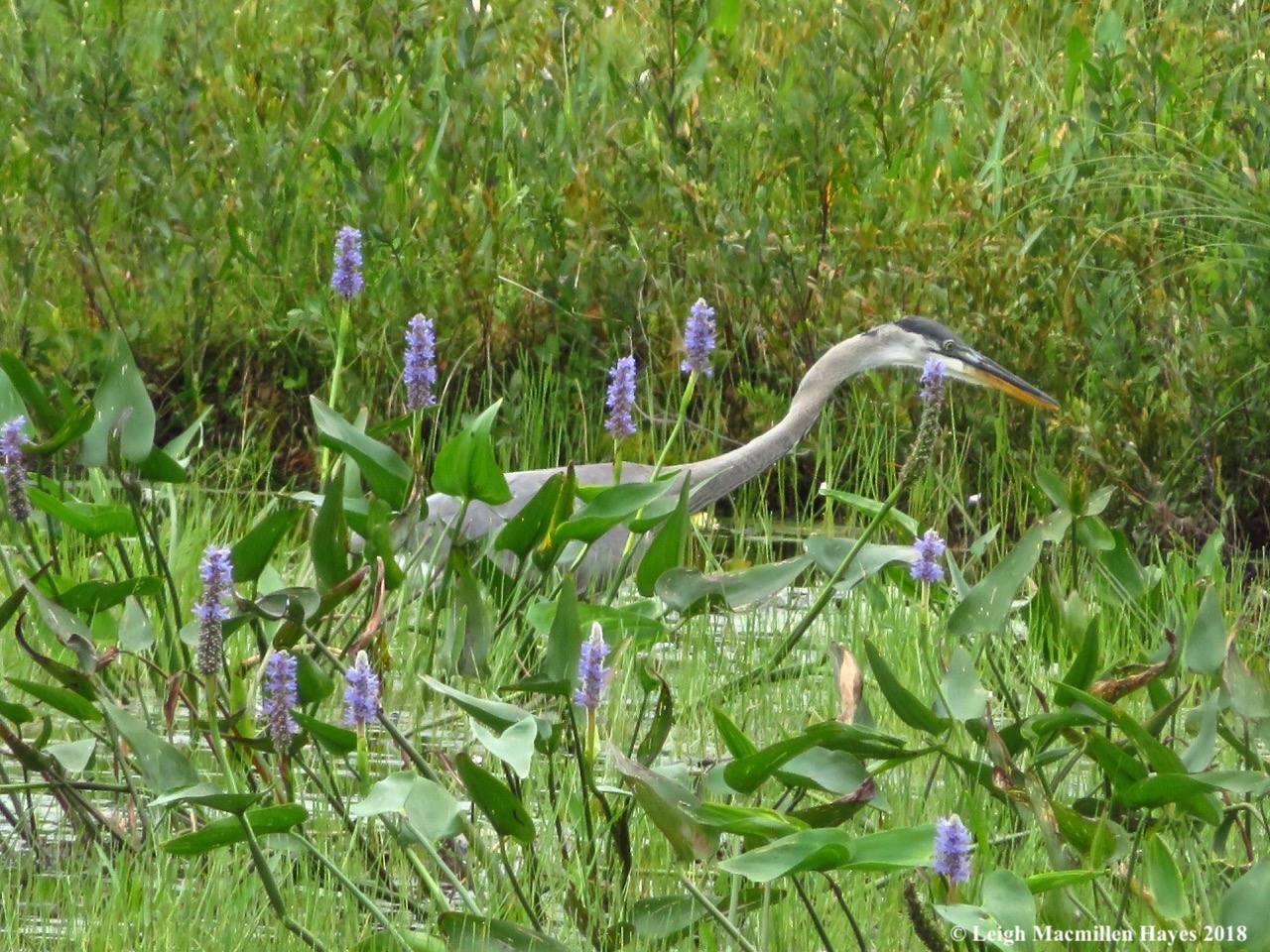
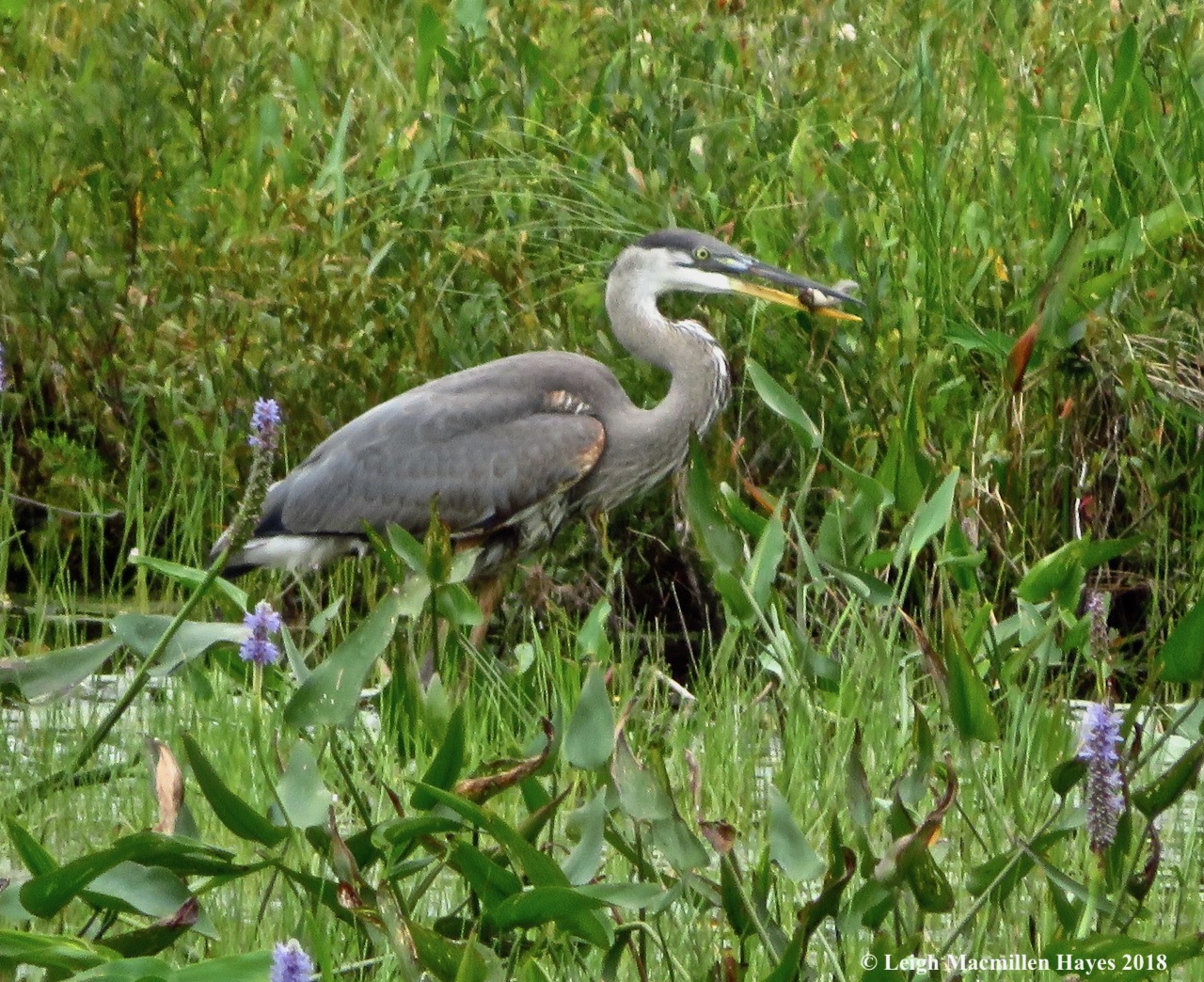
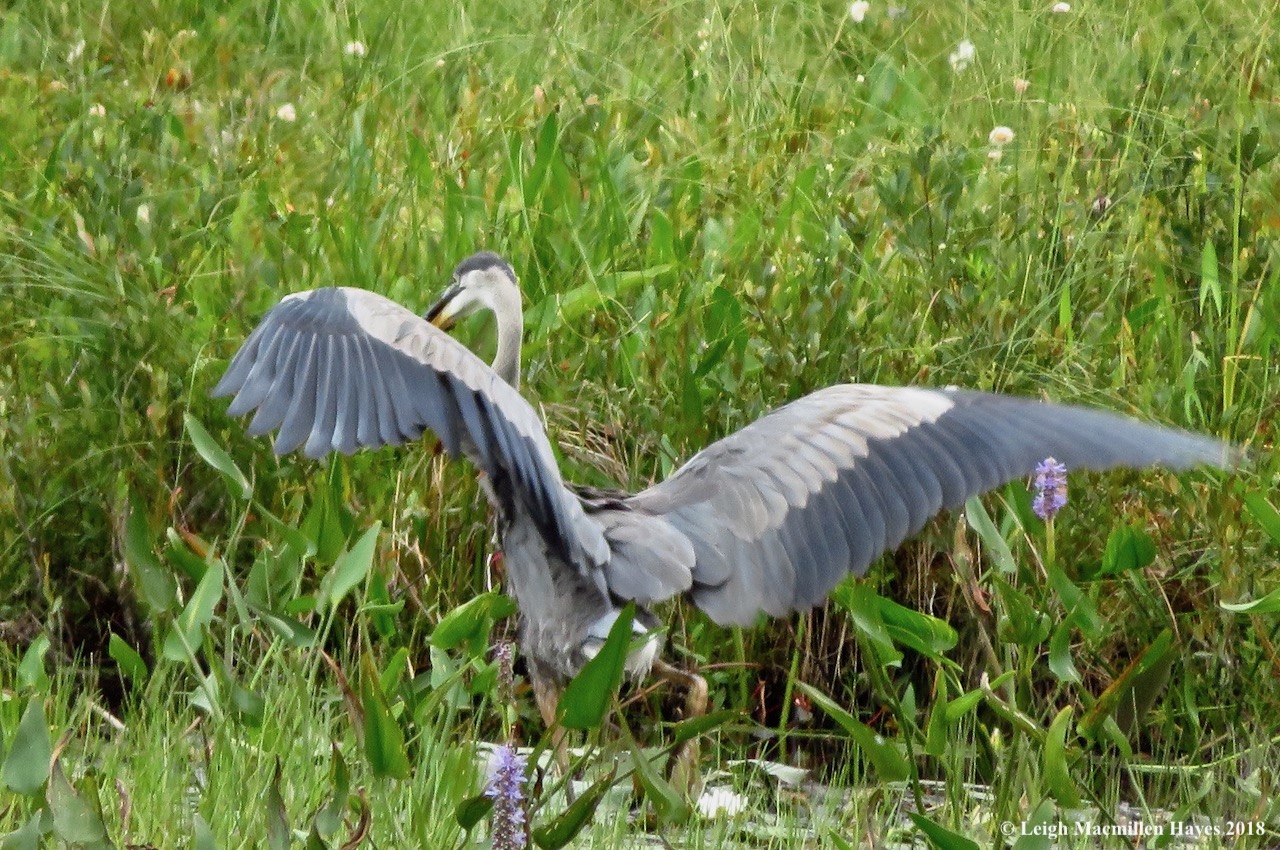
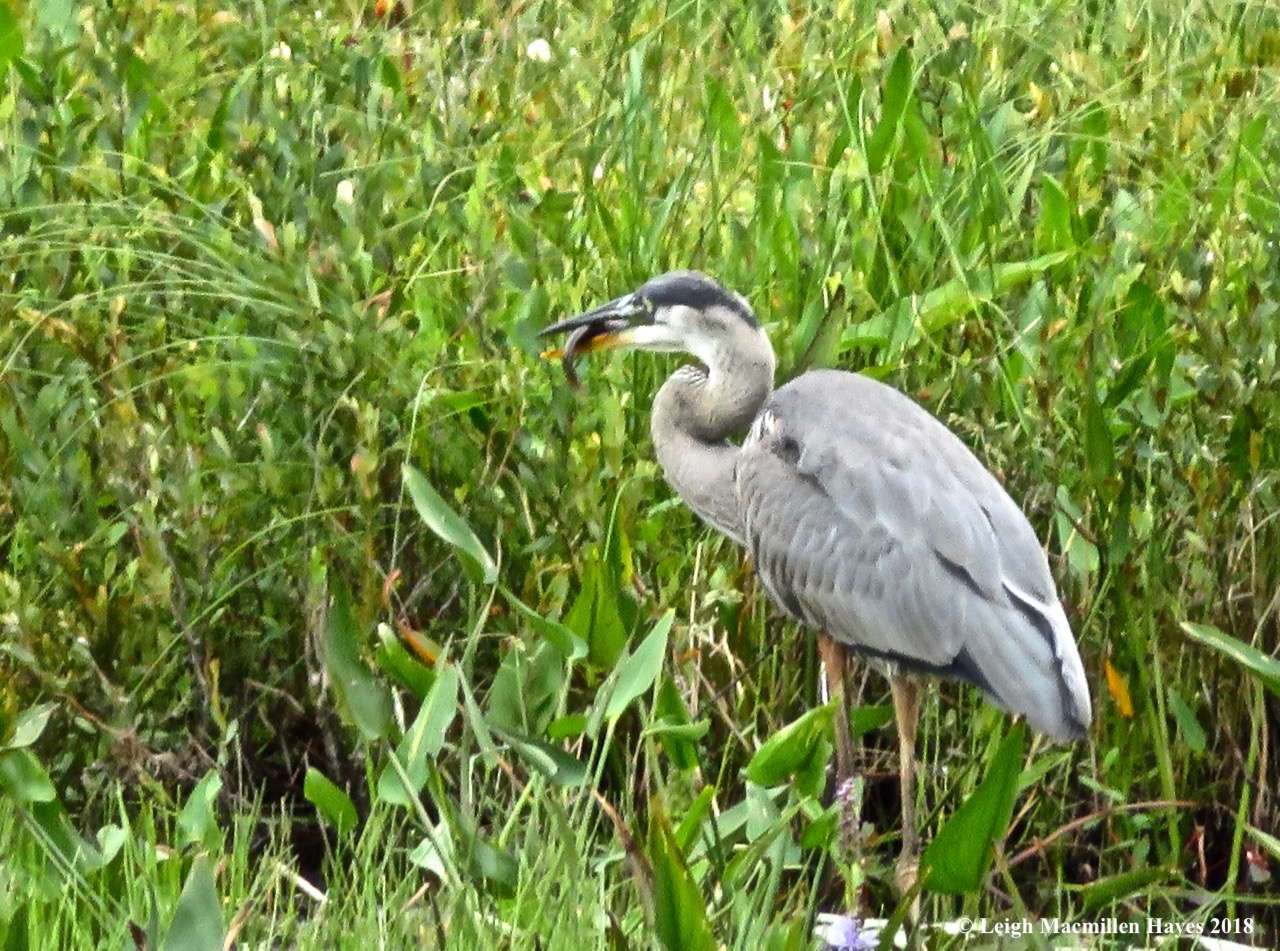
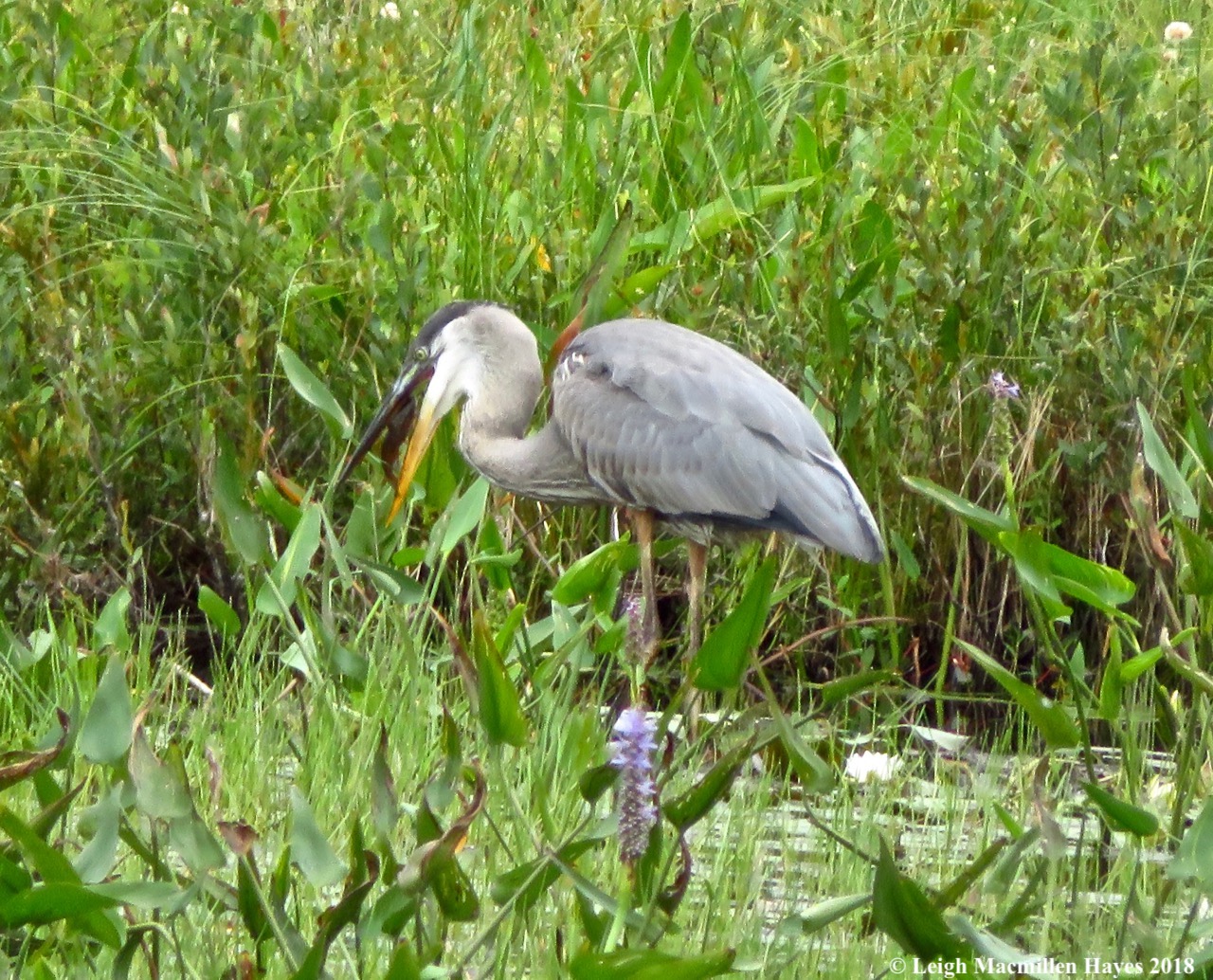
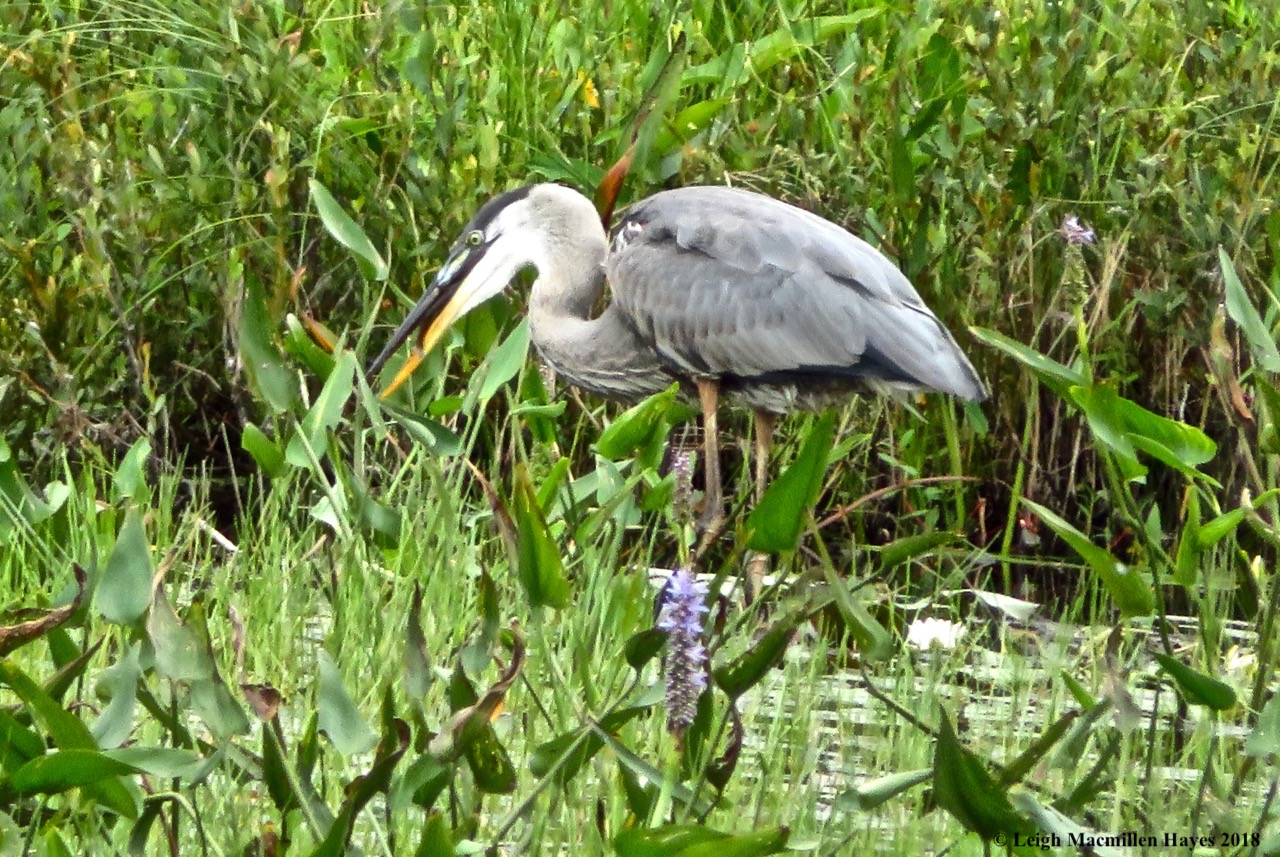
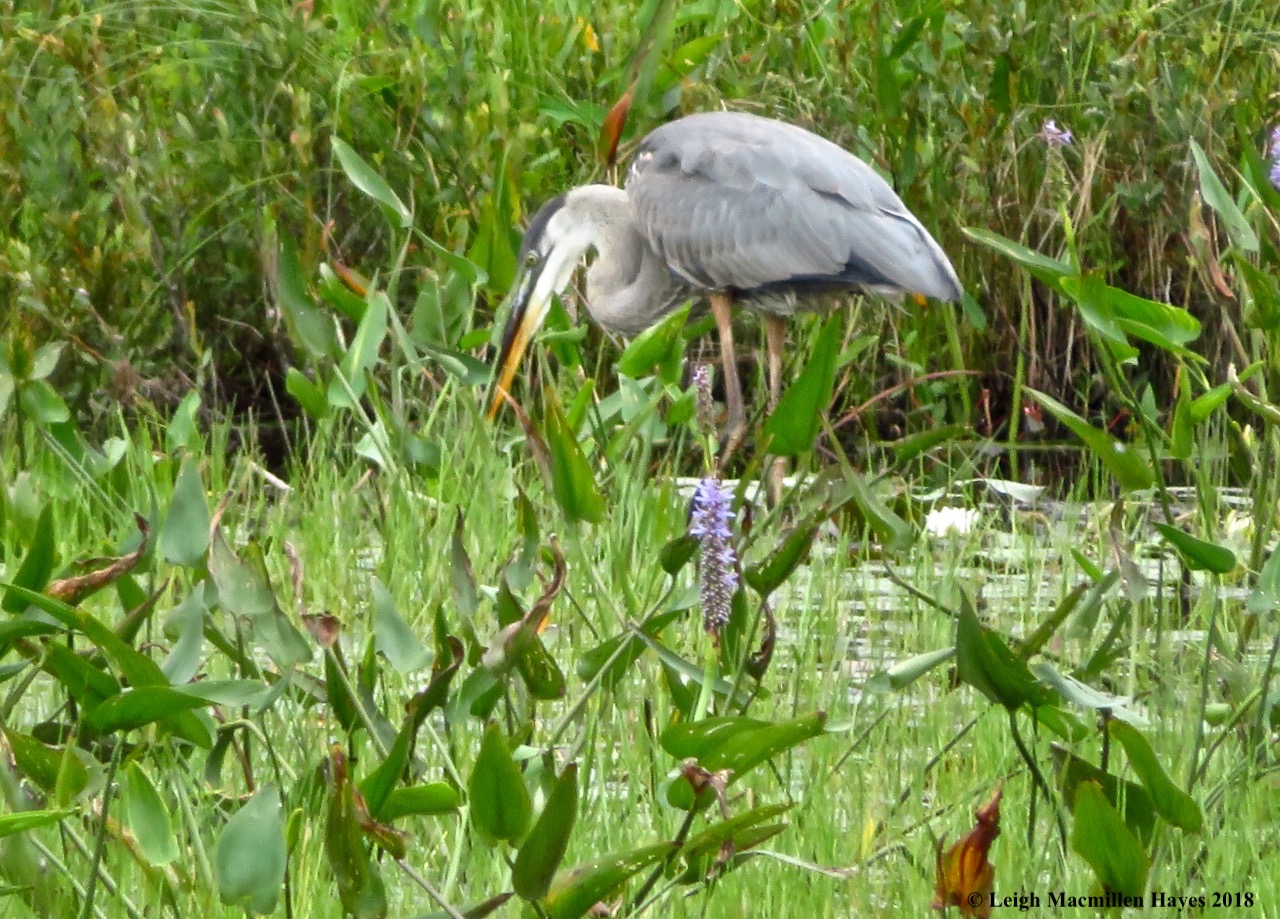
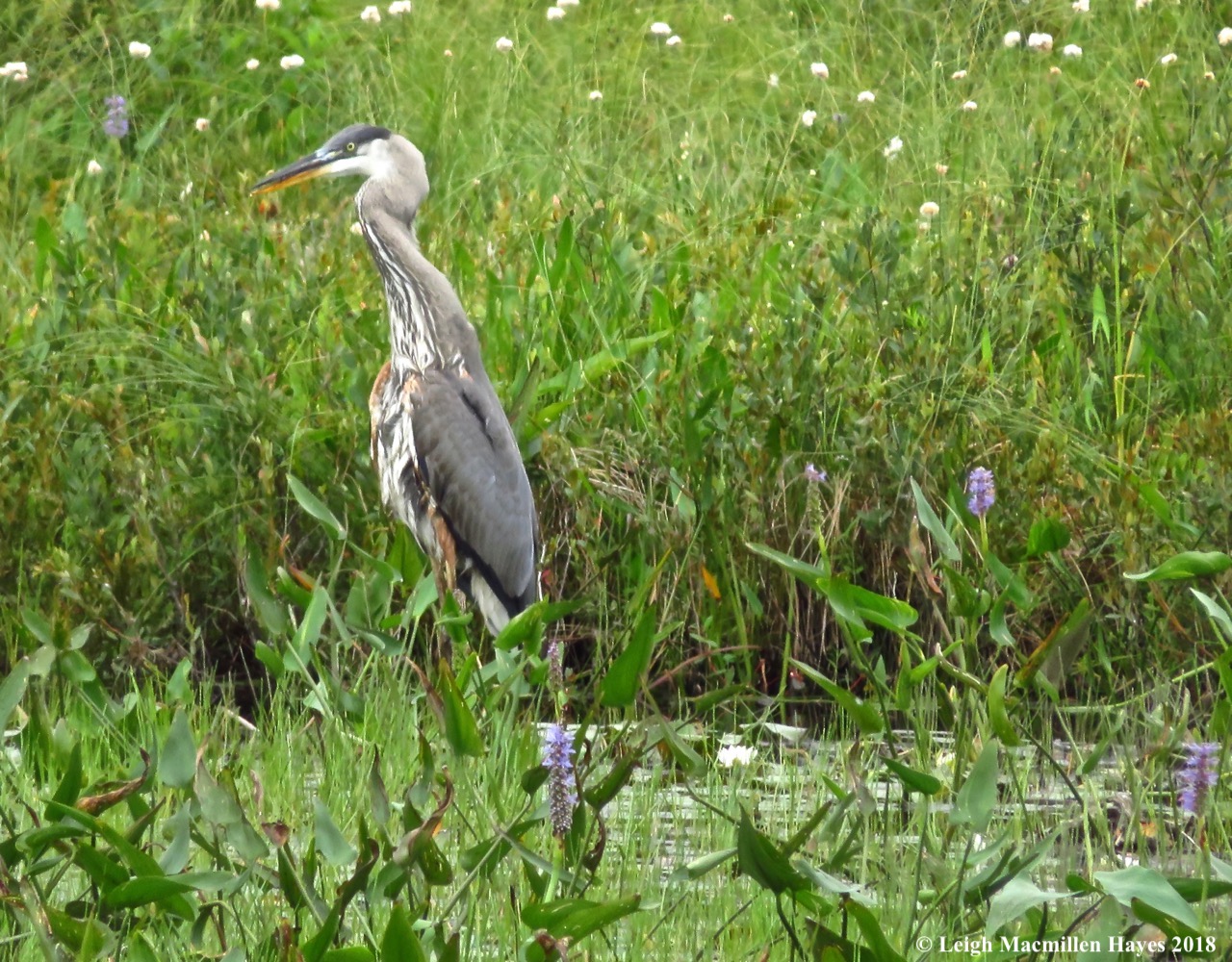
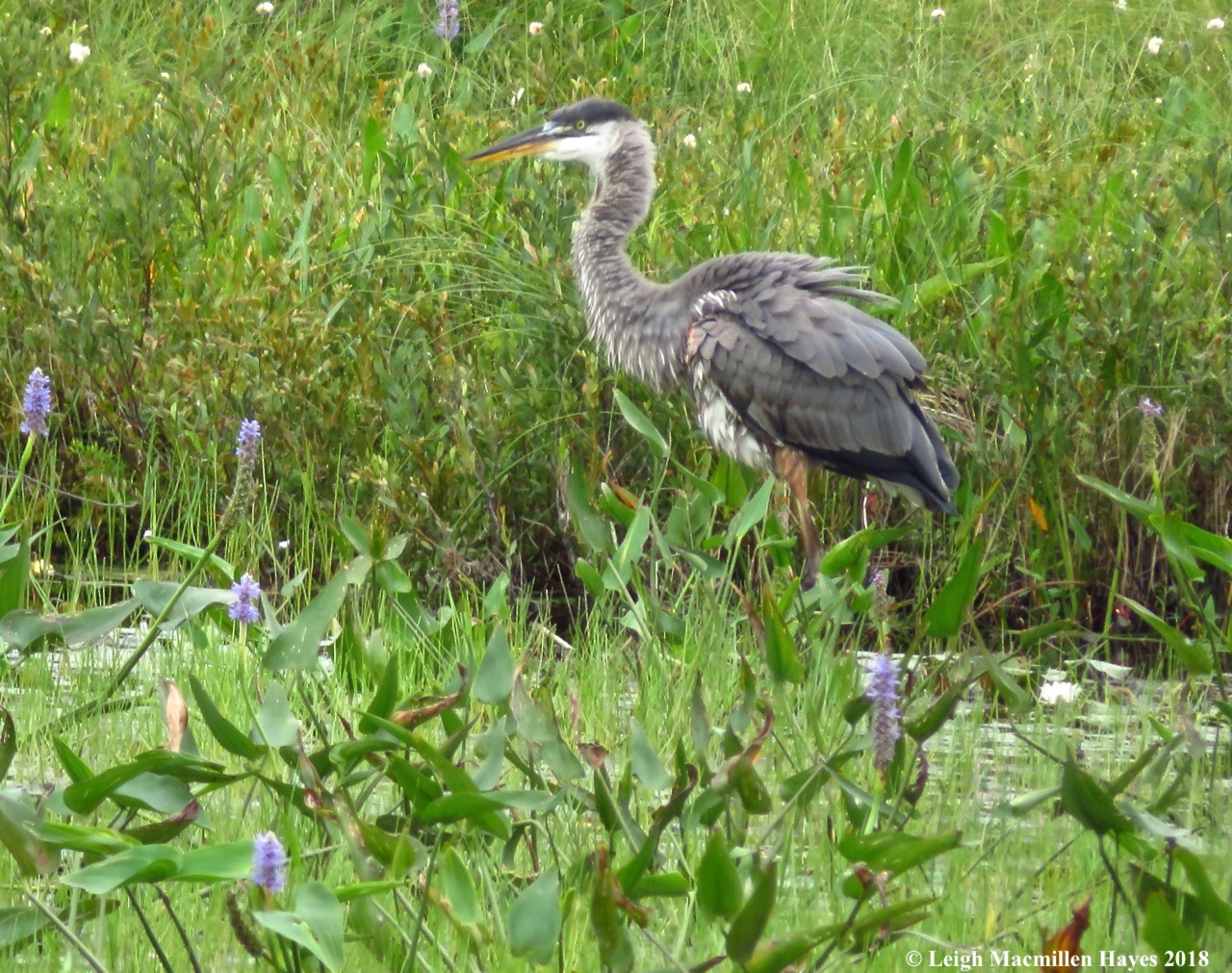
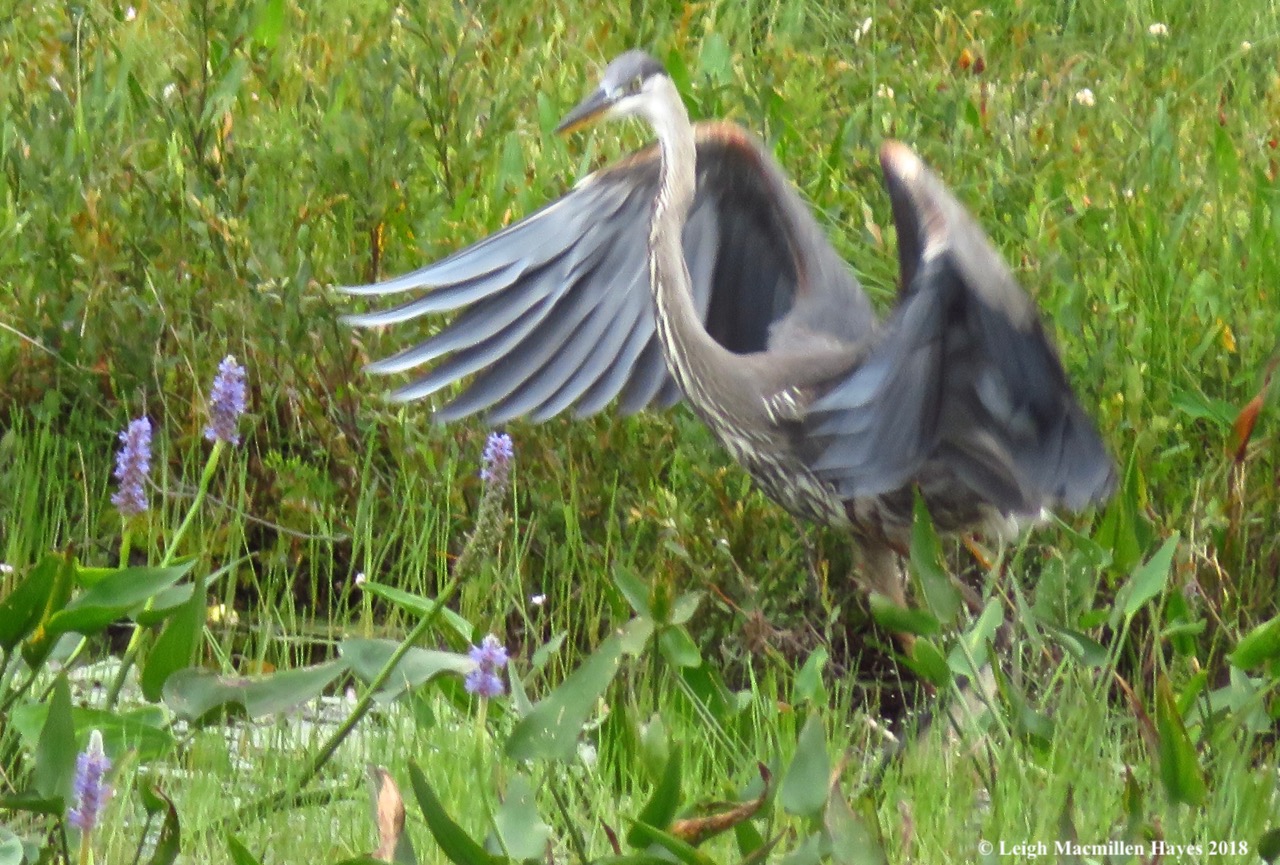
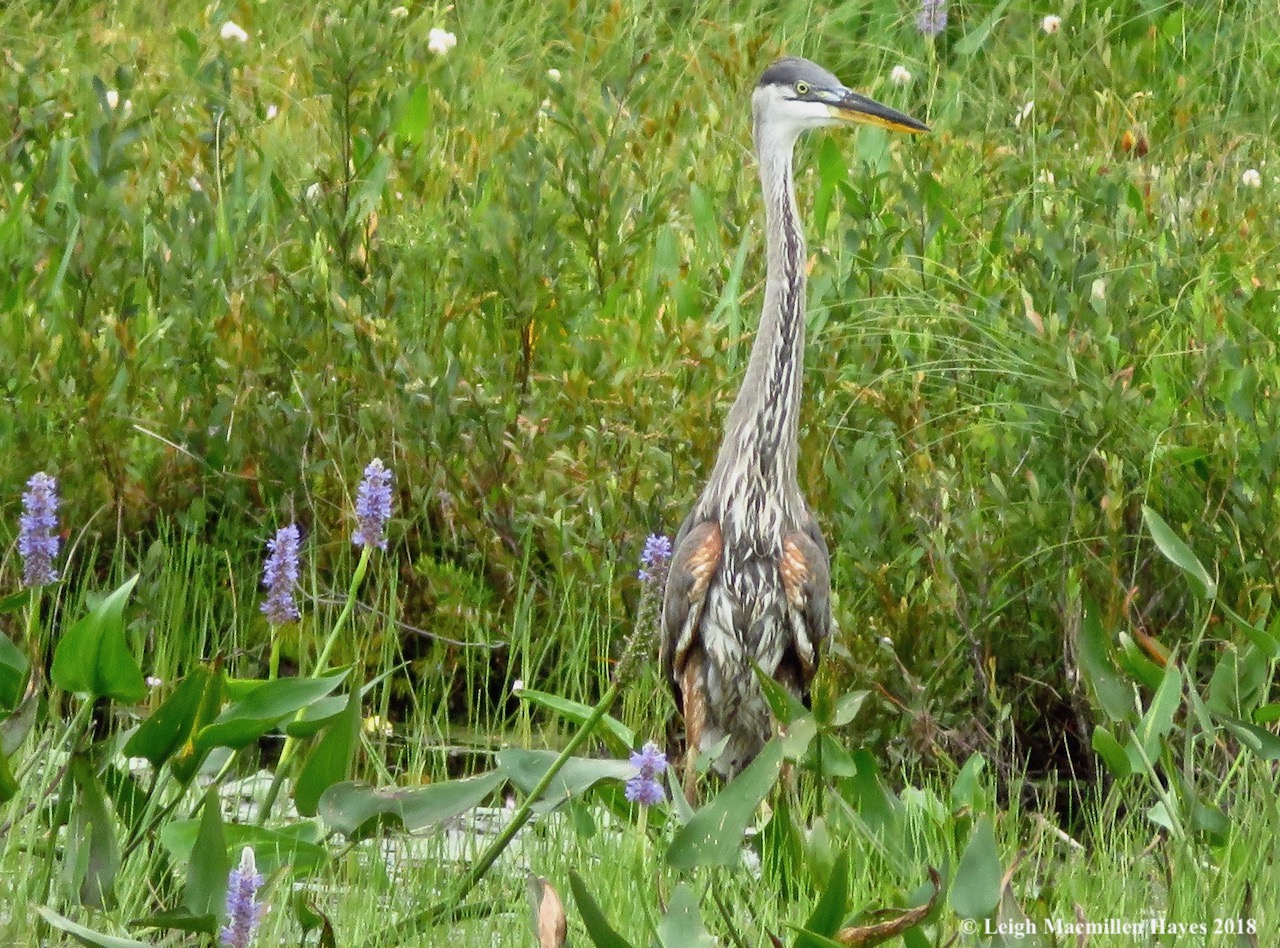
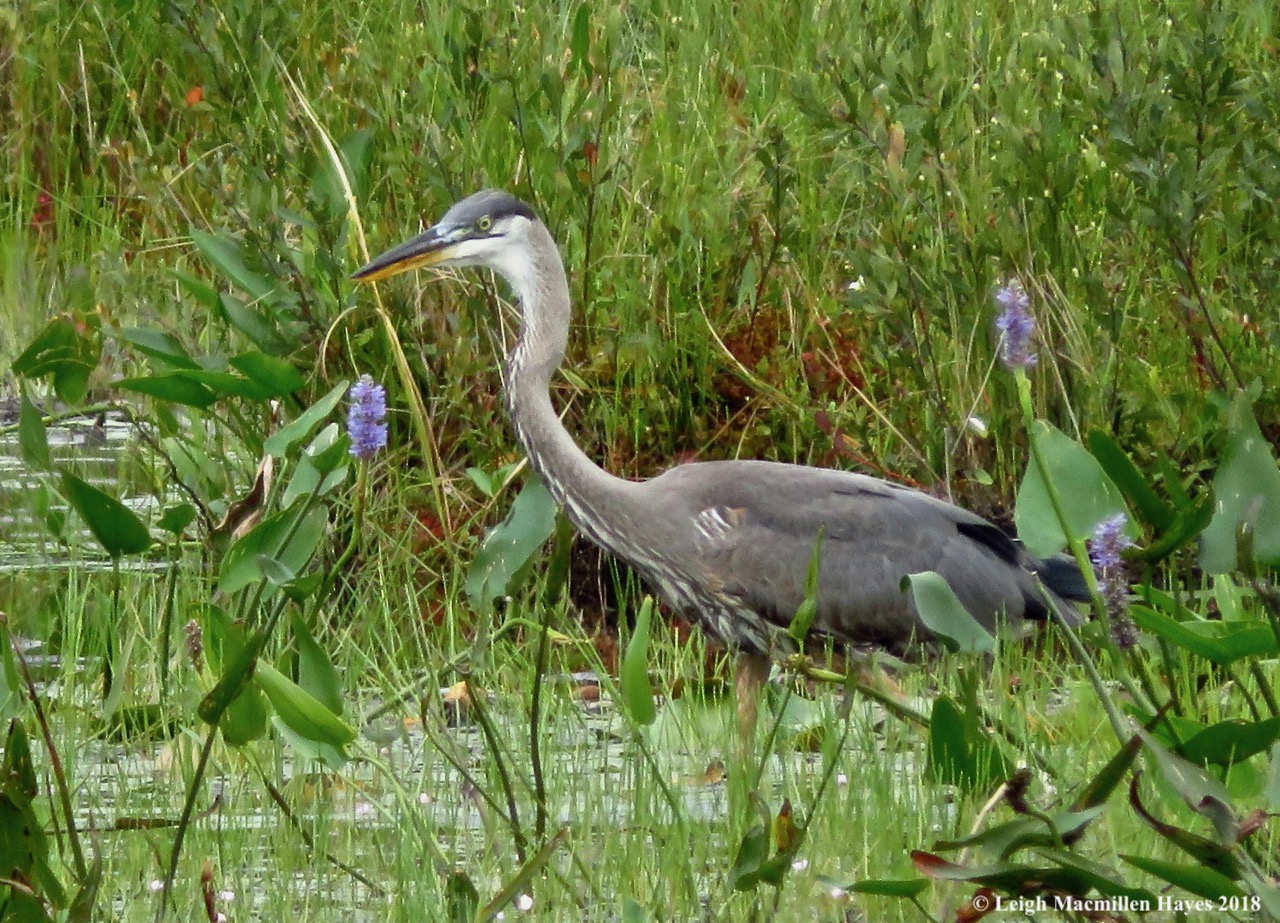
I have no idea how much time had passed, but suddenly we all stirred a bit and then someone who was noticing redirected our attention. We were encouraged to focus on another who was also paying attention. And narrowing in . . . on lunch. When the young bird flapped its wings, we were all sure the meal was meant “to go.” But thankfully, the bird stayed. And played with its food. Ever so slowly, the fish was maneuvered into its mouth. And gulped. Down the throat it slid, a slight bump in the long neck. And then the feathers were ruffled–rather like a chill passing through its body. Wing motion followed. But still, the Great Blue Heron stayed. And stalked some more.

A blanket of fog enveloped the view. It didn’t matter, for my focus zeroed in on what was before me rather than being swept up into the beyond. I began to look around and felt an aura. It was as if I stood in another place and time. The fog. The green. The gray. The world disappeared. And the scene before me opened. One yellow lichen inched across the granite face. Beside it, another stood out like tiles in a mosaic work of art. Meanwhile, the fog danced across the ridgeline, twirling and whirling in a ghostly quiet manner, its transparent gowns touching the ground ever so tenderly before lifting into the next move.

We watched him forage for seeds and wondered about his behavior. Typically, such birds are loners, except for mating season. But this one greeted visitors to its territory with somewhat regular frequency. When we moved, he did likewise–usually a few feet to either side of us. And when we stopped, the Ruffed Grouse did the same, seeming to share our curiosity.

One doesn’t necessarily step into the woods and expect transcendent events to occur, but then again by learning to live in the moment one never knows what to expect. 

These are my thin places, where I see the light more on this side of than the other. May the answers slowly reveal themselves by day and by night, while the questions and awe never end.

Thanks to all of you who continue to wonder and wander with me whether literally or figuratively. I truly appreciate our time spent together.

Otter Delight

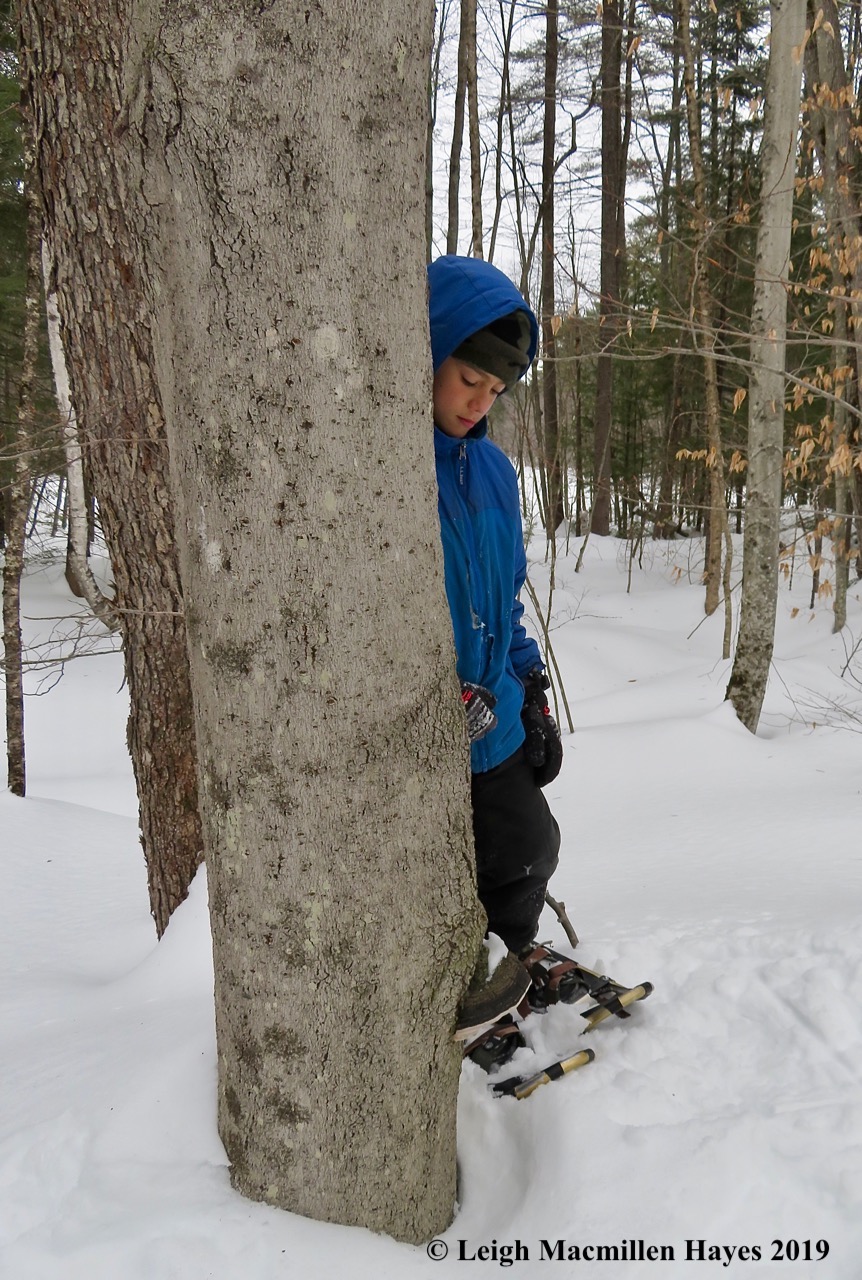
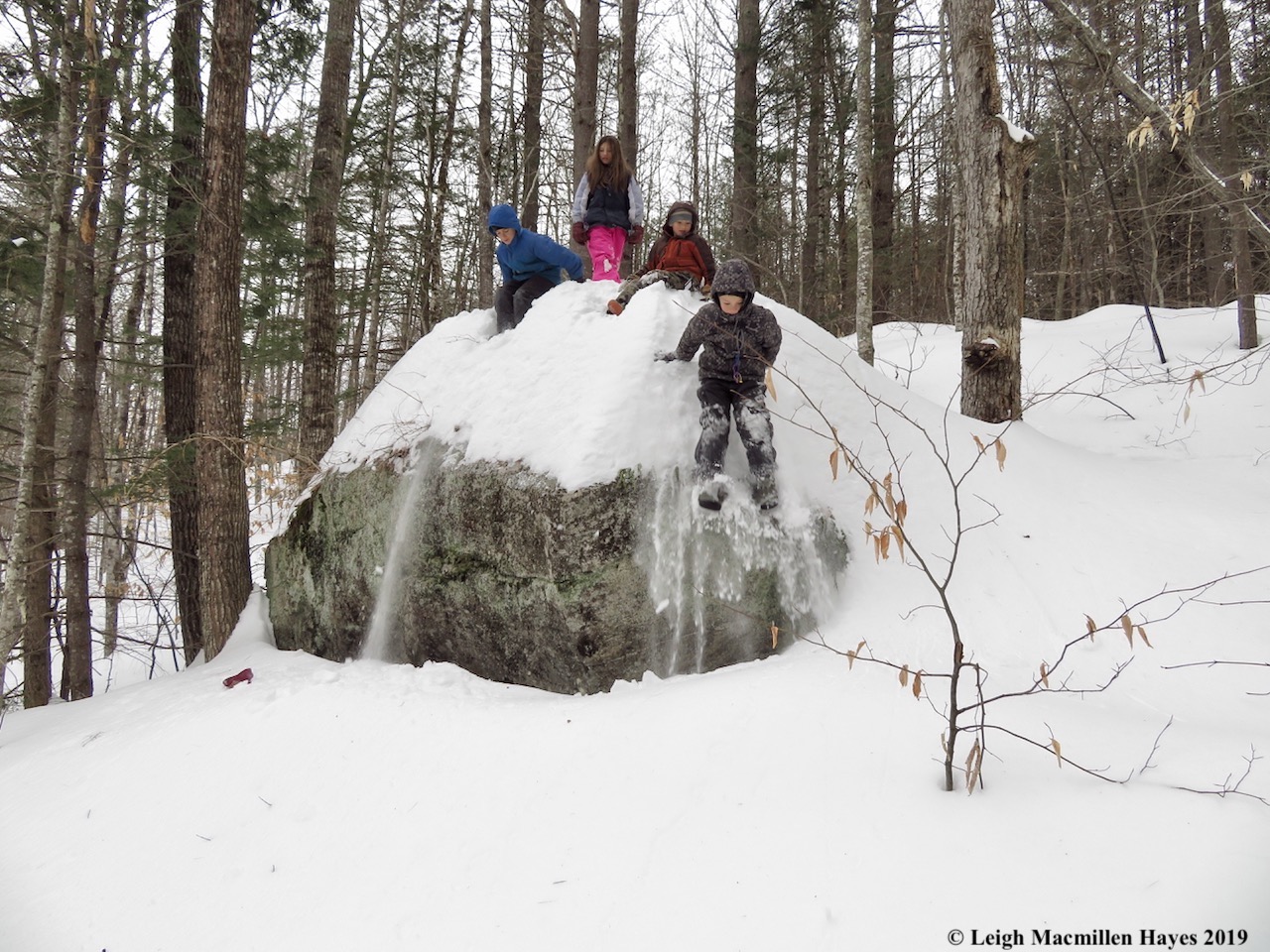
Once upon a time in a land close, close at hand, there lived a family of Otters who were mothered by a Snowshoe Hare.

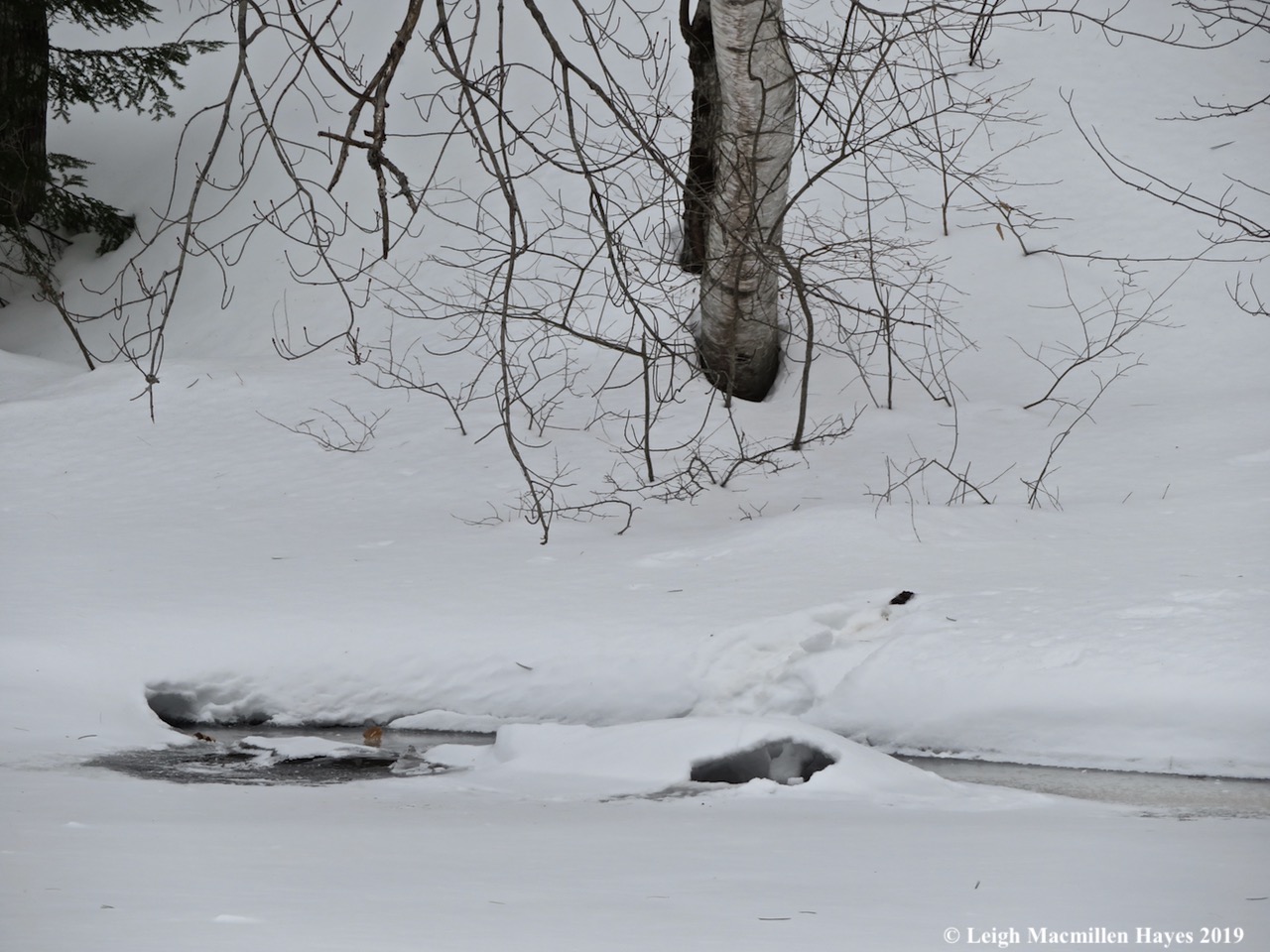
They spent most of their days and nights exploding through the ice and sliding up and down the mill pond’s edge.

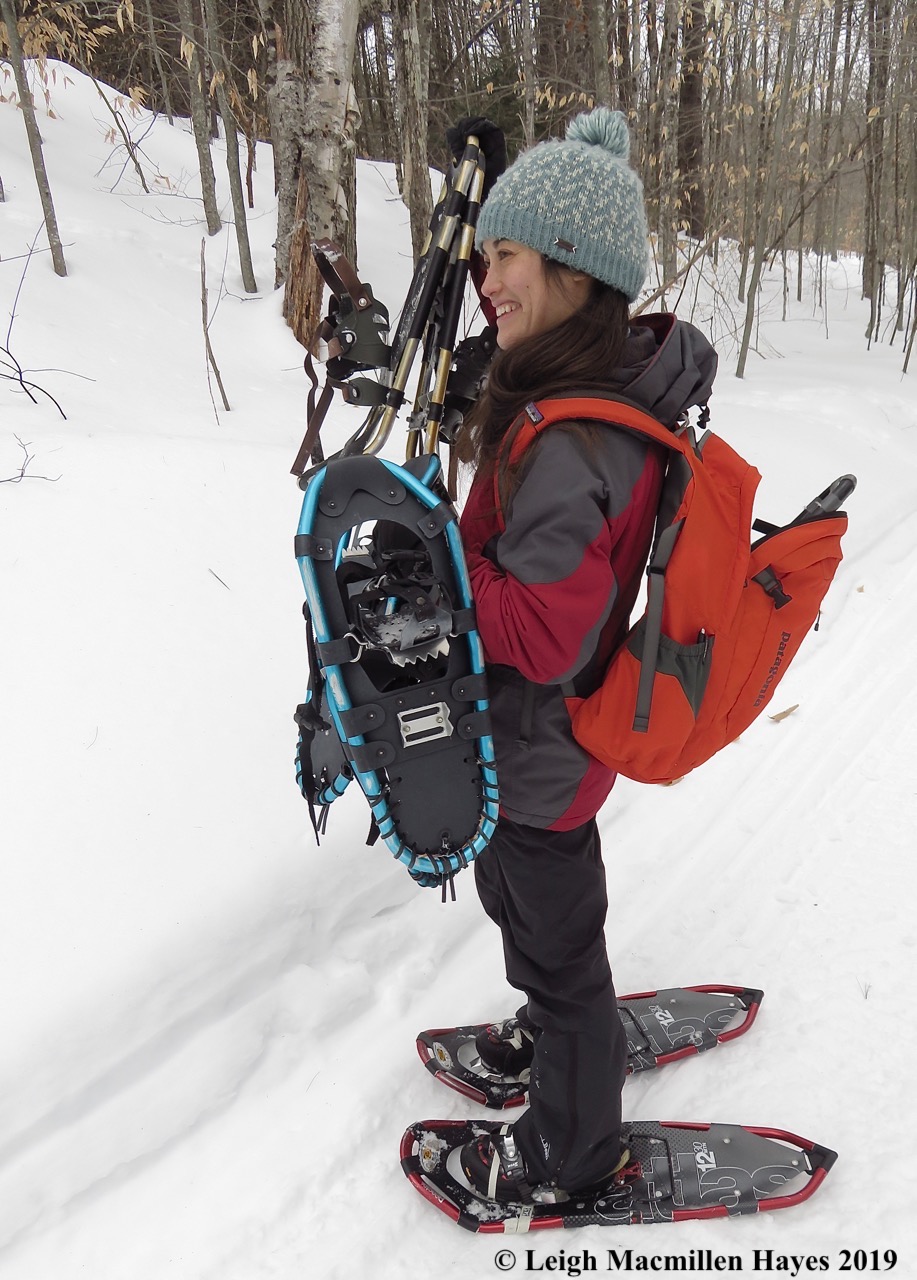
But one day their momma rounded up some snowshoes large and small and strapped them on to all.

The family headed off through the woods where moments of wonder captured their attention.

It wasn’t long into their journey when a winter firefly upon the snowy surface stopped them in their tracks.

E. Otter took the firefly that overwinters as an adult and looked for a safe place to deposit it.

She found such in an old beetle hole upon a dead snag and wished it well before she hopped away.

W. Otter found another tree that he quickly identified as a yellow birch and then honored with a hug.

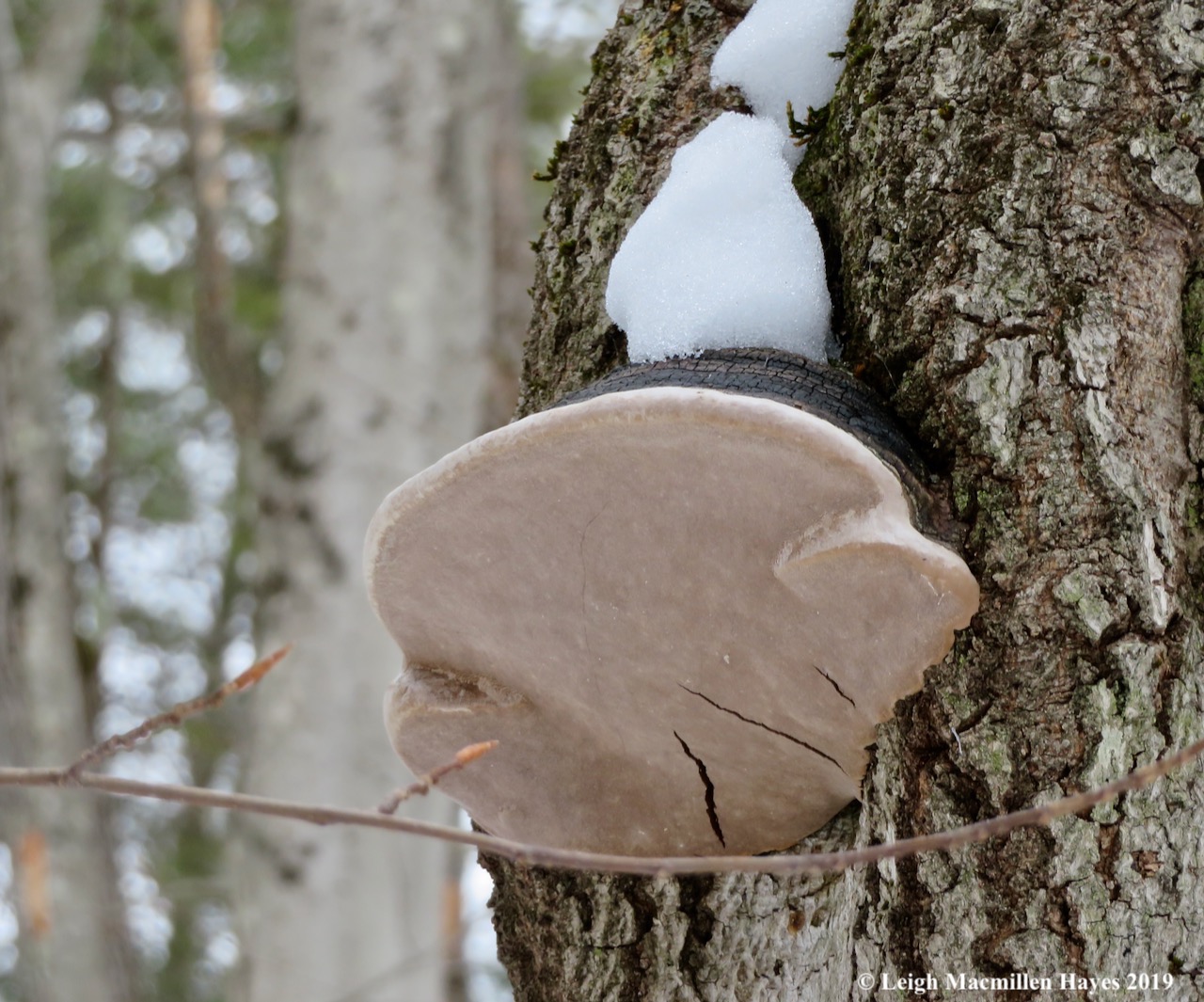
C. Otter looked upon the bark of a beech tree and was thrilled to spy a fungi.

On the tree’s back side he spied another and posed above the false tinder conk.

Soon, the little Otters convinced their momma that they didn’t want to try to be hares any more and so they shed their snowshoes.

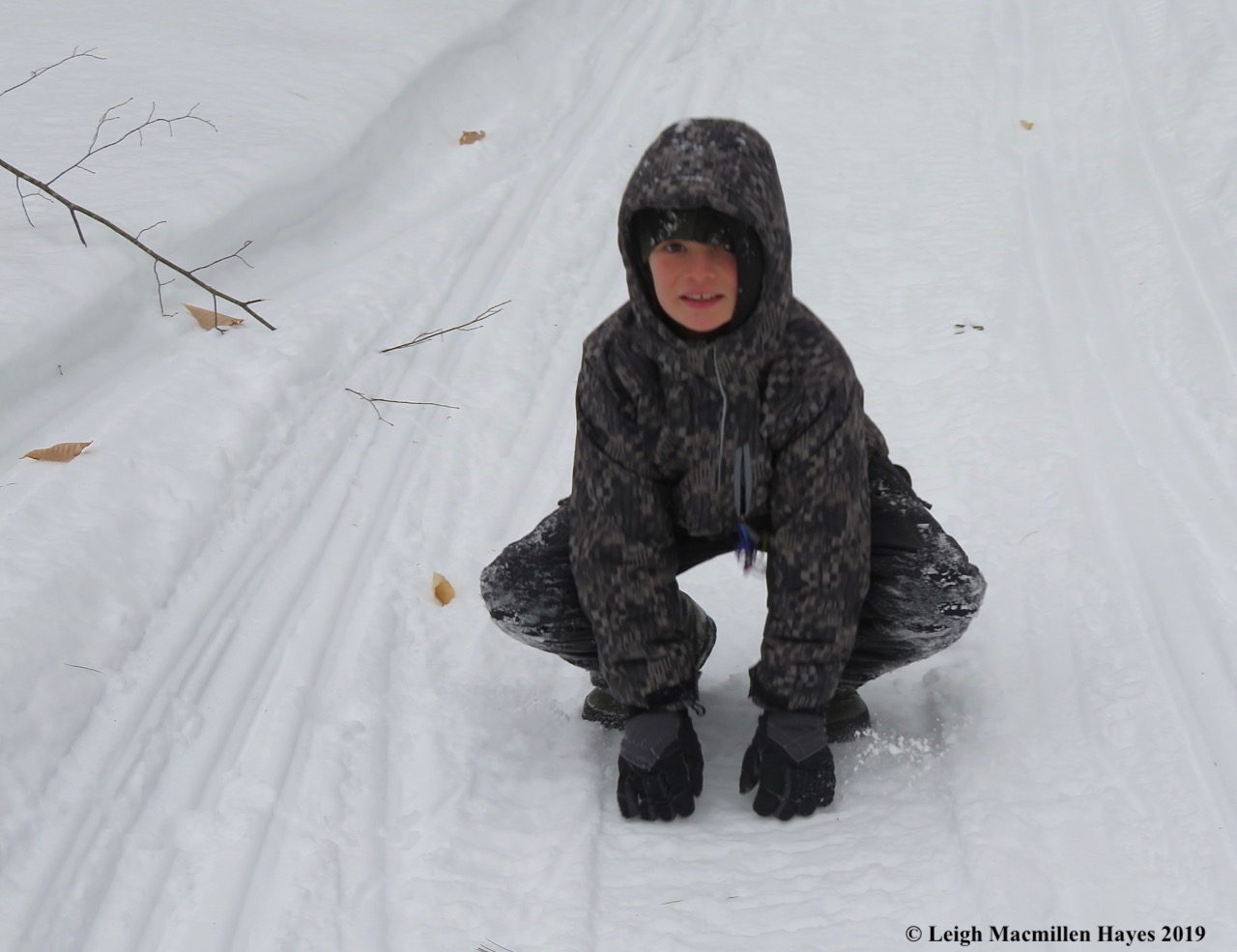
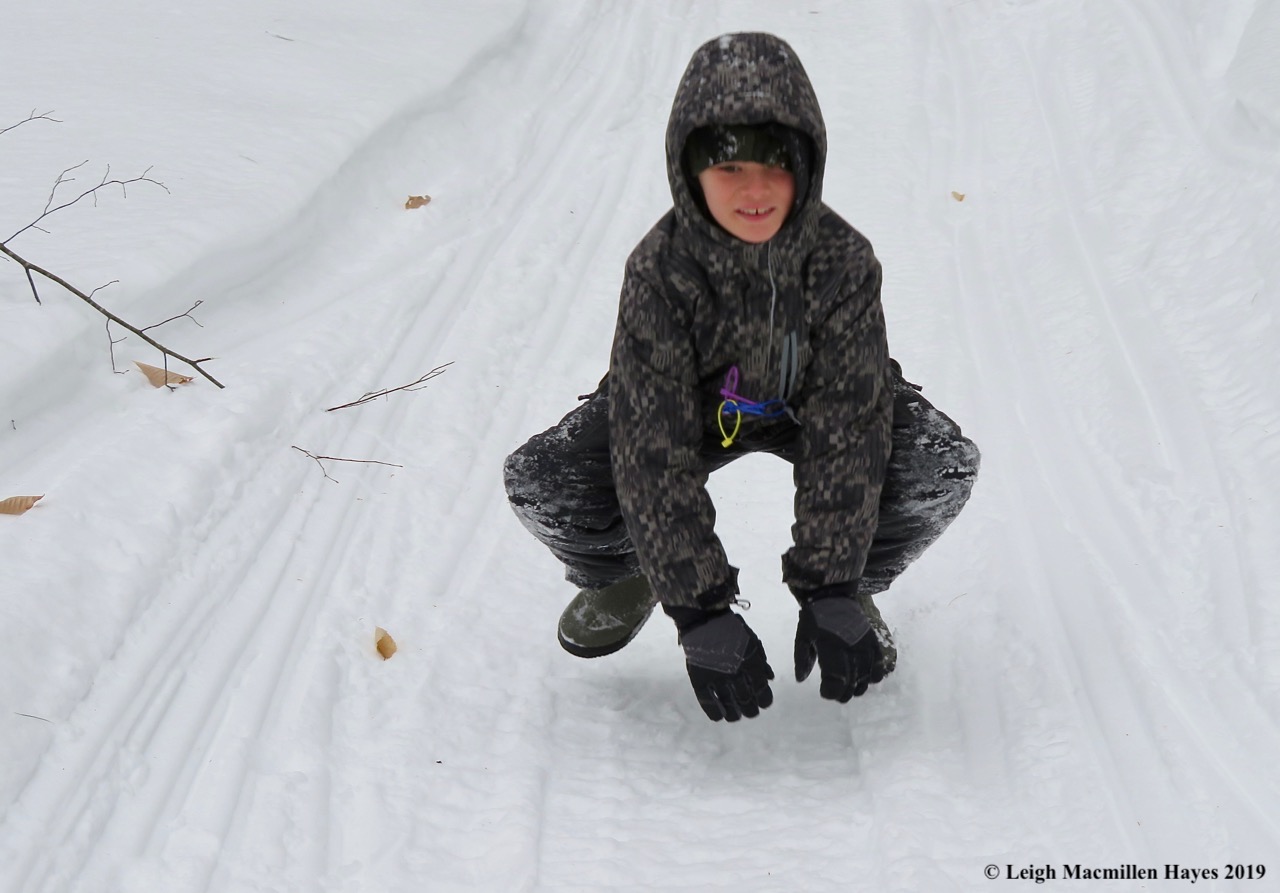
Within moments, A. Otter decided to instead try his feet at being a frog.

Catching some air, he leapt up the trail.

By a vernal pool he revealed his true identity–a tree frog.

Soon, his siblings joined him as they channeled their inner tree frogs.

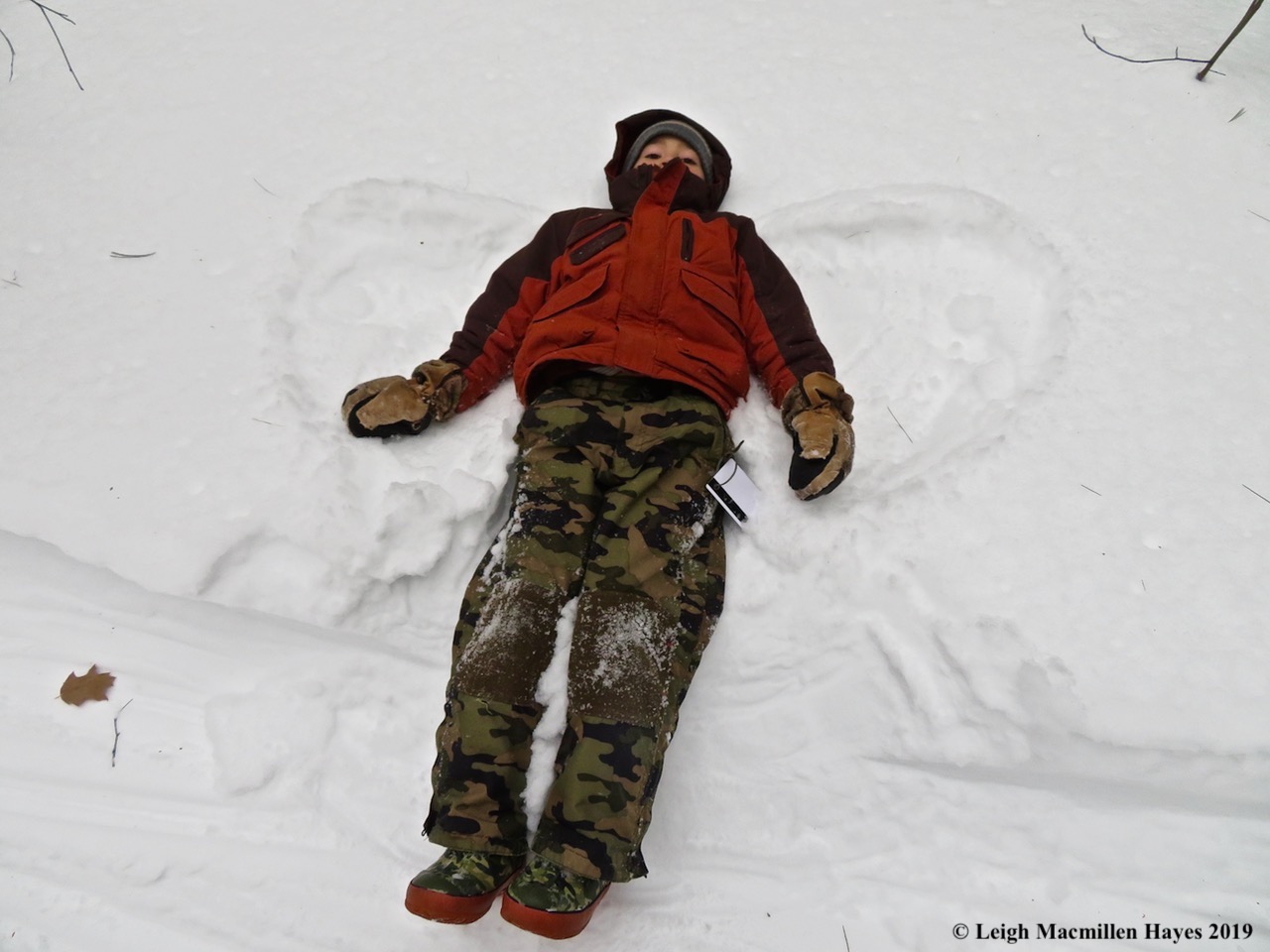
A short distance later, momma couldn’t help but smile when her young’uns displayed their angelic nature.

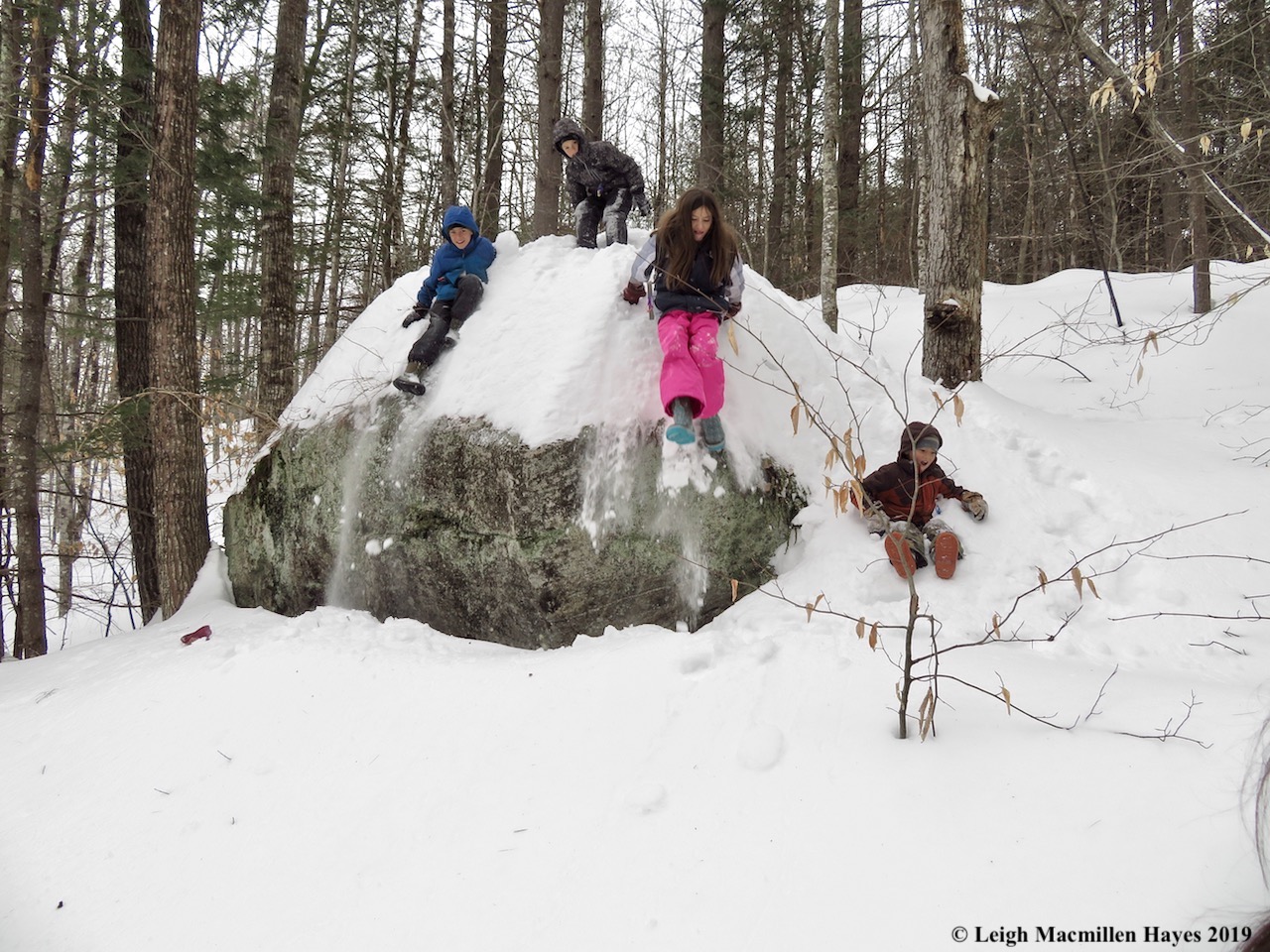
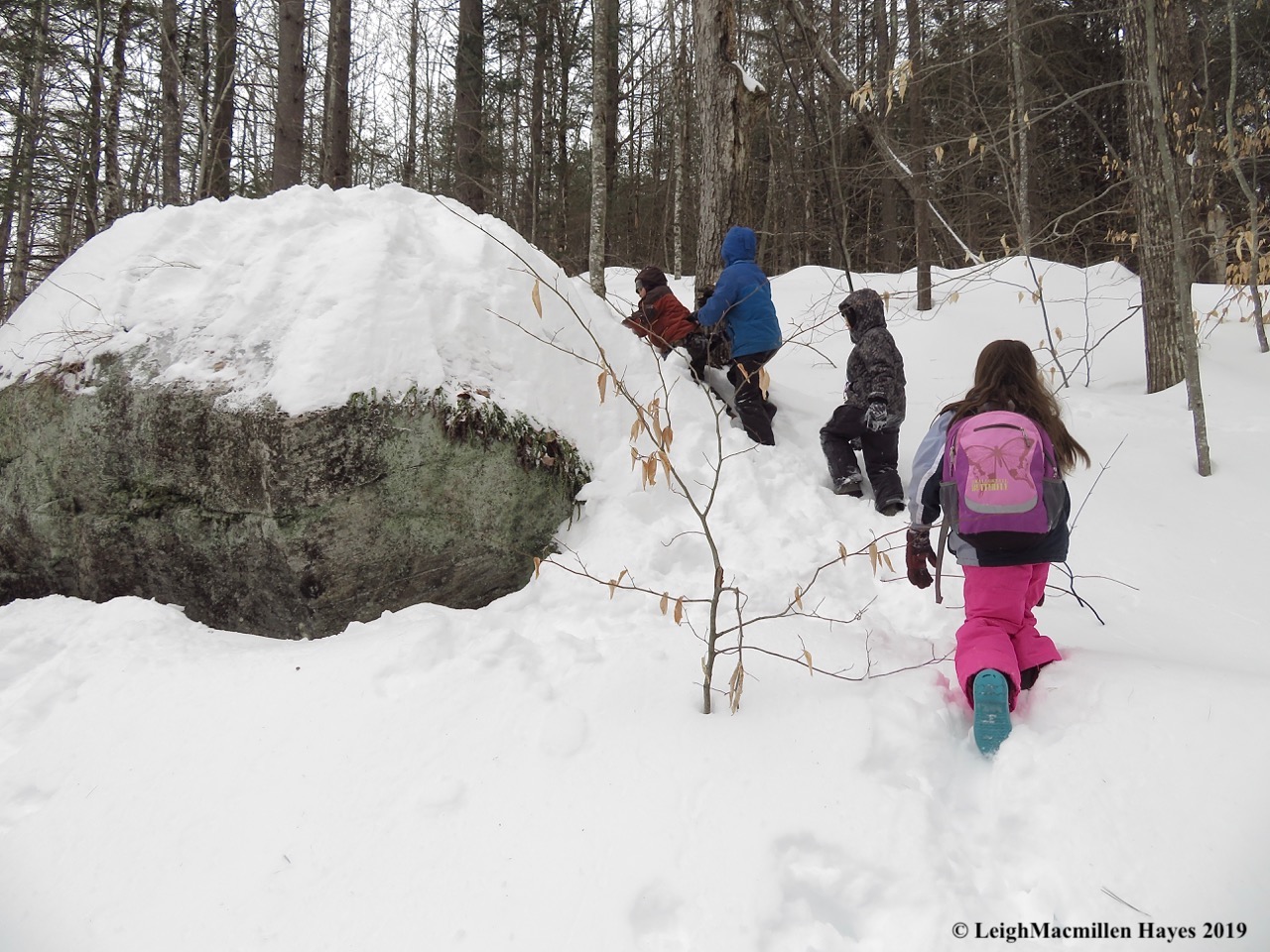
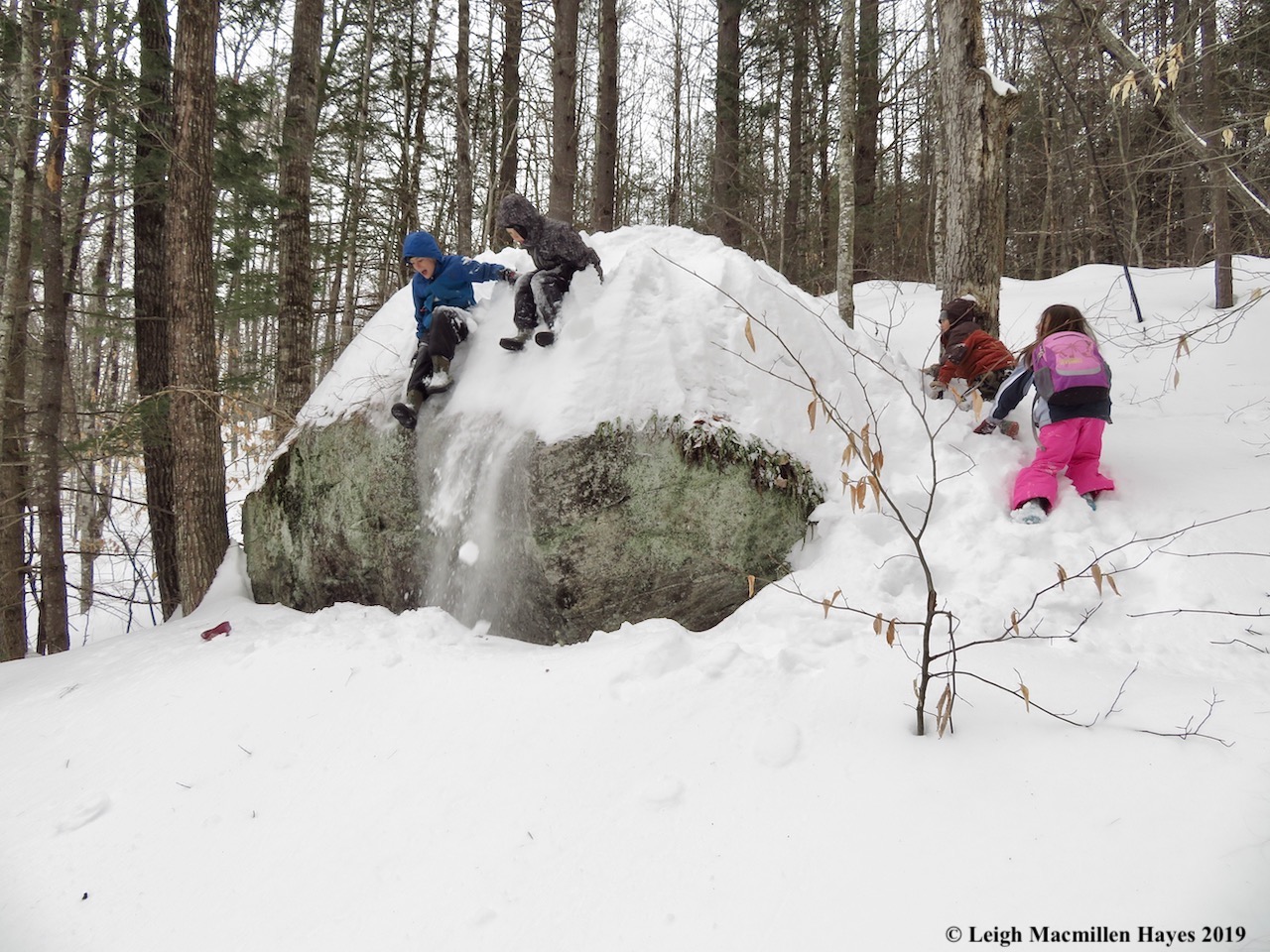
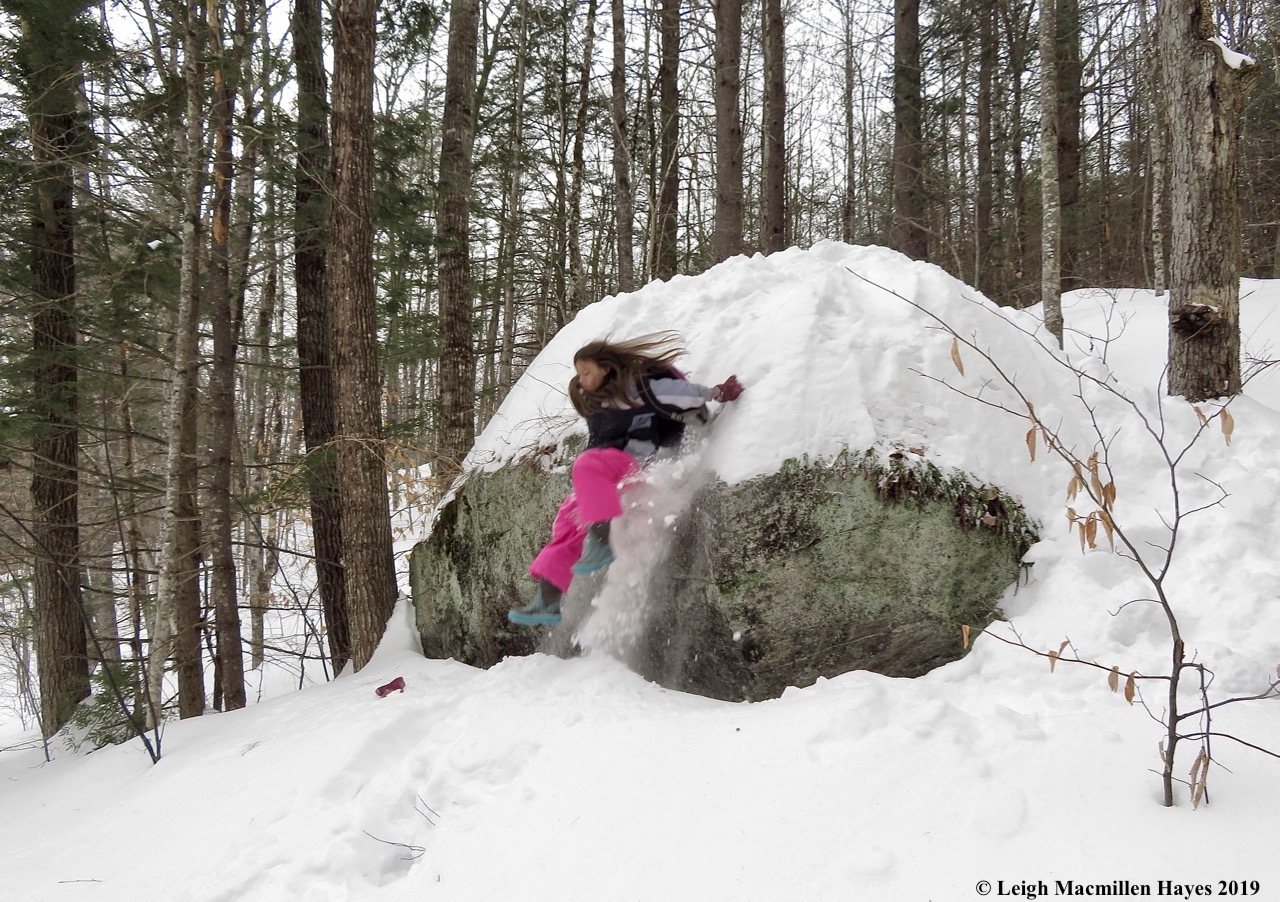
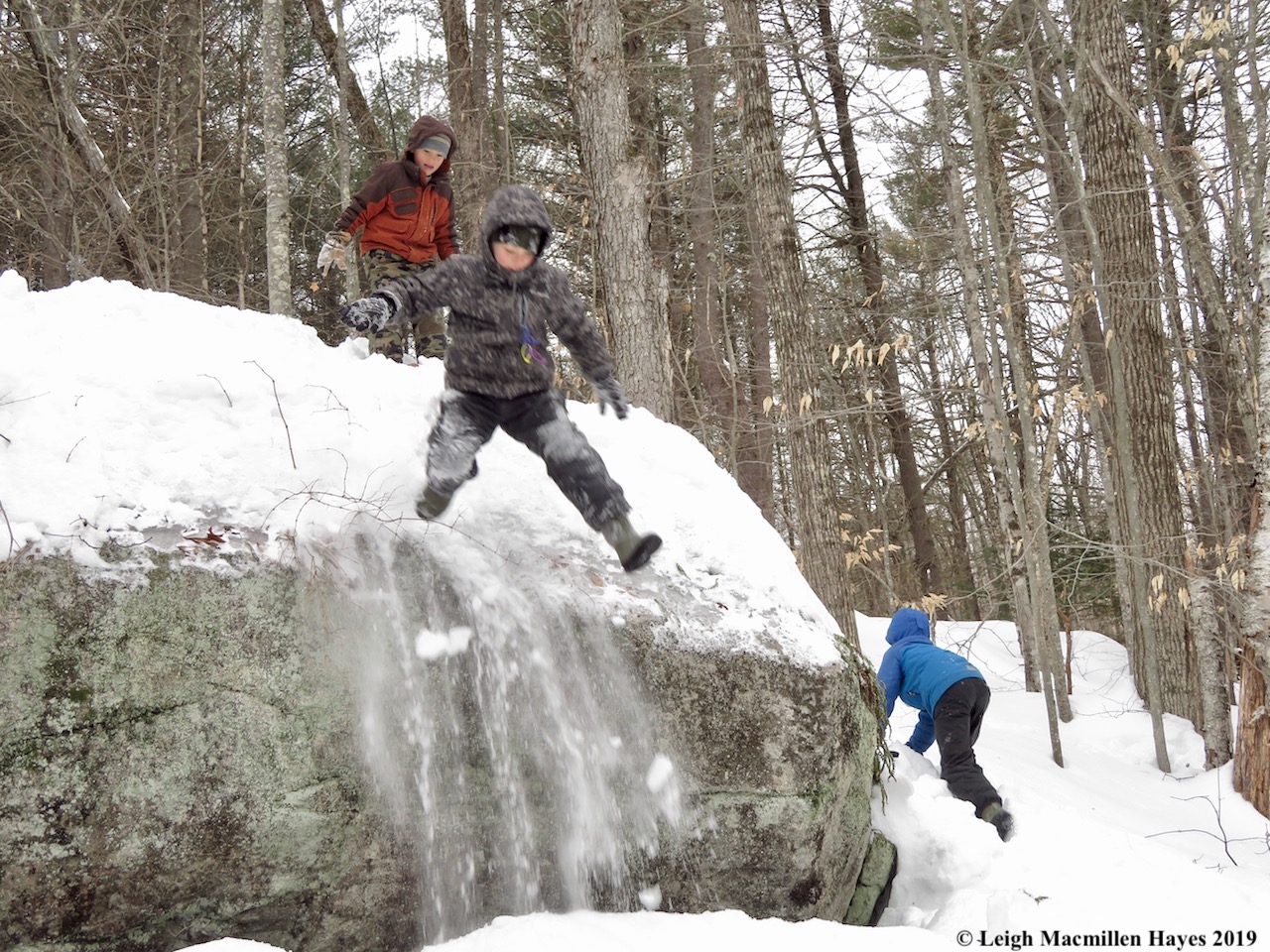
Those angelic Otters eventually found their way to the top of a huge boulder.

And then they began to do what Otters do.

They slid.

And climbed back up.

To slide some more.

Sometimes, it seemed as if they flew down the boulder’s face.

Other times they bounded.

In true Otter rhythm, one foot landed diagonally in front of the other.

After creating a series of troughs in the snow, they begged their momma to join them.

Being a Snowshoe Hare, she wasn’t sure she would be able to slide quite the way they did.

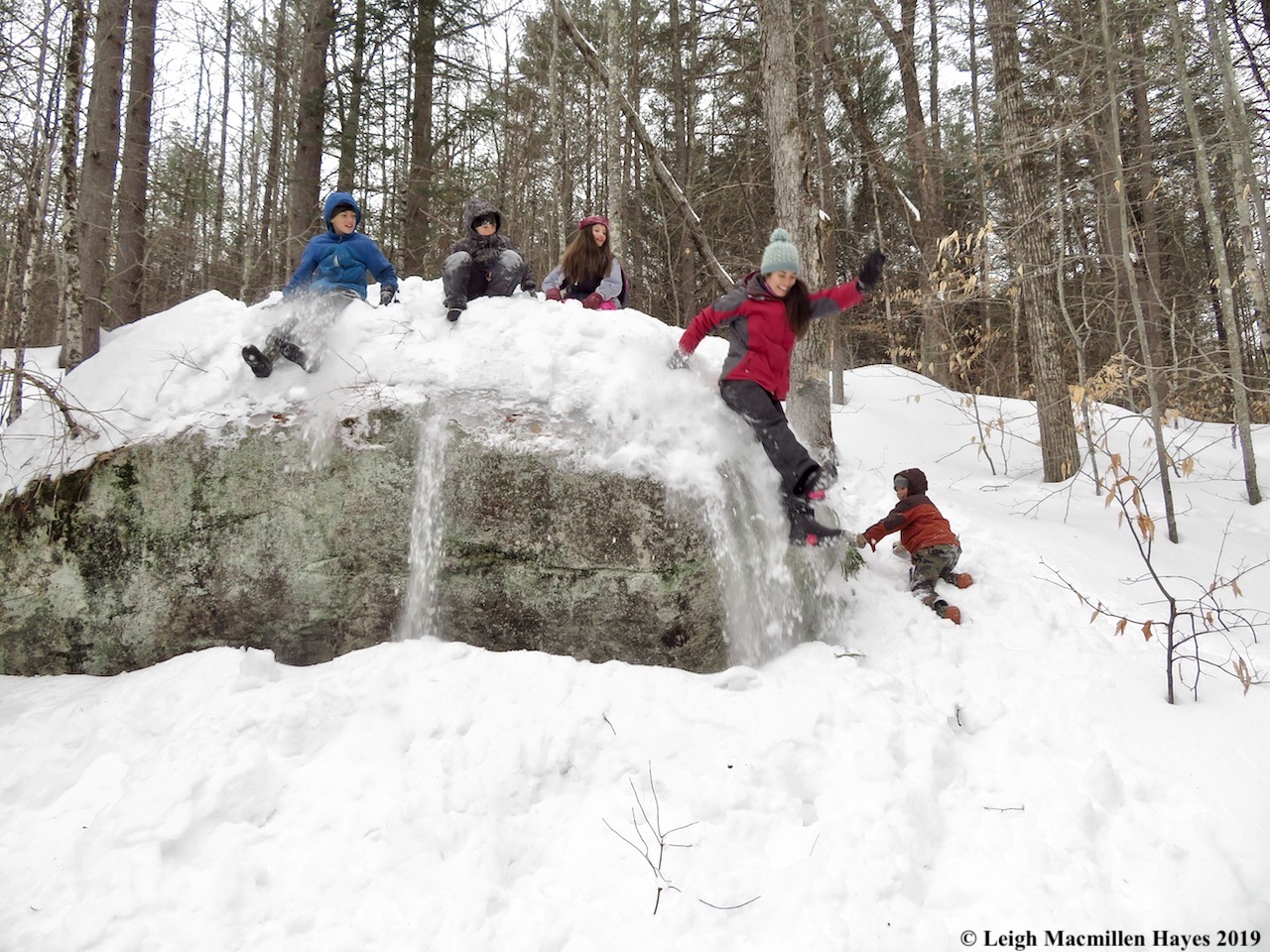
But she shed her inhibitions and climbed up to join her children.

After noting how scary it was, she smiled and slid down in one of the troughs the children had created.

Once was not enough and up and down she went again.

At last it was time to head for home. Being Otters, the children thought they might just den up below their favorite boulder. The youngest, of course, pouted for he wanted to slide some more.

But moments later, he showed his momma how much he loved her by presenting her with a snowheart.

What an otterly delightful family and equally otterly delightful way to spend the day!

Childhood Magic

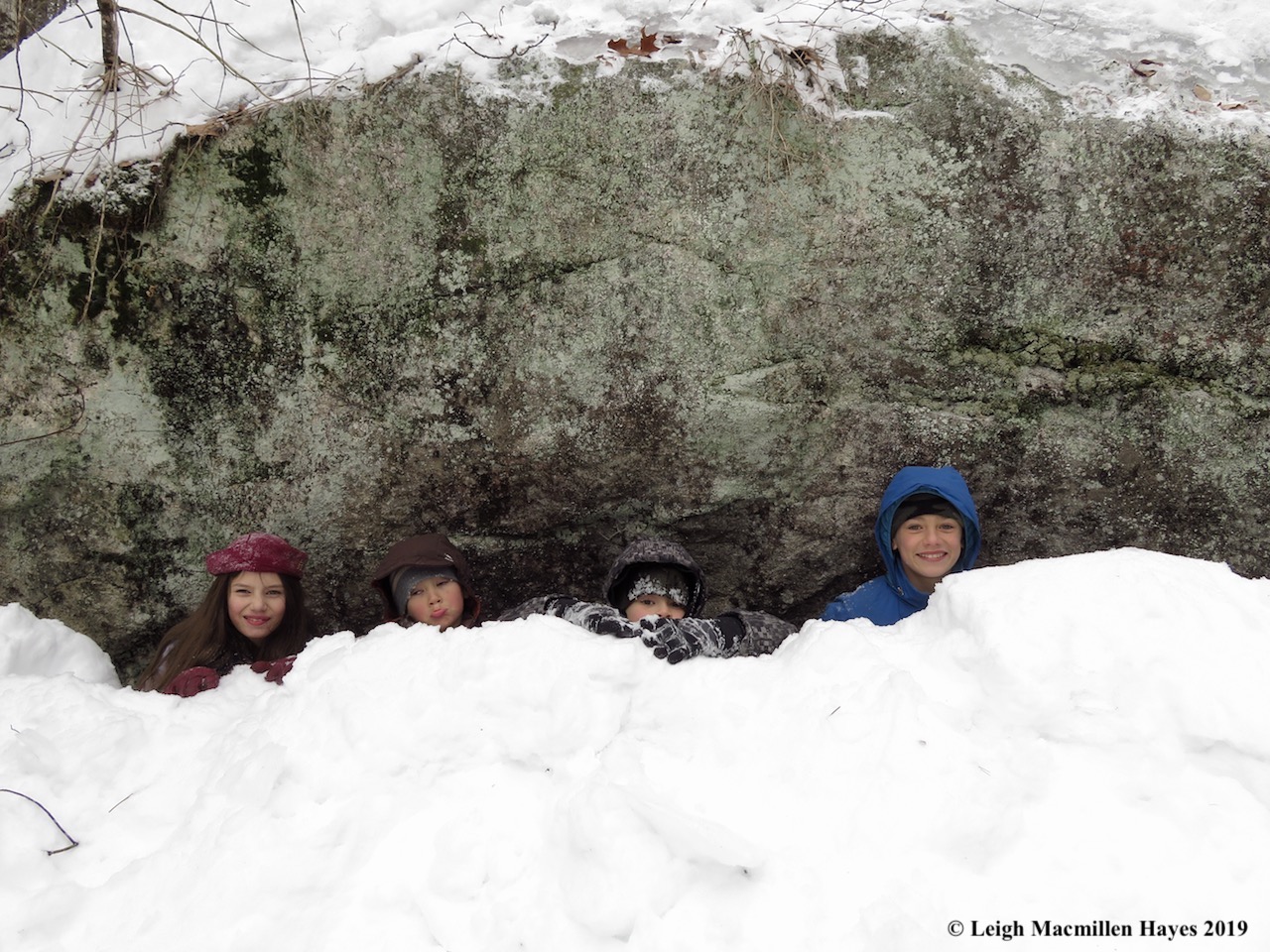
Why did the Greater Lovell Land Trust co-host (or rather tri-host) a hike through Pondicherry Park in Bridgton this morning? Because it’s hunting season, and it didn’t make sense to invite the public on a property that isn’t posted. (Not that we don’t still tramp on GLLT properties in November, mind you, but not on a public walk necessarily.)

And when I asked Jon Evans of Loon Echo Land Trust and Alanna Doughty of Lakes Environmental Association to join me in leading the tramp, they both quickly and graciously agreed to do so. I couldn’t wait because not only would it be a chance to share the special place with GLLT members, but also to bounce off of Jon and Alanna as we shared our knowledge of the natural and historical aspects of the park.

1-Bob Dunning Bridge

But . . . this morning dawned rainy and snowy. Still, we didn’t cancel. And though we knew that not everyone who had planned to join us could because there was more snow in the Lovell area and no power, we were pleasantly surprised to have a small contingent of participants that represented all three of our groups. And really, I love leading smaller groups because it’s so much easier for everyone to participate.

2-Jon giving the bridge history

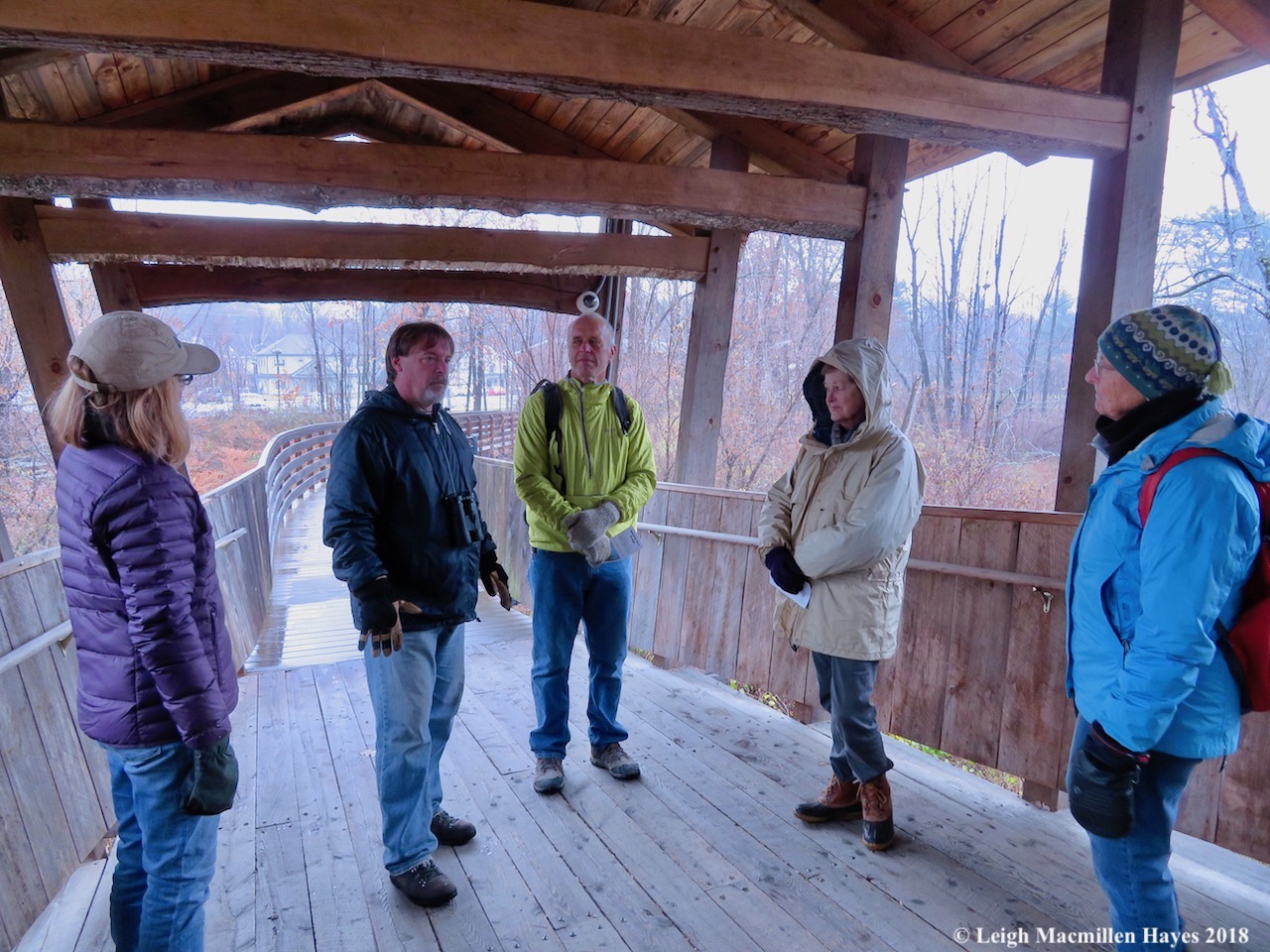
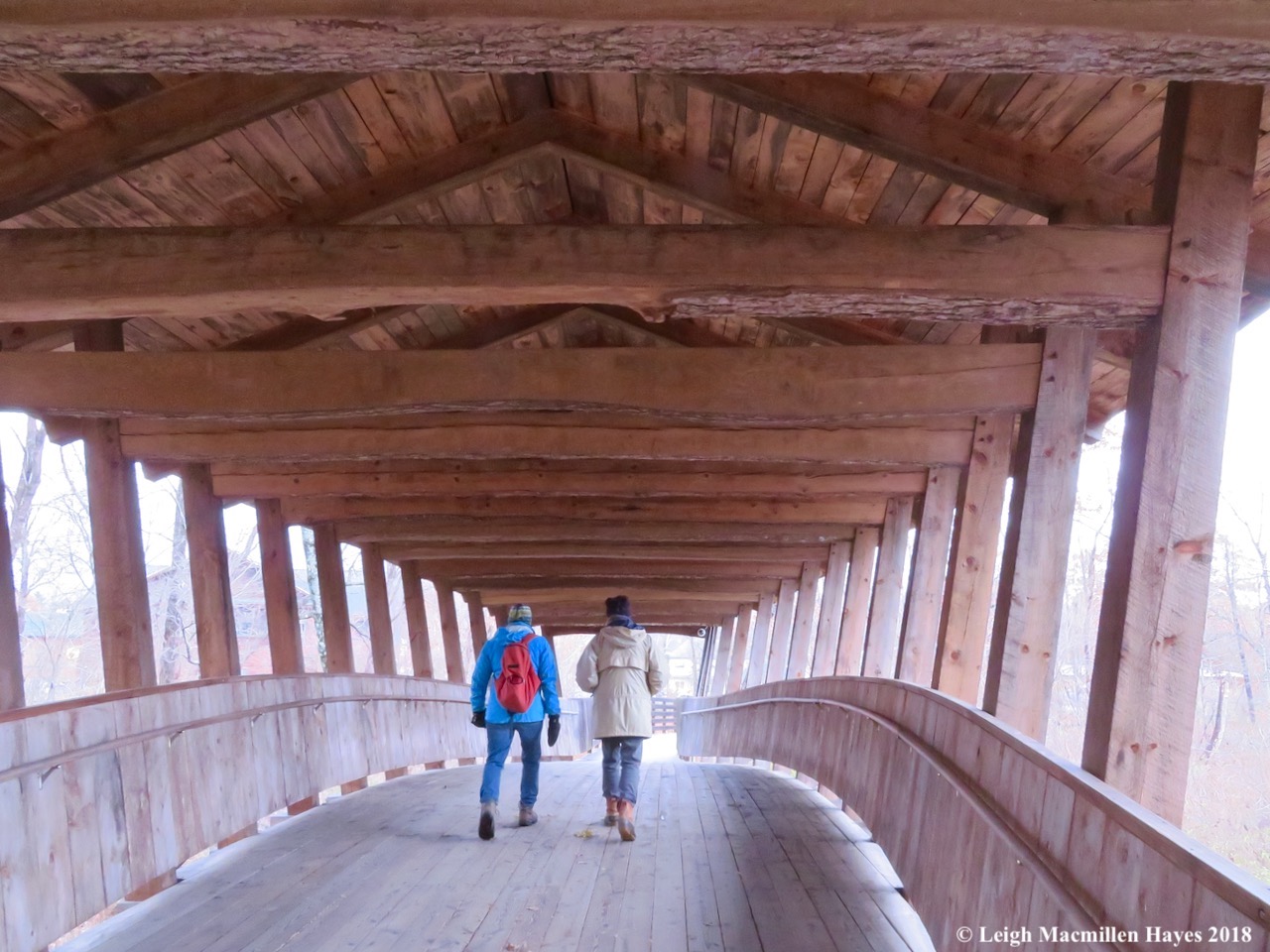
Our group, consisting of Pam, Jon, Bill, Connie and JoAnne, plus Alanna and me, stood for a bit on the Bob Dunning Memorial Bridge, the gateway into the park from behind Reny’s Department Store on Depot Street. As Jon explained, on September 11, 2010, the Bob Dunning Memorial Bridge was constructed in true barn-raising fashion.

3-Stevens Brook

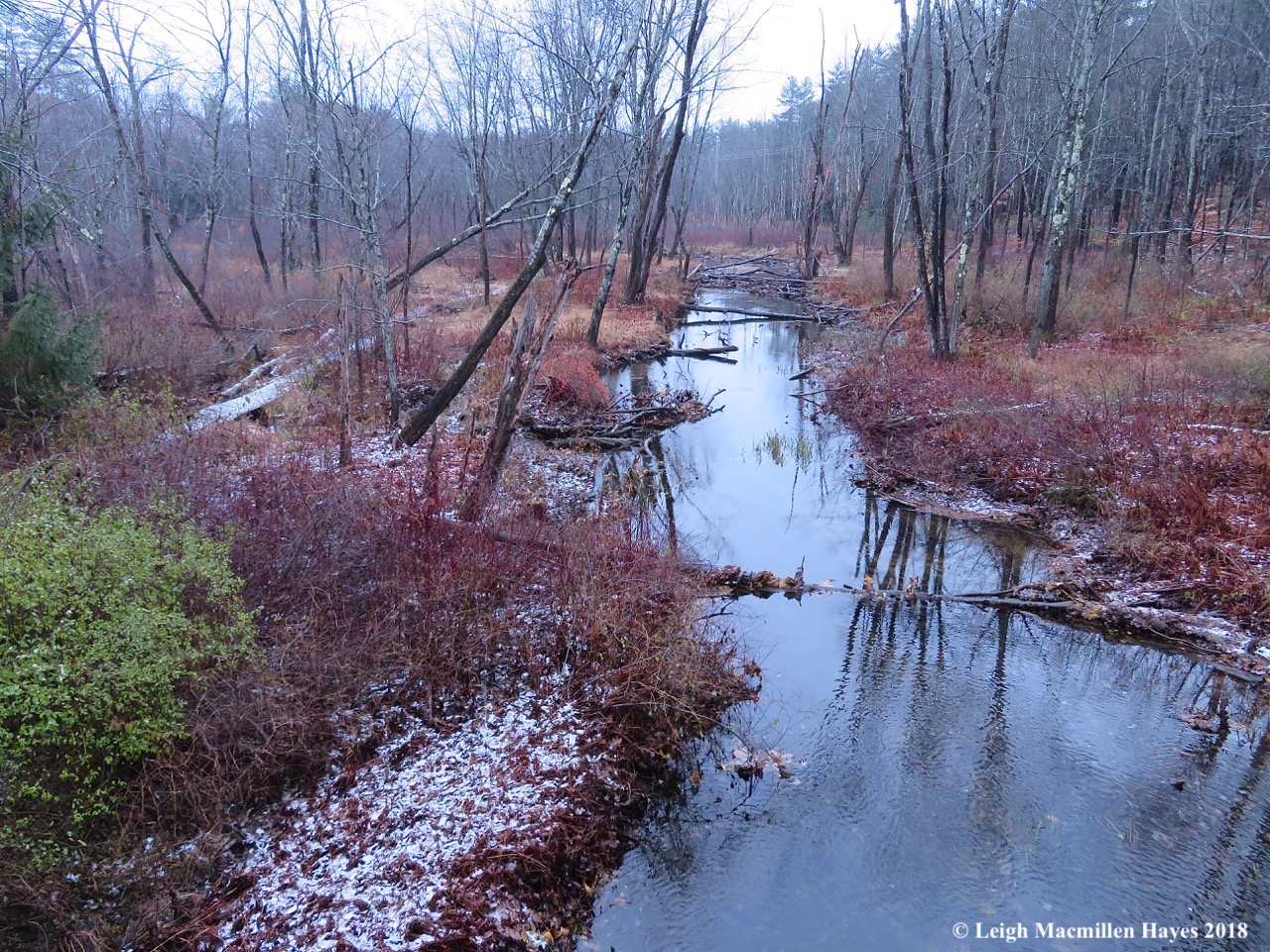
The bridge spans Stevens Brook, the source of power when Bridgton was first founded and for many years thereafter.

4-Bob Dunning Bridge

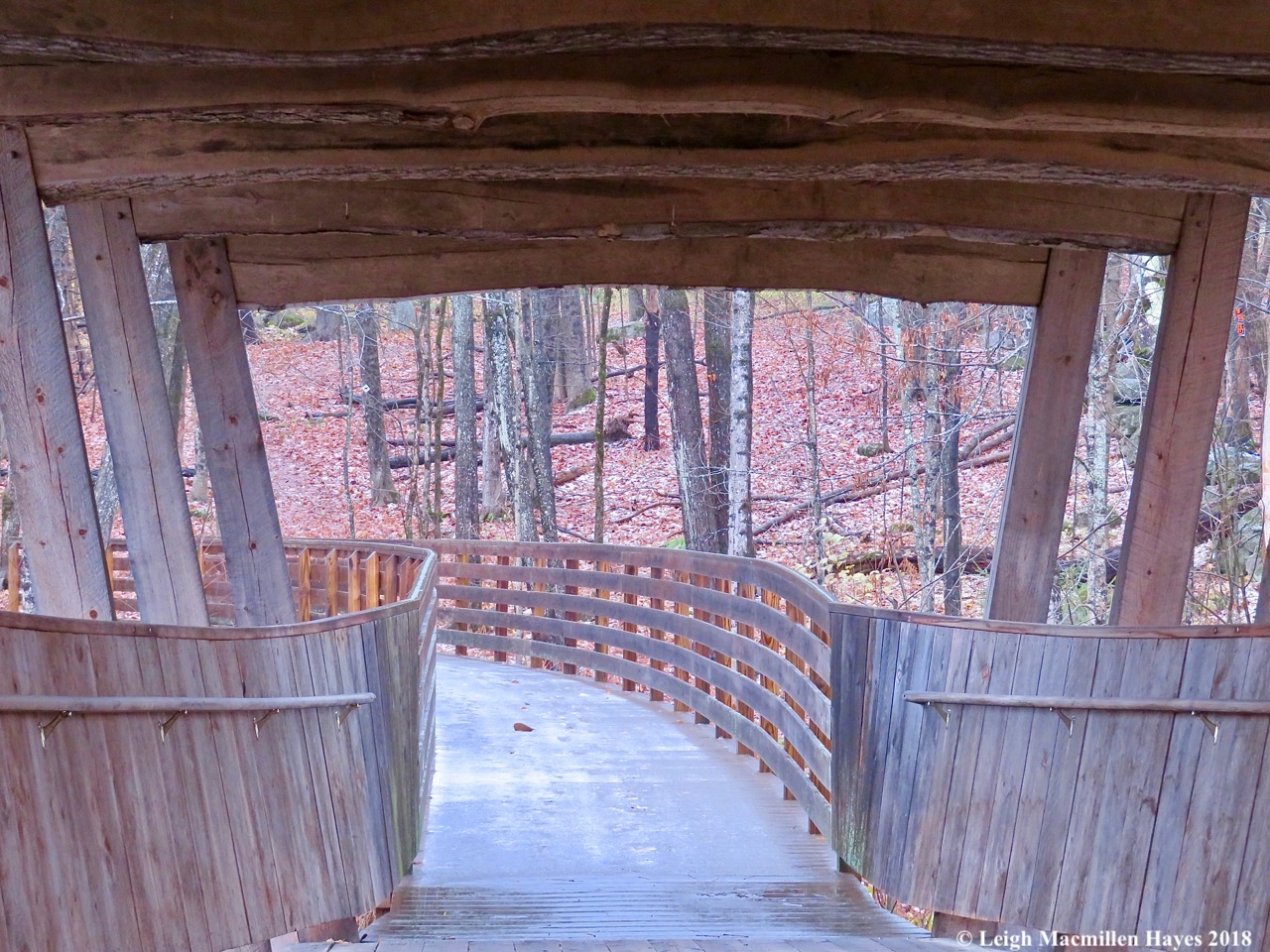
One of the unique things about the bridge is that each tie beam comes from a different tree species, with the bark left on. As I walk across the bridge, my eyes are always drawn to the beams.

Until I took the Maine Master Naturalist class, I recognized only a few species by their bark. But my eyes were opened to the fact that each species has its own presentation, which is true for everything in the natural world. I wanted to know all of them so I set out to teach myself, beginning with the species on the bridge. These became the focus of my capstone project for the class and from that I created a Barking Up A Bridge brochure that is available at the kiosk.

5-sugar and Norway maple leaves

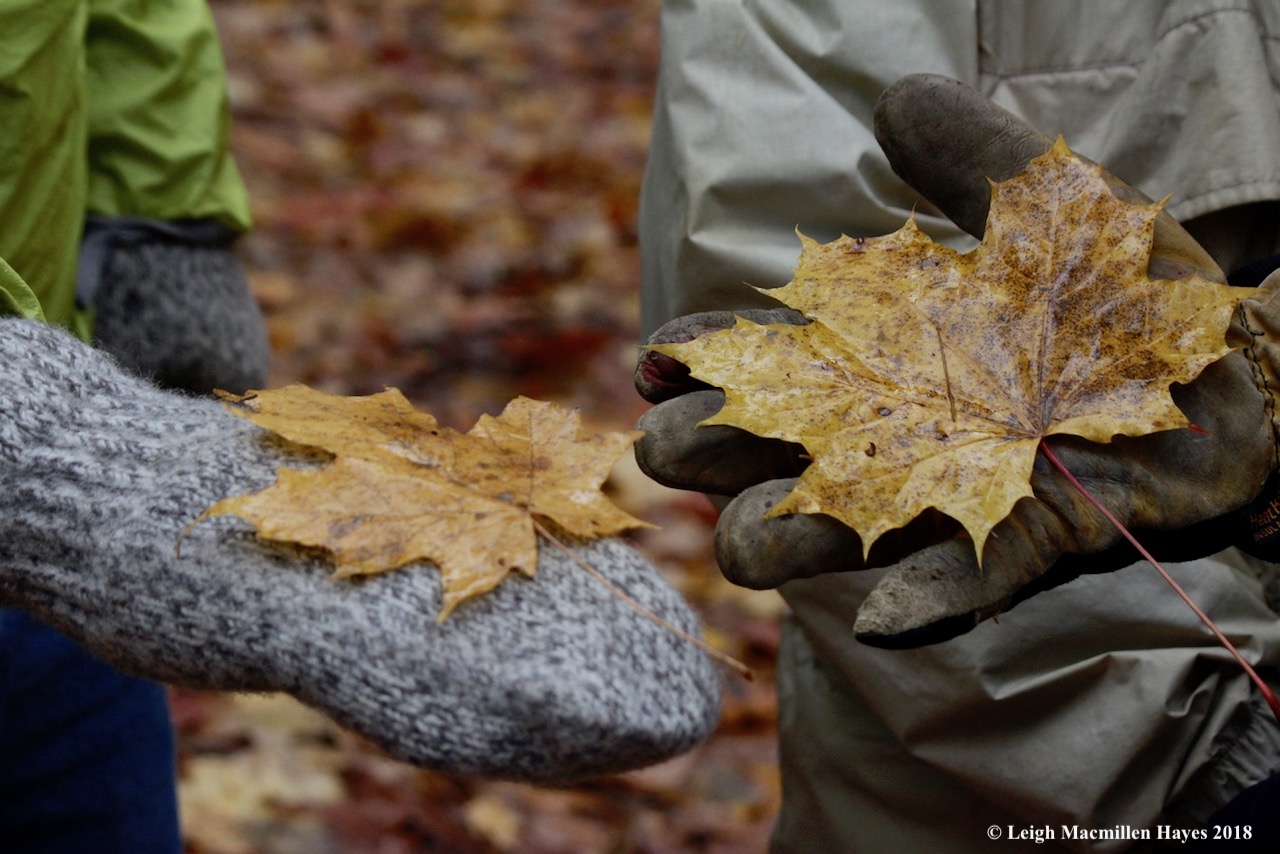
Into the park we finally went, stopping periodically along the way to notice and learn, including the similarities and differences between a sugar maple leaf on the left and Norway maple leaf on the right. Both have the same number of lobes (5) and look so similar, but . . .  the Norway maple leaf, an invasive planted along the main streets as a shade tree after the loss of Elms, is much boxier and more rectangular in shape. Plus, as Jon pointed out, the stem seeps a milky substance, which is a quick way to identify it.

6-pine soap

Our finds included many as we moved along at our usual slow pace, but one thing kept showing its form on pine after pine. Froth. It’s not unusual and occurs following a rain event such as we’d had all night and morning. So what causes the tree to froth? During a heavy rain, water running down the trunk of a white pine picks up the tree’s oils on the way. Air in the bark furrows bubbles through the oily film and produces the froth.

7-pine soap

Conditions were just right for it to occur so we spied frequent examples.

8-tussock moth cocoon

And because we were looking so closely at the bark, we noticed other things like tussock moth cocoons. We also found tube caterpillar moth cocoons created with pine needles and even pulled one apart to take a closer look. And the tiny sawfly cocoons on various twigs.

10-Willet Brook

Eventually, we found our way beside Willet Brook, which flows into Stevens.

11a-JoAnne photographing script lichen

And again, our eyes were drawn to tree bark and crustose lichen in particular. JoAnne snapped a photo of a script lichen that decorated a red oak.

13-crossing onto LEA property

Our intention was to turn away from the brook and cross the boardwalk that leads onto the Lakes Environmental Association’s adjacent property. Before doing so, however, we began to channel our inner child and rolled some logs.

12-baby red-backed salamander

And we weren’t disappointed for we found young and mature red-backed salamanders as hoped. If you roll a log, always pull it toward you so any critters that want to escape can do so in the opposite direction; and always put the log back into place quickly (well, after a couple of photographs, that is.)

14-Maine Lake Science Center Lab

At LEA’s Maine Lake Science Center, Alanna gave us a quick tour of the premises,

15-MLSC Lab

including the lab where various water quality tests are conducted.

16-Connie on the low-impact challenge course

Back outside, we headed up to LEA’s Pinehaven Trail and tried our talent as birds on a wire along the newly installed  low-impact challenge course.

17-Pam and Bill manuevering the wire walk

We all succeeded as Nuthatches for none of us fell off. If we’d done it with one hand, we  would have been Barred Owls and if we hadn’t used any hands, we would have been Cooper’s Hawks. But we were happy to be Nuthatches. There are four sets of challenges, each with a variety of activities to complete. Challenge your inner child.

18-watching balsam sticks

Crossing back into Pondicherry Park, we said we’d bee-line back to the bridge, but several times we just had to stop . . . especially when we found Balsam Fir blisters inviting us to poke them with twigs and drop the resin-tipped sticks into calm water.

19-balsam rainbow

We watched with fascination as the essential oil propelled the twig and created a rainbow, again satisfying that child within.

22-crossing back over the bridge

At last, a half hour after our intended finish time of 12:30pm, we found our way back to our starting point, all delighted to have spent time exploring and playing on a rather raw morning.

Thank you again to Jon and Alanna for sharing your knowledge and sense of wonder. And thank you to Pam, Bill, Connie, and JoAnne for coming out to play with us.

23-Chili and Beer

Later in the day, my guy and I drove to Lovell for yet another special event at the VFW Hall: LOVELL’S 1st ANNUAL BOWLS & BREWS fundraiser for the Sunshine Backpack Food Program.

It was a chili cook-off and beer tasting event featuring locally crafted chili and locally crafted beer from Bear Bones and Saco River Breweries. Plus, National Distributors in Portland donated Harpoon and New Belgium beers.

24-Paula and Diane

Diane Caracciolo nailed it and won first place from the judges and as the people’s choice. Her take away was a coveted apron, actually two, designed by local students who benefit from the Sunshine Backpack Food Program. As Paula Hughes, one of the event’s organizers explained, the packs are sent home on Fridays and filled with nutritious, non-perishable, easy-to-prepare food to ensure the kids get enough food on weekends.

At the end of the day, it seemed an interesting juxtaposition to have spent the morning channeling our inner child and the afternoon thinking about children who are so hungry that they can’t enjoy such childhood magic.

If you’d wish to contribute, let me know and I’ll put you in touch with Paula.

Put The Lawn Furniture Away Holiday

I don’t know the why of it, but it seems that each year when we plan to put the lawn furniture away, the forecast either includes wind gusts or snow. Well, yesterday it snowed. Not a lot of snow, mind you. But enough.

1-snow on the kayaks

It was, however,  melting quickly when we stopped by camp to begin our autumn chores.

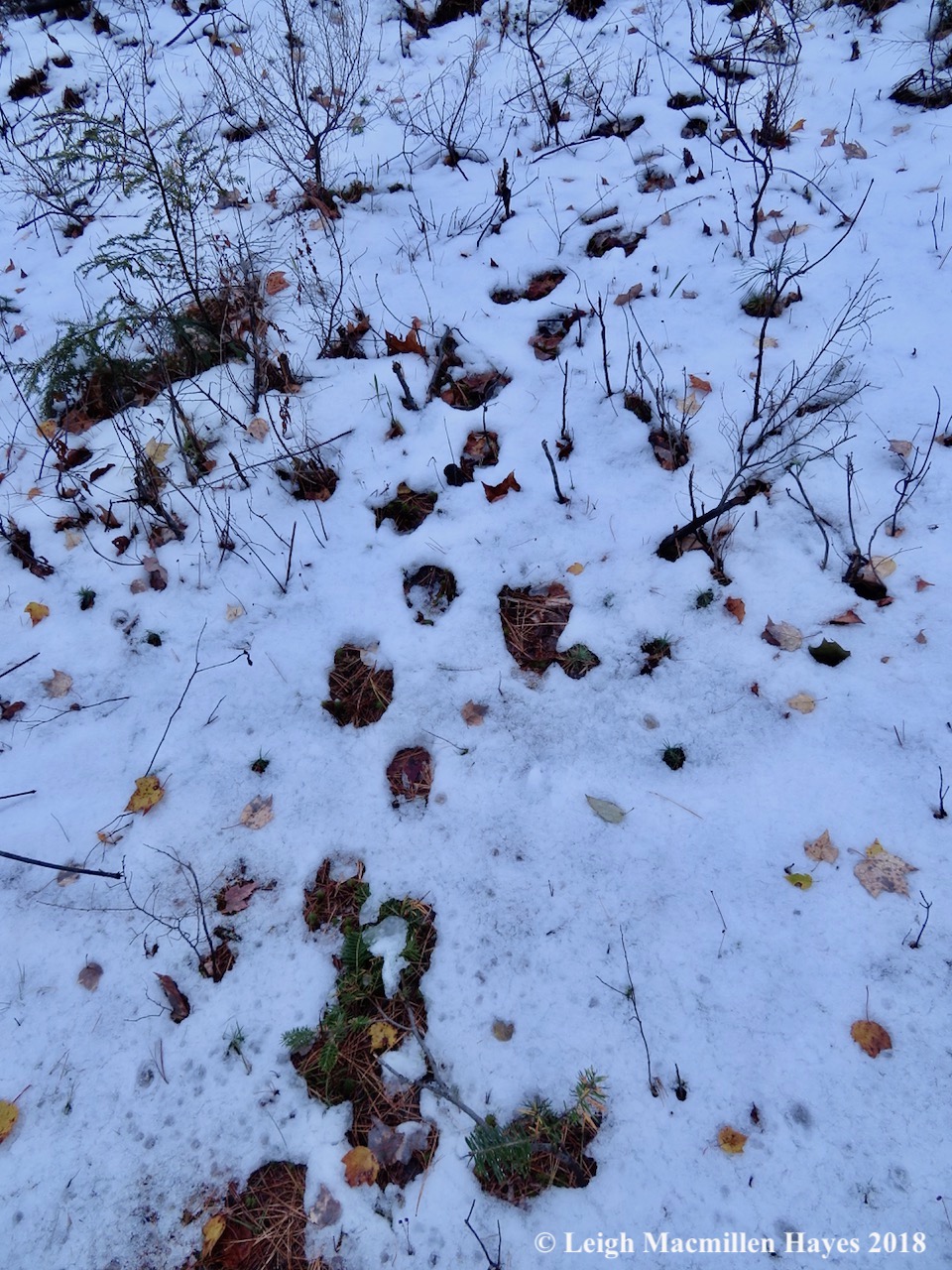
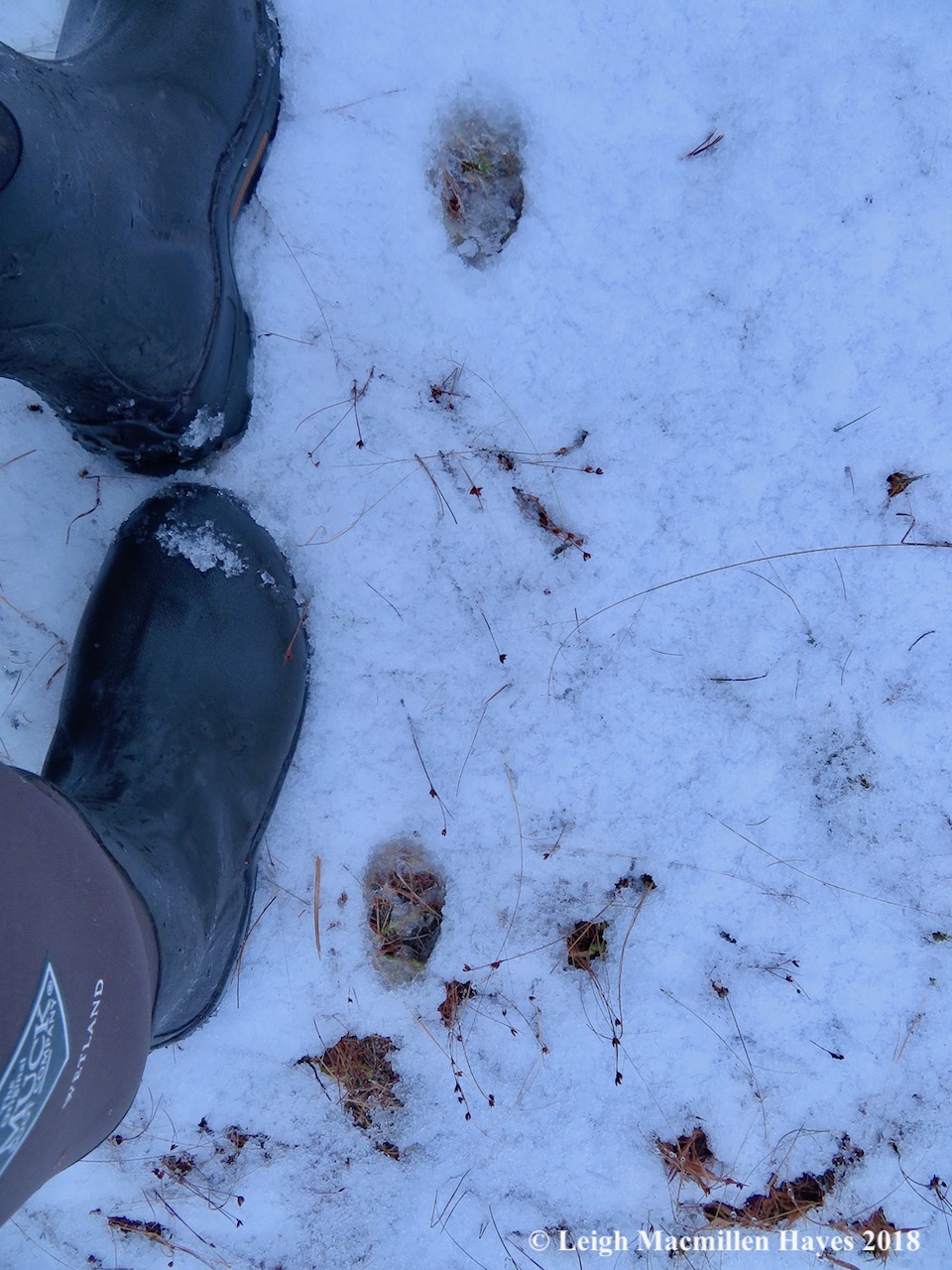
3-porcupine tracks

Upon our return home, I diverted my attention for a bit and headed off into the woods, where much to my delight, tracking opportunities made themselves known. Though I didn’t see any of the creators, I smiled with the knowledge that I can share this land with them. Along the way I found a porcupine track pattern,

4-coyote--18 inch stride

plus a coyote with a stride of about nineteen inches (when you don’t take a tape measure it pays to improvise),

5-snowshoe lobster

and my favorite for this first tracking day of the season . . . a snowshoe lobster–I mean hare.

6-moose scat

Another favorite sighting, which I spied a few times–rather fresh moose scat the size of chocolate nuggets. (And no, I didn’t collect it to make jewelry. ;-))

7-my own track

As I moved, I left behind my own tracks and wondered if the mammals looked at those and knew I’d passed by. “Middle-aged female, the one who stalks us,” they might comment if they could talk. But really, it’s by my scent that they probably know me best. “Stinky middle-aged female . . .”

7a-leaves enhanced by snow

It wasn’t just tracks that caught my attention. The snow, spotted with tree drips, enhanced the color and borders of the foliage, making each leaf stand out.

7b-leaves under slush

In contrast, a more muted tapestry formed where foliage was trapped in slush-topped puddles.

8a-melted snow on sugar maple

And then there were those leaves turned upside down. I was fascinated by the variation of size in the water drops left behind as the snow melted. Every dot enhanced the pastel back-side colors . . .

8-melted snow on big tooth aspen leaf

and acted as a scope by showing off segments of venation.

9-snowdrops on grass

Patterns changed depending on the shape of the structure to which they clung.

10-goldenrod

And all were momentary for each drop eventually did what they do . . . dripped.

11-tachinid fly

While I admired the beauty, I wondered about the goldenrod that still bloomed and reminded me that though it had snowed and we’ve had some rather cold days, today was a bit warmer and it’s not winter yet. But those cold temps of a few days ago, I think they caught some by surprise, including this tachinid fly that dangled from another flower stalk.

12-hickory tussock moth caterpillar

And several times I found hickory tussock moth caterpillars frozen in place. While I admired the way the melted snow drops clung to the hair, I wondered about what I was seeing. Was it a shed skin? Or had this caterpillar been taken by surprise with weather conditions?

If you know, please enlighten me.

As it was, I needed to finish my wander for there was more furniture to put away on the homefront.

13-red-backed salamander

And when we opened the cellar hatch door to store the table and chair downstairs, another discovery was made . . . an Eastern red-backed salamander on top of the first step.

The day probably should have been named “Day After the First Snow Storm of the Season” but instead it was our “Put the Lawn Furniture Away Holiday.” Not everyone celebrates this day, but we do because as exciting as it is to bring the furniture out in the spring, it’s equally exciting to put it away and anticipate the coming season. Oh, and when we pull it again in the spring, you can trust that it will snow at least one more time.


Postcards from Sweden

Sometimes I forget when traveling that I should share my surroundings with those back home. A photograph of a local scene and a quick note are enough to say that though I was away, you were on my mind.

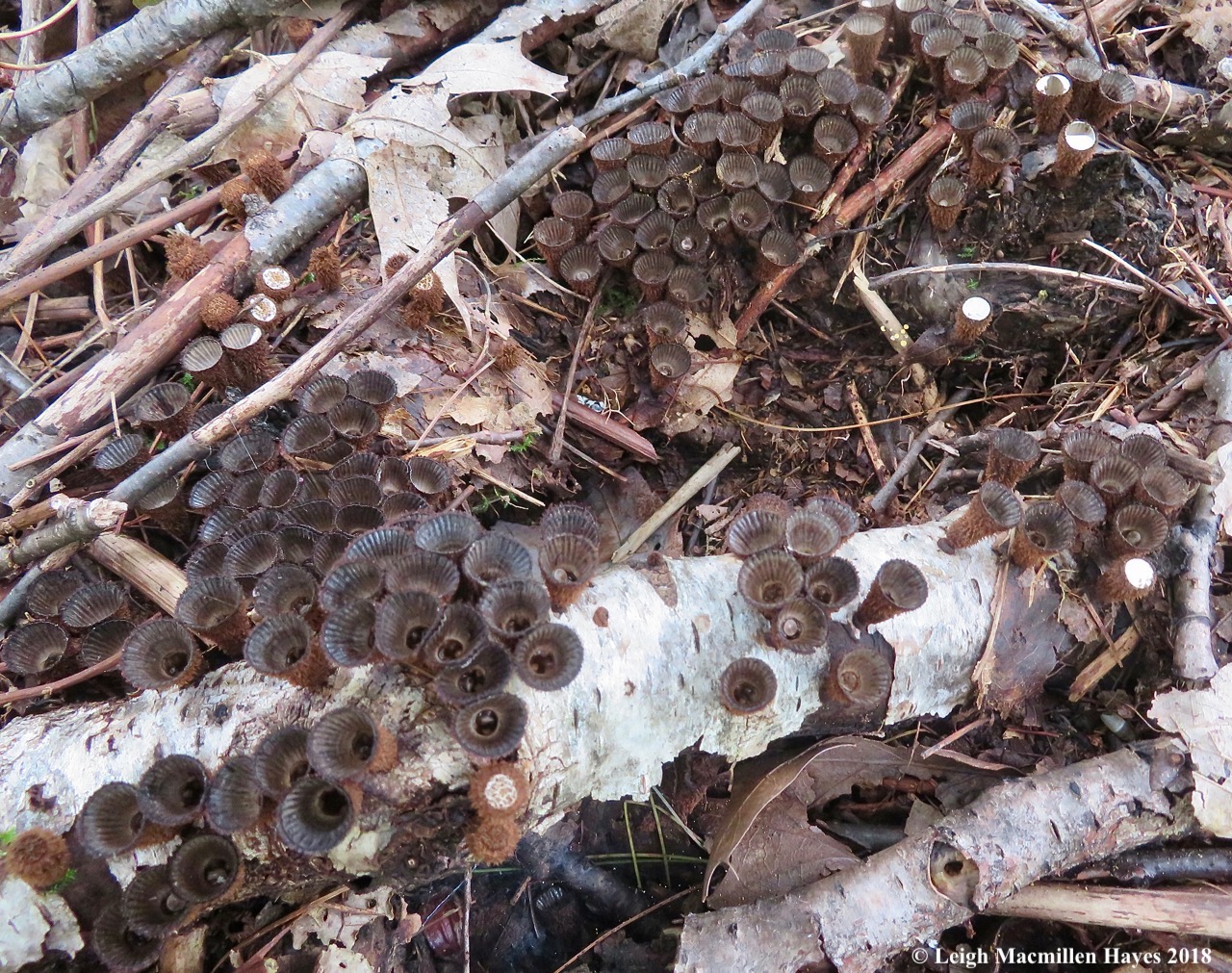
1-splash cup

And so dear readers, these are for you. The weather is great, I wish you were here. For if you were, your jaw would drop as mine did at the sight of these little morsels that so look like candy wrappers. Of course, the right thing to do would be for me to purchase a few to share with you.

2-splash cup

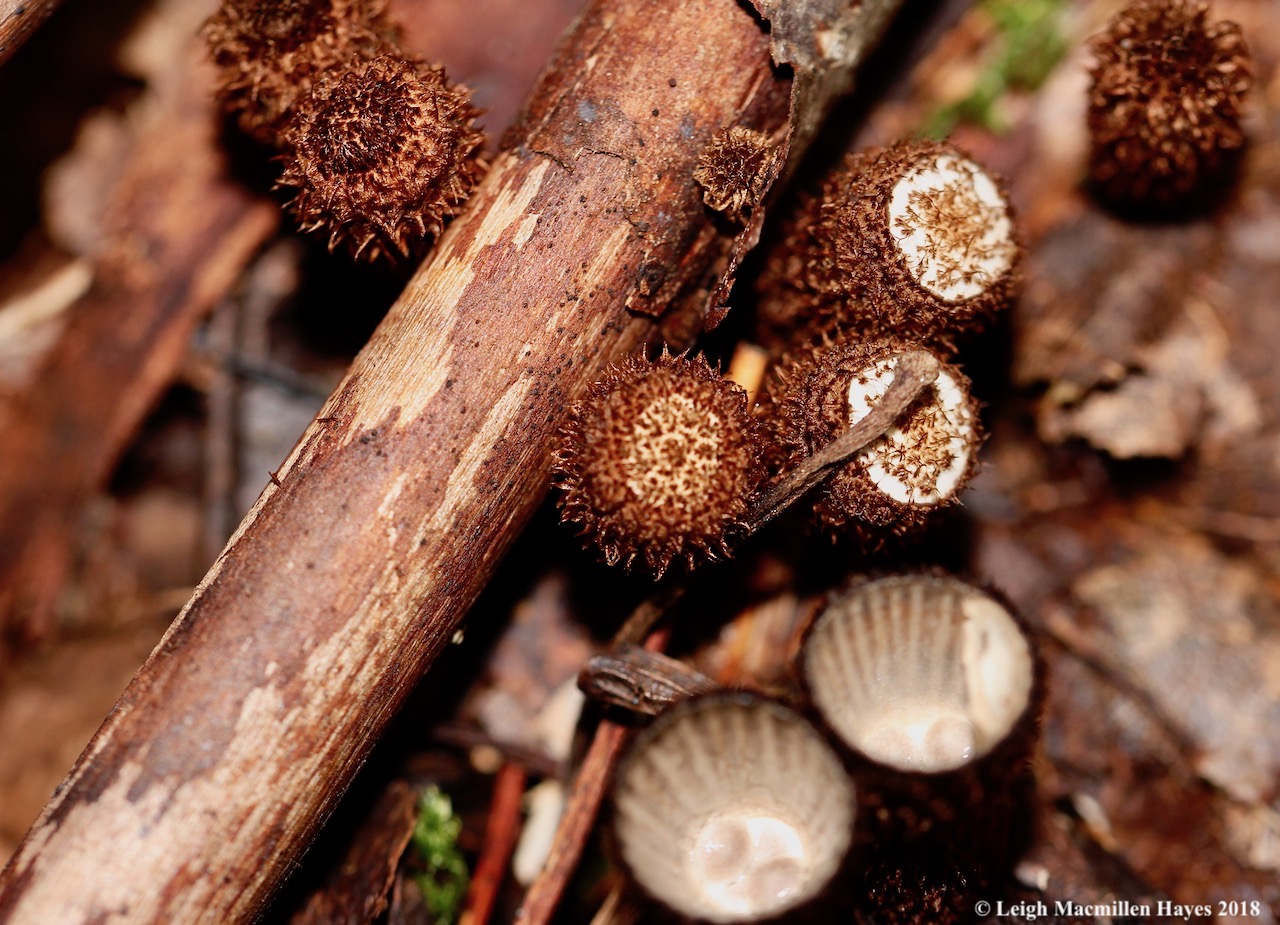
But, looks can be deceiving, and really, these are a fungi called Cyathus striatus, or Fluted Bird’s Nest. While they remind me of marshmallows covered with burnt coconut, they are really the young fruit bodies of the species. The lids, known as epiphragms, cover the structure and prevent rain drops from entering until the eggs within are ripe, for it’s the drips of the drops that release the spores of this fungi.

3-splash cup fungi

More mature structures, those that look like chocolate cups also coated in coconut, contained the “eggs” or lens-shaped structures known as peridioles.

4-eggs in splash cup fungi

This fungi is difficult to spy because it is teeny and inconspicuous and prefers a dark, moist habitat, but my hostess had her eye on these for a while and couldn’t wait to share them with me. And now, I’m excited to share them with you. The flute darkens with age, and that pale lid falls away or collapses inside the structure which does resemble a bird’s nest. Within each nest there are typically four or five silvery flattened “eggs.”

5-turkey tail fungi

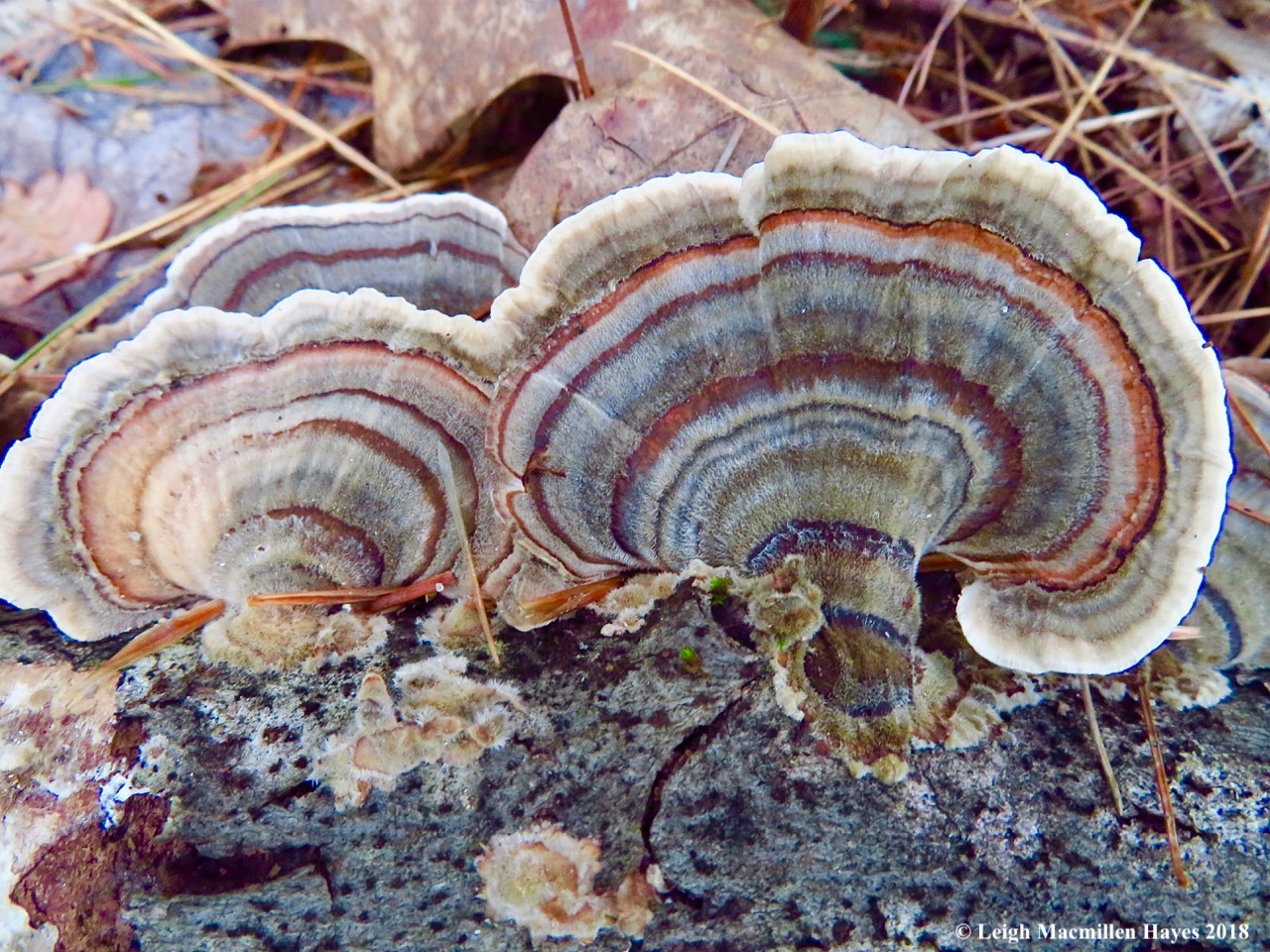
We moved along and our next destination made me think of home. Back home, it seems the wild turkeys are taking over the world as we spy them in the yard, field, forest, and beside many a road. In the forest my hostess knows best, it was a turkey of a different kind that she shared. Trametes versicolor or more commonly, turkey tail fungi, grow prolifically in her woods. And their tail feathers are just as colorful and neatly arranged as the ones I know so well.

10-slime mold

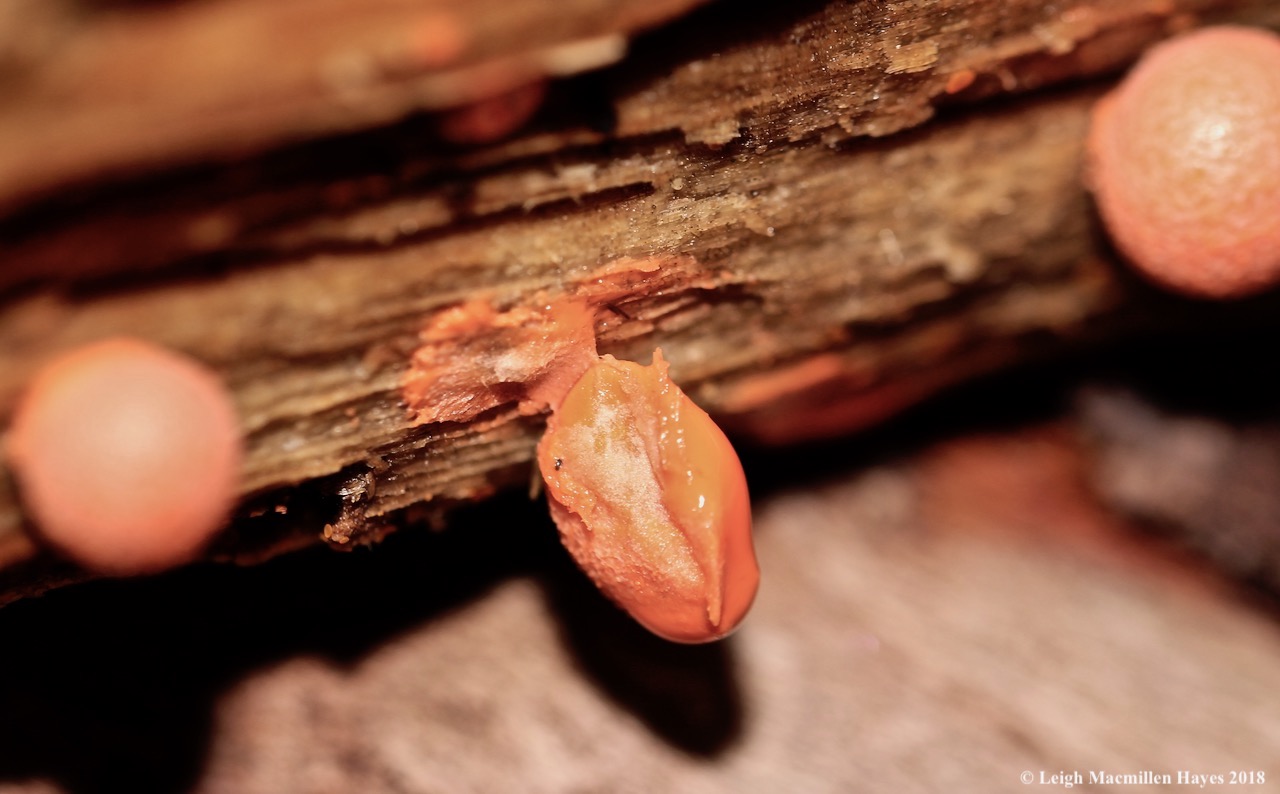
Our next stop on the tour found her sharing a parlor trick with me. She poked a fruiting body of Lycogala epidendrum, or Wolf’s Milk Slime Mold, with a stick. Out oozed some goo, which had the fungi been mature would have been a more powdery spore mass.

10a-slime mold being slimy, parlor trick

You might say, “YUCK.” But it’s almost magical. The salmon-colored balls deflate instantly when poked and as the goo leaks we smile and think about sharing such a finding with others. When next I wander with you, we’ll have to look for slime molds.

11-Aleuria aurantia--orange peel funit

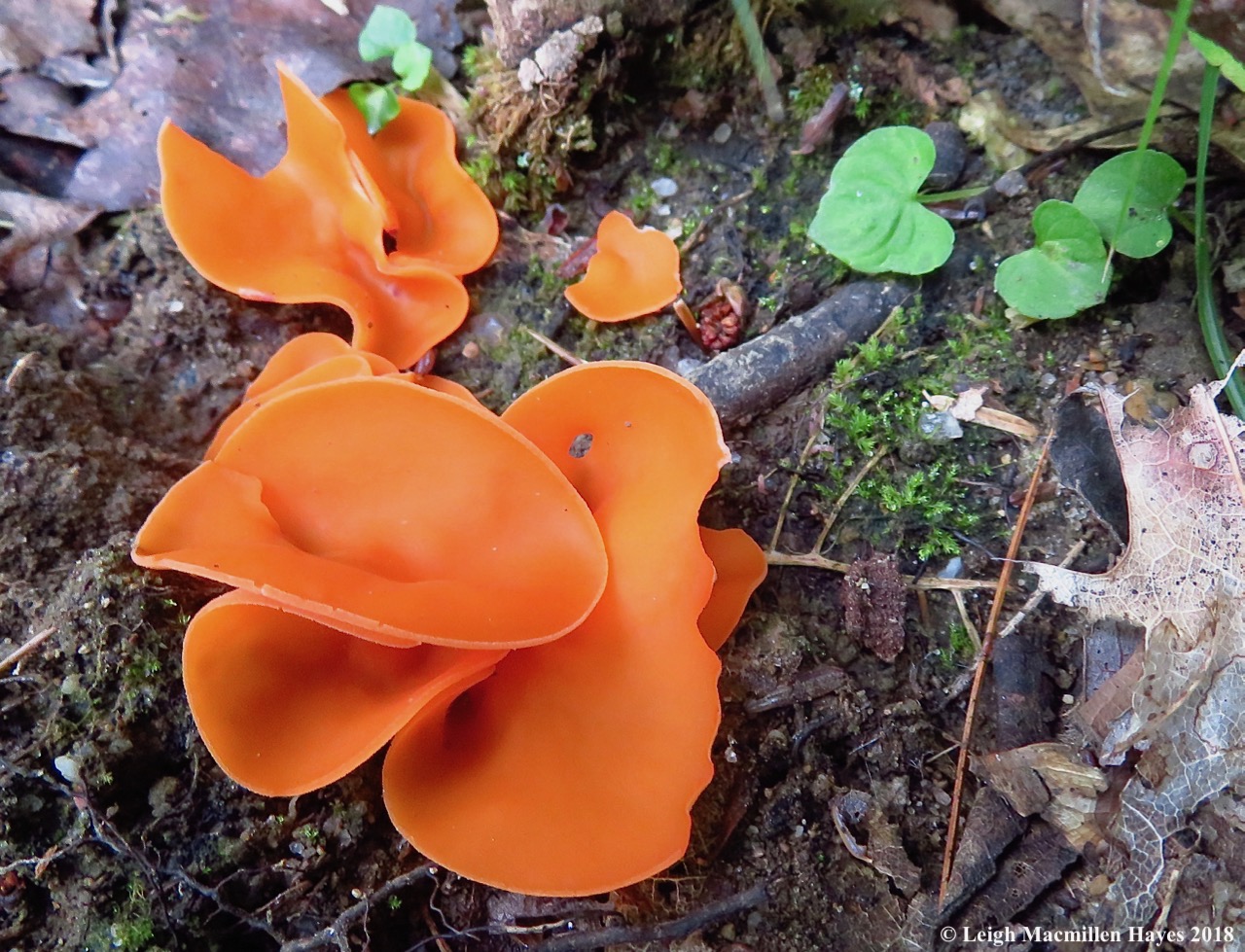
Because we’d been walking for a bit, you might think that my hostess offered a snack. The fun thing about exploring a place she knows so well is that sometimes there are surprises and such was the Aleuria aurantia or Orange Peel Fungi. We were looking at something else in the vicinity when suddenly we both spied the bright orange color and then realized there was a colony of it all about our feet.

14-earth tongue forest

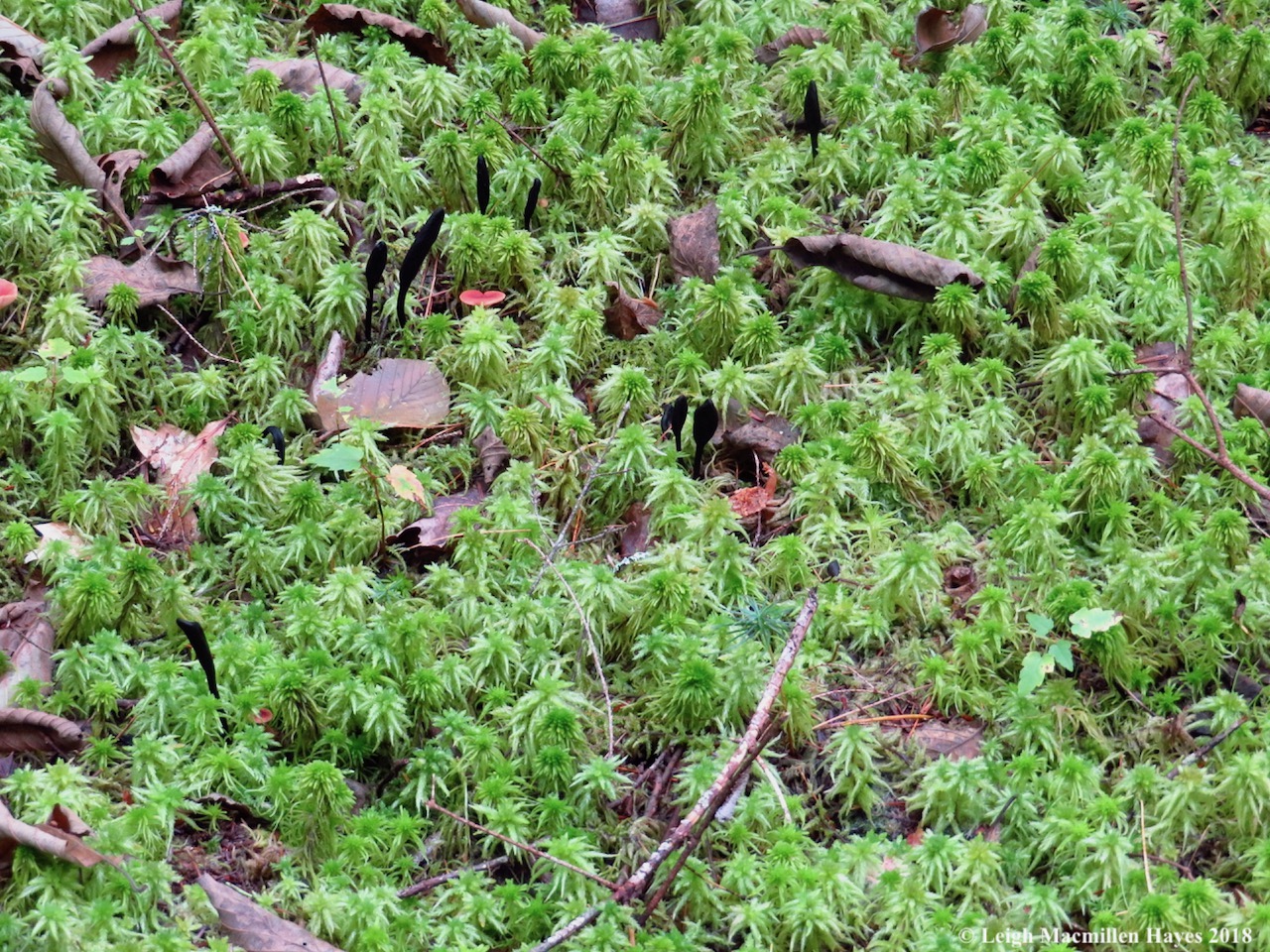
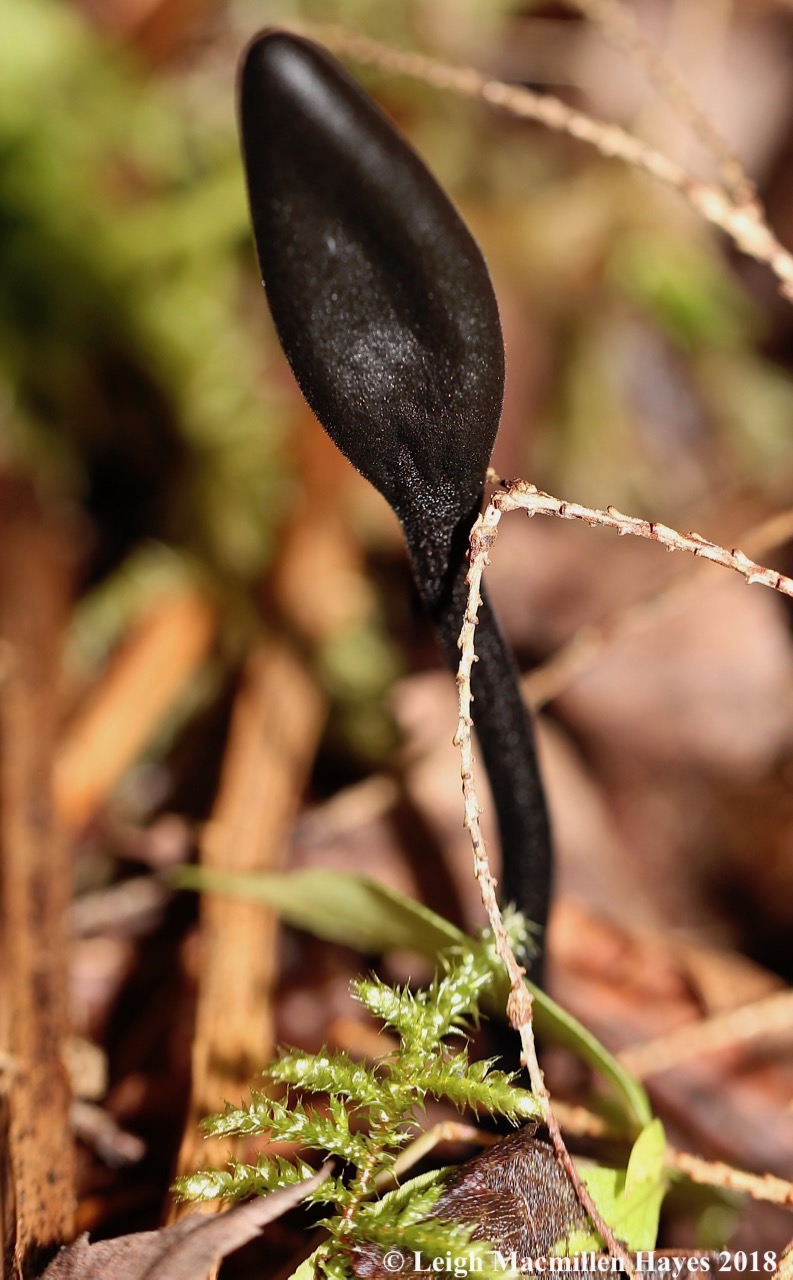
In a different habitat, one where the sphagnum moss grows, we encounter a different fungi that I know, but had never seen in such an abundance: Trichoglossum farlowii is also known as Black Earth Tongue. I had never visited an Earth Tongue garden before but in a foreign land it apparently reigns.

15-singular tongue

Most of the structures are singular fruits, but . . .

15-forked earth tongue

we found one forked tongue.

16-green-headed jelly baby fungi

Nearby, on a rock covered in Bazzania, a liverwort, we found a small colony of Leotia viscosa or Green-headed Jelly Babies. Much like the Fluted Bird’s Nest, it looks like a another candy I should bring home to share, but I left the souvenirs behind and took only photographs.

17-green stain fungi fruiting

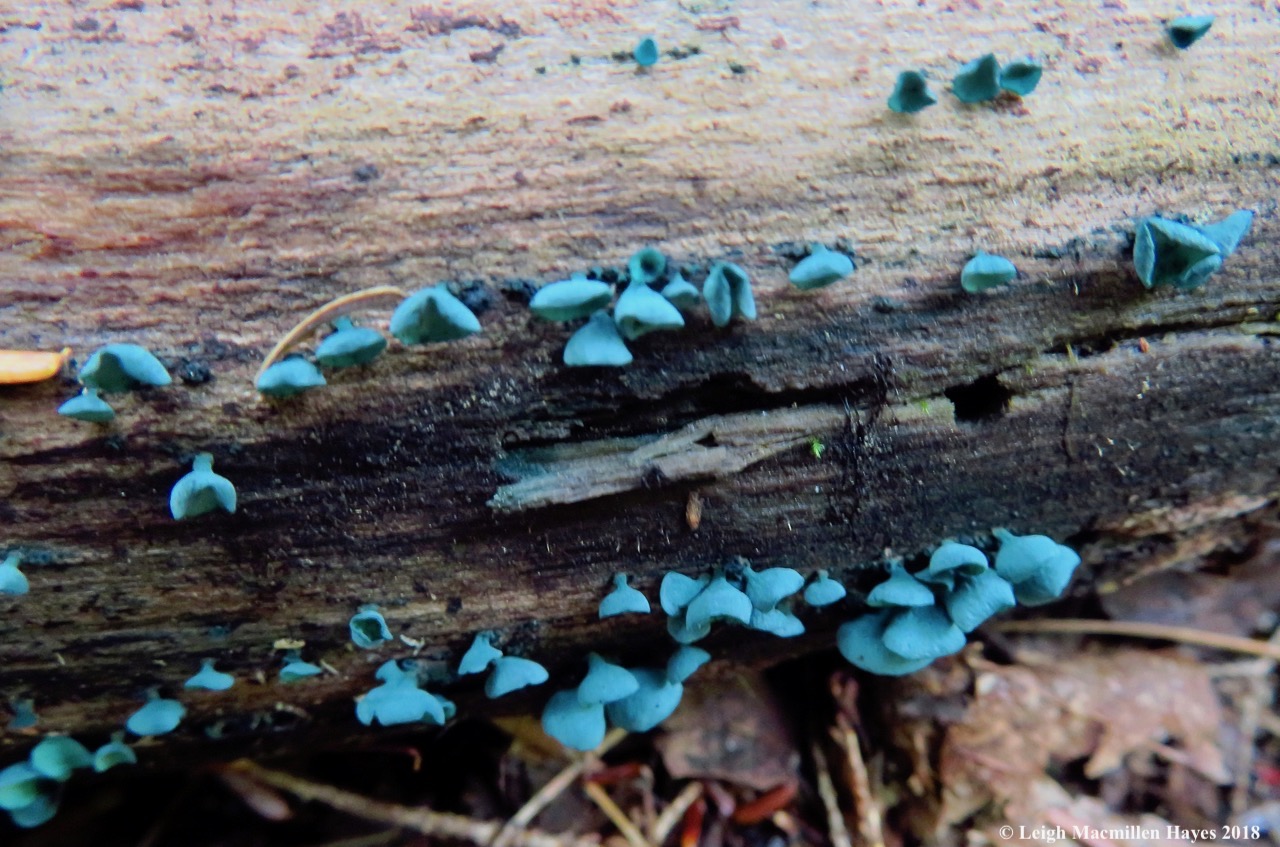
Our forest journey wasn’t over, but our fungi finds were complete when she showed me the fruiting bodies of Chlorosplenium aeruginascens, or Green Stain Fungi. Really, it should be called turquoise-stained, but I didn’t come up with the name. It’s difficult to photograph these beauties for so petite are they, and always a thrill to see.

18-Sweden forest

Many of our finds were located in the vicinity of a forest bog where cinnamon ferns grow tall and wild and add texture and color to the scene, making it look rather pre-historic.

6-beaver pond

Not only did my hostess share her woodland habitat, which is so different from my own, but she also took me to a beaver pond. Our intention was to say hello, but by the depth we noted that the beavers aren’t currently home. We’ll have to call on them another day during my stay.

8-green frog

What we did find were green frogs that squeaked as we approached and then leaped into the water to hide.

9-sundews, both round-leaved and spatula-leaved

As a gift for her hospitality, I was able to share something with my hostess–in the form of round-leaf and spatula-leaf sundews that grow at the water’s edge. Both are carnivorous and so she can now add another parlor trick to entertain her guests–feed insects to the plants.

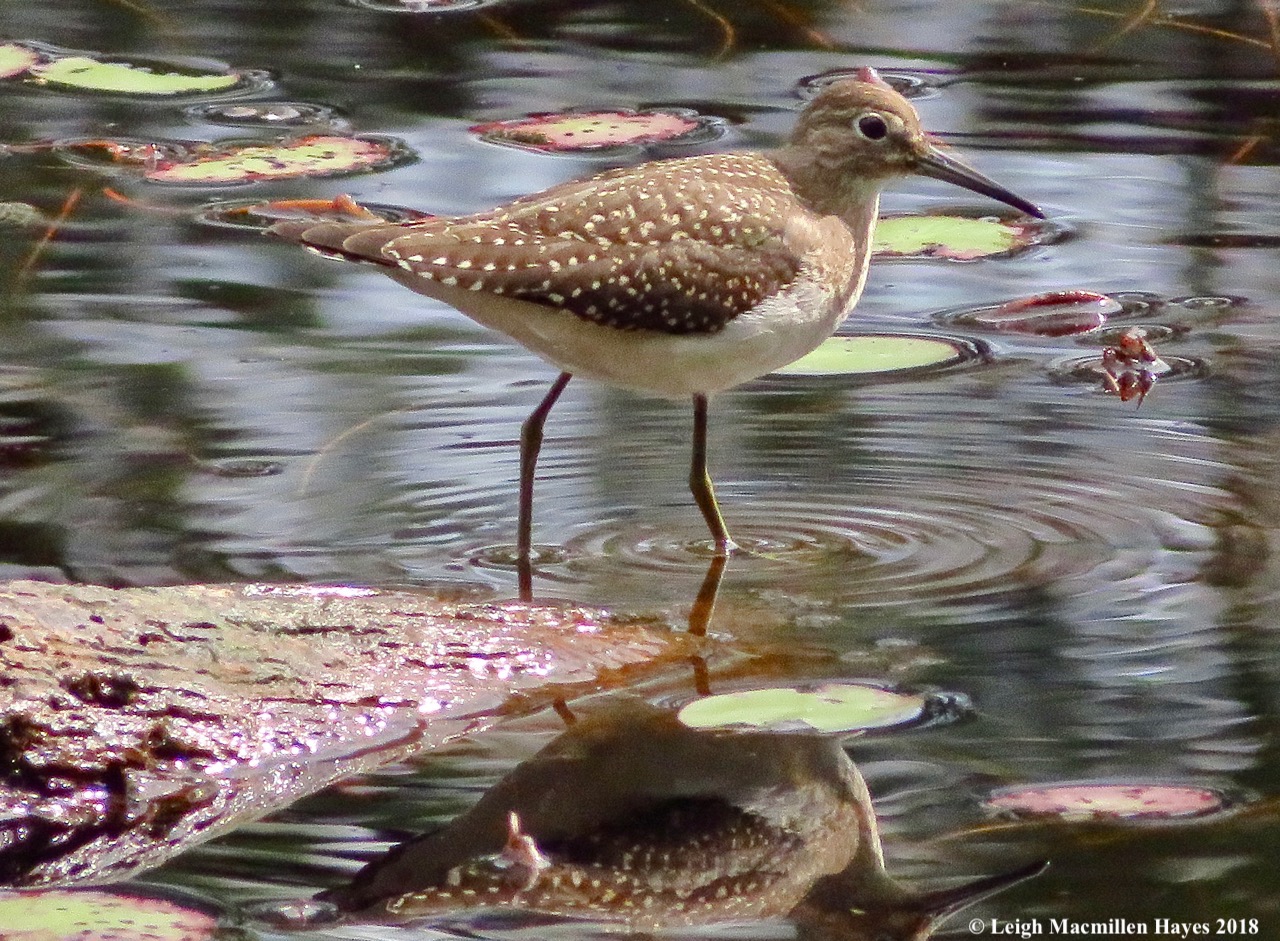
7-solitary sandpiper

One final scene to share because she and I shared the same view: a Solitary Sandpiper on the hunt. We watched for a few minutes before it flew off.

And now it’s time for me to fly home. But the airmail has been stamped and if you have read this then you are on the receiving end of postcards from Sweden. Sweden, Maine, that is.

Thank you to my hostess, J.M., for your kindness and willingness to share so many special scenes with me. I can’t wait to return to your neck of the woods.


Detecting the Nature of Wilson Wing

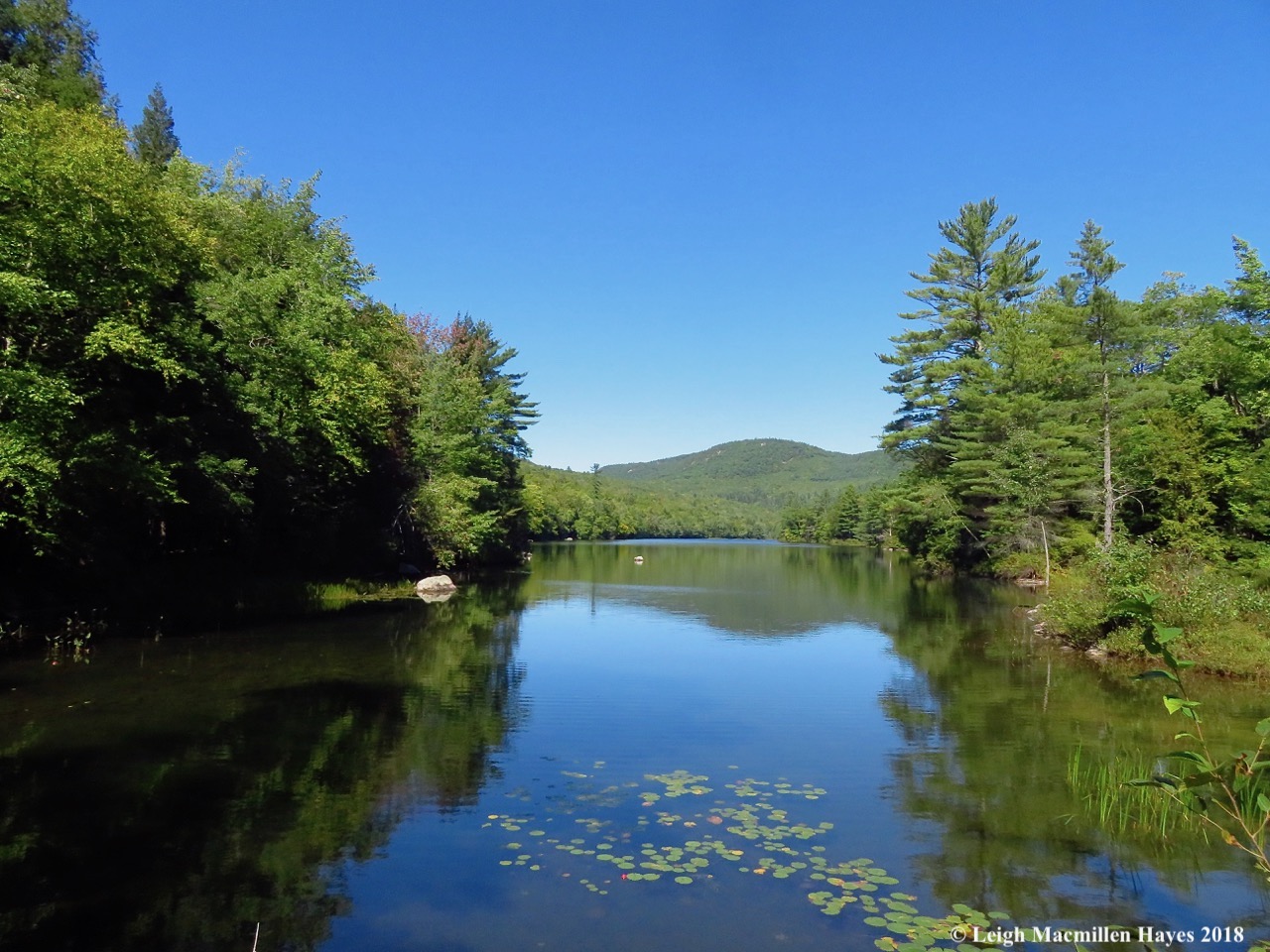
Before heading onto the trail beside Sucker Brook at the Greater Lovell Land Trust’s Wilson Wing Moose Pond Bog Preserve on Horseshoe Pond Road in Lovell, today, a friend and I walked down the road to the pond where we hunted for dragonflies and frogs.

1-Horseshoe Pond

There wasn’t a cloud in the sky on this first day of fall and a crisp day it was, bringing smiles to our faces and adding sweatshirts to our attire.

3-green frog

Though we saw a few darner dragonflies and even a meadowhawk, it was the green frogs that we spent the most time trying to spy for they blended in well with their grassy surroundings at the water’s edge.

2-bobber

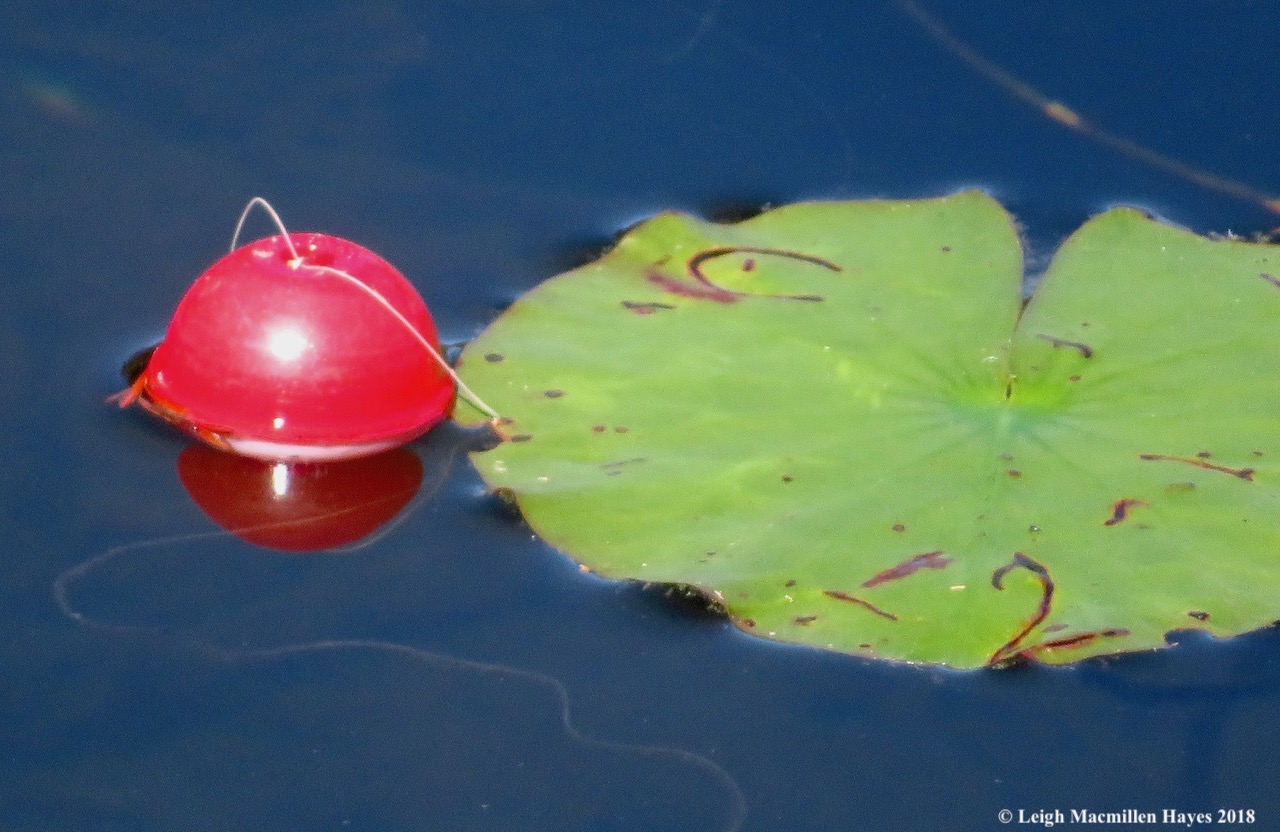
A bit further out, and unfortunately beyond our reach, we spotted a bobber and fishing line. While it offered a picture filled with color and curves, the reality wasn’t so pleasant.

4-Common Loon

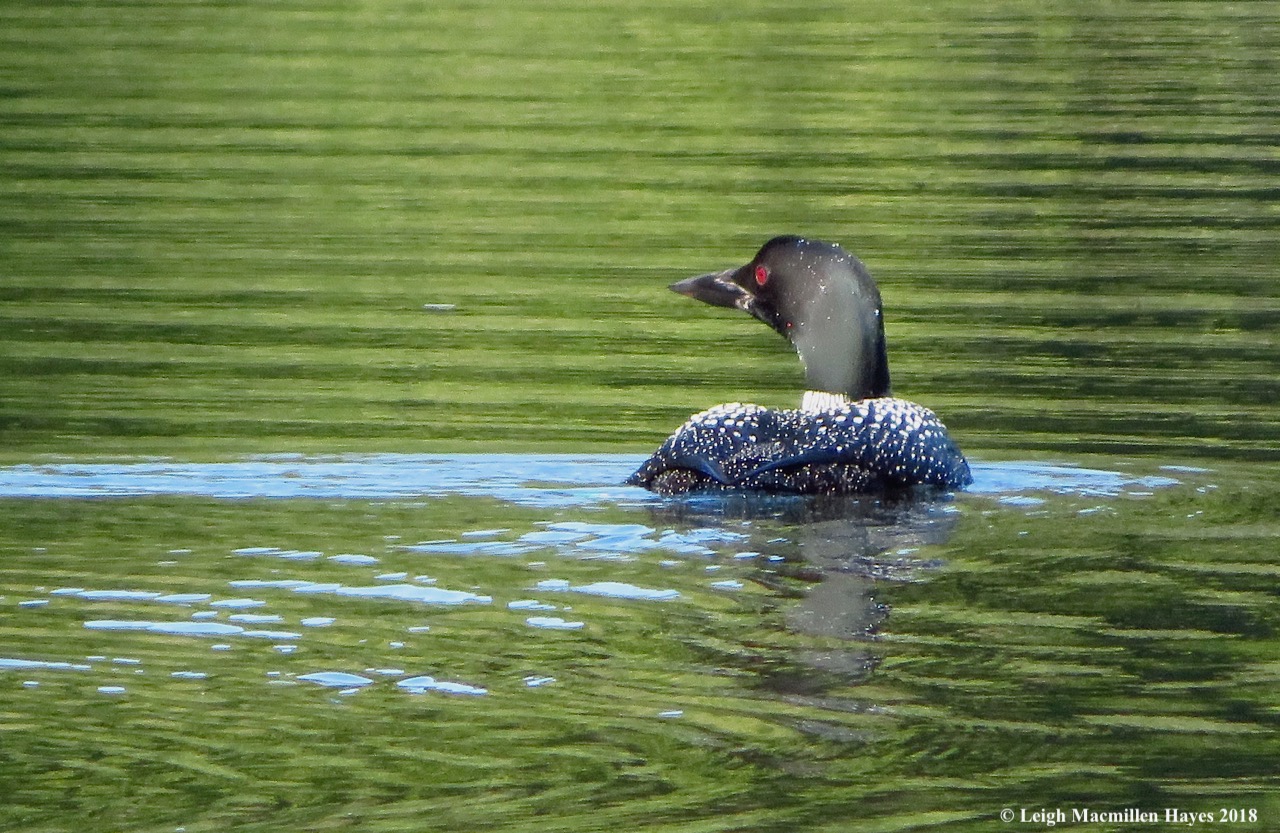
Nearby, this loon and a youngster swam and fishing line left behind is bad news for them as they could get tangled in it. Please, please, please, if you are near the Horseshoe Pond boat launch, and have the means to retrieve the bobber, do so. And if you are anywhere else in this world, do the same–for the sake of all birds everywhere.

7-Sucker Brook

At last, we pulled ourselves away from the pond and followed the brook that flows from it–Sucker Brook.

5-Jack in the Pulpit

Right away, we were in awe of the Jack-in-the-Pulpit plants with fruits still intact. Jack is actually a curious plant and sometimes channels its feminine side. While the plant starts life as a male, if the soil is poor, it turns female, flowers and bears seed. It could turn male again. In the case of what we saw today, meet Jill.

6-thin maze polypore

As our journey continued, we noted fungi everywhere. Some had rotted and added to the earthy smell of the woods. Others displayed their unique structures, colors, and lines, including the Thin-mazed Polypore.

11a-earth tongue

We also found at least one Black Earth Tongue, its common name reflecting its tongue-like appearance as it stuck up from the ground.

11-Dead Man's Finger

And in keeping with human body parts, we noticed a singular Dead Man’s Finger. But . . . its presentation offered questions we couldn’t answer. It was our understanding that on Xylaria longipes the young fruiting bodies would be covered with a whitish or gray powder in the spring. The powder isn’t really a powder, but rather the asexual spores of the species. So, did we find a confused youngster? Or was it an oldster parasitized by a mold?

10-Choclolate Tube slime

Speaking of molds, we stumbled upon a log featuring a feathery appearance reminiscent of antennae on a moth or butterfly. Well, maybe a collection of antennae. A huge collection.

10a-chocolate tube slime

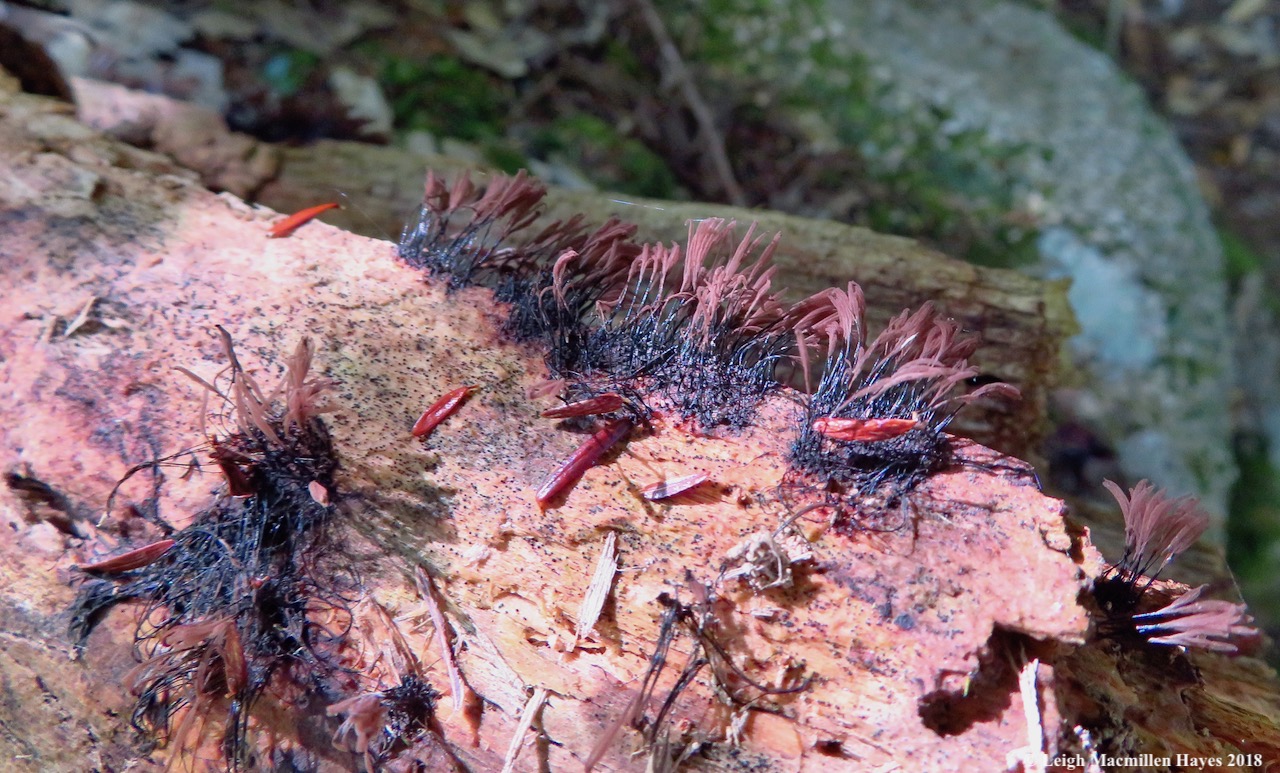
Turns out it was Chocolate Tube Slime, a new discovery for me. In his book, Fascinating Fungi of New England, author Lawrence Millman describes it as “dozens of erect, brown tubes mounted on thin, seemingly polished black stems.” Bingo.

9-green frogin sucker Brook

Also appearing a bit chocolate in color was another green frog. And being the first full day of autumn, I began to realize that my time spent admiring amphibians and dragonflies will soon draw to an end. But . . . on the horizon . . . tracks and scat ;-)

8-Conocephalum salebrosum

Because we were beside the brook, and we’d seen this species before, we searched each and every rock and weren’t disappointed. Conocephalum salebrosum showed off its snakeskin-like leaves.

8b-cono

The conspicuous grooves of the thalli on this liverwort defined the surface and gave it that snakeskin appearance.

12-Moose Pond Bog

Continuing on, we finally reached the platform and climbed up to look out toward Moose Pond Bog. Of course, we hoped to see a moose. No such luck. We did spy one dog named Bella and her owner, Meg Dyer, the Lovell Rec Director, out for a Sunday walk in the woods. But they were on the trail below us and not in the bog. One of these days . . . maybe we’ll see a moose. When we least expect it, that is.

12-winterberry fruits buried

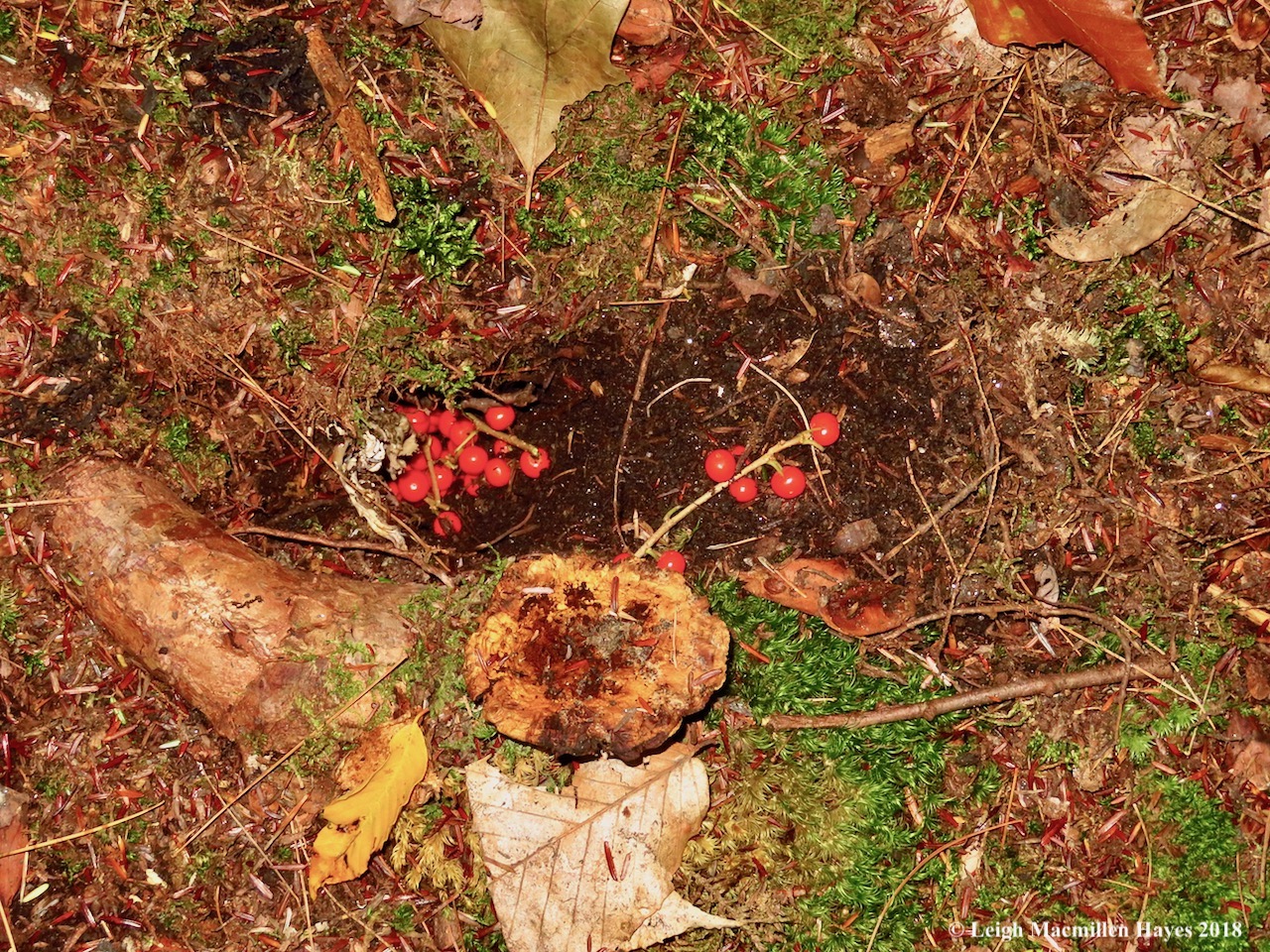
Back on the trail ourselves, our next great find–winterberries in a recently dug hole about four inches deep. Who done it? We poked the hole with a stick and determined that it didn’t go any deeper or have any turns, such as a chipmunk might make. Nor did it have a clean dooryard, which they prefer. Turkey? Perhaps. Squirrel?

13-winterberries among midden

We think we answered the question for on top of a tall hemlock stump that has long served as a red squirrel diner, some red winterberries appeared among the pine scales left behind.

14-liverwort?

Almost back to the road, we crossed the final bridge and then backtracked. We knew our destination was up the streambed it crossed over and were thankful that it held not much water. That meant we could climb up and take a closer look at the large boulders in the middle. And it was there that we made a new discovery.

14a-Peltigera aphthosa

You see, in the past we’ve not been able to get too close to the boulders and from a bit of a distance we were sure we had looked at more snakeskin liverwort. But our ability to get up close and personal today made us question our previous assumption. Suddenly, the gray-green leafy structure took on a more lichen-like appearance. Though its color wasn’t the same, it very much reminded me of rock tripe.

14c-Peltigera aphthosa

We studied its lobes and structure, including the tiny warts and questioned ourselves as we continued to examine it. I kept thinking it was an umbilicate based on the way it adhered to the rock substrate.

14b-Peltigera aphthosa

A little research and I think I’ve identified it correctly, but know some will alert me if I’ve assumed too much–Peltigera aphthosa, aka Freckled Pelt Lichen, also called Spotted Dog Lichen. The bright green center indicated it was wet. From borealforest.org, I learned that the little warts contain tiny colonies of cyanobacteria, which supply the lichen with nitrogen.

15-Racomitrium aciculare?

And right beside the lichen, we found a moss that also reminded us of a liverwort for it resembled Bazzania. But . . . if I identified this correctly, it’s Racomitrium aciculare. Some know it as Yellow-fringe Moss.

15a-Racomitrium

In his book, Mosses, Liverworts, and Hornworts, Ralph Pope described it as “common on wet rocks along streams and under waterfalls.” In watery seasons for this particular stream, that would be its exact location–under a waterfall.

16-dry stream bed

Today, the stream bed leading down to Moose Pond Bog and Sucker Brook was just about dry. But . . . because of that we were able to take a closer look.

In fact, it took us almost four hours to follow the mile or so trail, but it was all about taking a closer look through our 10X lenses and cameras, slowing down our brains,  and channeling our inner Nancy Drew as we paid attention to clues and tried to decipher the scene around us–all the while detecting the nature of Wilson Wing.


Summer Marches On

Today I attended a celebratory parade.

0-Subtle colors

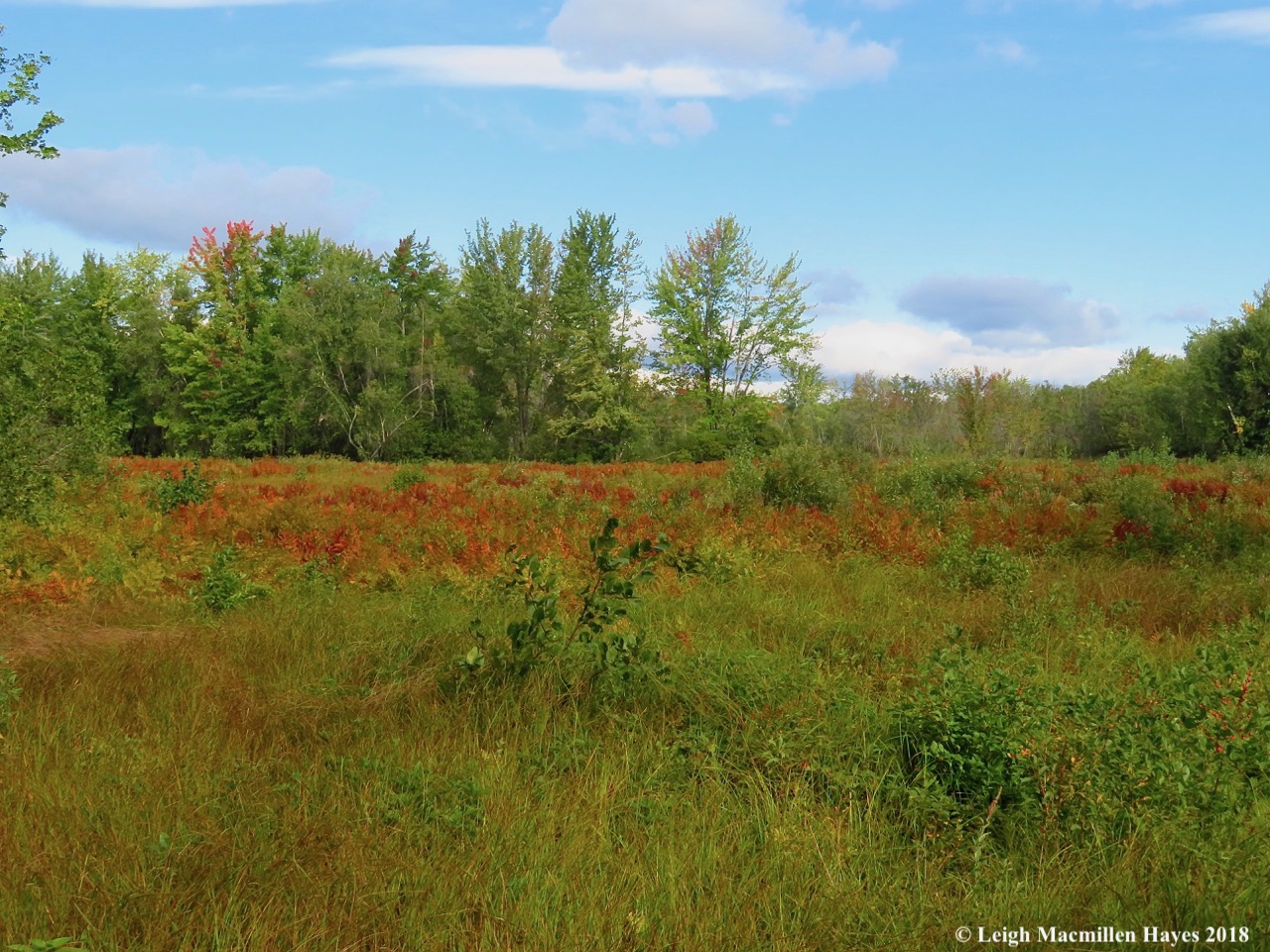
The route followed the old course of a local river and along the way the trees stood in formation, some showing off their bright new coats.

5-colors in the field

Each float offered a different representation of the theme: transition.

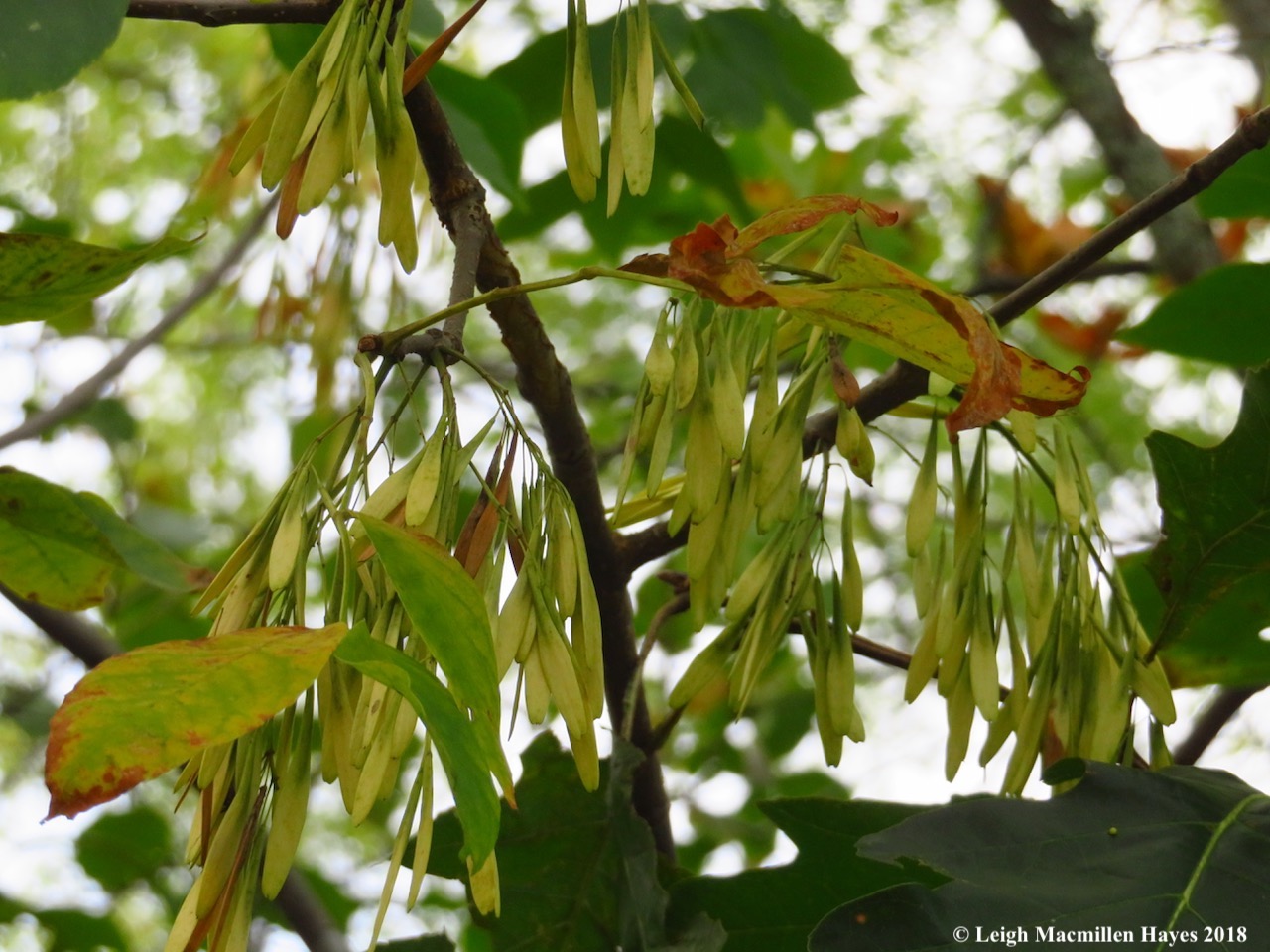
3-ash seed raining

Upon some floats, seeds from the Ash rustled as they prepared to rain upon the ground like candy tossed into the gathered crowd.

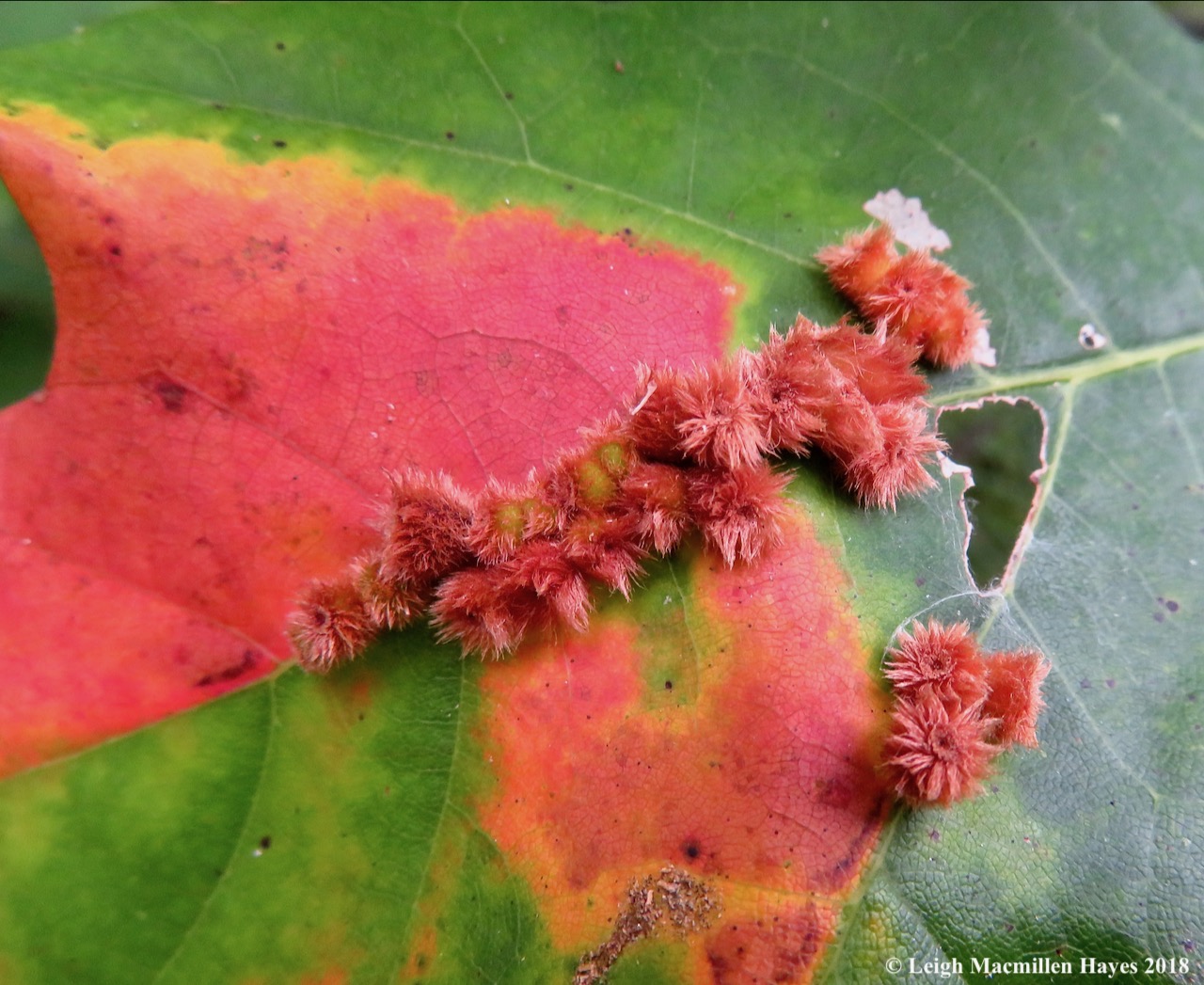
4-crystalline tube gall on red oak

Oak leaves showed off their pompoms of choice–some being crystalline tube galls and others . . .

19-hedgehog gall?

possibly called hedgehog.

8-bald-faced hornet

Playing their instruments were the Bald-faced Hornets,

9-autumn meadowhawk

Autumn Meadowhawk Dragonflies,

11-immature green stink bug

and even an immature Green Stink Bugs.

10-green frog

On the percussion instruments at the back of the band were the green and . . .

23-pickerel frog

pickerel frogs.

15-yellow-rumped warbler

Adding a few fainter notes were a couple of Yellow-rumped Warblers.

16-yellow-rumped warbler

They didn’t want the chickadees to get all the credit for the songs of the woods.

17-hairy woodpecker

A Hairy Woodpecker also tapped a view beats.

12-wood ducks

Probably my favorite musicians, however, sported their traditional parade attire and awed those watching from the bandstand.

13-wood duck

Even a non-breeding male made the scene look like a painting.

14-wood ducks taking off

Their real contribution, though, came from the modestly plumaged females who offered a squealing “oo-eek, oo-eek”  each time they took flight.

18-sensitive fern

Though green attire was the most prominent of the day, others sported colors of change from yellows and browns to . . .

6-red emerging

brilliant reds.

21-Brigadoon

As is often the case along such a route, vendors offered works of art for sale, including local scenes painted with watercolors.

22-lily reflection and aquatic aphids

Before it was over, a lone lily danced on the water and offered one last reflection.

24-season transformation

And then summer marched on . . . into autumn.

The Perks of Perky’s Path

It’s such a sweet trail and so named for Juanita Perkins, a local photographer and naturalist who was an avid member of the Greater Lovell Land Trust. To follow in her footsteps is not an easy task, but today I journeyed along the path trying to see what Juanita might have seen.

1-lancet clubtail

Immediately upon stepping down the trail, a clubtail dragonfly landed in front of me. Identifying dragonflies has become one of my passions of late, but still I struggle. And go back and forth. Lancet Clubtail or Pronghorn? I lean toward Lancet only because I’m not sure Pronghorns are a Maine species. But it’s to Dragonflies of the North Woods that I turn, and the abdomen that I try to zone in on. The abdomen consists of ten segments. Lancet: segment 8 has a smaller top spot and segment 9 is all yellow on top, (except for the female’s top spot which is narrower). Pronghorn: segment 8 has a smaller top spot and segment 9 is all yellow on top. Segment 10 has a narrow stripe. The Maine Odonata survey does not include the Pronghorn and so I find myself deciding on the Lancet. Suffice it to say, this is a clubtail.

2-ebony jewelwing damselfly

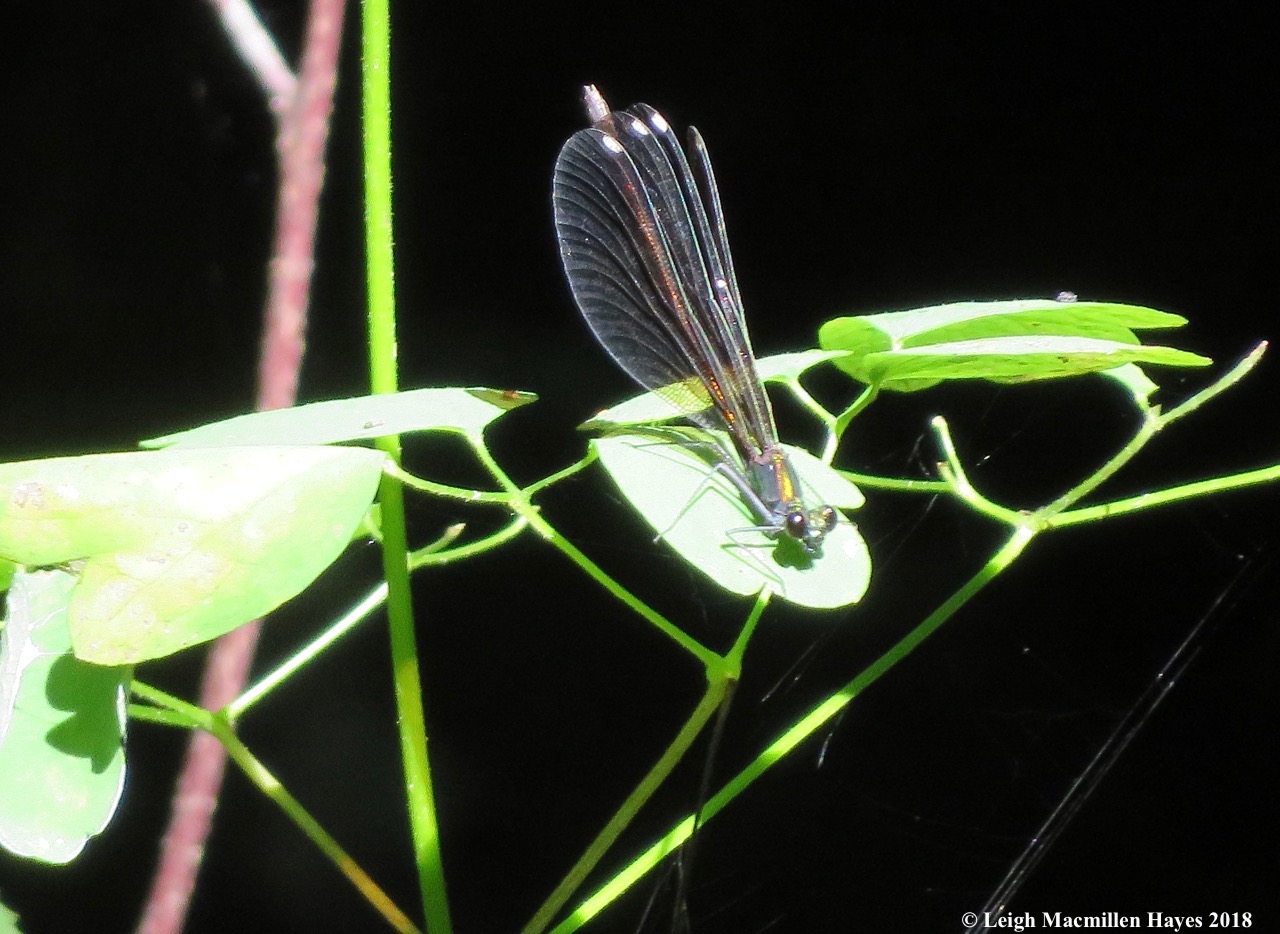
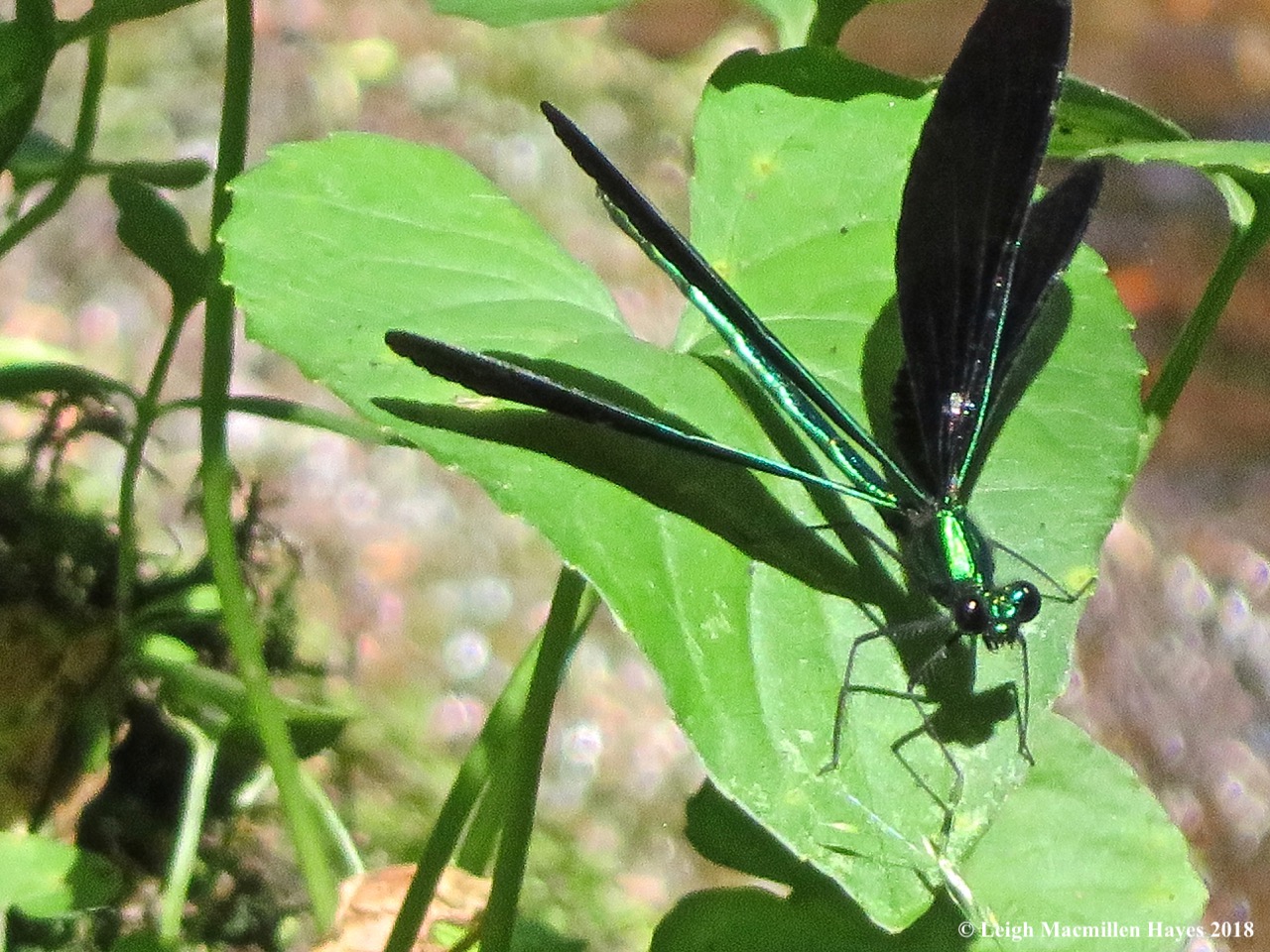
A much easier species for me to ID is the ebony jewelwing damselfly. Several danced and posed by the brook leading from the wetland the path encircles to Heald Pond. I trust that when Juanita traveled this path, she too saw the jewelwings dance, their bodies as bejeweled as their wings–maybe more so. A female’s wings are smokier in color than the males and each is dotted with one white spot at the tip.

3-male ebony jewelwing

The male’s wings are more ebony in color and body more metallic. This handsome fellow had three ladies in waiting so he couldn’t pause for long.

4-trail sign

Though I refer to the entire loop as Perky’s Path, in reality I hadn’t even reached it by the time I encountered the “You Are Here” sign. I’d actually been walking along a snowmobile trail that is part of Heald and Bradley Ponds Reserve.

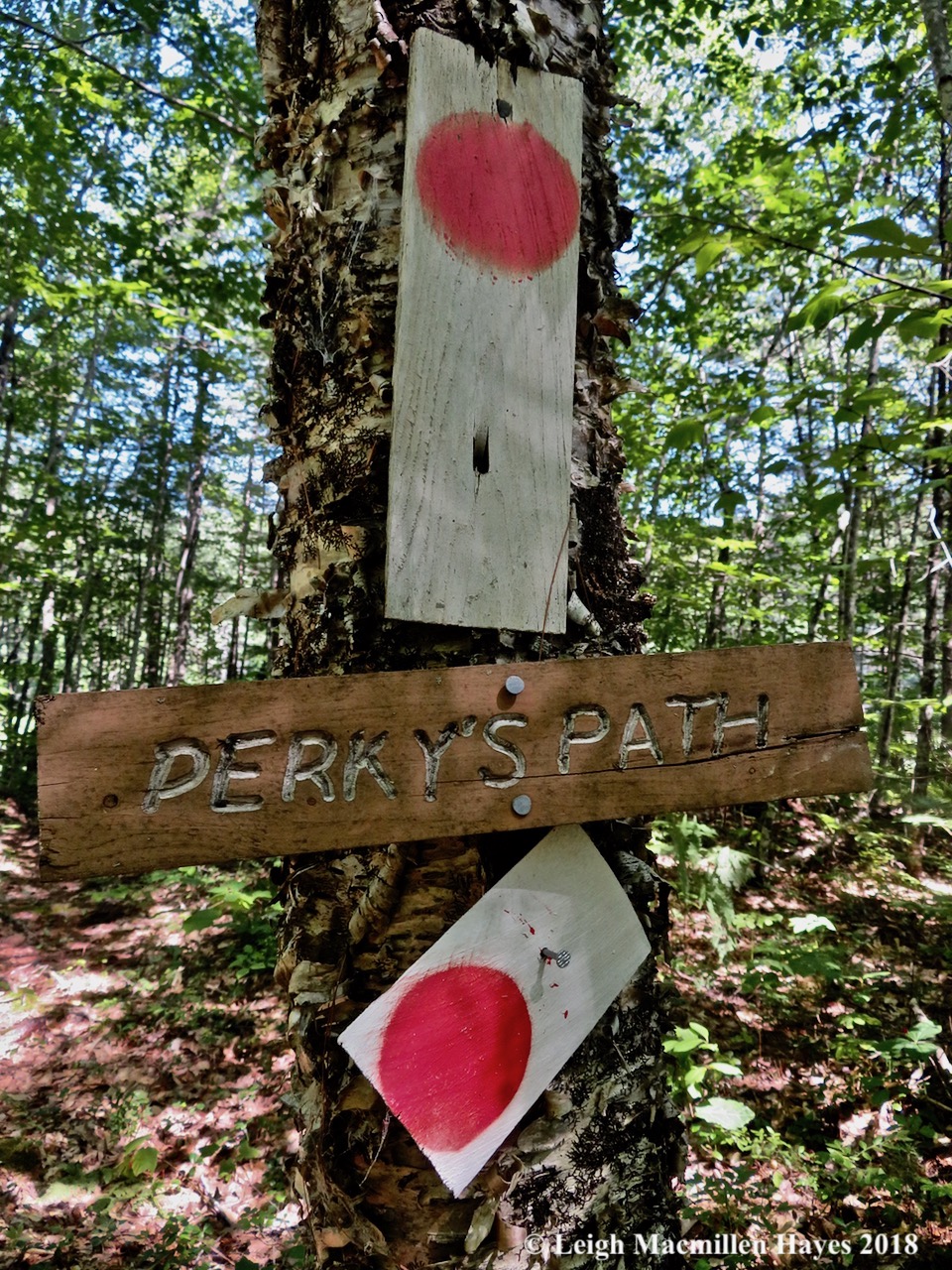
5-perky's path

It was a couple of tenths of a mile later that I finally stepped onto the path blazed with orange.

6-bench

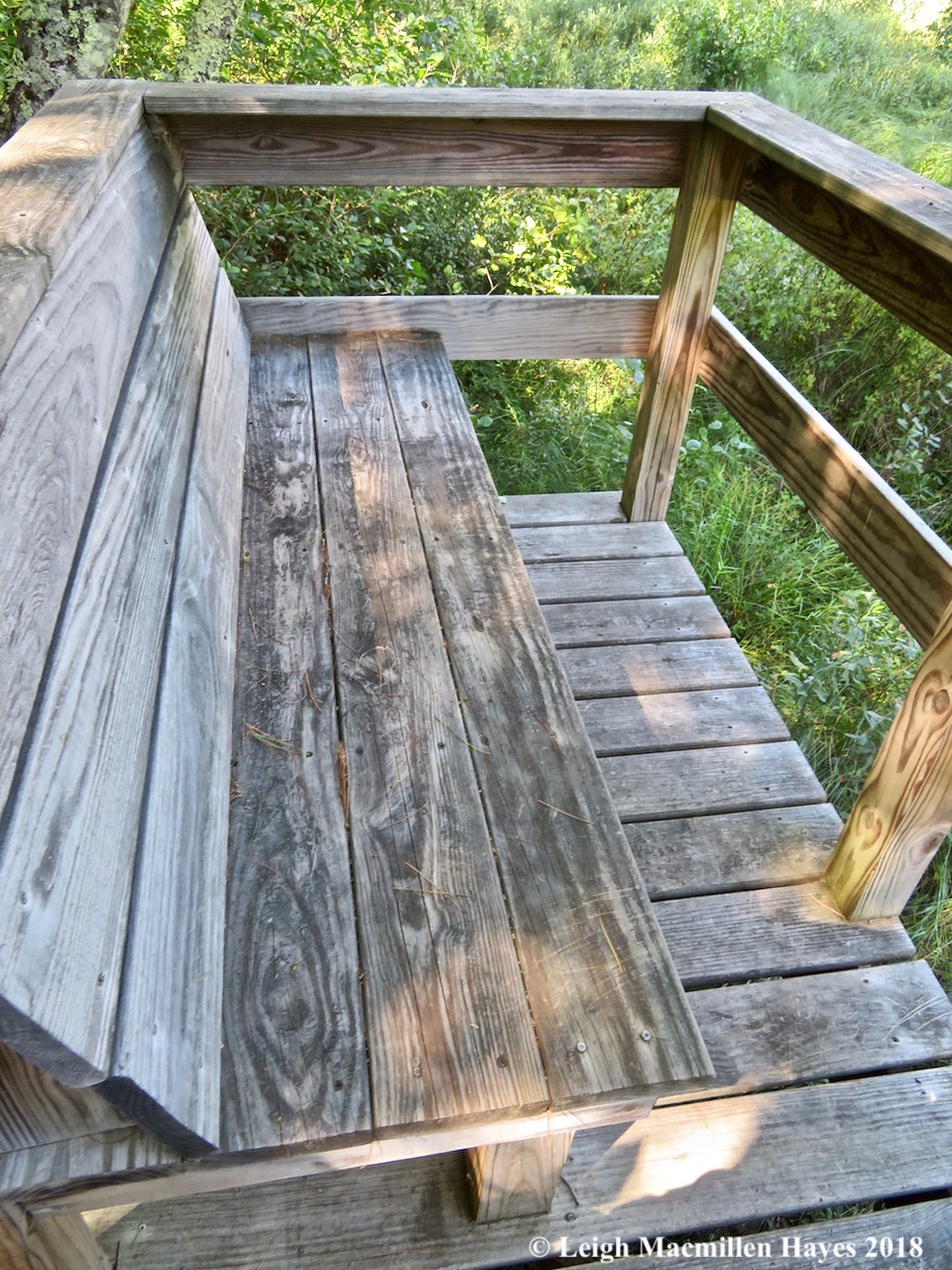
One of my favorite hangouts is the bench located along a short spur. Usually I spend moments on end, but today I was eager to move on.

7-Indian Cucumber Root

Along the spur trail, I did note one of my favorite fruits beginning to ripen–that of Indian Cucumber Root. And as it ripens, the base of the leaves turn red. All I could think of is that the red is a sign to birds–come dine at this table. You won’t regret it.

8-trillium fruit

Another red fruit stood upright above leaves of three–that of a painted trillium.

9-new stone bridge

It’s been six years since Juanita Perkins passed away and I don’t know when she last walked the path, but at that time, where the stream from Bradley Pond flows into a beaver wetland before continuing on toward Heald Pond, she probably crossed the water via a wooden bridge. Time and weather had taken their toll on the bridge and so at the beginning of this summer a group of volunteers and a couple of GLLT staff members pulled the wood out and placed flat rocks as stepping stones. It makes for a magical crossing, especially as it slows the wander and encourages one to notice the surroundings. Though we never officially met (I do remember her dropping off photographs at a local gift shop where I worked for several summers back in the late 1980s), I trust she would appreciate the change.

10-stream archs

Of course, I’ve always been one to enjoy water and all its variations. By the stepping stones (boulders), smaller rocks below the surface added to the overall arching effect, creating an interconnection. I felt a sense of Juanita’s time spent on the path woven into today.

13-jewelweed

By the water, there were a variety of flowers to note, including whorled asters and cardinal flowers, but it was the jewelweed that brought a smile to my face. I don’t understand why, but one of the sepals forms a pouch-like structure with a long spur. Jewelwings and jewelweed–indeed, a very special place.

11-Golden Spindle

Adding to the wonder right now due to recent and much appreciated rain are all the fruiting forms of mushrooms and this path has its fair share. I’m not great on my identification of boletes and others, but there are a few individuals that I remember from year to year. It’s the fact that their spores are everywhere and those spores form hyphae, that then forms mycelium, that then eats anything organic, that when mating is successful forms fruit, is wicked cool. We’re wowed by the fruit, but really, we need to honor the entire system. And so I honor the Golden Spindle,

12-white spindle fungi

White Spindle (which I don’t recall ever seeing before),

12b-scarlet waxy cap

Scarlet Waxy Caps,

12a-earth tongue fungi

and Earth Tongues.

14-into the wetland

And then I slip off the path and down to the wetland, wondering what else I might see.

15-cherry-faced meadowhawk

Instantly I am rewarded with numerous sightings of Cherry-faced Meadowhawks, their wings all aglow.

16-hobblebush leaves

They aren’t the only shade of red in the vicinity, for some of the hobblebush leaves have taken on their autumn hue already. (Say it isn’t so!)

16c-brook to wetland

I almost complete the loop and reach the bridge crossing just before the parking lot at the end of Heald Pond Road, when I decide to follow the stream bed back toward the wetland. I suppose I did so because I wanted to extend my journey and my time honoring Juanita.

16-green frog

Here and there, where pockets of water exist, green frogs either try to hide from me or make sudden leaps.

17-back to the wetland

I bushwhack back into the wetland, not wanting to let go, and forever thankful for Juanita. Every time I wander her way, I discover new perks along Perky’s Path.


A’pondering We Will Go

August 3, 9:30 am – 12:30 pm
A’pondering We Will Go: Get inspired by the beauty along the trail at the John A. Segur Wildlife Refuge East. This will be a stop-and-go walk as we pause frequently to sketch, photograph, and/or write about our observations, or simply ponder each time we stop. Location: John A. Segur Wildlife Refuge East, Farrington Pond Road, Lovell.
Degree of Difficulty: Easy.

j1-pickerel frog

That was our advertisement for this morning’s Greater Lovell Land Trust walk, but we weren’t sure the weather would cooperate. Docent Pam and I emailed back and forth as we looked at various forecasts and decided to take our chances. As it turned it, it did sprinkle occasionally, but we didn’t feel the rain until we finished up and even then, it wasn’t much. Instead, the sound of the plinking against the leaves in the canopy was a rather pleasant accompaniment to such a delightful morning. Our group was small–just right actually for it was an intimate group and we made a new friend and had a wonder-filled time stopping to sit and ponder and then move along again and were surprised by tiny frogs and toads who thought the weather couldn’t get any better, as well as other great finds. Here, a pickerel frog showed off its rectangular spots for all of us to enjoy.

j2-Sucker Brook

After a first 20-minute pause in the woods, we continued on until we reached Sucker Brook.

j3-Colleen

Each of us settled into a place to listen . . .

j4-Bob

photograph . . .

j6-Judy

and write.

j7-heron

I have no idea how much time had passed, but suddenly we all stirred a bit and then someone who was noticing (I think it was Ann) redirected our attention.

j8-heron

We were encouraged to focus on another who was also paying attention.

j9-heron

And narrowing in . . .

j10-heron and fish

on lunch.

j11-wings

When the young heron flapped its wings, we were all sure the meal was meant “to go.”

j12-securing the catch

But thankfully, the bird stayed.

j13-lunch

And played with its food.

j14-lunch making its way down

Ever so slowly, the fish was maneuvered into its mouth.

j15-gulp

And swallowed.

j16-down the throat it goes

Down the throat it slid.

j16-feathers ruffled

And then the feathers were ruffled–rather like a chill passing through its body.

j17-movement

Wing motion followed.

j18-searching

But still, the Great Blue Heron stayed.

j19-next course

And stalked some more.

j20-Isaiah

We continued to watch until we knew we had to pull ourselves away.

j21-the journalists

If we didn’t have other obligations, we might still be there. Gathered with me from left to right: Judy, Colleen, Isaiah, Pam, Ann, and Bob.

j22-owl pellet

On our way back, again we made some interesting discoveries that we’d somehow missed on the way in, including White Baneberry, aka Doll’s Eye, a bone we couldn’t ID, Indian Pipe, and this owl pellet smooshed, but full of tiny bones–vole-sized bones.

j22-Pam reading what she wrote

We stopped one more time, to share our morning’s observations.

j23-Judy reading her poem

Reading aloud is never easy, but because our group was small and we’d quickly developed a sense of camaraderie and trust, the comfort level was high.

j24-Ann's landscape sketch with heron

Sketches were also shared, including this one of the landscape that Ann drew–including the heron that entered the scene just before she quietly called our attention to it.

j25-stump and lichen

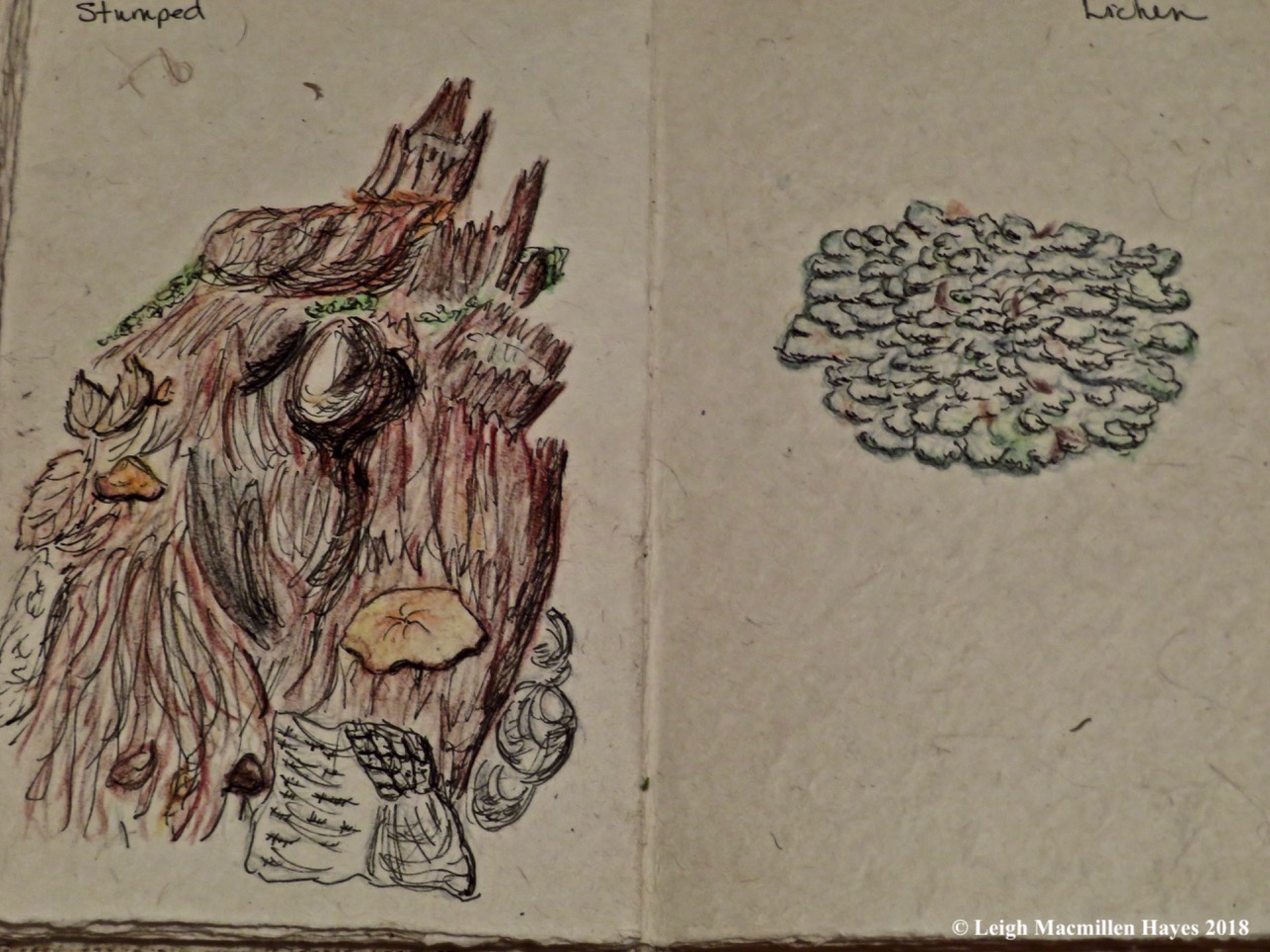
And my attempts–the first of a tree stump from our woodland stop, and then a lichen when we were by Sucker Brook.

A’pondering We Did Go–and came away richer for the experience. Thanks to all who came, to Pam and Ann for leading, and to Isaiah for his fine eye at spotting interesting things along the way.


Island Hopping Mondate

Paddling together in “Big News,” our double kayak so named for it was a gift from the Neubigs many moons ago (thank you, Carissa and Bob), is one of our favorite summer pastimes. With wrist almost fully mended, it’s an even sweeter journey for me because it means I don’t have to work hard.

1-prepping the kayak

And so it was that my guy prepped Big Red for today’s journey–an exploration of the northern basin of Moose Pond. The “pond” is a 1,697 water body with a 33.3 mile perimeter that’s broken into three sections. We know the north best, which offers about a four-mile round-trip journey from camp up into the islands of Sweden. The other section that we don’t visit as often, but do enjoy exploring, is the southern section in Denmark, for it’s equally interesting.

2-BLUEBERRIES!

Today, though, my guy had a mission worth gold in mind–to make some headway on his blueberry greed.

6-yellow-necked caterpillars

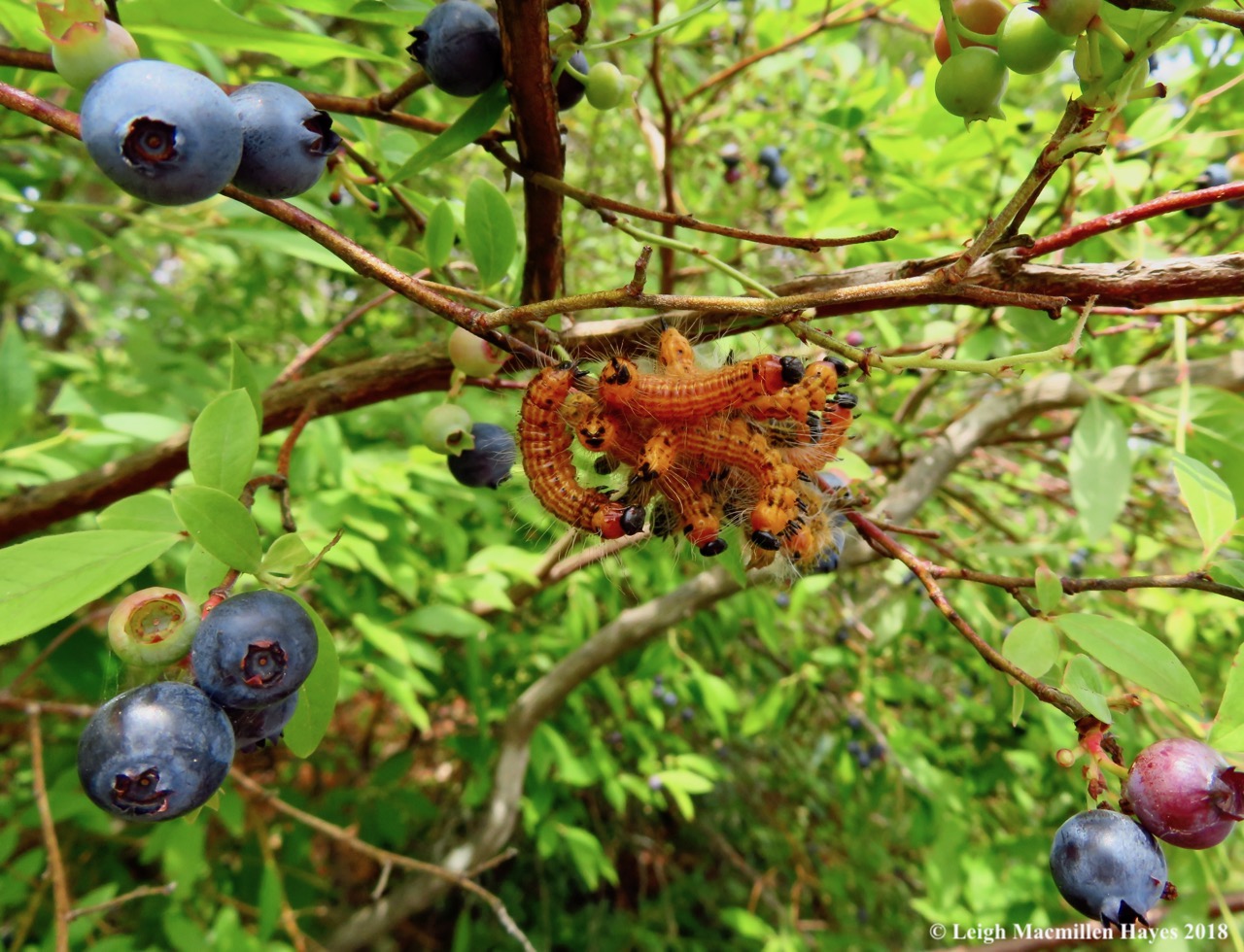
Along the way we discovered an interesting sight. Our friend, and pond neighbor from the western shore, Lili Fox, asked yesterday if I could identify some yellow and black caterpillars. After a wee bit of research, I suggested Yellow-necked Moth Caterpillars. I didn’t expect to meet them quite so soon myself, but immediately recognized the group that clustered at the tip of a blueberry twig. At first, they seemed immobilized, but then I realized they were in the defense form that I’ve witnessed with other caterpillars, curling outward to form a U. I’d just picked a few berries below and so they saw me as prime predator. Fortunately, no attack was made.

8-yellownecked 2

Overall, they have yellow and black stripes, but it’s the yellow segment or neck behind their black heads for which they were named. These very hungry caterpillars were reaching maturity and soon should drop to the ground. They’ll apparently overwinter burrowed below as pupa and emerge in adult form next year.

10a-fluffy yellownecked

I assumed that those with the most wiry hair were the oldest. We probably should have shaken them off the branches and into the water, but we didn’t. Nature knows what to do and some will become a food source for wasps or birds, passing along the energy contained in the blueberry leaves to another level.

3-variable dancer damselfly

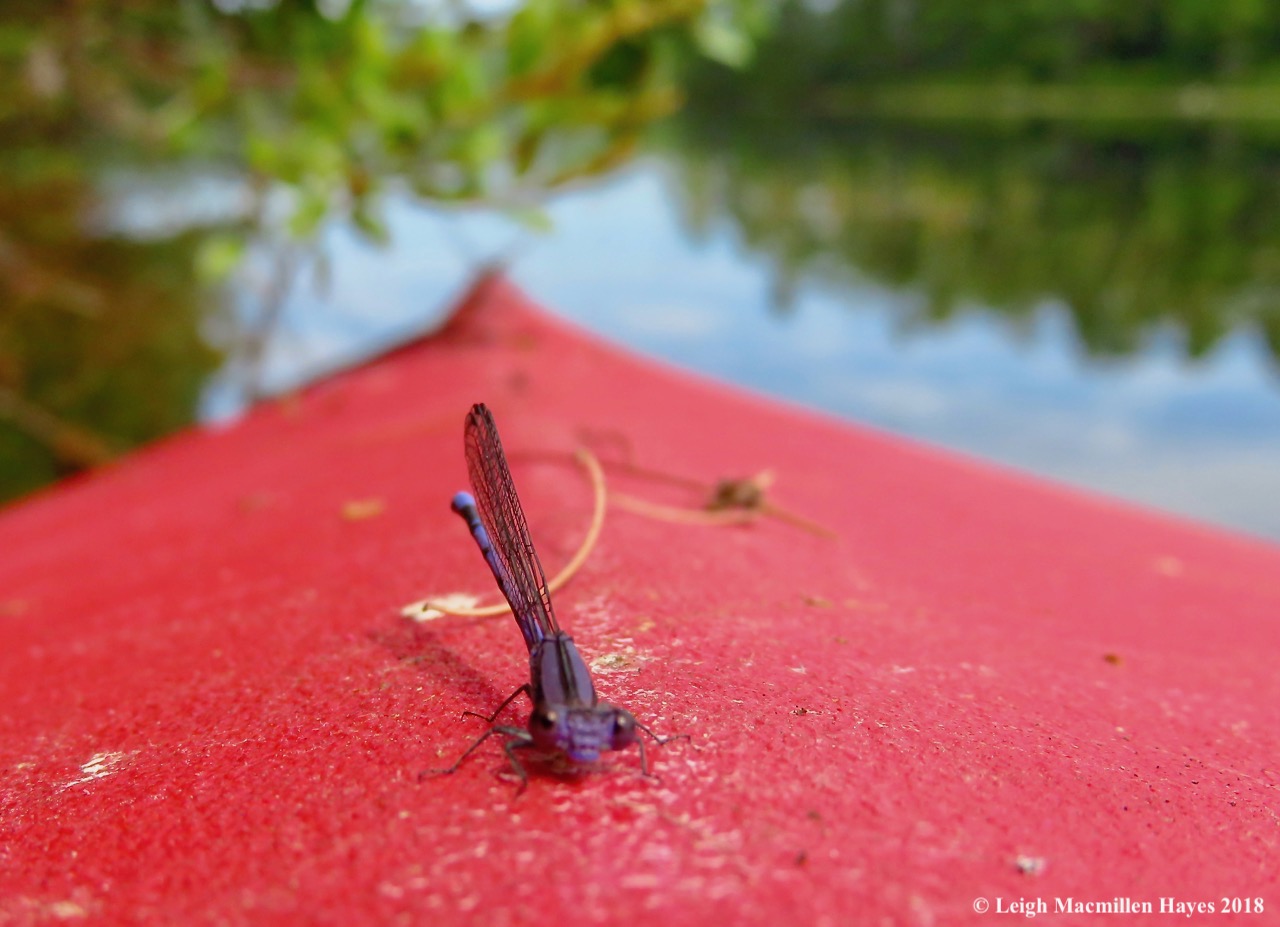
In the meantime, I became the Yellow-necked Lookout Warden as my guy continued to pick. Accompanying me with his own bulbous set of eyes was a male Variable Dancer Damselfly.

4-spreadwing

The damselflies actually could care less about the caterpillars and more about finding a mate and so they all posed, either on the kayak, or nearby vegetation.

5-orange bluet damselflies

Both turned out to be the right substrate on which to perform mating rituals, this being a pair of Orange Bluet Damselflies on the kayak.

7-emerald spreadwings canoodling

And Emerald Spreadwings offering a reflection on the pond of their canoodling efforts.

10-heading north

At last we continued further north, island hopping along the way.

12-Eastern Pondhawk Dragonfly

Though their natural communities all looked similar, with each stop came a different offering, including the Eastern Pondhawk that displayed one of my favorite combinations of color-sky blue pond green.

13-EAstern Pondhawk

Eye to eye, we contemplated each other. I have no idea what he thought of me. Well, actually, I’ve no idea if dragonflies can think. Is all their action instinctive? As for my thoughts, I didn’t want to gobble him up in a literal fashion, but wish I could have taken him with me so I could continue to stare, infatuated with his colors as I was. On his thorax I saw a watercolor painting reflecting a sunny day by the pond.

14-Floating Heart Plant

Another island and another find–the delicate flower of a Floating Heart Plant.

14-bullfrog on lily pad

And then a frog on a lily pad, a young frog that is.

15-bullfrog froglet

If you look closely, you may see her tail extending behind. I couldn’t help but think that she’s got big feet to grow into.

16-beaver lodge

Beside one of the last islands we visited, we saw that the neighborhood had changed quite recently and a new house had been built. Though none of the residents came out to greet us, we weren’t surprised. Based on the greenery and wet mud we suspected they’d been busy as beavers all night and needed a rest.

17-beaver island

A quick look around and we knew the source of their building materials. It reminded us that they’ve been secret visitors to our land in the past and have helped themselves to young saplings much to our dismay. Then again, it is their land as well. We’re just the ones who pay the taxes.

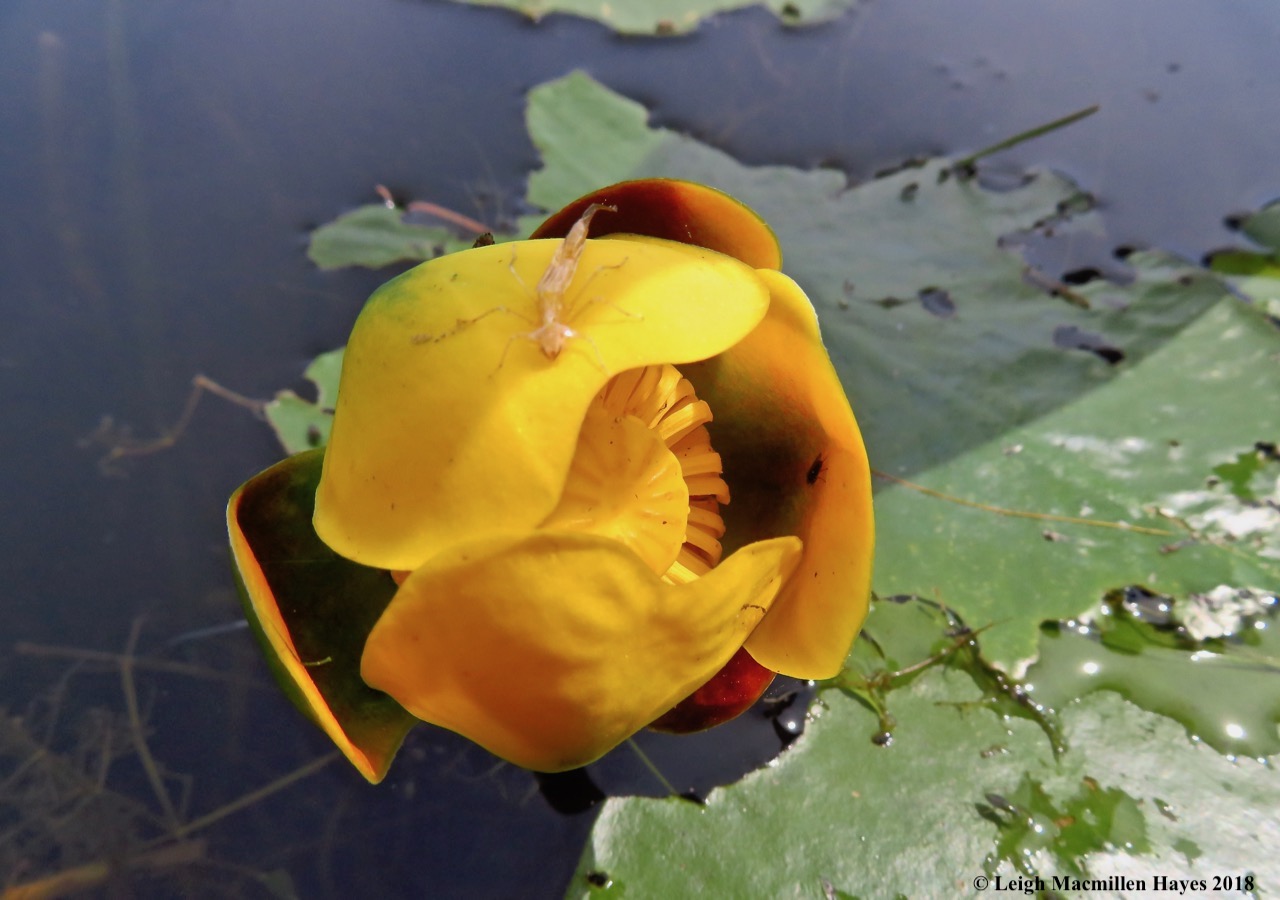
11-spadderdock with damselfly exuvia

Of course, no water adventure is complete without a photo of Spatterdock, this one featuring a damselfly exuvia.

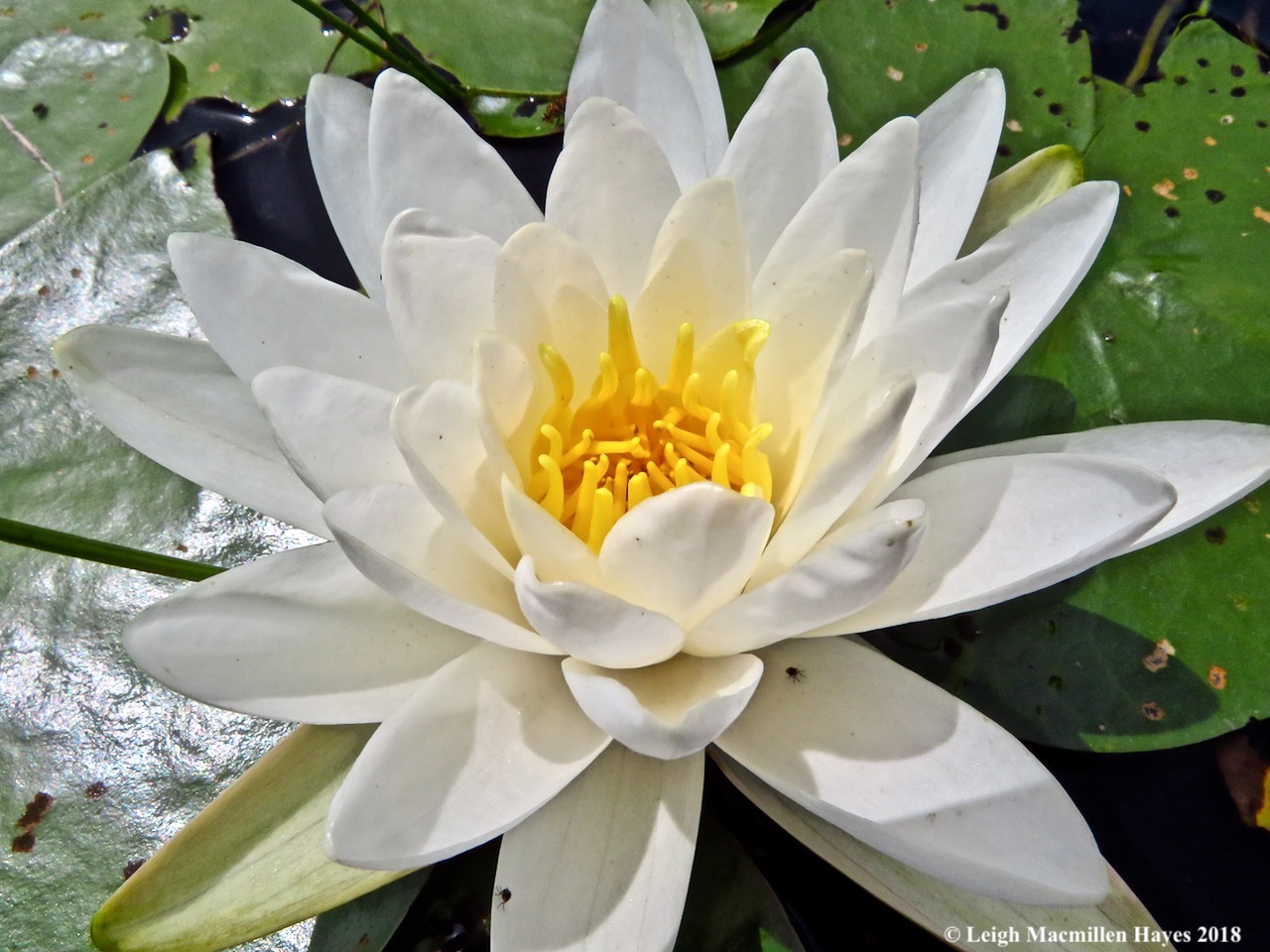
17-fragrant water lily

And Fragrant Water Lily. That rayed presentation. Those prominent yellow stamens. The symmetry. And, of course, the fragrance.

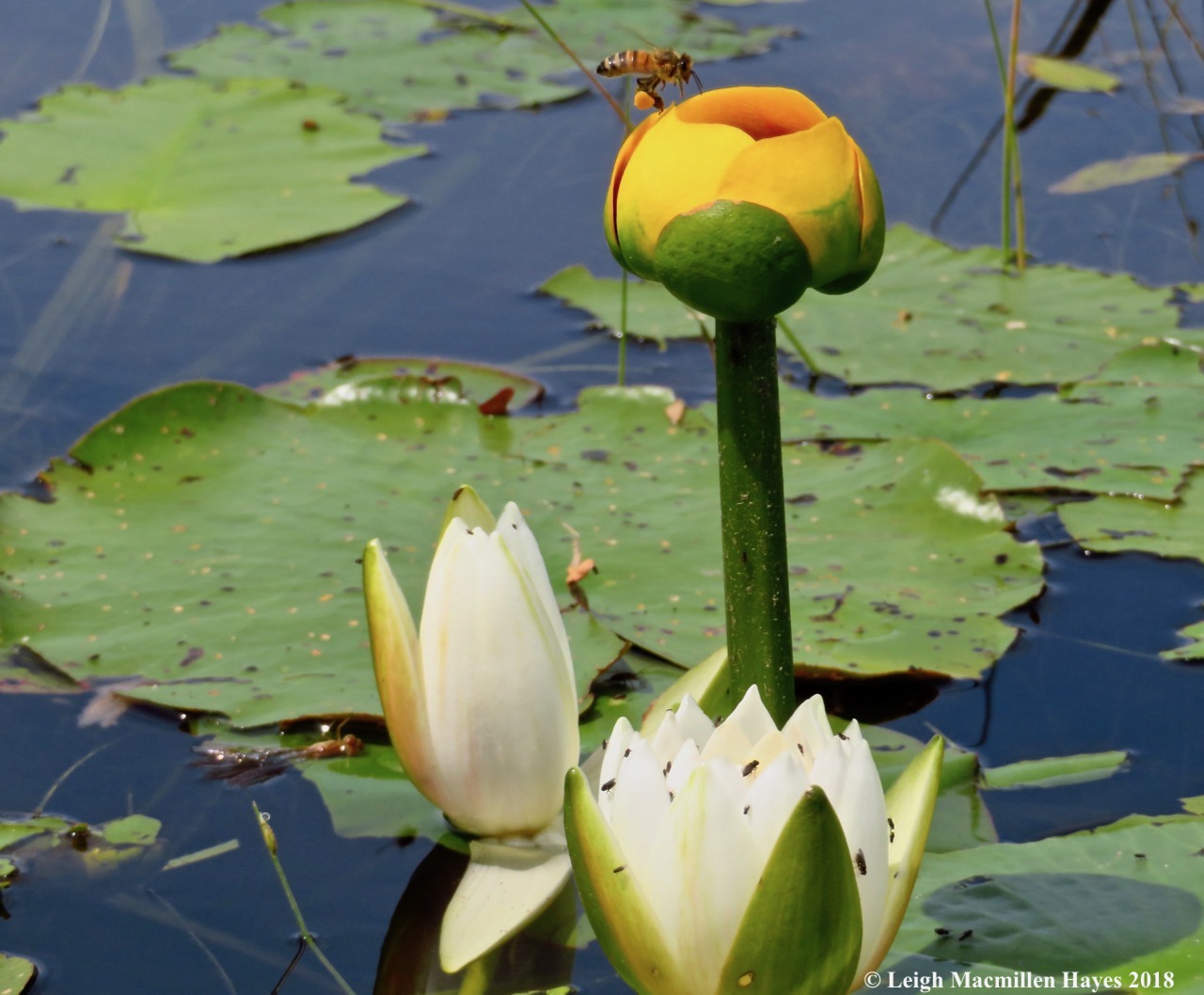
18-honeybee

What could be better than the two together? The two together with small flies on one and a honey bee, its buckets full, visiting the other.

19-painted turtle

At last, it was well after lunch, which we’d neglected to pack and my wrist was sore, so my guy said he’d paddle us home. And because we’d startled a turtle earlier, he said he’d find one for me. Wow! Both the turtle and I were impressed.

20-turtle basking

As turtles do, he stretched out his back legs demonstrating how they need to capture additional heat given that they are cold-blooded animals. Basking helps them to absorb warmth and vital UV rays.

21-waving goodbye

What he did next surprised us. He began to wave his front left leg–I took it as a goodbye, but it was probably either a way to push an insect toward his mouth or an aggressive move telling us to move on. We did, heading back to camp as we finished up our Island Hopping Mondate.


Capturing Peace at Deer Hill Bog

The minute I stepped out of the truck, a loud, rather unharmonious musical performance, greeted me at Deer Hill Bog in Stow, Maine. Rather than the Peeper and Wood Frog chorus of spring, the summer symphony was performed by Bullfrogs and Green Frogs, but mainly the former.

d1-approaching the bog

It was about nine a.m. when I caught my first glimpse of the bog, a result of man and nature working together. An old wood dam combined with a beaver dam created the 25-acre body of shallow water. From moose and Great Blue Herons to aquatic plants and tiny organisms, over 90 species call the bog home. Though I truly expected to spy a moose, that opportunity was not meant to be. I did go, however, because of the Great Blue Herons. Friend JoAnne reminded me the other day of the old rookery, so I decided to check on it.

d2-heading toward the blind

But first, I made my way toward the wildlife viewing blind.

d3-bird blind

The blind featured benches, cut-outs for viewing and informational posters–a quiet place to watch nature in action.

d5-inside the blind

It was built in 1993 by the Maine Conservation Corp and is maintained by the White Mountain National Forest. Two more panels described some species of wildlife one might expect to see.

d6-view from the blind

And, of course, the cut-outs provided a bird’s eye view . . .

d6a-another view

of life in the bog.

d12-bullfrog

But, I’m not very good about staying undercover, and so around to the side and front of the blind I went. And stood as still as possible, for the Bullfrogs quieted upon my approach, as I expected they would. A few minutes later they again sang, “rumm . . . rumm . . . rrrrrumm,” the notes all in bass.

d30-fish

The water practically boiled with small fish jumping, but my freshwater fish knowledge is limited and my best guess was that they were bait fish of some sort.

d8-three lodges

Looking around, I noted three beaver lodges, each of a different size. None looked active, but it was a warm summer morning and perhaps they were sleeping inside.

d8-adult heron

And then I spied two heron nests–on the first I saw only an adult who spent much time in preening mode.

d13-heron feeding

The second nest I was sure was empty–until an adult flew in and three immatures squabbled for the food about to be regurgitated by the parent.

d14-bullfrog

And back down to bog level, another Bullfrog doing what they seemed to do best–waiting patiently, with nary a rumm, though the sound seemed to travel in waves down the bog.

Frogs are ectothermic animals, which means they depend on the environment to maintain their body temperature, therefore many jumped onto fallen logs to catch a few rays. It may also have been that the height gave them a better view of the local action.

d15-bullfrog

This one did eventually turn, making it a fine time to examine his body a bit. How did I know it was a male? His eardrums or tympanums, those circles located directly behind the eyes, were larger than the eyes. In females, they are about the same size.

d10-clubtail exuvia

There were other things to look at, like the exuviae of a clubtail dragonfly. Notice how far apart the eyes were. Eye position is one key to determining species.

d11-frosted whiteface dragonfly

Other characteristics included the white face of the Frosted Whiteface.

d16a-slaty skimmer dragonfly--black face:brown eyes

And the black face and brown eyes of a Slaty Skimmer.

d16-slaty skimmer dragonfly

The slaty part of its name came from the fact that male’s body is entirely blue–slate blue.

d17-bullfrog

Again a rumm-rumm-rrrrummm.

d24-bullfrog

It seemed there were female frogs around, but they didn’t care about the males’ singing talents–at least not in my presence.

d16-red-winged blackbird

And an o-ka-leeee.

d18-frosted whiteface dragonflies

In the midst of it all, some canoodling by a pair of Frosted Whitefaced Dragonflies connected in their love formation.

d20-green frog

Plunking rubber bands to the beat of plunk-plunk-plunkplunkplunk were the Green Frogs. This one was so identified by the dorsalateral folds that ran from its eyes along the sides of its back and down toward its former tail.

d21-grackle

Wood Ducks and Merganzers swam further away from my spot, but Grackles flitted in and out, up and down on the ground, fallen trees, and rocks, ever in search of fine dining.

d27-grackle

In between foraging for insects, crustaceans, mollusks, fish, and frogs, oh my, they sang their guttural song that was often followed by a high-pitched whistle.

d22-painted turtle

There were also painted turtles to admire. Well, I only saw one, but suspect there were others.

d25-painted turtle

It slipped into the water and then came up on a nearby log, another species that valued the sun’s warm rays.

d26-bullfrog

And another. Really, they were everywhere. Did you know that a frog’s pupils are horizontal so it can look forward, backward, and up and down. The better to see me,  dinner, and predators on the quick.

d28-two frogs

Sometimes frogs yelp, and it was such a sound that brought these two to my attention. Because of the sun’s position, I couldn’t get a clear take on their gender, but I watched them both jump onto the log simultaneously. At first they were side by side, but then one shifted further to the right. Had they been mating? Had one male tried to jump onto another thinking it was a female? Had something bigger than them been on the hunt?

d31-water snake with tongue extended

I may never know why the frogs jumped, but this water snake was making the rounds. Every once in a while it made the water boil and I knew something was consumed. Can you see his forked tongue sticking out?

d29-sundew about to flower and marsh st.john's wort

At last my bog time was drawing nigh, and yet there was so much more to see, including Round-leaved Sundews and Marsh St. Johnswort on log islands.

d30-bullfrog

And one more Bullfrog to provide a last note to the morning’s wonder.

d32-bog

Though to some, the bog may look like a place of death, and death does happen there, it’s also full of life. It’s a place of biodiversity and hidden beauty. And this morning I was thankful to have it all to myself–the only human sounds I heard were of my own making. Deer Hill Bog–a magical, wonder-filled place to capture peace.

Maybe everyone needs a bog visit.

P.S.  The frog sounds were borrowed from https://srelherp.uga.edu/anurans/sounds as I’m not tech savvy enough to have recorded them. But do click on them, because it gives you a sense of this place. You’ll need to turn up the sound on your computer and possibly will need to press play when you click on the link.


The Amazing Race–Our Style, episode five

I’m not sure how it happened, but when we arrived at Route 113 in Fryeburg to pick up our clue we realized we were the first contestants for this episode of The Amazing Race–Our Style.
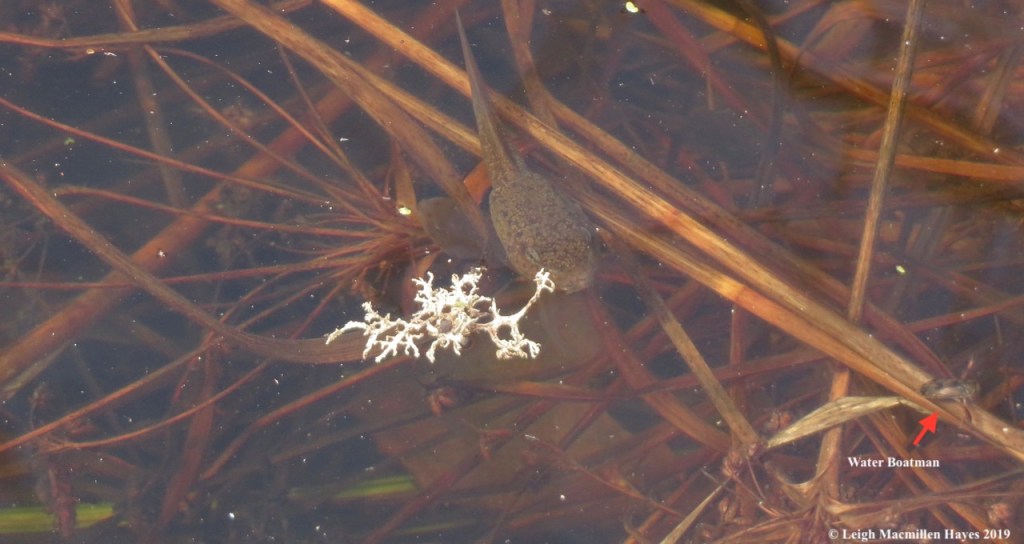
Consequently, we had a quick decision to make–the main clue referred to the Baldfaces and we recognized the fact that that entailed a challenging climb. Though my cast has morphed into a smelly splint [envision sliced cast up one side and then add two wide strips of velcro], I was relieved that we could take advantage of the Fast Forward clue that mentioned shingles in a white forest.

s1-trail sign

We checked the map and located a trailhead for Shingle Pond only a few miles away. BINGO.

s2-heading into the woods

The trail begins along Forest Road 317, but a few curves later heads into the nitty gritty of the White Mountain National Forest.

s8-locating the trail

Toward the beginning we could hear the buzz of logging machinery in the distance, but it wasn’t all that loud and certainly didn’t drown out the not-so-sweet buzzing of the local mosquitoes. Our first real challenge, for one can hardly count those flying buzzers and stingers as an obstacle, but more a way of life, came in the form of staying on the trail. It was blazed yellow, but occasionally we had to slow ourselves and our minds, and look around for some clues. There was only one cairn, which was fine with us, but after that spot we spent several minutes of valuable time looking for yellow in every direction . . . to no avail. Finally, however, my eyes cued in on what appeared to be a worn path between some trees to our right and my guy passed through some muck and logging slash to discover that indeed we had found it. That happened more than once, but each time we paused, scouted and eventually made the right decision. They didn’t promise us easy when we signed on for our own version of the reality show.

s11-crossing Weeks Brook

The path took us across Weeks Brook for which the trail had been named and it was there that we noted a trillion trilliums–all past their prime.

s9-patch cut

Through hemlock groves and mixed forests we hiked, occasionally passing by patches of clearcuts. Our next challenge was to determine the benefits of such habitat. The answer seemed obvious for so much was the bird song–from those I recognized like Ovenbirds, Veerys, and Hermit Thrushes to warblers that we could hear but not see. If we hadn’t been racing against the clock it would have been fun to try to figure out some of the song makers.

s10-browse

We also noted plenty of signs, such as browsed tree buds, that told us moose and deer had foraged in those areas.

s5-wood sorrel

Challenge number 3 required that we locate a few plants and note whether they were edible or not. Wood Sorrel was easy–and most welcome on this sultry day for its a thirst quencher.

s6--Indian Cucumber Root

Indian Cucumber Root was another enticing edible and it grew abundantly in the forest. As pleasing as the flower is above its second tier, it’s not their fruits that appealed to us, but rather the small white rhizomes buried in the ground which offered a cool and crisp cucumbery taste. Even my guy can attest to that.

s7-wild calla

The one herb we didn’t taste test was the Wild Calla or Bog Arum. It’s known to cause severe irritation of the mouth and throat if consumed. We left it be.

s12-lady's slippers

We did find one other plant that we wouldn’t think of eating, but always revere–Pink Lady’s Slippers, in this case a matching pair.

s13-prince charming

And not far beyond–Prince Charming himself. Even his eyes were surrounded by a ring of gold.

s14-Shingle Pond

At last we reached the two-acre Shingle Pond. Though we wanted to be greeted by a moose in the water, we were pleased with all that we saw and heard, including bull, green and tree frogs.

s15-Kearsarge Fire Tower

Though we were two miles and lots of ledges below the summit of Kearsarge North, as we ate our PB&J sandwiches created by my guy, the sight of the historic fire tower evoked lots of memories and got us dreaming about our next opportunity to sign the guest notebook.

s17-crimson-ringed whiteface dragonfly

Our task at the pond was to bushwhack around its perimeter and note some of the species who called this mountain pond home. Probably my favorite discovery was the Crimson-ringed Whiteface Dragonfly.

s17b-crimson-ringed whiteface

Over and over again we saw it, that bright red body standing out in contrast to its dark abdomen. There were a zillion dragonflies, many of them darners and clubtails zooming about, but this skimmer had the decency to perch frequently and reveal its finer details.

s17a-bushwhack

As we moved around the pond, we met trees to climb over, under and around.

s18-beaver works

Many were felled by the resident beavers, so we had another who made its home there to add to the list.

s19-beaver lodge

In fact, we found the most recently built beaver abode.

s19a-beaver dam

And the dam that made it all possible.

s20-bear scat

One special sign of wildlife may gross you out, but we were delighted for this pile of scat indicated a bear had passed by earlier this spring. I’d wanted to look for bear trees on the hike up, but these days my eyes are mighty focused on trail conditions. And scat is just as good, if not better than a tree with old claw marks. Well–both are wonderful . . . really.

s21-chicakdee

One other resident was insistent that we take notice and I think we may have paused near a nest tree. When I asked my guy if he could hear the Conway Scenic Train whistle emanating from the other side of the mountains, he said that all he could hear was the chickadee’s chatter.

s22a-Atlantis Fritillary

The return hike down was via the same trail, but when we reached the log landing and later the logging road we had one final challenge to complete–the flutter-by challenge. Who were those beauties that flitted about, gracing the landscape with their presence? For starters, we discovered several Atlantis Fritillaries seeking nectar from eggs and bacon flowers, aka Bird’s-foot-trefoil.

s24-atlantis 2

Once over easy, it was equally beautiful.

s25-white admiral

And the learning continued for we watched numerous White Admirals flit from spot to spot. But notice the coloration–including orange spots below its white bars.

s25a-white admiral

This blue version was also a White Admiral. Needless to say, we admired it no matter its variation.

And with that we had successfully completed the fifth episode of The Amazing Race–Our Style. All day we didn’t know our status in comparison to the other contestants, but six miles and four hours later we had nothing to fear. We definitely won this leg for we stood upon the mat at the Pit Stop much earlier than any of the other contestants.

As much as we would have liked to climb the Baldface Circle, it wasn’t in the cards for us today.  And as a final note to today’s journey–I added a few more mosquitoes to the natural history museum forming on the velcro of my splint. It’s a museum, however, that I hope will close soon, for it stinks–literally and figuratively.


Otherworldly in Nature

One doesn’t necessarily step into the woods and expect transcendent events to occur, but then again by learning to live in the moment one never knows what to expect. And so it was that I traveled the trail at LEA’s Holt Pond Preserve with my friend Ann this morning–both of us delighted to just spend some quiet time exploring together.

o1-bunchberry

Our tramp began with a pause beside bunchberries because it’s a plant I always associate with Ann due to her trailside teaching about its finer points years ago. Today, as the flowers began to morph into fruit, it was the points of the four white petal-like bracts and green leaves that asked to be noticed in the most subtle of ways for each was decorated with a dewdrop.

o2-red maple swamp

Not far beyond where the bunchberries grew, we stepped onto the first of the boardwalks that provided for a delightful amble through the red maple swamp.

o3-green frog

Just off the edge of the wooden walkway, we spied some eyes starring up at us and realized we were the subject of the green frog’s discontent.

o4-green frog male

His camouflage almost worked as he tried to hide among the sphagnum moss . . .

o5-green frog and insects

but again we found him. How did we know he was a he? By his tympanum (ear), the circle behind his eyes. We really wanted to see him feed and if you look closely, you may see a mosquito and other insects nearby, but he seemed focused on us–in case he needed to defend his territory we supposed.

o6-pitcher plants

A wee bit further we met the first of many of their kind–the incredibly unique pitcher plants with their strikingly beautiful magenta flowers that stood like the wind spinners we used to create as kids.

o7-pitcher plant leaves

In the water below were the pitcher-shaped leaves that gave this plant its common name.

o17-pitcher pitchers

The carnivorous pitcher plant obtains nitrogen and phosphorus by eating insects. Its oddly shaped leaves form a pitcher partly filled with water and digestive enzymes. The spout is a hairy landing platform for insects attracted by its red venation and nectar glands. Imagine this: An insect crawls to the edge of the leaf, aka pitcher, slips on the downward-sloping hairs and plunges into the liquid below where enzymes and bacteria break it down. Any chances for escape are zapped by those stiff hairs.

o8-frosted whiteface dragonfly

As we paid attention to the plant, damselflies and dragonflies, like this Frosted Whiteface Skimmer, flew in the surrounding airspace. We appreciated that he landed so we could take a closer look at the details of his body, including the golden outline of the upper edge of his wings.

o8-red maple leaf

Moseying along, our next great find was a red maple leaf, which made perfect sense given that we were in the midst of the red maple swamp. What didn’t make sense was the fact that it donned its autumnal coloration, but ours was not to make sense of everything.

08a-muddy river

At last we reached the boardwalk to the Muddy River, where we embraced stillness and listened to the green frogs strum their banjo voices and red-winged blackbirds sing their conk-la-ree songs.

o9-red-winged and painted

One blackbird, in particular, stood out as if he were the king of the river. We didn’t realize it at the time, but the photographs tell the story for he did have a subject in mind–in the form of a painted turtle.
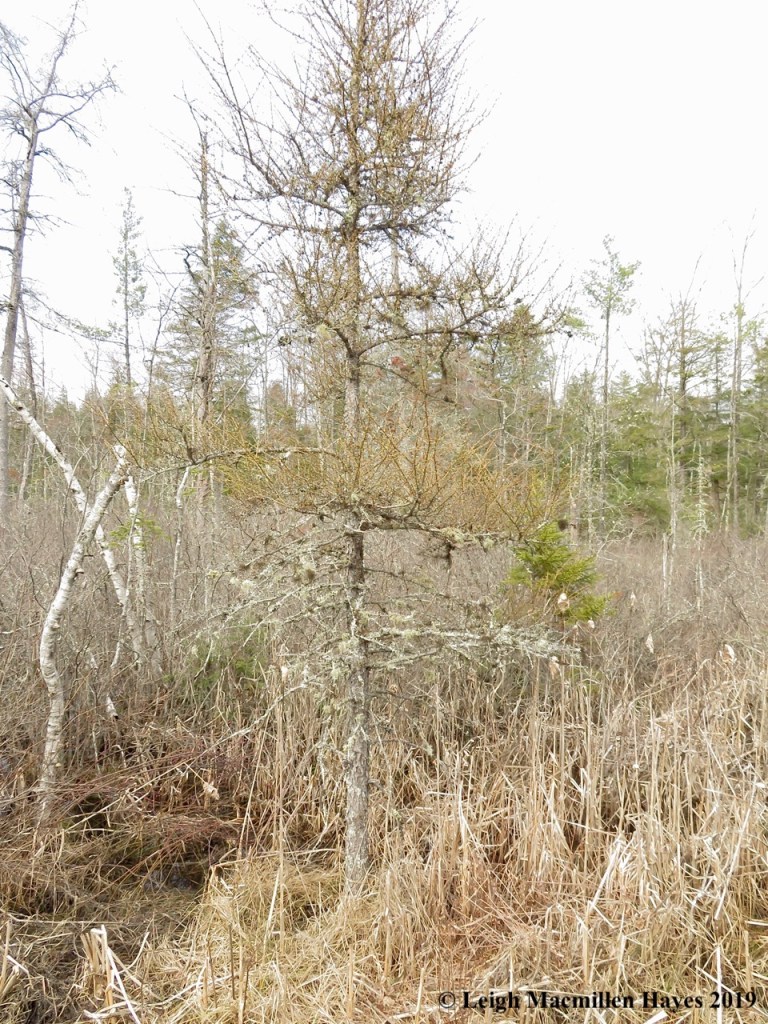
o10-red winged :painted

Off his high horse he flew, but continued to squawk from a lower pulpit. What did it all mean?

o11red winged blackbird

While we’ll never know, he did seem pleased with a gaze into his own reflection.

o12a-

Our gaze also became more focused when we realized we stood in the midst of a newly emerged dragonfly. By its cloudy wings folded over its back damselfly-style and the abandoned exuvia on the other side of its perch did we realize what we were witnessing.

o12b

We felt a sense of caretakers for suddenly it was our honorable duty to stand watch and protect this vulnerable being from becoming prey. With wonder, we watched as it slowly changed position and suddenly spread its wings. For at least an hour we stood sentry and noted the slightest changes while we delighted in how the breeze occasionally fluttered through its wings.

o13-female eastern forktail damsel

Oh, we looked around and spied a female Eastern Forktail damselfly . . .

o14-chalk-fronted corporal

and many a Chalk-fronted Corporal dragonfly among others.

o15-spreading his wings

But our attention continued to return to the subtle beauty before us. How did it know to climb the vegetation? How did it know to emerge? How did it know today was sunny? How could such delicate wings support its meaty body? Where do dragonflies hang out on rainy days? How long would it take before it flew off? Our questions were numerous, but . . .

o15-dragonfly exuvia

in a flash, as I moved in for a closer shot of the exuvia, the dragonfly decided it had posed for enough photos, and Ann and I watched with continued fascination as it flew off. Really, we felt like proud parents who had sent our offspring into the world. And we rejoiced. We had just witnessed one of nature’s greatest spectacles. It wasn’t only thrilling to watch, but was an all-encompassing experience that pulled us in with our sight and minds.

016-pitcher

After such an awe-inspiring opportunity, we couldn’t imagine anything else, but as we moved along the boardwalk through another section of the red maple swamp we again encountered pitcher plants.

o18-pitcher flower

And this time we decided to take a closer look at the flower structure, which was umbrella-like with those five broad and waxy sepals situated above. Unless you physically turn it and take a peek, it’s difficult to see what is going on beneath where five more bright red, oval petals, curved in at the base and covered the ovary.

o19-pitcher anthers

Within, yellow stamens surrounded the base of ovary. Below, a slender style extended from the round ovary and flattened out into an angled yellowish green structure like an inverted umbrella that curved back over the center of the flower. Certainly another novel spectacle for us to behold.

o20-four-spotted skimmer

Along the same stretch we were equally wowed by a Four-spotted Skimmer.

o21-four-spotted face

He gave us the opportunity to take in his mightiness from more than one vantage point.

o25-quaking bog

At last we reached the quaking bog and despite the water that filled our hiking boots, we moved forward toward Holt Pond with some caution. (Think right wrist still in cast.)

o26-caddisfly case

Along the way we discovered an abandoned caddisfly larva case,

o23-blue flag iris

blue flag irises,

o24-green frog

another green frog,

o27-tadpole

and a huge tadpole swimming over the boardwalk.

o28-muskrat works

At the water’s edge, though we sought sundews and could find none where they used to grow in abundance, we did realize someone had come with a different quest and because it seemed the pickerel weed roots had been foraged, we suspected a muskrat.

o29-hp northwest

After enjoying the view and trying to make the bog quake by jumping to no avail, we journeyed on.

o32a-Muddy River

Our walk back via the road passed much more quickly and in what seemed like no time, we were at the parking lot. But I had one more site to show Ann and so we headed down to the Muddy River, our circle completed–though we were a wee bit east of our first river encounter.

o32-canoe

It’s there that LEA has long left a canoe for anyone to use–just bring you own paddles and pfds.

o33-sawdust

And as our walk had begun, so it ended . . . with us again looking at bunchberries. but these were different for they were covered with sawdust and we suspected carpenter ants were busy residents in the pine tree behind them.

o35-exuvia

Because we were looking we were again rewarded as we noticed something else–a dragonfly exuvia.

o36-ghosts

And behind the tree two ghosts stared up at us in awe–completing the picture of this morning filled with the otherworldly so often encountered in nature.


The Trail To And Fro

The heron rookery was our destination and so friends Pam and Bob journeyed with me, our expectations high.

M1-KENNEDY'S EMERALD

But as nature would have it, we’d barely walked fifty feet when our typical distraction disorder set in–and the focus encompassed the dragonflies that perched on foliage beside the trail. Our first was a Kennedy’s Emerald, named for Dr. Clarence Kennedy, a renowned Ohio State University professor and odonatologist.

M2-BEAVERPOND BASKETTAIL

Among the same fern patch was a Beaverpond Baskettail. It’s the eyes of this species that appealed to me most for I loved their teal color.

M3-IMMATURE CHALK-FRONTED CORPORAL

Every step we took seemed to produce a new combination of colors and presentations, all a variation on the dragonfly theme, including this immature Chalk-fronted Corporal.

M4-MUSTACHED CLUBTAIL

And their names were equally intriguing, this one being a Mustached Clubtail.

M6- SKIMMING BLUET

It wasn’t just dragonflies patrolling the path and one mosquito at a time reducing the biting insect population–for damselflies also flew. When they weren’t canoodling that is. But canoodle away we said, for each interaction resulted in even more predators of our favorite kind.

M7-GRAY TREE FROG

And then . . .

M8-GRAY TREE FROG

and then we discovered a predator of another kind. And we rejoiced even more because for all the time we spend in the woods, sighting a gray tree frog is rather rare.

M9-EBONY JEWELWING MALE

Not quite so rare, but beautiful in its unique form was the Ebony Jewelwing and her metallic colors. We spied one male with a white dot on his wings, but he escaped the camera lens.

M10-GARTER PARENT

It wasn’t just fliers and hoppers that caught our attention. Movement at our feet directed us to one who preferred to slither through the woods in garter formation.

M11-GARTER BABY

And about a foot away from the parent–one of the young’uns.

M12-ROOKERY SITE

At last we reached our destination and the real purpose for our journey. We were on a reconnoissance mission. Our job was to count nests, young and adults at a heron rookery for the Heron Observation Network of Maine–a citizen science adopt-a-colony network managed for Maine Inland Fisheries and Wildlife by biologist Danielle D’Auria. The project began after a significant decline in the number of nesting pairs of Great Blue Heron was realized in Maine from the 1980s to 2007, and MDIFW listed the bird as a Species of Special Concern.

M13-HERON ROOKERY

Sadly, our count was zero for each category. While last spring the nests were active, something occurred and the colony collapsed before the young fledged last summer. Bald Eagles were the likely suspects of such a decline and as nature would have it, we thrilled with the resurgence of one species at the expense of another. Despite the current failure of the community, we’ll continue to visit each year . . . just in case.

M140WHITE CHALK CORPORALS

But guess what? As we stood there, we noted the activity, or lack thereof, of mature Chalk-fronted Corporals–the female relaxing on the left and male on the right.

M15-DARNER

Every few seconds a Green Darner conducted its own reconnaissance mission.

M17-CANADA GEESE

And then some serious honking from upstream called for our attention.

M18-CANADA GOOSE

And we were reminded of Bernd Heinrich’s book, The Geese of Beaver Bog, for we were in such a place.

m19-immature KENNEDY'S EMERALD

At last, we pulled ourselves away, though I suspect we could have easily spent hours being mesmerized by the magic of the place. Such magic was reflected in the opaque wings of a newly emerged Kennedy’s Emerald dragonfly.

M20-INDIAN CUCUMER ROOT

And on the way back, as often happens, we were privy to sights we’d missed on the way in. So it was that an Indian Cucumber Root displayed its unique flower–nodding pale green petals folded back, like a Turk’s cap lily, and from the center emerged three long reddish styles (think female reproductive parts) and several purplish orange stamens. Those styles gave the flower a unique spidery appearance.

M21-GRAY TREE FROG

And then . . . and then one more time not far from where we’d seen the gray frog on our way in, and mere moments after Pam said, “Where there’s one . . .” we found a second.

The heron rookery was our destination, but the trail to and fro offered so many moments of wonder.

Thank you to the family that conserved this land. Thank you to the wildlife in many forms who call it home. And thank you to Pam and Bob for not only accompanying me, but for insisting that I borrow your lightweight Canon Powershoot SX720HS. I might get hooked.