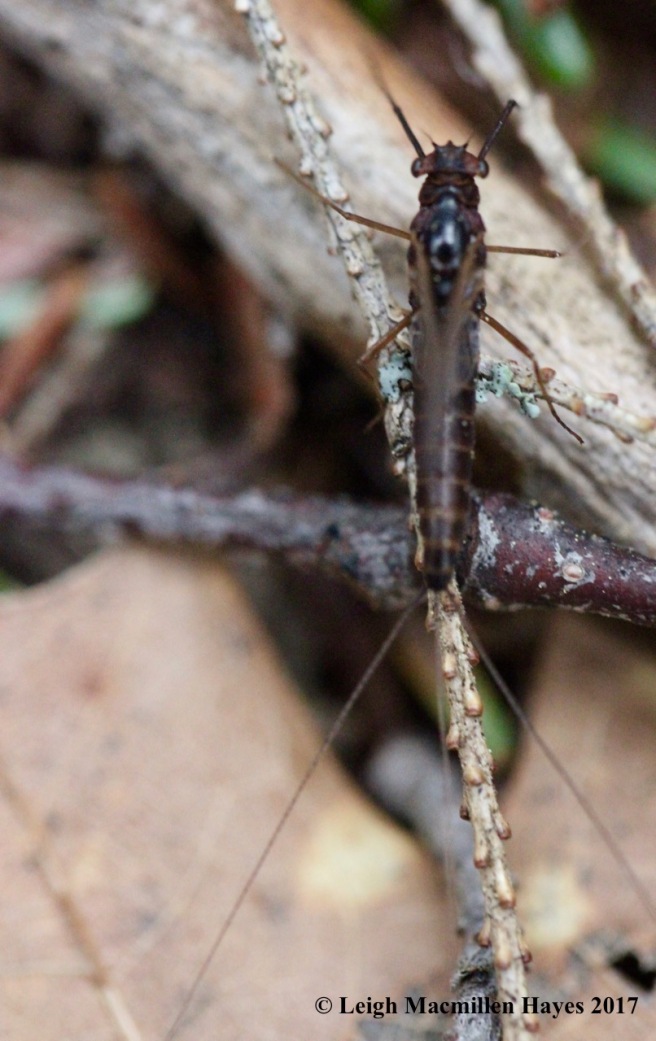
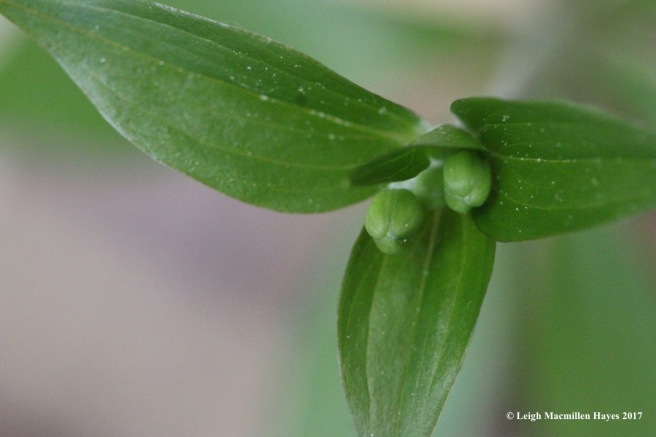
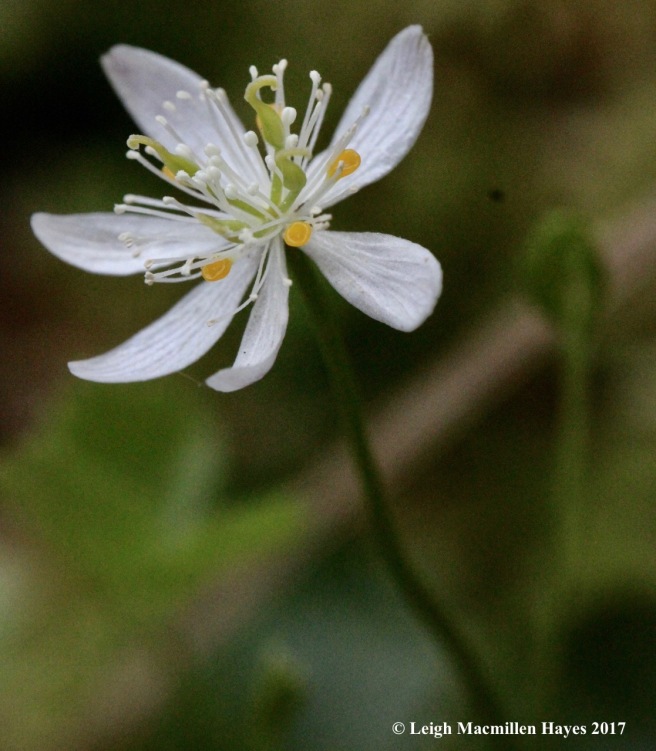
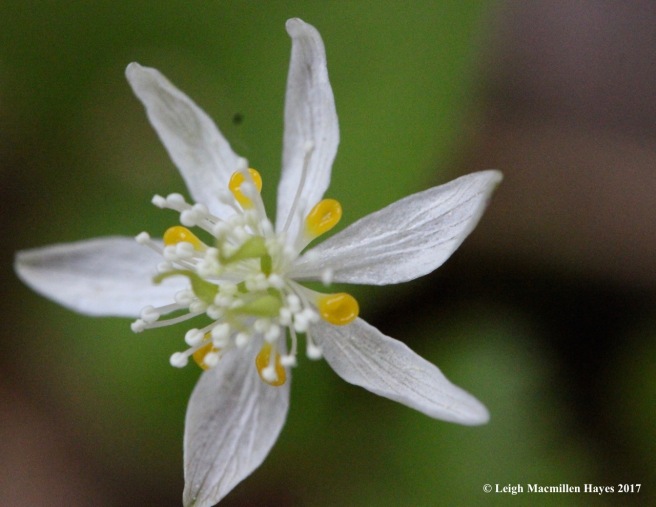
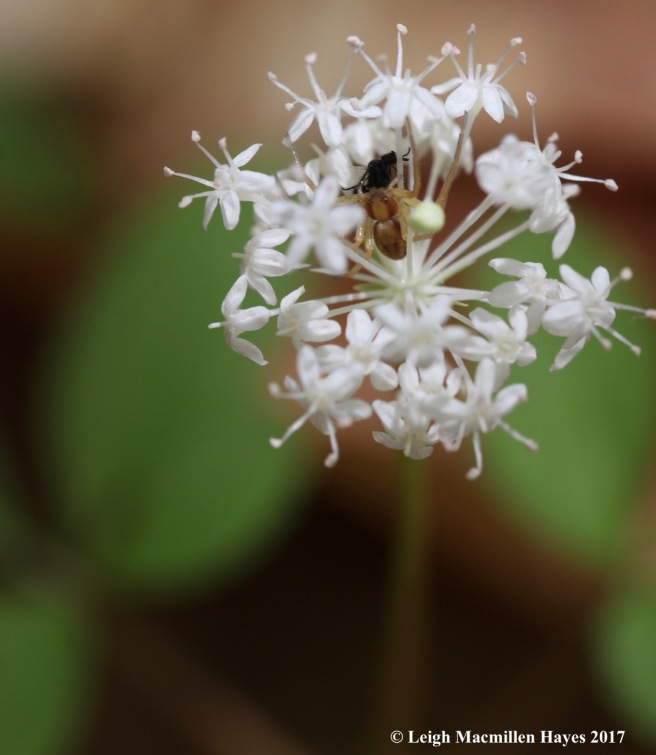
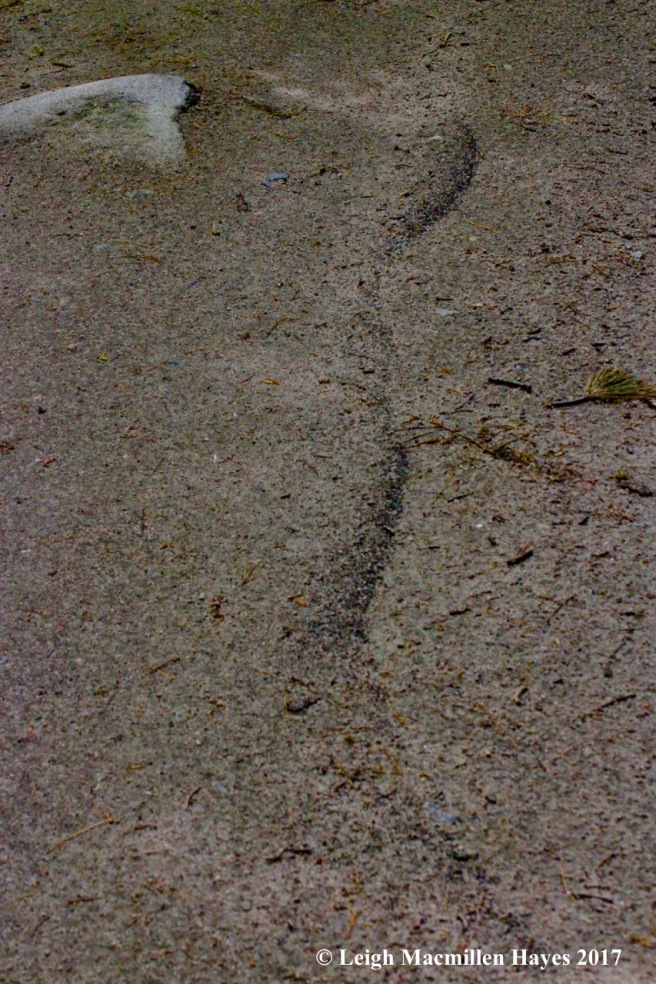
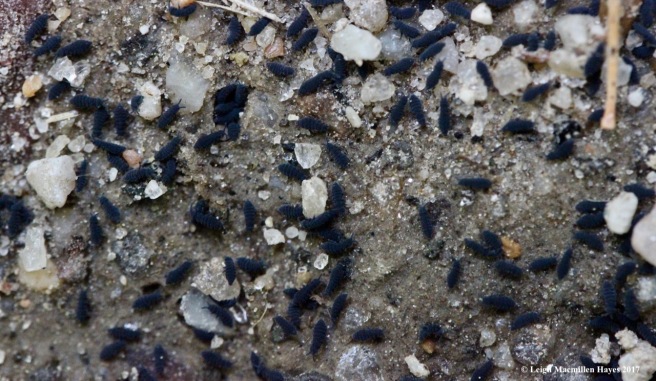
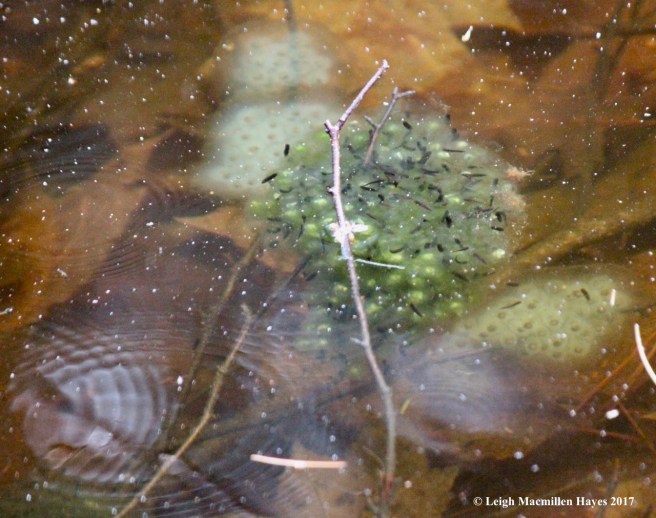
Petals and Wings: A Window of Opportunity

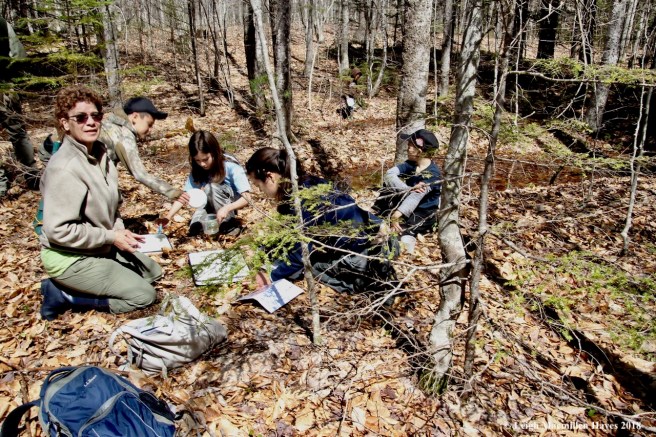
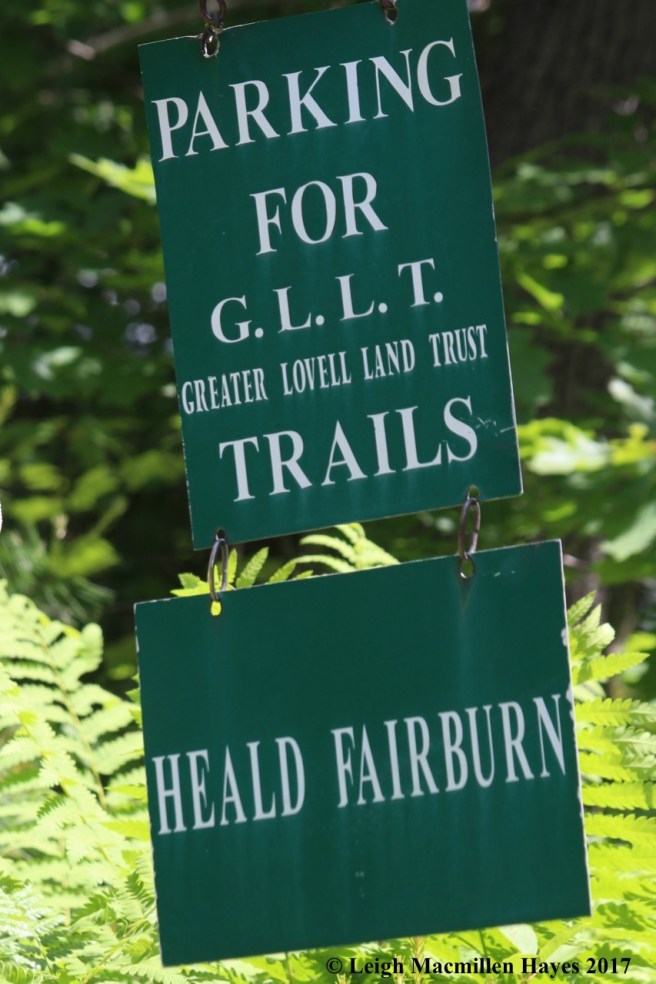
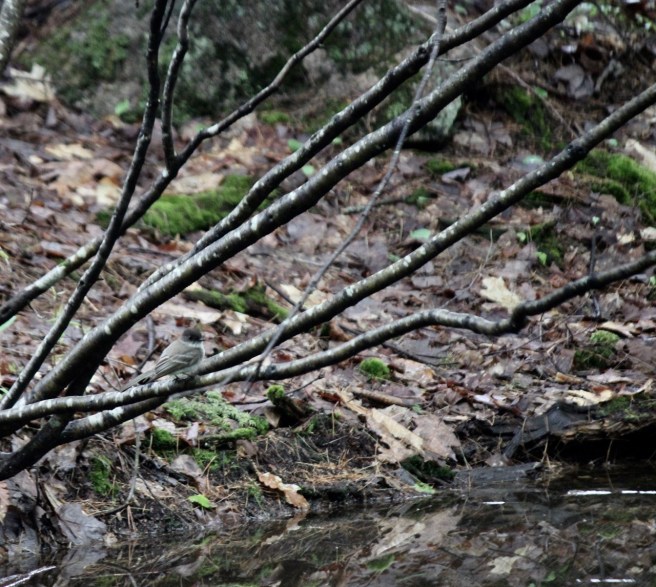
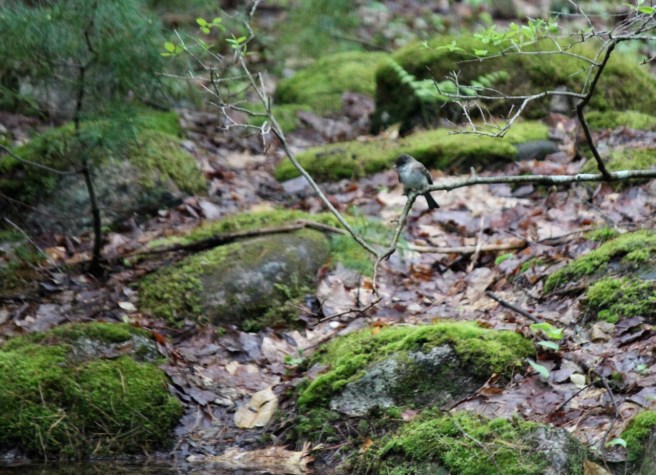
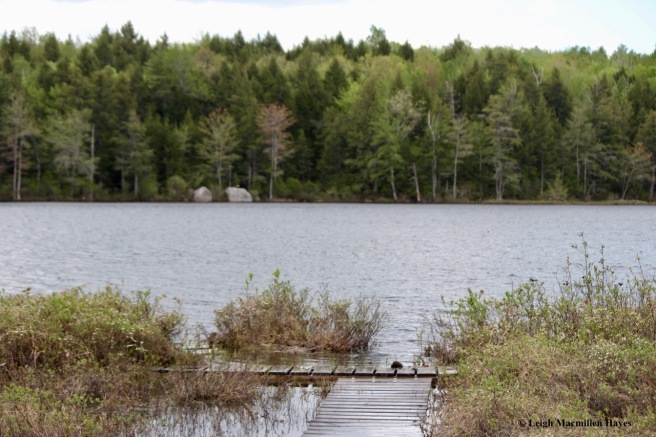
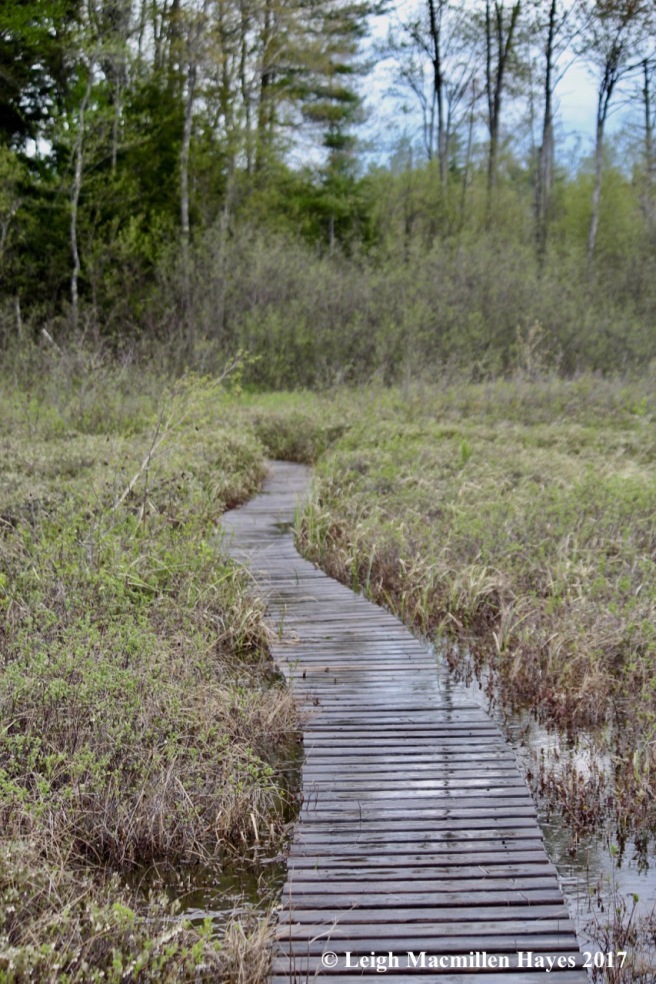
Spring ephemerals. Those species that take advantage of the short stretch of time between snow melt and leaf out. We celebrated such today at the Greater Lovell Land Trust’s Heald and Bradley Ponds Reserve as we ever so slowly walked along the orange trail from the Flat Hill parking lot and then looped around on Perky’s Path.

S1-GATHERING

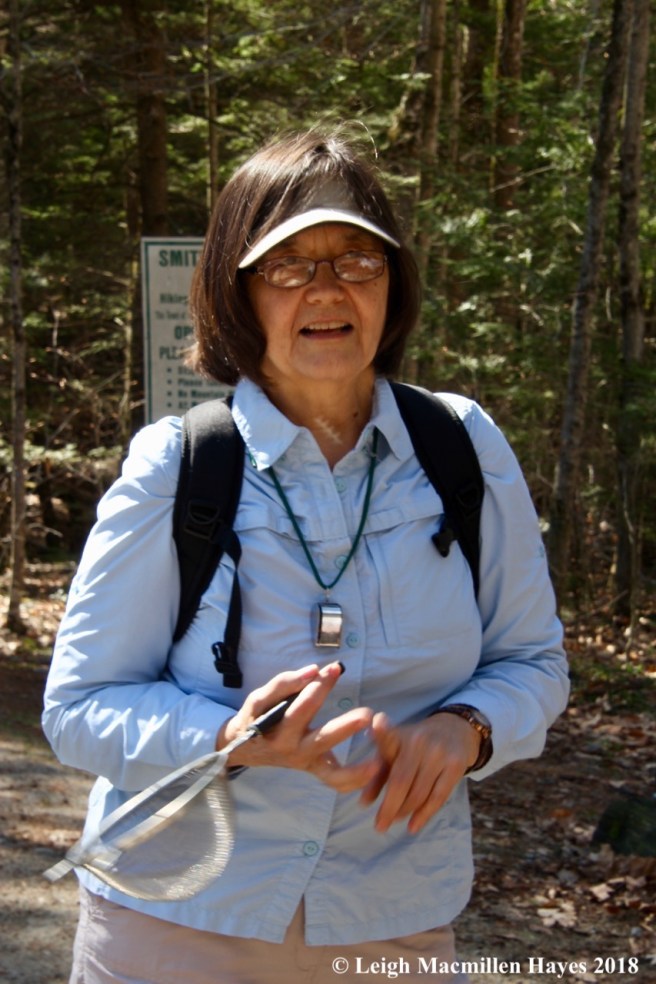
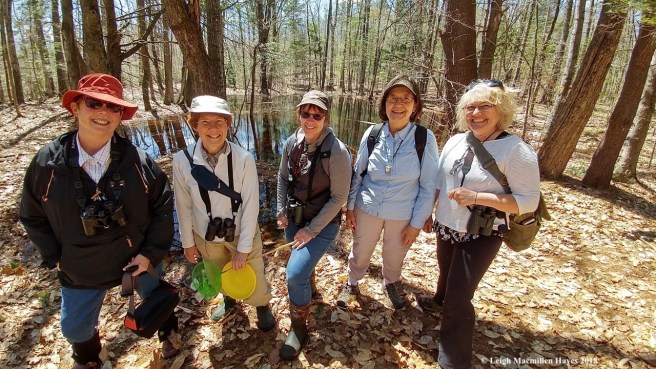
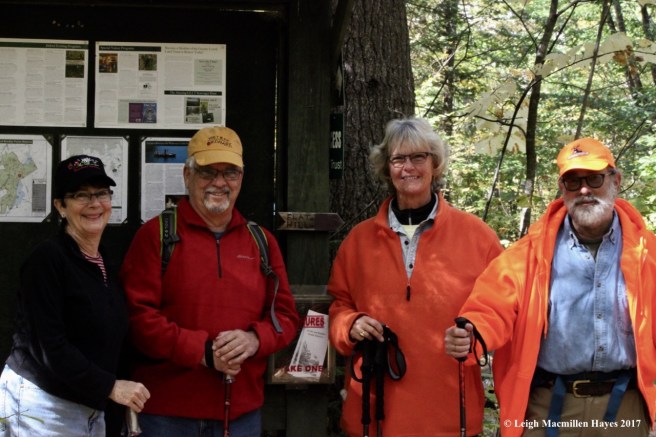
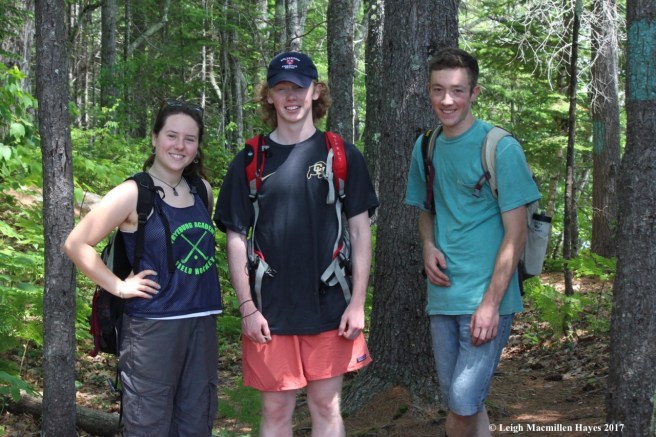
But first, we gathered in the parking lot where Docent Peter explained that he thought I was crazy when I suggested a May date for a flower and bird walk. He’d not been in Maine during May previously and only this week learned the joys of birding with minimal leaf cover. I think he’s hooked. And I’m still crazy.

S4-WILDFLOWER GUIDES

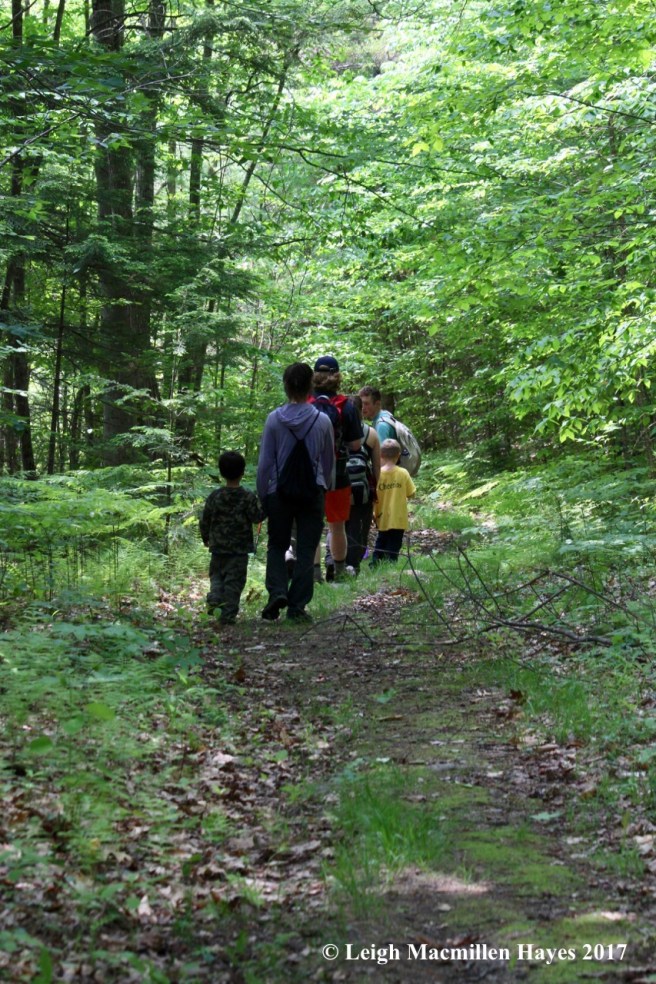
Our journey began with Docent Linda locating wildflowers that are opportunists who bloom early, get pollinated and produce seeds before the deciduous trees blanket the floor of the forest in shade.

S2-STINKING BENJAMIN

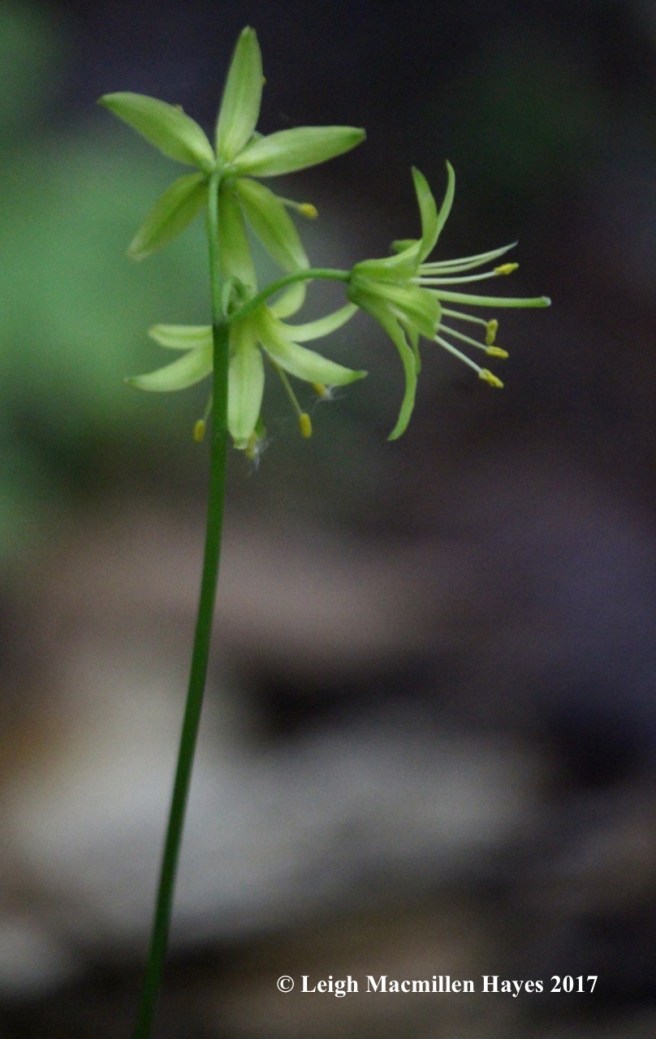
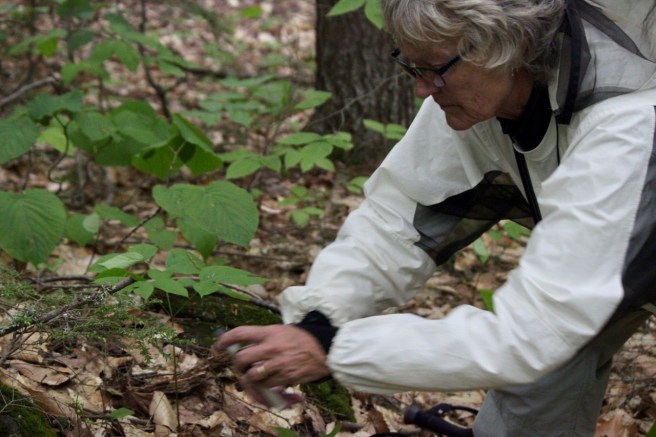
Among those early bloomers was one that stinks! And yet, it’s exquisitely beautiful. Stinking Benjamin is one of its common names because of the flower’s malodorous scent. Of course, you need to get down on your hands and knees to get a whiff.

S5-HAND LENS

Our focus wasn’t just on flowers and birds as we all soon realized, for it seemed that many things caught our attention, including the seeds of deer tongue grass. As a collective group, we suffered from Nature Distraction Disorder.

S6-WILD SARSAPIRILLA LEAVES

Because of such, we observed more than just the flowers that were in bloom. In one instance, the flower was yet to come, but the leaves in their early stage were worth noting. Linda pointed out that the color of wild sarsaparilla’s new leaves was reminiscent of poison ivy. But, poison ivy has leaves of three.

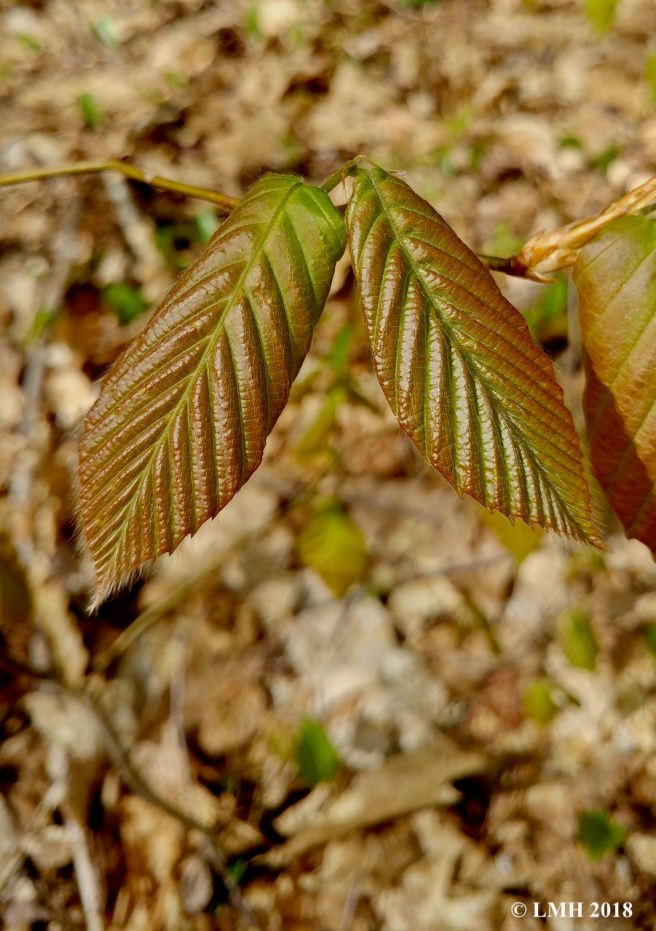
S7-BEECH LEAVES

And that reddish tint that we saw in the sarsaparilla, beech and other leaves? The various hues of color in leaves was caused by the presence of pigments called anthocyanins or carbohydrates that are dissolved in the cell sap and mask the chlorophyll. As our spring temperatures rise and light intensity increases, red pigment forms on a leaf and acts as a sunscreen to protect the plant from an increase in ultraviolet rays.

S8-BIRDING

We’d been looking down for a while, but then bird song pulled our attention to the tree tops. Without the use of my Cannon Rebel, which is currently enjoying what I hope will be a successful rice bath :-( , I couldn’t capture the many warblers we spied. Some, as Peter, and his wife Molly, told us, were only in the area temporarily to fuel up on insects before continuing the journey to their breeding grounds in Canada.

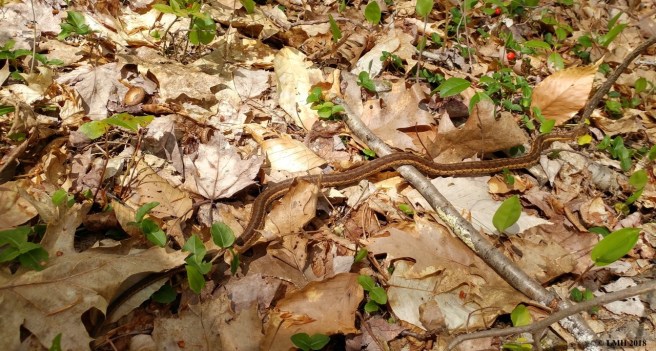
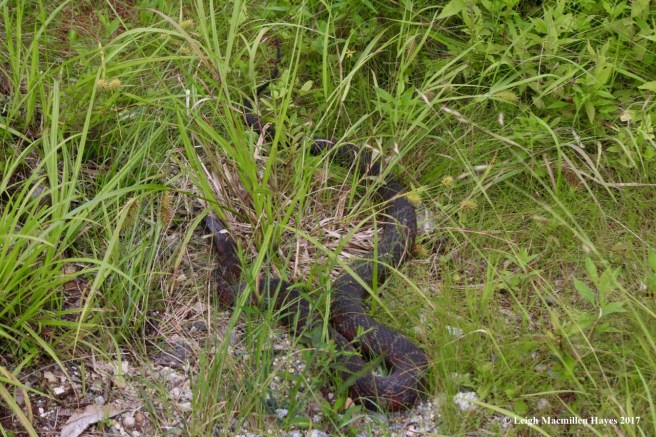
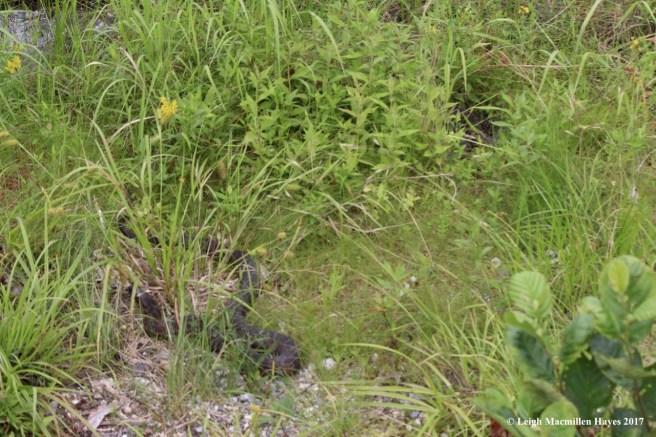
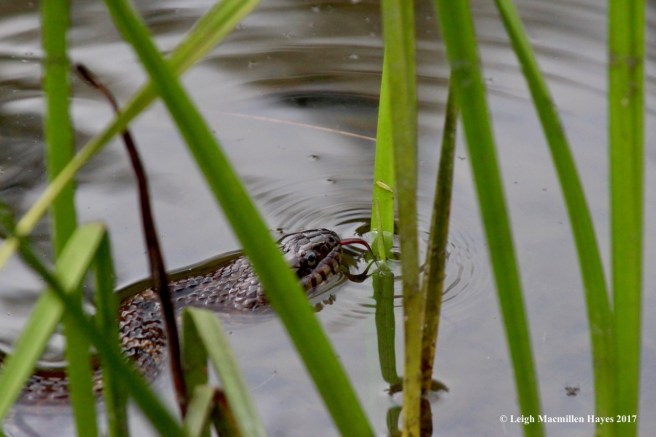
S10-GARTER SNAKE

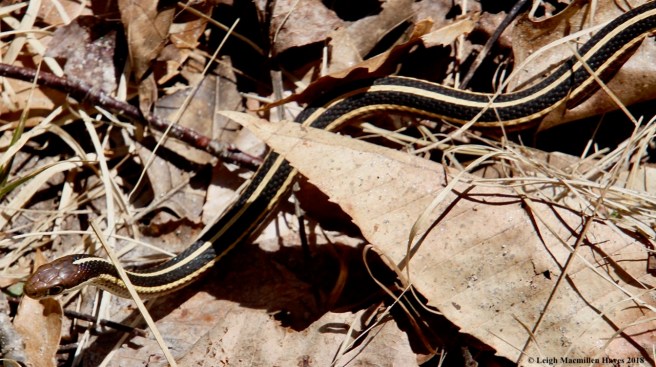
And looking at our feet once again, another in search of insects. We saw a garter snake who stayed as still as possible while we ogled it. Was it cold and trying to soak up warmth from the sun? Or did it stay still in hopes we wouldn’t spy it?

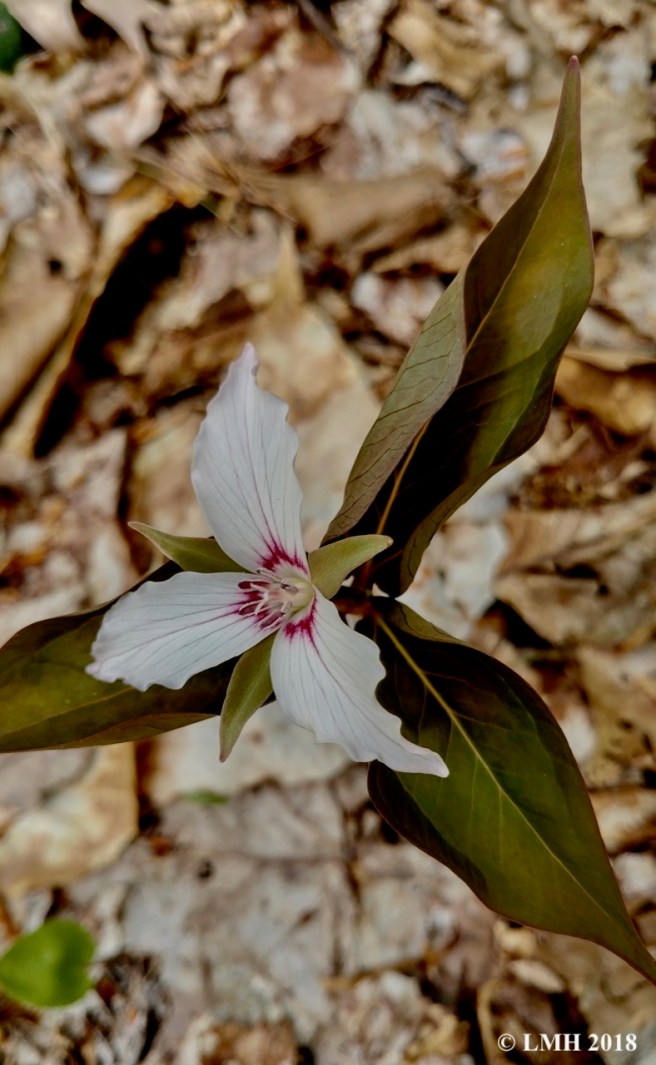
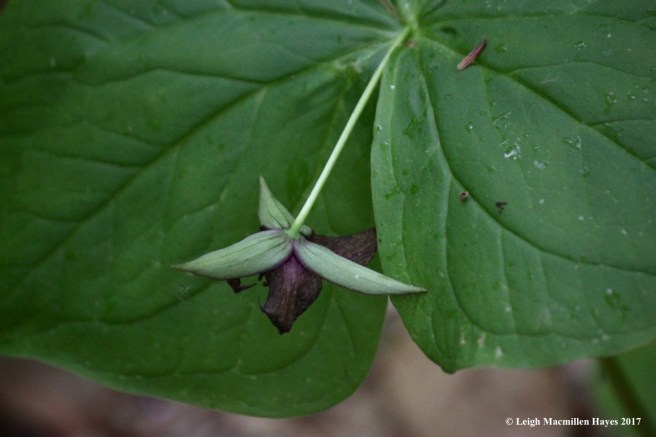
S11-PAINTED TRILLIUM

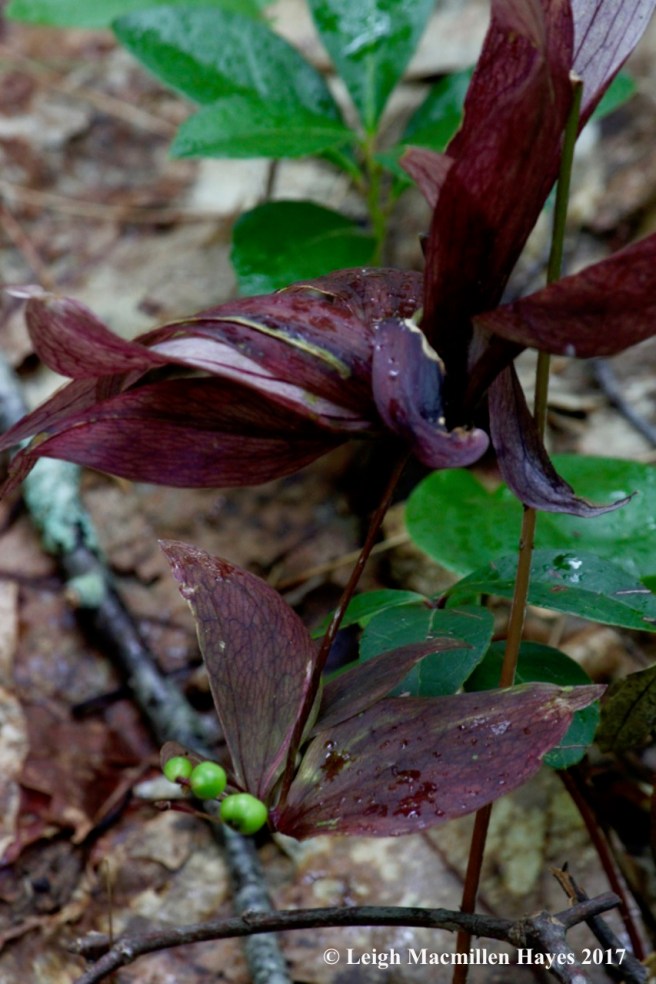
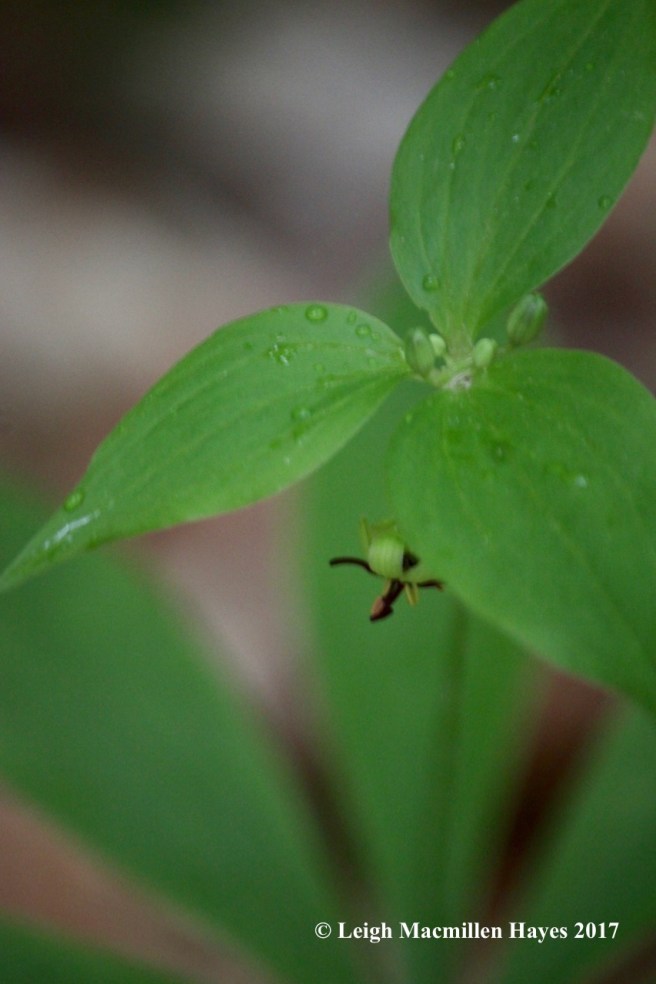
We finally left the snake in peace. And paused next to gaze upon a painted trillium.

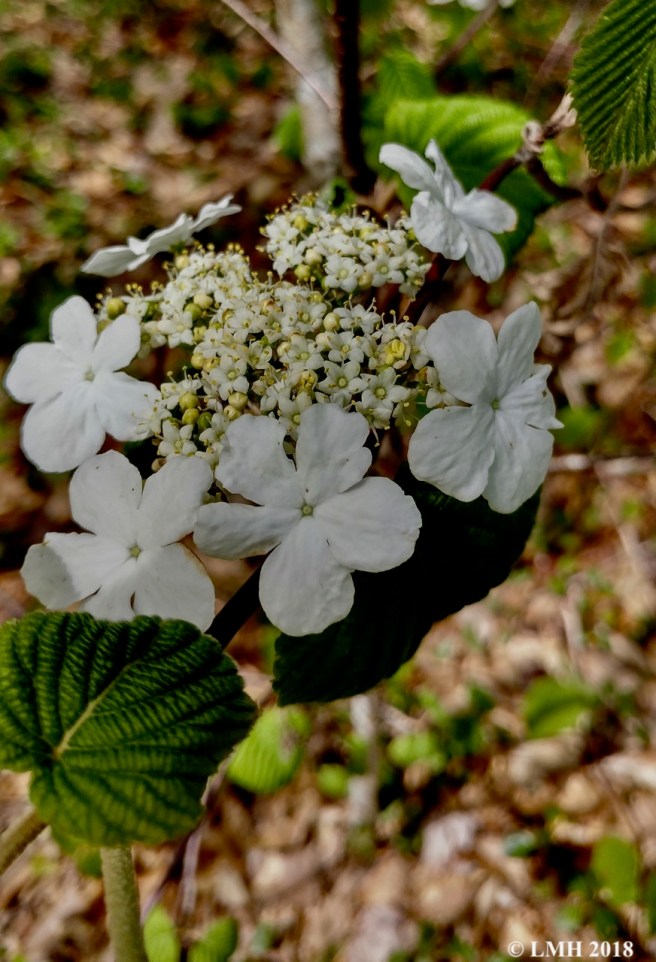
S12-HOBBLEBUSH FLOWERS

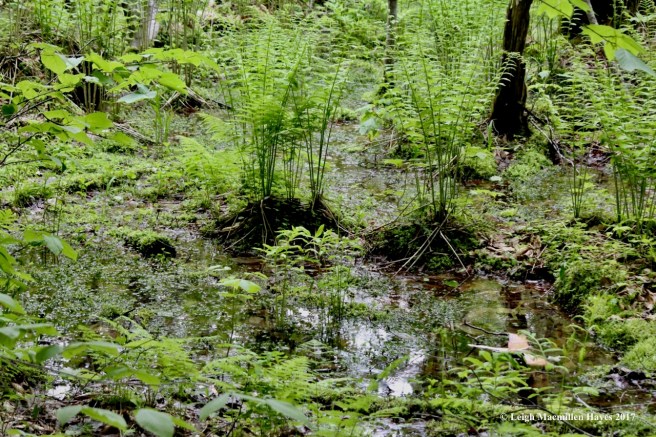
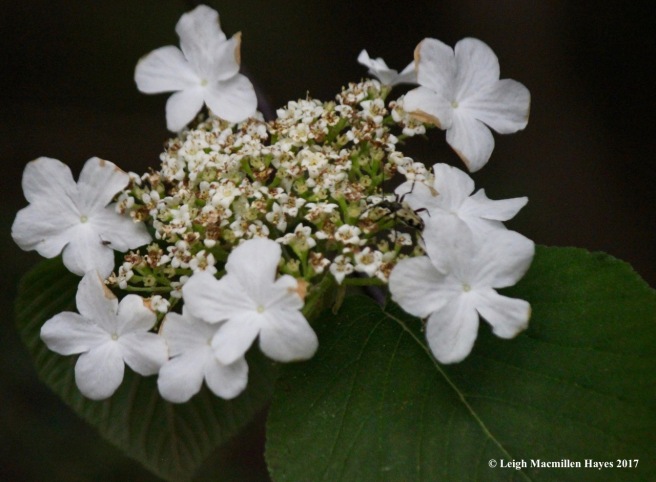
Almost two hours after our start, we approached the wetland and overlooking bench. It was there that a hobblebush laden with blossoms caught our attention in the shrub level. The hobblebush bouquet was really an inflorescence or lacy cluster of tiny fertile flowers surrounded by a halo of showy, yet sterile bracts. Those larger, sterile flowers attract insects while the tiny fertile flowers do all the work of seed production. Nature has its way.

S13-BIRDING BY THE BENCH

It was at the bench that bird song again greeted us and we looked above the shrubs toward the tree limbs above.

S14-BIRDING

For many of us, we looked through our binoculars at birds we’d only heard of before, including a Bay-breasted Warbler. Peter explained that he’s participating in the citizen science project to update the Maine Birding Atlas and so he uploaded the 38 species identified today to the e-bird website.

S15-LINDA TURNS HER FOCUS UPWARD

Even though she’d spent a lot of time directing our attention to the beauty at our feet, Linda was also in awe of those who moved above, however, she was heard to comment that it’s a whole lot easier to ID flowers that stand still.

S16-BEECH FERN

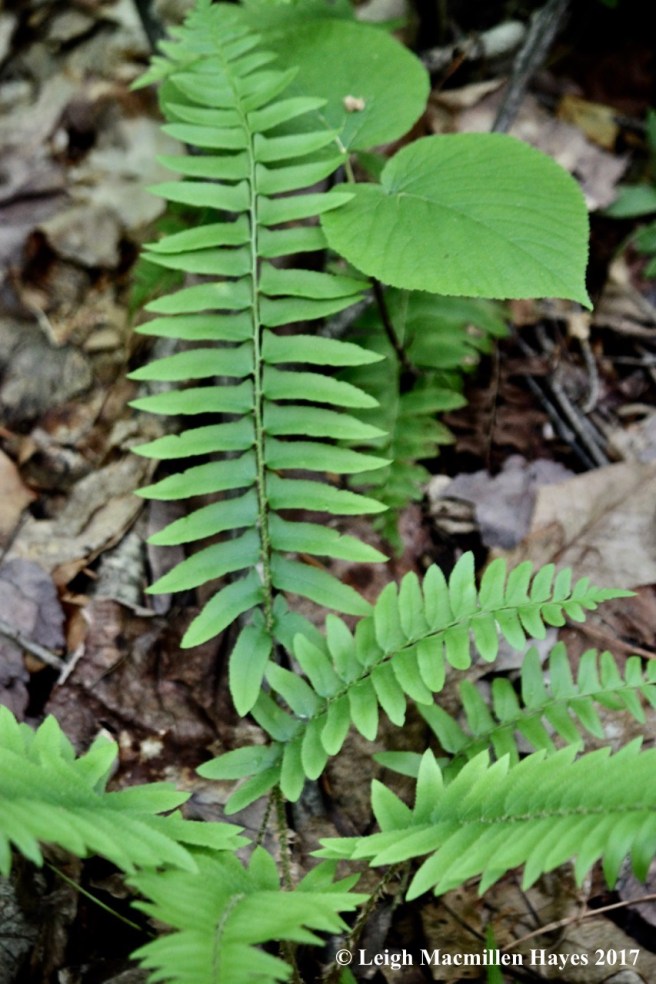
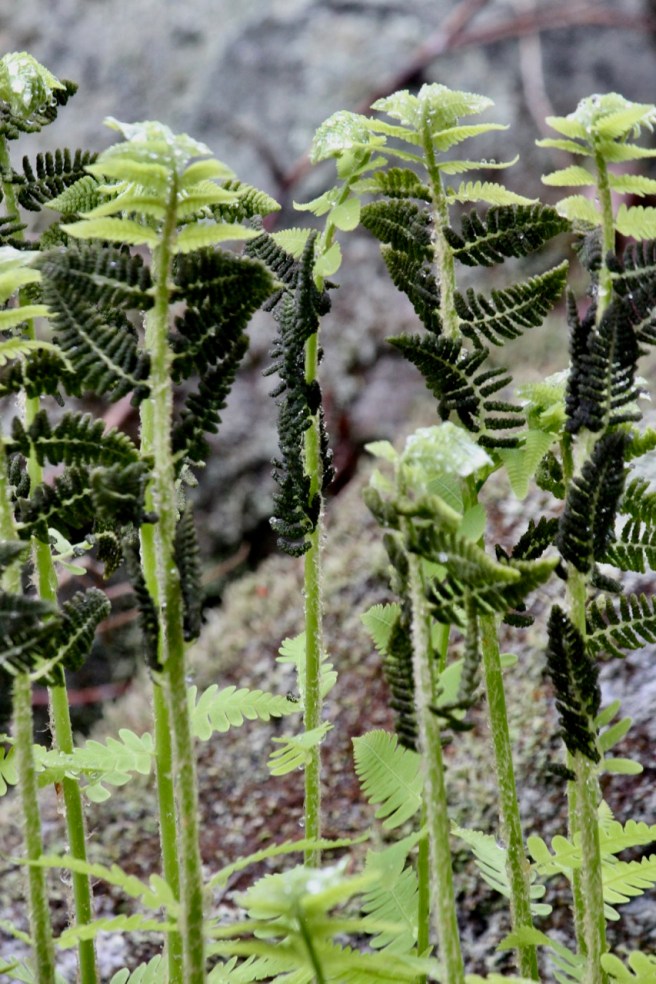
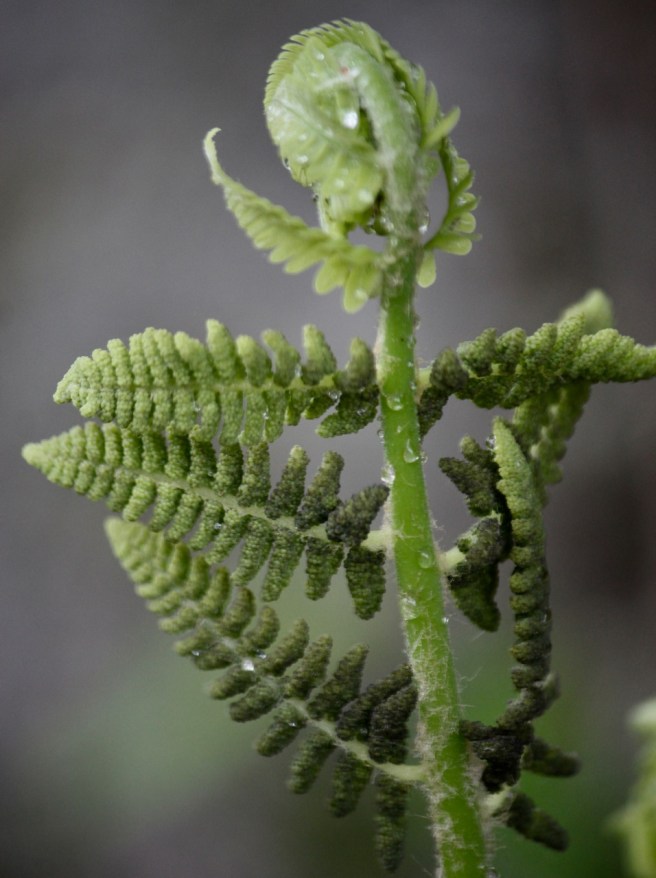
As our journey finally continued, we found a patch of beech ferns with their own variation of today’s theme, for each leaflet attached to the rachis in a winged formation.

S18-FRINGED POLYGALA

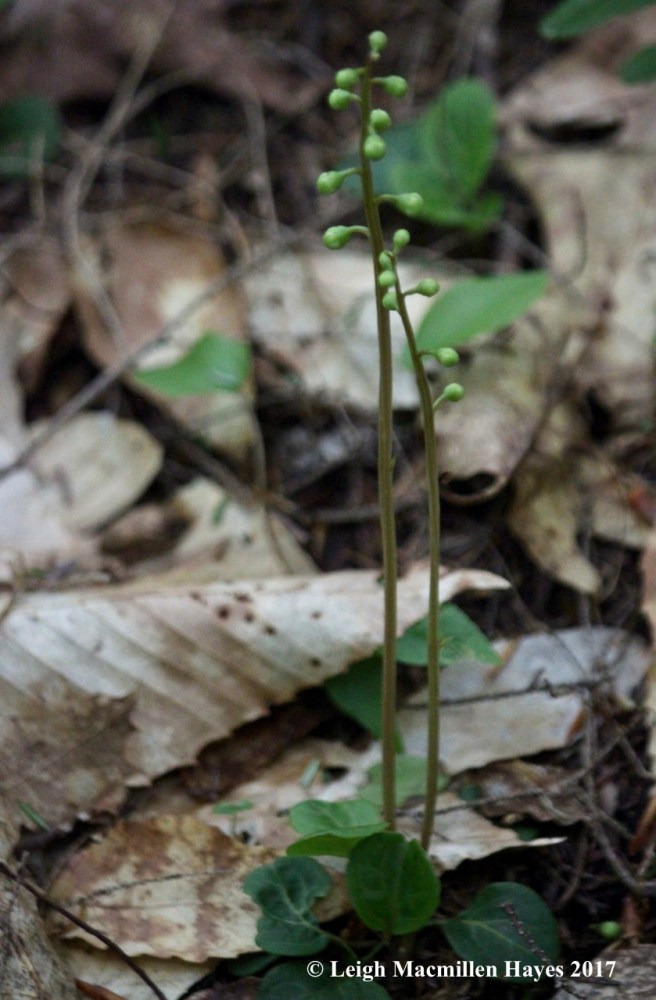
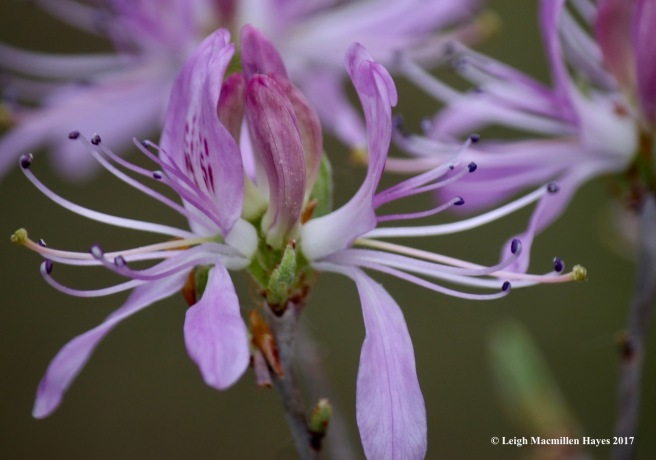
Another that spoke to the theme was a flower that hadn’t quite yet bloomed–fringed polygala, aka gay wings.

S17-SPRING PEEPER

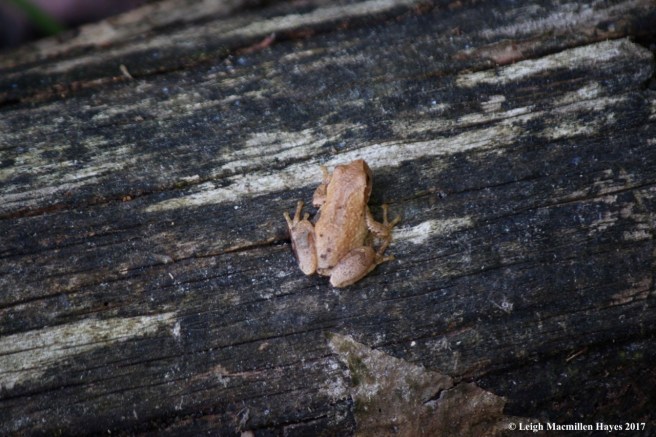
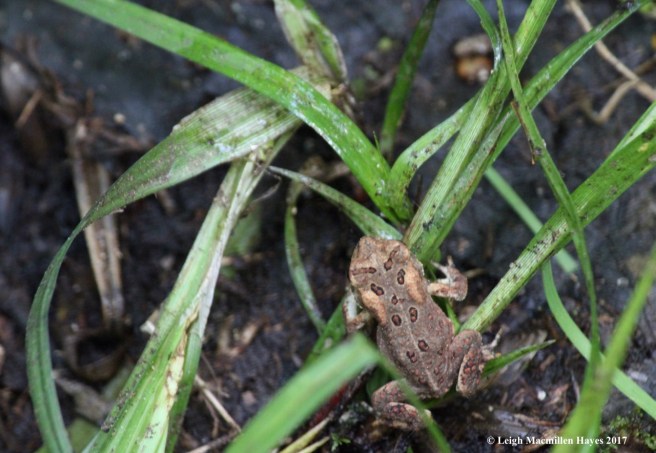
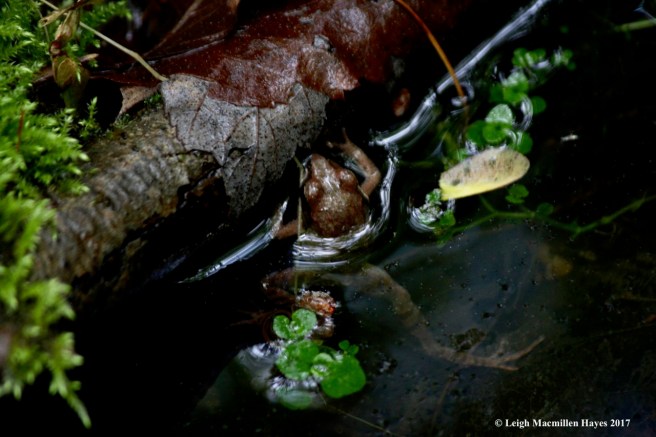
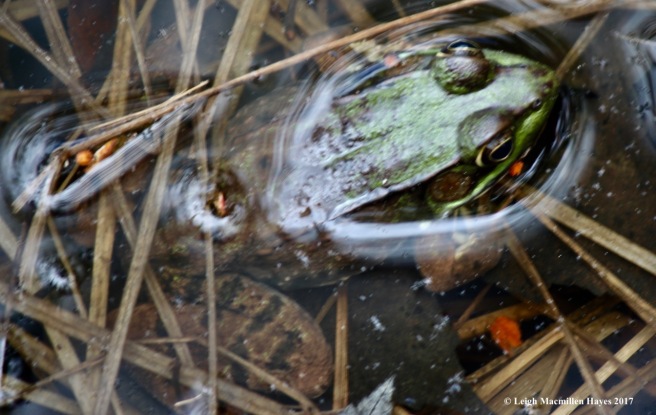
Despite all the flowers and birds, our NDD followed us right to the end–when we spotted a tiny spring peeper . . .

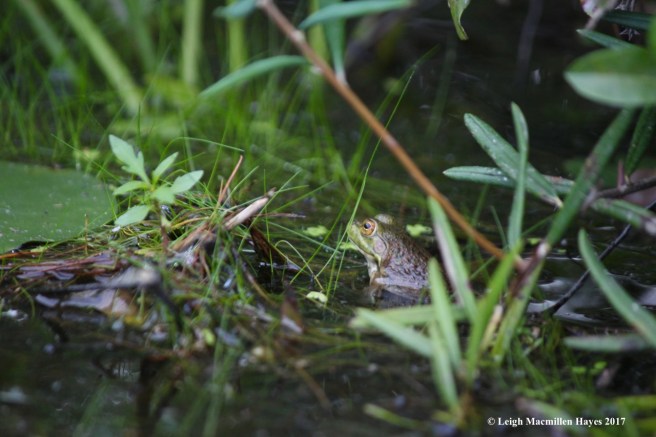
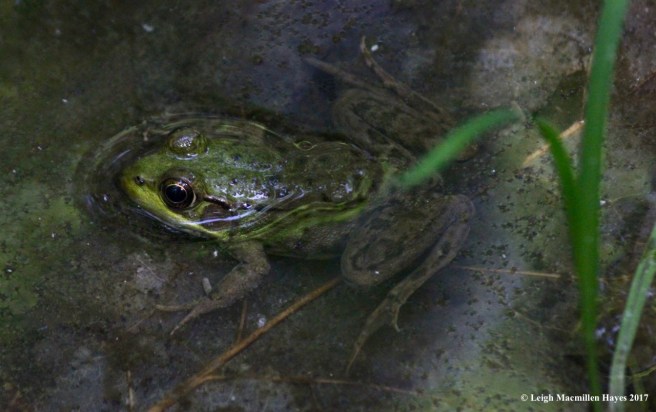
S21-GREEN FROG ON A LOG

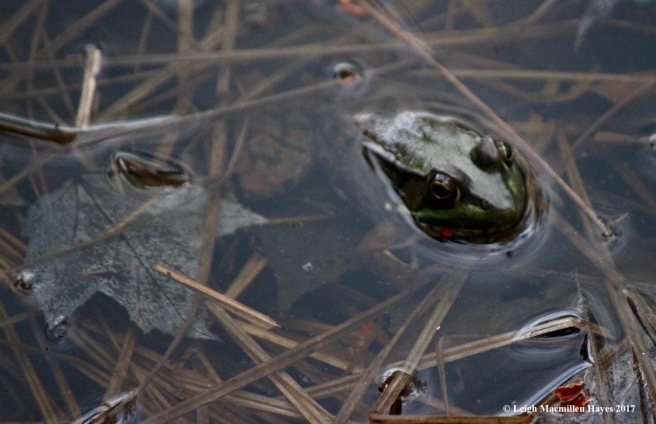
and then a green frog.

S22-FEMALE WHITEFACE SKIMMER

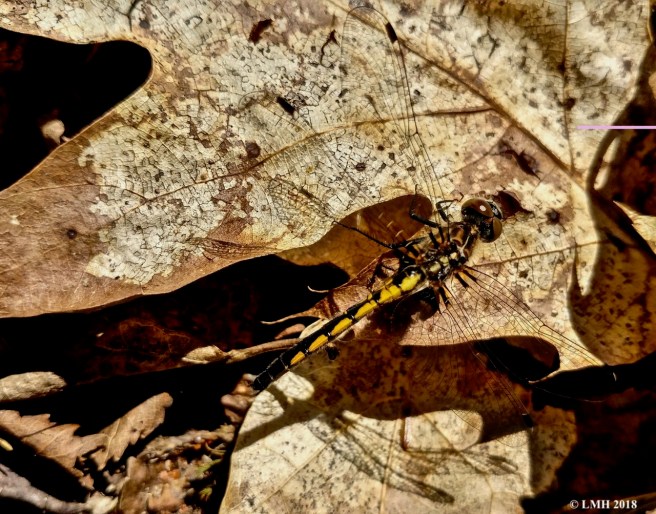
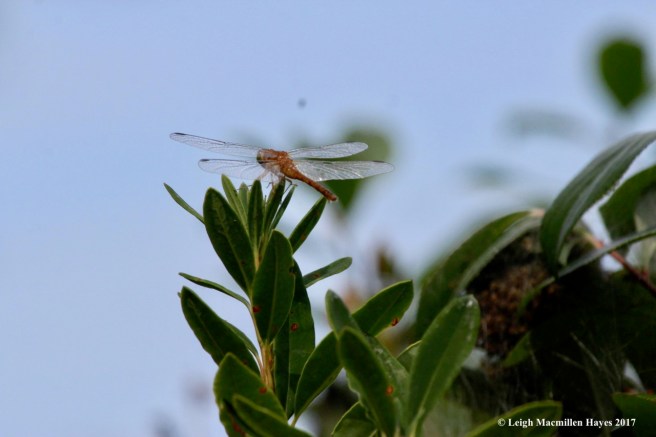
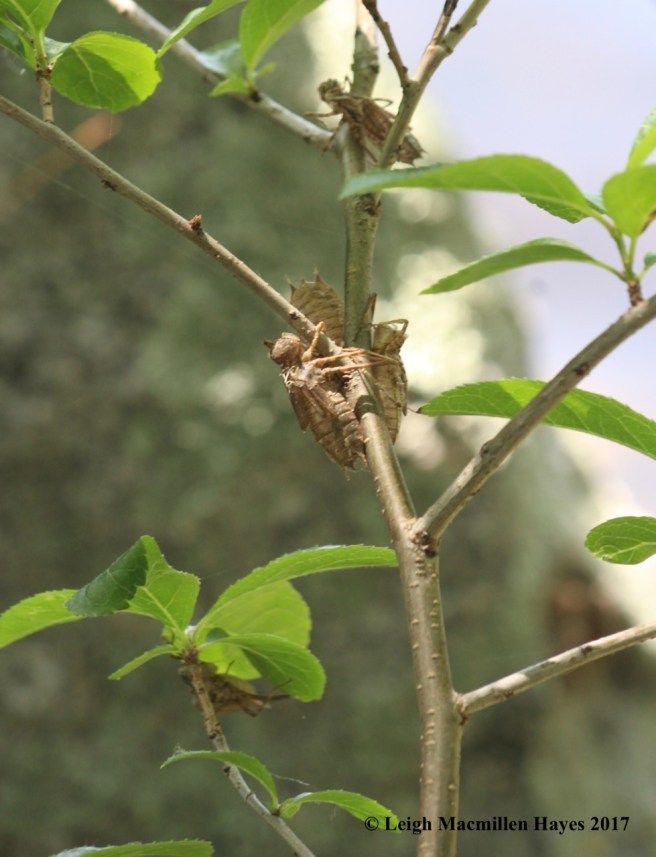
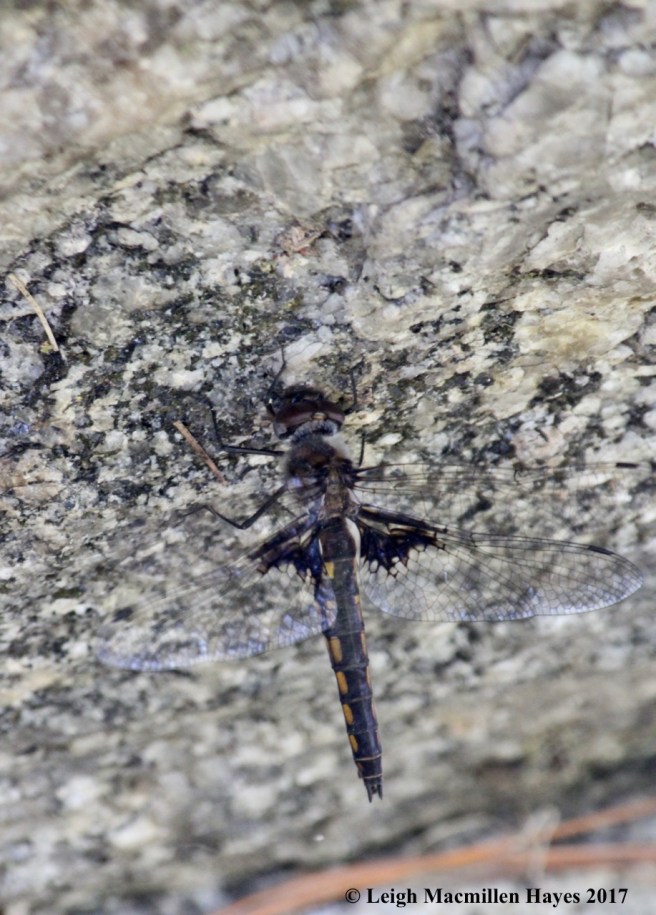
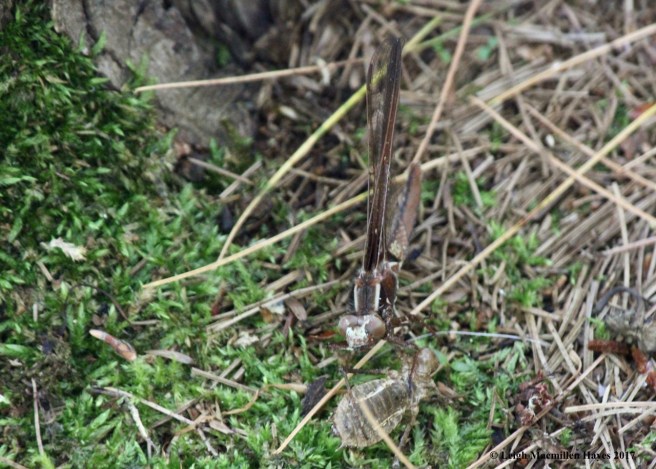
While the frog marked the end of our journey, I moved on to the GLLT’s Kezar River Reserve, where another winged critter flew at the flower level–the first dragonfly of the season: a female whiteface skimmer.

Today was filled with petals and wings and all things ephemeral. I hope you’ll have a chance to take advantage of this short window of opportunity.


Cinco de Mayo, Naturally

The hour and a half drive to Litchfield, Maine, was worth every second on this fifth day of May. The spring tapestry that spread before my eyes had me oohing and aahing around each bend in the road for such were the colors–so many shades of greens, mixed in with reds and magentas and pinks and yellows. It was almost intoxicating.

But . . . a photograph will have to wait for another day for I needed to reach my destination and catch up with my peeps–fellow classmates from our 2012-13 Maine Master Naturalist class. For the last five years we’ve tried to get together quarterly. It doesn’t always work out, but this year we’re making a concerted effort.

s1-Smithfield map

Today’s destination was the vernal pool at Smithfield Plantation, a 103-acre property the town of Litchfield conserved. If you look carefully, you might see a reflection of Sharon, who has lead many a school group along the trails and knows the property intimately.

s1a-Sharon T

Before we headed to the pool, she oriented us to the site.

s2-moose wood

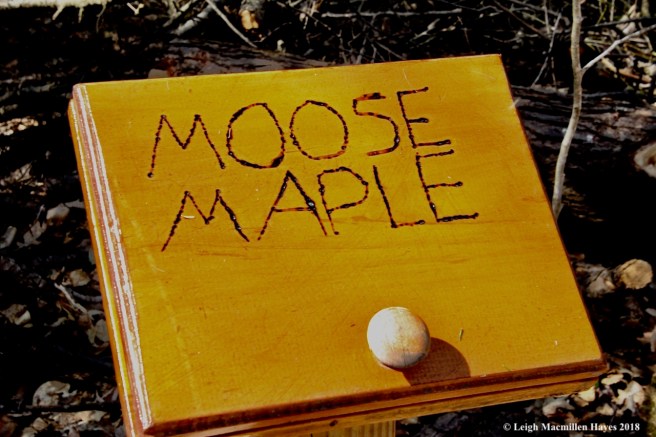
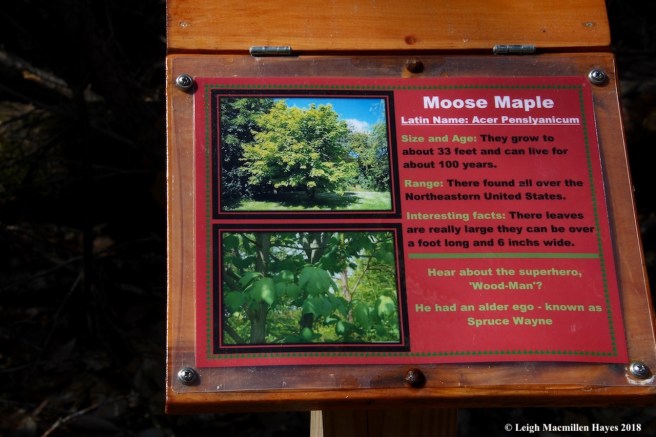
One of the things Sharon explained was that a Boy Scout had created an interpretive tree trail and so we paused at one of his stops to admire the craftsmanship.

s2b-moose wood maple leaf

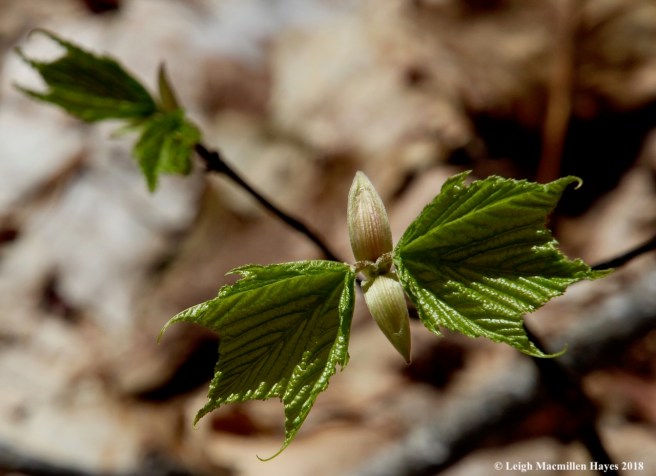
Indeed, right behind the sign, a striped maple, aka moose maple, shared its newly emerged pastel buds and leaves.

s2a-moose maple

And then we lifted the lid to reveal the information. OK, so there were a few typos for the grammar police, but on each of his cards, he included a joke. What a great idea as that would certainly appeal to the younger set. It definitely appealed to those of us who are still ten years old in our minds.

s4-hobblebush

And on the opposite side of the trail, we spotted another type of moose wood–hobblebush just beginning to flower. Both striped maple and hobblebush are favorite foods of moose, thus their nicknames.

s3a-clintonia

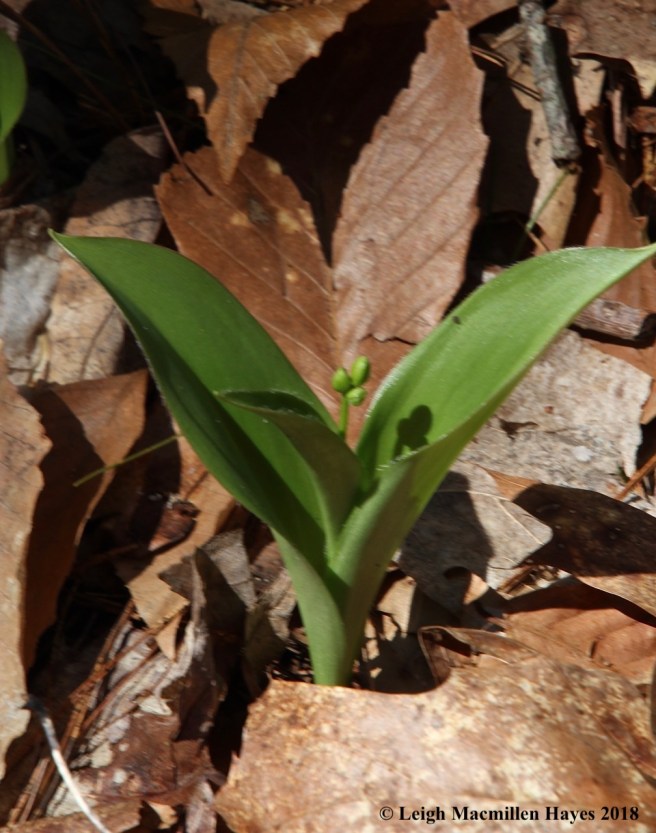
Onward we walked until a patch of leaves stopped us. And our brain-sharing began. We thought we knew what the plant was, but then questioned ourselves as it wasn’t in flower yet. Each season, we need to relearn some. Despite the lack of flowers, we decided to key it out in Newcomb’s Wildflower Guide using two other descriptors–leaves both basal and entire.

s3-clintonia 1

For those familiar with Newcomb’s that meant of the three numbers in the locator key, we didn’t know the first, but went with 22 for the second and third representing basal leaves and entire leaves. Then we tried, 122, 222, etc.

s3b-clintonia buds

And landed on our first suspicion: 622–Yellow Clintonia or Bluebead (Clintonia borealis).

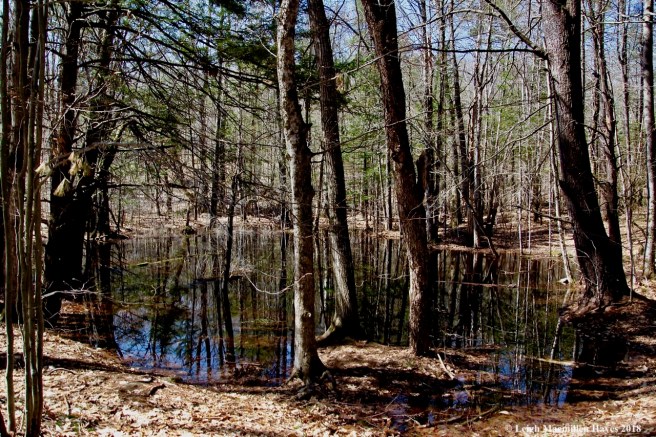
s6-vernal pool

The trail wasn’t long, but as one might expect, it took us a while to reach the vernal pool. And then we were stopped in our tracks and didn’t approach it right away.

s7-solitary sandpiper

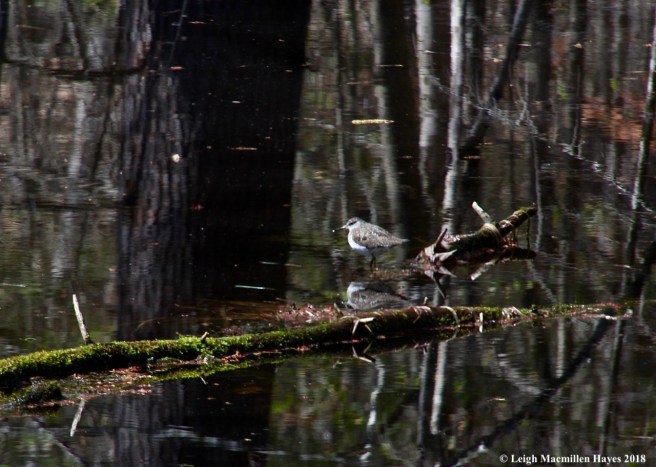
Instead, we stood back and spent a while watching a solitary sandpiper on a downed tree.

s7a-solitary sandpiper

As we watched, it bobbed its tail. And at one point we were sure it took a mid-morning nap. Eventually, the bird flew to another part of the pool and a few minutes later departed.

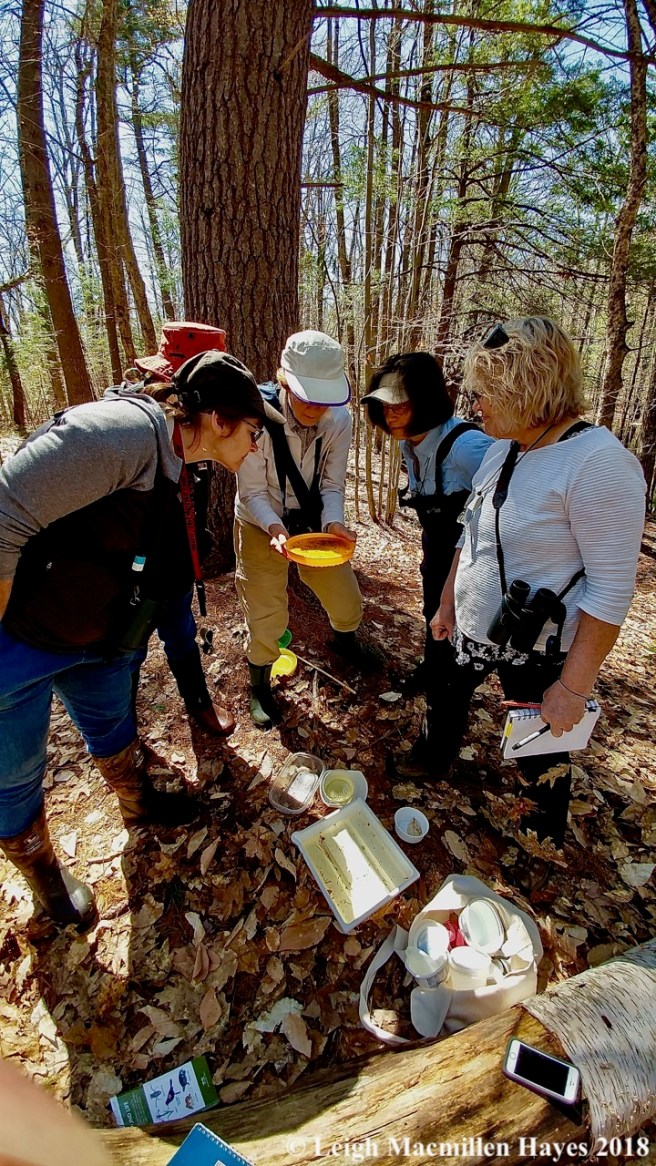
s10-setting up camp

And so we set up camp, dropping some of our gear on the bench.

s10a-setting up camp

And more of it on and beside a log. We had macro-invertebrate charts and vernal pool pamphlets and books, plus all kinds of containers for pond dipping.

s9-Pam's journal

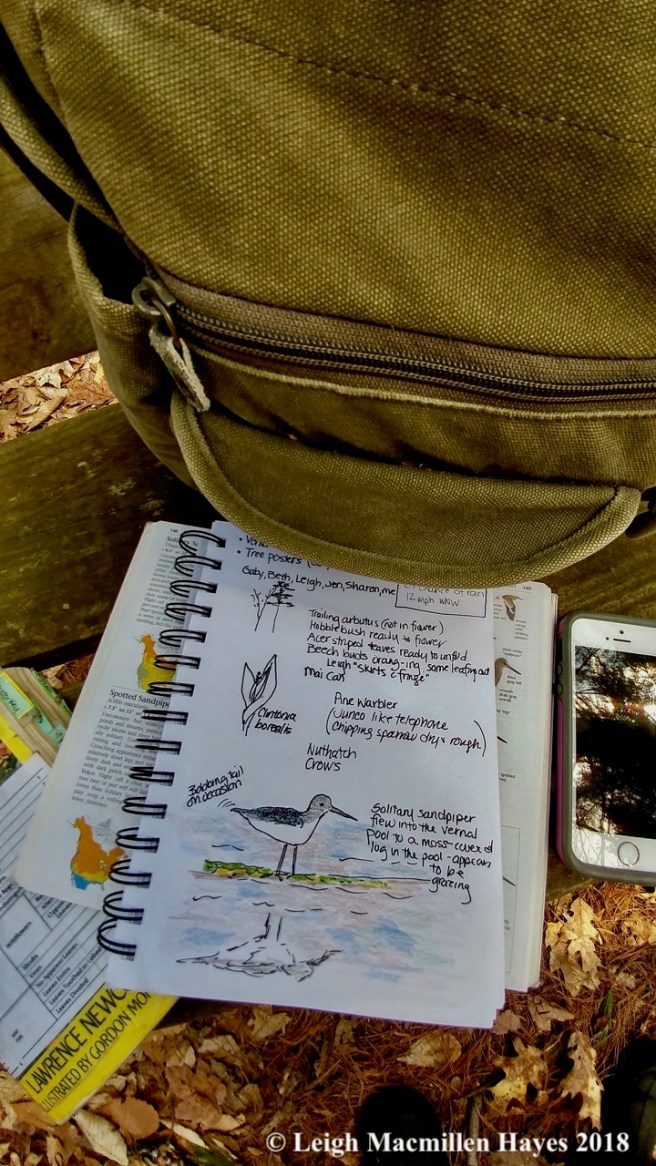
Pam was the smart one and she’d packed her sketch book and colored pencils. That’s one skill we all appreciate for it slows us down and makes us really notice. I, for one, haven’t done enough sketching in the past year and so this was the perfect incentive for the future.

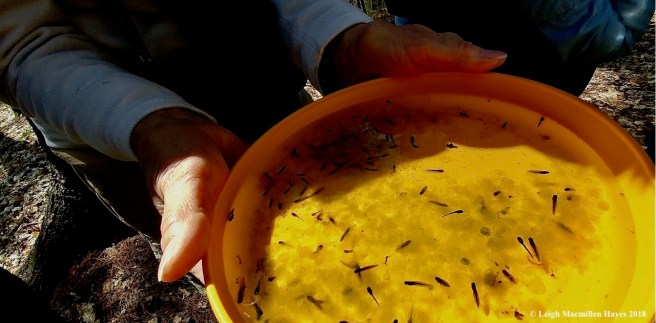
s8-mosquito larvae

As we looked into the pool and Sharon told us what we might find, we immediately noticed the most abundant residents–mosquito larvae doing their whirligig dances.

s11-first fairy shrimp

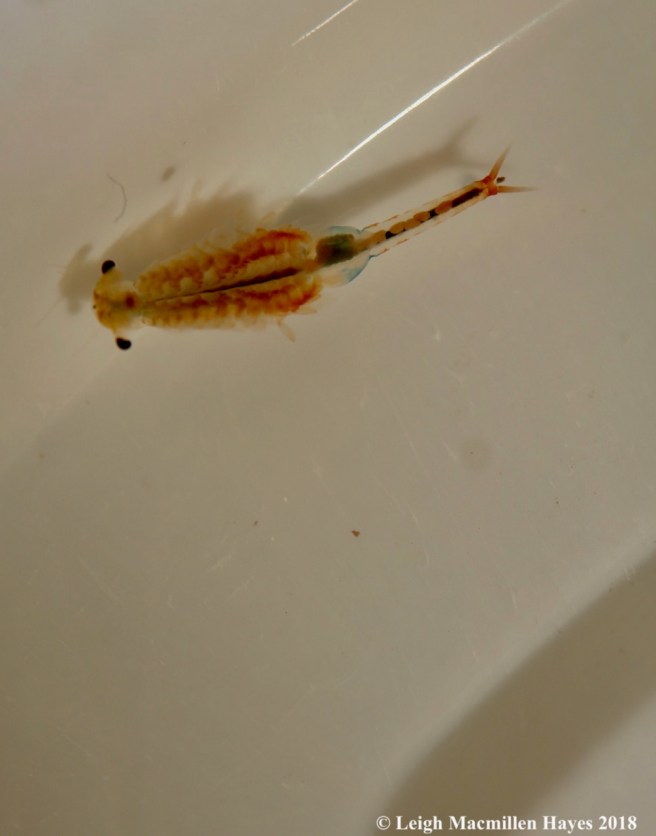
But on her first dip, Sharon pulled up the crème de la crème–a fairy shrimp. Bingo–a significant pool it was as she knew, though not so documented with the state.

s12-examining the fairy shrimp

With her loupe, Jen took a closer look.

s13-five fairy shrimp

On Sharon’s next dip she pulled up not uno, not dos, not tres, not quatro, but cinco fairy shrimp.

s13-Pam sketches the fairy shrimp

And so Pam settled in to sketch them in all their glory.

s13-Pam's sketches

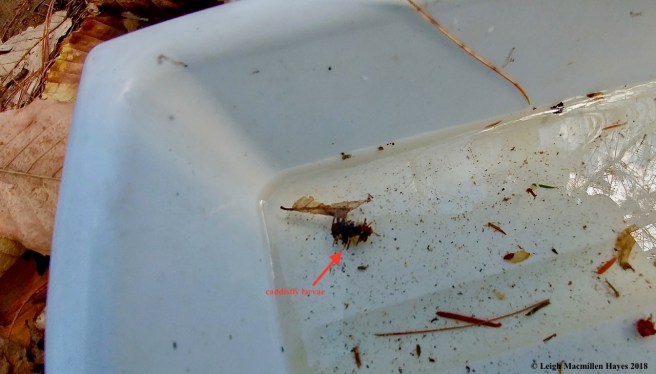
And added a caddisfly larva for we’d also captured one of those.

s14-female fairy shrimp

One of the cool things that Sharon pointed out, the brood pouch at the end of the abdomen, so indicating a female. How cool is that?

s15-caddisfly larvae

And here is our caddisfly, his casing created out of fallen hemlock needles. Caddisfly larvae that create their bodies from woody material are the log-cabin variety. We watched it move about in the tray, sometimes extending its soft body out of the case.

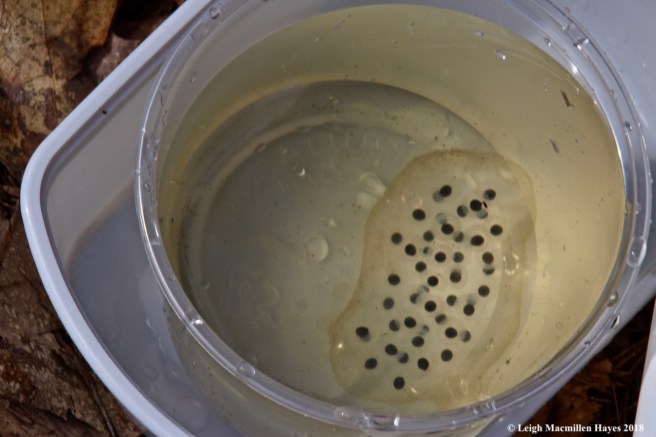
s17-spotted salamander egg mass

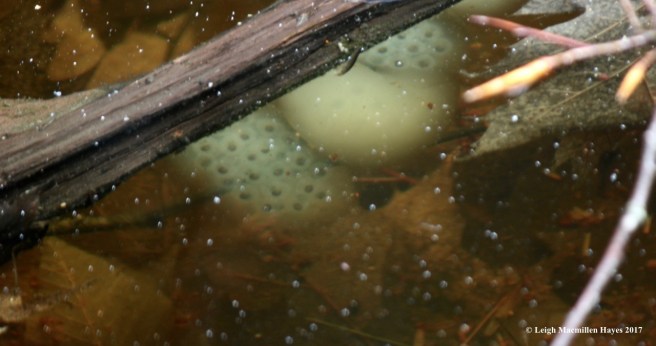
The dipping continued and a spotted salamander egg mass was pulled out, but only for us to take a closer look. And then it was returned from whence it came. Notice the individual eggs within the greater gelatinous matrix.

s18-egg mass

After that, Sharon found another reason to celebrate. She’d worn her waders and so was able to go deeper into the water than the rest of us.

s18-tadpoles

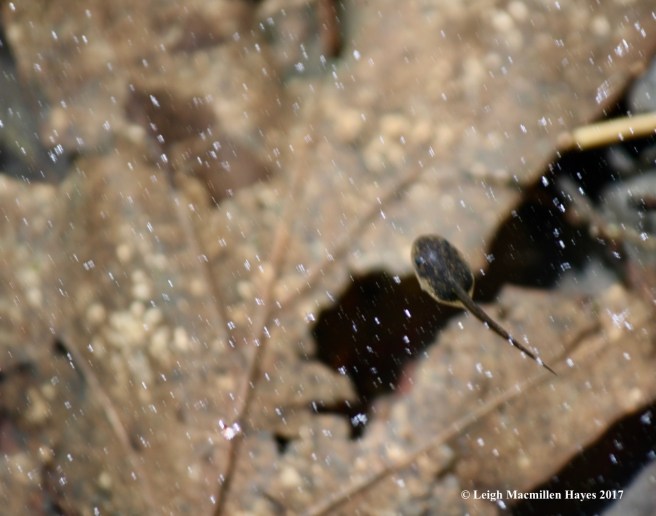
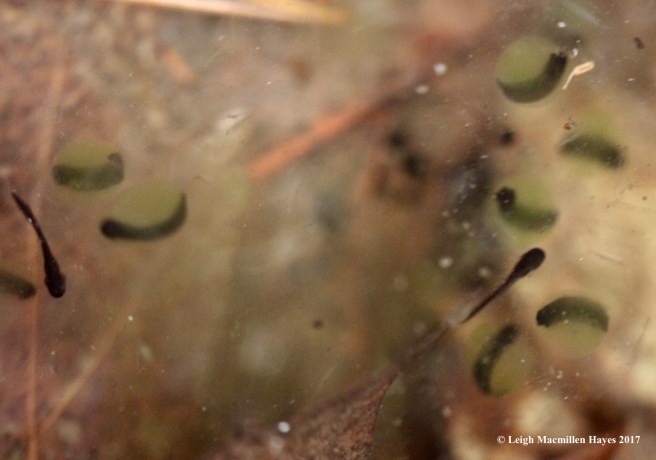
A quick dip and she’d pulled up an egg mass that almost melted as life burst forth–tadpoles. The first of the season for all of us.

s20-predacious diving beetle larvae

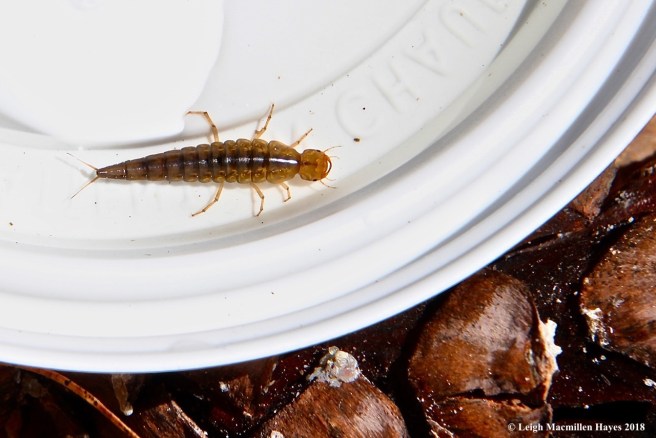
One last dip revealed one not so kind to all the other species we’d located. Known as a water tiger or toe biter, you can tell that it’s one mean little thing. This was the larval stage of a predacious diving beetle and the tadpoles had everything to fear for like its adult form it was a predator.

s23-Cinco Amigas

After that last find, it was time for us to pack up our gear and leave the pool behind. But, we took with us memories of a delightful spring morning spent exploring together. And . . . we had a chance to catch up, show each other field guides we thought might be of interest, share experiences of our volunteer opportunities, provide suggestions for ways to make a nature program work be it for kids or adults, and realize that we were not alone in any obstacles that may cause an issue during those programs.

What a naturally wonderful way to spend this Cinco de Mayo . .  . con cinco amigas. Thanks Gaby, Beth, Jen, Sharon and Pam.


Mayday Alert

Each time we explore a Greater Lovell Land Trust property, we have no idea what we might discover and this day was no different. For today’s Tuesday Tramp I suggested we visit the Cohen Property near the Lower Bay of Kezar Lake, which was the last acquisition under the direction of the late Tom Henderson. We’d only been there once before–and that was a few months ago when we explored via snowshoes. At that time we discovered ice-covered depressions and so a journey to check them out as vernal pools seemed apropos.

m2-moose print ID

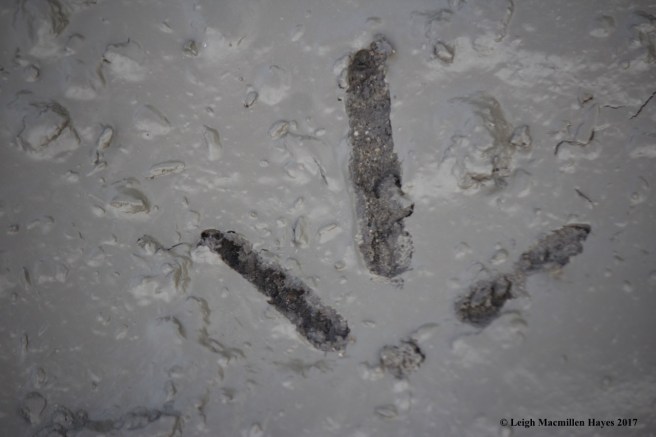
There are no trails yet and so after parking, we followed the road back a ways to the area of our winter expedition. And what to our wondering eyes did we spy on the road? Moose prints! One should always look through a magnifying glass to make certain the ID is correct. Wes confirmed our suspicion.

m2-scooping

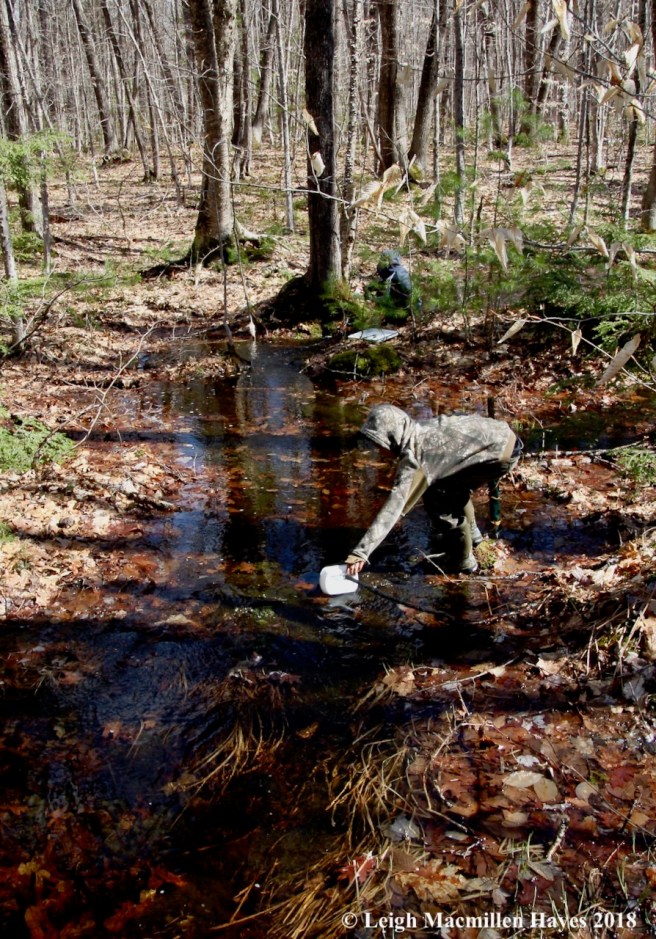
We found sitting water and running water and began to wonder about the wetland and whether what we thought might be a vernal pool really was, for we knew that a v.p. shouldn’t have an inlet or outlet. As the first dips of the day were made, black flies began to swarm around us. We hoped to pick up their larvae in the moving water, but instead we found many springtails.

m3-what did you catch

And a few mosquito larvae as determined by Caleb, Linda and Nancy.

m5-blob and algae

In another spot, we also found a mystery. At first we thought it might be some sort of egg. And maybe it was, but how was it related to the algae that seemed to be a host? We didn’t know, but now that we’re aware of it, we’ll continue to wonder and perhaps become enlightened.

m6-pool?

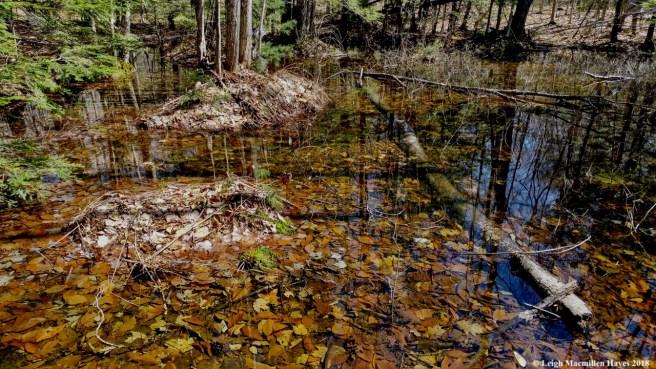
We checked out “pool” after “pool” and found not one egg mass (except for a false start that fooled us momentarily), which rather disappointed us. Were these really vernal pools? We suspected so as they were shallow and looked like they’ll dry up in the summer, if not before, plus they supported no fish. Were they significant vernal pools? Definitely not. To be a significant vernal pool, the body of water must contain one of the following obligate species: 1 fairy shrimp or 10 blue-spotted salamander egg masses or 20 spotted salamander egg masses (yellow spots) or 40 wood frog egg masses. Fairy Shrimp? No. Salamander egg masses? No. Frog egg masses? No.

m7-examining species

Despite the lack of indicator species, we scooped up water to determine what did live there.

m8-mosquito larvae

The most abundant residents found–mosquito larvae. And do you see the small jar in Ellie’s hand? She created a mosquito larvae aquarium and discovered that they seemed to like the algae she’d added. Perhaps they’d found microorganisms we couldn’t see.

m8a-pointing out antics of mosquito larvae

Watching the acrobatics of the larvae entertained us for a while. They twisted and turned somersaults and wriggled in the water and we soon realized that eggs left behind by last year’s females who had sucked our blood before breeding, must have remained dormant all winter until the snow melted and spring rains began.

m9-chironomid midge larva

We did find another species to admire, that also wriggled in a constant state of contortion–this one being a chironomid midge with blood-red coloration. According to A Field Guide to the animals of Vernal Pools, the color is “due to a hemoglobin-like pigment that helps them retain oxygen. This pigment allows the larvae to survive in water that is very low in dissolved oxygen, as is common in vernal pools as drying proceeds throughout the seasons.”

m10-Trailing Arbutus--May flower

Because I had to meet someone at noon, and Dave knew that it would take us at least a half hour to make the short trek back to our vehicles due to our incessant nature distraction disorder, we had to cut our journey short. Dave was right–as he often is–and we were forced to stop several time, including to sniff a couple of mayflowers, aka trailing arbutus or officially: Epigaea repens.

m11-ribbon snake 1

We finally reached the spot where we’d parked with fifteen minutes to spare when Linda sighted movement beside the tires of my truck and our hearts jumped with joy.

m12-ribbon snake captured

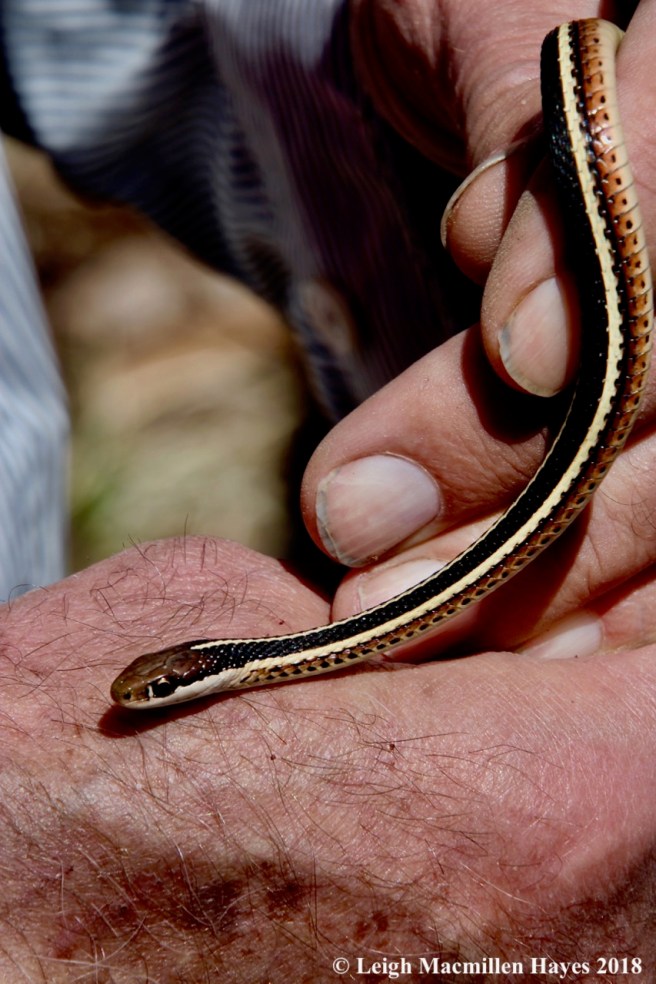
We didn’t want to run it over as we backed out and so Heinrich captured it. What is it? An Eastern ribbon snake, which is a species of special concern in Maine. According to the Maine Inland Fisheries and Wildlife website, “A species of special concern is any species of fish or wildlife that does not meet the criteria of an endangered or threatened species but is particularly vulnerable, and could easily become, an endangered, threatened, or extirpated species due to restricted distribution, low or declining numbers, specialized habitat needs or limits, or other factors. Special concern species are established by policy, not by regulation, and are used for planning and informational purposes; they do not have the legal weight of endangered and threatened species. The Maine Department of Inland Fisheries and Wildlife reviews the list of special concern species at the beginning of each calendar year, and, based on criteria in the Maine Endangered and Threatened Species Listing Handbook , revises the list as appropriate.”

m13-ribbon snake 2

And that is why it’s so important to protect the land. I knew Tom was smiling down upon us due to this find. Interestingly, we also spotted a ribbon snake at the John A. Segur Wildlife Refuge on Farrington Pond Road in early May 2015.

m14-paper birch superhero

Finally, we all departed and I was only ten minutes late for my quick meet-up, after which I headed back down Route 5 to reconnect with my favorite little naturalists at the Kezar River Reserve across from the Wicked Good Store. There’s a tape across the road, which I suspect was put in place by the local snowmobile club when the ice was questionable on the river, but it remains, which given the recent rain is probably a good thing. We’ll take it down soon, but it has prevented the road from becoming more rutted than normal.

Anyway, Wes climbed out of the family’s vehicle with his paper birch armor. He’d spied it in a V between to birch trees on our morning trek and his mom climbed up to retrieve it for him.

m15-brother bomb

Birch Man posed again and again, until his older brother Aidan, sporting a missing front tooth, jumped in front.

m16-root art

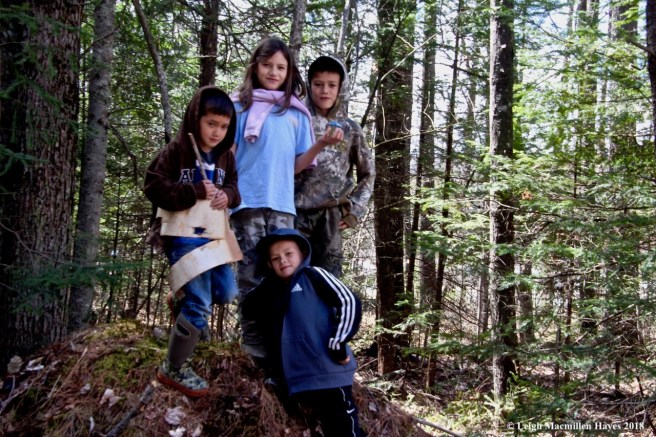
The boys stood on a hump of earth beside a tree root. And it was through their eyes that we noticed some interesting finds among the tree’s former life support.

m17-canister cover

We found pottery and cast iron and realized the tree had grown upon an old dump site.

m19-VW

And that hump of earth–the four siblings were sure that it hid a Volkswagen Beetle.

m23-Kezar River

It took us a while to walk down the “roadway” and then the left-hand loop. We made a few discoveries, including coyote scat filled with bones, and the kids did some trail work. At last we reached the canoe/kayak landing at the Kezar River and noted some otter scat and a few slides, plus some fishing lures and line stuck in the trees. It was at that point that the family had to leave, but before they left they asked me what I’d do before I had another meeting in the afternoon. I told them I planned to hike the second loop, which happens to be longer and dips into an interesting ravine.

m23-salamander eggs

That never happened. As it turned out, I stood at the boat launch for about an hour. First, I spied one small clump of salamander eggs.

m24-equisetum

And then realized that the raft before me, which filled the small cove, was equisetum. Where it came from I didn’t know for I couldn’t recall ever seeing it at this property.

m24-Mayfly 1

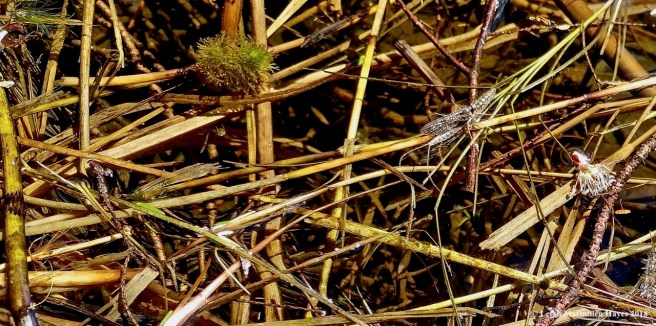
But, regardless, it provided a perfect camouflage for aquatic insects. It took me a while to key in on the species before me, but I knew they were there because every once in a while, one took flight. Do you see the mayfly subimago that had recently emerged? The teenager stood atop its nymph exuvia. Mayflies are unique in that after the nymph emerges from the water as the subimago (that fishermen call a dun), they seek shelter before shedding their skin for the final transformation.

m25-mayfly 2

I really had to focus in order to spot them.

m27-Mayfly

But once I did, they were . . .

m28-mayfly

everywhere.

m29-mayfly larva

And in all forms, including a nymph.

m30-Mayfly up close

The cool thing is that thirteen mayflies are also on the list of species of special concern. Was this one of the species? I have so much more to learn.

m31-water scorpion

As I continued to watch, there was an incredible amount of activity. And then I saw a predator that was about two and half inches long. Do you see it? Not atop the vegetation, but rather under it in right-hand center of the photo. Behind it, almost to the right edge of the photo, was a bubble at the end of its long breathing tube.

m33-water scorpion

As I watched, it continued to swim forward, the vegetation providing it’s favorite type of habitat. Again, you have to look carefully.

m34-water scorpoin

And again. It was a water scorpion with an oval-shaped abdomen. Do you see it?

m35-ribbon snake

Finally, it was time for my next meeting, but as I walked back up the trail I reflected upon the wonders of the day and the work of the land trust under Tom’s leadership. Creating corridors is important for mammals, but also for all critters that share the various habitats.

There was no need to put out a distress signal today. Indeed. With others and alone, I was thankful for the opportunity to be gifted with such sightings: Mayflowers and Mayflies! And a water scorpion. Topped off with a ribbon snake. May Day Alert of the best kind.


Sallie Savers Celebrate Big Night with LEA

The initial email was sent by Mary Jewett of Lakes Environmental Association in Bridgton, Maine, on Tuesday:

Hello everyone!

Many amphibians have already crossed and laid eggs but there are still some waiting in the woods. Tomorrow evening looks like it will be perfect conditions for an amphibian migration and I would like to get a group together to go out with me. My plan would be to meet at the office at 8pm. With sunset being at 7:40 I really wouldn’t want to start any earlier since the frogs and sallies won’t move when it’s light out.

I want to get an idea of who would be able to come out with me. I have a reporter and videographer coming out from the Bangor Daily News and they would like to get shots of actual people (not just me) and possibly get some quotes from participants. I know that it’s tough to get out with kids since it starts so late but I hope that we can get a diverse group. We also may have the opportunity to check out egg masses that are already in the water!

And then this afternoon, Mary sent this follow-up message:

I have heard from a handful of people who are able to come out tonight so I’m going for it. Here are some details:

Meet at the LEA office building (230 Main Street) at 8pm
We will caravan up to the Masonic Hall and walk to Dugway Road from there.
Bring high powered flashlights/headlamps
Wear warm clothes and rain gear. It looks like the rain may be pretty heavy when we are out there. Good for amphibians but not so great for people trying to stay dry.
Wear reflective clothing if you have some. I have vests available if you don’t have your own.
Do not wash your hands with soap or put on hand lotion or hand sanitizer.
I have spoken to the police and they are going to try and send someone out. They have a training program this evening so we might not see them. This makes it extra important that kids stay with their parents at all times!

b3-amphibian crossing sign

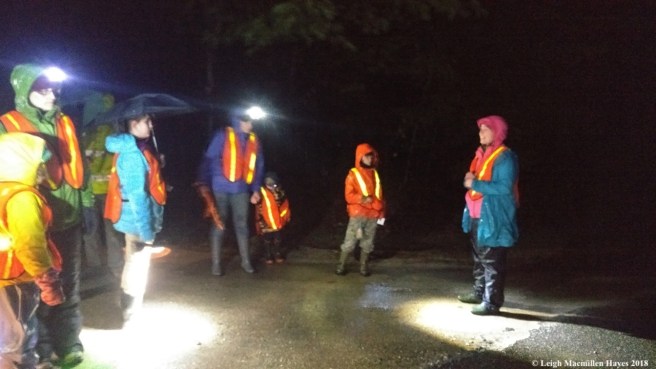
And so we did just that–met at the LEA office first, and then moved on to the Masonic Hall to park before beginning our journey into the wet and wild world of the amphibians.

b1-redbacked

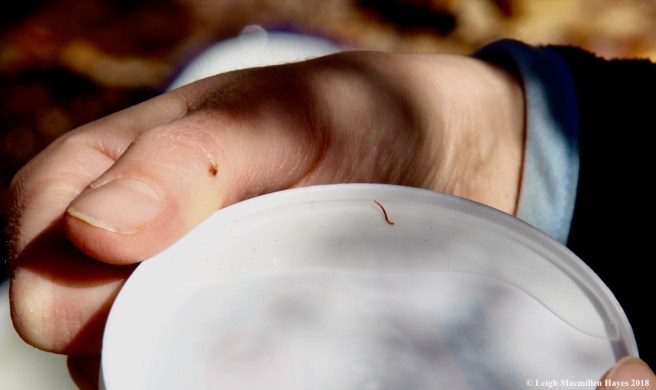
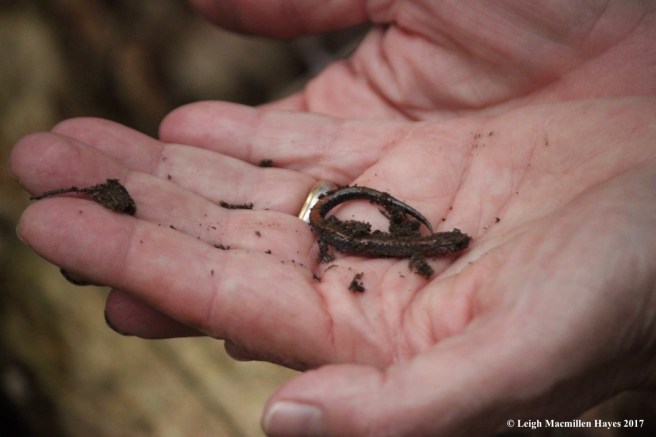
Right away, we noticed worms. And even better, a red-backed salamander. Red backs don’t use vernal pools to mate, but they sure do love rainy nights that offer great opportunities to roam about seeking food.

b2-red backed salamander

We crossed the field from the Hall to Memory Lane, our eyes ever looking for more redbacks, but instead we noted a kazillion worms, each the size of a young snake. And then, after only a few minutes on the road another redbacked graced us with its presence.

b4-Mary explains rules of the road

Finally, we reached Dugway Road, our destination, and Mary took a few minutes to remind folks of safety rules. Some years the Bridgton police are able to join us and either shut the road down or at least slow traffic. Such was not the case tonight and so it was important that our crowd of at least twenty ranging in age from four years old to 70+ be cautious.

b4-walking the road

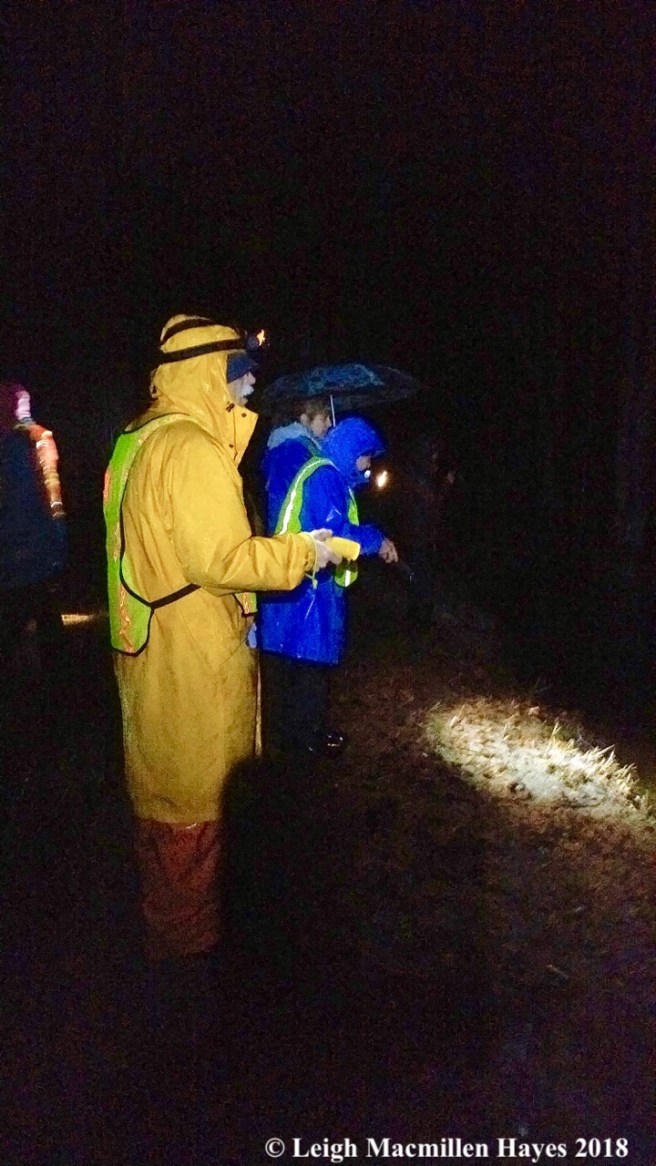
And then the real fun began. We spread out across the road with flashlights and headlamps, walking with care as we tried to notice the little things in life who chose this night to return to their natal pools in order to mate.

b6-spring peeper

Right away, the good times got rolling as we began to spot spring peepers. Really, it was those with eagle eyes who spotted the most, which wasn’t easy given the asphalt conditions. Though we knew better, we did have to wonder if the amphibians chose this road because it provided good camouflage.

b5-first catch- spring peeper

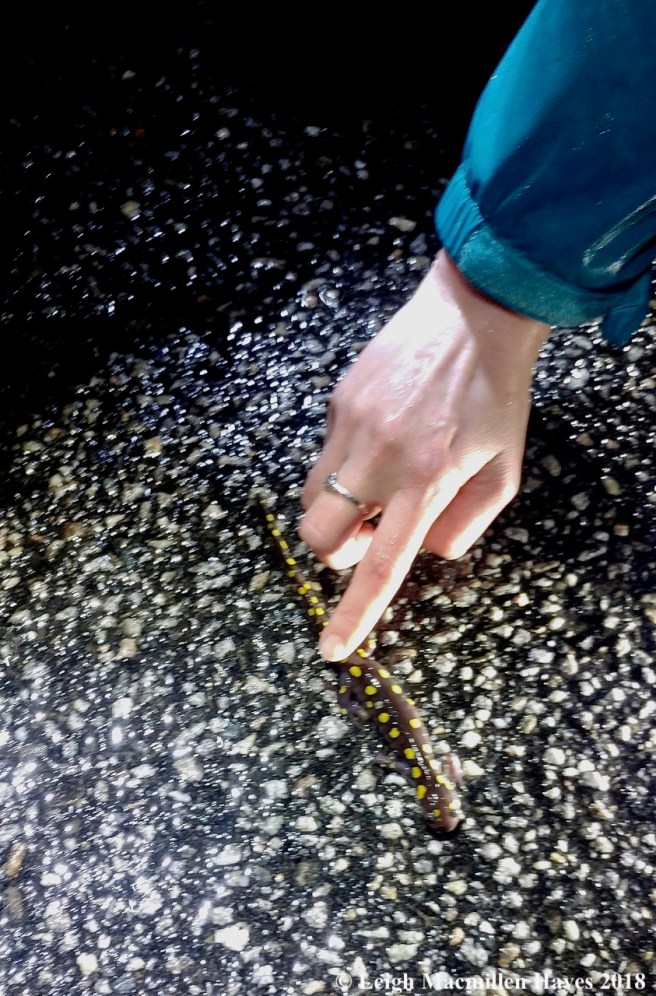
Being the first of the night, Mary demonstrated the fine art of capturing the peeper, explaining first that her hands were damp and had no soap or cream upon them.

Outstretched hands of one of the younger set awaited a transfer.

b5-pass off

The mission was to help the peeper get to the other side of the road. Typically, once captured, we transport them to the side in which they were headed.

b5-final pass off

The release was made into the youngster’s hands and then onward the child holding frog went. Lucky for the frog, there was a culvert at the side and that seemed like the safest place to release it.

b14-into the vernal pool

Further down the road, the songs of the wood frogs and peepers were almost deafening. As we looked into the vernal pool that was still half covered in ice, there was some movement, but the frogs all continued to sing despite our presence, unlike what happens when we approach a pool during the day and they dive under the leaf cover for a few minutes.

b7-spotted salamander

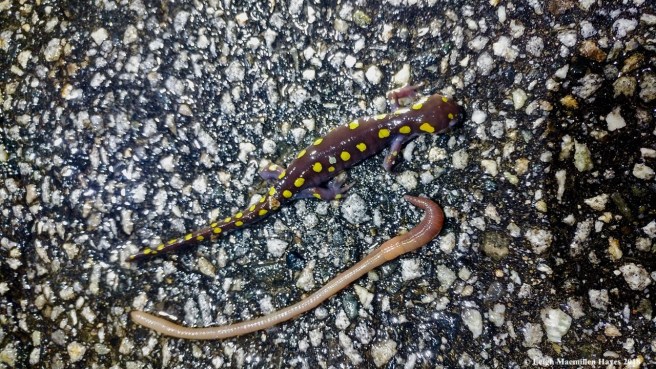
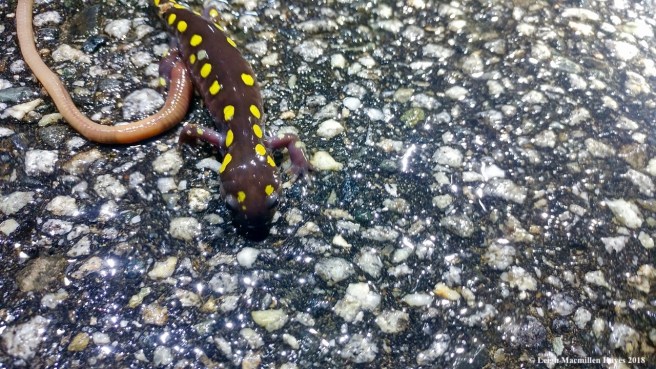
We found enough peepers, but the stars of the night were the spotted salamanders.

b8-sally and worm

The youngest among us picked up one of the ubiquitous worms that marked the night and laid it down beside a sallie.

b9-sally eyes

Sallie didn’t care. It was on a mission and just wanted to move on without our interference. There was only one thing on its mind and we suddenly stood between it and that goal.

b12-salamander

It had a dance to perform before the sun rose and we had a heck of a nerve for getting in the way. I’m always in awe of these creatures who spend at least 11.5 months under the leaf litter and maybe a week or two in the pool. Our rare chance to catch a glimpse of them is on such a rainy night as tonight.

b10-sally on card

Our intentions were in their favor. We only wanted to help save them from the vehicles that passed by.

b11-sally's world

In the end, though, I had to wonder–is this what the salamander’s world looked like as we scooped it up and helped it across.

Possibly, but still, it’s always a thrill for tots, tweens, teens, and all the rest of us to celebrate Big Night with the Lakes Environmental Association. We are the Sallie Savers.

Dear Earth

Dear Earth,

In your honor, I decided that on this Earth Day I would head out the back door and travel by foot, rather than vehicle.
e1-Mount Washington

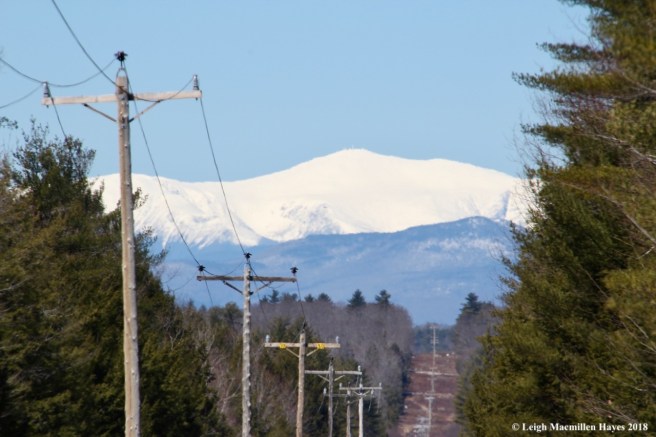
My journey led me down the old cow path to the power line right-of-way and much to my delightful surprise, Mount Washington was on display. It was so clear, that I could even see the outline of buildings and towers at the summit. Thank you for providing such clarity.
e2-vernal pool

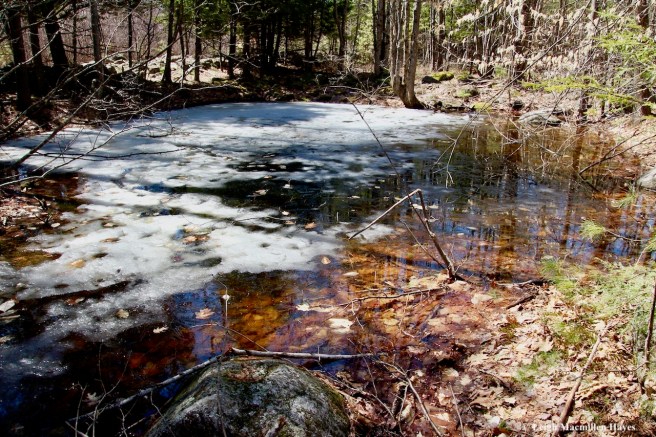
Rather than walk to the mountain, I turned in the opposite direction and found my way to the vernal pool, where ice still covered a good portion. You know, Earth, as much as I want this to be a significant vernal pool because it does usually have two qualifiers (and only needs one): more than forty wood frog egg masses or more than twenty spotted salamander egg masses, I know that it is not. I believe it was created as part of the farm based on the rocks at the far end, not exactly forming a retaining wall, but still situated so close together in a way that I haven’t found anywhere else in my extensive journeys of the hundreds of acres behind our house. Plus, it dries up much too quickly to be a natural pool. And each year I’m surprised to find wood frogs, their egg masses, spotted salamander spermatophores, and their egg masses, given that the water evaporates before the tadpoles finish forming. If these species return to their natal vernal pool, Earth, then how can that be since no one actually hopped or walked out as a recently matured adult? Or were these frogs on their way to another pool and they happened upon this one? You know me, Earth–lots of questions as I try to understand you better.

e4-dorsal amplexus

Whatever the answer is, each year you work your magic and on a visit yesterday afternoon, I spied a male wood frog atop a female in what’s known as amplexus, aka, mating. According to Maine Amphibians and Reptiles, edited by Malcolm L. Hunter, Aram J.K. Calhoun, and Mark McCollough, “When mating, the male clings tightly to the females back. Visible contractions of the female’s body signal the onset of oviposition, at which time the male’s hind feet are drawn up close to the female’s vent. As the eggs are expelled, the male releases sperm into the water and strokes the egg mass with his hind feet, which presumably aids in distributing the sperm more evenly.” I looked this morning, but didn’t find any sign of eggs. Don’t worry, Earth, I’ll keep looking because perhaps they were there but hadn’t absorbed water yet.
e5-dead frog

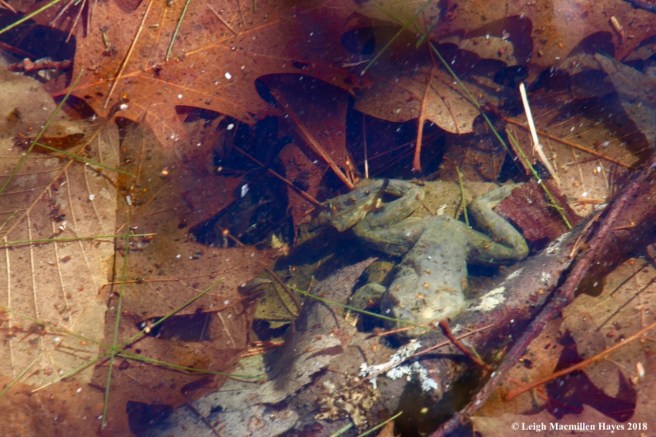
One other thing I saw yesterday that greatly disturbed me was a dead frog in the water. Last year I also found such. My concern is that it was caused by a virus, but perhaps it was old age. Or some other factor. I do have to confess, though, Earth, I intervened and removed the body from the pond. I know, I know, it’s all part of the cycle of life, and I should leave nature to its own devices, but disease was on my mind and I didn’t want others to be affected. I may have been too late. Only time will tell.

e7-leaf variety

When I arrived this morning, I’m happy to report that I didn’t see any dead frogs. For the longest time I stood upon a rock–you know the one I mean, Earth, for you’ve invited me to stand there before. It’s sunny in that spot and the frogs know it well, for that is where they’ll eventually deposit their eggs. As I waited, I looked down at the leaves on the pool’s bottom and noticed how they offered a reflection of the trees above, beech and oak and maple and pine and hemlock. All still displayed their winter colors, but when the pool does dry up, they’ll turn dark brown and form a mat that will provide nutrients for the plants that colonize the area. You’ve got a system, don’t you Earth.

e8-frog 1

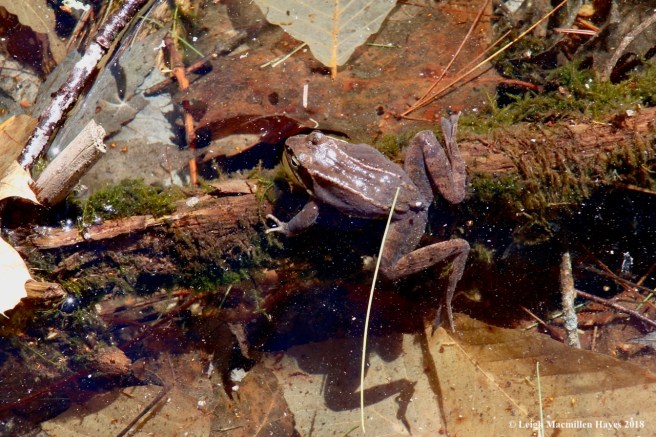
I knew if I stood as still as I could, I would be rewarded. While beech and oak leaves, the last to fall from their trees, danced somersaults across those already on the ground and matted by the past winter’s snow, red and gray squirrels chatted and squawked, and chickadees sold cheeseburgers in their songs, my eyes constantly scanned the pool. And in a flash, a frog emerged from under those leaves.
e8-wood frog 1a

For a while he floated, allowing the breeze to push him to and fro within a two square-foot space. But then he decided to climb atop a downed branch. Perhaps he was trying out a calling sight to use once I left.
e9a--wood frog 3

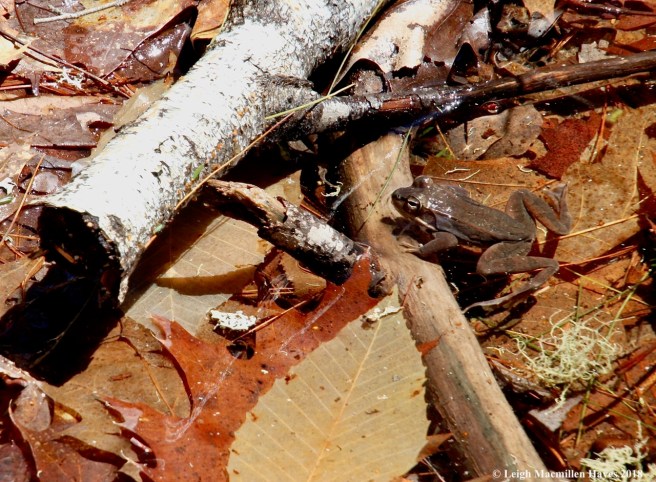
And then, there was another. And after that another. Yesterday I saw a total of six. Today only four. But that doesn’t mean the others weren’t hiding until I left, right Earth? I hope that’s what it meant. One thing you have taught me via the frogs is patience. If I stand still long enough at least one will swim to the surface. And they, too, are patient as they wait: for me to leave; for the gals to come. Well, maybe when the gals do come they aren’t all that patient.

e10-mosquito larvae

I actually returned to the pool a second time today and more of the ice had melted. While in the late morning I couldn’t see any insects on the move, in the early afternoon I eyed thousands of mosquito larvae. Everyone moans about mosquito larvae, Earth, but . . . they provide food for salamanders and the adult form for birds. I’m just trying to look on the bright side.
e11- snowmobile trail

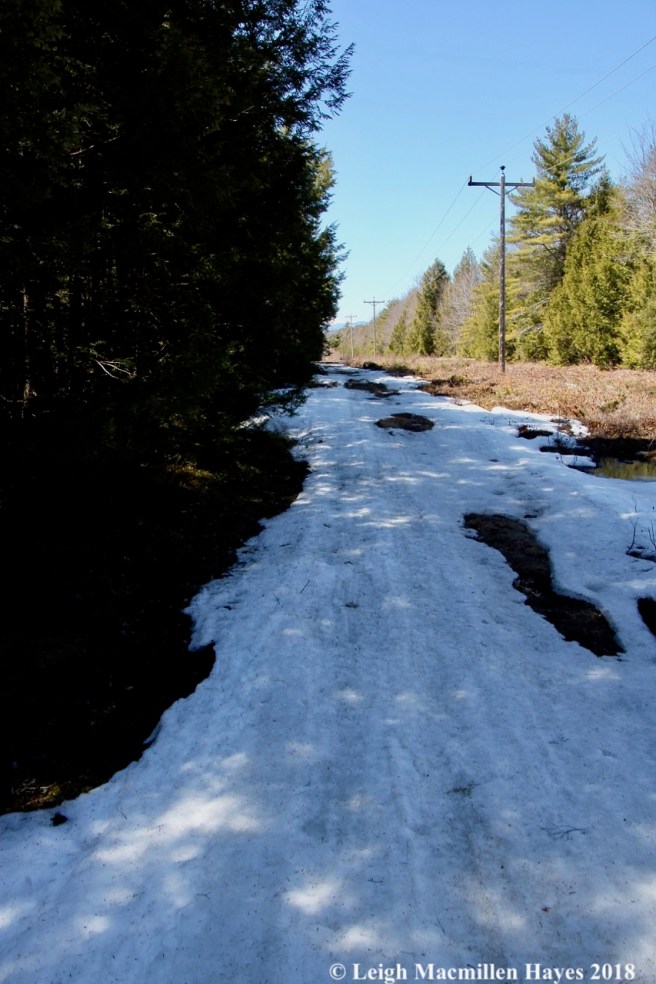
This afternoon, I waited and waited for the frogs to emerge, but either my eyes didn’t key in on them or they decided to wait until I left. So . . . I finally did just that, and did head toward Mount Washington after all, following the snowmobile trail. As you well know, Earth, it was a bit tricky between the snow, soft mud, ruts and rocks exploding from your earth.
e11a-boots

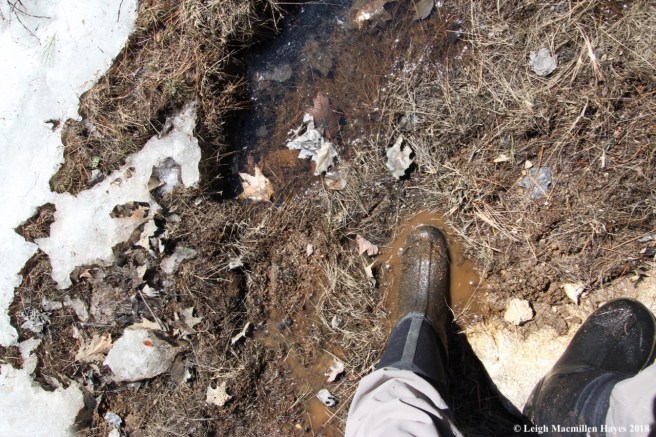
My right foot managed to fall through the icy snow into a hidden rut filled with water that covered my Bog boots. And then my left foot found some mud that squelched with glee. Or was that you squealing with delight, Earth? I had one wet sock, but ventured on.

e11b-Mansion Road

At the junction, I turned to the west, following the log road and remembering the days of yore when my guy and I, as well as neighbor Dick Bennett, used to work up a sweat on a winter day following a snow storm, for it was our duty to you, Earth, to release the snow from your arched gray birch trees. And then, a few years ago, the road became the main route to the timber landing/staging area again, and all of those trees we’d worked so hard to protect year after year were cut to make way for machinery. As much as my heart broke, it does give me time to watch forest succession in action, and I gave thanks that you have such a plan in mind.
e14-deer dance

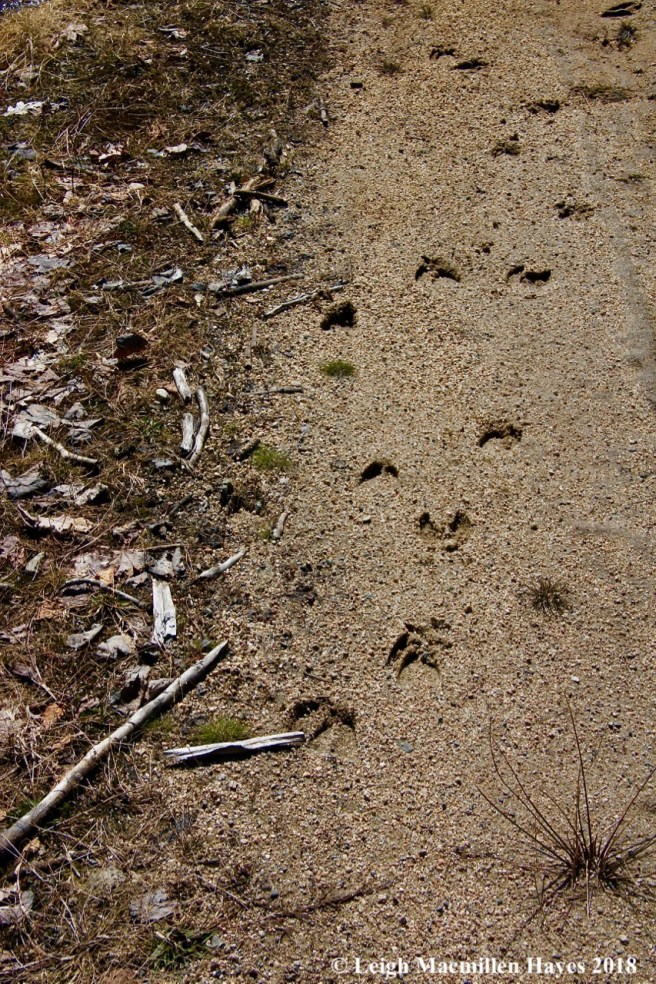
It also provided a blank stage upon which the does danced and left behind their calling cards.

e12-buck

And Buck sashayed each partner across the floor. The deep dew claw marks and cloven toes indicated he’d made quite an impression.
e11c-coyote scat

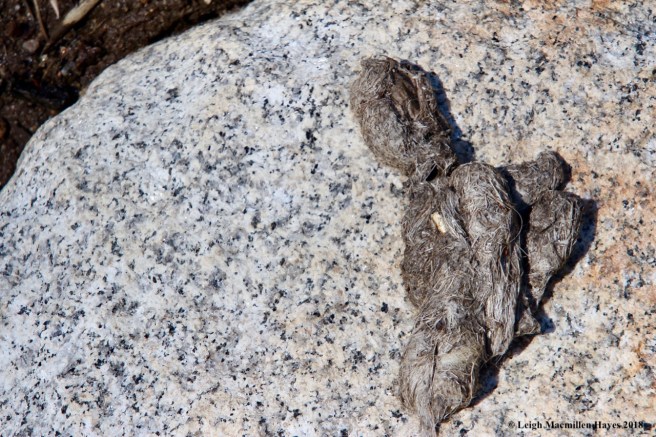
All along the way, upon raised rocks in the middle of the “road,” coyote and fox scat was prominent and in the sandy surface I also found their prints.

e18-vernal pool near landing

At the left-hand turn that led to the landing, I was surprised when I shouldn’t have been, for suddenly a million “wrucks” filled the air. I knew the water was there but it had slipped my mind. Thank you for the song of many more wood frogs. Thanks for filling my ears with joy.

e15-wood frog egg masses

And the chance to spy their good works. Thankfully, you make sure that life continues. At least in the form of wood frog egg masses.

e17-wood frog egg mass

I loved their gelatinous blob-like structure, all bumpy on the outside they were. Actually, I believe what looked like one mass, was several, but I didn’t dare step in to check and disturb the frogs that hid below.

e16-wood frog 5

Again I stood as still as possible, and again I was rewarded. For a bit I thought that the frog before me had no arms, but then I realized that they were just plastered to its sides.

e19-wood frog under log

A squirrel sounding bigger than itself caught my attention briefly and I turned unexpectedly. When I turned back, the frog was no longer at the water’s surface, but appeared below a downed gray birch. For a while the two of us remained still. I hoped another frog or two or three or three thousand would pop up, but that wasn’t your plan, was it? It’s okay. One was enough.

e21-log landing

I finally left my one, oops, I mean your one frog alone and continued on to the log landing, noting all the mammal tracks and looking for other signs. There was more scat, but I was disappointed not to find bobcat or moose prints. Where were you hiding them? I suspect the moose had moved to the swamp below.

Rather than go much further, for major ruts from the logging equipment were filled with water, I turned around just beyond the landing and headed back across it. Twenty-five years ago it was a much smaller clearing with a few pine trees. Over the years, I’ve watched it change and the mammal activity as well. And then, about five years ago it was converted back to a landing and I can’t wait for it to fill in again, but my desire and your plan are not necessarily the same, are they?

It all seemed like so much destruction, but I had to remind myself that I am part of the equation, with my own needs for power and wood and food and everything that you provide. And cuts do bring about a change, sometimes for the better, for the trees and the mammals and the birds and the plants and the decomposers and the consumers and all who call this place home. Am I convincing you, Earth? Am I convincing myself?

e22-frog 7

As I passed by the lengthy vernal pool again I decided to revisit the egg masses. I stood on the rock and slowly scanned the area. No frogs. On second glance, there was one right beside the rock on which I stood. And it looked like the same one I’d seen previously. I wondered why. Why didn’t I scare it? Was that you, Earth, taking a peek at me?
e23-Mourning Cloak butterfly

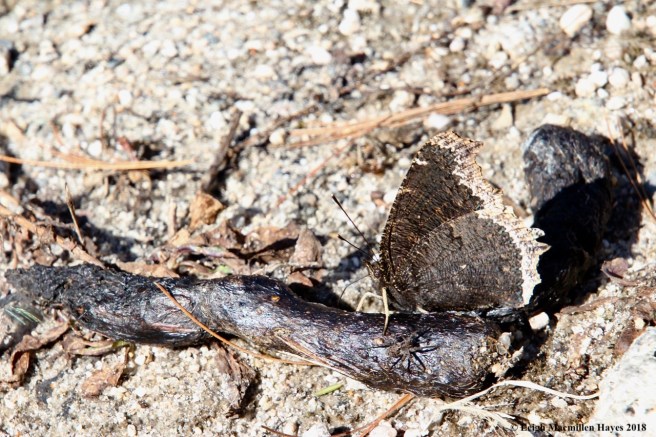
I had one more surprise on my journey–the first butterfly of the season, a mourning cloak. With its wings closed, it wasn’t all that attractive.

e24-mourning cloak

But upon opening them, I saw its beauty hidden within–another lesson, eh Earth? Oh, and your sense of humor. For yes, that was coyote scat on which the butterfly sucked as it sought amino acids and other nutrients. A fly also dined. Yum.

What a day, Earth. Your day. Dear Earth Day. May I remember to treat you so dearly every day.

Sincerely,

wondermyway


Craning My Neck

I’ve spent a lot of time thinking about living in the moment lately, a concept that really drove itself home during the years that my mother dealt with dementia and I was forced to realize that each time I left the room, my return was a new visit; a new adventure. And now, so many friends are dealing with issues that make every second precious and I realize once again the importance of slowing down and noticing and making the most of being present. Now.

f1

Such was the case this afternoon when I joined two friends who had pulled in from their winter home in Florida this week. We met at one of the parking lots for the Mountain Division Trail in Fryeburg, Maine, a rail trail that makes one feel like you could walk to the White Mountains in a matter of miles. But, to get back to the moment, the original plan had been to travel the trail with two different friends and then one had to back out and I found out that the Florida friends had returned and so I invited them to join the other and me, and then my other friend had to back out and so it was the Florida duo and me. And it was so fabulous to spend time with them that we walked rather quickly, which completely surprised me when I thought about it for I know that they love a slow journey. But we had much to catch up on and because the trail is paved we didn’t have to think about foot placement and perhaps that’s what spurred us on.

f2-tamarack 1

At last, however, it was spurs that stopped us, for one of them spied a branch with upward facing cones and little spurs and she wondered what it was. The cones certainly looked like hemlock cones. But why were they upright? And what happened to the needles? When I explained that it was a tamarack, she again questioned it for she’s always been here in the autumn when the needles are a brilliant yellow and she thought those needles stayed on all winter. Not so, I explained, for a tamarack (larch, hackmatack–take your pick of common names) is our only deciduous conifer in northern New England. The golden needles fall the same as maple leaves.

f11-pussy willows

We also put on the brakes when she spied pussy willows–a sure sign of spring in their Zen-like presentation.

f20

Onward we marched, catching up on past months. But then, as the day would have it, first he had to turn around and head back to the parking lot and then a short time later she had to do the same. And that got me thinking about how the walk had evolved. I was sorry that the two I had originally planned to share the trail with couldn’t join me, but equally thankful for the two with whom I did travel. Living in the moment means embracing a change in direction.

f3-evening primrose basal rosette

The rail trail is four miles long in one direction and I turned around at the 2.5 mile marker. On my return, I was entirely surprised by the offerings that had escaped my attention previously, like the beauty of an Evening Primrose’s basal rosette.

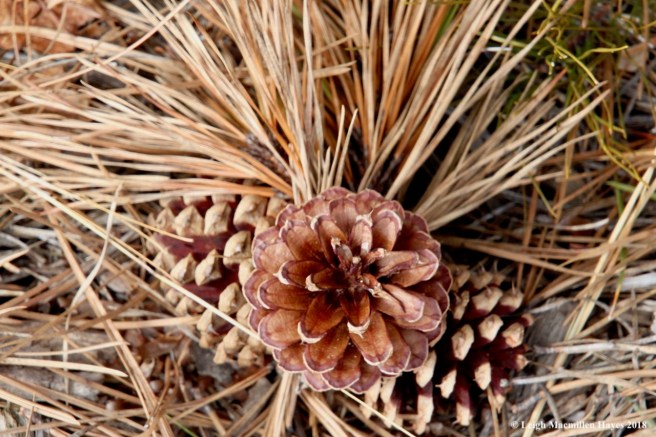
f4-pitch pine cone

It’s fractal fashion was reflected in the pitch pine cones I spotted on the ground and surrounding trees.

f5-pitch again

The pitch pines always draw my fancy and I was especially intrigued by the past, present and future–as I tried to live in the moment. It’s not as easy as it sounds for we so often get caught up in what was or what could be.

f8-red oak

The past produced fruits long since deployed.

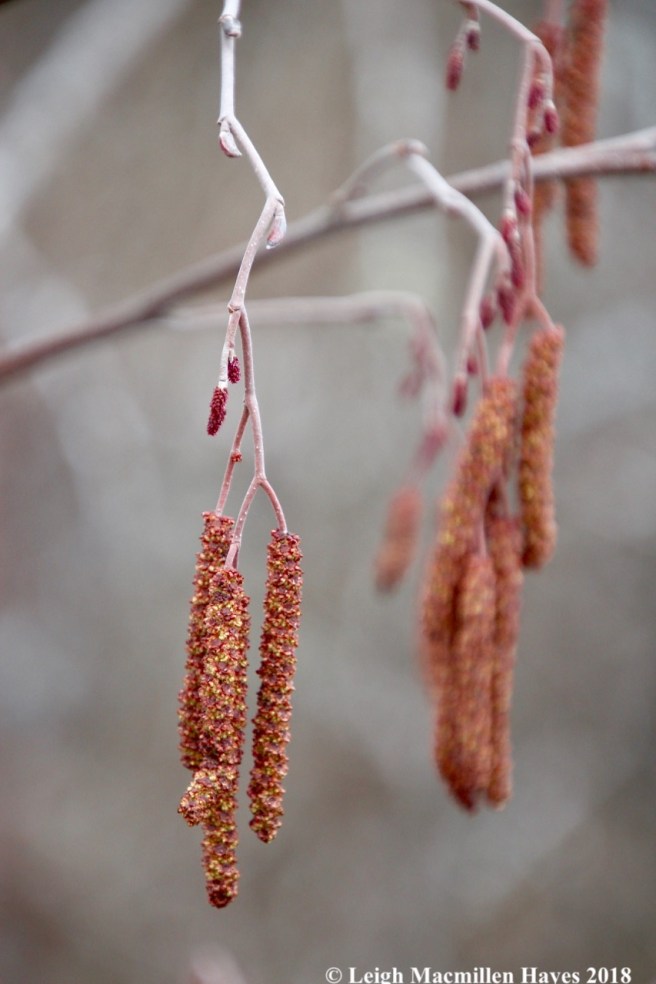
f10-speckled alder catkins

The future grew longer before pollinating the shorter.

f7-trailing arbutus in bloom

But in the moment–I spied the first blossoms of Trailing Arbutus.

f9-spotted salamander spermatophores

My return journey was much slower than the first leg, for there was so much to see. Included in the expedition was an examination of a small vernal pool. And what to my wondering eyes did I see? Spotted salamander spermatophores–those little chunks of sperm left behind by males atop cauliflower-shaped platforms.

f14-wood frogs quaking

As if that wasn’t enough, further on I heard a familiar quack and knew wood frogs were active though I couldn’t see them.

f15-wetland

And still further I discovered a wetland I’d never noticed before. Spring peepers sang from the far edges. It was all a surprise for on the walk out I’d told my friends from Florida that I hadn’t seen or heard any vernal pool action yet.

f15a--chipmunk

I just need to spend more time listening and waiting and letting it all play out before me, the same as the chipmunk that was sure I couldn’t see him.

f16-Canada geese

After a three-hour journey, I found my way back to the truck and then decided to take some back roads home. As I passed through farmland where cornfields are prolific, I noticed movement. I so wanted the movement to be another bird, but it was a huge flock of Canada Geese that attracted my attention. Again, I had to live in the moment and enjoy what was before me.

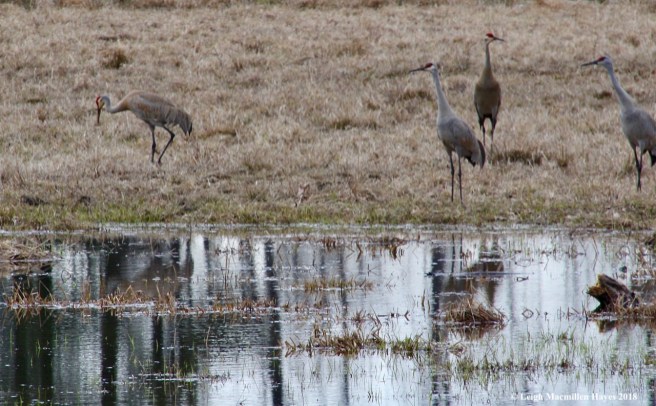
f17-sandhill cranes

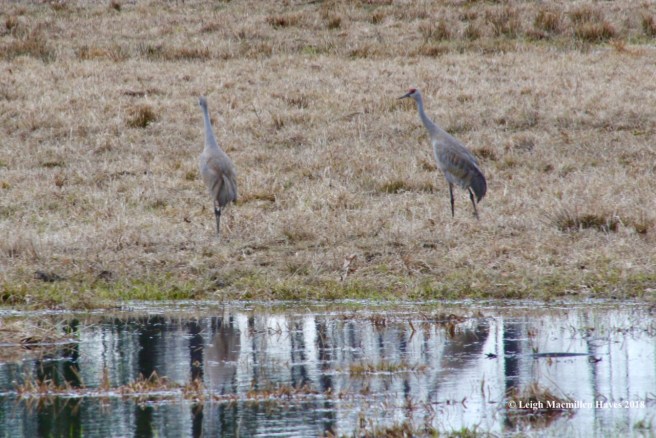
And then I turned into the harbor, and was pleasantly surprised for suddenly my eyes cued in on those I sought who stood tall.

f17a--sandhil cranes

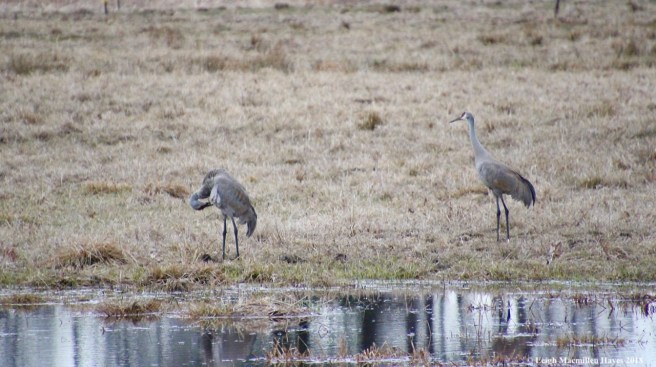
And preened.

f18-sandhill cranes

And craned their necks. Sandhill Cranes. In Fryeburg, Maine. They have returned to the harbor for at least  the past five years, probably more and I’ve had the privilege to hear them fly over several times, but today was the first time I was honored to see them. Thank you, Parker, for the tip.

I craned my neck and gave thanks for the moments spent in their presence and lifted up several people who will benefit from a dose of this medicine–Tom, Jinny Mae and Lifeguard Wendy: this one is for the three of you.


Book of April: Take a Wetlands Walk

Those of you who have followed me on the trail or through wondermyway for a while know that I’m not only drawn to mountaintops, but wetlands as well. And I have a few that I frequent including several vernal pools, Holt Pond Preserve, Perky’s Path, and Brownfield Bog.
w1

Book of April

Therefore, when I spotted Take a Wetlands Walk by Jane Kirkland at Maine Audubon’s Nature Store a few years ago I wasn’t surprised that it jumped into my hands and dragged me to the checkout. Since it’s April and the snow is slowly melting in western Maine, and some afternoon in the near future I look forward to receiving an email announcing our local Big Night celebration, it seemed apropos that I should feature Take a Wetlands Walk as the book of the month.

w-Holt P 2

Holt Pond boardwalk

This is a children’s book and I like how the author divided it into three sections, using a phrase often heard at the starting line.

Get Ready–encourages kids to gain a better understanding of wetland terminology in an easy to understand manner. In fact, it’s as if the author is sitting beside you, so conversational is the tone.

w-fairy shrimp

Fairy Shrimp

w-tadpoles

Tadpoles

w-wood frog

Wood Frog

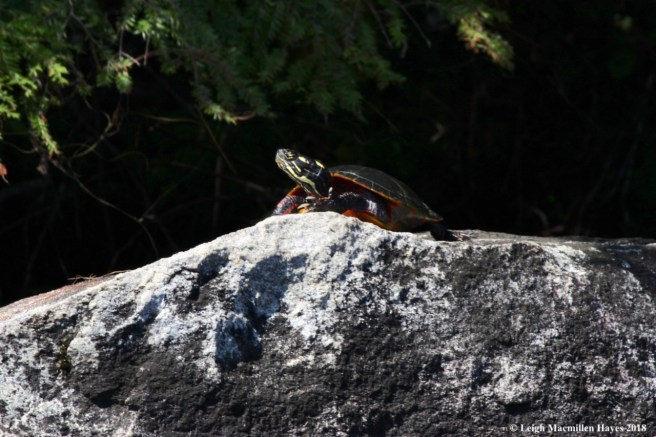
w-painted turtle

Painted Turtle

w-water snake 1

Water Snake

w-water snake 2

Water Snake (notice his tongue)

Get Set–introduces amphibian and reptile species associated with wetlands.

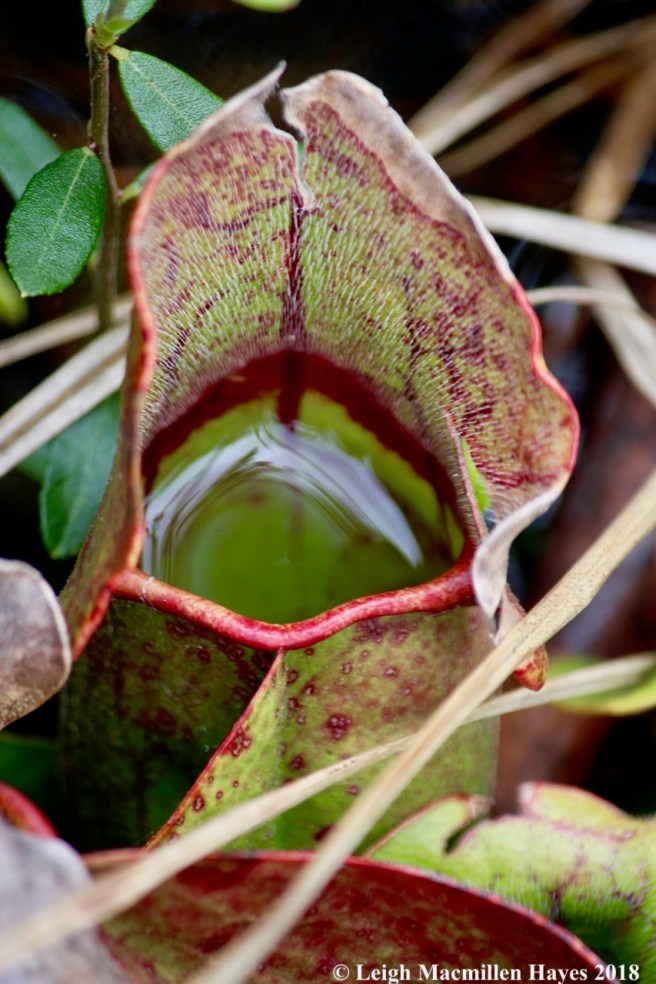
w-pitcher plant

Pitcher Plant

Go!--sends the children outside to read the signs of nature and jot down their observations.

w-Holt Pond quaking bog

Quaking Bog at Holt Pond

In the Go! section, Kirkland describes what the kids might discover in such places as bogs, estuaries, salt marshes, freshwater marshes, streams, rivers, lakes, vernal pools, swamps, and the Everglades.

w-Red-winged Blackbird

Through sidebars, illustrations, and photographs, Kirkland touches on many topics related to wetlands, but constantly encourages further research, including of course, heading out the door. She also includes a wee bit of information about citizen science projects and wetland careers.

w-pileated woodpecker

Pileated Woodpecker

Each time she first uses a technical term, she adds a pronunciation key. One of my favorites: The Pileated Woodpecker (Py-lee-ata-id or PILL-e-ate-id). I prefer the latter, but occasionally hear the former uttered. “You like to-may-toes and I like to-mah-toes!”–Although in that sense, I prefer the former tomaytoes.

w-spotted sallie 2

Spotted Salamander

Throughout, Kirkland shares personal experiences as well as those of her acquaintances. Finally, she includes pages filled with photos to help you identify birds, plants, reptiles, amphibians, mammals and insects related to wetlands.

w-pond dipping

Pond Dipping

Yes, this is a children’s book, but adults can also benefit from reading it. And then heading outside.

Get Ready, Get Set, Go! Pick up a copy of Take A Wetlands Walk and visit your nearest wetland.

Take a Wetlands Walk by Jane Kirkland, Stillwater Publishing, 2011

I Spy, You Spy, We All Spy

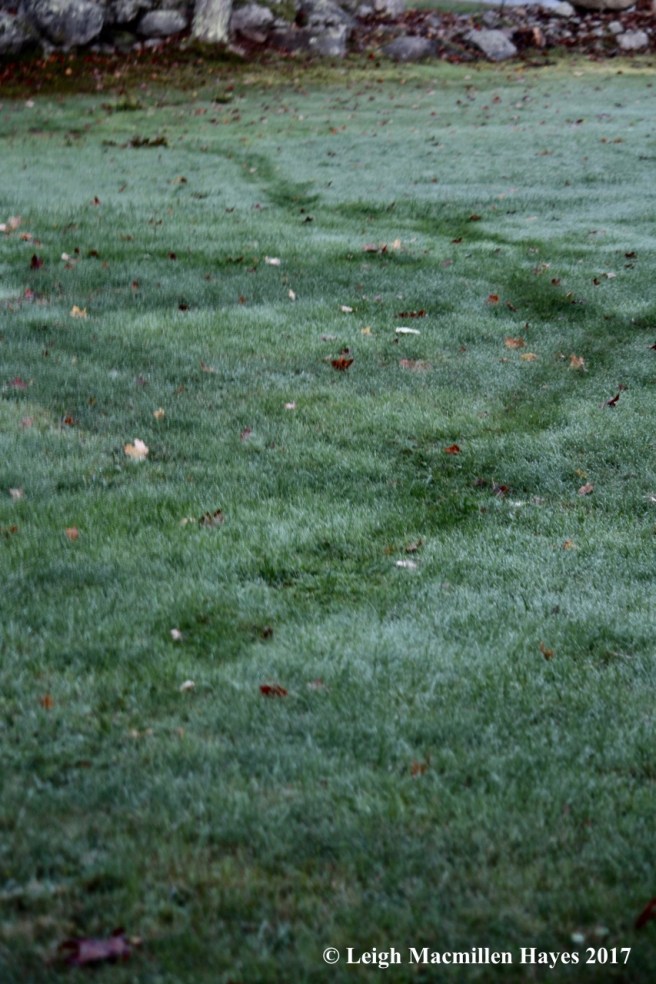
As I stepped out the door early this morning to dump yesterday’s coffee grounds, my eyes were immediately drawn to a pattern in the dew and I knew that Porky had paid us a visit.

t-porcupine trail in morning dew

His trademark sashay showed in the wet grass almost as well as it does in snow with that pigeon-toed pattern and swish of a tail. Only yesterday I’d been noting all the freshly nipped oak branches in our yard and woodlot, cut as they were at that telltale 45˚ angle.

t-flat hill sign--oxymoron

And then, after today’s coffee (grounds waiting until tomorrow to be disposed) and breakfast, I drove to Lovell to meet up with some Greater Lovell Land Trust docents for a climb up Flat Hill–that oxymoron of a name. But really, the summit is rather flat–after climbing the hill, of course.

t-trail light

It was early and felt more fall-like than we’ve experienced of late and we reveled in the temperature as well as the light along the trail as the sun played with the leaves and added a golden glow to our day.

t-coyote scat 1

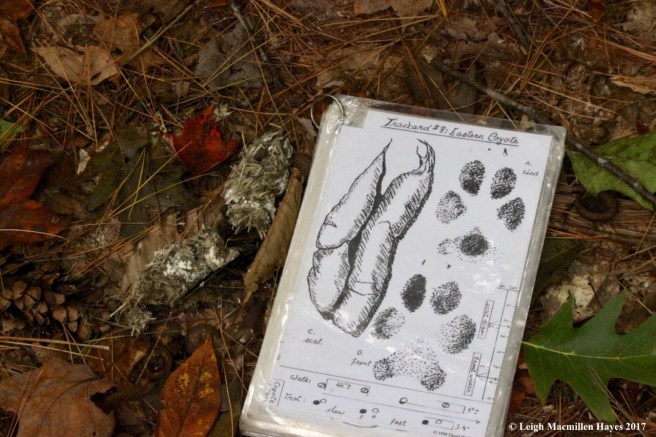
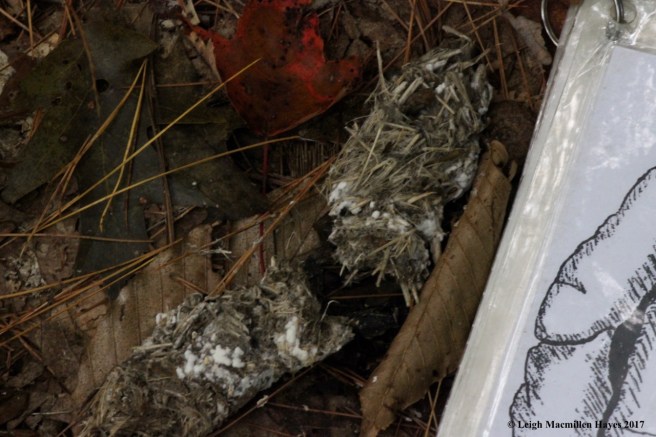
When we weren’t looking up, we looked down. One of our first sights–scat! Coyote scat, we thought. Only the contents of this scat were different than most.

t-coyote scat 2

And so we went in for a closer look–for it was filled with quills. Not my home porky, but we know that the summit and rocky ledge below are porcupine territory so it made perfect sense that we found such scat in the middle of the trail.

t-fox scat

We found more scat a little further along–this one was filled with berries and seeds and also in the middle of the trail, atop a rock. Smaller in size, we suspected red fox.

t-paper birch lenticels

There were other things than scat to attract our attention, like the long lenticels on a downed paper birch–their pattern looking like either zippers on a jacket or a bunch of spruce trees in their spire formation.

t-maple-leaf viburnum

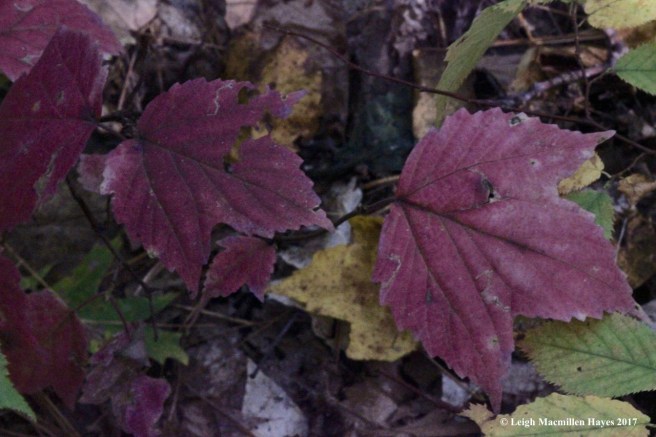
We marveled at the color and texture of the maple-leaf viburnums–like no other in the mix.

t-hop hornbeam bark and leaf

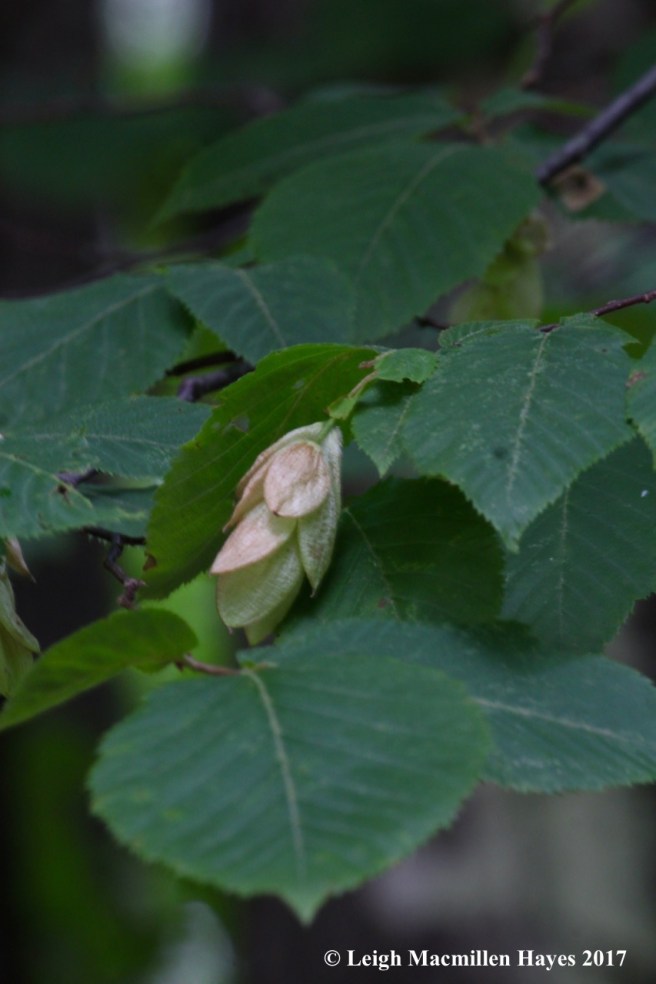
And when we reached the hop hornbeams with their shaggy bark and double-toothed leaves, we knew to look below for their seed pods. It wasn’t an easy search for they are small and blend in well with the birch and hornbeam leaves on the ground.

t-hop seed 2

But we found one–its papery sack enclosing the nutlet. We were curious to see the seed and so opened the inflated casing. It was almost a 3D tear-drop shape, coming to a sharp point.

t-hops

Skipping ahead for a moment, after we finished hiking I visited a tree back near the parking lot where Pam and I had noted plentiful fruits in the summer. It takes about twenty-five years for a hop hornbeam to fruit. And the common name–“hop” refers to the seed clusters that represent true hops used in beer production.

t-summit view 1

At last we reached the summit and stood for a while, in awe of the color display before us.

t-polypody 1a

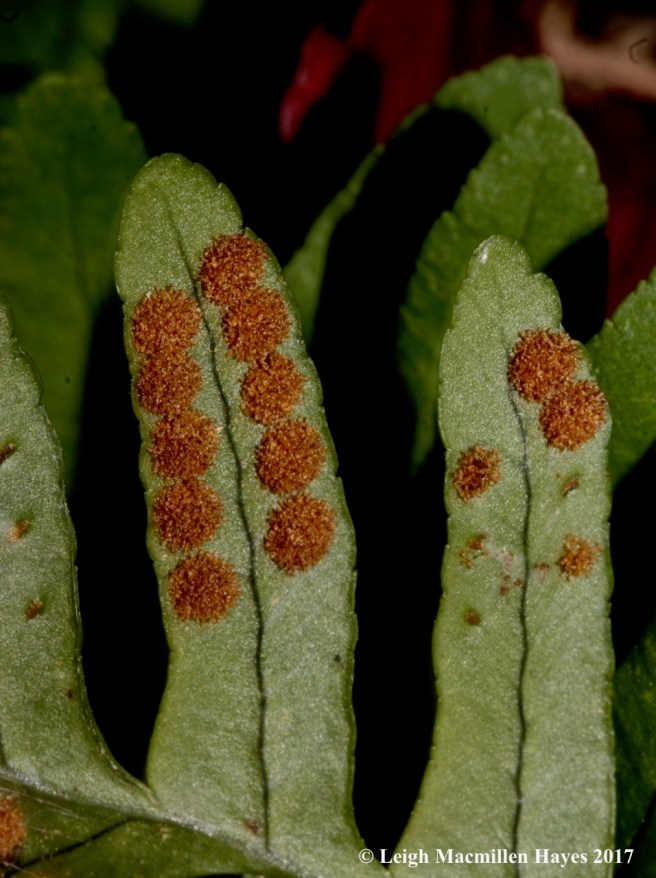
From the same spot, we also noted the polypody ferns that grow upon the summit rock.

t-polypody spores 2

Ferns reproduce by spores rather than seeds. The itty bitty spores (think dust sized), called sporangia, grew on the underside of these leathery frond leaflets. The sporangia form clusters called sori and in the case of polypody the sori are naked. Some had already dispersed.

t-chipmunk

At last we started down, but not without a side trip of bushwhacking and annoying a chipmunk who had some housekeeping details to attend to.

t-docents 1

Less than three hours later (amazing for us), we gathered at the bottom and said our goodbyes to Darbee and David on the left–they’ll return to their winter home soon. Bob and Pam will hang with us for a bit longer, but while I reflected on all the wonderful reasons to enjoy winter in Lovell, the two couples made plans to connect in their winter habitat.

t-wooden spoon

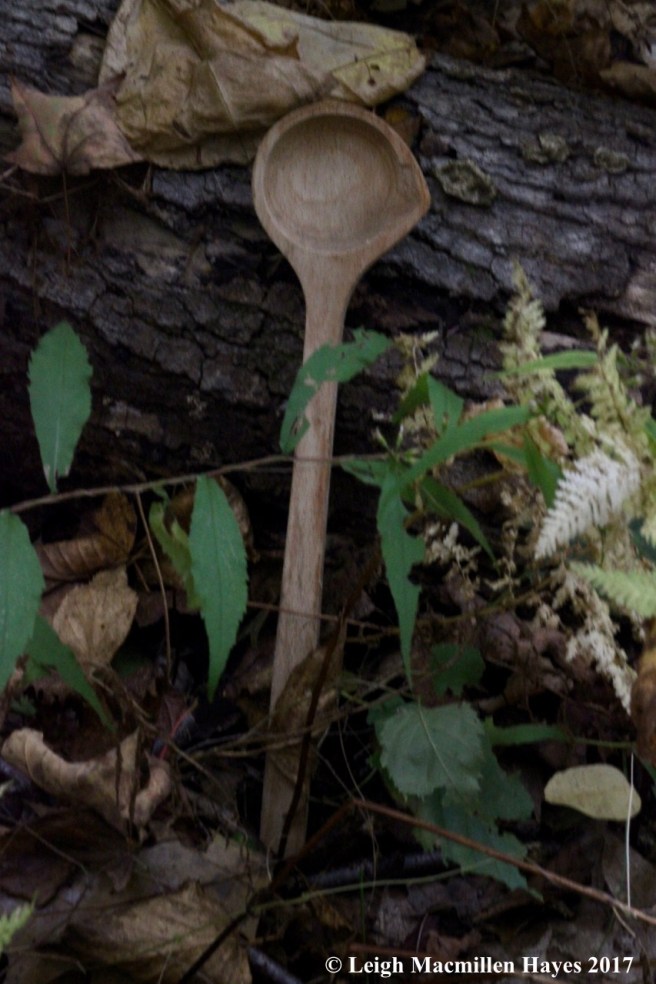
The day wasn’t over yet and this afternoon another docent and I set up a “Kim’s game” of natural and unnatural items on a sheet covered with a bandana on the trail behind the New Suncook School. Then we walked further along the trail and hid a bunch of unnatural items for our after-school Trailblazers to locate. (We had to relocate them as well and are almost certain we found all of them. Maybe . . . )

t-noticing leaf colors

Before the kids did anything though, they introduced Linda to their trees–clusters of trees really for all are copiced, that they’ve befriended and named and gotten to know up close and personal. This afternoon, they noted that the colors of the leaves were changing.

t-Linda and Sassy

They loved giving Linda a tour and she loved being part of the action.

t-alligators in the woods

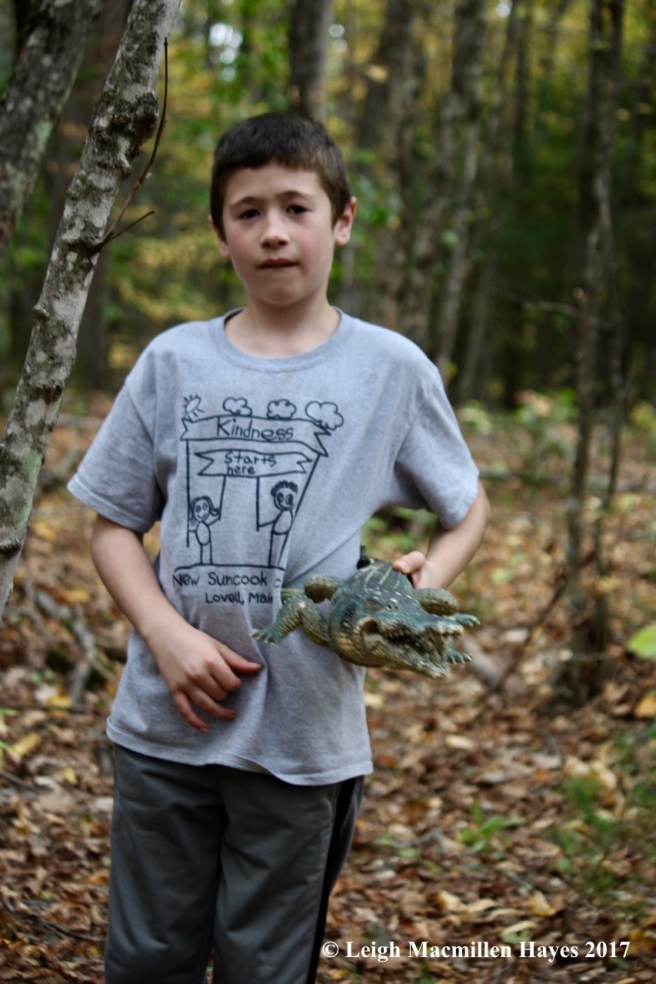
The kids did an excellent job with their observation skills, including locating at least one species that didn’t quite belong in these woods.

t-fallen log 1

And then we started gently rolling over fallen limbs, curious about what we might find below.

t-red-backed salamander

And what to our wondering eyes should appear? A red-backed salamander under the first one. We rolled a few more and didn’t find much. But then we heard something and stood still as we listened. Finally, it called again and we called back–a barred owl was somewhere nearby. At last it was time for the kids to head home and as we walked out of the woods to meet their parents, we stopped to roll one more log–where we found a yellow-spotted salamander. Unfortunately, in our excitement, I couldn’t take a decent photo, but still . . . we were thrilled.

What a perfect day–of I spy, you spy, we all spy. Indeed we did.


A Circle Completed

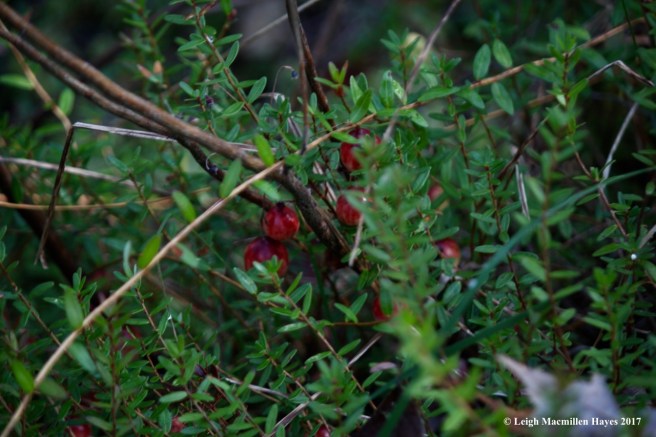
The day began with a reconnaissance mission to the Kezar Outlet Fen and a check on the cranberry crop. One of the most delightful ways to spend an early October morning is foraging for those little red balls of tartness and while my guy may have blue greed in his  need to pick every blueberry in sight, my greed turns red this time of year.

f2-winterberries

Of course, on the way to the fen, other red berries showed their shiny faces–and we rejoiced in their presence as well. Winterberries were they.
f4-cranberries 1

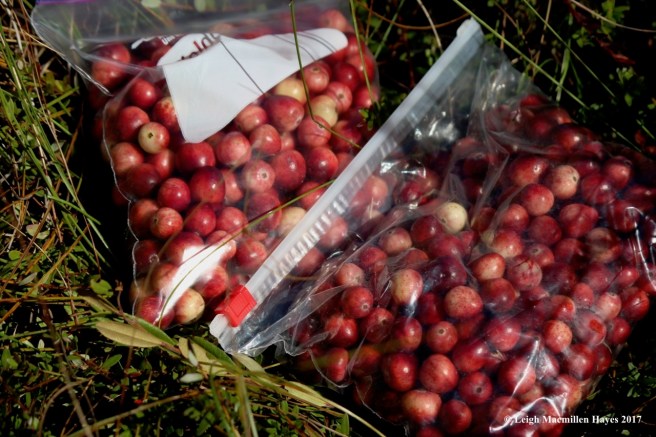
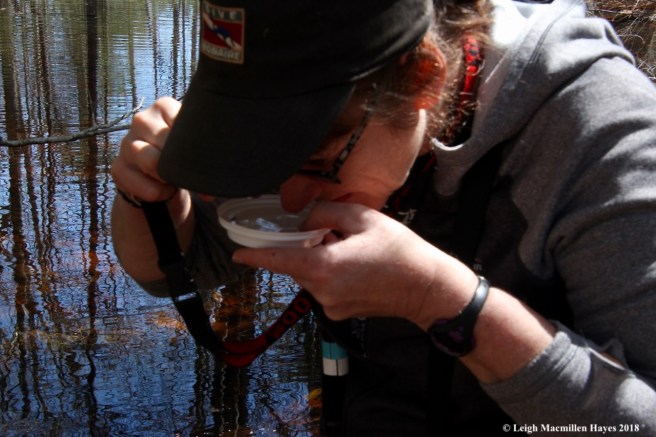
But it was those little gems that grew closer to the ground that caught our attention on this morning’s Greater Lovell Land Trust docent tramp. And like those who have come before, we each claimed a spot and made sure not to trespass in our quest to fill our bags with such redness.

f6-cranberries

It didn’t take long. And really, there is no better way to spend the morning . . .
f3-kettle hole

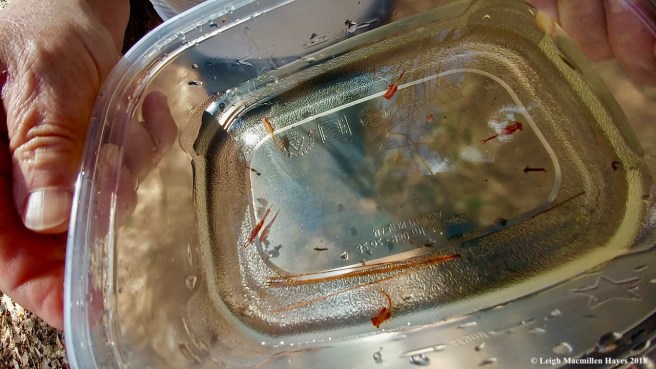
for this is a place to share the joy of foraging, the beauty of place, and the conversation of friendships.

m1-abandoned lodge 1

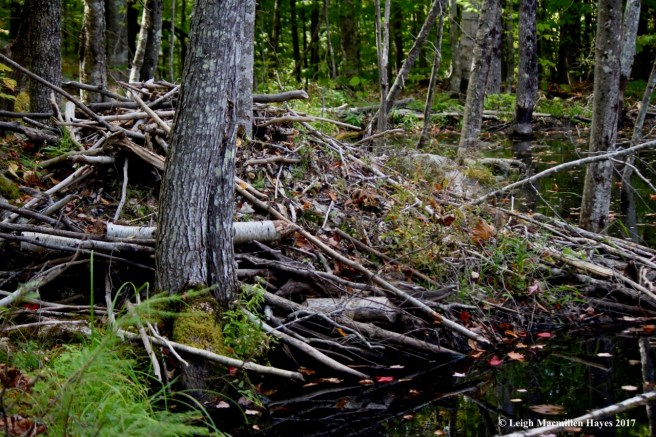
And then one friend and I returned to the beaver quest I’ve been pursuing for the past two weeks. It was another reconnaissance mission intended to find some new activity. Today, we traveled a different trail and visited an old lodge–again several years abandoned.

m3-anthill

Though no one was home at the stick lodge, we did find a few inhabitants of a nearby sand lodge, aka ant hill. And Forester Dave, with whom I was traveling, pointed out that the sweet and bracken ferns circled the spot, but didn’t grow within at least a foot of the hill. His theory is that the ants chemically affect the ferns. That was new to me and one to observe in other places.

m4-side lodge

We continued on our way and eventually came to another beaver pond that seemed equally abandoned. The lodge was built along a side bank, but no new construction had taken place recently. Nor was there a display of food gathering in preparation for winter.
m5-watercress

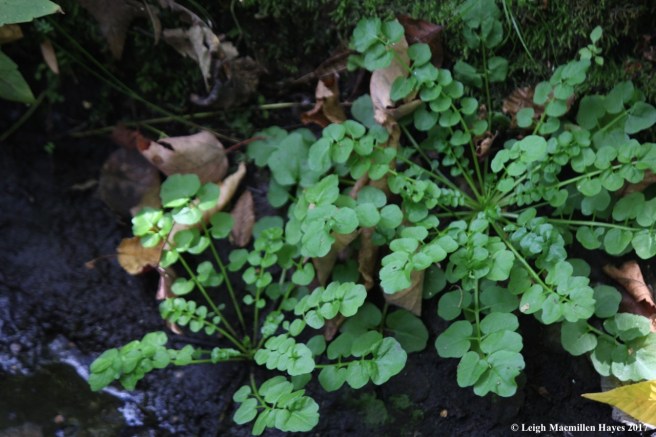
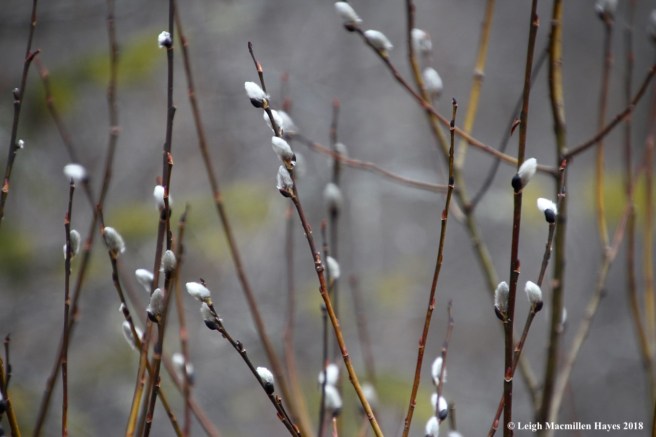
But . . . we found a food source of a different kind in the form of watercress.

m8-green frog

We also watched a number of green frogs leap into the leaf-strewn water to hide–and yet slowly float to the surface in an ever curious way.
m9-hornbeam hop

And we saw numerous “hop” balloons, those little slightly inflated cases of hop hornbeam fruits that protect the seeds–many of which flowed in the water. So where was the source?

m10-hornbeam bark

We scanned the forest and finally found the shaggy barked tree beside the water.

m11-bobcat print

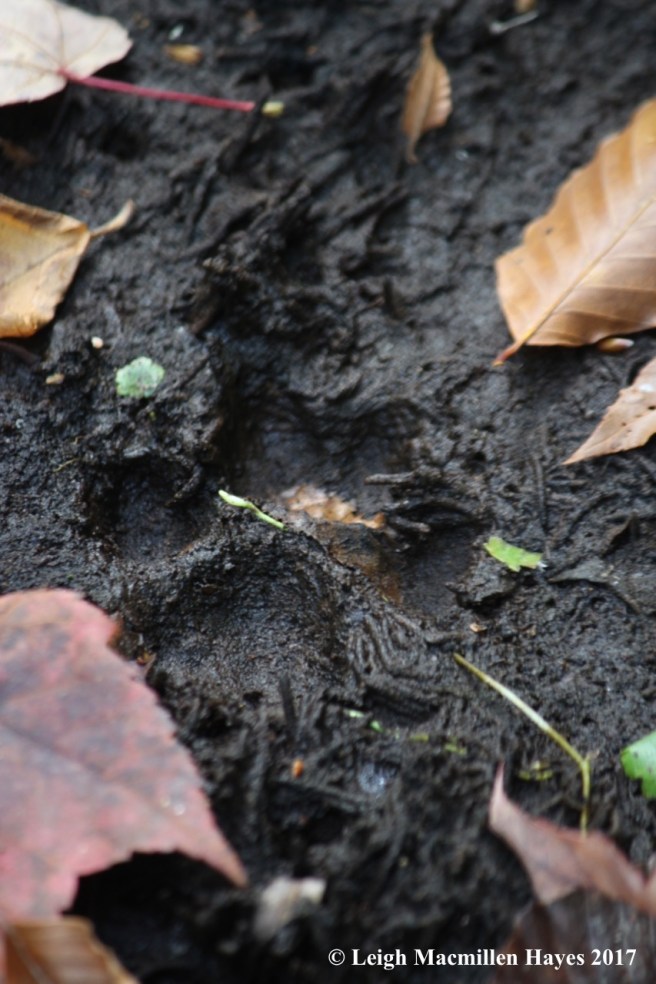
After that, some bushwhacking found us passing through a muddy zone–and prime tracking location. Deer, raccoons, coyotes and bobcats had previously walked where we stepped. Do you see the C for cat in this print?

m13-dam3

At last we reached our intended destination, only to realize that the beavers still eluded us. We were sure that since all other areas had been abandoned, this one would be active.

m14-beaver pond of yore

We were wrong. The only activity seemed to be leaves clustering on the water’s surface.

m16-raccoon prints

And so we backtracked and made our way down to another beaver pond, deciding  that we’d travel in the opposite direction of the raccoons and follow the stream downhill. From the top of the land to the lower portion, we encountered four or five well built dams, all still intact, yet the water levels were much lower than we would have noted if the ponds had active beavers. To say we were disappointed would be an understatement.

m17-bobcat scat?

We did, however, find a great scat specimen. We debated bobcat and coyote–sectioned as it was had us leaning toward bobcat, but there were some large bone pieces that suggested coyote. Either way–we knew both had passed through.

m18-spring peeper

And we found a spring peeper and chatted about their callings in autumn weather that reflects their mating season–the fall echo season.

m20-brook view

A little more bush and whack and at last we reached the brook below.

m21-single leaf

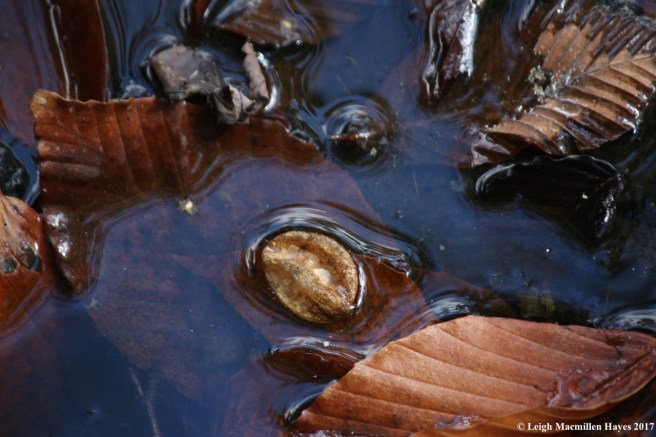
As we stood in companionable silence, a single leaf floated past.

m24-balsam seedling

When it was time to turn away, we continued on, reveling in sights missed on previous missions, including a balsam sapling growing on a fern-covered stump.

m25-fresh beaver works!

And then, and then, much to our surprise, we encountered fresh beaver works where only three days ago there had been none. In at least three locations, we discovered that tree roots had been gnawed upon. It was a subtle sign–but a positive sign.

m26-smaller lodge

The lodges, which number at least three in this particular beaver pond that keeps pulling me back, still don’t look like they’ve been attended to. And there are no winter food platforms yet, but apparently they have time and don’t need to button down the hatches yet.

m28-brook

Happy in the knowledge that we’d found the beavers, though we never saw them, we decided to continue to follow the stream to a trail that abuts the property boundary.

m27-black ash

And being a forester, Dave quizzed me on a tree or two. This one I got wrong by its bark because it doesn’t exactly look like its white and green siblings, but knew by its leaf–black ash with no petioles on the leaflets.

m29-foam reflecting bark

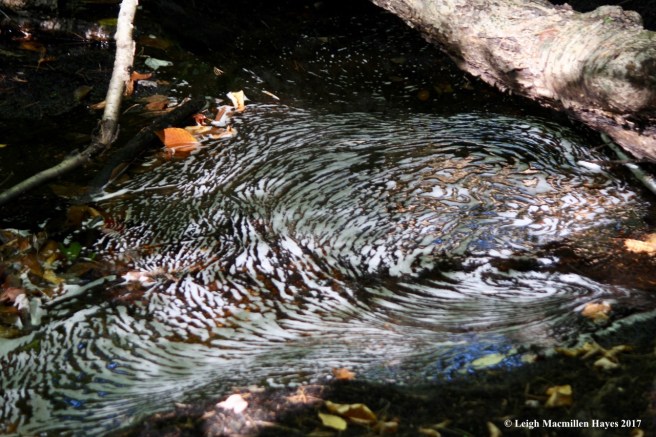
About three hours later, we left the beaver community behind–our circle completed, figuratively and literally. Even the brook appeared to know, its froth circled in reflection of the log above.


Propinquity

I slipped into a kayak this morning and rather than paddle two miles north into the islands, decided to turn the bend round our point and search the shallows closer to home.

c-stump garden

It is there that the old stumps remind me once again that this water was once land until it was dammed back in the early 1800s. The stumps have given way to gardens and I have to wonder about the age of the mosses and plants that call them home.

c-fragrant 5

In a water garden below the stumps, fragrant water lilies added grace.

c-fragrant with visitors 2

And within, they offered a feast for those who foraged.

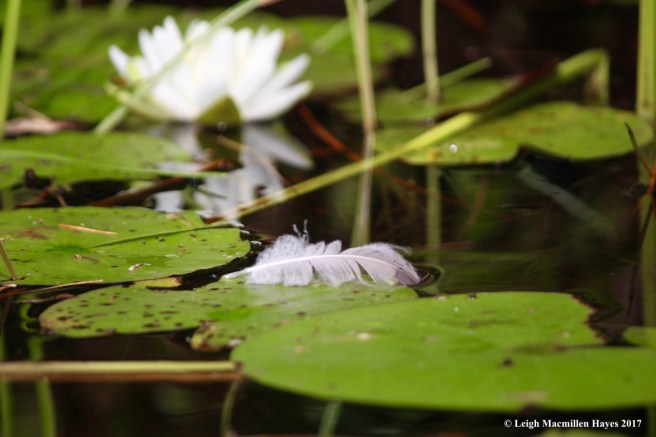
c-feather

Nearby was evidence of another foraging expedition. It didn’t bode well for the young bird that sacrificed its life, but I suspect a larger bird gained a few jules of energy.

c-cove views

Everywhere I turned, there was another garden to inspect.

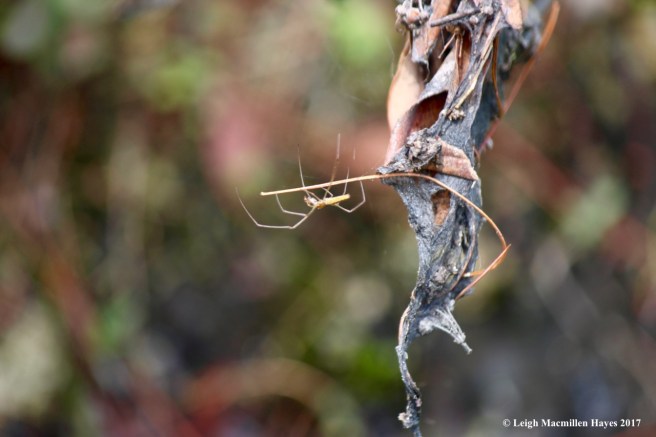
c-spider 1

And friends to meet, be they spiders . . .

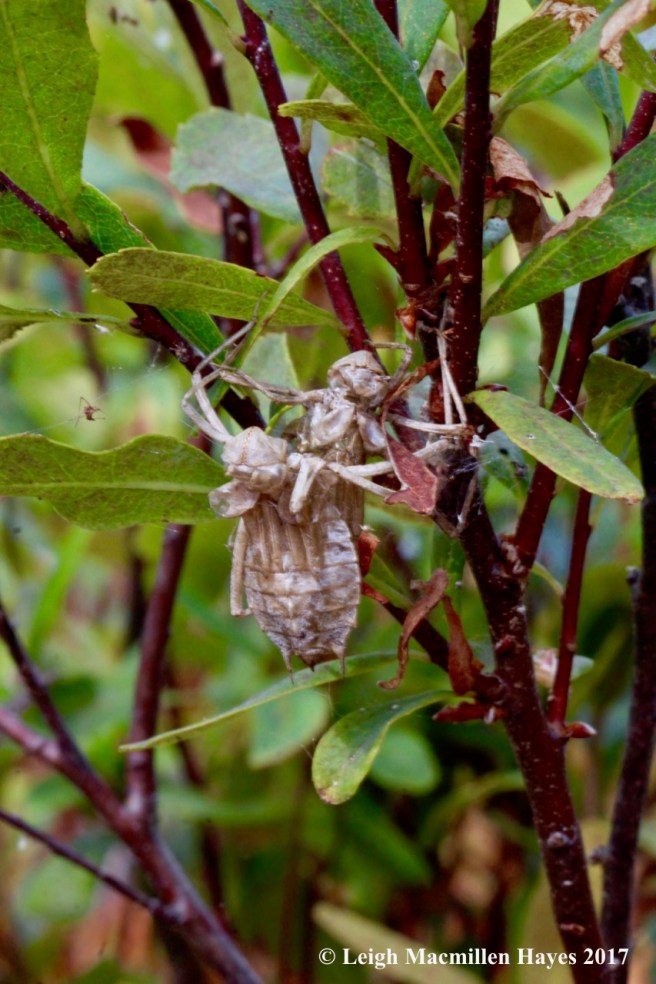
c-dragonhunter exuvae

dragonhunter exoskeletons . . .

c-meadowhawk 2

or meadowhawks.

c-spatulate-leaved sundew and insects

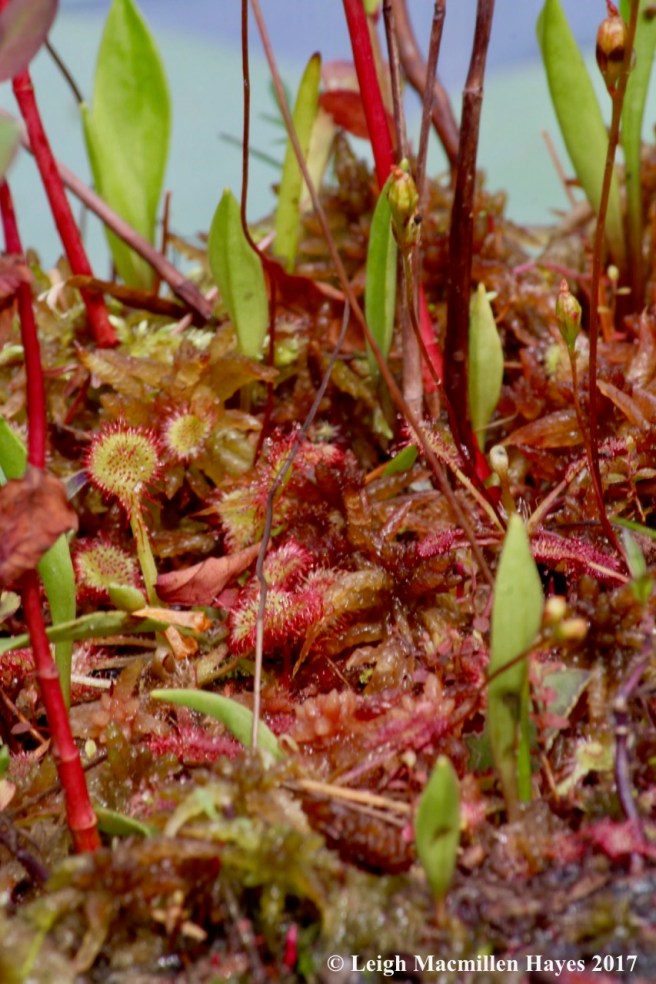
Among my favorites were the sundews and I watched several insects approach a spatulate-leaved bent down to the water.

c-round-leaved sundew

Among the spatulates, another showed its face–the round-leaved sundew standing tall above its family members.

c-pickerel 1 a

As I continued to swoon over those beauties, a different color caught my attention.

c-pickerel frog 1

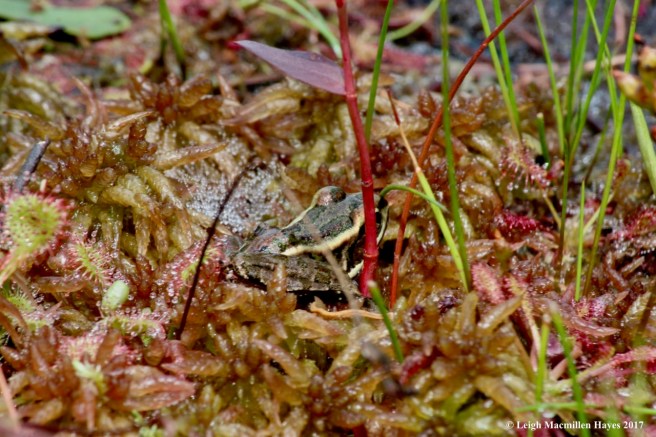
As still as could be, a pickerel frog posed and waited . . . I suppose for me to move on.

c-bullfrog 1

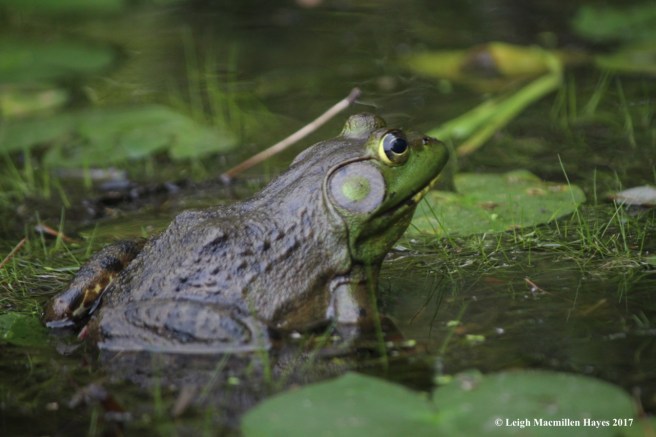
Eventually I did, and then I met a large male bullfrog–its external eardrum or tympanum larger than its eye. This guy was certainly all ears. ;-) (The female’s eardrum is about the same size as the eye). He sat in wait . . .

c-bullfrog youngster

while a young bullfrog of two or three years tried to hide about eighteen inches away. A bullfrog is a carnivore and while its diet consists of crayfish, water beetles, snails and dragonfly larvae, they also dine on fish, small turtles, young water birds . . . and other frogs. Beware little friend.

c-bullfrog reflection

For a while another bullfrog and I took a stab at a starring contest. He won.

c-beaver scent mound

Again I moved on and at last found one of the reasons I headed around the corner. I’d been  wondering about beaver works in this area–and found a scent mound that looked rather fresh.

c-beaver lodge

Across the way was the lodge–that’s been in place since I’ve frequented Moose Pond, which means for just over thirty years.

c-beaver lodge garden

I noticed that the beavers have their own kitchen garden from which to choose–and poking out from it were a variety of sticks. Which ones came from our property? And how many more will be added in October, for I know that’s when they’ll come shopping.

c-camp from south side

Finally, it was time to head back out of the cove to our humble abode on the point.

c-camp 2

It was there that I would finally join my guy for some time in our  rocking chairs.

Propinquity.

Lichen Everything We See

The Tuesday morning Greater Lovell Land Trust docent tramps don’t typically have a theme–we just like to explore a property together to see what it has to offer and learn from each other. But this morning I tried to invoke one–lichens–since we recently had Maine Master Naturalist Jeff Pengel present a talk on the topic and a few days later he led a walk for us.

w-on the trail (1)

I’m happy to say, we are who we are and within minutes we found ourselves easily distracted.

w-many fruited pelt lichen

We did spot a variety of lichens and talked about their forms and substrates. The youngest among us at age 5 found this pelt lichen growing among the mosses.

w-Wes

In fact, he spotted it just after he’d jumped off what he deemed Jockey Cap, a rock that represented the 600-foot ledge that overlooks neighboring Fryeburg. We welcome his keen eyes and those of his siblings, for they see things we overlook and have a natural curiosity. (Don’t you just want to pinch those cheeks?)

w-green stain fruiting

In fact, his oldest brother was the first to spot this fungi, the turquoise fruiting bodies of green stain fungi that I used to think was a remnant trail blaze. The fruits are minute but the color spectacular.

w-scaly vase chanterelle

And so our eyes began to focus on other fungi, the fruiting bodies of which are a result of all the rain we’ve received. Another great find today–scaly vase chanterelles. Our British docent, who is a fungi aficionado, reminded us, “It’s veys here, but back home I’d say vahz.”

w-ant pupa in heart shape

And then there was the heart that we had to love. One of our group had stumbled by a tree stump and some bark slipped off. Beneath it, the adults in an ant colony quickly went to work, moving their pupa to a safer location and we watched for a few minutes as they worked–the heart slowly losing form.

w-interns and young naturalists 2

All along the way, our interns took time to explain things to the younger set.

w-interns and young naturalists 1

And the younger set took time to practice what they knew,

w-poking a balsam blister

such as the fact that if you pop a balsam blister, the resin will ooze out. And your fingers may stick together. But it will smell like Christmas.

w-docents 1b (1)

It took us almost two hours to walk less than a mile and climb the “eagle nest” overlooking Wilson Wing Moose Pond Bog.

w-docents 3 (1)

A few stayed below and made more discoveries.

w-pipsissewa

We finally reached Horseshoe Pond Road, turned right and slowly made our way back to the kiosk where we’d parked. But still, we stopped periodically and took in the sights, including the pipsissewa in bloom.

w-spider

And a spider that was dangling when first spotted by one, but on the dirt road when we all gathered round. Check out the design on its legs.

w-lungwort

After all but one had left, she and I chatted over our brown bag lunches and then ventured across the street to the Bishops Cardinal Reserve in preparation for tomorrow’s  Lovell Rec Summer Camp Nature Hike. We offer two hikes–one for the younger set and another for the older kids, who wish we’d talk less and walk more. We can take a hint and so we do that for them. But still, there are cool things to see. We determined some fine stopping points today for the mammal theme, but the lungwort lichen also called out with its bright green coloration after yesterday’s rain.

w-Horseshoe Pond

Once we’d completed our reconnaissance mission, I decided to stop down the road at the Horseshoe Pond boat launch, ever in search of dragon and damselflies.

w-pickerel weed

It wasn’t warm or sunny enough, so I didn’t spy any of the odonatas.

w-pickerel and hoverfly 2

But I did notice hoverflies nectaring the pickerelweed flowers.

w-green frog

And a young green frog jumped into the water upon my approach. As I stood and looked at it, I heard rustling behind me.

w-snake 8

And in the grass, I spied the creator.

w-snake 9

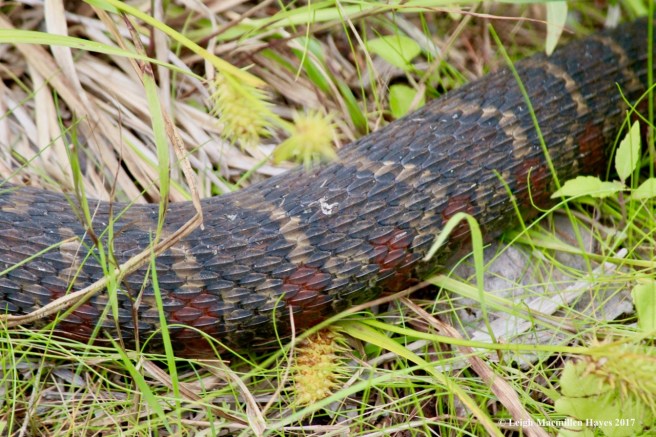
Notice how thick its body was and the keels or ridges on its scales. Plus the coloration–dark brown to gray with reddish brown and even black splotches.

w-snake 1

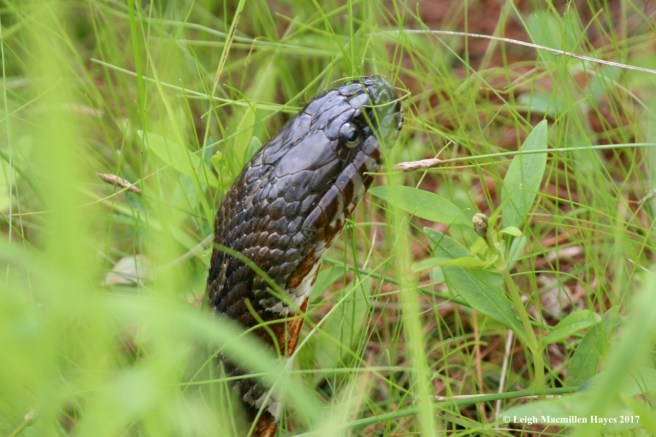
It held its head up as if searching for me and I could see a variation of color on its neck.

w-snake 3

And then I moved again while it stayed still–the better to see it with.

w-snake 6

That’s when I realized that what I thought was a six-foot-long snake . . .

w-snake 4

turned into two three-foot-long Northern water snakes. Two? Why? They are known to be solitary. And mating season has since passed.

A few minutes later, a vehicle approached on the road above and slowed down. The driver reached out and grabbed a few blueberries from a high-bush shrub. We exchanged greetings and he told me he was stopping by for his daily dose on his way home from work. I asked if he’d seen the snakes, for I recalled seeing one in the same spot a year ago. As he jumped out of his jeep, he told me he’s caught water snakes in the pond while fishing, but he hadn’t seem them by the boat launch. And then . . . he said he wanted to pick one up and in a flash he did just that, catching one by its tail as the other quickly slithered into the water. I was a bit taken aback but the snake danced with such rhythm and force that he had to let go.

w-snake 11

It dropped into the water where we could admire its colors even more.

w-snake 12

And then it swung around–not necessarily to say hello. We noted a small frog nearby and commented on how still green frogs can be.

w-snake 13

Eventually, the snake moved off, all the while its forked tongue dashing in and out . . .

w-snake 14

and in and out some more as it snacked on insects.

So much for a lichen walk–instead, as always, everything spied on today’s adventure was worth liking.


Poking Along On Perky’s Path

Every Greater Lovell Land Trust trail is my favorite in any given moment and so it was that Perky’s Path received that ranking today.

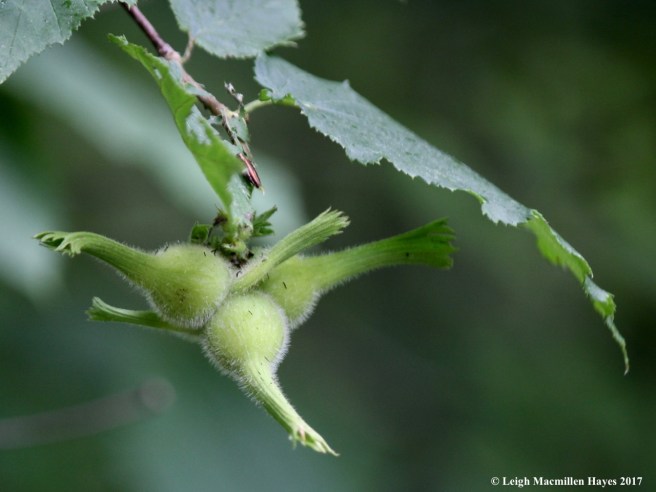
p-beaked hazelnuts 2

I met my friend Pam in the parking lot and immediately our hunt for great finds began. We looked first at the basswood, but it was the shrub next door that heard us utter with delight–a beaked hazelnut showed off its fuzzy horned fruits.

p-hops on hop hornbeam

And then we walked back up the road a wee bit for at the entrance to the parking lot I’d spied a hop hornbeam also loaded–with hops.

p-striped maple sign

At last, we started down the trail, heading south where a self-guided tour begins. A small group of GLLT docents spent the winter months preparing signs for a variety of species along this route. It’s a task that requires choosing a particular trail one summer for the next, determining which species to ID, taking photographs, gathering and writing facts, creating and printing cards, laminating them, attaching them to posts, relocating the species and finally erecting the posts, which will be left in place until Labor Day. That’s a lot of work, so if you have a chance, take the tour. It includes trees, shrubs, flowers, ferns and more.

p-American toad

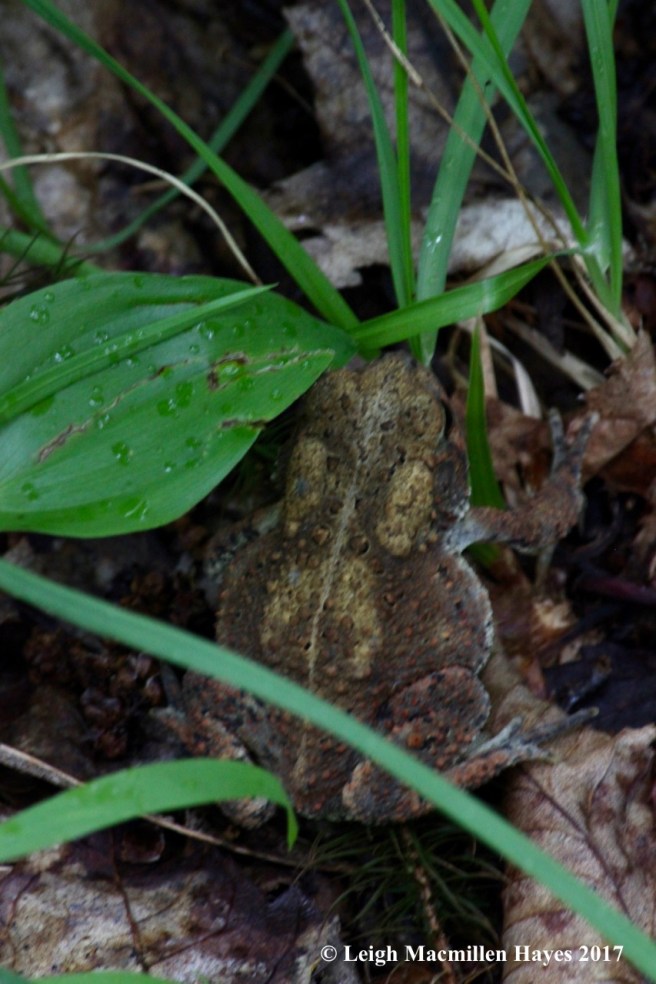
As we walked, the ground at our feet moved–in hopping fashion. We only saw one American toad, but plenty of frogs.

p-bloated female wood frog 2

All of them sported their camouflage colors, so after the ground moved, we had to focus in order to relocate them once they paused.

p-bloated female wood frog 1

This female wood frog’s robber mask was the only thing that helped us locate her.

p-young wood frog hiding under starflower leaf

You’ll have to use your own focus to find the baby wood frog that hid beneath a decomposing starflower leaf.

p-spring peeper

And another teeny, tiny one–a spring peeper with the X on its back.

p-common brown cup, Peziza varia

Because we were looking down all the time, we began to notice other things, such as the common brown cup fungi which looked rather like a wrinkled ear.

p-black trumpet Craterellus fallax

We also found a few black trumpets,

p-chanterelles 1

chanterelles (I’m leaning toward Cantharellus cibarius but don’t take my word for it–check with the Veitch brothers of White Mountain Mushrooms for positive ID is you are a forager.),

p-caesar's mushroom 1

and a couple of Caesar’s.

p-Indian cucumber 2

Though we found one Indian cucumber root that had been broken, its fruit continued to form.

p-round-leaf pyrola 3

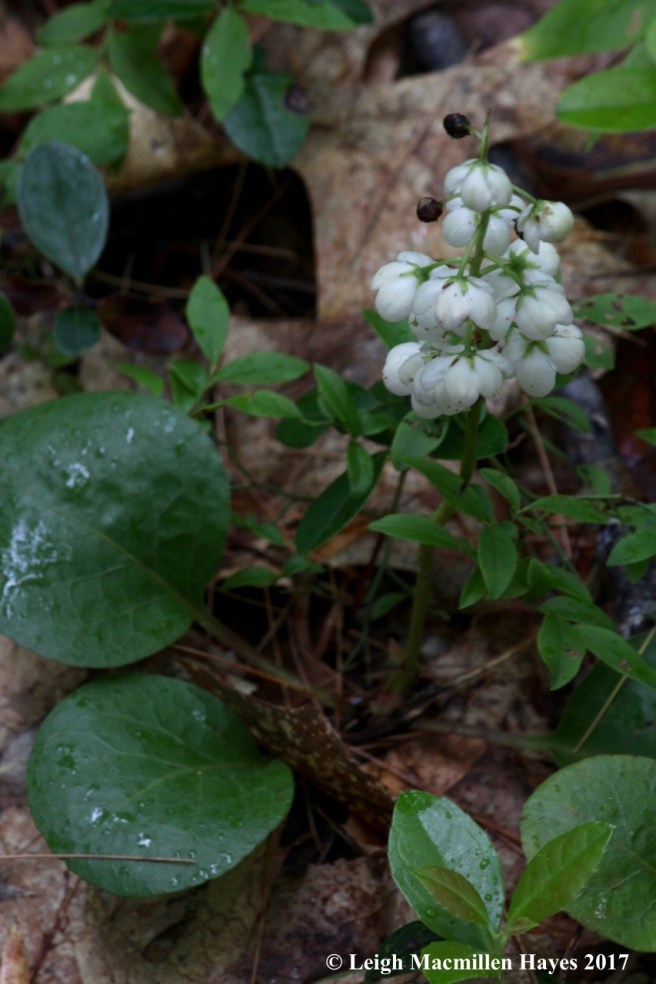
Our hearts throbbed when we recognized that here and there hiding among the herb layer were round-leaved pyrolas.

p-round-leaf pyrola1

Their leaves were nearly round with petioles or stems no longer than the blade.

p-pyrola flowers 2

And their flowers–nodding.

p-pipsissewa flowers 1

Pam had shown me a photo of a pipsissewa that grew on her property and we then found a small patch just off the trail, their jester-hat flowers attracting small insects.

p-up close

What better way to admire those flowers than up closer and personal.

p-Pam's brackenfern hat 1

And then it was time to don a brackenfern cap for the mosquitoes were at times annoying–and biting.

p-Indian pipes 1

As we continued on, we noted that it is Indian pipe season. I asked Pam if she’d ever seen the pink version that occasionally occurs–and then we began to find several nodding heads . . .  all with a tinge of pink.

p-lichen sign

As we neared the platform overlooking the meadow and brook that flows between Heald and Bradley ponds, a sign of a different kind stood before a tree. Rather than focusing on one species, this one described the different formations of lichens.

p-lichen tree

And on the tree behind it–an example of all three, with several types of crustose (crust-like and look to be painted on), foliose (foliage) like the small ribbon lichen that is bright green and ribbony in the upper right hand corner, and fruiticose (think grape branches) of the beard lichens below the ribbon lichen.

p-lungwort 1

Behind that tree–another featuring lungwort lichen.

p-view to the south

For a few moments, we paused at the platform bench–taking in the sights . . .

p-looking north

and sounds as we wondered what may have passed through.

p-steeplebush

We also noted the difference in structure of the spireas, including steeplebush in bloom  . . .

p-meadowsweet 1

and meadowsweet not yet.

p-swamp candle, aka yellow loosestrife

Swamp candles added a tinge of color to the offerings.

p-blue bead lily1

Back on the trail, we were excited to find the porcelain beads of clintonia, one showing the transformation from green to blue.

p-dew drop 1

Dew drops shone white against their dark heart-shaped leaves covered in rain drops.

p-from the bridge

And further on by the primitive bridges that cross below the beaver pond,

p-tall meadow rue

tall meadow rue flowers presented a daytime fireworks display,

p-otter scat

while otter scat decorated a bridge slat.

p-end sign

We continued along, enjoying the offerings and quizzing ourselves on a variety of species, all the time pausing to read the self-guided tour signs. At last we reached the junction with the trail to Flat Hill and found our way back to the parking lot.

Perky’s Path is maybe a mile long, but it took us 3.5 hours to complete the tour as we poked along–rejoicing with each of our finds.

Ain’t Lovell A Great Place To Be?

On my way to meet a few docents and the new interns for the Greater Lovell Land Trust this morning, a photo opp presented itself and I was forced to stop.

h-stan's sign

Stan Tupaj of Kezar Realty strikes me as the town cheerleader and I love to read his sign as I pass by. From time to time I’ve meant to photograph it, but somehow always seem to be in a rush to get to the next destination. But this morning I was a wee bit early and so this was the day.

h-heald sign

From there, I drove on to the Fairburn parking lot on Slab City Road where I planned to meet the crew.

h-green frog

Our goal was to walk to Otter Rock, not a far walk by any means, but it took us 1.5 hours to get there, such were the sights along the way, including a few green frogs in puddles along the trail. I know he’s a green frog and not a bull frog because he showed off a dorsal lateral fold along the sides of his back.

h-baby toad

While the green frogs were beside or in the water, the ground seemed to hop at our feet in dry places thanks to a kazillion baby American toads on the move.

h-Ellie and the baby toad

I noted that it seems the younger toads are in constant motion, while older and much chunkier ones pause and try to blend into their surroundings, allowing us to study them (and take photos–just saying). One of the younger members of our team, Ellie, proved me wrong as she charmed a young toad to stay still while she looked at it through her hand lens for several moments. It wasn’t until Ellie moved that the toad hopped away.

h-damselfly with eggs

While Ellie was the toad whisperer, her older brother Caleb wowed us with his ability to capture dragonflies and damselflies in a net, such as this one. As he held it high, he realized it was a she for there were eggs on her abdomen and so he gently released her–in hopes she’d find some vegetation on which to inject those tiny sacs.

h-keeping mosquitoes at bay

Their youngest brother, Wes, demonstrated the value of bracken ferns–which served as a fun hat to keep the mosquitoes at bay.

h1-Aidan

And it wasn’t until later that I realized I didn’t have a photo of Ellie’s other brother, Aidan, but I knew of one from a prior insect walk that showed his own curiosity.

h-grape fern

We looked at tons of plants as well and were all especially eager to re-greet the grape ferns that we knew grew there.

h-exoskeletons 2

At last we reached our destination, Otter Rock on Heald Pond, where we found what we had hoped for: exoskeletons decorated the landscape.

h-exoskeltons on shrub

Dragonflies lay egg clusters into sediments or tap small clumps directly onto the water’s surface. Each egg hatches into a small nymph, which grows until its ready to emerge as a flying adult. At that time, the nymph crawls to the surface, and ever so slowly, the adult pulls itself free of the exoskeleton. It’s the most amazing process to watch. But even if you don’t have that opportunity, just seeing the left over nymphal shells and knowing that the magic happened is worth a wonder.

h-exoskeletons on ground

We had to watch where we stepped, for the exoskeletons not only decorated the shrubs, but also the ground . . .

h-exoskeleton on tree

and even the trees.

h-widow skimmer

And then we began to notice newly emerged dragonflies like the widow maker on Otter Rock,

h-black-shouldered spinyleg

and black-shouldered spinyleg on the ground. We were afraid to step for everywhere our eyes focused, there was either an exoskeleton or a dragonfly drying its wings in preparation for a first flight.

h-chalk 5

As we looked about, Caleb spotted one struggling in the water, so he pulled it out.

h-chalk 4

Coated in a bit of pollen from the pond, it still clung to its exoskeleton.

h-chalk-fronted corporal 1

We watched for a few moments as it moved about, those wings slowly drying. I think my ID is right and this was a chalk-fronted corporal. At last it was time for us to draw our sense of wonder to a close and make our journey out.

h-meet the interns

But first, I asked our interns to pose–meet Hannah, Kelly and Dakota. Today was their first day of work and we probably overwhelmed the two guys a bit. Hannah was with us last year, so she knows our ways–that we walk slowly and look at everything. She gets it and we love that. We’re excited about the possibilities ahead. Join us for a GLLT walk or come to an evening talk and you’ll get to meet them.

h-heading out

Our walk out was much quicker, though we still stopped occasionally.

h-stan's sign

In the end, I have no doubt that we knew the answer to Stan’s question: Lovell IS a great place to be.


June Dandies

It’s early June and our world is lush, given this past winter’s snow and now the spring rain. Areas that we remembered as being dry last year, are filled with puddles or streams right now ( I promise I’m not going the mention those pesky little buzzers that frolic about my face and sting my hands–and how much they’re loving the current conditions. I did spot some dragonflies yesterday, but today not a one).

r-lady 3

It’s those wet conditions that threw a friend and I off for a wee bit this afternoon as we tramped through the woods in search of a yellow lady’s slipper. Initially, we were about fifteen feet too far to the right as we tried to avoid the water.

r-lady 2

After wandering for a short bit, we finally found it on a bit of dry land–and then stood in awe–at our own ability to locate the flower, but even more so at the flower itself.  Yellow lady’s slippers are not rare, but uncommon and so we rejoiced with our find. They prefer mesic (moderately moist) nutrient-rich forests (as well as in bogs and swamps), thus the water (and mosquitoes–okay, so I broke my promise).

r-lady 7

Lady’s slippers are members of the orchid family.  I used to think orchids were flowers girls wore on their wrists for senior prom or grandmas coveted–though I never knew either of my grandmothers, but certainly it was an “old lady’s” flower. My, how my understanding and appreciation has changed because I am certainly NOT an old lady. Or am I?

Check out the reddish-brown dotted pathway–like landing lights at an airport runway. Their intention is to guide pollinators. If we remember to return in the fall and look for a seedpod, we’ll know that the dots worked. They often don’t.

r-brook 1

We could have gone home then, so tickled were we with our success of finding that pouch of a flower, but . . . as you might expect, we continued on, making several brook crossings as we went.

r-brook 2

Everywhere, mosses and liverworts offered forty shades of green. Oh wait–that’s Ireland. But right now, it’s western Maine as well.

r-christmas fern 2

And because it was so damp, the forest we roamed was filled with Christmas ferns featuring young and old blades.

r-Indian cucumber Christmas fern

We even found one that sprouted an Indian Cucumber Root whorl as if it was a flower.

r-christmas fern gall

But what aroused our curiosity was another that seemed to have been affected by insects forming galls. Neither of us could remember seeing anything like this before, but then again, so many times when we see something we think of as new, we soon discover that it’s more prevalent than we realized. That being said, we only found the “galls” on a few of these ferns, all in the same area in a wet seep.

r-wild oat

Further along, we noted sessile-leaved bellworts, in flower a month ago, now sporting their seedpods or wild oats that speak to their other common name. And the leaf of at least this one had been visited by an insect–a leaf minor trail standing out in white against the green.

r-cannoddling craneflies 2

r-cannoddling craneflies

And then we found craneflies canoodling. They didn’t seem to care that we watched.

r-toad 1

They weren’t our only wildlife sightings (besides the mosquitoes–did I mention mosquitoes?). A young American toad hopped by, pausing ever so slightly to show off its raised warts.

r-frog 1

And a frog slipped into the water–the better to escape our ogling.

r-land of the cinnamon fern

As we wound our way around a wetland filled with cinnamon ferns, we noted a few flowers in bloom or about to bloom.

r-clintonia 1

Yellow clintonia,

r-jack in the pulpit 1

Jack-in-the-pulpit (times two actually–and I’m not sure how we spied these for they hid like trolls under their leaves),

r-Indian Cucumber flower

Indian cucumber root,

r-Early coralroot 2

and early coralroot caught our attention.

r-round-leaf pyrola1

Not yet in bloom was the round-leaf pyrola, aka American shinleaf. Oh darn, another reason to return and see it blossom.

r-red trillium 3

And just past its blossoming stage–red trillium,

r-red trillium 1

its red leached to almost maroonish brown and stamen looking rather gray.

r-Pam taking a photo of pyrola

Despite the mosquitoes (what mosquitoes?) and a few raindrops, we shared a fun afternoon hike circling the path of the Greater Lovell Land Trust’s Ron’s Loop by Five Kezar Ponds.

The journey was with my friend named Pam, not June. But June is the month and together we enjoyed numerous dandies that need to be enjoyed in the moment for soon we’ll not realize they ever existed.

June dandies indeed–worth making time to wander and wonder. (Despite the mosquitoes.)


Book of June: Bogs and Fens

My wish was granted when I asked for a copy of Bogs and Fens: A Guide to the Peatland Plants of the Northeastern United States and Adjacent Canada by Ronald B. Davis for Christmas.

b-bogs and fens cover

The idea for this book came from many years spent by Davis as a biology and Quaternary studies professor at the University of Maine and Colby College, plus his services as a docent at the Orono Bog Boardwalk in Orono, Maine.

Since I spend a lot of time tramping through a few favorite bogs and fens as well as visiting others, this seemed like the perfect guide to help me better understand the world of these special communities. And then I realized that on our own property grows some of the vegetation associated with these wetlands. With them right under my nose, what better way to learn?

Davis begins by describing the occurrence and indicator species of peatlands and then he goes on to give a lesson on the ecology of wetlands, including a description of peat, fens and bogs. A bibliography is provided for further reading and terms are defined.

What really works for me though, is the species descriptions, which he’s taken the time to divide into their various layers–trees, tall shrubs, short and dwarf shrubs, prostrate shrubs, herbaceous plants and ferns. Within each section, a specific plant is described, including its Latin name, common names, family, characteristics such as how tall it grows, number of petals, fruit, if any, etc., and its occurrence–whether in a fen, bog, dry hummock or other. All in all, he features 98 species, but also mentions 34 comparative species and includes an annotated list of 23 additional trees, shrubs, herbs and ferns that may grow in one or more community. And finally, the book ends with a description of pathways and boardwalks worth visiting.

b-sphagnum moss

And so this morning, I walked out back to look at our wetland, where the sphagnum moss’s pompom heads were crisscrossed by spider webs donned with beads of water.

b-sundew 2

It’s there that the round-leaved sundews grow, which I only discovered last year. Notice those bad-hair day “tentacles” or mucilaginous glands and the black spots upon the leaves. Dinner was served–in the form of Springtails or Collembola–their nutrients being absorbed by the plant to supplement the meager mineral supply of the sphagnum community.

b-sundew flower forming

And in the plant’s center, the flower stem begins to take shape. This summer, it will support tiny white flowers that will turn to light brown capsules by fall.

b-sheep laurel

Sheep laurel also grows in this place, its new buds forming in the axils below the newly emerged leaves. I can’t wait for its crimson flowers to blossom. Its flowers provide an explosion of beauty, and yet, danger lingers. This small shrub contains a chemical that is poisonous to wild animals, thus one of its common names is lambkill.

b-steeplebush leaves

Another short shrub is the rosy meadowsweet or steeplebush with its deeply toothed leaves.

b-steeplebush

Being only June 1st, it’s too early to flower, but last year’s steeple-like structure still stands tall in the landscape.

b-lowbush blueberries

Low-bush blueberries grow here as well and it’s only now that I realize I need to return and study these some more for Davis differentiates between velvet-leaved blueberries and common low-bush. I assumed these were the latter, but according to his description, the leaves will tell the difference. Apparently velvet-leaved, which I’ve never heard of before, feature “smooth-edged, alternate leaves, and bear fine, short hairs on the underside, edges and along veins of the upper side,” while low-bush leaves “have a finely serrate edge and a lack of pubescence, except rarely a sparse pubescence along the veins.” The next time I step out there, I will need to check the leaves to determine whether we have one or both species.

b-black chokeberry1

Of course, my favorite at the moment is the black chokeberry because the flowers provide a wow factor.

b-black chokeberry and ant

I’m not alone in my fascination.

b-water scavenger beetle larvae

Because I was nearby, I walked to the vernal pool, where a wee bit of sunlight highlighted another fascination of mine–my most recent discovery of water scavenger beetle larvae. Check out those heads and eyes.

b-tadpoles 1

Today, the tadpoles weren’t as shy as the other day and so they let me get up close and personal.

b-tadpoles 2

I’m holding out hope that the pool doesn’t dry up before they are able to hop away. Already, I can see their frog form beginning to take shape. This is a shout out to one of the Books of May: Vernal Pools–A Field Guide to Animals of Vernal Pools.

But back to the Book of June, and really the book of all summer months–Bogs and Fens by Ronald B. Davis. It’s heavy as field guides go and so I don’t always carry it with me, but it’s a great reference when I return to my truck or home. I appreciate its structure and information presented in a format even I get.

Bogs and Fens: A Guide to the Peatland Plants of the Northeastern United States and Adjacent Canada, by Ronald B. Davis. University Press of New England, 2016.

My copy came from Bridgton Books, my local independent book store.

This Land Is . . .

My land. I’m sure of it. I don’t own it all, but I walk it often because it’s not posted and I know it well. Well, only just so well. It’s constantly offering me new learnings.

o-Mt Wash

And so once again, out the back door I ventured, intending to head north toward the land of snow–haha. My sister asked the other day if we still had snow. We don’t have any on our land, but this is our view from the power line right of way–yup–we’ve got snow ;-) (in our view).

o-tick

I changed my mind about the direction, however, when I saw numerous dog ticks on the tips of grass as I crossed our neighbor’s field. Though they aren’t the purveyors of diseases such as Lyme disease, Babesiosis, and Anaplasmosis, seeing them still unnerved me and I decided to head in the opposite direction where it isn’t so grassy. Of course, that’s where the deer ticks live. Nightly tick checks are a must every day.

o-early yellow rocket 1

It was in the opposite direction that I was caught by surprise. Behind a local business, where the land had been disturbed a year ago, a wall of yellow greeted me.

o-yellow rocket 3

It was a sea of early yellow-rocket that is common along roadsides and fields. Apparently this one spot was the cat’s meow for it to grow so prolifically.

o-bee 3

What was more prolific–the sound.

o-bee 1

Bees and other insects hummed as they worked,

o-bee 2

filling their pollen sacks to the brim.

o-fritillary 1

Even a fritillary butterfly enjoyed the goodness within.

o-fringed 2

Those weren’t the only wings I saw. It was a complete surprise to also discover gaywings or fringed polygala growing deeper in the woods.

o-turkey print

Walking along, I flushed a couple of deer and a ruffed grouse. And though I didn’t see or hear any turkeys, I knew they’d been there by their signature prints.

o-tadpole 1

And then I slipped off the trail to stop at a vernal pool that I don’t often visit. The water is shallow, but tadpoles are growing.

o-tadpole 2

A week or two ago after they’d just emerged, they were easy to spot as they clung to their egg masses or swam by water’s edge. But they are maturing and I had to stand still or they’d disappear under the leaf cover.

o-water scavenger larvae

While standing there, I spotted another resident I didn’t immediately recognize–the larval form of a water scavenger beetle. According to A Field Guide to the animals of Vernal Pools,  “they are poor swimmers and will hang from the water surface (where they obtain oxygen) or hide in vegetation to await prey.” That all makes sense given their body structure.

o-sugar ant?

On the way back, another insect stopped me. I think they were sugar ants with a white thorax. But why were they on beech leaves? Then again, every insect seems to like beech leaves. I guess I don’t think of them as being sweet, but . . .

o-old gate in wall

As I headed home, I paused by an old wall and gate. This land was farmed in the late 19th and early 20th centuries. The walls formed boundaries for animals and are owned by numerous neighbors I’ve never met. Thankfully, they let me and others cross–though few will do so until hunting season begins in the fall.

Anyway, it all got me thinking about who owns the land. And then I knew the actual answer. The plants. The trees. The flowers. The insects. The amphibians. The birds. The mammals. They all own the land. We are mere visitors. I thank all of nature for letting me trespass and gain a better understanding of its various life forms.

This land isn’t my land. And it wasn’t even made for you and me. But I have great reverence for it. And for those who have protected it.

Happy Memorial Day.

Sharing My Site

I count myself among the fortunate because pollen doesn’t keep me inside during its high season. Nor do the bugs or rain. Mind you, I do my fair share of complaining–after all I am human. At least I think I am, though I was honored to be called an ent yesterday. (Thanks Cyrene.)

Enough of that. Let’s head outside to see what we might see.

IMG_5267

True confession. I took this photo yesterday, but didn’t have time to write. Finding this jack-in-the-pulpit beside a granite bench by my studio was a complete surprise.

IMG_5741

Today’s journey began in the front yard where sugar maple samaras dangled below full-grown leaves. Their presence will soon offer presents to the world below.

IMG_5302

My next stop was beside another secret giver of gifts–blueberry flowers.

IMG_5301

And then I stepped into the woodlot, where a single striped maple which was the bearer of a deer antler rub last year and scrape (upward motion with lower incisors) this past winter, had something else to offer.

IMG_5480

Below its almost dinner-plate size leaves–flowers. Happy was I to find these little beauties.

IMG_5287

Perhaps . . . just maybe . . . there will be more striped maples offering their bark to those in need.

IMG_5517 (1)

Moving along, I stopped at the opening of the cowpath to admire baby hemlock cones when something white and bubbly caught my attention. My first spittle bug sighting of the year. An adult spittlebug whips up some slimy froth to cover its eggs in late summer and the nymphs cover themselves while feeding in the spring–and so I concluded that I was viewing a nymph’s locale.

IMG_5327

Emerging under the power lines, the community changes. It’s here that the land is especially wet and species one might find in a bog grow–such as the black chokeberry shrub. These also like rocky ledges, but such is not the case in this spot.

IMG_5532

I was thankful to find it for those flattened bright pink anthers brightened this damp day.

IMG_5696 (1)

Heading north, I sloshed through the deep puddles on a quest to find the sundews I discovered growing in this area for the first time last fall.

IMG_5703

No such luck, but I did welcome the sight of the candy lichen fruits exploding from their crustose base. And then . . . and then . . . what did I see (but only when I looked at the photograph on my computer, and so now I know where they are located)? The round-leaved sundews–do you see them in the bottom right-hand corner? These are carnivorous plants (think Venus Flytrap) and their prey consists of small insects. Already, I can’t wait to make their acquaintance again.

IMG_5583

I turned around and headed south–on my way to the vernal pool. But before passing through a stonewall, I had to look at the bunchberries in bloom.

IMG_5581

Normally, a bunchberry plant has two-sets of leaves. But . . . when one is mature enough to grow a third set, typically larger leaves (perhaps to capture more energy) than the first two sets, it produces four white bracts that we think of as petals but they are actually modified leaves. The flowers are in the center–tiny as they are.

IMG_5680 (1)

And because I was in the neighborhood, in the land of mosses, reindeer lichens, Canada Mayflowers and wintergreen, trailing arbutus (aka Mayflower) spoke up. Its flowers were slowly transforming from white to rust and I shouldn’t rush the season, but I can’t wait to see its fruit again.

IMG_5586

At last I reached the vernal pool and realized I wasn’t the only visitor. What perfect hunting ground it proved to be for the . . .

IMG_5593

phoebe. I cheered for its insatiable insect appetite.

IMG_5596 (1)

Because the day was dark, it was difficult to see tadpoles, but I did note that many spotted salamanders were still forming. I also noted that the water level has dropped a wee bit–hard to believe–and where yesterday I found a few egg masses a bit high and dry, today they were gone. Something enjoyed eggs for dinner.  Scrambled or otherwise, I’m not sure.

IMG_5625

Back on the trail and at the next stone wall, interrupted fern showed off its fertile pinnae near the middle of the blades. It’s called interrupted because of the interruption in the blade. Again, this is an inhabitant of moist to wet forests and so it was no surprise to find it growing there.

IMG_5609

A fertile blade, such as this, may have two to seven pairs of middle pinnae.

IMG_5619

The globose sporangia is bright green when young, but darkens to tan or black as it matures.

IMG_5362 6.10.27 PM

On the other side of the wall, I spied some more flowers.

IMG_5360

These were the elongated loose clusters of black cherry trees, that open when the leaves are fully developed.

IMG_5636

One that flowers and fruits before its leaves are fully developed is the red maple.

IMG_5630

And fruits and fruits . . . need I say more?

IMG_5375

Though the wind blew, the samaras weren’t yet ready to let go and set down their roots. It won’t be long though, I’m sure.

IMG_5403

Finally returning home, I passed by the granite bench once more and was still stymied by the site I saw about a half hour after discovering the jack-in-the-pulpit yesterday.  It had been consumed. I suspected the woodchucks that live under the studio. Either that or a bear came along and I missed it.

And so ended today’s tramp. Thanks for traipsing along with me to visit these sites out our back door. I especially welcome those who are homebound with allergies, like my friend Jinny Mae. She gave me the inspiration to take a look today–to be her eyes for the moment and share my sight.

Walking with Ursula

No matter when or where I walk, Ursula Duve is always along. She sees what I see, smells what I smell, feels what I feel, tastes what I taste and knows way more than I’ll ever know.

h-Ursula 2

And so it was today that a bunch of us followed this delightful little woman as she led us down the trail at Lakes Environmental Association’s Holt Pond Preserve.

h-sign

We gathered in the parking lot, where the black flies tried to swallow us whole. But, we got the better of them and practiced mind over matter. Of course, bug spray and our flailing arms helped–or at least made us feel as if it was worth the effort.

h-wild oats 1

After an introductory greeting from LEA’s teacher/naturalist Mary Jewett, we stopped frequently as Ursula shared stories of plants and life. You see, she was born in Hamburg, Germany, and grew up during WWII so she has quite a few memories flowing through her system, but as she reminded us, with the bad comes the good. And the good comes from moments she associates with wildflowers, like this bellwort.

h-painted trillium

Having lived in the United States for 50+ years now, with the last nineteen in Maine, Ursula considers herself a Mainer despite her German accent because she loves it here. And she knows when and where each flower will bloom, such as the painted trillium.

h-chokeberry buds

Even those not yet in bloom drew her attention–this being a chokeberry along the first boardwalk.

h-pitcher 3

One of the finds Ursula enjoys sharing with others is the pitcher plant, a perennial herb with pitcher-shaped leaves. We noted that this particular one sported new flower buds.

h-pitcher flower

And on another, the otherworldly shape of last year’s now woody flower capsule–its job completed.

h-pitcher plant 1

Ursula is as awed as I am by the power of the pitcher plants. Color, scent (that I’ve never smelled) and nectar in glands near the top of the pitcher leaf attract insects. Once inside, those downward-pointing hairs make it difficult to leave. So what happens next? The insect eventually drowns in the rainwater, decomposes and is digested by the plant’s liquid, which turns phosphorus and nitrogen released by the insect into supplemental nutrients for the surrounding peat. Interestingly, no “joules” or units of energy are passed on through this process to the plant itself. The plant gathers its energy through the process of photosynthesis instead.

h-rhodora 1

As we continued, we were wowed once again–this time by the sight of the showy rhodora. Rhodora flowers fully before its leaves emerge and so today they were but small nubs located alternately along the shrub’s branches.

h-rhodora 3

But those flowers–oh my! The rose-purple bloom has what’s considered two lips–with the upper consisting of three lobes and the lower of two. And each produces ten purple-tipped stamen surrounding the pistil, where the pollen will germinate into a many-seeded capsule.

h-leatherleaf

Like the rhodora, another member of the heath family in bloom was the leatherleaf–with bell-shaped flowers formed in leaf axils and dangling below the stem as if it was laundry hung out to dry. One way to differentiate this plant from the highbush blueberries that can be found throughout the preserve, are the alternate, upward-pointing leaves, which decrease in size as your eye moves toward the tip of the stem.

h-honeysuckle 1

Just before we stepped out onto the Quaking Bog boardwalk, Mary pointed out a native honeysuckle. In my memory bank, I couldn’t remember ever seeing it before, and if I had, well . . . I was glad to make its acquaintance again.

h-green frog 2

And then we stepped onto the boardwalk. Folks up front paused to admire a green snake, while those of us in the back noticed a green frog. It stayed as calm as possible in hopes that we wouldn’t see it. Nice try.

H-Holt Pond

Like all ponds and lakes right now, the water level remains high and so walking the boardwalk meant wet hiking boots.

h-quaking bog 2

But that didn’t stop some of us. Fortunately, mine are waterproof.

h-green frog

Just before we stepped from the boardwalk back onto land, I saw that the frog was still there.

h-hobblebush flowers 1

On the trail again, another showy flower called for our attention–hobblebush.

h-hobblebush 1

While some looked fresh, others were beginning to pass and their fruits will soon form. We noted the sterile outer blooms that surround the inner array of small fertile flowers. And a beetle paying a visit.

h-Mayfly1

Speaking of insects, a slight movement on the ground pulled us earthward.

h-mayfly 2

We’d found a Mayfly–perhaps just emerged and its wings drying.

h-Indian Cucumber root 1

In the last wooded section we would cover for the day, we noticed that the two-tiered Indian Cucumber Roots have a few buds. I can’t wait for them to flower soon.

h-goldthread 2

Among the flowers that I’ll always associate with Ursula because she’s the first to have introduced me to them, is the goldthread, so named for its golden-colored root. We usually identify it by its cilantro-shaped leaves, but right now the dainty flowers are not to be missed. What looks like petals are actually sepals and there can be five to seven of them. And stamen–many. Goldthread can feature 5-25 stamen.

h-goldthread 3

Even the number of yellow-and-green pistils can vary from three to seven. Ah nature–forever making us think.

h-dwarf ginseng 1

The other plant I associate with Ursula is dwarf ginseng. Its explosive umbel consists of many flowers. And in this one, a dining crab spider.

h-spring tail wave

Finally, we found our way to Grist Mill Road and headed back toward the parking lot. But even on the road we found something to wonder about when one member of our group pointed to the curvy black design. In the past, I’ve always dismissed it as some sort of mineral associated with the dirt.

h-spring tails on sand1

Today, I learned it was none other than those good old spring tails or snow fleas we associate with late winter, but are really present all year. Something new to notice going forward.

h-Ursula1

At the end of our walk we all gave thanks to Mary and Ursula. We’d come away with refreshers and new learnings.

And we’d been reminded by Ursula that though she and her husband, Wolfgang, can no longer get out as often as they’d like, after sixty years of marriage they still have fun reminiscing about their many explorations together. A goal for all of us to set.

Most often this wildflower and bird enthusiast walks vicariously with me as she reads my blog entries, but today it was my immense pleasure to walk with her. Thank you, Ursula, for once again sharing your love of all things natural with the rest of us . . . and your optimistic philosophy of life.

Oh and a question for Wolfgang, while Ursula walked with us, did you get on the treadmill?

April Showers bring . . .

May showers!

v-green yard

It feels like it has rained every day for the past week, but the grass is certainly green.

v-pool (1)

And the vernal pool full. Between today’s downpours I visited it a couple of times, so excited by my findings.

v-wood frog eggs developing

The wood frog eggs had turned green with a symbiotic algae and I could see the tadpoles developing inside.

v-tadpoles 2

The green coloring made the their eggs contrast with the salamander masses. I was thrilled to see movement among the green and realized that . . . drum roll please . . .

v-tadpoles 6

my babies were slowing hatching. Of course, they are mine–even though the frog pond is located on a neighboring property. I’ve been an expectant mother for several weeks, and now . . . I’m nervous about the future, as any parent would be.

v-tadpoles 1

Will my babies survive? Will they have an opportunity to transform into their terrestrial forms?

v-tadpoles 7

Or will the pond dry up too soon as it has the last few years? I guess I’ll be forced to continue to stop by. Oh darn! One thing I have noted since the ice melted: I’ve yet to see a predacious diving beetle and there are hardly any mosquito larvae flipping about. That’s good for the tadpoles on one end of the spectrum and not so good on the other. To be food and to eat food.

v-sallie eggs 1

I also wondered, will the  white and opaque masses of the spotted salamander eggs turn green like they are supposed to–also dependent on a symbiotic algae?

v-hole 4

After checking on my wee ones, I walked the pond’s perimeter and noticed activity at a spot I’ve been keeping an eye on in the southwest corner. Well, not current activity, but recent. For the first time this year, a hole has been excavated.

v-hole 3

It’s the same hole that was excavated last year. Darker debris was piled in front.

v-hole1

At about three or so inches across, I wondered who owned it. Too small for foxes, and certainly too wet. Too big for chipmunks and a dirty dooryard. Could it be a mink? Do they leave a messy dooryard? I found the same hole excavated last year, but never any other evidence of the maker. I’ll continue to check for any other signs.

v-raindrops

My eyes reverted back to the pool, where raindrops and reflections created an artistic display.

v-maple dust lichen

And then I pulled myself away, frozen were my fingers. The greenness of the world continued to show its face everywhere I turned from the maple-dust lichen to . . .

v-white pine

young white pines, their candelabras growing long,

v-maple leaf and samara

red maple samaras upon old leaves,

v-cherry 1

and cherry flowers developing.

v-mayflower1

What do April showers bring? Mayflowers (trailing arbutus), of course,

v-Canada mayflower 2

Canada mayflowers,

v-tulip 1

and garden May flowers.


Books of May: Vernal Pools

I had two books to choose from and couldn’t decide which one to promote as the Book of May, and so . . . I chose both.

And it seems only right that both should be presented, for though they aren’t about the flowers or birds or leaves that are making our days brighter, they are about one of my other favorite May events. Yes, we celebrate Big Night in April, that night or those nights, when amphibians cross the roads as they return to their natal vernal pools to continue the life cycle. But it’s in May that so much growth occurs within those pools and if we take the time to notice, we can watch it all happen–changing daily. And the more we understand what we are looking at, well . . . the more we get it. (“Stating the obvious again, Mom,” our two twenty-something sons would say if they were to read this. But they don’t so I can get away with it.)

Enough said. The May Books of the Month are . . . the following:

A Field Guide to the animals of Vernal Pools

and

s-MAAR (2)

Maine Amphibians and Reptiles.

The former, A Field Guide to the animals of Vernal Pools by Leo P. Kenney and Matthew R. Burne, is about 8″ x 5″ and fits easily into any pack I decide to carry. Its pages are glossy, so I don’t worry too much about it getting ruined if I get it wet. And though it was written to represent Massachusetts, most of the species described match what Maine vernal pools have to offer.

s-MAAP frogs:toads (1)

After an introduction to vernal pools, their indicator (obligate) species, protection, importance and human impacts upon them, there is a pictorial guide to the adult amphibians and reptiles. This is a quick and easy reference, and especially useful when trying to determine the difference between species, e.g. bullfrogs and green frogs or leopard frogs and pickerel frogs. Besides frogs, it includes salamanders, snakes and turtles.

s-MAAR sallies (2)

And then there are more descriptive pages for each species. These have helped me over the years to gain a better understanding of what I’m looking at.

s-sallie eggs 1

Even today, when Jinny Mae and I discovered these spotted salamander eggs, I loved that we could see that gelatinous matrix that surrounded the individual eggs.

s-wood frog eggs

And the book has helped me recognize the difference between those salamander eggs and these wood frog eggs.

In the field, there’s so much more to see, including the invertebrates that inhabit the pool, and ever so slowly I’m learning to identify them as well–you know, predaceous diving beetles, damselfly larvae, water scorpions, backswimmers, water striders . . . the list goes on. Each of them is featured in the back of the book with a photograph and paragraph or two describing their larval and adult forms.

Maine Amphibians and Reptiles, edited by Malcolm L. Hunter, Aram J.K. Calhoun and Mark McCollugh, is my at-home reference book. Well, sometimes it goes for a ride in my truck, but usually, it’s left at home because it’s larger and offers a much more in-depth take on amphibians and reptiles, their habitats and conservation. Besides a photo gallery, each amphibian and reptile that makes its home in Maine is featured, with thorough descriptions, taxonomic status, distribution, reproduction, habitat, diet, and interactions with people and other animals. There are sketches and maps to further enhance the information presented. And it’s all quite readable.

s-MAAR recordings 2 (1)

One of the best features of this book (and unfortunately, mine is cracked) is the CD at the end. Yes, you can actually listen to the individual species so that when you hear them in the day or night, you might begin to recognize them, much as you would a bird, by their voices before you spy them.

In the past few years, the vernal pool that I study frequently, has dried up before the amphibians have matured. I find solace in the fact that even when the pool dries up, the species growing there still provide nourishment and pass on energy to their consumers.

But . . . maybe this year will be different. We had a lot of snow, and now a lot of rain. Maybe this will be the year the amphibians and insects that reside in the pool will actually mature and hop or fly out.

It all begins with MAY.

The Books of May:

A Field Guide of the animals of Vernal Pools, by Leo P. Kenney and Matthew R. Burne, available through the Massachusetts Division of Fisheries & Wildlife’s Natural Heritage & Endangered Species Program.  (Curiously, the copy I own was from the third printing in MAY 2009)

Maine Amphibians and Reptiles, edited by Malcolm L. Hunter, Jr., Aram J.K. Calhoun, and Mark McCollugh, The University of Maine Press, Orono, 1999. (I purchased my copy at Bridgton Books.)