The Day The World Passed By

I love those days when I have a few moments and can pay attention to the world around me. It never ceases to fill me with awe and wonder. And today was such as I had a free hour that I chose to spend on the dock.

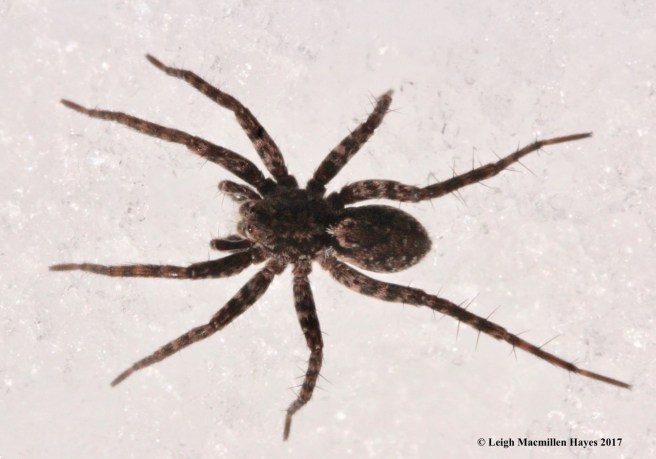
1-fishing spikder

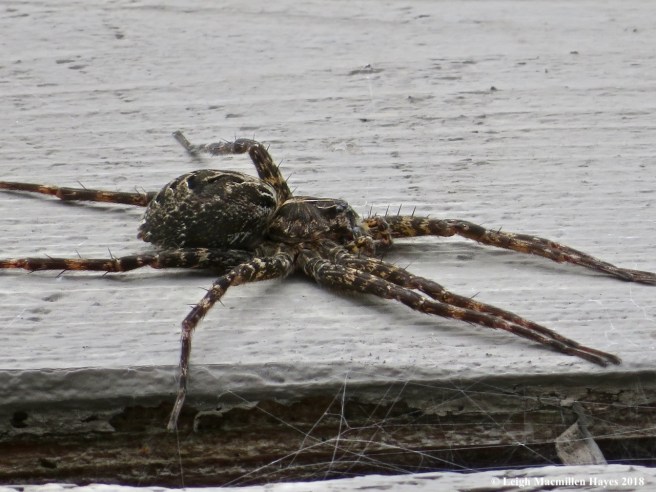
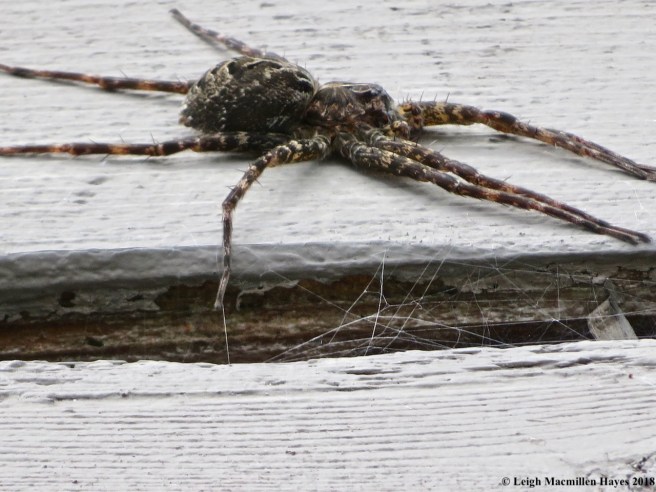
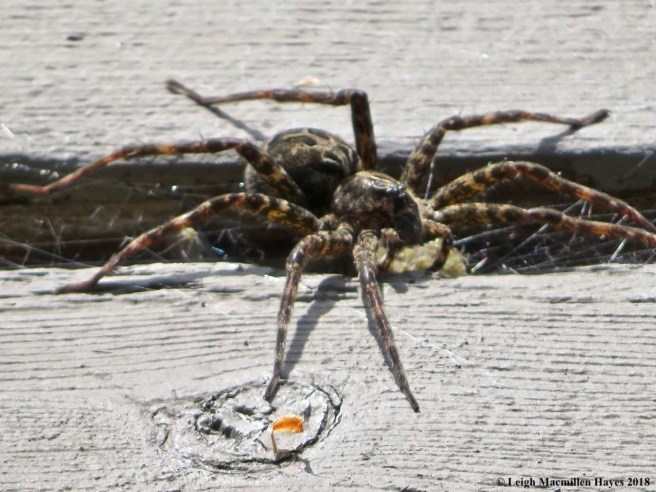
I shouldn’t have been surprised to see a fishing spider the size of my palm resting there, but I was for it was my first sighting of one this year. True confession, indoors I’m not a huge spider fan and as a kid I used to holler for someone to come kill any arachnid I spied. But . . . with age comes appreciation. And perhaps understanding.

2-fishing spider bristles

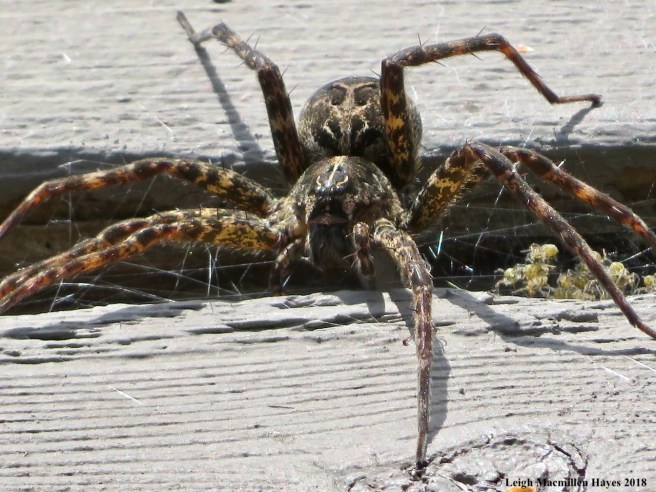
And so I appreciated this spider’s pattern and understood the need for its hairy body that gave it such a scary look. Fishing spiders hunt by sensing vibrations. The hair is hydrophobic, meaning it repels water. It also allows the spider to actually walk on water to get its prey. Those bristly hairs also trap air bubbles that the spider uses to breathe when it waits underwater to ambush a meal, be it insects, tadpoles, or other invertebrates.

3-lancet clubtail and ant

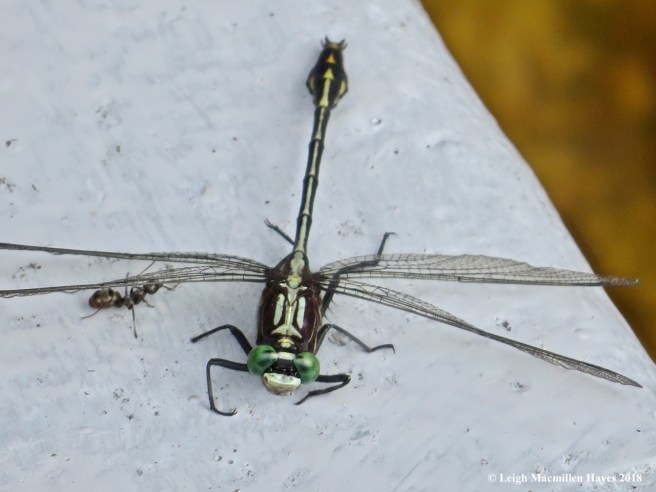
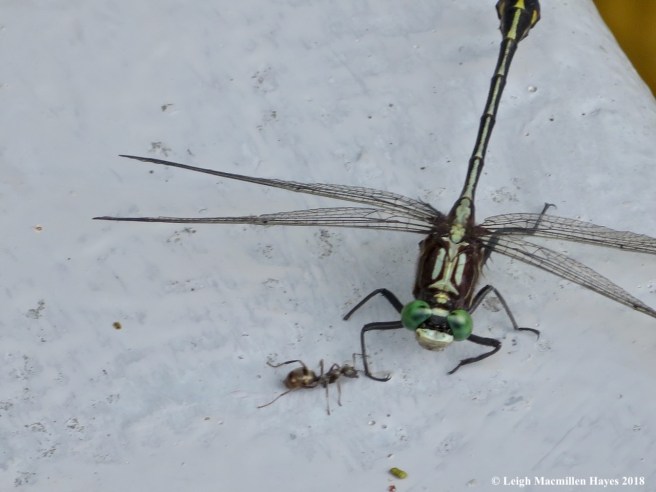
When I heard wing beats behind me, I turned my focus away from Charlotte and toward a Lancet Clubtail dragonfly that had landed on a seat of My Guy’s boat. An ant marched right over to check it out.

4-ant tickling dragonfly

And I fully expected the Lance to eat the ant. But . . . he didn’t. Drats.  I like watching them consume their prey.

5-lancet minus one tarsus

The more I looked at this guy, and it was a guy based on its cercus, the more I noticed, including the fact that it was missing the tarsi or claw-like foot of one leg.

6-dragonfly_anatomy

It was his face though, that I really wanted to study. I found this simplified picture at arizonadragonfly.org, and though it’s not complete, it provided enough information for my purposes.

7-facial features of a dragonfly

There’s so much to learn, that to add more detail would be more than overwhelming. Look at the mouth parts. And those eyes–each is composed of 30,000 lenses. Apparently, they can see ultraviolet and polarized light. And then there’s the ocelli, or visual organs, that probably work along with the antennae. Prey don’t have a chance.

8-fishing spider

When the Lance flew away, I checked on Charlotte again. Still she sat, one leg dangling below the dock board and touching a web. I figured she was waiting for movement to announce that a meal had arrived.

9-Ted had arrived

And then I noticed that it wasn’t a meal, but perhaps a mate she’d been expecting.

11-spider movement

Suddenly, he darted under the dock and she started across the gap–toward me!

12-Charlotte the spider

Then she stopped, seemed to make an adjustment,  and quickly disappeared.

13-spider nursery

I moved in for a closer look and made a discovery.

14-spider nursery

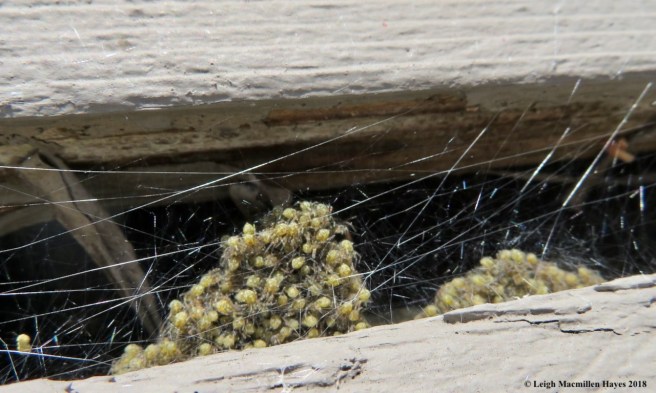
Her nursery! Fishing spiders are nursery web spiders. She must have wrapped her eggs in a silken sac and carried it to the gap between the outer two boards of the dock, where she constructed the web. And she was standing guard waiting for her spiderlings to emerge–until I came along. Now the question remains, will I be around when they do hatch and disperse on their own silken threads?

15-bubble on water

I don’t know. But today, I was there to notice so much in such a short time–as the world passed by.


Docked

Some days are meant for staying close to home. Such was today–a perfect 10 kind of August day with cool temps at either end and a sunshine sandwiched between.

1-lakesmart award

One of the starts to our day was receiving two signs that announced the fact that our camp property is award winning–at least for a LakeSmart Award (don’t check inside for any award winning style or cleaning habits because you won’t find either here). We tipped our hats to Roy Lambert, vice president of the Lakes Environmental Association Board of Directors, and secretary of the Maine Lakes Society Board of Directors. Roy coordinates the local LakeSmart program sponsored by LEA.  He visited camp a few weeks ago and evaluated the surrounding land, then submitted a report. And we waited.

The final conclusion with only a couple of recommendations:

LakeSmart Award Status:
SECTION 1 Driveway and Parking Eligible
SECTION 2 Structures and Septic Eligible
SECTION 3 Yard, Recreation and Paths Eligible
SECTION 4 Buffer and Water Access Eligible
LAKESMART AWARD Award Granted

In his presence, we immediately posted the sign on the red pine by the water’s edge and then walked up the driveway to place one by the road as well.

2-dragonfly love

After Roy left, we settled into the day and discovered others who had settled momentarily, making use of a red oak branch dangling over the water for their canoodling session.

3a-reading

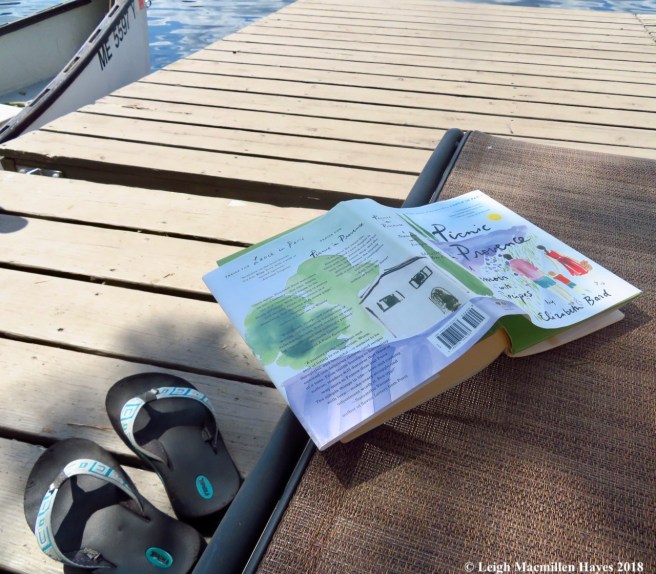
It’s rare that I’ve lounged this summer, but a new-to-me book purchased yesterday at the Lovell Arts and Artisan Fair book sale drew my attention between mini naps.

7-dock view

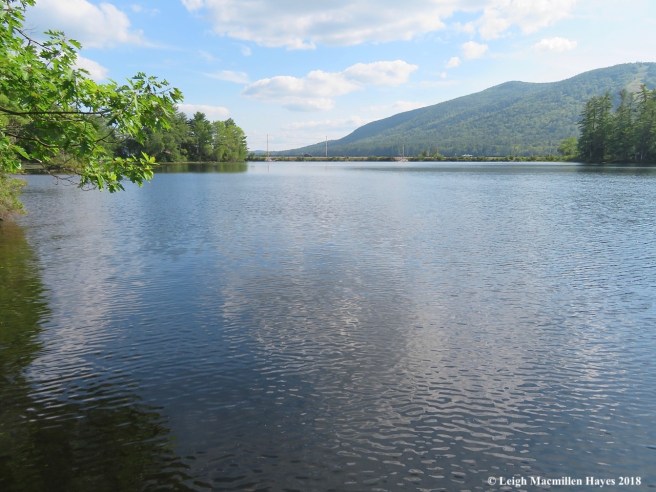
When I wasn’t napping or reading, however, I spent time staring across the pond.

9-dock view

And to the south.

11-bass tournament

All about there were bass boats for today featured a club tournament. The thing about bass tournaments is that except when the fishermen are zooming to the next best spot, they are quiet as they troll. And I have to thank them for a few weeks ago I wrote to a club president and asked that they please be aware of the parking situation on Route 302. Their trucks and trailers have long blocked our view as we precariously try to pull out onto the busy road. In the past, I’ve asked for help from others, including Inland Fisheries and Wildlife staff and local police, to no avail. But, this time was different. The club president immediately responded to my request and passed the word along to others as well. This morning, there were orange cones blocking cars from parking a certain distance from our road and as we drove to church, we were able to pull out without risking our lives. Thank you Steve and Wayne, and I hope you also had an award-winning day.

3b-oarlock

Because of there being more boats than normal on the lake, however, occasionally the waves rippled my way. And beside me, the dangling oarlocks in the S.S. Christmas clanged against the inside of the boat.

10-common loon

The bass fishermen weren’t the only ones seeking a catch and I watched a common loon that spent all afternoon nearby, sometimes looking for a meal, other times preening, and even merely floating.

13-baitfish

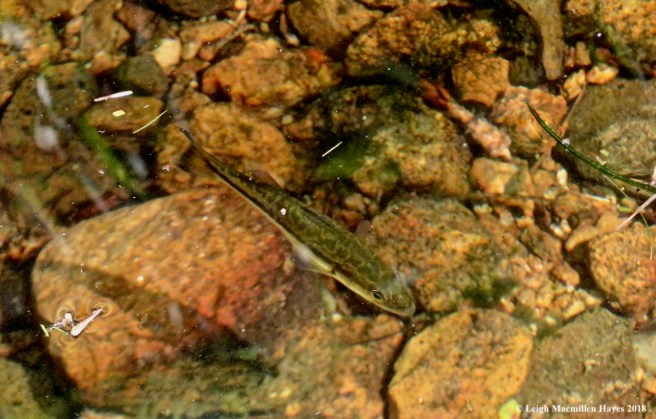
Of course, bait fish swam abundantly below my locale–perhaps finding protection in the shadows offered.

4-slaty blue skimmer dragonfly

Also on the hunt, but for insects rather than fish, were dragonflies and damselflies including this Slaty Blue Skimmer, its colors matching the sky reflection on the water.

5-lancet clubtail 1

A Lancet Clubtail I spied on the wood first,

6-lancet clubtail dragonfly

and then on the shrubs in the vegetated buffer.

6a-Swamp Spreadwing Damselfly

And a Swamp Spreadwing Damselfly found a spot to hang below the shrubs and just above the water’s edge.

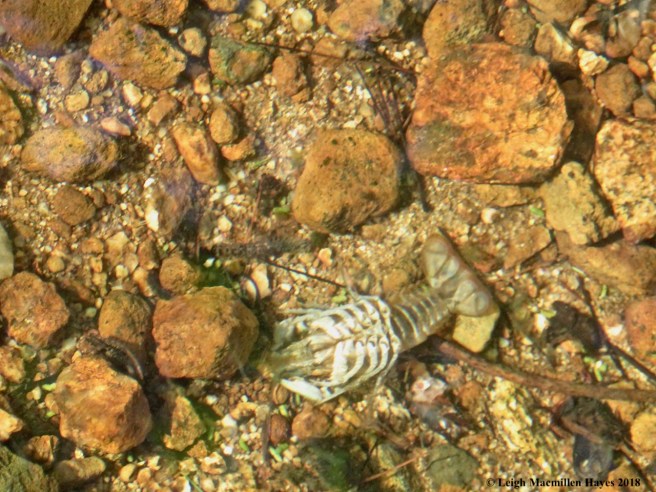
13a-crawfish skeleton

Because I was looking, I also found the carcass of a crayfish, which surprised me for I rarely see one and had to wonder if a heron or another bird dropped the remains of a fine meal.

12-shamrock lily

As the wave action continued, the leaf of a fragrant water lily floated by, torn from its base. In the shadow below, it transformed . . . into a shamrock.

14a-water pattern over rock

Other transformations also took place as boulders under the water’s surface became works of mosaic art.

15-wave:sky patterns

And waves reflected skylight in a more modern polka-dotted form.

17-wave:sky patterns interrupted by leaf

Even that pattern was sometimes interrupted . . . by a passing oak leaf.

20-sunset

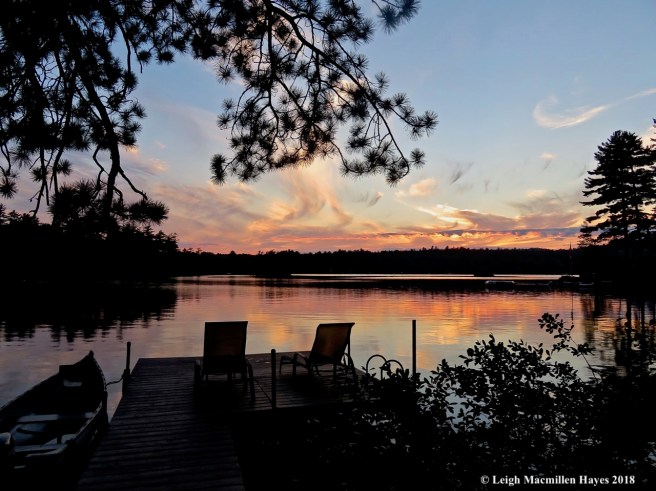
At day’s end, it was all about taking the time to be rather still. To read. To write. To swim. To watch. To notice. To think. To wonder. To admire. To be. Docked.


The Amazing Race–Our Style, episode 4

We’d barely set off on episode 4 of The Amazing Race–Our Style when we hit our first roadblock just around the corner from home. A small patch of roadway at the foot of a friend’s driveway was being paved by the State. Our first challenge–how many state employees does it take to repair such a patch? Fifteen. Two to stop traffic, two to operate equipment, one to supervise, and ten to stand around and drink coffee.

Our next roadblock–a stop at our local hardware store to return a rented chainsaw. Well, truth be told, more like a borrowed chainsaw from the rental department. Regardless, the clock ticked on.

And still, there was one final roadblock–a stop at Prompto Ten Minute Oil Change, where we got to sit and watch the action, which actually took less than ten minutes.

At last, we reached the ticket office of Casco Bay Lines in Portland, Maine . . . as a ferry was departing. The ferry we wanted to be on. C’est la vie.

P1-PORTHOLE

Since we’d missed the boat. we decided to use the time until the next departure to our benefit and ate an early lunch at the Porthole, where we both ordered the scrumptious beer-battered fish sandwich.

P2-GATE 5

Following lunch, we hurried back to Gate 5, not sure if we’d be the only contestants on board.

P4-TICKET:CLUE

When it was time, my guy handed over our tickets and received our first clue.

P6-PEAKS ISLAND

We needed to exit the boat at Peaks Island in Casco Bay. That was easy given that this particular ferry only traveled between Portland and the island.

P7-MIKE'S CARTS

Finally, we were ready to get into the nitty gritty of the day’s adventure. We had a choice–ride all the way around the island on bicycles without stopping or complete a loop that only covered half the island via a golf cart, but included a few stops. Because of my current one-armed bandit situation, we chose Mike’s Carts.

P8-LEARNING TO DRIVE GOLF CART

Another set of contestants made the same choice, which made us realize we still had a chance to stay in the race. Mike explained the finer points of island driving.

P10-MAINE COAST AND ISLANDS

As we made our way to the first island challenge, we enjoyed the views.

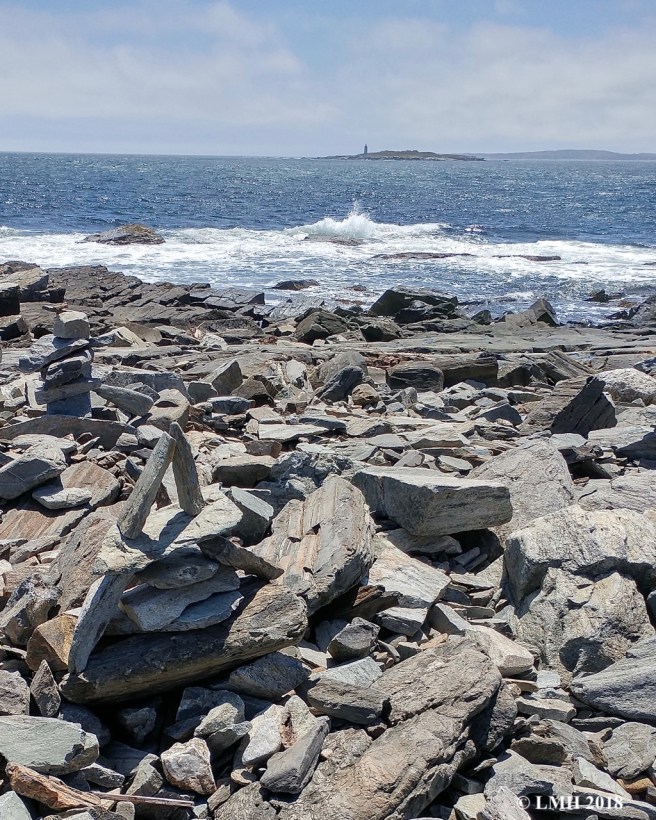
P11-CAIRN ALLEY

The rocky coast of Maine proved to be much more than that, at least in this section–Cairn Beach. Other contestants passed by this challenge, but we decided to try it.

P12-CAIRN ALLEY

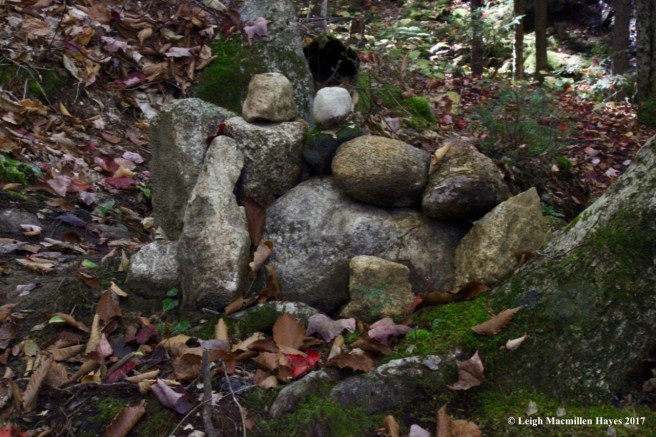
According to the clue, we needed to build a cairn that somehow reflected the surroundings. Examples surrounded us.

P14-CAIRN GROWING

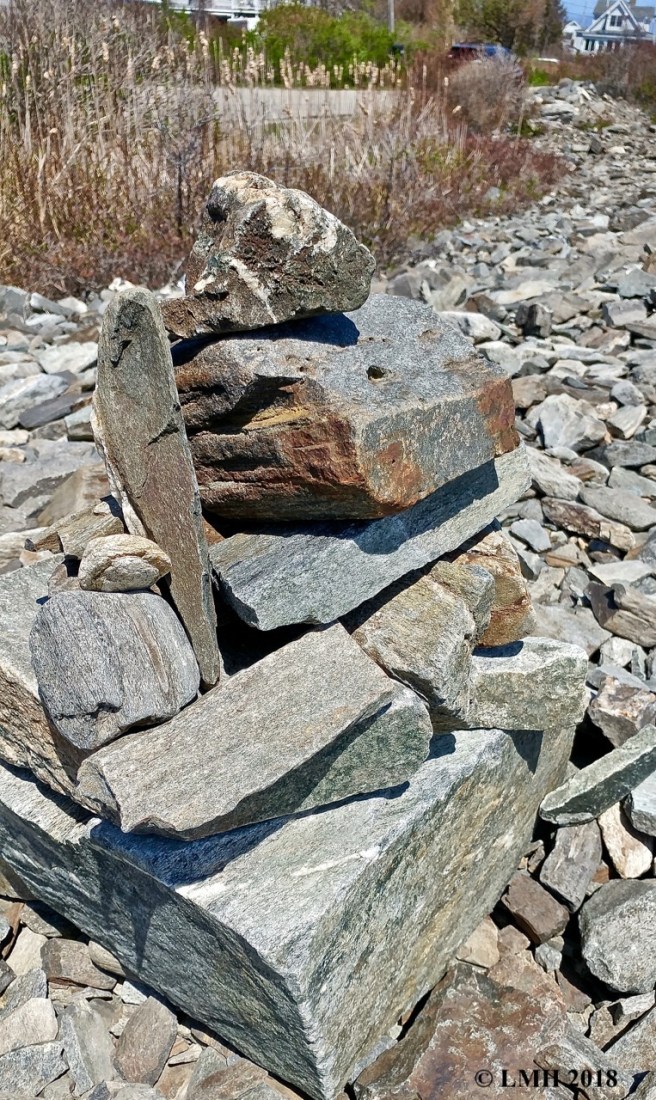
One rock at a time,

P13-BASE OF OUR CAIRN

we created a base until . . .

P15-CAIRN REFLECTION

our final product was an artistic representation of the cattails behind it.

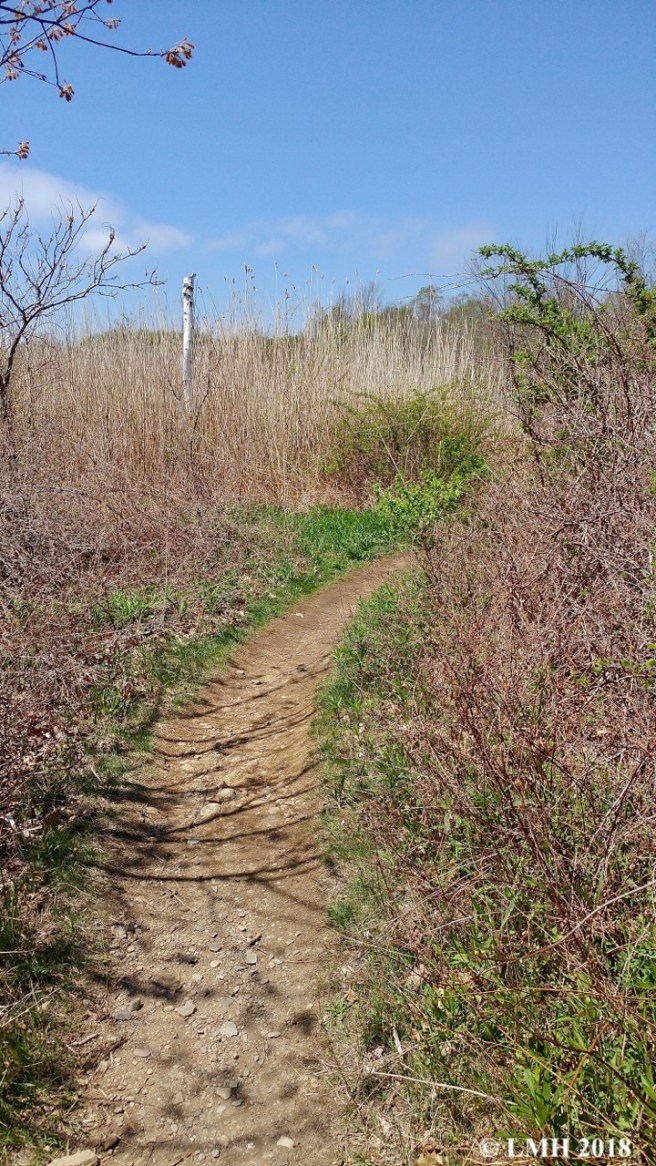
P16-TRAIL TO BATTERY STEELE

Upon completion of the cairn, our next clue suggested the need for batteries. And so we followed a trail away from the water.

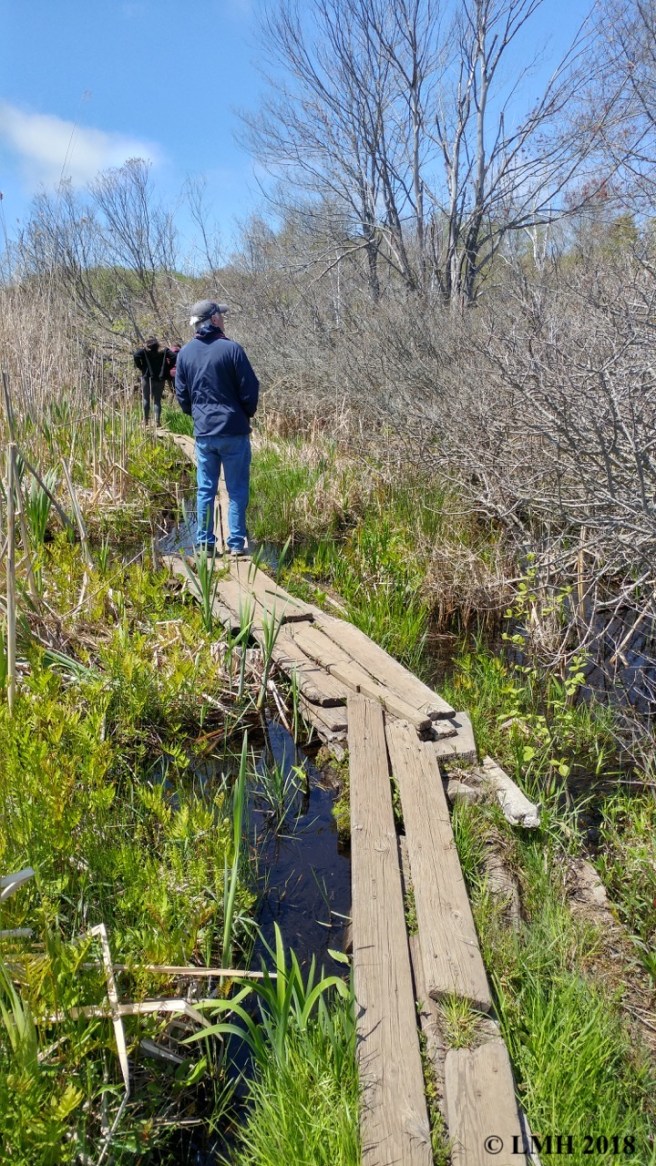
P17-BOARDWALK

But really, water was a part of it. And a boardwalk–in much worse condition than the one that flipped my feet into the air on last week’s Left-handed Mondate.

P18-TWO WOMEN AHEAD

With great care I followed my guy–for two women we wanted to overcome were ahead of us. All the way along, birds serenaded us.

P20-sausage-shaped boudin

Thankfully, the boardwalk gave way to solid ground and among the offerings at our feet I noted a sausage-shaped boudin–I could only hope we might earn extra points for knowing such.

P19- APPROACHING BATTERY STEELE

The trail led us to a gallery of sorts for its a place frequented by midnight artists. Were we in the right place?

P22--MIDNIGHT ART

The question remained as we admired the creative works–but what did they have to do with batteries? Did the clue refer to the energy of the artists?

P21-BATTERY STEELE

And then the answer was made obvious–we were exploring the Battery Steele constructed in 1942. According to the Peaks Island Land Preserve: “During World War II, Battery Steele was the most important fortification in Casco Bay. Its two 16″ guns, triangulated by observation towers on Peaks Island, Jewell Island, Cushing Island, and Bailey Island, could shoot a shell weighing 2,240 pounds nearly 30 miles at enemy battleships or submarines to protect Portland Harbor.”

If you look closely, you might see my guy starring into a tunnel. The team of two women challenged us to walk down the dark tunnel. They made it about a third of the way before running out while screaming. We accepted the challenge and made it only as far, using my handicap as an excuse to turn around–I couldn’t spy any obstacles in the dark and didn’t want to risk tripping. Would our calm departure overcome their hysteria?

P23-SHORTCUT BACK

No matter, for we knew the outcome was out of our control. Because we’d chosen a cart over a bike, we next needed to locate the road that cut across the island and back toward the harbor. An islander was out for a walk and we stopped to ask if we were headed in the right direction. She told us to stay to the right, cross over at the four corners, and continue down the hill. Bingo. We returned the cart and received our next clue–to locate the smallest store on the island that is open year round.

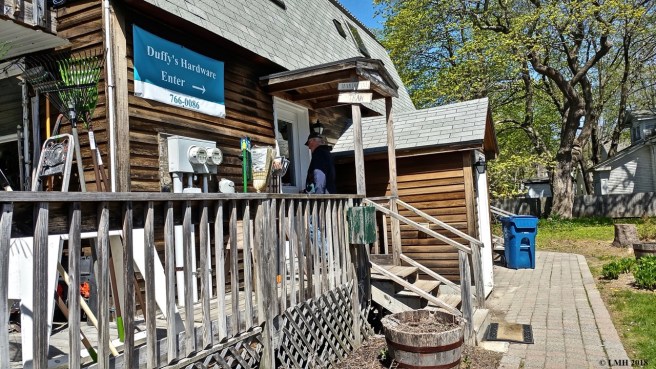
P24-DUFFY'S HARDWARE

And that’s how we ended up in Duffy’s Hardware.

P25-DUFFY'S HARDWARE

It’s a one-room wonder that serves an important niche.

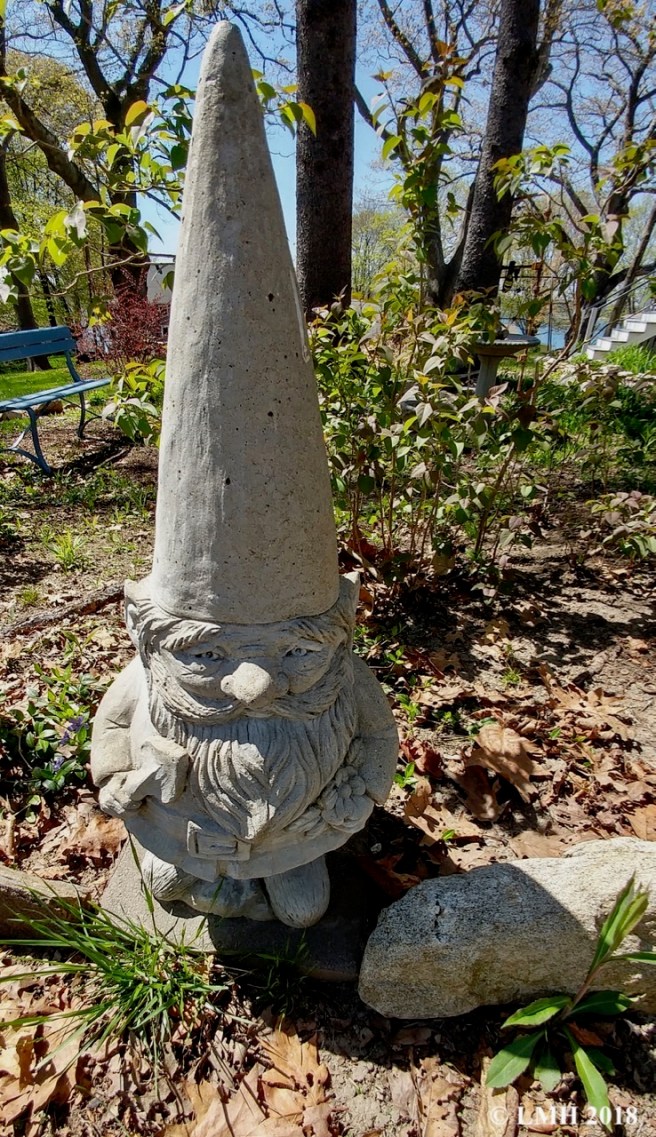
P26-TRAVELING GNOME

With the hardware challenge completed, we next needed to walk along until we discovered the Traveling Gnome. We found it subtly hidden in a garden with Casco Bay forming the backdrop.

P27-LOCKED GATE

The gnome’s clue was to find a way to the beach. We began to worry because time was running short and we found one locked gate after another.

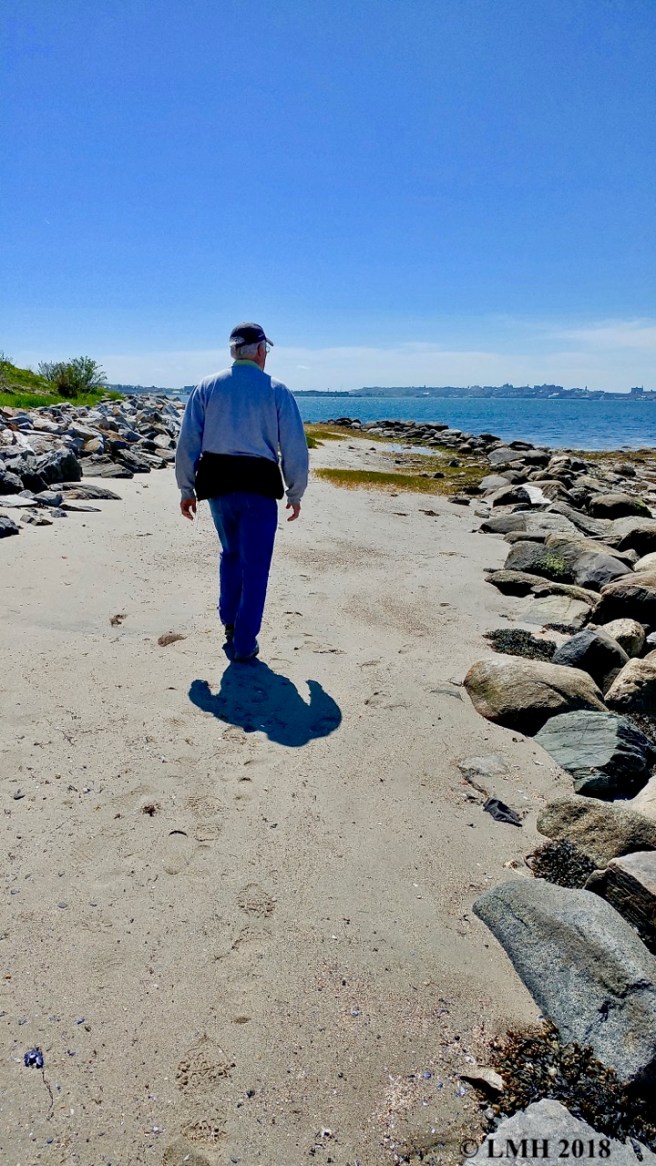
P28-BEACH OF SORTS

But, we don’t give up easily and at last found a slice of sand.

P29-NATURE'S ART WORK

While walking along our goal was to locate three natural representations. The first–nature’s artistic palette.

P30-BRICK

The second–something with an historical reference.

P31-BARNICLES

The third–natural homes aka barnacles.

P33-LOBSTER TRAP MAZE

And then we both had to complete the lobster trap maze. Could we do it successfully?

P34-MAZE

Piece of cake.

P37-ICE CREAM

Speaking of cake, we had some spending money and a wee bit of time before the ferry arrived so we visited the local grocery store to satisfy our need for a sweet treat since the ice cream shop wasn’t open. Among the offerings we found sundaes and purchased two.

P38-ICE CREAM

Ahhhh. But when you are suddenly sidelined by a wrist fracture, consuming some treats requires help and so my guy broke the sundae up for me. It also means letting go of the fact that one might end up with sticky fingers for a while. If only The Amazing Race–Our Style included special credit for overcoming personal obstacles. Hmmm–maybe down the road.

P32-?

We’d completed all of the island challenges when one last question (mark) appeared.

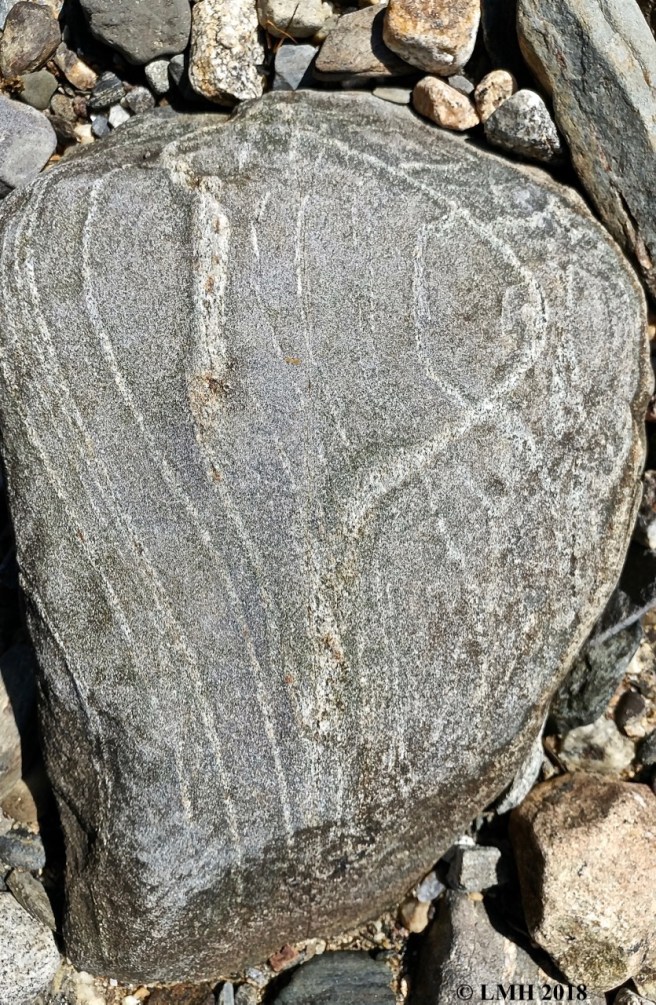
P36-LOVE ROCK

Could you find a stone that represented our relationship and today’s Mondate?

We did. And with that we completed another episode of The Amazing Race–Our Style.


Kinship With All Forms of Life

I walked today with intent, as I sometimes do, only that intention morphed between the beginning and ending of my journey. You see, I awoke with a need to reach a certain heron rookery that I’ve helped monitor for the Heron Observation Network of Maine during the off-season,  before the owner of the land returns. It’s a bit of a bushwhack to reach the site and in the past, I’ve accompanied Tom for this citizen science effort. Each spring, we’ve visited it at least once to count the number of nests and adults. Sadly, Tom won’t be joining me this year and so I headed off this morning to see what I might see–and be his eyes.

m1-squirrel

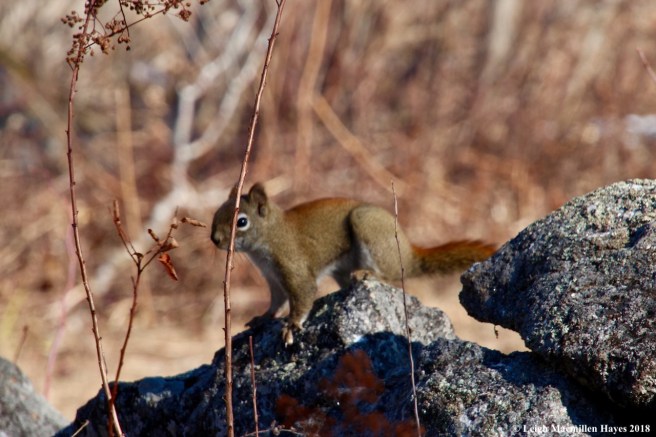
They were big eyes to fill–as big as the red squirrel who paused to watch me and then dashed along a stonewall on a mission of its own making.

m2-brook peek

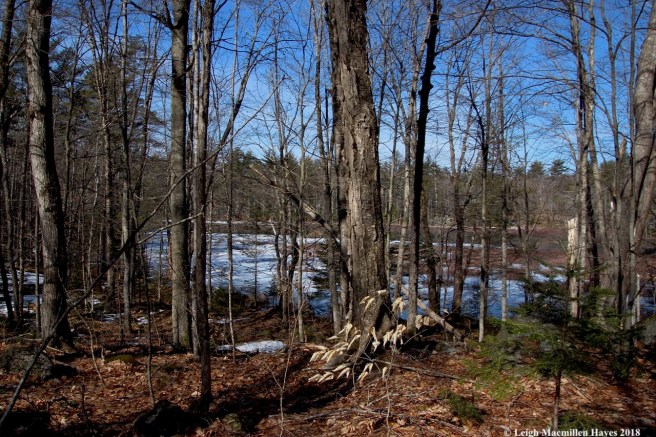
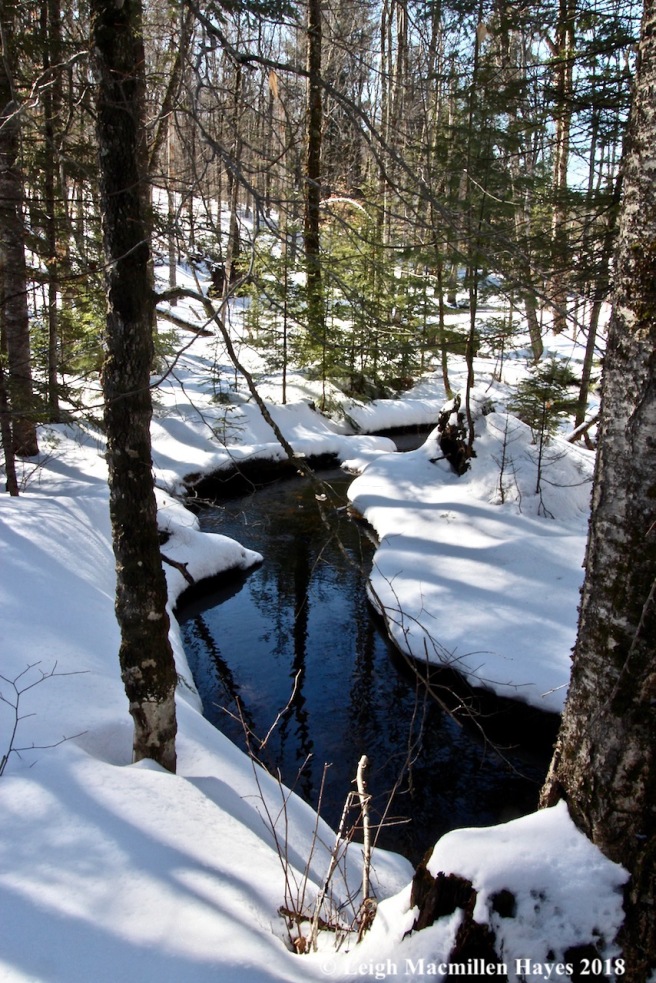
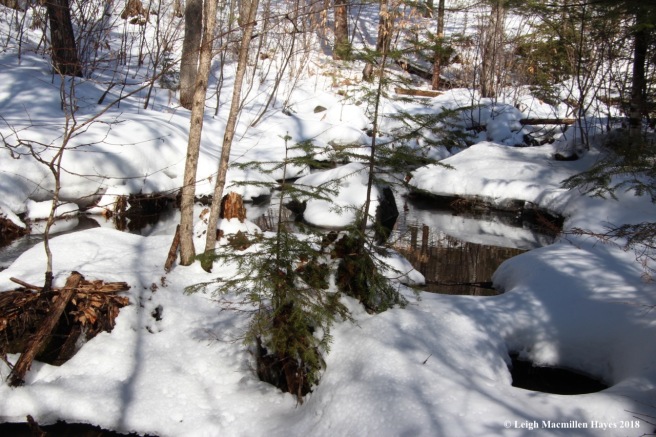
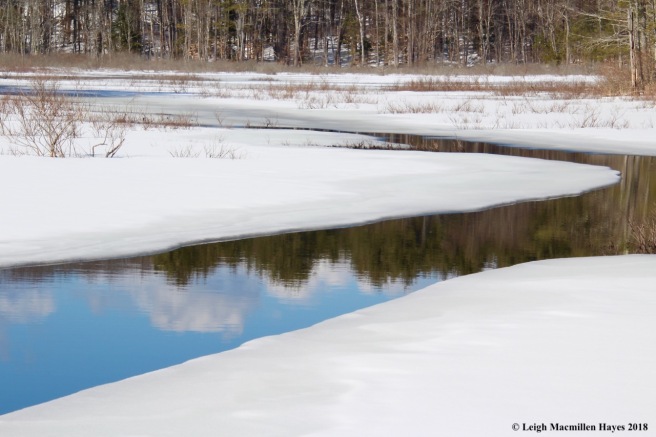
Initially, the journey was a bit of a bee line as I followed a snowmobile trail. It was there that I delighted in the color of the sky and realized that most of the ice had melted on the beaver pond and brook below. I could have headed down to the water’s edge then, but chose to continue toward my destination.

m3-beaver dam inactive

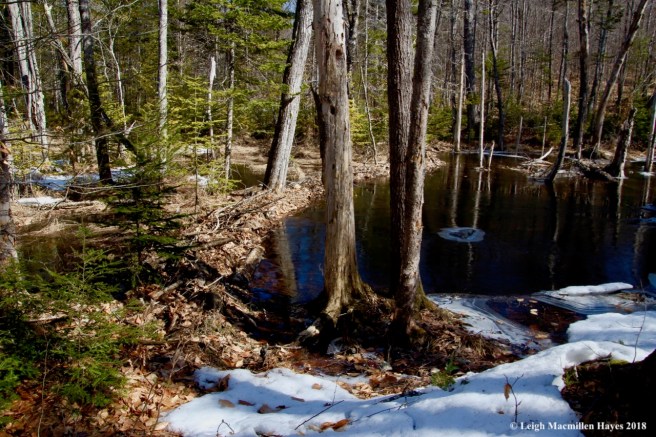
I was almost there, when an old beaver dam forced me to stop. And then I heard a loud crash. I scanned the area and stood still–listening, waiting, wishing.

And then another noise–of movement. Again, I stood still. Nothing.

m4-land bridge

Finally, I arrived at the land bridge that would lead me to the rookery, but . . . my journey stalled and I realized I’d have to save the crossing for another day. Water rushed over the mossy mounds and because I was alone I decided not to risk falling in. As I stood and admired the flow, I thought some more about Tom and the crossing he is making from this life to the next.

m6-more ice bubbles

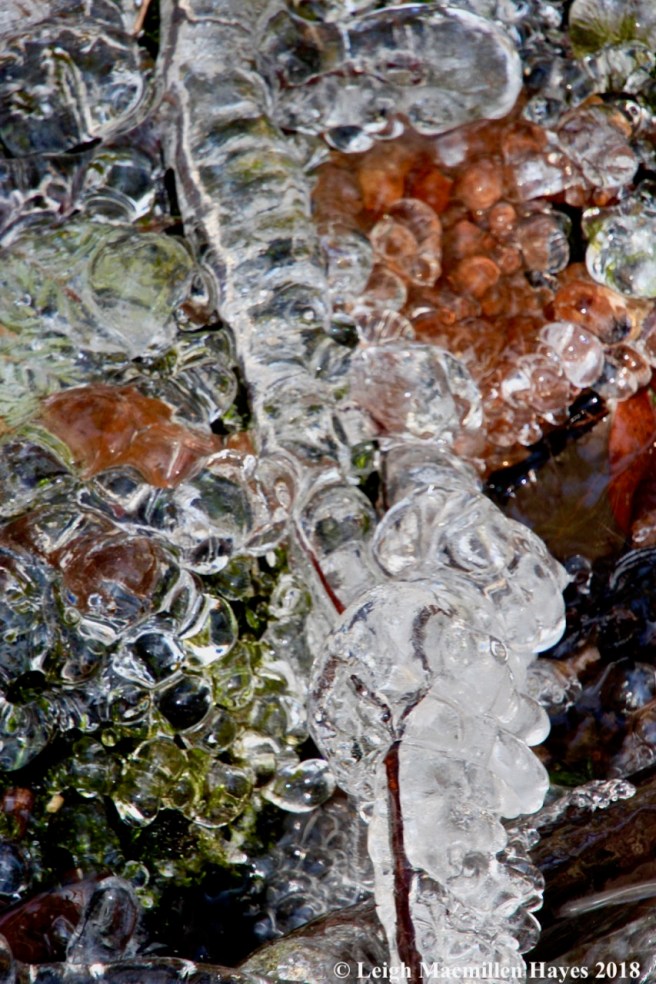
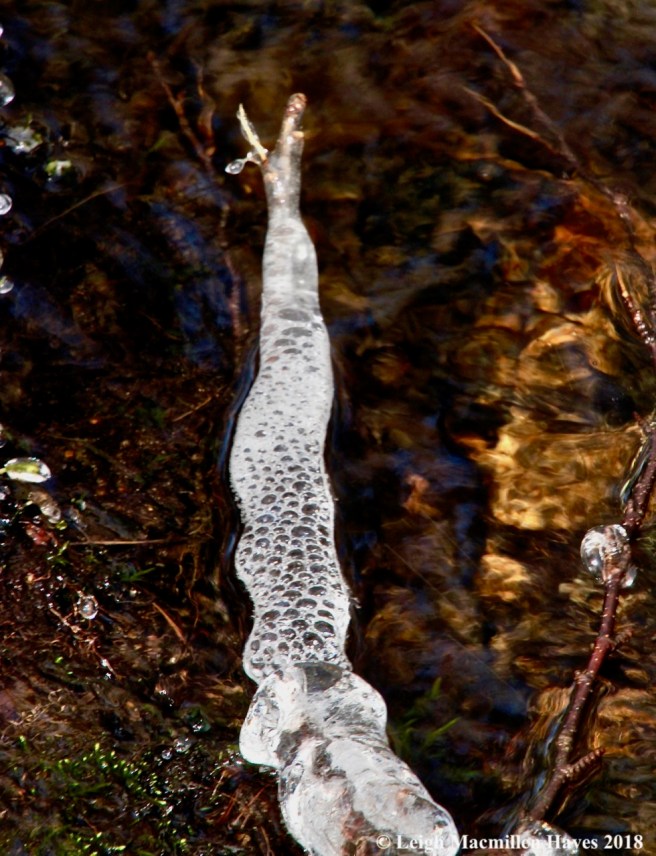
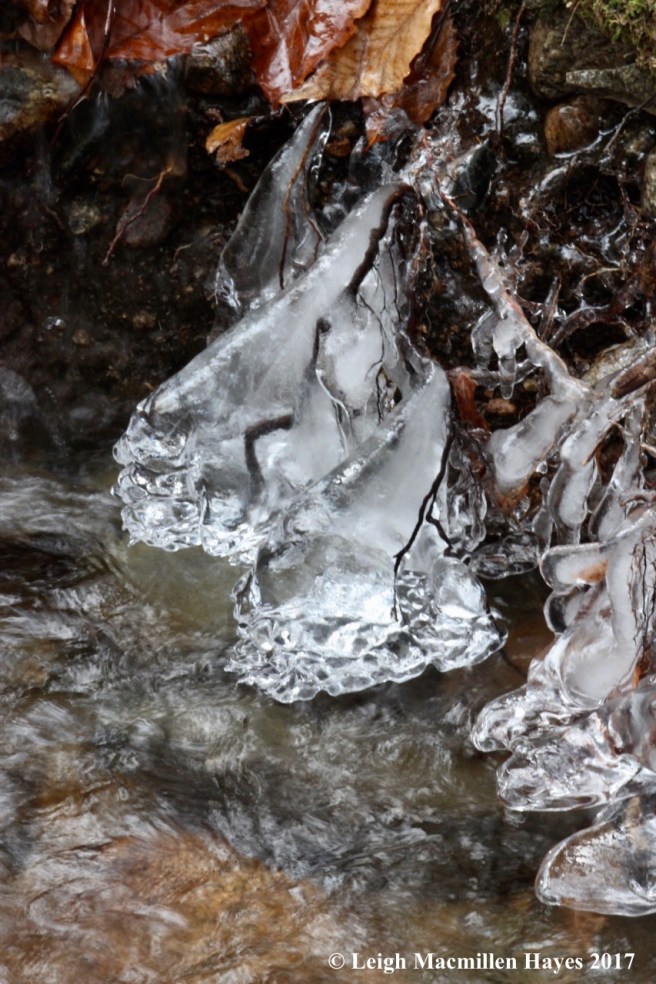
And I thought of his sense of wonder and ability to instill such in others, even over something as simple as ice baubles.

m 5-ice bubbles

I could hear an eloquent explanation flow forth from him about the movement of bubbles within an icicle formed on a branch.

m7-ice fingers

And I knew he would appreciate the artistic rendering before our shared eyes–in this case a wee bit reminiscent of M.C. Escher’s Transformation Prints.

m27-forest

At last I pulled myself away from the crossing I couldn’t make and turned back toward the forest from which I’d come. Tom had a hand in the vision of these woods–as a forester and as the executive director of the Greater Lovell Land Trust. His vision included forest management that would benefit wildlife. From where I stood, I saw turkey, deer, bobcat, and squirrel tracks.

A third time, I heard a sound and knew that I wasn’t alone. We never are, are we?

m8-mergansers

Eventually I made my way to the water’s edge and noted Hooded Mergansers in the distance. Around another bend, I spotted Wood Ducks. Tom would have loved it for birding was also one of his passions.

m10-beaver works

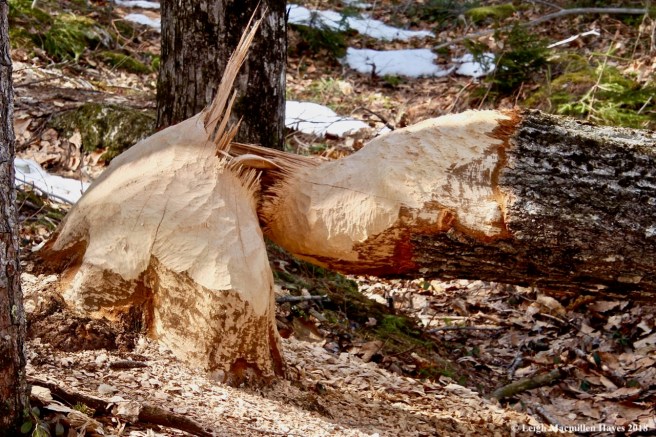
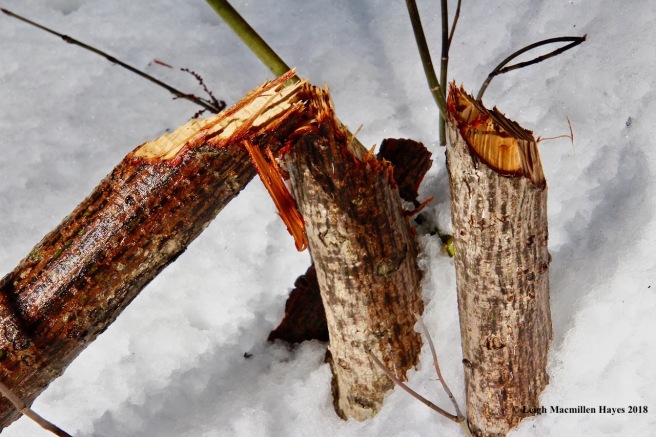
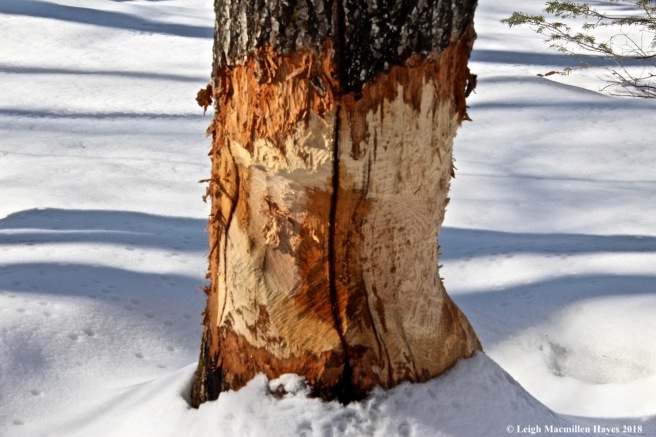
Within footsteps I admired the work of another forester who called this place home.

m11-beaver attempt

It seemed he’d sampled some trees and they weren’t to his liking–at that moment. Or perhaps something had startled him and he quickly retreated to the water. Either way, he treated this land as if it were his. For it was.

m12-more beaver

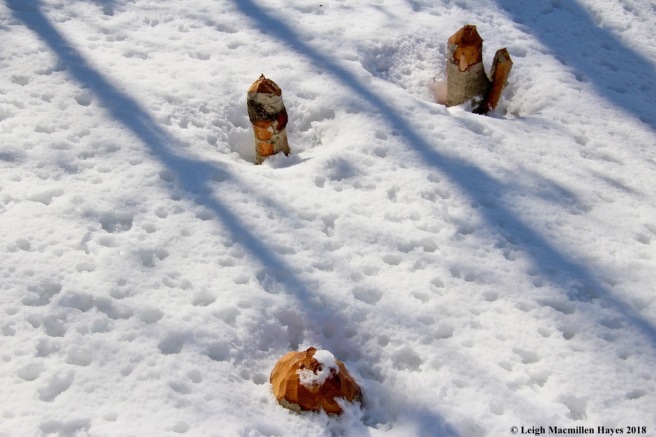
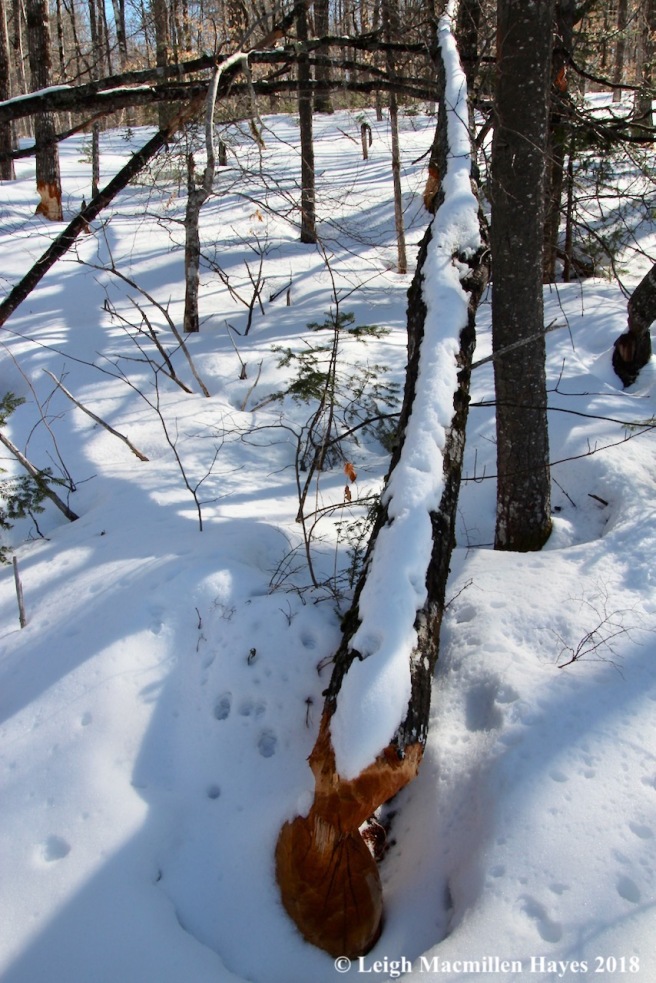
Everywhere, beaver works both old and new decorated the forest.

m18-lodge

And a lodge stood tall still partially surrounded by ice.

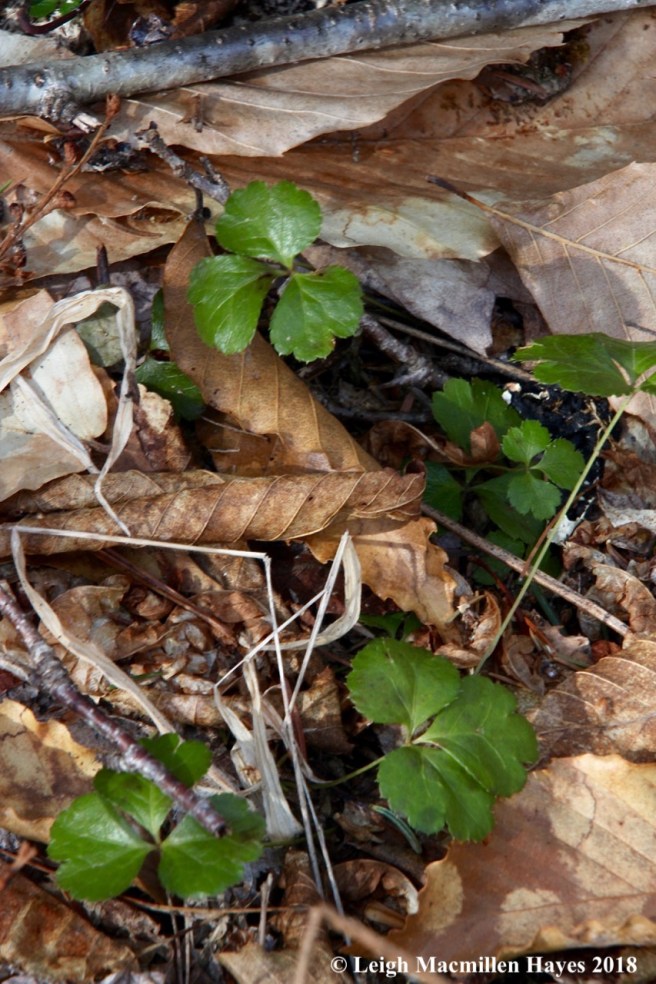
m7a-goldthread

But there was more of  the woods to see this day, like goldthread’s evergreen leaves that reminded me of cilantro. And also of Tom’s garden, for which he actually has some seedlings that will be ready to plant in another month and its produce will be enjoyed at a later date by those he loved most. Their dinners will be enriched for one last season by his green thumb.

m13-tiny shell

Next, I spied a tiny, fragile shell that was iridescent on the inside and brown on the outside. It couldn’t be a bird egg. Was it from a snail?  Tom would have known.

m14-holy leaf

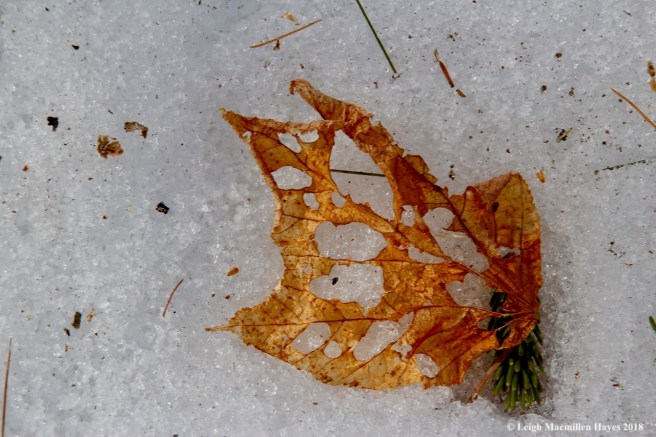
And then there was a striped maple leaf like none I’ve ever seen before–almost stained-glass in its offering. It only made sense that it be so hol(e)y for in its life cycle it had provided energy to insects and as it continues to break down it will nourish the earth. Tom would recognize the significance of such–renewal, rather than devastation.

m15-hobblebush

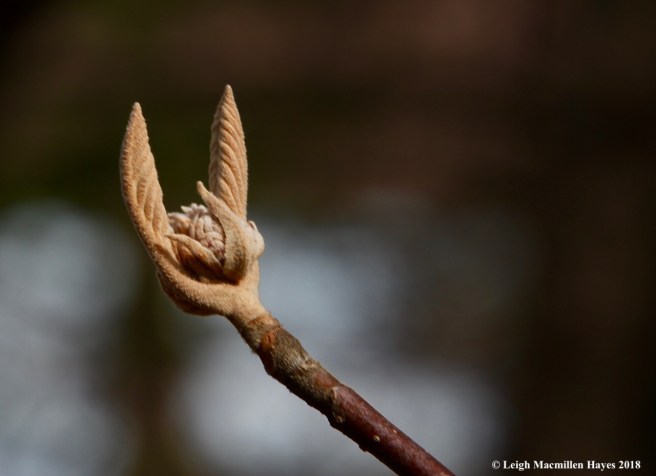
There were other things to note, including a hobblebush flower bud that formed between its praying hand leaf buds.

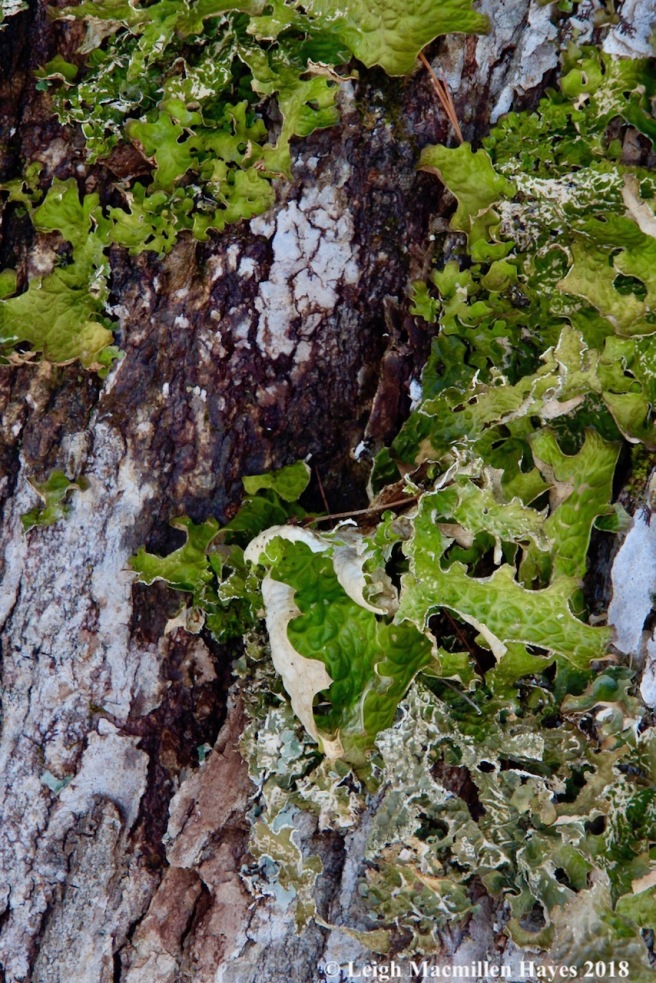
m21-lungwort

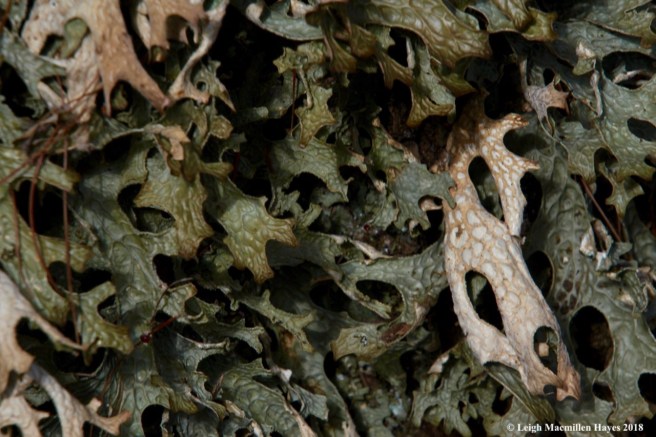
And lungwort that served as an indicator of a rich, healthy ecosystem. Indeed.

m19-heron

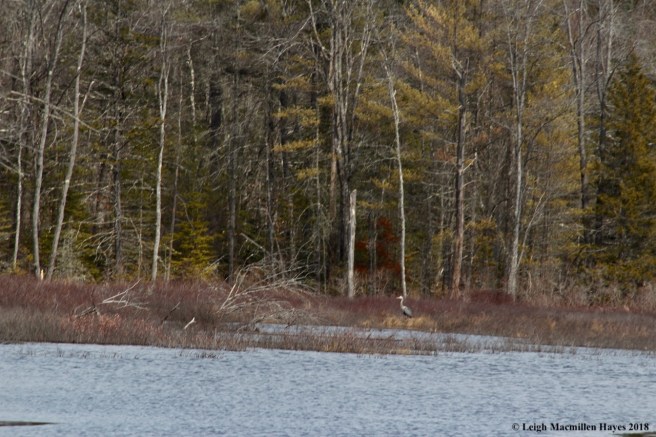
I stood for a long time by the water’s edge, thinking of Tom and then I spied it. A Great Blue Heron flew in and landed across the way. My intention was honored. And Tom’s.

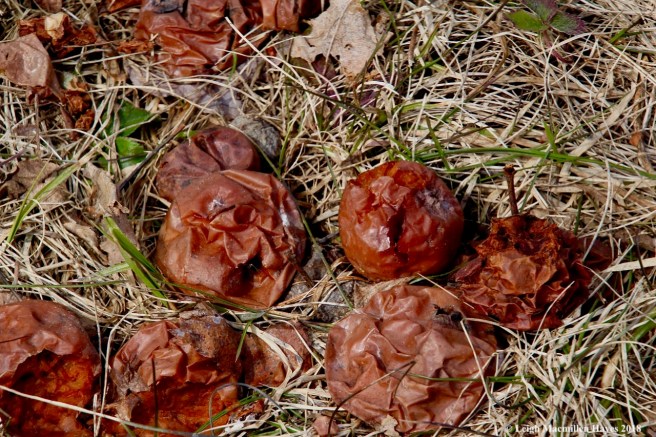
m24-rotten apples

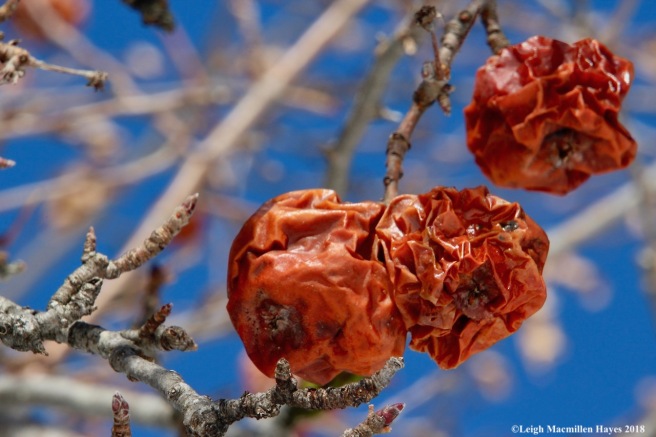
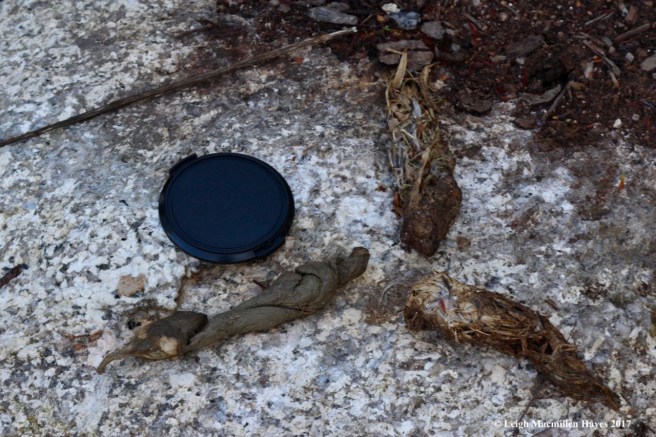
At last I headed back the way I had come and passed through a field where a couple of apple trees grow. As I’d journeyed I had noted scat after scat–some filled with apple chunks and seeds. Of course, I rejoiced because I have an affinity for scat.

But Tom, too, would have rejoiced for what he set out to do so many years ago was to create wildlife corridors–those links of joined natural habitat. For Tom, that’s what it’s all been about–maintaining the ecological processes that allow mammals of all kinds to move and continue to be viable. And for the land on which they traveled to also be viable.

His has been a kinship with all forms of life beginning with the minute, like his shiitake mushrooms and the earth within his gardens and ending with . . . there is no ending, only new beginnings. May Tom’s next beginning be through the eyes of a Golden Eagle. As he soars above us, may he approve of the continued good works of others who try to emulate the legacy he will leave behind.

Godspeed Tom. And thank you.


Bogging with Barb

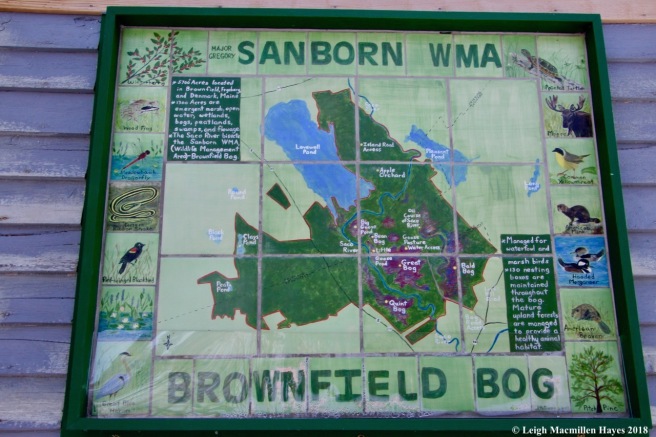
Passing off a copy of the book, From Grassroots to Groundwater, about how two small Maine towns fought Nestlé and won, was the perfect excuse to head to Brownfield Bog. I told Barb I didn’t mind driving to her home or somewhere nearby to give her the book because I’d then go exploring and she welcomed the opportunity to do the same.

b2-Kathy's sign

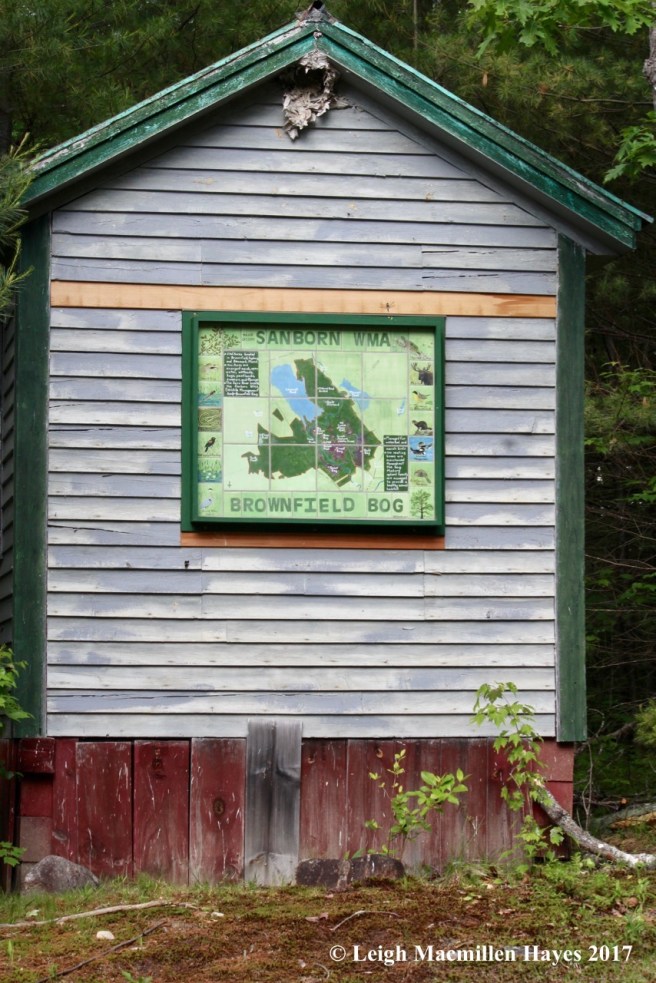
As we began our journey, I asked if she knew Kathy McGreavy. Of course she did. I mentioned that Kathy walks in the bog daily and we might encounter her. Of course we did. Kathy and “her friend” were just coming out after walking their dogs and so we chatted for  bit. Our discussion included mention of the sign Kathy made last year as her capstone project for the Maine Master Naturalist Program. It’s an incredible piece of artwork and as she’s learned, I’m not the only one who thinks so. Recently, she discovered that a woodpecker had taken to pecking it and so the bottom is now protected with a piece of plexiglass. Crazy birds.

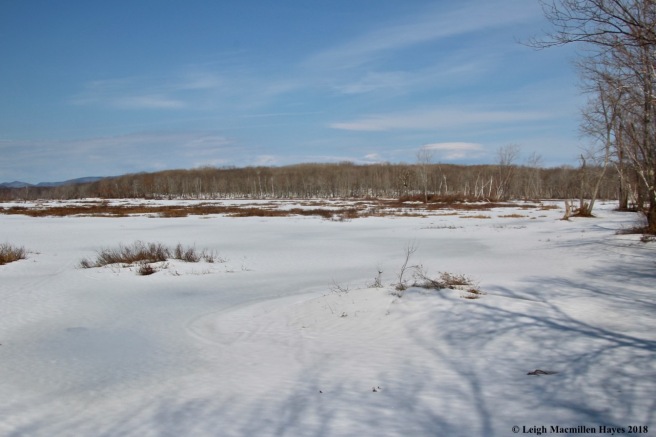
b1-Bog view from the road

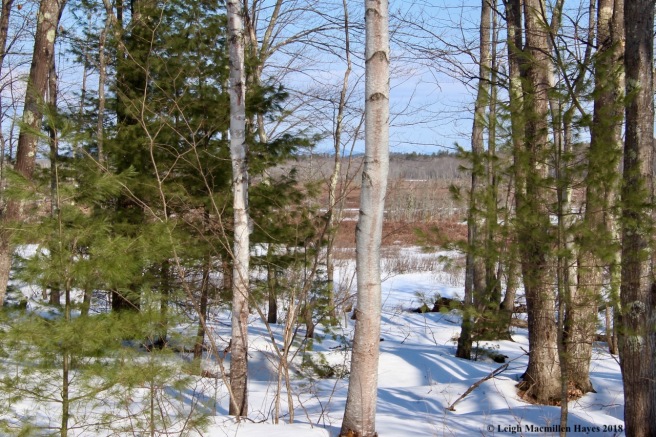
Eventually, Barb and I said our goodbyes to the McGreavys and walked down the unplowed road where I did warn her about my obsession for stopping frequently to take photos. It began from the start–when we spied the bog through the trees and noticed the contrast of colors and layers.

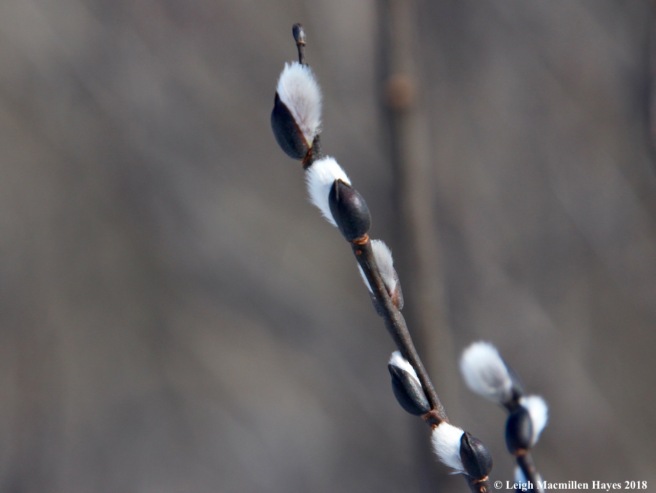
b3a-pussy willows

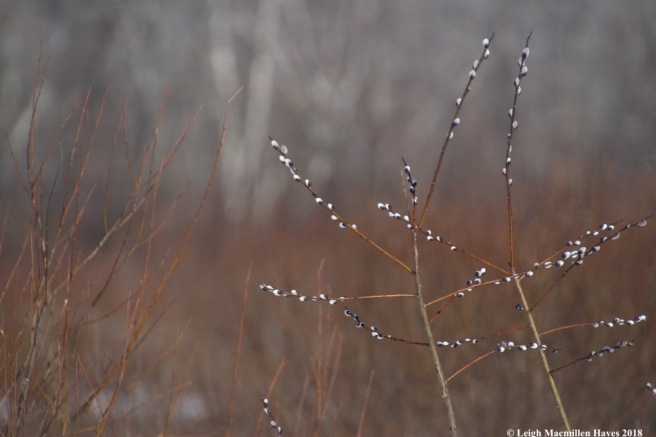
And then–specks of white were ours to behold.

b3-pussy willows

Pussy willows. Was it too early she wondered. No–in fact, I spotted some a year ago on February 23 at Lakes Environmental Association’s Holt Pond Preserve.

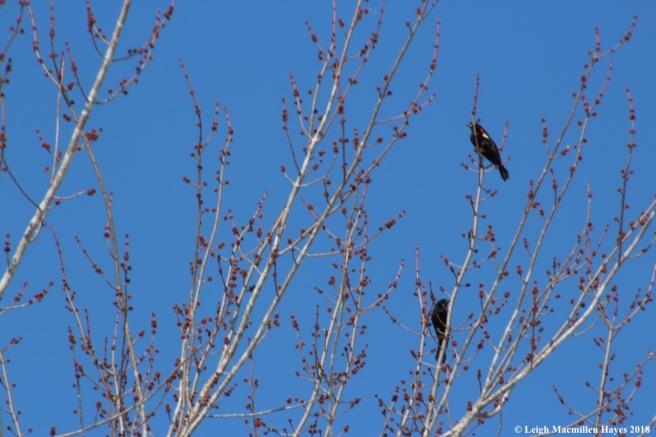
b4-red-winged blackbirds

Our next reason to stop–the red and yellow shoulder patch or epaulet providing their name: Red-Winged Blackbirds. Again, Barb asked if it was too early. This time, I referenced Mary Holland for the February 27th entry in her book Naturally Curious Day by Day has this headline: Returning Red-Winged Blackbirds Survive Cold Temperatures and Few Insects. Bingo.

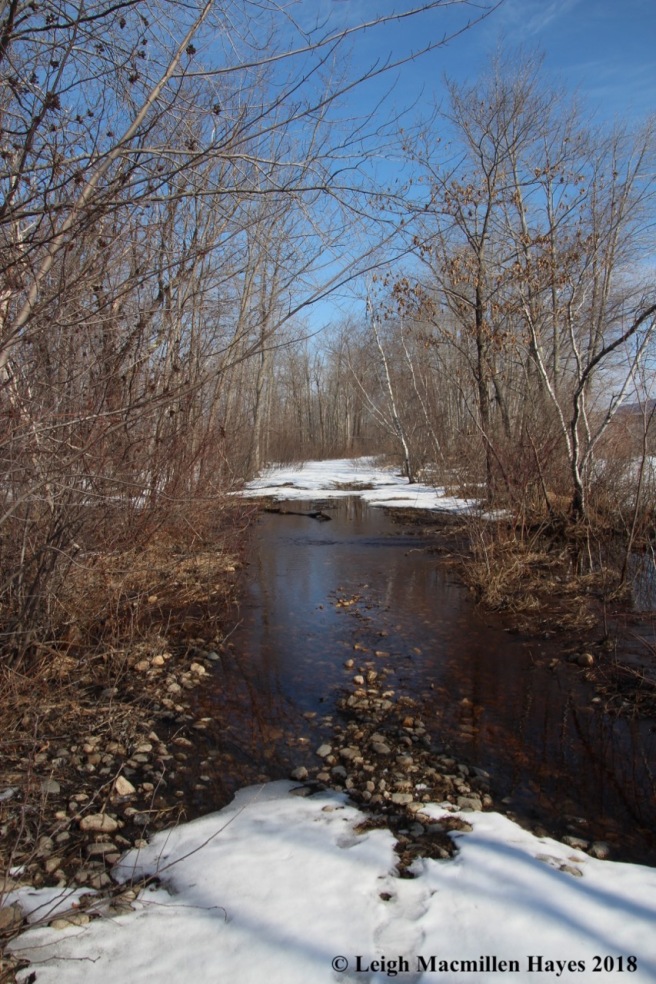
b5-water obstacles

Sometimes our stops were to contemplate our next steps–especially when it came to the water that covered the cobble stones on the road.

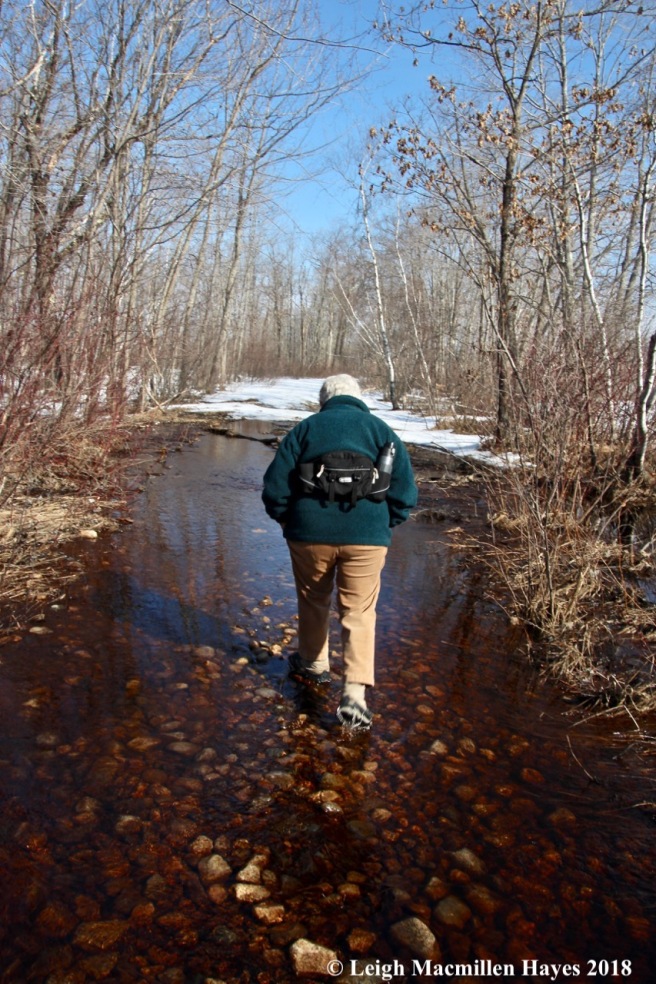
b6-Barb charges through the water

But sometimes you just have to go for it. And we did. As the morning continued, we ventured through deeper water and plowed ahead knowing that we would need to dry our hiking boots out when we arrived home.

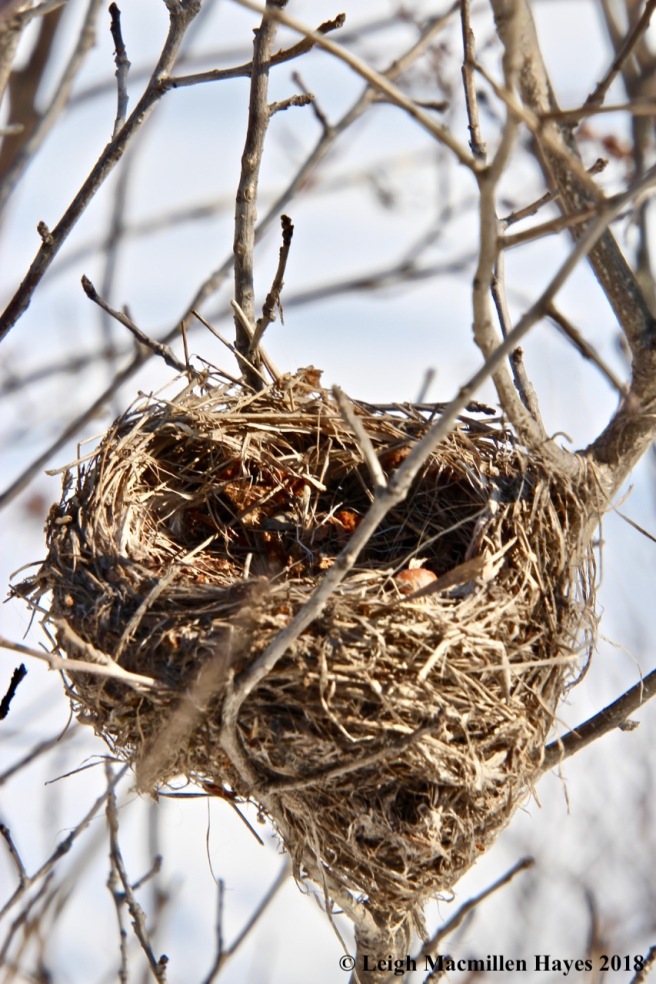
b7-bird's nest

We found a bird nest and wondered about its creator. We did note some acorn pieces inside, so we think it had more than an avian inhabitant.

b8-beaver lodge

And we paused to look at an old beaver lodge. The mud looked recent but none of the sticks were this year’s additions so we didn’t know if anyone was home.

b9-map in the snow

All along, we’d been talking about places we’ve hiked and other topics of interest to both of us. We even learned that we’d both worked in Franklin, New Hampshire, just not at the same time. But speaking of hikes, with her finger, Barb drew a map in the snow and now I have another trail to check out soon with my guy. Should I forget the way, I’ll just reference this map. ;-)

b10-raccoon prints

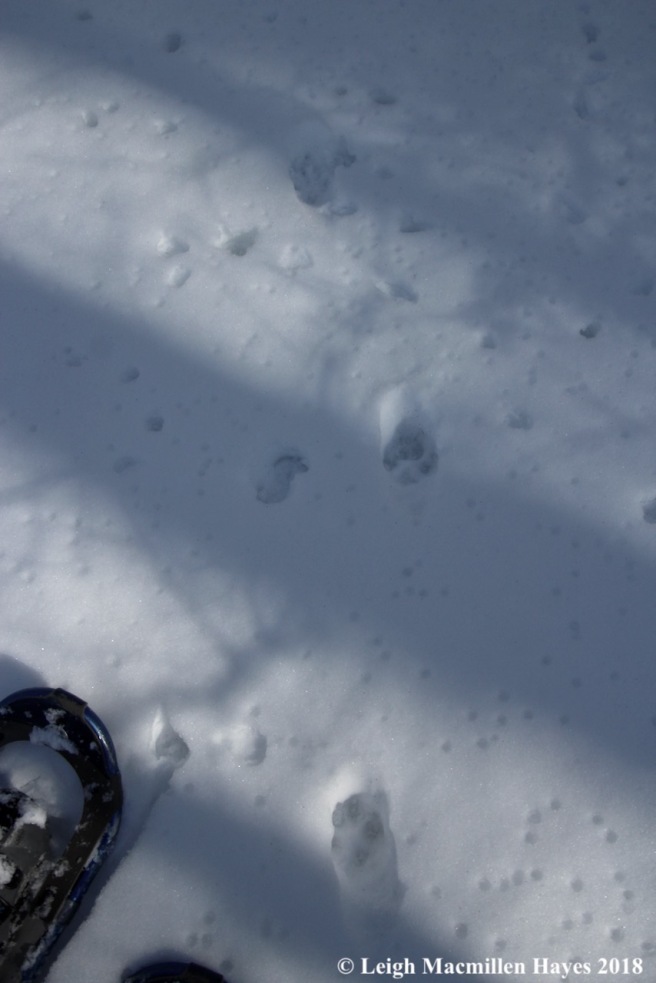
Because we were near water, though most of it still frozen, and the temp was high (actually, too high–in fact, it felt HOT as it soared into the upper 60˚s today), we weren’t surprised to find this set of prints created recently by a raccoon. I love the hand-like appearance and opposite diagonal of each two feet. Can’t you just see him waddling through–in your mind’s eye, that is?

b11-the bog

Our turn-around point offered an expansive view of the bog. As much as we may have wanted to head out onto it, we sided with caution and kept to the edge of the shore.

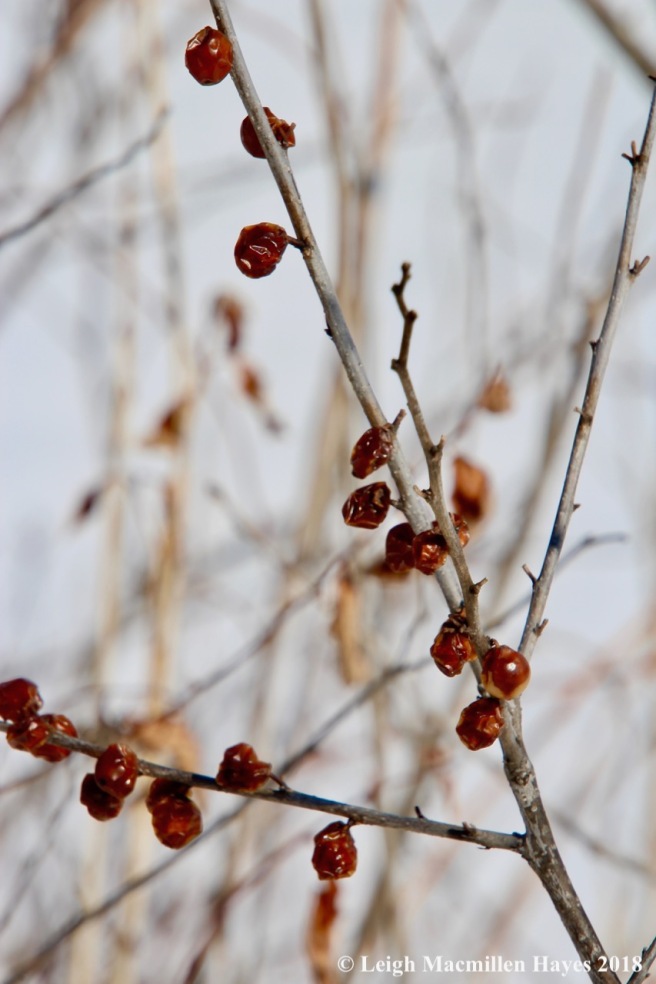
b12-winterberry

On the way back, there were other things to admire as there always is even when you follow the same route: winterberries drying up;

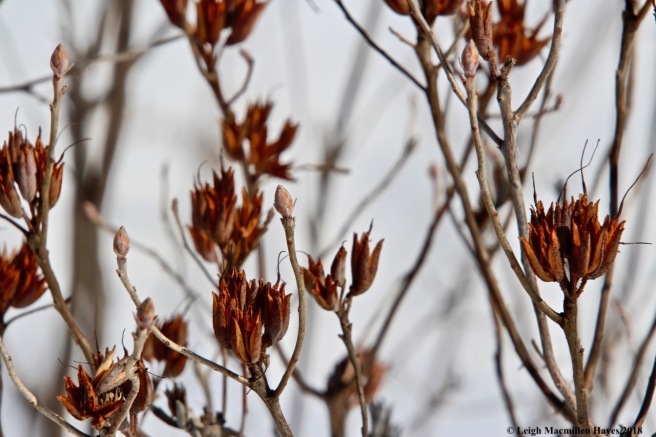
b13-rhodora

rhodora’s woody seed pods and flower buds swelling;

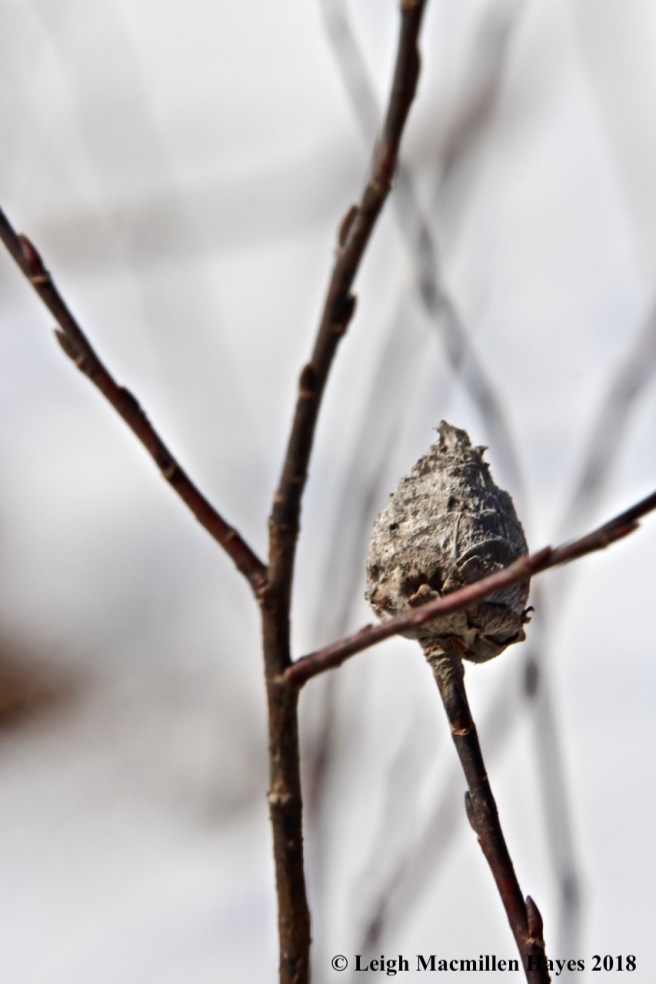
b14-willow gall

and the pinecone-like structure created with leaves by a reaction to a chemical released by the larva that allows a gall gnat midge to overwinter on the willows.

b16-carrion-flower tendrils

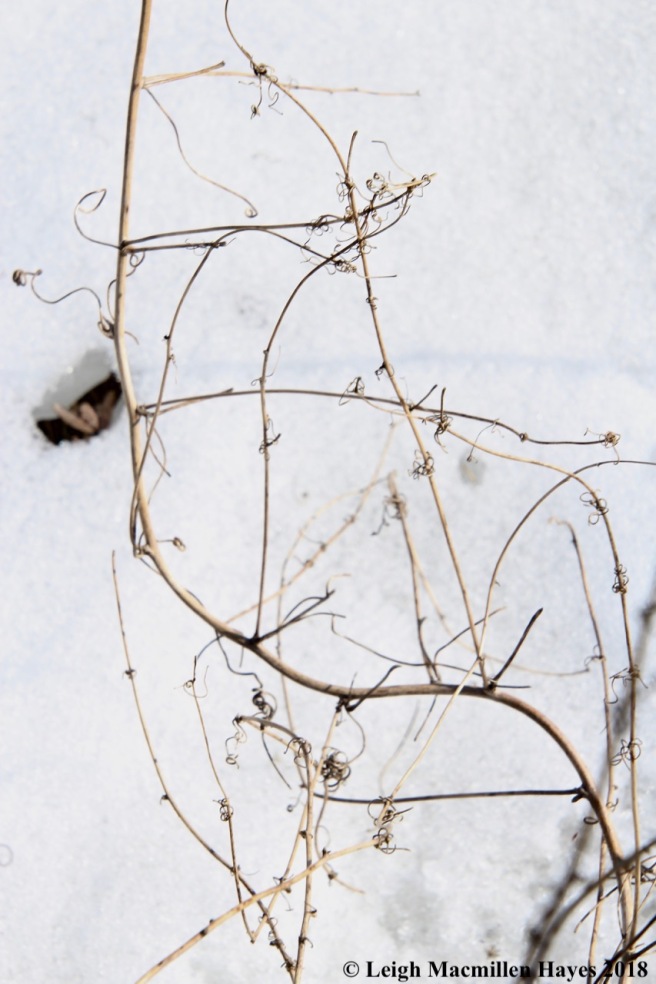
And then we stumbled upon a plant neither of us knew. With it’s long stem and curly tendrils, we were sure it was a vine.

b15-carrion-flower

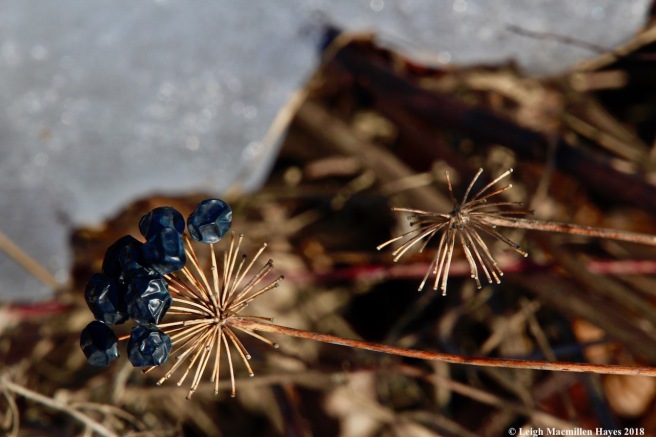
Upon arriving home, however, I wondered about the umbel structure that had been its flower and now still held some fruits. A little bit of research and I found it: Carrion Flower (Smilax herbacea), which apparently smells rather foul when it’s in bloom and thus attracts carrion flies as its pollinator. Now I can’t wait to return and check it out in the next two seasons. Any excuse to get back there.

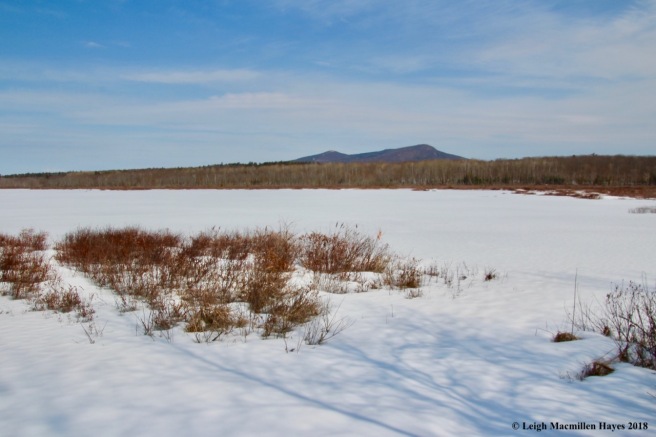
b17-bog to Pleasant Mountain

At last the time had come to say goodbye to the bog and then goodbye to each other. Thanks Barb, for giving me an excuse to go bogging with you. It was indeed a treat.

Otter Spotter Mondate

Fresh snow. Blue-bird sky. Mid-range temperature. Day off. All the makings for a fine Monday date with my guy.

m1-apples

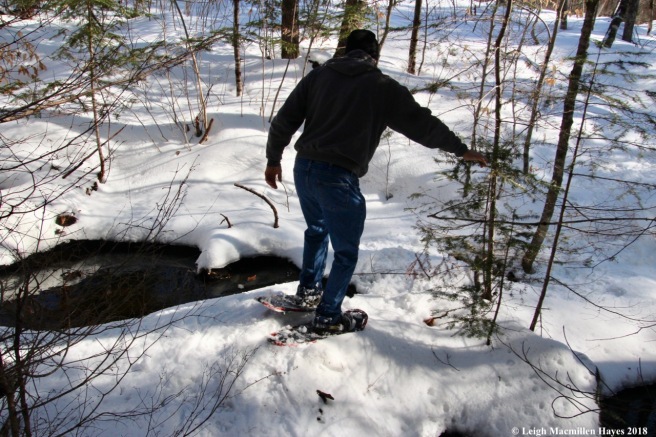
We weren’t sure if snowshoes would be the right choice as we feared the snow might stick to the cleats and make us feel like we were walking on high heels–hardly our style. But, actually, conditions were perfect. Of course, my guy tried going without at first, but after creating one post hole after another, he strapped his on while I headed over to an apple tree to enjoy the view.

We were on a private property in Lovell that is under conservation easement with the Greater Lovell Land Trust.

m2-coyote track

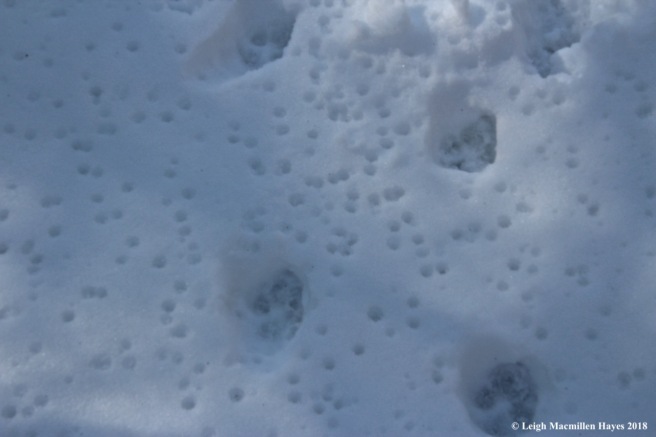
I’d been on this property only a few days ago and the tracks were many, but with the advent of yesterday’s snow, we found only a few. One set was that of a coyote. And fairly fresh was it.

m4-brook below

We moved quickly (of course we did for I was with my guy–but I was equally anxious to get to two destinations) and in no time found ourselves walking along beside a brook.

m5-brook crossing

As we approached we wondered how open the brook might be and decided we’d cross that “bridge” when we got to it. But really, there was no bridge.

m3-icicles at brook crossing

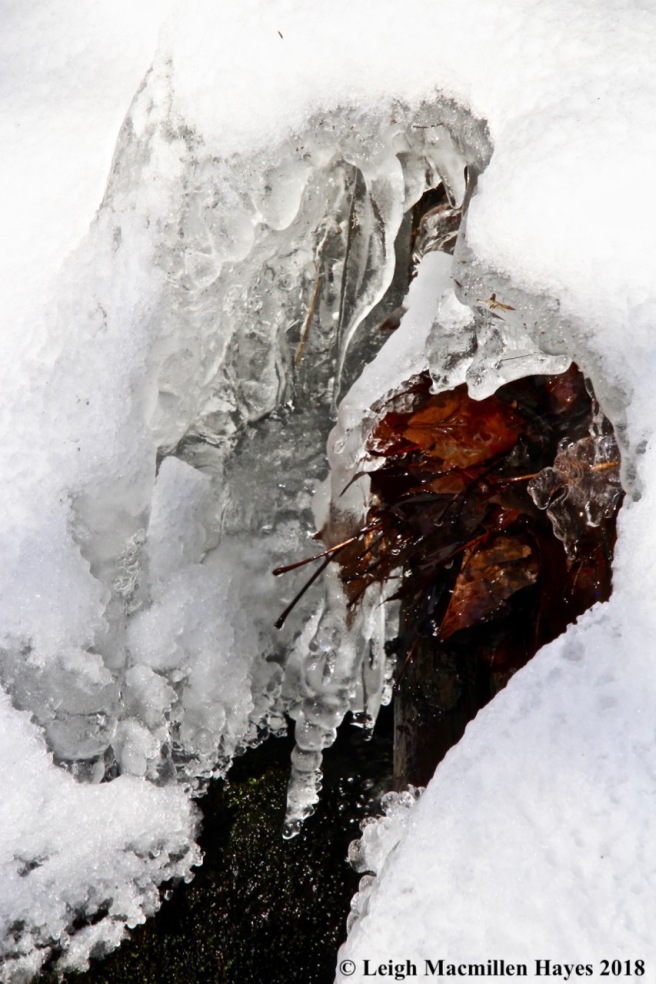
The ice, however, delighted our sense of sight, understanding, and artistic form. Like the water from which it was created, it flowed in much variety.

m6-one coyote became 2

Without any problems, we found our way to the other side and realized we were in the company of others who had done the same. One moment it seemed we’d followed one, but then realized we were on the trail of two coyotes when their path split.

m8-porky body

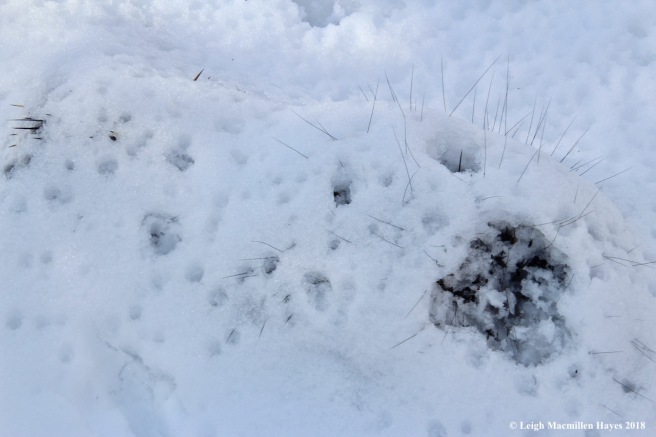
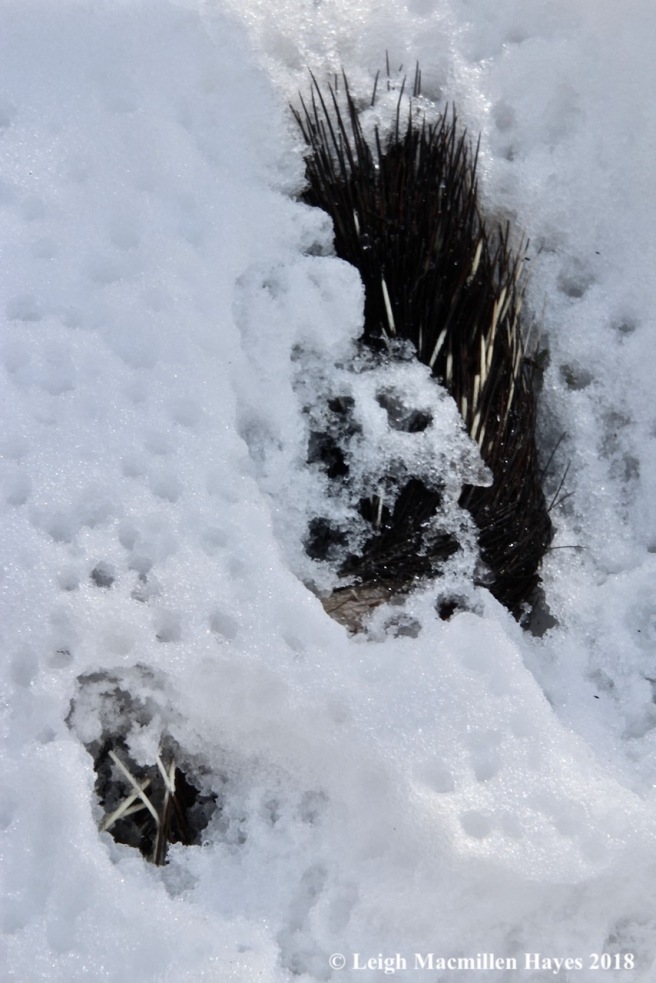
And it split for a reason. To check out a previous kill site. But they only seemed to sniff and not partake.

m9-porky tail

Just as well for it was a porcupine. But really, I was surprised they didn’t try to flip it over to get at the stomach. Maybe somebody else had already taken the pleasure.

m10-rookery and coyote track

On we trekked, until we reached water again. And this time we stopped to look around, while the coyotes moved on.

m11-heron nests

High in the trees across the way we spied the heron rookery–one of our reasons for visiting. We knew the nests would be empty, but still, it’s fun to take note.

m13-heron rookery

And they’re easier to see in the winter than spring/summer when this rookery is monitored for the state HERON project: the Heron Observation Network of Maine. I’ve had the honor of visiting this particular rookery in the past and helping to document the number of residents. Though it was active last April, something happened later to upset the neighborhood and so I’ll be curious to see what the status will be in the future.

m14-heron rookery

For today, the nests looked like they were in great shape and even two in the condominium were awaiting the return of the snowbirds who’d spent the winter south of this location.

m16-lungwort

Because we were there, I also turned to check on another tree–which sports a healthy colony of lungwort–photosynthesizing because it had been snowed upon.

m15-mesmerizing scene

We stayed for a while, my guy and I, enjoying the peace and quiet and colors and textures of the afternoon that curled around us.

m18-crossing over

At last, we pulled ourselves away and crossed back over the brook. It was a piece of cake. Well, at least we didn’t fall in.

m19-chipmunk

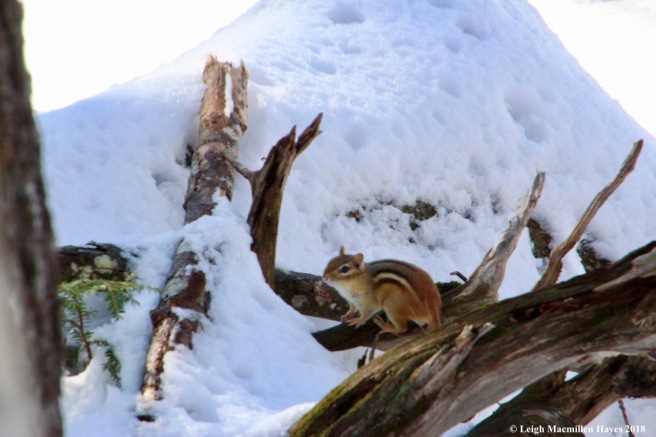
Our next destination took us past a condo of another sort–one created by a chipmunk who kept an eye on us, then swiftly disappeared. We could only wonder about the inner chambers of its home.

m17-striped maple beaver works

It was after that that we began to encounter the works of another rodent, this time upon striped maple.

m20-beaver works

The art pieces were sometimes large,

m21-beaver works small

other times small,

m23-beaver works mistake

and sometimes mistaken–as in logistics of the felling.

m22--false lodge

But that didn’t matter for their buildings were many. Oops, the first one we spied was actually a boulder.

m24-beaver lodge 1

Further along, however, we found the main building. It was topped with fresh wood and well mudded, so we assumed warm bodies dined and wined within.

m25-beaver lodge 2

There was another nearby, and we could see indentations denoting visitors had stopped by prior to yesterday’s storm. We also noted that the ice had melted all around it. Was someone home? We knew not.

m26-looking back from the dam

On we moved and then turned back to enjoy the view as shadows grew long.

m27-beaver dam

Turning 180˚ again,  we looked toward the beaver dam that stretched before us. I’d last visited in late November and wondered what it would look like today.

m28-below the beaver dam

It looked . . . snow covered.

m30-otter track

But . . . in that snow we spied our critter. Do you see him?

m32-otter moving from brook to land

We followed him downstream–he was on the other side of the brook, but moved in his telltale manner . . .

m33-following the brook

across the landscape . . .

m35-otter again

in and out of the water . . .

m43-otter slide and bound

bounding and sliding . . .

m42-otter slide

and sliding some more . . .

m40-prints, trough, scat

leaving behind fresh scat and prints . . .

m44-ice and tree and water and reflection

for our pleasure. We had the time of our lives watching the otter–did you see him?

Truth be told, we never did actually see him, but in our minds eyes we knew his every motion. When we first spied the prints and trough on the other side, we thought he had moved in the same direction as we did. But when he crossed to our side, and we could get an upclose look, we realized we were traveling in opposite directions. He had moved through not long before we arrived. Was he also checking out the beaver lodges? Probably. And hunting for his next meal.

Though we didn’t get to actually see this member of the weasel family, the signs left behind were enough to tickle our fancy and on this Mondate we were indeed otter spotters.

A Beautiful Gray Day

Today dawned sunny with a bright blue sky. A perfect day to travel the trail with Marita.

g1-burl

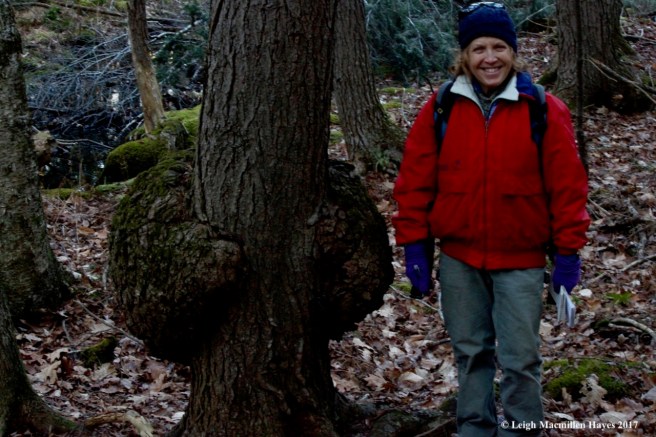
We wondered what we’d see and didn’t go far before spying a bear hiding behind a tree. Marita was happy to pose beside it in hopes of coaxing the critter to join her in smiling for the camera. Actually, it was the largest burl either of us could remember encountering.

g2-rock castle

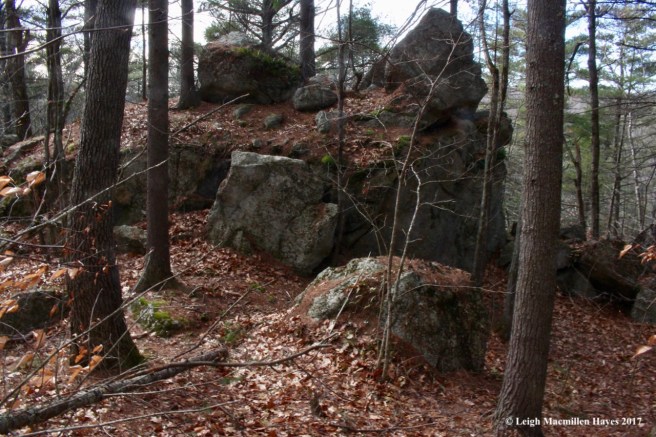
After the bear burl, we discovered a rock castle that made us think of kids for we knew that when ours were youngsters they would have loved climbing the towers and hiding in secret cubbies.

g3-morgan meadow 1

But one of our favorite finds on this particular trail was the wetland.

g4-MM 2

A thin layer of ice reflected the changing sky above . . .

g5-MM3

until both were completely gray–but still rich in offerings from color to texture, and we imagined, wildlife.

g6-red maple roots

Beside the water, a red maple offered its own point of interest–and truly, I suspected the fairies lived within.

g7-water feather 1

And then, in another place we found another work of art. While Marita saw a fish, I saw a feather.

g8-water feather 2

From any point of view, we stood in awe.

g9-water feather 3

Such a design of bubbles all because a rock interrupted the flow.

g10-squirrel cache

Red squirrel caches and . . .

g11-squirrel table

dining tables also caught our attention. We heard a few chit and chat at us, but never saw them. Our only wildlife sightings were about a dozen turkeys and a hawk that surprised us.

g11-winterberry

We tramped miles and miles, but only found one spot of truly bright colors as we admired red winterberries juxtaposed behind bent over cattails.

g13-Libby Foundation

And in all our travels, we only found one foundation, where we admired the paper birch that represented the family tree.

g14-mm fav

At the end of the day, we’d walked miles along a variety of trails on a day that began with  blue skies, but ended with gray. Our favorite sight of all remained the first wetland.

In the end, it was a beautiful day in Gray, Maine.


Keeping Watch

My feet itched to move along the forest floor and so I followed them and wondered where they might lead.

o-tree buds

The first stop was to examine tree leaf and flower buds packed inside their waxy scales where they will remain protected from the northerly winds until a date unknown.

o-hemlock cones

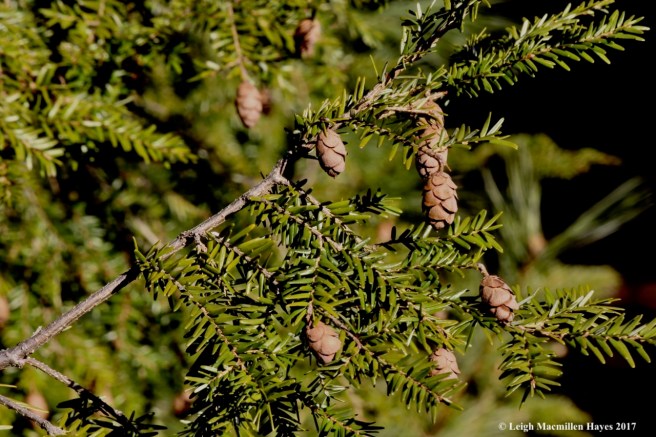
Beside the red maple, Eastern hemlock cones dangled like Christmas ornaments, with woody scales of their own protecting tiny seeds tucked inside until those northerly winds might release them.

o-squirrel dinner table

Everywhere, any possible surface, particularly those a bit raised, became a red squirrel dinner table meant for dining upon this year’s abundant supply of seeds.

o-squirrel chatter 1

And everywhere I was chastised by squirrel chatter for they seemed so sure I wanted to wrestle with them for a few nibbles.

o-upper side, maze polypore

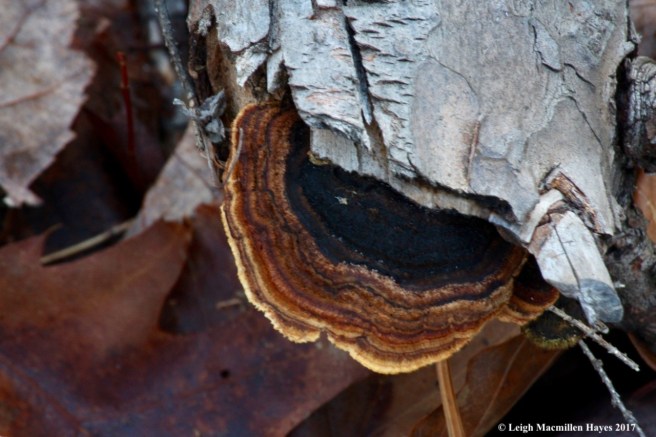
I paused beside mazed polypores, so named . . .

o-underside, maze polypore

for their maze-like underside from which they release their spores.

o-forest 2

Sometimes, my feet moved with ease despite occasional walls of evergreens–and when I encountered such, I pushed on through.

o-slash

Other times, it was over logging slash that I trudged, my feet taking a moment to choose the right balancing spot.

o-watery trail

There was even some island hopping thrown into the mix.

o-bobcat scat

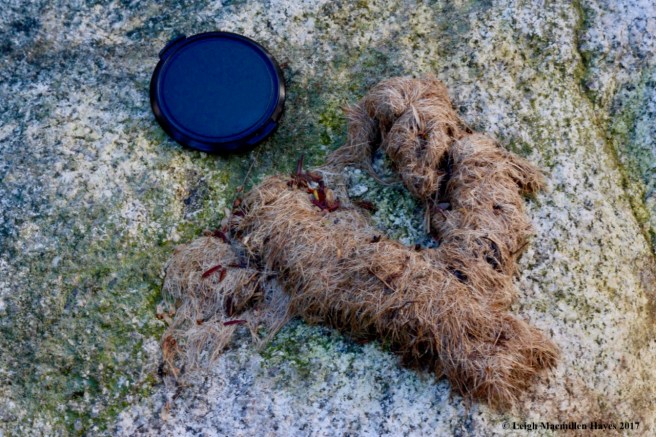
At last I reached a logging road and then different sights filled my heart with hope for I knew that though I saw more than a million red squirrels and heard a variety of birds, including a ruffed grouse, these woods are filled with life (and death). Based on the size and lack of bones, I think this was bobcat scat and the meal was a white-tailed deer.

o-coyote scat

There was coyote scat, both old and new.

o-fox scat

And fox scat reflecting a recent meal–perhaps Sunday dinner.

o-bobcat tracks

And where there is scat, there are tracks–most of the time.

o-moose tracks

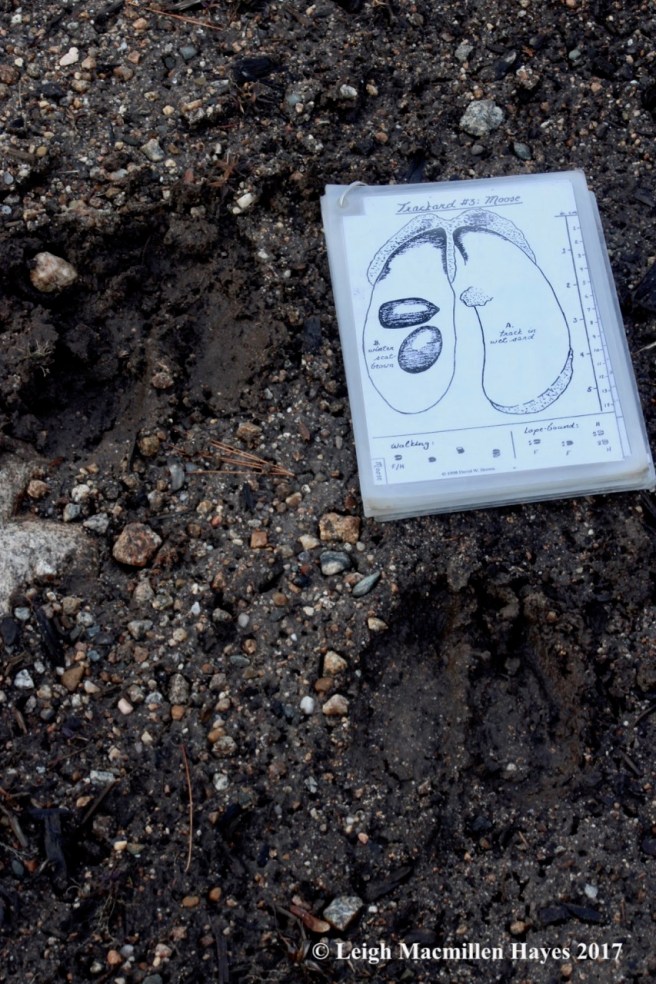
Today, I saw signs of bobcat, moose (more than one), deer, fox and coyote and my heart rejoiced for I love tracking season. I also love knowing that these mammals continue to share this space with me–or perhaps it’s that I share this space with them. I think the latter is more likely. I’m just a visitor.

o-ice art 2

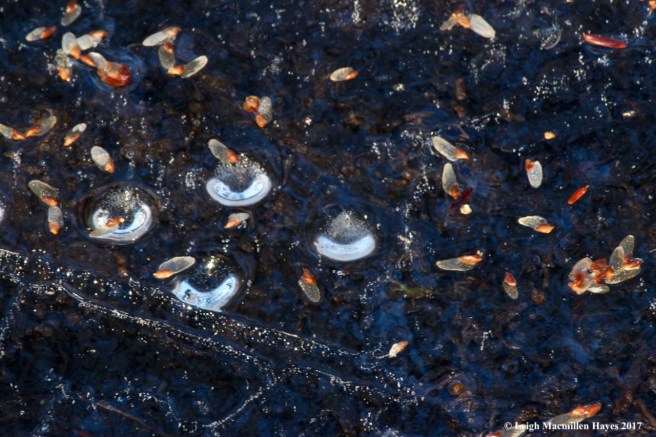
In places, ice also offered sights worth viewing. Atop a frozen puddle, those hemlock seeds I referred to earlier had found their release and their new home–temporarily at least.

o-ice art 1

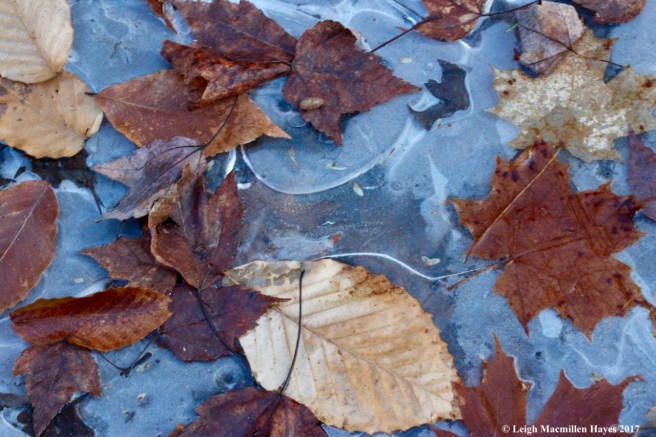
Leaves, cones and seeds intermixed with the ice and created mosaics worth framing.

o-ice art 4

And branches and seeds imitated trees in another work of natural art.

o-ice art 3

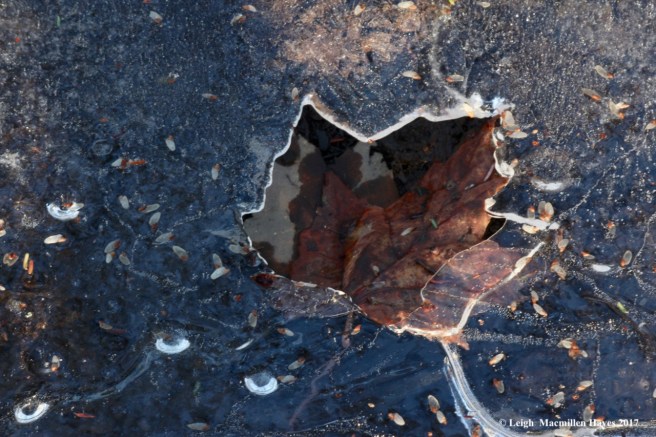
But my favorite was the red maple leaf cut-out that reminded me of Christmas cookie cutters.

Even if roaming through the woods isn’t your comfort level, I encourage you to take a few moments to step outside and look around. In this season of hope, may nature help you find wonder and through that wonder may you find peace within.

Any way you can, please join me in keeping watch.


Black Friday Shopping Extravaganza

I somehow slept in and totally missed the early bird specials today, but still by midmorning I found my way to the store of my choice.

b1-trail sign-cross the threshold

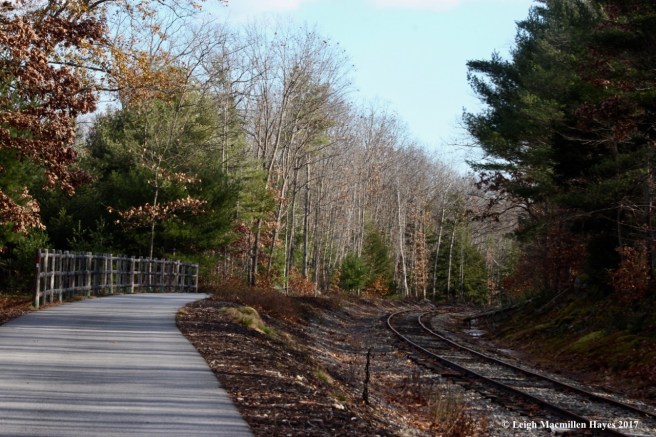
It had been two years since I’d stepped over the threshold into the MDT shop and I’d forgotten what great selections it had to offer. While the last time I approached from the Fryeburg Information Center near the Maine/NH border, today I decided to use the back door and entered by the Eastern Slopes Airport.

b8-the main aisle

Beginning along the main aisle, I was delighted with the display before me. And lack of customers. Oh, I passed several groups, some in a hurry as they ran, others chatting amiably with friends or relatives, but all quite friendly and courteous. Even dogs were well behaved and therefore welcome.

b2-choice of colors--sweetfern 1

Immediately I had decisions to make. Which shade did I want?

b3-shapes,

And would I prefer a different style or shape?

b12-red oak 1

Had I thought about brown and bristly?

b13a-white oaks

Or did I like salmon and rounded?

b13-red oak on line

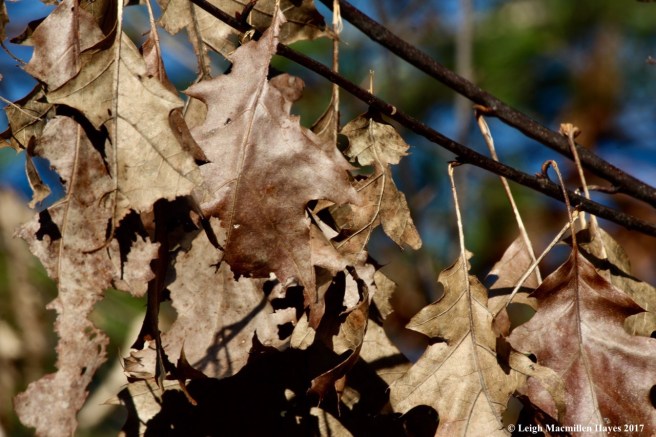
Though I preferred the salmon color of the white oak, I did like how the red oak leaves dangled in hopes of being plucked by a customer. And if not a customer, then perhaps the wind.

b11-cattails

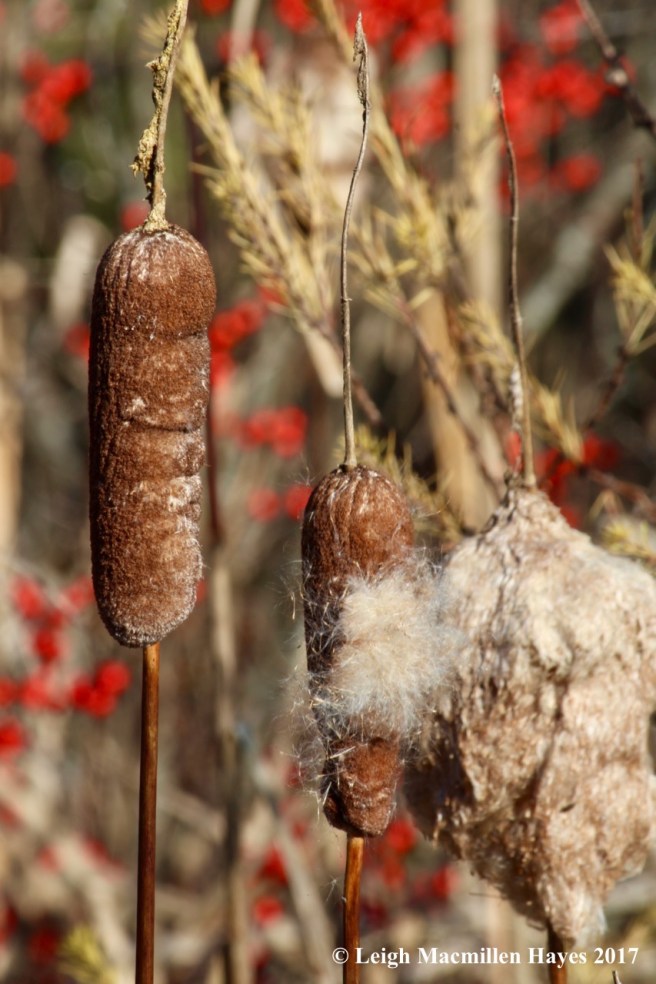
In aisle five I found some cattails ready to explode into the future.

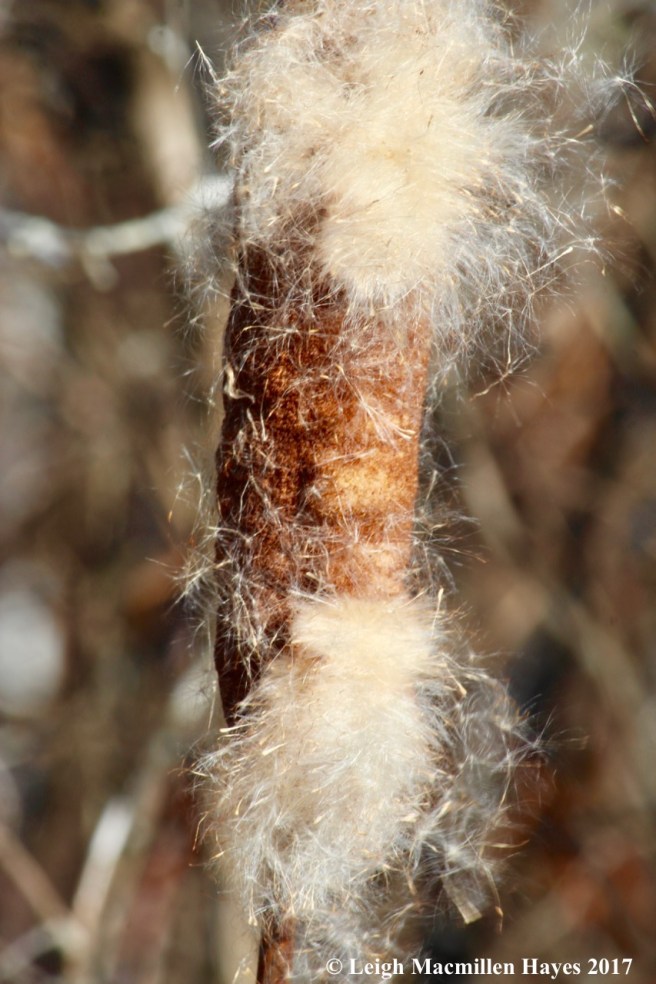
b11-cattail sparkles

Their tiny, parachuted seeds reminded me of sparklers on the Fourth of July, but because today is the day after Thanksgiving, I suspected these fireworks were intended for New Year’s Eve.

b6-autumn thistle

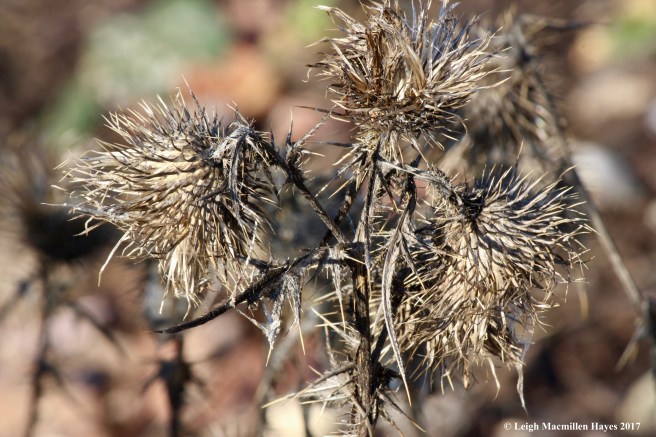
It seemed that everywhere I looked, the store was decked out with hues of silver and . . .

b4-aster display

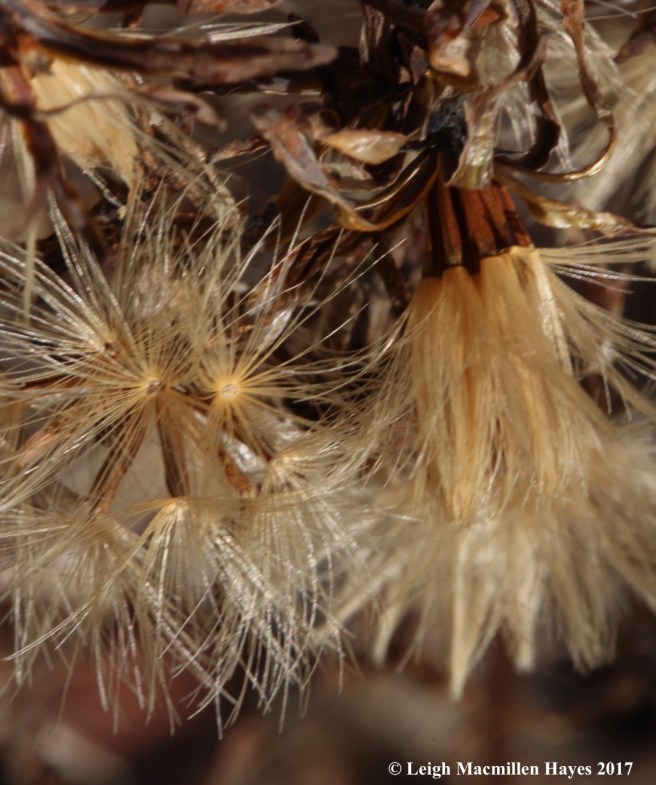
gold.

b5-brown lacewing

And while admiring the golden decorations, I discovered I wasn’t the only one looking. A brown lacewing had heard there were deep discounts to be had.

b12-birch beer

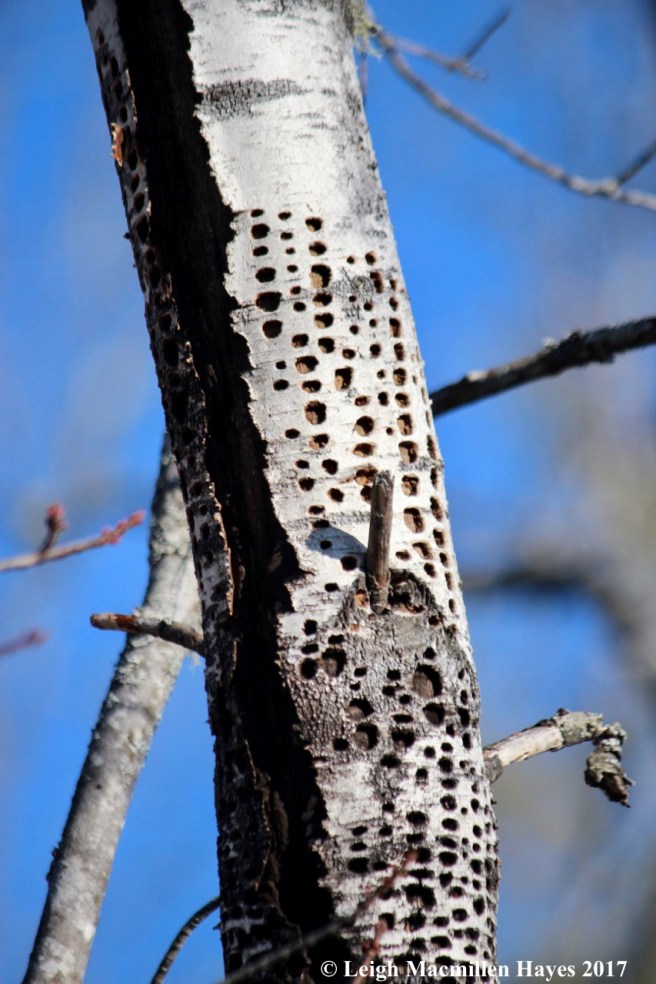
As one should when one is spending an exorbitant amount of time (and perhaps money, though in this case no cash or credit was part of the deal), rehydrating is a good thing and the birch had been tapped for just that purpose. It’s been a long time since I enjoyed the unique taste of a birch beer, but thanks to a sapsucker it was on the menu at the snack bar.

b7-bench

And what better place to sit and sip, than on a bench in aisle 6.

b3a-winterberries

Refreshed, I was again ready to shop till I dropped. Everywhere I looked, the Christmas decorations impressed me.

b14-red oak Christmas decorations

The season’s colors enhanced the merchandise.

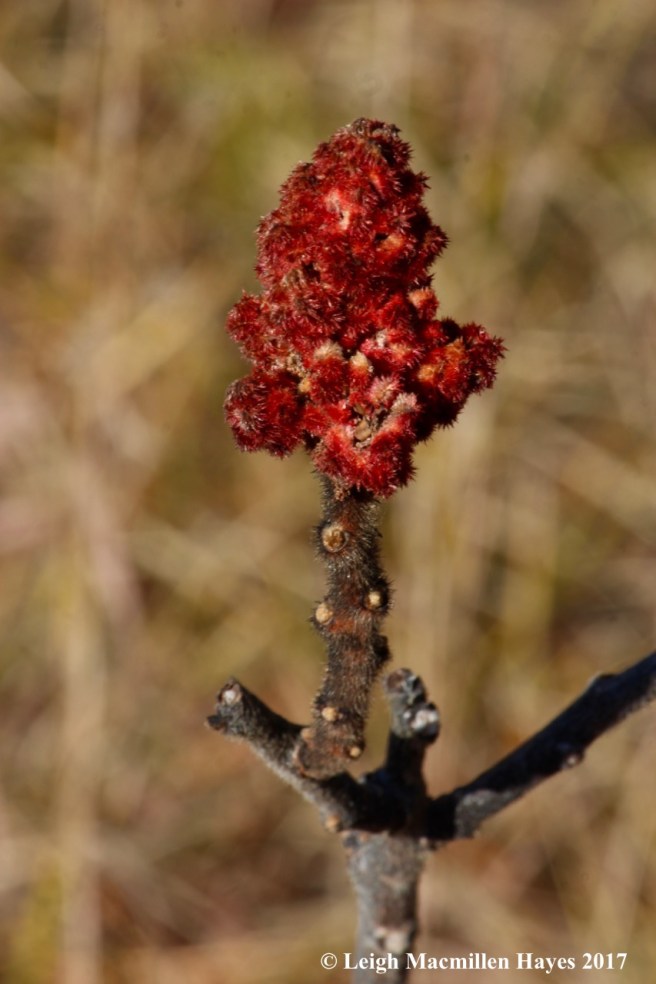
b19-Sumac decorations

And all ornaments were handsome in their own way.

b9-tamarack gold

As is always part of my shopping adventure, I didn’t know what I was looking for when I entered the store. But as soon as I saw this display, I knew I had to have it.

b10-tamarack 2

Its label was lengthy–tamarack, larch, hackmatack. Call it what you want, it’s our only deciduous conifer for it looses its needles in the winter. But first, the needles turn from green to gold and announce their presence.

b15-pitch pine trunk

Also in abundance as this shop–pitch pines. It’s so easy to confuse a pitch pine with a red pine, but a few identifying tips help. The unique thing about this tree is that not only do the stiff, dark yellow-green needles grow on the branches, but they also grow on the trunk. If you spy a tree that you think may be a red pine, scan upward and if you see green needles along the trunk, then you’ve discovered a pitch pine.

The name, pitch, refers to the high amount of resin within this tree.

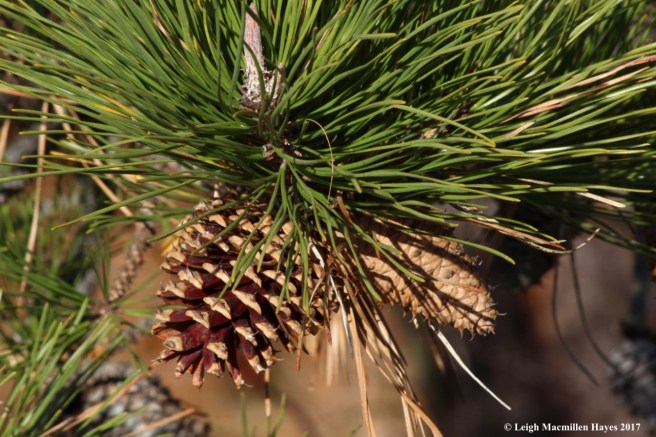
b16-pitch pine cones

It’s the needles of pitch pine that also add to its identification for they grow in bundles of three, like a pitchfork’s tines.

As for their cones, you can barely see the stalk because they tend to be clustered together, but their key feature is the rigid prickle atop each scale tip.

b20-Northern White Cedar

I was nearly at my turn-around point of three miles when I realized I was standing beside a row of doorbuster deals.

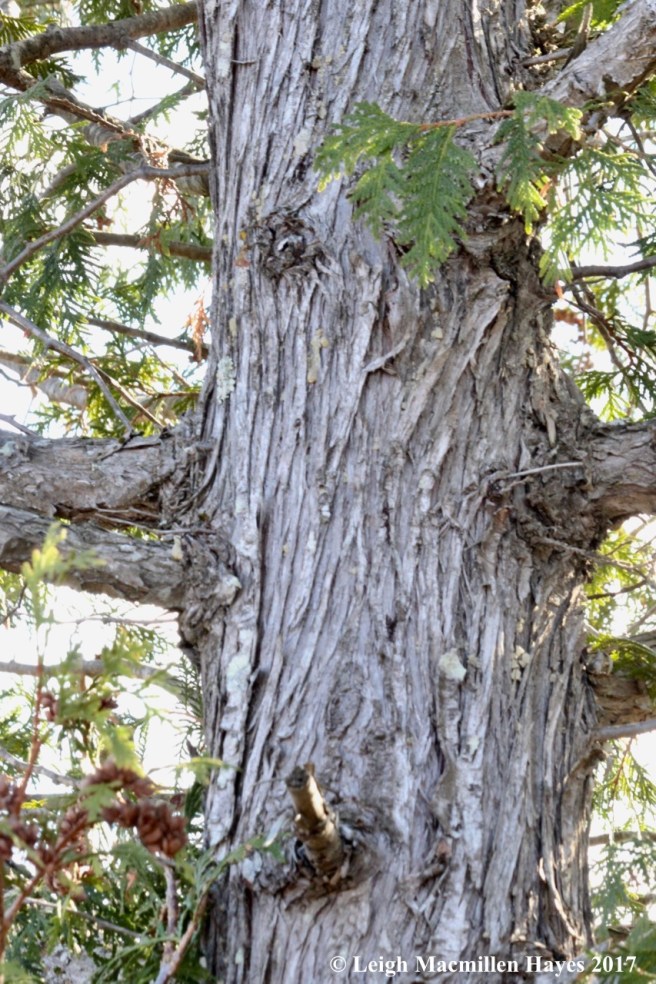
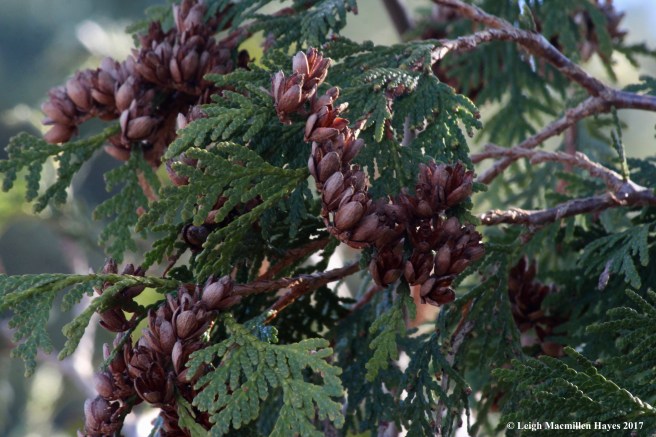
b21-northern white cedar leaves and cones

I couldn’t resist feeling the scale-like leaves of the northern white cedar. I had to have this item.

b17-black locust bark

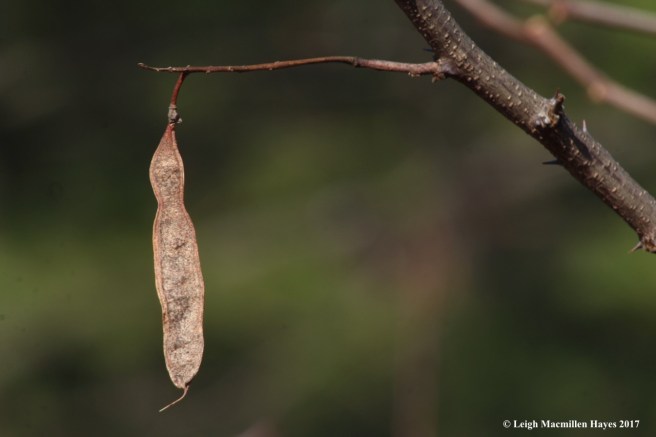
I did find one thing I decided to leave on the shelf–for the spines of the black locust would have pricked my fingers, I’m sure.

b18-black locust seed pod

Apparently, others did purchase this, for only one fruit pod remained.

b25-heading back

At last, I was on my way back up the main aisle with hopes to make a bee-line out, but had a feeling something around the bend would stop me in my tracks.

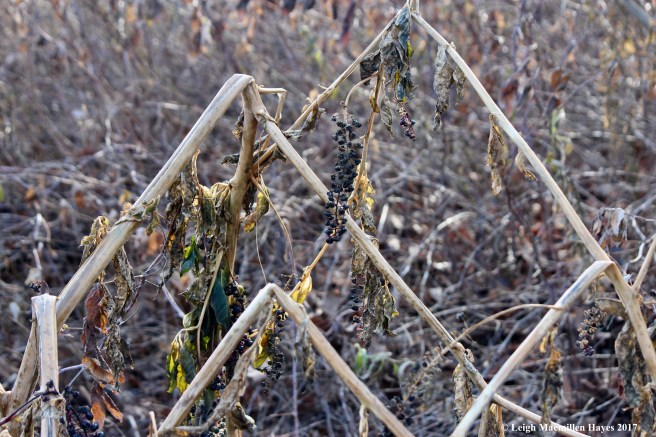
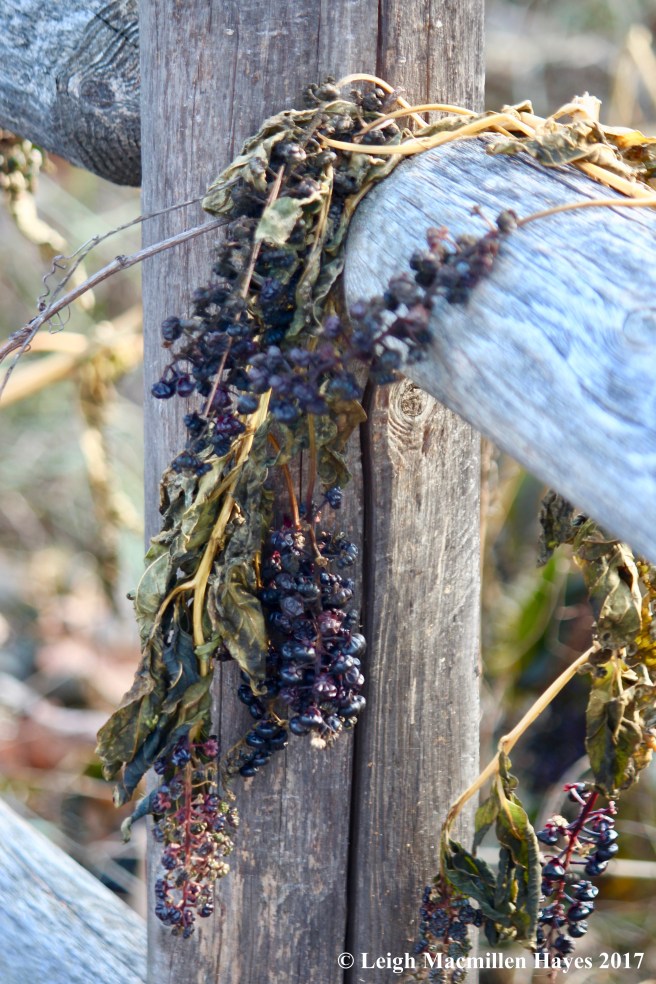
b23-pokeberry geometric display

Sure enough–the pokeberry display was both geometric . . .

b23-pokeberry artistic display

and artistic in a dramatic sort of way.

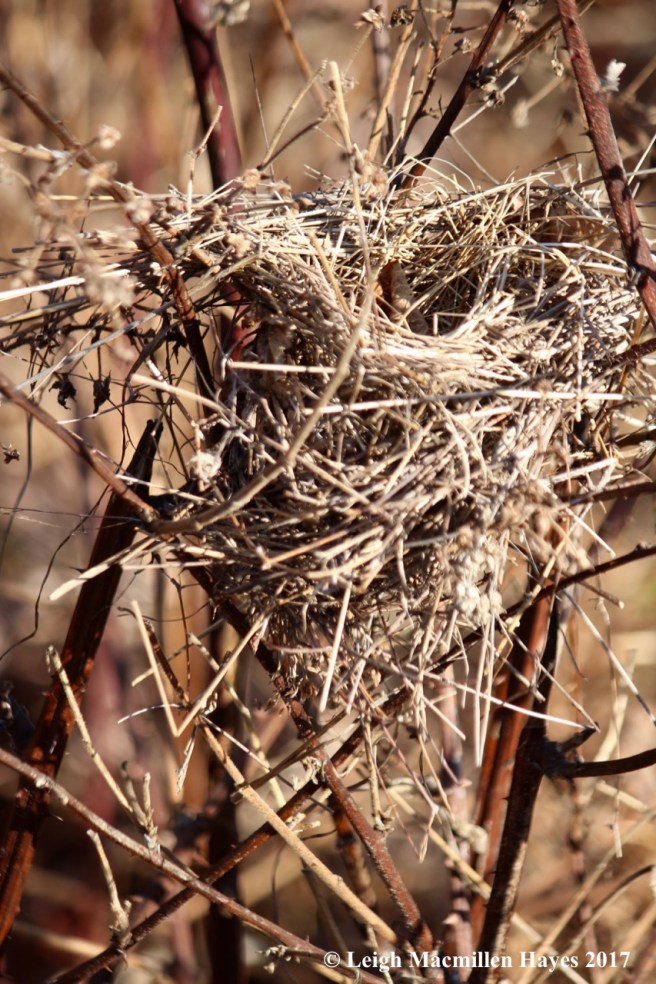
b27-bird nest

As I continued on, I saw and heard birds flitting about and thought about the fact that I need to visit this shop more often, particularly in the spring and summer for the various habitats made me think that birding would be spectacular. And then I spied a nest attached to some raspberry bushes. I knew not the species that made it, but hoped some small brown critter might use it as a winter home and so it remained on the shelf.

b26-heading back 2

At last, I’d raided enough aisles. My cart was full to the brim and my brain overwhelmed. I guess I’m not really a “shop-til-you drop” kind of gal. It was time to wind along the trail and end my Black Friday shopping extravaganza.


Snow White Magic

Our first official snow storm of the season left us with about an inch of the white stuff that makes me rejoice. And upon waking this morning and peeking out the window, the sight of porcupine tracks looping around the yard brought a smile to my face.

m-porcupine trail 1

I love the first snow storm for even though I have seen signs of the critters that pass this way, their tracks confirm my convictions. Over the years, I’ve come to recognize the prints and trail patterns, but as the snow gets deeper the tracks sometimes become more difficult to decipher. This one was easy due to its pigeon-toed sashay.

m-porcupine prints

And then the individual prints, especially those that crossed the deck, showed the large foot pad and five toes with nails extended. A friend in Poland, Maine, sent me a couple of photos of the critter that crossed her deck this morning. She ID it herself, but wanted confirmation–for it was an opossum and a first for her.  I found my first opossum prints last December and wonder if I’ll have that opportunity again. Anything is possum-able.

m-worm and junco prints

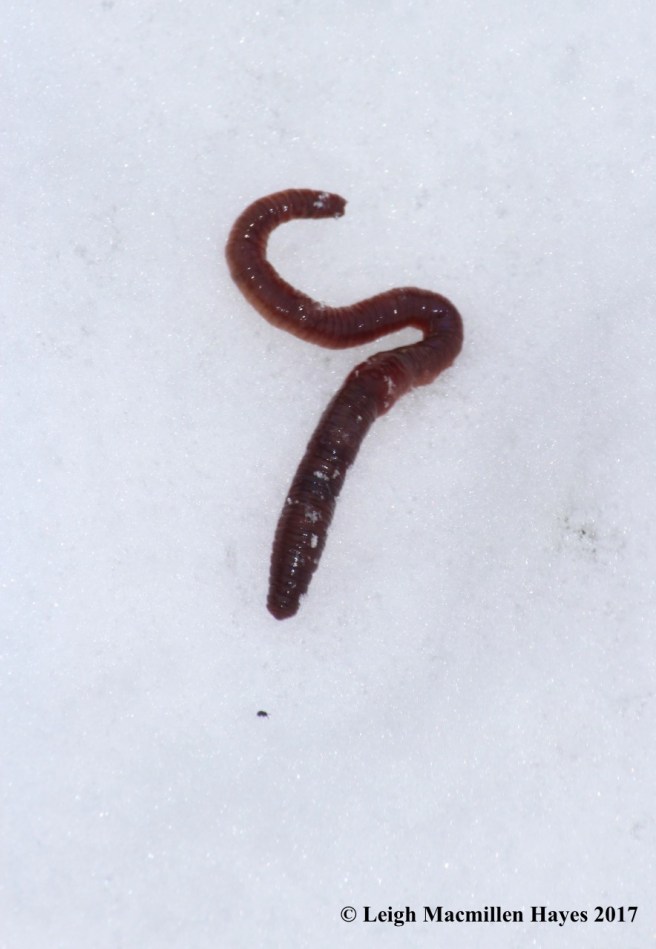
Since the porcupine had drawn me out (and I noted that it disappeared under the barn–of course), I decided to head off into the woods. But before I left the yard, I spotted junco tracks–and . . .

m-worm

a couple of worms–frozen upon the snow. Juncos don’t eat worms; they look for fallen seeds. And so it seemed that the bird flew off before quite reaching the C-shaped worm. And this other worm was about a foot away from the first worm. Robins were in the yard last week, and I can only hope that they returned today for a frozen dinner awaited.

m-snow art 2

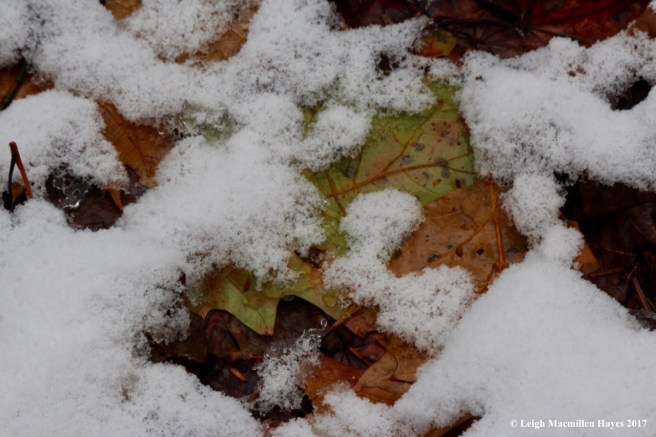
Into the woods I trudged, and the ever-changing colors and designs at my feet reminded me of works of art.

m-snow art 1

Some were palettes of mahoganies juxtaposed against white. A variety of textures gave the scene relief, much like an inlaid mosaic.

m-snow art intersections

Others embodied interconnections; a mingling of lines outlined for emphasis.

m-rock people

Along the cow path, I noticed the rock people for the first time, their mouths gaping open.

m-snow fleas

The minute snow fleas would hardly sustain them.

m-morning light

As it does, my trail crossed the line, where power seemed to originate with its source . . . the sun.

m-Mount Washington

And in the opposite direction, it flowed from pole to pole and onward . . . as if powering the mighty mountain.

m-pine sapling

My journey continued into the land of the pines and their saplings, momentarily coated with decorative baubles.

m-mini oaks

And the red oak saplings I’ve been watching looked more festive than ever.

m-squirrel tracks

I was on a mission and soon found what I was looking for. Some tracks that looked like exclamation points led me to another source of sustenance that I wanted to check on.

m-squirrel cache growing

The red squirrel’s cache had grown taller in the past week, but . . .

m-squirrel dining room

many pine seeds had been consumed in the refectory. All that remained were scales and cobs to show a number of dinners consumed.

m-squirrel rocks

The dining hall extended beyond the reaches of the cache, for every table available was a table used.

m-squirrel dinner in the future

As I walked back toward home, I discovered another table awaiting a guest.

m-beech sunshine

I was almost home when I stood under a beech tree. As winter embraces me, I find that their marcescent leaves create their own golden glow and warm my soul.

m-British soldier

One more sweet peek offered a tiny touch of red to today’s fading winterscape–for the British soldier lichens’ red caps announced their minute presence.

m-snow drops

And then this afternoon, I joined a few friends for a gallivant across the Wild Willy Wilderness Trail beside Province Brook in South Chatham, New Hampshire. And the snowdrops created their own works of art announcing that the meltdown was on.

m-pinwheel 1

As we walked, we noticed delicate parasol-shaped fungi fruiting.

m-pinwheel gills

Their common name is Pinwheel Marasius, but in my mind the shape of the umbrella-like top above the wiry stem looked like a parasol and so I called it such. But to add to the confusion, I first called it carousel. Word association might get me there eventually, but it wasn’t until I looked it up in Lawrence Millman’s Fascinating Fungi of New England, that I realized my confusion. One of the fun facts from Millman is worth quoting: “Resurrection! Shriveled and inconspicuous, Marasmius species are rarely noticed during dry weather, but after rainy periods the tiny fungi revive–hence the nickname ‘resurrection fungi.'” And if not rain, then snow will make them rise again!

m-liverwort magic 1

The water from the melting snow highlighted other lifeforms along the Wild Willy Wilderness Trail. Bazzania liverwort grew abundantly, but one in particular gave us pause . . .  for it glowed. And no matter what position we stood in to look at this worm-like beauty, it continued to glow as if it had a golden halo surrounding it. We had no answers–only questions and wonder.

m-glue fungi

Another find that had been marked with tape, for it too was special–a broken branch attached to a young tree. I’m stepping out on a limb here–pun intended, but I believe this was an example of a glue crust fungus that glues twigs together. Seriously? Yes.

m-Bob, Janet and Pam

It was getting dark when we finally found our way to Province Brook and marveled at the water and ice forms. It was also getting close to the moment when we’d need to say, “See you later,” to Bob and Pam, for they’ll be heading to warmer climes soon. But we know they’ll be back for a winter adventure and then before we know it, spring will be here. And then, we hope the brook will be full with spring run-off from all the snow that is in our future. Until then, see you later we also said to much of the snow for it had almost disappeared.

m-ice works 1

But the ice art will continue to grow.

m-Province Brook 1

And the snow white magic will capture our minds again . . . one flake at a time. And with it, the wonders of the world will continue to be revealed.


Firsties

A week ago, I joined friends Marita and Marguerite Wiser for a hike up Albany Mountain from Crocker Pond Road. At the summit, we searched for a loop leading off from the left that I’d been told about, but couldn’t find it. There were cairns leading to the right, but we didn’t see any to the left.

a1-trail sign

And so today, my guy and I headed back up the mountain with a quest in mind–to find the loop. For you see, this week when I again questioned the friend who’d told me about the summit loop, I was assured it was there and we just needed to follow the cairns to the left.

a2-ice on beaver pond

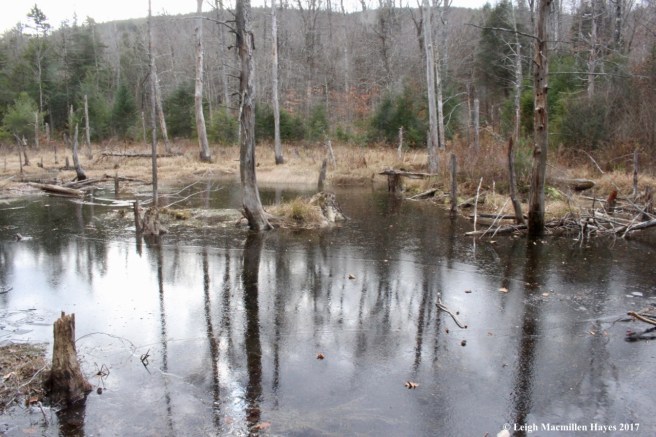
Not far along the trail, we reached the old beaver pond, which was open water last weekend, but coated in a thin layer of ice today. A first for us this season.

a3-dam crossing

We crossed the old beaver dam, made a wee bit easier because of the freeze.

a4-3 in 1 trees

And then we began climbing. Suddenly, I spied a red pine. A lone red pine. A red pine worth inspecting, for I suspected this was bear territory and thought perhaps the tree would show evidence of a past climb since it was the only red pine in the immediate area–bears like something different like a lone red pine. There were no signs of claw marks, but we did wonder about the resources shared by the pine, red maple and beech–a trinity of brethren in these mixed woods.

a5-ice

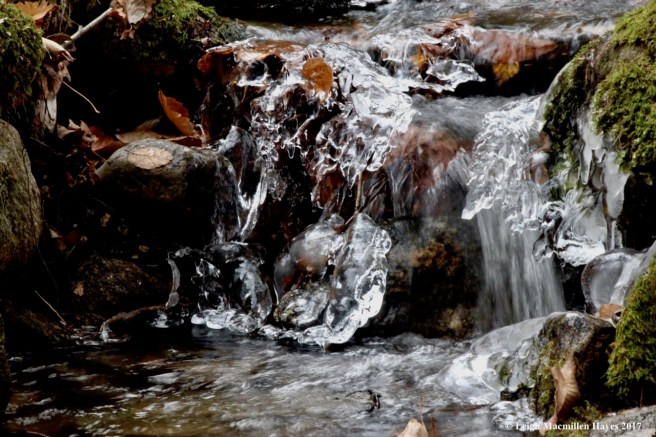
Moving upward, like all streams this month, water flowed with passion and because of the sudden drop in temperature this past week, ice formed upon obstacles. We slipped off the trail to admire its every rendition.

a6-more ice

Each coated twig offered its own fluid art.

a8-ice spirit

But my favorite of all was the ice spirit who watched over all as his beard grew long.

a9-ice needles

Back on the trail, conditions changed as well and ice needles crackled under our feet, adding to the crunch of dried beech and maple leaves.

am1

We weren’t far along, when we spied snow–another sight that made my heart sing on this brisk November day.

a10-SNOW

For us, it was the first snow of the season and we hope it bespoke the future.

a11-snow on the leaves

The higher we climbed, the more snow we saw, though really, it was only a dusting. But still–we rejoiced.

a12-new steps

Eventually we came upon some new trail work. Actually, last weekend, we’d chatted with the creator of such steps; and on our trip down, I’d asked him about the summit loop because we hadn’t found it. He said there was no such thing. But my friend insisted on such when I told her this info.

a13-climbing higher

On we climbed, reaching bald granite where sometimes conditions were slick. I’d brought my microspikes, but the trail wasn’t difficult and I never did pull them out of the pack. Still–better to be safe than sorry.

a14-Summit sign

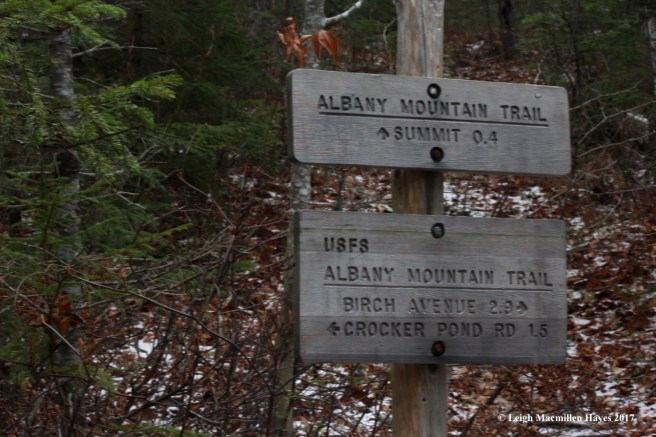
At 1.5 miles, we reached the junction. And headed upward to the summit.

a19-ledge 1 view

About one tenth of a mile along, we turned right and followed a spur trail out to a ledge where the view west offered a backdrop featuring the White Mountains.

a16-first ledge and my guy

We suspected the summit loop may have taken off from this point, so my guy went on a reconnaissance mission to the left–to no avail.

a20-Mt Washington

But we did enjoy the view–including the summit of Mount Washington.

am3

Then we went in search of the mountain sage. Given the condition of its glasses, however, we suspected it was feeling a bit bedraggled from the recent wind. Or maybe it had tried to find the loop as well and was just plain tired from coming up short.

a21-lunch rock view

On to Albany Mountain summit we marched. And then we sat on a clear spot upon the granite to dine on . . . none other than the famous PB&J sandwiches (mine with butter, of course). Our view was framed by red pines and spruces.

a23-red pine needles

As it should, the red pines exhibited the look of chimney sweep brushes.

a22-red pine

One bent over, its leader long influenced by the northerly winds.

a23-spruce

Even a spruce known for its spire-like stance had performed the wind dance.

am4

After lunch, we poked around to the left, in search of cairns for the said loop . . . and found none.

am5

There were cairns to the right, however, which the Wisers and I had followed for a short distance last weekend. Today, we decided to see where they led. Cairns gave way to flagging.

am6

And flagging gave way to more cairns.

a24--views of balds from other trail

Meanwhile, the trail gave way to more views–of the Baldfaces.

a25-crossing the ledges

The trail seemed to circle around to the left, but then it turned right. Eventually, we met two young men and asked them if we were on the loop. We learned they’d spent the day exploring the top and knew of no loop, but informed us that we were on a spur. Funny thing is, they were from Texas and Wisconsin.

a26-view toward Pleasant Mtn

And they were right. About a half mile later, we reached the end of the cairns and the end of the spur and another panoramic view–with Keewaydin Lake in the foreground and our beloved Pleasant Mountain in the back.

am7

Again Mount Kearsarge greeted us with its pyramid formation and we stood for a while watching a bald eagle circle below us.

a27-foundation at trailhead

Our trip down the mountain passed quickly for it was my guy that I followed and within 45 minutes we were at the trailhead. Run much? While he went to the kiosk to double-check the map, I spied a foundation I’d previously missed. Who lived here? Was it the Crockers for whom the road was named?

a30a-Crocker Pond

Back in the truck, and because I was driving, we drove to the end of the road and I hopped out to look at Crocker Pond, which was partially coated in ice.

a28-Crocker Pond--backwards C

But it was a backwards reflection that really gave me pause for the birch trees seemed to spell the pond’s initials–backwards and upside down of course. CP. Humor me here. ;-)

a35-Patte Marsh

And then I drove down another forest road to Patte Marsh, which was almost completely covered in ice.

a32-dam at Patte Marsh

Its formations were varied below the dam.

a31-sky reflection and ice

But my favorite of all was upon the pond, where the sky was reflected on a wee bit of open water and ice that reminded me of the eagle in flight.

We didn’t find what we’d gone in search of and may just have to try again (oh darn), but it was a day of firsties for us–first ice-covered ponds, first snow, first time on the second spur trail. Definitely a first rate day for a hike.

P.S. Thanks for continuing to stick with me. Please feel free to tell your family and friends about wondermyway. And encourage them to click the “follow” button. I’d appreciate it if you’d help me increase my readership. You never know what you’ll read here because I never know what I’ll write. Even when I think I know, I don’t. The end result is always a wander and definitely a wonder.


Book of November: Half Acre

I am so tickled for my friend and fellow naturalist, Sarah Frankel, who recently published her first book.

IMG_1906

Half Acre is a children’s book both written and illustrated by this talented young lady.

In rhyming fashion, she takes the younger set outdoors to explore her yard, which is a half acre in size. The size, however, is not important because Sarah knows how to look and to wonder. Or maybe in this case, it is important, because she wants others to realize that there are great things to find on their own small plot of land.

And now she and her husband are teaching their young daughter to do the same. Her hope is that the book will encourage others to step outside and notice as well.

In thirty-four pages, Half Acre explores the yard in all seasons and at different times of day. As much as I enjoyed the rhymes, I especially loved the paintings–of birds and leaves, flowers and bees, butterflies and trees, moss and ferns, night sky and nocturnal visitors, and so much more. Can you find the frozen tree frog? You’ll have to buy the book and look for it.

My favorite painting is the last one–with her house in middle, surrounded by snippets from each of the other paintings, like a sugar maple leaf floating in midair. There’s more to this painting though, for Sarah takes the reader through the four seasons at the house–in 8 x 6-inches, she begins with winter on the left and every two inches the season changes,  ending with autumn on the right. I wish I could share that with you, but you’ll just have to trust me and purchase the book. Of course, she used the same scene to introduce her half acre of land, but it really stands out in the final mural framed by small portions of all the other paintings.

IMG_1904

Since I’m on the topic of Sarah, though this isn’t a book, I was the recipient of one of her paintings. For the past four years, it has leaned against the wall on a counter in the butler’s pantry and makes me think of both Sarah and Mom.

Of Sarah because she knows winter is my favorite time of year and she included tracks in the snow, a starry night, full moon and a shooting star. When I was a Maine Master  Naturalist student, Sarah was a mentor. At that time, though she lived in Conway, NH, she worked at Lakes Environmental Association as the Education Director. And so, we’d drive to and from class at Bates College in Lewiston together. On our way home one night, we saw a shooting star. And many times we tramped together on snowshoes, following mammal tracks. I have to share one more fond memory–the spring night that it rained and we tried to dodge the frogs and salamanders as we drove home. Finally, we got out a few times and helped the sallies cross the road. We were tired from class, and it was a long drive home that night, but by helping a few, we forgave ourselves for the ones we’d smooshed.

Of Mom, because Sarah gave me the painting after my mother died at the end of January during the year I was taking the course–I’m forever honored by Sarah’s thoughtfulness.

Interested in purchasing the book and meeting Sarah? She’s got some book events coming up in the North Conway, New Hampshire area:

November 11th from 11am-3pm – A book signing at The Met Coffee House and Gallery during the Bring A Friend Shopping weekend.

December 2nd at 3pm – A book signing event at White Birch Books, the best book store around!

December 7th from 6-8pm – A book signing at the Adults Only Shopping Night at The Toy Chest. Shop for the holidays, get a copy of Half Acre signed for your little ones and pick your own discount on the way out.

December 9th at 10am – Read aloud, book signing and outdoor exploration at the Conway Public Library. What creatures can we find in the gardens and lawn of the Conway Public Library? Come and see for yourself!

I can’t wait to attend one of these, give her a hug, and ask her to sign my copy. And I may have to steal a kid to attend the outdoor exploration at the Conway Public Library.

Is there a young’un in your life? Then I think Half Acre should finds its way onto their book shelf.

Half Acre, written and illustrated by Sarah Frankel, LifeRich Publishing, 2017. And available at www.liferichpublishing.com, or a local independent bookstore.

Marathon Mondate

As he’s done every year for the past however many, my guy is training for the Moose Pond Half Marathon, a race around Moose Pond in Bridgton and Denmark that supports the Shawnee Peak Adaptive Ski Program. The race is only two weeks away and so this morning he headed off to run ten miles. And afterward, he said he felt like he could have run the additional 3.1 miles that would complete the race. That being said, we headed west to join our friends, Pam and Bob, on a hike at a new preserve in New Hampshire.

The plan was to meet at the trailhead near Hurricane Mountain Road on the Chatham/Conway town line. We knew the road, but not the spot, and were racing to get there, so of course I drove right by. But . . . I spied Pam sitting in their car in the parking lot and probably burned some rubber as I came to a screeching halt and then quickly put the truck into reverse. Fortunately, my guy didn’t get whiplash. It’s a back road, so not well traveled, thus I could drive backwards for a hundred feet or more without any problem–thus is the way ’round these parts. And one of the reasons we love it so.
m-sign 1

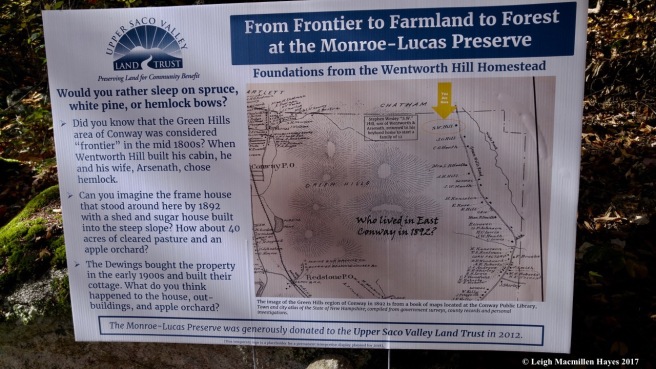
Another is that local land trusts preserve land for the benefit of the species who call this place home, both flora and fauna–and for us so that we, too, may benefit from time spent tramping along trails, making discoveries and forging friendships. The preserve we visited today isn’t quite open, but Pam said she’d heard they plan to open on November 4th. There were no signs on the kiosk or trail maps, but we quickly learned that none were necessary for the route was easy to follow. We were at the Monroe-Lucas Preserve, a 62-acre property donated to the Upper Saco Valley Land Trust.

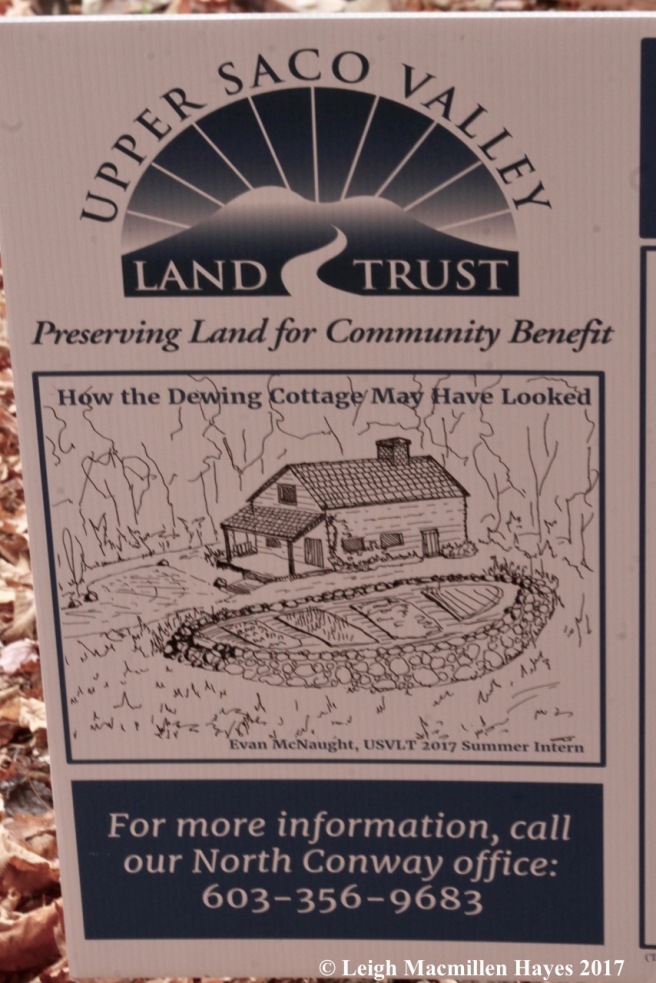
According to their website: “The land was given to USVLT by Barrett Lucas in honor of his wife, the late Leita Monroe Lucas. Leita’s family has deep roots in East Conway and Redstone, and her father, Ernest “Red” Monroe, also wanted to see the land preserved. Adjacent to the Conway Common Lands State Forest, The Nature Conservancy’s Green Hills Preserve, and the White Mountain National Forest, this parcel builds on an existing network of preserved land, and has wonderful opportunities for future trail development and increased public access. A branch of Weeks Brook also runs through the property, and the property lies within USVLT’s ‘Green Hills’ focus area. The site is also remarkable as the one-time summer residence of the American Impressionist painter Thomas Wilmer Dewing, and his fellow painter and wife, Maria Oakey Dewing. Their cottage, built in the late 1800s, fell into disrepair in the mid-1900s. Now only the chimney remains onsite.”
m-puff ball fungi 1

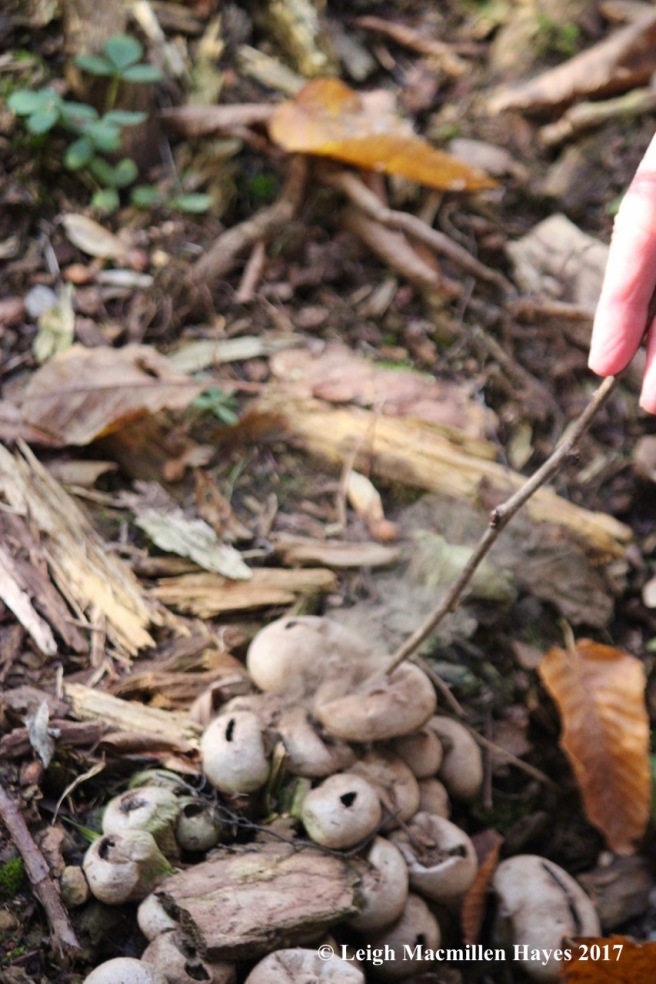
With Pam in the lead, we started up the trail and within minutes the fun began. She spotted a large patch of puff balls begging to be poked. The spores wafted up and away with hopes of finding the perfect place to grow nearby. We assume they will be successful, for within a fifteen foot area, we found patch after patch and knew we weren’t the first to encourage their spores to blow in the breeze.
m-bobcat print

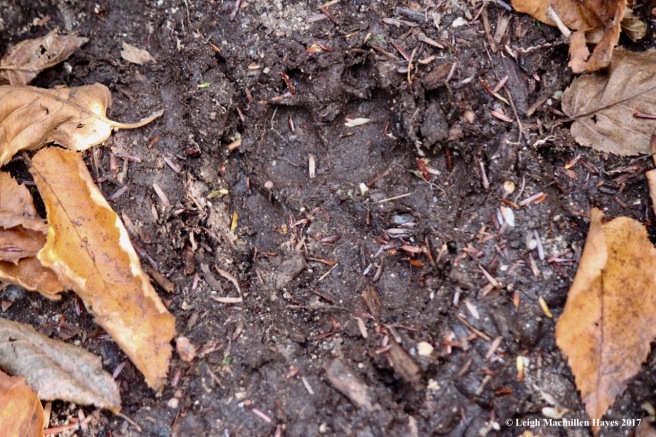
And then Pam began to spy prints in the mud. First, a moose. Then this bobcat–if you look closely, as we did, you may see the hind pad matted down; above that a raised ridge in the form of a C for cat; and four large toes, the two in the center being asymmetrical. Because it was a muddy substrate, we even saw nail marks, especially above the two center toes. Five feet further, we found deer prints. And so we rejoiced in the foresight of the Monroe-Lucas family to protect this land.
m-Weeks brook flowing 1

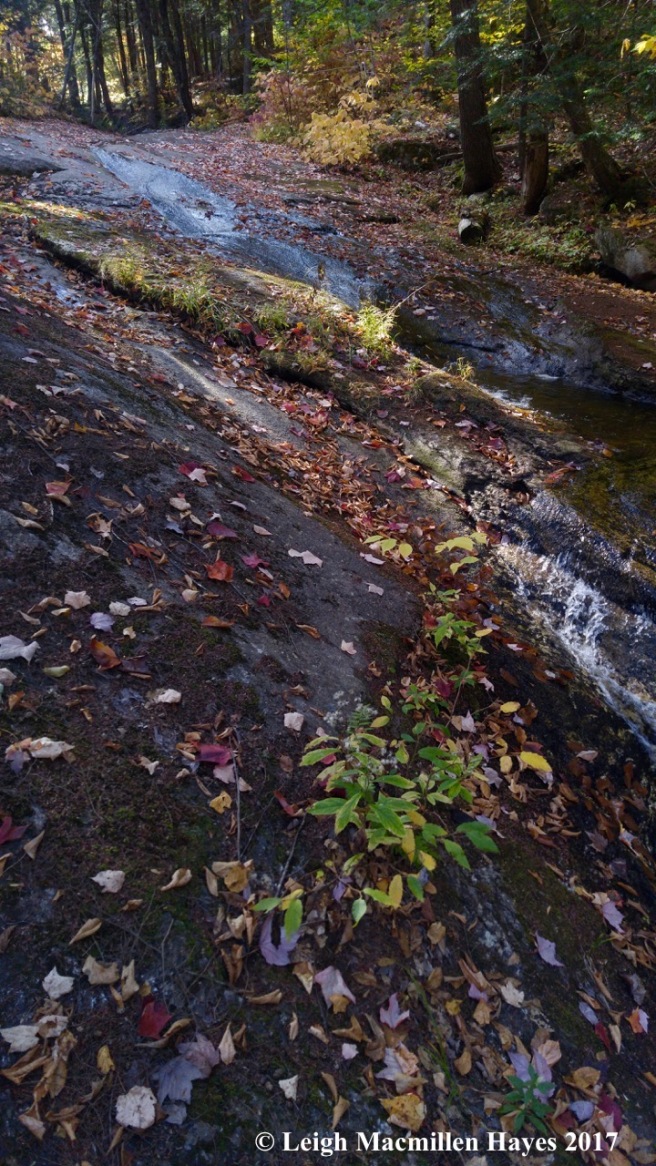
A bit further on, we heard the brook before we saw it–a branch of Weeks Brook that borders the property. We all stood beside and let it mesmerize us.
m-weeks brook 1c

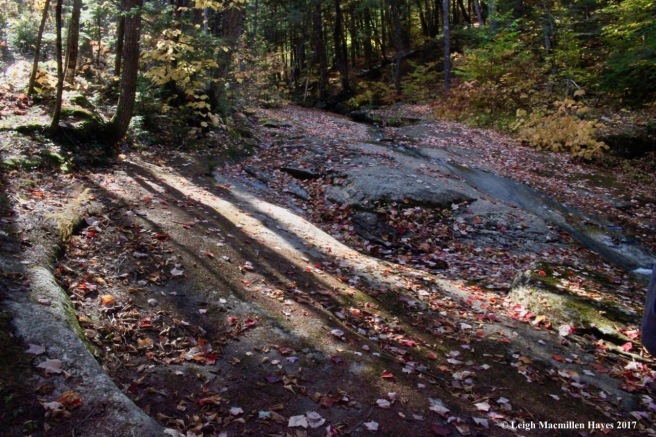
We thought about its forceful action each spring and the eons it took to carve into the rocks along its banks.
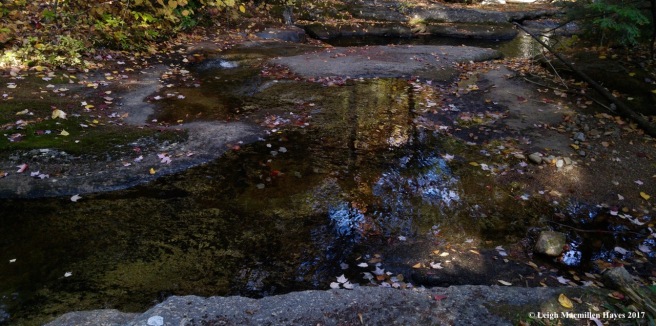
m-weeks brook baths

We shared visions of a summer day spent sliding down its smooth channels and slipping into the pools below.
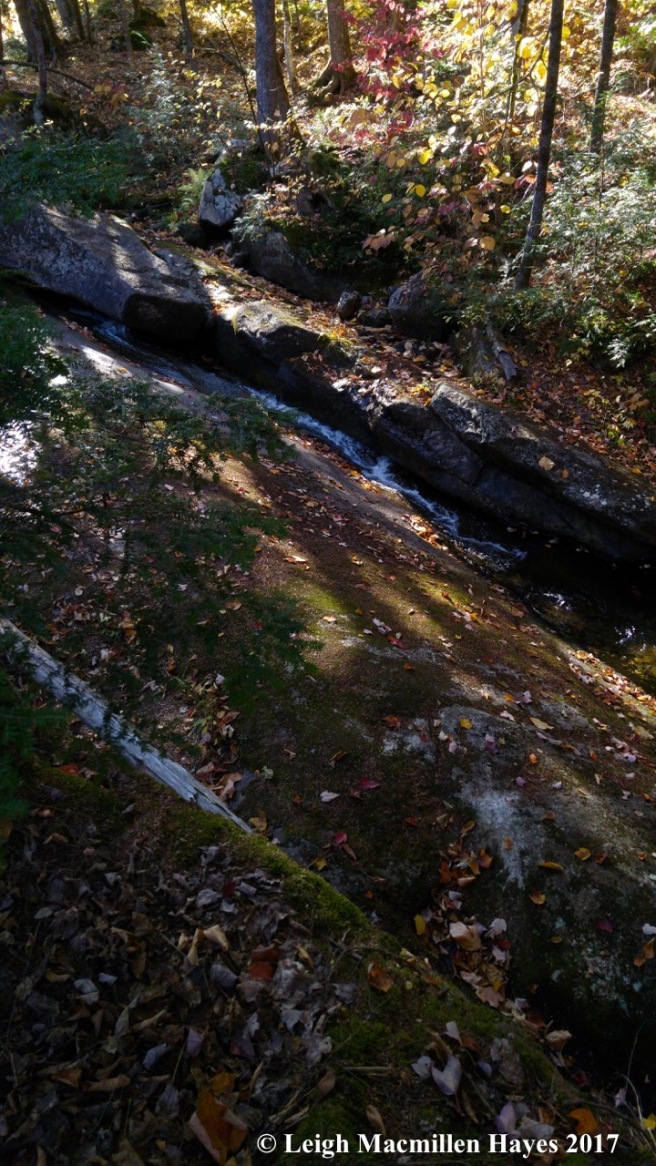
m-weeks brook between the rocks

And we marveled at the way it split the granite above . . .
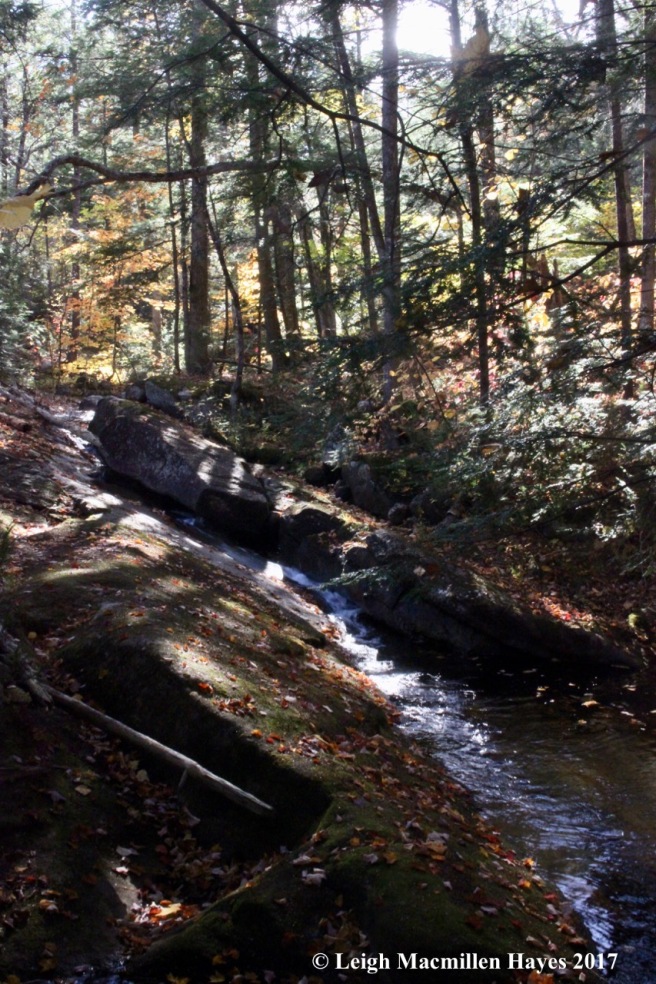
m-weeks brook between 3

and flowed between the shelves.

m-weeks brook bubbles

All the while, it raced to the finish line and we could only assume it made good time.
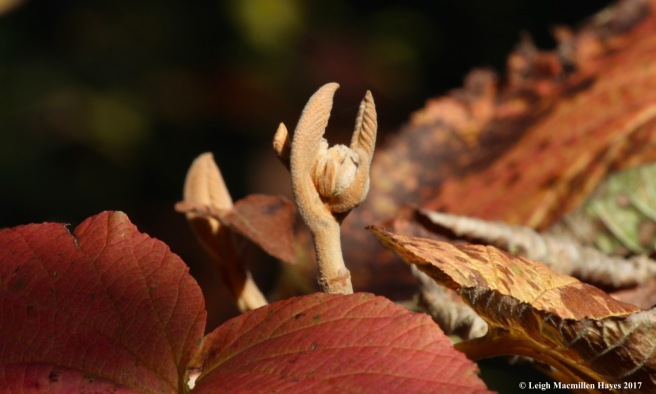
m-hobblebush flower?

It was beside the brook where the hobblebush grew prolifically and offered a myriad of colors among their leaves and clasping or clapping hands among their buds. Because we were looking, we noticed one flower forming into its globe shape as it usually does in late winter. Was it confused?
m-hobblebush new leaf

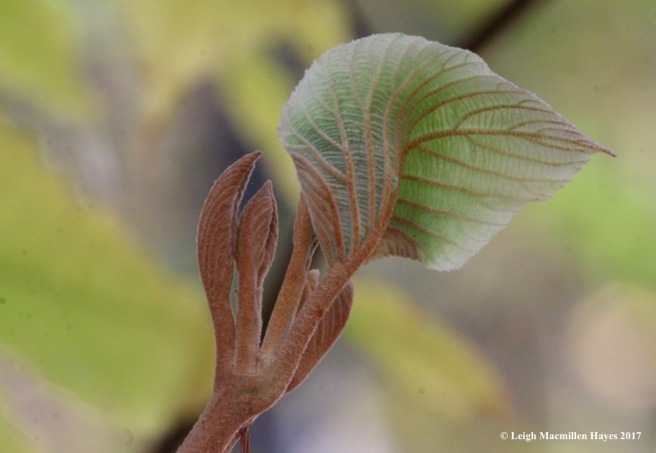
And on another, a new leaf.

m-hobblebush 2

Fortunately, most behaved as they should and gave us an autumnal display worth celebrating.
m-hobblebush:hemlock shadows

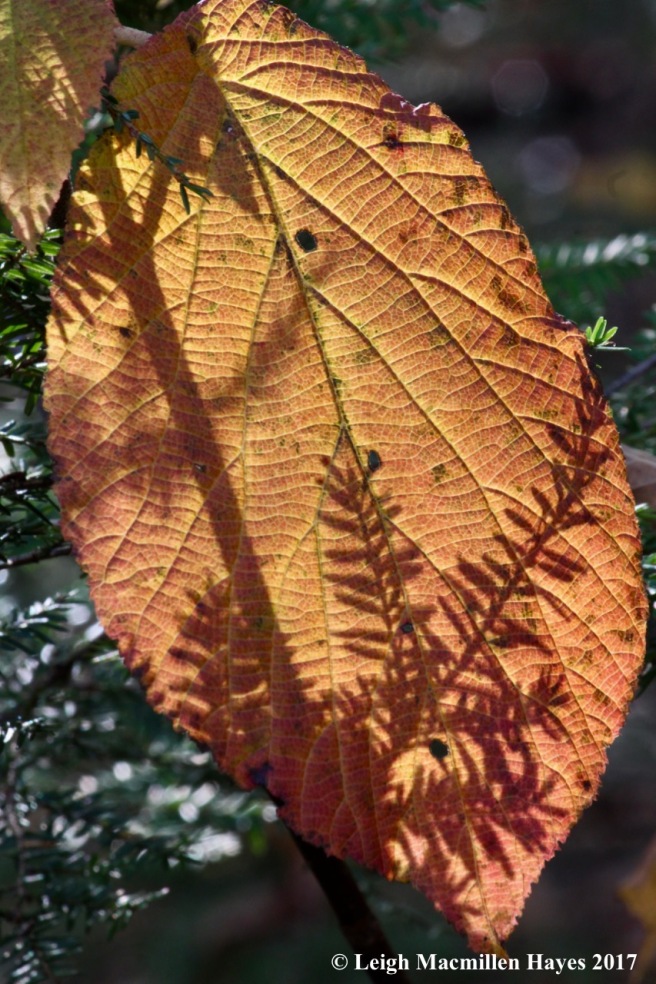
One even added some shadow play.

m-mount kearsarge

Eventually, we turned away from the brook and followed the trail down. A peak through the trees and we could see Mount Kearsarge across the way.
m-slime mold 1

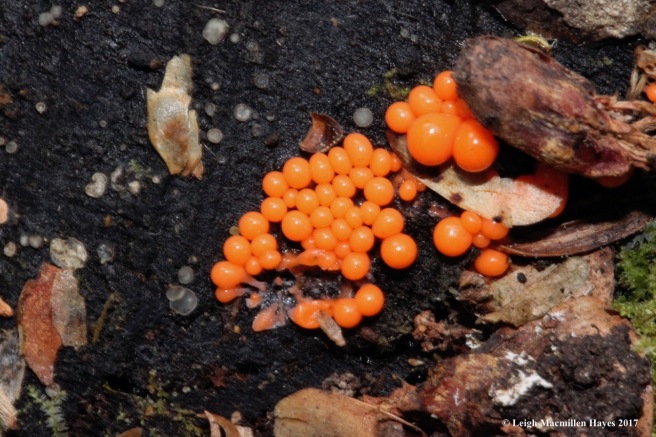
On a tree stump, we found a couple of fascinating fungi including a slime mold all decked out for Halloween.
m-jelly fungi

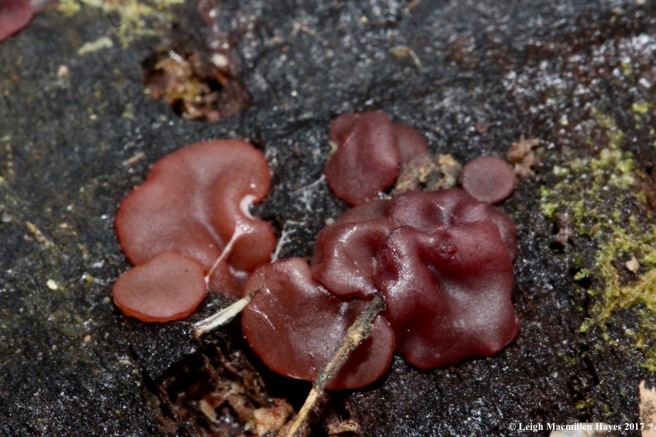
And on the same stump, a display of jelly ear fungi.
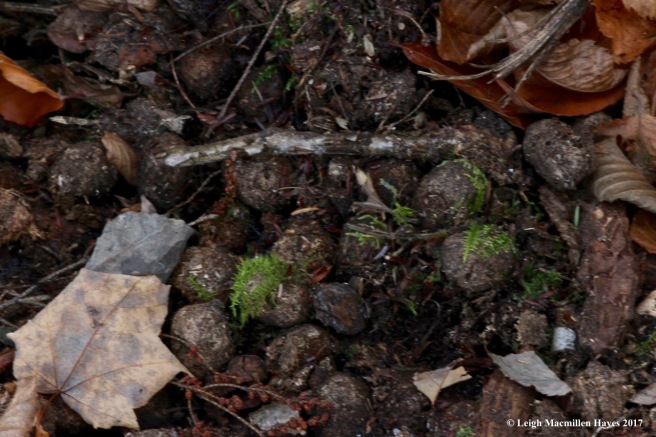
m-old moose scat

Around the corner was more evidence of moose traffic, though since it was moss-covered, we decided it was a couple of years old. None of us could ever recall seeing moss grow on moose scat before, but it made perfect sense that it would be a suitable substrate. I did wonder how they’d categorize that on a moss ID key–grows on rock, tree, ground, moose scat?
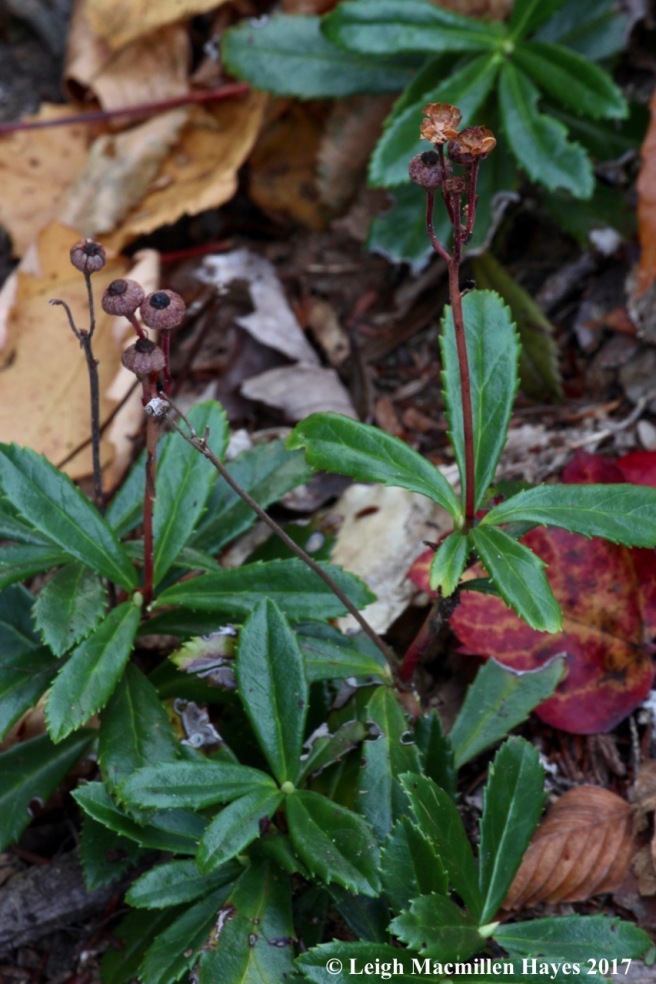
m-pippsisewa

Our moments of awe weren’t over yet. We sent up three cheers for the pipsissewa and its seedpods (Bob, did you take one?),
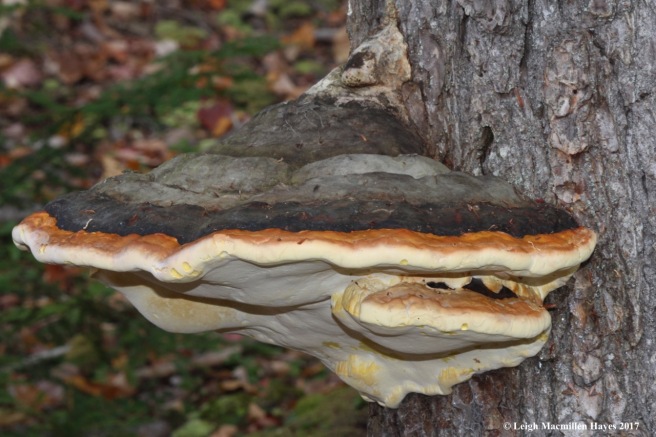
m-red-belted polypore

and red-belted polypore.

m-frullania 2

And then Bob spied the frullania. The smaller, spider-webby display in the lower right hand corner is Frullania eboracensis, a liverwort with no common name. But the larger mass is known as Frullania asagrayana, so named for a botanist and natural history professor at Harvard University from 1842-1873–Asa Gray.
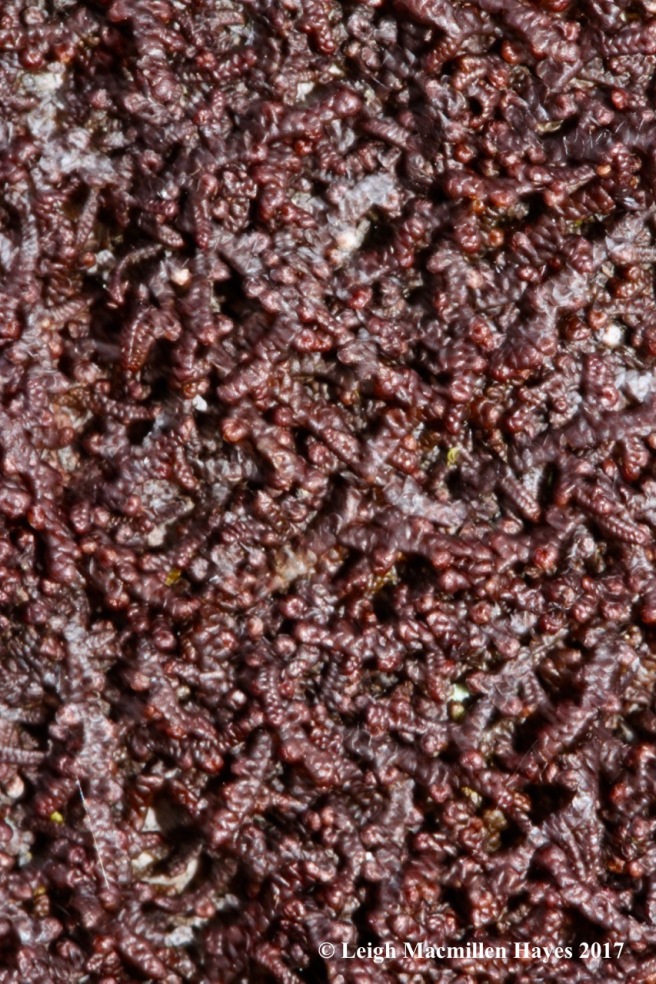
m-frullania

We all went in for a closer look at its worm-like leafy structure.
m-frullania and muy guy

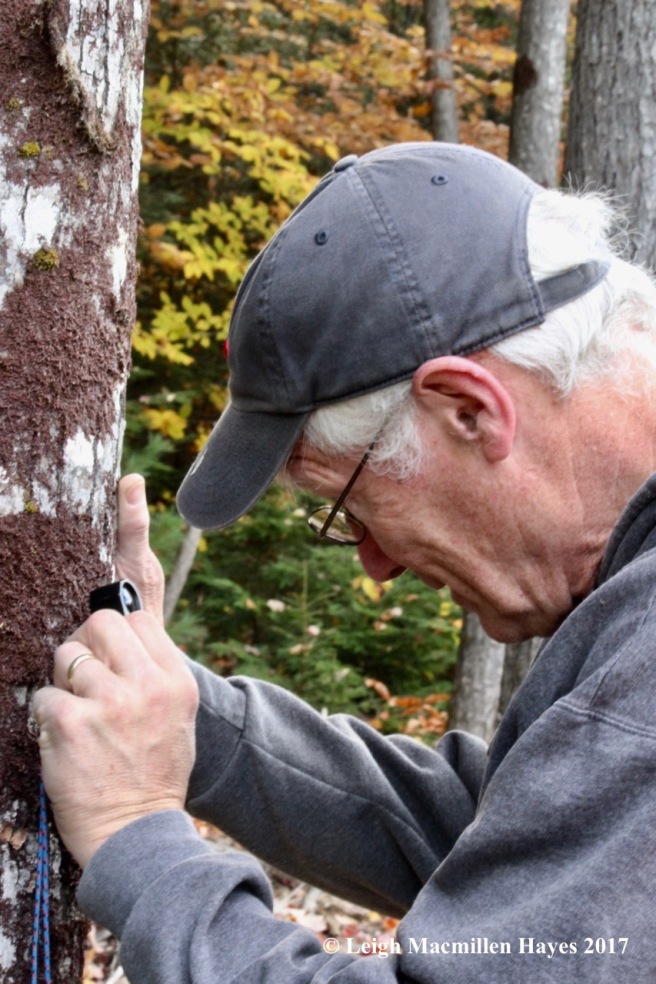
Even my guy got into the act, much to his reluctance. And he was certain he didn’t need a lesson on how to use a hand lens. Thankfully, he doesn’t read these blog posts, so I can get away with this. Shhhh.
m-uprooted pine 1

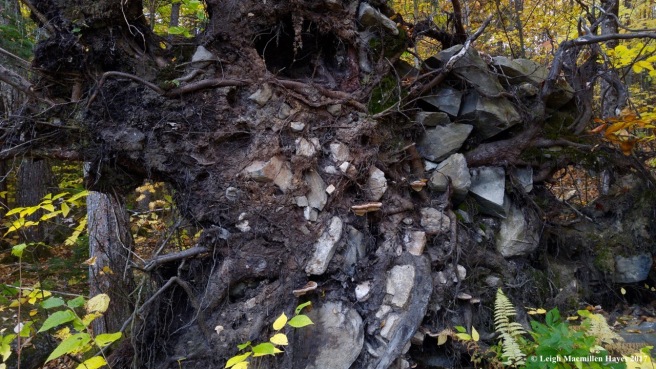
Around the next bend, for the trail has enough S curves to make the descent easy, we came upon a white pine long since uprooted. Did anyone hear the crash?
m-uprooted picture frames

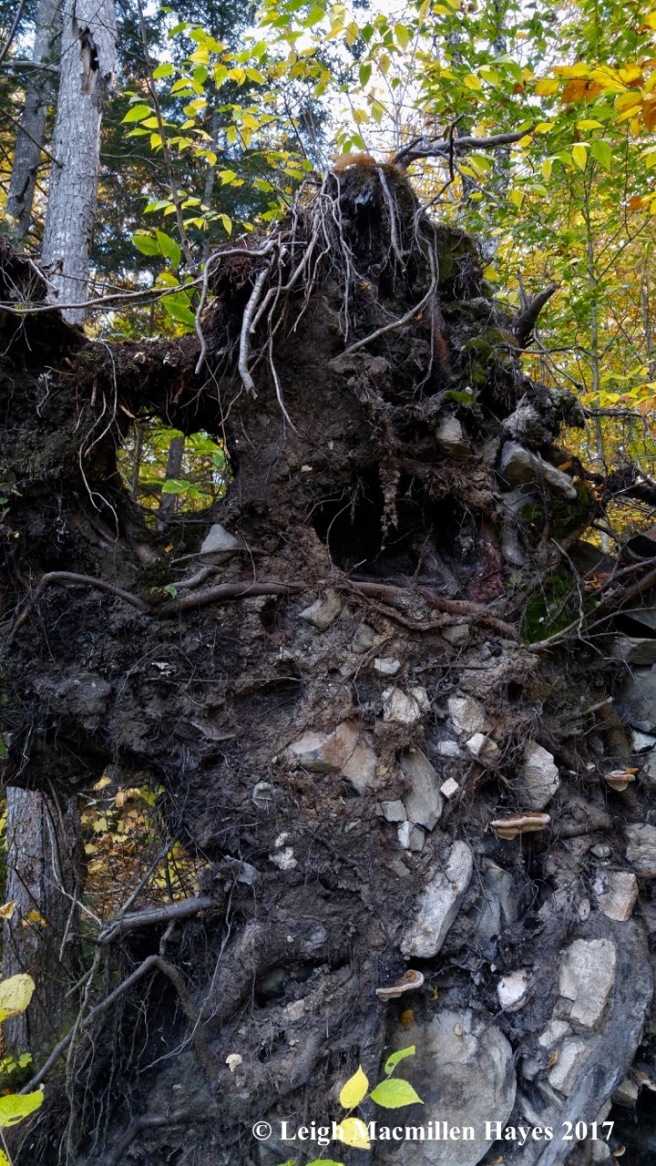
It offered a wonderful view–of more red-belted polypores, the root system and rocks, plus several windows on the world beyond.
m-photo frame hand

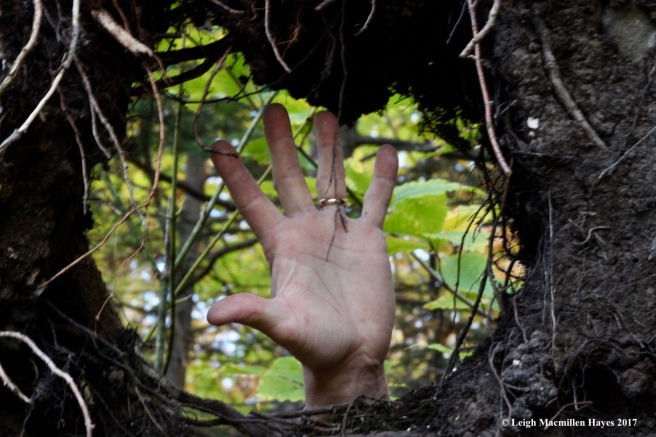
If you go, watch out . . . Thing of The Addams Family, might be lurking about.

m-Pam holding a huge striped maple leaf, Bob photobombing

Continuing on, we moved out of the hemlock and pine grove and back into the land of the broadleaves, including one with the broadest of them all–a huge striped maple leaf that Pam spotted; and Bob made sure to photo bomb the Kodak moment.
m-cottage sign 2

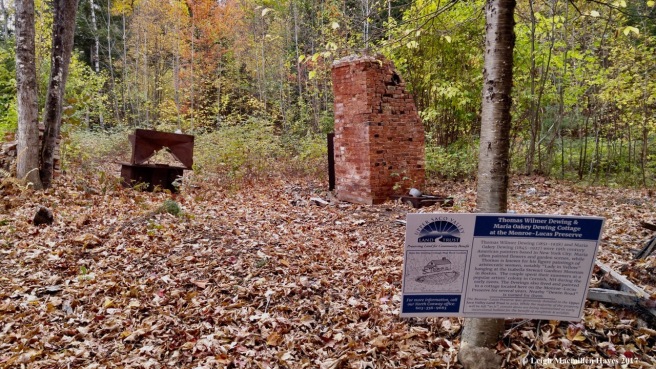
And then, as the trail evened out, we crossed a narrow gangplank to the location of the original cottage. According to a sign posted there, “Thomas Wilmer Dewing (1851-1938) and Maria Oakey Dewing (1845-1927) were 19th century American painters based in New York City. Maria often painted flowers and garden scenes, while Thomas is known for his figure paintings of aristocratic women, notably ‘Lady in Yellow’ hanging at the Isabella Steward Gardner Museum in Boston. The couple spent their summers at a popular artists’ colony in Cornish, NH, during the early 1900s. The Dewings also lived and painted in a cottage located here on the Monroe-Lucas Preserve for several years.

m-site of Dewing cottage 1

All that’s left is the chimney.

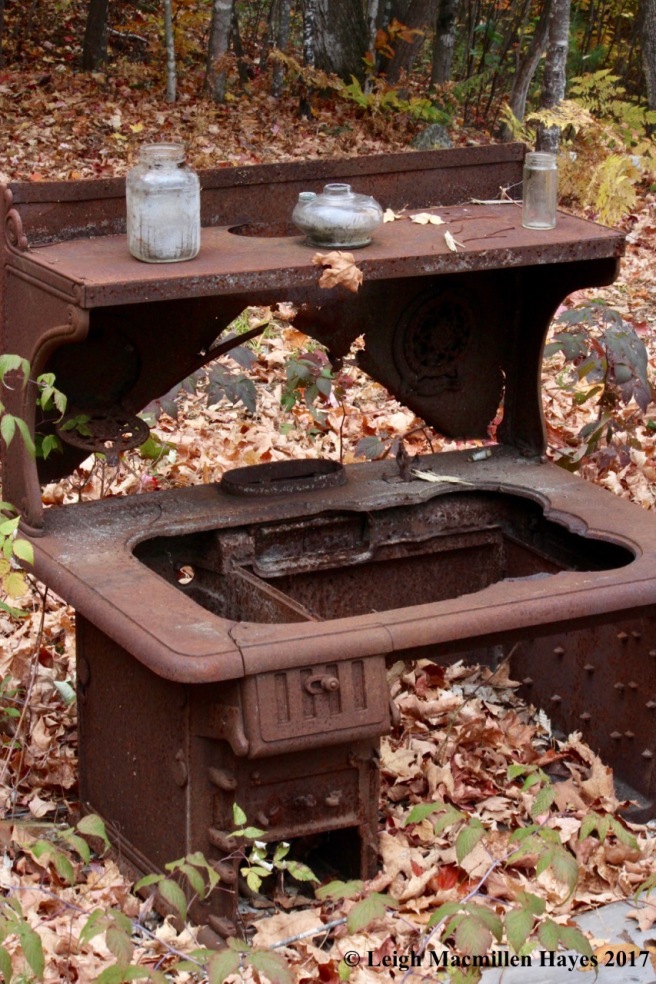
m-cottage stove

And some artifacts.

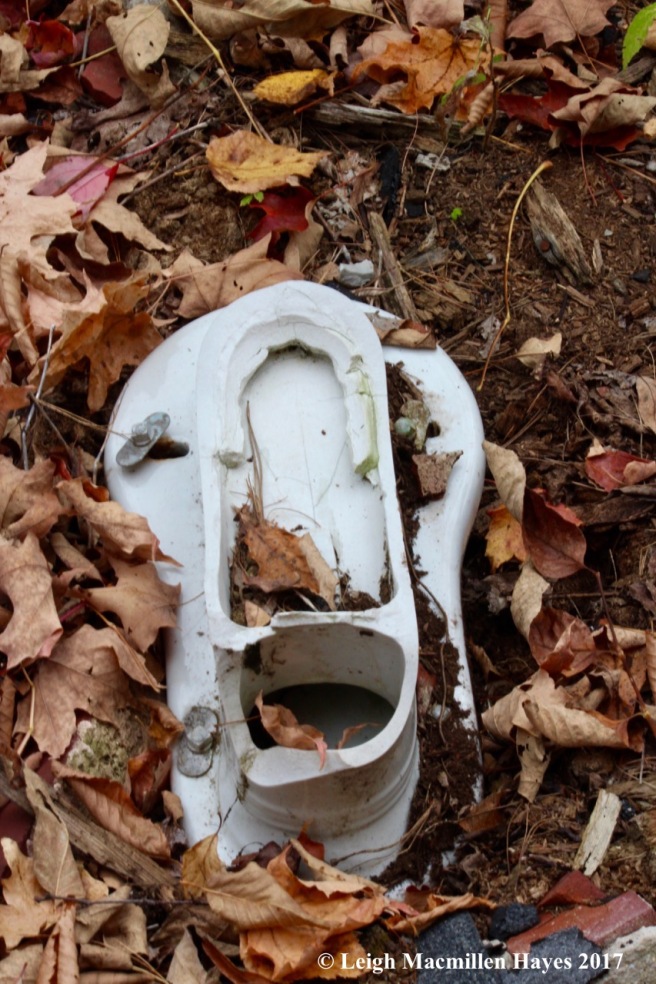
m-toilet

Including the john.

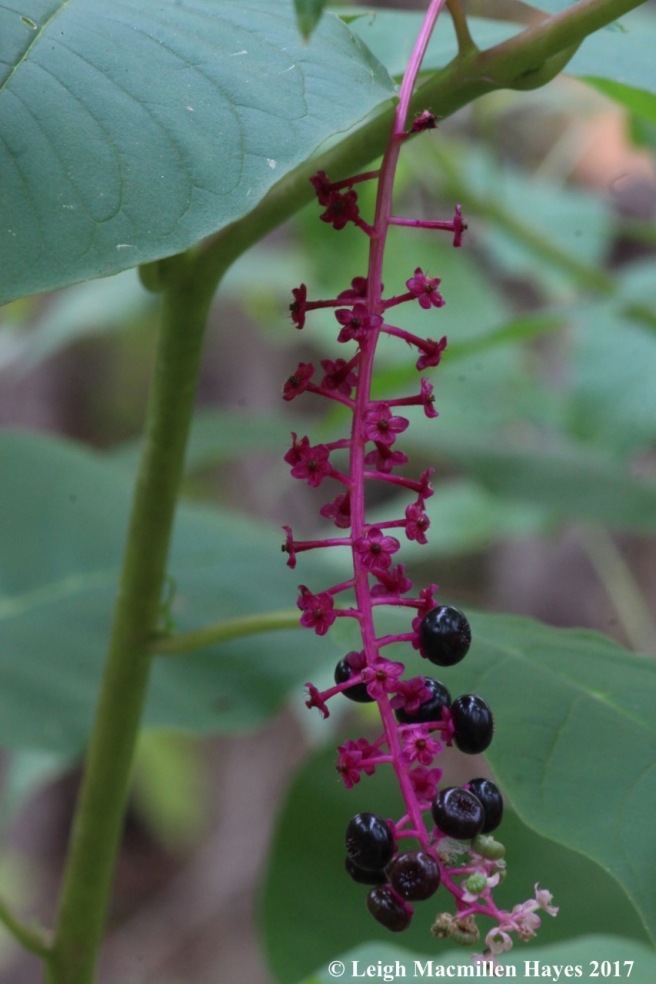
m-pokeweed

Our final view was a pokeweed still in flower and fruit. Again, we wondered about its timing, while appreciating its offering.

With that, we were back at the parking lot, where Bob informed us that our distance was just over a mile and time two hours–hardly record breaking. And hardly a “quickest to the destination hike” for my guy, but he kept finding stumps to sit upon as we gazed more intently on our surroundings; I think he secretly appreciated our slow pace and the opportunity to rest his legs.

If you want support his effort to raise funds for the Shawnee Peak Adaptive Ski Program, stop by and see him. Any and all donations are most welcome.
One Plus One=Five

One plus one equals two on an average day. And so today, Marita and I set out to conquer at least one trail, with a couple of others as additional options. We ended up “bagging” as they say in hiking terms, two–including one that was totally unexpected.

s-Long Mtn lower path

Our morning began with an exploration of the new trail on Long Mountain, a 2.5 mile climb that twists and turns beside Mill Brook on property owned by Mary McFadden and Larry Stifler. Near the start, bog bridges pass through wet areas now dry.

s-Mill Brook 1

The climb is moderately gradual and the brook ever present, its rocks creating falls that added a pleasing sound and sight to our hike.

s-brook crossings

Occasionally, we needed to cross and the way was well bridged.

s-dry brook1

At times, the brook was dry, but those moments made us realize that we must return in the spring when we assumed torrents of water pass over the rocks.

s-Mill brook moss (1)

Moss dangling today, however, mimicked the flow that wasn’t there.

s-cairn

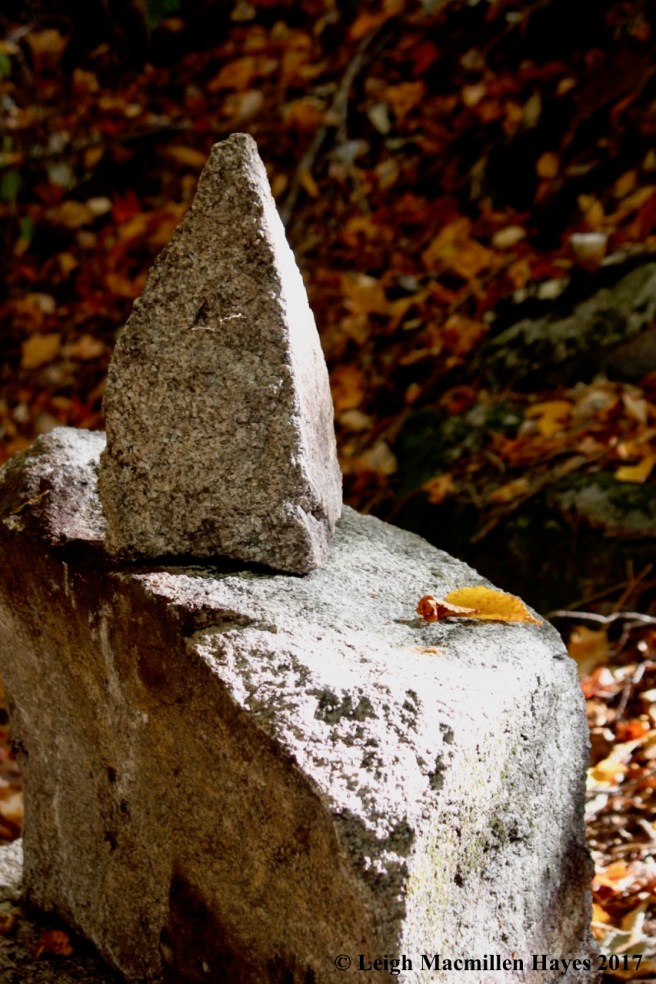
As we climbed, we noticed works of art. I’m not always a fan of cairns, but in this case, each had a flair that bespoke someone’s creative mind.

s-cairn 2

Others were simply simple.

s-water bar

We found water bars that were equally artistic in nature.

s-flagging

Just over a mile and a half into the hike, the trail turned and though it wasn’t as well cleared, it was certainly well flagged and losing our way wasn’t an option. There would be no getting fake lost on this climb.

s-sledge hammer

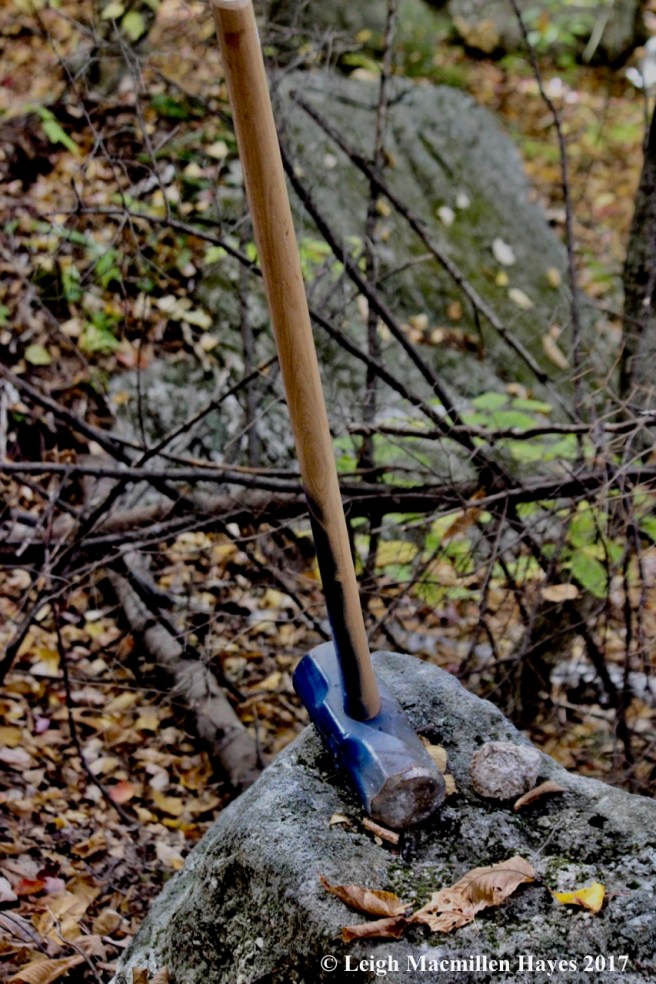
Eventually we came to a third section where the trail was again cleared and we found signs indicating the crew might be ahead.

s-stairs 1 (1)

Again, we admired their work, from the stone stairs to wooden steps, all created with materials found within feet of the trail. Work gloves left behind made us wonder if perhaps they wanted us to lend a hand. If you find the gloves, then I’ve a feeling you are good at “Where’s Waldo?”

s-oak ladder (1)

The extra sturdy ladder was created on site from a red oak (and some hefty hardware).

s-Marita, Bruce and Gary 2 (1)

We were chatting companionably when we heard some movement above. And then heard their hellos. We’d found the crew–Bruce, the property manager and Larry, his right-hand man. Bruce and Marita had communicated previously, so he wasn’t surprised to see us and we were full of admiration for the work these two have done–all by hand. In fact, if you ever think you want to do some trail work in your neck of the woods, I highly suggest you locate these two and spend some time working with them for theirs is the best I’ve ever seen. We chatted for a bit, learning about their good works and the good works of the property owners.

s-lunch view

And then it was time for us to move up a few more hundred feet and out to the ledges. We didn’t reach the summit of Long Mountain, for that is owned by someone else, but the ledges with a view of Round Mountain (also owned by the Stiflers), Evans Notch and the White Mountains beyond was the perfect setting for lunch rock.

s-nature's tapestry

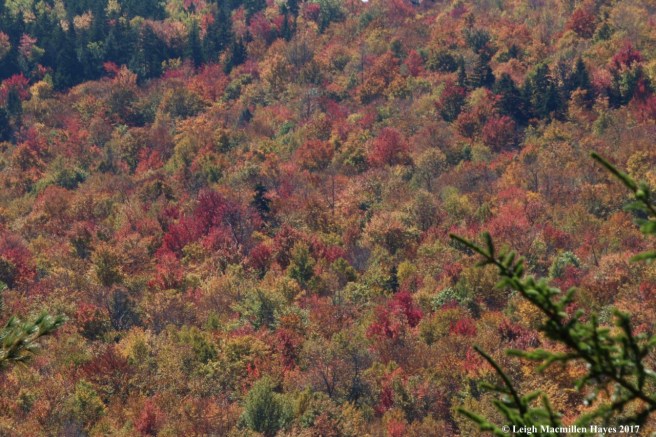
As we ate, we noted that foliage peak had passed in this part of the woods, but still, the tapestry was worth a closer look.

s-Long Mtn trail signs 2

Eventually, we followed the 2.5 mile trail down, repeatedly singing the praises of all who made this hike possible.

s-wasp nest

And then we traveled down another road we’d never been on before and located a mailbox Bruce had told us about as an indicator to the trailhead also owned by the Stiflers. We didn’t find the trail immediately, but did find this huge wasp nest, now abandoned.

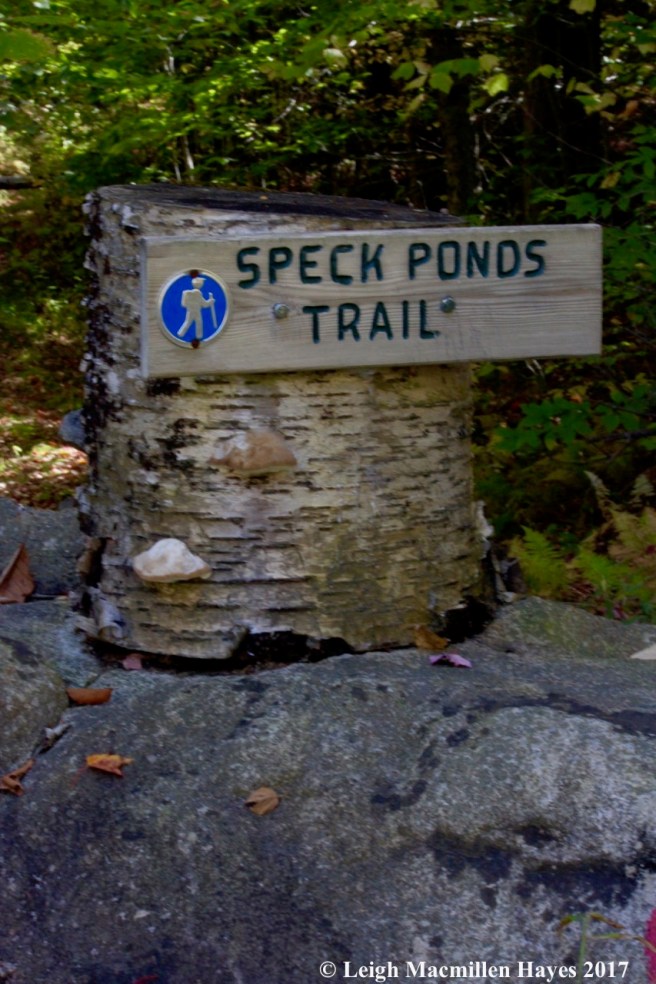
s-Speck Ponds trail sign

It took us a few minutes because it’s rather hidden, but within a few feet of the trail sign, we recognized Bruce’s artistic mark–sign attached to stump atop rock.

s-Speck Pond signs

And other trail signs that we admired mostly for their coloration in contrast to the paper birch to which they were attached.

s-Norway sign at Speck Ponds

s-Albany

This trail led us from one town to another in a matter of inches.

s-Mt Wash from Speck Ponds

And out on the power transmission line, we turned toward the mountains. with the Whites again in our view–especially Washington.

s-pond 1 (1)

At last we reached Upper Speck and turned to the left as we started on our way to hike around it and Lower Speck in what was described to us as a bit of a figure 8. I think really it was more of a calligraphy “g” in design with a bit of a line between the two ponds.

s-leaf art

Again, our views were delightful, including leaves of different species offering contrasting colors and shadows.

s-painted turtle

For a few minutes, we had the pleasure of admiring a painted turtle as it sunned itself before I disturbed it. I just wanted to get closer.

s-speck bridge

Again, bridges helped us ford the wet spots and we admired the workmanship.

s-bank lodge

It wasn’t just human workmanship that drew our attention. We saw at least five lodges, some beside the bank . . .

s-beaver lodge 2

and others in the wetlands adjacent to the ponds.

s-beaver works old and not successful

We found lots of old works . . .

s-beaver works old 2

some not entirely successful.

s-beaver dam 2 (1)

And beside a substantial beaver dam . . .

s-beaver new

we spotted a wee bit of new works–but it wasn’t much.

s-Upper Speck

Again, the colors kept us in awe, much as they had done atop the ledges of Long Mountain.

s-fall colors 1

And finally, we completed our “g” loops and made our way out with all of these and so many other photographic memories in our minds.

Today was not an average day for it’s Friday the 13th. And we had the pleasure of learning that one plus one=five–five stars that is, for we gave such a rating to each trail we traveled, and thanks to all who made them possible for us to wander and wonder. Thank you Mary and Larry and Bruce and Gary. And Marita for inviting me to join her.


Artful Eclipse Mondate

Because they are so gracious, when I recently begged Faith and Ben Hall for an opportunity to follow them on a trail through the Perley Mills Community Forest, they not only invited us to walk, but planned out an intinerary, pre-hiked the trail, made chicken noodle soup for lunch and took us for a boat ride. All of this before the great solar eclipse of 2017.

h-perley pond beaver dam?

After taking a tour of their neighborhood, Faith dropped Ben, my guy, and me off to begin our first bushwhack beside Perley Pond. In a few minutes, we came upon an earthen structure and I couldn’t help but wonder if it was an old beaver dam.

h-perley pond

We were at the base of the pond and perhaps just as those who dammed it up for their mill sites, the beavers had their own intentions. Of course, I could be totally off and it could have been manmade, but such was the formation and growth above, that I’m sticking with my original thought.

h-sawdust pile

Moments later, we emerged into a clearing and grabbed handfuls of fine saw dust, letting it sift through our fingers as it slowly drifted back to the ground. Occasionally, on our tramps through the woods, we’ve encountered such mounds and have been amazed that they still exist with little vegetation.

h-mill site approach

The mound bespoke the reason for the mill up ahead. (Notice the stream beside–we crossed over it, two of us more successfully than the third, but fortunately for him, I didn’t take a photo. He preserved the rest of the hike with soaking wet pants, socks and boots, but never complained, such is my guy. Oops–don’t tell him I told.)

h1-mill site, looking down

Climbing up, we looked down. According to the “History of Perley Mills” by Arthur Rankin on the Denmark Historical Society’s website, the part of town known as Perley Mills was “1st settled by a family named Cliffords in the early 1800s. They built a road by Little Pond to connect with the stage road from Denmark to Ingalls Road and Cole Road in South Bridgton and to Biddeford. The Cole Family had apple trees. Mr. Cole was a fiddler and he used to play for the dances in Denmark and Sebago. Mr. Wallis Berry purchased the Cole farm. About 1807, Mr. Berry and Mr. Perley built a dam at the outlet of Pickerel Pond. They built a saw mill to saw staves and shingles. They made barrels. They employed many men.”

We weren’t sure exactly what we were looking at below, but pieces of the former structure remained intact in what looked like a sluiceway.

h-mill drill holes

The stone had been split using the feather and wedge technique.

h1-mill site looking back

As we looked back, I was once again reminded of the work that went in to creating the foundations of yore.

h-cranberries 2

Our bushwhack included a few other fun finds, such as a small patch growing in an unexpected place.

h-cranberries

The little green balls actually threw me off when we first looked at them.

h-cranberrries 3

But it was my guy and his well-trained naturalist eye that knew they were cranberries.

h-virginia meadow beauty 1

We also spied a clump of Virginia meadow-beauty with its delicate petals and prominent stamen. It’s also known as Handsome Harry, but I think Harriet would be more fitting.

h-survey mark

When we reached the Narrow Gauge Trail, Ben showed us the elevation maker that neither of us recalled seeing previously.

h-pickerel pond

We stood beside the pond for a few minutes, looking for frogs.

h-sharp-shined back

h-sharp-shined front

And realized we weren’t the only ones on the hunt.

h-gall of the earth

As our journey continued down the old rail bed, we all wondered about the work that went into building it. Years ago, we used to find railroad spikes, but the trail has been improved recently and that seems hardly possible any more. Instead, we found gall of the earth in flower,

h-raccoon prints

raccoon prints showing their opposite diagonal manner,

h-Faith's arrow

and either one large turkey print or a message in the sand. We knew it was the latter for Faith had preceded us and as we passed her she mentioned she’d left a note.

h-off the Narrow Gauge

It wasn’t long after Faith’s message, that Ben veered off the rail trail and took us up an old logging road.

h-following Ben

We followed him through thick and thin, the thickest being where the goldenrods bloomed and bees buzzed in former log landings.

h-approaching the stone cemetery

Along the way, he spoke of a stone cemetery. We both conjured up images of an old cemetery reflecting an earlier time. But . . . he meant a large pile of rocks that had been dumped by a previous owner who had logged the area.

h-walking the Narrow Gauge

Eventually, we met up with Faith again, then she drove to our next meeting point, while the three of us walked the Narrow Gauge in a direction my guy and I had never traveled.

h-beaver dam:infinity pool

It was there that we saw beaver works we were certain of, including a dam that created an infinity pool above.

h-swamp beside Narrow Gauge

Beside a swamp, we kept searching for moose, but never spied one.

h-thistles, Faith

At last our journey by foot came to an end . . . almost. Faith had a surprise waiting for us. And so she drove us back up their road and just past their house pulled off to the side on land owned by their oldest son. We’ve explored that property with them previously, but today she wanted to show me one of my favorite plants, which also happens to be hers.

h-thistles in all forms

Thistle . . . in all of its forms, it deserves reverence.

h-thistle 2

And so we revered.

h-Hayes True Value bucket

Back at their camp, our time together wasn’t over for we broke bread. And then they offered a quick boat ride. On the way to the dock, we knew we were in the right place, such did the signage on one bucket indicate.

h-Faith and Ben

Out onto the pond we went, thankful for a few more minutes with Ben and Faith. We cherish any time spent in their company before they head south again. And today, we were also excited to explore our local area and visit places we’ve never been to before. Thank you both for everything, from the hike to thistles to lunch and the boat ride and all the conversation in between.

h-squirrel and eclipse

Before we departed, we had one more stop to make–at Ben’s sand table, where he recreates the natural world with found rocks.

Today’s creation–a red squirrel devouring the seeds of a white pine cone as the moon covered the sun–an artful eclipse on this Mondate.


Spotlight on the Brownfield Bog

When I drove to the Brownfield Bog, aka Major Gregory Sanborn Wildlife Management Area, this afternoon, my intention was to pay attention to the shrubs that grow there.

b-black swallowtail

But, as usual, the distractions were many and a black swallowtail landed as I stepped out of my truck.

b-ant on alder aphid

I did note a tremendous amount of wooly alder aphids coating the alder stems everywhere I walked. In fact, I’ve never seen so much fluff. And I found only one ant eager to milk the sweet honeydew produced by the aphids as they sucked the shrubs sap. Once in a while the white fluff danced in the breeze. Was it an aphid on the fly?

b-willow flowers

Or did it come from the willows that were in the process of sending their seeds forth into the future?

b-Northern Arrowwood

So you see, I was paying attention to the shrubs, especially those in flower like the Northern Arrowwood. There was another with a similar flowerhead, but different leaves and I need to return and spend more time studying it.

b-Pleasant Mountain 2

Because I was in the bog, I did pause occasionally to peer across its advance, usually with a view of my favorite mountain (Pleasant Mountain) providing the background.

b-chalk-fronted corporal 1

But the dragonflies live there. And the chalk-fronted corporals became my BFF, since as many as twenty lifted off with each step I took. They led me all the way down the trail and all the way back, usually a few feet in front.

b-dot-tailed white face 1

The corporals weren’t the only dragons of choice.

b-dot-spotted white face 2

Dot-tailed white face dragonflies were happy to pose.

b-calico pennant 1

And I even found a few calico pennants–happy to make their acquaintance again.

b-white gall on maleberry 2

Between dragon and damselfly opportunities, white globs and . . .

b-maleberry gall?1

green caught my attention. They were the size of apples and totally new to me. My thought right now is that they are galls, similar to the azalea gall, but these were on maleberry shrubs. If you know otherwise, I welcome your information.

b-bog view

The bog was swollen with water only a few weeks ago, but that story line has passed and life sprang from the spring like a fountain of youth.

b-damsel love 1

My noticing continued when I spied a couple of youthful damselflies . . .

b-damsel love 2

he’d attached himself below her . . .

b-damsel love 3

and ever so slowly advanced . . .

b-damsel love 4

until the circle of love was complete.

b-lady beetles canoodling

Canoodling of all kinds occurred.

b-dragonflies canoodling 2

Even the dragonflies tried to get in on the action.

b-dragonflies canoodling

She wasn’t very tolerant, however, and a couple of seconds later detached herself from her forward position and took off.

b-sedge sprite 1

I moved on, looking here and there and thrilling at the sight of the beautiful and iridescent sedge sprite damselfly.

b-river jewelwing

Following the trail to the Saco River, I found tracks galore in the muck below, and a river jewelwing–appropriately named.

b-Canada geese

As I headed out, I startled a Canada goose family that had been feeding along the edge.

b-ring necked and mountain

And then I paused for one last look at the bog and Pleasant Mountain.

b-ring-necked duck

That’s when I realized I was in the presence of a male ring-necked duck. If you like to bird, this is the place. I saw several but heard so many more. And even if I couldn’t apply a name to a song, I did enjoy the symphony that followed me throughout my adventure.

b-Kathy's bog sign

Though I said I went to look at the shrubs because I do want to learn them, my real reason for going was to see this new installment.

b-Kathy's sign up close

Maine Master Naturalist (and potter) Kathy McGreavy created this handmade and painted map of the bog for her capstone project. Her husband recently installed it and it’s a work of art worth looking at not only to appreciate Kathy’s talent, but also to learn more about the bog and those that call it home.

My hope is that the spotlight will continue to shine brightly on Kathy’s creation . . . made with love in honor of her bog.

Slog Through The Bog

She said she’d call a half hour before heading to the bog so I should probably sleep in my hiking clothes and boots. And she was right! I was just about to take a bagel out of the toaster oven when the phone rang. “We’re going to the bog at 9:00. Can you join us?” Thirty-five minutes later I pulled into her driveway, excited because it was a chance to explore Brownfield Bog with about-to-become Maine Master Naturalist Kathy McGreavy and her daughter, Dr. Bridie McGreavy.

b-bog from road

From there we drove to Bog Road and parked at the beginning since conditions were dicey, but also because it gave us a chance to walk and listen–almost immediately we heard a barred owl. And then the warblers greeted us.

b-sky and water

Brownfield Bog, aka Major Gregory Sanborn WMA, encompasses 6,000 acres of wetland. And on any given day, the sky tells its story above and below. Of course, we thought we were going to get poured upon when we first met, but the mist soon evaporated and sun warmed us enough that we shed a few layers.

b-common yellow throat 2

The initial stretch of our journey found us moving at a fast pace, but once we reached the second gate,

b-Bridie McGreavy

our inclination was to slow down.

b-Kathy

To stop, look and listen.

b-common yellow throat 1

The chestnut streaks on the yellow warbler matched the emerging red maple leaves.

b-oriole 2

And I can never spend enough time with a Baltimore oriole, forever wowed by its color.

b-oriole singing

And its voice.

b-catbird

Birds flitted about and flew overhead, but occasionally one, such as this catbird, paused and posed.

b-willows and birches

Most of the songbirds were feeding and perhaps nesting in the land of the willows, birch and maples.

b-willow pine cone gall caused by midge

Others also sought homes here, like the gall gnat midge that overwintered in a pinecone-like structure created with leaves by the reaction to a chemical released by the larva. I’m forever amazed about how nature works.

b-song sparrow

Eventually, we followed the song sparrows as they led us down the cobbled road.

b-road 1

The current was strong in places . . .

b-deep water

and water deep.

b-scenery1

But the views . . .

b-Pleasant Mtn and Bog

worth every step.

b-maple samara

Sometimes, our focus was upon the ground, where we spotted a few small red maple samaras.

b-coyote scat

And scat–including this double offering of coyote deposits.

b-coyote scat toenail

And among it–a toe nail first spied by Bridie. I chuckled to myself when we got down to look at this, for Bridie first introduced me to the finer qualities of scat when she worked at Lakes Environmental Association. She also taught me to track mammals. And . . . the crème de la crème–to sniff fox pee. Ah, the delights we have shared–they are many and having an opportunity to walk with her today brought them all flooding back.

b-ribbon snake

We decided to put our blinders on so we could continue without any pauses, but then Bridie’s eagle eyes zeroed in on movement. Her mom and I saw the movement as well, but we had to really focus in order to find the creator among the dried vegetation.

b-ribbon 2

And we did–a ribbon snake, who happens to be a great reason for preserving this property because its a species of special concern in Maine.

b-Pleasant Mtn

At times, Pleasant Mountain was the featured backdrop.

b-Canada geese

And Canada geese swam in the foreground.

b-beaver mound

Everywhere, beaver works were obvious and scent mounds growing in size.

b-oak 1 (1)

After a couple of hours, we reached our turn-around point at the old oak tree.

b-beaver lodge

As we looked across, one of the beaver lodges stood above the water level.

b-bog 3

But Kathy and Bridie both reminded me that another was still submerged due to this spring’s high water level.

b-cuckoo nest remnants

Finally, we did our best to bee-line back. But Kathy showed me one more great find that had been pointed out to her by Mary Jewett last year–the straggly stick structure of a cuckoo’s nest. Certainly worth a wonder. (The other wonder–when we first arrived at the bog this morning, Mary was just leaving.)

b-spoon jar 2

Our entire morning had been worth a wonder and then another occurred when we returned to Kathy’s house. While I said goodbye to Bridie, who is an Assistant Professor of Environmental Communication in the Department of Communication and Journalism at the University of Maine, her mom slipped into the house. When Kathy returned, she handed me this spoon pot filled with daffodils from her garden. She’s a potter and owner of Saco River Pottery. Though I love to give her fine art as presents, I only own one other piece. This one now stands proudly on our kitchen counter, holding the utensils as it was intended. It will forever remind me of the McGreavys and the day I first saw a dragonfly emerge from its exoskeleton–at the bog with Bridie; and the day I spent with Kathy as I interviewed her for a magazine article about creating pottery–and she let me try my hand at the wheel; and so many other memories of time spent with these ladies, but especially today–for the opportunity to slog through the bog with the two of them.


A Wiser Soul

It all began when I stepped out the back door just before six o’clock this morning. From the treeline I heard a barred owl call, “Who cooks for you? Who cooks for you all?” I could have returned to bed then, happy for the opportunity to hear such a wise one.

n-Northern Flicker

Not long after that, as I passed by a window in the butler’s pantry (no, we don’t have a butler, just an old farmhouse), a splash of red on the ground drew my focus–a Northern flicker had stopped by to feed. Notice the subtle curve of its bill? The better to dig up ants and beetles, as is the custom of this ground-feeding woodpecker.

n-water coursing 2

An hour or so later, I met my friend, Marita, for a hike up the Bald Peak trail at Pleasant Mountain. Our destination–not the summit as we had a time constraint–but rather, Needles Eye.

n-beside the brook

Our climb included frequent stops at vantage points to take in the sound and beauty of the place.

n-water art 2

The flow of the living water and its ever changing presentation mesmerized us much as leaping flames do.

n-water art

It spiraled over the rocks like a sculpture in fluid motion.

n-ice hiding

And while so much poured forth and wound its way down the mountain stream,

n-ice at Needles Eye

some remained frozen in time.

n-crossing toward Needles Eye

At the sign pointing toward Needles Eye, we crossed a stream and then worked our way across the short spur to the narrow formation of rocks that water threads through.

I should qualify that. Marita sauntered across the ice and snow, seeking the wee bit of dirt and leaves at the edge of the trail. It’s a steep edge and even on a summer day, I pick my way carefully over rocks and tree roots. Today, my brain suggested I call it good and sit still. But, she’s a good friend, and realizing my trepidation (I’d forewarned her), she spoke to me calmly about each foot placement, and even turned back to demonstrate exactly what I should do, waited patiently as my brain shouted, “Don’t do it!” and my heart said, “I think you can, I think you can,” and offered a hand when necessary.

n-marita 3 (1)

Together, we did it. This photo is Marita’s as I didn’t want to change my camera lens once we stood in the chasm and watched the water fall.

n-inside the needle

On a summer day, it’s a delightfully damp place to rest before continuing up the mountain. Sometimes, there’s only a hint of a stream. Today, it was equally enchanting–perhaps we should have bowed in respect of the beauty and power before us. And just maybe we did.

n-climbing down 2

Returning on the spur, Marita again came to my aid. And then we hiked a bit further up until time forced us to head down again.

n-morning light

The descent seemed easier as the snow had softened a bit in the two hours we’d spent enjoying each other’s company and filling our senses with the sights and sounds surrounding us.

n-vp visit

Back at home, I was pulled out the door again and made my way to the vernal pool. Ever so gradually, the ice is melting.

n-crack across vp

And across the center, a crack divided it in two from east to west, while a line between the sunshine and shade completed the quadrants from north to south.

n-snowfleas 2

Piles of pepper, aka springtails, floated on melted water atop the ice.

n-snowfleas

Others clustered on the open water at the pool’s edge. Other than that, I could see no action. Every day, however, will bring something new so I know I’ll check back frequently.
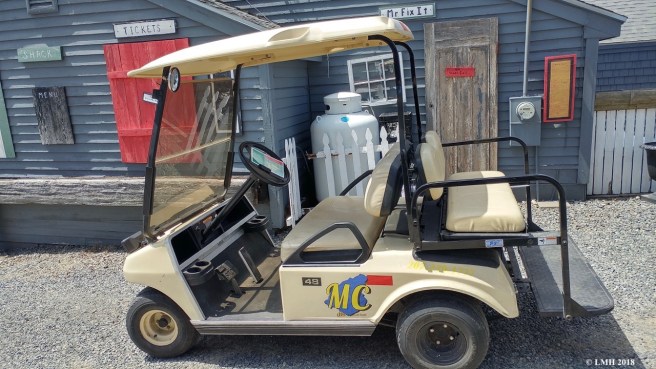
n-our house:field

Leaving the pool behind, I headed toward the area where I’d heard the barred owl several hours earlier–and I called. It didn’t respond. But, I reminded myself that this morning’s greeting was enough.

n-crocuses1

Returning home again, I couldn’t resist the crocuses that I first noticed yesterday. In the past few days, the snow has receded quickly and with today’s light, these spring beauties finally opened.

n-first daffy--a double

And then, in the garden beside the house, I found one more surprise–a double daffodil blossoming under some leaves. In this season of watching with wonder, my heart was full.

n-Marita

This day will stick with me for its offerings and I’ll be forever grateful to Marita . . .

n-marita 4 (1)

for without her help, I wouldn’t have had the gumption to stand in the Needles Eye. She is a kind and funny and wise(r) soul. And I am blessed by our friendship.

P.S. Two minutes after posting this blog, a woodchuck ran across the deck–headed toward the barn, of course.


Dear Aunt Ruth

My memories are snapshots of times spent with you and Uncle Bob and all the cousins. I loved visiting your home–whether we drove down the long road and driveway with Dad or walked via the old dump road and skeet field with Mom. Each time we arrived, you welcomed us with grace and your unassuming manner.

I remember sipping lemonade on the back porch, riding the wooden horse, and checking on Dale’s bunnies, especially Peter who soon became Mrs. Peter. I remember lunches at your kitchen table, and the time we bit into our tuna sandwiches only to discover the bread was filled with ants. Why that sticks with me, I don’t know, but we all thought it was funny. I remember family reunions, where food and laughter and aunts and uncles and cousins were abundant. Eventually, it evolved into a musical gathering–such was the talent of the clan.

But most of all, I remember your flower and vegetable gardens and your love of all things natural.

p-kiosk

And so today, as my guy and I ventured to a park we’d never before visited, I took you with us. I wanted to share with you our findings, just as you used to share stories of your gardens and wildlife sightings with us in Christmas cards after I moved north.

p-moose trail

Our first observation–a moose! Well, not really.

p-deer tracks

But we did see evidence of deer and I knew you’d be glad they were running away–leaving your gardens alone. Oh, and those pesky raccoons! Raising eight children didn’t seem to phase you, but those raccoons in the corn field–that did rattle you.

p-gardens on high

The gardens in these woods differ from yours–and right now, given the snow cover, the only ones visible were high up in pine trees, where yesterday’s snow offered nourishment to the mosses and lichens that grow there.

p-locust legume-like seed pod

We did, however, find one similarity–the legume-like seed pod from a locust tree. It’s almost time to sow the peas.

p-apples

In these woods, we also found a symbol of the past–it was once farmland as signified by the apple trees. If memory serves me right, there was a very climbable apple tree beside your driveway.

p-hidden acorn

And then we spied one impossible possibility–an acorn tucked into red maple bark. How did it get there? And will it germinate? If it does, what then?  I trust, you too, would have noticed such and wondered.

p-pratt brook 2

We followed the trails through the woods and sometimes beside the brook for which the property was named–Pratt Brook. It was a bit more bubbly than the creek in your yard, but such is the snow melt right now.

p-artist conks

Along the way, I noted a family of artist conks decorating a tree. And, that, of course, brought to mind the box of colored pencils you (or perhaps it was the cousins, though Neal had no qualms about telling us that our gifts were really chosen by you) gave me long ago. I cherished that box and used those pencils with care. They lasted into my early adulthood.

p-colors 1 (1)

And then my guy gifted me another box, which I again revere. One of my favorite pastimes is to sit and sketch and then add a dash of color. Whenever I do, Aunt Ruth, you are with me.
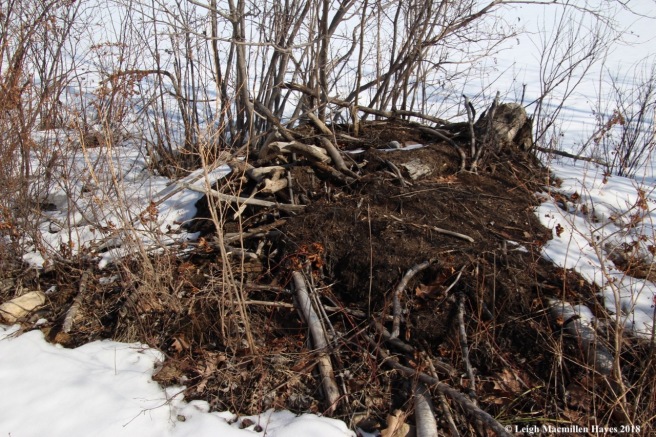
p-powerline

For a while we followed the power line trail, aka Bear Trail. As you can see, we tramped in the footsteps of many others who’ve traveled this way just today–via skis, snowshoes and hiking boots like us. We were an hour from home and close to the ocean, so the snow level was about six inches compared to at least two feet we walk upon daily. But today’s sun warmed us and initiated a meltdown.

p-spider

I didn’t mind being on the power line for a bit, for it was here that we saw our only sign of wildlife.
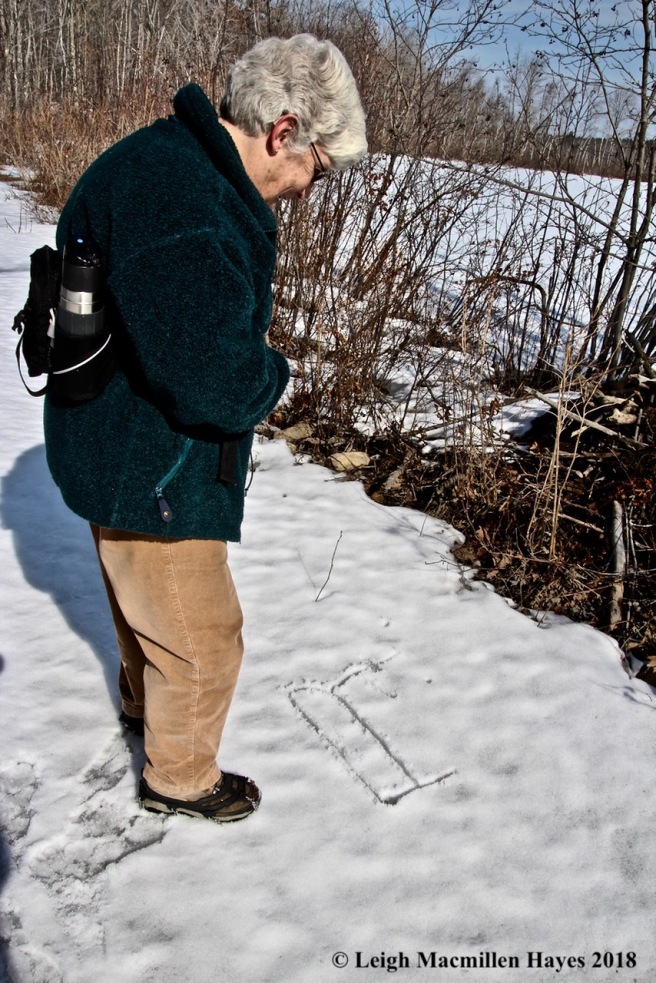
p-aster 1

It was also the spot where I knew we’d find wildflowers–and I wasn’t disappointed. Asters like these, and goldenrods, spireas and berries displayed their winter forms.
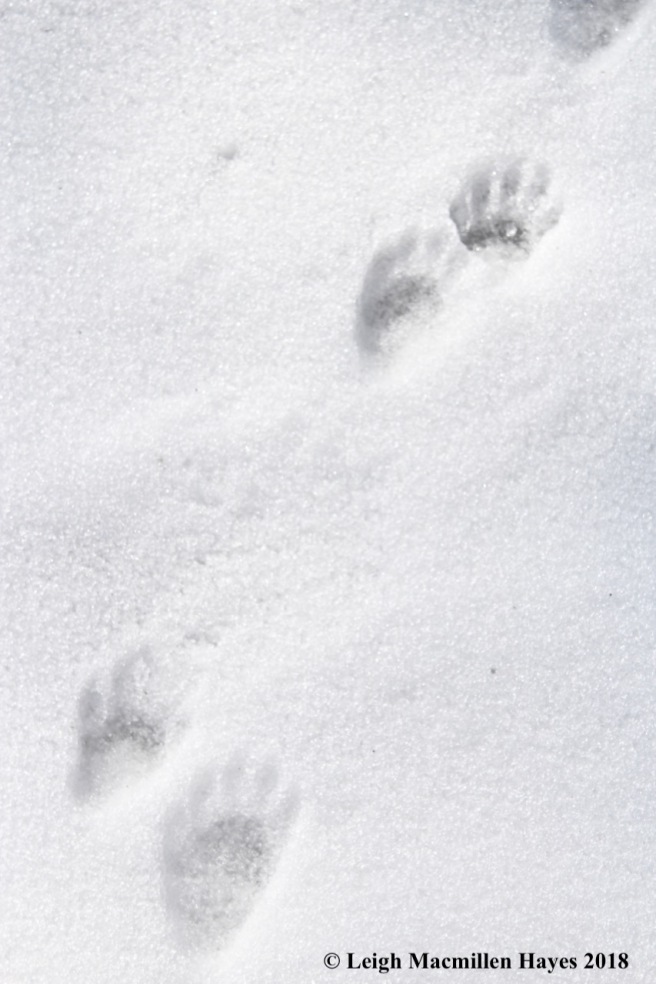
p-beetle 3

Back into the woods, we were almost done, when we spied this woodwork, carved by bark beetles.

p-bark beetles 1 (1)

And I was again reminded of my past observations when I moved a log and discovered a gnawer on the job.

p-me

The intricate work reminded me of Uncle Bob’s woodworking skills and I knew you’d appreciate that. You’d also appreciate that as I write, my guy is watching a National Geographic show about Wild Scotland.

Thanks for the memories, Aunt Ruth. And thanks for making time for us and showing an interest in all that we did–always as curious about our adventures as those of your brood. You were a remarkable woman and a genuine Yankee whom I was blessed to have as a part of my life.

Fondly, Leigh


Book of April: How to tell the Birds from the Flowers

It’s April Fools’ Day and I can’t think of a more appropriate book to share as Mother Nature showers snow upon us than How to tell the Birds from the Flowers and other wood-cuts by Robert Williams Wood.

b-11 (1)

A friend found this delightful little ditty at an independent book store in Brattleboro, Vermont, several months ago and couldn’t resist purchasing it for me. Thank you, A.J. 

Can you see from the cover what Wood had in mind? 

b-9 (1)

And his language–Flornithology? Oh my. Artistic license met poetic license. 

The first edition was published in 1917–in Kent, England. According to a little research, Mr. Wood was born in England, but went on to become a physicist at Johns Hopkins. And they say (whoever they are) that he had no sense of humor.

Read on: 

b-8 (1)

b-7 (1)

After this introduction, it gets even better (in my humble opinion). 

b-6 (1)

Whimsical rhymes and . . .

b-5 (1)

clever sketches;

b-2 (1)

Similarities and . . .

b-4 (1)

differences.

b-1 (1)

All found in the natural world. 

b-3 (1)

Doesn’t this just make you smile? The man lacked a sense of humor? Hardly.

And we know the Mother Nature also has a sense of humor. This isn’t the first time it has snowed on April first.

At the back of the book is a list of other facsimile reissues from Pryor Publications. Here are a few titles worth considering: Punishments in the Olden Times, Manners for Women, Manners for Men, A Plain Cookery Book for the Working Class and Why Not Eat Insects.

And on the back cover: “This updated edition originally published in 1917 now includes how to tell ‘The Eel from the Elephant,’ ‘The P-Cock from the Q-Cumber’ and ‘The Elk from the Whelk’ to name but a few. This book will be invaluable to those who are short sighted or just plain confused, the rest of you may even find it amusing.”

I think I fall into the latter group and that’s what A.J. had in mind (right?) when she gifted it to me because I find it quite amusing. 

Happy April Fools’ Day. 

How to tell the Birds from the Flowers and other wood-cuts (is he referring to himself?), versus and illustrations by Robert Williams Wood, 1917.