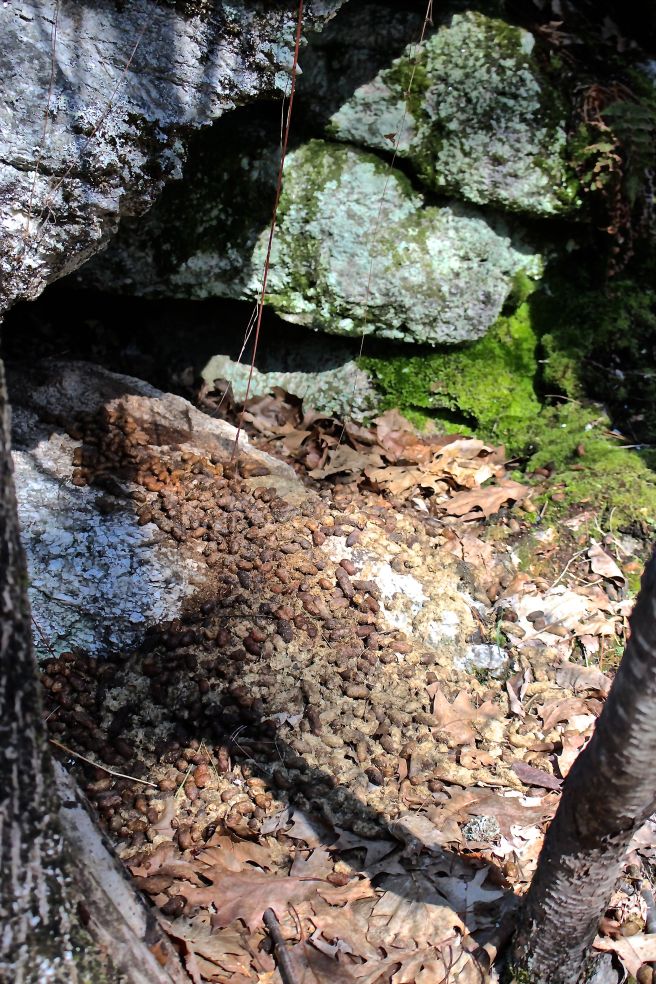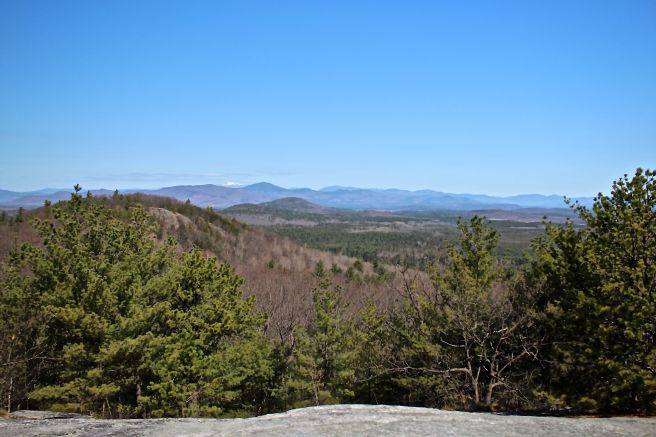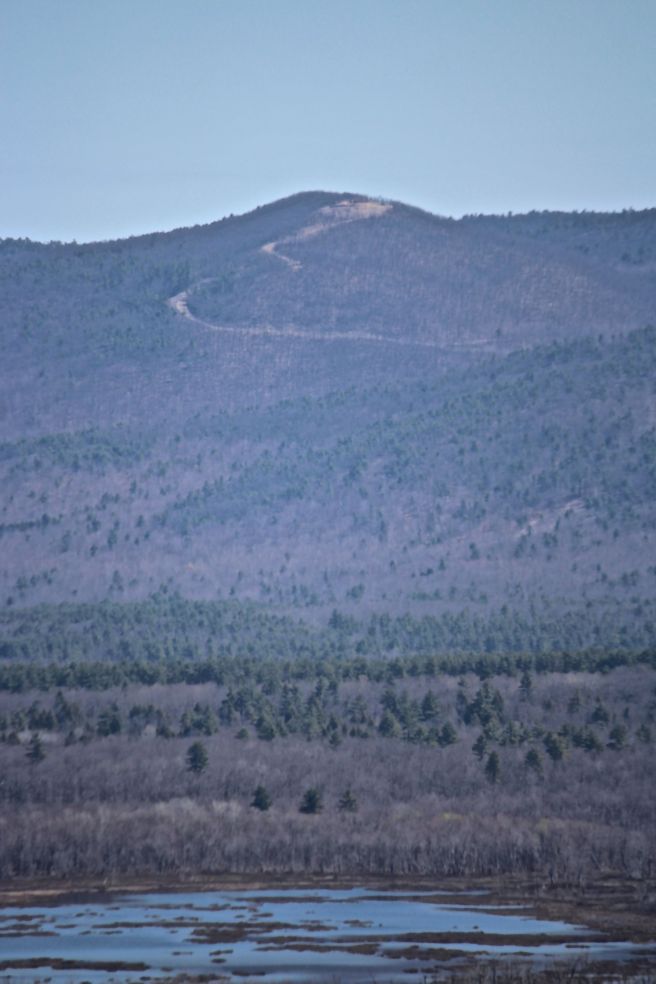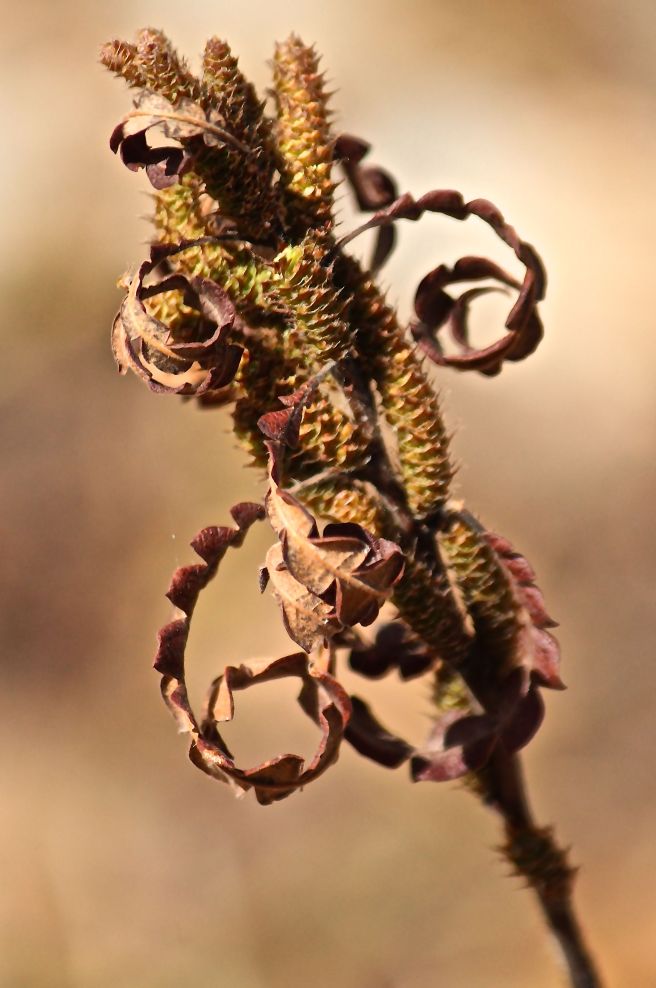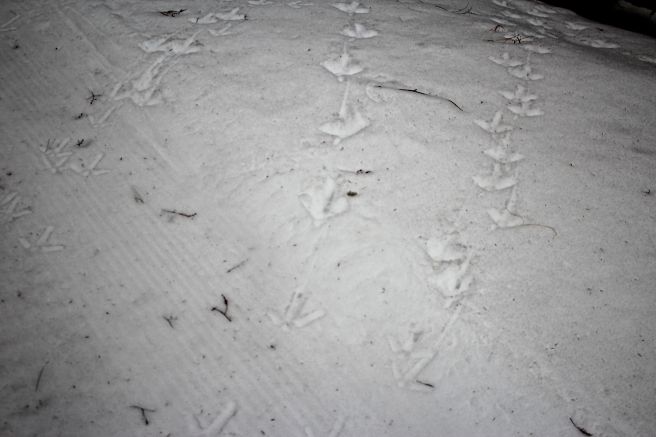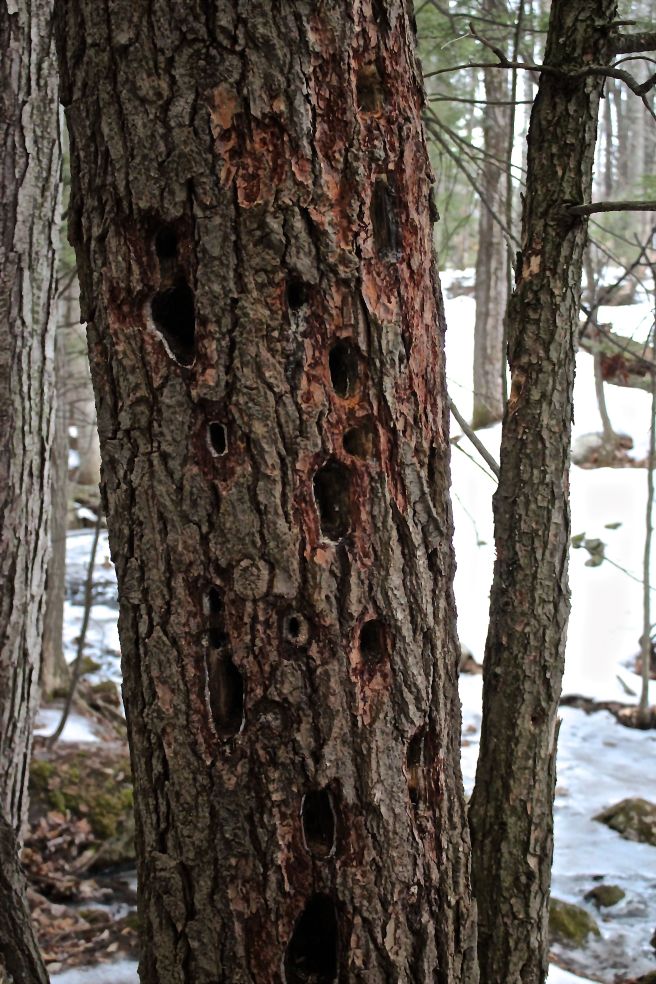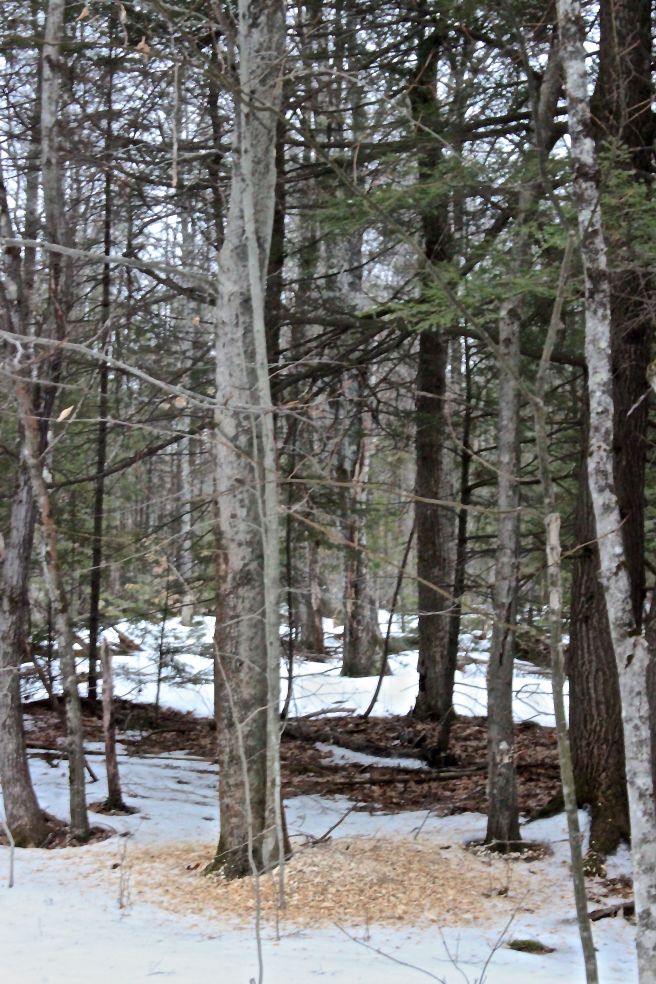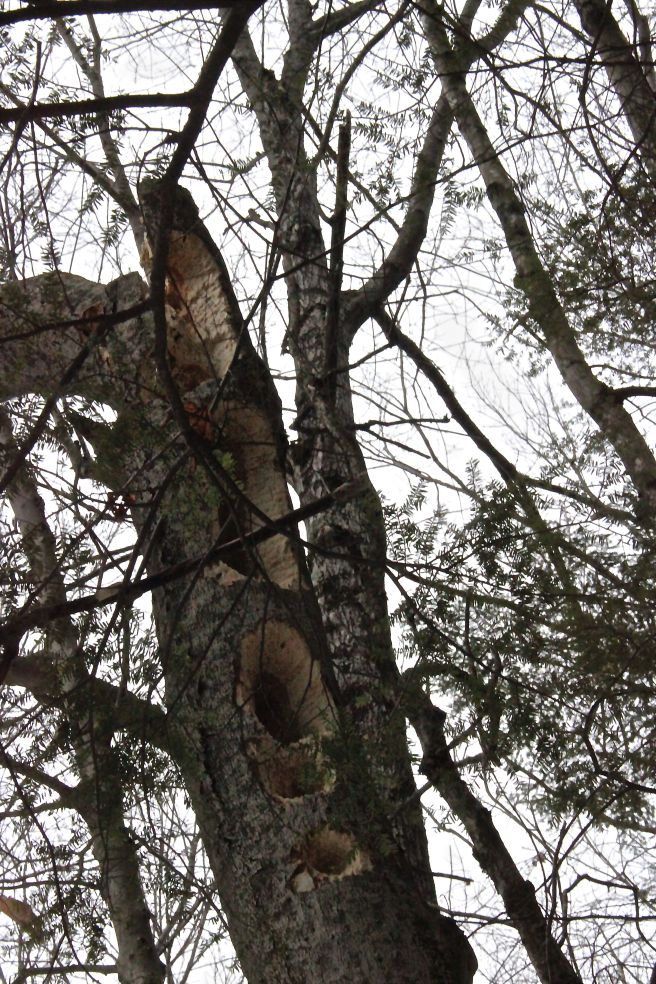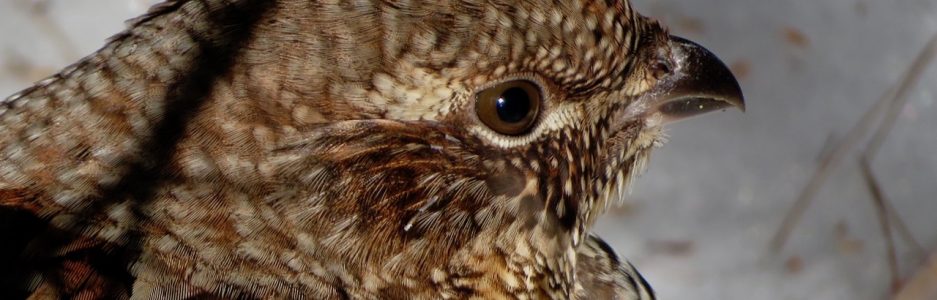
From Bare to Bear on Burnt Meadow Mountain

Back in October 1947, catastrophic wildfires erupted throughout Maine during what became known as “The Week Maine Burned.”

It hadn’t rained for 108 days and the dry woods were like tinder. Here in western Maine, Fryeburg, Brownfield and Denmark thought they had a fire under control, but overnight a strong wind blew and gave it new life. About 2,000 acres burned by the next night as the fire spread to the edge of Brownfield.

With the winds continuously shifting, town folks began to panic. Farmers either turned their livestock loose or herded them to neighboring towns. Others packed as many belongings as they could and evacuated.

By morning, most homes and public buildings in Brownfield were mere piles of ash. Stately places including the Farnsworth Place where Dr. Philo Farnsworth, a pioneer in the field of television, spent his summers, had burned. Churches, schools, the post office, Grange hall, library and town hall all went up in smoke–only twenty houses survived. In the end, 85% of the town was destroyed, including a mountain trail.

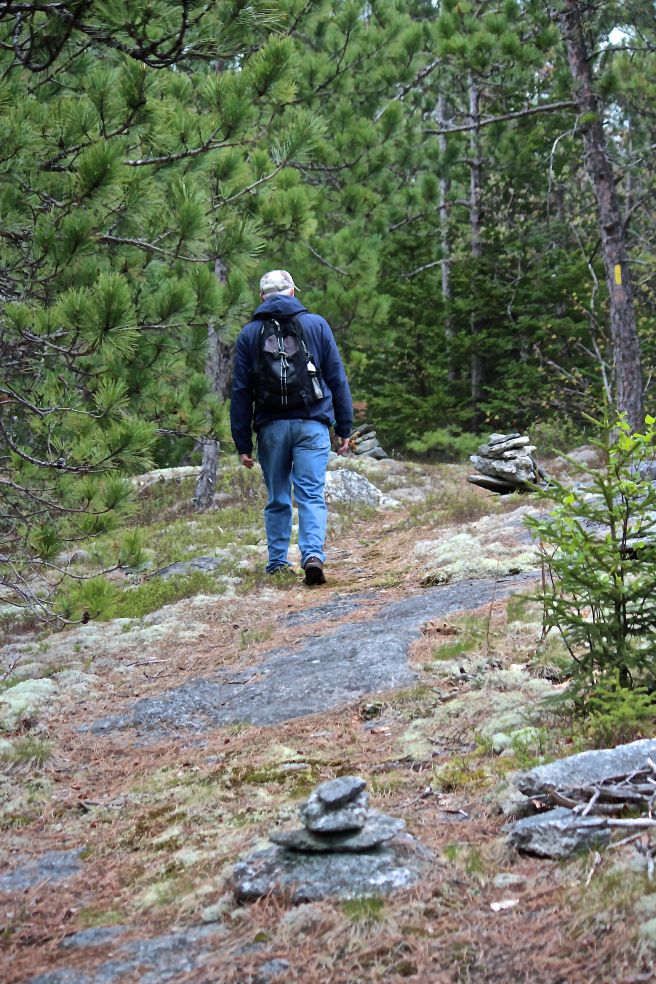
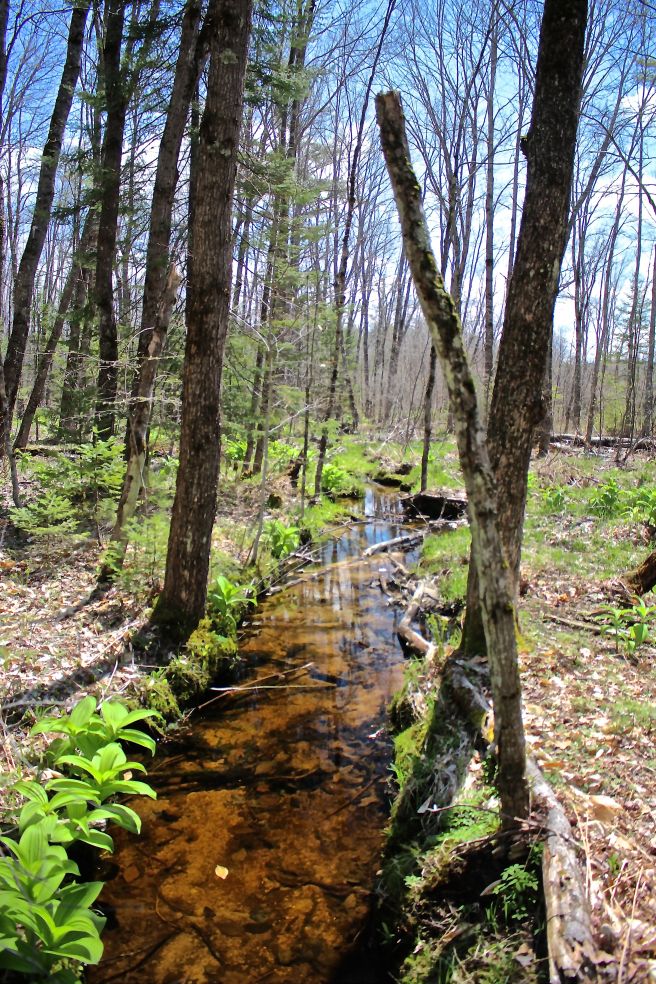
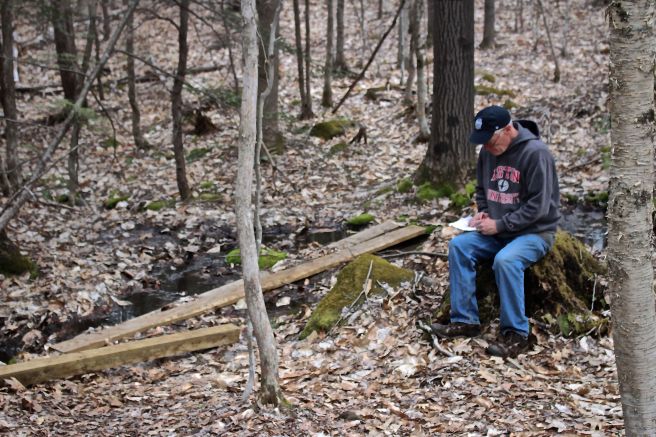
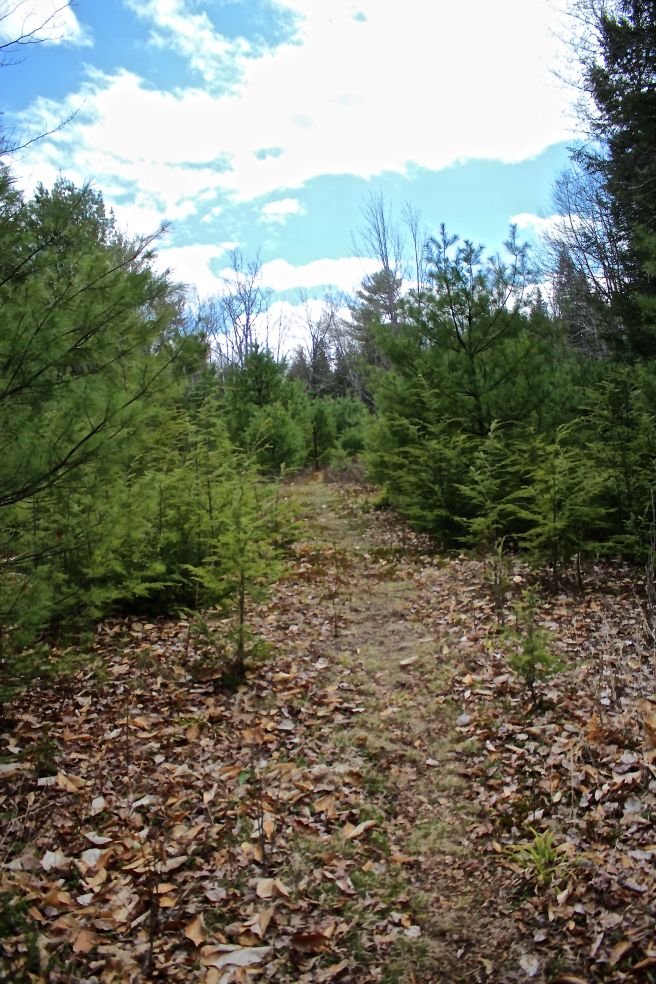
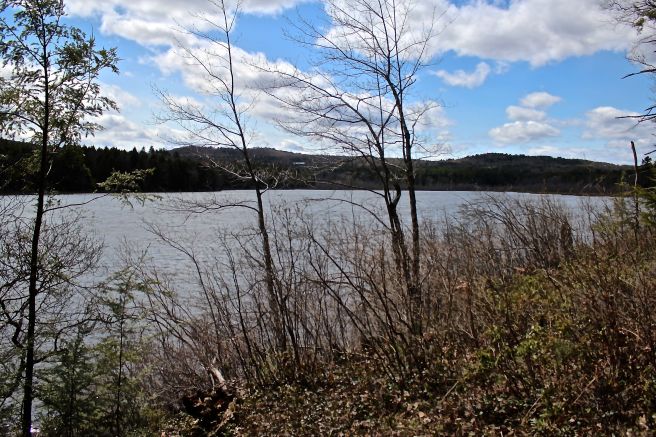
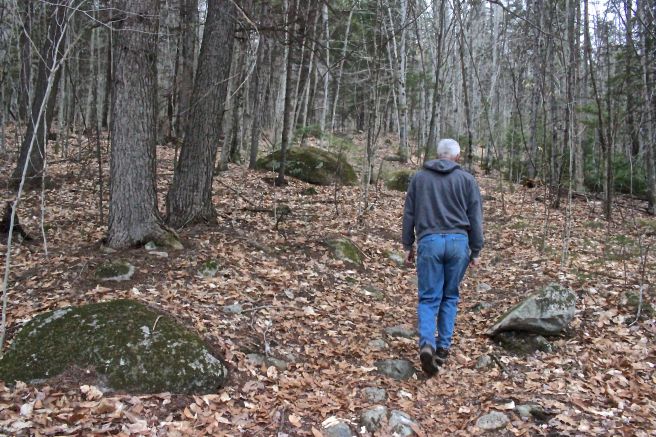
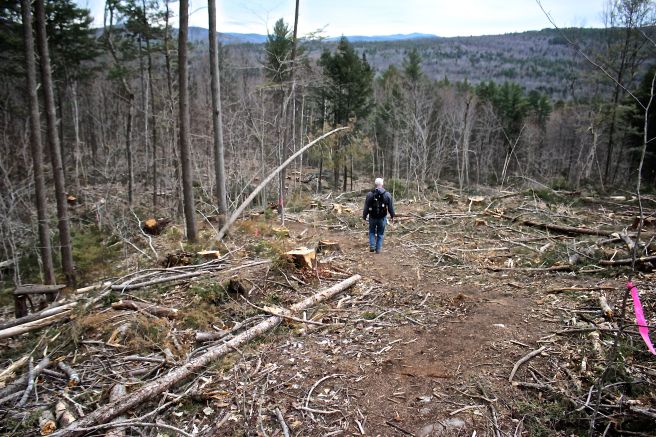
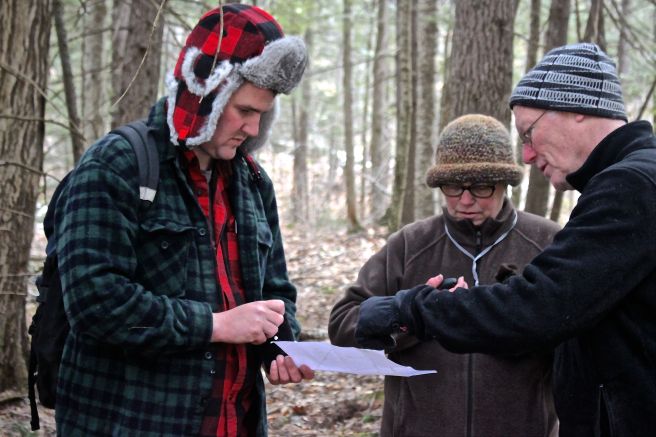
Today, Marita and I ventured to Burnt Meadow Mountain for a loop hike. It used to be that one had to hike up and back on the same trail, now known as the North Peak. Though that’s the shortest way up and back (about an hour each way), I for one, am thankful to the Friends of Burnt Meadow Mountain, who sought landowner permission to create a loop and spur–Twin Brook Trail and Stone Mountain Trail.
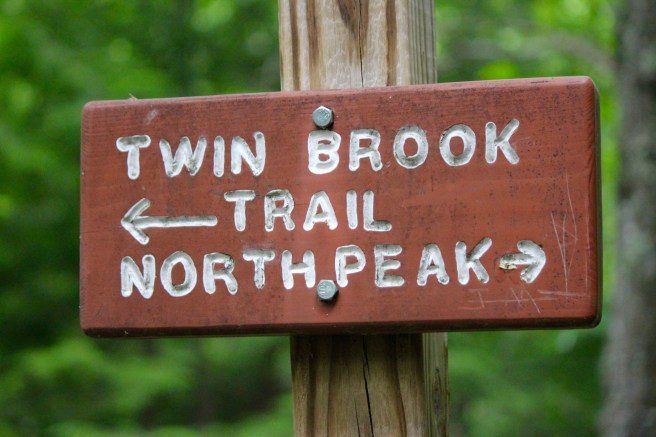
trail sign

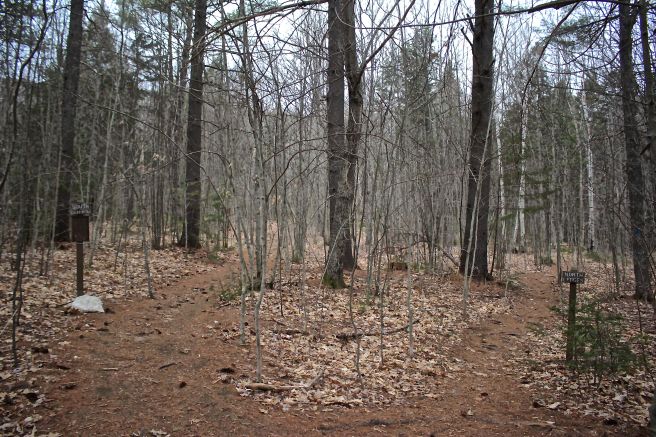
From the parking lot and kiosk, it’s a bit of a climb to reach the trail split. We followed the blue blazes of the North Peak trail, which though it is shorter, is also the more difficult of the two.

white pine 1

Immediately we noticed that the white oaks that grow at the bottom of the mountain play host to numerous leaf miners and other insects.

white oak gall

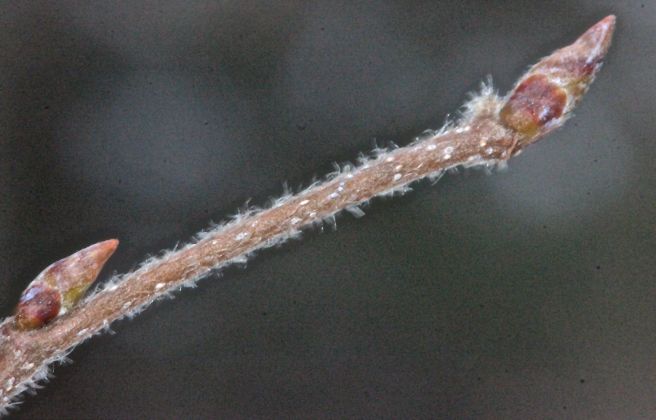
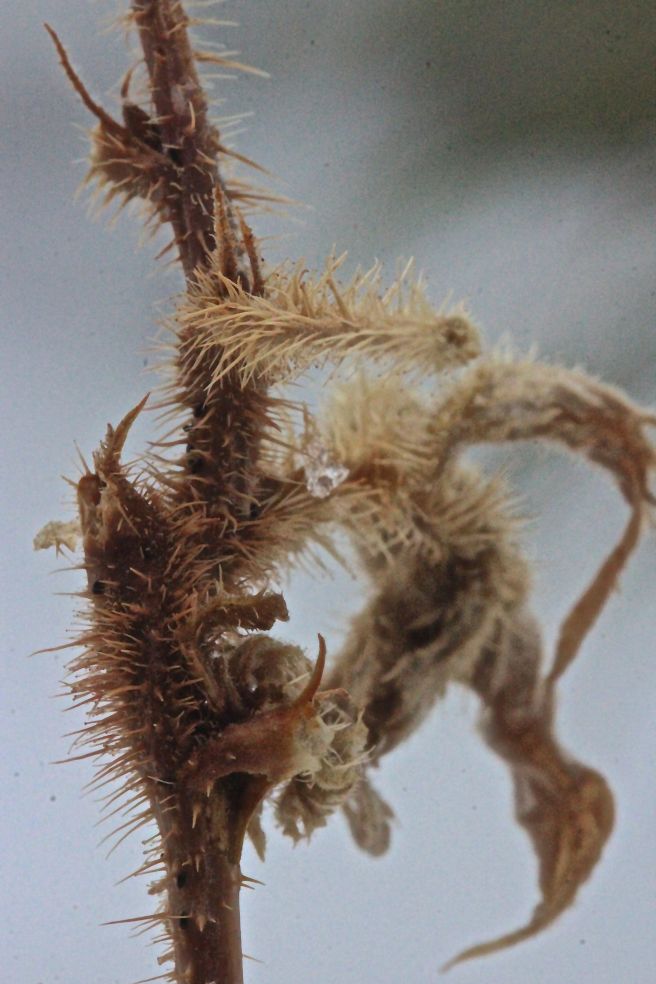
Some are decorated with pronounced galls. I always think about how a bud protects the whisp of a leaf all winter long, and how hairy it is as it slowly unfolds and then–kaboom–the insects have to survive too. And they do. Until something eats them. And their energy passes up through the web, where it’s enhanced at each level by sun and air and rain and . . . even when life doesn’t look so good, it is.
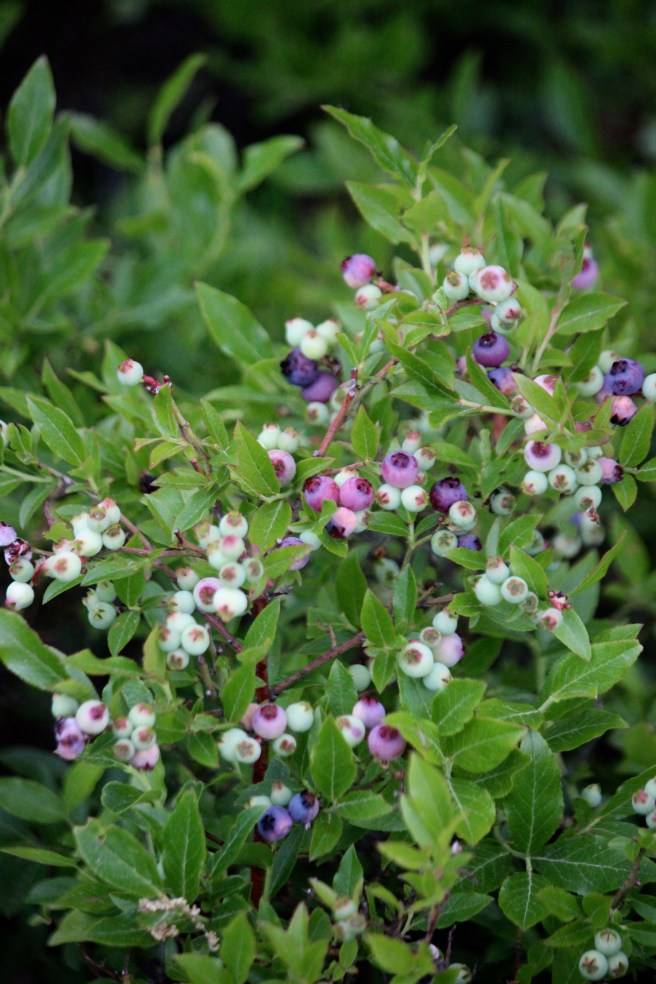
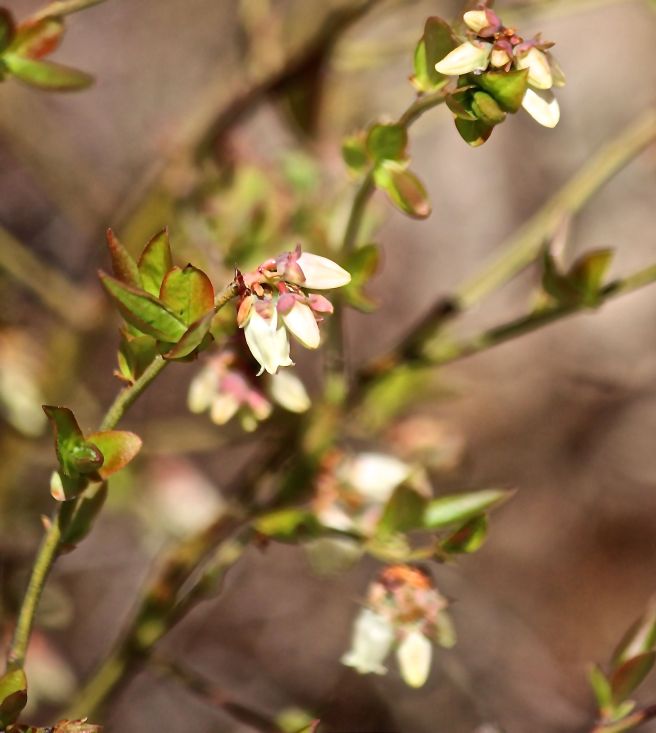
Blueberries

As we climbed, the blueberries became more prolific. And bluer.

spreading dogbane

Spreading dogbane showed forth its tiny pink bells.

ph rocky ascent (1)

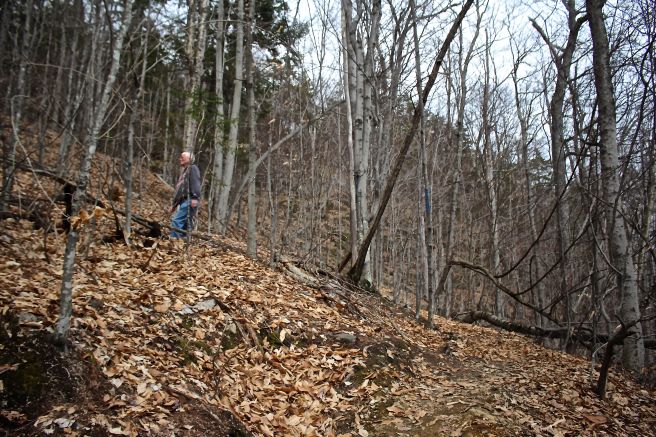
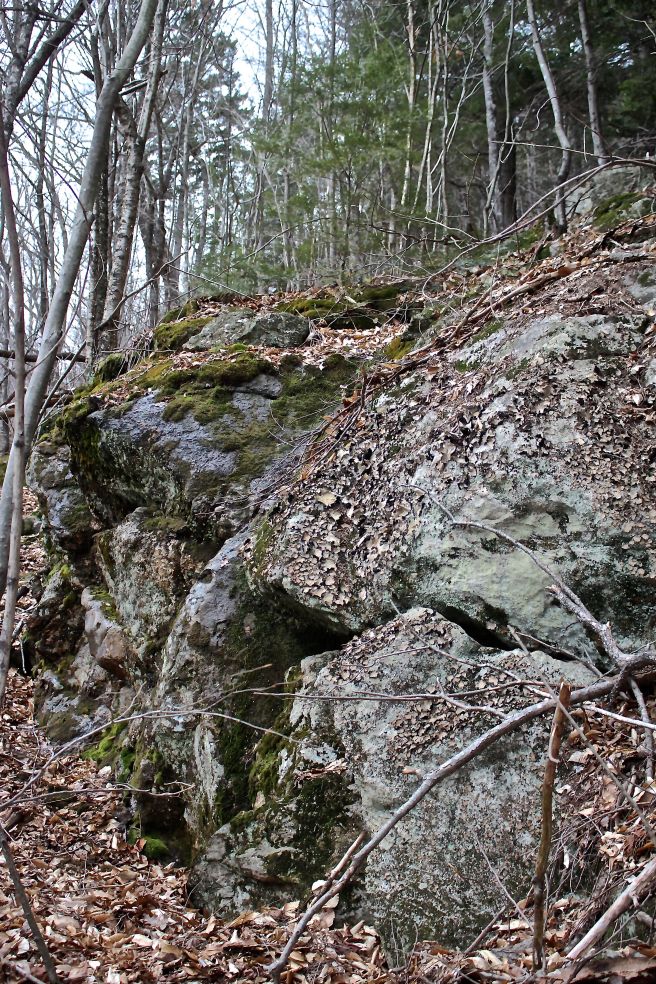
And the trail became a scramble. If I said we scampered up the ledge quickly, I’d be telling a fib. (Do people still tell fibs?) Near the summit is a section of hand-over-hand climbing. It doesn’t really last long, but in the moment it seems like forever.
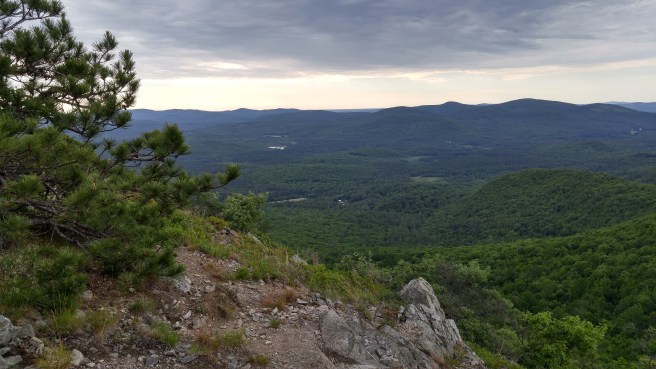
ph view on way 2 (1)

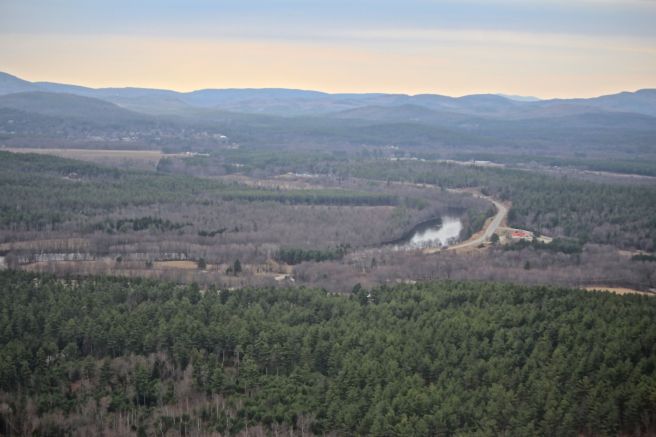
And so it invites a pause to take in the view to the south and east.
ph summit view 5 (1)

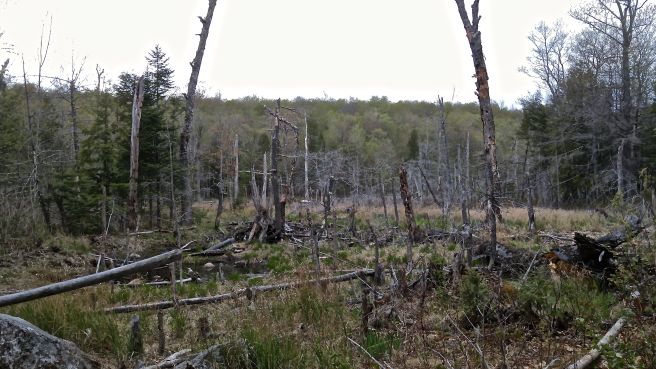
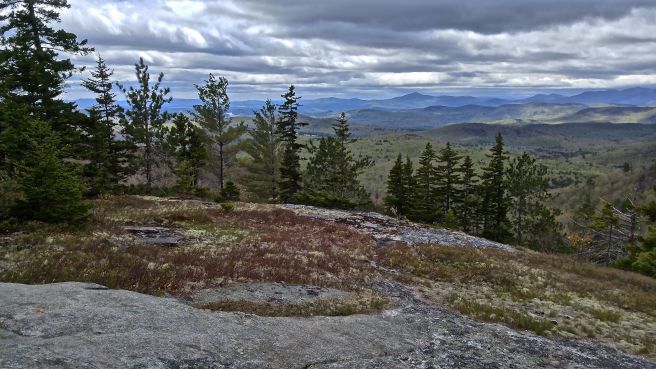
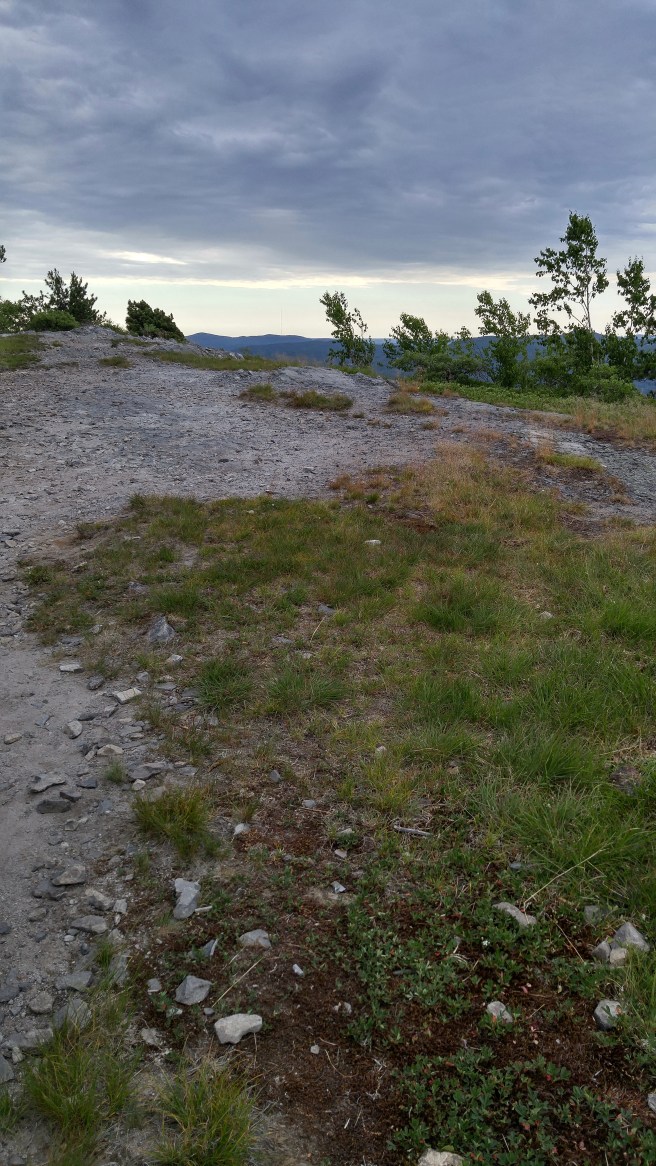
The relatively flat summit is rather barren–in memory of those 1947 wildfires.
ph summit view3 (1)

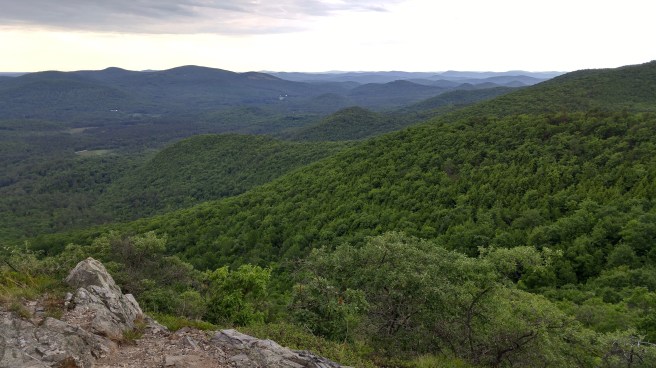
We were glad it was cloudy as there are no shade trees at the top.

ph summit view 2 (1)

Our view included Stone Mountain and the saddle between it and Burnt Meadow Mtn.

ph red pine 3 (1)

Normally in the landscape, red pines stand tall and proud. At the summit, however, their scrubby form presents their features at eye level–bundles of two needles, pollen cones and older seed cones. Young red pines typically germinate and grow only after forest fires or some other event that causes tree loss.

Eastern Towhee 2

Eastern Towhee

While we took a break, an Eastern Towhee sang its metallic yet musical “drink your tea” song.

ph view on way down 4 (1)

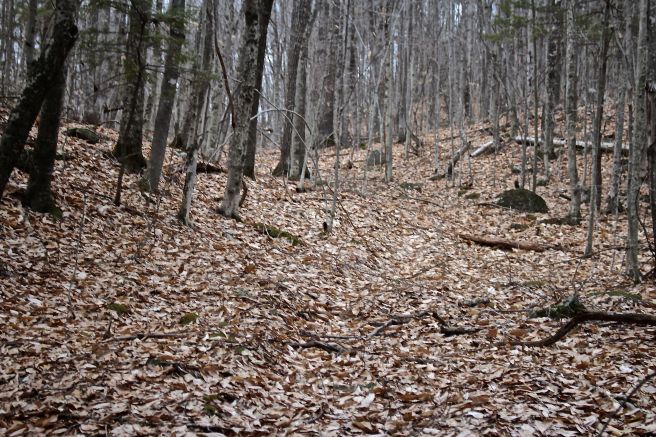
Descending via the much longer, but a wee bit easier Twin Brook trail, we were treated to mountain views to the west.
driftwood

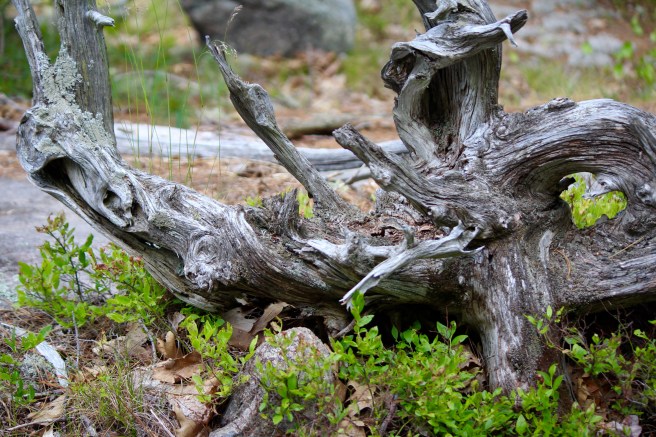
And driftwood. Oops. Wrong setting. But still, mountain wood can be as beautiful as ocean wood.
ph bear 5

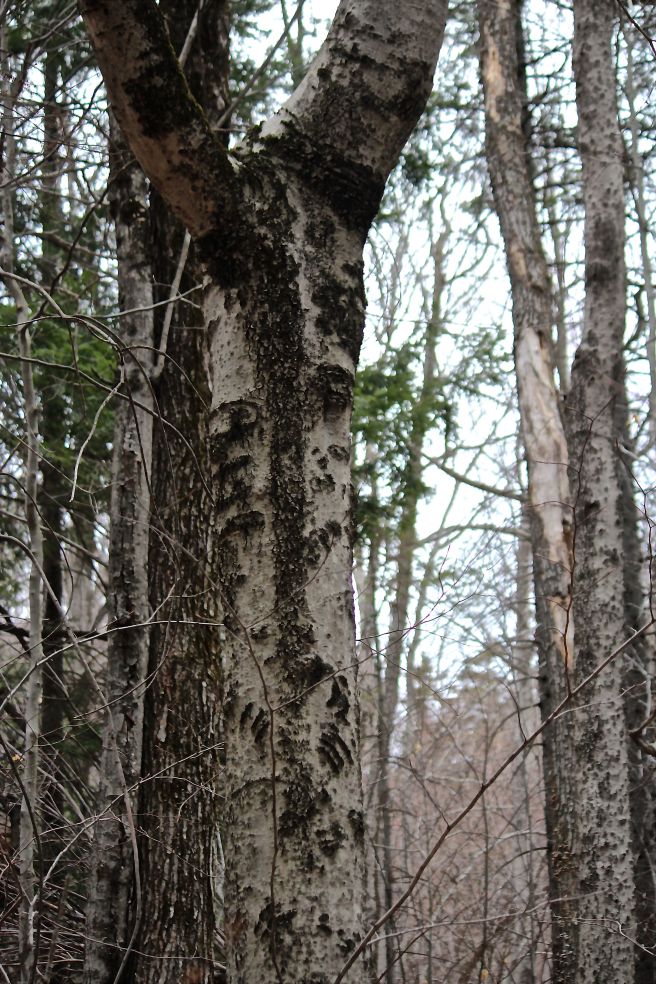
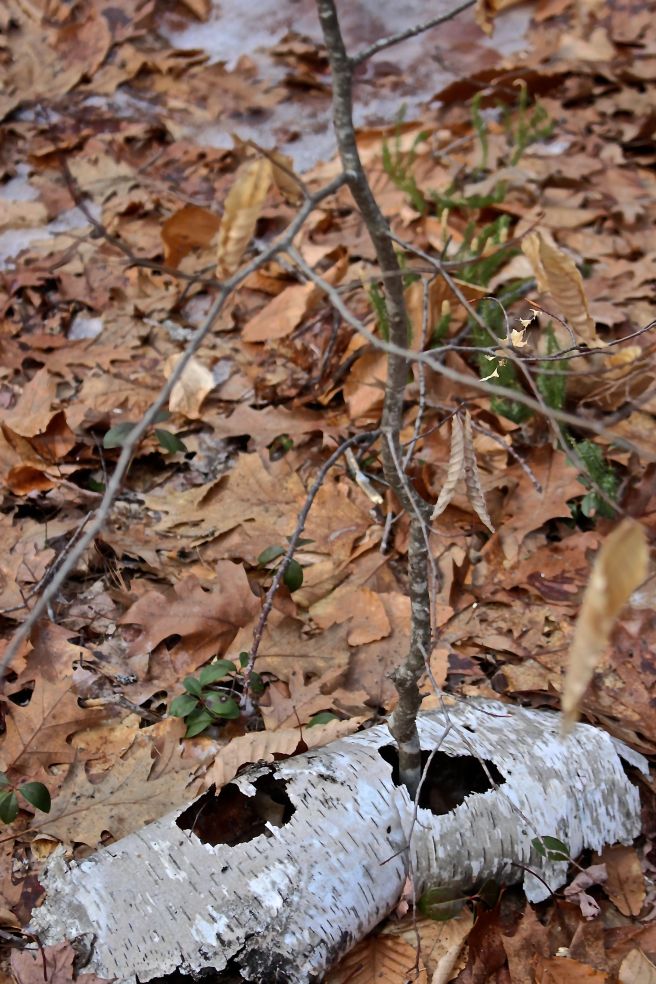
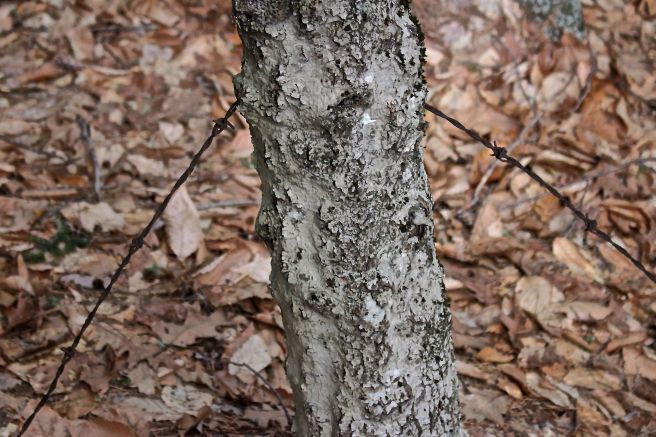
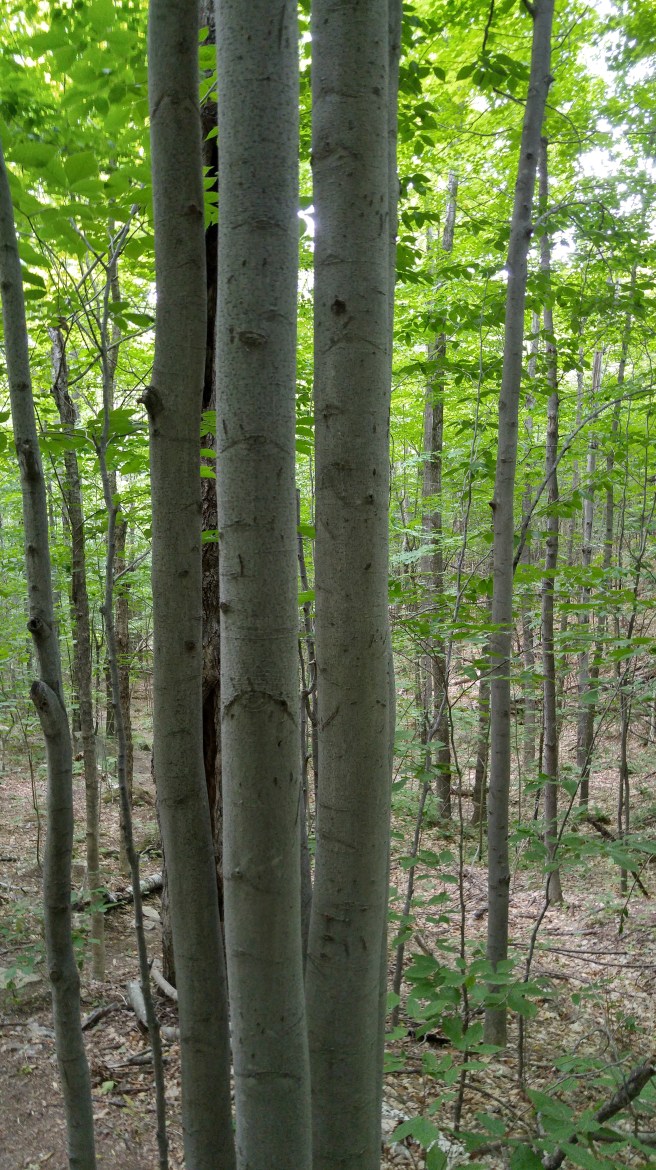
One of our pleasant surprises was the discovery of bear claw marks on rather small beech trees. Perhaps made by even smaller bear cubs who scampered up and down a year or two ago, leaving their marks much the way we left our own today without knowing it.
ph bear 2

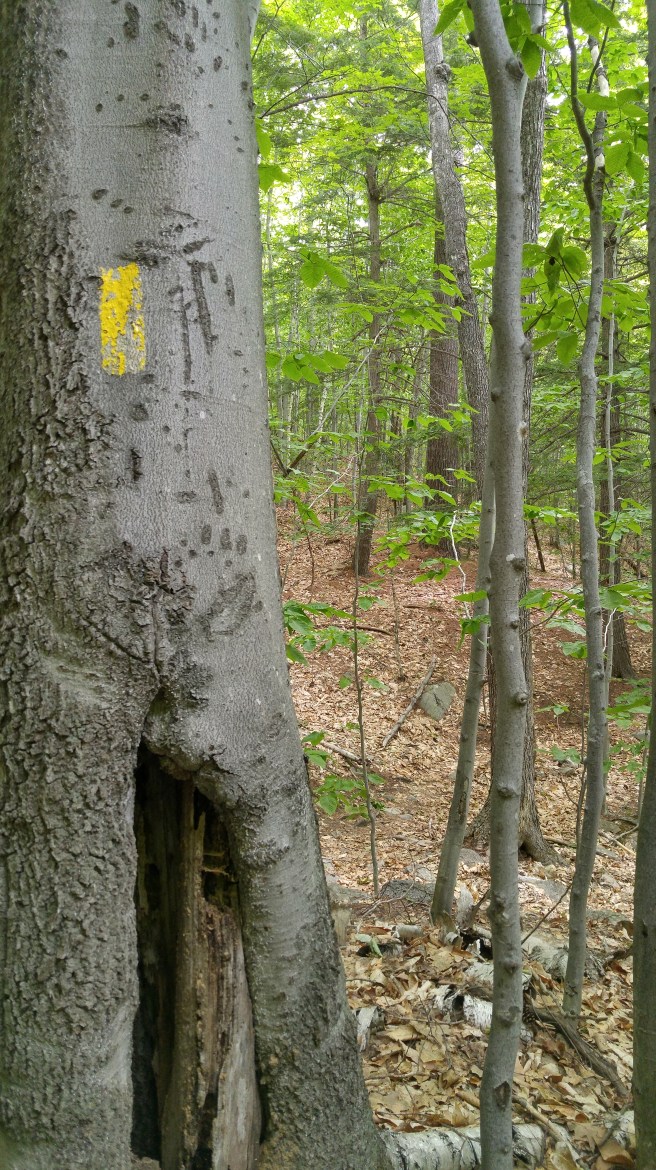
Further along, the hole in this older beech stopped Marita in her tracks. We noticed saw dust on the ground below. And numerous bear claw marks on the bark above.

bear 3

Another oft visited tree.

From bare to bear, Burnt Meadow Mountain in Brownfield is worth the trek. (You probably thought we saw a bear today. No such luck, but my guys and I encountered a bear on the North Peak trail on a summer day years ago. It seemed content to lumber along about fifteen feet from us–probably full of blueberries.)
 

Bathing in the Forest

Yesterday, a friend handed me an article she’d clipped from The Washington Post entitled “Walking in Forest Changes You” written by Meeri Kim that referenced a Japanese practice called Shinrin-yoku. “Coined by the Japanese Ministry of Agriculture, Forestry and Fisheries in 1982, the word literally translates to ‘taking in the forest atmosphere’ or ‘forest bathing’ and refers to the process of soaking up the sights, smells and sounds of a natural setting to promote physiological and psychological health.”

Kim states: “Over thousands of years of human history, we have effectively become an indoor species. Particularly for those of us trapped in the cubicle life, often the only times we regularly step foot outside is for our daily work commute or to run errands . . . a number of scientific studies emphasize that reveling in the great outdoors promotes human health. Spending time in natural environments has been linked to lower stress levels, improved working memory and feeling more alive, among other positive attributes.”

I know that I can’t literally share the sounds and smells of our gardens, yard and woodland with you, but I invite you to imagine the softness of pine needles, crunch of dried leaves and sponginess of moss beneath your feet, the smell of pine interwoven with must and mud, and the sensation of a strong breeze, hot sun and cool shade. May you hear branches creaking in the wind, leaves fluttering, occasional mosquitos buzzing and songs of the oven bird, red-eyed vireo, chipping sparrow and white-throated sparrow who calls, “Old Sam Peabody” over and over again.

Join me in a garden/yard/forest bath:

y-anemone 1

y-bee

y-frit 6

y-black-eyed1

y-grass green 2

y-milkweed

y-blueflag1

y-hawkweed

y-berries1

y-cowpath

y-pollen 11 (1)

y-barred

y-club 1

y-view 2

y-sheeplaurel3

y-hum4

y-moss1

y-damsel 10

y-nightshade

y-daisy 2 (1)

Happy wandering. Happy wondering. Happy bathing.

Searching for The Beautiful

Here is the world. Beautiful and terrible things will happen. Don’t be afraid.” -Frederick Buechner

My lovely neighbor posted this on her Facebook page last night in reaction to the sudden turn her family’s journey has taken. And so, while she went in search of the beautiful this morning, and found it in a few surprising places, I did the same. Of course, the terrible also presented itself.

This one is for you, Binaca–and your amazing ability to always put a positive spin on life.

ph-Stevens Brook

While muted colors reflected in the calm water,

p-yellow warbler 1

a yellow warbler foraged on a nearby willow.

ph-aphids1

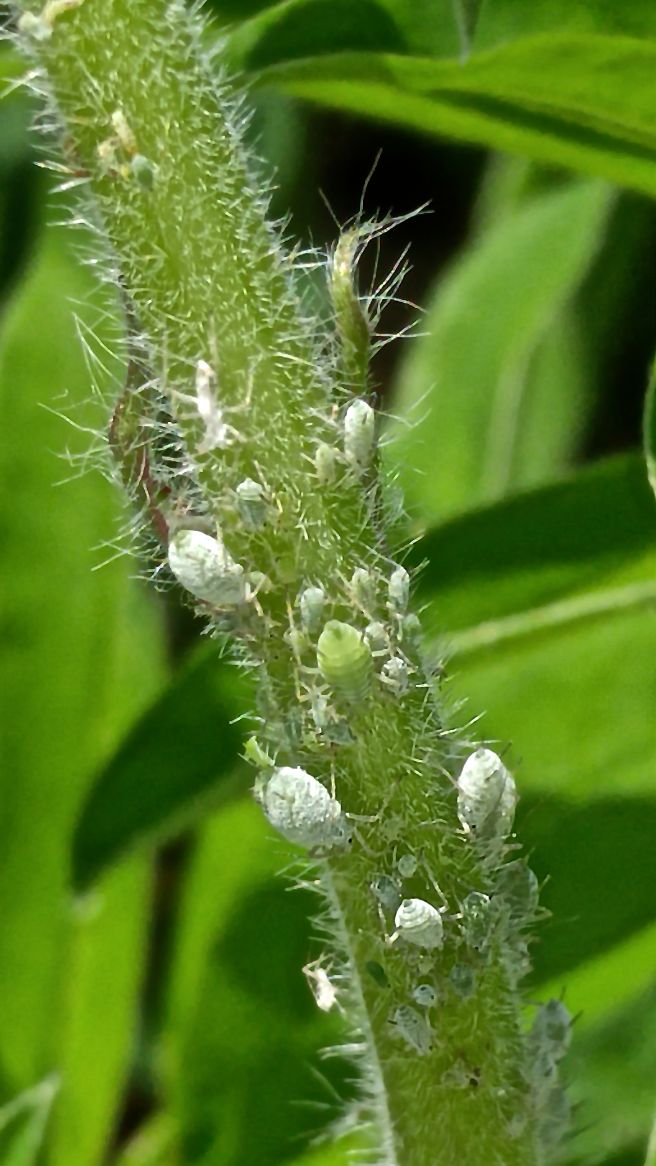
I trust he found plenty to eat because food seemed plentiful everywhere I turned, from teeny tiny to . . .

ph-stinkbug horns1

super-sized!

ph-stinkbug

(I hope this is a predator species of stink bug and not a plant eater.)

ph-lupine 4

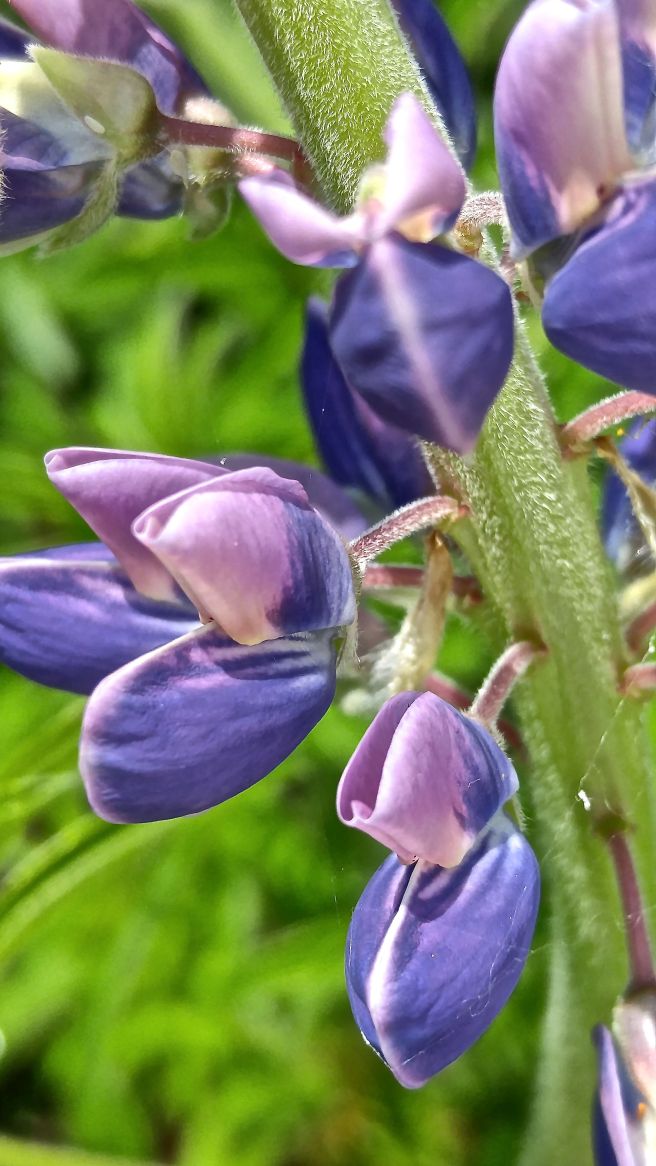
Hairy coverings didn’t necessarily mean the aliens wouldn’t invade.

ph-elm growth

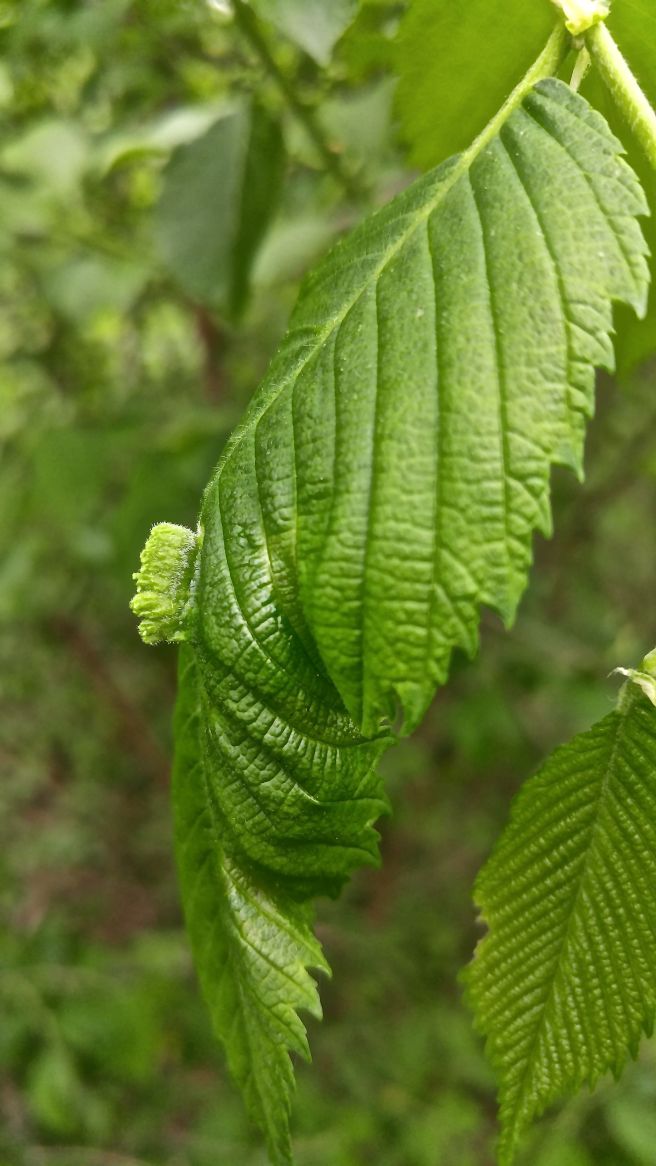
And despite not always seeing the muncher, I was amazed by the patterns created, including this rooster’s comb.

ph-leaf munch1

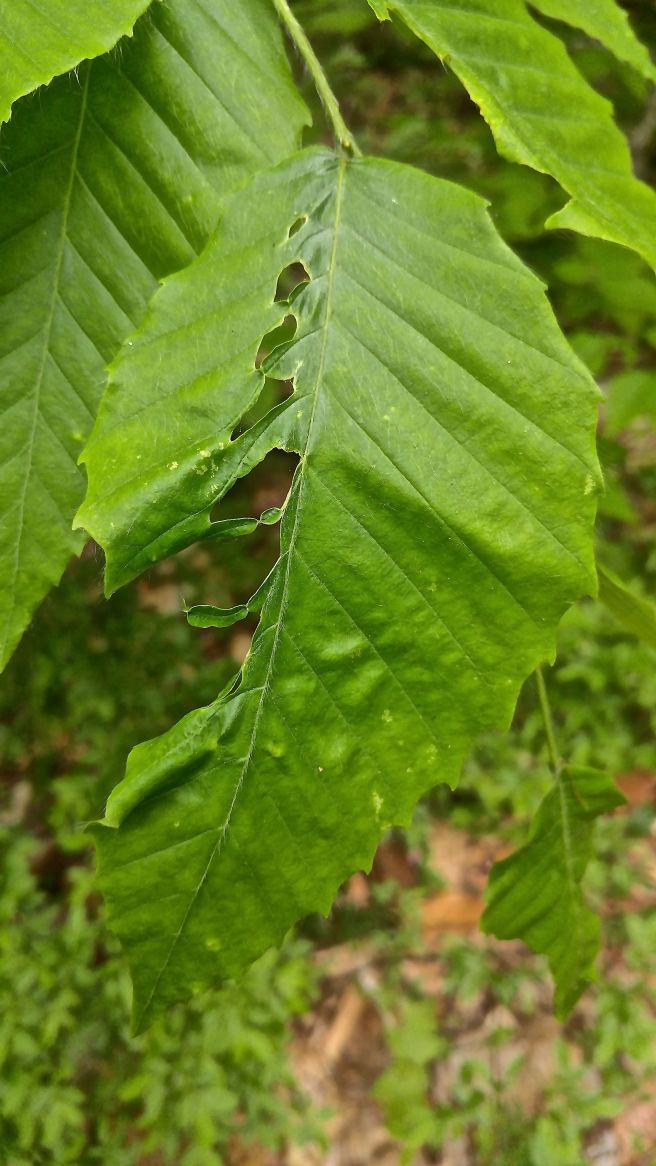
And then there were diminishing holes to admire and wonder about–reminiscent of skipping stones jumping across the water’s surface.

p-dandy bee

Some visitors were most welcome.

p-dandy seeds

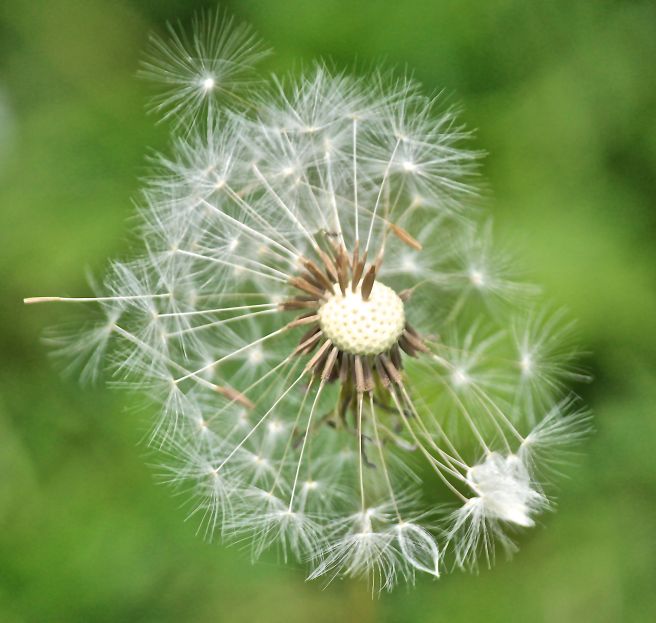
And because of them, I could see the future blowing in the breeze,

p-box elder

and pouring forth with seeds of hope.

ph-balsam growth1

New opportunities graced the tips of twigs.

ph-phlox2

And the beautiful was visible in buds and blossoms.

ph-lupine1

Stop your searching, Binaca, for you are the beautiful.


Hawk-eye Mondate

Some Mondates are shorter than others and such was the case today. But . . . we made the most of it as we walked up the trail to Hawk Mountain in Waterford.

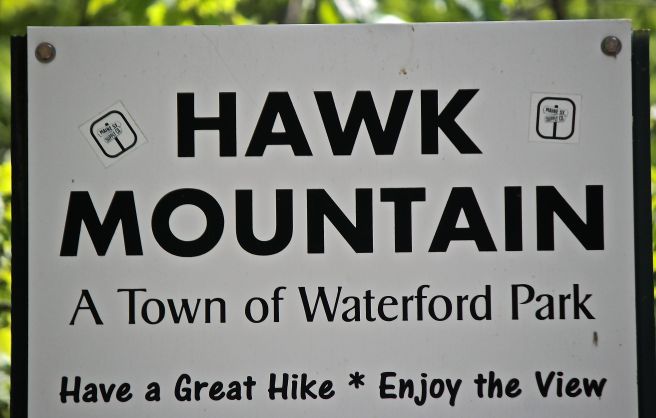
hm-sign

It’s a half mile trek up a dirt and gravel road–just right when you want a great view and time is short. Of course, you could spend hours at the summit, but we weren’t there long.

hm-interrupted1

On the way up, I noticed interrupted fern in its interrupted form. Fertile leaves toward the middle are densely covered with sporangia (spore-bearing structures). I’m fascinated by their contorted, yet beautiful structures.

hm-lady1

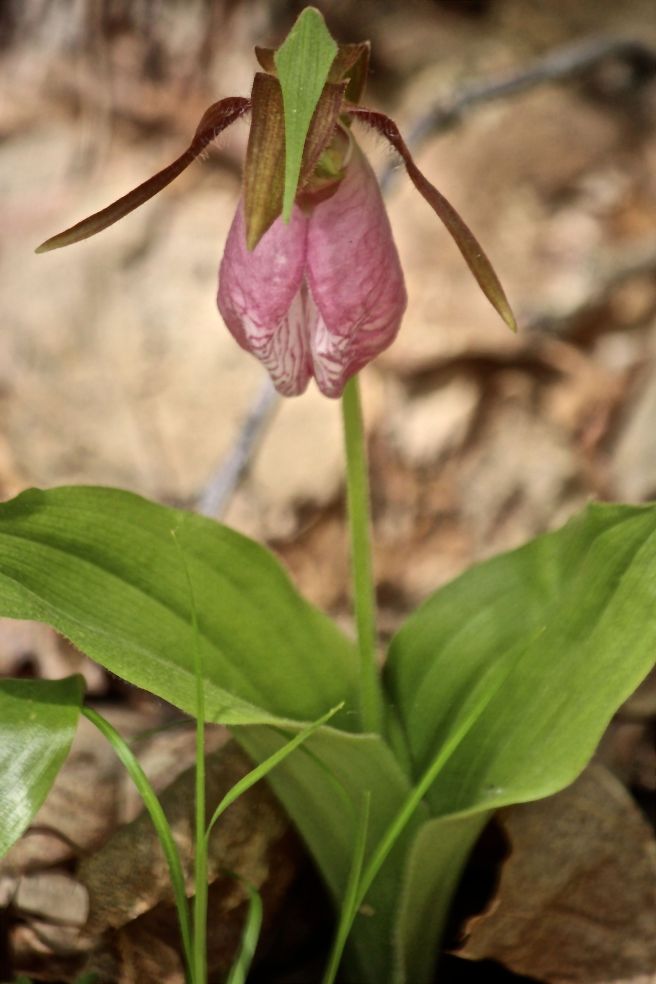
Another favorite–lady’s slippers. Again, its structure is beyond my understanding.

hm-cyrstal and long2, ph

At the summit, we paused briefly and gazed toward Crystal and Long Lakes.

hm-white oak 4, ph

While my guy moved on to the better vantage point, I stopped several times. First, it was the color of these leaves that slowed me down. Have you noticed how spring foliage provides a subtle play on fall foliage? A few friends and I have been thinking about this lately, and this morning I had the opportunity to pick the brain of Dr. Rick Van de Poll, a well-known mycologist/naturalist/educator.

hm-red maple 1

He reminded me that the various hues of color in leaves is caused by the presence of pigments called anthocyanins or carbohydrates that are dissolved in the cell sap and mask the chlorophyll. As our spring temperatures rise and light intensity increases, red pigment forms on a leaf and acts as a sunscreen to protect the plant from an increase in ultraviolet rays.

hm-white oak1

It wasn’t only the color that caught my eye. Take a look at the lobe shape of the reddish leaves and that of the green in the background. In my continuing personal citizen science project to informally connect the dots of where white oaks meet red oaks, I added another pin on the map. Rounded lobes=white oak in the foreground. Pointed lobes=Northern red oak in the background.

hm-bee1

As I headed toward my guy, I noted that the cherry trees were abuzz.

hm-wild columbine1, ph

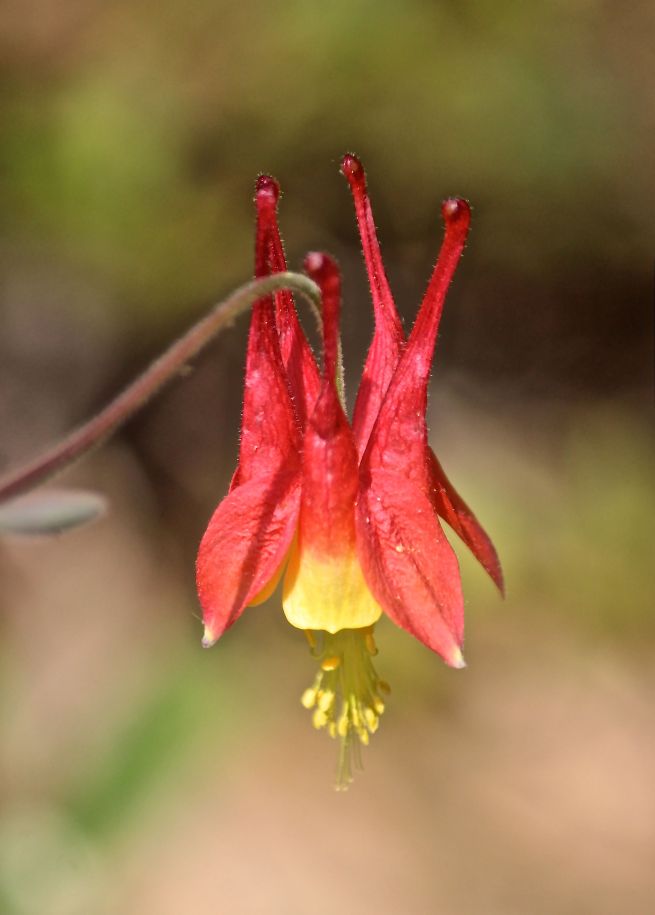
And hiding among the rocks at the base of a tree–another treat for the eyes. Wild columbine. Splendid indeed.

hm, cyrstal and long, ph

Equally splendid–the view from the ledges. Crystal and Long Lakes again.

hm-bear river

Bear River below. I always expect to see a moose here. Or maybe a bear. One of these days.

hm-pm1, ph

Pleasant Mountain and my guy.

hm-dragon5

As we walked back down the trail and concluded our Mondate, we celebrated the fact that dragonfly season has begun. With their hawk eyes, may they capture and consume a kazillion black flies and mosquitoes.


Wallowing in Wonder

We knew what flowers we’d show off and had a general idea of what birds we’d see when we headed down the trail from the Flat Hill parking lot at the Greater Lovell Land Trust’s Heald and Bradley Ponds Reserve in Lovell early this morning. But from the get-go this turned into one very special hike that filled us all with the wonder of life.

p-silent march

Maybe it was because we headed off on a silent march, the better to take in the cacophony of bird songs. With Linda and Heinrich in the lead, our intention was to make a bee-line to the viewing platform. Linda encouraged everyone to note the flowers along the way–with a promise to stop and celebrate them on the return trip. We’d decided during a pre-hike that we wouldn’t follow the loop trail around Perky’s Path. We wanted this to be a different experience.

p-ph view from bench

The view from the bench was beautiful, but the birding there was only so-so, much to our dismay.

p-ph birding 2

On to the bridge we moseyed. Our one disappointment, we didn’t hear the American bittern that had entertained us with its toilet plunger call during the pre-hike.

p-ph birding1

But that didn’t stop us from raising our binoculars frequently–for red-winged blackbirds, Canada geese, blue jays, several species of woodpeckers, sparrows, warblers, wood ducks, chickadees, a wood thrush and more. We heard the ovenbird and vireos, but never caught sight of them.

p-ph rosy 2

While Heinrich was our birding guide, Linda used the area just beyond the bridge to begin our examination of flowers.

p-ph rosy 1

It was while we were moving in for a closer look at the rosy twisted-stalk, that someone spied what became the center of our attention for the next hour.

p-dragon begin1

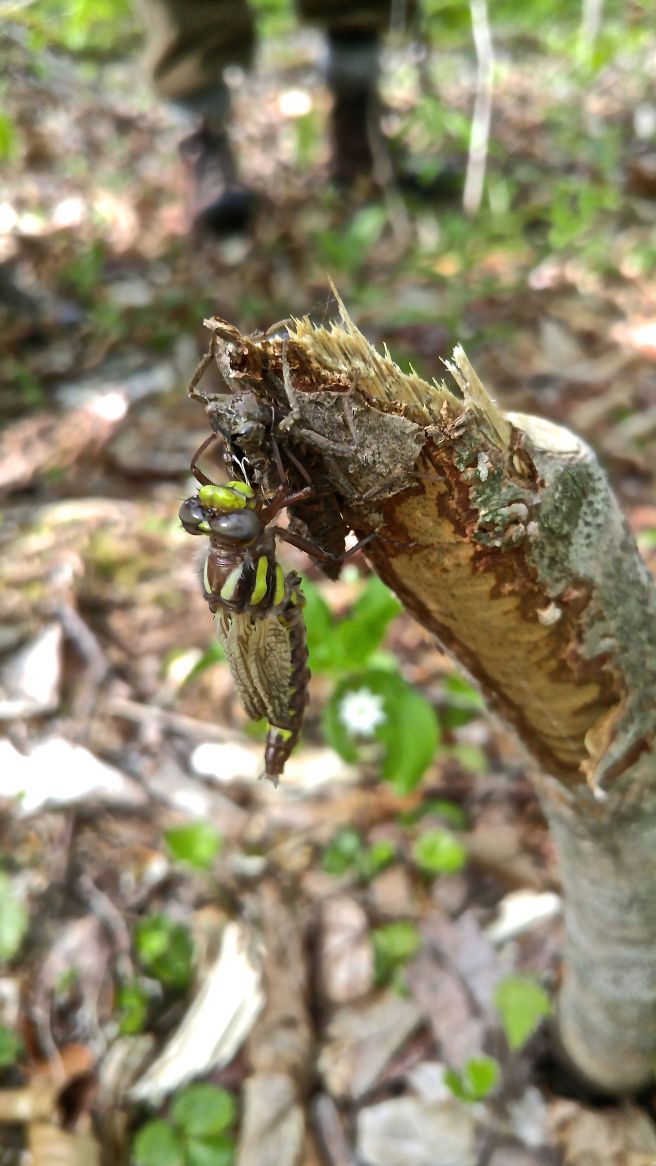
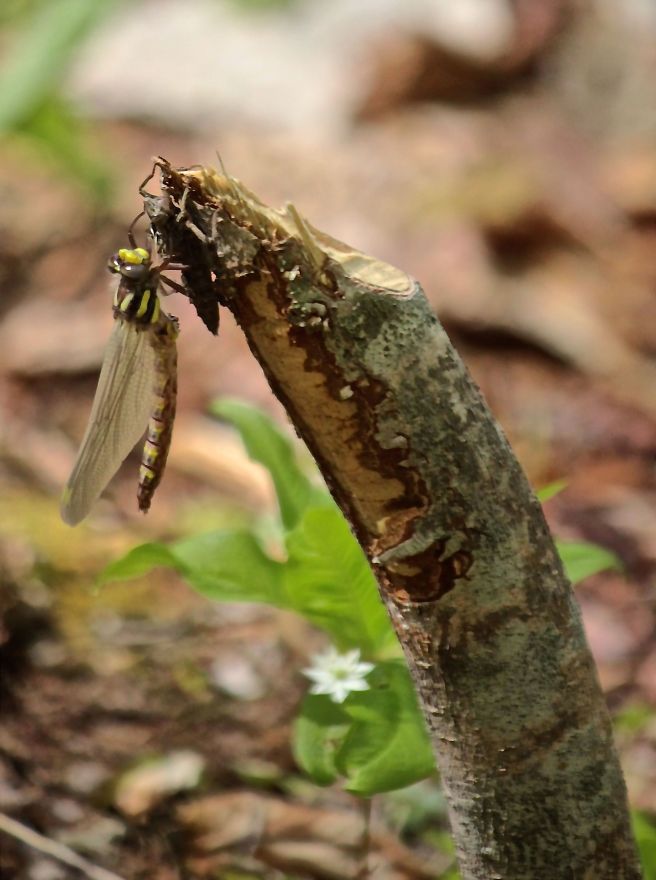
A dragonfly had just split open its exoskeleton and emerged from the nymph stage. Of course, we were standing by a beaver pond, and so it seemed only appropriate that it would use the top of a sapling cut by a beaver.

p-ph dragon middle 4

By pumping air into its body, the adult slowly grew larger.

p-dragon end 1a

As it inflated the wings with blood pressure, they began to extend.

p-ph dragon end7

The veinous wings remained folded over its back as we continued to watch.

p-ph early coralroot orchid 2

We were in that one spot for a long time, but when Linda inquired if anyone wanted to start back, all were silent. We did, however, take our eyes off the dragonfly for brief moments. And because of it, we got to know a small area rather well. A few of our discoveries included  the yellow-green, early coral-root orchid, which has no leaves,

p-ph starflower 7

star flowers with their seven petals, seven stamens and sometimes seven leaves, though the latter wasn’t consistent,

p-ph yellow clintonia

and yellow clintonia, aka bluebead lily.

p-ph springtails 1

We also saw hot chili pepper on the leaf litter and . . .

p-spring tails 1

in the water. Springtails galore. Yes, aka snow fleas, but obviously we can see them even when there isn’t snow on the ground.

p-dragon end 1b

As we explored, we continued to keep a watchful eye on our friend. In fact, he became “our” dragonfly. An hour later, the melodic song of a Baltimore oriole pulled us away and we finally started back along the path.

p-cloak 5

We paused frequently to admire the flowers and leaves, but then another flyer slowed us down and became “our” mourning cloak as it settled on a fallen tree and then fluttered amongst us. Happy were we to have shared such moments of awe.

p-ph pack on Amos

Though our walk had lasted longer than intended, I wasn’t ready to head home, so once everyone left, I turned back and climbed Amos Mountain using the Saddle Trail. It was hot and buggy, but I went for a reason and wasn’t disappointed.

p-amos 1

Among the grasses and violets,

p-ph wild strawberry

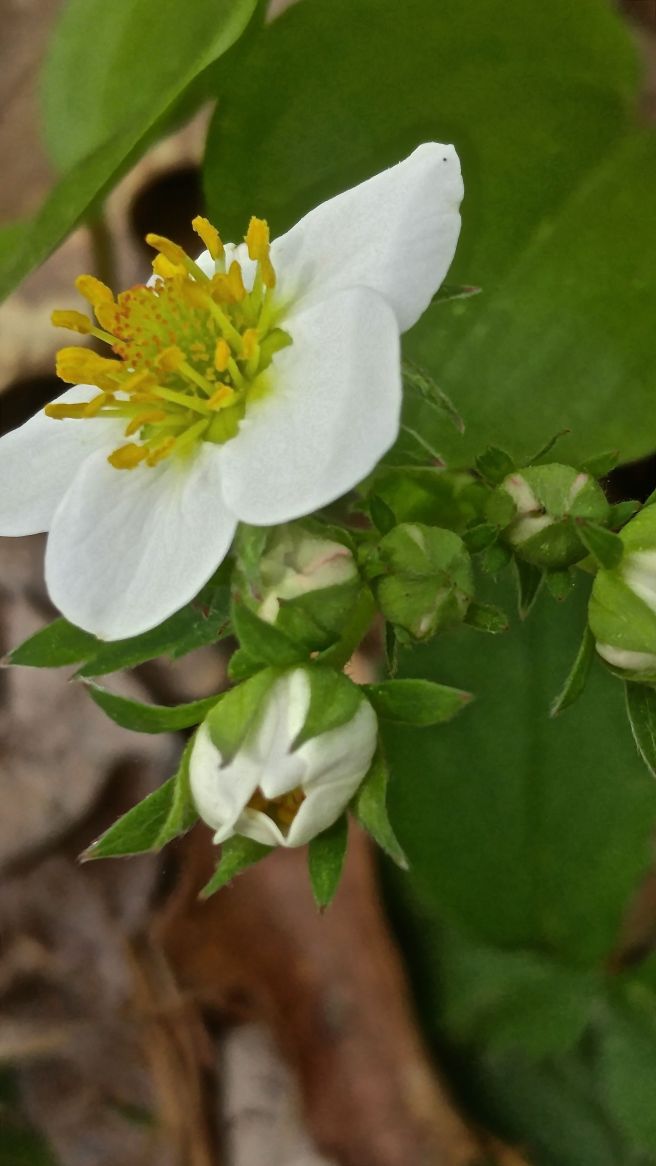
the wild strawberries grow. But that’s not all.

p-ph colum 5

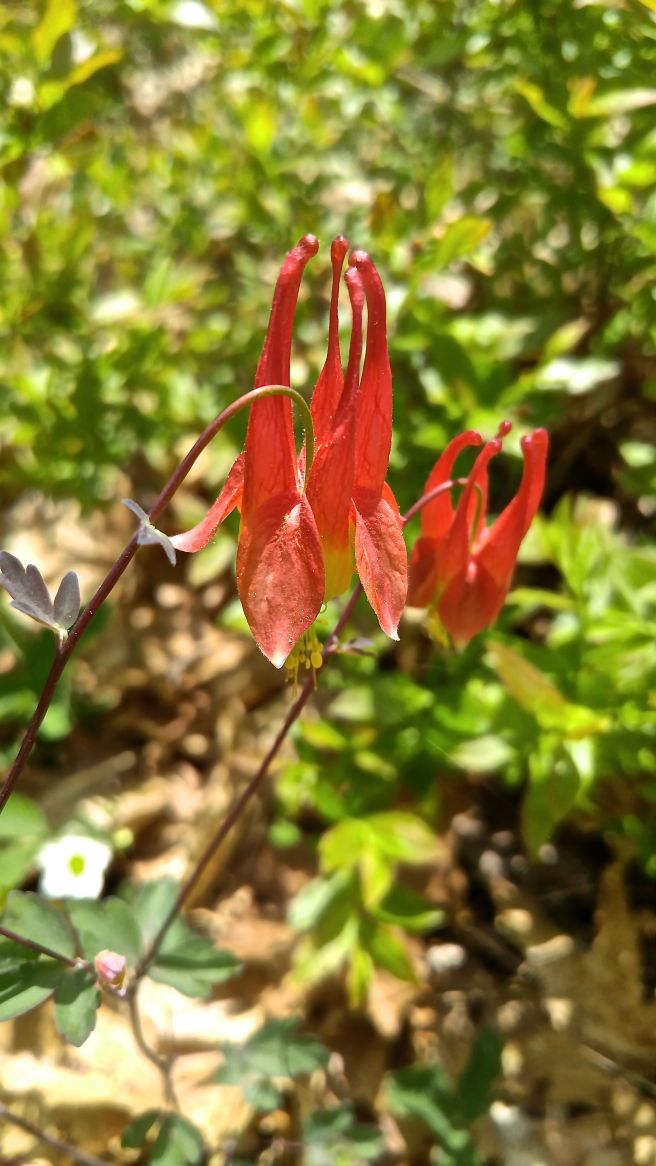
It was the spurred red and yellow flowers of wild columbine that I wanted to see.

p-ph colum 4

Their heads drooped dramatically.

p-columbine 1

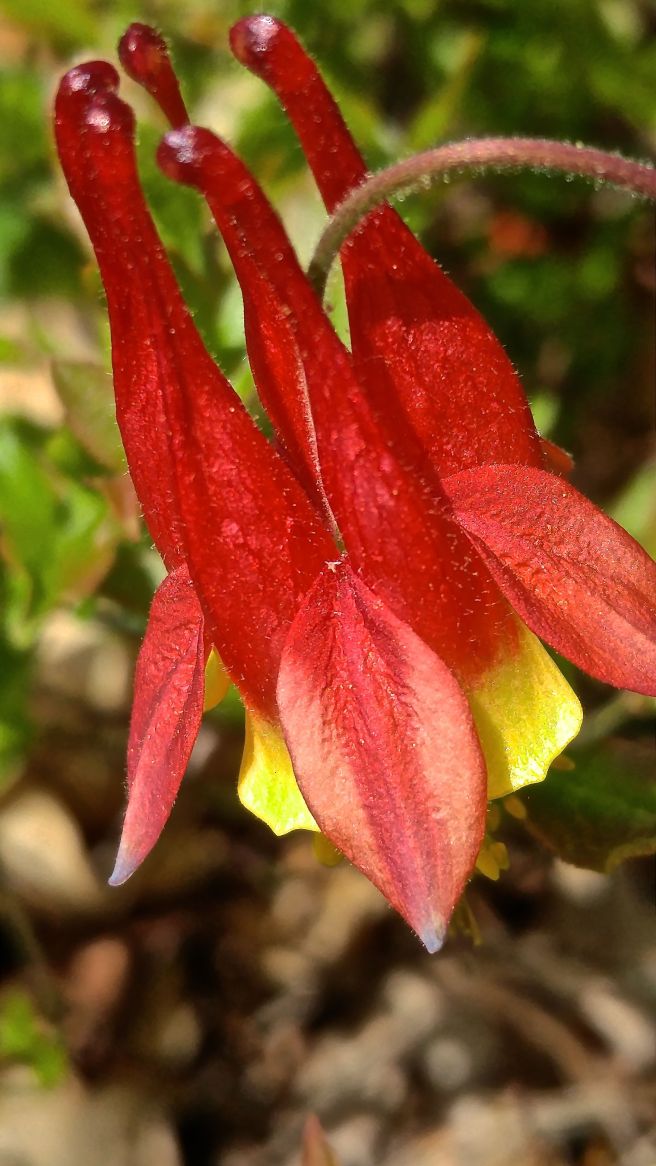
Numerous yellow stamens projected downward and surrounded the green pistils with their long, thin styles, creating the look of an ornate lantern dangling from a post–thus its other common name, little lantern. I really don’t care what it’s called. Spending time in its presence was all that mattered.

The same was true for our dragonfly experience. We wallowed in wonder today and let nature reveal its glory.

Three Times A Charm

One might think that following the same loop through the woods in slow motion three times in one day would be boring. One would be wrong. My friend Joan and I can certainly attest this fact.

Round One: 9 am, Wildflower and Bird Walk with Lakes Environmental Association co-led by birder/naturalist Mary Jewett of LEA and the ever delightful botanist Ursula Duve.

h-hobblebush

In abundance here, the hobblebush bouquet–a snowy-white flower that is actually an inflorescence, or lacy cluster of tiny fertile flowers surrounded by a halo of showy, yet sterile bracts. Yeah, so I’ve showed you this before. And I’ll probably show it again. Each presentation is a wee bit different.

h-beech cotyledon1ph

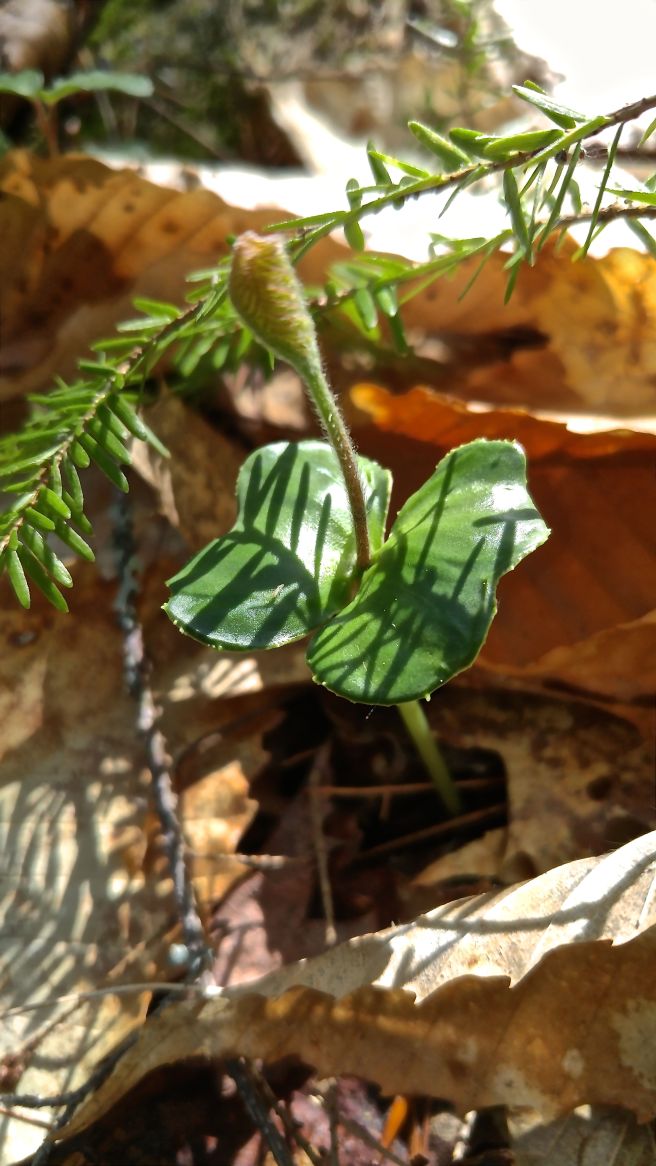
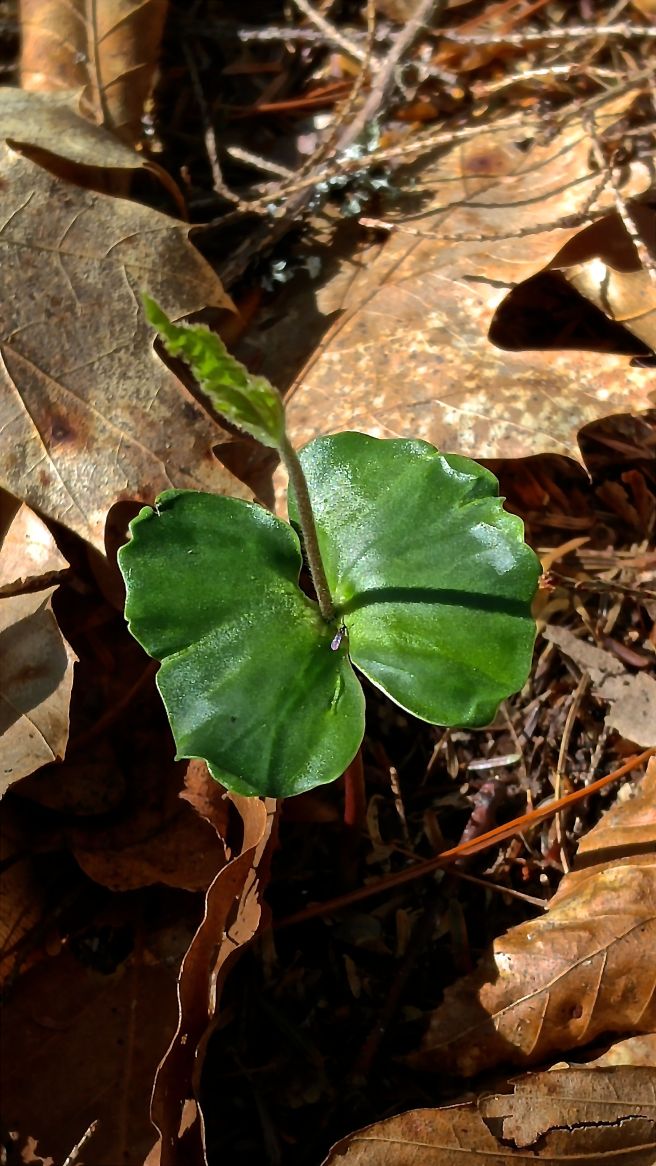
And then we spied something that I’ve suddenly seen almost every day this week.

h-beech coty 4ph

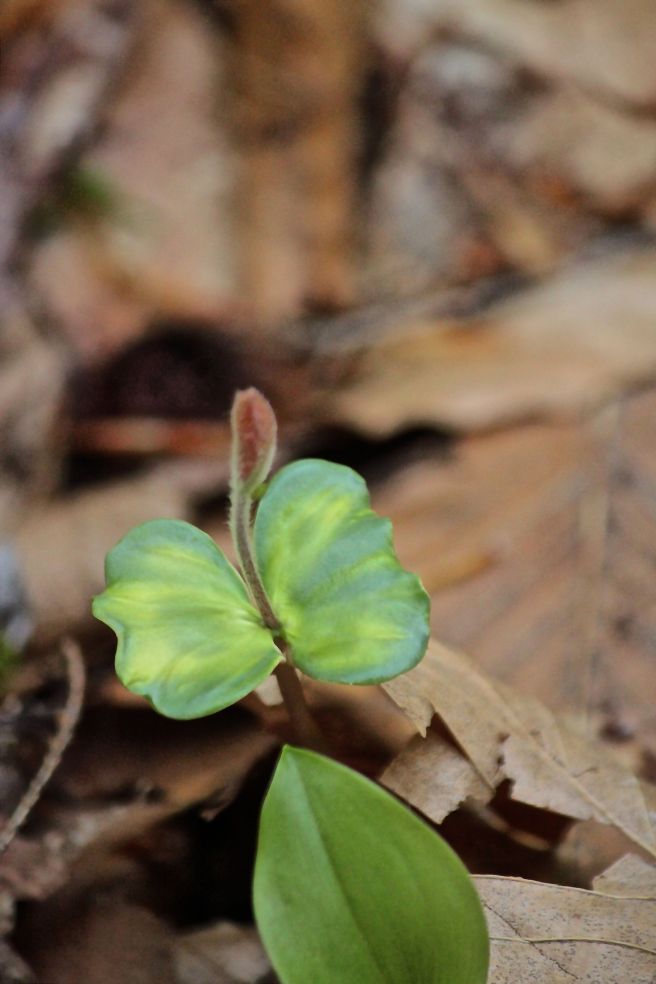
The cotyledon or seed leaf of an American beech. Prior to Monday, I don’t know that I’ve ever seen this and yet, since then I’ve continued to discover them almost every day. Worth a wonder.

h-beech coty 3ph

Think about it. The journey from seed to tree can be a dangerous one as the root is sent down through the leaf litter in search of moisture. Since the root system is shallow, lack of moisture can mean its demise. When conditions are right, a new seedling with a rather strange, yet beautiful appearance surfaces. The seed leaves of the beech, aka cotyledons, are leathery and wavy-margined. They contain stored food and will photosynthesize until the true leaves develop, providing a head start for the tree. I realize now that I’ve seen them all my life in other forms, including maple trees, oak trees and vegetables. But . . . the beech cotyledon captures my sense of wonder right now, especially as it reminds me of a luna moth, which I have yet to see this year.

h-green frog 2

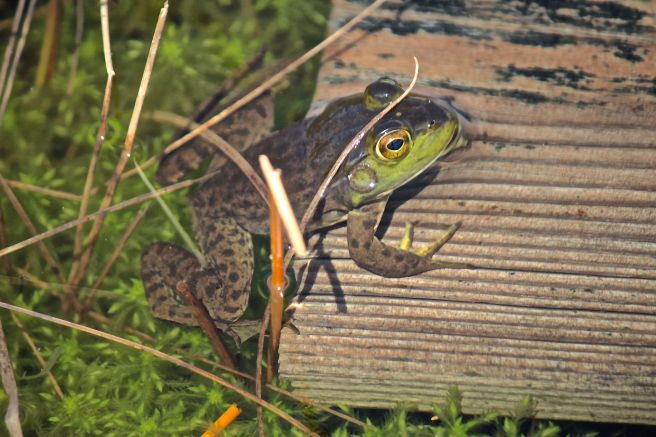
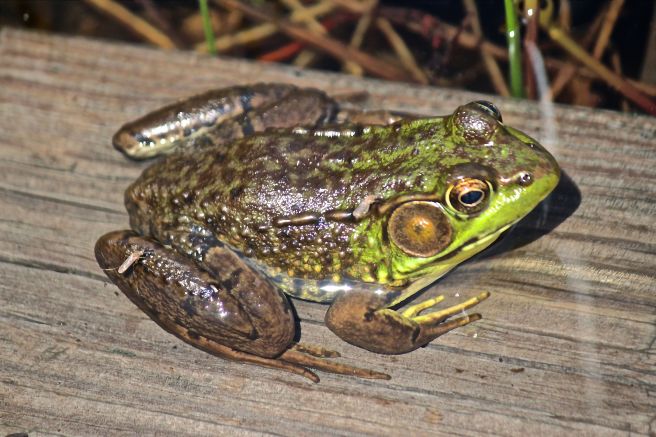
Crossing the first boardwalk through the red maple swamp, a large male green frog tried to hide below us. Notice the large circular formation behind his eye. That’s the tympanum, his visible external ear. A male’s tympanum is much larger than his eye.

h-rhodora ph1

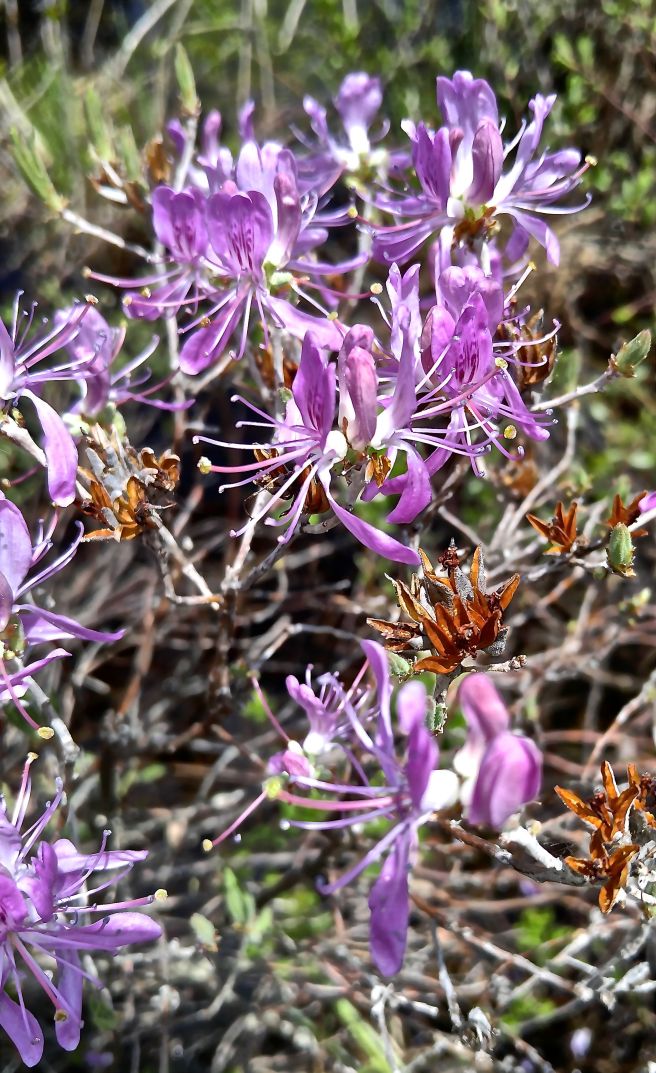
Other red maple swamp displays included the showy flowers of rhodora and their woody capsules.

h-rhodora1

Ralph Waldo Emerson knew the charm of this spring splendor:

The Rhodora

On being asked, whence is the flower.
In May, when sea-winds pierced our solitudes,
I found the fresh Rhodora in the woods,
Spreading its leafless blooms in a damp nook,
To please the desert and the sluggish brook.
The purple petals fallen in the pool
Made the black water with their beauty gay;
Here might the red-bird come his plumes to cool,
And court the flower that cheapens his array.
Rhodora! if the sages ask thee why
This charm is wasted on the earth and sky,
Tell them, dear, that, if eyes were made for seeing,
Then beauty is its own excuse for Being;
Why thou wert there, O rival of the rose!
I never thought to ask; I never knew;
But in my simple ignorance suppose
The self-same power that brought me there, brought you.

h-LEA group

To avoid getting our feet too wet, we spread out as we walked on the boardwalk through the quaking bog.

h-five morning

Morning light highlighted the layers from the pond and sphagnum pond up to Five Fields Farm and Bear Trap above.

h-trill 1

And because it was ever present, I couldn’t resist pausing to admire the painted trillium once again (don’t tell my guy).

h-dwarf ginseng1ph

One plant that I will always associate with this place and Ursula, who first introduced me to it years ago, is the dwarf ginseng. I love its global spray of flowers and compound leaves. But maybe what I love most is its beauty in diminutive form–just like Ursula.

Round Two: Noon, Lunch and a walk with my dear friend Joan.

h-bigtooth aspen

After returning to our vehicles following the morning walk, Joan and I grabbed our lunches. And I paused in the parking lot to enjoy the silvery fuzziness of big tooth aspen leaves. The quaking aspen in our yard leafed out a couple of weeks ago, but big tooth aspen leaves are just emerging. Like others, they begin life with a hairy approach–perhaps as a protective coating while they get a start on life?

h-muddy riverlunch

We ate lunch beside Muddy River where the spring colors were reflected in the water.

h-blueberries 1ph

And then we heard something jump in the water, so we moved silently like foxes as we tried to position ourselves and gain a better view. In the back of our minds, or perhaps the front, we wanted to see a turtle, beaver or especially an otter. Not to be. But we did see highbush blueberries in flower.

h-bee 1

And the bees that pollinate them.

h-pitcher 5ph

In their out-of-this universe form, we knelt down to honor the pitcher plant blossoms that grow along a couple of boardwalks.

h-red maple samaras

We were wowed by the color of the red maple samaras,

h-red winged

prominent shoulder patch of the red-winged blackbird,

h-cranberries

and cranberries floating on the quaking bog.

h-lone larch

And then our eyes were drawn to the green–of the lone larch or tamarack tree

h-green 9ph

and the green frogs.

h-green 8ph

I spent some time getting to know one better.

h-green 3

She even climbed out to accommodate me–I’m sure that’s why she climbed up onto the boardwalk.

h-green 6

Or maybe she knew he was nearby. What a handsome prince.

Round Three: 2:30pm, Joan and I (co-coordinators of the Maine Master Naturalist Bridgton 2016 class) were joined by another MMNP grad, Pam Davis Green, who will lead our June field trip to explore natural communities at Holt Pond.

h-striped maple flower

h-spriped flowers 2

Cascading down from the striped maple leaves, we saw their flowers, which had alluded us on our first two passages.

h-speckled 2

The cottony white masses of wooly alder aphids decorated many of the speckled alders in the preserve. In a symbiotic relationship, ants stroke the aphid with their antennae, while  the aphid releases a drop of honeydew, much like a cow being milked. It’s actually rather creepy.

h-duck

Two Canada Geese squawked from another part of the pond, but Mrs. Mallard stood silently by.

h-tree pants

Our final sight brought a smile to our faces–someone put his or her pants on upside down!

We hope that charms your fancy. Joan and I were certainly charmed by our three loops around and those we got to share the trail with today.

We also want to thank Ursula, Mary and Pam for their sharings. And we send good vibes and lots of prayers to my neighbor, Ky, and Pam’s brother-in-law.       

 

 

Another Day Mondate

We knew when we couldn’t find the trail we were looking for yesterday that we’d return today. What we didn’t know was how brisk it would be, but thankfully we were prepared. We both packed extra layers and I was thankful for a winter hat and gloves. Mid-May in Maine.

a-horses

We also didn’t expect to park across from a horse farm.

a-tree down

But wind gusts reaching 30 mph had toppled a tree, preventing us from driving to the trailhead. I questioned our intelligence as we approached the tree and downed wires. My guy was certain we’d be fine. I let him go first. No fireworks. So I followed and looked back to take a photo. Generators hummed in several yards. Apparently, this is normal procedure.

a-albany sign

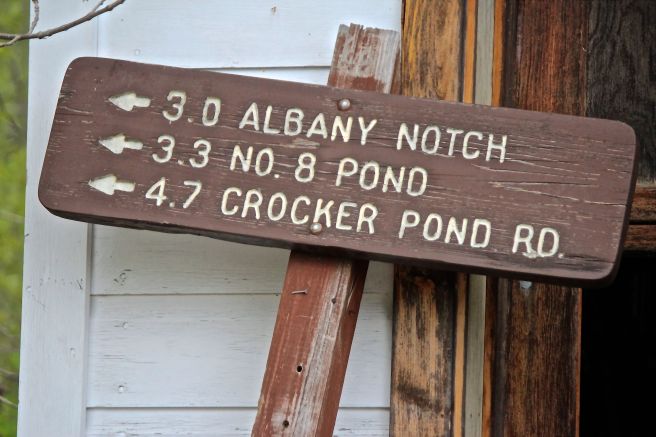
Two weeks ago, we’d climbed Albany Mountain from Crocker Pond Road. Yesterday, we tried to climb from Birch Avenue in Stoneham, but found ourselves wandering and wondering along a snowmobile trail–we caught glimpses of the mountain, but it alluded us. So today, determination set in. We were going to conquer the mountain again.

a-crossing brook.jpg

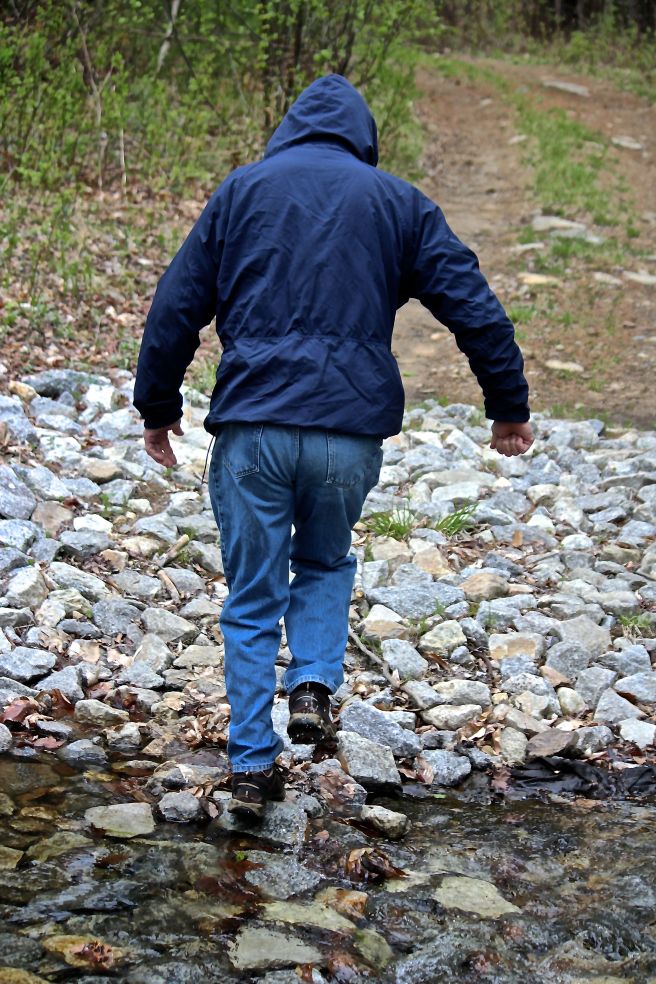
Back across the brook we trudged. Actually, this was one of about five brook crossings. There’s something to be said for the snowmobile trail–usually there were bridges. Not to be this time around.

a-veery

We had company at the beginning of our journey. A veery kept pace with us and peered about as it foraged for food.

a-lunch rock

Within about ten minutes of finally getting onto the actual trail, we found lunch rock–as if on cue, for it was noon.

a-lunch rock 2

PB&J always tastes better in beautiful surroundings.

a-trill 1

The soil was rich and moist–we can attest to that as we slogged through mud following moose tracks much of the way. Trilliums thrive in such conditions and painted trilliums showed their bright faces. Three leaves, three leaf-like bracts and three petals–one triangle layered upon the next in elegant symmetry.

a-trill 6ph

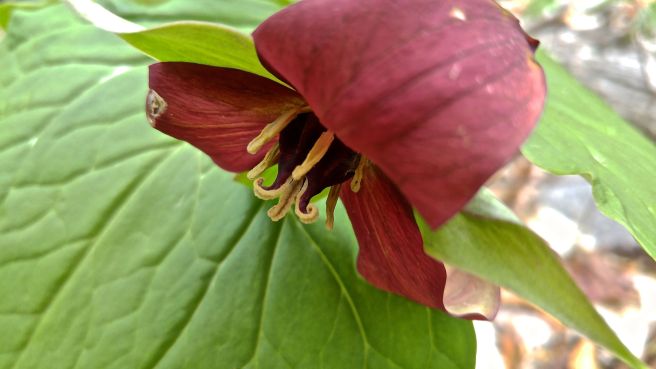
Meanwhile, the regal bloom of a red trillium shared the continuation of the series of three–trilliums have a pistil with three parts surrounded by six stamens. My guy asked if I have a trillion pictures of trilliums. Maybe–but certainly not enough.

a-burl, ph

We paused to admire  a large burl.

a-beaver, ph

And passed through an old beaver bog into a hemlock grove.

a-mystery 1

Though it was much too cold for butterflies, I found one in the form of a plant. Actually, it rather reminded me of a luna moth.

a-striped maple

As we began to climb, we were in the land of the striped maple and hobblebush. I promised myself I wouldn’t photograph the hobblebush flowers. But this striped maple–ahhhhh.

a-snail, ph

My guy is fast, even after going for a run this morning. I, however, was happy to discover that I wasn’t the only one moving at a snail’s pace.

a-5 petals1

Continuing up, cherry and

a-shadbush, ph

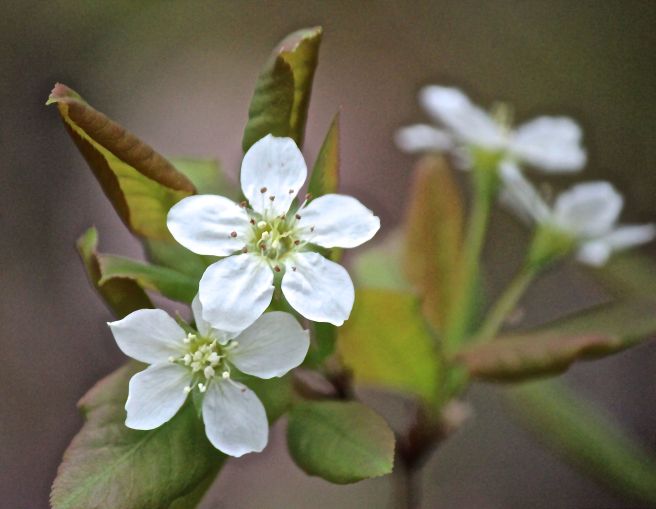
shadbush displayed their dainty faces.

a-near summit

Up and down through the notch we continued until at last we approached the summit.

a-mtn view1, ph

Yesterday, we marched to the beat of a different drummer. Today, we took in the scene toward Kearsarge and the Baldface Mountains. Rock, lichens, mosses, shrubs, trees, mountains, valleys, lakes, clouds–all verged on the horizon. We knew we were blessed.

Thanks for wondering my way on another day and a Mondate to boot.


Beulah’s Mystery

One of the fun happenings in my life is that friends send me nature photos and ask me to help them ID a species. Sometimes I know immediately what it is and can ask them questions to help them get to the answer. Other times I’m as stumped as they are. Thus was the case today, when I drove to Brownfield to look at a tree growing in the field beside an old farmhouse.

t-beulahs 2

Beulah’s farmhouse, to be exact. My friend’s brother recently purchased it and the adjacent barn. Though the farmhouse is a fixer-upper, Beulah’s sign looks as if it was created yesterday.

t-tree1

This is the tree. If you know it right off, my hat goes off to you. I was in my Forest Trees of Maine mode and kept looking at it from that perspective. It’s overall appearance didn’t match what I know. We began with the key and slowly (painfully slowly as the black flies swarmed us–mind over matter, mind over matter), worked our way through the choices, two by two.

t-dwarf shoots

Because it’s not in leaf yet, we used the Winter Key. With each question, we paused to examine the tree–looking at the alternate leaf shoots, hairy scaled buds, pith, bark–every detail. We considered its location in the middle of a farm field, where the land sloped slightly and was rather dry. We also looked at the ground and found decaying leaves as well as deer scat. As I suspected, it wasn’t in the key. So I came home and scoured other books. I think I reached the answer and that the deer scat is actually a clue. Do you know? Now you may say so.

t-porky den

On our way to see one more cool thing, we paused to look at a den located beside the old foundation. Though much of the scat has since been removed, plenty of it and numerous quills painted the picture of who’d created this pigpen.

t-critter 2

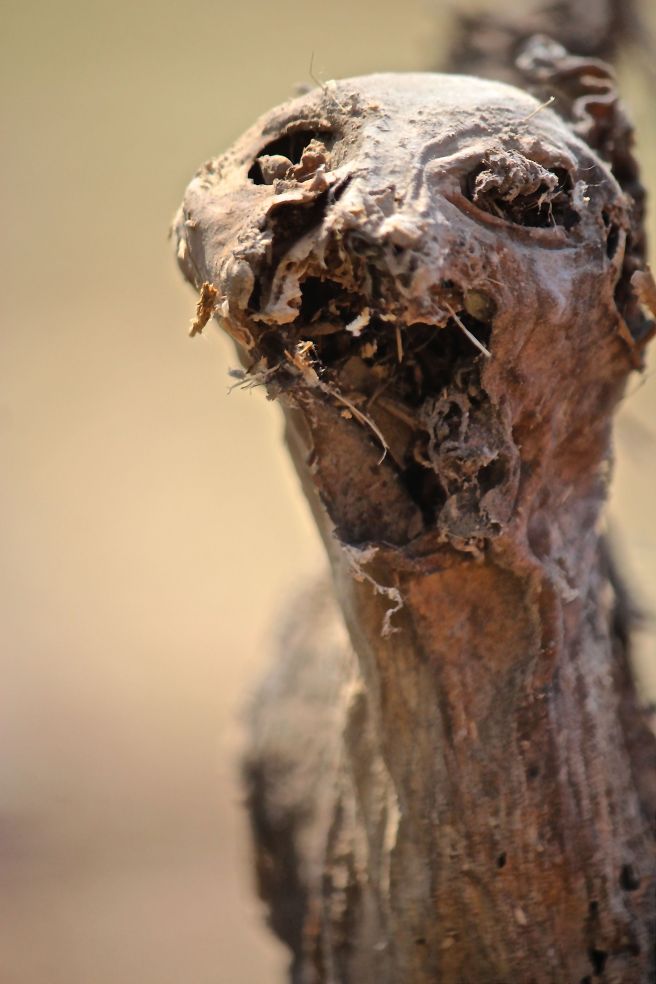
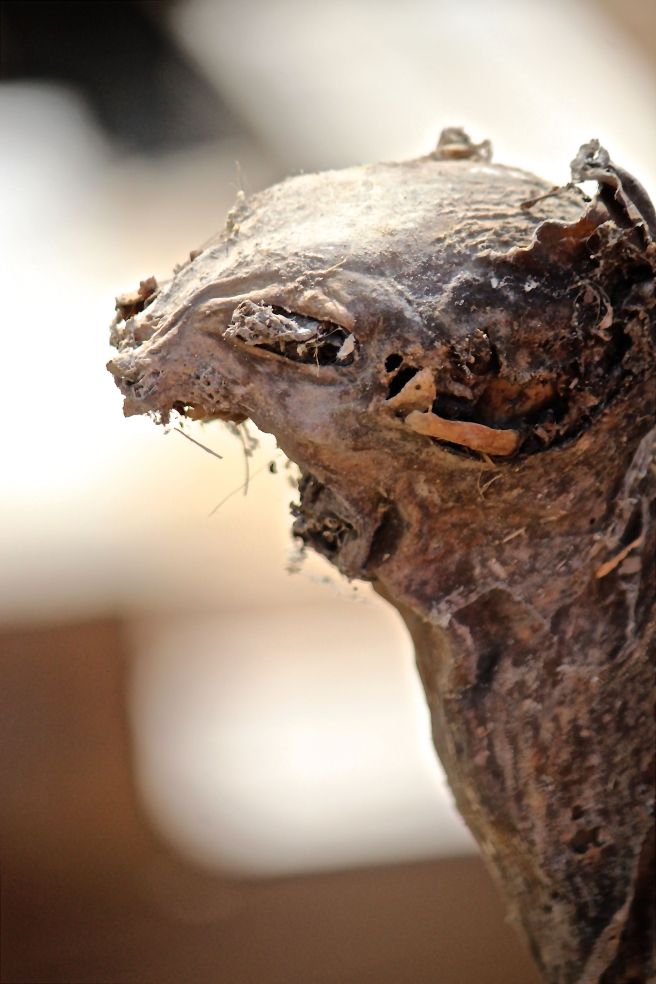
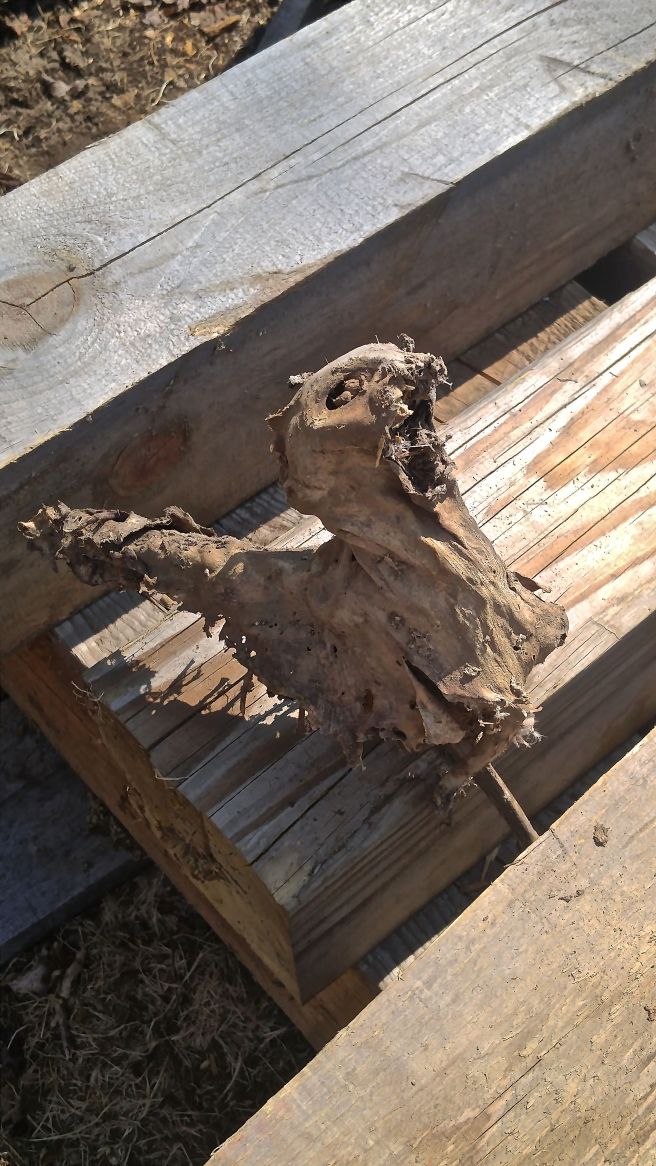
And then they had one more mystery item to show me. I hope this doesn’t freak you out. It’s part of many renovations in old farmhouses–a dried-up animal carcass. The front of the face was missing, but as we say, eyes in the front, born to hunt.

t-critter 1

A side view of this handsome critter. Can you see the ears?

t-critter 4

Talk about all skin and bones.

t-critter pads

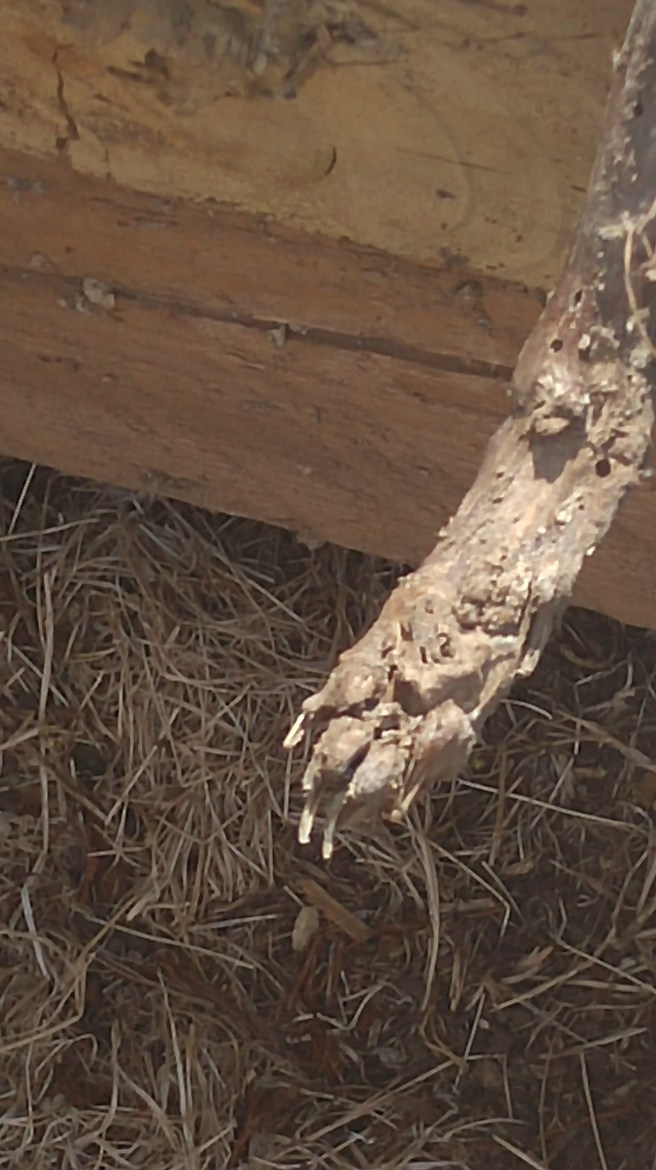
And then the foot pads and nails. Four toes, nails, about the size of a nickel. Do you know?

t-bog sign

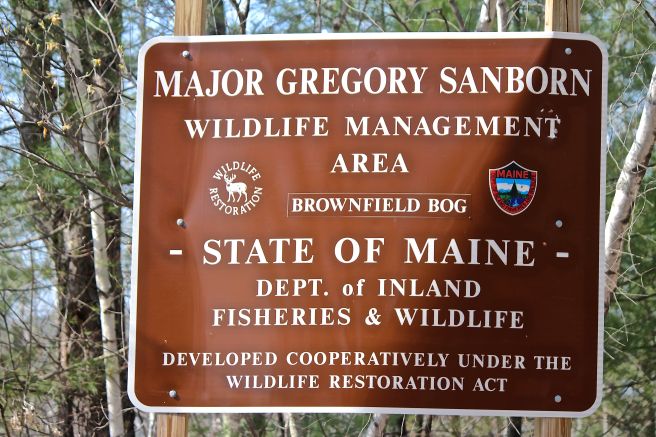
Because I was in the neighborhood, I visited Brownfield Bog and continued my afternoon exploration. (Yeah, I had work to do, but playing hooky for a couple of hours is allowed once in a while if I don’t abuse the privilege–ah, the life of a freelancer.)
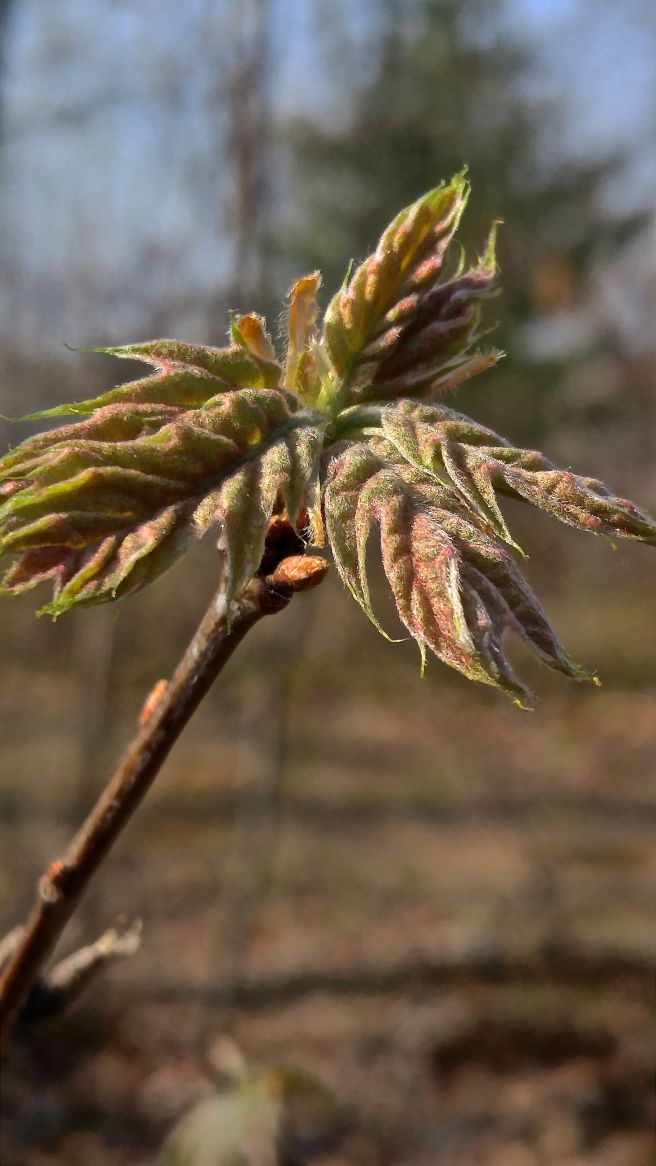
t-red oak emerging

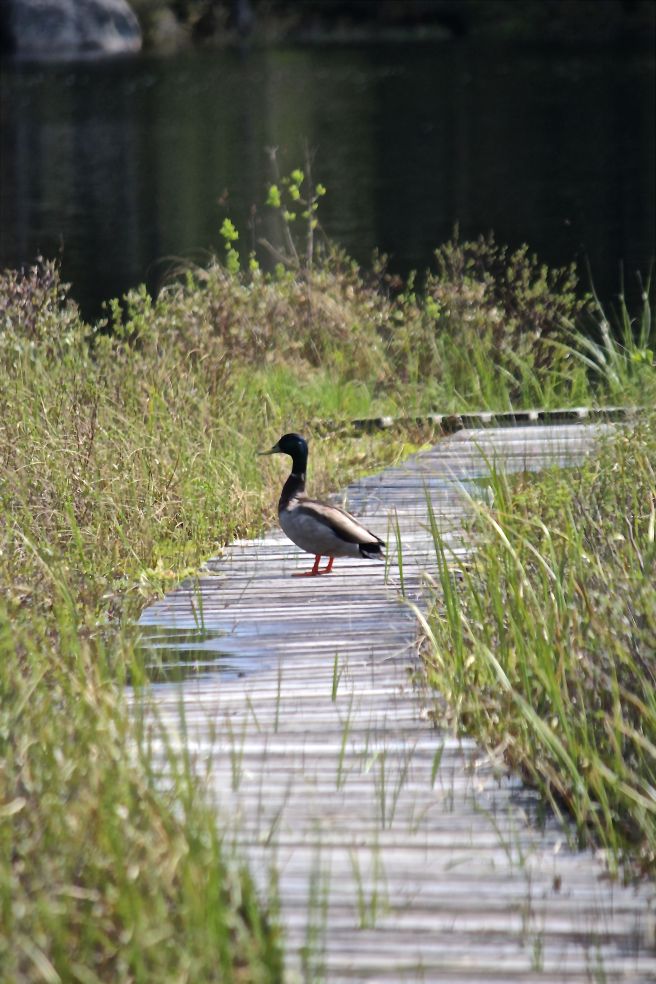
I remember suddenly becoming aware of spring colors about thirty-five years ago, when I taught  school in New Hampshire by the convergence of the Pemigewasset and Merrimack Rivers. Until then, I’d never realized that tree leaves emerge in a variety of colors–they all weren’t suddenly green. (BTW– do you see the spittlebug? )

t-red oak mini leaves

In a quickness equal to fall foliage, spring colors may not be as flashy, but their subtle beauty deserves notice.

t-gray birch 2

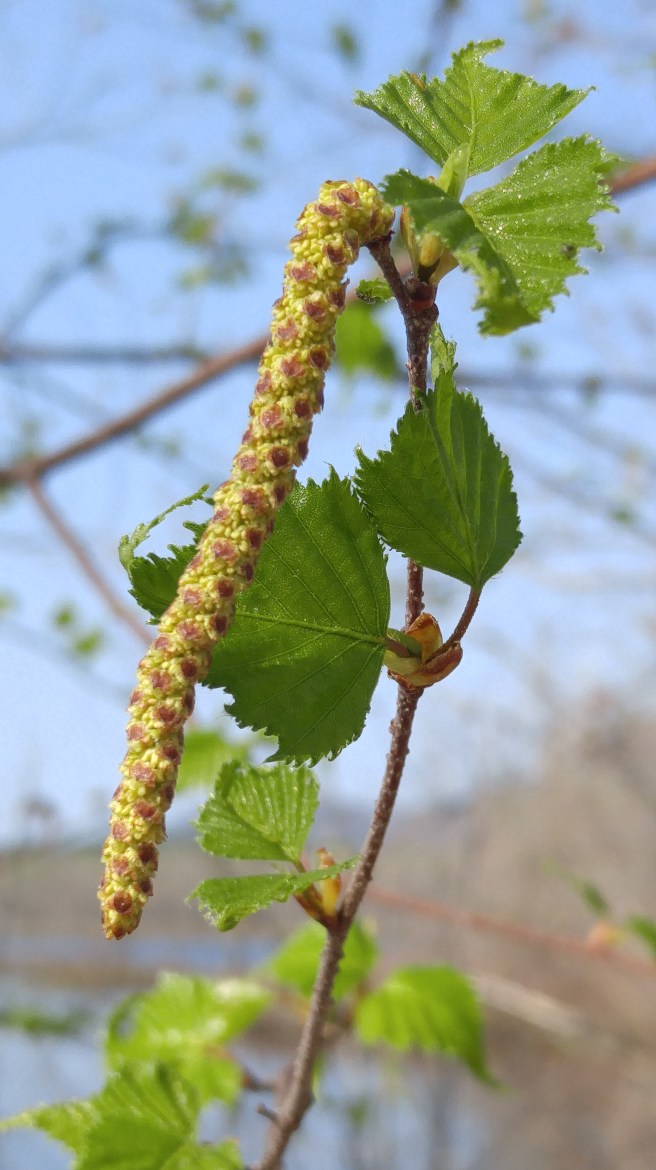
And those leaves that are green offered their own reasons to stop me in my tracks as I took in the details–in this case the double-toothed elephant’s trunk. What? Notice the shape and outer margin of the leaf.

t-gray birch 4

The lovely elongated catkins demanded a glance that lasted more than a second.

t-willows cat1

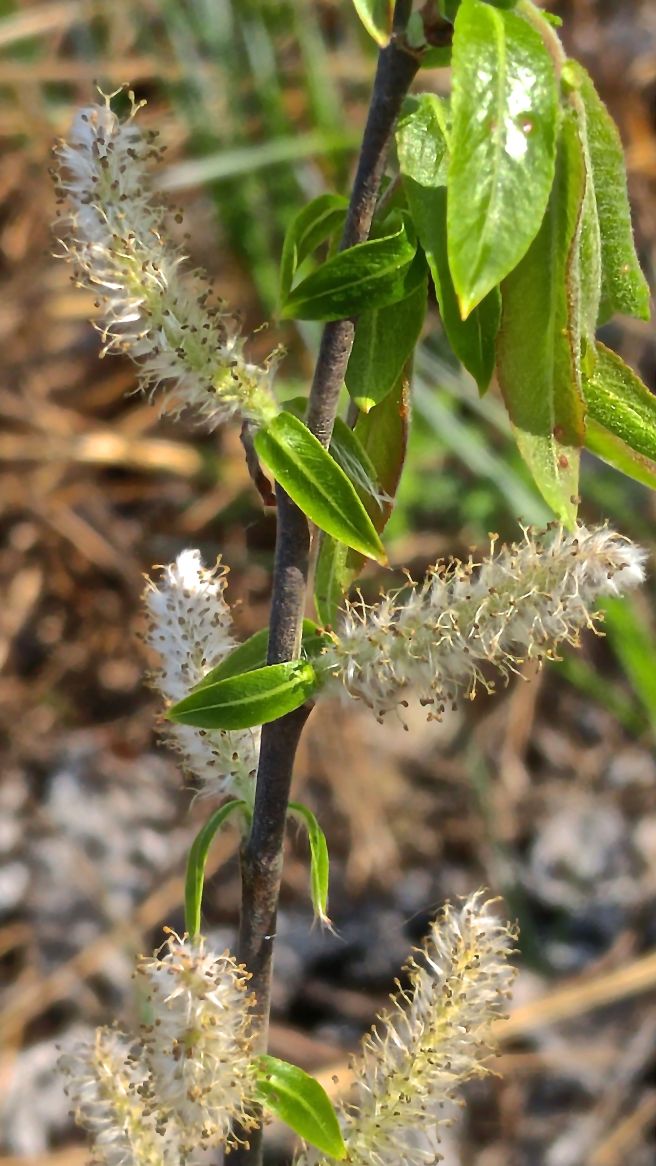
Adding a festive fuzziness to the celebration of spring was another set of catkins.

t-willow gall

Unwittingly, this shrub also played host to a gall gnat midge that overwintered in a structure created by the reaction to a chemical released by the larva–what would have been leaves were forced to harden into a pine cone look alike.

t-bog colors 2

The subtle colors graced the meadow,

t-pleasant

were reflected in the bog,

t-river

and blessed the Saco River.

t-baltimore 2

There were bits of flashy color–do you see who was feeding on the upper branches?

t-rhodora 1

And this spring beauty exploded with love and life.

At the end of my journey, I was grateful to P&K for an excuse to step away from my desk and check out the mystery standing in Beulah’s field. Especially as it led me further afield.

Mondate Circle

Today’s Mondate found us circling Holt Pond–on a reconnaissance mission for a section of the trail that we maintain for the Lakes Environmental Association, but also because we just happen to love this tucked-away space. It’s one of those places where we appreciate the constant change in community and feel completely removed from civilization–maybe because we don’t often see others here.

And yet, today, as we walked down “tire alley,” a woman at the far end called to us–by name. Here’s to you, Earlene, for recognizing us. Earlene and I first met almost a year ago on this very trail. I was exploring with some folks from LEA and she was on her own–as is her nature (my kind of nature). I can’t remember what she said, but somehow we made a connection based on this very blog. The fact that our paths have actually crossed a couple of times since then should mean that we need to spend some time together.

h-boardwalk 1

My guy and I followed the boardwalk through the red maple swamps.

h-boardwalk muddy

Our first pause–beside the Muddy River, where the water was high.

h-boardwalk muddy river:beavers

Beaver chews decorated the end of the walk.

h-muddy river

Looking east, we could see the lodge in the distance on the far side of the river, with fresh wood work standing out atop it.

h-muddy to holt

And to the west, the river flowing out of the pond.

h-boardwalk 3

We continued on, wondering how far we’d get, given the amount of water.

h-boardwalk quaking bog

And then it was out to the quaking bog, where we were stopped in our tracks.

h-sawyer brook

Crossing Sawyer Brook, we were struck by the lushness of life.

h-contemplating bridges

We conquered all of the boardwalks, though occasionally we had to pick our way through. As we continued on, our mosey included moments of contemplation as my guy considered bridges we need to construct over some wet spots on the Southwest Shore Trail.

h-landing

Our section of trail ends at the old log landing, where we noted the circle of life in the form of succession as the white pines and hemlocks begin to fill in the space.

h-view from southshore trail

From the southwestern shore, we looked back toward the Muddy River and listened to Canada geese that we never spied.

h-view from southeast

Eventually, we’d circled around to the southeast shore, with a view of Five Fields Farm in the distance.

h-view from snowmobile trail

The wind had increased and the pond reflected its movement.

h-view emerald field

We crossed the Emerald Field and made our way back into the Preserve.

h-view beaver 2

Having circled about, three hours later we were once again beside the Muddy River, downstream from the beaver lodge we’d spied earlier, and looking at a mighty fine dam.

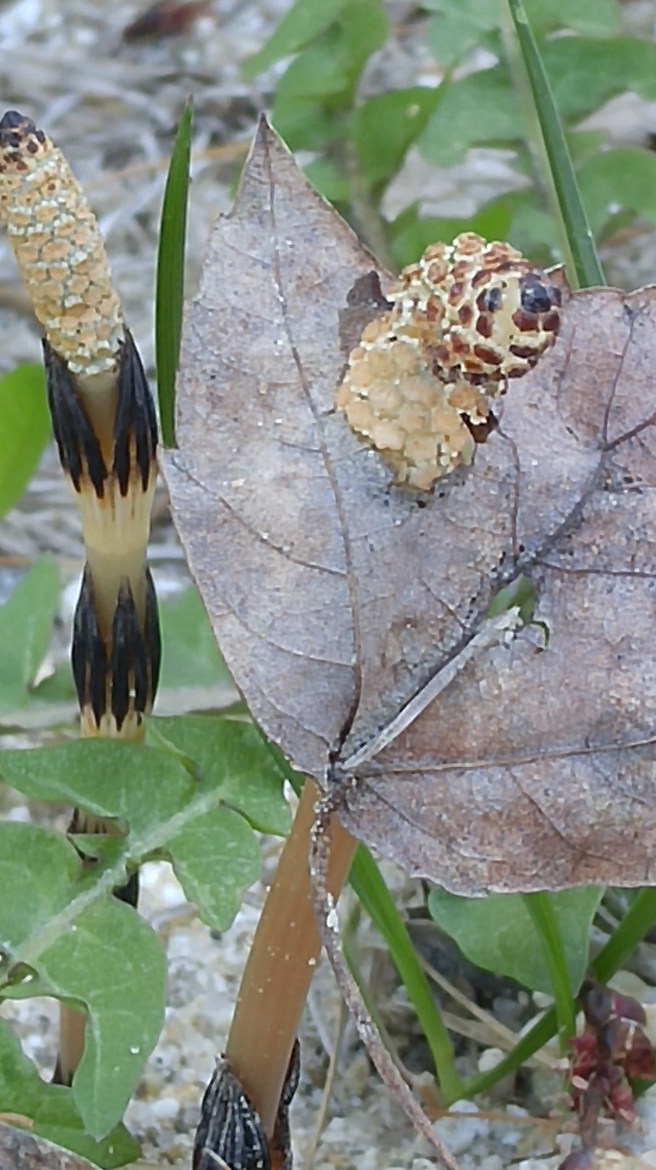
h-horsetail 1

Along the way we noticed that we weren’t the only ones circling about.

h-equisetum

And sometimes a breakthrough was necessary for life to continue.

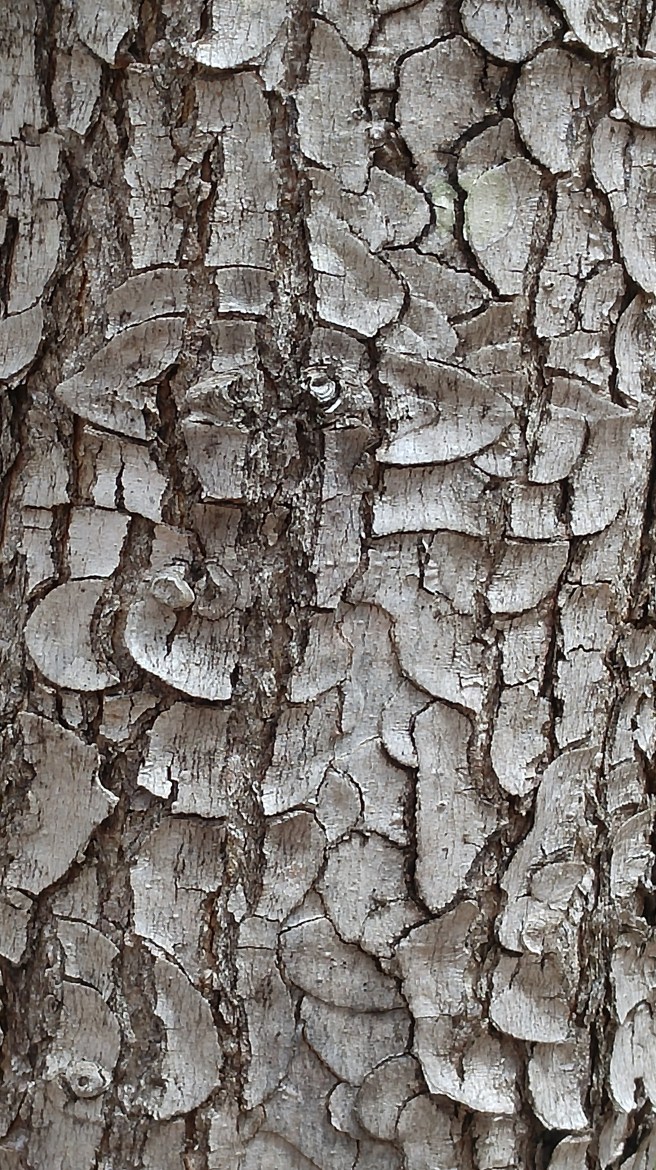
h-red maple bark

The potential to hit the bull’s eye was a frequent occurrence.

h-pileated scat 1

And even scat (ah, my fav) demonstrated the circular theme. (If you dare to look closely, do  you see the ant body parts in the pileated woodpecker scat?)

h-painted

Circled by its traditional leaves of three, painted trillium wasn’t yet ready to show its beautiful face.

h-sensitive2

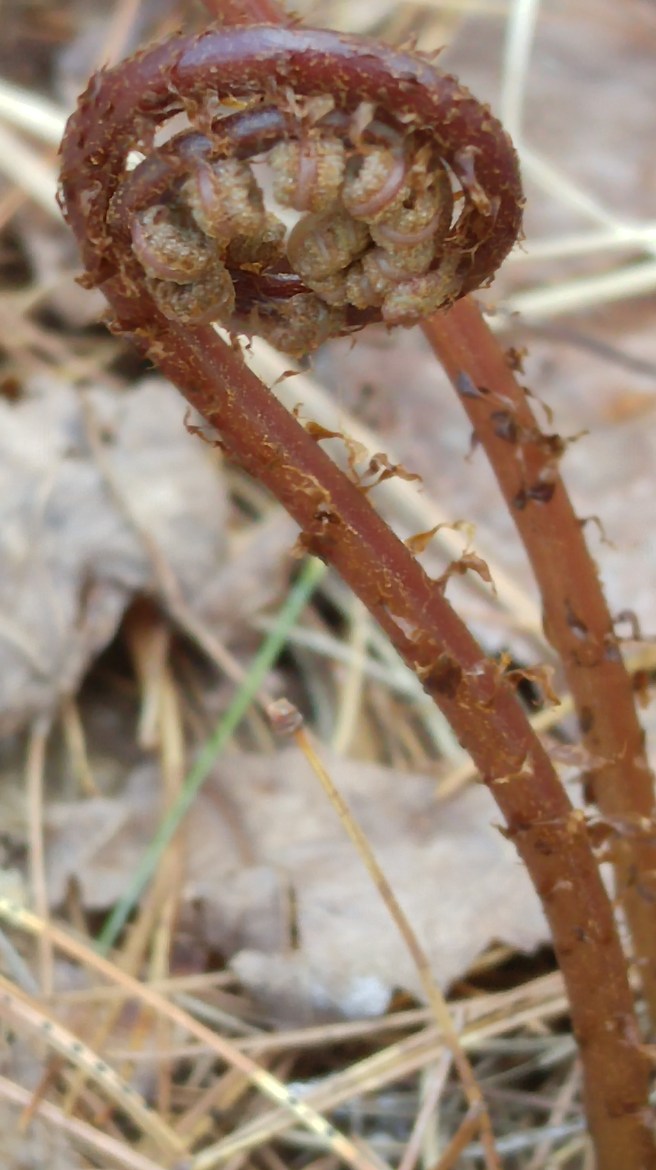
But my favorite circles of all right now–fern crosiers. And Earlene–I wasn’t sure what you were talking about when you mentioned the red ferns. I believe I said grape fern, which turns a reddish shade in winter. But even as I said that, I couldn’t remember ever seeing it here. Moments after we chatted with you, however, I knew what you meant–sensitive fern.

h-cinnamon 2

I hope that I’ll be forever in awe of the hairy sheath that envelops cinnamon fern crosiers

h-cinnamon 1

and the life embraced within.

h-Christmas 1

My newest discovery this past week is the Christmas fern crosier. Wrapped in satiny fur, the young frond encompasses life as it prepares to unroll. The more I get to know each species as a crosier, the more obvious they become.

I’m thankful that not only did we circle Holt Pond on today’s Mondate, but we also noticed the circle of life that surrounded us.


Our Place

h-tom2

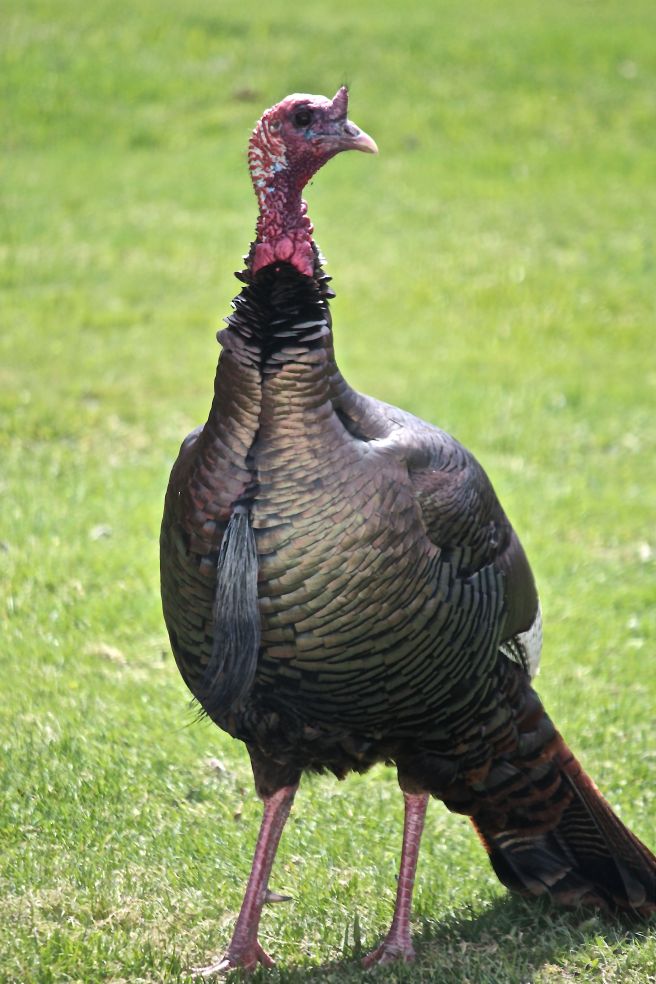
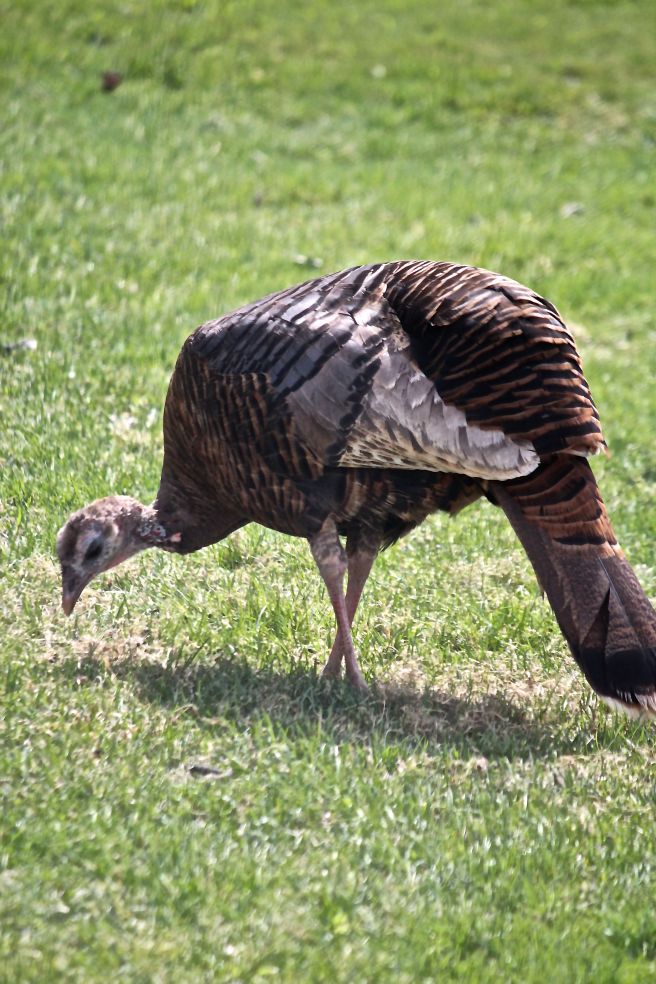
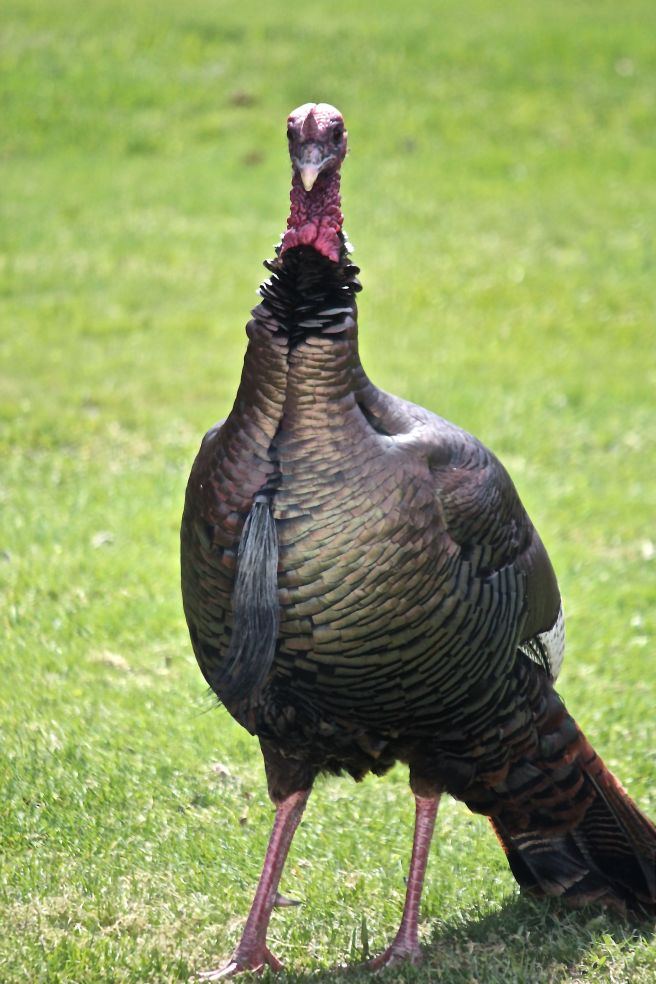
Gooble. Gooble. Gooble. Gooble. Gooble. Gooble. Gooble. Seriously . . . is all that noise necessary? Apparently it is. Mr. Tom felt the need to awaken us at this morning’s first light with his non-stop gobbling–his way of calling the hens to join him. Disclaimer: I didn’t take this photo until later in the day. In all his ugliness, I have to say that he really is a handsome fellow.

h-female turkey

The hens who hang out with him don’t appear to care, but maybe they’re just playing coy.

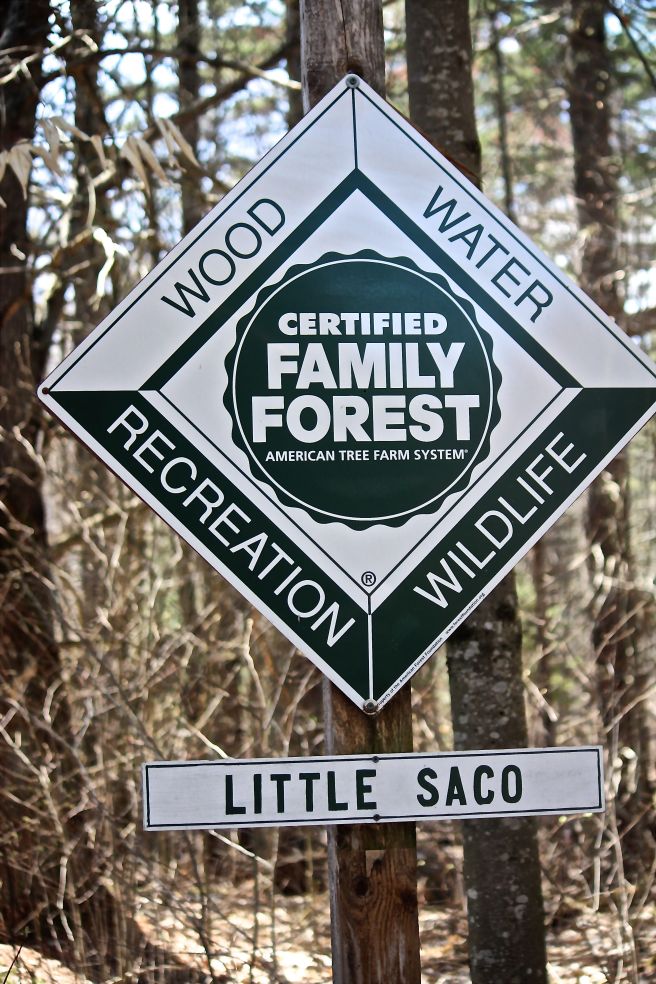
p-little saco sign

We left them to the bird seed scattered on the ground and drove to Farnsworth Road in Brownfield for a hike up Peary Mountain. The trail is located on private property and we’re thankful that it’s open to hikers. Much of it is a snowmobile trail as well.

p-Little Saco

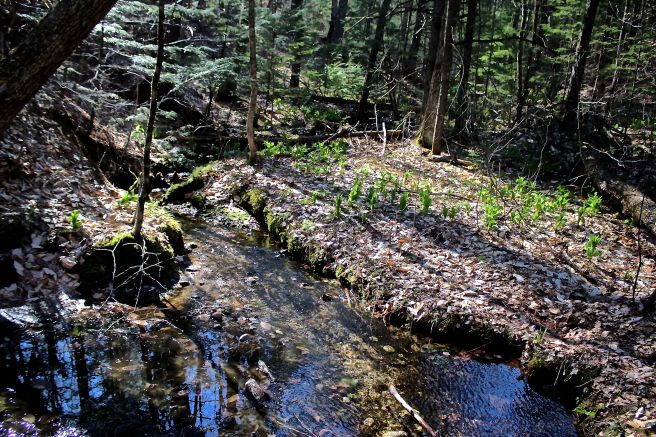
The Little Saco flows over moss-covered rocks beside the lower part of the trail.

p-false 4

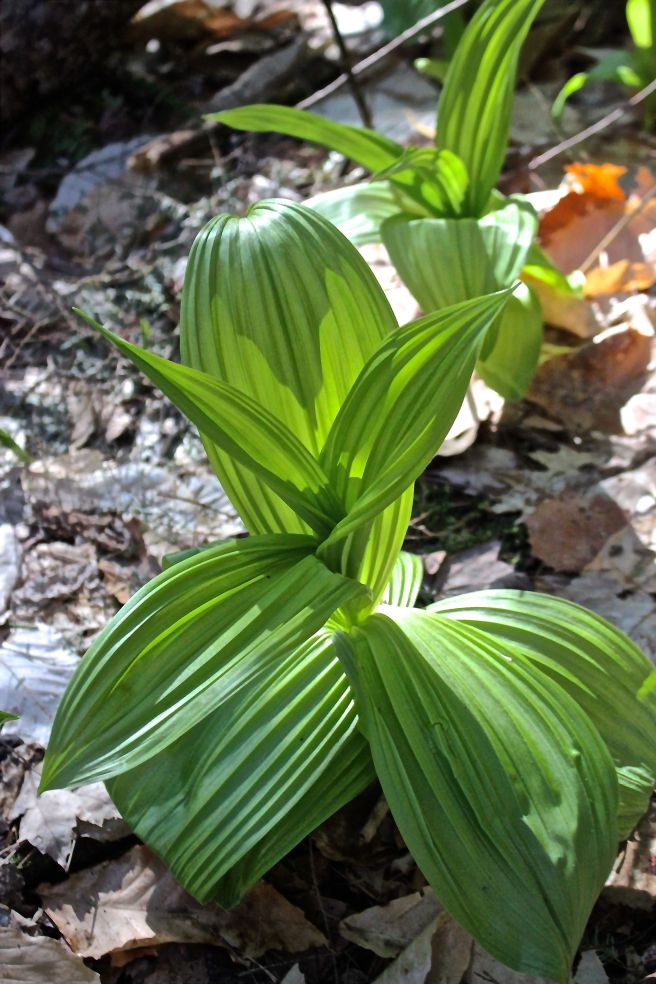
As we followed it, bright green growth in the damp soil warranted a closer look.

p-false hellibore 2

A true sign of spring–false hellebore with its corrugated leaves.

p-striped 2

There are plenty of other signs, including the pink and green striped maple buds. I’m missing my macro for these moments of early glory, but so it is.

p-beech 1

While some beech trees still have a few marcescent leaves clinging until they can no more, I noticed a few buds beginning to burst.

p-summit sign

At a stone wall, the trail suddenly turns 90˚ to the left.

p-fdn 2

But in the opposite direction–the remains of an old foundation.

p-fdn ledge 2

And above, a ledge from whence the stones presumably came.

p-porc scat

The ledge continues to provide a dwelling–for critters like the porcupines who keep the hemlocks well trimmed.

p-bluets

As we climbed to the top, delicate bluets showed their smiling faces.

p-bench view1

And then we emerged on the 958-foot summit, where the bench view is glorious. The small mountain was named for Admiral Peary. Apparently, his mother’s family, the Wileys, lived in neighboring Fryeburg. Upon graduating from Bowdoin College in 1877, Peary lived in Fryeburg and conducted survey studies of the area for a couple of years, before moving to DC and later leading an expedition to the North Pole.

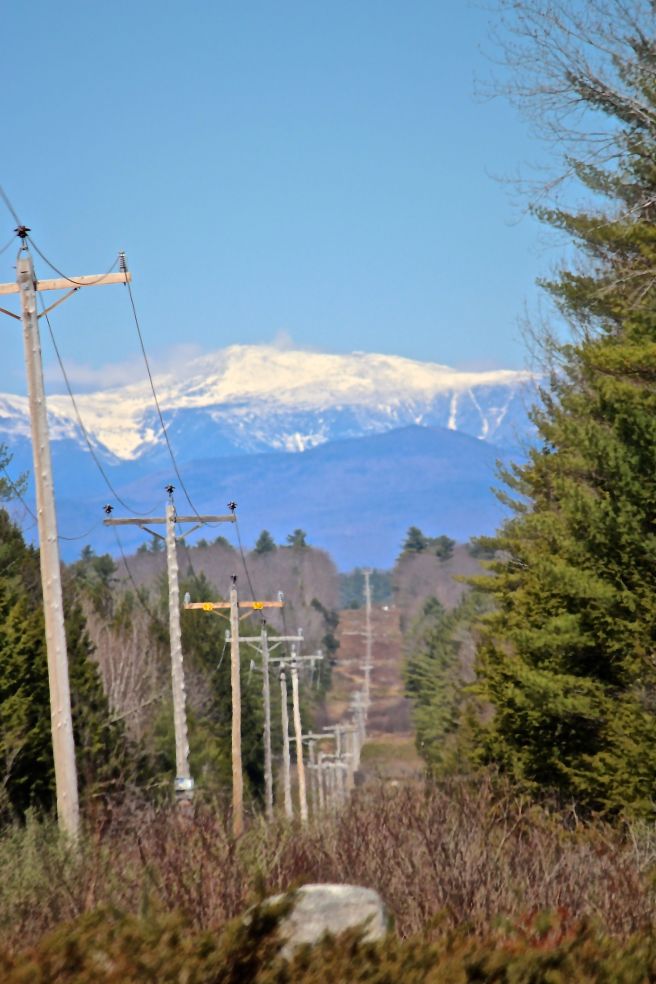
p-mount wash

If you’ve seen similar views of the big mountain, its because it’s part of our place.

p-my guy view

I followed my guy along the ridge line to the end–where the view turned homeward.

p-pointing

My guy made a point of recognizing landmarks from Mount Tom and Lovewell Pond along the Saco River to Pleasant Mountain and Brownfield Bog.

p-Pleasant 2

If you look closely, you’ll notice a horizontal line just below the bog–that’s the Saco River. And the little mountain to the left of Pleasant Mountain–Little Mountain in West Bridgton.

p-Pleasant Road1

The only part of the view that we don’t get–the new road that was constructed up the backside of the mountain within the past year. It worries us. And that is why we appreciate the efforts of Loon Echo Land Trust for protecting most of the rest of the mountain.

b-pitch pine

We headed home for lunch and to pull out the lawn furniture.* And then we parted ways, my guy to attend a celebration of life for an old friend, and me to climb Bald Pate. My purpose–to look at the pitch pines and jack pines.

b-pitch 2

In bundles of three, the stiff needles surround the male pollen bearing cones on the pitch pine.

b-jack pine1

Jack pine features two needles per bundle–think Jack and Jill.

b-peabody & sebago

From the summit, I paused to take in the view of Peabody Pond and Sebago Lake beyond. It doesn’t matter how often I climb to the top of this 1,100-foot mountain, the view is ever changing.

b-mount wash1

And again, I could see Pleasant with Mount Washington in its saddle. This time, however, I was on the opposite side looking at the front of Pleasant Mountain. You may wonder about the road–it leads to two cell towers near the Southwest Ridge summit.

b-sweet fern 1

As I made my way to the Foster Pond Lookout, I stopped frequently to enjoy the ever-artful presentation of sweet fern.

b-blueberries

And I noticed another sweet offering that many of us will enjoy this summer–blueberry plants in bloom.  A year ago next week, I saw the same on this very mountain. Seems early, but I think they’re well protected in a sunny spot.

b-foster pond 2

I’m sure had my guy been with me, he would have named a color chip that matched Foster Pond–perhaps turquoise blue best described it in that moment.

b-bird treat 1

Heading back to my truck, I noticed some bird treats dangling from the trees. Perhaps our turkeys will fly to South Bridgton.

h-tom 3

Apparently not. Back at home, Tom had returned. He’s a frequent visitor to our place. And we’re frequent visitors to the area beyond our backyard. It’s all really his place and our place.

* If you live in our area, expect at least one more snowstorm. It always snows once we pull out the lawn furniture.


The Big, The Little and Everything In Between

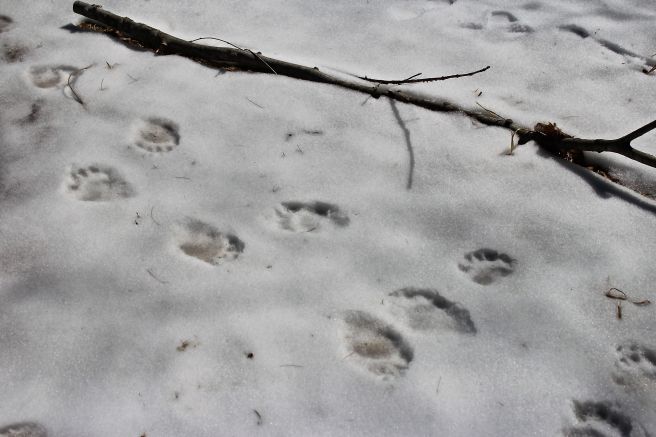
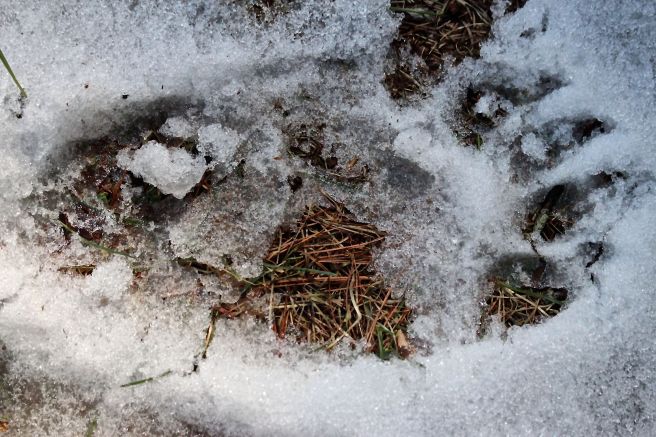
I stepped out of the shower after a walk around town with friend Marita and heard someone chatting away on the answering machine. Maybe it’s because I didn’t have my glasses on, though what that has to do with it I don’t know, but I couldn’t ID the voice. The male yammered away about something in the snow and it had come last night and I had to get there quickly. For some reason I thought it was our eldest and I  wondered what it was that needed my immediate attention. So, I cautiously picked up the phone and said hello. The voice on the other end continued talking desperately about me going somewhere. “Who is this?” I asked. It was friend Dick and I should have recognized his voice, but maybe not having glasses on is like not being able to taste if your nose is stuffed. Or maybe I’m overthinking as usual. Dick, however, was not overthinking or overreacting. He was excited and knew I would be as well. He was standing in a friend’s yard about a half mile from here and looking at bear tracks in the snow.

b-bear 7

As he knew he would, he had me on the word “bear.” His voice was urgent as he insisted I stop everything and get to his friend’s house. “I just need to dry my hair and then I’ll be right there,” I said. Deadlines loomed before me but bear tracks won my internal war. Dick suggested I just wrap a towel around my head. Really, that’s what I should have done because my hair has no sense of style whether wet or dry, so after a few minutes I said the heck with it and popped into my truck, camera and trackards in hand.

b-bear2

Yup–bear tracks. Classic, beautiful bear tracks. Even nail marks above the toes.

b-pigeon toed

And the pigeon-toed gait.

b-bear 9

My heart be still. The bear certainly wasn’t.

b-bear fence

It trampled a garden fence.

b-bear 4

And yanked down a suet feeder that dangled from a wonderful rigging at second story height designed to keep the raccoons from stealing it. We couldn’t find the actual feeder.

b-feeder1

It toppled another feeder and consumed all the sunflower seeds. Oh, the squirrels may have helped, but apparently the feeder was stock full. Not any more. We looked for hair but found none.

b-trot

One of the mysteries to us was why did the bear suddenly trot. I’m now wondering if it was startled at some point and ran away.

b-bear 6

Before leaving, I enjoyed one more look. How sweet it is. And how thrilled I was to have seen it–especially knowing that it wouldn’t last long. The. Big.

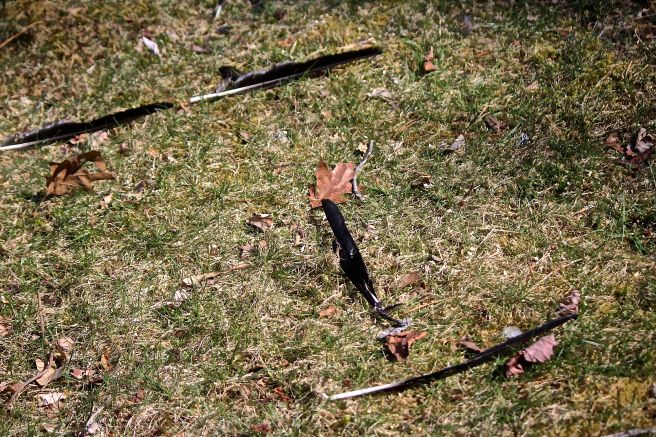
b-feathers in circle

When I arrived home, I knew I needed to work, but figured a quick walk to check on the vernal pool was a great way to celebrate the bear tracks. And on my way–feathers. Long black feathers.

b-feather 1

Most were about a foot long.

b-feather 2

They appeared to be torn out rather than cut.

b-bird head

I know the neighborhood cats hang around our bird feeders all day–ever hopeful. But I don’t think they got this crow. I’ve a feeling a hawk was the culprit. The. In. Between.

b-snow on mount

It’s my neighborhood, so I always cast an eye toward the Mount. The. Big. Again.

b-vp1

The water level seems about the same as last week and a wee bit of Tuesday’s snow still decorated the  western shore.

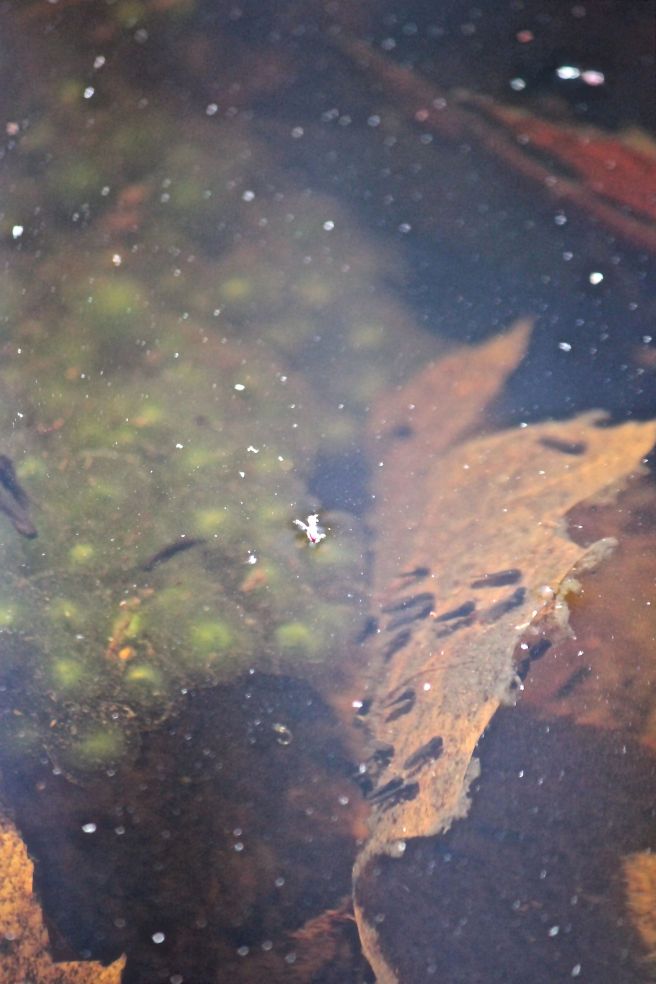
b-tadpoles 3

Though the lighting wasn’t great at that hour, it was obvious that the tadpole population had increased.

b-sally1

And the salamanders continued to grow within their protective covering. The. Little.

b-woody1

I did finally settle down to work. And then it was lunch time. My guy and I weren’t the only ones dining.

b-woody lunch 1

After I finished two assignments and before I walked to a meeting, I decided to visit the pool again and capture the action in the late afternoon light. But first, an examination of the woodchuck’s feeding site. Yup, those leaves were nibbled.

b-woody lunch 2

And so were these. The. In. Between.

b-vp no snow

And then it was back to the pool, where the snow had melted. But, I have to share a finding along the way. Or rather, a non-finding. I intended to grab the crow head because I wanted the skull. Not. It wasn’t in the path where I’d seen it in the morning. I poked around and couldn’t find it anywhere. Who stole it? Maybe one of those darn cats.

b-tads 7

In the warmth of the sun at the eastern side of the pool where most of the egg masses were laid, the population continued to increase.

b-tads 10

I felt the same glee about all of these little critters as I felt about the bear tracks earlier in the day.

b-tads on sallies

Tadpoles and salamanders. I may not see bears tracks every day, but for a brief moment in time, I’m honored to watch the transformation that takes place in the vernal pool. The. Little. Times. Two.

Giving thanks for the ability to wonder. The Big. The Little. And Everything In Between. Especially Everything.

Mondate Fix

I have bad camera karma as my guy can tell you and last week my Tamron
SP 60MM F/2.0 Di II 1:1 Macro decided to quit. I know not why. But, we were headed south for today’s Mondate, so we detoured into Portland hoping for a quick fix. Not to be. Two or three weeks they said. ARGH!

p-Grog

C’est la vie. As my nephew once responded about thirty years ago when he was a little tyke, “La vie.” We didn’t get to see him today, but if his ears were burning it’s because we met up with his parents at the GROG in Newburyport. I needed a sister fix–and a sister hug. Thanks lmacbud and docbud ;-) And thanks also for the chocolate chip cookies. I’m amazed they survived the trip home. Guess we were full.

p-board 1

After we parted ways, my guy and I drove out to Plum Island, an 11-mile barrier island off the shore of Newburyport and Newbury, and home to the Parker River National Wildlife Refuge. Most of the parking areas along the salt marsh were closed and so we headed back and walked along the board walk in the Salt Pannes Wildlife Observation Area.

p-dunes to ocean

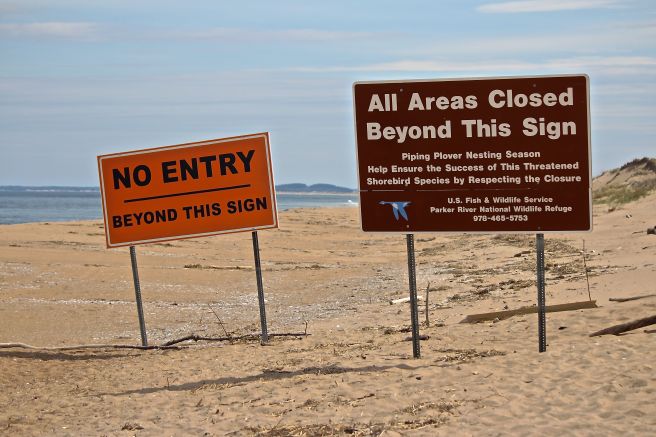
Due to the fact that it’s plover nesting season, we eventually reached a stopping point. According to the refuge’s Web site: “The Atlantic coast population of this small shorebird was listed as threatened on the Federal Endangered Species List in 1986. As with so many other species in decline, plover populations plummeted primarily due to habitat disturbance and loss. Plovers arrive to breed and nest on the refuge beach beginning in late March. Refuge management efforts focus on minimizing human-caused disturbance by restricting public access to the refuge beach during this critical time.”

p-cranberry

As we stood there, we realized that there was a small cranberry bog below. And we found a little sign that listed a couple of interesting facts: 1. the bog’s sphagnum moss sits atop sand. I look at wet or damp sphagnum every day and had no idea it could survive on sand; 2. like a vernal pool, the bog is used as a breeding pool and in this case by a rare and elusive amphibian–the Eastern Spadefoot Toad. I was itching to get down there and explore, but . . .

p-pine

we paused for a few more moments and then followed the board walk back.

p-board 2

Again we stopped and this time we could follow a board walk all the way to the beach. As I walked, I wondered about the crooked mile but came to the conclusion that it follows the lay of the land–or rather dunes we were crossing.

p-signs1

To our right, our movement was restricted. I suspect Rachel Carson would have approved of these signs. In 1947, the U.S. Fish and Wildlife Service published a booklet Ms. Carson wrote about the refuge.

p-beach right

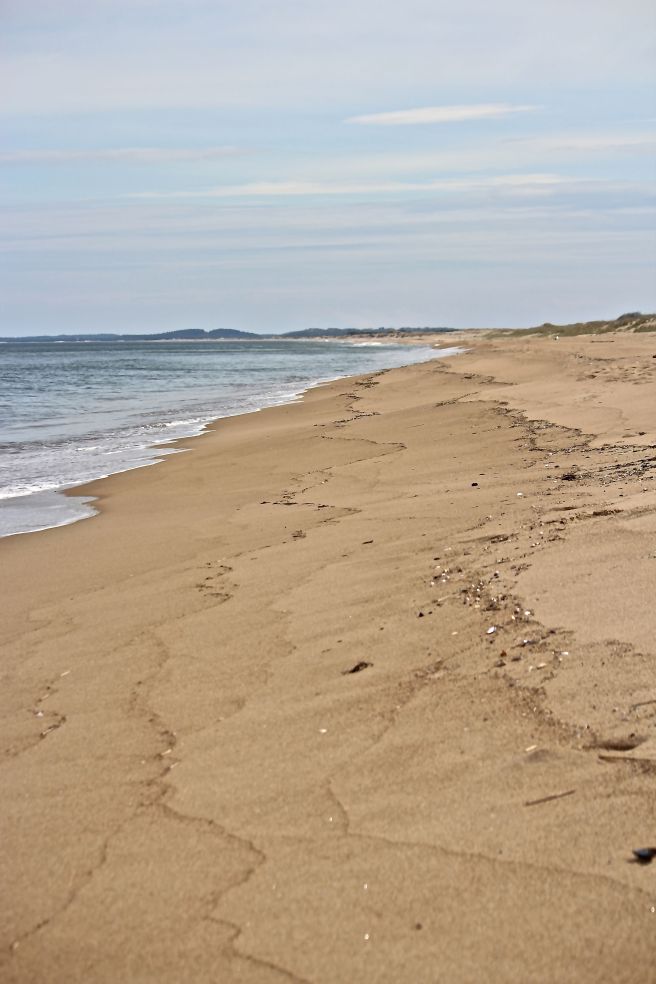
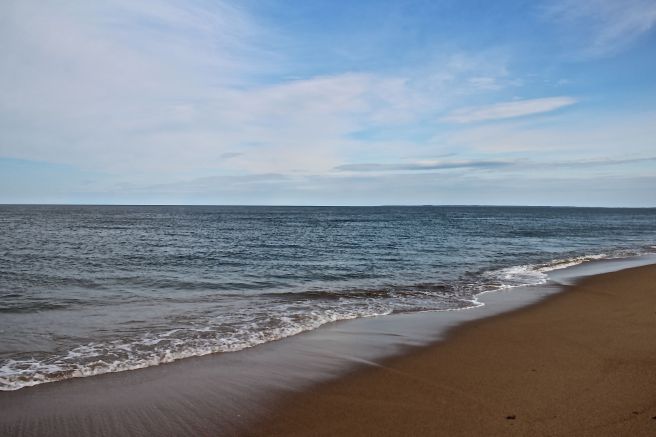
We walked to the water’s edge and looked south. The stretch of beach invited exploration, but we don’t always need to get what we desire.

p-mg2

Nearby, my guy found a piece of drift wood to sit upon.

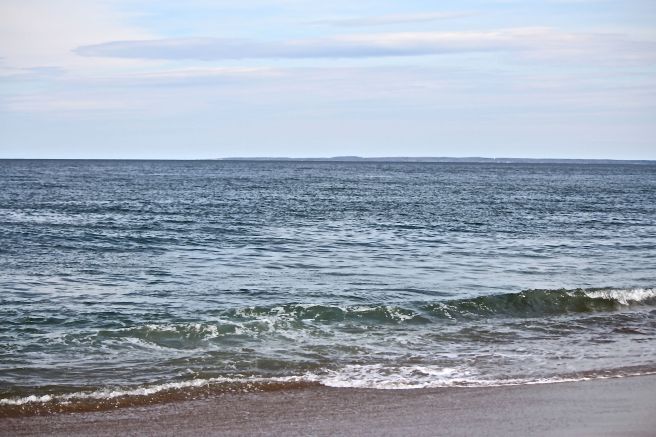
p-ocean1

In no time, he was mesmerized.

p-bird 2

p-bird 1

I needed to follow in the tracks of others.

p-crab1

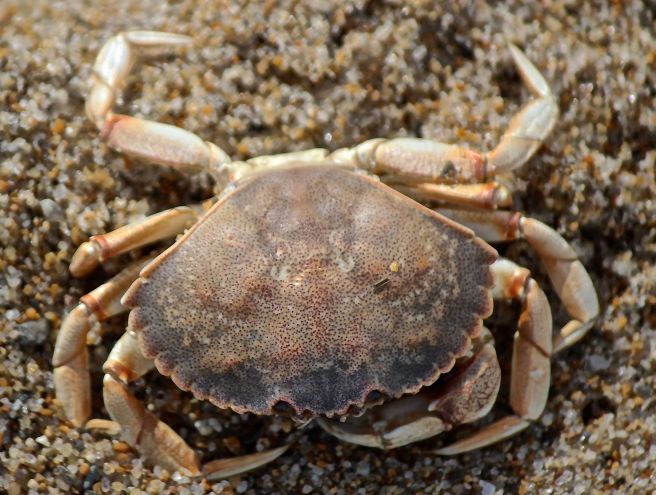
A day beside salt water always evokes memories of my childhood spent exploring the Connecticut coast. How many times did I stick a line attached to a clothespin down into the jetty in Clinton harbor to catch crabs?

p-m & r1

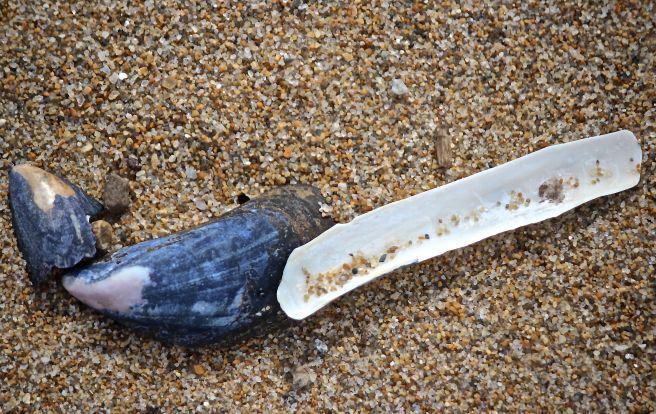
How many mussels did I use as crab bait? How many broken razor clam shells sliced my feet?

p-seaglass

How many pieces of sea glass did I collect?

p-clam1

And how many clam shells became Christmas presents?

p-ocean 3

We couldn’t stay long and know that there is so much more to see and wonder about in this special place. Before leaving, we filled the innermost recesses of our lungs with salt air and then returned to the board walk.

Suffice it to say, for this Mondate, we got our fill of fixes.


Mondate on Mount Will

It’s been a while since we’ve actually had a Mondate. After two days of hiking the trails up Pleasant Mountain, today’s journey found us venturing a wee bit out of the neighborhood as we made our way through Bethel to Mount Will.

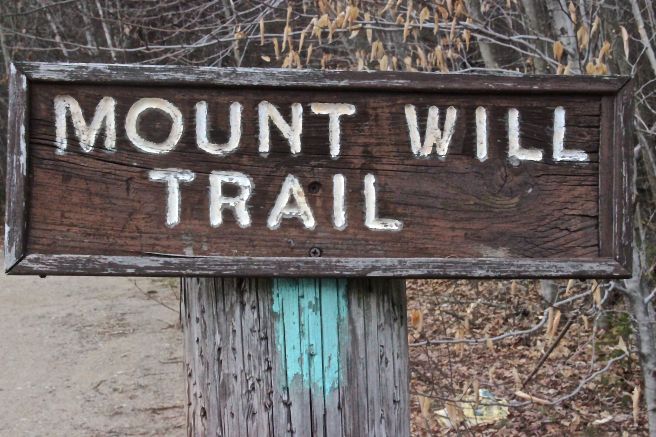
w-mount will sign

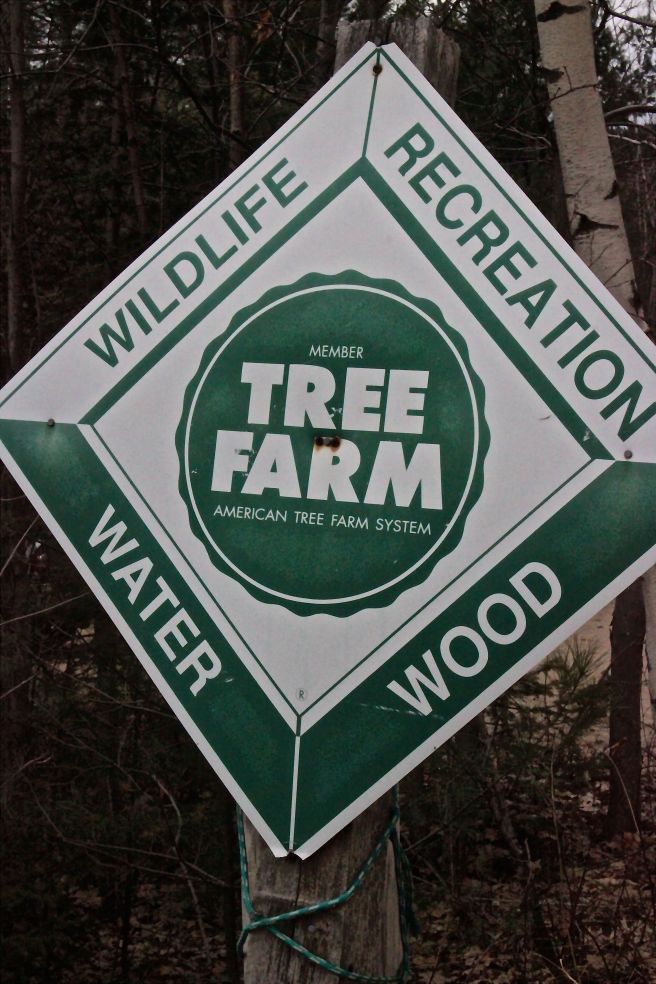
w-tree farm sign

The parking lot is located between these two signs. Part of the Mount Will trail system is within the 115-acre Bethel Town Forest that had served as the Town Farm back in the day.

w-2 trails

The South Cliff trail leaves from the left, while the North Ledges is on the right. This is a loop and we decided on a counterclockwise trek. It had been at least five years since we last hiked here and we’d forgotten about some of the steep sections.

w-n-parklike

Of course, at the start, it seemed almost parklike. Three years ago, several local organizations including Mahoosuc Pathways, the Oxford County Conservation Corps, Outward Bound and the Bethel Conservation Commission rerouted this particular section of the loop.

w-n-switch

Now switchbacks wind their way up toward the North Ledge.

w-bear 8

When I wasn’t looking down, I scanned the woods, ever searching for my favorite species–bear claw trees.

w-bear

And I wasn’t disappointed.

w-bear 7

We saw them over,

w-bear9

and over again. Oh happy day! We found more than these, which leads me to believe that there are even more. Let the search continue!

w-gargoyle 2a

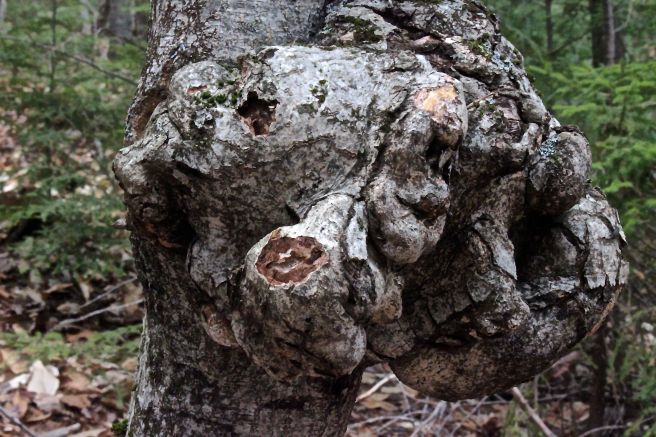
A few trees displayed other surprise packages–burls or warty growths caused by some environmental condition such as injury, virus, fungus, insect infestation or mold. Though this growth can put stress on a tree if it becomes too heavy, generally trees with these features are healthy. And woodworkers covet burls for the unique pattern and beauty found within. That sounds like a comment on the world–we all have hidden treasures, but they aren’t always visible.

w-n-artist conk

Other tree growths include artist’s conk and

w-s-redbelted polypore

red-belted polypores.

w-n-bobcat

The trail passed below rocky outcrops–and my imagination saw bobcats. But, what would they eat? The undergrowth is limited, so I doubted snowshoe hare. That being said, spruce and hemlock cones are many and red squirrels chided us constantly.

w-n-vp

Meanwhile, at a vernal pool just off the trail, all was quiet–and still partially covered in ice.

w-n-lunch rock

Lunch rock was the North Ledge. Below, the Androscoggin River wends its way through the landscape. The Androscoggin has a long history as a life-giving force–beginning with the Abenaki Indians who used it as a water trail and knew the nuances of this 170-mile river.

w-n-carters

The fertile, ancient floodplain has served many a farmer, including the Carters who own the farm across the river below where we sat. While we ate, we shared our memories of cross-country skiing across those fields, beside the river and into the woods.

w-spruce sap

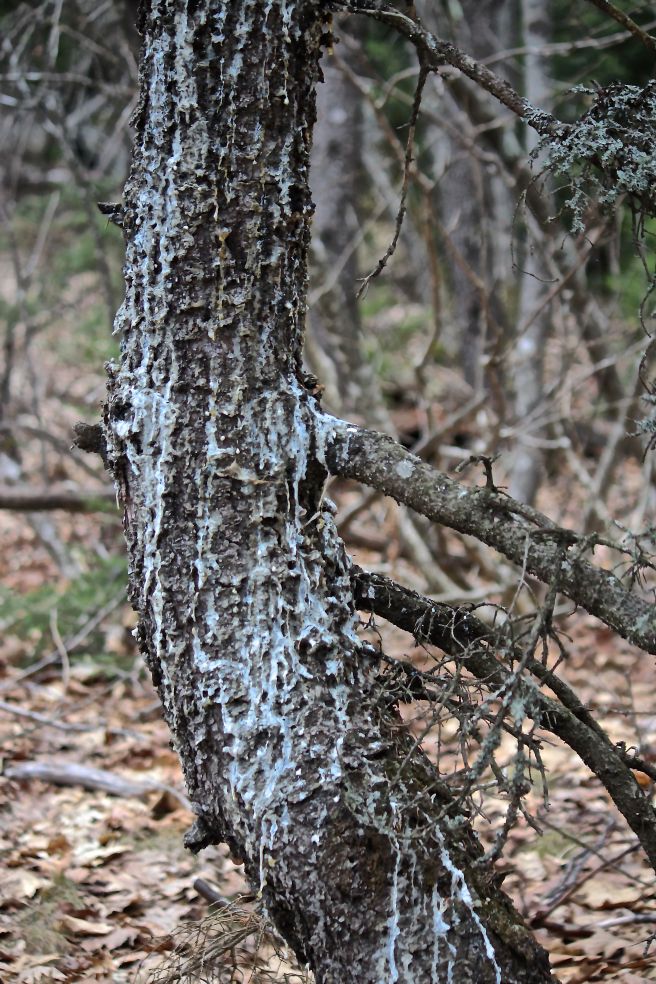
We continued on across the ridge and through the spruce forest where the sap ran blue.

w-s-sunday river

Before turning toward South Cliffs, we caught a glimpse of the trails at Sunday River Ski Area in Newry.

W-gray 1

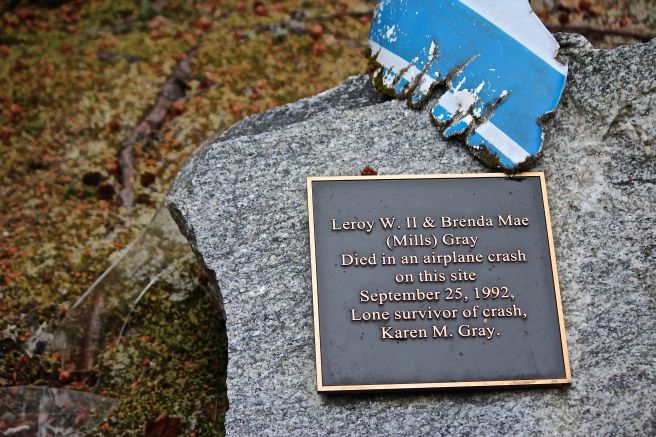
And then we saw a sign that had us wondering. The Gray Memorial? We had no previous memory of it, so we followed the detour and walked along a snowmobile trail for about a quarter of a mile.

w-s-gray memorial

The story is sad. The airplane remnants powerful in suggestion. Upon arriving home, I found an article in the Sun Journal referencing the event. Leroy was a state trooper and his wife, Brenda, an executive secretary who became head dispatcher for the Bar Harbor Police Department. With their 14-year-old daughter, Karen, they were flying their Cherokee Piper to Bethel to spend time with relatives when the plane “crashed nose first” into Mount Will about 7:30pm. Despite her own injuries, Karen hiked down the steep mountainside to seek help. A somber site indeed.

w-s-cliff view

We backtracked to the trail and continued on to the South Cliffs, where our view again showed the river, with Route 2 following beside and both leading to Bethel village.

w-s-mtn goats

Moving off the cliff, we were sure mountain goats had laid out the trail.

w-s-ledges

Again, we were in bobcat territory, frequented by chatty red squirrels who seemed to feel quite safe as they scrambled from tree to tree.

w-oz

And then we moved into the land where the monkeys in the Wizard of Oz jumped out upon Dorothy and her friends. My guy started humming the music from his favorite movie. The reality is that these trees knew the wrath of previous storms.

w-s-heading down

Once again the trail turned S curves as we continued downward and

w-s-brook

listened to water trickling over the mossy stream bed beside us.

w-s-logging

And then we found ourselves in the midst of a recent logging operation–remember, this is a working forest. Slash galore decorated the landscape, but we suspect that all of this will be chipped eventually. One thing we happily noted–bird song. Lots of bird song at this spot.

w-s-weather1

We were almost to the bottom of the trail when an anomaly grabbed our attention and forced us to investigate.

w-s-weather 1

w-s-weather tape

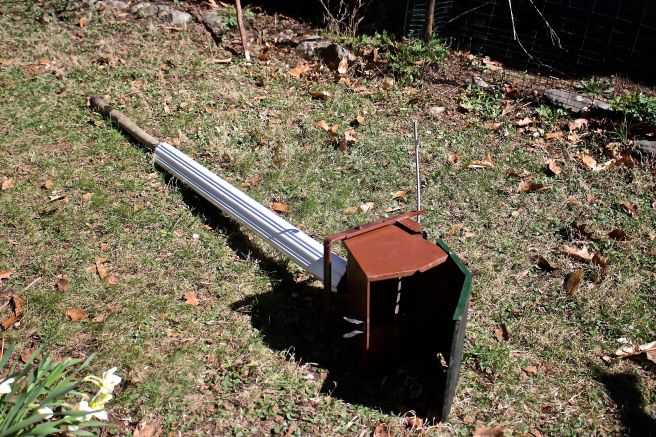
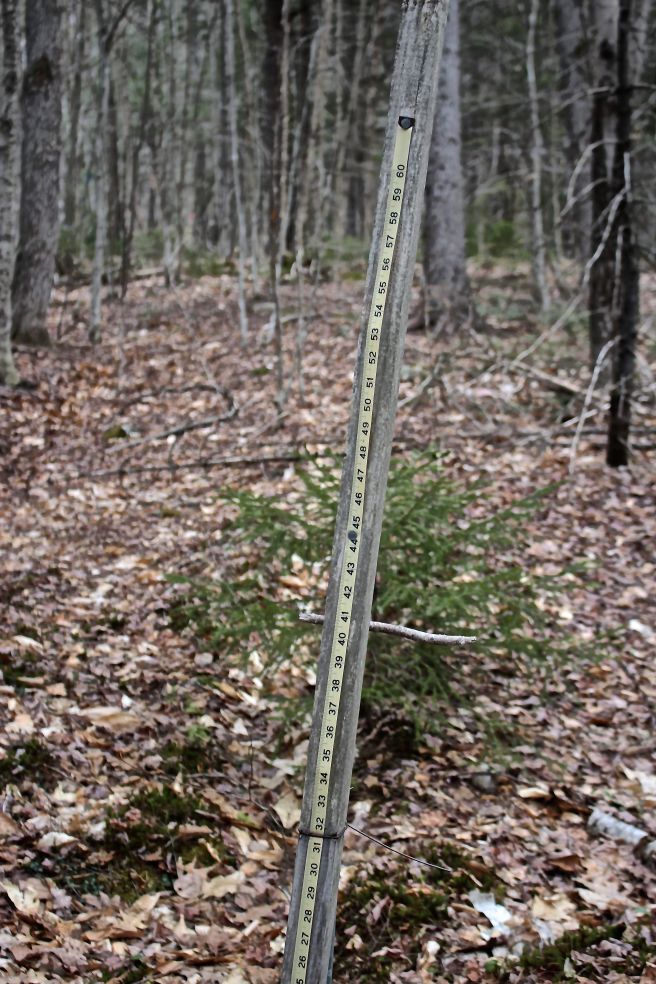
We’d stumbled upon a winter weather station. We only knew that because “winter weather station” was printed in faded paint across the box. So, we get the tape measure for snow depth, but the box? And the hole covered with mesh? Worth a wonder, so we did.

w-s-weather cocoon

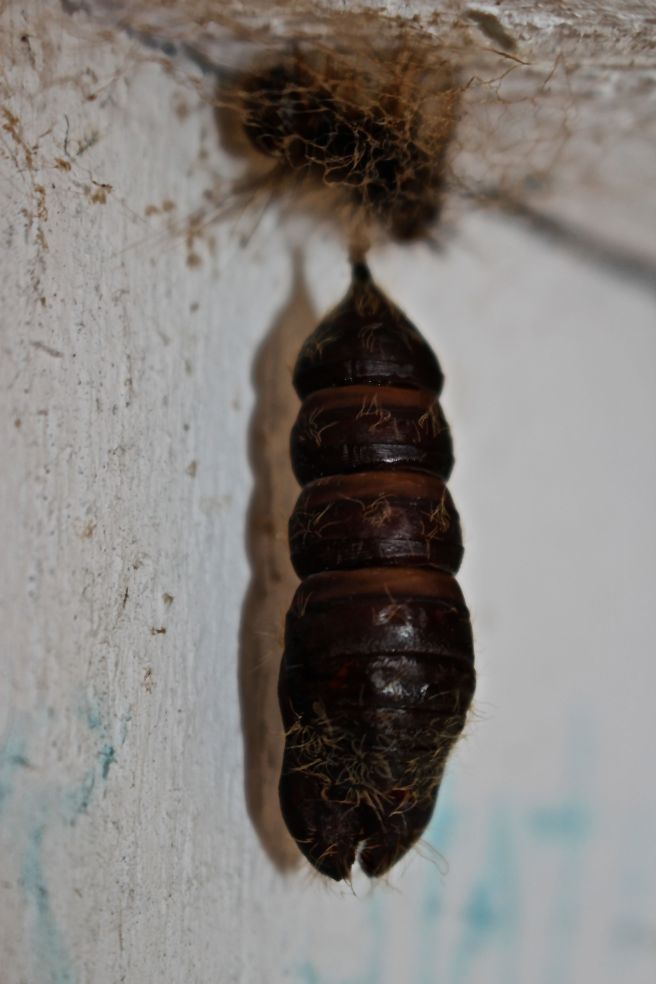
Apparently, a moth appreciated the efforts of the citizen scientists who created this shelter. Our hike was over, but this chrysalis holds the future.

w-covered 2

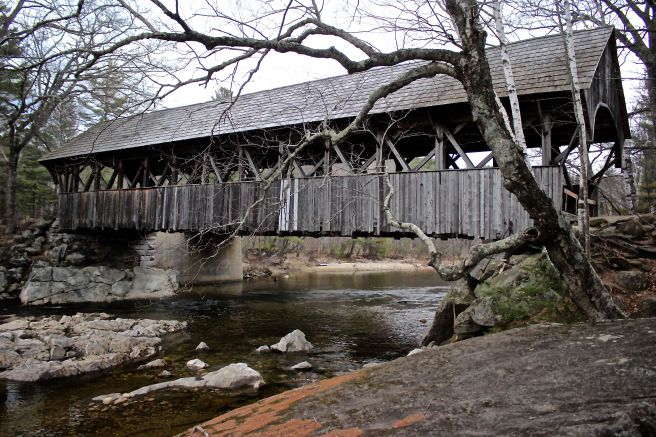
We decided to complete our Mount Will Mondate with a visit to Artist’s Bridge over Sunday River–the perfect culmination of our love for nature and history.


Learning from the Master

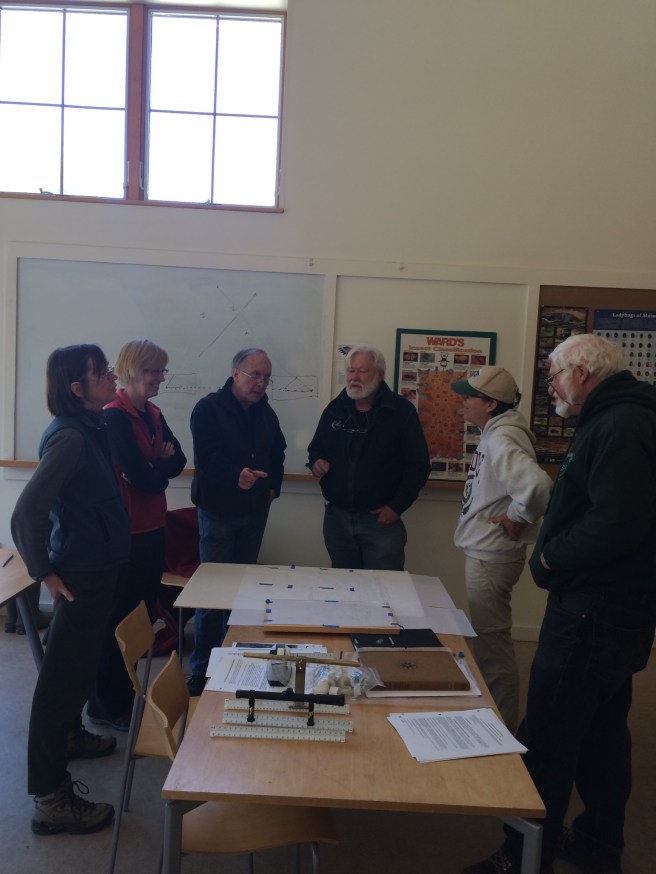
Through the Maine Master Naturalist Program I’ve become acquainted with the most fabulous people from across the state. And today I had the pleasure of sharing time with a few of them as we participated in a seminar entitled “Down to Earth: Elementary Mapping and Surveying for the Naturalist.”

Our instructor was the one and only Fred Cichocki, MMNP Science Advisor and one of the MMNP founders. In less than five minutes of being in Fred’s presence, one realizes he/she will come away with a variety of ways to create tools of the trade AND more knowledge than anyone can possibly retain.

Today’s mission: learning to map the land on a small scale–in this case by using a planetable survey method.

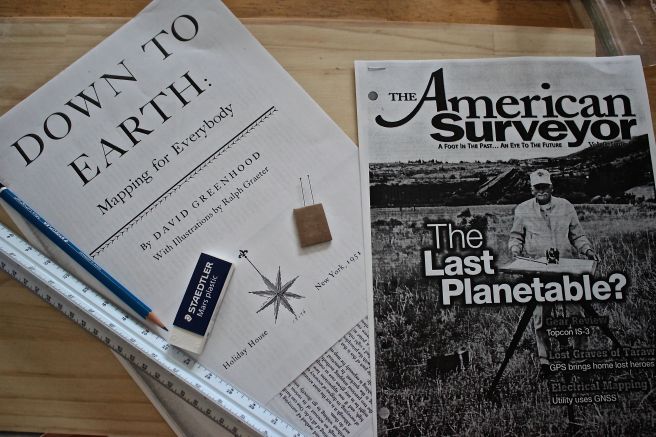
c-tools of the trade

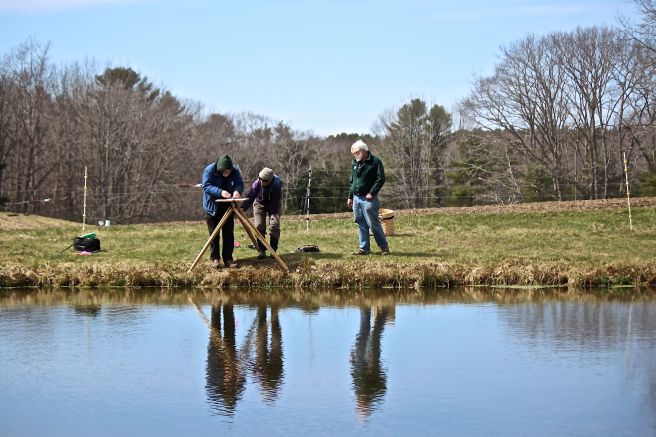
After an indoor introduction to the idea of simple map making, Fred gave us some literature and supplies.

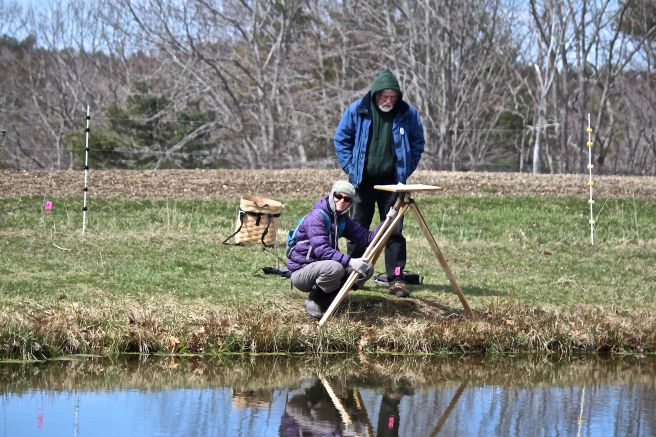
c-threaded socket

We all felt official when we received our own drawing boards with a threaded socket on the back side so we could attach them to a camera tripod.

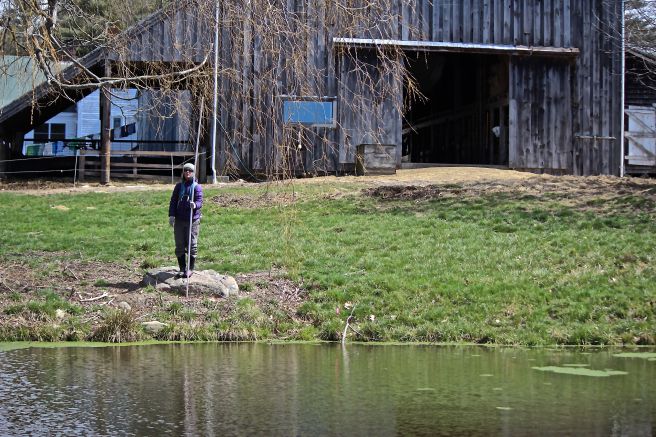
c-pond1

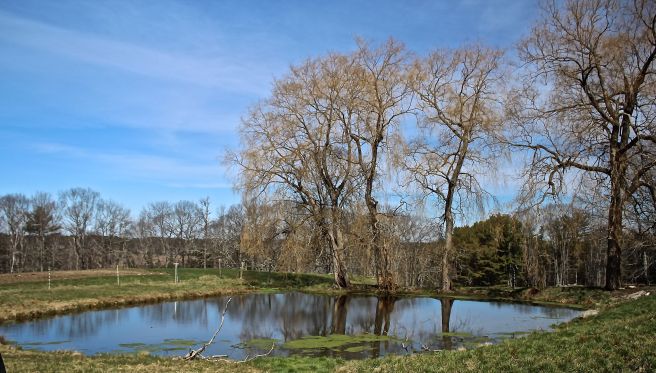
With gear in hand, we walked to the farm pond at Chewonki.

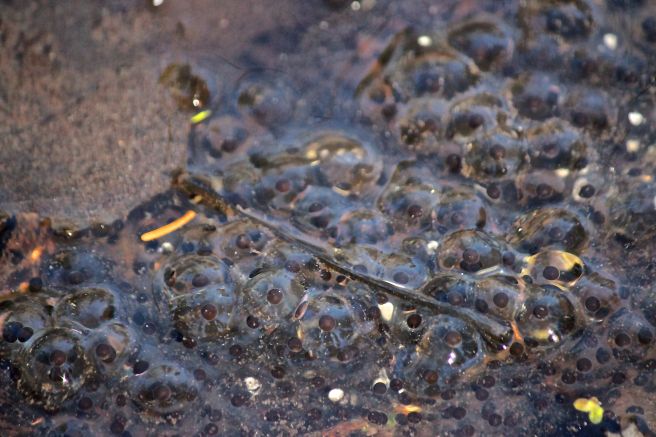
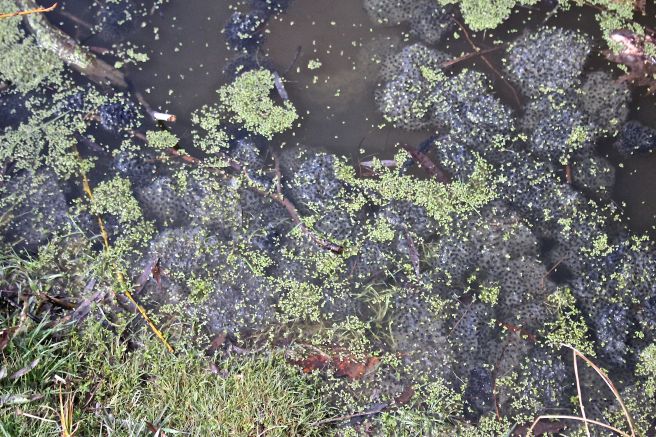
c-woodfrog eggs1

Of course, we were instantly distracted.

c-wood 3

Wood frog egg masses begged for our attention.

c-spotted eggs

Spotted salamander masses also warranted a notice.

c-duck 2

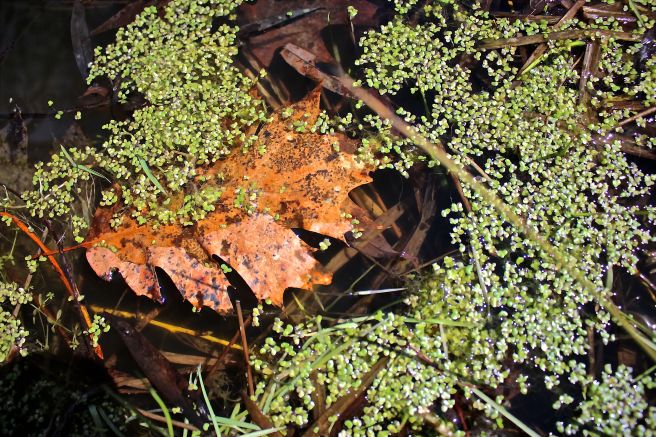
And I learned about something else–duckweed. This tiny aquatic plant floats on or just beneath the surface. When I first saw it, I thought it was some sort of feed that had flowed into the water after the recent rain events.

c-duck weed and egg masses

It seemed invasive, but did create a rather pretty mosaic mixed in with the egg masses.

c-gordon pole

Before we started our mapping task, as a group we walked around the pond and decided where to place pin flags–to indicate a change in the shoreline or a key feature such as a rock or tree. Each flag was marked with a number.

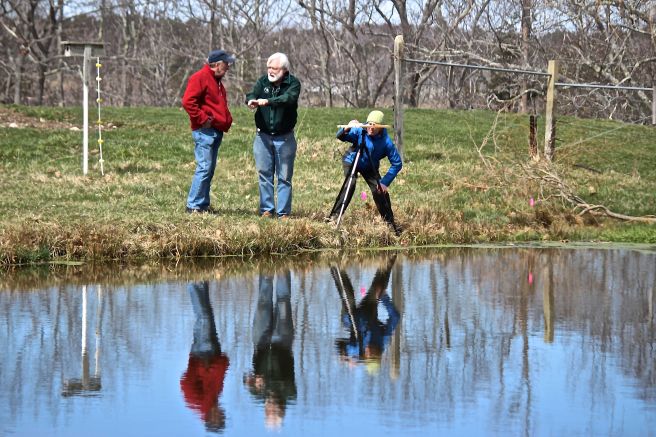
c-denise, rod

Then we split into two teams and took turns with the various tasks, including holding the range pole by each pin flag.

c-adjusting the tripod

Meanwhile, across the pond we set our drawing boards on tripods and spent some time adjusting them to be level. We also measured out our first two points–A to B.

c-Cathie casting an eye

With Fred’s guidance, we used our triangular engineering rulers as alidades–straight-edged sighting devices, and a straight pin as a turn point.

c-dick drawing lines

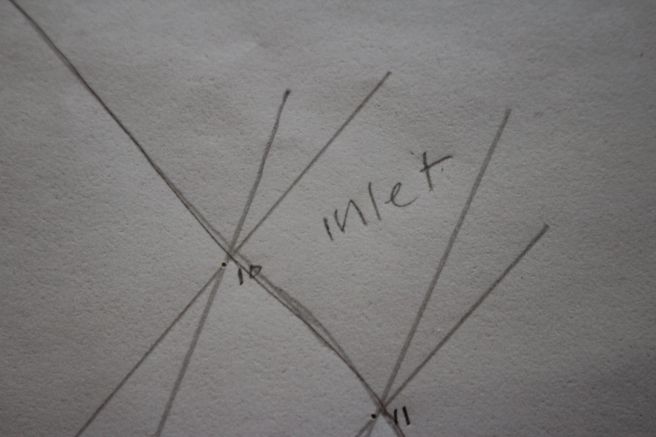
Once we had the range pole in sight, we drew lines on our map sheets.

c-point a to b

From Point A and Point B, two spots we’d all agreed from the start marked a straight edge on the pond, we took sight of each pin flag, drew the related line, and labeled it.

c-thistle weed

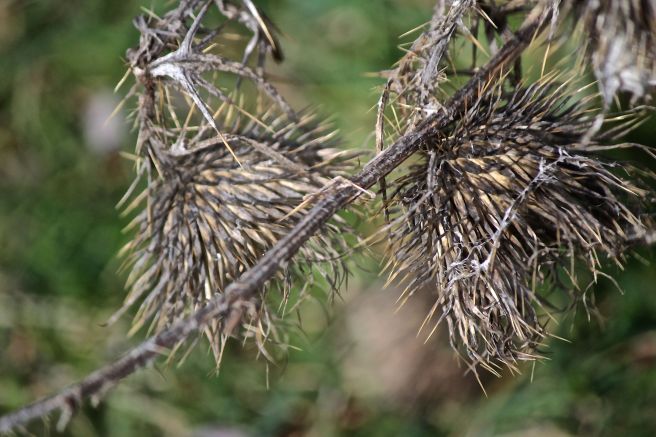
Before we went in to do some more work, a few things caught our eyes–our NDD (Nature Distraction Disorder) was acting up again with the sight of these thistles displaying their winter form.

c-thistle leaves

Nearby, the prickly-leafed rosettes speak to the plant’s future.

c-bald eagles

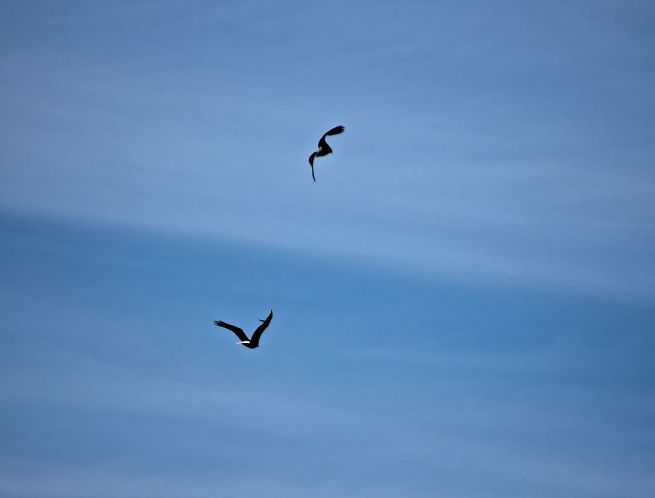
And overhead, two bald eagles played in the wind.

c-points intersect

Back inside, we followed the two sets of lines out and noted their intersection.

c-points 2

Then we connected the intersections with a line that indicated the perimeter of the pond–in theory. Um, in reality, my team was admittedly off. Our beginning scale was longer than it should have been and our table not always level so the pond’s shape was not quite accurate. But just the same, the process had us all jazzed to try again.

the process

We learned from each other and considered future tweaks. (Thanks to Denise for the photo)

c-smiles 2

At the end of the day, we were all smiles because we’d spent time learning from the master. Thank you, Fred.


Book of the Month: TREES and SHRUBS of NORTHERN NEW ENGLAND

Sometimes the biggest gems arrive in the smallest packages. Such is the case with this month’s book–and this isn’t an April Fools’ Day joke, though I did briefly consider posting an upside-down photo of the cover.

t-book

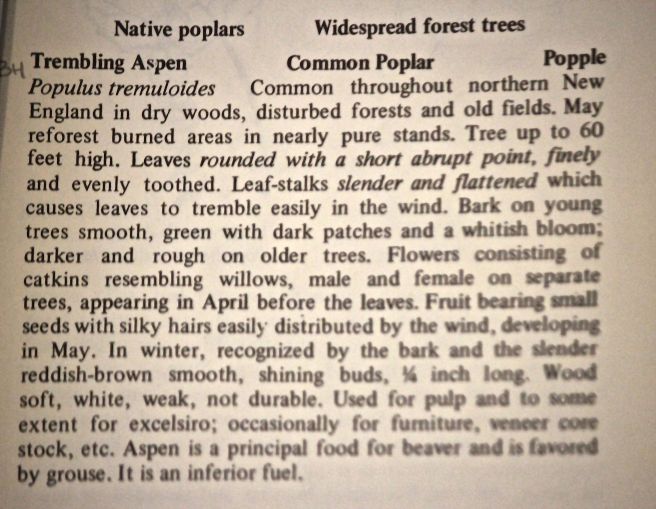
I picked up this copy of  TREES and SHRUBS of NORTHERN NEW ENGLAND at a book swap during the Maine Master Naturalist Program’s first conference this past year. This third edition was compiled by Frederic L. Steele, Chairman of the Science Department, St. Mary’s-in-the-Mountains, Littleton, NH, and Albion R. Hodgdon, Professor of Botany, University of New Hampshire, Durham, NH, and published in 1975 by the Society for the Protection of New Hampshire Forests.

One of the things I like about it is that it measures 4.5 x 7 inches and fits easily into my pack. Plus, it includes more shrubs than many of my current books.

t-leaves

And check this out from the introduction: “In the preparation of this guide, the authors have received help and encouragement from a number of people. The following, in particular, should be mentioned . . . Mrs. Priscilla Kunhardt and Miss Pamela Bruns have done the illustrations . . . ” Mrs. and Miss! Ah, what happened to those days?

t-quaking description

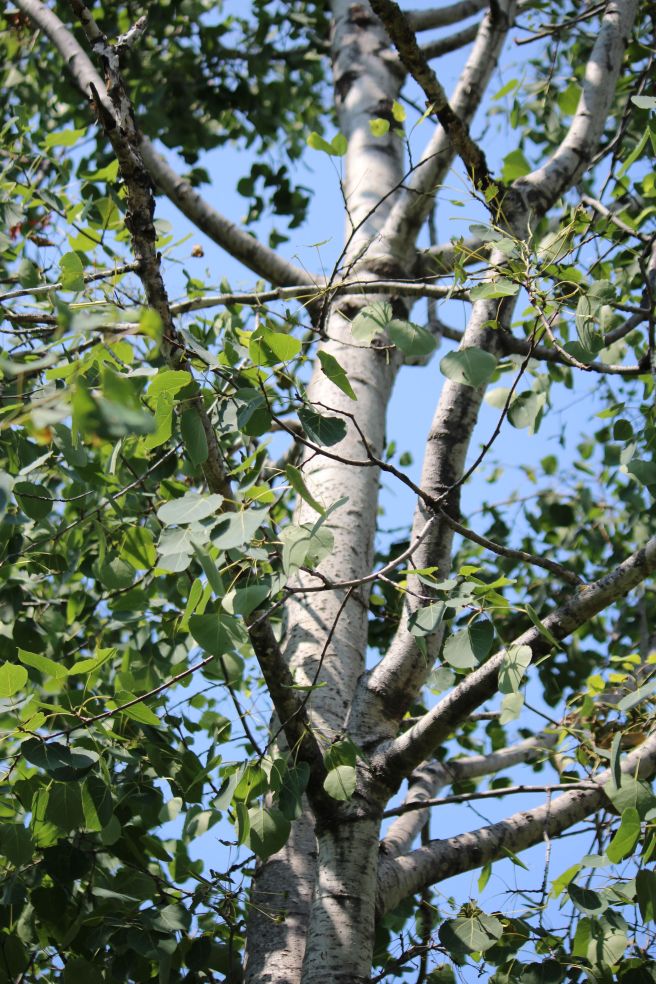
The descriptions are not lengthy, but enough for a quick reference. I choose the Trembling Aspen, which I’ve learned as Quaking Aspen (I know–that’s the problem with common names say my Latin-oriented friends) because two are located right out the back door. They are the trees of life in our yard.

t-catkins forming

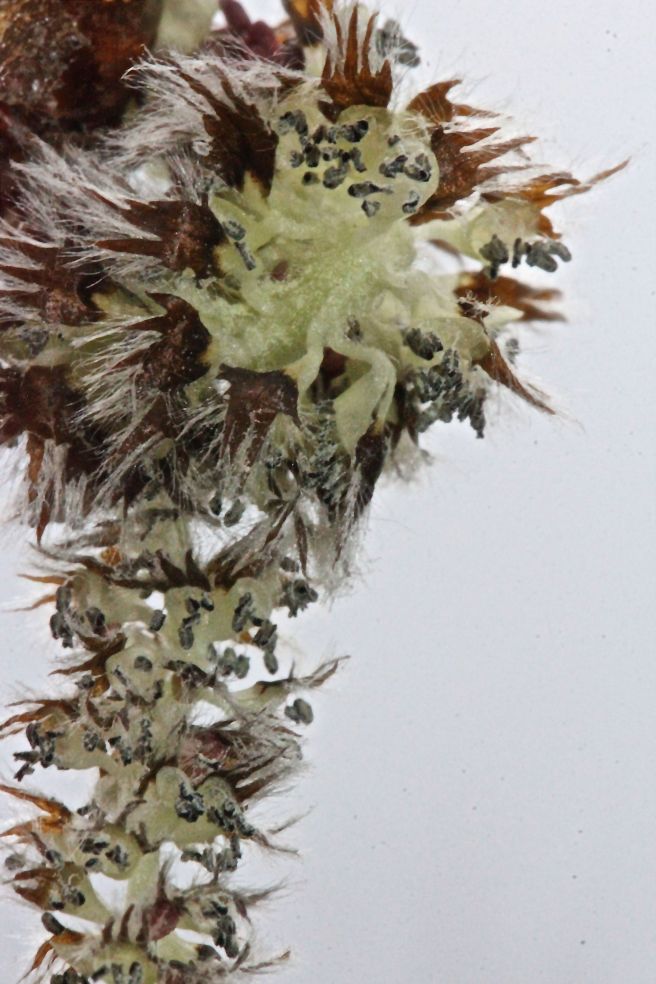
Catkins slowly emerge from waxy-coated buds

qa 1

and grow longer with lengthening days.

qa 5

Tufts of hair adorn tiny seeds.

T-summer

Soon, leaves on flat stems quake in the breeze,

t-caterpillars

until visitors arrive.

t-leaf eaters

Very hungry caterpillars.

t-porky

They aren’t the only ones. Porcupines nip off branches.

t-leaf

Eventually, leaves that survive fall to the ground.

t-hairy woodpeckers

All year long, birds visit to dine

t-cardinal

and view the world.

t-cat

The world looks back.

t-ice

Ice slowly melts

qa 2

and life continues.

TREES and SHRUBS of NORTHERN NEW ENGLAND doesn’t include photos, but that’s OK because I have my own. Instead, as any good guide, it’s a jumping off place. So many books, so much different information–and sometimes guides contradict each other. Just the same, I love to read them and then to pay attention. For me, it’s all about forever learning. And wondering.

TREES and SHRUBS of NORTHERN NEW ENGLAND, by Frederic L. Steel and Albion R. Hodgdon, Society for the Protection on Northern Forests, 1975.

Wet Feet at Brownfield Bog

When I suggested to Marita that we explore Brownfield Bog this afternoon, she wondered  how much water we might encounter on the road. And so we wore boots. Marita donned her Boggs, while I sported my waterproof hiking boots.

b-johnny jump up

Until we got there, we didn’t realize that the privately-owned road leading into the bog isn’t open yet, but thought we’d park at a driveway near the beginning and leave a note. The owner came along, whom she knew, and graciously invited us to park  near his home and cross through his woods down to the bog road. He and his wife share a piece of heaven and I took only one cheery photo to remind me of their beautiful spot and kind hospitality.

b-river road literally

And then on to the bog it was. Just after the gate, we realized that we couldn’t walk to the Saco River–literally a river road.

b-bog 1

But this is a bog, where all forms of life enjoy wet feet.

b-willow 2

From pussy willows to . . .

b-speckled alder 1

speckled alders,

b-cranberry

cranberries,

b-red maple 2

and flowering red maples–wet feet are happy feet and they all thrive in seasonally flooded places.

b-ducks 1

We kept scaring the ducks off, but know that there were wood ducks among the mix. They, of course, know the importance of wet and webbed feet.

b-lodge 2

b-beaver tree

b-beaver scent mound

And by their lodges, tree works and scent mounds, we knew the beavers had been active–another wet-footed species. We did wonder about the survival rate of those that built beside the road–seems like risky business given the predators that travel this way.

b-pellet

Speaking of predators, check out the orange rodent teeth among all the bones in this owl pellet.

b-bog 2

On this robin’s egg kind of day

b-pleasant mtn

with Pleasant Mountain sandwiched between layers of blue,

b-field 1

the breeze brisk at times and the sun warm always,

b-water over road on way back

the flow of water didn’t stop us.

b-wet feet

Waterproof boots and wool socks–the perfect combination to avoid wet feet. Well, maybe a wee bit damp, but five hours later and I just took my socks off.


Sharing Our Mondate

My guy and I spent this morning roaming about the woods in Lovell with several friends who are docents for the Greater Lovell Land Trust. We had been invited to explore a 20-acre property and the owners, Barb and Bruce, were in hopes that we’d discover interesting things.

As it turned out we explored much more than their property because we got a bit mixed up with boundary lines, and came away with some questions to ponder about the lay of the land as well as a scavenger hunt for their grandchildren to conquer.

b-red pines

Before we headed off into the woods, Barb wanted us to see a neighbor’s off-the-grid tiny cabin. To get there, we passed through a red pine grove that immediately put me into question mode. Why a grove here? Who planted them? When? I know that the Civilian Conservation Corp did this sort of thing in the 1930s and had been in the area–Stoneham and Bridgton, Maine, as well as Chatham, New Hampshire. But my research didn’t indicate that they’d done any projects in Lovell.

What I did learn, however, is that the farmer who once owned this hilly land may have received a subsidy to plant the trees in order to control soil erosion and turn them into a cash crop. An article in Northern Woodlands states the following: “The government further subsidized red pine seedlings throughout the twentieth century as a way of providing hill farmers with a future cash crop that would grow on otherwise played-out soil. Red pine seemed the perfect candidate for this, as it’s fast growing and susceptible to fewer serious enemies than most pine species. (White pine can be bedeviled by white pine weevil and white pine blister rust – neither of which affect red pine.)

From their size and close proximity to each other, its apparent that the “cash crop” never paid off. Instead, Barb and her husband have a stately cathedral overlooking the mountains and a quiet passageway to visit their neighbor.

We returned from our quick house tour and followed a double-wide stone wall to an opening. Again, we questioned the wall’s purpose. A way to get rid of stones? Did they use the bottom portion of the land below the wall for agriculture and let cows or sheep roam above? We didn’t come up with the answers, but continued on.

b-rock tripe colony

It was time for us to find some treasures that the grandkids can seek. Rock tripe is first on the list.

b-rock tripe

It’s gray-brown upper surface turns dark green when moist–so be sure to bring along some water to pour on this lichen. Then watch the transformation.

Though edible in a last ditch effort by someone who doesn’t mind chewing and chewing and chewing some more, rock tripe is neither delicious nor nutritious. Some Native peoples used it as a soup thickener and others as a last resort tidbit. If you soak it for a while it will soften up.

b-vernal pool

The temperature was cooler this morning than the last few so a skim of ice covered the surface of this vernal pool. I’m not sure how long it will last, but if it’s still there, dip a pail in and look at the assortment of species that swim about. Maybe you’ll even see some frog or salamander egg masses if you visit in the spring.

b-Indian pipe

Here and there we found the pods of Indian pipes. In the summer, look for their ghostly white form–they look like their name, with the flower part hanging down. If it’s turned upright like this one, it has been fertilized.

b-puff balls

Though long since spent, puff balls are another fun find. Poke them and watch the spores float out like smoke from a chimney.

b-wood chips

The pileated woodpeckers love this mixed hardwood forest, so you might find evidence of their work on the floor. And then look up into the tree to locate the cavity they’ve excavated.

b-bird nest 1

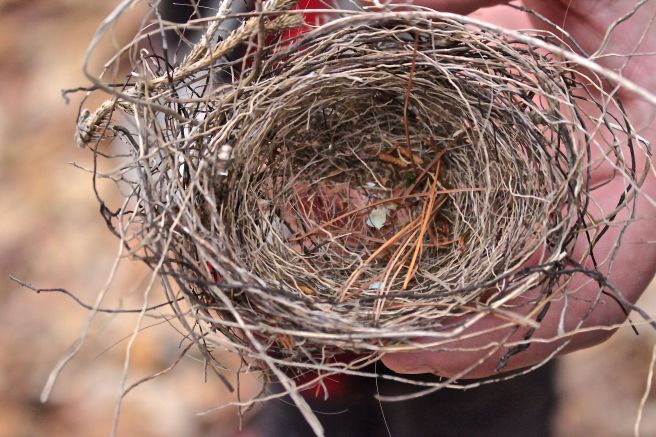
We found several bird nests, including this one made of grasses and wiry stems.  A fraction of a blue egg shell sits inside.

b-nest 2, downy feather

Wait until late winter/early spring to search for these, when the wind has blown them to the ground. But leave them be. According to the Migratory Bird Treaty Act of 1918, “It is  illegal to collect or have in your possession live native birds (adults or young), bird feathers, nests or eggs, to try to incubate wild bird eggs, to keep nests or eggs even for “show and tell” educational purposes, or to have road-killed birds in your possession without a permit.” Do you know why? Do some research to find the answer.

b-mock orange

There’s a variety of fungi growing on the trees right now, and come summer, you’ll find more on the ground. We had our favorite mushroom guru with us, who helped us ID this species as mock oyster.

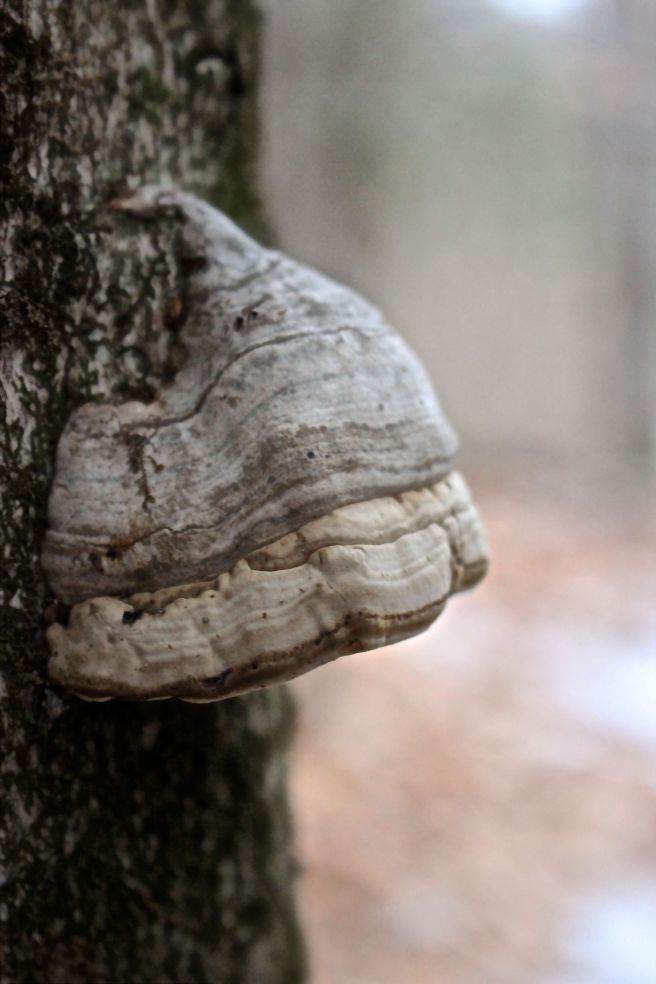
b-tinder conk

Tinder polypore is one of my favorites because it looks like a horse’s hoof. Another research project for you–why did the Ice Man carry a sample of this?

b-nurse log

There are numerous nurse logs, but this one struck me as especially beautiful. Mosses and liverworts grow abundantly along its upper surface and provide a place for all kinds of action to happen. Look for small saplings taking hold. Can you find the shelled remains of an acorn or the scales of a hemlock cone? Who do you think left those? Any small, twisted scat?

b-owl pellet

Or how about something that looks like this–lots of hair and bones matted together? This is an owl pellet and with the help of your adults, you can actually pull the bones out and reconstruct the skeleton(s) of the prey–be it vole or shrew or even red squirrel. Sometimes the pellets contain the skeletons of more than one critter.

b-beech growing through paper birch bark

I would love to learn that you found this–a young beech tree growing through paper birch bark. Which came first? And why?

b-barbed3

Another sight for you, and one to certainly watch out for–barbed wire. We found it all along the back boundary, where it grows through the trees. This is rough country and there are no stone walls. The wire probably dates to the 1880s or later. Be careful.

b-dip between eskers?

The land had us wondering about esker ridges as it dipped and rose. We’ll try to ask those who know more about local geology to help us gain a better understanding.

b-gps 2

We realized we’d zigged where we should have zagged, but didn’t care because we share a passion for the exploration.

b-garden wall

As we headed down, we stumbled across another garden wall and

b-stone pile.jpg

small rock piles like this one. My first thought–a well. That was until we found several others. Maybe just rock piles.

b-shinleaf, pyrola eliptica

Our final find as we stepped through a wetland making our way from a neighbor’s property to the road–the winter look of shinleaf (Pyrola elliptic).

I’d promised everyone a two hour tour, but those who know me best know better. Three hours later we knocked on the door to thank Barb and Bruce for the opportunity–for sharing their land with us and giving us the opportunity to share our Mondate with others.


Treasure Trove

I know. It’s Monday. And we should be celebrating with a Mondate, but my guy got involved with a project and so it was that I went on a solo expedition–ever in search of nature’s treasures.

s-snow 1

A fresh coating of snow decorated the world.

s-vp

A quick stop at the vernal pool and I mentally noted the changes of the past two weeks from slush to ice to snow. According to temperature predictions for the middle of this week, I’ve a feeling it will cycle back to slush mighty soon.

s-2nd vp

A visit to a second vernal pool shows the transition all in one. With this one, however, I couldn’t help but think about how low the water level is and what this winter’s lack of snow will mean to the land, the critters and us. That being said, I hope it doesn’t rain all summer.

s-willow

Someone asked me the other day if I go out with a topic in mind. Hardly ever, but today I did go in search of hairy things like this willow twig adorned with buds. Plant hairs, I’ve recently learned, are called trichomes. And what purpose do they serve? Well, for starters, they aid the plant in the absorption of water and minerals. But they do more, like reflecting radiation, lowering temperature when it’s hot and keeping the plant warm when it’s cold outside. Though they also provide defense against insects, I have to wonder if some insects find them to be an invitation.

s-bulrush 1

It’s a very hairy world out there.

s-interrupted

Indeed.

s-paper birch twig1

Not all hair is created equal. It ranges from short and fine to  . . .

s-blackberry

rather stiff and irritating.

s-beech 1

It can be so fine, that you hardly notice it, like the hair on the beech leaf’s petiole or stem. While it’s not so evident on the bud scales, in about two months as new beech leaves unfold, pay attention. They are incredibly hairy. But, over the course of the summer continue to watch, because it seems to me that the insects are not deterred by the hairiness–beech leaves take a beating.

s-witch hazel bracts

Another purveyor of fine hair–the witch hazel flower bracts showing off their fuzzy edges and tips (and subtle colors).

s-witch hazel leaf fuzzy

And don’t forget to notice their leaves–still attached to many trees. The wavy rim and salmony bronze color catches my eye.

s-witch hazel leaf fuzz

But today, I realized that along the veins on the back side and that wavy edge, teeny, tiny hairs are almost invisible.

s-sweetfern1

Sweetfern is not to be ignored.

s-aster 1

The asters and goldenrods feature another type of hair–used as a parachute to disperse new life far and wide.

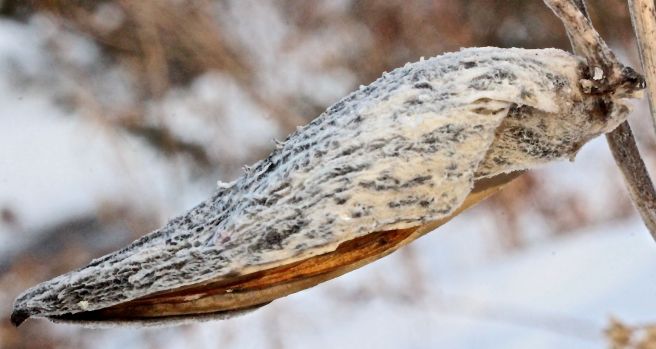
s-milkweed pod

Sometimes, the hair is hidden inside, to be sent off when the time is right. In the end, just a woody pod remains.

s-british soldier 1

But . . . being me, it wasn’t just hair that was transfixing. The color and texture of British soldiers enhanced by the melting snow were a sight worth beholding.

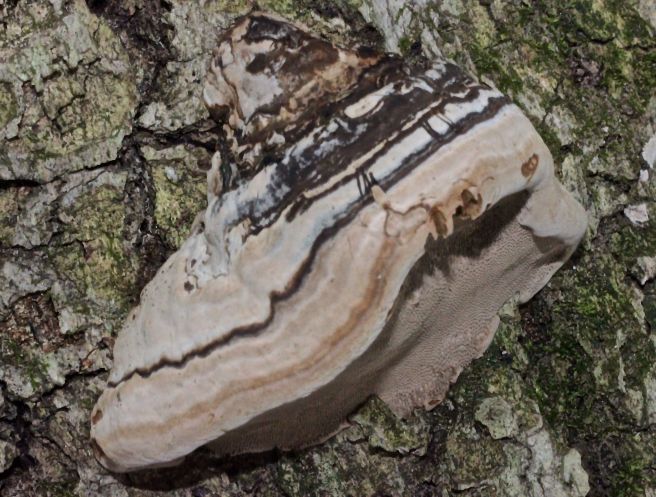
s-conk1

And there was what I think is a false tinder conk growing on a hemlock. I couldn’t help but imagine an ice cream sundae, complete with hot fudge sauce. And check out the pattern of the pore surface on the underside.

s-nest

I revisited some old friends, including this bald-faced hornet nest. There’s not much left of it now, but still it exudes beauty.

s-striped maple buds, winged bug

And finally the seeds of a striped maple that cling still. With a bit of imagination, you might see a winged insect in this arrangement.

As I stood near an opening in the woodland, three crows squawked continuously. I paused and watched as they circled about, moved off and returned. My telephoto lens was ready to capture the subject of their discontent. About five minutes later, they were joined by two others, and then two others and eventually a murder of at least a dozen crows. The group circled one more time and then headed off, I know not where. But that was my turning around point–perhaps they were regrouping and heading home for the day. I needed to do the same. My guy had said he’d send the troops out looking for me if I didn’t return in two hours. Then we both chuckled because we knew that was an impossibility.

Three hours later, I arrived home filled with a treasure trove of finds.


Leaping Mondate

My guy happens to be Irish so it seemed only appropriate that I propose to him today following the example that St. Brigid set when she struck a deal with St. Patrick. Yes, we’ve been married for 25+ years, but I proposed anyway.

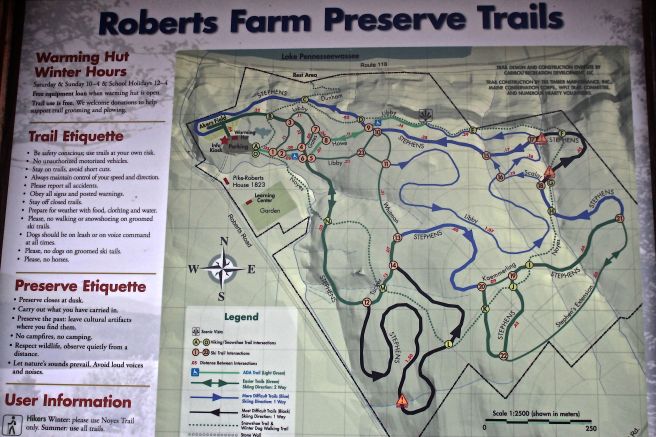
And he accepted. So today’s Mondate found us at Roberts Farm Preserve in Norway. Norway, Maine, that is.

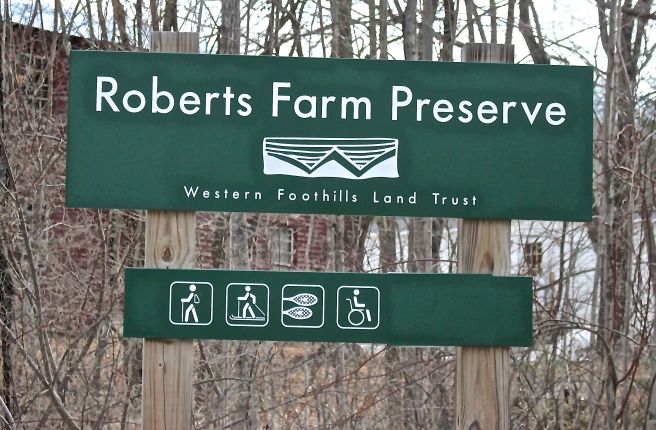
R-sign

In her book, Hikes and Woodland Walks in and around Maine’s LAKES REGION, my friend Marita Wiser states that the preserve was “farmed by the Pike and Roberts family for 200 years.” She adds, “The property was purchased by the Western Foothills Land Trust in 2007.”

r-parking

Though the trails are mostly maintained for Nordic skiers, we didn’t see any today.

r-trail map

Had it been open to skiers, we wouldn’t have been able to do what we did–follow the network of trails around the perimeter of the property.

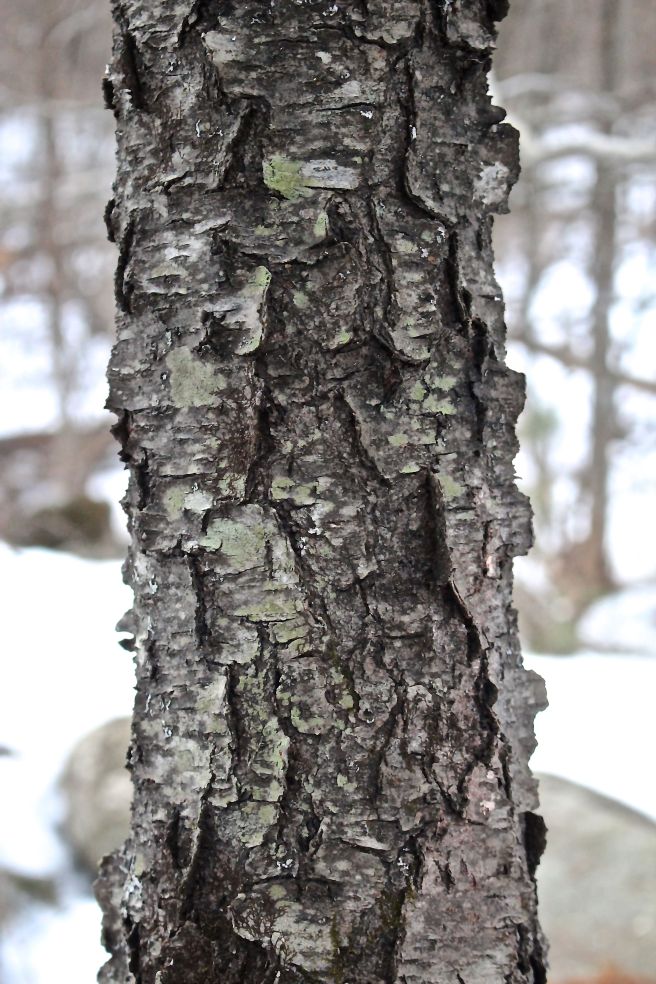
r-cherry bark

We’d only walked a few feet when I had to pause–the burnt cornflake look of black cherry bark insisted upon being noticed.

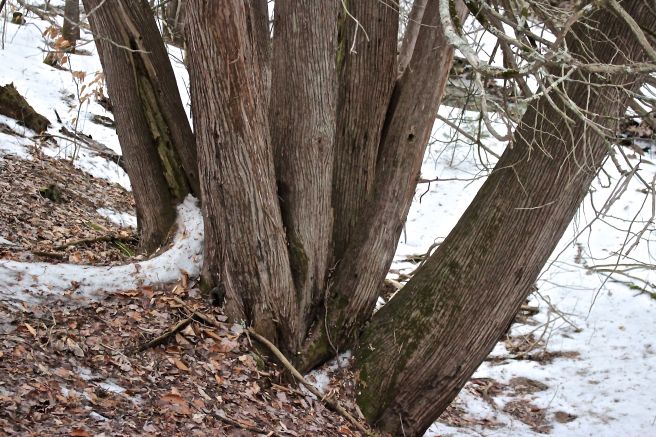
R-Northern White Cedar

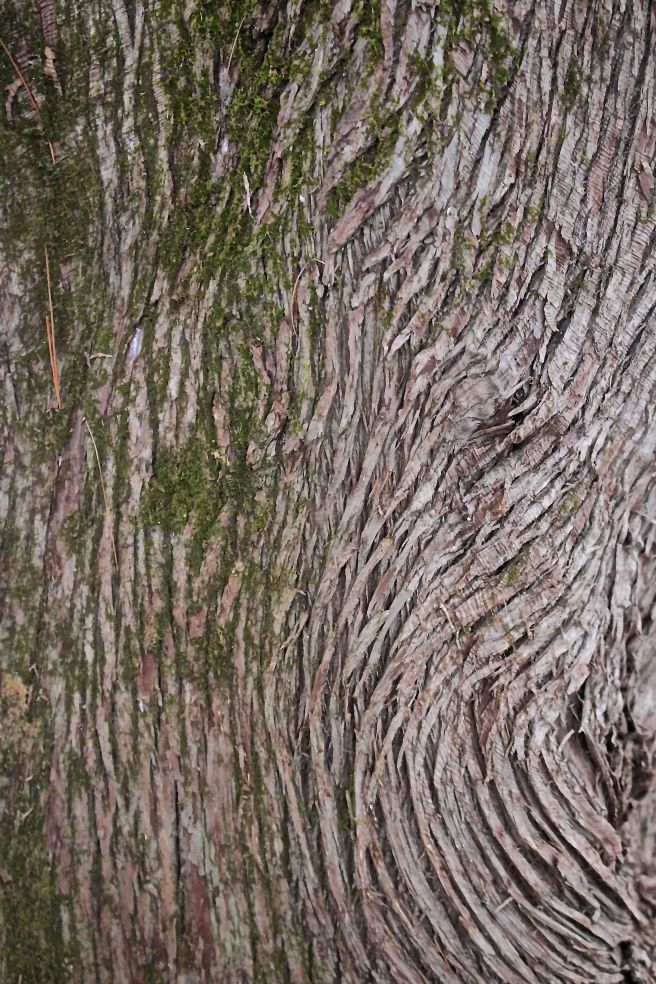
Visiting here a couple of times previously, one of the things I’d come to like about it is the opportunity to gush over Northern white cedar bark.

r-northern white bark2

I love its red-brown color, sheddy strips that intersect in diamond formations and habit of spiraling left and then right with age. In his book BARK, Michael Wojtech states of the cedar: “In the 1500s, the native Iroquois showed French explorers how to prevent scurvy using a tea made from the bark, which contains vitamin C. The name arborvitae means ‘tree of life.'”

r-northern white leaves

Equally beautiful are its flat sprays of braided, scale-like leaves.

Since I’m on the topic of tree bark, I have two others to share, including this one–the red inner bark of Northern Red Oak made a stunning statement.

r-hop hornbeam bark

Displaying its shaggy presentation was the hop hornbeam.

My heart leaped (appropriate movement for today) when I saw these papery fruits on the ground–hop hornbeam is named for its fruiting structures that resemble hops.

r-stone wall

Stone walls crisscross the preserve and provide evidence of its former use as a dairy farm.

r-barbed wire

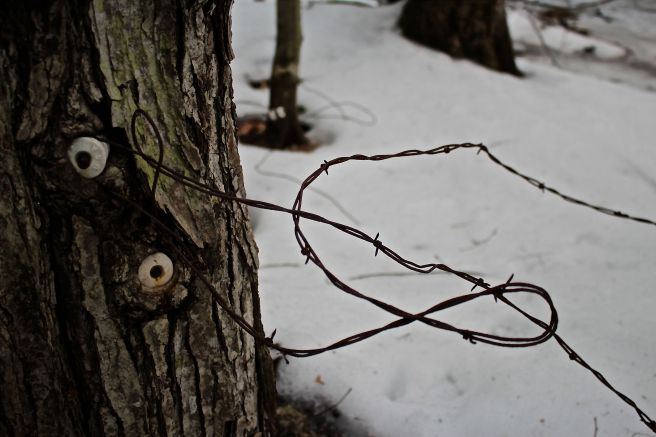
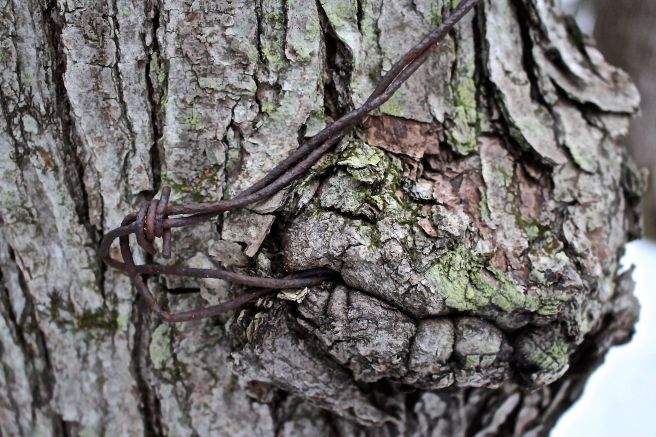
Barbed wire adds to the story.

r-barbed wire grimace

Installed long ago, this tree formed a grimace in response.

r-large pine

Along the edge of some walls stand much happier trees–those that were allowed to grow tall and wide in the sun, like this Eastern white pine. Perhaps it provided a bit of shade for Roberts’ Jerseys.

r-generation gap

The land was farmed until 1968. Since then, it returned to woodland, was sold and logged and sold another time–finally to the land trust. Generational gaps are visible throughout. This is the perfect place to take some youngsters and ask them to locate a white pine that matches their age.

r-brook 2

We cross several streams that I’m sure sustained the farm and its inhabitants. Today, they sustain the wildlife that wanders here, including deer.

r-turkey trot

We realized there had been a recent turkey trot and

r-voles 1

vole convention.

r-pileated condo

Birds also have played a major role in this community. This pileated woodpecker-created condominium has been around for a while.

r-pileated pile

From the trail, I spied the largest pile of wood chips I’ve ever seen and of course, had to investigate.

r-pileated tree

The old beech was recently excavated for new condos.

r-pil pile 2

Below, the wood chip pile was a couple of inches deep.

r-pileated scat 1

r-pil scat 2

The best part–lots of scat cylinders filled with insect body parts. Good stuff to see.

r-birdhouse

Pileated woodpeckers aren’t the only ones in the building industry.

r-birdhouse sign

I think you’d agree that Quinn and Mike did a fabulous job constructing this birdhouse.

r-mullein capsules

In several open areas we spotted the winter display of common mullein.

r-mullein 2

Its crowded performance of two-parted capsules atop a tall, fuzzy stem made it easy to identify.


The pointed prickly bracts of thistles also offered a winter show.

r-lungwort on ash

Lungwort tried to hide on the backside of an ash tree, but I found it. I only wish we’d had rain, or better yet, snow, recently, because I love the neon green that it becomes once it is wet.

r-lunch rock

Be careful what you wish for. Though the day was sunny at the start, it began to rain as we ate our sandwiches on lunch rock overlooking Lake Pennesseewassee, aka Norway Lake.

r-lake 1

It wasn’t a downpour, but enough that it encouraged us to eat quickly and move on.

r-beaked bud

Well, I didn’t move far. Within steps, I found a shrub I was seeking yesterday–beaked hazelnut.

r-beaked hazel

It’s a member of the birch family and features catkins–the male flowers that will release pollen this spring to fertilize the shrub’s delicate red female flowers.

r-christmas fern

Another quick find–Christmas fern–one pinnae topped with a birch fleur de lis.

Typically, during the winter there is only one trail open to hikers. Today, however, we figured it would be OK to walk on the ski trails because they are either icy or bare. It was definitely a micro-spike kind of day, which has been more the norm this year.

r-painted cow

Other than birds and squirrels, we saw no wildlife. But we did stumble upon the “Painted Cows” created by Bernard Langlais in 1974 and gifted to the land trust by Colby College and the Kohler Foundation.

We had planned to explore the inner network of trails, but the cold raindrops drove us out. Despite that, I think my guy enjoyed himself as much as I did. And he was extremely patient each time I paused. Sometimes he even gave me a heads up–I took that to mean he didn’t mind that I had to stop, wonder and photograph. This is one Leap Date I hope we don’t forget.