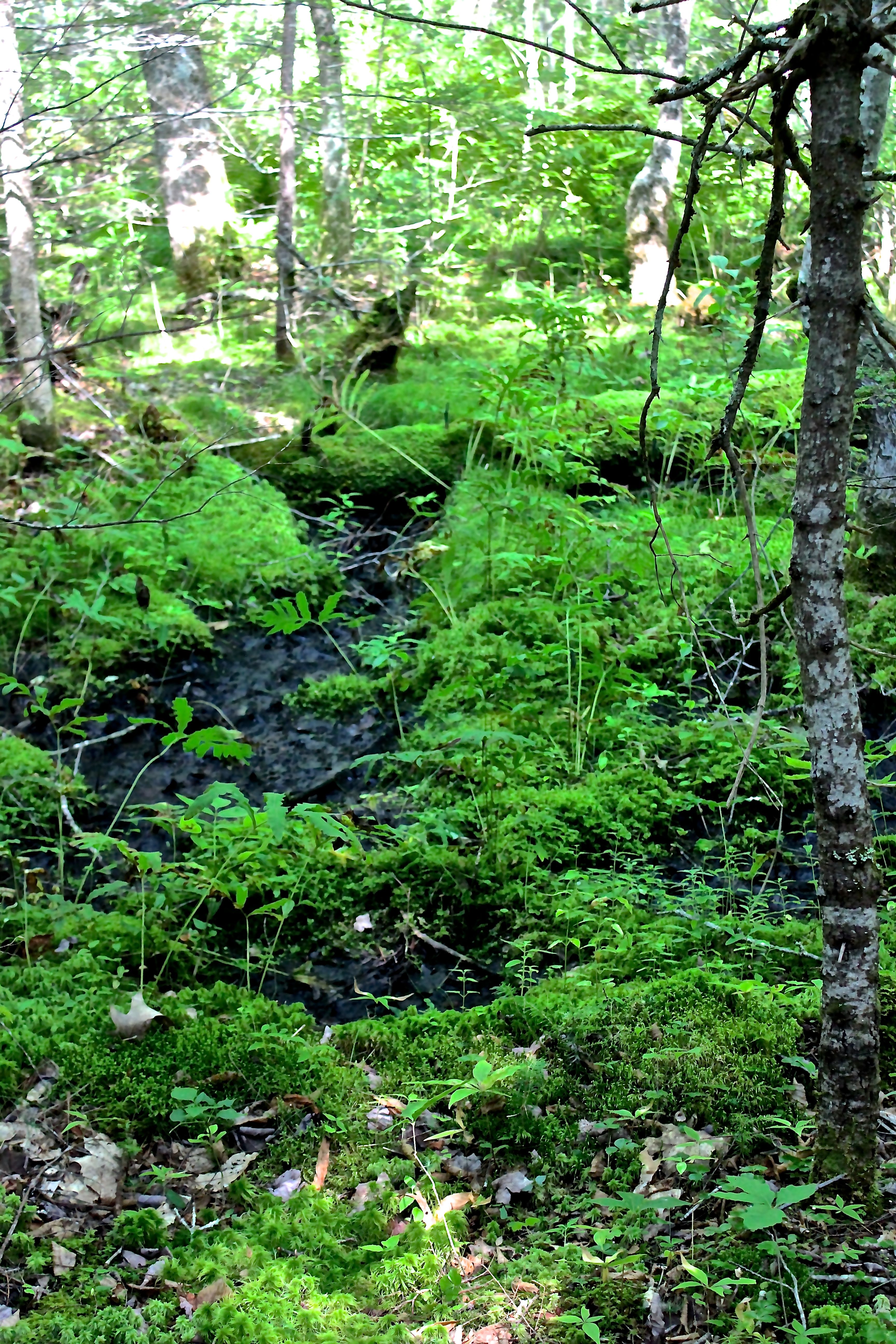
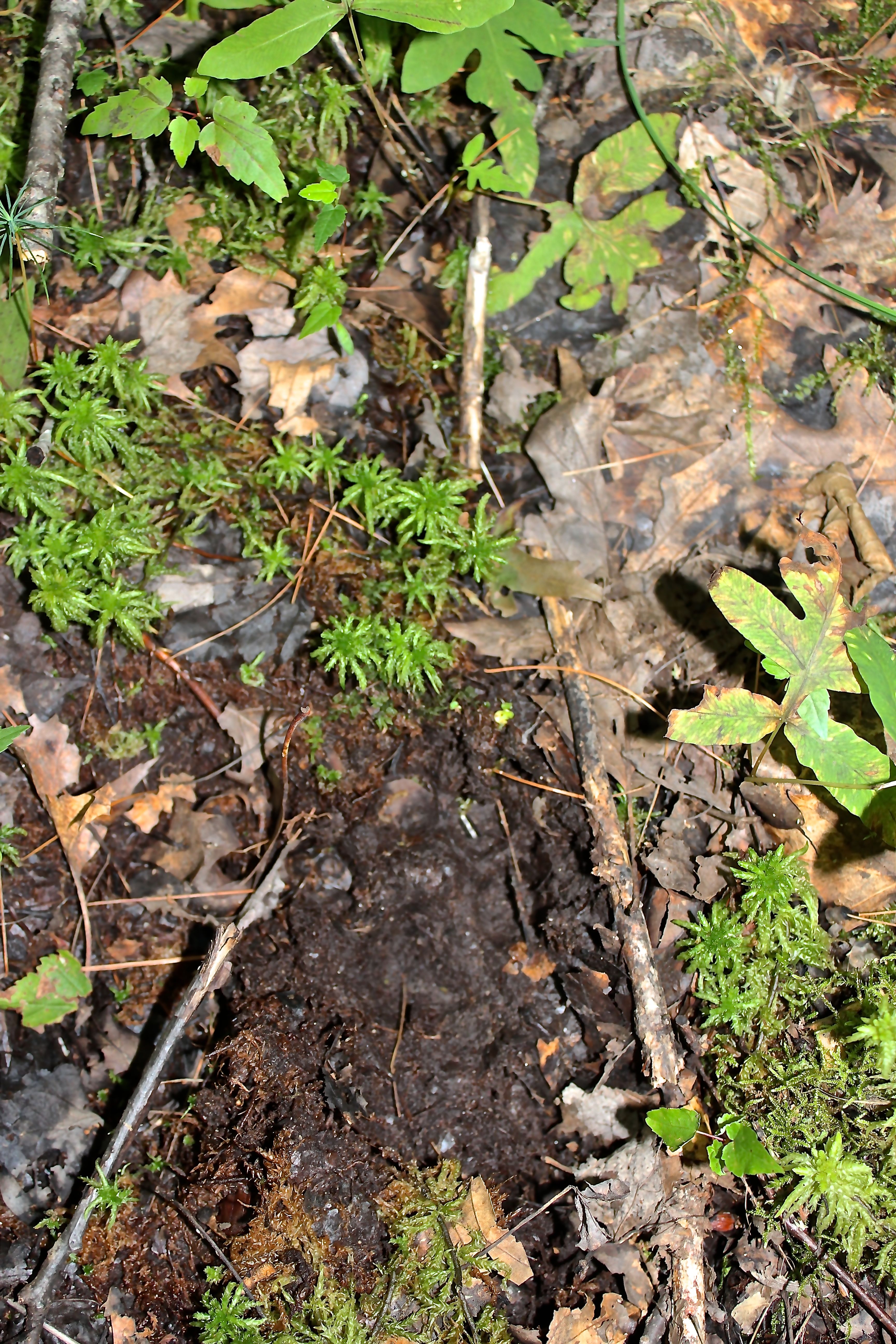
Book of May: Lichens of the North Woods

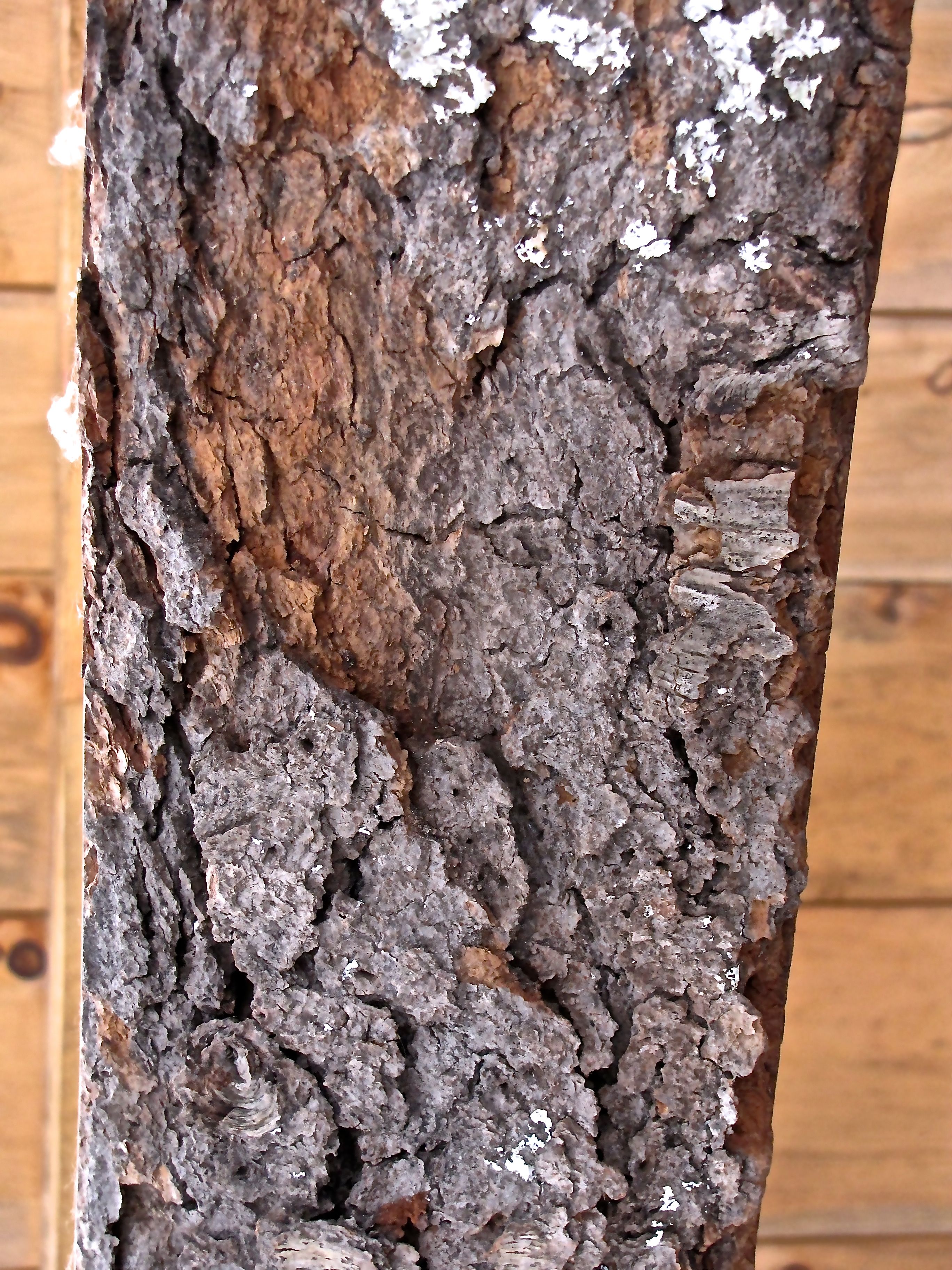
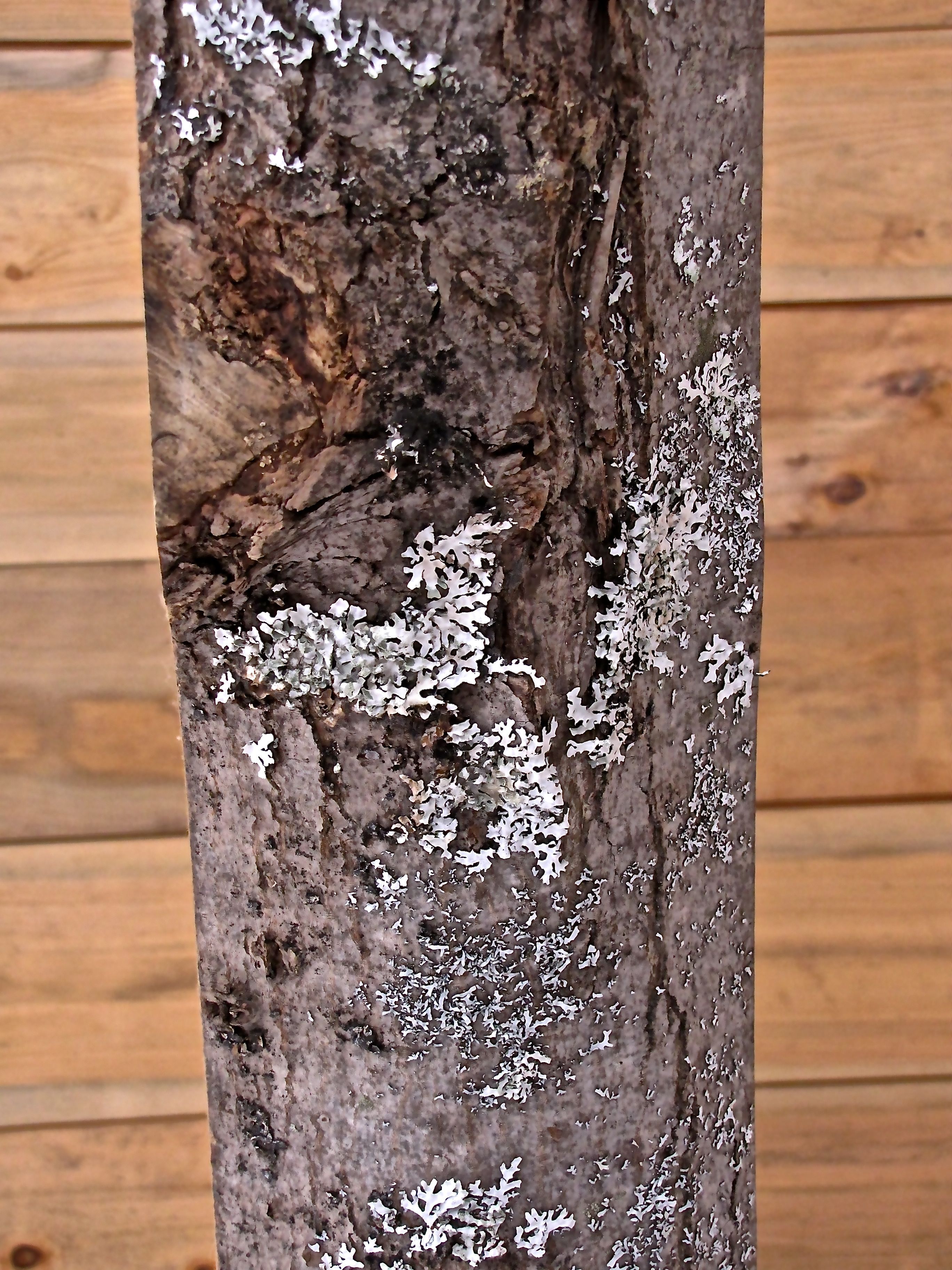
Everywhere we look as we hike (or even drive), be it ground, rock or tree, lichens make themselves known.

b-greenshield

Some are easy to ID even if we are driving 60mph (on the highway, that is), like common greenshield. Others, however, require closer examination and consideration. And that’s why this month’s book is . . .

b-book

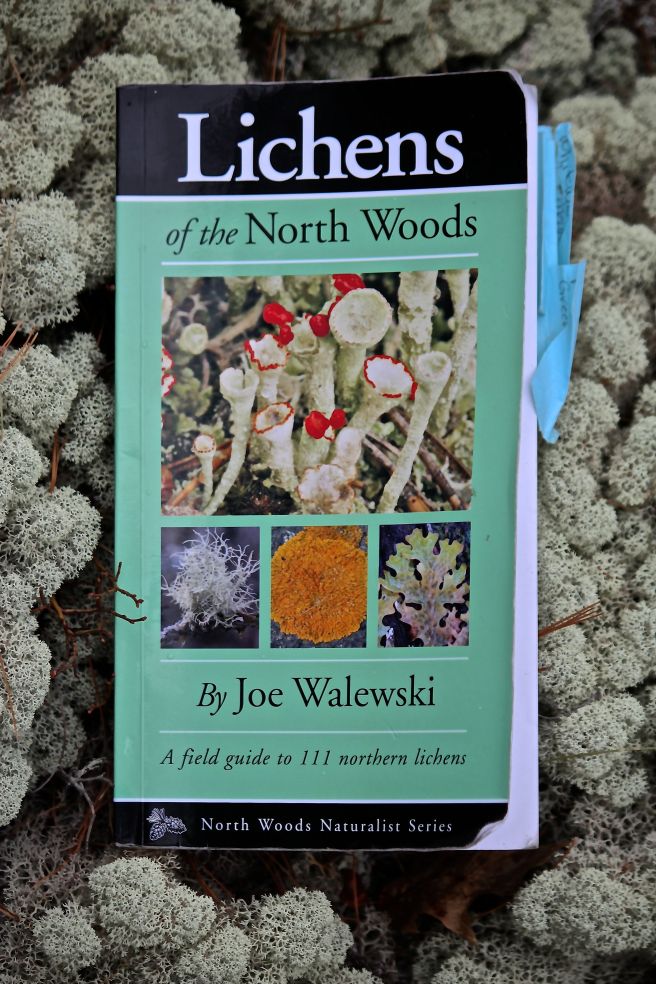
Lichens of the North Woods by Joe Walewski. From the get go, it’s another one of those books where it feels like the author is by my side. “Welcome to the Lilliputian world of lichens!” he begins.

Lilliputian indeed! And complex. But Walewski helps the rest of us develop an understanding of such complexity. Through illustrations and photographs, he presents us with Lichen Biology 101. And then he takes us into the field, showing us how to collect and preserve our specimens.

He explains how to use the field guide and then gets into the nitty gritty. I appreciate that the book is divided into the three substrates–ground, rock and tree–though sometimes I need to remember that though the lichen I’ve found appears to be on a rock, it might be listed under ground because the soil has built up over time.

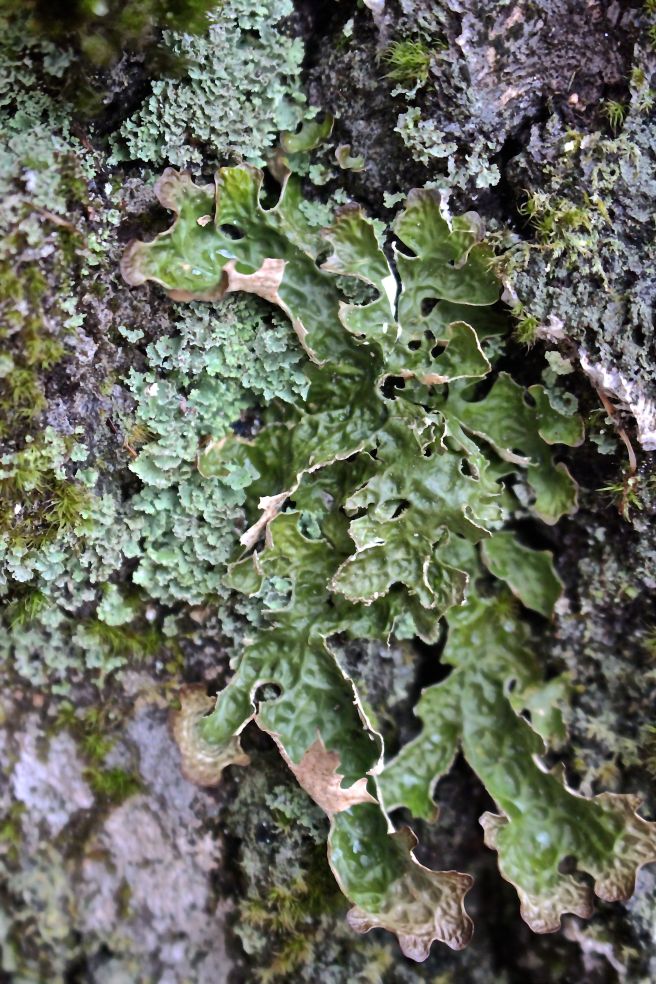
Within each of the three sections, he further divides it by type: crustose (think those lichens that appear to be flat like a crust of bread), foliose (leafy like foliage) and fruticose (branching like grape branches). Common greenshield is leafy–therefore a foliose lichen.

For each lichen, Walewski includes a photograph, description, chemistry, similar species and nature notes.

Finally, there is a glossary, followed by titles of interest, and a list of lichen groups and Web sites.

It’s a small book, measuring 8 x 4.5 and only about a half inch thick, so it’s easy to toss in the backpack.

b-Quill 2

Walewski’s study focuses on Minnesota, but here in the Northeast, we have many of the same varieties.

I’ve encouraged you to develop your bark eyes in the past. This summer, look out! We’re going to work on our lichen eyes. And any puns you wish to share are most welcome :-)

I found my copy of Lichens of the North Woods at Bridgton Books. Look for it at your independent book store.

Lichens of the North Woods, Joe Walewski, Kollath+Stensaas Publishing, 2007


Book of the Month: TREES and SHRUBS of NORTHERN NEW ENGLAND

Sometimes the biggest gems arrive in the smallest packages. Such is the case with this month’s book–and this isn’t an April Fools’ Day joke, though I did briefly consider posting an upside-down photo of the cover.

t-book

I picked up this copy of  TREES and SHRUBS of NORTHERN NEW ENGLAND at a book swap during the Maine Master Naturalist Program’s first conference this past year. This third edition was compiled by Frederic L. Steele, Chairman of the Science Department, St. Mary’s-in-the-Mountains, Littleton, NH, and Albion R. Hodgdon, Professor of Botany, University of New Hampshire, Durham, NH, and published in 1975 by the Society for the Protection of New Hampshire Forests.

One of the things I like about it is that it measures 4.5 x 7 inches and fits easily into my pack. Plus, it includes more shrubs than many of my current books.

t-leaves

And check this out from the introduction: “In the preparation of this guide, the authors have received help and encouragement from a number of people. The following, in particular, should be mentioned . . . Mrs. Priscilla Kunhardt and Miss Pamela Bruns have done the illustrations . . . ” Mrs. and Miss! Ah, what happened to those days?

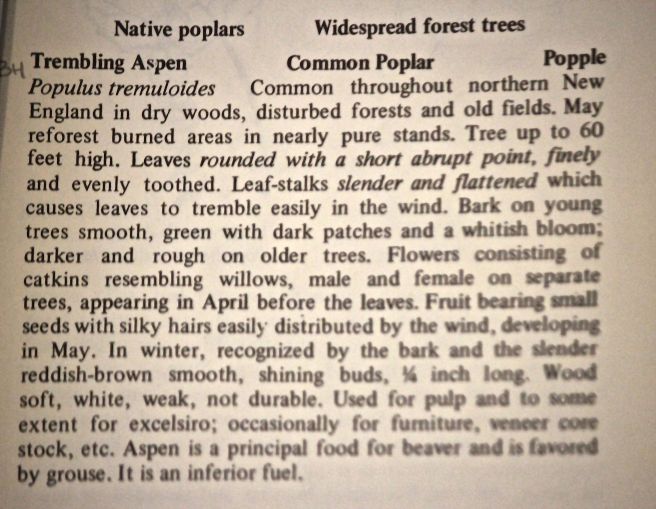
t-quaking description

The descriptions are not lengthy, but enough for a quick reference. I choose the Trembling Aspen, which I’ve learned as Quaking Aspen (I know–that’s the problem with common names say my Latin-oriented friends) because two are located right out the back door. They are the trees of life in our yard.

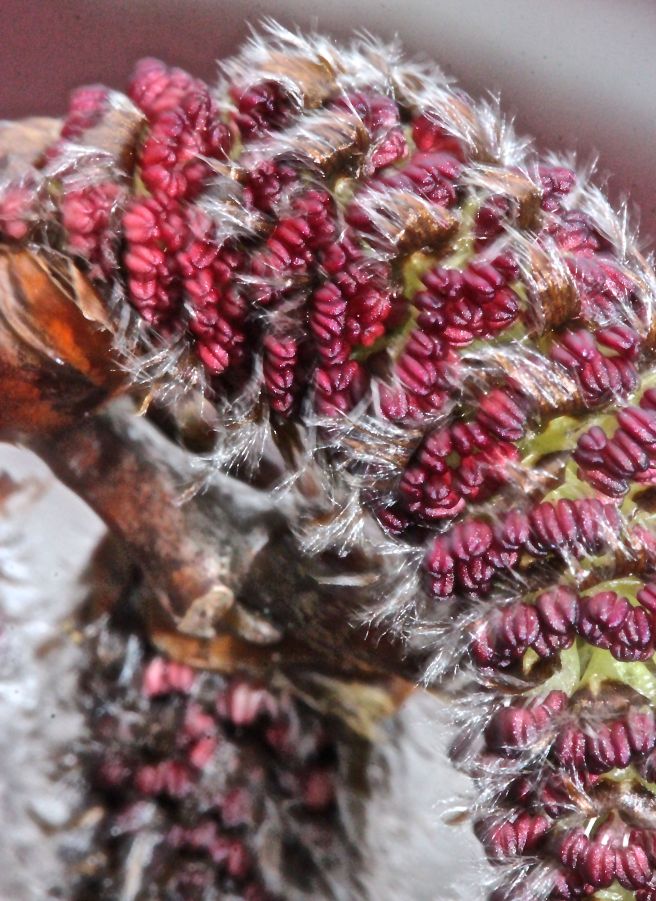
t-catkins forming

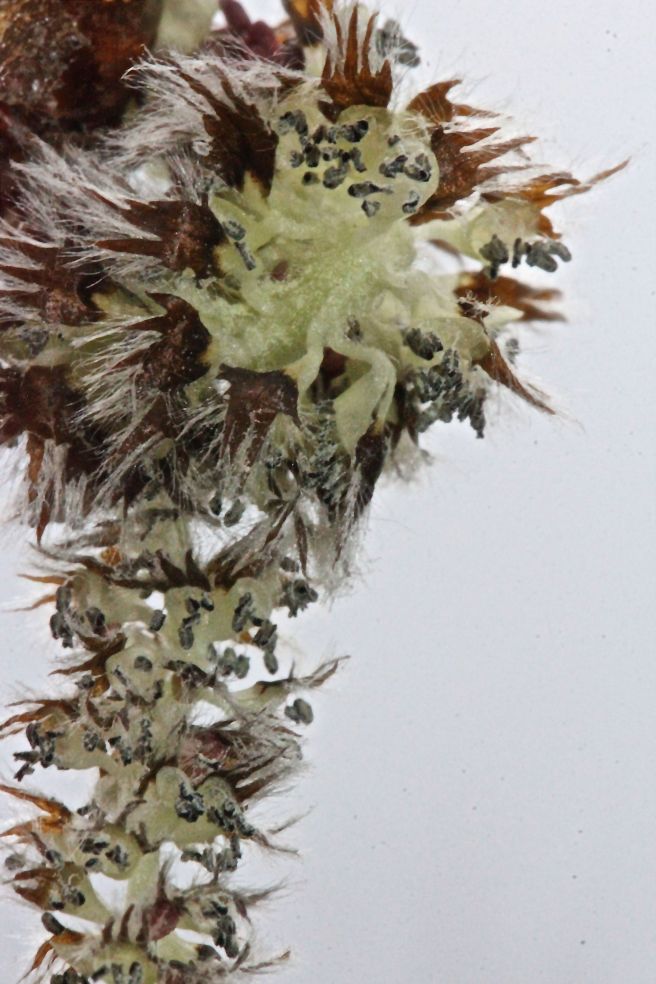
Catkins slowly emerge from waxy-coated buds

qa 1

and grow longer with lengthening days.

qa 5

Tufts of hair adorn tiny seeds.

T-summer

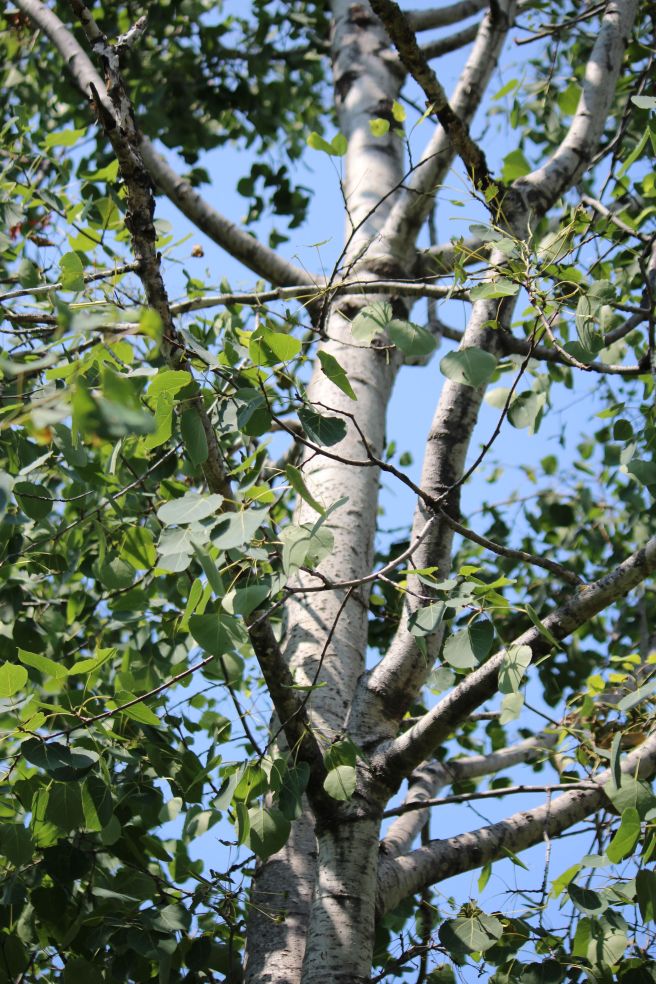
Soon, leaves on flat stems quake in the breeze,

t-caterpillars

until visitors arrive.

t-leaf eaters

Very hungry caterpillars.

t-porky

They aren’t the only ones. Porcupines nip off branches.

t-leaf

Eventually, leaves that survive fall to the ground.

t-hairy woodpeckers

All year long, birds visit to dine

t-cardinal

and view the world.

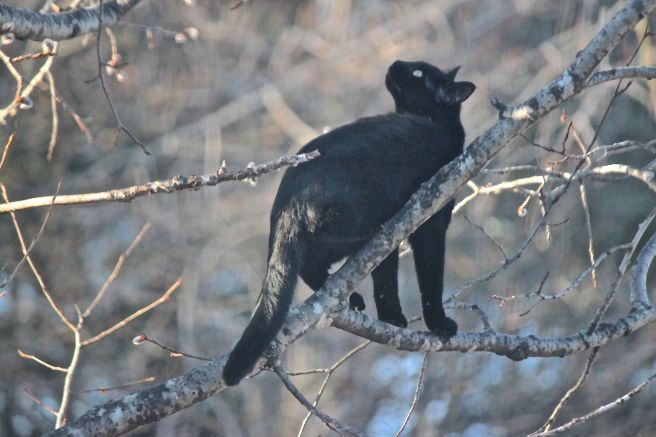
t-cat

The world looks back.

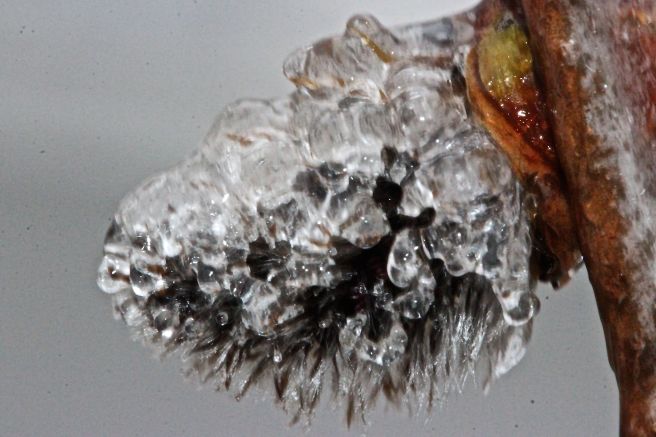
t-ice

Ice slowly melts

qa 2

and life continues.

TREES and SHRUBS of NORTHERN NEW ENGLAND doesn’t include photos, but that’s OK because I have my own. Instead, as any good guide, it’s a jumping off place. So many books, so much different information–and sometimes guides contradict each other. Just the same, I love to read them and then to pay attention. For me, it’s all about forever learning. And wondering.

TREES and SHRUBS of NORTHERN NEW ENGLAND, by Frederic L. Steel and Albion R. Hodgdon, Society for the Protection on Northern Forests, 1975.

On The Verge Of Change

Change is in the air. Stepping out the door this morning, I was immediately treated to the sight of wet mammal tracks on the deck.

b-raccoon tracks

The hand-like shape was hardly a surprise since at least two raccoons visit the bird feeders on their nightly rounds.

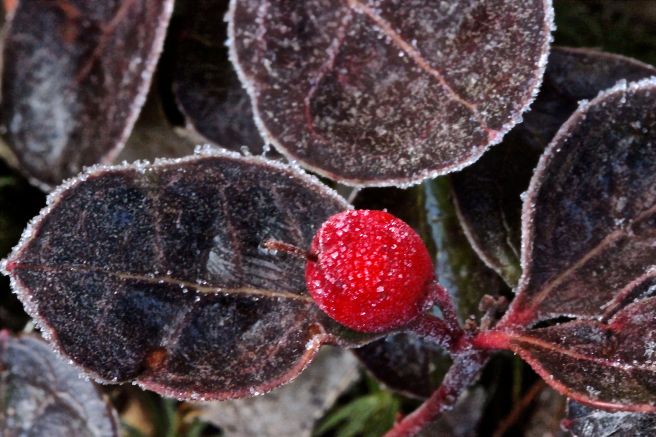
b-wintergreen

My next source of delight–frost embracing wintergreen berries and leaves.

vp1

And then I paid my respects to the vernal pool. While there, I spent some time reflecting on Bridie McGreavy, who celebrates her birth this day, and many moons ago introduced me to the sacredness of place–especially this delicate space.

Vp2

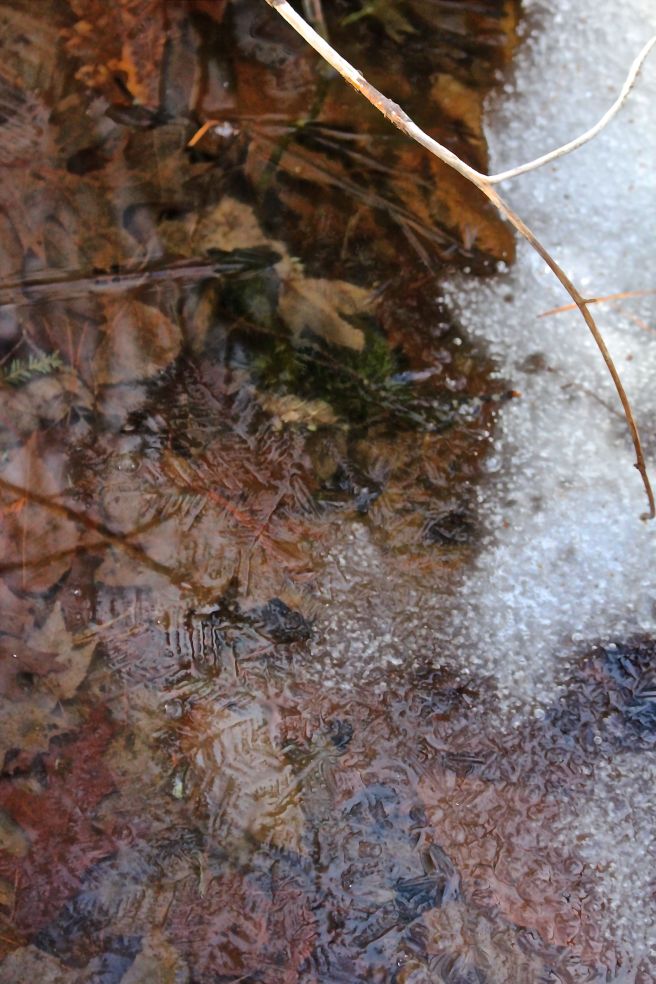
Feather ice formed after yesterday’s melt and last night’s cooler temps.

As I did last year, I intend to document the pool on a regular basis–noting its evolution over time. This year’s big question: Will Big Night happen earlier than normal? I’m already receiving reports from others of spring peepers singing their songs.

b-brook 2

And then I was off to the GLLT’s Back Pond Reserve in Stoneham. My friend, Parker, and I were on a quest to locate species that would be good indicators of rich soils. He’s much better at knowing about this than I am, so I tagged along–thankful for the opportunity to bushwhack beside the stream that eventually flows into Back Pond while learning from him.

b-bass 2

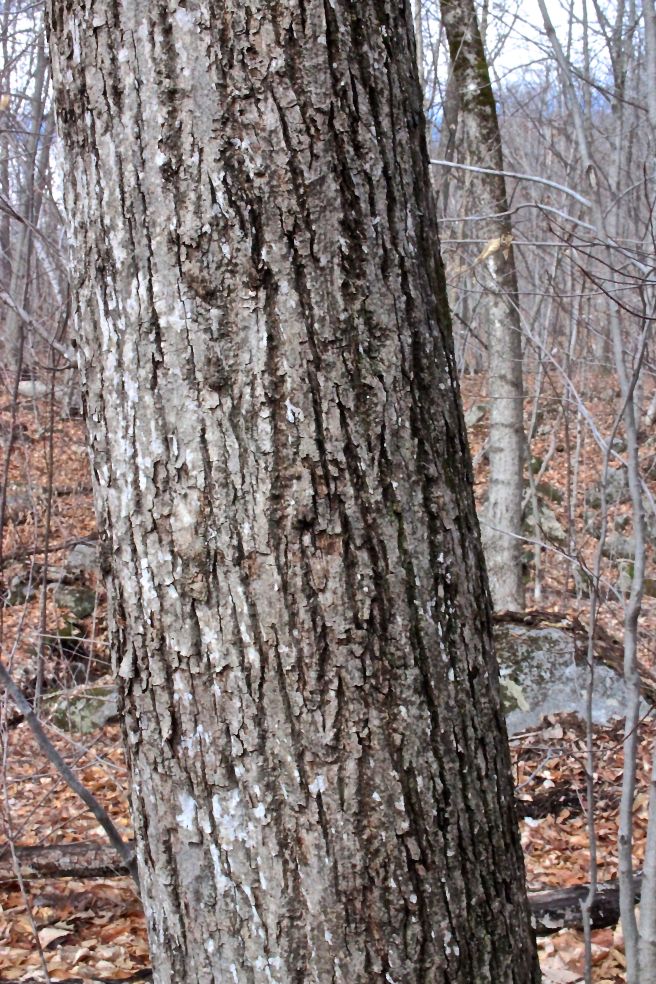
We found a dead tree that stymied us for a few minutes, but though it has some ash-like tendencies, we came to the conclusion that it was a basswood–one of those indicators we were seeking.

b-basswood bark

Only thing–during our entire search, we only found two.

b-bear tree

But that’s OK because there was so much more to see. Though I’ve spotted other bear trees in these woods, this one features the best sign. My guy will be jealous that he wasn’t with us to find this one.

b-crowded parchment

For many of us, Parker is our fungi guru. He and his brother became interested in mushrooms at a young age and have studied them extensively. They know only Latin, I speak only common. And so, I present to you crowded parchment (Stereum rameale). 

b-hemlock varnish shelf

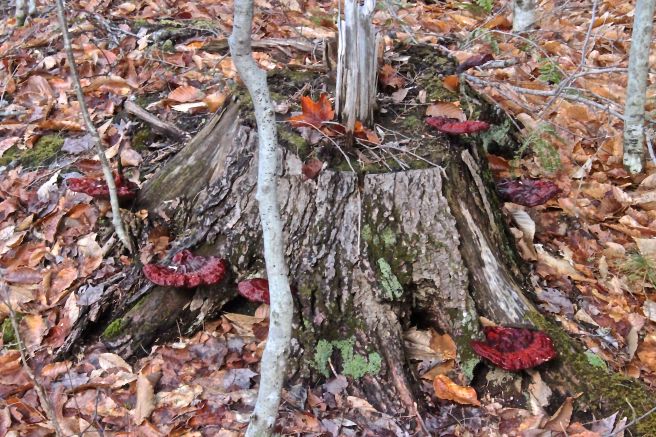
Hemlock varnish shelf (Ganoderma tsugae) grows prolifically in these woods. These old fruiting bodies are still beautiful in their offering.

b-panellus stipticus?

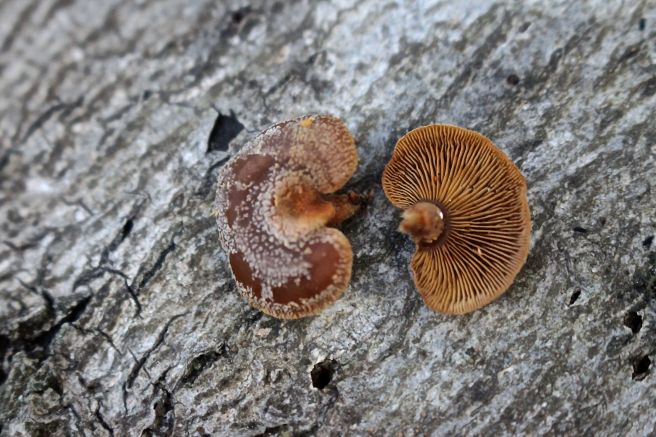
And though it didn’t get dark while we were there, Parker found Panellus stipticus, a bioluminescent species. Check out those gills on the underside. According to Lawrence Millman in his book Fascinating Fungi of New England, ” . . . specimens in the Northeast glow more obviously than specimens in other parts of North America.” So  if you are ever in these woods late at night, don’t be freaked out by a light greenish glow. It just might be nature’s night light.

b-magenta fungi

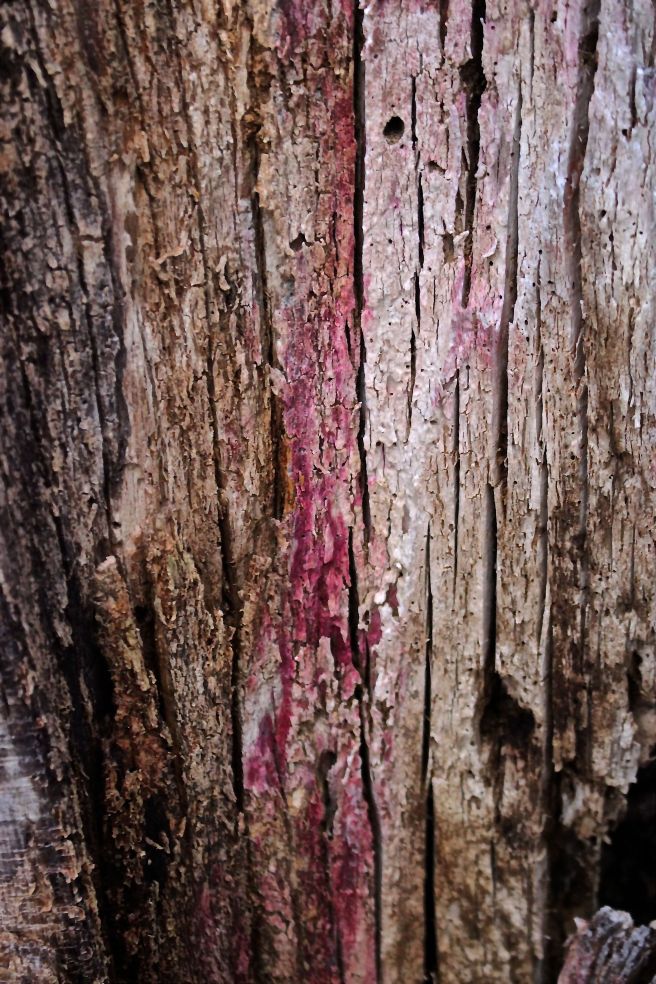
The fun thing about exploring with Parker is that he’s not afraid to say, “I don’t know.” Such was the case with this magenta fungus we found on the inner bark of a rotting stump.

b-hemlock:hop hornbeam 2

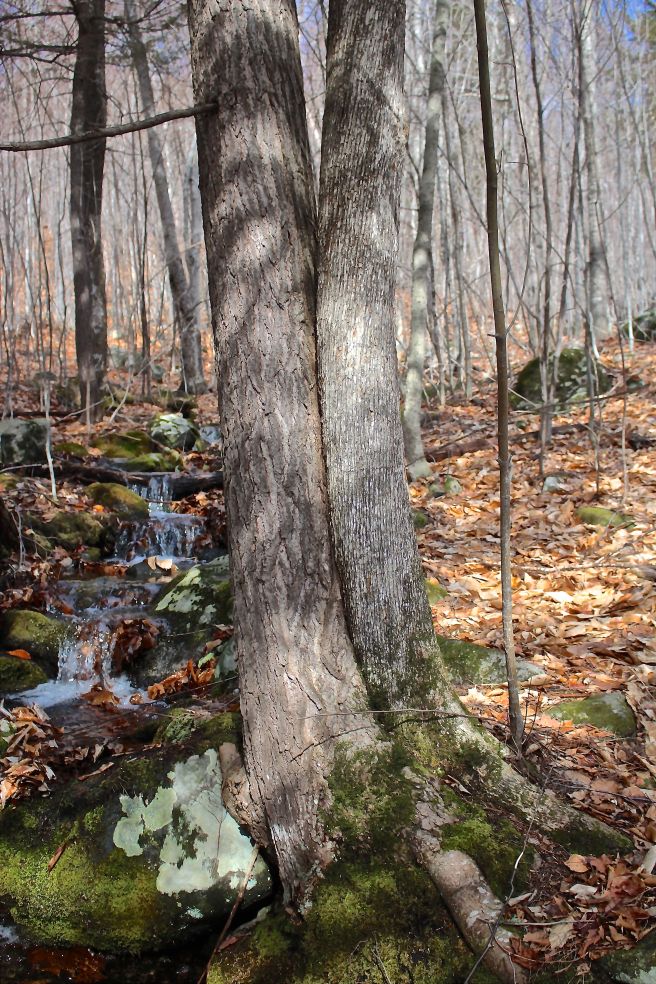
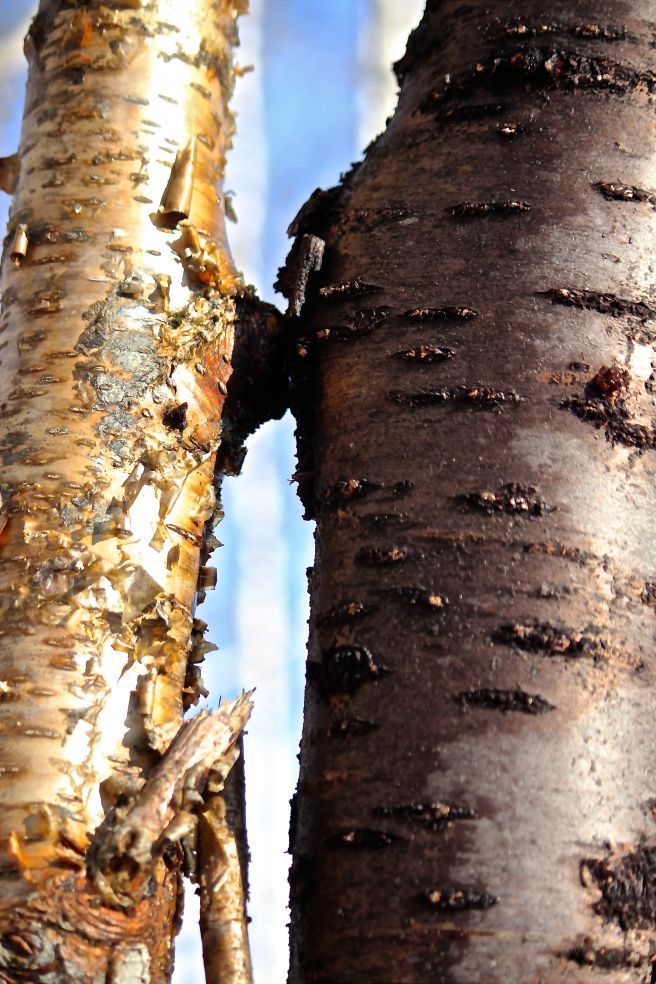
I don’t know why I’m surprised every time I see two trees sharing a space,but I am–this time hemlock and hop hornbeam.

b-brook sans ice

We continued beside the stream for most of our climb and eventually came upon the trail that connects Ron’s Loop to The Mountain.

b-lichen on tree

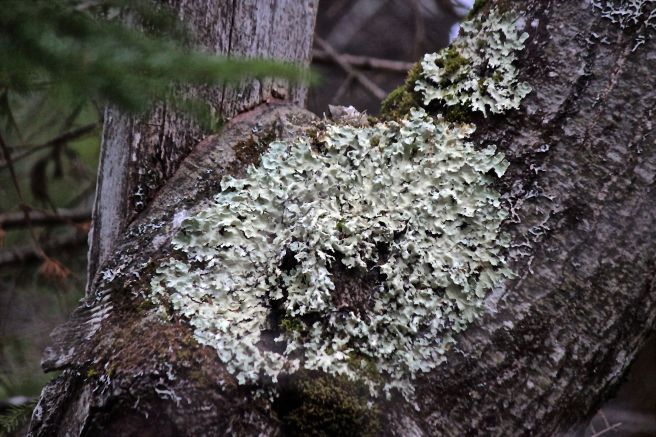
A few things stopped us along the way, including this lichen that neither of us could conclusively identify,

b-rock lichen

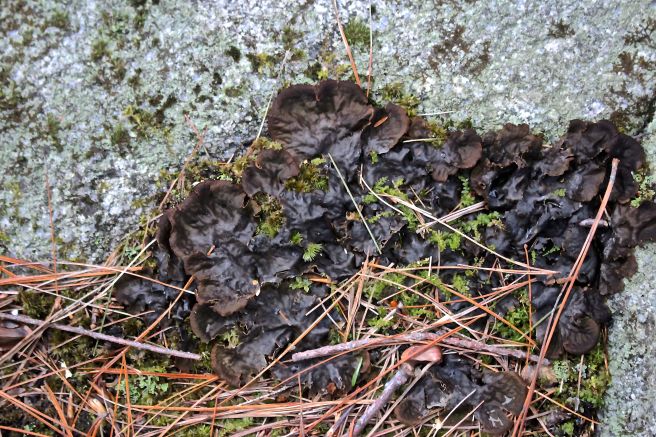
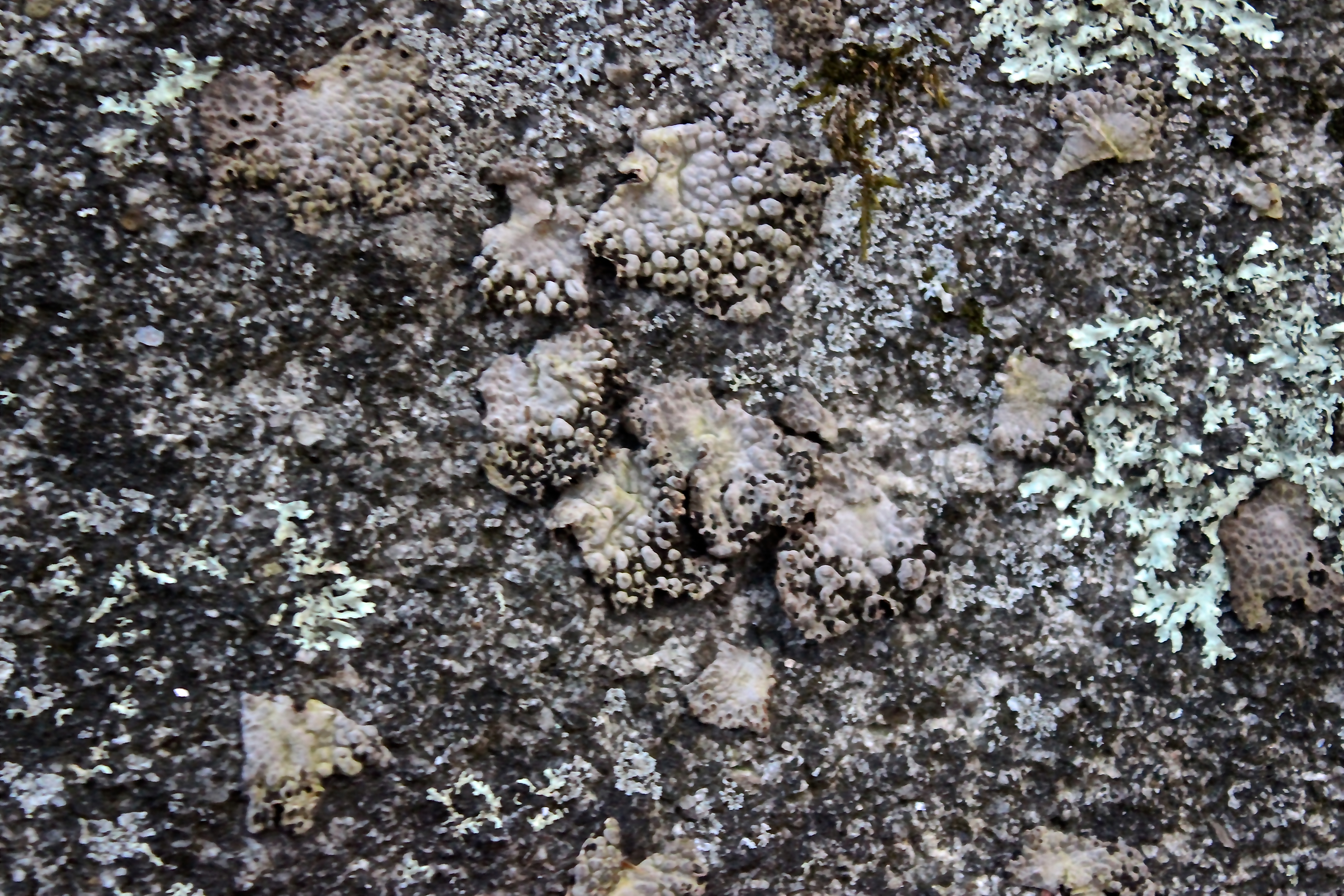
what I believe is peppered rock tripe,

b-lungwort, lichens

and the glorious bright green state of lungwort. The thing that gave us pause about the lungwort wasn’t so much the lungwort as the lichen and moss garden that also decorated this tree.

b-mtn bog

And then we were literally stopped by water. Our intention to reach the scenic view over the Five Kezars was prevented by this boggy area. A vernal pool?

b-mtn bog 2

Certainly a wetland. We explored for a few minutes and wondered about the species that will appear here in the next few months.

b-boulder field

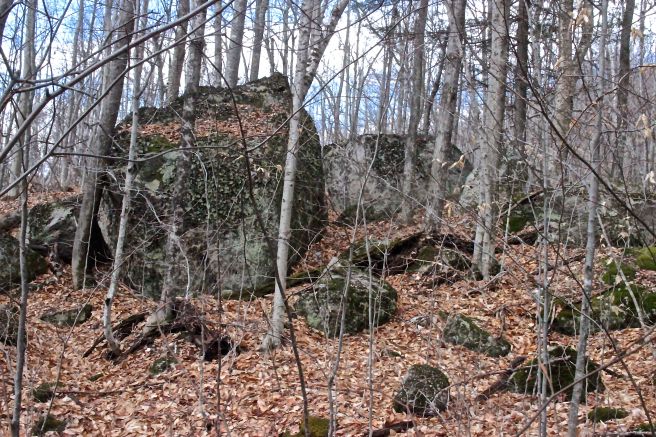
Then we returned to the stream, crossed over and paid a visit to the boulder field for a closer examination.

b-rock tripe 1

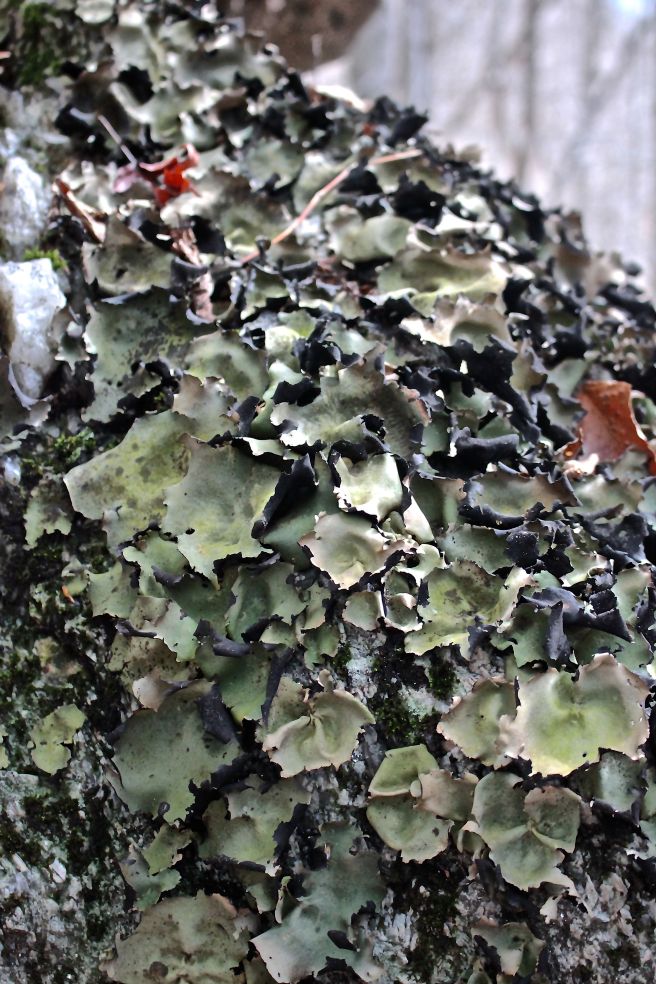
Like the lungwort, much of the rock tripe was also green today–a testimony to recent rain and yesterday’s hail.

b-tripe center

Two things to note–how it grows from the center umbilicus, like an umbilical cord, thus its Latin name: Umbilicaria mammulata; and the fact that it’s creating a garden on the up-rock side, where mosses and humus and seeds gather.

b-rock tripe water 2

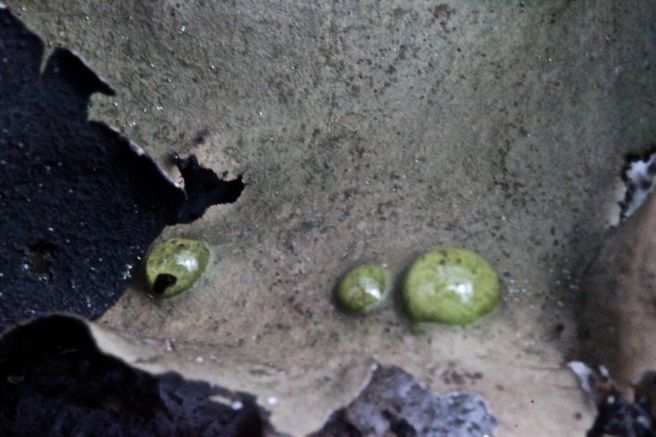
I found a drier brown specimen that had captured several drops of water and held them still.

b-redbacked

Upon our decent, we stumbled upon a redback salamander–the first of the season for both of us. It seemed rather lethargic so we covered it with leaves and wished it a safe life. Redbacks are terrestrial and don’t have an association with vernal pools, though they are sometimes spotted on Big Night as we help the salamanders cross the road.

b-rose moss 1

A mossy display on several rocks in a seepage meant we had to pause again.

b-rose 2

We believe this is rose moss (Rhodobryum ontariense), but our ID was quick.

b-rose 3

Based on the description in  Common Mosses of the Northeast and Appalachians, “the shield-shaped leaves are widest above mid leaf and end in needle point.” Yup.

b-wood sorrell

And then we realized we have to get our wildflower eyes back on. The wood sorrel (Oxalis montana) leaves stumped us initially, but what else could it be?

b-wood sorrel 2

Other than a luna moth, that is! Doesn’t it remind you of one?

b-foamflower?

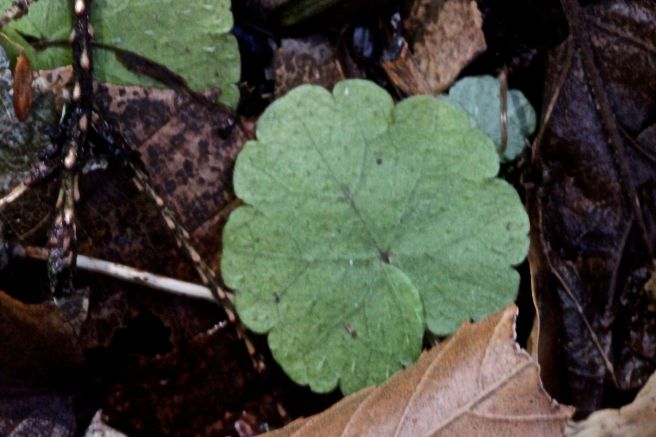
Without a flower, it’s difficult to ID a plant. My first choice: Foamflower or False Miterwort (Tiarella cordifolia), but my second choice based on the blunt-toothed leaves: Naked Miterwort (Mitella nuda). Time . . . and blossoms will tell.

b-orchid?

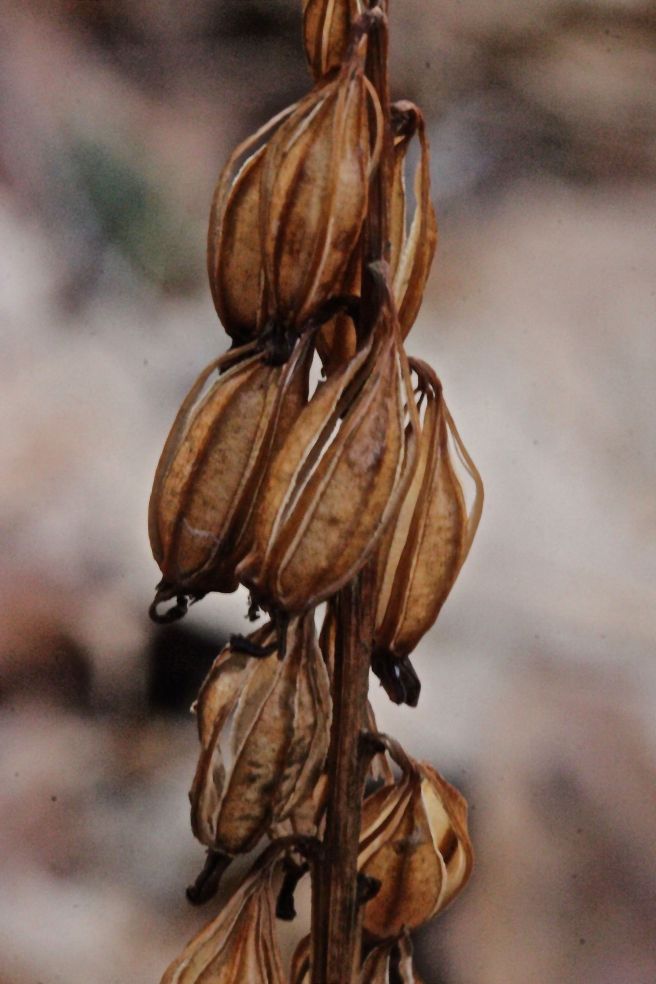
Our final find of the day left us with differing opinions. I said shinleaf (Pyrola elliptic). Parker said Corallorhiza maculate, which is a coralroot. A friend of his who is an orchid expert agreed. I guess we’ll have to revisit this place to confirm.

We’re on the verge of change and the seasons may collide with a Nor’easter in the offing.


The Borrowing

My friend, Dick, sent me the following message yesterday: “from a novel, Northwest Angle by Krueger … who has a series which relates to the Objidwa (sp) of the upper parts of Michigan …

‘What’s a Mide?” — ‘A member of the Grand Medicine Society,’ Stephen explained. ‘A healer. Somebody who understands the harmony of life and how to use nature to restore harmony when it’s been lost.” p246

“Belongs.” Meloux (a very senior shaman type of the Native American ‘Mide’ of the Objidwe) seemed to consider the word. “I believe no one belongs to anyone else. You, me Waaboozoons, we are all dust borrowed for a little while from Grandmother Earth. And even that dust does not belong to her. She has borrowed it from all creation, which is the Great Mystery, which is Kitchimanidoo. And if you ask this old man, I would say that another way to think about Kitchiimanidoo is as a great gift. Kitchimanidoo is not about keeping. Nothing belongs to anyone. All of creation is meant as a giving.” p 269

While I haven’t read the book or any of Krueger’s works, these words resonated with me as I moved about this morning.

m-vp

My first stop was a visit to the vernal pool, where the ice is beginning to melt.

m-vp, birch seeds

I looked for insects and found instead birch seeds and scales–meant as a giving.

m-berries

Wintergreen berries remained prolific below the power lines. While this fruit is traditionally browsed by a variety of mammals, I had to wonder if its location is the reason it was left untouched–poisoned by the herbicides Central Maine Power uses to keep the land clear. What was meant as a giving revoked.

m-leaves thru ice

Not all was bad as I followed the trail for a distance and enjoyed the beauty that has begun to emerge.

m-sphagnum color

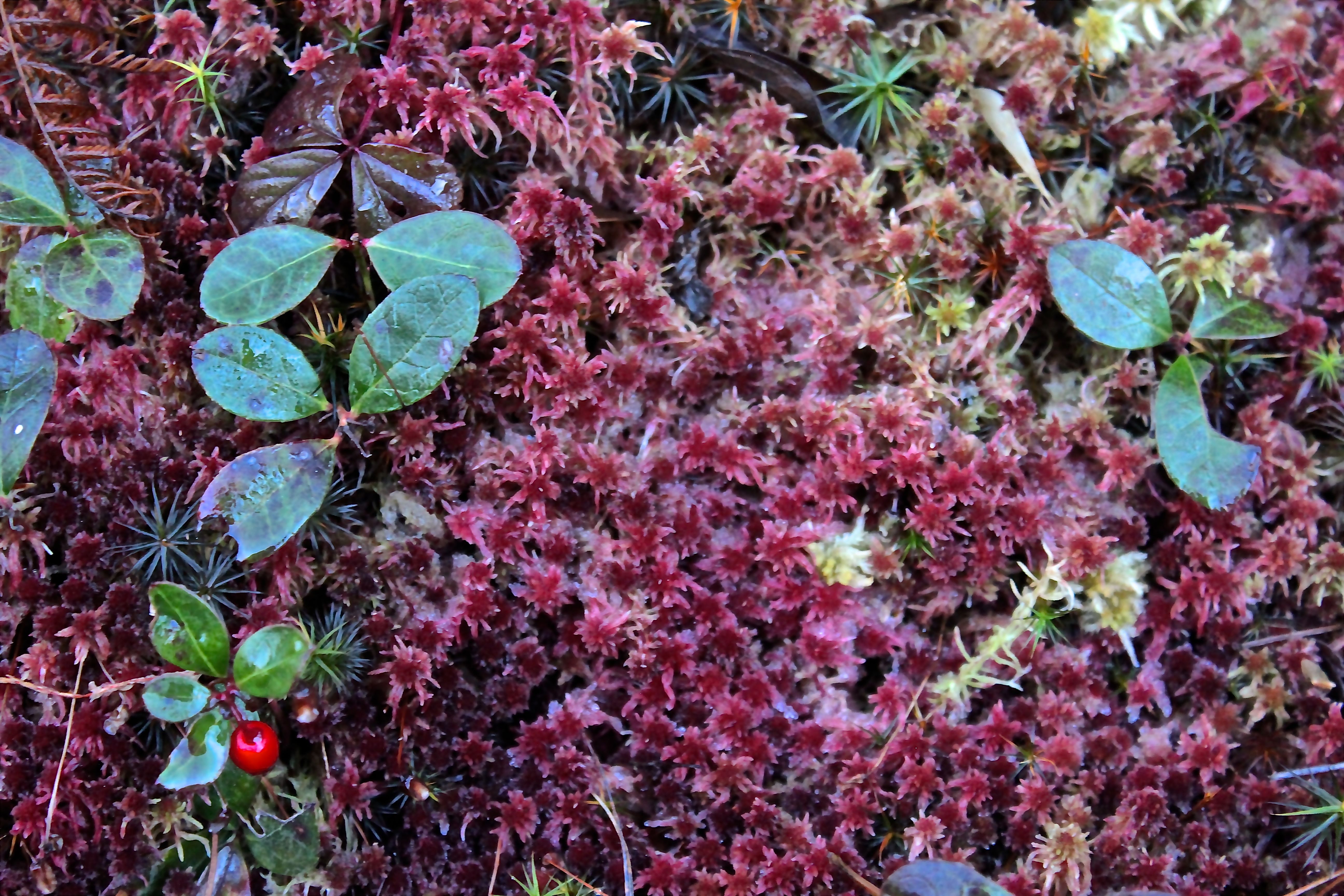
The pompom heads of sphagnum moss contrasted brilliantly beside the running clubmoss.

m-trail light

Looking back, I noticed that today’s sunlight was captured in yesterday’s raindrops–certainly a reason for thanks-giving.

m-mount 1

And before me–man and nature in the eternal struggle for harmony. An example of borrowing.

m-pollen?1

Before I turned onto a logging road, a puddle caught my attention.

m-pollen?2

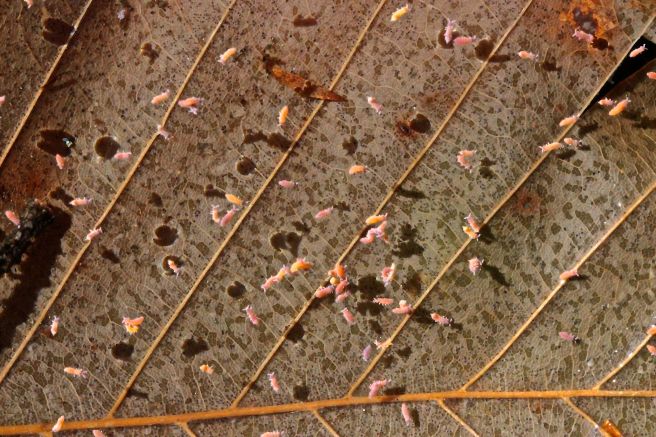
My first thought was pollen, but as I approached, I realized the little dots were moving about much like spring tails because .  . . they were spring tails. So my learning increased as I noted their color and the fact that there are aquatic members of this family. Another giving received.

m-pin cherry warts 2

On recent treks, my bark eyes have been confused about two trees–black birch (aka sweet or cherry birch) and pin cherry. As youngsters, both feature reddish-brown bark. What has thrown me off is the association with other birch trees, including the yellow birch that grows behind this specimen. Today, I made a point of noticing–the warty orange lenticels, lack of catkins and no wintergreen scent. These are three features that helped point me toward pin cherry. Black birch bark features long, thin lenticels, catkins common to birch trees and when scraped, that delightful wintergreen smell.

m-pin cherry:birch1

Despite the fact that they are not of the same family, certainly they’ve found a way to give to each other and live in harmony. A lesson.

m-porky

Just beyond the birches, in one of many stump dumps along this logging road, something caught my eye.

m-porky 1

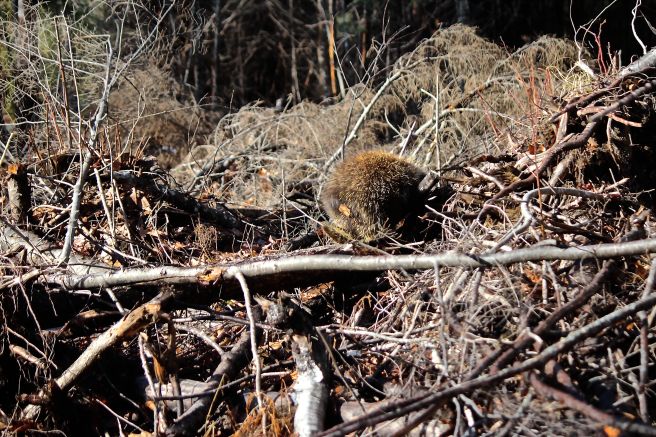
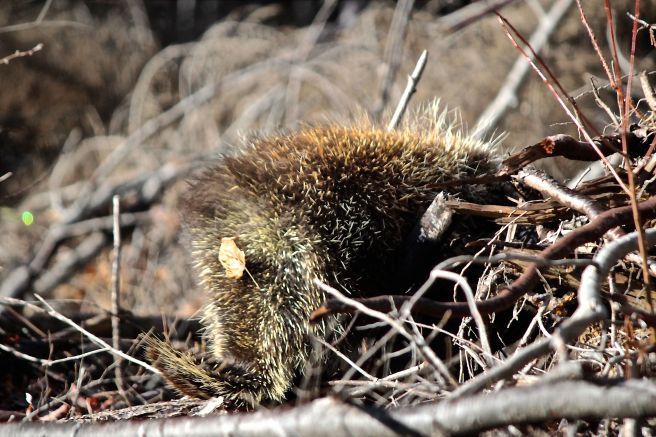
A porcupine worked over the bark of a fallen hemlock tree. I stood for several minutes and watched. Either it wasn’t aware of me or I didn’t pose enough of a threat.

m-porky again

The leaf caught on its backside made me chuckle and wonder why we don’t see more of that.

m-porky like

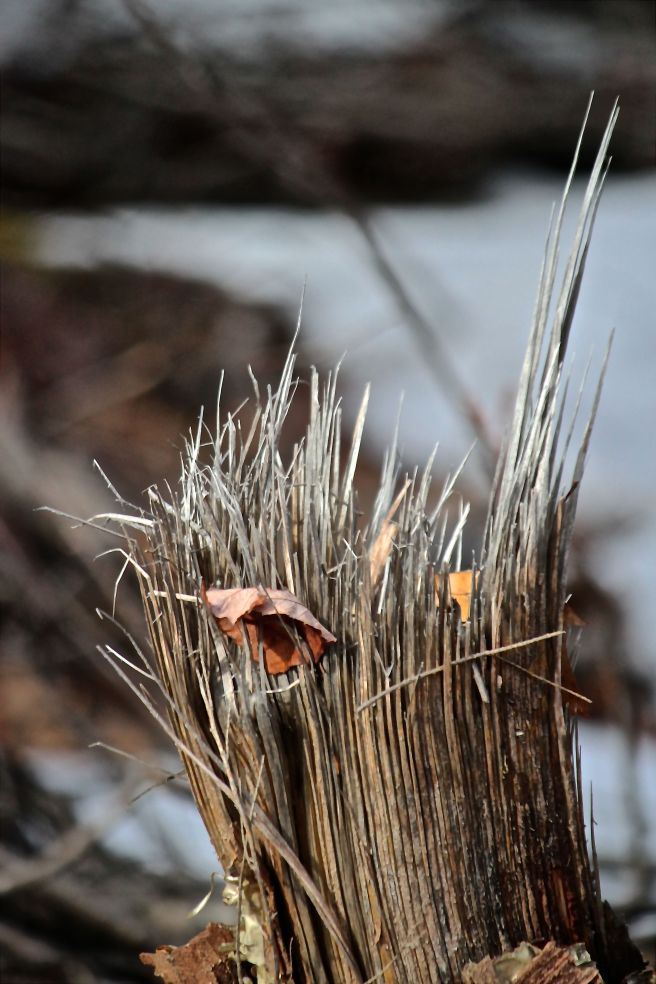
I’m amazed that I saw it at all in this land that has been chopped up over the course of the last three years. Notice how leaves are similarly stuck to this shredded tree stump.

m-porky tree 3

m-porky tree 2

m-porky tree

Behind were the trees that have received the porcupine’s recent attention. While the logging is destructive, it helps heat homes, provides income to at least several people including the logger and landowner, and creates new habitat and food opportunities for wildlife. Change is difficult and I’d grown to love these woods the way they were, but they were that way because of prior cuttings. A borrowing.

m-bubbles

Most of the logging road was a combination of puddles and mud. At times, air bubbles rippled as I moved through and I was reminded of my youth years spent feeling for clams in the mudflats of Clinton Harbor on Long Island Sound. The memory itself was a giving.

m-deer 2

Like the deer that frequent this land, my boots got stuck in the muck. Sometimes, it seemed like I was being sucked in and told to stand still. But my mind wandered on and I followed it.

m-trail conditions

Going forward in time, I’ll be curious to watch the reflections in the puddles change as the pioneer species move back in and regenerate this land. The harmony.

m-spirit

In the end, as always seems the case, I was on the receiving end of the giving and grateful for the borrowing as the spirit of Grandmother Earth shared a few tidbits of the Great Mystery.


To Bear Trap and Back

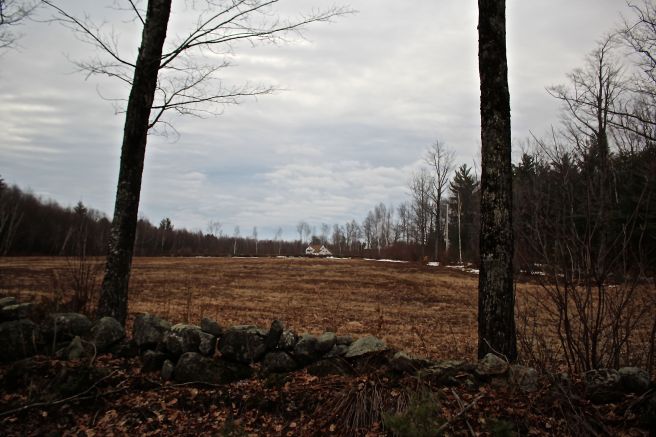
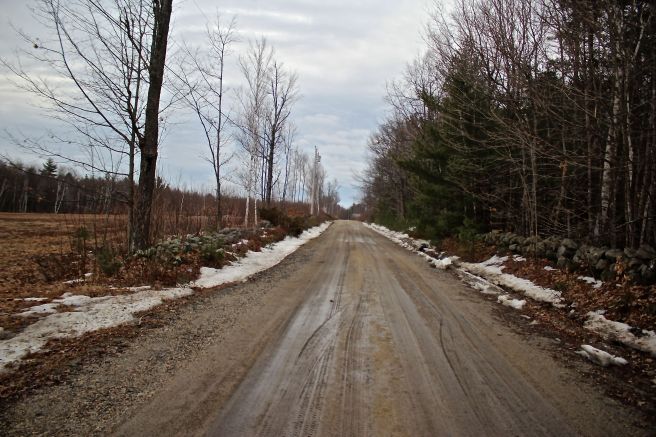
A change of plans today meant I had time for a trek to Narramissic Farm and the historic bear trap in South Bridgton before the rain began.
N-view from road

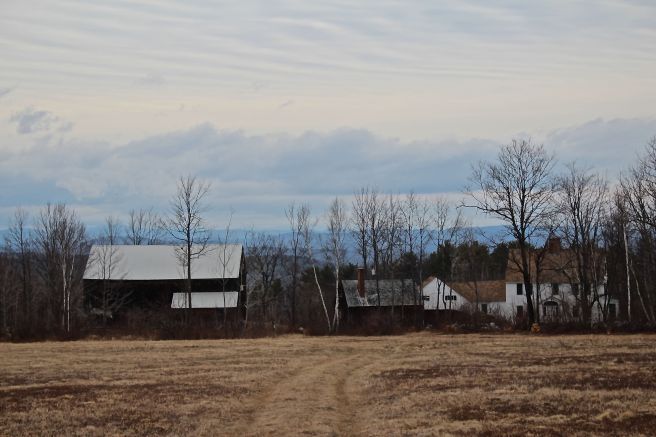
From Ingalls Road, where I decided to park, I took in the view of the front fields and house.
N-Narramissic Road

Narramissic Road is passable, but I wanted to slow down and soak it all in.
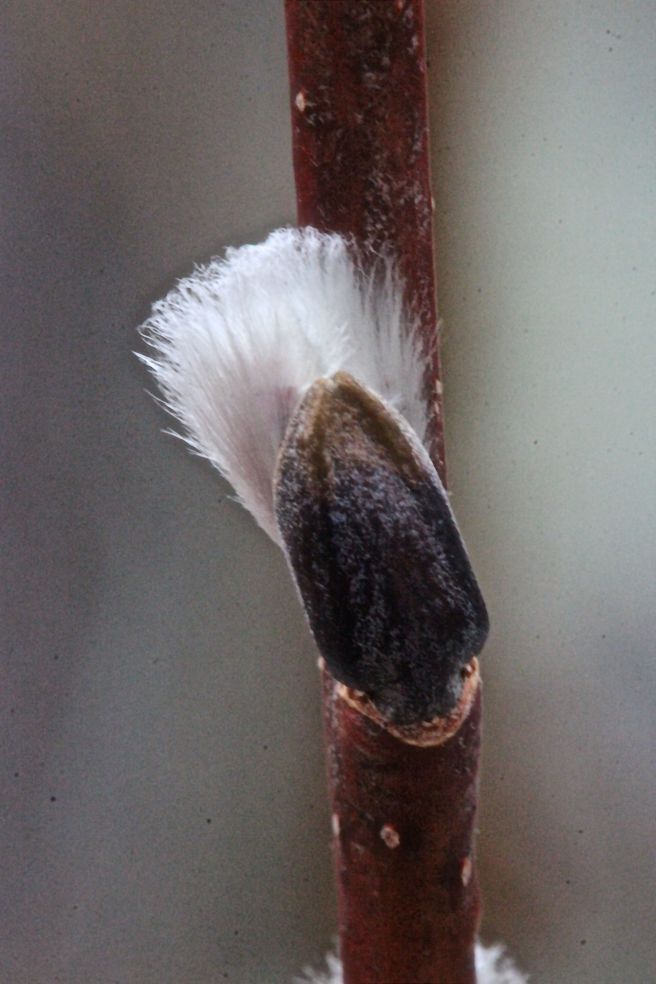
N-pussy willow 1

From pussy willows to

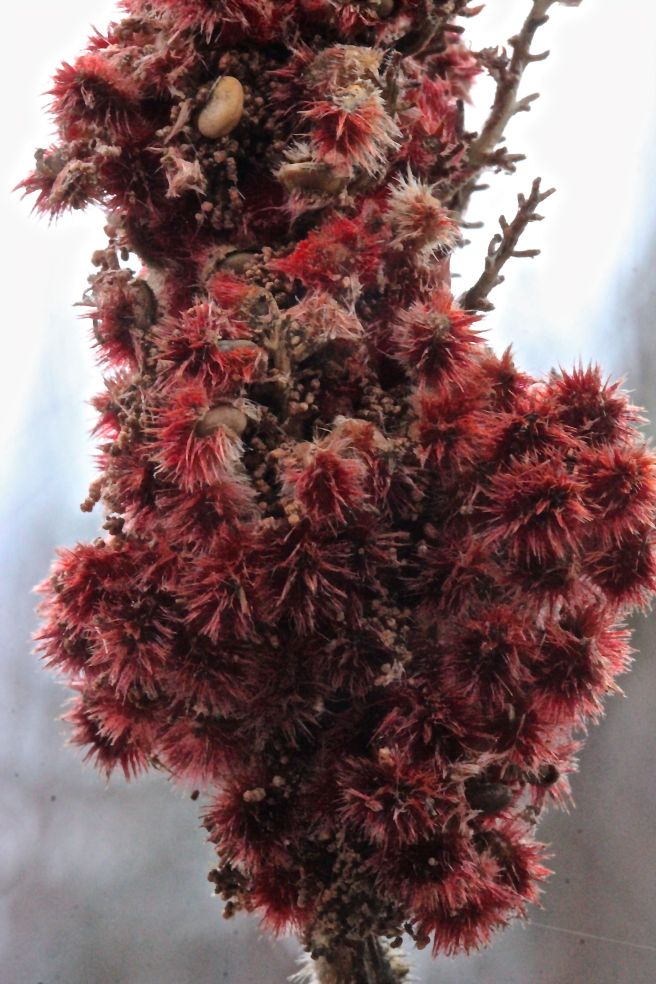
N-staghorn

fuzzy staghorn sumac, I was thankful I’d taken time for the noticing.
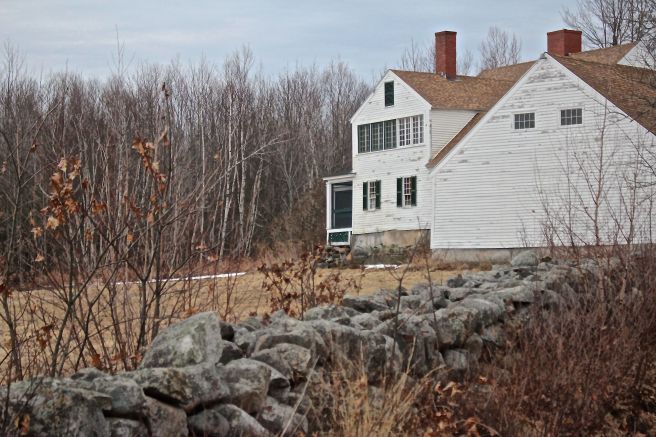
N-house & attached barn

The Bridgton Historical Society acquired the 20-acre property in 1987 when it was bequeathed by Mrs. Margaret Monroe.
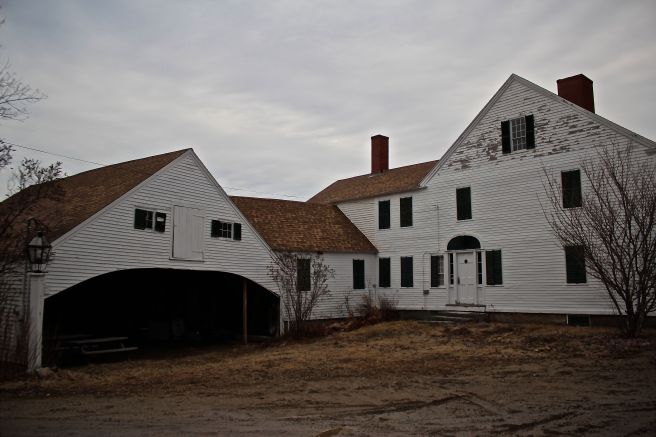
N-house

Turning the clock back to 1797, William Peabody, one of Bridgton’s first settlers, built the main part of the house.

Peabody sold the farm to his daughter Mary and her husband, George Fitch, in 1830 and they did some updating while adding an ell.

N-barn front

The Fitches had a barn erected that has come to be known as the Temperance Barn; historical records claim it to be so named “because it was raised without the traditional barrel of rum.”

N- barn face

Both the barn and the house are in need of repair, but I couldn’t help but wonder about what mighty fine structures they were in their day. While today, a visit to the farm feels like you’re in the middle of nowhere, during its heyday it was located in the center of somewhere–at the junction of two roads that have since been abandoned.

When Mrs. Monroe purchased the property in 1938, she named it Narramissic, apparently an Abenaki word for “hard to find” because it reflected her long search for just the right piece of real estate.

N-blacksmith shop

A blacksmith shop is located between the house and Temperance Barn, and beside the trail I chose to follow through another field and off into the woods.

N-garden wall 1a

Massive stone walls indicate the fields had been plowed.
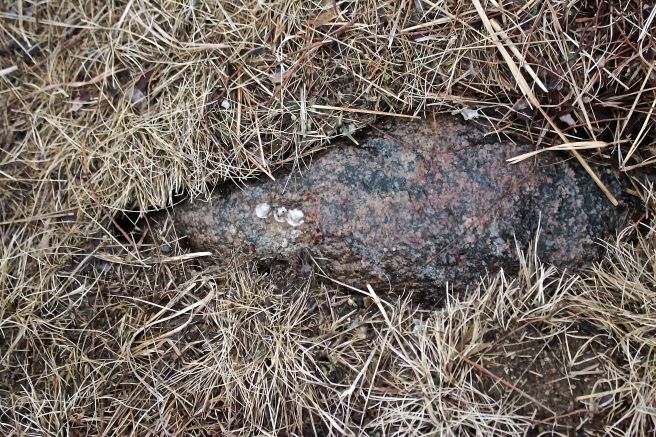
N-rock uplifting

Even today, “stone potatoes” continue to “rise” from the ground, making them one of the farmer’s best crops.
N-pearly 2

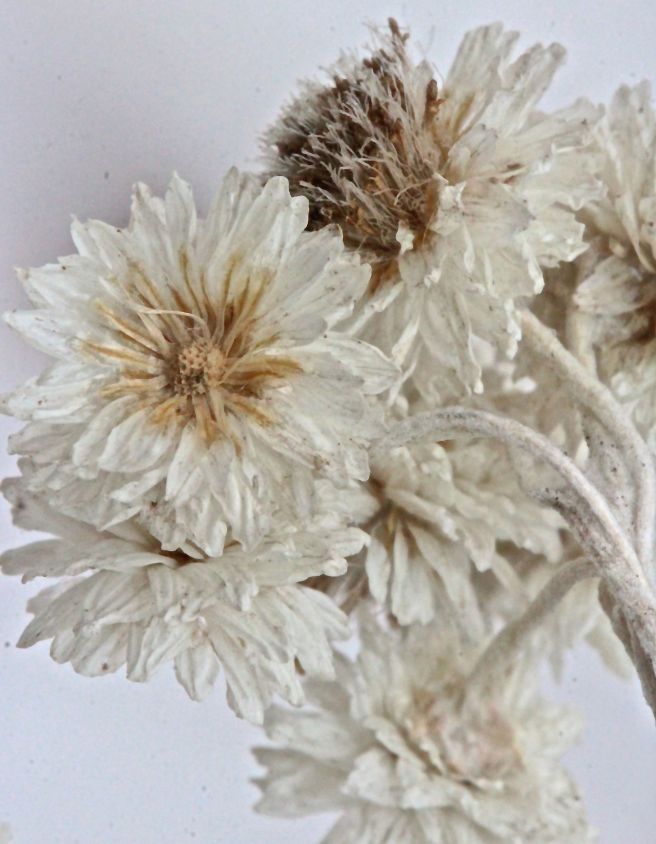
My destination was two-fold: the quarry and bear trap. But along the trail, I stopped to smell the roses. Or at least admire the beauty of pearly everlasting in its winter form.

N-gray birch litter

Several trees had snapped in the season’s wind, including a gray birch that scattered scales and seeds as it crashed to the ground.

N-gray fruit seeds

But . . . because the top of the tree was no longer in the wind zone, a surprising number of catkins continued to dangle–all the better for me to see. Notice the shiny seeds attached to the scales.

N-gray birch generations

The tree speaks of generations past and into the future.

N-jelly 2

Further along, I found a wavy and rubbery jelly ear (Auricularia auricla) beside a gray birch seed.

N-sign 2

Finally, I reached my turn-off.

N-quarry 1

N-feather 2

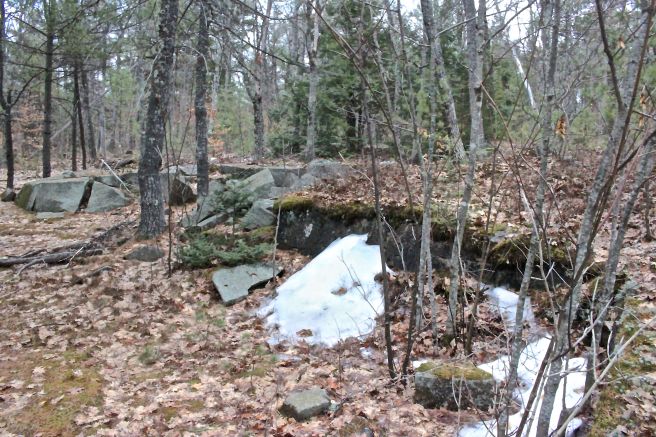
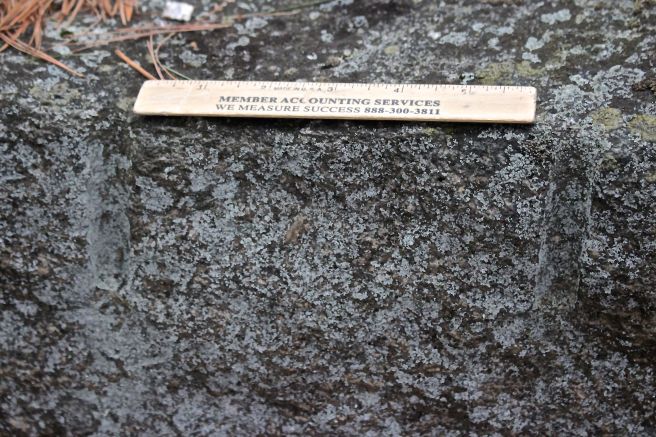
This is the spot from which the foundations for the buildings were quarried so long ago, using the plug and feather technique that was common in that time.
N-common toadskin 2

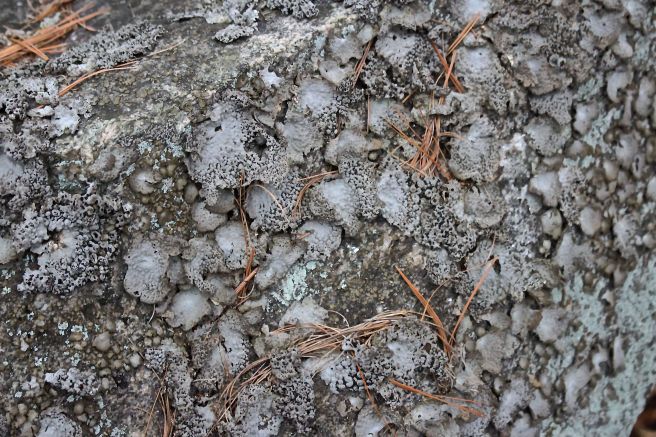
Life of a different sort has overtaken some of the stones–common toadskin lichen covers their faces.

N-common toadskin 3

In its dry form, it looks perhaps like the surface of a foreign planet, but this is another lichen that turns green when wet–allowing the “toad” to become visible.

N-bishop's face in ice

Speaking of becoming visible, I noticed the bishop’s face topped with a mitre as water dripped off the rocks and froze. My thoughts turned to my sister–she doesn’t always see what I see, but maybe this one will work for her.

N-young beech

Heading back out to the main trail, I startled a snowshoe hare and of course, didn’t have my camera ready. As I turned toward the bear trap, I continued in the land of the beech trees. Most are too young to produce fruit, but I looked for larger trees and, of course, checked for claw marks.
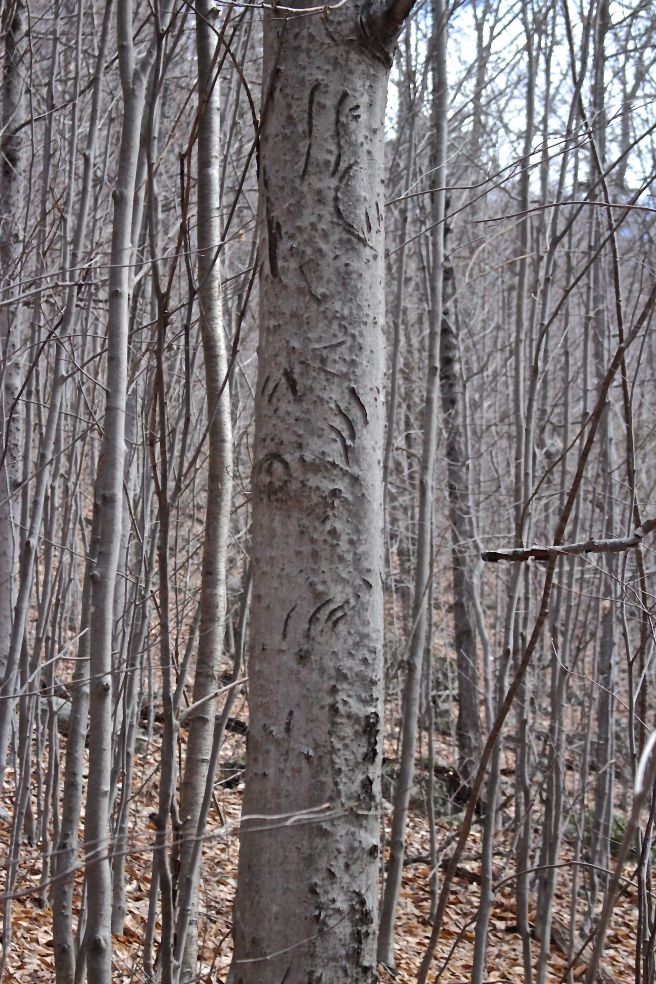
N-beech slashes

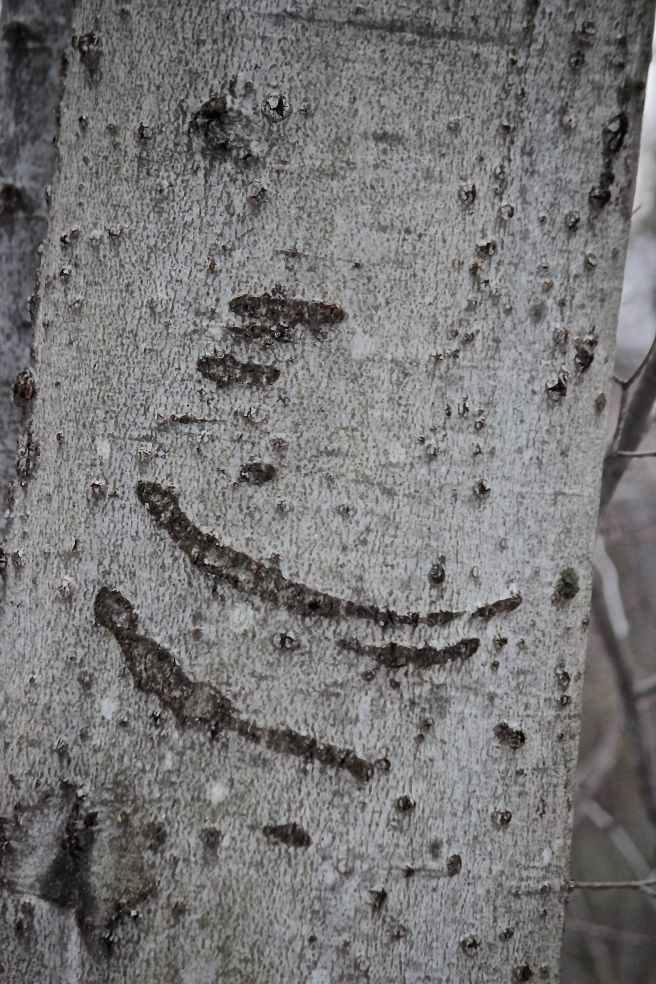
The best I found were slashes–probably caused by another tree rubbing against this one.

N-initials

Oh, and some initials carved by one very precise bear.
N-No parking

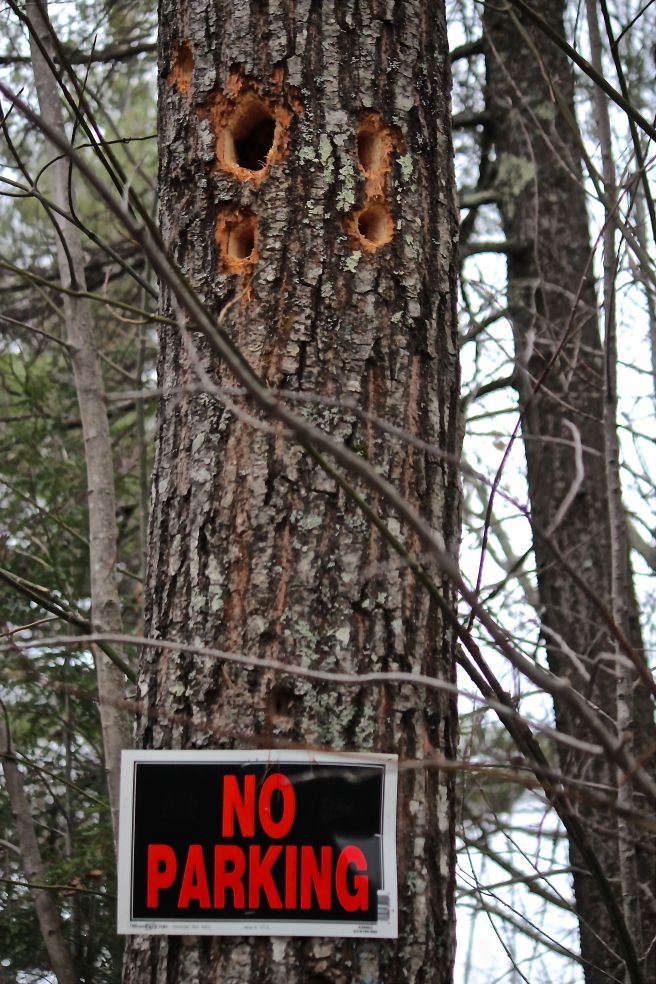
I was almost there when I encountered a “No Parking” sign. A new “No Parking” sign. On a trail in the middle of nowhere that used to be somewhere. The pileated woodpeckers obviously ignored it. Me too.
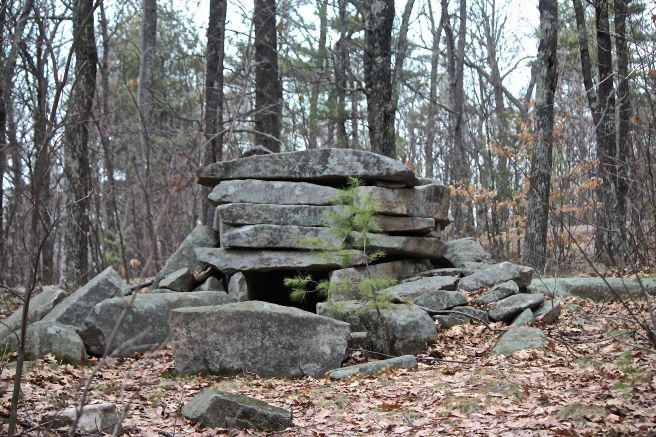
N-BT1

At last, Bear Trap! According to an August 17, 1963 article in the Bridgton News, “Enoch Perley, early settler of South Bridgton, built his first house in 1777 and brought his bride to their new home in 1778. [I believe this was at Five Fields Farm.]

As Enoch acquired livestock, he was much troubled by depredations from bears. He built a bear trap on the hill back of his first home . . .

Tradition says that four bears were caught in this trap–not enough! So Mr. Perley later had an iron bear trap made which took care of eight bears. Without a doubt, many were disposed of by him personally. A story is told that in an unarmed encounter with a bear and two cubs beside a wood road at dusk, Mr. Perley allegedly strangled the mother bear with his garters . . .”

N-bear trap 1

The article continues, “The bear trap is built of stone. A large stone door is suspended and as the bear takes the bait, he trips the lever and is caught in the stone enclosure.”
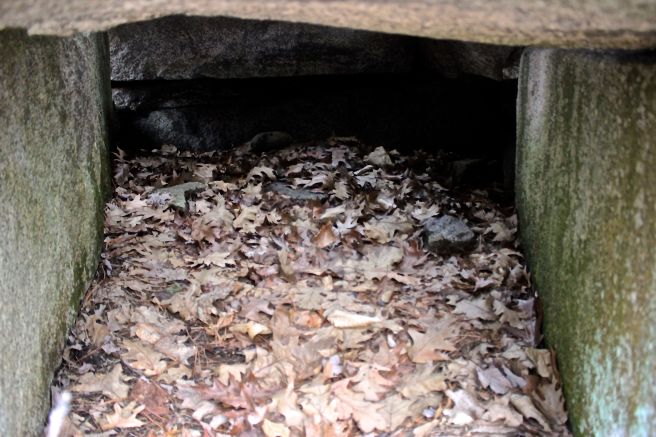
N-BT inside

I looked inside and found no one in residence. In a December 1954 issue of the Bridgton News, a brief article states: “The old stone bear trap on the mountain in South Bridgton known as ‘Fitch’s Hill,’ unused for more than one hundred years, has been reactivated by Dr. Fred G. Noble and Gerald Palmer and put in readiness to capture a bear.” As the story goes, they never did succeed.

N-BT back view

A side view.

N-BT*back side

And a rear view. A few years ago there was talk of moving this monument because land ownership had changed. I hope it stays put because its authenticity would be lost in a move.

N-pine scale?

Just below the trap, I noticed a white hue decorating only one of a bunch of young pine trees. I can’t say I’ve ever seen this before or venture a guess about its origin. I’m waiting to hear back for our district forester–maybe he has some insight.
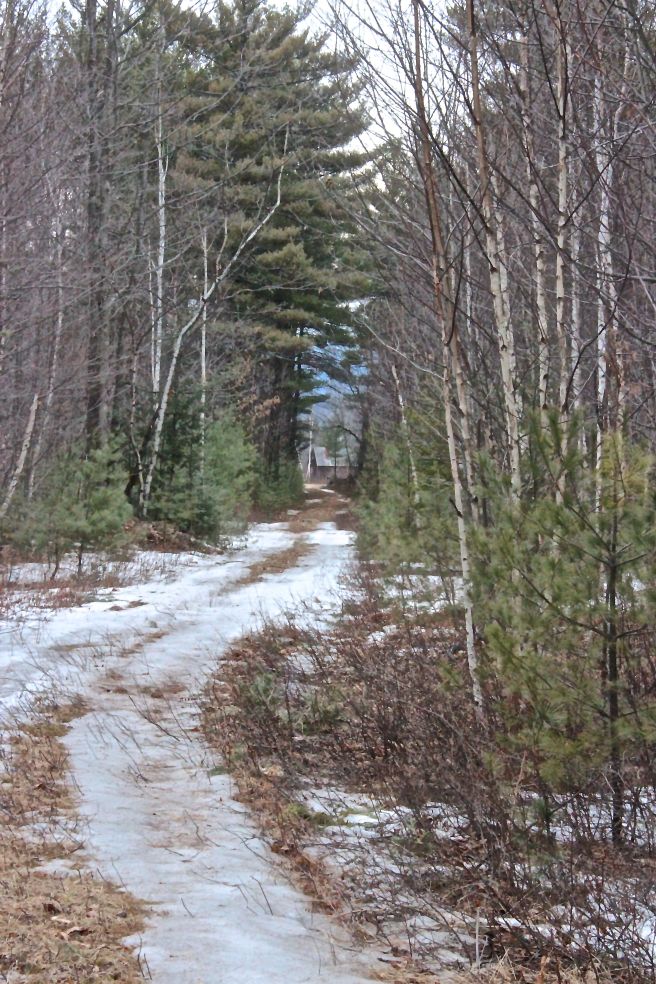
N-heading back 1

As I headed back down the trail and the barn came into view, I spied a single red pine thrown into the mix of forest species that have taken over this land.

N-red pine

Ever on my bear claw quest, I checked the bark of this tree. Though beech provides an easy display of such marks, it’s not the only species of choice. Among others, single red pines that appear to be anomalies have been known to receive a visit.

N-hare

There was sudden movement as I approached the pine and then what to my wondering eyes should appear, but a second snowshoe hare! It paused long enough for me to snap a photo. Do you see it? Also known as the varying hare, its fur is still white.

Behind the tree, I found where it had been dining and defecating.
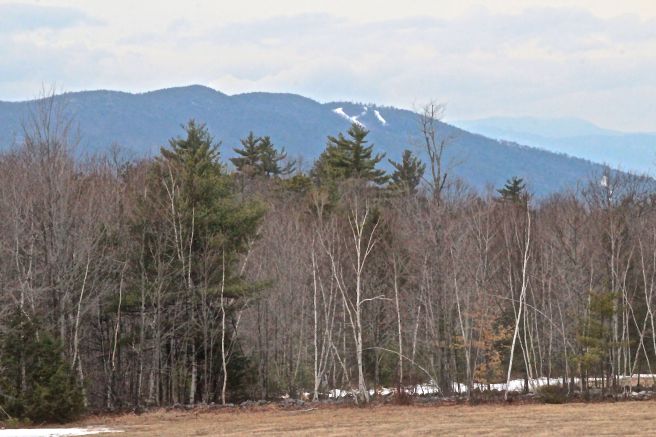
N-Pleasant Mtn ridge

N-farm view from back

As I crossed the upper field, the ridge line of Pleasant Mountain and ski trails at Shawnee Peak made themselves known to the west. And beyond the farmhouse, the White Mountains.

And then,

N-shagbark hickory

and then . . .  an oversized bud captured my attention as I walked back down the road.


Shagbark hickory isn’t a common species around here. But, Jon Evans of Loon Echo Land Trust had recently told me some mature trees were found on a property in South Bridgton that is under conservation easement. (We actually may visit them tomorrow). The bulbous, hairy bud scales and large leaf scar made even the young trees easy to identify. Curiously, according to Forest Trees of Maine, the wood “was formerly used in the manufacture of agricultural implements, axe and tool handles, carriages and wagons, especially the spokes and rims of the wheels.” That fits right in with the neighborhood I’d been visiting.
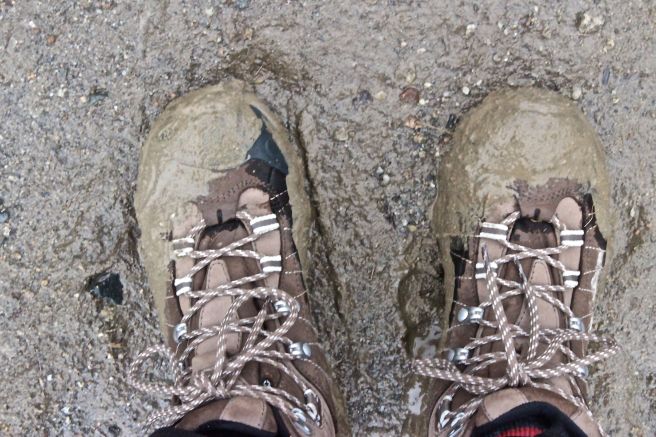
N-mud season

One final view–yup, it’s mud season in western Maine. But still worth a trek to bear trap and back. Thankfully, the rain held off until my drive home.


Book of the Month: The Country Diary of an Edwardian Lady

D-cover 1

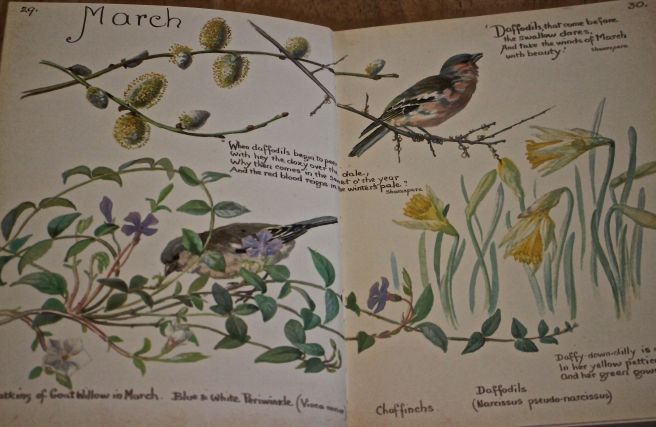
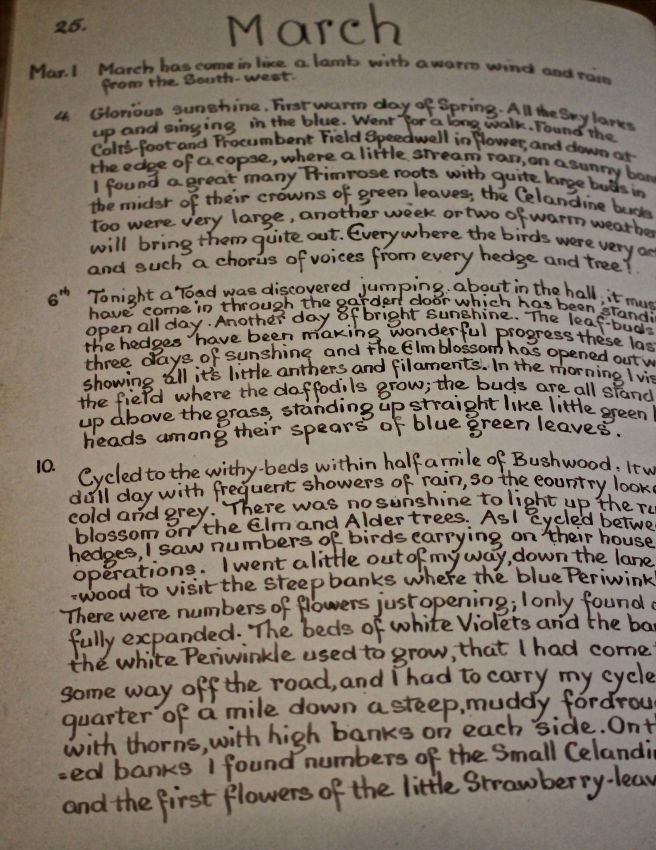
In 1980, after I’d spent time studying in York, England, my sister gave me a copy of The Country Diary of an Edwardian Lady by Edith Holden. I’d kept diaries on and off over the years and continue to do so today, but nothing will ever match this masterpiece filled with poetry, personal observations and thoughts, plus enchanting watercolors.

D-nature notes 1906

Written in 1906, the book wasn’t actually discovered and published until 1977. Ms. Holden passed away in 1920.

D-March display

Printed on yellowish paper, each page has darkened edges that give the reproduction an aged appearance–making me feel as if I’m holding the original in my hands.

D-march phenology

She included her daily wonders and wanders, and poems and quotes that caught her whimsy. She was a teacher and a thinker who captured the physical world of the flora and fauna that surrounded her and combined it with a sprinkle of her own soul.

IMG_2340

On the opening page for March, she quotes Bryant:

“The story March is come at last

With wind, and cloud, and changing skies;

I bear the rushing of the blast

That through the snowy valley flies.

Ah! passing few are they who speak

Wild stormy month in praise of thee;

Yet though they winds are loud and bleak

Though art a welcome month to me.

For thou, to northern lands again

The glad and glorious sun dost bring

And thou hast joined the gentle train,

And wear’s the gentle name of Spring.

And in thy reign of blast and storm

Smiles many a long, bright summer day

When the changed winds are soft and warm

And heaven puts on the blue of May.”

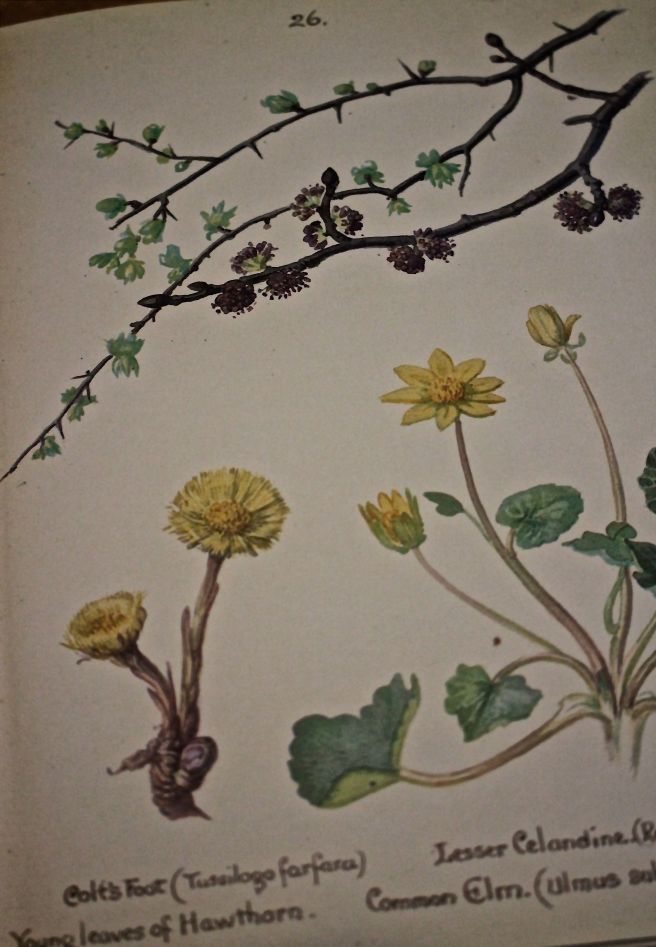
d-colt's foot

As I sit here this morning , I gaze upon trees whose limbs are embraced in snow and twigs glazed with a coating of ice while the rain falls. Since daybreak, the male cardinal has been singing at regular intervals. On March 12, 1906, Ms. Holden noted: “After a wet, windy day, we wake this morning to a regular snow storm, the air was full of whirling flakes, but in the midst of it all I heard a Sky-lark singing.”

Though she doesn’t know it, Ms. Holden has long been one of my mentors as she explored, catalogued and enjoyed nature. I can only hope to continue to pursue the daily wonderment she knew so well in my own way. I’m grateful to her and to her family for publishing the book posthumously. (Apparently there is a new edition, but I love my 1977 version) And to my sister for giving me this gem so many years ago.

The Country Diary of an Edwardian Lady, written and illustrated by Edith Holden, published 1977, Holt, Rinehart and Winston.

Leaping Mondate

My guy happens to be Irish so it seemed only appropriate that I propose to him today following the example that St. Brigid set when she struck a deal with St. Patrick. Yes, we’ve been married for 25+ years, but I proposed anyway.

And he accepted. So today’s Mondate found us at Roberts Farm Preserve in Norway. Norway, Maine, that is.

R-sign

In her book, Hikes and Woodland Walks in and around Maine’s LAKES REGION, my friend Marita Wiser states that the preserve was “farmed by the Pike and Roberts family for 200 years.” She adds, “The property was purchased by the Western Foothills Land Trust in 2007.”

r-parking

Though the trails are mostly maintained for Nordic skiers, we didn’t see any today.

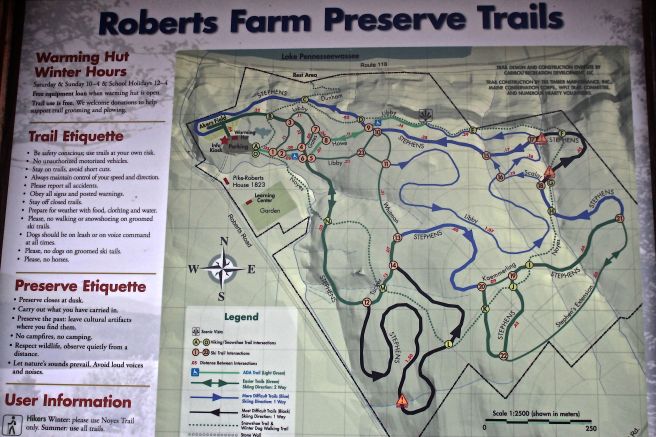
r-trail map

Had it been open to skiers, we wouldn’t have been able to do what we did–follow the network of trails around the perimeter of the property.

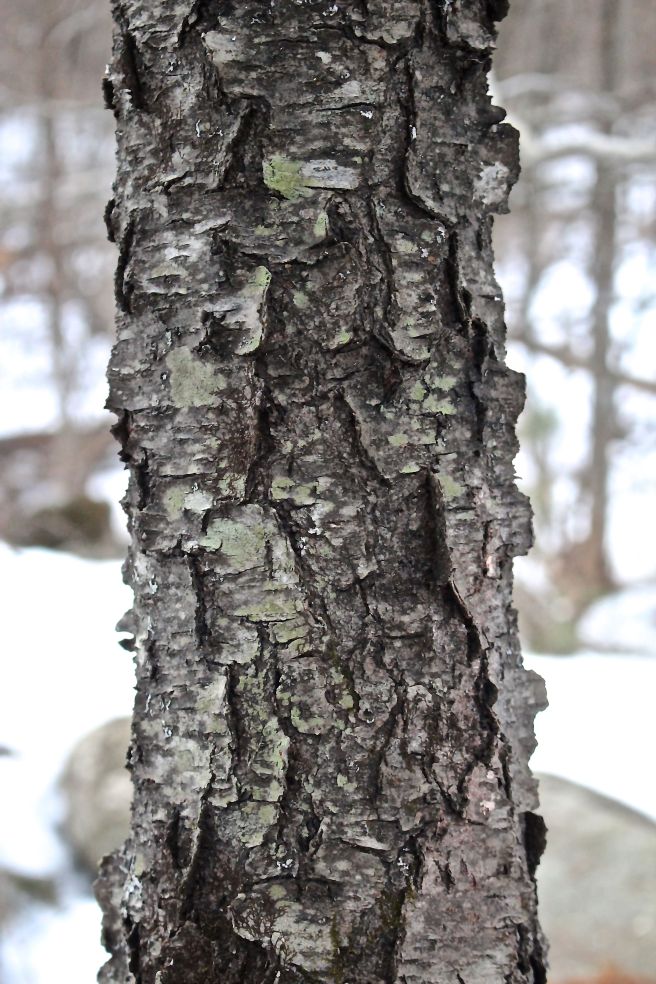
r-cherry bark

We’d only walked a few feet when I had to pause–the burnt cornflake look of black cherry bark insisted upon being noticed.

R-Northern White Cedar

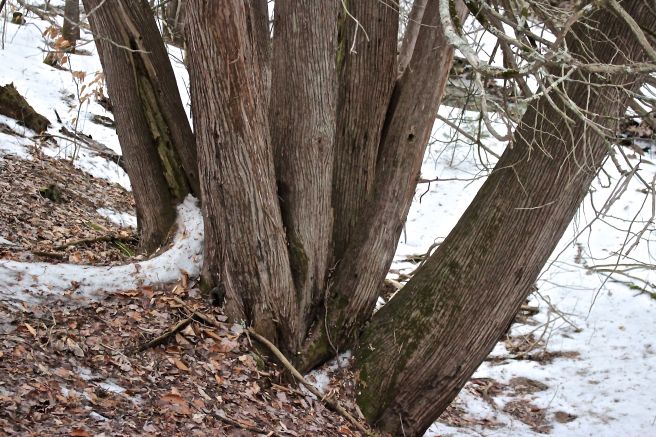
Visiting here a couple of times previously, one of the things I’d come to like about it is the opportunity to gush over Northern white cedar bark.

r-northern white bark2

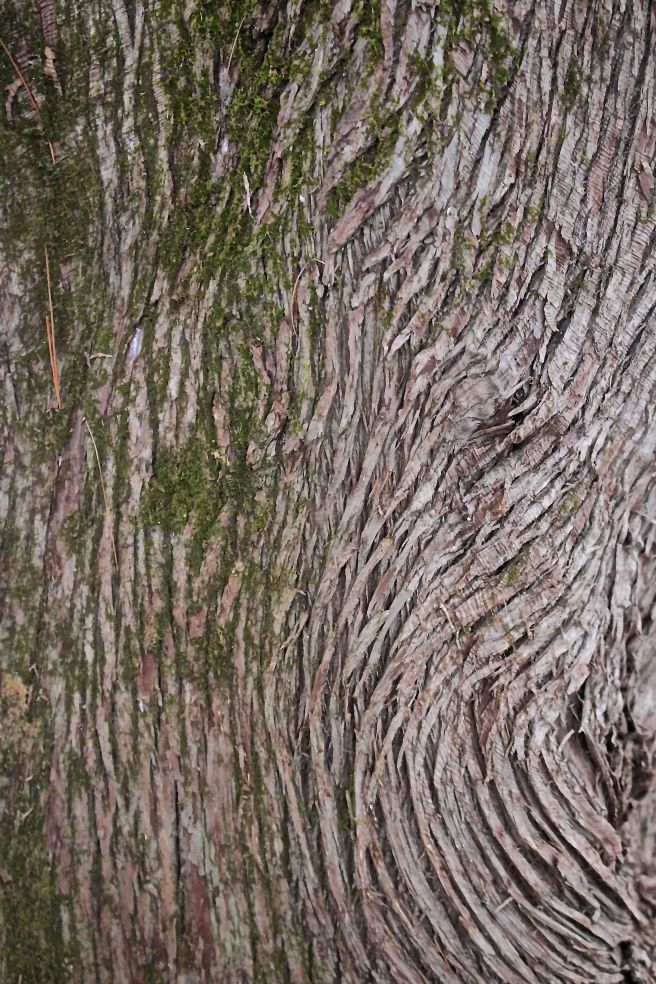
I love its red-brown color, sheddy strips that intersect in diamond formations and habit of spiraling left and then right with age. In his book BARK, Michael Wojtech states of the cedar: “In the 1500s, the native Iroquois showed French explorers how to prevent scurvy using a tea made from the bark, which contains vitamin C. The name arborvitae means ‘tree of life.'”

r-northern white leaves

Equally beautiful are its flat sprays of braided, scale-like leaves.

Since I’m on the topic of tree bark, I have two others to share, including this one–the red inner bark of Northern Red Oak made a stunning statement.

r-hop hornbeam bark

Displaying its shaggy presentation was the hop hornbeam.

My heart leaped (appropriate movement for today) when I saw these papery fruits on the ground–hop hornbeam is named for its fruiting structures that resemble hops.

r-stone wall

Stone walls crisscross the preserve and provide evidence of its former use as a dairy farm.

r-barbed wire

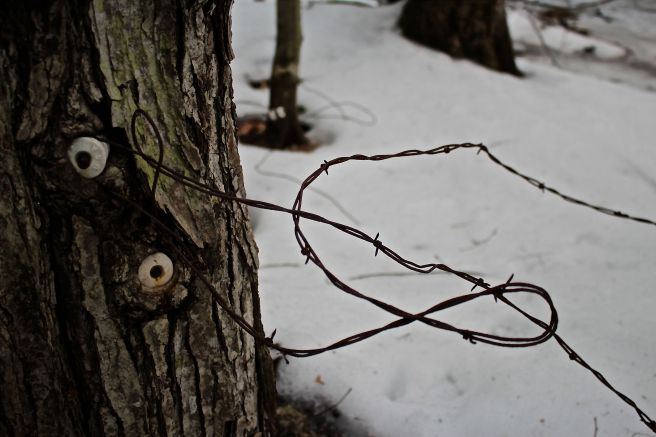
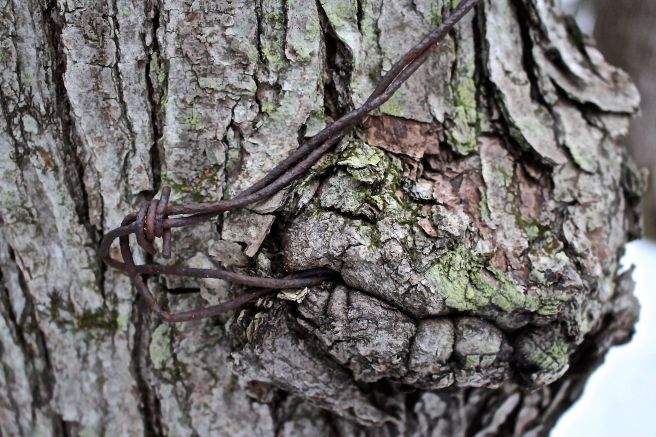
Barbed wire adds to the story.

r-barbed wire grimace

Installed long ago, this tree formed a grimace in response.

r-large pine

Along the edge of some walls stand much happier trees–those that were allowed to grow tall and wide in the sun, like this Eastern white pine. Perhaps it provided a bit of shade for Roberts’ Jerseys.

r-generation gap

The land was farmed until 1968. Since then, it returned to woodland, was sold and logged and sold another time–finally to the land trust. Generational gaps are visible throughout. This is the perfect place to take some youngsters and ask them to locate a white pine that matches their age.

r-brook 2

We cross several streams that I’m sure sustained the farm and its inhabitants. Today, they sustain the wildlife that wanders here, including deer.

r-turkey trot

We realized there had been a recent turkey trot and

r-voles 1

vole convention.

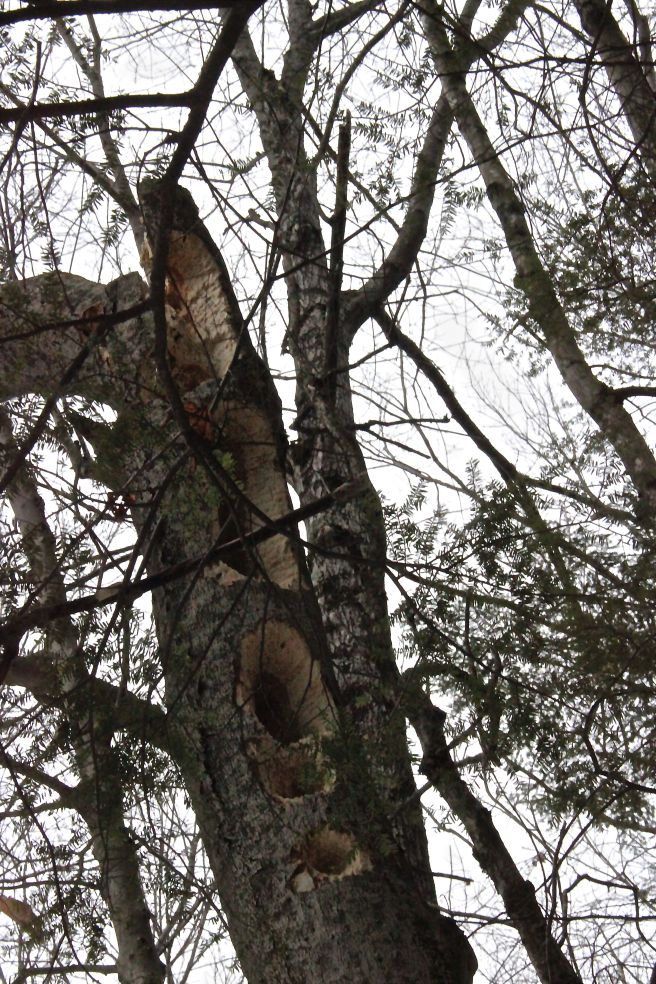
r-pileated condo

Birds also have played a major role in this community. This pileated woodpecker-created condominium has been around for a while.

r-pileated pile

From the trail, I spied the largest pile of wood chips I’ve ever seen and of course, had to investigate.

r-pileated tree

The old beech was recently excavated for new condos.

r-pil pile 2

Below, the wood chip pile was a couple of inches deep.

r-pileated scat 1

r-pil scat 2

The best part–lots of scat cylinders filled with insect body parts. Good stuff to see.

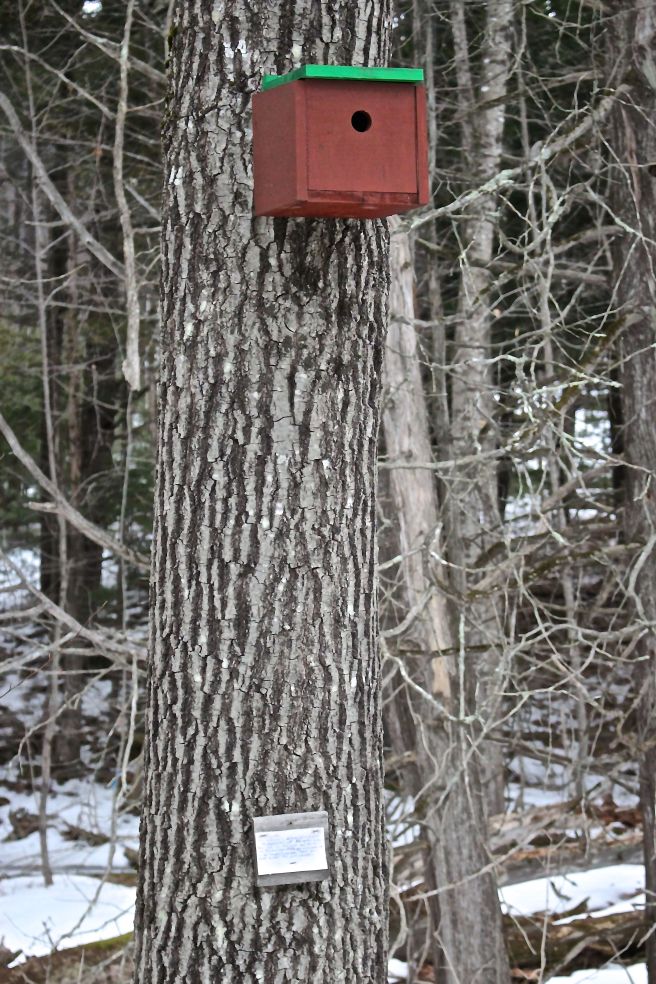
r-birdhouse

Pileated woodpeckers aren’t the only ones in the building industry.

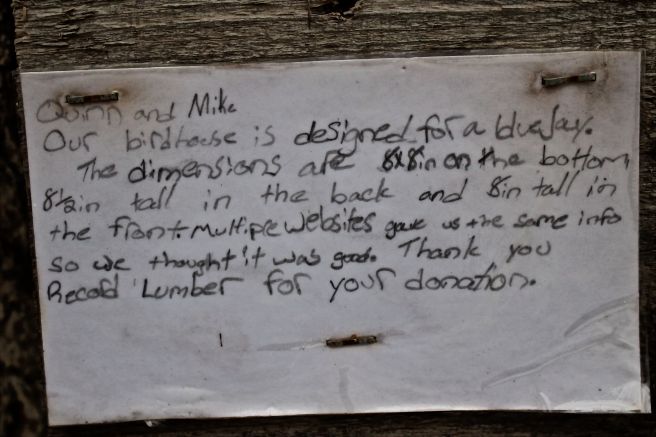
r-birdhouse sign

I think you’d agree that Quinn and Mike did a fabulous job constructing this birdhouse.

r-mullein capsules

In several open areas we spotted the winter display of common mullein.

r-mullein 2

Its crowded performance of two-parted capsules atop a tall, fuzzy stem made it easy to identify.


The pointed prickly bracts of thistles also offered a winter show.

r-lungwort on ash

Lungwort tried to hide on the backside of an ash tree, but I found it. I only wish we’d had rain, or better yet, snow, recently, because I love the neon green that it becomes once it is wet.

r-lunch rock

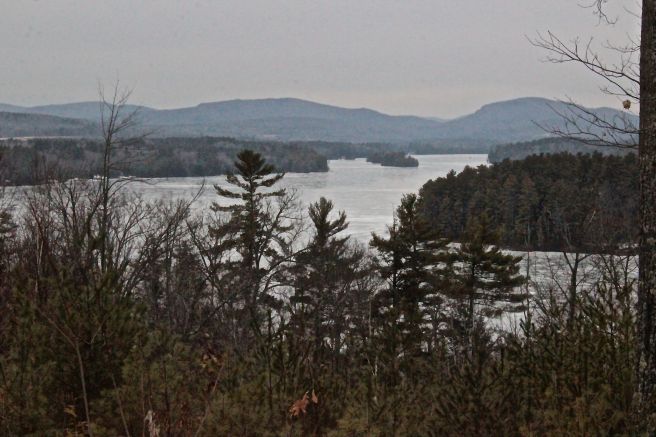
Be careful what you wish for. Though the day was sunny at the start, it began to rain as we ate our sandwiches on lunch rock overlooking Lake Pennesseewassee, aka Norway Lake.

r-lake 1

It wasn’t a downpour, but enough that it encouraged us to eat quickly and move on.

r-beaked bud

Well, I didn’t move far. Within steps, I found a shrub I was seeking yesterday–beaked hazelnut.

r-beaked hazel

It’s a member of the birch family and features catkins–the male flowers that will release pollen this spring to fertilize the shrub’s delicate red female flowers.

r-christmas fern

Another quick find–Christmas fern–one pinnae topped with a birch fleur de lis.

Typically, during the winter there is only one trail open to hikers. Today, however, we figured it would be OK to walk on the ski trails because they are either icy or bare. It was definitely a micro-spike kind of day, which has been more the norm this year.

r-painted cow

Other than birds and squirrels, we saw no wildlife. But we did stumble upon the “Painted Cows” created by Bernard Langlais in 1974 and gifted to the land trust by Colby College and the Kohler Foundation.

We had planned to explore the inner network of trails, but the cold raindrops drove us out. Despite that, I think my guy enjoyed himself as much as I did. And he was extremely patient each time I paused. Sometimes he even gave me a heads up–I took that to mean he didn’t mind that I had to stop, wonder and photograph. This is one Leap Date I hope we don’t forget.


Book of January: A Guide to Nature in Winter by Donald W. Stokes

Stokes 1

Book of January

I have a number of winter nature books, but one of my go-to favs is A Guide to Nature in Winter by Donald W. Stokes. My copy is old (1976–it was a very good year–I graduated from high school) and a bit weathered, but that’s because it has seen frequent use.

Divided into eight field guides, Stokes covers all aspects of winter: winter weeds; snow; wintering trees; evidence of insects; winter’s birds and abandoned nests; mushrooms in winter; tracks in the snow; and woodland evergreen plants.

For each topic,  pen-and-ink drawings by illustrator Deborah Prince and the author are included in the key, as well as natural history descriptions.

The natural history descriptions are just that–Stokes’s descriptions are part of the story that Kevin Harding of the Greater Lovell Land Trust reminds us to share with others. Here’s an example: “St. Johnswort (Hypericum perforatum)–An old country custom in Europe was to hang a special yellow-blossomed plant in your window on the eve of St. John’s Day (June 24), in order to repel bad spirits and counteract the evil eye. In general, the presence of this plant was considered a good omen, and since it was thought that the plant warded off lightning and revealed the identity of passing witches, St. Johnswort was allowed to prosper around the farmhouse. It became known as St. John’s Plant or St. Johnswort (wort meaning “plant” or “herb”). When the plant immigrated to North America it left its traditions behind, and although still as effective as it probably ever was against evil, St. Johnswort is now seldom used for that purpose.” Of course, then he goes on to describe how the plant grows and the seed heads that will appear in the winter landscape.

One of the things I’ve learned from this book is to keep it simple. In the chapter about winter trees, Stokes encourages the reader to begin with the six most common deciduous trees: oak; maple; ash; beech; birch; and aspen. Learning these along with the evergreens provides you with knowledge about 80% of the trees in your forest. I’ve spent the last couple of years developing my bark eyes. I still have much to learn, but can eliminate the common species when I encounter bark I’m uncertain about.

It’s well worth taking the time to read A Guide to Nature in Winter from cover to cover–it’s an easy and enjoyable read. I say it won’t take long–unless you are like me and you pause to underline (yes, I mark my books up–even write in the margins, oh my!) details and take time to understand what you do see along the trail. I probably should invest in a more up-to-date copy, but I feel right at home engrossed in the one that I have.

And it’s also easy to turn to a particular chapter to figure things out. The simplified, illustrated keys should bring you quickly to an identification. And as I said before, the natural history description will further enhance your learning.

The book is available at Amazon.com, but if you live near an independent book store like Bridgton Books, then I strongly encourage you to shop there.

A Guide to Nature in Winter: Northeast and North Central North America, by Donald W. Stokes, illustrated by Deborah Prince and the author, published 1976, Little, Brown & Company.

Sunday Surprises

As I headed into my smiling place today, I was certain that I wouldn’t find anything of interest. But this Sunday wander made me realize that the gift of wondering means being open to surprises.

I began my traipse following one of the more recent logging trails where sliding over slash is the name of the game.

slash

I can’t wait for three feet of snow to make this an easier adventure. In the meantime, I made do.

sinking

Some moments I did think I was sinking to China–where my friend Judy Lynne would have to be on the lookout for me.

cinnabar 2

And then pumpkin orange polypores called out, proving slash is good for something. Cinnabar-red Polypore (Pycnoporus cinnabarinus) I do believe. It pays to have Fascinating Fungi by Lawrence Millman in my pack.

cinnabar 3

As is its habit, it was growing on a downed cherry log. I picked one fruit to show the pore surface beside the cap. Millman describes it this way: “Caps are kidney-shaped orange to dull reddish-orange, azonate and covered with warts and wrinkles in age. The pore surface, in the words of mycologist Gary Lincoff, ‘looks as if it had been seared by a hot iron.’ The pores themselves are usually more angular than round.” I had to look up azonate when I got home: without zones or circular bands.

cinnamon 2

Cinnamon fern grew abundantly in this boggy land and as usual, I was drawn to the drama it provides in death.

cinnamon fern

Most of the pinnae or leaflets have fallen to the ground, where their curved forms add texture and interest even as they begin to break down and give back.

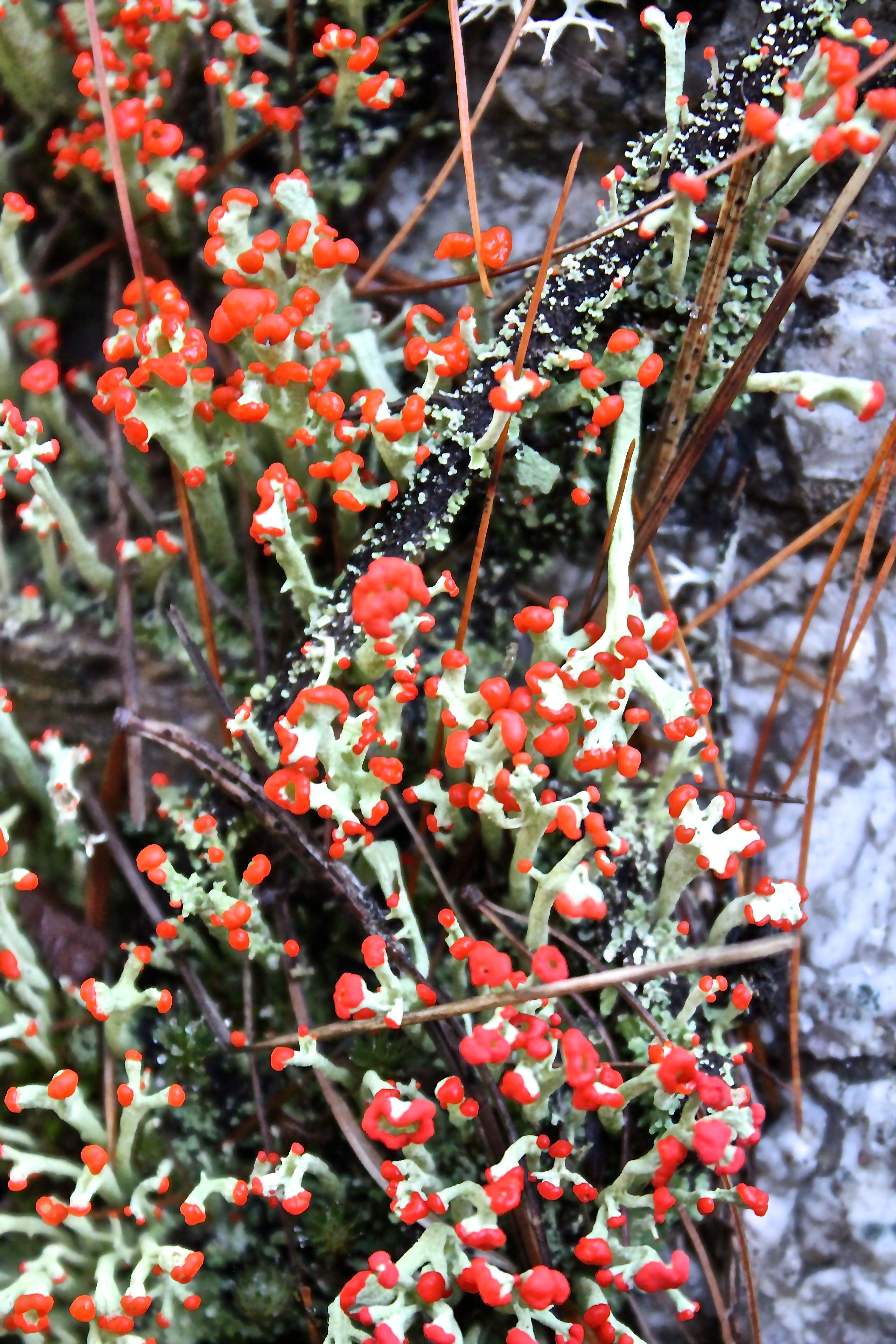
British soldiers

Watching over all–a large colony of British soldiers, their red caps ever so bright in this miniature world.

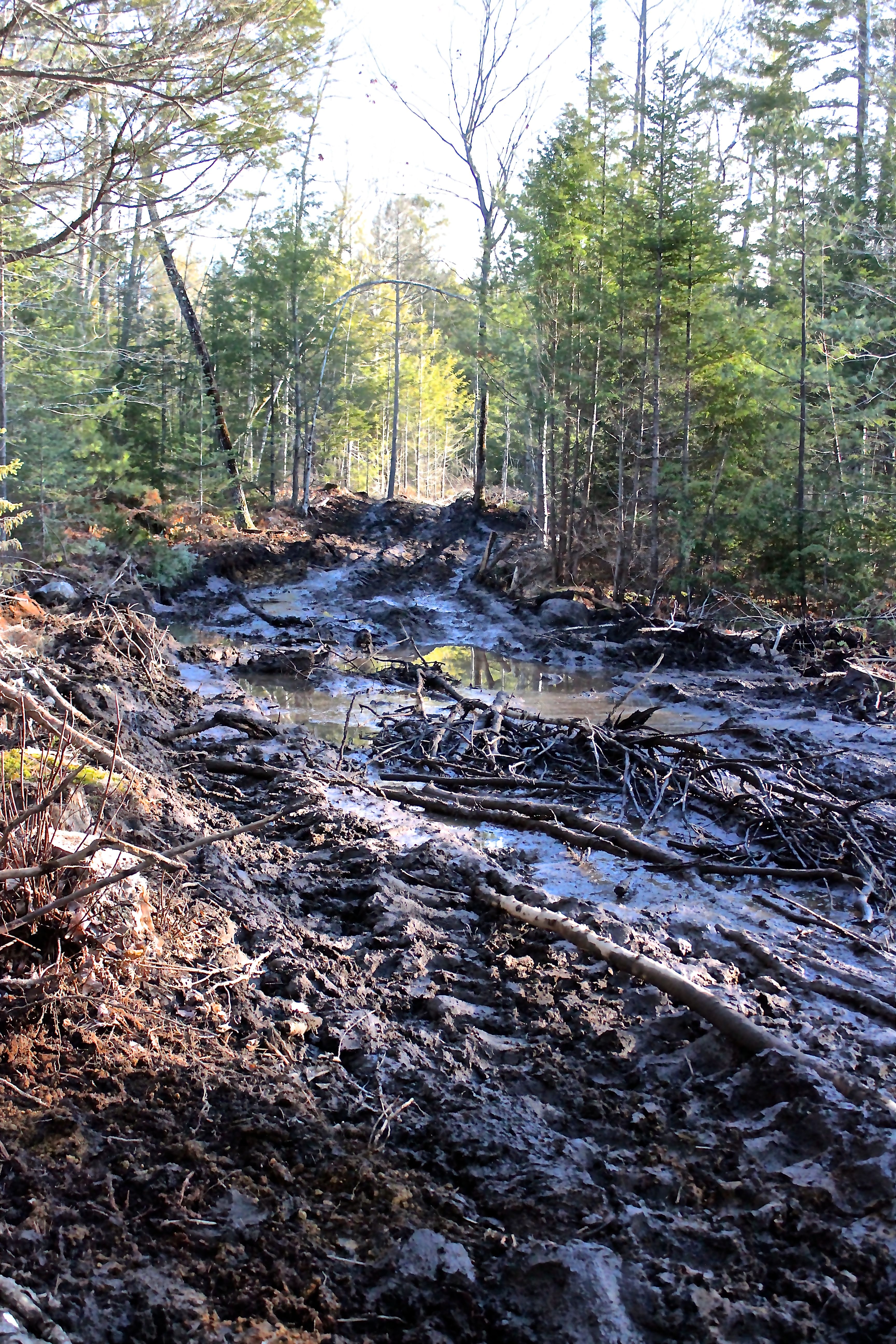
muddy logging road

I reached the main logging road at last. A few weeks ago I thought that the logger had finished his mission, but apparently not. That’s okay, because after I found a bunch of bobcat, coyote and deer prints, I headed back into the woods leaving the muck behind.

pine needles 1

Bunches of white pine needles adorn many of the young hemlock trees–all in keeping with the season.

haircap geometry

And the hair cap moss speaks of starry, starry nights and geometric designs.

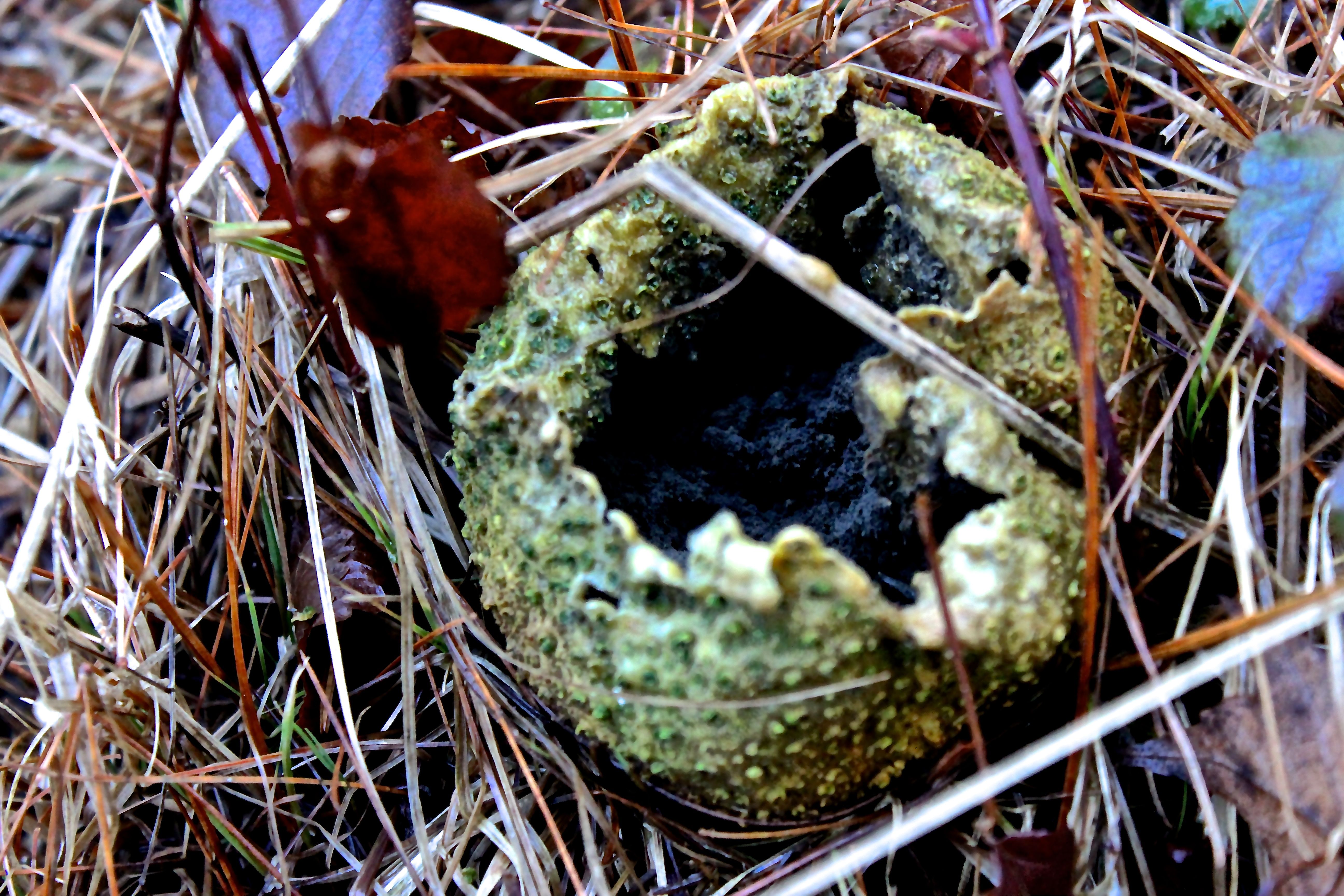
pigskin poison puffball

But my best find of all was a total surprise. In fact, I didn’t think it was natural at first. An old baseball or tennis ball that somehow landed in this place where few venture? I touched it and it felt almost leathery. Inside, the duff was powdery. Time to turn to Millman again. I think my ID is correct: Pigskin Poison Puffball aka Earthball (Scleroderma citrinum). WOW! Look at that warty surface. And it was huge compared to other puffballs. My heart was singing. (Fortunately I kept the song in my heart though I was in a place where no one would have heard me!)

wintergreen veil

Eventually I made my way back to the snowmobile trail where I continued to wander for a while. Wintergreen is the plant of choice for this stump garden.

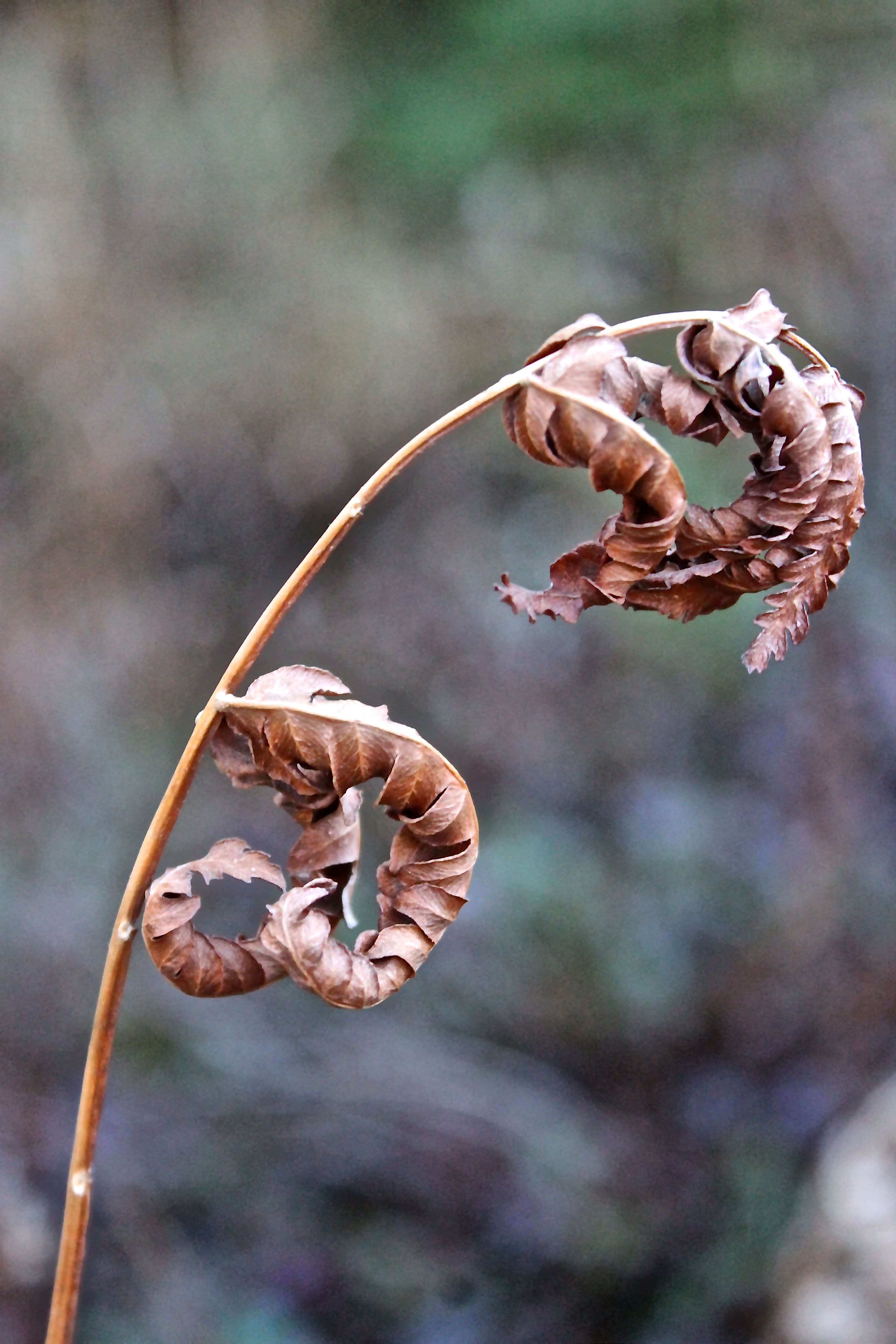
bronze bracken fern

Bracken ferns have turned from green to a light bronze patina. Most have fallen or been knocked over. This one especially appealed to me because it has retained its structure and even portrayed an uplifting spirit.

the ice princess

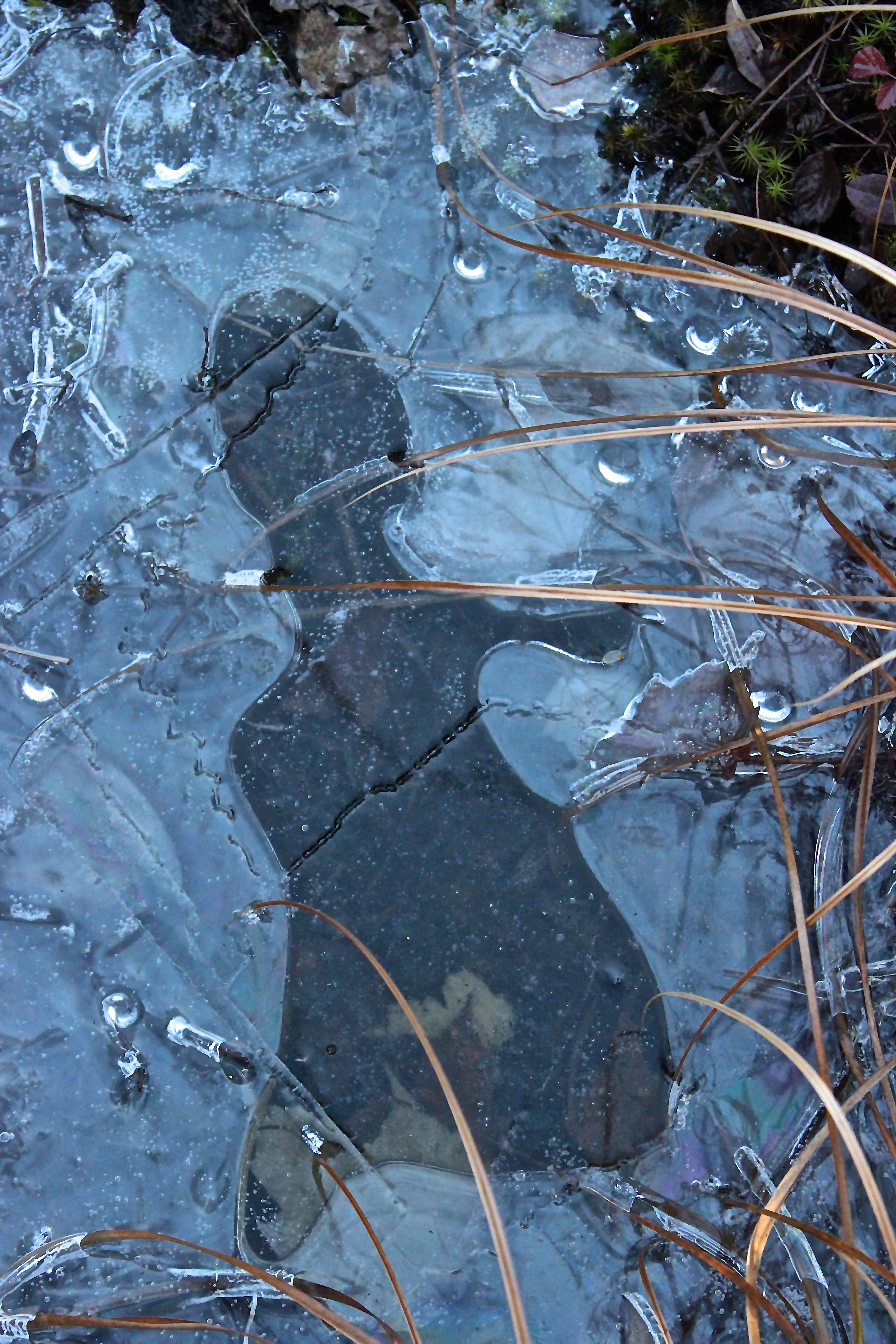
The past few days have been delightfully, though unusually, warm, but I found some ice. And even an ice ghost.

witch's 2

From ghosts to witches–in the woods, I never know who I’ll happen upon. Witch’s Butter (Tremella mesenterica) is another that stands out amongst the grays and browns of the December landscape.

colors 2

Not all is gray and brown. As I wait for snow, the colors of the season remind me that without its covering, there’s much to enjoy.

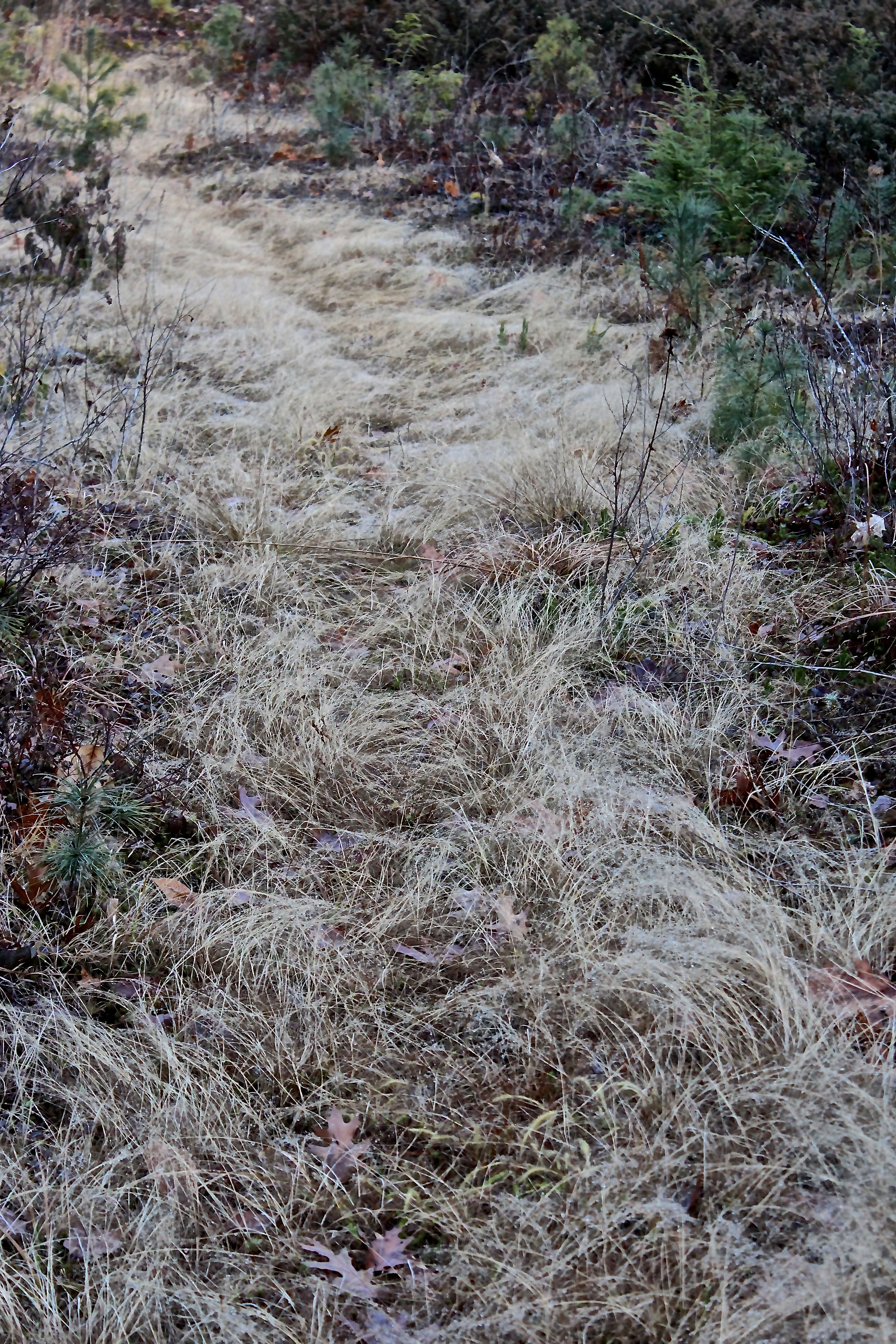
grassy trail

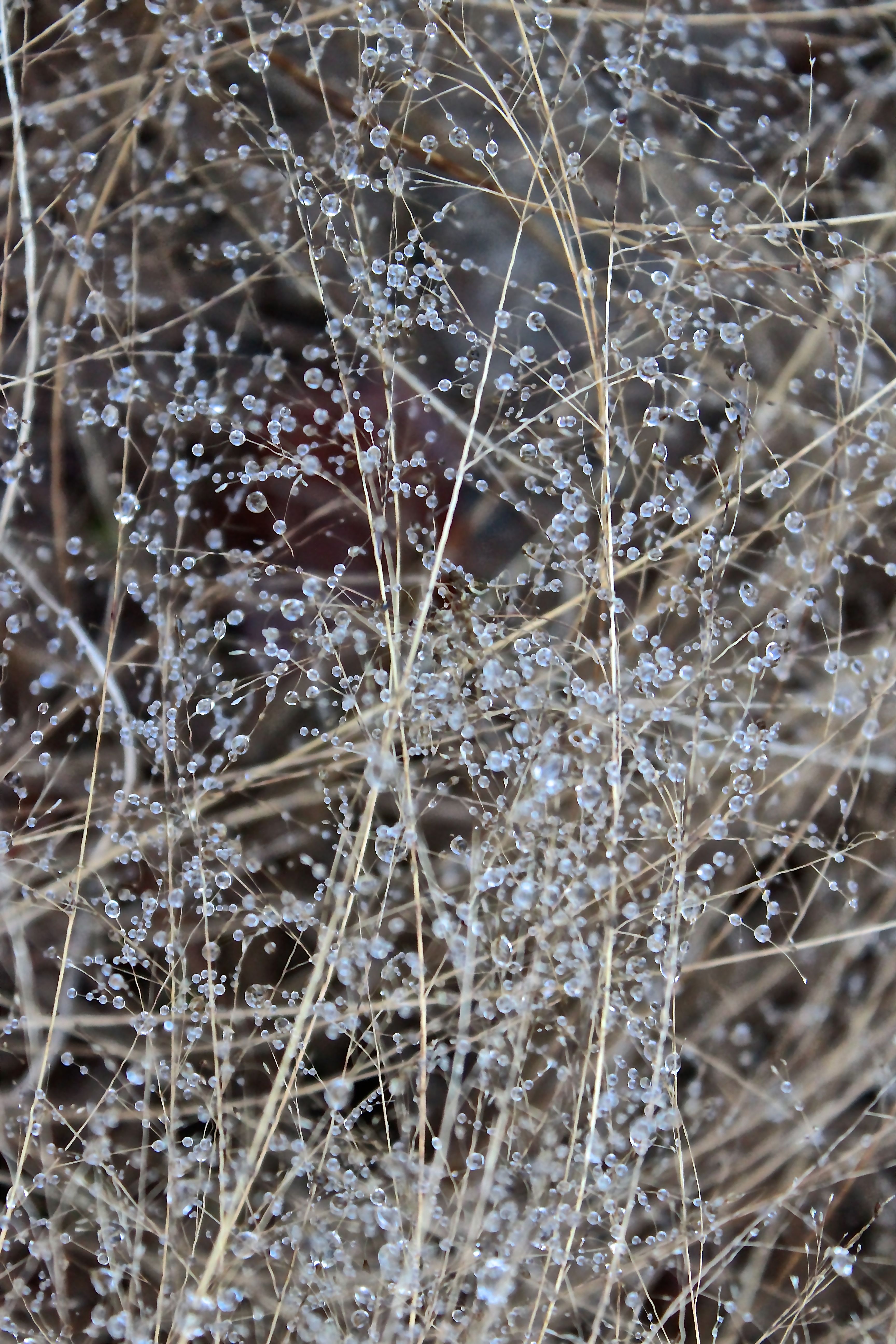
droplets on grass

I was about to head down the grassy path that leads to our cowpath, when two things gave me pause. First, the droplets of water that adorned the grass.

meadowsweet gall

And second–this gall on a meadowsweet plant. I’ve passed it numerous times and decided today was the day to try to figure it out. If my guess is wrong, please feel free to correct me. I think this is rose bedeguar gall, aka Robin’s pincushion gall. Meadowsweet is a member of the rose family, so maybe I’m right. Then again . . .

sheep laurel fruit

One last find that I always enjoy looking at–the fruits of sheep laurel extending  below the leaves and reminding me of jingle bells.

home

At last I was home again, thankful for a Sunday wander wonder-filled with surprises.

Rejoicing for Jinny Mae

When my friend Jinny Mae received an ominous diagnosis in June, she faced it with admirable spirit and courage. All who know her watched in awe as she  underwent treatment and slowly made her way back into our midst. Despite everything, she continued to spend as much time in nature as possible, whether observing from her chair by the window, walking her dogs or eventually joining friends for tramps. And today–she received fabulous news that I learned about as I was about to hike up Bald Pate Mountain in South Bridgton. She is in remission. INDEED!

So as I did when I first learned of her diagnosis, I took her along with me in spirit on today’s hike. I would have asked her to join me for a celebratory tramp, but it was late in the day. We’ll have plenty of opportunities.

I was on a reconnaissance expedition because I’m leading a hike for Loon Echo Land Trust next weekend. Having Jinny Mae along meant I noticed some things I may have walked by previously. In the end, I discovered a mixture of my favorites and hers.

beech slash

Because there is a beech forest at the base of the mountain, and it’s located adjacent to an orchard, I’m determined to find bear activity. Is this the work of a bear that gave the tree a side-ways slap?

beech slash 2

I don’t think so. More likely, the younger trees beside it waved in the breeze enough to create slight scars that have grown with the bark.

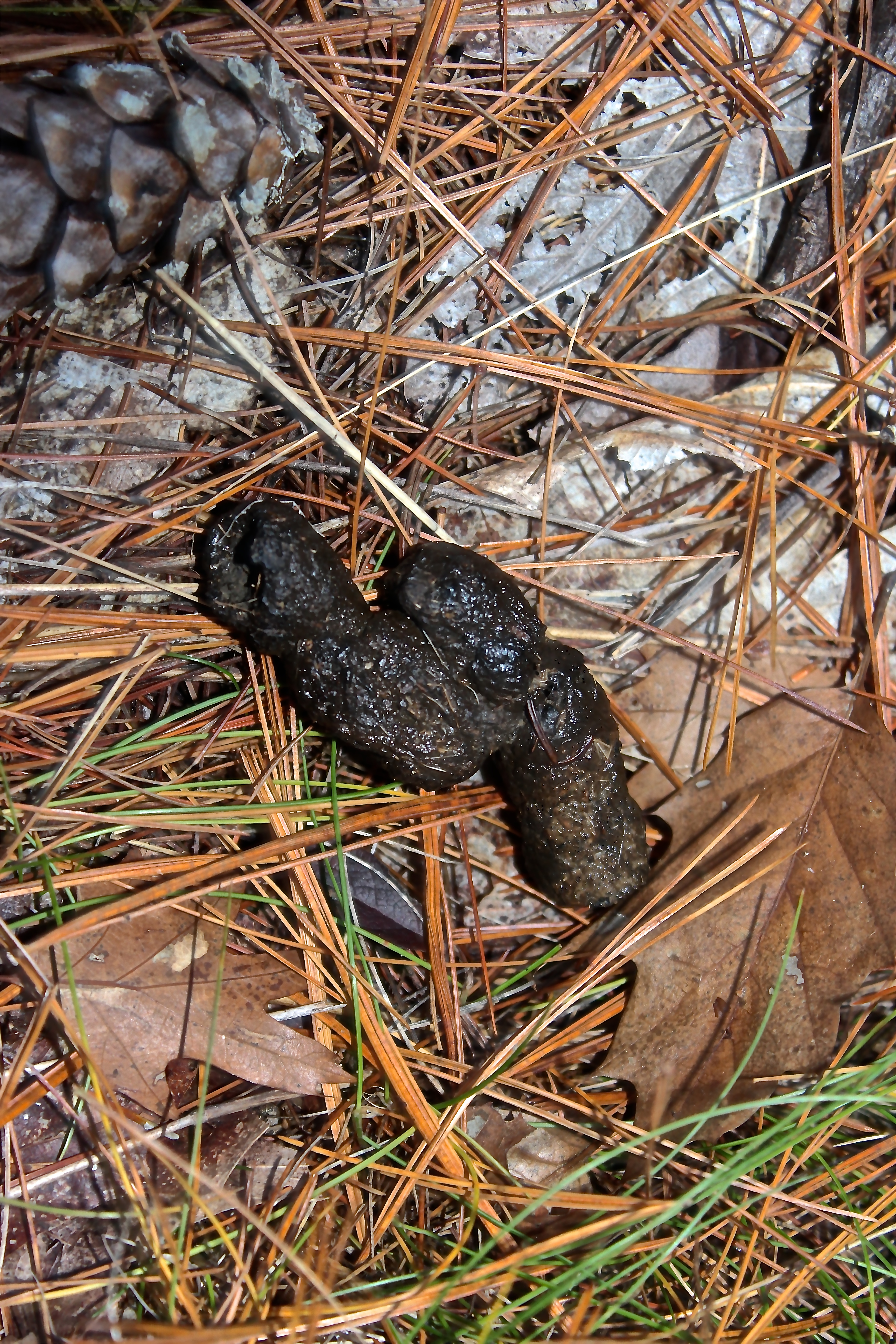
porcupine scat

I poked around under a large hemlock, and noticed what I thought was old deer scat. But then I realized that some of it was a wee bit longer and had the curved shape characteristic of porcupines. As I continued to look, I saw that many small twigs had nipped off ends cut at an angle–porcupine it was.

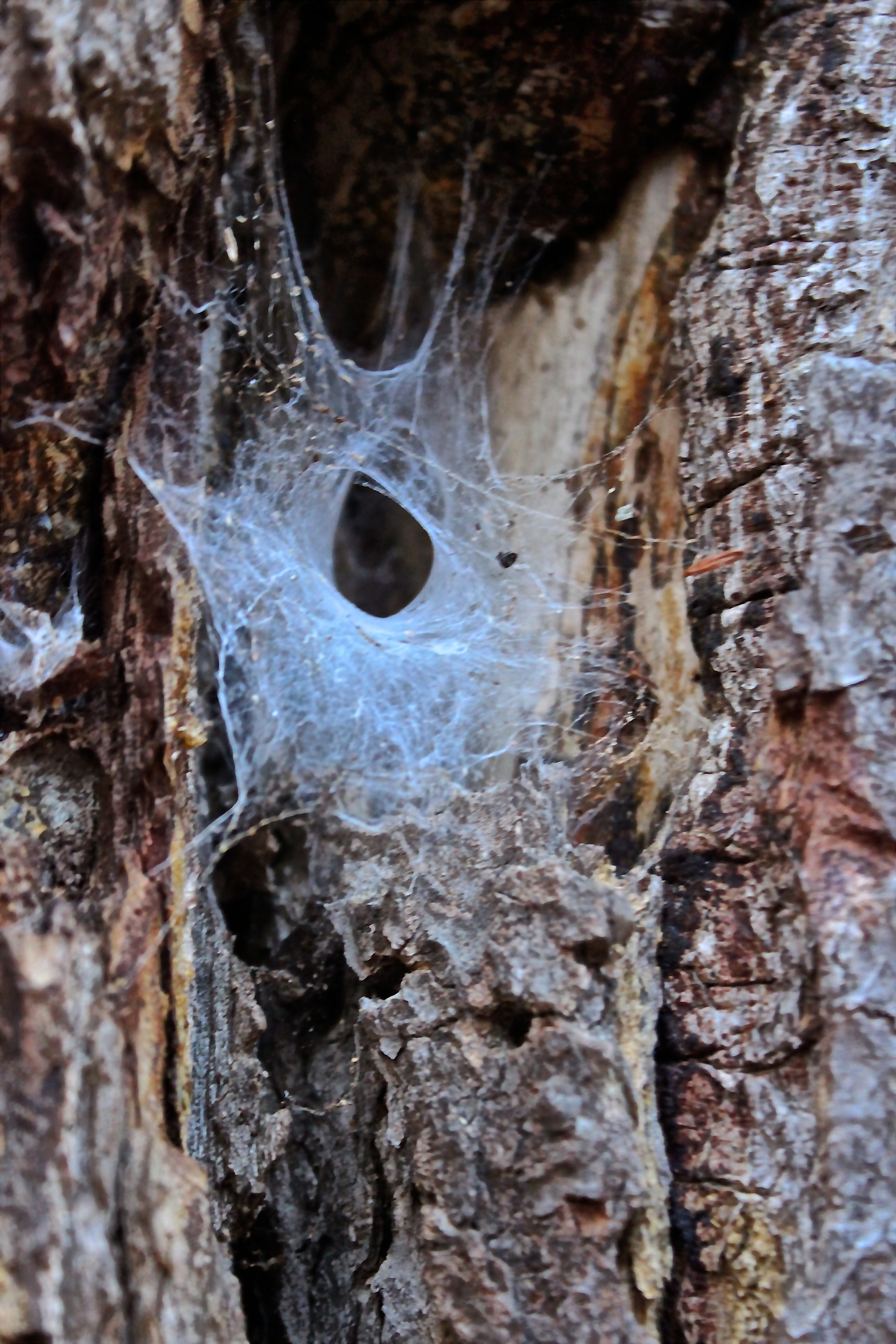
funnel weaver web

For a while, hemlocks became my focus as I checked under each for signs of activity. On the backside of one, I found this funnel weaver web–standing strong against the elements. It reminded me of someone else.

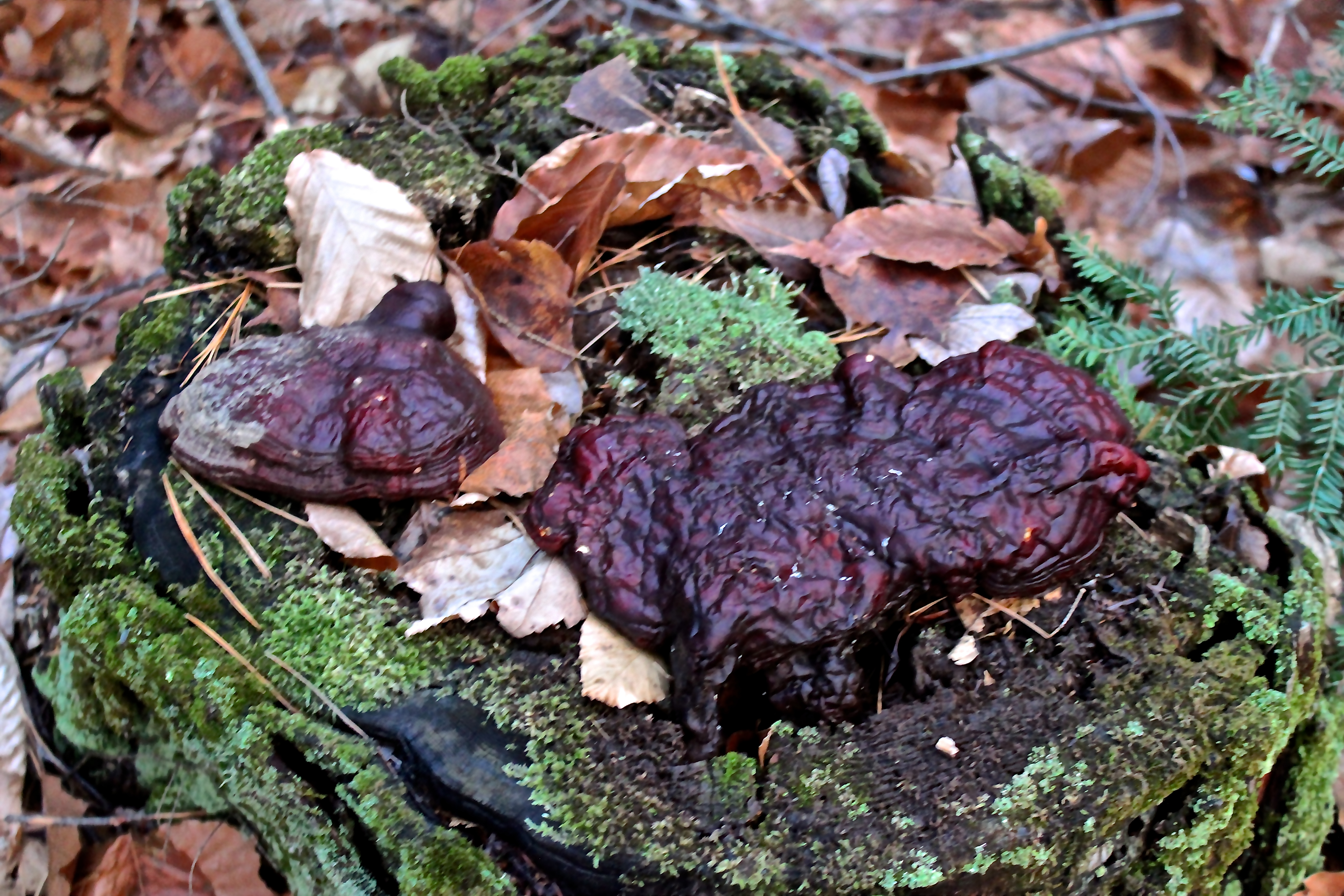
hemlock varnish shelf

That someone would certainly have stopped by this old hemlock stump to admire these varnish shelf fungi–it wouldn’t matter to her that they are withered and old. There’s beauty in age.

pileated log

Every once in a while I felt the nudge to go off the trail and explore–when J.M. keeps track of our tramps on her GPS, the line always zigzags. This rotting log caught my attention. Bear or fisher activity?

pileated scat

No hair or obvious scratch marks from claws, but some scat–pileated woodpecker scat. I left it there in hopes I can show it to people on the hike and let them see that it’s filled with carpenter ant bodies.

ledge

Behind the log was this ledge. A quick look at it and I knew that a certain someone would want to inspect it.

ledge 2

It’s almost completely covered in smooth rock tripe. Sorta looks delicious enough to eat–if you boil it for days on end maybe. Apparently it can be used to thicken stew. Too bad I made stew the other day.

polypody & tripe

And growing among the tripe–a few polypody ferns, who also appreciate a moist, rock surface. Thanks J.M. for encouraging me to take a closer look.

Many-fruited pelt

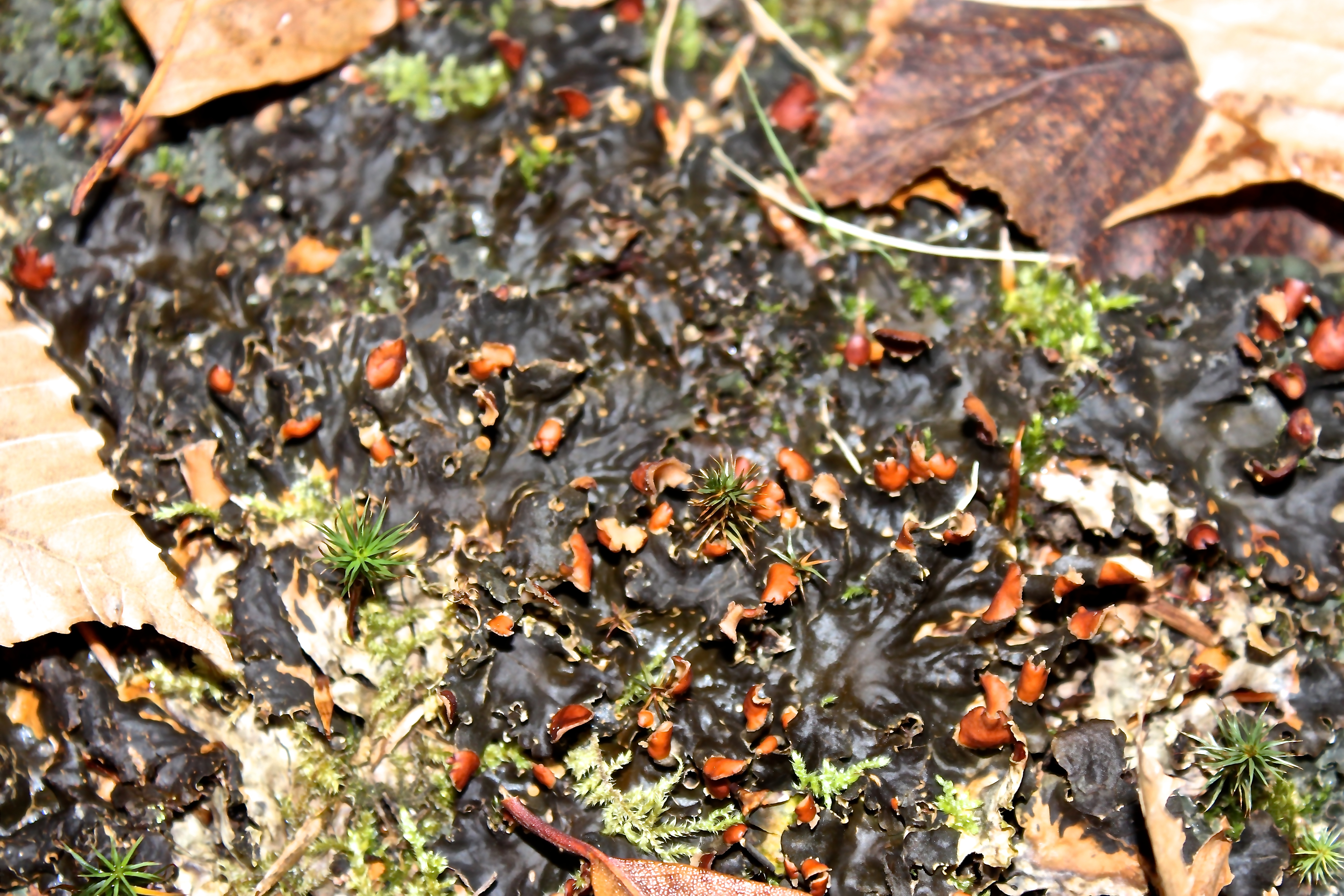
While I’m on the topic of lichens, here’s one that was new to me. The rust-colored projections among the shiny brown lobes made me squat for a photo call. At home, I thumbed through my go-to lichen book, Lichens of the North Woods by Joe Walewski, and discovered that this foliose lichen is Many-fruited Pelt. Those reddish-brown projections are the fruiting bodies on the leafy margins–thus the name. One for us to learn, J.M. We’ll probably see it everywhere now as it grows on soil, moss or rocks.

common toadskin lichen

And because we like to learn, here’s another–Common Toadstool Lichen. That should be easy enough to remember, given its warty appearance.

Peabody Pond

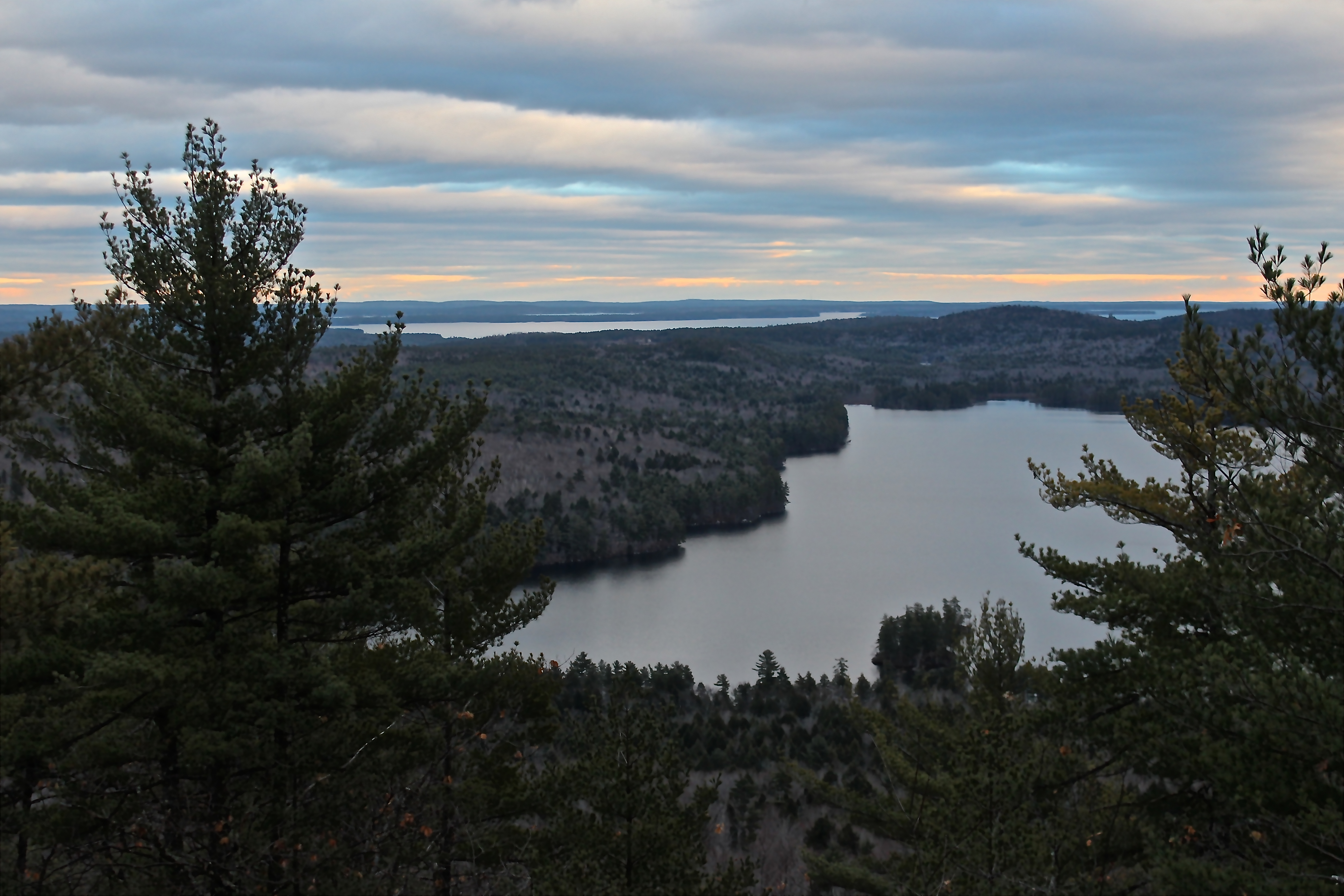
At the summit, I paused briefly to take in the views of Peabody Pond and

Pleasant Mtn

Pleasant Mountain. It was getting late and I still wanted to hike to the Foster Pond Outlook via the Bob Chase Scenic Loop.

bob1

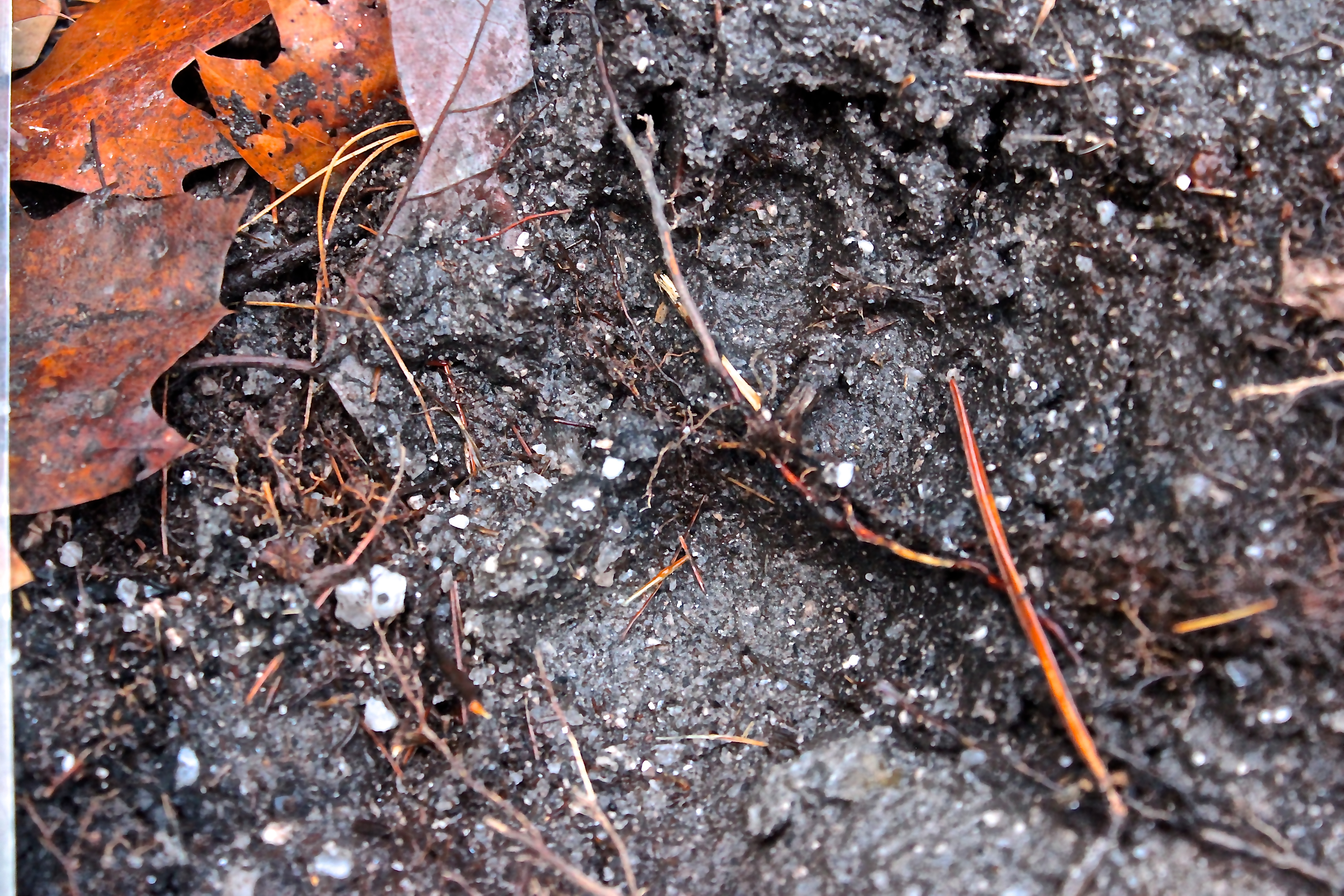
And then, just as I stepped back onto the trail, I saw this print in the mud and a couple in front of it. My heart sang.

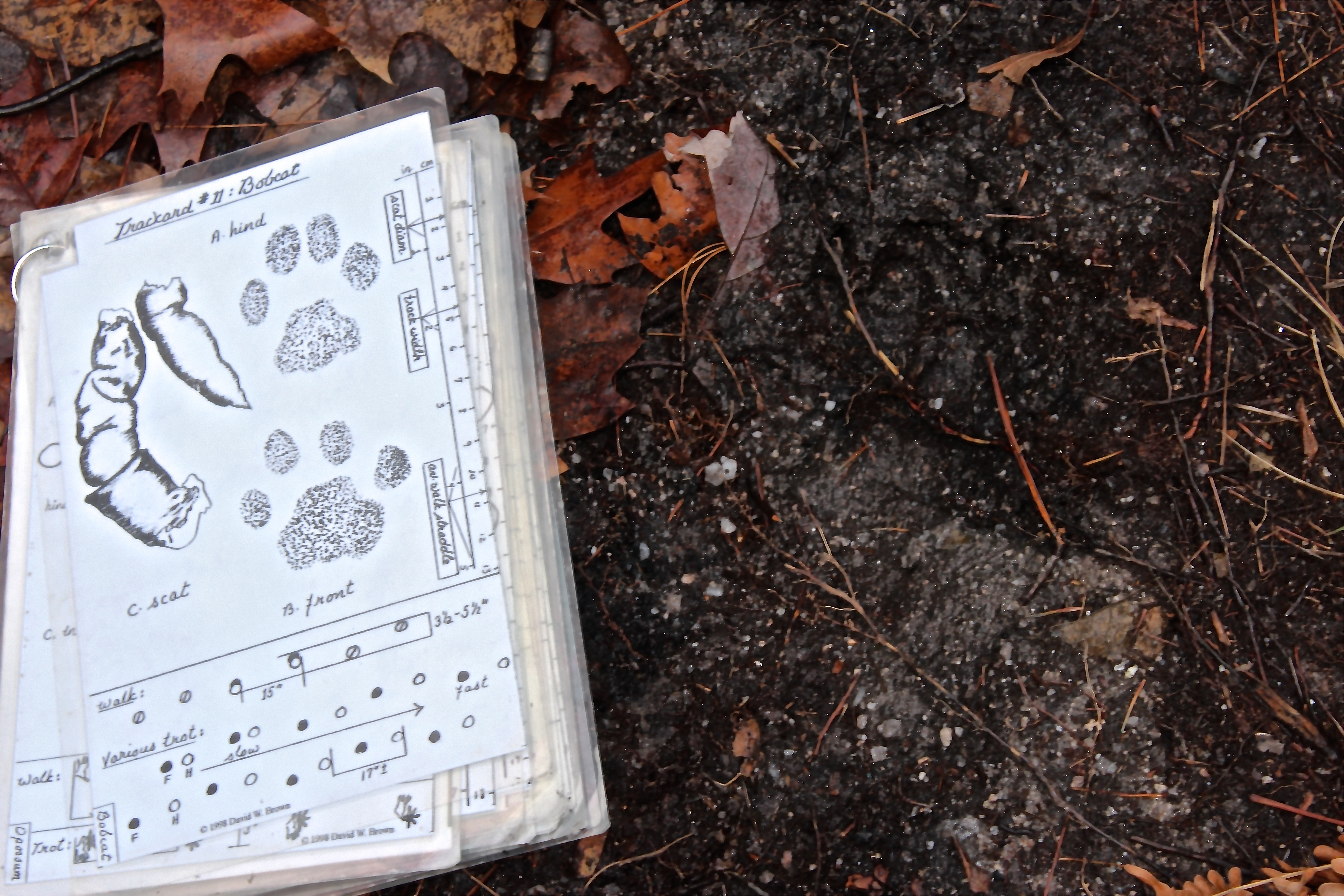
bobcat 2

I was in bobcat territory. My favorite place to be. I only hope I have such luck next weekend and that I can pull out my David Brown Trackards to show the difference between bobcat and coyote prints.

bobcat in sandbob 4

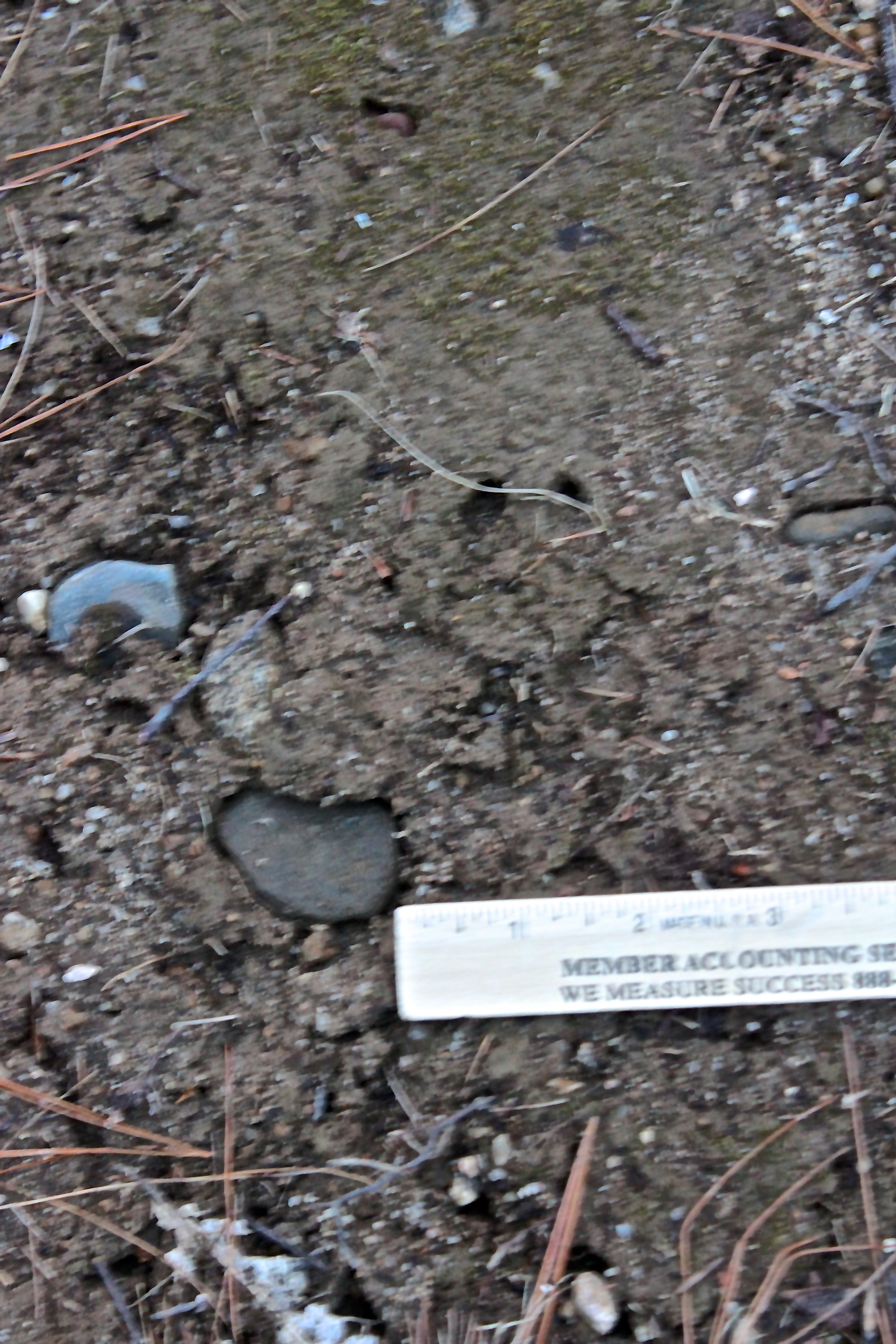
The substrate changed a few times, but we traveled the same route.

coyote print

I also found coyote prints. My hope was that since I was hiking so late in the afternoon, I might actually see one or both of these mammals, but that was asking too much. Finding evidence that they’re here is enough.

Foster Pond

One last view–the Foster Pond Overlook. And then I followed the trail back to the parking lot, thankful to have Jinny Mae along with me in spirit as I rejoiced in her glad news. I’m looking forward to many more opportunities to wander and wonder with her.

Book of December: Fascinating Fungi of New England by Lawrence Millman

Fungi

Book of December

I never thought that I would develop a fondness for fungi, but alas, I have. Don’t get me wrong, I still don’t know them well, but am in the continual process of developing a deeper appreciation for the fruiting bodies I see and the mycelia that probes beneath the surface forever in search of nutrients.

For a beginner like me, Fascinating Fungi of New England by Lawrence Millman is the perfect guide. First of all, it measures 8 x 6 x .25 inches and slips easily into my pack. But what I like even more about this book is that Millman talks about mushrooms in a manner that a layperson like myself can understand. Combined with the artwork of Rick Kollath, whose visual cues aid in my learning, Millman compresses key points in this little book that has become one of my go-to sources in the field.

I think what I admire most is Millman’s voice. I’ve never met the man, but feel as if he’s standing beside me chatting about any particular species and telling the story. My friend and mentor, Kevin Harding, strongly advises that we should spend less time naming and more time sharing the stories of what we see in the woods. And that’s precisely what Millman does, with a splash of humor added to the mix.

To illustrate, in a sidebar about Birch Polypores, he writes the following: “Multi-faceted Fungus — 5,300-year old Tyrolean Ice Man Ötzi, discovered in 1991, had two polypores — the Birch Polypore and the Tinder Polypore among his possessions. He probably made a decoction of the former to rid himself of intestinal worms. Early New Englanders used the Birch Polypore as a razor strop; until recently, entomologists used it for mounting insect specimens; and the present-day Cree of northern Quebec (like Ötzi) make a medicinal tea from it. The Cree don’t like the polypore’s bitter flavor (due to a compound called Betlinic Acid), so they assume their alimentary parasites also won’t like the flavor and will thus vacate the premises upon coming into contact with it.

And I love this: “Non-Gilled on Other — In this catch-all category, the species are not only parasitic, but most of them would also seem to be emulating Hollywood mad scientists in the way they transform the ‘Other:’ the Hypomyces turns a Russula or Lactarius into an entirely different species called a Lobster; an Entoloma causes a Honey Mushroom to lose its characteristic cap-and-stem shape; Rhizopus stolonifer turns a bowl of strawberries into an inedible, gooey mess; and a Cordyceps eats away at its truffle host until that host completely falls to pieces. You would think a movie producer would approach one or more of these species with a contract, wouldn’t you? Well, it hasn’t happened yet . . .”

The book is divided in an easy-to-use manner. So easy, in fact, that recently an 8-year-old friend began using my copy within minutes to identify species we found on a walk through Pondicherry Park. Sections include Gilled on Ground; Gilled on Wood; Gilled on Other; Non-Gilled on Ground; Non-Gilled on Wood; Non-Gilled on Other; Slime Molds. There are sidebars and measurements, spore prints, details about habitat and season, plus a glossary and other resources for those who want to take the next step in fungi ID.

For me, for now, this is enough.

Fascinating Fungi of New England by Lawrence Millman, foreword by Gary Lincoff, illustrated by Rick Kollath, published 2011, Kollath+Stensaas Publishing.

Book of November: Nature Anatomy–The Curious Parts & Pieces of the Natural World

As I walked a woodland path late this afternoon, I was thinking about my curiosity. About how much I don’t know, but also, about how much I’ve learned over the course of 50+ years.

And the book of November is written by a woman who shares that insatiable need to learn more. Curiously, though she’s probably half my age and grew up in the Bronx, she spent her childhood “collecting and categorizing shells, studying horseshoe crabs undersides and swallowing salt water.” The same was true for my early years spent scouring the mudflats in Clinton Harbor.

While she continues to live in the city, she discovered nature right outside her apartment door–in Prospect Park. Obviously a labor of love, Julia Rothman, with the help of her friend, John Niekrasz, created Nature Anatomy: The Curious Parts & Pieces of the Natural World.

NA- cover

It’s a book you could read from cover to cover, but why do that? I like to open to a random page and savor it.

NA- bird chapter

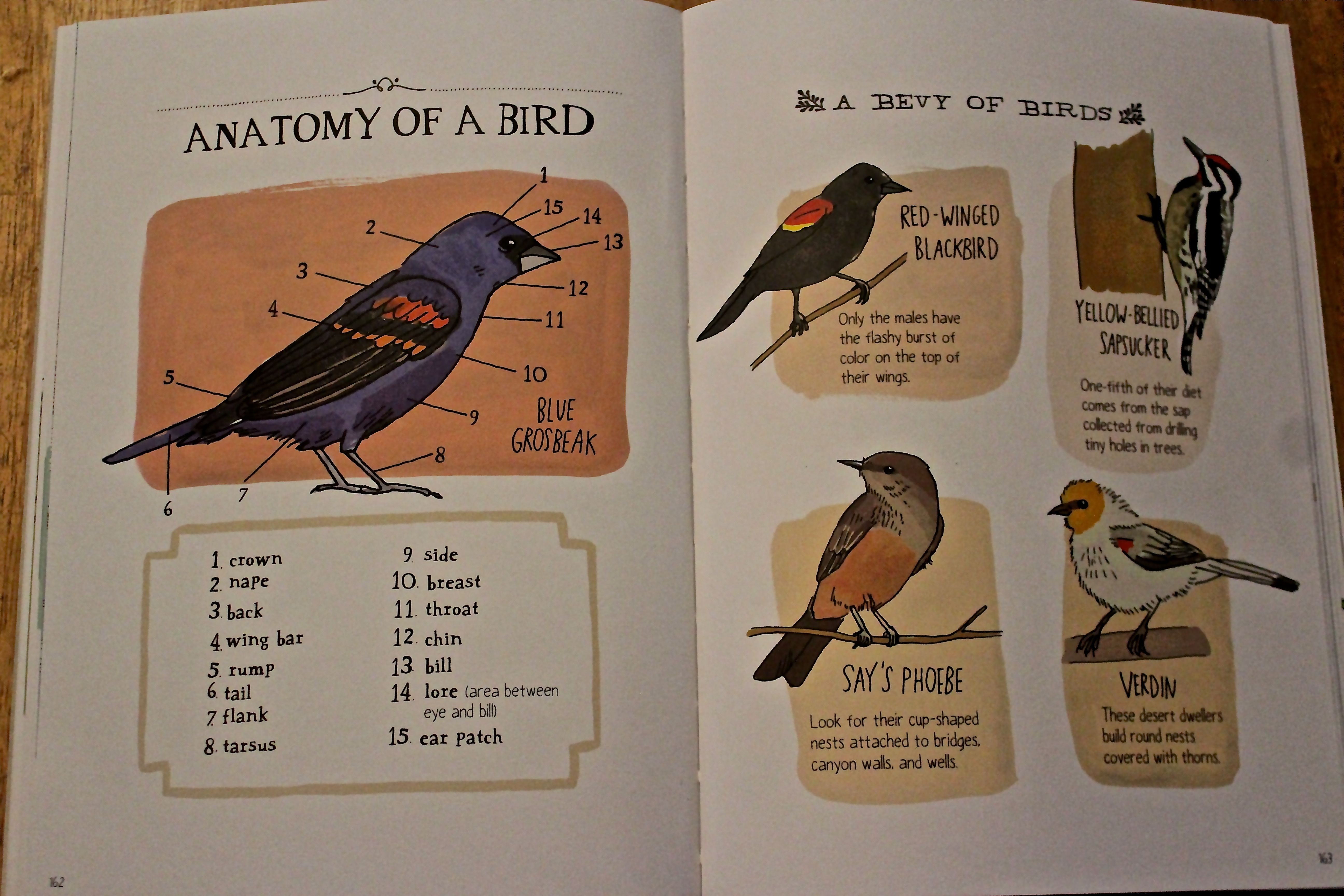
Julia’s voice reminds me of my own. I love the titles of her chapters: Common Ground–about layers of the Earth, minerals, the rock cycle, fossils, landforms, mountains, North American landscapes, field succession and–loose landscape painting. Other chapters: What’s Up; Come Close; Take a Hike; Creature Feature; A Little Bird Told Me and Head Above Water. I won’t tell you what each is about, but you can see that she covers multiple topics within each category.

NA- toads & frogs

It’s as much a joy to read the brief facts as it is to look at the illustrations. Julia is the illustrator, with a little help from her mom.

NA- birds

NA-tree fruits and flowers

NA-Beaver Dam:lodge

This is just a sneak peak at this delightful book which provides a combination of “drawings, diagrams and dissections” to explain the wonders of the natural world. You’ll also find a few art projects and recipes between the covers.

The book ends with a shout-out to conservation organizations. Rothman writes, “No matter where you live, connect with the nature near you in a conscientious way.” Amen.

In many ways, this is the book I wish I could write.

A must have for your bookshelf. I found Nature Anatomy at Bridgton Books.

Nature Anatomy: The Curious Parts & Pieces of the Natural World, by Julia Rothman with help from John Niekrasz, published 2015, Storey Publishing.

Barking Up A Bridge

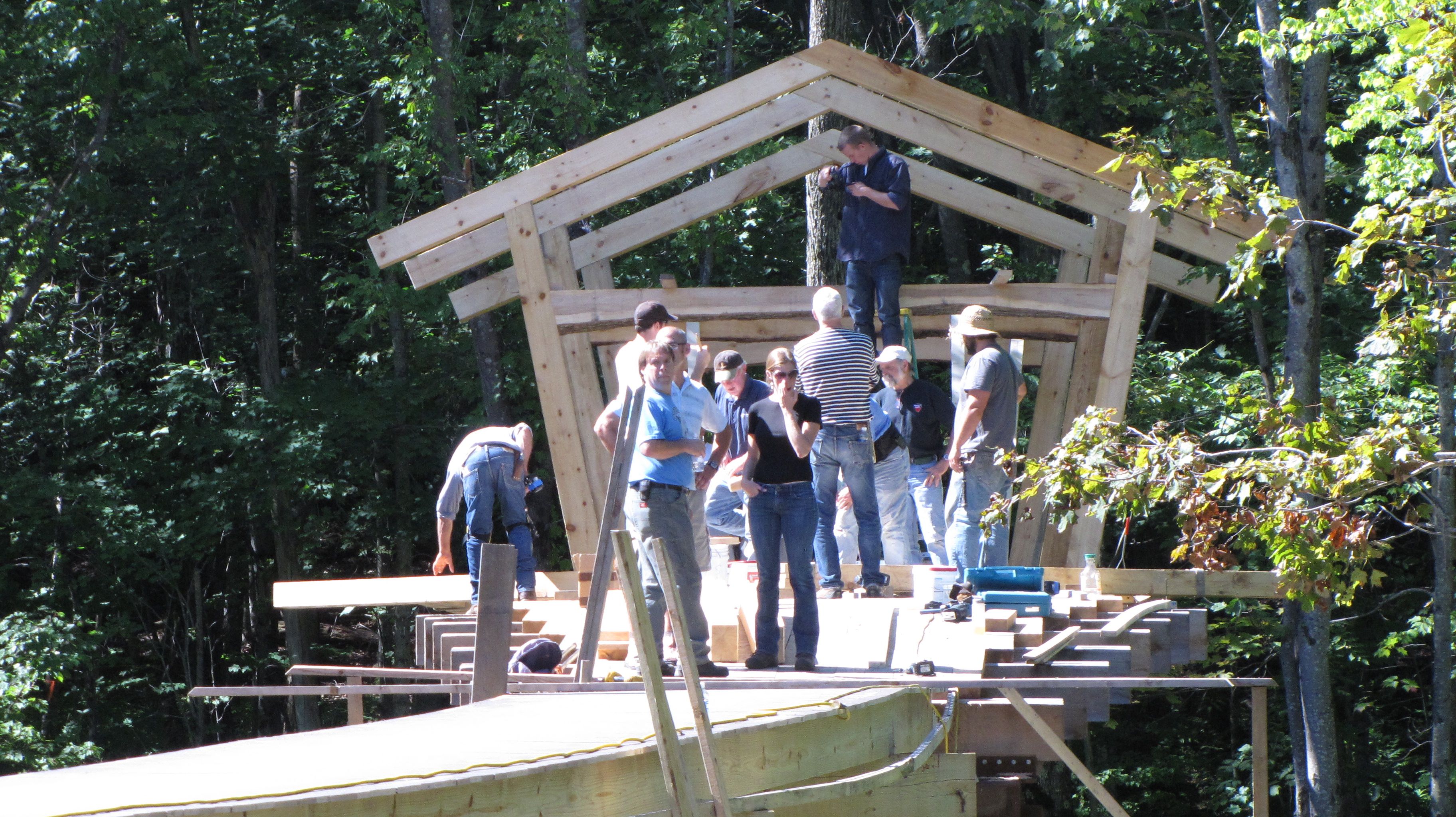
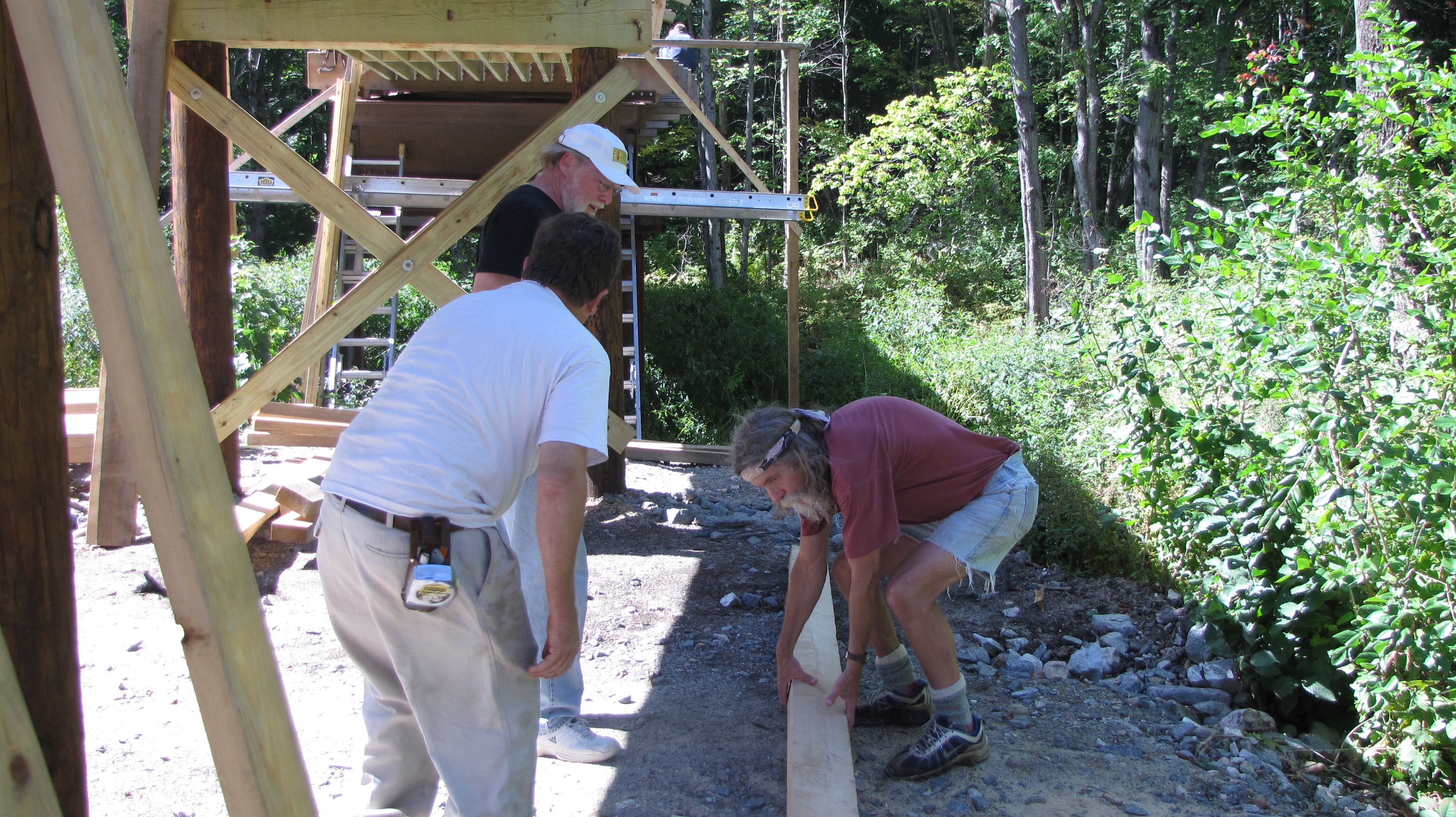
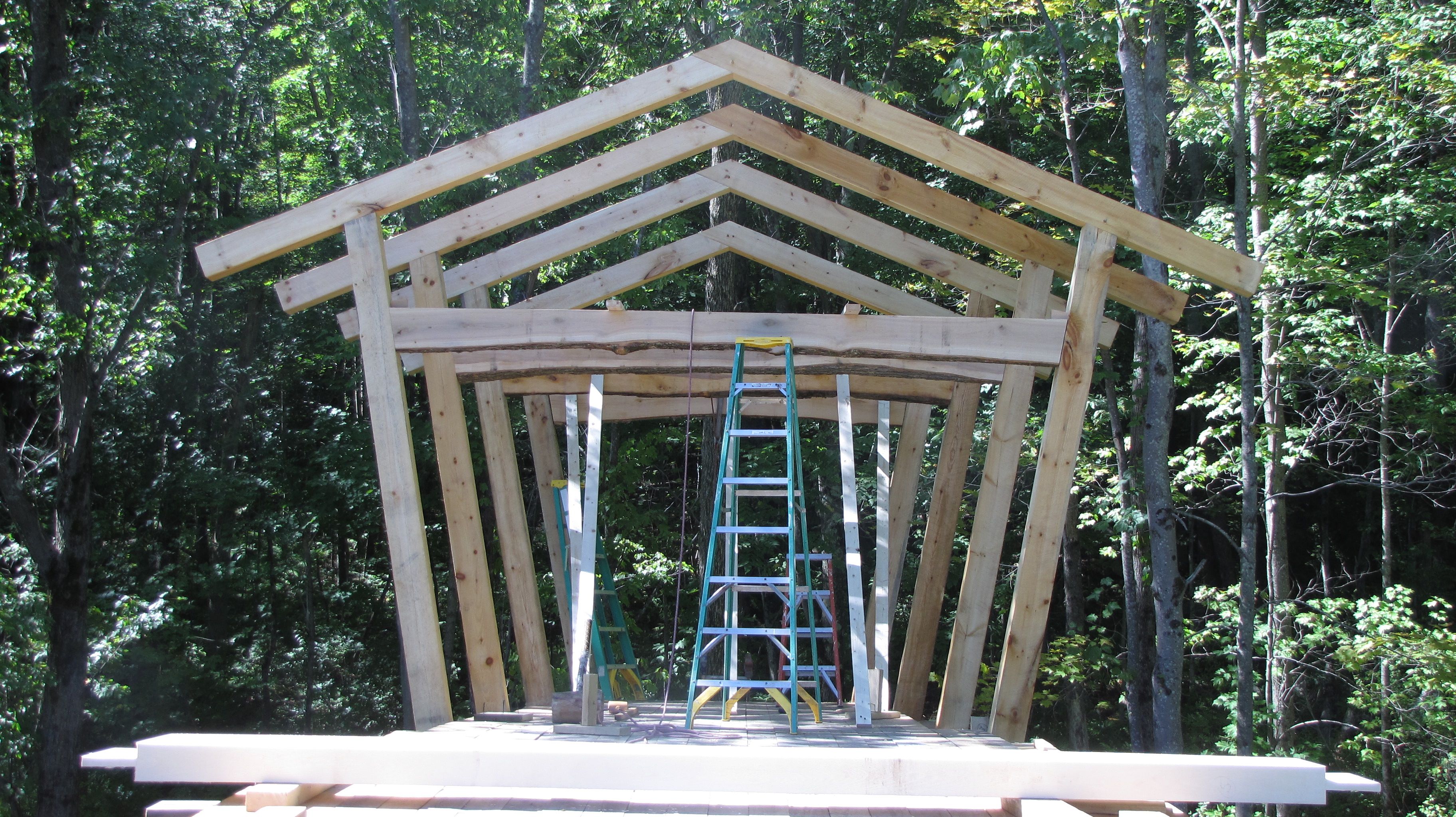
On September 11, 2010, the Bob Dunning Memorial Bridge was constructed in true barn-raising fashion. The bridge is a key feature of Pondicherry Park in downtown Bridgton.

bridge, summer

Bob Dunning, who died suddenly, was a builder, an artist, and among other things, a teacher–sharing his craft with students young and old.

bridge 1bridge 2

bridge 3bridge 4

bridge 7bridge 5

bridge 6

To honor Bob, who treasured traditional building techniques, his friends and fellow craftsmen designed and built a covered bridge leading into the park.

bridge beams

“As the poet said, ‘Only God can make a tree’–probably because it’s so hard to figure out how to get the bark on.” ~Woody Allen

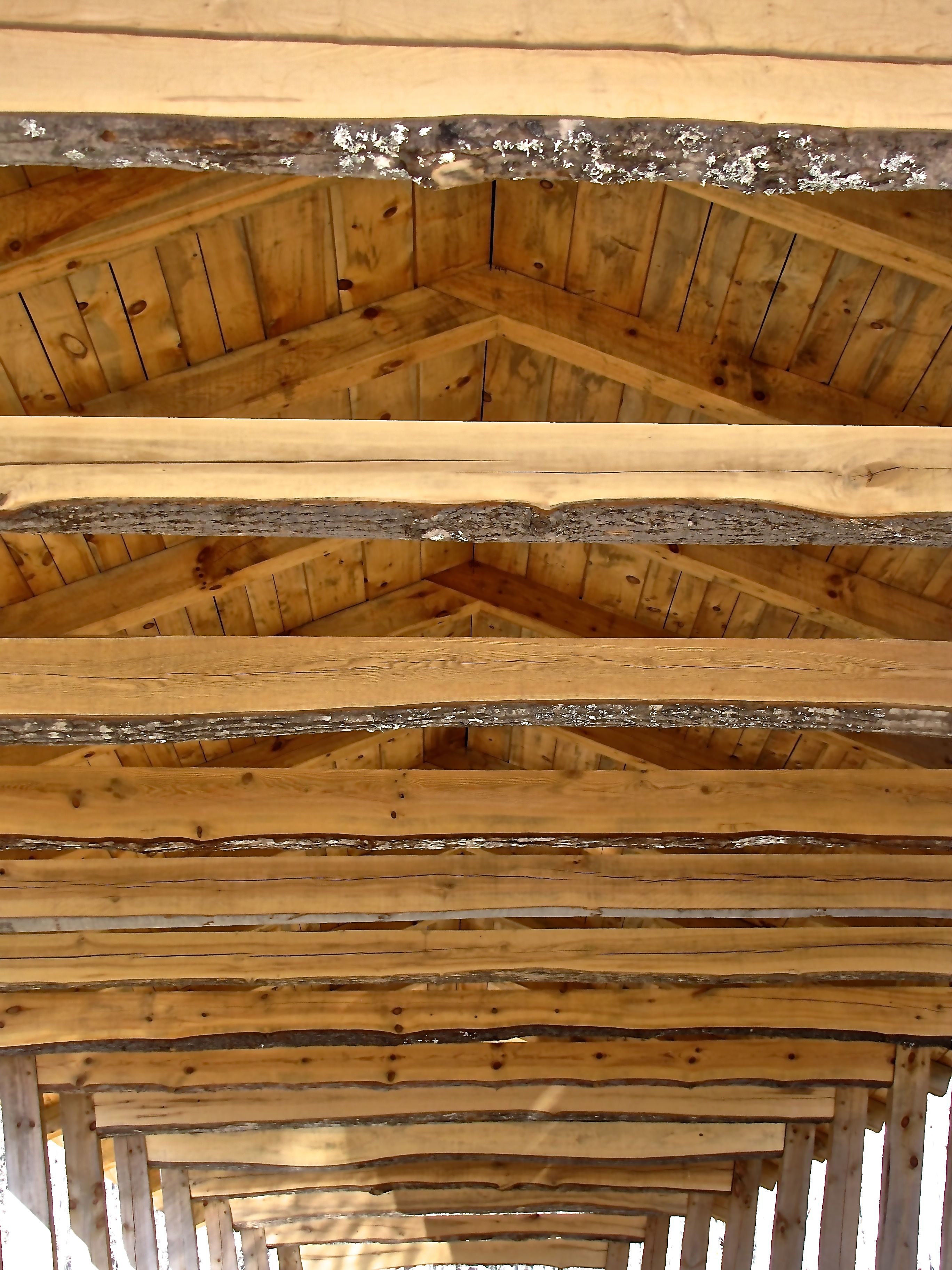
One of the unique things about the bridge is that each tie beam comes from a different tree species, with the bark left on. As I walk across the bridge, my eyes are always drawn to the beams.

Until I took the Maine Master Naturalist class, I recognized only a few species by their bark. But my eyes were opened to the fact that each species has its own presentation, which is true for everything in the natural world. I wanted to know all of them so I set out to teach myself, beginning with the species on the bridge. These became the focus of my capstone project for the class. I spent hours upon hours pouring over reference books such as BARK by Michael Wojtech, The Tree Identification Book by George Symonds, Manual of Trees of North America by Charles Sargent and Forest Trees of Maine by The Maine Forest Service.

I sat in front of trees and sketched them, trying to gain a better grasp of their nuances. I dragged foresters into the field and picked their brains. And I drove hiking companions crazy as I tried to point out clues.

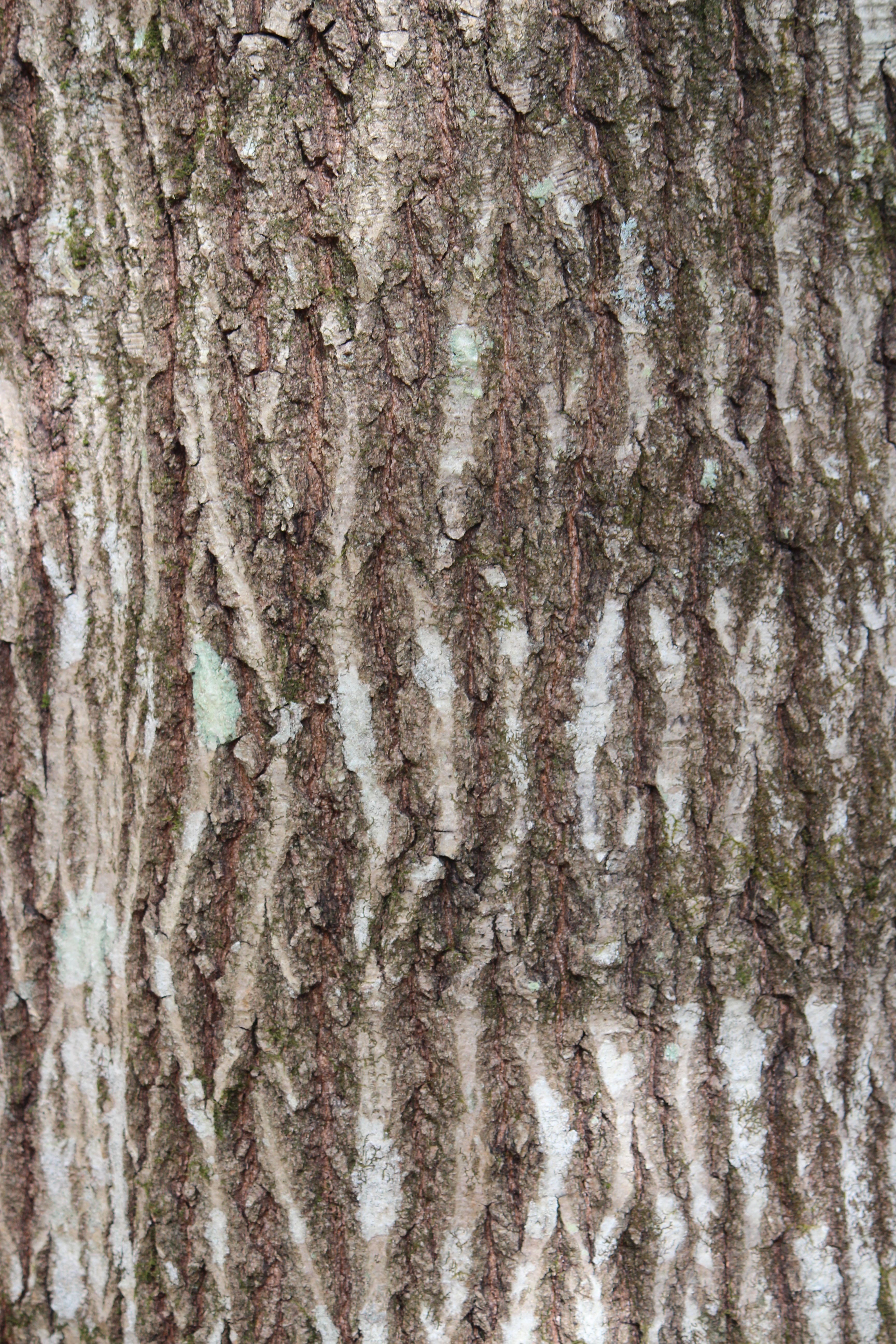
The result was a brochure that you can pick up at the kiosk (let me know if you can’t find a copy) and a powerpoint presentation that breaks down the species by types of bark. Did you know that there are seven types of bark? I learned that from Wojtech’s book and it made it easier to note the differences.

image

Follow me now, as I take you across the bridge and give you a glimpse of each tree. We’ll begin on the east side (closest to Renys) and work our way west.

Beam 1, cherry, smooth bark breaks into scales that are curled outward on the edges. outer scales begin to flake off, revealing smaller, darker, irregularly shaped scales without prominent lenticels

beam 1 e, black cherry

Beam #1: Black Cherry (Prunus serotina): Scales; gray-brown to almost black; small, rough scales randomly placed; curled outward like burnt cornflakes or potato chips.

Beam 2, yellow birch

beam 2 e, yellow birch

Beam #2: Yellow Birch (Betula alleghaniensis): Peeling/Curling; bronze to yellowish-gray; curls away horizontally into thin, papery strips; shaggy appearance.

Beam 3, red maple,smooth, light to dark gray, vertical cracks

red maple

Beam #3: Red Maple (Acer rubrum): Vertical Strips; light to dark gray; almost smooth or cracked vertical, plate-like strips; curls outward on either side; sometimes bull’s eye target caused by fungi.

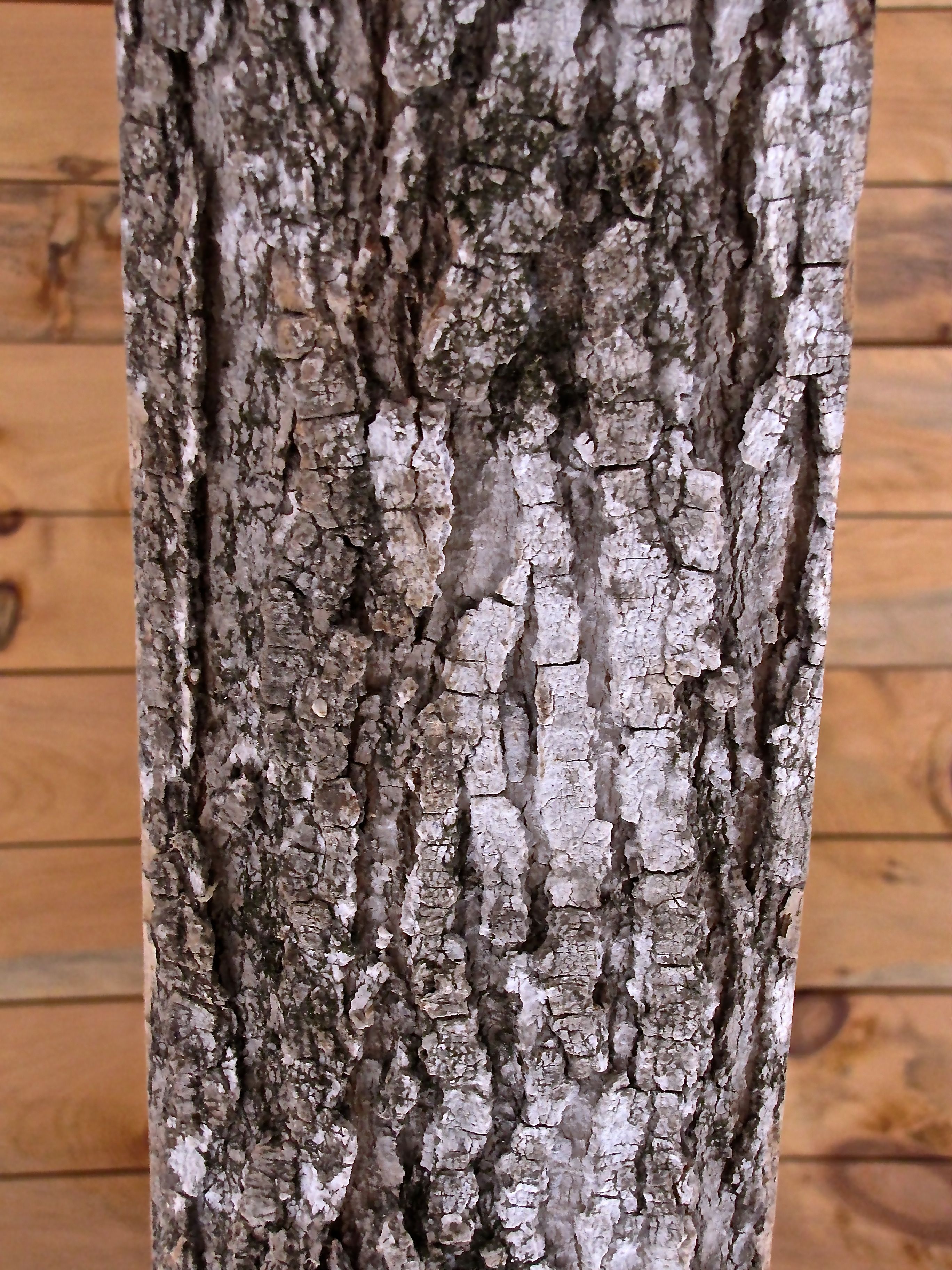
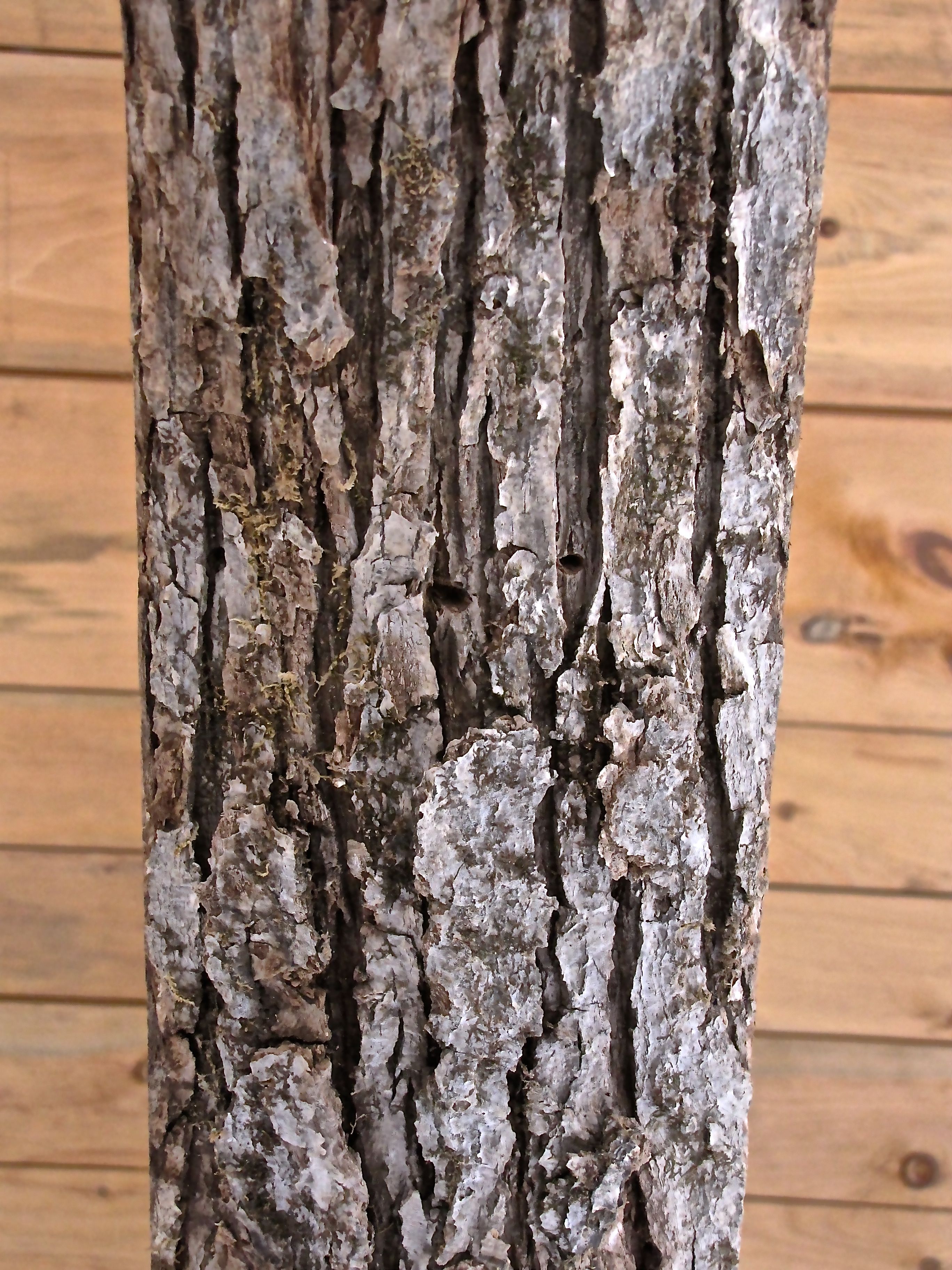
BEam 4, American BAsswood, GRay to brown, Narrow furrows form long, flattened ridges with parallel edges, ridge surface broken horizontally by hairline cracks, often into squarish segments, ridges loosely intersect

Basswood bark

Beam #4: American Basswood (Tilia americana): Ridges; gray to brown; flattened, square-like ridges with parallel edges; may intersect like a woven basket every 6-12 inches.

Beam 5, red oak, rough, dark brown to blackish furrows, sepaprate smooth, light-colored, often lustrous ridges flush with circumference of trunk or slightly concave, ridges like ski tracks, loosely intersect

beam 5 e, red oak

Beam #5: Northern Red Oak (Quercus rubra): Ridges and Furrows; light colored, with rusty red inner bark; wide, flat-topped ridges run vertically parallel like ski tracks; dark, shallow furrows separate ridges.

Beam 6

hemlock

Beam #6: Eastern Hemlock (Tsuga canadensis): Scales; cinnamon-red to gray; rounded or irregularly-shaped scales; inner bark has purplish tint.

BEam 7, beech, light gray to bluish gray, smooth and unbroken

beam 7 e, beech

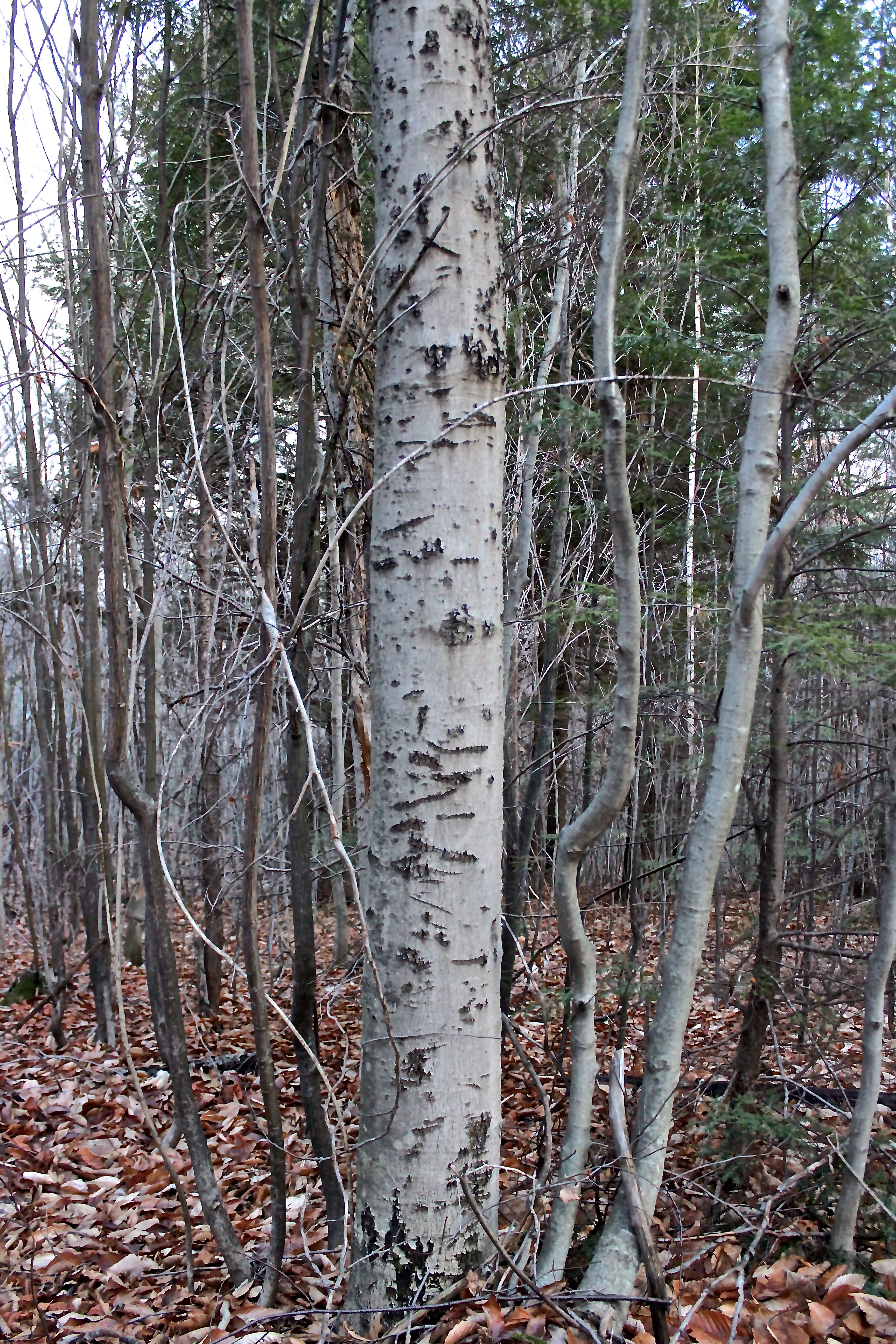
Beam #7: American Beech (Fagus grandifolia): Smooth/Unbroken; silver-gray or grayish-green; sometimes blotched with lichen; carved initials remain visible forever; often pockmarks caused by fungi.

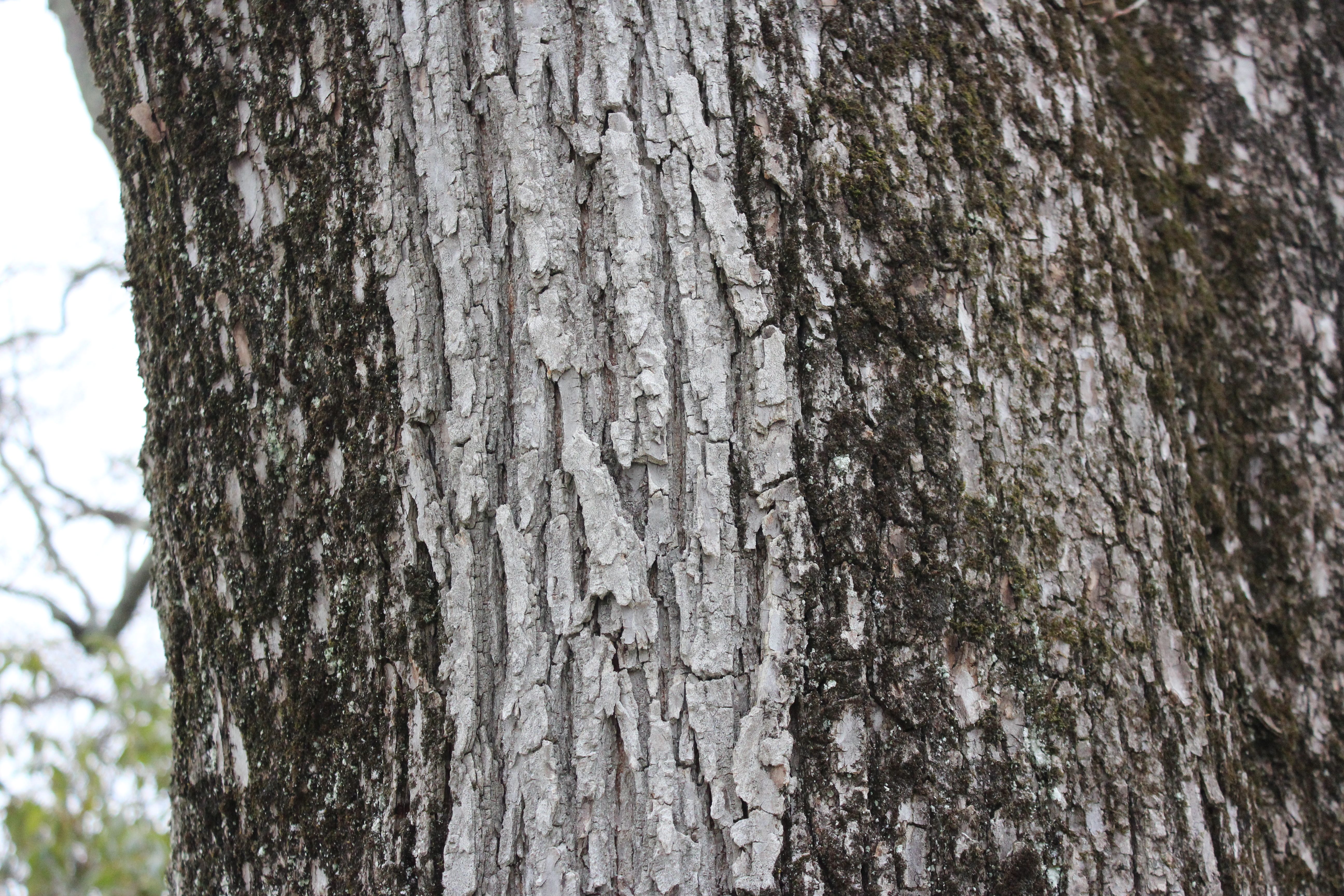
Beam 8, Ash, gray to brownish-gray diamond-shaped furrows, resembles woven basket.

ash

Beam #8: White Ash (Fraximus americana): Ridges and Furrows; ashy-gray to brown; intersecting ridges form obvious diamond-shaped furrows; look for letter “A” or pattern of cantaloupe rind.

BEam 9, white pine, dash-like lenticels, turns gray to reddish-brown, thick, irregular shaped scales, turn out, develops fine, horizontal lines/cracks consistently spaced like writing paper.

eastern white pine

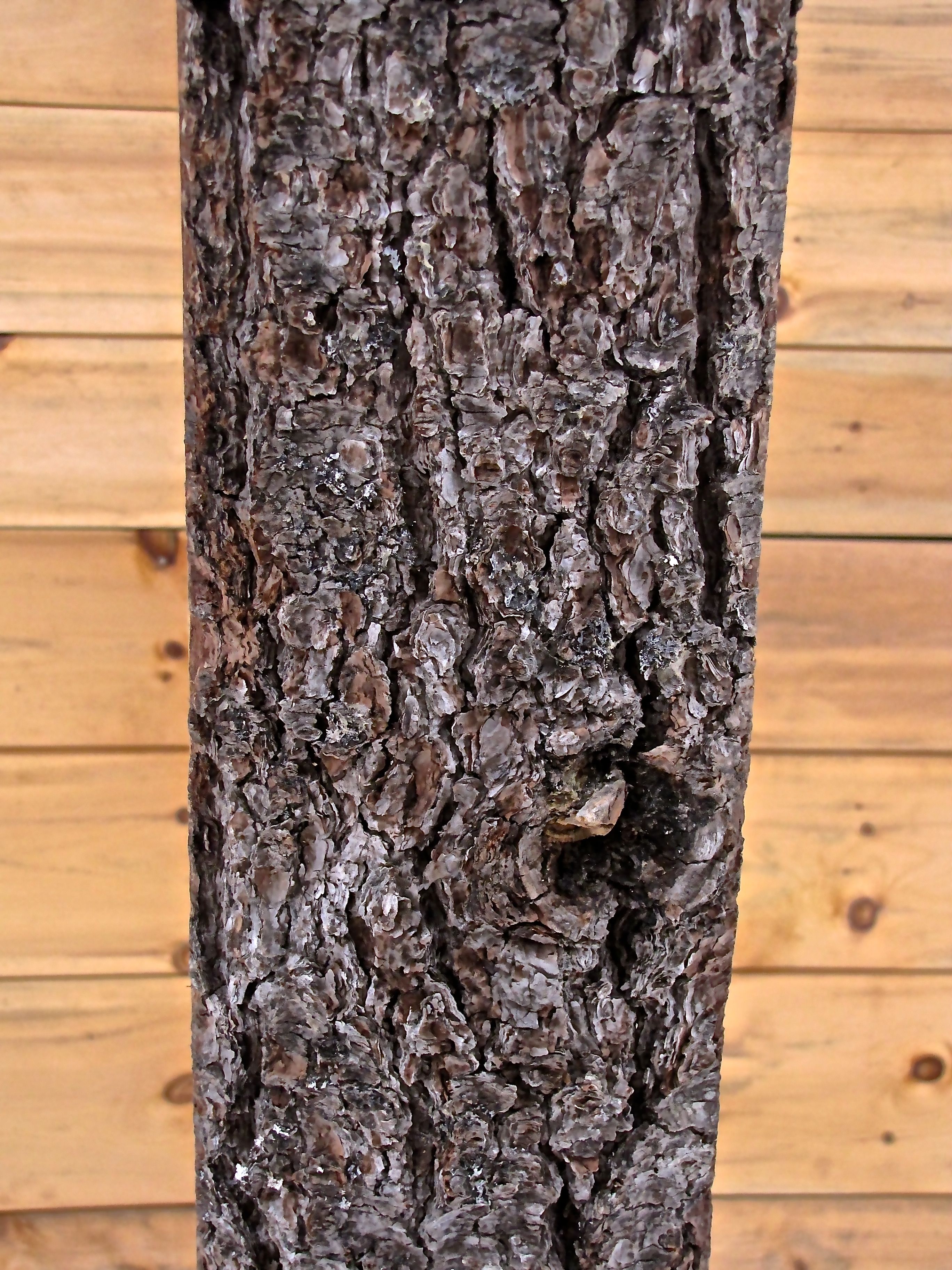
Beam #9: Eastern White Pine (Pinus strobes): Scales; dark gray to reddish-brown; thick, irregularly-shaped scales; fine horizontal lines evenly spaced along scales like lines on a legal pad.

BEam 10, Red Pine (Norway), reddish brown to pinkish, irregular, thin, flaky scales like jigsaw puzzle, surface of blocks roughly aligns with circumference of tree

red pine

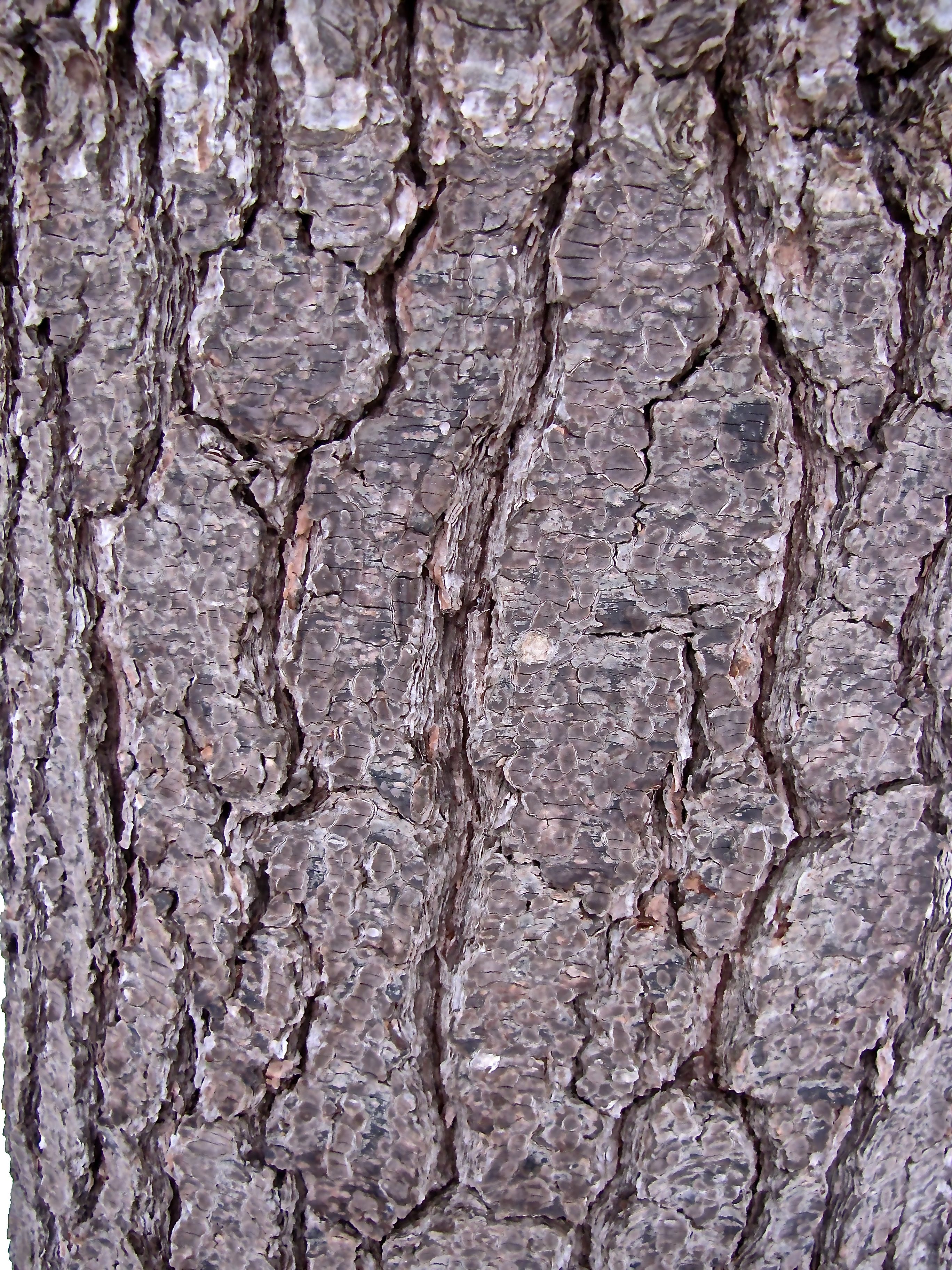
Beam #10: Red Pine (Pinus resinosa): Scales; mottled red and grayish-brown; flaky scales; jigsaw puzzle or sandstone appearance.

BEam 11, sugar maple

sugar maple

Beam #11: Sugar Maple (Acer saccharum): Vertical Strips; gray to brown; finely cracked; looks like old paint; curls away from trunk on one side; look for horizontal scars indicating work of maple sugar borer.

BEam 12, poplar, Big-toothed aspen, deep furrows, rough and more rounded?

beam 12 e, big tooth aspen

Beam #12: Big-Tooth Aspen (Populus grandidentata): Ridges and Furrows; greenish-brown to dark gray; V-shaped furrows intersect every 6-12 inches; flattened ridges appear sanded down; gnarly look; periodic horizontal lines; on older trees resembles Northern Red Oak at bottom and Birch toward top.

BEam 13, white oak, light gray, can appear whitish with a reddish cast, furrows form flattened ridges, broken into somewhat rectangular-shaped blocks, furrows steep and narrow, with sides of blocks often parallel, old bark+irregular in shape, might look like shingles

beam 13 e, white oak

Beam #13: White Oak (Quercus albra): Ridges; light gray with reddish cast; rectangular-shaped blocks with flaky surfaces; ends of blocks curl outward; feather-like in mature trees.

Beam 14, elm

beam 14 e, American Elm

Beam #14: American Elm (Ulmus americana): Ridges and Furrows; ashy-gray; diamond-shaped furrows; flat-topped ridges; alternating light and dark layers like vanilla and chocolate wafer cookies.

BEam 14, black birch

beam 15 e, black birch

Beam #15: Black Birch (Betula lenta): Lenticels Visible (note: all trees have lenticels, but they are more obvious on some than others. Lenticels are tiny slits in the bark that allow for gas exchange, just like our pores); gray to brown-gray to black; may crack and form scales that curl away from trunk; long, thin horizontal lenticels.

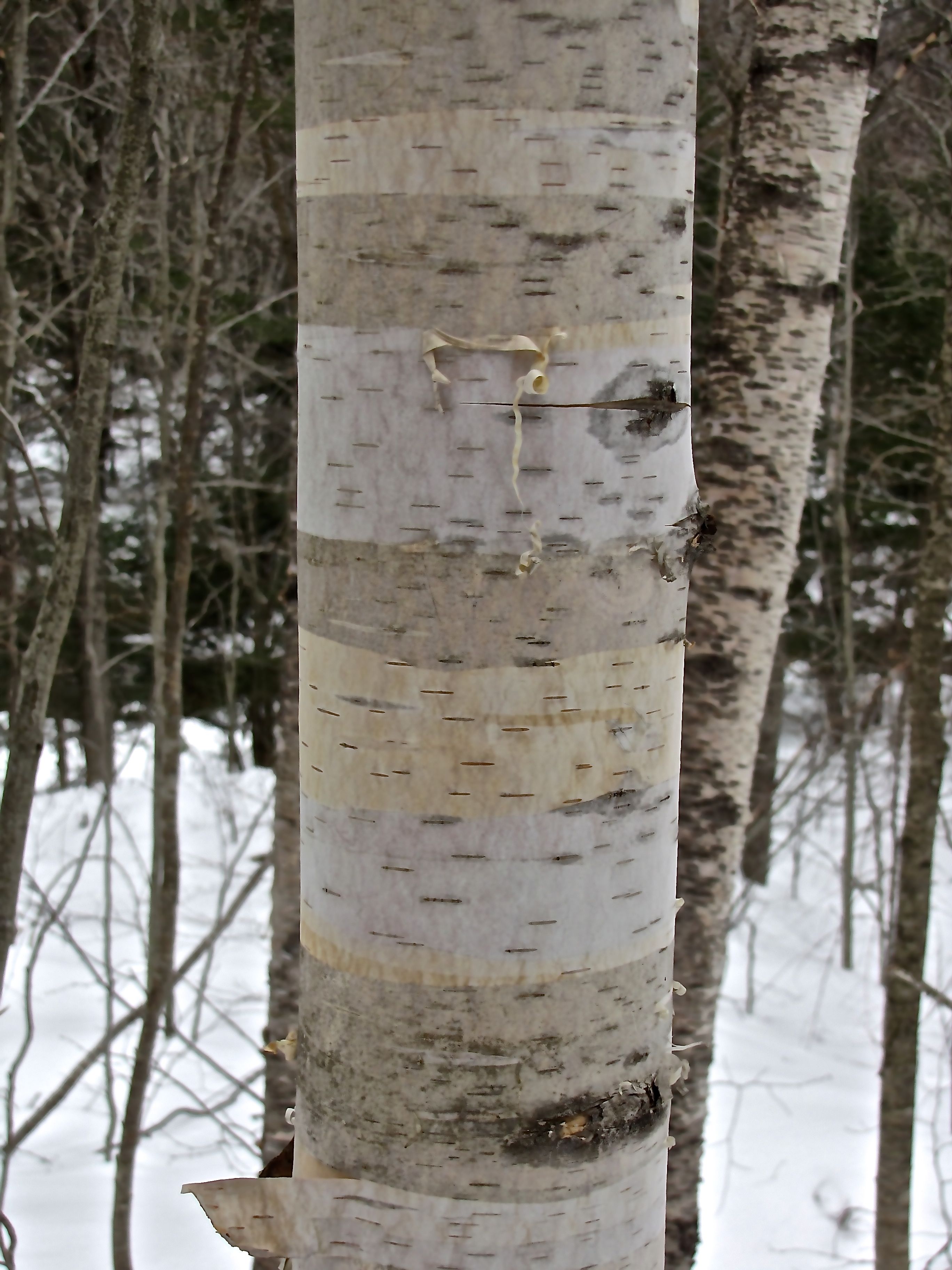
Beam 15, paper birch, white birch

beam 16 e, paper birch

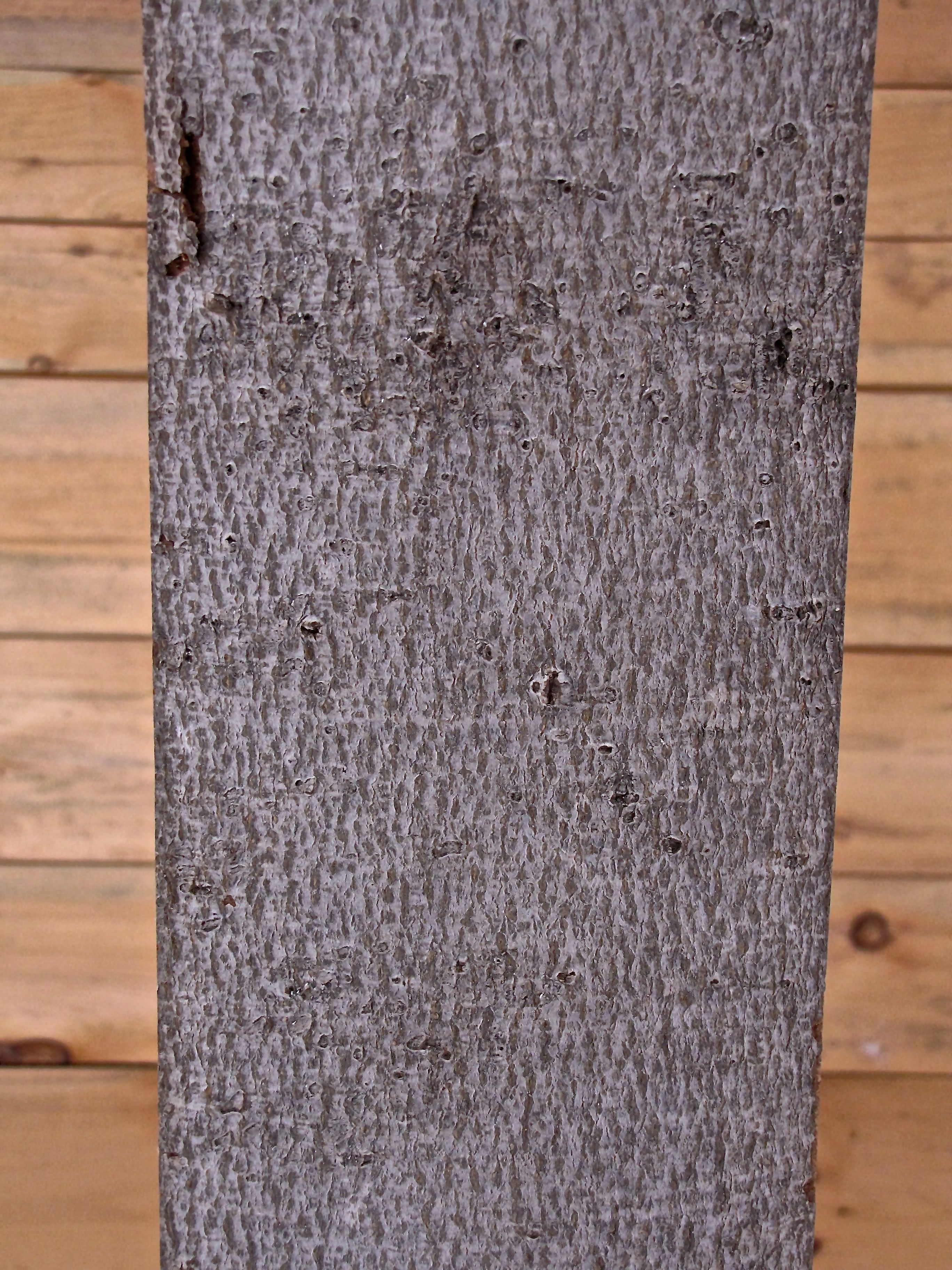
Beam #16: Paper Birch (Betula papyrifera): Peeling/Curling; white to creamy white; peeled bark reveals pink or orange tints; small, horizontal lenticels visible.

That’s it in a nutshell. Ah, but here’s the thing. Except for the American Beech, tree bark changes as a tree ages. And beech trees can be equally confusing because some are severely affected by beech scale disease. So, just when you think you know a species, you may come upon a younger or older version and get totally thrown off. The key is to take your time, walk all the way around the tree, and look at other clues like the twig and bud formation. Touch the bark. Smell it.

And take a walk across the bridge and into the park during any season. Chances are, I’ll be there doing the same.

bridge to park

Thanks for joining me for this lengthy wander. I hope you’ll find time to wonder about bark.

Book of October: Reading Rural Landscapes

Book

There are many reasons why I love living in western Maine, and the fact that I can walk into Bridgton Books, an independent bookstore, and be handed a book that   shop owner Pam Ward thinks I would enjoy is one of them. Pam was so right.

Reading Rural Landscapes by Dr. Robert Sanford, professor of environmental science at the University of Southern Maine, is a perfect follow-up to Tom Wessels book, Reading the Forested Landscape.

Sanford takes us one step further in looking at the remnants in the woods. Here in western Maine, I often stumble upon stone walls, barbed wire, foundations, mill sites and other evidence of life gone by. All of this appears in places that seem so far away from civilization. How can it be? Did people actually live in these out of the way places? Why?

Sometimes, it’s difficult to imagine that the make-up of the neighborhood was completely different from what we know. We forget that following the Civil War many people left the area for greener fields and less of that good old stone crop. We forget that numerous farms once decorated our landscape. We forget that all the trees we love, didn’t exist.

Reading Rural Landscape’s size (5″x8″) means it fits easily into a backpack and has become one of the guides that I often carry. Sanford includes information about plants and trees at homesites, transitions that occur after fields have been used for pasture or agriculture, examinations of house, barn and outbuilding foundations, mill sites and early commerce, indications of rural roads from farming and stagecoach to logging and trolley, the meanings of stonewalls and barbed wire, plus cemeteries and symbols on gravestones.

Sanford includes a glossary, chapter notes that are as interesting as the chapters, and an extensive reference section. For $19.95, this is a valuable resource.

Ultimately, Sanford encourages stewardship of the land–protection of these historical places. He also encourages us to support those who continue to farm the land and work in the forests in sustainable manners.

Reading Rural Landscapes: A Field Guide to New England’s Past by Robert Sanford, PhD, published 2015, Tilbury House Publishers

The Need for More

Yesterday I stopped into our local independent bookstore, Bridgton Books, to purchase a title recommended to me by a friend (thanks D.B.), H is for Hawk by Helen Macdonald. While there, Pam, one of the proprietors, showed me Reading Rural Landscapes by Robert Sanford because she thought I’d be interested. Of course I was, and so for all of two seconds I debated about which to buy and guess what–I’m now the proud owner of both titles. I had earned a $10 credit (for every $100 spent, you receive $10 off if you belong to their book club and there is no book club fee–truly independent).

At camp, I was also reading another book (purchased at Bridgton Books a year or two ago). Well, actually rereading it because I like the author’s style/voice and maybe just a wee bit because she’s an Episcopalian. And she lives in Alaska–another draw for me. If You Lived Here, I’d Know Your Name: News from small-town Alaska by Heather Lende.

3 books

Both last evening and this morning, I read from all three. Not simultaneously, of course. It’s always been that way for me. Skipping from one topic to the next. Easily bored? I don’t think so because being bored is not part of my makeup. More like an insatiable need to know more.

The bees and wasps and flies and ants and hummingbirds have the same insatiable need right now, as they flit and walk and crawl from one plant to the next, sucking nectar and exchanging pollen along the way.

beebee2

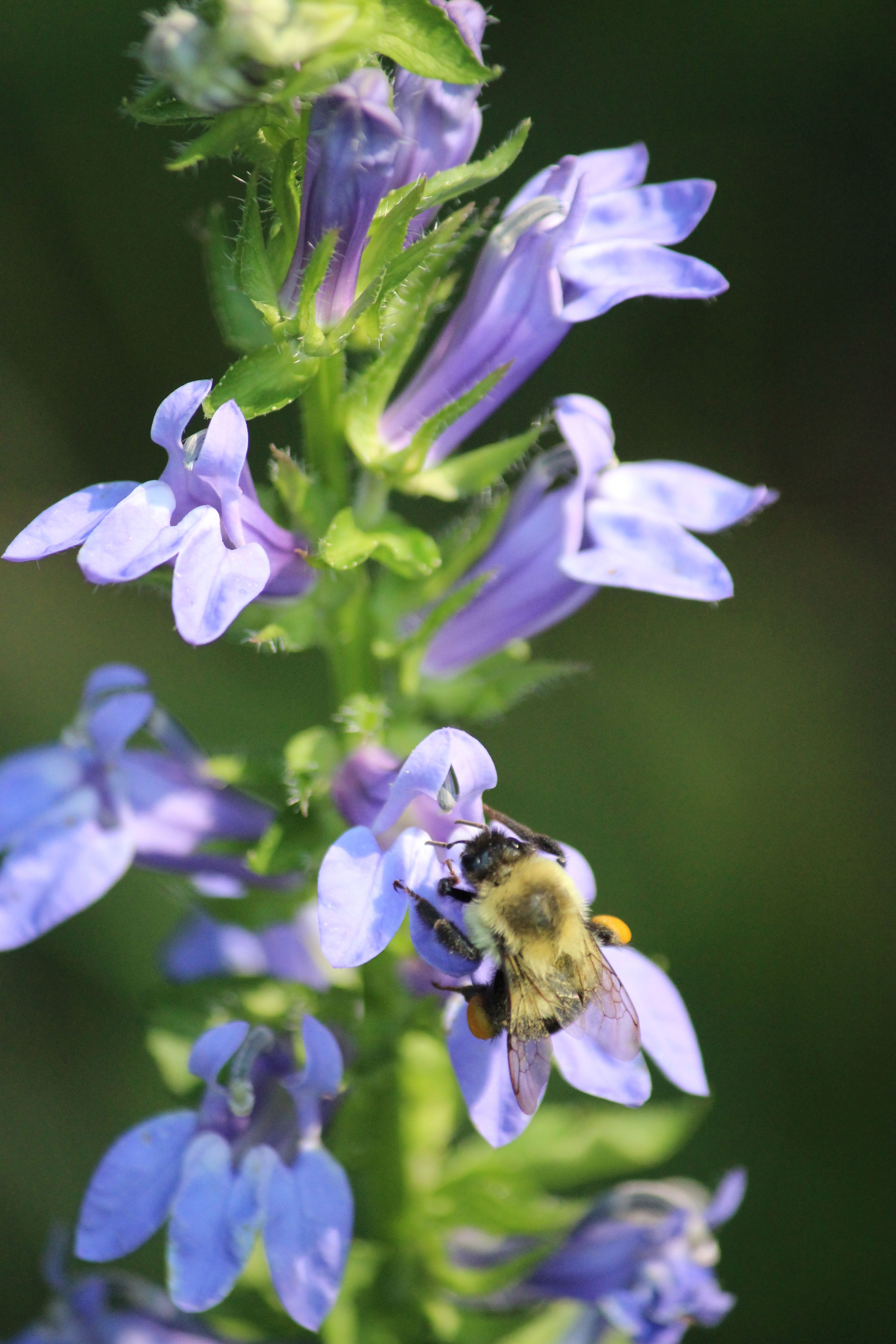
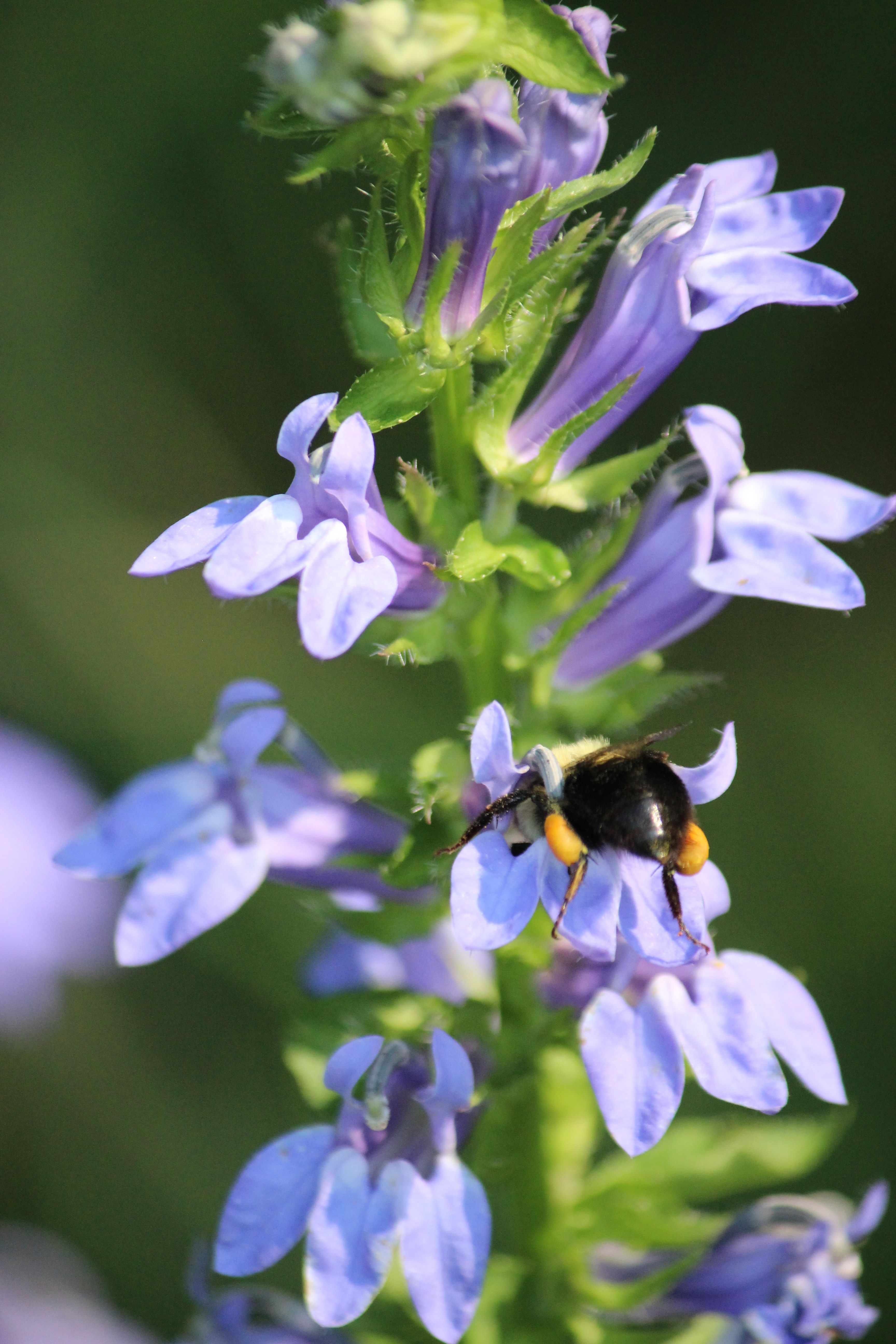
This busy bee was well-laden with pollen. Its bright orange sacs bulge on its hind legs like a kid wearing arm floaties in the water.

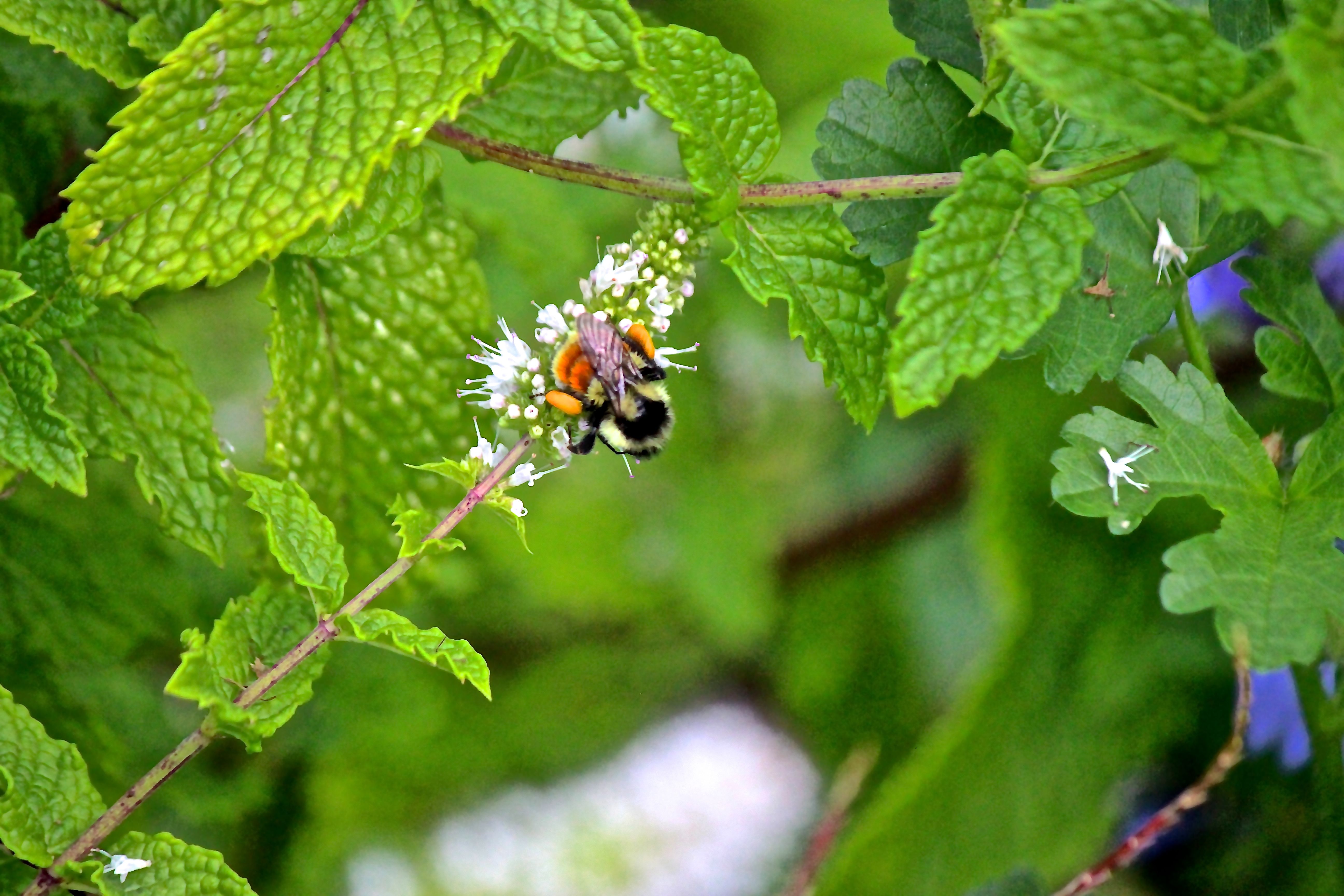
bee on mintbee on mint 2

Every time a bee visits flowers, the pollen sticks to its fuzzy body–its antennae, legs, face and body. Think pollen magnet!

The middle legs are equipped with comb-like hairs that scrape off the pollen and transfer it to the pollen presses located on the hind legs.

bee 3

Like our calves, the bee’s legs have a tibia or lower leg section. The tibia is shiny and surrounded by hairs, including some that are rather long and stiff. These form the pollen basket. Located at the lower end of the tibia  is another comb-like structure (ankle), and on the metatarsus (heel or foot) is the press. When it comes to pollen collection, the two structures work together like levers.

Nectar moistens the pollen, making it sticky. The pollen is transferred to the press, and then is manipulated between the press and comb until it sits flat on the bottom of the tibia. Each time a new batch of pollen is added, it’s pressed onto the bottom, forcing the pervious batches to move further up the tibia.  A full basket (think one million grains of pollen) bulges, but hairs hold the pollen in place as the bee flies from one plant to another before heading home to stock the nest.

beefly on goldenrod

It’s not just hairy bees who are active in the gardens.

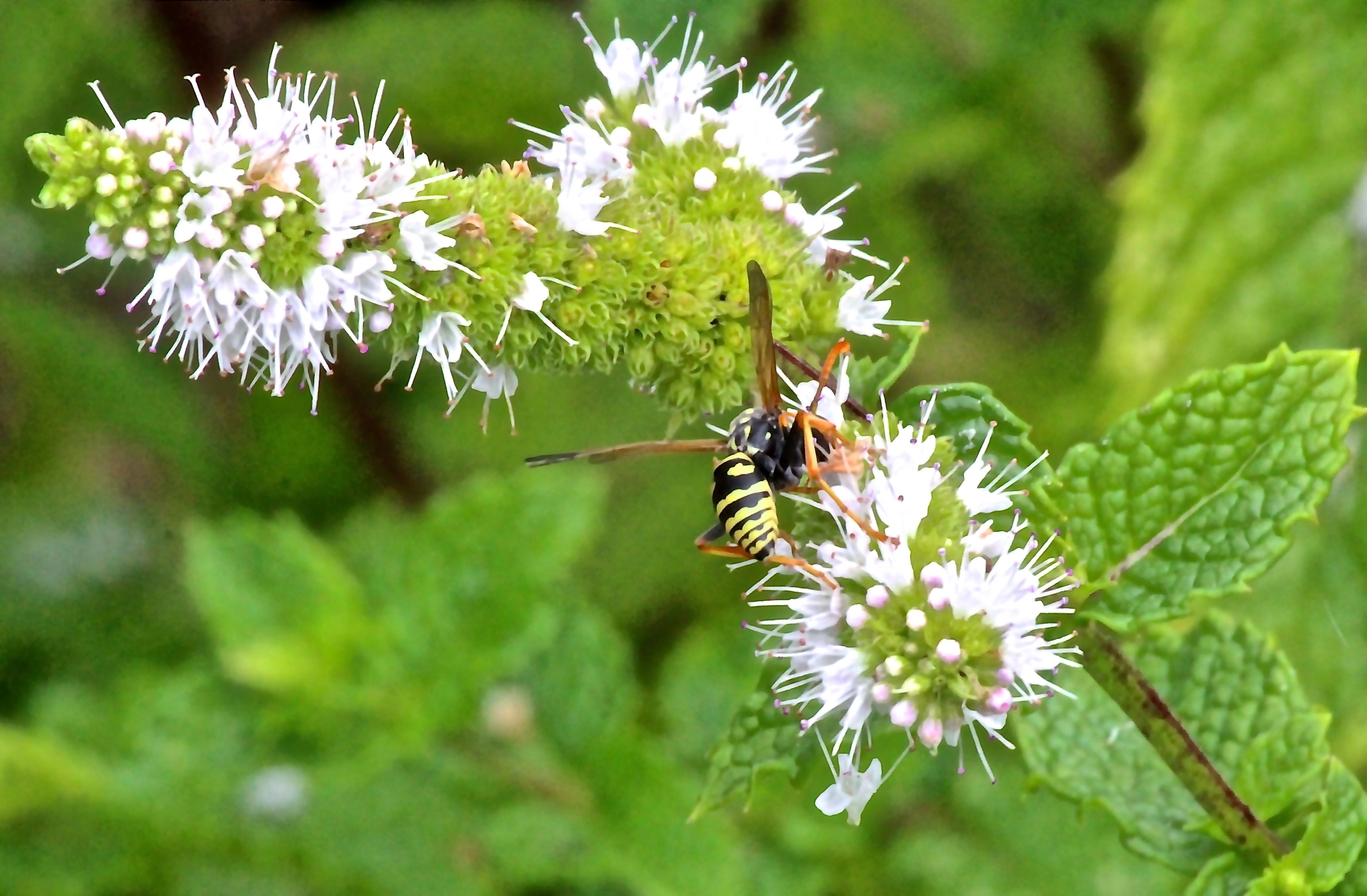
large blue wasp

Gathering for the family is important business.

wasp 2

Thanks to the goldenrods and asters, there’s plenty of pollen and nectar still to be gathered.

yellowjacket

The mint seems to be the biggest hit among the variety.

spiders 1

And there is other action as well. A funnel weaver tried to challenge the larger spider, but quickly retreated.

spider 2

Whenever I take a closer look at the crawling and flying members of the gardens, I’m in awe of their colors, patterns, hair or lack of, and overall body structure.

inchworm

You may have to look closer to find the visitor on this coneflower.

red legged grasshopper

This red-legged grasshopper tried to make itself invisible.

grasshopper 2

The camouflage worked better once it climbed to the top of the fence. When grasshoppers fly, I can hear their wings make a rasping sound. But moving as this one was, there wasn’t a peep. The crickets and cicadas, however, I couldn’t see, but they’ve been contributing to a chorus all day.

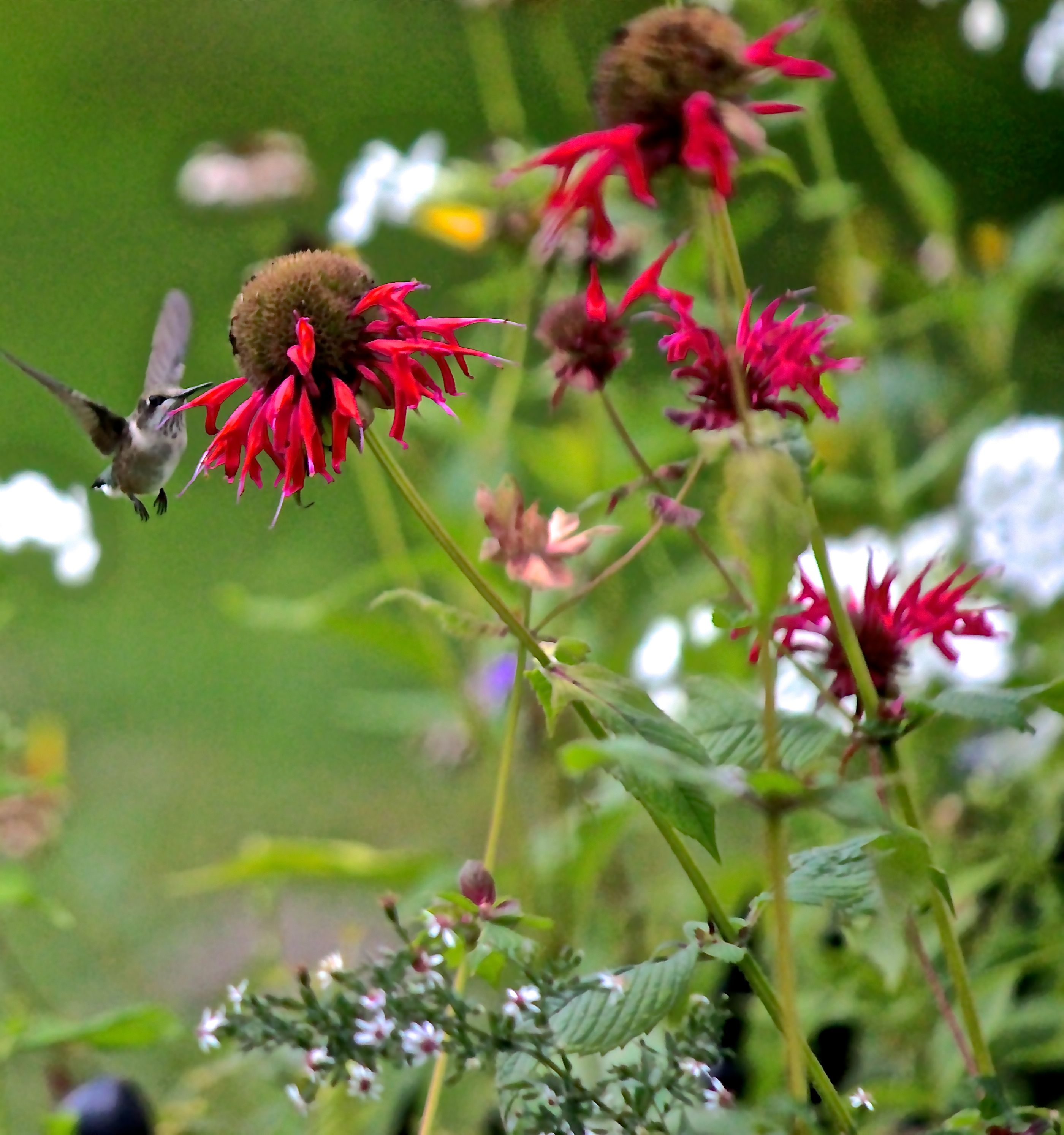
hummer approaching

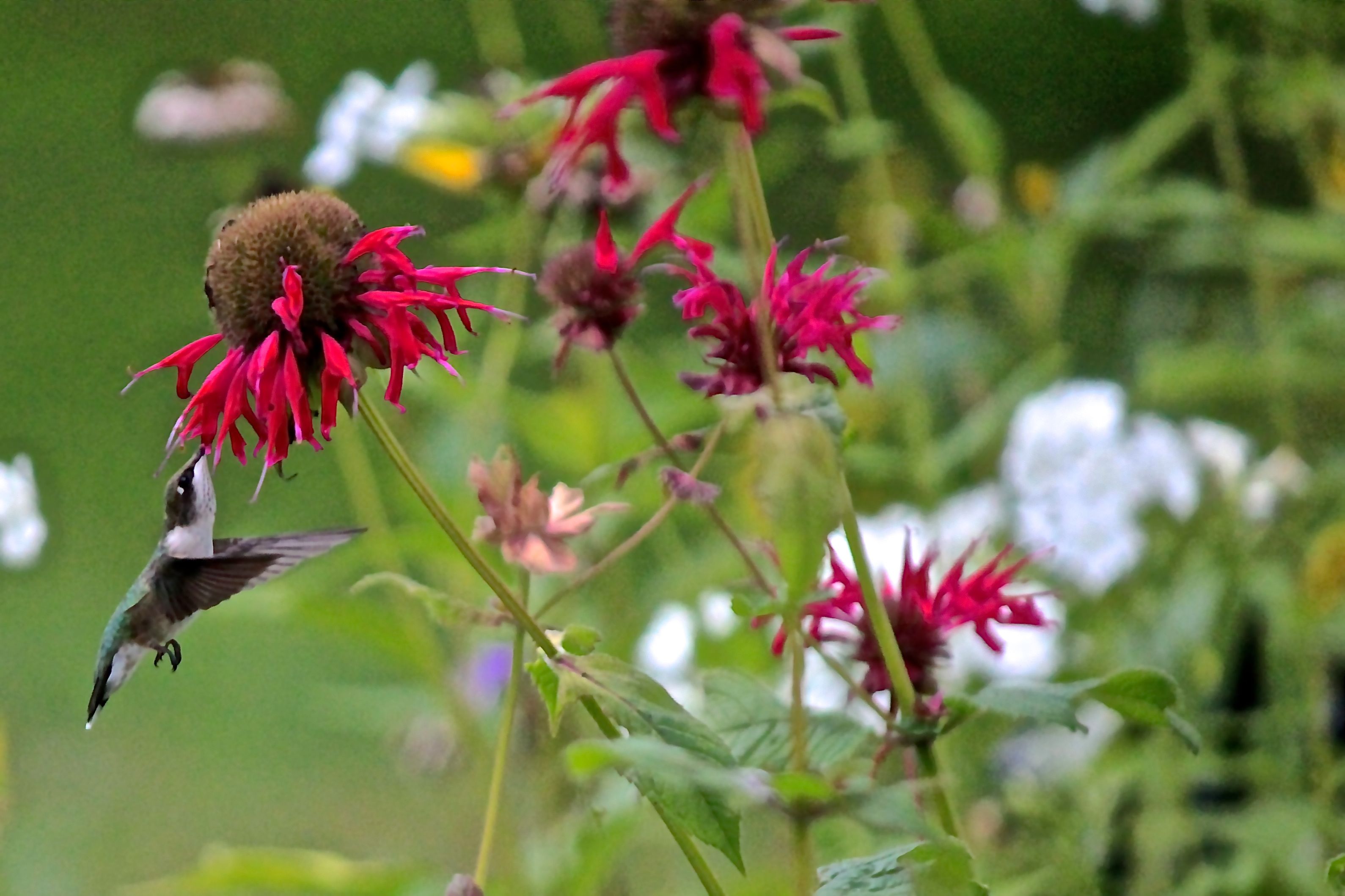
hummer approaching 2

hummer approaching 3

hummer approaching 4

hummer approaching 5

And then there is the hummingbird–ever swift and beautiful with its iridescent colors. Whether it is dining on nectar or insects attracted to the nectar, I don’t know, but it always returns, seeking more.

We all have the need for more. The frightening thing is that oftentimes we take more than we need. For the sake of the birds and insects, we need to think about that and how we might change our ways.

Book of September

Our friends, Ben and Faith Hall, recently invited us to their summer camp to share their Maine place with us. We hiked and wondered and chatted for several hours, but it was what they showed us at the start of our visit and the end that really bookmarked the day–their friend Bob swam up to the dock and smiled at us. Oh, I know, that sounds like life the way it should be at the lake–friends pulling up to the dock to visit. But this is no ordinary friend. This is a fish. And after our hike, Faith pulled out several books Ben has written for their grandchildren–filled with photographs of stone pictures he creates to tell a story. Ben is quiet and humble and incredibly talented. Below is a pdf of his book about Bob. Please click on the link and enjoy. It’s only eight pages long, but well worth a look. (I hope you are able to open this as it’s a pdf) Thank you for letting me share this, Ben.

Bob: How to Train a Human

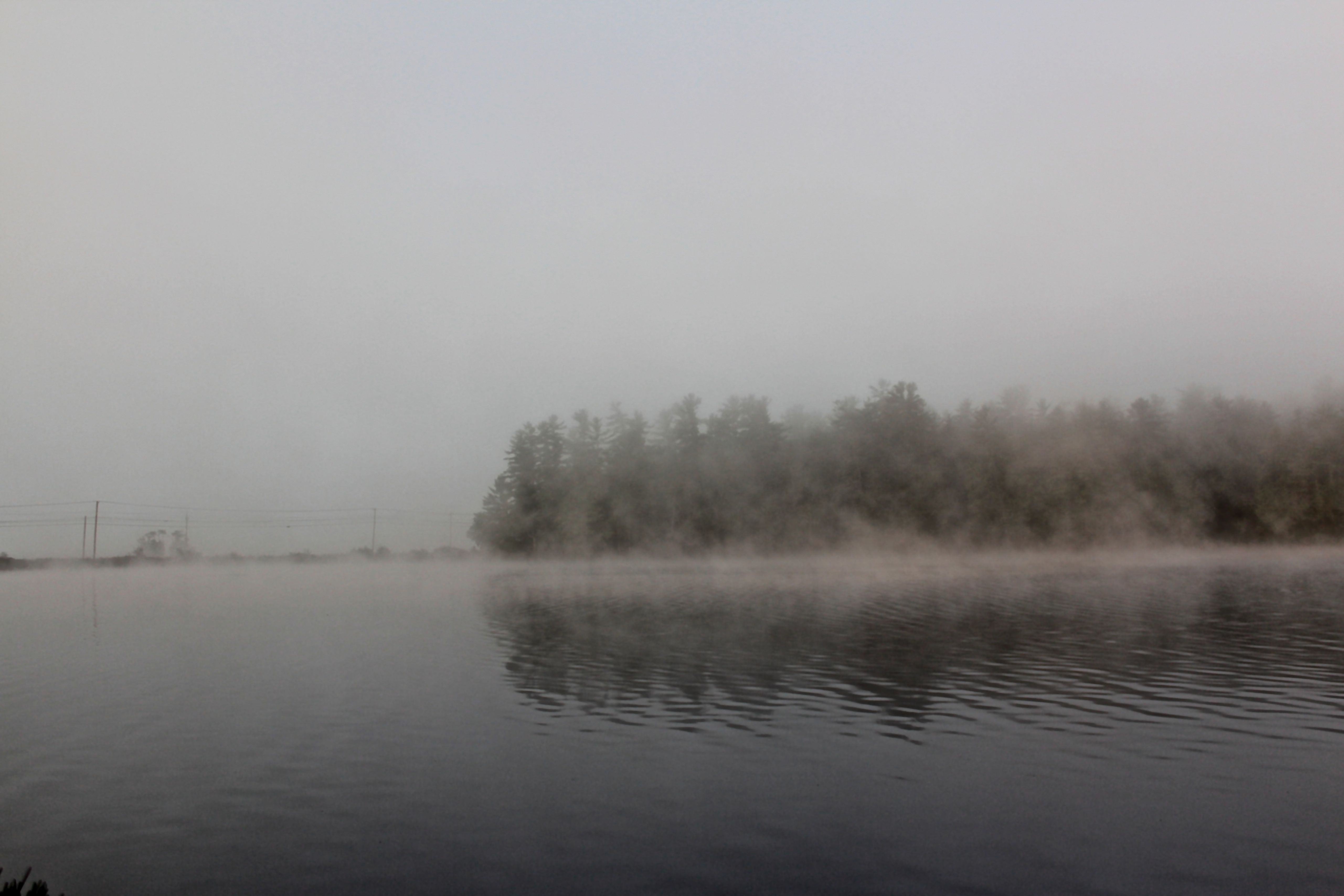
Out of the fog

morning fog

Morning fog embraced Pleasant Mountain, making it only a memory.

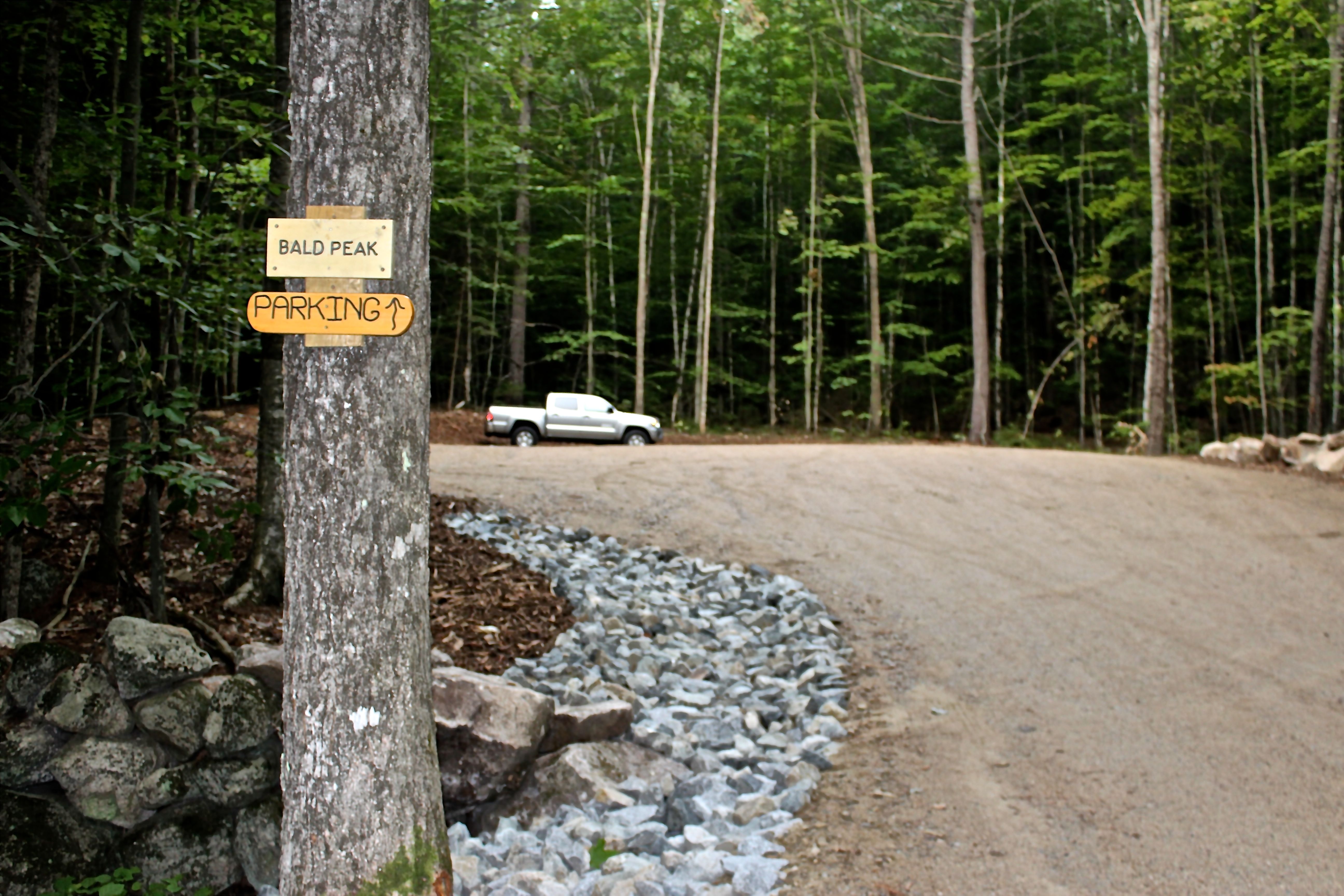
new parking lot

In my need to know that it was still there, I drove down Mountain Road to the brand-spanking new Bald Peak parking lot. I guess I was early since my truck was the lone vehicle.

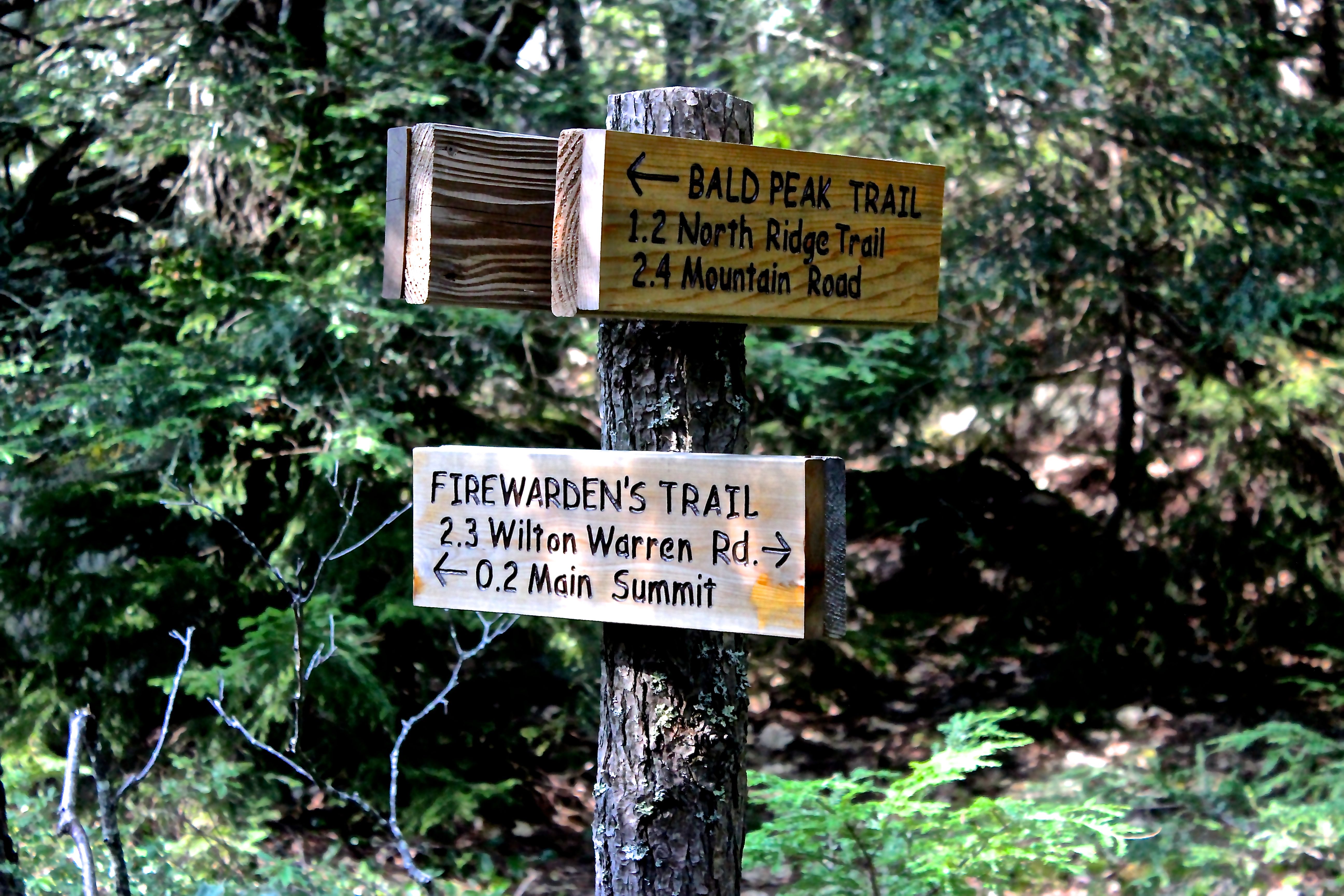
Bald Peak Trail Sign

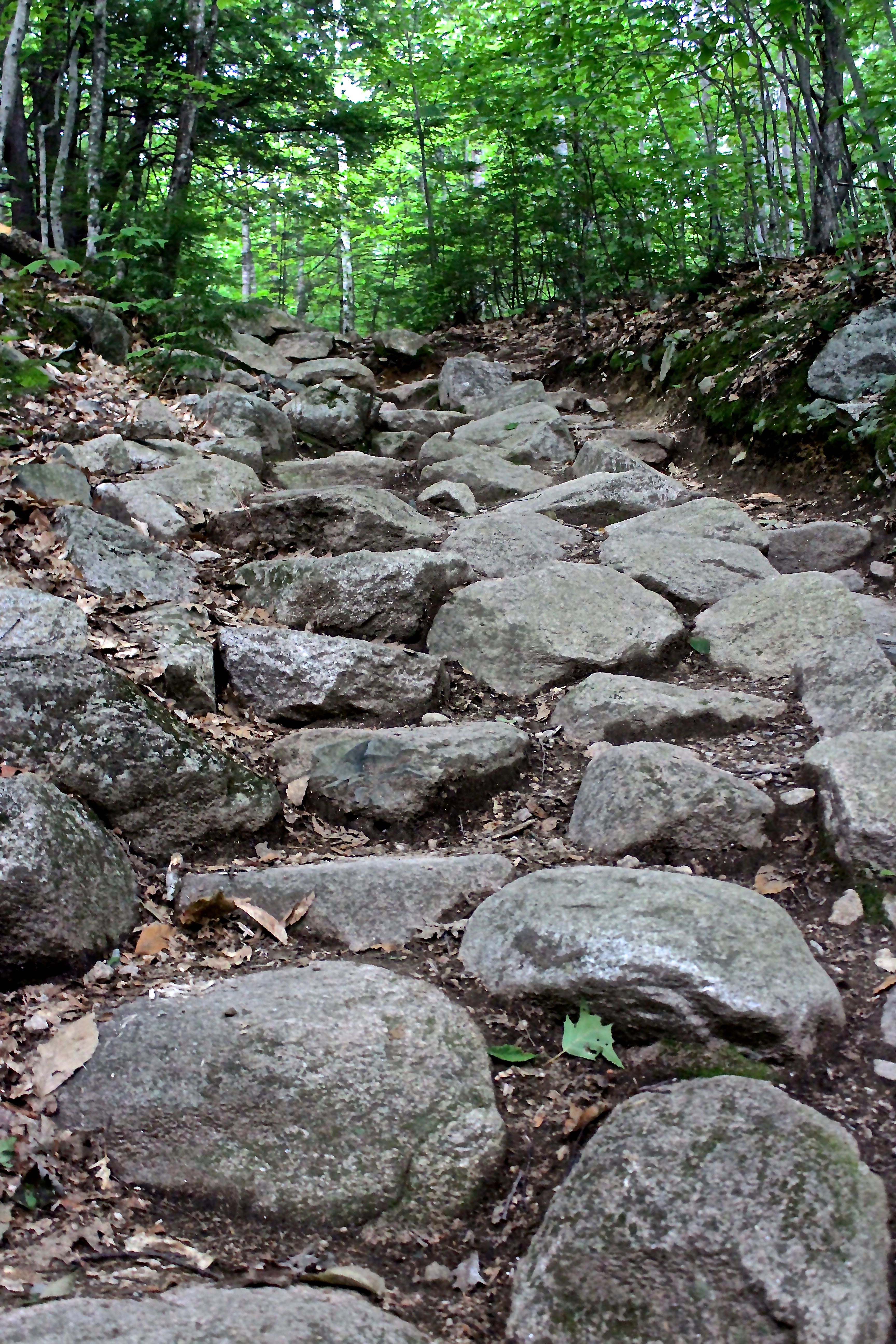
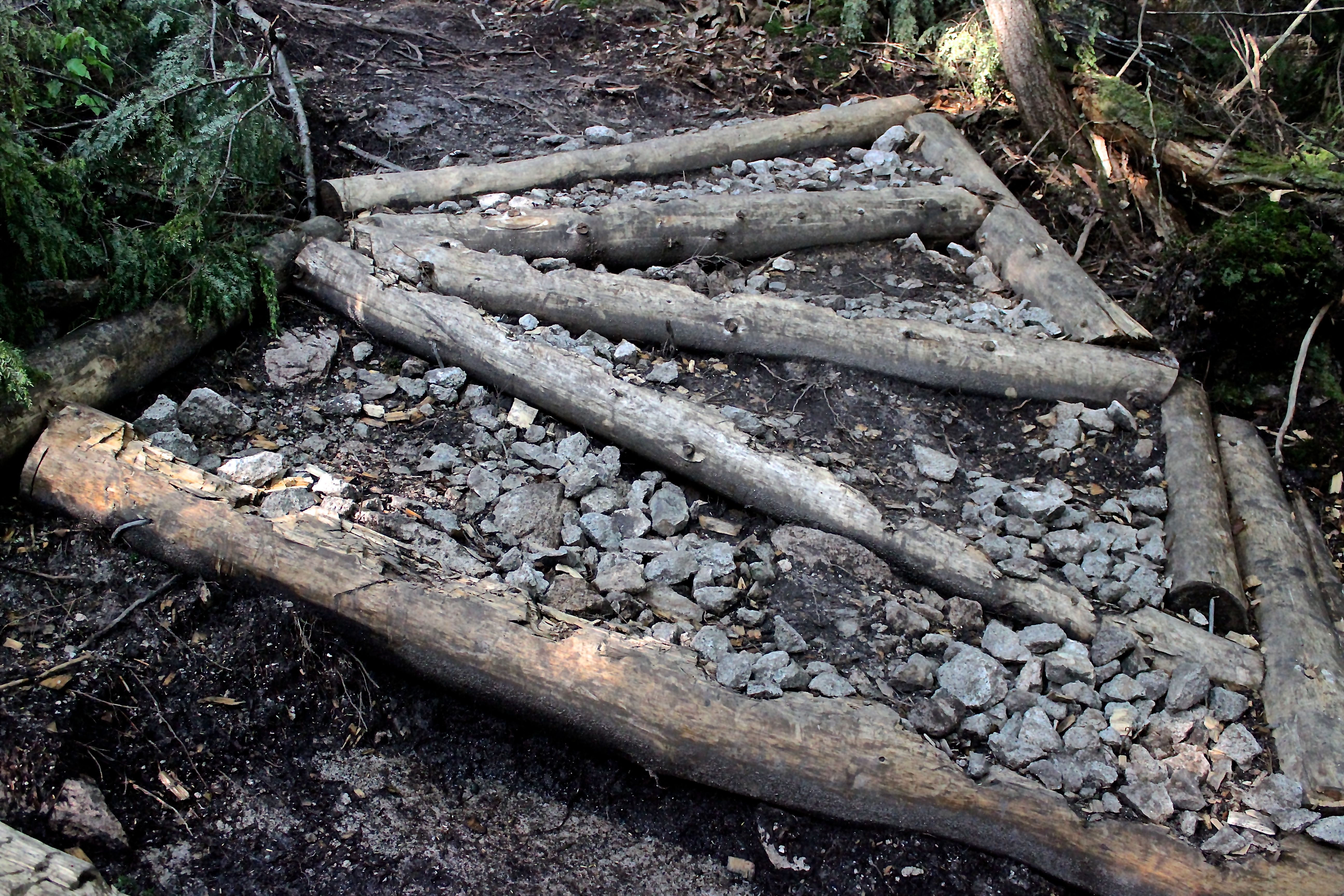
Thanks to Loon Echo Land Trust and the AMC, the Bald Peak trail has undergone a transformation this year.

Stairway to heaven

new trail

trailwork 4trailwork2trailwork 3

More stairways, a new path and switchbacks make for an easier climb. Um, that’s all relative. It’s still moderately challenging compared to the other trails on the mountain.

trail signs

Trail signs mark the way, giving a sense of direction and distance.

debarked

I’m a bit out of order with this photo, but that’s my nature. Near the start is this debarked birch. People have carved their initials to note their presence. I know I occasionally post photos of beech trees with carvings, but the fact that someone took the time to peel the bark off this tree bothers me. Please leave bark on trees. I know it peels easily on birches, but the tree will shed its bark when it is ready. For us to peel it is like someone peeling off a layer of skin. Shivers run up and down my spine as I think of that. Bark is the tree’s form of protection from the elements. ‘Nuf said . . . I hope.

mossy rocks

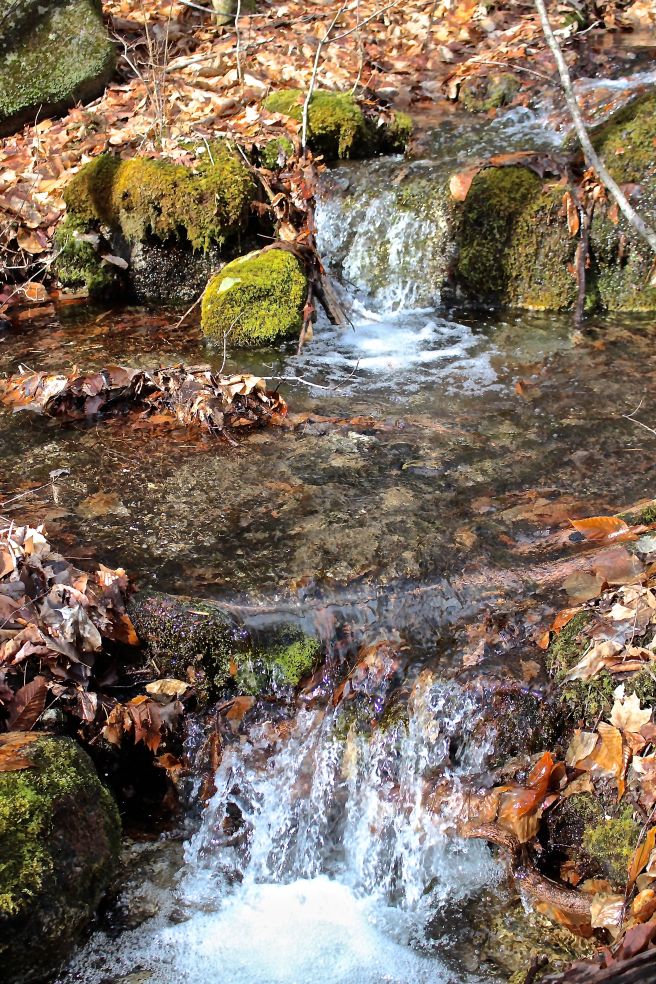
For much of the way, the trail follows a stream featuring moss covered boulders

lush mtn garden

and terraced rock gardens.

rock garden

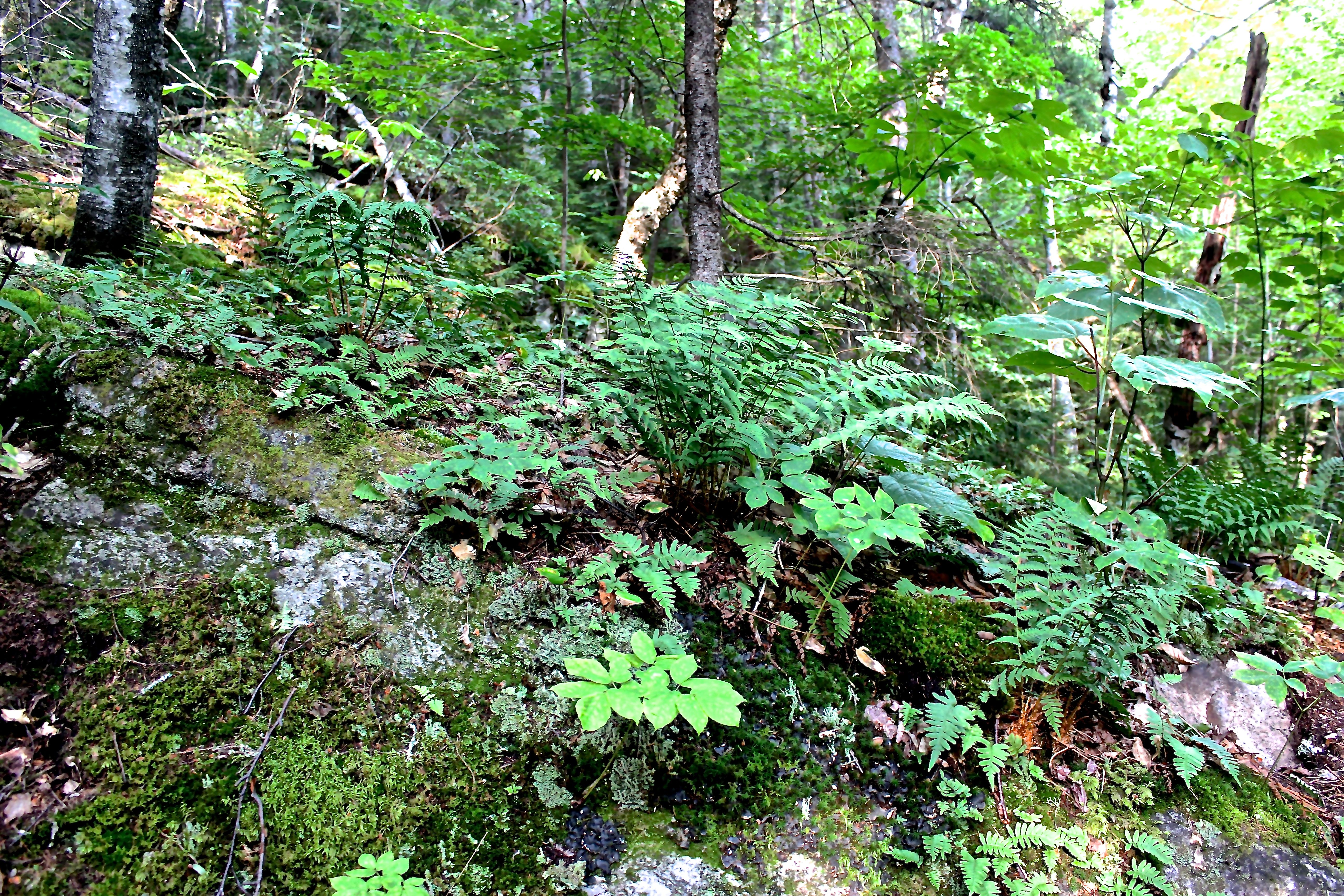
I pause beside one boulder where lichen, mosses, wildflowers, ferns and even a striped maple tree have made a home.
Christmas fern

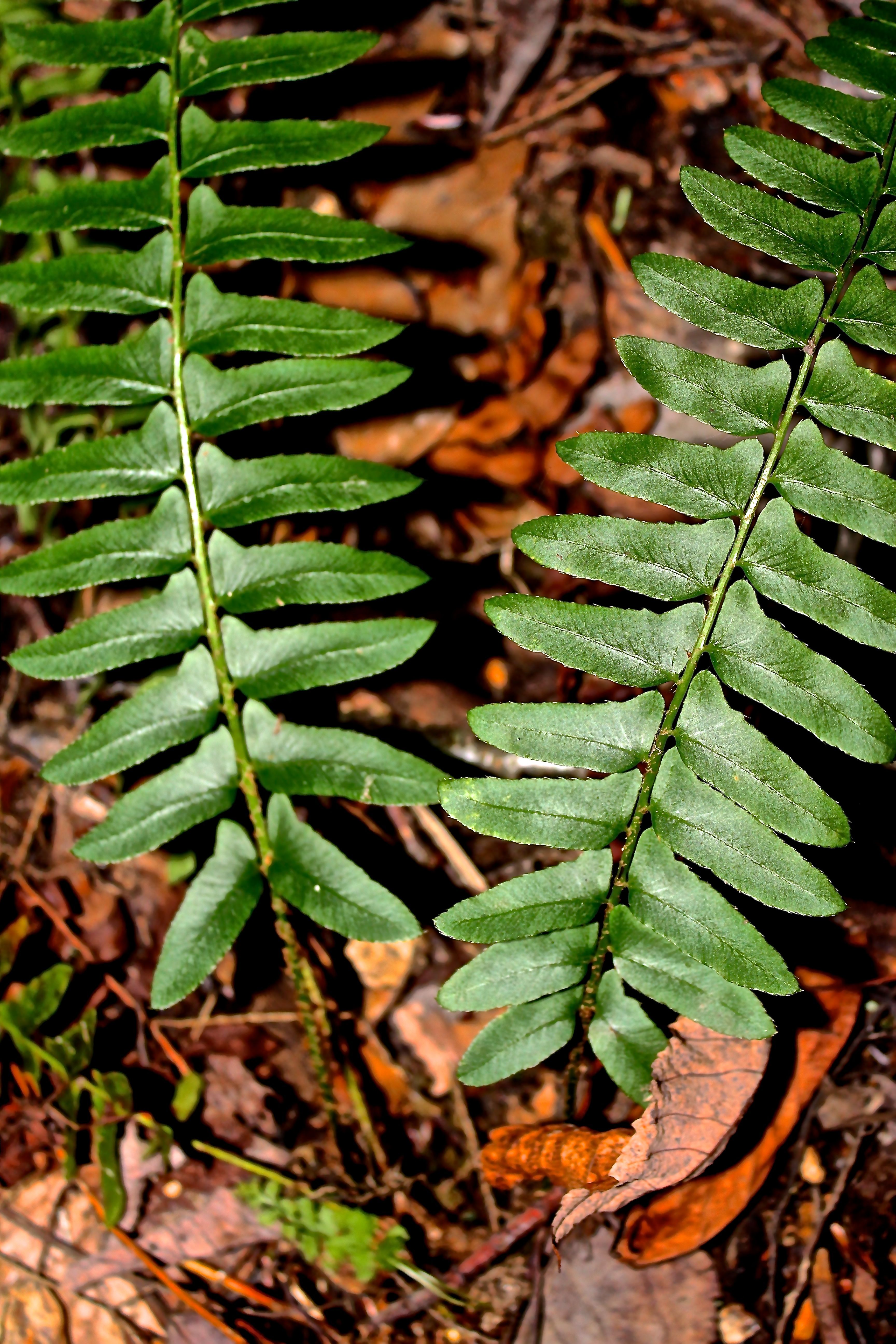
Christmas fern–do you see the shape of the leaflets or pinnae? Little Christmas stockings or boots? Some say Santa sits in his sleigh with the reindeer before him. Each leaflet is attached to the main stem via a short petiole.

polypody1

Polypody fern loves to give rocks a crazy-hair-day look. While its leaflets look similar to that of Christmas fern, they attach directly to the main stem and give the  entire blade a rather ladder-like appearance.

betsy's lookout

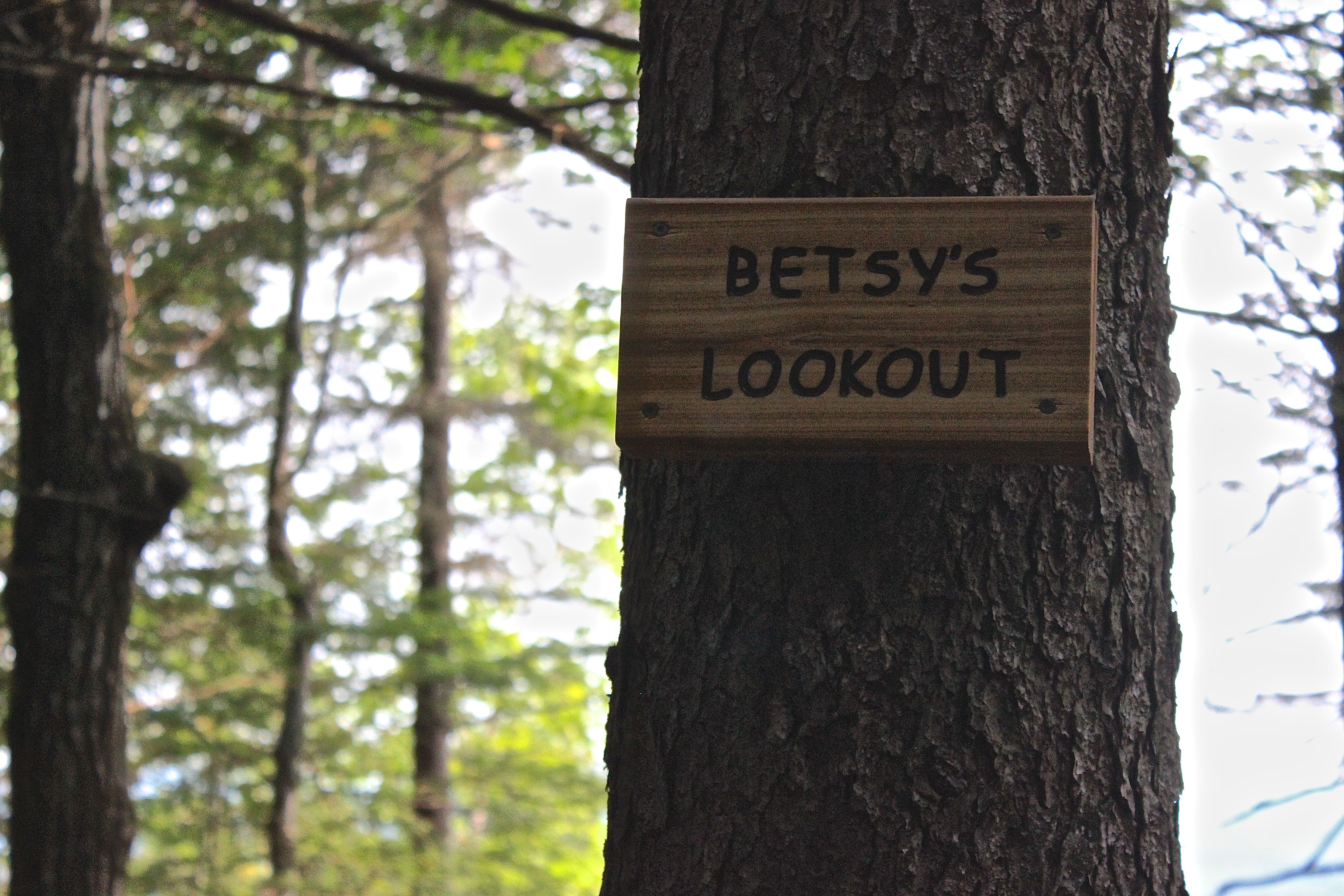
I’m not sure who Betsy is, but along the path, there is a new cutout providing a bit of a view of Moose Pond below.

American Toad

Before I hiked onto the ridge, an American toad paused for a photo op.

looking at camp

Out of the fog. Camp is about smack-dab in the middle of this photo on the north basin of Moose Pond.

trail along the ridge

I met no one as I hiked up and only encountered two people and their dogs along the ridge trail heading toward the summit.

blueberries and huckleberries

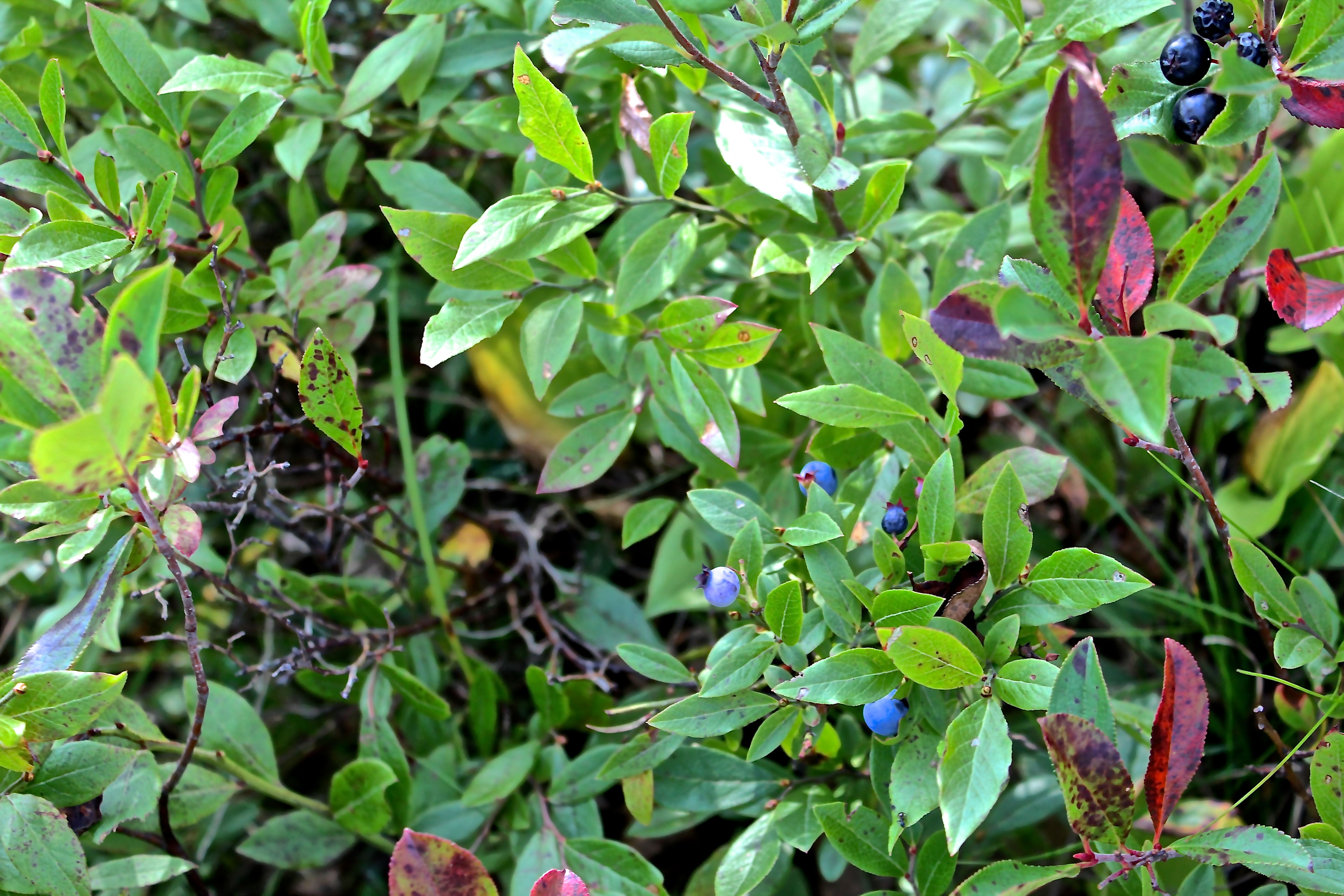
There aren’t too many blueberries left, but the huckleberries are abundant–and seedier.

gall of the earth 2

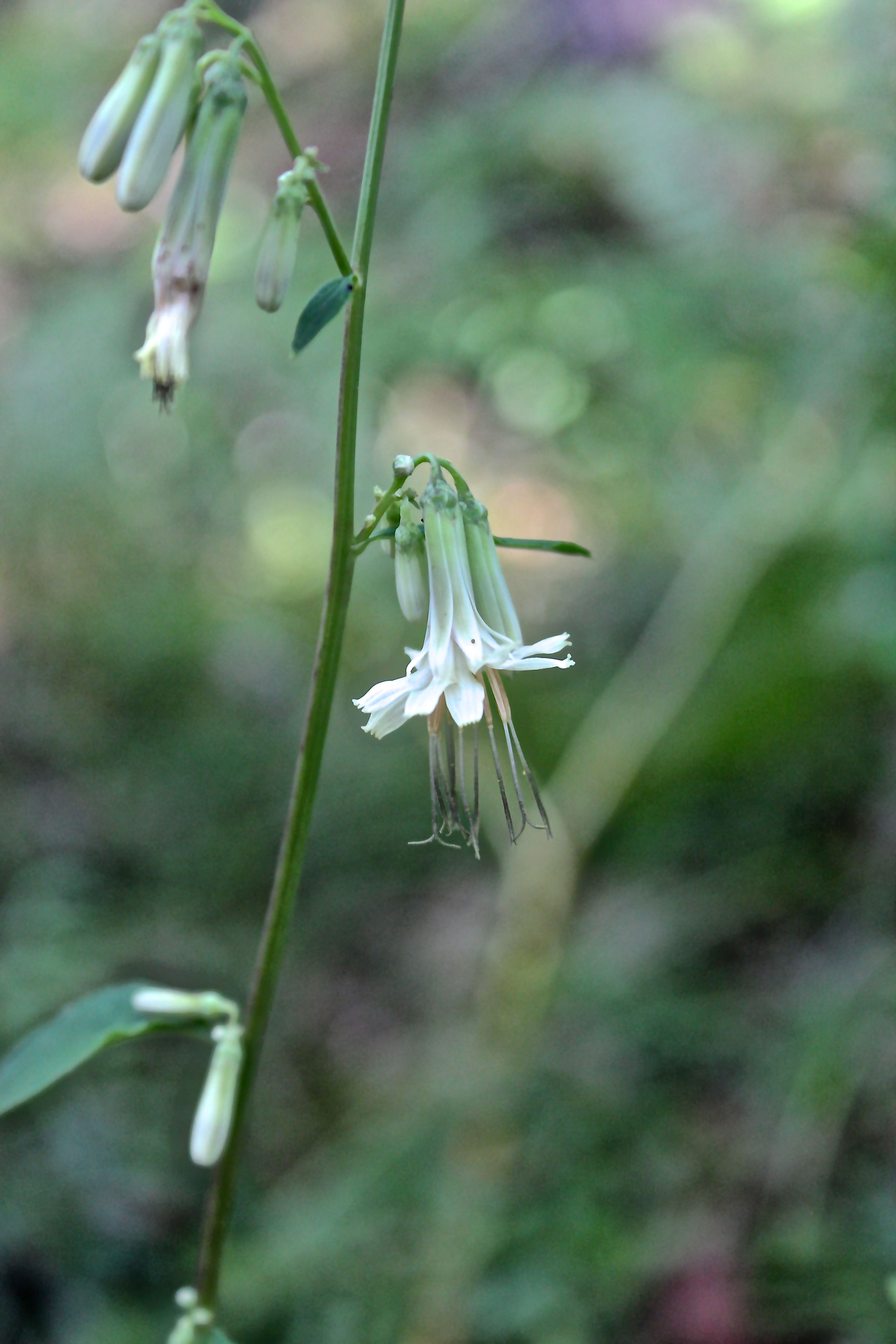
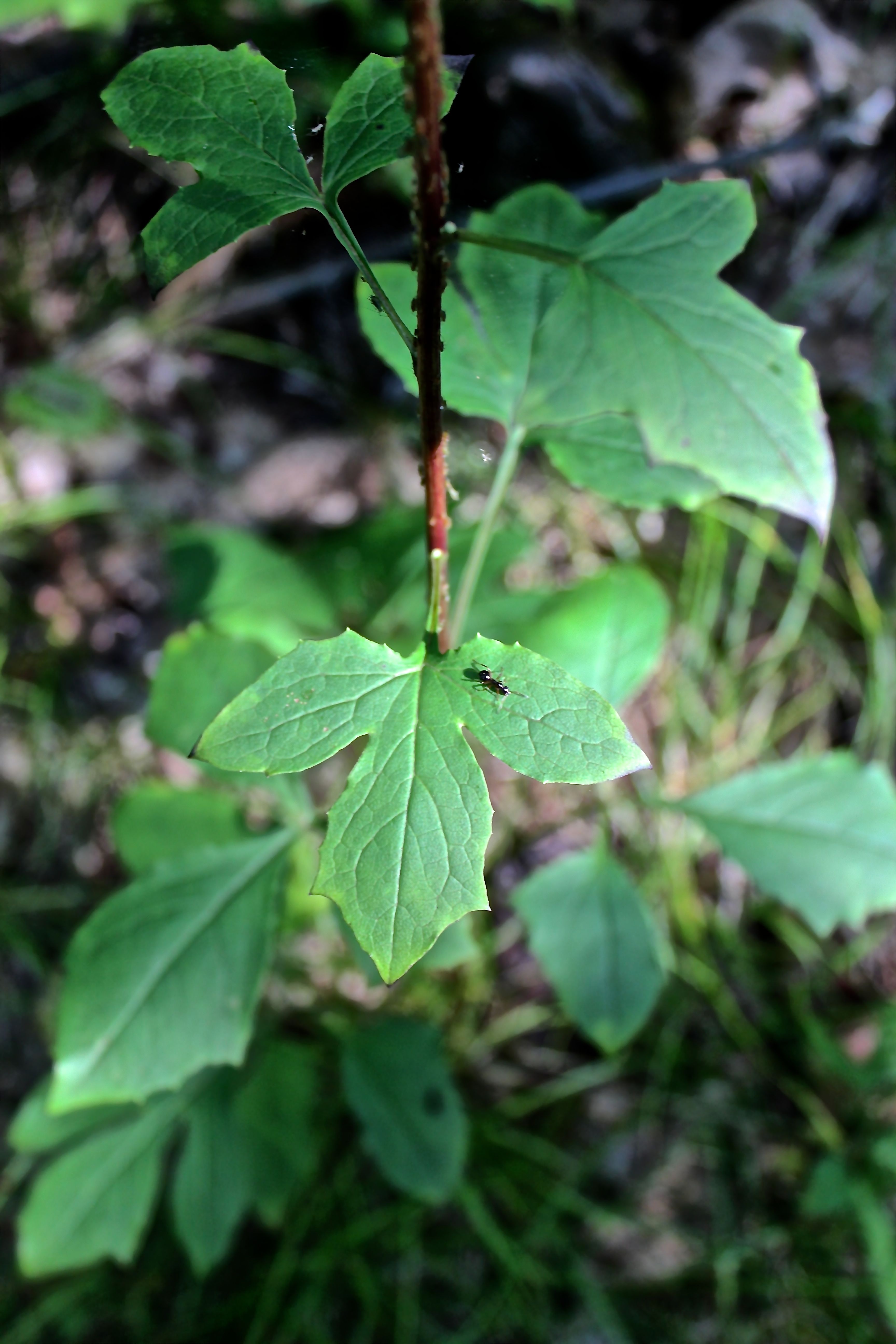
Also plentiful–Gall-of-the-Earth or Rattlesnake Root (Prenanthes trifoliata). Such a curious name for this plant. Hilary Hopkins writes in Never Say It’s Just a Dandelion, “Gall-of-the-Earth: a mysterious name dating from at least 1567, referring to a plant’s bitterness, though not this plant, but rather one said to have been discovered by Chiron the centaur, a physician of Greek mythology.” OK–so if not this plant, then why the name?

Hopkins continues, “Rattlesnake Root refers to the plant’s supposed efficacy against rattlers.” Always good to know I have a tool handily available when hiking alone.

And finally, she writes, “Prenanthes means ‘drooping flower,’ a perfect description; trifoliata describes the three-parted leaves.” That is definitely accurate.

gall aphids

Though I saw numerous Prenanthes trifoliata along the trail, only this one was covered with aphids.

gall ant

And one ant. It is said that ants herd the aphids, protecting them from predators and parasites, so that the ants can enjoy the honeydew left behind by the tiny insects. This ant must have had sentry duty–he roamed all over this leaf and then down to the next one. Perhaps he thought I was the predator and he had to keep an eye on me.
whorled asters

Whorled Asters graced the trail periodically and the base of a Northern Red Oak.

Firewarden's Trail

Moments before I reached the Firewarden’s Trail, I startled a red fox that ran into a rock den.

fire tower 2

Standing forever stalwart is the fire tower. I hope it will continue to stand tall forever, as it marks a piece of the mountain’s history.

summit view1

Out of the fog. Looking west from the summit.

trail signs heading down

There was a time when one could easily get lost on this mountain, but thanks to the LELT, those days are no more. Good thing. There were six people at the summit and I passed quite a few more as I descended via the Ledges Trail.
 white goldenrod

Silverod is our only white goldenrod and it prefers the drier soil of this path.

Ledges 1

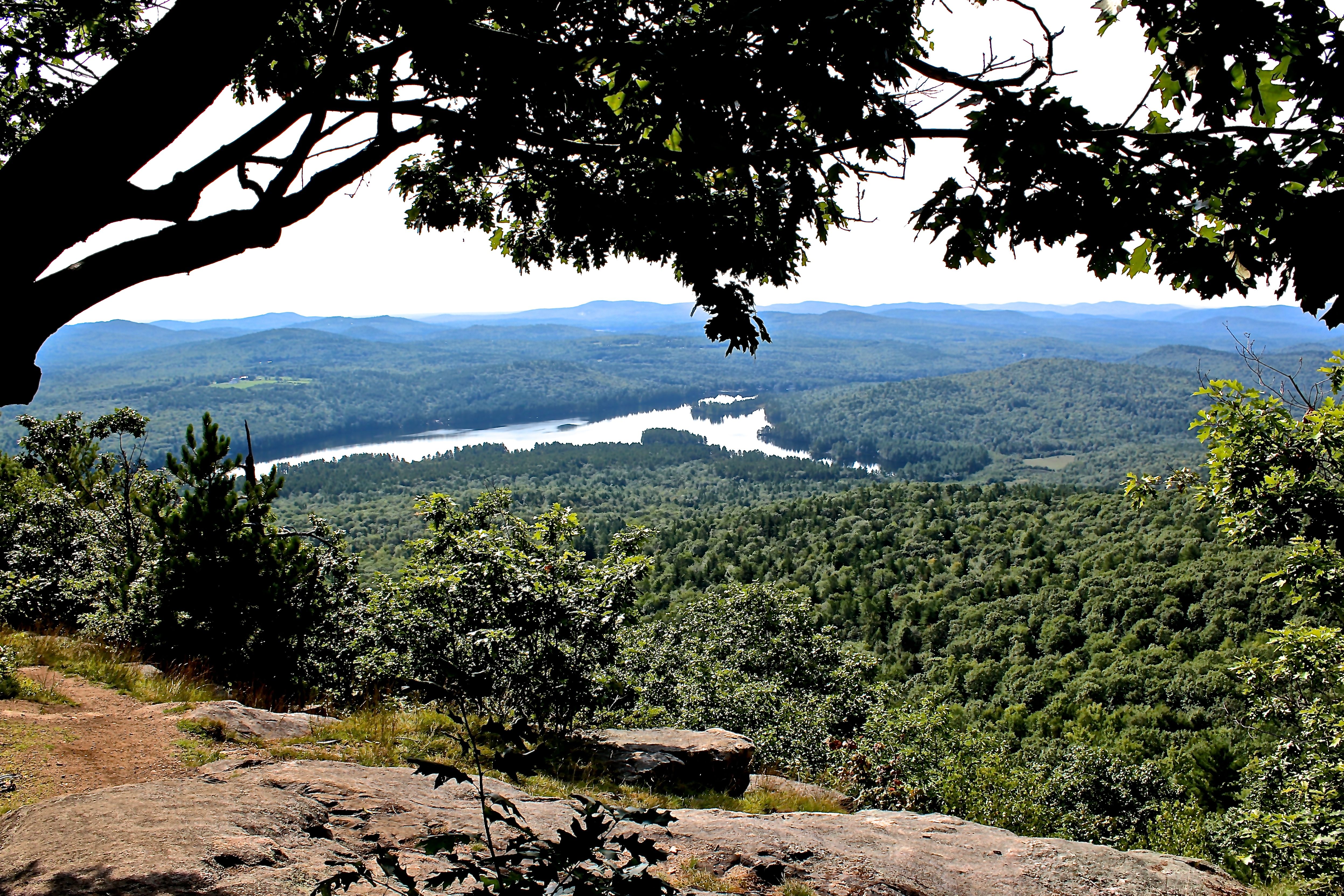
The ledges offer a peek at the south basin of Moose Pond.

Mountain Road

Finally, I was back on Mountain Road for the 1.5 mile walk back to my truck.

red eft

Interestingly, along the way I found thirteen smooshed red efts. These are the terrestrial teenagers of the newts. My first thought–snacks galore. Then I remembered–their color is a warning sign of their toxicity. No one wants such a snack. (Reportedly, they aren’t harmful to humans, but I wasn’t about to find out.)
And so it was today that I’m glad I climbed out of the fog. Thanks for joining me on this long wander.

Renewing the spirit

My guy and I drove to the central Maine town of Madison this morning to join Master Naturalist Kate Drummond on a walk that combined the natural and historical context of a trail beside the Kennebec River.

The Pines

The Pines, as this area is aptly named, once served as an Abenaki settlement.

Kate D

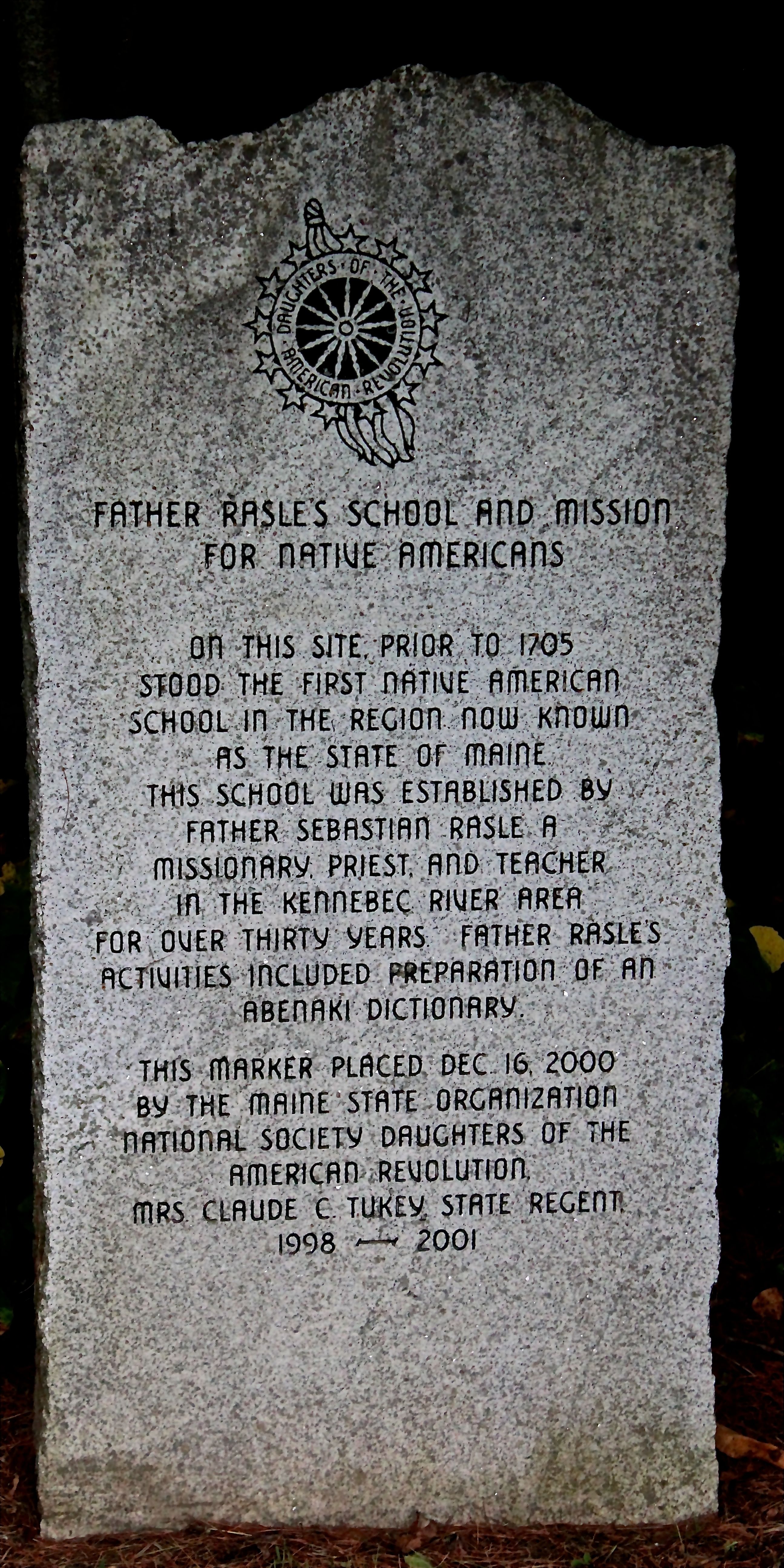
Kate began by sharing the history of Father Sebastien Rasle, who lived among the Abenakis, learned their language and converted them to Catholicism. For more than thirty years in the late 17th/early 18th century, he served as a Jesuit missionary and built at church here. Father Rasle educated the children and developed a dictionary of the native language. He also helped keep the English at bay when they tried to encroach upon Indian lands–until that fatal day–August 23, 1724.

While Father Rasle had earned the respect of the Abenakis, the English militia was wary of him. They combined forces with the Mohawk Indians to destroy the village and killed at least 80 Abenakis and Father Rasle 300 years ago today.

And so it was that Kate chose to honor Father Rasle and the Indians he lived amongst by sharing the trail with local townspeople (and us–from two hours away) to tell his story and recognize the natural elements that were a part of their daily life.

Kate is a high school chemistry teacher, so captivating her audience is a part of her makeup. To begin, she asked us to stand still for a minute and listen, look, be in the moment. After we shared our observations, she took us back in time, to imagine what the area looked like three hundred years ago.

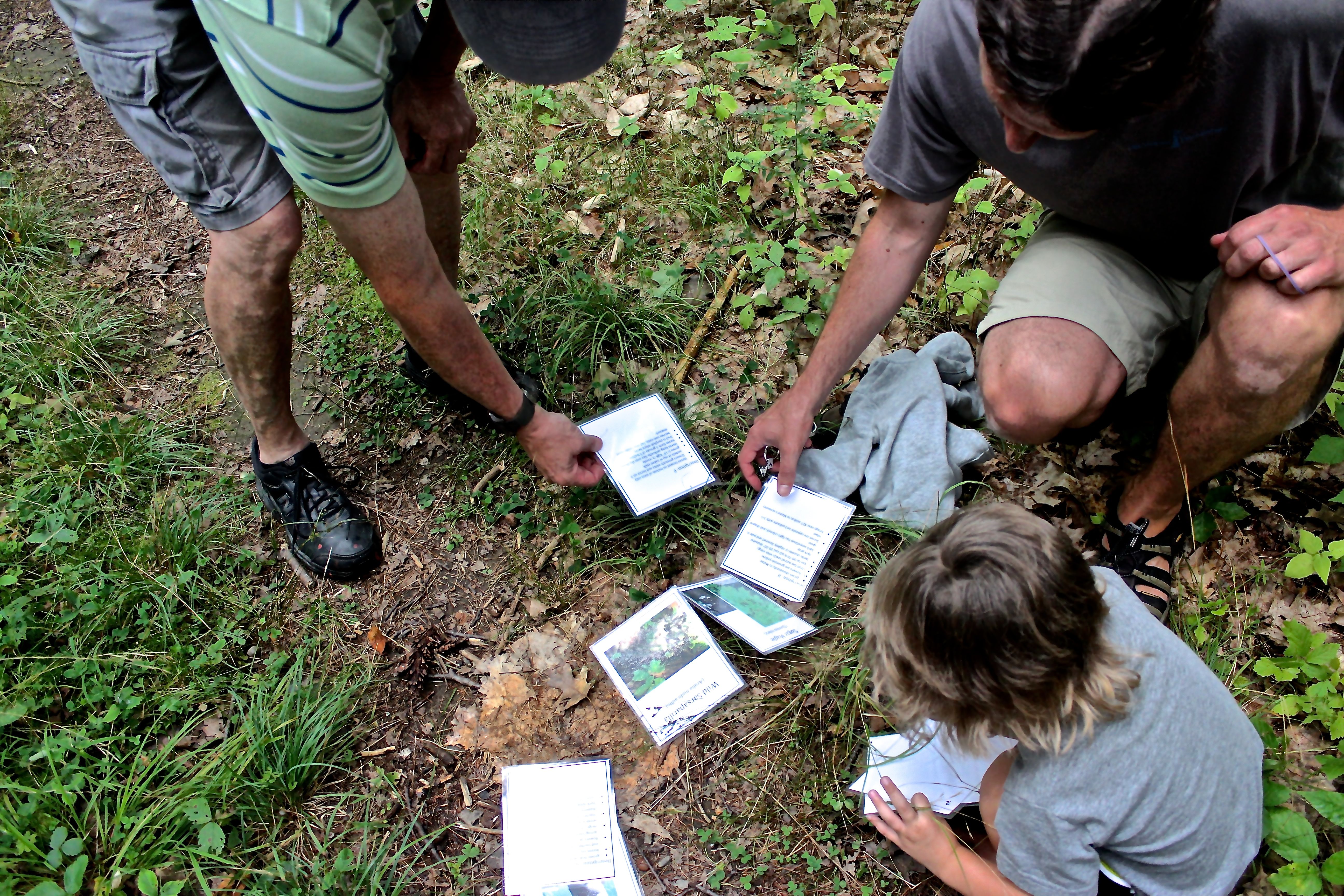
matching cards to cool facts

matching cards

And then our real work began. We were given a set of cards and had to match the photos to the card listing cool facts about a particular species. Thankfully, there was no quiz at the end, but I suspect this group would have passed with flying colors–everyone was equally engaged.

We found some cool finds along the way:

acorn plum gall

Our first was a mystery. This speckled red ball, about the size of a jawbreaker, had us puzzled. We found several on the ground beneath Northern red oaks and Eastern white pines. Cutting one open, it looked rather fleshy and we could see what appeared to be an insect, but we still weren’t sure. And when we later found an empty acorn apple gall, we realized it was the same size. Well, a quick Google search for “large speckled red ball beneath oak” revealed acorn plum gall. It’s the home of a wasp species that uses this as a nursery. The grub slowly eats the gall’s tissue and metamorphs into a pupa before changing into a small wasp that eats its way out through a hole. This particular gall grows at the base of the acorn cup.

red and sugar maple leaves

A red maple and a sugar maple stood side by side, making for a lesson on leaf id. Red on the left, sugar on the right. Red–more teeth, or as Kate said, R=rough. Sugar–a U between the lobes, and as Kate said, Sugar has a U in it. It’s their sap that the Abenakis knew.

beaver works

Though we didn’t see any fresh sign of beaver activity, we knew by this statue that they’ve been here in the past. I love that those who actually cut the rest of the tree down to prevent it from falling across the path, had the foresight to leave the beaver works for all to see. The beavers were important to the Abenakis for a variety of reasons, including as food, tools and warmth.

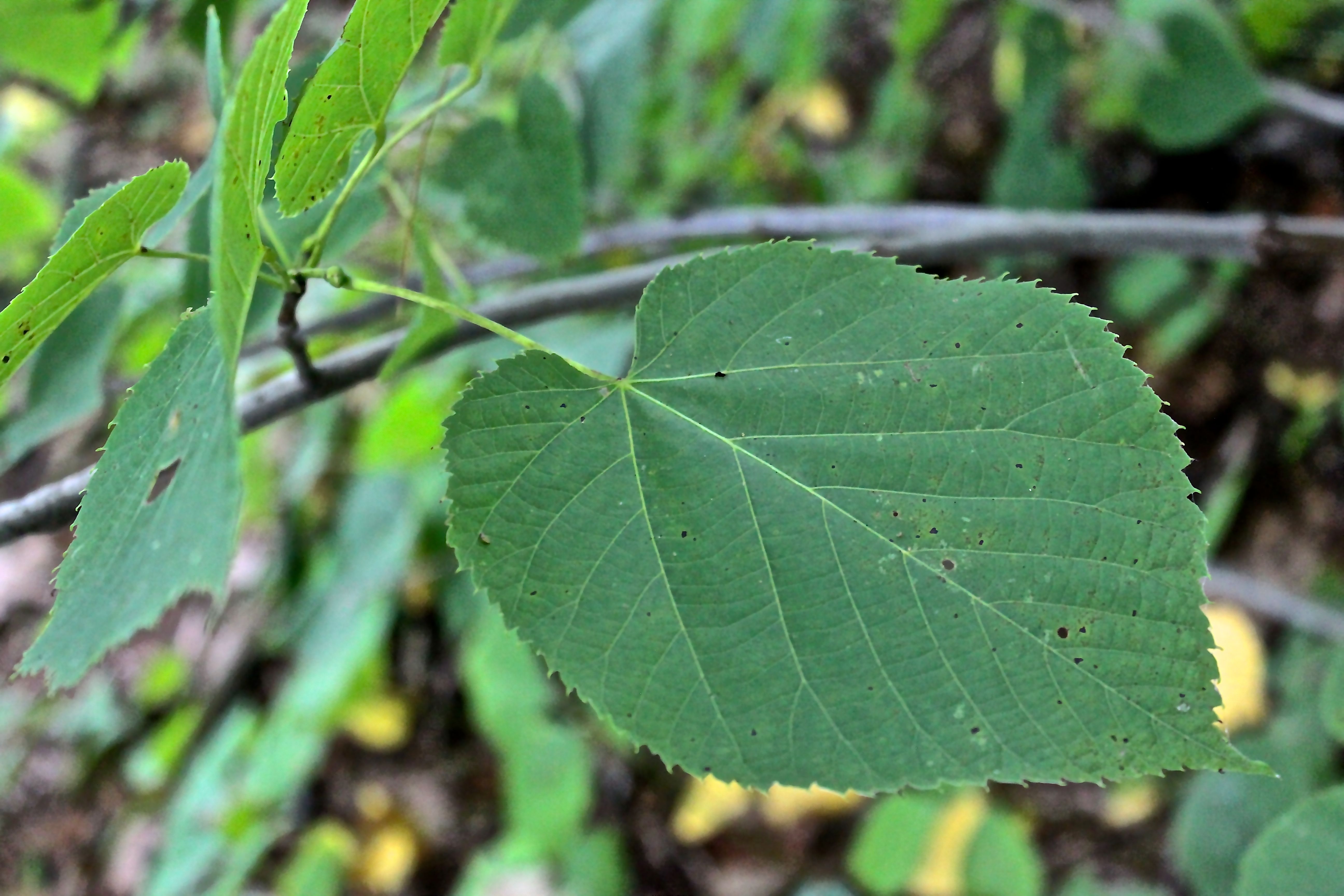
basswood leaf

The asymmetrical base of the basswood tree makes it easy to identify. It was the bark, though, that was of prime importance all those centuries ago–the stringy fibers were used to make line or rope.

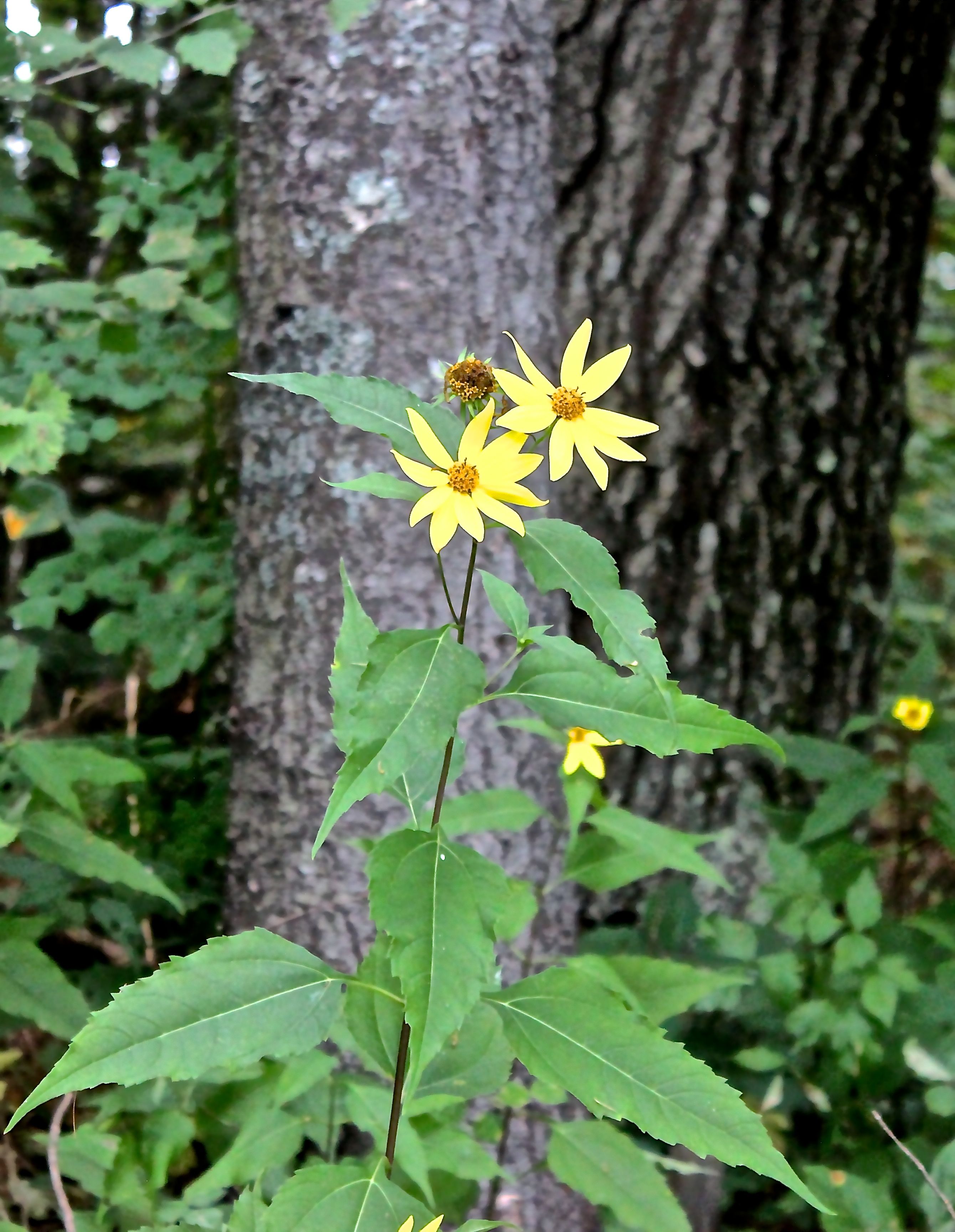
jer art 1

In bloom were the Jerusalem artichokes. In Notes on a Lost Flute: A Field Guide to the Wabanaki, author Kerry Hardy writes, “Peeking out of the woods at Old Norridgewock are Jerusalem artichokes, the penak [ground nut]of the Abenakis who lived here.  I believe these plants must be descendants of those grown here centuries ago.” How cool is that? The plants tubers are edible.

jersaleum artichoke

On this day of reflection, remembrance and revelation, they shown brilliantly, perhaps a sign that reconciliation is possible.

Kennebec River 2

We spent some time beside the Kennebec where eels and alewives were important food sources.

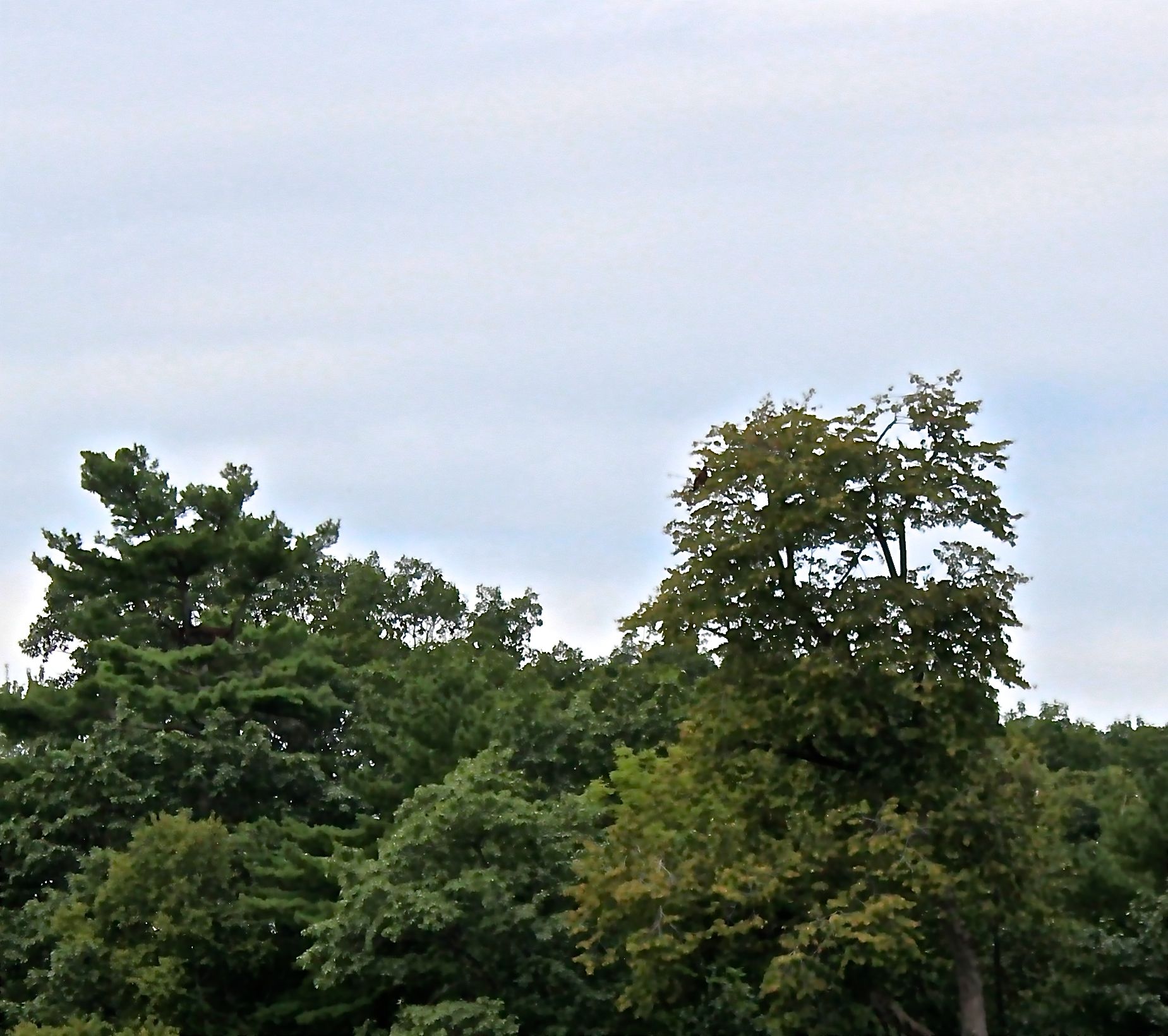
immature bald eagle and nest

And an immature bald eagle let us know of his presence. He’s in the oak on the right, while his nest is toward the top of the pine on the left.

FR monument 1

FR mon 2

FR school

It is Kate’s hope that more people will want to learn about the history of this place. Kudos to her for embarking on renewing its spirit.

A World in Miniature

trail

I feel my dad’s presence when I enter a forest where mosses carpet the damp  floor and blanket once exposed rocks and tree trunks. To dad, this was home to the faeries or fair folk. Indeed, it is.

desk top 2

Yesterday, I took a closer look. With hand lenses, a field microscope and a copy of the Princeton Field Guides: Common Mosses of the Northeast and Appalachians,  friends and I set out to identify a few common species.

Mosses (and liverworts) are bryophytes, bryon being Greek for moss and photon for plant.

A sea of green surrounds us. Moss green. OK, so what does that mean exactly? Each species has its own shade of green and even still, several variations of that shade.

fern moss

Above is a fern moss, with its fern-like leaves and yellowish-green hue. What would its name be on a paint chip? Below, you can see its brown spore-bearing, pointed capsules born on a wiry stalks sticking out from the side of a tree stump.

fern moss spore capsules

If you look closely, you’ll see something else on this old stump.

liverwort

Green worms. Zillions of them writhing about. Such is the illusion created by thin overlapping leaves that curl under along the outer sides–giving them a 3-D appearance. This is a liverwort–three-lobed Bazzania or Bazzania trilobita.

mystery fern mat

Nearby, another mat caught our attention. It reminded us of one we’d seen earlier, but we needed to spend time with it.

mystery fern moss 3

We knew by its structure that it was another fern moss species–but which one? The red stem stood out to me as the missing link. It became our mystery moss for the time being, but I think I’ve figured it out. Pleurozium schreberi or red-stemmed moss. I also found it as Phoenix feather moss. And big red stem moss. Yeah, I know–that’s why I should learn the Latin. Ah, Mr. Cretella, you are still sitting on my shoulder trying to get me to stop using Spanish words to fill in the answers on Latin quizzes.

spag 3

We discovered springy, wet sphagnum moss. I always think of it as being in a more bog-like setting, but it is quite damp here.

pincushion moss

One of the common species that grows in small, easy to see mounds scattered about the area, pincushion moss. To some, it resembles a sea urchin. Using our hand lenses, we looked for air bubbles that are supposed to be visible at the base, but mostly we saw tears welled up in our eyes from laughing.

desk top display

After three hours, it was time to pack up the items on our our tree stump desk and head out. We’d only walked .2 of a mile down the trail, so it wasn’t a long haul out.

wood frog

Movement made us pause. Not a faerie, but a large masked wood frog who wanted us to think he wasn’t there.

bobcat and haircap

Someone else had previously passed by. We’d seen tracks on the way in and knew what it was, but I waited till the end to photograph this bobcat print. Do you see it in the mud? And the hair cap moss above it and to the right?

Acro moss

I’d sketched this previously. Looking at it now reminds me that we reviewed the three basic growth forms of mosses and found examples of all three in this little space–acrocarp, pleurocarp and peat moss.

Acrocarp–simple or sparsely forked stems typically grow in upright position. (pincushion, haircap)

Pleurocarp–stems typically trail along the ground and feature opposite branches. (fern mosses)

Peat moss–stems stand upright; often have mop-like or pom-pom heads. (sphagnum)

I’m thankful for friends who love to learn (P & B K. and D.S.). We hardly scratched the surface. I can’t wait to spend more time among this miniature world beneath our feet.