The BOF of Ron’s Loop

Huh? The BOF of Ron’s Loop? What in the world is that all about. Read on, if you dare.

r-kiosk

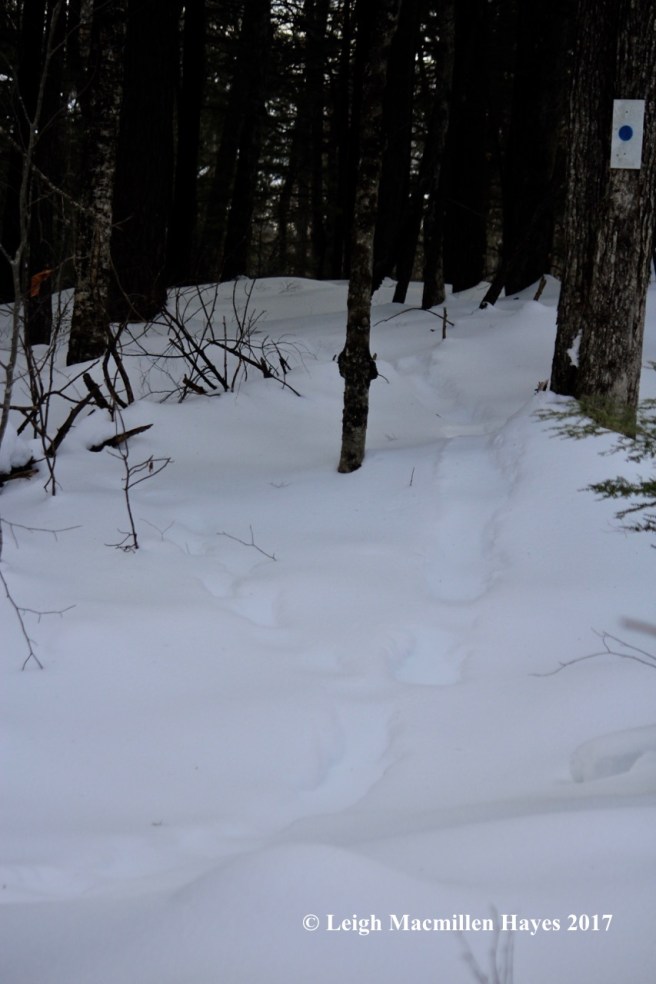
This morning dawned bright and chilly, just perfect for a tracking expedition with my friend, Joan, along Ron’s Loop at Back Pond Reserve in North Waterford/Stoneham. It’s a Greater Lovell Land Trust property that we love to visit. Then again, is there a GLLT property we don’t like? Uhuh.

r-bobcat

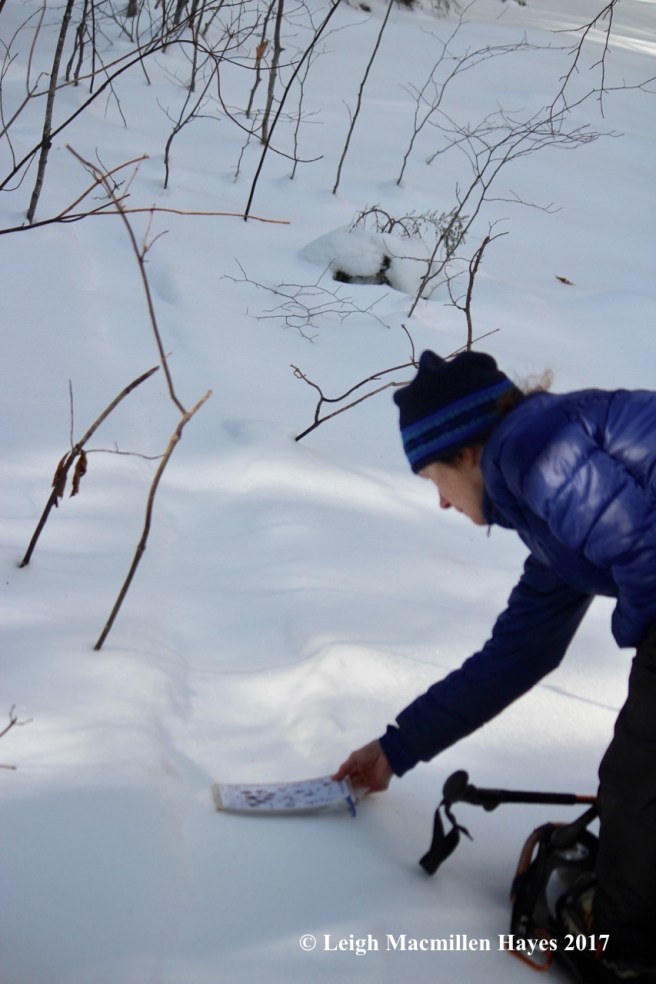
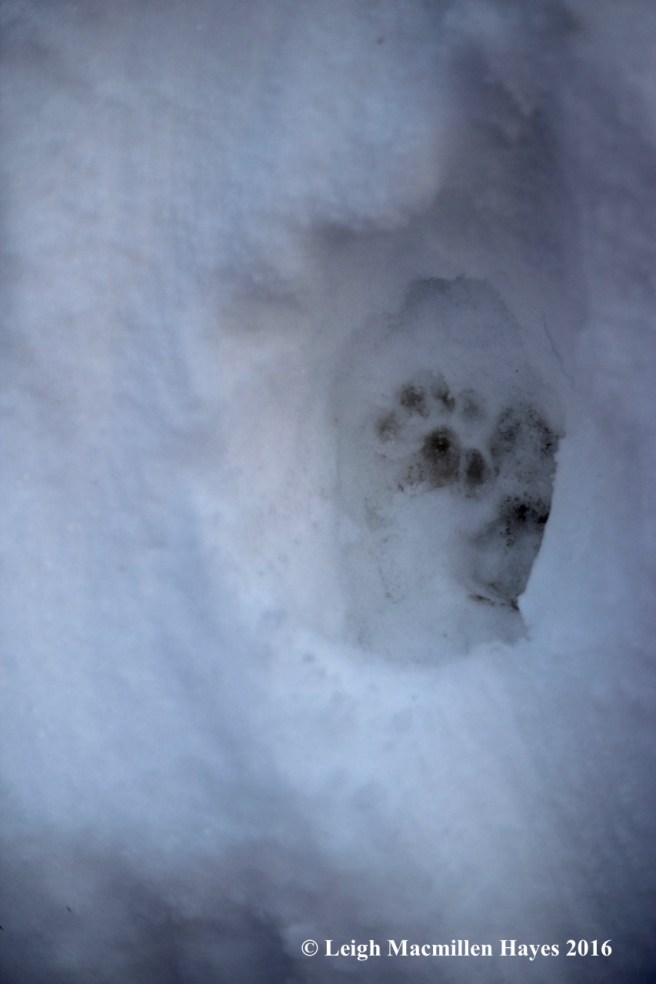
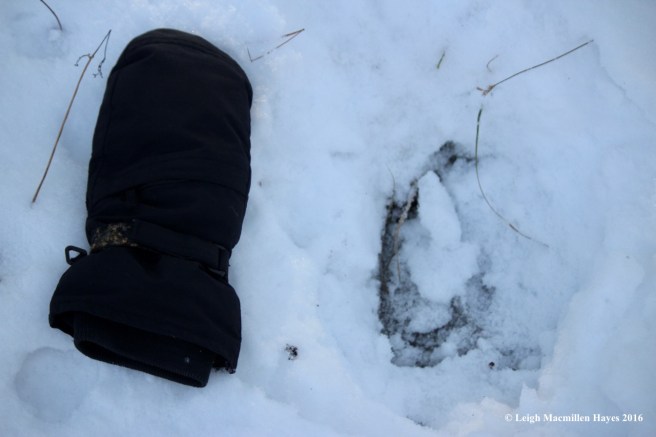
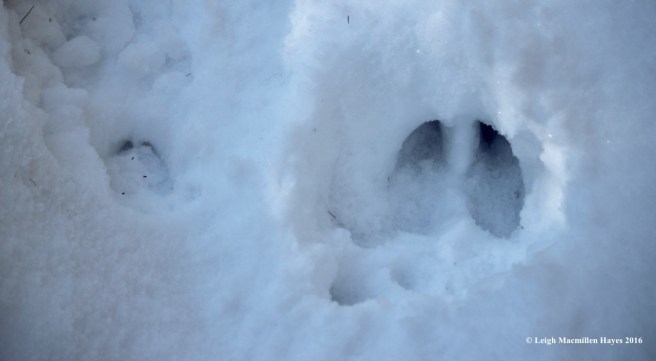
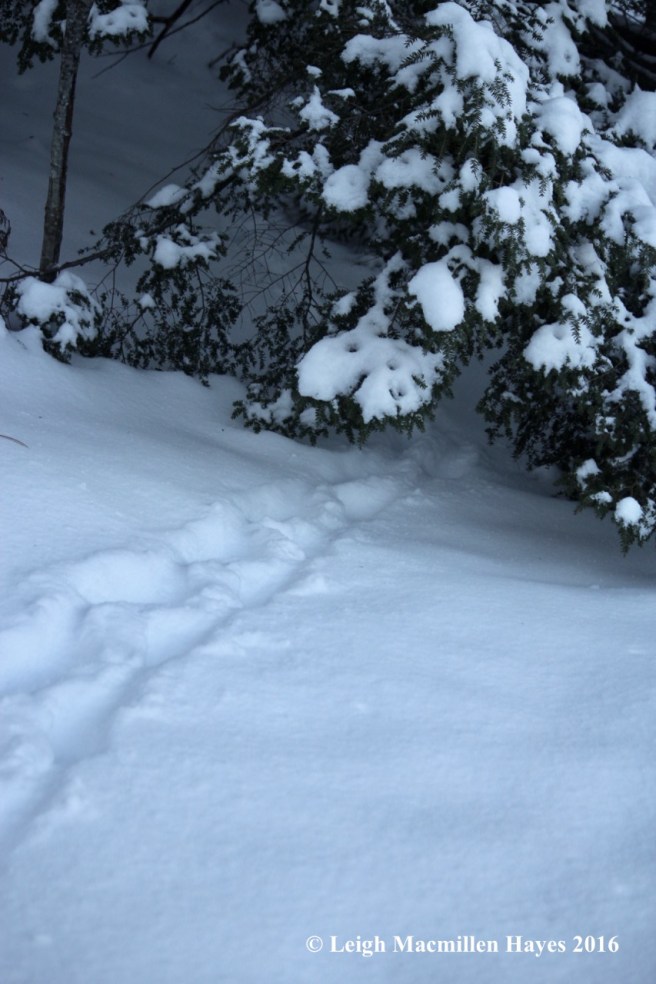
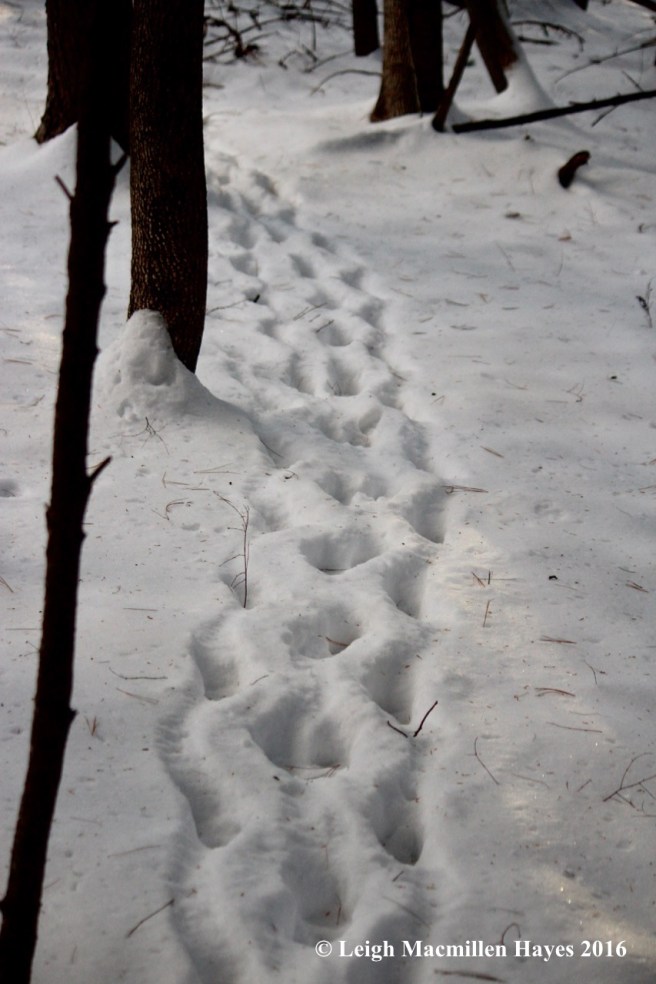
The snow was crusty and we were able to snowshoe atop it for most of the way. The same was true for many of the mammals that traveled about–including the bobcat whose print was difficult to see, but that’s because of the conditions. We went off trail and followed it for quite a ways, hoping to find other signs it left behind, but no such luck today.

r-otter-1

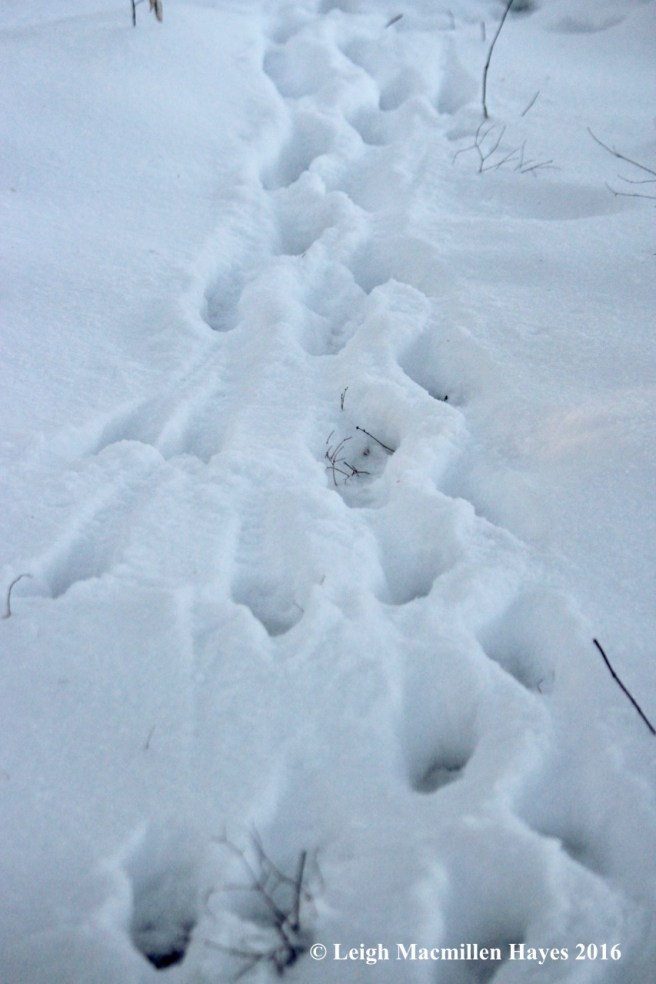
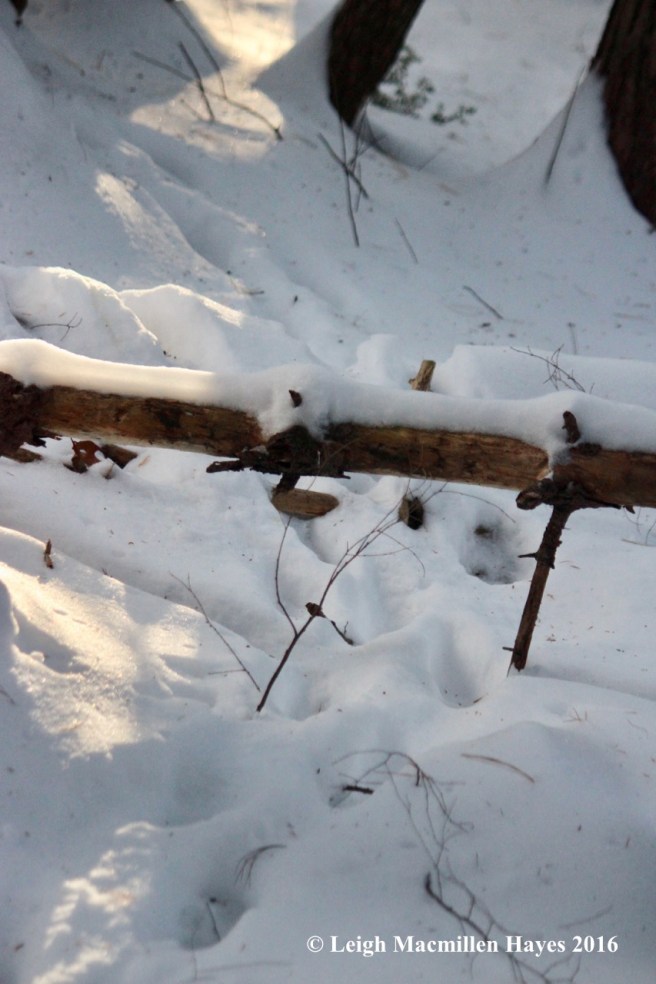
It did lead us to the stream that flows toward Five Kezar Ponds and we recognized the filled-in evidence that an otter had been this way. Based on the bobcat conditions, we assumed it had moved through recently, quite possibly last night or this morning. But the otter had visited after the last snowstorm, but before Tuesday’s ice storm, such were its offerings.

r-woolly-first

Eventually, we returned to the trail and continued on our merry way. But then we came upon a beech tree that begged noticing. In the reserve are a number of bear paw trees, though I have yet to find one along Ron’s Loop. And we didn’t today.

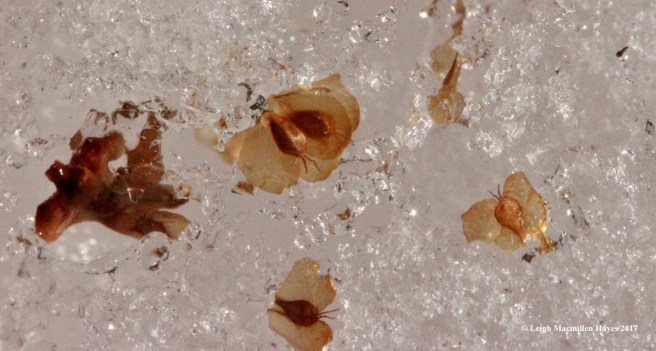
It was the fuzziness of a large clump of small white specks that drew our attention. Beech scale insect or more technically, Cryptococcus fagisuga, is a tiny insect that sucks sugar and other nutrients from beech trees only. In the summer, wingless larvae hatch and crawl (the only mobile stage of this insect) during their first instar stage of development. They search for suitable feeding spots such as cracks or crevices in the bark. What struck us today was the size of the colony.

r-woolly-1

A waxy substance secreted from its glands allows the insect to survive the winter months under a protective woolly-like coat.

r-frullania-liverwort-and-scale-insects

Even the frullania liverwort showed a contrast with the white filaments. By spring, the beech scale insect will molt into its second, legless nymph stage and emerge. Immediately, it will start sucking the sap through its tubular mouthpart or stylet. That instar stage doesn’t last long, and quickly it will become a mature female. For the rest of its life it will remain sedentary, but repeatedly remove and reinsert its piercing stylet, wounding the tree and providing entry points for fungi to enter. An interesting fact about beech scale insects–its a world of females who reproduce by parthenogenesis; there are no known males.

r-beech-hell

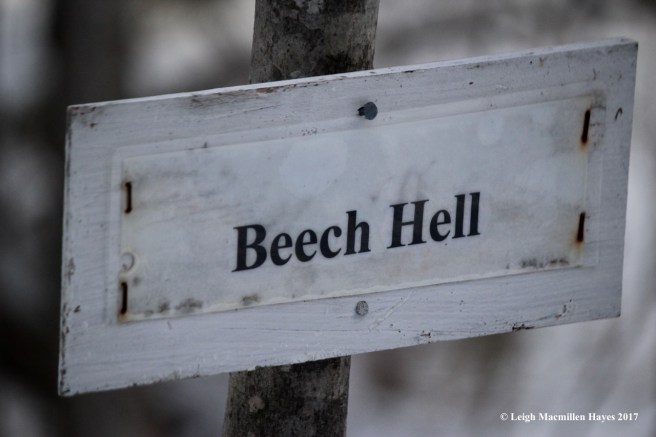
At Ron’s Loop a sign refers to what happens to the beech trees once the scale insect has set up housekeeping.

r-beech-bark-4

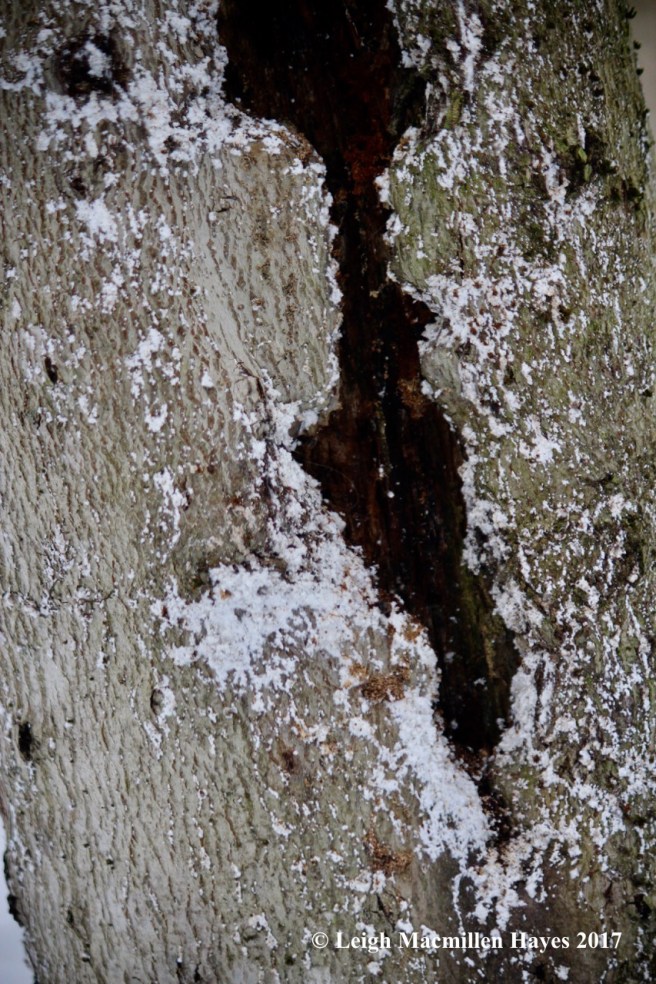
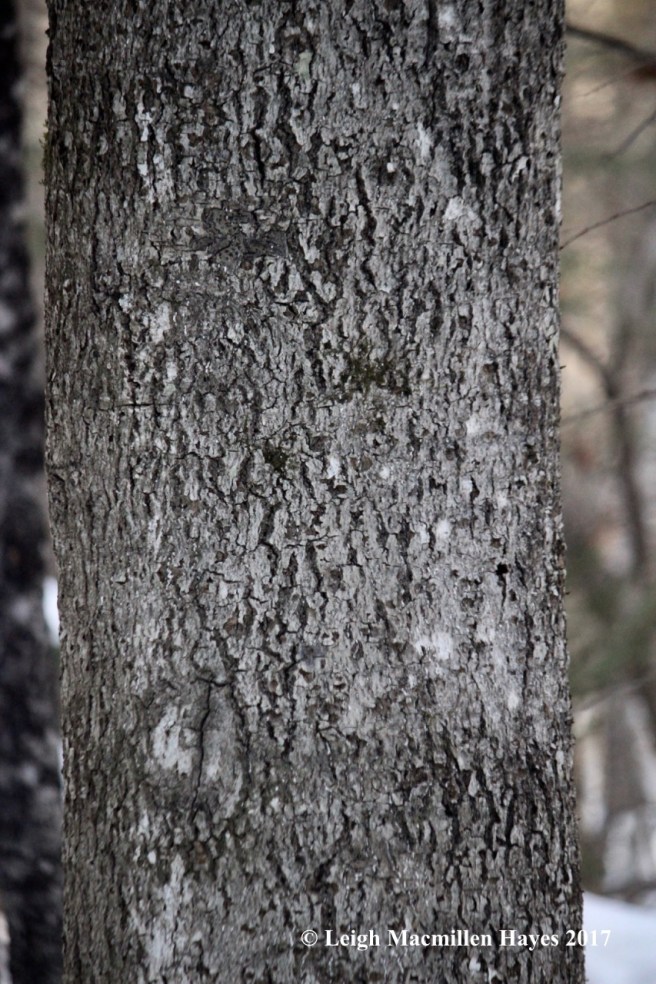
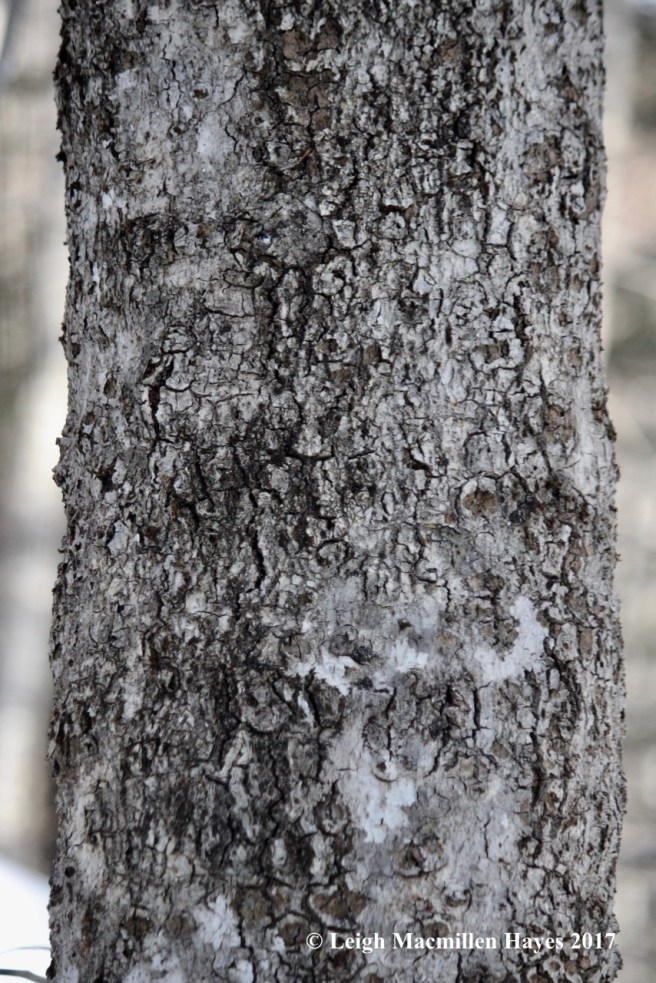
They feed on trees that are at least thirty years old. Beech bark is typically smooth from a tender age to the end of its long life. But the scale insects puncture holes and . . . when two or more gather and withdraw fluids from the vascular tissues in close proximity with each other, those vascular cells collapse and cease to function.

r-beech-bark-3

Fissures form in the bark’s surface.

r-beech-bark-2

The stage is set for one or two Nectria fungal pathogens to take advantage of the wound sites. Their spores, transported by wind or insects, germinate, enter the wounds and their hyphae colonize the vascular tissues, eventually killing patches of inner bark.

r-beech-bark-5

The bark develops cankers that can expand and join together. Photosynthetic activity decreases and limbs die and break off.

r-beech-snap

r-beech-snap-2

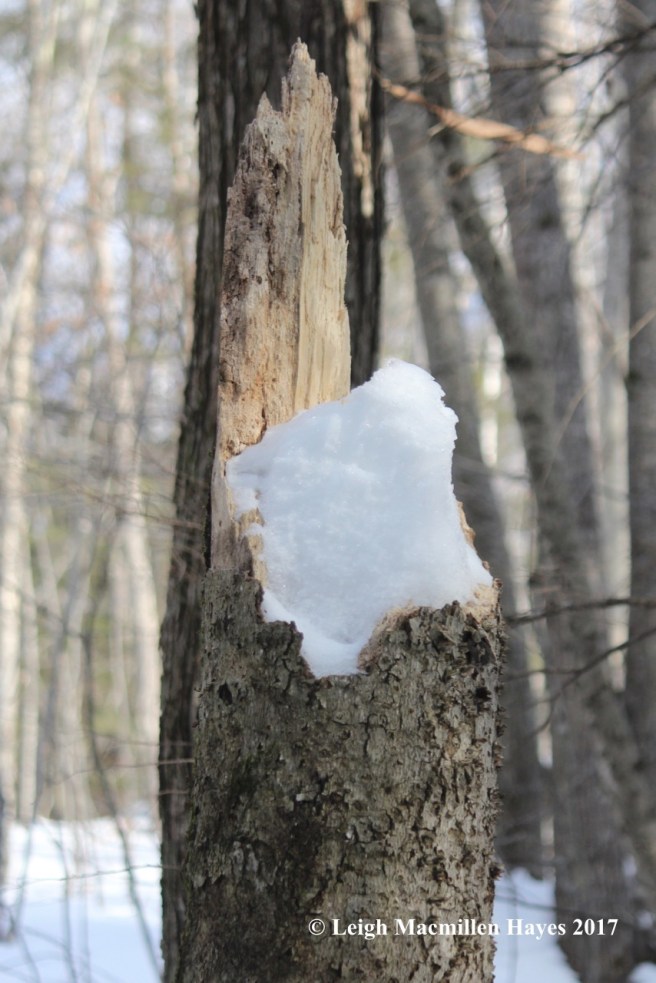
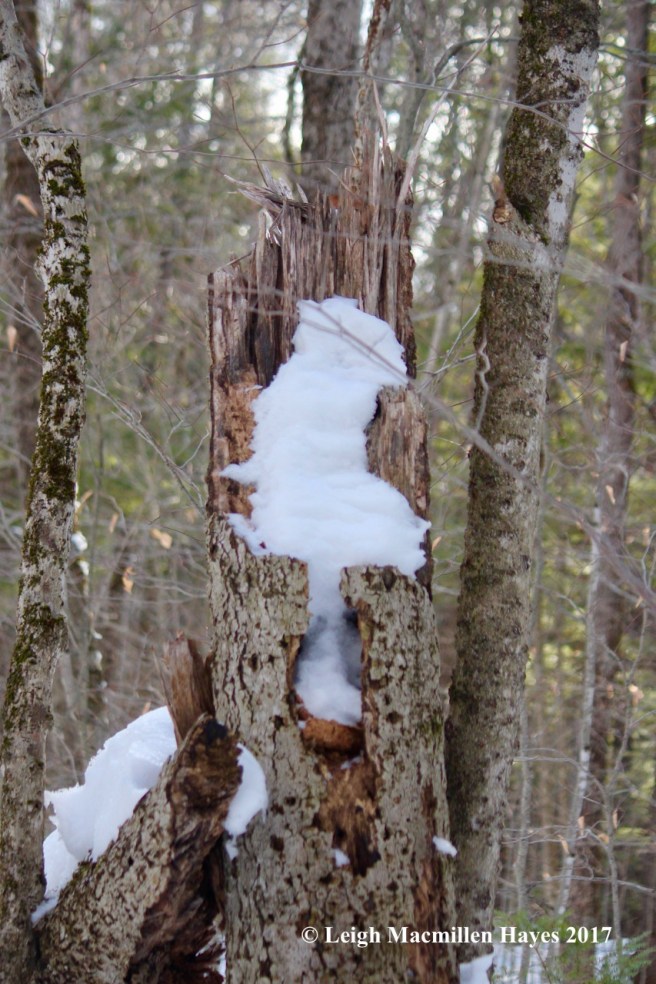
Some trees survive for a while, but others, possibly due to environmental stresses, die within five to ten years, their crowns and upper trunks snapping off. We call that beech snap.

The scale insect is non-native to Maine, having arrived here via Nova Scotia and before that Europe. Consequently, except for a species of lady bugs, there is no known predator to reduce its number. Fortunately, some trees are resistant and the current thinking it is to leave those trees intact and hope that they disperse seeds that produce more resistant trees.

r-hoar-frost1

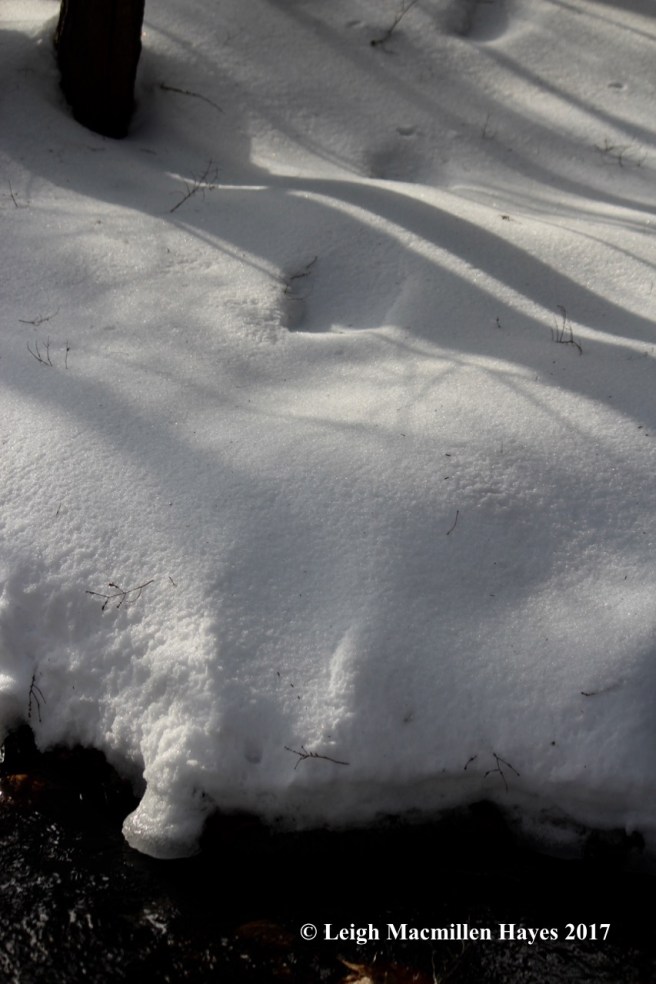
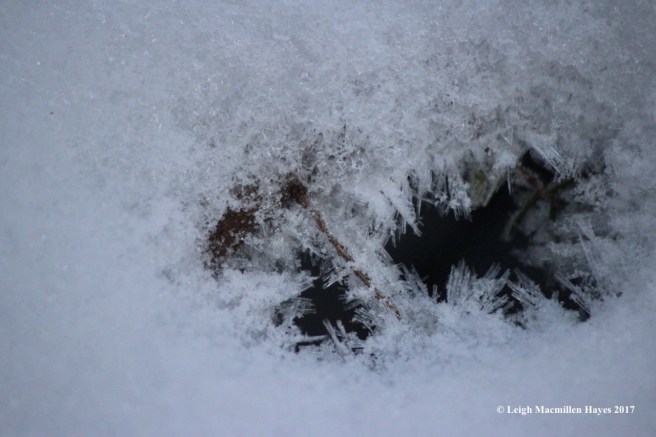
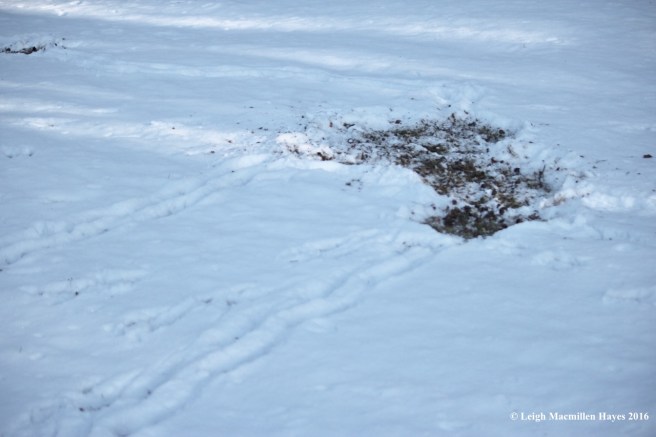
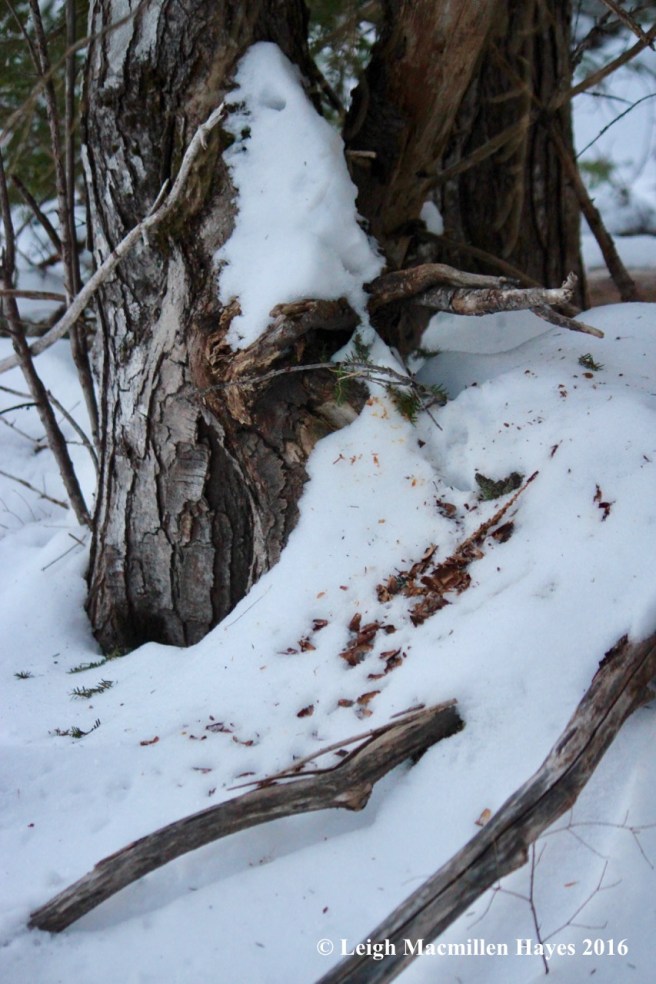
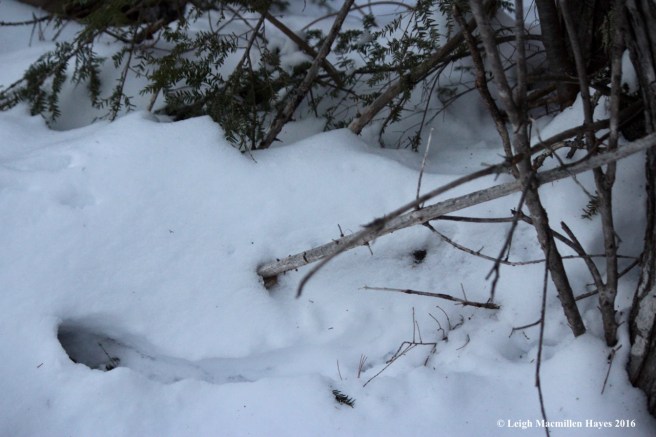
Another fortunate thing is that there is so much more to see at Ron’s Loop. We spied some hoar frost surrounding a small hole and imagined a vole or some other little brown thing snuggled below the snow’s surface.

r-hoar-frost-and-feeding-area

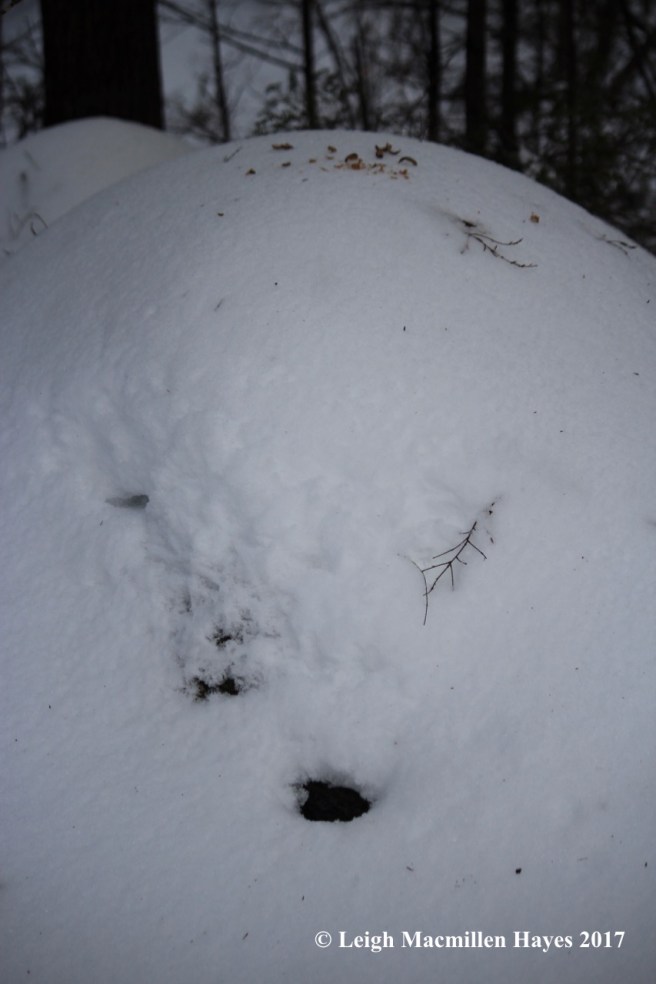
In fact, we found other examples of the same; this particular mound featured not only the frost, but also served as the site of dining table–for a red squirrel.

r-otter-slide

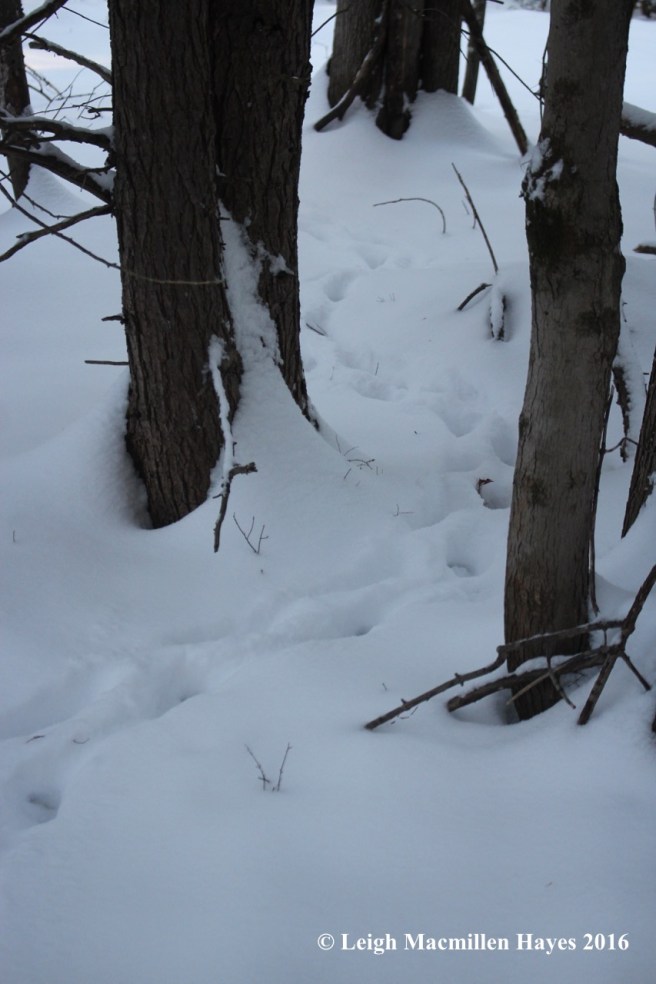
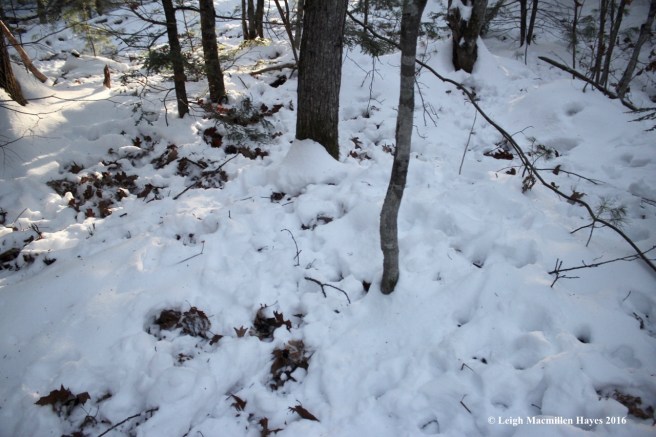
All in all, the tracking was good. We found plenty of otter slides and knew where it bounded. We also saw evidence of snowshoe hare, deer, mice and possibly fisher, though that too was diluted by the ice storm.

r-otter-x-2

Did I say plenty of otter sign? In fact, let’s make that otters with an s.

r-running-water

The mammal activity was prime because the property offers a mountain, ledges, streams and is located by five ponds.

r-ice-on-flow

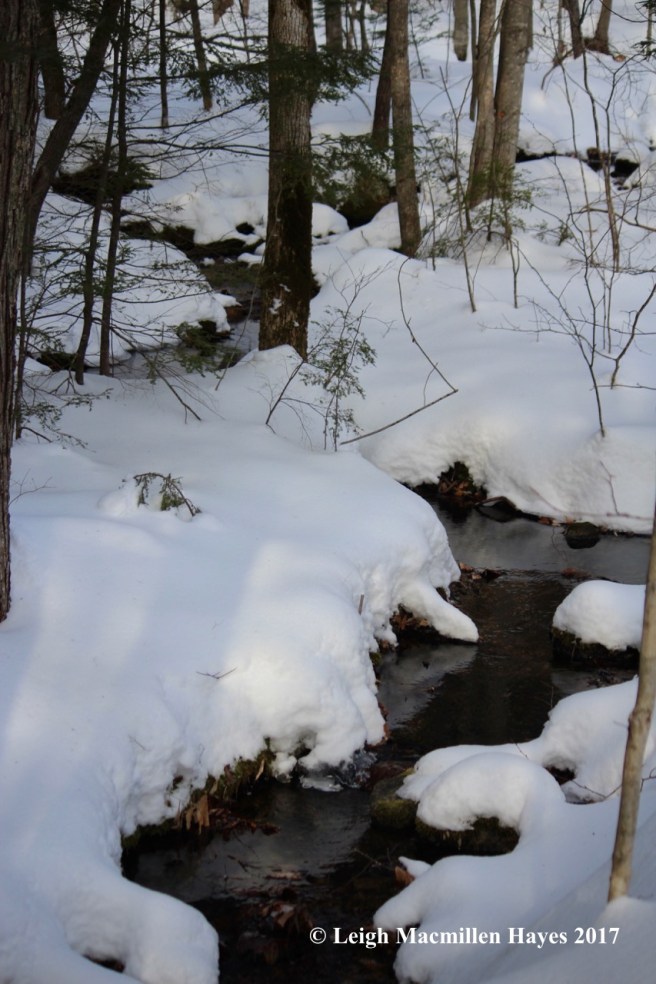
Most often when we’ve traveled this way during the winter months, we cross the streams with little hesitation.

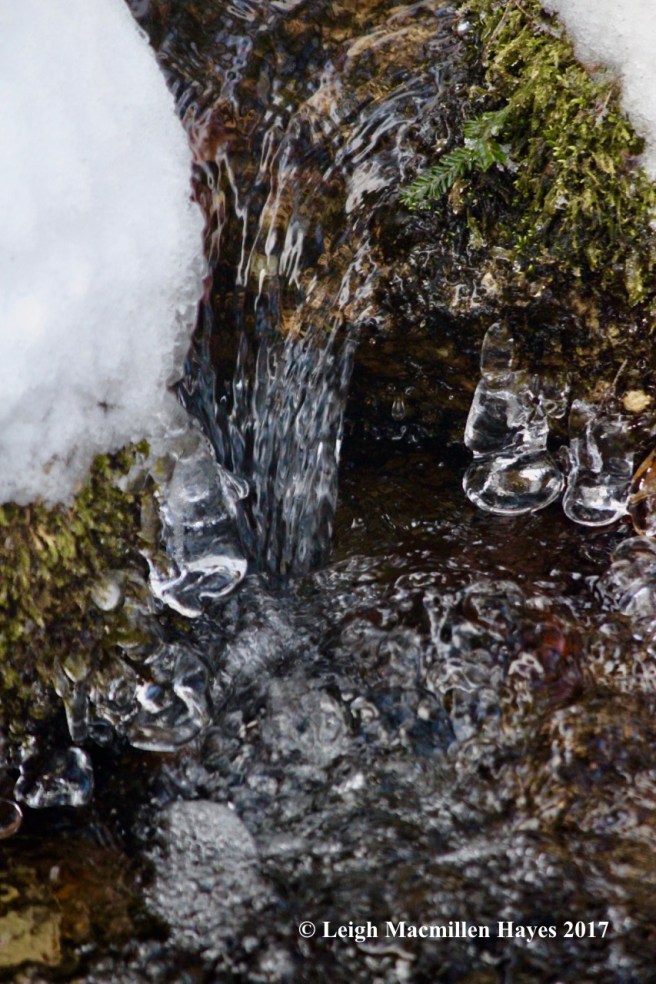
r-ice-flow-2

Today, we admired the ice formations and the flow, which we hope bodes well for all forms of life and puts an end to the drought.

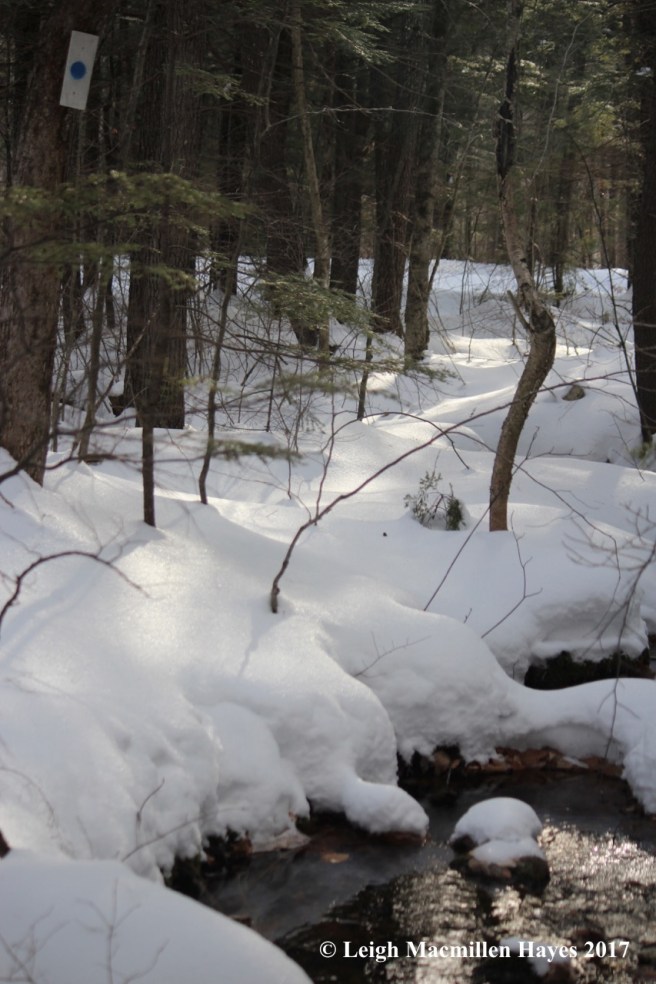
r-stream-crossing-at-end

Our finally crossing was the most difficult due to lack of ice. But the water is shallow in this spot for the most part and it’s not far from the end of the trail.

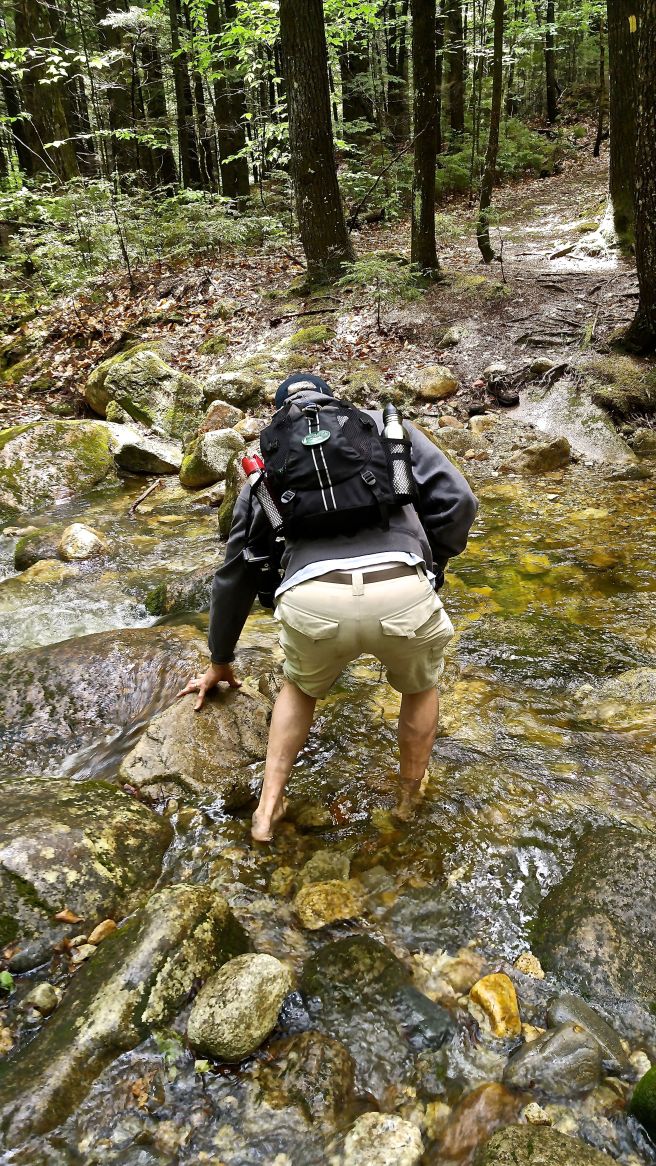
Truth be known, we didn’t actually cross here. Instead, we found some rocks a wee bit upstream and made our precarious way across,  one of us almost falling in and the other climbing up the steep bank on hands and knees–not easy when donning snowshoes. BOF could have stood for big old fools. But we survived and highly recommend sticking with the trail crossing, even if your shoes get a wee bit wet.

r-snow-level

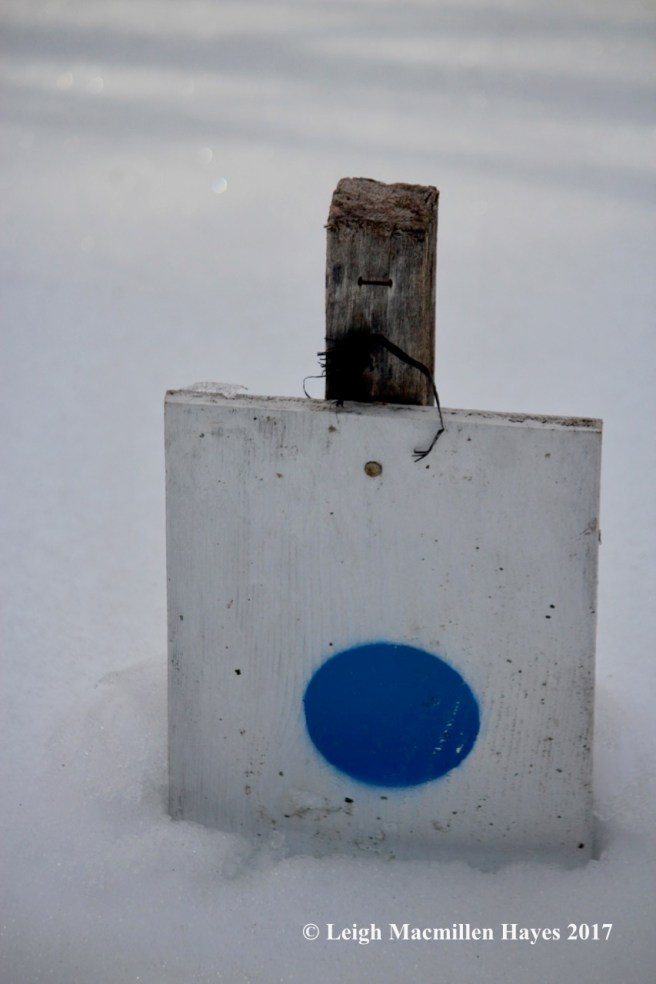
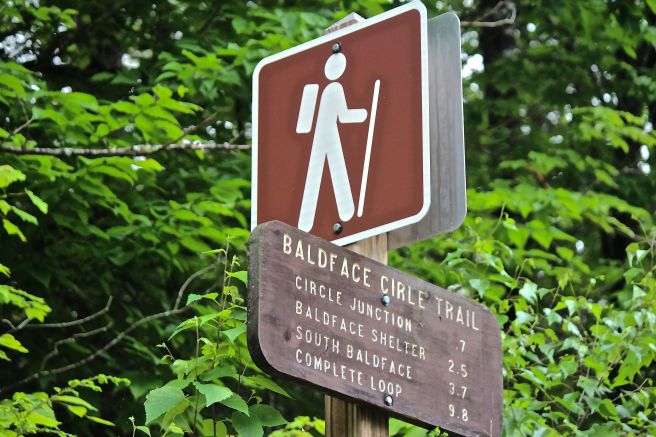
Back in the parking area where we could not park, the trail sign provided an indication of the current snow depth.

As for Joan and me, we spent three hours examining the beech trees, exclaiming over the tracks we found, especially those of the bobcat and otter (we’d like to be reincarnated as otters–if we have a choice), and rejoicing in the flow of the water. The BOF of Ron’s Loop.


Book of January: Naturally Curious Day By Day

Twice now I’ve had the pleasure of being in the audience of Mary Holland at local speaking engagements and I give thanks for each opportunity. But even if I can’t be in her presence to catch her excitement about the natural world and listen to her tales of wilderness adventures, I’ve contented myself with turning to her book, Naturally Curious. It’s like having a naturalist beside me at all times. And when I encounter something I’m not sure about, it’s to Mary that I turn–or at least her book.

It was with great joy then, that I learned she’d published a new book this past year (in addition to children’s books and calendars and . . .). I purchased a couple of copies at my local independent bookstore, Bridgton Books, to give as presents. Of course, I also added it to my own wish list.

And so it was that I was grateful to open a certain shaped package of just the right weight on Christmas morning. Quite often we disguise our gifts to each other, but this one I knew immediately.

day-by-day-1

Book of January

Naturally Curious Day by Day by Mary Holland is exactly that. She breaks the year down into more than months as she did with her first book. For each day, she includes two or three photos and a paragraph or two. No too much info, not too little.

True confession here. I keep it in the upstairs library, aka bathroom. It’s just the right amount of information and I’m always looking for something to read when I’m seated there. (I’ve been known to read the packaging on a myriad of bathroom-related items.)

bridie-1

My reading experience includes credits and acknowledgements, dedications and prefaces. And what to my wondering eyes should appear in NC Day by Day, but a photo credit to one of my mentors: Bridie McGreavy, PhD. I remember when Bridie first shared the photo of the mouse impaled by a shrike with some of us. Turn to page 419 and see if for yourself. (Congratulations to you, Bridie.)

After I opened this coveted gift, a relative asked how Ms. Holland knew what to include for any particular day–that that animal or plant species would be seen that day. Ah, but Mary knows this because she is a seeker who has spent decades in the woods and on the water and she understands the rhythm of the natural world. How often do those of us who follow Mary’s blog and venture outdoors realize that we saw the very item she writes about the previous day or trust we will notice it that day?

It’s only day 5 and already, I’ve photographed most of the things Mary writes about from

h-3

pileated woodpecker holes and

h-10

associated scat (filled with insect bodies and bittersweet berries),

h-4

snow on conifers,

h-5

white-breasted nuthatches, and

h-6

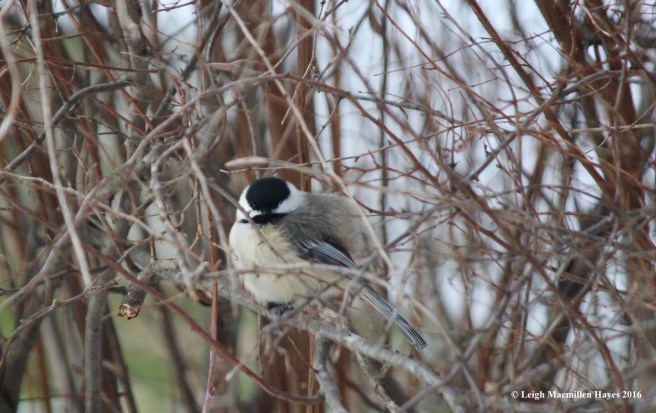
puffed-up chickadees,

h-7

to mammal prints,

h-8

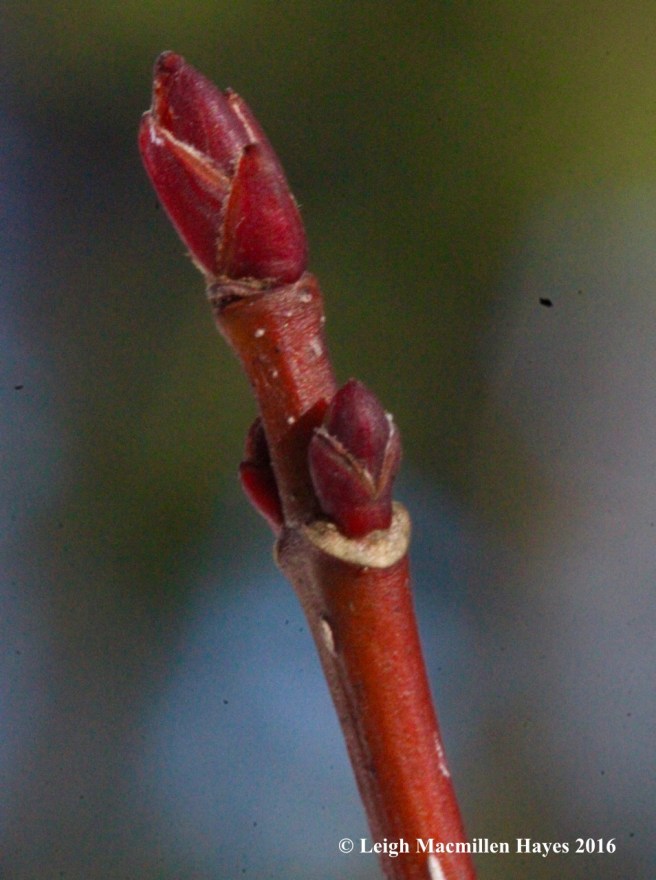
maple buds (in this case Red Maple), and

h-9

even a snow scorpionfly.

Each month begins with a lengthy description appropos to what’s happening at that time of year, e.g. woodpecker holes and other signs of birds feeding, the survival of evergreens through the winter season and our local nuthatches, both white- and red-breasted.

How does Mary know what to include for each day of the month? It’s easy. She’s paid attention and encourages all of us to do the same. Probably, in hind sight, it was difficult for her to narrow down her topics.

Thank you, Mary Holland, for taking us along on your treks through your photography and prose, for teaching us and learning with us, and for providing resources for us to return to day in and day out.

Naturally Curious Day By Day: A Photographic Field Guide and Daily Visits to the Forests, Fields, and Wetlands of Eastern North America by Mary Holland, Stackpole Books, 2016. $29.95.

Down the Rabbit Hole

Winter clothing? ✓

Hand warmers? ✓

Camera and extra lenses? ✓

Water? ✓

Trackards? ✓

Scat shovel? ✓

Snowshoes? Oh no. I didn’t realize until I met up with two fellow trackers for today’s Tuesday Tramp that I’d left my snowshoes home. “I’ll be fine,” I said. “Other’s have probably walked the trail before us.”

Indeed, they had. But I also knew that because we were tracking, we’d wander off trail. Indeed, we did.

It’s a good thing I had warm snow pants and tight boots on and brought along my sense of humor and adventure.

c-1

We began at the kiosk of the Greater Lovell Land Trust’s Chip Stockford property, where an Eastern Phoebe’s moss-lined nest awaits the return of its residents. Perhaps the funnel spider who took advantage of the nesting site is keeping the home fires lit amid the grasses and mud therein.

c-4

And then we reached the former log landing and the current site of Speckled Alders. We’d only seen squirrel evidence at that point, but knew to check on the fuzzy little woolly alder aphids who inhabit these shrubs.

c-5

We were surprised to see a black coating that seemed associated with the aphids and reminded us of black knot on fruit trees. Upon closer inspection, it appeared that the aphids were covered in black.

When I arrived home, I looked for more information and of course, Mary Holland, author of Naturally Curious, came to the rescue:

“Once leaves start to fall, one often observes white, fuzzy patches along the branches of Speckled Alder (Alnus incana). These fuzzy patches consist of colonies of aphids feeding on the sap of the shrub. In order to get enough nitrogen, they must drink volumes of sap, much of which is exuded from their abdomens as a sweet liquid called honeydew. The honeydew accumulates and hardens onto the branches as well as the ground beneath the shrub. Yesterday’s Mystery Photo was the honeydew of Woolly Alder Aphids (Paraprociphilus tessellates) which has been colonized by a fungus known as black sooty mold, a fairly common phenomenon.

Fairly common means we need to pay more attention. That’s how it is in the natural world–you see something for the first time and then realize it’s everywhere, you’ve just missed it all your life, or at least up until now. I love the noticing.

c-3

In places we predicted, we found snowshoe hare runways. Typically, I give thanks to them for the technology that holds us up closer to the surface of the white fluff that covers our winter world.

c-2

Where the trail splits, we were greeted by the keeper of these woods. It was here that we also found porcupine tracks, the prints a bit muted but the sashaying pattern easily decipherable. We followed its trail for a while, me making post holes, but moving with relative ease. Winter hiking is so much easier even when the snow is deep.

c-6

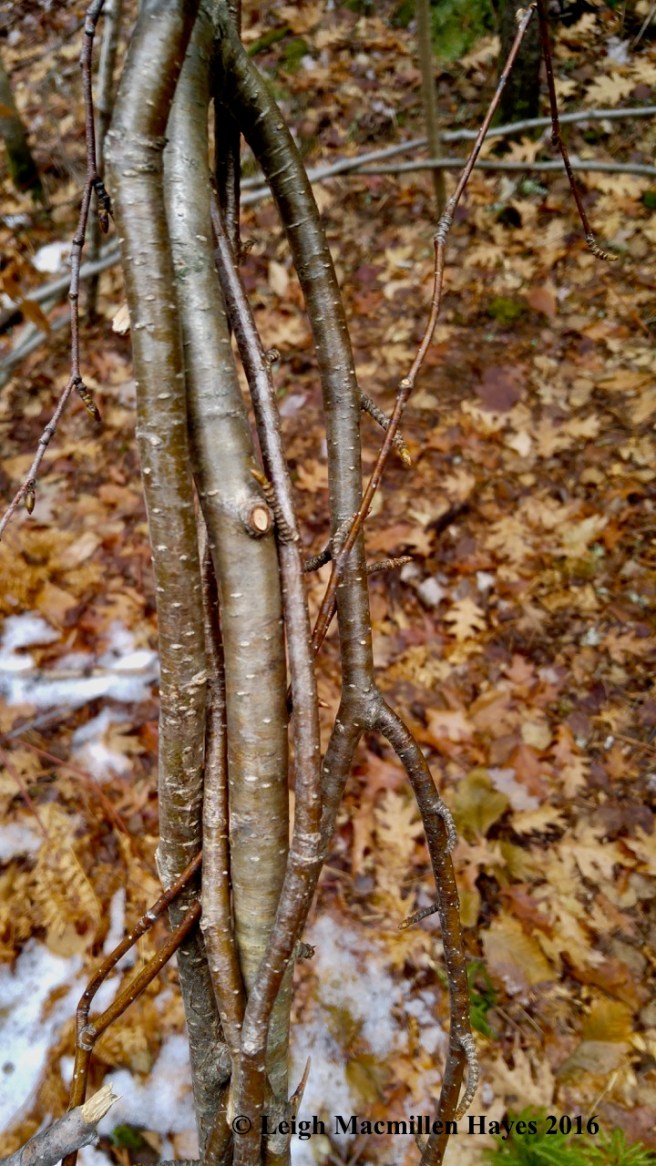
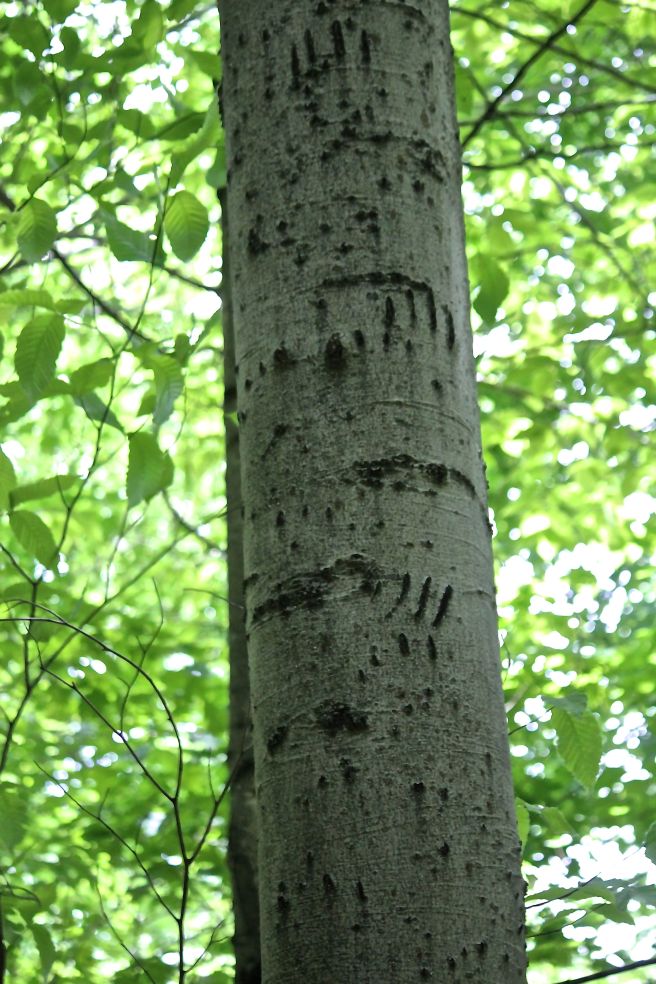
We’d come to track mammals despite the freezing rain, sleet and snow, but other things also drew our attention, like the lines that decorate a beech tree. Usually it seems obvious that they are made by either a formerly attached vine or branches from other trees that scratched in the breeze. We couldn’t say for sure with this one, despite taking a closer look.

c-9

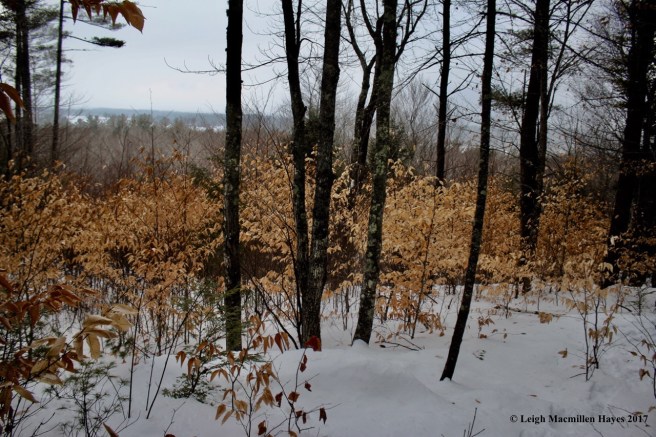
At the scenic look out, other young beech trees provided a hint of light in the gray of the day as we took in the sight of Lower Bay below.

c-8

A turn to the right and we noted a number of artist conks decorating a tree.

c-7

And beside our feet, evidence that a Ruffed Grouse had passed under low limbs.

c-10

For a while, our tracking seemed limited to squirrels and then at the old foundation, we noticed a bounding pattern. Of course, we needed to follow it, up over what was probably a rock and then noted where it had passed under a branch close to the snow. It was under the tree that its prints gave us a few more clues and we determined it was a fisher. (Note: Fisher, not Fisher Cat. They are members of the weasel family, not feline.)

c-11

As we rounded the bend below the foundation, snow snaking across the limbs of a downed tree made us pause and admire.

c-12

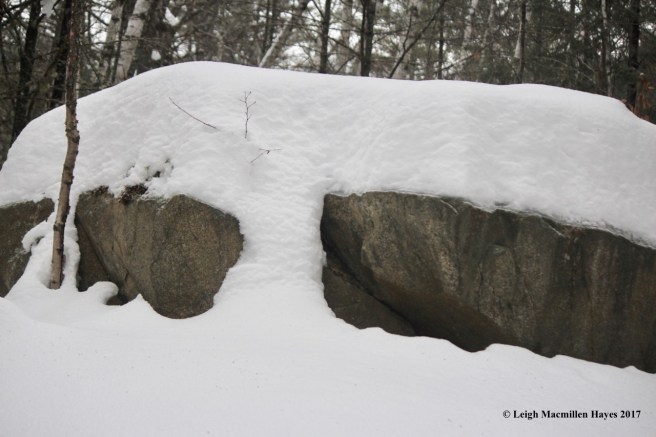
And then we paused again–at The Rock. In the summer, it’s a great place to admire “Life on a Rock,” and in the winter we always expect some small mammal to take advantage of its protection. One of these days maybe we’ll be rewarded with evidence.

c-13

It was just beyond The Rock that we decided to go off trail again and further explore the porcupine’s trail. It led us to its home and then climbed upward. My two companions went first, making their way across what we soon realized was an old stump dump.

Seconds later, I disappeared . . . down a hole . . . well, at least up to my waist! Our first thought as I pulled my body out–would I discover quills on my boots? Thankfully no. I maneuvered  and my friend, Joan, who is half my size, pulled me up as we laughed about the possibilities.

We skedaddled across the rest of the dump and bushwhacked back to the alder trees.

So maybe I didn’t exactly disappear down a rabbit hole, but for a brief moment it felt like such. And will become part of our memory of a snowy, icy day spent on the prowl.


Son-date Mondate

Let me begin by saying Happy New Year. And thanking all of you who take the time to read my musings about nature and life.

Today being a Monday, my guy and I had a plan in mind. At the top of the list–put Christmas away for another year. Oh, the creche remains out because the Magi haven’t yet arrived, but as much as I love all the decorations and memories of each year, I equally love packing it all up and starting fresh again.

h-snow-hook

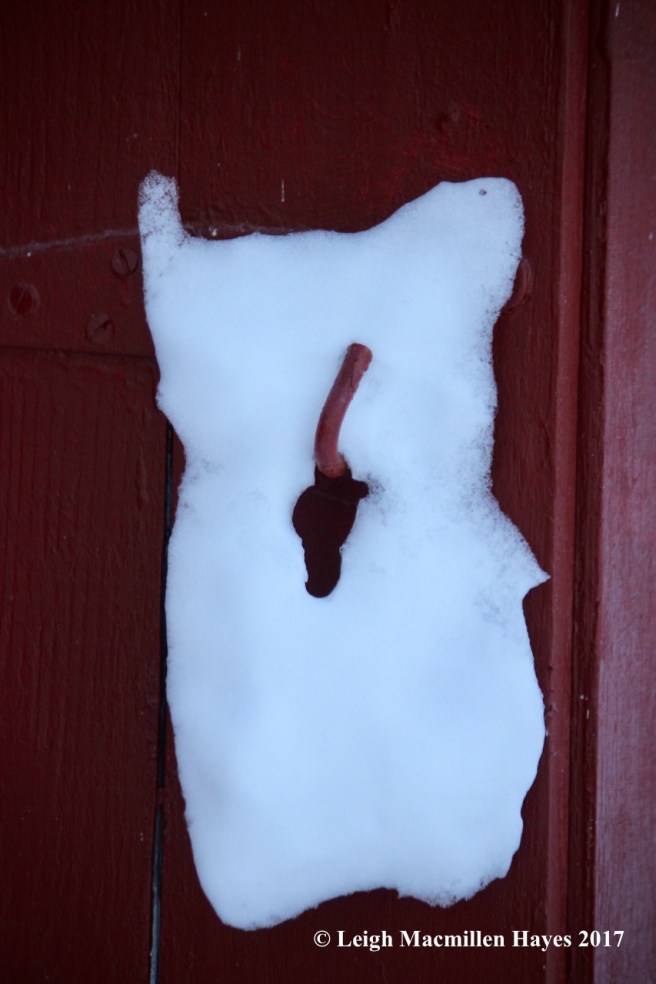
And then I stole a few minutes to step out the door and explore. Immediately, the snow  on the barn shed made me wonder. It looked as if we’d placed it on the hook for another time when we might need to use it.

h-mt-washington

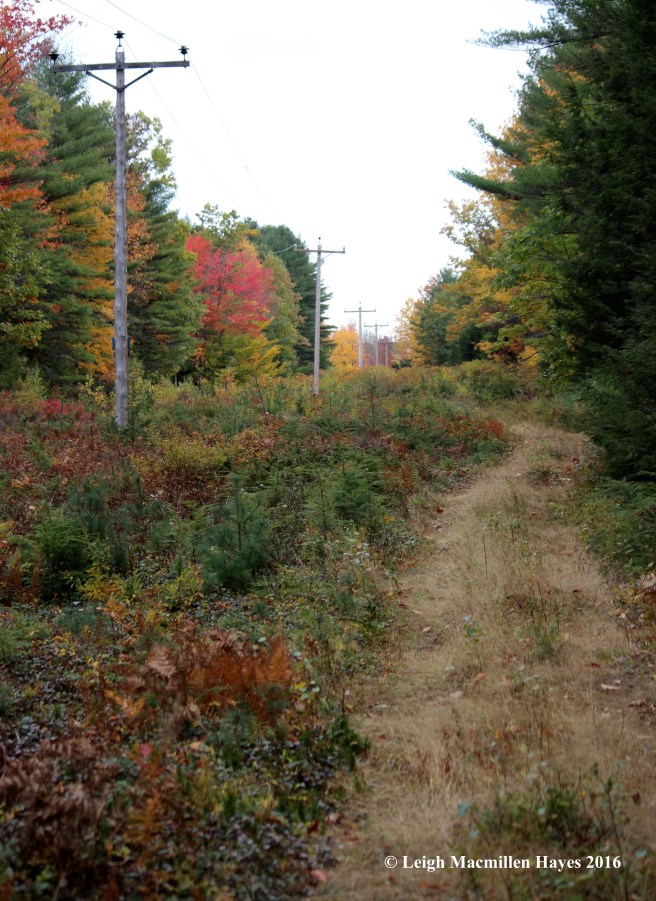
At the infamous power line, I could actually see the towers atop Mount Washington. If you look closely at the tallest peak, you may see them as well. Such was the crisp, clear air today.

h-mouse-tracks

My wanderings took me deep into the woods, where I saw tracks and sign left behind by everything from mouse . . .

h-moose-tracks

to moose.  Again, moose tracks were plentiful and where they followed my snowshoe tracks, I noted that they sank at least twice as far down as I had, with no belly drag which speaks to the size of these mammals.

h-moose-hair-1

Several times I found moose hair that caused me to crouch for a closer inspection.

h-moose-hair-2

Salt and pepper in color, I could see a mixture of soft, downy hair and the hollowed rods that help insulate this largest of woodland creatures.

h-gray-birch1

Heading toward home, a leaning gray birch called for attention as it poured out life from last year’s catkins.

h-birch-offerings

Fleur de lis and seeds coated the snow surface.

h-gray-birch-seeds

Those tiny seeds, butterfly-like in their winged structure will eventually float to the ground and someday I’ll need to step around the trees they become. That is, if the birds and wee critters don’t eat them first. Such is the way of things in the forest.

h-trail

Once again, I found the trail and discovered I wasn’t the only one playing.

h-riding-into-the-sunset

These two guys of mine decided to head off into the sunset. I preferred not to join them in their bobble-head mode.

h-circling-the-field

They didn’t get far because the trail has not yet been groomed. And so we continued our chores, but also took time to play–shooting photographs,

h-roof-shoveling

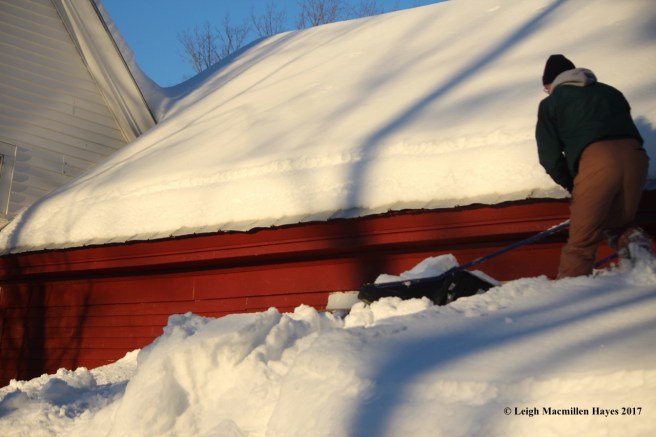
cleaning roof tops,

h-jump-1

and practicing jumping skills.

h-roof-jump-2

We shared our Mondate with our youngest son before he heads off on a different trail–returning to Colorado for a few more months. We’re thankful for the time we’ve had with him and especially today–working and playing side by side one more time before his next journey begins.


Won’t You Be My Neighbor?

I knew the minute I walked into the summer kitchen this morning and saw fresh tracks beside the barn that I’d head out the door as soon as possible. And then I realized that my snowshoes were in the back of my truck, which our youngest son had borrowed. Never fear. We have several more pairs.

m-cat-in-porky

The prints that drew me outside were those of our “friendly” neighborhood porcupine. And once again, he had much to share, the first being cat prints inside his–thanks to one of several that frequently pass under the barn.

m-porky-sashay

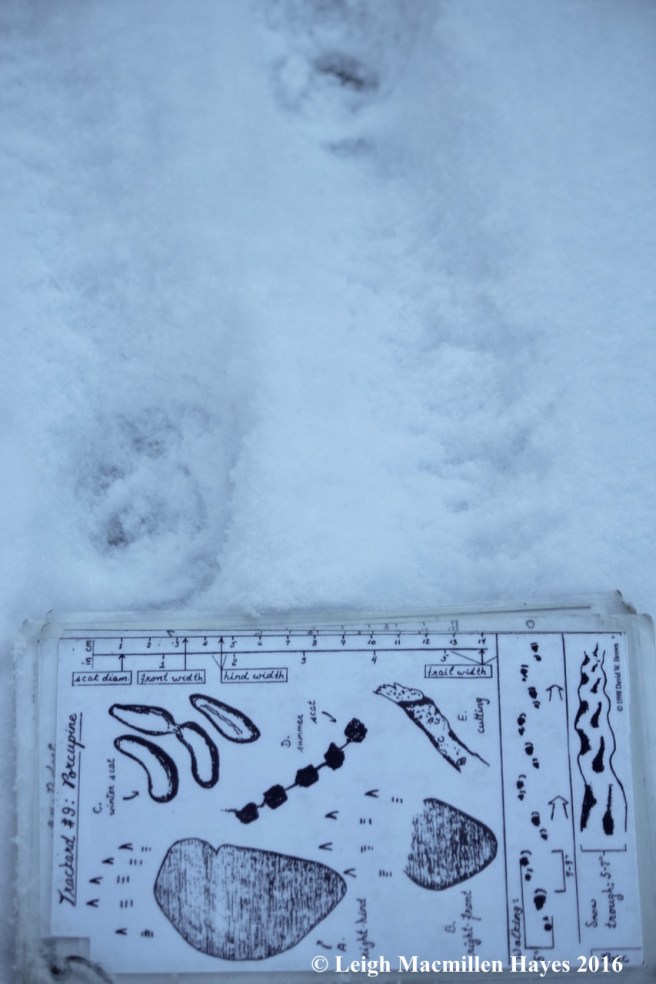
If you’ve never examined a porcupine trough before, I encourage you to do so. As it sashayed along, it left behind hair and quill impressions. Can you see them?

m-opossum-print-2

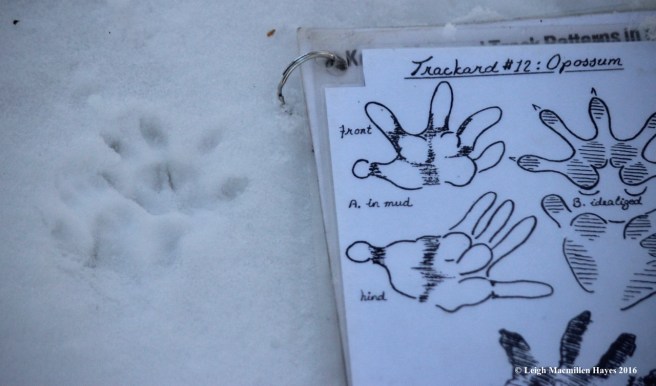
I followed Porky along his regular route and over the stonewall only to discover prints I’ve never met before. My first impression was raccoon, but the shape of the prints and the trail didn’t match up in my brain. More and more people have mentioned opossum sightings in the past few years, but I’ve only seen one or two–flattened on the road. Today, in our very woods, opossum prints.

m-opossum-walk

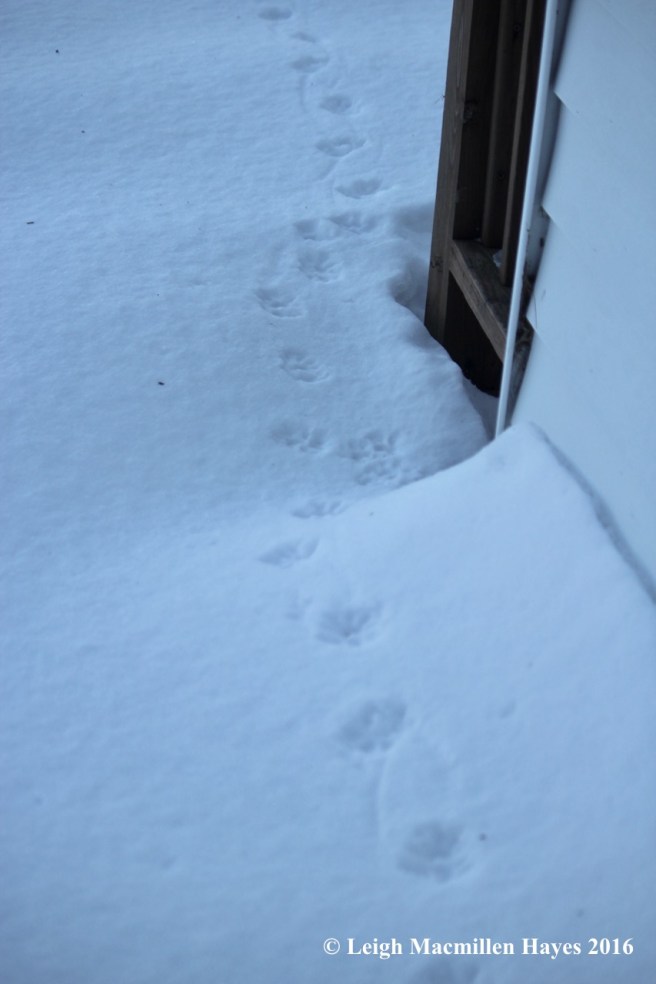
Our own marsupial. The front print obscured the hind, which features an opposable thumb. Their pattern, I learned from checking David Brown’s Companion Guide to the Trackards, is left hind-left front, right hind-right front, left hind-left front, etc.

m-opposom-trail

As it walked along, from tree to tree, past the studio and into the neighbor’s woodlot, I could practically see the animal moving, its long tail dragging in the snow. My heart sang with the journey. But how do they survive here, I wondered?

Eventually, I realized I was headed into a neighbor’s backyard several doors down and so I turned and continued in the other direction, but thankful that Porky had once again shared something new with me.

m-porky-trail

I traveled down the cowpath and into my smiling place, where what to my wondering eyes should appear, but a miniature sleigh and . . . oops, I mean another Porky trail. And so I followed it, back and forth over a stone wall and under fallen trees I needed to pass over.

m-porky-tree

It led me around an uprooted tree and there . . .

m-porky-in-den

the trail ended. You may notice ice crystals below the moss in the larger opening. And if you look closely below the moss, you might just see a few light colored streaks–those would be quills. I found Porky. He started to move and though I knew I could easily outrun him, unless I tripped and fell like I often do when snowshoeing, I decided to leave him be. But once again, my heart was singing.

m-moose-tracks

And then . . . some really large and deep prints crossed the trail I frequent.

m-moose1

They were almost the size of my mitt.

m-moose-slide

And every where I turned for the rest of the morning, it seemed moose had also turned. I soon realized there were at least three and they slipped in the snow much as I often do.

m-deer-and-moose-prints

In tracks I’d previously made, both a deer and moose had passed, providing a sense of size.

m-moose-mud

I followed one, who had paused to play–it’s hard to resist an inviting mud puddle. Had I not been wearing snowshoes . . .

m-moose-landing

I think we were both discouraged to realize a snowmobile had found its way to the log landing, though I for one, wasn’t surprised. The moose made a U-turn and headed back into the woods. A short time later, I followed suit.

m-deer-hair

It was there that I discovered hair stuck to a deer bed where its body had warmed the snow, which thus turned to ice.

m-spider-1

And another snow spider, this one not as green as the ones I’ve seen previously. I’m in awe that the tiny body, which appeared translucent, contains glycerol as an antifreeze compound. I did see numerous springtails bouncing about, so trust it had plenty of food upon which to prey. Again, my heart sang.

m-moose-bed

As I mentioned earlier, I continued to see moose tracks (not the ice cream, though it is one of my favorite Gifford flavors). And then a bed, about the size of three deer beds. And a lovely pile of scat right in it. Life is good.

m-snowshoe-lobsters

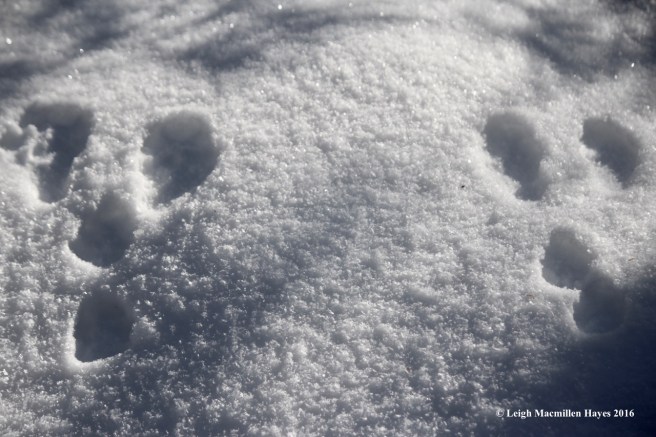
Closer to home, I realized I was in snowshoe hare territory when I recognized the lobster-like shape of their prints.

m-weasel-1

They’d better watch out, and all voles and other little brown things should also be on the alert, for weasel prints also decorated the snow.

m-print

At last I was back home, and had to take a peek at those opossum prints one more time. Thanks again to the porcupine(s) that wander these woods, I celebrated wonder as I moved about. Except for Porky, one gray squirrel and a sharp-shinned hawk, I saw no others with whom I share these woods, but I was grateful to be their neighbor. To know that they roam as I do. In the words of Mr. Rogers, “It’s a neighborly day in this beauty wood.” I’ll let him do the singing, from the song that rests within my heart today:

It’s a beautiful day in this neighborhood,
A beautiful day for a neighbor.
Would you be mine?
Could you be mine?…

It’s a neighborly day in this beauty wood,
A neighborly day for a beauty.
Would you be mine?
Could you be mine?…

I have always wanted to have a neighbor just like you.
I’ve always wanted to live in a neighborhood with you.

So, let’s make the most of this beautiful day.
Since we’re together we might as well say:
Would you be mine?
Could you be mine?
Won’t you be my neighbor?
Won’t you please,
Won’t you please?
Please won’t you be my neighbor?

Lessons from a Porcupine

Our yard and barn have forever been part of a porcupine’s place in this world and so it’s not unusual to either see the critter or evidence that it has passed through.

Frequently, it nibbles on a quaking aspen near the house. Often it steps across our deck and continues on in the direction of our neighbor’s home, before circling back.

That got me thinking. Where does it go from here? And so I’ve spent the last week on the hunt.

p-measuring-straddle

My starting point: Beside the barn where I took a look at its print and trail width or straddle. The thing to remember about tracking a mammal is that prints left behind are not always perfect due to snow conditions.

p-porky-prints-1

But once you recognize the long feet and pigeon-toed orientation, it becomes easy to follow a porcupine’s tracks.

p-tracks-by-barn

I took these a few days ago when the snow wasn’t so deep. Can you see the swaying pattern of this waddler?

p-porky-acorns

We’d had a mast year for acorn production and so it was no surprise to realize that he (or she) knew right where to go under the old oak tree.

p-from-barn-to-wall1

And then, two days ago I followed new tracks in deeper snow. This time, Porky ignored the acorns and headed instead toward an old ash tree.

p-under-yard-hemlock

From there, it moved under a beautiful hemlock beside a stone wall. Hemlock is a tree of choice, but as I peeked under, I noticed that it just passed through.

p-porky-and-deer1

Over a stonewall we went, the porcupine and me, and into the woodlot, where a couple of deer had also moved. Despite the numerous sets of prints, it was still easy to distinguish Porky’s pattern and continue to follow his trail.

p-checking-a-hemlock

As was to be expected, he headed straight, relatively speaking, to another hemlock tree. So did I. And so I did what I always do when I reach a porcupine tree. I looked about the ground, searching for cut off twigs and scat. Nothing.

p-hemlock

And I looked up. Not necessarily in that order, actually. Always look up first. More than once I’ve seen a porcupine in a tree, and sometimes it’s been far out on a small branch. I’ve been told that porcupines have many broken bones because they fall out of trees all the time. I don’t want to be the landing cushion.

It appeared that Porky was on a reconnaissance mission, perhaps checking out this tree for future reference.

p-deer-beds-under-hemlocks

It moved on and I followed. On our way, it lead me to a spot in the woodlot where several deer had bedded down for the night.

p-cowpath-checking-stump

Next, it stopped to check out an uprooted tree.

p-on-the-cowpath

And then it walked down the cowpath–perhaps headed back to our barn.

p-over-wall

That was the wrong conclusion. Instead, we crossed over a stonewall and onto a neighbor’s land.

p-truck-den1

Eventually we found our way to an old truck that I’d previously visited when following his tracks.

p-truck-2

The tracks led in and out again. And so our journey continued.

p-split-tracks

And just when I thought I was following Porky in one direction, I realized it was actually traveling to and fro.

p-to-the-oak-by-barn

We ended up back at the old oak behind the barn.

p-oak-tree-1

Porky enjoyed the acorns and then headed back to the truck. A gray squirrel climbed the tree. And I headed indoors. Apparently, acorns and not hemlock bark were the form of sustenance for the time being.

p-today-filled-in-tracks

Since then, I’ve been checking the snow and in the past two days, no sign of Porky under the barn. In fact, in today’s blustery weather and snow squalls, his two-day old prints leading to the ash tree were filled with snow, but the pattern still spoke his name.

p-deer-and-porky-on-path

I followed the cowpath, where deer tracks were evident beside and along Porky’s path.

p-snowshoe-hare1

I didn’t find porcupine prints, but did note where the snowshoe hare had their own feeding adventures.

p-today-in-and-out

And then, I again came upon that wavy pattern with plenty of foot drag–a sight to behold. In this instance, I knew I’d found the crème de la crème of mammal species–with a super wide hip span and three legs. Or better yet, the out and back trail of Porky. The same Porky? Or a relative?

p-tracks-split-and-come-together-again

Its path split and came together again. And I thought of the deer and snowshoe hare and how they create runways that get packed down making winter travel easier. And we follow suit with our own snowshoe or ski paths.

p-under-a-fallen-tree

While Porky passed under a fallen tree, I stepped over it.

p-today-checking-hemlock

And again, we landed at a hemlock tree. Another reconnaissance mission? Do porcupines check out hemlocks prior to laying claim and spending the winter creating Lorax trees? What makes a tree desirable?  From past adventures, I do know that they travel what seems like miles to get to one tree and then return to their dens on a daily basis.

p-today-through-the-trees

While Porky continued through the trees and doubled back, I headed off further into the woods for a while. I knew where previous dens existed and wondered if they were active. No such luck.

p-deer-disturbance-by-vp

But . . . much more deer activity. Last winter’s lack of snow meant a good life for our local herd.

p-squirrel-branches

Continuing along, my eyes cued in to hemlock twigs on the ground. At last–Porky evidence.

p-squirrel-midden

Nice try, but instead a squirrel midden told me who had spent time in this tree. Squirrels, too, nip hemlock twigs to get the cones and thus their seeds. Their twig nips are much smaller than those of a porcupine.

p-squirrel-tunnel

Beside the squirrel tree, a pathway to its tunnel. Every year seems to be a good squirrel year.

p-today-tracks-meet

On my way home, again I found Porky’s tracks heading in the opposite direction than I’d followed, its to and fro trail splitting and joining again.

p-three-deer-beds

And more deer evidence–three beds in a row. The smooth of their backs faced each other as if they looked outward, keeping an eye out for predators.

p-deer-bed

The ground below the warm bodies had frozen and within the bed I could see a silhouette.

p-other-barn

But, I was traveling with a porcupine and following its trail–to another barn. Same Porky? Kin?

The wind was howling and temperature dropping as I turned and headed back to my own barn and home. I realized, however, that I still have much to learn about porcupines and can’t wait to continue our journey together.


Walking With(out) Kyan

One of these days I’ll get to explore the route I traveled today with my young neighbor, Kyan, who is recovering from a blood marrow transplant. In the meantime, I took him along with me in spirit.k-1

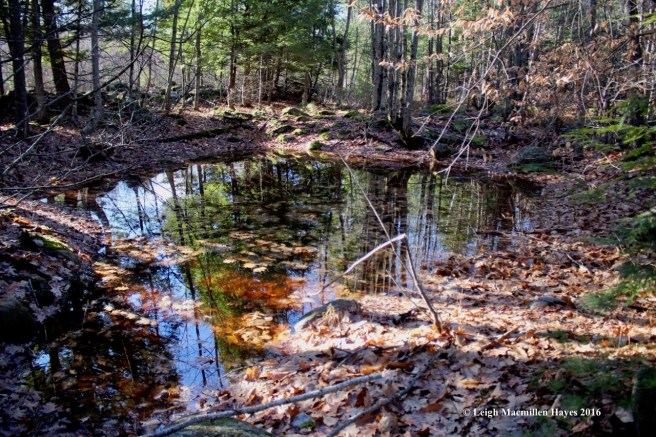
Our first stop–the frog pond, aka vernal pool, that we both love. After all the recent rain, it has once again filled with water.

k-2

As I stood before it and thought about spring moments spent observing the wood frogs that use this pool as a breeding place, I wondered if I’d see any action. I wasn’t disappointed–springtails and mosquito larvae. When I return with Ky in tow, I’ll pull out the small shovel I carry so we can scoop these up for a closer look. Of course, he’ll probably need to remind me to do that. Such is age.

k-3

And then I retraced my steps, dodging puddles at first because I had my hiking boots on. Oh, they’re waterproof, but suddenly the water is deep in spots. I’m not complaining–by any means!

k-4

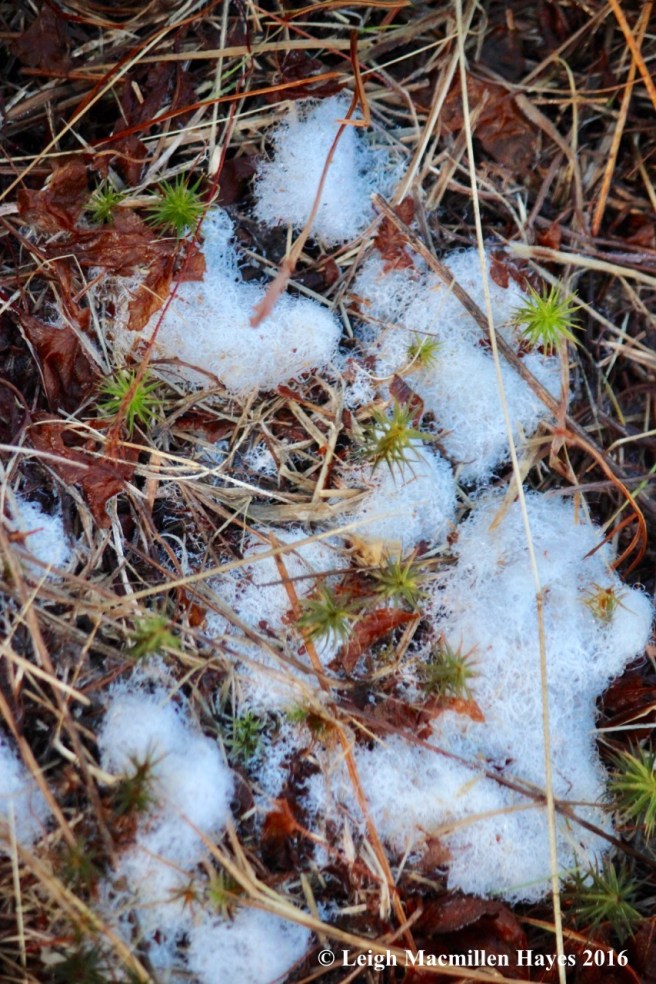
Rather than my woodlot trail, I decided to cross the field that Ky’s grandfather owns as I headed home to change into my Boggs. And so I happened upon a mystery. What was this white stuff? Fur? No. Fungi? Maybe. Stay tuned? I hope you will. Had Kyan actually been with me, I’ve a feeling he could have told me right off.

k-5

Back on the trail, where the puddles were shaded, nature presented its artistic flair.

k-6

I trust Ky would have appreciated the various forms the ice took. Had he been with me, we could have stomped our feet through the ice and felt its thickness. But then again, he may not have wanted to ruin such beauty.

k-7

k-8

k-9

That being said, over the course of several hours, I found plenty of puddles that were ice free and walking through them was the easiest mode of travel. Plus . . . who doesn’t love to jump in a puddle, right Ky?

k-10

Had Ky been with me, we would have marveled at all the tracks left behind by creatures who passed in the night or early morning hours.

k-11

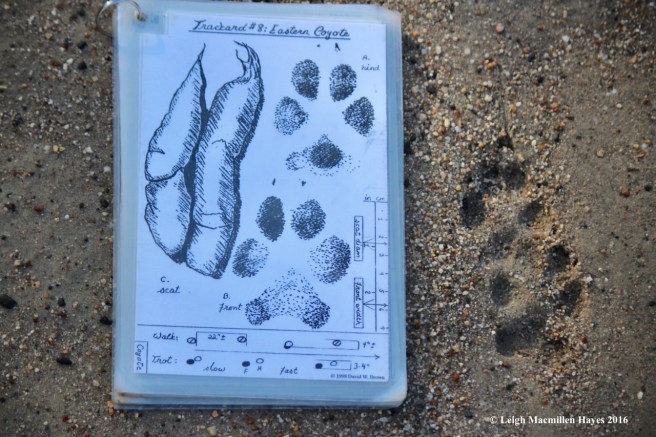
And I’d have shown him how to make a positive ID of a print, in this case–Eastern Coyote. We’d have looked at the key characteristics, like the winged ball of the pad, the x between toes and pad, the symmetrical front toes and inward facing nails. And I would have shared my Trackards with him so we could both better understand how the critters with whom we share this space move about.

k-12

In this case, it appeared there were several coyotes and they shared a brief tussle.

k-13

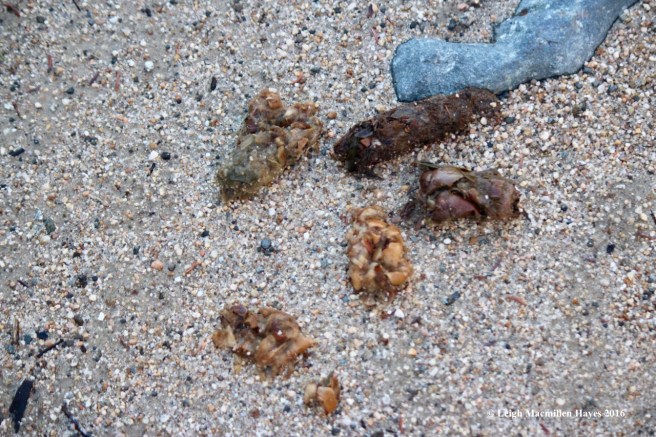
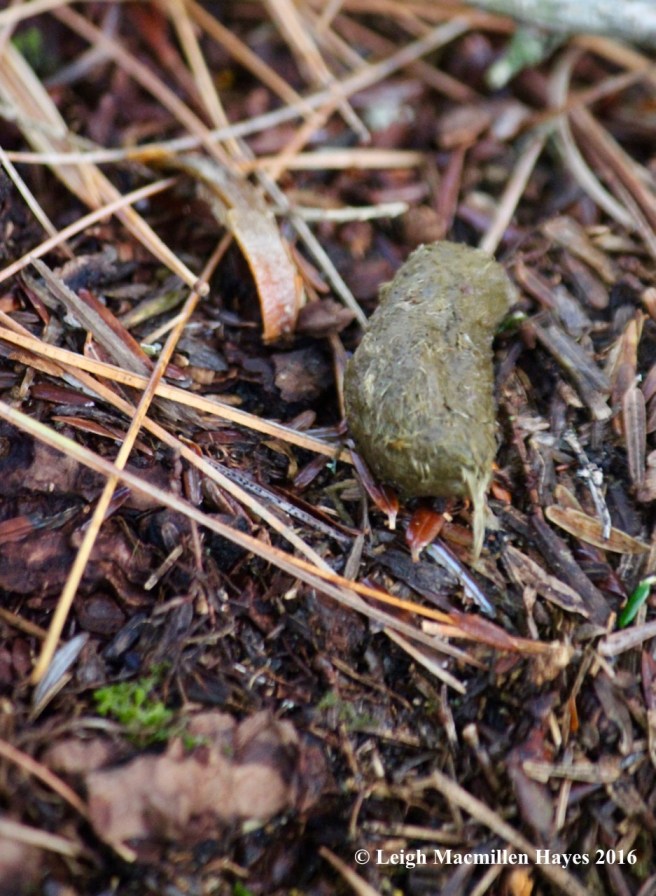
We’d have looked at the contents of coyote scat, of which I saw tons. Ky would have reminded me that the apple skins meant the coyote visited the neighborhood orchard.

k-14

k-15

And I would shared with him that the grassy scat meant perhaps one of the coyotes had an upset stomach. If you are grossed out by the scat, please forgive me. But . . . it’s natural. It’s a sign. It tells a story. And Ky is 12. Then again, I’m in my late 50s–and I LOVE scat.

k-16

Had Ky been with me, we’d have wondered about the swatch of hair deep in the woods. And maybe we would have looked around more than I did to search for other signs of why the hair was left behind.

k-17

Had Ky been with me, we would have noted numerous deer tracks as well. And coyote tracks in the same vicinity.

k-18

We’d have seen where the deer browsed.

k-19

And where one rubbed its antlers–perhaps leaving an important scent for others to note.

k-20

Had Ky been with me, we would have seen some downed hemlock twigs.

k-21

And known to look for their comma-shaped scat.

k-22

Had Ky been with me, we would have found a bunch of puff balls or stink bombs.

k-23

And most definitely we would have poked them with our feet and watched the spores flow out like a cloud.

k-24

Had Ky been with me, we would have noticed the little things, like a peeled acorn stuck in a tree and wondered how it go there.

k-25

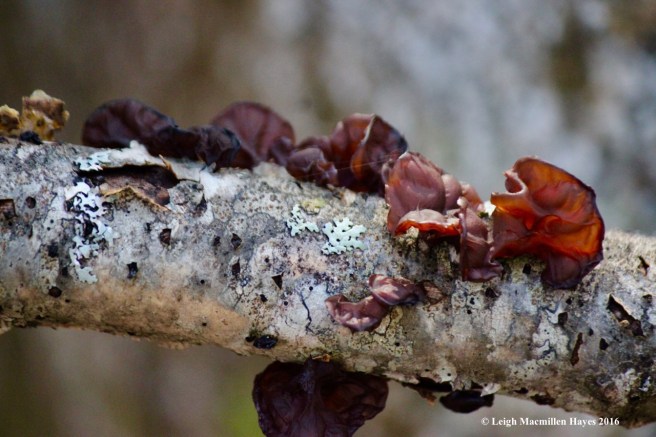
We would have enjoyed not only the sight of the Auricularia auricula-judae or brown jelly fungus, but also it’s other common name–wood ear because indeed it does resemble an ear.

k-26

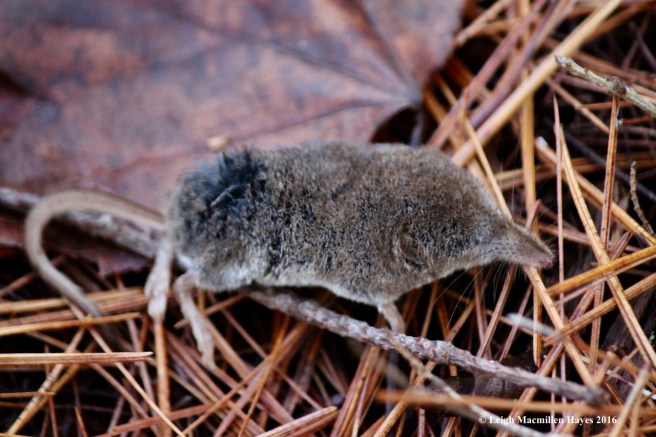
Had Ky been with me, we would have felt bad for the wee shrew that took one for the family’s sake. Despite releasing a toxin that prevented his predator from consuming him, he still died from the attack. But perhaps his siblings and parents will not be attacked by the same predator–a lesson learned. Maybe. And we would have marveled at what a long nose he had and what tiny ears.

k-27

Had Ky been with me, we might have bushwhacked, only getting fake lost on our way home. If he wasn’t comfortable doing that, however, we most certainly would have turned back and followed the trail.

k-28

And finally, had Ky been with me and we had bushwhacked, he might have noted some white fluff on the ground, the same as what I saw in the field earlier. And then he would have noticed the source.

k-29

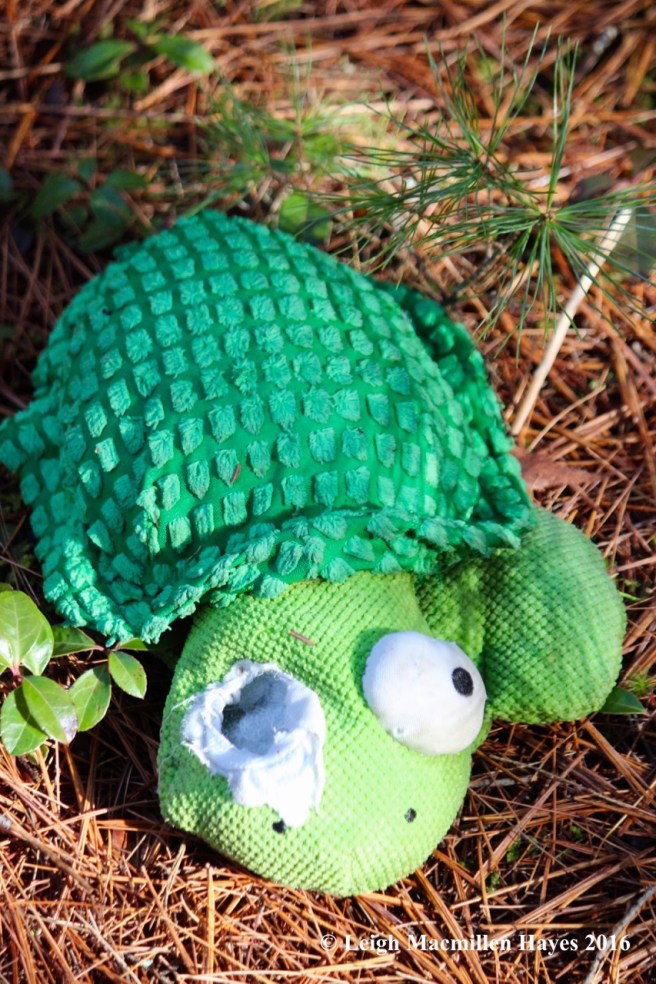
One never knows what one might discover deep in the woods. Had Ky been with me, would he have recognized Myrtle? Was it a dog toy at one time? If so, how did it find its way to the middle of nowhere? I know–it walked. But really, it was over a half hour from home and the terrain not easy, yet I found no other stuffing. Of course, it could have traveled a different route than I took.

At the beginning of today’s journey I’d thought about seeking out the color orange again in honor of Ky, but perhaps he’s tired of orange. And it was much more fun looking for things I thought Ky might appreciate had he been beside me. I know he’ll see things I’ve never noticed and I can’t wait to learn from him. Perhaps soon we can venture together, maybe once the ground is frozen and snow falls. Or in the spring.

One of these days, I will surely walk with Kyan.


The Be-Attitudes Sundate

Today marks the beginning of the season of hope and with that in mind, my guy and I climbed Singepole Mountain in Paris. Paris, Maine, that is.

s-halls-pond-start-1

Our hike began beside Hall’s Pond, where the water reflected the steel gray sky of this late November day.

s1-barbed-wire

And stonewalls and barbed wire reflected the previous use of the land.

s1-beaver-6

In a matter of minutes we learned of its present use.

s-beaver-works-3

Everywhere we looked, beaver sculptures decorated the shoreline.

s1-hemlock-grove

We passed from the hardwood community to a hemlock grove . . .

s-hemlock-girdled-2

where more beaver activity was evident. I’ve been reading The Hidden Life of TREES by Peter Wohlleben and have some questions about tree girdling such as this. There is a theory that beavers chew off the bark all the way around (girdle) to eventually kill trees such as hemlock, so preferable species will grow in their place. But, that’s thinking ahead to future generations. Do beavers really do that?

s-hemlocks-3

On page 18, Wohlleben states the following: “As the roots starve, they shut down their pumping mechanisms, and because water no longer flows through the trunk up to the crown, the whole tree dries out. However, many of the trees I girdled continued to grow with more or less vigor. I know now that this was only possible with the help of intact neighboring trees. Thanks to the underground network, neighbors took over the disrupted task of provisioning the roots and thus made it possible for their buddies to survive. Some trees even managed to bridge the gap in their bark with new growth, and I’ll admit it: I am always a bit ashamed when I see what I wrought back then. Nevertheless, I have learned from this just how powerful a community of trees can be.”

Could this theory be true? Are the surrounding hemlocks feeding that tree via their roots? If so, does that throw out the other theory? So many questions worth asking.

s-huge-maple-1

Soon, we left the Pond Loop Trail and started to climb the Singepole Trail, passing by a gentle giant.

s-maple-2

It’s a snag now, but this old maple offered tales of the forest’s past and hope for the future.

s-downy-rattlesnake-plaintain

On a smaller scale, Downy Rattlesnake Plaintain provided a cheery contrast among the leaf and needle carpet.

s-bobcat-ledges-1

The climb was a bit challenging in places, but we held out hope among the ledges that we might see a bobcat.

s-porky-den

No such luck, but we did find this . . .

s-porky-scat

a well used porcupine den.

s1-water-2

Water dripped in constant harmony as we stepped gingerly along the narrow ledges and tucked under overhanging rocks.

s-halfway-up-2-1

About halfway up, we took a break and paused to admire the view.

s-halfway-up-view-1-jpg-communities-defined

The hardwood and softwood communities became more obvious as we looked down.

s-summit-1-1

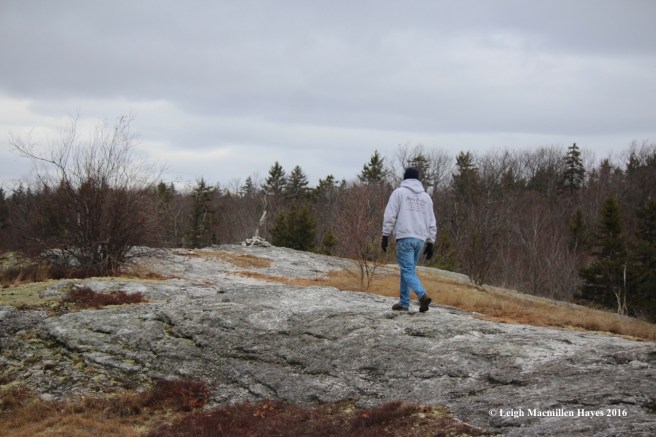
And suddenly or so it seemed, my guy reached the moment of truth–the summit.

s-halls-pond-to-pleasant-1

From the top, we looked around and embraced our home place, which appeared on the horizon in the form of Pleasant Mountain.

s-pleasant-to-whites-1

A slight turn and the view extended from Pleasant Mountain to the White Mountains.

s-quartz-intrusion

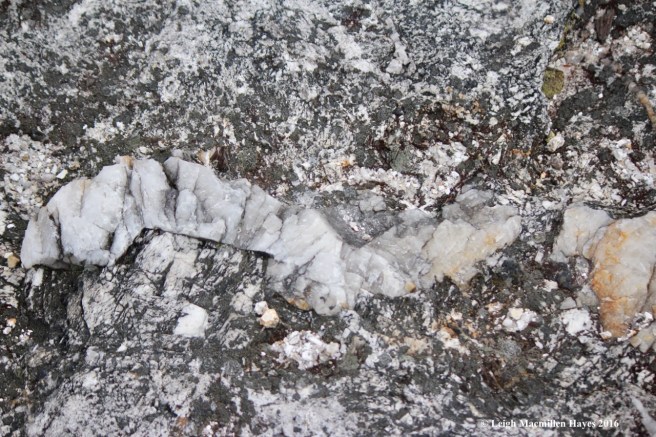
Below our feet, the granite pegmatite shared its showy display.

s-summit-1

We’d read that there was a quarry at the summit, so we headed toward a cairn, in hopes of locating it. Too many jeep trails confused us and we decided to save the quarry for another day. Instead, we turned into the woods to get out of the wind and munch our PB & J sandwiches, the grape jelly courtesy of Marita Wiser and family.

s-wickiup-1

As we poked about, something caught our attention and we moved closer.

s-wickie-3-1

s-wickie-2-1

s-wickie-1-1

A wickiup frame. We admired the efforts of someone to create this traditional structure.

s-pleasant-mtn

Emerging from the woods, we took one last look at Pleasant Mountain, and . . .

s-summit-4

one last view of what seemed to be the summit (though it may have been a false summit).

s-climbing-down

And then we started down, once again hugging the rocks and trying not to slip.

s-flower-mushroom

On the way, I did note a few things, including this fungi that looked more flowerlike than mushroom like.

s-girdled-beech-1

s1-porky-2

And I spotted a phenomenon that occurred repeatedly. Girdled beech trees too far uphill for a beaver. What or who had debarked these trees?

s-porky-works

I may have been seeing things that weren’t real, but the lines on this particular tree made me wonder about the porcupines. Was I looking at the design they leave with teeth marks created in the distant past? Or were they wounds of another kind?

s1-beaver-5

When at last we reached the Pond Trail again, we continued to circle around it, noting more beaver works.

s-beaver-lodge

At last, we found the mud-packed lodge built into the edge of the pond. Here’s hoping for a warm winter within.

s-pond-at-end-of-day-1

Completing the circle, the biting breeze forced us to walk quickly toward our truck and the end of our hike. We have chores to complete tomorrow so our Sundate may have to suffice for a Mondate.

That being said, in this season of hope, we trust we’ll find more opportunities to consider these be-attitudes:

s1-trees-in-harmony

Be supportive of each other.

s1-christmas-fern-1

Be watchful of what’s to come.

s-heart

Be hopeful of love everlasting.

Ho-Ho-Ho Ho Hoing Away

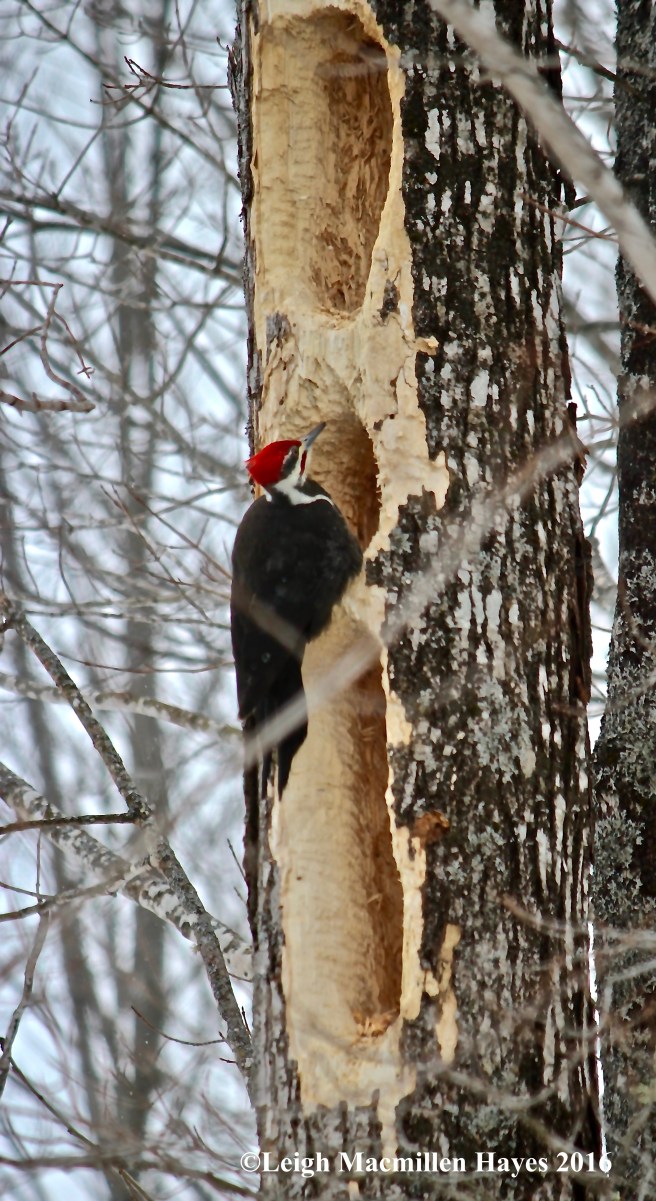
I remember a time when a Pileated Woodpecker sighting was rare. And now, it’s a daily event, but one which I still feel blessed to experience.

h-pileated

Stepping out the door this afternoon, I immediately heard one hammering and realized another was drumming in a nearby tree. Within minutes, a third flew in and birds #2 & 3 sang their eerie tune as they approached #1. He chased the couple and they flew off, their flight strong, and marked with slow, irregular woodpeckery flaps.

h-woodpecker-hole-1

After watching #1 for a bit, I went in search of woodpecker happenings scattered throughout our woodlot. Though they’ll eat lots of wood-boring insects and occasionally berries, seeds and suet, carpenter ants are their mainstay. Better in a woodpecker’s stomach than our home. Sometimes the holes they create are about six inches across and almost as deep.

h-woody-condo-2

h-woody-condo

And those holes became homes for other critters occasionally, so when friends and I see trees such as these, we think of them as condominiums providing living quarters perhaps for small birds and little brown things (mice). Included in these condo units are some smaller round holes, created by the Hairy and Downy Woodpeckers that also live in our neighborhood.

h-wood-chisel

Occasionally I come across trees such as this one that hadn’t been so much excavated as chiseled. Woodpeckers are just that–peckers of wood. They don’t eat the wood. But to get at their preferred food, they must hammer, chisel and chip the bark.

h-woodchips

At the base, always a scattering of wood chips. I, of course, cannot pass up any opportunity to search through the chips in hopes of locating scat. I was not rewarded with such a find today.

h-hole-in-snag

Leaving dead snags encourages woodpecker activity. They become prime locations to forage, roost and maybe even nest, though I hardly think this snag was large enough to serve as the latter.

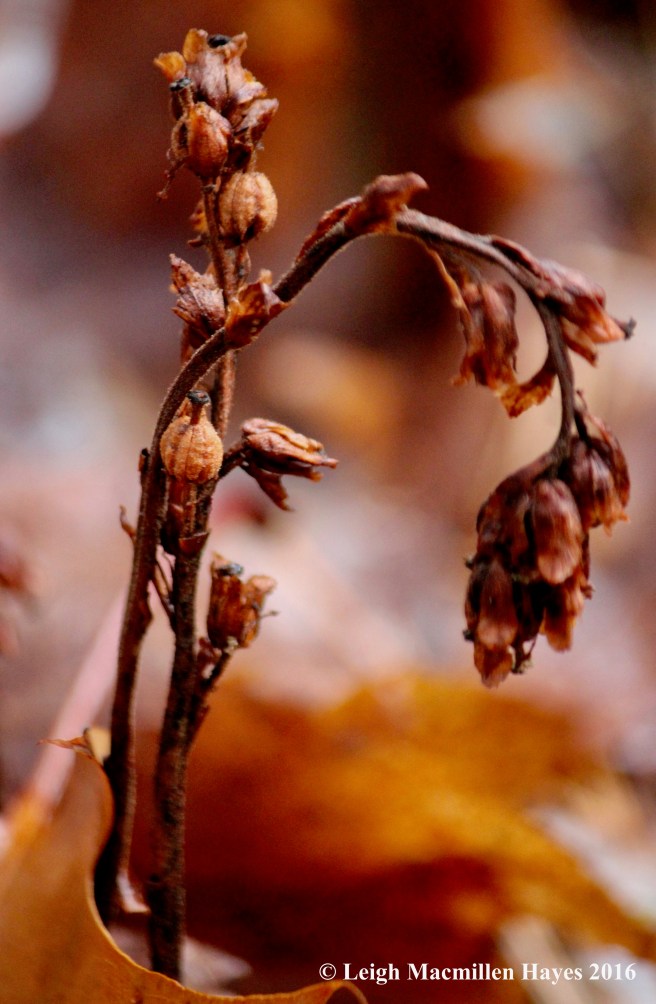
h-pinesap

While I was out there, I did stop to admire a few other sights including the now woody structure of pinesap;

h-winterberry

winterberries contrasted against the wee bit of snow that still graces patches of ground;

h-deer-tracks

deer tracks indicating we’d had visitors during the night;

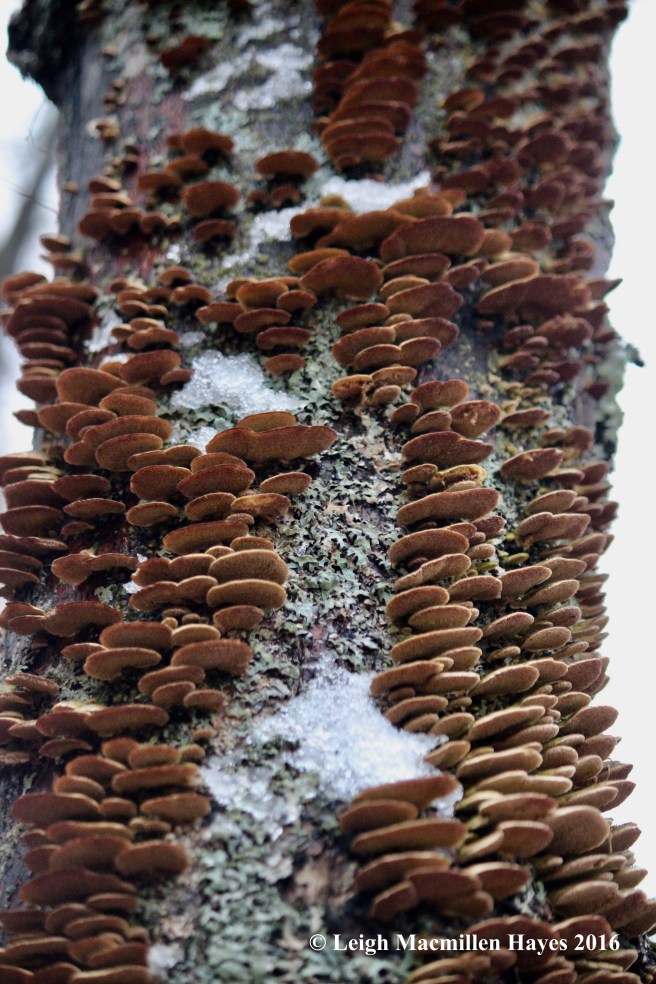
h-violet-upper

h-violet-toothed-under

and a tree skirt of violet-toothed polypores. They are rather like the Lays Potato Chips of the natural world. You can never have just one. (Note: I’m not talking about eating them, but rather how they grow.)

h-woody

It’s been said that Pileated Woodpeckers are skittish. That’s not always the case. I’ve stood beneath one for over twenty minutes, the bird intent on its work and seemingly oblivious to my presence.

The next time you are in the woods and hear the ho-ho-ho ho ho, ho-ho-ho ho hoing that reminds you of that cartoon character, Woody Woodpecker, take a look around. You, too, might be blessed. And don’t forget to check for scat. ;-)

Forever a Student

Once the rain let up, I donned my Boggs and headed out the door in mid-afternoon, not sure where exactly I was headed. But after reaching the snowmobile trail, I decided to turn south. Since the spring, I’ve been to the vernal pool on the neighboring property numerous times, but not much beyond in that direction.

h-new-bridge

Part of the reason was that a local industry, of which we now have so few, was constructing a new building and had cut off the trail. Oh, I could have bushwhacked around the project, but the other part of the reason is that it’s a heavy tick zone and I normally avoid it come warmer weather. Given the new building, I wasn’t sure what to expect today, but as I passed through the stonewall, I discovered they’d added a bridge over a new water diversion and the trail was open. I’m glad for the small industry, but simultaneously sad that the willows are gone. No more pussy willows in the spring. Or willow galls, though I suppose that’s good news. And who knows, perhaps some viable willow seeds will spring forth in this place–a hypothesis to be tested.

h-artist-conk-top

After crossing behind the building, I moved through an opening in the next stone wall, and felt right at home again–in one of my local classrooms. This is one where I’m often the solo student, as was the case today.

h-artist-conk-2

I revisited an old stump, where art class was about to begin. The underside of the artist’s conk welcomed a sketch, but I left the canvas blank for another day.

h-gate

In social studies class, I took a look at former land uses. The wall opening and split stone gate bars helped me envision the fields that once were cleared. I followed several walls, which switched from single to double and even double-double, or so it seemed as one section was at least six feet wide and a football field long (The New England Patriots are winning in CA right now!). Barbed wire indicated the need to keep animals out and flat land with trees not a hundred years old spoke to the land’s former plowed use.

h-vp

A few minutes later, I moved over an old rock mound and stood before my science teacher–another vernal pool. As I recalled, this one dries out early in the season and grasses and other vegetation grow prolifically here. But unlike the smaller pool closer to home, this one held some water from the recent rain.

h-boots

As any student should, I stepped through the door and sunk my feet into class.

h-cinnamon-fern

Cinnamon ferns reminded me that they keep their fuzziness right up to the end.

h-birdnest-1

I wondered about strips of paper birch dangling from a young sapling and then realized I was looking at the remains of a nest–maybe a vireo.

h-seeds

I questioned how the long-beaked sedge seedheads came to be bent over–by weather or wildlife or just because their time had come?

h-vp-bulrush-a-grass

While bulrushes (actually a grass) offered flowing fountains pouring into the future, their seeds still clung–as did a spider web.

h-vp-steeplebush-web

And more spiders eluded me, though their webs stood strong among the steeplebush capsules.

h-vp-crystal-ballseeds

A few raindrops dangled like ornaments from a holiday decoration.

h-vp-backside-of-sensitive-fern-beads

And bead-like spore structures on sensitive fern’s fertile stalk waited for another day to spread their good news.

h-lichen-or-fungus-2

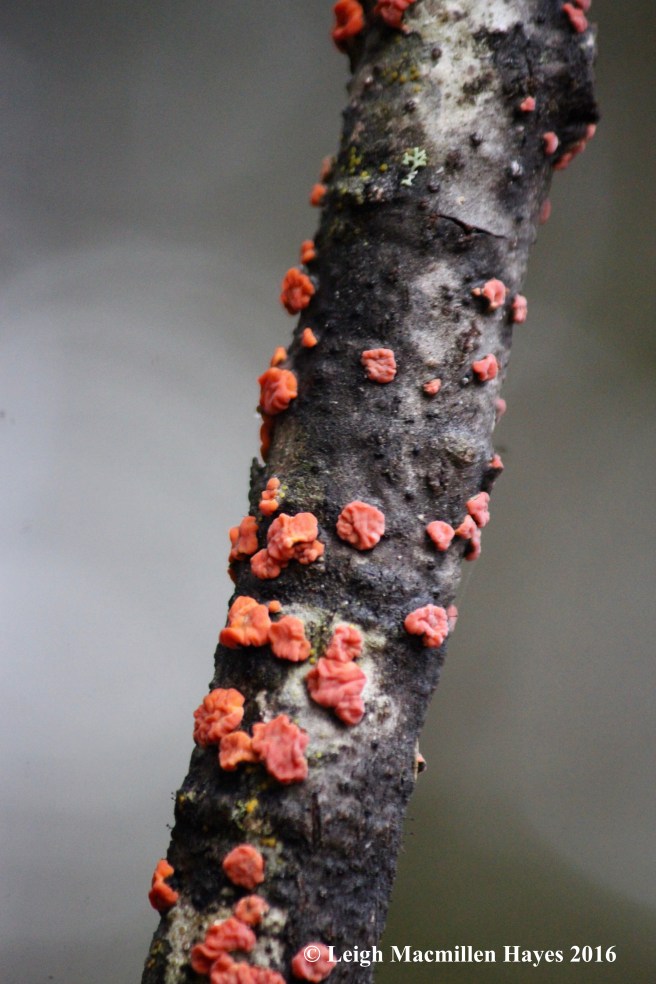
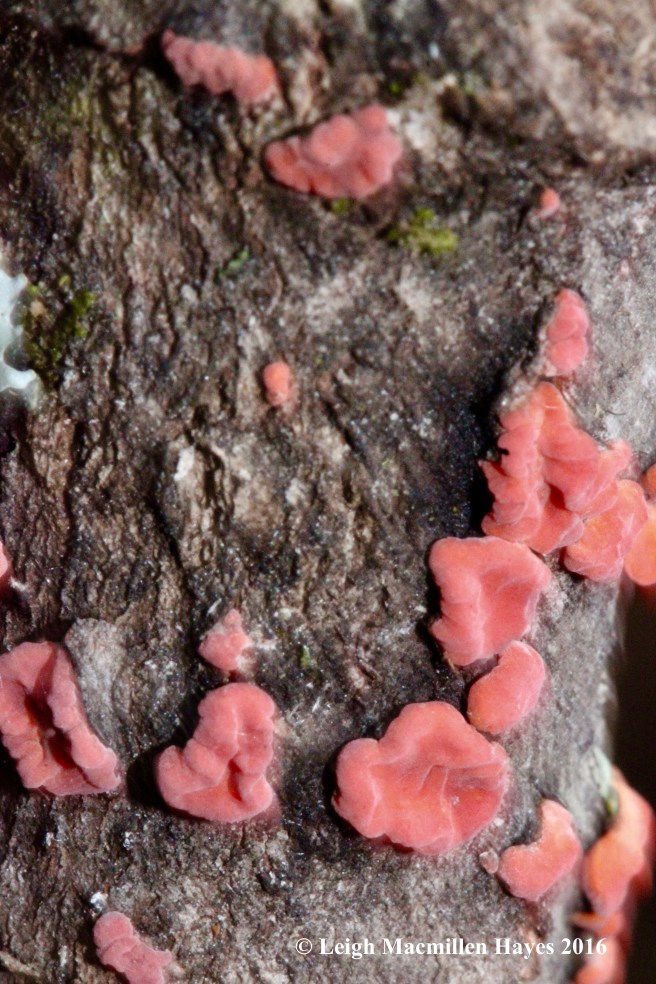
I finally left the vernal pool, but before heading back down the hallway, small salmon-colored growths stopped me. Lichen? Fungi? I didn’t think I’d ever seen it before and so it was a new lesson.

h-lichen-or-fungus

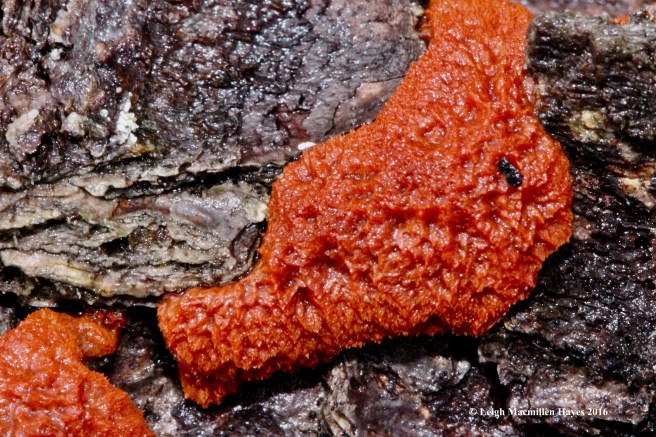
My first thought–lichen. In a way, it resembled the tops of British Soldiers that grow prolifically here. But my latest thought is red tree brain fungi (Peniophora rufa) . I may be wrong, but that’s what being a student is all about.

h-woodpecker-1

With each new lesson, I was also thankful for those that were reinforced, such as the chisel-like and shredded works of pileated woodpeckers. I used to think such trees were the result of bear activity.

h-woodpecker-2

I’m always awed by the resulting sculpture left behind by those powerful birds–their strong beaks stabbing away at the bark until they’ve consumed a meal of carpenter ants and beetles. Thankfully, their skulls are thick and spongy–allowing their brains to absorb the impact of such repeated drilling.

h-field-succession-layers

At a field, I paused to admire the layers–a testament to field succession. These woods are constantly changing.

h-male-turkey-scat-j

One thing that doesn’t change is the signature of a Tom Turkey–usually offered in straight or J formation.

h-slime-3

h-tubifera-ferruginosa

h-slime-2

At another wetland, I poked around and then my eye focused in on something decorating a fallen tree. A slime mold perhaps? Red raspberry slime? In one rendition it seemed to have a crater-like surface, while another was more flower-like with petals spraying from a center.

h-hemlock-cinnamon

At last I entered a hemlock forest where the cinnamon inner bark stood out on the wet trees. If not for the scales, I realized it would be easy to confuse this bark with that of red oak, but a quick look up the trunk and the answer was obvious.

h-striped-maple-seeds

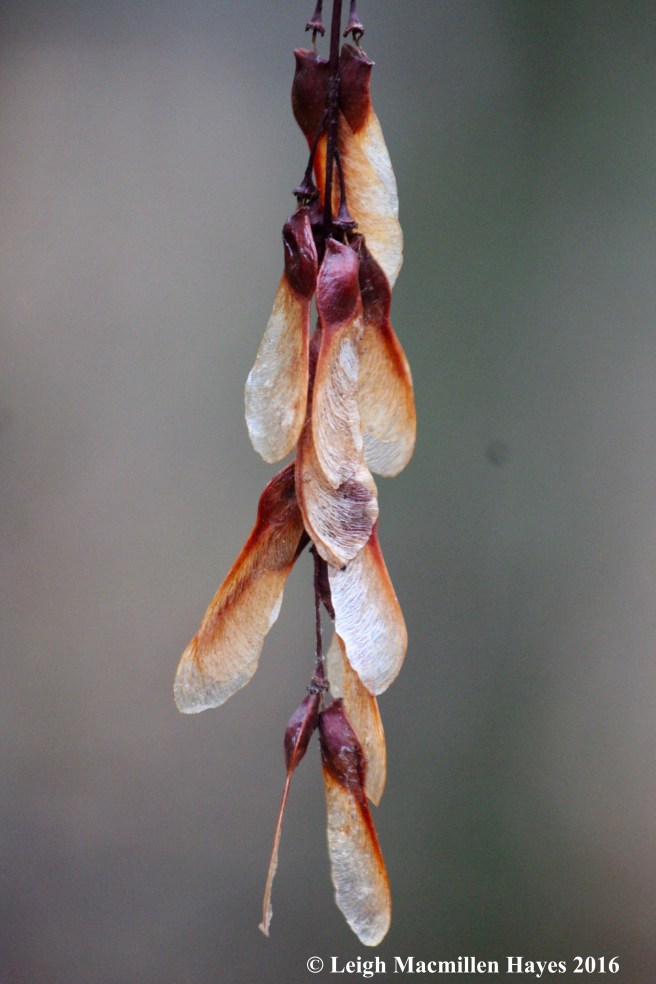
As I walked back toward home, I looked along parts of the trail I’d skipped while exploring in the woods. And I wasn’t disappointed when I discovered one of the few striped maple trees–still bearing the seeds it produced last year. Why did they cling still? When released, will they be viable?

h-pine-suds

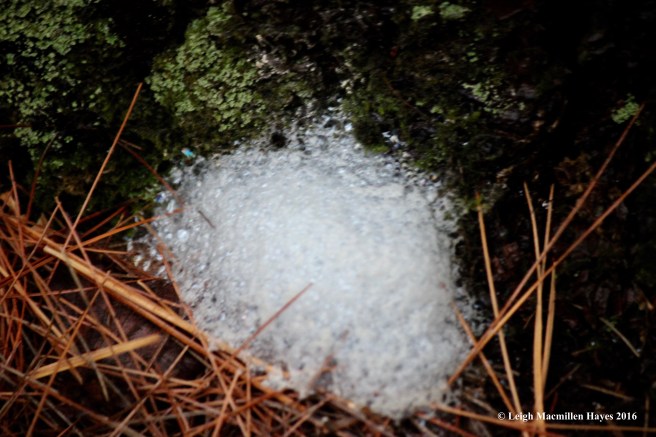
And then, a sight I was hoping for presented itself when I returned to our woodlot. Froth at the base of a pine tree. It’s not unusual and occurs following a rain event such as we’d had all night and morning. I had hoped to see some foam today, and felt rewarded for my efforts. So what causes the tree to froth? Well, like all lessons, there are several possibilities. Maine Master Naturalist Science Advisor Fred Cichocki recently had this to say about it: “I’ve noticed this phenomenon often, and in every case I’ve seen it’s associated with white pine, and always after a dry spell followed by heavy rain. Now, conifers, especially, produce hydrocarbons called terpenes (it’s what gives them their lovely pine, balsam and fir scent). These hydrocarbons are hydrophobic by nature and form immiscible films on water. During a heavy rain, water running down the trunk of a white pine picks up terpenes on the way. Air (having accumulated in bark spaces, channels, etc. perhaps under slight pressure) then “bubbles” through terpene-water films producing a froth. Recall the cleaning products PineSol, and the like. They are made from terpenes, and produce copious bubbles when shaken. One could get the same result directly by shaking terpentine in water, or by bubbling air through a terpentine-water mixture with a straw  . . .  Of course, it may be that other substances (salts, etc.) enhance the frothing.”

No matter how much I have learned on this life-long course, there’s always more. I certainly don’t have all the answers and for that I am thankful. I’m forever a student.


The Way of the Land at Long Meadow Brook Reserve

Last month the Greater Lovell Land Trust purchased a new property along Long Meadow Brook that further develops the wildlife corridor. A couple of weeks ago I first visited it with GLLT’s Executive Director Tom Henderson and a number of the land trust’s volunteer docents. As we left the property, Tom said to me, “I didn’t oversell this, did I, when I said this will become one of the docents’ favorite properties.” Indeed.

And so I couldn’t wait to get back there myself to spend a few hours exploring the almost one-hundred-acre reserve.

l-mullein-flower-2

Because the land was last logged by the previous owner in 2014, it’s in the early succession stage of regrowth.

l-mullein-flower-3

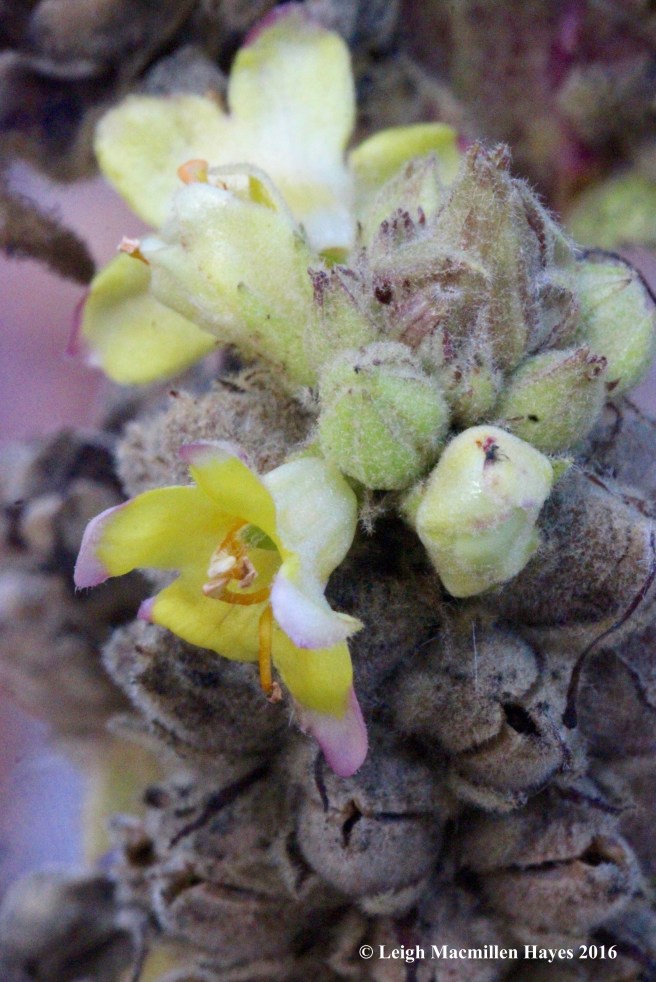
And so, it’s a place where those who like disturbed places tend to grow, such as the common mullein. What surprised me most was that I found a few still offering blooms.

l-mullein-cactus

Of course, it reminded me that I was in the great West–WESTern Maine, that is–with its occasional cacti-like form.

l-seeds-holidng-on

Scattered throughout are also the seedheads of white lettuce, waiting for release in lampshade-like formation.

l-orange-peel-fungi

Orange-peel fungi fruited prolifically in the gravel logging road.

l-future-parking-lot

That was all before I even reached the future parking lot, which had served as the log landing a few years ago. Already, sweet ferns and berry bushes have made themselves known.

l-sweet-fern-colors

The leaves of sweet fern, which is really a shrub rather than a fern, exhibited their version of autumn hues.

l-trail-marker

If you go, I encourage you to look for the blue ribbons that indicate where a future trail will be placed. It’s a loop trail that summer interns Hannah and Aidan laid out and leads to two focal features.

l-stonewall-double-to-single

The trail nears a neighboring property, which just happens to also be under conservation easement thanks to the foresight of its owners. I stepped off the blue flag trail and started to follow the wall for a bit–noticing that soon it changed from a double (garden or plowed land) wall to a single wall. A large pasture pine grew at the change-over point.

l-stonewall-barbed-wire-1

And where the wall switched to single formation, barbed wire indicated its former use a pasture boundary. And white pine scales indicated its current use–as a red squirrel’s dining room table.

l-forest-succession-2

After moving away from the wall, I noticed the mountains in the offing and ferns and young trees already filling in the empty spaces.

l-kearsarge

One of my favorite mountains to climb stood tall in the backdrop–Mount Kearsarge.

l-forest-succession-1

My bearings were off a bit, but I knew where the eastern boundary was as I moved across this opening.

l-pitch-pine-bark-1

Walking along the back edge, my tree passion was ignited yet again.

l-pitch-pine-1

Several pitch pines grow in this space. While the bark is similar to that of red pines, it’s platier (is that a word?). And the tufts of needles that grow along the trunk were a dead give-away.

l-pitch-pine-cone

l-pitchpine-needles

But . . . I always quiz myself and so I looked around. And right below the trees, pitch pine cones and the triple needle bundles common to this species.

l-wintergreen-berries

It was here that I discovered wintergreen growing by the base of a tree stump. What made me wonder was the amount of fruit on each plant. Yes, wintergreen grows prolifically in all of western Maine, but I can’t recall ever seeing so many little red globes dangling below the leaves.

l-marshy-1

From my half-circle around the opening, I wasn’t positive about my whereabouts and so decided to follow the land downhill because it looked like there may be an opening below. A few minutes later, I realized I was in a marshy spot where the cinnamon ferns grew. And the earth beneath my feet was rather spongy and damp.

l-beaver-lodge

I reached what I thought was the meadow I sought–only to realize that I was looking at a beaver lodge. I knew that beaver lodge, but from a different perspective–the neighbors’ property.

l-first-marsh

And then something else caught my attention.

l-marsh-tamaracks

Tamarack (aka larch) trees–our only deciduous conifers, which had turned a golden yellow as is their autumn habit.

l-tamarack-2

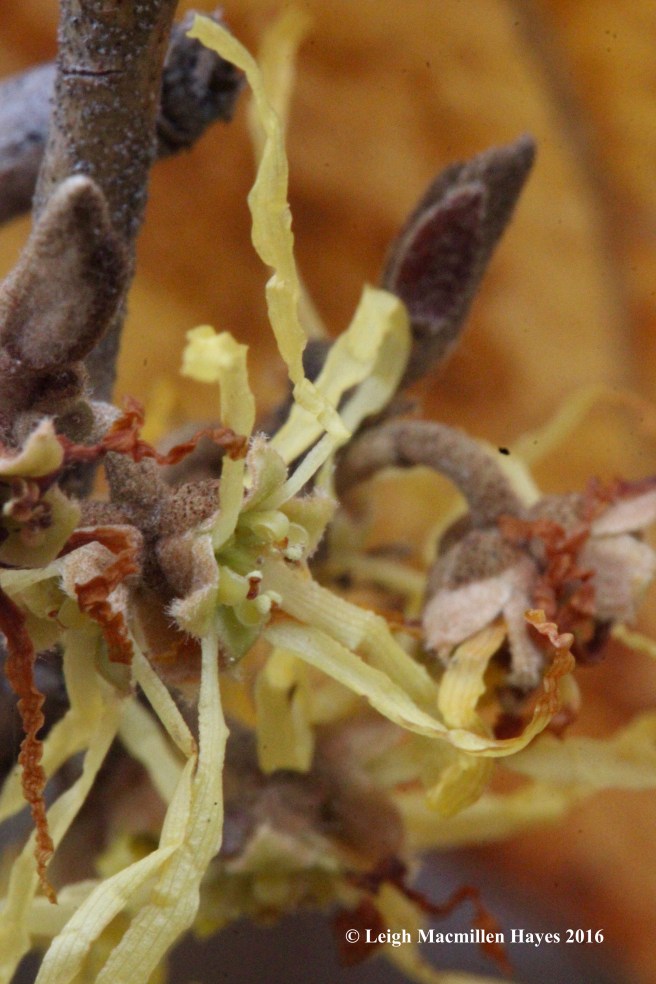
The spray of tamarack needles reminded me of witch hazel flowers, which also grow on this property. But soon, the former will drop, leaving only their barrel-like stems as a reminder of their presence.

l-maple-leaf-viburnum

I left that spot, retraced my steps and headed to the north on a cross-country bushwhack, where the mauve colored maple-leaf viburnum grew.

l-turkeys

I saw lots of mammal sign and even a few birds, including turkeys who are loving the fact that this is a mast year for acorns.

l-trail-to-meadow

At last I emerged onto the trail I remembered and headed downhill again.

l-meadow-brook-2

And then . . . I was rewarded for my efforts. Long Meadow Brook and the mountains beyond provided a WOW moment.

l-meadow-east

I looked to the east for a few minutes.

l-meadow-layers

And then turned west again, where the layers and colors spoke of diversity.

l-meadow-snags

Even the dead snags added beauty.

l-cat-n-nine-tails

Cat-in-nine tails added to the view and I noted others who like wet feet including steeplebush, meadowsweet and bulrushes growing along the old beaver dam. It’s also a place for a variety of evergreen species–hemlock, white pine, balsam fir, red spruce and tamaracks. Future teaching moments await.

l-hobble-2

My intention to stick to the trail was soon thwarted when I spied hobblebush.

l-hobble-bud1

Like all trees and shrubs, the future was already encased in a bud–in this case a bud we refer to as naked because it doesn’t have the waxy coating of most others. Methinks its furry presentation offers the same protection from winter’s cold.

l-back-of-hobblebush-leaf

And as I studied the back side of fallen leaves, I paid attention to the venation–reminiscent of the bud’s pattern.

l-hobble-leaves-2

In the glow of sunlight, I felt like I’d found the pot of gold.

l-meadowhawk-2

A short time later I reached the second opening that Hannah and Aidan’s trail encompasses. And what to my wondering eyes should appear–a meadowhawk dragonfly.

l-snow-on-balds-1

It provided a sharp contrast to snow on the Baldface Mountains.

l-secod-opening-2

It was at this six-acre opening that I poked around for a while longer. And watched a goshawk fly to a pine tree with something dangling from its talons. Did I take a photo? No, of course not. I was too mesmerized to focus my camera. But sometimes, the photo doesn’t matter. Being there in the moment does.

I’m thankful for such opportunities made possible by organizations such as the Greater Lovell Land Trust. I know that ultimately this property is for the mammals that travel through and I saw plenty of evidence that they use this place. But then again, I’m a mammal who also appreciates the land bridges created and opportunity to observe the connectivity. I spent the day getting to know the way of the land at Long Meadow Brook Reserve–and can’t wait to return.


In Constant Flux

Ever so slowly, the world around us changes.

h-starting-point

Sometimes it’s as obvious as the leaves that fall.

h-bee-on-flower-1

And other times, it’s a bit more subtle, evidenced by the bees that have slowed their frantic pace as they make final collections.

h-leaf-carpet

Mid morning, I headed down the cow path in search of other signs of change.

h-oak-branches-1

As I walked along, I began to realize the interdependence of all. Under the northern red oaks–many  chopped off twigs.

h-porcupine-works

The angled cut and empty cap indicated the work of porcupines seeking acorns.

h-leaves-on-hemlock

I found maple leaves pausing on hemlocks,

h-pine-needles-on-spruce

pine needles decorating spruce trees,

h-leaves-in-puddles

and occasional puddles offering a rosy glow. Eventually, all of these leaves and needles will break down and give back.

h-life-on-rock-1

I found life on a rock, where lichens began the story that was added to by mosses. The creation of soil was enhanced by a yearly supply of fallen leaves and needles gathered there. And then a seed germinated, possibly the result of an earlier squirrel feast.

h-orange-peels1-1

I found orange peel and many other fungi aiding the process of decomposition so that all the fallen wood and leaves will eventually become part of the earthen floor.

h-forest-succession-3

I found a healthy stand of trees and ferns competing for sunlight in an area that had been heavily logged about ten years ago.

h-deer-and-bobcat-prints

I found evidence of those who spend their lives eating and sleeping in this place.

h-aster-seeds

I found seeds attached

h-seeds-on-the-fly

and those on the fly–heading off in search of a new home.

h-witch-hazel-flowers-galore

I found the last flowers of fall

h-witch-hazel-1

exploding with ribbony blooms.

h-power-and-nature

After bushwhacking for a few hours, I found the snowmobile trail, where man and nature have long co-existed.

h-home-2

At last I found my way across the field rather than through our woodlot, thankful for the opportunity to take in the colors of the season one more time.

At the end of the day, I’m once again in awe as I think about how we, and all that we share this Earth with, are dependent upon each other and the abiotic forces that surround us.

And with that comes the realization that the scene is in constant flux and so am I.


An Emerald Mondate

My guy and I journeyed via bus, car and foot across northern and eastern Ireland these past two weeks. Our main agenda–a vacation in the land where twenty-six years and two months ago we celebrated our honeymoon. We both also had semi-hidden agendas–his to seek out ancestral roots, mine to search as well, though my quest wasn’t quite so clear.

river-liffey-and-quay-dublin

Our journey began after we dumped our bags at the hotel, where our room wasn’t yet ready, and crossed the River Liffey in Dublin. It was to the right that we’d parked a rental car 26 years previously as we searched for traditional music and supper, only to return hours later and discover that the driver’s side window had been smashed and our video camera stolen. All these years I’ve held a sour view of the Fair City and so I felt a bit nervous as we stepped forth.

trinity-college-dublin

The feeling began to wane immediately, for as we approached a street corner and chatted about locating the library, a Dubliner overheard us and assumed we were looking for Trinity College (founded in 1592). We decided to play along and followed his directions–thankfully. It was “Welcome Freshers” week and the quad swelled with activity tents, music and students anticipating the year ahead. We passed among the frivolity and found the self-guided tour of the 18th century Old Library and that most ancient of manuscripts–the Book of Kells, a 9th century book featuring a richly decorated copy of the four Gospels of the life of Jesus Christ. A favorite discovery: the monks used oak apple galls to create ink–apparently, they crushed the galls and soaked them in rainwater, wine or beer until they softened. I’ve got to try this.

library-at-book-of-kells-1-1

While (or whilst as the Irish say) no photos were allowed in the Treasury where the manuscripts are stored, equally impressive was the Long Room, which houses 200,000 of the library’s oldest books in ancient oak bookcases. Just thinking about the centuries we were encountering was mind boggling, enhanced of course, by a lack of sleep.

architecture-and-flowers-dublindublin-church-architecture

A few hours later, we made our way back to the hotel, enjoying the architecture and flowers as we walked along. At last, we could check in and so we checked out–a rejuvenating nap essential to our well being.

guiness-sign-and-face

Rested and showered, we hopped aboard a bus–our next destination, the Guinness Storehouse at St. James Gate Brewery. The 250-year story of Guinness® is portrayed on five floors in a building designed in the shape of a pint. What’s not to like about that.

singing-oyster-guiness

We learned about the process of creating beer, and then there was the whistling oyster, one of the many icons of the Guinness® brand.

guinness-gravity-bar

After taking in the full story, we reached the Gravity Bar, where ticket holders may each sip a complimentary foam-topped pint. The museum was preparing to close and the bartenders made the last call. My guy asked if we could purchase a second pint and we learned that they don’t sell any, but he kindly slipped us two. Don’t tell.

guiness-view-2

The Gravity Bar offers 360˚ views of the city.
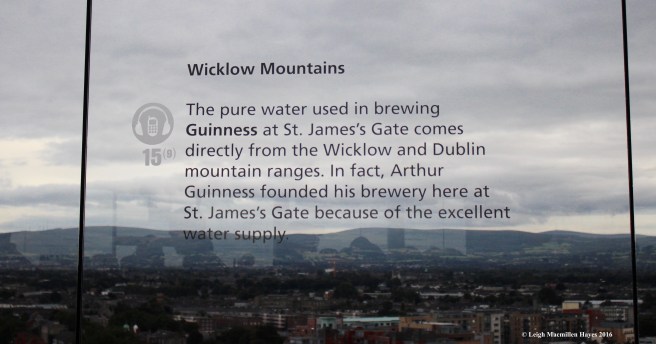
wicklow-mtns-from-gravity

And the view includes the Wicklow Mountains, our intended destination for week 2.

the-temple-bar

If you hear my guy tell this story, he’ll say that we were told it was a 45 minute walk from our hotel to the Storehouse, but a short bus ride. We rode the bus there, but later weren’t sure where we should queue for the ride back, so we decided to walk instead. According to him, it took us five hours to make that 45 minute walk. I’m not sure it was quite that long, but we did stop at The Temple Bar for the music and a few other prime spots to eat and sip a wee bit more.

national-library-dublin

The next morning we set out for the National Library, which had actually been our intended destination the previous day–but who can deny enjoying the Book of Kells exhibit. My guy was hopeful that the genealogists at the library would help him make some connections, but without knowing parishes he hit a bit of a stonewall.

And so we left the Fair City with much fonder memories, took a bus to the airport, picked up our rental car, and ventured on. Oy vey. If you’ve ever watched the BBC program, “Keeping Up Appearances,” you’ll appreciate that I was Hyacinth to my guy’s Richard. “Mind the pedestrian,” I’d say. “I’m minding the pedestrian,” he’d respond.
newgrange

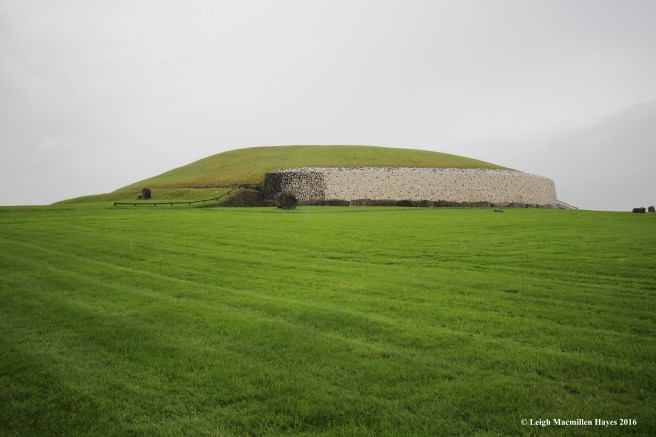
Our first stop, Newgrange, a Neolithic passage tomb alleged to be older than Stonehenge and the Great Pyramids. Constructed during the Stone Age, about 5,200 years ago, Newgrange is a large circular mound that covers 300 feet in diameter and stands 36 feet high. A stone passageway leads to three small chambers. Some describe it as an ancient temple, a place of astrological, spiritual and ceremonial importance. Our guide told us that bones were found here and it may have been a place for worship as well as where people were laid to rest. We were in awe of its structure and the fact that the passageway is oriented northward allowing the sun to illuminate it during the winter solstice.

newgrange-entrance

Yes, the railings are new, but this is possibly the oldest building in the world. That’s worth repeating–the oldest building in the world. We had to bend low to enter and then squeeze between the walls as we walked toward the center, where three small chambers with stone basins created a cross-like structural plan. Even as we stood with others in darkness and waited for a beam of artificial light to demonstrate the real thing, we couldn’t quite fathom what we were witnessing.
newgrange-spirals

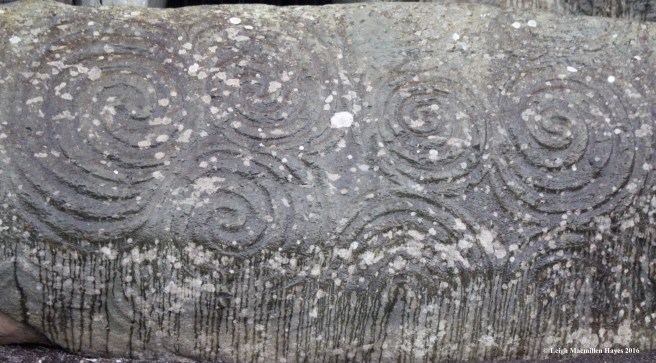
Our awe continued within the center and by the entrance stone, where we witnessed megalithic art. The spirals reminded me of labyrinths, but we’ll never know their true significance. And that’s OK.
ghan-house-carlingford

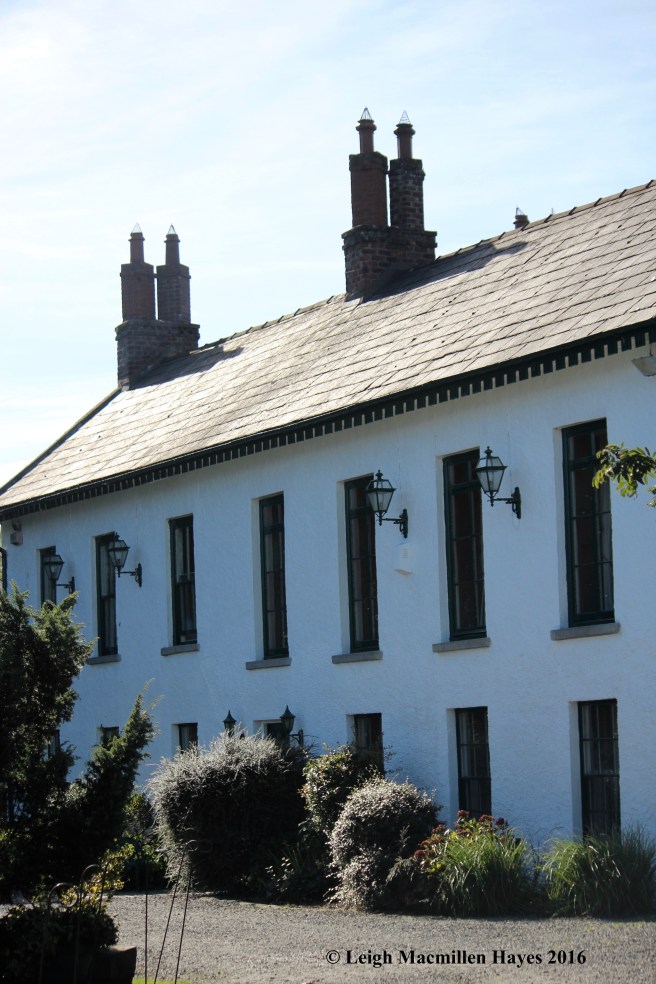
By the time we arrived at Carlingford, it was pouring and we had no idea where to stay. We stopped at a hotel, which was full–thankfully. They suggested the Ghan House, a Georgian House set within three acres of walled gardens. It was our most posh stay and we didn’t truly appreciate it until the next morning when the sun shone brilliantly.
carl-arch-2

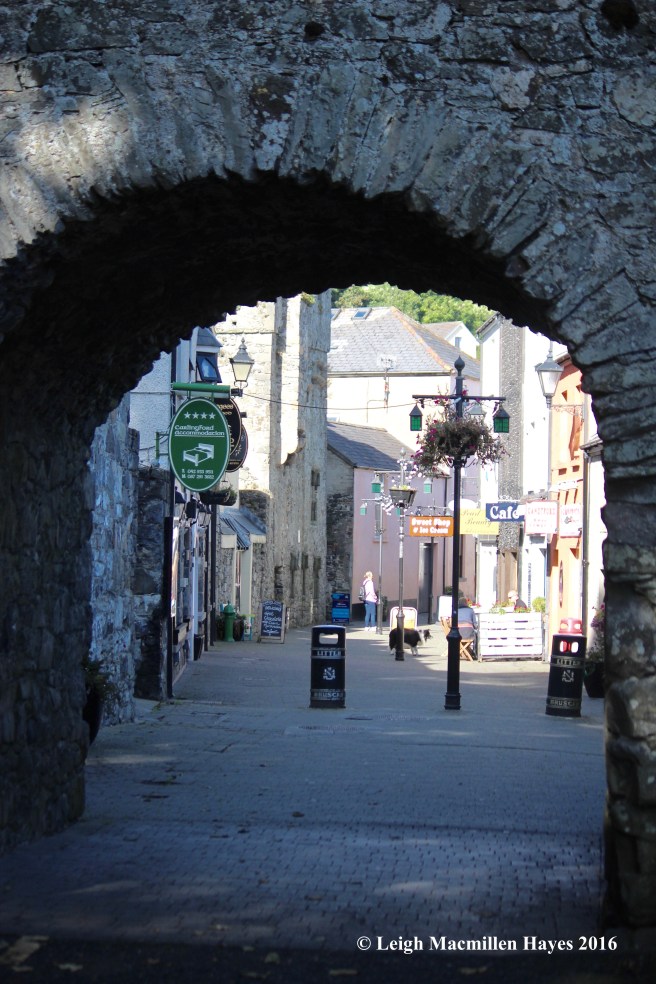
The Ghan House is located just a stone’s throw from the Thoisel or town gate leading into the narrow streets of the town centre, where we found Ma Baker’s in the rain, a welcoming pub frequented by the locals, who laughed and joked and reminded us that the Irish love to sip a pint, tease each other and tell stories no matter what the weather might be out the door. And they don’t care about spelling, punctuation or run-ons. Life is too short for that–note to self.

carlingford-lough1

The tide was low when we walked along the lough the next morning and took in King John’s Castle, which was initially constructed by Hugh De Lacy in 1190, though it wasn’t completed until 1261. Purportedly, King John, the brother of Richard the Lionhearted, visited in 1210, and thus the name for this Norman structure.

wall-around-derry

From Carlingford, we travelled north and did what we had wanted to do 26 years prior; we crossed into Northern Ireland. On our previous adventure, we’d journeyed as far as Letterkenny in the northern part of the Republic of Ireland, only a half hour from Derry. But that was then, the time of The Troubles, and we didn’t dare to cross the border. Again, my guy was seeking ancestors and at the Welcome Center he was told to visit the Tower Museum where Brian Mitchell would be able to provide some help. We were too late when we climbed down from the wall to the museum, so we did what the Irish would do–when in Rome–we found a pub and had a nice chat with a young man who had recently returned to Derry in search of work. We also walked around the city, taking in the sites made famous by The Troubles. And the following morning we again returned to the museum, where the curator told us that Brian would probably show up around 11am. So, we paid for a self-guided tour and learned about the town’s colorful and dramatic past through “The Story of Derry.” At 11:30 we once again went in search of Mr. Mitchell, only to learn that he was out and about somewhere. Since we needed to check out of our room, we decided that our Derry experience was over, but Mr. Mitchell did respond to an e-mail and so my guy has some more resources to consider.

carrick-cave

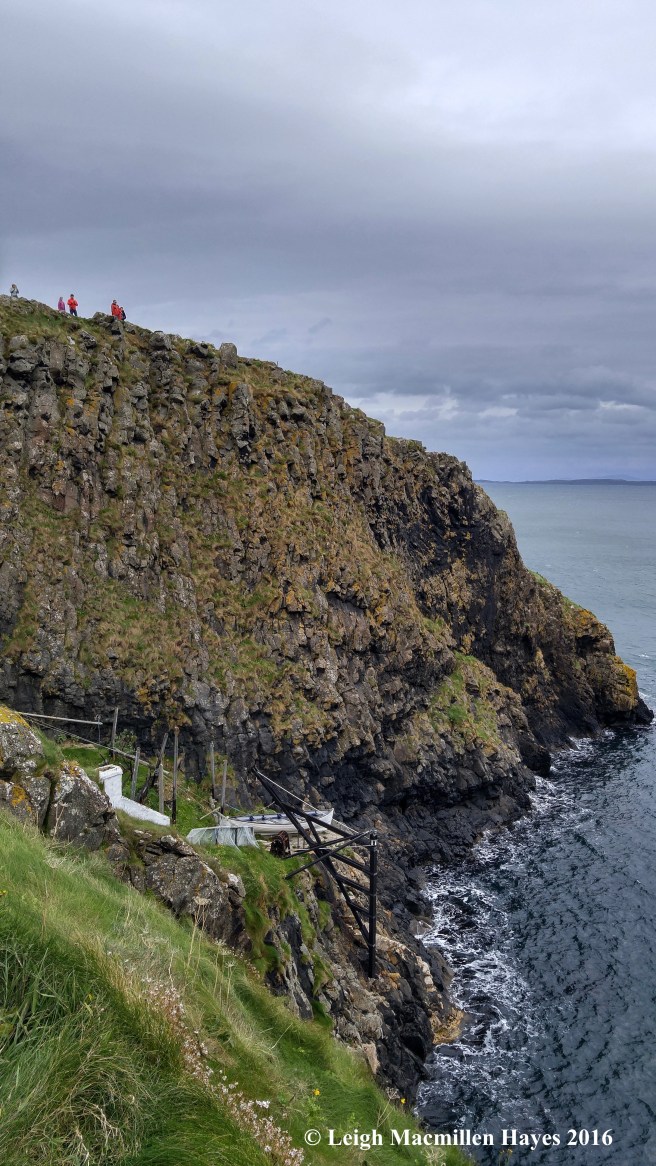
Our next stop, Portrush, a resort town along the Atlantic and on the northern fringe of Ireland. After checking in at the Antrim House B&B, we headed off along the Coastal Scenic Route to Carrick-a-Rede Island. Carrick-a-Rede is from the Scottish Gaelic term, Carriage-a-Rade, meaning the rock in the road.
salmon-boat-at-carrick-1

And the road is presumably the sea route for Atlantic salmon that were once fished here prolifically. In fact, so prolifically, that the fishery is no longer viable. In order to reach  the best places to catch the migrating salmon, for 350 years fishermen crossed regularly to the island.
rope-bridge

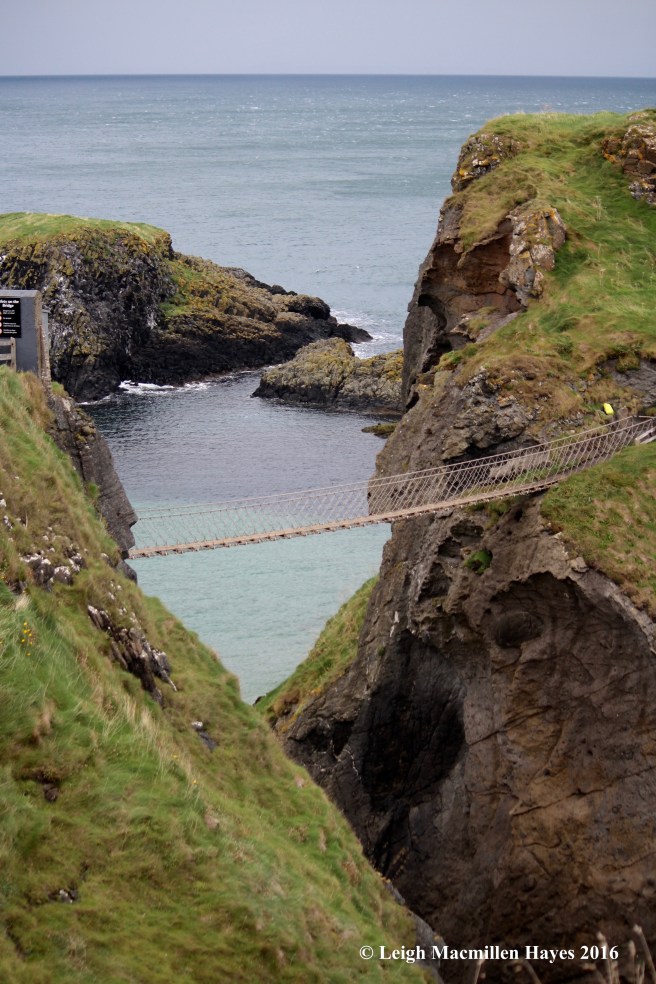
One hundred feet above the sea, the fishermen crossed the 60-foot chasm via a rope bridge to check their nets. Of course, they had only one rope, not the steel and plank structure that we crossed. That being said, it was quite windy and the bridge did sway.
smiling-from-the-carrick-a-rede-rope-bridge

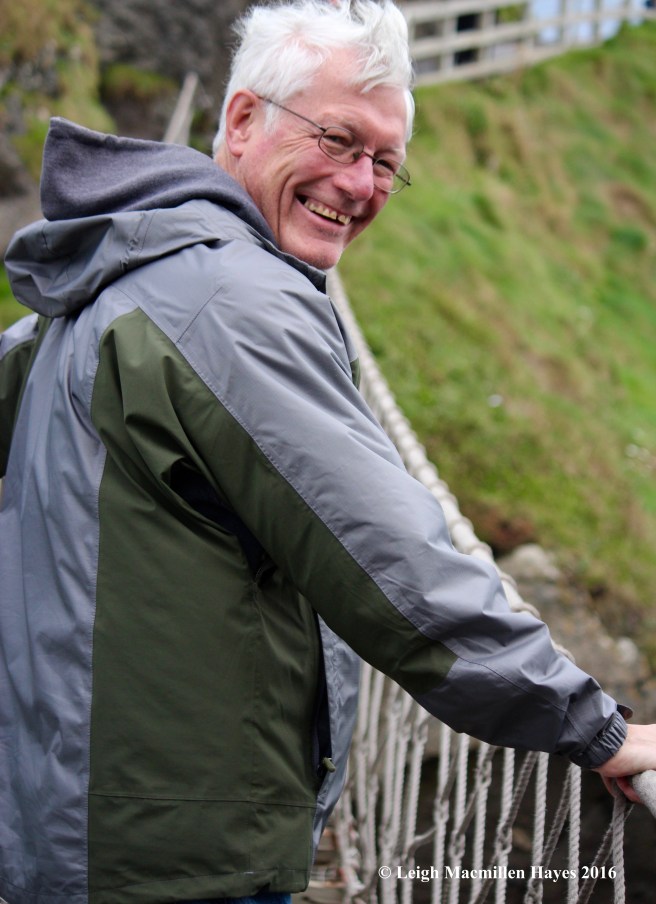
We put our fear of heights behind us and made our way across.

allen-at-carrick-3-1

Did he just do that? Yup.

me-at-carrick-1

And I followed.

scotland-2

Our views included Raithlin Island, the northernmost point of Ireland.

giants-causeway-1-1

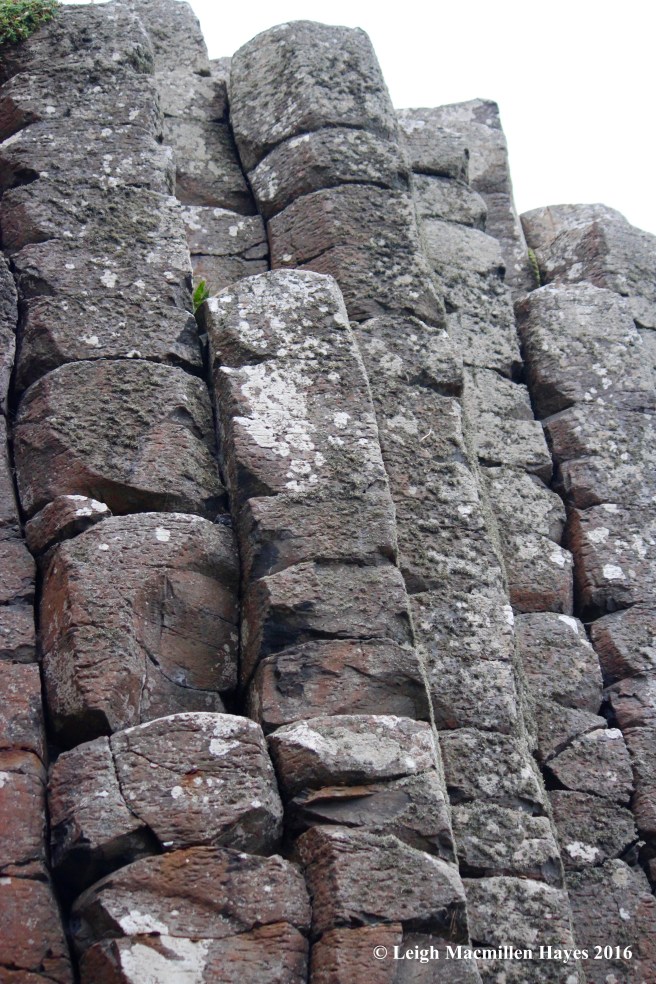
Our next wonder–the Giant’s Causeway, a geological phenomenon of 40,000 basalt stone columns formed by volcanic eruptions over 60 million years ago.
giants-3

giants-6

These hexagonal tubes stacked together like cans on a shelf offer yet another mystical and magical look at the world, one that the Irish embraced by creating legends to explain their existence–Fionn mac Cumhaill (Finn MacCool), an Irish giant, was challenged to a fight by the Scottish giant Benandonner. Good old Fionn accepted said challenge and built the causeway across the North Channel so that the two could meet. There are two endings so take your pick: In one version, Fionn defeats Benandonner, but in another,  he hides from Benandonner because he realizes his foe is much bigger. Fionn’s wife, Oonagh, disguises her husband as a baby and tucks him in a cradle. When Benandonner sees the size of the “baby,” he fears that its father, Fionn, must be the biggest giant of them all. Benandonner flees back to Scotland in fright, but makes sure to destroy the causeway behind him so he won’t be followed by Fionn.
causeway-view

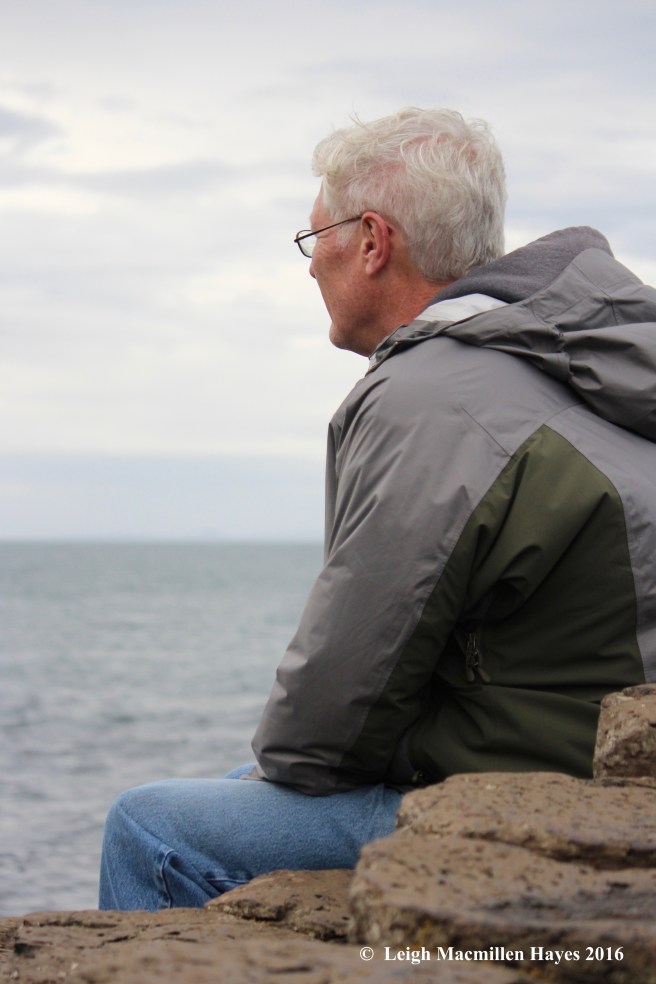
My guy found a spot to take in the giant’s viewpoint.

dunluce-castle-2-1

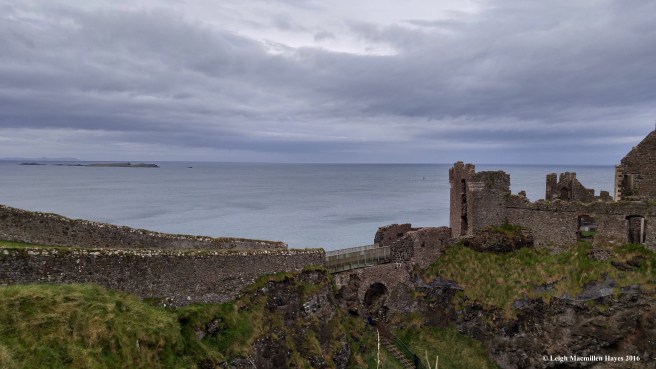
As we made our way back toward Portrush, we paused at Dunluce Castle. We couldn’t go in because it had closed for the day, but we could still see part of the castle town that was developed in the early 1600s.
dunluce-castle-1-1

Originally built by one clan in the early 1500s, it was seized by another in the mid 1500s. Its history includes rebellions and intrigue.

dunluce-castle-wall-over-cliffimg_7377

Included in its dramatic history are tales of how the castle kitchens fell into the sea one stormy night in 1639. We couldn’t help but wonder if the same happened to the wall.

portrush-2-1

Back in Portrush finally, our own tale continued. At the suggestion of our hostess, we walked to the Harbour Bar for dinner.

wee-harbor-bar-ryder-cup-trophy-1

While we waited for a table, we paused in the wee pub, as they call it. A few minutes later, two guys walked in with a trophy and made a big fuss about its placement among the best bottles of whiskey.

darren-3-1

At the time, I was standing to the right of the gentleman in the middle and so I asked him about the trophy. He explained that when you participate in the Ryder Cup you receive a replica. My guy immediately realized that I was talking to a famous Irish golfer, he just couldn’t put a name with the face. On the wall above, we could see photos of him, but we weren’t close enough to read the signatures.

allen-as-darren-1

It turns out we were in the presence of Darren Clarke, the European Ryder Cup captain for 2016. We didn’t know that until we went to check on our table and asked. One of the bartenders encouraged us to stay for the send-off, so we did. Everyone donned a D.C. mask (at 00:16, if you look quickly to the back left, you might see my scraggly hair behind a mask)–and sang “Shoulder to shoulder, we’ll answer Darren’s call.” We were included as the North American entourage.

allen-and-willie-2-1

allen-and-willie-1

While I got Darren’s autograph on one of the masks, my guy befriended Willie, the bar manager.

portrush-2

The next morning, after a traditional Irish breakfast, we toured the downtown. Ireland amazes us–the temperature was chilly and yet the flowers were gorgeous. And palm trees grow throughout the country.

walk-to-murlough-bay-with-fairhead-in-background

Upon our departure, our hostess suggested we follow the coastal route to Murlough Bay and so we did. And took a wrong turn that lead down a dead-end to a gate with a sign warning us that guard dogs were on site. With caution, my guy backed up the lane until he could turn the car around. Our hostess had also told us not to park at the upper lot for Murlough Bay, but instead to drive down. I insisted upon the upper lot given that the road had at least a 10% pitch. So we walked down. And down. And down some more.

fairhead-murlough-bay

Upon our descent, the light at a distant lighthouse beckoned in the background as Fairhead came into view.

murlough-bay

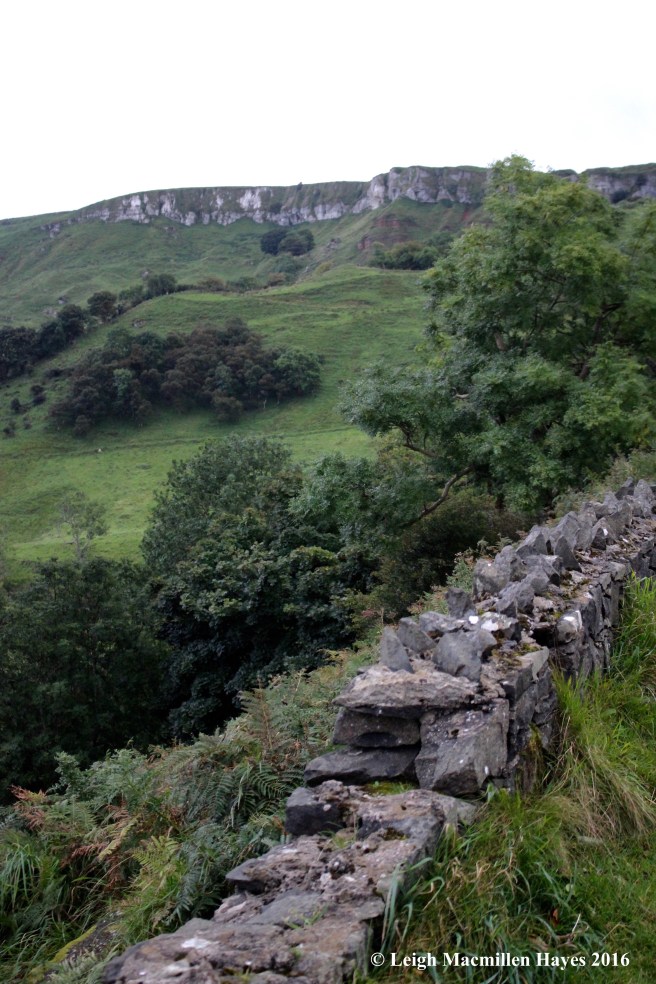
The coastline was as dramatic as we’d been promised. And I was glad we’d walked because the drive would have been even more dramatic with Hyacinth in the passenger seat.
stormlands

This area may appear familiar to viewers of Game of Thrones–including the site of Stormlands.

traditional-music-in-belfast-1

After a hike back up the road, we drove on to take in the scenery of Torr Head. The road narrowed significantly as it twisted and turned along the coast. And then . . . we met a porsche rally. As best he could, my guy squeezed our car past them. And as soon as he could, we got off the coastal route and drove on to Belfast. It was late in the day and pouring when we arrived. By the time we parked in city centre and walked to the Welcome Center, we were drenched. And disappointed. There was no where to stay in town and we’d have to move on. But . . . then one final effort proved that a hotel was available. We should have questioned if for the price. Well, actually I did, but we were told that it was a fine place and served as a conference center. So we took it. And couldn’t wait to get out of there. Fortunately, we found some Irish music back in town and a delightful meal of locally harvested food. All we needed to do was sleep in the rathole, though even that didn’t work so well.

nomadic-1

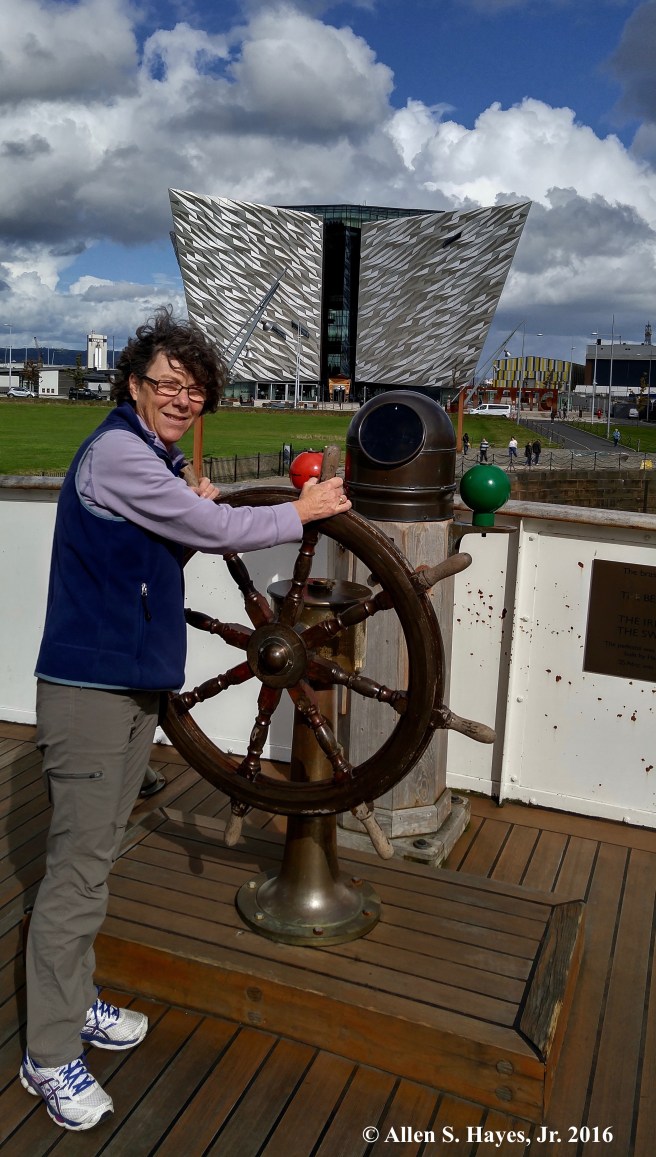
The next morning we took in the Titanic Museum and stepped aboard one of its tenderfoot boats, the Nomadic.
me-nomadic-2-1

A dose of coffee and I was ready to take the helm. And if you are wondering if it’s windy every day in Ireland, the answer is yes. It also rains at some point each day. Our time in Northern Ireland was over, but except for that one accommodation, we’d had a wonderful and wonder-filled time.
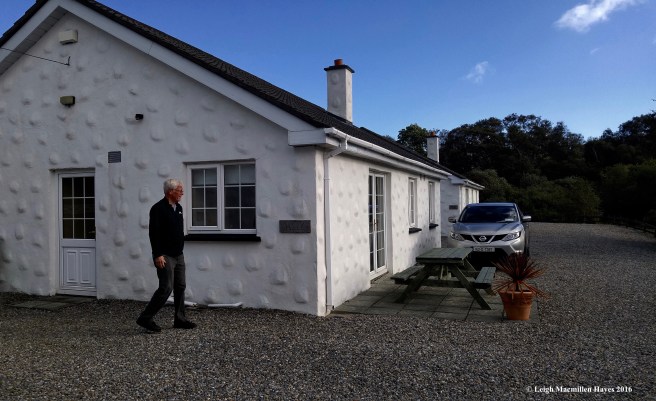
holly-cottage-laragh-1

As we worked our way south, we spent a night at a delightful B&B in Navan, which featured  more traditional music and a place to relax. On Monday morning, we finally headed to the cottage we’d rented in the town of Laragh–Glendale Holiday Cottages–we highly recommend. Our host, Christy, was extremely accommodating, the cottage spacious and amenities plentiful.

ww-monastic-city

We’d chosen this location because it was a five minute walk to the pub and restaurant in Laragh, located in the Wicklow Mountains, and near the Glendalough monastic settlement founded by St. Kevin in the sixth century.

round-tower-glendalough

Forty shades of green and Brigadoon all came to mind as we approached the monastic settlement and its round tower.

st-kevins-church-glendalough

St. Kevin’s kitchen is actually a 12th century church, so named because it was believed that the bell tower was a kitchen chimney. Apparently, however, no food was ever cooked there. But . . . if you think of the word of God as food, then perhaps many a feast was actually served.

ww-monastic-cathedral

From the altar window in the cathedral, the largest of seven churches within the monastic city,  a view of the world beyond was offered.

st-kevins-monastery-glendalough-1

Likewise, we could see the world within, including the Priest House in the background.

monastery-cemetery-glendalough

And everywhere, gravestones told the story of many who’d passed this way.

trinity-church-glendalough-day-3

A little closer to Laragh, Trinity Church.

upper-lake-3-glendalough

Upper Glendalough was the jumping off point for our initial hike upon the Wicklow Way.

p-falls-2-glendalough

We paused beside Poulanass Falls before zigzagging our way up the first trail.
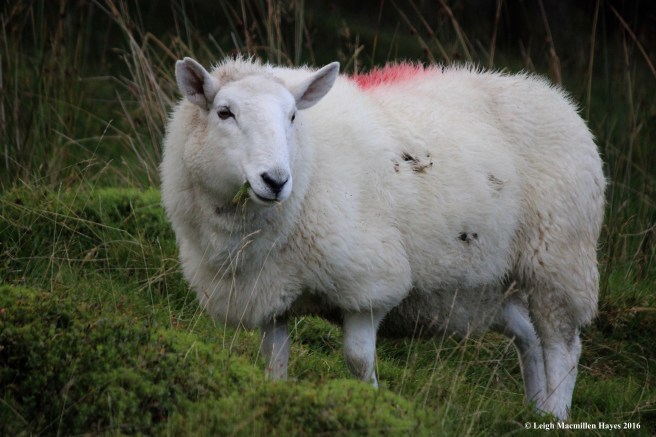
sheep-wicklow-way-2

Sheep merely looked up to acknowledge our passing. We, however, needed to pay more attention for sheep shit was prolific.

reforestation-wicklow-way

Tree felling was also a frequent sight, but we noted a unique (to us anyway) method of reforestation–in this case the Sitka spruces and Scots pines being felled were replaced by mountain ash saplings. One other thing we wondered about–the plastic sleeves–we saw some that had fallen away as trees grew, but were left in place. Biodegradable? We could only hope.
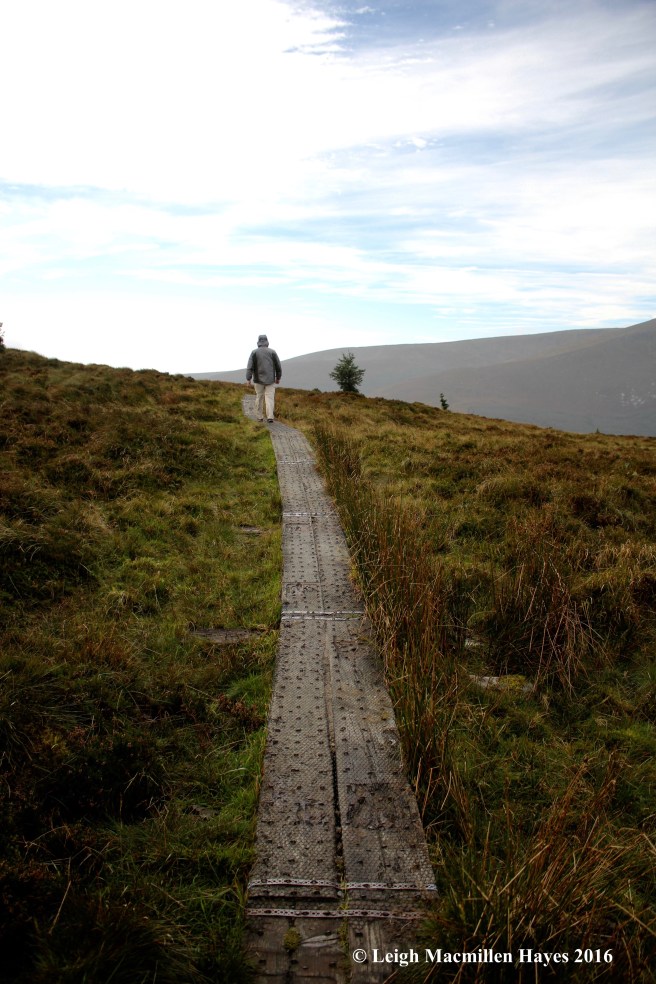
wicklow-way-bog-day-1

We spent three full days on the trail, not covering all of it, but a good portion as we hiked 10-15 miles each day.
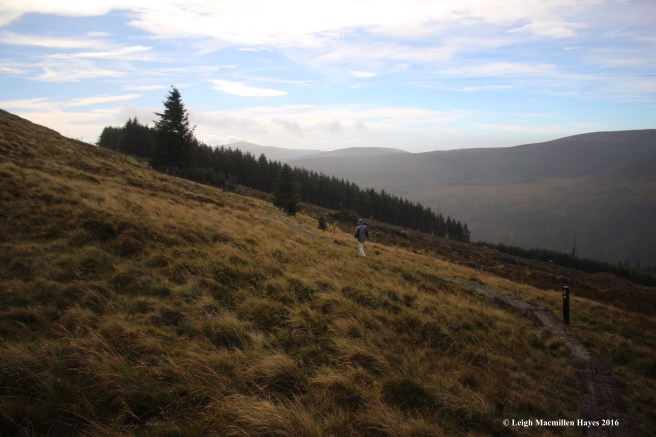
crossing-bog-wicklow-way-day-1

Our journey took us over boggy portions,
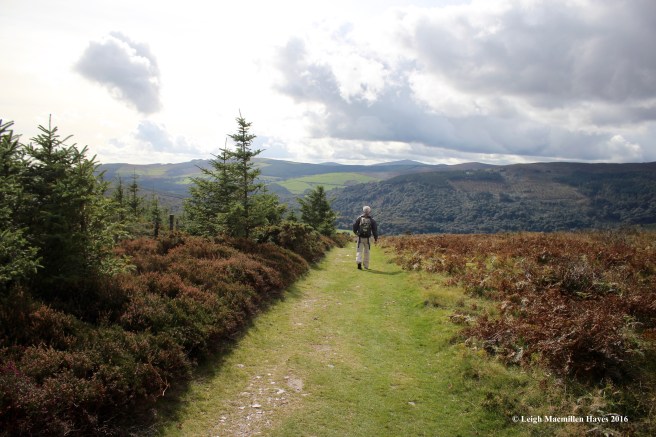
wicklow-way-day-3

down grassy sections,

w-lane-2

on village lanes,

ww-boardwalk

over boardwalks,

ww-forest-path

through the black forest,

w-walking-into-the-sky-day-3

and into the future.

ww-following-the-signs

Frequently, we had to stop, reread the directions and study the map, but more often the route was self-explanatory.

ww-muddy-trail

Along one section that was particularly muddy due to frequent horse crossings, we made a discovery unique to us.

w-badger-print

A badger print. Sadly, or maybe happily to locals, we saw a dead badger on one of the lanes not far from this print. Related? We’ll never know.
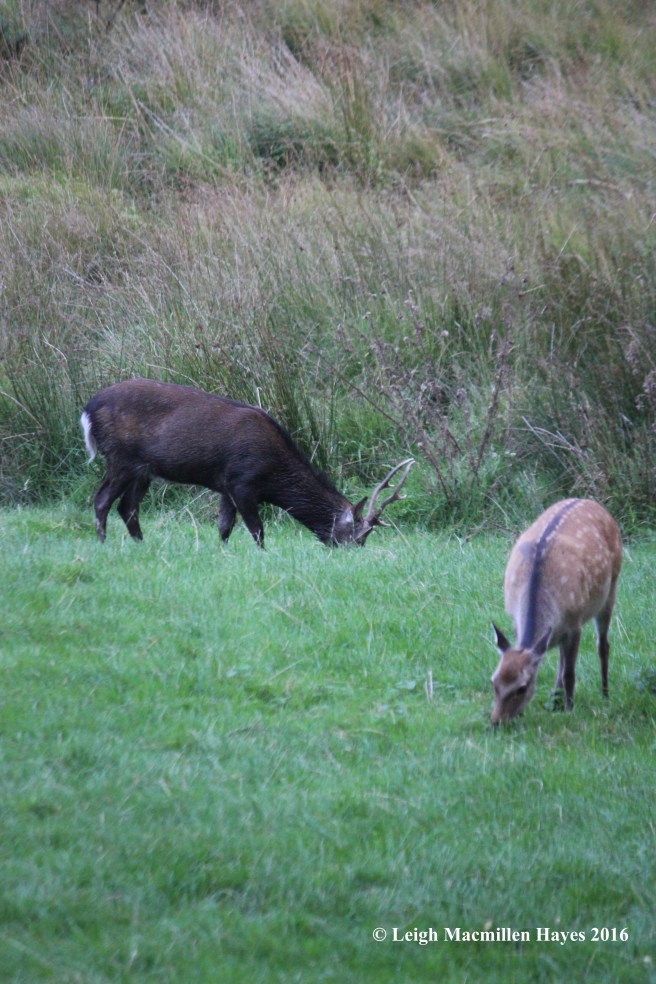
w-deer-at-glendalough

We saw deer, one rabbit and two red squirrels.
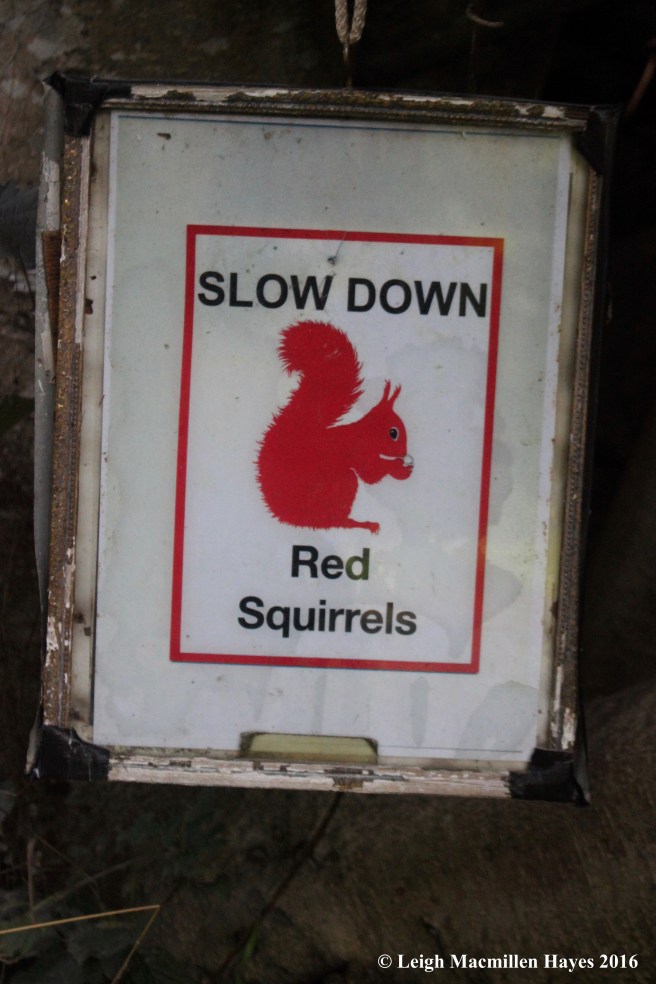
Red Squirrel sign, day 3.jpg

Writing of the latter, we chuckled when we encountered this sign because we have frequent encounters with them at home. But considering we only saw two in two weeks and spent most of our days outside, we had to wonder.
w-bessy-1

Bessie One,

w-bessy-2

Two,

w-bessy-3

and Three (pronounced Tree) tolerated our presence.

w-cow-on-wall

And Bessie Four made us laugh–as she stood upon a wall.
w-hay-in-barn

Though we passed through pasture after pasture and by many a farm and barn, we never saw any farmers, but knew that they were hard at work preparing for winter.
drinking-water-wicklow-way-day-3

And one even offered us nourishment.

w-wooden-stile

Our path included obstacles, though most were easy to overcome from a rope loop
w-stile-step-wicklow-way-day-3

to a simple step or

w-another-stile

ladder crossing.

w-bull-sign

Only once were we uncertain. The stile was padlocked and there was no step or ladder. We finally decided to climb up over the gate in hopes that there wasn’t a bull on the other side. Usually though, a beware of bull sign announced their presence and no such sign marked that particular crossing–phew.

w-guinness-sign

Our days ended with a stop at the local pub because Guinness® is good for you. I actually overheard an older woman telling her significant other the truth behind this. Apparently, when this woman’s mother had been in hospital years before, she was given Guinness® to drink each morning and evening–perhaps for its iron content. Or perhaps just because it’s good for you.

w-dying-cow-1

One of our stops was at the smallest and oldest pub in the nation–the Dying Cow. Mr. Dolan sat behind the bar sipping a Guinness® along with us as he and my guy got into a discussion about American politics. We noted that to be a hot topic. Our reason for finding this pub was because we’d walked into Tenahely after a fifteen miler and were about to step into Murphy’s for a pint when a gentleman sitting outside started chatting with us. He suggested we head off down the road because we needed to experience this tiny bar and he would have joined us but he’d just ordered his pint and didn’t want to waste it.

w-1798-monument

We followed the directions he wrote out for us, and missed the 1798 monument at first, but retraced our route and found it. We only wish he’d then told us how to get back to Laragh. That took a while, but eventually we found our way home.

wicklow-day-3-1

Our views from the Wicklow Way were worthy of wonder.
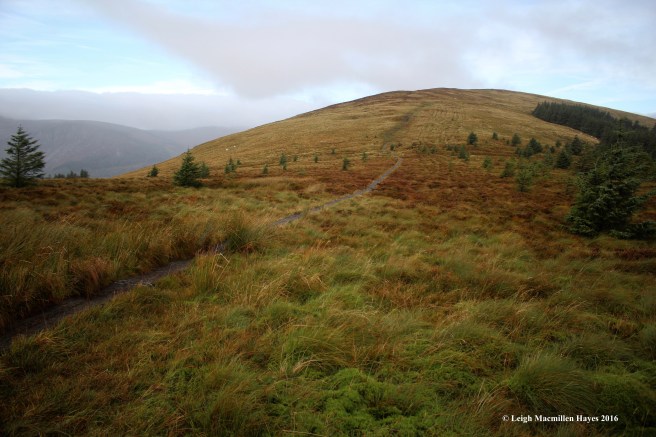
wicklow-way-day-1-3

And the ever present clouds added to the drama.

ww-greens

The land resembled a patchwork quilt.
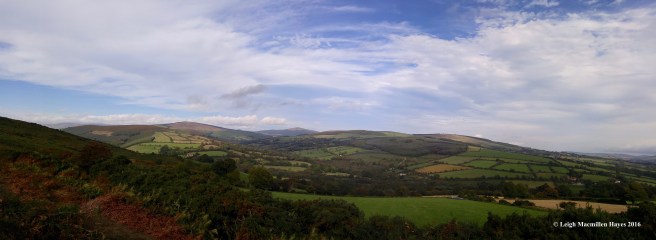
pano-2-day-2-1

No matter where we looked, it was forever changing.
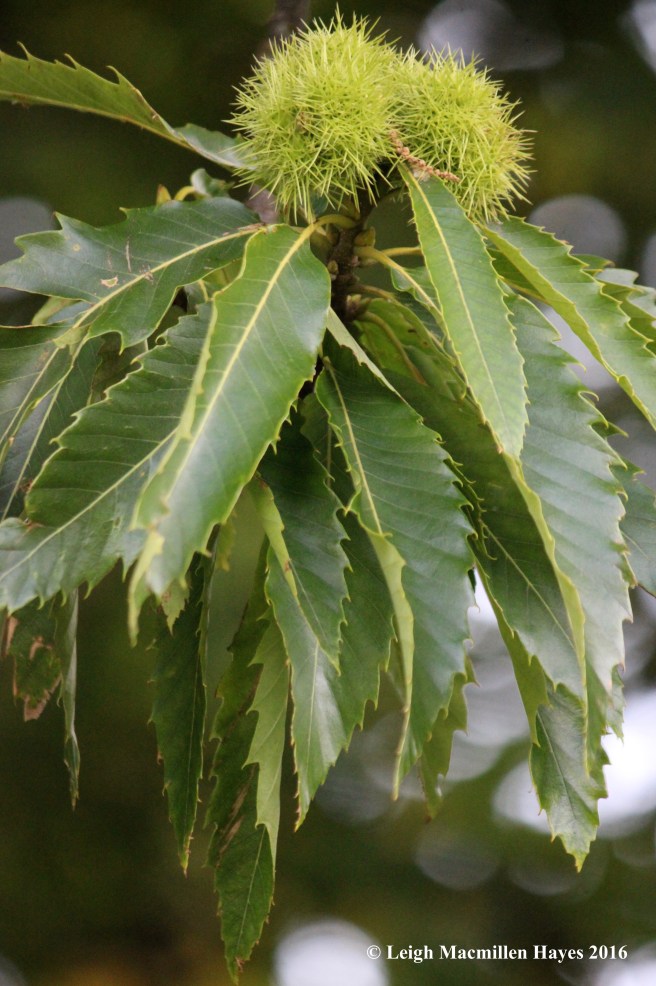
chestnuts

Some of our fun discoveries included chestnut trees,
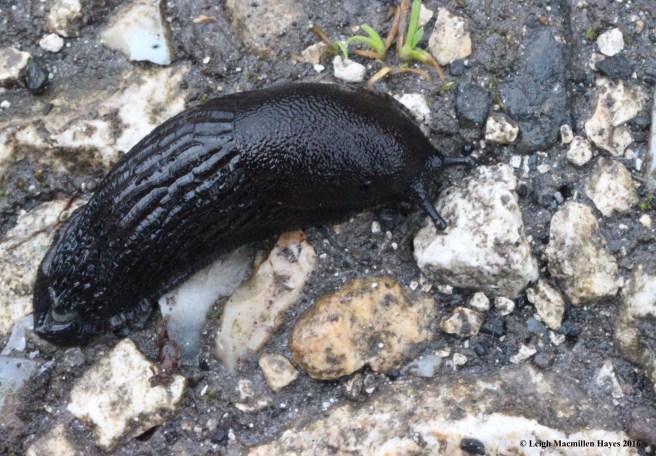
slug

black slugs, and . . .

bear-gryllz-signature

the crème de la crème–bear claw marks! Did Bear Gryllz really leave his signature on the trail behind the Glendalough Hotel?

wicklow-and-the-irish-sea

When we weren’t hiking, we explored the area, including Wicklow and its stone beach.

wind-turbine-boat-wicklow-harbor

We didn’t understand this ship at first until my guy asked–meet Wavewalker, a maintenance boat for Ireland’s Offshore Windfarm.

wicklow-harbor-other-side

Across the harbor, we spied the remains of a castle that invited a closer look.

wicklow-castle-2-sky-and-water-reflection

It seems Black Castle was constantly under siege and totally destroyed in 1301. And yet–I felt a presence still there.

castle-wicklow-face-in-turret

Do you see his face?

avoca-chairs

The oldest mill in Ireland also drew our attention–Avoca Handweavers Mill was established in 1723.

avoca-socks

It was the home of color with attitude.

avoca-yarn-5

Upclose and personal, we saw the inner workings.
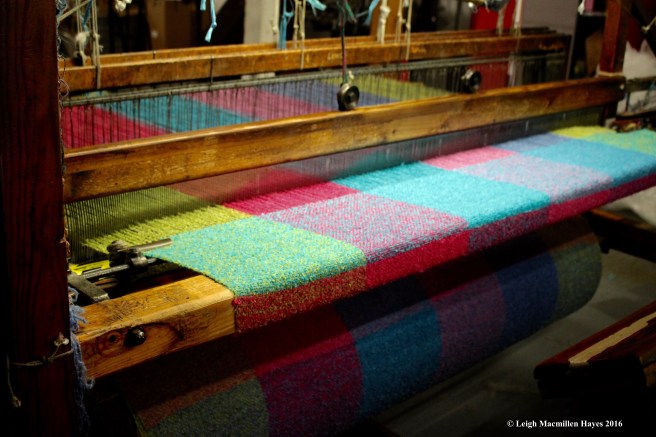
avoca-yarn-2

And marveled at the creative results.

carlow-castle-towers

Our last full day in Ireland found us in Carlow. Standing beside the River Barrow, this castle was thought to once be a stronghold and it survived attacks in the 1400s and 1600s. According to local lore, a physician set out to remodel it into an asylum in the early 1800s. As he tried to demolish the interior, he placed explosive charges near its base and accidentally destroyed all but the remaining west wall and twin towers. Uh oh.

swan-face-carlow

As happened daily, the weather quickly changed from blue sky to raindrops. Swans in the River Barrow didn’t care. They were in their element.
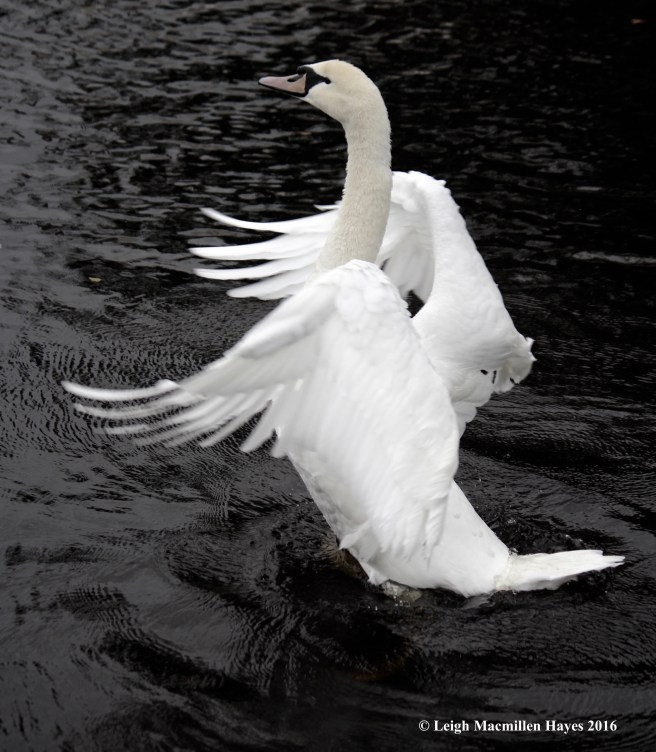
swan-stretch-carlow

My guy counted while I photographed. Thirty some odd–all wishful that we’d brought good tidings in the form of bread. Not to be much to their dismay. Despite that, we were treated to several displays.

sunset-over-carlow-1

And later that night, a display of sun and clouds as we went in search of supper.

irish-breakfast

Our final night was spent at the Green Lane B&B in Carlow where Pat and Noeleen took special care of us. My guy watched the GAA football game with Pat, their grandson Sam helped us print out our airline tickets and Noeleen made sure we had toll money for our journey to the airport. And then there was the breakfast–the finest we’d enjoyed.
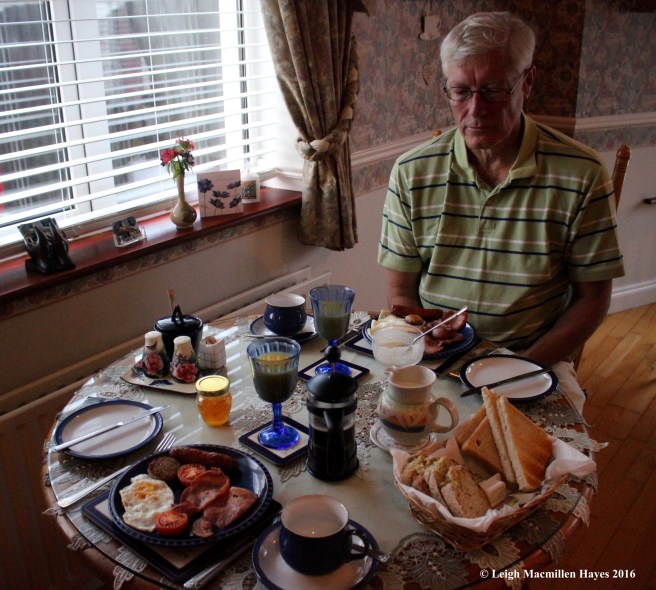
breakfast-2

Think eggs, tomatoes, mushrooms, bacon, sausage, white pudding, toast and Irish soda bread. And they wanted to know if we wanted porridge and cereal. Really?

irish-mist

Before we checked out, I made my guy drive to this field ensconced in an Irish mist.
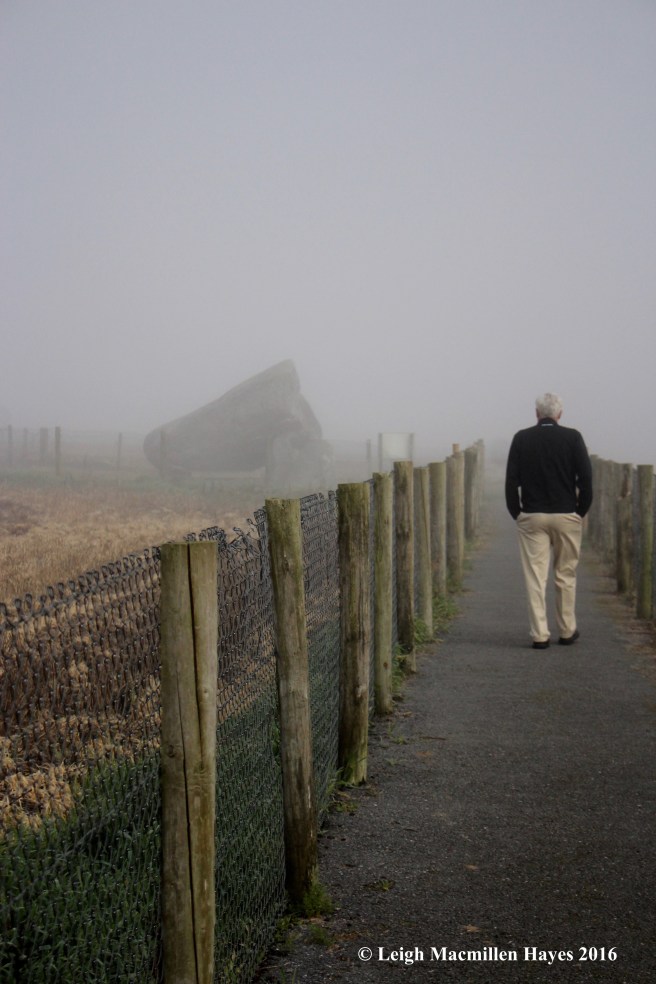
out-of-the-mist

The fog seemed apropos for our walk out to the Browneshill Dolmen. This was a burial chamber that may have originally been covered with earth.
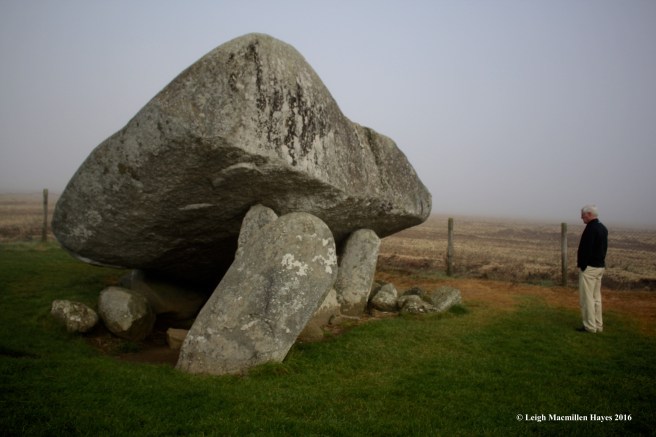
dolman-size

My guy stands almost six feet tall, so his height provided a sense of size.

dolman-2

The two more pointed stones on either side of the squared stone were known as portal stones that would have supported the granite capstone or chamber roof. The squared stone in the center was probably the gate stone that blocked the entrance. This site has not been excavated so there’s no other info about it, but just standing in its presence and considering those who came before and created such was enough.
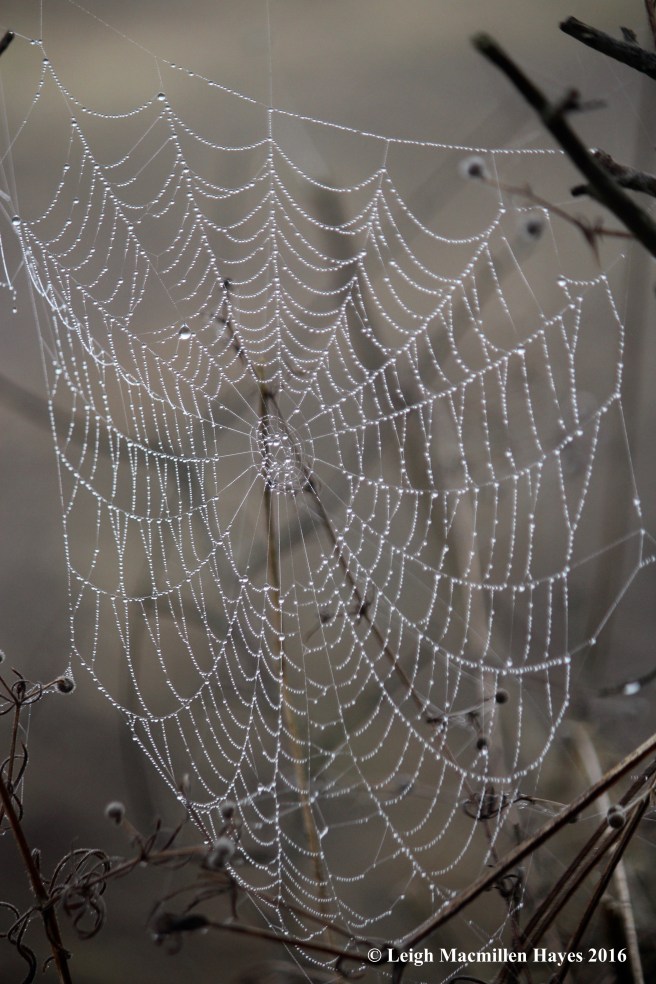
web-2

And then there were the spider webs. I’d missed them as we’d walked toward the dolmen, but they captured my attention all the way back. From prehistoric to present, the structures before us were breathtaking.
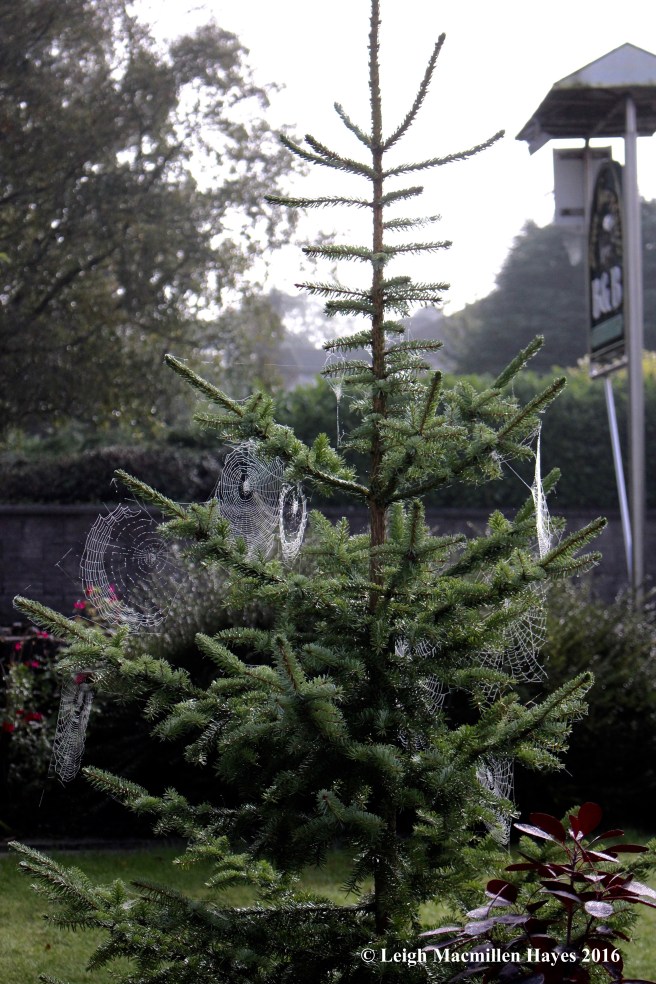
tree-webs

And when we finally pulled out of the B&B driveway on our way to the airport, I asked my guy to stop while I jumped out of the car. What a sight to behold–web ornaments. A perfect ending to our vacation.

My guy meet several roadblocks on his search for roots, but at the same time, he learned about some new avenues that may help in his quest. And I, I wished for more time to understand all that was before me from prehistoric to present–but maybe I sought answers that don’t need to be. Having the questions might be enough.

Together, we were grateful for our Hyacinth and Richard Adventure on the Emerald Isle. And glad to return the car safely to the rental agency.
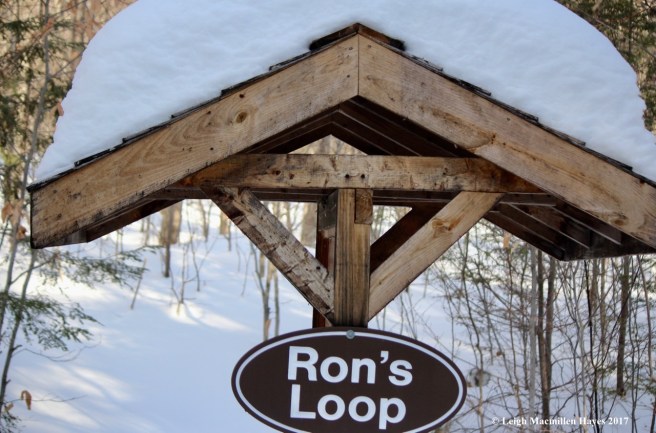


The Fruits Of Our Labor Day Mondate

I feel like a broken record when I say that my guy works too many hours, but so it has been. This was his weekend off and he worked more than a half day on Saturday and all day plus on Sunday. This morning he burned it all off with a seven mile run and then we headed off for a hike.

k-trail sign 1

Mount Kearsarge North off Hurricane Mountain Road in North Conway, New Hampshire, is an old fav that deserved a visit.

K-trail goes this way

It was great to be out of town and finally goofing off on this Labor Day holiday. He’s labored. I’ve labored (really–even when it seems like I’m playing, I truly am working, honest). And we needed a break. If we followed this blaze, however, we would never have found the summit.
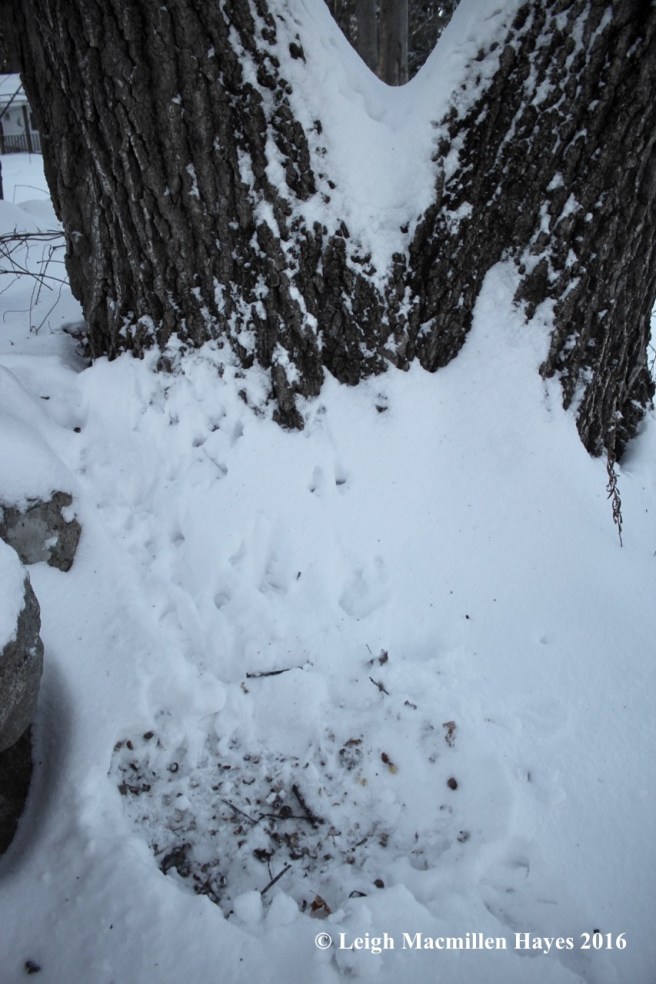
k-climbing higher

Fortunately, we knew better. The hike is challenging, especially on the upward climb. We later commented about how the downward climb is faster, but does require attention to foot placement.

K-approaching tower

Just over two hours later, we approached the fire tower at the summit. Though no longer in use, it’s obvious from the 360˚ view why a fire lookout was built at this summit. Constructed in 1909, the structure was rebuilt by the US Forest Service in 1951. Prior to the replacement of fire towers by airplane surveillance, this tower was in operation until 1968.

k-summit fire tower (1)

Since we were last here about a year or so ago, it looked as if some of the support beams had been replaced.

k-my guy at tower

Despite the cooler temps and wind, it’s always worth a climb up.

k-summit tower 3 (1)

Once inside, all was calm. And the view–to die for. It made the efforts of our labor well worth it. We signed the log before moving back outside.

k-summit view 1 (1)

I was thankful for the railing that kept me from being blown to the great beyond as I gazed toward the Baldfaces,  though the wind wasn’t nearly as strong as last week’s Mount Crawford Mondate.

k-summit Mount Washington (1)

Back on the granite, we twirled about and took in each view–including Mount Washington with cumulus clouds grazing its summit.

k-summit to ledges and moats (1)

The cloud cover varied as we looked toward the valley with Cathedral Ledge, the Moats and beyond. Because we’ve set our feet down at those various levels, we appreciated the layers before us.

k-summit toward cranmore (1)

And we noted the Green Hills Preserve, where we’ve also hiked many a trail.

K-Pleasant Mtn

The cloud cover changed as we turned toward home and saw Pleasant Mountain in the distance. Our house is located about center beyond the mountain. And our camp to the left end of said mountain.

k-summit lunch rock (1)

Of all the rocks, lunch rock was the most important find. Sometimes, it’s difficult to locate such among all the opportunities, but this one spoke to us. And so we sat. And ate. Sandwiches (not PB&J–those are more for winter fare) and brownies (great any time of the year).

k-my guy snoozing (1)

And then my guy decided to snooze. He deserved it.

k-hare scat

I took advantage of the opportunity to observe and was tickled to find these woody fruits–the milk duds of the north woods. Snowshoe hare scat. I found numerous examples and wondered where the hares hid. Actually, they could have been anywhere because among the bald rocks there were plenty of islands filled with brushy undergrowth.

k-blueberry.jpg

And so I poked about. Though the low bush blueberry plants were plentiful, the fruits were sparse. In fact, I only spotted this one.

k-mountain cranberries

More prolific were the mountain cranberries, aka lingonberries.

k-summit speckled alder (1)

What surprised me was the presence of speckled alder in the mix because I think of this as a species with wet feet, but really, this mountain top is much moister than most of our lowlands, so in the end I guess it made sense. Always something to wonder about.

k-sheep laurel fruit.jpg

It wasn’t just speckled alder that made me wonder. Sheep laurel also grew there. I know it well in bogs and even along the power line behind our house. And yet, it loved the habitat on the summit.

k-summit huckleberries (1)

The same was true for huckleberries–which I look at beside Moose Pond all summer. How can they like wet feet and a bald mountain landscape. But again, I think perhaps it’s the moisture for these mountains are often lost in the clouds.

K-mountain holly

Mountain holly also liked this habitat. Again, I’ve seen this at camp where the fruits have already been consumed. Songbirds love these berries and the supply on Kearsarge will disappear soon as migration begins. Here today, gone tomorrow.

k-wild raisins 2

Wild raisins were equally plentiful and worth admiring.

k-wild raisins 3

The berries are edible, at least for birds. But . . . if not consumed, the fruits shrivel up–thus the name of wild raisin.

k-trail sign 2

At last, my guy awakened and we picked our way among the rocks and roots on our descent.

K-oak plum gall (1)

At least one more fruit showed its face on the downward route. Or was it a fruit? Actually not–it was an oak plum gall created by a wasp.

We talked about Labor Day as we climbed down. Labor Day is a tribute to the contribution of those who work and contribute to the strength, prosperity and well-being of our country. We gave thanks to our parents and the work ethic they taught us. And we noted the fruits of labor we saw in the natural world.

Finally, we toasted all with a beer at Delany’s Hole in the Wall in North Conway–a Shock Top for him and Tuckerman’s Pale Ale for me. On this Mondate, we felt rewarded with the fruits of all labor.


Hiking to the Vanishing Point

My friend, Ann, and I spent today focused on points close to us, while those in the distance also drew our attention.

h-trail sign

Our chosen trail to accomplish such, Mt. Willard in Crawford Notch State Park, New Hampshire. We began on the Avalon Trail and then turned onto the Mt. Willard Trail. I kept thinking I’d last travelled this way in the early spring, but now realize it was last November that my guy and I ventured forth on a Top Notch Mondate.

h-paper birch bark

Ann had in her mind that there were several varieties of birch trees along the way. We did marvel at pastel colors revealed by the paper birch.

h-yellow birch bark

And the golden ribbony peeling of the yellow birch. But those were the only two birch species we saw over and over again. It had been a while since she’d last hiked here so the forest had changed.

h-rocky trail (1)

The trail has also changed. Somewhere stuck in my memory (despite the fact that I hiked here ten months ago) is a fairly flat, graveled carriage path. Um . . . I truly think that was the case years ago, but perhaps funding means it’s no longer maintained like it once was and stormwater has washed the trail out.

h-culvert stones (1)

The carriage road was built in 1845 by Thomas Crawford, owner and host of the Notch House in Crawford Notch. Daniel Webster and Henry David Thoreau reportedly slept there. Crawford wanted to provide his guests with an easy excursion to the summit of the mountain. Old culverts and stone diversions still mark the way.

h-hobble leaf and bud 1

One of the most predominant plants from beginning to end is the hobblebush shrub, so named because its horizontal growth pattern trips hikers, causing them to hobble through the woods. This shrub wows us in any season and right now it’s displaying its late summer colors.

h-hobble berries

On a few, we even found some fruit. I especially loved the new buds posed together like praying hands beneath the berries.

h-hobble in row (1)

And leaf displays that led to vanishing points.

h-water funnels

We chuckled to ourselves as others passed by, sweating in their efforts to reach the summit quickly. Our purpose–a slow and steady climb filled with opportunities to notice, like the funnels of water that dripped from rock to rock.

h-centennial pool

One of our favorite stops–Centennial Pool, where water mesmerized us as it cascaded over moss-covered rocks.

h-chipmunk.jpg

And a chipmunk darted about, surprising us with its close proximity–until we looked up and saw a couple with a dog. Perhaps we looked like we’d offer a safe haven.

h-narrow beech fern

We spent a lot of time wallowing in ferns because Ann has developed a keen interest in them this year. One of our fun finds was the narrow or northern beech fern, which portrayed its natural habit of dripping downward. We loved that we could ID this one by beginning with its winged attachment to the rachis or center stem.

h-artist's conk

Fungi also drew our attention. The mountain had been in the clouds as we approached, so it was no wonder that dew drops decorated this artist’s conk.

h-false tinder conk (1)

Among our fungi sightings–a false tinder conk.

h-fairy ring (1)

And among my favorites–a fairy ring.

h-purple aster 2 (1)

Though the flowers were few, we did spy some purple asters.

h-paper art

And then there were sculptures that caught our attention, like this paper birch artwork framed by moss-covered trees.

h-birch art yellow

And a yellow birch offering its own message to the universe.

h-mossy roots

Some tree roots also begged to be noticed. So we did as we acknowledged the resident faeries.

h-carriage road 1.jpg

At last we found my carriage road. Or at least something that slightly resembled it.

h-tunnel light.jpg

And then the tunnel.

h-tunnel 2

And a glimpse of the world beyond.

h-view 2 (1)

Within seconds, without a drum roll, the jaw-dropping view of the Notch enveloped our focus.

h-squirrel 2

As we ate lunch, another human-savvy critter came closer than is the norm–a red squirrel. We think he coveted Ann’s lunch–a peanut butter and blueberry sandwich with whole blueberries. Who wouldn’t?

h-mtn ash display

Mountain summits in these parts often feature Mountain Ash trees. Today, I paid attention to the pattern, including the six finger splay of its leaflet.

h-mtn ash twigs

And I couldn’t resist the contrast of color it offered against the mountain backdrop.

h-mtn ash leaf

Though we didn’t see any Mountain Ash berries, each individual leaf presented its own point of view.

h-Ann (1)

At the beginning of our hike and again at the summit, we kept hearing a helicopter. Mount Washington was obscured by cloud cover, but with her binoculars, Ann observed a helicopter with a litter. It seemed to follow the same route again and again.

IMG_5996

Our hope was that it was practice over mission. We had no idea of the purpose.

h-maple tree? (1)

At last we hiked down. One of the best parts about following the same path is that new stories await–when you can take the time to look up. And our pièce de résistance–an old snag. A beautiful old snag. Notice its vertical lines intersected by horizontal lines. We spent a long time studying and caressing this natural sculpture.

h-Sharp-scaly Pholiota (Pholiota squarrosoides) (1)

Though it appeared to be dead, life reigned.

h-sharp scaly 2 (1)

I know my mentors will correct me if I’m wrong, but I do believe this is Pholiota squarrosa, commonly known as the shaggy scalycap, the shaggy Pholiota, or the scaly Pholiota. Whatever you want to call it, it seemed to have its own vanishing point.

h-train tracks (1)

Much the same was true for the train tracks we crossed that head north toward Breton Woods.

h-train tracks south (1)

And those that lead south from Crawford’s Notch.

Thanks to Ann for today’s hike into the vanishing point, a disappearance into the woods for a visual exploration.

From Bare to Bear on Burnt Meadow Mountain

Back in October 1947, catastrophic wildfires erupted throughout Maine during what became known as “The Week Maine Burned.”

It hadn’t rained for 108 days and the dry woods were like tinder. Here in western Maine, Fryeburg, Brownfield and Denmark thought they had a fire under control, but overnight a strong wind blew and gave it new life. About 2,000 acres burned by the next night as the fire spread to the edge of Brownfield.

With the winds continuously shifting, town folks began to panic. Farmers either turned their livestock loose or herded them to neighboring towns. Others packed as many belongings as they could and evacuated.

By morning, most homes and public buildings in Brownfield were mere piles of ash. Stately places including the Farnsworth Place where Dr. Philo Farnsworth, a pioneer in the field of television, spent his summers, had burned. Churches, schools, the post office, Grange hall, library and town hall all went up in smoke–only twenty houses survived. In the end, 85% of the town was destroyed, including a mountain trail.

Today, Marita and I ventured to Burnt Meadow Mountain for a loop hike. It used to be that one had to hike up and back on the same trail, now known as the North Peak. Though that’s the shortest way up and back (about an hour each way), I for one, am thankful to the Friends of Burnt Meadow Mountain, who sought landowner permission to create a loop and spur–Twin Brook Trail and Stone Mountain Trail.

trail sign

From the parking lot and kiosk, it’s a bit of a climb to reach the trail split. We followed the blue blazes of the North Peak trail, which though it is shorter, is also the more difficult of the two.

white pine 1

Immediately we noticed that the white oaks that grow at the bottom of the mountain play host to numerous leaf miners and other insects.

white oak gall

Some are decorated with pronounced galls. I always think about how a bud protects the whisp of a leaf all winter long, and how hairy it is as it slowly unfolds and then–kaboom–the insects have to survive too. And they do. Until something eats them. And their energy passes up through the web, where it’s enhanced at each level by sun and air and rain and . . . even when life doesn’t look so good, it is.

Blueberries

As we climbed, the blueberries became more prolific. And bluer.

spreading dogbane

Spreading dogbane showed forth its tiny pink bells.

ph rocky ascent (1)

And the trail became a scramble. If I said we scampered up the ledge quickly, I’d be telling a fib. (Do people still tell fibs?) Near the summit is a section of hand-over-hand climbing. It doesn’t really last long, but in the moment it seems like forever.

ph view on way 2 (1)

And so it invites a pause to take in the view to the south and east.

ph summit view 5 (1)

The relatively flat summit is rather barren–in memory of those 1947 wildfires.

ph summit view3 (1)

We were glad it was cloudy as there are no shade trees at the top.

ph summit view 2 (1)

Our view included Stone Mountain and the saddle between it and Burnt Meadow Mtn.

ph red pine 3 (1)

Normally in the landscape, red pines stand tall and proud. At the summit, however, their scrubby form presents their features at eye level–bundles of two needles, pollen cones and older seed cones. Young red pines typically germinate and grow only after forest fires or some other event that causes tree loss.

Eastern Towhee 2

Eastern Towhee

While we took a break, an Eastern Towhee sang its metallic yet musical “drink your tea” song.

ph view on way down 4 (1)

Descending via the much longer, but a wee bit easier Twin Brook trail, we were treated to mountain views to the west.

driftwood

And driftwood. Oops. Wrong setting. But still, mountain wood can be as beautiful as ocean wood.

ph bear 5

One of our pleasant surprises was the discovery of bear claw marks on rather small beech trees. Perhaps made by even smaller bear cubs who scampered up and down a year or two ago, leaving their marks much the way we left our own today without knowing it.

ph bear 2

Further along, the hole in this older beech stopped Marita in her tracks. We noticed saw dust on the ground below. And numerous bear claw marks on the bark above.

bear 3

Another oft visited tree.

From bare to bear, Burnt Meadow Mountain in Brownfield is worth the trek. (You probably thought we saw a bear today. No such luck, but my guys and I encountered a bear on the North Peak trail on a summer day years ago. It seemed content to lumber along about fifteen feet from us–probably full of blueberries.)


Paying Attention

When she invited me to join her for a walk down a dirt road, I knew Jinnie Mae and I would make some wonderful discoveries, but had no idea what begged to be noticed.

j-ebony 15

We cruised along at a faster pace than normal as we chatted . . . and then . . . we slowed . . . down. And that’s when the world poured forth its graces.

j-ebony 18

Beside a small stream, we were in the land of numerous ebony jewelwing damselflies, their metallic green bodies, beady black eyes and jewel-outlined wings showing brilliantly as they flitted about.

j-jack1

We noticed Jack-in-the-Pulpit growing strong, proud and tall,

J-swamp candle

swamp candles lighting up the water,

j-heal all 3

heal-all beginning to bloom,

j-pyrola 2

and waxy-petaled pyrola flowers with styles curved below like an elephant’s trunk.

j-beaver 2

We stopped by a beaver pond and decided they have moved on,

j-beaver 4

but their works were still evident.

j-beaver 3

Though the lodge may be abandoned by beavers,

j-lodge 1

it appeared that someone had stopped by.

j- royal 6 (1)

On the other side of the beaver dam, royal ferns decorated the stream in their shrub-like manner.

j-royal 2

Their fertile fronds posed like crowns above their heads, bespeaking their royalty.

j- royal 5 (1)

With their unique structure, there is really nothing else that resembles the royal fern.

j-ebony3

Because we were once again by the water, we realized the jewelwings were abundant–though they seemed more blueish in color here than further down the stream. Was it the lighting?

j-ebony 13

Beside the tranquil stream, they flittered and fluttered, their wings like sails over iridescent bodies, and occasionally they settled on vegetation for a photo call.

j-spider 2

Others also settled.

j-cuke1

We pulled ourselves away–or actually, Jinnie Mae gently nudged me away and we continued our journey back, certain that we’d see sights we missed on the way down the road. There were Indian cucumbers with multiple flowers–the most I’d ever seen . . . until Jinnie May pointed out that it was really two plants. Oops.

j-cuke 2

But still, we found one with at least four blossoms, all in various stages.

j-butterfly1

She told me we’d probably see an Eastern black swallowtail.

j-butter 3

And we did.

j-spotted winter

Though it’s not time for spotted wintergreen to flower yet,

j-spotted 1

we found its seed pods atop tall stalks. For me, this was a plant I don’t believe I’ve ever seen before. (According to Maine Natural Areas Program’s Rare Plant Fact Sheet, Chimaphila maculata is threatened in our state and has an S2 ranking) Will I see it in other places now that I’m aware of it? Time will tell.

j-winter 1

We noticed tender new wintergreen leaves, but it’s the berries that made us turn back for a closer look.

j-winter 2

The scarlet berries matured last summer, survived the winter without being eaten (they taste like wintergreen in the summer, but lose their flavor and sugar count over the winter months) and have now become enlarged.

j- trailing 2 (1)

What really stopped us in our tracks–trailing arbutus. Last month, we were wowed by its gentle white and pale pink flowers. They’ve since faded to a rusty tone.

j- trailing 6 (1)

And some have transformed into swollen round seed pods.

j- trailing 8 (1)

The sepals have curled away to reveal the white fleshy fruit speckled with tiny brown seeds. It was well worth getting down on our knees to look through a hand lens–especially since ants, chipmunks and mice find these to be a delicacy so they may soon disappear.

Paying attention with and without a hand lens on a delightful spring day–we were once again thankful for the opportunity to notice . . . and to wonder.


Be Together Mondate

It took us a while to get our act together this morning, but by 10:30 we were finally at the trailhead for the Baldface trails off Route 113 in Evans Notch. Okay, so true confession, I did not want to hike these trails. For thirty years I’ve managed to avoid them, but my guy promised me this morning that if I wasn’t comfortable we could turn back at any point.

b-start sign

And so our Mondate began.

b-ph emerald 3

The first .7 miles were familiar to us as we’d passed this way many times in the past, often with friends or family in tow. The destination, Emerald Pool. A forever nippy Emerald Pool.

b-ph emerald 2

We stood above the pool today and shared memories of past visits. And the people that made those visits memorable.

b-ph emerald above

Even the water above the pool provided hours of entertainment in days gone by.

b-ph emerald above 2

Today, it was the water’s force and volume, increased since last night’s rain, that gave us pause.

But we couldn’t pause for long. We had a mountain to conquer. And so, we headed back to the main trail and at the junction followed the Baldface Circle Trail . . . until it disappeared before our eyes. We backtracked but couldn’t figure out what we’d done wrong, except that we couldn’t see trail blazes anywhere. And so we retraced our footsteps until the trail petered out again. And then we decided to bushwhack and climb uphill because it only made sense that we’d find our way. At last, success–we found yellow blazes and an obvious trail. But . . . we didn’t know if we were on the Circle Trail or Slippery Brook Trail.

Our plan had been to hike up the first and down the latter. Out came the map and compass and we were fairly sure we were on the latter trail. To be certain, we hiked a wee bit, until we came to the brook. Yup. So, decision time. Turn around and head back to the other trail or continue on because we’d already come so far. We continued on. Plan B when we didn’t even know we had a Plan B.

b-ph brook 3

And Slippery Brook held its own tribulations. The water–oh how it flowed. It didn’t bother my guy and within seconds he stood on the other side grinning back at me. Meanwhile, I hemmed and hawed. And hawed and hemmed. How in the world? I thought perhaps I should return to Emerald Pool and wait for my guy to complete the round trip. He wasn’t buying that. Neither was I, truth be told. But sometimes my head gets the better of me. He knew that. And so he dropped his pack, took off his boots and sloshed through the cold water to grab my pack.

b-ph brook crossing 2

I didn’t have a choice. I had to follow him. And so I did. Of course, this guy knows I’ll follow him anywhere.

b-lunch rock

We continued on the Slippery Brook Trail and a delightful trail it was. I kept waiting for the bald face to show, but it wasn’t to be. The worst part, if there was one, would be the mosquitoes. It poured last night and the trail was rather wet, but still, it provided a pleasant climb. We paused for lunch beside a stream where the mosquitoes abated.

b-ph mayfly1

One of the things I like about stopping for lunch, besides eating because I’m always hungry, is taking time to notice. Mayflies.

b-mtn maple1

The deeply impressed veins of mountain maple leaves.

b-sugar maple

And u-shaped lobes of sugar maples.

b-dogwood

Dogwood.

b-beech fern1

And beech fern.

b-bunch:hobble

Following lunch, we continued to climb and noticed things like the great pretender–a bunchberry posing as a hobblebush flower.

b-ph moose works

And moose works carving the greenery.

b-halfway sign.jpg

At last we reached our halfway point at 3.5 miles. I kept wondering–where is the bald face that I’ve been dreading? The Slippery Brook Trail was a delight, be it long, with no bald rocks in sight.

While we climbed, I’d not only noticed my surroundings but also planned my funeral. I know who I want to conduct the service and he’s out of town this week. I figured that was OK. My guy would just have to delay it for a bit. And I thought about who might come and how the different folks would interact with each other. It’ll be a celebration of life, of course. And people should be encouraged to get outside and notice. Maybe they could go on a group walk.

b-yellow clintonia.jpg

And then we followed the Baldface Knob Trail where the yellow clintonia grew in such abundance that my guy actually started to ID it. I’ll make him a naturalist yet. ;-)

b-lady's x2

Equally abundant were the lady’s slippers.

b-ph trail up

And then we met my nemesis. But really, it wasn’t so bad. All that worry for naught. I could do this. If we decided to hike down this way, I would survive.

b-ph first view

At last we reached our first vantage point with the world we normally inhabit spread out beyond.

b-ph hiking up

It just kept getting better, and cooler and windier–a relief for our sweaty bodies. But . . . the black flies increased significantly. I swallowed a few. All that swarmed must have been males because they didn’t bite. But they certainly were annoying.

b-ph Pleasant Mtn

As we approached the top of the Baldface Knob we recognized our neighborhood with Pleasant Mountain in the backdrop.

b-ph panoramic

A 180˚ panoramic provided half of the picture. I thought I caught the other half, but it’s not to be. South Baldface was behind us and completely doable. We decided to save it for another day because it was getting late and we weren’t certain about the trail before us.

b-ph chokeberry

Among the selections at our feet, chokeberry

b-summit mtn ash

and mountain ash.

b-hummer 3

At eye level–a hummingbird moth who moved in supersonic speed.

b-hiking down 1

And then we followed the path down.

b-ph forever view

The world stretched before us

b-ph hiking down 3

to infinity and beyond. My guy insisted that parachutes were available at this spot, but they must have been previously claimed because I couldn’t find one . . . anywhere. And believe me, I looked.

b-ph heading down

It all seemed so innocent from the top, but really, it was a scramble. A major scramble that lasted a long time until we got back into the hardwood forest. Our footing–precarious and often wet. We both have a fear of heights in open spaces. My guy has forever had such a fear–my own is newly developed and I know not its source. Oy vey. We were in over our heads, but had no choice. I kept thinking about a rescue mission, but I don’t think they show up for those who whine. We practiced our crab walks, slid and skidded and hugged rocks and trees as we made our way down this precarious trail.

b-ph lichens1

The lichens were beautiful and we got to see them up close and personal. We also practiced our trust jumps. Yup, several times my guy positioned himself to catch me as I jumped. Remember my funeral plans on the way up. I was preparing as we climbed and facing the inevitable as we descended.

b-ph lady 2

Finally, we were rewarded with a more even trail–sort of–and lady’s slippers.

b-ph chandler 5

About a mile before the trailhead, we followed a spur to Chandler’s Gorge.

b-phdirty lady

On the way out, I realized I wasn’t the only dirty lady.

Oh, and we found where we zigged rather than zagged at the start of the trail. Honestly though, we both realized that if we’d hiked up the Baldface Circle Trail, we probably would have turned back. So as luck would have it, we went the right way.

Since we were on stable ground, I mentioned my fears to my guy. He admitted he’d had the same. And when I said I was sure we’d both fall when I jumped down and he caught me several times, he said at least we’d be together.

Be together on a Mondate. That’s what it’s all about.


The Stars of Miles Notch

We only had to hike about a hundred feet along the Miles Notch Trail off Hut Road in Stoneham to discover that this was the perfect choice for a hot day in May. Well, sorta perfect. A little less heat and humidity would have cinched the deal. But, take a look:

m-moose

I heard something off to our left and tried to get my guy’s attention. He was looking down and didn’t see our trail partner at first. We found all kinds of evidence that this path was more well trodden by moose and deer, bear and coyote, than human beings. I think we both could have turned around at that point–happy for the sighting.

But . . . we continued our journey, not sure of our destination. Oh, we had a map. And actually met an acquaintance on the road who gave us an apt description as he used his hands to demonstrate the ups and downs of the trail. He was quite accurate in his description.

mph-lady's 3

There were other stars to encounter.

m-lady 1

Meet our lady friends.

mph-lady 2

Each as beautiful as the next.

mph-lady 3

They wear exotic slippers indeed.

m-rosy 3

Equally plentiful–rosy lampshades dangled below twisted stalks.

m-striped maple flowers

Another dangler beneath striped maple leaves–more umbrella-like in presentation.

mph yellow clintonia

Yellow rays of sunshine beamed up at us.

mph-trill 1

And delicate splashes of color reminded us of paintings.

m-trill brown1

We even found a darker version of the red theme. I was extremely hot at this point and had visions of ice cream in my head–chocolate, of course.

mph-gargoyle 2

Not everything was beautiful, but still, the gargoyles were amazing.

m-bear 1

And, of course, we found some bear trees. Lots of bear trees.

m-stream

We crossed several streams–respites from the heat–where we dipped our hats and washed our faces.

m-trail sign

For a while we followed the trail toward Red Rock Mountain, but it was hot and we were tired and we had to pick our youngest up at the airport, so we turned around.

I should mention that we had passenger flies, blackflies and mosquitoes for the entire journey–not biting because we were well covered in bug stuff, but  certainly annoying.

That didn’t matter because eight miles later we’d seen plenty of stars, and it’s memories of them that will stay with us.

Oh, and the ice cream–I ate Denali Chocolate Moose Tracks and my guy feasted on Orange Blossom–at The Homestead in Lovell.

Bright Eyed and Bushy Tailed

That’s how I’m feeling these days–bright eyed and bushy tailed as I soak in the sights and sounds of spring.

p-maple flower1

I love the glow of new life

p-white ash

in the morning light.

p-gold2

I love the explosion of floral sunshine

p-forget

in a variety of manners.

p-crosiers

I love the spirals of protection

p-crosiers royal1

in unison of unraveling.

p-bee3

I love the quest of seekers

p-cherry2

in search of sweetness.

p-vp10

I love the transformation of life

p-vp2

in stages of development.

p-red squirrel

I love being bright eyed and bushy tailed

p-squirrel 2

in my continuous quest.