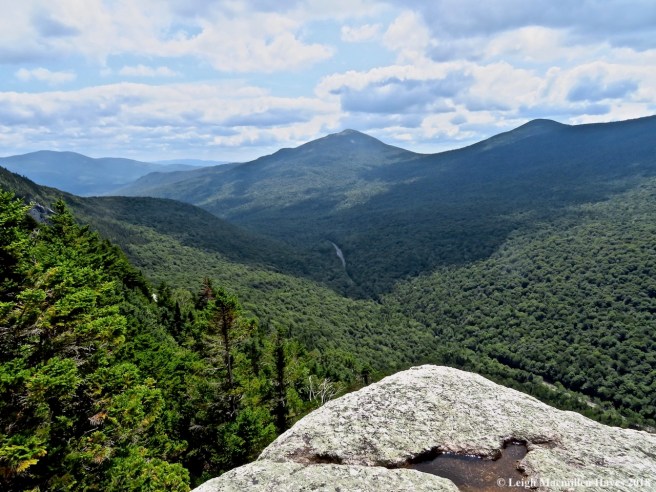
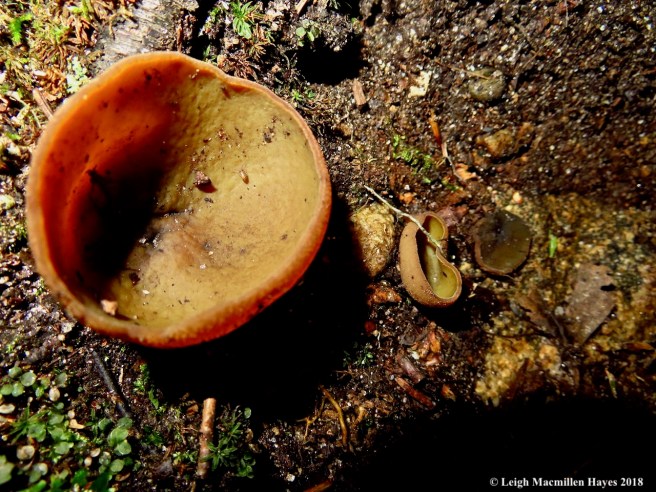
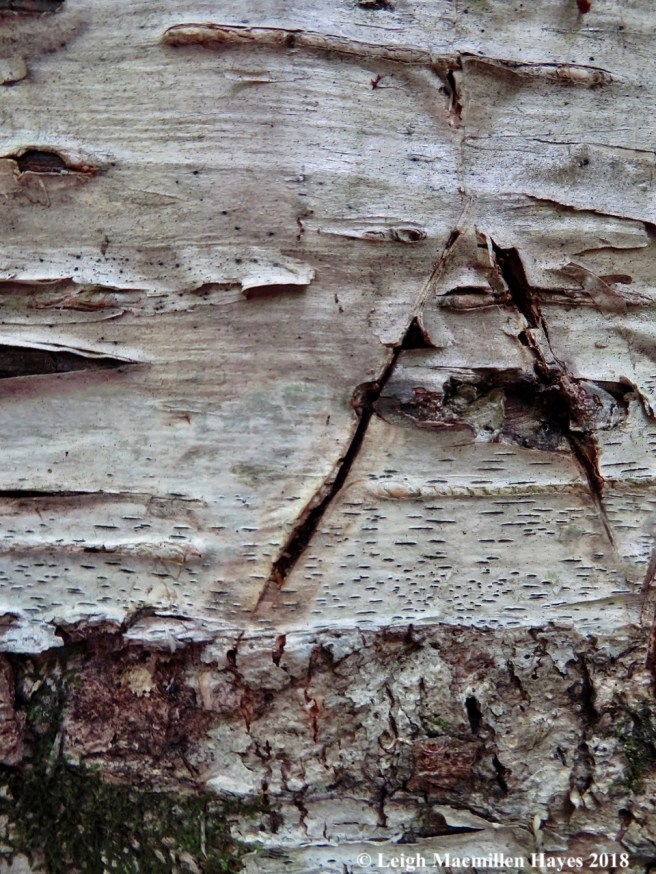
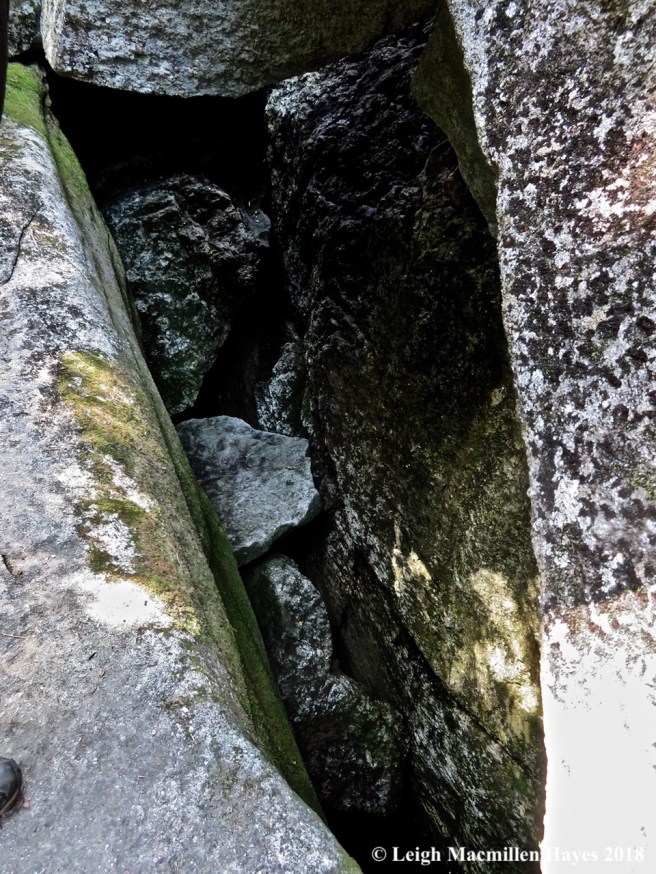
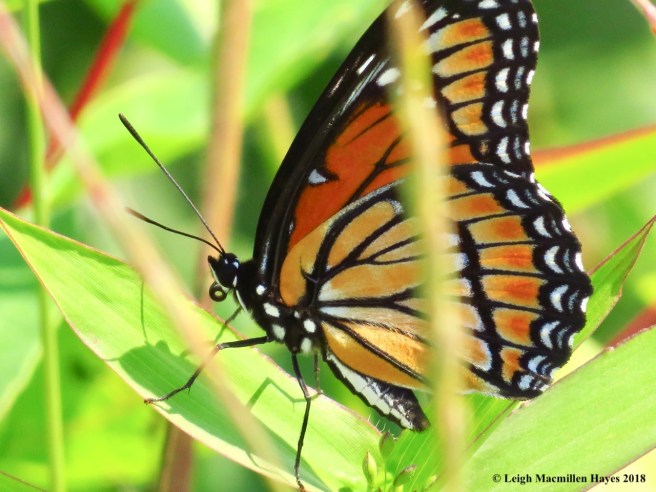
Summer Marches On

Today I attended a celebratory parade.

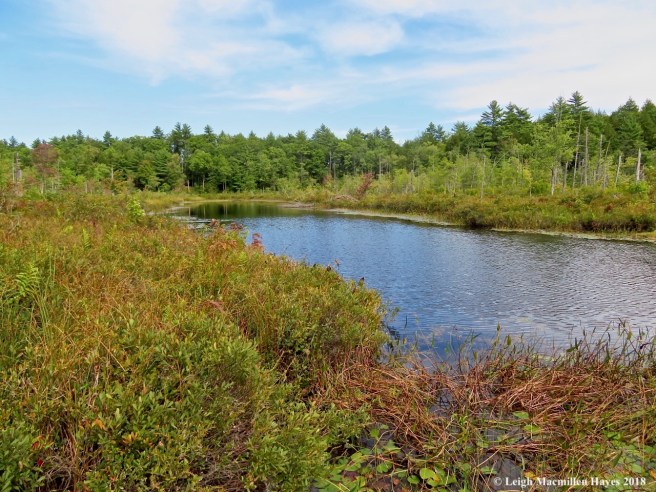
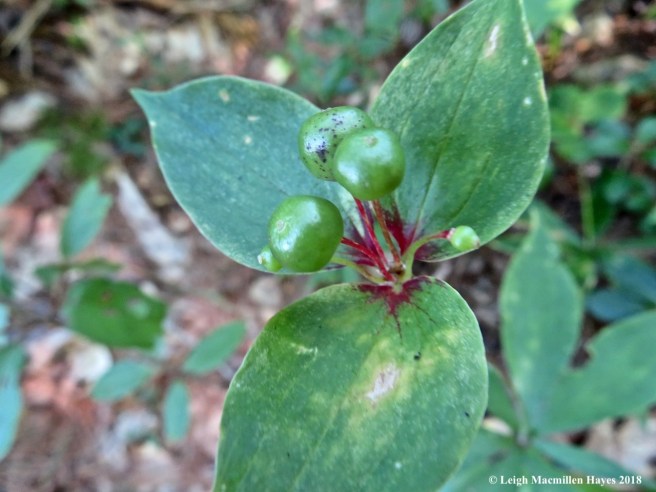
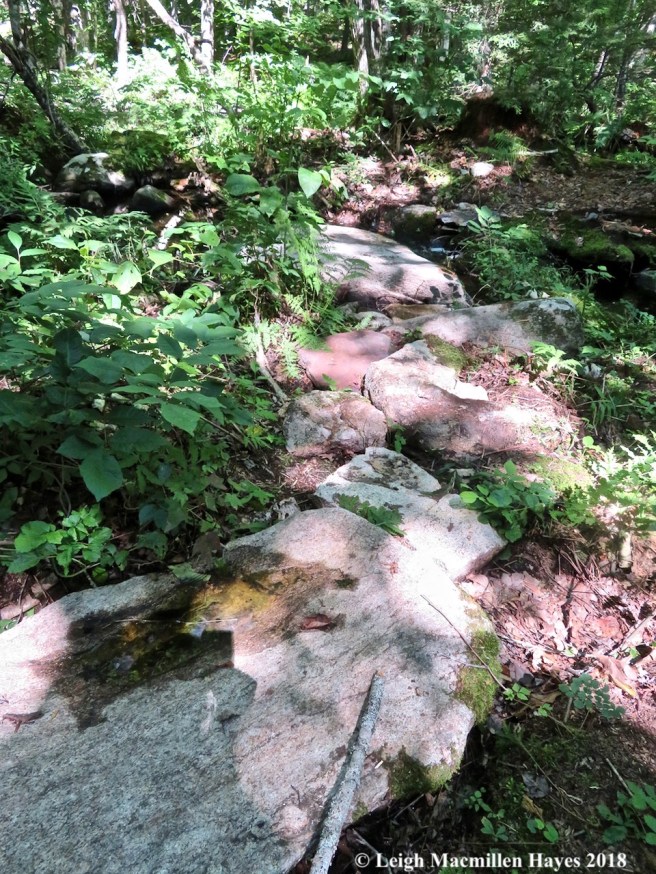
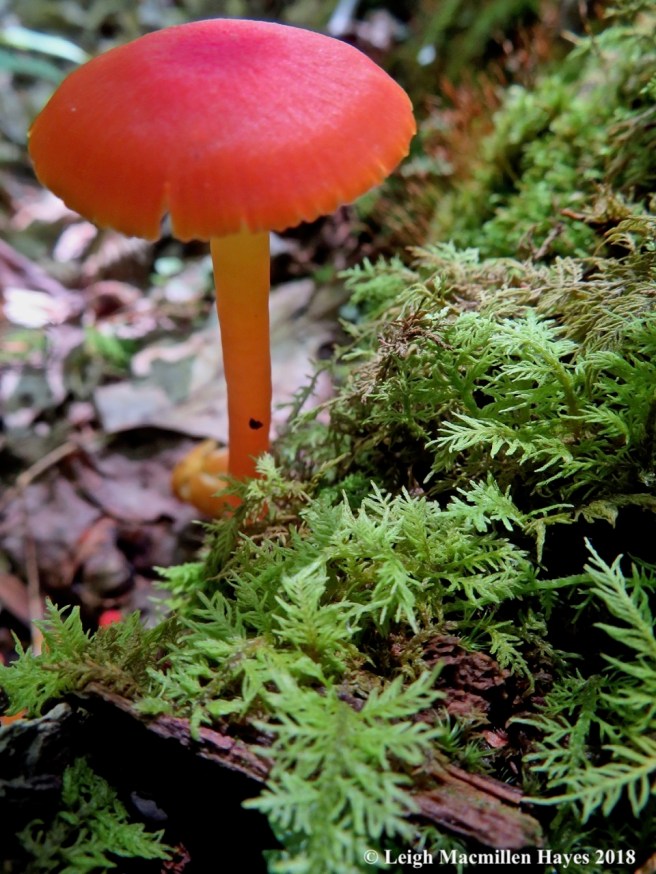
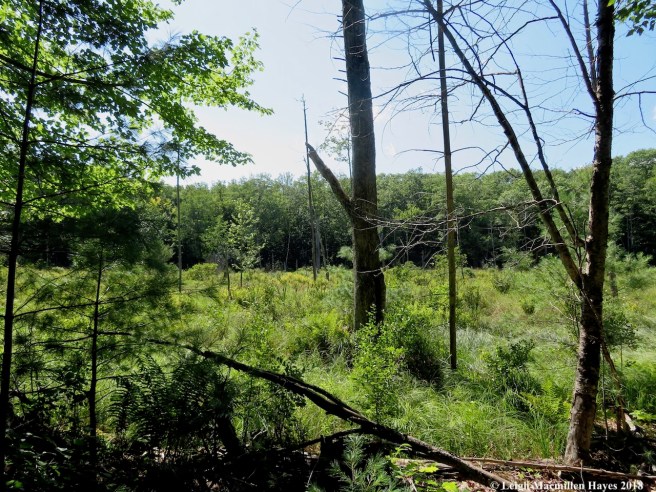
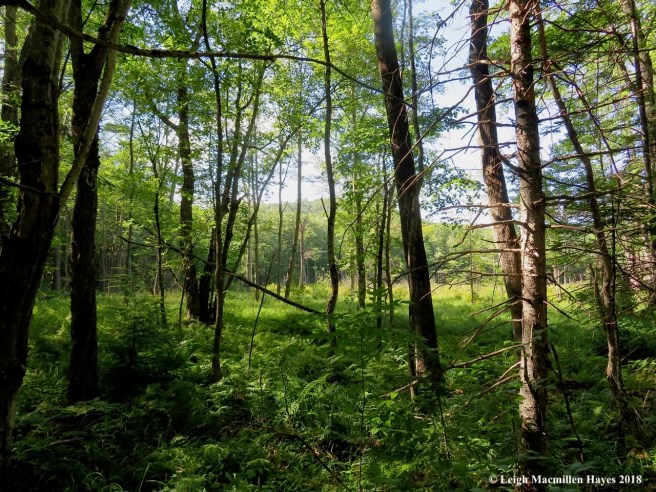
0-Subtle colors

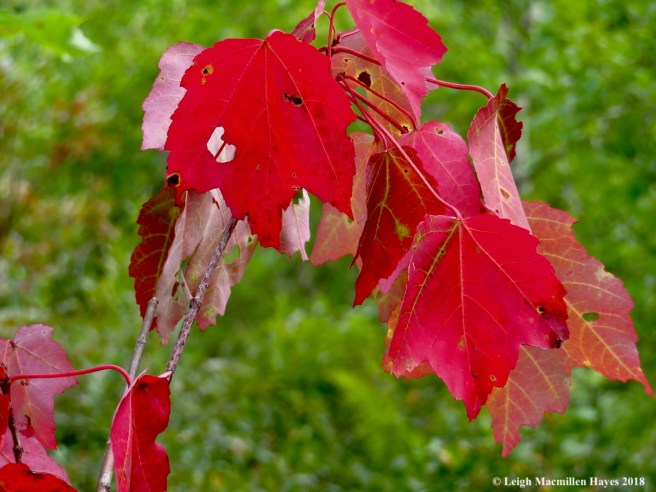
The route followed the old course of a local river and along the way the trees stood in formation, some showing off their bright new coats.

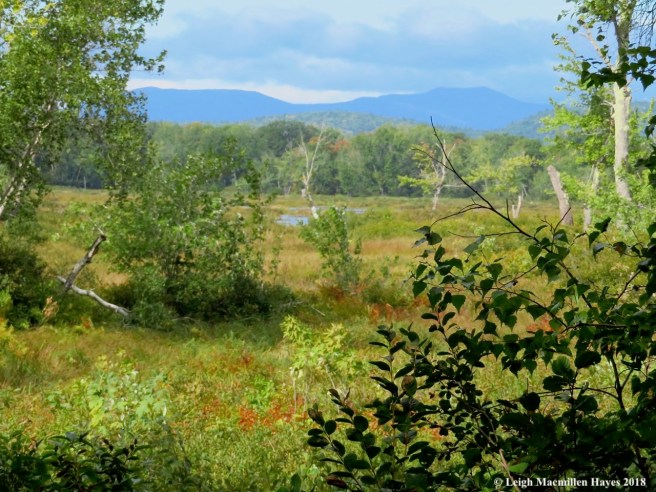
5-colors in the field

Each float offered a different representation of the theme: transition.

3-ash seed raining

Upon some floats, seeds from the Ash rustled as they prepared to rain upon the ground like candy tossed into the gathered crowd.

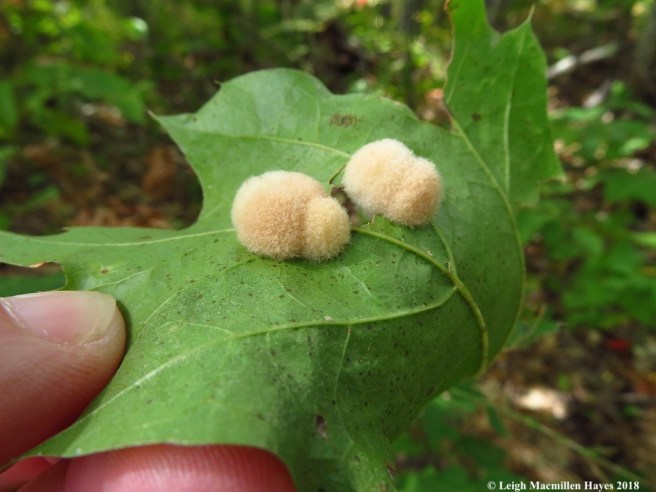
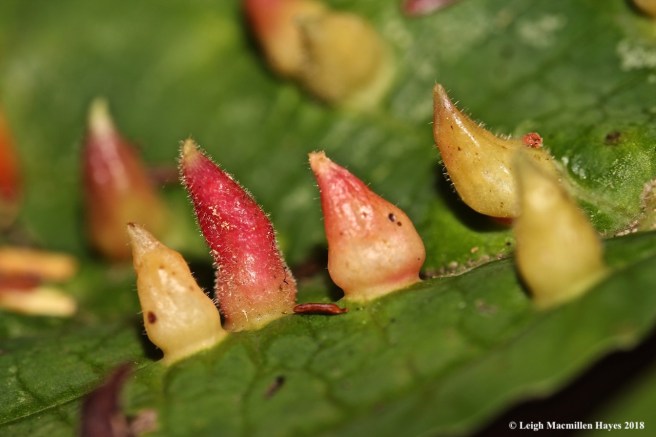
4-crystalline tube gall on red oak

Oak leaves showed off their pompoms of choice–some being crystalline tube galls and others . . .

19-hedgehog gall?

possibly called hedgehog.

8-bald-faced hornet

Playing their instruments were the Bald-faced Hornets,

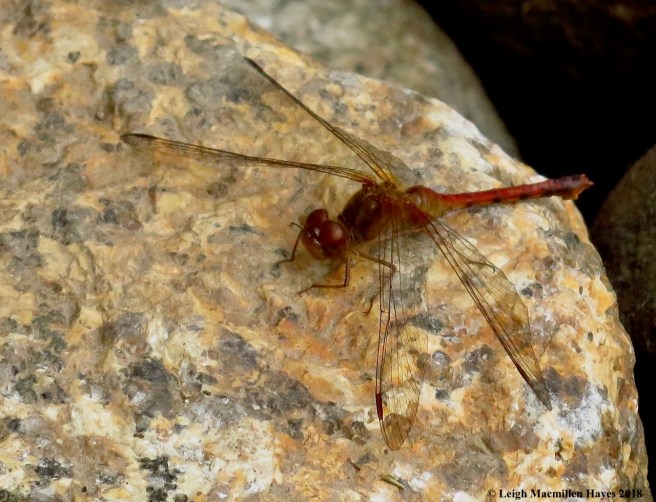
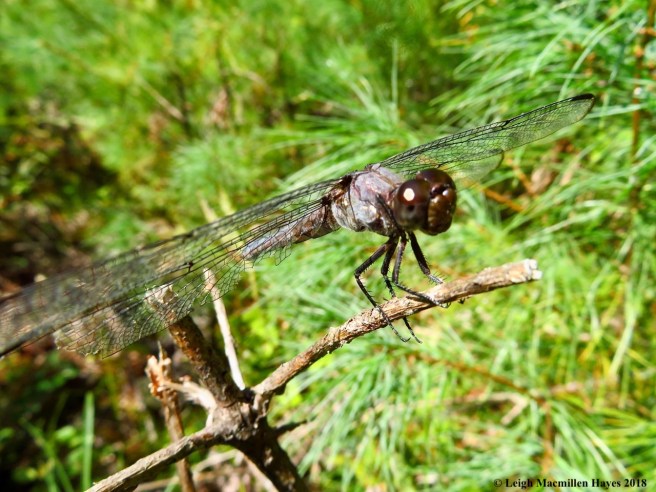
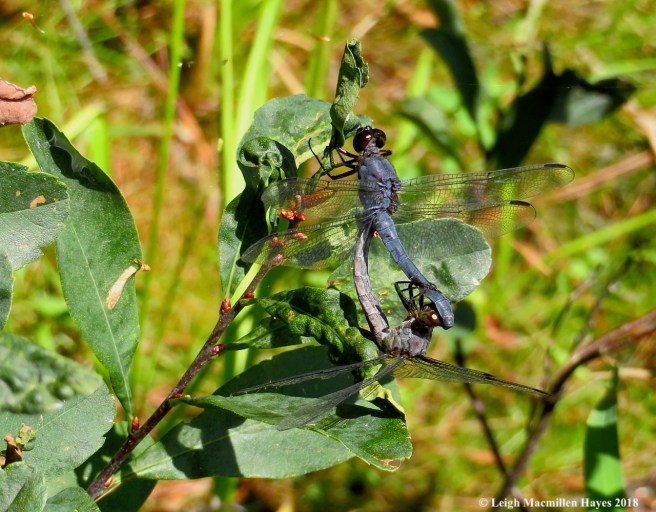
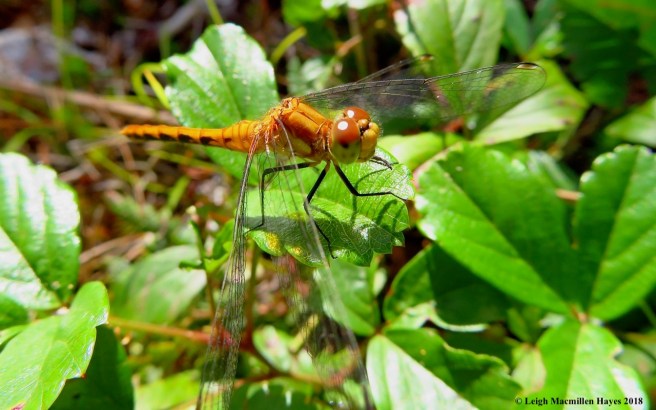
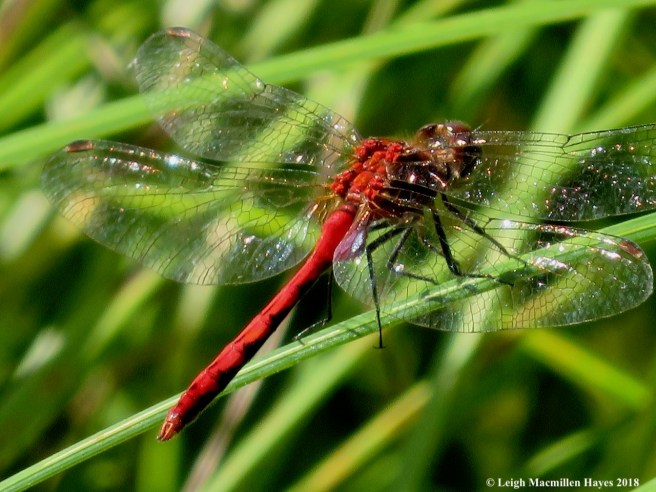
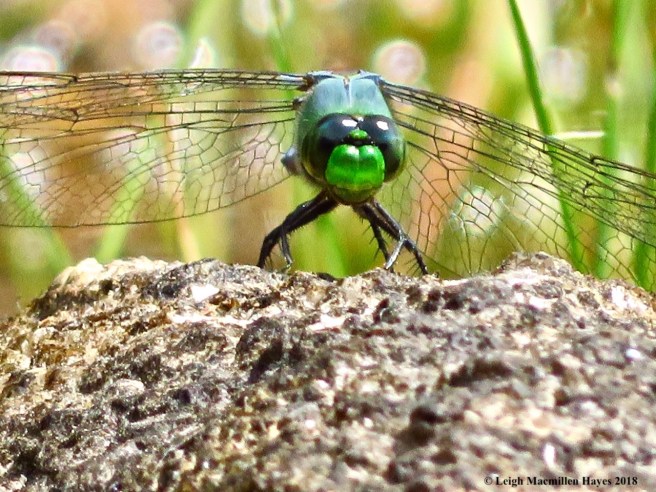
9-autumn meadowhawk

Autumn Meadowhawk Dragonflies,

11-immature green stink bug

and even an immature Green Stink Bugs.

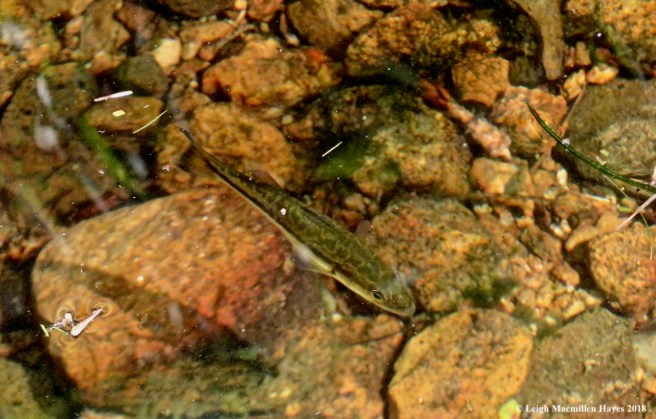
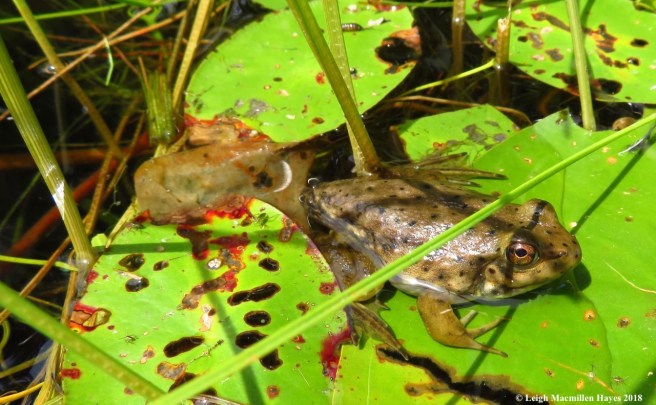
10-green frog

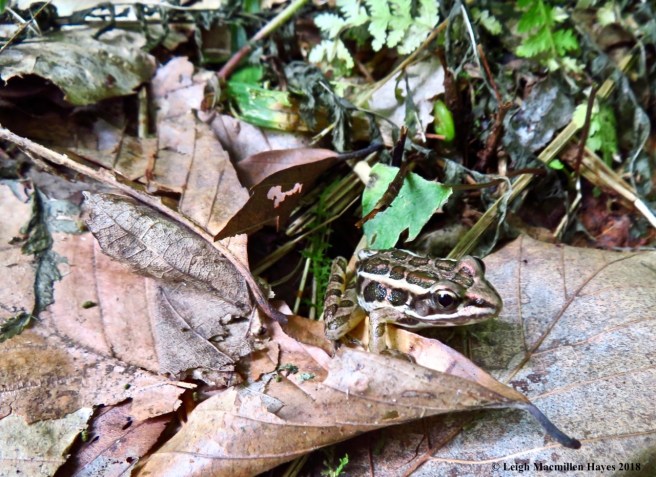
On the percussion instruments at the back of the band were the green and . . .

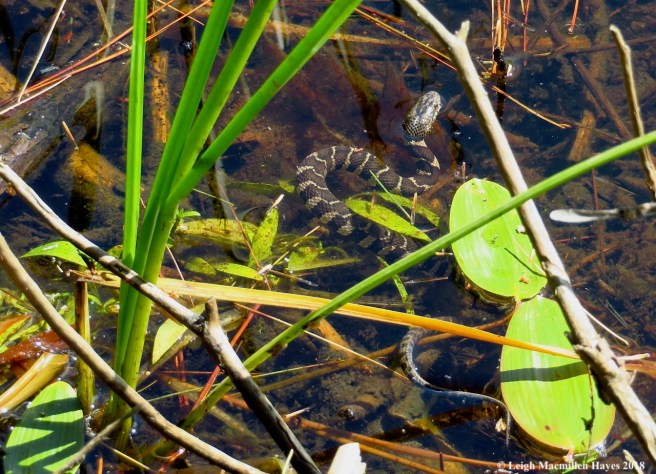
23-pickerel frog

pickerel frogs.

15-yellow-rumped warbler

Adding a few fainter notes were a couple of Yellow-rumped Warblers.

16-yellow-rumped warbler

They didn’t want the chickadees to get all the credit for the songs of the woods.

17-hairy woodpecker

A Hairy Woodpecker also tapped a view beats.

12-wood ducks

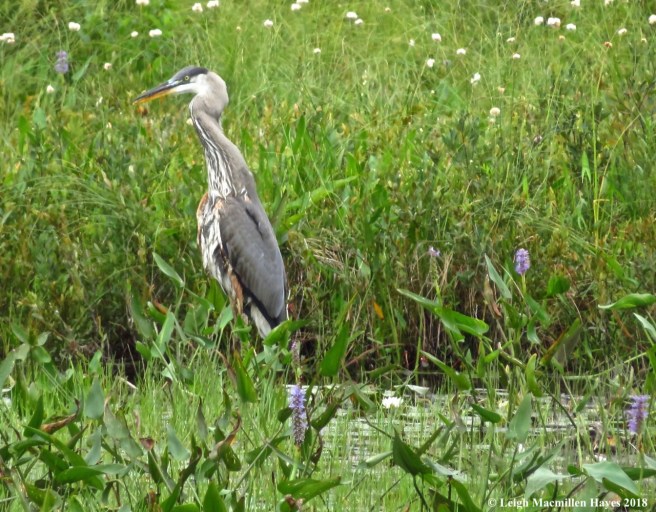
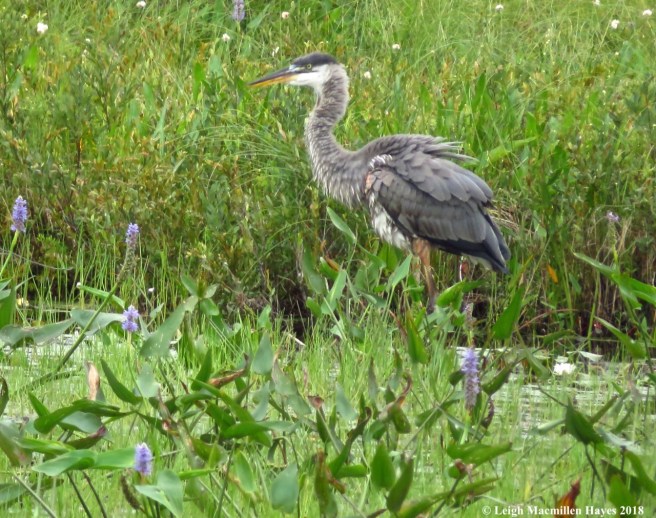
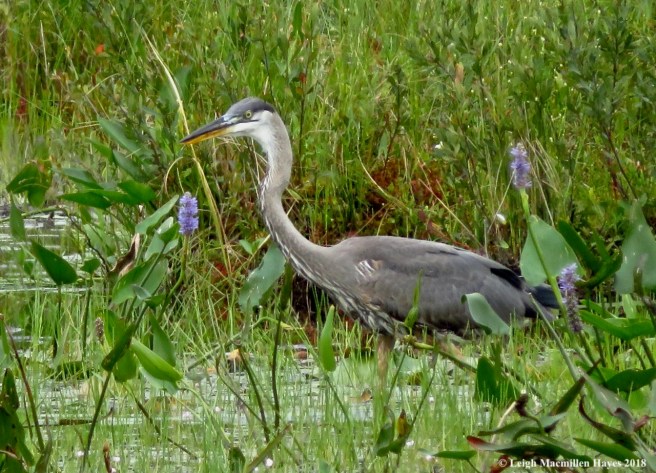
Probably my favorite musicians, however, sported their traditional parade attire and awed those watching from the bandstand.

13-wood duck

Even a non-breeding male made the scene look like a painting.

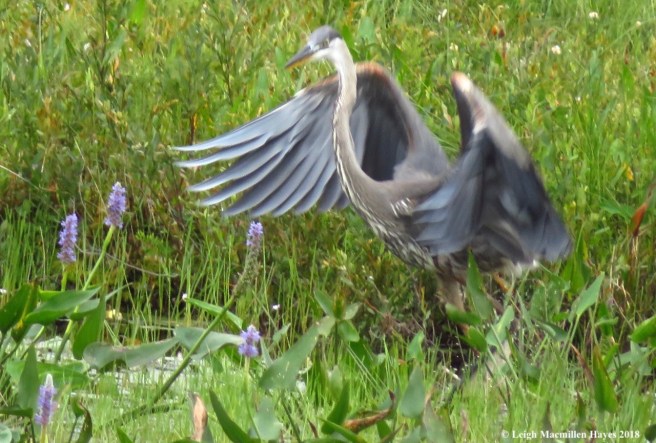
14-wood ducks taking off

Their real contribution, though, came from the modestly plumaged females who offered a squealing “oo-eek, oo-eek”  each time they took flight.

18-sensitive fern

Though green attire was the most prominent of the day, others sported colors of change from yellows and browns to . . .

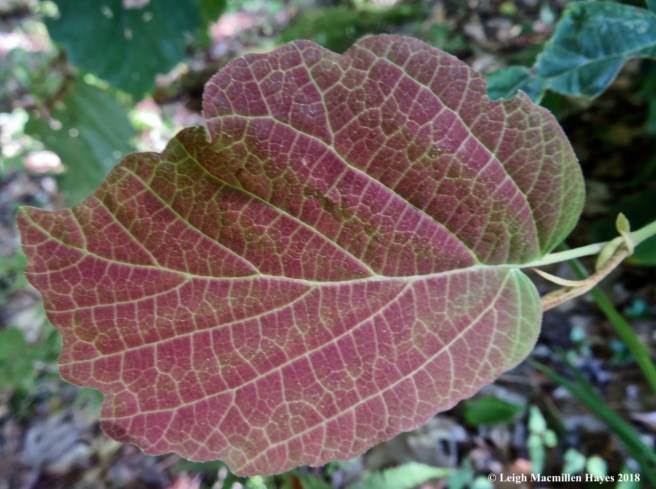
6-red emerging

brilliant reds.

21-Brigadoon

As is often the case along such a route, vendors offered works of art for sale, including local scenes painted with watercolors.

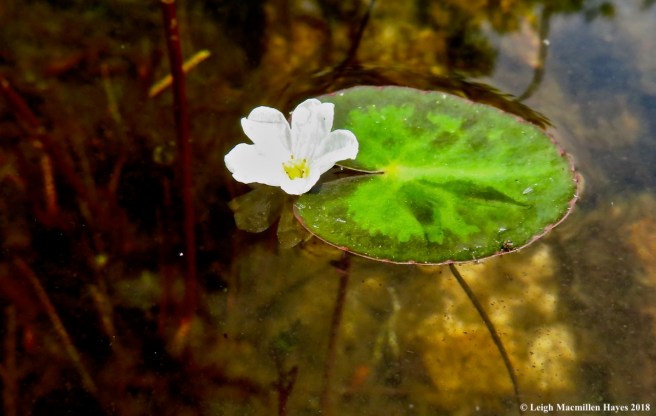
22-lily reflection and aquatic aphids

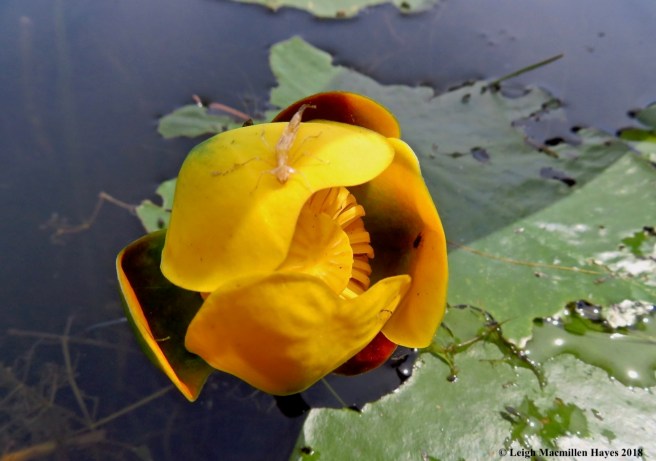
Before it was over, a lone lily danced on the water and offered one last reflection.

24-season transformation

And then summer marched on . . . into autumn.

Amazing Race–Our Style: episode eight

The clue arrived as mysteriously as usual on Sunday and we had to quickly book a seat for two on a seaworthy vessel. Thankfully, we got the first time slot for 10:30 Monday morning. And so, despite some fog, we drove northeast.

But . . . before we reached our destination, we had a challenge to answer to along the way. My guy needed to complete the crossword puzzle in the Portland Press Herald on his own. And then, while I did the driving, he needed to give me a clue, word by word until I’d completed the puzzle orally. Unfortunately, one letter held me up and we knew we’d loose a few moments if everyone else in the Amazing Race–Our Style finished it without flaws. We wouldn’t know for sure until the end. My glitch–the “r” in Urdu–the language spoken mainly in Pakistan.

1-Camden Harbor

Two and a half hours later we reached the location where our next challenge would begin. Of course, we had to pay attention to the signs and not park where permission was granted only to those who worked the waterfront.

3-Schooner Surprise

Our mission was to sail upon the gaff-rigged schooner Surprise. According to her website, Surprise was “built by the Waddell Shipyard in Rockport, Massachusetts, for Martin Kattenhorn. Surprise began her life as a racing and cruising yacht. Mr. Kattenhorn had commissioned Thomas McManus, the most famous American designer of fishing schooners, to design a vessel of about 45 feet, which could be safely sailed by a crew of no more than three persons. In early 1918, Surprise slid down the marine railway.

Her final dimensions were: Length overall 57 feet, Length on deck 44 feet, Beam 12 feet, Draft 7 feet, Displacement 21 tons.

Her topsail schooner rig allowed Mr. Kattenhorn to fly a mainsail, foresail, staysail , jib,  and a fisherman staysail. Her working sail area, not counting topsails, was just under 1000 square feet. Surprise was a respected racer. In 1923, she captured sixth place in a fleet of 22 vessels in the first race to Bermuda after World War I. Mr. Kattenhorn was a founding member of the Cruising Club of America, and Surprise carried the club’s ensignia from Bermuda to Nova Scotia and ports in between from 1918 until Mr. Kattenhorn’s death in 1959, an incredible sailing career!”

All of that history, and we realized we needed to pay attention. (Note to self: remember these facts) Already into the eighth leg of the race, we had a feeling that the historical value of some of our adventures would play a key part if we stay in the race until the final episode.

4-Captain Will applies sunscreen

At the established time, we boarded the boat and looked around at our shipmates. No fellow contestants. Huh? How could that be? But perhaps the rest had chosen the alternate activity that involved some baking and deliveries. We were much more comfortable setting sail with Captain Will, who when he wasn’t applying sunscreen, used his left foot to steer the boat out of Camden Harbor.

5-we raised the mainsail

Half way out, First Mate Laird asked for help in hoisting the sails. We knew this offering was intended for us. I quickly jumped up and my guy followed. My job–to use the hand-over-hand method to raise the raise the main gaff at the top as my guy kept the main boom parallel.  Of all our challenges thus far, this was among the easiest and we felt right at home.
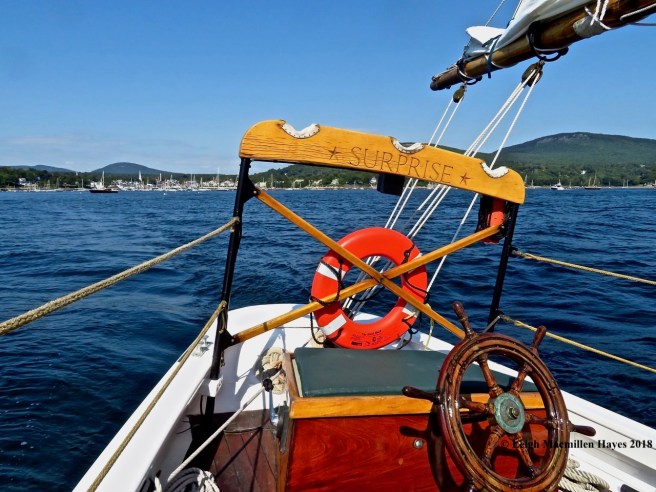
6-Surprise

Finally under sail rather than motor power, the boat moved away from Camden Harbor and out into Penobscot Bay.

7-First Mate Laird

As we continued, the captain and first mate exchanged roles, because really, they are both comfortable and supportive in each. While Captain Will explained that Surprise was celebrating her 100th birth year, First Mate Laird looked up.

8-100 years old

Above, a flag blowing in the breeze commemorated the celebration.

9-ghost ship on the horizon

As we headed out to Mark Island in Penobscot Bay, so named because early mariners used the island to mark their bearings, we noted a ghost ship on the hazy horizon.

10-sailing Penobscot Bay

Will and Laird both exclaimed about what a perfect sailing day it was. Indeed.
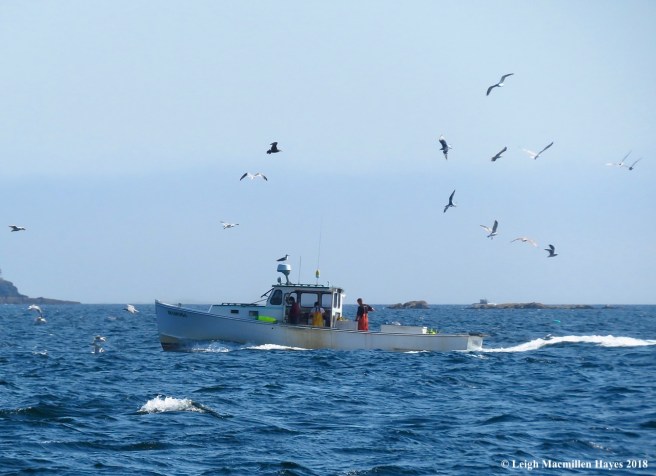
11-Lobster Boat surrounded by gulls

The further out we moved, the more we noticed lobstermen checking their traps as gulls circled in hopes of an offering.

15-pulling traps

These were the folks who had headed out onto the water at 4 am as they surveyed the  grounds where they’d set traps. A Maine lobsterman is allowed to set up to 800 traps, but as we learned today, it not only takes time to gain a lobster license and no longer is it a tradition handed directly from father or grandfather to son or daughter, but one doesn’t set the full amount of traps to start. And we learned that Lobsterman Toby is the local God of the Traps and the one to consult before dipping into a lobstering career.

16-third lobster boat

Some collected lobsters while others replaced traps. It’s not an easy life, but don’t tell a lobsterman that. Oh yeah, and one more fact, women who lobster are also called lobstermen . . . with pride.

17-different tack

Once we changed tacks, positions on the boat shifted, as should be expected.

18-Curtis Island Light

From all sides, we viewed the Curtis Lighthouse. The station was first established in 1836. As the lighter rocks tumbled down in front of the current house indicated, when the first building was demolished, the rocks were not intended to be reused or repurposed. The present lighthouse was build in 1896 and automated in 1972. (Note to self: remember these facts)
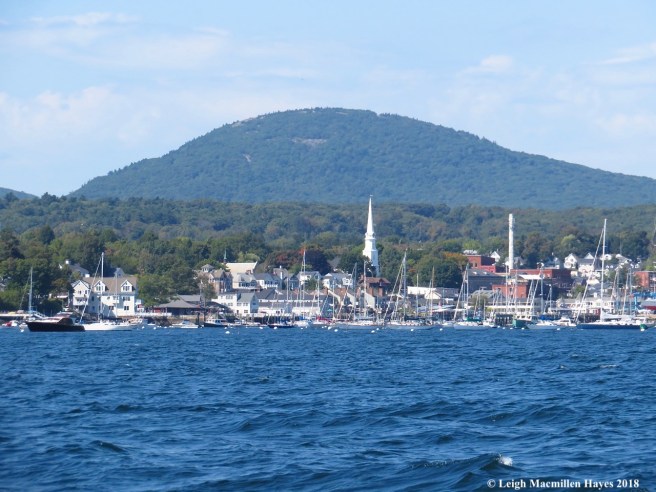
19-Camden Harbor

Slowly we tacked and then motored back into the harbor, with Mount Battie’s domed shape, a reflection of the harbor’s outline, standing tall in the background.

21-boat featured in movie Dunkirk

Captain Will shared a third point of interest to add to our bag of potentially important historical points should we make it to the end of this race: The 1930 122 ft. steel-hulled yacht Atlantide. The boat played a life-saving role in World War II as allied troops pinned down by the invading German army were evacuated at Dunkirk, France. And it was featured in the movie Dunkirk.
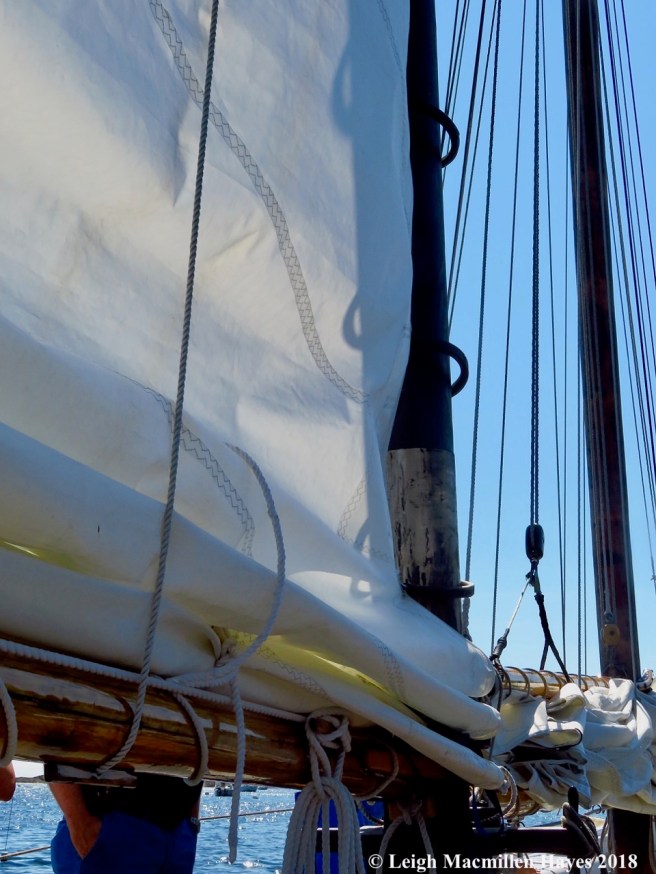
23-sails coming down

As we sailed closer to shore, in a pattern of symmetry that matched our departure, everything was restored to its original position and the term shipshape revealed.

25-old boat railway

Back under motor power, we passed by an old marine railway, which probably resembled the one Surprise originally slid down.
23-female mallard

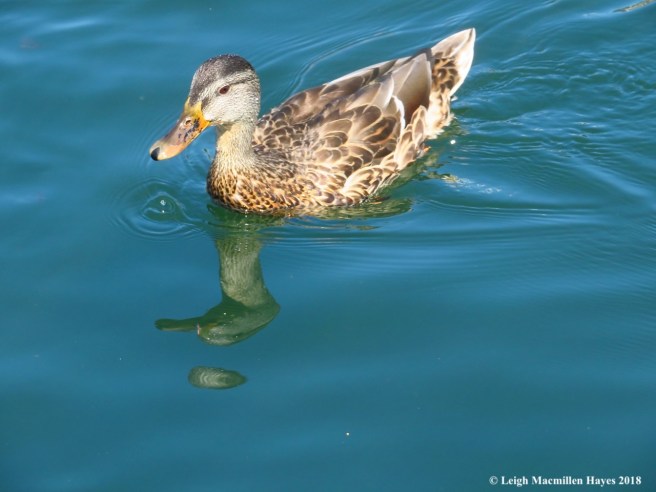
At last, our sailing experience of the day slowed. And a female mallard swam beside the boat, perhaps her hope for a handout redeemed occasionally by others.
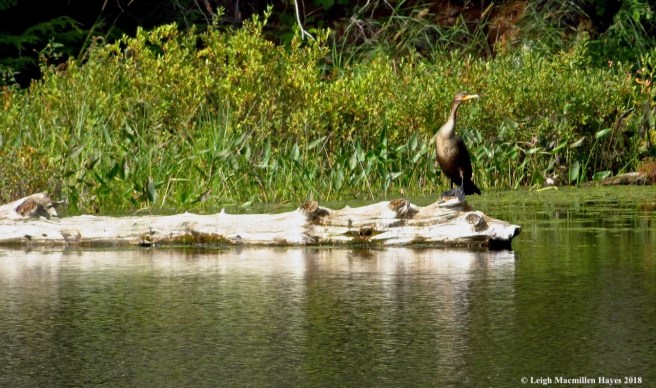
2-Comorant

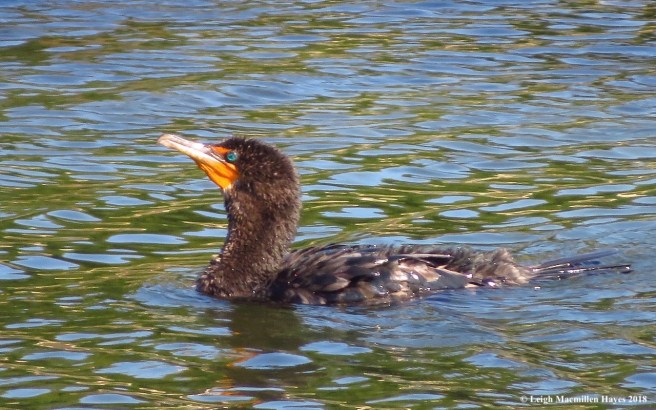
Meanwhile, a cormorant bathed.

24-docking

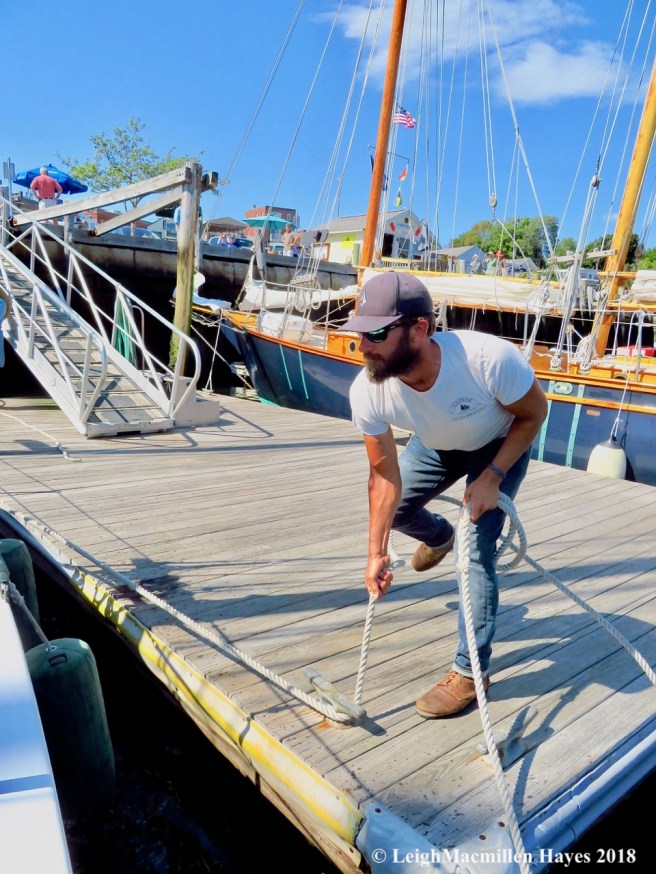
With precise precision as a neighboring boat docked, we pulled in, Laird jumped off the boat and all ropes were secured. Our journey had ended and we needed to hustle to a lunch spot.

25-beer at Peter Otts

We chose Peter Otts and a Maine Beer Company Peepers Pale Lager for me, while my guy enjoyed a Guinness–because it’s good for you! Two delish haddock sandwiches rounded out our menu choices.

25-Climbing Battie

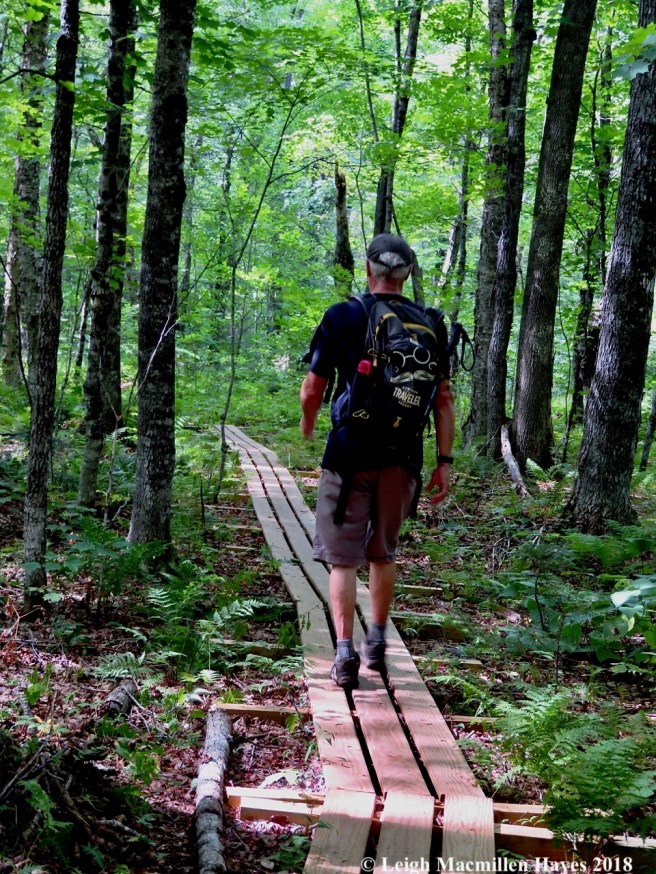
But we still had one more task to complete–to locate a symbol of WWI while hiking. And so up Route One we drove to Camden Hills State Park in hopes that we’d chosen the right place. It was rather deceiving at the start of the hike for across one boardwalk after another did we walk.

26-changing terrain

Eventually, however, the incline steepened and terrain became more of what one might expect along the coast of Maine–rocks and roots to navigate around and over.

27-wavng hello

We hadn’t seen a single other contestant and had no idea how we were doing, but knew we’d lost a wee bit of time on the crossword challenge, and so we paused for a second and my guy expressed his inner Cousin Itt.

28-Camden below

The funny thing we noticed about the trail system was that no matter how much further we had to go, many of the signs indicate 0.5 miles, and even after we’d covered a section of 0.25, the next sign stated the summit was still 0.5 ahead. It amused us and from then on we knew everything was a mere half mile away from somewhere.

At the summit of Mount Battie, the view encompassed the harbor below.

29-tower

But it was what stood behind us that became significant.
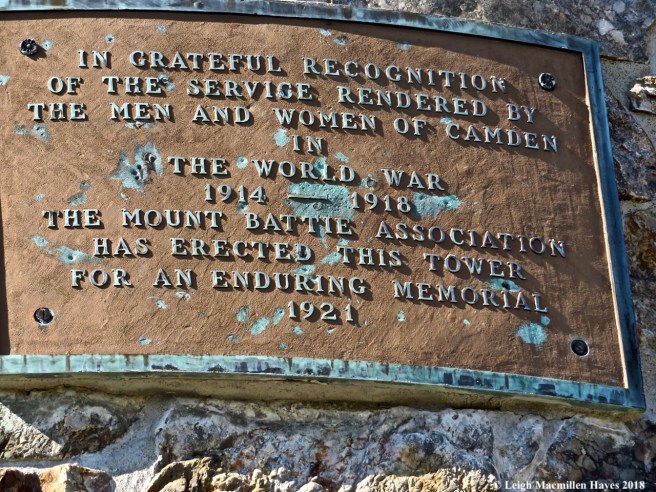
31-tower dedication

We’d found our WWI symbol, a memorial to those local people who served our country. And another piece of history to tuck under our hats for future reference.

30-view from the tower

Though we couldn’t see Acadia because of fog, the view was still breathtaking from the top. It was there that we encountered another contestant who actually asked us for some help with the trail system. Team Purple is legally deaf and her partner had deserted her, so we were happy to offer assistance.

32-Edna St. Vincent Millay

To that end, we gave her a head start while we paused to honor Edna St. Vincent Millay. And give thanks that we saw what she had seen.
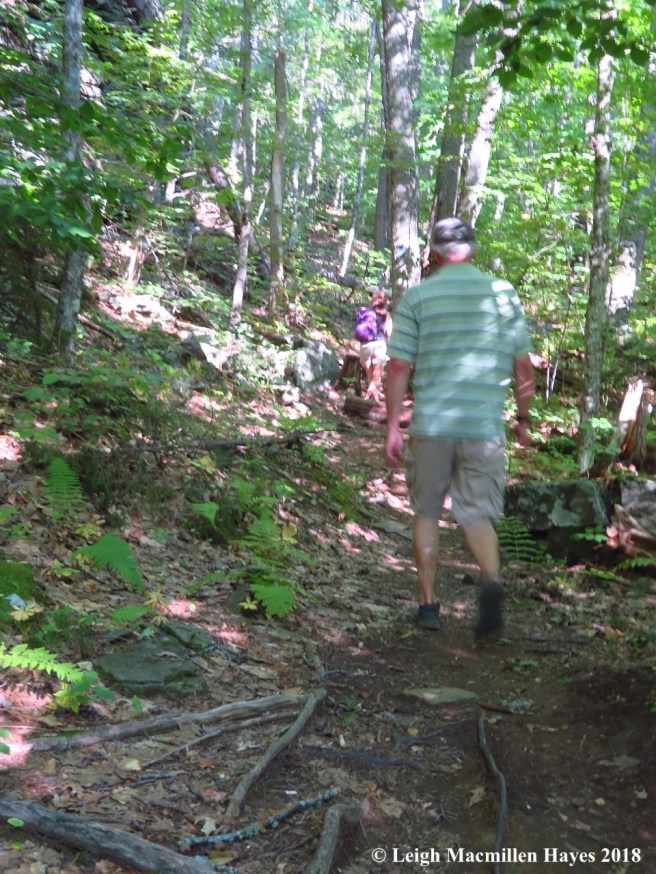
34-Team Purple

Eventually, we did catch up with Team Purple, but she was a hearty hiker and we let her continue to lead.

35-Crossing the mat together

She, however, had another idea in mind, and in true alliance fashion, the three of us, our shadows lengthened as the sun slowly lowered, crossed the finish line of this episode together. We weren’t the first to complete today’s challenges, but we’re still in the race.

Going forward, we wish Rebecca of Team Purple the best.

Phew, eight episodes of the Amazing Race–Our Style completed. Only four more to go. Will we survive? Stay tuned.
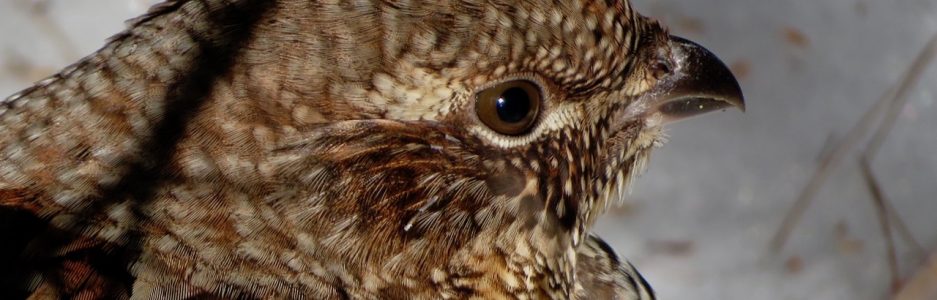
Speaking to the Future, Jinny Mae

As a kid, science and history eluded me. Reading, and writing, and even, ‘rithmitic, I embraced. Well, only a wee bit of the latter, though my father thought my abilities were far greater than they were and he saw a bank position in my future. He was the mathematician. It wasn’t a subject for me to pursue. And so I became an English teacher.

And then one day I woke up and found I’d developed an interest in the how and why and the science of stuff. Added to that was a desire to know more about the past. And voila, here I am, some days spending way too many hours pursuing insects in the garden or bark on tree or dragonflies buzzing about. Other days, its following trails of yore and trying to understand the lay of the land and those who came before that interests me. My favorite days are probably those that find me pursuing the two subjects simultaneously.

1-Ambush Bug on Hydrangea

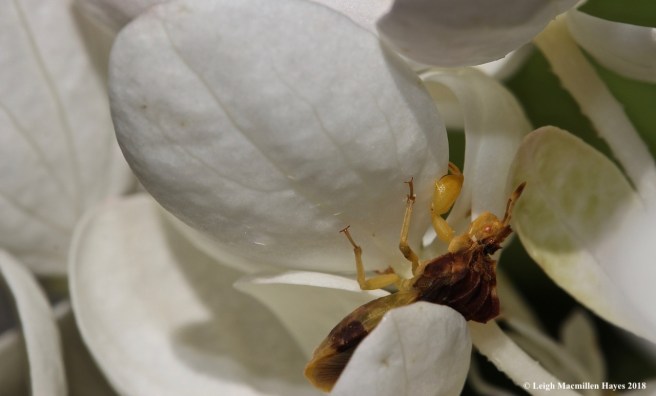
Today, I devoted spurts of time to a hydrangea bush that we rescued from a shady spot in our yard about fifteen years ago and transplanted to a sunny spot. What once was a dying shrub that rarely produced more than one flower is now a healthy specimen laden with blooms. And the insects love it.

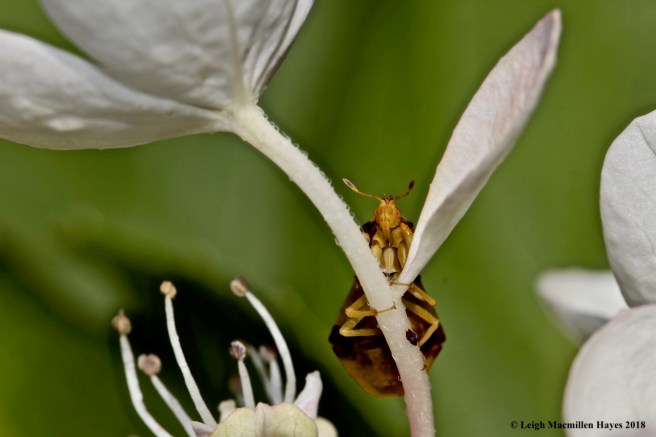
My biggest surprise, however, was to find an Ambush Bug sitting atop one of the newly opened white flower petals. For the first time since I’ve been paying attention, the bug was on something other than a goldenrod and I could truly see its body. I’ve always thought it exhibited a hint of a smile, and do believe I’m correct.

An Ambush Bug is my “iguana” insect for its body structure always brings to mind a neighbor’s iguana that got loose one day and never was spied again when we were kids. (Or was it? Didn’t we find a dead iguana on the old dump road, Kate and Lynn? Was that Rob’s lizard?) Anyway, I think the Ambush Bug resembles an iguana, on a much smaller scale, of course. MUCH smaller.

2-Ambush Bug

Seeing the bug on the white petals really threw me for a loop. Why was it there? What would it ever find to eat? The pollinators no longer bothered with the shrub on which it stood. They’d moved on to the goldenrods and asters below.

And how could this insect behave as one who ambushes when it was hardly camouflaged on the white petal? It must have questioned the same (if Ambush Bugs can question) for it turned this way, then that, and back again, and then moved from petal to petal and flower to flower. Usually, it hardly seems to flex a muscle as it remains in one spot for hours or days on end.

3-eye to eye with Ambush Bug

We studied each other, eye to eye, or perhaps more correctly, lens to lens, until I blinked and it flew off. I trust it landed on a nearby goldenrod, where a meal wasn’t too long in the making.

4-Tiger Moth Caterpillar

Just after the Ambush Bug and I parted ways, I noticed a subtle movement below and watched a tiger moth caterpillar that reminded me of a soft boa scarf one might wrap around a neck quickly slither down another flower on the shrub until . . .  it reached the edge of the final petal and fell to the ground, climbed up a fern frond, found its way back to the shrub and moved on to the world within.

7-grasshopper 1

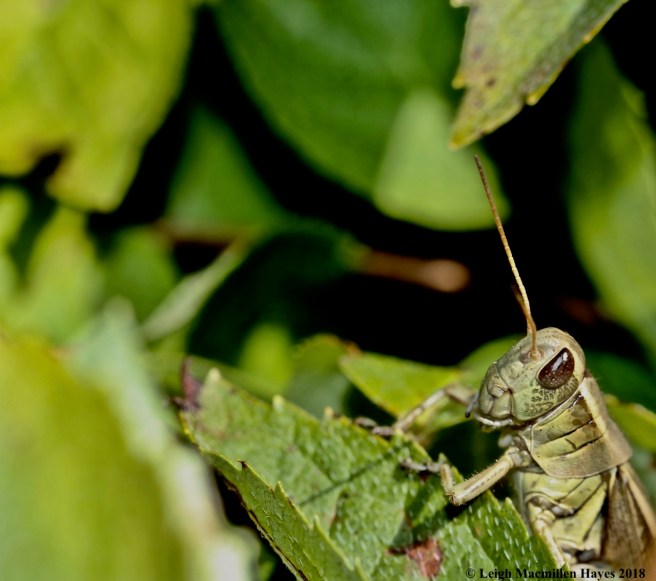
I was beginning to think that all of the insects on the hydrangea would move on or in, but then I met the Red-legged Grasshopper. He set his elbow on the leaf bar and we consulted each other. Would he fly away if I moved into his personal space, I wondered. He wanted to know why I stalked him.

8-red-legged grasshopper

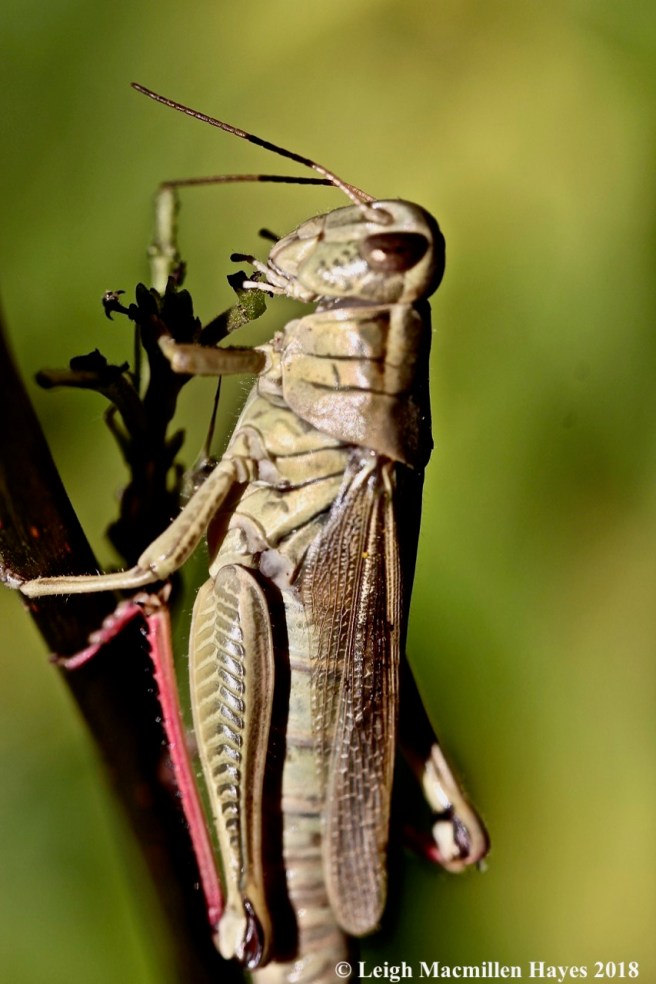
I mentioned his body of armor and the herring bone design and the leg joints and the spurs on its legs that drew my awe.

9-grasshopper

As a solo traveler, I knew it didn’t appreciate that I wanted to share the space. But, I couldn’t resist. Notice its feet and the segments on its abdomen and even the veins in its wings. Did I mention its mandibles?

10-caterpillar scat

As it turned out, there may have been a reason it wanted to be alone, but I was there. To. Witness. The. Poop. A blessed moment. It would have been more of a blessed moment had it pooped on me. Oh, and did I mention that grasshopper poop, like all insect poop, isn’t called scat. Rather, it is frass. Thanks go to Dr. Michael Stastny, Forest Insect Ecologist in New Brunswick, Canada for reminding me of that term. Cheers Mike.

14-shield bug

Another moving about was a shield bug, so named for the shield on its back. It does make me think of a piece of metal one might use as protection. Combine the shield with the grasshopper’s suit of armor and you might think you were spending time in an earlier era. Much earlier.

15-shield bug

But this shield bug didn’t care about the Middle Ages. Instead, it had one thing on its little mind.

12a-shield bug eggs?

Depositing eggs.

13-shield bug eggs?

Its offering was almost minute, yet pearl-like in structure.

16-wasp within

The world I watched on the outside of the hydrangea made me wonder what might possibly go on within. As much as I wanted to break through the branches and take a better look, I knew I’d ruin everything and after all, it wasn’t my place. I did, however, get to witness one moving about briefly for a paper wasp left the goldenrods and heading under the hydrangea leaves to move the pollen about on its body. Why did it go under? Why not pause atop a leaf for such behavior? And how did it escape the inner world without . . .

16a-spider web

encountering a spider web? Funnel spiders had practically veiled the entire shrub with their silken structures.

16b-web anchors

Though anchored with strength, they were extremely soft to the touch.

17-spiders

As the day progressed, I kept tabs on three funnel spiders, the mighty weavers that they were. All were wary of daylight.

18-food in front

But one had set up its home on the eastern side of the shrub and so it spent the day in the shade and enjoyed fine dining on a small bee that I assume made a mistake of pausing while shifting some pollen on its body.

19-dining

There wasn’t much left of it by the time this spider had finished its meal.

21-dinner in hand

Later in the day, a web weaver on the western side began to show itself–and it also had a meal secured.

All of the insects and arachnids I saw, and I had to assume even more enjoyed the inner structure of the condo that the shrub certainly was, all spoke not to the past, but to the future.

And with that, I dedicate this blog entry to you, Jinny Mae. You have a better eye and understanding and ask better questions than I ever will. Here’s to the future!

Global Golden Sights

Until I spent time watching, I never realized how global a goldenrod could be. In fact, I must admit that there were years when I tried to eliminate these hardy yellow plants from the garden. After all, weren’t they weeds? You may think thus for so prolifically do they grow, but these days I prefer to think of them as volunteers who add beauty in any season. And during this season, they mimic life as we know it.

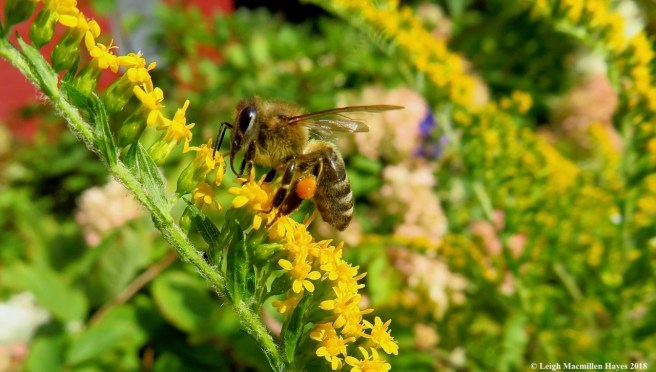
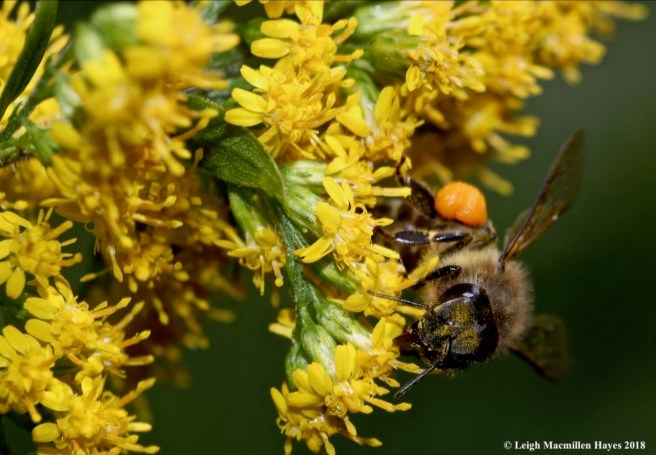
1-worker honeybee foraging

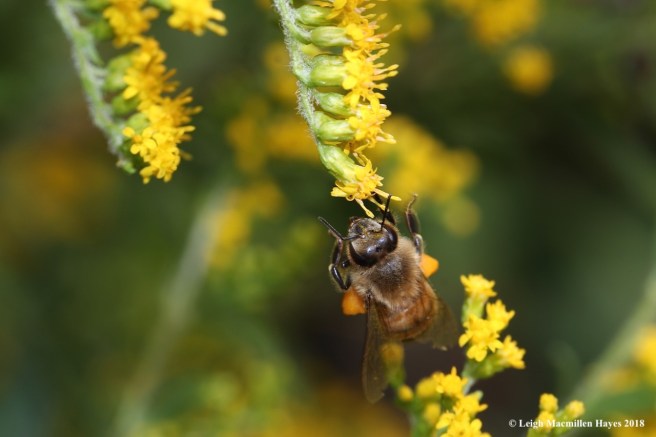
First, on sunny days European Honey Bees buzzed about. Yes, they are not native. But don’t tell them that. After all, they think they own the place.

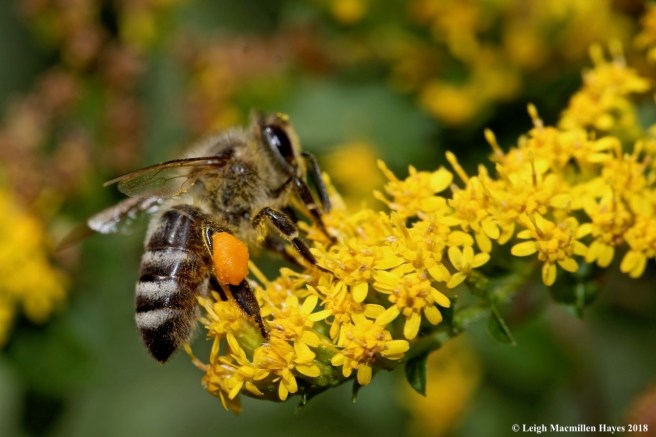
2-honeybee

As quickly as they could, they sought nectar from the flowers and in the process, pollen clung to their hairy bodies. Aha, so in their greediness, goodness happened. How could that be? Or rather, how could that bee? (Corny jokes are forever a teacher’s forte)
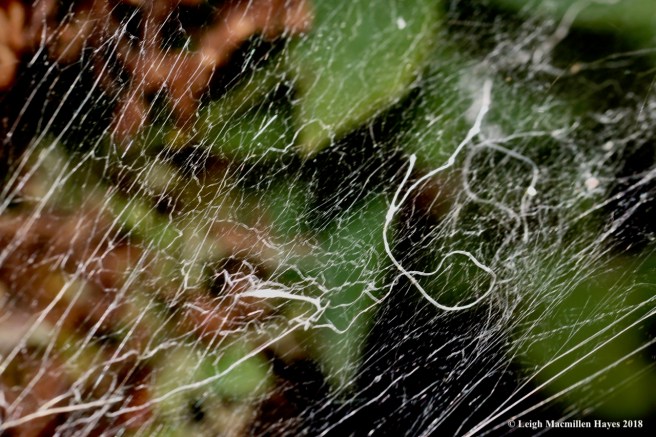
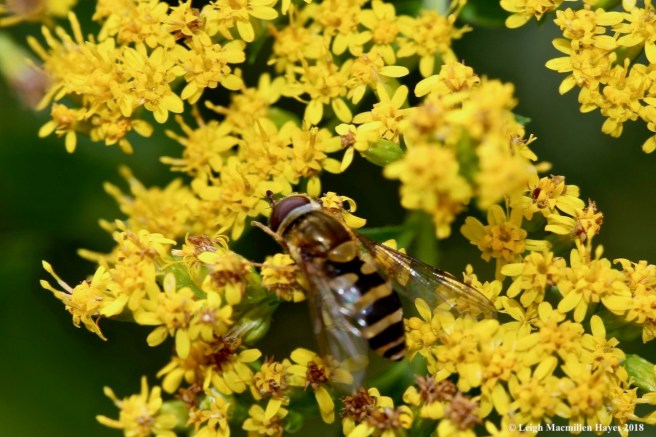
3-hoverfly

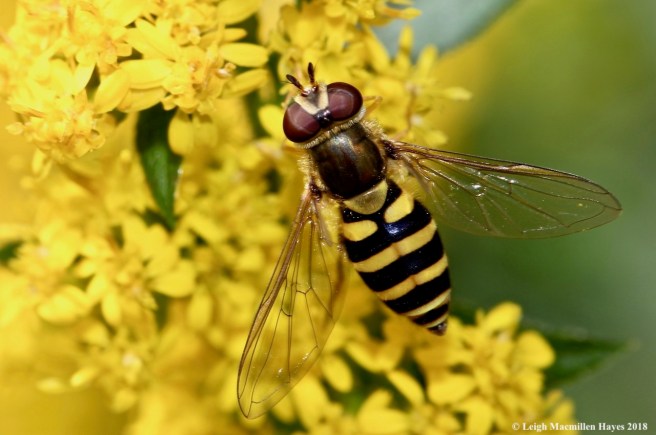
As I gazed upon the minute flowers of the Rough-stemmed Goldenrod, I had to look for subtle changes of color in order to read the story. Ever a fan of the coloration of the Hover Fly, I was thrilled that I could focus in on this one. Then the realization struck–this fly wasn’t . . . flying. In fact, it was dead. And yet it still held its structure.

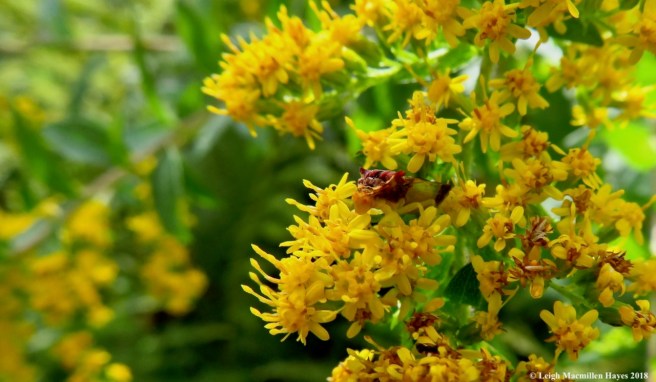
4-ambush bug

Looking up a stem or two, I noticed a predator in the waiting, its structure so otherworldly, much like an armored iguana. But it wasn’t a lizard.

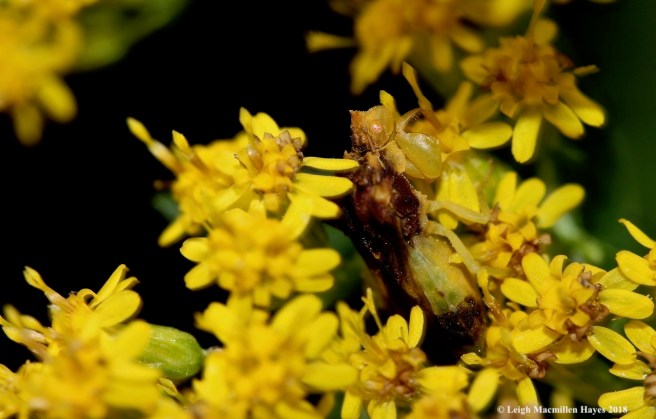
4a-ambush bug

It was a common insect that changed position as I changed lenses. The amazing thing is that it blended in so well, but that was all part of the insect’s strategy. Did the Hover Fly’s death have anything to do with the Ambush Bug? All are innocent until proven guilty and I needed to remember that, but I still suspected I knew the perpetrator.

4b-ambush bug

For three days I stalked him as he stalked others. An Ambush Bug is willing to wait until just the right moment to attack its prey with those oversized raptorial forelegs and quickly dispatch it with a stab from his sharp beak. Who knew that in the small world of the goldenrod one needed to be ever on the alert?

6-honey bee

And still, a Honey Bee foraged and farmed.
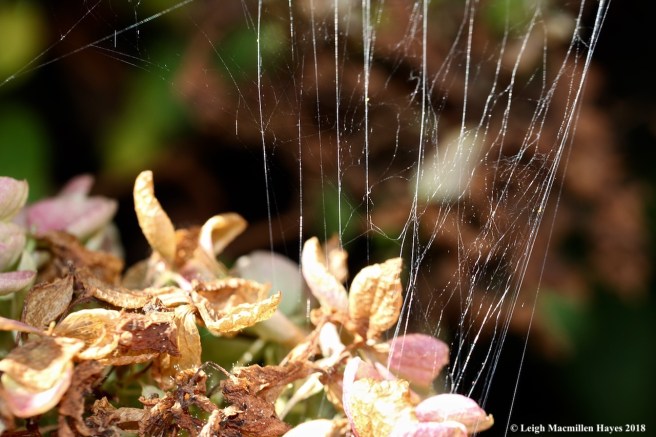
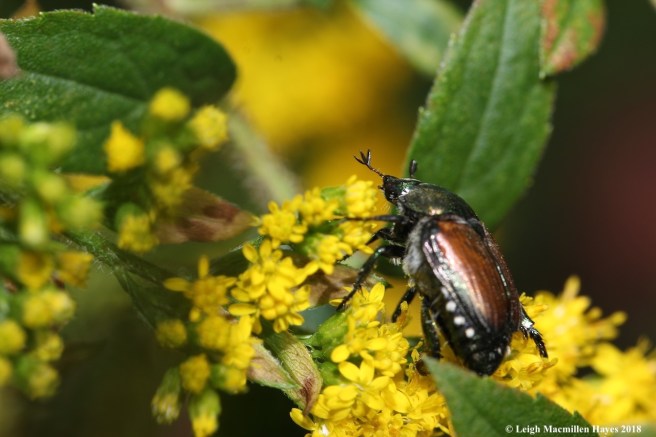
9-Japanese Beetle

Also on a mission was a Japanese Beetle, another immigrant in the mix. And I know that if I were to point out the unique idiosyncrasies of its body structure, I’d get booed out of town. But  . . . look at those colors, the details, and especially the antennae. It’s tough being the one dude that no others appreciate.

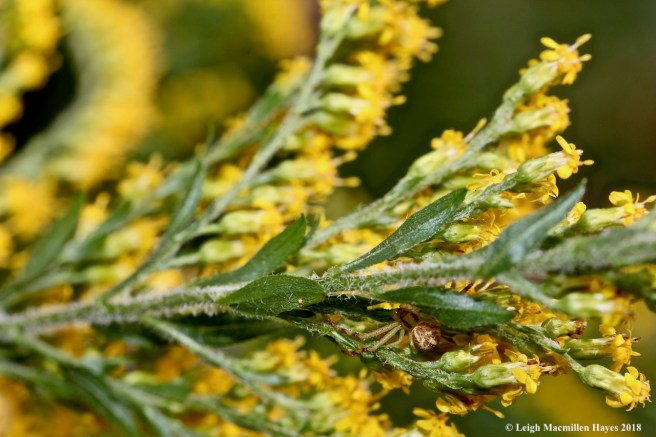
18-Where's Waldo the spider?

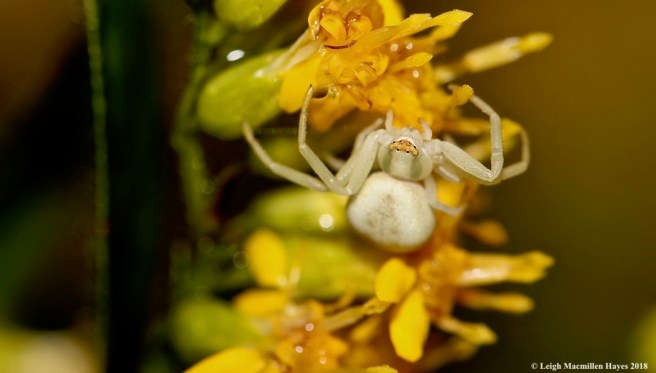
For every foraging or unwanted citizen, there was one hiding in the shadows, ever ready to catch the neighbors when they were most vulnerable. Do you see the green and brown crab spider?

25-spider web

Some even set up traps to catch their prey, but after all, we are all hunters and need to dine.

10-pollen all over body

Still the Honey Bees flew in and out and chased off any others, even their siblings who got in the way. All were females, for such are the workers in their society. Ahem. Oh, excuse me. Just clearing my throat.

12-locust borer

For all the time that I watched (and really, I only spent an hour or so each day for I did have work to do) I noticed a Locust Borer on one particular plant. Females tunnel into bark to lay eggs and I probably should have taken a closer look at the quaking aspen in the garden that has been compromised by so many insects. But here’s another thing–do you see the yellow tip on its abdomen? Locust Borers don’t sting, but should you touch one it will try to bore its tail end into you as if it were a stinging insect. Silly bug.

22-Assassin bug 1

Peeking under a nearby stem, I found another seeking others–an Assassin Bug that was related to the Ambush Bug. Assassin Bugs are proficient at capturing and feeding on a wide variety of prey. Though they are good for the garden because they act as tiny Ninjas and prey on enemies of the plants, they don’t always discriminate about their prey. The unsuspecting victim is captured with a quick stab of the bug’s curved proboscis or straw-like mouthpart. I’ve had the opportunity to watch the action in the past, but I couldn’t always locate the little warrior, thought I knew it was somewhere among the drooped stems.

8-honey bags

And still , the Honey Bees flew, filling their sacs being their main priority.

15-drone fly 2

Not everyone could be a bee, but some surely tried to mimic their adversaries. Thus is the life of a Drone Fly that may have a bit of a hairy body, but it can’t sting. Instead, it had to outsmart its predators by being a look-alike. Such is known as Batesian mimicry, so named for the famous English naturalist, Henry Walter Bates. Bates discovered this concept while working in the Brazilian Amazon.  In the course of his studies, he realized that numerous non-toxic butterflies looked identical to a few very potent types.

16-sawfly?

Other non-bees on the flowers included a rather handsome sawfly, its wings so distinctly veined.

17-honey bee moving pollen on body

But the honey bees were on the move the most and managed to control the activity of those smaller and larger by giving chase to all. Occasionally, one had to pause and dangle in order to move some pollen into its sac.
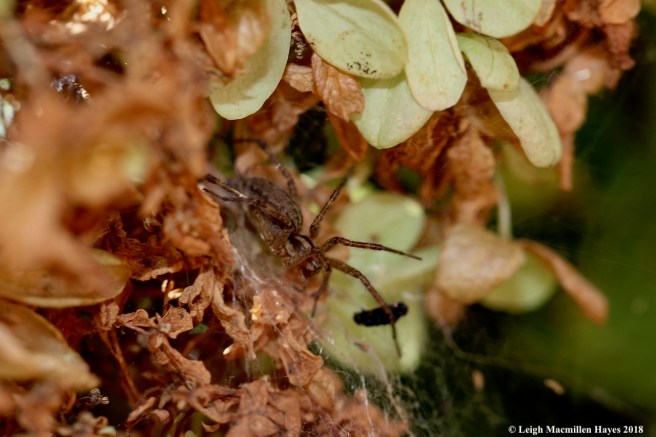
30-crab spider

Also known to dangle, for that’s what spiders do best, was another crab spider, Crab spiders may be tiny, but they can be cunning and ferocious. Like the predatory insects, waiting was the name of the arachnid’s game and I don’t doubt that this one was successful in securing its next meal.

32-inch worm

And while still in a dangling mode, there were the inch worms of varying colors to spy, most of them slithering ever so slightly among the plants flowers, but some were on the move to the leaf that was greener on the other side.

36-dead inch worm

This morning, I did discover a dead inch worm and again, like the Hover Fly that met its demise, I wondered who done it. Ambush or Assassin Bug? Those were my two choices.

39a-hover fly

I did find a live Hover Fly and its presence made me happy. There’s something about its streamlined structure and minute hairs and clear wings and hovering ability that appeal to me.

39-hover fly an dinch worm

One even demonstrated that it could share the space with an inch worm.

37-flesh fly

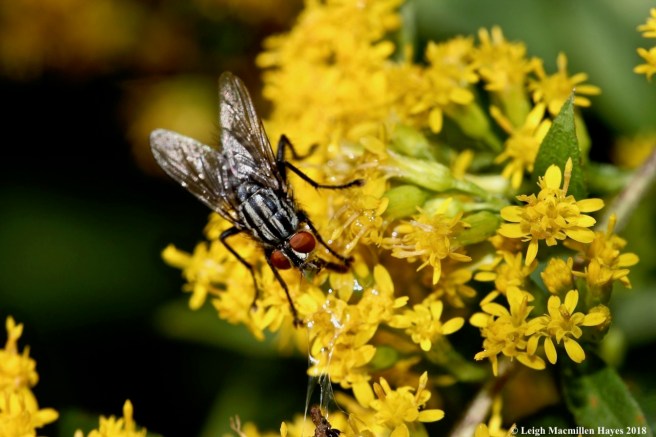
Equally admirable was the Flesh Fly with its brick red eyes and handsomely striped abdomen. It’s called a Flesh Fly for its habit of locating decomposing carcasses and laying its eggs. I have to admit that thinking about that and the maggots to follow gives me a chill.

40a-metallic green sweat bee

A metallic green Sweat Bee flew in periodically, but never stayed long. Thankfully, it chose to ignore me. In fact, considering how close I was and in the faces of so many, as always, the insects and spiders left me alone. I, on the other hand, continued to stalk them.

42-paper wasp

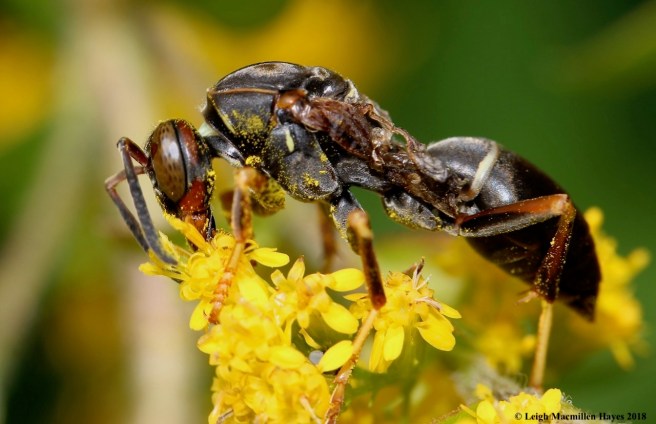
Surprisingly, even the rather aggressive Paper Wasp ignored me. I could hardly ignore it. Whenever he flew, most other flying insects performed a mini dance, flying up, swirling down and then settling again.

But take a moment to look at that body. It’s as if some insects wear a coat of armor. And in the wasp’s case that coat was dusted with pollen, just as nature intended so fertilization could occur.

44-bumblebee

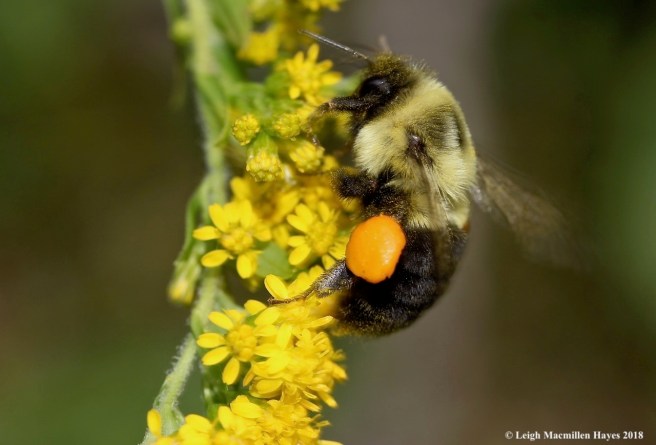
Even the aggressive Bumblebee let me bumble about without incident. In my three days of watching, there were plenty of Bumblebees buzzing, but they tended to visit all of the surrounding flowers. Today, however, in a frantic frenzy, one sampled this flower and that along the goldenrod stem.

45-locust borer waving

While the Locust Borer I mentioned earlier spent the last three days on the same plant, a second one flew in today and settled on a goldenrod about seven feet away from the first LB. Will they meet? I assume so, but in the meantime, it waved.

41-assassin bug

And in a different location than the first day, I found an Assassin Bug. The same one? Perhaps. But again, no food. Still, it waited.

50-ambush bug

As did the Ambush Bug.

39-half-inch worm and ambush bug

In three days, it hadn’t moved far, but finally decided to take a different stance. To its left, a half-inch worm stayed in one spot, though it kept changing position. And I kept waiting–why didn’t the Ambush Bug grab the little thing and suck its guts out?

46-ambush dining on hover fly

Because . . . it was waiting for a more substantial meal I later learned. And my question was answered. What killed the first Hover Fly? An Ambush Bug. And this afternoon it worked on another. Drats. But, in this insect or arachnid eat insect world, finding a meal and gathering energy from it was the most important thing.
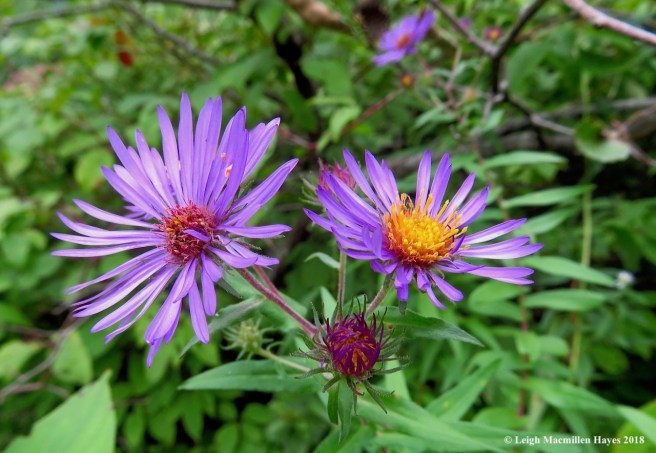
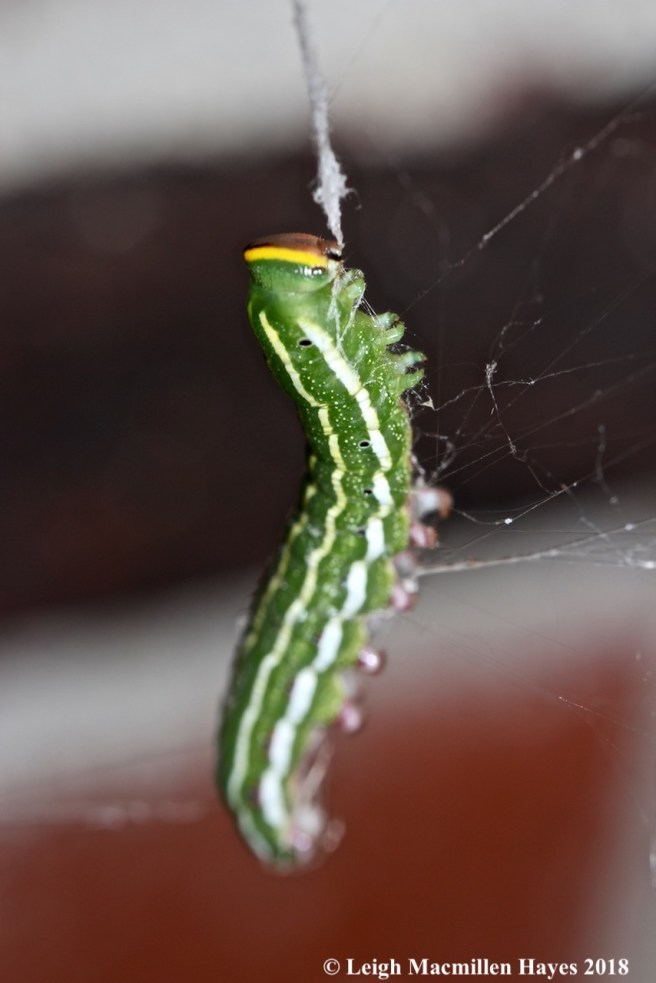
43-larvae of brown-hooded owlet moth

Much to my delight because I was looking–I spied the larvae of a brown-hooded owlet moth. Besides a monarch caterpillar, oh and a sphinx moth, and . . . and . . . the brown-hooded owlet moth caterpillar is one of my favorites.

33-forage looper moth

Its mature form wasn’t quite as attractive.

35-I see you

But still, what a sight to see tucked in among the goldenrods.

The garden may be small, but its offerings were global in nature when you think about it. Ah, those golden sights. Worth a wonder.  (And I left a few out!)


Mast Landing Mondate

What should you do when you come to a fork in the road . . . and a mailbox?

2-mailbox in the woods

Why open the mailbox, of course, enter the date and your names on the notebook stored within, and then follow the trail to the left. If all goes well, a couple of hours later you’ll emerge via the trail on the right. With lots of zigs and zags along the way, that is.

3-foundation

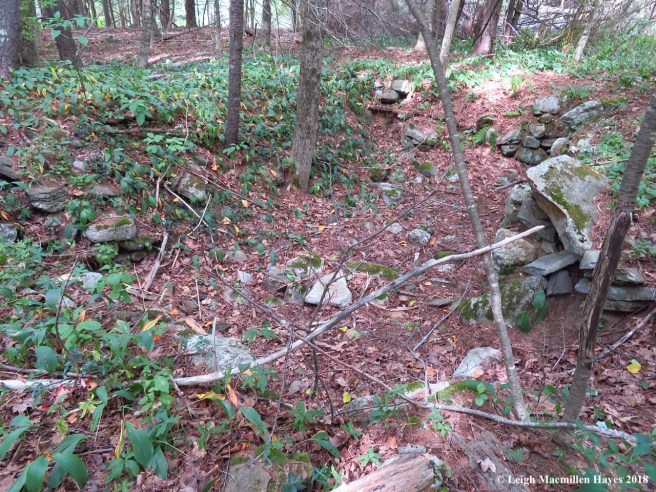
The story of this place dated back to the 1700s when the massive white pines that once grew there were harvested for the British navy. A dam was built and mills as well. In fact, at one time there were four mills, including a saw mill, textile mill, and two grist mills, plus a woodworking shop. We spied a foundation just off the trail, but didn’t know its part in the story.

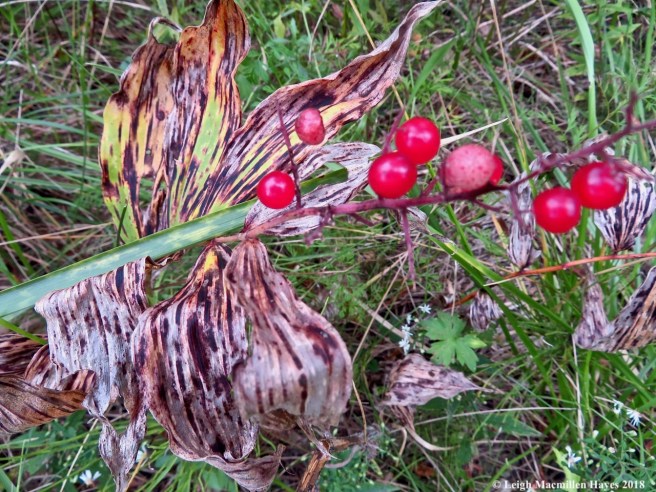
5-lily of the valley surrounding foundation

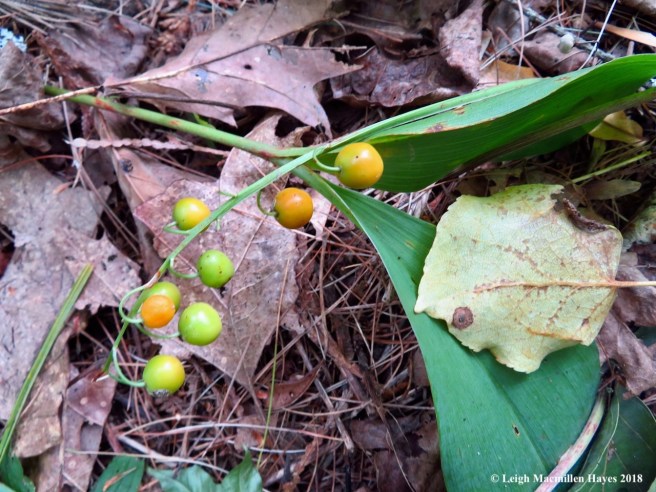
Surrounding the foundation in abundance, however, were lily of the valley plants, their fruits taking on their fall hue. And I imagined the lady of the house tending her garden.

4-black-capped chickadee egg?

Though the homesteaders were no longer in residence, we found evidence that others called this place home–possibly a black-capped chickadee egg.

3a-old vechicle

A little further on, we found another artifact dating to an earlier time. Much earlier given its structure and how buried it was. This had once been farmland before the forest grew up again.

6-climbing under blow down

It wasn’t far into our journey, however, that we began to notice something about this land–it had been hit over and over again by windstorms, all blowing from the east, which made sense given that we were less than a mile from the ocean. We found ourselves stepping over, crawling under . . .

7-walking through blowdown

walking between . . .

8-destruction everywhere

and starring in awe at all of the destruction. It was nothing like we encounter in western Maine, and we began to feel trail snobbish.

9-uprooted

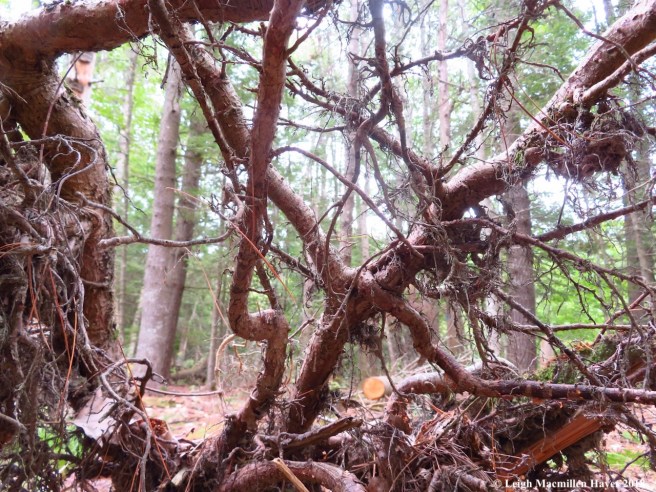
But . . . uprooted trees do offer interesting art forms from above . . .

10-underrooted

and directly below. Think of it as nature’s stained glass window.

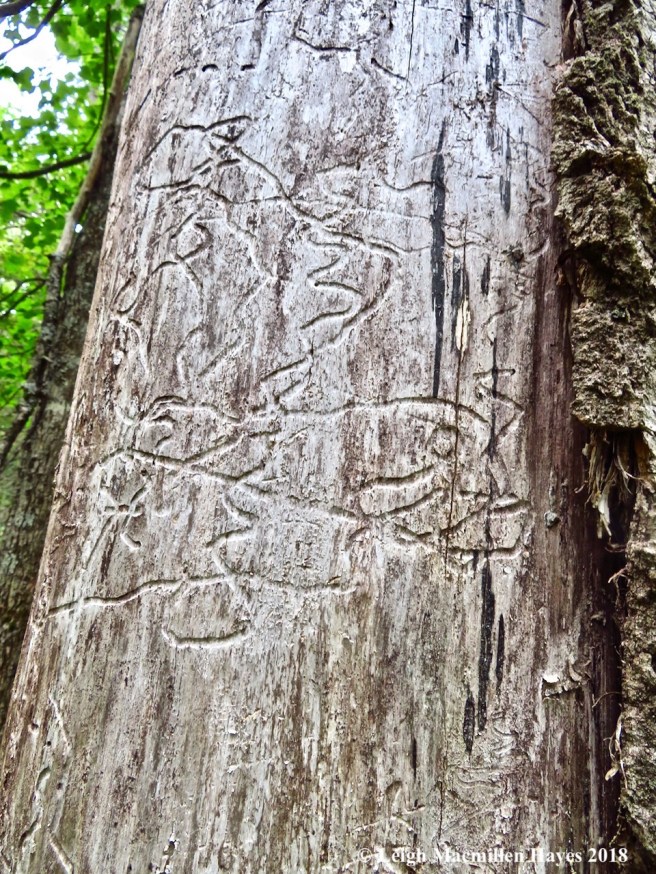
10a-bark beetle tunnel art

There was other artwork to admire, including those zigzaggy tunnels created by bark beetles. They must dance to their own tunes as they mine their way across the cambium layer.

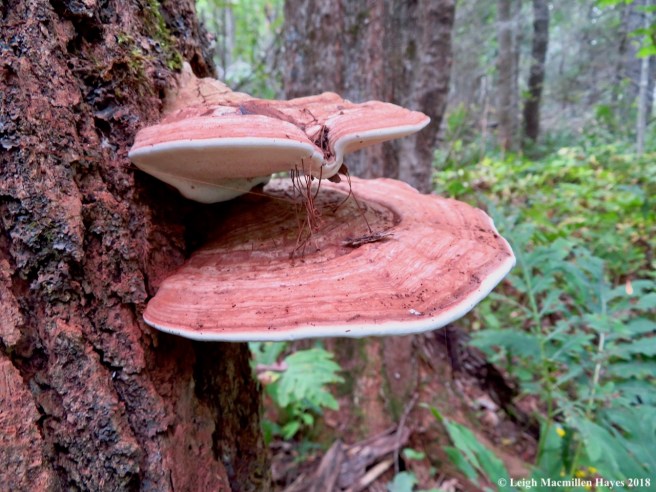
10b-artist conks

On the same tree we also found fine specimens of artist conk fungi. How apropos.

12-education building

Soon we came to a modern structure. A peek through the window and we knew we’d reached an education center, where cubbies lined a wall, and posters no longer quite secure rolled from the points at which they’d been tacked.
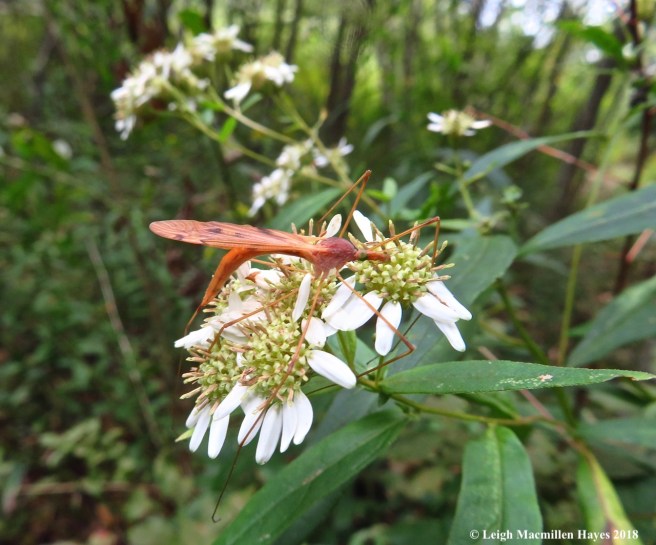
14-tick check

My favorite was a painting on the outside. Tick Check!

15-apple tree

Because the land had been farmed, apple trees danced in their forward leaning forms.

16-apple

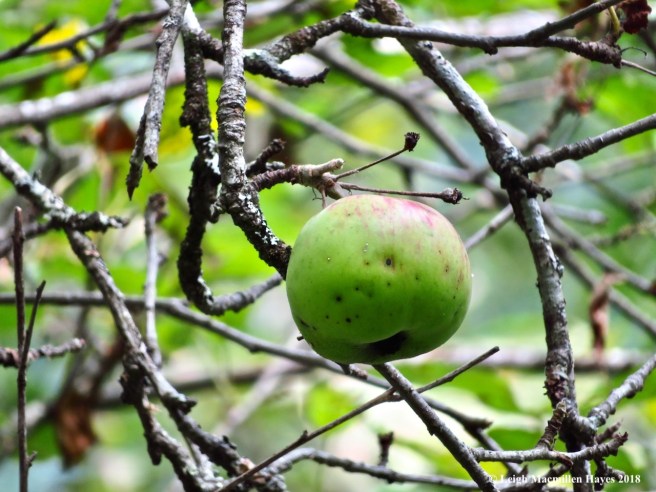
And gave forth fruit among the maze of branches.

17-apples on ground

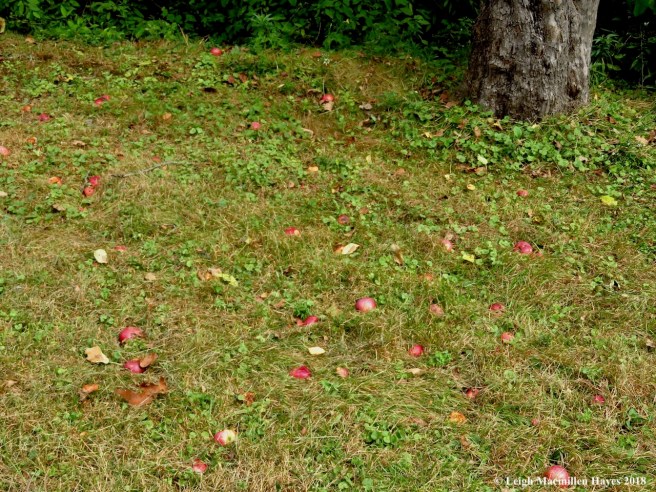
Some trees were more prolific producers than others.

18-eating an apple

And according to my guy, the offerings were delicious.

18-silky dogwood fruit

There were other fruits to admire, including the wedgewood blue of silky dogwood.

18a-hobblebush fruits

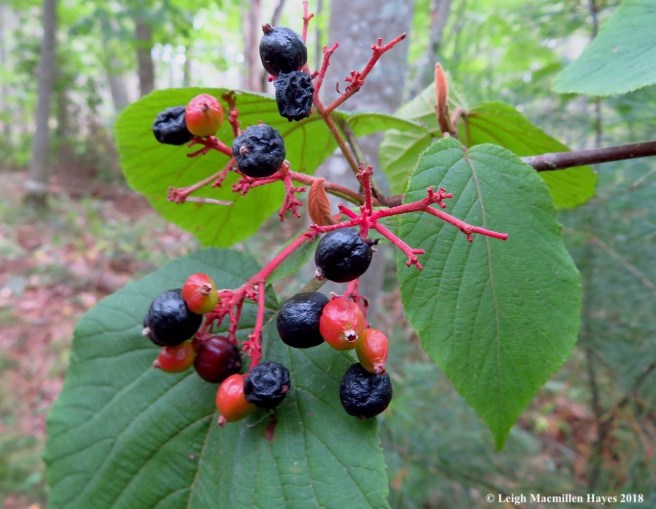
And the green turning red, red turning blue, purplish, blue and almost raisin-like fruits of hobblebush.

19-Norway Maple samara

Even the Norway maple showed off its seeds in samara form.

22-more asters

The asters added delightful touches of color to the rather drab landscape.

11-Nephrotoma eucera, tiger crane fly

And among them, insects such as a tiger crane fly, enhanced the scene.

23-turtlehead

We found turtlehead,

24-false solomon's seal

false Solomon seal in its fruit form,

25-beach rose

and beach roses showing their bright florescence.

26-rose hips

And where there were roses, there were rose hips and I was reminded of my father who couldn’t walk past a rose bush on our travels from our cottage in Harbor View, Clinton, CT, to town via the town beach, without sampling such.

27-dam

Eventually today, after a few backtracks, for we occasionally got fake lost and with all the downed trees, every trail began to look the same, we found the dam.

29-dam breached

It had been breached long ago, and according to the property’s history, the mills were “destroyed by fire in the early 1860s, and not rebuilt.”

29-old mill structures

We could see some evidence through the woods, but weren’t in a major gotta-see-more mode I guess, which isn’t really our way, but today it was.

j30-below the dam--low tide

Down below, the mill stream became the Haraseekeet River if we understood correctly. It was low tide in the estuary. And smelled to me like the mud flats in Clinton Harbor and I was transported to my childhood for a moment.

31-caretakers house

On our way out, we passed by the caretaker’s house, built in 1795 by mill master Abner Dennison. Sadly, it looked like it needed some care taking.

32-head start on Halloween

Nonetheless, it was decorated for the upcoming season.

34-tree spirits

At the end of our journey, we decided that the trails were not our favorite given all the blowdowns and a stagnant Mill Brook that seemed like an oxymoron, but we’d still found plenty of delightful sights. And tried not to make too many contrary comments for the tree spirits kept many eyes on us.

35-tree gnomes

And listened from their gnome homes.

On this Mondate, we whispered that we probably don’t need to return to Maine Audubon’s Mast Landing, but we didn’t want them to hear us.


Wondering With Jinny Mae

It takes us forever and we like it that way. In fact, today a woman who saw us in our typical slo-mo movement commented, “It’s like you’re on a meditative walk. I always move quickly and miss so much.” Indeed we were and when I travel beside Jinny Mae there isn’t much we don’t see. But always, we’re sure that we’ve moved too quickly and missed something. Then again, we realize that whatever it was that we accidentally passed by this time may offer us a second chance the next time.

1-winterberry

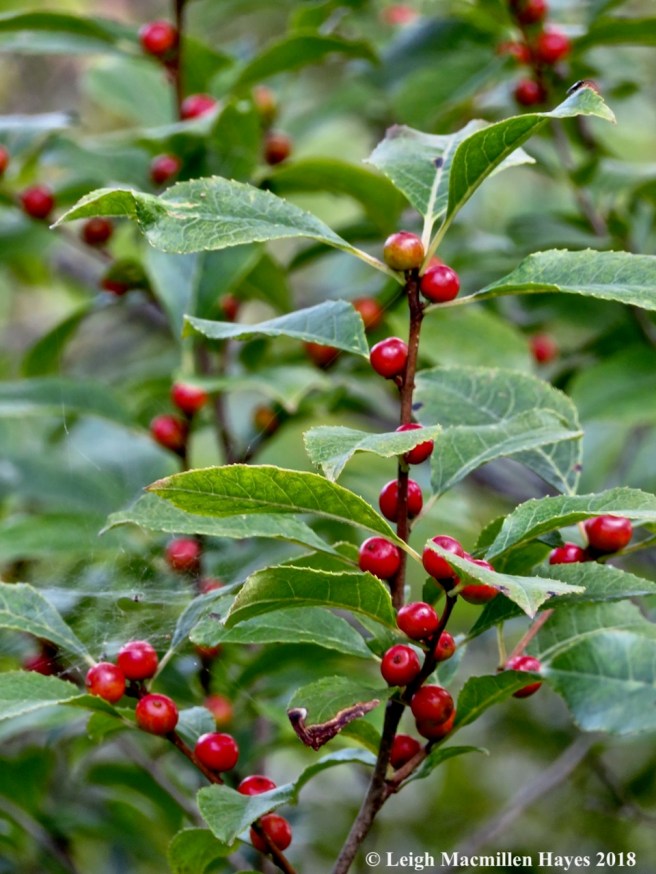
Today’s wonder began with the realization that winterberry holly or Ilex verticillata, grew abundantly where we chose to travel. This native shrub will eventually lose its leaves, but the plentiful berries will last for a while–until they’ve softened considerably that is and then the birds will come a’calling.

2-winterberry

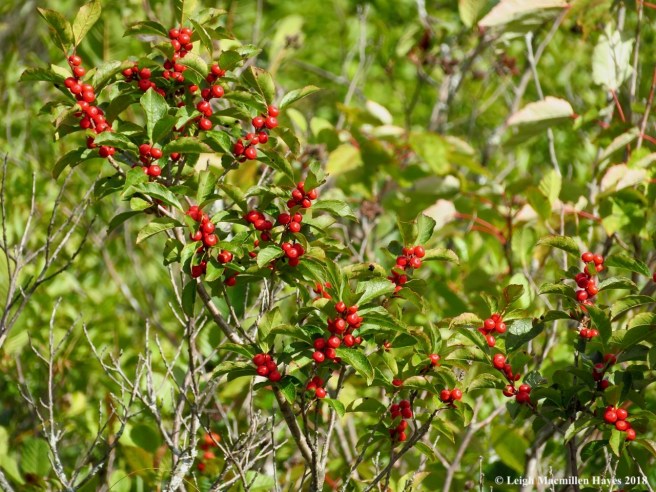
Everywhere we turned, or so it seemed, we found them ranging in color from spring green to shades of red. As summer turns to autumn, the leaves will yellow and eventually fall.

3-winterberry

And then the brightly colored berries that cling to every stem will add color where it’s otherwise lacking in the landscape.

4-winterberry

Even while the leaves still held fast, we found some brightly colored berries that offered a breathtaking view.

5-to Muddy River

We passed through numerous natural communities, tiptoeing at times, such as on the boardwalks, for we didn’t want to disturb the wildlife around us–no matter what form it took.

9-dragonfly attachment

And we rejoiced in spying a cherry-faced meadowhawk couple in their pre-canoodling mode. Can you see how he has used his cerci to clasp the back of her head? His hope is that he can get her to connect in the wheel position and they’ll take off into the safety of the nearby shrubbery to mate.

6-Muddy River

At the river, we began to notice other signs that we’ve once again entered a transition between seasons, for subtle were the colors before us.

7-beaver lodge

Across the river and just north of where we stood, we spotted an old lodge, but weren’t sure anyone was in residence for it didn’t seem like work was being done to prepare for winter. Then again, we haven’t done anything to prepare either, for though the temperature has suddenly shifted from stifling to comfortable (and possibly near freezing tonight), it’s still summer in Maine. And we’re not quite ready to let go.

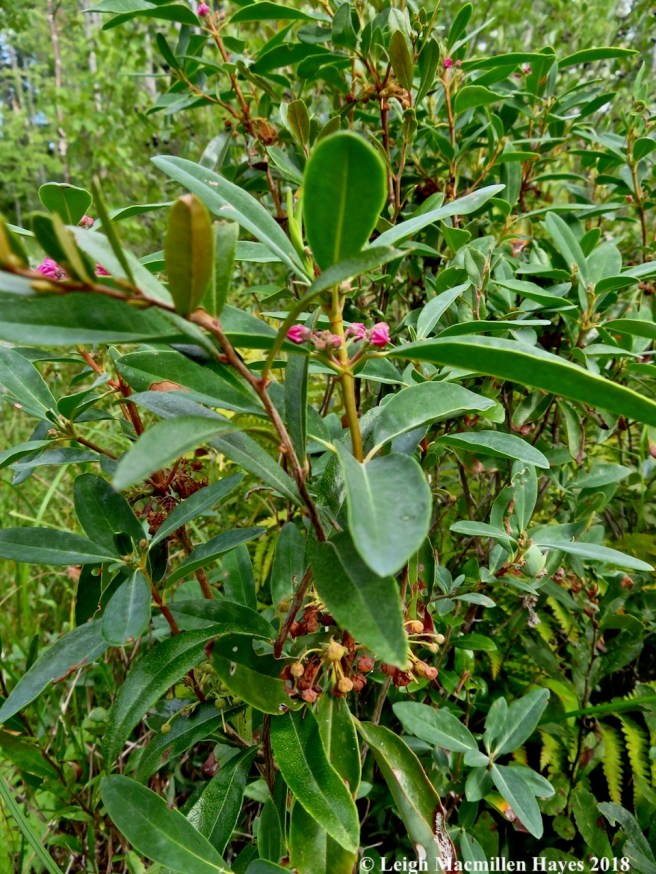
17-Sheep Laurel

That being said, we found a most confusing sight. Sheep laurel grew prolifically in this place and we could see the fruits had formed from this past spring’s flowers and dangled below the new leaves like bells stringed together.

18- sheep laurel flowering in September

Then again, maybe it wasn’t all that odd that it still bloomed for when I got home I read that it blooms late spring to late summer. I guess we’ve just always noticed it in late spring and assumed that was the end of its flowering season. But then again, it appeared that this particular plant had already bloomed earlier in the season and produced fruit, so why a second bloom? Is that normal?

10-pitcherplant 1

As we continued on, we started to look for another old favorite that we like to honor each time we visit. No matter how often we see them, we stand and squat in awe of the carnivorous pitcher plants.

11-pitcher plant 2

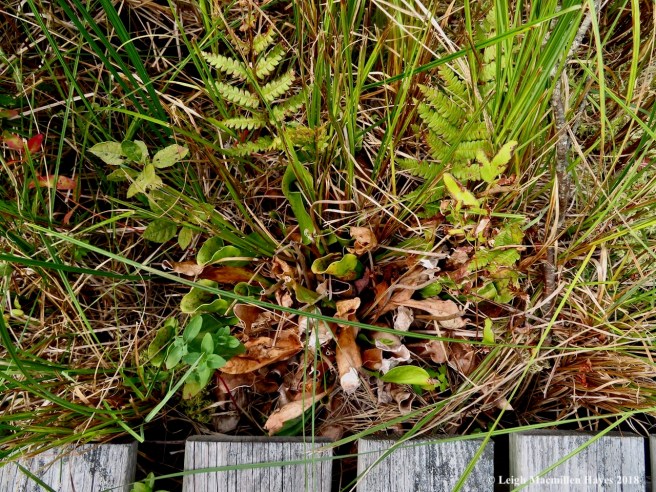
But today, we were a bit disturbed for one that we’ve admired for years on end looked like it was drying up and dying. In fact, the location is typically wet, but not this year given the moderate drought we’ve been experiencing in western Maine. What would that mean for the pitcher plant?

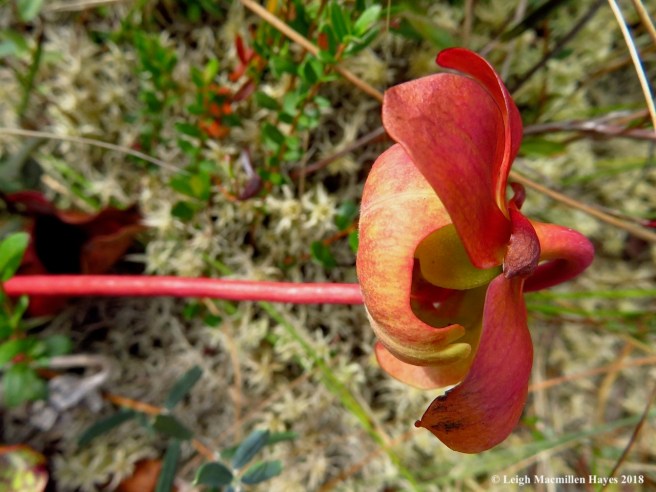
13-pitcher plant flower

Even the flower pod of that particular one didn’t look like it had any life-giving advice to share in the future.

14-Pitcher Plant 4

Fortunately, further on we found others that seemed healthy, though even the sphagnum moss that surrounded them had dried out.

14a-pitcher plant

Their pitcher-like leaves were full of water and we hoped that they had found nourishment via many an insect. Not only do I love the scaly hairs that draw the insects in much like a runway and then deter them from exiting, but also the red venation against the green for the veins remind me of trees, their branches spreading rather like the tree of life. Or maybe a stained glass window. Or . . . or . . . we all have our own interpretations and that’s what makes life interesting.

15-pitcher plant flower 2

Speaking of interesting, the structure of the pitcher plant flower is one we revere whenever we see it because it’s so otherworldly in form. And this one . . . no the photo isn’t sideways, but the flower certainly was. If you scroll up two photos, you’ll see it as it grew among the leaves. The curious thing is that it was sideways. Typically in this locale, Jinny Mae and I spy many pitcher plant flowers standing tall. Today, we had to squint to find any.

16-pitcher flower and aster

She found the sideways presentation and this one. But that was it. Because of the drought? Or were we just not cueing in to them?

20-cinnamon fern

We did cue in to plenty of other striking sights like the light on a cinnamon fern that featured a contrast of green blades and brown.

21-cinnamon fern drying up

Again, whether the brown spoke of drought or the transition to autumn, we didn’t know. But we loved its arching form dramatically reflected in each pinna.

18a-swamp maple

But here’s another curious thing we noted. We were in a red maple swamp that is often the first place where the foliage shows off its fall colors and while some in other locales have started to turn red, only the occasional one in this place had done so. Our brains were totally confused. Sheep laurel blooming for a second time; pitcher plants drying up and dying; and few red maples yet displaying red leaves?

19-witch's caps or candy corn

We needed something normal to focus on. And so we looked at the candy corn we found along the trail. Some know them as witch’s caps. They are actually witch hazel cone galls caused by an aphid that doesn’t appear to harm the plant. It is a rather cool malformation.

24-white-faced meadowhawk

On a boardwalk again, we stepped slowly because the white-faced meadowhawk kept us company and we didn’t want to startle it into flight.

25-white-faced meadowhawk dining

One flew in with dinner in its mouth and though I couldn’t get a photo face on before it flew to another spot to dine in peace, if you look closely, you might see the green bug dangling from its mouth.

26-New York Aster

All round us grew asters including New York, water-horehound, cranberries, bog rosemary and so many others.

27-Virginia marsh-St. John's Wort

There was Virginia marsh St. John’s Wort,

28-fragrant water lily

fragrant water lilies,

28-jewelweed

jewelweed,

29-pilewort globe

and even pilewort to admire. The latter is so much prettier in its seed stage than flowering. Why is that we wondered.

30-Holt Pond Quaking Bog

Ahhhh, an afternoon of wondering . . . with Jinny Mae. At LEA’s Holt Pond Preserve. In Bridgton. An afternoon well spent. Thanks JM.


So Many Advantages Along the Mountain Division Trail

When opportunity knocks, so they say, open the door. Today, it wasn’t really a door that I opened, but rather a trail that I explored. And it wasn’t a new trail to me, for I’ve ventured along the Mountain Division Trail in Fryeburg many times before.

1-trail sign

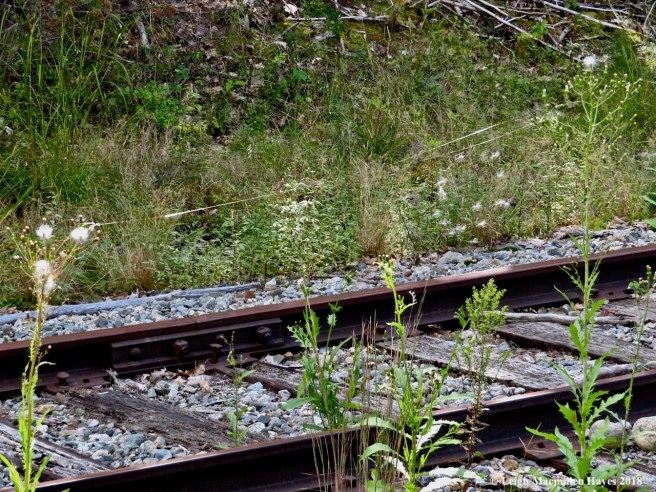
But my morning and afternoon plans changed and I happened to be in the vicinity and I don’t think I’ve ever walked that way in late summer before–so I did what I love to do best and set off down the path beside the now defunct railroad track. And I was curious to discover who else might be taking advantage of it on this fine September day.

2-monarch caterpillar

Within minutes, I made my first discovery–a monarch butterfly caterpillar crawled along the paved trail. I’d actually chosen this spot for I hoped to see a few monarchs and my chances suddenly increased.

3-red-legged grasshopper

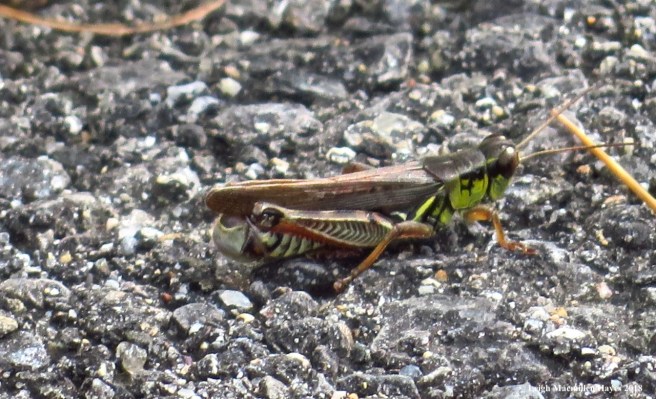
Also using the asphalt were innumerable grasshoppers of several types including this red-legged, and crickets galore. In fact, between them and cicadas, I could almost not hear the traffic on Route 302 at the start. Almost.

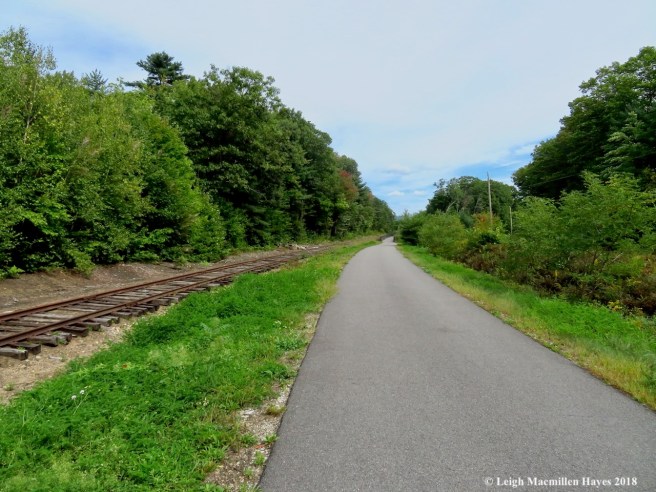
4-rail trail

Within minutes, however, the trail passed behind several businesses and then curved away from the road and toward Eastern Slope Airport. It was occasionally flat, occasionally straight, occasionally curved, and occasionally hilly. But always paved. And much quieter.

5-spotted knapweed and web

Constantly, the offerings changed. Knapweed with its pineapple-like base, which loves disturbed areas, had made itself at home. And a spider had used the structure to create its own home.

6a-monarch

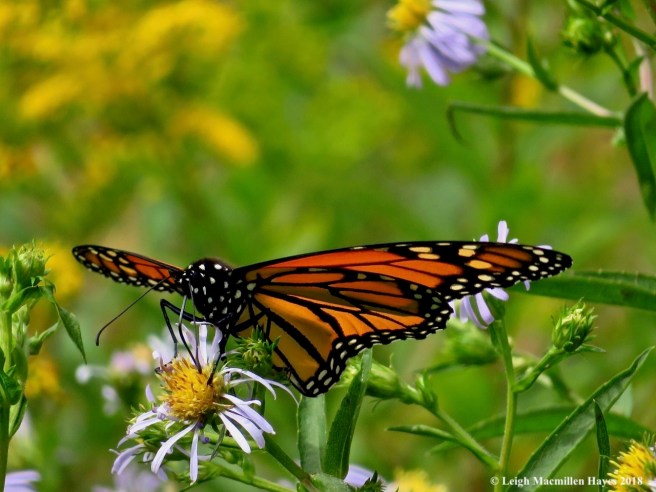
As I walked, I began to notice them–a monarch fluttering past here and another there. At last, I found one that had paused to take advantage of the nourishment offered by an aster.

6-monarch on aster

I stood for as long as it would allow . . .

7-monarch on aster

enjoying every pose presented.

8-crystalline tube gall

A little further, I found something I only remember seeing for the first time a few weeks ago–I think it’s a crystalline tube gall on the oak leaf, but urchin gall would be my second guess.

9-banded tussock caterpillar

On the same leaf, either a banded-tussock moth caterpillar or a Sycamore tussock moth caterpillar munched away, so similar are they. Check out all the bristles by the head–both an extra set of black and a more subtle set of white.

10-water

By what I assumed was an old mill pond fed by a small brook, the watery world quietly intercepted all other communities found along this path.

11-painted turtle

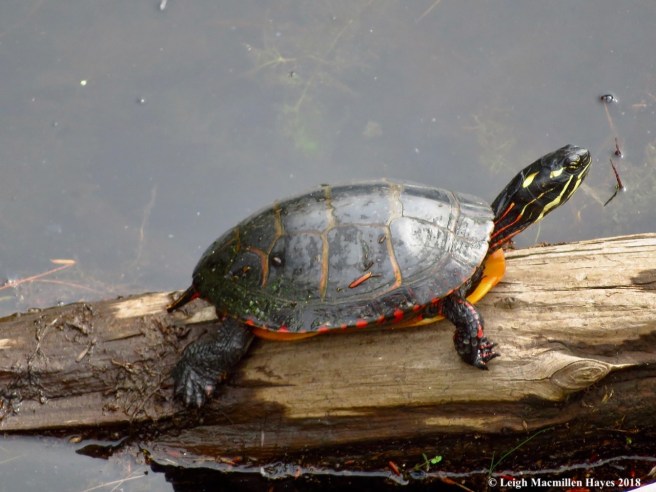
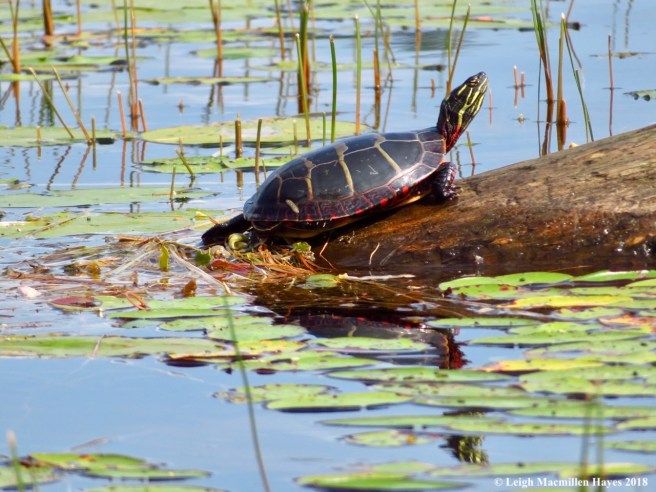
And today, a painted turtle watched nonchalantly from a log in the pond as the world passed by–runners, walkers and bikers on the path above . . . some who hardly noted his presence.

12-male blue dasher

And dragonflies,  including this mighty handsome green-eyed blue dasher, below. Do you see the hint of amber in his wings? One of the telltale signs.

13-pokeweed poking through the fence

Continuing on, I was surprised by a sight I’d seen before because I’d forgotten its presence. Pokeweed flowered and fruited and . . . poked through the fencing that formed a boundary along parts of the trail.

14-northern white cedar

There’s also a short section where northern white cedar formed a wall, its woody cones all opened in an expression of giving forth new life and its leaves scaled like skinny braids.

15-pipewort gone to seed

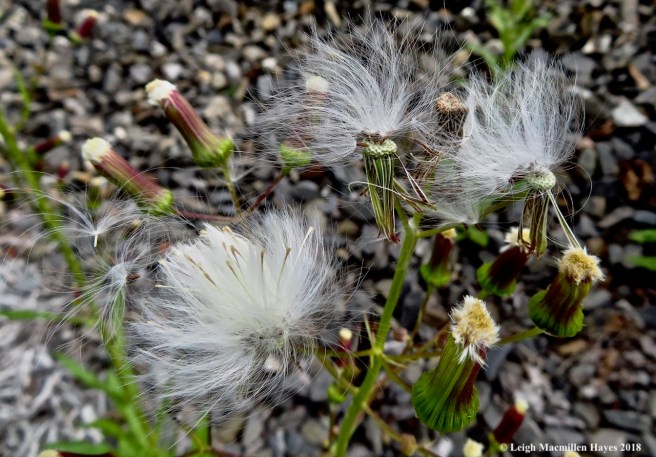
Being a greatly disturbed zone, pilewort grew in abundance and its seeds danced and twirled and sashayed through the air like ghostly angels blowing in the wind. Actually, the graceful seedheads were much more attractive than the flower in bloom.

16-Queen Anne's Lace

Queen Anne’s Lace had also bloomed profusely, but today showed only its winter weed form full of tiny seeds edged with rows of bristles. The better to ground itself somewhere when the time comes, I supposed.

17-Bristly sarsaparilla fruits

Speaking of bristles, bristly sarsaparilla sent its many-fruited umbels out through the fence, perhaps in offering to those passing this way.

18-into infinity

So many offerings I’d seen by the time I reached about the three mile mark and I knew there would be even more on the way back so I used my own imaginary turntable and began the return trip.

20-spider web between pipewort

It was then that a web strung with great and amazing strength between two pileworts caught my attention. First, I couldn’t believe the distance between the two plants or the thickness of the anchoring web. And then I noticed something else . . .

21-seeds caught in web

An orb about two thirds of the way across, decorated with pilewort seeds that will take a little longer than usual to get established on the ground. Will they be viable, I wondered.

23-funnel spider

Another industrious arachnid had used one of the fence pipes to make himself a home. Can you see the funnel spider waiting in the tunnel for delectable prey to land on his web?

22-goat

And then there were the goats, this one and two others who munched beside the trail. I called their owner because I feared they’d broken out of their pen (or someone had opened the gate). Her number was on a board attached to a tree as she’d advertised her daycare business to all who passed by. We enjoyed a pleasant conversation and I learned that she lets them out for an hour or so each day to feed on the weeds. Weeds? What weeds. All I saw where wildflowers aplenty. Anyway, if you go, do know that you may encounter the goats and they are not gruff at all.

24-cabbage white butterfly

While I saw a few more monarchs as I wandered back, a few other butterflies at least half the size of the royal ones moved with dainty motions. For the cabbage white butterfly, the asters were all the thing. But like so many of the wildflowers that have taken root in this disturbed place, this butterfly also disturbs people because it has a penchant for damaging crops.

26-northern cloudywing skipper butterfly

Even smaller was the northern cloudywing skipper that stopped atop a red maple sapling. Males perch near the ground awaiting females, so his chosen spot made sense. His wing scales gave him such a satiny look as he shown in the light and his earth-tone colors included hints of purple.

It was all about the earth, I noted, as I walked along the Mountain Division Trail. Years ago, the path that I followed today had been used to construct the railroad track. And then in the 2000s, the rail trail had been built beside it. Over the years, I’m sure the railroad track had been enhanced. So the land was indeed disturbed . . . repeatedly.

And now, just as I took advantage of it to follow the well-constructed trail, so many others had done the same–both human and non. Not all were beneficial, but still they eeked out a life in that place. From insects and “weeds” to turtles and tree, there are so many advantages available along the Mountain Division Trail in Fryeburg, Maine.


Our Home is Their Home

As I sit in my rocking chair on the camp porch, the cicadas still buzz, with chirps of crickets thrown into the mix and somewhere in the background a constant trill from another. Tree frog? Perhaps, but it seems to carry on for longer than usual. Grasshopper? Maybe. And then there is the occasional call of the loon.

1-camp

What truly attracted my attention earlier today, however, were the other members of the household. Whose home this is, I think I know. Or rather, I thought I did. I thought it belonged to my guy and me. But really, I should have known better for it has never just housed the two of us. There were the boys growing up, and family, and friends, and renters, even. Actually, the latter three knew it before the boys. (Oops, I suppose I should call them young men, mid-twenty-somethings that they now are.)  But, through all these years, it has also housed many others. And so today, I got acquainted with some of its other residents. Rather than the mammals that we know also share the space, e.g. mice, squirrels, and bats, it was the insects and arachnids that I checked out.

2-cicada exuviae

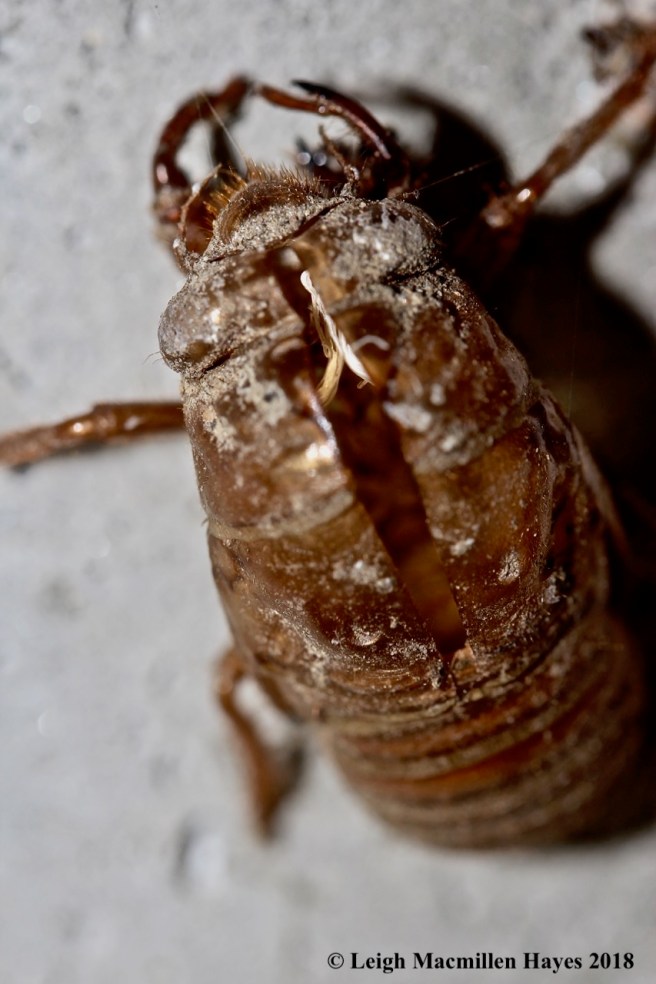
My first find along the foundation was an exuvia of one I listen to day and night–that of a cicada. In their larval stage, cicadas live down to eight feet underground. When the time comes to metamorphose into winged adults, they dig to the surface, climb up something, in this case the foundation, and molt. The  emerging winged insects leave behind their shed skin, aka abandoned exoskeleton or exuvia. It’s a rather alien looking structure, with the split obvious from which the adult emerged.

3-cruiser 1

The cicadas weren’t the only aliens along our foundation. It seemed like every few feet I discovered a dragonfly exuvia dangling from the porch floor and now encased in spider webs.

3b-cruiser

One of the cruiser exuviae had dropped to the ground below. But still the structure remained intact. And I now realize that my next task is to head out the door once again in the morning and collect these beauties, the better to understand their nuances.

4-cruiser hiding

I found cruisers hiding under the logs . . .

6-cruiser and cast off spider

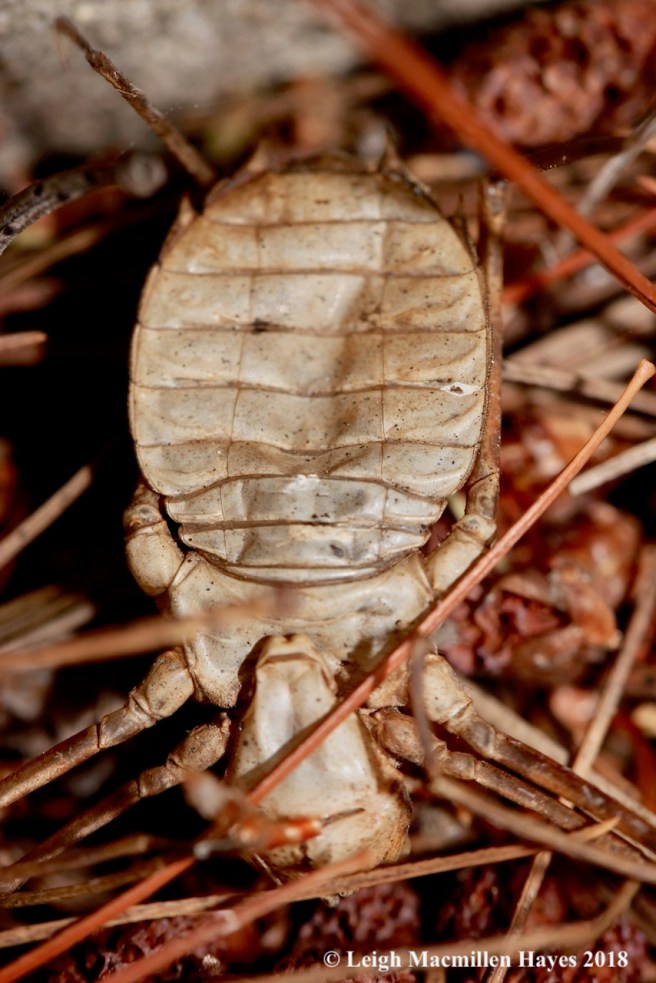
and even one tucked in by a basement window that had a shed spider exoskeleton dangling from it.

6a-lancet clubtail dragonfly

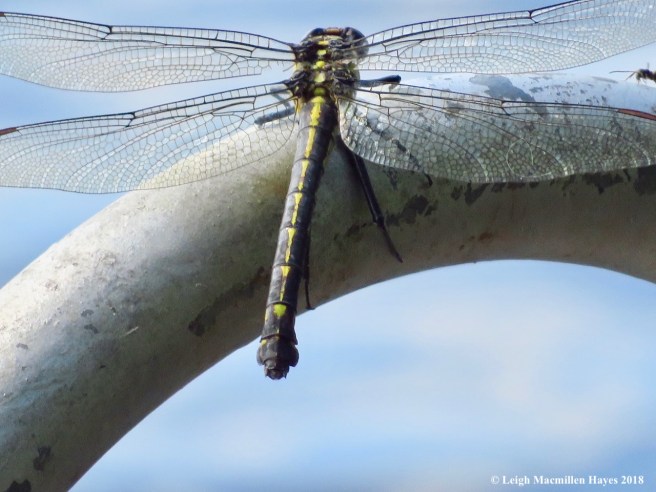
There were others as well, but nowhere did I find the exuvia of the one with whom I’ve spent the most time, Sir Lance(t) Clubtail. I suspect his shed skin is attached to some aquatic vegetation for he spends so much of his time by the water, even today, pausing only briefly to rest on the dock ladder.

7-bag worms and pupal case of a pine sawfly

There were other species to meet, including the most interesting of structures, those of the evergreen bagworm cases. I assumed that the young had already emerged, but their homes consisted of material from the trees on which they fed, e.g. pine needles. They struke me as the terrestrial form of the aquatic caddisflies.

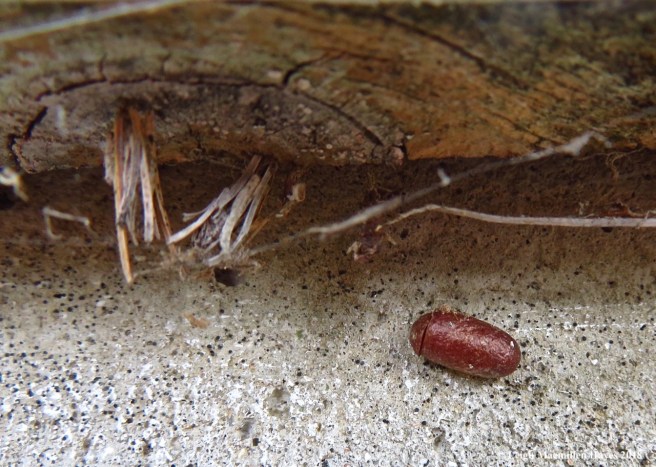
And beside the two bagworms was a small, rounded brown case–the pupal case of a pine sawfly. The sawfly had already pupated and in this case no one was home.

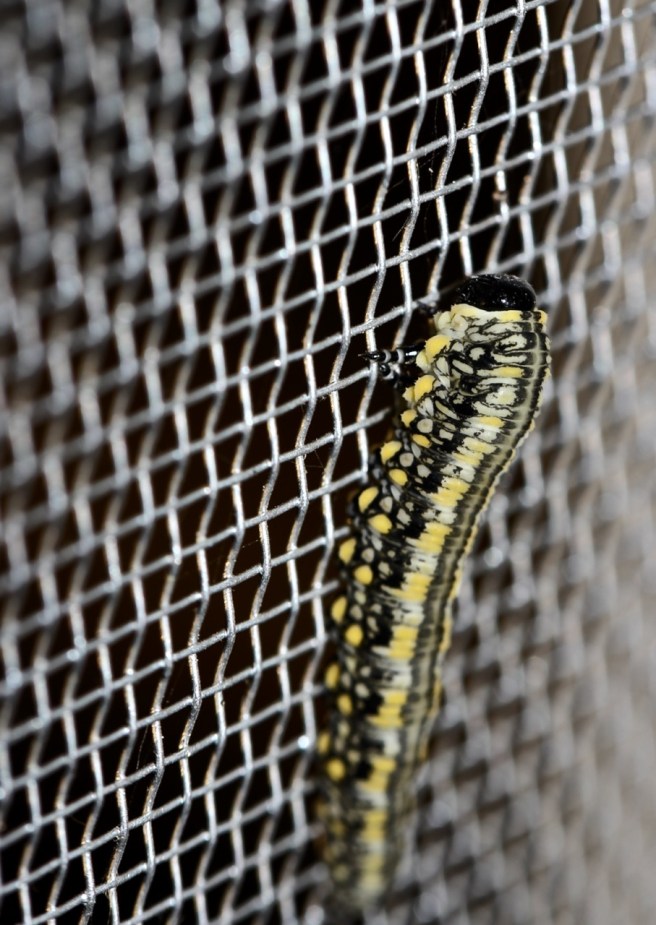
8-pine sawfly caterpillar on screen

Oh, but they were and have been for a few weeks. I first realized we had an infestation when what sounded like the drip-drop pattern of a summer rain on a perfectly sunny day turned out to be little bits of green caterpillar frass falling from the trees. Everything was decorated. And then I began to notice the caterpillars–many falling out of trees and landing on the surrounding vegetation, and the house. As would be expected, they climbed toward the sky, hoping, I suppose, to reach the top of the trees. Good luck with that.

9-pine sawfly caterpillars

Some didn’t make it above the foundation, where they encountered spider webs and soon had the juices sucked out of them. Such is life. And today, a winter flock of birds including chickadees, nuthatches, goldfinches, hairy woodpeckers, young robins, and even a brown creeper flew in and some fine dining took place. The raindrops have nearly ceased.

10-Northern Pine Sphinx

That wasn’t the only pine-eating caterpillar to make its home here. On the chimney, I found a northern pine sphinx caterpillar moving full speed ahead.

11-orbweaver

And around the bend, where the chimney meets the camp, an orbweaver spinning some silk in the hopes of fine dining.

14a-calico pennant dragonfly in web

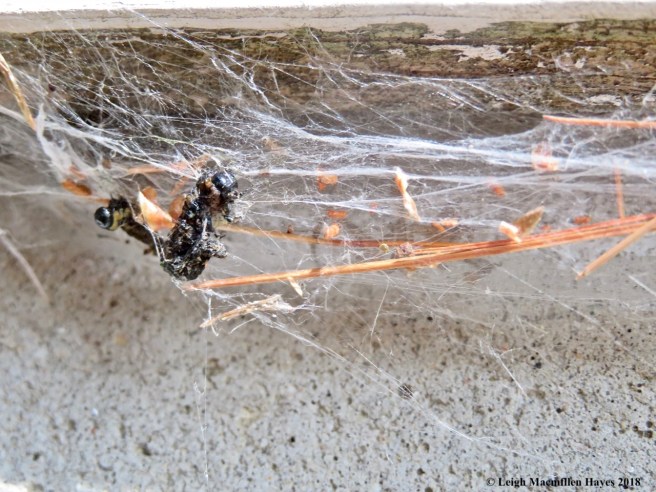
One meal had obviously been consumed–a calico pennant dragonfly. I’d seen a few of those on the vegetation a few weeks ago, but none recently. Apparently, one flew too close to the building. The only way I could ID it was by its wings for the head, thorax and abdomen had been eaten. But the wings have no nutritional value.

11a-Northern Pine Sphinx 2

A short time later I returned to the chimney in hopes of locating the northern pine sphinx caterpillar again. I did. And he wasn’t. He’d apparently turned the sharp corner on the chimney and met his fate.

13- Northern Sphinx 4

Eye to eye. I’m amazed at the size of the insects that find their way to her web. It’s not like they are attracted to it. Instead, they come upon it quite by surprise and she makes fast work of their mistake.

14-pine tree spur-throated grasshopper

Rounding the corner back toward the porch door, one last insect drew my attention. And again, it was related to the pines, such is the local community: a pine tree spur-throated grasshopper on one of the logs that forms the outer wall of our wee home.

Our home is their home and we’re happy to share the space with them. Provided, of course, that they leave space for us to live as well. So far, all is well.


Long Speck-tacular

I suggested two hikes today to my guy and rather than choose one, he thought both sounded perfect. And so our journey began about noon as we ascended the 2.5 mile trail that twists and turns beside Mill Brook. Our destination: Long Mountain Ledges off Vernon Street in Albany, Maine, a property owned by Mary McFadden and Larry Stifler. Through their generosity, many trails in the area are open to the public. And through the work of their employee, Bruce Barrett, those trails are well maintained.

1-Long Mtn Trail

And well marked.

2-through the bog

At the start, a long series of boardwalks passes through a wettish area where so many ferns, and mosses, and wildflowers grow.

3-blue cohosh

Some, such as the Blue Cohosh, have matured to their fruiting stage–and their leaves hinted that another season is in the near offing.

4-red-belted polypore appearing to sweat

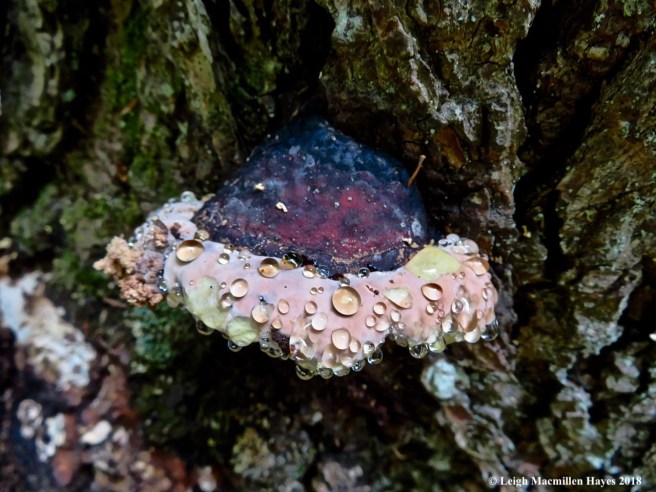
Once we began to climb, the natural community changed and so did the residents. One in particular reminded me that I have yet to understand its behavior. Why does the Red-belted Polypore weep, I wondered. It’s not a case of morning dew for nothing else appeared to have droplets of water. In searching for an answer, I learned a new word: gut·ta·tion–/ɡəˈtāSHən/, noun: the secretion of droplets of water from the pores of plants. On gardeningknowhow.com, I found this explanation: “The plant doesn’t always need the same amount of moisture. At night, when temperatures are cool or when the air is humid, less moisture evaporates from the leaves. However, the same amount of moisture is still drawn up from the roots. The pressure of this new moisture pushes out the moisture that is already in the leaves, resulting in those little beads of water.” If this is correct, I’m assuming the same is true for fungi.

5-pancake fungi

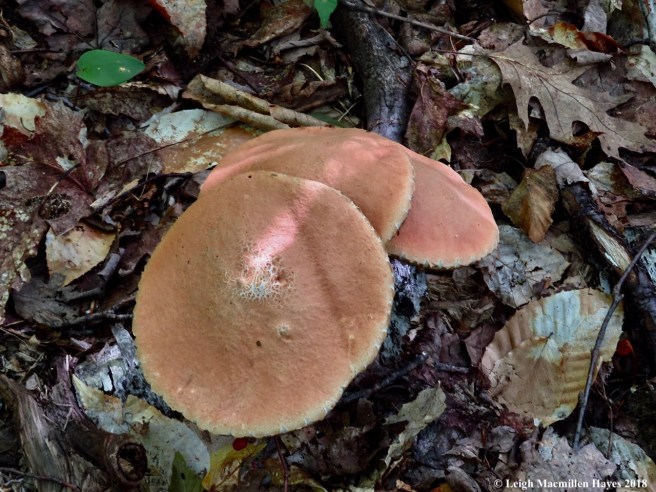
There were plenty of other mushrooms to see, including the pancake fungi my guy pointed out. He’s such a mushroom guru (NOT) that I instantly believed his identification. After all, they were plate-size and did resemble pancakes. All they needed were some blueberries, butter, and maple syrup.

6-Long Mountain Trail Ledges

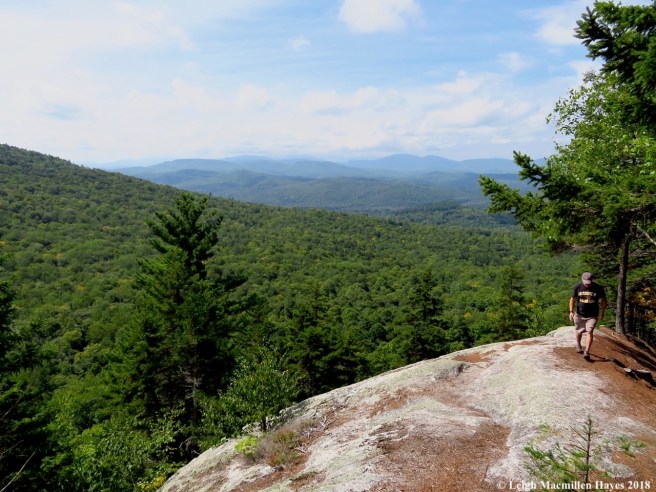
Because the trail was so well created, it hardly felt like a climb and in just over an hour we had reached the ledges where the view included Round Mountain to the immediate left, also owned by the Stiflers, and the Whites in western Maine and eastern New Hampshire beyond. Suffice it to say, this was lunch rock.

7-crown-tipped coral

We descended via the same trail and I love doing that because there’s always something different to see. Today, it was a purple coral fungi. Did it begin life as a different color and the purple was a sign of maturity, I wondered. It didn’t matter. What mattered was that I couldn’t recall ever seeing that color before and it seemed rather royal.

8-hobblebush berries

There were also hobblebushes to admire, they’re green leaves and red berries adding a bit of Christmas joy to the scene. OK, so I’m rushing seasons, but I am a winter gal.

9-heading out

Five miles and 2.5 miles later, we walked back across the board walk, hopped into the truck, and drove south.

10-Speck Ponds Trail

For all of ten minutes, for our next destination was another property owned by the Stiflers. This time, we followed Hunts Corner Road to Hutchinson Pond Road and looked for the trailhead to the Speck Ponds Trail. If you go, know this, drive until you think you are almost there, and then drive some more. It’s located on the right, along the dirt portion of the road, just after the mailbox tucked into a canoe! Huh? You’ll have to take a look for yourself to understand what I mean.

11-the chair

I’d heard that some trail improvements had been made since I’d last ventured there. Indeed, they had, including new red trail blazes and an Adirondack chair by the trail map. The significance of the chair, however, wouldn’t be revealed to us until we finished. Onward we journeyed.

12-Crossing the line

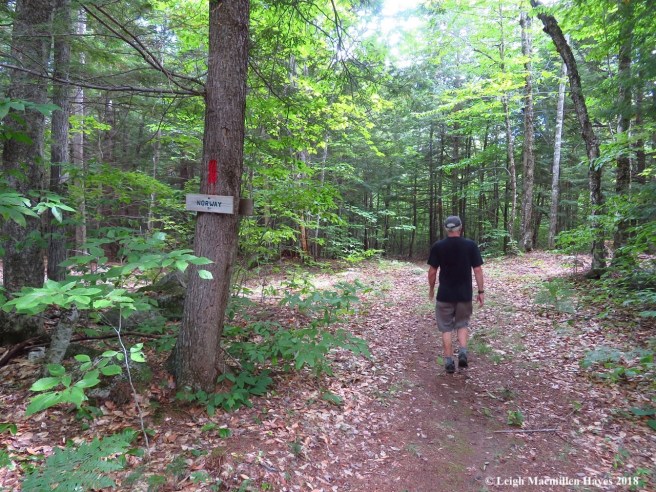
And crossed from Albany to Norway, Maine, via the woodland trail.

13-home of many beaver homes

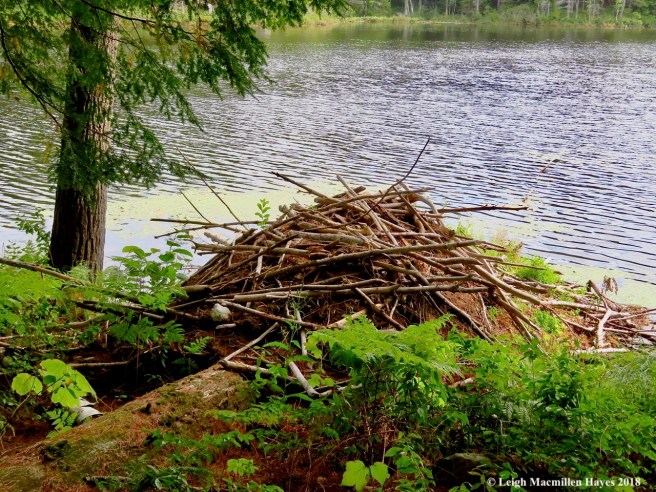
First, we circled halfway around Upper Speck Pond, noting signs everywhere that beavers had lived there in the past.

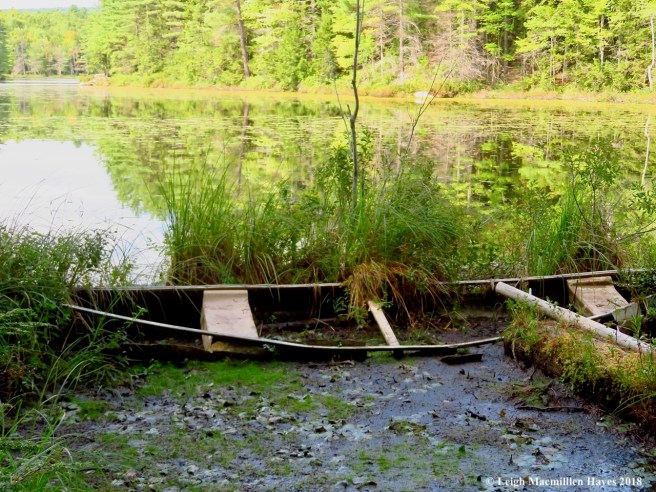
14-if this canoe could talk

And an old canoe that had its own stories of yore to tell. Somewhere, a family or group of friends know the history of this sunken artifact.

15-beaver dam on Lower Speck Pond

About halfway around, and really, directly behind the sunken canoe, another trail connects to the Lower Speck Loop. We followed it and eventually came to more beaver sign, including a dam with some new wood atop.

15a-beaverworks

Downed trees with freshly chopped chips also graced the area.

15b-beaver lodge

And another lodge. I lost count of how many we saw today, but suspected the one on Lower Speck was active.

16-Lower Speck Pond

We moved quickly as we circled round both ponds for my guy had visions of tonight’s pizza dinner on his mind. And maybe a Red Sox game that he was missing as well.

17-comorant

Despite our speed, we did pause to admire one of the pond residents–a cormorant.

A total of nine miles later, we’d climbed and circled and oohed and aahed and wondered along the way. Oh, and that chair, we considered sitting in it for we were hot and tired by the time we finished, but had we done so, we’d still be there–snoring away!

A Long Mountain-Speck Ponds Spectacular.


Insects of Lovell

To say the insects of Lovell are the insects of Maine . . .  are the insects of New England . . .  is too broad a statement as we learned last night when Dr. Michael Stastny, Forest Insect Ecologist at the Atlantic Forestry Centre in Fredericton, Canada, spoke at a Greater Lovell Land Trust talk  Mike helped us gain a better understanding of the relationship between trees, invasive insects and climate change in our grand State of Maine.

And then this morning, he led us down the trail on land conserved through the GLLT as a fee property and one held under conservation easement work.

1-what's that?

From the get-go, our curiosity was raised and we began to note every little motion above, at eye level, and our feet.

2-not an insect

Sometimes, what attracted our attention proved to be not an insect after all for it had two extra legs, but still we wondered. That being said, the stick we used to pick it up so we could take a closer look exhibited evidence of bark beetles who had left their signature in engraved meandering tunnels.

4-leaf miner scat

A bit further along, Mike pulled leaf layers apart to reveal the work of leafminers and our awe kicked up an extra notch. Leafminers feed within a leaf and produce large blotches or meandering tunnels. Though their work is conspicuous, most produce injuries that have little, if any, effect on plant health. Thankfully, for it seems to me that leaves such as beech are quite hairy when they first emerge and I’ve always assumed that was to keep insects at bay, but within days insect damage occurs. And beech and oak, in particular, really take a beating. But still, every year they produce new leaves . . . and insects wreak havoc.

6-leafminer pupa

Leafminers include larvae of moths (Lepidoptera), beetles (Coleoptera), sawflies (Hymenoptera) and flies (Diptera). I’m still trying to understand their life cycles, but today we got to see their scat when Mike pulled back a leaf layer! How cool is that?  Instantly, I recognized a new parlor trick that I can’t wait to share with the GLLT after-school Trailblazers program we offer through Lovell Recreation.

7-grandma and granddaughter

As for today, Mike’s mother-in-law, Linda, tested the wow factor on her granddaughter and we knew we had a winner.

8-hickory tussock moth caterpillar

Our attention was then directed to the tussock moth caterpillars, including the hickory tussock moth that seems to enjoy a variety of leaf flavors.

9-another tussock

And we found another tussock entering its pupating stage. We didn’t dare touch any of them for the hair of the tussocks can cause skin irritation and none of us wanted to deal with that.

11-leaf roller

Our next find was a leaf roller, and for me the wonder is all about the stitches it creates to glue its rolled home closed.

12-meadow goldenrods

Eventually we reached a wildflower meadow where our nature distraction disorder shifted a bit from insects to flowers, including local goldenrods.

12a-up close

There was much to look at and contemplate and everyone took advantage of the opportunity to observe on his/her own and then consult with others.

13-silvery checkerspot butterfly

One insect we all noted was the Silvery Checkerspot Butterfly. It’s a wee one and in the moment I couldn’t remember its name.

14-checkerspots mating

But . . . it remembered how to canoodle and we reveled in the opportunity to see such.

15-bees on Joe Pye Weed

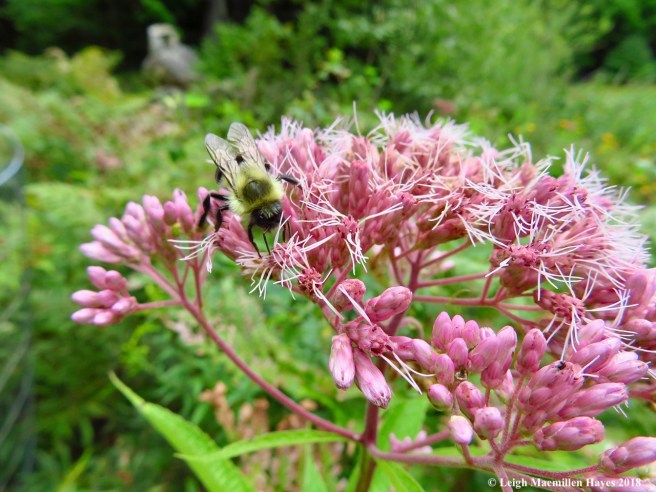
Our final insect notification was a bumblebee on the Joe-Pye-Weed. A year ago we had the opportunity to watch the bumblebees and honey bees in this very meadow, but today there were no honeybees because a local beekeeper’s hives collapsed last winter.

15a-Beside Kezar River

Our public walk ended but the day continued and I move along to the Kezar River Reserve to enjoy lunch before an afternoon devoted to trail work.

15b-darner exuvia

Below the bench that sits just above the river, I love to check in on the local exuvia–in this case a darner that probably continues to dart back and forth along the shoreline, ever in search of a delectable meal.

16-Autumn Meadowhawk Dragonfly

Landing frequently for me to notice was an Autumn Meadowhawk Dragonfly, its body all ruby colored and legs reddish rather than black.

17-milk snake

My goal was to slip down to the river level like the local otters might and as I moved along I startled a small snake–a milk snake. Not an insect . . . but still!

19-Mrs. Slaty Skimmer

Because I was there, so was the female Slaty Slimmer Dragonfly, and she honored me by pausing for reflection.

18-slaty skimmer dragonflies

Apparently I wasn’t the only one to notice her subtle beauty, for love was in the air and on the wing.

20-female ruby meadowhawk dragonfly

Lovell hosts many, many insects, but I certainly have a few favorites that change with the season and the location. Today, Ruby Meadowhawks were a major part of the display.

21-female ruby meadowhawk dragonfly

Note the yellowish-brown face; yellowish body for a female; and black triangles on the abdomen, and black legs.

Our findings today were hardly inclusive, but our joy in noticing and learning far outweighed what the offerings gathered.

Ruby, Slaty, Miner, Tussock, Checkerspot, so many varieties, so many Insects of Lovell, and we only touched on the possibilities. Thank you, Mike, for opening our bug eyes!


Eagle-eyed Mondate

It was the call of the loon that pulled me onto the dock early this morning, my coffee and camera in tow.

1

As it moved about not too far off, I noticed that it started turning in circles. It appeared to be listening and looking . . . and not for fish.

2

Suddenly, from behind me, there was movement in the sky and I began to understand. If you look carefully, you will also begin to understand.

3

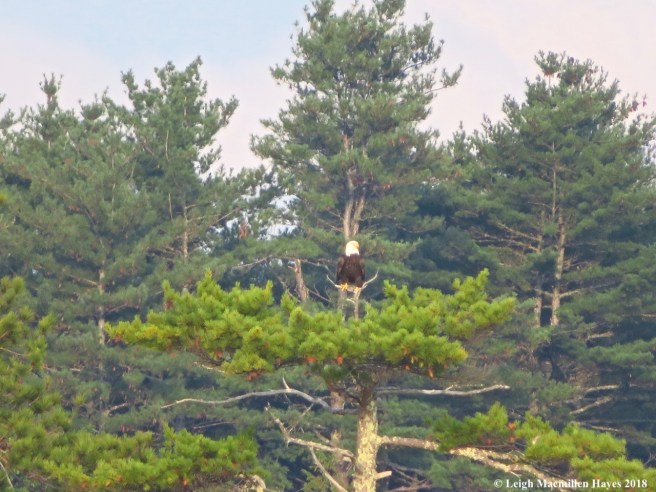
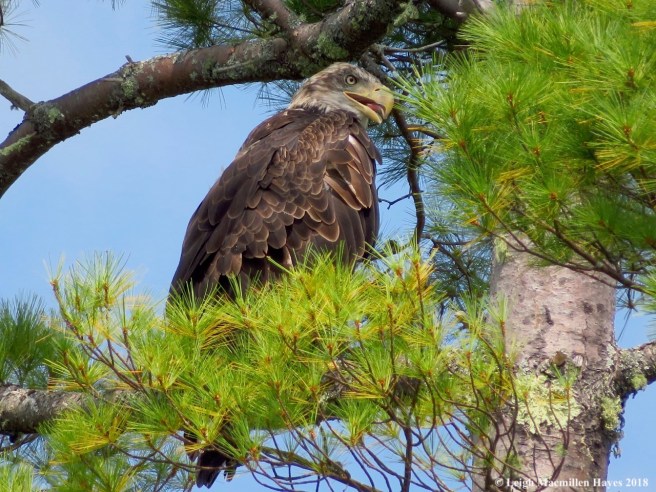
A mature eagle had entered the neighborhood.

4

For some reason, the loon moved closer.

22

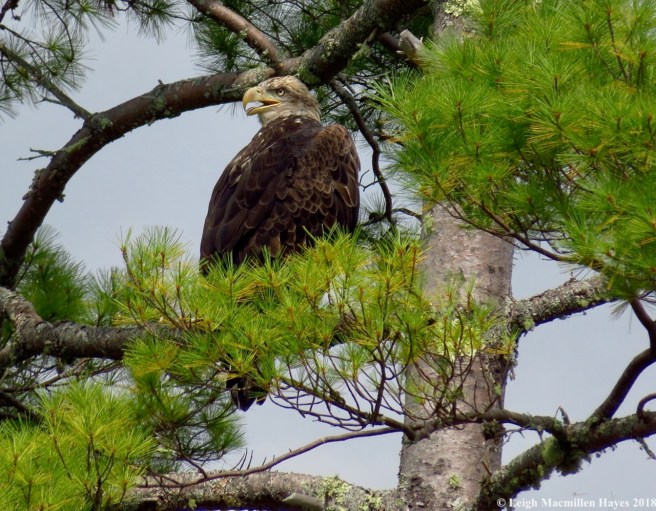
And then an immature eagle appeared. So did my next-door-neighbor, who walked quietly onto the dock with her camera. Together, we watched, barely exchanging any words as we didn’t want to disturb the scene.

23

Eventually the older bird flew up to a perfect viewing spot on a nearby island, rearranging a couple of twigs to create a mini-platform from which to watch the world.

5

The younger bird stayed a bit longer and then it flew toward the north end Moose Pond.

6

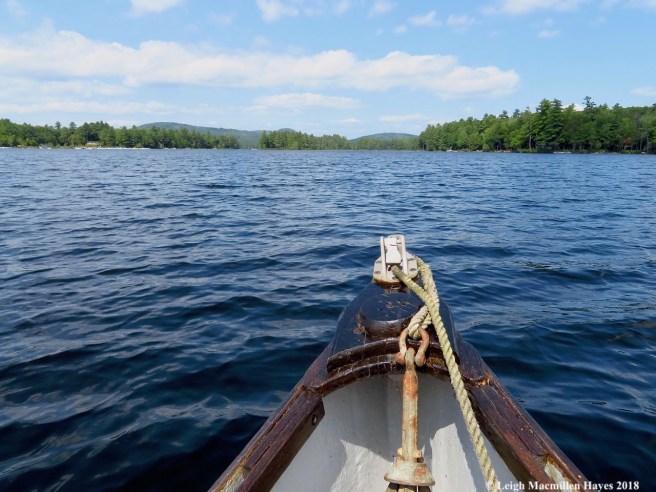
A few hours later, my guy and I also headed north, traveling a route we typically follow with our kayaks. Our mode of transportation on this day was the S.S. Christmas, our Maine Guide boat.

7

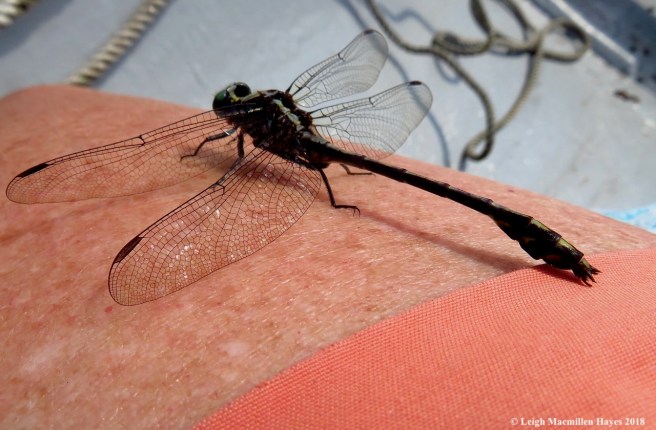
As we moved along, I felt a tickle on my leg and looked down to see that Sir Lance, the lancet clubtail dragonfly, had joined us for the journey. He came and went several times and then left us alone as we moved into a territory occupied by other species of dragonflies.

8

Among the islands we moved, keeping an eye on the bottom for the water is quite shallow and our boat precious. So are we. And the camera!

9

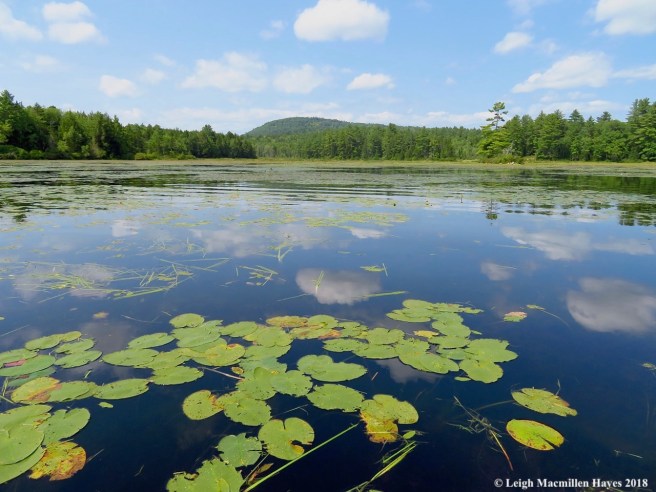
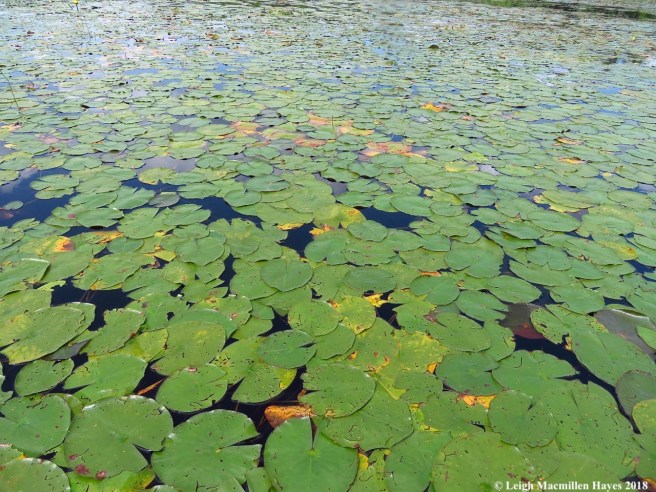
Eventually we ran out of mini-channels to follow for so carpet-like was the display of lily pads before us.

10

I would have been content to drift, but my guy is a doer and he needed to be doing something. And so he rowed.

11

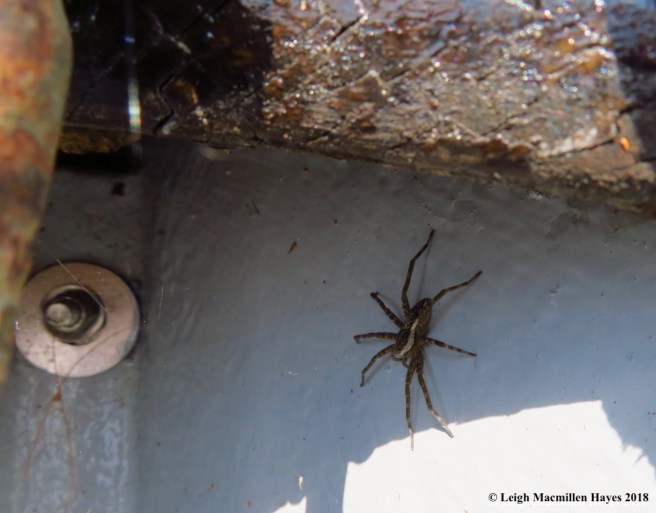
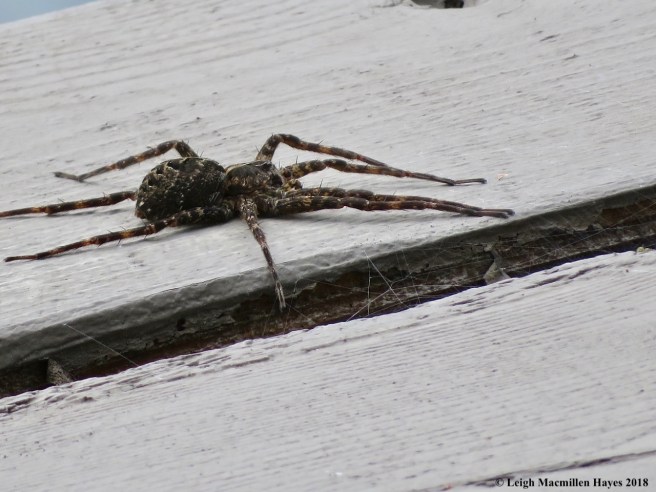
As I turned around to see what I might see, I saw a hitchhiker up under the bow–a dock or fishing spider! The rule was, if it didn’t bother me, I wouldn’t bother it.  And so it went for the remainder of our journey together, though I’m not sure he departed when we returned to the dock.

12

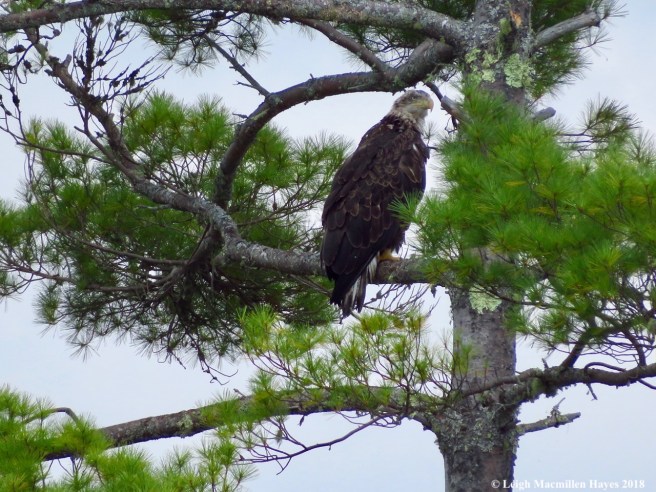
Anyway, back to our adventure. We were approaching one of the islands we sometimes stop on when we snowshoe in the winter–it’s a fine place to enjoy a PB&J sandwich. And then I spied something in the tall pine. An owl? I’ve listened to a Barred Owl the past few nights.

13

My guy rowed closer and we realized it was the immature eagle.

14

And so at last we sat still. For a long while. And watched. And waited. And listened. And saw calico pennant dragonflies.

15

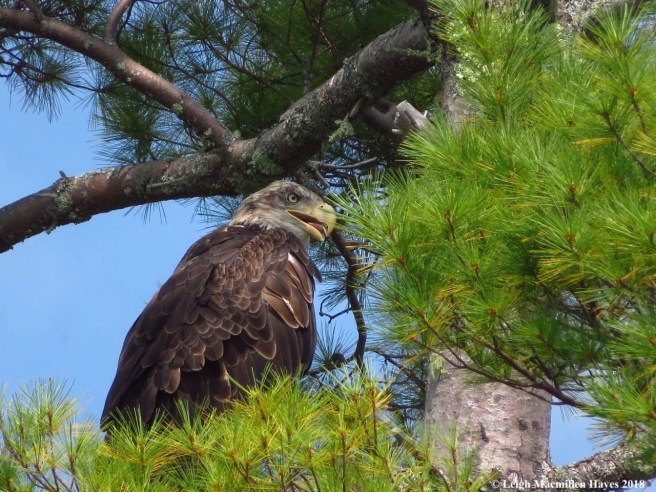
But it was the eagle that really drew our attention.

16

Behind us fish jumped and we fully expected the bird to scream down our way with its talons extended.

17

But it didn’t. Instead, it panted like a dog. The day was warm, especially up in the islands where the wind was blocked.

18

It also preened.

19

And occasionally it looked our way–mostly when my guy’s feet moved a bit and his crocs squeaked, sounding rather like another eagle. Their highpitched call always surprises me for it seems rather weak for such powerful birds that draw our awe and wonder with each sighting.

20

At last the eagle flew south, apparently not at all interested in any fish . . . or painted turtles. And we made our way south as well.

21

We were almost back to the dock when Sir Lance landed on my leg again. I placed my pointer finger in front of him and he climbed onto it. How cool is that?

Another fun Mondate aboard the S.S. Christmas with my guy–and another opportunity to exert our eagle eyes!


The Day The World Passed By

I love those days when I have a few moments and can pay attention to the world around me. It never ceases to fill me with awe and wonder. And today was such as I had a free hour that I chose to spend on the dock.

1-fishing spikder

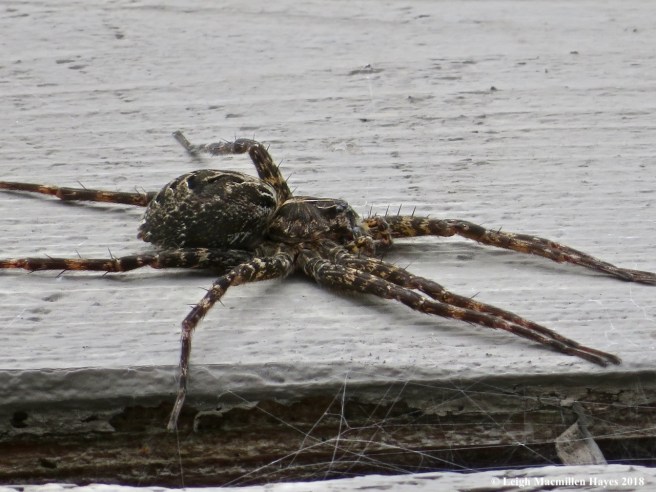
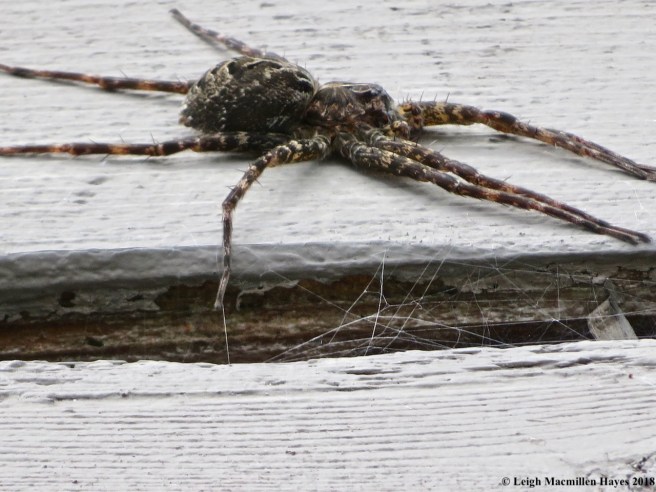
I shouldn’t have been surprised to see a fishing spider the size of my palm resting there, but I was for it was my first sighting of one this year. True confession, indoors I’m not a huge spider fan and as a kid I used to holler for someone to come kill any arachnid I spied. But . . . with age comes appreciation. And perhaps understanding.

2-fishing spider bristles

And so I appreciated this spider’s pattern and understood the need for its hairy body that gave it such a scary look. Fishing spiders hunt by sensing vibrations. The hair is hydrophobic, meaning it repels water. It also allows the spider to actually walk on water to get its prey. Those bristly hairs also trap air bubbles that the spider uses to breathe when it waits underwater to ambush a meal, be it insects, tadpoles, or other invertebrates.

3-lancet clubtail and ant

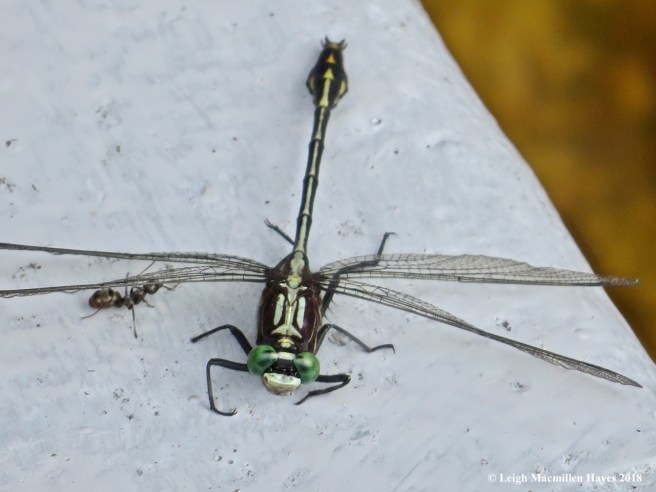
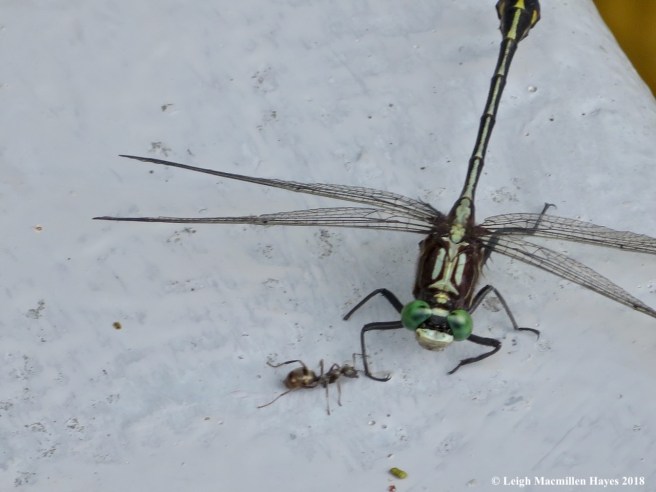
When I heard wing beats behind me, I turned my focus away from Charlotte and toward a Lancet Clubtail dragonfly that had landed on a seat of My Guy’s boat. An ant marched right over to check it out.

4-ant tickling dragonfly

And I fully expected the Lance to eat the ant. But . . . he didn’t. Drats.  I like watching them consume their prey.

5-lancet minus one tarsus

The more I looked at this guy, and it was a guy based on its cercus, the more I noticed, including the fact that it was missing the tarsi or claw-like foot of one leg.

6-dragonfly_anatomy

It was his face though, that I really wanted to study. I found this simplified picture at arizonadragonfly.org, and though it’s not complete, it provided enough information for my purposes.

7-facial features of a dragonfly

There’s so much to learn, that to add more detail would be more than overwhelming. Look at the mouth parts. And those eyes–each is composed of 30,000 lenses. Apparently, they can see ultraviolet and polarized light. And then there’s the ocelli, or visual organs, that probably work along with the antennae. Prey don’t have a chance.

8-fishing spider

When the Lance flew away, I checked on Charlotte again. Still she sat, one leg dangling below the dock board and touching a web. I figured she was waiting for movement to announce that a meal had arrived.

9-Ted had arrived

And then I noticed that it wasn’t a meal, but perhaps a mate she’d been expecting.

11-spider movement

Suddenly, he darted under the dock and she started across the gap–toward me!

12-Charlotte the spider

Then she stopped, seemed to make an adjustment,  and quickly disappeared.

13-spider nursery

I moved in for a closer look and made a discovery.

14-spider nursery

Her nursery! Fishing spiders are nursery web spiders. She must have wrapped her eggs in a silken sac and carried it to the gap between the outer two boards of the dock, where she constructed the web. And she was standing guard waiting for her spiderlings to emerge–until I came along. Now the question remains, will I be around when they do hatch and disperse on their own silken threads?

15-bubble on water

I don’t know. But today, I was there to notice so much in such a short time–as the world passed by.


The Amazing Race–Our Style, episode seven

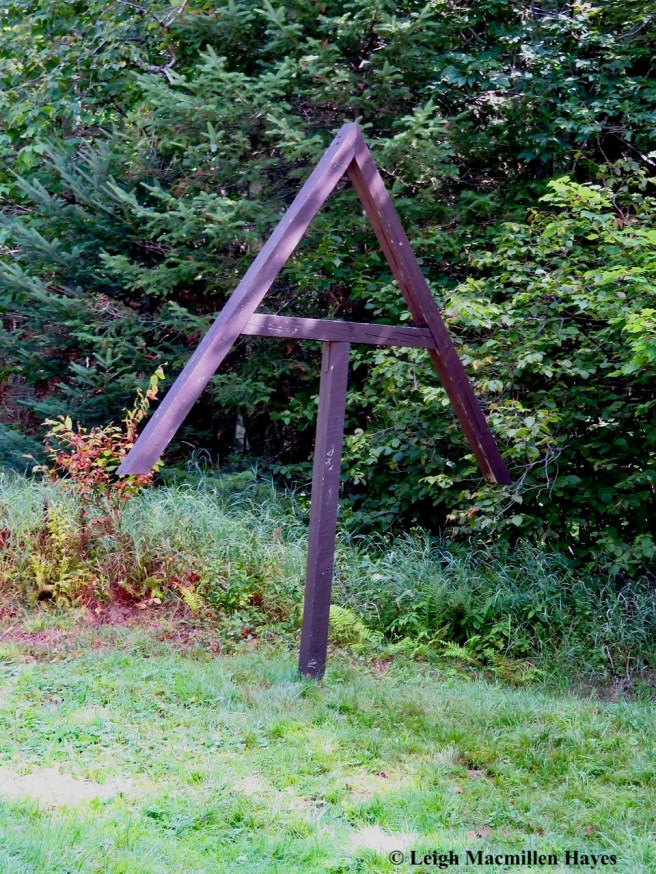
We never know when the clue will appear and so it was a complete surprise to find it this morning. “Drive 50 or so miles north and locate the Big A near the table.”

1-Big A

We took our chances and drove to Bethel and then on to Newry and beyond. Lo and behold–the Big A appeared. And so we parked across the street, slipped into our hiking boots, and began the journey. At the time that we arrived, we were the only contestants, so we wondered if we were behind or ahead.

2-easy path

At first the trail was deceivingly flat. “I’ve got this,” I thought.

3-rungs on rocks

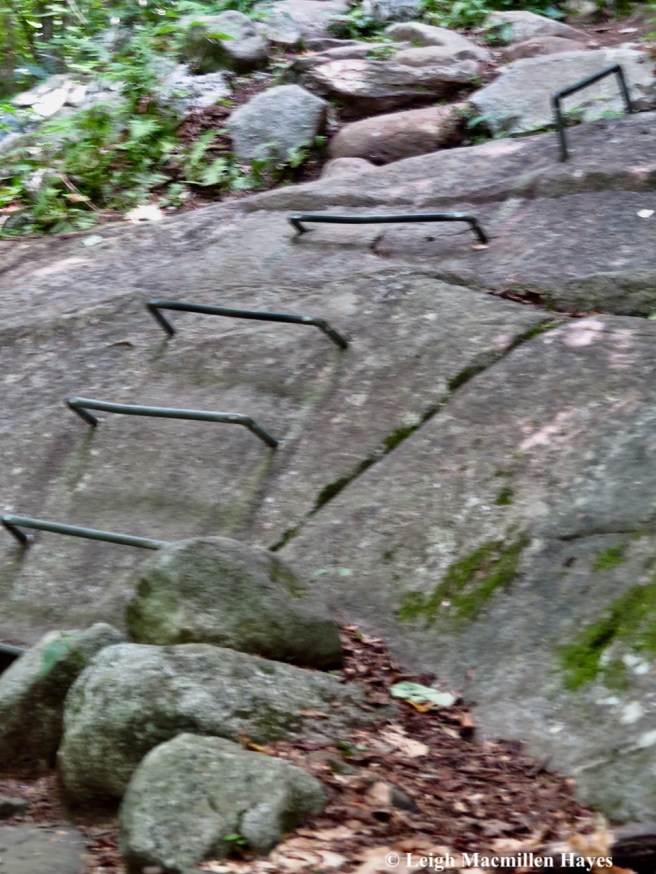
But we soon came to a point where the white-blazed trail headed to the left and the orange-blazed trail to the right. We had a choice to make. White would mean a bit further journey, but it was easier. Orange was much more difficult, but if we played our cards right, we might ascend quickly. It wasn’t long before we realized that our hearts pulsed rapidly. And then we met Team Livermore . . . and passed them. They are younger than us, so I was feeling a bit smug. Until we came to the wrought iron rungs. I guess I was shaking a bit, from the looks of the photo, but really, climbing up the rungs was a piece of cake compared to the rest of the scramble . . .

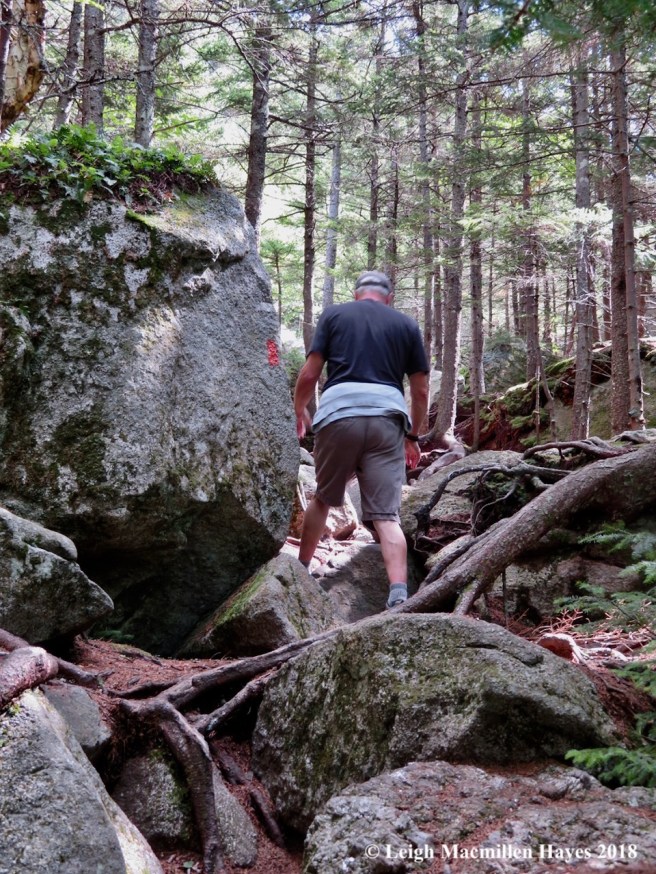
4-climbing higher

over the steep, boulder-strewn trail.

5-trail map on boulder

Along the way, I paused periodically pretending to note things like a boulder covered with a moss map . . .

6-spider web

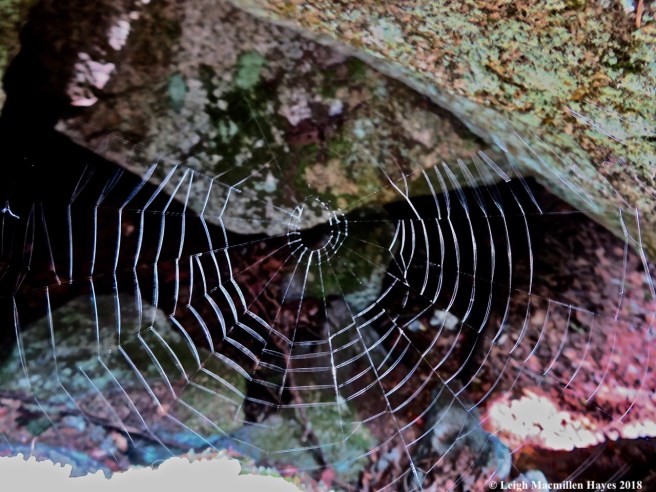
and an orb web sparkling in a bit of sunlight. The truth is that I was catching my breath. After seeing the web I had to put the camera away, for we’d reached a point where we needed the use of both hands. And just above the web my mind shut down as My Guy stepped from one boulder over a gaping hole to the next. He patiently told me where to place each foot, and try as I might, I couldn’t move. I was certain that hole would swallow me whole. Along came Team Livermore and I knew we were skunked, but I had to let them pass. They made it look effortless and so four more times I attempted to make the crossing, and on the fifth try I went for it. And I’m here to write about it, so obviously I lived.

7-contemplating

Team Livermore may have passed us, but we soon caught up and moved ahead. We kept thinking we were about to reach the summit, when the rock would indicate otherwise and at one point we had to hike down a bit before climbing up again, which didn’t seem quite fair given how hard we’d worked. But then again, rock is rock and we certainly didn’t want to climb directly up its face.

11-to the north

At last–success. We found the table we’d sought: The summit of Table Rock.

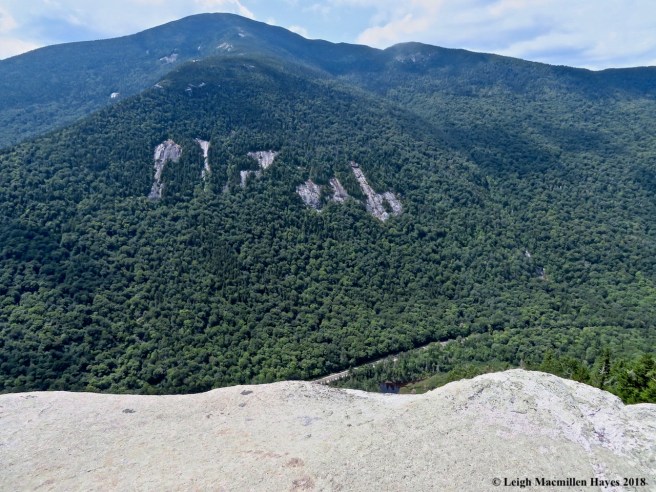
12-message in the slides?

Before us, The Eyebrow and Old Speck.

13-Sunday River Whitecap

To the south, Sunday River Whitecap.

We didn’t stay too long on top for we weren’t hungry yet. And Team Cape Cod showed up. They’d chosen to come up the easier trail, so we knew we were ahead of them. We do like them though, so we hoped they wouldn’t be too far behind. Just as we started to make our way down, Team Speedy came along via the orange-blazed trail. We’ve had them on our tail in previous episodes and they have a bit of an attitude. That being said, we did what we often do–we practically ran down the blue and then white-blazed trails.

16-lunch rock

At lunch rock, we paused briefly beside the water and contemplated the map for a moment, making sure that we were headed in the right direction.

Further along we met a couple from New Hampshire–thru-hikers who had started in Georgia in March. We had nothing in our packs to offer them in terms of extra food, but bid them good tidings. Soon after, we heard Team Speedy again, and so with even more gusto, we finished our descent.

20-aster

Before moving on, we had a couple of tasks to complete. The first was to share photos of a flower–we chose the purple asters;

19-trillium fruit

a fruiting plant–trillium;

18-cup mushroom

and a fruiting mushroom–ours being one of the cup variety.

21-A # 2

We also had been instructed to find two more examples of the letter A, and so here is one . . .

22-A # 3

and the other. All were in honor of the white-blazed Appalachian Trail.

24-moose cave below

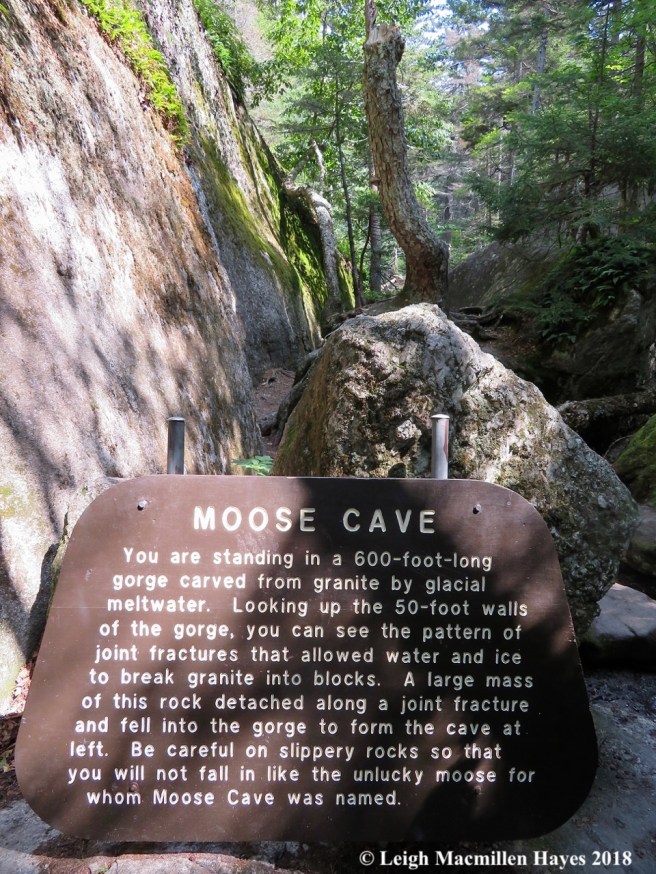
Making our way south on the road, our next clue indicated that we needed to find a moose, or at least evidence that one had been there previously. And so we found this deep cave, which the photo doesn’t do justice.

23-Moose Cave

As the local lore goes, however, a moose once fell in.

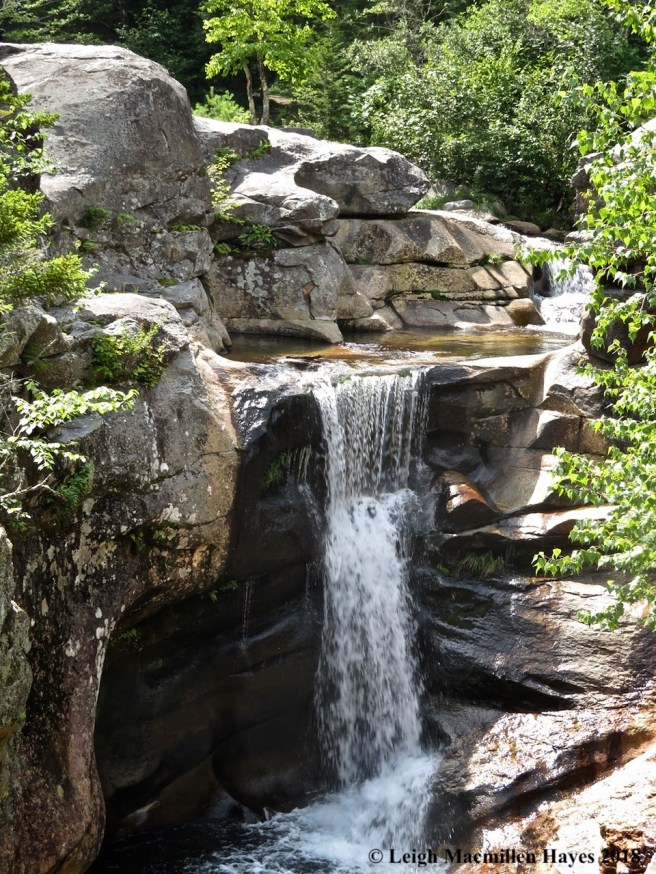
26-Mother Walker Falls

We were also instructed to find Mother Walker. We found the falls named for her that flowed through a gorge.

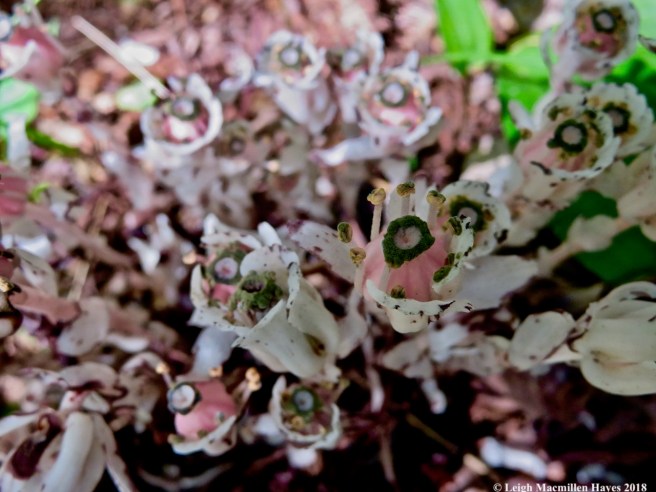
27-mother load of Indian pipe

And we found a mother lode of Indian Pipes, all turned upright because they’d recently been fertilized. But who was Mother Walker? We never found the answer to that question.

29-Screw Auger Falls

With two stops left to make before finding the mat and finishing today’s leg of the race, we needed to locate a screw. Heck, I was with a hardware guy so that should have been easy.

30-upper falls

But this screw was in the form of a water fall. Screw Auger Falls. In the 1800s, settlers had built a saw mill directly over the falls that was powered by the current. A screw auger is a hand tool used for boring holes in hard material. It all began to make sense.

31-Arch

While we were there, we took in a view of the arch, just in case we encounter a question about it should we make it successfully to the end of race.

32-lower falls

And the falls below, were the story of water and glaciers was carved into the bedrock.

33-PIes for Sale

And then, and then, we continued south to a spot where we were told to fulfill our sweet tooth craving.

34-Puzzle Mtn Bakery

As we contemplated all of the possibilities, three folks came along in a truck (two of them from Norway, Maine, and the third visiting from San Francisco), bought a pie and gave us the money to buy one as well. But we had enough money. So we felt awkward, though we promised to pay it forward.

35-cash only

My Guy had just put the $20 into the metal tank when a vehicle from New York pulled in and a young couple stepped out. He walked over and told them about the previous couple, gave them $10 for their pie and asked them to pay it forward. Ahhh. Maine, the way life should be. And is!

36-Moose

At last, our final stop–we crossed the mat and learned we were first yet again.

37-beer

While sipping a celebratory brew, Team Speedy came in. Bingo! They were second in place. Drats. But at least we beat them. We never saw the other teams.

38-My Guy and me!

All in all, The Amazing Race–Our Style, episode seven was most gratifying as we successfully summited Table Rock in Grafton Notch. Thanks to Team Cape Cod for taking a photo of us.

Oh, and dessert tonight will be . . . Maine Wild Blueberry a la Puzzle Mountain Bakery and the kind folks from Norway, Maine.


Docked

Some days are meant for staying close to home. Such was today–a perfect 10 kind of August day with cool temps at either end and a sunshine sandwiched between.

1-lakesmart award

One of the starts to our day was receiving two signs that announced the fact that our camp property is award winning–at least for a LakeSmart Award (don’t check inside for any award winning style or cleaning habits because you won’t find either here). We tipped our hats to Roy Lambert, vice president of the Lakes Environmental Association Board of Directors, and secretary of the Maine Lakes Society Board of Directors. Roy coordinates the local LakeSmart program sponsored by LEA.  He visited camp a few weeks ago and evaluated the surrounding land, then submitted a report. And we waited.

The final conclusion with only a couple of recommendations:

LakeSmart Award Status:
SECTION 1 Driveway and Parking Eligible
SECTION 2 Structures and Septic Eligible
SECTION 3 Yard, Recreation and Paths Eligible
SECTION 4 Buffer and Water Access Eligible
LAKESMART AWARD Award Granted

In his presence, we immediately posted the sign on the red pine by the water’s edge and then walked up the driveway to place one by the road as well.

2-dragonfly love

After Roy left, we settled into the day and discovered others who had settled momentarily, making use of a red oak branch dangling over the water for their canoodling session.

3a-reading

It’s rare that I’ve lounged this summer, but a new-to-me book purchased yesterday at the Lovell Arts and Artisan Fair book sale drew my attention between mini naps.

7-dock view

When I wasn’t napping or reading, however, I spent time staring across the pond.

9-dock view

And to the south.

11-bass tournament

All about there were bass boats for today featured a club tournament. The thing about bass tournaments is that except when the fishermen are zooming to the next best spot, they are quiet as they troll. And I have to thank them for a few weeks ago I wrote to a club president and asked that they please be aware of the parking situation on Route 302. Their trucks and trailers have long blocked our view as we precariously try to pull out onto the busy road. In the past, I’ve asked for help from others, including Inland Fisheries and Wildlife staff and local police, to no avail. But, this time was different. The club president immediately responded to my request and passed the word along to others as well. This morning, there were orange cones blocking cars from parking a certain distance from our road and as we drove to church, we were able to pull out without risking our lives. Thank you Steve and Wayne, and I hope you also had an award-winning day.

3b-oarlock

Because of there being more boats than normal on the lake, however, occasionally the waves rippled my way. And beside me, the dangling oarlocks in the S.S. Christmas clanged against the inside of the boat.

10-common loon

The bass fishermen weren’t the only ones seeking a catch and I watched a common loon that spent all afternoon nearby, sometimes looking for a meal, other times preening, and even merely floating.

13-baitfish

Of course, bait fish swam abundantly below my locale–perhaps finding protection in the shadows offered.

4-slaty blue skimmer dragonfly

Also on the hunt, but for insects rather than fish, were dragonflies and damselflies including this Slaty Blue Skimmer, its colors matching the sky reflection on the water.

5-lancet clubtail 1

A Lancet Clubtail I spied on the wood first,

6-lancet clubtail dragonfly

and then on the shrubs in the vegetated buffer.

6a-Swamp Spreadwing Damselfly

And a Swamp Spreadwing Damselfly found a spot to hang below the shrubs and just above the water’s edge.

13a-crawfish skeleton

Because I was looking, I also found the carcass of a crayfish, which surprised me for I rarely see one and had to wonder if a heron or another bird dropped the remains of a fine meal.

12-shamrock lily

As the wave action continued, the leaf of a fragrant water lily floated by, torn from its base. In the shadow below, it transformed . . . into a shamrock.

14a-water pattern over rock

Other transformations also took place as boulders under the water’s surface became works of mosaic art.

15-wave:sky patterns

And waves reflected skylight in a more modern polka-dotted form.

17-wave:sky patterns interrupted by leaf

Even that pattern was sometimes interrupted . . . by a passing oak leaf.

20-sunset

At day’s end, it was all about taking the time to be rather still. To read. To write. To swim. To watch. To notice. To think. To wonder. To admire. To be. Docked.


The Perks of Perky’s Path

It’s such a sweet trail and so named for Juanita Perkins, a local photographer and naturalist who was an avid member of the Greater Lovell Land Trust. To follow in her footsteps is not an easy task, but today I journeyed along the path trying to see what Juanita might have seen.

1-lancet clubtail

Immediately upon stepping down the trail, a clubtail dragonfly landed in front of me. Identifying dragonflies has become one of my passions of late, but still I struggle. And go back and forth. Lancet Clubtail or Pronghorn? I lean toward Lancet only because I’m not sure Pronghorns are a Maine species. But it’s to Dragonflies of the North Woods that I turn, and the abdomen that I try to zone in on. The abdomen consists of ten segments. Lancet: segment 8 has a smaller top spot and segment 9 is all yellow on top, (except for the female’s top spot which is narrower). Pronghorn: segment 8 has a smaller top spot and segment 9 is all yellow on top. Segment 10 has a narrow stripe. The Maine Odonata survey does not include the Pronghorn and so I find myself deciding on the Lancet. Suffice it to say, this is a clubtail.

2-ebony jewelwing damselfly

A much easier species for me to ID is the ebony jewelwing damselfly. Several danced and posed by the brook leading from the wetland the path encircles to Heald Pond. I trust that when Juanita traveled this path, she too saw the jewelwings dance, their bodies as bejeweled as their wings–maybe more so. A female’s wings are smokier in color than the males and each is dotted with one white spot at the tip.

3-male ebony jewelwing

The male’s wings are more ebony in color and body more metallic. This handsome fellow had three ladies in waiting so he couldn’t pause for long.

4-trail sign

Though I refer to the entire loop as Perky’s Path, in reality I hadn’t even reached it by the time I encountered the “You Are Here” sign. I’d actually been walking along a snowmobile trail that is part of Heald and Bradley Ponds Reserve.

5-perky's path

It was a couple of tenths of a mile later that I finally stepped onto the path blazed with orange.

6-bench

One of my favorite hangouts is the bench located along a short spur. Usually I spend moments on end, but today I was eager to move on.

7-Indian Cucumber Root

Along the spur trail, I did note one of my favorite fruits beginning to ripen–that of Indian Cucumber Root. And as it ripens, the base of the leaves turn red. All I could think of is that the red is a sign to birds–come dine at this table. You won’t regret it.

8-trillium fruit

Another red fruit stood upright above leaves of three–that of a painted trillium.

9-new stone bridge

It’s been six years since Juanita Perkins passed away and I don’t know when she last walked the path, but at that time, where the stream from Bradley Pond flows into a beaver wetland before continuing on toward Heald Pond, she probably crossed the water via a wooden bridge. Time and weather had taken their toll on the bridge and so at the beginning of this summer a group of volunteers and a couple of GLLT staff members pulled the wood out and placed flat rocks as stepping stones. It makes for a magical crossing, especially as it slows the wander and encourages one to notice the surroundings. Though we never officially met (I do remember her dropping off photographs at a local gift shop where I worked for several summers back in the late 1980s), I trust she would appreciate the change.

10-stream archs

Of course, I’ve always been one to enjoy water and all its variations. By the stepping stones (boulders), smaller rocks below the surface added to the overall arching effect, creating an interconnection. I felt a sense of Juanita’s time spent on the path woven into today.

13-jewelweed

By the water, there were a variety of flowers to note, including whorled asters and cardinal flowers, but it was the jewelweed that brought a smile to my face. I don’t understand why, but one of the sepals forms a pouch-like structure with a long spur. Jewelwings and jewelweed–indeed, a very special place.

11-Golden Spindle

Adding to the wonder right now due to recent and much appreciated rain are all the fruiting forms of mushrooms and this path has its fair share. I’m not great on my identification of boletes and others, but there are a few individuals that I remember from year to year. It’s the fact that their spores are everywhere and those spores form hyphae, that then forms mycelium, that then eats anything organic, that when mating is successful forms fruit, is wicked cool. We’re wowed by the fruit, but really, we need to honor the entire system. And so I honor the Golden Spindle,

12-white spindle fungi

White Spindle (which I don’t recall ever seeing before),

12b-scarlet waxy cap

Scarlet Waxy Caps,

12a-earth tongue fungi

and Earth Tongues.

14-into the wetland

And then I slip off the path and down to the wetland, wondering what else I might see.

15-cherry-faced meadowhawk

Instantly I am rewarded with numerous sightings of Cherry-faced Meadowhawks, their wings all aglow.

16-hobblebush leaves

They aren’t the only shade of red in the vicinity, for some of the hobblebush leaves have taken on their autumn hue already. (Say it isn’t so!)

16c-brook to wetland

I almost complete the loop and reach the bridge crossing just before the parking lot at the end of Heald Pond Road, when I decide to follow the stream bed back toward the wetland. I suppose I did so because I wanted to extend my journey and my time honoring Juanita.

16-green frog

Here and there, where pockets of water exist, green frogs either try to hide from me or make sudden leaps.

17-back to the wetland

I bushwhack back into the wetland, not wanting to let go, and forever thankful for Juanita. Every time I wander her way, I discover new perks along Perky’s Path.


Filling Our Buckets Mondate

Our day began with a journey to Green Thumb Farms in western Maine because we were curious about their native blueberry sod. We had hoped to see some, but that wasn’t to be and instead we were given a contact number for a sales rep. Our hope is to purchase a couple of pallets worth and use it as one more filter system at our camp in our continuing efforts to protect water quality. We recently learned that we qualified for a LakeSmart Award, but don’t want that to stop us from finding other ways to create a more lake-friendly property. Stay tuned on the sod because once we figure that out, it will be a story worth telling.

1-lunch spot, Eaton Village Store

From Green Thumb Farms we zigged and zagged along the back roads until we reached Eaton, New Hampshire. Lunch awaited at the Eaton Village Store on Route 153. Inside, one wall is covered with mailboxes and the post office. Grocery and gifty items are displayed in an aisle or two. And then there’s the lunch counter and a few tables for the eatery. A most pleasant eatery. The menu is simple, food fresh, and all served with a smile and conversation.

2-falling snow sign

Oh, and one more thing. They are eternal optimists! Or procrastinators like me. Heck, eventually there will be falling snow to watch for again.

3-Foss Mtn Trail

After lunch, we zigged and zagged again, winding our way up a road we once remember sliding down–in the winter on our bellies with our eight and ten year old sons in tow. Our destination today was much easier, though I did put the truck into four-wheel-drive to reach the trailhead parking lot for Foss Mountain. I’d told my guy about the blueberries and views and neither of us gave a thought to today’s weather for in the newspaper the forecast predicted it to be “rather” cloudy, “rather” being a rather unscientific term. It turned out to be more than “rather.” And raindrops fell, but still we went.

4-Foss Mtn Map

We examined the sign and my guy was thrilled with the possibilities.

6a-no picking

Some fields, however, were closed to public picking for a private operation leased those from the town.

5-Ryan Bushnell Blueberry Operation

Off to the side, we spied their sorting machines. Note the blueberry color of the equipment.

6-blueberry envy

And the abundance of blueberries.

7-hands in pockets

After testing a sample to make sure they were acceptable for human consumption, my guy stuck his hands in his pockets to avoid further temptation.

8-Joe Pye Weed all in disarray

Upward we journeyed, following the path of this property that is owned by the Town of Eaton. Along the way, a large patch of Joe Pye Weed shouted for attention, its petals disarrayed much like my own hair on this misty of days.

9-into the fog

The habitat changed and still we climbed–anticipation in every step my guy took at full speed.

10-pick blueberries sign

At the next natural community boundary, where conifers gave way to saplings and undergrowth, my guy rejoiced. At last we’d reached the promised land.

11-my guy disappeared ;-)

And immediately he stepped off the trail to find those tiny blue morsels that bring him such delight.

12-summit fog

While he picked, I headed toward the summit, where a blanket of fog enveloped the view. It didn’t matter, for our focus zeroed in on what was before us rather than being swept up with the beyond.

14-my guy picking

From my place at the top, I could see him below–a mere speck intent on filling his bags to the brim.

15-erratic

I began to look around and felt an aura that made me feel as if I was in Ireland rather than New Hampshire. The fog. The green. The gray. The world disappeared.

16-more colorful eratic

And the world before me opened up.

17-Common goldspeck lichen (Candelariella vitellitta

Like yellow caterpillars that are all the rage right now, Common Goldspeck Lichen inched across the granite face.

18-granite-speck rim lichen

Beside it, Granite-speck Rim Lichen stood out like tiles in a mosaic work of art.

19-fog danced across ridge

Meanwhile, the fog danced across the ridgeline, twirling and whirling in a ghostly quiet manner, its transparent gowns touching the ground ever so tenderly before lifting into the next move.

19-my guy picked some more

And my guy found a new location and picked some more.

15-steeplebush

My attention turned to the Steeplebush, a spirea that grew abundantly at the summit, its flowers of pink offering a tiny splash of color to brighten any day.

25-American Copper Butterfly

The American Copper Butterfly and a bumblebee also found the Steeplebush much to their liking.

26-American Copper

And I, I couldn’t pull my eyes away from admiring this tiny butterfly and its beautiful markings.

28-American Copper Butterfly

From every angle that it posed while seeking nectar, I stood in awe–those striped antennae, giant black eyes, copper-silver color, and hairy scaled wings.

21-chipmunk

And then there was another, which I thought was a bird when I first heard it scamper out of the bushes.

22-chippie eating berries

But Chippie soon made himself known and I discovered that he, too, sought those little morsels so blue. Competition for my guy.

23-fog lifts a bit

Ever so slowly, the fog lifted a bit and even the sun tried to poke through for a moment or two. Still, my guy picked–somewhere. I couldn’t always see him, but trusted he was in the great beyond.

24-cedar waxwings

Much closer to me, three Cedar Waxwings circled the summit over and over again in a counter-clockwise pattern. Thankfully, they also paused, eyeing the potential for their own berry picking sights from the saplings on which they perched.

24-cedar wax wing bad hair day

I fell in love . . . with their range of colors:  cinnamon, black, gray, brown, red, yellow, and white. And the bad-hair day tufts, for like the Joe Pye Weed, the Cedar Waxwings and I also shared a resemblance.

29-My guy finishing up

At last my guy finished up, though not before standing on a yonder piece of granite, looking west and calling for me. “I’m up here, behind you,” I shouted softly into an almost silent world, where the only sounds came from cicadas and crickets and occasionally the Cedar Waxwings.

30-blueberry caterpillars

As we made our way down, he stopped again for about a half hour to pick some more in a spot he’d noted on the way up. And I looked around, discovering other blueberry lovers among us–Yellow-necked Moth Caterpillars were slowly stripping some bushes of their greenery.

35-blueberries!

At last we passed by the forbidden fields, where my guy later confessed he felt like we were in Eden.

31-Burnt Meadow Blueberries in operation

Ryan Bushnell of Burnt Meadow Blueberries was at work, raking and sorting the sweet morsels of blue.

32-Blueberries!

It was his business to make sure each pint would be filled by day’s end.

33-Filling the buckets

We wanted to chat with him more about the operation, but he was intent upon working and so after the initial greeting and a few more words, we knew it was time to move on. Mr. Bushnell’s buckets would be filled over and over again. (And I suspected that upon seeing this operation, my guy, should he ever decide to retire from his hardware business, may just ask to work in the field–the blueberry field.)

Our buckets were full as well–for my guy, it was bags of blueberries to freeze for future consumption. For me, it was all that I saw as I poked about the summit, thankful that I wasn’t distracted by the 360˚ view. We did indeed fill our buckets on this Mondate.


A Berry Pleasant Mountain Hike

Thirty-two years ago I moved to Maine (the only place I’ve ever lived where the number of years counts as bragging rights) and Pleasant Mountain quickly figured into my life. The first day I drove past it on Route 302, I was killing time before a job interview and one look at Moose Pond with the mountain looming over it and I knew I very much wanted to live here. A couple of days later, I received the phone call I’d been waiting for and principal Larry Thompson said it was only a matter of formality that my name go before the school board. By the next week, I was packing up in New Hampshire and making my way further north. I’d found a place to live that meant I’d pass by the mountain on my way to and from school each day. And then that October I attended a Halloween party with friends at the ski lodge of what was then called Pleasant Mountain Ski Resort. I was an olive and I met this guy dressed as a duck hunter. Turns out he’d never been duck hunting, but had a great duck puppet and he could turn its head with the stick within. He certainly turned my head!

Thus began the journey with my guy. Our first hike together–up the Southwest Trail of Pleasant Mountain. That first winter, he taught me to downhill ski, well sorta. My way of turning that first time included falling as I neared the edge of the trail, shifting my body once I was down on the snow, begging for the components of a steak dinner, rising and skiing across at a diagonal to the opposite side only to repeat my performance. Dinner was great that night! And well deserved.

Time flashed forward four years, and at noon on August 4, 1990, we were married; our reception in the Treehouse Lounge at the Ski Resort. In all the years since we first met and then were married and beyond, we’ve skied (though I have managed to avoid that concept more recently) together and with our sons before their abilities outgrew mine, snowshoed and hiked and grown only fonder of the place we call home. Our intention yesterday was to climb the mountain in celebration of our 28th anniversary, but the weather gods outpouring of moisture was not in our favor.

Today, however, dawned differently and so mid-morning we made our way with a plan to hike up the Bald Peak Trail, across the ridge to the summit, and down the Ledges Trail. We’d left the truck at the Ledges, ever mindful that the last thing we want to do after climbing down the mountain is to walk 1.5 miles to reach our vehicle.

1-heading up

As I’ve done over and over again in the past 32 years, I followed my guy–over rocks and roots and bald granite faces.

2-Pinesap

Once in a while I announced the need for a stop because my Nature Distraction Disorder ticked into action. In this case, it was Pine-sap, or Monotropa hypopitysMono meaning once and tropa turned; hypopitys for its habitat under a pine or fir. Also called Dutchmen’s Pipe, this is a parasitic plant that obtains all its nutrients by stealing them from the roots of a host tree. It doesn’t enter the host directly, but through a fungal intermediary. And like Indian Pipe, it has no green tissues. It differs from I.P. in two ways, its yellow color as compared to white, and two to eleven flowers versus a single flower. In my book of life, both Pine-sap and Indian Pipe are great finds.

3-Moose Pond below

I didn’t let my NDD get the better of me too often on the way up. It was extremely humid and so we did stop frequently, but also kept a pace that worked for both of us and soon emerged onto the ridge where a look back through the red and white pines revealed a peek of the causeway that crosses Moose Pond.

5-hidden camp

Employing the telephoto lens, I spied our camp hidden among the trees, only the dock and our little boat showing. It’s amazing how obvious all the neighboring camps seemed when viewed from up high.

7-ridge line trail

After the climb up, the ridge always seems a cinch as the pathway wanders through blueberries, pines and oaks.

6-lunch rock

At last we found lunch rock, a place to pause in the shade and enjoy our PB&J sandwiches. We’d packed cookies for dessert, but decided to save those for later. My guy, however, had accidentally unpacked my work backpack and discovered a few pieces of a dark chocolate KitKat–my stash when I’m tired at the end of the day and need a pick-me-up before driving home. It looks like the purchase of another KitKat is in my near future for we topped off the sandwiches with a sweet treat.

8-picking blueberries

After lunch, my guy’s eyes focused in on one thing only. That is after he moved away from his original spot behind the rock we’d sat upon for our repose. Unwittingly, he’d stirred up a yellow jacket nest and managed to walk calmly away, only one bee stinging his leg.

14-blueberries

While his attention was on the gold at his feet–in the form of low-bush blueberries, I turned my lens in a variety of directions. Oh, I helped pick. A. Wee. Bit.

9-Lake Darner Dragongly

But there were other things to see as well and this dragonfly was a new one for me. A few highlights of this beauty: Do you notice the black cross line in the middle of the face. And on the thoracic side stripe, do you see the deep notch?

10-Lake Darner Dragonfly

Both of those characteristics helped in ID: Meet a Lake Darner. Even the male claspers at the tip of the abdomen are key, for they’re paddle-shaped and thicker toward the end. Though he didn’t pause often, Lake Darners are known to perch vertically on tree trunks. I was in awe.

11-grasshopper

All the while we were on the ridge, the Lake Darners flew about, their strong wing beats reminiscent of hummingbirds, so close did they come to our ears that we could hear the whir. And then there was another sound that filled the summer air with a saw-like buzziness–snapping and crackling as they flew. I couldn’t capture their flight for so quick and erratic it was, but by rubbing pegs on the inner surface of their hind femurs against the edges of their forewings, the grasshoppers performed what’s known in the sound world as crepitation. Crepitation–can’t you almost hear the snap as you pronounce the word?

12-coyote scat

It wasn’t just insects that caught my eye, for I found a fine specimen of coyote scat worth noting for it was full of hair and bones. It was a sign bespeaking age, health, availability, and boundaries.

12A

Turns out, it wasn’t the only sign in the area and whenever we hike the trails on Pleasant Mountain these days, we give thanks to Loon Echo Land Trust for preserving so much of it. According to the land trust’s website: “Currently, Loon Echo owns 2,064 mountain acres and protects an additional 24 acres through conservation easements.”

13-picking some more

Our time on the ridge passed not in nano seconds, for my guy was intent on his foraging efforts. I prefer to pick cranberries, maybe because they are bigger and bring quicker satisfaction as one tries to fill a container. But, he leaves no leaf unturned. And enjoys the rewards on yogurt or the possible muffin if his wife is so kind, until late in the winter.

15-middle basin of Moose Pond

As we slowly moved above the middle basin of Moose Pond, I found other berries growing there.

14-lingonberries

Among them, lingonberries were beginning to ripen. They grow low to the ground, below the blueberries, and resemble little cranberries. In fact, some call them mountain cranberries. Like blueberries, they like acidic, well-drained soil. For all the leaves, however, there were few fruits and I had to wonder if the birds were enjoying a feast.

16-huckleberries

Huckleberries also grow there, though not quite as abundantly as along our shorefront on Moose Pond. They’re seedier than blueberries, though the local squirrels don’t seem to mind. Both red and gray harvest them constantly as they move throughout the vegetated buffer in front of camp.

17-summit fire tower

It took some convincing, but finally my guy realized that we needed to move on and so we gradually made our way to the summit, where the once useful fire tower still stands as a monument to an era gone by.

18-summit view in the haze

Our pause wasn’t too long for so strong was the sun. And hazy the view, Kearsarge showed its pointed profile to the left, but Mount Washington remained in hiding today.

19-ledges view of Moose Pond's southern basin

The journey down was rather quick. Perhaps because we were so tired, it felt like we just rolled down. But we did stop to admire the view of the southern bay of Moose Pond in Denmark. Our intention was also to eat the cookies we’d packed once we reached this point. Through both bags we hunted to no avail. I remembered packing the cookies under our sandwiches. And then moving the sandwiches to the second pack, but leaving the cookies. Did we accidentally take them out after all? Were they on the kitchen counter? In the truck? The final answer was no on all fronts. We think we must have taken them out at lunch rock and they never made it back into the pack. I had moved the backpacks with great calmness once we discovered the yellow jacket nest. Just maybe the yellow jackets are dining on some lemon cookies. Perhaps it was our unintended peace offering.

20-hiking down following this guy

After a five plus hour tour, filled with blueberries and sweat, I followed my guy down. We’ve spent the greater part of our lives following in each other’s footsteps and it’s a journey we continue to cherish, especially on our favorite hometown mountain.

Here’s to many more Berry Pleasant Mountain Hikes with my guy.


A’pondering We Will Go

August 3, 9:30 am – 12:30 pm
A’pondering We Will Go: Get inspired by the beauty along the trail at the John A. Segur Wildlife Refuge East. This will be a stop-and-go walk as we pause frequently to sketch, photograph, and/or write about our observations, or simply ponder each time we stop. Location: John A. Segur Wildlife Refuge East, Farrington Pond Road, Lovell.
Degree of Difficulty: Easy.

j1-pickerel frog

That was our advertisement for this morning’s Greater Lovell Land Trust walk, but we weren’t sure the weather would cooperate. Docent Pam and I emailed back and forth as we looked at various forecasts and decided to take our chances. As it turned it, it did sprinkle occasionally, but we didn’t feel the rain until we finished up and even then, it wasn’t much. Instead, the sound of the plinking against the leaves in the canopy was a rather pleasant accompaniment to such a delightful morning. Our group was small–just right actually for it was an intimate group and we made a new friend and had a wonder-filled time stopping to sit and ponder and then move along again and were surprised by tiny frogs and toads who thought the weather couldn’t get any better, as well as other great finds. Here, a pickerel frog showed off its rectangular spots for all of us to enjoy.

j2-Sucker Brook

After a first 20-minute pause in the woods, we continued on until we reached Sucker Brook.

j3-Colleen

Each of us settled into a place to listen . . .

j4-Bob

photograph . . .

j6-Judy

and write.

j7-heron

I have no idea how much time had passed, but suddenly we all stirred a bit and then someone who was noticing (I think it was Ann) redirected our attention.

j8-heron

We were encouraged to focus on another who was also paying attention.

j9-heron

And narrowing in . . .

j10-heron and fish

on lunch.

j11-wings

When the young heron flapped its wings, we were all sure the meal was meant “to go.”

j12-securing the catch

But thankfully, the bird stayed.

j13-lunch

And played with its food.

j14-lunch making its way down

Ever so slowly, the fish was maneuvered into its mouth.

j15-gulp

And swallowed.

j16-down the throat it goes

Down the throat it slid.

j16-feathers ruffled

And then the feathers were ruffled–rather like a chill passing through its body.

j17-movement

Wing motion followed.

j18-searching

But still, the Great Blue Heron stayed.

j19-next course

And stalked some more.

j20-Isaiah

We continued to watch until we knew we had to pull ourselves away.

j21-the journalists

If we didn’t have other obligations, we might still be there. Gathered with me from left to right: Judy, Colleen, Isaiah, Pam, Ann, and Bob.

j22-owl pellet

On our way back, again we made some interesting discoveries that we’d somehow missed on the way in, including White Baneberry, aka Doll’s Eye, a bone we couldn’t ID, Indian Pipe, and this owl pellet smooshed, but full of tiny bones–vole-sized bones.

j22-Pam reading what she wrote

We stopped one more time, to share our morning’s observations.

j23-Judy reading her poem

Reading aloud is never easy, but because our group was small and we’d quickly developed a sense of camaraderie and trust, the comfort level was high.

j24-Ann's landscape sketch with heron

Sketches were also shared, including this one of the landscape that Ann drew–including the heron that entered the scene just before she quietly called our attention to it.

j25-stump and lichen

And my attempts–the first of a tree stump from our woodland stop, and then a lichen when we were by Sucker Brook.

A’pondering We Did Go–and came away richer for the experience. Thanks to all who came, to Pam and Ann for leading, and to Isaiah for his fine eye at spotting interesting things along the way.


Island Hopping Mondate

Paddling together in “Big News,” our double kayak so named for it was a gift from the Neubigs many moons ago (thank you, Carissa and Bob), is one of our favorite summer pastimes. With wrist almost fully mended, it’s an even sweeter journey for me because it means I don’t have to work hard.

1-prepping the kayak

And so it was that my guy prepped Big Red for today’s journey–an exploration of the northern basin of Moose Pond. The “pond” is a 1,697 water body with a 33.3 mile perimeter that’s broken into three sections. We know the north best, which offers about a four-mile round-trip journey from camp up into the islands of Sweden. The other section that we don’t visit as often, but do enjoy exploring, is the southern section in Denmark, for it’s equally interesting.

2-BLUEBERRIES!

Today, though, my guy had a mission worth gold in mind–to make some headway on his blueberry greed.

6-yellow-necked caterpillars

Along the way we discovered an interesting sight. Our friend, and pond neighbor from the western shore, Lili Fox, asked yesterday if I could identify some yellow and black caterpillars. After a wee bit of research, I suggested Yellow-necked Moth Caterpillars. I didn’t expect to meet them quite so soon myself, but immediately recognized the group that clustered at the tip of a blueberry twig. At first, they seemed immobilized, but then I realized they were in the defense form that I’ve witnessed with other caterpillars, curling outward to form a U. I’d just picked a few berries below and so they saw me as prime predator. Fortunately, no attack was made.

8-yellownecked 2

Overall, they have yellow and black stripes, but it’s the yellow segment or neck behind their black heads for which they were named. These very hungry caterpillars were reaching maturity and soon should drop to the ground. They’ll apparently overwinter burrowed below as pupa and emerge in adult form next year.

10a-fluffy yellownecked

I assumed that those with the most wiry hair were the oldest. We probably should have shaken them off the branches and into the water, but we didn’t. Nature knows what to do and some will become a food source for wasps or birds, passing along the energy contained in the blueberry leaves to another level.

3-variable dancer damselfly

In the meantime, I became the Yellow-necked Lookout Warden as my guy continued to pick. Accompanying me with his own bulbous set of eyes was a male Variable Dancer Damselfly.

4-spreadwing

The damselflies actually could care less about the caterpillars and more about finding a mate and so they all posed, either on the kayak, or nearby vegetation.

5-orange bluet damselflies

Both turned out to be the right substrate on which to perform mating rituals, this being a pair of Orange Bluet Damselflies on the kayak.

7-emerald spreadwings canoodling

And Emerald Spreadwings offering a reflection on the pond of their canoodling efforts.

10-heading north

At last we continued further north, island hopping along the way.

12-Eastern Pondhawk Dragonfly

Though their natural communities all looked similar, with each stop came a different offering, including the Eastern Pondhawk that displayed one of my favorite combinations of color-sky blue pond green.

13-EAstern Pondhawk

Eye to eye, we contemplated each other. I have no idea what he thought of me. Well, actually, I’ve no idea if dragonflies can think. Is all their action instinctive? As for my thoughts, I didn’t want to gobble him up in a literal fashion, but wish I could have taken him with me so I could continue to stare, infatuated with his colors as I was. On his thorax I saw a watercolor painting reflecting a sunny day by the pond.

14-Floating Heart Plant

Another island and another find–the delicate flower of a Floating Heart Plant.

14-bullfrog on lily pad

And then a frog on a lily pad, a young frog that is.

15-bullfrog froglet

If you look closely, you may see her tail extending behind. I couldn’t help but think that she’s got big feet to grow into.

16-beaver lodge

Beside one of the last islands we visited, we saw that the neighborhood had changed quite recently and a new house had been built. Though none of the residents came out to greet us, we weren’t surprised. Based on the greenery and wet mud we suspected they’d been busy as beavers all night and needed a rest.

17-beaver island

A quick look around and we knew the source of their building materials. It reminded us that they’ve been secret visitors to our land in the past and have helped themselves to young saplings much to our dismay. Then again, it is their land as well. We’re just the ones who pay the taxes.

11-spadderdock with damselfly exuvia

Of course, no water adventure is complete without a photo of Spatterdock, this one featuring a damselfly exuvia.

17-fragrant water lily

And Fragrant Water Lily. That rayed presentation. Those prominent yellow stamens. The symmetry. And, of course, the fragrance.

18-honeybee

What could be better than the two together? The two together with small flies on one and a honey bee, its buckets full, visiting the other.

19-painted turtle

At last, it was well after lunch, which we’d neglected to pack and my wrist was sore, so my guy said he’d paddle us home. And because we’d startled a turtle earlier, he said he’d find one for me. Wow! Both the turtle and I were impressed.

20-turtle basking

As turtles do, he stretched out his back legs demonstrating how they need to capture additional heat given that they are cold-blooded animals. Basking helps them to absorb warmth and vital UV rays.

21-waving goodbye

What he did next surprised us. He began to wave his front left leg–I took it as a goodbye, but it was probably either a way to push an insect toward his mouth or an aggressive move telling us to move on. We did, heading back to camp as we finished up our Island Hopping Mondate.


Queen of the Butterflies

At the beginning of July, the Common Milkweed that I’m allowing to grow more abundantly in my herb garden began to blossom, its hypnotic scent filling the air with an almost honey-like fragrance.

m1a-milkweed flowers

Being close to the Fourth of July in its blooming, the milkweed’s formation reminded me of the fireworks that filled the sky over and over again. I only wish those had been as silent as the milkweed.

m2-ants and honeybees

Then again, it was hardly silent or unnoticed for the bees and ants sought the sugary nectar stored in the shell-shaped structures.

m4-honeybee

So few honeybees have I seen all summer, but as long as the milkweed was in bloom, I noticed four of them probing for the goodness hidden within.

m8-wasp

Visitors were from every ilk, some with striped bodies,

m9-tachinid fly

and others covered in spiky hairs.

m7-skipper

The pollinators included skippers . . .

m1-swallowtail butterfly

and swallowtails.

m5-red milkweed beetle and ant

Upon the plants’ leaves were Red Milkweed Beetles, this one being checked out by an ant. The bright red coloration announced the beetle’s distastefulness for he’s one of the few insects that can feed on the leaves of milkweed, store the plant’s defense chemicals and assure that he won’t be consumed.

m6-ant climbs over red milkweed beetle

The ant apparently discovered the beetle wasn’t worth dealing with and so climbed over it and moved on. Or maybe the beetle had accidentally rubbed against some nectar and the ant was attracted to it–for all of a second.

m10-honeybee

The milkweed flowers in my garden began to die back, but this week I discovered another place where they grow abundantly. And at least one honeybee recognized the same.

m17-red milkweed beetles

As did more long-horned Red Milkweed Beetles, and now rather than finding only one, I’ve noticed there often appear to be two working in unison to ensure a continuation of their species.

m15-monarch on dogbane


And much to my delight, I spotted sipping nectar from the Spreading Dogbane that grows beside the milkweed, a Monarch Butterfly.

m14-monarchs fluttering

And it wasn’t just one Monarch. I can’t say how many I saw in total, but I watched them for a while as they floated over the meadow flowers in their flap, flap . . .

m21-monarch and shadow

glide routine, sometimes chasing each other or their own shadow before alighting.

m13-monarch puddling

Like the Clouded Sulphurs I noticed the other day, the Monarchs too sought nutrients from the gravel road, their mouthparts, aka proboscises, extended in search of minerals.

m22-probiscus curled

When not in use, the tubular and flexible straw that serves as a mouth curled inward, retracted as it would be during flight.

m16-viceroy butterfly

Also in the area, because it too likes the nectar of the milkweeds and other flowers offering a sweet meal, was the Monarch mimic, a Viceroy. The differences between the two: Viceroys have a wing span of about 2-3 inches, while Monarchs’ span is 3-4. And Viceroys have a black horizontal stripe that crosses near the bottom of its back wings. Well, actually, it looks more diagonal. And really, who came first? The Monarch or the Viceroy?

m19-silvery checkerspot butterfly

Also present because it too feeds on native milkweeds, a few small Silvery Checkerspot Butterflies, their wing span less than two inches.

m20-silvery checkerspot butterfly

And they also sought those road nutrients, so suffice it to say, its a butterfly habit . . . at least in this neck of the woods.

m24-milweed tussock moth caterpillars

I had to eventually leave the road and meadow behind and run home to grab something, which meant an opportunity to check on my milkweed plants. Those in the kitchen garden hosted some Red Milkweed Beetles, but that was the most interesting thing I saw, besides the fact that the dried flowers were transforming into warty green seedpods. But by the front door, where more milkweed grows, I noticed first a pile of caterpillar scat on a leaf. Getting down on my knees to look underneath, I spotted a mature Milkweed Tussock Moth and its larvae feeding.

m24-tiny monarch caterpillar

And then my heart was still, for I found a tiny Monarch caterpillar.

m25-adult monarch caterpillar

And near it, one that had been very hungry and seemed to have stopped eating. I can’t wait to check again and see if it’s still there–only in a transformed stage.

m26-two monarch caterpillars

As I continued to look, there were more, these two clearly munching away.

m29-munching leaves like an ear of corn

They reminded me of humans eating corn on the cob for it seemed they moved back and forth as they chomped on the plant’s leaves. Monarchs, and other butterflies that feed on the green leaves in their caterpillar form, are like the Red Milkweed Beetle in that they can tolerate the chemicals and it makes them not tasty to predators.

m27-medium-sized monarch caterpillar

Everywhere I looked, I began to see Monarch caterpillars in various stages of growth.

m30-probiscus curlced

My hope is that I’ll discover chrysalises as I continue to search and eventually our yard and flower gardens and the field beyond will be full of the queen of the butterflies:  Monarchs.