Dear Clouded Sulphur

Just as a butterfly goes through a life cycle known as complete metamorphosis with stages including egg, larva, pupa, and adult, so is the poem you are about to read.

p3

You see, last week, I had the honor of attending a poetry workshop at Hewnoaks Artist Colony co-sponsored by the Greater Lovell Land Trust and Charlotte Hobbs Memorial Library. After listening to poet Judith Steinbergh share her poetry and the works of others, and listening to her talk about form as she laid eggs in our minds, we were sent off for a half hour to write our own nature-inspired poem. It was raining lightly at that time and my larva stage was a celebration of the rain that made the aspen quiver with joyous sighs and the lichens transform like a chameleon. When the group came back together and we read our first attempts to each other, I ended by mentioning that I wanted to somehow work the Clouded Sulphur, a small yellow butterfly, into my great work. And then, over the course of the past week, the larva began to mature, to pupate as I wrote draft after draft and suddenly the poem was only about the Clouded Sulphur. Yet, the language wasn’t quite working and though I sent a copy to Judy, and she responded with the most encouraging comments, and then I sent another draft, and again she was encouraging, I told her that I didn’t intend to read my draft at the evening celebration of poetry. The celebration was planned for last night.

As I often do in the summer, I awoke at 5:30 yesterday morning, brewed a pot of coffee, sat in the rocking chair on the porch and realized I was ready to write about the butterfly in an entirely different form. The words flowed forth and what you read is maybe not the adult, or even a teenager, but perhaps a ‘tween and I know my habit of revising constantly so perhaps one day this poem will reach full adulthood.

But for now, after such a long explanation, here is what I wrote and was actually brave enough to read last night:

Dear Clouded Sulphur,

As I walk
along the gravel road,
I suddenly realize
I am not alone.
Oh,
there are bees and birds
and dragonflies and grasshoppers
to admire,
but you capture
my full attention.

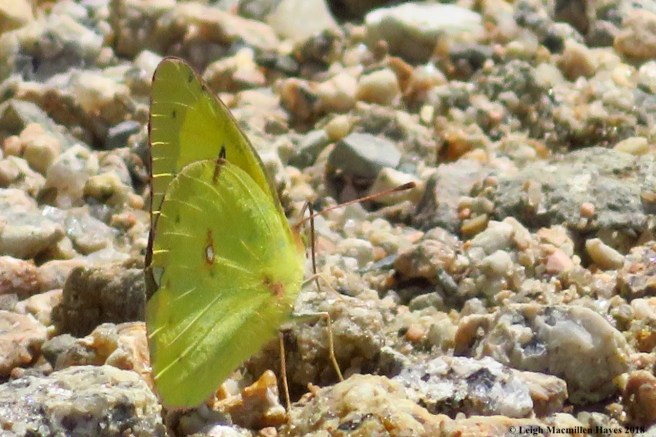
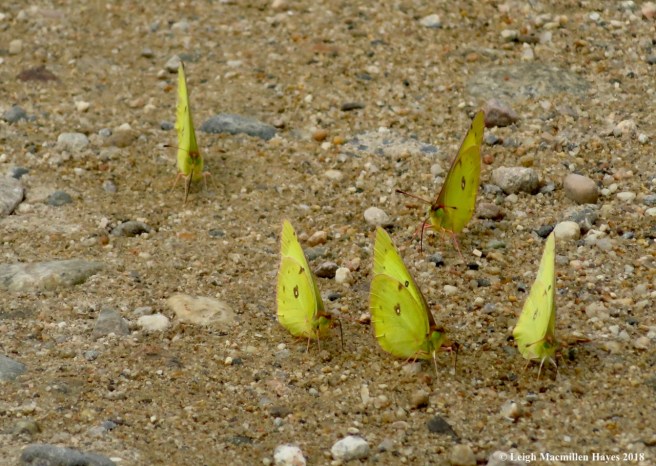
h16-clouded sulphur butterfly
I notice first
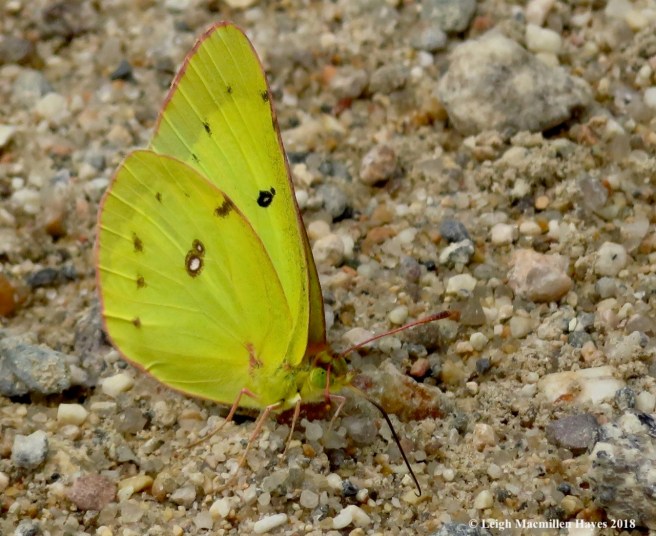
your buttery yellow wings
tinged with a hint of lime,
and margined
ever so slightly
in a subtle pink.
And then I see
your bright green eyes
that remind me of my own
when I spot a buffet and don’t know
which delectable choice
to first taste.

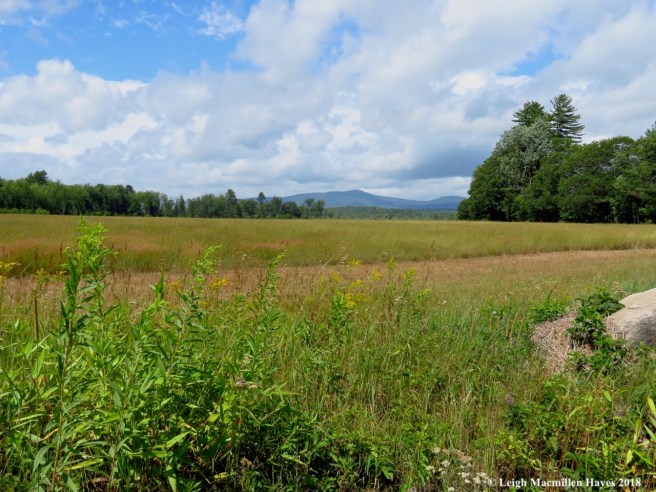
h19-field
So it seems
you are the same
as you dance
over the meadow flowers,
your wings flitting
up and down, up and down,
before you suck nectar
from one clover
and then another.

h18-dark band on upperside of wings
That’s when I notice
the thick black border
upon the topside
of your wings.
Why do you hide it,
only allowing glimpses
in a quick
flash of flight?
Perhaps you feel
it will draw
too much attention?
If that’s the case,
I understand,
for as it is,
I see only
you at first.
And then a sibling. Or is it a cousin?
The relationship
doesn’t matter.
What matters is
that my eyes cue in
and I realize
I am encircled
by you
and all your kin.
In fact,
I no longer know
which one you are,
but that’s fine,
for it is
more important
that you’ve made
me notice.

h17-butterflies puddling

What I thought
was one butterfly
becomes two
and then five,
and suddenly
seven of you
gather upon the road
where only moments
earlier
a few raindrops
slipped from the sky
and dampened the pebbles.
As I watch,
all of you pause,
then fly
at different moments
to a new spot
within the same small square,
and pause again,
dazzling me
with flashes
of your subtle palette,
I realize
you are puddling.

h21
For the first time
I begin to understand
what “puddling”
actually means
as your extended
mouthparts probe.
The road that seems
so dirty and dusty
to my blue eyes,
your green eyes
recognize
as a source
of the nutrients
you seek.
And though there isn’t
an actual puddle,
mere raindrops
appear to provide
what you need.
But do they?
Are you able
to extract
enough minerals
to share
with your gal?
That’s beyond
my understanding,
but I continue
to watch
for as long as I can.
I wish I could stay all day,
so welcoming
have you been.
Alas, I must
pull myself away.
But before I do,
I want to say
thank you.
Thank you, C.S.,
for capturing
my attention
and allowing me
to observe
a few moments
of your butterfly life.
Thank you
for your minute presence
as you twirl and pivot
in this very place,
for your being here
indicates
a healthy environment.
Despite the lack of rain,
you find goodness
and in so doing,
share good news.

h22-hidden
With that knowledge,
I take my leave
with a smile
upon my heart.

Sincerely,

Leigh

Mondate Made for Ducks

We didn’t know what we were going to do when the day dawned in all shades of gray.  With the forecast suggesting thunderstorms in almost any hour, we decided it wouldn’t be a day for boating or hiking.

w1-Wolfeboro

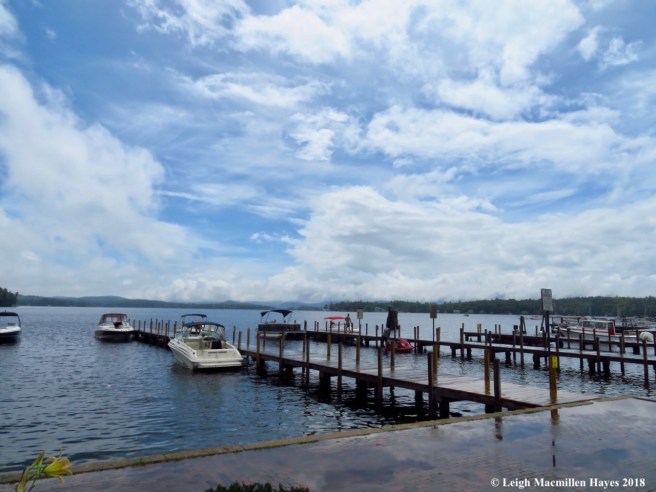
Finally, after chores, errands, and lunch, we drove a wee bit west and then south to Lake Winnipesaukee, my old stomping grounds of almost forty years ago. On the way, we passed through variations of the same theme: gray skies, gentle raindrops, flash downpours. But when we arrived, though the raindrops still fell, blue sky and a slew of clouds offered a beautiful mottled reflection upon the water’s surface.

w2-Wolfeboro sign

We’d decided to explore Wolfeboro, New Hampshire, a town with a year-round population not much bigger than our own. Like all resort towns in New England, however, it swells in size during the summer months. The same is true here in Maine. And on rainy days, the downtown is always full.

w3--approaching the water

Despite all the tourists, the locals do like to hang out at their favorite spots.

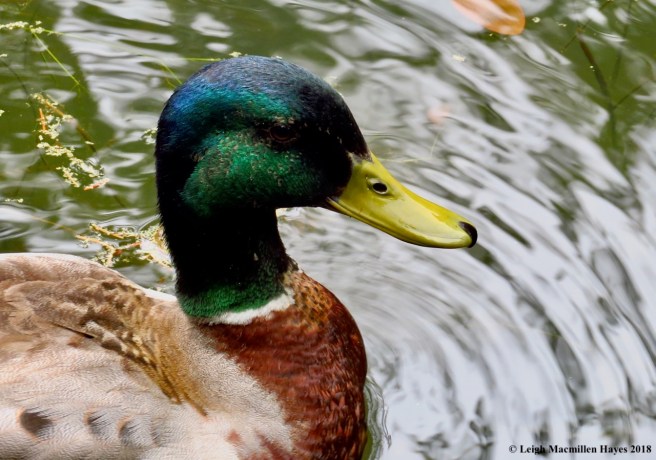
w3-mallard looking down

And check on all the action.

w4-on the dock

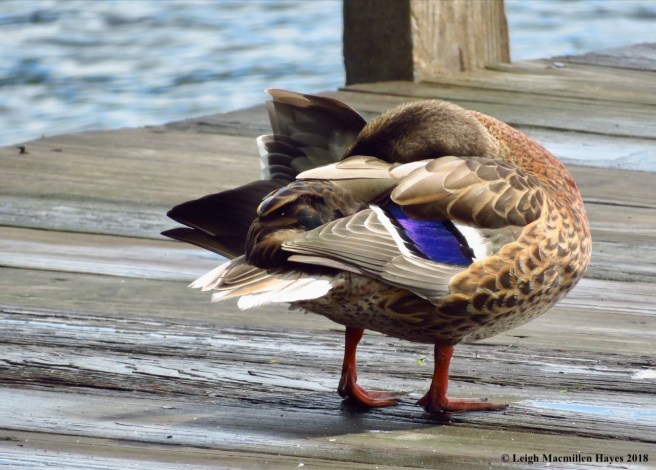
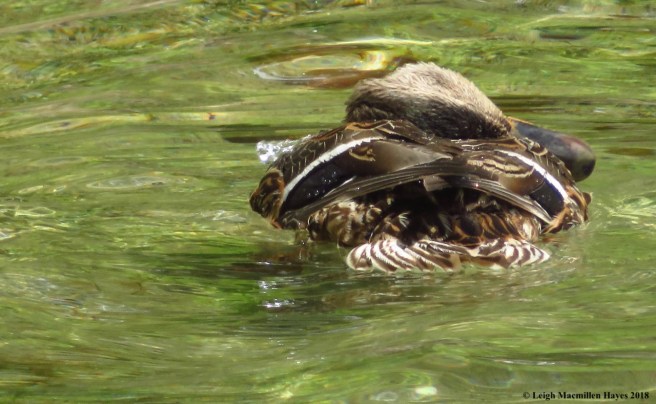
Some prefer to preen.

w5-reaching under the wing

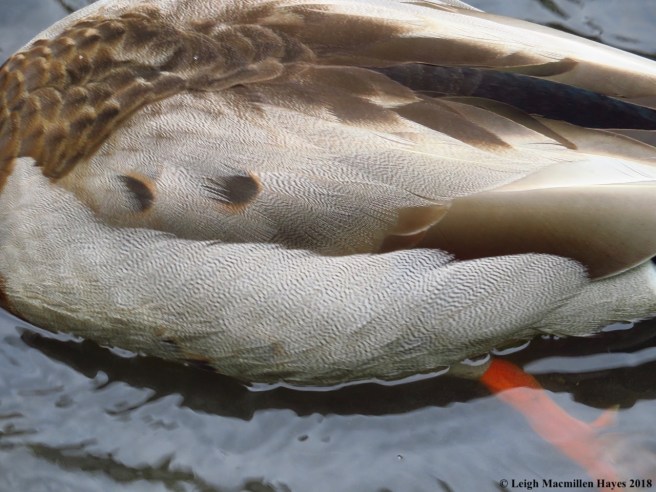
Can’t you just feel the goodness of this action–grooming those feathers to keep them in the best condition?

w6-even deeper under the wing

With so many feathers to cope, whether to moisturize with oil to keep them flexible and strong, to align for waterproofing and insulation–especially against the heat of the summer sun, to arrange aerodynamically for future flights, or to remove parasites and body lice that may carry diseases, it’s all part of a day’s work on the waterfront.

w7-in the lake

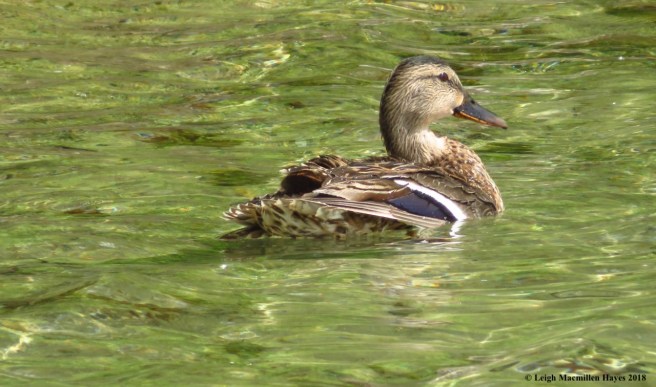
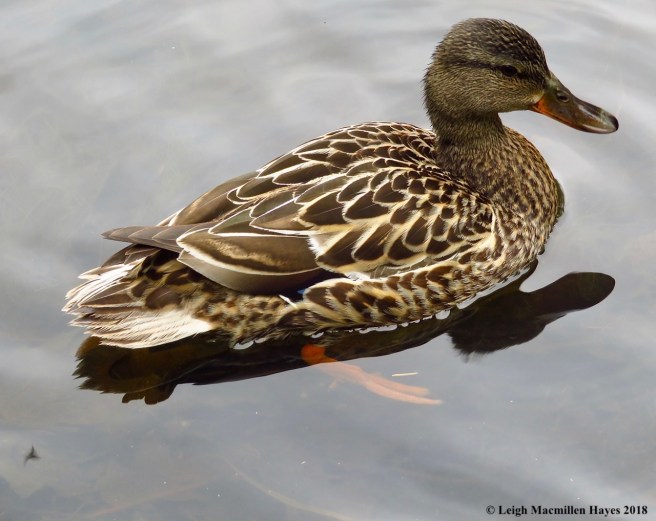
Even those in the water, both mallards and American black ducks, were not immune to the action of the hour.

w8-taking a bath

In order to reach every feather and nibble or stroke it from base to tip to get it aligned just so, ducks become contortionists as they assume odd positions.

w9-shaking it off

And after, they shake, shake, shake, their feathers falling into place as if according to a greater plan.

w9-meeting Daffy

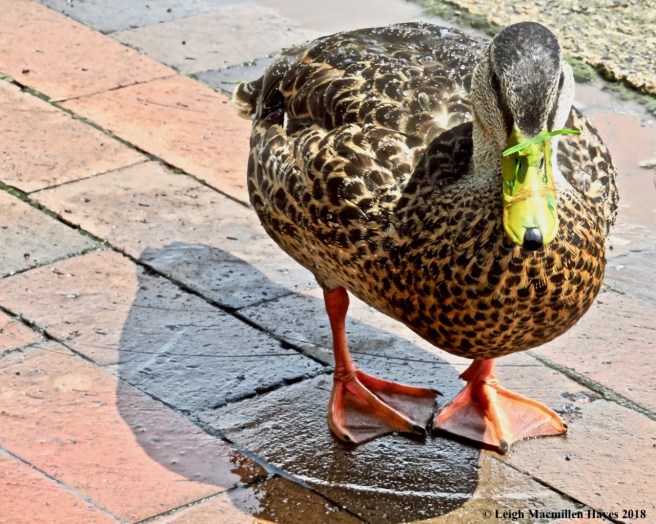
As the rain subsided and sun shone forth, we did a bit of nibbling ourselves, on ice cream cones. It turned out nibbling on ice cream and any other human food was not allowed for the ducks per signage, but that didn’t keep them from sampling the flora of a nearby park.

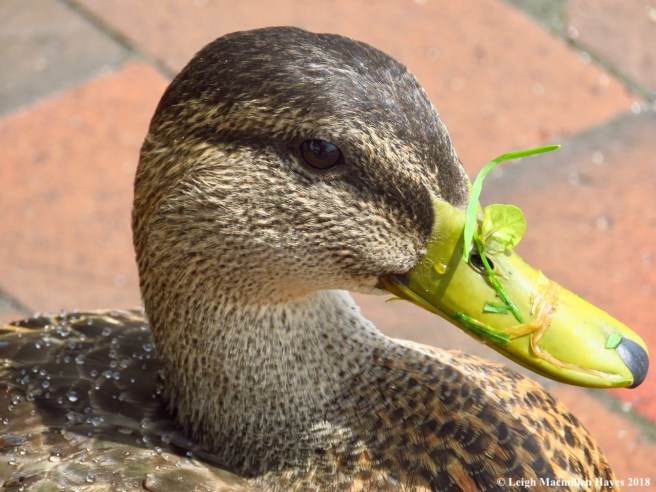
w10-nose decorations

One forager in particular, came away with an arrangement that reminded me of the Easter bonnets we used to wear when we were kids. I could almost hear the Irving Berlin song, Easter Parade:

In your Easter bonnet, with all the frills upon it,
You’ll be the grandest lady in the Easter parade.
I’ll be all in clover and when they look you over,
I’ll be the proudest fellow in the Easter parade.
On the avenue, Fifth Avenue, the photographers will snap us,
And you’ll find that you’re in the rotogravure.
Oh, I could write a sonnet about your Easter bonnet,
And of the girl I’m taking to the Easter parade.

w12-into the hardware store

We left that parade route and made our way through town, pausing as one might expect at the local family-owned hardware store. Of course, my guy felt right at home and spent some time chatting with the owner as they compared products and store layout.

w12-view out the window

I admired the view of the birdhouses on a sill.

w13-signs about town

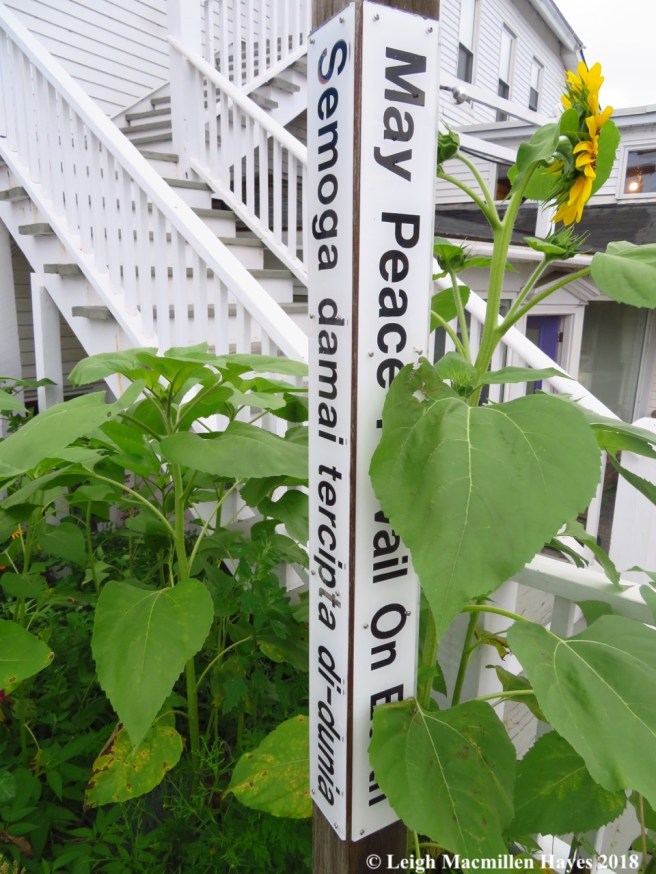
Back on the road, we noticed one beautiful garden after another in front of each shop and some bore signs worth sharing: May Peace Prevail On Earth. Indeed.

w13-rain

Eventually, the sky opened again and sent forth its refreshing goodness. We’ve been in need of rain as we’ve been experiencing a moderate drought and so celebrated the nourishment it brought to the earth and us as well.

w15-rainsdrops and blue sky

Then, with a mad dash, we ran back to the truck, noting the rain drops juxtaposed against the blue sky.

w16-duck salad

It was certainly a Mondate made for ducks, especially those who liked to wear their bonnets made from foraged salad on their bills.


Loon-atic loon antics

I wasn’t sure what to expect this morning when I drove to an undisclosed body of water for a boat trip to see an eagle chick in a nest. The reality was that though I’ve seen many eagles and twice had to cover my head with my hands for fear I was about to be dive bombed, only to discover the bird quickly grabbed a fish not far from my location, I’ve never seen an eagle nest.

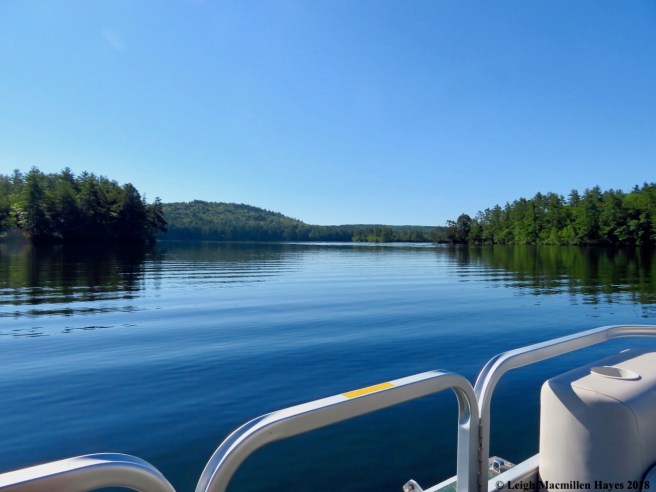
l1-pontoon boat

And so, I was graciously met at a camp road and escorted to the dock, where we boarded a pontoon boat for the expedition.

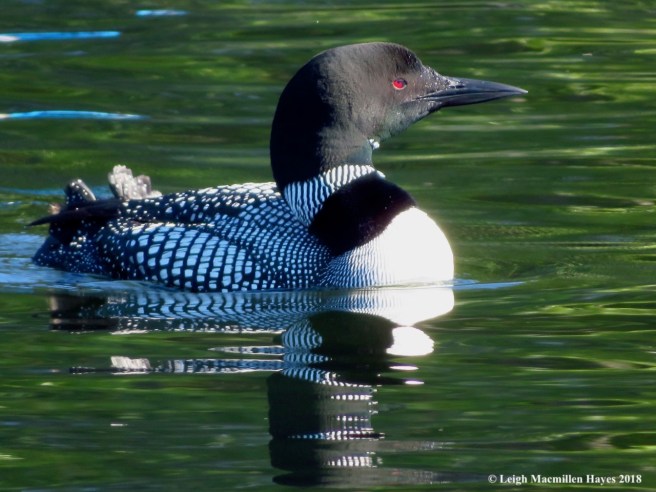
l2-common loon

Within minutes of leaving shore, we spied several common loons and paused to watch them swim . . .

l3-preening loon

and preen. Feathers are important to loons and all other birds, for they provide protection from weather, including rain and sun. Aerodynamics also come into play, for the feathers give the body a smooth contour and help reduce drag in the air. To preen, the loon grasps a feather with its bill and works on it from base to tip, getting rid of oil, dirt, and parasites. The bird then repositions the feathers, straightening out the barbs on either side of the shaft–thus providing a smooth, weatherproof coat. To aid in the weatherproofing, the bird collects oil from a gland on top of the base of its tail and spreads it over the smooth feathers.

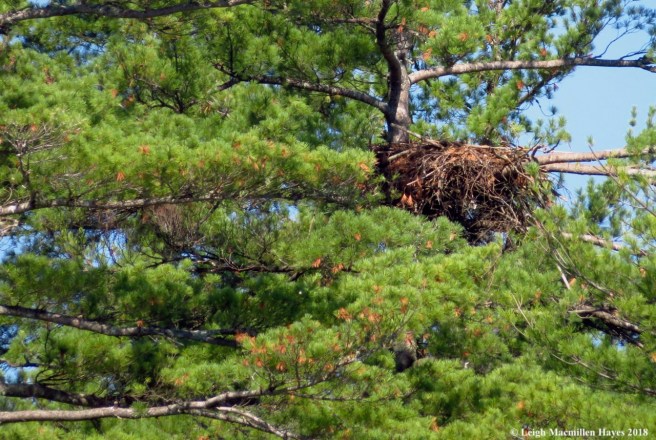
l4-eagle nest

At last we pulled away, my hostess (M) and host (S) eager to show me the eagle nest and a young fledgling. With apt directions, they pointed out the tree and told me where to focus the binoculars and then my camera. I was pretty sure I found the spot.

l6-eagle nest

But alas, a few minutes later they realized they were pointing to the wrong tree. A trip refund was surely in order, but . . . they regrouped, scanned the tree tops again and found the actual nest. Though it was difficult to tell from our location below and because they may have been hunkered down, we didn’t think we saw any birds, but we maybe we did. It apparently wasn’t feeding time and mom and pop were nowhere to be seen.  M  and S were disappointed, but I wasn’t. My first eagle nest! And maybe some babes, but even if not . . . my first eagle nest!

l7-crazy loon

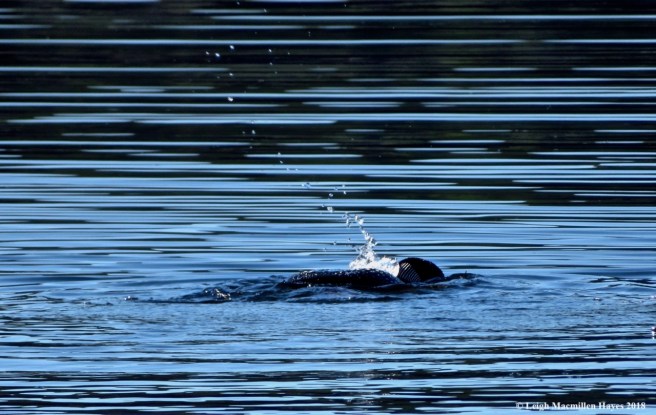
Suddenly, splashes of water caught our attention and we turned in our seats to focus on the action closer to the boat.

l8-crazy loon

A loon undulated in the water in a most frantic fashion, moving back and forth in about a ten-foot space.

l9-crazy loon

Whatever was it doing? We panicked. What should we do?

l10-crazy loon

Each time it pulled its head up, we noticed its beak was wide open. Was there a fishing hook stuck in its mouth? S pulled out his cell phone. Who should he call? Kappy Sprenger, a local wildlife rehabilitator? Or the Maine Warden service?

l11-crazy loon

Again and again, it thrashed on top of the water and our concern rose with each movement.

l12-crazy loon

We each developed our own scenario, none of them ending with a positive outcome.

l13-loon family

Meanwhile, another adult approached with two youngsters in tow.

l15-good in mouth

The second adult found a smidgen of food to dapple in the water and offer to the chicks.

l16-plant or fish?

Fish are the primary food source for loons and they’ll catch whatever species they can. But . . . they also feed on crayfish, aquatic insects, and sometimes vegetation.  What we saw being offered was indecipherable.

l17-bigger fish

Meanwhile, the thrasher came up with a big catch. Had it been going after a fish all that time. Was it not the victim, but rather the predator? Indeed. But why was its mouth always wide open and not closed like a spear? Was it chomping on the fish? How could that be? Loons can’t break up their food the way mammals do, for they have no teeth.

l18-gulp

Whatever the answers to our questions, the outcome, or rather, income was obvious and the loon quickly consumed its prey.

l19-down the throat

Do you see the intake making its way down the bird’s throat? Swallowed whole, the fish would be ground up in the loon’s gizzard, a muscular structure that is part of the a bird’s stomach.

l21-taking cover

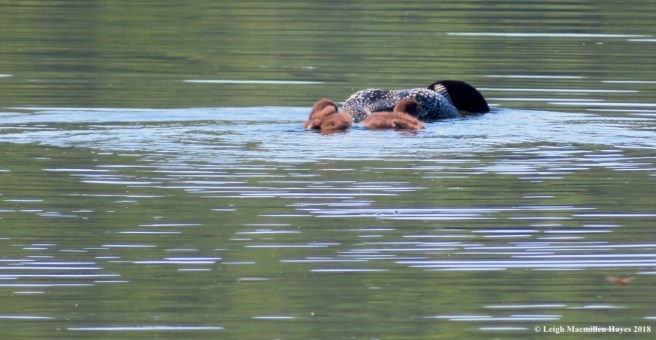
At the same time, the other adult felt the need for a shower, while a curious chick peered below a wing. To shower, a loon rises up and splashes.

l22-shaking off the water

A vigorous body shake follows–it’s all part of their maintenance routine. The splashing and shaking help to settle their feathers back into the proper place, whether for beauty during mating season, or weatherproofing the rest of the year.

l21a

And then it was time to peer into the water again, ever in search of the next meal.

l23-chicks

We learned something new today, M, S, and I: That what we might interpret as loon-atic behavior may actually be otherwise. Perhaps the lesson was meant more for the chicks than us, but we were suddenly wiser.

Thank you, M & S, for sharing your special place with me. And here’s to tomorrow’s 2018 Maine Audubon Loon Count. I suspect I won’t see any loons in the area I’m assigned to, and if I do, it will certainly not compete with today’s crazy loon antics.

Christmas in July Mondate

We did celebrate Christmas in December as has long been the tradition, but for one of his presents my guy received a box with a photo and a set of oar locks. It made absolutely no sense to him. Why oar locks? And why a photo of a boat that needed some work and was sitting in someone’s barn. By now, you know where I’m going with this. As did he, once he gave it a moment’s thought.

The back story is that it was a selfish gift for we do have a fleet of boats already, including a 12-foot aluminum that has seen its own set of better days. The rest of our boats are man/woman-powered, from canoe and kayaks to sailfish and rowing shell. But a boat with a motor–other than the aluminum that has been a piece of yard art since our youngest went off to college so many years ago–had not been in our possession for three or four years. And even then, we only enjoyed it sporadically for it always seemed to have an engine issue of one sort or another. Finally, we sold it as is. And thankfully haven’t heard since if it isn’t.

But . . . our trips beyond the northern basin of Moose Pond had been more limited, and I like going for the occasional tour. So when our Wiser friends (Marita and Bob), said they were planning to sell their circa 1988 Maine Guide Boat last fall, I jumped on the opportunity and turned it into a Christmas present. First, however, they intended to sand and stain the woodwork and paint the interior. All the better for us, I figured. And I didn’t care when the job would be completed for it wasn’t like we’d be boating in January.

c1-SS Christmas

They kindly dropped the refurbished boat off last week and again it sat. Until today, when my guy had a chance to make a couple of minor adjustments, like adding the registration stickers and some epoxy to a couple of spots on the stern.

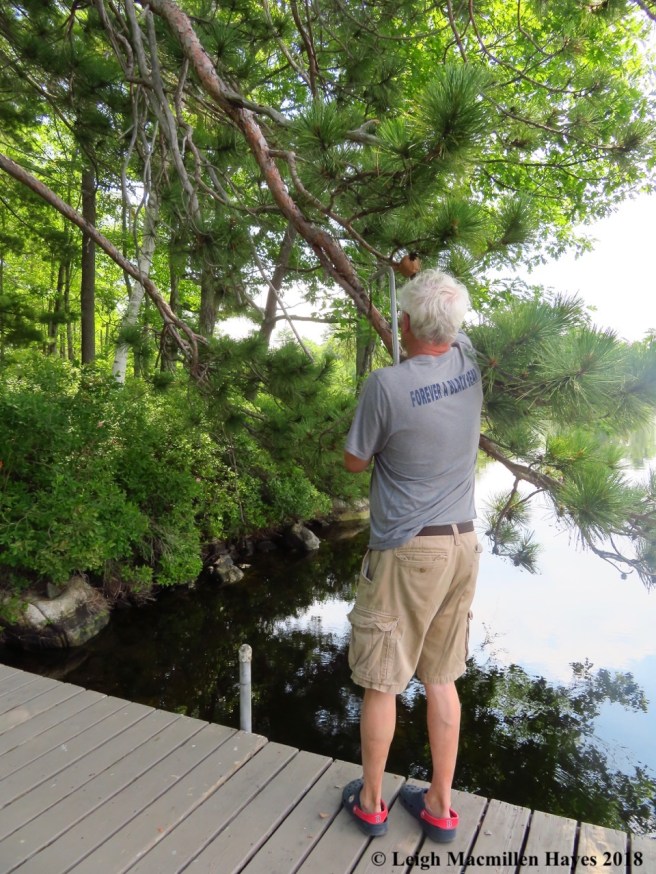
c4-trimming a branch

While the epoxy dried, there was a branch dangling over the side of the dock that needed to be trimmed. We love hiding behind the trees, and so haven’t done what most have–cut the bottom third of the branches off view-blocking trees. Even making this minor adjustment didn’t feel quite right, but we did need a place to dock the boat. And it wasn’t the first time we’d made such a cut in the same spot. I guess we were just surprised at how much the tree had grown since we last docked a boat there.

c2-Canada geese at neighbors

Of course, while he sawed the lower part of the branch off, I looked around and spied Canada geese visiting the neighbor’s well-groomed property. There were at least 25 geese in all, each leaving a multitude of gifts as thanks for the neighbor’s hospitality.

c5-boat launched

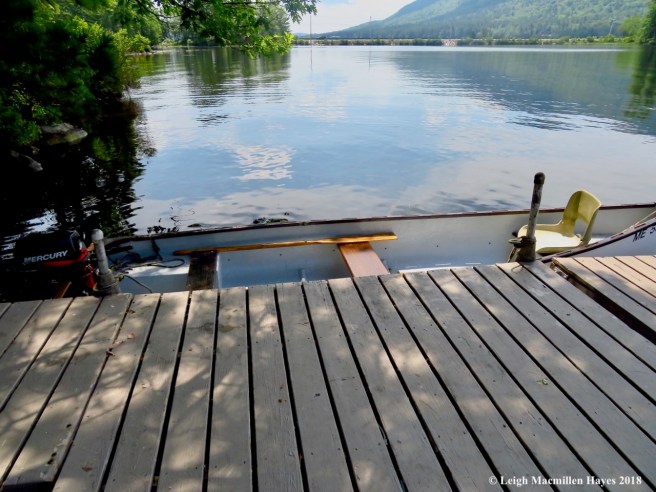
And then the boat was launched without much fanfare.

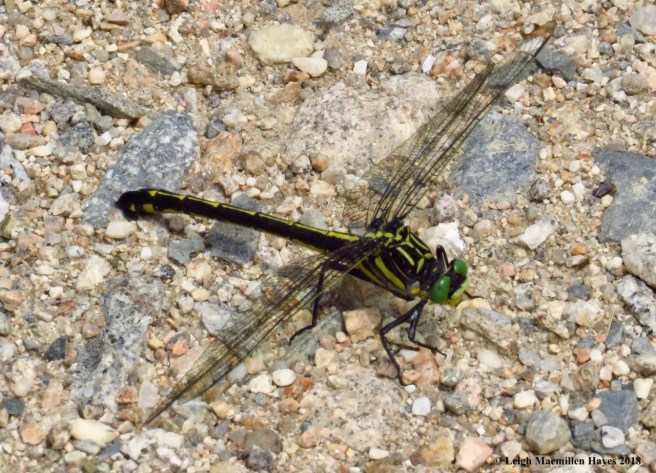
c6-lancet clubtail dragonfly

Unless you consider the fact that a Lancet Clubtail Dragonfly stopped by frequently to check on the happenings.

c7-variable dancer damselfly

A Variable Dancer Damselfly also kept taking a look, and even checked out the boat’s seats.

c3-bryozoan mass

Meanwhile, as I was exclaiming over the clarity of the water, I noticed a Bryozoan mass, a most definite gift for the tiny colonial aquatic creatures that connect their tubes together and form the jelly-like blob, effectively filter particles from the water. The animals live in the tubes and extend their tentacles that capture even smaller microscopic organisms for food. The gelatinous species, also known as moss animals, is native to North America.

c5-motor added

Ah, but it was a boat we were there to focus on and a four-stroke motor that’s been sitting dormant in the basement was attached to the stern. Fresh gas and a quick pull of the cord and we were in business.

c9-onto the northern basin

Off we headed onto our section of the pond.

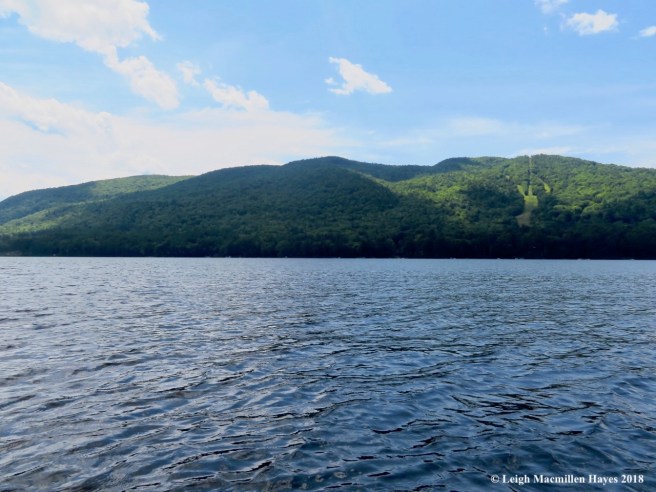
c10-Shawnee Peak Ski Area

A turn to the left and the slopes of Shawnee Peak Ski Area at Pleasant Mountain appeared before us.

c11-under Route 302 Causeway

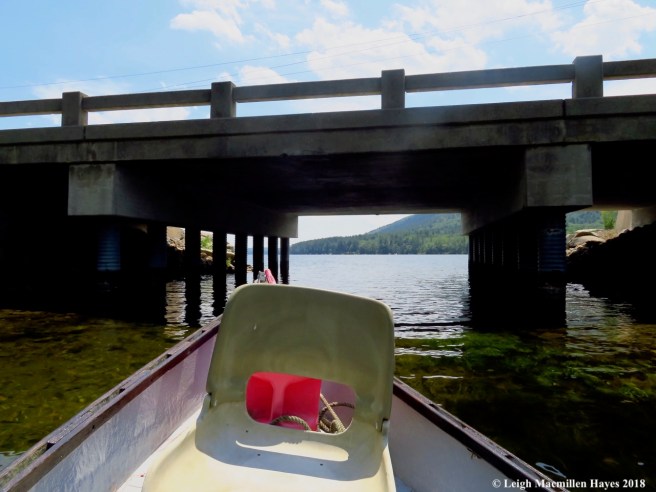
Another turn to the left and then to the right and we passed under the Route 302 Causeway into the much larger middle basin.

c12-Loon and chick

It was there that more gifts were to be presented.

c12-loon chick

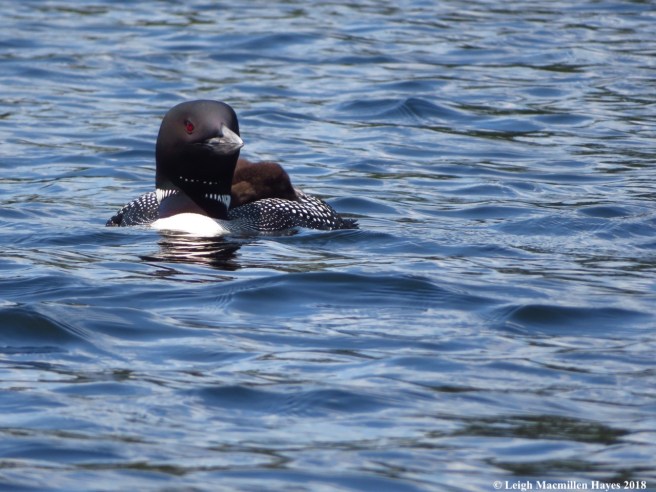
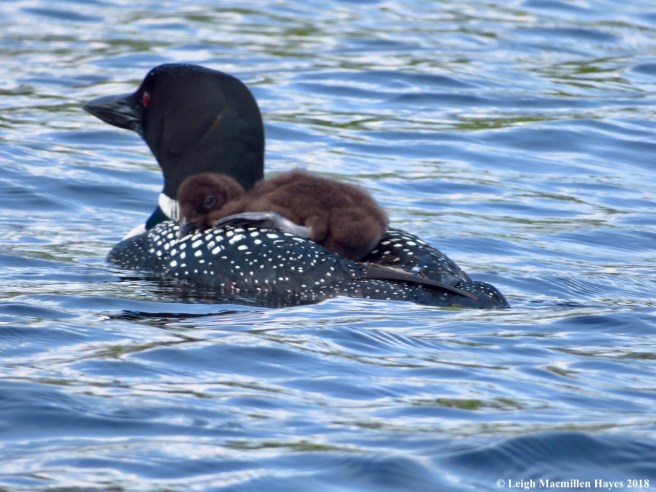
Momma or Poppa Loon, for one can’t tell the difference from this angle, with a chick snuggled on its back.

c14-momma or poppa and chick

Always a favorite sight.

c15-Camp Winona

We had stopped the engine by the loons and drifted for a bit. But then it was time to move on toward Camp Winona, where not a camper or counselor was to be seen by the platform tents or any of the waterfront. We thought of stopping to visit our friend, Camp Nurse Rosemary, but weren’t sure if she was working today and so on we chugged at our ever so slow speed, which was much to my liking.

c18-unicorn

Thankfully, it was fast enough to keep away from the pond monster, Moosey the Unicorn. We sure do share this water body with a variety of creatures.

c16-Pleasant Mountain and East Ski Area

Across the way, most of the ridge line of Pleasant Mountain came into view and we made a discovery.

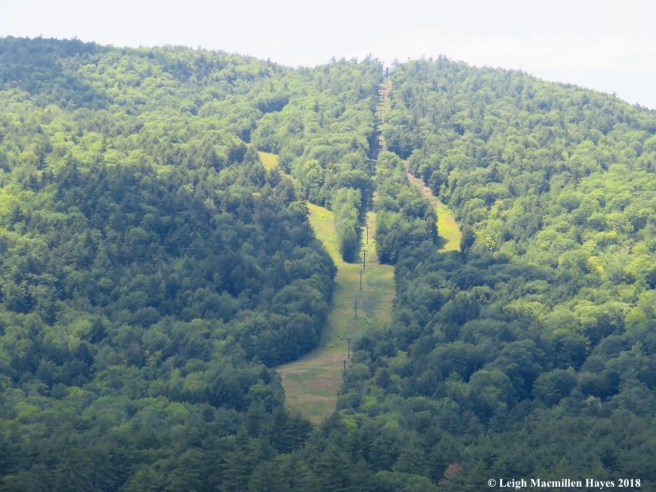
c16-East Ski Area-lobster

It looked like a lobster! Or maybe it was a crayfish, since we were on Moose Pond.

c19-home captain

Eventually we turned around, saving the southern basin for another day.

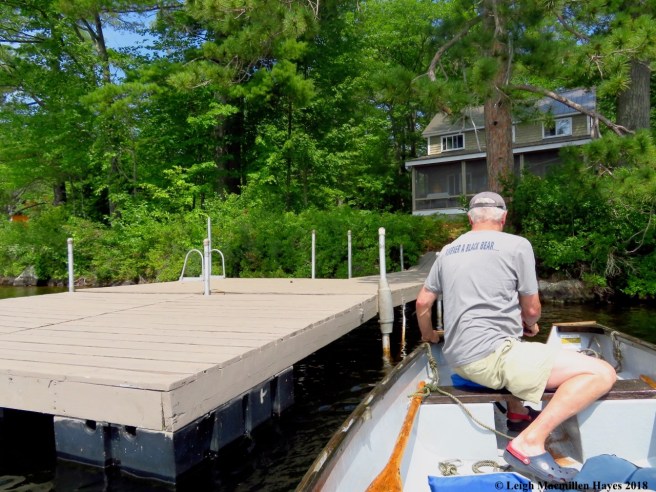
c20-backing into the dock spot

Our maiden voyage in our new/old boat came to an end as my guy successfully backed it into its resting spot at the dock. And Sam Adams helped us toast the adventure as we christened the boat: S.S. Christmas.

Christmas in July was certainly celebrated on this Mondate.


Taking Flight

Morning had broken . . .

h1-morning has broken

and Pleasant Mountain’s reflection marked a new day.

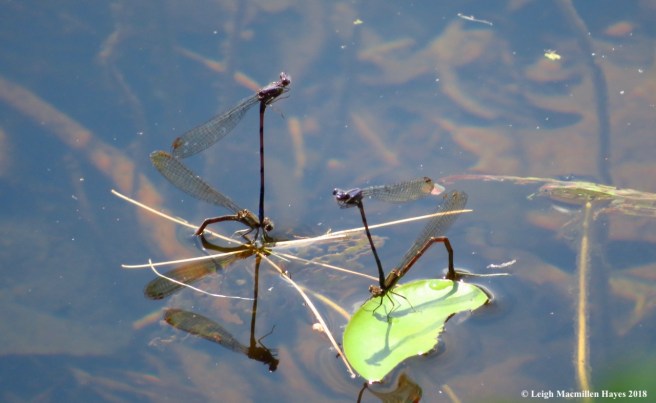
h2-variable dancers conducting variable dance

New life was also in the making as the Variable Dancer Damselflies practiced the fine art of canoodling. I’d never noticed an oviposition aggregation before, but it made sense if it minimized the threats a couple receives from unattached males. Plus, if the spot was good enough for one pair to lay their eggs, then it must be fine for another. And so I learned something new today.

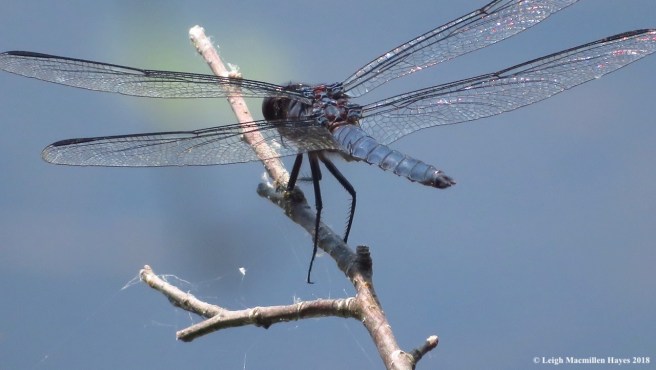
h3-slaty skimmer

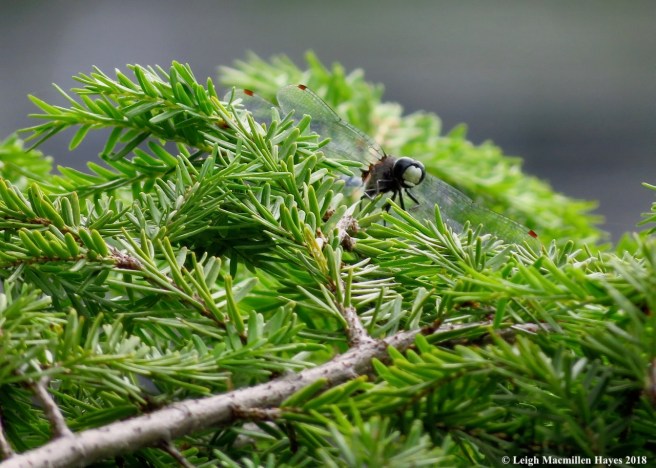
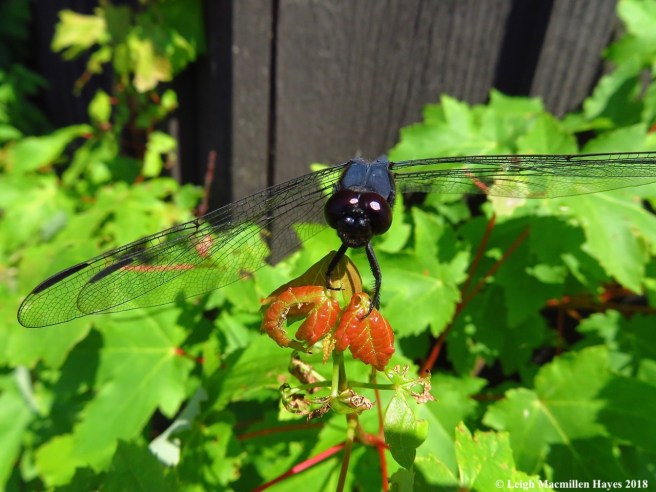
Perhaps it also cut down on predation, though I couldn’t stay long enough to note if the Slaty Skimmer that hung out above turned either pair into breakfast. If so, I hope they at least had a chance to leave their deposits.

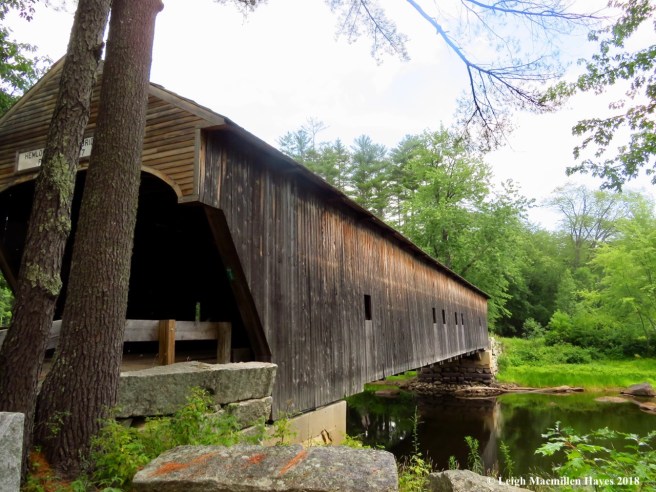
h4-Hemlock covered bridge

That was my morning view, but I changed it up a bit this afternoon and darted across the Hemlock Covered Bridge that spans the Old Course of the Saco River in Fryeburg. Built in 1857 of Paddleford truss construction with supporting laminated wooden arches, the bridge is a quaint and charming reminder of days gone by.

h5-bridge

Though reinforced in 1988 so you can drive across, it’s even more fun to glide while admiring the work of our forefathers and . . .

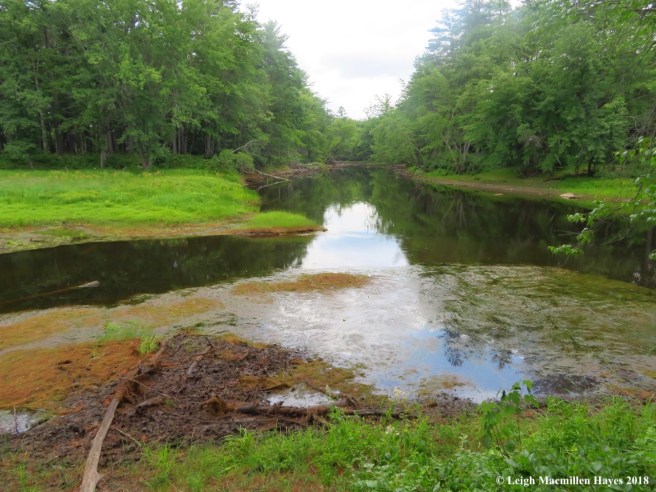
h8-water low

peer out a window at the river from Maine’s oldest remaining covered bridge.

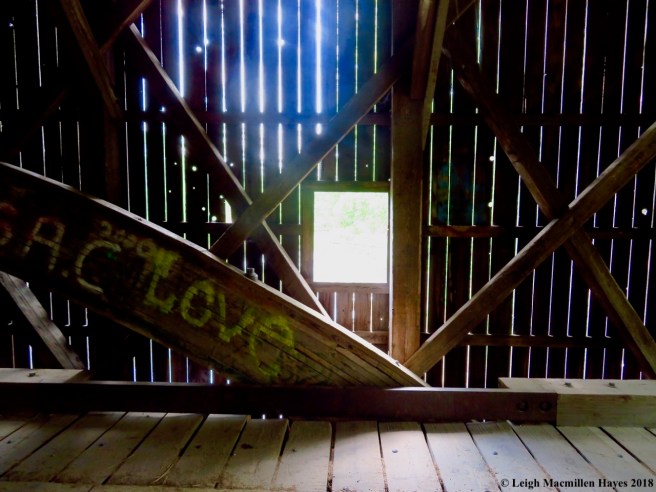
h6-LOVE

The handiwork of more recent travelers . . .

h7-love lasts forever

was also clearly visible.

h9-river jewelwing-female, white dots in sync

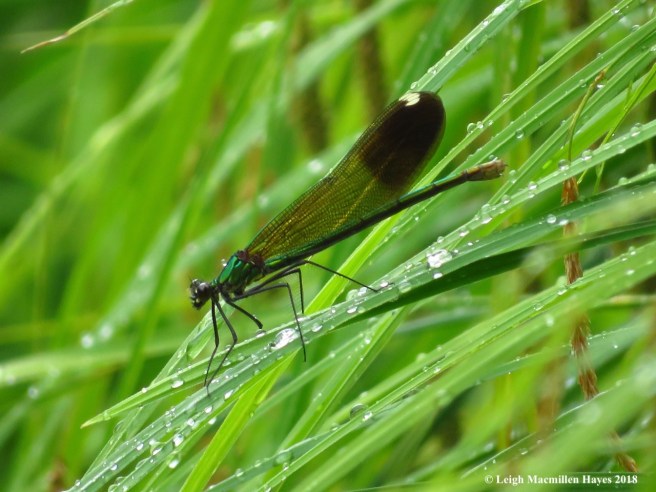
Down by the Old Course, I spotted a female River Jewelwing, the white dots on its four wings showing off in the day’s light. Just prior, a few sprinkles had fallen and one teeny droplet rolled down her thorax. A few even teenier ones clung to her legs.

h10-Hemlock Covered Bridge

With one more look back to reflect upon the bridge, I was then ready to set sail again.

h11-Mt. Kearsarge

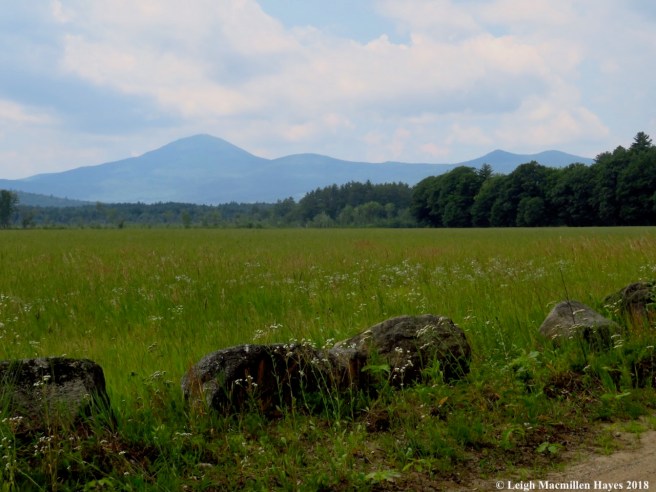
Heading toward Frog Alley, the view across the fields included Mount Kearsarge amid the summer haze that had developed.

h18-Mount Tom

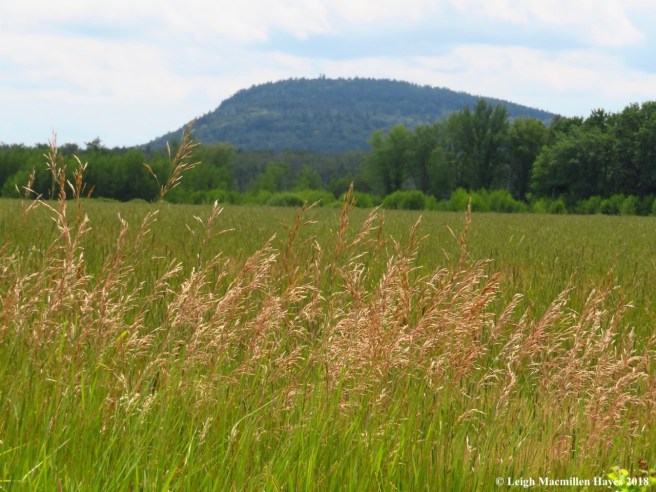
Mount Tom was more clearly visible for it was so much closer.

h12-Dianthus armeria, Deptford pink

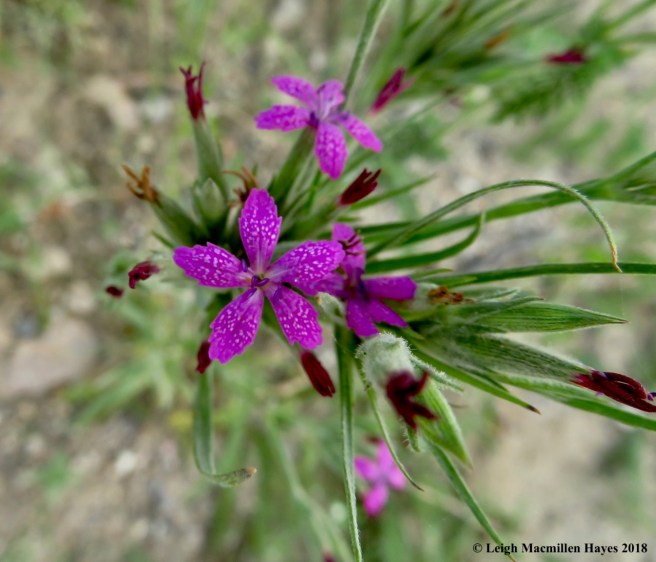
But what I really stopped to look at where those things closer to the ground, like the brilliant pink Dianthus with their petals all spotted and toothed at the tips.

h14-bindweed

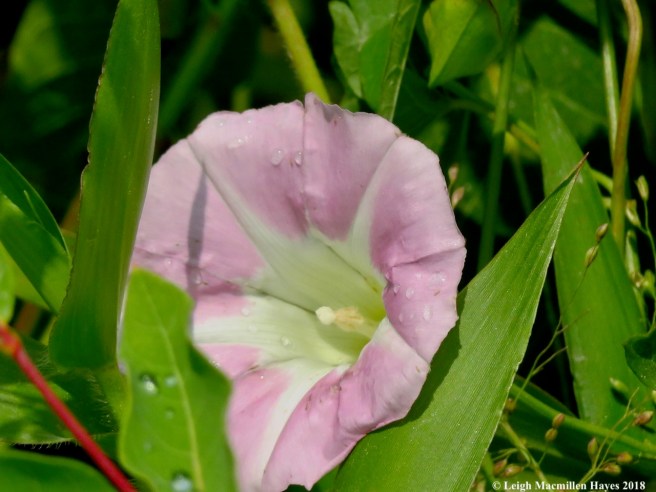
Offering a lighter hue of pink, a bindweed twined its way through the roadside wildflowers.

h13-honeybee on milkweed

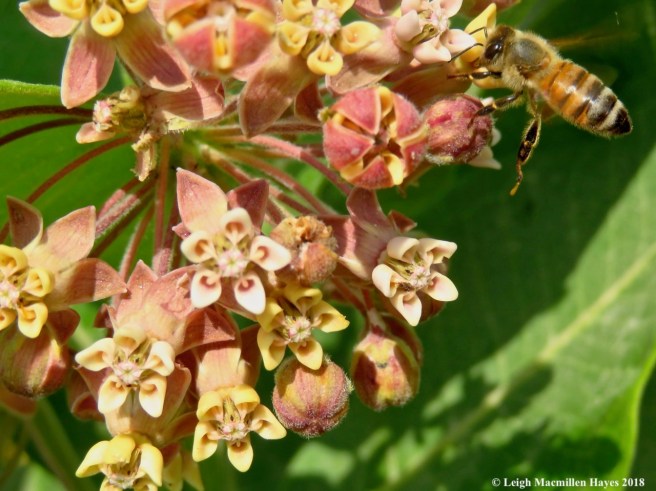
Also with shades of pink and the yellow complexion of those flowers already pollinated, milkweed was in full bloom and the ants and some flies were making the rounds, but I only saw one honeybee taking advantage of the sweet nectar. It reminded me that the same was true on the milkweed growing in my garden where, at most, I’ve seen four honeybees rather than the usual swarms.

h17-sulphur cinquefoil

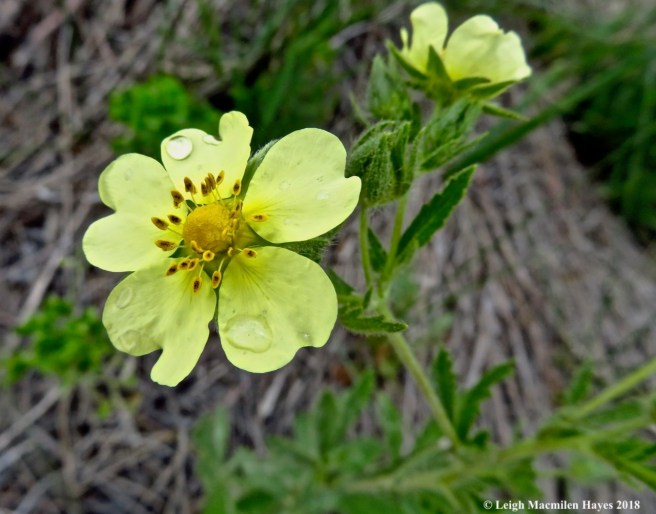
And then there was the subtle yellow of the Sulphur Cinquefoil showing off its cheery face despite a few tear drops. Actually, it may have cried for only a few drops had fallen from the sky and we really do need a soaking rain.

h16-clouded sulphur butterfly

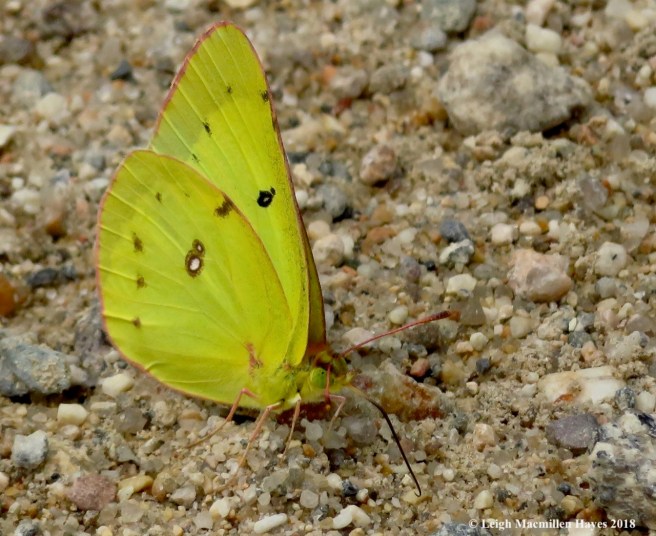
As if taking a cue from the cinquefoil, Clouded Sulphur butterflies flitted and danced along the road.

h16- clouded sulphurs puddling

And then I realized that they kept gathering in groups. It’s a form I’d read about but never observed before–puddling. This was a male habit and apparently their intention was to suck nutrients from the wet ground. I guess even a few raindrops served the purpose.

h15-dragonhunter

Before I moved on again, my heart was still as more yellow entered the scene in the form of a striped thorax and I realized I was watching a Dragonhunter Dragonfly. Though it wasn’t so easy to see the tip of tail once it landed, as it flew about in my vicinity it kept its abdomen curved down–a habit of these big guys.

h29-Fryeburg Bog

The Fryeburg Bog was my next landing and though I didn’t head out to the water that was more like an over-sized puddle, I found plenty to focus on.

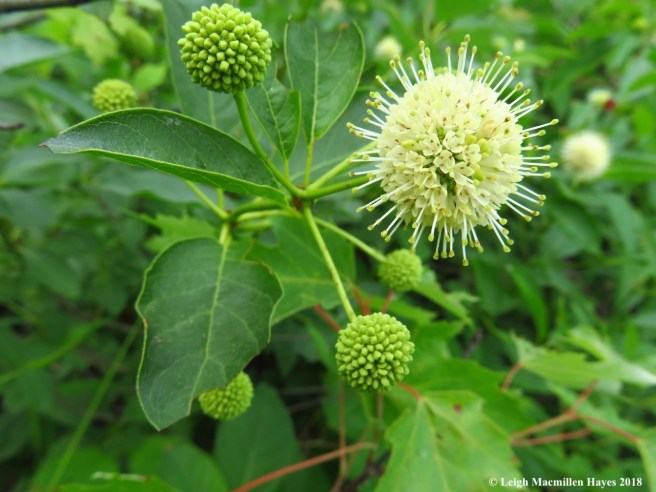
h19-buttonbush

For starters, the Buttonbush had begun to bloom and I loved its otherworldly presentation.

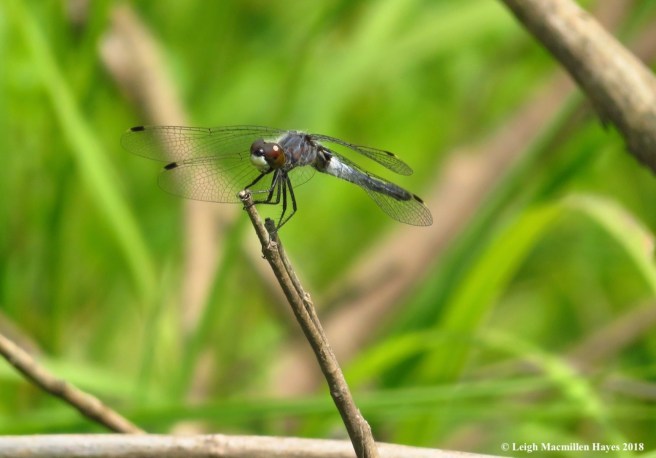
h21-frosted whiteface

It was there that I saw the smallest of dragons, in the form of the Frosted Whiteface.

h22-frosted whiteface

At most, he was about 1.5 inches long–quite probably the smallest of the species that I know.

h20-ruby meadowhawk

It was there that I also spotted my first Ruby Meadowhawk of this year.

h23-ruby meadowhawks canoodling

And then there were two! And in the future, obviously, there will be more.

h23--late afternoon snack

And finally, it was there that I noticed a Song Sparrow had nabbed a butterfly snack–all part of the circle of life.

h30-Smarts Hill

My final stop on today’s journey was at Popple Hill Brook along Smarts Hill Road in Sweden.

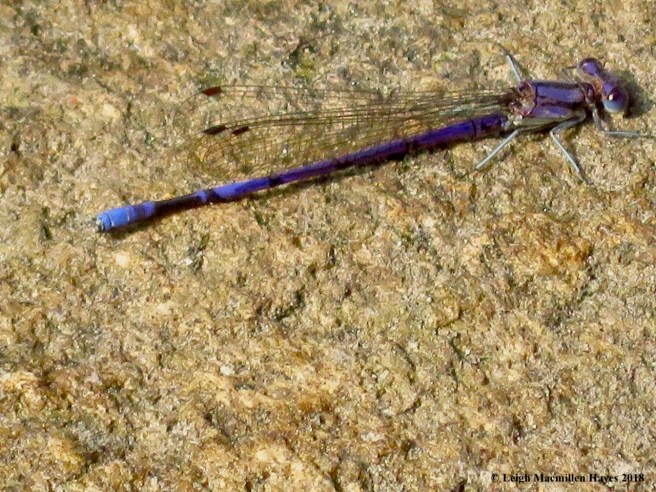
h25-variable dancer

And like the Variable Dancers I’d seen this morning, I found many more beside the brook. Not only was the male’s purple coloring stunning, but notice those silvery legs.

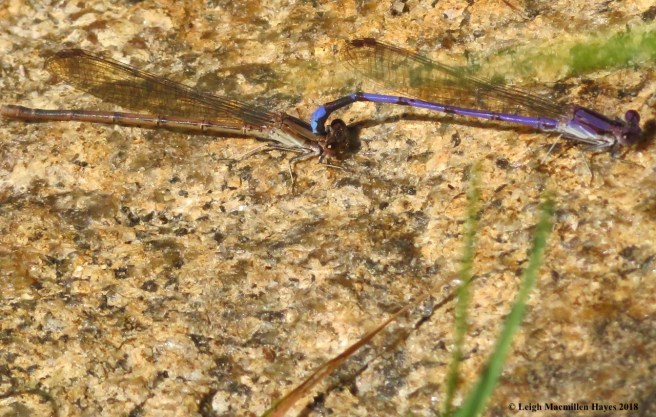
h26-variable dancers canoodling

Of course, where there is more than one dragonfly or damselfly, there is love.

h27-variable dancers canoodling

As my tour began, it ended–with the Variables dancing to their heart song.

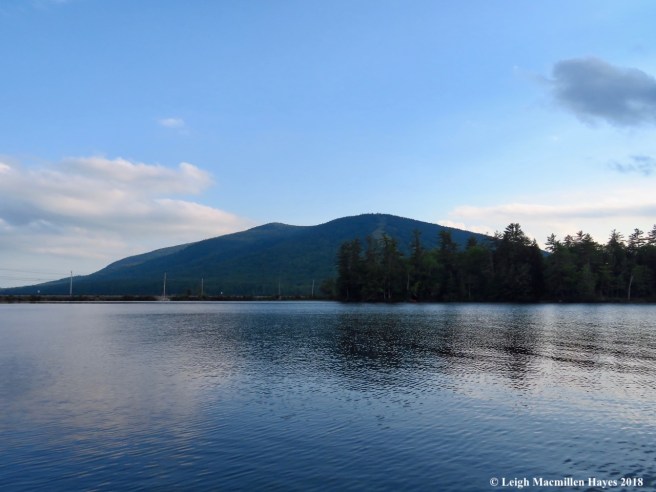
h28

And with that, I flew back to camp, where the mountain’s reflection was conducting its own dance routine as the sun began to slip toward the horizon.

h31-rainbow

And a few more raindrops produced a rainbow in the eastern sky.

Thanks for taking flight with me on this wonder-filled wander and soaring above some of the areas that are so unique and yet we tend to overlook them.


Upta Camp

It’s been a gray day and a quiet day–the right mix of ingredients for a perfect day. And except for saying goodby to my guy this morning, the only conversations I have had, too numerous to count, were with myself.

c2-gray squirrel

Well, maybe that’s not quite accurate, for I did talk to a squirrel, but in unusual squirrel manner, it stayed as still as could be and didn’t respond. Together, however, we eyed our domain.

c5-mayfly

It turned out we weren’t the only ones with big eyes that chose to hang out all day. Attached to the screen was a Mayfly subimago–the teenage form of the insect.

c6-close up

Mayflies are unique in that after the nymph emerges from the water as the subimago (that fishermen call a dun), they seek shelter before shedding their skin for the final transformation. I’m tickled that this dun chose our porch screen on which to rest.

m6c-close up

Notice the cloudy wings–that’s a clue as to its age. It can take a few minutes to two days before a subimago transforms into a clear-winged imago or spinner, though the actual metamorphosis is quick. Will I see it? You know I’ll keep watching.

c6-sawfly insect case

In the meantime, there was more to discover, including a sawfly insect case featuring the tiny hole where the insect chewed its way out.

c19-round-leaved sundew

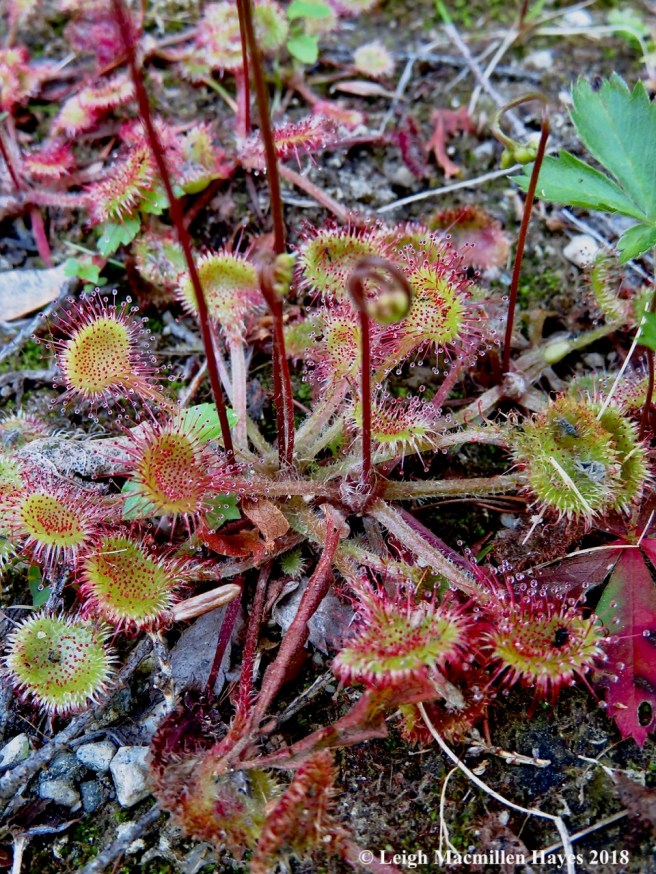
As I looked about, I made one extremely exciting discovery–at least to me. Since 1986, I’ve stalked this land and today was the first time that I noticed the carnivorous Round-leaved Sundew growing here. Its leaves were filled to the brink with insect parts.

c18-round-leaved sundew

Perhaps that was why it looked so healthy and ready to flower. Expect to meet it again in future blog posts. (I warned you.)

c14-swamp rose

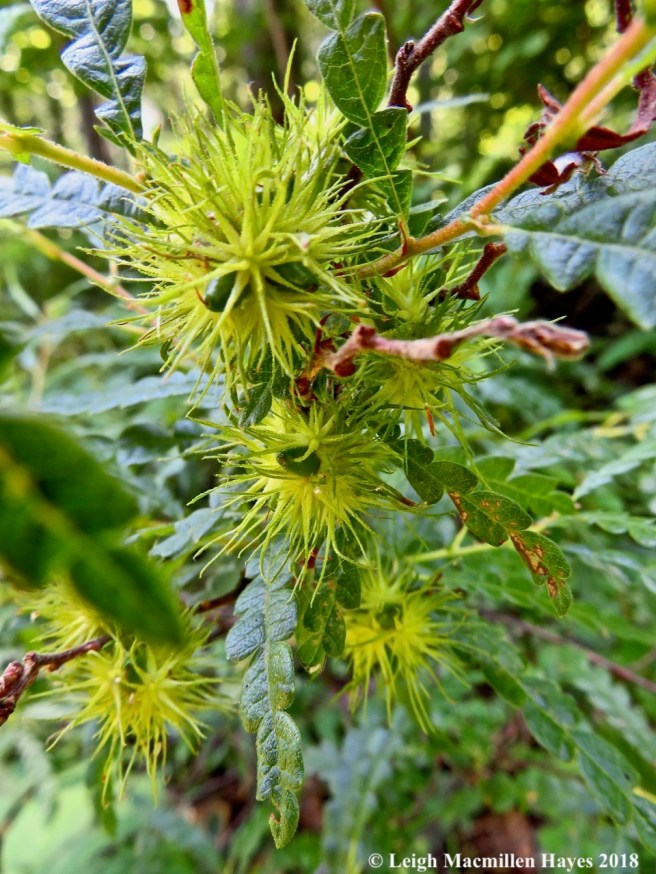
I also spotted a few Swamp Roses offering a bright contrast to the day’s overcast reflection.

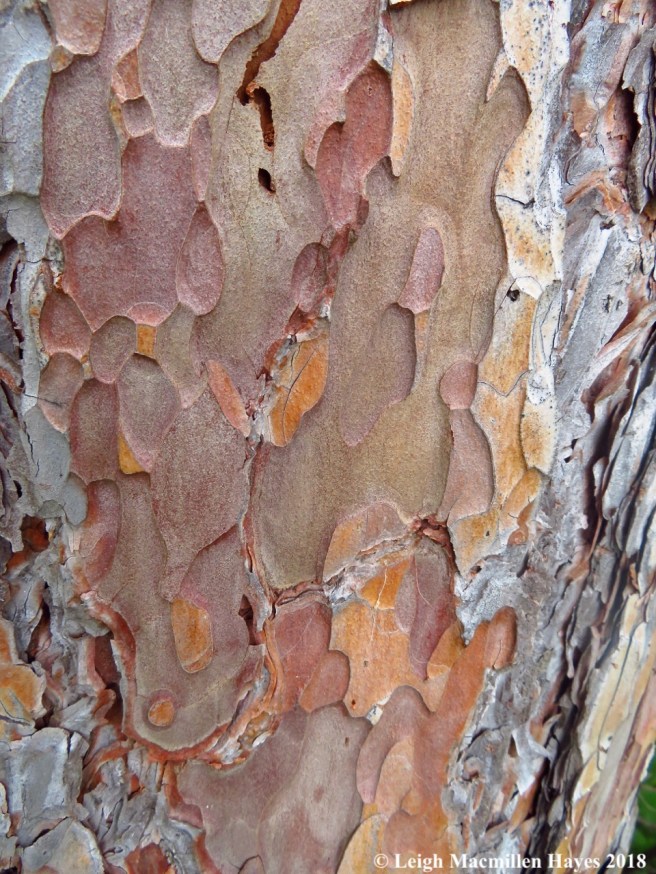
c13-red pine

Featuring its own display of color was my favorite red pine–all pink-orange-gray hued in a jigsaw puzzle manner.

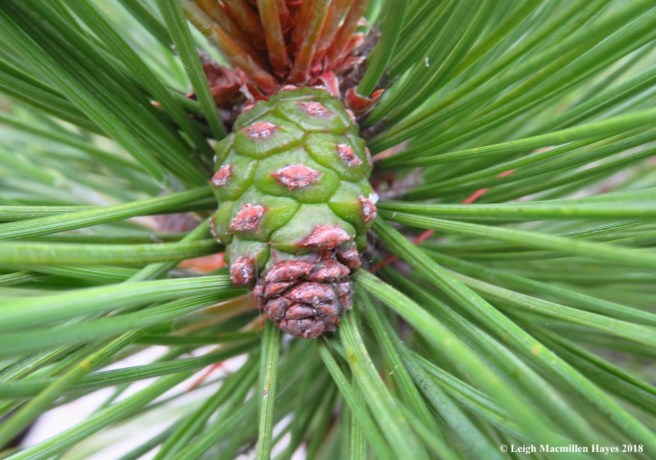
c15-red pine cone developing

At the ends of its branches I found young cones growing larger and greener.

c16a-spider

And old cones offering the perfect camouflage for a spider that had created a large network in which to trap its prey. I think it was of the garden cross variety, but without breaking the web, I couldn’t get too close, and I didn’t want to ruin all of its work.

c17-dragonfly exuvia

Entangled in a bit of another web and dangling from the floor of the porch and beside the foundation was a skimmer dragonfly exuvia. Today wasn’t a flight day for dragonflies, and so I had to wonder–where do they hide when the sun doesn’t show its cheery face?

c1-camp view

Perhaps in the buffer zone of vegetation that surrounds Propinquity, our point of view.

c2a-dock view

It only took us about a month longer than usual . . .

c2-Pleasant Mtn

to make the long journey (7 miles) to the water’s edge.

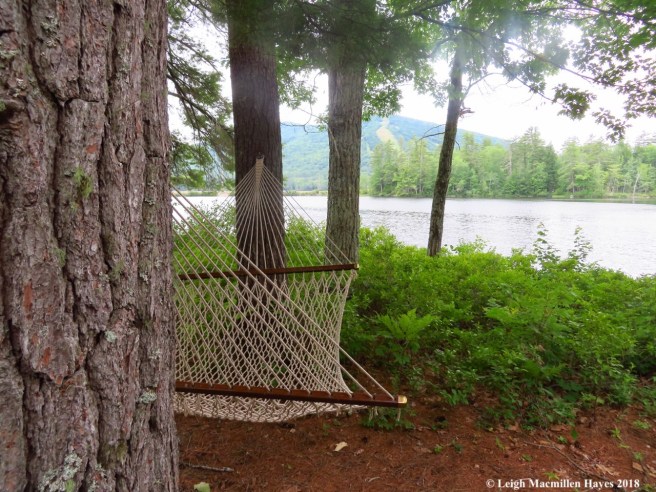
c20-hammock

But at last we’ve arrived.

c21-hammock view

Upta camp. The way life should be.


The Amazing Race–Our Style, episode six

The clue was rather vague as clues go: Drive five hours south to the second dot to the right in Harbor View. And so we did.

c1a

The map provided helped–sorta.

c3

And just before dark we located the spot that included not only a view of the outer harbor, but also the back side of Hammonassett Beach State Park on Long Island Sound in Connecticut. It was like we knew exactly where we were going.

c1

As it turned out, we were joined by another couple with whom we’d formed an alliance for the race and so we decided to spend the weekend completing the challenges together. Funny thing–I think we felt so comfortable with them because she looked very much like my sister and he reminded us of my brother-in-law. With them was a young man who is about to celebrate his 24th birthday (in two more days) and so we all celebrated with him–but even his presence was part of the challenge. And so Team Budz (the alliance couple) and Team Wonder (us), shared the responsibility of his presence. They picked him up at the train station. We provided the cake, which he decorated himself. We also offered the musical accompaniment, much to his dismay. And together, presents, much to his delight.

c4

Refreshed after a good night’s sleep in that delightfully salty air, we faced new challenges, such as sighting three mammals. Together, Team Budz and Wonder spied cottontail rabbits, which were probably the eastern species that was introduced into New England in the late 1800s/early 1900s and have expanded in range ever since, rather than the native New England Cottontail. Both feature large hind feet, long ears, and a short, fluffy tail that resembles its namesake–a cotton ball. Suffice it to say: it was a cottontail. We also saw a red fox that looked a bit mangy and was too close to home, poking up as it did on the rocks in front of our accommodation, and a momma raccoon that, sadly, had been struck by a car–ever so gently struck.

c5

Challenge number two found us seeking two sea birds. We found adult Osprey standing guard,

c8

and scanning the water for a fishy meal.

c7

Meanwhile, their young patiently awaited breakfast in the nest built of sticks upon man-made platforms that were installed at least thirty years ago. And actually, while we watched them, we noted something disturbing–tangled fishline dangling from the construction site. That led us to send out a word of caution–dispose of your tangled fishline so the birds and other aquatic species with whom we share this Earth don’t get wrapped up to the point of no escape, aka death.

c6

We did note that while some of the young Osprey stretched their wings to capture the sun’s warmth and waited for mom and pop to return with a meal, a couple of smaller birds used the nest structure as a great place to pause below and contemplate the surrounding world. Osprey eat fish and perhaps the smaller birds knew that? Or they just made the right decision.
c9

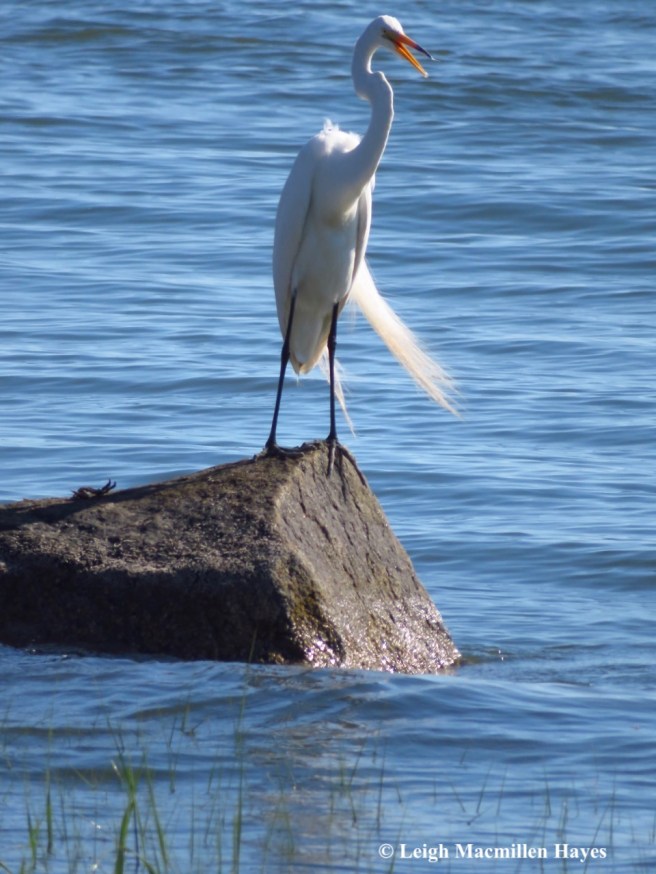
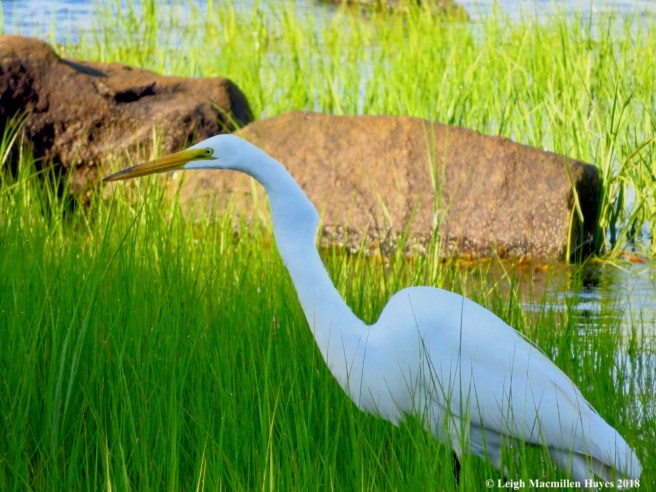
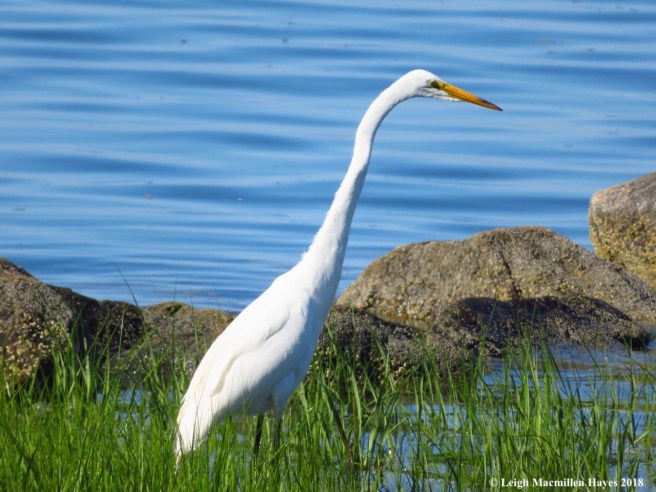
The Great Egret was the second bird we were assigned to watch . . . as it watched.
c10

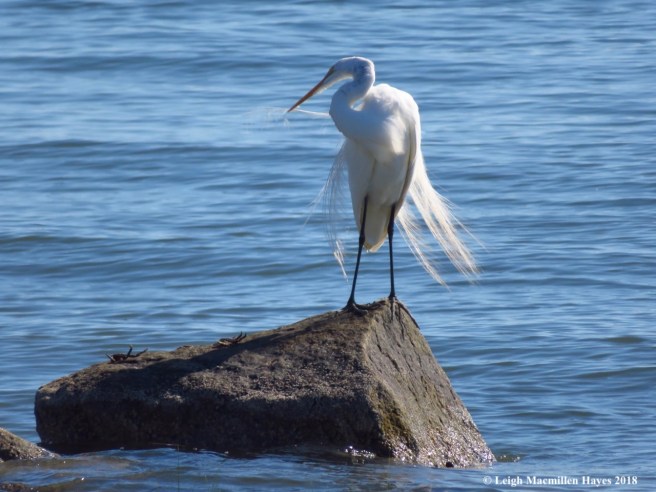
And preened.

c11

And exclaimed its beauty.

c12

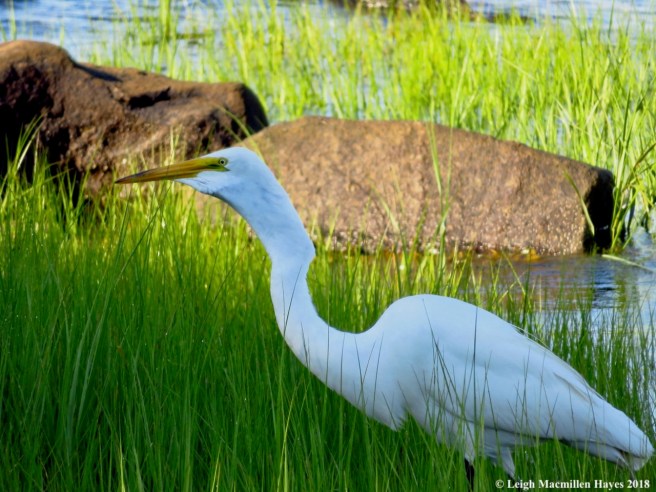
And watched some more.

c13

And focused.

c14

And then . . . the splash.

c15

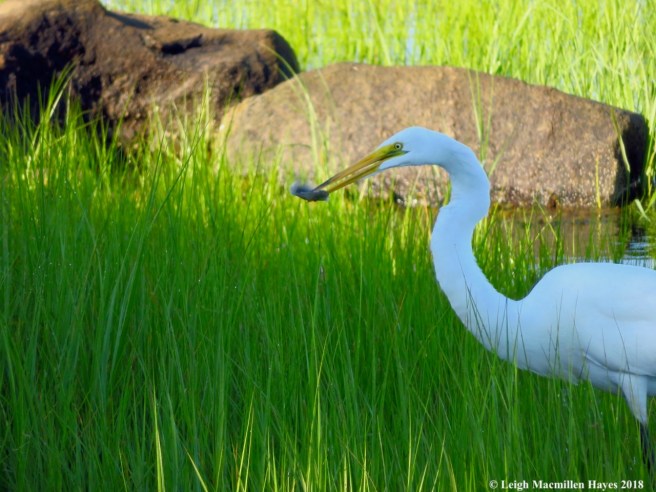
And success.

c16

A meal.

c17

To pull in.

c18

And swallow.

c19

And swallow some more.

c20

Suddenly, in a flash of time, for so it seemed, Team Wonder needed to hold up its end of the alliance bargain and get this guy back to the train.

c21

But–we needed directions to the railroad station, for we wanted to make sure that he made his connection in New Haven.
c22

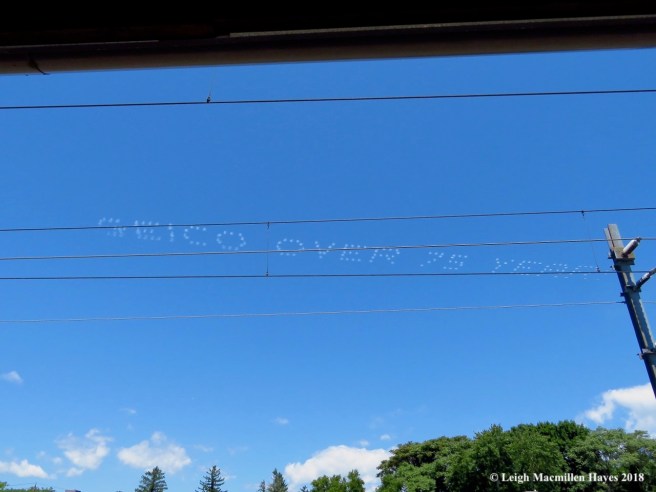
We were told to look to the sky for a message–and it was there that we found an advertisement unfolding in what struck us as a strange place, but perhaps it wasn’t so strange after all, for it was above some train tracks. Another Happy Birthday Message?
c23

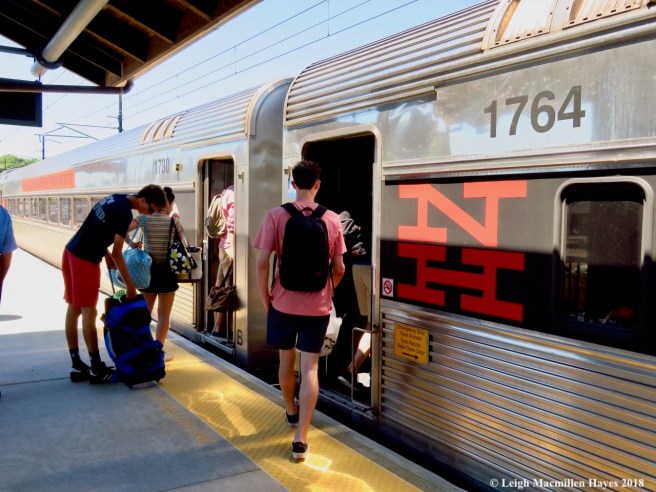
Whatever, it turned out to be the right one. First, the Shoreline East to New Haven and then the Metro North to Grand Central. And off he went–to his home of the past year and his career in the film editing industry (and his 24th birthday in two more days).

c24

Meanwhile, back at the ranch, aka Alliance Inn, the tide was slowly coming in, but we headed out, two teams as we were, ready to take on the next adventure.
c25

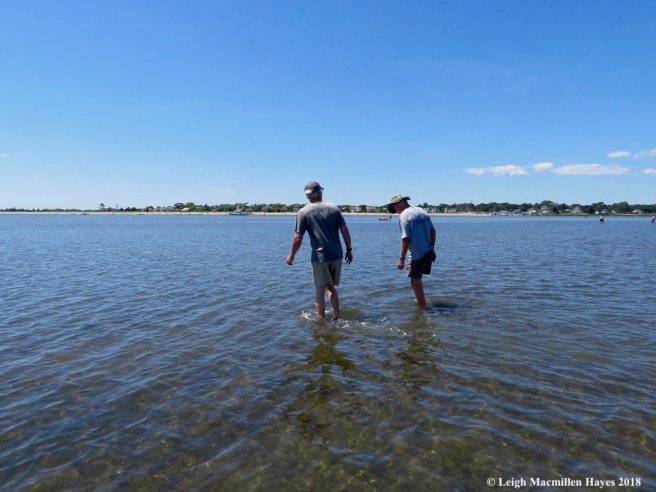
My guy and Mr. Budz led the way through the shallow water the outer harbor has long been famous for.
c26

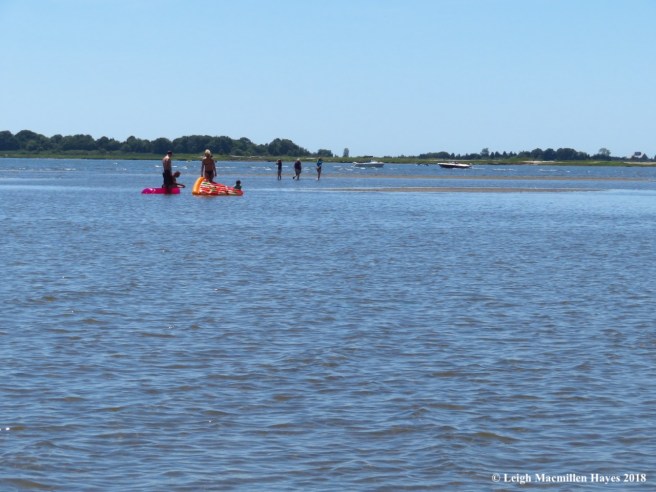
It’s a tradition of the neighborhood–this gathering place at low tide.

c27

Team Wonder did get a wee bit worried when Team Budz paired up ahead–where they going to ditch us at the channel?

c28

But they didn’t. Instead, they paused with us to look at one of the wonders we needed to find by the sandbars–what was it?

c29

A sand collar–which felt like sand paper above and was smooth below. It was actually a mass of snail eggs. A rather amazing form.

c30

On the sandbars and in the water, Spider Crabs appeared fierce, but were really quite nonchalant. Note the round and spiny carapace, with small spines running down its back. The crab is known to attach bits of algae, mud, and seaweed to many sticky hairs all over its bodies for camouflage, thus giving it a frightening look, but don’t take it seriously. It moves quite slowly and won’t pinch your toes like some of its relatives.
c32

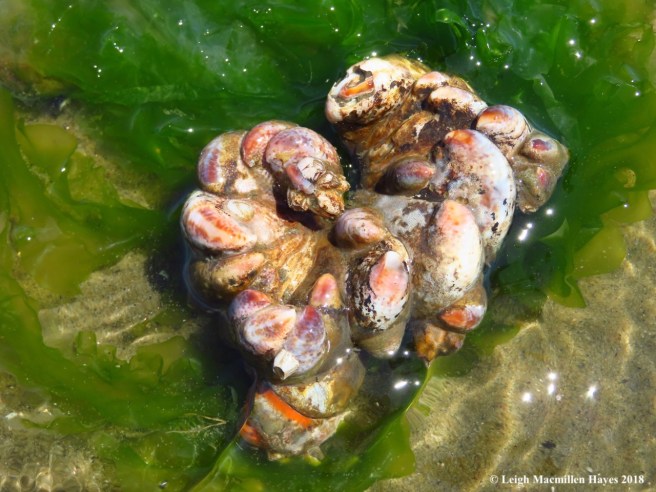
And then we saw the wicked cool Lady’s Slipper of the Sound. Slipper shells they may be, but their natural history is amazing. The following is from the University of Rhode Island: This shell is shaped like an egg or oval that has been cut in half with the top of the shell turned sharply to one side. Looking at the underside of the shell, it is easy to see how it got its name. Underneath the shell is a ledge to support the internal organs; this ledge extends about half the length of the animal. Different slipper shell species are characterized by different shell textures, including rough, smooth, ribbed, corrugated, and flat. Although they have a foot for locomotion, by the time they reach maturity they anchor themselves to a hard substrate and remain stationary.

And there’s more: All common slipper shells start their lives as males, but some change to females as they grow older. A waterborne hormone regulates the female characteristics. Once they change into females, they remain females. They often stack up on top of each other for convenient reproduction. The larger females are on the bottom, the smaller males are on the top, and the hermaphrodites are between the two. If the ratio of males to females gets too high, the male reproductive organs will degenerate and the animal will become female. Eggs are laid in thin-walled capsules that the female broods under her foot.

Common slipper shells also form stacked aggregations when there is no hard substrate on which to attach. They attach to objects in large numbers and can sometimes suffocate the animal on which they are attached.

Who knew? I just thought they were common slipper shells.
c31

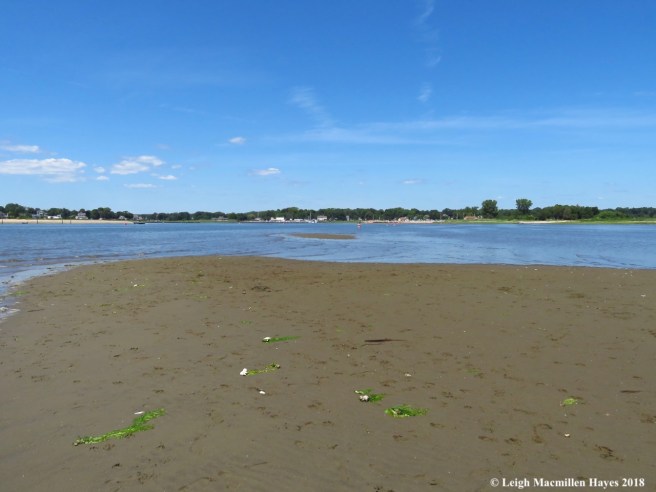
We’d finished the sandbar challenge and had no idea how the other teams might be doing, though we did wonder if some of them were thrown off for we spotted a sign that said “sanbars” instead of “sandbars” and we could only hope that they’d gone off in search of the former–to no avail.
c34

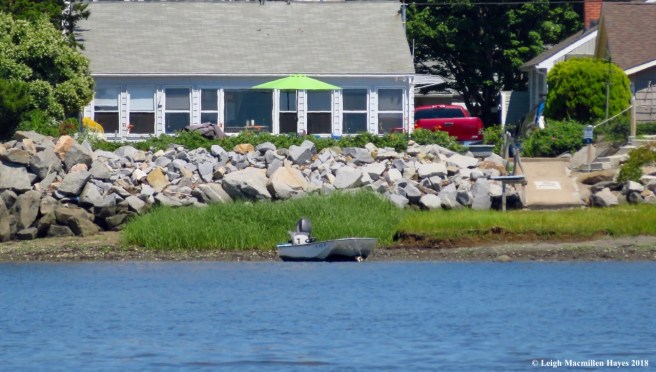
Alliance Inn beckoned, as did the incoming tide, and so we headed back toward the shore.

c36

And the next challenge–completing the Sunday crossword puzzle. My guy read the clues and told us how many letters and the four of us shouted out answers–whether they fit or not. I silently kept score (sorta) and was sure that Team Wonder was in the lead, but didn’t want to make a big deal out of it, for we had agreed on an alliance after all. At least for this weekend.
c37

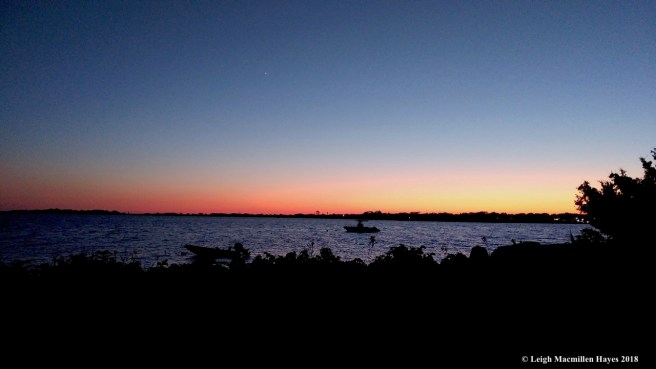
At last the sun set on the day. And the outer harbor.
c38

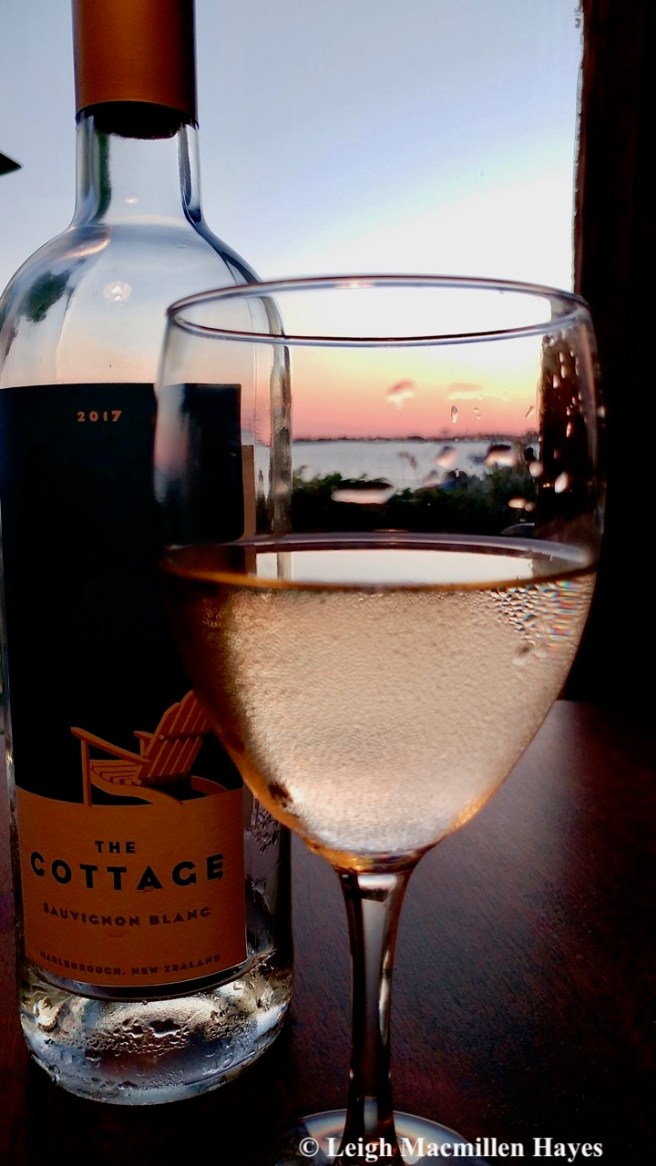
And we celebrated the day’s discoveries with a bottle of The Cottage for it seemed apropos. I think we were all in agreement, however, that the bottle was much better  looking than the flavor and we aren’t exactly wine connoisseurs.

c39

And then this morning dawned with another bird ID challenge. First up–who had taken up housekeeping in the apartment building meant for the Purple Martins? House Sparrows.

c40

And we wondered if they might have some young in Apartment D for come and go did the male and female, both attentive to whomever hung out within.
c41

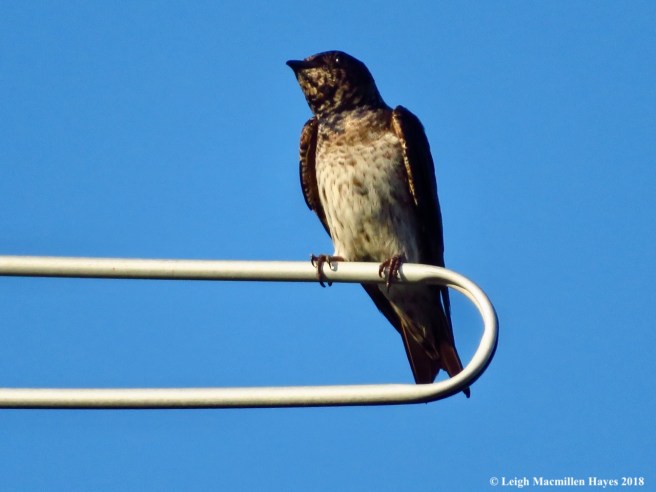
Overlooking it all, a Purple Martin–though he never defended his territory.
c42

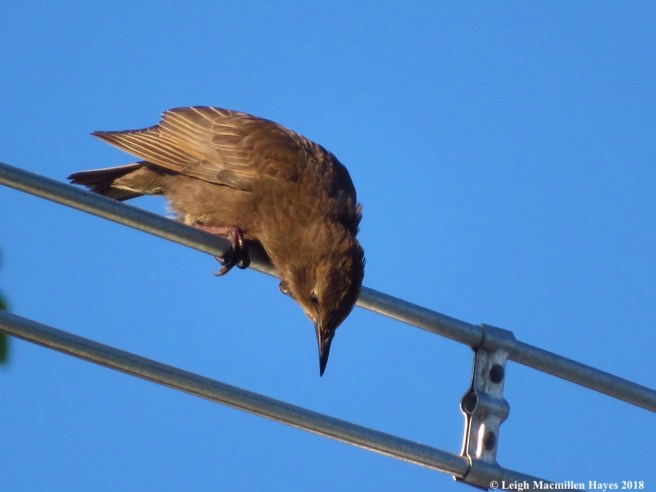
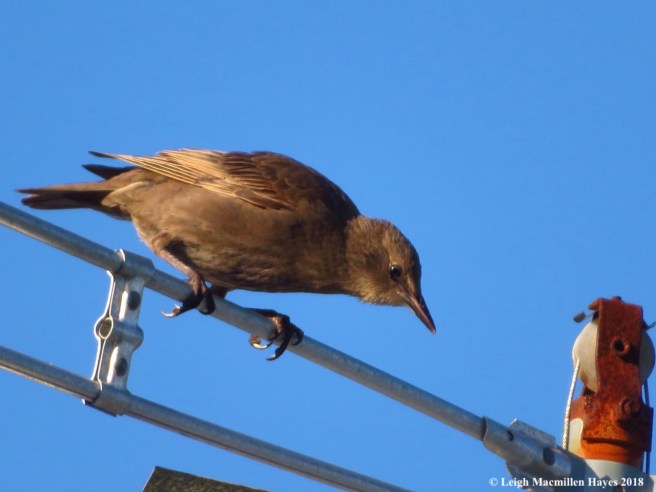
And immature Starlings . . .

c43

as invasive as ever . . .

c44

stood ever so ready to move in to Apartment B.
c46

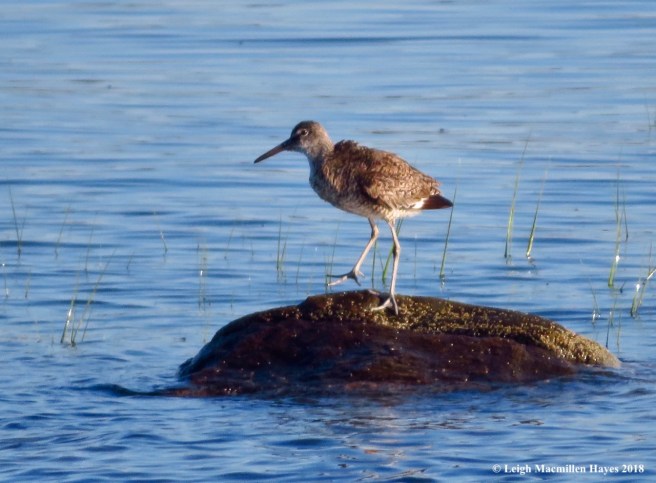
Who stood on the right-hand jetty? A Greater Yellowlegs Sandpiper, its bill longer than its head.
c47

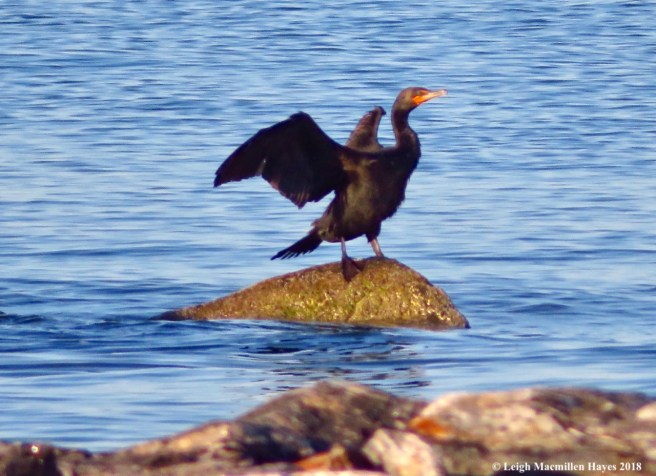
And on another jetty to the south–a Cormorant gathered warmth in its wings, first turning to the right.

c49

Then to the left.

c51

And finally slipping back into the water and cruising by.

c52

At last, much to our dismay, our time with Team Budz drew to an end, quite like the way a day lily such as those my mom so loved and planted everywhere, shared their pollen and then closed up. Who knows what the next episodes will bring. Will we continue to join forces with Team Budz to complete the next challenges? Will they pull ahead of us? Or we ahead of them? We’re only halfway through the Race and as we all know–anything can happen.

But–as we lived in the moment, we certainly loved this episode’s opportunity to celebrate a certain young man’s 24th birthday, ID birds we hadn’t paid attention to since we were kids, explore the sandbar once again, and enjoy the camaraderie of this couple we’ve grown quite fond of. As we go forward, may the best team win . . . and if it can’t be Team Wonder, then we sure hope it’s Team Budz.


Flying With John A. Segur

I never had the honor of meeting Mr. Segur, but it was my honor to be his eyes for a short time today as I wandered down the short trail off New Road in Lovell at the Greater Lovell Land Trust’s John A. Segur Wildlife Refuge. Upon his death, a bequest in his name was left to the land trust to preserve habitat for native wildlife to thrive.
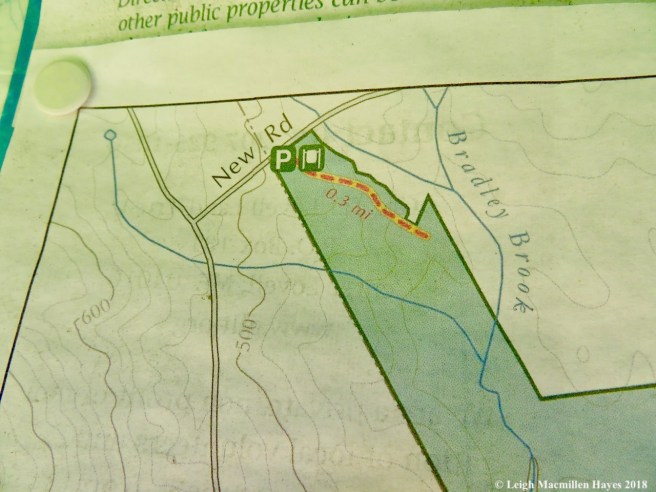
The JAS Wildlife Refuge actually encompasses 592 acres and I only explored the .3 mile trail on the western section of the property, but on an extremely hot summer day my finds were enough. Follow me and I think you’ll see what I mean.

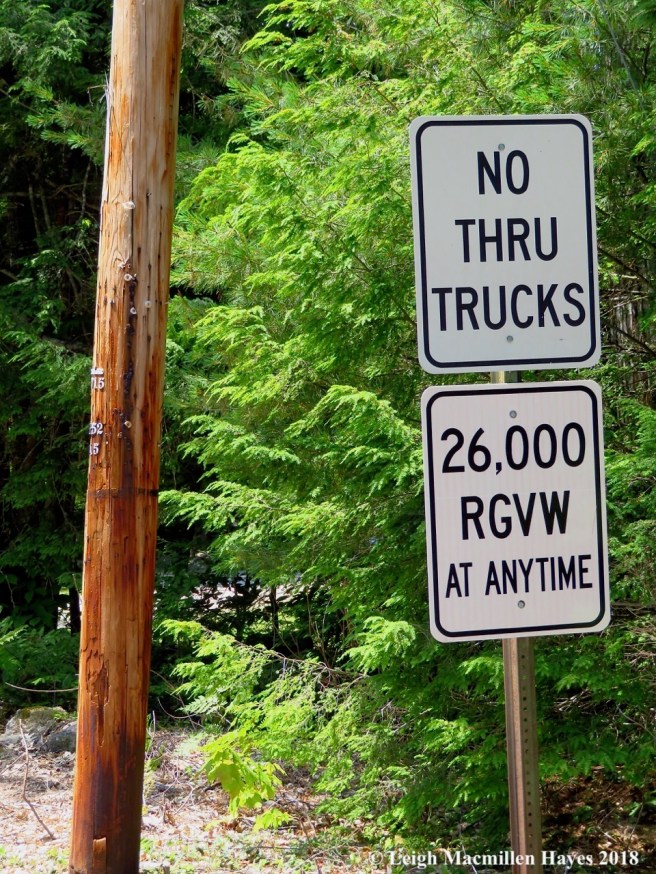
j1-Across from the sign and telephone pole

First off, you need to locate the small undefined parking lot. It’s about a mile beyond Foxboro Road, but I don’t pay attention to that. Rather, I look for the “No Thru Trucks” sign and turn on my left-hand blinker as soon as I spot it.

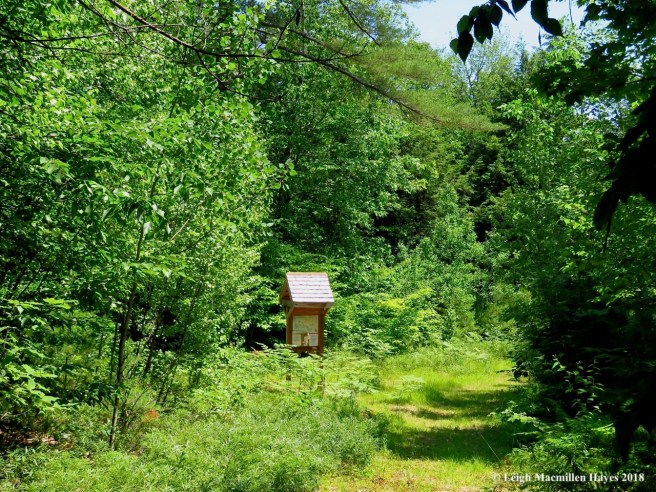
j2-trail and kiosk

Just beyond a couple of boulders placed to keep vehicles from driving down the old skidder trail, stands the kiosk where you can take a look at the trail map and check out some other GLLT materials.

j3-map

As I said, this is just a small part of the overall refuge, but it’s well worth an exploration, especially if you don’t have much time (though some of us have been known to spend at least three hours making our way down and back).

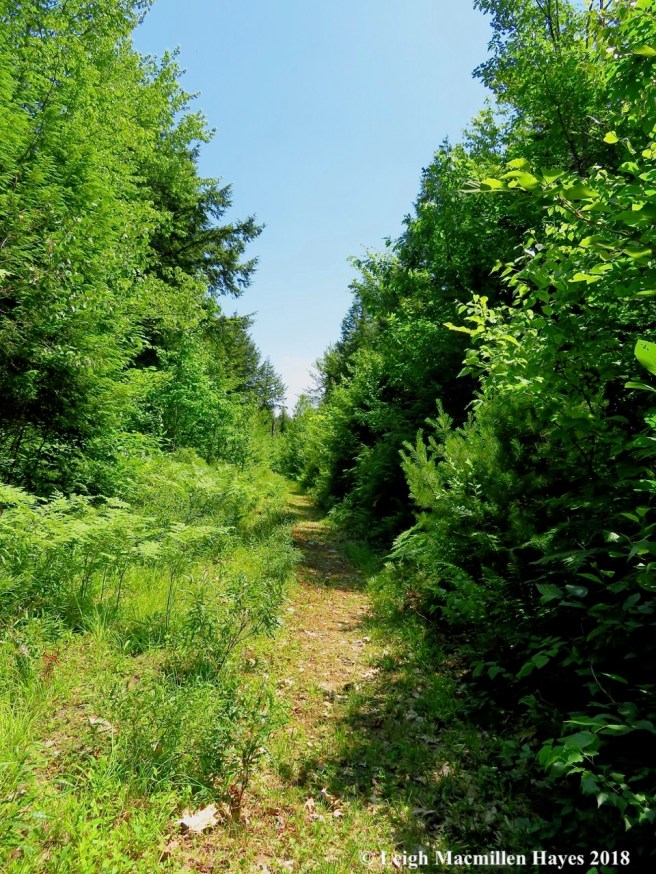
j3a-the trail mowed

Recently, the GLLT’s Associate Team and Intern mowed the trail, making it passable and not quite so tick-infested. But . . . still take precautions. Always! The trail is rather level, so it’s an easy one to travel.

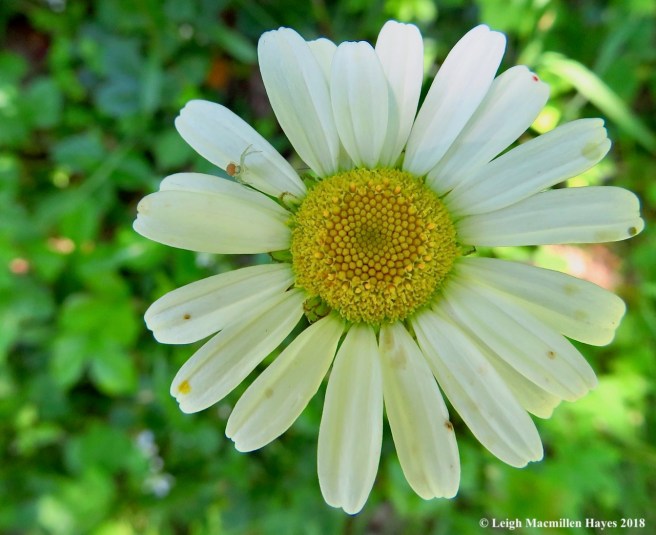
j4-daisy and crab spider

This is a place where you’ll find the ordinary, like a daisy. And trying to decide if “he loves me, he loves me not,” you might see a small crab spider.

j5-sundews

This is also the land of the extraordinary–in the form of the carnivorous Round-leaved Sundews. Check out the glistening droplets at the ends of the hair-like tendrils that  extend from each round leaf. The droplets are actually quite sticky. Just like a spider sensing a bug on its web, the tendrils detect the presence of prey and then curl inward, thus trapping the prey.  The whole leaf will eventually wrap around the insect and in the process of digesting it, the plant will absorb the bug’s nutrients. Sundews tend to grow in areas that lack sufficient nutrients, so this is the plant’s way of supplementing its diet. And if that wasn’t enough–it was just plain beautiful.

All that being said, this is a tiny plant and right now preparing to flower. So, if you travel this way, about a tenth of a mile into your journey, look down at your feet for these minute gems, take a closer look, and then walk with care.

j6-sweet-fern

Further along the trail you’ll see a few species of ferns, as well as the fern that isn’t a fern. Sweet-fern is so named for it’s fern-like appearance, but it has a woody stem and is actually a shrub. It’s yellowish green flowers that first appeared in spring were giving way to greenish brown, burr-like nutlets. In any season, this shrub has such variation to offer, that like hobblebush, I can’t resist honoring it with a million photographs.

j8-raspberries

One of the sweet joys of this trail is that because of previous logging, early succession is taking place in terms of the plants and trees that grow beside the trail, including blackberries not quite ripe and these raspberries already offering a delightful reprieve on a humid summer day.

j14-the field

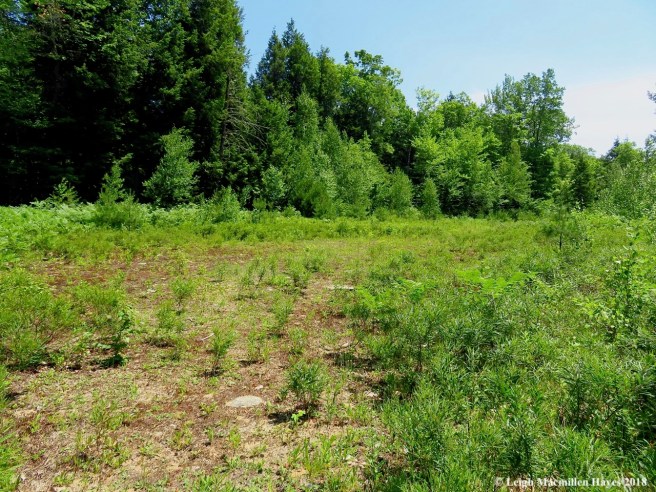
Eventually, the trail leads to the turn-around point, the old log landing, which also displayed signs of forest succession, for its there that some wildflowers and sweet-ferns grow in the center. At the perimeter, white pines, gray birch and blackberries crowd each other.

j10-four-spotted with food

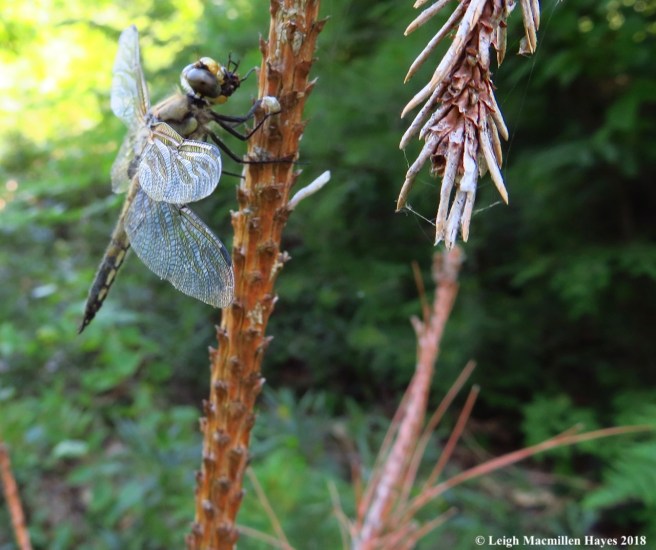
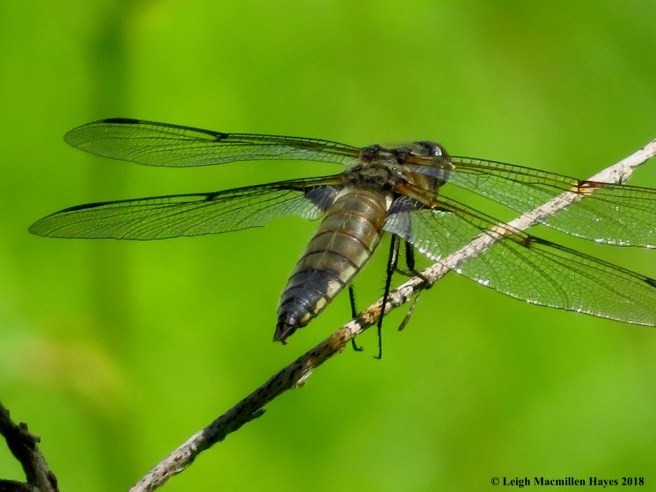
And on the edge, the dragonflies fly. And dine. This Four-spotted Dragonfly settled on a dead red pine to consume an insect.

j11-4 spotted eating

Ever so slowly . . .

j12-feeding frenzy

the body disappeared into its mouth.

j13-4 spotted, back view

While it was busy eating, I was busied myself in getting as close as possible to enjoy all of its nuances, from the four spots on its wings, to the basal display on the hind wings to the placement of its eyes and colors on its thorax and abdomen. All of those details help in ID.

j15-old coyote scat

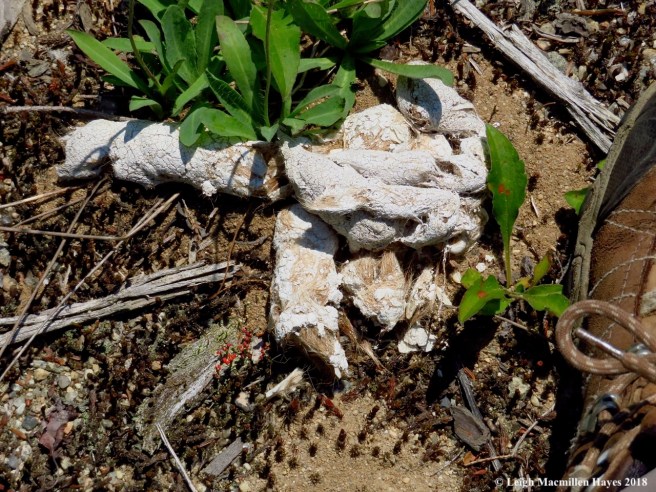
And then into the field I went, with a memory of a winter expedition when we noticed that a shrike had deposited a mouse in a tree. Today’s finds included a pile of old coyote scat probably also deposited this past winter that indicated a territory repeatedly marked.

j16-turtle?

I also spied lots of recently made depressions. While one might suspect dust baths by a turkey or grouse, feathers are usually left behind in the process. Instead, the ground was more disturbed and because the landing is close to Bradley Brook, I determined I was looking at recently dug holes made by turtles. Snappers and painted turtles have been depositing eggs recently and these may be the incubation nurseries for their offspring.

j16-racket-tailed emerald

As I turned back toward the trail, I noticed a dragonfly seeking shade, for so hot was it. Notice the bright green eyes of the Racket-tailed Emerald. Thank goodness for those emerald eyes that always help in narrowing down the choices.

j18-common dewberry:sphinx moth

I found it a bit more difficult to ID the sphinx moth that paid a visit to the Dewberries. There are only 1,450 species in the Sphingidae family, but my leaning was toward Nessus Sphinx, though I could be totally off on that one.

j20-Northern-bush Honeysuckle

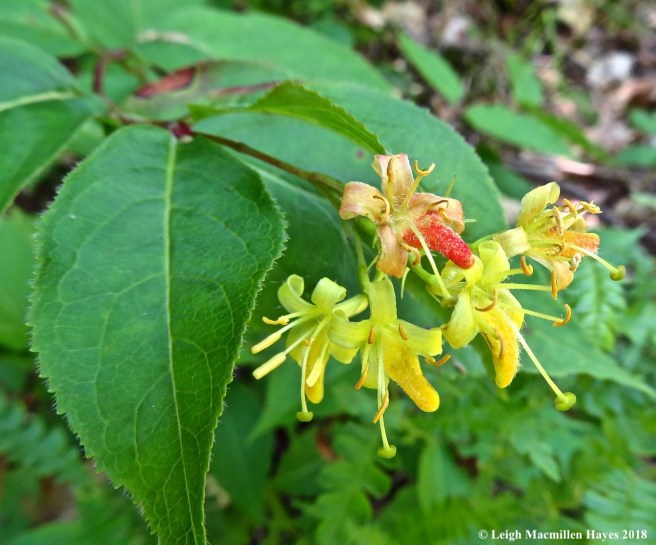
I was much more confident about my ID of the native Northern-bush Honeysuckle with its greenish-yellowish-orangish flowers. The plant is actually a shrub with a woody stem, and one that moose and deer like. I’ve yet to see a moose print along this piece of the property, but I know its part of a deer yard.

j21-Spotted St. John's-wort

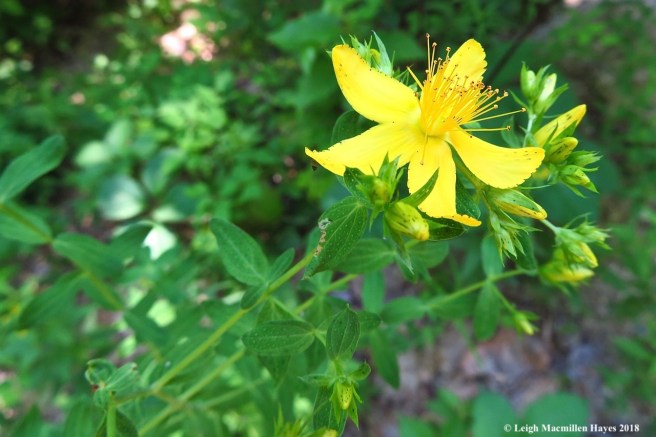
Also springing forth with yellow blossoms was Spotted St. John’s-wort, with its translucent spots on the leaves and tiny black dots outlining its petals.

j22-whorled yellow-loosestrife

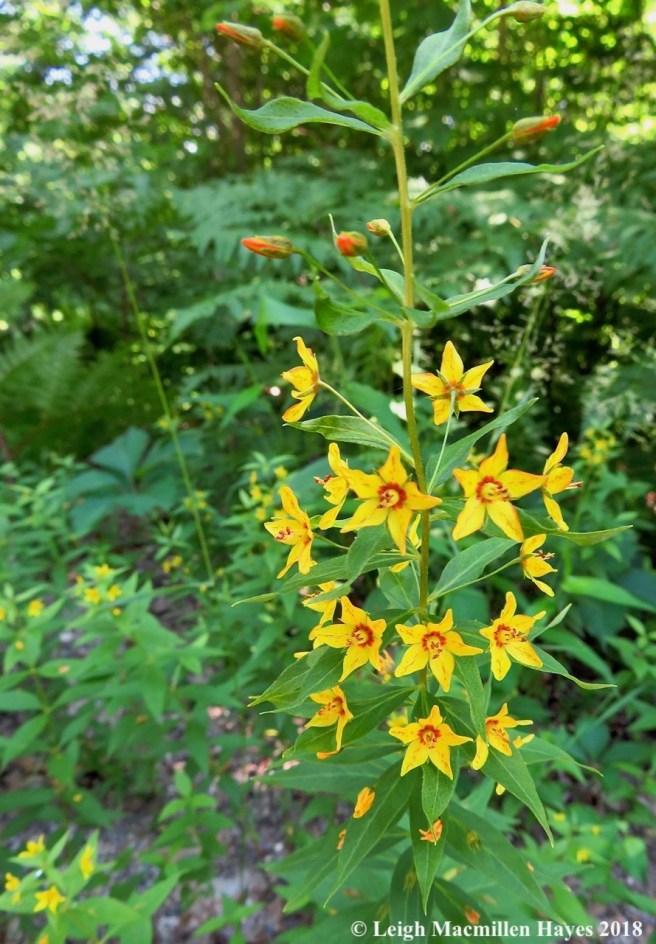
And not to be overlooked, the Whorled Yellow-Loosestrife with its cheery flowers extended in a whorl from the stem by long petioles.

j23-hitchiker

My journey wasn’t long, but with all that I saw, I was thankful for the spirit of Mr. Segur that flies over this place.

Just possibly, he graced me with his presence today . . . in the form of Spangled Skimmer.

Book of July: HIKES & Woodland Walks in and around Maine’s LAKES REGION

If you think I’ve promoted this book before, you are correct, for HIKES & Woodland Walks in and around Maine’s LAKES REGION by Marita Wiser was featured as the Book of October in 2016.

m1-cover

But . . . I’m thrilled to announce that Marita has published the Sixth Edition, aka 25th Anniversary Edition, of her hiking guide and it’s available at local stores as you read this. Or you can order directly from her, and I’ll tell you how later in this review.

m2-signed copy

Before I tell you about changes since the Fifth Edition, let me say that I’m a bit biased for I’ve had many the pleasure of hiking the trails mentioned within with Marita, and sometimes her lovely daughters, and she once again offered me the kindness of letting me edit. She even paid me. How cool is that? And then gave me a signed copy.

m4-blaze orange

To top it off, I modeled blaze orange with her youngest, Marguerite! If you’d like me to sign your copy, I’d be happy to do so ;-)

To keep things fresh, Marita recast her rating system with two green circles meaning easiest and one green equaling easy. That was to differentiate between those like Holt Pond or Pineland Farms, which have well-groomed and fairly flat trails (or boardwalks–just watch out when wet), from Pondicherry Park or Mount Ti’rem, where the terrain varies more, but still isn’t enough of an elevation change to meet her guidelines for a blue square indicating moderate such as Mount Will or a black diamond meaning hard like Mount Chocorua.

She also added some color photos as you can see from above, but I love that she kept some classics, including a few of her daughters that were taken twenty years ago.

The centerfold map is also in color and shows not only where the trails are located, but their degree of difficulty as well.

One of the final new additions is what she’s titled “The Lure.” What is there about a trail that might attract you to it? Marita spells out those keen features such as “wheelchair accessible,” “plenty of vertical for a cardio workout,” “interesting old foundation,” and “the Rock Castle.” There are more, but you’ll need to purchase the book to read them all.

r8-mount kearsarge 1

Among the new trails Marita recommended in this edition is the Red Tail Trail that leads to Black Cap Mountain in North Conway. My guy and I had the privilege of introducing her to that one fine day last fall.

s-Marita, Bruce and Gary 2 (1)

Together, she and I discovered the well-built trail that Bruce, the property manager, and his assistant, Larry, were building on Long Mountain in Albany.

l9a-teepee and islands in background

She’s also kept in the classics like Pleasant Mountain and . . .

c-heading up 1

Mount Chocorua and their varied trails.

I’d give away all the surprises if I told you more.

Oh, and one more thing I like about this book is that it’s an all-local effort with Marita’s writing, her mother’s sketches, an old friend’s work on the map, my fine editing skills, Laurie LaMountain of Almanac Graphics (and Lake Living magazine fame) on design, and production of the final product at Cardinal Press in Denmark. Denmark, Maine, that is.

m3-back cover

You may purchase a copy of HIKES & Woodland Walks in and around Maine’s LAKES REGION, which is printed on recycled paper with soy-based ink, at your local shop, including Bridgton Books where its long been a best seller. And if you don’t live locally, but still would like to buy a copy, the information on the back cover as seen above provides all the details you need.

HIKES & Woodland Walks in and around Maine’s LAKES REGION by Marita Wiser, designed by Almanac Graphics and self-published at Cardinal Printing, both of Denmark, Maine, 2018


Capturing Peace at Deer Hill Bog

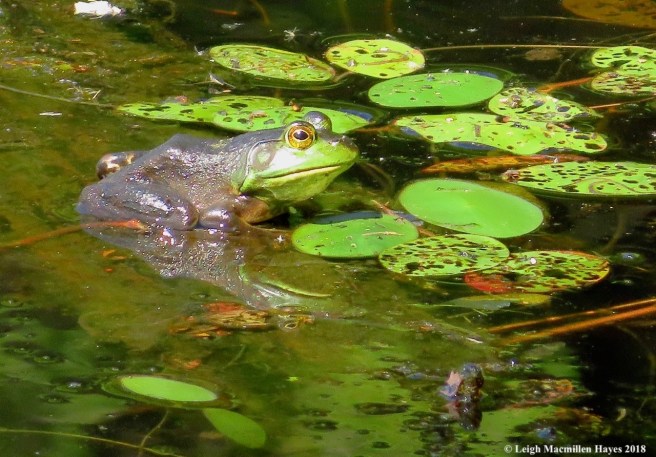
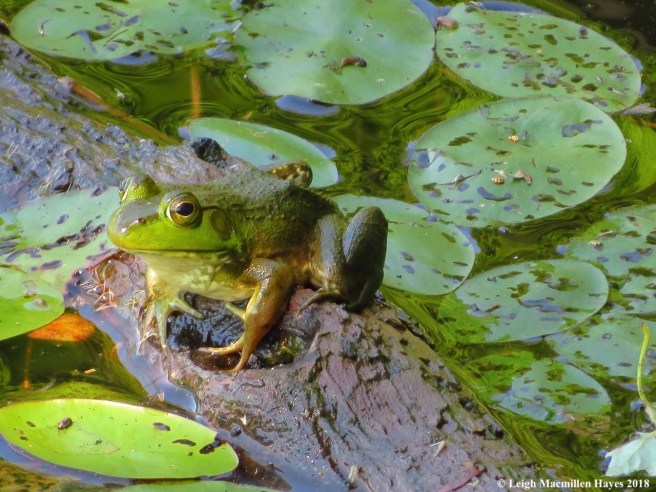
The minute I stepped out of the truck, a loud, rather unharmonious musical performance, greeted me at Deer Hill Bog in Stow, Maine. Rather than the Peeper and Wood Frog chorus of spring, the summer symphony was performed by Bullfrogs and Green Frogs, but mainly the former.

d1-approaching the bog

It was about nine a.m. when I caught my first glimpse of the bog, a result of man and nature working together. An old wood dam combined with a beaver dam created the 25-acre body of shallow water. From moose and Great Blue Herons to aquatic plants and tiny organisms, over 90 species call the bog home. Though I truly expected to spy a moose, that opportunity was not meant to be. I did go, however, because of the Great Blue Herons. Friend JoAnne reminded me the other day of the old rookery, so I decided to check on it.

d2-heading toward the blind

But first, I made my way toward the wildlife viewing blind.

d3-bird blind

The blind featured benches, cut-outs for viewing and informational posters–a quiet place to watch nature in action.

d5-inside the blind

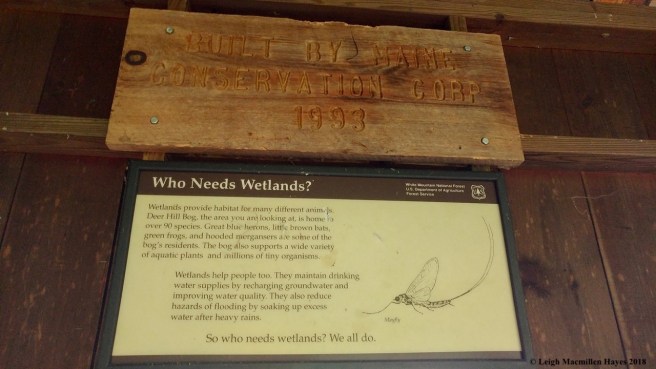
It was built in 1993 by the Maine Conservation Corp and is maintained by the White Mountain National Forest. Two more panels described some species of wildlife one might expect to see.

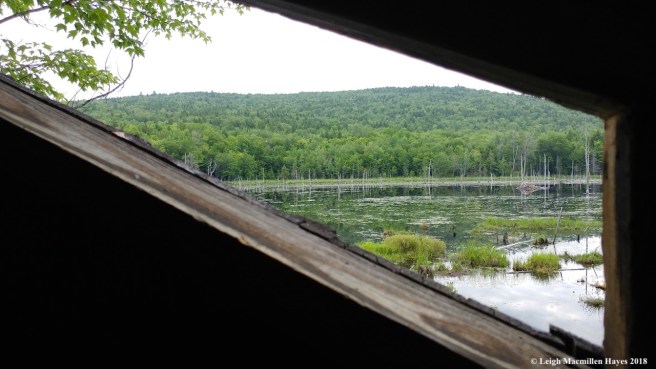
d6-view from the blind

And, of course, the cut-outs provided a bird’s eye view . . .

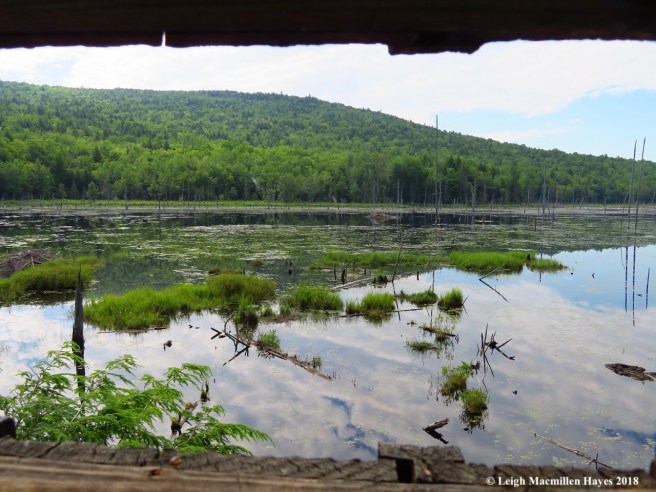
d6a-another view

of life in the bog.

d12-bullfrog

But, I’m not very good about staying undercover, and so around to the side and front of the blind I went. And stood as still as possible, for the Bullfrogs quieted upon my approach, as I expected they would. A few minutes later they again sang, “rumm . . . rumm . . . rrrrrumm,” the notes all in bass.

d30-fish

The water practically boiled with small fish jumping, but my freshwater fish knowledge is limited and my best guess was that they were bait fish of some sort.

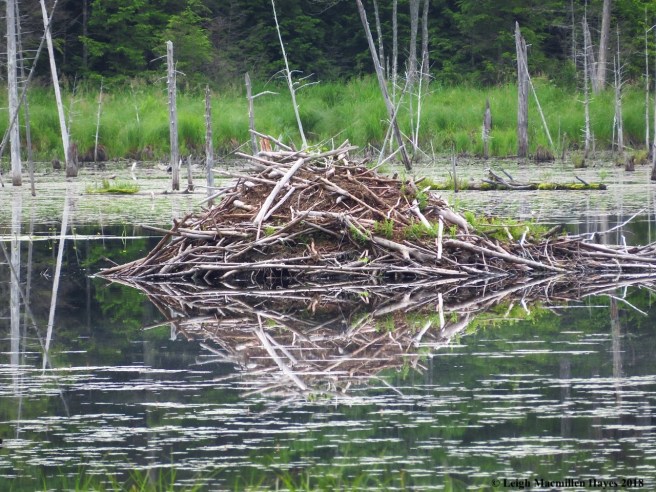
d8-three lodges

Looking around, I noted three beaver lodges, each of a different size. None looked active, but it was a warm summer morning and perhaps they were sleeping inside.

d8-adult heron

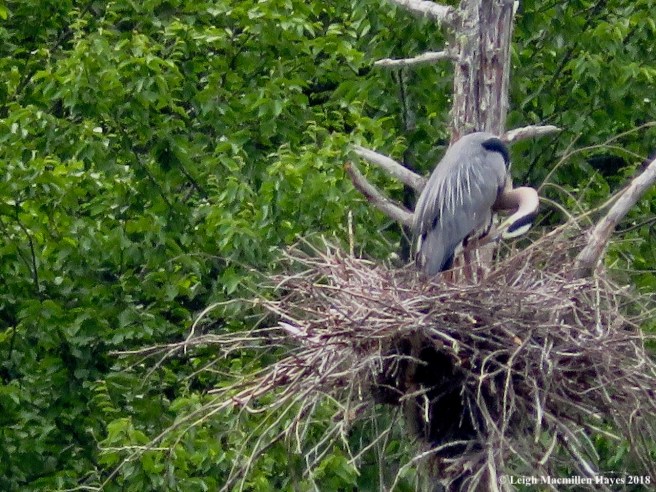
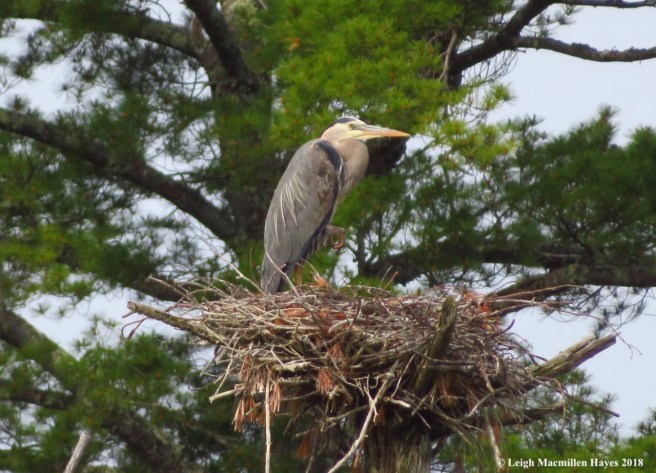
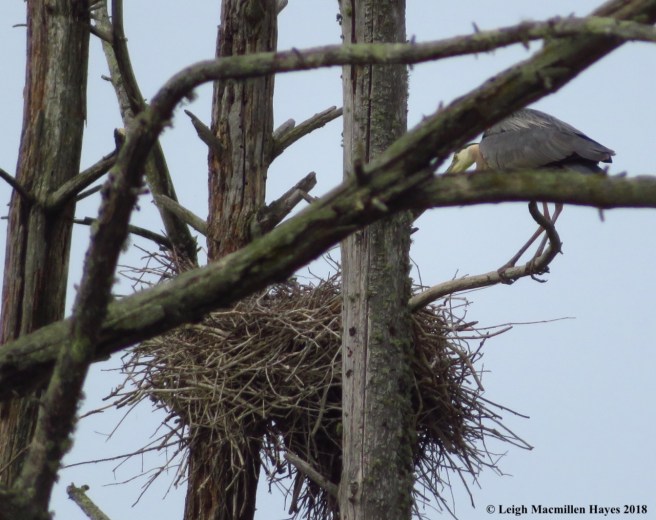
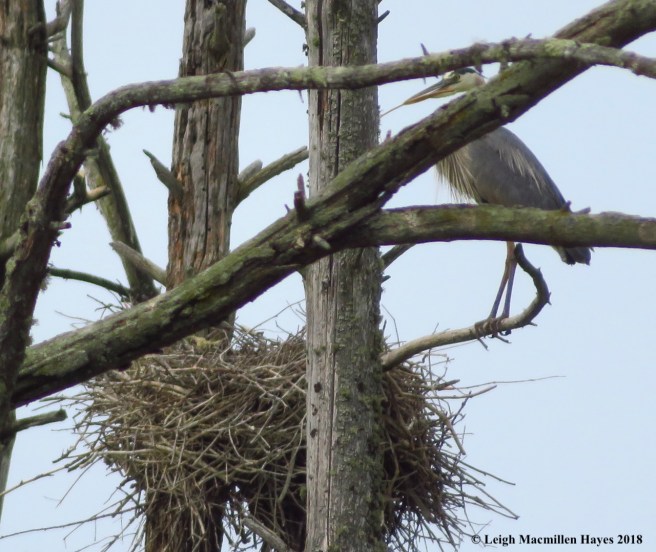
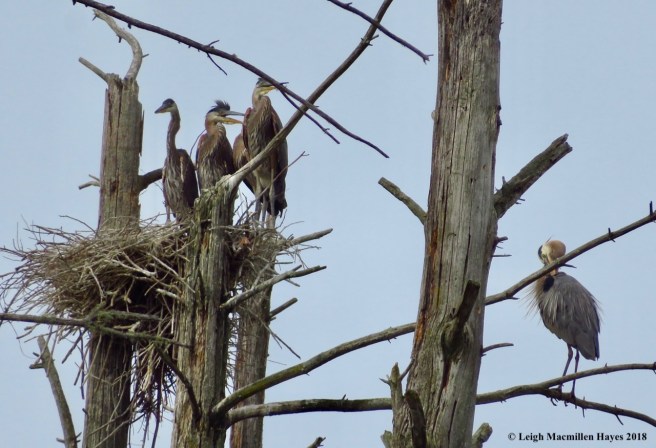
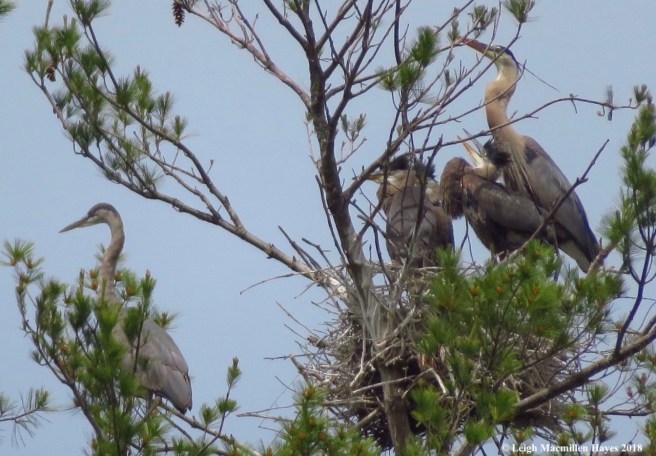
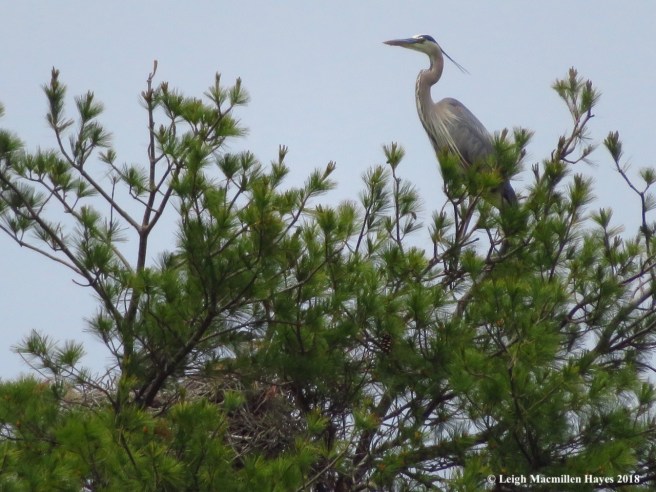
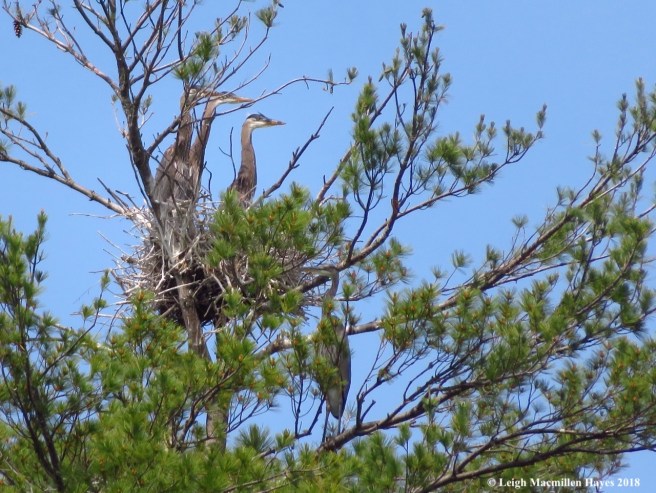
And then I spied two heron nests–on the first I saw only an adult who spent much time in preening mode.

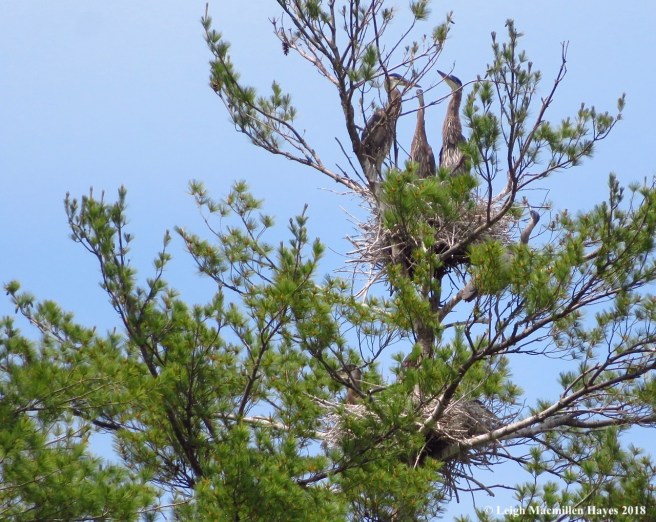
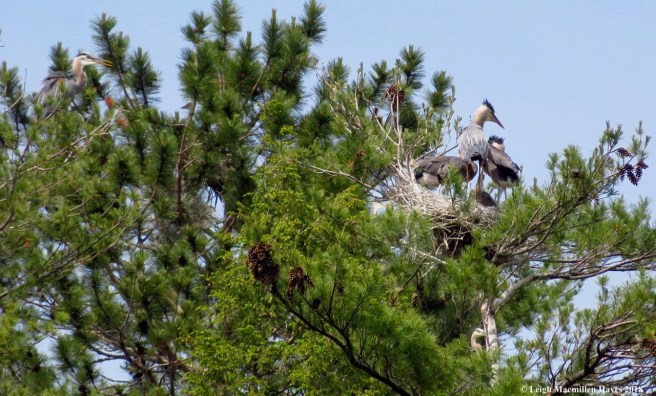
d13-heron feeding

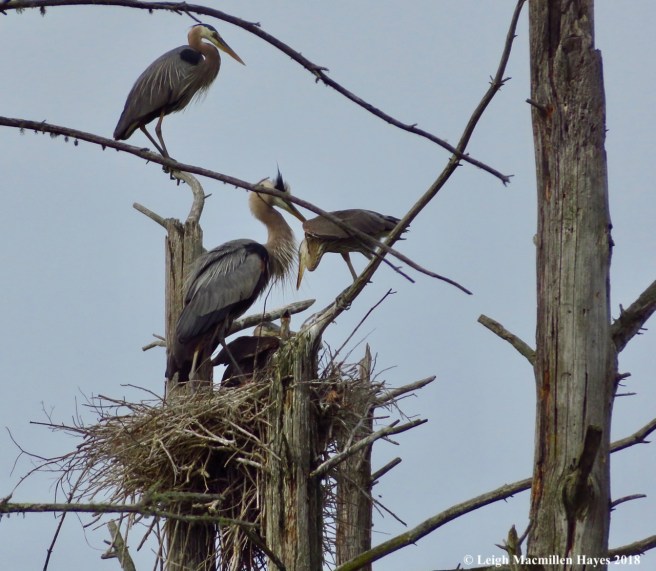
The second nest I was sure was empty–until an adult flew in and three immatures squabbled for the food about to be regurgitated by the parent.

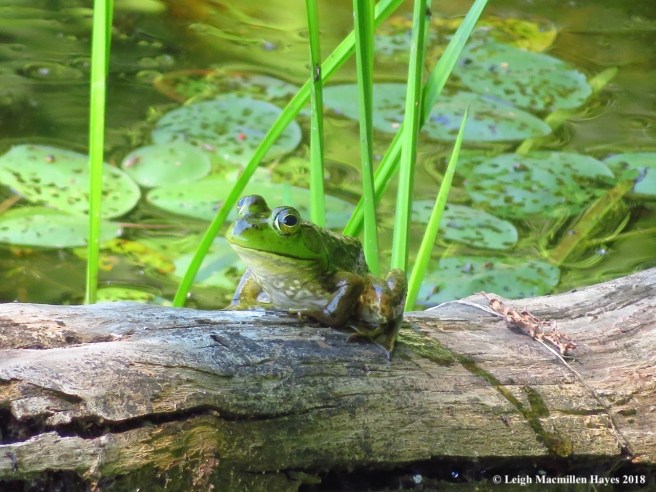
d14-bullfrog

And back down to bog level, another Bullfrog doing what they seemed to do best–waiting patiently, with nary a rumm, though the sound seemed to travel in waves down the bog.

Frogs are ectothermic animals, which means they depend on the environment to maintain their body temperature, therefore many jumped onto fallen logs to catch a few rays. It may also have been that the height gave them a better view of the local action.

d15-bullfrog

This one did eventually turn, making it a fine time to examine his body a bit. How did I know it was a male? His eardrums or tympanums, those circles located directly behind the eyes, were larger than the eyes. In females, they are about the same size.

d10-clubtail exuvia

There were other things to look at, like the exuviae of a clubtail dragonfly. Notice how far apart the eyes were. Eye position is one key to determining species.

d11-frosted whiteface dragonfly

Other characteristics included the white face of the Frosted Whiteface.

d16a-slaty skimmer dragonfly--black face:brown eyes

And the black face and brown eyes of a Slaty Skimmer.

d16-slaty skimmer dragonfly

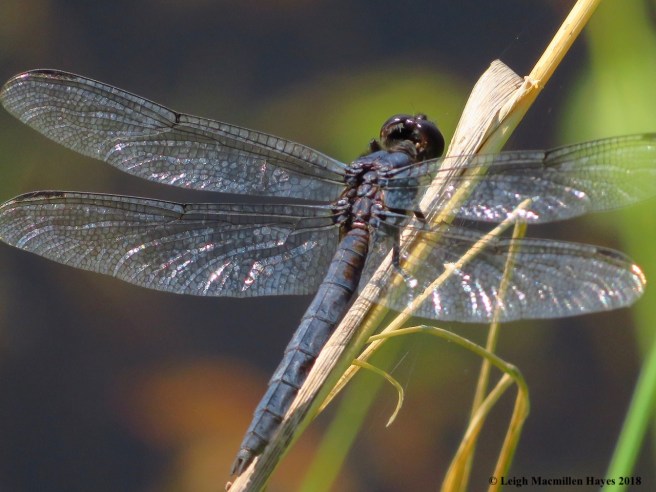
The slaty part of its name came from the fact that male’s body is entirely blue–slate blue.

d17-bullfrog

Again a rumm-rumm-rrrrummm.

d24-bullfrog

It seemed there were female frogs around, but they didn’t care about the males’ singing talents–at least not in my presence.

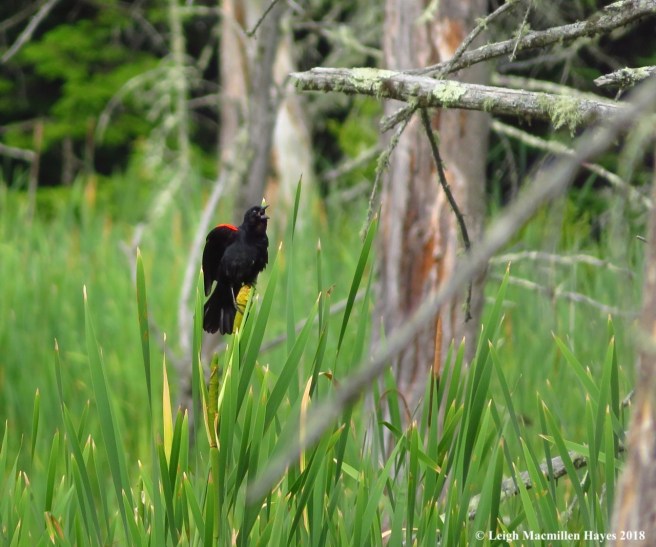
d16-red-winged blackbird

And an o-ka-leeee.

d18-frosted whiteface dragonflies

In the midst of it all, some canoodling by a pair of Frosted Whitefaced Dragonflies connected in their love formation.

d20-green frog

Plunking rubber bands to the beat of plunk-plunk-plunkplunkplunk were the Green Frogs. This one was so identified by the dorsalateral folds that ran from its eyes along the sides of its back and down toward its former tail.

d21-grackle

Wood Ducks and Merganzers swam further away from my spot, but Grackles flitted in and out, up and down on the ground, fallen trees, and rocks, ever in search of fine dining.

d27-grackle

In between foraging for insects, crustaceans, mollusks, fish, and frogs, oh my, they sang their guttural song that was often followed by a high-pitched whistle.

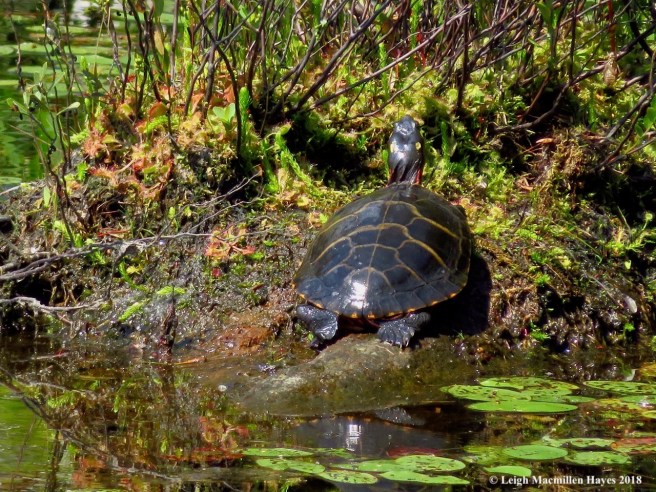
d22-painted turtle

There were also painted turtles to admire. Well, I only saw one, but suspect there were others.

d25-painted turtle

It slipped into the water and then came up on a nearby log, another species that valued the sun’s warm rays.

d26-bullfrog

And another. Really, they were everywhere. Did you know that a frog’s pupils are horizontal so it can look forward, backward, and up and down. The better to see me,  dinner, and predators on the quick.

d28-two frogs

Sometimes frogs yelp, and it was such a sound that brought these two to my attention. Because of the sun’s position, I couldn’t get a clear take on their gender, but I watched them both jump onto the log simultaneously. At first they were side by side, but then one shifted further to the right. Had they been mating? Had one male tried to jump onto another thinking it was a female? Had something bigger than them been on the hunt?

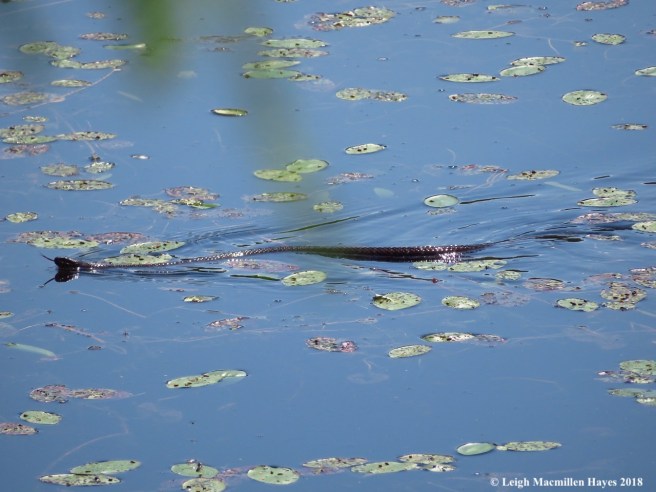
d31-water snake with tongue extended

I may never know why the frogs jumped, but this water snake was making the rounds. Every once in a while it made the water boil and I knew something was consumed. Can you see his forked tongue sticking out?

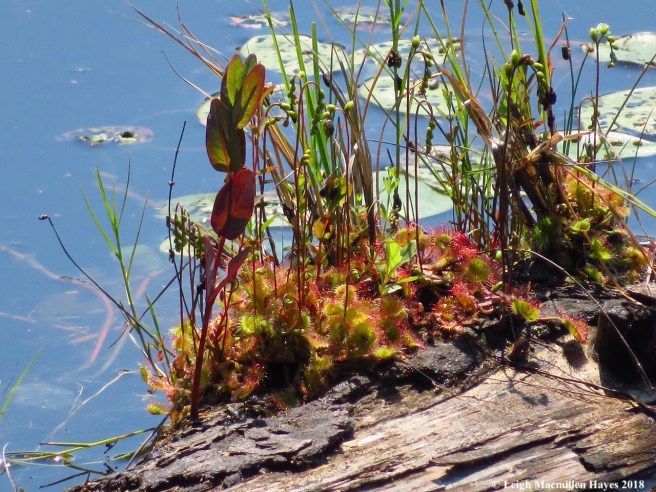
d29-sundew about to flower and marsh st.john's wort

At last my bog time was drawing nigh, and yet there was so much more to see, including Round-leaved Sundews and Marsh St. Johnswort on log islands.

d30-bullfrog

And one more Bullfrog to provide a last note to the morning’s wonder.

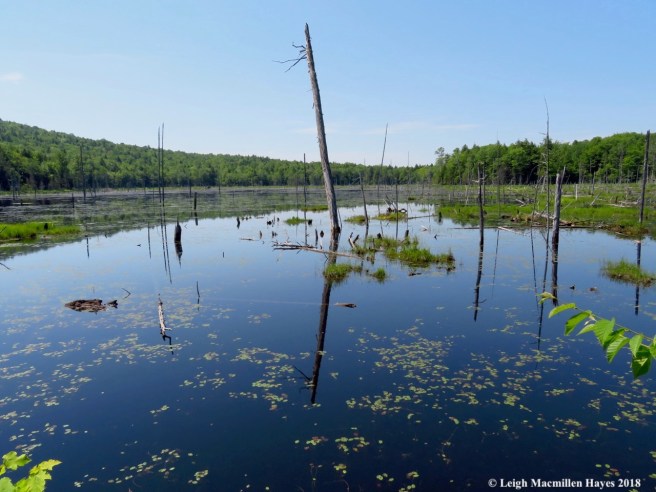
d32-bog

Though to some, the bog may look like a place of death, and death does happen there, it’s also full of life. It’s a place of biodiversity and hidden beauty. And this morning I was thankful to have it all to myself–the only human sounds I heard were of my own making. Deer Hill Bog–a magical, wonder-filled place to capture peace.

Maybe everyone needs a bog visit.

P.S.  The frog sounds were borrowed from https://srelherp.uga.edu/anurans/sounds as I’m not tech savvy enough to have recorded them. But do click on them, because it gives you a sense of this place. You’ll need to turn up the sound on your computer and possibly will need to press play when you click on the link.


Self-Guided Tour of Sabattus Mountain

As stories go, Sabattus Mountain in Lovell offers plenty of lore. For starters, there’s the name of the mountain. I’ve heard at least two tales and seen three spellings, but basically the legend is the same–about a Pequawket named Sabatos, Sabatis, or Sabattus, who guided hunters and one day killed a lynx, or was it a mountain lion, before it sprang upon him.

In a July 14, 2017 article, Ed Parsons of the Conway Daily Sun wrote: “Sabattus was born in St. Francis, Canada, and with the influence of French missionaries, was named for St. John the Baptist, shortened to Sabattus. When Roger’s Rangers destroyed St. Francis in 1759, Sabattus was about 10 years old. He was kidnapped and went south with the rangers. Later, he went to Fryeburg with one of them, and spent the rest of his life in the area.

Sabattus had two children with the well-known area healer, Molly Ockett. In 1783, an earlier wife of his returned from a long trip to Canada, and claimed to be his spouse. To settle the dispute, Sabattus took them to the house of Mr. Wiley in Fryeburg so there would be a witness, and the two women fought, “hair and cloth flying everywhere.” Mrs. St. Francis, as Molly Ockett called the former wife, was stronger and won out. Molly Ockett left and moved to Andover, Maine.

There’s also the Devil’s Staircase, but that’s for another day.

s1-sign

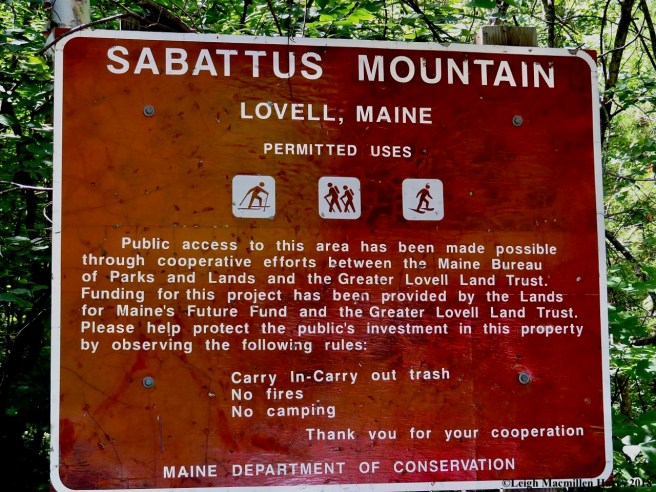
Two Land for Maine’s Future program grants, along with funding from the Greater Lovell Land Trust, enabled the State of Maine to purchase 177 acres on and around Sabattus Mountain, protecting hiking access to Lovell’s highest peak. The trail is a 1.6-mile loop to and from the 1,253-foot summit. Sabattus Mountain is now owned and managed by the Bureau of Parks and Lands. The land trust, however, has taken a keen interest in upkeep of the trail system recently because there had been much erosion ever since Hurricane Irene and the State seemed to back off maintaining it. Last year, the GLLT’s three interns built numerous water bars, especially on the eastern trail.

s6-Brent's Loop Trail Sign

Last week, Brent Legere of Lovell Box Company and Western Maine Slabworks, installed new signs to guide hikers on the trail system.

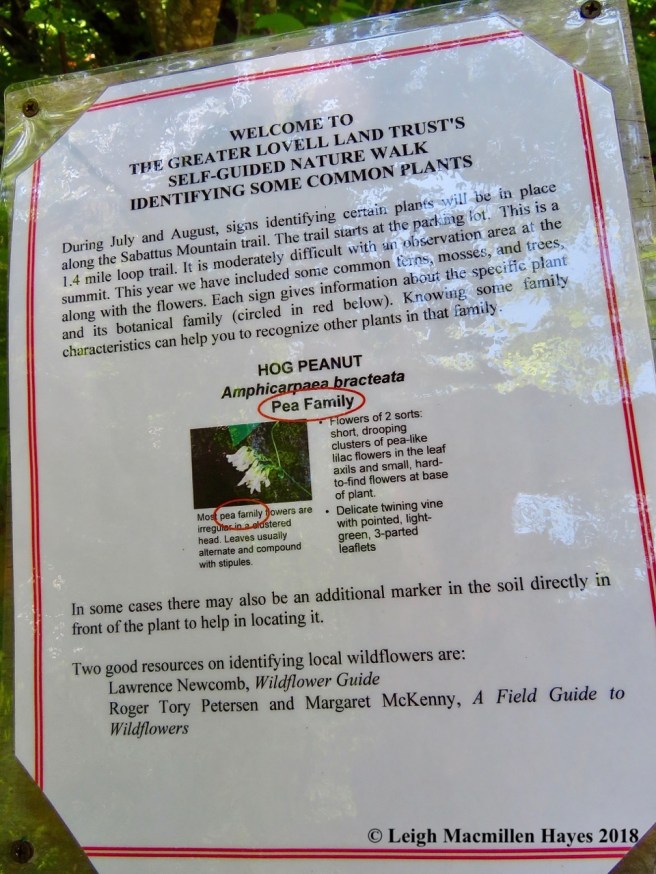
s2-self-guided nature walk

Today, a team of docents, associates and this year’s intern, under the well-organized leadership of GLLT Docent and Maine Master Naturalist Joan Lundin, installed informational signage along the loop.

s3-explaining the plan

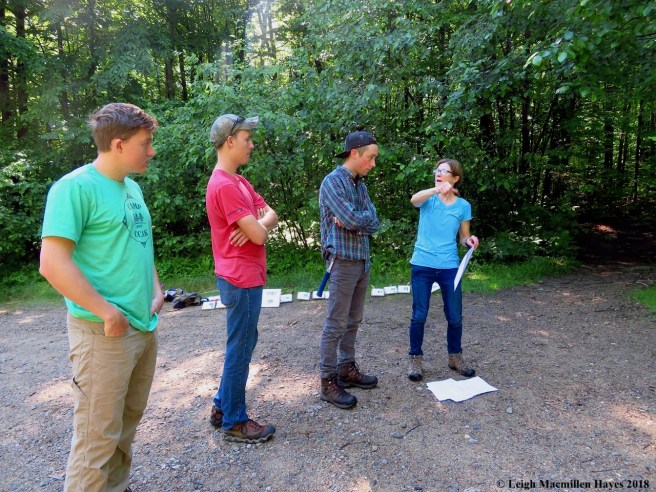
The morning began as Joan divided the team into two groups. First she instructed Intern Isaiah (in red) and Stewardship Associate Dakota (in plaid), to take one set of signs up the western trail and leave them beside examples of particular species on the way.

s5-all smiles to go

Then she prepped Associate Director Aidan, and GLLT Docents Nancy and Pam in the plan for the eastern trail.

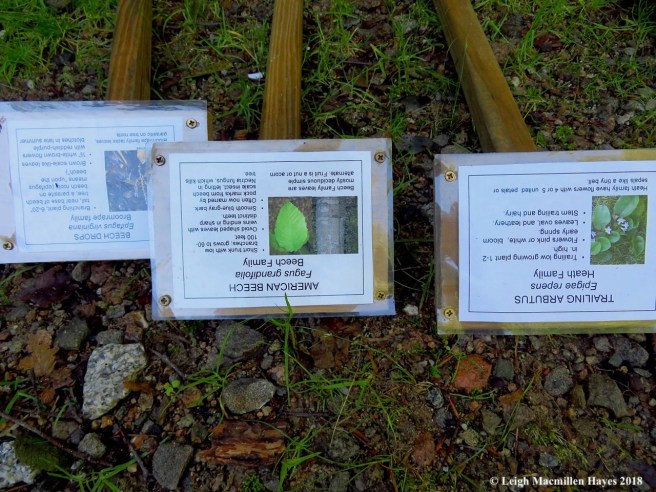
s4-signs

All signs were laid out and ready to be hauled up the trails for installation.

s12-hi ho

And so, in true Seven Dwarf style, it was hi ho, hi ho and off to work we went.

s7-installing the first sign

Because she’d climbed the trail so often in order to prepare for today’s undertaking, Joan knew right where each sign belonged. At the start, she did most of the installing, showing off her muscle power on this steamy day, despite her petite physique.

s8-yellow birch

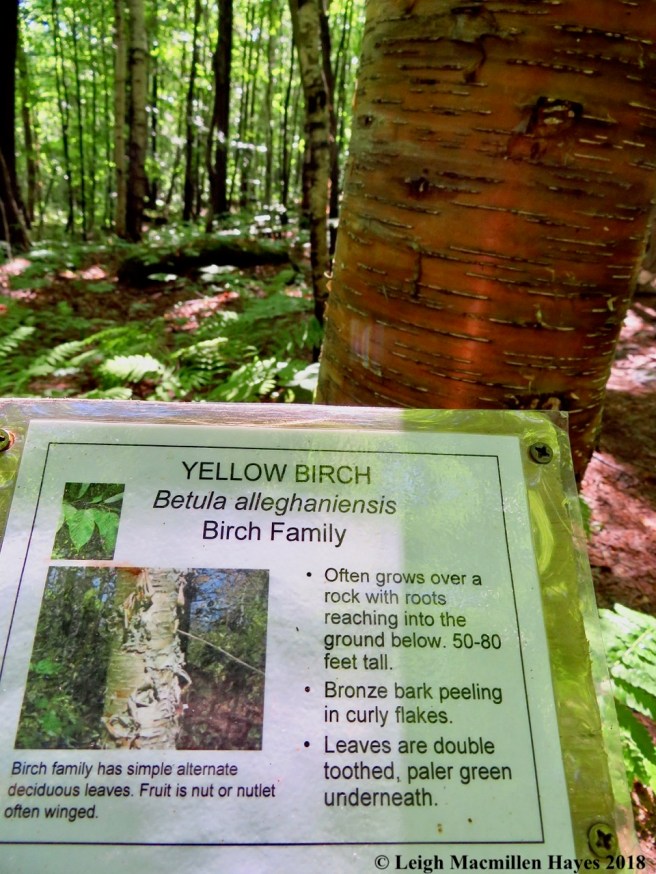
Each sign included common and scientific names, plus only a few key characteristics so not to overwhelm those who might stop to read them and look around to locate the particular species. It’s a technique decided long ago by the full team of docents who have undertaken this task each summer for years–always along a different GLLT trail.

s9-striped maple

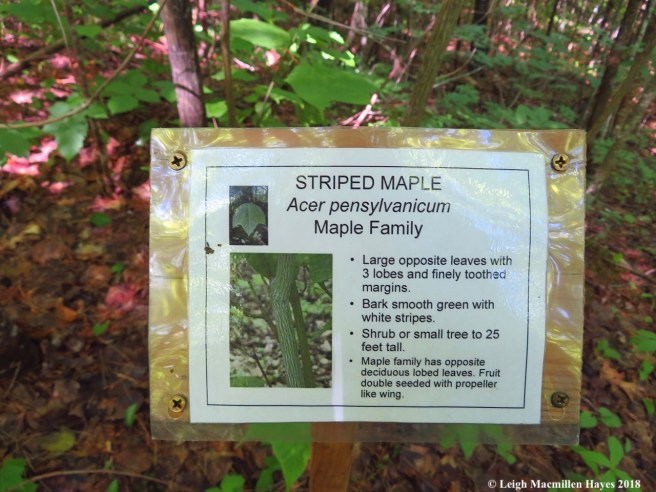
The natural community along both trails on the loop system transitioned about two-thirds of the way up. For the lower portion, the community consisted of a variety of deciduous trees.

s13-hemlock

Suddenly everything changed. Light turned to shade. Dry turned to damp. Leaves turned to needles. And conifers showed off their unique characteristics.

s14-sphagnum moss

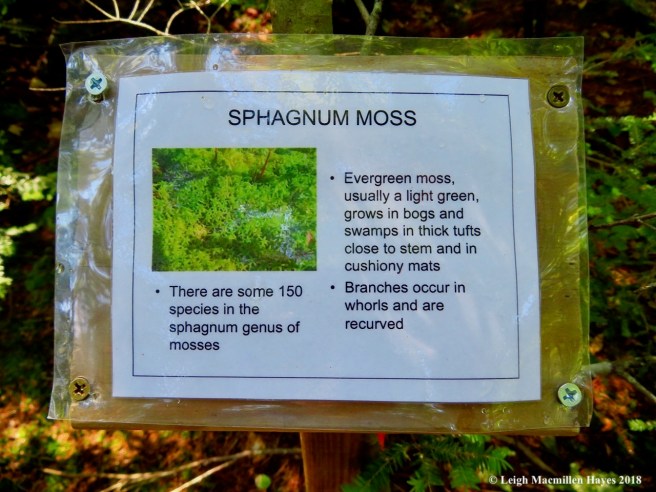
Even the forest floor changed from dried leaves and wildflowers to green mosses, including sphagnum, with its pom-pom shaped heads.

s15-loop trail sign at ridge

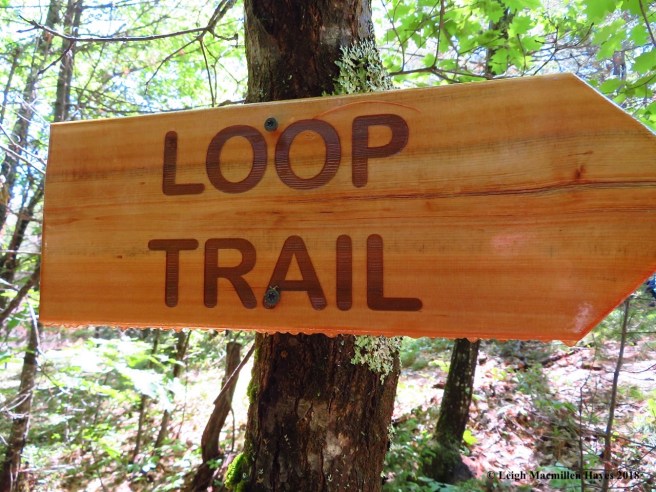
As we hiked up the eastern trail, Dakota and Isaiah swung along the ridge line and came down to find us for they had only placed their signs along the western trail as instructed by Joan, and hadn’t yet pounded them into the earth. We chatted as we moved upward, talking about the turn ahead to the ridge, and Dakota told us we’d be pleased with how obvious it was since Brent had installed the new signs. Indeed!

s16-glacial erratic

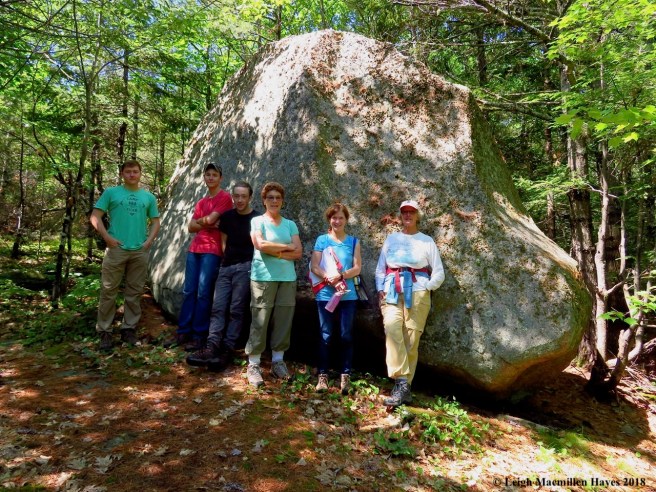
Of course, we were a group that failed at following directions, and so off trail we went to check on the glacial erratic that we knew stood just beyond a downed tree.

s17-porcupine scat

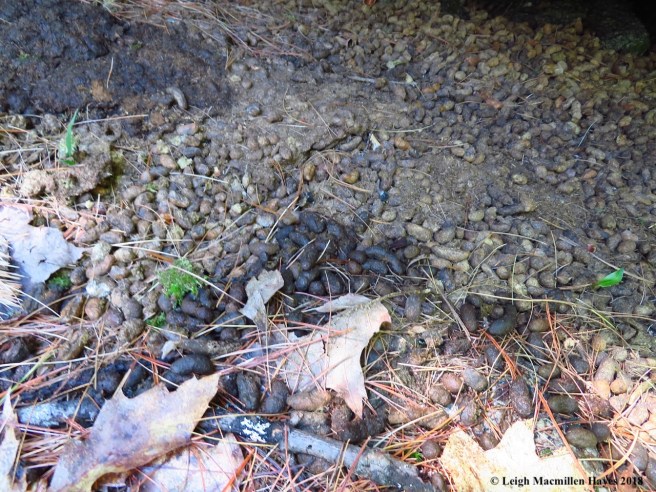
We also checked underneath, for who doesn’t like to look at porcupine scat. New and old, though not especially fresh, it’s been a winter den for at least 30+ years that I’ve been climbing this mountain.

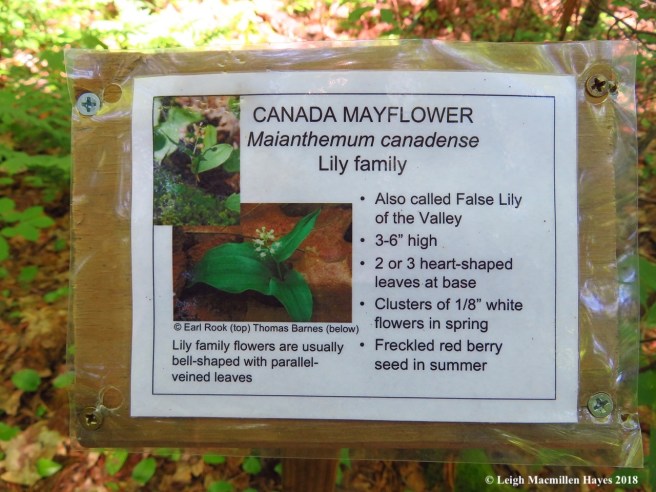
s18-Canada mayflower

And then Joan redirected us, pulling us back into the mission of the morning and finding a place to post the Canada Mayflower sign–between the granite slabs at our feet.

s19-window on the world beyond

Making our way across the ridge, we paused for a second to look out the window upon the world beyond. It’s from heights like this one that we always appreciate how much of Maine is still forested. At a recent gathering with District Forester Shane Duigan, he said that the state is 85% forested–down from 90% not because of urban sprawl, but instead increased farming.

s20-main summit signs

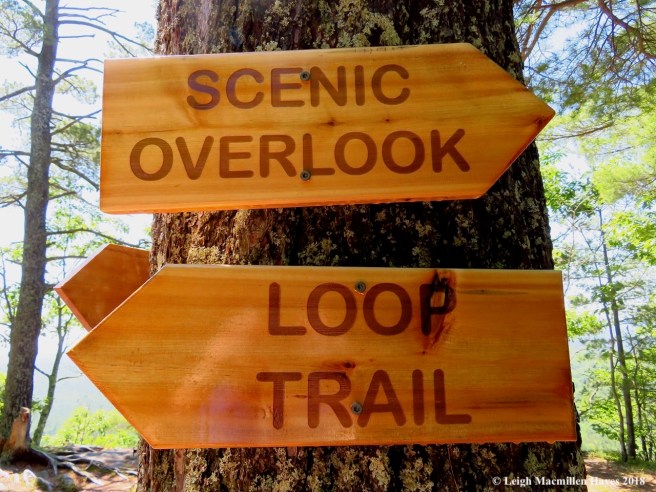
A few minutes later we reached the main summit, where Brent had posted more signs. They’re nailed to a White Pine and mark the intersection of the ridge trail and western loop, with a spur to the western-facing ledges and scenic overlook.

s21-white pine

That very White Pine was also on Joan’s list as an excellent example, and so it will be noticed for a while.

s22-Keyes Pond and Pleasant Mtn

For a few minutes, we took in the wider view to the south–noting Keyes Pond in Sweden and Pleasant Mountain in Bridgton, both part of the great beyond.

s23-scenic view

And then a quick trip out to the scenic overlook, where the sweeping view included the Lower Bay of Kezar Lake and pyramid outline of Mount Kearsarge in North Conway.

s24-scenic view 2

Turning a wee bit to the north, the view also encompassed more of Kezar Lake, and the White Mountains.

s25-chipmunk

On the way down, we continued, or rather, the rest of the team continued to install the signs while I watched, and one quiet chipmunk with a piece of a leaf dangling from its mouth looked on with approval. We assumed it approved, for it didn’t chatter at us.

s26-teamwork

It seemed the signs on the western trail went into place far more quickly than on the climb up, but maybe it was because there weren’t as many. We did pause for a few minutes as Isaiah and Dakota changed out one sign for another because the species Joan wanted to feature wasn’t as prominent as hoped. But, she was prepared with extra laminated cards and quickly produced a description of an alternate species.

s27-plank

We were nearly finished with our morning’s work when we reached the new plank bridge Brent had placed across a small stream.

s28-white admiral

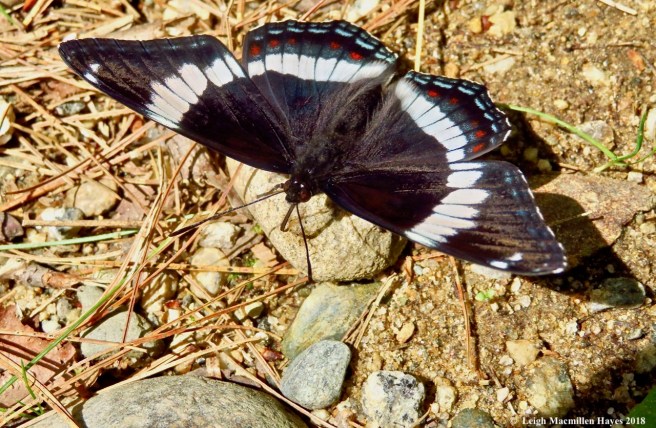
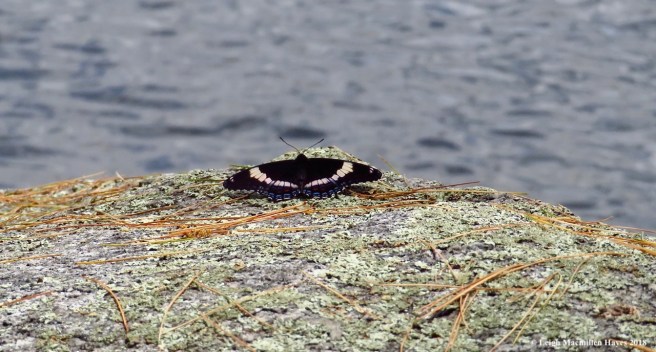
Back at the parking lot, we were wowed by the sight of pollinators upon the Staghorn Sumac, including a White Admiral Butterfly.

With that, our tour was done for the day, but we’d met several people along the way who were thrilled with the work we’d done. We hope you, too, will partake of the pleasant hike up Sabattus Mountain, and stop along the way to enjoy the self-guided tour. It will be in place until Labor Day weekend.

And be sure to stop by the office on Route 5 and make a contribution to the Greater Lovell Land Trust for we are a membership-driven organization and can’t do such work without your continued support.

P.S. Thank you Self-guided Tour Docents and GLLT staff, plus Property Steward Brent.


A Slice of Life in the Rookery

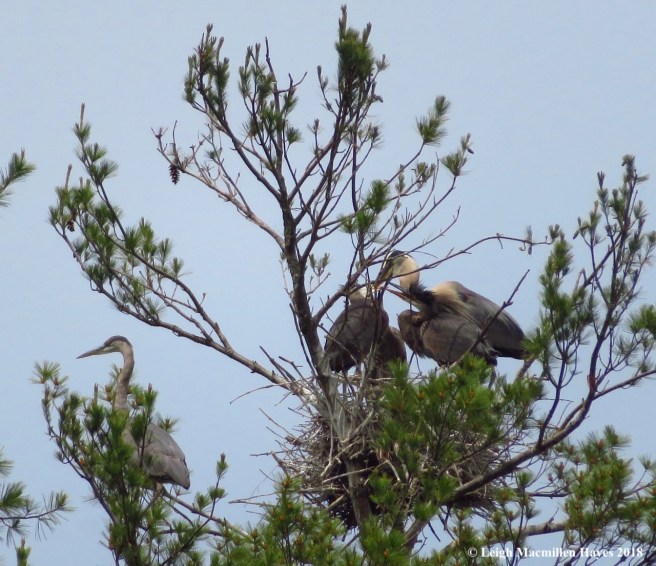
We only had an hour and we had a task to accomplish as citizen scientists for Maine IF&W’s Heron Observation Network. Our mission, which we chose to accept, was to count the number of nests, the number occupied, the number not occupied, the number with residents, the number of immature, the number of mature, the number of . . . you get the picture.

h1b-rookery

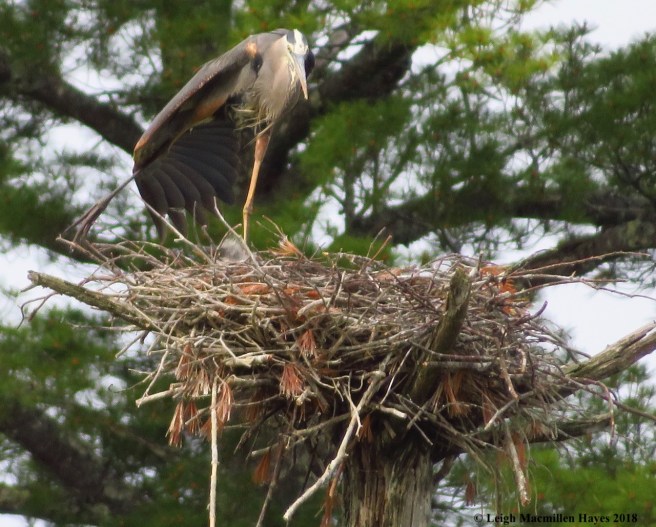
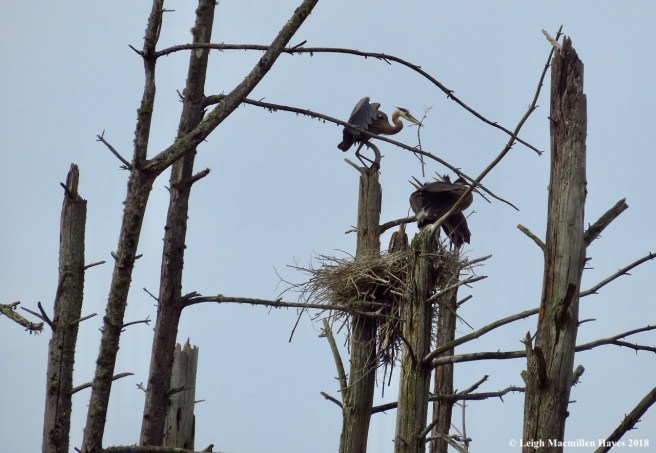
In the past, this was the largest inland rookery in the state and supported 40+ active nests, but over the last few years the numbers had dwindled and today we found only nine. Of those nine, three were inactive. Where have all the birds gone, we wondered.

h1-wood duck

As we started to focus on the scene before us, one member of our team spotted a wood duck surveying the beaver pond from a limb on one of the many old snags.

h2a-heron chick

And then we looked upward. Counting isn’t always easy–in fact, it’s never easy. One immature–check. More than one? Well, we could see a lump representing another bird. Was it one lump or two? Over and over again, we counted.

h3-standing still

And then there was this nest that was hidden from our sight at first, only because it seemed to blend in with the pine tree behind it. Again we wondered–why was this adult standing on it? Was this a sentry watching over all of the nests why the other parents were off fishing? Usually, though, experience told us that sentrys stood on higher branches–the better to watch for predators.

h29-sentry

Like this.

h2-otter

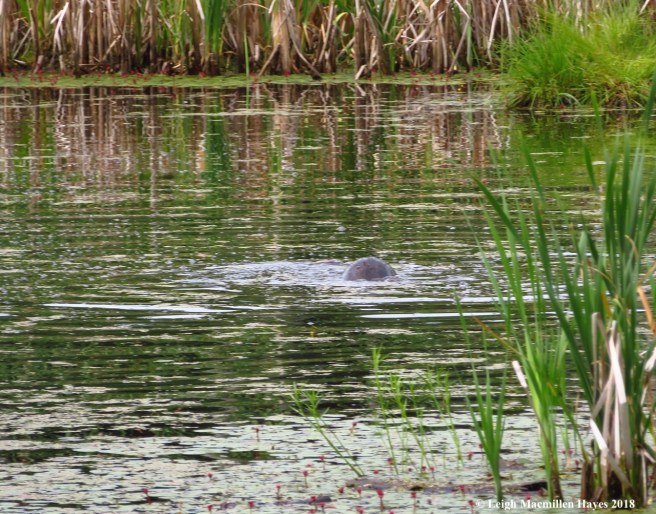
Suddenly we heard a commotion in the water and noticed action near the beaver lodge. What was it?

h4-incoming

And then the sound of the youngsters crying frantically made us look upward again, where we spied an incoming adult.

h5-landing

The kids exclaimed their excitement because a meal had certainly arrived.

h6-begging for food

We could almost see their smiles as they anticipated the goodness they were about to receive.

h7-what? No food?

But . . . no food was regurgitated despite the kids’ squawks.

h9-meanwhile-mouths have closed

Finally, they quieted down and looked rather disgusted.

h10-preening

And Momma preened.

h11-wood duck family

Back in the pond, a family of Wood Ducks swam among the flowering Watershield.

h12-movement above

And up again, we noticed slight movement in the nest.

h13-a chick with downy feathers

Could it be?

h14-red winged

Before we answered the last question, a Red-winged Blackbird paused . . .

h15-singing

sang . . .

h16-did you hear me?

and looked around as if to say, “Did you hear me?” We did.

h17-another incoming

More squawks from above and we saw another adult fly in.

h18-what did you bring?

It seemed Dad had joined Mom and the family was complete.

h19-I'm off

But only for a second, as Mom took off.

h20-snacks?

“Where’d Mom go?” and “What’s to eat?” was all Dad heard.

h21--watching from nearby

She didn’t go far, but like all mommas, she needed a few minutes of time to herself.

h21-baby chick revealed

Meanwhile, back by the pine, that little bit of fluff moved some more.

h22-stretching my wings

And someone else needed to stretch his wings.

h24-otter again

It was like watching a tennis match, for our eyes moved back and forth, up and down–especially when we heard movement in the water again and saw the same something undulating through the water.

h26-water snake

We weren’t the only ones watching all the action from a hidden location–a water snake on a hummock across the way did the same.

h28-don't you have any food?

Skyward, the family unit came together again. And still no food. The kids were getting impatient.

h30-have a stick

And then one parent left briefly and returned–with a stick for the kids to add to the nest, perhaps heron-speak for clean the house first and then you’ll get a snack.

h31-what's he thinking?

“We did it,” they tried to tell her, but Mom had her eyes on something else.

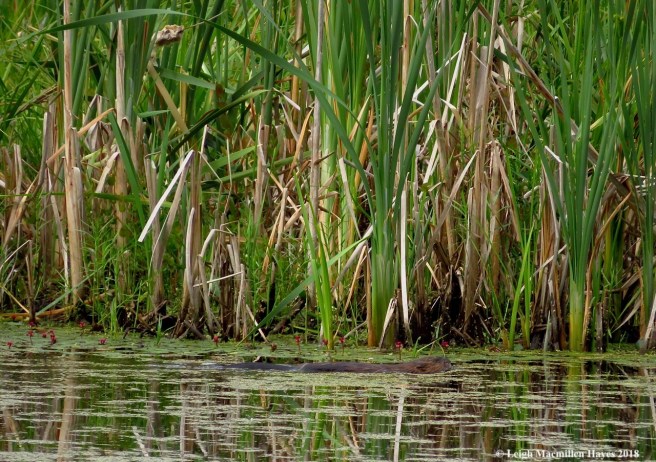
h27-beaver again

Her focus wasn’t on the beavers that swam back and forth below. Oh, and if you think this is the hump that had been making the water boil, you are mistaken.

h32-there he goes again

“Mom, bring back lots of fish . . . pleeeeease,” the kids cried as she took off again. “We’ll even eat frog legs.”

h33-picking twigs

But she had her eyes on other things–sticks from one of the abandoned nests.

h34-got one

She pulled one out.

h36-did you see what he just did?

And the kids looked away and one complained to Dad about all the housework they were expected to do and they still hadn’t received their allowance.

h25-checking us out

Unfortunately, it was time for us to head to work, but our undulating friend returned.

h37-otter

Great Blue Herons, Wood Ducks, Red-winged Blackbirds, Water Snakes, Beavers . . . and a River Otter! A slice of life in the rookery.


Mondate of a Rare Type

Aha. So our Mondates are hardly rare, though we don’t spend every Monday on a hiking date. What, therefore could the title mean?

d1

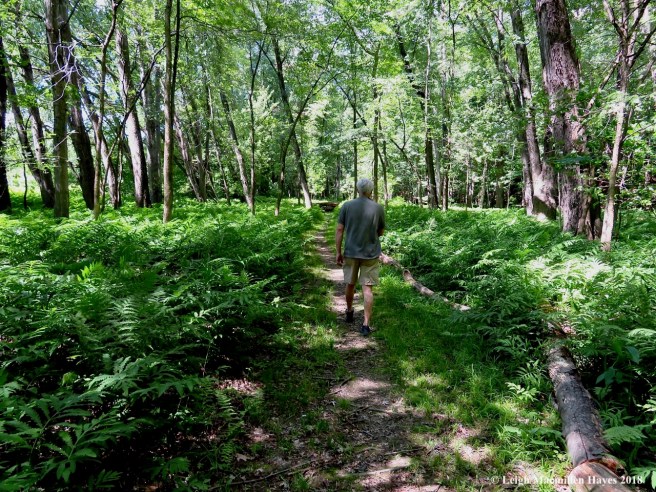
Follow us down the trail at the Dahl Wildlife Sanctuary in North Conway, New Hampshire, and I think you’ll soon understand. The property is owned by NH Audubon and located adjacent to LL Bean, though the parking is in a tiny lot across from Burger King on Route 16.

d2

It’s not a long loop, but it’s chock full of wildflowers like the Black-eyed Susans beginning to burst open into rays of sunshine.

d3

We also passed an abundance of shrubs such as Staghorn Sumac and my mind raced ahead to a future visit with Michael Cline’s book, Shrubs of the Northern New England Forest.

d16a-silver maple floodplain

Because we were near the Saco River, part of the loop took us through a Silver Maple floodplain where the trees arched above in cathedral formation.

d17-ostrich fern

In the same habitat, but at waist level, Ostrich Ferns grew in their vase-like fashion..

d18-Tortricid Moth gall

And among them, growth of another kind was apparent for possibly a Tortricid Moth had used the terminal part of the fern’s frond for its larvae to feed and pupate.

d5-Saco River

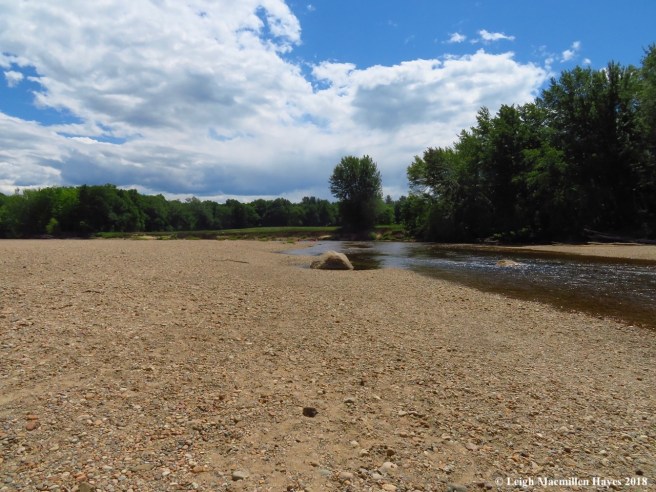
Stepping out of the forest and into the sunshine, we suddenly found ourselves beside the Saco River, where we looked north.

d4-Saco River

And then south. A few kayakers passed by, but for the most part we were alone.

d4, spotted sandpiper

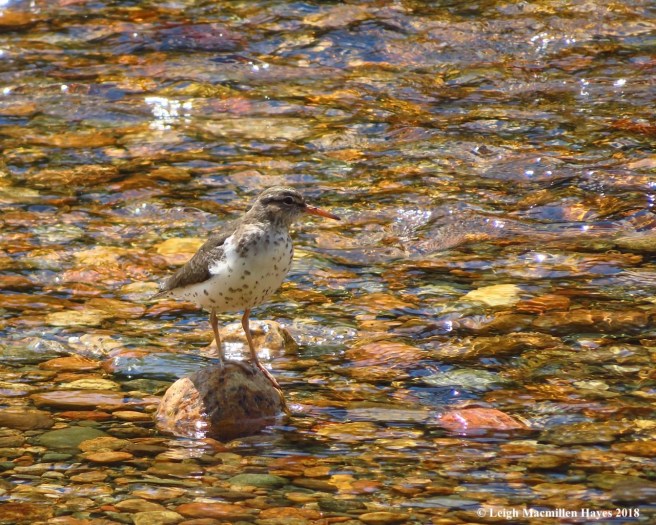
In reality, we weren’t for a solitary Spotted Sandpiper explored the water . . .

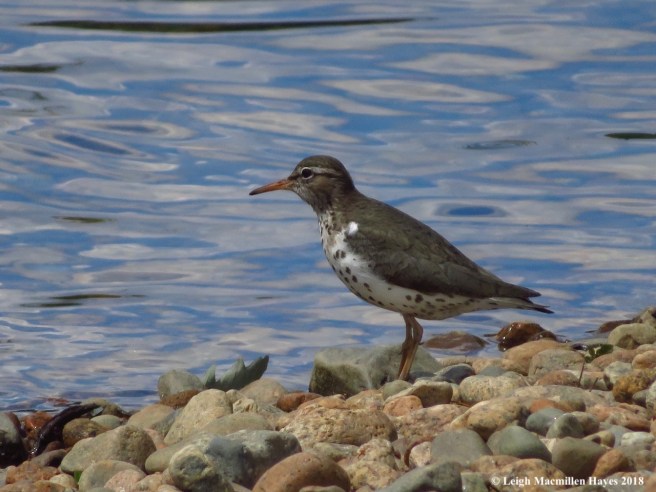
d7-spotted sandpiper

and cobbled beach,

d23-sanpiper foraging

where it foraged for insects, small fish and crustaceans.

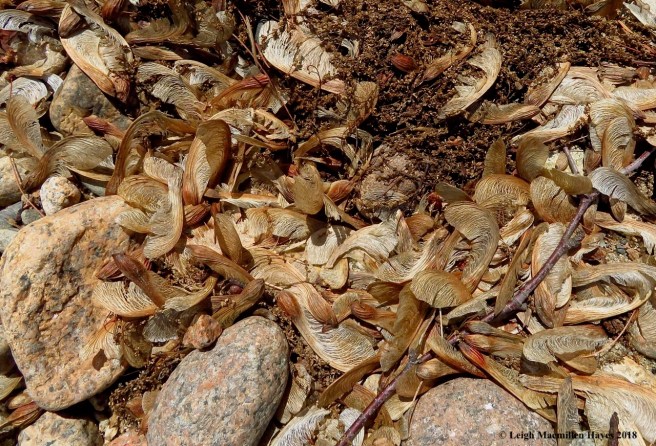
d8-silver maple samaras

Silver Maple seeds were not on its grocery list and they sat in abundance along a high water mark, waiting in anticipation . . .

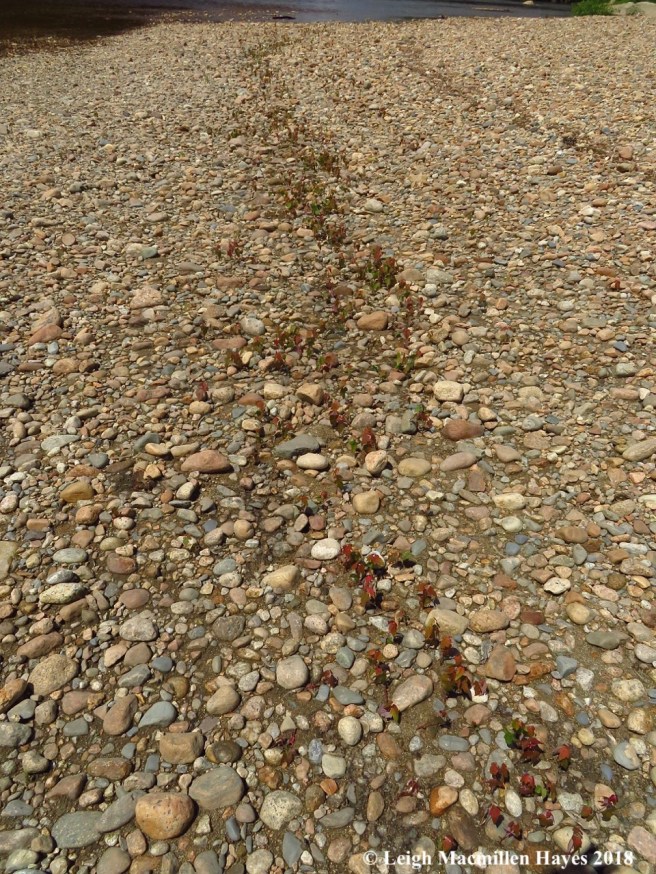
d9-silver maple saplings

to join their older siblings and create their own line of saplings next year.

d10-South Moat

After standing at the water’s edge for a bit longer and enjoying the ridgeline view from South to Middle Moat Mountains, it was time to search for the rare finds that brought us to this place.

d24

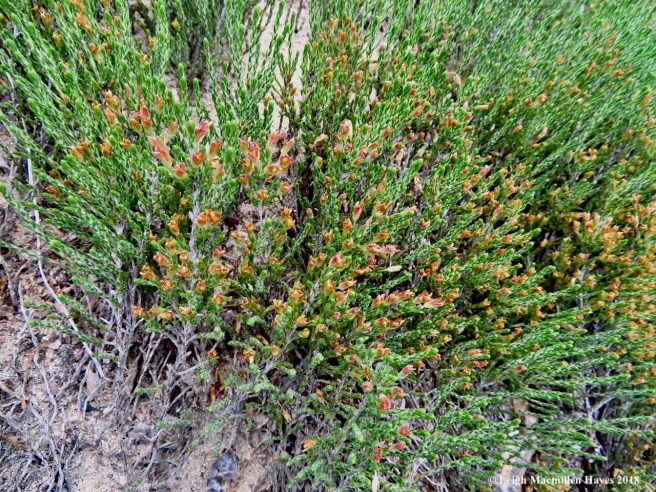
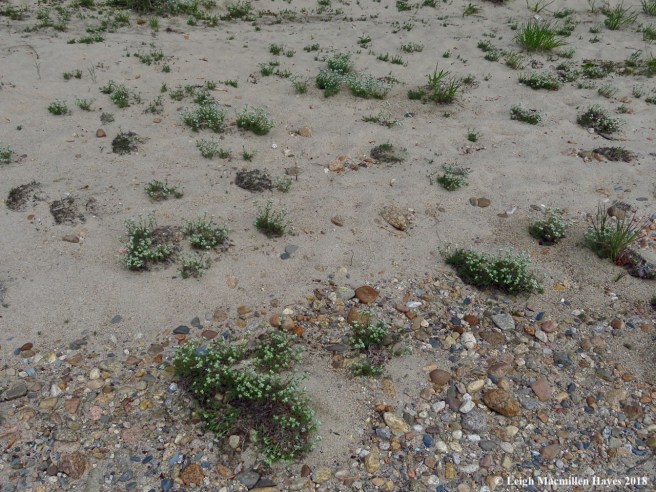
The first was a clump upon a small sand dune–Hudsonia tomentosa.

d25

One of its common names is Sand False Heather, which certainly fit its location and structure. This mat-forming plant had the tiniest of flowers, but it was by its heathery look that I spotted it. It’s listed as rare and threatened in New Hampshire.

d15-silverling

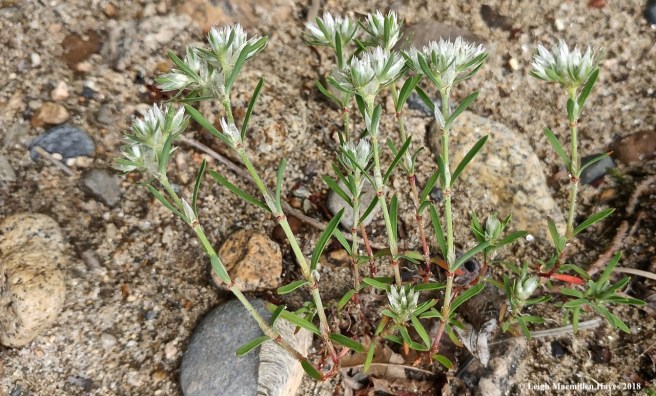
While I only found two clumps of the heather, the second rare plant featured a larger colony.

d12-silverling1

Paronychia argyrocoma is also listed as rare and threatened in New Hampshire (and extremely rare in Maine).

d13-silverling

Also known as Silvery Whitlow-wort, it prefers the ledges and ridges of the White Mountains and . . . gravely bars along rivers. Its whitish green flowers were ever so dainty.

d14-silverling3

From a side view they were most difficult to see for silvery, petal-like bracts hid their essence.

After those two rare finds, my heart sang . . . a song that had started a couple of hours earlier when my guy and I dined with my college friend, Becky, and her daughter, Megan. Another rare and delightful event.

They say three times is a charm and I certainly felt charmed for this rare type of Mondate.


Summer Solstice Sweetness

My dear friend Carissa sent me an e-mail about this week being Pollinator Week and challenged me to write about it. Her inspiration came from an e-mail she’d received from Natureworks Horticultural Services in Northford, Connecticut–part of our old stomping grounds as babes, toddlers, tweens and teens. (She grew up in Northford, while I grew up on the other side of the tracks in North Branford–two distinct villages that formed one town.)

Part of the message included this passage: “Happy Pollinator Week. There really is a week for that? You betcha. Pollinators are vital to life on this planet. And, at Natureworks, we are teaching our customers to protect and help pollinators every single day. It all starts with an organic garden. It includes planting lots of pollinator-friendly flowers. It continues with the way you manage your landscape and the way your community manages their public spaces. Pollinators are in decline around the world. We need to take this seriously. Let me just say . . .  we have the plants for that!

f1

And then another friend, Pam, invited me to join her on a mini-hike to Foss Mountain today in Eaton, New Hampshire, and it all came full circle. To travel here with Pam was an incredible opportunity because she had some personal experience with the property and shared the local lore, including a story about a peddler who long ago repeatedly traveled a road that crosses the mountain and apparently spent some time canoodling with another man’s woman. And then, on one of those journeys, the peddler vanished into thin air–never to be seen or heard from again.

f2

Pam’s brother and sister-in-law had previously owned the land we were about to explore, but it’s now owned by the Town of Eaton and is protected in perpetuity by the Upper Saco Valley Land Trust. The property is managed by the Eaton Conservation Commission, which maintains the trail and blueberry fields.

f3

The blueberry fields were really a sign of early succession following a 150+ year history as pasture land. According to information posted on one of the three kiosks, there was a description of the farming heritage that included along the timeline the decade that the fields reverted to blueberries, juniper and gray birch, and the man who oversaw the blueberry crop–Frank French.

At some point along that timeline, the Brooks family homesteaded there, but not much was known about them. Pam and I wandered about the remaining cellar hole as we tried to interpret the scene, but didn’t quite understand all that we saw. (We sure wished our friend Janet had been able to join us and add her understanding of such historical sites.)

f4

We continued on the short journey upward, passing through a pleasant White and Red Pine forest along a well-defined trail with switchbacks to help eliminate erosion.

f6

Suddenly, the natural community changed and we entered an open area where White-throated Sparrows serenaded us with their “Old Sam Peabody, Peabody, Peabody” song. Sheep Laurel surprised us with its bright pink flowers, but . . . we spied no pollinators.

f7

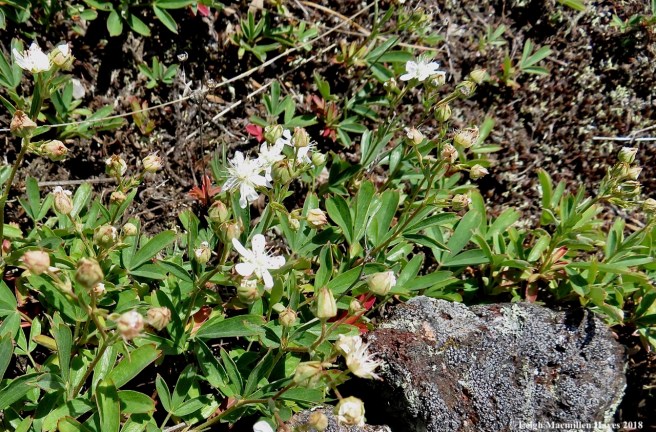
We also discovered a cinquefoil growing abundantly among the rocks, and though it had a few pollinators, it was just that–only a few.

f7a

Now allow me to interrupt with an explanation of the common name for this cinquefoil or Sibbaldiopsis tridentata: it’s known as Three-toothed (tridentata) for the three teeth at the tip of each leaflet. Do you see them?

f8

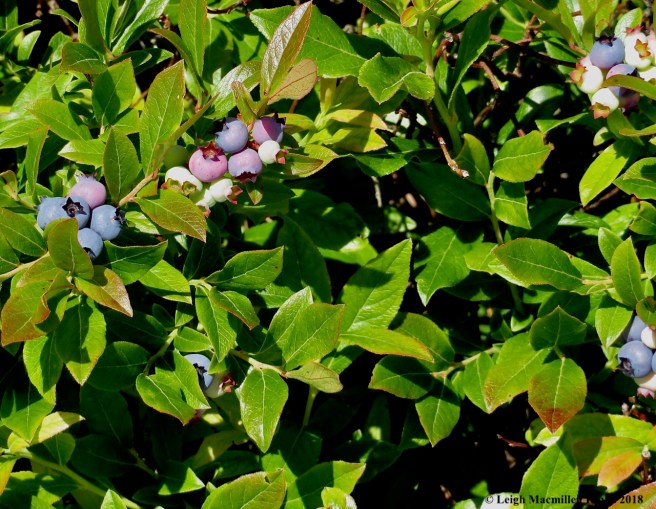
Though we only saw a few pollinators among the cinquefoil, the abundance of blueberries suggested a lot of previous action. A few blueberries had already ripened. We conducted a taste test and suggest you totally avoid Foss Mountain this summer for we certainly couldn’t taste the sunshine in those little blue morsels. (And my nose just grew longer–Pinocchio-style.)

f13

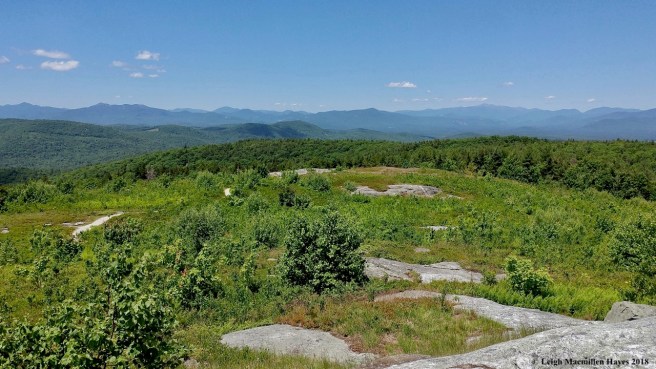
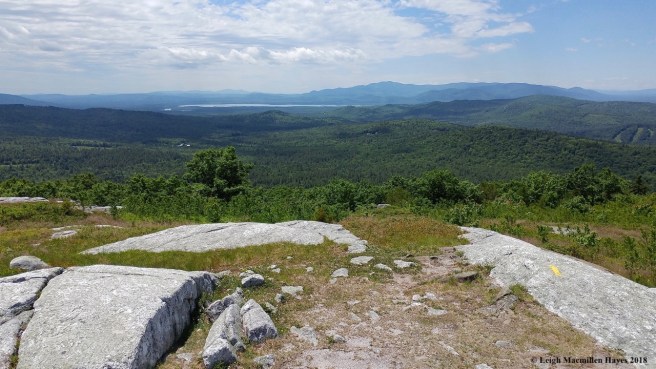
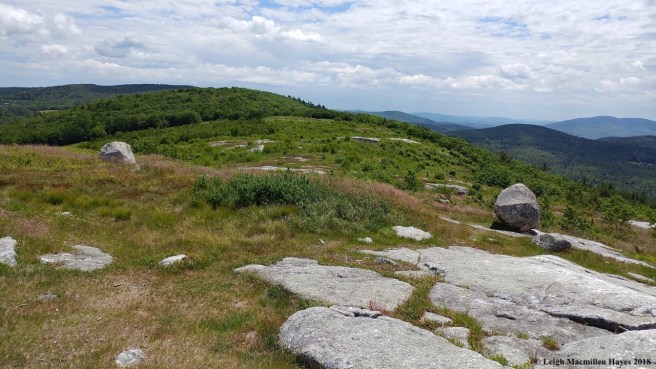
As we reached the summit, we shifted our attention from flowers and pollinators to the 360˚ view that surrounded us.

f14

In every direction . . .

f15

we relished the sight . . .

f16

of blueberry plants . . .

f17

and mountains–including the Ossipee, Belknap and Presidential ranges.

f19

After a lunch break in the middle of this longest day, we started down and made more discoveries–including the sweet flowers of Blue-eyed Grass and its fruits indicating it had been pollinated.

f20

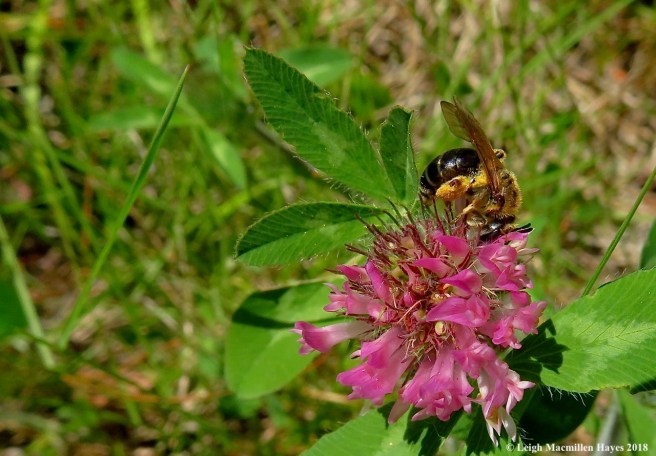
And nearby on a Red Clover . . .

f21

a bumblebee sought nectar while simultaneously filling its pollen sacs.

But in the whole scheme of things, we saw few pollinators and wondered–what’s up? This is an organic field and public space, as Carissa’s contact at Natureworks encouraged. And yet . . . Pam and I weren’t able to answer all our questions today.

f22

But . . . as we looked upon the abundant blueberry crop before us on this first day of summer, we gave thanks for those who had protected the land and those who had performed the mighty act of pollination despite adversity and we looked forward to the sweetness that will follow this Summer Solstice.

The Amazing Race–Our Style, episode five

I’m not sure how it happened, but when we arrived at Route 113 in Fryeburg to pick up our clue we realized we were the first contestants for this episode of The Amazing Race–Our Style.

Consequently, we had a quick decision to make–the main clue referred to the Baldfaces and we recognized the fact that that entailed a challenging climb. Though my cast has morphed into a smelly splint [envision sliced cast up one side and then add two wide strips of velcro], I was relieved that we could take advantage of the Fast Forward clue that mentioned shingles in a white forest.

s1-trail sign

We checked the map and located a trailhead for Shingle Pond only a few miles away. BINGO.

s2-heading into the woods

The trail begins along Forest Road 317, but a few curves later heads into the nitty gritty of the White Mountain National Forest.

s8-locating the trail

Toward the beginning we could hear the buzz of logging machinery in the distance, but it wasn’t all that loud and certainly didn’t drown out the not-so-sweet buzzing of the local mosquitoes. Our first real challenge, for one can hardly count those flying buzzers and stingers as an obstacle, but more a way of life, came in the form of staying on the trail. It was blazed yellow, but occasionally we had to slow ourselves and our minds, and look around for some clues. There was only one cairn, which was fine with us, but after that spot we spent several minutes of valuable time looking for yellow in every direction . . . to no avail. Finally, however, my eyes cued in on what appeared to be a worn path between some trees to our right and my guy passed through some muck and logging slash to discover that indeed we had found it. That happened more than once, but each time we paused, scouted and eventually made the right decision. They didn’t promise us easy when we signed on for our own version of the reality show.

s11-crossing Weeks Brook

The path took us across Weeks Brook for which the trail had been named and it was there that we noted a trillion trilliums–all past their prime.

s9-patch cut

Through hemlock groves and mixed forests we hiked, occasionally passing by patches of clearcuts. Our next challenge was to determine the benefits of such habitat. The answer seemed obvious for so much was the bird song–from those I recognized like Ovenbirds, Veerys, and Hermit Thrushes to warblers that we could hear but not see. If we hadn’t been racing against the clock it would have been fun to try to figure out some of the song makers.

s10-browse

We also noted plenty of signs, such as browsed tree buds, that told us moose and deer had foraged in those areas.

s5-wood sorrel

Challenge number 3 required that we locate a few plants and note whether they were edible or not. Wood Sorrel was easy–and most welcome on this sultry day for its a thirst quencher.

s6--Indian Cucumber Root

Indian Cucumber Root was another enticing edible and it grew abundantly in the forest. As pleasing as the flower is above its second tier, it’s not their fruits that appealed to us, but rather the small white rhizomes buried in the ground which offered a cool and crisp cucumbery taste. Even my guy can attest to that.

s7-wild calla

The one herb we didn’t taste test was the Wild Calla or Bog Arum. It’s known to cause severe irritation of the mouth and throat if consumed. We left it be.

s12-lady's slippers

We did find one other plant that we wouldn’t think of eating, but always revere–Pink Lady’s Slippers, in this case a matching pair.

s13-prince charming

And not far beyond–Prince Charming himself. Even his eyes were surrounded by a ring of gold.

s14-Shingle Pond

At last we reached the two-acre Shingle Pond. Though we wanted to be greeted by a moose in the water, we were pleased with all that we saw and heard, including bull, green and tree frogs.

s15-Kearsarge Fire Tower

Though we were two miles and lots of ledges below the summit of Kearsarge North, as we ate our PB&J sandwiches created by my guy, the sight of the historic fire tower evoked lots of memories and got us dreaming about our next opportunity to sign the guest notebook.

s17-crimson-ringed whiteface dragonfly

Our task at the pond was to bushwhack around its perimeter and note some of the species who called this mountain pond home. Probably my favorite discovery was the Crimson-ringed Whiteface Dragonfly.

s17b-crimson-ringed whiteface

Over and over again we saw it, that bright red body standing out in contrast to its dark abdomen. There were a zillion dragonflies, many of them darners and clubtails zooming about, but this skimmer had the decency to perch frequently and reveal its finer details.

s17a-bushwhack

As we moved around the pond, we met trees to climb over, under and around.

s18-beaver works

Many were felled by the resident beavers, so we had another who made its home there to add to the list.

s19-beaver lodge

In fact, we found the most recently built beaver abode.

s19a-beaver dam

And the dam that made it all possible.

s20-bear scat

One special sign of wildlife may gross you out, but we were delighted for this pile of scat indicated a bear had passed by earlier this spring. I’d wanted to look for bear trees on the hike up, but these days my eyes are mighty focused on trail conditions. And scat is just as good, if not better than a tree with old claw marks. Well–both are wonderful . . . really.

s21-chicakdee

One other resident was insistent that we take notice and I think we may have paused near a nest tree. When I asked my guy if he could hear the Conway Scenic Train whistle emanating from the other side of the mountains, he said that all he could hear was the chickadee’s chatter.

s22a-Atlantis Fritillary

The return hike down was via the same trail, but when we reached the log landing and later the logging road we had one final challenge to complete–the flutter-by challenge. Who were those beauties that flitted about, gracing the landscape with their presence? For starters, we discovered several Atlantis Fritillaries seeking nectar from eggs and bacon flowers, aka Bird’s-foot-trefoil.

s24-atlantis 2

Once over easy, it was equally beautiful.

s25-white admiral

And the learning continued for we watched numerous White Admirals flit from spot to spot. But notice the coloration–including orange spots below its white bars.

s25a-white admiral

This blue version was also a White Admiral. Needless to say, we admired it no matter its variation.

And with that we had successfully completed the fifth episode of The Amazing Race–Our Style. All day we didn’t know our status in comparison to the other contestants, but six miles and four hours later we had nothing to fear. We definitely won this leg for we stood upon the mat at the Pit Stop much earlier than any of the other contestants.

As much as we would have liked to climb the Baldface Circle, it wasn’t in the cards for us today.  And as a final note to today’s journey–I added a few more mosquitoes to the natural history museum forming on the velcro of my splint. It’s a museum, however, that I hope will close soon, for it stinks–literally and figuratively.


Meals-on-Wings

I wasn’t sure how I would spend the afternoon, until that is, the phone rang. On the other end of the line (what line?) Mary Jewett of Lakes Environmental Association excitedly told me about her adventures last evening exploring one of my favorite Lovell haunts. She’s an avid birder and is currently participating in the Maine Department of Inland Fisheries and Wildlife’s Maine Breeding Bird Atlas.

For this citizen science project, Mary has chosen several areas of Lovell as her block and so she’s getting to know one of my favorite necks of the woods. Last night, she explained, found her kayaking with her boyfriend on a river that passes through a Greater Lovell Land Trust property. As she talked, she started listing off the birds they saw that are not on the species list for that property, thus nudging me to make sure it gets updated. One in particular pushed her excitement button, and that’s when I knew where I was going to spend the afternoon.

She also told me about a most unusual sight that she caught on film–a porcupine swam across the river, passing in front of their kayaks. Who knew? She surmised it had been chased to the water and just kept going.

k7-kezar river

Anyway, within 45 minutes of the phone call, I was at the water’s edge.

k8-canada geese

The bird life was immediately apparent in the form of Canada Geese, their youngsters growing bigger by the day.

k10-mallard duckling

What rather surprised me was that I watched two Mallard ducklings, but never saw their momma, unless she was hiding under some shrubs. I could only hope that was the case.

k21-kingfisher

There were Red-winged Blackbirds, the males displaying their bright shoulder patches, and even a Belted Kingfisher who sang his rattling song as he flew above the water looking for a meal.

At last I had dallied long enough, for of course I admired the dragonflies and damselflies, but it was time to bushwhack over to a viewpoint where I could stay hidden as my eyes and ears filled with the sights and sounds of . . .

k11a-rookery

a Great Blue Heron Rookery. It had been on my radar to get there, but other events took priority until Mary’s nudge. The moment I started down the trail I heard the chorus of croaks and knew I was in for a treat.

k12-food

Up high in the pines, those massive birds stood, most upon their large platform nests made of twigs and sticks, and apparently lined with moss and pine needles to soften the interior. If you looked closely at the adult upon the nest, its curved throat appeared to bulge a bit.

k13-food

Both parents are known to provide a meal of regurgitated food. Can you see the adult bending down, its beak meeting the youngster’s? Soon, regurgitating the food will stop and instead small fish will be deposited in the nest and the “little” ones will learn to feed themselves.

k14-next meal

After one was fed, another begged for its share of the picnic. It seemed to look up and say, “Hey, where’s mine?” in true jealous sibling behavior.

k15-sentry

By now you may have noticed that the youngsters have black flattop haircuts. Adult Great Blues have thin black plumes that are swept back of the tops of their heads making for easy ID until the young fully mature. And at least one stands sentry, ever on the lookout for predators like eagles and raccoons.


k17-double decker

Great Blue Herons nest in colonies near wetlands such as this. The group of nests is called a rookery–so named for the colonial nests of the Eurasian rook, a bird similar to a crow, but called a rook because of the sound it makes.

k18-birds everywhere

With my eagle eyes, I had to really focus in on the trees, for not all of the nests were obvious from my vantage point on the distant shore. It’s best if you are to observe to keep your distance and remain quiet and hidden so the birds aren’t disturbed during this fragile time in their life cycle.

k19-i'll be back

With the kids fed in nest one, the parent decided to chat with a neighbor before heading off to gather supplies for the next meal.

k20-don't forget us

And the kids next door waited expectantly–ever anxious for the delivery of their own meals-on-wings.


Dying To Get In

When I told my guy that Connie was taking me to Evergreen Cemetery in Portland today, he gave me a questioning look and asked, “Why?”

‘Why not?” I responded.

But really, it was because both she and I have friends who have posted incredible photographs of the natural world that is part of the cemetery and we wanted to discover what it was all about.

e1-evergreen cemetery

At first glance, Evergreen Cemetery may look like Anytown Cemetery for it features gravestones, memorials and tombs throughout. But . . . as we read on a panel near the entrance: “Established by the city in 1854, the cemetery was designed by Charles H. Howe as a rural landscape with winding carriage paths, ponds, footbridges, gardens, a chapel, funerary art, and sculpture. It also includes extensive wooded wetlands. Evergreen was modeled after America’s first rural cemetery, Mount Auburn in Cambridge, Massachusetts.

The cemetery, the second-largest publicly-owned open space in the City at 239 acres, has been host to a variety of wildlife such as geese, ducks, pheasants, swans, turtles, blue heron, fox, mink, deer, and moose. Its spaciousness combined with old growth pine and oak, vegetation, ponds, and surrounding wetland, provides a true wildlife oasis. It is considered a premier birdwatching sanctuary. Maine Audubon utilizes the cemetery for field trips, to include their annual Warbler Weeks conducted in May. Evergreen Cemetery is also a wonderful location to enjoy the vibrant colors of fall foliage in Maine.

e2-sunburst lichen

We didn’t actually spend much time exploring the cemetery itself, though that would be fun to do on a return trip, but as we waited for Connie’s friend Linda to join us, we did look at a few gravestones and were especially enamored with the sunburst lichen that lightened a stone gray morning.

e3-male mallard

Linda was only a few minutes behind us and then we all traveled to the back end of the cemetery, where the Mallards stopped us in our tracks. While you might ask why, remember that we are women of wonder and wonder we did: about his iridescent head,

e4-famale mallard

her lack of ducklings despite four attentive males,

e5-mrs. mallard

why their feet were orange,

e6-duck tweed

and the tweedy pattern of their feathers.

e7-ducklings

And then we spied a couple of other females with ducklings, this one standing tall as she allowed her youngsters to explore.

e7-chipping sparrow

They weren’t the only ones exploring–a Chipping Sparrow was doing the same, though it was almost impossible to see given that it blended in so well with its surroundings.

e8-black swallowwort

At last we pulled ourselves away from the ducks and our view of the car, and started down a trail where flowers and leaves made us take note. Last year, I first met the dark maroon flowers of Black Swallowwort, an invasive. Diminutive and pretty, it was difficult to dismiss them, especially when juxtaposed as they were against a sensitive fern frond.

e9-ragged-robin

Connie introduced us to another invasive that she immediately recognized as Ragged-robin. Linda and I were wowed by the pink petals, irregularly cleft.

e10-sunburned oak meat

The natural community kept changing and suddenly we found ourselves under a power line where dried spaghnum moss made us wonder if the land was typically wet. And then we saw something red, and the discarded outer shells nearby spoke to its source. It was the “meat” of an acorn, the red being its “sunburned” presentation.

e11-oak setting root

The evolution of an oak tree–it begins with an acorn.

e12-song sparrow

In the same opening, we watched several Song Sparrows move among the shrubs, and then one paused to serenade us.

e13-song sparrow

Upon finishing, it waited as if for our applause.

e14-arrowwood viburnum

Before moving on, we had one more plant to ID. Thanks to iNaturalist, Connie informed us that it was Arrowwood Viburnum. While we appreciated its umbel of flowers and large-toothed leaves, one stem in particular drew our attention. In a symbiotic relationship, ants stroked brownish-red aphids with their antennae, while the aphids released drops of honeydew sucked from the stem. The process was much like a cow being milked. It was actually rather creepy, but wicked cool and all three of us used a loupe to take a closer look.

e15-American honeysuckle

Back along a woodland trail we continued, again stopping periodically to take in the sights, ask questions, and appreciate our surroundings. Among our finds we discovered the newly forming fruits of a native honeysuckle.

e16-beaked hazelnut

We also rejoiced when we encountered the beaked fruits of Beaked Hazelnut.

e17-mallards

At last we’d completed a short loop, and found ourselves drawn in again by the Mallards, both young and old.

e19-snapping turtle

But then our eyes focused on other residents in the shallow water.

e20-ducks and turtle

And we feared that we’d witness a snapping turtle devour a duckling. We kept encouraging mama to move her kids out of the way.

e21-3 turtles

Especially when we realized the pond was full of snappers and they all seemed focused on swimming to the same focal point.

e22-injured duck

But mamma took her time and let the kids roam freely. We did realize that she had an injured foot or leg and moved with a hop, which added to our anxiety. I also felt a certain affinity with her, given my current one-armed bandit situation due to a broken wrist that is slowly healing. Here’s hoping that she heals as well.

e22-mouth open

As we watched the drama play out before us, we noted two adult ducks hanging out under some alders beside the shore. Suddenly, a snapper approached them quickly and opened his mouth wide. Was he exhibiting aggressive behavior?

e23-mouth closing

We weren’t sure, but as suddenly as he’d approached, he closed his mouth and turned away.

e18-ducklings all in a row

We noticed that turning away was typical turtle behavior. They seemed to get within a couple of feet of the ducks and then turn. Why? We were, however, glad when momma got her ducklings all in a line and moved on.

e25-green heron

We, too, moved on . . . a few more feet toward the car. And then we stopped again to check on the action in the pond. That’s when a Green Heron flew in.

e26-green heron

He was also looking for lunch, though we never saw him succeed in his search.

e27-turtle wars

We did see the ducks and turtles again. And our turtle questions continued for we noticed that they would gather and then one would go after another and the water would boil. An act of aggression? Or a mating ritual?

e28-turtle face

We didn’t have all the answers, but one thing we knew–we’re dying to get into the cemetery again.


One Wing, Two Wing

Whether I look up, down, or somewhere between, all that fly have captured my attention lately.

l6-river jewelwing

My heart flutters when a female River Jewelwing, with her iridescent body flies into my space.

l26-female river jewelring

But it’s those two-toned wings with their white spots or stigmas (indicating it’s a female for male’s don’t feature the spots) folded over their backs that wow me the most. Though their wings may appear to be two different colors, and these were taken in two different river locations, they are really the same. It’s the very nature of being iridescent, where all colors of light are reflected, that makes them appear as either black or bronze. You know what else I like about this damselfly–it was eating an insect.

s6-four-spotted skimmer

And then I turned on my dragonfly eyes. Ever so slowly over the last few years I’m beginning to recognize some of the perchers by name, like this Four-spotted Skimmer. It certainly helps that they pause frequently and hold their wings out to the side, which is a dragonfly characteristic.

l12-four-spotted skimmer

It’s the wings that are the defining points for me. All four feature a beautiful amber patch on the upper or leading edge. Do you see the golden veins? And then there are the black spots. Those in the middle or elbow of the wing are referred to as nodal, while the stigma is at the leading edge, the same as the female damselfly’s. Why four-spotted and not eight? I don’t have an answer, but perhaps it’s just plain easier to quickly count the four spots on the forewings before the insect flies off.

s8-calico pennant

Last year it was the Calico Pennant that became one of my new species to recognize each time we met. This is a rather small skimmer with the most amazing wing pattern. Notice the dark patch near the tip of the wings, just beyond the yellow stigma. What I love most though is the stained-glass patch on the hindwings. This one was either a female or an immature for its coloration was yellow; the male stands out in red. I have yet to encounter a male this year, but trust it will happen.

s7-dusky clubtail

Sometimes it’s not the wings that are the showiest part, like on this Dusky Clubtail,

l27-green-faced clubtail

Green-faced Clubtail,

l25-racket-tailed emerald

and Racket-tailed Emerald, but there is beauty in simplicity.

l17-Large Flathead Pine Heartwood Borer Beetle (Chalcophora virginiensis)

Wings on other insects are also worth observing, like the purplish ones on a Large Flathead Pine Heartwood Borer Beetle, aka Metallic Wood Boring Beetle. Though it’s supposed to be a noisy flyer, I only saw it clinging to a leaf on a recently harvested hill–meaning there’s lots of dead pine heartwood nearby.

l18-click beetle

Only a few feet away, I had my first encounter (at least that I can recall) with an Eastern-Eyed Click Beetle. Click beetles get their names from the sound they emit when they flip themselves upright. I didn’t have the opportunity to hear that sound for I’m actually sharing these two photos out of order.

l19-click beetle

When I first met him, he was upright and may have flipped over to pretend to play dead. So I saved this photo to show second because of those “eyes” on the thorax and then the mottled black with white specked wings. The “eyes” are intended to frighten away predators. As an adult, the click beetle doesn’t dine on much, though occasionally it feeds on the larva of wood-boring beetles–thus there existed the possibility of an interesting intersection.

s21

When a Canadian Swallowtail flew in to my range, backlighting by the sun helped me see the overlap of its fore and hindwings as evidenced by the deeper yellow arch. I also noticed a tattering on one forewing. Butterflies are so beautiful and take such a beating both from their surroundings and any predator.

l21-luna moth wing

The same can be said for Luna Moths and by a hindwing left behind, I wondered when this one met its demise for so faded was it. But the “eye” on the wing was still evident, as well as the downy coating of this giant silkmoth. Of course, I would have preferred to see it alive, but was still thrilled with such a delicate find.

s13-yellow-bellied

Another great find was the discovery of a Yellow-bellied Sapsucker who has been feeding its young throughout each day. Do you see the hole in the tree right beside the bird’s breast? I could hear the young located inside and have spent more minutes than I should admit to watching the parents fly in and out.

l22-veery eggs in nest

Soon the baby sapsuckers up in the tree will prepare to fledge.  Likewise, if all goes according to plan, these four Veery eggs found in a ground nest (mom and pop were accidentally flushed out, but we trust they returned) will hatch and four more sets of wings will take to the airways.

One wing, two wing, clear wing, metallic wing, butterfly wing, beetle wing–so many wings worth noticing.


Prehistoric Lovell

It only takes a few minutes of time to realize that Lovell, Maine, like all other New England towns, is rich in history–both human and natural. And though we may be able to assign dates to certain events that shaped the town, there are reminders in our midst that predate our understanding.

p3-white admiral

Think about it. According to the American Museum of Natural History’s website, our knowledge of “Butterfly origins is based on the study of living Lepidopteran species. We can often learn about evolution from the fossil record, but there are relatively few butterfly fossils. Those that do exist, like the 40-million-year-old Prodryas persophone, are remarkably similar to modern-day forms—so the fossil record sheds little light on the origin of today’s butterflies.

Many scientists think that the specialized association between today’s butterflies and flowering plants suggests that butterflies developed during the Cretaceous Period, often called the “Age of Flowering Plants,” 65 million to 135 million years ago—a time when dinosaurs also roamed the earth.”

And there I was this afternoon at the Greater Lovell Land Trust’s Heald and Bradley Ponds Reserve admiring a White Admiral, Limenitis arthemis.

p4-white admiral

In quiet reflection above Heald Pond, one seemed to contemplate life. A cool fact about this butterfly is that rather than seeking nectar, the White Admiral is known to extract much of the water and nutrients it requires from mammal scat. Though I didn’t see one on scat today, I knew that the we shared a special connection–scat, after all, happens and has done so since the beginning of time.

p7-dragonfly exuvia

And then there were the dragonflies that may have been older than even the dinosaurs. Certainly by the structure of the exuvia left behind once they emerge, one gets a sense of that ancient time.

p5-chalk-fronted

Today’s great finds at H&B included male Chalk-fronted Corporals that followed me everywhere,

p9-female chalk-fronted

and their occasional female counterparts.

p4-lancet club

There were plenty of Lancet Clubtails,

p6-racket-tailed emerald

and even a Racket-tailed Emerald.

p10-female common whitetail

In keeping with the same theme at the Kezar River Reserve, I spied a female Common Whitetail–which was anything but common,

p11-female and male ebony jewelwings

and atop bracken ferns a female (note her white dots) and male Ebony Jewelwing Damselfly.

Again, the earliest fossils of the Odonata so far discovered come from Upper Carboniferous sediments formed about 325 million years ago. The group of fast-fliers represented by the fossils went extinct about the time of dinosaurs, and yet today we have their relatives to admire.

Even the bracken fern on which the jewelwings paused spoke to an earlier time when it stood much taller than today’s three feet.

p12-snapping turtle

And then on my way home it was a dragon of a different sort that made me stop on a bridge, put the truck in reverse, park it and hop out. The snapping turtle may look much older than all the other species I encountered today, but it has haunted our wetlands for only 90 million years. A young’un in this neck of the woods.

p13-snapper's nails

These critters were the most intimidating, however, as noted by those claws,

p14-snapper's tail

that tail,

p16-snapper's face 1

and its snout.

p16-snaper's wink

Despite that, we shared a wink . . .

p15-snapper's face

and then each went our own way.

The next time you step outside, whether in your backyard or on a land trust property, be sure to pay reverence to those that have brought a prehistoric time closer to home.


Otherworldly in Nature

One doesn’t necessarily step into the woods and expect transcendent events to occur, but then again by learning to live in the moment one never knows what to expect. And so it was that I traveled the trail at LEA’s Holt Pond Preserve with my friend Ann this morning–both of us delighted to just spend some quiet time exploring together.

o1-bunchberry

Our tramp began with a pause beside bunchberries because it’s a plant I always associate with Ann due to her trailside teaching about its finer points years ago. Today, as the flowers began to morph into fruit, it was the points of the four white petal-like bracts and green leaves that asked to be noticed in the most subtle of ways for each was decorated with a dewdrop.

o2-red maple swamp

Not far beyond where the bunchberries grew, we stepped onto the first of the boardwalks that provided for a delightful amble through the red maple swamp.

o3-green frog

Just off the edge of the wooden walkway, we spied some eyes starring up at us and realized we were the subject of the green frog’s discontent.

o4-green frog male

His camouflage almost worked as he tried to hide among the sphagnum moss . . .

o5-green frog and insects

but again we found him. How did we know he was a he? By his tympanum (ear), the circle behind his eyes. We really wanted to see him feed and if you look closely, you may see a mosquito and other insects nearby, but he seemed focused on us–in case he needed to defend his territory we supposed.

o6-pitcher plants

A wee bit further we met the first of many of their kind–the incredibly unique pitcher plants with their strikingly beautiful magenta flowers that stood like the wind spinners we used to create as kids.

o7-pitcher plant leaves

In the water below were the pitcher-shaped leaves that gave this plant its common name.

o17-pitcher pitchers

The carnivorous pitcher plant obtains nitrogen and phosphorus by eating insects. Its oddly shaped leaves form a pitcher partly filled with water and digestive enzymes. The spout is a hairy landing platform for insects attracted by its red venation and nectar glands. Imagine this: An insect crawls to the edge of the leaf, aka pitcher, slips on the downward-sloping hairs and plunges into the liquid below where enzymes and bacteria break it down. Any chances for escape are zapped by those stiff hairs.

o8-frosted whiteface dragonfly

As we paid attention to the plant, damselflies and dragonflies, like this Frosted Whiteface Skimmer, flew in the surrounding airspace. We appreciated that he landed so we could take a closer look at the details of his body, including the golden outline of the upper edge of his wings.

o8-red maple leaf

Moseying along, our next great find was a red maple leaf, which made perfect sense given that we were in the midst of the red maple swamp. What didn’t make sense was the fact that it donned its autumnal coloration, but ours was not to make sense of everything.

08a-muddy river

At last we reached the boardwalk to the Muddy River, where we embraced stillness and listened to the green frogs strum their banjo voices and red-winged blackbirds sing their conk-la-ree songs.

o9-red-winged and painted

One blackbird, in particular, stood out as if he were the king of the river. We didn’t realize it at the time, but the photographs tell the story for he did have a subject in mind–in the form of a painted turtle.

o10-red winged :painted

Off his high horse he flew, but continued to squawk from a lower pulpit. What did it all mean?

o11red winged blackbird

While we’ll never know, he did seem pleased with a gaze into his own reflection.

o12a-

Our gaze also became more focused when we realized we stood in the midst of a newly emerged dragonfly. By its cloudy wings folded over its back damselfly-style and the abandoned exuvia on the other side of its perch did we realize what we were witnessing.

o12b

We felt a sense of caretakers for suddenly it was our honorable duty to stand watch and protect this vulnerable being from becoming prey. With wonder, we watched as it slowly changed position and suddenly spread its wings. For at least an hour we stood sentry and noted the slightest changes while we delighted in how the breeze occasionally fluttered through its wings.

o13-female eastern forktail damsel

Oh, we looked around and spied a female Eastern Forktail damselfly . . .

o14-chalk-fronted corporal

and many a Chalk-fronted Corporal dragonfly among others.

o15-spreading his wings

But our attention continued to return to the subtle beauty before us. How did it know to climb the vegetation? How did it know to emerge? How did it know today was sunny? How could such delicate wings support its meaty body? Where do dragonflies hang out on rainy days? How long would it take before it flew off? Our questions were numerous, but . . .

o15-dragonfly exuvia

in a flash, as I moved in for a closer shot of the exuvia, the dragonfly decided it had posed for enough photos, and Ann and I watched with continued fascination as it flew off. Really, we felt like proud parents who had sent our offspring into the world. And we rejoiced. We had just witnessed one of nature’s greatest spectacles. It wasn’t only thrilling to watch, but was an all-encompassing experience that pulled us in with our sight and minds.

016-pitcher

After such an awe-inspiring opportunity, we couldn’t imagine anything else, but as we moved along the boardwalk through another section of the red maple swamp we again encountered pitcher plants.

o18-pitcher flower

And this time we decided to take a closer look at the flower structure, which was umbrella-like with those five broad and waxy sepals situated above. Unless you physically turn it and take a peek, it’s difficult to see what is going on beneath where five more bright red, oval petals, curved in at the base and covered the ovary.

o19-pitcher anthers

Within, yellow stamens surrounded the base of ovary. Below, a slender style extended from the round ovary and flattened out into an angled yellowish green structure like an inverted umbrella that curved back over the center of the flower. Certainly another novel spectacle for us to behold.

o20-four-spotted skimmer

Along the same stretch we were equally wowed by a Four-spotted Skimmer.

o21-four-spotted face

He gave us the opportunity to take in his mightiness from more than one vantage point.

o25-quaking bog

At last we reached the quaking bog and despite the water that filled our hiking boots, we moved forward toward Holt Pond with some caution. (Think right wrist still in cast.)

o26-caddisfly case

Along the way we discovered an abandoned caddisfly larva case,

o23-blue flag iris

blue flag irises,

o24-green frog

another green frog,

o27-tadpole

and a huge tadpole swimming over the boardwalk.

o28-muskrat works

At the water’s edge, though we sought sundews and could find none where they used to grow in abundance, we did realize someone had come with a different quest and because it seemed the pickerel weed roots had been foraged, we suspected a muskrat.

o29-hp northwest

After enjoying the view and trying to make the bog quake by jumping to no avail, we journeyed on.

o32a-Muddy River

Our walk back via the road passed much more quickly and in what seemed like no time, we were at the parking lot. But I had one more site to show Ann and so we headed down to the Muddy River, our circle completed–though we were a wee bit east of our first river encounter.

o32-canoe

It’s there that LEA has long left a canoe for anyone to use–just bring you own paddles and pfds.

o33-sawdust

And as our walk had begun, so it ended . . . with us again looking at bunchberries. but these were different for they were covered with sawdust and we suspected carpenter ants were busy residents in the pine tree behind them.

o35-exuvia

Because we were looking we were again rewarded as we noticed something else–a dragonfly exuvia.

o36-ghosts

And behind the tree two ghosts stared up at us in awe–completing the picture of this morning filled with the otherworldly so often encountered in nature.