Flying With John A. Segur

I never had the honor of meeting Mr. Segur, but it was my honor to be his eyes for a short time today as I wandered down the short trail off New Road in Lovell at the Greater Lovell Land Trust’s John A. Segur Wildlife Refuge. Upon his death, a bequest in his name was left to the land trust to preserve habitat for native wildlife to thrive.

The JAS Wildlife Refuge actually encompasses 592 acres and I only explored the .3 mile trail on the western section of the property, but on an extremely hot summer day my finds were enough. Follow me and I think you’ll see what I mean.
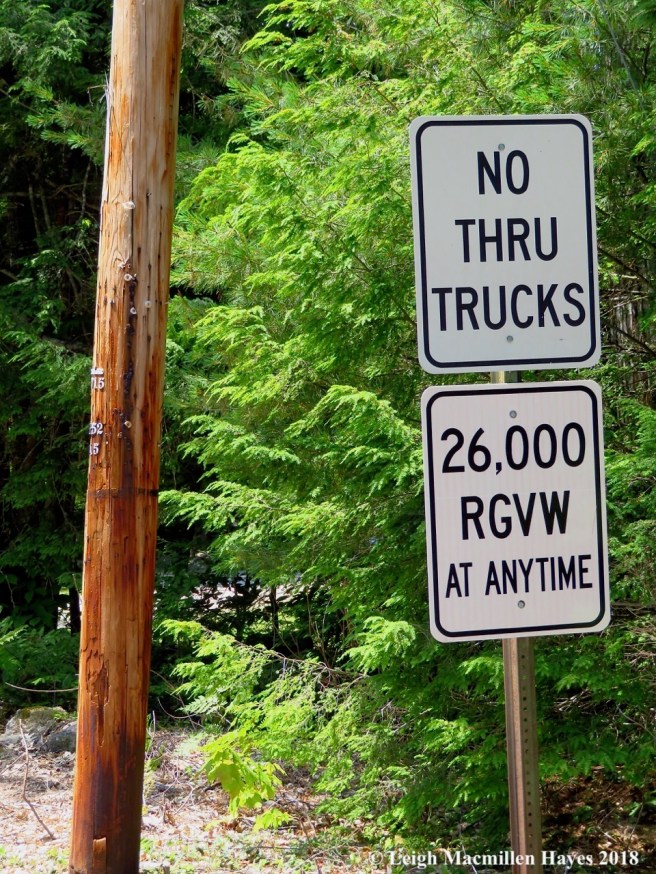
j1-Across from the sign and telephone pole

First off, you need to locate the small undefined parking lot. It’s about a mile beyond Foxboro Road, but I don’t pay attention to that. Rather, I look for the “No Thru Trucks” sign and turn on my left-hand blinker as soon as I spot it.
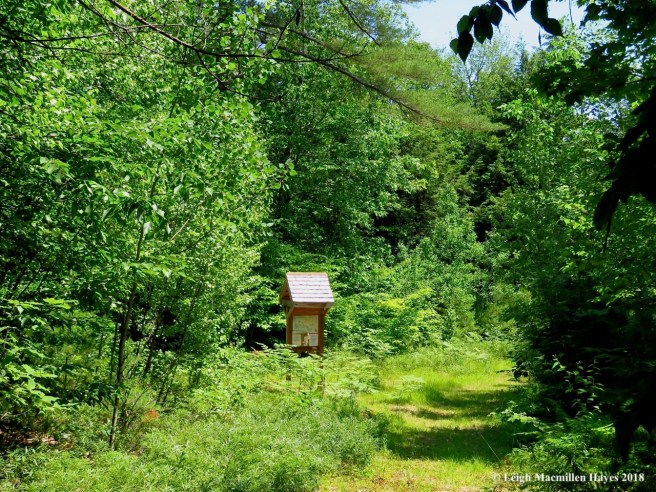
j2-trail and kiosk

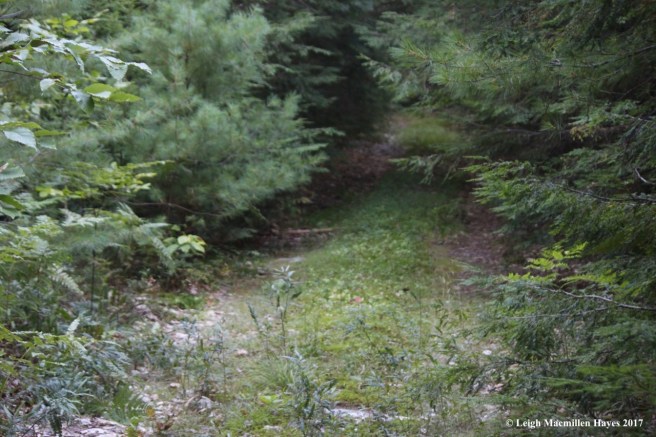
Just beyond a couple of boulders placed to keep vehicles from driving down the old skidder trail, stands the kiosk where you can take a look at the trail map and check out some other GLLT materials.
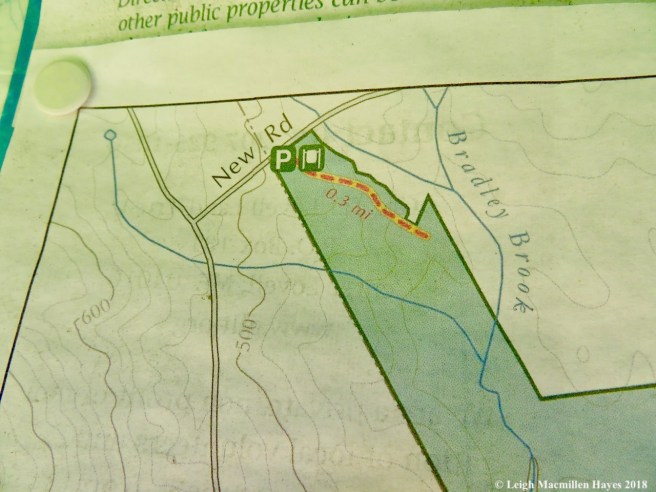
j3-map

As I said, this is just a small part of the overall refuge, but it’s well worth an exploration, especially if you don’t have much time (though some of us have been known to spend at least three hours making our way down and back).
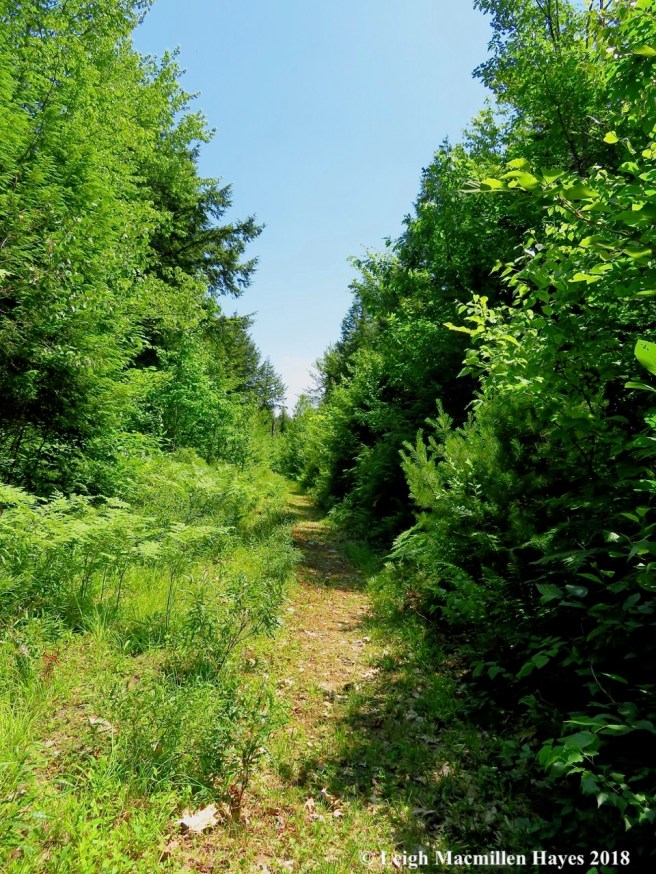
j3a-the trail mowed

Recently, the GLLT’s Associate Team and Intern mowed the trail, making it passable and not quite so tick-infested. But . . . still take precautions. Always! The trail is rather level, so it’s an easy one to travel.
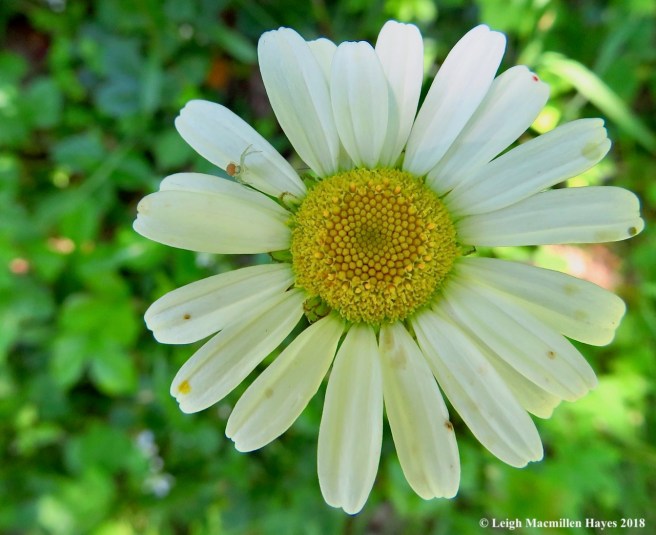
j4-daisy and crab spider

This is a place where you’ll find the ordinary, like a daisy. And trying to decide if “he loves me, he loves me not,” you might see a small crab spider.
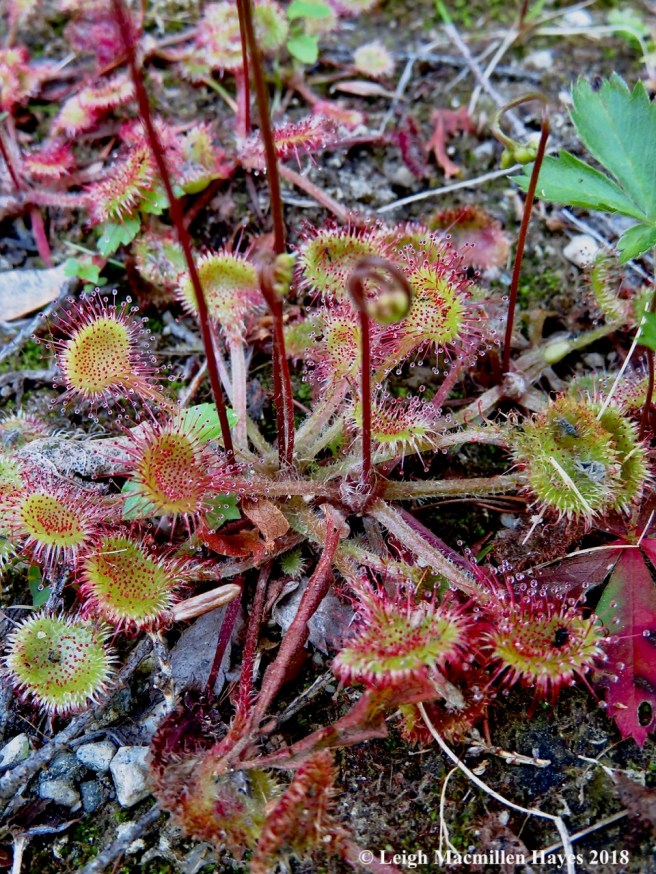
j5-sundews

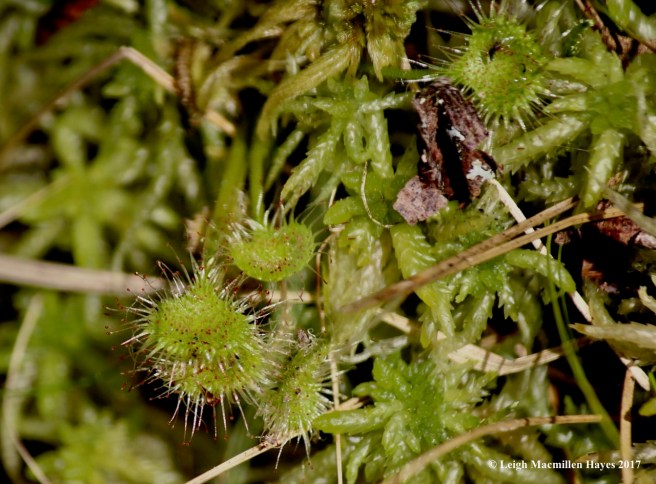
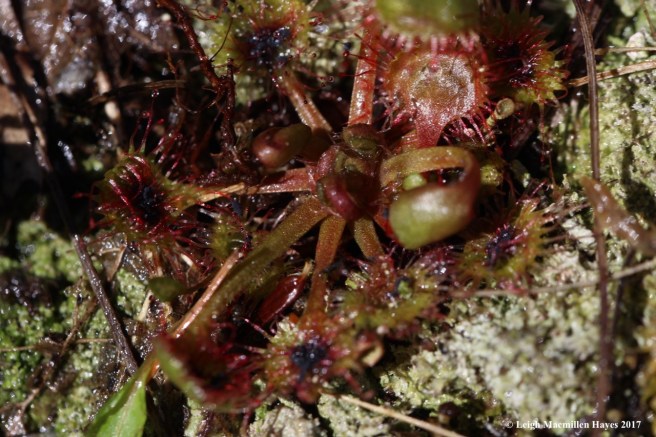
This is also the land of the extraordinary–in the form of the carnivorous Round-leaved Sundews. Check out the glistening droplets at the ends of the hair-like tendrils that  extend from each round leaf. The droplets are actually quite sticky. Just like a spider sensing a bug on its web, the tendrils detect the presence of prey and then curl inward, thus trapping the prey.  The whole leaf will eventually wrap around the insect and in the process of digesting it, the plant will absorb the bug’s nutrients. Sundews tend to grow in areas that lack sufficient nutrients, so this is the plant’s way of supplementing its diet. And if that wasn’t enough–it was just plain beautiful.

All that being said, this is a tiny plant and right now preparing to flower. So, if you travel this way, about a tenth of a mile into your journey, look down at your feet for these minute gems, take a closer look, and then walk with care.
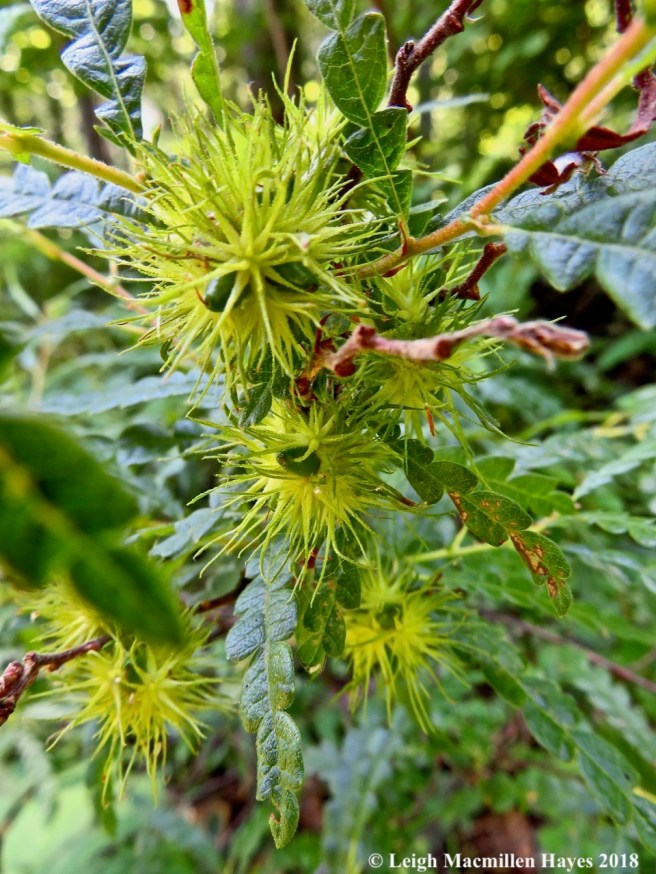
j6-sweet-fern

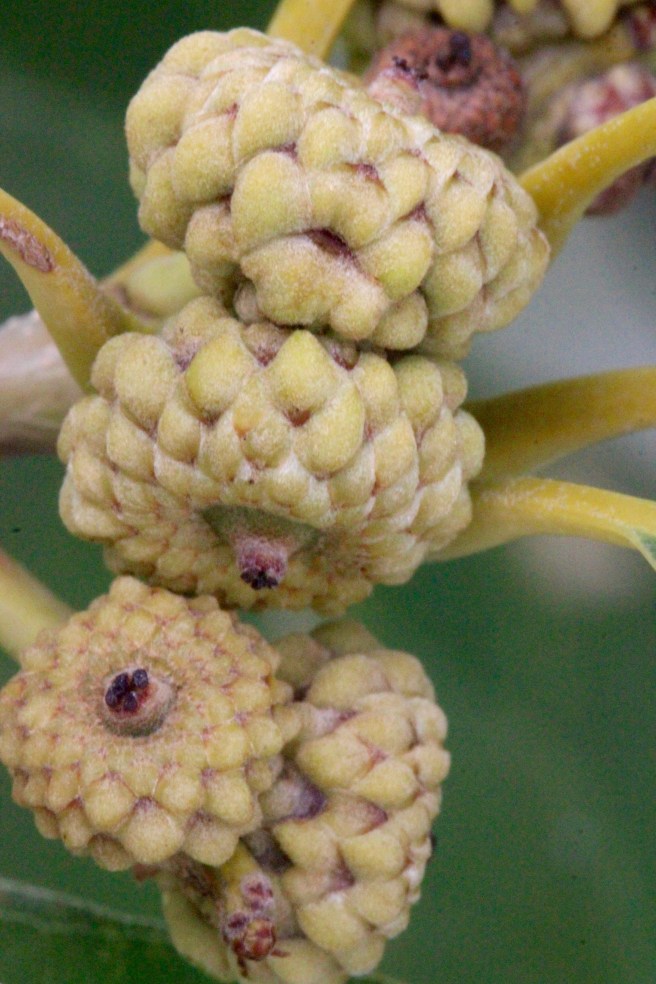
Further along the trail you’ll see a few species of ferns, as well as the fern that isn’t a fern. Sweet-fern is so named for it’s fern-like appearance, but it has a woody stem and is actually a shrub. It’s yellowish green flowers that first appeared in spring were giving way to greenish brown, burr-like nutlets. In any season, this shrub has such variation to offer, that like hobblebush, I can’t resist honoring it with a million photographs.

j8-raspberries

One of the sweet joys of this trail is that because of previous logging, early succession is taking place in terms of the plants and trees that grow beside the trail, including blackberries not quite ripe and these raspberries already offering a delightful reprieve on a humid summer day.
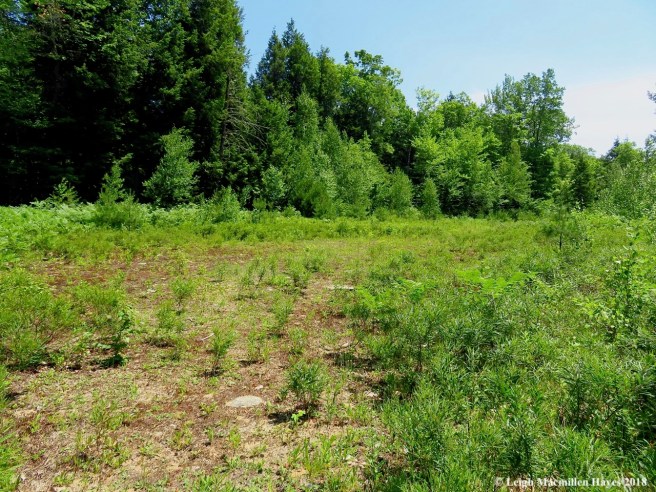
j14-the field

Eventually, the trail leads to the turn-around point, the old log landing, which also displayed signs of forest succession, for its there that some wildflowers and sweet-ferns grow in the center. At the perimeter, white pines, gray birch and blackberries crowd each other.
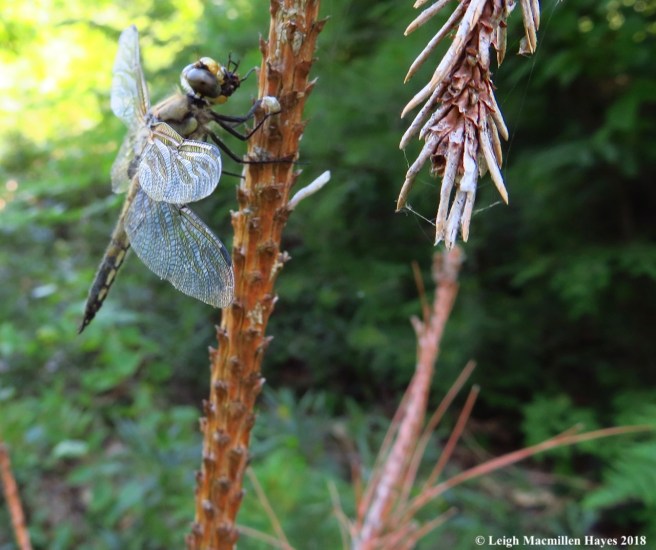
j10-four-spotted with food

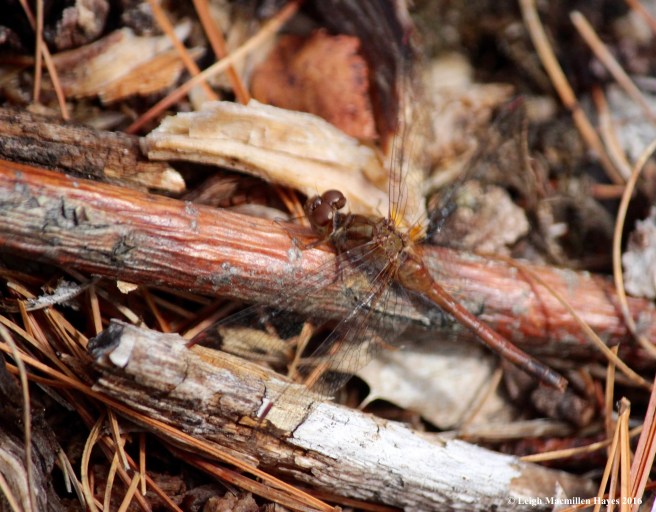
And on the edge, the dragonflies fly. And dine. This Four-spotted Dragonfly settled on a dead red pine to consume an insect.

j11-4 spotted eating

Ever so slowly . . .

j12-feeding frenzy

the body disappeared into its mouth.

j13-4 spotted, back view

While it was busy eating, I was busied myself in getting as close as possible to enjoy all of its nuances, from the four spots on its wings, to the basal display on the hind wings to the placement of its eyes and colors on its thorax and abdomen. All of those details help in ID.
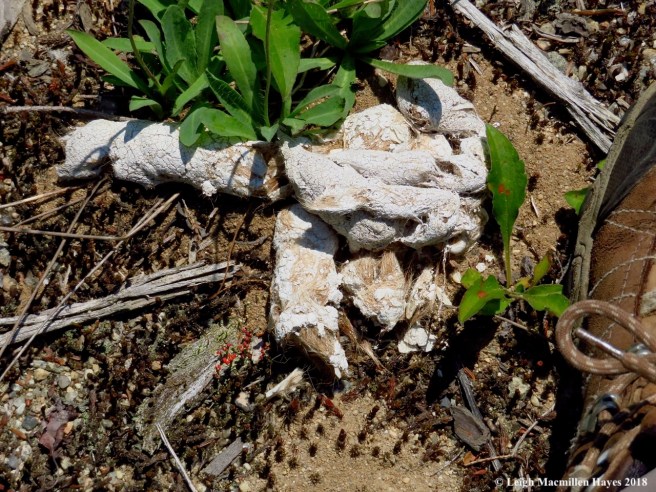
j15-old coyote scat

And then into the field I went, with a memory of a winter expedition when we noticed that a shrike had deposited a mouse in a tree. Today’s finds included a pile of old coyote scat probably also deposited this past winter that indicated a territory repeatedly marked.

j16-turtle?

I also spied lots of recently made depressions. While one might suspect dust baths by a turkey or grouse, feathers are usually left behind in the process. Instead, the ground was more disturbed and because the landing is close to Bradley Brook, I determined I was looking at recently dug holes made by turtles. Snappers and painted turtles have been depositing eggs recently and these may be the incubation nurseries for their offspring.

j16-racket-tailed emerald

As I turned back toward the trail, I noticed a dragonfly seeking shade, for so hot was it. Notice the bright green eyes of the Racket-tailed Emerald. Thank goodness for those emerald eyes that always help in narrowing down the choices.

j18-common dewberry:sphinx moth

I found it a bit more difficult to ID the sphinx moth that paid a visit to the Dewberries. There are only 1,450 species in the Sphingidae family, but my leaning was toward Nessus Sphinx, though I could be totally off on that one.
j20-Northern-bush Honeysuckle

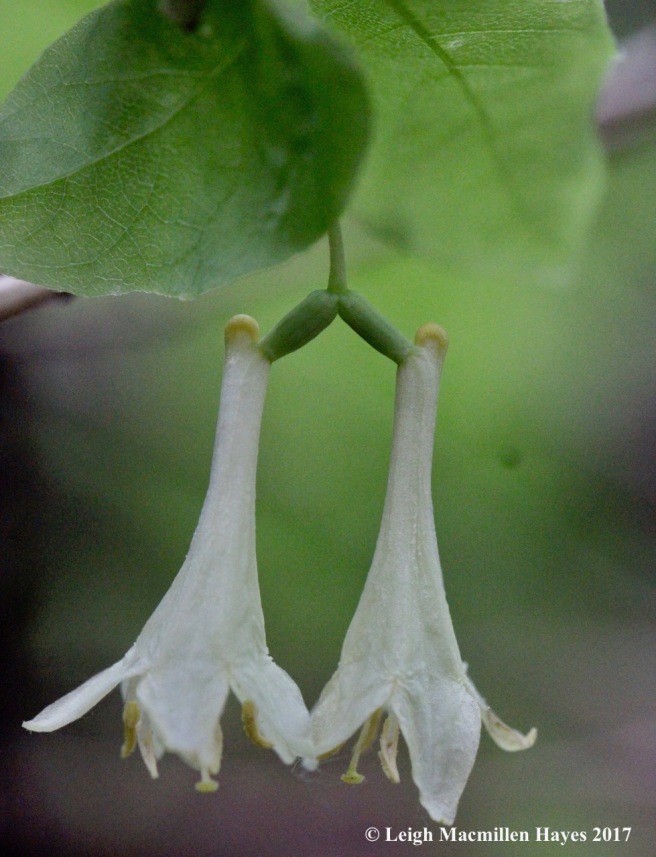
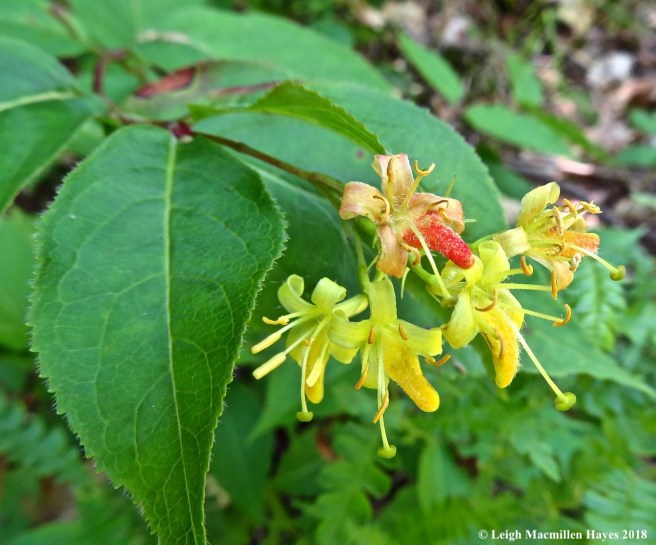
I was much more confident about my ID of the native Northern-bush Honeysuckle with its greenish-yellowish-orangish flowers. The plant is actually a shrub with a woody stem, and one that moose and deer like. I’ve yet to see a moose print along this piece of the property, but I know its part of a deer yard.
j21-Spotted St. John's-wort

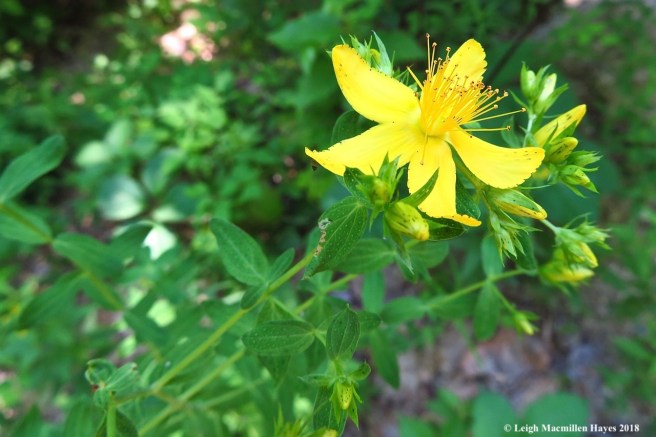
Also springing forth with yellow blossoms was Spotted St. John’s-wort, with its translucent spots on the leaves and tiny black dots outlining its petals.
j22-whorled yellow-loosestrife

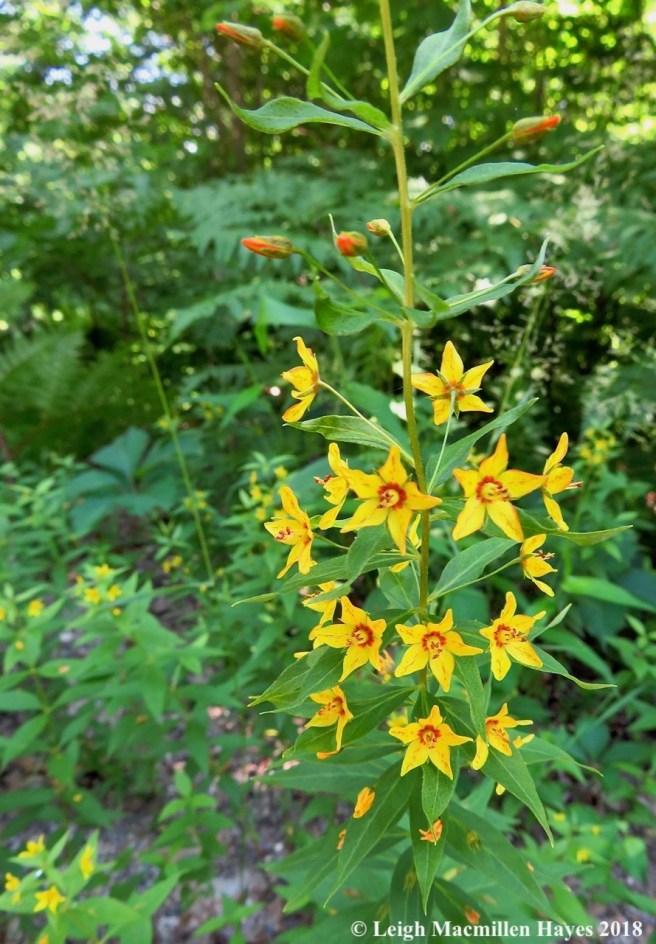
And not to be overlooked, the Whorled Yellow-Loosestrife with its cheery flowers extended in a whorl from the stem by long petioles.

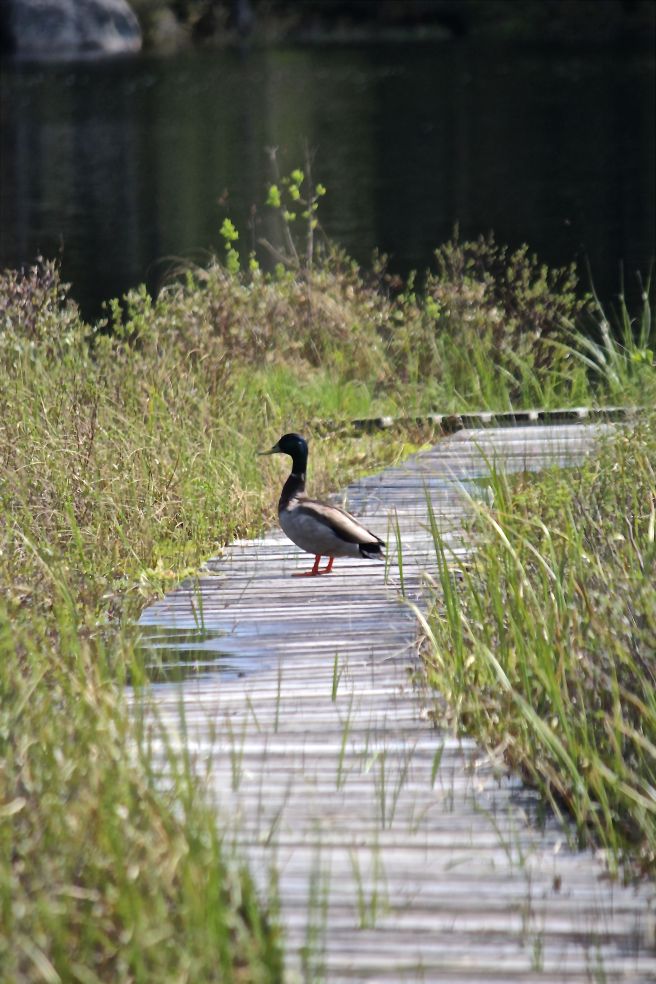
j23-hitchiker

My journey wasn’t long, but with all that I saw, I was thankful for the spirit of Mr. Segur that flies over this place.

Just possibly, he graced me with his presence today . . . in the form of Spangled Skimmer.

Beside Browns Pond

One should not work from home for then it is much too easy to do an about face with plans for the day and hit the trail before meeting deadlines. But alas, that is how I found myself on the Chessey Property this morning. It just seemed to make more sense to head out early in the day, rather than wait until the end to reward myself.

c14-map

The 100-acre property Chessey Property was forever protected from development under a conservation easement with the Presumpscot Regional Land Trust. Though I’d passed by numerable times, I had never before ventured that way.

c1-trail sign

And so this morning I decided to rectify that and drove to the trailhead. Actually, I drove past the trailhead, spotted the large cemetery on my left and turned around. The sign was facing in the opposite direction and easy to miss. Because the trail was only a half mile long, I figured it would be a quick trip. Apparently, I don’t know myself very well.

c2-snowshoes

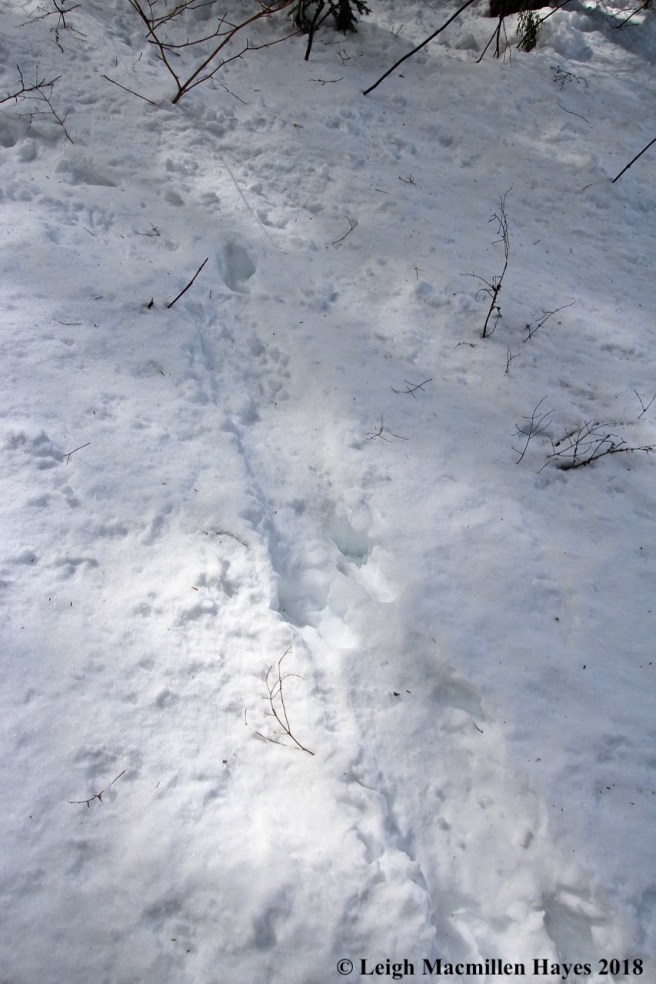
I hadn’t tramped far when I realized I was moving in the opposite direction of one whose ancestors had inspired my own mode of transportation.  The start of the trail is a field in early succession and so it made sense to find snowshoe hare prints crisscrossing the opening.

c3-red fox

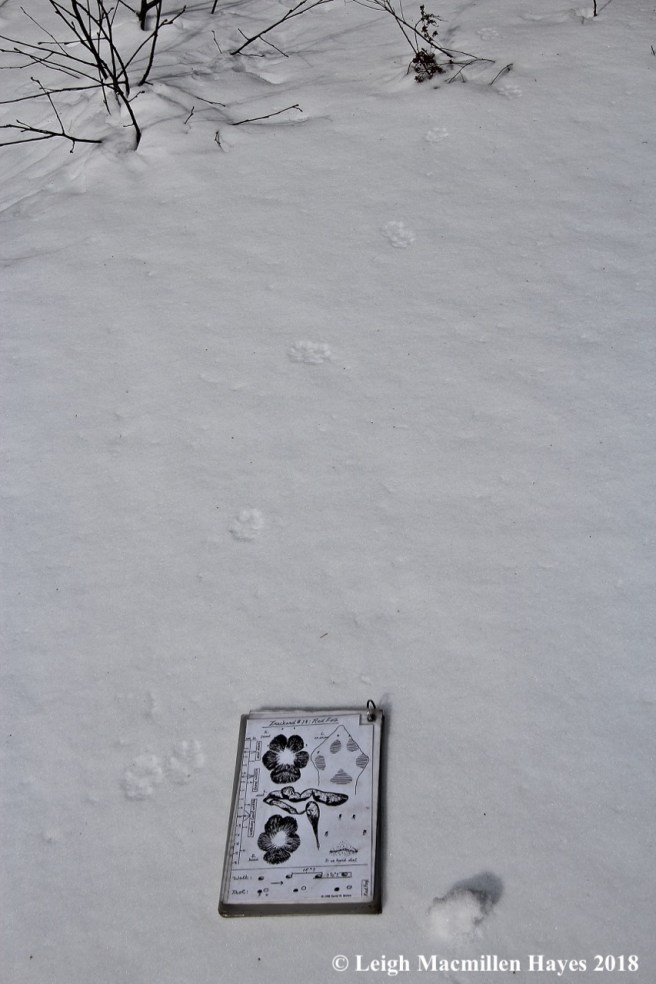
But . . . it wasn’t just a hare that had moved atop the snow. The print size and stride told me a red fox had also traveled there–and not too long before I’d arrived. To add to my identification was the chevron visible in the front foot print. Do you see what the arrows indicate?

c4-red fox track

I didn’t follow the track, and so I wasn’t sure if I was looking at prints made by one fox or perhaps two. My gut told me one and that the back foot didn’t always land exactly in the impression of the front.

c5-hare and fox cross tracks

Nor do I know how the story ended–for the fox crossed the hare’s tracks. Did the two ever actually meet?

c12-speckled alder

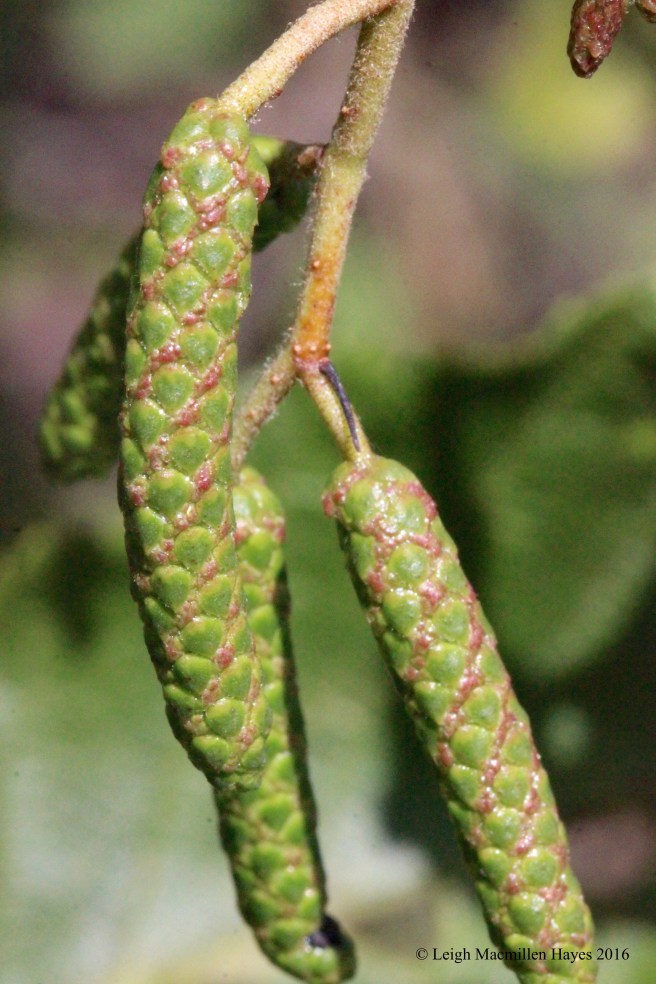
In the same area I found speckled alder, so named for its bark speckled with pores or lenticels. Its red and maroon catkins grew longer–well, at least the male catkins. The shorter catkins are the females, for alders are monoecious–male and female flowers grow on the same plant. As March gives way to April, the male color will deepen to burgundy, while the females will turn bright red–in full blush.

c13-pussy willows

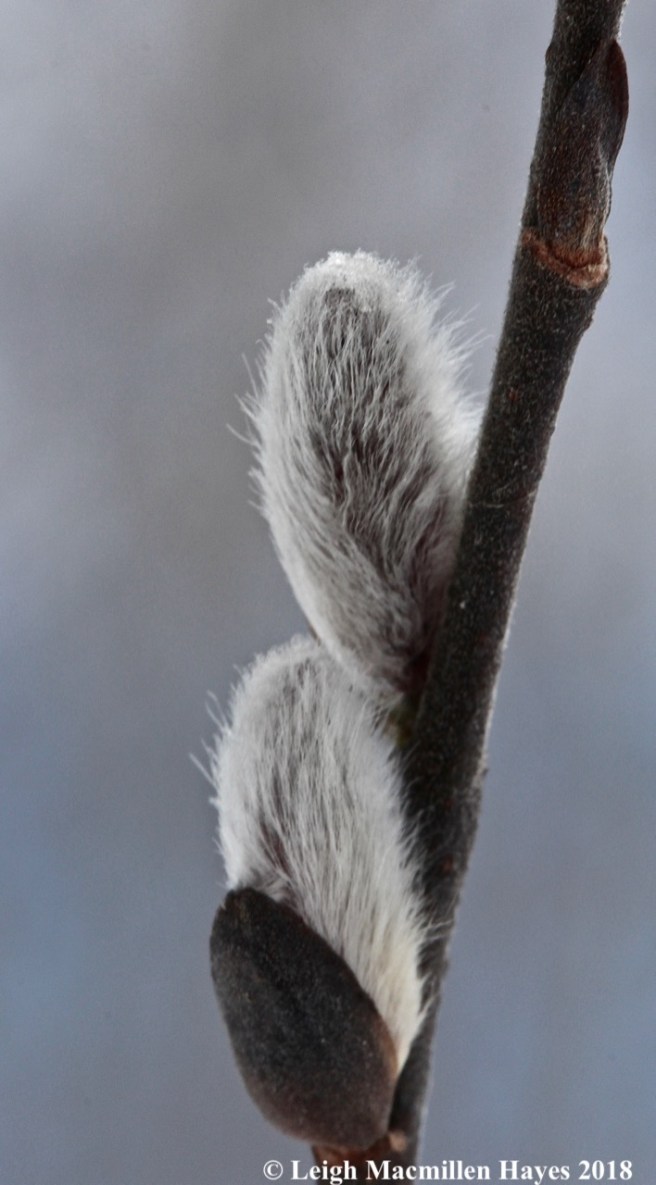
Another color also caught my attention–pussy willows with their furry little silver flower buds just opening. The soft tufts earned their common name due to their resemblance to tiny kitten paws.

c6-my tracks

All of that, and I hadn’t gone far from my truck. But, by the depth of my impressions, you can see that my travel would be slow for no one had packed the trail before me.

c7-water obstacle

I journeyed on, stopping every ten to twenty steps to look around, listen, and catch my breath. Tracking was almost impossible once I ventured into the forest for snow drops from the trees created their own random impressions. Water obstacles were a bit of a challenge, but I managed to manipulate around all four. And bird song included the throaty caws of Ravens. At one point I heard their powerful wing beats and looked up to see three chasing another bird that I couldn’t identify.

c10-face in the snow

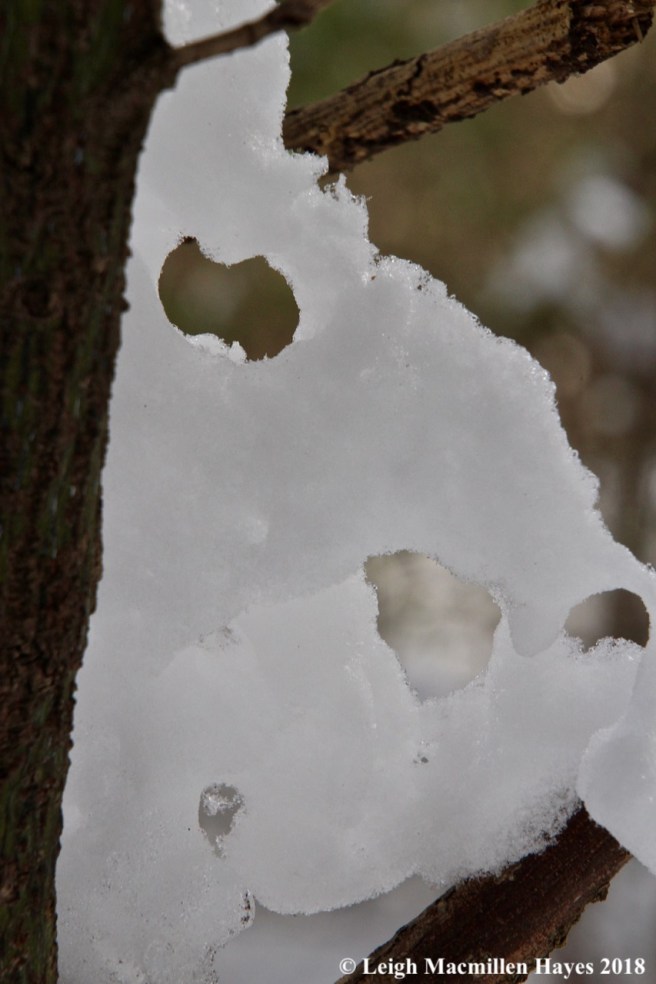
But never fear, though I couldn’t find tracks as I continued, I found plenty of other things to look at, including a tilted snow mask, and . . .

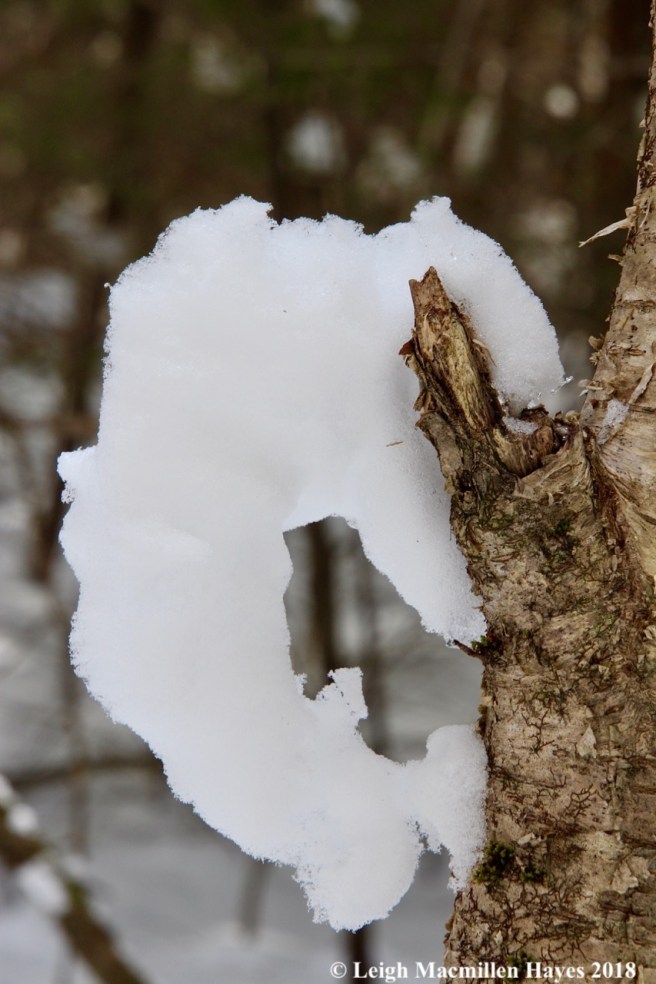
c11-snow art

snow sculptures. How does snow do that? Worth a wonder, indeed.

c8-otter tracks:slide

I’d almost reached the turn around point when I recognized a pattern by my feet and realized an otter had passed that way–probably yesterday based on the state of the slides, prints, and scat. One really cool thing that I learned as I followed its trail was that every once in a while it tunneled under the snow. I don’t know that I’ve ever noted that behavior previously. Most of its tunnels were about ten feet long and then it emerged again to bound and slide.

c9-Browns Pond

At last I turned my attention to the 110-acre pond that opened before me. It’s my understanding that it remains undeveloped–a rare feat in these parts. I wanted to stay and explore, but knew I had to save it for another day because work really did sit at home awaiting my attention. I trust I’ll return in another season when the traveling isn’t quite as difficult, but until then this morning’s moments beside Browns Pond will sustain me.


Brain Share–Naturally

I was thankful I’d thrown my winter coat into the truck for I had a feeling it would be a better choice than a vest given the group I’d be traveling with this morning. And sure enough, though the sun felt warm, a breeze added a chill to the air. Plus, I knew we wouldn’t travel far and would spend much of our time standing around.

r0-life on a rock

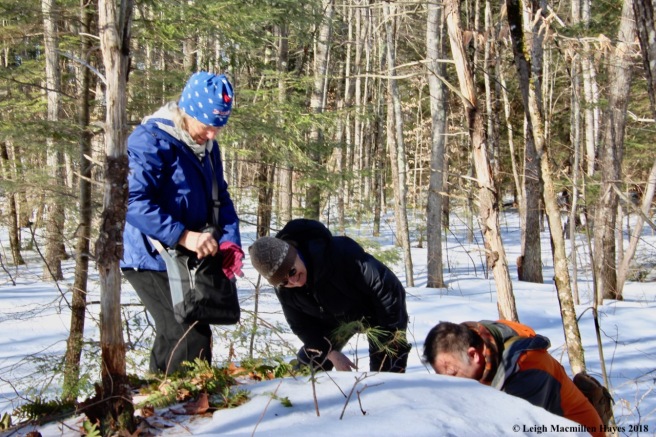
Well, not exactly standing, for as Maine Master Naturalists, we’ve been trained to get down for a closer look. Our first stop–to check out the life on a rock that was revealing itself as the snow slowly melted. Karen is on the left, an Augusta grad, and Sarah and Anthony to her right, both South Paris grads.

r0a-polypody

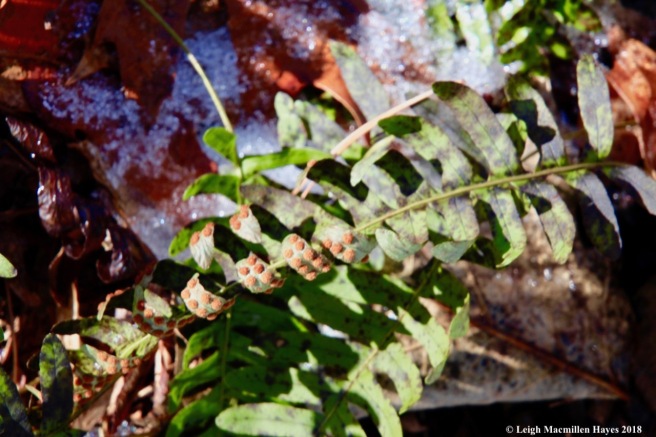
The focus of our attention was common polypody, a fern with leathery leaves and spherical spore clusters on the underside. Rocks are their substrate and they often give a boulder a bad-hair day look.

r1b-speckled alder

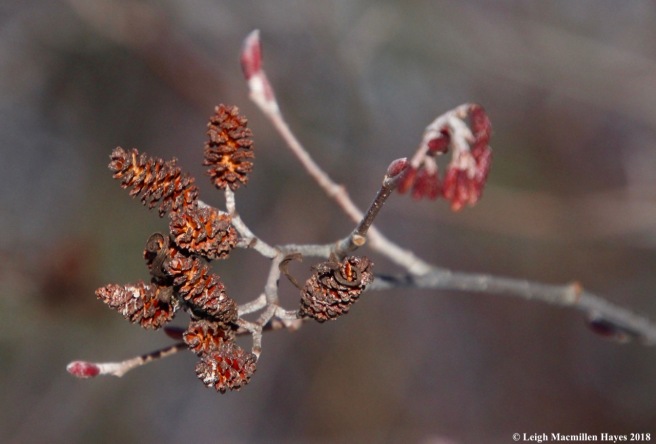
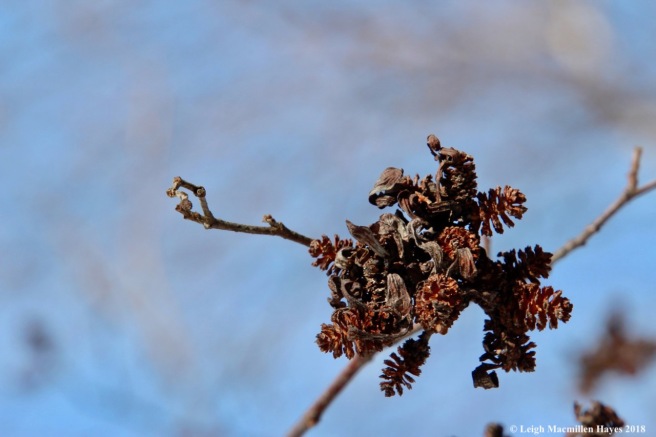
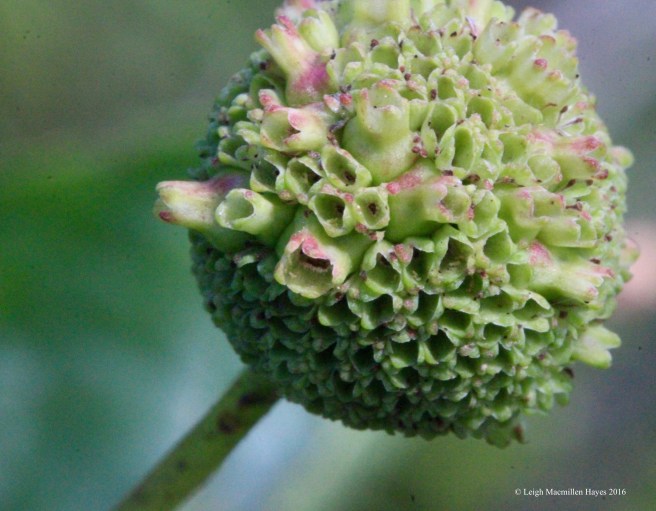
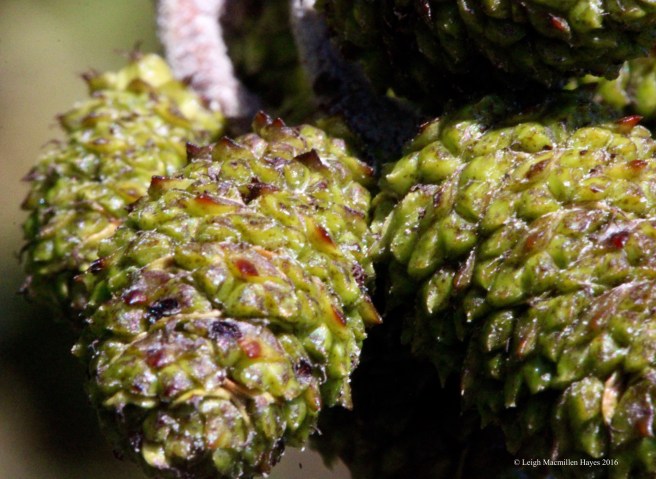
Moseying along, we reached a point where we knew we wanted to spend some time–at a wetland beside one of the Range Ponds (pronounced Rang) at Range Pond State Park in Poland, Maine. Because it likes wet feet, we weren’t surprised to find speckled alder growing there, but what did throw us for a loop was the protrusions extending from last year’s cones.

r1a-speckled alder

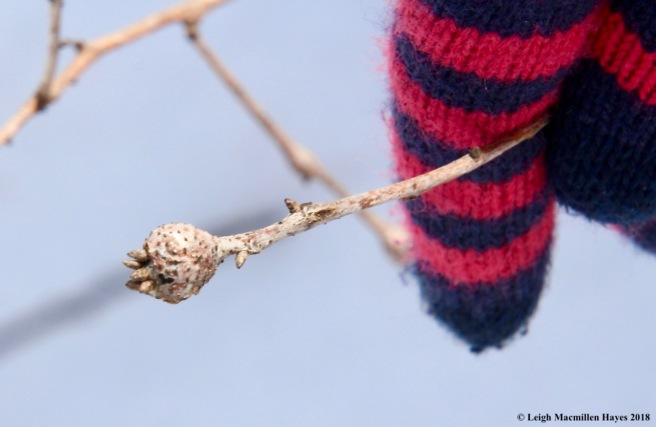
It was almost like they had tried to flower atop the cones and all we could think of was an insect creating a gall. Indeed, it appeared that the cones were also experiencing a bad hair day. After a little research, it may be alder tongue gall–resulting from a fungus rather than an insect infecting the female catkins. Apparently, the tongue-like growths are green to begin, but transform to orange, red and finally brown. It was certainly a new one for the four of us.

r2a-leatherleaf and sphagnum moss

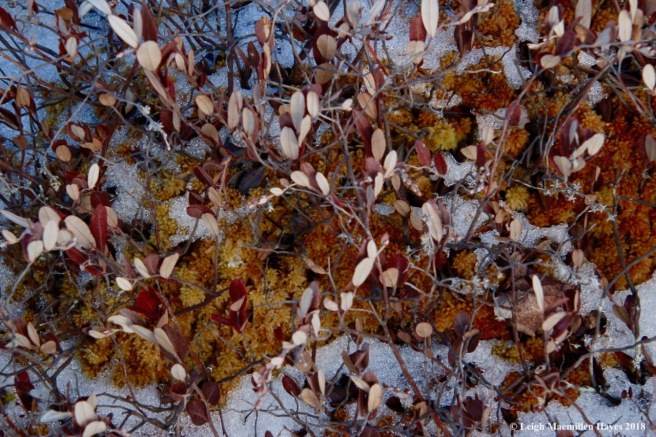
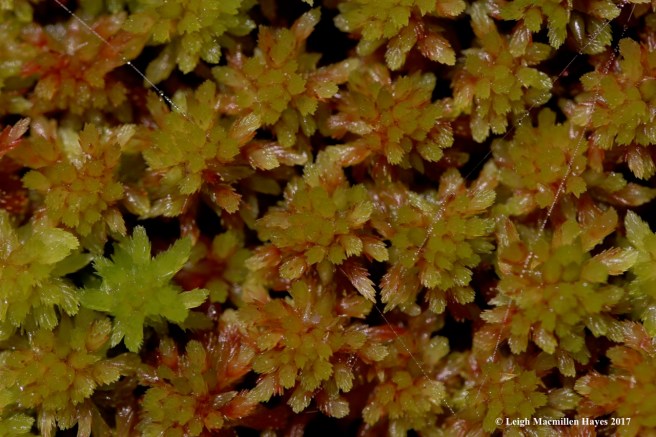
On we moved down to the wetland where the snow surprisingly held us for most of the journey and we didn’t leave behind too many post holes. Leatherleaf and sphagnum moss showed off their winter hues at our feet.

r4-cranberries

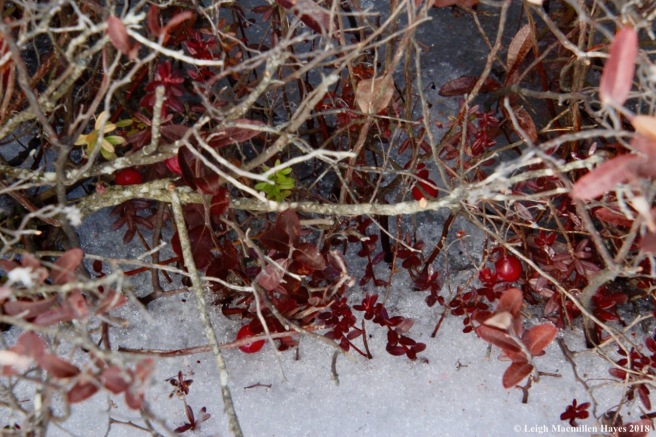
We also spied cranberries hiding underneath.

r3-cranberries among the leatherleaf

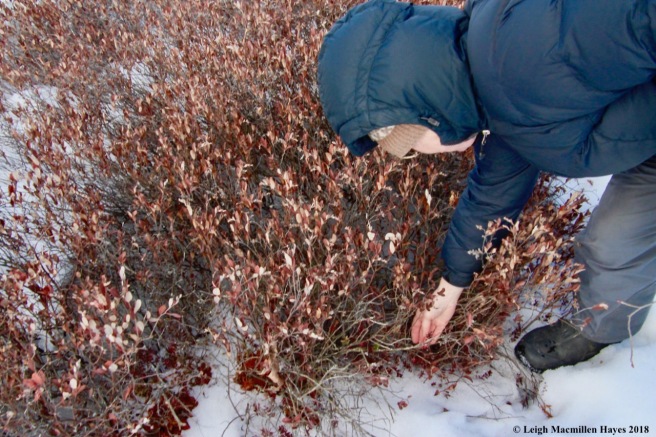
And sampled them. A few were tart, while others had fermented.

r1-two lodges

In the middle of the wetland, two well built lodges stood tall. They had fresh wood and had been mudded in the fall. One did look as if the vent hole had been enlarged, so we wondered if anyone still lived there. We heard no noises, but had to assume that we were bothering the residents so we didn’t stay long.

r2-wetland and pond beyond

One last view of the wetland and pond beyond, then we turned and walked toward the opposite side.

r5-bird nest

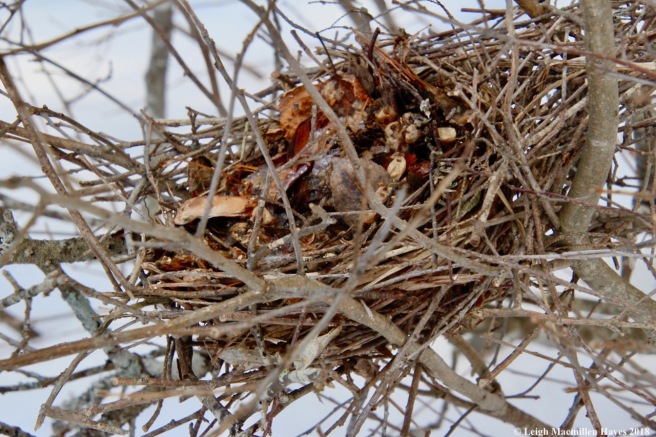
Just before climbing uphill, we spotted a bird nest in the winterberry shrubs. It was filled with dried berries, and we again made an assumption, that a mouse had cached its stash for the winter and maybe dined there in peace and quiet while the nest was covered in snow. That’s our story and we’re sticking with it. Whose nest it was prior to the mouse? We don’t know, but it was made of twigs. If you have an answer, please enlighten us.

r6-bone

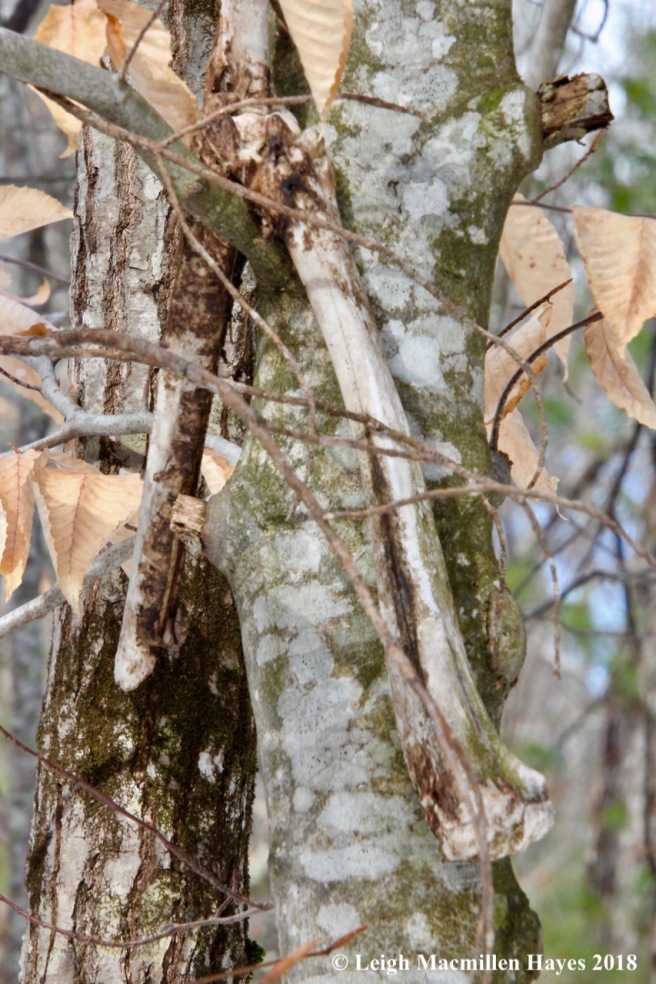
Back up on an old railroad bed, we again stopped frequently, including to talk about the beech scale insect and nectria fungus that moves in and eventually kills the trees. And then something else came to our attention–it wasn’t a broken branch hanging down like an upside-down V on the beech tree. No indeed. It was a bone. A knee bone. And it had been there for quite a while given its appearance.

r7-Introduced Pine Sawfly pupal case

Because Anthony was with us and he’s our insect whiz, we spent a lot of time learning from him–including about the pupal case of an introduced pine sawfly. The sawfly had already pupated and in this case no one was home.

r8-Introduced sawfly pupal case

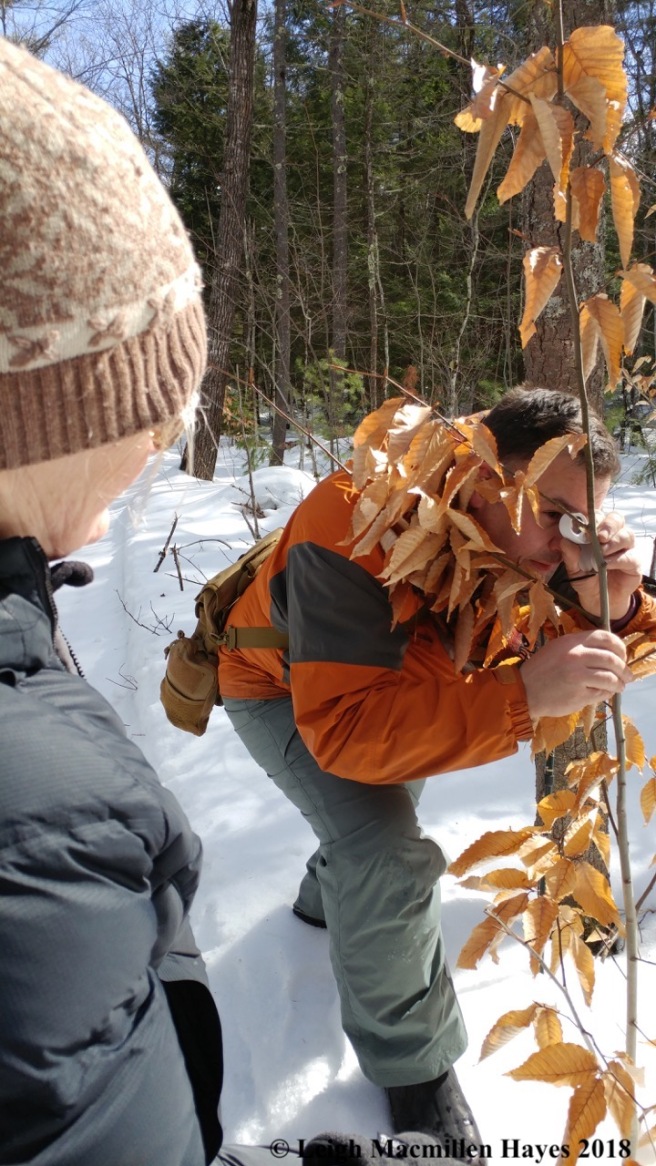
As the morning went on, we became quite adept at locating more cases of other sawfly species, including one that wasn’t yet opened. We each channeled our ten-year-old selves as we tried to be first to find the next one. But really, Anthony won for he had insect case eyes.

r9-going in for a closer look

And eyes for other things as well.

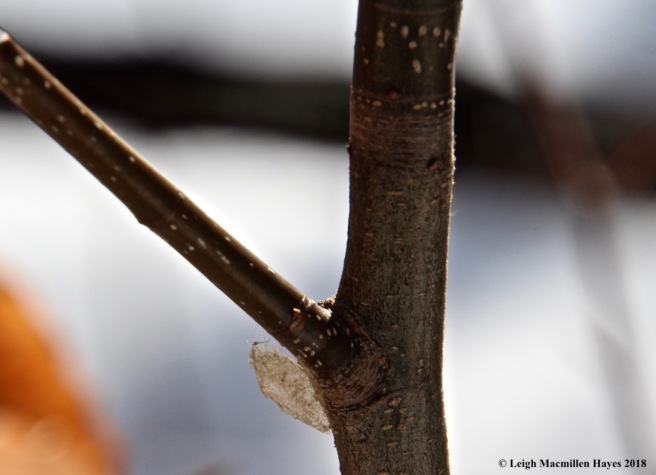
r10-old spider web case

This time we examined a delicate, almost lacy structure under a branch on a young beech. Anthony suspected a pirate spider, which tickled our fancy for we imagined them raiding the goods of others. But later he e-mailed with another option: “The old spider egg case could also be from an orbweaver of the araneidae family.” Either way, we were happy for the sighting; for taking the time to slow down and notice.

r11-beech leaves

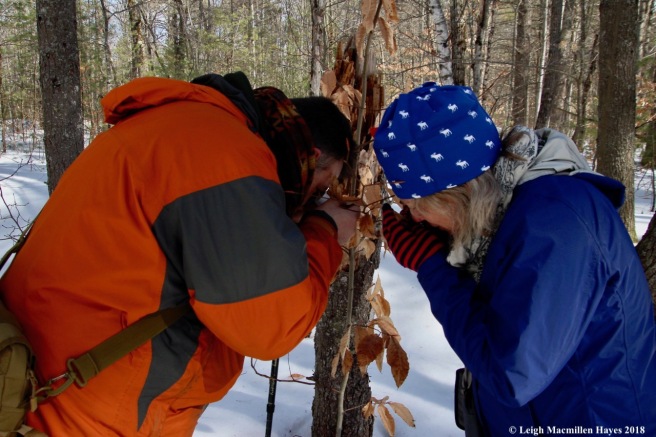
And there was more. Sarah had to leave us a wee bit early, so she missed our finds on the backside of beech leaves.

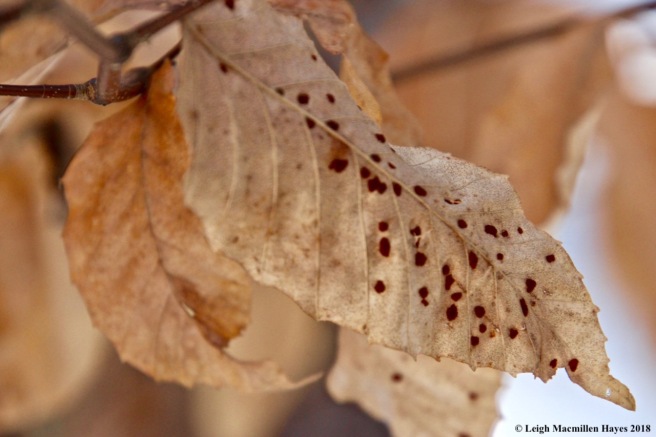
r12-maroon dots on beech leaves

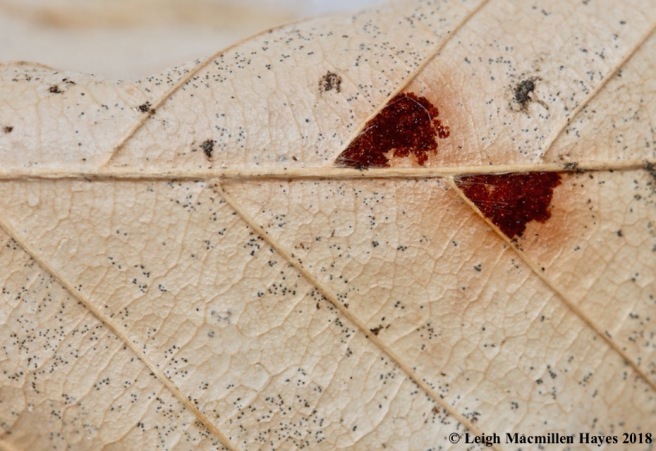
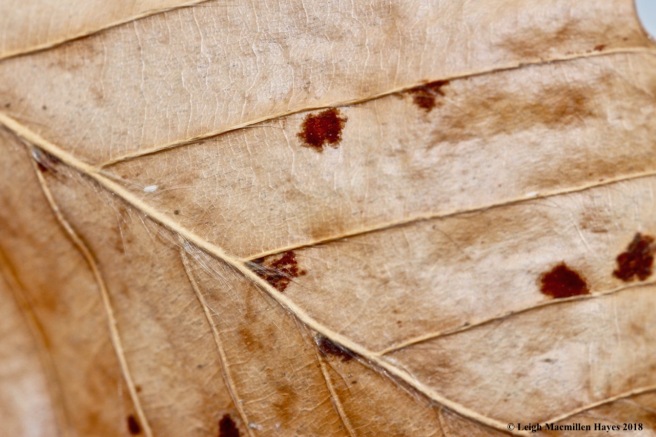
They were dotted with raised bumps that under our hand lenses reminded us a bit of the sori on common polypody.

r13-maroon dots on beech leaves

Leaf rust? Was it related in any way to the splattering of tiny black dots also on the leaves? We left with questions we haven’t yet answered.

r14-hair on beech leaves

Taking a closer look did, however, remind us of how hairy beech leaves are–do you see the hairs along the main vein? And that reminded us of how the tree works so hard to protect the bud with waxy scales all winter, keeping the harsh conditions at bay. In early spring, slowly the leaves emerge, ever hairy, which strikes me as an adaptation to keep insects at bay, and then . . . and then . . . it seems like every insect finds a reason to love a beech leaf and in no time they’ve been chewed and mined and you name it.

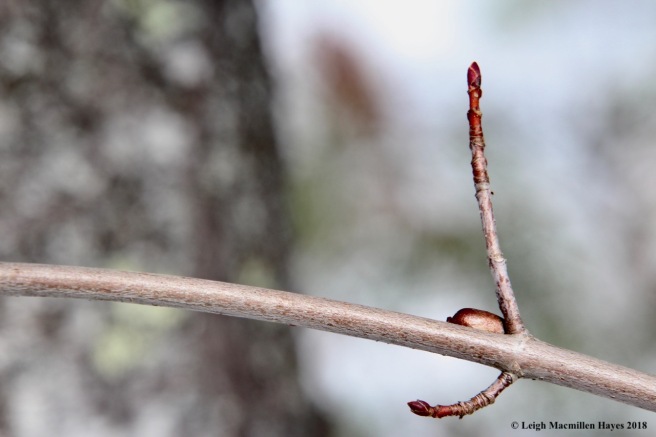
r15-oak gall

We made one more discovery before heading out–a gall formed on oak twigs. Do you see the exit hole? It’s in the shape of a heart–apparently the insect that created the gall loved the oak.

r15-pine tube moth

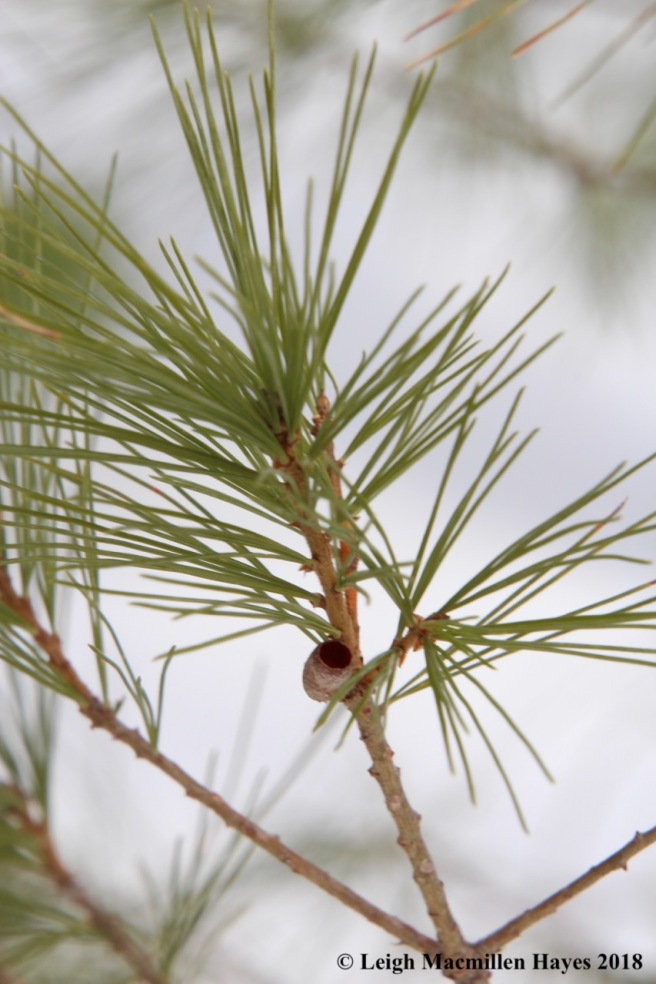
As we made our way back to the parking lot, I kept searching all the pine trees because I wanted to share an example of the tube created by a pine tube moth. Of course, there were none to be found, but as soon as I arrived home, I headed off into the woods for I knew I could locate some there. Bingo.

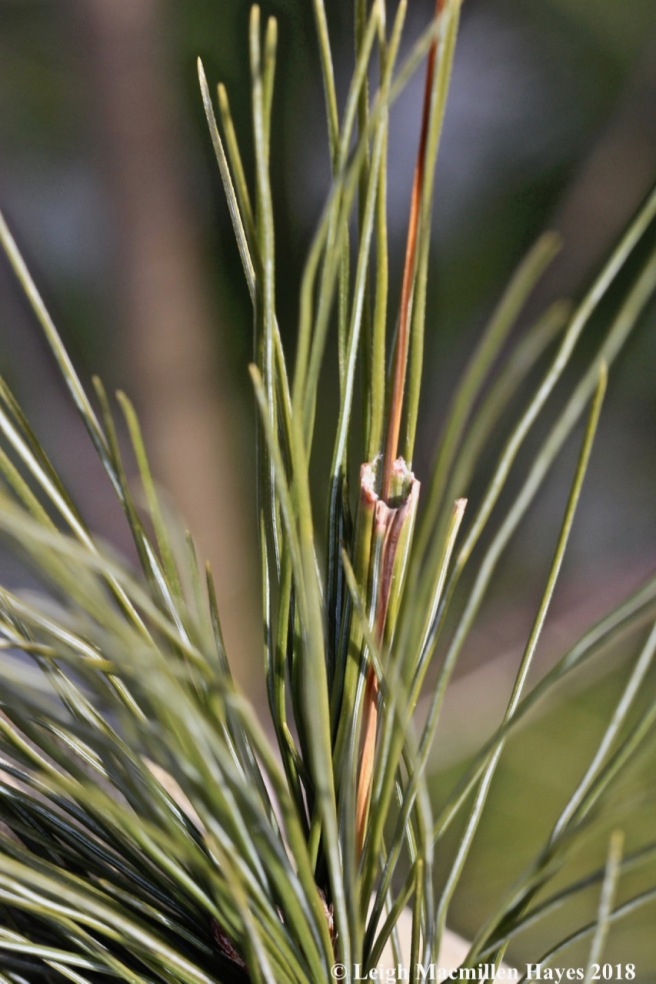
Notice how the lumps of needles are stuck together in such a way that they formed a tube. Actually, the tube is a tunnel created by the moth. The moth used silk to bind the needles together, thus forming the hollow tube. And notice the browned tips–that’s due to the larvae feeding on them. Eventually the overwintering larvae will pupate within the tube and emerge in April. Two generations occur each year and those that overwinter are the second generation. Fortunately, they don’t seem to harm the trees–yet.

Three and a half hours later we hadn’t walked a great distance, but our findings and learnings were many and we talked about how we’d added more layers to our understanding. Now if only we can remember everything. Thanks to Karen, Sarah and Anthony for sharing your brains me with–naturally.

P.S. Lewiston MMNP grads, et al, I’ll be in touch. Look for a doodle poll soon so we can get out and do the same. Or if you want to take the initiative, please feel free to go for it.


From wet to sweat

“Will I need waders?” I asked before we departed from the Lakes Environmental Association’s office  early Wednesday morning.

Dr. Rick Van de Poll looked down at my hiking boots and said, “No, you should be okay if you don’t mind getting muddy.”

l1-into the fen

And so, LEA teacher/naturalist Mary Jewett and I joined him to begin a two-day survey of LEA’s Highland Lake Preserve. The 325-acre property was the gift of the David and Carol Hancock Charitable Trust. Except for two logging roads, there are no trails.

Our first destination was in the middle of the fen. OK, so Mary and I should have known better because we know how much it has rained this summer. But really, it was quite hot that morning and our feet did get wet.
In fact, she found a deep hole on the way in.

l1-fen plot

Once reaching the plot, our tasks were several.

l1-flag

We helped delineate the boundary with measuring tape and flagging, the first being 10 meters by 10 meters, and then found the center, thus creating four quarters.

l1-Rick 1

Under Rick’s patient guidance and teaching, we began to survey the site, section by section, while he recorded our findings.

l1-measuring trees

Trees were first and needed to be measured to make sure they were trees after all, and not considered saplings.

l1-rhodora 1

Layer by layer, including shrubs,

l1-tamarack

seedlings,

l1-round leaf sundew 2

and herbaceous ground cover,

l1-round-leaved sundew 1

we made our way down.

l1-wasp pupa on hornworm 1

Along the way, other discoveries presented themselves, including wasp pupae on a hornworm,

l1-garden spider 1

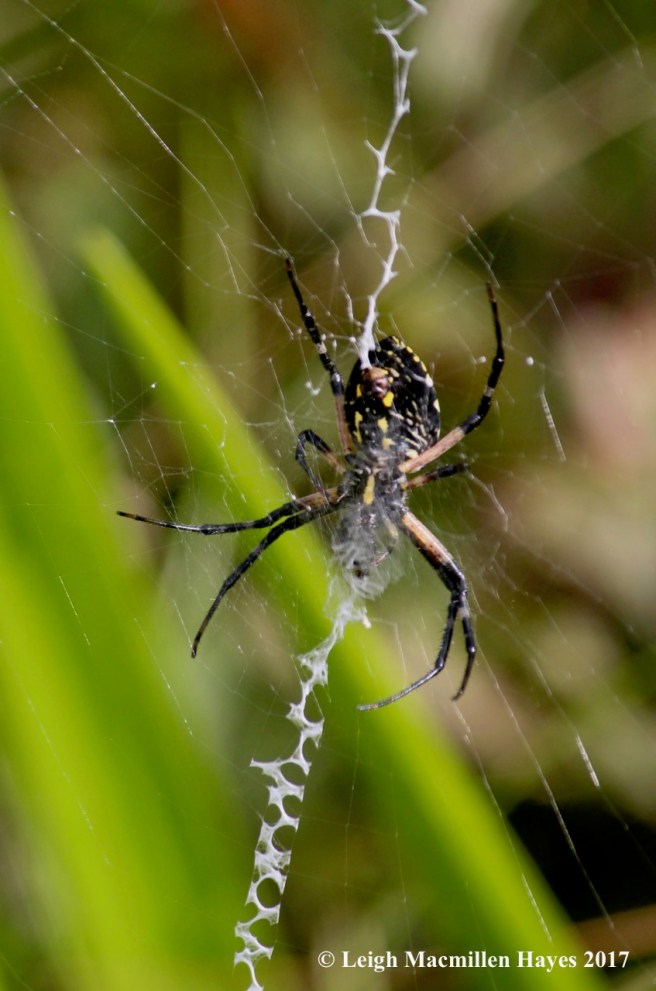
black and yellow garden spiders,

l1-garden spider 2

weaving their signatures,

l1-eastern pondhawk

eastern pondhawks,

l1-eastern pondhawk 1

up to the measure,

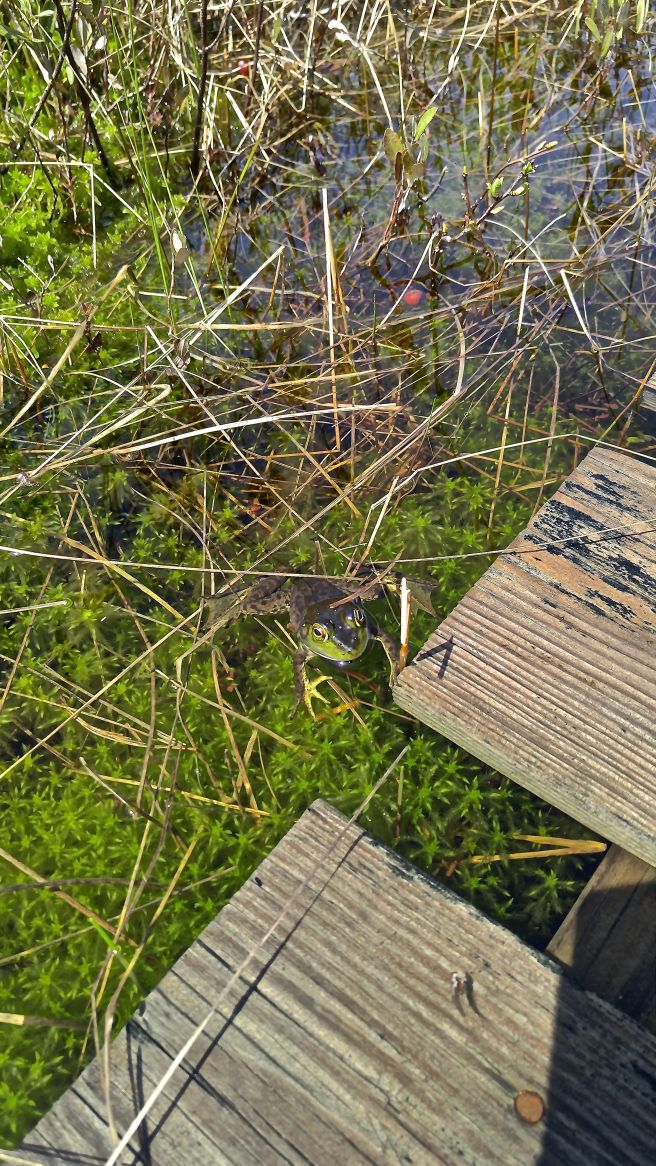
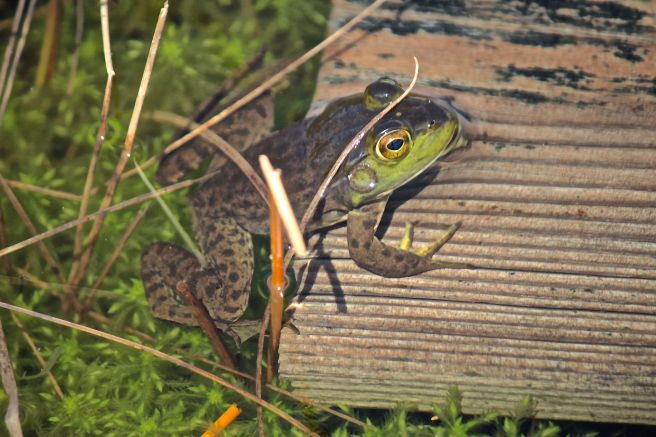
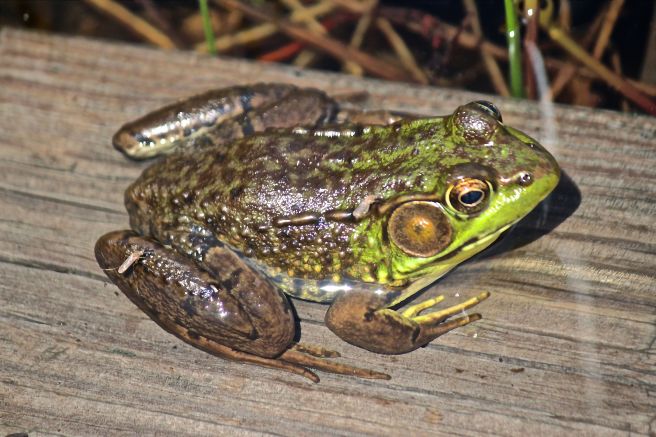
l1-green frog

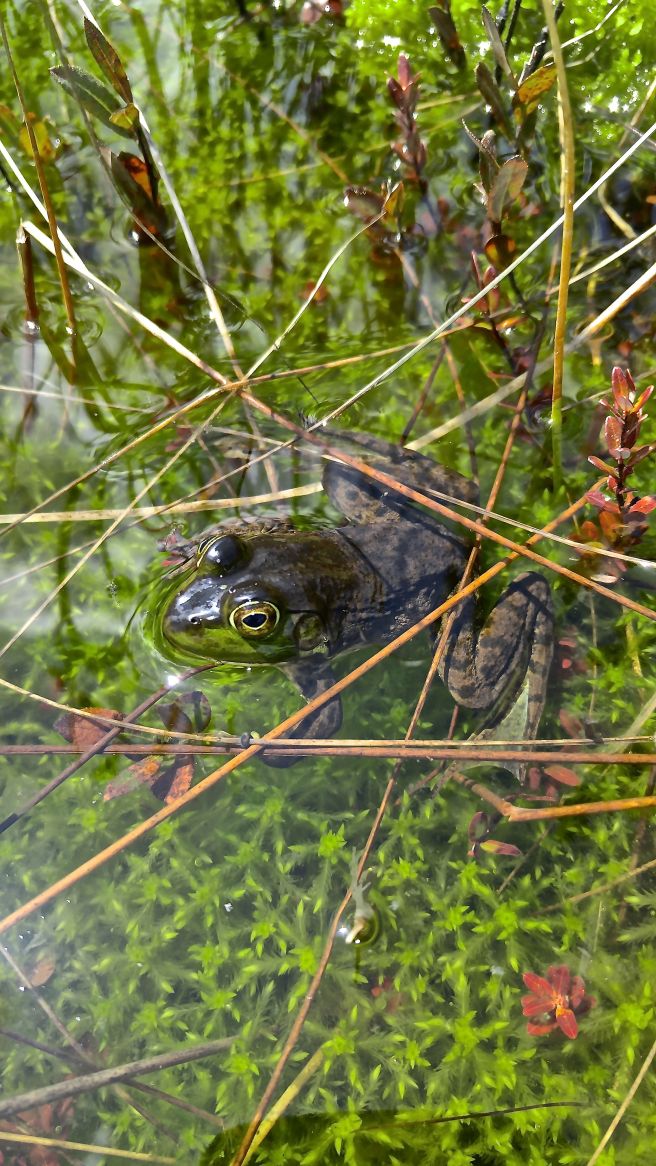
and of course, green frogs.

Swamp Thing

Four hours later I found a deep hole as we departed that plot. We slogged out, water swishing in our boots, and quickly ate lunch.

l2-hemlock plot

And then it was back into the woods for the afternoon, this time a hemlock grove. On the way, we marked off a site for Thursday’s work, before reaching our destination for the afternoon.

l2-surveying the site

This plot was 10×20 meters and so within we had nine smaller plots to examine in the same manner.

l2-squirrel bites

Though we identified all the species from top to bottom, we also noted more cool finds like squirrel chews on a striped maple,

l2-glue crust fungus

a crust fungus that acts like a glue and attaches dead wood to live,

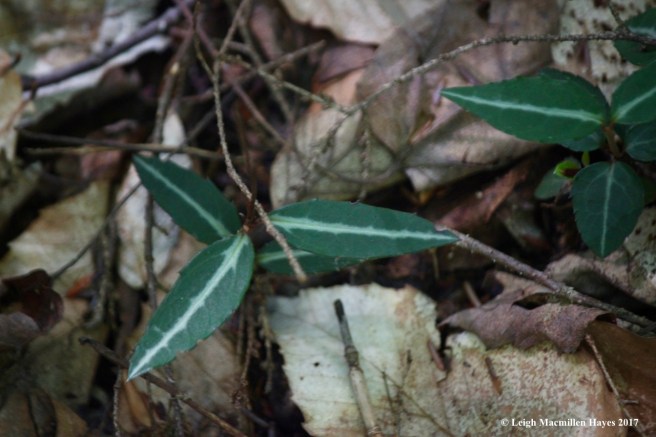
l2-spotted wintergreen

and spotted wintergreen, listed as S2 meaning this: “Imperiled in Maine because of rarity (6-20 occurrences or few remaining individuals or acres) or because of other factors making it vulnerable to further decline.”

l3-plot 3 (1)

I had to miss the Thursday morning session due to a GLLT hike, but met Rick and LEA’s education director, Alanna Doughty, as they finished their lunch. I think they extended it a few minutes as I was a wee bit late. This time, Alanna and I sat on the tailgate of Rick’s truck as he drove down a logging road–I, of course, held on for dear life, while she nonchalantly acted like it was a walk in the park. The best part of the ride was the smell of sweet-fern that our feet occasionally dragged over. And then our march began with a short trek through a wooded forest, before we reached the highbush blueberries and other shrubs that acted like hobblebush and made for careful movement.

l3-black and red spruce 3 (1)

The first afternoon site was in a black spruce bog and for once, I could confidently differentiate between black and red as they stood side by side–both by their colors, the black having a blueish hue, while the red was more yellowy-green, and their gestalt.

l3-cinnamon and chain ferns

One of my favorite learnings from that plot was the difference between cinnamon fern and Virginia chain fern. Again, they were easy to ID by their colors, the cinnamon already dying back. But notice the similarities.

l3-chain fern

And then we looked at the back side. While cinnamon has a separate fertile frond that forms in the spring and then withers, chain fern’s sporangia are oblong and on the underside.

l3-chain spores 2

The area was thick with the chain ferns and our every movement meant spores flew through the air.

l3-pitchers (1)

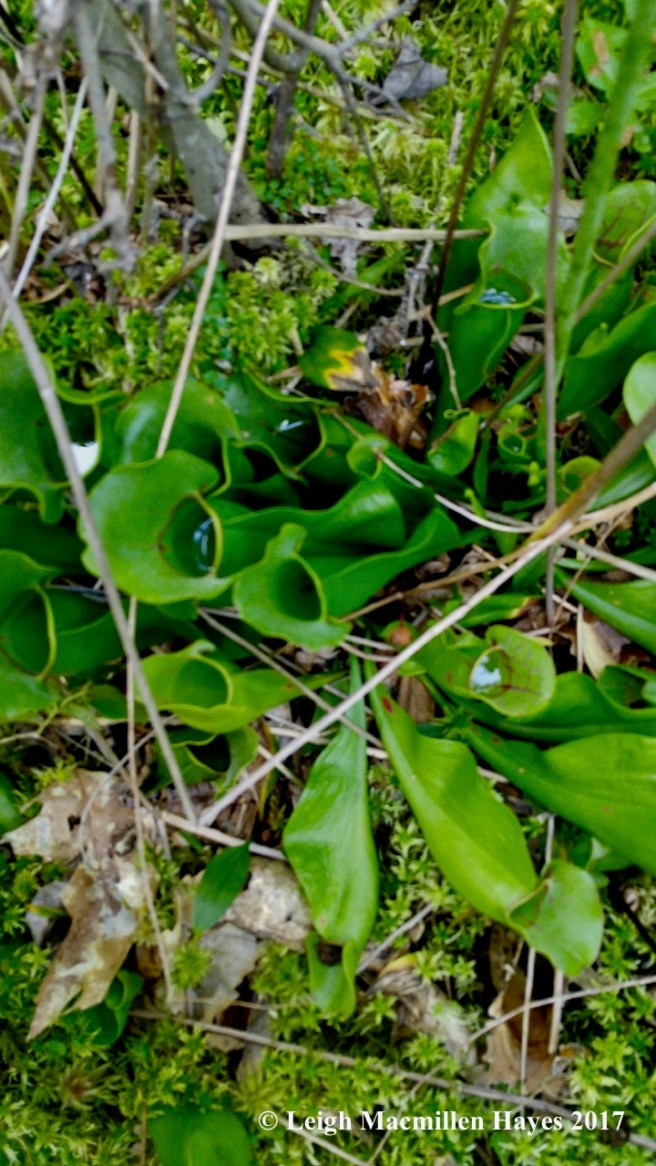
Every movement also meant we had to watch our every step, for so numerous were the pitcher plants. It was a great opportunity to ask Rick about the color of these–I’d been told that green is rare, but he said it’s just a matter of sunlight and age, all eventually take on a redder hue in veins and then overall leaf coloration as they mature.

l3-pitcher plants

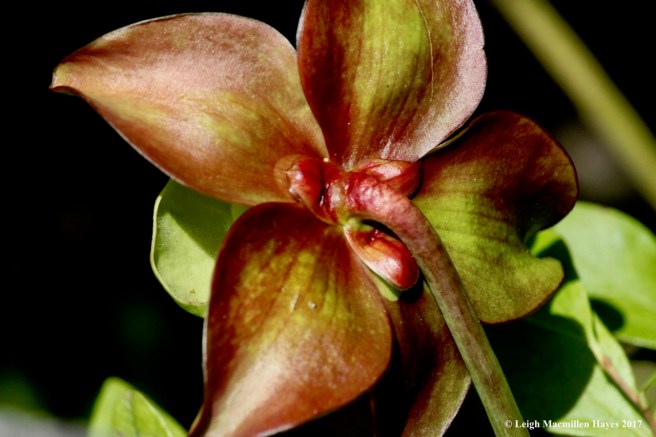
Their flowers were also plentiful in this lush space.

l3-chanterelle waxy cap 1

Among other things, Rick is a fungi expert (and an overall fun guy with corny jokes–the mark of a teacher), and so our learnings were plentiful, including these chanterelle waxy caps.

l4-plot 4 (1)

After making our way back out through the tangle, we hopped back onto the tailgate for a short ride and then headed off into a mixed forest for the final 10x 20 plot.

l4-deer skull

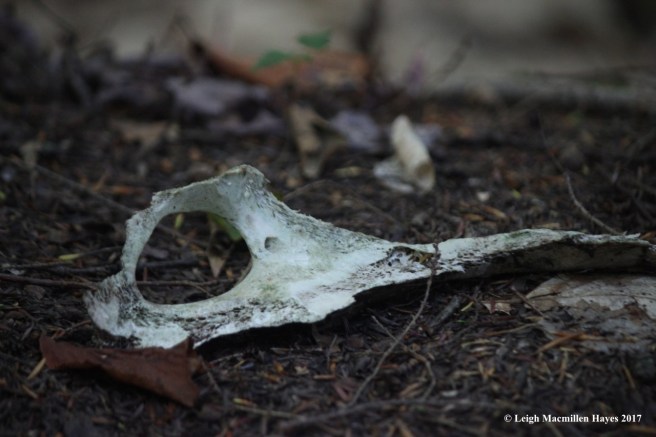
Our cool finds in this one included a much gnawed skull,

l4-orchid

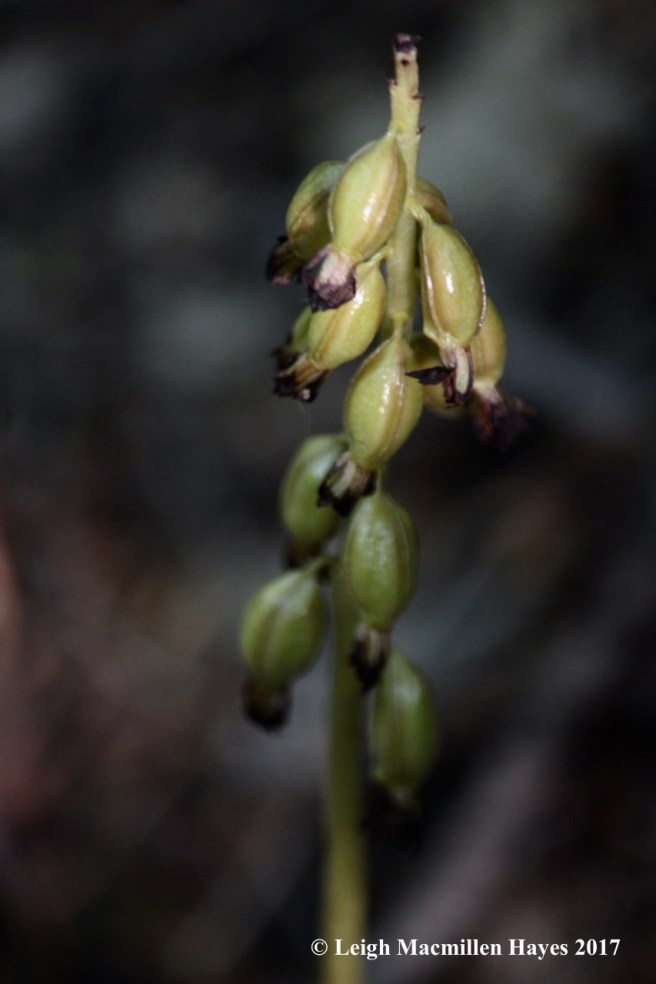
and spotted coral-root.

l4-bristly clubmoss

I also learned to ID one clubmoss–bristly tree so named for its bristly stem.

l4-back up the road

It was dinner time when I again held on for dear life as we drove up the road. To say we were sweaty, stinky, hungry and pooped would be an understatement. By the same token, I think I can speak for Mary and Alanna to say that we were more than grateful to have spent so much time learning from Rick. From wet to sweat–it was well worth the effort.


Book of June: Bogs and Fens

My wish was granted when I asked for a copy of Bogs and Fens: A Guide to the Peatland Plants of the Northeastern United States and Adjacent Canada by Ronald B. Davis for Christmas.

b-bogs and fens cover

The idea for this book came from many years spent by Davis as a biology and Quaternary studies professor at the University of Maine and Colby College, plus his services as a docent at the Orono Bog Boardwalk in Orono, Maine.

Since I spend a lot of time tramping through a few favorite bogs and fens as well as visiting others, this seemed like the perfect guide to help me better understand the world of these special communities. And then I realized that on our own property grows some of the vegetation associated with these wetlands. With them right under my nose, what better way to learn?

Davis begins by describing the occurrence and indicator species of peatlands and then he goes on to give a lesson on the ecology of wetlands, including a description of peat, fens and bogs. A bibliography is provided for further reading and terms are defined.

What really works for me though, is the species descriptions, which he’s taken the time to divide into their various layers–trees, tall shrubs, short and dwarf shrubs, prostrate shrubs, herbaceous plants and ferns. Within each section, a specific plant is described, including its Latin name, common names, family, characteristics such as how tall it grows, number of petals, fruit, if any, etc., and its occurrence–whether in a fen, bog, dry hummock or other. All in all, he features 98 species, but also mentions 34 comparative species and includes an annotated list of 23 additional trees, shrubs, herbs and ferns that may grow in one or more community. And finally, the book ends with a description of pathways and boardwalks worth visiting.

b-sphagnum moss

And so this morning, I walked out back to look at our wetland, where the sphagnum moss’s pompom heads were crisscrossed by spider webs donned with beads of water.

b-sundew 2

It’s there that the round-leaved sundews grow, which I only discovered last year. Notice those bad-hair day “tentacles” or mucilaginous glands and the black spots upon the leaves. Dinner was served–in the form of Springtails or Collembola–their nutrients being absorbed by the plant to supplement the meager mineral supply of the sphagnum community.

b-sundew flower forming

And in the plant’s center, the flower stem begins to take shape. This summer, it will support tiny white flowers that will turn to light brown capsules by fall.

b-sheep laurel

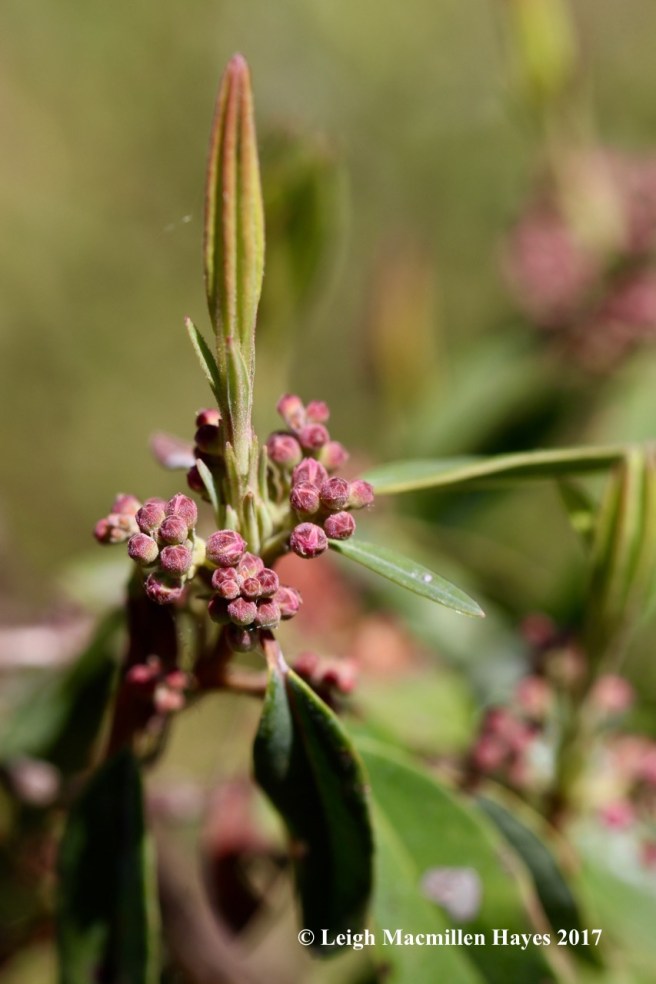
Sheep laurel also grows in this place, its new buds forming in the axils below the newly emerged leaves. I can’t wait for its crimson flowers to blossom. Its flowers provide an explosion of beauty, and yet, danger lingers. This small shrub contains a chemical that is poisonous to wild animals, thus one of its common names is lambkill.

b-steeplebush leaves

Another short shrub is the rosy meadowsweet or steeplebush with its deeply toothed leaves.

b-steeplebush

Being only June 1st, it’s too early to flower, but last year’s steeple-like structure still stands tall in the landscape.

b-lowbush blueberries

Low-bush blueberries grow here as well and it’s only now that I realize I need to return and study these some more for Davis differentiates between velvet-leaved blueberries and common low-bush. I assumed these were the latter, but according to his description, the leaves will tell the difference. Apparently velvet-leaved, which I’ve never heard of before, feature “smooth-edged, alternate leaves, and bear fine, short hairs on the underside, edges and along veins of the upper side,” while low-bush leaves “have a finely serrate edge and a lack of pubescence, except rarely a sparse pubescence along the veins.” The next time I step out there, I will need to check the leaves to determine whether we have one or both species.

b-black chokeberry1

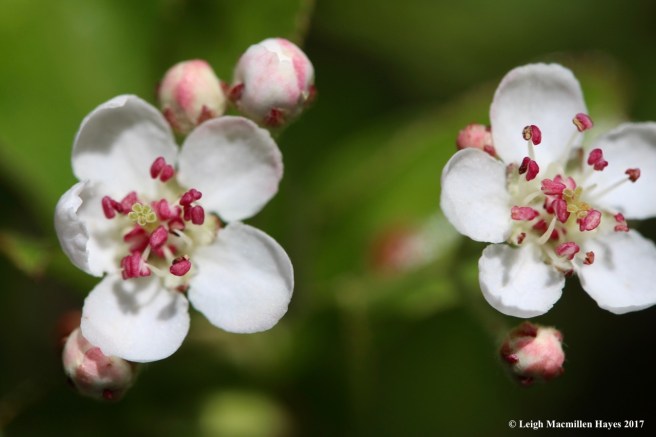
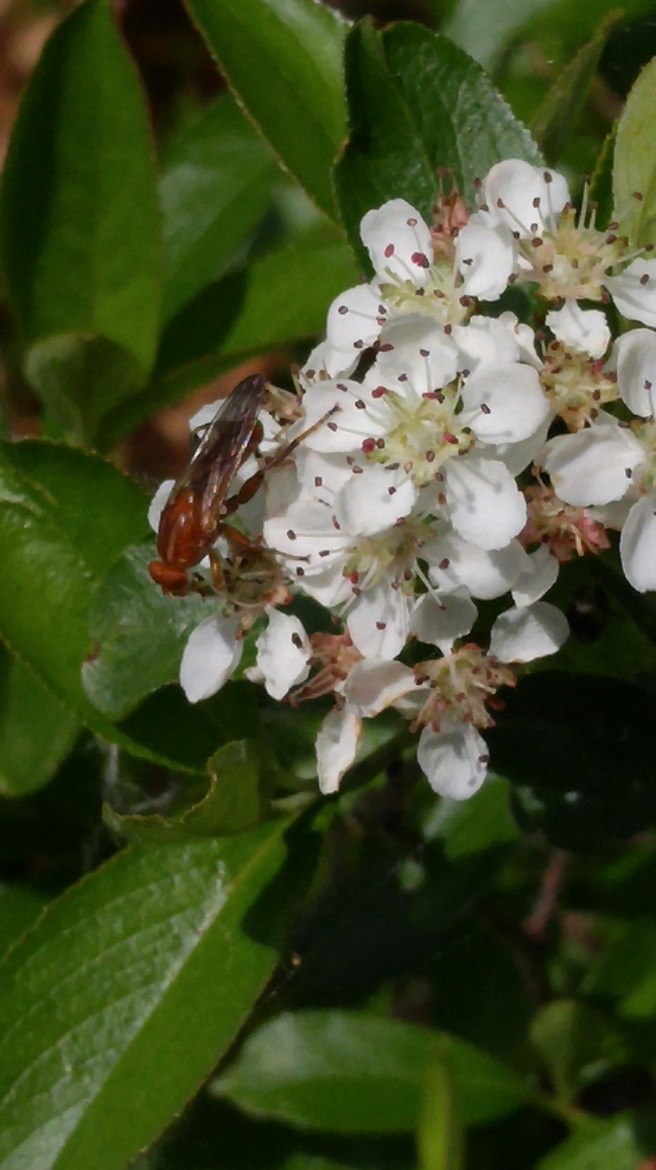
Of course, my favorite at the moment is the black chokeberry because the flowers provide a wow factor.

b-black chokeberry and ant

I’m not alone in my fascination.

b-water scavenger beetle larvae

Because I was nearby, I walked to the vernal pool, where a wee bit of sunlight highlighted another fascination of mine–my most recent discovery of water scavenger beetle larvae. Check out those heads and eyes.

b-tadpoles 1

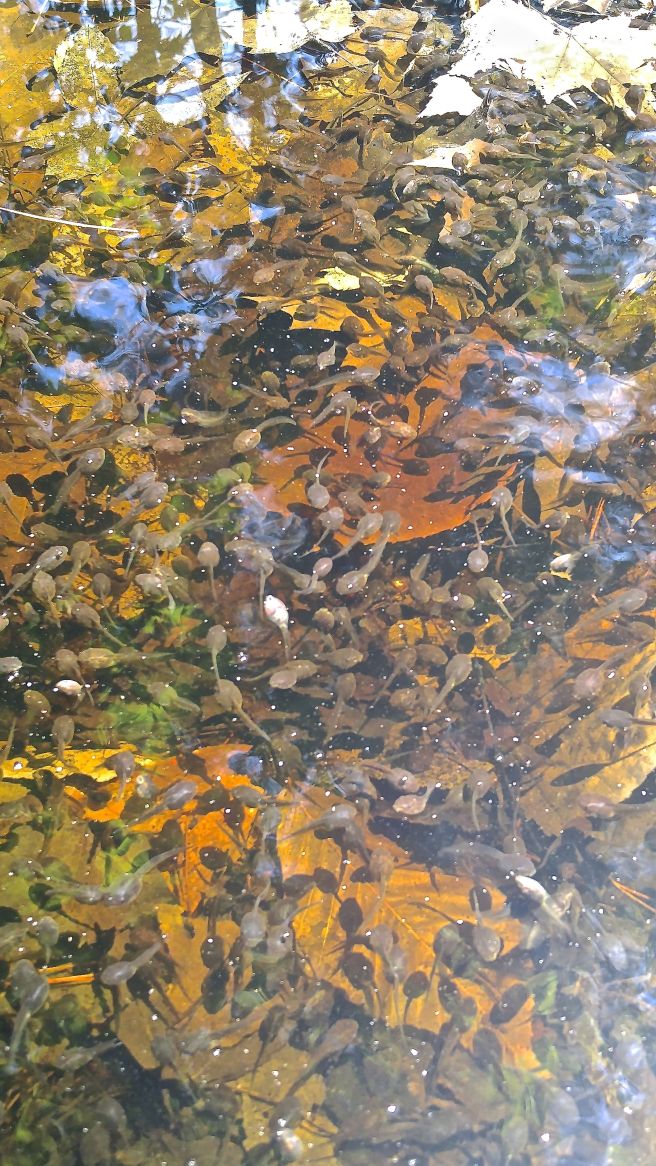
Today, the tadpoles weren’t as shy as the other day and so they let me get up close and personal.

b-tadpoles 2

I’m holding out hope that the pool doesn’t dry up before they are able to hop away. Already, I can see their frog form beginning to take shape. This is a shout out to one of the Books of May: Vernal Pools–A Field Guide to Animals of Vernal Pools.

But back to the Book of June, and really the book of all summer months–Bogs and Fens by Ronald B. Davis. It’s heavy as field guides go and so I don’t always carry it with me, but it’s a great reference when I return to my truck or home. I appreciate its structure and information presented in a format even I get.

Bogs and Fens: A Guide to the Peatland Plants of the Northeastern United States and Adjacent Canada, by Ronald B. Davis. University Press of New England, 2016.

My copy came from Bridgton Books, my local independent book store.

Sharing My Site

I count myself among the fortunate because pollen doesn’t keep me inside during its high season. Nor do the bugs or rain. Mind you, I do my fair share of complaining–after all I am human. At least I think I am, though I was honored to be called an ent yesterday. (Thanks Cyrene.)

Enough of that. Let’s head outside to see what we might see.

IMG_5267

True confession. I took this photo yesterday, but didn’t have time to write. Finding this jack-in-the-pulpit beside a granite bench by my studio was a complete surprise.

IMG_5741

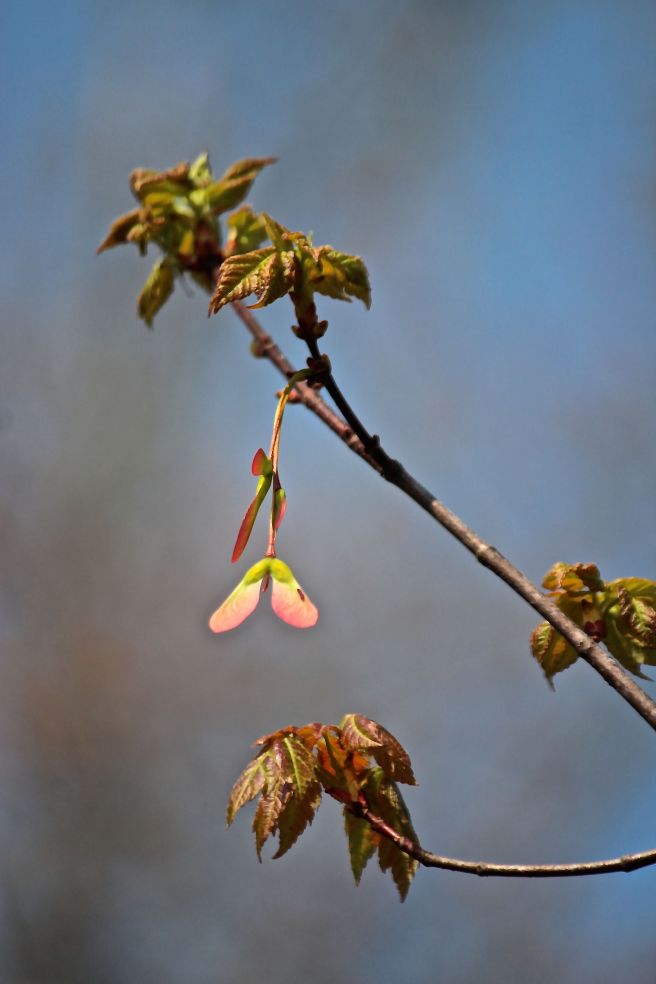
Today’s journey began in the front yard where sugar maple samaras dangled below full-grown leaves. Their presence will soon offer presents to the world below.

IMG_5302

My next stop was beside another secret giver of gifts–blueberry flowers.

IMG_5301

And then I stepped into the woodlot, where a single striped maple which was the bearer of a deer antler rub last year and scrape (upward motion with lower incisors) this past winter, had something else to offer.

IMG_5480

Below its almost dinner-plate size leaves–flowers. Happy was I to find these little beauties.

IMG_5287

Perhaps . . . just maybe . . . there will be more striped maples offering their bark to those in need.

IMG_5517 (1)

Moving along, I stopped at the opening of the cowpath to admire baby hemlock cones when something white and bubbly caught my attention. My first spittle bug sighting of the year. An adult spittlebug whips up some slimy froth to cover its eggs in late summer and the nymphs cover themselves while feeding in the spring–and so I concluded that I was viewing a nymph’s locale.

IMG_5327

Emerging under the power lines, the community changes. It’s here that the land is especially wet and species one might find in a bog grow–such as the black chokeberry shrub. These also like rocky ledges, but such is not the case in this spot.

IMG_5532

I was thankful to find it for those flattened bright pink anthers brightened this damp day.

IMG_5696 (1)

Heading north, I sloshed through the deep puddles on a quest to find the sundews I discovered growing in this area for the first time last fall.

IMG_5703

No such luck, but I did welcome the sight of the candy lichen fruits exploding from their crustose base. And then . . . and then . . . what did I see (but only when I looked at the photograph on my computer, and so now I know where they are located)? The round-leaved sundews–do you see them in the bottom right-hand corner? These are carnivorous plants (think Venus Flytrap) and their prey consists of small insects. Already, I can’t wait to make their acquaintance again.

IMG_5583

I turned around and headed south–on my way to the vernal pool. But before passing through a stonewall, I had to look at the bunchberries in bloom.

IMG_5581

Normally, a bunchberry plant has two-sets of leaves. But . . . when one is mature enough to grow a third set, typically larger leaves (perhaps to capture more energy) than the first two sets, it produces four white bracts that we think of as petals but they are actually modified leaves. The flowers are in the center–tiny as they are.

IMG_5680 (1)

And because I was in the neighborhood, in the land of mosses, reindeer lichens, Canada Mayflowers and wintergreen, trailing arbutus (aka Mayflower) spoke up. Its flowers were slowly transforming from white to rust and I shouldn’t rush the season, but I can’t wait to see its fruit again.

IMG_5586

At last I reached the vernal pool and realized I wasn’t the only visitor. What perfect hunting ground it proved to be for the . . .

IMG_5593

phoebe. I cheered for its insatiable insect appetite.

IMG_5596 (1)

Because the day was dark, it was difficult to see tadpoles, but I did note that many spotted salamanders were still forming. I also noted that the water level has dropped a wee bit–hard to believe–and where yesterday I found a few egg masses a bit high and dry, today they were gone. Something enjoyed eggs for dinner.  Scrambled or otherwise, I’m not sure.

IMG_5625

Back on the trail and at the next stone wall, interrupted fern showed off its fertile pinnae near the middle of the blades. It’s called interrupted because of the interruption in the blade. Again, this is an inhabitant of moist to wet forests and so it was no surprise to find it growing there.

IMG_5609

A fertile blade, such as this, may have two to seven pairs of middle pinnae.

IMG_5619

The globose sporangia is bright green when young, but darkens to tan or black as it matures.

IMG_5362 6.10.27 PM

On the other side of the wall, I spied some more flowers.

IMG_5360

These were the elongated loose clusters of black cherry trees, that open when the leaves are fully developed.

IMG_5636

One that flowers and fruits before its leaves are fully developed is the red maple.

IMG_5630

And fruits and fruits . . . need I say more?

IMG_5375

Though the wind blew, the samaras weren’t yet ready to let go and set down their roots. It won’t be long though, I’m sure.

IMG_5403

Finally returning home, I passed by the granite bench once more and was still stymied by the site I saw about a half hour after discovering the jack-in-the-pulpit yesterday.  It had been consumed. I suspected the woodchucks that live under the studio. Either that or a bear came along and I missed it.

And so ended today’s tramp. Thanks for traipsing along with me to visit these sites out our back door. I especially welcome those who are homebound with allergies, like my friend Jinny Mae. She gave me the inspiration to take a look today–to be her eyes for the moment and share my sight.

Walking with Ursula

No matter when or where I walk, Ursula Duve is always along. She sees what I see, smells what I smell, feels what I feel, tastes what I taste and knows way more than I’ll ever know.

h-Ursula 2

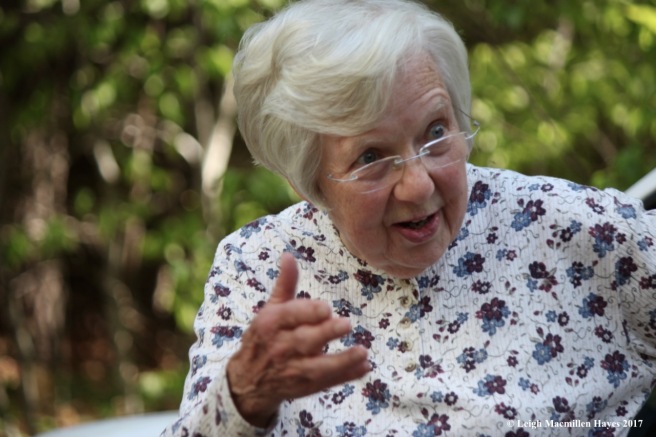
And so it was today that a bunch of us followed this delightful little woman as she led us down the trail at Lakes Environmental Association’s Holt Pond Preserve.

h-sign

We gathered in the parking lot, where the black flies tried to swallow us whole. But, we got the better of them and practiced mind over matter. Of course, bug spray and our flailing arms helped–or at least made us feel as if it was worth the effort.

h-wild oats 1

After an introductory greeting from LEA’s teacher/naturalist Mary Jewett, we stopped frequently as Ursula shared stories of plants and life. You see, she was born in Hamburg, Germany, and grew up during WWII so she has quite a few memories flowing through her system, but as she reminded us, with the bad comes the good. And the good comes from moments she associates with wildflowers, like this bellwort.

h-painted trillium

Having lived in the United States for 50+ years now, with the last nineteen in Maine, Ursula considers herself a Mainer despite her German accent because she loves it here. And she knows when and where each flower will bloom, such as the painted trillium.

h-chokeberry buds

Even those not yet in bloom drew her attention–this being a chokeberry along the first boardwalk.

h-pitcher 3

One of the finds Ursula enjoys sharing with others is the pitcher plant, a perennial herb with pitcher-shaped leaves. We noted that this particular one sported new flower buds.

h-pitcher flower

And on another, the otherworldly shape of last year’s now woody flower capsule–its job completed.

h-pitcher plant 1

Ursula is as awed as I am by the power of the pitcher plants. Color, scent (that I’ve never smelled) and nectar in glands near the top of the pitcher leaf attract insects. Once inside, those downward-pointing hairs make it difficult to leave. So what happens next? The insect eventually drowns in the rainwater, decomposes and is digested by the plant’s liquid, which turns phosphorus and nitrogen released by the insect into supplemental nutrients for the surrounding peat. Interestingly, no “joules” or units of energy are passed on through this process to the plant itself. The plant gathers its energy through the process of photosynthesis instead.

h-rhodora 1

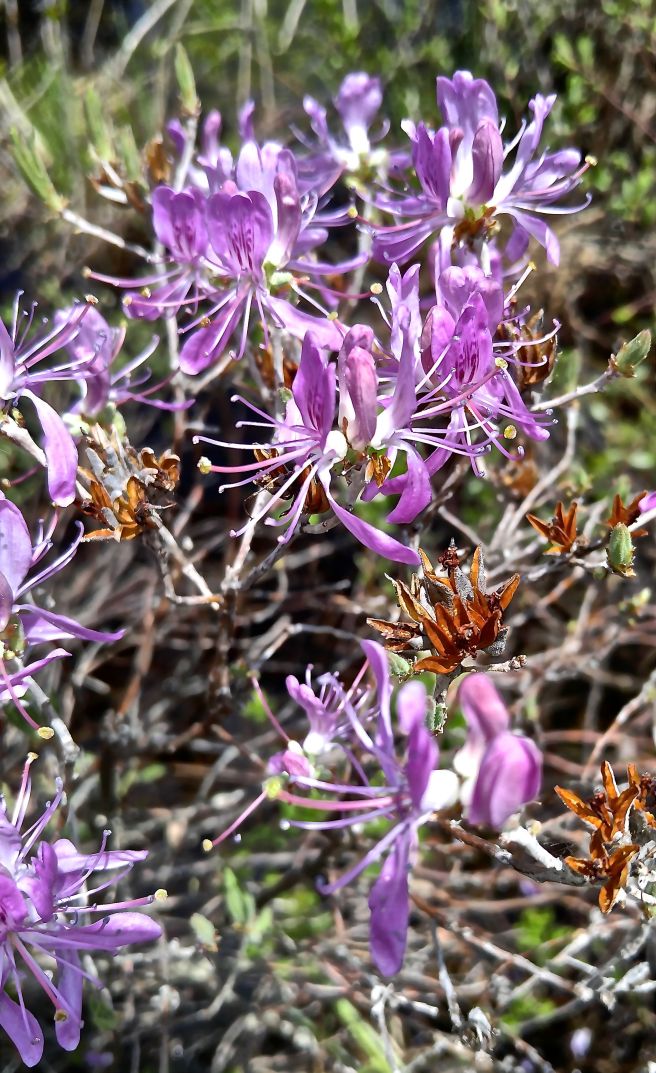
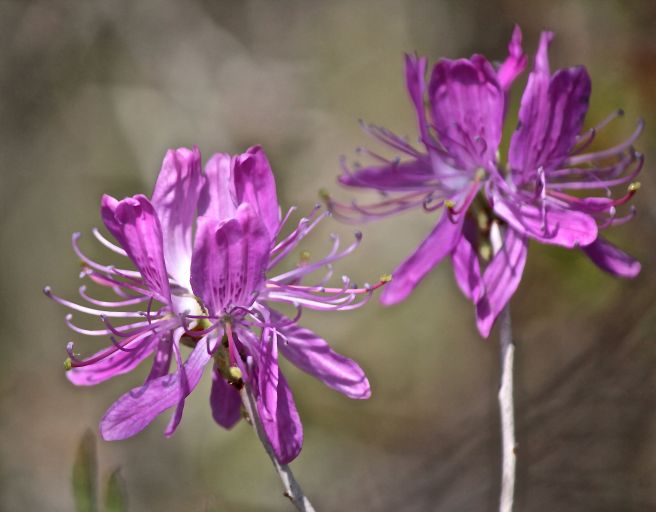
As we continued, we were wowed once again–this time by the sight of the showy rhodora. Rhodora flowers fully before its leaves emerge and so today they were but small nubs located alternately along the shrub’s branches.

h-rhodora 3

But those flowers–oh my! The rose-purple bloom has what’s considered two lips–with the upper consisting of three lobes and the lower of two. And each produces ten purple-tipped stamen surrounding the pistil, where the pollen will germinate into a many-seeded capsule.

h-leatherleaf

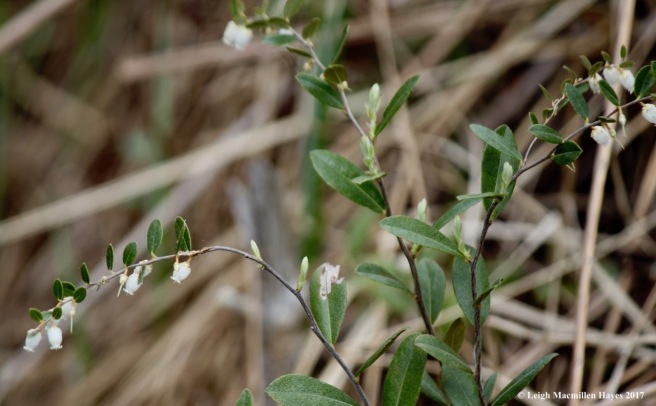
Like the rhodora, another member of the heath family in bloom was the leatherleaf–with bell-shaped flowers formed in leaf axils and dangling below the stem as if it was laundry hung out to dry. One way to differentiate this plant from the highbush blueberries that can be found throughout the preserve, are the alternate, upward-pointing leaves, which decrease in size as your eye moves toward the tip of the stem.

h-honeysuckle 1

Just before we stepped out onto the Quaking Bog boardwalk, Mary pointed out a native honeysuckle. In my memory bank, I couldn’t remember ever seeing it before, and if I had, well . . . I was glad to make its acquaintance again.

h-green frog 2

And then we stepped onto the boardwalk. Folks up front paused to admire a green snake, while those of us in the back noticed a green frog. It stayed as calm as possible in hopes that we wouldn’t see it. Nice try.

H-Holt Pond

Like all ponds and lakes right now, the water level remains high and so walking the boardwalk meant wet hiking boots.

h-quaking bog 2

But that didn’t stop some of us. Fortunately, mine are waterproof.

h-green frog

Just before we stepped from the boardwalk back onto land, I saw that the frog was still there.

h-hobblebush flowers 1

On the trail again, another showy flower called for our attention–hobblebush.

h-hobblebush 1

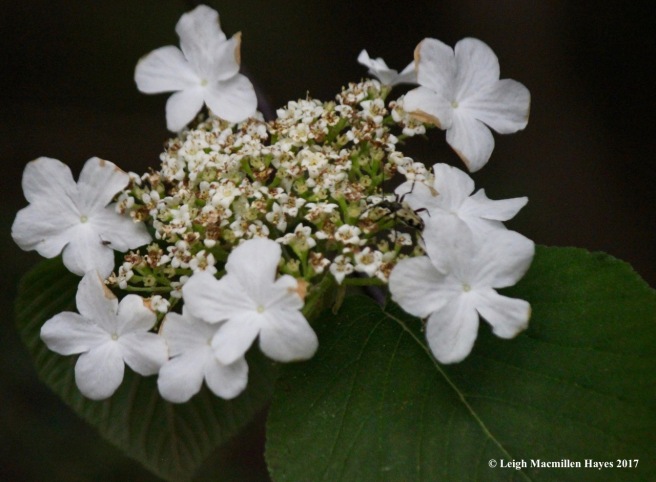
While some looked fresh, others were beginning to pass and their fruits will soon form. We noted the sterile outer blooms that surround the inner array of small fertile flowers. And a beetle paying a visit.

h-Mayfly1

Speaking of insects, a slight movement on the ground pulled us earthward.

h-mayfly 2

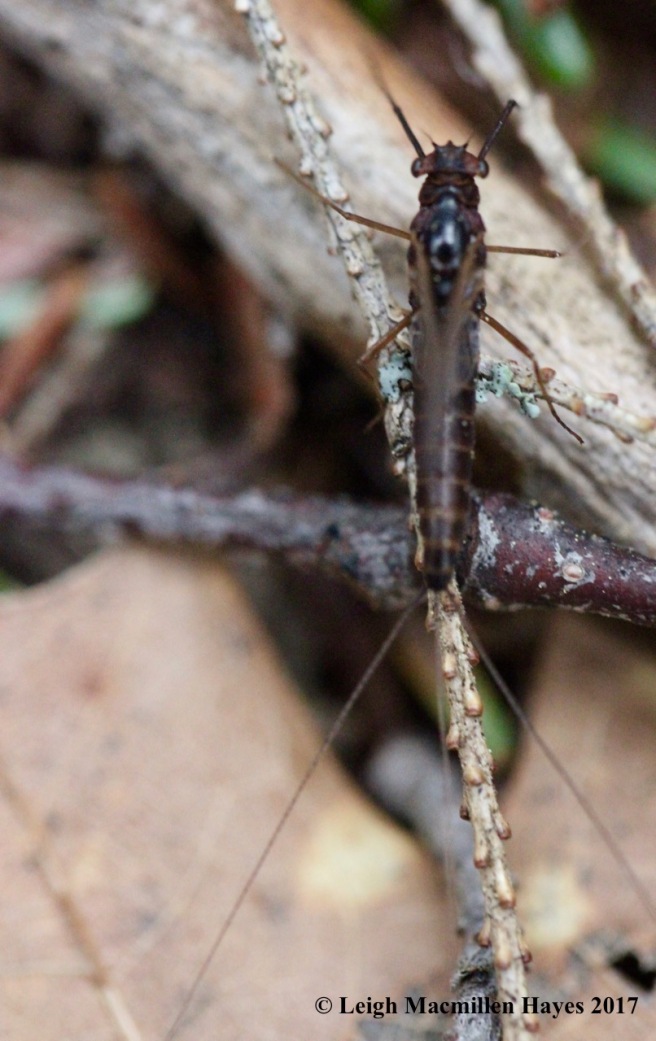
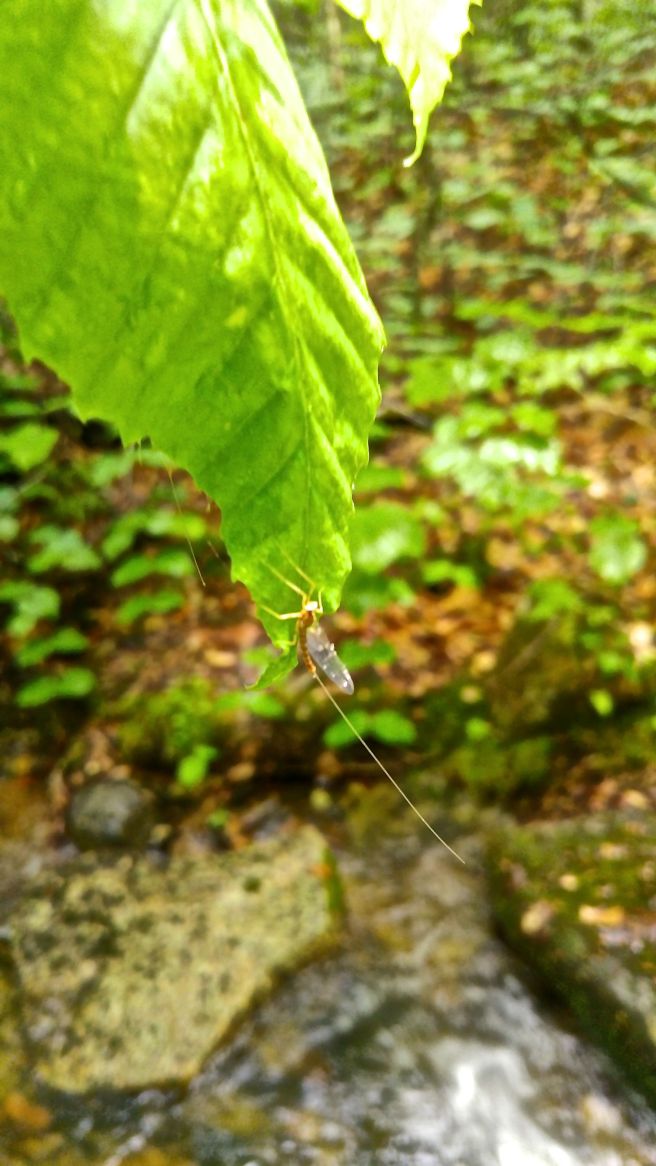
We’d found a Mayfly–perhaps just emerged and its wings drying.

h-Indian Cucumber root 1

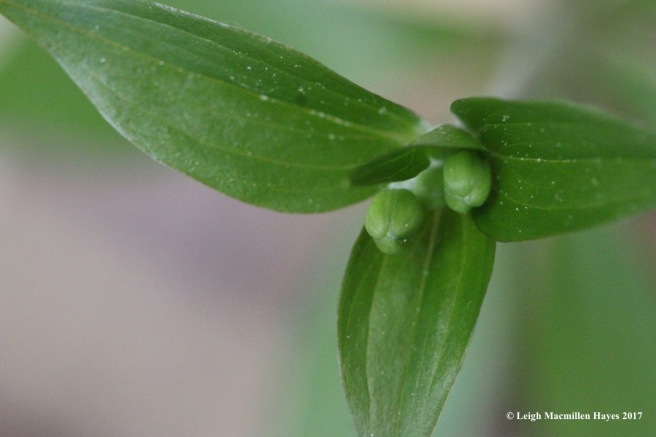
In the last wooded section we would cover for the day, we noticed that the two-tiered Indian Cucumber Roots have a few buds. I can’t wait for them to flower soon.

h-goldthread 2

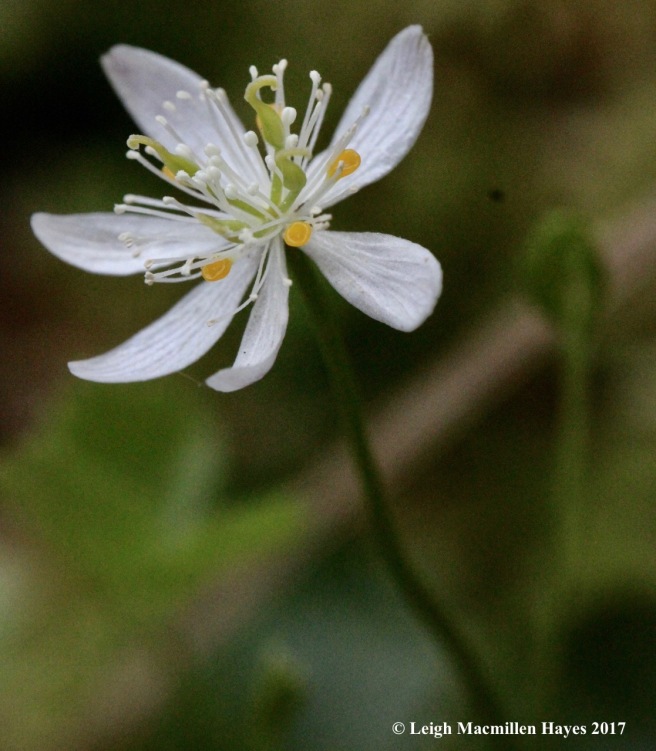
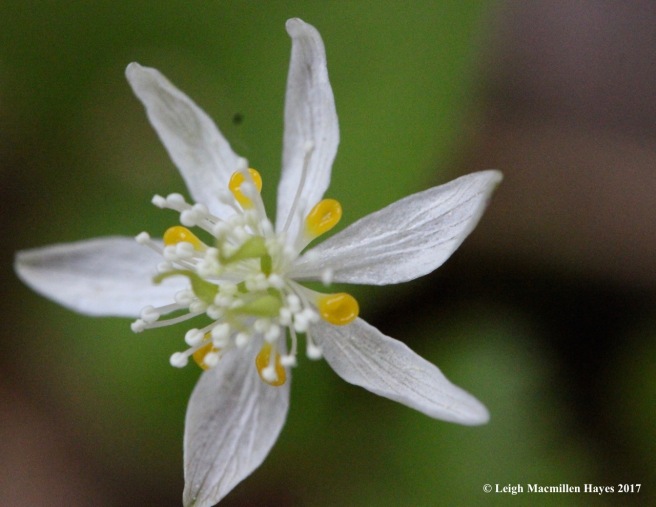
Among the flowers that I’ll always associate with Ursula because she’s the first to have introduced me to them, is the goldthread, so named for its golden-colored root. We usually identify it by its cilantro-shaped leaves, but right now the dainty flowers are not to be missed. What looks like petals are actually sepals and there can be five to seven of them. And stamen–many. Goldthread can feature 5-25 stamen.

h-goldthread 3

Even the number of yellow-and-green pistils can vary from three to seven. Ah nature–forever making us think.

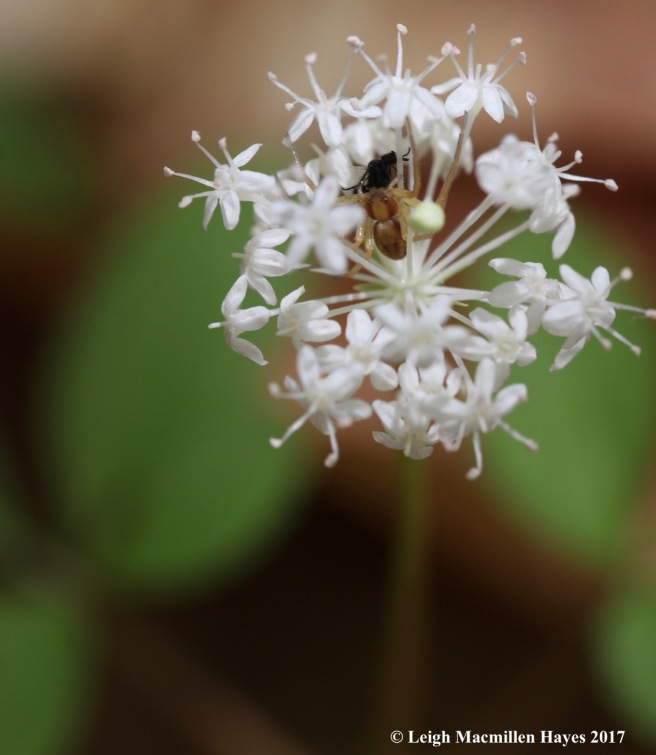
h-dwarf ginseng 1

The other plant I associate with Ursula is dwarf ginseng. Its explosive umbel consists of many flowers. And in this one, a dining crab spider.

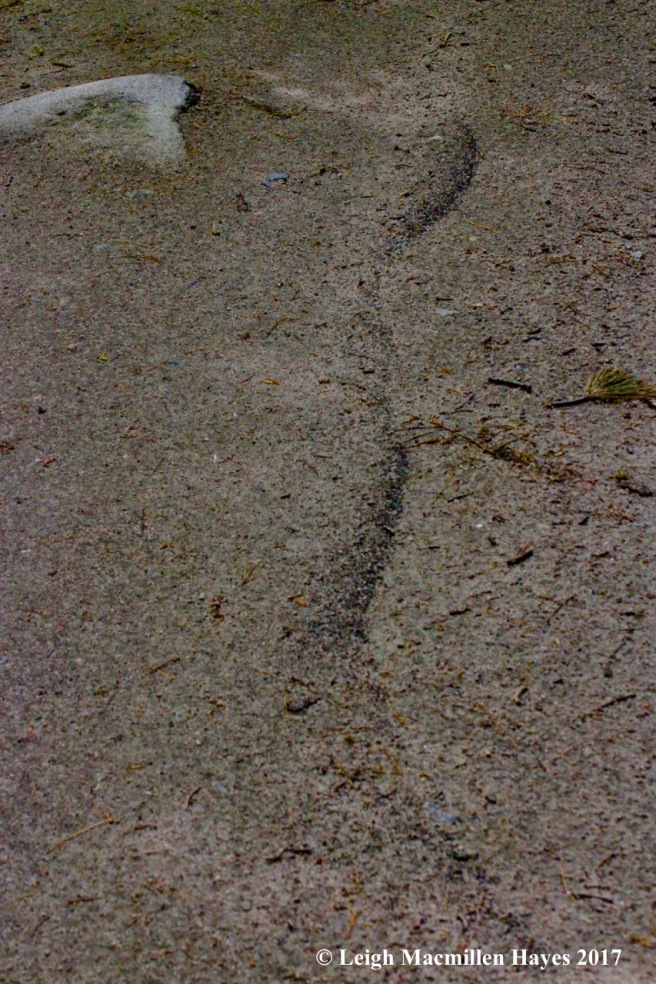
h-spring tail wave

Finally, we found our way to Grist Mill Road and headed back toward the parking lot. But even on the road we found something to wonder about when one member of our group pointed to the curvy black design. In the past, I’ve always dismissed it as some sort of mineral associated with the dirt.

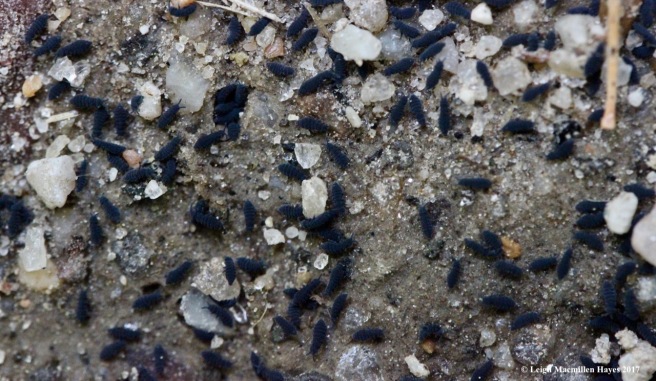
h-spring tails on sand1

Today, I learned it was none other than those good old spring tails or snow fleas we associate with late winter, but are really present all year. Something new to notice going forward.

h-Ursula1

At the end of our walk we all gave thanks to Mary and Ursula. We’d come away with refreshers and new learnings.

And we’d been reminded by Ursula that though she and her husband, Wolfgang, can no longer get out as often as they’d like, after sixty years of marriage they still have fun reminiscing about their many explorations together. A goal for all of us to set.

Most often this wildflower and bird enthusiast walks vicariously with me as she reads my blog entries, but today it was my immense pleasure to walk with her. Thank you, Ursula, for once again sharing your love of all things natural with the rest of us . . . and your optimistic philosophy of life.

Oh and a question for Wolfgang, while Ursula walked with us, did you get on the treadmill?

Slog Through The Bog

She said she’d call a half hour before heading to the bog so I should probably sleep in my hiking clothes and boots. And she was right! I was just about to take a bagel out of the toaster oven when the phone rang. “We’re going to the bog at 9:00. Can you join us?” Thirty-five minutes later I pulled into her driveway, excited because it was a chance to explore Brownfield Bog with about-to-become Maine Master Naturalist Kathy McGreavy and her daughter, Dr. Bridie McGreavy.

b-bog from road

From there we drove to Bog Road and parked at the beginning since conditions were dicey, but also because it gave us a chance to walk and listen–almost immediately we heard a barred owl. And then the warblers greeted us.

b-sky and water

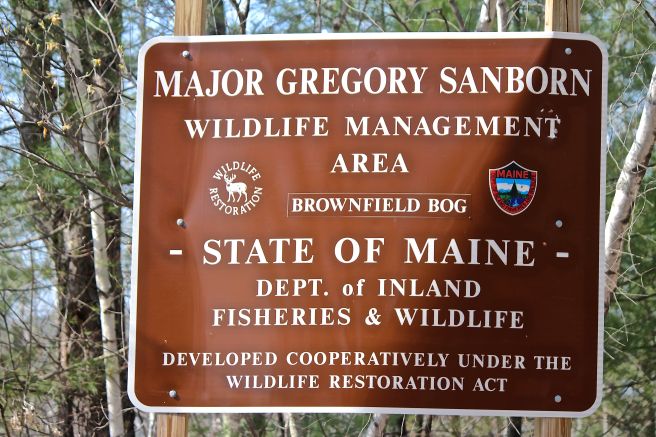
Brownfield Bog, aka Major Gregory Sanborn WMA, encompasses 6,000 acres of wetland. And on any given day, the sky tells its story above and below. Of course, we thought we were going to get poured upon when we first met, but the mist soon evaporated and sun warmed us enough that we shed a few layers.

b-common yellow throat 2

The initial stretch of our journey found us moving at a fast pace, but once we reached the second gate,

b-Bridie McGreavy

our inclination was to slow down.

b-Kathy

To stop, look and listen.

b-common yellow throat 1

The chestnut streaks on the yellow warbler matched the emerging red maple leaves.

b-oriole 2

And I can never spend enough time with a Baltimore oriole, forever wowed by its color.

b-oriole singing

And its voice.

b-catbird

Birds flitted about and flew overhead, but occasionally one, such as this catbird, paused and posed.

b-willows and birches

Most of the songbirds were feeding and perhaps nesting in the land of the willows, birch and maples.

b-willow pine cone gall caused by midge

Others also sought homes here, like the gall gnat midge that overwintered in a pinecone-like structure created with leaves by the reaction to a chemical released by the larva. I’m forever amazed about how nature works.

b-song sparrow

Eventually, we followed the song sparrows as they led us down the cobbled road.

b-road 1

The current was strong in places . . .

b-deep water

and water deep.

b-scenery1

But the views . . .

b-Pleasant Mtn and Bog

worth every step.

b-maple samara

Sometimes, our focus was upon the ground, where we spotted a few small red maple samaras.

b-coyote scat

And scat–including this double offering of coyote deposits.

b-coyote scat toenail

And among it–a toe nail first spied by Bridie. I chuckled to myself when we got down to look at this, for Bridie first introduced me to the finer qualities of scat when she worked at Lakes Environmental Association. She also taught me to track mammals. And . . . the crème de la crème–to sniff fox pee. Ah, the delights we have shared–they are many and having an opportunity to walk with her today brought them all flooding back.

b-ribbon snake

We decided to put our blinders on so we could continue without any pauses, but then Bridie’s eagle eyes zeroed in on movement. Her mom and I saw the movement as well, but we had to really focus in order to find the creator among the dried vegetation.

b-ribbon 2

And we did–a ribbon snake, who happens to be a great reason for preserving this property because its a species of special concern in Maine.

b-Pleasant Mtn

At times, Pleasant Mountain was the featured backdrop.

b-Canada geese

And Canada geese swam in the foreground.

b-beaver mound

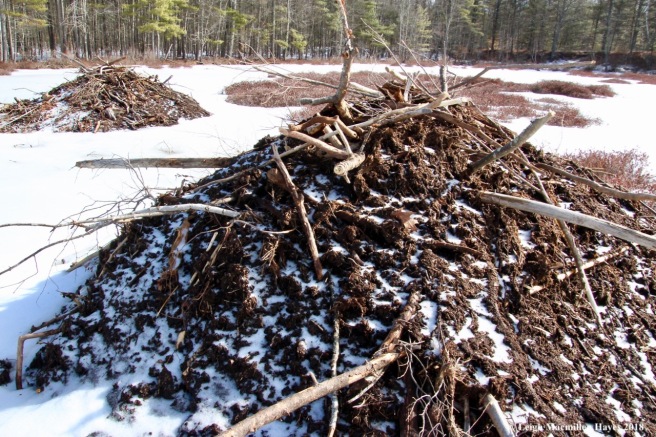
Everywhere, beaver works were obvious and scent mounds growing in size.

b-oak 1 (1)

After a couple of hours, we reached our turn-around point at the old oak tree.

b-beaver lodge

As we looked across, one of the beaver lodges stood above the water level.

b-bog 3

But Kathy and Bridie both reminded me that another was still submerged due to this spring’s high water level.

b-cuckoo nest remnants

Finally, we did our best to bee-line back. But Kathy showed me one more great find that had been pointed out to her by Mary Jewett last year–the straggly stick structure of a cuckoo’s nest. Certainly worth a wonder. (The other wonder–when we first arrived at the bog this morning, Mary was just leaving.)

b-spoon jar 2

Our entire morning had been worth a wonder and then another occurred when we returned to Kathy’s house. While I said goodbye to Bridie, who is an Assistant Professor of Environmental Communication in the Department of Communication and Journalism at the University of Maine, her mom slipped into the house. When Kathy returned, she handed me this spoon pot filled with daffodils from her garden. She’s a potter and owner of Saco River Pottery. Though I love to give her fine art as presents, I only own one other piece. This one now stands proudly on our kitchen counter, holding the utensils as it was intended. It will forever remind me of the McGreavys and the day I first saw a dragonfly emerge from its exoskeleton–at the bog with Bridie; and the day I spent with Kathy as I interviewed her for a magazine article about creating pottery–and she let me try my hand at the wheel; and so many other memories of time spent with these ladies, but especially today–for the opportunity to slog through the bog with the two of them.


Into Focus

Sunshine. Spring sunshine. Need I say more. No, but I will as I bring the focus to two of my favorite watering holes.

h-Mount Wash

Of course, a visit to my first pond isn’t complete without a pause to recognize the power and the powerful.

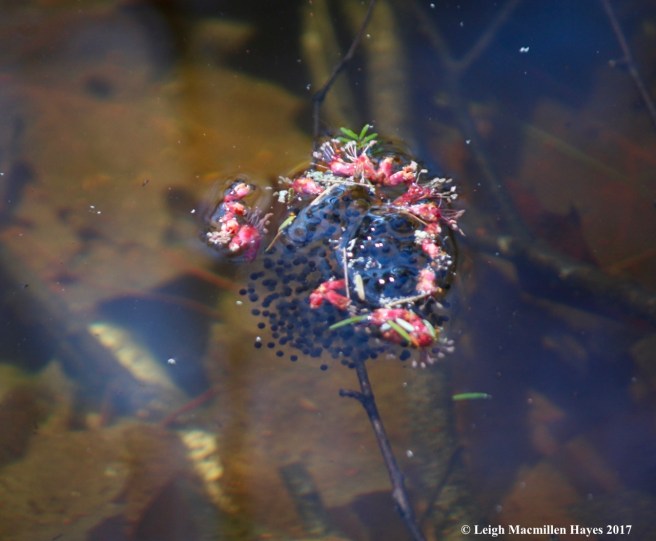
h-wood frog eggs 1

As I approached the vernal pool, I heard not a sound. But, my heart filled when I spotted a clump of wood frog eggs.

h-wood frog 1

When our sons were youngsters, we always called it the frog pond rather than the vernal pool. And so it is . . . both.

h-willow pollination

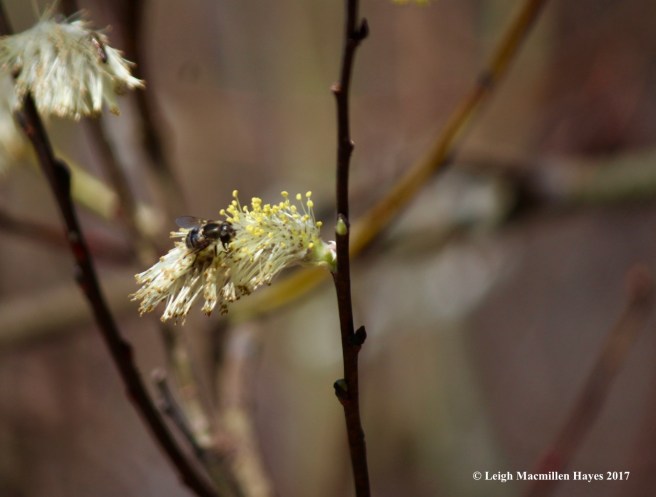
After an hour spent in the pond’s midst, I drove to another–Holt Pond–where I decided to park on the corner of Perley and Grist Mill Roads. I wasn’t sure of the conditions on Grist Mill Road and figured that provided the perfect excuse for a walk and an opportunity to take in the sights along the way. Stepping out of the truck, pussy willows called to me . . . and to their pollinators.

h-queen anne's lace

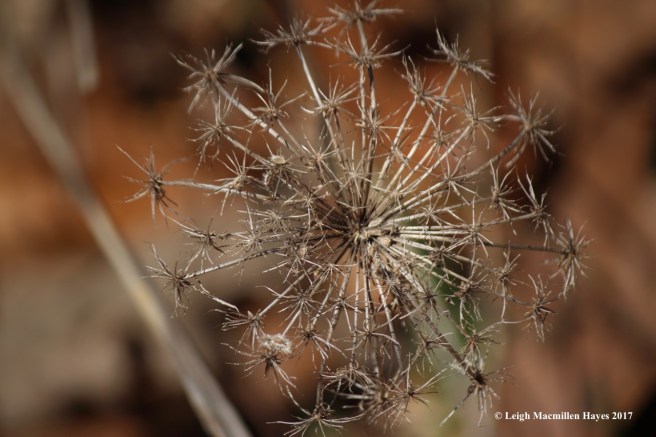
And on the corner, a dried Queen Anne’s lace displayed its fireworks formation.

h-sensitive fern frond

There were sensitive fern fronds, their beads still encapsulating many cases containing dust-like spores.

h-beaked hazelnut

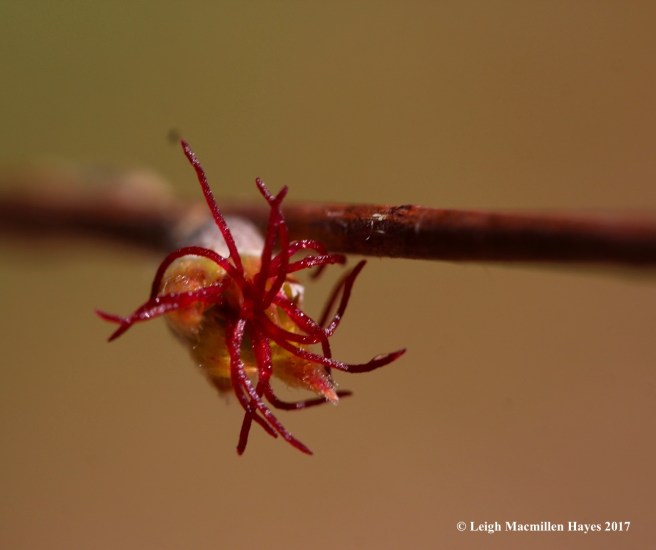
And I even found a few beaked hazelnuts still showing off their minute magenta flowers.

h-Grist Mill Road

I knew by my observations that I’d made the right decision to walk in–both in my findings and in the road conditions.

h-beaver works1

After following the initial trail and climbing over the stonewall, I was about to step onto the first boardwalk when I realized the beavers had been busy.

h-board walk-first section

The water was high as I quietly moved along the board walk, but not too high.

h-pitchers under water1

Although in some cases pitchers were submersed in the wet goodness.

h-speckled alder 1

The speckled alders didn’t mind for they love wet feet.

h-Muddy River

I stepped out to the Muddy River and listened to the chickadees sell cheeseburgers galore.

h-beaver lodge

And then I turned in the opposite direction to admire the beaver lodge and winter feeding pile beside it.

h-Boardwalk through red maple swamp 1

On the next boardwalk, the beauty of the red maple swamp surrounded me again.

h-Red Maple Swamp 1

Layers and colors spoke to the community and season.

h-red maple in swamp

And standing like sentries were the red maples for which it is named.

h-moose scat

It was here that I found evidence of another visitor, albeit this past winter–moose scat.

h-blueberry bud

And noted the swelling buds of highbush blueberries–their season in the offing.

h-Quaking Bog 2

After passing through the woodlands a couple of times in between the swamp journey, I at last reached the quaking bog and Holt Pond.

h-cranberries

Beside the board walk, last autumn’s cranberries floated in the water.

h-pitcher 2

And more pitcher plants showed off their hairy entrance ways.

h-pitcher flower

Withered pitcher plant flowers dangled in their woody fashion–as beautiful in death as in full bloom.

h-Holt Pond south

By the time I reached the T on the boardwalk, I was standing atop it, but in six inches of water–thankful for my rain boots.

h-Holt Pond to Five Fields

And thankful for the opportunity to stand there on a gorgeous spring day as I looked toward Five Fields Farm.

h-Canada Geese

In that very view–two Canada geese. I wondered if they’d found a nest site.

h-dragonfly exoskeleton 2

Also in view, last year’s dragonfly exoskeleton that bobbed in the water flowing over the boardwalk.

h-cinnamon crosier 1

On the way back, I stopped once again. My first photo call was an ostrich fern that I didn’t realize grew there. See why you should walk in rather than drive? That photo didn’t come out so well, but I was standing in an area filled with cinnamon ferns and suddenly realized I was looking at my first crosiers of the season.

I was actually down by a stream beside the road when I found these. A truck came along and the driver paused. He and his friend thought I was fishing and were going to ask what I’d caught. “Only photos,” I said playfully.

h-garter snake 1

Upon returning home I decided to visit the frog pond one more time, thinking the lighting would be different. At the end of the cowpath I found a garter snake enjoying the warmth of the sun . . . and probably a few insects.

h-wood frog eggs 2

When I’d walked to the pond this morning, I was surprised at how quiet it was. That changed this afternoon as a chorus of wrucks added music to my day. And another egg mass had been added to the display.

h-wood frog 2

Of course, all quieted down once I arrived, but I waited . . . and realized the pond really is full of life.

I’d spent the day beside my favorite ponds and was well rewarded. I’d also played with my camera settings, avoiding auto-focus all day. I’ve got a lot to learn, but hey, isn’t that what it’s all about?

Celebrating Place–Naturally

Once the snow melts it will be more difficult for me to wander and wonder in the woods I explore all winter given its spring/summer water level and logging slash. And so I make the most of these days–trying to notice as much as I can before I can notice no more (or at least until next winter).

l-bushwhack 1

Though I’d promised myself I’d not go again in an effort to not disturb the deer, promises are meant to be broken. And from that came a lesson–the deer are sticking to the snowmobile trail and field edges where tender bark of young red maples and hemlocks, plus swelling buds meet their needs for the moment. So, it was OK that I broke my promise, for the deeper I tramped, the fewer tracks I encountered.

l-spring tails1

Today’s warmer temps in the low 40˚s found the springtails hopping about on any and all surfaces.

l-pileated hole

As is my habit, I checked on a pileated woodpecker hole when I saw bark and wood scattered atop the snow. Deep was this excavation in search of nourishment.

l-pileated scat-seeds and ant

And chock full was the scat below, which contained insect body parts and seeds of the dreaded bittersweet. Beside the scat, a springtail sought to placate its own food needs which among other things includes plant material and animal remains.

l-red maple bull's eye

Turning to another tree, I landed on a perfect bull’s eye! The target fungus that affects many red maples makes for an easy ID.

l-crustose, liverwort and moss

Lichens have also been a focus of late. What I like about this one, the circular green with the black disks of a crustose lichen (possibly bark disk lichen), was its location beside a liverwort (the beaded brown Frullania eboracensis) and a moss that I didn’t key out. Tree bark has its own structure and texture, but so often others also call it home.

l-shield lichens on rock

Rocks also serve as a substrate and this one featured a couple of leafy foliose shield lichens, their colors enhanced by yesterday’s inch of snow.

l-hair lichen and beard lichen

And dangling from a branch, two forms of fruticose (branching or fruit-like structure–) lichens. The dark is a hair lichen, while the green a beard–seems about right with the hair above the beard.

l-lichen garden

On another maple I spied a garden–you’ve got to liken it. (Corny joke that always manages to enter a lichen conversation.)

l-frullania 1

I’ve often paused beside Frullania eboracensis, a liverwort with no common name, but today several trees shared displays of mats called Frullania asagrayana, so named for a botanist and natural history professor at Harvard University from 1842-1873–Asa Gray.

l-frullania asagrayana 1

Its shiny, overlapping chain of red-brown leaves reminded me of caterpillars crawling along the maple bark.

l-spirea:steeplebush

Casting my eye elsewhere, steeplebush in its winter form offered an artistic presentation.

l-bracken fern1

And as the snow melts, last year’s bracken fern made an appearance.

l-speckled 3

One last shrub made me stop. Minus any catkins or “cones” for which it is known, I had to think for a moment about the speckled alder. But those speckles or lenticels through which gas exchange occurs, and the buds and leaf scars were give aways.

l-speckled buds and leaf scar

The two bud scales meet at their edges and look like miniature footballs. But it’s the bundle scars where leaves were formerly attached that make me laugh. That vascular system looks like a face–two round eyes, a funny shaped nose and a round mouth, as if it’s exclaiming, “Ohhh” or “Wow.”

l-Pleasant Mtn in background

At last I reached my turn-around point. I could see Pleasant Mountain in the distance and knew where I was in the world. This is my place and I love every opportunity to celebrate it–naturally.

Seeing Red

I wander through the same woods on a regular basis, sometimes following old logging roads and other times bushwhacking through the understory–a mix of young conifers and hardwoods that are slowly reclaiming their territory. Always, there are water holes to avoid as this is a damp area, so damp that in another month I probably will have to curb some of my wandering habits because it will become difficult to navigate.

h-maleberry-buds

But it’s that same water that gives life to the flora and fauna that live therein, such as the buds on the maleberry shrub. Notice how downy the twig is. And the bright red bud waiting patiently within two scales–preparing for the day when it will burst forth with life.

h-maleberry-pods

On the same shrub exists evidence of last year’s flowers, now capsules reddish-brown and five-celled in form.

h-red-maple-buds

And like the maleberry buds, the red maples buds grow more global each day, some with three scales of protective covering and others more.

h-snowflakesbuds

Today was a day of contrasts, from sunshiney moments to snow squalls, as well as greens to reds, tossed in with a mix of browns and grays.

h-moose-scrape

Continuing my venture, I soon realized I wasn’t the only one enjoying red. The moose and deer with whom I share this place, also find it a color of choice–especially the bark of young red maple trees.

h-moose-scrape-2

As I looked at the tree trunks, I could sense the motion of the moose’s bottom incisors scraping upward and then pulling against its hard upper palate to rip the bark off. Everywhere I turned, the maples showed signs of recent scrapes.

h-moose-rub

Less frequently seen were antler rubs such as this one, where the middle was smoothed by the constant motion and the upper and lower ends frayed. Such finds offer noted differences between a scrape and rub–the former has tags hanging from the upper section only and the teeth marks stand out, while the latter often features a smooth center with the ragged edges at top and bottom. But . . . like us, nature isn’t perfect and not everything is textbook, so I often have to pay closer attention.

h-moose-bedscat

I saw more than red and so I could hardly resist a moose bed filled with scat and urine. I’m always in awe of the sense of size and again I saw motion, of this large mammal laying down to take a rest and perhaps a few hours later, getting its feet under itself to rise again, do its duty and move on to browse some more.

h-witch-hazel-scattered

Deer tracks were even more numerous than moose and the solidness of the snow allowed them to travel atop the crust. At one point I spied something I didn’t recall seeing before–witch hazel capsules decorating the snow.

h-witch-hazel-pod

At this time of year, these grayish tan capsules persist on the trees, but their work was completed in the fall when they expelled their two glossy black seeds.

h-witch-hazel-bud-nibbled

Ruffed grouse, wild turkeys and snowshoe hare like witch hazel buds. As do deer, who rip them off in the same fashion as a moose and leave a tag behind–as a signature.

h-witch-hazel-bud

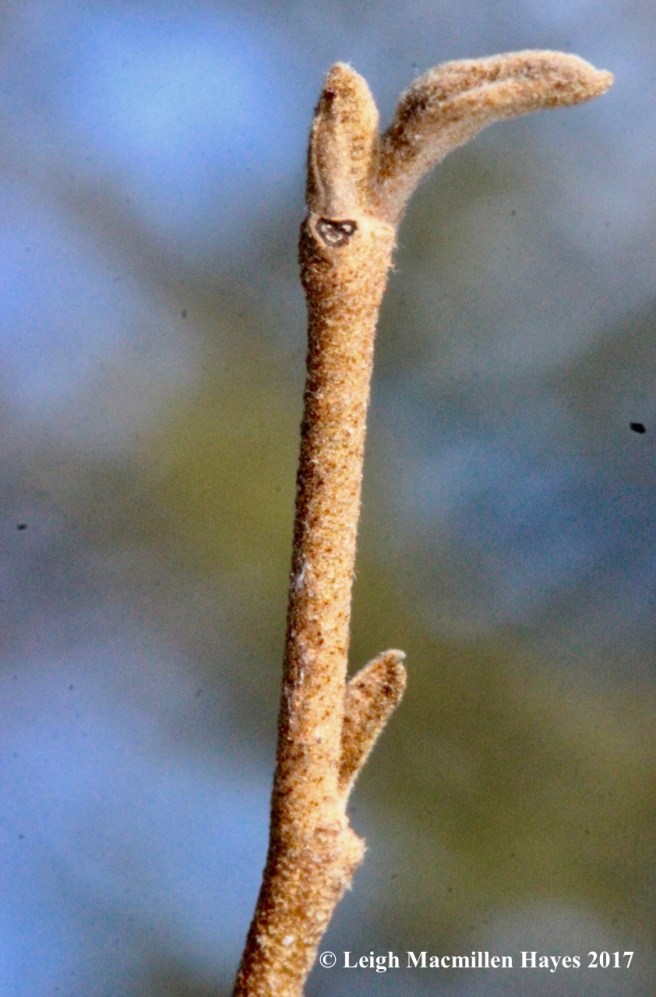
Not all were eaten–yet. Notice these buds, ensconced in dense reddish/yellowish/brown hairs rather than the waxy scales of the maleberry and maple. And the shape extending outward from the twig, almost in scalpel-like fashion. Yeah, I was still seeing a hint of red.

h-witch-hazel-flower-bracts

If I wanted to carry my red theme to the extreme, I could say that the bright yellow bracts that formed the base of the former flowers were framed in red, but really, it’s more of a hairy light tan along their rims. Eventually, the bracts will develop into seed capsules and next autumn they’ll be the ones to shoot their seeds with a popping sound. We always talk about that sound and refer to Henry David Thoreau for as far as I know he was the one to first hear it. This past fall, a friend tried this and like Thoreau, he was awakened during the night by the seeds being forcibly expelled. (Credit goes to Bob Katz for that experiment.)

h-british-soldiers

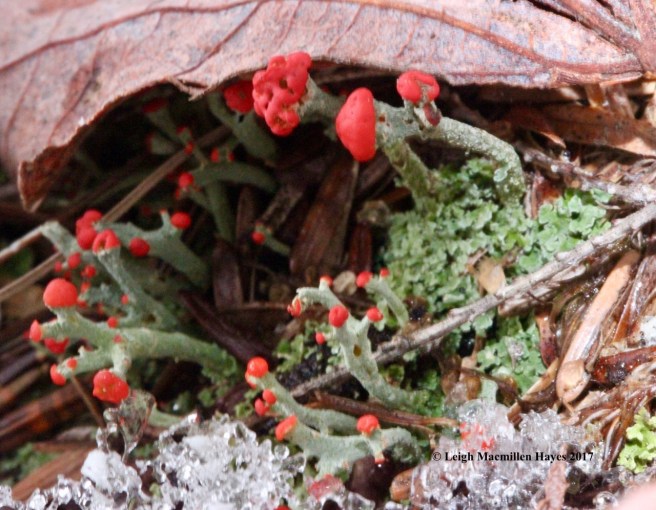
Back to red. Under the hemlocks where the deer had traveled, I was looking at some mosses when these bright red soldiers showed their cheery caps–it’s been a while since I’ve seen British Soldier lichens, most of it buried beneath the snow.

h1-red-oak-bark

As I headed toward home, a red oak beside the cowpath asked to be included. It seems in winter that the rusty red inner bark stands out more in the landscape, making the tree easy to identify. Of course, don’t get confused by the big tooth aspen, which slightly resembles a red oak at the lower level, but a look up the trunk suddenly reveals similarities to a birch.

h1-acorn-cap

Many of the acorns have been consumed after such a prolific year, but their caps still exist and the color red was exemplified within the scales.

h1-icicles

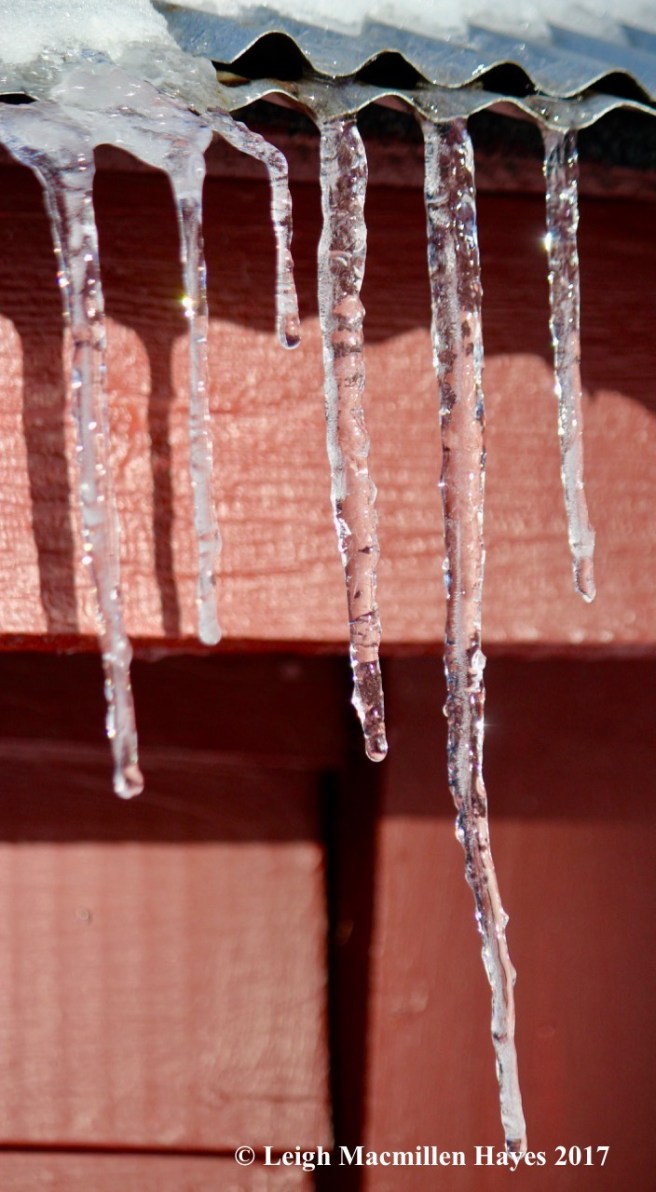
Back at the homestead, I walked by the shed attached to the barn where icicles dripped–again speaking to this day. By that time the snow squalls had abated and sun shone warmly, but a brisk wind swirled the snow in the field into mini whirling dervishes. My cheeks were certainly red.

h-cardinal

My red adventure was completed at the bird feeder. A happy ending to scenes of red.


Books of December: A Holiday Wish List

In the spirit of changing things up a bit, I decided that I’d include five books I highly recommend you add to your holiday wish list and two that I hope to receive.

These are not in any particular order, but I’m just beginning to realize there is a theme–beyond that of being “nature” books.

b-forest-forensics-1

Book of December: Forest Forensics

Tom Wessels, forest guru and author of Reading the Forested Landscape, published this smaller work in 2010. Though only 5″ x 7.5″, the book is rather heavy because it’s filled with photographs. Despite the weight, Forest Forensics fits into a backpack and is the perfect guide for trying to figure out the lay of the land. Using the format of a dichotomous key, Wessels asks readers to answer two-part questions, which link to the photos as well as an Evidence section for Agriculture, Old Growth and Wind, plus Logging and Fire. In the back of the book, he includes Quick Reference Charts that list features of particular forest and field types. And finally, a glossary defines terms ranging from “age discontinuity” to “Uphill basal scar,” “weevil-deformed white pines” and “wind-tipped trees.” In total, it’s 160 pages long, but not necessarily a book you read from cover to cover. If you have any interest in rocks, trees, and the lay of the land, then this is a must have.

Forest Forensics by Tom Wessels, The Countryman Press, Woodstock, VT, 2010.

b-shrubs-1

Book of December: Shrubs of the Northern New England Forest

Michael L. Cline is executive director of Tin Mountain Conservation Center in Albany, New Hampshire. In September, I had the pleasure of attending a talk he gave at the center about Shrubs of the Northern New England Forest. The 6″ x 9″ book weighs about the same as Wessels’, and will also fit handily into your pack. Of course, you might want to leave the books in your vehicle or at home and look up the items later–thus lightening your load. Using Brownfield Bog as one of his main go-to places, Cline describes 70 species of shrubs from Creeping Snowberry to Mountain Ash. The book is arranged by family, beginning with Mountain Maple and Striped Maple of the Aceraceae (Maple) family and ending with the American Yew of the Taxaceae (Yew) family. Each two-page layout includes photographs (and  occasionally drawings), plus a description of habit, leaves, flowers, twig/buds, habitat, range, wildlife use, notes and other names. I have no excuse now to not know what I’m looking at as I walk along–especially near a wetland. That being said, I’ll think of one–like I left the book at home, but I’ll get back to you.

Shrubs of the Northern New England Forest by Michael L. Cline, J.S. McCarthy Printers, 2016

b-bogs-and-fens-1

Book of December: Bogs and Fens

Ronald B. Davis’ book, Bogs and Fens, was a recent gift from my guy. I hadn’t asked for it, and actually didn’t know about it, so I’m tickled that he found it. I’m just getting to know Dr. Davis’s work, but trust that this 5.5″ x 8.5″ guide about peatland plants will also inform my walks. Again, it’s heavy. The first 26 pages include a description of vegetation and peatlands and even the difference between a fen and a bog. More than 200 hundred pages are devoted to the trees, plants and ferns. In color-coded format, Davis begins with the canopy level of trees and works down to tall shrubs, short and dwarf shrubs, prostrate shrubs, herbaceous plants and finally, ferns. He also includes an annotated list of books for further reference, as well as a variety of peatlands to visit from Wisconsin to Prince Edward Island. As a retired University of Maine professor, Davis has been a docent and guide at the Orono Bog Boardwalk for many years. Field trip anyone?

Bogs and Fens: A Guide to the Peatland Plants of Northeastern United States and Adjacent Canada by Ronald B. Davis, University of New England Press, 2016.

b-lab-girl-1

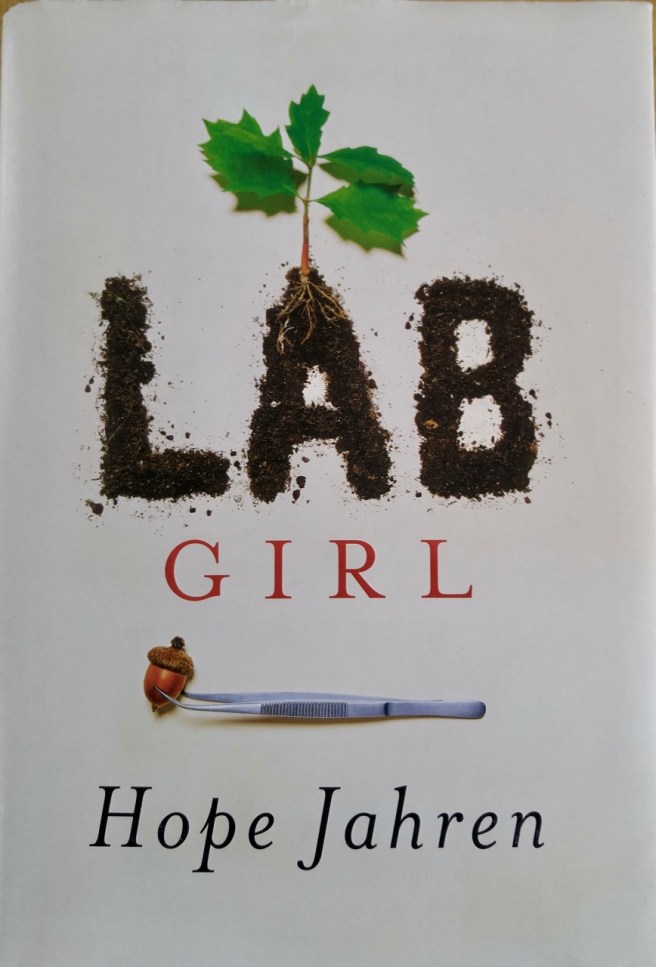
Book of December: Lab Girl

I’d never heard of Hope Jahren until this summer and then several people recommended her book, Lab Girl, to me. Rather than a guide, this is the story of Jahren’s journey from her childhood in rural Minnesota to the science labs she has built along the way. As a scientist, Jahren takes the reader through the ups and downs of the research world. And she does so with a voice that makes me feel like we’re old friends. Simultaneously, she interweaves short chapters filled with  information about the secret life of plants, giving us a closer look at their world. I had to buy a copy because for me, those chapters were meant to be underlined and commented upon. I do believe this will be a book I’ll read over and over again–especially those in-between chapters.

Lab Girl by Hope Jahren, Alfred A. Knopf, 2016.

b-hidden-life-of-trees-1

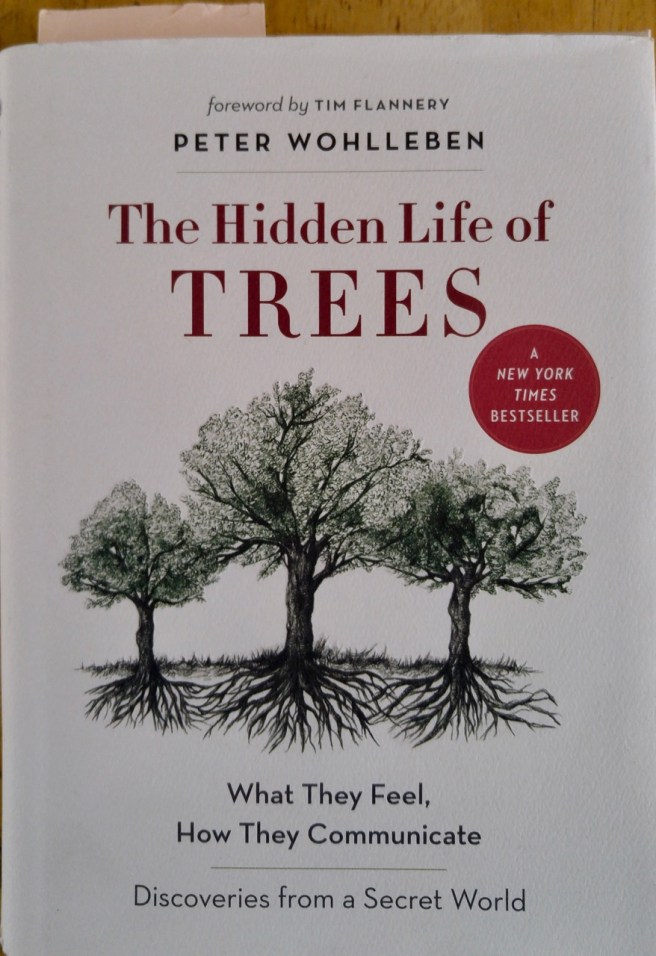
Book of December: The Hidden Life of TREES

And finally, a gift to myself: The Hidden Life of TREES by Peter Wohlleben. I’d first learned about this book in a newspaper article published last year and had to wait until recently to purchase it after the book was translated from German to English. Again, it’s not a field guide, but offers a delightful read that makes me think. And thus, you can see my bookmark. I’ve not finished reading it yet, but I’m having fun thinking about some different theories Wohlleben puts forth. As a forester, Wohlleben has spent his career among trees and knows them well. He’s had the opportunity to witness firsthand the ideas he proclaims about how trees communicate. And so, I realize as I read it that I, too,  need to listen and observe more closely to what is going on in the tree world–one of my favorite places to be. Maybe he’s right on all accounts–the best part is that he has me questioning.

The Hidden Life of TREES: What They Feel, How They Communicate by Peter Wohlleben, Random House, 2016.

And that’s just it–the underlying theme of these five books you might consider is TREES. I can’t seem to learn enough about them. One word of caution, each author has their own take on things, so the best thing to do is to read the book, but then to head out as often as you can and try to come to your own conclusions or at least increase your own sense of wonder.

And now for the books on my list (My guy is the keeper of the list):

Naturally Curious Day by Day: A Photographic Field Guide and Daily Visit to the Forests, Fields, and Wetlands of Eastern North America by Mary Holland, Stackpole Books, 2016

Mosses, Liverworts, and Hornworts: A Field Guide to Common Bryophytes of the Northeast by Ralph Pope, Cornell University Press, 2016.

Do you have any other suggestions for me?

One final thought about books–support your local independent book store as much as you can. Here in western Maine, we are fortunate to have Bridgton Books. Justin and Pam Ward know what we like to read and if they don’t have a particular book we’re looking for, they bend over backwards to get it for us.


The Way of the Land at Long Meadow Brook Reserve

Last month the Greater Lovell Land Trust purchased a new property along Long Meadow Brook that further develops the wildlife corridor. A couple of weeks ago I first visited it with GLLT’s Executive Director Tom Henderson and a number of the land trust’s volunteer docents. As we left the property, Tom said to me, “I didn’t oversell this, did I, when I said this will become one of the docents’ favorite properties.” Indeed.

And so I couldn’t wait to get back there myself to spend a few hours exploring the almost one-hundred-acre reserve.

l-mullein-flower-2

Because the land was last logged by the previous owner in 2014, it’s in the early succession stage of regrowth.

l-mullein-flower-3

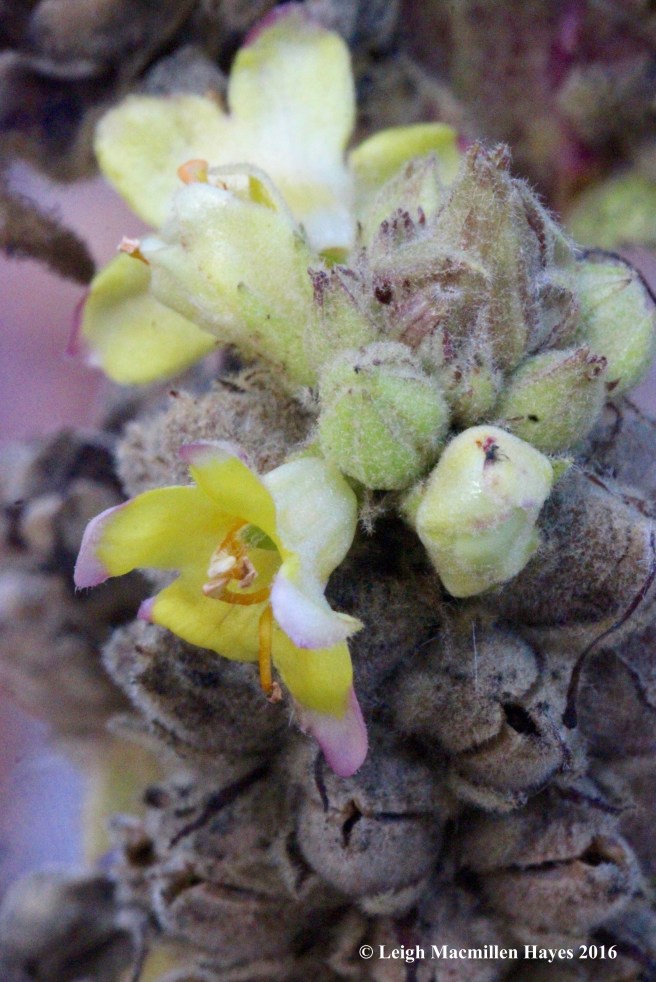
And so, it’s a place where those who like disturbed places tend to grow, such as the common mullein. What surprised me most was that I found a few still offering blooms.

l-mullein-cactus

Of course, it reminded me that I was in the great West–WESTern Maine, that is–with its occasional cacti-like form.

l-seeds-holidng-on

Scattered throughout are also the seedheads of white lettuce, waiting for release in lampshade-like formation.

l-orange-peel-fungi

Orange-peel fungi fruited prolifically in the gravel logging road.

l-future-parking-lot

That was all before I even reached the future parking lot, which had served as the log landing a few years ago. Already, sweet ferns and berry bushes have made themselves known.

l-sweet-fern-colors

The leaves of sweet fern, which is really a shrub rather than a fern, exhibited their version of autumn hues.

l-trail-marker

If you go, I encourage you to look for the blue ribbons that indicate where a future trail will be placed. It’s a loop trail that summer interns Hannah and Aidan laid out and leads to two focal features.

l-stonewall-double-to-single

The trail nears a neighboring property, which just happens to also be under conservation easement thanks to the foresight of its owners. I stepped off the blue flag trail and started to follow the wall for a bit–noticing that soon it changed from a double (garden or plowed land) wall to a single wall. A large pasture pine grew at the change-over point.

l-stonewall-barbed-wire-1

And where the wall switched to single formation, barbed wire indicated its former use a pasture boundary. And white pine scales indicated its current use–as a red squirrel’s dining room table.

l-forest-succession-2

After moving away from the wall, I noticed the mountains in the offing and ferns and young trees already filling in the empty spaces.

l-kearsarge

One of my favorite mountains to climb stood tall in the backdrop–Mount Kearsarge.

l-forest-succession-1

My bearings were off a bit, but I knew where the eastern boundary was as I moved across this opening.

l-pitch-pine-bark-1

Walking along the back edge, my tree passion was ignited yet again.

l-pitch-pine-1

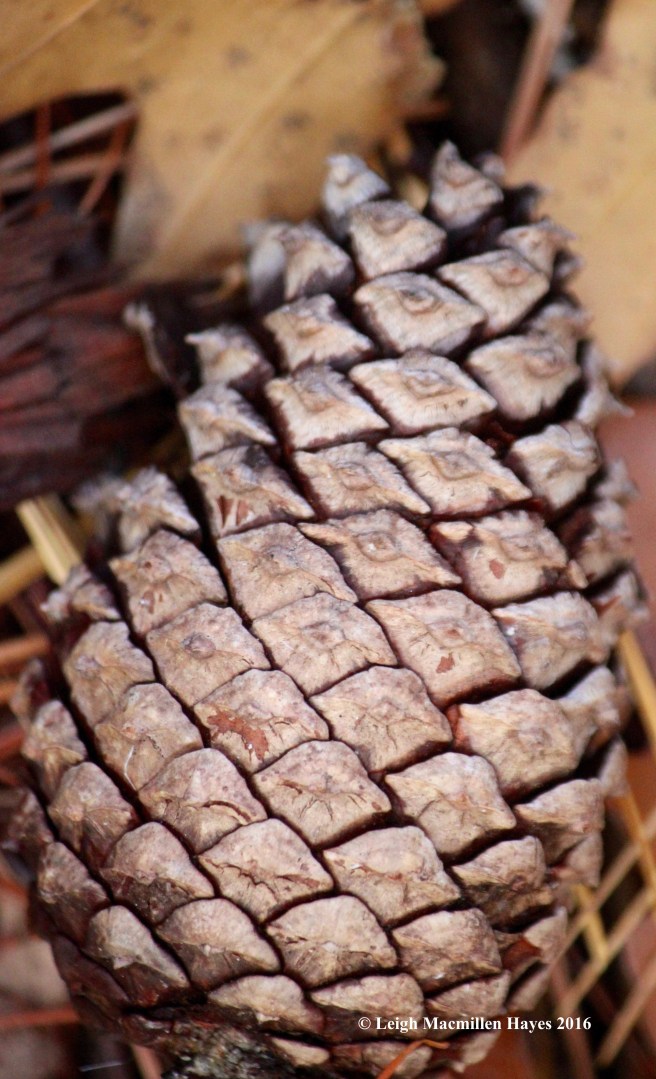
Several pitch pines grow in this space. While the bark is similar to that of red pines, it’s platier (is that a word?). And the tufts of needles that grow along the trunk were a dead give-away.

l-pitch-pine-cone

l-pitchpine-needles

But . . . I always quiz myself and so I looked around. And right below the trees, pitch pine cones and the triple needle bundles common to this species.

l-wintergreen-berries

It was here that I discovered wintergreen growing by the base of a tree stump. What made me wonder was the amount of fruit on each plant. Yes, wintergreen grows prolifically in all of western Maine, but I can’t recall ever seeing so many little red globes dangling below the leaves.

l-marshy-1

From my half-circle around the opening, I wasn’t positive about my whereabouts and so decided to follow the land downhill because it looked like there may be an opening below. A few minutes later, I realized I was in a marshy spot where the cinnamon ferns grew. And the earth beneath my feet was rather spongy and damp.

l-beaver-lodge

I reached what I thought was the meadow I sought–only to realize that I was looking at a beaver lodge. I knew that beaver lodge, but from a different perspective–the neighbors’ property.

l-first-marsh

And then something else caught my attention.

l-marsh-tamaracks

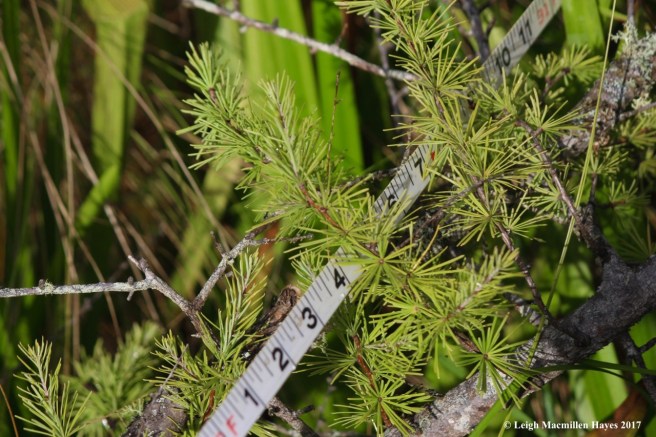
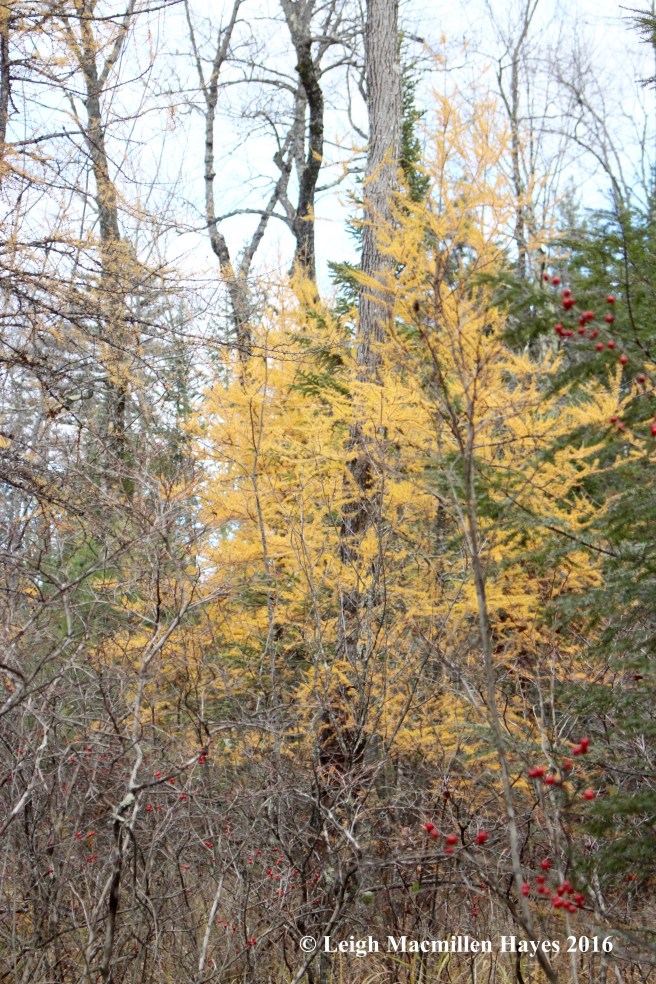
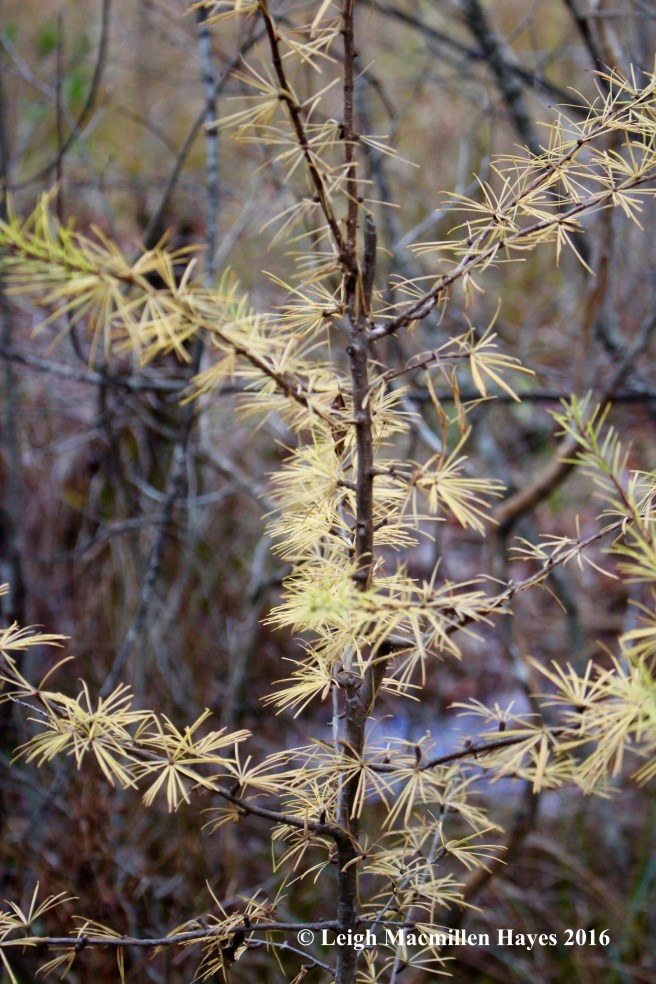
Tamarack (aka larch) trees–our only deciduous conifers, which had turned a golden yellow as is their autumn habit.

l-tamarack-2

The spray of tamarack needles reminded me of witch hazel flowers, which also grow on this property. But soon, the former will drop, leaving only their barrel-like stems as a reminder of their presence.

l-maple-leaf-viburnum

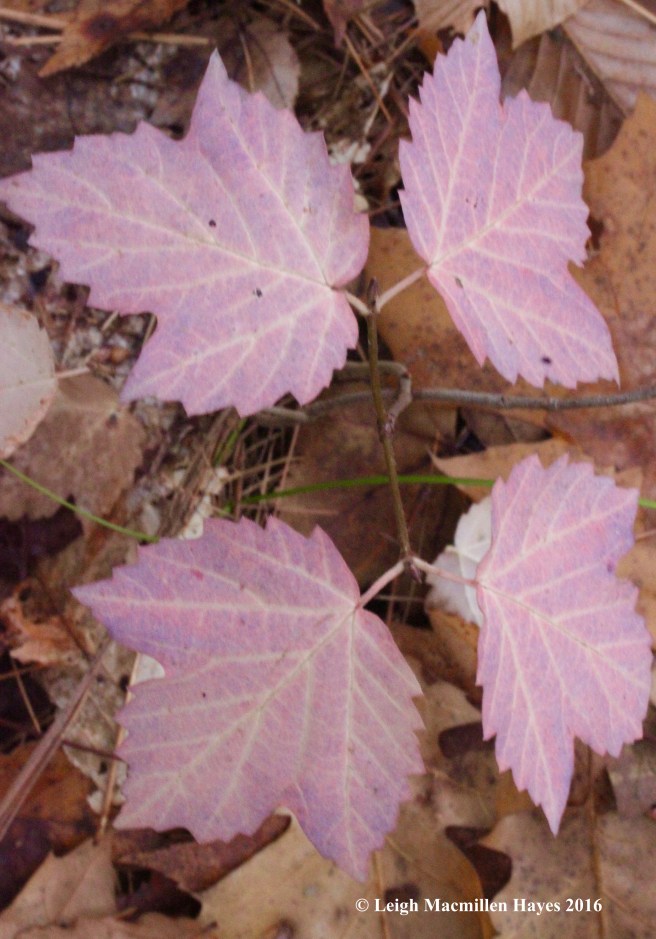
I left that spot, retraced my steps and headed to the north on a cross-country bushwhack, where the mauve colored maple-leaf viburnum grew.

l-turkeys

I saw lots of mammal sign and even a few birds, including turkeys who are loving the fact that this is a mast year for acorns.

l-trail-to-meadow

At last I emerged onto the trail I remembered and headed downhill again.

l-meadow-brook-2

And then . . . I was rewarded for my efforts. Long Meadow Brook and the mountains beyond provided a WOW moment.

l-meadow-east

I looked to the east for a few minutes.

l-meadow-layers

And then turned west again, where the layers and colors spoke of diversity.

l-meadow-snags

Even the dead snags added beauty.

l-cat-n-nine-tails

Cat-in-nine tails added to the view and I noted others who like wet feet including steeplebush, meadowsweet and bulrushes growing along the old beaver dam. It’s also a place for a variety of evergreen species–hemlock, white pine, balsam fir, red spruce and tamaracks. Future teaching moments await.

l-hobble-2

My intention to stick to the trail was soon thwarted when I spied hobblebush.

l-hobble-bud1

Like all trees and shrubs, the future was already encased in a bud–in this case a bud we refer to as naked because it doesn’t have the waxy coating of most others. Methinks its furry presentation offers the same protection from winter’s cold.

l-back-of-hobblebush-leaf

And as I studied the back side of fallen leaves, I paid attention to the venation–reminiscent of the bud’s pattern.

l-hobble-leaves-2

In the glow of sunlight, I felt like I’d found the pot of gold.

l-meadowhawk-2

A short time later I reached the second opening that Hannah and Aidan’s trail encompasses. And what to my wondering eyes should appear–a meadowhawk dragonfly.

l-snow-on-balds-1

It provided a sharp contrast to snow on the Baldface Mountains.

l-secod-opening-2

It was at this six-acre opening that I poked around for a while longer. And watched a goshawk fly to a pine tree with something dangling from its talons. Did I take a photo? No, of course not. I was too mesmerized to focus my camera. But sometimes, the photo doesn’t matter. Being there in the moment does.

I’m thankful for such opportunities made possible by organizations such as the Greater Lovell Land Trust. I know that ultimately this property is for the mammals that travel through and I saw plenty of evidence that they use this place. But then again, I’m a mammal who also appreciates the land bridges created and opportunity to observe the connectivity. I spent the day getting to know the way of the land at Long Meadow Brook Reserve–and can’t wait to return.


The Fruits Of Our Labor Day Mondate

I feel like a broken record when I say that my guy works too many hours, but so it has been. This was his weekend off and he worked more than a half day on Saturday and all day plus on Sunday. This morning he burned it all off with a seven mile run and then we headed off for a hike.

k-trail sign 1

Mount Kearsarge North off Hurricane Mountain Road in North Conway, New Hampshire, is an old fav that deserved a visit.

K-trail goes this way

It was great to be out of town and finally goofing off on this Labor Day holiday. He’s labored. I’ve labored (really–even when it seems like I’m playing, I truly am working, honest). And we needed a break. If we followed this blaze, however, we would never have found the summit.

k-climbing higher

Fortunately, we knew better. The hike is challenging, especially on the upward climb. We later commented about how the downward climb is faster, but does require attention to foot placement.

K-approaching tower

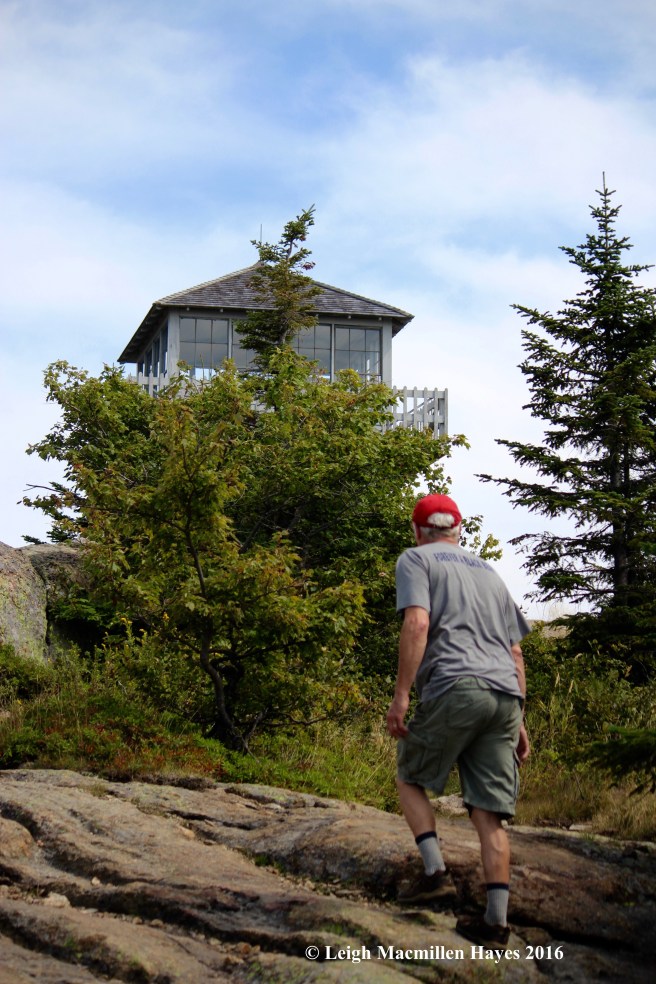
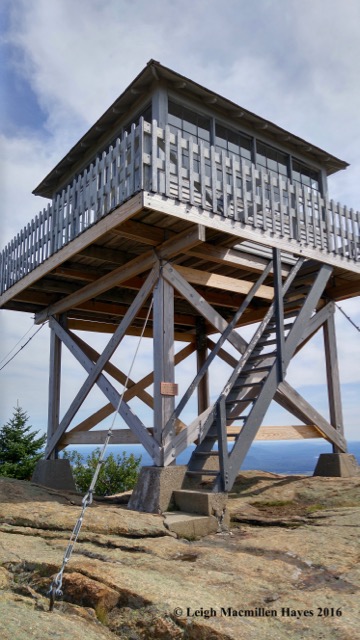
Just over two hours later, we approached the fire tower at the summit. Though no longer in use, it’s obvious from the 360˚ view why a fire lookout was built at this summit. Constructed in 1909, the structure was rebuilt by the US Forest Service in 1951. Prior to the replacement of fire towers by airplane surveillance, this tower was in operation until 1968.

k-summit fire tower (1)

Since we were last here about a year or so ago, it looked as if some of the support beams had been replaced.

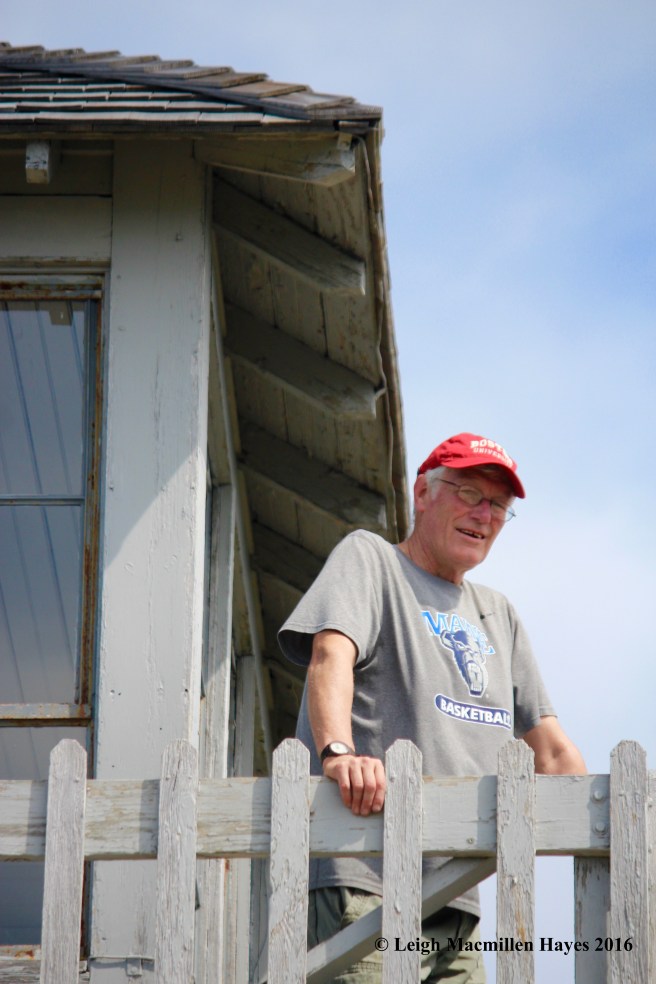
k-my guy at tower

Despite the cooler temps and wind, it’s always worth a climb up.

k-summit tower 3 (1)

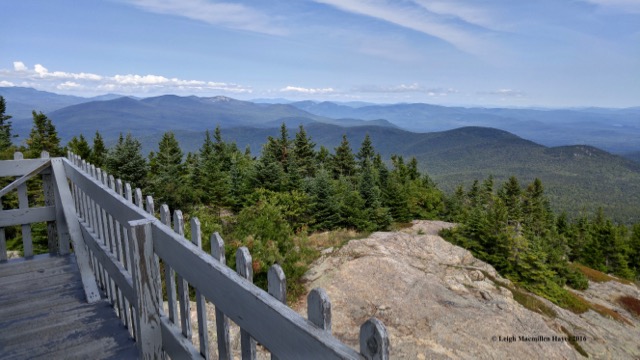
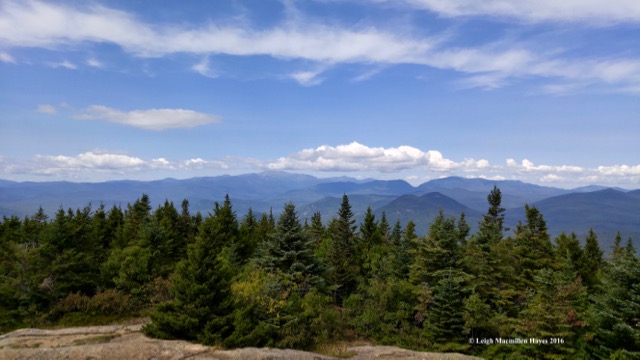
Once inside, all was calm. And the view–to die for. It made the efforts of our labor well worth it. We signed the log before moving back outside.

k-summit view 1 (1)

I was thankful for the railing that kept me from being blown to the great beyond as I gazed toward the Baldfaces,  though the wind wasn’t nearly as strong as last week’s Mount Crawford Mondate.

k-summit Mount Washington (1)

Back on the granite, we twirled about and took in each view–including Mount Washington with cumulus clouds grazing its summit.

k-summit to ledges and moats (1)

The cloud cover varied as we looked toward the valley with Cathedral Ledge, the Moats and beyond. Because we’ve set our feet down at those various levels, we appreciated the layers before us.

k-summit toward cranmore (1)

And we noted the Green Hills Preserve, where we’ve also hiked many a trail.

K-Pleasant Mtn

The cloud cover changed as we turned toward home and saw Pleasant Mountain in the distance. Our house is located about center beyond the mountain. And our camp to the left end of said mountain.

k-summit lunch rock (1)

Of all the rocks, lunch rock was the most important find. Sometimes, it’s difficult to locate such among all the opportunities, but this one spoke to us. And so we sat. And ate. Sandwiches (not PB&J–those are more for winter fare) and brownies (great any time of the year).

k-my guy snoozing (1)

And then my guy decided to snooze. He deserved it.

k-hare scat

I took advantage of the opportunity to observe and was tickled to find these woody fruits–the milk duds of the north woods. Snowshoe hare scat. I found numerous examples and wondered where the hares hid. Actually, they could have been anywhere because among the bald rocks there were plenty of islands filled with brushy undergrowth.

k-blueberry.jpg

And so I poked about. Though the low bush blueberry plants were plentiful, the fruits were sparse. In fact, I only spotted this one.

k-mountain cranberries

More prolific were the mountain cranberries, aka lingonberries.

k-summit speckled alder (1)

What surprised me was the presence of speckled alder in the mix because I think of this as a species with wet feet, but really, this mountain top is much moister than most of our lowlands, so in the end I guess it made sense. Always something to wonder about.

k-sheep laurel fruit.jpg

It wasn’t just speckled alder that made me wonder. Sheep laurel also grew there. I know it well in bogs and even along the power line behind our house. And yet, it loved the habitat on the summit.

k-summit huckleberries (1)

The same was true for huckleberries–which I look at beside Moose Pond all summer. How can they like wet feet and a bald mountain landscape. But again, I think perhaps it’s the moisture for these mountains are often lost in the clouds.
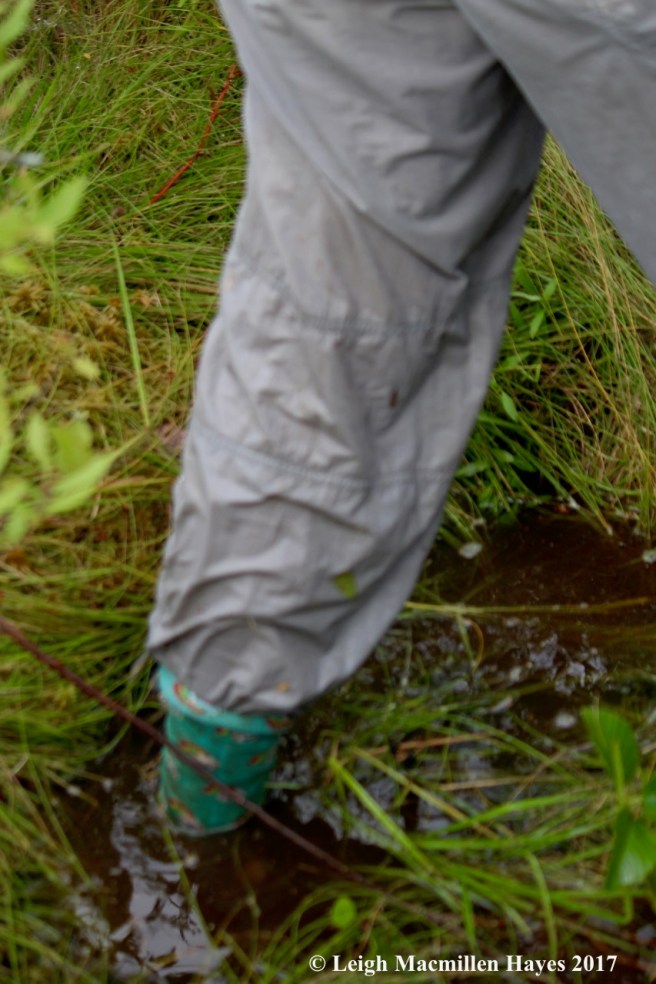
K-mountain holly

Mountain holly also liked this habitat. Again, I’ve seen this at camp where the fruits have already been consumed. Songbirds love these berries and the supply on Kearsarge will disappear soon as migration begins. Here today, gone tomorrow.

k-wild raisins 2

Wild raisins were equally plentiful and worth admiring.

k-wild raisins 3

The berries are edible, at least for birds. But . . . if not consumed, the fruits shrivel up–thus the name of wild raisin.

k-trail sign 2

At last, my guy awakened and we picked our way among the rocks and roots on our descent.

K-oak plum gall (1)

At least one more fruit showed its face on the downward route. Or was it a fruit? Actually not–it was an oak plum gall created by a wasp.

We talked about Labor Day as we climbed down. Labor Day is a tribute to the contribution of those who work and contribute to the strength, prosperity and well-being of our country. We gave thanks to our parents and the work ethic they taught us. And we noted the fruits of labor we saw in the natural world.

Finally, we toasted all with a beer at Delany’s Hole in the Wall in North Conway–a Shock Top for him and Tuckerman’s Pale Ale for me. On this Mondate, we felt rewarded with the fruits of all labor.


Halting Beside Holt Pond

Halting–prone to pauses or breaks. I didn’t break, but I certainly was prone to pauses as I moved along the trails and boardwalks at the Holt Pond Preserve in South Bridgton this afternoon.

h-pitcher flower2

One of my first stops–to admire the pitcher plant flowers in their August form.

h-pitcher  flower up close

When I took a closer look, I realized that the seeds were developing–certainly a WOW moment in the world of wonder.

h-buttonbush.jpg

The global seed heads of buttonbush also demanded to be noticed. Upon each head are at least two hundred flowers that produce small nutlets. What strikes me as strange is the fact that this plant is a member of the coffee family. Maine coffee–local brew; who knew?

h-Muddy across

At the Muddy River, the water level reflected what is happening throughout the region–another case of “Honey, I shrunk the kids.” It’s downright scary.

h-speckled bug and speckles

Both by the river and on the way to the quaking bog, this wetland features a variety of shrubs, including one of my many favorites, speckled alder. Check out the speckles–those warty bumps (aka lenticels or pores) that allow for gas exchange. And the new bud covered in hair.
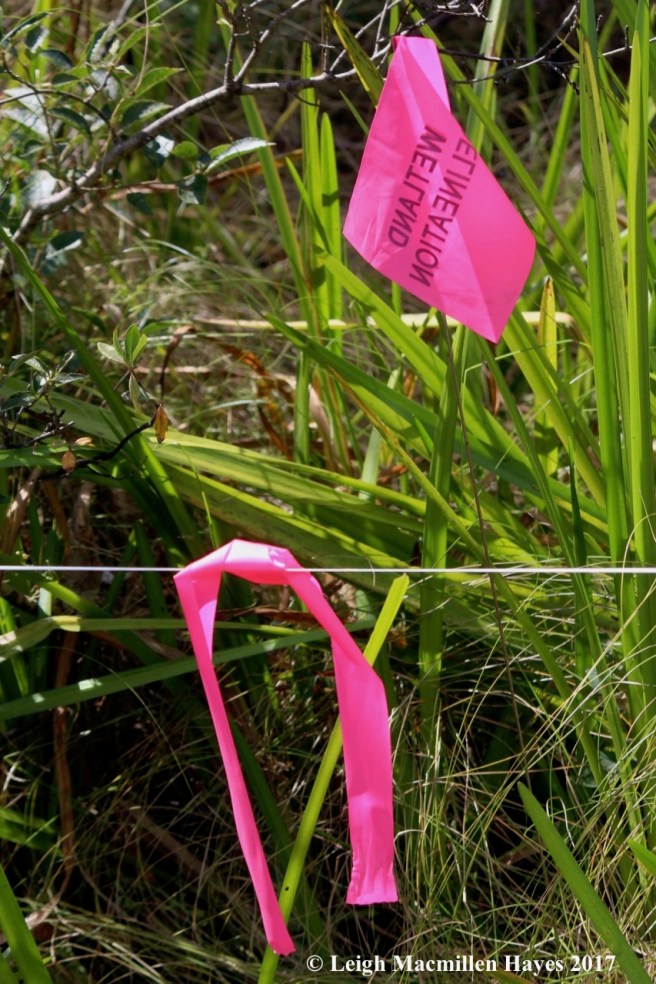
h-speckled alder catkins

This shrub is so ready for next year–as evidenced by the slender, cylindrical catkins that are already forming. This is the male feature of the shrub.

h-speckled cones new

It also bears females–or fruiting cones filled with winged seeds.

h-speckled old cones

It’s not unusual for last year’s woody cones or female catkins to remain on the shrub for another year.

h-cranberries

Whenever I visit, it seems there’s something to celebrate–including ripening cranberries.

h-cotton grass

Common Cotton-grass dotted the sphagnum bog and looked as if someone had tossed a few cotton balls about. Today, they blew in the breeze and added life to the scene. Note to self–cotton-grass is actually a sedge. And sedges have edges.

h-holt pond left

Just like the Muddy River, Holt Pond was also obviously low. Perhaps the lowest I’ve ever seen. At this spot, I spent a long time watching dragonflies. They flew in constant defense of their territories.

h-slaty skimmer, male

Male slaty skimmers were one of the few that posed for photo opps.

h-canoe on pond

As I watched the dragonflies flit about along the shoreline and watched and watched some more, I noticed a couple of fishermen making use of the LEA canoe. I don’t know if they caught any fish, but I heard and saw plenty jumping and swimming. Well, a few anyway. And something even skimmed across the surface of the water–fish, snake, frog?

h-rose hips.jpg

Rose hips by the pond’s edge reminded me of my father. He couldn’t pass by a rose bush without sampling the hips–especially along the shoreline in Clinton, Connecticut.
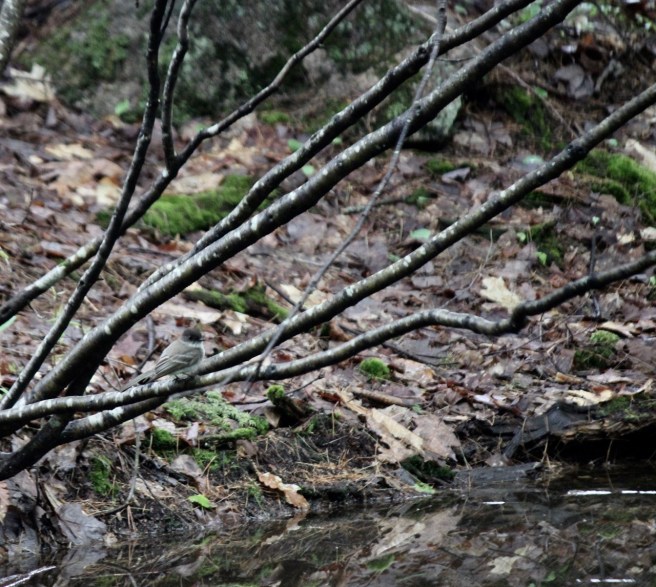
h-pond toward 5 Fields

The view toward Five Fields Farm was equally appealing.

h-pickerel frog

And then I moved down tire alley, which always provides frequent sightings of pickerel frogs. I’m never disappointed.

h-golden spindle

At the transition from a red maple swamp to a hemlock grove, golden spindles embraced a white pine sapling as if offering a bright light on any and all issues.

h-hairy woodpecker

In this same transitional zone, a female hairy woodpecker announced her presence.

h-green frog

When I crossed Sawyer Brook, green frogs did what they do best–hopped into the water and then remained still. Do they really think that I don’t see them?

h-hobblebush berries

At last, I walked out to Grist Mill Road and made my way back. One of my favorite surprises was the amount of hobblebush berries on display.

h-meadowhawk

Walking on the dirt road gave me the opportunity for additional sights–a meadowhawk posed upon a steeplebush;

h-chicken

chicken of the woods fungi grew on a tree trunk;

h-chipmunk

and a chipmunk paused on alert.

h-American Woodcock

But the best find of the day–one that caused me to halt on the road as I drove out of LEA’s Holt Pond Preserve–an American Woodcock.

Worth a wonder! And a pause. Certainly a reason to halt frequently at Holt Pond.


Samplings of Wonder

The day began with a journal hike along Perky’s Path, a trail in the Greater Lovell Land Trust’s Heald and Bradley Ponds Reserve. It was a first for us–a journal walk that is, and we had no idea how it would turn out. But our fearless docents, Ann and Pam, did a wonderful job of listening to the voices of those gathered and knew when it was time to stop and when it was time to move on again.

h-LMH

Each of us got lost in the world around us as we sat. We looked. We listened. We contemplated. We wrote. We sketched. We photographed. I know that I was so intent on sketching that I never realized Pam took this photo until she sent it to me. Thank you, Pam.

h sampling

Ever since I’ve started looking at the natural world through my macro lens, I haven’t taken as much time to sketch, so today was a welcome excuse to do so. And to color. Since my Aunt Ruth gave me colored pencils at least 50 years ago, those have been a favorite medium. I no longer have the gift from her, but my guy replenishes my supply when necessary.
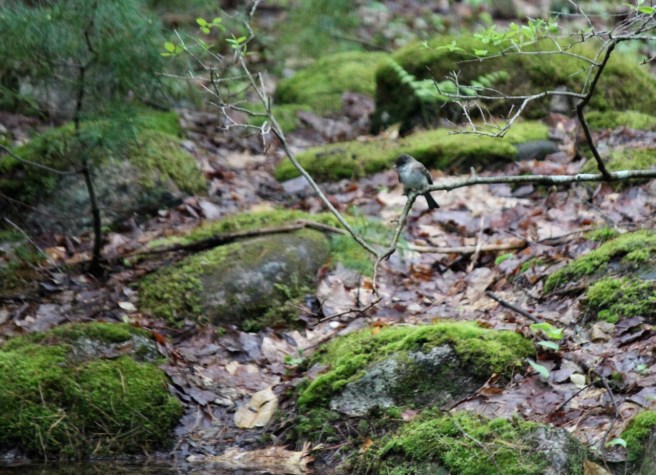
IMG_2706 (1)

Our group was small, seven in total. We all admitted that small is good for this sort of activity.  And we came away thankful for the experience of making time to notice.

h beetle

And then I walked to the summit of Hawk Mountain with Jinny Mae–on a trail that may seem rather sparse in offerings, but actually proved to be quite rich. This banded longhorn beetle didn’t really like being the center of attention. His focus was on steeplebush pollen and I kept getting in his face. So–he did what flying insects do–and flew off.

h fern indusium

We were excited to discover several clumps of marginal wood ferns and some even with the indusium still intact. The indusium is a membranous covering that protects the sporangia inside the spore cases until they are ready to leave home on a dry day. In this case, the indusium is kidney shaped. As the sporangia ripen, they push the covering off and dust-like spores fly off in a wee cloud, breaking free to set down their own roots.

h white oak

Here, both Northern red and white oak grow side by side. It was the white oak’s fruiting structure that called our names. The immature acorns growing in pairs are both warty and hairy, but their structure is more reminiscent of a miniature pine cone at this stage. They should mature by fall.

h stag stalk

And then we celebrated the one who is all hair and color . . .

h stag leaves

and distinct shapes and

h stag leaf

a combination of all three.

h stag flower

Staghorn sumac. The king of the mountain.

h berries 2

Little things excited us and the twin fruits of the Hairy Solomon’s Seal that tried to hide beneath the leaves didn’t escape our focus. Or our cameras. Sometimes we are sure that we share all the same photos.

h indian pipe

One of our final stops as we headed down the trail–to worship the heads-up version of a fertilized Indian pipe. While most flowers nod when fertilized, Indian pipe chooses to be different. It wins in my wonder department.

I’ve only shared a few finds from today’s wanders. Just a smattering or a sampling. All worth a wonder.


Be Together Mondate

It took us a while to get our act together this morning, but by 10:30 we were finally at the trailhead for the Baldface trails off Route 113 in Evans Notch. Okay, so true confession, I did not want to hike these trails. For thirty years I’ve managed to avoid them, but my guy promised me this morning that if I wasn’t comfortable we could turn back at any point.

b-start sign

And so our Mondate began.

b-ph emerald 3

The first .7 miles were familiar to us as we’d passed this way many times in the past, often with friends or family in tow. The destination, Emerald Pool. A forever nippy Emerald Pool.

b-ph emerald 2

We stood above the pool today and shared memories of past visits. And the people that made those visits memorable.

b-ph emerald above

Even the water above the pool provided hours of entertainment in days gone by.

b-ph emerald above 2

Today, it was the water’s force and volume, increased since last night’s rain, that gave us pause.

But we couldn’t pause for long. We had a mountain to conquer. And so, we headed back to the main trail and at the junction followed the Baldface Circle Trail . . . until it disappeared before our eyes. We backtracked but couldn’t figure out what we’d done wrong, except that we couldn’t see trail blazes anywhere. And so we retraced our footsteps until the trail petered out again. And then we decided to bushwhack and climb uphill because it only made sense that we’d find our way. At last, success–we found yellow blazes and an obvious trail. But . . . we didn’t know if we were on the Circle Trail or Slippery Brook Trail.

Our plan had been to hike up the first and down the latter. Out came the map and compass and we were fairly sure we were on the latter trail. To be certain, we hiked a wee bit, until we came to the brook. Yup. So, decision time. Turn around and head back to the other trail or continue on because we’d already come so far. We continued on. Plan B when we didn’t even know we had a Plan B.

b-ph brook 3

And Slippery Brook held its own tribulations. The water–oh how it flowed. It didn’t bother my guy and within seconds he stood on the other side grinning back at me. Meanwhile, I hemmed and hawed. And hawed and hemmed. How in the world? I thought perhaps I should return to Emerald Pool and wait for my guy to complete the round trip. He wasn’t buying that. Neither was I, truth be told. But sometimes my head gets the better of me. He knew that. And so he dropped his pack, took off his boots and sloshed through the cold water to grab my pack.

b-ph brook crossing 2

I didn’t have a choice. I had to follow him. And so I did. Of course, this guy knows I’ll follow him anywhere.

b-lunch rock

We continued on the Slippery Brook Trail and a delightful trail it was. I kept waiting for the bald face to show, but it wasn’t to be. The worst part, if there was one, would be the mosquitoes. It poured last night and the trail was rather wet, but still, it provided a pleasant climb. We paused for lunch beside a stream where the mosquitoes abated.

b-ph mayfly1

One of the things I like about stopping for lunch, besides eating because I’m always hungry, is taking time to notice. Mayflies.

b-mtn maple1

The deeply impressed veins of mountain maple leaves.

b-sugar maple

And u-shaped lobes of sugar maples.

b-dogwood

Dogwood.

b-beech fern1

And beech fern.

b-bunch:hobble

Following lunch, we continued to climb and noticed things like the great pretender–a bunchberry posing as a hobblebush flower.

b-ph moose works

And moose works carving the greenery.

b-halfway sign.jpg

At last we reached our halfway point at 3.5 miles. I kept wondering–where is the bald face that I’ve been dreading? The Slippery Brook Trail was a delight, be it long, with no bald rocks in sight.

While we climbed, I’d not only noticed my surroundings but also planned my funeral. I know who I want to conduct the service and he’s out of town this week. I figured that was OK. My guy would just have to delay it for a bit. And I thought about who might come and how the different folks would interact with each other. It’ll be a celebration of life, of course. And people should be encouraged to get outside and notice. Maybe they could go on a group walk.

b-yellow clintonia.jpg

And then we followed the Baldface Knob Trail where the yellow clintonia grew in such abundance that my guy actually started to ID it. I’ll make him a naturalist yet. ;-)

b-lady's x2

Equally abundant were the lady’s slippers.

b-ph trail up

And then we met my nemesis. But really, it wasn’t so bad. All that worry for naught. I could do this. If we decided to hike down this way, I would survive.

b-ph first view

At last we reached our first vantage point with the world we normally inhabit spread out beyond.

b-ph hiking up

It just kept getting better, and cooler and windier–a relief for our sweaty bodies. But . . . the black flies increased significantly. I swallowed a few. All that swarmed must have been males because they didn’t bite. But they certainly were annoying.

b-ph Pleasant Mtn

As we approached the top of the Baldface Knob we recognized our neighborhood with Pleasant Mountain in the backdrop.

b-ph panoramic

A 180˚ panoramic provided half of the picture. I thought I caught the other half, but it’s not to be. South Baldface was behind us and completely doable. We decided to save it for another day because it was getting late and we weren’t certain about the trail before us.

b-ph chokeberry

Among the selections at our feet, chokeberry

b-summit mtn ash

and mountain ash.

b-hummer 3

At eye level–a hummingbird moth who moved in supersonic speed.

b-hiking down 1

And then we followed the path down.

b-ph forever view

The world stretched before us

b-ph hiking down 3

to infinity and beyond. My guy insisted that parachutes were available at this spot, but they must have been previously claimed because I couldn’t find one . . . anywhere. And believe me, I looked.

b-ph heading down

It all seemed so innocent from the top, but really, it was a scramble. A major scramble that lasted a long time until we got back into the hardwood forest. Our footing–precarious and often wet. We both have a fear of heights in open spaces. My guy has forever had such a fear–my own is newly developed and I know not its source. Oy vey. We were in over our heads, but had no choice. I kept thinking about a rescue mission, but I don’t think they show up for those who whine. We practiced our crab walks, slid and skidded and hugged rocks and trees as we made our way down this precarious trail.

b-ph lichens1

The lichens were beautiful and we got to see them up close and personal. We also practiced our trust jumps. Yup, several times my guy positioned himself to catch me as I jumped. Remember my funeral plans on the way up. I was preparing as we climbed and facing the inevitable as we descended.

b-ph lady 2

Finally, we were rewarded with a more even trail–sort of–and lady’s slippers.

b-ph chandler 5

About a mile before the trailhead, we followed a spur to Chandler’s Gorge.

b-phdirty lady

On the way out, I realized I wasn’t the only dirty lady.

Oh, and we found where we zigged rather than zagged at the start of the trail. Honestly though, we both realized that if we’d hiked up the Baldface Circle Trail, we probably would have turned back. So as luck would have it, we went the right way.

Since we were on stable ground, I mentioned my fears to my guy. He admitted he’d had the same. And when I said I was sure we’d both fall when I jumped down and he caught me several times, he said at least we’d be together.

Be together on a Mondate. That’s what it’s all about.


America the Beautiful

This morning’s rain and overcast sky embraced the melancholy emotions of this day as we remembered  family, friends, acquaintances and strangers who have served our country, especially those who died during times of conflict.

And then the sun shone.  It didn’t mean that we stopped remembering. But it did shine a light on the beauty that surrounds us and that we have the opportunity to observe if we so choose. Because of the service of others, we’re fortunate in that regard–we get to choose.

ph droplet on lupine leaf

I chose to step out the back door and notice.

ph-chives 2

Visitors upon chive florets.

ph-anem2

Unfolding Canada anemone.

ph-anem3

And the first to open.

ph-cherry

Black cherry blossoms all in a column.

ph-chokec2

And chokecherry blooms in terminal clusters.

ph-hemlock cone1

Blue-green baby hemlock cones.

ph tad 6

And life teeming in the vernal pool.

I’m thankful for the freedom of choice. America is beautiful.


Three Times A Charm

One might think that following the same loop through the woods in slow motion three times in one day would be boring. One would be wrong. My friend Joan and I can certainly attest this fact.

Round One: 9 am, Wildflower and Bird Walk with Lakes Environmental Association co-led by birder/naturalist Mary Jewett of LEA and the ever delightful botanist Ursula Duve.

h-hobblebush

In abundance here, the hobblebush bouquet–a snowy-white flower that is actually an inflorescence, or lacy cluster of tiny fertile flowers surrounded by a halo of showy, yet sterile bracts. Yeah, so I’ve showed you this before. And I’ll probably show it again. Each presentation is a wee bit different.

h-beech cotyledon1ph

And then we spied something that I’ve suddenly seen almost every day this week.

h-beech coty 4ph

The cotyledon or seed leaf of an American beech. Prior to Monday, I don’t know that I’ve ever seen this and yet, since then I’ve continued to discover them almost every day. Worth a wonder.

h-beech coty 3ph

Think about it. The journey from seed to tree can be a dangerous one as the root is sent down through the leaf litter in search of moisture. Since the root system is shallow, lack of moisture can mean its demise. When conditions are right, a new seedling with a rather strange, yet beautiful appearance surfaces. The seed leaves of the beech, aka cotyledons, are leathery and wavy-margined. They contain stored food and will photosynthesize until the true leaves develop, providing a head start for the tree. I realize now that I’ve seen them all my life in other forms, including maple trees, oak trees and vegetables. But . . . the beech cotyledon captures my sense of wonder right now, especially as it reminds me of a luna moth, which I have yet to see this year.

h-green frog 2

Crossing the first boardwalk through the red maple swamp, a large male green frog tried to hide below us. Notice the large circular formation behind his eye. That’s the tympanum, his visible external ear. A male’s tympanum is much larger than his eye.

h-rhodora ph1

Other red maple swamp displays included the showy flowers of rhodora and their woody capsules.

h-rhodora1

Ralph Waldo Emerson knew the charm of this spring splendor:

The Rhodora

On being asked, whence is the flower.
In May, when sea-winds pierced our solitudes,
I found the fresh Rhodora in the woods,
Spreading its leafless blooms in a damp nook,
To please the desert and the sluggish brook.
The purple petals fallen in the pool
Made the black water with their beauty gay;
Here might the red-bird come his plumes to cool,
And court the flower that cheapens his array.
Rhodora! if the sages ask thee why
This charm is wasted on the earth and sky,
Tell them, dear, that, if eyes were made for seeing,
Then beauty is its own excuse for Being;
Why thou wert there, O rival of the rose!
I never thought to ask; I never knew;
But in my simple ignorance suppose
The self-same power that brought me there, brought you.

h-LEA group

To avoid getting our feet too wet, we spread out as we walked on the boardwalk through the quaking bog.

h-five morning

Morning light highlighted the layers from the pond and sphagnum pond up to Five Fields Farm and Bear Trap above.

h-trill 1

And because it was ever present, I couldn’t resist pausing to admire the painted trillium once again (don’t tell my guy).

h-dwarf ginseng1ph

One plant that I will always associate with this place and Ursula, who first introduced me to it years ago, is the dwarf ginseng. I love its global spray of flowers and compound leaves. But maybe what I love most is its beauty in diminutive form–just like Ursula.

Round Two: Noon, Lunch and a walk with my dear friend Joan.

h-bigtooth aspen

After returning to our vehicles following the morning walk, Joan and I grabbed our lunches. And I paused in the parking lot to enjoy the silvery fuzziness of big tooth aspen leaves. The quaking aspen in our yard leafed out a couple of weeks ago, but big tooth aspen leaves are just emerging. Like others, they begin life with a hairy approach–perhaps as a protective coating while they get a start on life?

h-muddy riverlunch

We ate lunch beside Muddy River where the spring colors were reflected in the water.

h-blueberries 1ph

And then we heard something jump in the water, so we moved silently like foxes as we tried to position ourselves and gain a better view. In the back of our minds, or perhaps the front, we wanted to see a turtle, beaver or especially an otter. Not to be. But we did see highbush blueberries in flower.

h-bee 1

And the bees that pollinate them.

h-pitcher 5ph

In their out-of-this universe form, we knelt down to honor the pitcher plant blossoms that grow along a couple of boardwalks.

h-red maple samaras

We were wowed by the color of the red maple samaras,

h-red winged

prominent shoulder patch of the red-winged blackbird,

h-cranberries

and cranberries floating on the quaking bog.

h-lone larch

And then our eyes were drawn to the green–of the lone larch or tamarack tree

h-green 9ph

and the green frogs.

h-green 8ph

I spent some time getting to know one better.

h-green 3

She even climbed out to accommodate me–I’m sure that’s why she climbed up onto the boardwalk.

h-green 6

Or maybe she knew he was nearby. What a handsome prince.

Round Three: 2:30pm, Joan and I (co-coordinators of the Maine Master Naturalist Bridgton 2016 class) were joined by another MMNP grad, Pam Davis Green, who will lead our June field trip to explore natural communities at Holt Pond.

h-striped maple flower

h-spriped flowers 2

Cascading down from the striped maple leaves, we saw their flowers, which had alluded us on our first two passages.

h-speckled 2

The cottony white masses of wooly alder aphids decorated many of the speckled alders in the preserve. In a symbiotic relationship, ants stroke the aphid with their antennae, while  the aphid releases a drop of honeydew, much like a cow being milked. It’s actually rather creepy.

h-duck

Two Canada Geese squawked from another part of the pond, but Mrs. Mallard stood silently by.

h-tree pants

Our final sight brought a smile to our faces–someone put his or her pants on upside down!

We hope that charms your fancy. Joan and I were certainly charmed by our three loops around and those we got to share the trail with today.

We also want to thank Ursula, Mary and Pam for their sharings. And we send good vibes and lots of prayers to my neighbor, Ky, and Pam’s brother-in-law.       

 

 

Beulah’s Mystery

One of the fun happenings in my life is that friends send me nature photos and ask me to help them ID a species. Sometimes I know immediately what it is and can ask them questions to help them get to the answer. Other times I’m as stumped as they are. Thus was the case today, when I drove to Brownfield to look at a tree growing in the field beside an old farmhouse.

t-beulahs 2

Beulah’s farmhouse, to be exact. My friend’s brother recently purchased it and the adjacent barn. Though the farmhouse is a fixer-upper, Beulah’s sign looks as if it was created yesterday.

t-tree1

This is the tree. If you know it right off, my hat goes off to you. I was in my Forest Trees of Maine mode and kept looking at it from that perspective. It’s overall appearance didn’t match what I know. We began with the key and slowly (painfully slowly as the black flies swarmed us–mind over matter, mind over matter), worked our way through the choices, two by two.

t-dwarf shoots

Because it’s not in leaf yet, we used the Winter Key. With each question, we paused to examine the tree–looking at the alternate leaf shoots, hairy scaled buds, pith, bark–every detail. We considered its location in the middle of a farm field, where the land sloped slightly and was rather dry. We also looked at the ground and found decaying leaves as well as deer scat. As I suspected, it wasn’t in the key. So I came home and scoured other books. I think I reached the answer and that the deer scat is actually a clue. Do you know? Now you may say so.

t-porky den

On our way to see one more cool thing, we paused to look at a den located beside the old foundation. Though much of the scat has since been removed, plenty of it and numerous quills painted the picture of who’d created this pigpen.

t-critter 2

And then they had one more mystery item to show me. I hope this doesn’t freak you out. It’s part of many renovations in old farmhouses–a dried-up animal carcass. The front of the face was missing, but as we say, eyes in the front, born to hunt.

t-critter 1

A side view of this handsome critter. Can you see the ears?

t-critter 4

Talk about all skin and bones.

t-critter pads

And then the foot pads and nails. Four toes, nails, about the size of a nickel. Do you know?

t-bog sign

Because I was in the neighborhood, I visited Brownfield Bog and continued my afternoon exploration. (Yeah, I had work to do, but playing hooky for a couple of hours is allowed once in a while if I don’t abuse the privilege–ah, the life of a freelancer.)

t-red oak emerging

I remember suddenly becoming aware of spring colors about thirty-five years ago, when I taught  school in New Hampshire by the convergence of the Pemigewasset and Merrimack Rivers. Until then, I’d never realized that tree leaves emerge in a variety of colors–they all weren’t suddenly green. (BTW– do you see the spittlebug? )

t-red oak mini leaves

In a quickness equal to fall foliage, spring colors may not be as flashy, but their subtle beauty deserves notice.

t-gray birch 2

And those leaves that are green offered their own reasons to stop me in my tracks as I took in the details–in this case the double-toothed elephant’s trunk. What? Notice the shape and outer margin of the leaf.

t-gray birch 4

The lovely elongated catkins demanded a glance that lasted more than a second.

t-willows cat1

Adding a festive fuzziness to the celebration of spring was another set of catkins.

t-willow gall

Unwittingly, this shrub also played host to a gall gnat midge that overwintered in a structure created by the reaction to a chemical released by the larva–what would have been leaves were forced to harden into a pine cone look alike.

t-bog colors 2

The subtle colors graced the meadow,

t-pleasant

were reflected in the bog,

t-river

and blessed the Saco River.

t-baltimore 2

There were bits of flashy color–do you see who was feeding on the upper branches?

t-rhodora 1

And this spring beauty exploded with love and life.

At the end of my journey, I was grateful to P&K for an excuse to step away from my desk and check out the mystery standing in Beulah’s field. Especially as it led me further afield.