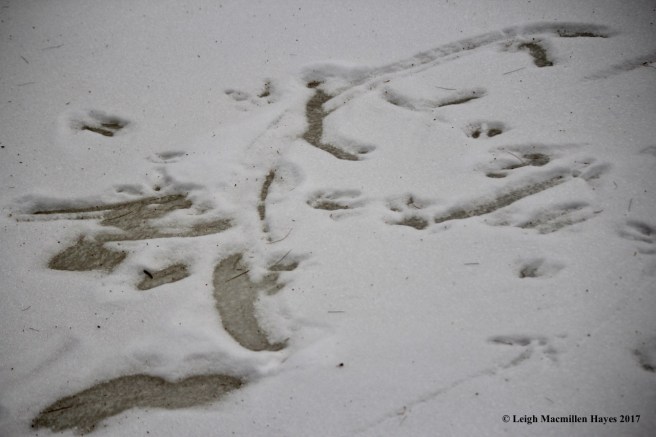
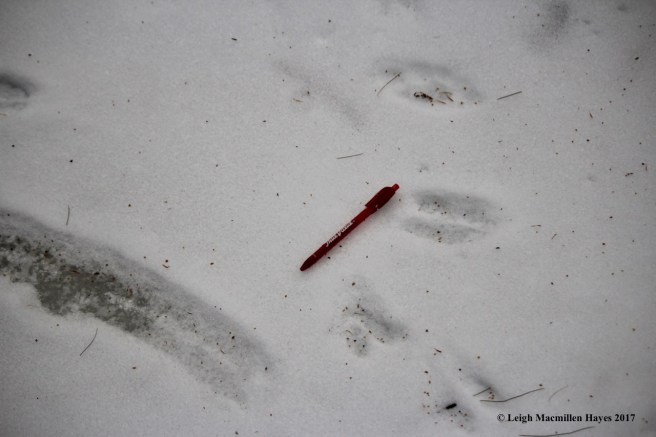
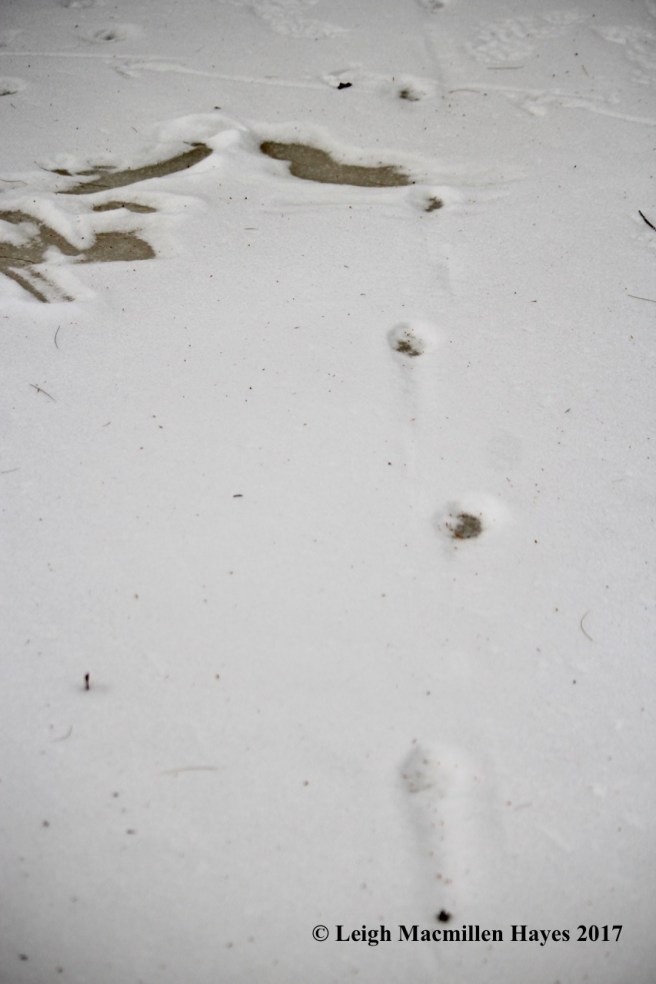
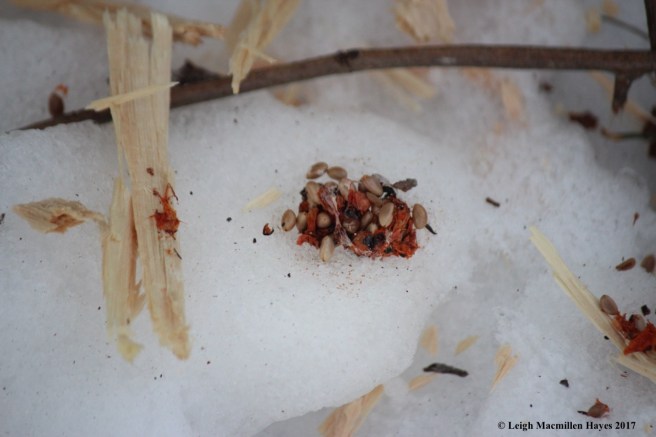
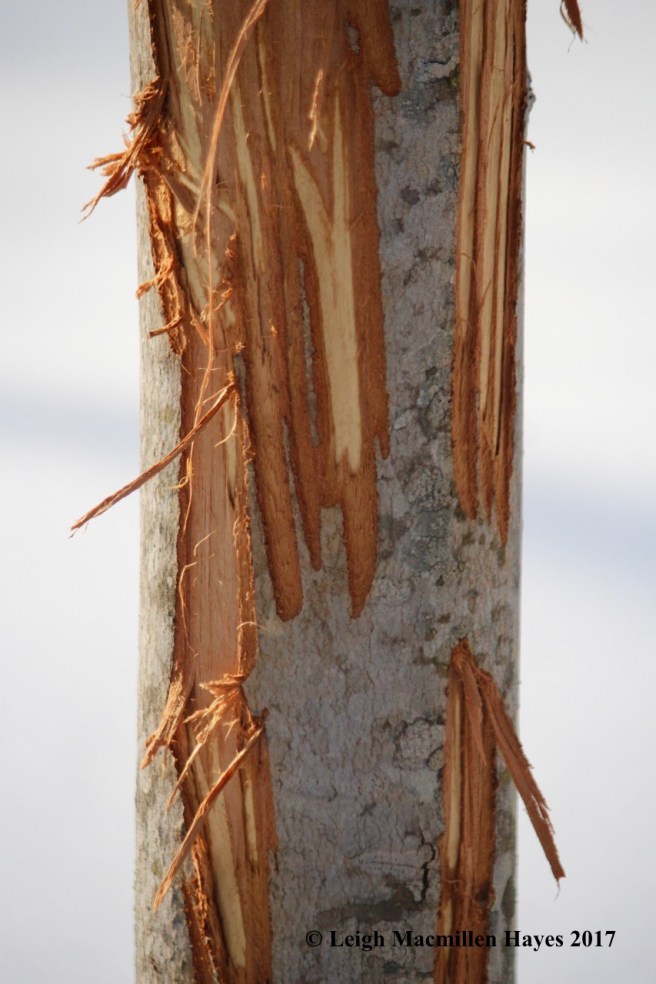
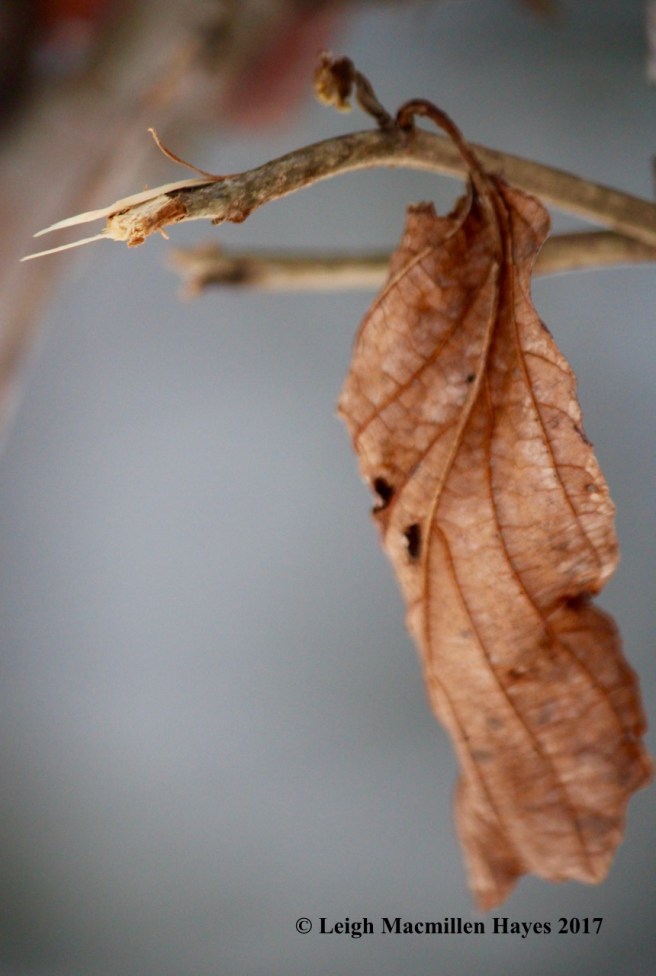
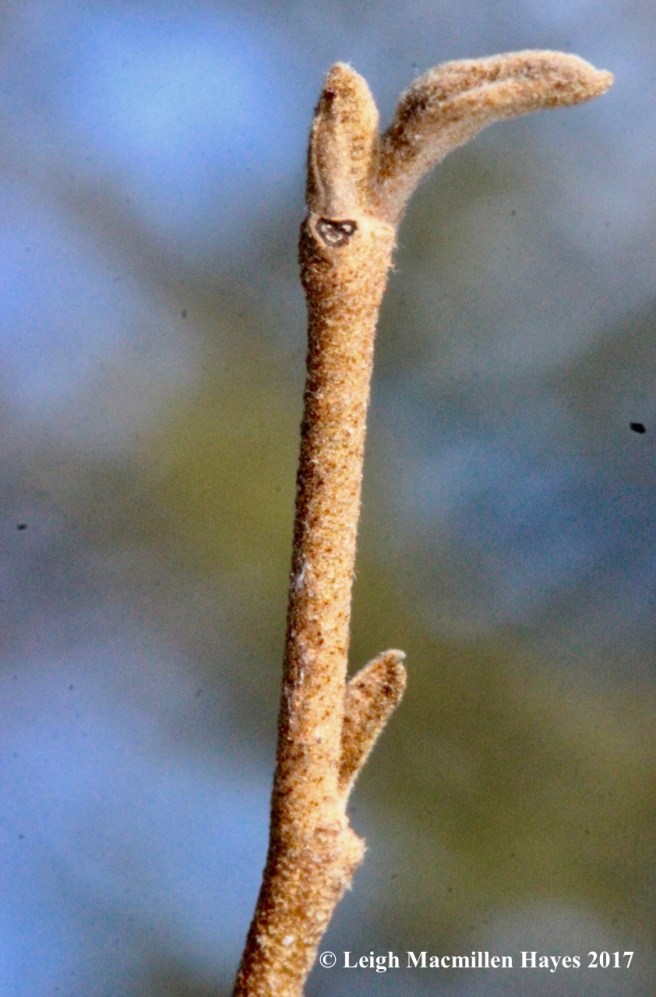
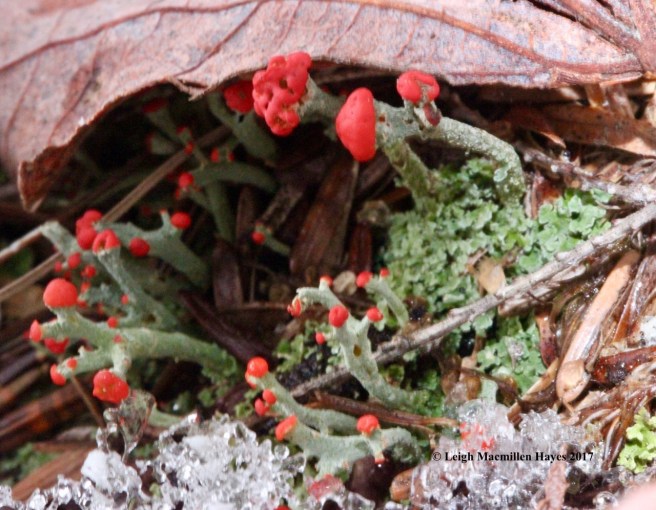
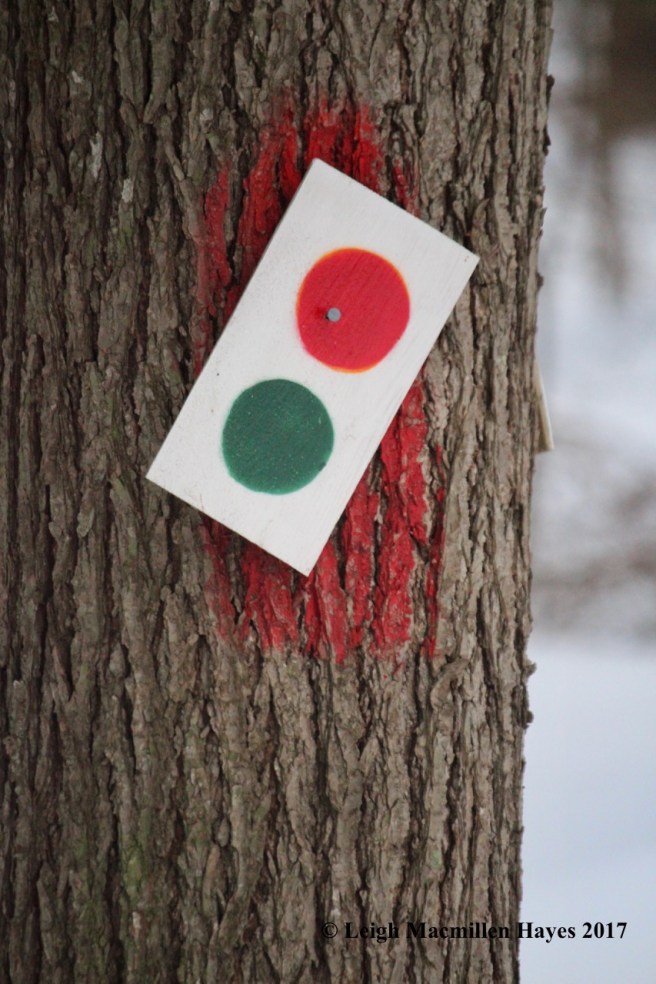
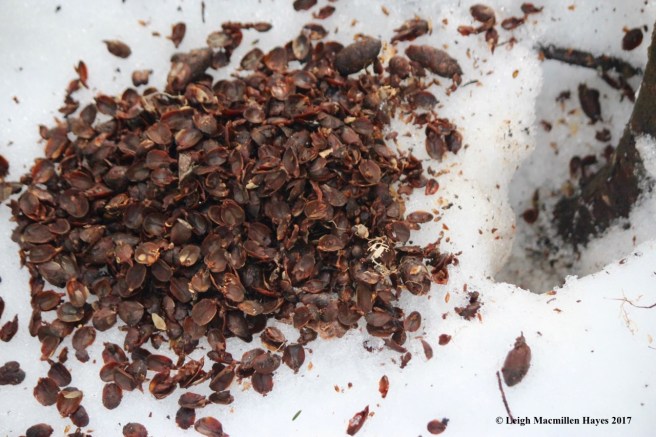
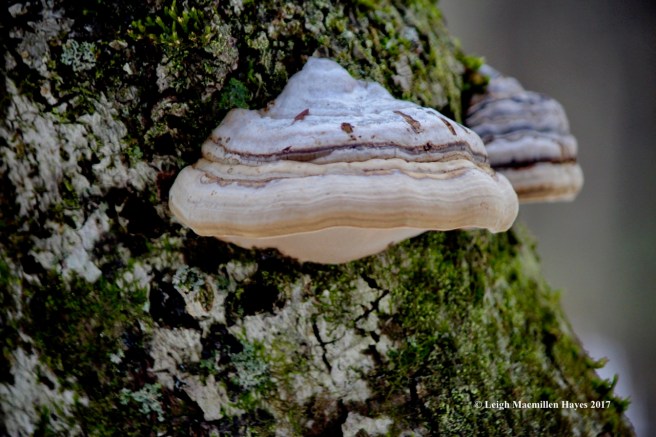
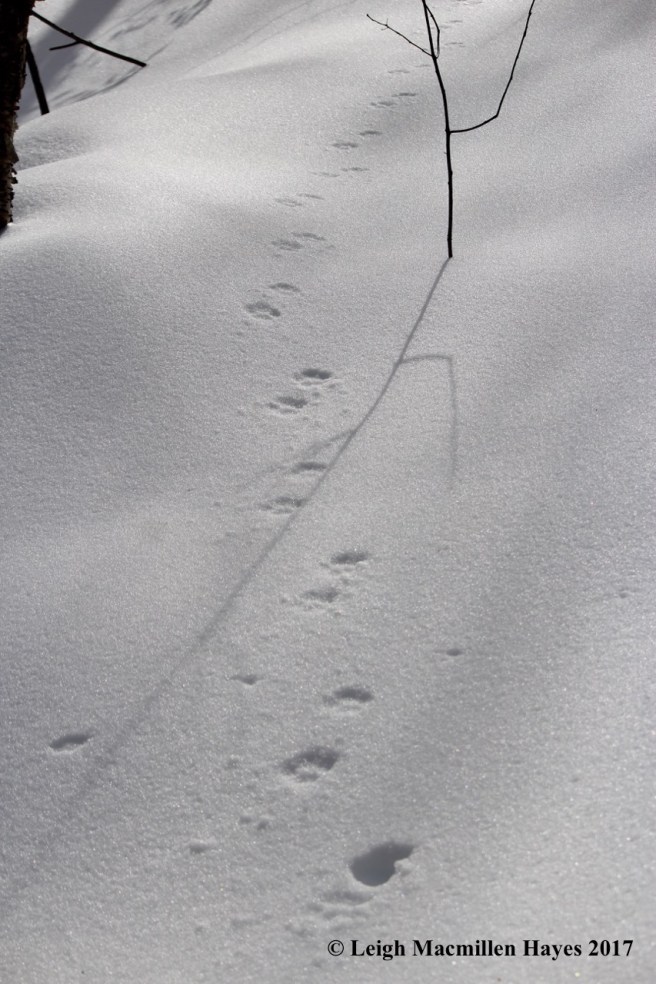
A Special Mondate

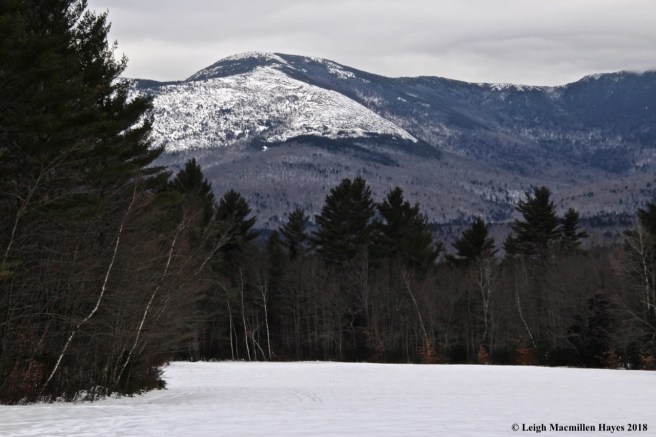
Our plan was to hike up Blueberry Mountain and continue on to the summit of Speckled in Evans Notch today, but as we drove toward the White Mountains I mentioned that a friend had shared a photograph of ice inside a mine near the Basin on Route 113. And so in an instant said plan changed.

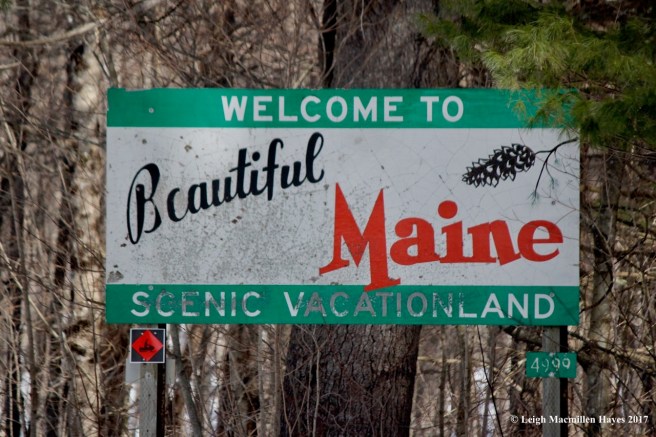
b1-sign

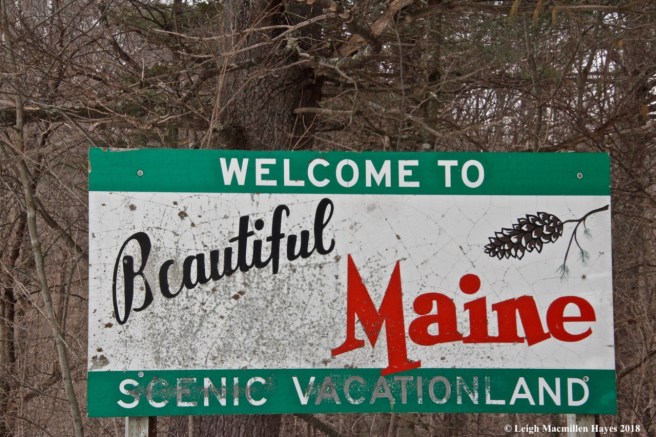
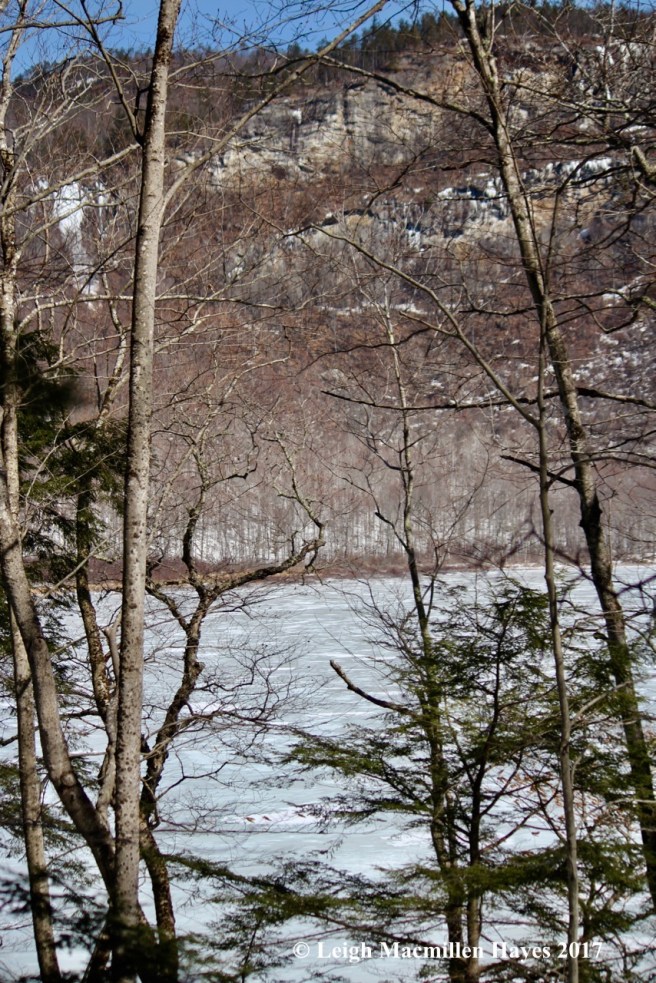
We parked near the iconic Welcome to Beautiful Maine sign and ventured off in search of the mine. Of course, I’d forgotten where exactly it was located, so we walked about a mile on a snowmobile trail until we spied private land in front of us. That was our turn around point, but . . . me thinks we should have continued because I later learned that the mine sits between public and private property.

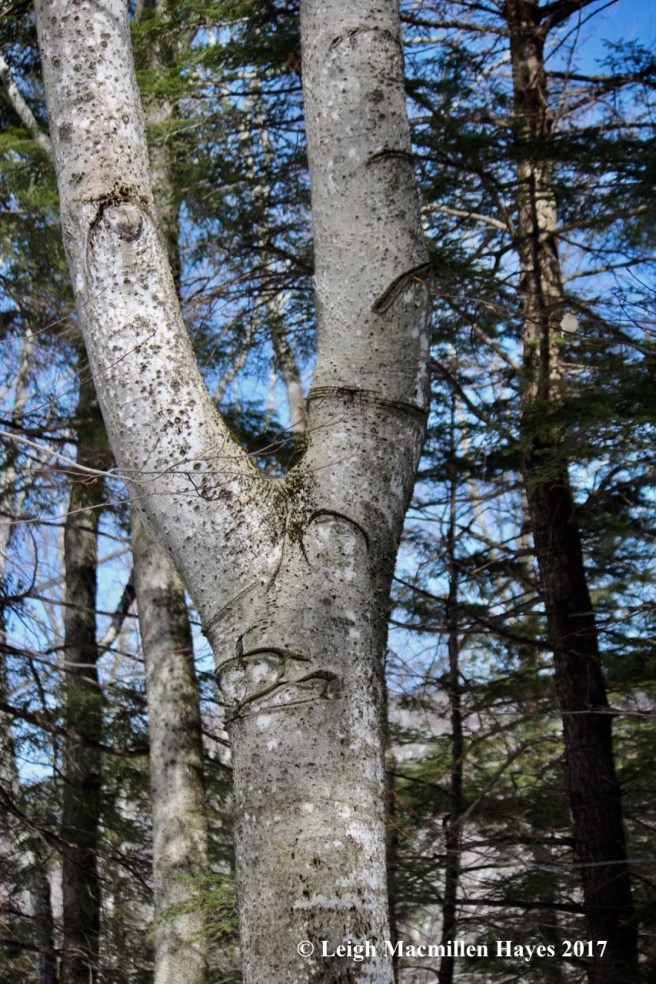
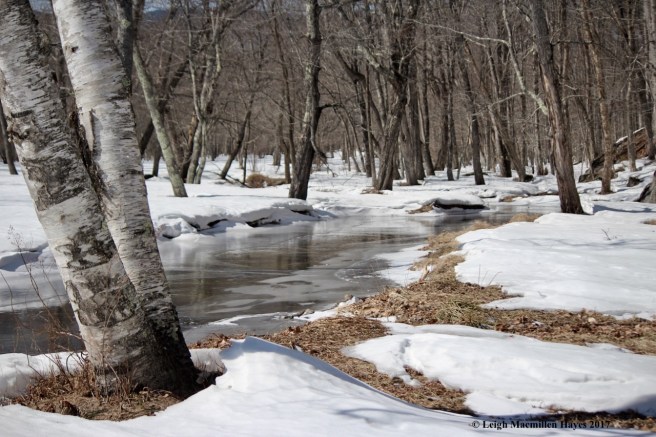
b2-gray birch

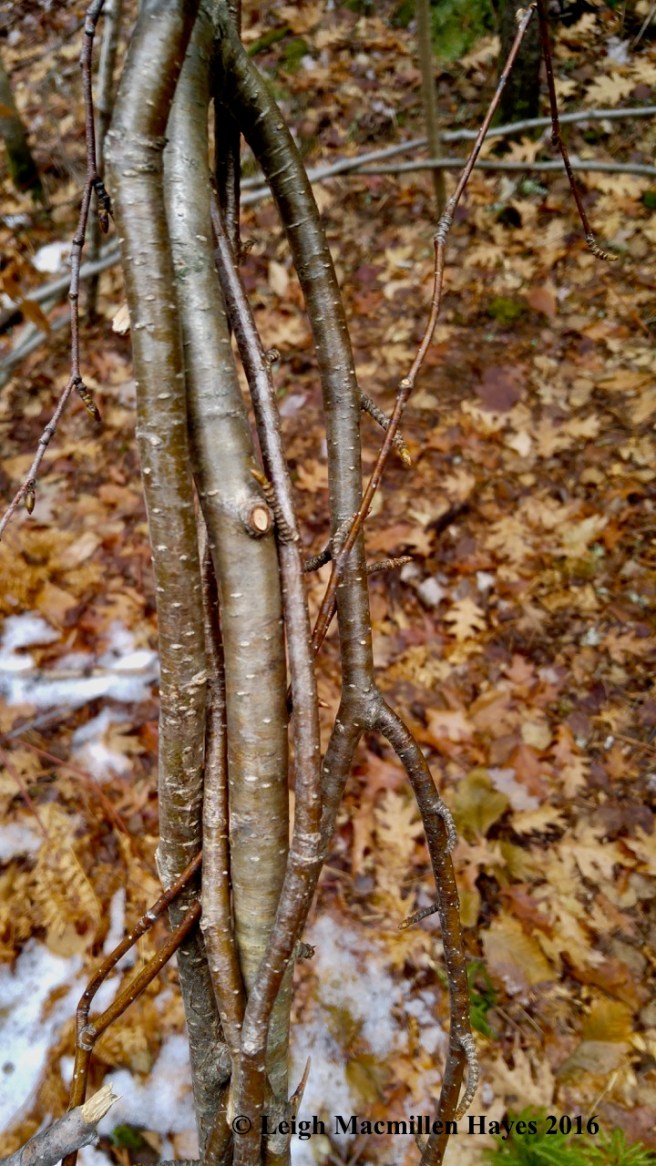
We didn’t mind for we knew we’d return with more accurate directions. It wasn’t the first time we’ve erred. And besides, the gray birches were beautiful.

b3-lemonade stand

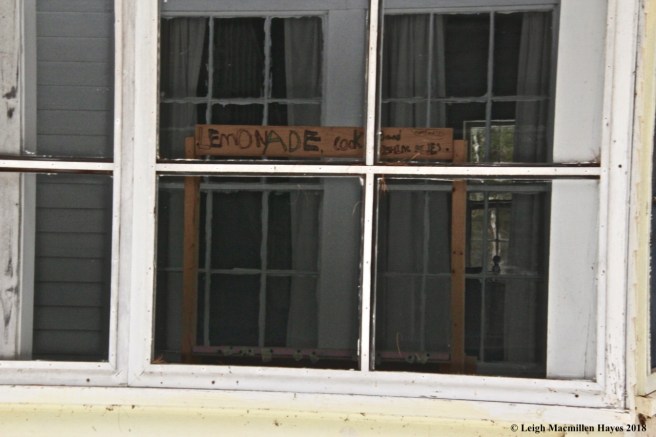
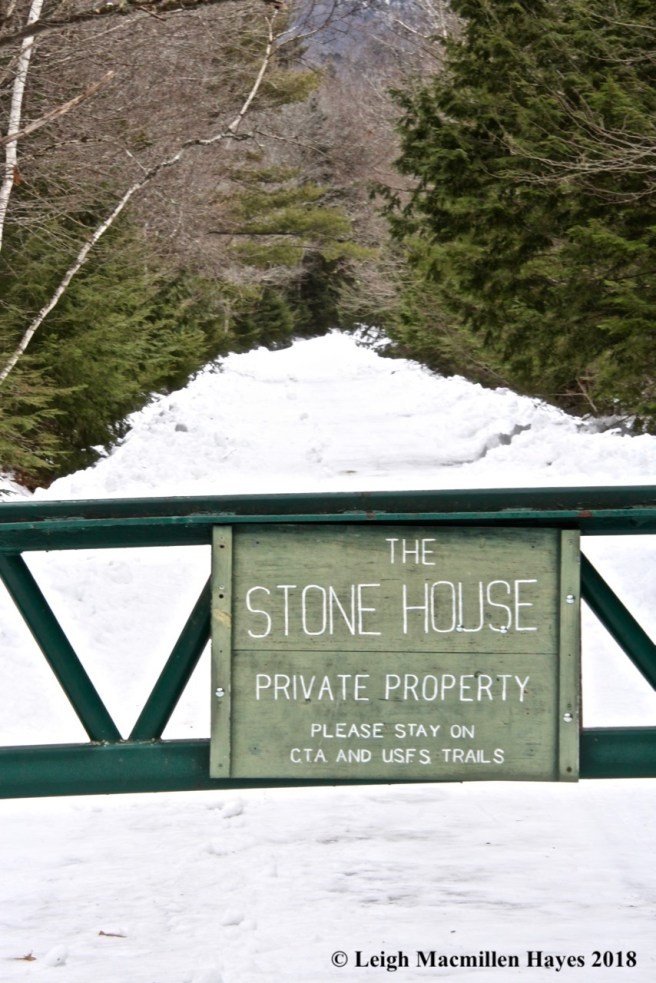
After we’d covered about three miles, we headed back to the truck and drove to Stone House Road, where we parked near the trailhead for the Leach Link Trail. We could have continued toward the Stone House since for the first time ever, it was plowed, but the lane was narrow and had we met another vehicle, it would have been a challenge to back up. Besides, I love to walk the road for there’s always something to see . . . like the lemonade stand. Who knew?

b5-Pole #15

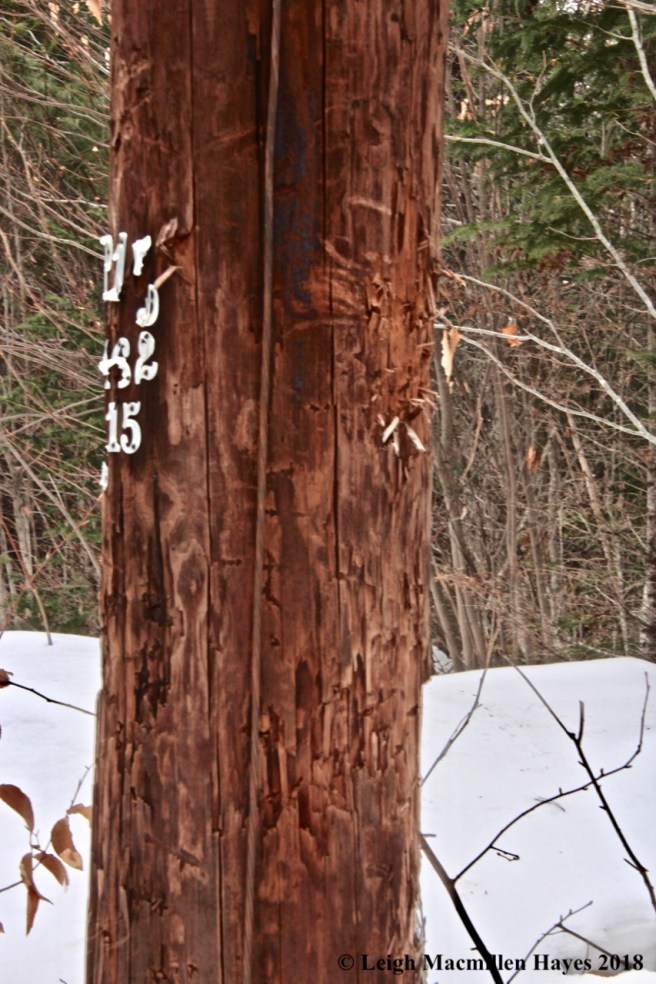
My other favorite sight along the road–telephone poles. In the past year the poles had received more attention–from black bears. Last year it seemed that any number with a 5 in it drew the most attention. Smart bears around here.

b6-pole 17 1

But it appeared that the bear(s) had added a new number to their count–#7, or in this case, #17.

b7-pole 17 2

I didn’t have my macro lens with me, but found bear hair attached to some of the scrapes. It was light colored, indicating it had bleached out in the sun.

So why telephone poles? It’s my understanding that males rub their shoulders and neck to leave a scent and may also claw and bite a pole during mating season. Bites leave nearly horizontal dots and dashes–can you see them? Think of the bear’s upper and lower canine teeth meeting. How cool is that?

Eventually, I promised my guy that I’d stop pausing to check on and photograph them, but he noted that I couldn’t resist every time we passed by one. I was just looking.

b9-Stone House Road

To my guy’s relief, we soon reached the gate, where the power line went underground.

b10-balds

Near the airfield, we turned and paused to enjoy the view of the Baldfaces, and promised ourselves a return to those trails in the late spring or summer.

b11-gorge 1

Our choice of trails today was the Stone House Trail. And no hike up is complete without a stop at Rattlesnake Gorge. First we looked north.

b11a-water racing

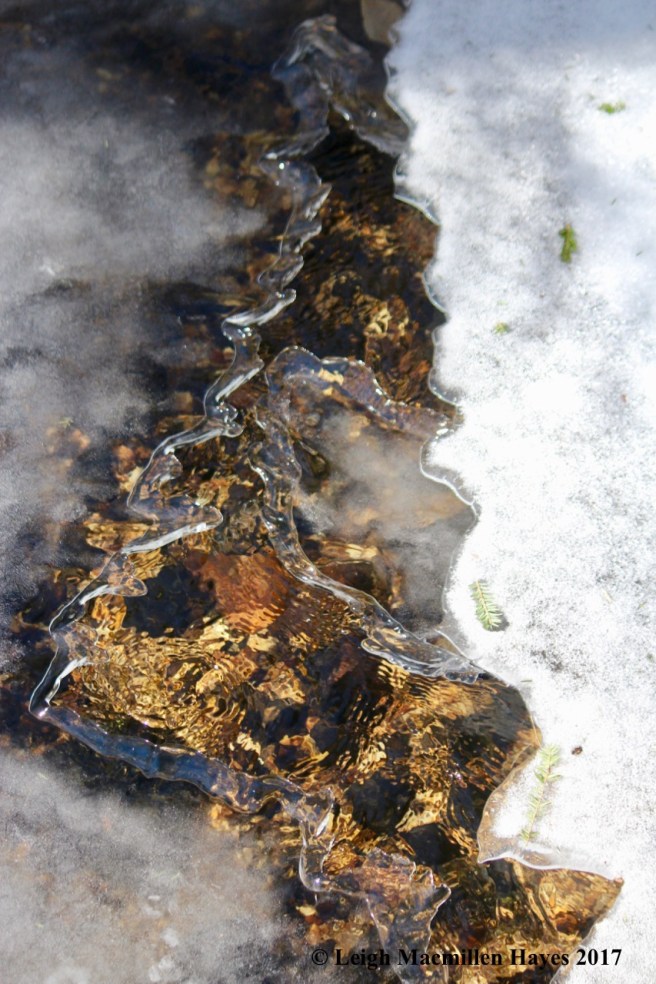
Ice and water, ice and water–I couldn’t get enough of the freeze and flow.

b11d-gorge 3

And then we looked south–with continued awe.

b13-pool view

We’d thought about eating lunch at the gorge, but moved on up the trail. From lunch log, where we dined on peanut butter and blueberry jam sandwiches, we took in the view of  Rattlesnake Pool.

b12-rattlesnake pool

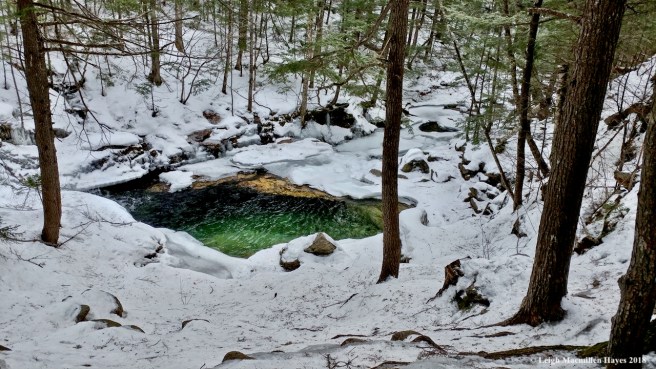
Any time of year it’s a magical place, but on a winter day–ah . . .

b12-emerald pool

that emerald color.

b14-rocks in brook

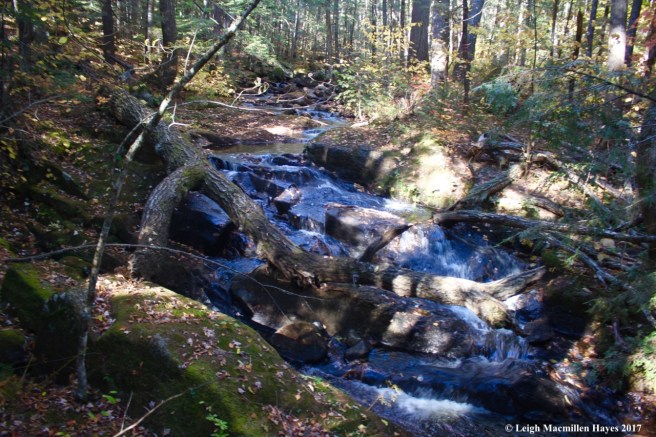
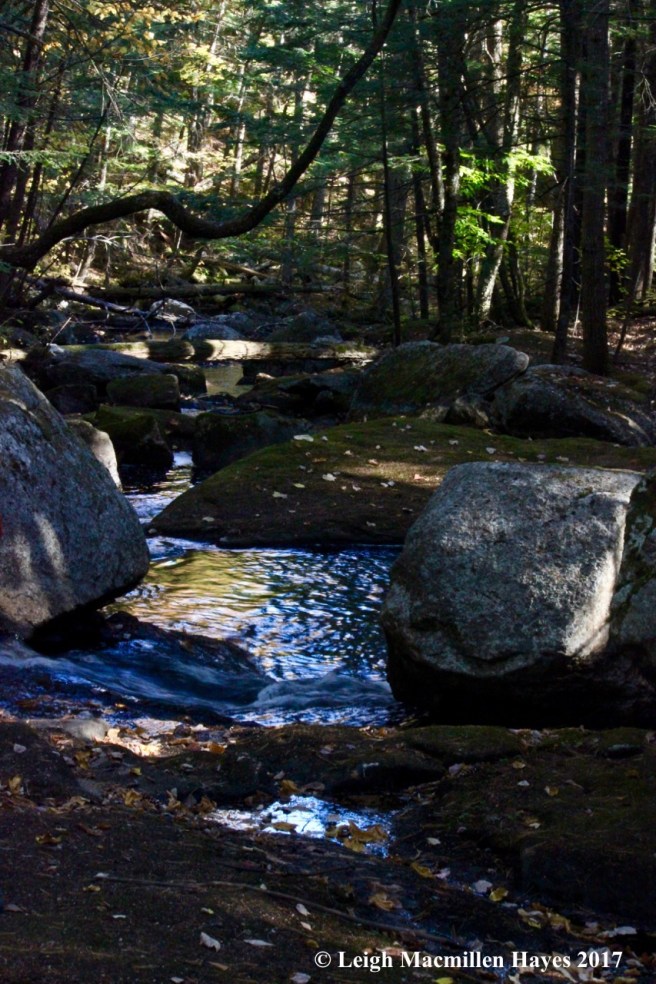
The brook above offered its own touch of wonder.

b17-hiking up

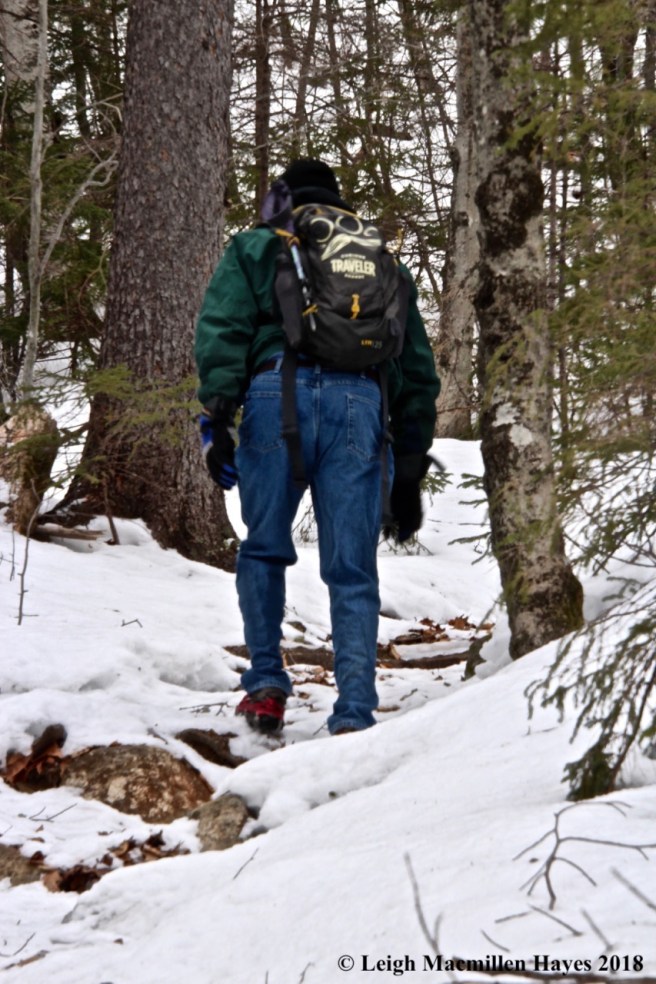
After lunch, we continued our climb on conditions that ranged from ice to snow to bare rocks. But mostly ice and snow. Microspikes served us well.

b16-Caribou sign

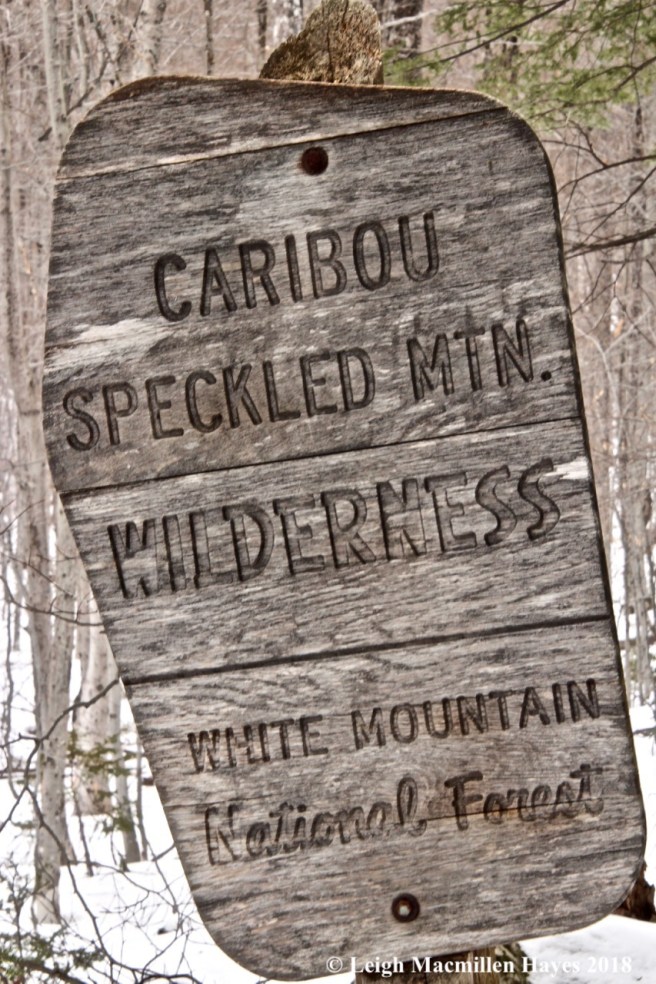
At last we crossed from the Stone House property into the White Mountain National Forest as denoted by a rustic sign.

b16-arrow

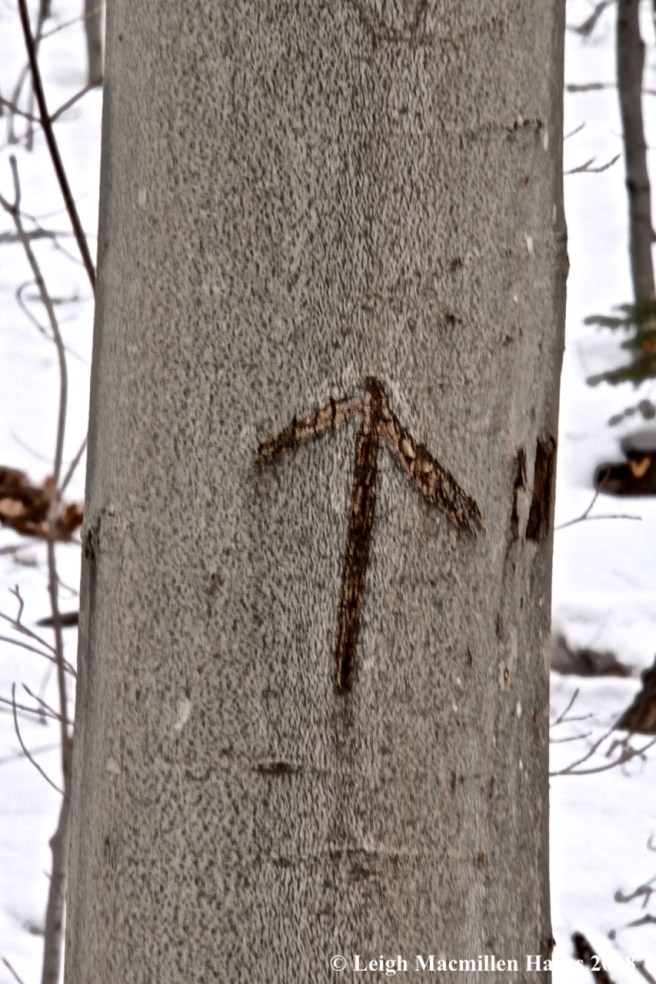
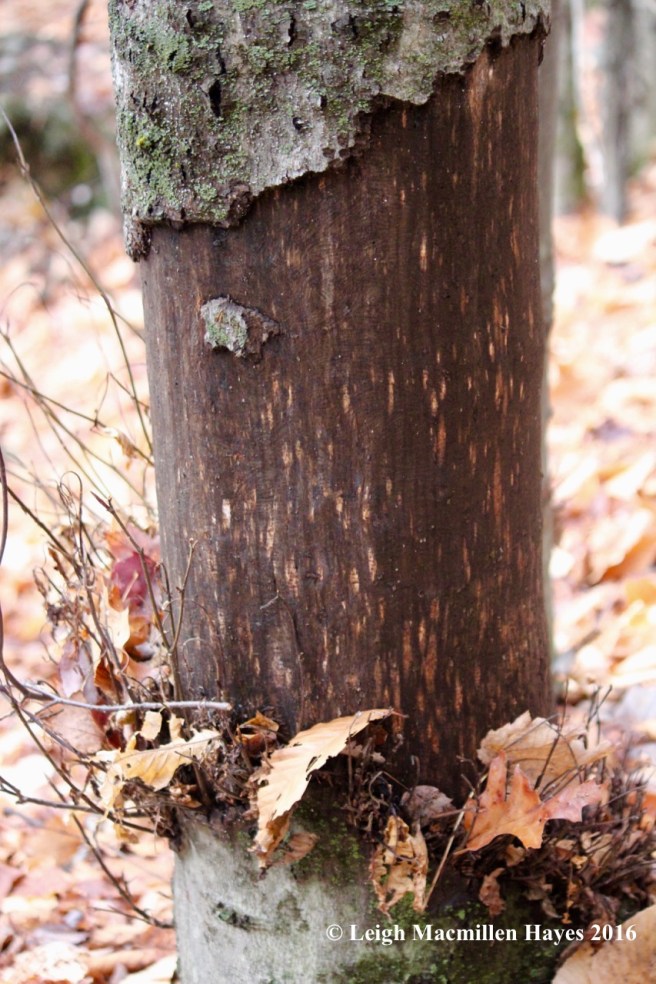
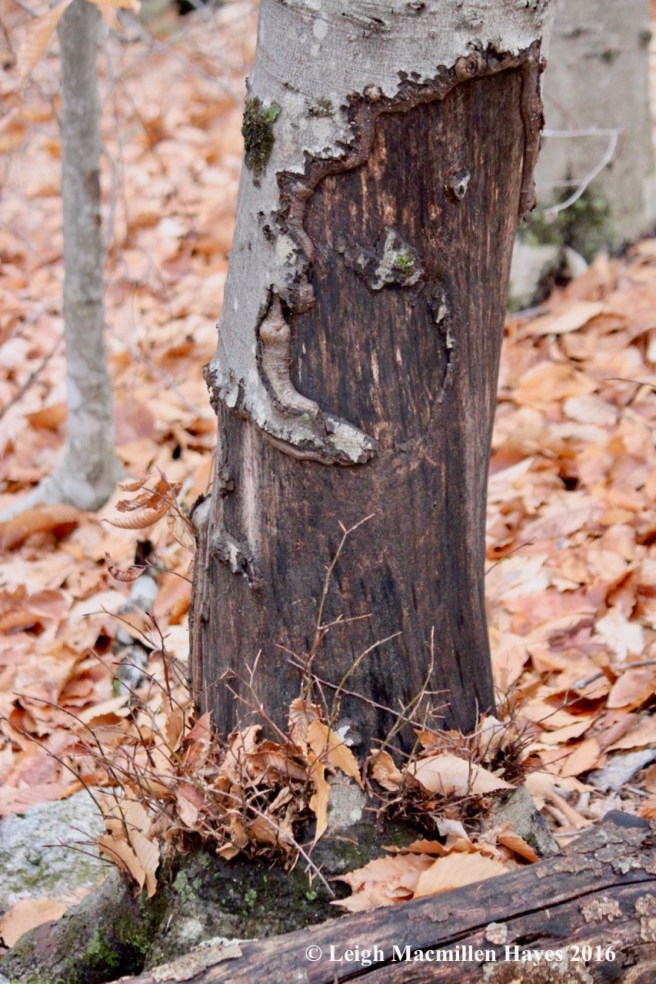
All along we searched beech bark for bear sign. And found one–a very smart bear had left a sign indeed–indicating the way of the trail. We kept climbing.

b20-cairns

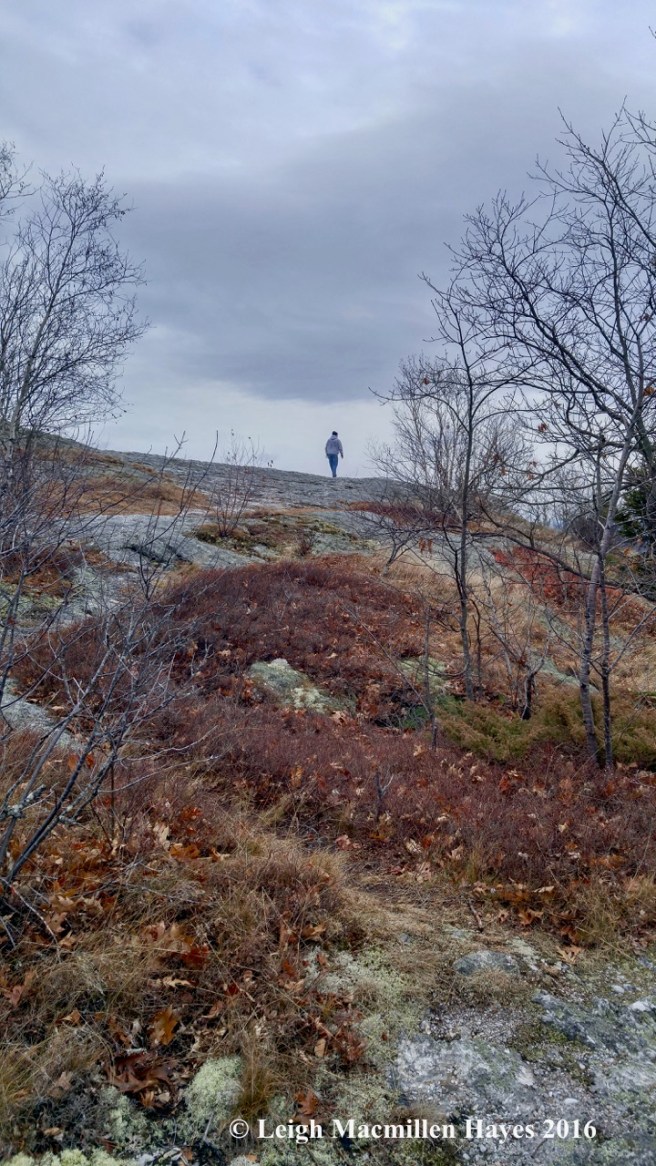
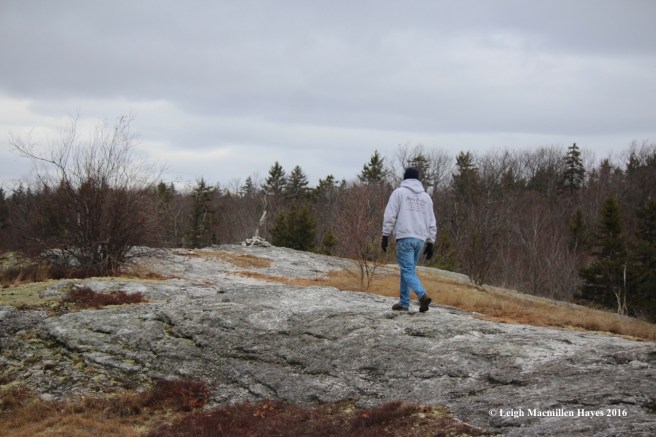
At last we reached the summit. It was later in the afternoon than we’d intended when our morning began because of our mine mission, and so we decided to skip Speckled Mountain, but were happy to check out the views from Blueberry. On the Lookout Loop we did get off trail for a bit as we missed a cairn buried under the snow. At that point we did a lot of post holing, sinking as we did to our knees and above. But finally we found the right trail.

b19-spruce

It’s there that the red spruces grew–their yellow green needles pointing toward the tip of the branches and dangling reddish-brown cones seeping sap.

b21-view 1

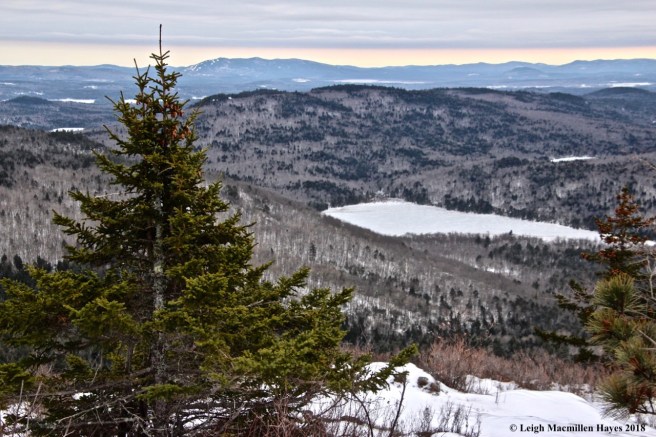
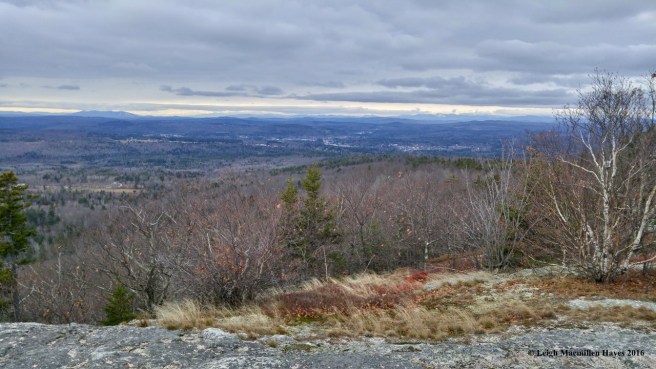
And then we found the view that stretched from Pleasant Mountain (our hometown mountain) on the left to Kearsarge on the right.

b22-Shell Pond and Pleasant Mountain

Below us, Shell Pond on the Stone House Property, showed off its conch shell shape.

b23-Kearsarge

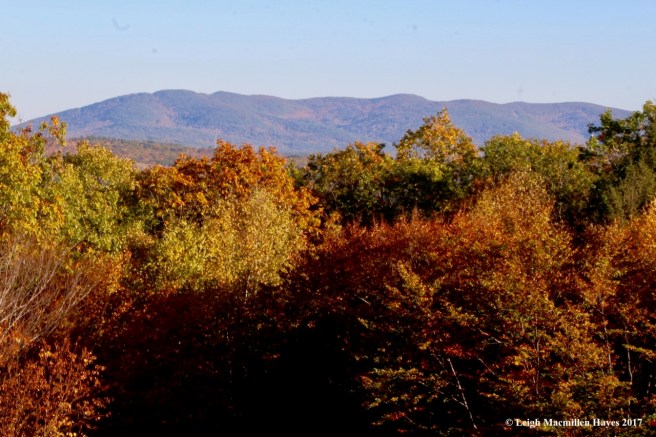
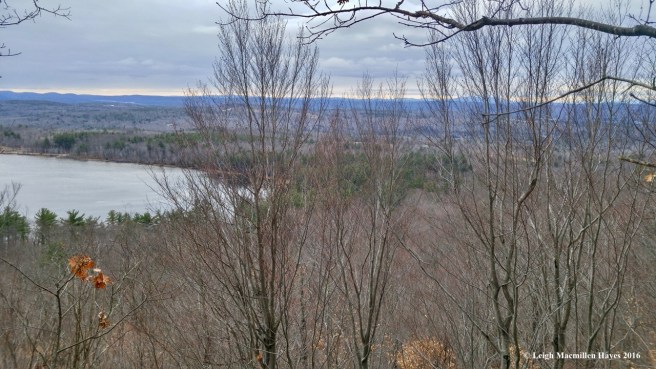
We took one last look at the mountains and valleys under a blanket of clouds before following the loop back to the main trail and retracing our steps down.

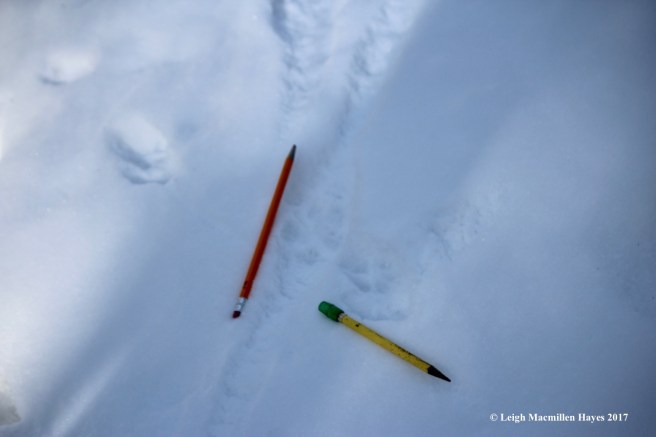
b24-bear tracks

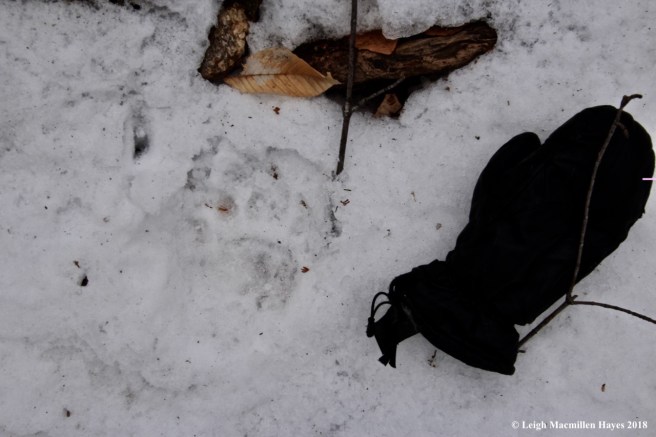
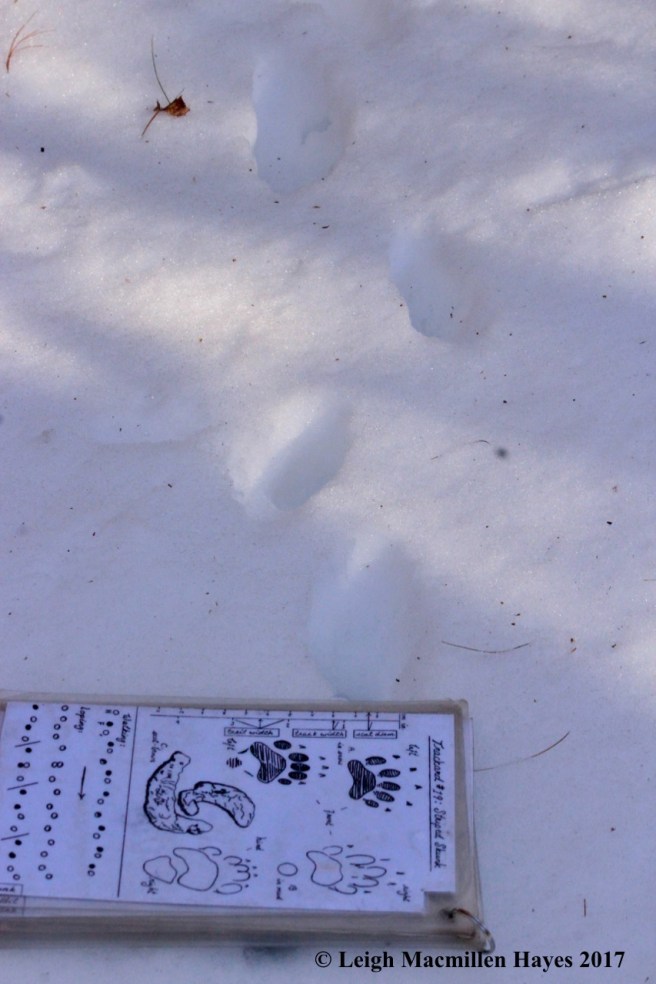
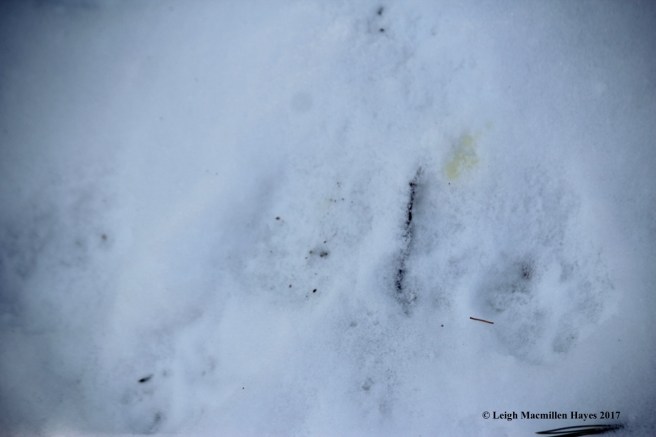
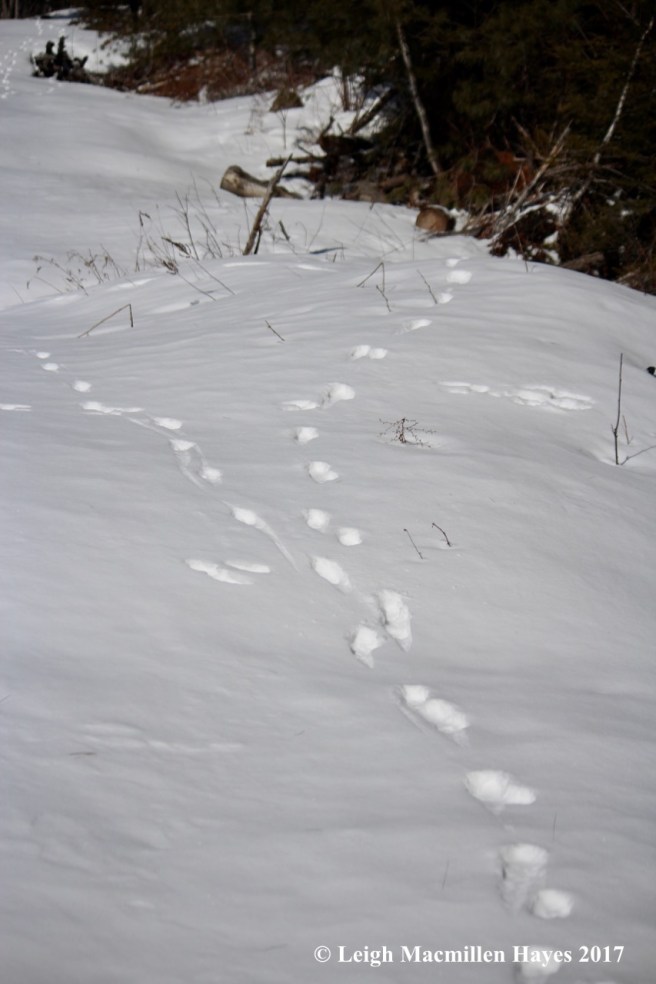
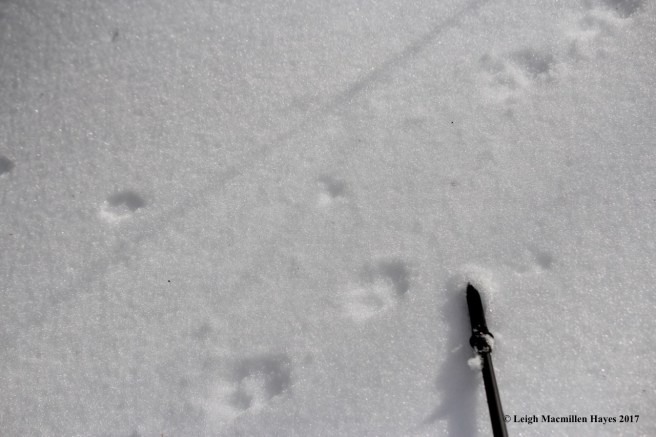
It was on the down that I got my guy to stop and examine a mammal track with me. I’d noticed it on the way up and he’d been ahead, but we both remembered that it was located at the point where the community switched from hardwoods to soft. Do you see the large prints? And distance between. It had been warmer yesterday and those prints looked like they’d been created then.

b18-bear print

Black bear prints! Oh my!

It was the five large toes that first drew my attention as we climbed up. Was I seeing what I thought I was seeing? The pattern of the overall track was a bit different than what I’ve seen in the past where the rear foot oversteps the front foot because in snow black bears tend to direct register like coyotes, foxes and bobcats–one foot landing on snow pre-packed by another foot.

Bears are not true hibernators and this guy or gal must have been out foraging during yesterday’s thaw.

We didn’t find any bear paw trees or see the actual bear, but we were thrilled with our telephone pole signs and the prints left behind.

Indeed, it was a beary special Mondate on Blueberry Mountain.

(Corny humor comes with teacher training)


Forever Green

According to a Cherokee legend, one cold season an injured sparrow knew he could not fly south with his family, so he bid them farewell and went in search of a place to survive.

Sparrow asked Oak to shelter him among its leaves so he might heal and greet his family upon their return in the spring.

But being a crusty old tree, Oak didn’t wish to have a winter house guest and so he turned Sparrow away.

Downtrodden, Sparrow approached Maple. Sweet as she might be, Maple also turned Sparrow away.

And so it went. Sparrow was turned down by each tree he visited, until there was only Pine left to ask for help.

Pine listened to Sparrow’s pleas and his heart heard Sparrow’s plight. And though Pine knew his leaves were tiny and more like needles, and his branches not as many as the others, he welcomed Sparrow to join him for the cold season.

As hoped, Sparrow healed and greeted his family the following spring.

Creator heard and saw all that had happened and called a great council of the Trees. In his address, he rebuked them for they’d been given so much and would not share the least of what they had with Sparrow in his time of need. Therefore, from that day forward, when cold came upon the land, their leaves would wither, die and blow away.

Creator then spoke to Pine, praising him for being the least among the trees, and yet giving so much. And so, Pine was honored to remain forever green.
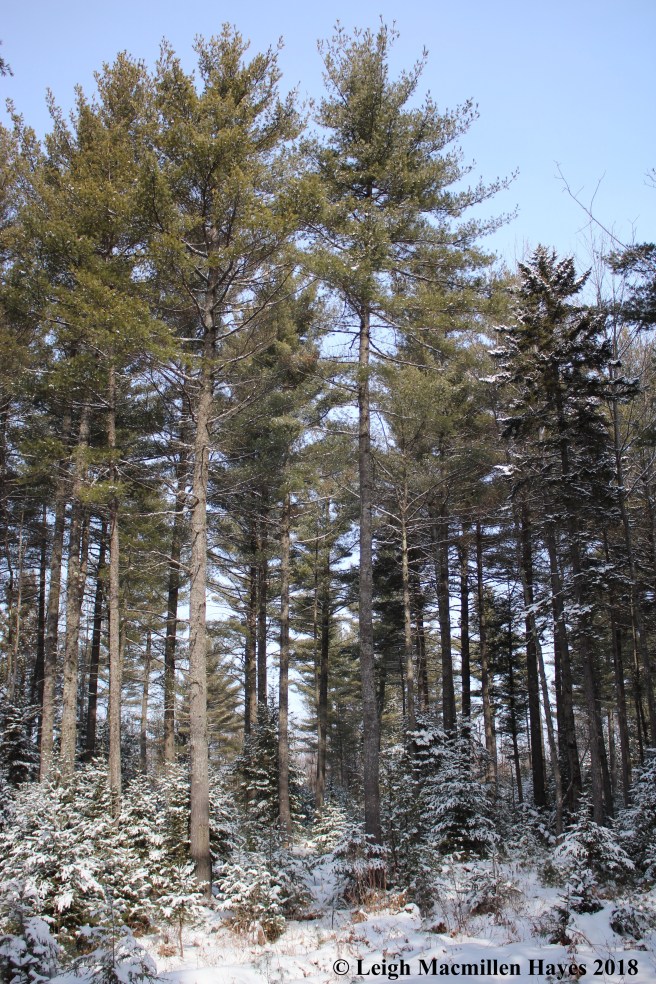
e-eastern white pine magestic.jpg

The Eastern white pine (Pinus strobus), strikes me as the majestic tree of our forest. Of course, it was once even more majestic. In the 1600s, the British Royal Navy blazed all of those two feet or more in diameter and within three miles of water with the broad arrow indicating they were to be cut, harvested and sent to England for ship masts. The blaze became known as the King’s Arrow in honor of King George I. At that time, the trees may have been 300-400 years old and over 200 feet tall. The oldest and tallest white pines in our current landscape are 80-100 years old and maybe about 100 feet tall.
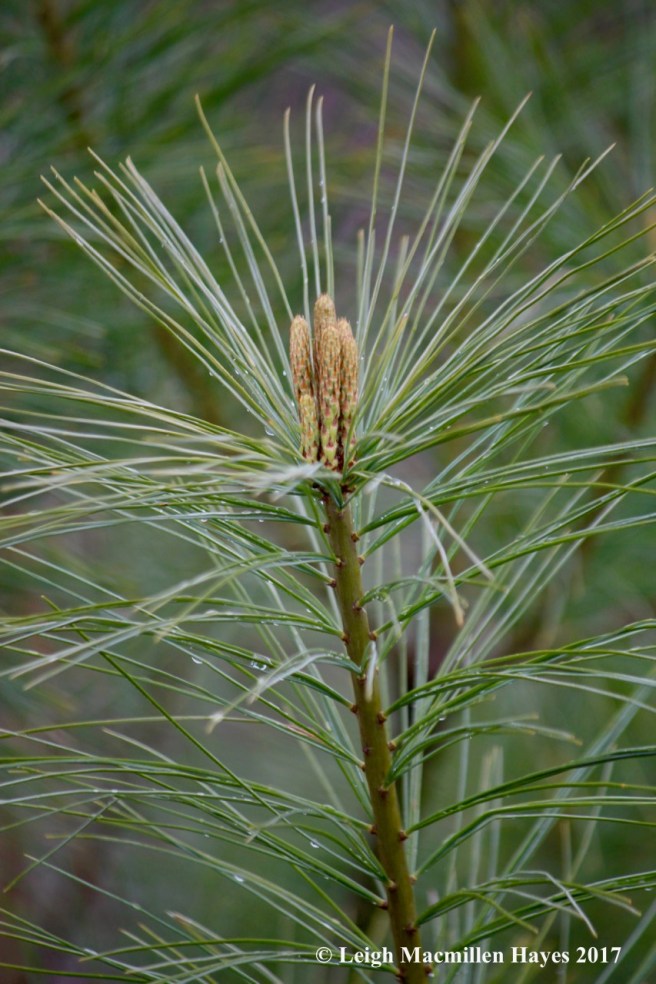
v-white pine

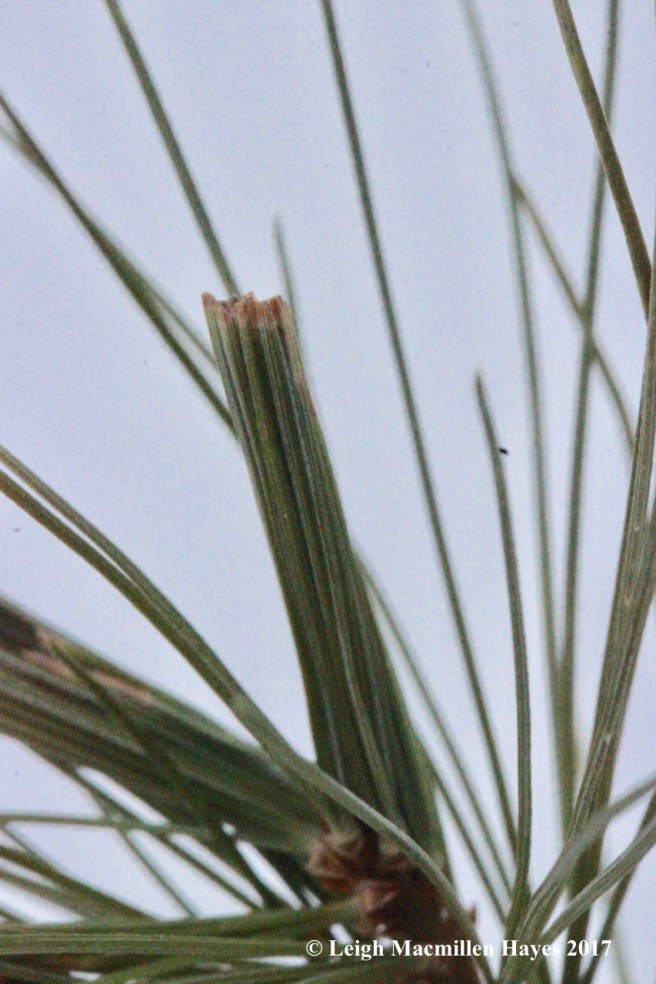
The three to five-inch white pine needles are blueish-green and bound in bundles of five. That’s easy to remember for you can spell both the tree’s name W-H-I-T-E with each needle or M-A-I-N-E for the white pine is our state tree.
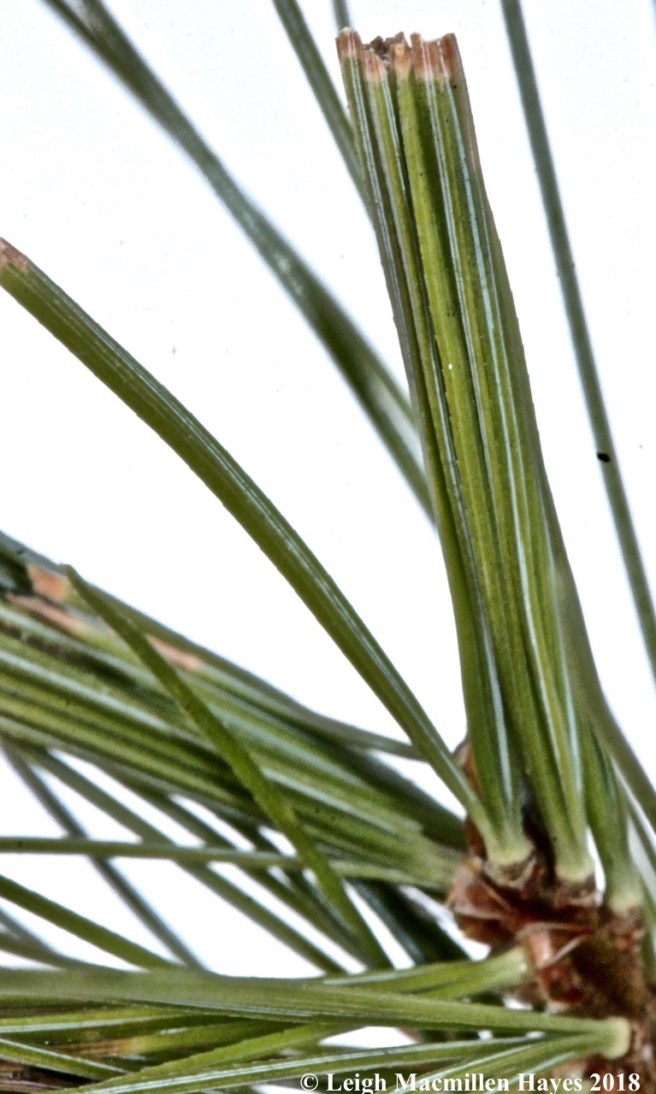
e-pine tube insect

Occasionally, I’ve spotted trees with clumps of needles stuck together in such a way that they formed tubes. Actually, they were the tunnels created by the pine tube moth. Larvae hatched from eggs deposited on the needles during the summer. They used silk to bind the needles together, thus forming a hollow tube. Notice the browned tips–that’s due to the larvae feeding on them. Eventually the overwintering larvae pupate within the tube and emerge in April. Two generations occur each year and those that overwinter are the second generation. Fortunately, they don’t seem to harm the trees.

e-pine whorls

In addition, the arrangement of branches is another important feature of this white pines for they are arranged in whorls radiating from the tree’s trunk like spokes on a bicycle wheel, with each whorl representing one year’s growth. Sometimes on older trees that grew beside stone walls in pastures, the older branches remain and when topped with snow look like a spiral stairway to heaven.

e-lines in white pine bark

On younger white pines, the bark has a greenish hue, but as the trees mature the bark turns dark gray to reddish-brown and forms into thick, vertical scales with furrows between. Upon the flattened ridges of the scales, look for a pattern of horizontal lines reminiscent of the lines on notebook paper.
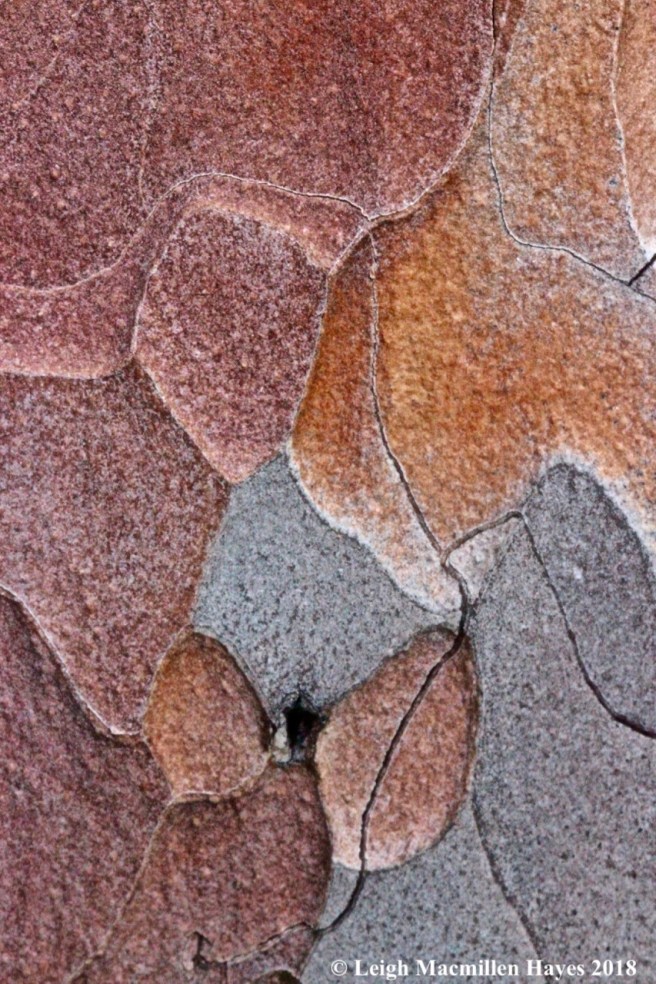
e-red pine bark

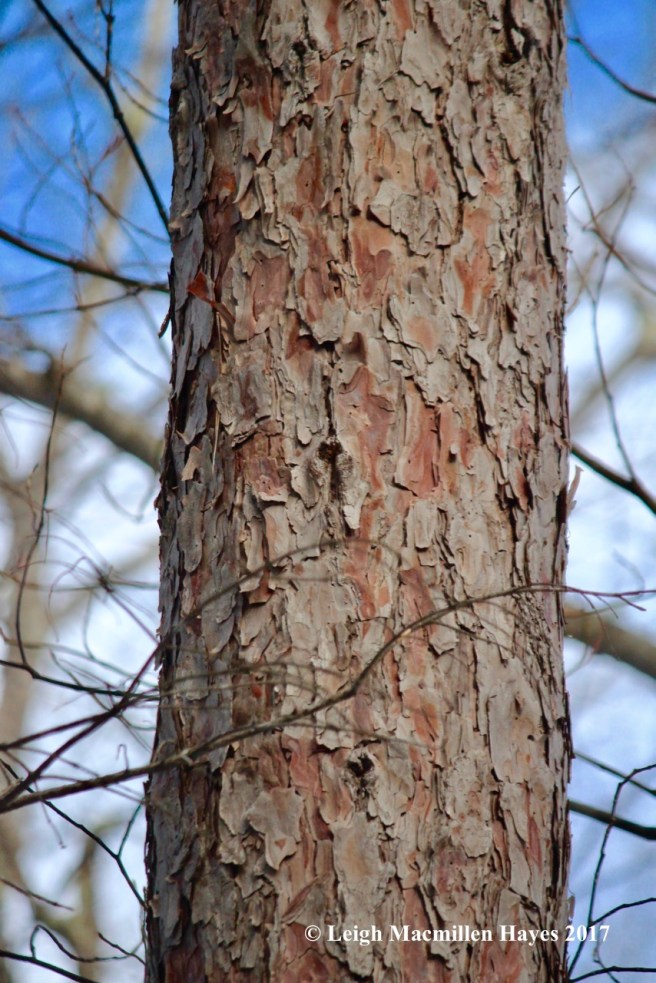
Red pine (Pinus resinosa) is a favorite of mine because of its bark, which reminds me of a jigsaw puzzle. Ranging in colors from faded orange to mottled red and grayish brown, its flaky flat scales hug the tree.
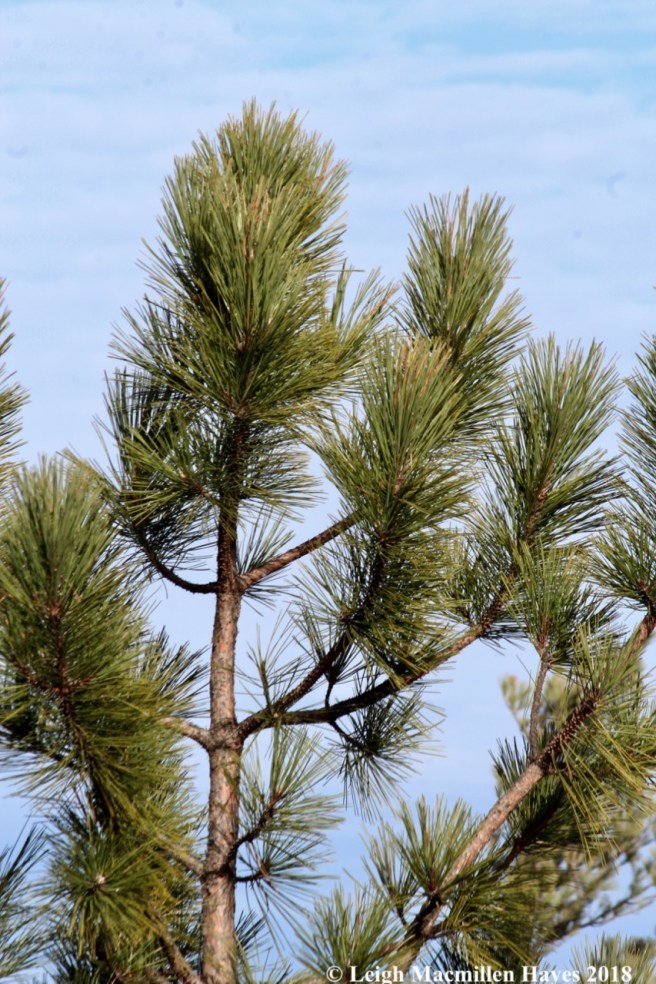
e-red pine needles, chimney sweep

In a perfect world, red pine would produce three needles/bundle to spell R-E-D. Alas, the world isn’t perfect, nor is that the case with this tree. Instead, it has two dark green needles that are twice as long as those on a white pine and quite stiff. In fact, while a white pine’s needles are soft and flexible, bend a red pine needle and it will snap in half. Because of the needle arrangement on these two members of the Pinus family, from a distance I can name them. To my eyes, a white pine’s branch tips look like bottle brushes, while a red pine’s remind me of the brush Bert used to sweep chimney’s in Disney’s Mary Poppins.
e-pitch pine needles on trunk

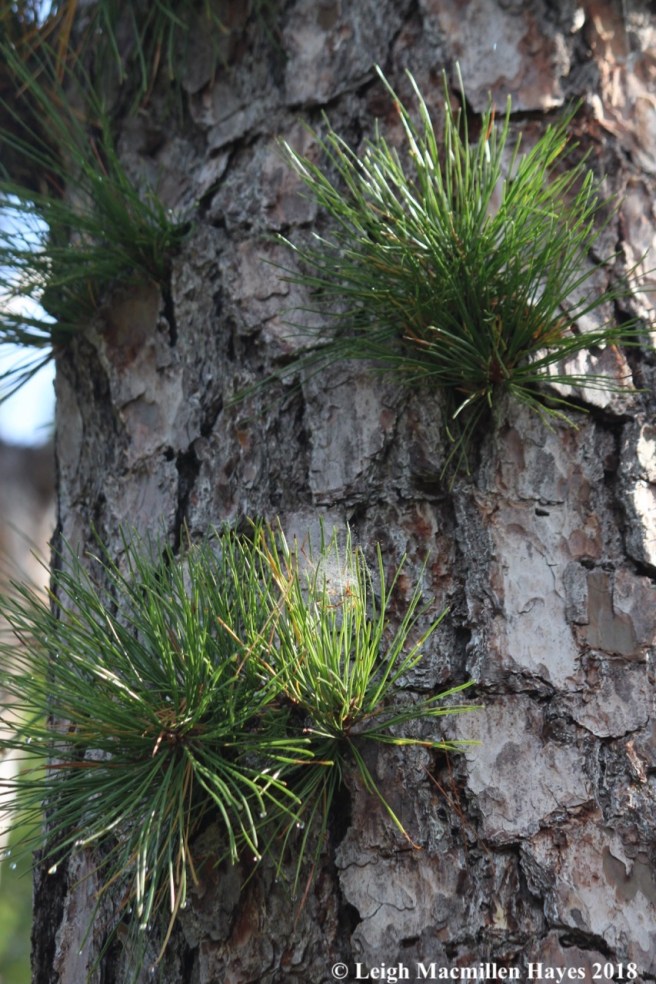
Another common pine in our area of Maine is pitch pine (Pinus rigida). This one is easy to confuse with red pine because the bark looks similar in color, though it strikes me as forming thicker plates. The name, pitch, refers to the high amount of resin within this tree.

It’s the needles of pitch pine that also add to its identification for they grow in bundles of three, like a pitchfork’s tines. The unique thing about this tree is that not only do the stiff, dark yellow-green needles grow on the branches, but they also grow on the trunk. If you spy a tree that you think may be a Red Pine, scan upward and if you see green needles along the trunk, then you’ve discovered a Pitch Pine.

Pitch pine is an important species for it is the only pine that is well adapted to fire and can even resprout.

e-jack pine

Finally, for our native pines, and I can only think of a few local places where I’ve seen these, including along the Foster Pond Outlook Trail at Bald Pate Mountain in South Bridgton, is Jack pine (Pinus banksiana). It seems to prefer the coast and central northern Maine. But . . . walk Loon Echo Land Trust’s trail at Bald Pate, and see if you can spot them.

Jack pine has two yellow-green to dark green needles in each bundle so an easy way to remember its name: Jack and Jill. I don’t know about you, but I love mnemonic devices.

e-white pine cone, red pine cone, hemlock cone

One last way to differentiate the pine trees is by their cones. Cones are the fruits of the trees and they consist of scales that protect seeds. When conditions are right, the scales will open to release the seeds, which have wings much like a maple samara, allowing them to flutter off in the wind and find their own spot upon which to grow. The line-up in this photo from left to right: white pine, red pine, hemlock.

e-white pine with two year old cones

White pine is easy to ID for it produces long, narrow cones, often coated with white sap. It takes two years for a white pine cone to mature.
e-pine cone midden

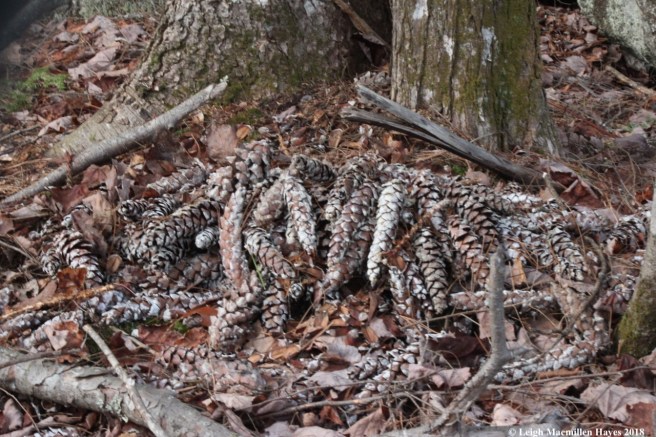
Red squirrels are known to gather mature cones and store them in a cache for winter consumption. During the winter, the squirrels tunnel under the snow to access the cache, then climb up to a high spot and remove each scale to reach the seeds. Left behind is a midden or garbage pile of scales and center cob of the cone.

e-red pine cone and needles

Red pine cones are about two inches long and egg-shaped on short stalks.
e-pitch pine cone 1

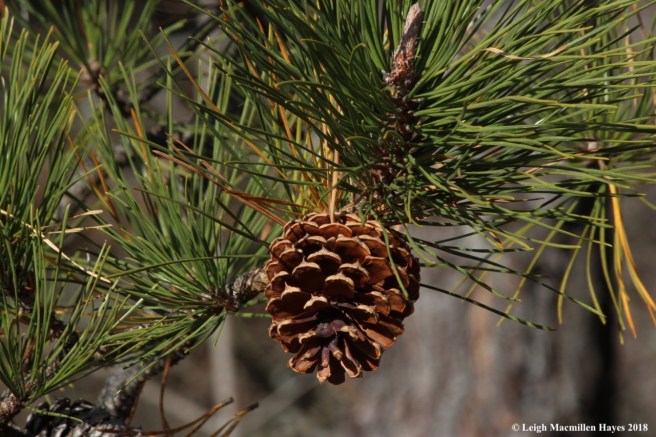
You can barely see the stalk of pitch pine cones that tend to be clustered together, but their key feature is the rigid prickle atop each scale tip. On Jack pines, the cones are about two inches long and slightly curved like a comma.

Before I move on to the other evergreens, I need to make one point. Members of the Pinus family produce pinecones. All other evergreens produce cones, but they aren’t pinecones because they don’t grow on pine trees.

e-mixed forest 2

Eastern hemlock (Tsuga canadensis) grows almost as abundantly as white pine. Often white pine, hemlock, balsam fir and spruce saplings can be observed growing together, and a perfect classroom situation evolves.
e1-drooping hemlock

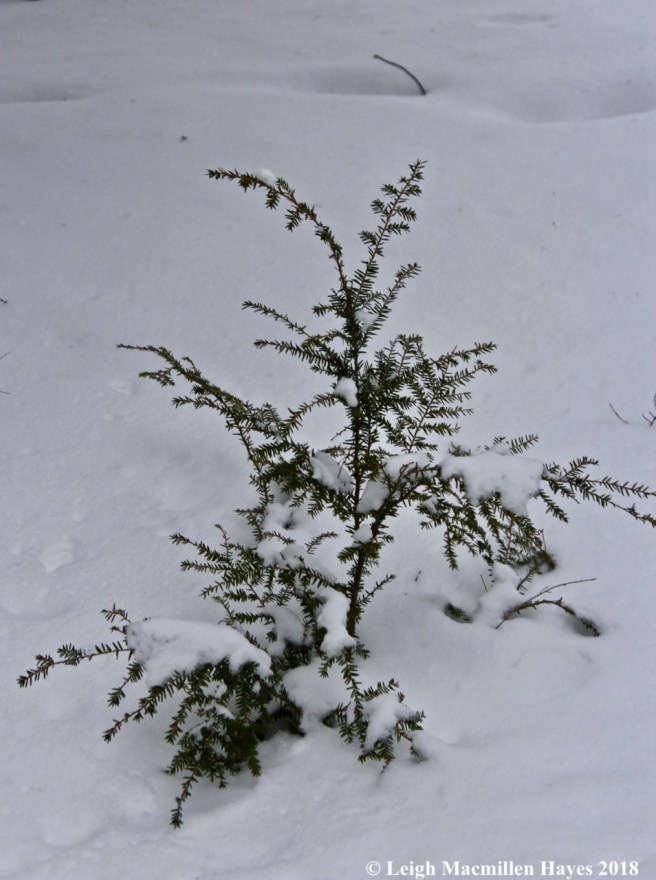
The hemlock is easy to ID once you realize its characteristics. To begin with, and especially noticeable in younger trees, is the drooping terminal shoot. In fact, all of the branches droop, providing the overall effect of a graceful tree.

e-hemlock gathering snow

Those sturdy, down-sweeping boughs also hold snow, thus creating the perfect spot for deer to hunker down under on a winter night.

e-hemlock porcupine evidence below hemlocks

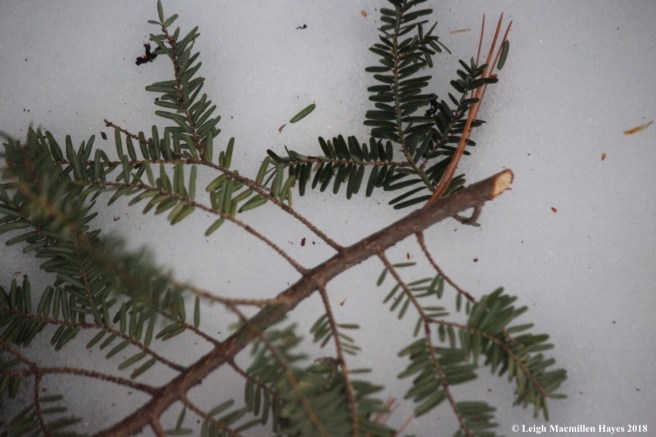
Another mammal that takes advantage of the hemlock is the porcupine. If you spy nipped twigs on the ground surrounding a hemlock, then it’s best to look up and make sure you won’t become a pin cushion should the animal fall.
e-hemlock porcupine

Typically, the downed hemlock twig features a cut made at a 45˚ angle.

e-hemlock petioles (stems) and stomata lines

The half-inch hemlock needles taper to a dull point. You may only see this with a hand lens, but each needle is attached to the twig by a short stem, aka petiole. And the needles extend outwards from both sides of a twig, thus giving it an overall flat appearance.

e-inner bark of hemlock

The bark on a hemlock, initially grayish and smooth, becomes cinnamon brown and scaly with age. I also enjoy looking at the inner bark that might be exposed by an injury, for its features various shades of reddish purple.

e-hemlock cones

Hemlock cones are petite in comparison to pinecones, at only .75 inch in length. In the spring, their scales are blue-green, maturing to a tan by autumn.
e-balsam fir standing upright

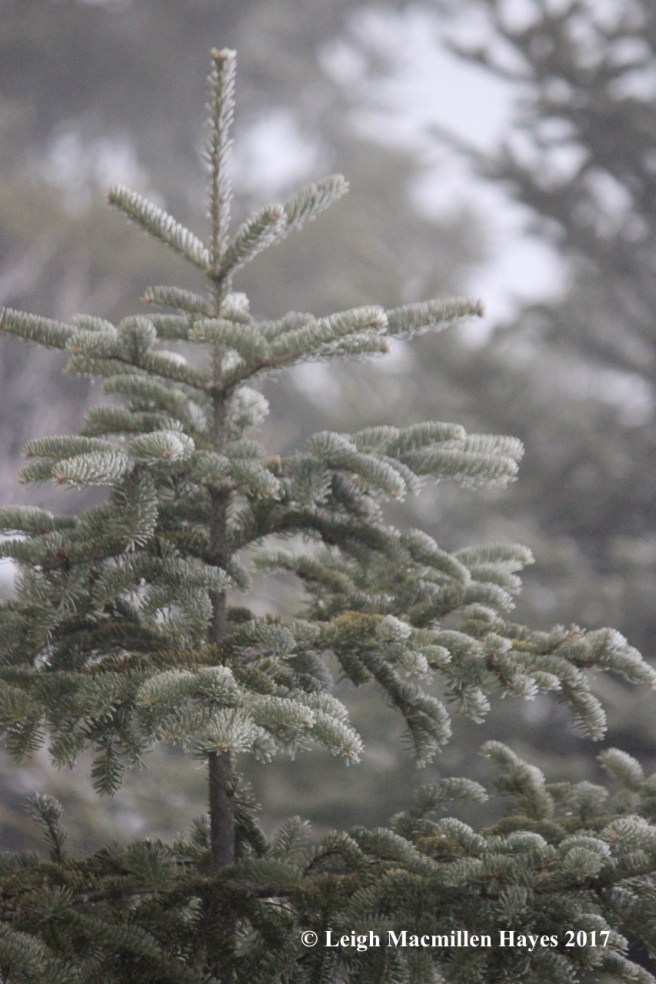
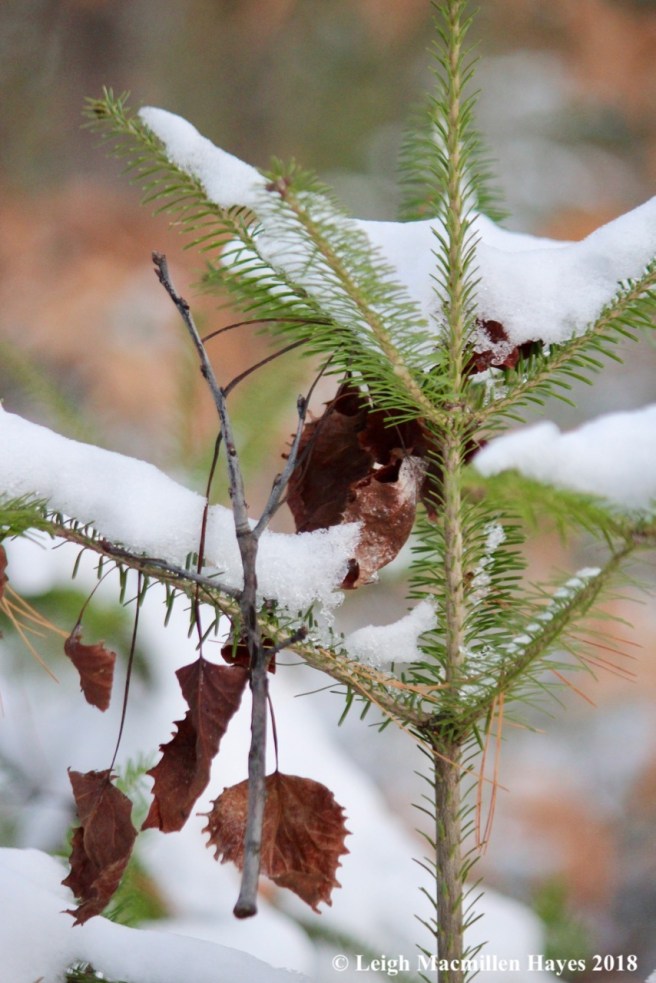
While the hemlock droops, a balsam fir (Albies balsamea) stands straight and tall as it forms a spire with a symmetrical crown.
e-balsam fir needles

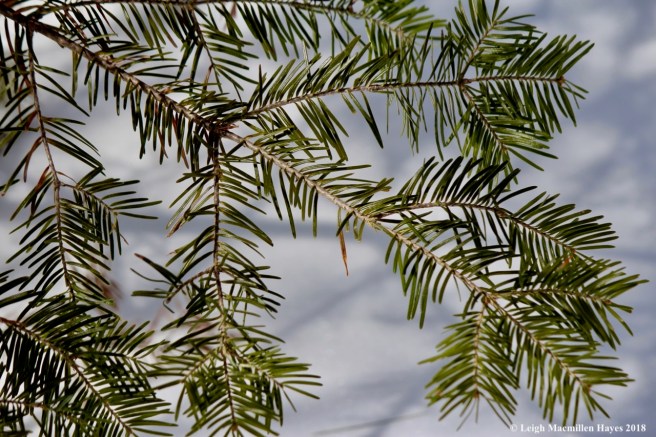
Like the hemlock, the needles are flat, but they differ in that they attach directly to the twig, are about an inch in length and some have a notch at the blunt end. The upper side is a shiny dark green, while the underside is silvery-blue.

e1-balsam bark

The pale gray to green-brown bark of balsam fir is also different than the other evergreens. It has raised dashes, aka lenticels. All trees have lenticels that allow for the exchange of gases. On some trees, however, the lenticels are more noticeable. Balsam fir bark also is riddled with bumps or resin-filled blisters. Poke one with a stick and watch the pitch ooze out. Beware, it’s very sticky. And it smells like Christmas.

e-balsam fir cones

One other unique characteristic of a fir tree is that the cones point upward rather than dangling down. That, in itself, offers an easy ID.

e-spruce

The next family, the Picea or spruces, I find more difficult to distinguish in a crowd. Like balsam fir, the leaders or top sections point skyward giving it an overall pyramid shape, but its the idiosyncrasies within the family that sometimes stump me.
e-spiky spruce

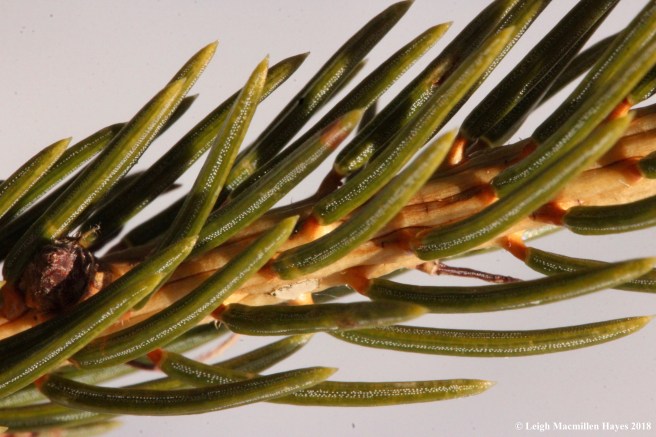
The one thing I am certain of is that they are spruces if their needles are sharp and pointed. Shake hands with a branch and if it hurts, it’s a spruce.
e1-spruce bark

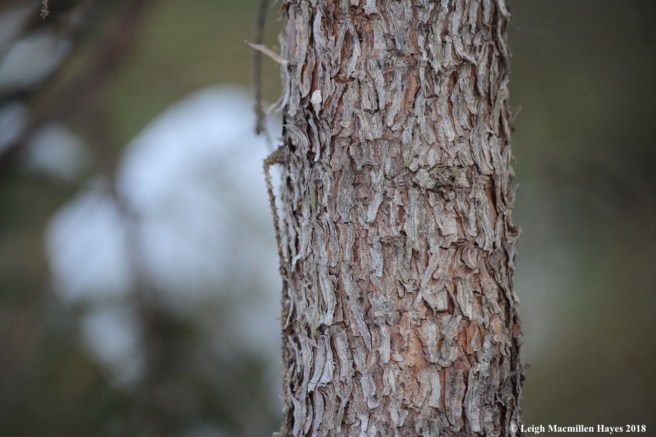
Spruce bark is broken into irregularly-shaped scales in general, and white spruce bark is gray to reddish-brown.

Again, I’m brought to things to remember when trying to determine whether I am looking at a fir or spruce—firs are friendly, spruces are spiky. Fir needles are flat, spruce needles are square.

The only cedar tree native to western Maine is the Northern white cedar. Whenever I sniff its fragrant scent, I’m reminded of my mother’s cedar chest and the treasures it stored.

e-Northern white cedar leaves and cones

Northern white cedar (Thuja occidentalis) is also known as Eastern arborvitae. Its scale-like leaves appear opposite each other along the twig and have short, blunt points.

The cones are about a half inch long, oblong in shape and borne upright on the branches. Their scales are leathery, red-brown and notched. They also have a small spine on the tip.
e-Northern white cedar bark 2

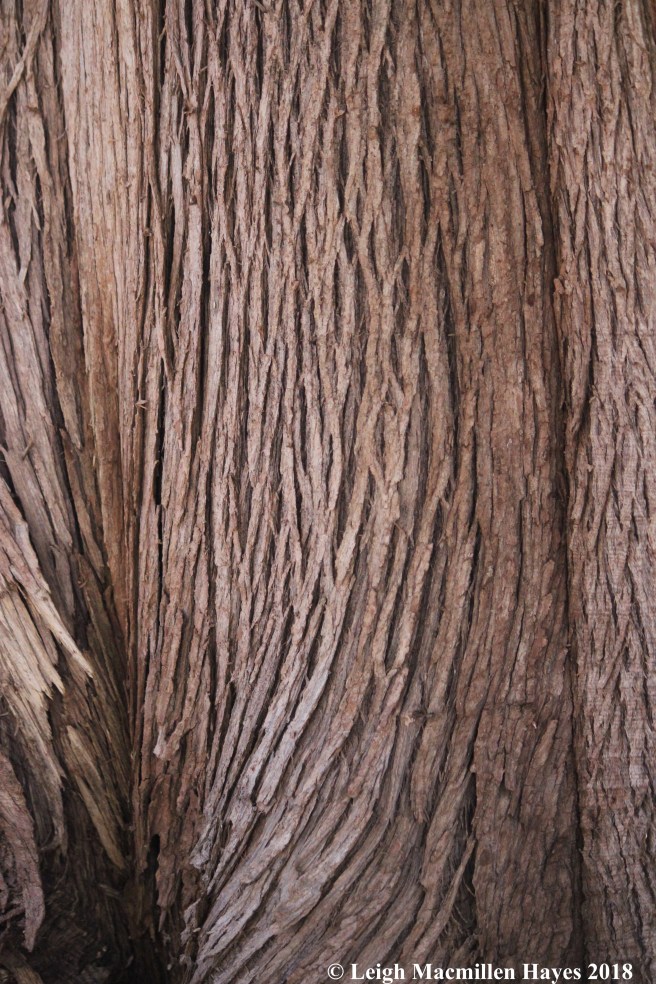
Again, the bark is fibrous, red-brown, which weathers to gray and features a diamond-shaped pattern. This small to medium-sized tree looks like a pyramid with a broad base and rounded top. It often features several main trunks.

And then there’s the tamarack.
e-tamarack in fall

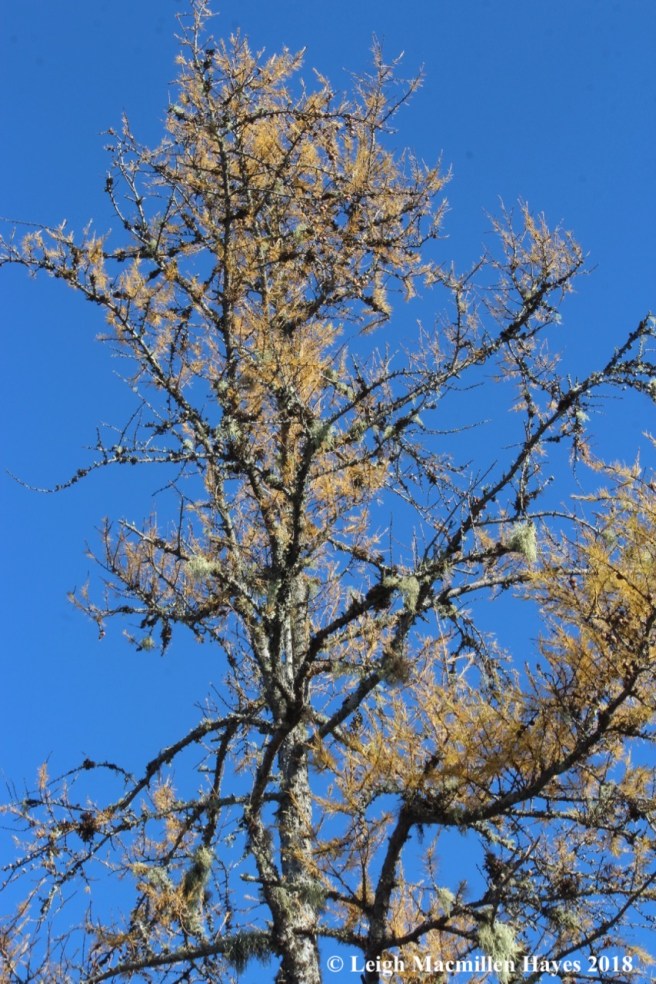
A tamarack or Larix laricina is a native deciduous conifer because it sheds its needles each fall, after they’ve turned a golden yellow, therefore it’s not really an evergreen.

e-winter

I know how easy it is to look at the winterscape and think that everything looks the same in the almost monochromatic mosaic we call the woods.

e-spring 1

But even in spring, as buds give way to leaves,

e-summer evergreens

summer when so many greens dominate our world,
e-fall 2

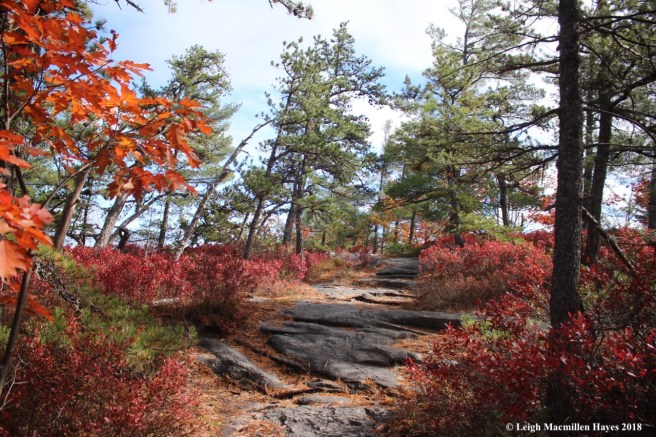
fall, when evergreens provide a contrast for autumn’s foliage,

e-fall 3

and late fall, when the evergreens continue to be green as the broad leaves drop, these trees make a statement in the landscape.

Thanks to Creator, they are forever green.
 

Wild Willy Wandering Wilderness

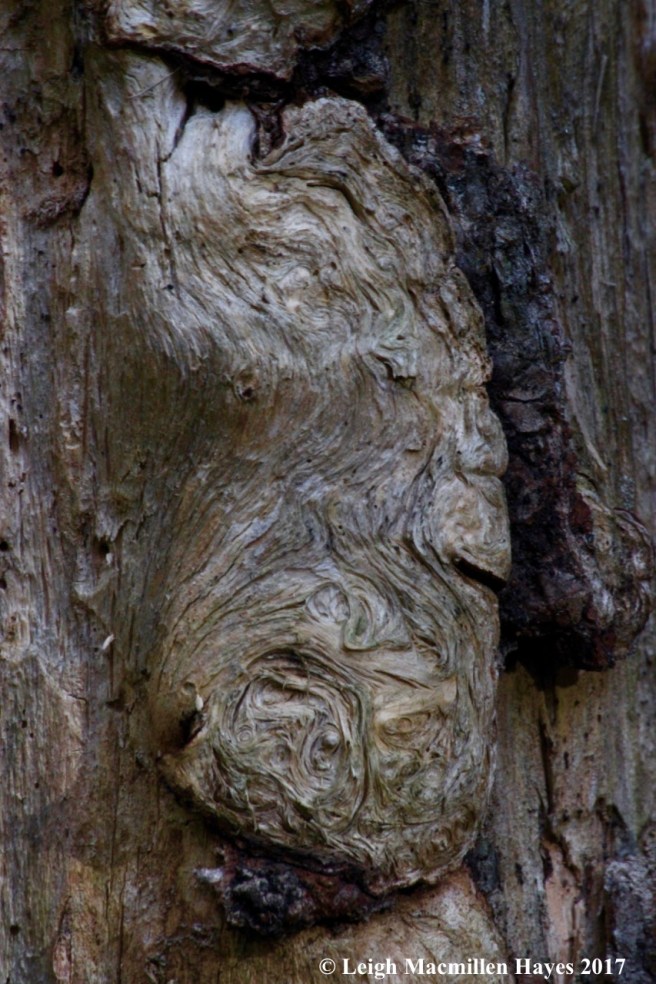
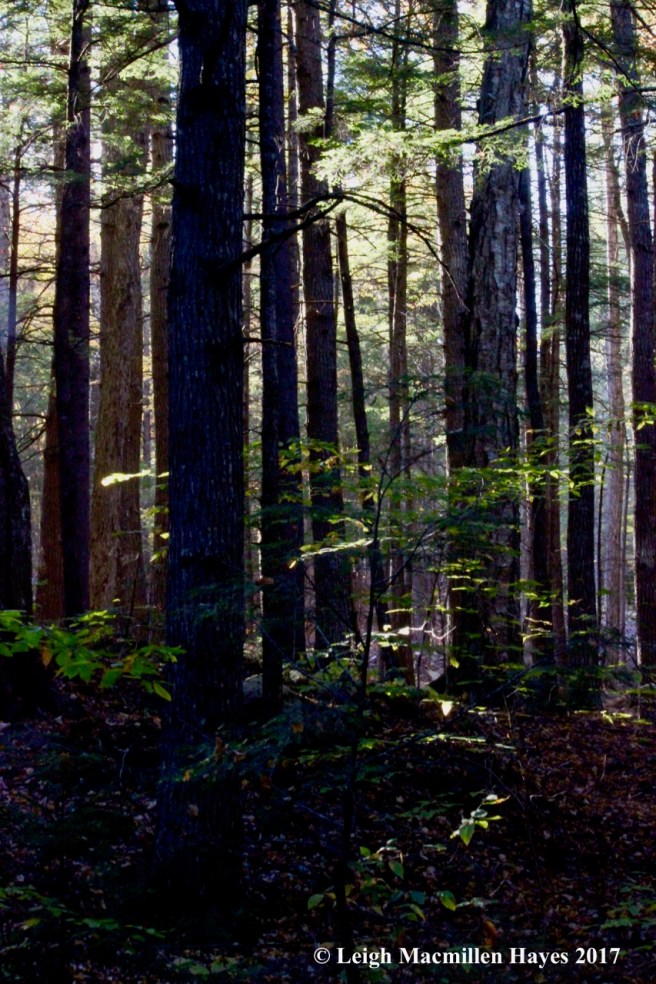
There are times when one wanders down a trail and a certain spirit seems to swirl about in the silence of the wilderness. Such was the feeling today as my friend, Joan, and I joined two other friends to explore their land in South Chatham, New Hampshire.

k-Pleasant Mtn

Before we ventured forth, however, we sat upon their deck and enjoyed the view of my hometown mountain–the ridge of Pleasant Mountain, this being a backside view.

k-sensitive pea 2

And then we paused by one of the wildflower gardens they have created with seeds of unknowns sown at abandon.

k-Sensitive Partridge Pea

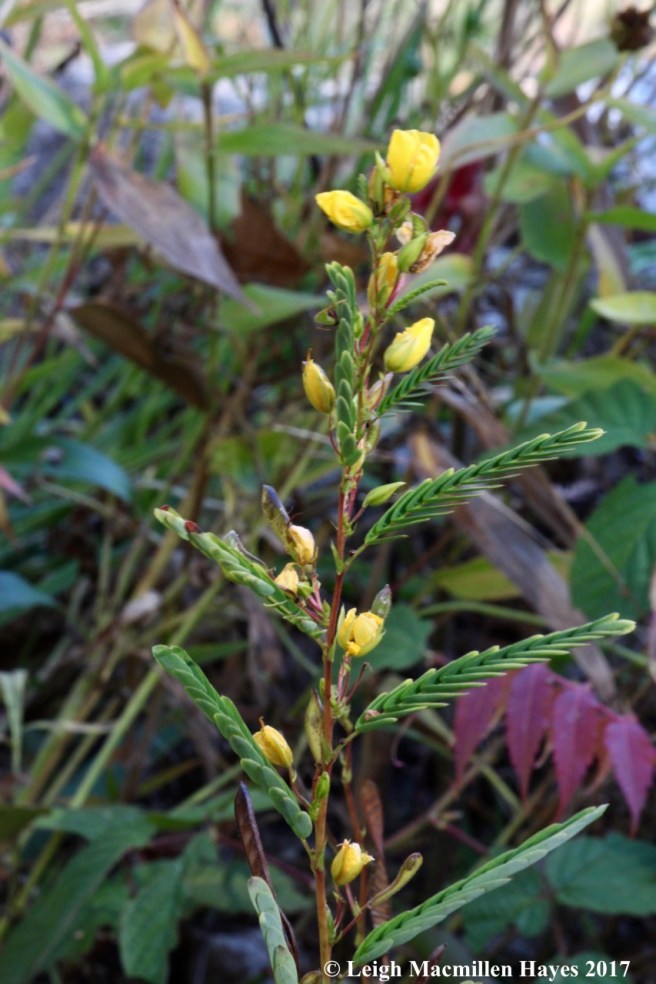
Based on its seed pods that split open on both sides, we knew it was in the pea family, but didn’t know its name. Upon arriving home and keying it out, I discovered it’s a sensitive partridge pea, also know as a wild sensitive plant, the perfect tribute to the trail. Notice the pinnately-divided leaves–they fold up when touched, thus the name “sensitive.”

k-three amigos under the arch

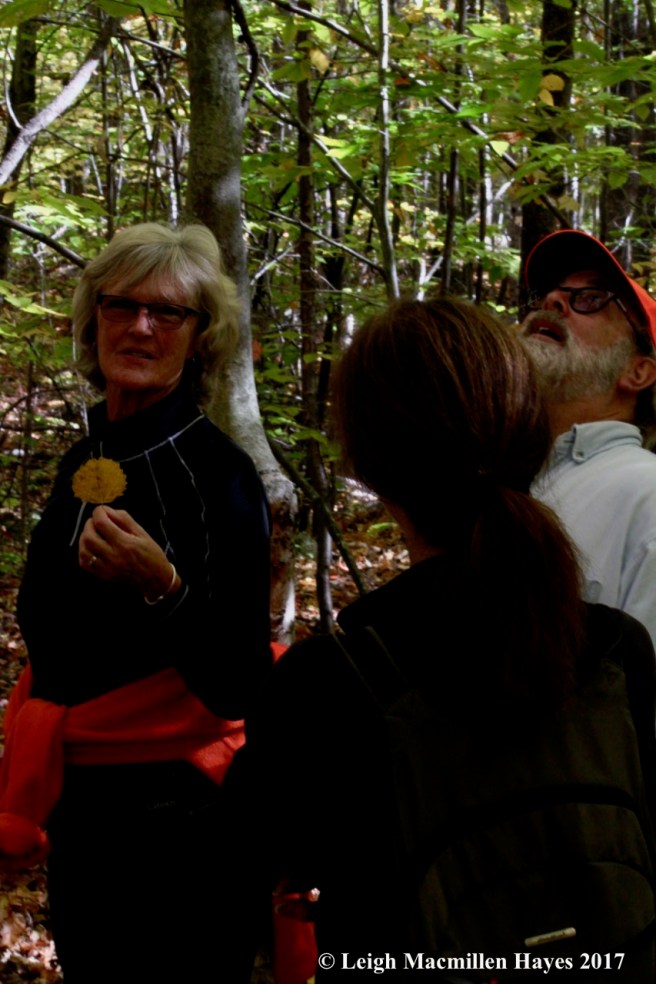
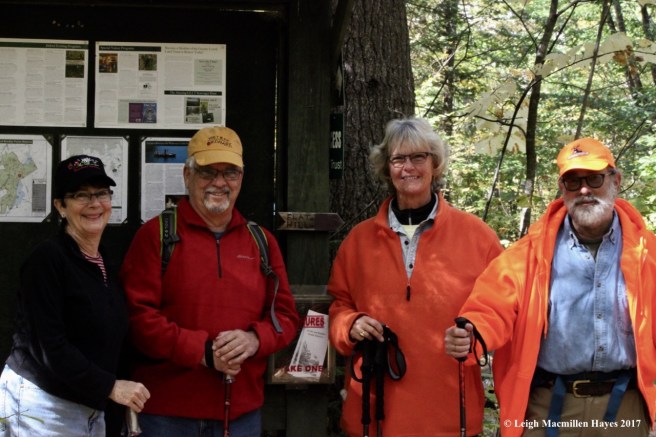
Soon after getting acquainted with the sensitive pea, we continued onto the trail that Pam and Bob (the couple on the left; Joan on the right) have carved out of the land, with the help of their nephew for whom they constantly uttered words of praise. One of his artistic offerings to them was an archway formed from beech saplings.

k-steps by Willy

Another offering–steps created from stones found nearby. But where exactly did he find the stones? That remains a secret for so good is his work. It seemed as if the trail had been there all along as it wound its way up and over, down and around, passing by landmarks worth pausing by.

k-black cherry

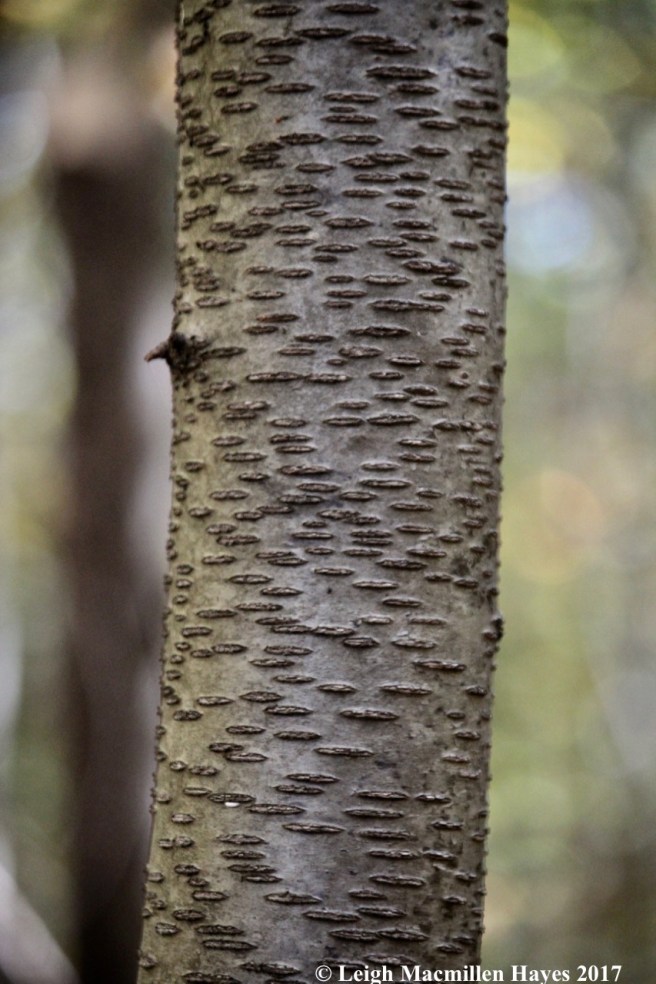
We saw so much, including bark on young trees that we desperately wanted to be black birch (aka sweet or cherry birch), but was really black cherry. Nearby where pin cherry trees that we easily recognized, but this one seemed a wee bit different and we thought maybe, just maybe it was a black birch. But maybe it wasn’t when I opened Michael Wojtech’s BARK later.

k-black cherry 2

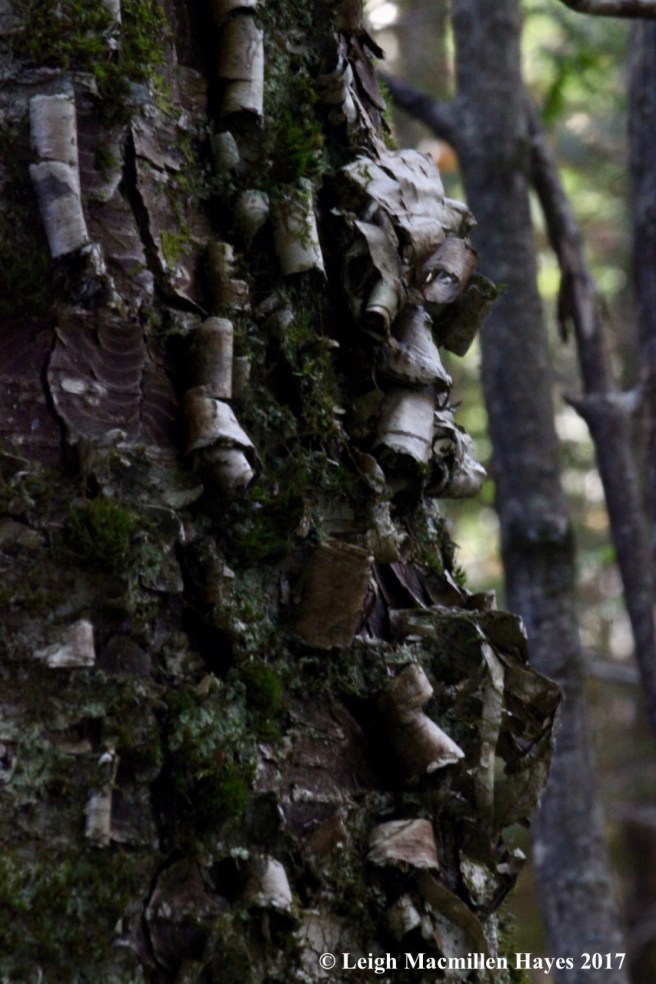
And further along the trail we spied a mature black cherry, its bark we knew for the curled chunks that remind us of burnt potato chips.

k-yellow birch

The curls of an old yellow birch also intrigued us and we noted many, many young and a few old members of this family throughout the property.

k-big tooth aspen

It’s a mixed forest and we had fun searching for the big tooth aspen trees, their bark deceptive with a northern red oak look below and birch look above.

k-hemlock and boulder 2

Other landmarks included a hemlock kissing a boulder and . . .

k-Province Brook hemlock root

another with the longest, thickest root we’d ever seen that arched across the land, creating an opportunity for the fairies that live in such an enchanted forest a chance to do the limbo.

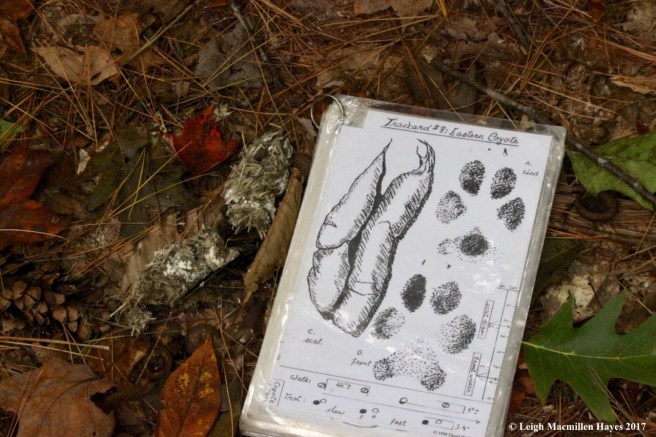
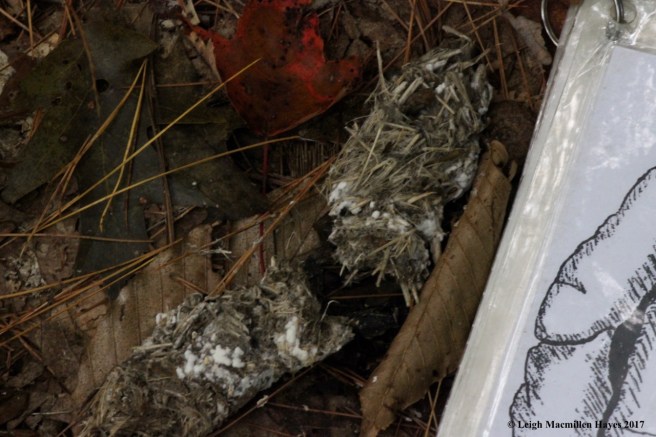
k-coyote scat

We discovered what Pam and Bob already knew–it’s more than fairies that inhabit their place. In the middle of the trail, coyote scat presented itself.

k-deer sign

We found lots of deer scrapes, where in previous years they’ve scraped the bark upward to feed on it. But this was a recent visit with tags at both ends of the action, indicating a rub. Deer rub a tree to clean their antlers of velvet–that soft, vascular skin that grows on their antlers. They also rub trees to mark their territory.

k-garter snake1

And our wildest sighting of all–a garter snake enjoying some late afternoon sun. It never moved as we gawked and finally passed by, so really it wasn’t so wild after all. But Pam and Bob shared stories of other sounds and sightings, for this really is a wild land that abuts the National Forest.

k-Province Brook 2

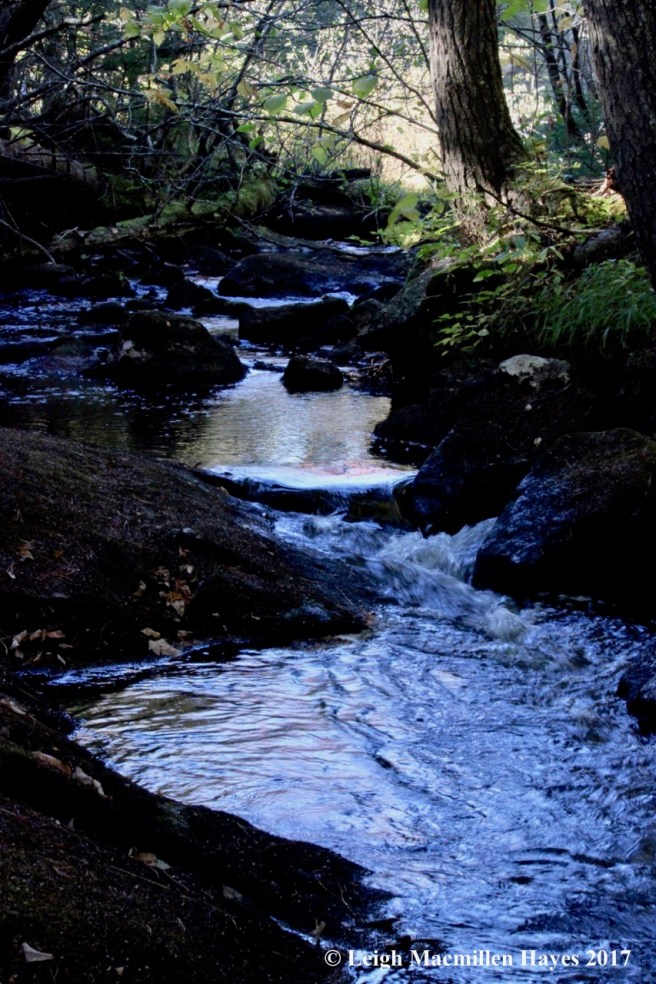
It’s also bounded by Province Brook, where the water’s flow soothed our souls.

k-Province Brook 3

We were embraced by its reflective color . . .

k-Province Brook 4

and life-giving cadence.

k-spirits 1

And it was there that the water spirit . . .

k-spirits 2

rose and embraced us.

k-wood swirls

We found it wherever we went and recognized it in various forms . . .

k-afternoon light 2

as it wandered beside us.

k-sign

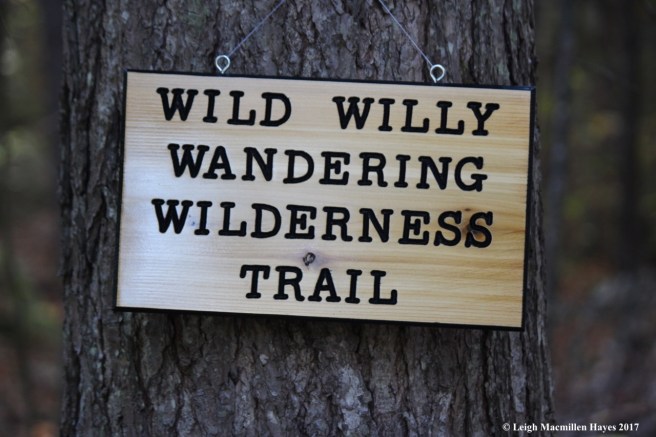
Just as we ended our journey, we noticed the sign–Wild Willy Wandering Wilderness Trail. Pam and Bob had told us its name, in honor of their nephew Willis and his hard and creative work in carving out the trail, but they kept the sign a secret until we finished. Hats off to all three of them and their love of the land and for each other. Joan and I were envious of it all and thankful for the opportunity to be embraced by the spirit of this place and these people.


I Spy, You Spy, We All Spy

As I stepped out the door early this morning to dump yesterday’s coffee grounds, my eyes were immediately drawn to a pattern in the dew and I knew that Porky had paid us a visit.

t-porcupine trail in morning dew

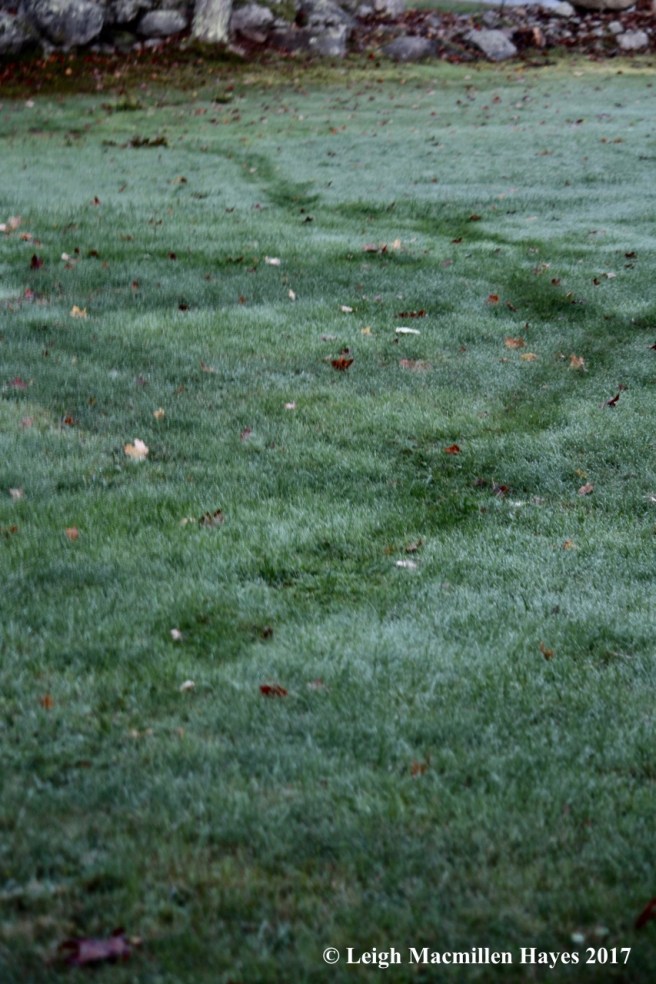
His trademark sashay showed in the wet grass almost as well as it does in snow with that pigeon-toed pattern and swish of a tail. Only yesterday I’d been noting all the freshly nipped oak branches in our yard and woodlot, cut as they were at that telltale 45˚ angle.

t-flat hill sign--oxymoron

And then, after today’s coffee (grounds waiting until tomorrow to be disposed) and breakfast, I drove to Lovell to meet up with some Greater Lovell Land Trust docents for a climb up Flat Hill–that oxymoron of a name. But really, the summit is rather flat–after climbing the hill, of course.

t-trail light

It was early and felt more fall-like than we’ve experienced of late and we reveled in the temperature as well as the light along the trail as the sun played with the leaves and added a golden glow to our day.

t-coyote scat 1

When we weren’t looking up, we looked down. One of our first sights–scat! Coyote scat, we thought. Only the contents of this scat were different than most.

t-coyote scat 2

And so we went in for a closer look–for it was filled with quills. Not my home porky, but we know that the summit and rocky ledge below are porcupine territory so it made perfect sense that we found such scat in the middle of the trail.

t-fox scat

We found more scat a little further along–this one was filled with berries and seeds and also in the middle of the trail, atop a rock. Smaller in size, we suspected red fox.

t-paper birch lenticels

There were other things than scat to attract our attention, like the long lenticels on a downed paper birch–their pattern looking like either zippers on a jacket or a bunch of spruce trees in their spire formation.

t-maple-leaf viburnum

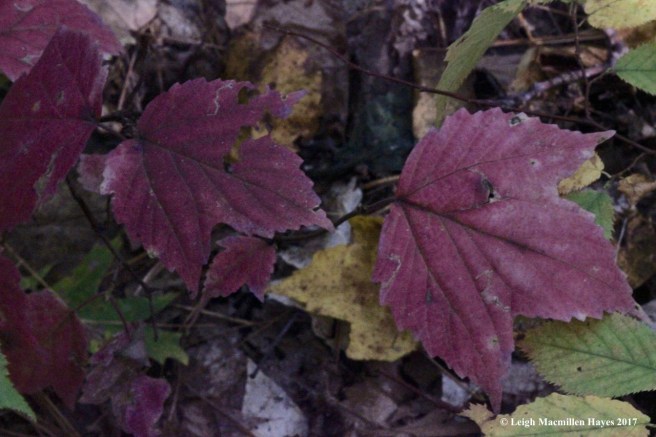
We marveled at the color and texture of the maple-leaf viburnums–like no other in the mix.

t-hop hornbeam bark and leaf

And when we reached the hop hornbeams with their shaggy bark and double-toothed leaves, we knew to look below for their seed pods. It wasn’t an easy search for they are small and blend in well with the birch and hornbeam leaves on the ground.

t-hop seed 2

But we found one–its papery sack enclosing the nutlet. We were curious to see the seed and so opened the inflated casing. It was almost a 3D tear-drop shape, coming to a sharp point.

t-hops

Skipping ahead for a moment, after we finished hiking I visited a tree back near the parking lot where Pam and I had noted plentiful fruits in the summer. It takes about twenty-five years for a hop hornbeam to fruit. And the common name–“hop” refers to the seed clusters that represent true hops used in beer production.

t-summit view 1

At last we reached the summit and stood for a while, in awe of the color display before us.

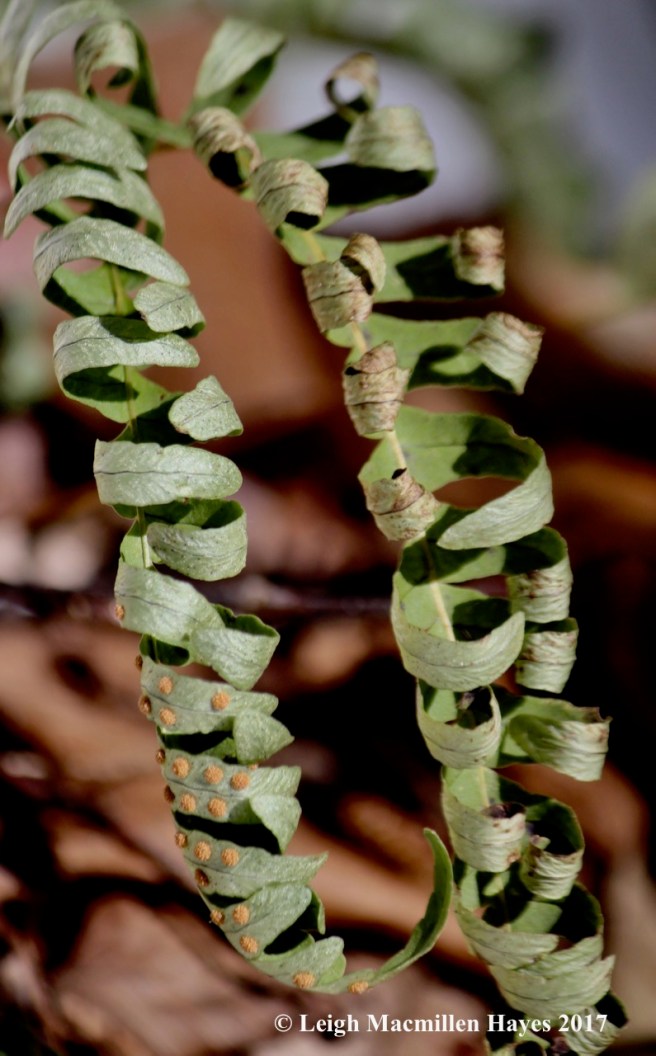
t-polypody 1a

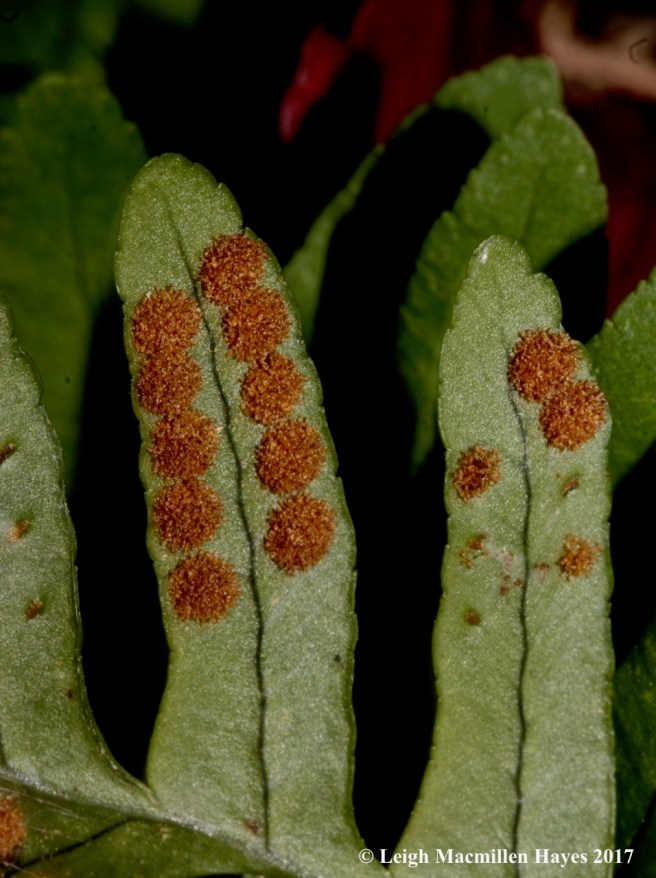
From the same spot, we also noted the polypody ferns that grow upon the summit rock.

t-polypody spores 2

Ferns reproduce by spores rather than seeds. The itty bitty spores (think dust sized), called sporangia, grew on the underside of these leathery frond leaflets. The sporangia form clusters called sori and in the case of polypody the sori are naked. Some had already dispersed.

t-chipmunk

At last we started down, but not without a side trip of bushwhacking and annoying a chipmunk who had some housekeeping details to attend to.

t-docents 1

Less than three hours later (amazing for us), we gathered at the bottom and said our goodbyes to Darbee and David on the left–they’ll return to their winter home soon. Bob and Pam will hang with us for a bit longer, but while I reflected on all the wonderful reasons to enjoy winter in Lovell, the two couples made plans to connect in their winter habitat.

t-wooden spoon

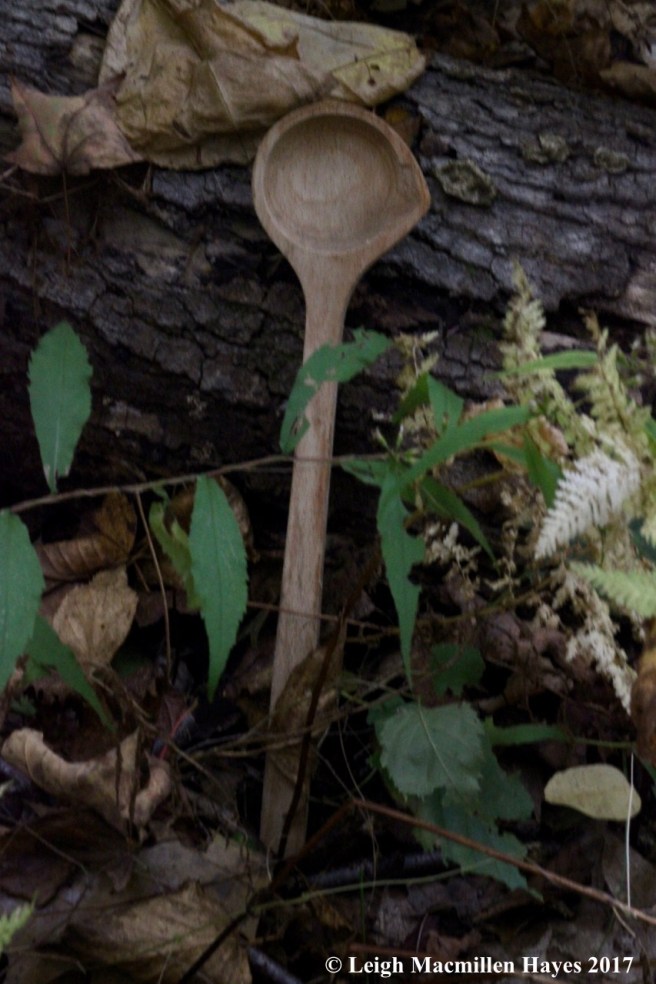
The day wasn’t over yet and this afternoon another docent and I set up a “Kim’s game” of natural and unnatural items on a sheet covered with a bandana on the trail behind the New Suncook School. Then we walked further along the trail and hid a bunch of unnatural items for our after-school Trailblazers to locate. (We had to relocate them as well and are almost certain we found all of them. Maybe . . . )

t-noticing leaf colors

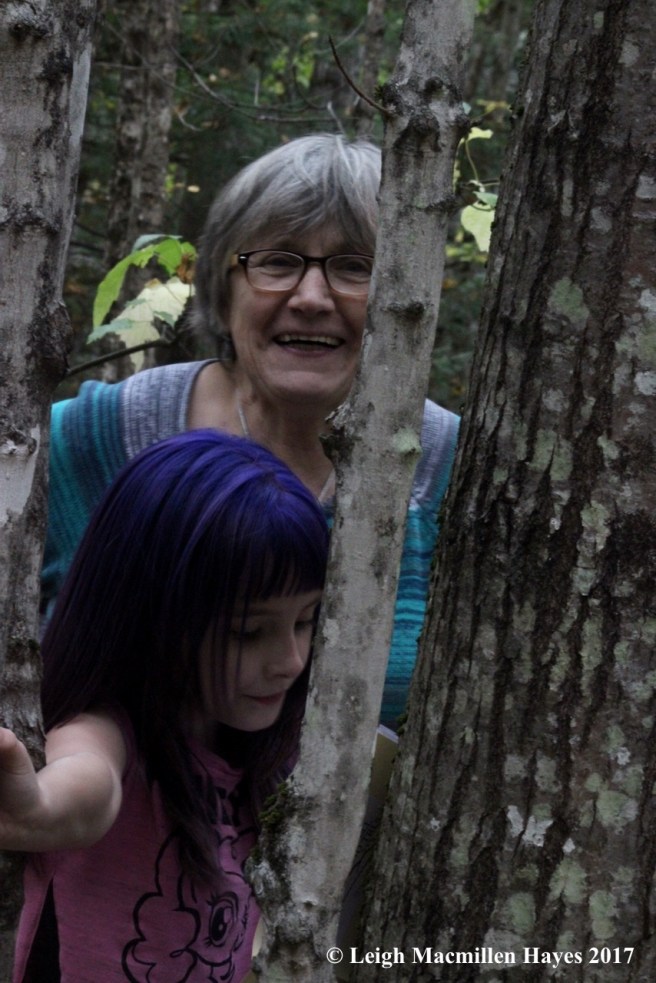
Before the kids did anything though, they introduced Linda to their trees–clusters of trees really for all are copiced, that they’ve befriended and named and gotten to know up close and personal. This afternoon, they noted that the colors of the leaves were changing.

t-Linda and Sassy

They loved giving Linda a tour and she loved being part of the action.

t-alligators in the woods

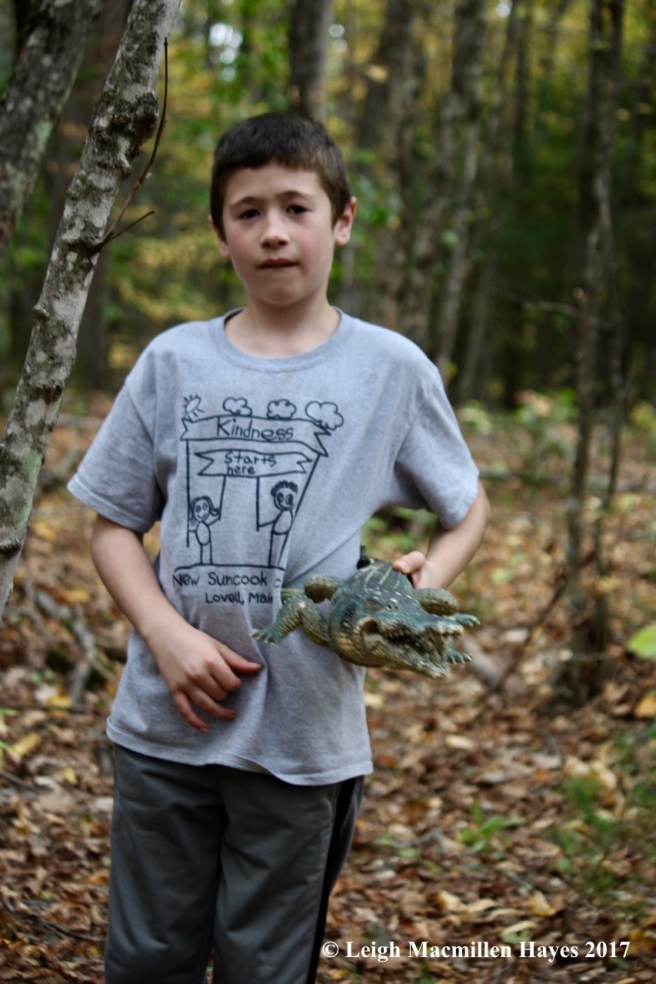
The kids did an excellent job with their observation skills, including locating at least one species that didn’t quite belong in these woods.

t-fallen log 1

And then we started gently rolling over fallen limbs, curious about what we might find below.

t-red-backed salamander

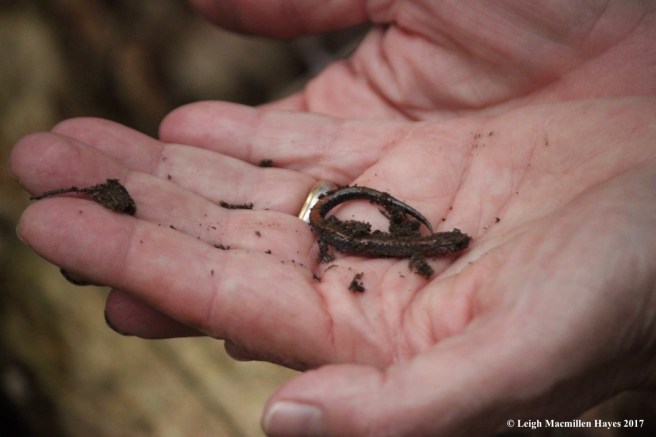
And what to our wondering eyes should appear? A red-backed salamander under the first one. We rolled a few more and didn’t find much. But then we heard something and stood still as we listened. Finally, it called again and we called back–a barred owl was somewhere nearby. At last it was time for the kids to head home and as we walked out of the woods to meet their parents, we stopped to roll one more log–where we found a yellow-spotted salamander. Unfortunately, in our excitement, I couldn’t take a decent photo, but still . . . we were thrilled.

What a perfect day–of I spy, you spy, we all spy. Indeed we did.


Anybody Home?

Only a few days ago we felt like we were melting as we complained about the muggies and buggies, but those temperatures are now only memories and it’s beginning to feel like fall in western Maine. And so my guy and I bundled up before we followed a trail and did some bushwhacking this morning, exploring a property Jinnie Mae and I had visited only a week and a half ago.

m1-lodge

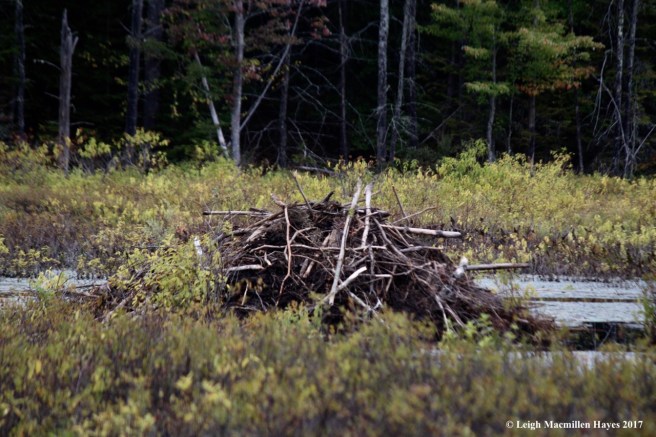
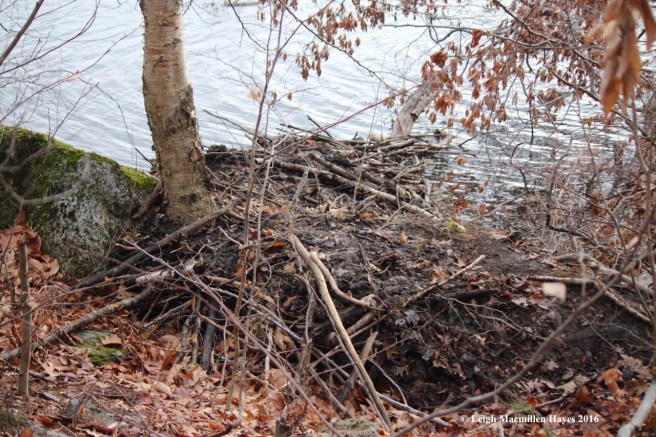
It was to the beaver lodge that we first made our way, noting all their old works near the water’s edge.

m2-lodge 2

But, we were disappointed that we saw no evidence of new work and it didn’t appear any winter prep was yet occurring. Were the beavers still about? Or had some parasites in the lodge forced them to move on?

m3-infinity pool1

We hoped not for they’ve worked hard in the past to create a home with an infinity pool that would be the envy of many.

m1a--otter scat

We did note that they’d had recent visitors who left behind a calling card in the form of a slide and scat–otter scat, that is.

m5-doll's eye

And we spied the fruits of a former flower that graced their neighborhood–doll’s eye, aka white baneberry.

m4-dam 1

As we circled around the pool, we commented that the dam seemed to be in excellent shape and held the water about five feet above the stream below. But again, no evidence of new wood.

m7-dam works

Despite that, it’s an impressive structure. While some landowners might be upset to have beavers changing the landscape, we happen to know this one and she takes great pride in their works.

m9-dam 2

We stood for a while, indulging in our own admiration while wondering where the beavers might be. Of course, it was close to lunch time for us, and not an active time for them if indeed they were home. Possibly we were misinterpreting the view.

m8-beaver pond

After some time of quiet reflection, we made our way back, crossing the stream just below the dam.

m13-quiet reflection

And then we continued along the old logging road (recently bush hogged, eh Brian? Well done), and bushwhacked some more, crossing another stream to find our way to another reflective spot along the brook.

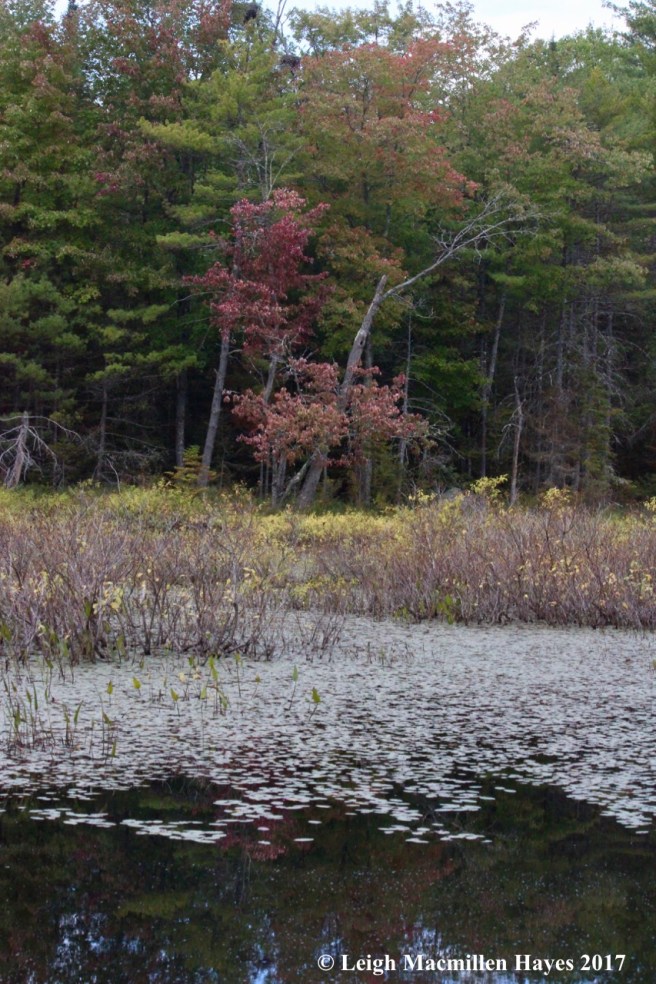
m12-rookery 2

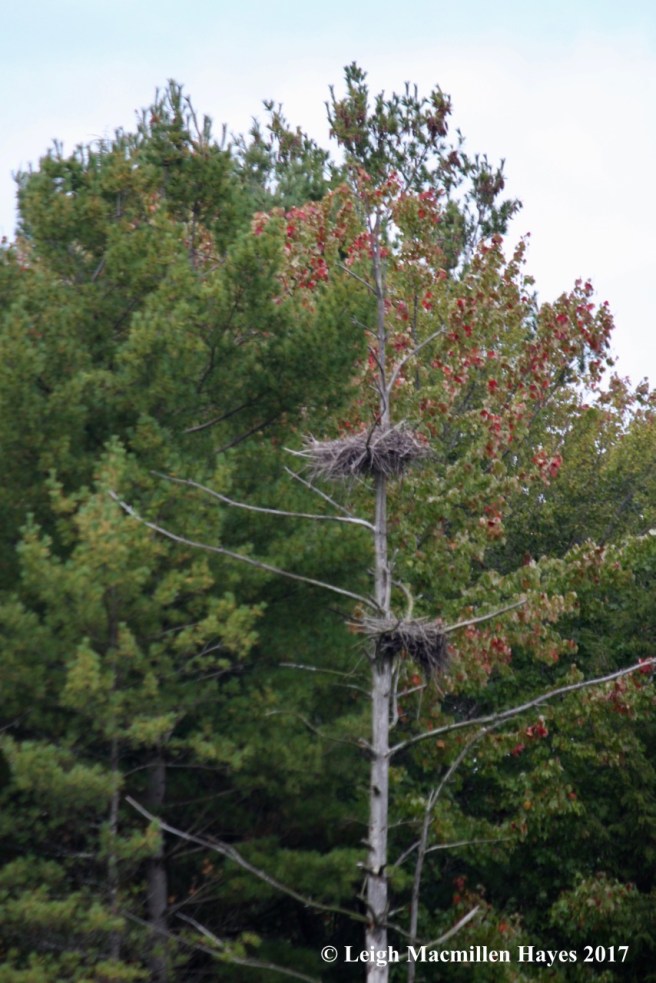
This time, our destination was that of another stick builder–great blue herons.

m11-rookery

Their spring/early summer nests are equally impressive. I hadn’t visited this spot since April, when the herons were actively setting up home. And I’m not sure it was a successful breeding season for them, but even if it was, they wouldn’t have needed these homes today. The nests will remain–available for grabs next year by those who return.

m16-jack in the pulpit

After a snack by the brook, we pulled ourselves away knowing it was time to head to our own home. Our wildlife viewings had been nil, but we spied a jack-in-the-pulpit in fruit, and that plus the doll’s eye were enough. And the time spent wondering about the critters.

m20-cosmos

Back at our truck, we decided to check on the insect action in the gardens at our friend’s home. Only the bumblebees seemed to be active.

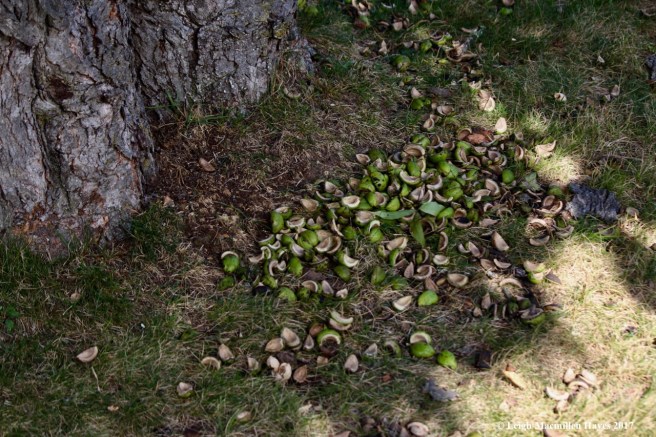
m19-hickory feast

But we saw plenty of activity of another kind–a cache of hickory nut shells at the base of the tree, and really . . . everywhere nearby.

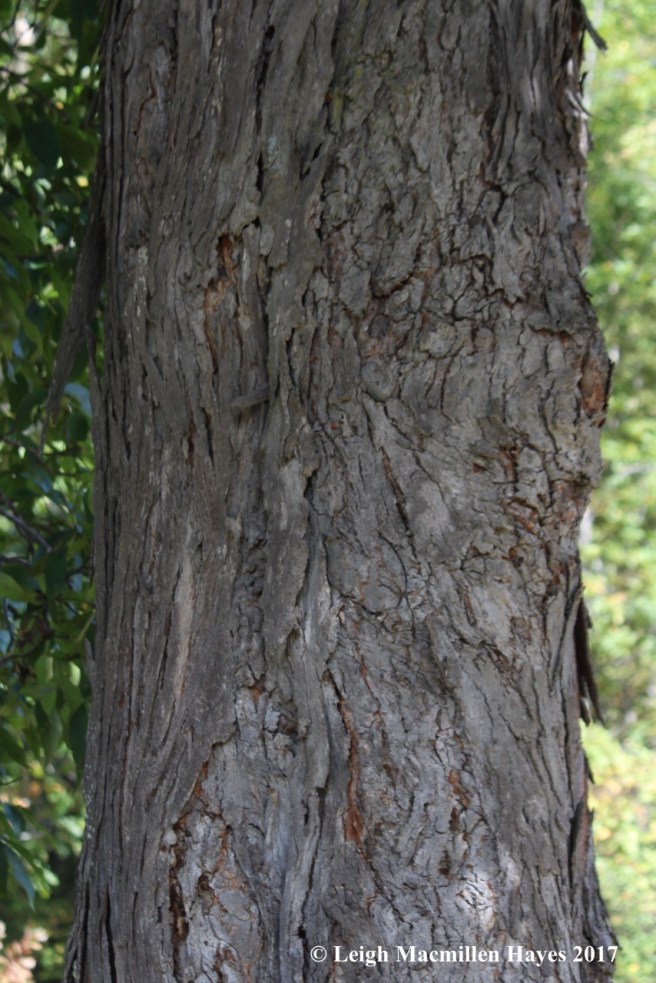
m18-hickory bark

Shagbark hickory is more common south of this spot, so it was a treat to take a closer look.

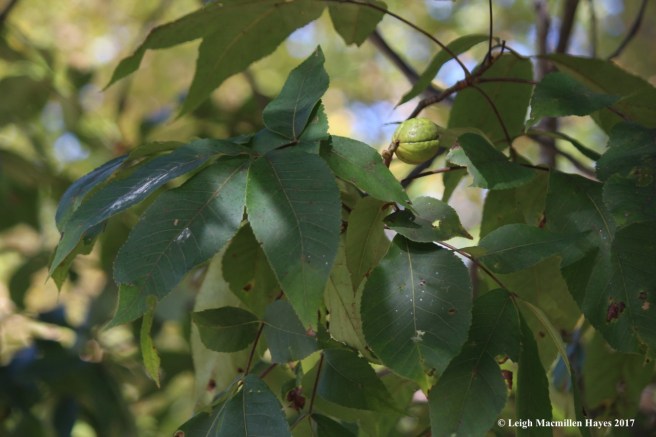
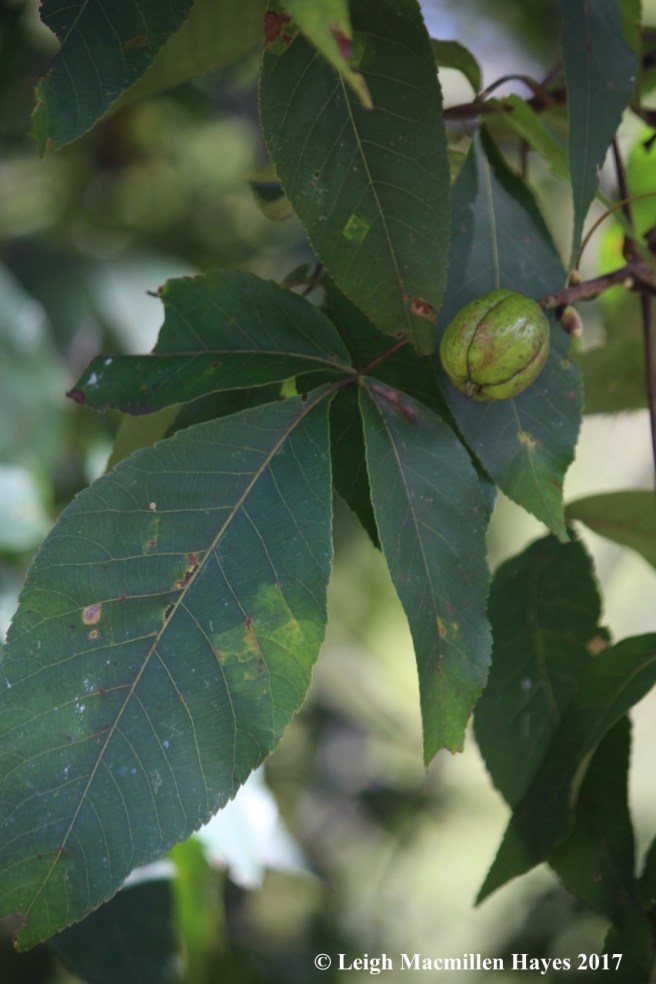
m17-hickory

Its alternate leaves are compound, consisting of five serrated leaflets usually (sometimes there are seven).

m18-hickory 2

And of those five, the three terminal leaflets on each twig are the largest.

m21-view of Balds

Once again, it was time to leave this beautiful spot where the fields and forest flow into the mountains. And where the beavers and heron share the place without too much human intervention. Though not a soul was home today, we trust all will return when the time is right.


A Blue Bird Kind of Good Friday

When Jinnie Mae picked me up this morning, our destination was the Narrow Gauge Trail. But somewhere between here and there, she pulled a U-turn and drove to Narramissic Farm owned by the Bridgton Historical Society.

It had been just over a year since I last visited and I wanted to show her the shagbark hickory buds. And maybe even the bear trap.

n-Pleasant Mtn to Narramissic1

We crossed the field behind the house and started off on the path to the quarry and bear trap, but snow and water in the woods resulted in another U-turn. We’d been talking so much, we’d hardly noticed our surroundings, but the view stopped us in our tracks.

n-Pleasant Mountain

To the left, the long ridge line of Pleasant Mountain, where the ski trails of Shawnee Peak Ski Area made themselves known.

n-Narramissic

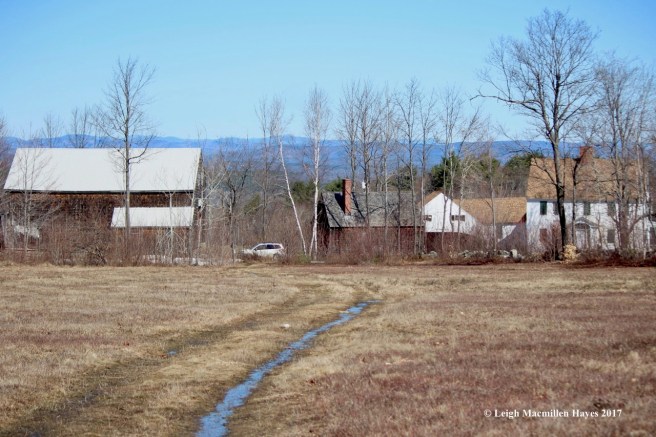
And in front of us, the Temperance Barn and Peabody-Fitch homestead, built in 1797. We had the place to ourselves and reveled in the quiet of the day–when we weren’t talking, that is.

n-shop and flagpole

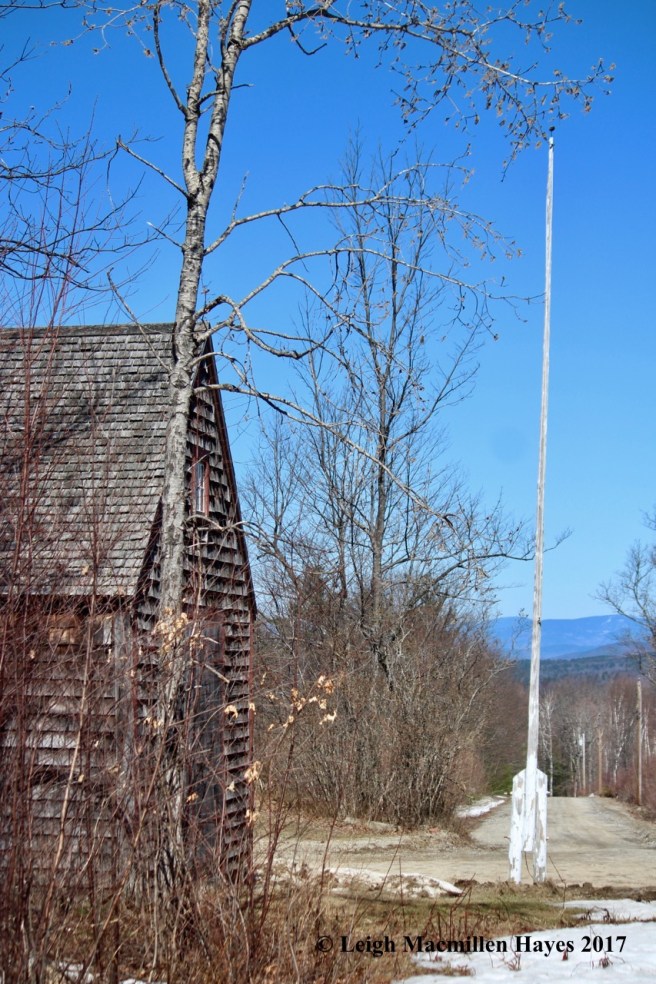
Heading to the road for our tree bud search, we passed by the blacksmith shop where horseshoes were probably made in the day.

n-temperance barn

And at the Temperance Barn, so named “because it was raised without the traditional barrel of rum,” I can never resist admiring the structure even though it’s in great need of repair.

n-ash tags

And then we were stumped by a flowering tree. It sure looked like an ash as Jinnie Mae suggested, but what were those lacy tips? What came to my mind first were the tags on red oaks that I didn’t understand a few years ago until a friend helped me realize that they were leaf stems left behind when the wind finally claimed the dried leaves. Was this the same?

n-double-wide stonewall

Climbing onto the double-wide wall, I took a closer look.

n-white ash danglers 1

Turns out Jinnie Mae was right. But my question still remains. Were these the stems of the ash samaras or compound leaves?* For some reason I’ve never before seen them left behind. Ah, there are so many things to discover in this world.

n-black walnut 3

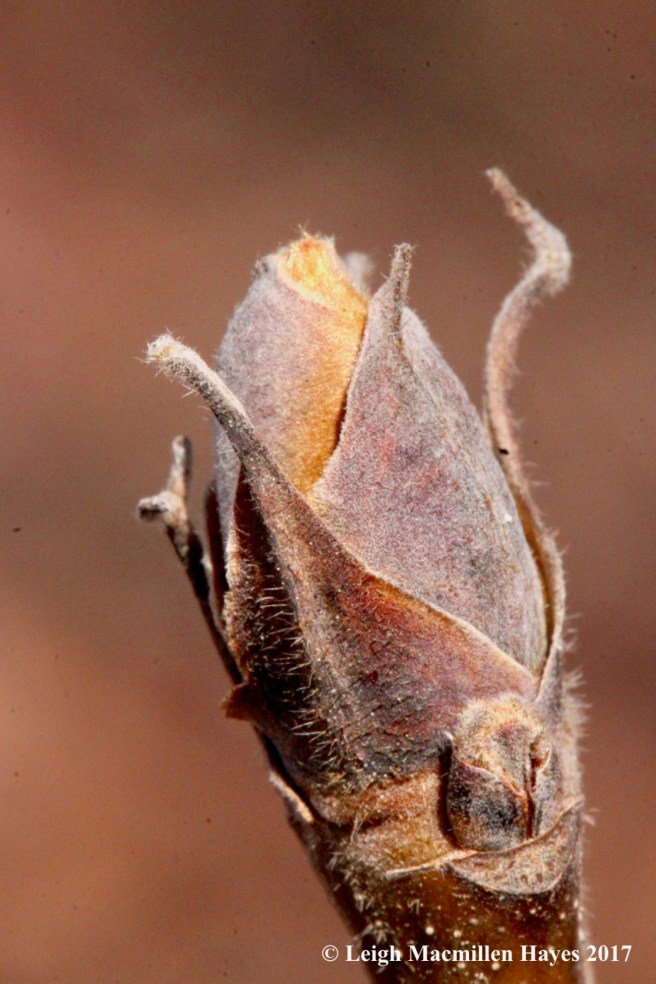
We continued down the road, noting budding pussy willows and flowering red maples. And then I spied the bulbous buds I wanted to show her. Only, it turns out that we hadn’t reached the hickory trees yet.

b-black walnut leaf scar 2

The monkey face leaf scar should have been a clue. But my brain was stuck in hickory mode and I completely forgot that black walnut leaves leave such a formation. At home, I pulled out Forest Trees of Maine and then seesawed between black walnut and butternut (aka white walnut). Both feature leaf scars shaped like a monkey’s face. But the top of the leaf scar serves as the give away–this one did not have thick fuzzy eyebrows like a butternut, so I’m going out on a limb and declaring this a black walnut.

n-shagbark bud hairy 1

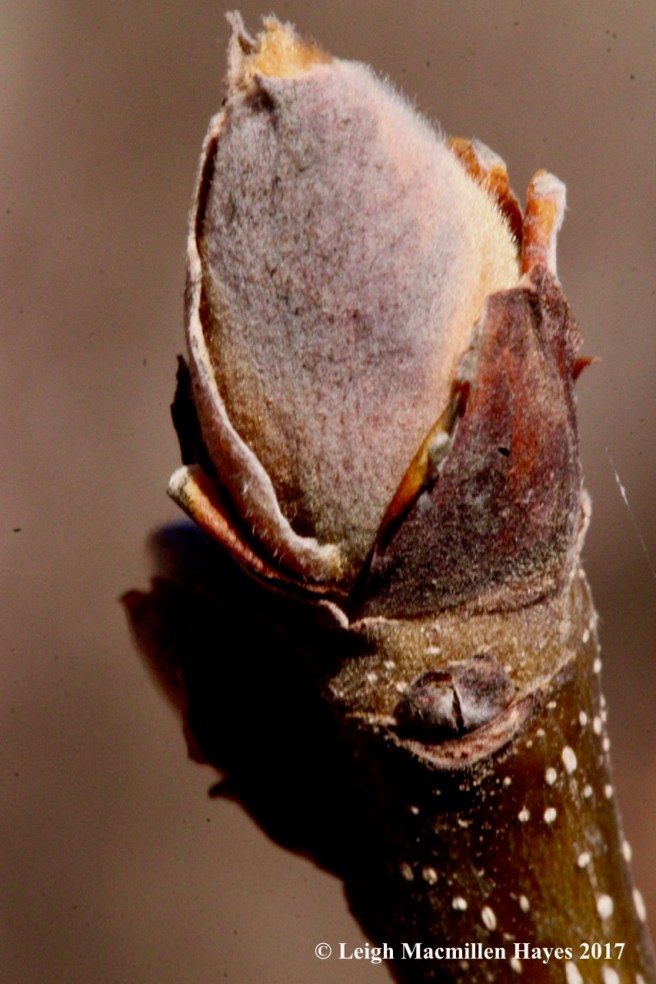
A bit further down the road we spotted more bulbous buds. These were definitely the ones I was looking for–shagbark hickory. In the moment and because the two trees weren’t close together, we thought they were all one in the same. But hindsight being 20/20 as it is, the photographs tell the story.

n-shagbark bud 6

The subtle colors and fuzziness wowed us and we both took numerous photos.

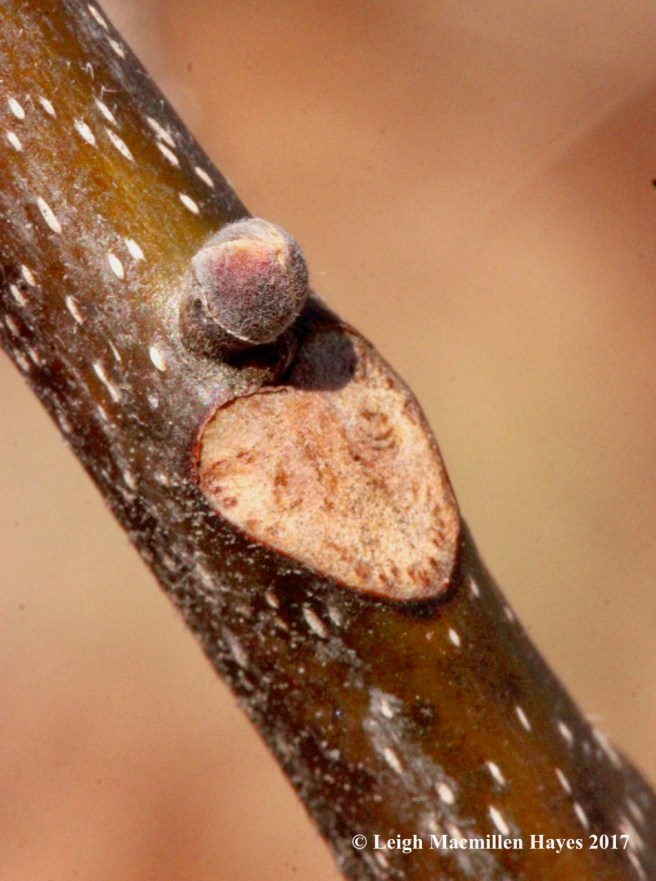
n-shagbark leaf scar1

Then there were the leaf scars–definitely more heart-shaped than the previous trees.  And lacking that smiling face. We smiled for them.

n-Long Lake below

It wasn’t enough to find the small saplings beside the road and so we crossed another field in search of the mother tree.

n-grasshopper 1

Along the way, Jinnie Mae spotted a wee grasshopper–the first of the season for us.

n-shagbark bark from distance

And then her newly trained shagbark hickory eyes keyed in on the momma.

n-shagbark bark 3

If you go, it’s located behind the barn.

n-shagbark bark 5

And shouts its name in presentation.

n-shagbark bark 4

Looking upward, we could see the bulbous buds on the twig tips contrasted against the bright blue sky.

n-bluebird

Happiness is a blue bird kind of day–sweetened by time spent exploring with Jinnie Mae, making discoveries and watching bluebirds move between the field and the trees. Indeed it was a Good Friday.

Now we need to return and find the mother black walnut.

*Thanks for Maine Master Naturalist Pam Davis for IDing the ash strand as the rachis of the compound leaf. She reminded me that I have seen these on the ground in the fall. But–to be still dangling from the tree was new to my eyes and mind.


Snow White Birches

We’ve plenty of snow still on the ground and another storm predicted for the weekend. I keep saying, “Spring in Maine,” because that’s exactly what it is. In fact, no season here has ever looked at the calendar and we never know what will happen during those transitional days–except that they’ll do just that–transition.

o-up to my knees

I, too, am transitioning and rather than my usual uniform that includes snowpants and a vest or jacket, I simply wore jeans and a sweater, plus boots minus the snowshoes. Only occasionally did I dig a posthole, but when it happened my foot went deep–at least to my knees. And in this case, there was a juniper below, so probably more snow under that.

o-rock surface black and pitted

Deer, raccoons and a bobcat had traveled through our woodlot and along the cowpath. At the vernal pool, I spent some time checking out trees and looking for signs of change. Deer and turkeys have been the most recent visitors. And both have also traveled along the double-wide stonewall beside it. I, too, climbed up there and moseyed along. That’s when I discovered a black crustose lichen that turned out not to be a lichen after all.

o-rock surface, basalt?

I suddenly realized I was looking at the rock face and have sent photos off to two geologist friends. My question, “Is this basalt?”

Ann Thayer replied, “Could be, it also looks like it could be a rock that has been metamorphosed and has secondary mineral growth. At certain pressures and temperatures there are indicator minerals that grow that represent the metamorphic conditions. For instance, Garnet, sillimanite, and andalusite, are examples of indicator minerals . . . Take a look at it with the hand lens. Tell me what you see. There are a couple of minerals that look like they have a six-sided form and cross-section.”

Ah, a reason to look some more–as if I need one. And to invite Ann here for a walk.

o-birch grove

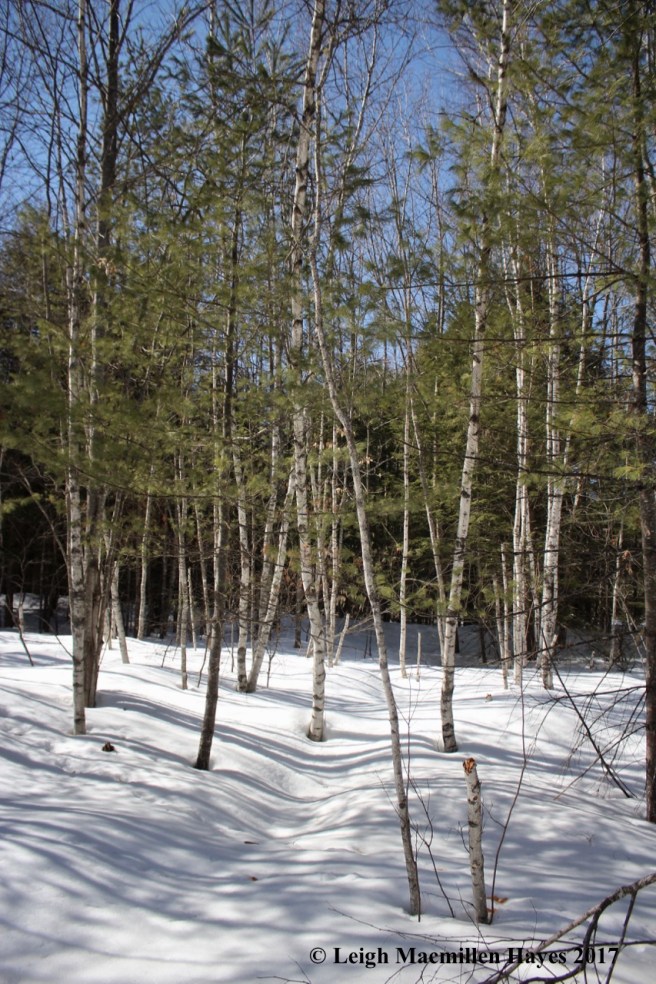
Beside the vernal pool is one of my favorite sections of these woods, a small birch grove. Yes, white pine and red maple saplings also grow there, but right now the birches dominate this acre-size plot.

o-gray birch chevrons 1

It’s a classroom filled with examples that have helped me gain a better understanding of differences between family members. The gray birch, Betula populifolia,  are those I associate with Robert Frost’s poem, “Swinger on Birches,” because it’s an early successional tree that bends naturally and even more so in an arc when snow or ice weigh it down. But it’s the chevron or triangular shape below branches that shouts its name to me.

o-dirty gray birch bark

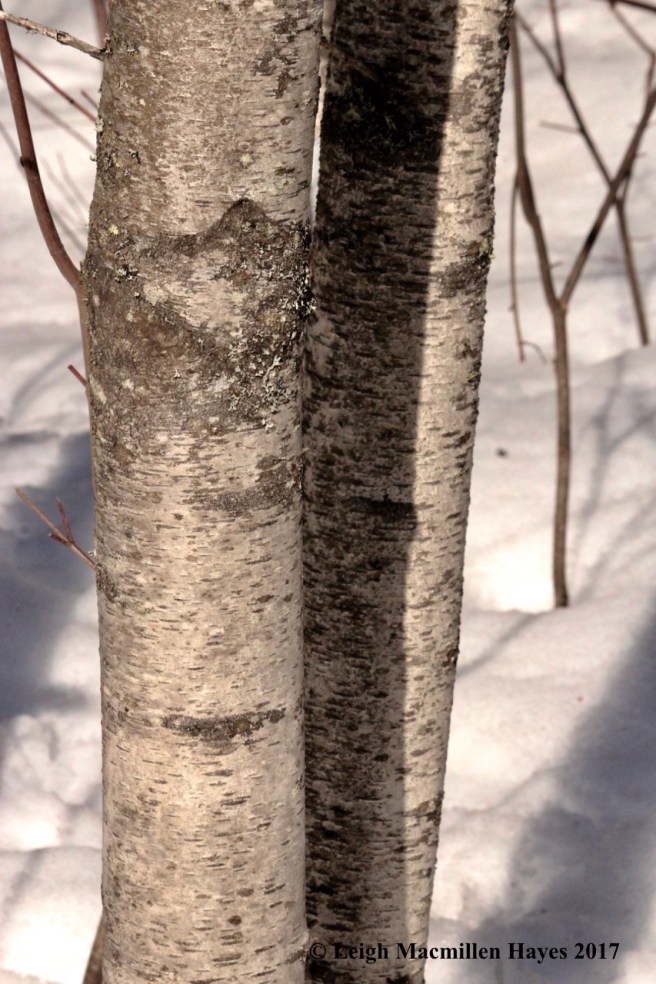
Its bark, though white like paper birch, looks dirty–especially toward the base. And, unlike paper birch, it barely peels.

o-paper birch bark1

In this same plot, I did find a few specimens of paper birch or Betula papyrifera, which is a stronger tree and grows taller and longer that brother gray.

o-paper mustache

And rather than a chevron below the branches, it’s known for the long, dark mustache that swoops up and over its branches.

o-paper birch close up

I moved in to take a closer look at the paper birch bark, admiring how the lenticels withstand the peeling, breathing while sloughing off old cells.

o-gray, left, paper, right

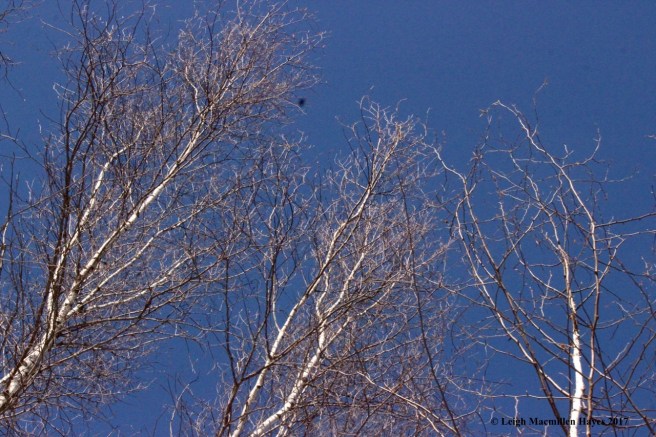
Looking skyward, the differences between the two were yet again defined. The gray birches on the left featured a bushier silhouette than the paper birch on the right. Catkins and buds also shouted their names, but I’ll save that for another day.

o-birch polypores 2

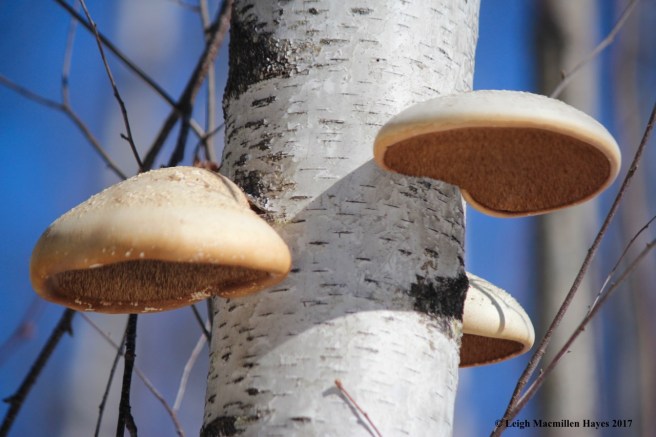
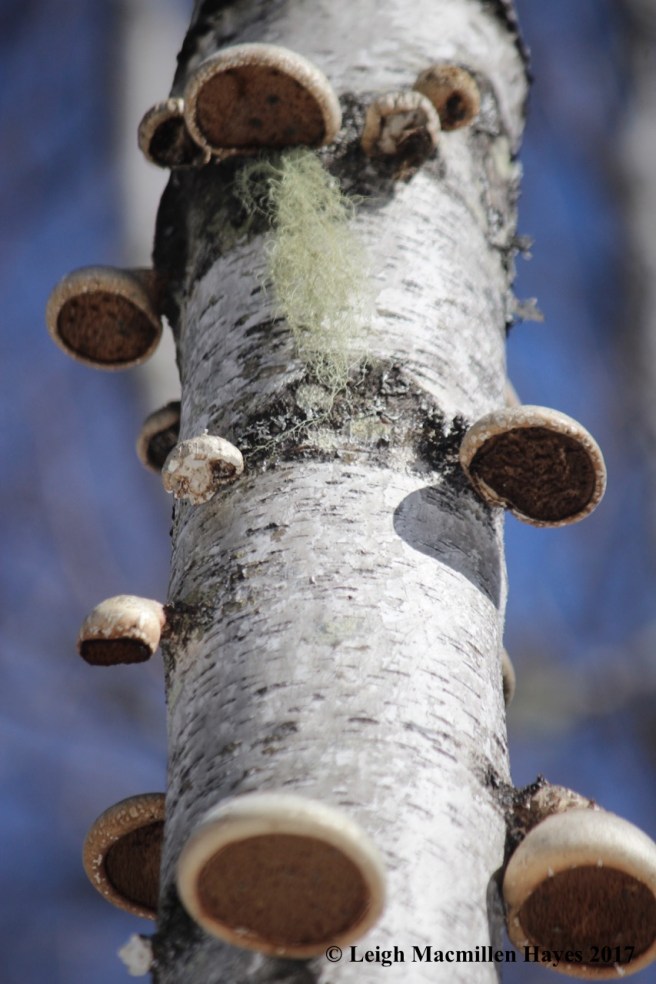
Not fussy about which birch it grows upon is one of my favorite fungi–because I can identify it with ease! But also because it really is attractive.  Piptoporus betulinus or birch polypore grow on some snags as well as a few live trees. The smooth rim rolls around the pore surface and sometimes reminds me of a bell hanging from the tree.

o-birch polypores growing old

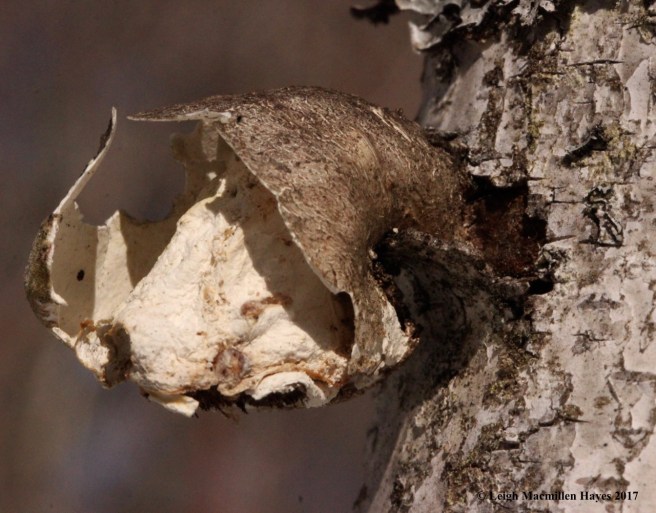
These bracket fungi only live for one season, yet persist on trees for a longer period of time . . .

o-birch polypore skeleton

until they may become mere skeletons.

o-birch grove 1

After a sunny afternoon among the birches, it was time to head home. Oh and by the way, some call paper birch white birch and some call gray birch white birch. I prefer to call them paper and gray.

In the Brothers Grimm Fairy Tale, the queen sat by the window sewing as “the flakes of snow were falling like feathers from the sky.” Soon the queen gave birth to a daughter as white as snow with hair as black as ebony. You know the rest of the tale. But did you know that Snow White lives in these woods–forever embodied in the birches?

Celebrating Place–Naturally

Once the snow melts it will be more difficult for me to wander and wonder in the woods I explore all winter given its spring/summer water level and logging slash. And so I make the most of these days–trying to notice as much as I can before I can notice no more (or at least until next winter).

l-bushwhack 1

Though I’d promised myself I’d not go again in an effort to not disturb the deer, promises are meant to be broken. And from that came a lesson–the deer are sticking to the snowmobile trail and field edges where tender bark of young red maples and hemlocks, plus swelling buds meet their needs for the moment. So, it was OK that I broke my promise, for the deeper I tramped, the fewer tracks I encountered.

l-spring tails1

Today’s warmer temps in the low 40˚s found the springtails hopping about on any and all surfaces.

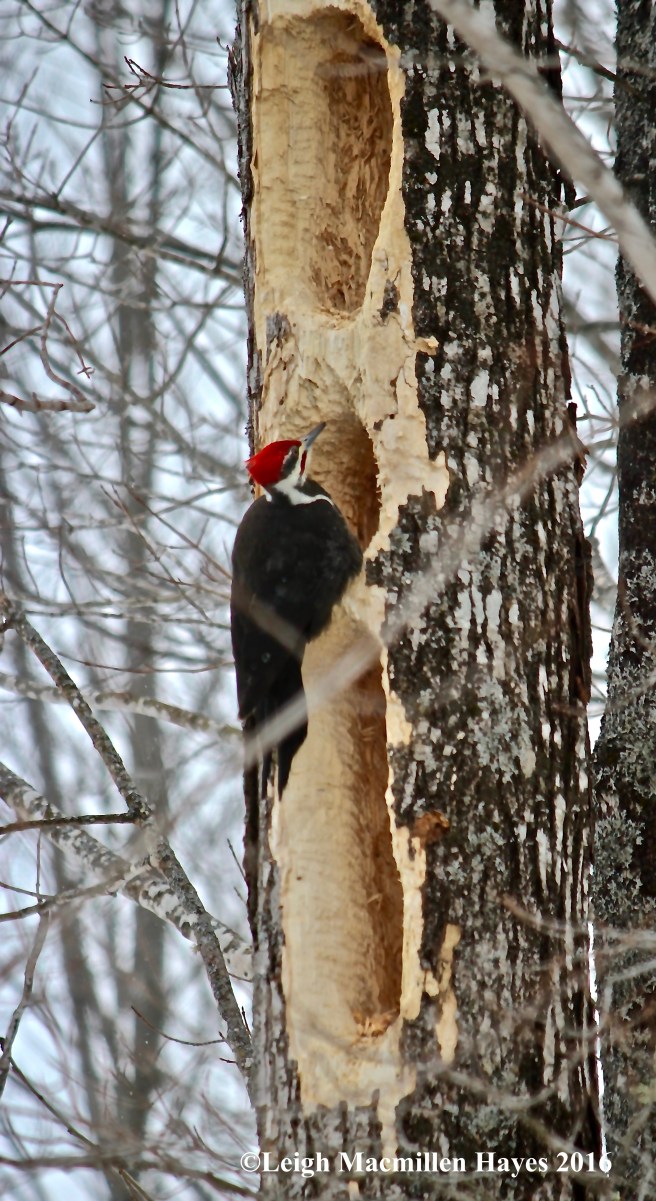
l-pileated hole

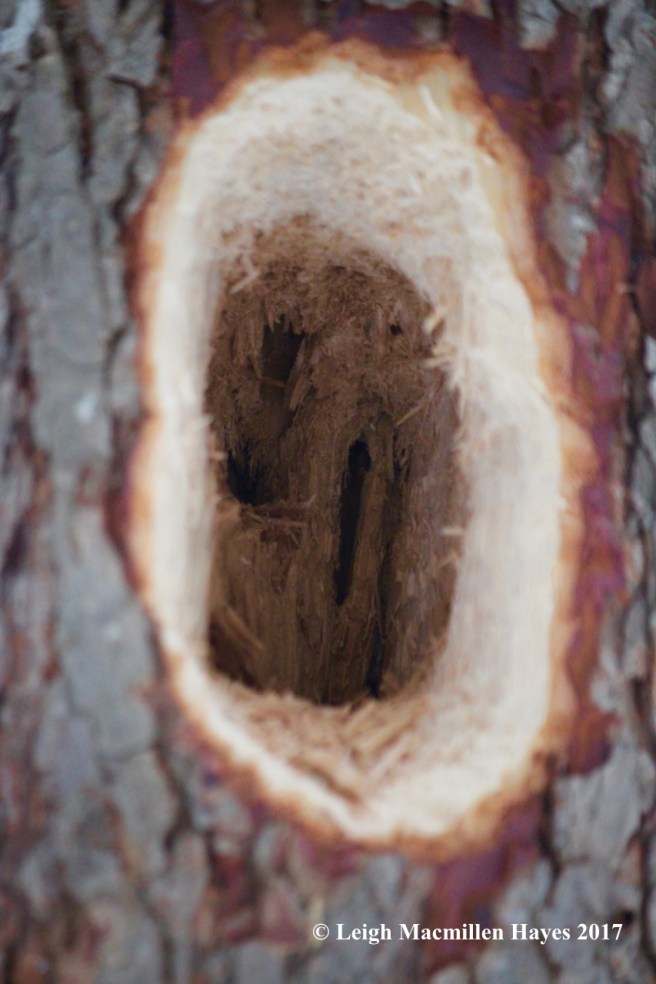
As is my habit, I checked on a pileated woodpecker hole when I saw bark and wood scattered atop the snow. Deep was this excavation in search of nourishment.

l-pileated scat-seeds and ant

And chock full was the scat below, which contained insect body parts and seeds of the dreaded bittersweet. Beside the scat, a springtail sought to placate its own food needs which among other things includes plant material and animal remains.

l-red maple bull's eye

Turning to another tree, I landed on a perfect bull’s eye! The target fungus that affects many red maples makes for an easy ID.

l-crustose, liverwort and moss

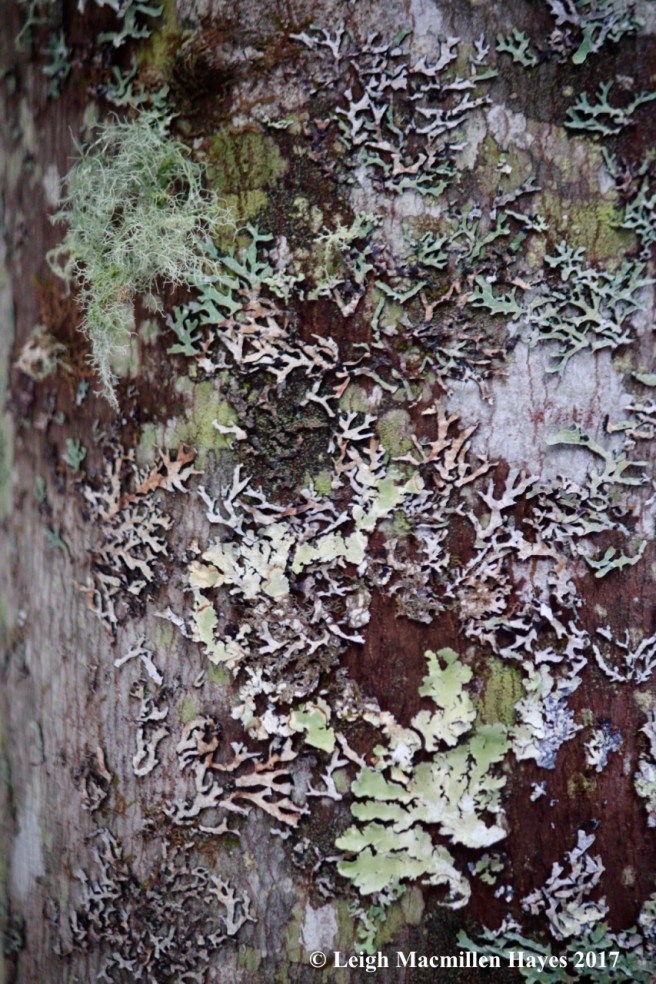
Lichens have also been a focus of late. What I like about this one, the circular green with the black disks of a crustose lichen (possibly bark disk lichen), was its location beside a liverwort (the beaded brown Frullania eboracensis) and a moss that I didn’t key out. Tree bark has its own structure and texture, but so often others also call it home.

l-shield lichens on rock

Rocks also serve as a substrate and this one featured a couple of leafy foliose shield lichens, their colors enhanced by yesterday’s inch of snow.

l-hair lichen and beard lichen

And dangling from a branch, two forms of fruticose (branching or fruit-like structure–) lichens. The dark is a hair lichen, while the green a beard–seems about right with the hair above the beard.

l-lichen garden

On another maple I spied a garden–you’ve got to liken it. (Corny joke that always manages to enter a lichen conversation.)

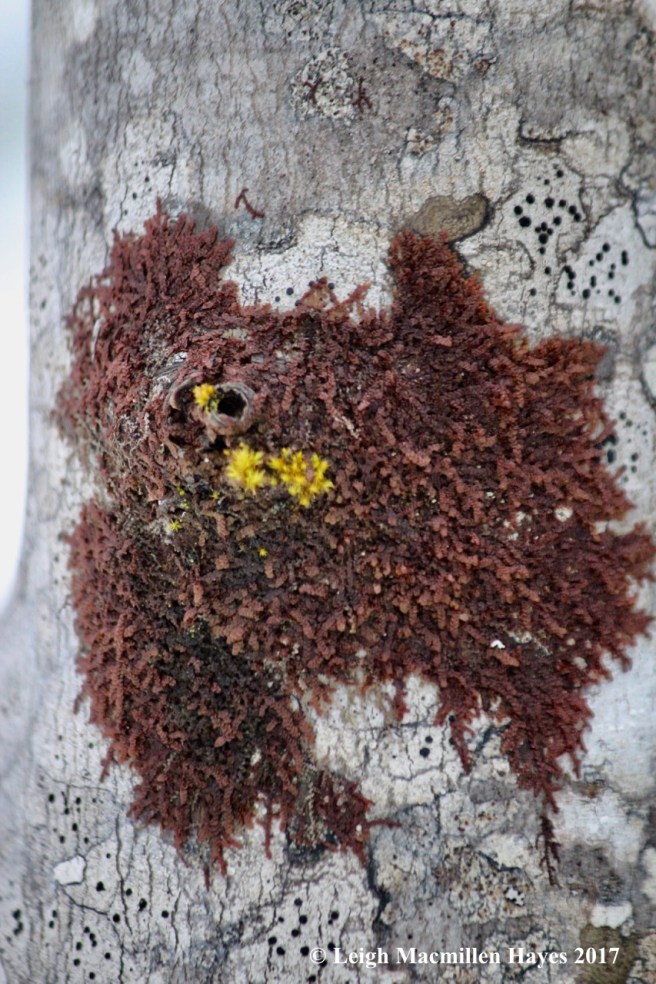
l-frullania 1

I’ve often paused beside Frullania eboracensis, a liverwort with no common name, but today several trees shared displays of mats called Frullania asagrayana, so named for a botanist and natural history professor at Harvard University from 1842-1873–Asa Gray.

l-frullania asagrayana 1

Its shiny, overlapping chain of red-brown leaves reminded me of caterpillars crawling along the maple bark.

l-spirea:steeplebush

Casting my eye elsewhere, steeplebush in its winter form offered an artistic presentation.

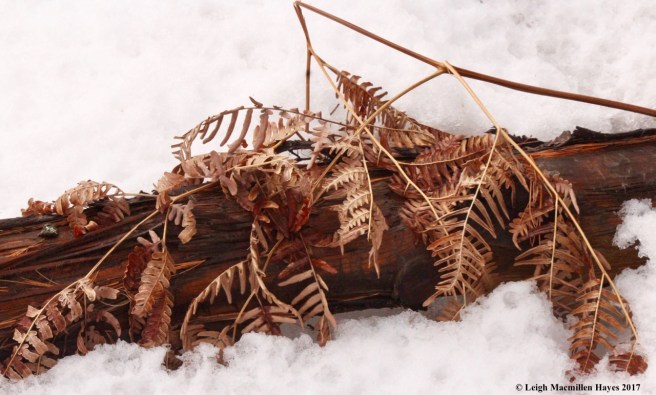
l-bracken fern1

And as the snow melts, last year’s bracken fern made an appearance.

l-speckled 3

One last shrub made me stop. Minus any catkins or “cones” for which it is known, I had to think for a moment about the speckled alder. But those speckles or lenticels through which gas exchange occurs, and the buds and leaf scars were give aways.

l-speckled buds and leaf scar

The two bud scales meet at their edges and look like miniature footballs. But it’s the bundle scars where leaves were formerly attached that make me laugh. That vascular system looks like a face–two round eyes, a funny shaped nose and a round mouth, as if it’s exclaiming, “Ohhh” or “Wow.”

l-Pleasant Mtn in background

At last I reached my turn-around point. I could see Pleasant Mountain in the distance and knew where I was in the world. This is my place and I love every opportunity to celebrate it–naturally.

The Sun Always Shines

In the grayness of the day sunlight lit my way.

o-skunk tracks

Oh, it wasn’t as bright as yesterday when I wandered in brilliant light under clear blue skies and saw hints of spring, including skunk prints in the snow,

o-algae

and some blue-green algae in a vernal pool that is slowly opening up.

o-ice goddess

But given the temperature and wind, the ice goddess reminded me that winter prevailed.

b-deer 2

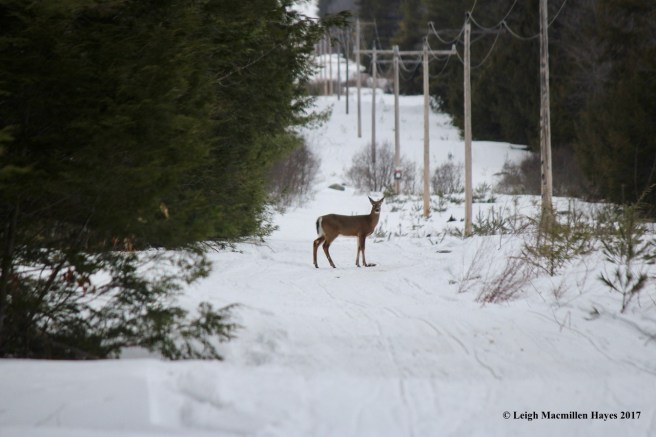
This morning presented a different picture that didn’t feature Mount Washington in the background because it was obscured by clouds. Rather than don my snowshoes, I decided to stick to the snowmobile trail for the most part. I wasn’t the only one who ventured that way. Because I wasn’t making as much noise as usual, the deer didn’t hear me approach. And so we stood for many minutes contemplating each other. I didn’t want to scare her for I knew she wouldn’t just stick to the trail and the snow depth continues to be such that she sinks with each step. It was in those shared moments that I began to think about energy and how much she put forth all winter and now continues to do the same as spring evolves. Every day I spy more and more young hemlocks trunks that have been scraped. She and her family are feeding on sunlight, which first feed the insects in the soil and then the trees. At each stage or tropic level of the food chain only ten percent of biomass from the previous level is retained. Thus, a thousand pounds of plant biomass is necessary to support a hundred pounds of an herbivore–that’s a lot of little buds for a deer.

b-bobcat prints

Eventually, she made her way across the powerline and joined her family. I decided to turn around so I wouldn’t disturb them further. And it’s then that I recognized some prints I’d missed previously. My micro-spike print is on the left, beside those of a carnivore–a bobcat, or rather, two. Usually bobcats travel in a solitary manner, but their breeding season is upon them. And those thousand pounds of plant biomass that supported  a hundred pounds of herbivore, in turn support ten pounds of carnivore. The hunt becomes important.

b-motherwort

I did find a few spots where the snow had melted and winter weeds, such as this motherwort, provided hints of future buffet items for the herbivores and omnivores to consume.

b-junco and hemlock needle

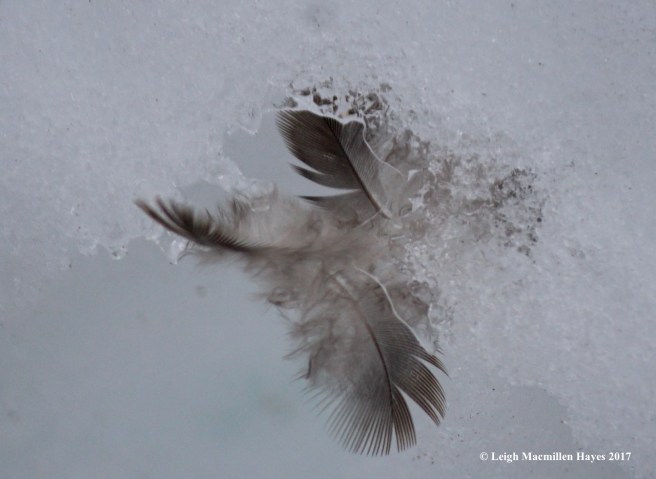
And then I came upon junco feathers and knew that a different consumer had benefited from the sunlight offered forth by this little bird. The hemlock needle provides a perspective of size.

b-junco feathers 2

Despite its demise, the feathers surrounded by melting snow created an artistic arrangement. That was my attempt at positive thinking, for like us, all things must eat to survive.

b-white ash opposite

And then a few producers caught my attention and I found myself focusing on young trees and shrubs. I’ve walked past this young tree numerous times and never saw it until today.

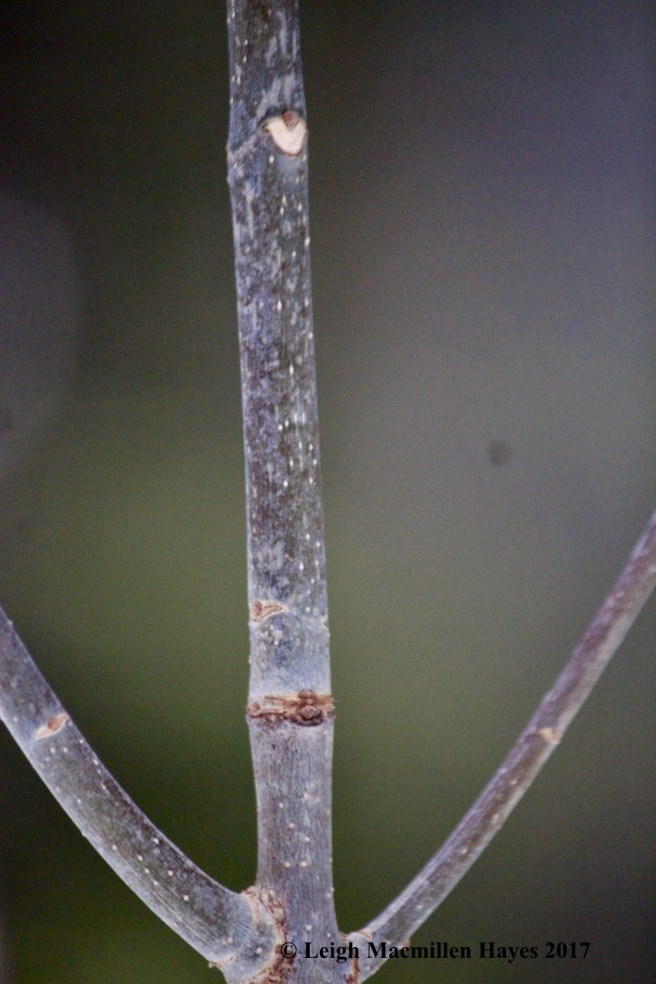
b-ash 2

White ash or green? They both look similar, but the leaf scar is the giveaway. It’s shaped like a C or misshapen horseshoe with a deep notch at the top.

b-ash bud

And its terminal bud is domed. In these woods, the ash trees aren’t a preferred food source of the deer–lucky for them.

b-silky 2

Nearby, another neighbor caught my attention and it, too, I hadn’t met before.

b-silky dogwood 1

My assumption was dogwood, given the bright red/purpishish color of its shrubby stems, long-gone fruits and opposite leaf buds. But–red osier or silky? I’ve leaned toward the latter but will have to pay attention as the season moves forward. These did seem to tickle the herbivores fancy from time to time, though not nearly as much as the maples that grow nearby.

b-peanut

As I headed toward home, I stumbled upon another site I’ve seen frequently all winter. Actually for the past few winters. There must be a peanut plantation somewhere in these woods. That, or the blue jays have discovered a good source at someone’s bird feeder.

b-ice goddess

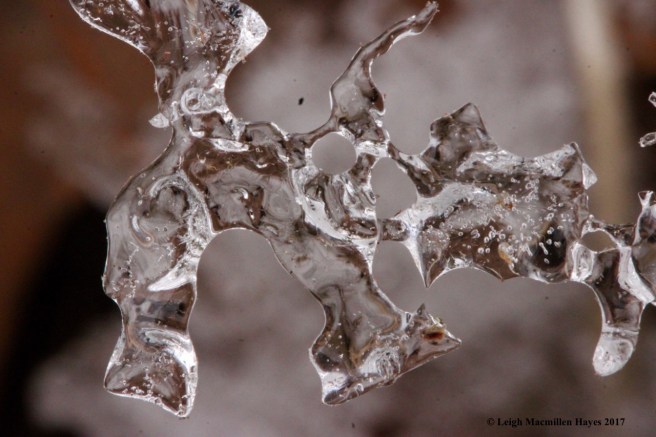
Before heading indoors, I paused to acknowledge another ice goddess, one who also knows the sun’s power and found relief in today’s shadows . . .

b-snow

and flakes. It’s snowing again, this fourth day of spring. Liquid sunshine, for the snow also provides nourishment to all who live here.

You see, the sun always shines . . . even when you can’t feel the warmth of its rays.


Beautiful Maine Mondate

Some Monday’s we look for new places to explore or mountains to climb, but today found us visiting an old favorite that is gorgeous in any season.

s1-Stone House Road 1

Because it’s still winter (and she’s not letting go right away), we knew our hike would be extended by more than a mile on either end. We parked by the Leach Link Trail on Stone House Road and followed the telephone poles in.

s2-bear number

These are my favorite telephone poles in the world–well, for today that is, for they show the works of the clever bears that inhabit this place. The wood has been scratched and bitten, while the shiny pole number was mutilated. This was pole 5. I suppose it still is.

s3-bear hair

Hair sticks out from splinters. Bear hair.

s4-more bear hair

We found lots of it on several poles today. More than we’ve seen in the past.

s6-another pole

I’m thinking that the bears in the area have a fondness for 5. Or a dislike, for pole 15 also received rough treatment. There are more, but it was on 5 and 15 that we noticed the number destruction.

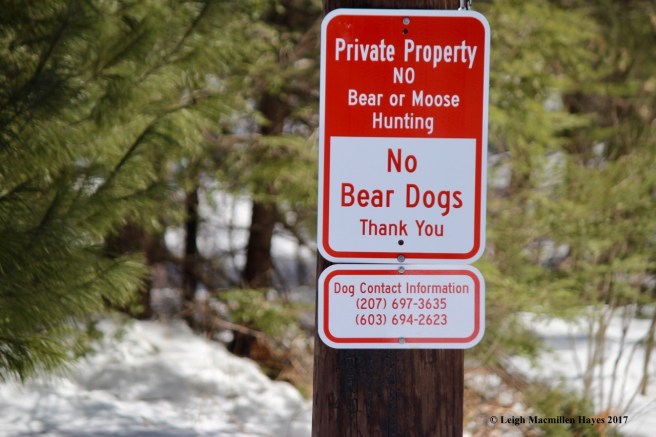
s8-bear dogs

Despite that, the bears in this area are most welcome. Because the signs are new, I asked my guy what he thought the bears will do when they emerge from their dens soon. In my mind, I saw a similar behavior to the other poles and imagined that when we return again we’ll see that the signs have also been destroyed because that’s what bears do. My guy’s response, “Clap.” Indeed, they should.

s9-gate

At last we reached the gate where we usually park to hike the Stone House property and Blueberry Mountain trails. The Stone House property encompasses about 890 acres surrounded by the White Mountain National Forest. In 2011, the owners, David Cromwell and Sharon Landry, established a conservation easement held by the Greater Lovell Land Trust. The easement allows for traditional uses including commercial agriculture and forestry, but prohibits development and subdivision in perpetuity. Thus we have both this couple and the GLLT to thank for today’s adventure.

s10-black cherry bark

When we finally reached the Shell Pond trailhead, a black cherry immediately jumped out at me. The property was last logged in 1977 and features a mix of hard and softwoods. My bark eyes love the diversity.

s11a-birch and red maple

And my bark mind appreciates the kindred spirit of the trees that manage to support each other despite their differences–in this case a beech and red maple.

s14-pileated works

I’m not the only one who likes bark–the work of pileated woodpeckers,

s15-porcupine

porcupines,

s16-beaver works

beavers,

s13-yellow birch burl

and even insects was evident throughout our three-hour tour.

s17-Yale blue

As we hiked, my dad was also on my brain. I’d received a message this morning from his former boss at Yale University who fondly recalled Dad and his brother Bob. Though quiet men, he and his brother had a twinkle in their eyes, a love for music, especially opera, and always a good joke or prank up their sleeves.

When I saw this tree in the shape of a Y, I knew it was for Dad. Even the sky spoke of the university–though several shades lighter than Yale blue. And with that came the memory that any paint my father mixed had a touch of Yale blue in it–thus was his way. It was all meant to be for Mr. Cromwell, the property owner, is associated with Yale.

s18-my guy

I couldn’t help but think that Dad would have loved the idea of our Mondates. He also would have loved my guy, but sadly they never met. Dad died of a heart attack only days before he and Mom were to spend a weekend with me in Maine–thirty years ago.  But, my guy continues to wear a Yale sweatshirt when he runs, which he did this morning. In that way, he’s made his own connection. Yeah–that’s my guy!

s19-pond views

Now that I’m writing through tears, I’ll get back to the trail, which is delightful in winter because it offers more views of Shell Pond below.

s20-cliff views

And the icy ledges above. Later in our journey, I noted the trail to the ledges had been well used–probably by rock/ice climbers.

s22-water 1

Trail conditions were such that we walked on top of the hardened snow, though I did wear micro-spikes for the entire tour. Someone waited to put his on and did a little slipping and sliding along the way. Brook crossings required stepping low and high, so deep is the snow still.

s23-ice castle

While I marveled at a castle made of ice,

s24-Christmas tree

my guy spotted a Christmas tree.

s25-polypody

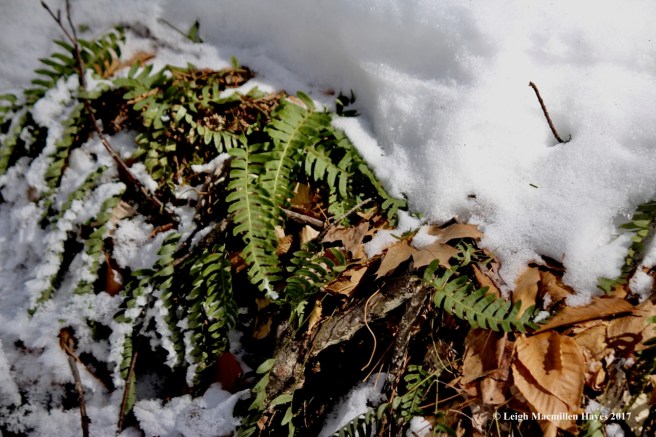
We even found a few hints of green. These polypody ferns were opened, indicating warmer temps and today we certainly noted the difference compared to the brisk weekend.

s26-polypody

Of course, on another rock, some were still curled in their cold formation. They were under a hemlock and more shaded.

s27-partridgeberry

Any bit of green is a welcome sight about now and I was surprised to see partridgeberry poking through the snow.

s28-lunch bench

At last we reached lunch bench, which my guy stood upon. Yup, that’s the granite bench under his feet.

s29-lunch

We sat on it to eat our PB&J (with butter for me, of course) sandwiches. And tried to keep from sliding right down to the pond.

s30-Shell Pond

Lunch view included Shell Pond and the Baldfaces in the background. All along, we’d noted mice, squirrel, mink, fisher, coyote, bobcat, ruffed grouse, turkey and moose tracks. But as we ate we listened to the whales groan–so moaned the ice in the afternoon sun.

s31-brook

A short time later we reached Rattlesnake Brook and the orchard, where the natural community transitioned and appeared almost bucolic.

s32-ostrich fern

One of my favorite finds along this section is the ostrich fern. The structure of its fertile frond makes me smile.

s33-airfield

From the orchard we moved on to the old airfield and wondered if the family ever flies to their summer home. Though I don’t think it’s used these days, the airstrip was apparently built in the 1940s by the military for practice landings and takeoffs during World War II.

Again, the views were breathtaking.

s34-stone house and Blueberry Mtn

As hikers, we’re reminded by signs to stay on the marked trails, thus protecting the land and giving the family some space. I’m in awe of their home. The Stone House was built in the early 1850s by Abel Andrews. He quarried the large, hand-hewn granite slabs from Rattlesnake Mountain and built the 40-foot by 25-foot house for his wife and thirteen children.

s35-another wetland

I did stay on the trail most of the time, but occasionally I heard the landscape calling my name and had to investigate. Fortunately, my guy stayed on the trail all the time and kept us honest.

s36-Beautiful Maine

We walked back out to the truck and then decided to take a quick detour before driving home. Being on Stone House Road, we were only a mile from the winter closure point for Route 113 in the White Mountain National Forest. The road forms the state line between Maine and New Hampshire for several miles. And then it passes into Maine at the gate by the Cold River Campground and The Basin. And it’s there that you’ll find this iconic sign.

Welcome to Beautiful Maine and another scenic Mondate.


Because I Wandered

It’s still cold and blustery. Oh, we had warm spells in January and February. But now it’s March. And it’s Maine. So wind chill in negative to single digits shouldn’t come as a surprise. Nor should the impending Nor’easter predicted for this week. Only more than a foot of snow possible.

Today’s cold wasn’t nearly as frigid as yesterday’s and when I stepped out the back door, I could feel the warmth of the sun penetrating my outer being. It worked wonders for my inner being as well.

o-quaking aspen

My first stop was beside the quaking aspen tree. Yesterday, some Maine Master Naturalist students and I examined tree buds and their characteristics. I love looking at these and do so every day since the tree is right off our back deck.

Varnished scales protect the  aspen’s leaf and flower buds as they lay dormant through the winter. Its flower is produced within a catkin and already the cottony part of the seeds is appearing, much like a pussy willow.

o-striped maple

As I moved into the woodlot, I stopped to re-admire the only striped maple that grows here. Last year a deer used the lower portion of the bark as an antler rub. Yesterday, as we stopped to look at the characteristics of its bark, we noticed it’s been used most recently as deer food. This tree is barely larger than the circle formed within my thumb and pointer finger–and I have small hands. How much more deer attention can it take?

o-gray fox tracks

As I looked at the striped maple, my eyes were drawn to the activity of another mammal. Out came my Trackards and I took measurements. I knew by the walking pattern that it was a canine. And I knew by the size that it was a fox. But red or gray was the question. I suspected the latter because I could see details clearly in the soft snow atop the hardened crust.

o-gray fox prints

Measurements and a look at a bunch of prints confirmed my suspicion. Rather than stay on the path, I decided to backtrack the fox’s trail.

o-gray fox and coyote 1

Within minutes, I realized another mammal had traveled in the opposite direction. Also a canine.

o-gray fox and coyote intersect

And atop a double-wide stone wall, I found where the coyote (follow the red pencil) and gray fox (yellow) crossed paths. Not at the same time, I’m sure, but given the track conditions, I don’t think they were too far apart. We saw neither set of tracks as we examined trees and lichens in the same area yesterday.

o-gray fox sat and peed

I also found where the fox sat and then peed. Not much odor–in case you’re wondering.

o-turkey plus

My journey took me across a few more stone walls and through a hemlock grove. I lost the fox, but followed the coyote and then I found others including squirrels, deer and turkeys.

o-turkey wings

It looked like the turkeys had been dancing on an ice-covered puddle. And then perhaps they took off for the wing marks were well defined. Did they fly because the coyote approached? Or was there another reason? Time to head up into the trees for the night, maybe? It’s difficult work for these hefty birds to lift off.

o-many travelers

Everywhere I went, others had been before me. It seemed the prey followed the old logging routes and predators crossed.

o-bs lichen

My own wander became a bushwhack meander. And a few lichens called me in for a closer look. My inclination was to quickly brush off all the gray foliose (leaf like) lichens as weedy hammered shield, but I suspect there was some bottleshield lichen in the mix and realize I need to look again. I’m forever a student–thankfully.

o-crustose mosaic

While there were specks of shield lichens on a young maple tree, the variety of flattened crustose lichens covered so much of the trunk that it was almost difficult to distinguish the bark color.  The mosaic pattern suggested a painting–naturally.

o-beech 1

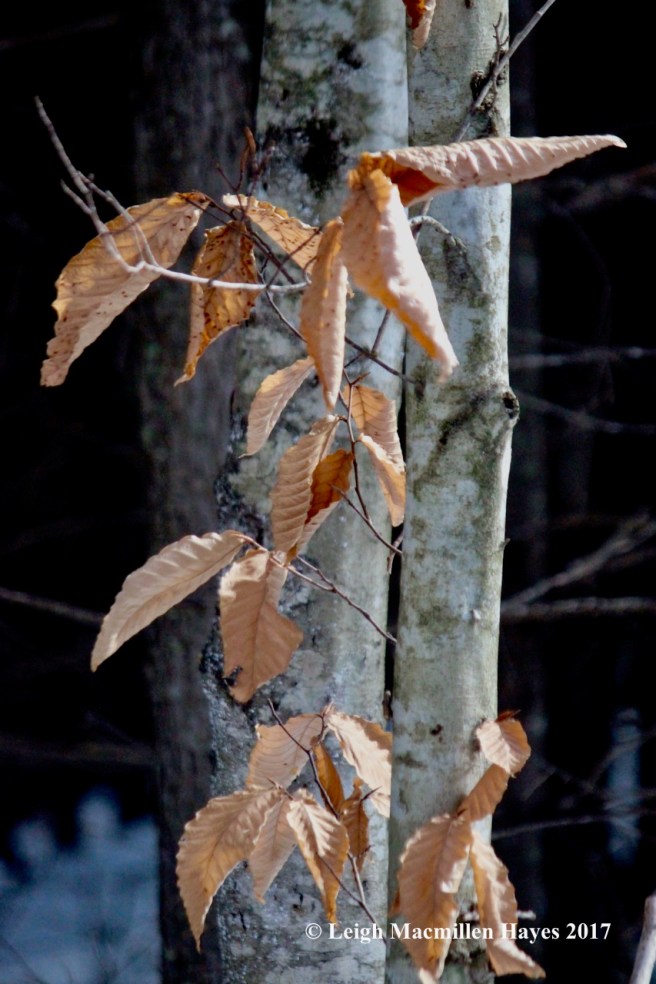
The buds and leaves of the beech trees also asked to be noticed. It’s been my experience that younger American beech keep their leaves throughout the winter–perhaps because their buds are lower to the ground and therefore easy targets for hungry herbivores. There are other theories as well, but I think it’s key to note that it’s the younger trees who keep their leaves, or in the case of this one, those that remain were on the lower branches.

o-beech leaves

They remain until the tree buds begin to break or leaf out. The word to describe this leaf retention is marcescent (mahr-ses-uh nt), which means withering but not falling off. Their rattling in the slightest breeze may be enough to keep those herbivores at bay.

o-beech 4

In the tree’s silhouette, the pointed buds stood out,

o-beech scales


each one a cylinder of overlapping scales in opposite orientation on a hairy stem.

o-witch hazel leaves

That, of course, led me to another marcescent tree that loves this wet woodland, the witch hazel. Its leaves have always intrigued me with their wavy margins and asymmetrical base. But it’s the winter color of the withered leaves that I also find attractive.

o-witch hazel scalpel

And its naked buds, which don’t have waxy scales like the aspen or beech. Somehow the fuzzy hairs must provide enough protection for the winter months.

o-witch hazel bracts

Everything is fuzzy on a witch hazel, including the bracts left from last fall’s ribbony flowers,

o-witch hazel pods

and the woody, two-seeded pods that ripen a year after the flowers have formed. These split open in the fall as the seeds were forcibly ejected.

o-moose scat

I wandered for hours and miles and never saw any prints from the moose that frequented these woods earlier in the season. But, where the snow had melted under a spruce, I found evidence that blended in with the leaf litter.

o-moose browse

And in an area I used to frequent prior to the logging operation of the last few years, I found more sign. The ruler is mine and this side shows centimeters.

o-coyote x2

When I reached the former log landing, my coyote friend made its presence known again. Actually, one became two as they had walked in single file and then split apart several times. They were on the hunt and a snowshoe hare was in the vicinity.

o-cherry

I followed the main logging trail for a while and then turned off to explore unknown territory. But . . . before turning, it was the maroonish color of the cherry bark that warranted attention. And the lenticels–raised, elongated and horizontal imprinted on my brain.

o-deciduous forest

My meanderings continued and again I saw lots of predator and prey activity. Even a porcupine, though that shouldn’t come as a surprise. Finally, I walked into an area of young red oak, red maple and gray birch and knew I was approaching familiar ground. And so I stepped onto the snowmobile trail.

o-deer 1

All along, I’d thought about the many tracks I’d seen, but no mammals . . . until I approached our cowpath. I wasn’t the only one headed that way.

o-deer browsing first

The deer herd seems to have survived this winter well. I’ve yet to find evidence that suggests otherwise.

o-deer browsing

And I felt blessed that I was able to move as close as possible despite the crunching of the snow beneath my feet. The wind was in my favor. And then, it heard me, flashed its white tail and ran down the cowpath. Perhaps we should rename it the deer path for a cow hasn’t walked on it in decades, but like me, the deer use it almost daily.

My day was made because I wandered.


Hiking the West Mondate

How could it be? We realized this past week that we’d only hiked in Sebago Lake State Park together once–thirty years ago. Oh, I’ve skied there, visited friends who were camping, and participated in several eighth grade class picnics back in my public education days.  But today we decided to remedy our hiking opportunity–or lack thereof.

s-sebago-sign

Our intention wasn’t to camp, but rather to explore the trails that circle around and cut through the 1,400-acre property. For those of you who know my guy, though we certainly haven’t spent a lot of time in the park, he does feel a certain affinity–to the brown stain that the park staff purchases in five gallon buckets from his hardware store. :-)

s-boundary-blazes

After looking at a map near the entry booth, we headed off on a trail marked with orange blazes. Or so we thought. Until we realized we were following the boundary. But all the orange paint made me think of our young neighbor, Kyan, and as it turns out he was on my brain for a great reason–he’s been in remission for the past six months following his bone marrow transplant and today had his central line removed. No wonder we spent an hour following those orange blazes. All the while, however, we did think the trails were poorly marked.

s-high-point-1

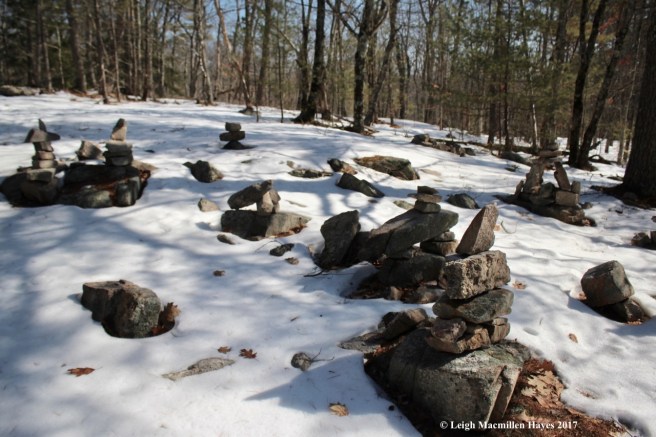
Unwittingly, we spotted a bit of brown–on the picnic table. We appeared to be on a high spot, home to the table and a cairn garden.

s-cairns-3

I’m of several minds when it comes to cairns. I know that some are historical and symbolic and others mark trails, but these, though each different in sculptural form, bothered me.

s-cairn

While my guy saw them as offering hikers something to do, I saw them as disruptive to the natural landscape. That being said, the landscape was formed by a glacier and these pieces spoke to the bedrock geology of the Sebago pluton with their pinkish coloration.

s-kneeling-before-map

Turns out we were at the summit of the Lookout Trail, the highest point in the park at 499 feet. And behind the cairn park, we found the trail itself, blazed with red triangles, which we followed down to the campground road where we found a map–worth kneeling and worshiping. Well, actually, given the snow depth, that was the easiest way to read it. From that point forward, we found “You Are Here” maps whenever trails intersected, though we did tend to wander off occasionally.

s-ice-bubbles

Over a brook, where balls of ice formed,

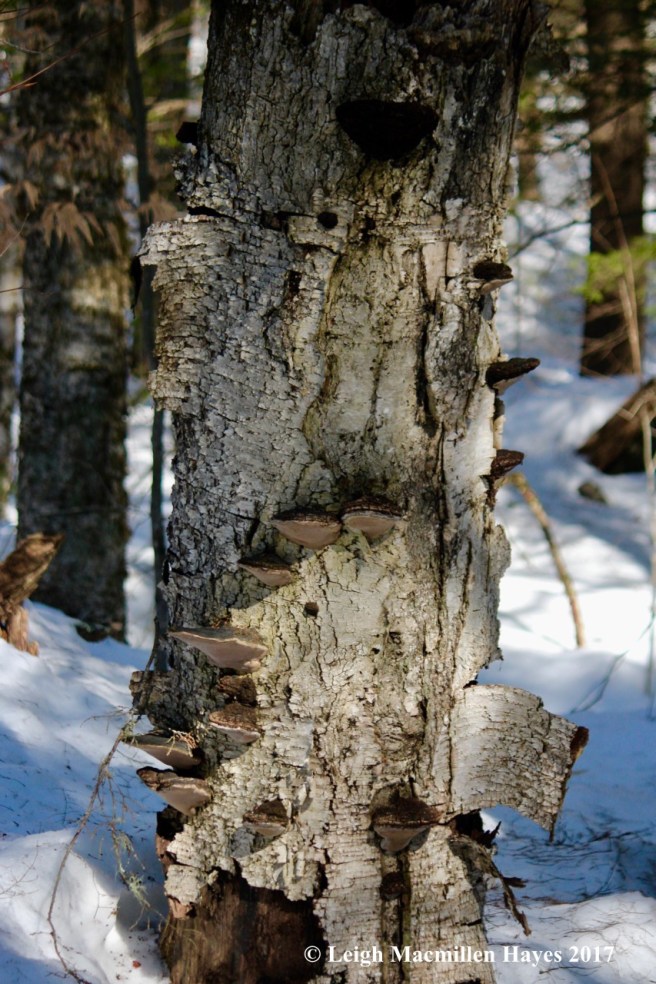
s-artist-conks

past artist conks decorating a decaying birch tree,

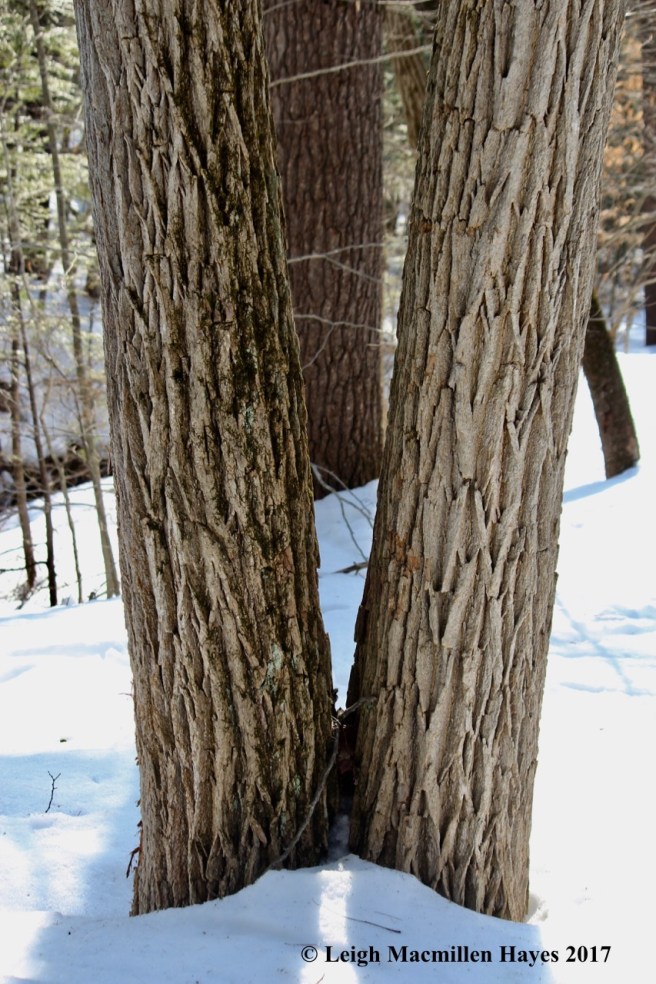
s-locust-bark

and through woods featuring the braided ridges of black locust bark, we hiked.

s-tree-silhouette

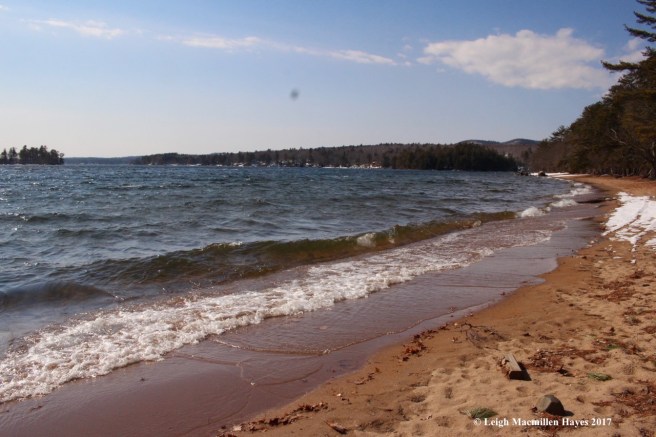
And then we reached the beach. On Sebago Lake.

s-rocky-coast-of-maine

We’d arrived at Witch Cove Beach.

s-waves-and-wind

The wind had kicked up the waves and it felt almost ocean like. Almost.

s-maple-and-pitch

Certainly, tree roots beside the lake spoke to wave action and higher tides (no, the lake doesn’t have a tide, but in storms and floods it must surge higher). Beside the water, a red maple and pitch pine tree embraced from their root source.

s-pitch-pine-bark-1

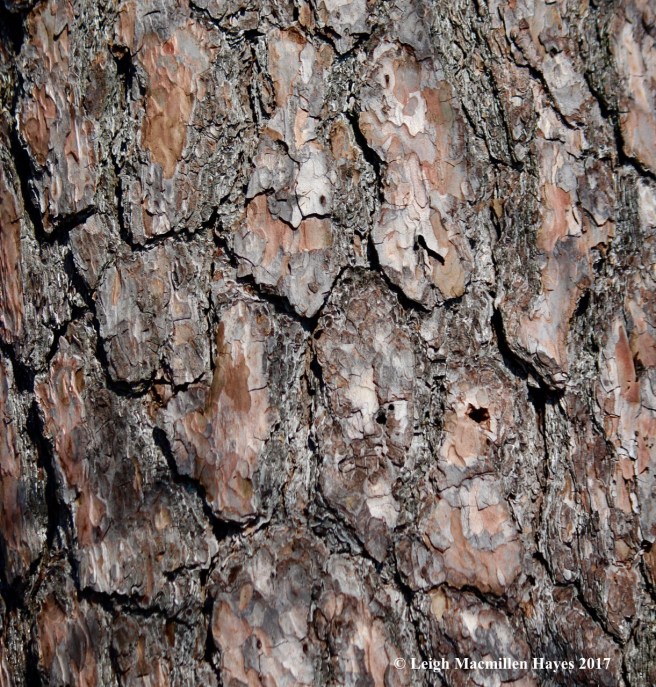
The bark of the pitch pine featured its reddish plates surrounded by deep furrows.

s-red-pine-bark

While it’s similar to red pine bark that grows nearby, there are subtle differences–red pine bark being plated but much thinner and tighter to the trunk. Plus, the pitch pine has bundles of three needles, while the red features two needles.

s-pitch-pine-growth

The other unique characteristic of pitch pines, their epicormic sprouting of needles on the trunk that grow from dormant buds on the bark.

s-sand-prints

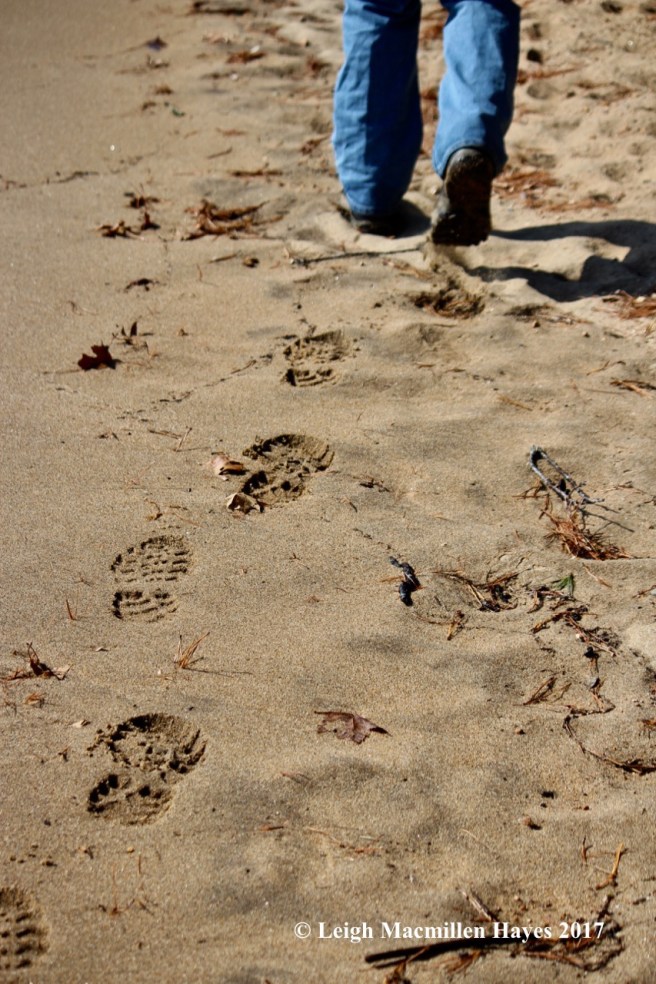
Eventually, we moved on, leaving prints in our wake.

s-beach

Our substrate switched from snow to sand and back to snow, which we much preferred.

s-beach-eyes

Before we turned away from the beach, we found the sand goddess eyeing the world. Again, we noted the orange and thought of Ky, but didn’t truly realize its significance.

s-lunch-table

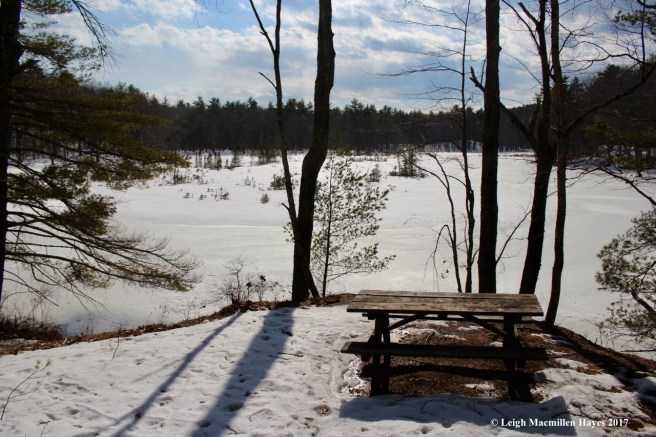
Into the picnic area we moved, after watching a few deer who eventually flashed their white tails before moving on. Lunch table beckoned us. It needs some fresh stain–there’s job security in that thought–for the park staff and my guy.

s-buried-table-2

Some tables spoke to the snow depth.

s-cache-fest

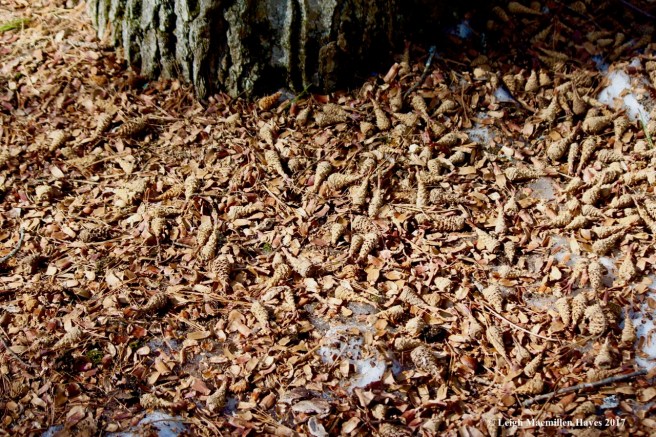
After we finished our sandwiches, we discovered that others had used the picnic ground–for a cache site. Somewhere in the park, at least one red squirrel prospered through the winter.

s-glacial-kettle

Our journey took us past the glacial kettle formed by the melting of large blocks of ice.

s-map

And then we figured out our final trails to follow.

s-songo-river

We crossed Thompson Point Road and followed the oxbows and meandering of Songo River, which actually proved to be bittersweet. I’d only been on the river twice and both with the milfoil team of the Lakes Environmental Association. As we hiked beside it today, I recognized various points Adam Perron, the milfoil dude had pointed out. Again I say, RIP Adam.

s-beaver-bog-from-table

At last we reached Horseshoe Bog, home to one of those picnic tables needing work. You know who spied it from a mile off.

s-beaver-works-3

He also spied the work of others and eagerly showed me.

s-beaver-teeth

My what big teeth grooves a beaver leaves.

s-beaver-works-4

It left its mark everywhere.

s-beaver-5

And sometimes such works met the forces of nature and all was well that ended well.

s-spur-trail

The same could be said for us. We began the day on a trail that wasn’t and ended by trying to follow a spur trail out, that we couldn’t quite locate (except for the sign at the beginning that identified it as a spur trail) and so we bushwhacked and then an anomaly caught our eyes–snow on a structure, which turned out to be the entry booth from which we’d begun our expedition.

As it turns out, we realized that our adventure thirty years ago was on the east (Casco) side of the park and this was our first visit to the west (Naples) side. Here’s hoping it doesn’t take us thirty more years to return for another Mondate–indeed.


Mondate with Tom and Friends

My guy and I–we drove to Portland this morning for a two-hour meeting and then enjoyed lunch with one of his sisters at the Miss Portland Diner before moving on to South Portland to run an errand and finally returning home.

Too much food and sitting time. And so the woods beckoned.

v-turkeys-1

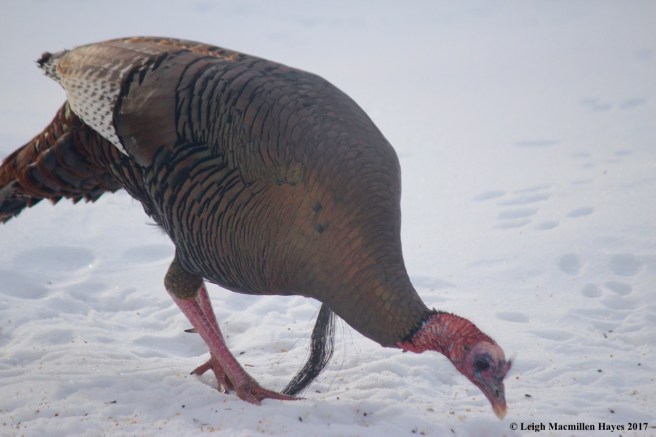
Right out the back door, male turkeys took advantage of our offerings. The snow is crusty and while acorns were plentiful, foraging for them has become a more difficult task. But birdseed is free feed and once discovered means often frequented.

v-turkey-1

That’s OK for now because it gives me a chance to get to know these guys. We live in an 1870s house on former farmland (I often refer to the cowpath), all of which played a part in the reduction of forest land, one of the factors that led to the extirpation of native wild turkeys in Maine. Slowly, the land has reverted to forest, which helped in reestablishing turkeys to their former range. At the same time, our neighbors, thankfully, continued to mow the adjacent field that we look upon, which provides for prime turkey nesting habitat.

v-turkey-2

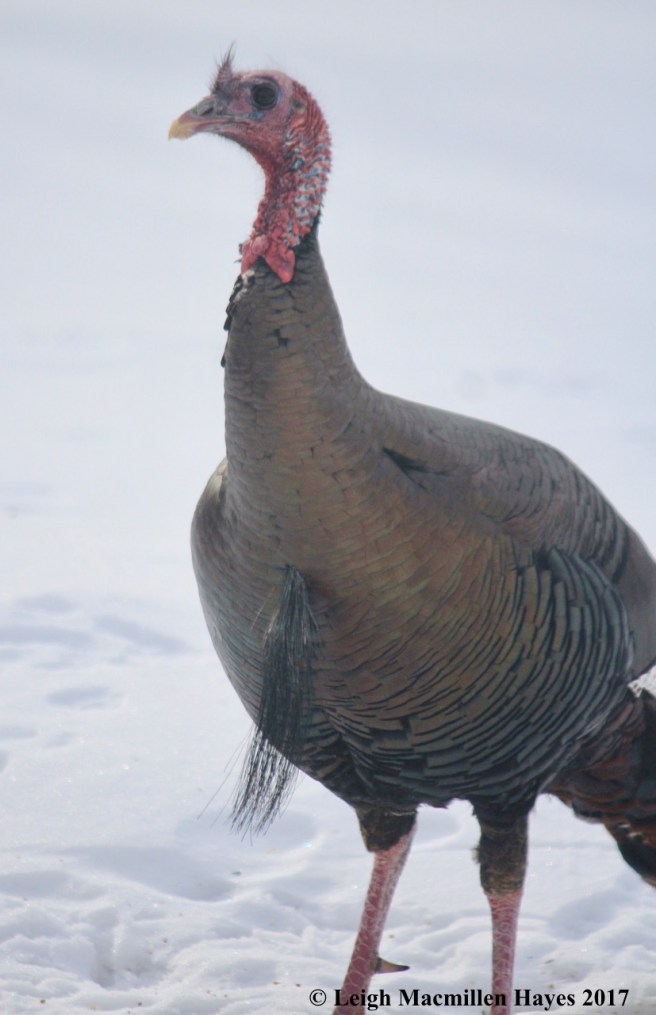
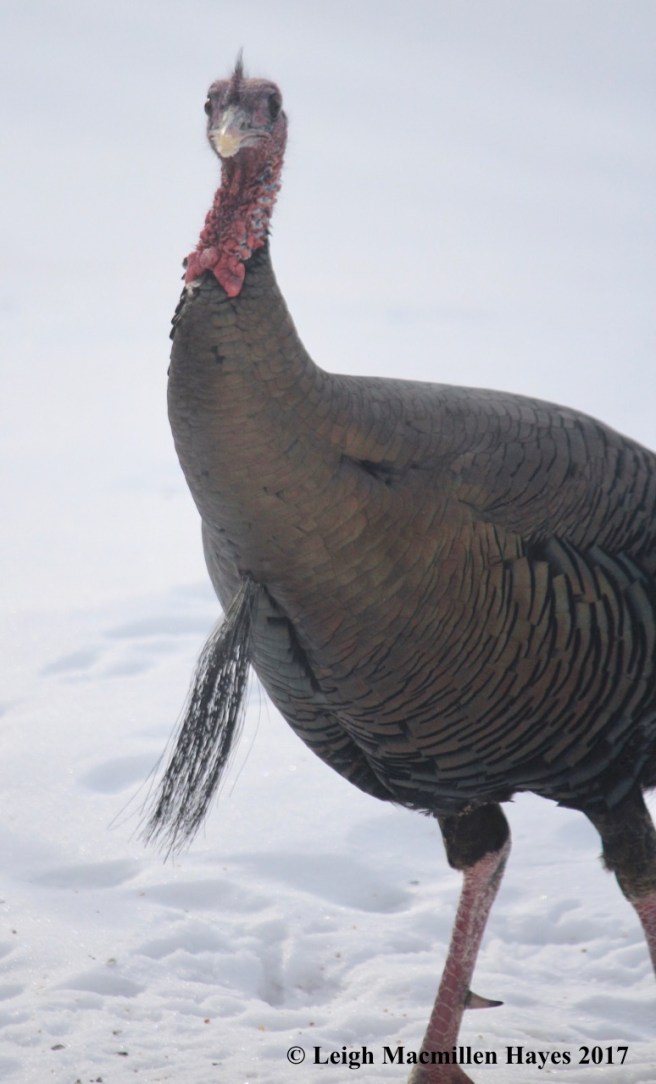
Tom and his brother Tom and his other brother Tom are handsome devils in their own unique ways. Their featherless heads of blue and pink and red raised bumps called  caruncles change colors with their moods.

v-turkey-3

And on their chests, bristle-like feathers that don’t look at all like feathers are referred to as beards (by us humans–I’m not sure what turkeys call them). Though some hens sport beards, theirs are not as robust or long as those of the Toms.

v-turkey-4

“You looking at me?” asked Tom.

“Yes, I am. I’m admiring your iridescent feathers layered like slates on a roof and those spurs on your legs used for defense and dominance. Do you object?”

“Well, I guess I am rather handsome.”

“I didn’t say that.”

Yeah, the turkeys and I, we talk. We’ve long had a relationship and I truly don’t think you should eat them. Maybe next Thanksgiving I’ll tell you my turkey story.  I know they can leave a mess in the yard and become aggressive, but . . .

v-turkey-tracks-2

I encourage you to follow their tracks into the woods. You never know where they might lead.

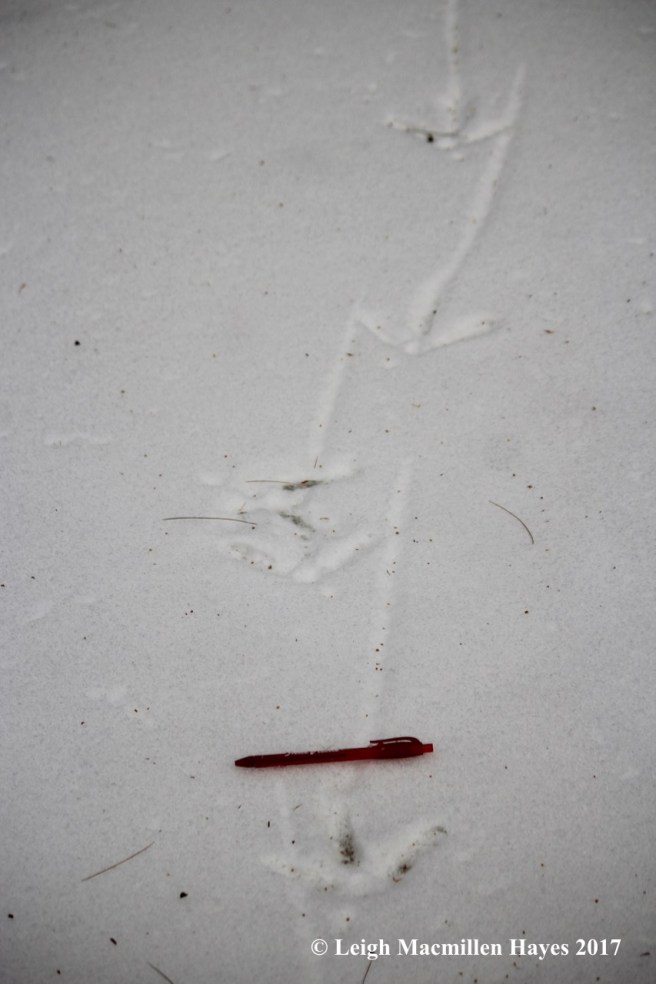
v-turkey-tracks

Following them today led to the vernal pool. Note the pen, my form of perspective in relationship to size because it’s what I had in my pocket. The pen measures 5.5 inches. Turkey prints are large.

v-vernal-pool-adventures

The pool wasn’t teeming with amphibian life yet, but for the first time all winter, it was obvious that visitors had stopped by.

v-vernal-pool-action

Their timing wasn’t the same, but the turkeys strutted across, while deer slid and skidded on the ice. Life happened over and over again.

v-deer-prints-2

It appeared to be more than one deer–perhaps a mother and a skipper or two wanted to skate, much as our sons used to do at this very same spot.

v-coyote

And among the prints, those of a predator, though its journey appeared to be earlier than the deer. Gray squirrel tracks circled the perimeter and maybe that was the intended prey, though really, any of these critters would have made a desirable meal–the forest being what it is, groceries gleaned when needed.

v-deer-hemlock

Continuing the journey, plenty more turkey tracks and then the white tails of deer  flashing in the distance. Beside the trail another item on the grocery shelf–fresh hemlock bark scraped.

v-pileated-holes

One final item in a different aisle–fresh pileated woodpecker holes. They wake us each morning with their drumming and the sound continues throughout the day. Wrapped around the tree, a vine that added to this bird’s food.

v-pileated-scat

Its scat told of the source–not only a few carpenter ants, but also bittersweet fruits. Yes, this is how the seeds of this invasive species spread.

And so it was today that I traveled the woodland trail alone after a morning and afternoon spent with my guy. And . . . the Toms shared their story and those of others. It was indeed a Mondate–spent with others.

(Did you think I was going to mention Tom Brady? Congrats to the Pats on their Super Bowl victory.)


Seeing Red

I wander through the same woods on a regular basis, sometimes following old logging roads and other times bushwhacking through the understory–a mix of young conifers and hardwoods that are slowly reclaiming their territory. Always, there are water holes to avoid as this is a damp area, so damp that in another month I probably will have to curb some of my wandering habits because it will become difficult to navigate.

h-maleberry-buds

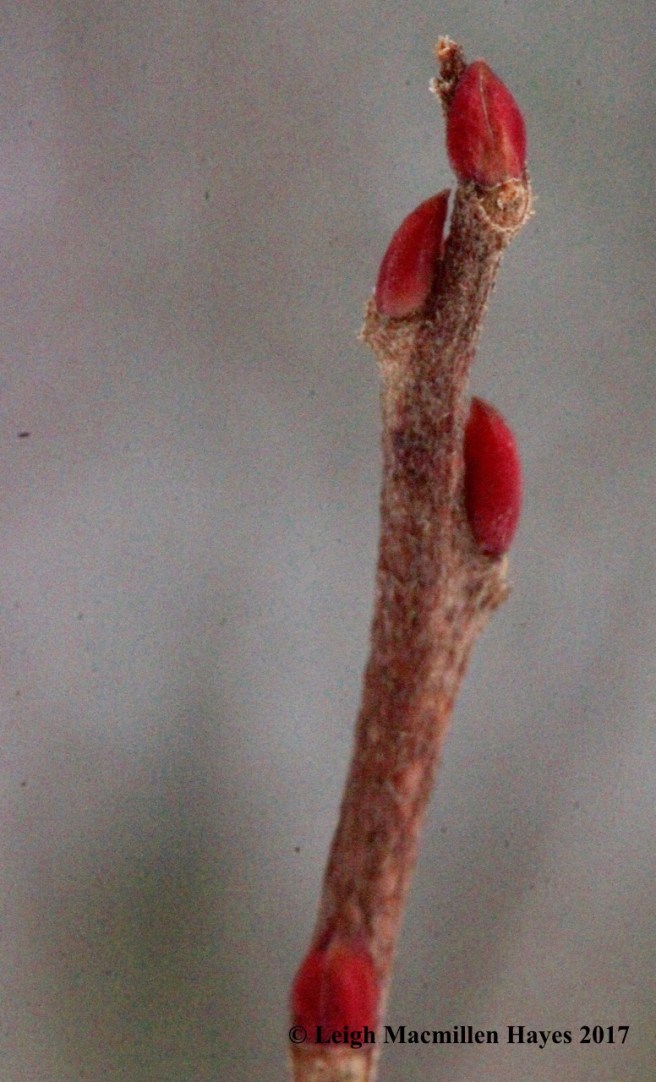
But it’s that same water that gives life to the flora and fauna that live therein, such as the buds on the maleberry shrub. Notice how downy the twig is. And the bright red bud waiting patiently within two scales–preparing for the day when it will burst forth with life.

h-maleberry-pods

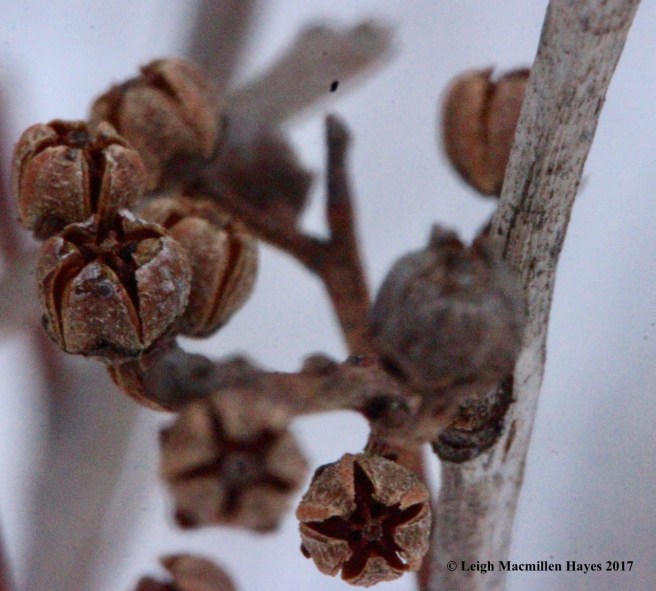
On the same shrub exists evidence of last year’s flowers, now capsules reddish-brown and five-celled in form.

h-red-maple-buds

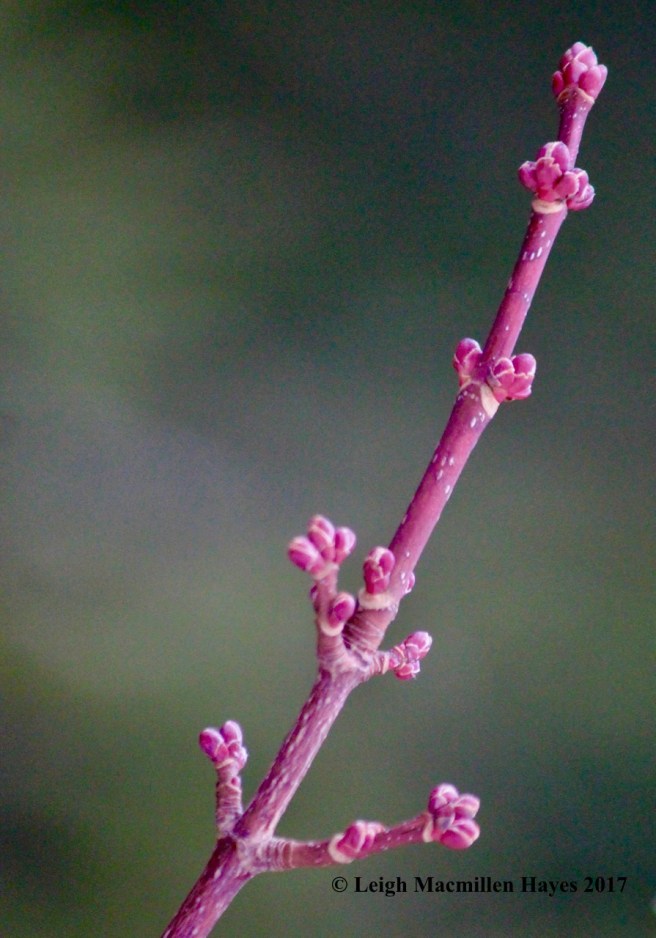
And like the maleberry buds, the red maples buds grow more global each day, some with three scales of protective covering and others more.

h-snowflakesbuds

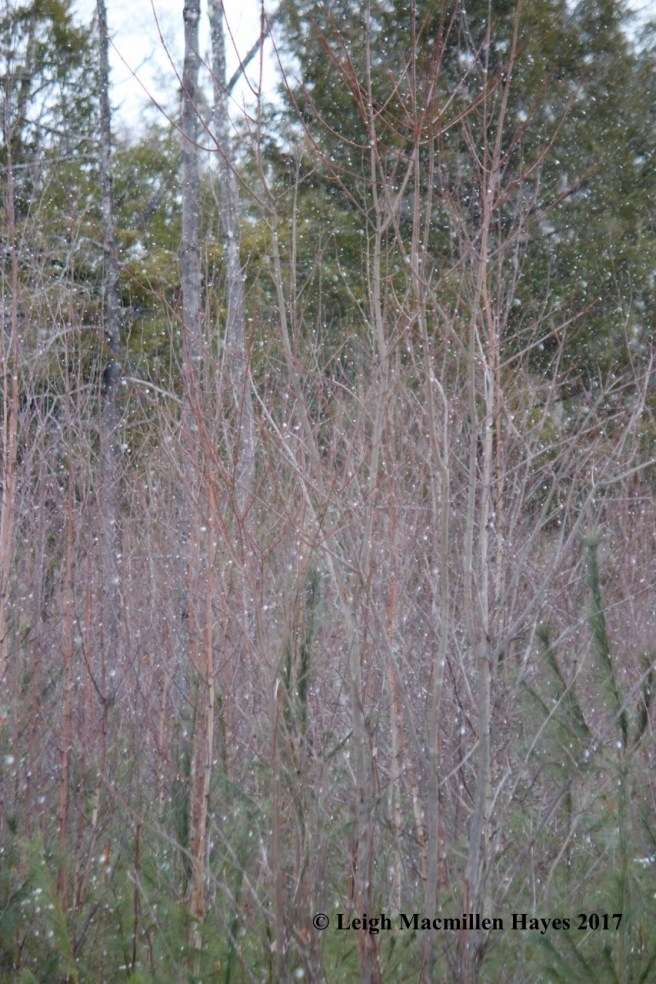
Today was a day of contrasts, from sunshiney moments to snow squalls, as well as greens to reds, tossed in with a mix of browns and grays.

h-moose-scrape

Continuing my venture, I soon realized I wasn’t the only one enjoying red. The moose and deer with whom I share this place, also find it a color of choice–especially the bark of young red maple trees.

h-moose-scrape-2

As I looked at the tree trunks, I could sense the motion of the moose’s bottom incisors scraping upward and then pulling against its hard upper palate to rip the bark off. Everywhere I turned, the maples showed signs of recent scrapes.

h-moose-rub

Less frequently seen were antler rubs such as this one, where the middle was smoothed by the constant motion and the upper and lower ends frayed. Such finds offer noted differences between a scrape and rub–the former has tags hanging from the upper section only and the teeth marks stand out, while the latter often features a smooth center with the ragged edges at top and bottom. But . . . like us, nature isn’t perfect and not everything is textbook, so I often have to pay closer attention.

h-moose-bedscat

I saw more than red and so I could hardly resist a moose bed filled with scat and urine. I’m always in awe of the sense of size and again I saw motion, of this large mammal laying down to take a rest and perhaps a few hours later, getting its feet under itself to rise again, do its duty and move on to browse some more.

h-witch-hazel-scattered

Deer tracks were even more numerous than moose and the solidness of the snow allowed them to travel atop the crust. At one point I spied something I didn’t recall seeing before–witch hazel capsules decorating the snow.

h-witch-hazel-pod

At this time of year, these grayish tan capsules persist on the trees, but their work was completed in the fall when they expelled their two glossy black seeds.

h-witch-hazel-bud-nibbled

Ruffed grouse, wild turkeys and snowshoe hare like witch hazel buds. As do deer, who rip them off in the same fashion as a moose and leave a tag behind–as a signature.

h-witch-hazel-bud

Not all were eaten–yet. Notice these buds, ensconced in dense reddish/yellowish/brown hairs rather than the waxy scales of the maleberry and maple. And the shape extending outward from the twig, almost in scalpel-like fashion. Yeah, I was still seeing a hint of red.

h-witch-hazel-flower-bracts

If I wanted to carry my red theme to the extreme, I could say that the bright yellow bracts that formed the base of the former flowers were framed in red, but really, it’s more of a hairy light tan along their rims. Eventually, the bracts will develop into seed capsules and next autumn they’ll be the ones to shoot their seeds with a popping sound. We always talk about that sound and refer to Henry David Thoreau for as far as I know he was the one to first hear it. This past fall, a friend tried this and like Thoreau, he was awakened during the night by the seeds being forcibly expelled. (Credit goes to Bob Katz for that experiment.)

h-british-soldiers

Back to red. Under the hemlocks where the deer had traveled, I was looking at some mosses when these bright red soldiers showed their cheery caps–it’s been a while since I’ve seen British Soldier lichens, most of it buried beneath the snow.

h1-red-oak-bark

As I headed toward home, a red oak beside the cowpath asked to be included. It seems in winter that the rusty red inner bark stands out more in the landscape, making the tree easy to identify. Of course, don’t get confused by the big tooth aspen, which slightly resembles a red oak at the lower level, but a look up the trunk suddenly reveals similarities to a birch.

h1-acorn-cap

Many of the acorns have been consumed after such a prolific year, but their caps still exist and the color red was exemplified within the scales.

h1-icicles

Back at the homestead, I walked by the shed attached to the barn where icicles dripped–again speaking to this day. By that time the snow squalls had abated and sun shone warmly, but a brisk wind swirled the snow in the field into mini whirling dervishes. My cheeks were certainly red.

h-cardinal

My red adventure was completed at the bird feeder. A happy ending to scenes of red.


On the Prowl at Heald & Bradley Pond Reserve

My original intention when I set out this morning was to snowshoe from the Gallie parking lot on Route 5, follow the Homestead Trail and then connect with the Hemlock Trail as I climbed to the summit of Whiting Hill. I planned to make it a loop by descending via the red trail back to the green Gallie Trail.

w-mill-in-morning-light1

Not to be as the parking lot hadn’t been cleared yet of yesterday’s Nor’easter, which dumped several inches of snow, sleet and freezing rain upon the earth. When Plan A fails, resort to Plan B. A drive down Slab City Road revealed that the Fairburn parking lot wasn’t yet cleared either, but the boat launch was open (because the pond serves as a water source for the fire department) so I parked there and headed to the trailhead beside Mill Brook. The sight of so much water flowing forth was welcome, especially considering it was a mere trickle a few months ago.

w-snow-layers-brookside

The layers of snow overhanging the brook told the story of our winter. And it’s not over yet–at least I hope it isn’t. We’re in the midst of a thaw, but let’s hope more of the white stuff continues to fall. We need it on many levels, including ecologically and economically.

w-fox-print

Because of the storm, I thought I wouldn’t see any tracks, but from the very beginning a red fox crossed back and forth between the pond’s edge and higher elevations.

w-fox-and-squirrel

While it may be difficult to discern, a gray squirrel, the four prints with long toes below the Trackards, had leaped up the hill, perhaps after the fox. Lucky squirrel. The fox prints can be viewed to the left of the cards.

w-vernal-pool

My new plan was to follow the red/blue trail to the summit of Whiting  Hill. And along the way, a side trip to the vernal pool. Visions of fairy shrimp swam in my head. No, I wasn’t rushing the season, just remembering a fun time pond dipping last spring.

w-fringed-wrinkle-lichen

Back on the red/blue trail, I noted that most of the recent seed litter was covered by yesterday’s storm. The Fringed Wrinkle Lichen, however, did decorate the snow. Tuckermanopsis americana, as it’s formally known, grows on twigs and branches of our conifers and birches and often ends up on the forest floor.

It’s a foliose lichen that was named for Edward Tuckerman, of Tuckerman’s Ravine fame on Mount Washington. According to Lichens of the North Woods author Joe Walewski, Tuckerman was “the pre-eminent founder and promoter of lichenology in North America.As a botanist and professor in Boston, he did most of his plant studies on Mount Washington and in the White Mountains.”

w-pileated-debris

Further along, I saw some pileated woodpecker scat about twenty feet from the tree it had hammered in an attempt to seek food. It made me realize that even when I don’t find scat in the wood chips below the tree, I should seek further.

w-pileated-holes

The holes weren’t big–yet.

w-pileated-scat-bursting-with-body-parts

But the scat–oh my. It looked as if insects were trying to escape the small cylindrical package coated in uric acid.

w-mossy-maple-fungi

The trail turned right and so did I, beginning the climb. For most, the ascension doesn’t take more than five or ten minutes. Um . . . at least 45 on my clock today. There was too much to see, including the mossy maple fungi hiding in a tree cavity.

w-tube-moth-3

And then I saw something I’d looked for recently after seeing it on the blog  Naturally Curious with Mary Holland. Notice how the pine needles are clumped together?

w-pine-tube-moth-pupae-overwintering-1

Eastern White Pine needles grow in bundles of five (W-H-I-T-E or M-A-I-N-E for our state tree), but the clumps consisted of a bunch of needles from several different bundles.

w-tube-moth-2

What I learned from Ms. Holland is that these are tubes or tunnels created by the Pine  Tube Moth. Last summer, larvae hatched from eggs deposited on the needles. They used silk to bind the needles together, thus forming a hollow tube. Notice the browned tips–that’s due to the larvae feeding on them. Eventually the overwintering larvae will pupate within the tube and in April when I come back to check on the vernal pool, I need to remember to pay attention, for that’s when they’ll emerge. Two generations occur each year and those that overwinter are the second generation. The good news, says Holland, is that “Pine Tube Moths are not considered a significant pest.” I only found the tubes on two young trees, but suspect there are more to be seen.

w-beaked-hazelnut-1

And a few steps later–an old beak. I couldn’t believe my luck. It was then that I realized if I’d been able to stick with the original plan I would have missed these gems. Oh, I probably  would have found others, but these were in front of me and I was rejoicing. Inside that bristly tan husk was the protein-rich nut of a Beaked Hazelnut overlooked by red squirrels and chipmunks, ruffed grouse, woodpeckers, blue jays and humans.

w-beaked-hazelnut-2

Catkins on all of the branches spoke of the future and offered yet another reason to pause along this trail on repeated visits.

w-burl-on-sugar-maple

With my eyes in constant scan mode, I looked for other anomalies. One of my favorites was the burl that wrapped around a Sugar Maple. If I didn’t know better, it would have been easy to think this was a porcupine or two.

w-buried-bench-on-way-up-whiting

About two thirds of the way up, there was no rest for the wary, for the bench that offered a chance to pause was almost completely buried.

w-polypody-and-rock-tripe

Closer to the summit, the ledge boulders were decorated with snow, Common Polypody ferns and lichens, including Common Rock Tripe, its greenish hue reflecting yesterday’s precipitation.

w-whiting-view-1

And suddenly, the summit and its westward view, Kezar Lake in the foreground and Mount Kearsarge  showing its pointed peak in the back.

w-whiting-other-bench

As I’d hiked along the red/blue trail, I noted that the red fox had crossed several times. At the other end of the summit, I checked on the bench where on our First Day 2017 hike for the Greater Lovell Land Trust, we’d discovered the remains of a red squirrel. Today, fox tracks paused in front of the bench before moving on and I had to wonder if had been the one to use this spot as a sacrificial altar.

w-bear-claw-tree

Finally, it was time to head down. My choice was to follow the red trail toward the Gallie Trail. I love this section because it features some of my favorite bear trees.

w-beech-leaves-rustling

The fox tracks continued to cross frequently and so I paused often. And sniffed as well. What I smelled was a musky cat-like scent that I’ve associated with bobcats in the past. What I heard–dried beech leaves rattling in the breeze. They always make me think something is on the move. Ever hopeful I am.

w-striped-maple-buds-and-twig

One of my favorite finds along this section was the bright red branches of young Striped Maples. From leaf and bundle scars to growth lines, lenticels and buds, their beauty was defined.

w-striped-maple-leaves

Another sight that surprised me–Striped Maple leaves still clinging, rather orangey in hue.

w-red-pine-on-red-trail

And here and there, as if in honor of the trail color, Red Pines reached skyward.

w-redgreen-trail

Eventually I reached the bottom, and turned right again, this time onto the stoplight trail–well, red and green at least.

w-squirrel-midden

My wildlife sitings were few and far between, but red squirrel tracks and a midden of discarded cone scales next to a dig indicated where the food had been stored in preparation for this day.

w-tinder-2

Following some grouse tracks took me off trail and tinder conks made their presence known.

w-tinder-fungi

The swirled appearance of these hoof fungi threw me off for a bit, but I think my conclusion is correct.
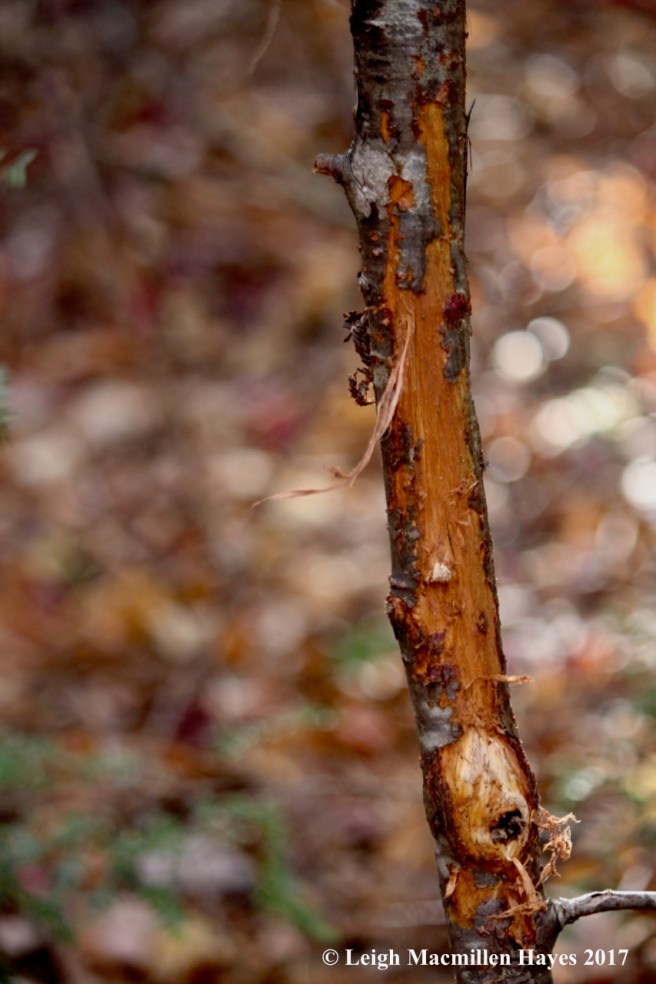
w-bobcat-trail

At last I reached the red trail that runs parallel with Heald Pond. Again, the fox tracks crossed frequently, but beside the path and leading to and fro the water and higher heights, another set of tracks confirmed my earlier suspicions.

w-bobcat-prints

Bobcat. I thought I smelled a pussy cat. I did.

w-fox-and-bobcat

Sometimes the bobcat moved beside the trail, while the fox crossed over. I’d thought when I started out this morning that I wouldn’t see too many tracks because the animals would have hunkered down for the storm. I was pleasantly surprised–for my own sake. For the sake of the animals, I knew it meant they were hungry and on a mission.

w-john-fox-1

My own mission found me following the spur to Otter Rock. I noted that the fox had walked along the shoreline on its eternal hunt.

w-dragonflies-2

My hunt was of a different sort. No visit to the rock is complete without a look at the dragonfly exoskeletons. But today, it was a bit different because I, too, could walk on the ice. And so I found exoskeletons on parts of the rock I haven’t been able to view previously. Their otherworldly structure spoke to their “dragon” name.

w-dragonfly-nymph-exoskeleton

The slit behind the head and on the back of one showed where the dragonfly had emerged from the nymph stage last spring. Or maybe a previous spring as some of these have been clinging to the rock for a long time.

w-other-pupae-overwintering

While I was looking, I noticed some other pupae gathered together within a silky covering. Another reason to return–oh drats. I don’t know if I’ll be there at the right time, but with each visit, I’ll check in.

w-mill-dam-in-afternoon-sun

The sun was shining and warm. High 30˚s with slight breeze–felt like a summer day, with the sun reflecting off the snow. And at the mill, further reflection off the water. After four hours, it was time for me to check out.

As always, I was thankful for my visit, even though it wasn’t my original plan. Like the mammals, I’d been on a prowl–especially serving as the eyes for a friend who is currently homebound. I think she would have approved what I saw.


Misty Mountain Sundate

It was a dark and dreary day. The end. Or so it could have been. But we decided to hike anyway, our destination once again Jackson, New Hampshire.

b-trail-sign

We thought we’d explore Boggy Brook Trail, but after a half mile reconnaissance mission, we changed our minds and headed over to the Black Mountain hike/backcountry ski trailhead.

b-cabins-below

As we passed by the cabins at the base of the trail, our mountain view was obscured.  Despite the grayness of the day, the reds of tree buds and catkins brightened the view. And since the trail was well packed, I opted for spikes, while my guy wore only his hiking boots. That limited us, of course, since we’d have to stay on the trail, but it also brought our vision into focus.

b-stream-crossings

Hikers/skiers must cross about a half dozen streams, where cascading water splashed over rocks and presented the formation of frozen drips.

b-wood

We weren’t far along and near one of those stream crossings when an anomoly stood out on the trail. Because this trail leads to a rustic cabin built by the CCC in 1932, we surmised that the most recent renters found the bundle of wood too heavy to lug on sleds and so they left it behind.

b-paper-birch-colors

Further along, we realized it wasn’t just the tree buds that stood out on this colorless day. The pink and orange hues of paper birch were enhanced by the lack of sunshine.

b-paper-birch-old

And where the birches stood tall, long, black mustaches draped over fallen branches.

b-love-on-birch

We think of paper birch as white birch, but really, its colors are many. Wounded bark formed an intended heart, highlighted by pinkish reds. (I did wonder if this was a display of love for the National Hockey League.)

b-bear-tree

We found another curious sight on a tree as we climbed higher. It was the change in color and direction of the slash marks that caught our attention. We couldn’t say for sure and without snowshoes couldn’t check further (unless we wanted wet feet), but suspected a bear had stopped by and left its signature.

b-yellow-birch-old

Old yellow birches were also abundantly present, their bark turned silvery gray with age–rather like us.

b-old-yeller1

My favorite yellow birch had many stories written on its bark and within its limbs. I thought that it would take at least three of us to wrap our arms around its trunk. We were only two and I had a hunch that if I suggested we hug this one I’d get a funny look.

b-lungwort-1

The higher we hiked, the more lungwort, mosses and lichens we saw decorating the tree trunks.

b-lungwort-2

The forty shades of green that Ireland is known for seemed well represented–thanks to the mist.

b-hobblebush

And if you know me like my friend Jinny Mae does, you know I can’t resist admiring the tan hobblebush leaf and flower buds. This one was for you, Jinny Mae.

b-black-mtn-cabin

At long last, we spied the cabin up ahead and visions of lunch filled our minds.

b-lunch-plank

We couldn’t find a rock, but we did note that the wood shed was nearly empty and wondered if the renters had regretted their choice to leave the bundle of wood behind. Within the shed, we found a plank and borrowed it–lunch plank it would be. As we settled down, spitting rain coated us.

b-lunch-view

With the view of Wildcat Ridge and Mount Washington enveloped in fog, we enjoyed our lunch spot just the same.

b-mcvities

The PB&J sandwiches were quickly consumed. And then . . . one of our favorite colors, dark chocolate, served as dessert. I first discovered McVitie’s Digestives in 1979, when I studied in York, England, and my guy knows the way to my heart so this package appeared in my Christmas stocking.

b-hare-and-weasel

After lunch, he put the plank back in the wood shed and I checked out the tracks left behind by the local residents–snowshoe hare and weasels, based on the patterns of their trails.

b-hare-1

We weren’t going to climb the final .4 to the summit because we knew the views would be obscured, but at the last minute we decided it was a short stretch and so we did. The snowshoe hare activity increased significantly and snow conditions demonstrated splayed toes.

b-summit-sign

The higher we climbed, the eerier the woods seemed, with shades of gray being the most predominant. And the temperature dropped.

b-frosted-lichen

From lichens to  . . .

b-frosted-fir

firs, everything was frosted.

b-summit-view-1

And that summit view, which should have been of Carter Dome and Carter Notch, was equally glazed.

We followed the same trail down. It was still a dark and dreary day–despite that, we enjoyed our opportunity on this Sunday to fully embrace the misty mountain together.


Keep an Open Mind

While I always head out with expectations of what my forest wanderings will offer, I’m happily surprised time and time again with the gifts received.

o-deer

And so it was the other day when a friend and I happened upon this trophy in an area I’ve only visited a few times. We’d been noting the abundant amount of deer tracks and realized we were between their bedding and feeding areas and then voila–this sweet sight sitting atop the snow. It now adorns a bookcase in my office, a wonder-filled addition to my mini natural history museum. (I’m trying to give Henry, Jessie, Violet, and Benny of the Boxcar Children series a run for their money in creating such a museum.)

o-deer-1

Being on the receiving end of such a gift can lead to want or greed. And when I spied several deer crossing the trail before I slipped into the woods today, I expected to find numerous more antlers.

Certainly, I thought I’d find at least one, but the possibility for several seemed realistic given the local population.

o-deer-tracks

To that end, I followed fresh tracks and examined areas they’d pawed as they sought acorns and mosses. My eyes scanned the surface, but perhaps it was the fault of the fresh layer of snow that hid the possibilities. Then again, we’d only received a few inches of fresh white stuff and it was rather warm for a January afternoon, the snow’s surface dotted with drip drops.

o-landmark

I didn’t pay attention to my direction as I moved and then suddenly found myself nearing an old landmark, surprised as usual that it still existed. I did notice that the deer didn’t travel below this widow maker. Nor did I.

o-moose-tracks

Eventually my wanderings found me following tracks left behind by a larger mammal.

o-gray-birch-forest

I worked my way through a thicket of gray birch, those early successors in an area logged about ten years ago, and then heard a sound–a crashing noise.

o-red-maple-browsehair

As I stood still and waited, I looked around. Everywhere, the young gray birch and red maple buds had been nipped. Everywhere. It was almost as if no tree had been left untouched. Sometimes I noted traces of hair.

o-moose-rub-2

There was no further sound of crashing branches, but plenty of evidence of who had been crisscrossing through these woods on a regular basis. Signs indicated action and I had visions of antler velvet being rubbed off.

o-bent-branch

Sometimes bent . . .

o-moose-rub-3

and other times completely broken, I saw moose behavior that meant antlers in my future.

o-moose-rub-1

On some trees, rubs were smooth in the middle and ragged on the ends, with points scratching the surface. At least that’s what I thought I was seeing.

o-moose-food-1

Scrapes, those areas where the moose had used their lower incisors to pull bark and the cambium layer from the trees, were also visible everywhere I looked.

o-moose-bed-1

In a matter of minutes I found a bed and that’s when I realized that this was probably the moose I’d frightened off, given the freshness of the structure.

o-moose-heart

One of my favorite parts of the find–moose scat within a moose track. And all in the shape of a heart.

Indeed, no antlers. Indeed, other offerings. And a reminder to keep an open mind. And heart.


Books of December: A Holiday Wish List

In the spirit of changing things up a bit, I decided that I’d include five books I highly recommend you add to your holiday wish list and two that I hope to receive.

These are not in any particular order, but I’m just beginning to realize there is a theme–beyond that of being “nature” books.

b-forest-forensics-1

Book of December: Forest Forensics

Tom Wessels, forest guru and author of Reading the Forested Landscape, published this smaller work in 2010. Though only 5″ x 7.5″, the book is rather heavy because it’s filled with photographs. Despite the weight, Forest Forensics fits into a backpack and is the perfect guide for trying to figure out the lay of the land. Using the format of a dichotomous key, Wessels asks readers to answer two-part questions, which link to the photos as well as an Evidence section for Agriculture, Old Growth and Wind, plus Logging and Fire. In the back of the book, he includes Quick Reference Charts that list features of particular forest and field types. And finally, a glossary defines terms ranging from “age discontinuity” to “Uphill basal scar,” “weevil-deformed white pines” and “wind-tipped trees.” In total, it’s 160 pages long, but not necessarily a book you read from cover to cover. If you have any interest in rocks, trees, and the lay of the land, then this is a must have.

Forest Forensics by Tom Wessels, The Countryman Press, Woodstock, VT, 2010.

b-shrubs-1

Book of December: Shrubs of the Northern New England Forest

Michael L. Cline is executive director of Tin Mountain Conservation Center in Albany, New Hampshire. In September, I had the pleasure of attending a talk he gave at the center about Shrubs of the Northern New England Forest. The 6″ x 9″ book weighs about the same as Wessels’, and will also fit handily into your pack. Of course, you might want to leave the books in your vehicle or at home and look up the items later–thus lightening your load. Using Brownfield Bog as one of his main go-to places, Cline describes 70 species of shrubs from Creeping Snowberry to Mountain Ash. The book is arranged by family, beginning with Mountain Maple and Striped Maple of the Aceraceae (Maple) family and ending with the American Yew of the Taxaceae (Yew) family. Each two-page layout includes photographs (and  occasionally drawings), plus a description of habit, leaves, flowers, twig/buds, habitat, range, wildlife use, notes and other names. I have no excuse now to not know what I’m looking at as I walk along–especially near a wetland. That being said, I’ll think of one–like I left the book at home, but I’ll get back to you.

Shrubs of the Northern New England Forest by Michael L. Cline, J.S. McCarthy Printers, 2016

b-bogs-and-fens-1

Book of December: Bogs and Fens

Ronald B. Davis’ book, Bogs and Fens, was a recent gift from my guy. I hadn’t asked for it, and actually didn’t know about it, so I’m tickled that he found it. I’m just getting to know Dr. Davis’s work, but trust that this 5.5″ x 8.5″ guide about peatland plants will also inform my walks. Again, it’s heavy. The first 26 pages include a description of vegetation and peatlands and even the difference between a fen and a bog. More than 200 hundred pages are devoted to the trees, plants and ferns. In color-coded format, Davis begins with the canopy level of trees and works down to tall shrubs, short and dwarf shrubs, prostrate shrubs, herbaceous plants and finally, ferns. He also includes an annotated list of books for further reference, as well as a variety of peatlands to visit from Wisconsin to Prince Edward Island. As a retired University of Maine professor, Davis has been a docent and guide at the Orono Bog Boardwalk for many years. Field trip anyone?

Bogs and Fens: A Guide to the Peatland Plants of Northeastern United States and Adjacent Canada by Ronald B. Davis, University of New England Press, 2016.

b-lab-girl-1

Book of December: Lab Girl

I’d never heard of Hope Jahren until this summer and then several people recommended her book, Lab Girl, to me. Rather than a guide, this is the story of Jahren’s journey from her childhood in rural Minnesota to the science labs she has built along the way. As a scientist, Jahren takes the reader through the ups and downs of the research world. And she does so with a voice that makes me feel like we’re old friends. Simultaneously, she interweaves short chapters filled with  information about the secret life of plants, giving us a closer look at their world. I had to buy a copy because for me, those chapters were meant to be underlined and commented upon. I do believe this will be a book I’ll read over and over again–especially those in-between chapters.

Lab Girl by Hope Jahren, Alfred A. Knopf, 2016.

b-hidden-life-of-trees-1

Book of December: The Hidden Life of TREES

And finally, a gift to myself: The Hidden Life of TREES by Peter Wohlleben. I’d first learned about this book in a newspaper article published last year and had to wait until recently to purchase it after the book was translated from German to English. Again, it’s not a field guide, but offers a delightful read that makes me think. And thus, you can see my bookmark. I’ve not finished reading it yet, but I’m having fun thinking about some different theories Wohlleben puts forth. As a forester, Wohlleben has spent his career among trees and knows them well. He’s had the opportunity to witness firsthand the ideas he proclaims about how trees communicate. And so, I realize as I read it that I, too,  need to listen and observe more closely to what is going on in the tree world–one of my favorite places to be. Maybe he’s right on all accounts–the best part is that he has me questioning.

The Hidden Life of TREES: What They Feel, How They Communicate by Peter Wohlleben, Random House, 2016.

And that’s just it–the underlying theme of these five books you might consider is TREES. I can’t seem to learn enough about them. One word of caution, each author has their own take on things, so the best thing to do is to read the book, but then to head out as often as you can and try to come to your own conclusions or at least increase your own sense of wonder.

And now for the books on my list (My guy is the keeper of the list):

Naturally Curious Day by Day: A Photographic Field Guide and Daily Visit to the Forests, Fields, and Wetlands of Eastern North America by Mary Holland, Stackpole Books, 2016

Mosses, Liverworts, and Hornworts: A Field Guide to Common Bryophytes of the Northeast by Ralph Pope, Cornell University Press, 2016.

Do you have any other suggestions for me?

One final thought about books–support your local independent book store as much as you can. Here in western Maine, we are fortunate to have Bridgton Books. Justin and Pam Ward know what we like to read and if they don’t have a particular book we’re looking for, they bend over backwards to get it for us.
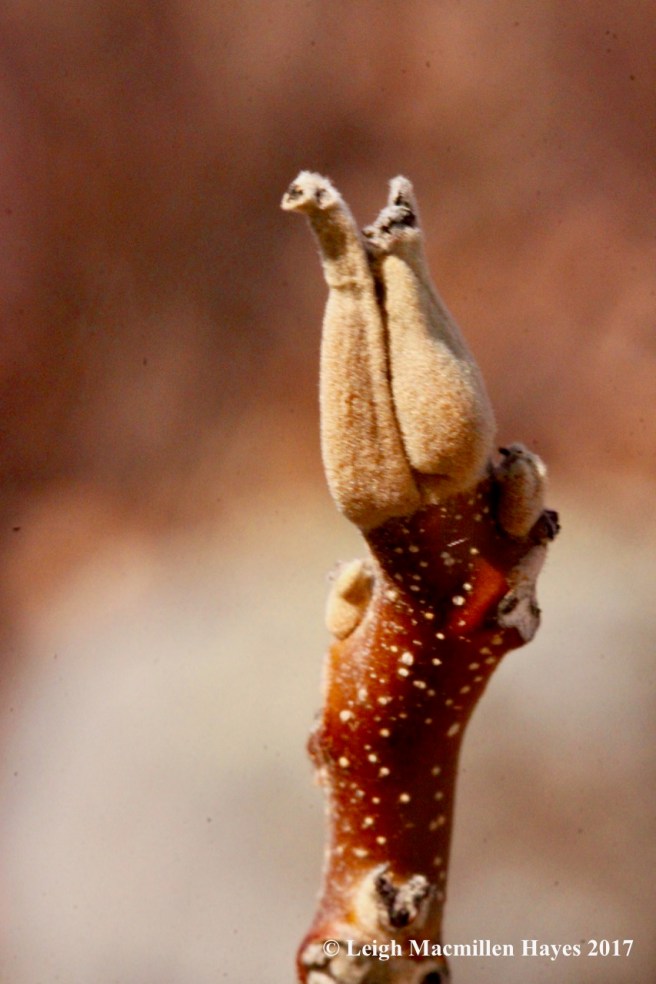
 

The Be-Attitudes Sundate

Today marks the beginning of the season of hope and with that in mind, my guy and I climbed Singepole Mountain in Paris. Paris, Maine, that is.

s-halls-pond-start-1

Our hike began beside Hall’s Pond, where the water reflected the steel gray sky of this late November day.

s1-barbed-wire

And stonewalls and barbed wire reflected the previous use of the land.

s1-beaver-6

In a matter of minutes we learned of its present use.

s-beaver-works-3

Everywhere we looked, beaver sculptures decorated the shoreline.

s1-hemlock-grove

We passed from the hardwood community to a hemlock grove . . .

s-hemlock-girdled-2

where more beaver activity was evident. I’ve been reading The Hidden Life of TREES by Peter Wohlleben and have some questions about tree girdling such as this. There is a theory that beavers chew off the bark all the way around (girdle) to eventually kill trees such as hemlock, so preferable species will grow in their place. But, that’s thinking ahead to future generations. Do beavers really do that?

s-hemlocks-3

On page 18, Wohlleben states the following: “As the roots starve, they shut down their pumping mechanisms, and because water no longer flows through the trunk up to the crown, the whole tree dries out. However, many of the trees I girdled continued to grow with more or less vigor. I know now that this was only possible with the help of intact neighboring trees. Thanks to the underground network, neighbors took over the disrupted task of provisioning the roots and thus made it possible for their buddies to survive. Some trees even managed to bridge the gap in their bark with new growth, and I’ll admit it: I am always a bit ashamed when I see what I wrought back then. Nevertheless, I have learned from this just how powerful a community of trees can be.”

Could this theory be true? Are the surrounding hemlocks feeding that tree via their roots? If so, does that throw out the other theory? So many questions worth asking.

s-huge-maple-1

Soon, we left the Pond Loop Trail and started to climb the Singepole Trail, passing by a gentle giant.

s-maple-2

It’s a snag now, but this old maple offered tales of the forest’s past and hope for the future.

s-downy-rattlesnake-plaintain

On a smaller scale, Downy Rattlesnake Plaintain provided a cheery contrast among the leaf and needle carpet.

s-bobcat-ledges-1

The climb was a bit challenging in places, but we held out hope among the ledges that we might see a bobcat.

s-porky-den

No such luck, but we did find this . . .

s-porky-scat

a well used porcupine den.

s1-water-2

Water dripped in constant harmony as we stepped gingerly along the narrow ledges and tucked under overhanging rocks.

s-halfway-up-2-1

About halfway up, we took a break and paused to admire the view.

s-halfway-up-view-1-jpg-communities-defined

The hardwood and softwood communities became more obvious as we looked down.

s-summit-1-1

And suddenly or so it seemed, my guy reached the moment of truth–the summit.

s-halls-pond-to-pleasant-1

From the top, we looked around and embraced our home place, which appeared on the horizon in the form of Pleasant Mountain.

s-pleasant-to-whites-1

A slight turn and the view extended from Pleasant Mountain to the White Mountains.

s-quartz-intrusion

Below our feet, the granite pegmatite shared its showy display.

s-summit-1

We’d read that there was a quarry at the summit, so we headed toward a cairn, in hopes of locating it. Too many jeep trails confused us and we decided to save the quarry for another day. Instead, we turned into the woods to get out of the wind and munch our PB & J sandwiches, the grape jelly courtesy of Marita Wiser and family.

s-wickiup-1

As we poked about, something caught our attention and we moved closer.

s-wickie-3-1

s-wickie-2-1

s-wickie-1-1

A wickiup frame. We admired the efforts of someone to create this traditional structure.

s-pleasant-mtn

Emerging from the woods, we took one last look at Pleasant Mountain, and . . .

s-summit-4

one last view of what seemed to be the summit (though it may have been a false summit).

s-climbing-down

And then we started down, once again hugging the rocks and trying not to slip.

s-flower-mushroom

On the way, I did note a few things, including this fungi that looked more flowerlike than mushroom like.

s-girdled-beech-1

s1-porky-2

And I spotted a phenomenon that occurred repeatedly. Girdled beech trees too far uphill for a beaver. What or who had debarked these trees?

s-porky-works

I may have been seeing things that weren’t real, but the lines on this particular tree made me wonder about the porcupines. Was I looking at the design they leave with teeth marks created in the distant past? Or were they wounds of another kind?

s1-beaver-5

When at last we reached the Pond Trail again, we continued to circle around it, noting more beaver works.

s-beaver-lodge

At last, we found the mud-packed lodge built into the edge of the pond. Here’s hoping for a warm winter within.

s-pond-at-end-of-day-1

Completing the circle, the biting breeze forced us to walk quickly toward our truck and the end of our hike. We have chores to complete tomorrow so our Sundate may have to suffice for a Mondate.

That being said, in this season of hope, we trust we’ll find more opportunities to consider these be-attitudes:

s1-trees-in-harmony

Be supportive of each other.

s1-christmas-fern-1

Be watchful of what’s to come.

s-heart

Be hopeful of love everlasting.

Ho-Ho-Ho Ho Hoing Away

I remember a time when a Pileated Woodpecker sighting was rare. And now, it’s a daily event, but one which I still feel blessed to experience.

h-pileated

Stepping out the door this afternoon, I immediately heard one hammering and realized another was drumming in a nearby tree. Within minutes, a third flew in and birds #2 & 3 sang their eerie tune as they approached #1. He chased the couple and they flew off, their flight strong, and marked with slow, irregular woodpeckery flaps.

h-woodpecker-hole-1

After watching #1 for a bit, I went in search of woodpecker happenings scattered throughout our woodlot. Though they’ll eat lots of wood-boring insects and occasionally berries, seeds and suet, carpenter ants are their mainstay. Better in a woodpecker’s stomach than our home. Sometimes the holes they create are about six inches across and almost as deep.

h-woody-condo-2

h-woody-condo

And those holes became homes for other critters occasionally, so when friends and I see trees such as these, we think of them as condominiums providing living quarters perhaps for small birds and little brown things (mice). Included in these condo units are some smaller round holes, created by the Hairy and Downy Woodpeckers that also live in our neighborhood.

h-wood-chisel

Occasionally I come across trees such as this one that hadn’t been so much excavated as chiseled. Woodpeckers are just that–peckers of wood. They don’t eat the wood. But to get at their preferred food, they must hammer, chisel and chip the bark.

h-woodchips

At the base, always a scattering of wood chips. I, of course, cannot pass up any opportunity to search through the chips in hopes of locating scat. I was not rewarded with such a find today.

h-hole-in-snag

Leaving dead snags encourages woodpecker activity. They become prime locations to forage, roost and maybe even nest, though I hardly think this snag was large enough to serve as the latter.

h-pinesap

While I was out there, I did stop to admire a few other sights including the now woody structure of pinesap;

h-winterberry

winterberries contrasted against the wee bit of snow that still graces patches of ground;

h-deer-tracks

deer tracks indicating we’d had visitors during the night;

h-violet-upper

h-violet-toothed-under

and a tree skirt of violet-toothed polypores. They are rather like the Lays Potato Chips of the natural world. You can never have just one. (Note: I’m not talking about eating them, but rather how they grow.)

h-woody

It’s been said that Pileated Woodpeckers are skittish. That’s not always the case. I’ve stood beneath one for over twenty minutes, the bird intent on its work and seemingly oblivious to my presence.

The next time you are in the woods and hear the ho-ho-ho ho ho, ho-ho-ho ho hoing that reminds you of that cartoon character, Woody Woodpecker, take a look around. You, too, might be blessed. And don’t forget to check for scat. ;-)