So Many Advantages Along the Mountain Division Trail

When opportunity knocks, so they say, open the door. Today, it wasn’t really a door that I opened, but rather a trail that I explored. And it wasn’t a new trail to me, for I’ve ventured along the Mountain Division Trail in Fryeburg many times before.

1-trail sign

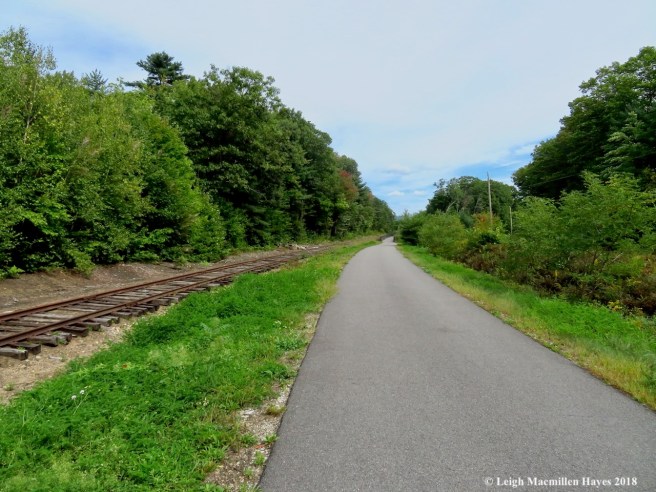
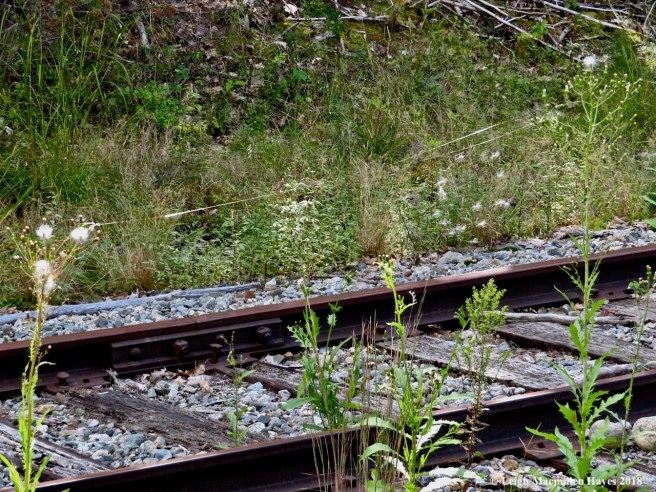
But my morning and afternoon plans changed and I happened to be in the vicinity and I don’t think I’ve ever walked that way in late summer before–so I did what I love to do best and set off down the path beside the now defunct railroad track. And I was curious to discover who else might be taking advantage of it on this fine September day.

2-monarch caterpillar

Within minutes, I made my first discovery–a monarch butterfly caterpillar crawled along the paved trail. I’d actually chosen this spot for I hoped to see a few monarchs and my chances suddenly increased.

3-red-legged grasshopper

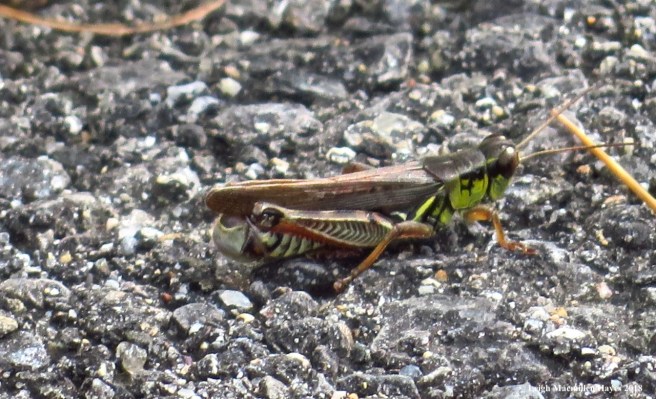
Also using the asphalt were innumerable grasshoppers of several types including this red-legged, and crickets galore. In fact, between them and cicadas, I could almost not hear the traffic on Route 302 at the start. Almost.

4-rail trail

Within minutes, however, the trail passed behind several businesses and then curved away from the road and toward Eastern Slope Airport. It was occasionally flat, occasionally straight, occasionally curved, and occasionally hilly. But always paved. And much quieter.

5-spotted knapweed and web

Constantly, the offerings changed. Knapweed with its pineapple-like base, which loves disturbed areas, had made itself at home. And a spider had used the structure to create its own home.

6a-monarch

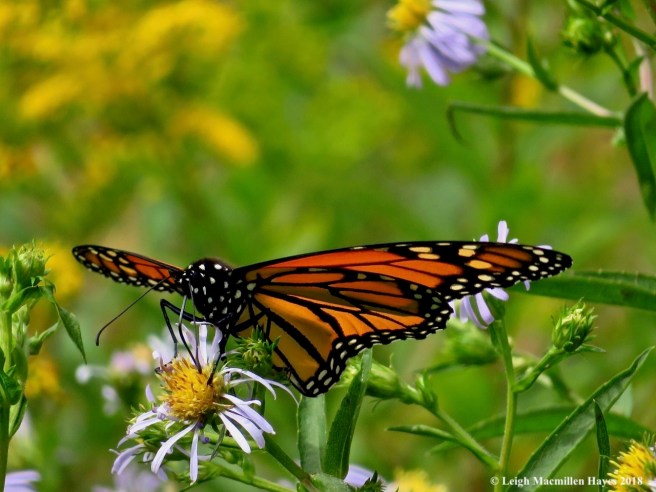
As I walked, I began to notice them–a monarch fluttering past here and another there. At last, I found one that had paused to take advantage of the nourishment offered by an aster.

6-monarch on aster

I stood for as long as it would allow . . .

7-monarch on aster

enjoying every pose presented.

8-crystalline tube gall

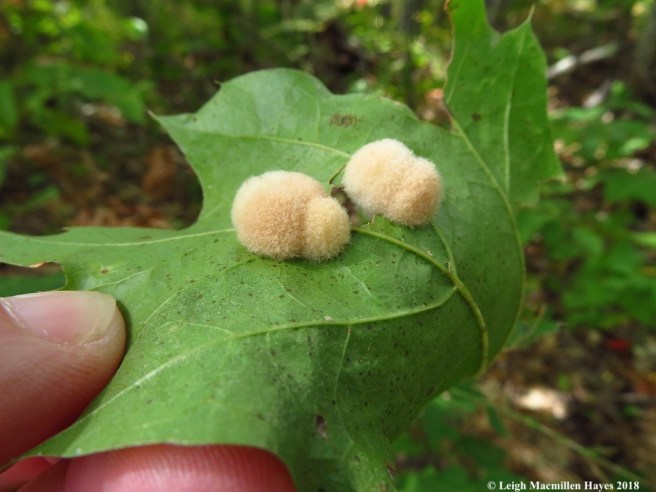
A little further, I found something I only remember seeing for the first time a few weeks ago–I think it’s a crystalline tube gall on the oak leaf, but urchin gall would be my second guess.

9-banded tussock caterpillar

On the same leaf, either a banded-tussock moth caterpillar or a Sycamore tussock moth caterpillar munched away, so similar are they. Check out all the bristles by the head–both an extra set of black and a more subtle set of white.

10-water

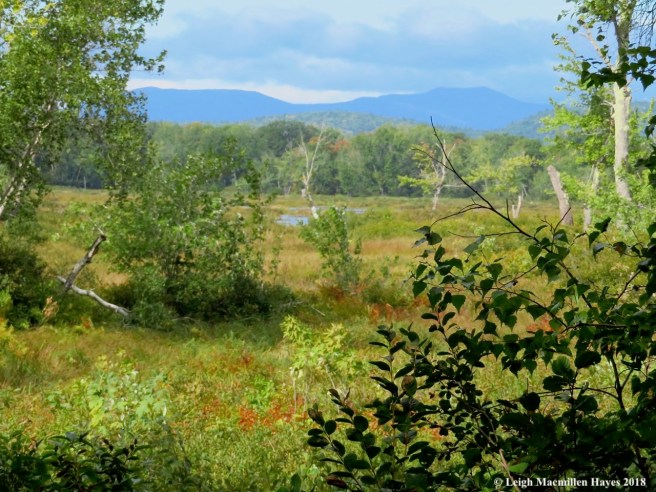
By what I assumed was an old mill pond fed by a small brook, the watery world quietly intercepted all other communities found along this path.

11-painted turtle

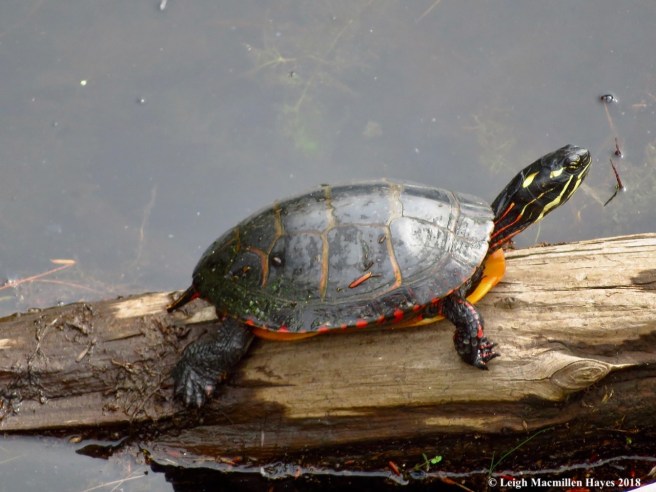
And today, a painted turtle watched nonchalantly from a log in the pond as the world passed by–runners, walkers and bikers on the path above . . . some who hardly noted his presence.

12-male blue dasher

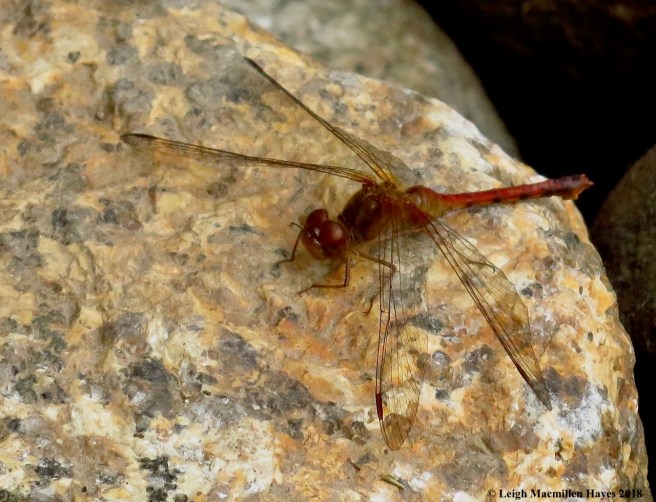
And dragonflies,  including this mighty handsome green-eyed blue dasher, below. Do you see the hint of amber in his wings? One of the telltale signs.

13-pokeweed poking through the fence

Continuing on, I was surprised by a sight I’d seen before because I’d forgotten its presence. Pokeweed flowered and fruited and . . . poked through the fencing that formed a boundary along parts of the trail.

14-northern white cedar

There’s also a short section where northern white cedar formed a wall, its woody cones all opened in an expression of giving forth new life and its leaves scaled like skinny braids.

15-pipewort gone to seed

Being a greatly disturbed zone, pilewort grew in abundance and its seeds danced and twirled and sashayed through the air like ghostly angels blowing in the wind. Actually, the graceful seedheads were much more attractive than the flower in bloom.

16-Queen Anne's Lace

Queen Anne’s Lace had also bloomed profusely, but today showed only its winter weed form full of tiny seeds edged with rows of bristles. The better to ground itself somewhere when the time comes, I supposed.

17-Bristly sarsaparilla fruits

Speaking of bristles, bristly sarsaparilla sent its many-fruited umbels out through the fence, perhaps in offering to those passing this way.

18-into infinity

So many offerings I’d seen by the time I reached about the three mile mark and I knew there would be even more on the way back so I used my own imaginary turntable and began the return trip.

20-spider web between pipewort

It was then that a web strung with great and amazing strength between two pileworts caught my attention. First, I couldn’t believe the distance between the two plants or the thickness of the anchoring web. And then I noticed something else . . .

21-seeds caught in web

An orb about two thirds of the way across, decorated with pilewort seeds that will take a little longer than usual to get established on the ground. Will they be viable, I wondered.

23-funnel spider

Another industrious arachnid had used one of the fence pipes to make himself a home. Can you see the funnel spider waiting in the tunnel for delectable prey to land on his web?

22-goat

And then there were the goats, this one and two others who munched beside the trail. I called their owner because I feared they’d broken out of their pen (or someone had opened the gate). Her number was on a board attached to a tree as she’d advertised her daycare business to all who passed by. We enjoyed a pleasant conversation and I learned that she lets them out for an hour or so each day to feed on the weeds. Weeds? What weeds. All I saw where wildflowers aplenty. Anyway, if you go, do know that you may encounter the goats and they are not gruff at all.

24-cabbage white butterfly

While I saw a few more monarchs as I wandered back, a few other butterflies at least half the size of the royal ones moved with dainty motions. For the cabbage white butterfly, the asters were all the thing. But like so many of the wildflowers that have taken root in this disturbed place, this butterfly also disturbs people because it has a penchant for damaging crops.

26-northern cloudywing skipper butterfly

Even smaller was the northern cloudywing skipper that stopped atop a red maple sapling. Males perch near the ground awaiting females, so his chosen spot made sense. His wing scales gave him such a satiny look as he shown in the light and his earth-tone colors included hints of purple.

It was all about the earth, I noted, as I walked along the Mountain Division Trail. Years ago, the path that I followed today had been used to construct the railroad track. And then in the 2000s, the rail trail had been built beside it. Over the years, I’m sure the railroad track had been enhanced. So the land was indeed disturbed . . . repeatedly.

And now, just as I took advantage of it to follow the well-constructed trail, so many others had done the same–both human and non. Not all were beneficial, but still they eeked out a life in that place. From insects and “weeds” to turtles and tree, there are so many advantages available along the Mountain Division Trail in Fryeburg, Maine.


Our Home is Their Home

As I sit in my rocking chair on the camp porch, the cicadas still buzz, with chirps of crickets thrown into the mix and somewhere in the background a constant trill from another. Tree frog? Perhaps, but it seems to carry on for longer than usual. Grasshopper? Maybe. And then there is the occasional call of the loon.

1-camp

What truly attracted my attention earlier today, however, were the other members of the household. Whose home this is, I think I know. Or rather, I thought I did. I thought it belonged to my guy and me. But really, I should have known better for it has never just housed the two of us. There were the boys growing up, and family, and friends, and renters, even. Actually, the latter three knew it before the boys. (Oops, I suppose I should call them young men, mid-twenty-somethings that they now are.)  But, through all these years, it has also housed many others. And so today, I got acquainted with some of its other residents. Rather than the mammals that we know also share the space, e.g. mice, squirrels, and bats, it was the insects and arachnids that I checked out.

2-cicada exuviae

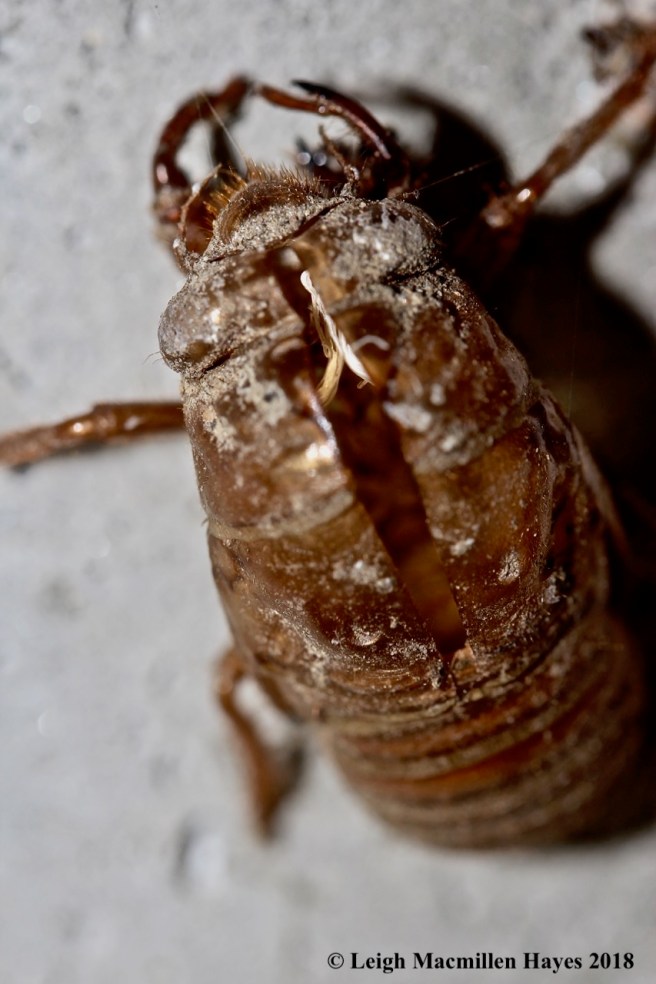
My first find along the foundation was an exuvia of one I listen to day and night–that of a cicada. In their larval stage, cicadas live down to eight feet underground. When the time comes to metamorphose into winged adults, they dig to the surface, climb up something, in this case the foundation, and molt. The  emerging winged insects leave behind their shed skin, aka abandoned exoskeleton or exuvia. It’s a rather alien looking structure, with the split obvious from which the adult emerged.

3-cruiser 1

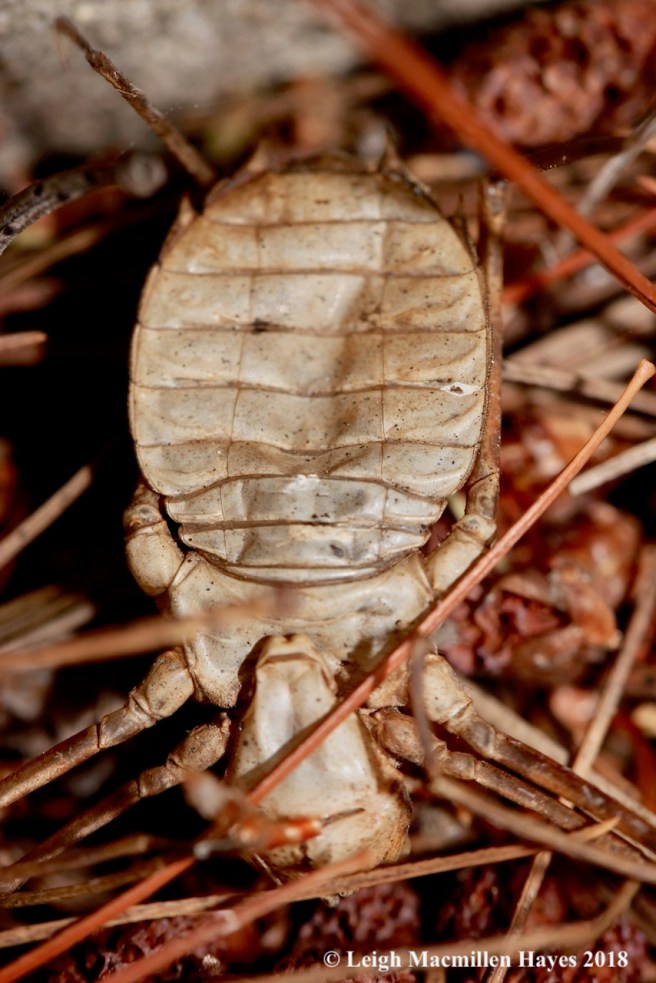
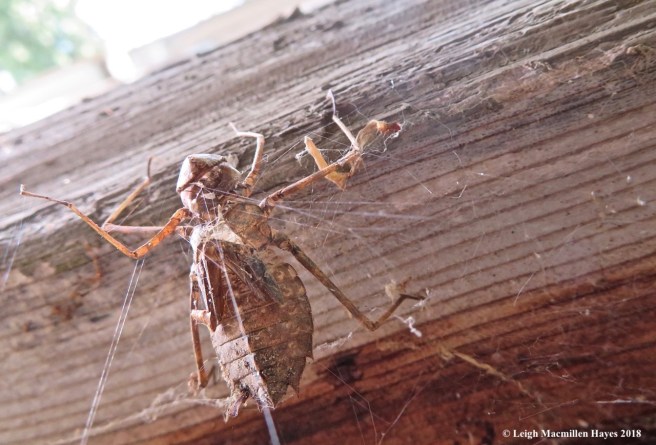
The cicadas weren’t the only aliens along our foundation. It seemed like every few feet I discovered a dragonfly exuvia dangling from the porch floor and now encased in spider webs.

3b-cruiser

One of the cruiser exuviae had dropped to the ground below. But still the structure remained intact. And I now realize that my next task is to head out the door once again in the morning and collect these beauties, the better to understand their nuances.

4-cruiser hiding

I found cruisers hiding under the logs . . .

6-cruiser and cast off spider

and even one tucked in by a basement window that had a shed spider exoskeleton dangling from it.

6a-lancet clubtail dragonfly

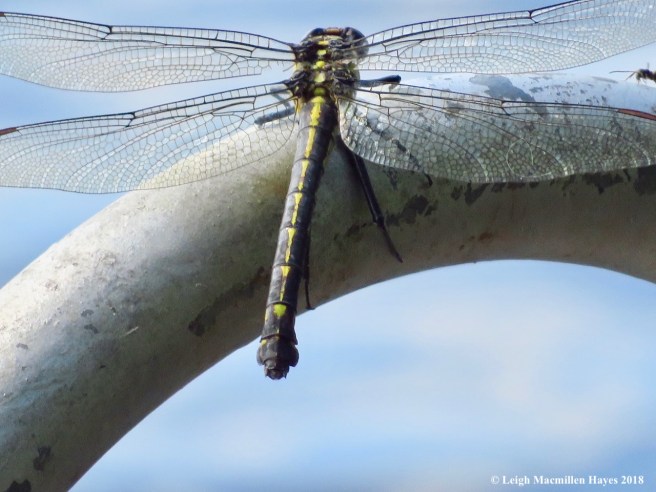
There were others as well, but nowhere did I find the exuvia of the one with whom I’ve spent the most time, Sir Lance(t) Clubtail. I suspect his shed skin is attached to some aquatic vegetation for he spends so much of his time by the water, even today, pausing only briefly to rest on the dock ladder.

7-bag worms and pupal case of a pine sawfly

There were other species to meet, including the most interesting of structures, those of the evergreen bagworm cases. I assumed that the young had already emerged, but their homes consisted of material from the trees on which they fed, e.g. pine needles. They struke me as the terrestrial form of the aquatic caddisflies.

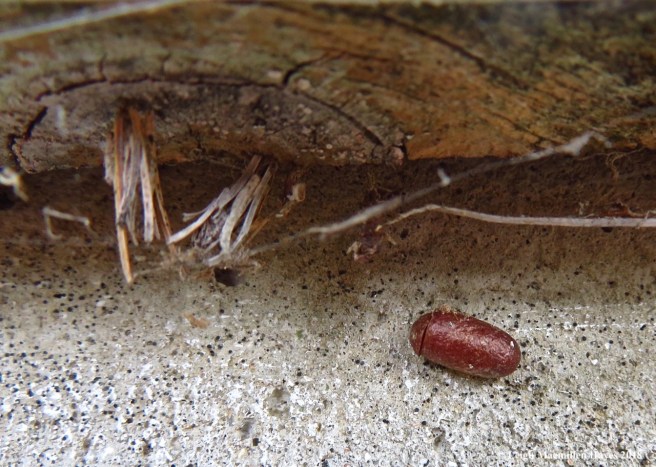
And beside the two bagworms was a small, rounded brown case–the pupal case of a pine sawfly. The sawfly had already pupated and in this case no one was home.

8-pine sawfly caterpillar on screen

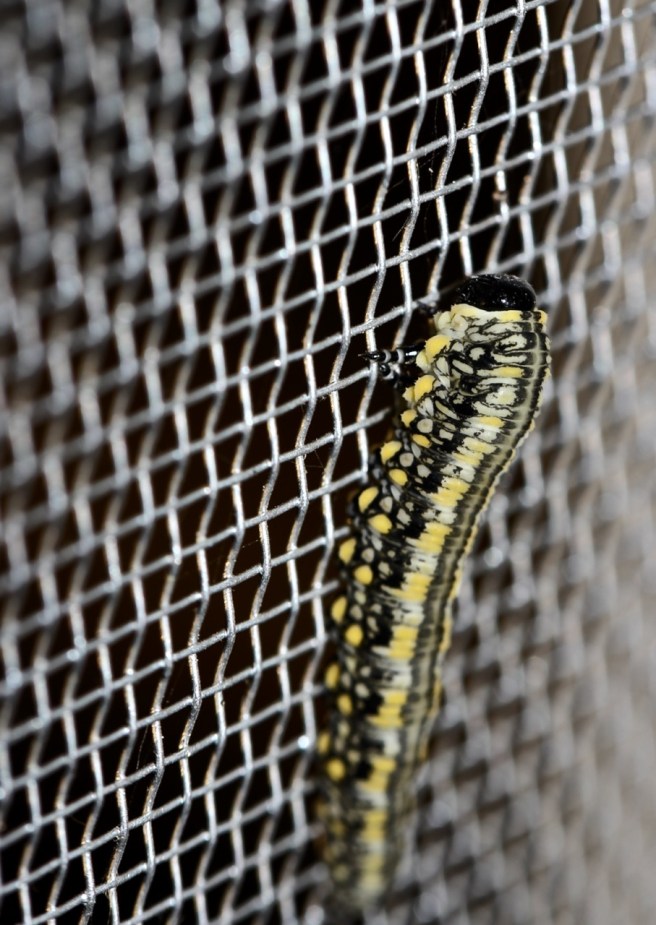
Oh, but they were and have been for a few weeks. I first realized we had an infestation when what sounded like the drip-drop pattern of a summer rain on a perfectly sunny day turned out to be little bits of green caterpillar frass falling from the trees. Everything was decorated. And then I began to notice the caterpillars–many falling out of trees and landing on the surrounding vegetation, and the house. As would be expected, they climbed toward the sky, hoping, I suppose, to reach the top of the trees. Good luck with that.

9-pine sawfly caterpillars

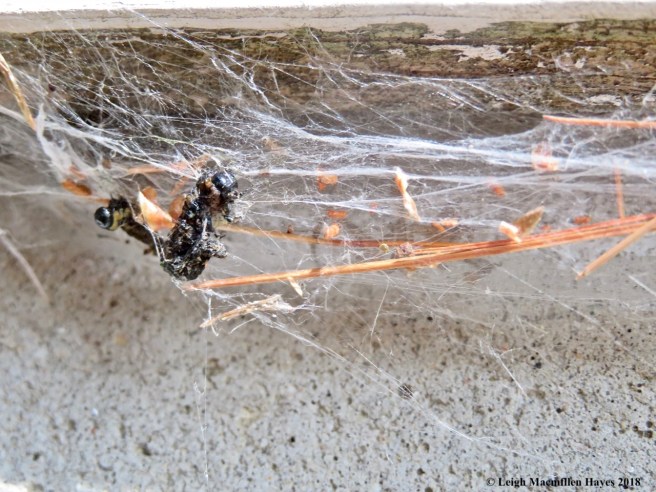
Some didn’t make it above the foundation, where they encountered spider webs and soon had the juices sucked out of them. Such is life. And today, a winter flock of birds including chickadees, nuthatches, goldfinches, hairy woodpeckers, young robins, and even a brown creeper flew in and some fine dining took place. The raindrops have nearly ceased.

10-Northern Pine Sphinx

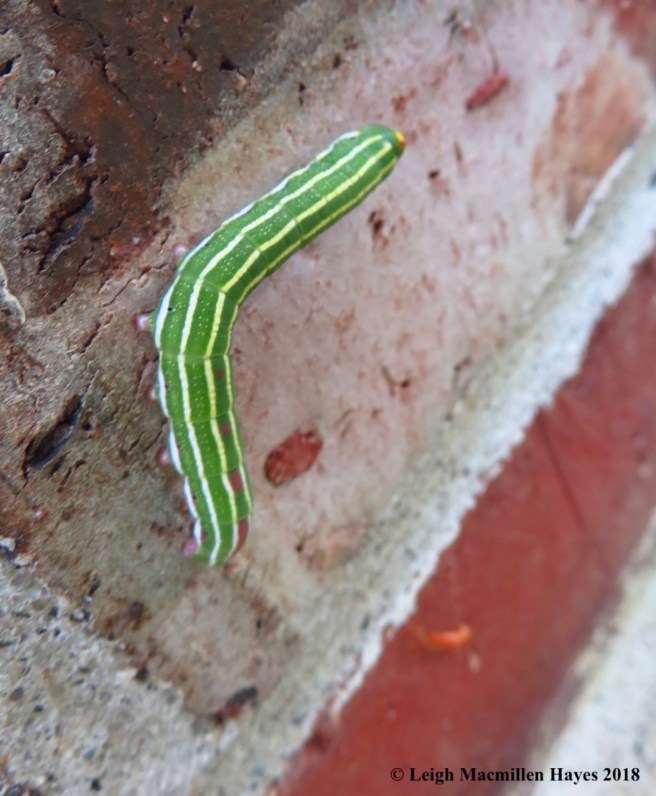
That wasn’t the only pine-eating caterpillar to make its home here. On the chimney, I found a northern pine sphinx caterpillar moving full speed ahead.

11-orbweaver

And around the bend, where the chimney meets the camp, an orbweaver spinning some silk in the hopes of fine dining.

14a-calico pennant dragonfly in web

One meal had obviously been consumed–a calico pennant dragonfly. I’d seen a few of those on the vegetation a few weeks ago, but none recently. Apparently, one flew too close to the building. The only way I could ID it was by its wings for the head, thorax and abdomen had been eaten. But the wings have no nutritional value.

11a-Northern Pine Sphinx 2

A short time later I returned to the chimney in hopes of locating the northern pine sphinx caterpillar again. I did. And he wasn’t. He’d apparently turned the sharp corner on the chimney and met his fate.

13- Northern Sphinx 4

Eye to eye. I’m amazed at the size of the insects that find their way to her web. It’s not like they are attracted to it. Instead, they come upon it quite by surprise and she makes fast work of their mistake.

14-pine tree spur-throated grasshopper

Rounding the corner back toward the porch door, one last insect drew my attention. And again, it was related to the pines, such is the local community: a pine tree spur-throated grasshopper on one of the logs that forms the outer wall of our wee home.

Our home is their home and we’re happy to share the space with them. Provided, of course, that they leave space for us to live as well. So far, all is well.


Book of September: wishtree

When Alanna Doughty, education director at Lakes Environmental Association, mentioned she’d watched a trailer about a book entitled wishtree by Katherine Applegate and immediately walked to Bridgton Books to purchase it and that night began reading it to her girls and thought I might like it as well, I listened and then drove to the bookstore and purchased it yesterday and here I am today to tell you that you should do the same.

wishtree

In fact, this should be required reading for every child and every adult. Every. Adult. You see, the story is about a northern red oak, but not an ordinary Quercus rubra, for Red, as it is known, can talk. And tell corny jokes. And philosophize, though not in a tedious or pompous way. And teach. All of us. About life. And tolerance.

On one level, it reminds me of our barn, which just happens to be painted red and is towered over by a red oak, and serves as a home, or at least a pass under, for skunks and raccoons and woodchucks and porcupines and red and gray squirrels and mice and the neighborhood cats and all seem to live in perfect harmony beneath it. Well, all except the mice that is.

But the book isn’t just about the animals that call the hollows of the tree home, it’s about the people who live nearby. And really, it’s about all people. In the neighborhood. In the town. In the state. In the nation. Across the globe.

The tale of tolerance is told in such a manner that each short chapter with its surprise ending could stand alone like delectable little nuggets. And maybe they should be read in such a way. One. Chapter. At. A. Time. I rushed through it last night, mesmerized,  but this morning I began reading wishtree again. And actually, I think it shall become a bathroom book, that place where many of my favorites end up so I can return to them frequently for short intervals. Wink.

Scientific terms are subtly introduced. And the sketches enhance the story.

Published in 2017, its a book that is written for our times, but should become a classic, much like The Giving Tree. I don’t want to give the story away, but I do want you to read it. You can learn more by visiting the wishtree website, where you can even add your own wish.

Or be like Alanna, read the story aloud to your children or partner or the air around you, find your own “Red,” and leave a wish and some yarn and snippets of paper for others to do the same.

But especially, don’t forget to take the message of wishtree with you everywhere you go. I hope I remember to do the same.

wishtree by Katherine Applegate, published 2017, Fiewel and Friends, an imprint of mackids.com.


Self-Guided Tour of Sabattus Mountain

As stories go, Sabattus Mountain in Lovell offers plenty of lore. For starters, there’s the name of the mountain. I’ve heard at least two tales and seen three spellings, but basically the legend is the same–about a Pequawket named Sabatos, Sabatis, or Sabattus, who guided hunters and one day killed a lynx, or was it a mountain lion, before it sprang upon him.

In a July 14, 2017 article, Ed Parsons of the Conway Daily Sun wrote: “Sabattus was born in St. Francis, Canada, and with the influence of French missionaries, was named for St. John the Baptist, shortened to Sabattus. When Roger’s Rangers destroyed St. Francis in 1759, Sabattus was about 10 years old. He was kidnapped and went south with the rangers. Later, he went to Fryeburg with one of them, and spent the rest of his life in the area.

Sabattus had two children with the well-known area healer, Molly Ockett. In 1783, an earlier wife of his returned from a long trip to Canada, and claimed to be his spouse. To settle the dispute, Sabattus took them to the house of Mr. Wiley in Fryeburg so there would be a witness, and the two women fought, “hair and cloth flying everywhere.” Mrs. St. Francis, as Molly Ockett called the former wife, was stronger and won out. Molly Ockett left and moved to Andover, Maine.

There’s also the Devil’s Staircase, but that’s for another day.

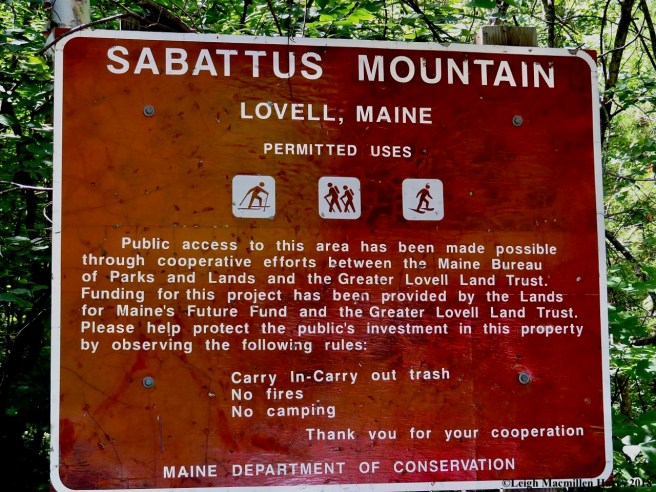
s1-sign

Two Land for Maine’s Future program grants, along with funding from the Greater Lovell Land Trust, enabled the State of Maine to purchase 177 acres on and around Sabattus Mountain, protecting hiking access to Lovell’s highest peak. The trail is a 1.6-mile loop to and from the 1,253-foot summit. Sabattus Mountain is now owned and managed by the Bureau of Parks and Lands. The land trust, however, has taken a keen interest in upkeep of the trail system recently because there had been much erosion ever since Hurricane Irene and the State seemed to back off maintaining it. Last year, the GLLT’s three interns built numerous water bars, especially on the eastern trail.

s6-Brent's Loop Trail Sign

Last week, Brent Legere of Lovell Box Company and Western Maine Slabworks, installed new signs to guide hikers on the trail system.

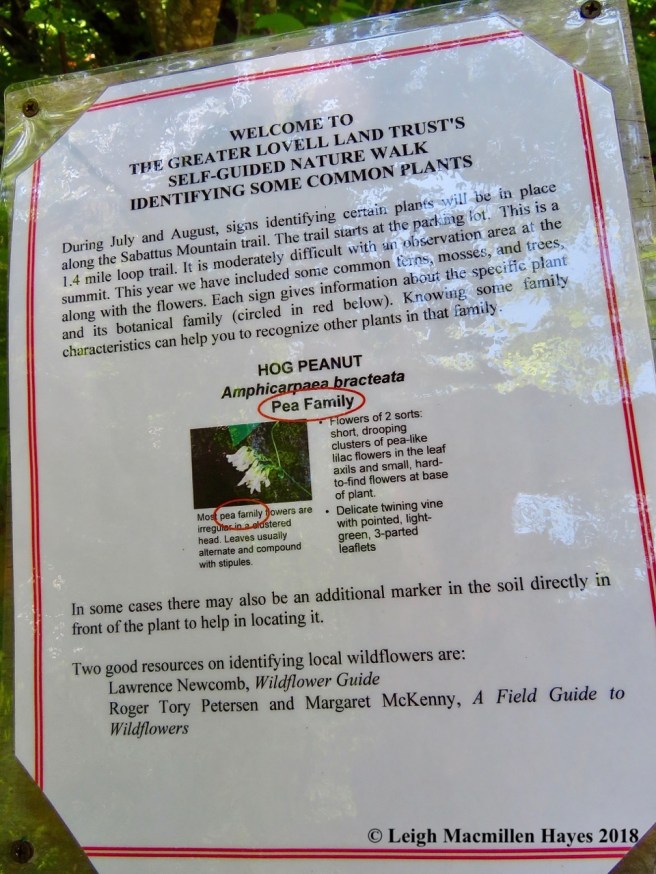
s2-self-guided nature walk

Today, a team of docents, associates and this year’s intern, under the well-organized leadership of GLLT Docent and Maine Master Naturalist Joan Lundin, installed informational signage along the loop.

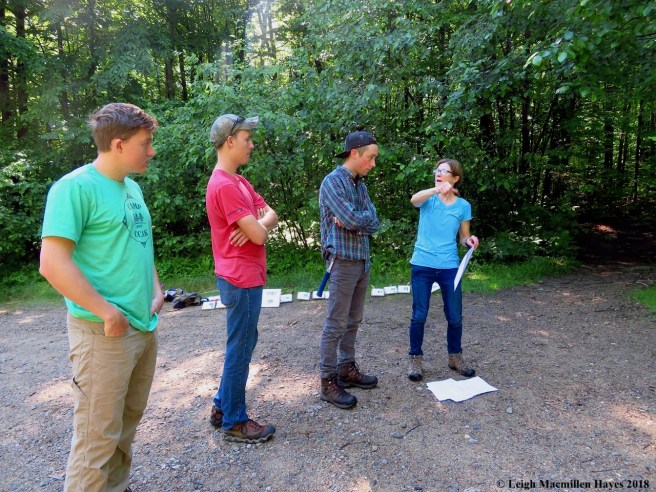
s3-explaining the plan

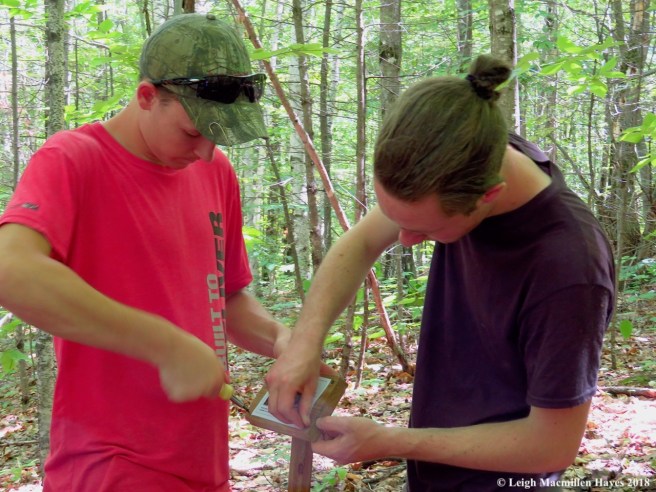
The morning began as Joan divided the team into two groups. First she instructed Intern Isaiah (in red) and Stewardship Associate Dakota (in plaid), to take one set of signs up the western trail and leave them beside examples of particular species on the way.

s5-all smiles to go

Then she prepped Associate Director Aidan, and GLLT Docents Nancy and Pam in the plan for the eastern trail.

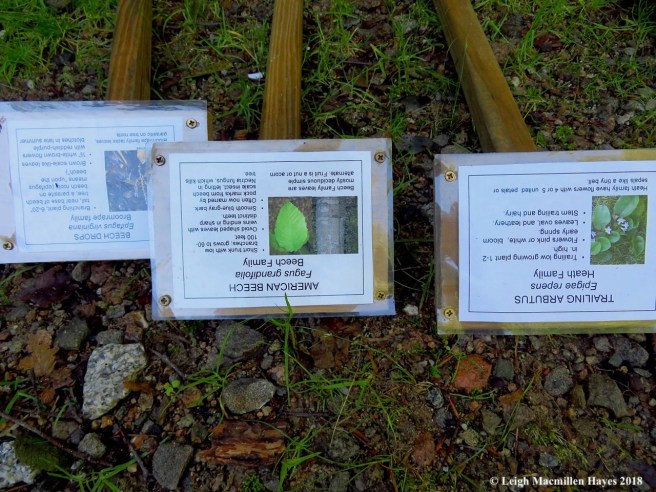
s4-signs

All signs were laid out and ready to be hauled up the trails for installation.

s12-hi ho

And so, in true Seven Dwarf style, it was hi ho, hi ho and off to work we went.

s7-installing the first sign

Because she’d climbed the trail so often in order to prepare for today’s undertaking, Joan knew right where each sign belonged. At the start, she did most of the installing, showing off her muscle power on this steamy day, despite her petite physique.

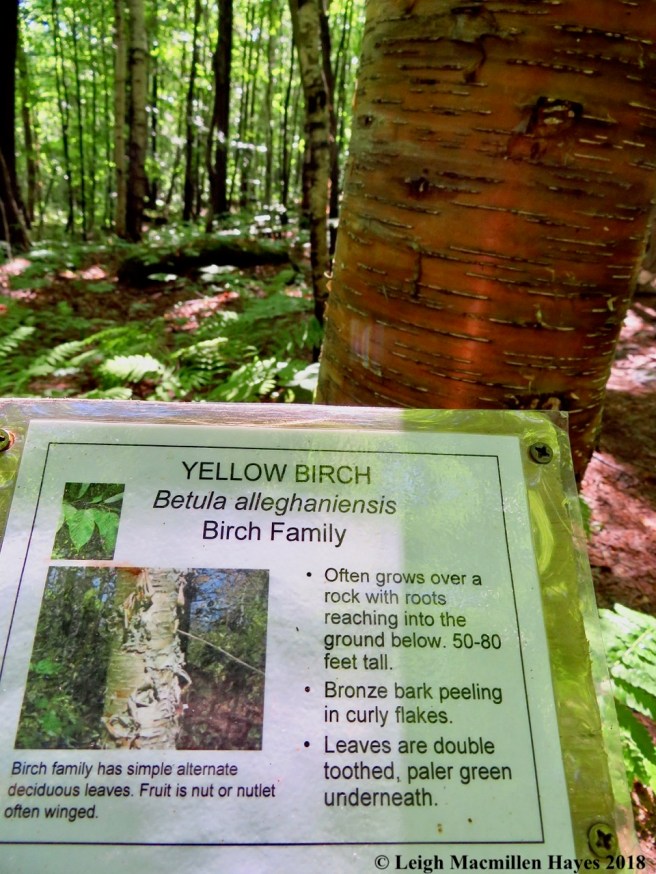
s8-yellow birch

Each sign included common and scientific names, plus only a few key characteristics so not to overwhelm those who might stop to read them and look around to locate the particular species. It’s a technique decided long ago by the full team of docents who have undertaken this task each summer for years–always along a different GLLT trail.

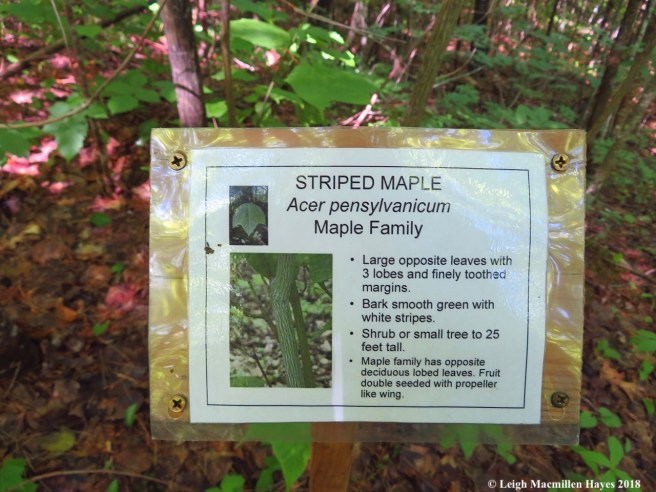
s9-striped maple

The natural community along both trails on the loop system transitioned about two-thirds of the way up. For the lower portion, the community consisted of a variety of deciduous trees.

s13-hemlock

Suddenly everything changed. Light turned to shade. Dry turned to damp. Leaves turned to needles. And conifers showed off their unique characteristics.

s14-sphagnum moss

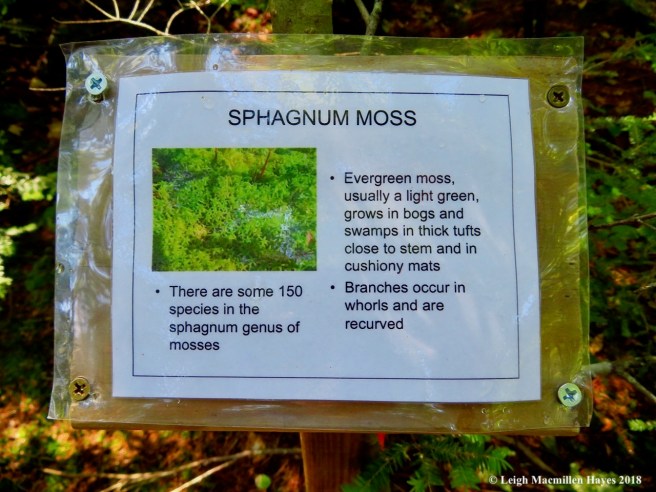
Even the forest floor changed from dried leaves and wildflowers to green mosses, including sphagnum, with its pom-pom shaped heads.

s15-loop trail sign at ridge

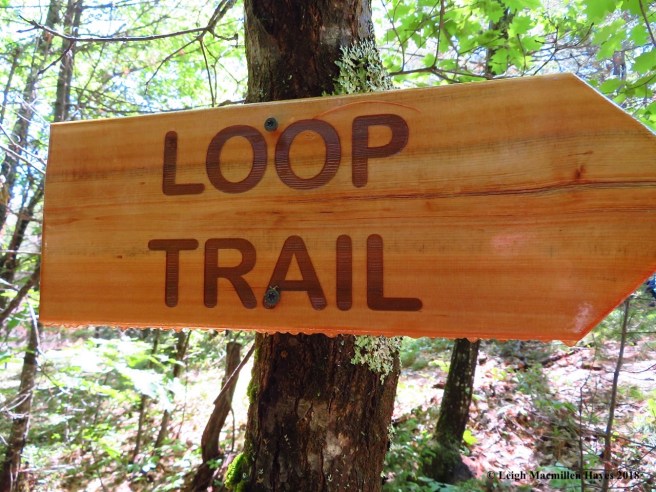
As we hiked up the eastern trail, Dakota and Isaiah swung along the ridge line and came down to find us for they had only placed their signs along the western trail as instructed by Joan, and hadn’t yet pounded them into the earth. We chatted as we moved upward, talking about the turn ahead to the ridge, and Dakota told us we’d be pleased with how obvious it was since Brent had installed the new signs. Indeed!

s16-glacial erratic

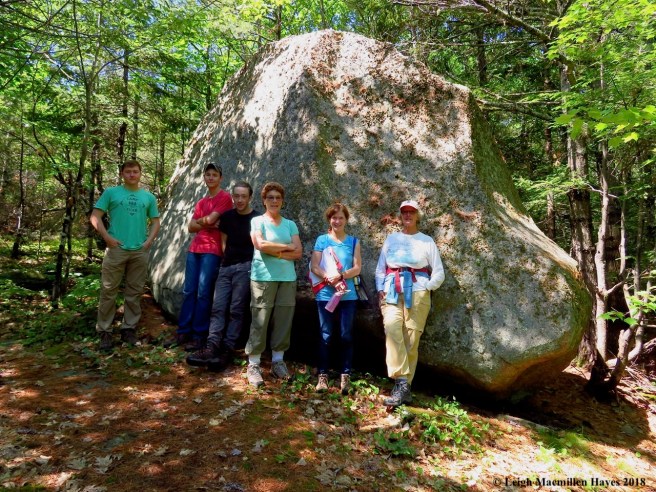
Of course, we were a group that failed at following directions, and so off trail we went to check on the glacial erratic that we knew stood just beyond a downed tree.

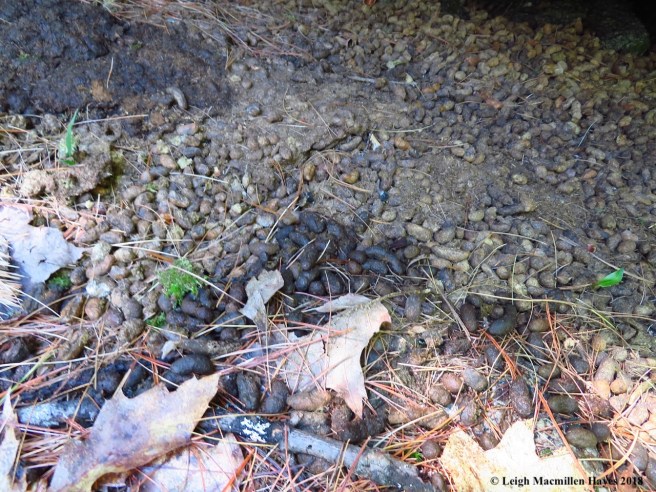
s17-porcupine scat

We also checked underneath, for who doesn’t like to look at porcupine scat. New and old, though not especially fresh, it’s been a winter den for at least 30+ years that I’ve been climbing this mountain.

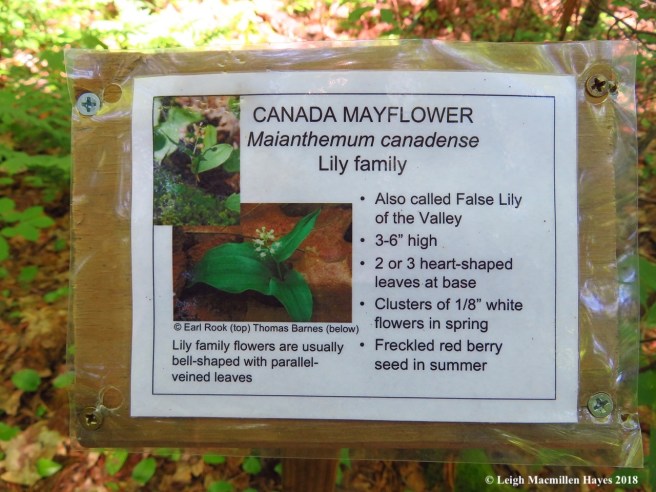
s18-Canada mayflower

And then Joan redirected us, pulling us back into the mission of the morning and finding a place to post the Canada Mayflower sign–between the granite slabs at our feet.

s19-window on the world beyond

Making our way across the ridge, we paused for a second to look out the window upon the world beyond. It’s from heights like this one that we always appreciate how much of Maine is still forested. At a recent gathering with District Forester Shane Duigan, he said that the state is 85% forested–down from 90% not because of urban sprawl, but instead increased farming.

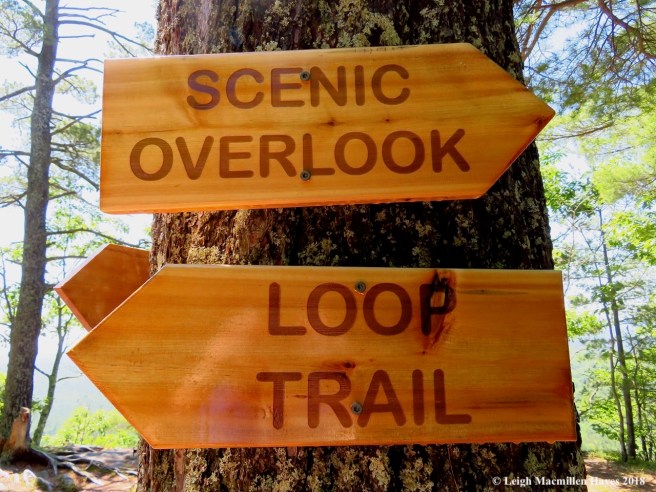
s20-main summit signs

A few minutes later we reached the main summit, where Brent had posted more signs. They’re nailed to a White Pine and mark the intersection of the ridge trail and western loop, with a spur to the western-facing ledges and scenic overlook.

s21-white pine

That very White Pine was also on Joan’s list as an excellent example, and so it will be noticed for a while.

s22-Keyes Pond and Pleasant Mtn

For a few minutes, we took in the wider view to the south–noting Keyes Pond in Sweden and Pleasant Mountain in Bridgton, both part of the great beyond.

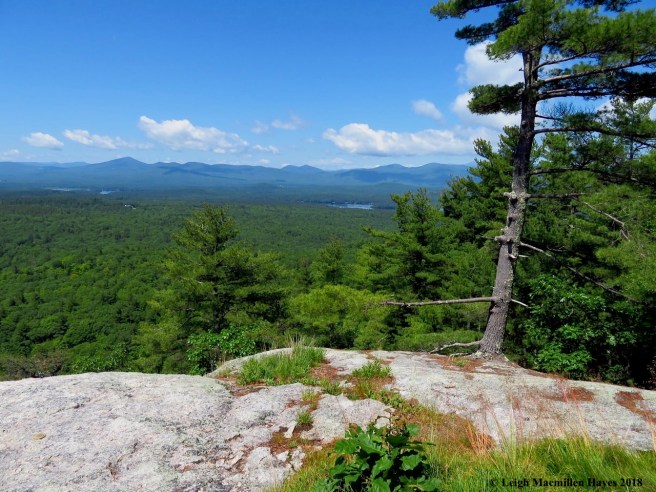
s23-scenic view

And then a quick trip out to the scenic overlook, where the sweeping view included the Lower Bay of Kezar Lake and pyramid outline of Mount Kearsarge in North Conway.

s24-scenic view 2

Turning a wee bit to the north, the view also encompassed more of Kezar Lake, and the White Mountains.

s25-chipmunk

On the way down, we continued, or rather, the rest of the team continued to install the signs while I watched, and one quiet chipmunk with a piece of a leaf dangling from its mouth looked on with approval. We assumed it approved, for it didn’t chatter at us.

s26-teamwork

It seemed the signs on the western trail went into place far more quickly than on the climb up, but maybe it was because there weren’t as many. We did pause for a few minutes as Isaiah and Dakota changed out one sign for another because the species Joan wanted to feature wasn’t as prominent as hoped. But, she was prepared with extra laminated cards and quickly produced a description of an alternate species.

s27-plank

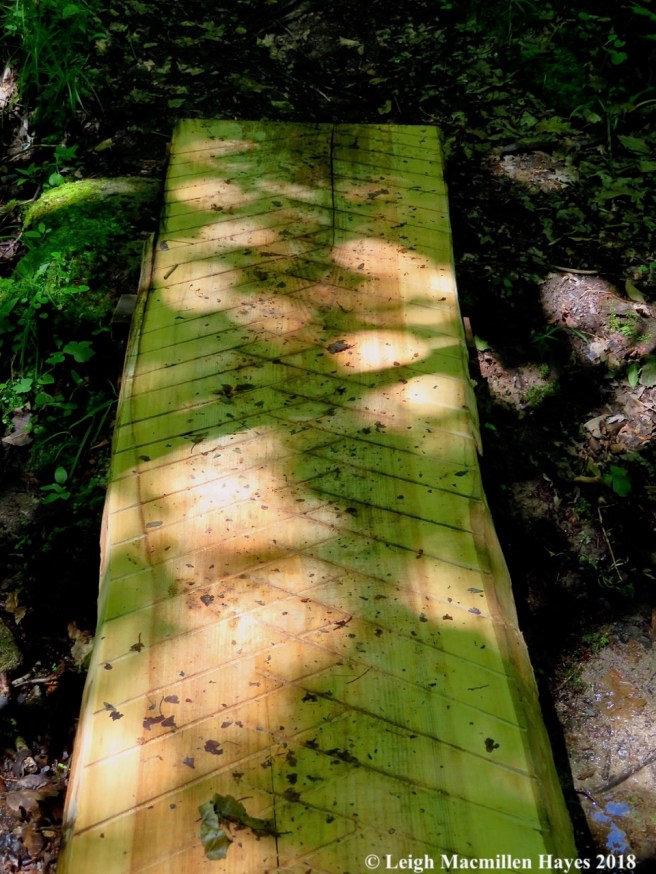
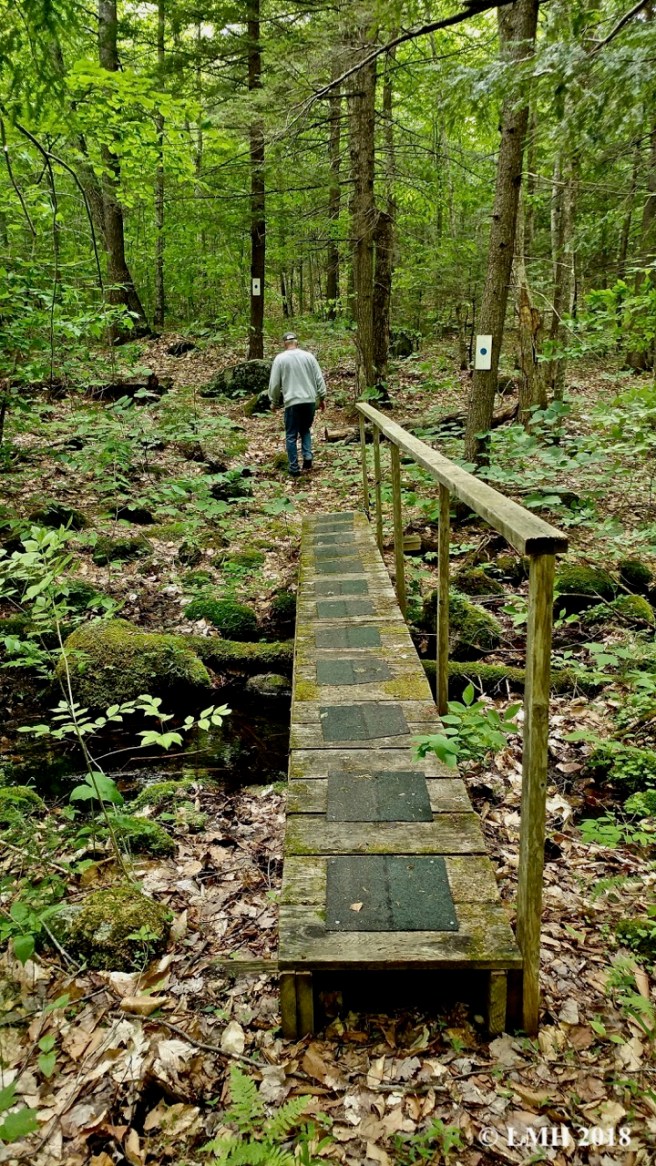
We were nearly finished with our morning’s work when we reached the new plank bridge Brent had placed across a small stream.

s28-white admiral

Back at the parking lot, we were wowed by the sight of pollinators upon the Staghorn Sumac, including a White Admiral Butterfly.

With that, our tour was done for the day, but we’d met several people along the way who were thrilled with the work we’d done. We hope you, too, will partake of the pleasant hike up Sabattus Mountain, and stop along the way to enjoy the self-guided tour. It will be in place until Labor Day weekend.

And be sure to stop by the office on Route 5 and make a contribution to the Greater Lovell Land Trust for we are a membership-driven organization and can’t do such work without your continued support.

P.S. Thank you Self-guided Tour Docents and GLLT staff, plus Property Steward Brent.


A Rare and Exotic Mondate

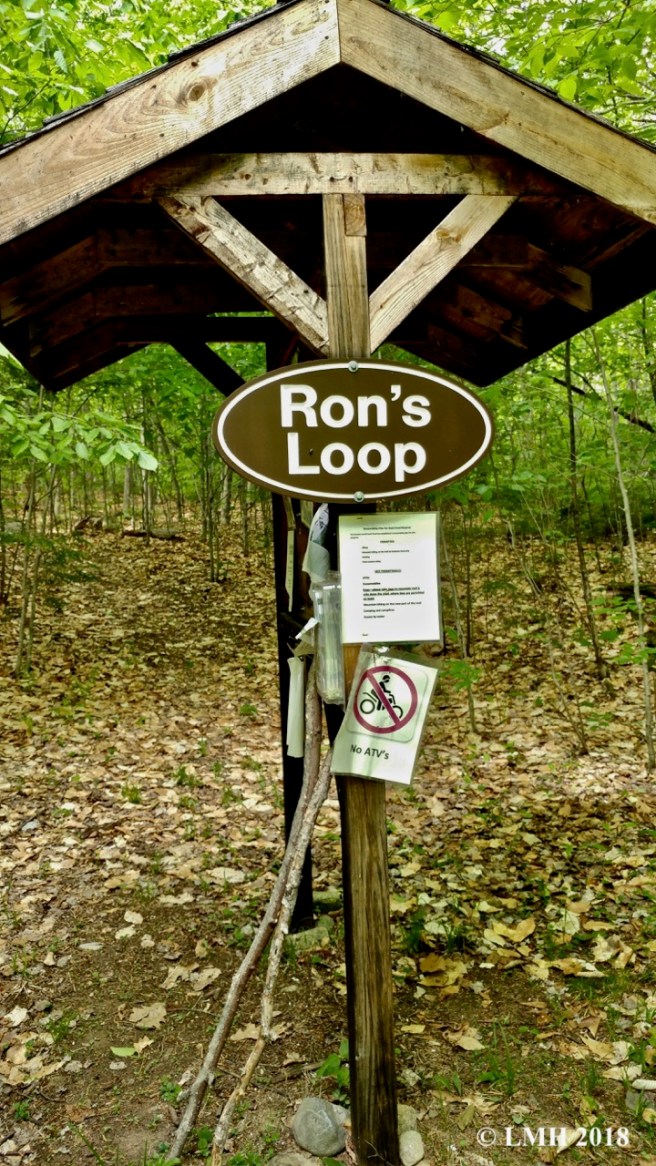
When my guy and I began our journey this afternoon, he thought our mission was simple and two-fold. First, we’d double check road names and directions for a friend’s book that I’m editing. And then we’d hike the easy Ron’s Loop at the Greater Lovell Land Trust’s Back Pond Reserve in Stoneham, Maine.

Y7-RON'S LOOP KIOSK

No sooner had I parked the truck and we hopped out, when I announced that we had a detour to make. Always one for adventure, he followed along. And when I told him our quest, he began to search the forest floor. I have to admit time and again that though he pretends not to care about so much that naturally distracts me, he has a keen eye. Or maybe its just that he likes a challenge. Perhaps, too, he just wanted to make the find and move on for the mosquitoes were robust and hungry.

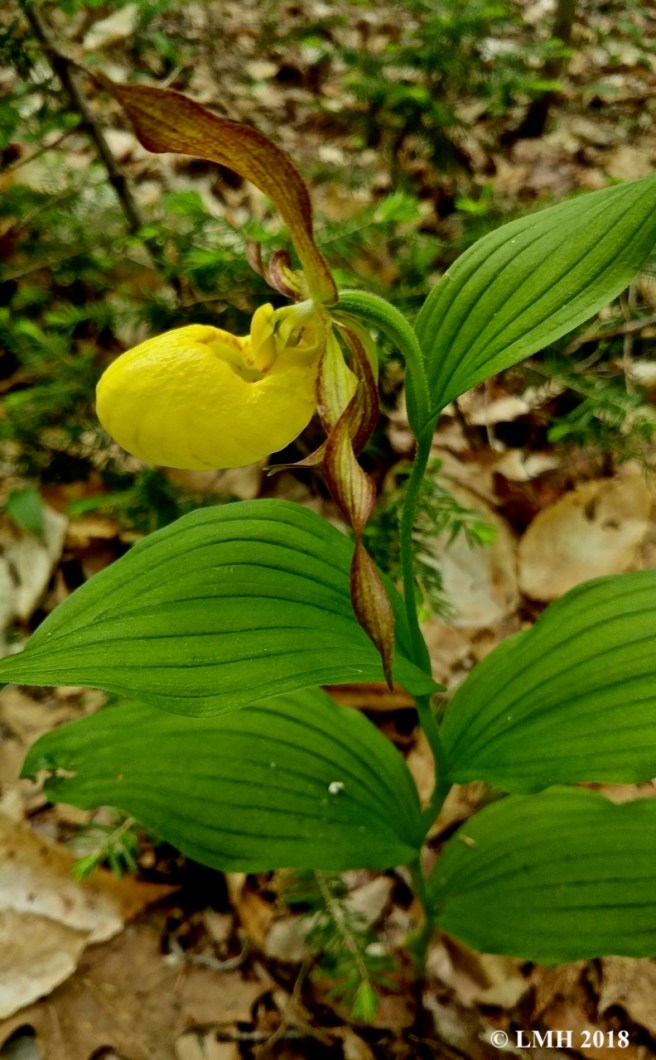
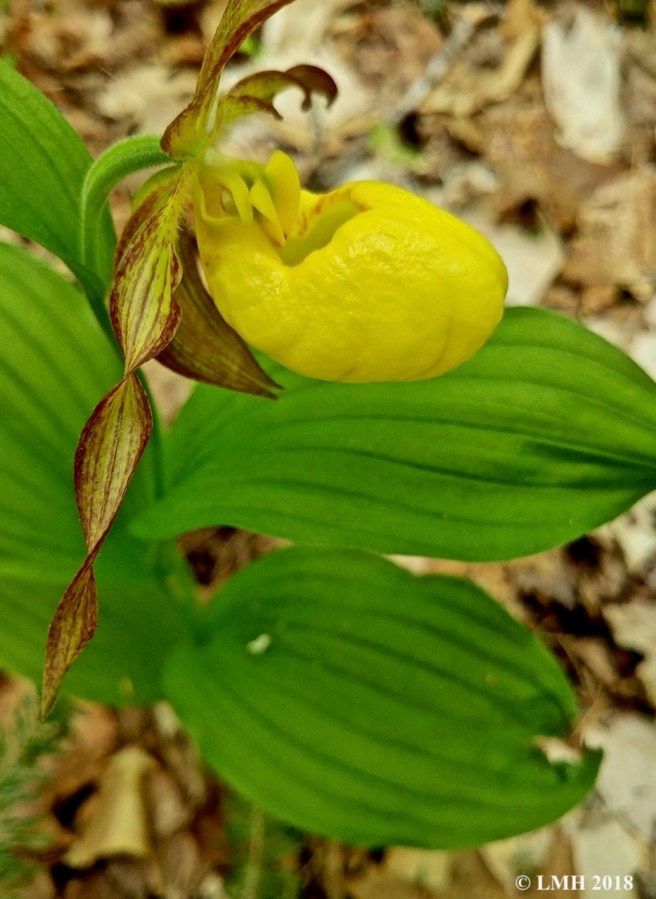
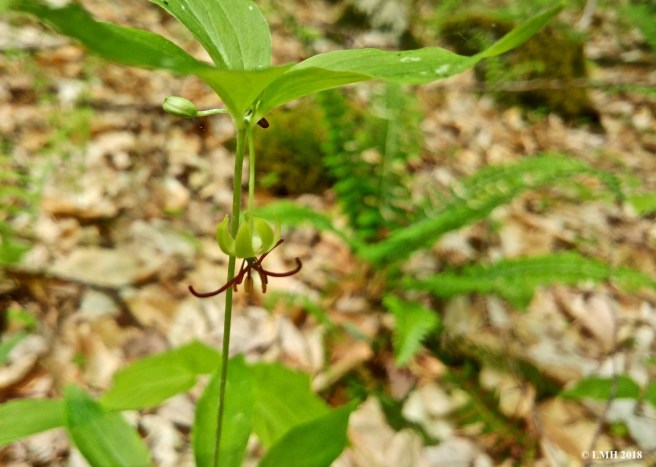
y1-yellow lady's slipper

What mattered most was that he channeled his Prince Charming and was the first to find Cinderella’s golden slipper.

Y4-ALL THE PARTS

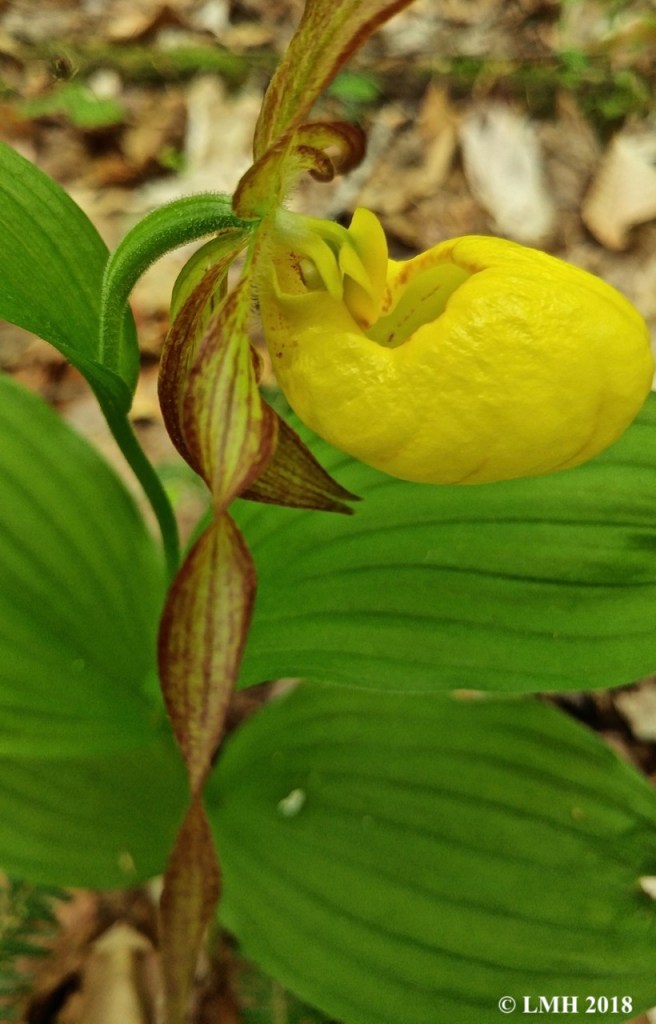
Members of the Orchid family, lady’s slippers feature the typical three petals in an atypical fashion. The pouch (or slipper or moccasin), called the labellum, is actually one petal–inflated and veined.

Y3-TENDRILS

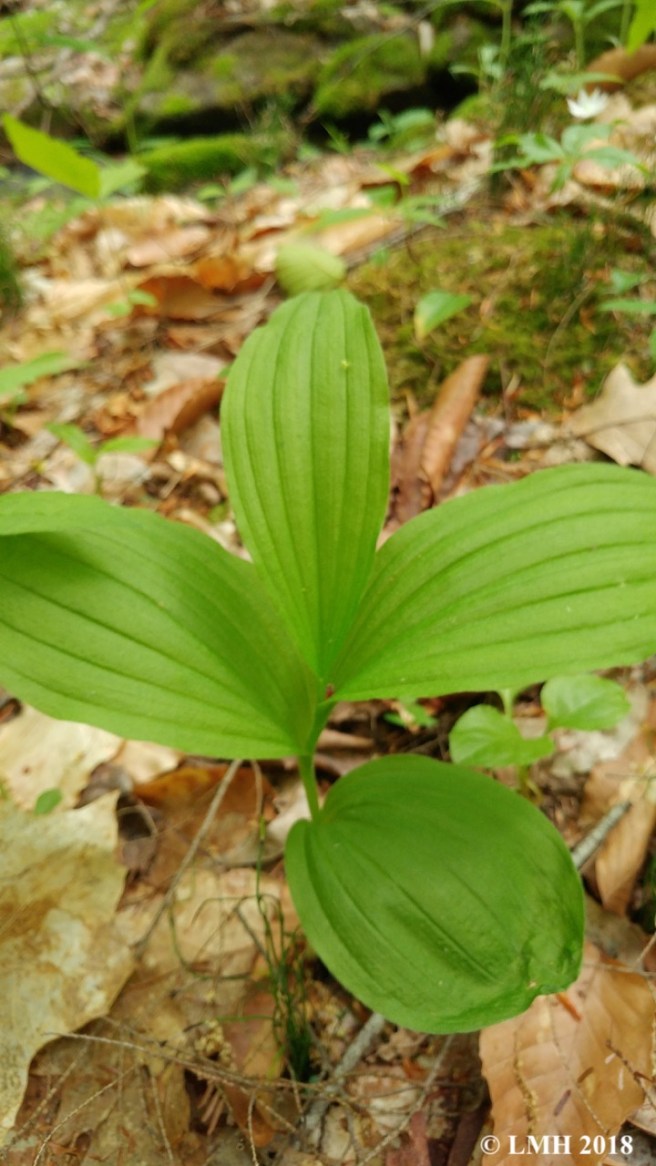
With a purplish tint, the petals and sepals twisted and turned offering their own take on a ballroom dance. From every angle, they were simply elegant rising as they did from their stem with leaves forming a royal staircase.

lady's slipper

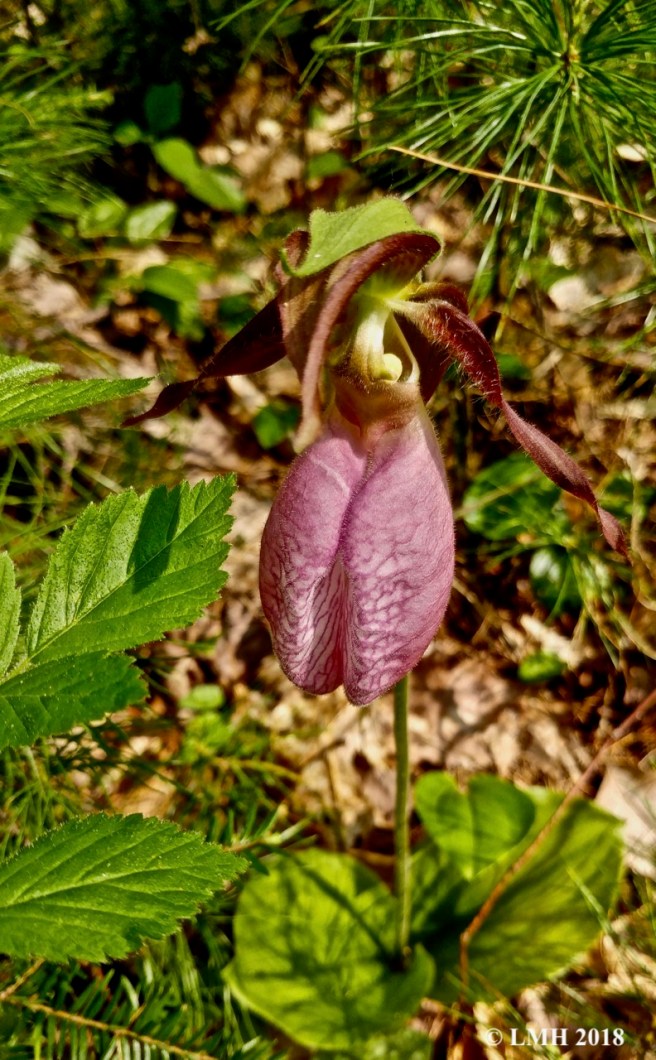
Though we didn’t see any pink lady’s slippers on today’s hike, it’s interesting to note their differences, with the sac of the pink dangling down like a high-heeled shoe, while the yellow is more ballet-like in its presentation. And the pink features two basal leaves, in contrast to the alternate steps of the yellow’s leaves.

Both, however, are in the genus Cypripedium in the Orchidaceae family. The genus name Cypripedium is derived from the Greek words “Cypris,” an early reference in Greek myth to Aphrodite, and “pedilon” for sandal, so named for the fused petals that form the pouch and their resemblance to a slipper or shoe.

Y2--LOOKING WITHIN

All lines on this orchid led to . . . well, not exactly Rome, but certainly the labellum, or sac-like structure. With the rim turned inward, the pollinators found it easy to enter, but much more difficult to exit, the better to rub against the stigma and anthers, thus collecting pollen. Some bees find it difficult to simply fly away from the lady’s charm, but by chewing their way out, they are able to move on to the next and leave a message from the princess in the form of a pollen deposit.

Y7-BEECH COTYLEDON

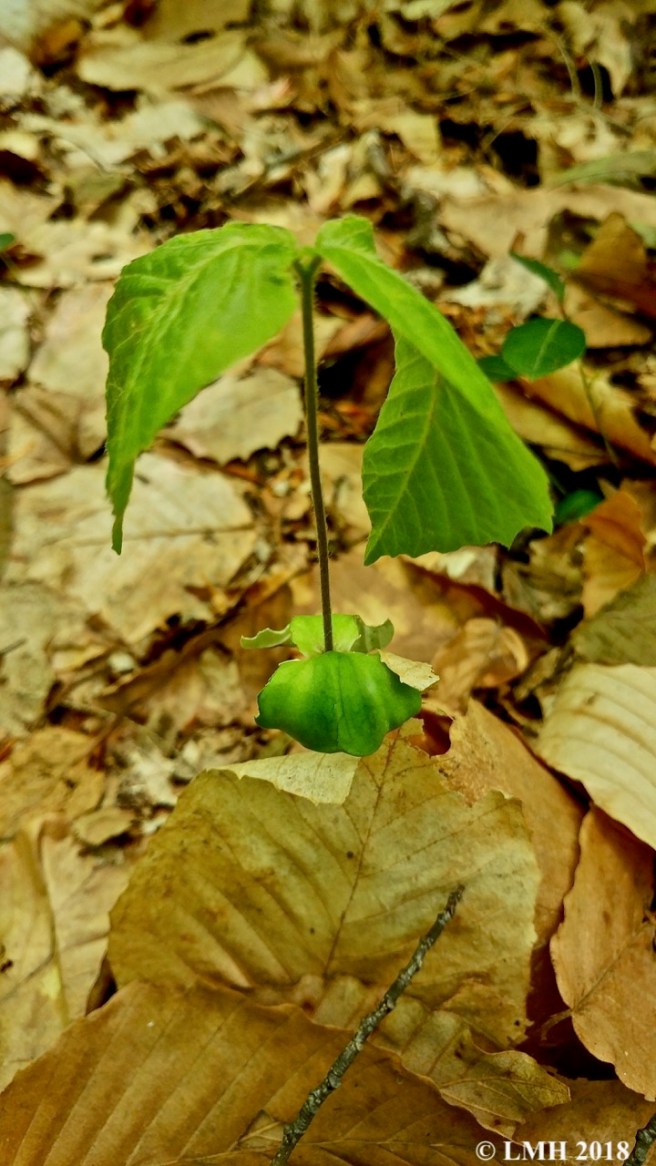
We finally moved on with the not-so-sweet drone of those larger-than-life mosquitoes buzzing in our ears. And then we stumbled upon one American beech cotyledon after another and were reminded of last year’s mast crop of beech nuts.

Y8-BEECH COTYLEDON

I was again reminded that it’s my duty to bring attention to these structures, the seedling form of beech trees. The lower set of leathery embyronic leaves that remind me of a butterfly, appear before the tree’s true leaves make themselves known. Part of what intrigues me about these seed leaves that appear before the tree’s true leaves is that they contain stored food. Some of these food stores wither and fall off, but in the case of the many we saw today, the cotyledons had turned green and photosynthesized. I also love how the word cotyledon (cot·y·le·don \ ˌkä-tə-ˈlē-dᵊn \) flows off my tongue, much like marcescent, which describes the leaves of this same tree that cling, wither and rattle all winter long.

Y8A-BEECH GROVE TO COME

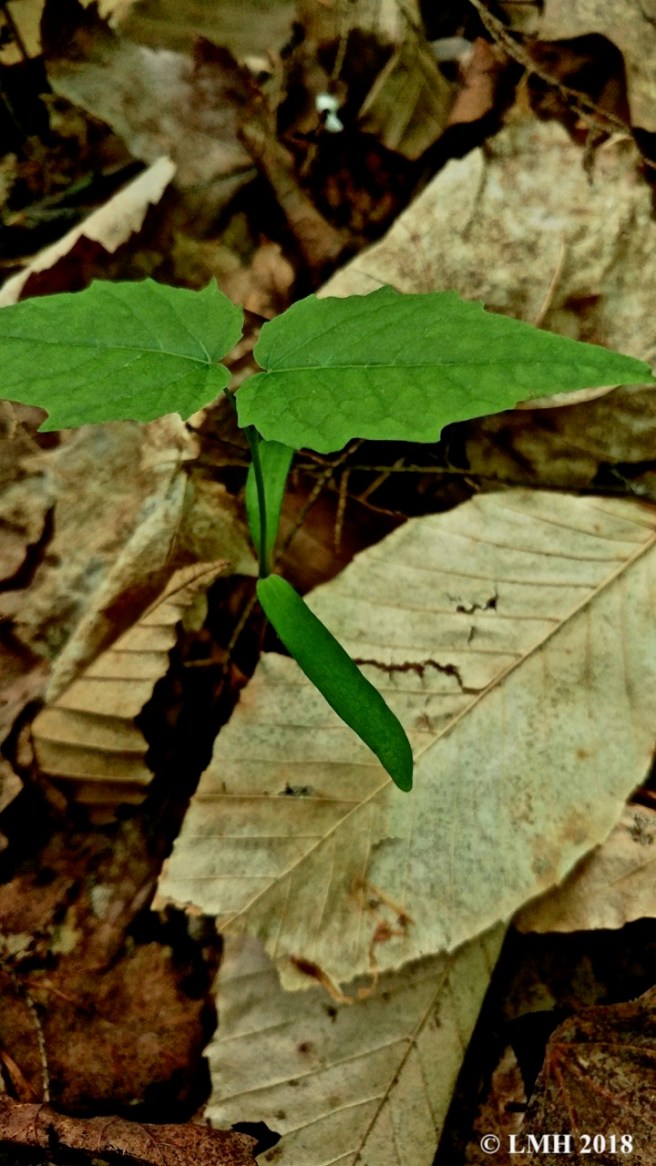
Though I’ve read that seeing beech cotyledons is a rare event and could attest to that fact  in the past, thrilling with each siting, today we noted their ubiquitous nature.

Y9-RED MAPLE COTYLEDON

Red maple cotyledons also decorated the trail. If the plant has two seed leaves, such as these, it is a dicot (dicotyledon), and if only one it is a monocot (monocotyledon).

Y10-MAGIC ALONG THE TRAIL

Onward we moved, stopping occasionally as my guy did some trail work because its part of his nature to make a path clear for those who follow. Being a one-armed bandit, my help was still limited, but it won’t be long and I’ll be able to offer two capable hands.

Y11-BUNCHBERRIES

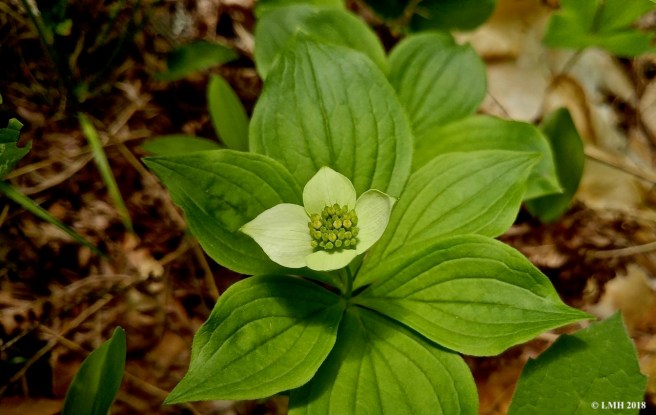
Further along the trail, bunchberries were beginning to bloom. Normally, a bunchberry plant has two sets of opposite leaves. But . . . when one is mature enough to grow a third set, typically larger leaves (perhaps to capture more energy) than the first two sets, it produces four white bracts that we think of as petals. In reality, the bracts were modified leaves. The flowers were in the center–tiny as they were.

Y12-1ST BRIDGE CROSSING

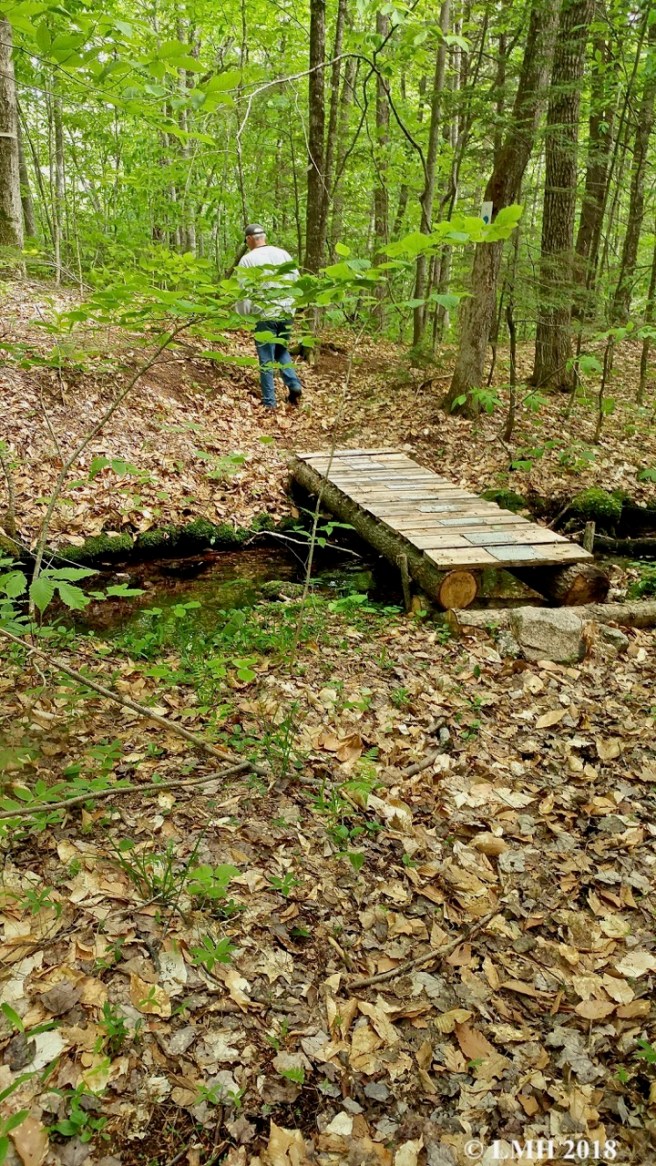
In what seemed like no time, for we moved so quickly, we reached the first bridge. It was at this point that we began the loop back toward the trailhead. And smiles crossed my face as I recalled memories of explorations along the way with so many others.

Y8B-CANKERED BEECH

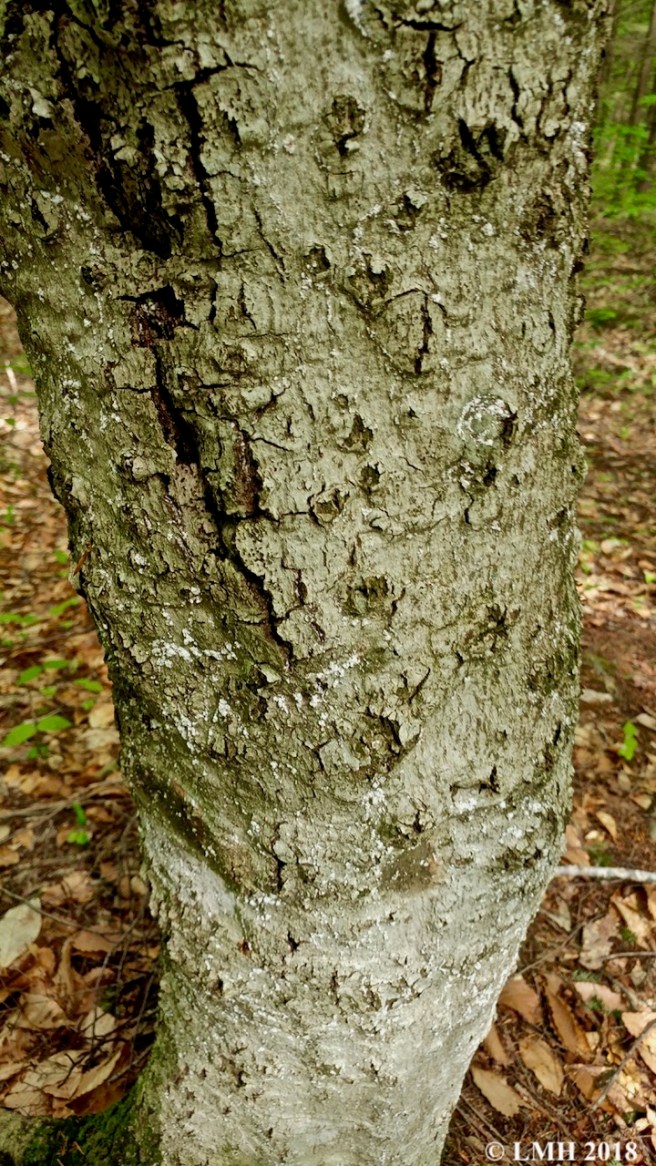
On the way back, we noted so many beech trees that dealt with nectria and we could only hope that within some of those cotyledons there might be some trees resistant to the beech scale insect that delivers such devastation to these trees.

Y13-SEATED TREE

One of my favorite trees along the way sat as it always does, taking a break upon a granite bench.

Y14-TINDER CONK

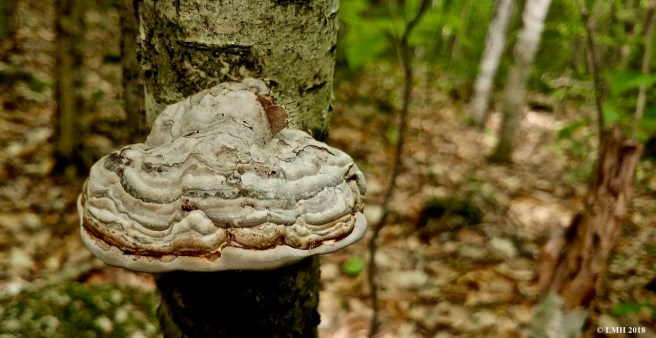
And a tinder conk showed off its form, which for me recalled a childhood spent along the Connecticut shoreline, for it surely resembled an oyster shell.

Y15-INDIAN CUCUMER ROOT

We were almost to the end of the loop when my heart and not my mouth sang with joy once again. While you might give thanks for small blessings like the fact that I’m a great lip sinker rather than the opera star my mind hears, I made my guy stop because the Indian Cucumber Root was in bloom.

Y16-INDIAN CUCUMBER ROOT

Like the bunchberries that need that third set of leaves in order to fruit, Indian Cucumber Root needs two levels to produce a flower. I’m of the belief that if the structure of this flower doesn’t make you wonder, nothing will. It strikes me as a northern version of a bird of paradise.

Y18-2ND BRIDGE

In what seemed like my shortest adventure along this trail because we didn’t want to overdo our offerings to the female mosquitoes who needed our blood in order to reproduce, we crossed the second bridge back toward the trailhead.

Y19-YELLOW LADY'S SLIPPER WITHOUT FLOWER

It was near that crossing that I checked on a couple of yellow lady’s slippers and as has been true since I first met them–they weren’t in flower. From what I’ve learned, it’s not so odd that the plants have yet to bloom. Apparently, it takes 10-17 years for a seed to mature into a plant capable of blooming. For this plant and the one beside it, perhaps the blossoms are on the horizon.

Y5-ALL PARTS 2

One day they’ll reach the status of their neighbor. For any lady’s slippers, the dance is rather intricate. The stage floor must be painted with an acidic soil and there needs to be a sashay with Rhizoctonia fungi. As the fungi digests the outer cells of the seeds, inner cells escape digestion and absorb some of the nutrients the fungus obtained from the soil–all in the name of a symbiotic dance.

Though our journey flew by on the wings of the world’s largest, loudest, and meanest mosquitoes, our finds on this Mondate afternoon extended from lady’s slippers to cotyledons, bunchberries and Indian Cucumber Root. All appeared rare and exotic.


From the Ground Up

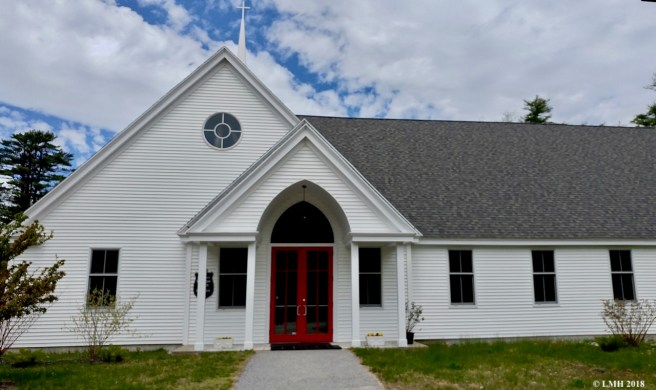
“I am the Alpha and the Omega, the Beginning and the End, the First and the Last . . . The end of a beginning . . . A new beginning . . .” So began Bishop Chilton Knudsen’s sermon shared with over 170 parishioners and guests who attended the Dedication and Consecration of St. Peter’s Episcopal Church in Bridgton on Sunday, June 1, 2008.

Standing behind the pulpit in a site line between the entrance to the sanctuary, altar, cross and a circular pane that provided a window on God through the movement of the trees, wind and sun, Bishop Knudsen reminded us, as our rector, the Rt. Reverend John H. Smith, retired Bishop of West Virginia, had done previously, that the new building was just that — a building. She encouraged us not to get so caught up in the building that we lose sight of our mission of outreach to each other, our communities and the greater world.

St. Peter’s Episcopal Church began as a summer mission in 1962. On September 8, 1974, St. Peter’s-by-the-Lake held its first service of extended ministry. Though it did not have a home of its own, the church provided an Episcopal presence to summer and year-round residents of the Lakes Region by meeting in various locations including people’s homes, Bridgton Academy, and local churches of different denominations. In 2003, the parish voted to purchase a ten-acre lot at the junction of Routes 302 and 93, one mile west of downtown Bridgton.

After renting space for all those years, in 2007, church members enthusiastically supported a capital campaign; through gifts and pledges the full amount of the building cost was raised. Under the leadership of parishioner Beatrice White, a building committee was formed. The Vestry engaged the services of William Whited, Architect, to design a building that would be both beautiful and affordable.

S2-BISHOP KNUDSON BREAKS GROUND

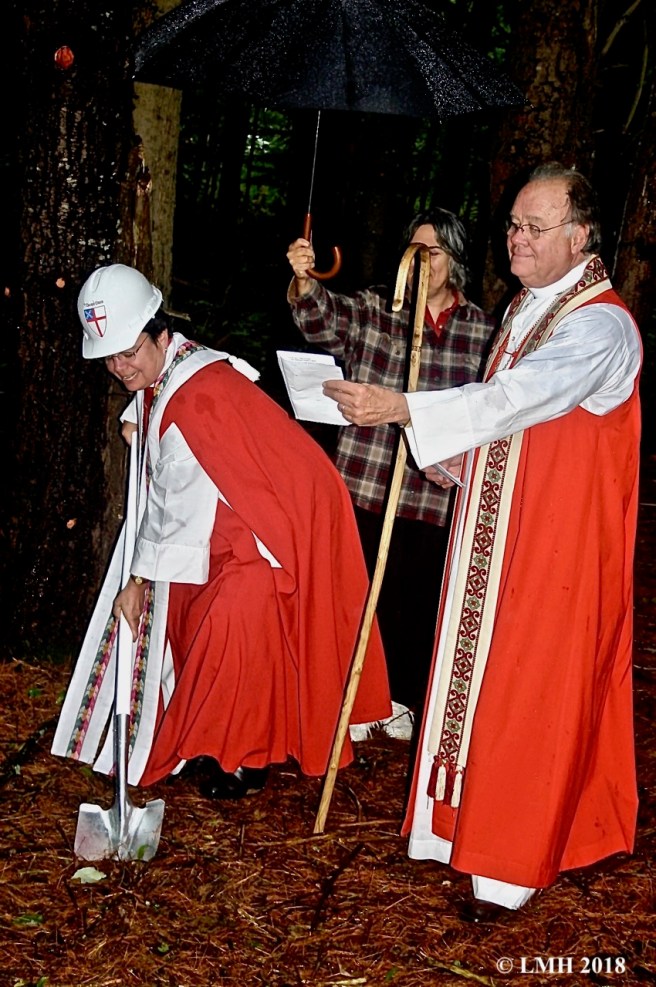
On September 15, 2007, Bishop Knudsen, donning a hardhat decorated with the Episcopal shield, dodged raindrops as she helped break ground.

S2A-LETTER FROM BISHOP KNUDSON

Following that initial groundbreaking, parishioners met at the site the first Sunday of each month for prayers and hymns. Rain . . . snow . . . mud . . . the weather presented a few obstacles, but the project proceeded in spite of it.

S3-CHURCH TAKES SHAPE

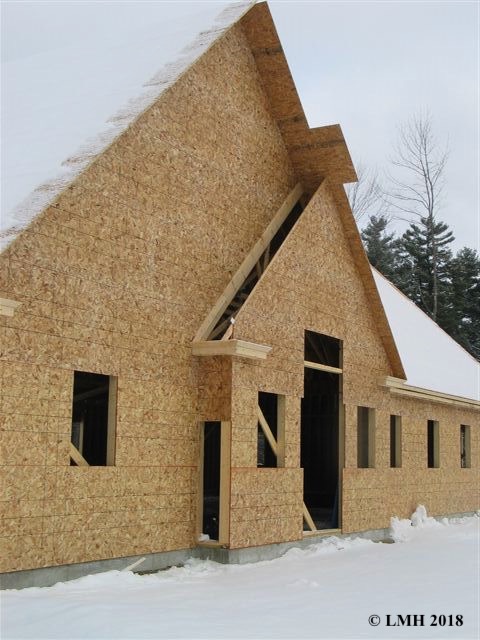
Over time, the building began to take shape.

S4-WINTER

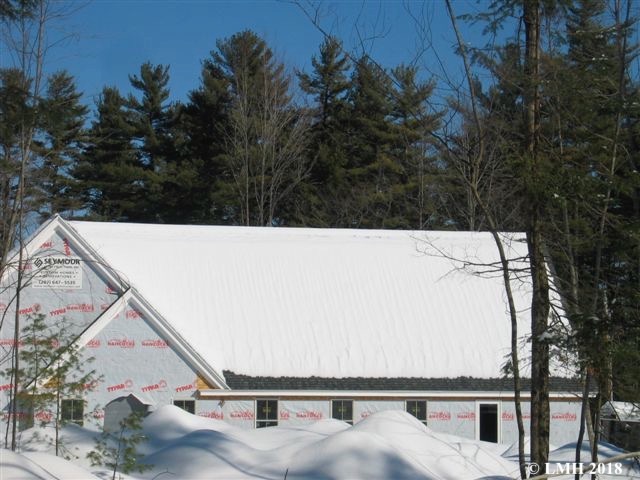
With the advent of winter, it was wrapped in Typar . . and continued prayers.

S5-ALTAR

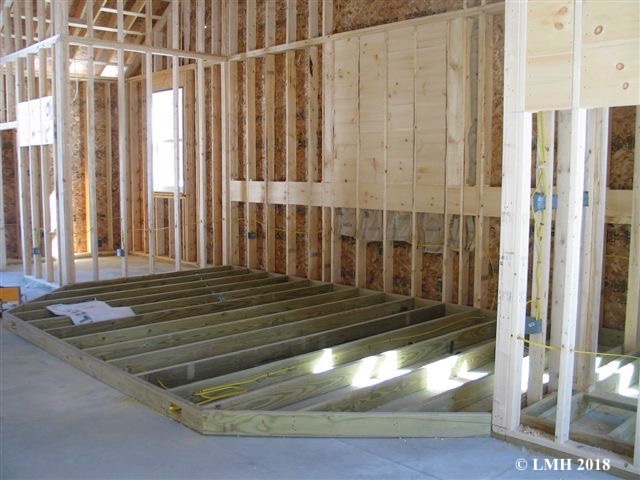
Within, the altar found its formation.

As parishioners, we watched it grow into a structure for worship and fellowship. Upon entering the church for the first service on May 25, 2008, one word was expressed over and over again, “Wow!”

S6-NEW CHURCH DEDICATION

For St. Peter’s, the Dedication and Consecration of the building on June 1st was the culmination of years of discussions, planning, being amazed at fund raising miracles and working together to reach a goal. That grand and meaningful worship service is one that many people never experience unless they build a new church. Using the service of Dedication and Consecration as outlined in The Book of Common Prayer, Bishop Knudsen knocked her crosier and called for the doors to be opened. Gregg Seymour, General Contractor, opened the door and handed the Bishop a hammer as a symbol of his work. Beatrice White presented the building blueprints while Junior Warden Eric Wissmann gave the Bishop a set of purple building keys. A procession including the Bishops of Maine, our rector, a deacon, verger, wardens, crucifer, taperers, parishioners and guests flowed through the narthex into the simple, yet beautiful sanctuary. Following prayers for the building, the Bishop moved about the church and consecrated the baptismal table and bowl, cross above the altar, lectern/pulpit, hangings and parish banner, tapers, piano, kitchen, classrooms and offices, narthex table, credence table, altar shelf, fair linen, and other special gifts. She then celebrated the Holy Eucharist, assisted by the Reverend Christine Bennett, Deacon, and George Wright, Verger. The Eucharistic Bread was baked and offered by the “SPY” group, Saint Peter’s Youth. During Holy Communion, the choir sang “Jesu, Jesu,” accompanied by Evan Miller, Director of Music. Following the service, the parish continued the celebration indoors and out with a reception and pot-luck dinner. 

S7-CHURCH TODAY

Fast forward and the parishioners are now preparing for Bishop Steven Lane to visit next week and celebrate the tenth anniversary of St. Peter’s. In all that time, so much has changed . . . including the land. And so this afternoon I spent some time wandering around the grounds in quiet reflection of the people and the place. No, not the church building, though I continue to appreciate its simplicity and still love to gaze out the circular window above the altar.

S8-ANTS ON DANDELIONS

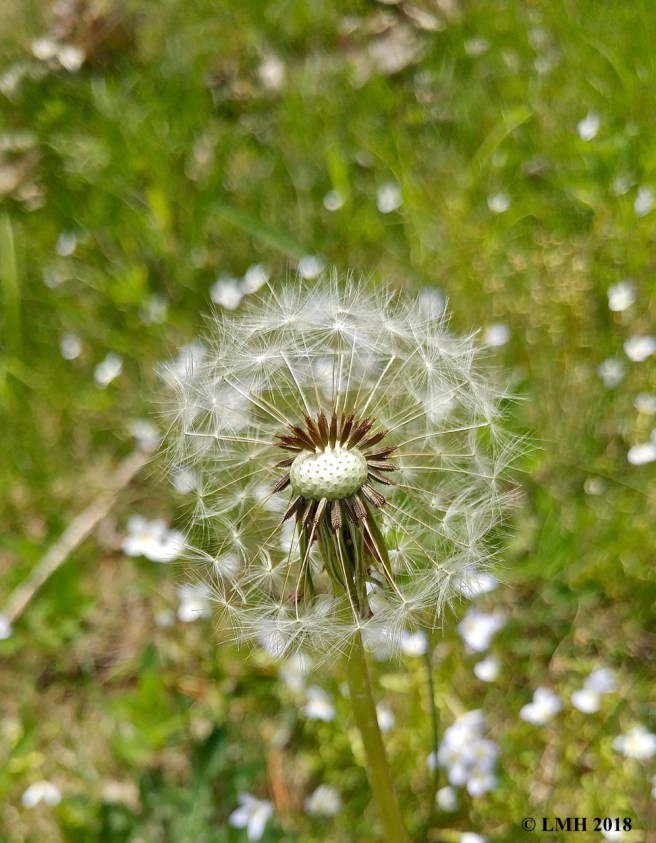
Today, however, I wanted to note all the other species that have gathered here, including the ants seeking nectar. Have you ever gotten as close to a dandelion as an ant or bee might? Did you know that each ray has five “teeth” representing a petal and forms a single floret. Fully open, the bloom is a composite of numerous florets. And equally amazing is that each stigma splits in two and curls.

S9-DANDELION SPREADING THE SEEDS

Of course, if you are going to admire a dandelion in flower, you should be equally wowed as it continues its journey. At the base of each floret grows a seed covered with tiny spikes that probably help it stick to the ground eventually. In time, the bloom closes up and turns into those fluffy balls waiting for us or the wind to disperse the seeds, rather like the work of the church. Until then, they look like a spray of fireworks at our feet.

S10-MEMORIAL GARDEN

My wandering led to the Memorial Garden where parishioners with greener thumbs than mine created a small sanctuary for one who wants to sit and contemplate.

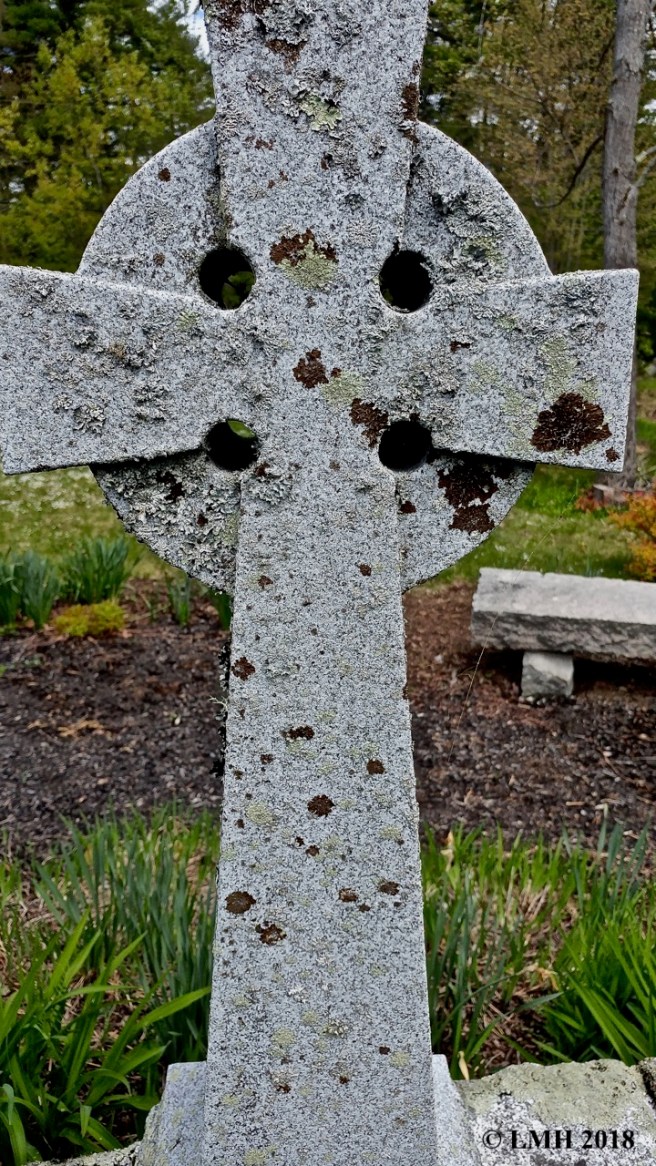
S11-CELTIC CROSS WITH LICHENS

The garden’s center offers a cross depicted in the Celtic tradition. I remember when it was installed as a “clean” piece of granite and realized today that I hadn’t been paying attention, for as is true on any of the surrounding benches, lichens had colonized it, enhancing the circle of life.

S15-GRAY BIRCH

What I really wanted to look at though was the edge where various species spoke of forest succession. I found an abundance of gray birches, one of the first to take root after an area has been disturbed. It’s always easy to spy once you recognize its leaf’s triangular form, which reminded me of Father Dan Warren’s demonstration this morning about the Trinity.

S12-PAPER BIRCH LEAVES

Nearby grew an already established paper birch, its leaf more oval in shape.

S13- QUAKING ASPEN

Then I couldn’t help it and my tree fetish took over. Quaking or trembling aspen showed off its small toothed edges, while . . .

S14-BIG TOOTH ASPEN

its young cousin displayed big teeth. Despite its fuzzy spring coating, insects had already started devouring the pubescent leaves. One of my favorite wonders about both big-tooth and quaking aspen leaves is that they dangle from flattened stems or petioles and ripple in a breeze as they send out messages of good tidings.

S16-BEECH LEAVES

Also along the edge I found a beech tree donning huge leaves that looked like they were in great shape . . . momentarily.

S17-VERY HUNGRY CATERPILLAR

For on the backside, a very hungry caterpillar had been dining on its own form of the Bread of Life.

S17A-FLOWERING DOGWOOD

I found two other young trees that I suspected were planted within the last ten years–the first: flowering dogwood. Growing up in Connecticut, we had a large one in the side yard and so memories of times long ago intermingled with those of the more recent past and my home church, Zion Episcopal, entered into my reflections.

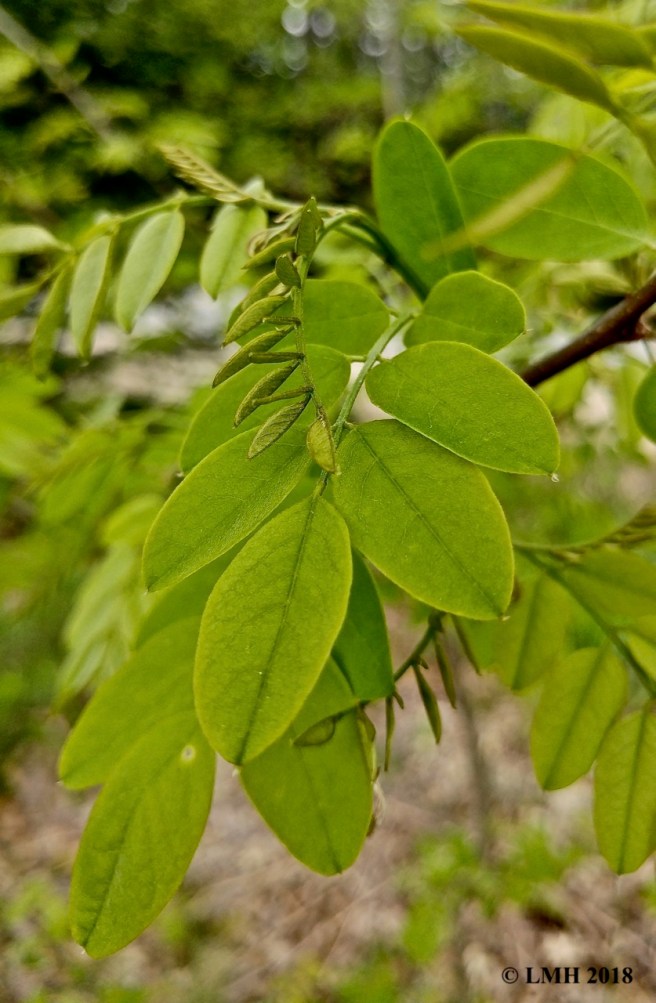
S17B-LOCUST

Like the dogwood, we also had a mature locust looming tall near my mother’s garden. Spying this one, I gave thanks for the ability to span the years, travel many routes, and remain faithful to my beginnings.

S22A-SWEET FERN

Slowly my eyes shifted downward . . . and fell upon a most pleasing sight–sweet-fern. It’s one of those, like hobblebush, that wows the eye in any season.

S18- WILD STRAWBERRY FLOWER

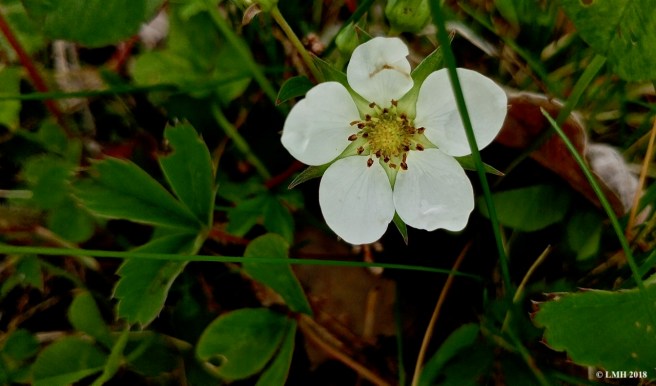
And then I turned my focus to the ground where an incredible variety of flowers either in bloom or still to come, mosses and grasses all shared the common space in seeming harmony, though I suspected there were those that crowded out others. Patches of wild strawberries graced the carpet. Five petals surrounded about twenty stamens and soon a fruit may form–meant to sustain small mammals and birds.

S21-FRINGED POLYGALA

Gay wings or fringed polygala surprised me with its presence. So delicate, so beautiful, so fleeting.

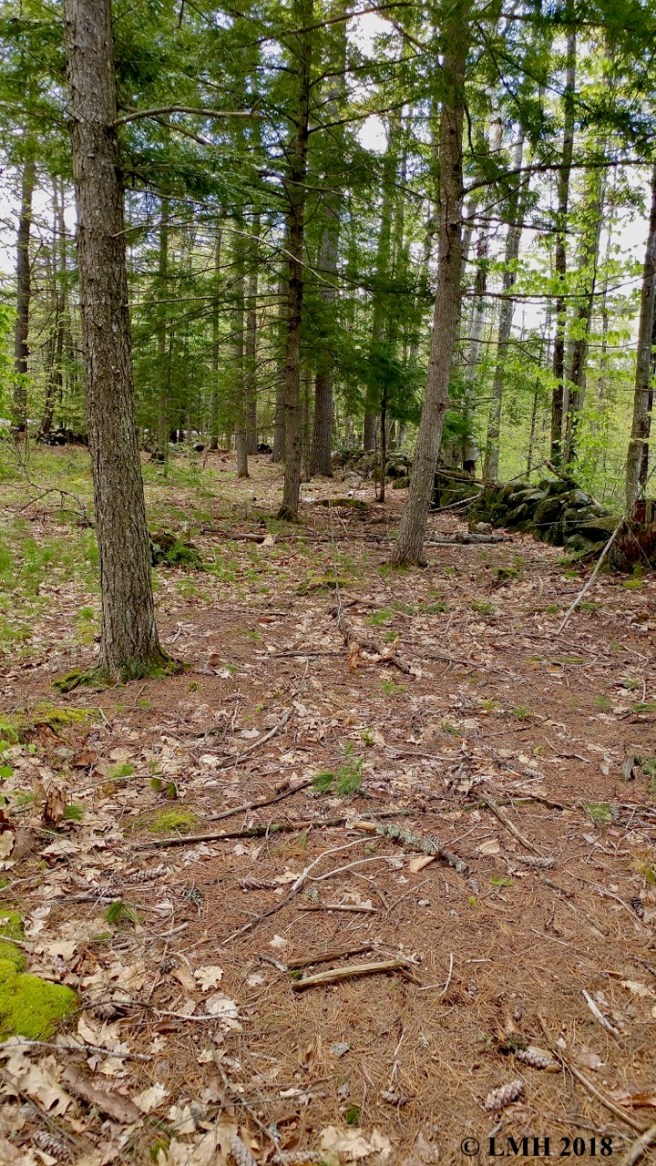
S24-STONE WALLS

I stepped into the woods beyond the edge and was reminded that ten years ago I wanted to create a nature trail on this property–a place where anyone could partake of a short wander away from reality; a place where someone might be nurtured by nature.

S19-STARFLOWER

A place where the stars above would be reflected in the flowers below.

S20-DWARF GINSENG

A place where flowers like dwarfed ginseng would erase global issues–if only for a moment.

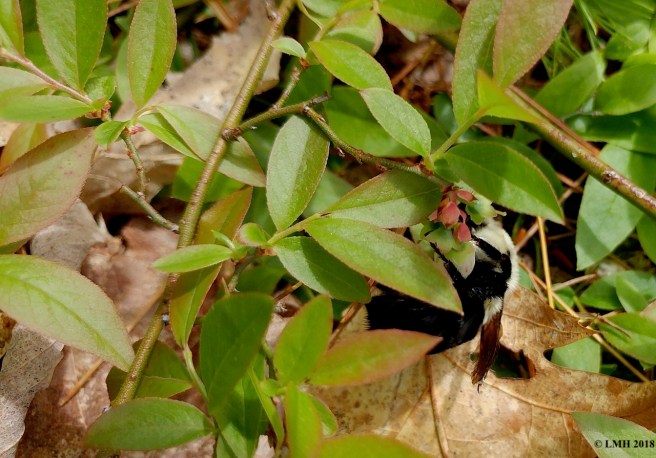
S23-GIANT BUMBLEBEE

A place where everyone recognized the system and from such recognition began to work together toward common goals.

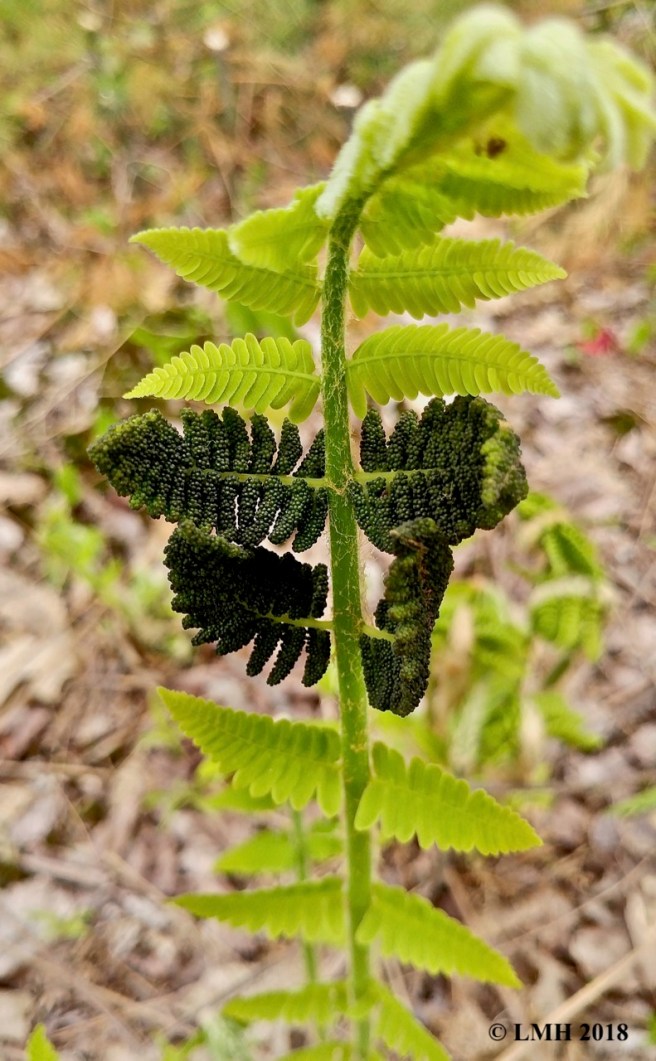
S22-INTERRUPTED FERN

A place where interruptions occurred because life happens, but such were accepted as part of the norm.

S23A-BUMBLEBEE BREAK

A place where one could find a bench upon which to rest before beginning again.

S25-ENTER HERE

Here’s to beginning again St. Peter’s.

Here’s to remembering all those who made this place a reality.

Here’s to maybe someday a nature trail.

Here’s to continuing to create a place where all are welcome whether they pass through the red doors, into the Memorial Garden, or choose to take in the offerings from the ground up.


Greenwood Nature Mondate

We love Maine both for its natural beauty and historic nature. And so it was today that we enjoyed a wee bit of both as we headed off to Greenwood.

m1-Greenwood City sign

More specifically, Greenwood City.  According to the town website, “The first saw and shingle mill was constructed at ‘Greenwood City’ in 1805. In the mid-1800s, the wood industry moved to the Village of Locke’s Mills as a result of the railroad and a fire which destroyed Greenwood City.” Apparently, the city had been the economic and civic center of Greenwood, but the fire of 1862 changed everything. Nevertheless, this was our kind of city and our intention was to climb the mountain to the left of the sign–Peaked Mountain.

m3-Maggie's Nature Park sign

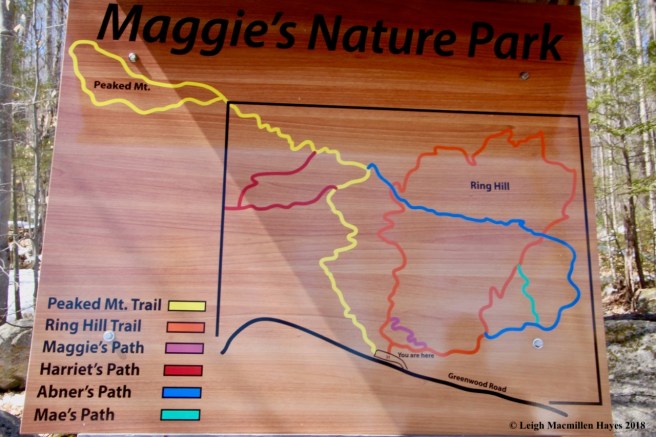
For years now, I’d heard of Maggie’s Nature Park, but never gave it much thought as a destination. That all changed today. The park encompasses 83 acres of mixed forest across the street from South Pond. It was gifted to the town by Maggie Ring, who had placed it under conservation easement with the Mahoosuc Land Trust. According to an article by Josh Christie in an April 2016 issue of the Portland Press Herald, “As Ring told the MLT in 2005, ‘I gave the land so my grandchildren and everyone else’s grandchildren can enjoy these woods. I want them to enjoy some of God’s good earth.’” 

Our plan was to begin on the orange Ring Hill Trail, and consistently stay to the right as we wove our way around the hill and up Peaked Mountain before descending via Harriet’s Path and finishing with the yellow trail.

m4-elbow tree

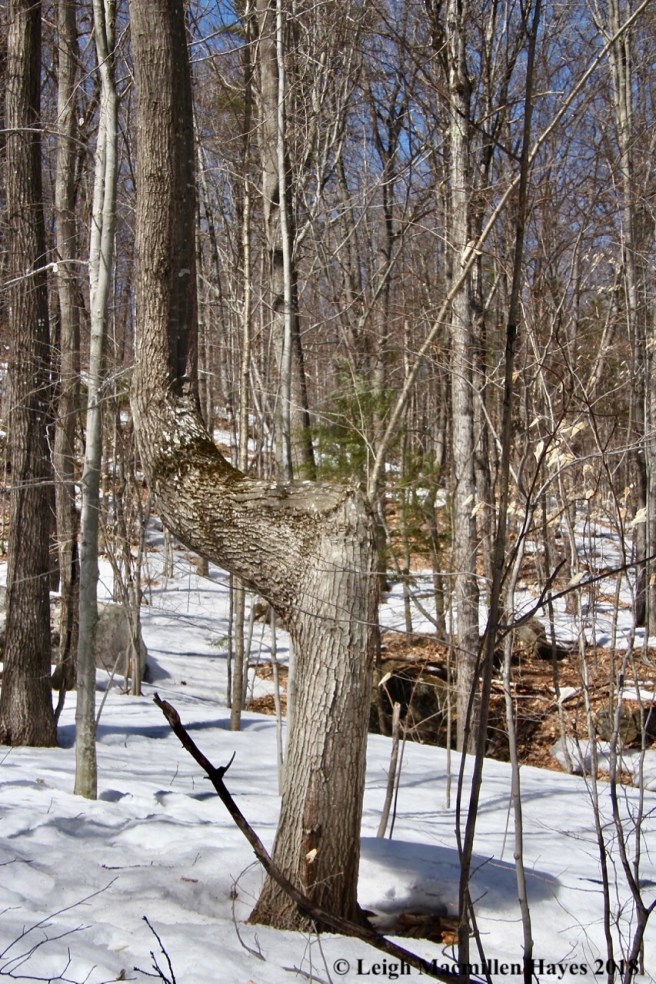
Because the temperature was on the crisp side, the snow pack was firm, though there were icy portions in the hemlock grove, and bare trail and ledges as well. As we began, we immediately noted an elbow tree, so formed probably when another tree landed upon it.

m4a-cedar

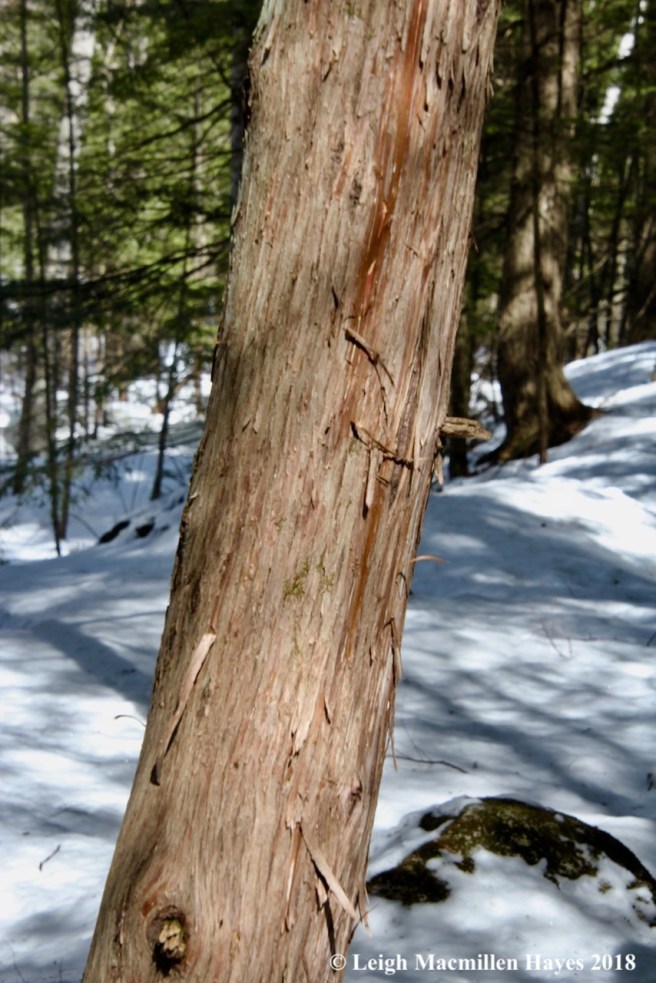
Moving along at my guy’s brisk speed, I was delighted to note the variety of trees, including cedar, and couldn’t help but imagine the teaching opportunities.

m6-evergreen wood fern

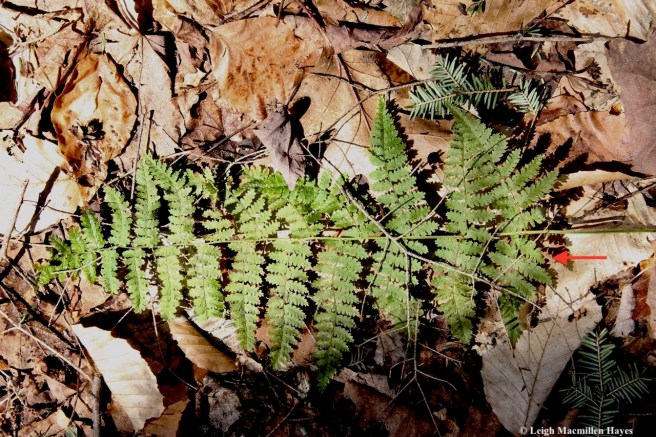
Where the snow had melted, shades of green drew my attention. And with a new season ever so slowly unfolding, I realized I needed to practice my fern ID and so I slowed my guy down for a wee bit. I think he secretly welcomes the breaks for he always finds a rock upon which to sit. One of the characteristics that helped in this ID was the first downward pointing pinnule–it being shorter than the one next to it. I also noted that the stipe or lower stalk, was shorter than the blade, and it was grooved.

m6a-evergreen wood fern

A look at the underside added to my conclusion for last year’s sori were round and all in a row between the midrib and margin. So what was it? Evergreen Wood Fern or Dryopteris intermedia if you choose to get technical. I choose to brush up on my fern ID.

m5-icicles

As we continued along Ring’s Hill, we took in the views from the ledges and under them as well, where icicles pointed toward the land they’d nurture.

m7-snack log

Eventually we followed the yellow blazes to the summit of Peaked Hill–and what to our wondering eyes should appear at a downed log near the view point? Two Dove eggs–the dark chocolate species. A perfect reward for our efforts. But really, the trail required little effort due to its well-executed construction with many zigs and zags to prevent erosion. We hardly felt like we were climbing yet we constantly moved upward.

m8-Mount Abram

The summit of Peaked offered the best views–this one being of Mount Abram, with its ski area at the top and to the right. The ski area is closed for the season, but snow still covered the trails that we could see.

m9-blueberry bushes

Also within our view–highbush blueberry buds suggesting a delightful treat for another day.

m9-toad lichen

And common toadskin lichen reminded me that Big Night is coming soon–that special rainy night(s) when we become sally savers and help amphibians cross that the road to their natal vernal pools. Stay tuned for that–there might be some migration later this week.

m10-trail well marked

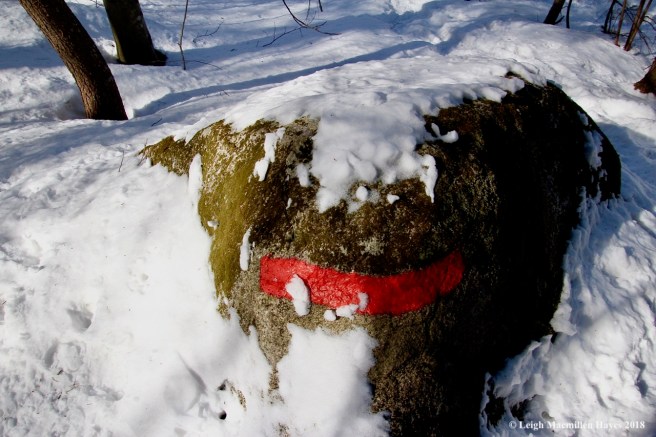
All along, we’d noted the trail markers–bright colors and frequent placement made it easy to stick to the trail. But one caused me concern for it looked like it pointed us over the edge.

m11-trail makers

Not to worry, it was merely noting a junction and curve–my guy came in from the right because he’d chosen to follow the ledge from the Mt. Abram viewpoint, while I chose to return to our snack log and then follow the trail to meet him. Together again, we journeyed to the left as the trail markers indicated.

m12-marker curving 'round rock

Rather than stay on the Peaked Mountain Trail all the way back to the parking lot, we continued with our right-hand-turn progression and chuckled when we found one trail marker painted around the curve of a rock–so indicating yet another zig.

m13-dead end

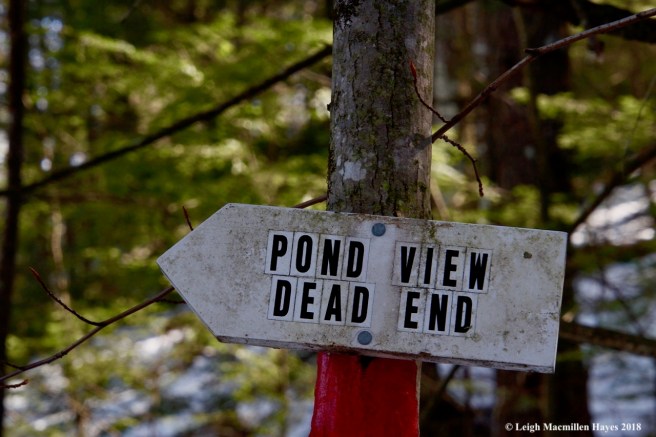
A short spur on the red trail, aka Harriet’s Path, lead to one last point of view.

m14-pond view

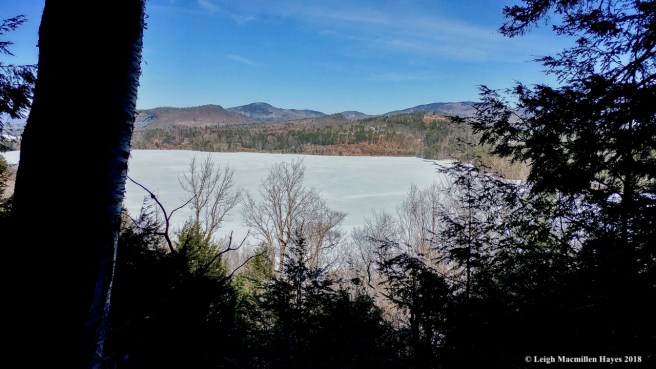
South Pond below with Buck and Lapham Ledges in the distance–hikes saved for another day.

m15-boulder field

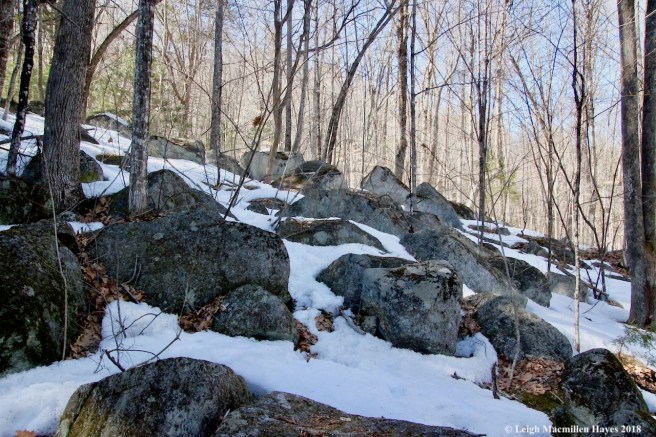
We looped back to the yellow trail and continued down through a boulder field–one more piece of what made this hike so interesting. It wasn’t long after that we completed the journey, but talked immediately about returning in other seasons for so delightful a trek it was. I can’t wait to see what flowers it has to offer and we both could only imagine it decked out with autumn’s tapestry.

m17-Greenwood Cattle Pound

On the way home, because I was driving, we had one last stop to make–by the Greenwood Cattle Pond built in 1835 just north of the city. Pounds were important features to secure stray animals prior to the invention of barbed wire and the stones would have stood taller than they do today, but still . . . another piece of history saved for this one is on the National Register of Historic Places.

At the end of the day we wondered why it had taken us so long to discover Maggie’s Nature Park, but thankfully we now have. And we gave thanks to Maggie Ring and her vision to protect “God’s good earth” for all of us. We loved the nature of Greenwood on this Mondate. Indeed.

P.S. Another claim to fame for this town: LL Bean was born in Greenwood in 1872.


Eyes of Wonder

On the first and third Tuesday of each month since the snow first flew in 2017, I’ve had the privilege of tramping through the woods with our Tuesday Trackers group. As it happened this month, we were also able to tramp together today–the fourth Tuesday.

Each week, the participants vary as they come when they can. But no matter who shows up, by the end of our two-four hour exploration, we are all wiser for the experience–and filled with gratitude for the opportunity to spend a winter morning in the Maine woods. We are also grateful for the wonder that is right in front of us, not only materializing in the form of mammal tracks, but all manner of things that make up the web of life.

j1-otters romping across the snow

Usually the age of our attendees ranges from 50-something to 80-something. But today we were joined by four little otters who reminded us what it’s like to be a child again as they bounded across the snow’s crust, and rejoiced at the sight of any and every little thing that presented itself from squirrel and chipmunk holes to fungi.

j2-squirrel prints

Of course, we were there to track and though most prints were bleached out from the sun’s March rays, we did find a few that showed well their finer points such as toes.

j14-measuring straddle

And with any discernible prints, the kids reminded us to take time to measure straddle, in this case that of a gray squirrel. We also found what we believed was a bobcat track based on the round shape of the somewhat melted print and the stride.

j3-ice and water

Most of us began the journey with snowshoes, but soon joined the kids and shedded them as we moved from frozen snow to bare ground and back again. And then we discovered water. Actually, a few of us were a wee bit behind, when one child ran up to her mom and said, “A vernal pool.” If it does turn out to be a vernal pool, we feared it will dry up too soon, but that doesn’t mean the amphibians won’t take advantage of the spot in a few weeks. It was half covered in ice, which offered a challenge because two of the boys wanted to break through it with a stick. The third boy did break through–much to his dismay. But as his calm mom said, ” Well, now he’ll know next time.” (Juli–I can’t help but smile–you are the best.)

j4-helping hands

Fortunately, for his sake, we came upon a maple tree with a huge burl on which he sat while others on the journey came to his aid and squeezed a gallon of water, or so it seemed, out of his socks. His mom had an extra pair of mittens in her pack and those covered his toes for the rest of the trek. He wore his boots, of course. While we were there, we wondered about burls and tried to remember what created them. I suggested insects and another thought perhaps fungi. It turns out we were both correct. They may also be caused by bacteria or a virus. What the young lad sat upon was a reaction of the tree to the infestation which resulted in abnormal growth due to changes in the tree’s hormones. Think of its vascular system as a twisted ball of yarn.

j5-sucker brook outlet into Kezar Lake's Lower Bay

After the sock ringing and mitten fitting episode played out, we turned around to take in the beauty of the Sucker Brook Outlet at the Lower Bay of Kezar Lake for we were on the John A. Segur East Wildlife Refuge on Farrington Pond Road.

In the distance, one lad spied a beaver lodge. You might see it as a brown dot on the snow-covered ice directly above a swamp maple snag in the center of this photo.

j6-wintergreen and spring tails

We also looked at our boots, where we rejoiced in the site of wintergreen plants evolving from their magenta winter coats. And spring tails jumping about on the leaf litter like performers in an unorganized circus.

j9-squirrel table

Upon a downed birch tree, a certain young lady found the perfect spot to set up a dinner table for a squirrel. She was kind enough to include a dessert treat by stuffing pieces of a wintergreen leaf into an acorn cap.

j10-ice bridge

Much to the delight of the younger set, they next discovered an ice bridge and took turns walking across it. The rest of us decided to pass on that opportunity, sure that we’d ruin the effect.

j11-tree stump examination

Getting up close and personal was the theme of the morning and everything drew their attention and ours, including a decaying trunk of a hemlock that was downed by a lightning strike several years ago.

j12-tree holes

Because we were curious, we noted holes of the tree’s decayed xylem, the system of tubes and transport cells that circulate water and dissolved minerals. One of the boys decided to see if it worked and poured water onto the stump, which immediately flowed into the holes. We’ve viewed tree stumps and rings many a time, but this was the first time we recalled seeing the holes. No tree stump will go unobserved on our path from now on.

j13-lodges reflect mountains

Our turn-around point was at another spot along Sucker Brook where three beaver lodges reflected the mountains in the backdrop.

j21-beaver lodge

A few of us walked across the ice for a closer look because one appeared to serve as this winter’s home site. We trusted the family within included their own young naturalists.

We were certainly thankful for our time spent with four children who allowed us to look at the world through their eyes of wonder.

(On behalf of Joan, Dave, Steve, Dick, Jonathan, and I, we thank you, Caleb, Ellie, Aidan and Wes. Oh, and your mom as well, or especially–thank you Juli. We’re all in awe of you and the gifts you’ve passed on to your kids.)


Cozy Cabin

This afternoon Jinny Mae and I went in search of the perfect location to build a cabin. A tiny cabin. A one room cabin. With an outhouse of course. And an infinity pool.

p1-Old Beaver Pond

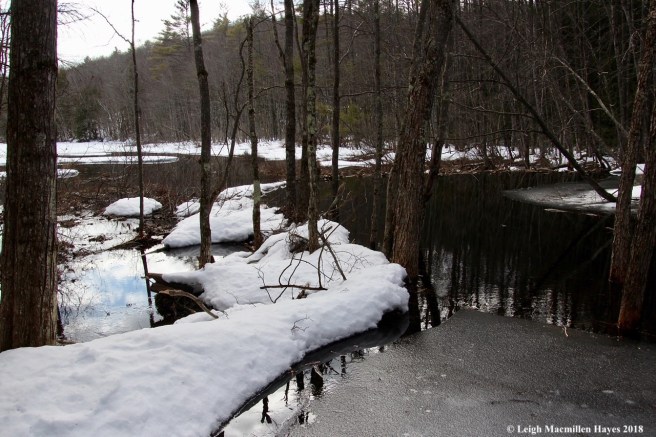
Deciding where to place it proved to be the most challenging part of the building process. We didn’t want to rush into the things and so we stood. For a long time. And absorbed the sun’s warmth. And reveled in the quiet. It was a contender, but decided we might have to return in another month or so when the song birds sing to decide if it was the right spot, for it was almost too quiet.

p4-brook

And so we continued our journey beside a stream where the ice had melted and water gurgled.

p5-water

In fact, it gurgled so much that it was irresistible and we began looking about because we felt drawn to the spot.

p3-hexagonal-pored polypore (Polyporus alveolaris)

The neighborhood also appealed to us because it had so many interesting landmarks including the hexagonal-pored polypores,

p11--tinder conk pore surface

tinder conks (aka hoof fungus) with their pore surfaces exposed,

p10-false hoof fungus

and even some false tinder conks.

p7-script lichen

One of the things that surprised us was all the writing on the bark for we found script lichen on many a tree trunk. It felt like we’d stumbled upon volumes of research about the construction process.

p12-hairy curtain crust fungus 2

When building, the old adage is location, location, location, but it helps when local resources are available–which we found in the form of curtains, aka hairy curtain crust fungus (or so I think).

p15-many fruited pelt lichen

We also spied multi-fruited pelt lichen that would be suitable to cover the floors.

p17-beaver 2

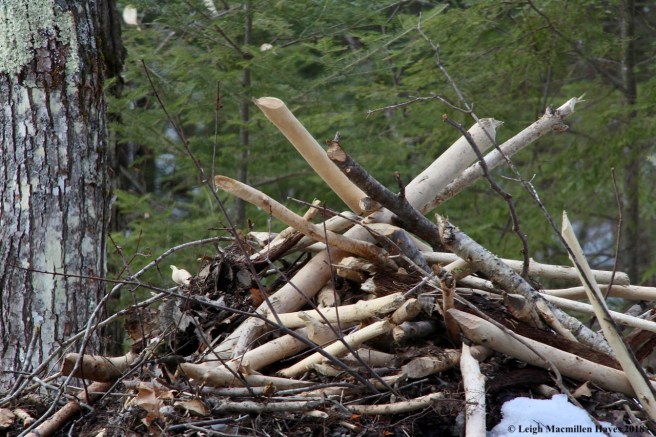
And then we began to notice the available lumber.

p19-beaver 4

It came in a variety of tree species.

p20-beaver 5

And was already de-barked.

p19-beaver 6

And pre-hewn.

p23-infinity pool

When we saw the infinity pool, we were certain that we’d found the prime location.

p24-lodge roof top

And then we spied a pre-built cabin with a new roof top and we imagined a chimney in the center of the structure.

p25-lodge and dinner raft below water

As it turned out, there was no need for us to build a tiny cabin after all, for we found one already constructed and it even included a refrigerator filled with a cache of branches. Fine dining was definitely in our future.

We were excited because we wouldn’t need to do the building ourselves and our dream was realized in a lodge that was well placed as it graced the landscape and took advantage of the local offerings. A cozy cabin indeed.

Transitions

Life, it seems, is always in transition. Or perhaps it is a series of transitions that we experience on this fast boat as we whiz through time and participate in endings and beginnings, with learning opportunities thrown into the mix. So it feels, when one season overlaps another.

If we had no winter, the spring would not be so pleasant. If we did not taste adversity then prosperity would not be so welcome. ~ Anne Bradstreet

s3a-the crew

And so this morning, I enjoyed the opportunity to experience the natural transition from winter to spring at Sebago Lake State Park with a group of seven led by AMC volunteer JoAnne Diller. (JoAnne donned the lime green coat.)

s1- Ice on Songo River

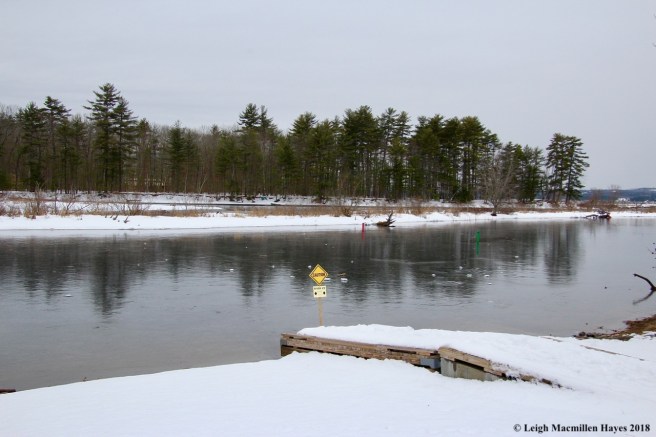
We began our journey at the boat launch beside Songo River, where signs warned of thin ice and Canada geese honked in the distance.

s2-Songo River curves

Tree buds added a subtle hint of color to the landscape. And the ice in the oxbow indicated nights of cooler temps followed by days of warming.

s3-Jan examines beech scale insect

Trees within the forest showed other signs of change for we noted the cinnamon tinge on many a beech tree. Not all transitions were good.

The trees were dotted with the waxy exterior winter coating of the beech scale insect, Cryptococcus fagisuga, a tiny insect that sucks sugar and other nutrients from beech trees only.

Soon, the beech scale insect will molt into its second, legless nymph stage and emerge. Immediately, it will start sucking sap through its tubular mouthpart or stylet. That instar stage doesn’t last long, and quickly it will become a mature female. For the rest of its life it will remain sedentary, but repeatedly remove and reinsert its piercing stylet, wounding the tree and providing entry points for fungi to enter. An interesting fact about beech scale insects–its a world of females who reproduce by parthenogenesis; there are no known males.

But what about that cinnamon color? Was it a fungus? Or was it related to the insects? Yes and yes. Two species of nectria fungi are associated with beech bark disease, Nectria coccinea var. faginata and Nectria gallengia. What we examined was a large area of the former’s fruiting bodies.

s4-Y in the road

For the most part we followed the groomed trail system, though we did do some post holing as we crossed from one route to another. And then we came to a fork in the road–so we took it! Actually, first we went left and along the way startled some deer. And realized we weren’t exactly where we wanted to be so we backtracked and journeyed on to the right. How often does that happen on this boat ride? Frequently. But the best part about today was that no one complained because we were all happy to travel the trail and enjoy the world around us.

s5-beach on Sebago Lake

At last we arrived at the beach on Sebago Lake, where snow and sand in the cove and small bits of ice moving with the gentle waves spoke of what is to come.

s7-pitch pine

It was at the same spot, where we paused at a picnic table to eat a snack, that we stood in awe of the pitch pines as they showed off their plates of bark thickened by age and unique manner of needles growing from the trunk.

s8-pitch pine cone

Even their cones, each scale topped with a rigid prickle, were beginning to break down as they began their journey of giving back to the earth.

s9-tree roots

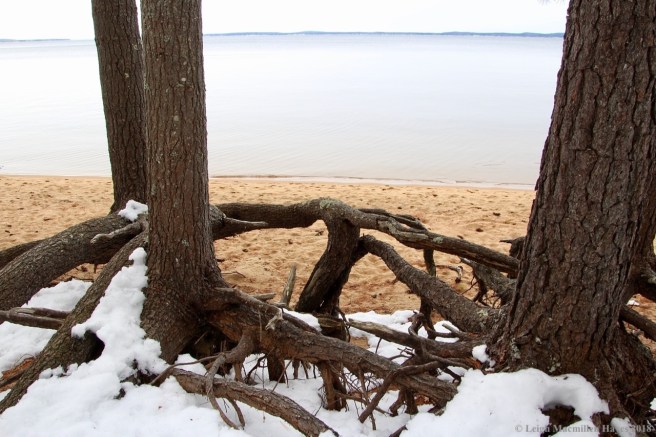
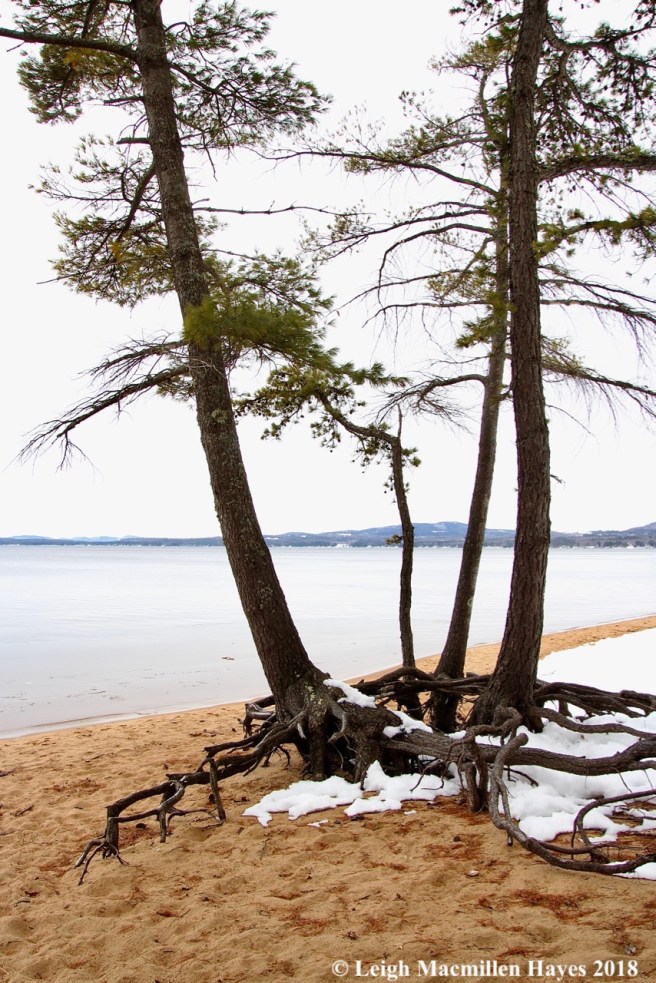
But what struck us the most were the tree roots all along the beach. And we began to wonder what had happened.

s10-roots

How old were the trees? Had the sand eroded?

s11-trees

Was the lake once much higher? And how do those trees survive? If only they could talk, we would hear their stories of pounding waves and raging storms. And maybe other adversities. Maybe they do talk and we just don’t know how to listen.

s13-back to the river

In what seemed like a flash, I realized we were on the opposite end of the oxbow I’d photographed when we first arrived–our journey had been a circular one, well sorta.

s14-buoys

By the boat launch two channel buoys waited patiently for spring to return in full force so they could move onto the river and do the job for which they were best suited.

s15-Canada geese

We took one last look before saying our goodbyes and going our own ways on this journey we call life. That’s when we spied the Canada geese–a sure sign that spring really is just around the corner.

Thank you, JoAnne, for organizing such a delightful hike and allowing us to absorb the richness of the woods, river and lake as they remind us about the transitions in life.

*And Tom, this trek is for you, and your own transition.  Love all.


Brain Share–Naturally

I was thankful I’d thrown my winter coat into the truck for I had a feeling it would be a better choice than a vest given the group I’d be traveling with this morning. And sure enough, though the sun felt warm, a breeze added a chill to the air. Plus, I knew we wouldn’t travel far and would spend much of our time standing around.

r0-life on a rock

Well, not exactly standing, for as Maine Master Naturalists, we’ve been trained to get down for a closer look. Our first stop–to check out the life on a rock that was revealing itself as the snow slowly melted. Karen is on the left, an Augusta grad, and Sarah and Anthony to her right, both South Paris grads.

r0a-polypody

The focus of our attention was common polypody, a fern with leathery leaves and spherical spore clusters on the underside. Rocks are their substrate and they often give a boulder a bad-hair day look.

r1b-speckled alder

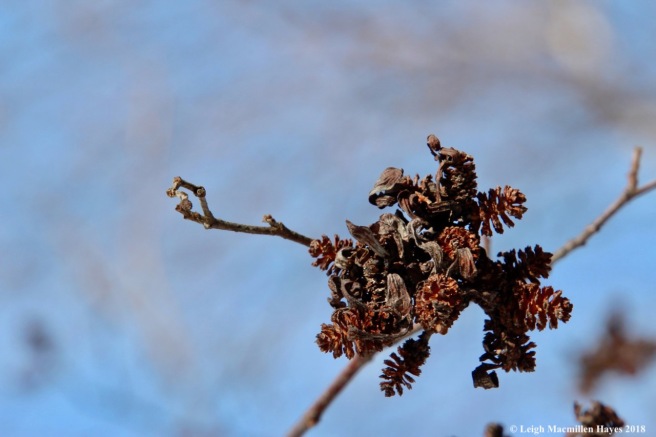
Moseying along, we reached a point where we knew we wanted to spend some time–at a wetland beside one of the Range Ponds (pronounced Rang) at Range Pond State Park in Poland, Maine. Because it likes wet feet, we weren’t surprised to find speckled alder growing there, but what did throw us for a loop was the protrusions extending from last year’s cones.

r1a-speckled alder

It was almost like they had tried to flower atop the cones and all we could think of was an insect creating a gall. Indeed, it appeared that the cones were also experiencing a bad hair day. After a little research, it may be alder tongue gall–resulting from a fungus rather than an insect infecting the female catkins. Apparently, the tongue-like growths are green to begin, but transform to orange, red and finally brown. It was certainly a new one for the four of us.

r2a-leatherleaf and sphagnum moss

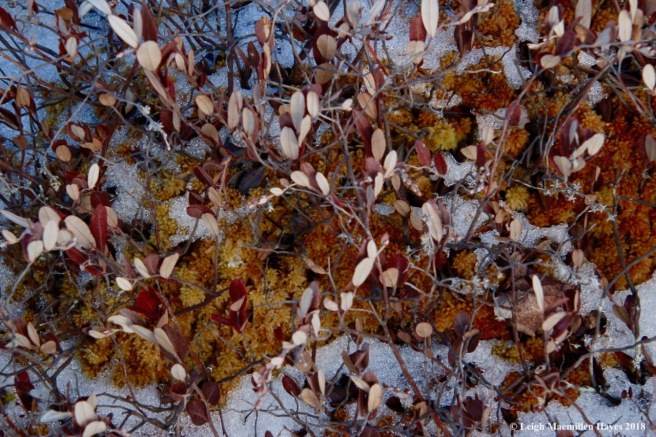
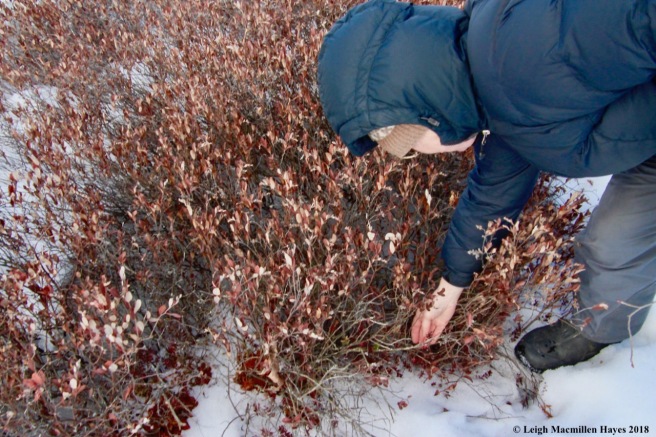
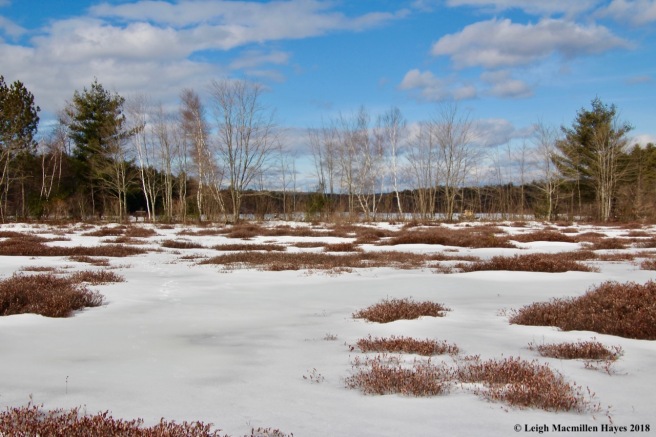
On we moved down to the wetland where the snow surprisingly held us for most of the journey and we didn’t leave behind too many post holes. Leatherleaf and sphagnum moss showed off their winter hues at our feet.

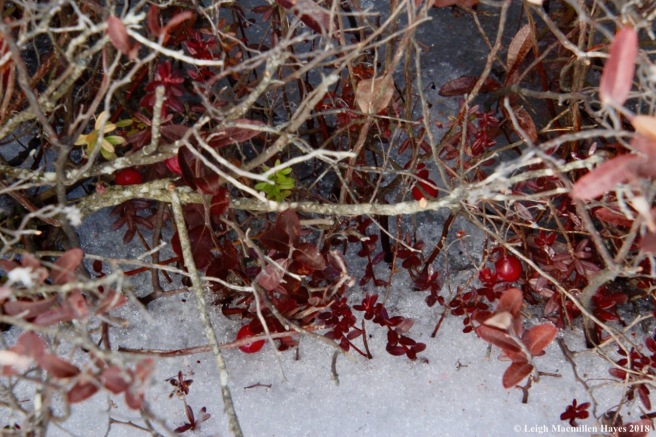
r4-cranberries

We also spied cranberries hiding underneath.

r3-cranberries among the leatherleaf

And sampled them. A few were tart, while others had fermented.

r1-two lodges

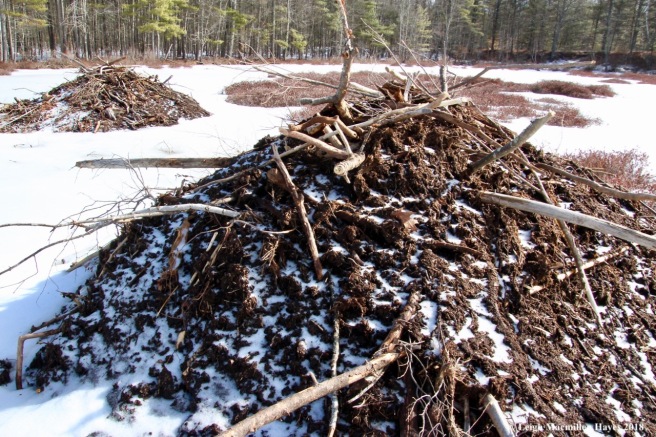
In the middle of the wetland, two well built lodges stood tall. They had fresh wood and had been mudded in the fall. One did look as if the vent hole had been enlarged, so we wondered if anyone still lived there. We heard no noises, but had to assume that we were bothering the residents so we didn’t stay long.

r2-wetland and pond beyond

One last view of the wetland and pond beyond, then we turned and walked toward the opposite side.

r5-bird nest

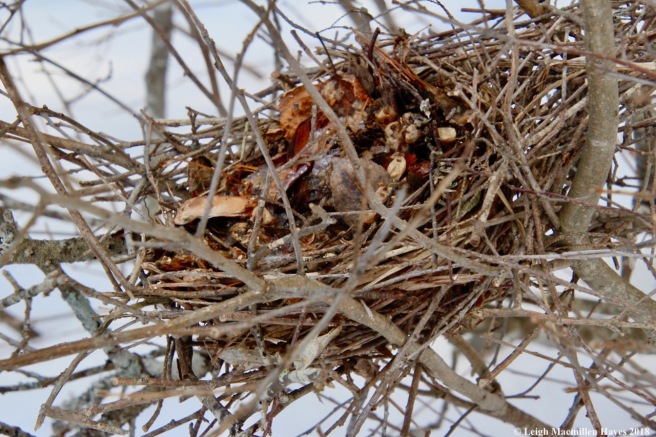
Just before climbing uphill, we spotted a bird nest in the winterberry shrubs. It was filled with dried berries, and we again made an assumption, that a mouse had cached its stash for the winter and maybe dined there in peace and quiet while the nest was covered in snow. That’s our story and we’re sticking with it. Whose nest it was prior to the mouse? We don’t know, but it was made of twigs. If you have an answer, please enlighten us.

r6-bone

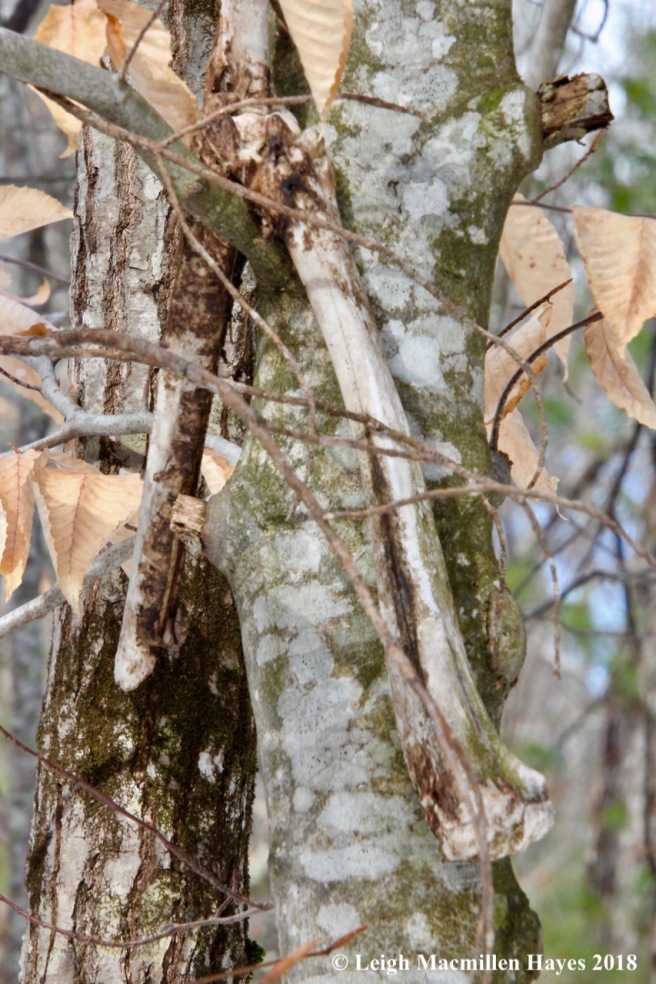
Back up on an old railroad bed, we again stopped frequently, including to talk about the beech scale insect and nectria fungus that moves in and eventually kills the trees. And then something else came to our attention–it wasn’t a broken branch hanging down like an upside-down V on the beech tree. No indeed. It was a bone. A knee bone. And it had been there for quite a while given its appearance.

r7-Introduced Pine Sawfly pupal case

Because Anthony was with us and he’s our insect whiz, we spent a lot of time learning from him–including about the pupal case of an introduced pine sawfly. The sawfly had already pupated and in this case no one was home.

r8-Introduced sawfly pupal case

As the morning went on, we became quite adept at locating more cases of other sawfly species, including one that wasn’t yet opened. We each channeled our ten-year-old selves as we tried to be first to find the next one. But really, Anthony won for he had insect case eyes.

r9-going in for a closer look

And eyes for other things as well.

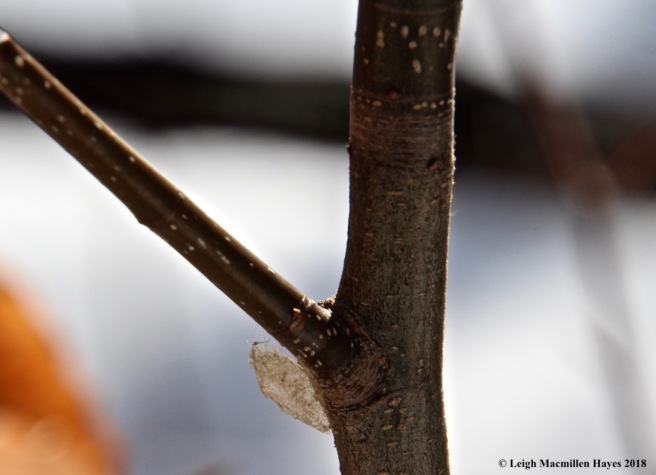
r10-old spider web case

This time we examined a delicate, almost lacy structure under a branch on a young beech. Anthony suspected a pirate spider, which tickled our fancy for we imagined them raiding the goods of others. But later he e-mailed with another option: “The old spider egg case could also be from an orbweaver of the araneidae family.” Either way, we were happy for the sighting; for taking the time to slow down and notice.

r11-beech leaves

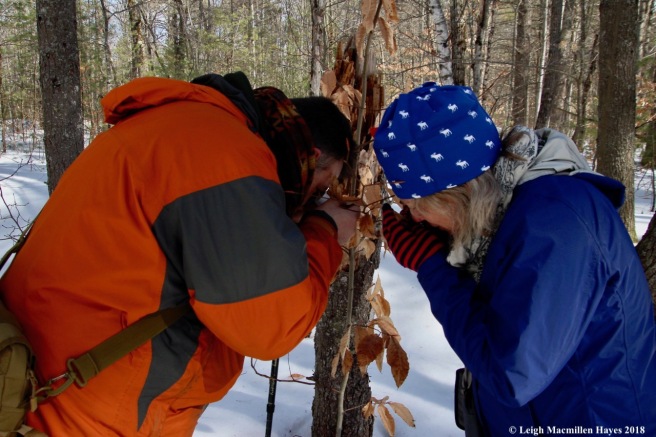
And there was more. Sarah had to leave us a wee bit early, so she missed our finds on the backside of beech leaves.

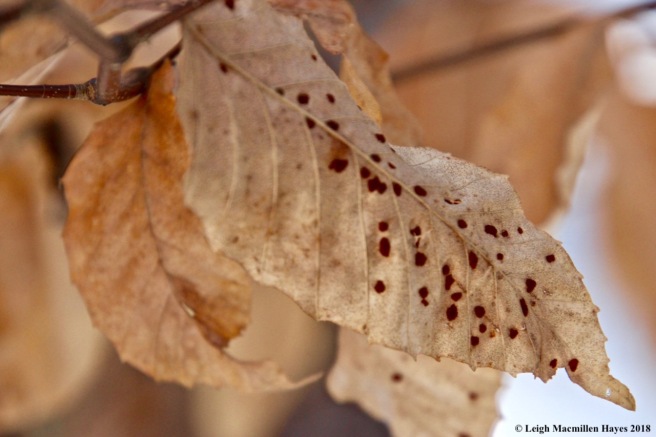
r12-maroon dots on beech leaves

They were dotted with raised bumps that under our hand lenses reminded us a bit of the sori on common polypody.

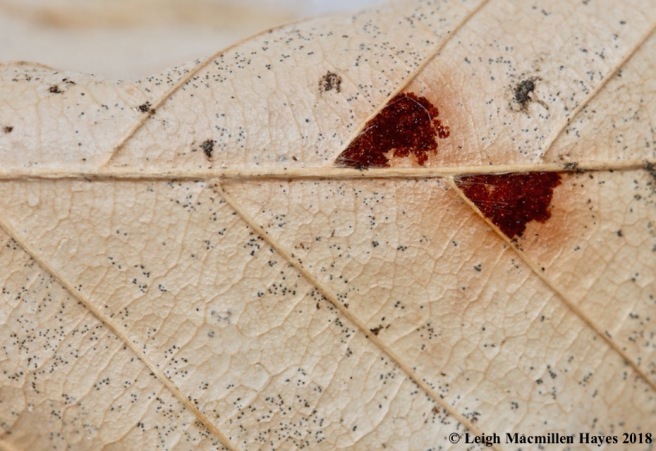
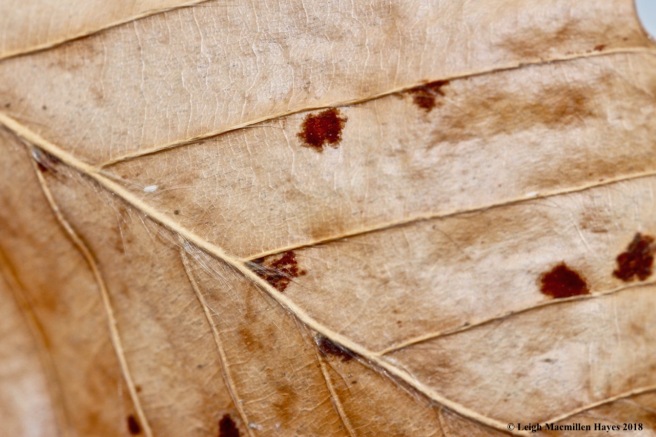
r13-maroon dots on beech leaves

Leaf rust? Was it related in any way to the splattering of tiny black dots also on the leaves? We left with questions we haven’t yet answered.

r14-hair on beech leaves

Taking a closer look did, however, remind us of how hairy beech leaves are–do you see the hairs along the main vein? And that reminded us of how the tree works so hard to protect the bud with waxy scales all winter, keeping the harsh conditions at bay. In early spring, slowly the leaves emerge, ever hairy, which strikes me as an adaptation to keep insects at bay, and then . . . and then . . . it seems like every insect finds a reason to love a beech leaf and in no time they’ve been chewed and mined and you name it.

r15-oak gall

We made one more discovery before heading out–a gall formed on oak twigs. Do you see the exit hole? It’s in the shape of a heart–apparently the insect that created the gall loved the oak.

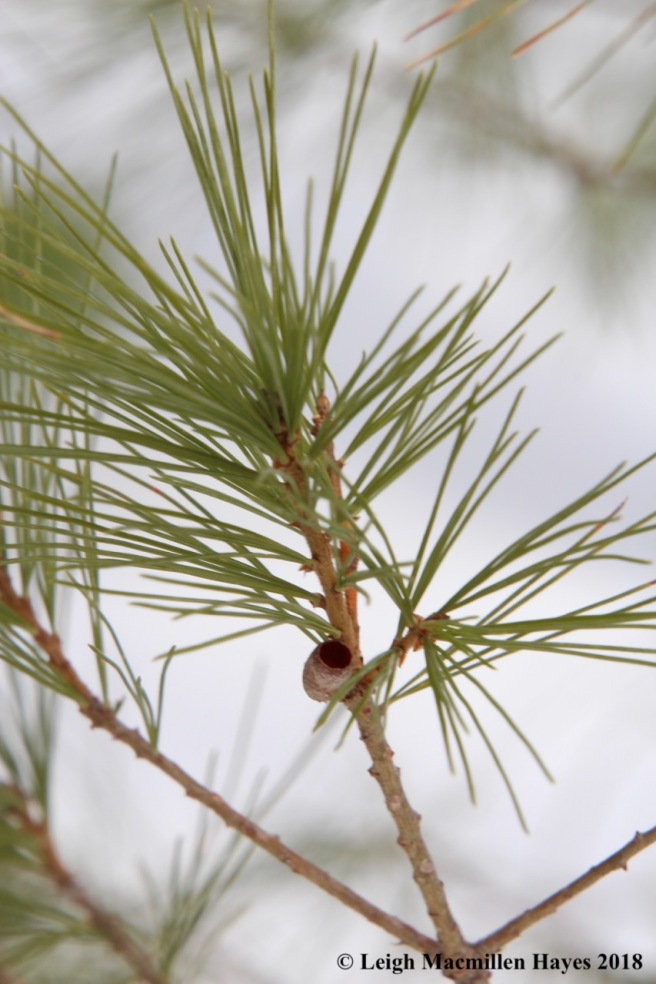
r15-pine tube moth

As we made our way back to the parking lot, I kept searching all the pine trees because I wanted to share an example of the tube created by a pine tube moth. Of course, there were none to be found, but as soon as I arrived home, I headed off into the woods for I knew I could locate some there. Bingo.

Notice how the lumps of needles are stuck together in such a way that they formed a tube. Actually, the tube is a tunnel created by the moth. The moth used silk to bind the needles together, thus forming the hollow tube. And notice the browned tips–that’s due to the larvae feeding on them. Eventually the overwintering larvae will pupate within the tube and emerge in April. Two generations occur each year and those that overwinter are the second generation. Fortunately, they don’t seem to harm the trees–yet.

Three and a half hours later we hadn’t walked a great distance, but our findings and learnings were many and we talked about how we’d added more layers to our understanding. Now if only we can remember everything. Thanks to Karen, Sarah and Anthony for sharing your brains me with–naturally.

P.S. Lewiston MMNP grads, et al, I’ll be in touch. Look for a doodle poll soon so we can get out and do the same. Or if you want to take the initiative, please feel free to go for it.


Distracted by Nature

A morning message from my dear friend Carissa set the tone for today. Her Lenten devotional is based on the poetry of Mary Oliver and she thought of me when she read “The Summer Day.”

The Summer Day
Who made the world?
Who made the swan, and the black bear?
Who made the grasshopper?
This grasshopper, I mean-
the one who has flung herself out of the grass,
the one who is eating sugar out of my hand,
who is moving her jaws back and forth instead of up and down-
who is gazing around with her enormous and complicated eyes.
Now she lifts her pale forearms and thoroughly washes her face.
Now she snaps her wings open, and floats away.
I don’t know exactly what a prayer is.
I do know how to pay attention, how to fall down
into the grass, how to kneel down in the grass,
how to be idle and blessed, how to stroll through the fields,
which is what I have been doing all day.
Tell me, what else should I have done?
Doesn’t everything die at last, and too soon?
Tell me, what is it you plan to do
with your one wild and precious life?
~Mary Oliver

A perfect beginning, indeed.

w-Horseshoe Pond

A short time later I joined a couple of other friends and we traveled together to the Greater Lovell Land Trust’s Wilson Wing Moose Pond Bog Preserve. Our snowshoe journey began beside Horseshoe Pond where we paused to enjoy its beauty and recall trips up Lord Hill, whose face was obscured to the left.

w-hemlock cones and seed below

Once we got onto the trail, it was the little things that we noticed, like the hemlock cones with partially opened scales, their seeds all released. One tiny seed sits atop my name in this photo, but we wondered together why we’ve always seen the cones only in their closed up formation, whether fresh or old. Had they always looked like this one in late winter and we just never realized it previously?

w-frullania liverwort with new growth

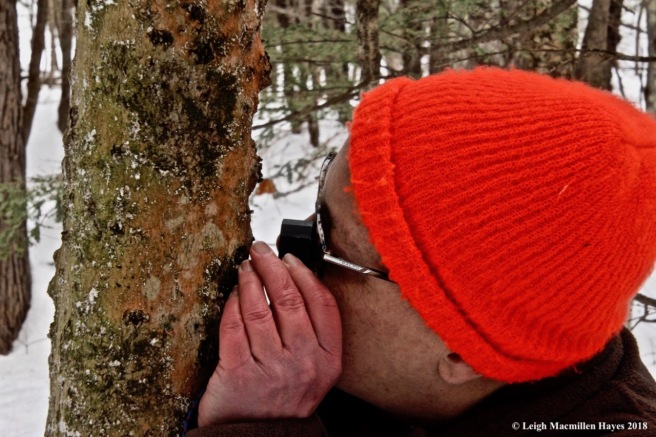
And then we paused beside yellow birches where the liverwort Frullania eboracensis grew in abundance. Again, a new realization for us. We knew it to have brown stems, but today spied the green. As it turns out, in his book, Mosses, Liverworts and Hornworts, author Ralph Pope begins his description with this: “Plant dark green to brown . . .” Our eyes were opened.

w-crowded parchment laterally fused

Next there was the Crowded Parchment fungus that threw us off momentarily. We recognized the cap, but were unsure about the part of the fungus that was spread out flat like a crust. It turns out, the flat parts or fertile surfaces of this mushroom laterally fuse or join together at the dark ridges. This behavior certainly spoke to its name of crowded. In Fascinating Fungi of New England, Lawrence Millman refers to it as “One of the most common fungi as well as one of the most crowded in New England . . . It’s not unusual to see several hundred gregarious fruiting bodies laterally fused or in dense clusters on a single branch.” Common or not, we were wowed.

w-script lichen

And because we stopped to gain a better understanding of the Crowded Parchment, another gift was offered in the form of script lichen writing its own story on an adjoining branch.

w-nectria fruiting bodies?

Nearby, there was a similar cinnamonish color on beech bark. This particular beech was dotted with the waxy exterior winter coating of the beech scale insect. As I’ve noted before, the scale insect or more technically, Cryptococcus fagisuga, is a tiny insect that sucks sugar and other nutrients from beech trees only.

Soon, the beech scale insect will molt into its second, legless nymph stage and emerge. Immediately, it will start sucking sap through its tubular mouthpart or stylet. That instar stage doesn’t last long, and quickly it will become a mature female. For the rest of its life it will remain sedentary, but repeatedly remove and reinsert its piercing stylet, wounding the tree and providing entry points for fungi to enter. An interesting fact about beech scale insects–its a world of females who reproduce by parthenogenesis; there are no known males.

w-closer look

But what about that cinnamon color? Was it a fungus? Or was it related to the insects? Yes and yes. As some further research revealed, two species of nectria fungi are associated with beech bark disease, Nectria coccinea var. faginata and Nectria gallengiaIt is now my understanding that what we examined was a large area of the former’s fruiting bodies. Oh my.

w-lichen garden1

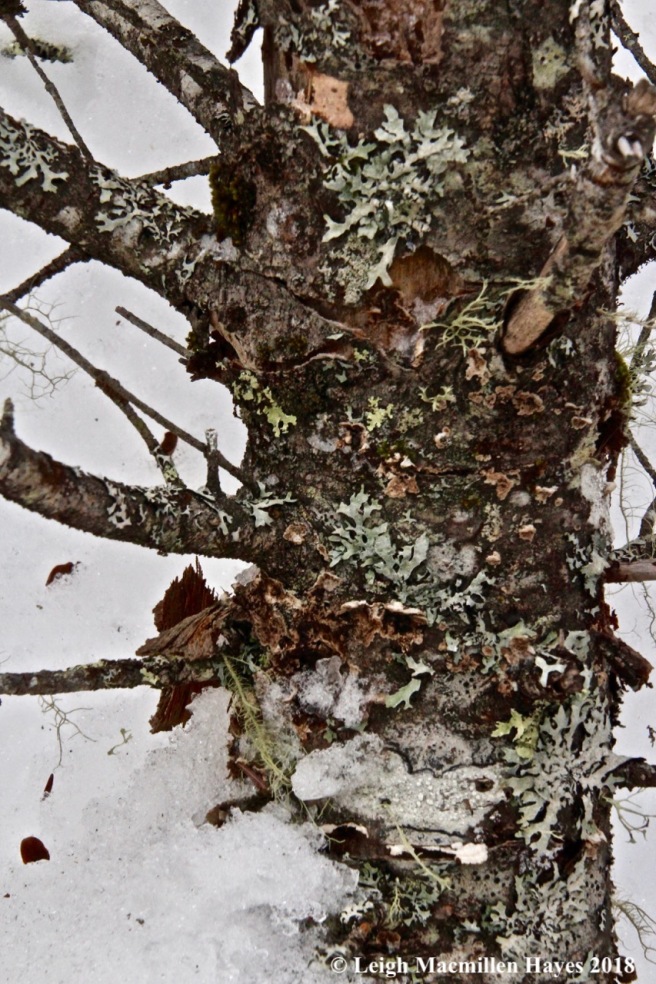
We also paused frequently beside gardens dominated by lichens. Crustose, foliose and fruticose varieties completely enveloped the bark of this toppled tree, their individual colors and textures adding to the visual display.

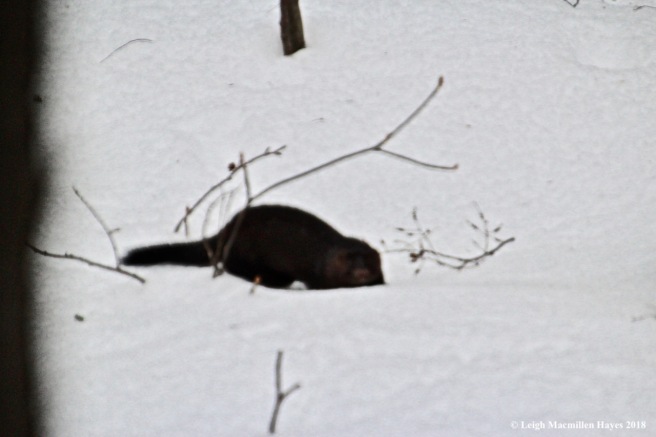
w-mink 1

And then . . . and then . .  . as we looked, a motion captured the attention of one in our group. I only wish my focus had been better, but still, it was enough.

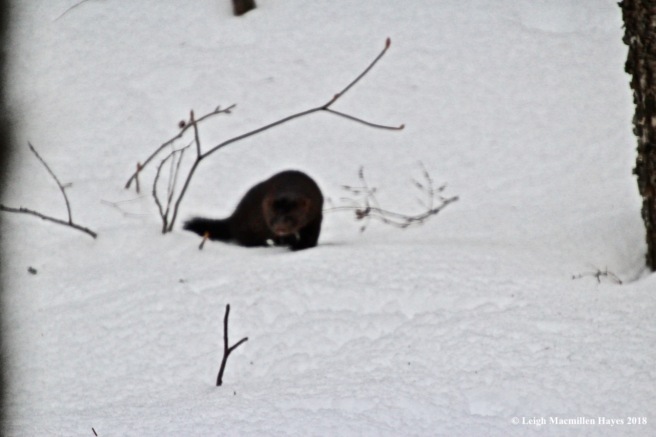
w-mink 2

We were blessed with the opportunity to spend a few moments with a mink as it bounded down the hill before realizing it had an audience.

w-mink measurements

Of course, after it disappeared down a hole into a stream and we’d waited a bit, we checked out the tracks it left behind. The size of the prints and length of the straddle or measurement from the outside of one print to the outside of the other confirmed our ID.

w-mink prints

From that point on, we continued to find evidence that the mink had traveled to and fro over the course of several days. Our hearts were grateful to have shared such a moment.

w-hairy, bony find

And as we took measurements, we spotted something else on the snow. Something hairy and bony found about three or four inches from the fresh mink tracks.

w-hairy, bony--scapula

A scapula from a little brown thing, possibly a vole. Dropped from the mink or from above by a bird? We’ll never know. But we do know that someone consumed someone else–as it is in the natural world.

w-Sucker Brook

Seeing the mink made perfect sense because we traveled on and off trail beside Sucker Brook.

w-hobblebush flower and leaf buds

It was there that the naked but hairy hobblebush leaves and flower buds reminded us that spring isn’t far off. The three of us don’t necessarily want winter to end for we love how it forces us to notice other things such as the nectria’s fruiting bodies. And we love to track. But . . . we also love the other seasons, so we’re happy exploring at any time of the year.

w-suds

Beside the water, the icy formations kept calling my name and I honored many by snapping a photograph. But, then we met the suds. Water foam is caused by the decay of twigs and plants and occurs naturally in streams and brooks. As they release compounds, the interaction breaks the surface tension, allowing air to mix in and create bubbles. And just as we found the Crowded Parchment living in a large community, we also found this congregation of bubbles–creating a design all its own.

w-Wilson Wing Moose Pond Bog

Despite the short trail, it took us forever to reach the point where the brook becomes Moose Pond Bog, but we did.

w-stream with rattlesnake liverwort

And then we beelined (sort of, for still we kept stopping) to the final stream crossing on the trail for we wanted a glimpse of the rattlesnake liverwort we’d discovered growing there last year. Alas, it was buried under snow. And that means we’ll have to return again. Darn.

w-sucker brook reflections

In the end, it was a morning well spent as we dillied and dallied over the littlest of things. And watched a mink. We got to see a mink!

No, it wasn’t a summer day. But . . . we were distracted by nature. As Mary Oliver asked, “What else should we have done?”


Satiating Our Curiosity at Long Meadow Brook Reserve

Two weeks ago I traveled the trail at the Greater Lovell Land Trust’s Long Meadow Brook with several friends and much of our wonder was captured by intermingling lines.

l-ice lines

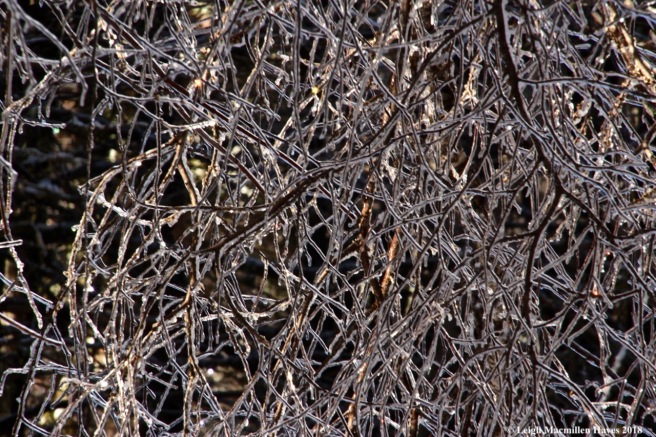
All felt quite magical on that crisp January day as the encrusted twigs and buds offered a brilliant display.

l-snowbirds in the ice castle

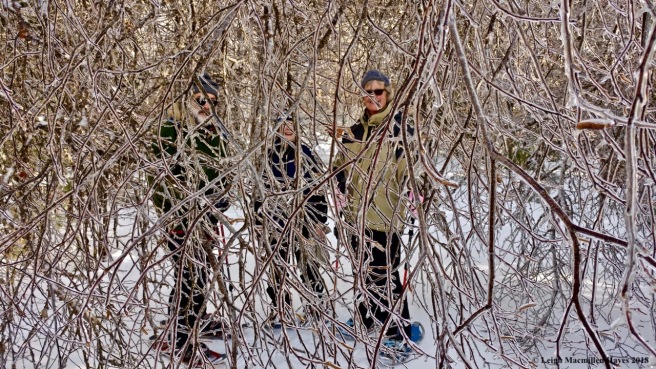
It was made even more special because two of the three with whom I tramped were snowbirds who experienced the awe of our winter world. Despite all their layers, they  felt like royalty living in an ice castle, glass slippers and all. (Don’t be fooled into thinking those are snowshoes strapped to their boots or winter hats rather than crowns.)

l-Long Meadow Brook 2

We made our way to the dam by the brook as the sun shifted lower and shadows lengthened. It didn’t matter for the sky was clear and we celebrated exploring the winter world of Lovell.

l-porky den 1:25:18

And then we backtracked a bit before crossing a property under conservation easement with the land trust and visited a porcupine condominium located in a large stump dump. The porkys didn’t let us down and we found prints leading into and out of seven or eight entry ways, along with downed hemlock twigs and scat. All perfect porcupine sign.

l-squirrel 1

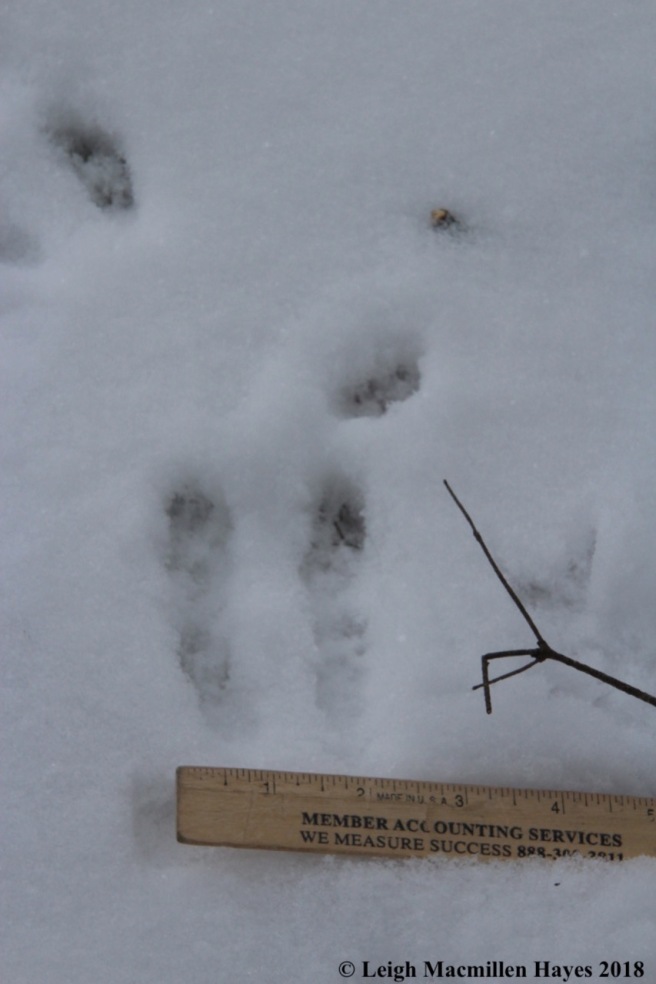
Since then, we’ve experienced a variety of mixed winter weather, but this past weekend a couple of inches of snow fell, making for great tracking conditions, such as this group made by a red squirrel, the two smaller feet being its front feet, which landed first, before the larger hind feet swung around and landed in front–the typical pattern left behind by a hopper or leaper. Its toes pointed toward my ruler, thus indicating the direction of travel.

l-chipmunk prints 1

Because it had been warm over the weekend, chipmunks made a brief appearance–rather than being true hibernators, they are light sleepers and will move about in the chambers within their tunnels. Occasionally, during a thaw, they’ll even venture out to forage for fresh seeds.

l-chipmunk prints 2

Notice how the straddle is about two inches, while the red squirrel above exhibited a straddle of about three inches. Straddle being the measurement from the outside of the left hind foot to the outside of the right hind foot. In case you are wondering, the measurement for gray squirrels is about four inches.

l-coyote track

And then I came upon tracks so fresh that I was certain I might spy the two coyotes who traveled before me, but as is most often the case, I didn’t see them.

Following the snow, we had another downpour and everything changed. But then the temperature dipped again.

l-few Tuesday Trackers

And so today when the GLLT’s Tuesday Trackers took to the trail at Long Meadow Brook Reserve, we were sure we’d find a plethora of well-made tracks. Only two problems. One: by the time Kathy, Dick, Mary, Russ, and I arrived, it was snowing lightly. And two: not too many mammals had been on the move in the last day or so. At least not in that neck of the woods.

l-Long Meadow Brook 1

We beelined (sort of, for we did stop to look at deer tracks) down to the old beaver dam hoping for otter sign or that of other weasels. Nada. Instead, we took in the view to the north.

l-Long Meadow Brook south

And then to the south.

l-beech leaf 2

And headed toward the porcupine condo. But along the way, a couple of other things caught our attention, including a beech tree getting a head start on the next season.

l-pitch pine 3

And a pitch pine that was the gnarliest any of us had ever seen. Pitch pine needles, in bundles of three, grow on the branches but may also sprout on the trunk–a unique feature making for easy identification among the evergreens. But so many? On branches?

l-junco

At last we reached a field where we welcomed sunshine to warm us up and noticed a few feathered friends. More than one junco scratched some bare ground in search of seeds.

l-squirrel pattern

As we crossed the field we rejoiced to have the track pattern of a gray squirrel to admire. Small things made us happy.

l-lorax tree

And then, at the top of one of the stump dumps we stood in awe of the Lorax tree. Only several branches had small fans of needles left; all the rest having been devoured by the local residents living below.

l-porky hemlock twigs

As we made our way into the hemlock grove to take a closer look, we spied what we believed to be a bobcat track based on straddle and stride, the latter being the distance from the toes of one print to the toes of the next print in the zigzag line. The overall impressions were a bit diluted indicating they were a few days old, but we’ve seen the same in this area before and the measurements led us to that conclusion. We also spotted downed hemlock twigs featuring the characteristic 45˚angled cut made by a porcupine.

l-porky tracks?

By this time, our group had increased by two when Alice and Saranne joined us for the trip into the porcupine haven.

l-porky den:stump dump

We peeked into holes, but suspected the homemakers had entered inner chambers.

l-porky tracks 2

We did find telltale tracks filled with the morning’s flurries, but still demonstrating their pigeon-toed pattern. And we saw that the bobcat had checked the holes as well before it moved on.

l-porky hole:hoar frost

We decided to move on as well, climbing up onto the stump dump, but with a word of caution to watch out for steam holes. Hoar frost surrounded the holes and gave us further reason to believe that indeed the condo was occupied.

l-porky tracks around downed limb

The very branch under which we saw one hole had fallen from a white pine. All around it were more porcupine prints.

l-porky chews

As for the white pine’s needles–think of them as dinner. The same was true of a bent red oak branch and its buds. A little variety in the diet.

l-bench

We too were ready to eat and so we headed out.

Another three hour tour and our curiosity was satiated at Long Meadow Brook Reserve and the adjacent property.  A couple of benches await at Long Meadow Brook should you want to pause and take in the wonders yourself.


Forever Green

According to a Cherokee legend, one cold season an injured sparrow knew he could not fly south with his family, so he bid them farewell and went in search of a place to survive.

Sparrow asked Oak to shelter him among its leaves so he might heal and greet his family upon their return in the spring.

But being a crusty old tree, Oak didn’t wish to have a winter house guest and so he turned Sparrow away.

Downtrodden, Sparrow approached Maple. Sweet as she might be, Maple also turned Sparrow away.

And so it went. Sparrow was turned down by each tree he visited, until there was only Pine left to ask for help.

Pine listened to Sparrow’s pleas and his heart heard Sparrow’s plight. And though Pine knew his leaves were tiny and more like needles, and his branches not as many as the others, he welcomed Sparrow to join him for the cold season.

As hoped, Sparrow healed and greeted his family the following spring.

Creator heard and saw all that had happened and called a great council of the Trees. In his address, he rebuked them for they’d been given so much and would not share the least of what they had with Sparrow in his time of need. Therefore, from that day forward, when cold came upon the land, their leaves would wither, die and blow away.

Creator then spoke to Pine, praising him for being the least among the trees, and yet giving so much. And so, Pine was honored to remain forever green.
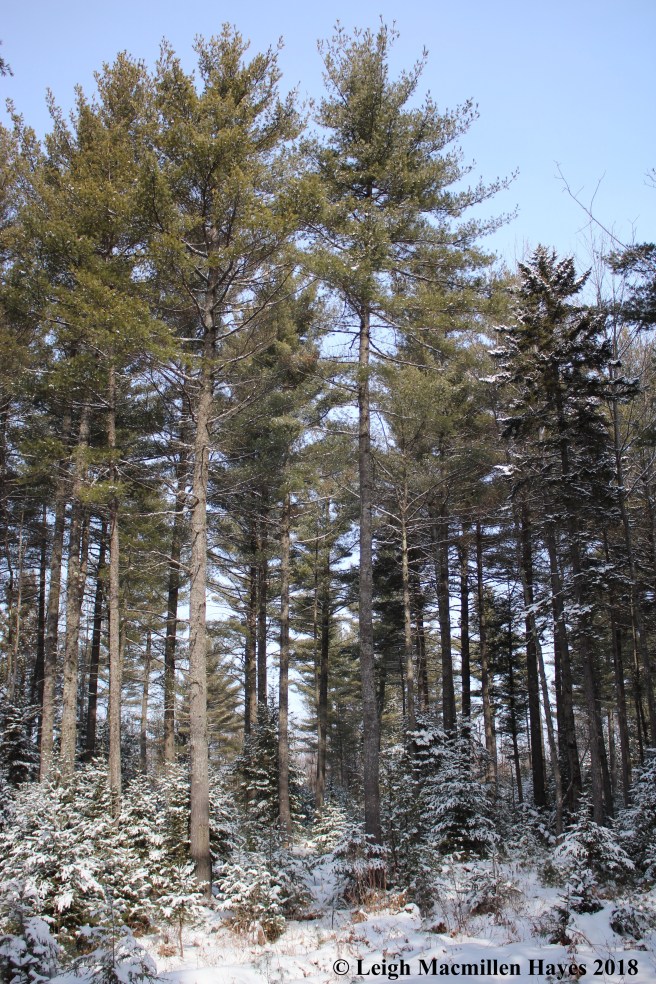
e-eastern white pine magestic.jpg

The Eastern white pine (Pinus strobus), strikes me as the majestic tree of our forest. Of course, it was once even more majestic. In the 1600s, the British Royal Navy blazed all of those two feet or more in diameter and within three miles of water with the broad arrow indicating they were to be cut, harvested and sent to England for ship masts. The blaze became known as the King’s Arrow in honor of King George I. At that time, the trees may have been 300-400 years old and over 200 feet tall. The oldest and tallest white pines in our current landscape are 80-100 years old and maybe about 100 feet tall.
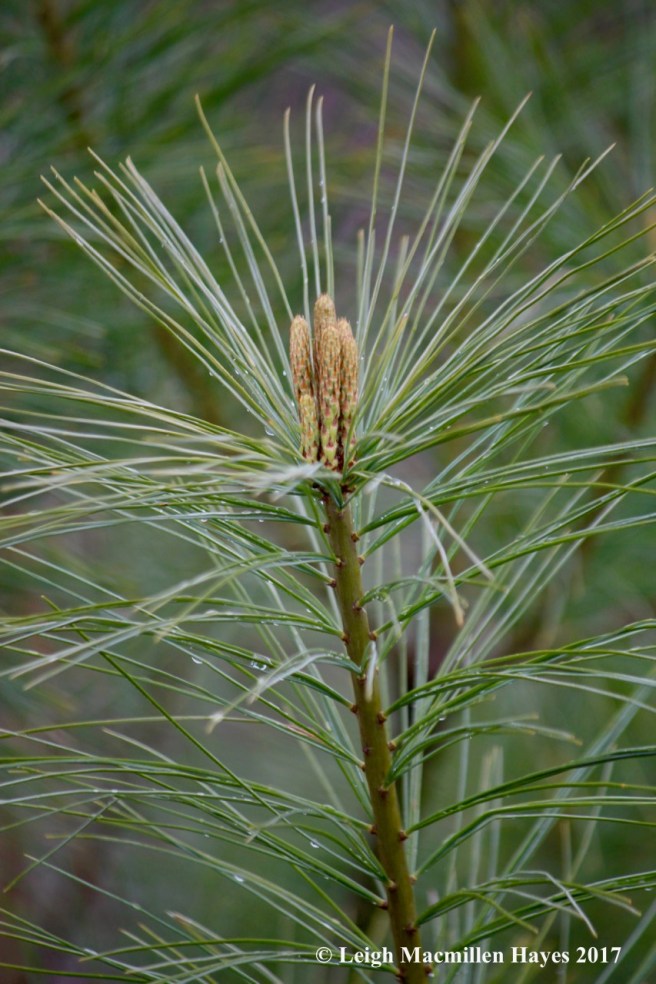
v-white pine

The three to five-inch white pine needles are blueish-green and bound in bundles of five. That’s easy to remember for you can spell both the tree’s name W-H-I-T-E with each needle or M-A-I-N-E for the white pine is our state tree.
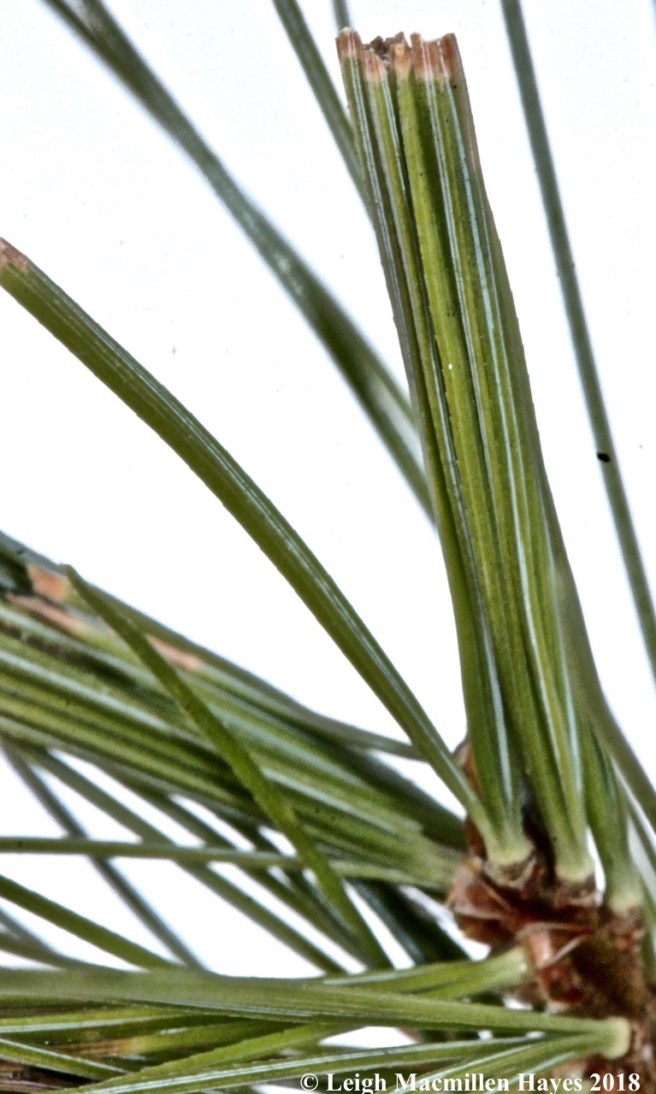
e-pine tube insect

Occasionally, I’ve spotted trees with clumps of needles stuck together in such a way that they formed tubes. Actually, they were the tunnels created by the pine tube moth. Larvae hatched from eggs deposited on the needles during the summer. They used silk to bind the needles together, thus forming a hollow tube. Notice the browned tips–that’s due to the larvae feeding on them. Eventually the overwintering larvae pupate within the tube and emerge in April. Two generations occur each year and those that overwinter are the second generation. Fortunately, they don’t seem to harm the trees.

e-pine whorls

In addition, the arrangement of branches is another important feature of this white pines for they are arranged in whorls radiating from the tree’s trunk like spokes on a bicycle wheel, with each whorl representing one year’s growth. Sometimes on older trees that grew beside stone walls in pastures, the older branches remain and when topped with snow look like a spiral stairway to heaven.

e-lines in white pine bark

On younger white pines, the bark has a greenish hue, but as the trees mature the bark turns dark gray to reddish-brown and forms into thick, vertical scales with furrows between. Upon the flattened ridges of the scales, look for a pattern of horizontal lines reminiscent of the lines on notebook paper.
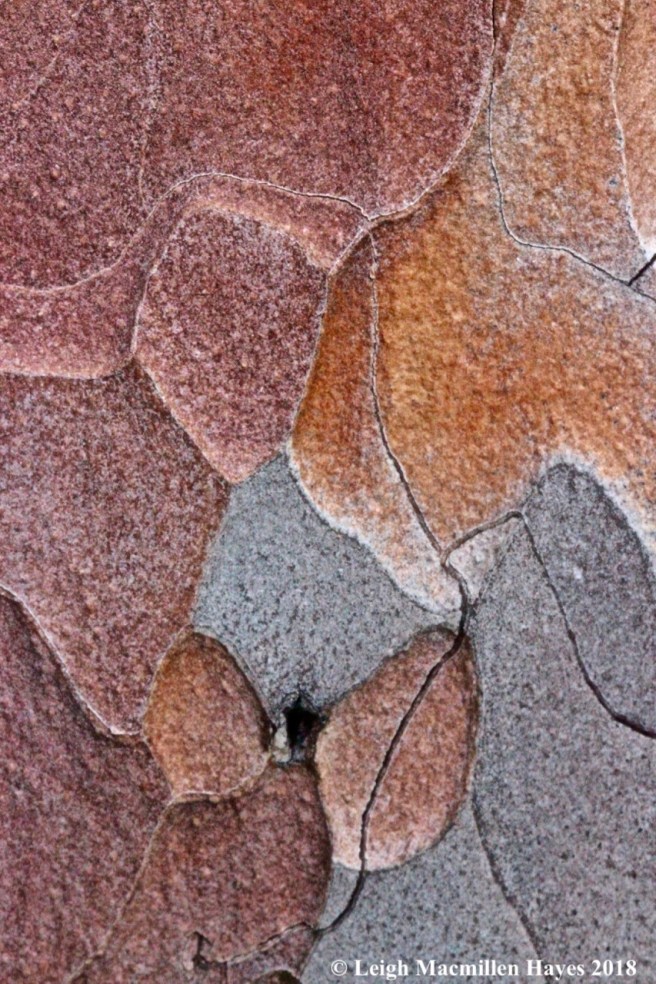
e-red pine bark

Red pine (Pinus resinosa) is a favorite of mine because of its bark, which reminds me of a jigsaw puzzle. Ranging in colors from faded orange to mottled red and grayish brown, its flaky flat scales hug the tree.
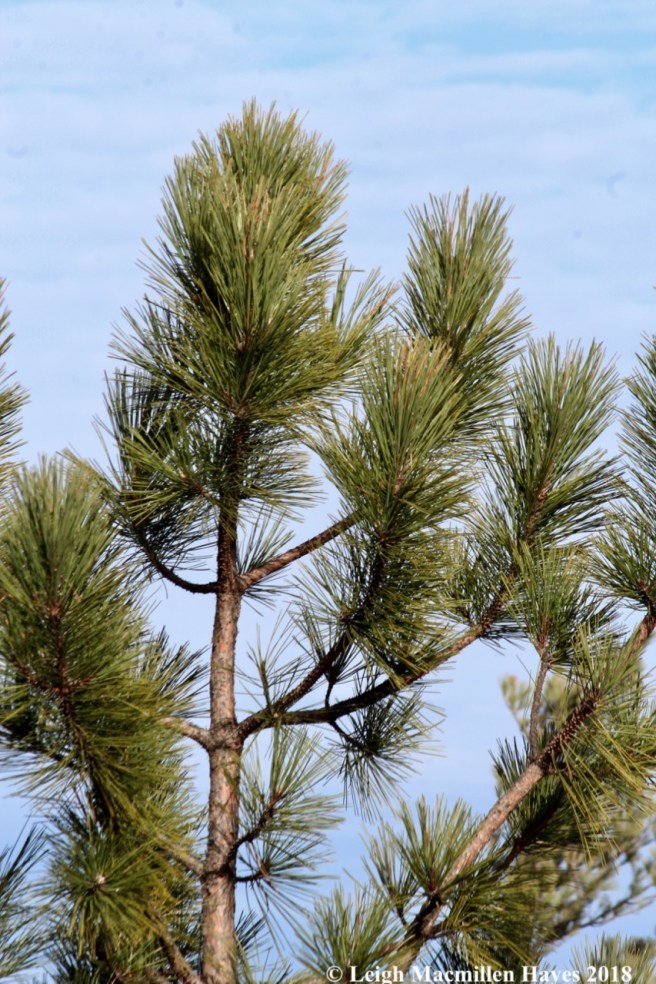
e-red pine needles, chimney sweep

In a perfect world, red pine would produce three needles/bundle to spell R-E-D. Alas, the world isn’t perfect, nor is that the case with this tree. Instead, it has two dark green needles that are twice as long as those on a white pine and quite stiff. In fact, while a white pine’s needles are soft and flexible, bend a red pine needle and it will snap in half. Because of the needle arrangement on these two members of the Pinus family, from a distance I can name them. To my eyes, a white pine’s branch tips look like bottle brushes, while a red pine’s remind me of the brush Bert used to sweep chimney’s in Disney’s Mary Poppins.
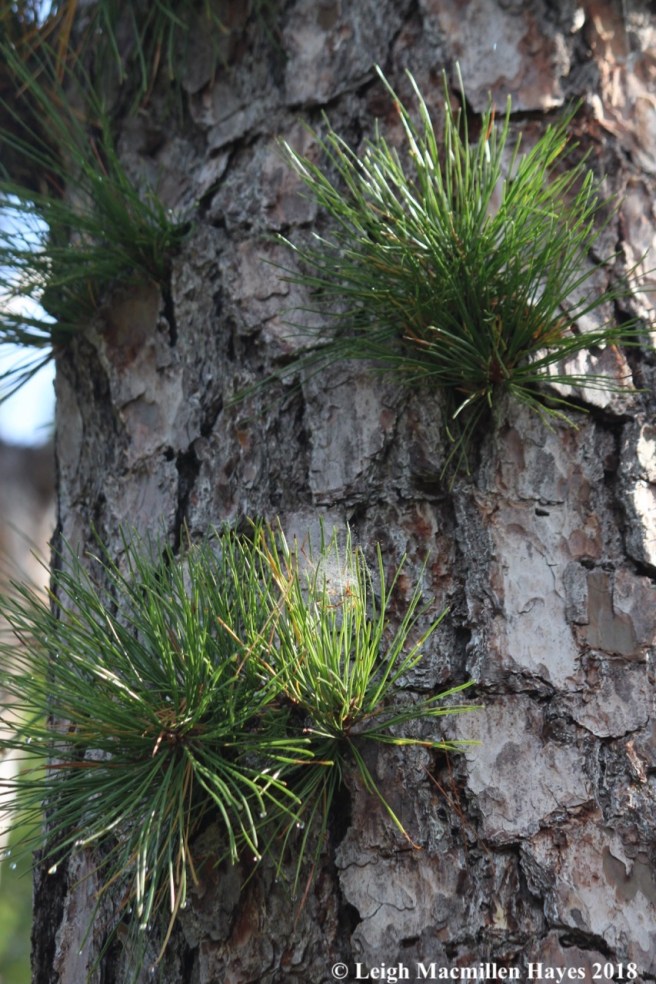
e-pitch pine needles on trunk

Another common pine in our area of Maine is pitch pine (Pinus rigida). This one is easy to confuse with red pine because the bark looks similar in color, though it strikes me as forming thicker plates. The name, pitch, refers to the high amount of resin within this tree.

It’s the needles of pitch pine that also add to its identification for they grow in bundles of three, like a pitchfork’s tines. The unique thing about this tree is that not only do the stiff, dark yellow-green needles grow on the branches, but they also grow on the trunk. If you spy a tree that you think may be a Red Pine, scan upward and if you see green needles along the trunk, then you’ve discovered a Pitch Pine.

Pitch pine is an important species for it is the only pine that is well adapted to fire and can even resprout.

e-jack pine

Finally, for our native pines, and I can only think of a few local places where I’ve seen these, including along the Foster Pond Outlook Trail at Bald Pate Mountain in South Bridgton, is Jack pine (Pinus banksiana). It seems to prefer the coast and central northern Maine. But . . . walk Loon Echo Land Trust’s trail at Bald Pate, and see if you can spot them.

Jack pine has two yellow-green to dark green needles in each bundle so an easy way to remember its name: Jack and Jill. I don’t know about you, but I love mnemonic devices.

e-white pine cone, red pine cone, hemlock cone

One last way to differentiate the pine trees is by their cones. Cones are the fruits of the trees and they consist of scales that protect seeds. When conditions are right, the scales will open to release the seeds, which have wings much like a maple samara, allowing them to flutter off in the wind and find their own spot upon which to grow. The line-up in this photo from left to right: white pine, red pine, hemlock.

e-white pine with two year old cones

White pine is easy to ID for it produces long, narrow cones, often coated with white sap. It takes two years for a white pine cone to mature.
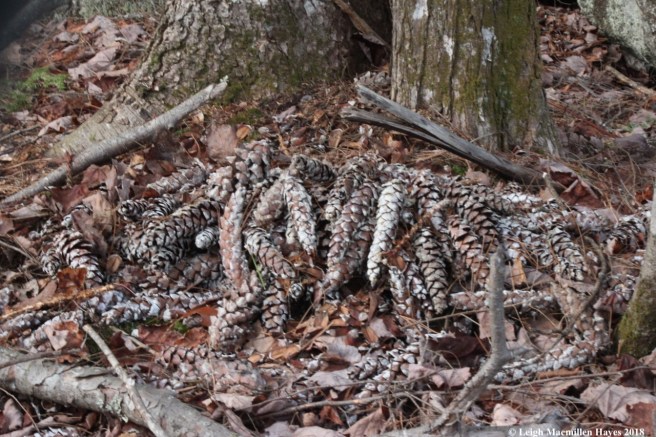
e-pine cone midden

Red squirrels are known to gather mature cones and store them in a cache for winter consumption. During the winter, the squirrels tunnel under the snow to access the cache, then climb up to a high spot and remove each scale to reach the seeds. Left behind is a midden or garbage pile of scales and center cob of the cone.

e-red pine cone and needles

Red pine cones are about two inches long and egg-shaped on short stalks.
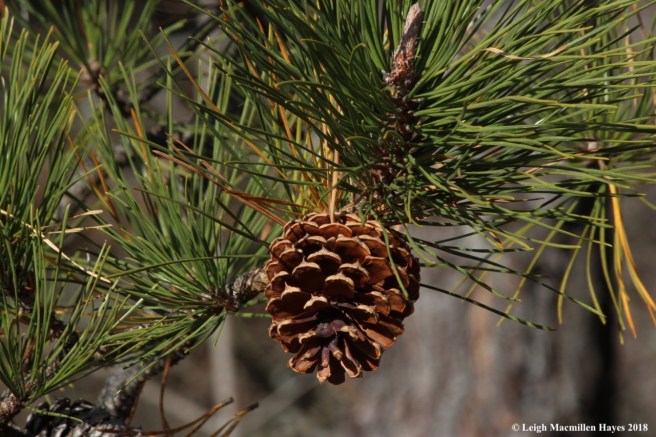
e-pitch pine cone 1

You can barely see the stalk of pitch pine cones that tend to be clustered together, but their key feature is the rigid prickle atop each scale tip. On Jack pines, the cones are about two inches long and slightly curved like a comma.

Before I move on to the other evergreens, I need to make one point. Members of the Pinus family produce pinecones. All other evergreens produce cones, but they aren’t pinecones because they don’t grow on pine trees.

e-mixed forest 2

Eastern hemlock (Tsuga canadensis) grows almost as abundantly as white pine. Often white pine, hemlock, balsam fir and spruce saplings can be observed growing together, and a perfect classroom situation evolves.
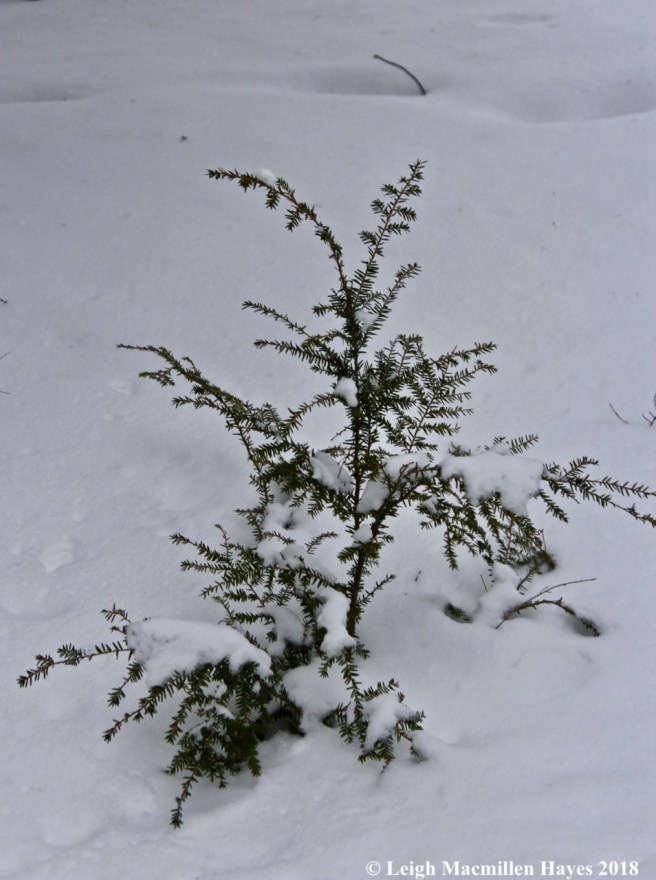
e1-drooping hemlock

The hemlock is easy to ID once you realize its characteristics. To begin with, and especially noticeable in younger trees, is the drooping terminal shoot. In fact, all of the branches droop, providing the overall effect of a graceful tree.

e-hemlock gathering snow

Those sturdy, down-sweeping boughs also hold snow, thus creating the perfect spot for deer to hunker down under on a winter night.

e-hemlock porcupine evidence below hemlocks

Another mammal that takes advantage of the hemlock is the porcupine. If you spy nipped twigs on the ground surrounding a hemlock, then it’s best to look up and make sure you won’t become a pin cushion should the animal fall.
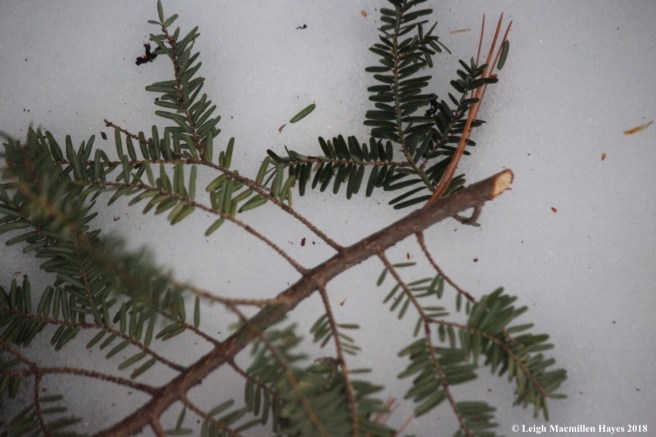
e-hemlock porcupine

Typically, the downed hemlock twig features a cut made at a 45˚ angle.

e-hemlock petioles (stems) and stomata lines

The half-inch hemlock needles taper to a dull point. You may only see this with a hand lens, but each needle is attached to the twig by a short stem, aka petiole. And the needles extend outwards from both sides of a twig, thus giving it an overall flat appearance.

e-inner bark of hemlock

The bark on a hemlock, initially grayish and smooth, becomes cinnamon brown and scaly with age. I also enjoy looking at the inner bark that might be exposed by an injury, for its features various shades of reddish purple.

e-hemlock cones

Hemlock cones are petite in comparison to pinecones, at only .75 inch in length. In the spring, their scales are blue-green, maturing to a tan by autumn.
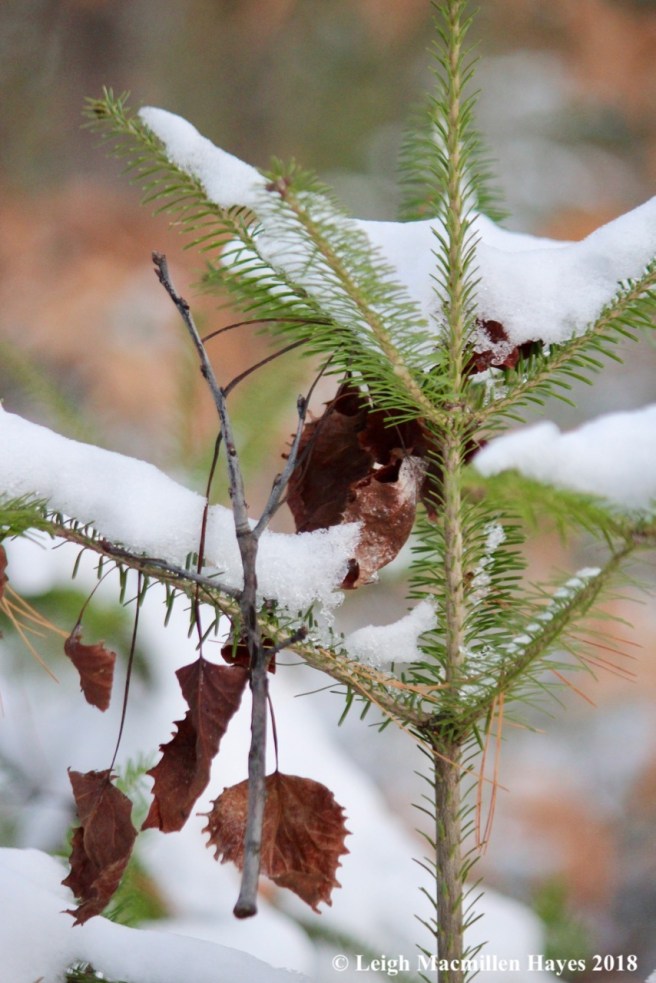
e-balsam fir standing upright

While the hemlock droops, a balsam fir (Albies balsamea) stands straight and tall as it forms a spire with a symmetrical crown.
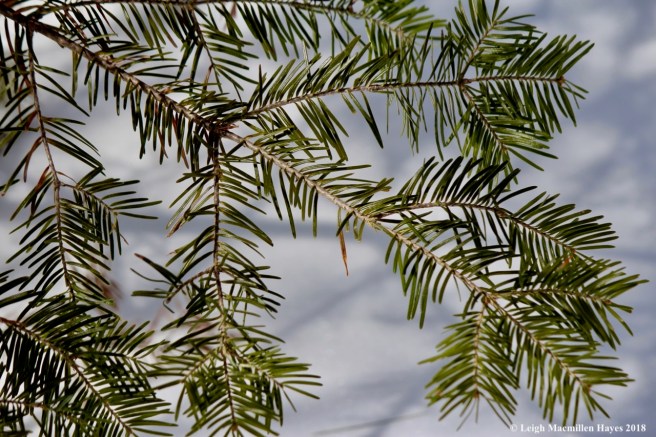
e-balsam fir needles

Like the hemlock, the needles are flat, but they differ in that they attach directly to the twig, are about an inch in length and some have a notch at the blunt end. The upper side is a shiny dark green, while the underside is silvery-blue.

e1-balsam bark

The pale gray to green-brown bark of balsam fir is also different than the other evergreens. It has raised dashes, aka lenticels. All trees have lenticels that allow for the exchange of gases. On some trees, however, the lenticels are more noticeable. Balsam fir bark also is riddled with bumps or resin-filled blisters. Poke one with a stick and watch the pitch ooze out. Beware, it’s very sticky. And it smells like Christmas.

e-balsam fir cones

One other unique characteristic of a fir tree is that the cones point upward rather than dangling down. That, in itself, offers an easy ID.

e-spruce

The next family, the Picea or spruces, I find more difficult to distinguish in a crowd. Like balsam fir, the leaders or top sections point skyward giving it an overall pyramid shape, but its the idiosyncrasies within the family that sometimes stump me.
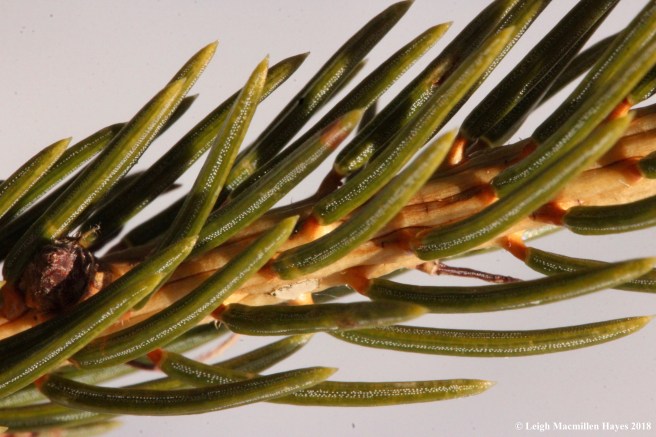
e-spiky spruce

The one thing I am certain of is that they are spruces if their needles are sharp and pointed. Shake hands with a branch and if it hurts, it’s a spruce.
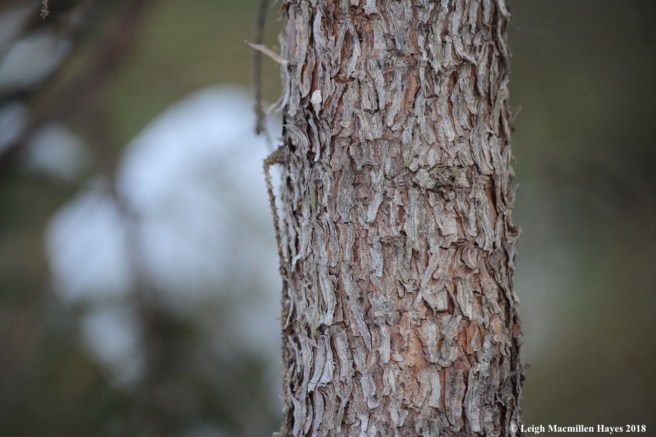
e1-spruce bark

Spruce bark is broken into irregularly-shaped scales in general, and white spruce bark is gray to reddish-brown.

Again, I’m brought to things to remember when trying to determine whether I am looking at a fir or spruce—firs are friendly, spruces are spiky. Fir needles are flat, spruce needles are square.

The only cedar tree native to western Maine is the Northern white cedar. Whenever I sniff its fragrant scent, I’m reminded of my mother’s cedar chest and the treasures it stored.

e-Northern white cedar leaves and cones

Northern white cedar (Thuja occidentalis) is also known as Eastern arborvitae. Its scale-like leaves appear opposite each other along the twig and have short, blunt points.

The cones are about a half inch long, oblong in shape and borne upright on the branches. Their scales are leathery, red-brown and notched. They also have a small spine on the tip.
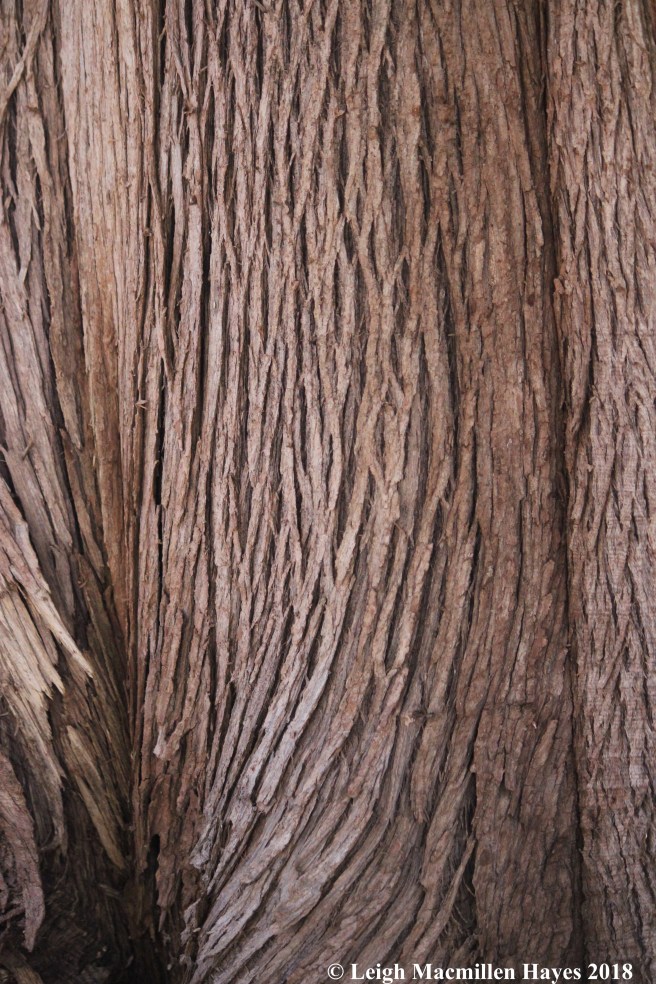
e-Northern white cedar bark 2

Again, the bark is fibrous, red-brown, which weathers to gray and features a diamond-shaped pattern. This small to medium-sized tree looks like a pyramid with a broad base and rounded top. It often features several main trunks.

And then there’s the tamarack.
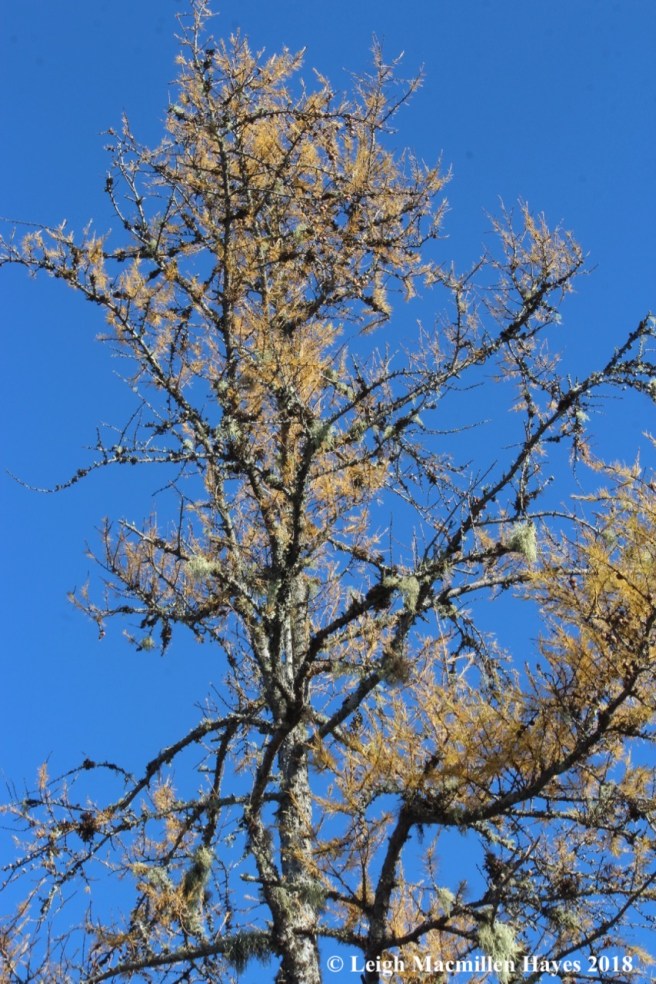
e-tamarack in fall

A tamarack or Larix laricina is a native deciduous conifer because it sheds its needles each fall, after they’ve turned a golden yellow, therefore it’s not really an evergreen.

e-winter

I know how easy it is to look at the winterscape and think that everything looks the same in the almost monochromatic mosaic we call the woods.

e-spring 1

But even in spring, as buds give way to leaves,

e-summer evergreens

summer when so many greens dominate our world,
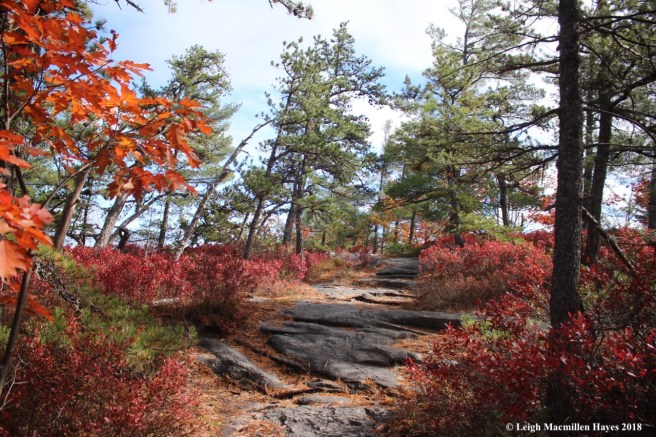
e-fall 2

fall, when evergreens provide a contrast for autumn’s foliage,

e-fall 3

and late fall, when the evergreens continue to be green as the broad leaves drop, these trees make a statement in the landscape.

Thanks to Creator, they are forever green.
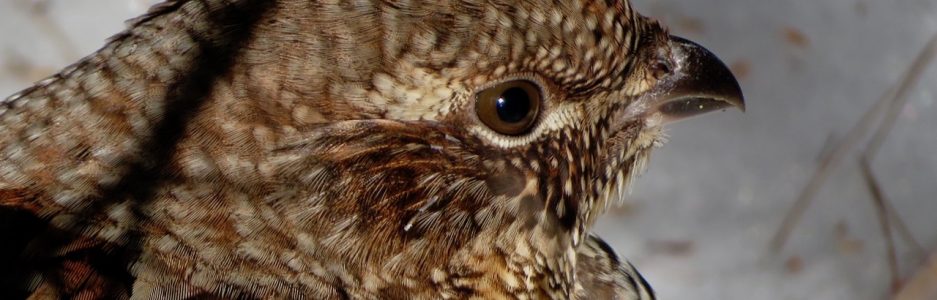
 

Sunday’s Point of View

After church we had exactly five hours to pack our lunches, drive to the trailhead and complete our trek. After all, the New England Patriot’s were scheduled to play the Jacksonville Jaguars in the AFC Championship game at 3pm and we intended to be in the audience–from the comfort of our couch, of course.

p1-pleasant mountain sign

By 10:30, we’d pulled into the Ledges Trail parking lot on Mountain Road in Denmark (Denmark, Maine, that is) and began the one and a half mile walk back down the road. Our intended route along the trails of Pleasant Mountain in Loon Echo’s preserve was to climb up the Bald Peak Trail to the fire tower at the summit and then follow the Ledges Trail down. We love hiking a circular route, and like to get the road walk out of the way first.

p2-mountain stream

We had no idea what trail conditions would be like, but decided on micro-spikes, which proved to be the best choice. Beside the trail, the mountain stream was layered thick with icy sculptures.

p3-brook ice

Everywhere we looked, the water had frozen into a variety of formations.

p4-Needle's Eye

Less than a half mile up, we came to the sign for Needle’s Eye.

“Do you want to go in?” I asked my guy.

“It’s up to you,” he replied for he knows my love/hate relationship with the spur path to the geological feature.

“Let’s try,” I said.

p5-Needle's Eye

Somehow, we made it to the chasm in only a few minutes. And then we stood in awe, rejoicing that we’d made the effort for we were well rewarded.

p6-ice of the needle

At the back of the eye, the waterfall stood still for a moment. Eventually, we made our way back to the main trail, and I’m proud to say I only exclaimed once when a tree that I grabbed wiggled. I thought of my friend, Marita, and her patience with me last spring when my brain didn’t want me to venture forth along the spur.

p8-ice layers

Upward we continued, chuckling as we always do at the sign for Sue’s Way that also indicated we would reach the intersection of the North Ridge Trail in three tenths of a mile. Somehow, that three tenths always feels like three miles. Is it really only three tenths of a mile, we wondered.

p7-Sabattus Island on Moose Pond

We were rewarded again, however, when we did pass by the intersection and continued on to the summit of Big Bald Peak. It’s always a spot to stop and look back at Moose Pond below where we could see our camp and Sabatis Island.

p8a-lunch rock looking north

It was just beyond that stop that we found lunch rock. Our view to the northwest was a bit obscured by the pines, but they helped block the breeze, so we didn’t mind.

p8-fire tower in distance

And to the southwest, the ridgeline we intended to walk. We could even see the fire warden’s tower at the main summit.

p9-crossing the ridge

After lunch, across the ridge we trekked, enjoying the sights along the way.

p10-Sebago Lake's open water

In the distance, we could see Sebago Lake and noted its open water which evoked a conversation about global warming. Many thought this would be the year it finally froze over again, but . . . not to be.

p11-racing through blueberry patch

Because trail conditions on the ridge were favorable, we moved quickly–practically running through the blueberry fields that will call my guy’s name come July.

p12-the tower

In what seemed like no time, we turned left onto the Fire Warden’s Trail and then made our way up to the iconic tower that was built in 1920. My hope is that it will still stand stalwart in 2020 and celebrate its one hundredth birthday.

p13-summit view toward Washington

Sometimes the summit view includes Mount Washington, but today the summits of the Presidentials were hidden in clouds.

p14-red pine scale

One scene that didn’t make us happy was that of the red pines. About five years ago I noted their decline and communicated with a forester who was studying red pine scale. Since then, most of the trees have been infested by the tiny insect and died.

p14-Southwest Ridge and sky

A much prettier picture we saw as we began our descent down the Ledges Trail, where the sky displayed a rainbow of colors above the Southwest summit of the mountain.

p15-Moose Pond from the ledges

As we made our way down, we paused as we always do along the ledges for which the trail was named. The south basin of Moose Pond dominated the vantage point.

p16-smiley face and heart

Along the entire route, we only met a few other hiking parties, but one apparently enjoyed the journey as much as we did and left smiles for our hearts.

p17-Needle's Eye

We arrived home with ten minutes to spare until kickoff.

Before the game began, we both agreed that our favorite point of view for this Sunday  was Needle’s Eye.

And now, the Patriot’s just defeated Jacksonville. That may mean two other scenes compete for today’s fav–when #24 Gilmore blocked Jacksonville’s final pass or Bill Belichick showed emotion before the game officially ended.


Finding Our Way at Back Pond Reserve Mondate

One of my favorite winter hikes upon property owned by the Greater Lovell Land Trust is at Back Pond Reserve in Stoneham. And so this morning I convinced my guy that it was the perfect trail for us to explore.

b1-the mountain trailhead

We parked on the Five Kezar Ponds Road near the trailhead for Ron’s Loop and then walked back to The Mountain Trail to begin our ascent. The reserve is a 259-acre property, with all but ten acres located on the north side of the road. The other ten south of the road will remain forever wild. Those latter ten acres were purchased in 1980 by twelve families who owned properties on Back Pond. Eighteen years later, they deeded the land to the GLLT. And then the Five Kezar Ponds Watershed Association generously helped the GLLT acquire the 249-acre piece through two purchases made in 2006 and 2010.

b2-poles at kiosk

At The Mountain Trail kiosk, plenty of information is available, including trail maps and walking sticks. The latter brought a smile to my face for it spoke to the continued generosity of those who know and love this land best.

b3-oak and beech leaves

Given the recent rain that drained our snow pack significantly and was then followed by another blast of arctic air, the trail was well packed. We could tell that a few others had traveled this way either with snowshoes or without–such were the impressions left behind. And within some of those impressions, beech and oak leaves gathered–speaking to the forest we were passing through.

b5-big toothed aspen

Not to be left out was the occasional big-toothed aspen leaf.

b6-beech leaf and husk

But really, it was the beech that we saw most often.

b6a-beech husks litter

And scattered everywhere–beech husks empty of seeds indicating it had been a mast crop year for this species. How viable the seeds were will remain to be seen.

b11-beech sap

In old wounds on several of the beech trees, amber sap had flowed and reminded me that not all sap comes from maples.

b9-trail conditions varied

Where the sun had reached the trail, conditions varied.

b7-microspikes

As the lay of the land began to get steeper, my guy decided to don his micro-spikes. One of the thoughtful efforts found periodically along the way–benches provided in the name of Ron Gestwicki who had longed served as president of the Five Kezars Watershed Association. A perfect place to rest, take in the surrounding beauty, or slip on micro-spikes.

b8-microspikes

I wore mine from the get-go and have found them the easier way to travel the past two days. It’s kind of like adding chains to the tires of a plow truck. With the spikes digging in, though I had a pole attached to our backpack I didn’t need to use it.

b10-trail makrers

The Mountain Trail is blazed with blue dots and someone used ingenuity to attach a fallen sign to a twig.

b12-turn onto old jeep road

It didn’t take long to reach the old jeep road that led to the summit. We made the left hand turn, but had a mind to go off trail for a bit.

b13-bear tree

Our first turn was to the left for we knew that bear trees stood tall there–at least for now because some looked like they were in rough shape given the beech scale disease that affected them.

b14-sidetracked to right

And then we headed off to the right, bushwhacking our way to a bit of a ledge where we hoped to find signs of a bobcat. I’m forever hopeful, but once again we came up empty handed. Previously, we had seen tracks and scat crossing the trail in numerous places, so we probably weren’t too far off with our speculation.

b15-ledge view

What we did find, a first view of the ponds below . . .

b16-trailing arbutus

and a certain sign of spring recently exposed in the form of trailing arbutus.

b17-back on trail

Finally, we headed back to the main trail and continued to climb toward the summit.

b18-porky prints

Though in general, tracking conditions weren’t great, we did find one expected customer–porcupine. It seems any time we travel this trail we find porcupine evidence.

b20-5 Kezars 1

At last, we reached lunch rock, where the view stretched from a few of the ponds across to Shawnee Peak Ski Area at Pleasant Mountain.

b22-Kearsarge and beyond

The Presidentials came into sight.

b23-Mount Washington in mix

And, of course, Mount Washington, which also displayed less of a snowpack.

b25-orange trail

From the summit, rather than hike back down the same trail, we turned to the backside and followed the orange connecting trail.

b26-swampy area

It’s fun for the community switches from hemlocks, pines and spruces to a small boggy area that offered a challenging crossing and finally back to beech and oak.

b27-beech sap again

And among those beech trees, another that had fallen and leaked sap from its butt end, plus . . .

b28-bear trees

more bear trees.

b29-brook crossing

On the downslope, we heard water running and wondered what our first brook crossing would be like. In the past, we either used a rickety old bridge, or tried not to use it.

b31-old bridge

Today, my guy went across first, and found pieces of the old bridge buried in snow. We knew we were better off without it.

b30-ice and water

I, of course, needed to stop and admire the flowing water and ice.

b32-more ice

Again and again.

b33-orange lichen

Much to our surprise, we found one more cool feature of this trail–the rare orange paintitous (is that a word?) crustose lichen. :-)

b35-turning onto Ron's Loop

Not far from the rare find, we turned left and then right as we crossed the bridge and found ourselves on Ron’s Loop.

b36-brook and wetland

Below the bridge, the wetland bespoke more of the melt down efforts. In the past, we’ve found plenty of otter prints and slides in this area. But today, it was difficult to distinguish anything.

b37-ruffed grouse scat

We did, however, find a pile of ruffed grouse scat!

b39-H is for Hemlock

And proof that H is for Hemlock. (And Hayes)

b40-new bridge

Finally, we reached the second bridge that took us back across the brook. The bridge was built this past summer by the GLLT interns and Back Pond Reserve stewards. We truly appreciated it for many a times during the winter, the crossing had been to wide and we’d gotten wet.

b41-which way should we go?

After completing the loop, we once again gave thanks for all those who had preserved the land and created the trails so that the mammals that call this place home and folks like us could journey there.

With ease we thoroughly enjoyed this Mondate as we found our way at Back Pond Reserve.


The Day After the Bomb Cyclone

We survived yesterday’s blizzard, but I wondered about our neighborhood. Last night the winds howled and we watched snow blow from north to south on a horizontal plane.

b-snow cloaked well

As I headed out to check on the situation this morning, I noticed the cloaked well, so had the snow swirled about its structure.

b-stone wall

The pattern repeated itself in so many places including the gap in the stone wall.

b-pine needles in pileated woodpecker hole

And in the aftermath came new ornamentation in unexpected places, like pine needles in an old pileated woodpecker hole,

b-witch hazel leaf

a single witch hazel leaf standing upright,

b-maple seed atop hemlock needles

and a maple seed resting upon a hemlock twig.

b-snow fort 1

There were snow forts in various forms–some with arches . . .

b-snow fort 2

and others with turrets.

b-ice march

Though much ice had finally fallen, some continued to march across twigs . . .

b-gray birch new catkin

and coat new catkins with an extra layer of protection against the frigid air.

b-gray birch catkins

Scattered about on top of the snow most everywhere I looked, however, were the scales of the fleur de lis and miniature seeds of various birches and cones scales and seeds of evergreens. Somehow, and perhaps its because the ice still held them in place, many catkins still hadn’t sent their tiny seeds flying. For the birds and mice who dine on them, a slowed dispersal might mean food security.

b-red squirrel hole and prints

I wondered about the mammals and saw only red and gray squirrel tracks, in this case a red who left its tunnel to bound across to another below a tree. Later, one gray squirrel hopped slowly through the deep snow. Eventually it climbed a tree and moved with much more agility across its branch highway.

b-deer bed

Deer were the only others that had moved. One had found the southern side of a tree to bed down for the night, such is the form you may see here, with the smooth side of its back being to the left. I could imagine the snow swirling about it, but trust that at the same time, the depth added an insulating quality.

b-deer fed on fungi

I wondered what the deer had been foraging since the acorns were becoming more difficult to acquire. Curiously, I found that several downed trees I knew had been covered with fungi were freshly excavated and harvested.

b-deer feast 1

Red maple bark . . .

b-deer feast 2

also showed signs of a recent dining experience.

b-common milkweed aphids

Back home after a few hours spent trudging through snow so deep that at times I was up to my knees despite my snowshoes, I made a point to visit one more spot beside the front door–where the milkweed grows. Do you see the two insects atop the pod? Those were Oleander aphids who fed on the plant previously.

b-common milkweed 1

Despite all the wind of yesterday and last night, I was surprised to discover that the seeds hadn’t all yet floated on to new homes.

b-common milkweed 2

Like so many others, they remained huddled together.

The day after the bomb cyclone or bombogenesis storm, so named because of the steep drop in atmospheric pressure that occurred, I discovered that most of the world was still curled up. With more wind and frigid air in the forecast, hunkering down is a grand idea.


Lake Living Magazine: Winter Issue

They say you shouldn’t judge a book by its cover, but indeed, I do. Especially if the book isn’t really a book, but rather a magazine called Lake Living. One look at those vibrant hacky sacks against the snow on the cover of the new winter issue and I find myself mindful, each time seeing a different configuration of the whole or focusing on a single feature.

And then there is the content, from Laurie LaMountain’s editorial comment ending with “Our collective differences have the power to both define us and unite us,” to the book reviews by the staff of Bridgton Books.

2017-12-21_0923

Of course, thrown into the mix are the articles, including Laurie’s eloquent feature about hacky sack and relationships, ending with a challenge to all of us. A must read.

And don’t miss my two contributions, “digging for roots” about genealogy and the Fryeburg Historical Society’s Kendal C. and Anna Ham Research Library; and “forever green” about . . .  evergreen trees.

Laurie’s been producing the magazine for twenty years and I’ve had the honor and pleasure of working with her for the last twelve. Here’s to the future.

P.S. If you live locally, please mention the mag when you are shopping. Remember, the mag is free and therefore totally dependent upon advertisers. It can’t survive without your support.

Book of December: A Beginner’s Guide to RECOGNIZING TREES of the NORTHEAST

Fellow master naturalist Alan Seamans recently sent me an e-mail with this message: “I found a new book that might be of interest to you. It’s called A Beginner’s Guide to Recognizing Trees of the Northeast, by Mark Mikolas, published Oct. 3, 2017. Rather than leaves, buds or flowers, he focuses on bark, stature, habitat, and some other techniques to teach beginners how to recognize about 40 common tree species. It’s a compact softcover guide, very educational, lots of photos illustrating his points. Not text heavy. I like it, and learned many things.”

IMG_3897

Book of December

And so I did what I often do when I hear of a book that might interest me and marched into Bridgton Books in search of a copy. Alan was correct. It isn’t text heavy and indeed simplifies things in a way a dichotomous key cannot. Actually, this book includes so many of the nuances I like to share along the trail with folks who are looking at trees for the first or hundredth time and as I read it I felt like I was on a guided tour with a new friend.

Mikolas begins this tree identification book by restricting the focus area to the Northeast–in a zone those of us who live in New England may find amusing for it ranges from our grand states south to West Virginia and west to Indiana and Michigan. As he explains, though, that’s the Northeast as defined by the World Geographical Scheme of Recording Plant Distributions.
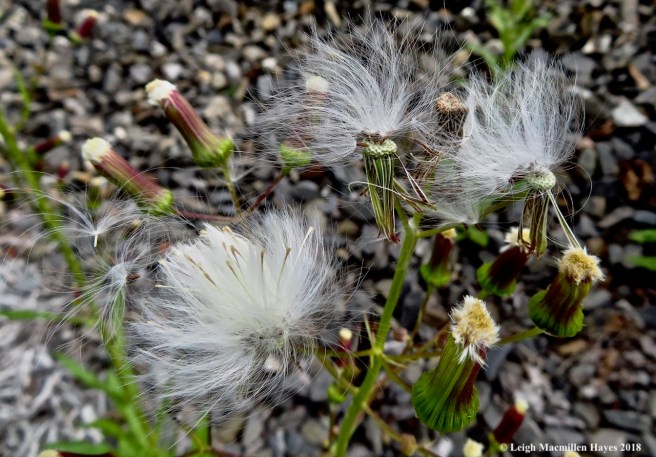
The book is divided into two sections–deciduous or broad-leaf trees and coniferous–or cone-bearing trees. And within each section, it’s broken down into individual trees with plenty of photographs to explain each characteristic.

Mikolas keeps it simple and I wish I’d had this book when I first began my journey into familiarizing myself with different tree species. Similar to the approach taken by Donald W. Stokes in A Guide to Nature in Winter, who suggested learning six deciduous trees and the evergreens, Mikolas also encourages the reader to start with the most common, though he prefers the number twelve.

I wondered what I might learn or relearn as I began reading. And found plenty of information, some of it already stored in my brain, and more to be tucked away.

s-target

The book begins with red maple, which always has something red to display, but Mikolas also mentions the target fungus that affects only this species, creating a round bull’s eye on the bark. I know from experience that once your eye focuses on the target, you’ll begin to see if on so many maple trees. And as he said, and a forester told me several years ago, here in western Maine, 90% of our maples are Acer rubrum. That’s one thing you don’t have to worry about, except for one instance that I could find, he doesn’t use the Latin names. For some folks, that may be a downfall, but this is a beginner’s guide.

b-twisted maple

I was pleased that he included the twisting of a sugar maple. Other trees twist as well and I can remember first realizing this while tramping with a friend. We couldn’t understand what was going on. The reason for the spiral growth is on page 26–you’ll have to read it for yourself.
After describing these two trees, as he does periodically throughout the book, Mikolas gives clues on how to tell them apart. For these two, he describes their habitat, bark, twig and bud color.

m-beech sunshine

One of the clues he provides for beech trees is the fact that the leaves remain on the trees all winter. What I like about his comment is that he says this happens on young trees, for indeed, since I started paying attention, that’s what I’ve noted.

b-marcescent leaf

He also described the habit of oaks retaining their leaves, but what he didn’t mention was the term to describe this habit: marcescence or withering. Maybe I was disappointed because I just like to say marcescence.

b-ash bark

When it came to ash trees, I was pleased that he described the bark as being diamond-shaped, but he added an X to the pattern and that may help when I next look at an ash tree with others. Some have a difficult time finding the diamonds. They don’t exactly glitter in the sunshine.

b-aspen bark

I was thankful that when it came to the quaking and big-toothed aspen trees, Mikolas acknowledged that they are difficult to identify by bark alone. A few years ago, I spent some time practicing my tree ID with two different foresters and when I asked about these trees, they too, had a difficult time pinpointing the differences. Both were sure we were looking at quaking, but a quick scan of the ground below showed us big-tooth leaves.

b-aspen 2

One thing I’d add to Mikolas’ description is that on the lower portion of older trees, the vertical lines are similar to that of a red oak. One of the really cool tricks I picked up from the book in reference to aspens is what he calls “birds on a wire.” Again, you’ll need to purchase a copy to find out what he means. Or join me for a tramp.

b-grandaddy birch

Another description that brought a smile to my face was how he casted a mature and shaggy yellow birch as “the granddads or old wise men of the forest.”

b-yellow birch

I had the good fortune to meet one such character just the other day.

b-basswood

In reference to basswood,  Alan Seamans wrote in his e-mail message: “I didn’t know you could confirm i.d. of basswoood by the sound it makes when you hit it with a stick!” I didn’t either, but you can bet that’s on my list of things to do–frequently.

b-paper-birch-old

Mikolas’ photo essay on the aging of paper birch bark from a teen to an old man is well worth a look. My only disagreement with him in this section is that what he sees as an inverted V over the branch, looks more like an inverted U to me, or as I’ve always described it–a fu manchu mustache of sorts.

b-gray birch

Likewise, Mikolas sees black triangles under the branches of gray birches. I could agree with him on that for when I say it’s a chevron, people don’t always get what I’m talking about. One friend, in keeping with the paper birch’s mustache, suggested the gray birch may have a beard–a gray beard. Mikolas also says that gray birches are chalkier than paper–experiment for yourself  by rubbing your fingers on the bark and come to your own conclusion on that one.

IMG_5301

Turning to striped maples, I was tickled to learn a new common name. He used goosefoot, which describes the leaf shape,  and moosewood because deer and moose like to leave their scent by rubbing their antlers on the bark, but a name I hadn’t heard before–whistle wood. Apparently, slip-bark whistles can be carved from striped maple or willow in the spring.

n-Central Park 1

I do wish I’d read this book before venturing to Central Park a few weeks ago. I was in awe of the American elms that grow there, and wondered about their health given that so many elms have succumbed to Dutch elm disease. What I didn’t realize is that what I saw before me was one of the largest and last stands of these majestic trees.

b-red pine plantation

Heading back into a woodland setting, and this one was actually in Vermont, occasionally we stumble upon red pine plantations. It was my understanding that these were planted by the CCC or Civilian Conservation Corps between 1938 and 1942 to provide farmers with a hill crop and others with employment. When walking in the woods and suddenly encountering a sterile environment where trees stand stalwart in lines and there is no undergrowth due to the thick needle cover below, and little diversity in wildlife, one may have entered such a plantation. At the time, it seemed like a good idea and provided work.

hemlock petioles (stems) and stomata lines

In the forest, I often discover hemlock and balsam fir saplings sharing a space. One word of caution when it comes to differentiating between the hemlock shown here and balsam fir needles that are shown on page 188–both have two white stripes of stomata on the underside. There are other clues to help tell them apart and I’ve actually written about such in the upcoming issue of Lake Living magazine so you’ll have to stay tuned.

spiky spruce

And then there are the spruces and I have to admit, I have a difficult time with red versus white, though forester friends have said they hybridize. I noticed that Mikolas mentions both, but doesn’t provide the fine details about scent and twig hair. Perhaps it’s enough to know it’s a spruce–especially if it’s spikey to the touch.

b9-tamarack gold

The tree descriptions conclude with the one and only deciduous conifer of our woods–the tamarack–the cone-bearing tree that loses its leaves (needles) each winter.

And with that, I will conclude this rather lengthy review. I’m so glad Alan recommended it to me, for it really is a gem. I hope you’ll purchase a copy and together we can head out on the tree trail and get to know our local species even better.

Put A BEGINNER’S GUIDE TO RECOGNIZING TREES OF THE NORTHEAST on your wish list and shop local.

A BEGINNER’S GUIDE TO RECOGNIZING TREES OF THE NORTHEAST, by Mark Mikolas, published 2017, The Countryman Press.

Post script, or maybe it should be post post. This comment appears on my About page, but I couldn’t resist including it here. I’m always tickled and honored when an author responds to one of my posts:

Thanks so much for the detailed and positive review of my book, A Beginner’s Guide to Recognizing Trees. It sounds like it would be great to take a hike with you. I really appreciate the good press. –mm

Liked by you

  1. Mark, Thank YOU so much for taking the time to read this and comment. I think A Beginner’s Guide to Recognizing Trees is a fabulous addition to my book shelf and back pack. In fact, I’m on the board of the Maine Master Naturalist Program and asked our curriculum coordinator to review it. If it doesn’t become one of our text books, it should at least be on our recommended reading list. Well done, indeed. Oh, and if you’re ever in western Maine–give a shout. LMH


Black Friday Shopping Extravaganza

I somehow slept in and totally missed the early bird specials today, but still by midmorning I found my way to the store of my choice.

b1-trail sign-cross the threshold

It had been two years since I’d stepped over the threshold into the MDT shop and I’d forgotten what great selections it had to offer. While the last time I approached from the Fryeburg Information Center near the Maine/NH border, today I decided to use the back door and entered by the Eastern Slopes Airport.

b8-the main aisle

Beginning along the main aisle, I was delighted with the display before me. And lack of customers. Oh, I passed several groups, some in a hurry as they ran, others chatting amiably with friends or relatives, but all quite friendly and courteous. Even dogs were well behaved and therefore welcome.

b2-choice of colors--sweetfern 1

Immediately I had decisions to make. Which shade did I want?

b3-shapes,

And would I prefer a different style or shape?

b12-red oak 1

Had I thought about brown and bristly?

b13a-white oaks

Or did I like salmon and rounded?

b13-red oak on line

Though I preferred the salmon color of the white oak, I did like how the red oak leaves dangled in hopes of being plucked by a customer. And if not a customer, then perhaps the wind.

b11-cattails

In aisle five I found some cattails ready to explode into the future.

b11-cattail sparkles

Their tiny, parachuted seeds reminded me of sparklers on the Fourth of July, but because today is the day after Thanksgiving, I suspected these fireworks were intended for New Year’s Eve.

b6-autumn thistle

It seemed that everywhere I looked, the store was decked out with hues of silver and . . .

b4-aster display

gold.

b5-brown lacewing

And while admiring the golden decorations, I discovered I wasn’t the only one looking. A brown lacewing had heard there were deep discounts to be had.

b12-birch beer

As one should when one is spending an exorbitant amount of time (and perhaps money, though in this case no cash or credit was part of the deal), rehydrating is a good thing and the birch had been tapped for just that purpose. It’s been a long time since I enjoyed the unique taste of a birch beer, but thanks to a sapsucker it was on the menu at the snack bar.

b7-bench

And what better place to sit and sip, than on a bench in aisle 6.

b3a-winterberries

Refreshed, I was again ready to shop till I dropped. Everywhere I looked, the Christmas decorations impressed me.

b14-red oak Christmas decorations

The season’s colors enhanced the merchandise.

b19-Sumac decorations

And all ornaments were handsome in their own way.

b9-tamarack gold

As is always part of my shopping adventure, I didn’t know what I was looking for when I entered the store. But as soon as I saw this display, I knew I had to have it.

b10-tamarack 2

Its label was lengthy–tamarack, larch, hackmatack. Call it what you want, it’s our only deciduous conifer for it looses its needles in the winter. But first, the needles turn from green to gold and announce their presence.

b15-pitch pine trunk

Also in abundance as this shop–pitch pines. It’s so easy to confuse a pitch pine with a red pine, but a few identifying tips help. The unique thing about this tree is that not only do the stiff, dark yellow-green needles grow on the branches, but they also grow on the trunk. If you spy a tree that you think may be a red pine, scan upward and if you see green needles along the trunk, then you’ve discovered a pitch pine.

The name, pitch, refers to the high amount of resin within this tree.

b16-pitch pine cones

It’s the needles of pitch pine that also add to its identification for they grow in bundles of three, like a pitchfork’s tines.

As for their cones, you can barely see the stalk because they tend to be clustered together, but their key feature is the rigid prickle atop each scale tip.

b20-Northern White Cedar

I was nearly at my turn-around point of three miles when I realized I was standing beside a row of doorbuster deals.

b21-northern white cedar leaves and cones

I couldn’t resist feeling the scale-like leaves of the northern white cedar. I had to have this item.

b17-black locust bark

I did find one thing I decided to leave on the shelf–for the spines of the black locust would have pricked my fingers, I’m sure.

b18-black locust seed pod

Apparently, others did purchase this, for only one fruit pod remained.

b25-heading back

At last, I was on my way back up the main aisle with hopes to make a bee-line out, but had a feeling something around the bend would stop me in my tracks.

b23-pokeberry geometric display

Sure enough–the pokeberry display was both geometric . . .

b23-pokeberry artistic display

and artistic in a dramatic sort of way.

b27-bird nest

As I continued on, I saw and heard birds flitting about and thought about the fact that I need to visit this shop more often, particularly in the spring and summer for the various habitats made me think that birding would be spectacular. And then I spied a nest attached to some raspberry bushes. I knew not the species that made it, but hoped some small brown critter might use it as a winter home and so it remained on the shelf.

b26-heading back 2

At last, I’d raided enough aisles. My cart was full to the brim and my brain overwhelmed. I guess I’m not really a “shop-til-you drop” kind of gal. It was time to wind along the trail and end my Black Friday shopping extravaganza.