The Dog Days of Winter

A sunny, 43˚ day in the middle of February is reason to celebrate, especially given all the snow of the past two weeks. And so Bridgton, Maine, did just that with its annual winter carnival sponsored by the Greater Bridgton Lakes Region Chamber of Commerce.

w1a

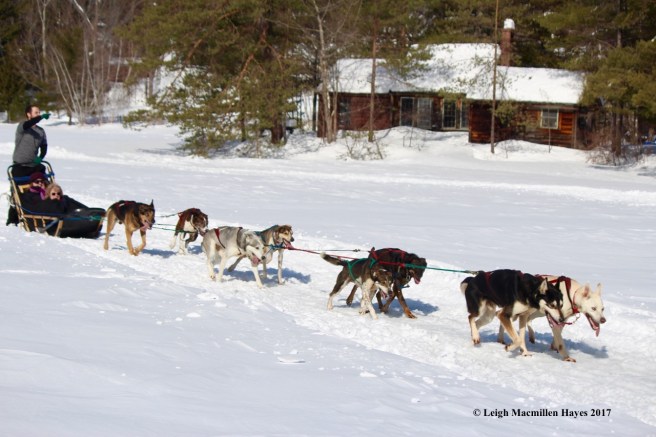
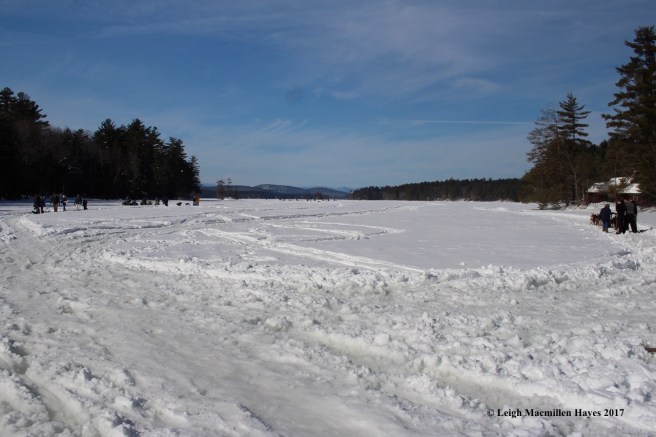
Highland Lake in downtown Bridgton was the setting for the activities, including dog sled rides and an ice fishing derby.

w1

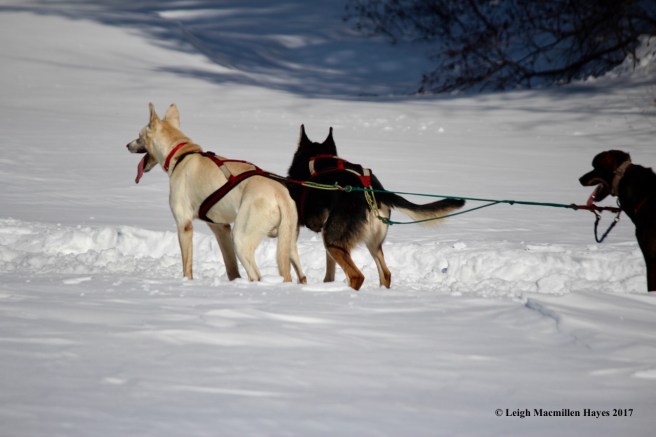
As folks got settled on the sled, the lead dogs eagerly awaited their chance to follow the course.

w3

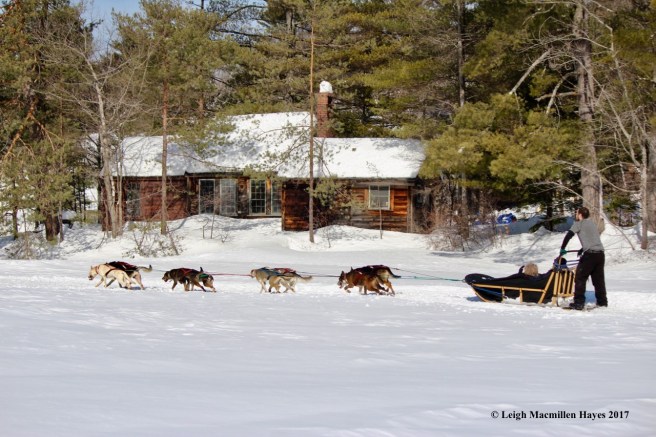
And then they were off for a short journey around the lake.

w4a

Though we didn’t go for a ride today, my guy and I have taken several and it’s a delightful way to explore. Bridgton is also home to the Mushers Bowl, a sanctioned race which occurred two weeks ago at Five Fields Farm.

w6

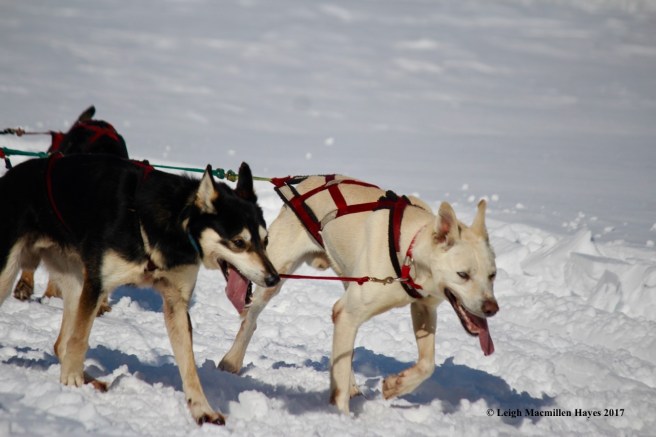
Today the dogs weren’t competing, but rather providing scenic rides and they did so with smiles on their faces. They were born to run.

w7

If you haven’t been snuggled in a sled behind a team, I strongly encourage you to try it.

w5

Further out on the lake, the fishing derby was in progress. We didn’t walk out because we were eager to get to another event closer to the beach. Plus, we’d left our snowshoes at home and post holing was the name of the game without them.

w8

Instead, we turned our attention to an open spot created by the town crew.

w8a

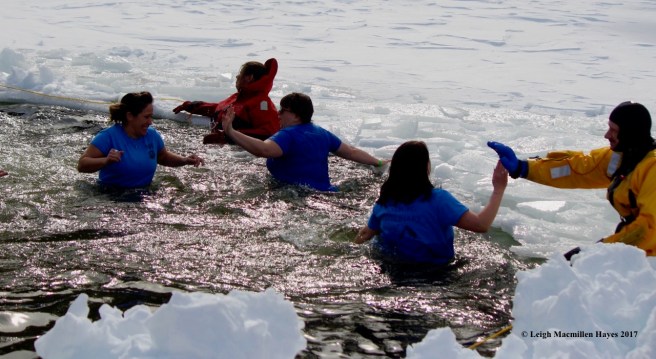
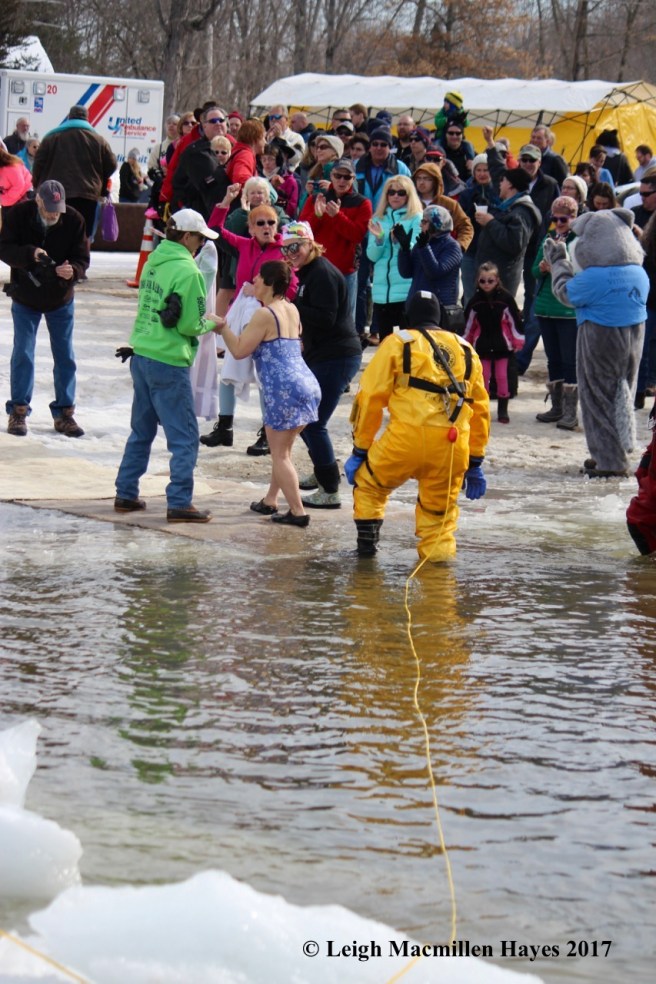
Many gathered to watch the annual polar dip called Freezin for a Reason, a benefit for Harvest Hills Animal Shelter in neighboring Fryeburg. Harvest Hills is a shelter that accepts stray, neglected and abandoned dogs and cats.

w9

Those taking the plunge donned a variety of costumes.

w10

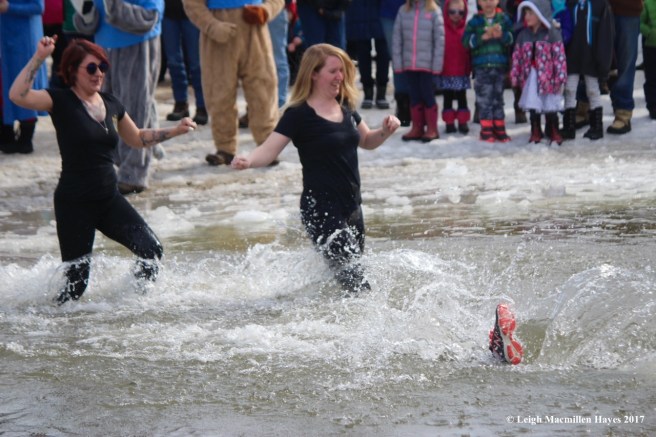
And their faces told the story.

w11

They offered support with smiles.

w12

w13

w14

Some disappeared under water for a few seconds.

w15

While there were those who dove in, others were more cautious.

w16

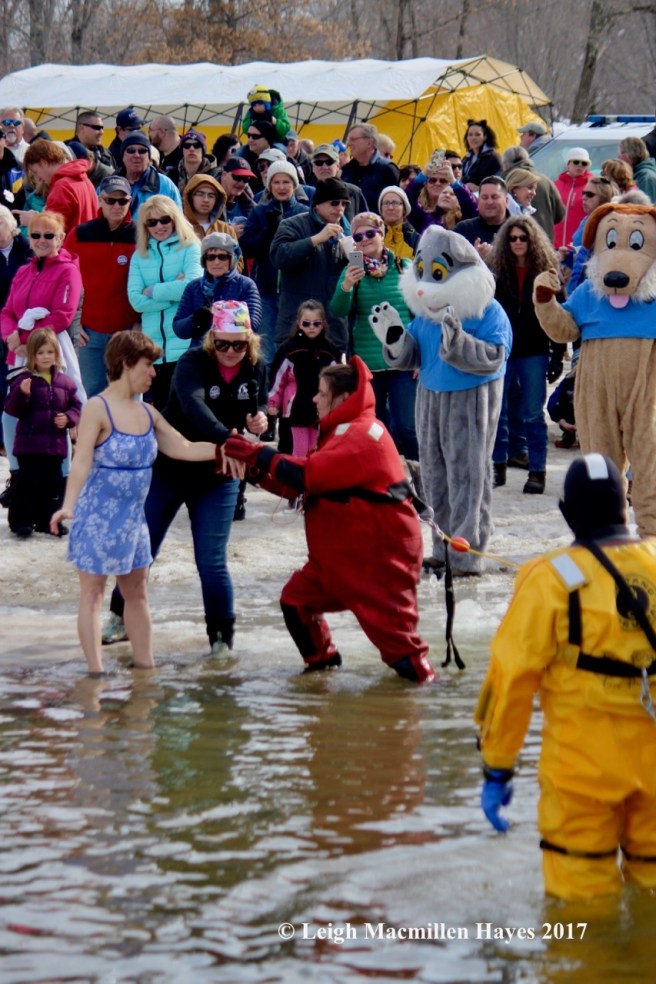
All kinds of critters came out to cheer them on.

w17

w19

w20

Laughter, hoots and hollers filled the air, while rollers curled the hair.

w21

Kids of all ages got into the act.

w22

w23

w30

And some accepted the challenge to get to the other side of the “pool” where local firefighters were ready–just in case–and happy to offer high fives. Thankfully, their rescue services weren’t needed.

w24

w25

w26

w27

w28

It was fun to watch co-workers and their individual approaches.

w29

Each reacted differently to the common goal.

w31

And the best was saved for last, when Jen was introduced.

w32

She waved to the crowd as she walked the white carpet to the water’s edge.

w33

Joan gave her hand so she wouldn’t slip.

w34

And the fire crew moved in to provide additional support.

w35

Jen loves to swim.

w36

And so she did, kicking up water in the face of her aids.

w37

To the cheers of all watching, she finally got out.

w38

Like all who took the plunge, she was greeted with a warm towel.

In honor of dogs and cats, all of these folks raised money to the tune of over $20,000. They deserved all the cheers they received as they celebrated this beautiful and balmy dog day of winter.


Falling Stars

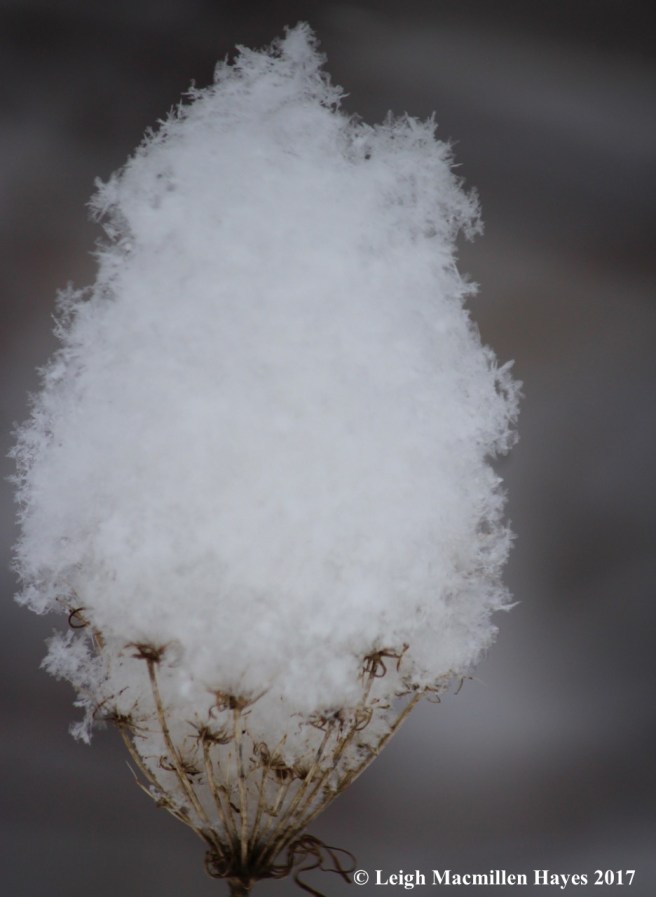
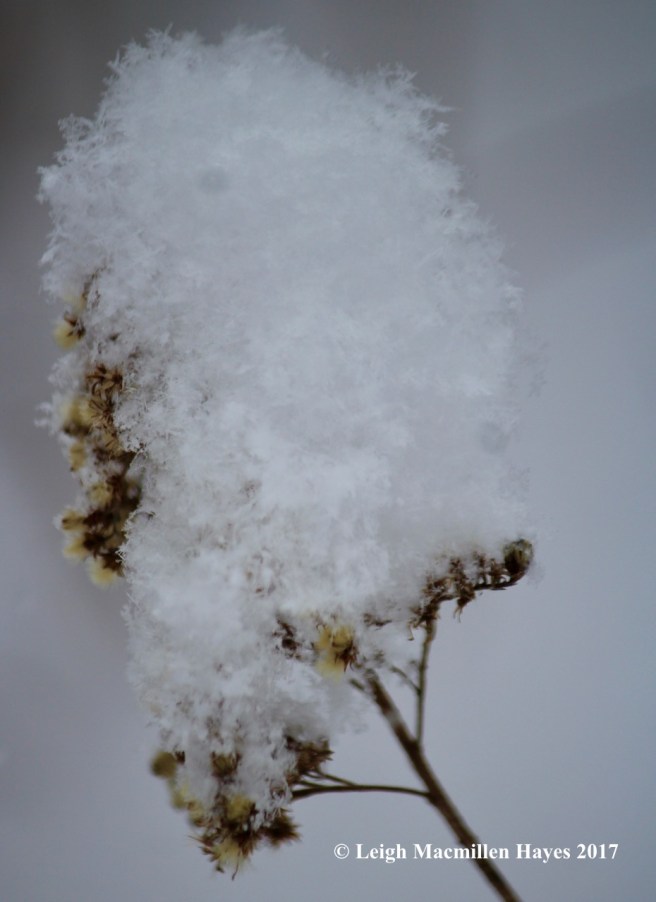
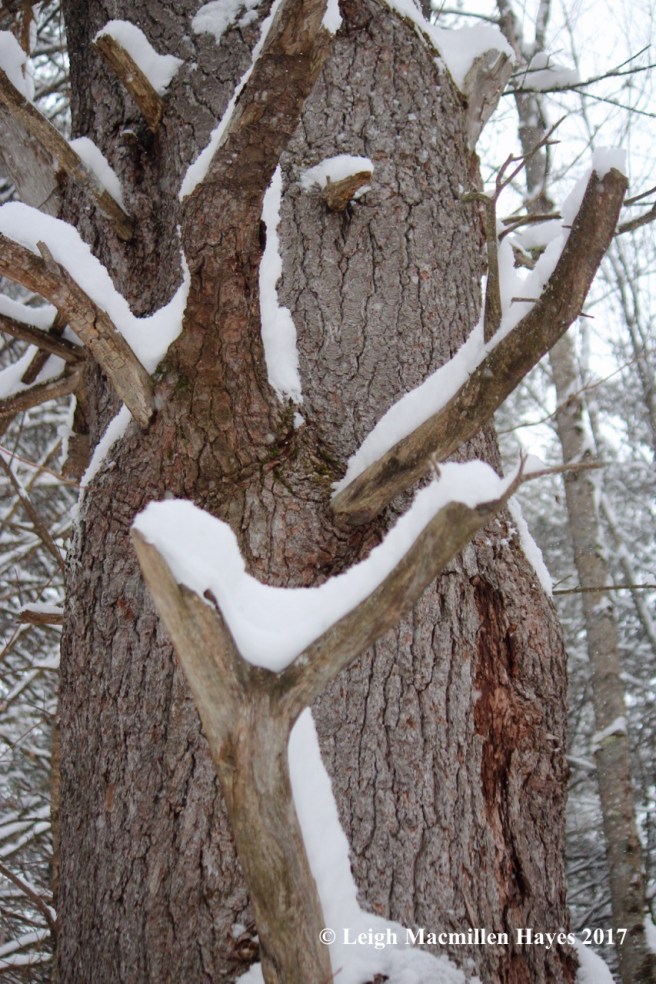
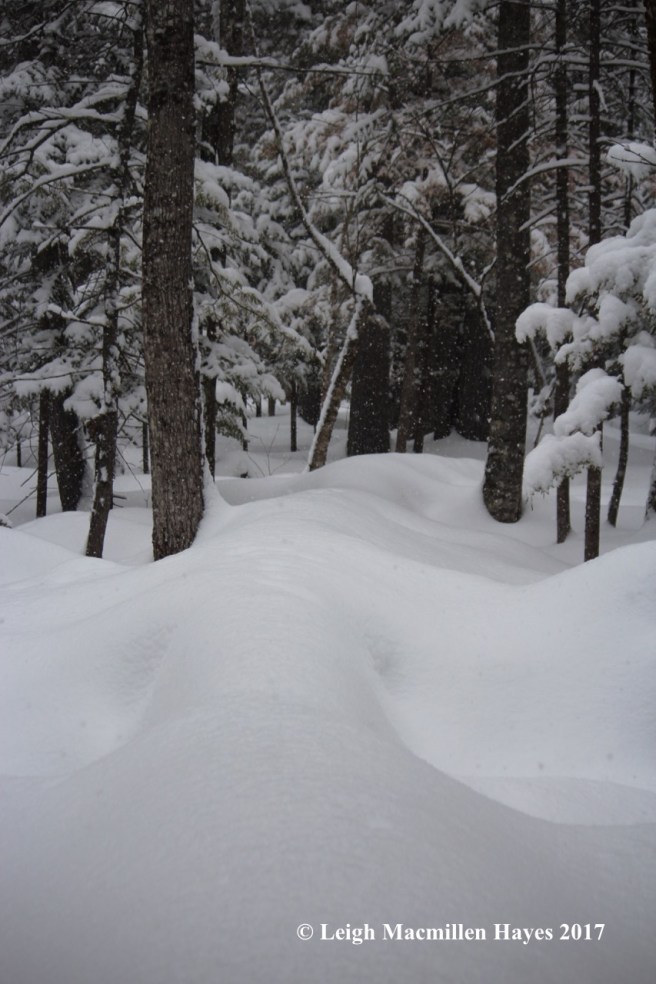
The sight of falling snowflakes filled that spot in my soul that is devoted to wonder.

p-queen-annes-lace

Each tiny morsel unique.

p-aster

Many stacked high.

p-red-maple-leaf

Some precariously perched.

p-shelf-fungi

Others well supported.

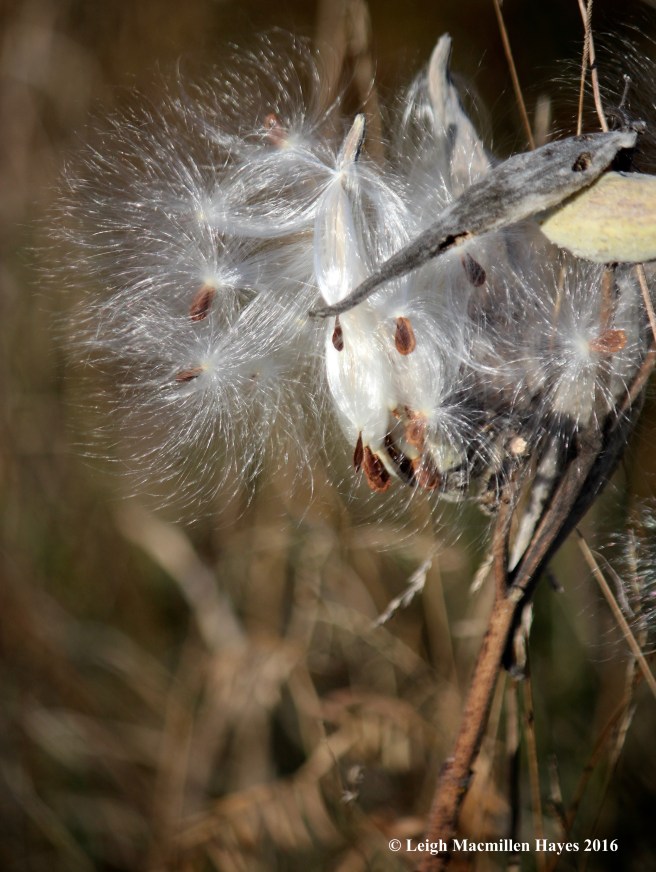
p-milkweed

Foundations varied.

p-stairway

Stairways formed.

p-lea-mlsc-boardwalk-1

Boardwalks hid.

p-moss-monster

Moss Monsters smiled.

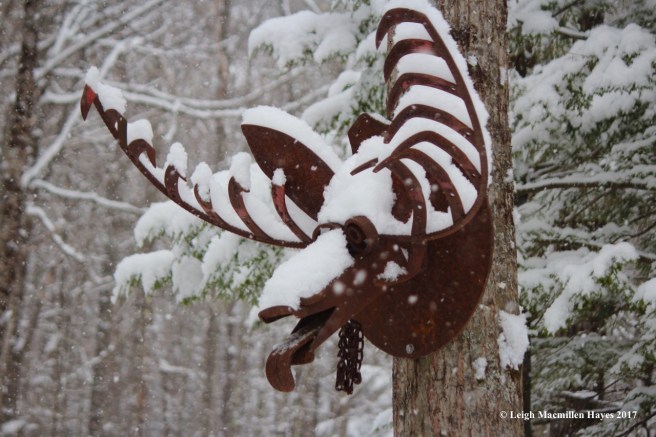
p-moose

Moose chuckled.

p-male-mallard

Mallards speculated.

p-red-fox

And the red fox paused.

Watching snowflakes gather reminded me of the impermanence of it all. They are exquisite and beautiful, yet temporary.  Here one moment, trampled and melted the next. Yet, I am forever awed by each tiny star that falls from the sky.

Progressive Lunch Mondate

Today’s hike found us climbing one of our favorite mountains in western Maine. We love the fact that we can ascend along various trails and change it up if we want with up and back routes, circular routes and ridge-line routes.

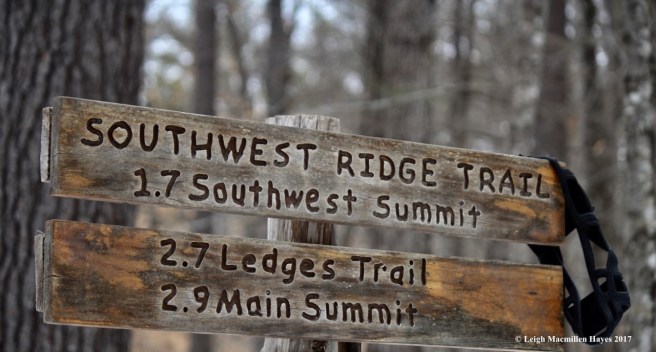
p-trail-sign

Since we chose the Southwest Ridge Trail, we drove to the parking area on Denmark Road. Ours was the only vehicle, but trail conditions and a single Stabilicers™ ice cleat indicated many others had traveled this way recently. As for those ice cleats, my guy informed me he’s sold tons this winter and he has STABILicers™ Powder Straps for sale as well, so they don’t end up as trail sign decorations.

p-deer-skipper-and-doe

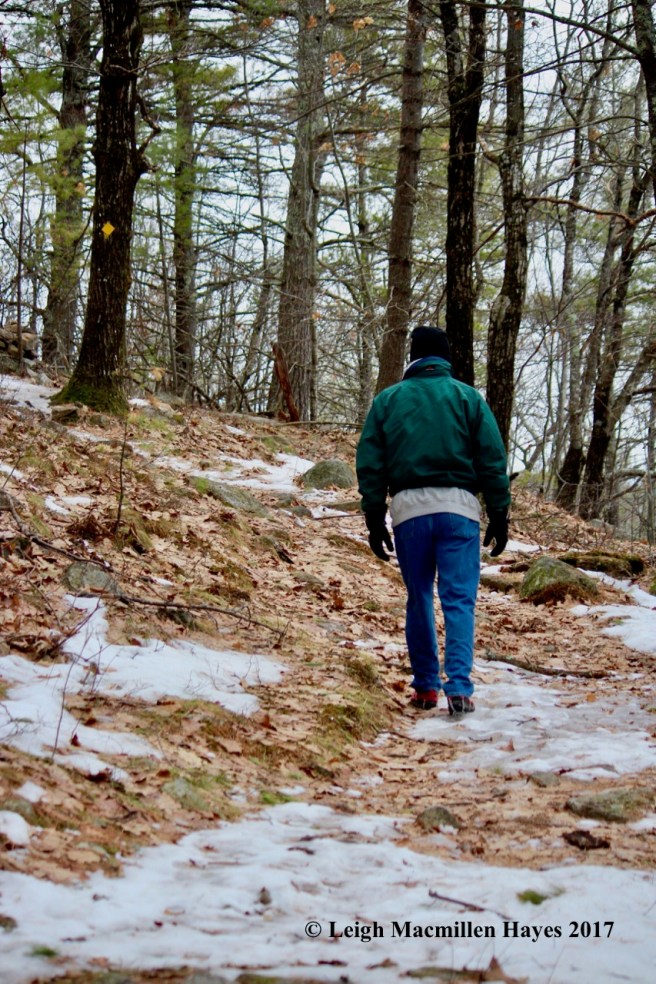
The beginning of the trail was mostly covered in frozen snow. Immediately we wondered who had used the trail more–humans or deer? The imprints of the latter spoke of timing. The smaller skipper on the left, must have moved this way after a recent warm day and the adult, which I suspected was a doe, earlier when temperatures were colder and the snow firmer. With temps a bit lower than yesterday, we found it rather firm for our purposes.

p-deer-run-1

At least seven different deer runs crossed the trail between the parking area and first ledge.

p-deer-run-2

Being on the southwestern side of the mountain, the snow level was significantly less than elsewhere and one run was completely open to the leaf litter, making it easier for food foraging.

p-spring-trail-1

Conditions kept changing for us as well. A friend from Florida had been asking about signs of spring, and this trail certainly hinted at a change of seasons.

p-trail-ice

p-spring-trail-2

In fact, we experienced a bit of every season, from snow and ice to leaves, mud and water.

p-cracker-rock

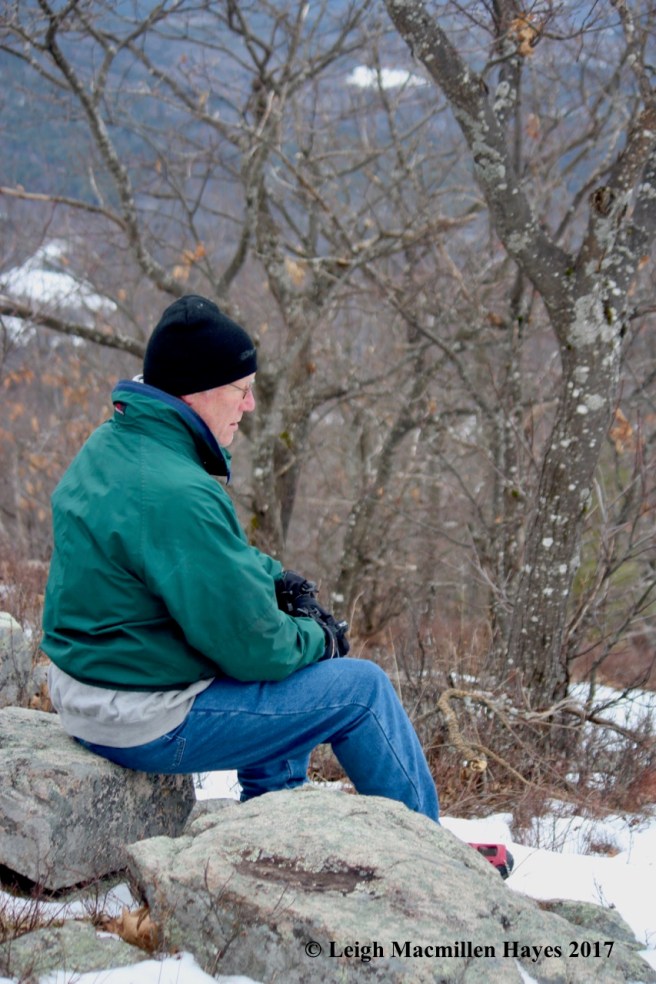
About an hour into our climb, we found two rocks meant for a pause. And so we did.

p-cracker-cheese

Lunch Course Number One: Pineland Farms Creamery’s Salsa Jack cheese on crackers.

p-cracker-view-1

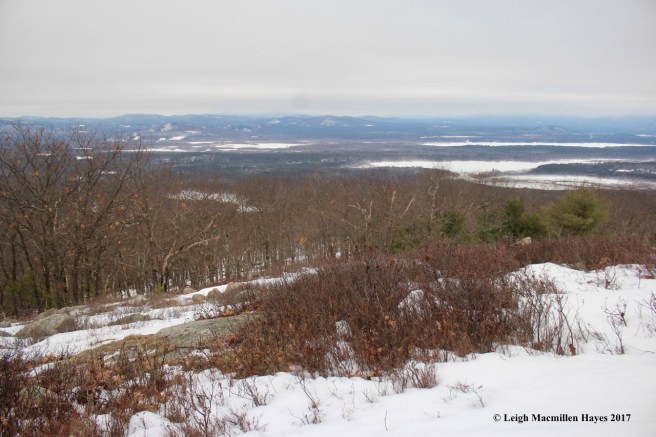
Our break gave us time to take in the view toward the White Mountains where we’d hiked yesterday. Though our visibility was rather good for a cloudy day, it was obvious that those mountains were again in the mist.

p-staghorn-1

A bit further on, the bright orange-red fruit clusters of staghorn sumac brightened our day. As vibrant as they are, most of the pompom fruits remained, waiting for songbirds, turkeys and grouse. Apparently, they are not a preferred food source and will often remain until late winter. Though I’ve never tried it, the crushed fruit can be used to make a lemonade-like tea. And the tannin-rich bark was used to tan hides.

p-staghorn-2

The “staghorn” part of the common name derived from the fact that the stem is covered in reddish-brown hairs and features a manner of growth that somewhat resembles the velvet-covered horns (antlers) of a stag (male deer).

p-teepee-1

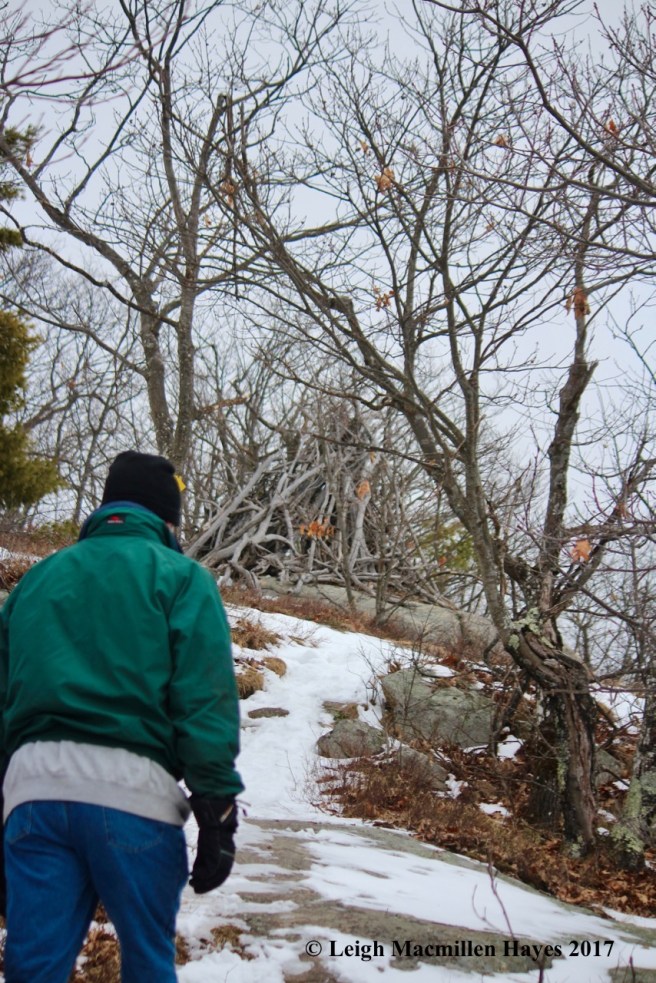
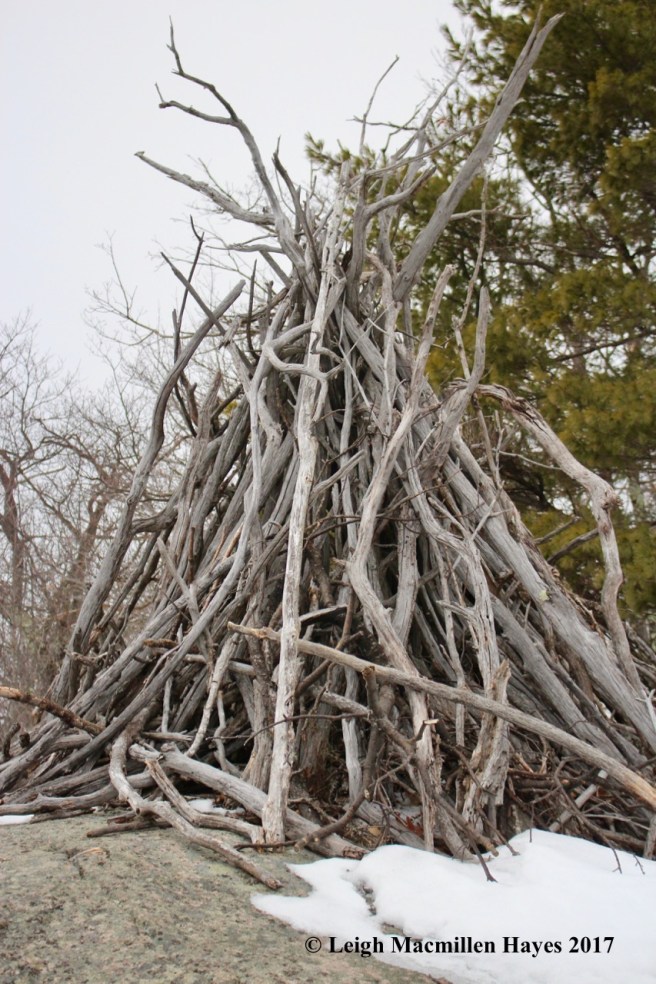
We solved the problems of the world as we continued up, all the while looking down to choose the right foot placement so we were both surprised when we realized we’d already reached the teepee at the summit of the trail.

p-soup

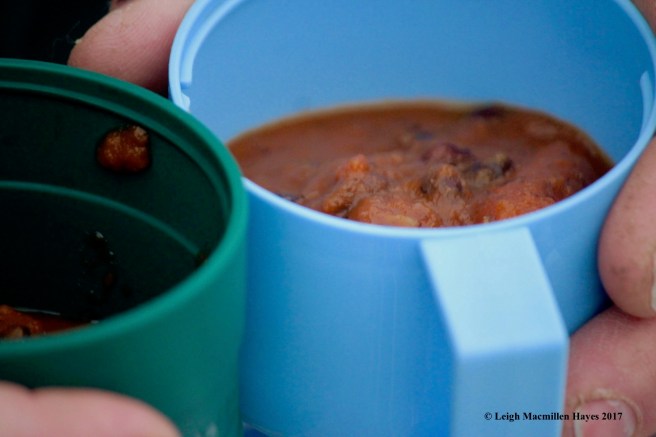
Lunch Course Number Two: Black Bean Soup.

The recipe was shared with me eons ago by my friend Carissa. When our sons were young, they loved to help me make it. And I was thrilled when our oldest asked for the recipe last week. I thought you might appreciate it.

Black Bean Soup

1 lb plum tomatoes, halved lengthwise

1 large onion, halved and cut into wedges

1 lb carrots, peeled and quartered

3 lg garlic cloves, chopped

1 Tbsp olive oil

1/2 tsp dried oregano

4 C vegetable broth

3 1/4 C cooked black beans or two 15oz cans black beans, rinsed and drained

Combine first six ingredients and roast at 350˚ for one hour, stirring occasionally. Set carrots aside. Purée other roasted veggies. Pour some broth into roasting pan and scrape up bits. Hold aside one cup beans. Purée other beans, using some broth if necessary. Chop carrots. Heat everything together. Add salt and pepper to taste. Serve with a dollop of plain yogurt.

p-summit-1-1

We enjoyed the view and talked about the Hike and Bike Trek that Loon Echo Land Trust hosts each year. This is the spot that my friend, Marita, and I spend the day at as we perform our hostess duties for the six-mile hikers.

p-teepee2

Before we began our descent, we took one last look at the teepee, created years ago by the late George Sudduth, director/owner of Wyonegonic Camps, the oldest camp for girls in America.

p-hiking-down

Back down we went, carefully picking our way. We were actually surprised at how quickly we finished, the climb down not nearly as treacherous as at least one of us had anticipated.

We’re expecting a Nor’easter overnight into tomorrow and hope it’s an all snow event (despite the prediction for freezing rain and sleet after the snow) because we aren’t ready to give up winter yet.

Lunch Course Number Three: Two Dark Chocolate McVitie’s Digestives when we reached the truck. A perfect ending to a Progressive Lunch Mondate on Pleasant Mountain.


Perley Pond Preserve Presents

I love to learn and today’s presence offered such as I explored Loon Echo Land Trust’s Perley Pond/Northwest River Preserve in Sebago. I’ll be leading a hike there this Saturday, so if you are so inclined, I hope you’ll come along. But if you can’t, then please read on. (Note: Jon Evans, Stewardship Manager for LELT will be with me on Saturday, and he’ll have so much more to offer about the lay of the land, which was acquired by the trust in 2014. Today marked my first visit to this property.)

p-land-trust-sign-1

There are three entry points along Folly Road and I began my reconnaissance mission at the first, where I didn’t get far due to a stream not quite frozen, but still found plenty to examine.

p-evening-primrose

Evening Primrose stood at alert in the field just off the road. Tall in stature, its distinctive seed pods peeled back in four parts and small seeds looked like fresh ground pepper on the snow.

p-black-eyed-susan

Black-eyed Susans also decorated this space, some leaning over to share their offerings. The hairy bracts and gumdrop shape made these easy to spot.

p-beaked-hazelnut-1

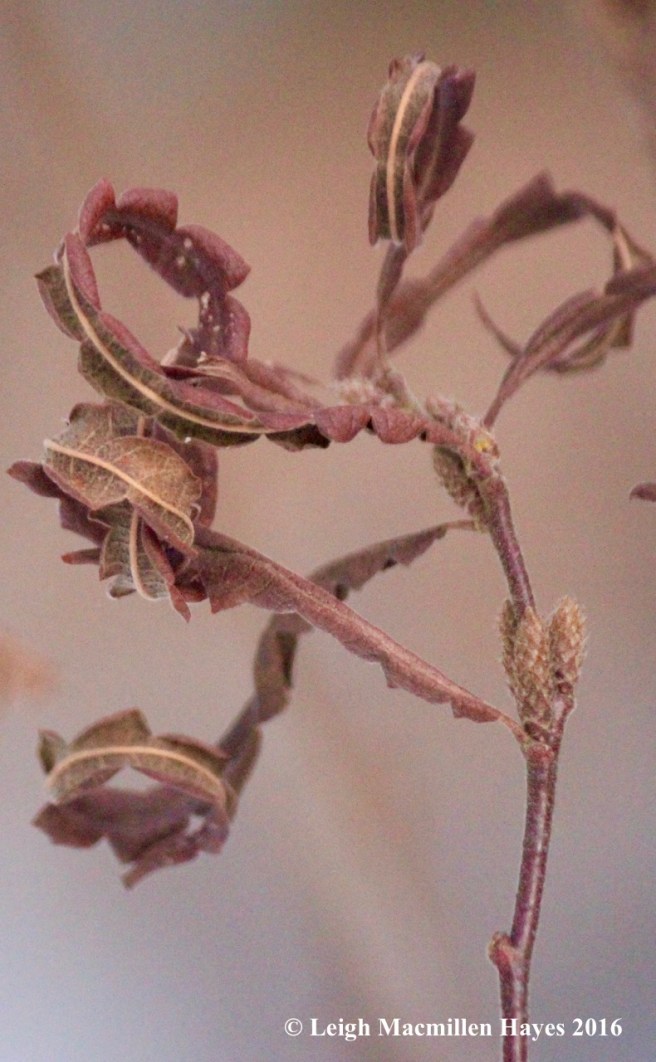
One of my favorite finds in the first section of the property–the hairy twig, catkin, leaf and bud of a Beaked Hazelnut. Just last week I saw the same, well, minus the catkins, in Lovell. And knowing that certain leaves are marcescent, e.g. remain attached to the stem throughout some or most of the winter like oak, witch hazel and especially beech, I was thrown off by this other type. It had me thinking birch and well it should have because Beaked Hazelnut is a member of the birch family. But #1, though a hairy twig like Yellow and Paper Birch, the leaf base wasn’t right for either, and #2, I didn’t recall ever seeing these leaves still dangling in later fall/early winter. The trees taught me a lesson today–the most perfect of gifts–a few Beaked Hazelnut leaves continued to dangle, though most were turning quite dark in hue and I suspected will fall soon, and, I found Gray Birch leaves also clinging. Just when I thought I knew everything, nature proved there’s more to learn. So the gift was a reminder to pay more attention.

p-log-landing

I left that section and walked down the road to a spot where a chain prevents vehicles from entering the old log landing. It certainly didn’t stop the deer who had danced in the night.

p-sweet-fern

As I moved through the landing, I paused to admire another dancer as witnessed in the fluid movement of Sweet-fern.

p-sweet-fern-catkins-2

Like the Beaked Hazelnut, its catkins were wrapped gifts that spoke to the future.

p-willow-gall

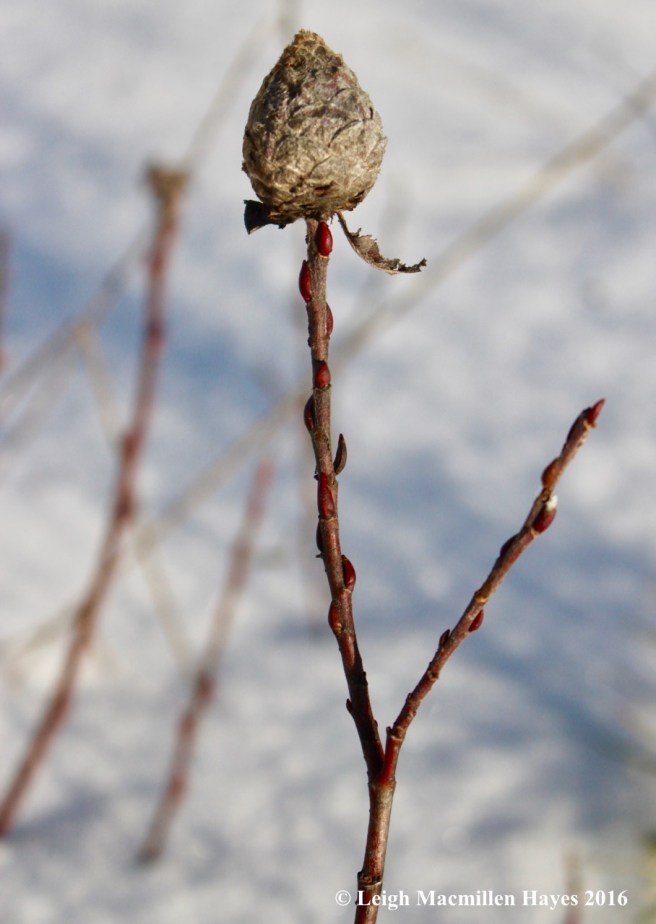
Also in this space, a few willows with their own little packages.

p-willow-gall-1

The willow pine cone gall was created in the summer by a gall gnat midge. The larva stage secreted a substance on the stem that caused the willow to go into overdrive–resulting in a multi-layered chamber composed of hardened material that would have been leaves, but alas, the stem growth was arrested. Inside that hairy structure resides the wintering larva, nice and snug for the winter. It will metamorphose into a gnat when warm weather arrives.

p-fir-christmas-tree

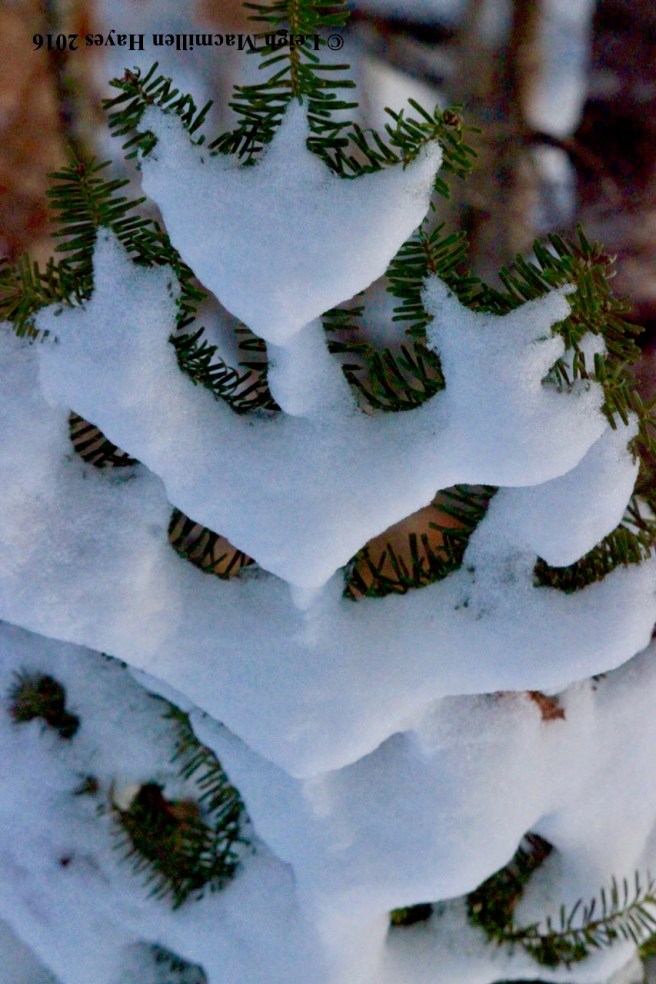
As I walked along I noticed Christmas tree patterns among the firs.

p-fir Christmas Tree1.jpg

It was a simple case of an upside-down look. Once flipped, in my brain anyway, the seasonal symbol was obvious.

p-ornaments-big-tooth-on-fir

And the ornaments dangled–in the form of Big-toothed Aspen leaves and White Pine needles,

p-ornament-lichen1

Northern Camouflage Lichen,

p-ornament-pileated

and shredded bark created by . . .

p-ornament-pileated-works

a Pileated Woodpecker in search of food.

p-ruffed-grouse

I felt my good fortune to find a spot where a ruffed grouse had tunneled.

p-big-tooth-burl

And then I was stopped by a burl. Like a gall, this was created by insects.

p-big-tooth-bark-1

The tree of choice featured lower gnarly bark that resembled a Northern Red Oak.

p-big-tooth1

But a peek toward its crown revealed a birch–the two-fer one gift: Big-toothed Aspen.

p-big-tooth-leaves

Its leaves, oh my, another  temporarily “marcescent” variety–showing off the big teeth for which it received its common name.

p-white-oak-leaves

Speaking of leaves, there were numerous renditions of White Oak–another dancer that seemed to freeze in motion.

p-red-pine-heart

Here and there among the offerings, Red Pine. This particular one showed my love for it where a branch had broken off. Do you see the wee heart?

p-red-pine-geometry

While mature Red Pines feature bark that reminds me of a jigsaw puzzle, I found some younger trees, their structure speaking to geometry.

p-piscataqua-sign

Continuing on along the logging road, I wondered if perhaps I’d gone astray. Suddenly, I found myself in Piscataqua County–miles and miles from home. I knew I was in unknown territory, but was I really that far from home? More than my usual fake lost?  Or someone’s sense of humor?

p-owl-1

Maybe so. Certainly I was in the land of owl feet.

p-coyote

And a tuckered coyote?

p-bushwhack

It was at this point that I headed off trail, made easy by underbrush.

p-deer-tracks

Deer tracks led me to another wonder-filled gift.

p-northwest-1

The wetland and Northwest River, one of the namesakes for this place.

p-pitch-pine-bark1

It was here that another lesson presented itself–the layered bark made me realize I was viewing Pitch Pine growing beside the bog. My understanding was that these grew on ledges or rocky outcrops. But here was one with wet feet. And so I later consulted Bogs and Fens by Ronald B. Davis (I highly encourage you to add this title to your Christmas wish list) and discovered that not only does it grow in dry woodlands, but also “in swamps and at the edges of fens and bogs.” (Additional note: Pitch Pine Bogs are listed as S2:  “Imperiled in Maine because of rarity (6-20 occurrences or few remaining individuals or acres) or because of other factors making it vulnerable to further decline”; thus another reason to give thanks to LELT for preserving this place)

p-pitch-pine-1

p-pitch-pine-needles

Pitch Pine needles present themselves in bundles of three–perfect for this time of year–ahhhh, the Trinity.

p-rhodora-1

Rhodora

p-leatherleaf-1

and Leatherleaf added to the winter ornamentation.

p-ice-break-through

In my attempts for “the perfect photo,” I broke through the ice several times. I’d been post-holing through about seven or eight inches of snow all afternoon sans snowshoes because it was quite easy to move about in the fluffy stuff, but when I reached the edge of the water, the snow had insulated the thin ice cover and . . .  crash, crackle, crunch, I sunk in to the top of my Boggs and even a wee bit over.

p-trail-back

On my way back down the logging road, I realized how my own tracks were much more varied than that of the deer who’d passed before me.

p-land-trust-boundary

And then I came to a boundary sign. Opps. Guess I went beyond the land trust’s property, though thankfully no signs deterred me from trespassing.

p-perley-pond-1

And a wee bit further down Folly Road, I stopped at Perley Pond, part of the namesake for this property–and part of the reason for my presence for the presents presented.

The Be-Attitudes Sundate

Today marks the beginning of the season of hope and with that in mind, my guy and I climbed Singepole Mountain in Paris. Paris, Maine, that is.

s-halls-pond-start-1

Our hike began beside Hall’s Pond, where the water reflected the steel gray sky of this late November day.

s1-barbed-wire

And stonewalls and barbed wire reflected the previous use of the land.

s1-beaver-6

In a matter of minutes we learned of its present use.

s-beaver-works-3

Everywhere we looked, beaver sculptures decorated the shoreline.

s1-hemlock-grove

We passed from the hardwood community to a hemlock grove . . .

s-hemlock-girdled-2

where more beaver activity was evident. I’ve been reading The Hidden Life of TREES by Peter Wohlleben and have some questions about tree girdling such as this. There is a theory that beavers chew off the bark all the way around (girdle) to eventually kill trees such as hemlock, so preferable species will grow in their place. But, that’s thinking ahead to future generations. Do beavers really do that?

s-hemlocks-3

On page 18, Wohlleben states the following: “As the roots starve, they shut down their pumping mechanisms, and because water no longer flows through the trunk up to the crown, the whole tree dries out. However, many of the trees I girdled continued to grow with more or less vigor. I know now that this was only possible with the help of intact neighboring trees. Thanks to the underground network, neighbors took over the disrupted task of provisioning the roots and thus made it possible for their buddies to survive. Some trees even managed to bridge the gap in their bark with new growth, and I’ll admit it: I am always a bit ashamed when I see what I wrought back then. Nevertheless, I have learned from this just how powerful a community of trees can be.”

Could this theory be true? Are the surrounding hemlocks feeding that tree via their roots? If so, does that throw out the other theory? So many questions worth asking.

s-huge-maple-1

Soon, we left the Pond Loop Trail and started to climb the Singepole Trail, passing by a gentle giant.

s-maple-2

It’s a snag now, but this old maple offered tales of the forest’s past and hope for the future.

s-downy-rattlesnake-plaintain

On a smaller scale, Downy Rattlesnake Plaintain provided a cheery contrast among the leaf and needle carpet.

s-bobcat-ledges-1

The climb was a bit challenging in places, but we held out hope among the ledges that we might see a bobcat.

s-porky-den

No such luck, but we did find this . . .

s-porky-scat

a well used porcupine den.

s1-water-2

Water dripped in constant harmony as we stepped gingerly along the narrow ledges and tucked under overhanging rocks.

s-halfway-up-2-1

About halfway up, we took a break and paused to admire the view.

s-halfway-up-view-1-jpg-communities-defined

The hardwood and softwood communities became more obvious as we looked down.

s-summit-1-1

And suddenly or so it seemed, my guy reached the moment of truth–the summit.

s-halls-pond-to-pleasant-1

From the top, we looked around and embraced our home place, which appeared on the horizon in the form of Pleasant Mountain.

s-pleasant-to-whites-1

A slight turn and the view extended from Pleasant Mountain to the White Mountains.

s-quartz-intrusion

Below our feet, the granite pegmatite shared its showy display.

s-summit-1

We’d read that there was a quarry at the summit, so we headed toward a cairn, in hopes of locating it. Too many jeep trails confused us and we decided to save the quarry for another day. Instead, we turned into the woods to get out of the wind and munch our PB & J sandwiches, the grape jelly courtesy of Marita Wiser and family.

s-wickiup-1

As we poked about, something caught our attention and we moved closer.

s-wickie-3-1

s-wickie-2-1

s-wickie-1-1

A wickiup frame. We admired the efforts of someone to create this traditional structure.

s-pleasant-mtn

Emerging from the woods, we took one last look at Pleasant Mountain, and . . .

s-summit-4

one last view of what seemed to be the summit (though it may have been a false summit).

s-climbing-down

And then we started down, once again hugging the rocks and trying not to slip.

s-flower-mushroom

On the way, I did note a few things, including this fungi that looked more flowerlike than mushroom like.

s-girdled-beech-1

s1-porky-2

And I spotted a phenomenon that occurred repeatedly. Girdled beech trees too far uphill for a beaver. What or who had debarked these trees?

s-porky-works

I may have been seeing things that weren’t real, but the lines on this particular tree made me wonder about the porcupines. Was I looking at the design they leave with teeth marks created in the distant past? Or were they wounds of another kind?

s1-beaver-5

When at last we reached the Pond Trail again, we continued to circle around it, noting more beaver works.

s-beaver-lodge

At last, we found the mud-packed lodge built into the edge of the pond. Here’s hoping for a warm winter within.

s-pond-at-end-of-day-1

Completing the circle, the biting breeze forced us to walk quickly toward our truck and the end of our hike. We have chores to complete tomorrow so our Sundate may have to suffice for a Mondate.

That being said, in this season of hope, we trust we’ll find more opportunities to consider these be-attitudes:

s1-trees-in-harmony

Be supportive of each other.

s1-christmas-fern-1

Be watchful of what’s to come.

s-heart

Be hopeful of love everlasting.

Meditation in the City

Though I grew up outside New Haven, Connecticut, and spent a great deal of time there as a child/tween/teen, I am not a city girl. In fact, stepping onto a sidewalk in even the smallest of cities yanks me from my comfort zone.

And so it was with great surprise that I met a city I rather liked. Over the last thirty years, I’ve passed through it numerous times, but twice this past week, I followed my tour guide from one monument to the next–my eyes wide and mouth gaping open with each new view, the obvious sign of a tourist.
w-bobsign

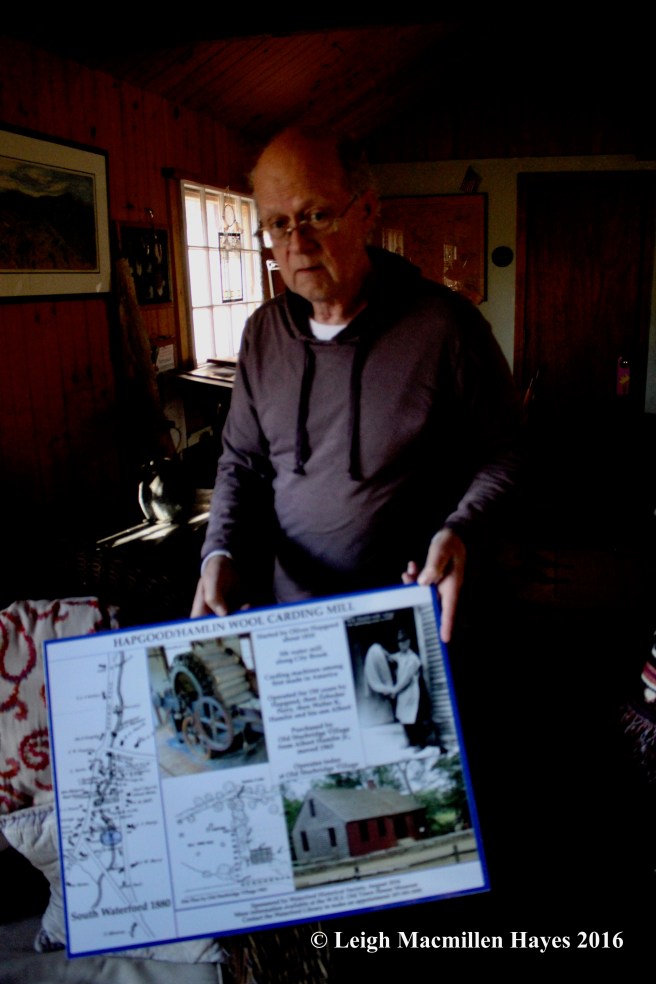
Meet my tour guide, Bob Spencer, who proudly displayed a future landmark sign.

w-indoor-view

Bob’s world view begins at City Center, aka Watson’s Falls.

w-watsons-falls-1

From the home he and his wife, Gere, have made in a former mill, the view encompasses one of nine water privileges or mill sites. Theirs is the fifth privilege along the stream, which was originally granted to Isaac Smith in 1795 for a saw mill. Over the course of its lifetime, the building served as a cloth and linseed oil mill, saw mill, salt box factory and cider mill. I love that apples still dangle above the water, a reminder of that last rendition.

w-library

On Saturday, we stepped north for a few minutes, and chatted about the mill pond and its function while Bob pointed out foundations and retaining walls and told stories of the standing buildings.

w-watson-falls-2

Then we turned south along the brook, where remnants of dams and the stonework foundations of other water-powered mills flourished from the days of the town’s settlement until the mid 1900s.

Bob is a fellow writer and naturalist with a keen interest in history. I’m flattered that he shared this place with me as well as his own written musings:

For most travelers on busy state Route 35/37, our brook is of little interest or importance. To the village of South Waterford, however, a cluster of thirty buildings which lie on either bank of this stony rill, it has served as a source of life and vitality throughout much of history. Landforms here were carved into the granite bedrock as a much larger ice-age water course scoured out a valley between Bear and Hawk Mountains to the east and Mount Tir’em and Stanwood Mountain to the west. Native Americans gathered along its banks to fish and camp. Eighteenth century settlers were drawn to the environs for a source of their fresh water and of power to produce lumber and flour, which were essential to survival. Nineteenth century industrialists, before and after the Civil War, earned their livelihoods by producing both commercial and consumer goods traded locally and in cities such as Portland and Boston.

w-flood-plainmill-pond

As we walk along he pointed out buildings still standing, those in stages of disrepair, and others that were merely memories. We paused by a meadow where he described the spring flooding events and I examined the evergreen wood ferns.

w-city-brook-meanders

And then we noted the gouge that deepened as we climbed, where “a glacial moraine as melt water engorged the brook into a raging river 15,000 years ago. The brook serves as the marshy wetland home of fish, birds and mammals. Such a short stream can teach everyone who allows the time many lessons about our ecology systems: how they work and how they were born.”

w-outlet-1

At the emergence of the brook we’d followed with two smaller brooks (Mutiny and Scoggins), we paused as Bob described their origins and journeys.
w-bear-pond

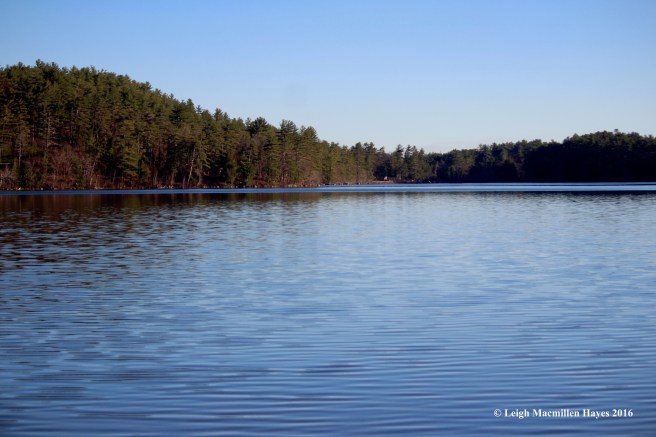
And then we turned to Bear Pond–the outlet. The temperature was relatively warm and pond almost inviting.

w-bear-mtn

With Bear Mountain overlooking, we’d reached the southern most point of the city.
w-beaverworks-2

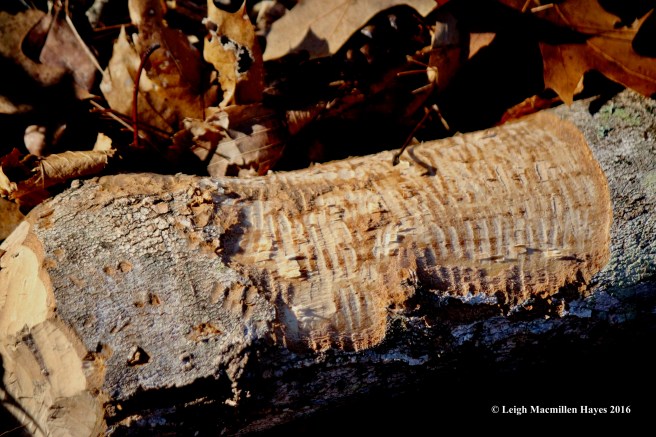
On our return trip, we found numerous signs that local residents were still industrious. Sometimes they were successful and the trees fell to the ground.
w-beaver-works-1

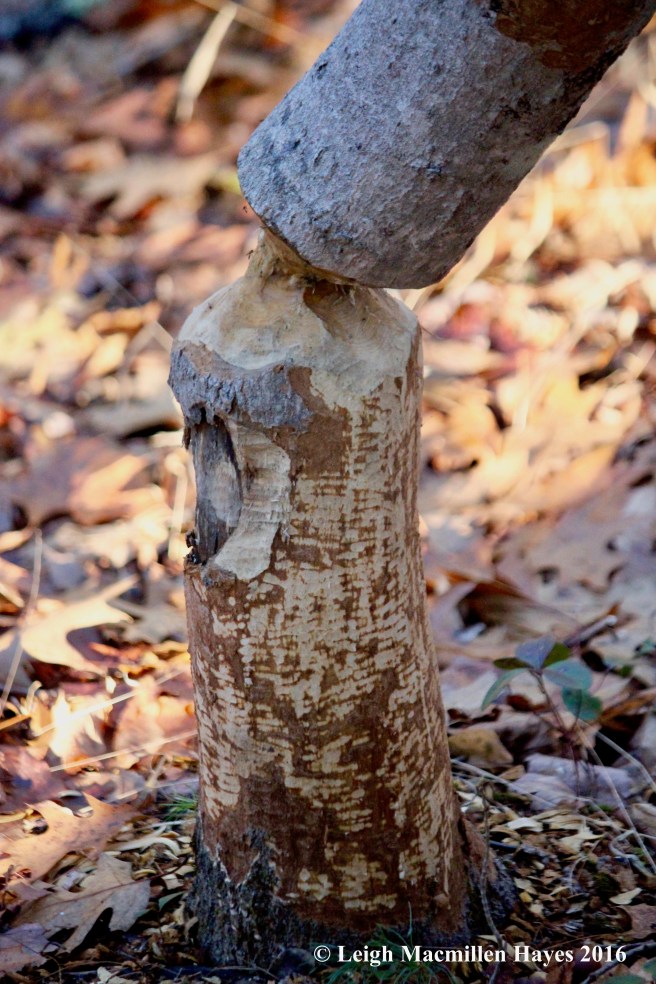
As with all industrious efforts, there were times when hang ups prevented success.
w-late-day-reflection

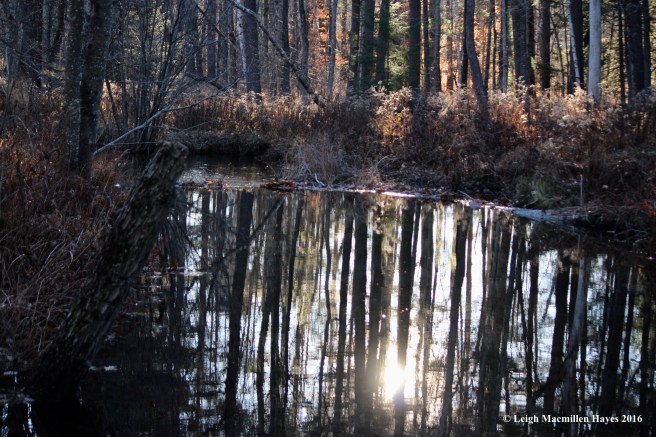
Sunshine and late afternoon reflections gave me a taste of why Bob referred frequently to the meditative nature of this place.
w-the-city

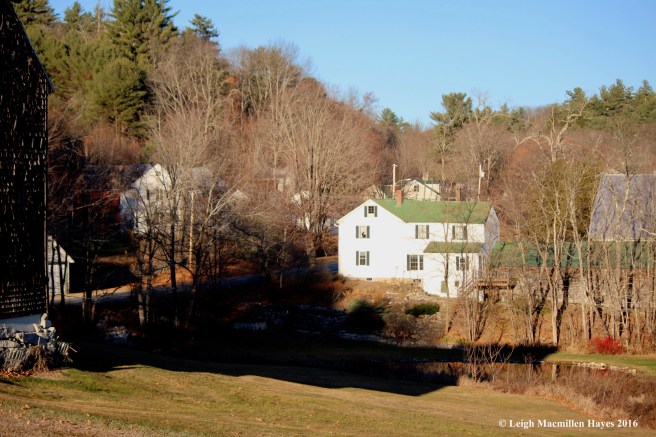
As we climbed a small hill and crossed a field, we again approached City Center.

w-sluice-1

And then we doubled back, walking to the intersection of Sweden Road with Routes 35/37. Plaster mills, bucket mills, a carding mill, saw mill and grist mill–waterpower was a necessity to any enterprise–beginning with lumber sawed for dwellings, grain ground for life-sustaining bread, shingles for siding and roofing, carded wool for the seamstress.

w-bucket-2-1

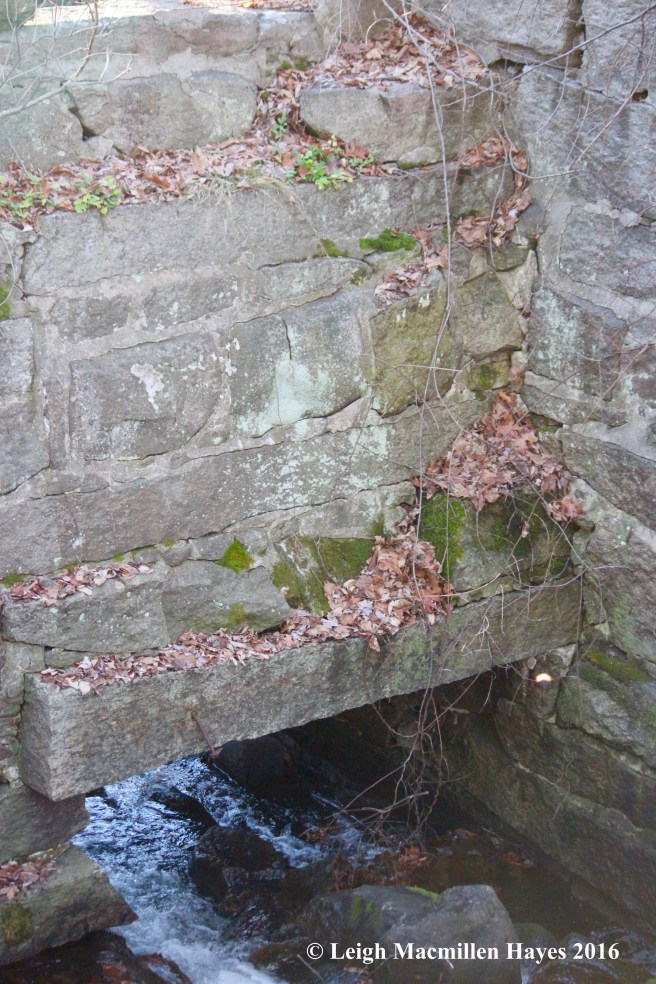
With the sun’s rays dipping lower in the sky, we stood in awe of the sluice and thought about the men and oxen and all the work that went into creating the mill–before the real work actually began.
w-sluiceway

How many times have I traveled past this site and never spied it? Too many.

w-bear-pond-2-1

After our first tour ended, I paused at the southernmost end of Bear Pond for further reflection.
w-brook-wall-2-1

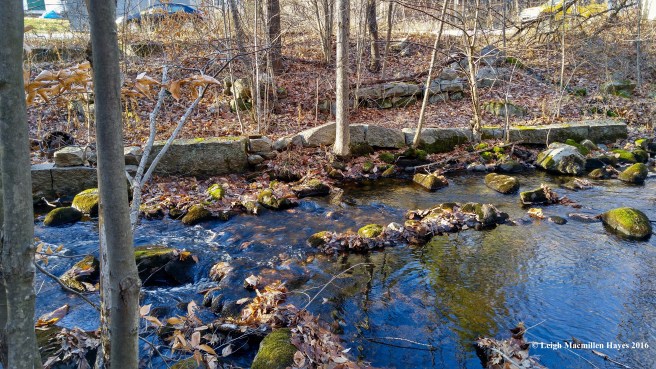
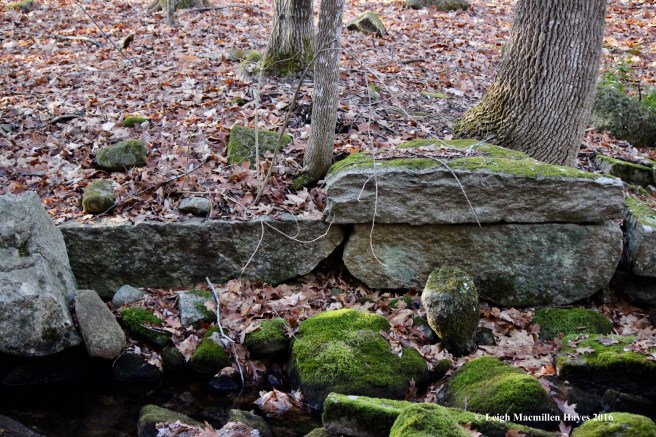
But . . . there was still more to see of the city and so a few days later I eagerly joined my tour guide again. This time we walked north, and wondered about the rock placements and considered their role as runways that once helped direct the water flow.
w-stones-line-brook

All along, we saw evidence of human intervention.

w-split-stone

We noted the feather and wedge marks on split stones.

w-barbed-wire

Barbed wire made us think about the land being used for agriculture. Though it didn’t seem that the land had been plowed, we wondered if farm animals had roamed. Bob reminded me that a carding mill once stood nearby and so we envisioned sheep.

w-barrel-wire

w-barrel-staves-1

w-artifact

Barrel wire and staves made sense to us, but we didn’t always recognize the artifacts for their use.
w-cellar-hole-2-1

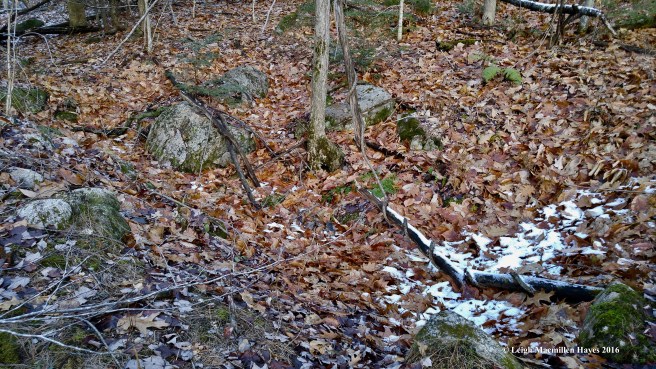
We even found a cellar hole, or perhaps a cellar hole, that Bob hadn’t seen before. Of course, we speculated. It certainly had structure. But why was it cut out around large boulders, we wondered.

w-tree-foundations

And we noted the industrial work of trees that forged their own way beside the brook.

w-city-brook-large-rocks-1

For every sight that we seemed to understand, there were more that we didn’t. With his vast knowledge of local history and the land formations along the brook, Bob pointed out natural and man-made features, but even he admitted he didn’t always get it. The pile of obviously quarried granite was one such.
w-sluice-and-old-dam-2-1

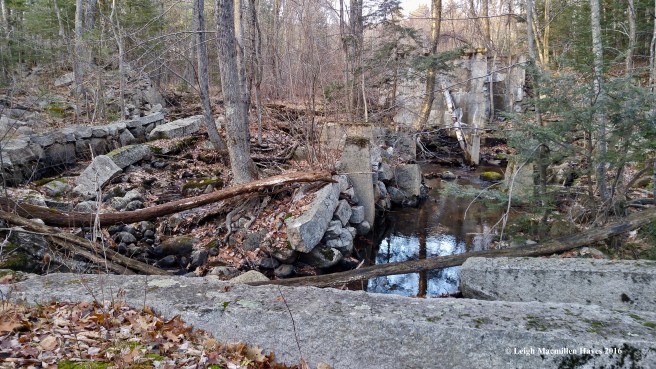
Suddenly, we reached what might be considered the crossroads of long ago and more recent past.

w-sluice-way-4

To the west, an obvious rock sluiceway.

w-stantion

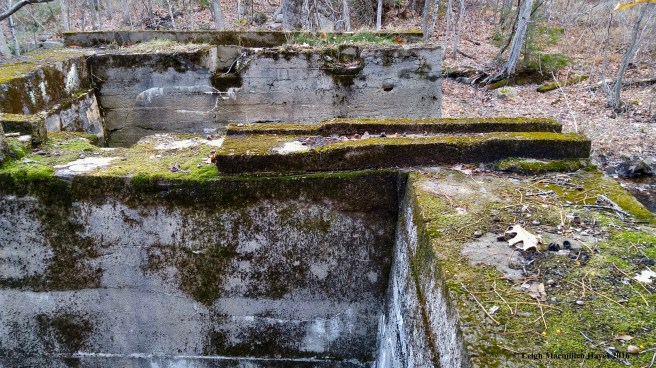
To the right, stanchions from a former, yet more recent power site.
w-old-dam-3-1

This was all located at the original spot of the first dam along the brook.

w-keoka-dam-2-1

Curiously, Bob explained as we walked along,  a more modern dam was built about a quarter mile north.

w-keoka-3-1

We’d reached Keoka Lake, formerly known as Thomas Pond. Supposedly, in the early 1900s, Thomas Chamberlain ran away from Native Americans and survived by hiding in a crack in a rock. Though the lake is no longer named for him, Tom Rock Beach holds his legacy. Today, the clouds told the story of the much cooler temperature. 

w-flats-1

Bob directed my attention to our left, where Waterford Flats was visible.

w-start-of-city-brook-1

And then we looked south, to the outlet of Keoka and the beginning of City Brook–the place where it all began. Though no longer held by dams and funneled through the rock sluiceways, it was the water that passed this very way that once provided the energy converted by water wheels and turbines to power the life of the city.
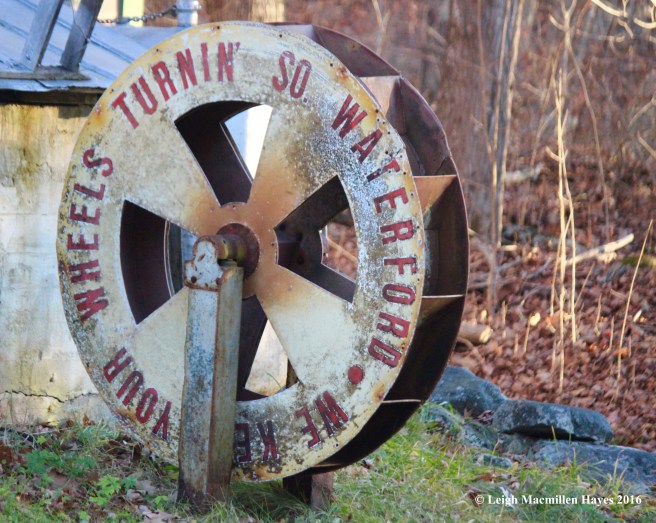
w-wheel-2

w-wesleyan-church

w-bear-mountain-grange

“Waterford City” as it was known, has changed, though some standing monuments still speak to its former life. Until Saturday, I had no idea the brook was named City Brook or that South Waterford was known as a city, so named for the industry that once existed here.

As Bob wrote, “The age of industrial prosperity is now long gone, victim to growth of large manufacturing plants which required more powerful rivers and many other economic changes since the 1870s. At that time, South Waterford was dubbed “Waterford City” for the noise and bustle brought to the town by nine mills and many supporting outbuildings lining the brook. Invisible to today’s busy passerby are many remnants of a past industrial heyday: a large concrete and split stone ruin on the access road to Keoka’s modern dam, two-story stone work that served as the foundation for a 19th century bucket mill, a simple shingled mill building atop a 1797 stone dam beside the town’s last rustic stone bridge. Further exploration may reveal lost foundations beneath the water surface, a 36-inch rusty circular saw blade, burnt remains of Waterford Creamery or an earthen dam long overgrown by bushes and brambles. These vestigial remains of human endeavor are of historical interest to many.”

w-city-brook-2

After our tour came to an end,  I paused below the cider mill one more time–a fitting spot to share another of Bob’s ponderings on this place:

“The whirling bubble on the surface of a brook
admits us to the secret of the mechanics of the sky.”
Ralph Waldo Emerson

It is appropriate to begin this study with a quote from American philosopher, existentialist Ralph Waldo Emerson (1802-1882), whose life spanned from early days of village settlement through the denouement of its industrial zenith. Emerson spent much of his boyhood visiting three aunts who lived in Waterford. He likely honed his naturalistic views while exploring City Brook or Mutiny Brook near Aunt Mary Moody Emerson’s home, Elm Vale, which was located across from the cemetery of the same name on Sweden Road.

This is one city I’m thankful to have visited. And I look forward to further explorations.

I’m grateful to Bob for sharing this place with me and especially for pointing out all of his favorite meditative places. Meditation in the city–Waterford City style.
 

A Devil of a Mondate

Ever since I first saw a photo of a family donning their Sunday best and standing on rocks that form the “Devil’s Staircase” in Lovell, Maine, I’ve been intrigued.

d-historical-society

The photo and description on Lovell Historical Society’s Web site refers to a “staircase” on Sabattus Mountain. And so for years I imagined the staircase leading to that summit, but never located it. And then I learned that a section of trail at the Greater Lovell Land Trust’s Heald and Bradley Pond’s Reserve had earned the same name. Is there a staircase at Sabattus? Or was it accidentally misidentified? Whatever the case, when I suggested to my guy that we attempt the staircase off Route 5, he embraced the opportunity. (I’ve since learned from several friends that indeed, there is a staircase on Sabattus and the photo likely was taken there. The base of the staircase is apparently on private property and no longer a safe climb.)

d-trail-map

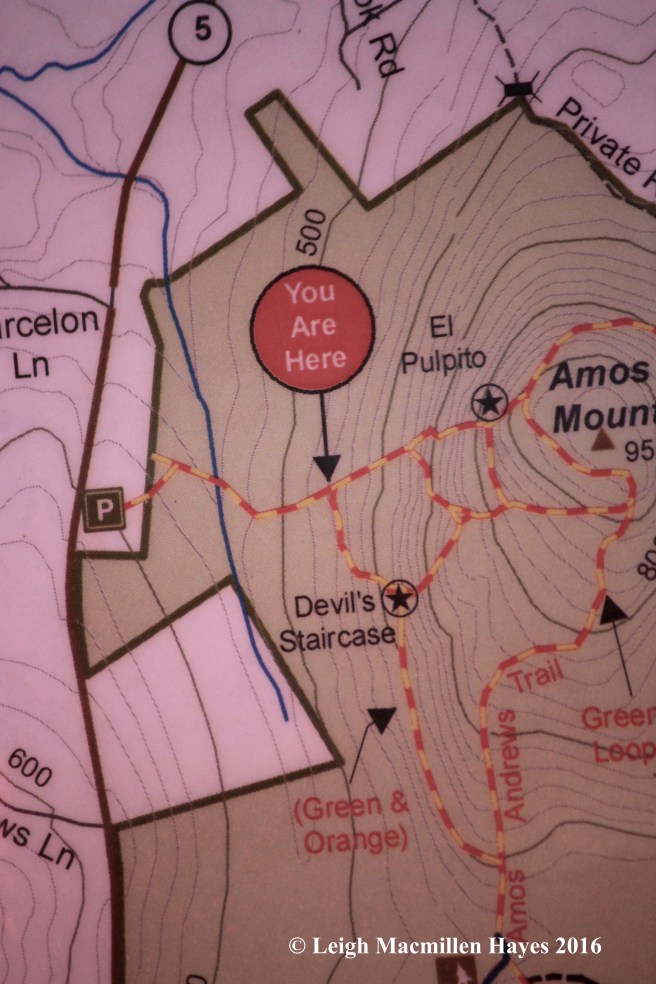
And so about noon we ventured forth and figured out a direction that would take us up the steep portions of the trail to the staircase and El Pulpito, and then down the easy trail–with hope that there was such a thing as an easy trail.

d-easy-trail

Actually, at the start it all seemed quite easy as I followed our Monday tradition of racing to keep up.

d-arrow-heavenward

We chuckled when he found an arrow that aimed heavenward–perhaps a sign that all would be well.

d-turning-the-arrow

My guy played spin the arrow to set it toward our destination. (Actually, on the way down, he spun it the other way. Note to GLLT–perhaps this arrow needs two nails.)

d-approaching-ledges

Minutes later, we approached the ledges and visions of bobcats danced through my head.

d-contemplating-the-climb

Acting as our scout, my guy contemplated the upward advance.

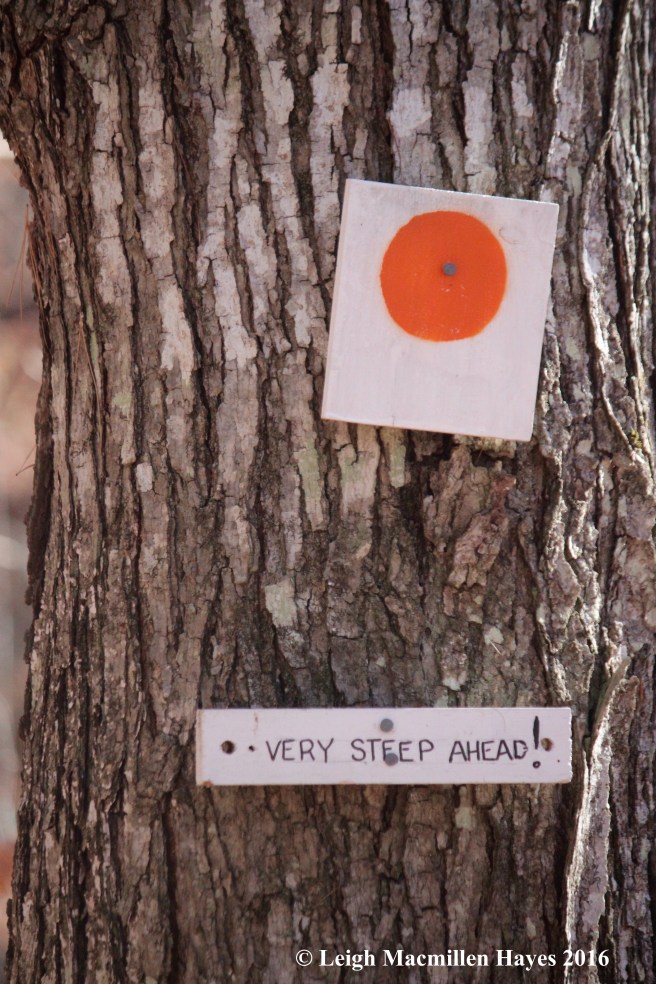
d-very-steep

We were forewarned and chose to bypass a bypass.

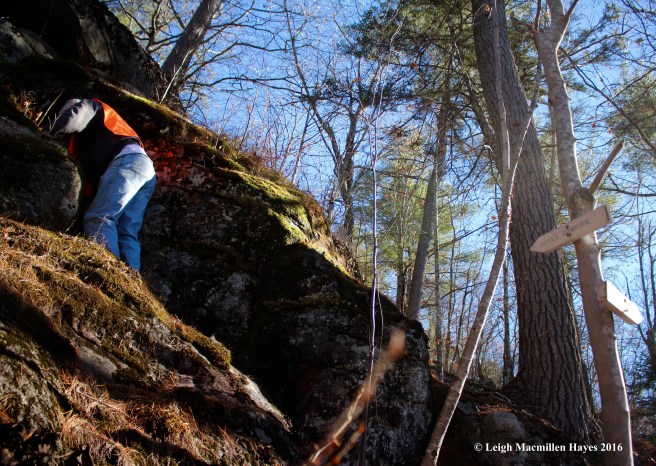
d-starting-up

He started up what we believed to be the same trail traveled by those Sunday venturers.

d-following-my-guy-up

I followed but not quite as speedily.

d-heading-up

My heart pounded in Edgar Allen Poe manner as I followed him up. I have to admit that there was a point where I wanted to turn around and climb down, but wasn’t certain that would be any easier. And so after pausing for a few moments, I tried to put mind over matter and placed my hands and feet in what seemed to be “safe” spots as I continued to climb.

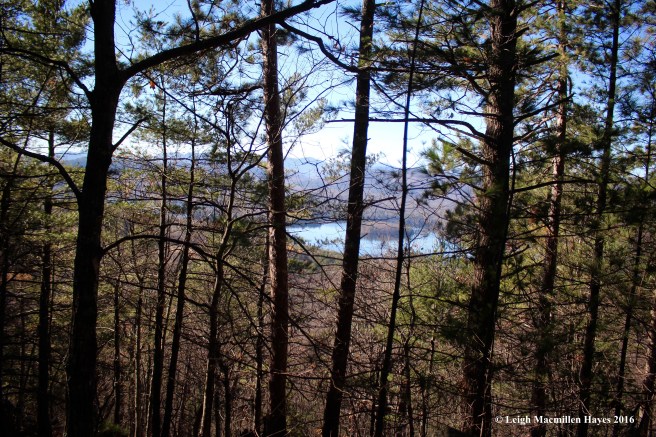
d-view-from-above-staircase

Above the staircase we were rewarded with a vantage point of Kezar Lake and the White Mountains and a chance to slow down our heartbeats.

d-lunch-view

And later, at El Pulpito, the pulpit, the complete opposite of the Devil’s Staircase–a place to pause, eat PB&J sandwiches, and contemplate life in a relaxed manner.

d-water-at-summit

Within an hour we reached the summit of Amos Mountain and spent some time being.

d-hazy-view-at-summit

Though the sun was in our eyes, the view south was a bit hazier than one would expect on a clear November day. We later learned that a forest fire burned in Albany, New Hampshire.

d-trail-down

For our descent, we followed the blue blazes of the Amos Mountain Trail.

d-tree-across-trail

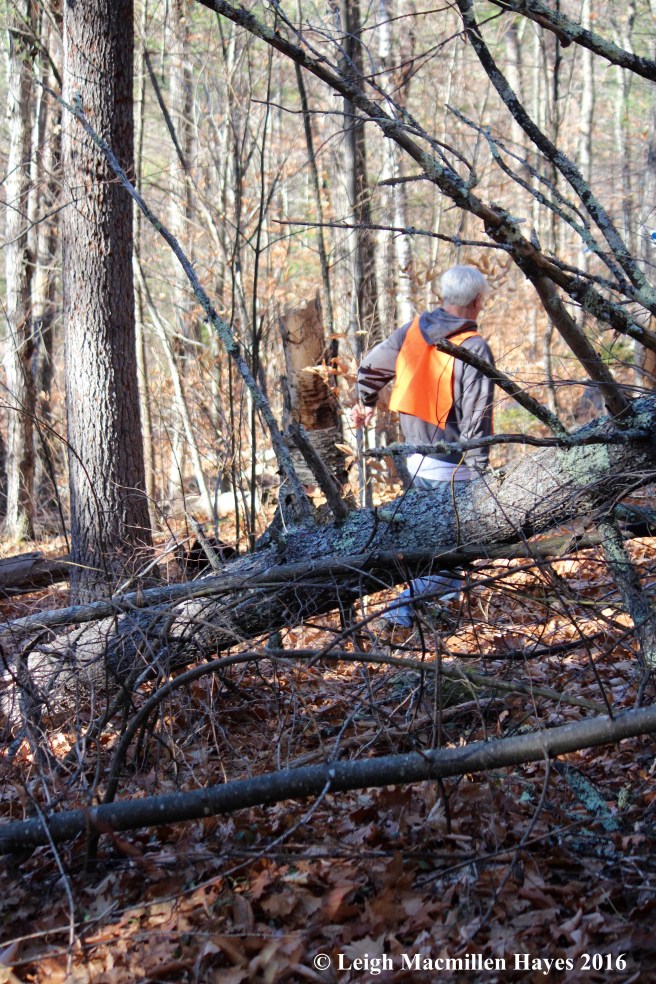
Though hardly as steep as the climb up, I was thankful for a few downed trees that slowed my guy–momentarily.

d-boot-disappears

The beech and oak leaves were over a foot deep in places and obscured rocks and roots, making for a slippery slide down.

Nevertheless, we did it. Devil’s Staircase up and a devil of a climb down–and yet, two hours later we knew we’d do it again.


Walking With Rufus Porter

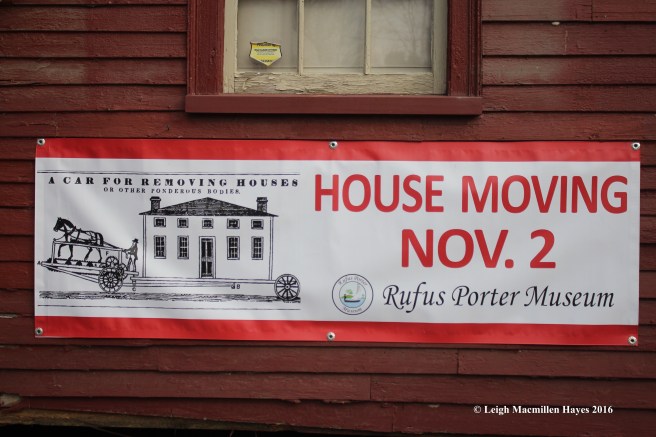
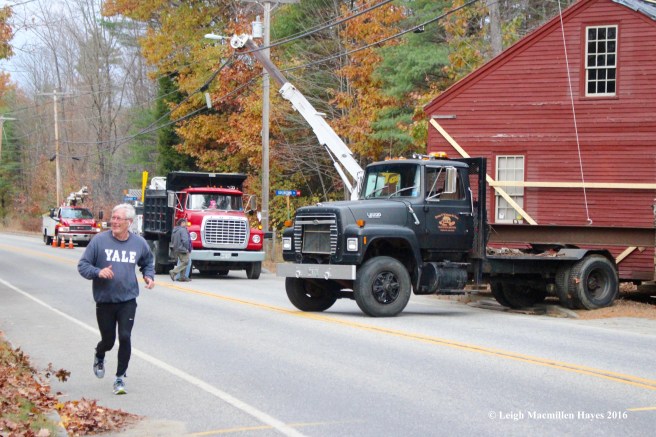
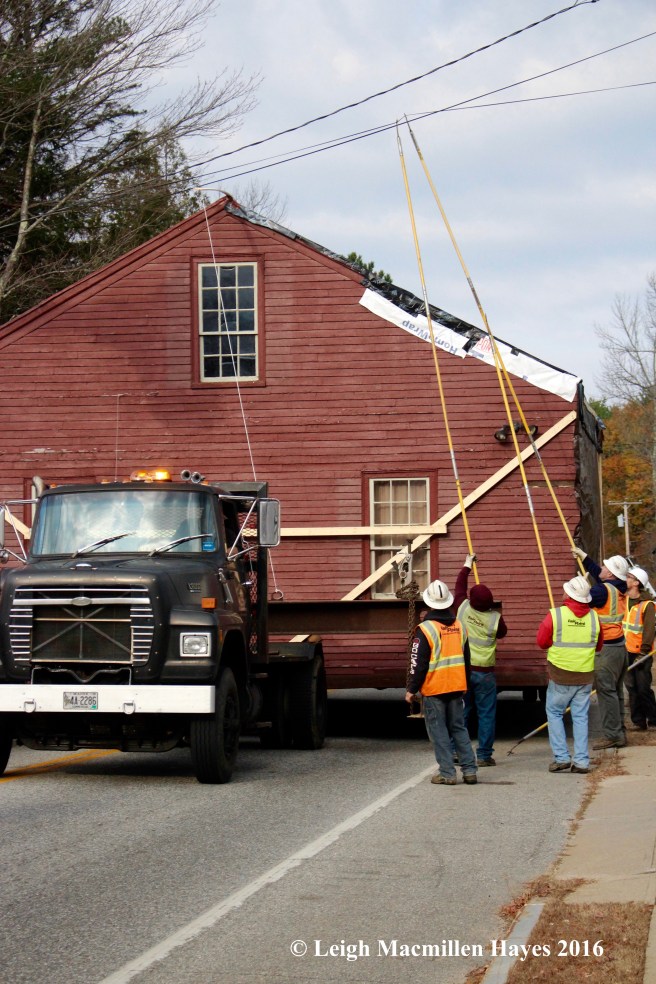
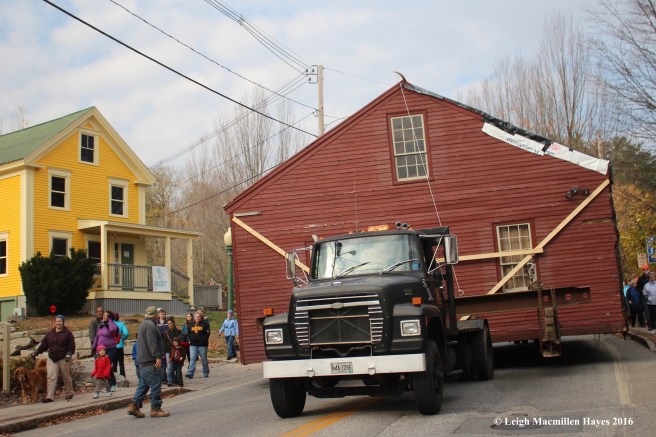
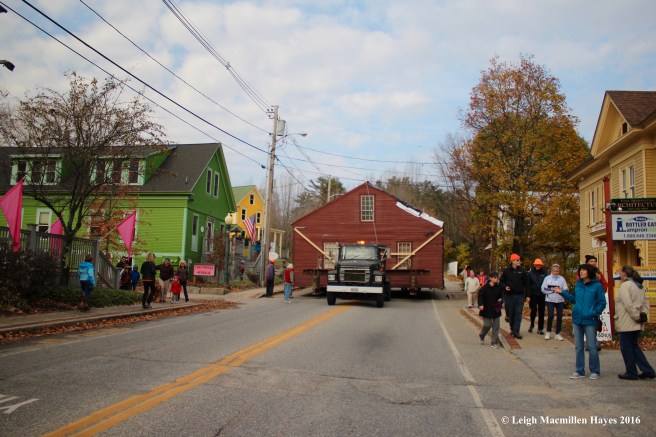
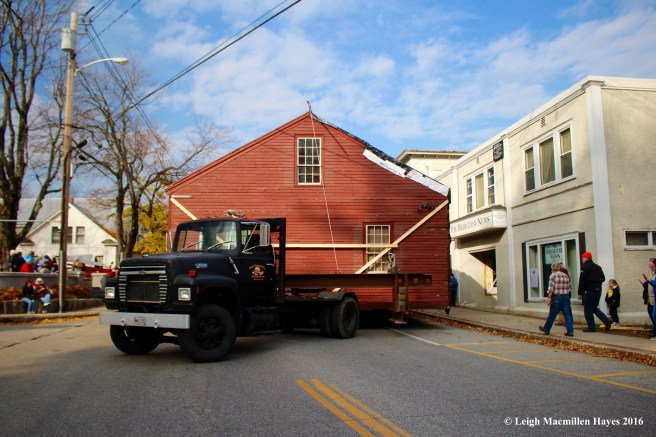
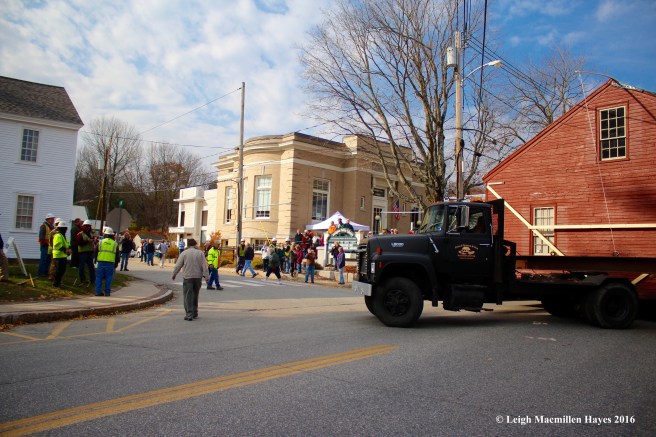
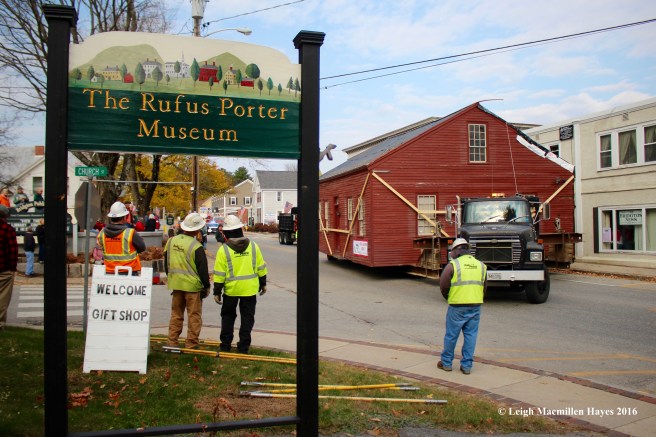
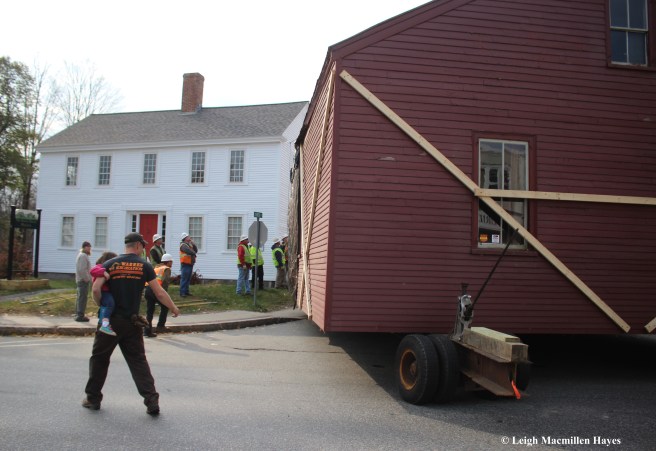
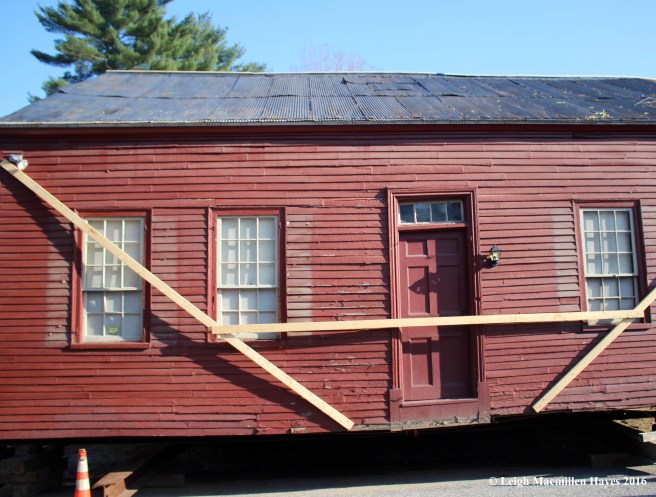
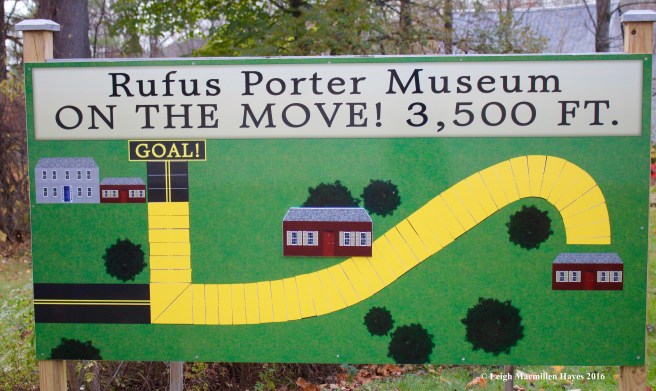
It’s not every day one walks down the street with a house, but that’s exactly what many of us did yesterday as the Rufus Porter Museum was relocated from North High Street in Bridgton to Church Street.

r-house-moving-sign

The Rufus Porter Museum and Cultural Heritage Center was founded in 2005 to showcase the folk art history of the area, with an emphasis on Porter’s work. The mission of the museum is to “celebrate the life and times of a remarkably creative American genius who worked throughout Maine, New England and beyond.”

Rufus was an entrepreneur who painted miniature portraits, as well as highly-prized wall murals that are still in houses throughout New England. Besides being a traveling folk artist, he was an inventor, musician, teacher, and founder of Scientific American magazine.

Among his inventions was a horse-powered boat. And he tried to develop an airship that would take people from the East Coast to California in three days.

r-getting-ready

Folk art collectors Julie and Carl Lindberg had the foresight to save much of the material culture of the Bridgton area, including the work of Porter and his apprentices, and chose to give back by sharing their collection with the community and supporting the Rufus Porter Museum in its infancy. And now, the museum is on the cusp of growing. While it has been housed in a red Cape on North High Street, which the Lindbergs made possible in order to share murals and other pieces of decorative arts, yesterday it was in transition to a larger space.

r-first-3

The move was a huge undertaking, despite the fact that the over 200-year-old house was moving less than a mile down the road.

r-my-guy-1

While a crowd gathered to watch each inch of the journey, my guy returned from a morning run. He’s training for the Moose Pond Half Marathon, a fund raiser for Shawnee Peak’s Adaptive Ski Program. As is his style, he thanked everyone for coming out to cheer him on. (The race is on Saturday, Nov 5, if you really do want to cheer him on.)

r-first-moves-1

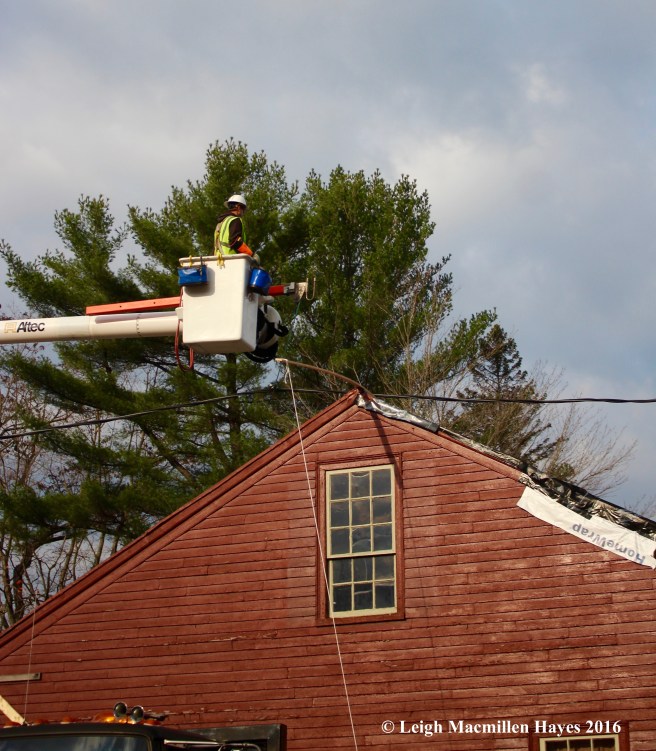
Over an hour later, Rufus Porter’s works were on the move.

r-wirestrees

r-wires-3

r-wires-5

r-wires-7

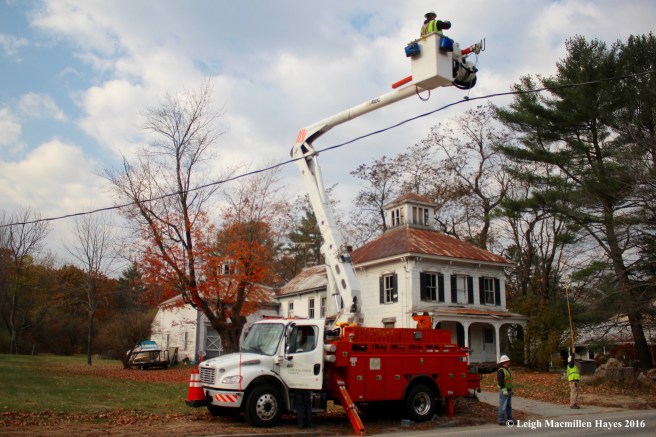
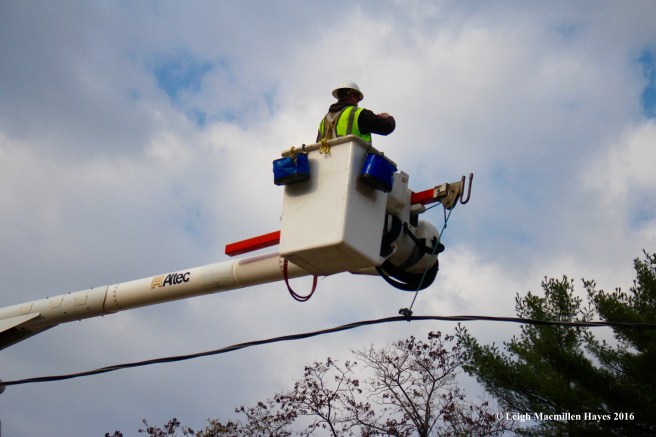
While Cole Watson (a former student of mine) drove and his father, Dana, walked beside, workers from Central Maine Power and Fairpoint checked wires and trees along the route.

r-wires-9

There were only a couple of snags, which were quickly resolved.

r-pleasant-street

The town came to a standstill for this momentous journey. It’s not every day a house winds its way down the road.

r-main-hill-10

Beside the Civil War Monument forward motion paused for a bit.

r-main-hill-8

Many of us became sidewalk engineers over the course of the day, something Rufus Porter would have embraced, as we tried to determine the next steps. Main Hill was our main concern. What if . . . Some had visions of failing brakes and a mad dash down Main Street to Food City. Others had visions of the mill pond at the bottom of the hill coming into play. Fortunately, the Watsons had it all figured out and this was just another work day for them. They chained a second truck  to the back of the rig before the journey continued.

r-main-hill-jdecor

r-main-hill-1

r-main-hill-bottom-2

As if a routine performance, all went well and Cole maneuvered around the bend by Shorey Park.

r-main-9

r-main-street-4

On Main Street, he pulled left to avoid overhanging trees, making for a snug journey beside the Hayes Block.

r-turn-to-church-1

r-turning-onto-church-5

r-tire-change

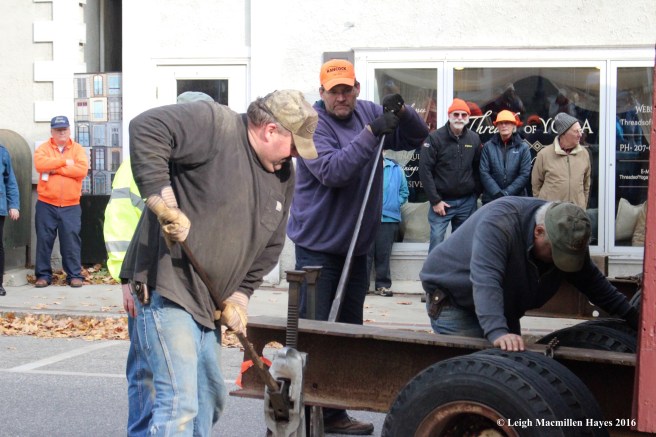
And then it was time to pause again so that Cole, Eric Wissman (the contractor in charge of building renovations) and Dana Watson could make adjustments to the wheels before the final turn.

r-turning-8

The Cape was headed to the back part of the lot behind the 1842 Webb House at 121 Main Street.

r-turn-10

r-turning-church

r-church-3

Turning onto Church Street proved the tightest squeeze of the entire operation.

r-library-1

In honor of the arrival of its new neighbor, the library threw a party in the courtyard.

r-house-blessing-1

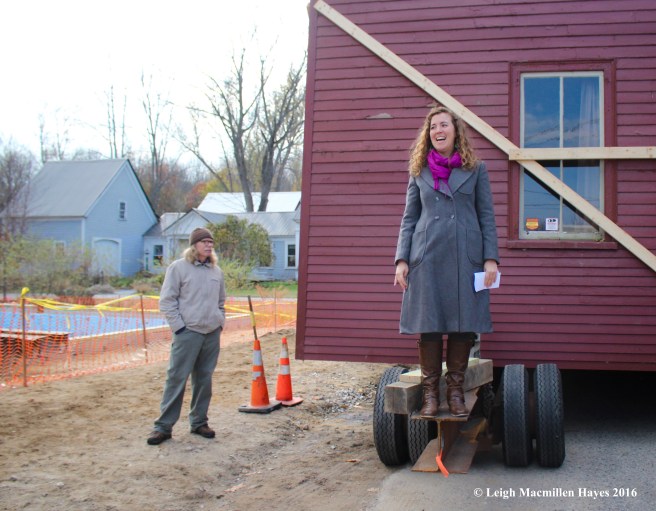
Before the shift toward its new foundation, the Reverend Emily C. Goodnow, pastor of Bridgton’s First Congregational Church, invited the crowd to gather  round for a house blessing.

r-blessing-2

Many raised their hands to the Cape as Pastor Emily spoke of the building’s history, including the fact that it was built for the Reverend Nathan Church, Bridgton’s first minister, and blessed its future.

r-church-6

Then the real work began–the shift from transient to permanent.

r-beam-3

Like he’s been doing it all his life, because he has, Cole walked the beam with confidence.

r-beam-2

r-resting-5

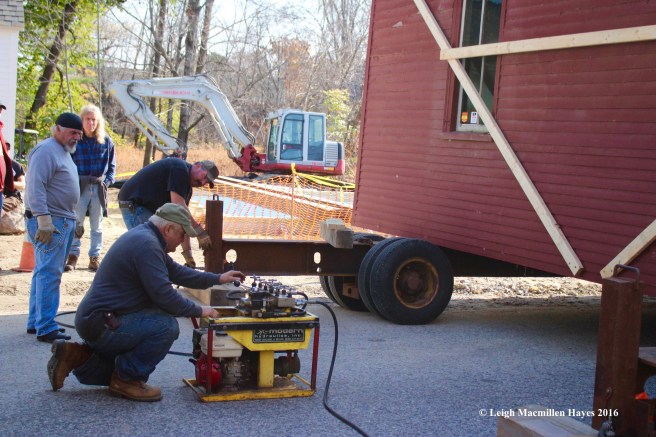
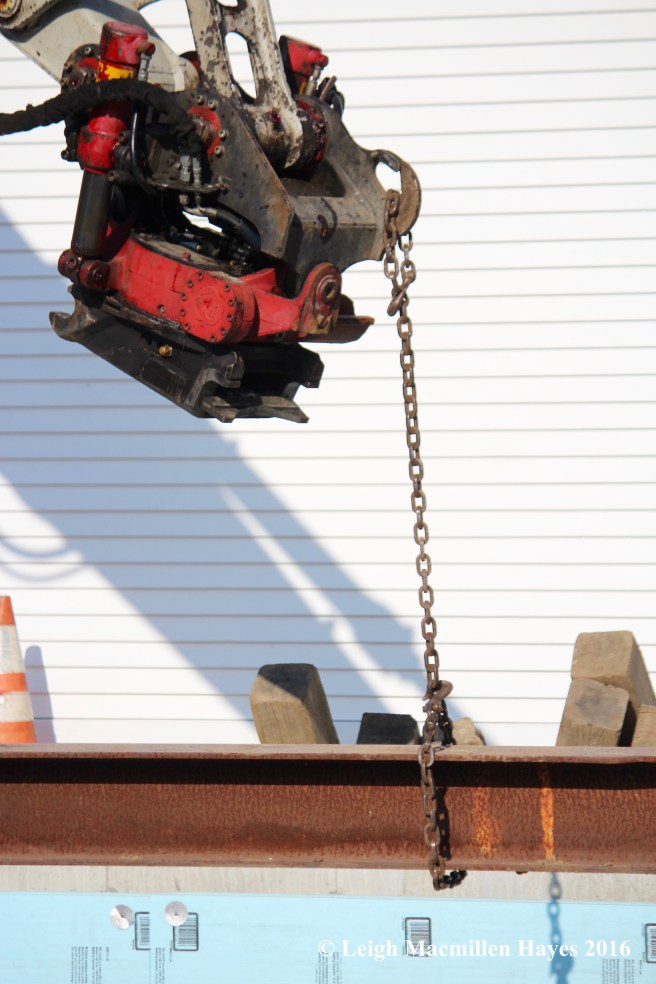
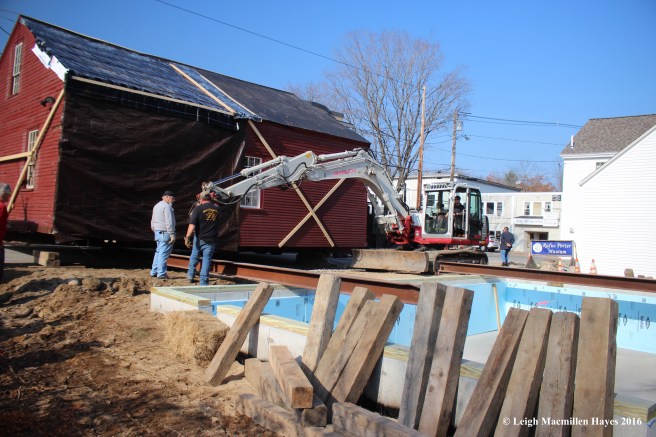
The chain was secured and Kyle Warren moved the beams to their placement under the house.

r-skates-1

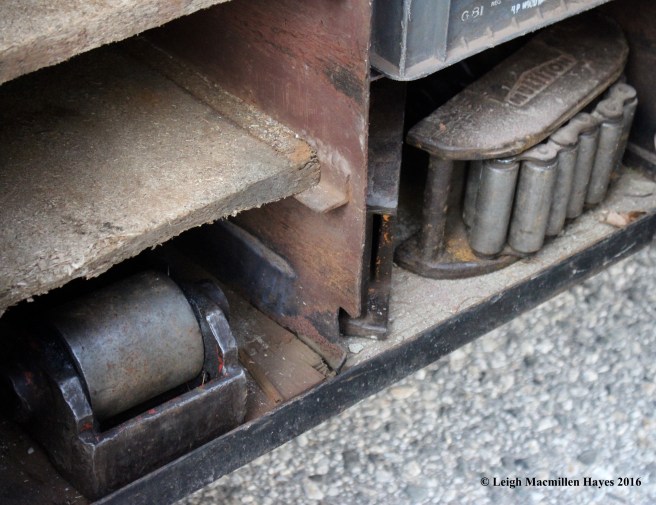
Skates, as they are called, were placed on the beams, the one on the left to be used in front, and the right one for the back.

r-skate-2

After laying cribwork, checking measurements and making sure all was level, the first leg of the shift began.

r-resting-3

r-resting-2

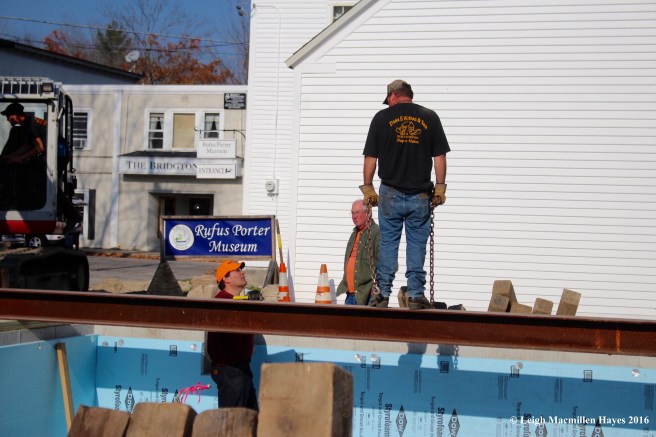
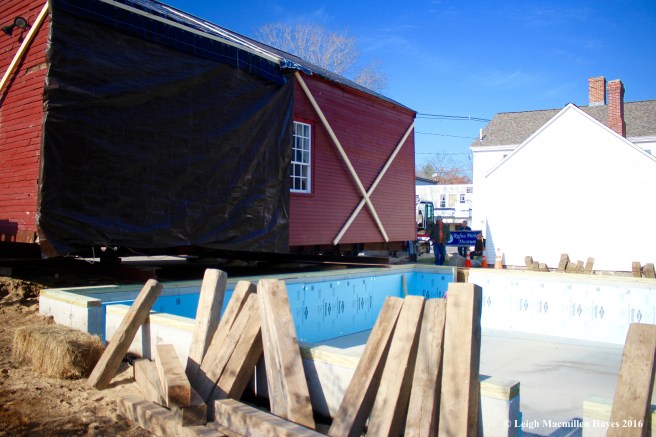
By 3pm, the house stood at the edge of the foundation.

r-church-street-resting-spot

The Watsons decided to call it a day as it would take at least two more movements to get it into place. And so, while the house isn’t officially in its new space yet, it is well on its way.

r-rufus-sign

And for all of us who had the opportunity to observe the move, it was a day well spent. It was a day to make history and recall history. It was a day for community as witnessed by all those who came out to watch and chat and speculate. It was a day to renew old friendships and meet new people.

It was an honor to walk with Rufus Porter and trust he would have appreciated the efforts of all. This was a man, who in the 1840s, could look at a problem and find a solution or any number of solutions to make things more efficient. I think he most certainly would have enjoyed the journey.


Finding Our Way on Mount Tom in Fryeburg, Maine

I ventured this afternoon with my friend Marita, author of  Hikes and Woodland Walks in and around Maine’s LAKES REGION, along with her daughter’s beagle, Gracie, on a new trail in Fryeburg.

t-preserve-sign

Mount Tom, a Roche Moutonnée, is an asymmetrical hill with a gently sloping up-ice side that has been smoothed and polished by a glacier. The other side is abrupt and steep–the down-ice side where the rocks were plucked off, leaving a more cliff-like appearance. As Marita noted, its most impressive view is from a distance, but today we sang its praises from up close. We’ve both hiked a 1.5 mile trail to the summit for years, but recently The Nature Conservancy developed a new trail that we were eager to explore.
t-fdn-1

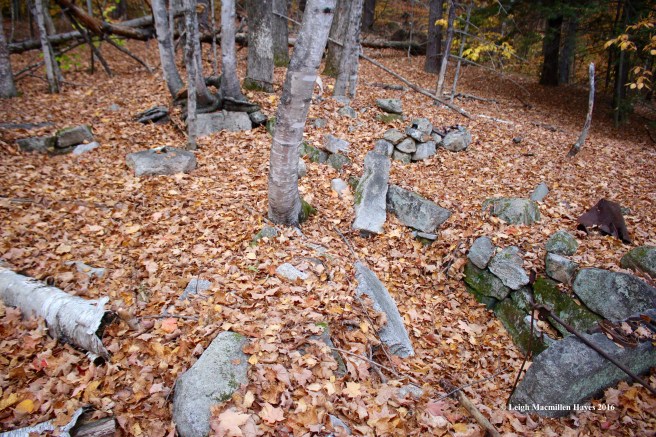
Within seconds I was exclaiming with joy. A huge, and I mean HUGE foundation shared the forest floor. Note the outer staircase to the basement.

t-center-chimney

And the large center chimney.

t-fryeburg-1858-map

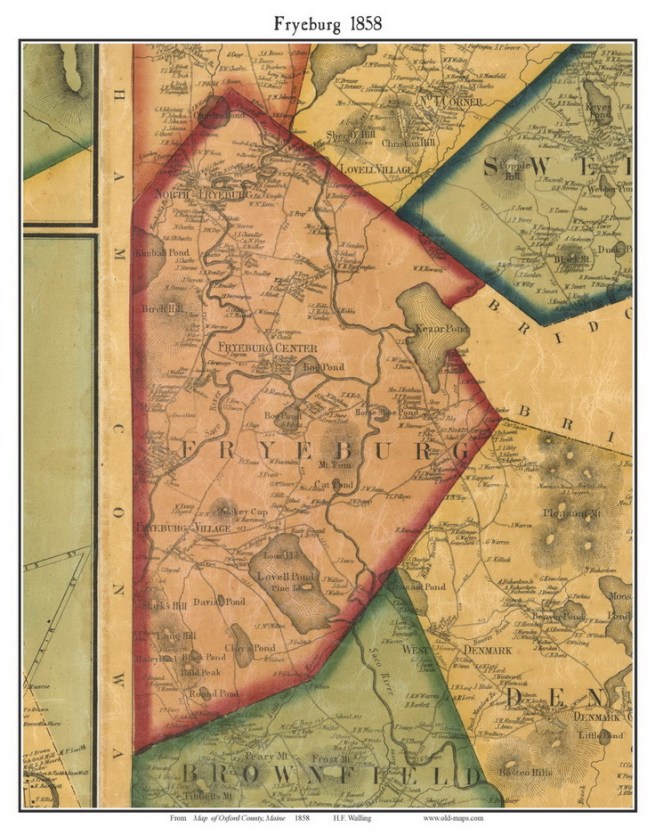
On an 1858 map, I found that A.H. Evans owned a home in about this vicinity, but I don’t know if this was his. Or any more about him. It will be worth exploring further at the Fryeburg Historical Society.

t-house-connected-to-barn

The house extended beyond the basement.

t-barn-1

And was attached to an even bigger barn.

t-barn-2

Ash trees grow beside the opening, but I wondered if we were looking at the manure basement.

t-trail-blaze

Finally, we pulled ourselves away and returned to the trail. Well, actually, we tried to return to the trail but couldn’t find it. So we backtracked, found this initial blaze and again looked for the next one. Nothing. Nada. No go. How could it be?

t-marita-and-gracie

That didn’t seem right, so we decided to follow our noses, or rather Gracie’s nose, and sure enough we found the trail. If you go, turn left and cross between the house and barn foundations.

t-gracie

After that, for the most part, we were able to locate the trail, but it was obscured by the newly fallen leaves and could use a few extra blazes. Gracie, however, did an excellent job following the scent of those who had gone before and leaving her own.

t-saw-dust

The path took us over a large mound of sawdust, something I’ve found in several areas of Fryeburg.

t-color

The predominate trees were beech, white and red oaks, thus providing a golden glow to the landscape.

t-ledges-1

And then we came to the ledges. Bobcat territory. Note to self: snowshoe this way to examine mammal tracks.

t-ledge-island

The trail was situated to provide a close up view of the ledge island, where all manner of life has existed for longer than my brain could comprehend. Life on a rock was certainly epitomized here.

t-intersection

We continued our upward journey for over 2.3 miles (thanks to Marita’s Fitbit for that info) and eventually came to the intersection with the trail we both knew so well.

t-summit-sign

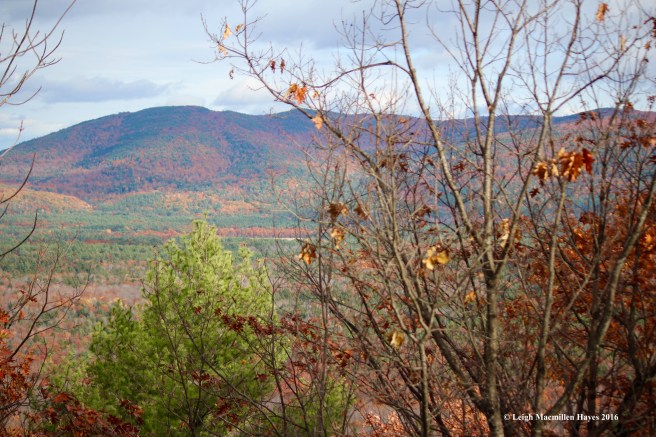
From there, we walked to the summit where the views have become obscured by tree growth.

t-pleasant-mtn-from-summit

But . . . we could see the long ridge of Pleasant Mountain in front of us,

t-kezar-pond

Kezar Pond to our left,

t-richardson-1

t-richardson-farm

and the Richardson Farm on Stanley Hill Road to our right.

t-ladys-slipper-pod

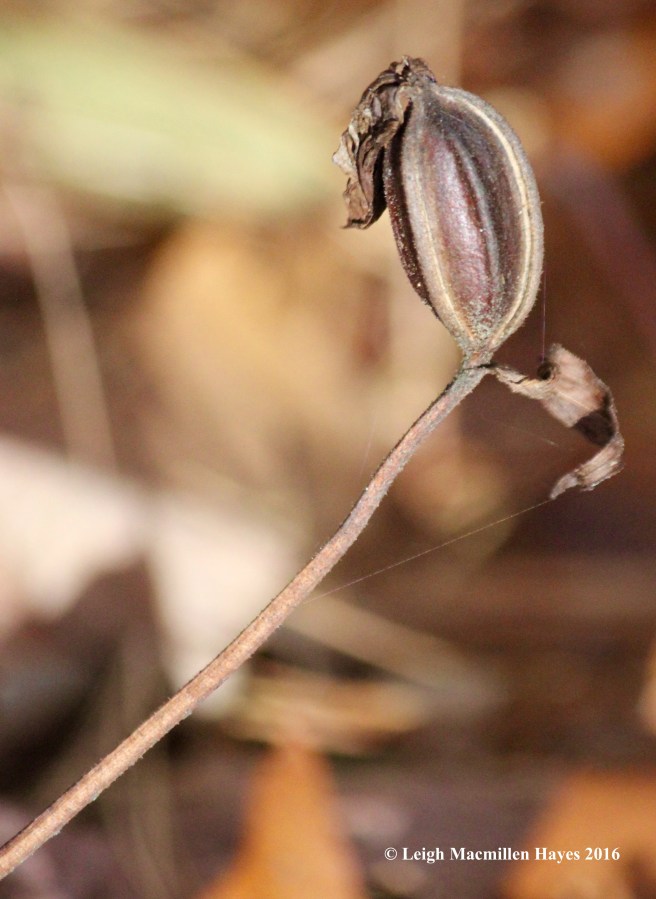
Also along the summit trail, the woody seedpod of a Lady’s Slipper. Ten-to-twenty thousand seeds were packaged within, awaiting wind dispersal.

t-mt-tom-house

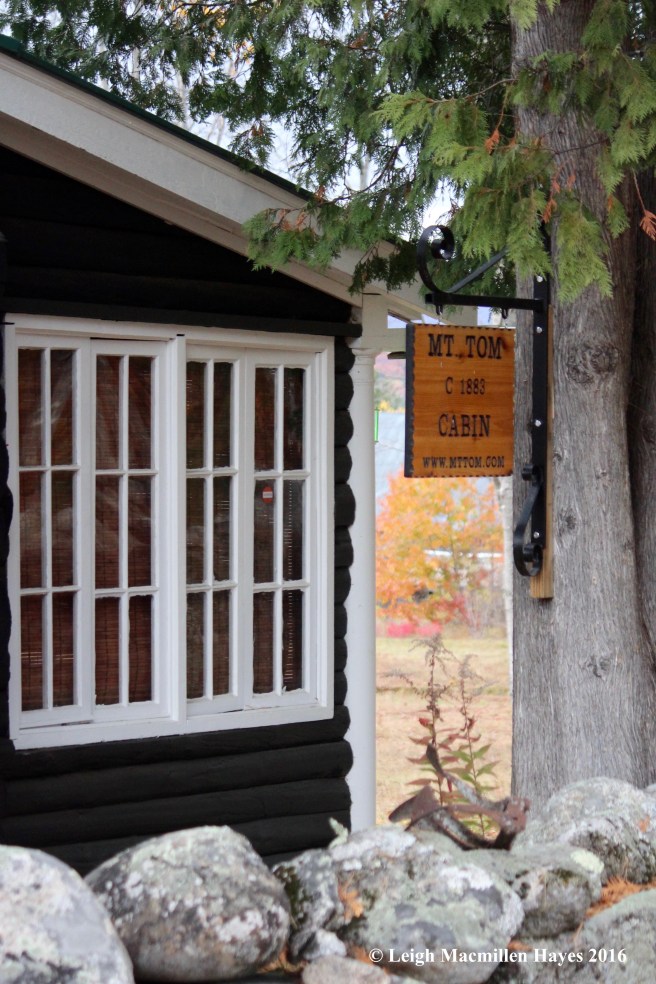
We decided to follow the old trail down, which passes through a hemlock grove and then suddenly changes to a hardwood mix. Both of us were surprised at how quickly we descended. And suddenly, we were walking past some private properties including the 1883 Mt. Tom cabin.

t-northern-white-cedar-bark

t-northern-white-cedar

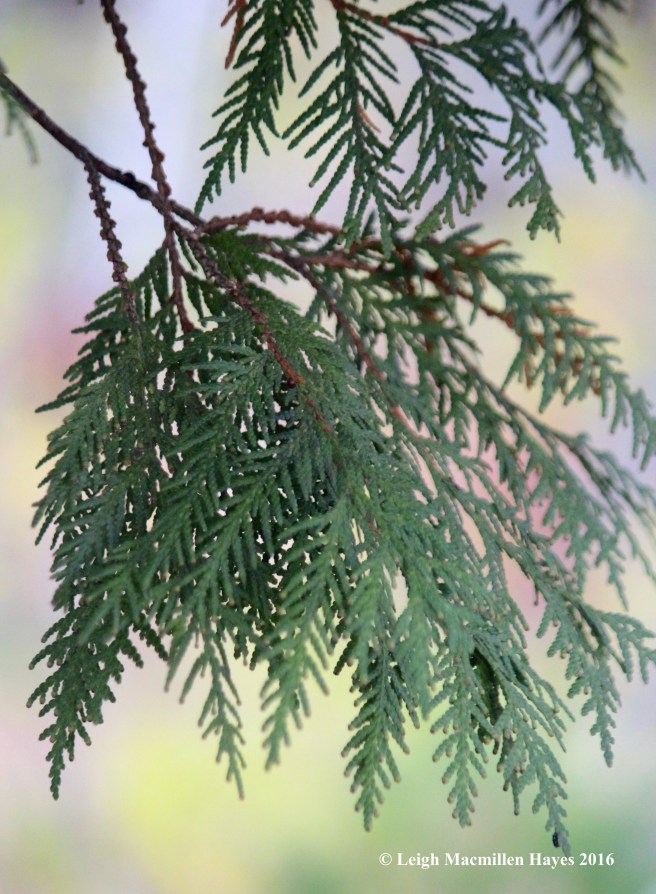
The cabin sign was actually attached to a Northern White Cedar tree. I’m forever wowed by its bark and scaly leaves.

t-flag

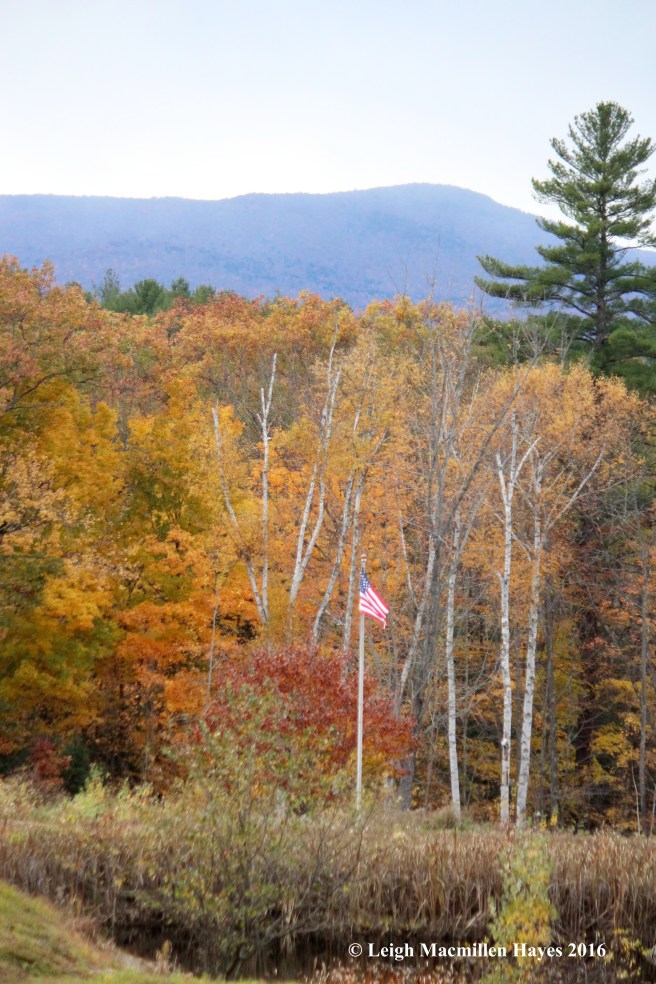
In the field beyond, Old Glory fluttered in the breeze.

t-barn

And just before Menotomy Road, we spied Mount Kearsarge in the distance.

t-menontomy-cemetery

Since we’d taken the loop trail approach rather than an out and back on the same trail, we had to walk along Menotomy Road, so we paid the cemetery a visit and checked out the names and ages of those who had lived in this neighborhood.

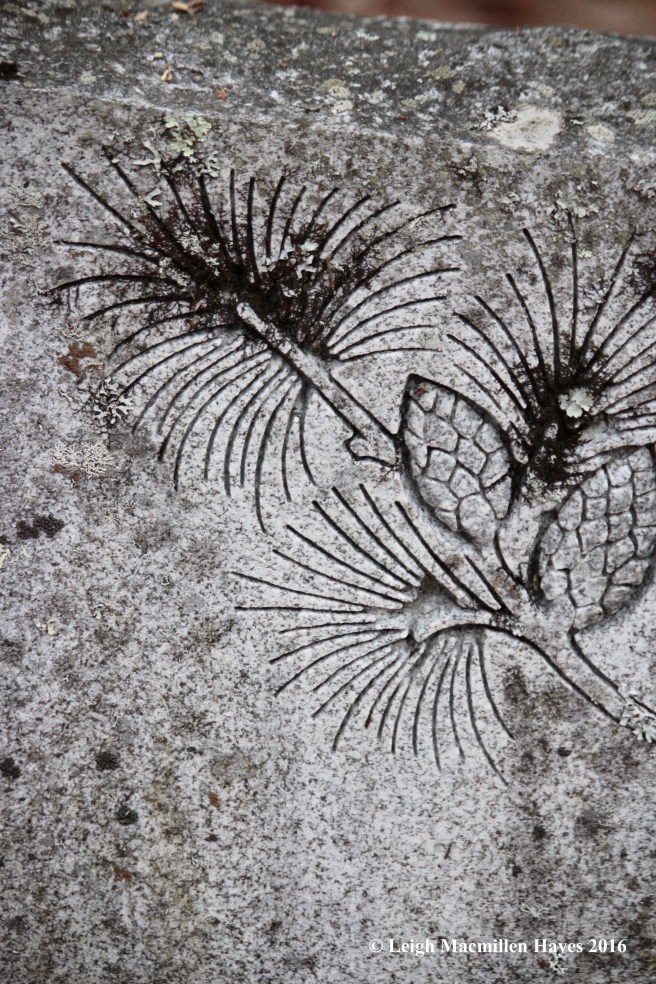
t-pine-on-grave-stone

One of the older stones intrigued me with its illustration. I think I would have enjoyed getting to know these people.
t-menotomy-pumpkins

As we continued on, I was reminded of recent adventures in Ireland  and the realization that we notice more when we walk along the road rather than merely driving by. We both admired this simple yet artful pumpkin display.

t-menotomy-road-1

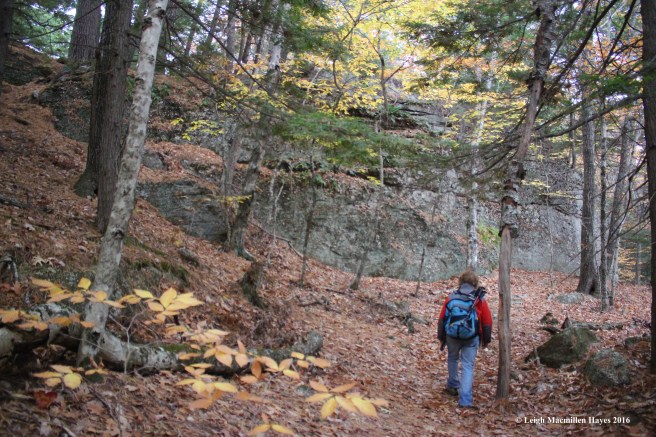
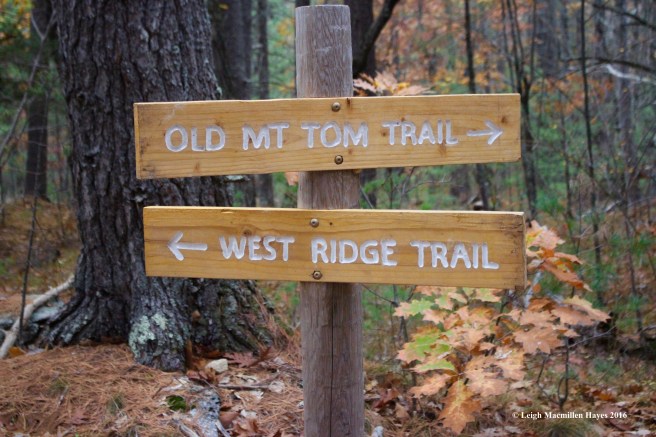
If you go, you might want to drive to the old trailhead, park your vehicle and then walk back to the West Ridge Trail. We parked at the latter and had to walk the 1.5 back at the end, when it seemed even longer. But truly, the road offers its own pretty sights and the temperature was certainly just right, even with a few snow flurries thrown into the mix, so we didn’t mind. We were thankful we’d found our way along the new trail and revisited the old at Mount Tom. And I’m already eager to do it again.


Cloaked By The Morning Mist

You remember the nursery rhyme, “Rain, rain, go away, come again some other day, we want to go outside and play”? Well, it finally rained yesterday and today, and many of us have greeted it with open arms. And we certainly didn’t let it stop us from going out to play.

u-eaton-1

This morning, I joined a group from the Upper Saco Valley Land Trust for  a hike in South Eaton, New Hampshire. Had I not been racing for time, I would have stopped every twenty feet to snap a photo, but I did pause beside Crystal Lake.

u-road-1

After getting lost for a few minutes because I didn’t pay attention to the directions, I found the property. Eleven of us headed down Paul Hill Road, led by Jesse Wright of USVLT, and Nancy Ritger, senior naturalist with the AMC.

u-big-tooth-raindrops

We paused to examine a variety of offerings, including the flat stems of the quaking aspens. It was the raindrops on the big tooth aspen, however, that drew my focus. One of the things Nancy spoke about as she had everyone feel a flat aspen stem, is how that very stem aids in photosynthesis.

u-big-tooth

The leaves tremble or quake, giving each more time in the sunshine–individual leaves, no matter where they are attached to the tree, share in unshaded glory for split seconds as those above them flutter. And, in the case of aspens, both sides of the leaf work to make sugar and release oxygen.

u-beaver-lodge

We spent a long time beside a beaver pond and pondered various aspects of it. We could see the lodge and beaver sticks in the water–that made sense.

u-retainer-2

But why a significant wall on at least two sides?

u-cut-stone-in-water

And a split stone by the water’s edge? What else had happened here? Jesse told us that there are numerous foundations that we didn’t have time to locate today, so we knew that though it seemed as if we’d traveled to the middle of nowhere, this place was once somewhere.

u-moose-track

And to the local moose, it still is as evidenced by the prints we found in mud.

u-raindrop-lichens-2

Our attention also turned upward as we admired raindrops dangling from fruticose lichen (think fruit-like branching).

u-raindrops-on-pond

Suddenly, the rain increased so Jesse asked if anyone wanted to turn around and received an overwhelming vote to continue on.

u-larch-2

One of my favorite discoveries was a couple of larch trees. Larch or tamarack is our only deciduous conifer. Huh?

u-larch-1

Like deciduous trees, the larch needles turn yellow each autumn and fall to the ground. Another cool fact: needles grow on stout pegs that look like wooden barrels.

u-pileated-and-ants

We paused beside ash trees and tree stumps, and enjoyed the view of this pileated woodpecker excavation of carpenter ant tunnels–their favorite prey.

u-candy-lichen

In the log landing that did become our turn-around point, we noted the early succession growth of Eastern white pines and sweet fern (not a fern). But again, we looked to our feet for the best views.

u-candy-lichen-1

Candy lichen is a crustose (think–flattish or crust-like) lichen with green to bluish-green coloration.

u-candy-2

Its fruiting bodies, however, are candy-pinkish disks atop stalks, even reflected in the raindrops.

u-cemetery-entrance

Our journey back to parked vehicles passed quickly, indicating we’d not traveled all that far in two and a half hours. That’s normal when you take time to notice. Before departing, Jesse showed me a cemetery on the abutting property.

u-cemetery-small-stones-2

Small, unmarked stones made me think of a Civil War-era cemetery in Sweden, Maine–perhaps a sudden illness of young children called for quick burials.

u-cemetery-currier-plot

One section was portioned off by split granite.

u-cemetery-curriers-1

The Currier plot. A side road we’d passed by was named for the family.

u-cemetery-lichens

The crustose lichens were intriguing on Rhoda Lodolska Currier’s stone. Rhoda died at age 26.

u-cemetery-octavia

Her sister, Octavia, lived to be 53.

u-cemetery-nancy-leavitt-90-years

Most impressive was the age of Nancy Leavitt, her stone located just outside the Currier plot. Nancy died at age 90.

u-vireo-nest

As we walked out, Jesse spied a cup-shaped vireo nest built in the fork of a beaked hazelnut. Life continued to circle in these woods.

u-undulating-color

And the autumn color undulated, mimicking the land. The sun tried to peak out for a few minutes when we arrived at our vehicles, but we were all appreciative of the rainy day wonders we’d found along the way.

u-eaton-3

And back in Eaton, a quaint New England village located beside Madison and Conway, New Hampshire, and the Maine border–beauty cloaked by the mist.

Thanks to Jesse, Nancy and the Upper Saco Valley Land Trust for a fine morning spent wandering and wondering.


Everybody Loves Raymond? Mondate

My guy and I were up for an adventure this morning as we headed off to a property recently acquired by Loon Echo Land Trust. I’d been there once before, but at that time there was no trail system and I certainly hadn’t climbed to the summit.

r-forest-climb

We were on a 356-acre property bisected by a paved road. First, we hiked the upper section, passing through a hardwood forest.

r-white-oak-green-leaves

Immediately, I realized we were in the presence of one of my favorites–noted for the mitten-ish presentation of its leaves. One would have to be all thumbs to fit into this mitten, but still, my heart hums whenever I spy a white oak.

r-white-oak-red-color

Or in this case, many white oaks, some exhibiting the wine color of their fall foliage.

r-white-oak-bark

And the bark–a blocky look that differs greatly . . .

r-red-oak-on-bm1

from the ski trail ridges of red oak.

r-hophornbeam-bark

Hop Hornbeam also grows abundantly in this forest.

r-approaching-forest-summit-yellow

As we neared the summit, we noticed that the sky view had a yellowish tone reflected by the ground view. Most trees were of the same age due to past logging efforts, but the predominant species was sugar maple.

r-basswood-2

Another favorite tree also grew abundantly here. I think they are also favorites because I don’t see them as often. In this case, the bark, though furrowed and ridged like a northern red oak, featured an almost combed flattened ridge.

r-basswood-leaf

And its leaves–oh my! Notice the asymmetrical base? And the length–my boot is size 8. American basswood–an important timber tree that is known to share the community with sugar maples and hornbeams–all of which provided that yellow glow.

r-raymond-summit-view-1

At last, we reached the vantage point.

r-skyward

Above us, a mix of colors and species.

r-oak-leaves

Before us, a mix of white and red oak leaves.

r-crescent-view-3-1

And beyond us, the view of Crescent Lake

r-crescent-rattle-1-1

and Rattlesnake Mountain.

r-ladybird-1-1

While we admired the view, ladybird beetles (aka ladybugs) swarmed us. Well, not exactly in swarm formation, but more than is the norm.

r-green-trail-tag

After admiring the view for a while and wondering about the ladybirds, we backtracked a bit and decided to explore the green trail, assuming that it looped about the summit.

r-dry-leaf-sound

The trail conditions changed constantly, and one thing we realized was that the leaves had dried out and we wished we could have bottled their scent along with our crispy footfall as we trudged through–the smells and sounds associated with autumn.

r-bear-claw

Eventually, we entered a beech commune and what to my wondering eyes should appear–bear claw marks? We ventured closer, circled the tree and looked at others in the neighborhood before determining that our eyes had perhaps played a trick on us.

r-garter-snake

That was OK because within seconds a twig moved at our feet.

r-snake-tongue

We watched as its tongue darted in and out, red tipped with a black fork.

r-lunch-rock

Finally, we moved back to what we’d named Ladybird Lookout and found lunch rock where we topped off sandwiches with Bailey’s Irish Cream fudge a la Megan and Becky Colby. Life is good. Life is very good. (And we know a town in western Maine that would benefit greatly from a bakery–just saying, Megan!)

r-trail-ribbon-art

After lunch, we climbed back down and crossed Conesca Road to check out trails on the other side. There is no trail map just yet, but we never got lost. And we appreciated the artwork nature created of manmade marks.

r-forest-across-the-street-stonewall

This space offered a different feel where hardwoods combined with softwoods. And more stonewalls crossed the property, speaking to past uses.

r-hole-pink-flags

It’s here that we noticed an area demarked by pink flags and stopped to wonder why. Note to self–excavated hole and debris mean beware.

r-bee-himve

Upon closer examination, an old hive. So who dug it up? We had our suspicions.

r-mushrooms-1

We also noticed a fungi phenomena.

r-mushroom-growth

Fungi on fungi? Honey mushrooms attacked by something else?

r-mushroom-growth-3

The displays were large

r-mushroom-fungi

and otherworldly. I don’t recall ever seeing this before.

I sent the photos to Parker and Jimmie Veitch, of White Mountain Mushrooms, and Jimmie responded with this explanation:

“That’s what mycologists call “rosecomb” mutation, where a mushroom’s gills start forming on the cap in a really mutated fashion. It’s been reported in many mushroom species but I haven’t seen it in this one (Armillaria AKA honey mushrooms). As far as I know, no secondary fungus is involved.

The suspected cause (not so nice) is ‘hydrocarbons, phenols and other compounds contaminating the casing or contacting the mushroom surface. Diesel oil, exhaust from engines, and petroleum-based pesticides are thought to be the principal source.'”

r-red-leaves

As we concluded our visit, we passed over one more stone wall decorated with red maple leaves.

r-beginning-of-bri-mar

And then we hopped into the truck and traveled a couple of miles south to conquer another small mountain–one visible to us from Ladybird Lookout. (I really think LELT should name it such.)

r-brimar-milkweed

Here the milkweed plants grew abundantly.

r-brimar-white-oaks-in-field

In the field leading to the trail, the property owners planted white oak saplings in hopes of providing food for wildlife. Um, by the same token, they’d enclosed the saplings in plastic sleeves (reminding us of our findings in Ireland) to keep deer at bay.

r-brimar-ferns

The understory differed and ferns offered their own autumn hues.

r-brimar-evergreen-wood-fern

In contrast were the many examples of evergreen wood ferns.

r-bri-mar-beech-markings

We soon realized that quite literate bears frequented this path and announced their presence.

r-crescent-from-bri-1-1

At last, the view opened and we looked back at the opposite shore of Crescent Lake, though realizing that our earlier ascent was masked by the trees.

r-panther-from-bri-3-1

Turning about, Panther Pond came into view.

We’d spent the day embracing Raymond because everybody loves Raymond.

r-raymond-forest-sign

r-brimar-trail-sign

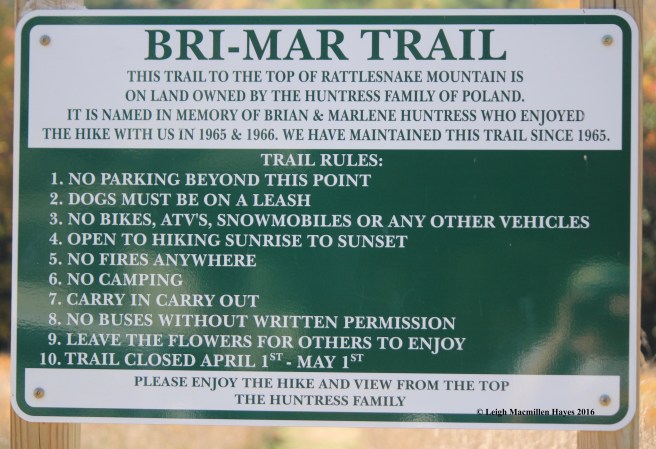
Raymond, Maine, that is. Loon Echo Land Trust is gearing up to celebrate the Raymond Community Forest that we explored this morning and the Bri-Mar Trail up Rattlesnake Mountain has long been traveled by many. In fact, when I used to write copy for the local chamber of commerce, I spent some time learning about Edgar Welch, who was the fastest man on foot and ran up Mount Washington at least once a year. He lived in Raymond and worked for David McLellan, who was partially blind from a Civil War injury. Because Mr. McLellan’s farm was at the foot of Rattlesnake Mountain, the sun would set one hour earlier than elsewhere in town. According to legend, after work each day Edgar ran up the mountain and moved rocks. Finally, he’d moved enough to let the sun shine on the farm for an hour longer. Another story has it that one day a man bet Edgar that he could beat him in a race to Portland. The man would race with his horse and buggy, while Edgar ran. When the opponent pulled into the city, Edgar was waiting for him. I love local lore.

And everybody loves Raymond. Well, my guy and I certainly gained a better appreciation for this town today.


Golden Rulers

In late summer/early fall, a variety of goldenrods shower gardens and fields with their sunshiny flowers.

Unfortunately, they’ve been wrongly blamed as the culprits of hay fever, but by the abundance of pollinating insects that visit them daily, it’s clear that they are insect rather than wind pollinated. (Ragweeds and other hay-fever causing species are wind pollinated.)

And so today, as I have for the past few weeks, I spent time focusing on those pollinating visitors and others who find goldenrods attractive for different reasons. Take a look.

g-assassin-1

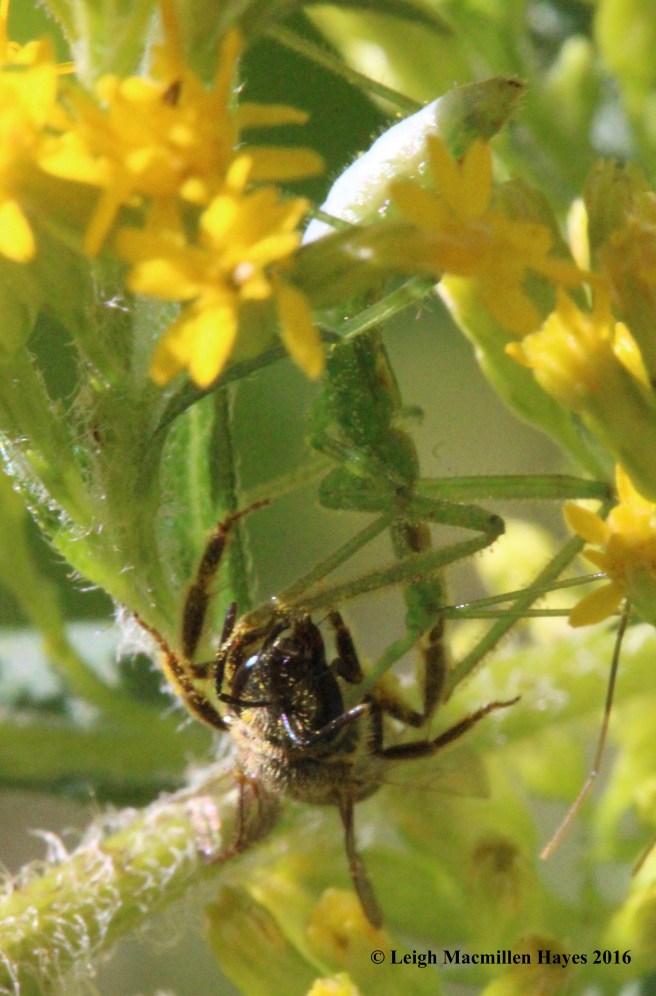
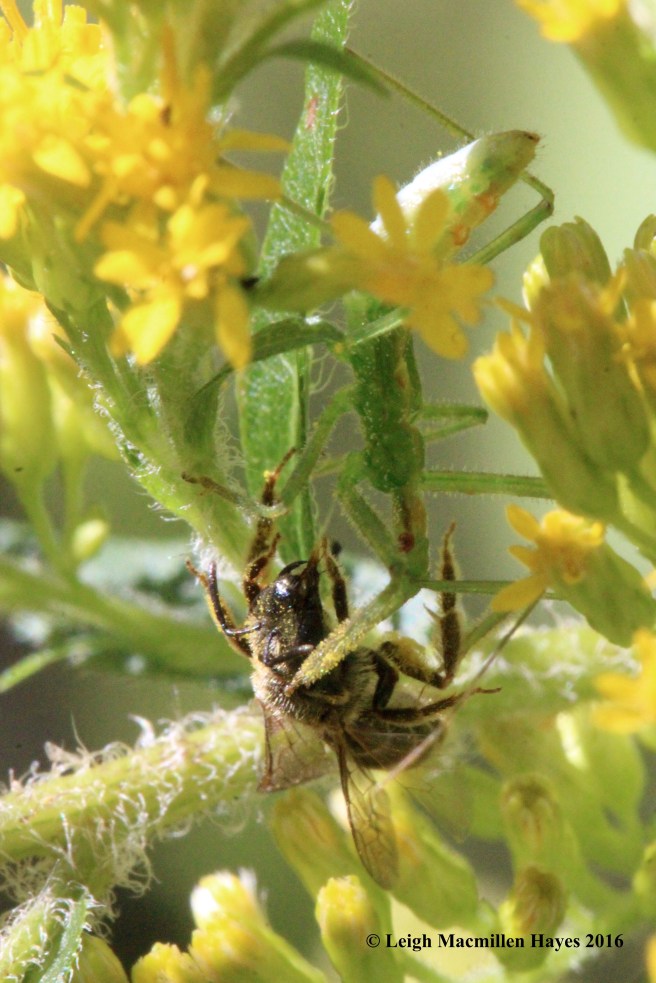
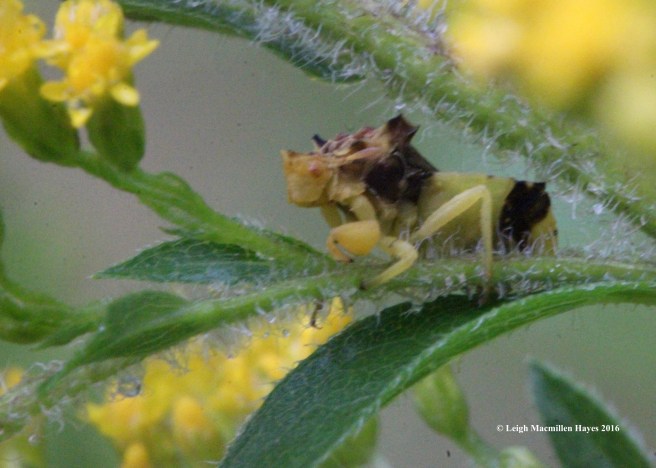
What first caught my eye was a bee that dangled upside down. And then I spied the green legs of an assassin bug. What? Yup, an assassin bug.  I believe this one is a nymph. Regardless of age, here’s the scoop: Assassin bugs are proficient at capturing and feeding on a wide variety of prey. Though they are good for the garden, they also sometimes choose the wrong species like this bee. The unsuspecting prey is captured with a quick stab of the bug’s curved proboscis or straw-like mouthpart. Once I saw this, I continued to return for a couple of hours, so stay tuned.

g-honey-2

Fortunately, there were other honeybees on the job of pollinating the flowers.

g-bumblebee

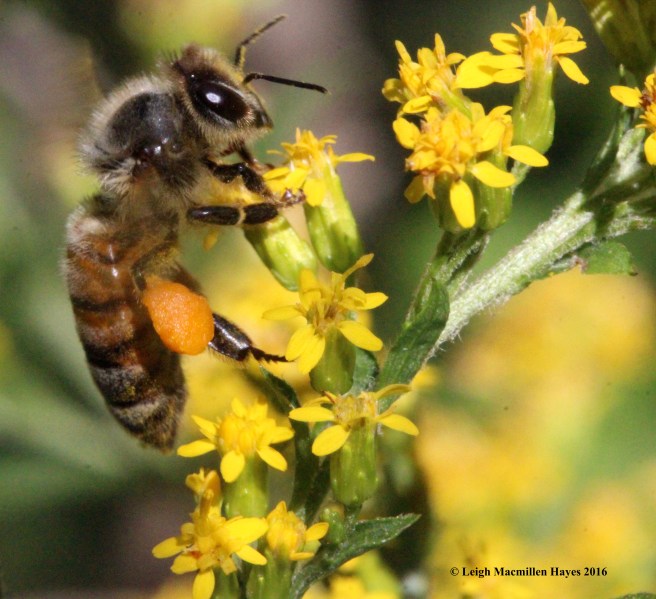
Mighty bumblebees also filled their sacs to the brim.

g-assassin-2

A.B. Take 2–do you see the proboscis stuck into the first bee’s thorax? It fed by sucking out the fluids.

g-hover-fly

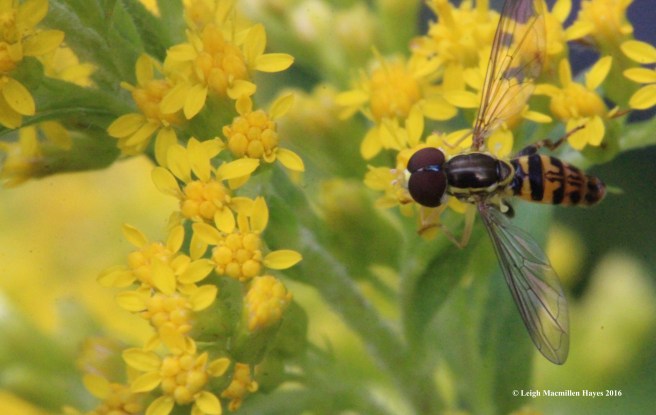
Back to the other visitors. One of my favorites was the hover fly. I’m always humbled by its coloration.

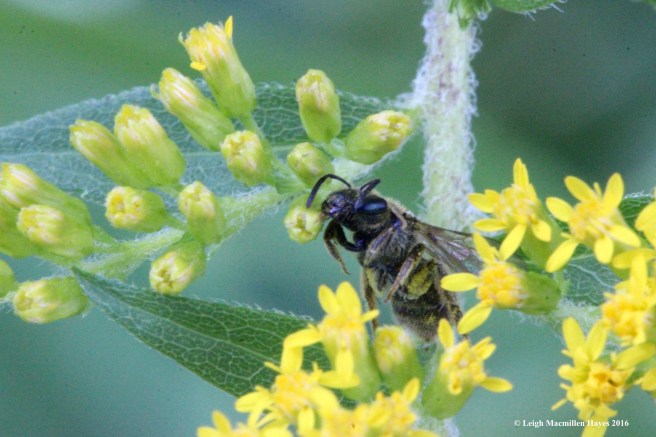
g-wasp

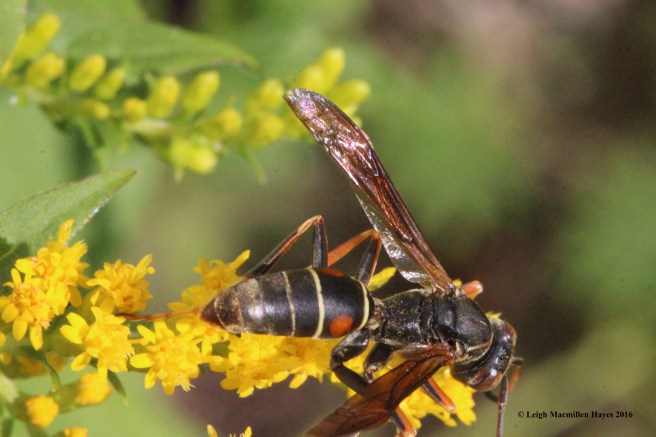
And then there were the wasps.

g-wasp-2

Their almost hairless bodies provided contrast beside the bees.

g-assassin-3

A.B. Take 3–The A.B. turned the bee and it appeared that its proboscis became coated with pollen, which would make sense.

g-jumping-spider

Meanwhile, a jumping spider waited patiently for its own prey to come into sight. I felt like all eyes were on me as we came face to face. Thankfully, it didn’t jump and grab me with its jaws.

g-crab-3

Another with a poisonous bite is the crab spider. This one was more active that most that I’ve seen. Usually, they sit and wait, then catch their prey, bite it and again, suck it dry. And while it looks huge in this picture, it is really quite small–about pencil eraser size.

g-spider-web

A third spider species used the goldenrod’s stem and leaves to weave its own structure. It seemed to be more successful than the others at finding a meal.

g-assassin-5

A.B. Take 4–Check out A.B.’s tiny red eyes. And its camouflage–no wonder the poor bee never saw it.

g-caterpillar-2

Not every visitor to the goldenrod knew about camouflage. I don’t know who this is, but saw it on a nearby orange echinacea yesterday. Its mauve color certainly shouted for attention among the yellow sea.

g-caterpillar-blend

A different caterpillar did a better job of blending in–do you see it?

g-assassin-7

A.B. Take 5–An hour later and the A.B. was still sucking.

g-assault-2

At the same time, another predator hid among the flowers–an ambush bug.

g-ambush-3

This species is otherworldly at best.

g-ambush-bug

And talented. The ambush bug waits patiently and then snatches prey with its knife-like pincers. All but the outer shell of the prey is consumed. I swear this guy was smiling. Maybe he’d enjoyed a feast and I’d missed it.

g-assassin-victim

A.B. Take 6–About two hours after I’d first observed it, I returned and couldn’t find the bee. Then I noticed a motionless body on a flower branch below. Apparently A.B. had sucked all the life out of it and then let it go.

g-assassin-on-prowl-2

A.B. The Final Take–It had finished taking and went in search of another victim.

What I know for sure: While goldenrod may rule the late garden, it is also ruled by many in a bug-eat-bug world. All of it is worth a wonder.

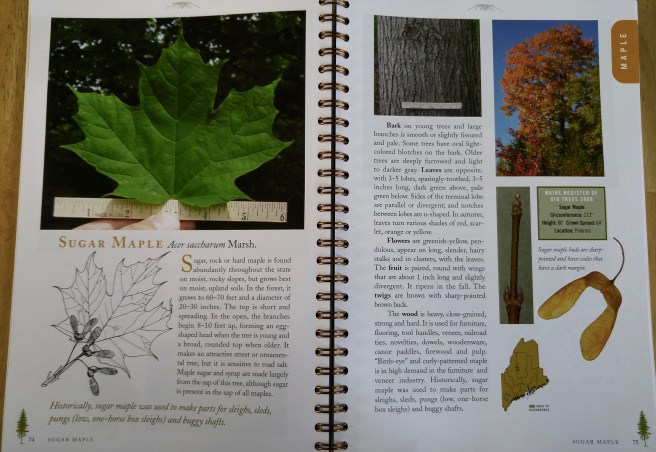
Book of September: Forest Trees of Maine

The other day a friend and I made plans for an upcoming hike. Before saying goodbye, she said, “Don’t forget to bring your tree book.”

t-cover (1)

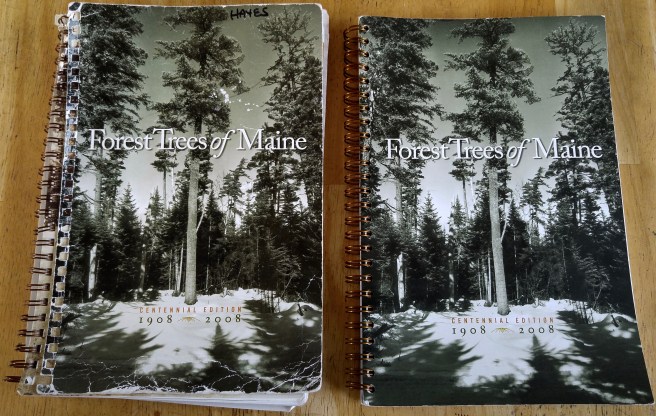
Really? I have at least thirty books dedicated to the topic of trees. But . . . I knew exactly which one she meant: Forest Trees of Maine. I LOVE this book–or rather, booklet. You’ll notice the tattered version on the left and newer on the right. Yup, it gets lots of use and often finds its way into my pack. When I was thinking about which book to feature this month, it jumped to the forefront. I actually had to check to see if I’d used it before and was surprised that I hadn’t.

Produced by the Maine Forest Service, the centennial issue published in 2008 was the 14th edition and it’s been reprinted two times since then.

t-b:y 2 (1)

In previous years, the book was presented in a different format. Two editions sit on my bookshelf, and I need to share with you two things that didn’t find their way into the most recent copy.

From 1981: Foreword–“It is a pleasure to present the eleventh edition of Forest Trees of Maine. 

Many changes have occurred in Maine’s forest since 1908, the year the booklet first appeared. Nonetheless, the publication continues to be both popular and useful and thousands have been distributed. Many worn and dog-eared copies have been carried for years by woodsmen, naturalists and other students of Maine’s Great Out-Of-Doors.

We wish the booklet could be made available in much greater quantity, however, budgetary considerations prevent us from doing so. I urge you to use your copy of Forest Trees of Maine with care. If you do, it will give years of service in both field and office.”

Kenneth G. Stratton, Director.

From 1995: One of two poems included. I chose this one because it was one my mother often recited.

Trees

I think that I shall never see
A poem lovely as a tree.

A tree whose hungry mouth is prest
Against the earth’s sweet flowing breast;

A tree that looks at God all day,
And lifts her leafy arms to pray;

A tree that may in Summer wear
A nest of robins in her hair;

Upon whose bosom snow has lain;
Who intimately lives with rain.

Poems are made by fools like me,
But only God can make a tree.

~Joyce Kilmer

t-how to use keys (1)

The most recent edition of Forest Trees of Maine provides a snapshot of the booklets history and information about the changes in the Maine landscape. For instance, in 1908, 75% of the land was forested, whereas in 2008, 89% was such. The state’s population during that one hundred year period had grown by 580,457. With that, the amount of harvested wood had also grown. And here’s an intriguing tidbit–the cost of the Bangor Daily News was $6/year in 1908 and $180/year in 2008.

Two keys are presented, one for summer when leaves are on the trees and the second for winter, when the important features to note are bark and buds.

t-leaves (1)

t-glossary (1)

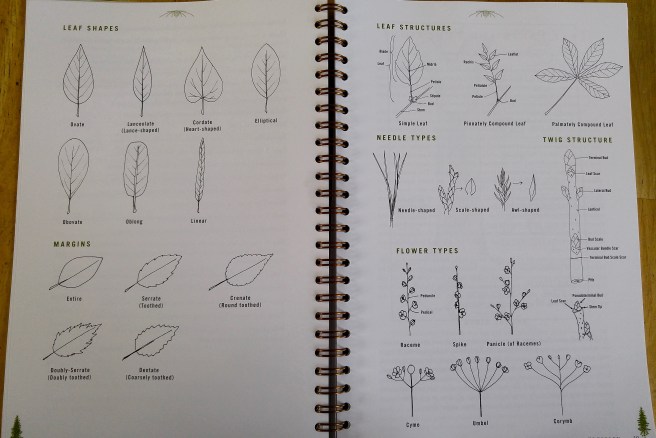
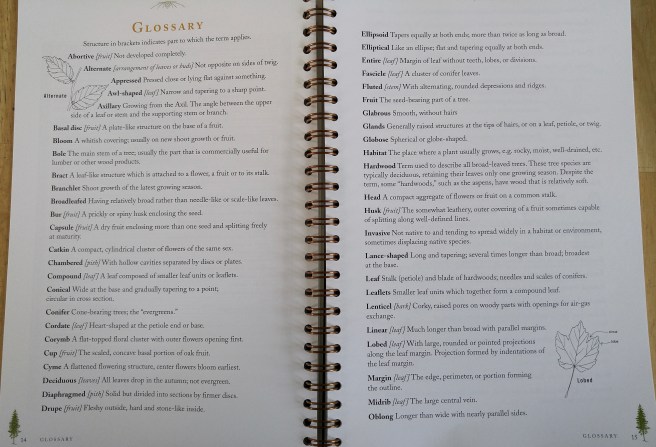
Terms for leaf shapes, margins and structure, twig structure, plus needle types and flower types are illustrated and various terms defined.

t-tree parts (1)

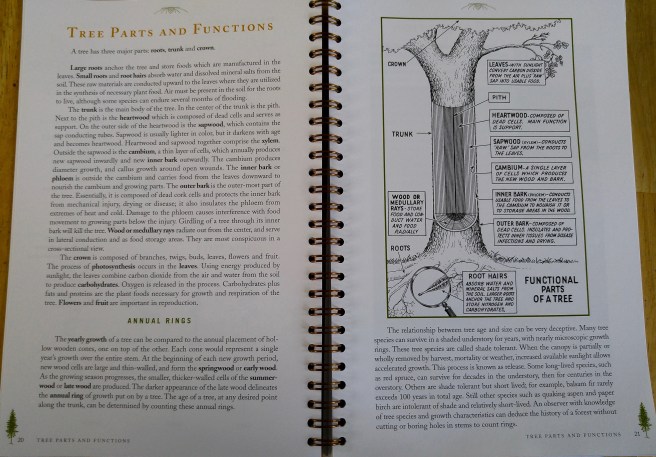
There’s even information on how a tree works because they do–for our well-being and for the benefit of wildlife.

t-white pine (1)

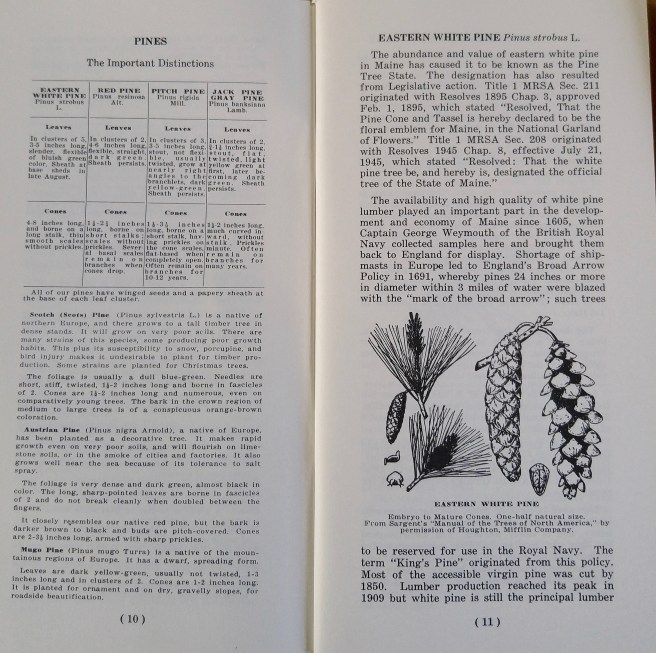
And then the descriptive pages begin. Each layout includes photographs, sketches and lots of information, both historical as in the King’s Arrow Pine, and identifiable as in bark, leaves, cones, wood, etc.

t-pines blue book (1)

1981

t-pines yellow book (1)

1995

Though some of the information is the same, it’s fun to note the differences from the two earlier publications.

t-maple key (1)

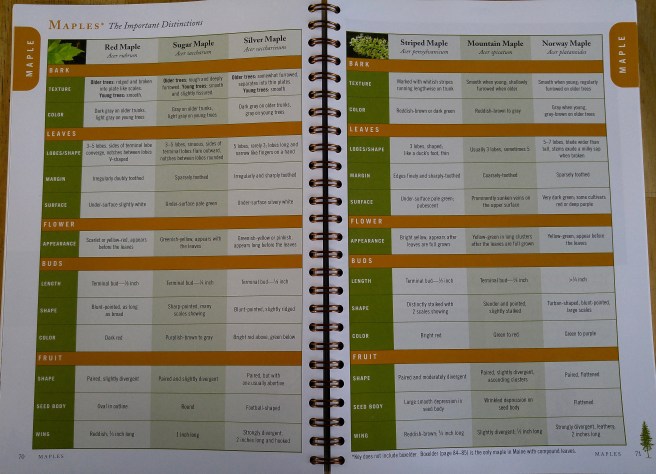
At the beginning of each family, major descriptions are noted in an easy to follow format.

t-maple (1)

And like the conifers, the broadleaves are portrayed.

Tomorrow, when my friend and I venture off, I’d better remember to pack this booklet. She’s peeked my curiosity about what she wants to ID because I’ve climbed the mountain before and perhaps I missed something. She already has a good eye for trees so I can’t wait to discover what learning she has in mind for us.

This Book of September is for you, Ann Johnson. And it’s available at Bridgton Books or from the forest service: http://www.maineforestservice.gov or forestinfo@maine.gov.

Forest Trees of Maine, Centennial Edition, 2008, published by The Maine Forest Service


Halting Beside Holt Pond

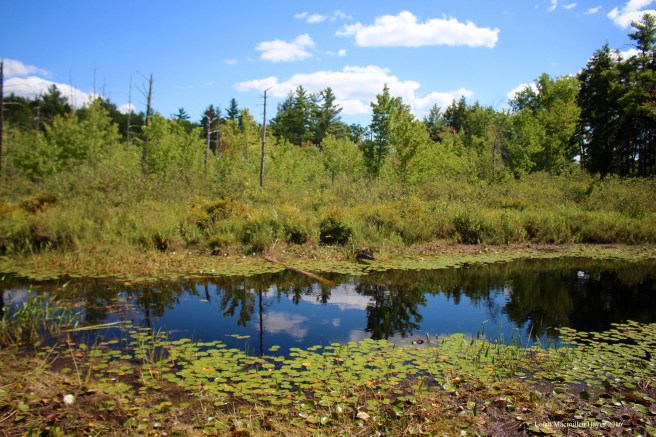
Halting–prone to pauses or breaks. I didn’t break, but I certainly was prone to pauses as I moved along the trails and boardwalks at the Holt Pond Preserve in South Bridgton this afternoon.

h-pitcher flower2

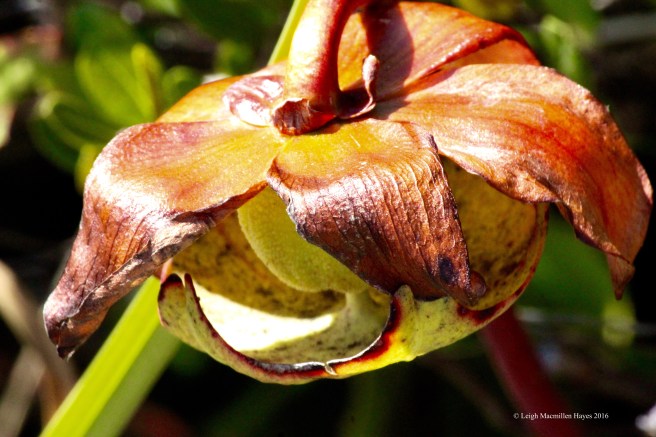
One of my first stops–to admire the pitcher plant flowers in their August form.

h-pitcher  flower up close

When I took a closer look, I realized that the seeds were developing–certainly a WOW moment in the world of wonder.

h-buttonbush.jpg

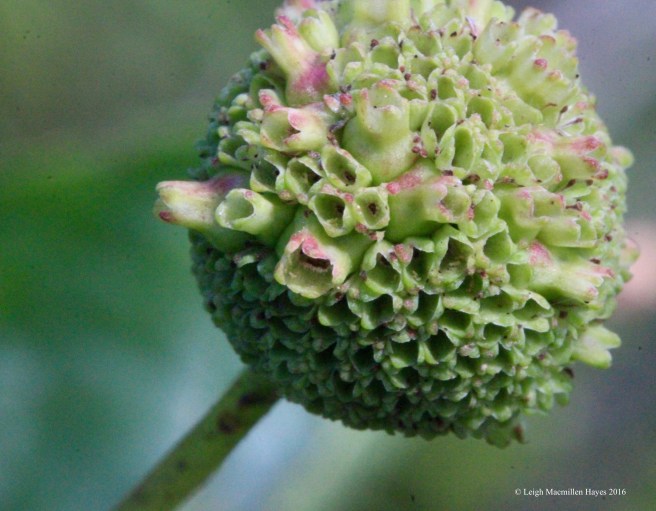
The global seed heads of buttonbush also demanded to be noticed. Upon each head are at least two hundred flowers that produce small nutlets. What strikes me as strange is the fact that this plant is a member of the coffee family. Maine coffee–local brew; who knew?

h-Muddy across

At the Muddy River, the water level reflected what is happening throughout the region–another case of “Honey, I shrunk the kids.” It’s downright scary.

h-speckled bug and speckles

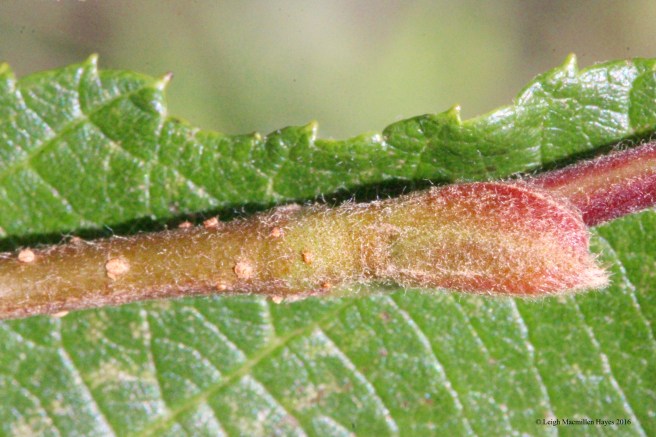
Both by the river and on the way to the quaking bog, this wetland features a variety of shrubs, including one of my many favorites, speckled alder. Check out the speckles–those warty bumps (aka lenticels or pores) that allow for gas exchange. And the new bud covered in hair.

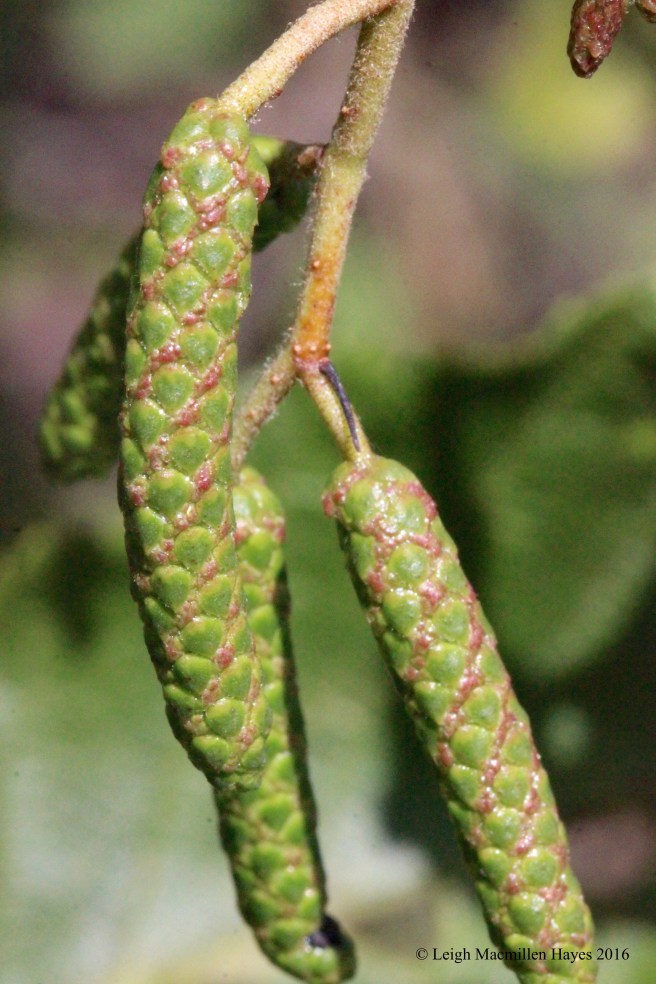
h-speckled alder catkins

This shrub is so ready for next year–as evidenced by the slender, cylindrical catkins that are already forming. This is the male feature of the shrub.

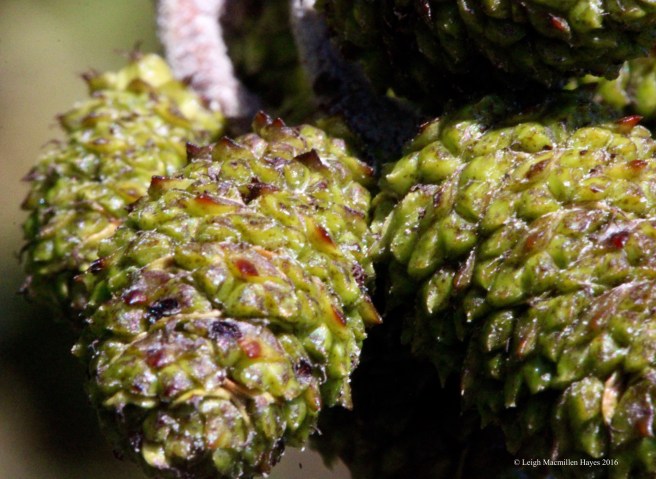
h-speckled cones new

It also bears females–or fruiting cones filled with winged seeds.

h-speckled old cones

It’s not unusual for last year’s woody cones or female catkins to remain on the shrub for another year.

h-cranberries

Whenever I visit, it seems there’s something to celebrate–including ripening cranberries.

h-cotton grass

Common Cotton-grass dotted the sphagnum bog and looked as if someone had tossed a few cotton balls about. Today, they blew in the breeze and added life to the scene. Note to self–cotton-grass is actually a sedge. And sedges have edges.

h-holt pond left

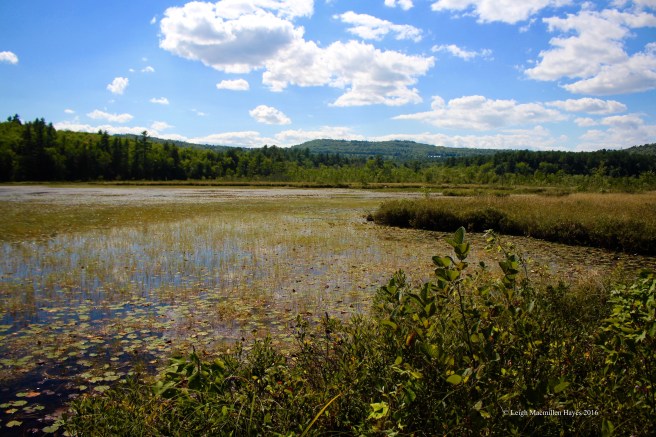
Just like the Muddy River, Holt Pond was also obviously low. Perhaps the lowest I’ve ever seen. At this spot, I spent a long time watching dragonflies. They flew in constant defense of their territories.

h-slaty skimmer, male

Male slaty skimmers were one of the few that posed for photo opps.

h-canoe on pond

As I watched the dragonflies flit about along the shoreline and watched and watched some more, I noticed a couple of fishermen making use of the LEA canoe. I don’t know if they caught any fish, but I heard and saw plenty jumping and swimming. Well, a few anyway. And something even skimmed across the surface of the water–fish, snake, frog?

h-rose hips.jpg

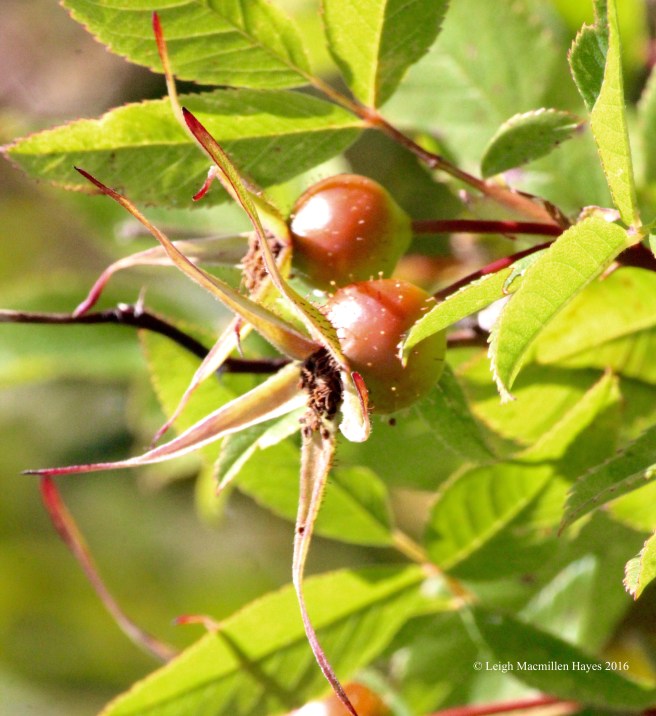
Rose hips by the pond’s edge reminded me of my father. He couldn’t pass by a rose bush without sampling the hips–especially along the shoreline in Clinton, Connecticut.

h-pond toward 5 Fields

The view toward Five Fields Farm was equally appealing.

h-pickerel frog

And then I moved down tire alley, which always provides frequent sightings of pickerel frogs. I’m never disappointed.

h-golden spindle

At the transition from a red maple swamp to a hemlock grove, golden spindles embraced a white pine sapling as if offering a bright light on any and all issues.

h-hairy woodpecker

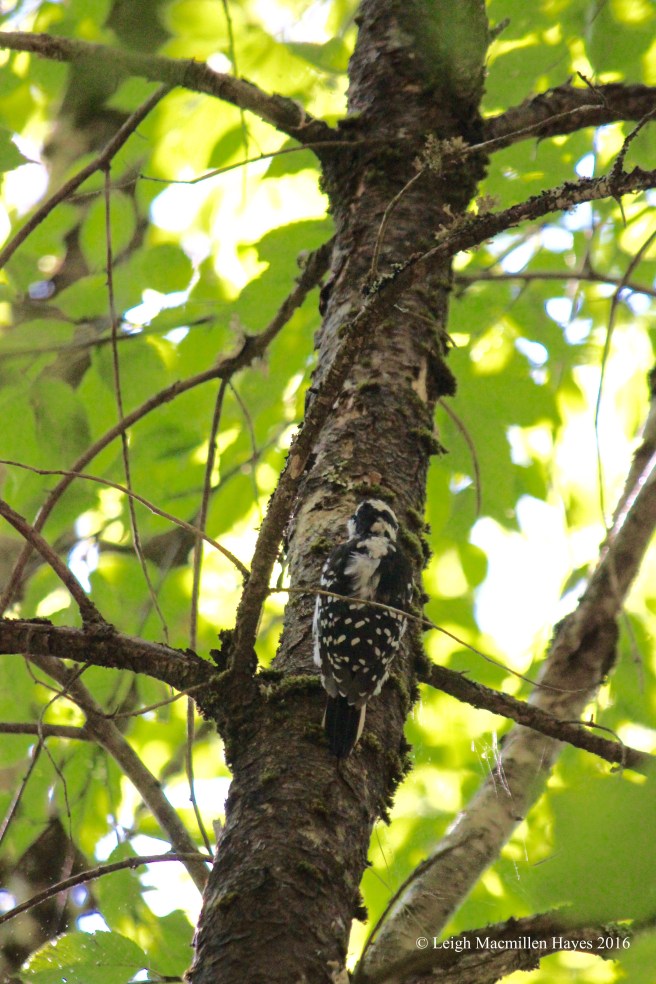
In this same transitional zone, a female hairy woodpecker announced her presence.

h-green frog

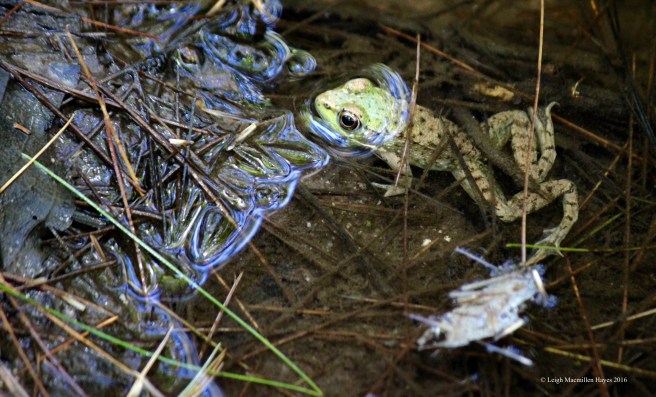
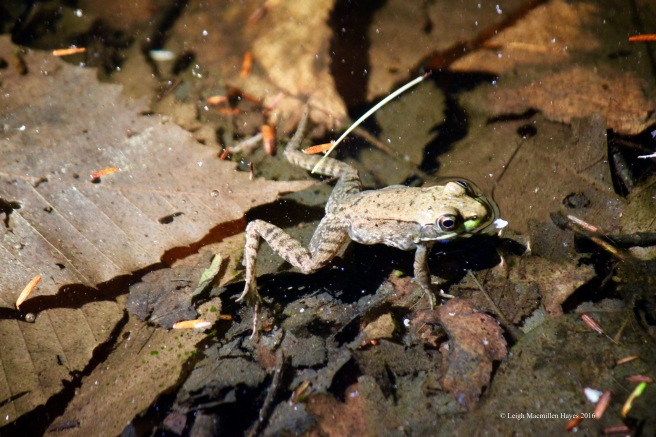
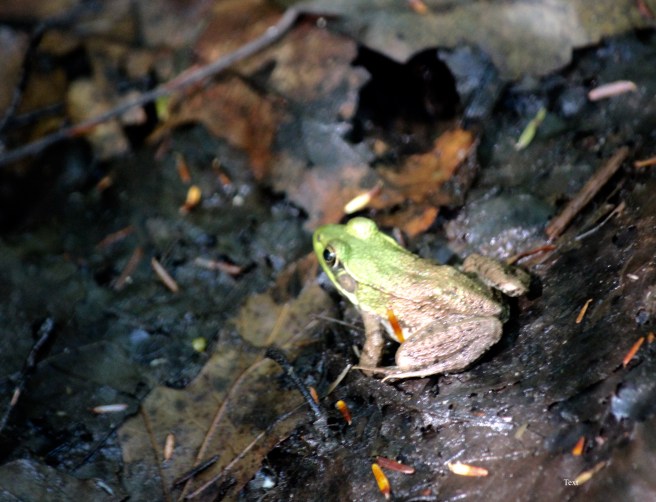
When I crossed Sawyer Brook, green frogs did what they do best–hopped into the water and then remained still. Do they really think that I don’t see them?

h-hobblebush berries

At last, I walked out to Grist Mill Road and made my way back. One of my favorite surprises was the amount of hobblebush berries on display.

h-meadowhawk

Walking on the dirt road gave me the opportunity for additional sights–a meadowhawk posed upon a steeplebush;

h-chicken

chicken of the woods fungi grew on a tree trunk;

h-chipmunk

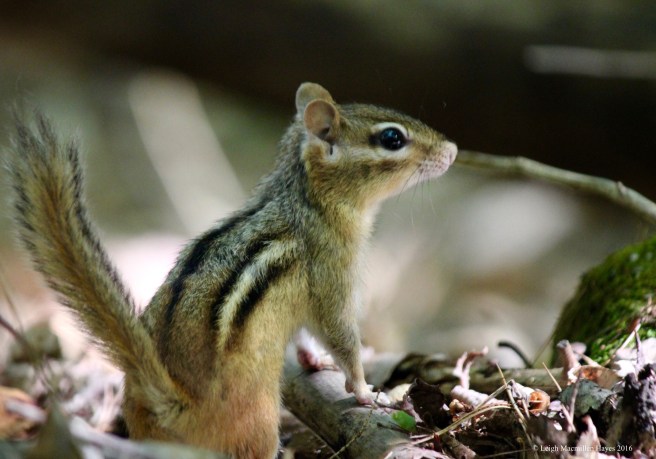
and a chipmunk paused on alert.

h-American Woodcock

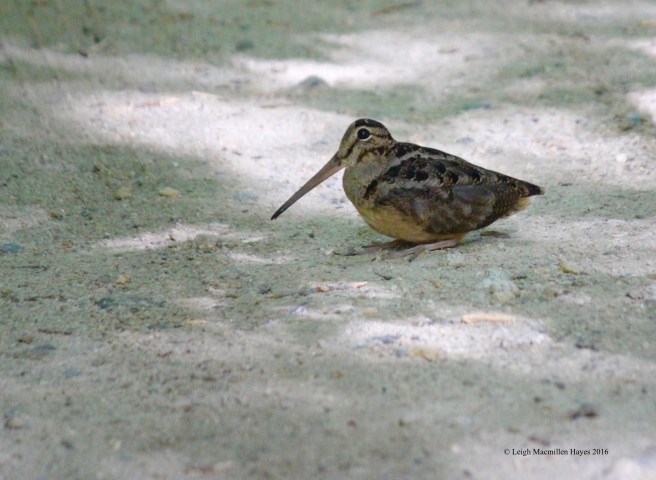
But the best find of the day–one that caused me to halt on the road as I drove out of LEA’s Holt Pond Preserve–an American Woodcock.

Worth a wonder! And a pause. Certainly a reason to halt frequently at Holt Pond.


Tagging Along with Jinny Mae

“Don’t walk behind me; I may not lead. Don’t walk in front of me; I may not follow. Just walk beside me and be my friend.” ~ Albert Camus

While I sometimes walked beside Jinny Mae this afternoon, I spent more time following her and am still her friend (I think).

A HOT afternoon. Despite the heat, however, I’m always tickled to follow her because she knows her 40-acre property intimately–including all of its nooks and crannies and cool sights.

j-green frog in water


We had some rain this morning, but Jinny Mae’s land is naturally wet and well loved by mosses and ferns . . . and green frogs. As we approached, several leaped into this mini pool and then posed.

j-green frog

Others waited patiently–probably hoping we’d move along.

j-polypore

J.M. has a fascination for fungi. Many fruiting bodies, like this gilled polypore, showed their faces as we moved about.

j-gilled polypore

We rolled the log to get a better look at the maze-like underside.

j-false chanterelle

Among our finds–chanterelles (deleted false because fungi expert, Jimmie Veitch informed me that they are true chanterelles. If you want to know more about Maine fungi or to purchase some, visit White Mountain Mushrooms) and . . .

j-coral

a coral fungi. Given today’s humidity, it felt like we were in the Bermuda of the North.

j-fern

Jinny Mae also showed me a fern-like moss that I don’t think I’ve ever seen before: stair-step moss. This moss is particularly fond of the moist coniferous and hardwood forest we tramped through. Its new growth arose from the previous year’s growth–climbing like a staircase.

j-yellow birch and hemlock

Nearby, she pointed to one of her favorite tree displays–a hemlock and yellow birch sharing space. Both have seeds that germinate best on rotting logs or rocks, where moss gathers and provides moisture. In a compatible relationship, they’ve reached for the sky with equal success. I’m reminded of two friends who know the importance of supporting each other–similar to the chitchat and occasional silence Jinny Mae and I share as we bushwhacked.

j-lightning 2

And then she introduced me to Excalibur. Even King Arthur probably couldn’t pull this    sword-like piece of a tree out of the ground–well, maybe he could. But we couldn’t.

j-lightning tree 1

The reason for Excalibur’s existence: a recent lightning strike.

j-lightning 4

We looked around and saw that the energy passed through at least three trees.

j-lightning 5

Bark peeled off.

j-lightning 3

And shredded wood scattered. What surprised us both was that we couldn’t find any burnt wood. Thankfully.

j-beech drops

Making our way back toward her house, we entered a beech forest and began to see beechdrops everywhere we looked.

j-beech drops2

These are parasitic plants that don’t manufacture their own nutrition, thus they depend on the roots of American beech trees for food.

j-coteledon

In this same area, we come across a young beech tree Jinny Mae flagged in the spring when she first observed a cotyledon. We chuckled when we remembered how we both were so taken with cotyledons a few months ago–a new sighting for us. One of those things that was always there, but we’d never noticed it previously. Today, she was filled with pride for this young beech. It’s had a healthy start and in forty years may provide beech nuts for the neighborhood bears. In the meantime, it will probably nourish a few beech drops.

j-Indian pipe .jpg

And then she showed me the final cool find of the day–an Indian pipe with stamens that appear to have split away from the flower. It seems that these friends made the move together–much the same as Jinny Mae and I did today.

I may have tagged along and followed her, but really, we walked side by side and I’m thankful for her friendship.

Mondate Afternoon

My guy was on an unexpected road trip all weekend and didn’t arrive home until lunchtime today. So, while I waited for him, I did what I do best–stalked the garden.

n-morning white faced wasp

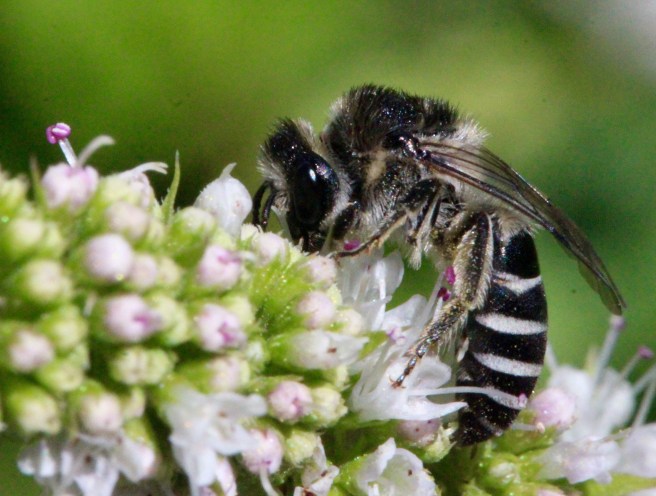
I’m not sure I ever noticed this black and white bee previously. Its hairy body shimmered in the morning sun.

n-morning golden digger wasp

At the same time, the great golden digger wasp moved quickly about, using its jointed antennae to search out nectar before it honed in on the sweet stuff.

n morning wasp

In a similar manner, a thread-waisted wasp also visited the mint flowers.

n-morning  turtlehead

As I made my rounds, I was thrilled to find turtlehead about to bloom. This late-blooming flower is one of my favorites (turtle theme), and I’ve watched it move from spot to spot in the garden. This year, it’s plentiful in a shadier place than usual.

n-morning black eyed susan

While the turtlehead sported new life, the black-eyed Susan spoke of days gone by. But even still, I think it’s stunning.

n-morning cricket

On the deck I noticed a cricket. Really, they are everywhere right now and sing all day and night–thus the reason we named our homestead Cricketchirp Farm. Don’t get it wrong–we don’t farm–we just live in an old farmhouse. Our best crop–insects.

n-morning grasshopper

And then I noticed I wasn’t the only one doing the watching. The red-legged grasshopper broke through a spider web and turned its head to keep an eye on me. Nice lips.

n-ordway sign

Finally, my guy was home and eager to stretch his legs. So I convinced him to explore several properties in the Oxford Hills region with me. Our journey began at Ordway Grove.

n-Ordway trailhead

The trailhead is located on Pleasant Street in Norway and begins beside a quaint shed. Though the trail isn’t long, its history is worth reading on the Norway Historical Society’s Web site.

n-oak on beech

This is land where large red oaks are supported by much smaller beech, and . . .

n-giant pines

towering white pines speak volumes about the last few hundred years.

n-Penneseewassee

The trail includes a few peeks at Lake Pennesseewassee, aka Norway Lake. Our only disappointment–signs of man’s disturbance, aka trash and some graffiti. Why?

n-wasp Witt Swamp.jpg

After we completed the loop walk and stood in awe among the giant trees, we continued up Pleasant Street to the trailhead for the Witt Swamp Trail owned by the Western Maine Foothills Land Trust. At the kiosk, an attached note provided warning. The register was a bit destroyed–perhaps due to a wasp encounter. It was cold and breezy when we arrived so we didn’t see, hear or feel a single insect.

n Witt Swamp evergreens

The beginning of the trail leads through a variety of youthful evergreens including red and white pines, balsam fir, hemlock and cedar.

n cedar leaf

Because they are saplings, I was able to take a closer look at the cedar leaves. Can you see the oil glands that give cedar its aromatic smell when the leaves are crushed?

n-cedar waves

My eyes were constantly drawn to the waviness of cedar bark, which creates a pattern not equaled by others.

n cedar works

Cedar works and . . .

n-cedar legs

cedar legs speak of their family genes–cedars are members of the Cypress family.

n-squeeze between 2

Two trees and a few signs encouraged us to pass through–so we did.

n-arrow at Witt

Other signs also indicated the direction to follow–this one much like an oversized arrowhead.

n-hemlock hugs

Not to be left out, a hemlock hugged the rock and itself.

n cornwall map

After another rather quick journey, we drove to Paris Hill. Our destination: Cornwall Nature Preserve, a 147-acre tract donated to the town of South Paris by Alice Cornwall. We decided to follow the wide white-blazed trail toward the purple trail leading to the Ice Pond.

n ice pond dam

We found the old dam, where water trickled through the rocks, but didn’t realize that somewhere in this vicinity we missed what may have been the ice house–or perhaps a rock foundation of sorts. Now that I know we missed it, I’m eager to return for a closer look. Back in the day, ice was cut and probably stored in the ice house. As a kid growing up in Connecticut, I recall going to an ice house on Route 1 in Clinton. Ice blocks stored in an insulated icebox kept perishable food chilly.

n-artists conk

We did see a few mushrooms here and there, but this summer’s drought means a low amount  of mycelium’s fruiting form. A few artist conks made themselves known.

n-oak fern

Without field guides, I think I ID this correctly as oak fern. Though similar to bracken, its stem was delicate and its height low. I should have looked for sori, but only had time for a quick shot–I was with my guy, after all.

n-Cornwall stonewalls

Again, there were stonewalls throughout the property–this one covered with moss. Like much of Maine, this was once farm country.

The Cornwall Nature Preserve has a variety of trails, but no maps other than the one at the kiosk. We figured out the layered trail system and encircled most of the outer part of the property. Much of it seems worthy of further exploration and enchantment.

We certainly felt enchanted to finally celebrate an afternoon Mondate.


Sundae School

I went on a reconnaissance mission this afternoon and visited a land trust property I’ve never stepped foot on before. My intention was to scope it out for possible use with a future Maine Master Naturalist class. My realization from the get-go was a happy heart. I can’t wait to return and take others along so we can make discoveries together.

n Preserve sign

I’ve only been on one other Western Maine Foothills Land Trust property, so had no idea what to expect. The small parking area for Shepard’s Farm Preserve is at 121 Crockett Ridge Road in Norway. (Norway, Maine, that is.) This is one of seven preserves owned by the trust. I should have known I’d enjoy myself immensely just by the name. Though we spell Shephard with an “h,” it’s a family name for us. Who knows–maybe there’s a connection.

n-trail sign

On the back of the brochure I grabbed at the kiosk, I read the following: “Originally owned by Benjamin Witt, the high undulating pasture of Shepard’s Farm Family Preserve was transferred to Joshua Crockett in 1799, Charles Freeman in 1853, John Shepard in 1910, and to Bill Detert in 1984.” Mr. Detert and his family donated the property in memory of his wife, Jan, to the WMFLT in 2010.

n-Indian pipe bee 1

My lessons began immediately. What to my wondering eye should appear, but a bee pollinating an Indian pipe. And in the middle of the afternoon. Huh? I’ve always heard that they are pollinated by moths or flies at night. Of course, upon further research, I learned that bees and skipper butterflies have been known to pay a visit to the translucent flowers. Add that to the memory bank.

n-Indian pipe

As I continued along the trail I found the upturned mature flower and again wondered–who stopped by for a sip of sap? Lessons should evoke further questions and a desire to learn more.

n-hawkweed

The trail offered other familiar flowers, like hawkweed,

n-pearly everlasting

pearly everlasting, goldenrods and asters, Queen Anne’s lace, boneset and jewelweed.

n-monkeyflower 3

And then I come upon a wildflower I don’t recall meeting before. The lesson included a look at the leaves, their arrangement on the stem, and the flowerhead.

n-monkeyflower 1

The answer to the quiz–lavender-flowered Sharp-winged Monkeyflower. Monkeys in the woods! You never know. Sometimes I think that red squirrels sound like monkeys when they chit at me, but in this case, it’s the fact that the flower looks something like a monkey’s face.

n-thistle young and old

Further on,  I spotted a favorite that I don’t see as often as I’d like. What I didn’t realize is that thistles are in the aster family. Always learning. Its presence here is referenced by trail conditions, which change periodically from mixed hardwoods to softwoods to open places. Thistles prefer those open places–fields and waste places. Hardly waste in my opinion. Rather, early succession to a woodland.

n-bee on thistle 2

A bee worked its magic on the flowerhead so I moved in for a closer look.

n-bee on thistle1

As with any flower, it was a pollen frenzy.

n-thistle with seeds

Seconds later–maturity! Well, maybe not quite that fast.

n-thistle seeds 1

But the seeds had developed their downy parachutes and the breeze was a’blowing.

n-thistle seed 2

They knew it was time to leave the roost and find a new classroom.

n-trail ferns

Another lesson worth more time was a look at the natural communities along the trail. Bikers and hikers share this space, but what I found fascinating was the constant change.

n-trail hay

The original trail for the Shepard’s Family Farm Preserve was located on a 19-acre parcel. Recently, the Witt Swamp Extension was added, which almost circles around a 250+ acre piece. Hay covers some of the new trail right now–giving it that farm-like feel and smell.

n-trail 1

I’m not certain of the mileage, but believe that I covered at least 4-5 miles in my out and back venture over undulating land and through a variety of neighborhoods. The trail conditions–pure bliss. No rocks or roots to trip over. Instead, I could look around for the next lesson.

n-cedar bark

One of the things I love about hiking in Norway is that I get to be in the presence of cedar trees–Northern white cedar.

n-cedar leaves

I’m fascinated by its scale-like leaves.

n-deer tracks

So are the deer, who feed on the leaves during the winter months.

n-dry stream

I found only deer tracks, and noted that all stream beds were dry, though the moss gave a moist look to the landscape. We’re experiencing a drought this summer.

n-red leaf

Due to that lack of rain, some red maples already have turned and colorful leaves are beginning to float to the ground.

n-porky 3

Deer aren’t the only mammals that inhabit this place. From the trail, I noticed hemlock trees with bases that looked like perfect gnome homes. And then I spotted this one that invited a closer look.

n-porky den

A pile of porcupine scat–the pig-pen of the woods. Even Charlie Brown would note a distinct odor.

n-toad camo

And in true “Where’s Waldo” tradition, a young American toad crossed my path. The camo lesson–blend in for safety’s sake.

n-turtle 2

Being former farmland, stonewalls wind their way through the preserve. And my childhood fascination with turtles was resurrected. Do you see it?

n-turtle 3

How about now? Hint: the head is quartz.

n-turtles

And this one? They’re everywhere. It makes me wonder if it was a style of the times.

n-stone wall ending

I crossed through a gap in the stonewall and noted two smaller stones topped by a large flat one. A reason why? The questions piled up. I need to ask the teacher.

n-stonepile

And then there were the stone piles. Why so many smaller stones around a boulder? What I love about this spot is that a hemlock took advantage of the boulder and grew on top of it.

n-stone structure 2

And another favorite find–a stone structure.

n-stone structure, flat

Created with rather flat field stones.

n-stone structure 1a

It’s near a stonewall, so I surmised it was a shed of some sort rather than a root cellar for a home. I could be wrong, but am thrilled by the opportunity to see it.

n bird sculpture

One of the coolest features of this property is that it’s home to sculptures created in the 1970s by Bernard Langlois, including this bird in flight. The sculptures were made possible recently by the generosity of his widow, Helen Langlois, Colby College and the Kohler Foundation.

n-bird lady 2

Mrs. Noah is my favorite. She has stories to tell and I have lessons to learn.

It’s Sunday and by the time I finished hiking I was hot. I’d intended to check out a few more preserves, but the thought of a creamsicle smoothie at a local ice cream shop had my focus–until I pulled in and saw this posted: “Cash and local checks only.” No cash. And though our checks would be local, I didn’t have any with me either. Lesson learned.

I drove home and made my own sundae.

Rather a Mondate

Yes, it’s Monday. But as has been the case lately, my guy and I haven’t been able to hike together. We both had chores and projects to complete and so we did.

In the late afternoon, however, I headed out the back door. My mission–to locate something orange to photograph for our young neighbor who is prepping for a bone marrow transplant. Not an easy task, but like others I know, as often as he can, he smiles through this journey.

m team orange

Orange hawkweed provided today’s support to Team Kyan. May he continue to be strong. And his family, as well.

m cicada 5

After my orange find, I journeyed on–headed for our woodlot. And only steps from it, I discovered this camo-dressed insect fluttering on the ground. The male member of this species is known for the high-pitched buzz we hear on summer days. Sometimes, it’s almost deafening.

m cicada wings

This is a cicada, one that appeared to have a wing issue. A set of wings was held close to its  thick body, while the other set extended outward. (I thought of Falda, the faerie with folded wings in The Giant’s Shower.) I love the venation, reminiscent of a stain-glass window. Strong, membranous wings for a large insect.

m cicada flap

When I returned a second time, it was flapping those wings like crazy, but take off wasn’t happening. Did a predator attack at some point? Will it still be there tomorrow? So much to wonder about.

m cicada up close 2

And being me, I took advantage of the fact that it wasn’t going far to take a closer look. Notice the three legs extending below the thorax.

m-cicada kiss

Face on! We might as well have kissed. I’ve licked a slug, but passed on the opportunity to kiss a cicada. I do love this broad head, however. Check out that mouth that protrudes. Hidden inside are mandibles and maxillae used to pierce plants and drink their sap (xylem). Even if this chunky one couldn’t fly, it could still eat. And those eyes, oh my. So, here’s the scoop. The two obvious outer  eyes are compound, the better to see you with. But then I noticed three red spots located between the two compound eyes. Do you see them? These are three more eyes known as ocelli–they look rather jewel-like and are perhaps used to detect light or dark. Yup, this is a five-eyed insect. Certainly worth a wonder.

m indian pipe 6

As I continued my wander, I noticed that in the past few days a large number of Indian Pipes made their ghost-like presence known.

m indian 7jpg

Ever so slowly they broke through the ground–these under a hemlock grove.

m indian pipe 24092

Though each is one flowered, they love communal living.

m indian pipe 5

Their waxy flowers dangle as they pull up through the duff.

m indian pipe

Once fertilized, their pipes slowly turn upright, where the flowerhead will transform to a capsule encompassing the seeds of the next generation. Notice the lack of leaves–scales take their place.

m pine sap group

Also in these woods, I knew today to look for a relative of Indian Pipe because I found their capsule structures last winter. Pinesap growing below an Eastern white pine.

m pine sap 3

Since it was dark under the trees, I needed to use a flash, thus the color. But really, these are amber. And multi-flowered on a raceme. Pinesaps and Indian Pipes produce no chlorophyll, therefore they can’t make food on their own. And because they aren’t dependent on light, they thrive in shady places.

m-pine sap flowers

What sustains them is their saprophytic nature–they aren’t a fungus, but depend on fungi to obtain carbohydrates from another plant, so the mycorrhizal fungi serves as the connector between the host and the Pinesap’s roots.

m-pine sap up

While the Indian Pipe is scaly, the Pinesap has a hairier appearance. Both are members of the heath family.

As for me and my guy, today we’ve been near each other, but not on a playdate. In fact, as I sit in the summer kitchen and write, he’s doing a huge favor for me. Isn’t that how it should be? No, not really. We’d rather be on a Mondate together.

Smack Dab In Front Of Me


Sometimes I’m amazed at the wonders that are right before my eyes. OK, more than sometimes.

c-flower

For the past two years, I’ve noticed this plant as I sat on my porch rocker. The greenish-yellow flower tinged with purple doesn’t last long, but it’s delicate in form. If you look closely, you may see that it’s shaped like a slipper. The pouch of a lady’s slipper? No, but it is a member of the orchid family, thus the similar structure. This is a helleborine, which is actually a non-native.

c-helleborine stem

The hair-covered stem almost looks like it’s been coated with powder. With clasping leaves and that thick fuzzy stem, I keyed it out to Epipactis helleborine, aka broad-leaved helleborine. Strong and beautiful.

c-Rabbit-foot clover 1

Another non-native that is especially common along roadsides right now is rabbit-foot clover. I love this common name for it does look like the good-luck charms we used to have as kids–which were supposed to be a rabbit’s foot. Were they really taken from rabbits? Left or right, front or back?  Which pocket where you supposed to carry it in? And did it actually bring good luck? I don’t know, but the feathery structure and tad of pink among the white and green makes this flower appear as something more unique than common. Delicate and dainty.

c-Queen 1

A third non-native that I see blooming everywhere right now–Queen Anne’s Lace. Apparently, Queen Anne liked to work with lace and the red dot that you see in the center of the inflorescence represents the blood that dripped when she accidentally pricked herself with a needle. After the flower finishes blooming, its spoke-like branches curl inward and form a “bird’s nest” structure while the seeds develop. Legendary and intricate.

c-ant on pearly everlasting

Finally, a native. The flowers of pearly everlasting. And an ant. Notice its body color–shining iridescent in the sunlight. Yes, even ants can be worth a view. And while these flowers may look huge, think about the size of an ant. I just happened to be in their faces. Three cool things about pearly everlasting. First, the white “petals” are actually bracts that surround the yellow disk flowers. (Bracts are usually green and leafy.) Second, the flowerheads do look like pearls and those white bracts remain so that  even after the central disk flowers wilt, the pearl structure continues to exist. (They look great in dried flower arrangements.) And third, the lance-shaped leaves are cottony and have an aqua-white or silvery tinge that makes them stand out among green-leaved plants.  Unforgettable and forevermore.

c-dewdrops

Morning dew glistened like tiny beads on a sensitive fern frond this morning.

c-fertile 2

But one of my favorite finds later in the day was the fertile stalks of sensitive ferns. Check out the beadlike structure that houses the spores. These will stand tall all winter, turn a burgundy brown and after the spores are finally released, they’ll take on a lacy look. Notice how the beads appear on one side of the stalk. They look like they could be made of polymer clay. Prolific and creative.

c-damsel love

As I was looking about, a pair of marsh bluets demonstrated their mating behavior. He is the darker one and has grabbed onto her thorax behind her head with the claspers at the tip of his tail. She actually has species-specific grooves intended for this. And she has apparently decided he is the one for this moment because she’s lifting her body toward his to form the heart-shaped wheel, meaning she’s ready to receive his sperm. He’ll first check to see if she’s received any sperm from another male, which if discovered, he’ll remove before inserting his own. Once the mating is over, he’ll guard her to make sure no other males happen along. Curious and crazy.

c-whitefaced meadowhawk 2

One of my favorite in my face experiences today occurred when this white-faced meadowhawk dragonfly let me enter its personal space. It posed for moments on end and then flew off, only to return for another face-to-face meet and greet. The face of a young one is yellow to begin and changes to white as it matures. While the adult male has a red body, females and young males are yellowish brown. So this is one of the latter two. I swear it smiled at me. I certainly smiled back.

We were smack dab in each others faces–the better to see you, my dear.