Milestones are always important as they mark significant events in our lives. And for me, such an event occurs today as I celebrate the second anniversary of the day wondermyway.com was born.
Since I was in elementary school and made few and far between entries into a chunky journal bound in a green cover (which I still own), to the first empty book journal my sister gave me when I graduated from high school, to a variety of travelogues and other journals I’ve filled from cover to cover, I’ve recorded my life’s journey from time to time.
The most satisfying for me has been this very blog, to which I’ve added numerous events and discoveries, both natural and historical, over the last two years. As personal as it all is, I’ve taken a leap of faith by sharing it with you. And you have been gracious enough to read it, and comment on it, and “like” it, and sometimes “love” it, and offer me suggestions, corrections and gentle nudges.
Thank you for following along on the journey. It’s been scary to put myself out there, but I have.
And now, I thought I’d review some favorite finds I noted in posts over the past year. My learnings have been many and it’s been fun to review all that I’ve seen and thought and admired and wondered about. I hope you’ll feel the same and will continue to follow along and comment and share those that you enjoy with your family and friends.
Here’s my countdown , or maybe I should say my count up of favorite moments in time over the past year:
Feb 21, 2016: Celebrating a Year of Wonder-filled Wanders
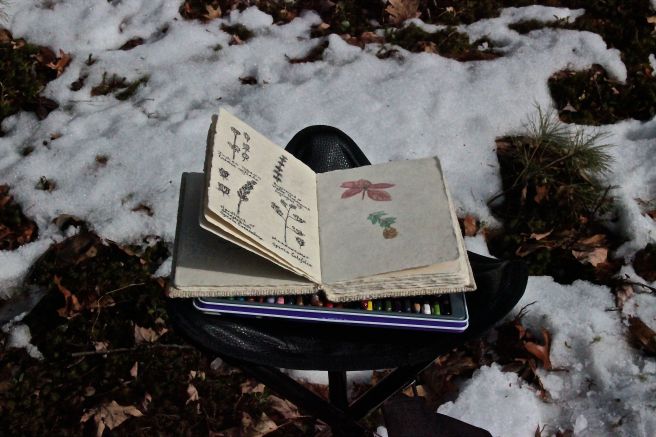
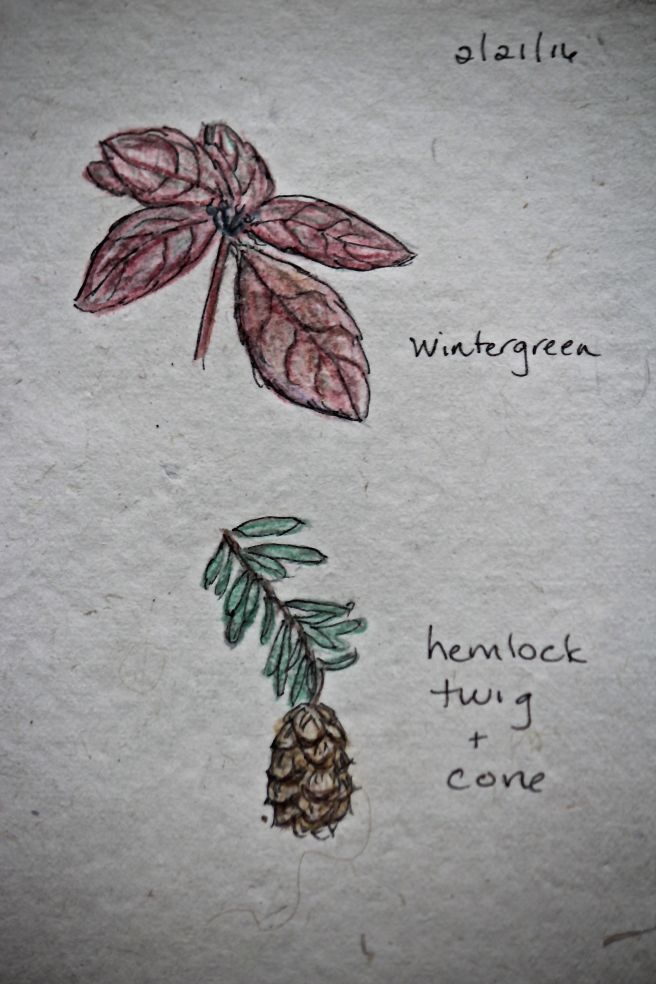
I made time one year ago to sit and sketch–one of my favorite activities. To be still and embrace life around me. To notice. And commemorate.
February 28 2016: Gallivanting Around Great Brook

Usually, we drive the forest road in to the gate on Hut Road in Stoneham, but in winter it isn’t passable, and thus one must walk–which means paying attention to things you might not normally notice, such as this: a special relationship between a yellow birch and a white pine. Rooted in place, they embrace and share nutrients. Forever conjoined, they’ll dance through life together.
March 18, 2016: On the Verge of Change
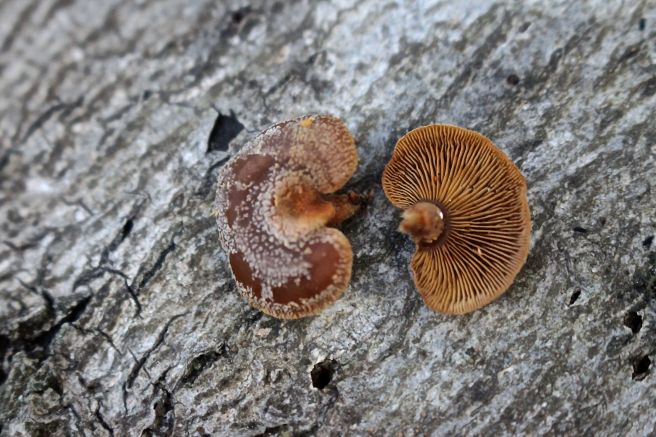
While exploring the Greater Lovell Land Trust‘s Back Pond Reserve in Stoneham with my friend, Parker, who is a master mycologist, he found Panellus stipticus, a bioluminescent species. Check out those gills on the underside. According to Lawrence Millman in his book Fascinating Fungi of New England, ” . . . specimens in the Northeast glow more obviously than specimens in other parts of North America.” So if you are ever in these woods late at night, don’t be freaked out by a light greenish glow. It just might be nature’s night light.
March 22 2016: Wet Feet at Brownfield Bog

When I first spied this lump of gray I assumed it was a dead mouse. I know, I know–I should never assume because I risk “making an ass out of u and me.” And so I took a closer look. And noticed tons of bones and those orange teeth. An owl pellet filled with the remains of dinner. Owl pellets are extra cool and dissecting one is even cooler. I collected this one but haven’t dissected it because I think it makes for a great teaching tool as is. If you want to see it, just ask.
April 13, 2016: So Many Quacks

At the vernal pool, or frog pond as we’ve always fondly referred to it, just steps from our property, I kept a keen eye on the situation last spring. In general, each mass laid by female wood frogs was attached to a twig or branch. They tend to take advantage of the same site for attachment and usually in a warm, sunny spot.
A couple of masses were positioned independent of the rest, like this one–embraced in oak and maple leaves. Eventually, they’ll gain a greenish tinge from algae, which actually helps to camouflage them. One of the many wonders is that any given mass may contain up to 1,000 eggs–from a two-to-three-inch frog.
April 28, 2016: The Big, The Little and Everything in Between

The phone rang as I stepped out of the shower and a male voice yammered away about something in the snow and it had come last night and I had to get there quickly. My friend, Dick, was standing in a friend’s yard about a half mile from here and looking at bear tracks in the snow.
As he knew he would, he had me on the word “bear.” His voice was urgent as he insisted I stop everything and get to his friend’s house. “I just need to dry my hair and then I’ll be right there,” I said. Deadlines loomed before me but bear tracks won my internal war. Dick suggested I just wrap a towel around my head. Really, that’s what I should have done because my hair has no sense of style whether wet or dry, so after a few minutes I said the heck with it and popped into my truck, camera and trackards in hand.
May 21, 2016: Wallowing in Wonder

Along Perky’s Path at the GLLT’s Heald and Bradley Ponds Preserve, a bunch of us had the honor to watch a dragonfly split open its exoskeleton and emerge from the nymph stage. Of course, we were standing by a beaver pond, and so it seemed only appropriate that it would use the top of a sapling cut by a beaver. As it inflated the wings with blood pressure, they began to extend.
May 31, 2016: Slippers Fit for a Princess–Including Cinderella

Members of the Orchid family, lady’s slippers feature the typical three petals in an atypical fashion. The pouch (or slipper or moccasin), called the labellum, is actually one petal–inflated and veined. With a purplish tint, the petals and sepals twist and turn offering their own take on a ballroom dance. From every angle, it’s simply elegant.
June 10, 2016: The Main(e) Exotics

At Lakes Environmental Association‘s Holt Pond Preserve, a friend and I had moved from the swamp to the first hemlock hummock and chatted about natural communities when suddenly we realize we were being hissed at. Its coloration threw us off and beautiful though it was, the hairs on the back of our necks stood on end. Apparently we made it feel likewise. And so we retreated. It was a common garter, but really, there didn’t seem anything common about it in the moment.
June 18, 2016: Paying Attention

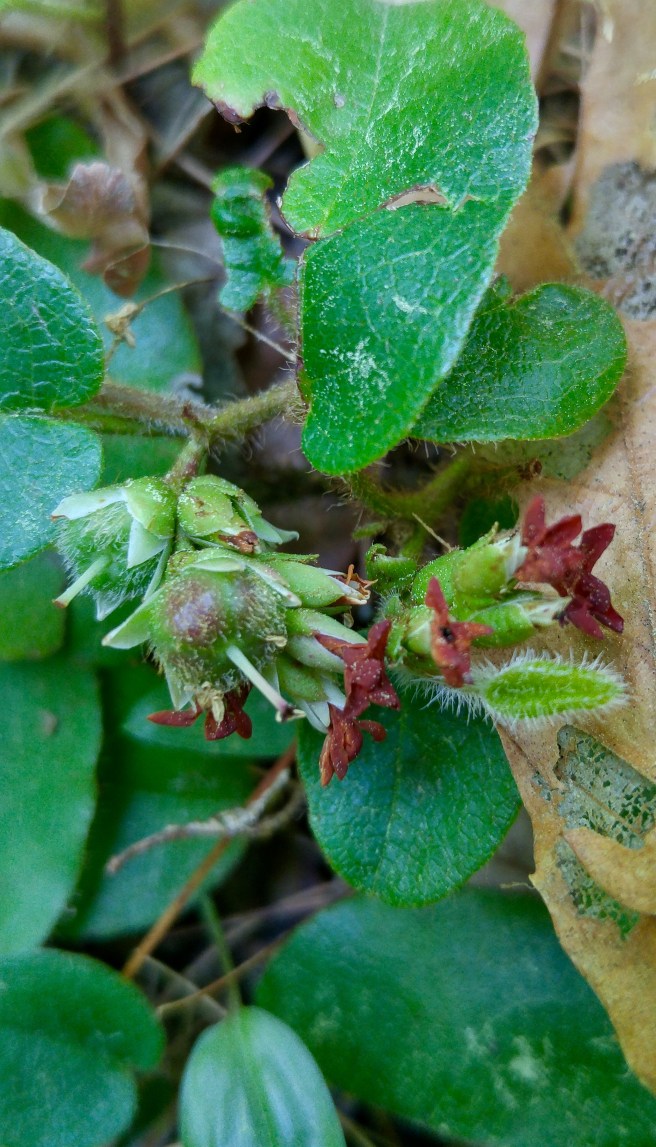

In May, trailing arbutus wowed us by its gentle white and pale pink flowers. In June, they faded to a rusty tone. And some transformed into swollen round seed pods–a first for me to see.
The sepals curled away to reveal the white fleshy fruit speckled with tiny brown seeds. It was well worth getting down on knees to look through a hand lens–especially since ants, chipmunks and mice find these to be a delicacy so they wouldn’t last long.
July 9, 2016: Wondering About Nature’s Complexity
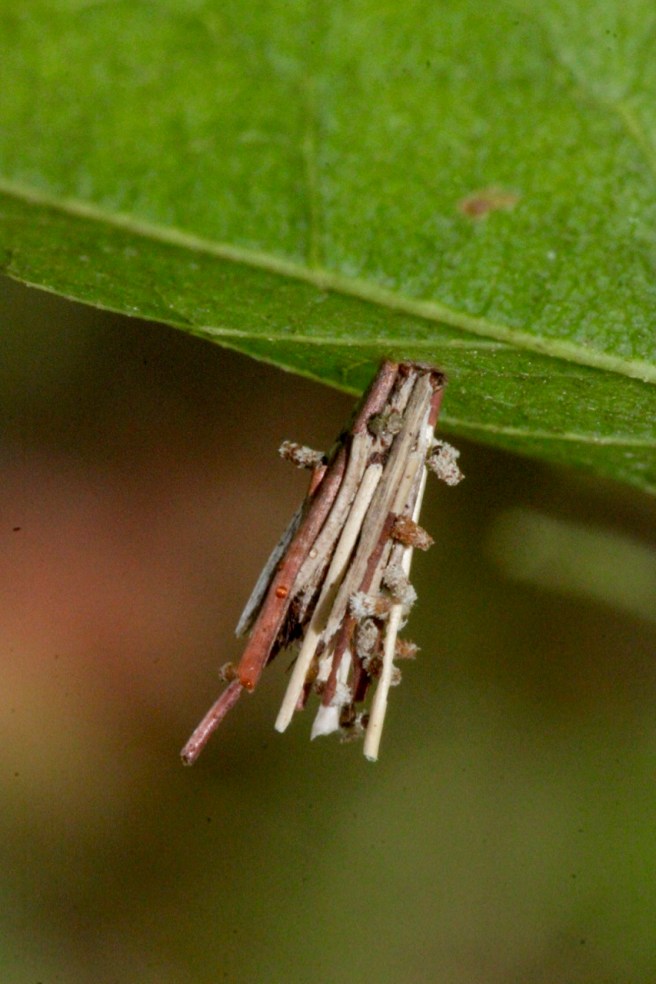
I posed a question this day: So dear reader, I enjoy teaching you, but now need you to teach me. I found this under another leaf on a shrub. And I often see the same thing stuck to our house. It reminds me of a caddisfly case. What is it?
And fellow Master Naturalist Pam Davis responded: Check out bagworm moths to see if it might be an answer to the stick thing on the leaf and your house. Here’s a discussion: http://nature.gardenweb.com/discussions/2237505/not-a-bug-maybe-a-gall and a Wikipedia link: https://en.wikipedia.org/wiki/Bagworm_moth
Indeed.
July 27, 2016: Searching for the Source of Sweetness
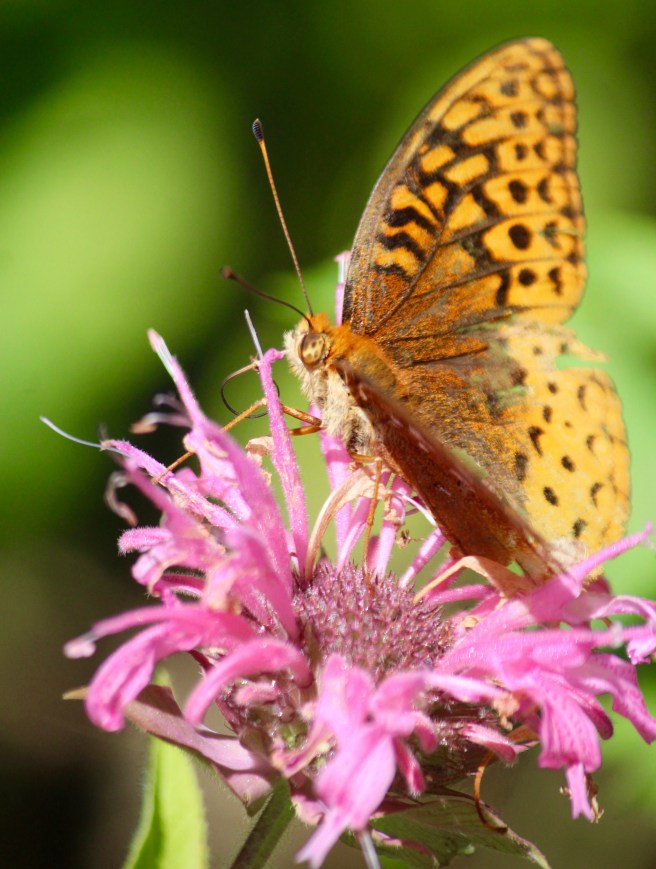
It was no mistake the this fritillary butterfly chose the beebalm on which to land. Check out its mouth. A butterfly feeds through a coiled mouth part called a proboscis. When not in use, the proboscis recoils and is tucked into position against the butterfly’s head.
August 21, 2016: Sundae School

My lessons began immediately. What to my wondering eye should appear, but a bee pollinating an Indian Pipe. And in the middle of the afternoon. Huh? I’ve always heard that they are pollinated by moths or flies at night. Of course, upon further research, I learned that bees and skipper butterflies have been known to pay a visit to the translucent flowers. Add that to the memory bank.
August 27, 2016: Halting Beside Holt Pond

Halting–prone to pauses or breaks. I didn’t break, but I certainly was prone to pauses as I moved along the trails and boardwalks at the Holt Pond Preserve in South Bridgton. One of my first stops–to admire the pitcher plant flowers in their August form. When I took a closer look, I realized that the seeds were developing–certainly a WOW moment in the world of wonder.
September 9, 2016: Golden Rulers

What first caught my eye was a bee that dangled upside down. And then I spied the green legs of an assassin bug. What? Yup, an assassin bug. I believe this one is a nymph. Regardless of age, here’s the scoop: Assassin bugs are proficient at capturing and feeding on a wide variety of prey. Though they are good for the garden, they also sometimes choose the wrong species like this bee. The unsuspecting prey is captured with a quick stab of the bug’s curved proboscis or straw-like mouthpart. Once I saw this, I continued to return for a couple of hours, so stay tuned.
September 15, 2016: The Wonders of Kezar River Reserve
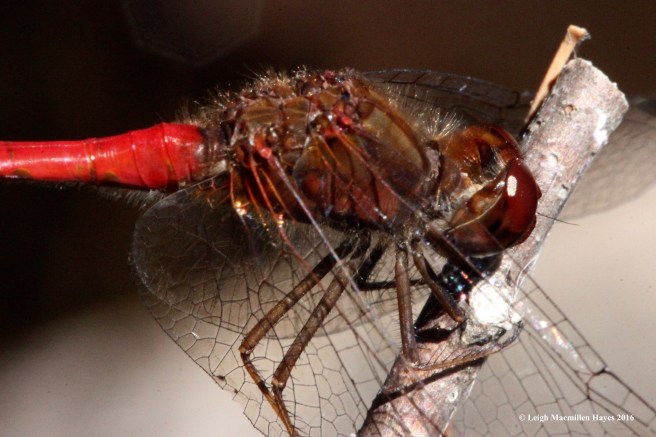
My favorite wonder of the day . . . moments spent up close with a meadowhawk.
October 17, 2016: Everybody Loves Raymond? Mondate

My guy and I discovered several of these examples of fungi on fungi at Loon Echo Land Trust‘s Raymond Community Forest and had no idea what they were–so I sent the photos to Parker and Jimmie Veitch, of White Mountain Mushrooms, and Jimmie responded with this explanation:
“That’s what mycologists call “rosecomb” mutation, where a mushroom’s gills start forming on the cap in a really mutated fashion. It’s been reported in many mushroom species but I haven’t seen it in this one (Armillaria AKA honey mushrooms). As far as I know, no secondary fungus is involved.
The suspected cause (not so nice) is ‘hydrocarbons, phenols and other compounds contaminating the casing or contacting the mushroom surface. Diesel oil, exhaust from engines, and petroleum-based pesticides are thought to be the principal source.'”
October 22, 2016: Cloaked By the Morning Mist
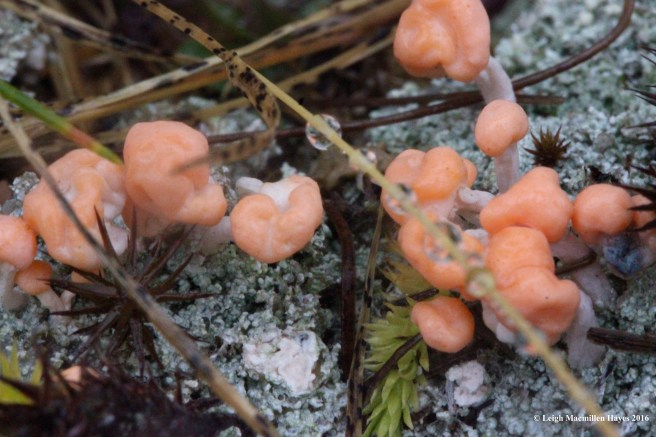
On a rainy day adventure with the Upper Saco Valley Land Trust in nearby New Hampshire, we paused to admire candy lichen, a crustose (think–flattish or crust-like) lichen with green to bluish-green coloration. Its fruiting bodies, however, are candy-pinkish berets atop stalks, even reflected in the raindrops.
November 6, 2016: Focus on the Forest Foliage
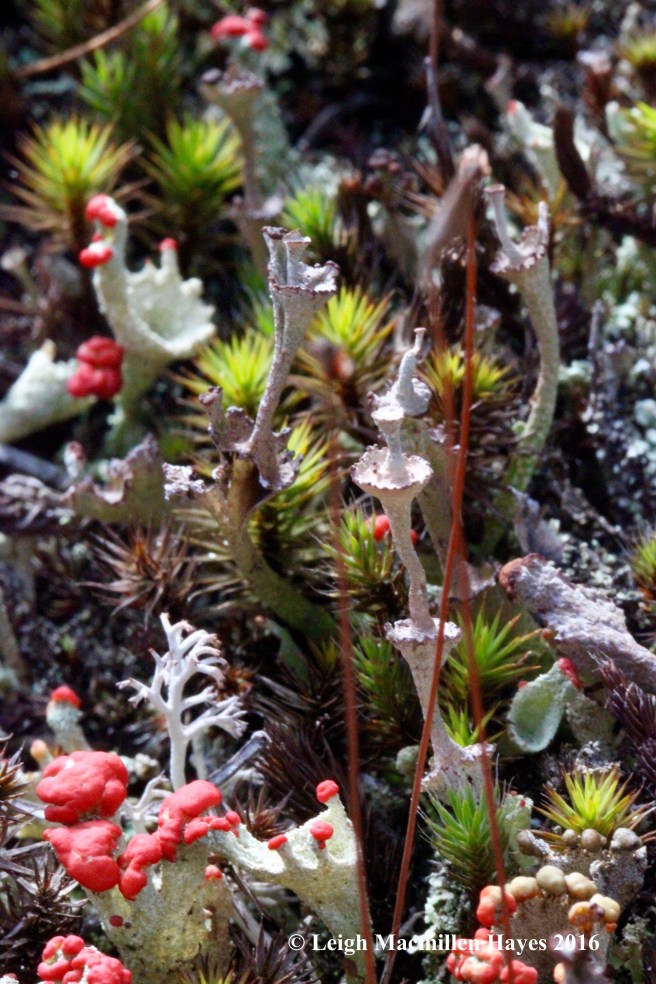
And then . . . and then . . . and then just as our eyes trained on the red caps before us, something else made itself known. We spied another lichen that I’ve only seen once before: Cladonia cervicornis ssp. verticillate.
Its growth formation is rather unique. In one sense, it reminded me of a sombrero, but in another sense, I saw fountains stacked one atop another, each giving forth life in their own unique fashion. But rather than being called Fountain Lichen, its common name is Ladder Lichen–perhaps referring to the fact that the pixies can easily climb up and up and up again.
November 20, 2016: Forever a Student
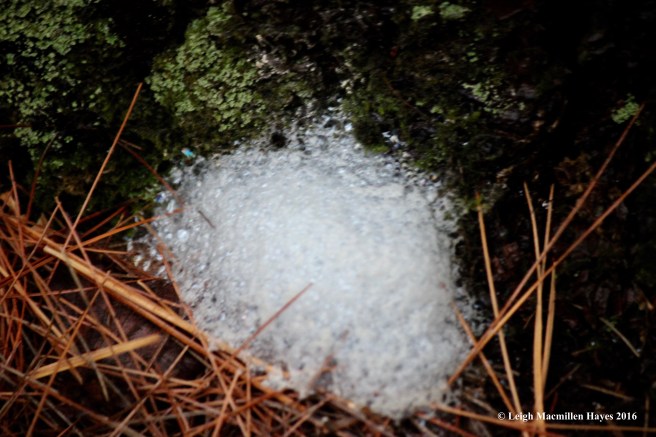
A sight I was hoping for presented itself when I returned to our woodlot–froth at the base of a pine tree. It’s not unusual and occurs following a rain event such as we’d had all night and morning. So what causes the tree to froth? Well, like all lessons, there are several possibilities. Maine Master Naturalist Science Advisor Fred Cichocki recently had this to say about it: “I’ve noticed this phenomenon often, and in every case I’ve seen it’s associated with white pine, and always after a dry spell followed by heavy rain. Now, conifers, especially, produce hydrocarbons called terpenes (it’s what gives them their lovely pine, balsam and fir scent). These hydrocarbons are hydrophobic by nature and form immiscible films on water. During a heavy rain, water running down the trunk of a white pine picks up terpenes on the way. Air (having accumulated in bark spaces, channels, etc. perhaps under slight pressure) then “bubbles” through terpene-water films producing a froth. Recall the cleaning products PineSol, and the like. They are made from terpenes, and produce copious bubbles when shaken. One could get the same result directly by shaking terpentine in water, or by bubbling air through a terpentine-water mixture with a straw . . . Of course, it may be that other substances (salts, etc.) enhance the frothing.”
No matter how much I have learned on this life-long course, there’s always more. I certainly don’t have all the answers and for that I am thankful. I’m forever a student.
December 4, 2016: The Art of Nature

Some cut stumps reminded me of the circular movement leading toward the center of a labyrinth–appearing quick and easy, and yet providing a time to slow down while following the path.
December 23, 2016: Won’t You Be My Neighbor

I followed the porcupine trail along his regular route and over the stonewall only to discover prints I’ve never met before. My first impression was raccoon, but the shape of the prints and the trail didn’t match up in my brain. More and more people have mentioned opossum sightings in the past few years, but I’ve only seen one or two–flattened on the road. Today, in our very woods, opossum prints.
January 19, 2017: Keep an Open Mind

While I always head out with expectations of what my forest wanderings will offer, I’m happily surprised time and time again with the gifts received.
And so it was the other day when a friend and I happened upon this trophy in an area I’ve only visited a few times. We’d been noting the abundant amount of deer tracks and realized we were between their bedding and feeding areas and then voila–this sweet sight sitting atop the snow. It now adorns a bookcase in my office, a wonder-filled addition to my mini natural history museum. (I’m trying to give Henry, Jessie, Violet, and Benny of the Boxcar Children series a run for their money in creating such a museum.)
January 25, 2017: On the Prowl at Heald and Bradley Ponds Reserve

Notice how these pine needles are clumped together? What I learned from Mary Holland, author of Naturally Curious, is that these are tubes or tunnels created by the Pine Tube Moth. Last summer, larvae hatched from eggs deposited on the needles. They used silk to bind the needles together, thus forming a hollow tube. Notice the browned tips–that’s due to the larvae feeding on them. Eventually the overwintering larvae will pupate within the tube and in April when I come back to check on the vernal pool, I need to remember to pay attention, for that’s when they’ll emerge. Two generations occur each year and those that overwinter are the second generation. The good news, says Holland, is that “Pine Tube Moths are not considered a significant pest.” I only found the tubes on two young trees, but suspect there are more to be seen.
February 8, 2017: Embracing the Calm
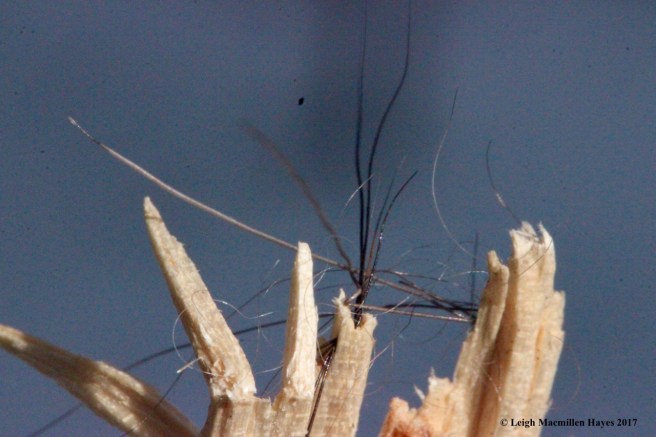
A bull moose, like a buck deer, thrashes bushes and small saplings when the velvet on its antlers dries. It could be that the velvet itches. But it could also be a response to increasing testosterone and the need to scent mark.
February 16, 2017: When Life Gives You Flakes
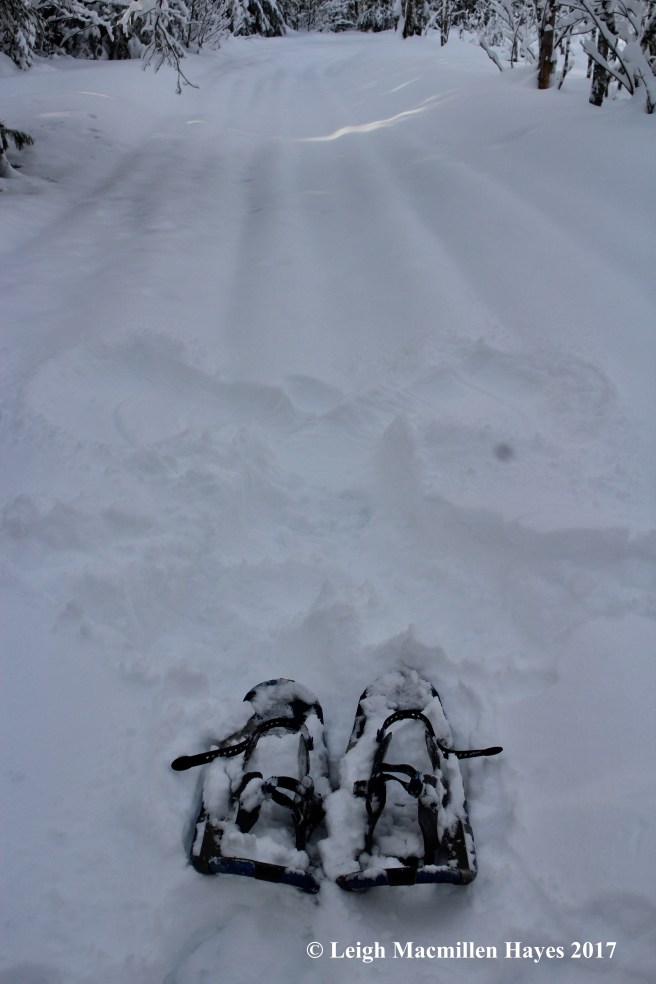
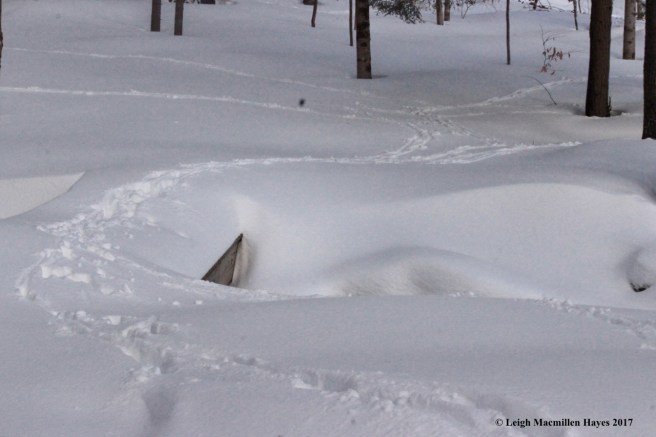
When life gives you flakes . . . make a snow angel in the middle of the trail.
To all who have read this far, thanks again for taking a trip down memory lane today and sticking with me these past two years. I sincerely hope you’ll continue to share the trail as I wander and wonder–my way.
And to wondermyway.com–Happy Second Anniversary!

























 wondermyway