Amazing Race–Our Style: episode ten

I can’t believe we are still in the race, but we are. And so last night the clue arrived as mysteriously as ever and a wee bit vague: Drive west and then south, following Routes 16, 125, and 111. Find your way to Stonehenge.

While we were certain that Route 111 in New Hampshire was not going to put us on a flight to England’s Stonehenge, we decided to follow the directions and see where we ended up.

We did note that Team Speedy was ahead of us as we drove south on Route 16, but in Ossipee they turned right onto Route 25. Oops, wrong number, but we weren’t going to tell them that.

Two and a half hours later and BINGO! We’d found our destination.
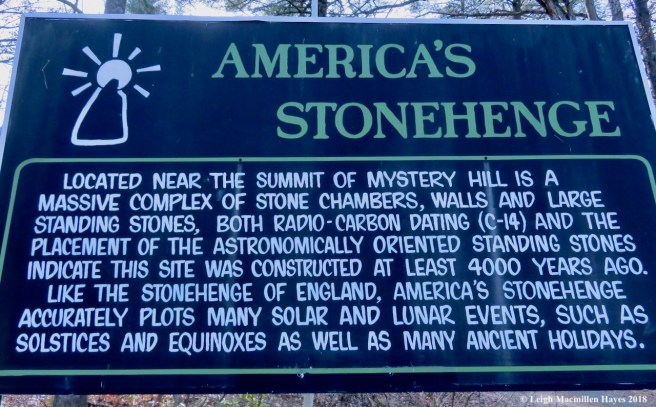
0-America's Stonehenge sign

America’s Stonehenge in Salem, New Hampshire. Who knew? I’d lived in New Hampshire for ten years prior to moving to Maine in 1986 and never heard of this place. But . . . apparently the time had come.

We entered and watched a brief introductory film. First named “Mystery Hill Caves,” the name was changed to America’s Stonehenge in 1982 because researchers believed that better reflected their understanding of the site.

Was it built by a Native American culture or a migrant European population? Who knows? But what we did learn is that carbon dating has helped age some of its features at over 4,000 years old, making it possibly the oldest man-made construction of  chambers, walls and ceremonial meeting places in the United States.

The site has been under continuous research and there are a variety of theories about its origin. Our main challenge was to observe and learn.

1-Sundial

But first, one of us had to determine the time of day. My guy rose to the occasion and placed the pole in the center of the sundial.
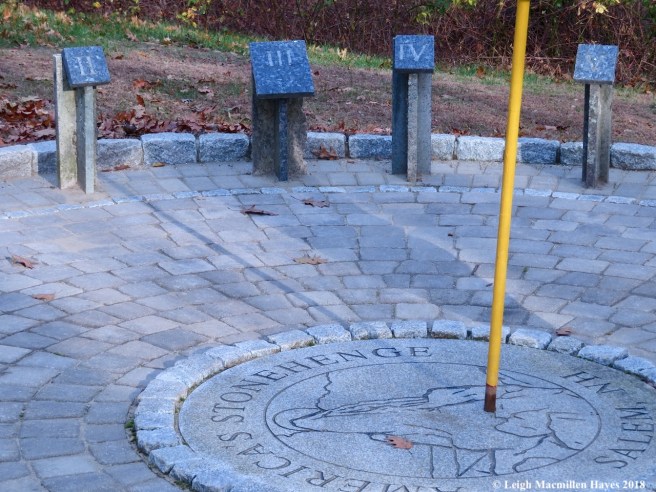
2-Sundial 2

“2:11 pm,” he said. Pretty darn close for it was actually 2:09, but we were told to proceed.
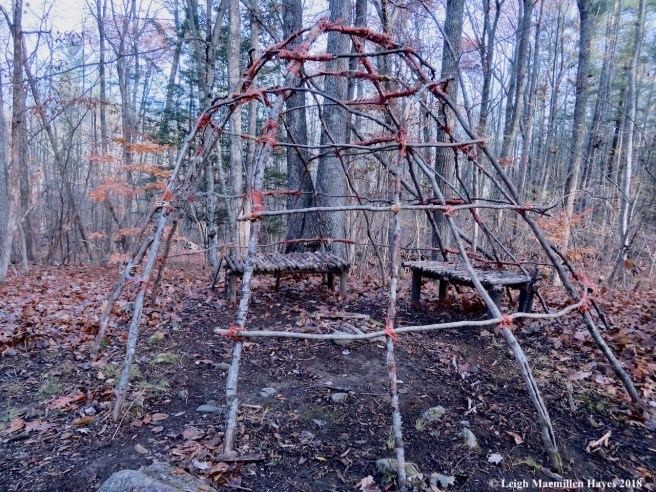
3-Wigwam

The first part of the journey included a Three Sisters Garden of corn, pole beans, and pumpkins. There’s a replica of a dugout canoe and a wigwam for such were found on the property, plus some pottery and other artifacts.
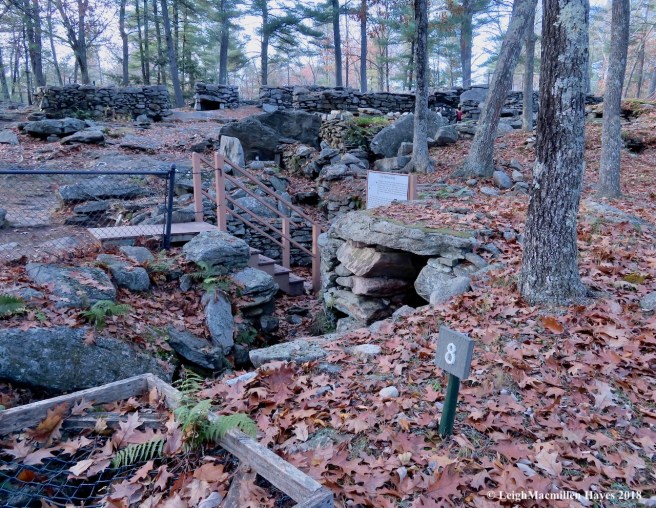
4-Well of crystals, Pattee Area

And then we worked our way up the hill and into the maze of chambers. Some referenced astrological events; others were the works of Jonathan Pattee who built a wooden structure upon some of the chambers, but it burned in 1855 and his son later sold off some of the artifacts; and William B. Goodwin, the first researcher to own the property.

Fortunately for us, many items worth noting were labeled. Number 8 was an Upper Well, also known as the Well of Crystals because excavations in 1963 proved that quartz crystals were found in a vertical fault twenty-two feet below. Such crystals may have been worshipped or used for tools by ancient cultures.

5-Pattee Chamber, root cellar

By the well was the Pattee area, and so I ventured down and stood before a chamber that may have served as either his family’s root cellar or at least storage space.

6-Chamber in Ruins

Nearby was a collapsed chamber. The roof slab that now stands upright is estimated to weigh 6.5 tons. And here’s the cool stuff–tree roots near the back wall of the chamber were carbon dated to the late 1690s, indicating the walls were built prior to Mr. Pattee’s residency. Further research indicated the following: “In 1969, charcoal that had sifted into the walls was found below these roots at two to four inches above bedrock and dated to 1400 BC. In 1971, a third and even older date of 2000 BC was obtained.” There’s more, but that’s enough to be mind boggling. BC?
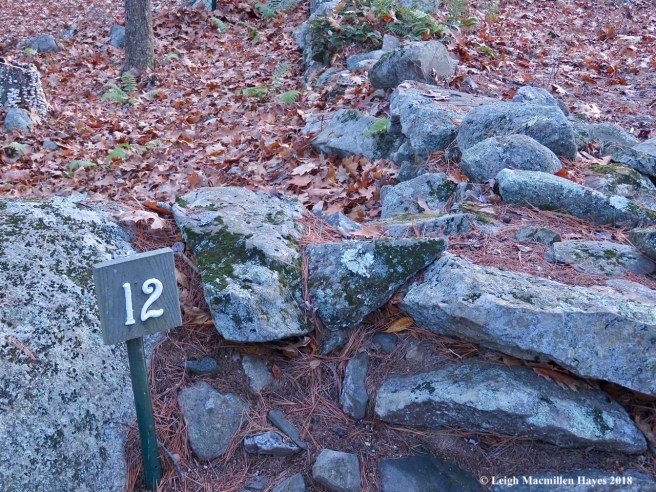
7-True south pointing wall

The astrological importance of the site was noted throughout and we found the True South Pointing Wall.

8-south facing chamber

Directly opposite of it was the entrance to a south facing chamber. For me, the curious thing about this chamber was that it was damaged in a 1982 earthquake–and I quickly recalled that quake as I remembered feeling its tremors.
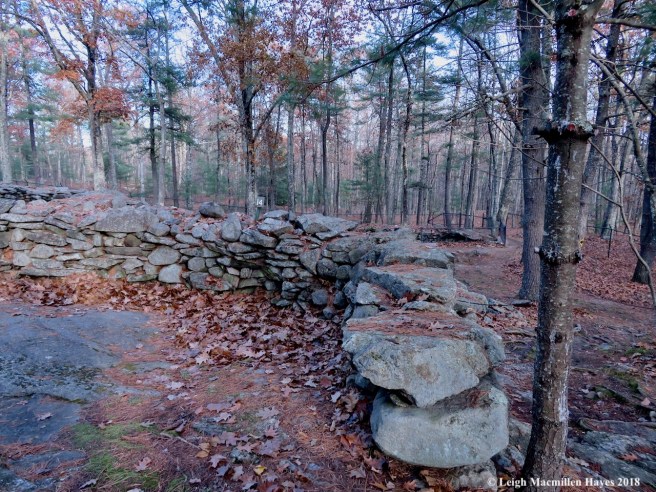
9-The Pulpit

Then there was The Pulpit. It’s believed that quarrymen used this spot as a staging area to load stones onto wagons in the 1800s, thus giving the property another chunk of historical value. It’s also thought that Mr. Goodwin had the upper part of the structure reconstructed by his crew for he believed that the site was built by Irish Culdee Monks.

I have to say that my guy and I weren’t beyond that interpretation for some of the chambers reminded us of Newgrange, a Neolithic passage tomb alleged to be older than Stonehenge and the Great Pyramids. Constructed during the Stone Age, about 5,200 years ago, Newgrange is a large circular mound in Ireland that covers 300 feet in diameter and stands 36 feet high. A stone passageway leads to three small chambers. Some describe it as an ancient temple, a place of astrological, spiritual and ceremonial importance. Hmmm . . .

10-The V Hut

Another interesting chamber from our point of view was the V Hut, so named for its shape. This one reminded us of the Mystery Structure in Lovell, Maine, for part of it forms a similar sort of V shape.

11-East-West Chamber

Throughout the journey, our focus was brought back to orientation of chamber openings. So the curious thing about this particular one and the one opposite of it–they had an east-west orientation. All other openings faced south.
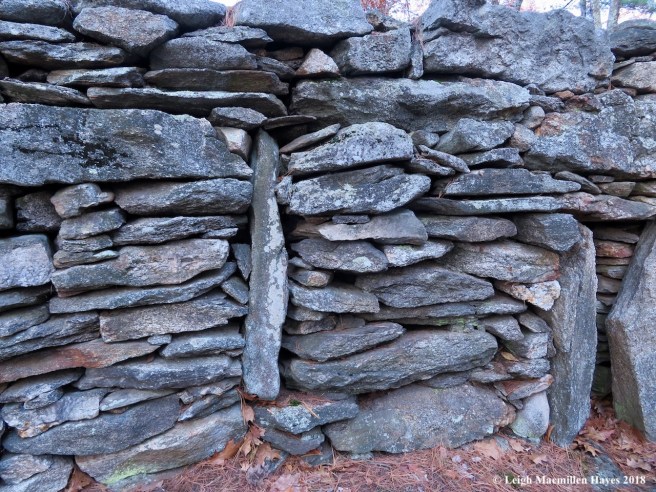
12-Wqll restoration

The outer wall of the East-West Chamber offered a different look than any we’d previously seen. Using photographs from the Goodwin era, the outer walls were restored in the late 1970s.
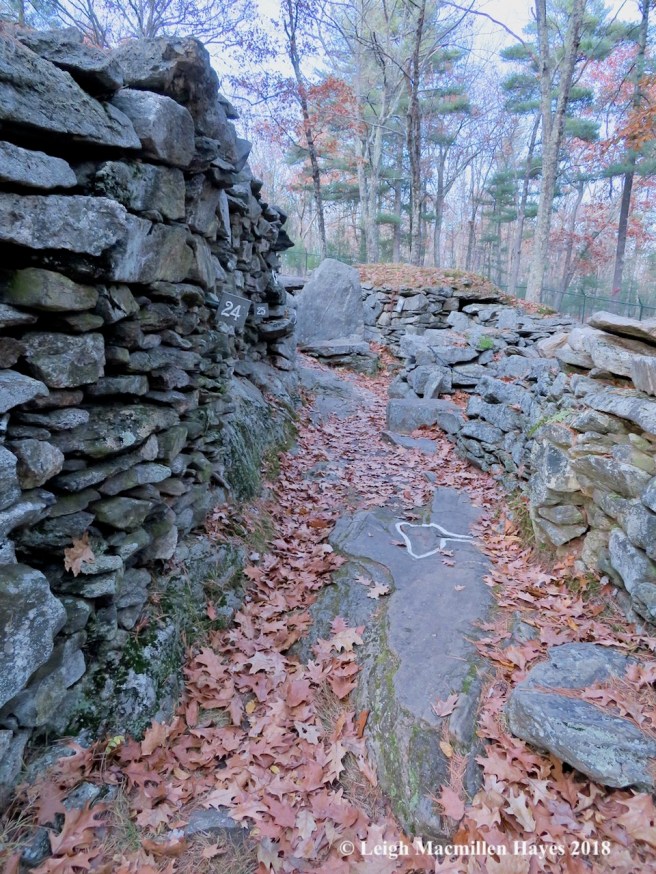
14-Wall and pathway to Oracle Chamber

They led to a wonder-filled pathway. Do note the white paint–that was used throughout to feature key points. Though I thought it ghastly, it did serve its purpose and the drawing you see on the bedrock was part of a very important drainage system. Curiously, the area was well drained, but when we later walked surrounding trails we had to work around water obstacles–why can’t we figure out today how to make the water move in an effective fashion?
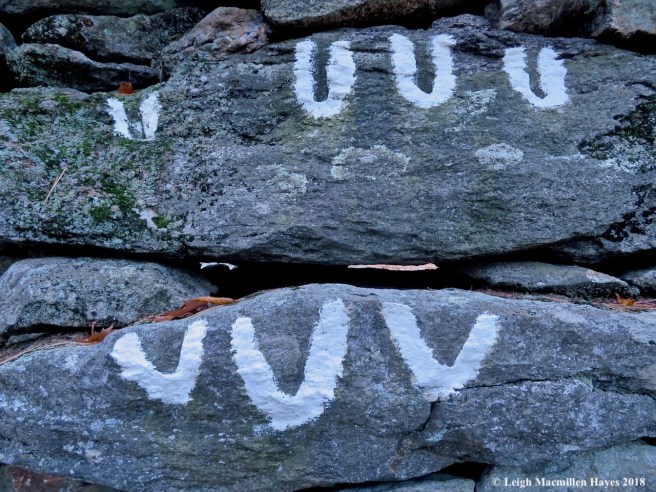
15-Drill marks and wedge marks

The pathway we were traveling led to the Oracle Chamber. And then there was more white paint. But, take notice. The U-shape above was painted around drill marks probably made by those 1800s quarrymen as they broke off slabs.

But it’s the Vs that were of even more interest.
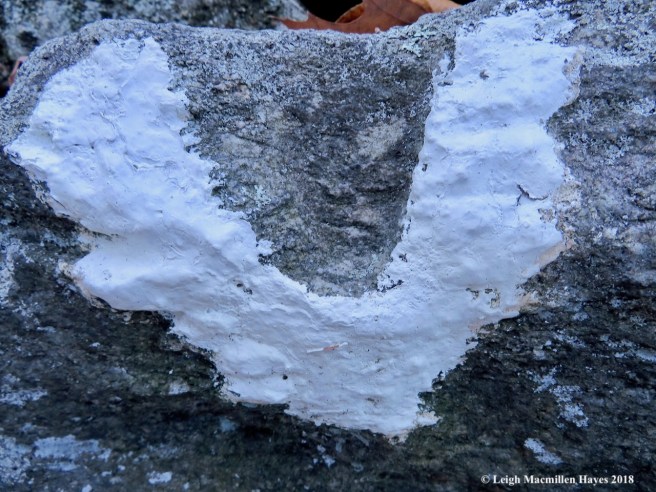
16-Wedge mark

The V wedges were similar to those found at ancient sites in Europe we were told. Before the invention of the steel drill in the early 1800s, stone masons apparently made these V wedges.

17-Sundeck with orbs

Now all oracles need a sundeck and lo and behold, such existed. As we admired it, a few orbs did the same and we had to wonder about the ghosts living among the rocks. They certainly had stories to tell.
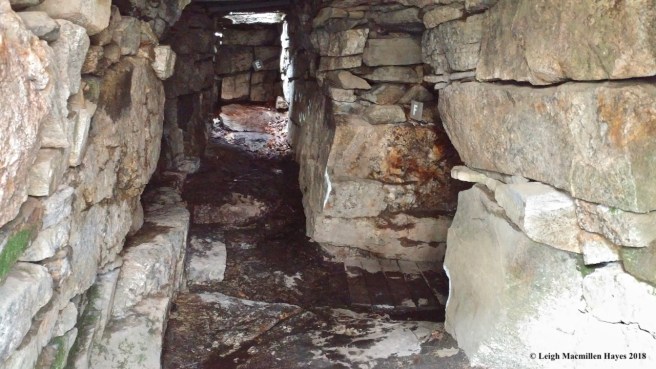
18-Oracle Chamber

The Oracle Chamber was known to be the most important area with a variety of features including an upper drain, secret bed, speaking tube, roof opening (see the sunlight coming through at the end of the chamber?), seat, closet, and deer carving. It was actually rather dark and we could locate some of the features, but never saw the deer carving, which would have been a treat.

20-Sacrificial Table

Before we’d entered the Oracle Chamber, we’d viewed one of several tables within the complex.
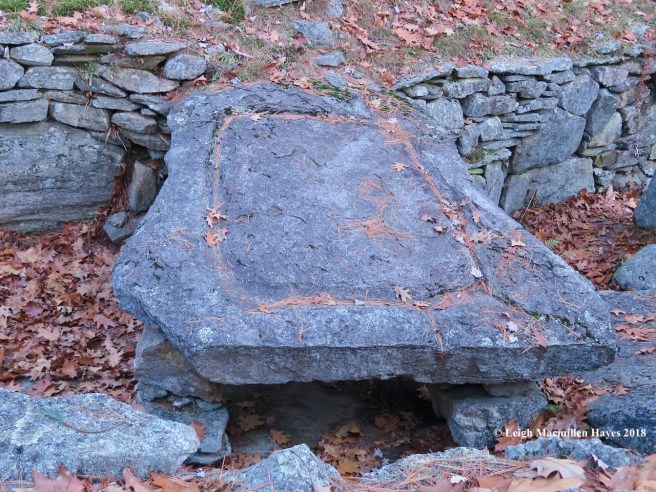
21-Sacrificial Table 2

But it wasn’t until we were standing above it that it made more sense. The Sacrificial Table was a 4.5 ton slab with a grooved channel. Its a point of controversy for the site, but some believe that because of its size it was used for sacrifices. The oracle had a speaking tube in his chamber located directly beneath it that adds to the assumption.
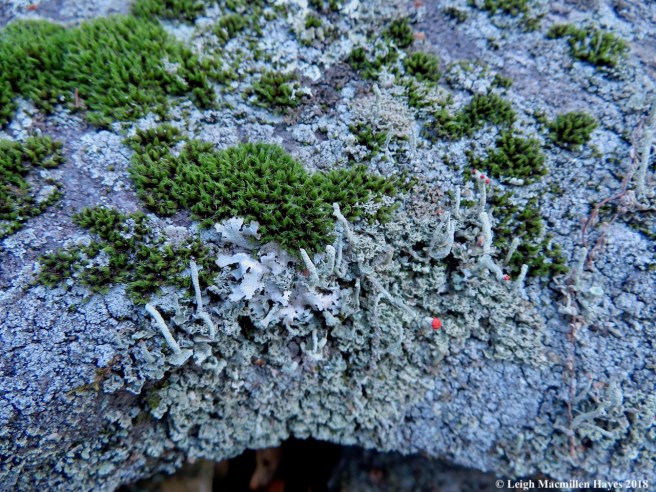
16a-if lichens and mosses could talk

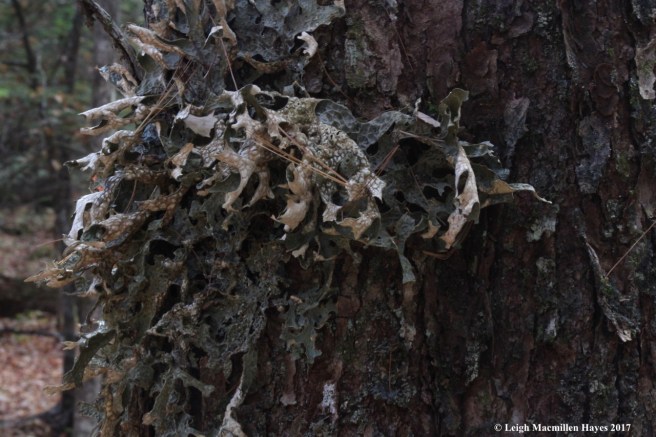
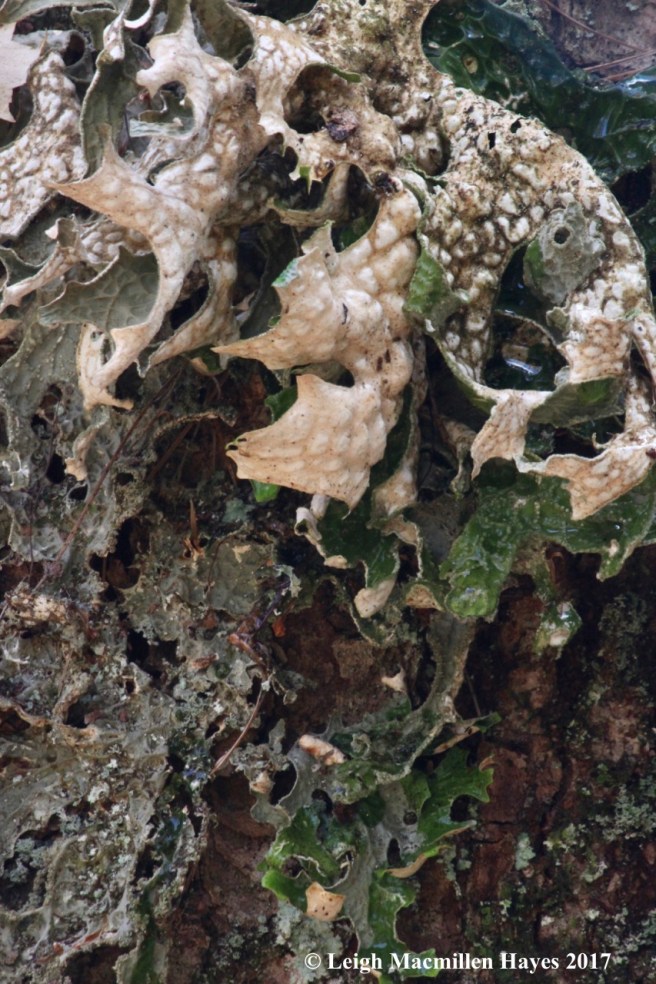
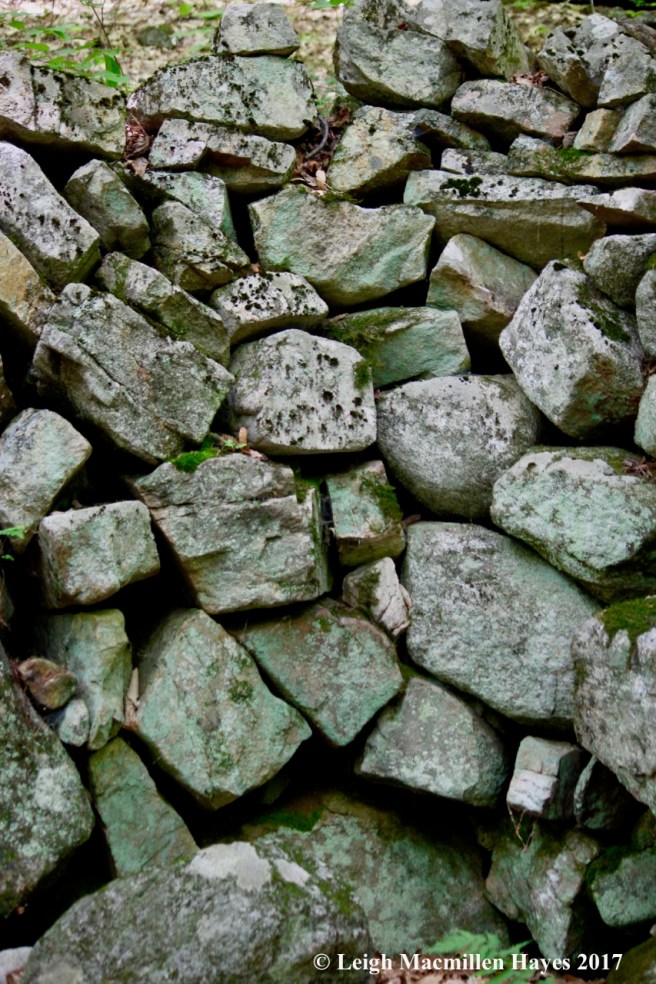
If only mosses and lichens could talk, the tales they could tell. But then we wouldn’t have mysteries to consider.
30-Marginal wood fern

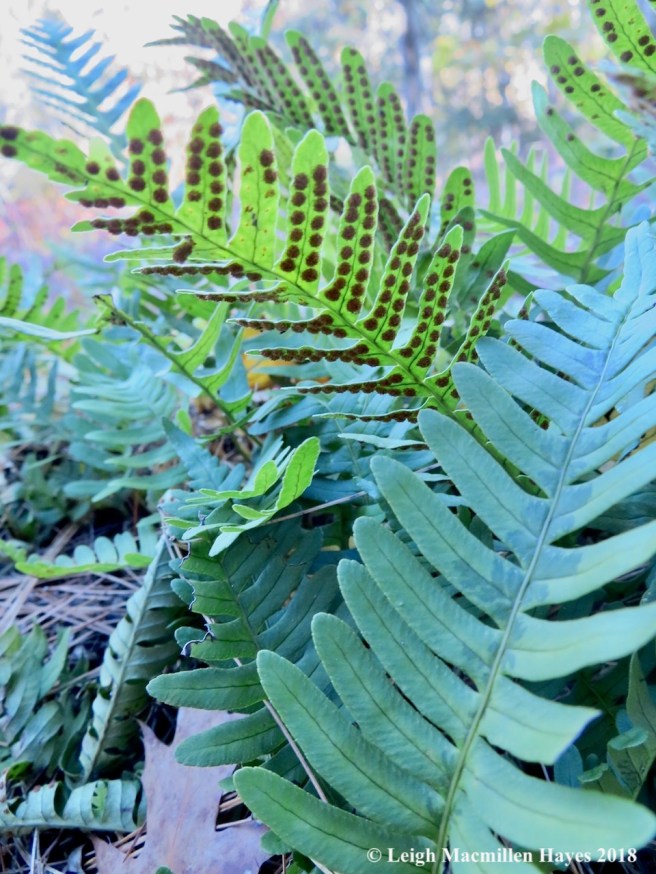
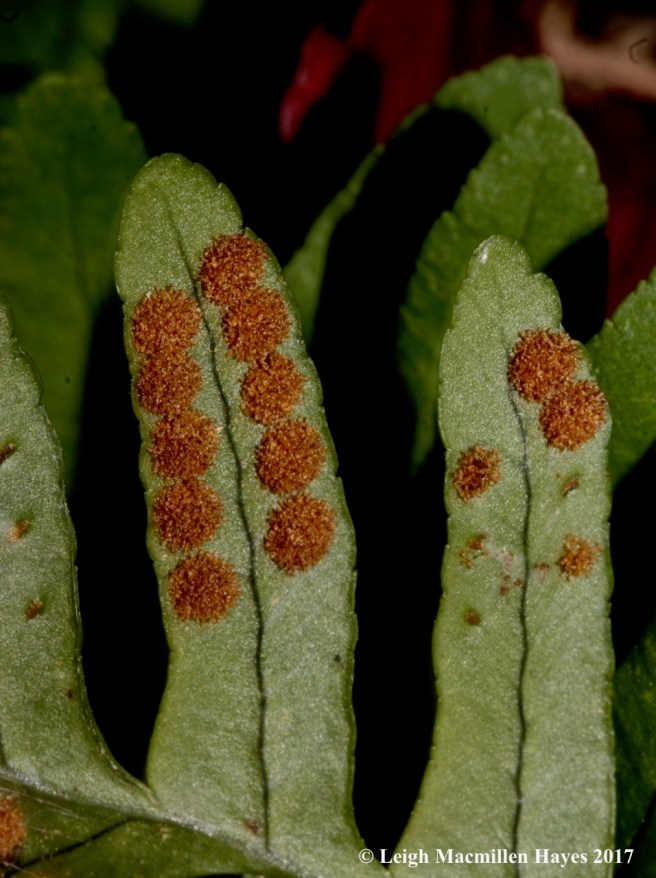
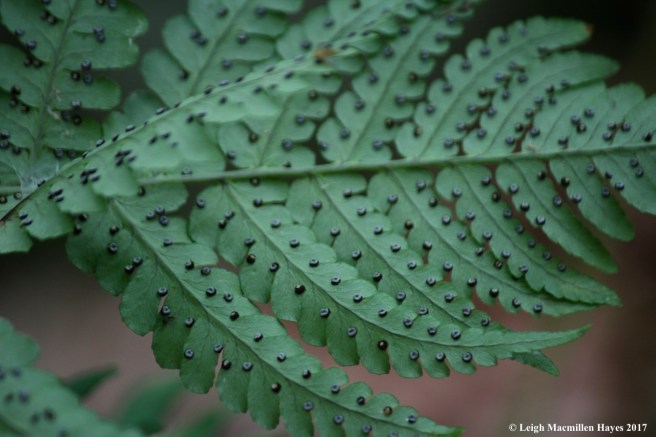
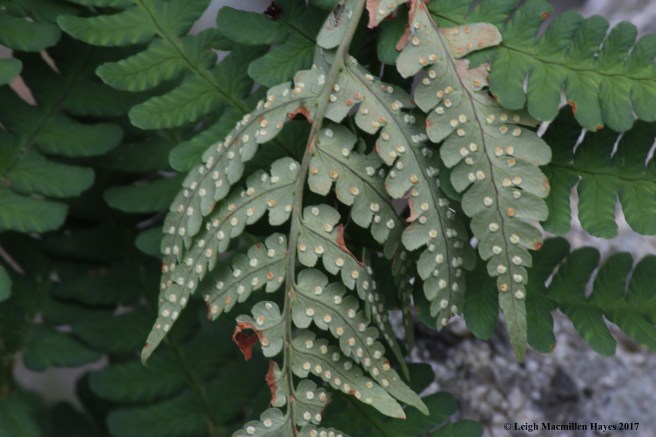
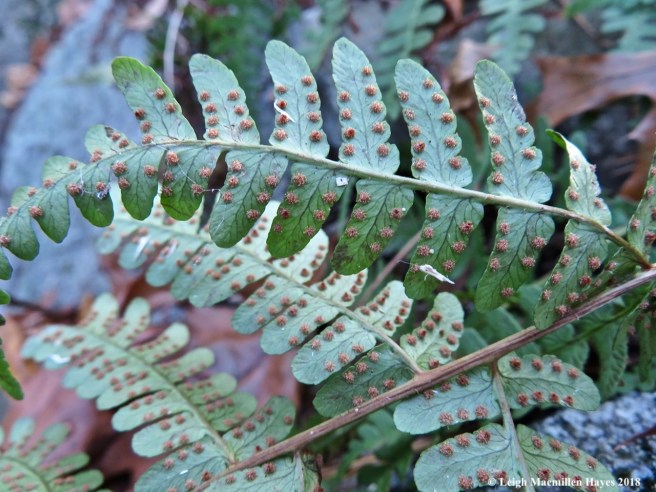
Speaking of such, one of our challenges was to identify a fern that grew among the rocks. It had several key features, including the fact that all of its fronds grew from a central point in a circle and it was still quite green–as in evergreen. A quick look at its spore arrangement on the underside and the answer was clear–marginal evergreen wood fern.

28-Black and Red Oak

We also had to name three colors represented by the oak leaves on the grounds: Black, red,  and . . .

29-White Oak

white.

23-Astronomical Calendar with view cuts

And then it was time to climb the Astronomical Viewing Platform. I was initially put off by the sight of the modern structure and thought perhaps it was a children’s playground tossed into the mix. But . . . thankfully I was wrong. Constructed in 1975, from the platform you can view the major astronomical alignment stones, including true north for summer and winter solstice. Trees were cleared in 1967 along the various important date sights and are still maintained. When the structure was first constructed, there were probably no trees atop the bedrock. This afternoon, as we looked out, our view included the November 1st sunset.
24-Nov 1 Sunset

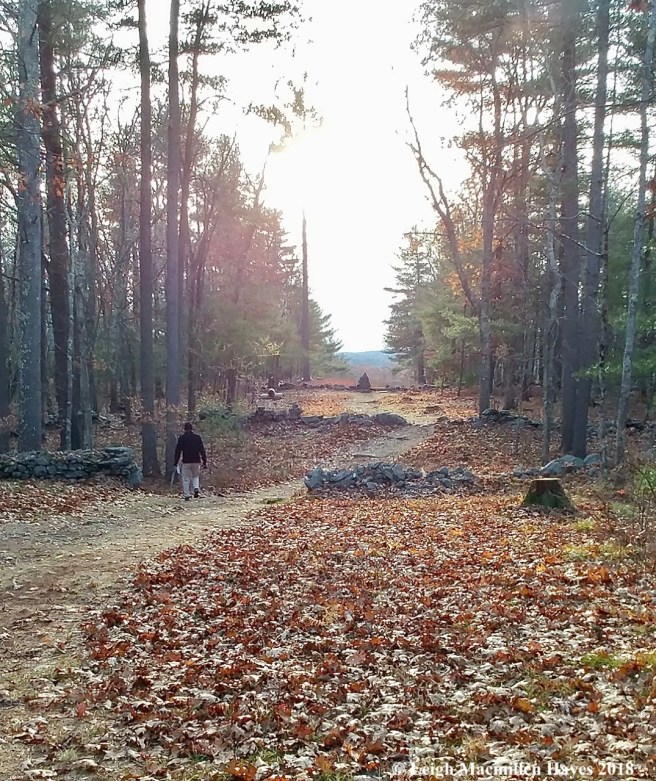
We followed the trail toward the November 1 Sunset Stone.

26-Winter Solstice Sunset Monolith

And were equally excited to note the Winter Solstice Sunset Monolith. This was the first monolith that researchers suspected to be a solar alignment. On December 21, 1970, the shortest day of the year, it was photographed. Because the Earth’s tilt has changed, it’s a bit off these days, but would have marked the southern most set of the sun almost 4,000 years ago. Wow!

33-White Pine map

Before we left, we had another challenge: to find something that reminded us of the maze we’d just journeyed through–and in many ways the pine tree’s route system seemed to provide a map.
31-Alpaca

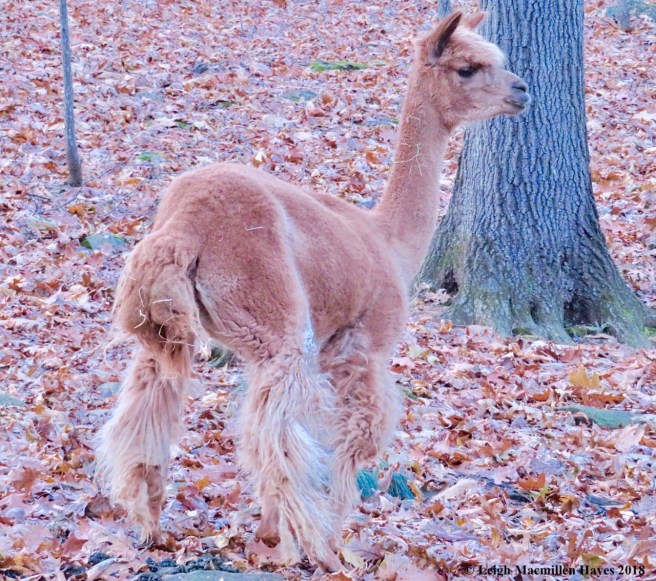
We also needed to pay homage to the alpacas who now call this place home and in their own way bring us back in time. The earliest evidence of man at America’s Stonehenge was 7,400 years ago as proven by evidence from a fire pit, and alpacas were domesticated about 5,000 years ago–in South America.
32-Modern day message

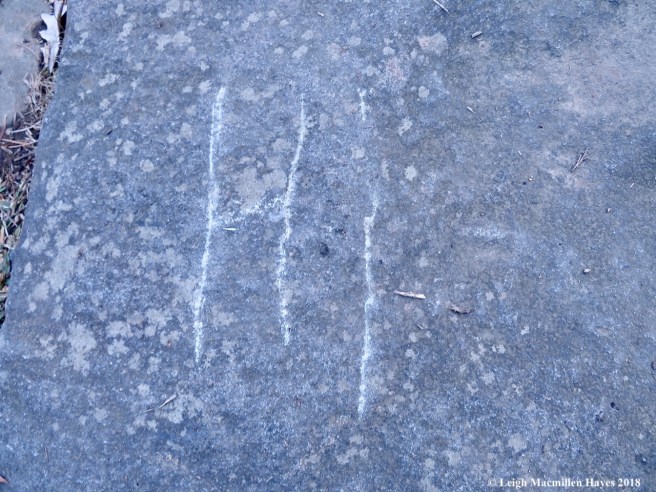
That being said, our final challenge was to find a more up-to-date representation and a message etched onto a rock seemed to fill the bill.

34-Astronomical Calendar and contour model

Back into the museum we journeyed and imagined ourselves into a contour model of the property with yellow lines representing the various astrologically important dates and sight lines. We’d also learned that a line can be drawn directly from America’s Stonehenge to England’s Stonehenge along the Solstice.

When our time was done, we were more than wowed. And had a lot to absorb about our learnings.

But, we were in a race and as quick as we’d wanted to be, we feared we were too slow.

Team Speedy, however, apparently went way off course when they turned onto Route 25. They were the last to cross the mat and have been eliminated. (Quietly we were heard to  mutter: YES!)

Team Purple won this leg as she has done several times even though she’s solo. And still sporting her sandals despite the colder temps.

We actually placed second today and were thrilled. We’re still in the race!

Only two more episodes to go. It’s down to Team Purple, Team Cape Cod, Team Livermore and us. Who will be the final three? Stay tuned for The Amazing Race–Our Style: episode eleven.

What the Tree Spirit Knows

As I drove to Lovell this morning to take a photo for the Greater Lovell Land Trust’s winter newsletter, the crisp outline of a snow-covered Mount Washington made me realize that I had a short, unintended hike in my immediate future.

1a-Flat Hill view

Yesterday, I’d climbed the Flat Hill Trail at the Heald and Bradley Ponds Reserve to take another photo for the newsletter–that one of the view from the summit of snow falling in the White Mountains. This past summer, staff and volunteers of the land trust had made some trail changes and opened several views, the one from Flat Hill being the most dramatic and the foliage, snow and sky enhanced the opening. But . . . today’s view was different and I knew I needed to capture it again.

Page 3 a

So . . . after a staff photo shoot at the Kezar River Reserve of Stewardship Associate Dakota, Associate Director Aidan, and Office Manager Alice, I headed north.

1-voss sign

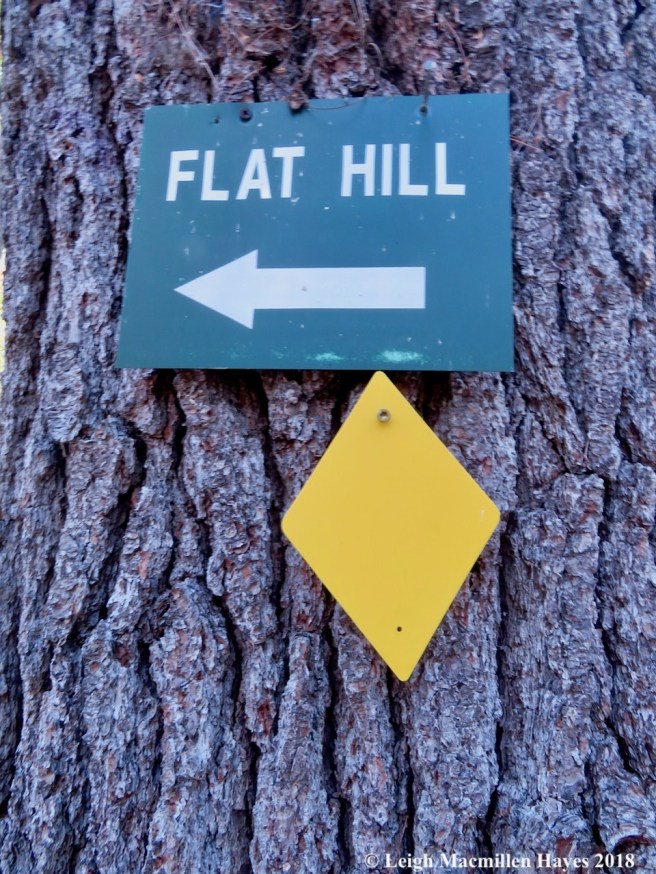
And laughed at myself for yesterday I never noticed the yellow Voss blazes that had been mounted to mark the trail. The hope is that eventually all the trails will be signed with different colored diamonds that will ease navigation.

2-big tooth aspen

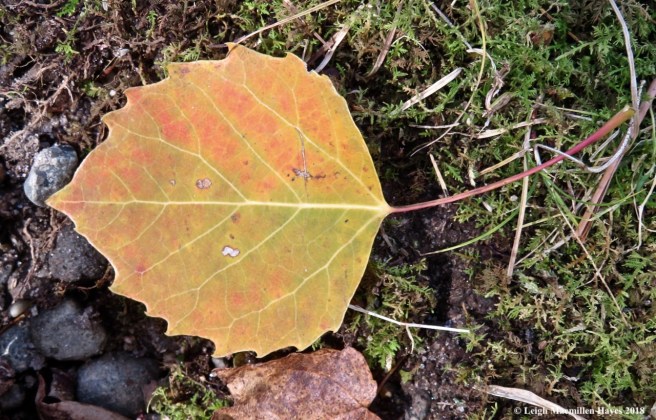
It’s a trail I know well, even with a new backwards S curve about two thirds of the way up that erased a steep and slippery portion and so instead I focused on those sights at my feet. While many leaves had already begun the long process of decomposition as they slowly break down and give nutrients back to the earth from which their trees grew, a few still sparkled like gems, including this Big-Tooth Aspen, aka poplar.

3-sugar maple

I was thrilled to discover Sugar Maple, defined by the U shape between its pointed lobes;

4-red maple

its V between lobes and toothier cousin, Red Maple;

5-striped maple

and even toothier kin, Striped Maple, known ’round these parts a goosefoot because its shape is similar. Some of us also refer to it as nature’s toilet paper for it’s large, soft, and easy to identify. You wouldn’t think of confusing it with poison ivy.

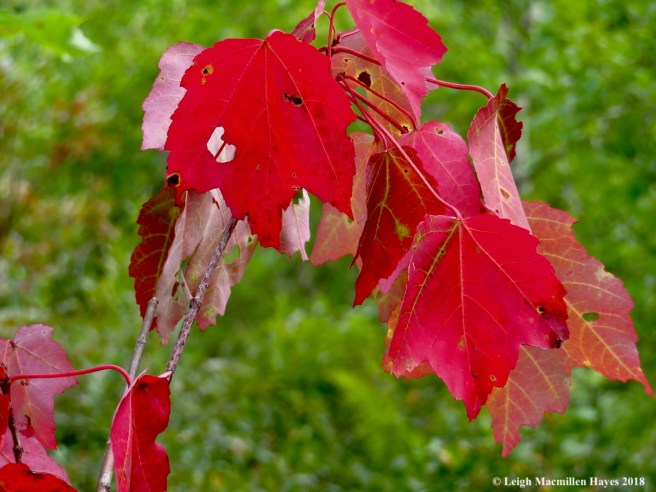
The curious thing about the Maple family, like all families in our northern New England forests, is that while the shape and color of the leaf helps us specify the family origins, each leaf within the family is different–whether in color or flaws or insect bites or galls. But despite their differences, they are all family.

6-large red oak

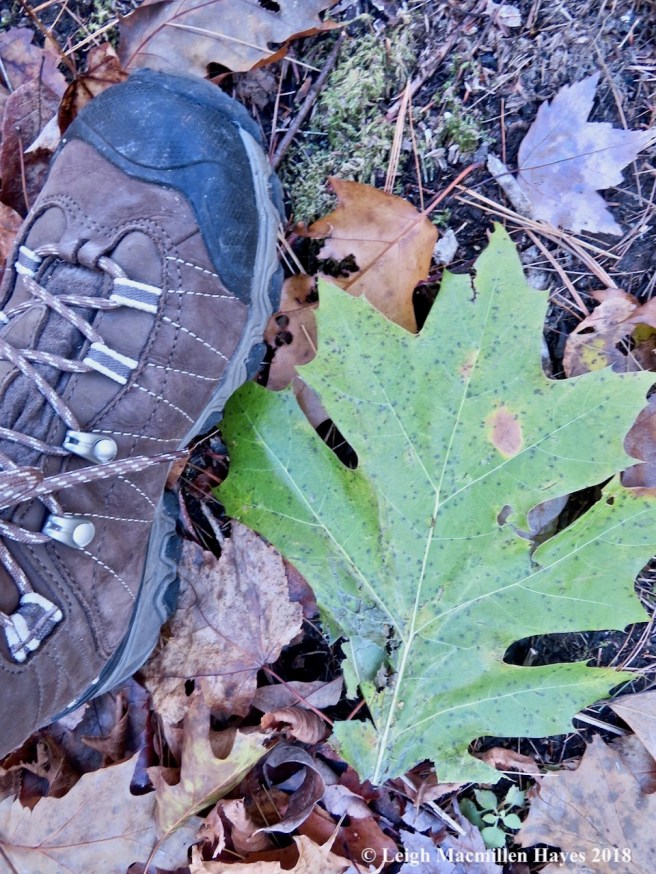
With the Striped Maple, I thought I’d found the largest species of the day, but a few more steps toward the summit revealed a rather large Northern Red Oak leaf.

7-even larger basswood leaf

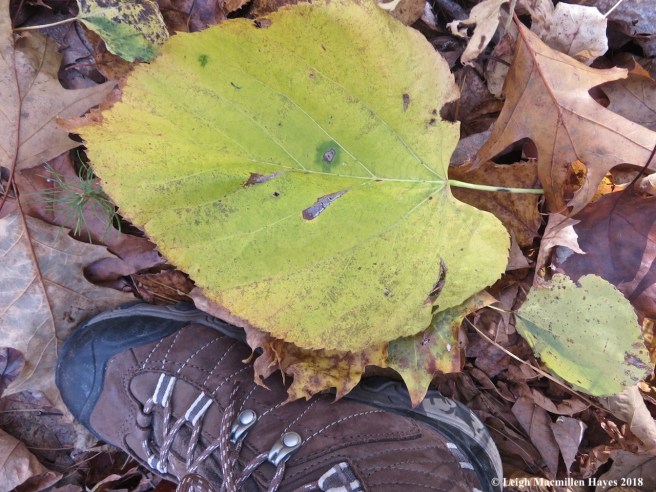
And then the biggest of all–Basswood. My hiking boots are size 8. And the leaf–also a size 8, with an asymmetrical base. That must prove a challenge when trying to find the right fit.

13-polypody ferns

Focusing on the leaves took my mind off the climb and within no time I’d reached the summit where Polypody ferns in their evergreen form decorated the northwestern corner of an otherwise bald rock.

14-red maple flower and leaf buds awaiting
From the ferns where I’d planted my feet, I looked skyward and noticed the leaf and flower buds of a Red Maple, all tucked inside their waxy scales. It was the right place to be for as the north wind blew and my cheeks turned rosy red, I looked to the west.

9-Baldfaces to Carter Dome

Yesterday’s view had been transformed. No longer was it snowing from the Baldfaces to Carter Dome, with Mount Washington the whitest of all, posing between them. But still, it was chilly.

10-telescoping in on Mount Washington

A slight push on the camera lever and I pulled the scene a wee bit closer.

16-Perky's Path

At last I pulled myself away and hiked down, but so delightful was the morning, that I knew my newsletter work would have to wait a few more minutes at the intersection with Perky’s Path, for I felt the calling.

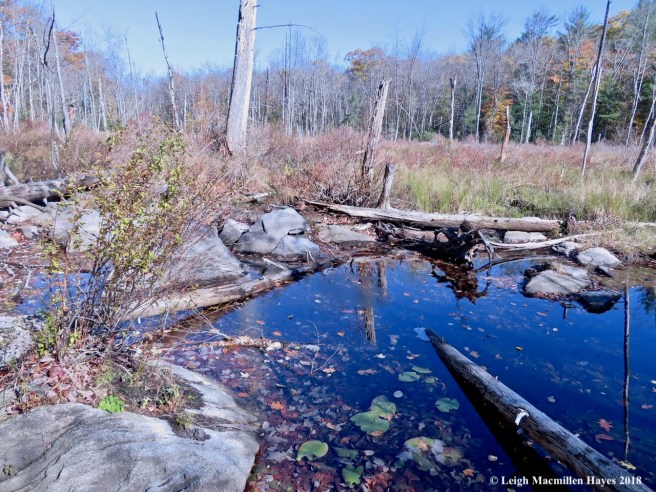
17-wetland--old beaver pond

It’s a wetland I visit frequently and once upon a time about five years ago it was filled to the brim with water because beavers had dammed it for their convenience.

18-suds reflect leaf

The only water today was found in a small stream that flowed through, its origin at Bradley Pond and terminus at Heald Pond. I stopped at the rock stepping path to admire what the water had to offer, including suds forming their own rachis or mid-vein from which side veins extended, a sideways rendition for the birch leaf caught between twigs.

19-view from the rock

In the middle of the stepping stones is a large flat rock. It was there that I settled in for a while, enjoying the feel of its sun-absorbed heat and the sound and views offered as the brook flowed slowly forth.

21-view from the bench

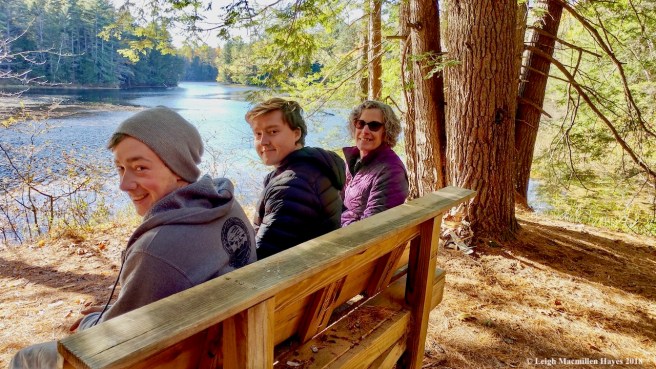
At last I pulled myself away and continued toward the bench that overlooked the wetland. All was quiet on this brisk day, but its a place of life and love and change.

22-back to the wetland

From there I continued to circle the old beaver pond to the point where I knew it had formerly been dammed. Climbing over and around moss-covered rocks, and into former stream beds, I made my way to the edge of what I used to call an infinity pool for the water was once at the dam’s upper level.

23-view from the beaver dam

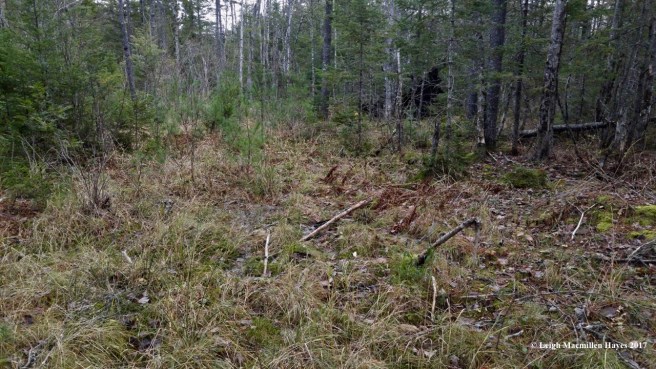
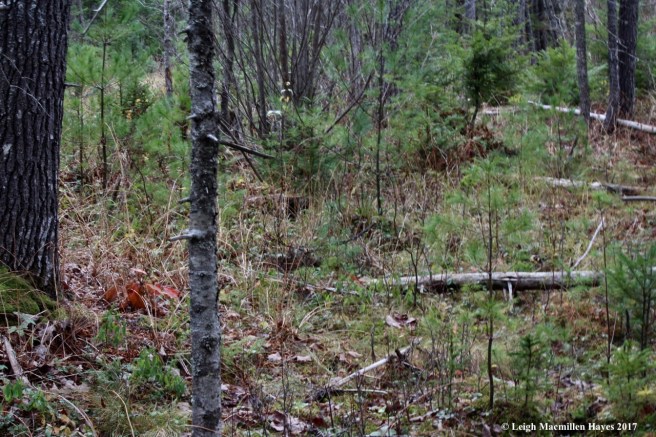
Once I reached the dam, making my way one step at a time, for it was rather tricky footing at times, I discovered life on the other side. For all the years I’ve been involved with the land trust, I’d never seen this edge from this view. My surprise included the almost bald rocks.

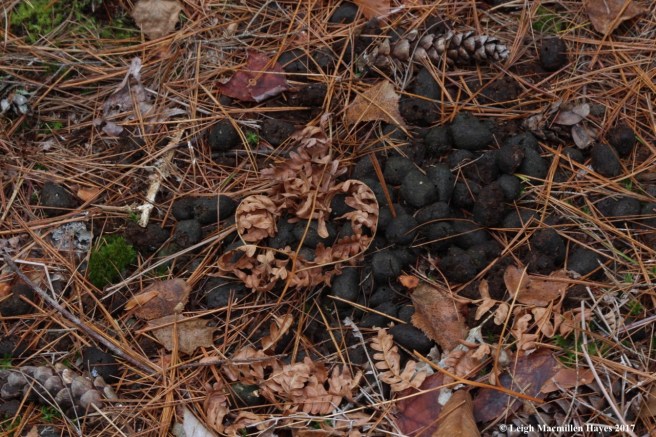
25-coyote scat full of bones

Stepping from boulder to boulder, I made my way into the wetland a wee bit, but along the way realized someone had visited prior to me. Actually probably almost a year prior given the conditions of the scat left behind. Based on its shape, size, and inclusion of multiple bones plus lots of hair, I suspected a coyote had feed on a hare.

26-spider view

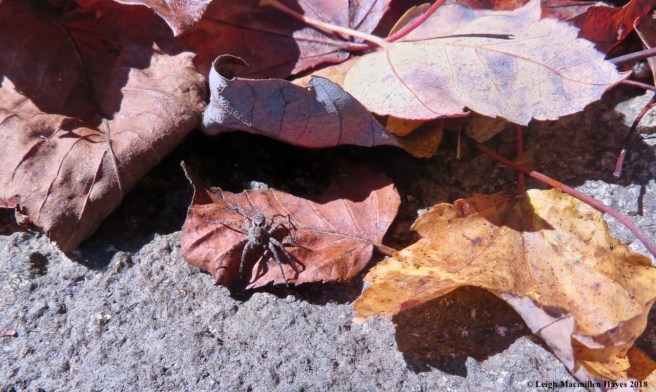
The coyote and I weren’t the only ones who knew of this secret place. A wolf spider darted in and out among the leaves, more afraid of me than I was of it.

27-spatterdock

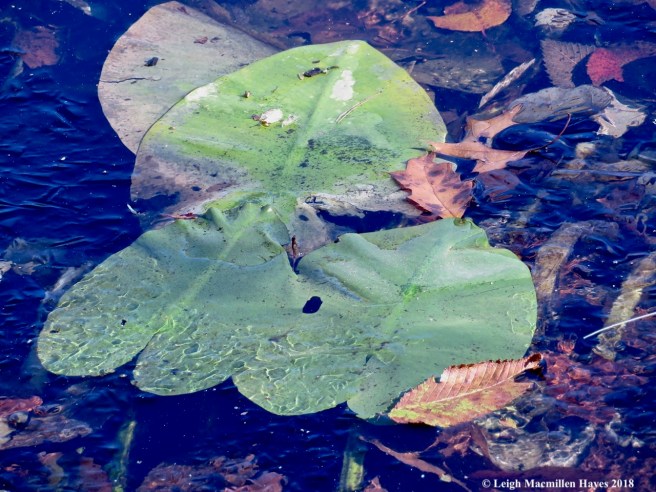
And then I discovered something that perhaps they both already knew: the water supported a small colony of Spatterdock, a plant that will need to be added to the list of flora for this property. Do you see the ice on the Micky Mouse ear leaves?

28-ice

Ice had also formed around a fallen log, its swirls portraying a high-heeled boot that certainly might be appropriate in an ice sculpture but not on ice.

28-tree spirit

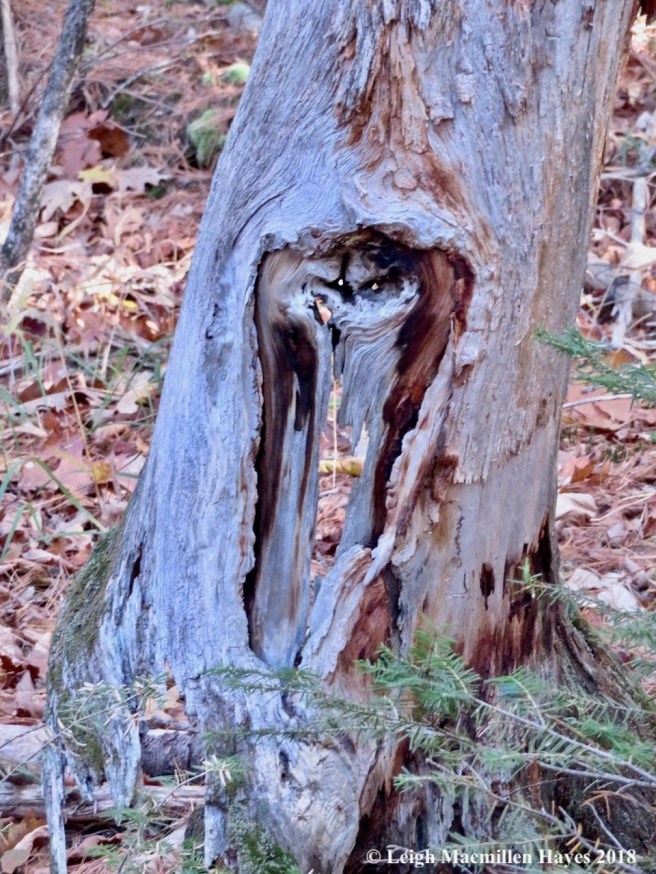
All of what I saw the tree spirit already knew. And yet, it allowed me to make discoveries from my feet to the sky.

29-Mount Washington summit

And every layer between. I know he’s not there anymore, but can’t you imagine Marty Engstrom on top of Mount Washington?
 

A “Fen-tastic” Afternoon

I was on a reconnaissance mission this afternoon for next week I’m leading some middle school students into a wetland and talking about forest ecology before sharing the joy of foraging with them.

1-Into the jungle

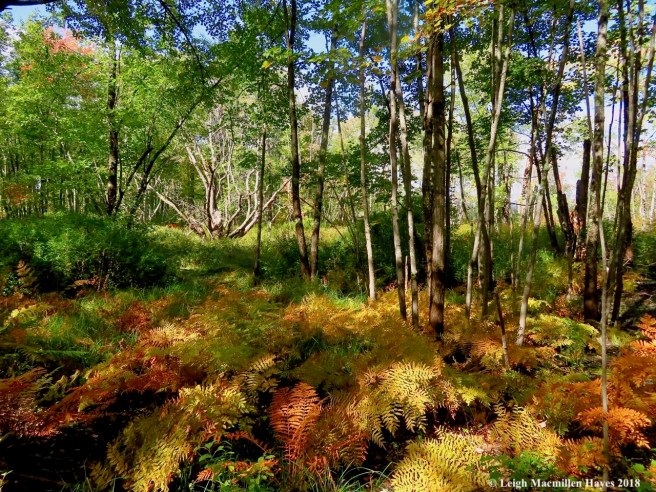
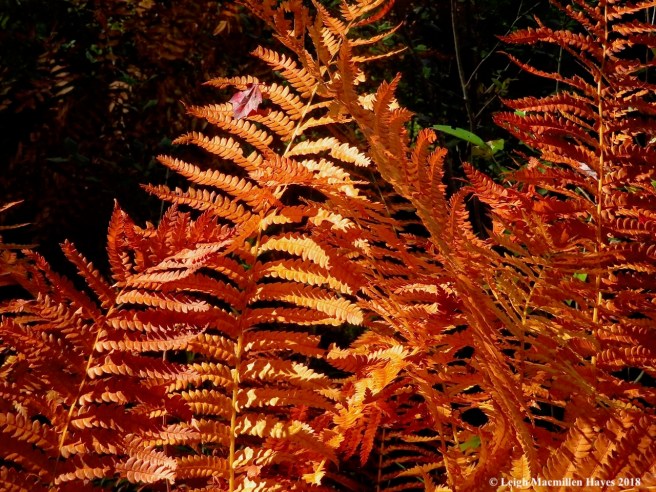
To reach the wetland, it was like walking through a jungle where the ferns grow tall, their fall coloration enhancing the scene. Cinnamon Ferns are a species that easily grow in medium to wet soils in part shade to full shade. The moist, rich, acidic soils, I walked through were much to their liking.

1a-cinnamon fern

It appeared that they were named for their autumn presentation, but really it refers to the cinnamon-colored fibers found near the frond bases.

1b-hairy underarm

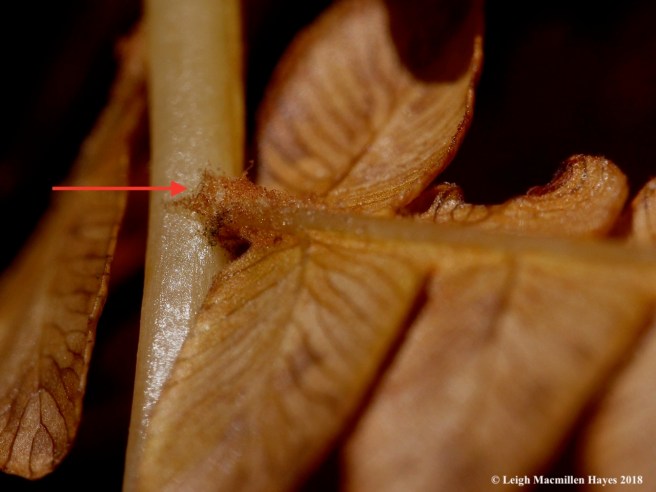
Because they look so similar to their relatives in the Osmundaceae family, the Interrupted Fern, I looked to the back of the frond for confirmation. Sure enough, where the pinnae (leaflet) met the rachis (center stem), a tuft that we refer to as the hairy underarm was present.
2-kettle

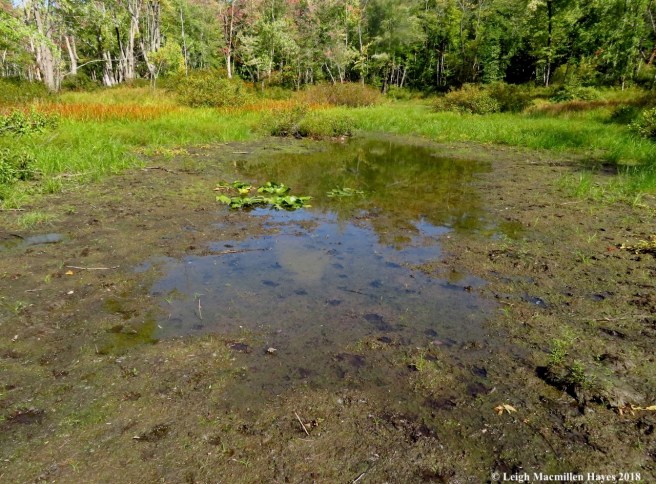
Onward I continued, not sure what the moisture situation might be. So, in the past, I’ve paused by the kettle hole, but never actually entered it. All that changed today and my plan is to take the students into this special place. A kettle hole is a basin created when a large block of glacial ice was left stranded and subsequently melted in place, producing a basin or depression. These basins fill with water up to the depth of their surrounding water table, which currently happens to be rather low.

3-white face meadowhawk

Because the temperature had risen after a damp, chilly start to the day, the meadowhawk dragonflies flew . . . and landed. This one was a White-faced Meadowhawk, aptly named for that face.

4-white face meadowhawk abdomen markings

Its abdomen markings of dark black triangles also help in identification.

4b-autumn meadowhawk dragonfly

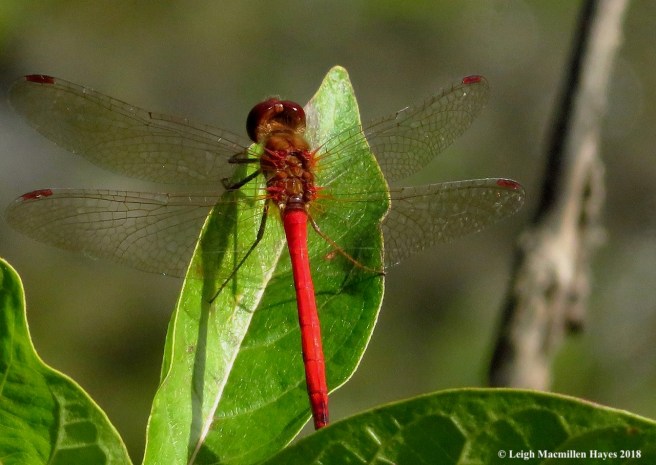
Flying in the same airspace where the Autumn Meadowhawks, with their light-colored legs. All other meadowhawks have dark legs.

4c-autumn meadowhawk love

Love was in the air and on the leaf as a pair of Autumns took advantage of the warm weather to canoodle in the sunlight.

4c-dragonfly love everywhere

They weren’t alone.

7-kettle 2

What I learned as I explored was that the kettle was actually a double pot for a second one had formed behind the first. Notice the layered structure of the area from trees on the outer edge to shrubs to grasses and flowers to water.

5-mammal tracks

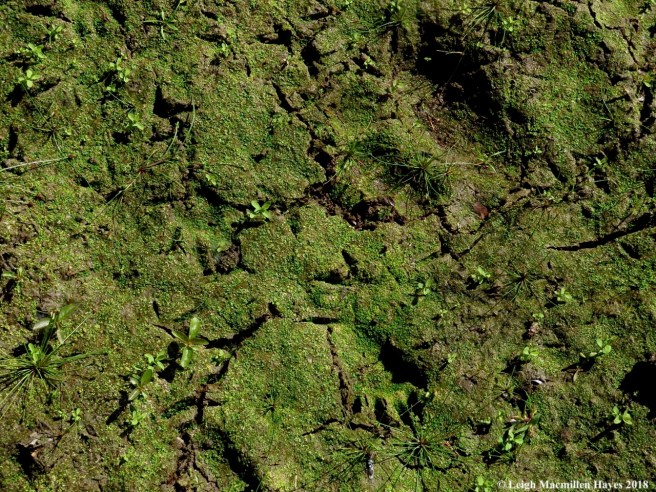
And everywhere–deer and raccoon tracks crisscrossed through mud and water.

5a-racoon and bird tracks

Bird tracks also joined the mix among the raccoon prints.

6-six-spotted fishing spider

And because I was interested in learning who lived there, I had to pay homage to the six-spotted fishing spider.

8-spatterdock leaves and root

The spider flirted with me as he moved quickly among the spatterdock leaves that sat in the wee bit of water left in the center of the kettle.

9-another kettle

I finally left the kettle only to discover another and again the formation of layers.

10-green teal ducks

The water was a bit deeper and a family of Green Teal Ducks dabbled.

11-bottoms up

Bottoms up!

12-my destination

It took some time and steady foot placement as I climbed over downed trees hidden by winterberry and other shrubs, but at last I reached my intended destination, a cranberry bog.

13-cranberries

And then I spent the next hour or so filling my satchel for so abundant were the little gems of tartness. The best where those hidden among the leaves–dark red and firm were they.

14-some nibbled cranberries

As I picked, I realized I wasn’t the only one foraging. It appeared that either chipmunks or squirrels also knew the value of the flavor–though they only nibbled.

15-October colors layered

Occasionally, or even more often, I looked up to take in the colors and layers that surrounded me–from leatherleaf bronze to blueberry red to Gray Birch and Red and Silver Maples with a few White Pines in the mix.

16-buttonbush

Buttonbush added its own color and texture to the scene.

17-finding my way out

At last I decided to find my way out. (Sorta for I did get a wee bit disoriented.)

18-royal fern fertile fronds

Among the offerings were ferns of a different kind–though still related to the cinnamons I’d seen earlier. The Royal Fern’s fertile crown had months ago shared its spores with the world and all that was left were salmon-colored structures.

21-buttonbush galore, but more

I picked my way carefully and eventually found one of the kettles. And . . . drum roll please . . .

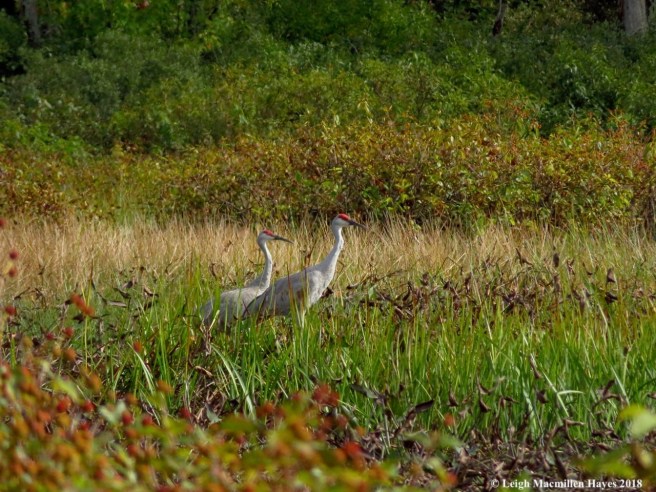
22-two sandhill cranes

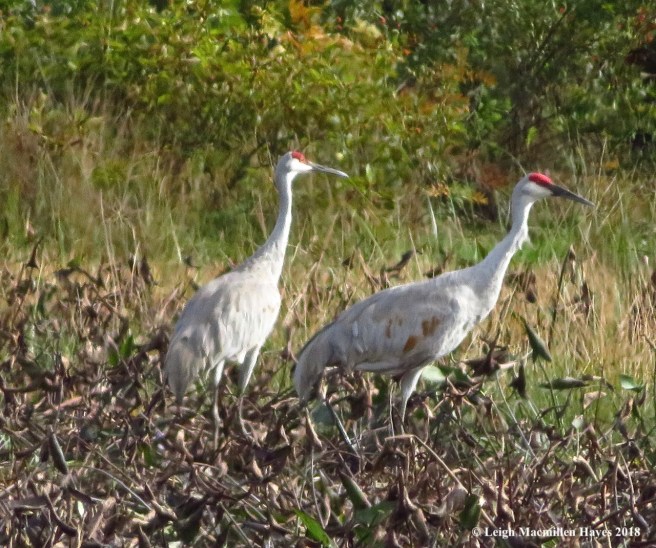
two Sandhill Cranes. Others can tell you better than I how long the Sandhills have returned to this area, but it’s been for a while now and some even saw a nesting pair this past summer. My sightings have been few and so it’s always a pleasure.

23-sandhill cranes

I stood still as they moved about and they didn’t seem to notice my presence.

24-sandhill cranes

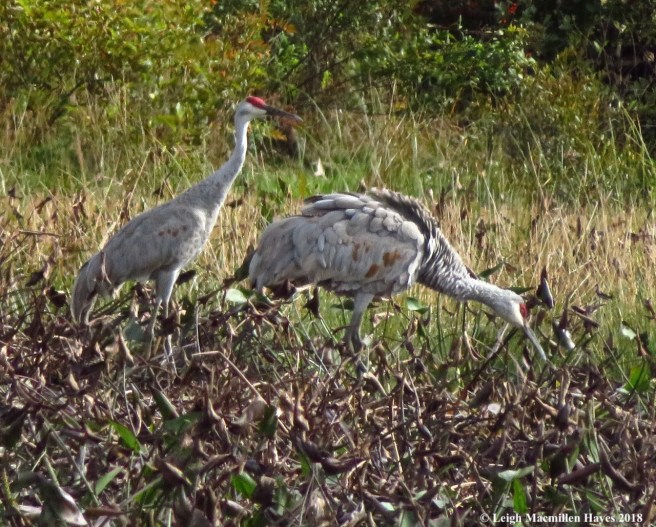
While they foraged for roots, another also watched.

25-great blue heron

The Great Blue Heron was cautious as they strolled in his direction.

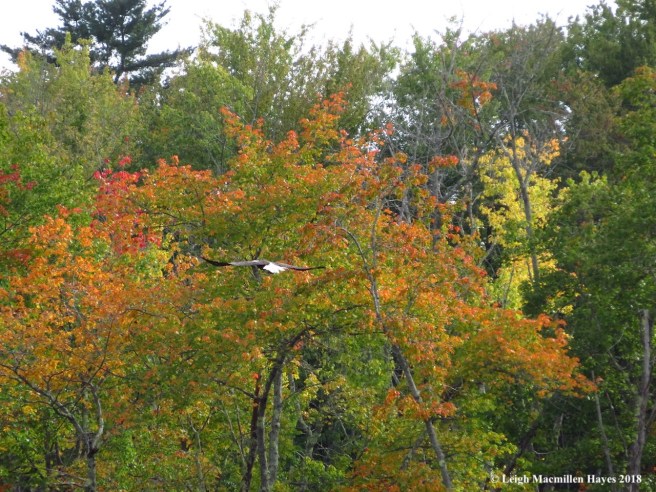
29-bald eagle

And then . . . and then . . . in flew a Bald Eagle. And out flew the heron.

30-cranes flew out

The cranes waited a couple of minutes and then they flew, bugling on the wing.

And I rejoiced. Oh, I still had to find my way out and did eventually cross through a property about a quarter mile from where I’d started. But, all in all from kettles to cranberries to birds, it was a Fen-tastic afternoon as I explored an outlet fen.


Postcards from Sweden

Sometimes I forget when traveling that I should share my surroundings with those back home. A photograph of a local scene and a quick note are enough to say that though I was away, you were on my mind.

1-splash cup

And so dear readers, these are for you. The weather is great, I wish you were here. For if you were, your jaw would drop as mine did at the sight of these little morsels that so look like candy wrappers. Of course, the right thing to do would be for me to purchase a few to share with you.

2-splash cup

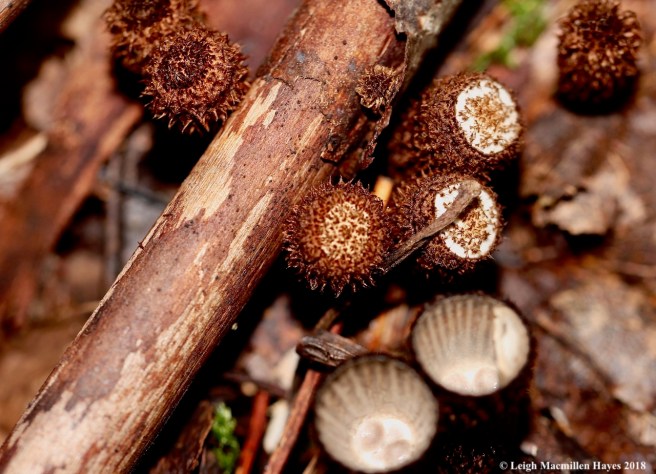
But, looks can be deceiving, and really, these are a fungi called Cyathus striatus, or Fluted Bird’s Nest. While they remind me of marshmallows covered with burnt coconut, they are really the young fruit bodies of the species. The lids, known as epiphragms, cover the structure and prevent rain drops from entering until the eggs within are ripe, for it’s the drips of the drops that release the spores of this fungi.

3-splash cup fungi

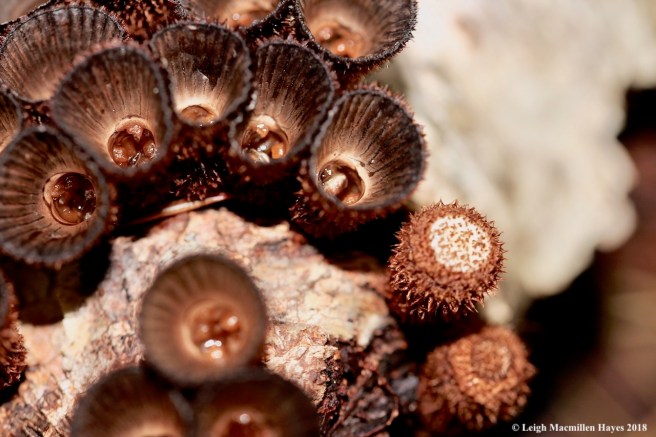
More mature structures, those that look like chocolate cups also coated in coconut, contained the “eggs” or lens-shaped structures known as peridioles.

4-eggs in splash cup fungi

This fungi is difficult to spy because it is teeny and inconspicuous and prefers a dark, moist habitat, but my hostess had her eye on these for a while and couldn’t wait to share them with me. And now, I’m excited to share them with you. The flute darkens with age, and that pale lid falls away or collapses inside the structure which does resemble a bird’s nest. Within each nest there are typically four or five silvery flattened “eggs.”

5-turkey tail fungi

We moved along and our next destination made me think of home. Back home, it seems the wild turkeys are taking over the world as we spy them in the yard, field, forest, and beside many a road. In the forest my hostess knows best, it was a turkey of a different kind that she shared. Trametes versicolor or more commonly, turkey tail fungi, grow prolifically in her woods. And their tail feathers are just as colorful and neatly arranged as the ones I know so well.

10-slime mold

Our next stop on the tour found her sharing a parlor trick with me. She poked a fruiting body of Lycogala epidendrum, or Wolf’s Milk Slime Mold, with a stick. Out oozed some goo, which had the fungi been mature would have been a more powdery spore mass.

10a-slime mold being slimy, parlor trick

You might say, “YUCK.” But it’s almost magical. The salmon-colored balls deflate instantly when poked and as the goo leaks we smile and think about sharing such a finding with others. When next I wander with you, we’ll have to look for slime molds.

11-Aleuria aurantia--orange peel funit

Because we’d been walking for a bit, you might think that my hostess offered a snack. The fun thing about exploring a place she knows so well is that sometimes there are surprises and such was the Aleuria aurantia or Orange Peel Fungi. We were looking at something else in the vicinity when suddenly we both spied the bright orange color and then realized there was a colony of it all about our feet.

14-earth tongue forest

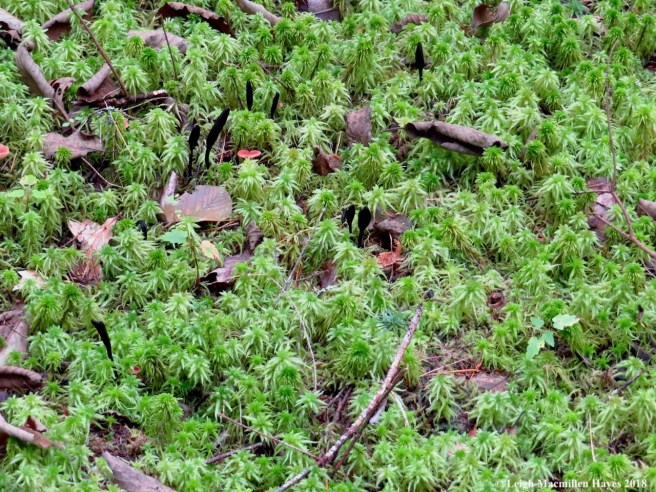
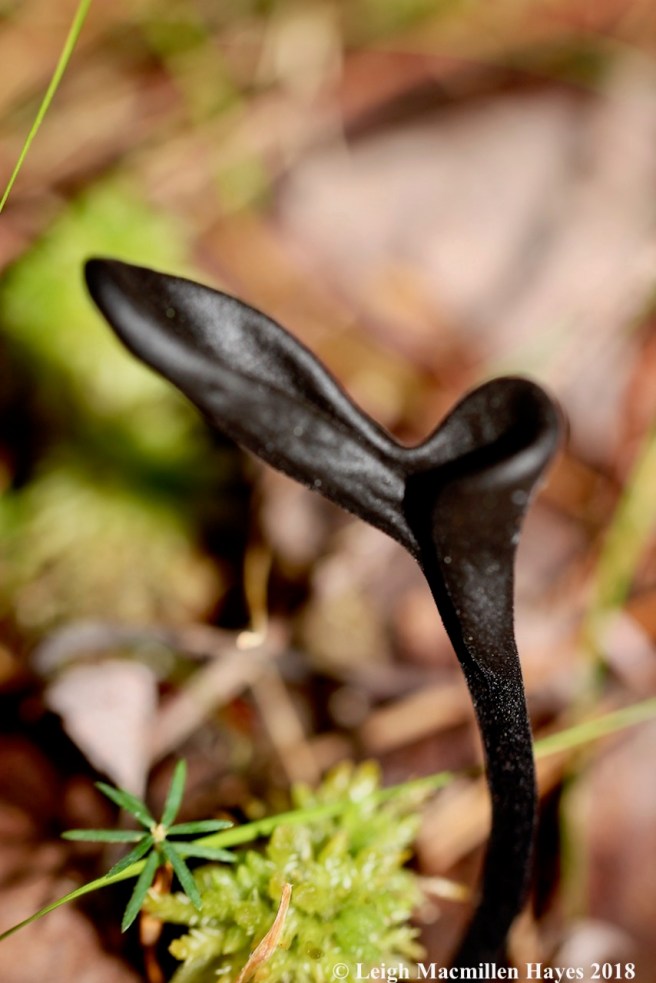
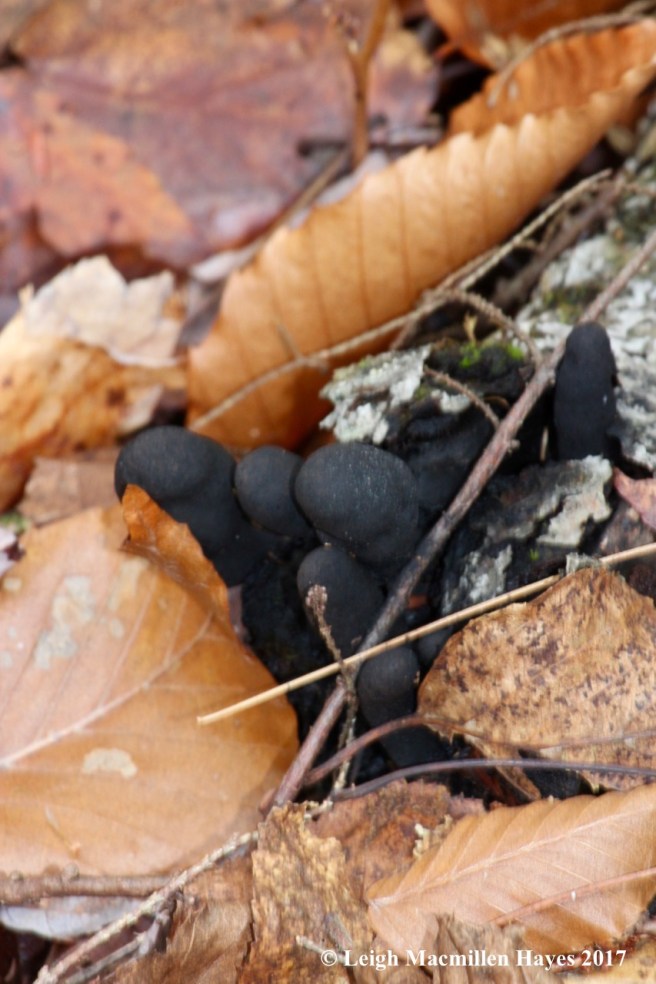
In a different habitat, one where the sphagnum moss grows, we encounter a different fungi that I know, but had never seen in such an abundance: Trichoglossum farlowii is also known as Black Earth Tongue. I had never visited an Earth Tongue garden before but in a foreign land it apparently reigns.

15-singular tongue

Most of the structures are singular fruits, but . . .

15-forked earth tongue

we found one forked tongue.

16-green-headed jelly baby fungi

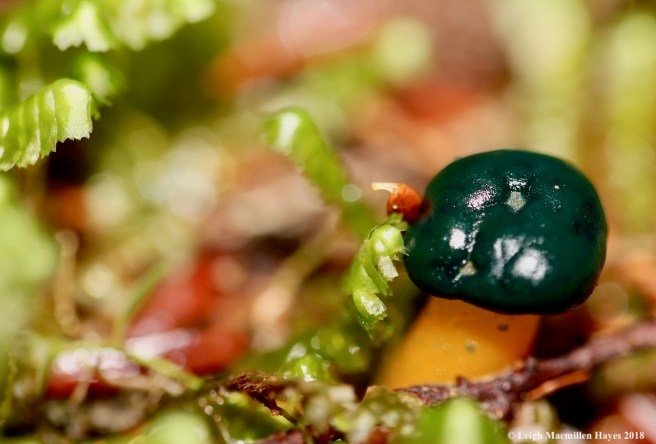
Nearby, on a rock covered in Bazzania, a liverwort, we found a small colony of Leotia viscosa or Green-headed Jelly Babies. Much like the Fluted Bird’s Nest, it looks like a another candy I should bring home to share, but I left the souvenirs behind and took only photographs.

17-green stain fungi fruiting

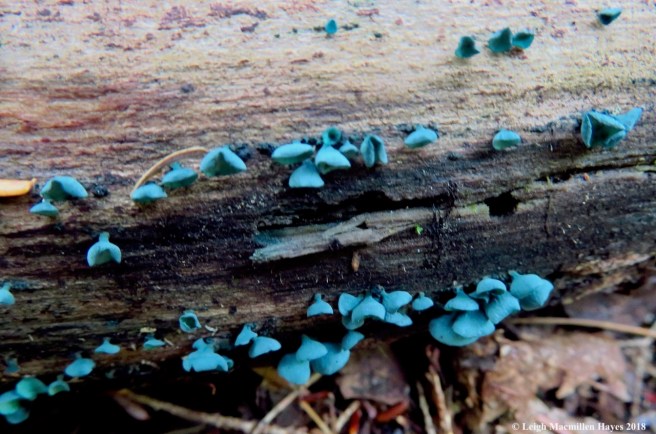
Our forest journey wasn’t over, but our fungi finds were complete when she showed me the fruiting bodies of Chlorosplenium aeruginascens, or Green Stain Fungi. Really, it should be called turquoise-stained, but I didn’t come up with the name. It’s difficult to photograph these beauties for so petite are they, and always a thrill to see.

18-Sweden forest

Many of our finds were located in the vicinity of a forest bog where cinnamon ferns grow tall and wild and add texture and color to the scene, making it look rather pre-historic.

6-beaver pond

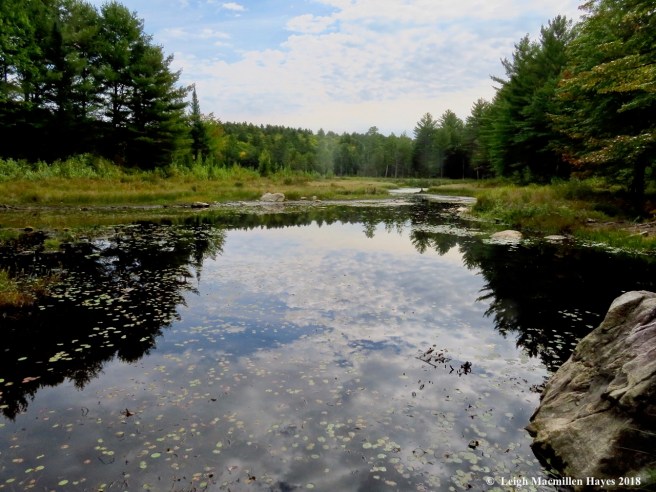
Not only did my hostess share her woodland habitat, which is so different from my own, but she also took me to a beaver pond. Our intention was to say hello, but by the depth we noted that the beavers aren’t currently home. We’ll have to call on them another day during my stay.

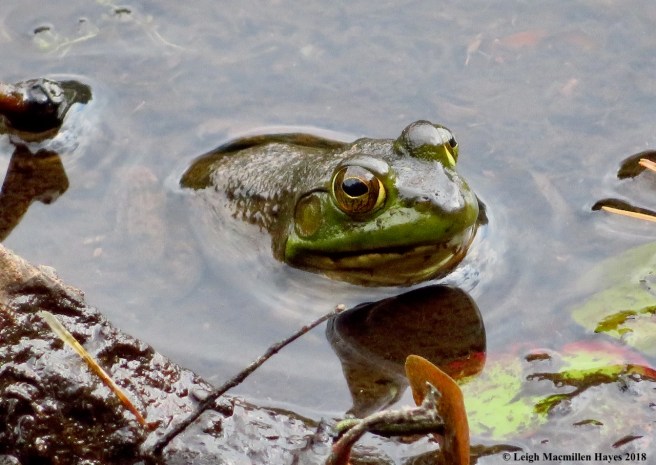
8-green frog

What we did find were green frogs that squeaked as we approached and then leaped into the water to hide.

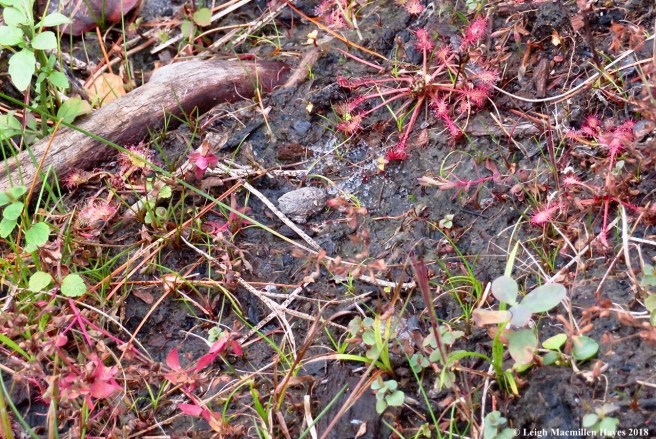
9-sundews, both round-leaved and spatula-leaved

As a gift for her hospitality, I was able to share something with my hostess–in the form of round-leaf and spatula-leaf sundews that grow at the water’s edge. Both are carnivorous and so she can now add another parlor trick to entertain her guests–feed insects to the plants.

7-solitary sandpiper

One final scene to share because she and I shared the same view: a Solitary Sandpiper on the hunt. We watched for a few minutes before it flew off.

And now it’s time for me to fly home. But the airmail has been stamped and if you have read this then you are on the receiving end of postcards from Sweden. Sweden, Maine, that is.

Thank you to my hostess, J.M., for your kindness and willingness to share so many special scenes with me. I can’t wait to return to your neck of the woods.


Wondering With Jinny Mae

It takes us forever and we like it that way. In fact, today a woman who saw us in our typical slo-mo movement commented, “It’s like you’re on a meditative walk. I always move quickly and miss so much.” Indeed we were and when I travel beside Jinny Mae there isn’t much we don’t see. But always, we’re sure that we’ve moved too quickly and missed something. Then again, we realize that whatever it was that we accidentally passed by this time may offer us a second chance the next time.

1-winterberry

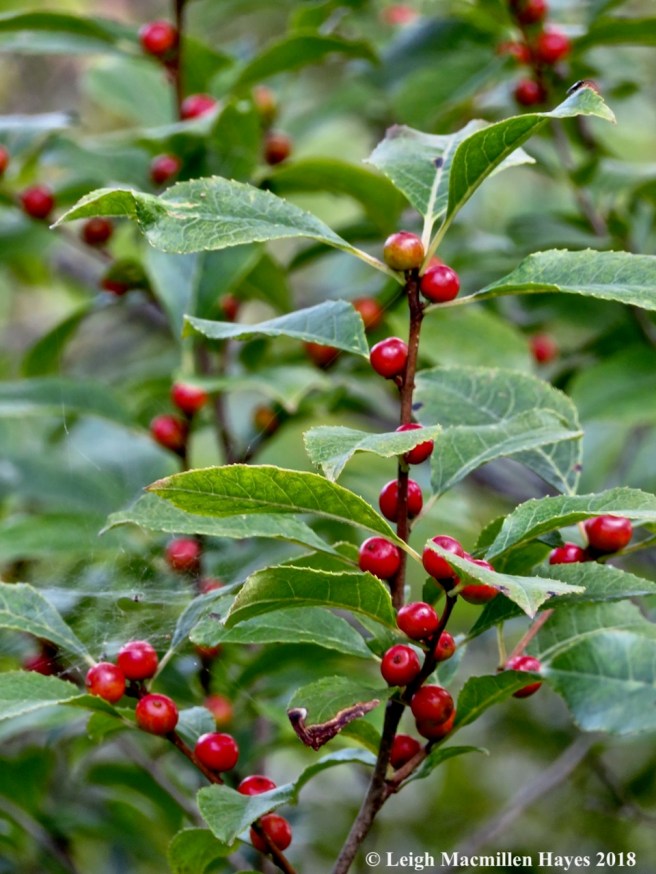
Today’s wonder began with the realization that winterberry holly or Ilex verticillata, grew abundantly where we chose to travel. This native shrub will eventually lose its leaves, but the plentiful berries will last for a while–until they’ve softened considerably that is and then the birds will come a’calling.

2-winterberry

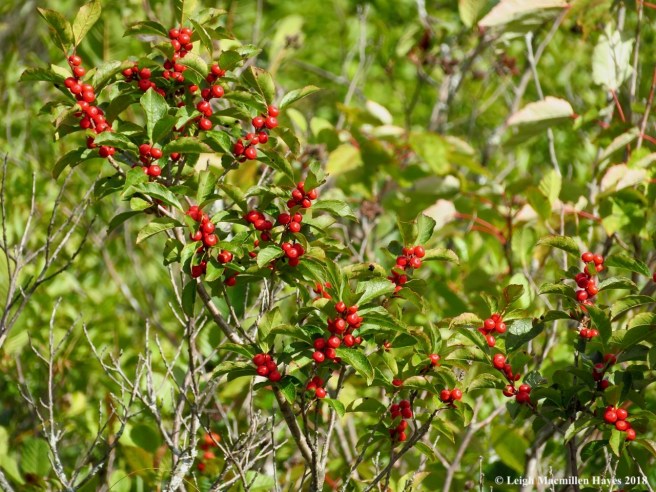
Everywhere we turned, or so it seemed, we found them ranging in color from spring green to shades of red. As summer turns to autumn, the leaves will yellow and eventually fall.

3-winterberry

And then the brightly colored berries that cling to every stem will add color where it’s otherwise lacking in the landscape.

4-winterberry

Even while the leaves still held fast, we found some brightly colored berries that offered a breathtaking view.

5-to Muddy River

We passed through numerous natural communities, tiptoeing at times, such as on the boardwalks, for we didn’t want to disturb the wildlife around us–no matter what form it took.

9-dragonfly attachment

And we rejoiced in spying a cherry-faced meadowhawk couple in their pre-canoodling mode. Can you see how he has used his cerci to clasp the back of her head? His hope is that he can get her to connect in the wheel position and they’ll take off into the safety of the nearby shrubbery to mate.

6-Muddy River

At the river, we began to notice other signs that we’ve once again entered a transition between seasons, for subtle were the colors before us.

7-beaver lodge

Across the river and just north of where we stood, we spotted an old lodge, but weren’t sure anyone was in residence for it didn’t seem like work was being done to prepare for winter. Then again, we haven’t done anything to prepare either, for though the temperature has suddenly shifted from stifling to comfortable (and possibly near freezing tonight), it’s still summer in Maine. And we’re not quite ready to let go.

17-Sheep Laurel

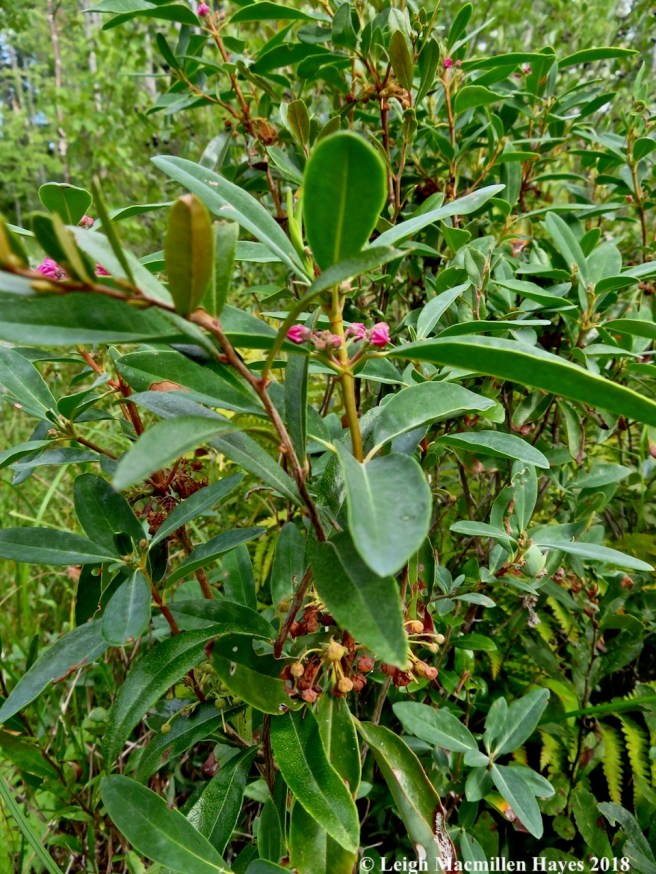
That being said, we found a most confusing sight. Sheep laurel grew prolifically in this place and we could see the fruits had formed from this past spring’s flowers and dangled below the new leaves like bells stringed together.

18- sheep laurel flowering in September

Then again, maybe it wasn’t all that odd that it still bloomed for when I got home I read that it blooms late spring to late summer. I guess we’ve just always noticed it in late spring and assumed that was the end of its flowering season. But then again, it appeared that this particular plant had already bloomed earlier in the season and produced fruit, so why a second bloom? Is that normal?

10-pitcherplant 1

As we continued on, we started to look for another old favorite that we like to honor each time we visit. No matter how often we see them, we stand and squat in awe of the carnivorous pitcher plants.

11-pitcher plant 2

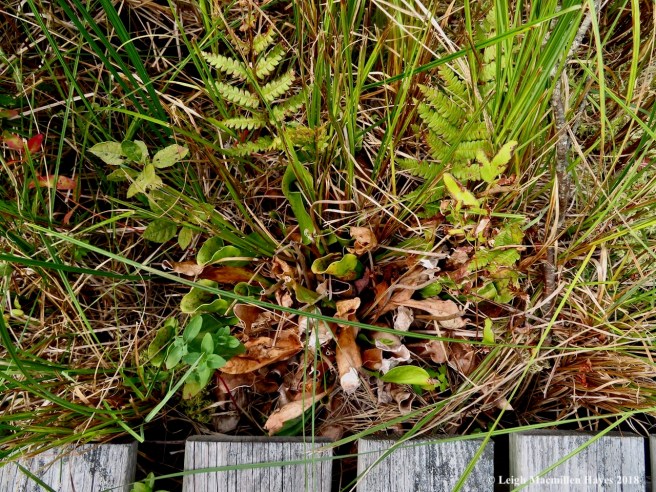
But today, we were a bit disturbed for one that we’ve admired for years on end looked like it was drying up and dying. In fact, the location is typically wet, but not this year given the moderate drought we’ve been experiencing in western Maine. What would that mean for the pitcher plant?

13-pitcher plant flower

Even the flower pod of that particular one didn’t look like it had any life-giving advice to share in the future.

14-Pitcher Plant 4

Fortunately, further on we found others that seemed healthy, though even the sphagnum moss that surrounded them had dried out.

14a-pitcher plant

Their pitcher-like leaves were full of water and we hoped that they had found nourishment via many an insect. Not only do I love the scaly hairs that draw the insects in much like a runway and then deter them from exiting, but also the red venation against the green for the veins remind me of trees, their branches spreading rather like the tree of life. Or maybe a stained glass window. Or . . . or . . . we all have our own interpretations and that’s what makes life interesting.

15-pitcher plant flower 2

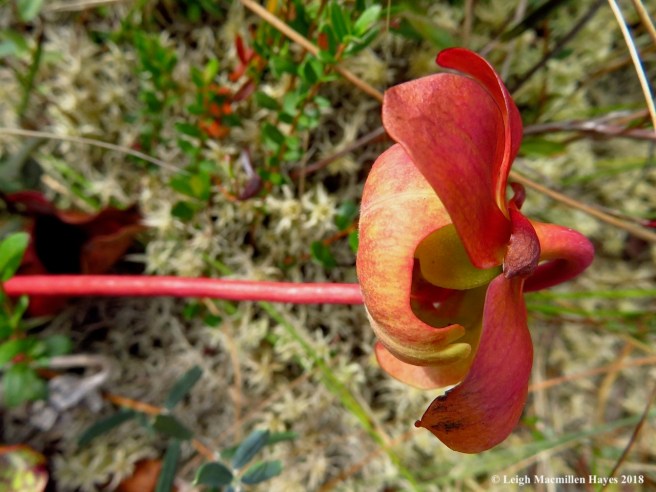
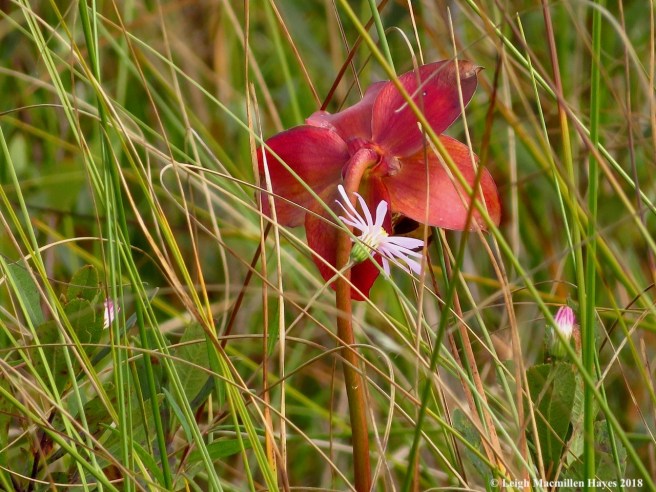
Speaking of interesting, the structure of the pitcher plant flower is one we revere whenever we see it because it’s so otherworldly in form. And this one . . . no the photo isn’t sideways, but the flower certainly was. If you scroll up two photos, you’ll see it as it grew among the leaves. The curious thing is that it was sideways. Typically in this locale, Jinny Mae and I spy many pitcher plant flowers standing tall. Today, we had to squint to find any.

16-pitcher flower and aster

She found the sideways presentation and this one. But that was it. Because of the drought? Or were we just not cueing in to them?

20-cinnamon fern

We did cue in to plenty of other striking sights like the light on a cinnamon fern that featured a contrast of green blades and brown.

21-cinnamon fern drying up

Again, whether the brown spoke of drought or the transition to autumn, we didn’t know. But we loved its arching form dramatically reflected in each pinna.

18a-swamp maple

But here’s another curious thing we noted. We were in a red maple swamp that is often the first place where the foliage shows off its fall colors and while some in other locales have started to turn red, only the occasional one in this place had done so. Our brains were totally confused. Sheep laurel blooming for a second time; pitcher plants drying up and dying; and few red maples yet displaying red leaves?

19-witch's caps or candy corn

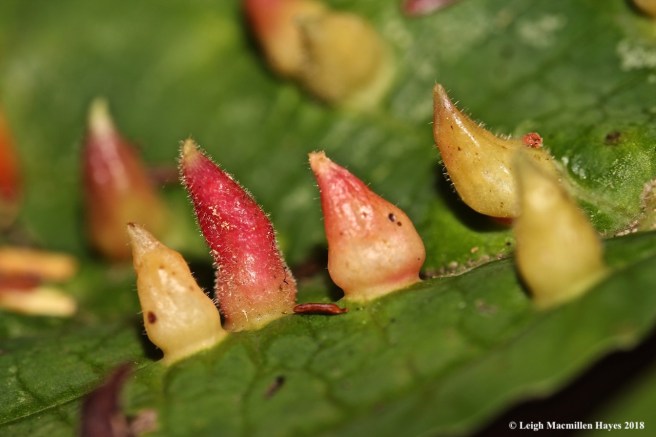
We needed something normal to focus on. And so we looked at the candy corn we found along the trail. Some know them as witch’s caps. They are actually witch hazel cone galls caused by an aphid that doesn’t appear to harm the plant. It is a rather cool malformation.

24-white-faced meadowhawk

On a boardwalk again, we stepped slowly because the white-faced meadowhawk kept us company and we didn’t want to startle it into flight.

25-white-faced meadowhawk dining

One flew in with dinner in its mouth and though I couldn’t get a photo face on before it flew to another spot to dine in peace, if you look closely, you might see the green bug dangling from its mouth.

26-New York Aster

All round us grew asters including New York, water-horehound, cranberries, bog rosemary and so many others.

27-Virginia marsh-St. John's Wort

There was Virginia marsh St. John’s Wort,

28-fragrant water lily

fragrant water lilies,

28-jewelweed

jewelweed,

29-pilewort globe

and even pilewort to admire. The latter is so much prettier in its seed stage than flowering. Why is that we wondered.

30-Holt Pond Quaking Bog

Ahhhh, an afternoon of wondering . . . with Jinny Mae. At LEA’s Holt Pond Preserve. In Bridgton. An afternoon well spent. Thanks JM.


Mondate of a Rare Type

Aha. So our Mondates are hardly rare, though we don’t spend every Monday on a hiking date. What, therefore could the title mean?

d1

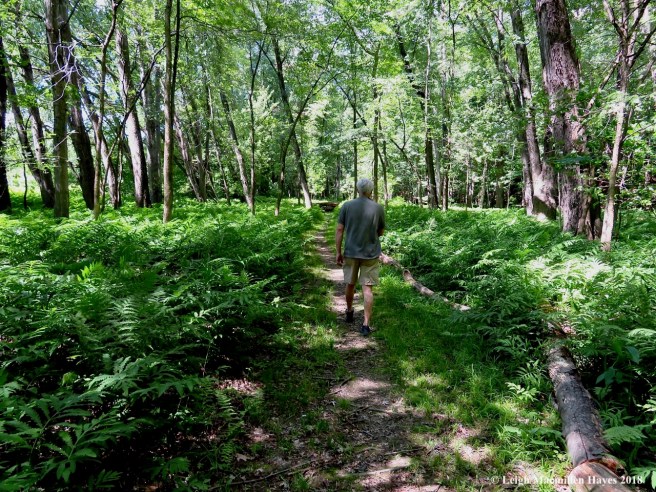
Follow us down the trail at the Dahl Wildlife Sanctuary in North Conway, New Hampshire, and I think you’ll soon understand. The property is owned by NH Audubon and located adjacent to LL Bean, though the parking is in a tiny lot across from Burger King on Route 16.

d2

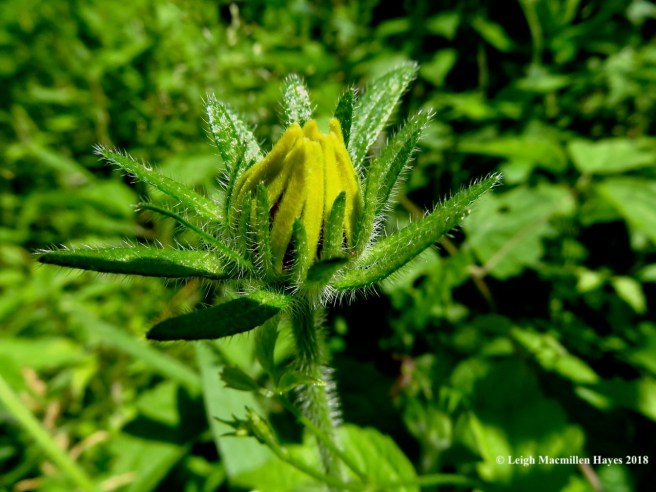
It’s not a long loop, but it’s chock full of wildflowers like the Black-eyed Susans beginning to burst open into rays of sunshine.

d3

We also passed an abundance of shrubs such as Staghorn Sumac and my mind raced ahead to a future visit with Michael Cline’s book, Shrubs of the Northern New England Forest.

d16a-silver maple floodplain

Because we were near the Saco River, part of the loop took us through a Silver Maple floodplain where the trees arched above in cathedral formation.

d17-ostrich fern

In the same habitat, but at waist level, Ostrich Ferns grew in their vase-like fashion..

d18-Tortricid Moth gall

And among them, growth of another kind was apparent for possibly a Tortricid Moth had used the terminal part of the fern’s frond for its larvae to feed and pupate.

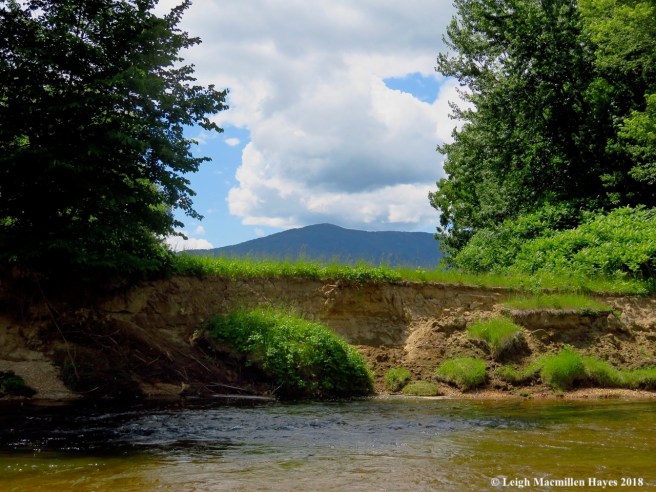
d5-Saco River

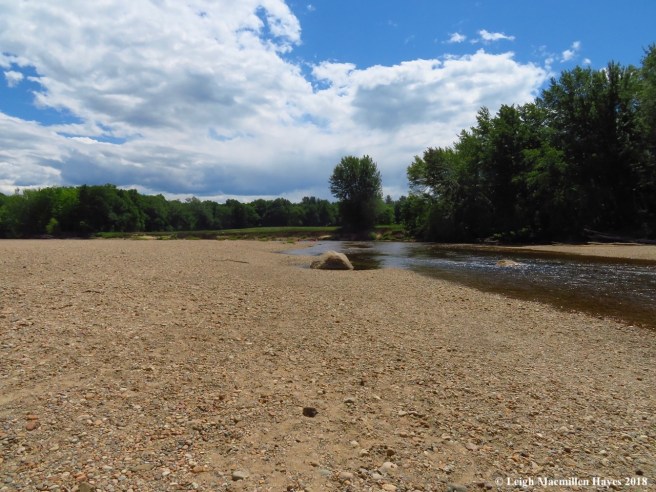
Stepping out of the forest and into the sunshine, we suddenly found ourselves beside the Saco River, where we looked north.

d4-Saco River

And then south. A few kayakers passed by, but for the most part we were alone.

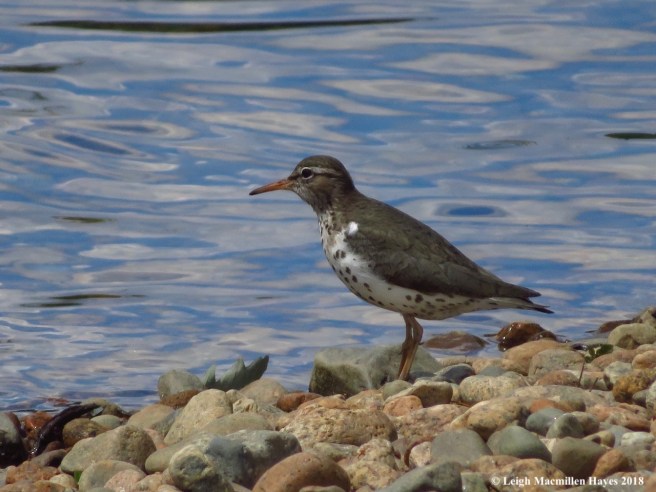
d4, spotted sandpiper

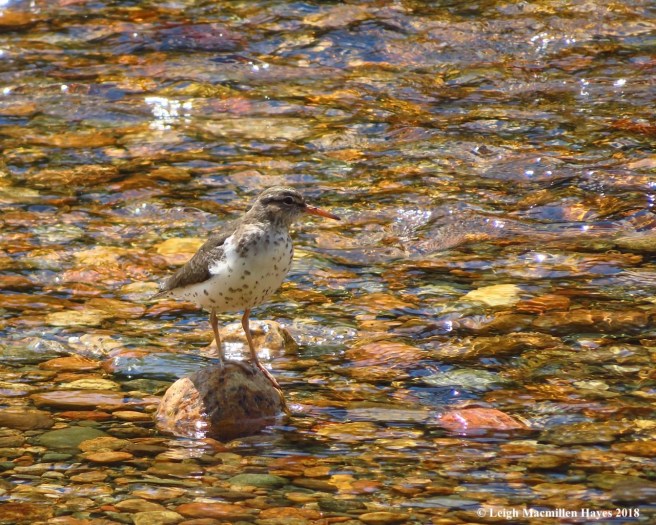
In reality, we weren’t for a solitary Spotted Sandpiper explored the water . . .

d7-spotted sandpiper

and cobbled beach,

d23-sanpiper foraging

where it foraged for insects, small fish and crustaceans.

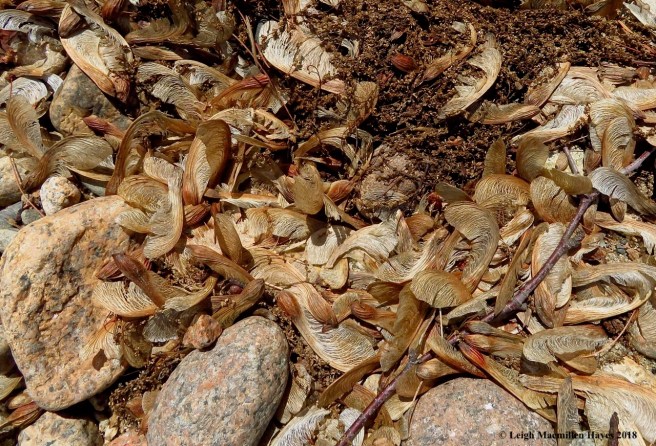
d8-silver maple samaras

Silver Maple seeds were not on its grocery list and they sat in abundance along a high water mark, waiting in anticipation . . .

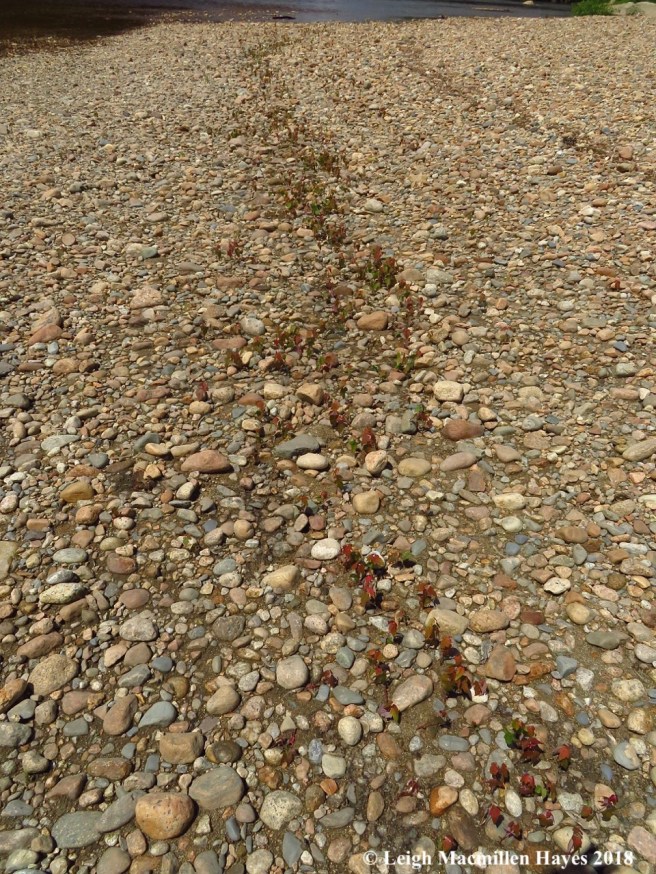
d9-silver maple saplings

to join their older siblings and create their own line of saplings next year.

d10-South Moat

After standing at the water’s edge for a bit longer and enjoying the ridgeline view from South to Middle Moat Mountains, it was time to search for the rare finds that brought us to this place.

d24

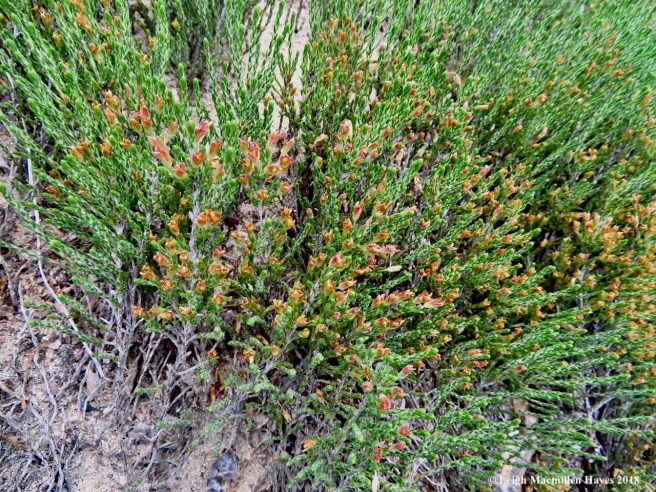
The first was a clump upon a small sand dune–Hudsonia tomentosa.

d25

One of its common names is Sand False Heather, which certainly fit its location and structure. This mat-forming plant had the tiniest of flowers, but it was by its heathery look that I spotted it. It’s listed as rare and threatened in New Hampshire.

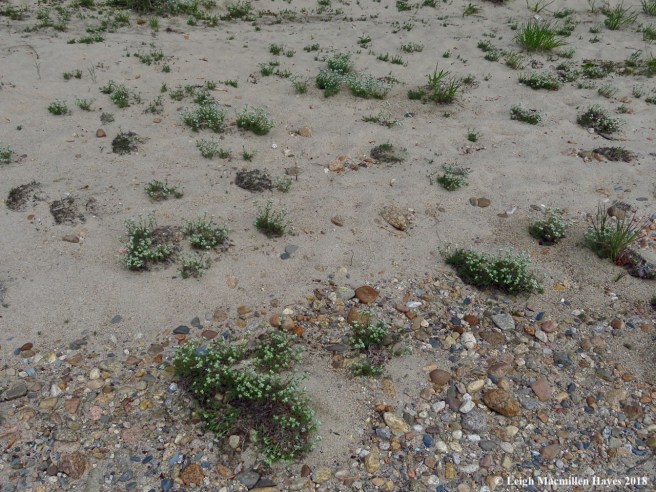
d15-silverling

While I only found two clumps of the heather, the second rare plant featured a larger colony.

d12-silverling1

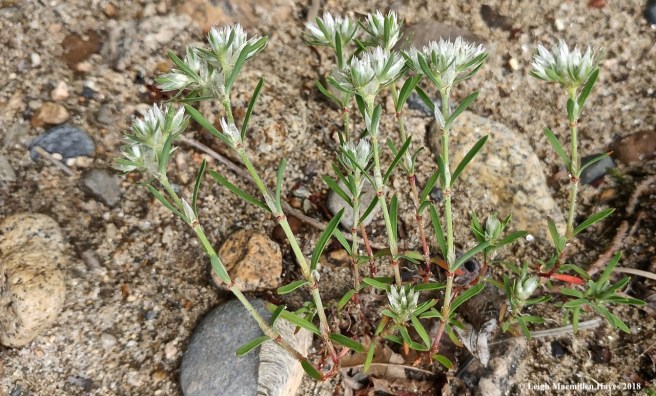
Paronychia argyrocoma is also listed as rare and threatened in New Hampshire (and extremely rare in Maine).

d13-silverling

Also known as Silvery Whitlow-wort, it prefers the ledges and ridges of the White Mountains and . . . gravely bars along rivers. Its whitish green flowers were ever so dainty.

d14-silverling3

From a side view they were most difficult to see for silvery, petal-like bracts hid their essence.

After those two rare finds, my heart sang . . . a song that had started a couple of hours earlier when my guy and I dined with my college friend, Becky, and her daughter, Megan. Another rare and delightful event.

They say three times is a charm and I certainly felt charmed for this rare type of Mondate.


Diggin’ the Garden

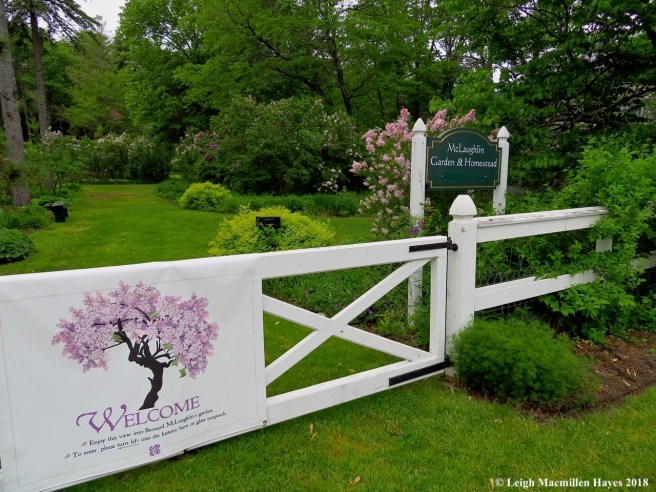
As Judy Lynne and I approached the entrance to McLaughlin Garden in South Paris, it felt as if we were calling on an old friend.

M1 MCLAUGHLIN GARDEN

Maybe that feeling was realized because we passed through the barn, as if visiting a neighbor and searching out back for her.

m9

It was there that we were immediately greeted by not one, but many old friends, including bleeding heart,

m3

forget-me-not,

m7

and jack-in-the-pulpit.

m2

All of these and so much more were the inspiration of Bernard McLaughlin. He began planting the garden in 1936 right on Main Street, though at that time it wasn’t the strip it is now. But that’s part of the wonder of this place for it’s a unique oasis in the middle of our busy lives. As Bernard nurtured his diverse collection of wildflowers, ferns, woody shrubs, trees and over 200 lilacs, he always kept the garden gate open. In 1997, a non-profit was formed to preserve Bernard’s legacy and continue his open door policy.

m3a

We went to smell the lilacs and their heady fragrance did please our noses immensely, but we noted so many other flowers, some which we knew like the old friends above, but made new acquaintances as well. Of course, we’ll never remember all their names, but isn’t it always that way when you meet someone for the first time? Or second or third?

m10

While some paths are grassy, others consist of well-tramped mulch.

m14

We were in constant awe of the array tucked in beside each other in what at times appeared simply random. Anemones such as this grew near . . .

m4

yellow lady’s slippers. And if you haven’t had the pleasure of meeting a yellow lady’s slipper, then hurry to McLaughlin Garden before they go to seed. We spied them in a few different locations.

m17

Thrown into the mix, common yet exquisite dandelions.

m8

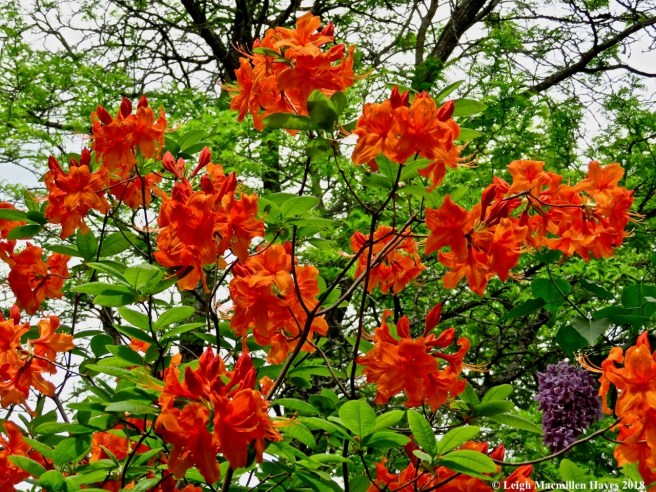
There were azaleas of the most intense orange delightfully juxtaposed beside a purple lilac.

m11

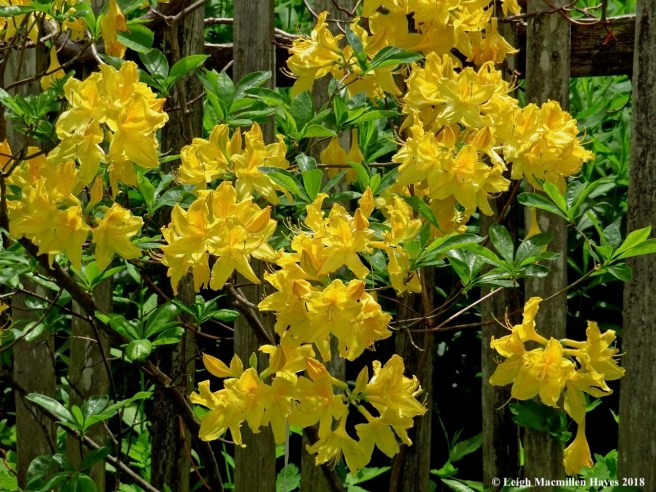
And lemon chiffon yellow enhancing a wooden fence.

m18

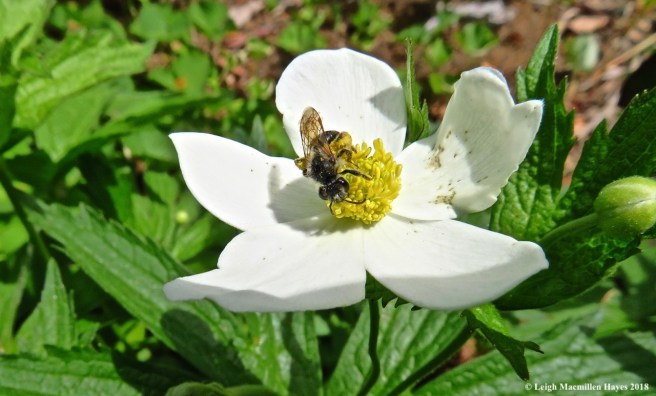
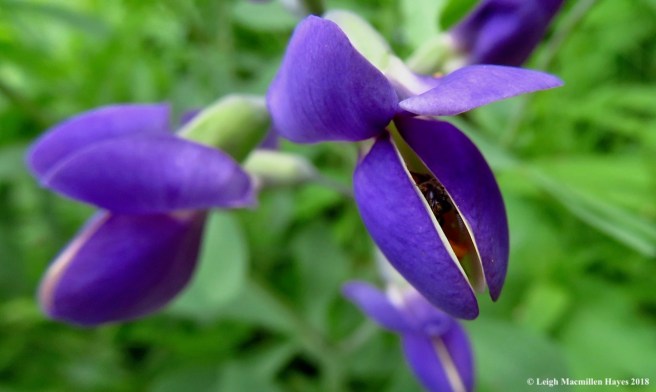
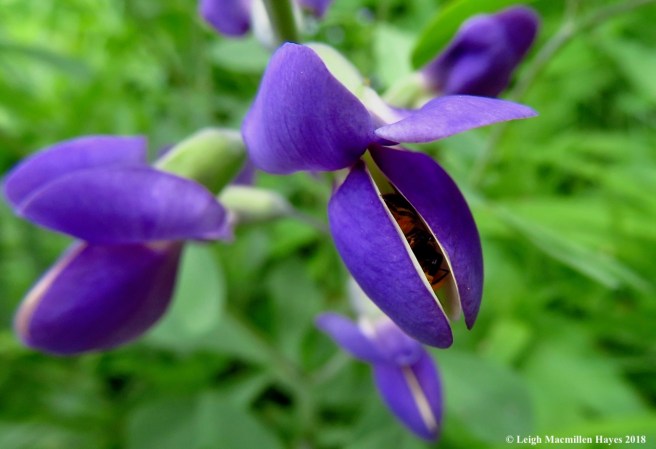
We found lupines of a sort that we hadn’t meet before.

m18a

Though they weren’t yet in full bloom, a pollinator buzzed from within,

m18b

relishing the fact that it was first in line at the fountain of nourishment.

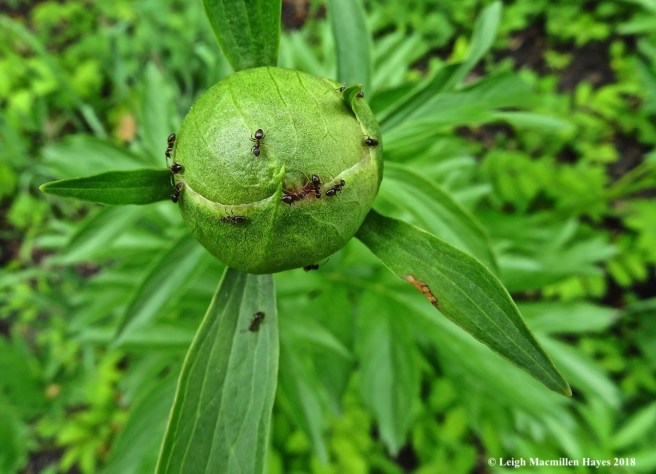
m19

The same was true for the peonies that won’t blossom for another few weeks, but their goodness proved an attraction already.

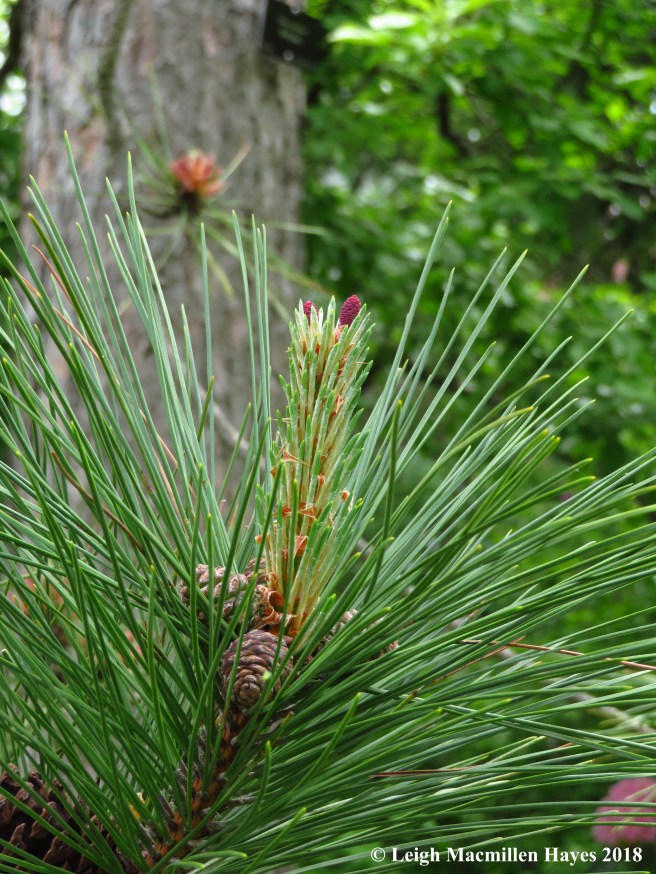
m12

Sometimes our gaze moved upward and we admired the male and . . .

m13

itty bitty female cones on a red pine.

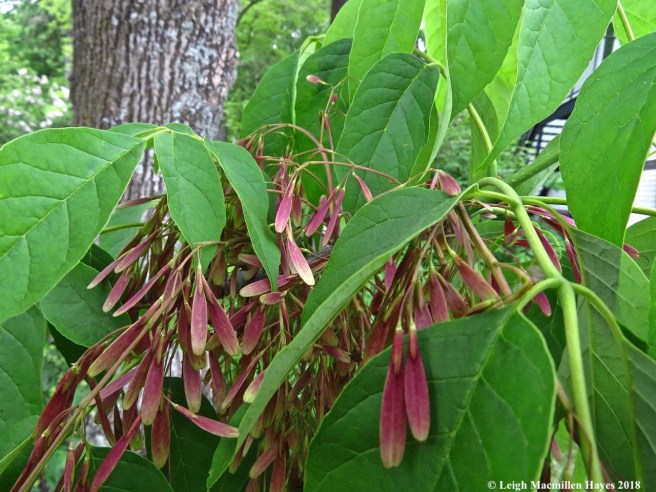
m29

An ash tree also wowed us with its plentiful seed production.

m16

Everywhere, there were hostas adding variations of green and texture.

m24

But among my favorites were the ostrich ferns . . .

m6

and maidenhead ferns. My inner fairy flitted from one step to the next as she climbed this spiral staircase to the ground.

m25

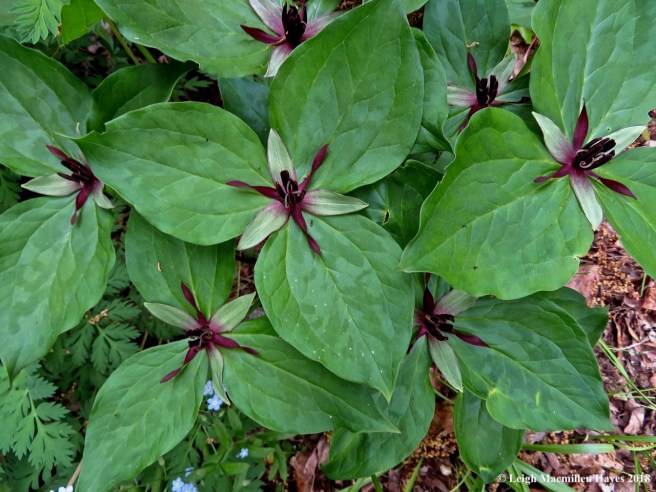
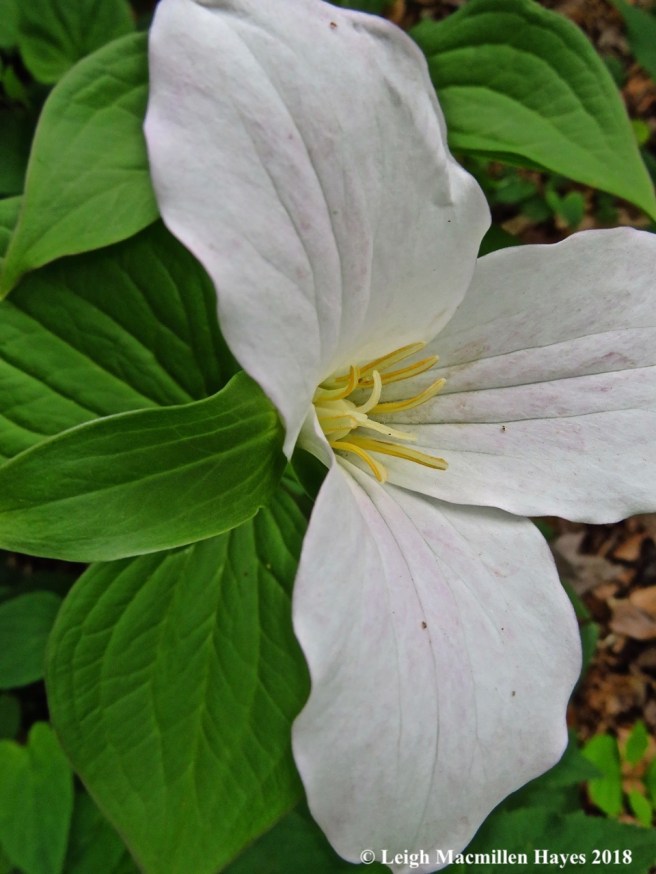
And what should she find growing among the forget-me-nots? Why the most unusual trilliums . . .

m26

one after another . . .

m27

after another .. .

m28

after another. All told, there were seven species of trilliums.

m30

All told, what has been offered here is only a mere glance at Bernard McLaughlin’s garden. You need to experience it yourself and even if you aren’t much of a gardner like me, I trust you’ll be diggin’ the garden.


From the Ground Up

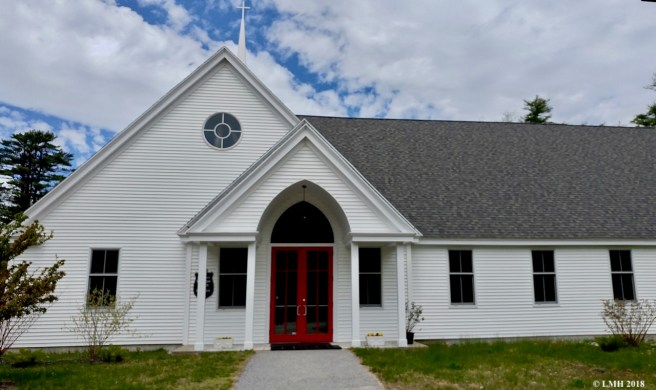
“I am the Alpha and the Omega, the Beginning and the End, the First and the Last . . . The end of a beginning . . . A new beginning . . .” So began Bishop Chilton Knudsen’s sermon shared with over 170 parishioners and guests who attended the Dedication and Consecration of St. Peter’s Episcopal Church in Bridgton on Sunday, June 1, 2008.

Standing behind the pulpit in a site line between the entrance to the sanctuary, altar, cross and a circular pane that provided a window on God through the movement of the trees, wind and sun, Bishop Knudsen reminded us, as our rector, the Rt. Reverend John H. Smith, retired Bishop of West Virginia, had done previously, that the new building was just that — a building. She encouraged us not to get so caught up in the building that we lose sight of our mission of outreach to each other, our communities and the greater world.

St. Peter’s Episcopal Church began as a summer mission in 1962. On September 8, 1974, St. Peter’s-by-the-Lake held its first service of extended ministry. Though it did not have a home of its own, the church provided an Episcopal presence to summer and year-round residents of the Lakes Region by meeting in various locations including people’s homes, Bridgton Academy, and local churches of different denominations. In 2003, the parish voted to purchase a ten-acre lot at the junction of Routes 302 and 93, one mile west of downtown Bridgton.

After renting space for all those years, in 2007, church members enthusiastically supported a capital campaign; through gifts and pledges the full amount of the building cost was raised. Under the leadership of parishioner Beatrice White, a building committee was formed. The Vestry engaged the services of William Whited, Architect, to design a building that would be both beautiful and affordable.

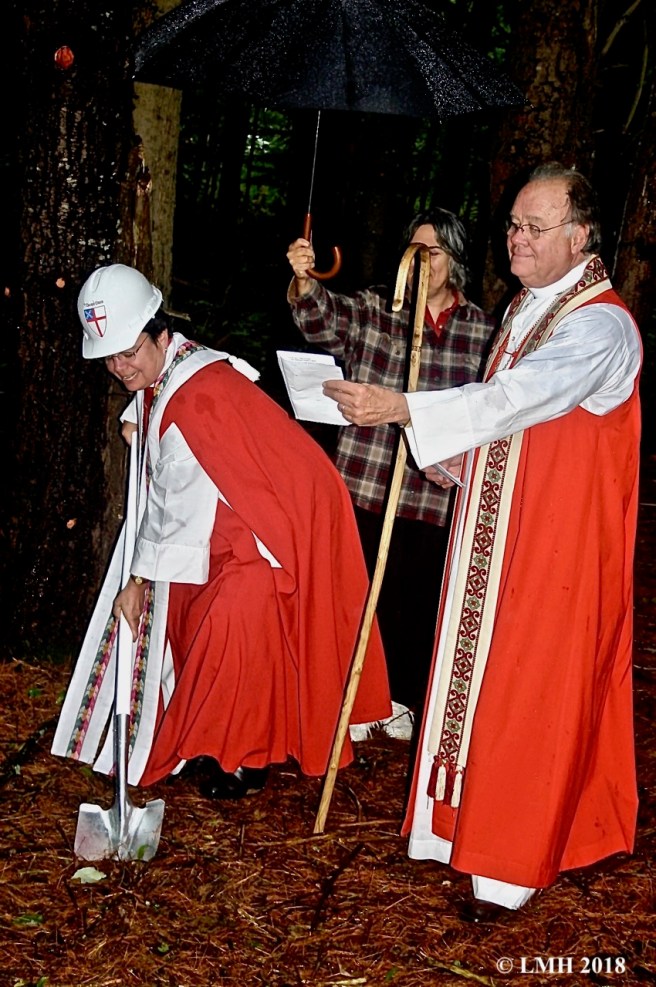
S2-BISHOP KNUDSON BREAKS GROUND

On September 15, 2007, Bishop Knudsen, donning a hardhat decorated with the Episcopal shield, dodged raindrops as she helped break ground.

S2A-LETTER FROM BISHOP KNUDSON

Following that initial groundbreaking, parishioners met at the site the first Sunday of each month for prayers and hymns. Rain . . . snow . . . mud . . . the weather presented a few obstacles, but the project proceeded in spite of it.

S3-CHURCH TAKES SHAPE

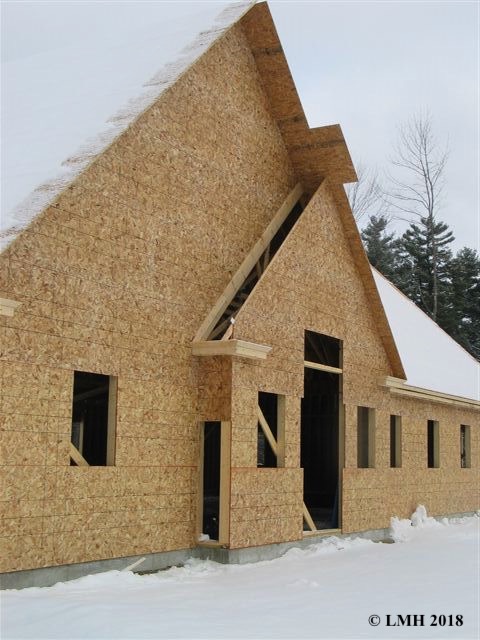
Over time, the building began to take shape.

S4-WINTER

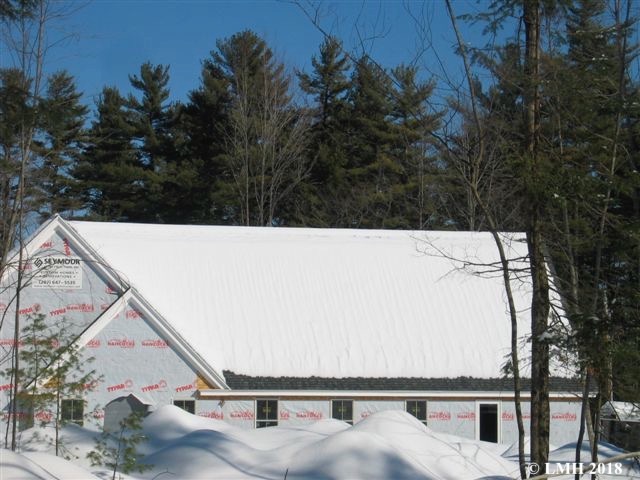
With the advent of winter, it was wrapped in Typar . . and continued prayers.

S5-ALTAR

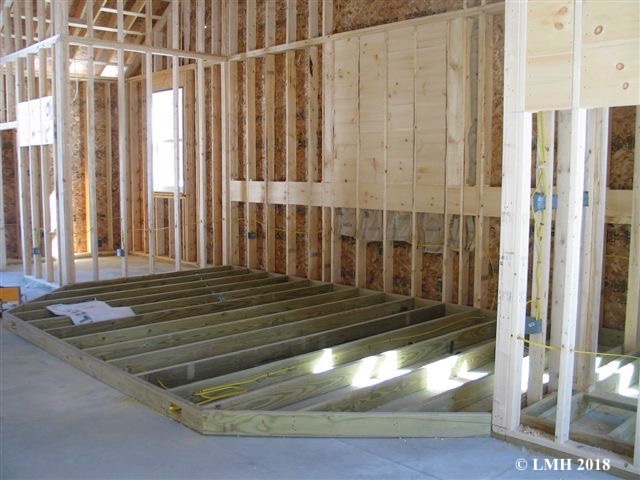
Within, the altar found its formation.

As parishioners, we watched it grow into a structure for worship and fellowship. Upon entering the church for the first service on May 25, 2008, one word was expressed over and over again, “Wow!”

S6-NEW CHURCH DEDICATION

For St. Peter’s, the Dedication and Consecration of the building on June 1st was the culmination of years of discussions, planning, being amazed at fund raising miracles and working together to reach a goal. That grand and meaningful worship service is one that many people never experience unless they build a new church. Using the service of Dedication and Consecration as outlined in The Book of Common Prayer, Bishop Knudsen knocked her crosier and called for the doors to be opened. Gregg Seymour, General Contractor, opened the door and handed the Bishop a hammer as a symbol of his work. Beatrice White presented the building blueprints while Junior Warden Eric Wissmann gave the Bishop a set of purple building keys. A procession including the Bishops of Maine, our rector, a deacon, verger, wardens, crucifer, taperers, parishioners and guests flowed through the narthex into the simple, yet beautiful sanctuary. Following prayers for the building, the Bishop moved about the church and consecrated the baptismal table and bowl, cross above the altar, lectern/pulpit, hangings and parish banner, tapers, piano, kitchen, classrooms and offices, narthex table, credence table, altar shelf, fair linen, and other special gifts. She then celebrated the Holy Eucharist, assisted by the Reverend Christine Bennett, Deacon, and George Wright, Verger. The Eucharistic Bread was baked and offered by the “SPY” group, Saint Peter’s Youth. During Holy Communion, the choir sang “Jesu, Jesu,” accompanied by Evan Miller, Director of Music. Following the service, the parish continued the celebration indoors and out with a reception and pot-luck dinner. 

S7-CHURCH TODAY

Fast forward and the parishioners are now preparing for Bishop Steven Lane to visit next week and celebrate the tenth anniversary of St. Peter’s. In all that time, so much has changed . . . including the land. And so this afternoon I spent some time wandering around the grounds in quiet reflection of the people and the place. No, not the church building, though I continue to appreciate its simplicity and still love to gaze out the circular window above the altar.

S8-ANTS ON DANDELIONS

Today, however, I wanted to note all the other species that have gathered here, including the ants seeking nectar. Have you ever gotten as close to a dandelion as an ant or bee might? Did you know that each ray has five “teeth” representing a petal and forms a single floret. Fully open, the bloom is a composite of numerous florets. And equally amazing is that each stigma splits in two and curls.

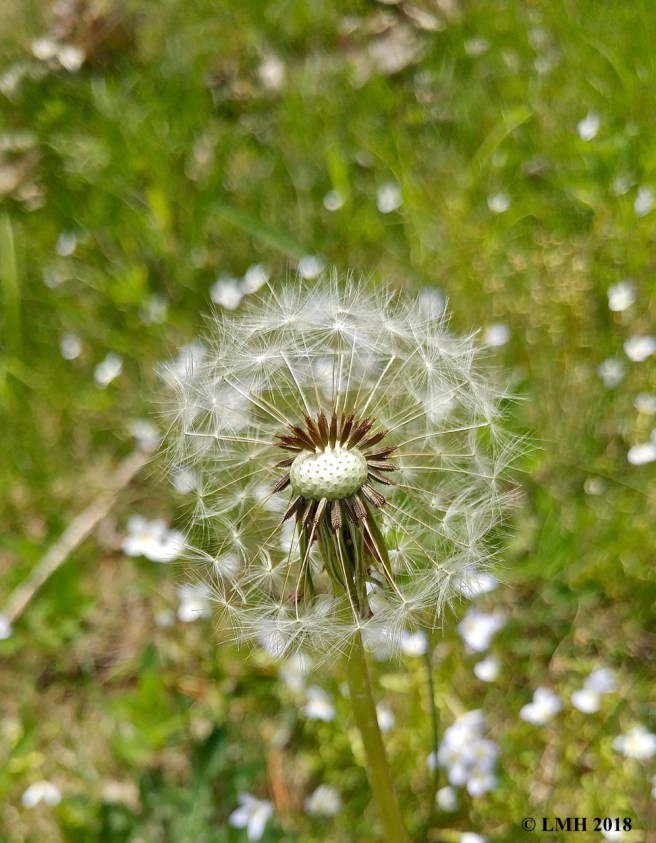
S9-DANDELION SPREADING THE SEEDS

Of course, if you are going to admire a dandelion in flower, you should be equally wowed as it continues its journey. At the base of each floret grows a seed covered with tiny spikes that probably help it stick to the ground eventually. In time, the bloom closes up and turns into those fluffy balls waiting for us or the wind to disperse the seeds, rather like the work of the church. Until then, they look like a spray of fireworks at our feet.

S10-MEMORIAL GARDEN

My wandering led to the Memorial Garden where parishioners with greener thumbs than mine created a small sanctuary for one who wants to sit and contemplate.

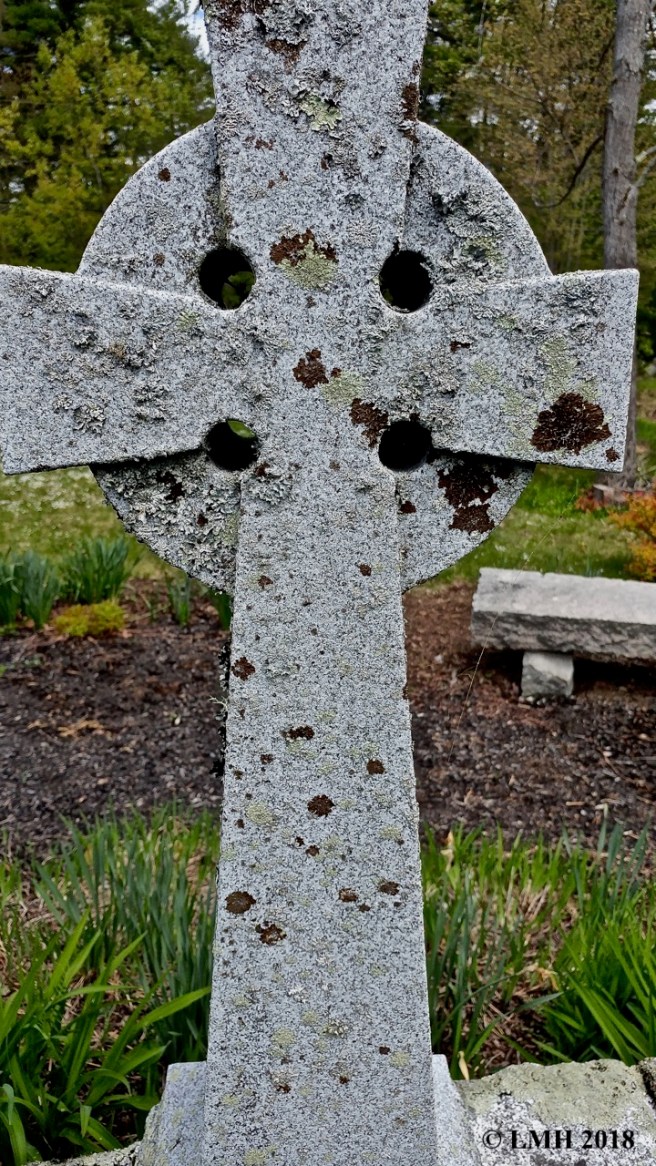
S11-CELTIC CROSS WITH LICHENS

The garden’s center offers a cross depicted in the Celtic tradition. I remember when it was installed as a “clean” piece of granite and realized today that I hadn’t been paying attention, for as is true on any of the surrounding benches, lichens had colonized it, enhancing the circle of life.

S15-GRAY BIRCH

What I really wanted to look at though was the edge where various species spoke of forest succession. I found an abundance of gray birches, one of the first to take root after an area has been disturbed. It’s always easy to spy once you recognize its leaf’s triangular form, which reminded me of Father Dan Warren’s demonstration this morning about the Trinity.

S12-PAPER BIRCH LEAVES

Nearby grew an already established paper birch, its leaf more oval in shape.

S13- QUAKING ASPEN

Then I couldn’t help it and my tree fetish took over. Quaking or trembling aspen showed off its small toothed edges, while . . .

S14-BIG TOOTH ASPEN

its young cousin displayed big teeth. Despite its fuzzy spring coating, insects had already started devouring the pubescent leaves. One of my favorite wonders about both big-tooth and quaking aspen leaves is that they dangle from flattened stems or petioles and ripple in a breeze as they send out messages of good tidings.

S16-BEECH LEAVES

Also along the edge I found a beech tree donning huge leaves that looked like they were in great shape . . . momentarily.

S17-VERY HUNGRY CATERPILLAR

For on the backside, a very hungry caterpillar had been dining on its own form of the Bread of Life.

S17A-FLOWERING DOGWOOD

I found two other young trees that I suspected were planted within the last ten years–the first: flowering dogwood. Growing up in Connecticut, we had a large one in the side yard and so memories of times long ago intermingled with those of the more recent past and my home church, Zion Episcopal, entered into my reflections.

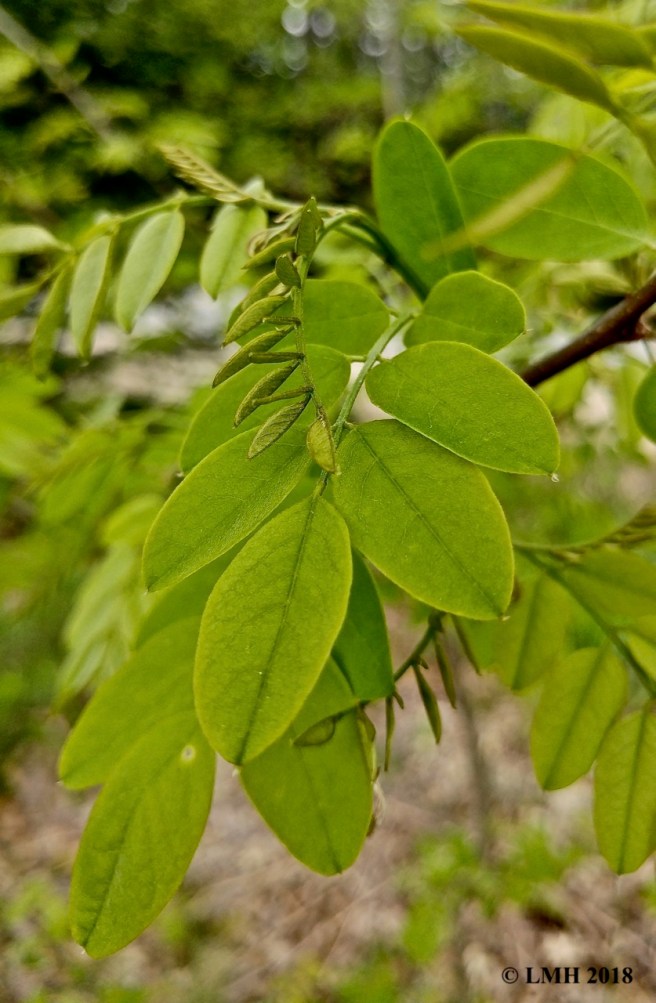
S17B-LOCUST

Like the dogwood, we also had a mature locust looming tall near my mother’s garden. Spying this one, I gave thanks for the ability to span the years, travel many routes, and remain faithful to my beginnings.

S22A-SWEET FERN

Slowly my eyes shifted downward . . . and fell upon a most pleasing sight–sweet-fern. It’s one of those, like hobblebush, that wows the eye in any season.

S18- WILD STRAWBERRY FLOWER

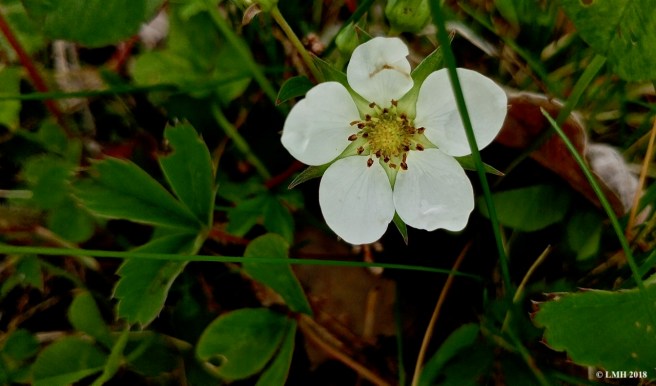
And then I turned my focus to the ground where an incredible variety of flowers either in bloom or still to come, mosses and grasses all shared the common space in seeming harmony, though I suspected there were those that crowded out others. Patches of wild strawberries graced the carpet. Five petals surrounded about twenty stamens and soon a fruit may form–meant to sustain small mammals and birds.

S21-FRINGED POLYGALA

Gay wings or fringed polygala surprised me with its presence. So delicate, so beautiful, so fleeting.

S24-STONE WALLS

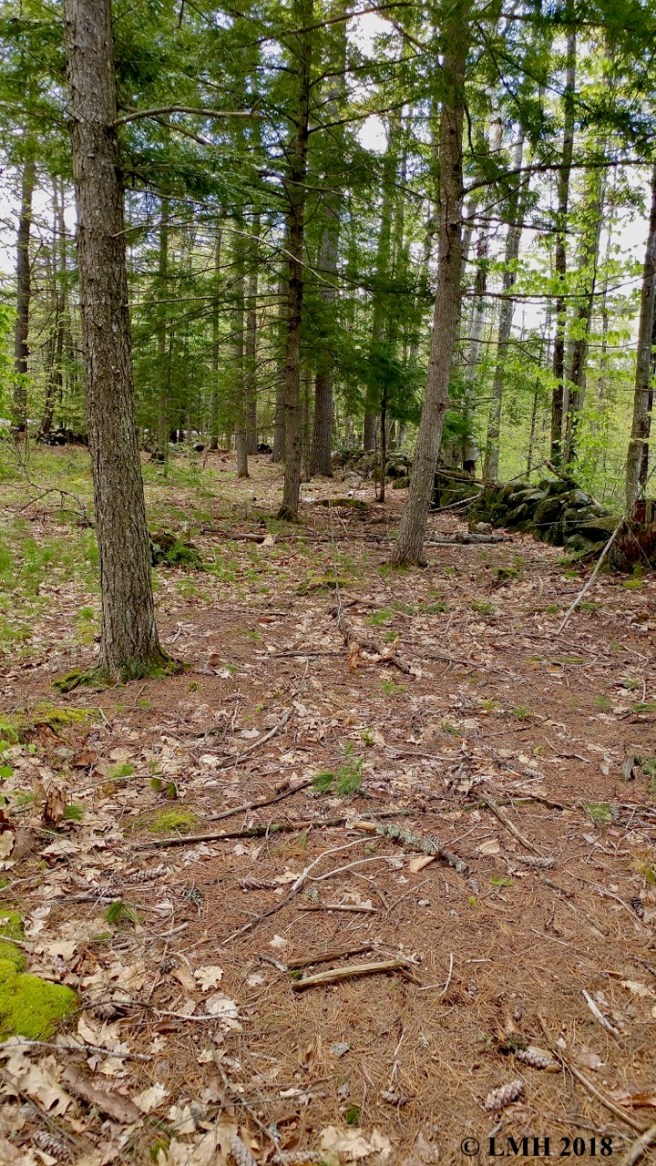
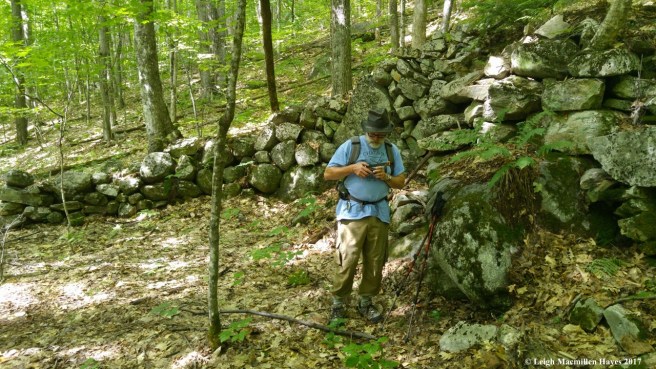
I stepped into the woods beyond the edge and was reminded that ten years ago I wanted to create a nature trail on this property–a place where anyone could partake of a short wander away from reality; a place where someone might be nurtured by nature.

S19-STARFLOWER

A place where the stars above would be reflected in the flowers below.

S20-DWARF GINSENG

A place where flowers like dwarfed ginseng would erase global issues–if only for a moment.

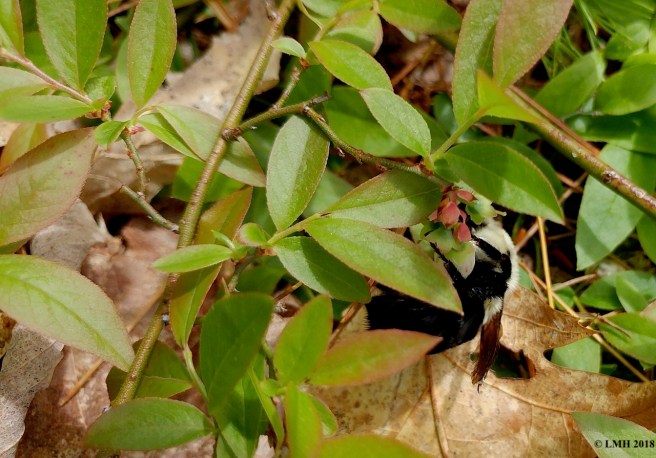
S23-GIANT BUMBLEBEE

A place where everyone recognized the system and from such recognition began to work together toward common goals.

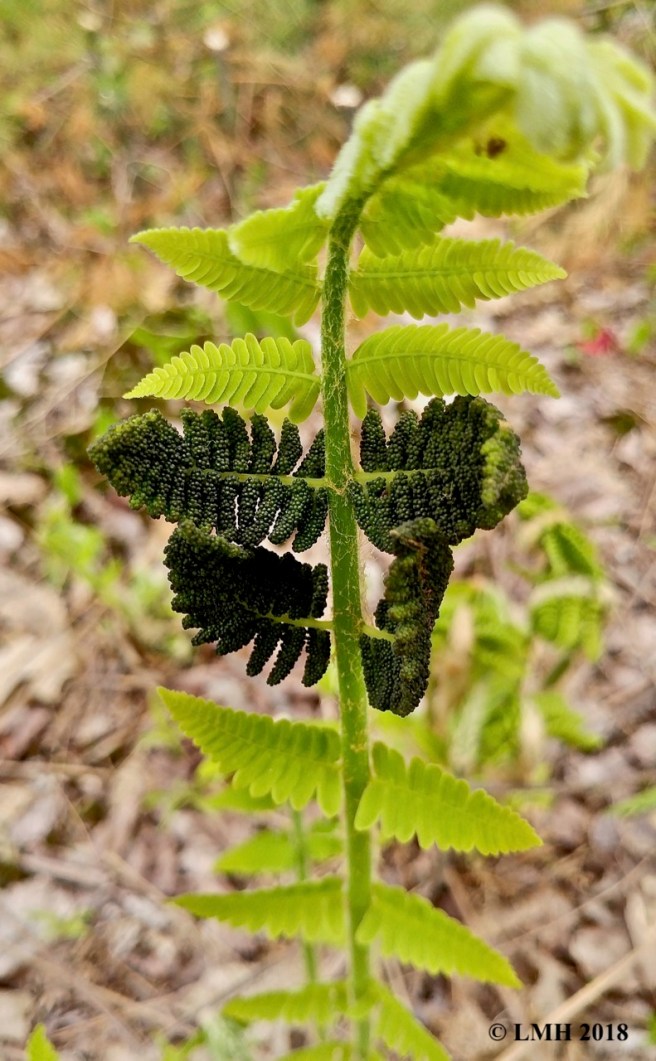
S22-INTERRUPTED FERN

A place where interruptions occurred because life happens, but such were accepted as part of the norm.

S23A-BUMBLEBEE BREAK

A place where one could find a bench upon which to rest before beginning again.

S25-ENTER HERE

Here’s to beginning again St. Peter’s.

Here’s to remembering all those who made this place a reality.

Here’s to maybe someday a nature trail.

Here’s to continuing to create a place where all are welcome whether they pass through the red doors, into the Memorial Garden, or choose to take in the offerings from the ground up.


Petals and Wings: A Window of Opportunity

Spring ephemerals. Those species that take advantage of the short stretch of time between snow melt and leaf out. We celebrated such today at the Greater Lovell Land Trust’s Heald and Bradley Ponds Reserve as we ever so slowly walked along the orange trail from the Flat Hill parking lot and then looped around on Perky’s Path.

S1-GATHERING

But first, we gathered in the parking lot where Docent Peter explained that he thought I was crazy when I suggested a May date for a flower and bird walk. He’d not been in Maine during May previously and only this week learned the joys of birding with minimal leaf cover. I think he’s hooked. And I’m still crazy.

S4-WILDFLOWER GUIDES

Our journey began with Docent Linda locating wildflowers that are opportunists who bloom early, get pollinated and produce seeds before the deciduous trees blanket the floor of the forest in shade.

S2-STINKING BENJAMIN

Among those early bloomers was one that stinks! And yet, it’s exquisitely beautiful. Stinking Benjamin is one of its common names because of the flower’s malodorous scent. Of course, you need to get down on your hands and knees to get a whiff.

S5-HAND LENS

Our focus wasn’t just on flowers and birds as we all soon realized, for it seemed that many things caught our attention, including the seeds of deer tongue grass. As a collective group, we suffered from Nature Distraction Disorder.

S6-WILD SARSAPIRILLA LEAVES

Because of such, we observed more than just the flowers that were in bloom. In one instance, the flower was yet to come, but the leaves in their early stage were worth noting. Linda pointed out that the color of wild sarsaparilla’s new leaves was reminiscent of poison ivy. But, poison ivy has leaves of three.

S7-BEECH LEAVES

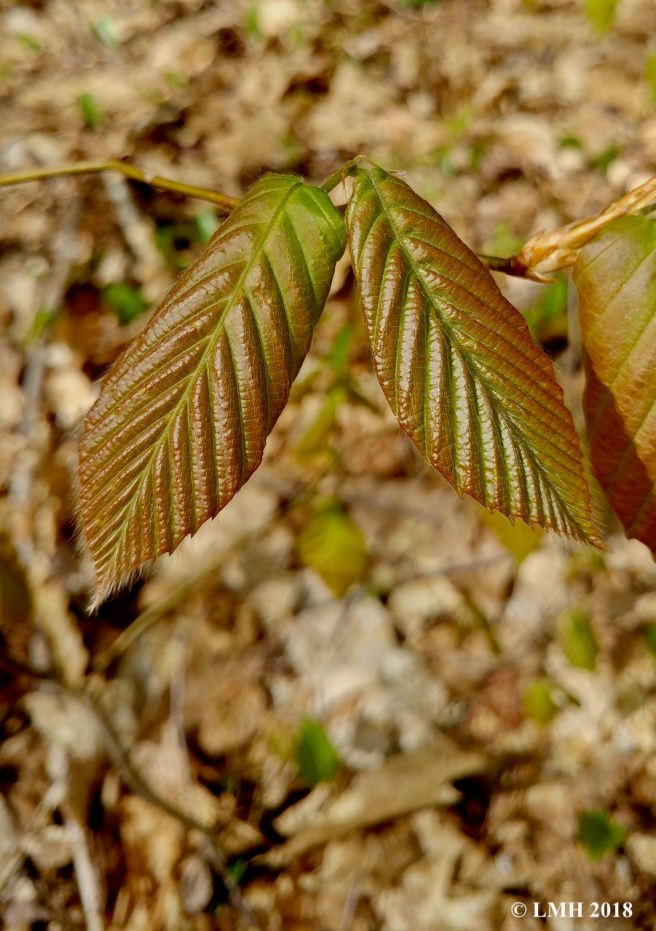
And that reddish tint that we saw in the sarsaparilla, beech and other leaves? The various hues of color in leaves was caused by the presence of pigments called anthocyanins or carbohydrates that are dissolved in the cell sap and mask the chlorophyll. As our spring temperatures rise and light intensity increases, red pigment forms on a leaf and acts as a sunscreen to protect the plant from an increase in ultraviolet rays.

S8-BIRDING

We’d been looking down for a while, but then bird song pulled our attention to the tree tops. Without the use of my Cannon Rebel, which is currently enjoying what I hope will be a successful rice bath :-( , I couldn’t capture the many warblers we spied. Some, as Peter, and his wife Molly, told us, were only in the area temporarily to fuel up on insects before continuing the journey to their breeding grounds in Canada.

S10-GARTER SNAKE

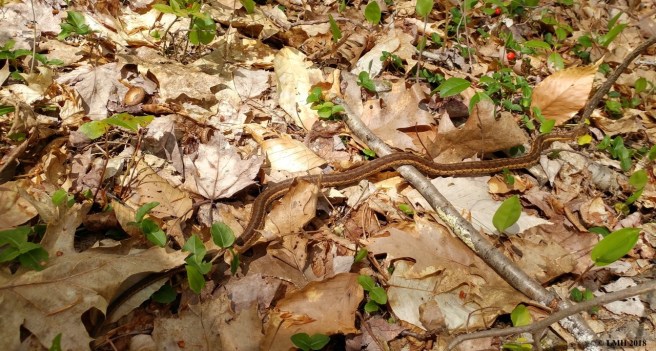
And looking at our feet once again, another in search of insects. We saw a garter snake who stayed as still as possible while we ogled it. Was it cold and trying to soak up warmth from the sun? Or did it stay still in hopes we wouldn’t spy it?

S11-PAINTED TRILLIUM

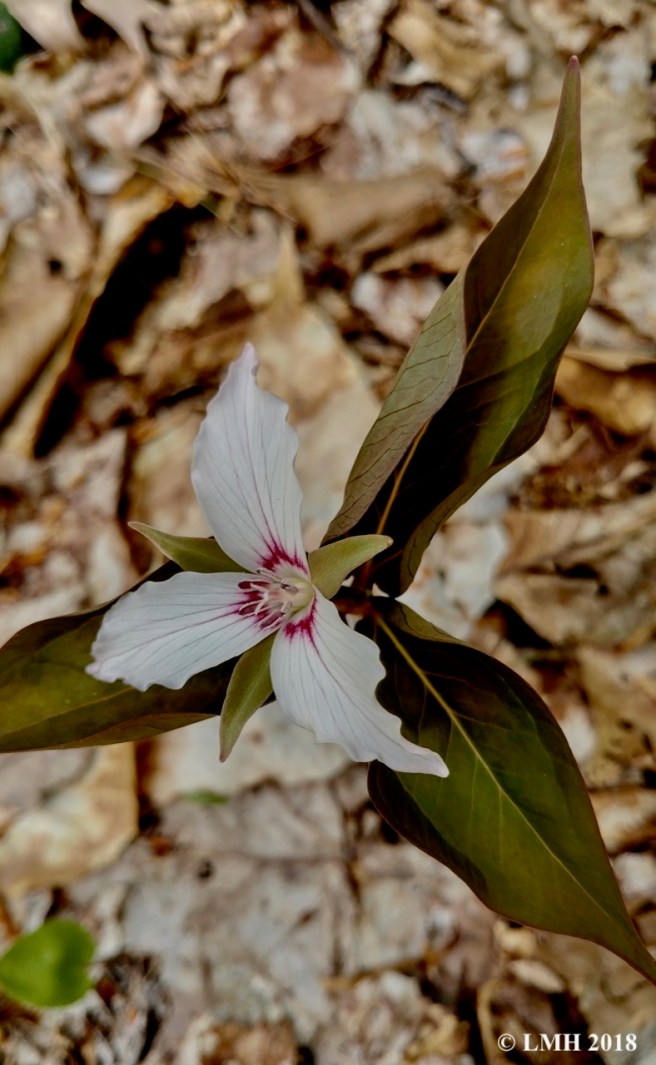
We finally left the snake in peace. And paused next to gaze upon a painted trillium.

S12-HOBBLEBUSH FLOWERS

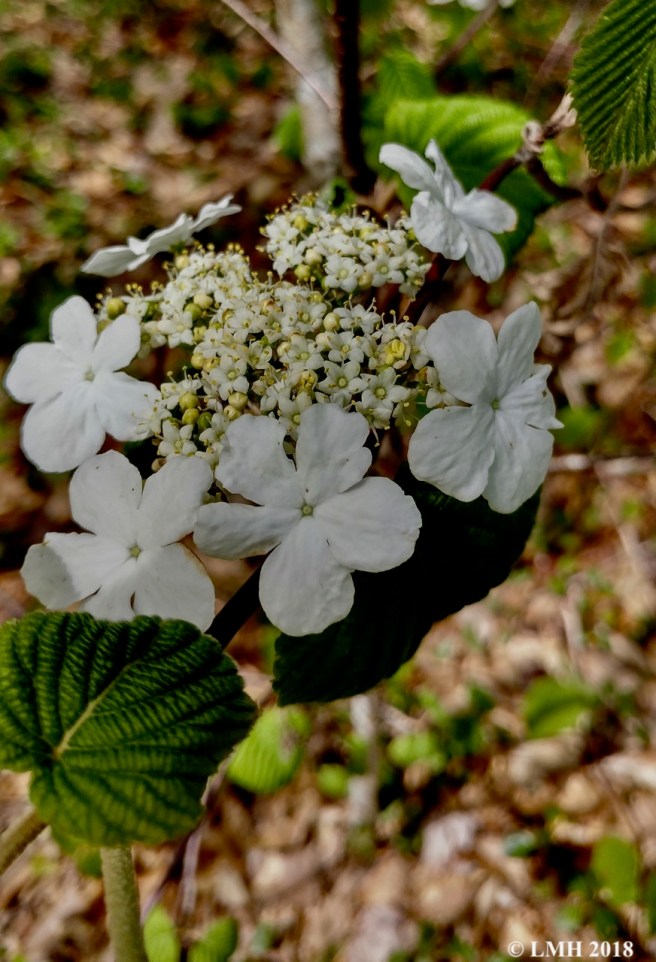
Almost two hours after our start, we approached the wetland and overlooking bench. It was there that a hobblebush laden with blossoms caught our attention in the shrub level. The hobblebush bouquet was really an inflorescence or lacy cluster of tiny fertile flowers surrounded by a halo of showy, yet sterile bracts. Those larger, sterile flowers attract insects while the tiny fertile flowers do all the work of seed production. Nature has its way.

S13-BIRDING BY THE BENCH

It was at the bench that bird song again greeted us and we looked above the shrubs toward the tree limbs above.

S14-BIRDING

For many of us, we looked through our binoculars at birds we’d only heard of before, including a Bay-breasted Warbler. Peter explained that he’s participating in the citizen science project to update the Maine Birding Atlas and so he uploaded the 38 species identified today to the e-bird website.

S15-LINDA TURNS HER FOCUS UPWARD

Even though she’d spent a lot of time directing our attention to the beauty at our feet, Linda was also in awe of those who moved above, however, she was heard to comment that it’s a whole lot easier to ID flowers that stand still.

S16-BEECH FERN

As our journey finally continued, we found a patch of beech ferns with their own variation of today’s theme, for each leaflet attached to the rachis in a winged formation.

S18-FRINGED POLYGALA

Another that spoke to the theme was a flower that hadn’t quite yet bloomed–fringed polygala, aka gay wings.

S17-SPRING PEEPER

Despite all the flowers and birds, our NDD followed us right to the end–when we spotted a tiny spring peeper . . .

S21-GREEN FROG ON A LOG

and then a green frog.

S22-FEMALE WHITEFACE SKIMMER

While the frog marked the end of our journey, I moved on to the GLLT’s Kezar River Reserve, where another winged critter flew at the flower level–the first dragonfly of the season: a female whiteface skimmer.

Today was filled with petals and wings and all things ephemeral. I hope you’ll have a chance to take advantage of this short window of opportunity.


Greenwood Nature Mondate

We love Maine both for its natural beauty and historic nature. And so it was today that we enjoyed a wee bit of both as we headed off to Greenwood.

m1-Greenwood City sign

More specifically, Greenwood City.  According to the town website, “The first saw and shingle mill was constructed at ‘Greenwood City’ in 1805. In the mid-1800s, the wood industry moved to the Village of Locke’s Mills as a result of the railroad and a fire which destroyed Greenwood City.” Apparently, the city had been the economic and civic center of Greenwood, but the fire of 1862 changed everything. Nevertheless, this was our kind of city and our intention was to climb the mountain to the left of the sign–Peaked Mountain.

m3-Maggie's Nature Park sign

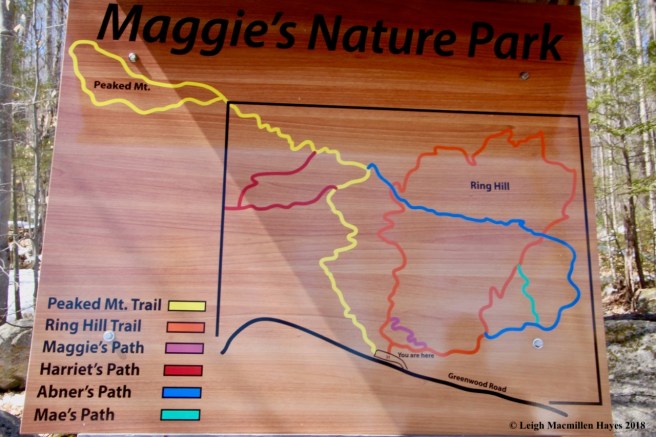
For years now, I’d heard of Maggie’s Nature Park, but never gave it much thought as a destination. That all changed today. The park encompasses 83 acres of mixed forest across the street from South Pond. It was gifted to the town by Maggie Ring, who had placed it under conservation easement with the Mahoosuc Land Trust. According to an article by Josh Christie in an April 2016 issue of the Portland Press Herald, “As Ring told the MLT in 2005, ‘I gave the land so my grandchildren and everyone else’s grandchildren can enjoy these woods. I want them to enjoy some of God’s good earth.’” 

Our plan was to begin on the orange Ring Hill Trail, and consistently stay to the right as we wove our way around the hill and up Peaked Mountain before descending via Harriet’s Path and finishing with the yellow trail.

m4-elbow tree

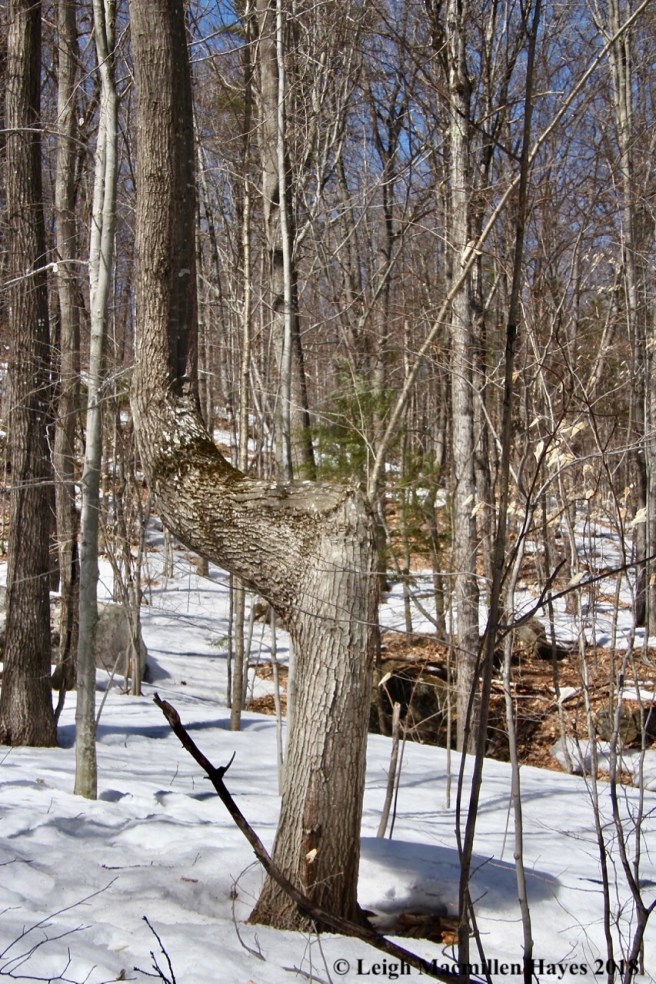
Because the temperature was on the crisp side, the snow pack was firm, though there were icy portions in the hemlock grove, and bare trail and ledges as well. As we began, we immediately noted an elbow tree, so formed probably when another tree landed upon it.

m4a-cedar

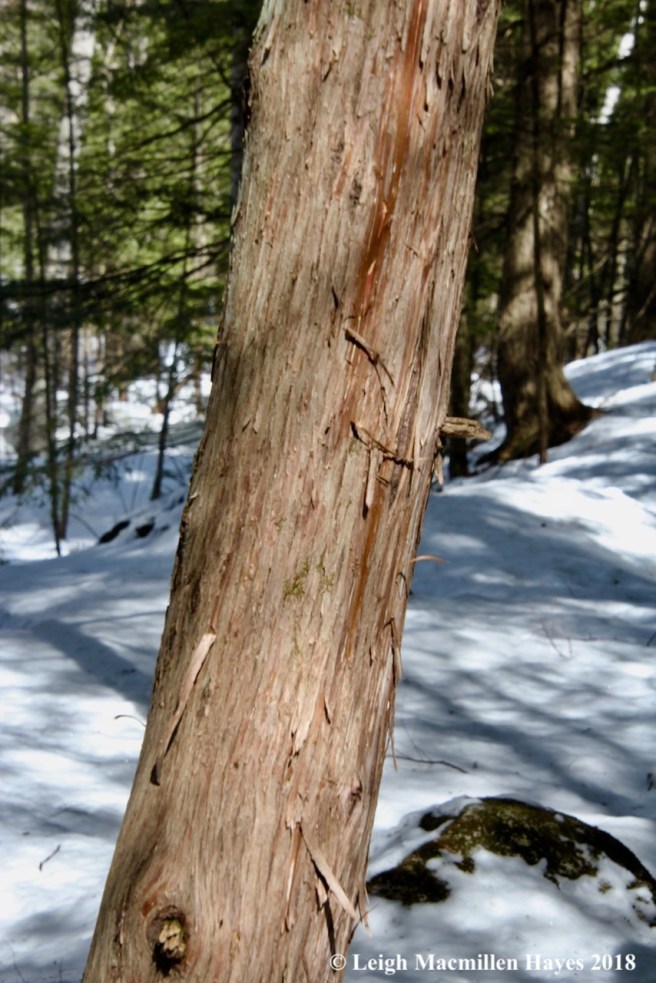
Moving along at my guy’s brisk speed, I was delighted to note the variety of trees, including cedar, and couldn’t help but imagine the teaching opportunities.

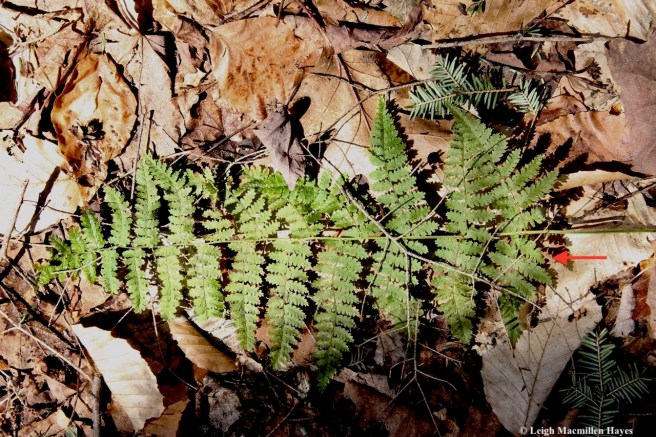
m6-evergreen wood fern

Where the snow had melted, shades of green drew my attention. And with a new season ever so slowly unfolding, I realized I needed to practice my fern ID and so I slowed my guy down for a wee bit. I think he secretly welcomes the breaks for he always finds a rock upon which to sit. One of the characteristics that helped in this ID was the first downward pointing pinnule–it being shorter than the one next to it. I also noted that the stipe or lower stalk, was shorter than the blade, and it was grooved.

m6a-evergreen wood fern

A look at the underside added to my conclusion for last year’s sori were round and all in a row between the midrib and margin. So what was it? Evergreen Wood Fern or Dryopteris intermedia if you choose to get technical. I choose to brush up on my fern ID.

m5-icicles

As we continued along Ring’s Hill, we took in the views from the ledges and under them as well, where icicles pointed toward the land they’d nurture.

m7-snack log

Eventually we followed the yellow blazes to the summit of Peaked Hill–and what to our wondering eyes should appear at a downed log near the view point? Two Dove eggs–the dark chocolate species. A perfect reward for our efforts. But really, the trail required little effort due to its well-executed construction with many zigs and zags to prevent erosion. We hardly felt like we were climbing yet we constantly moved upward.

m8-Mount Abram

The summit of Peaked offered the best views–this one being of Mount Abram, with its ski area at the top and to the right. The ski area is closed for the season, but snow still covered the trails that we could see.

m9-blueberry bushes

Also within our view–highbush blueberry buds suggesting a delightful treat for another day.

m9-toad lichen

And common toadskin lichen reminded me that Big Night is coming soon–that special rainy night(s) when we become sally savers and help amphibians cross that the road to their natal vernal pools. Stay tuned for that–there might be some migration later this week.

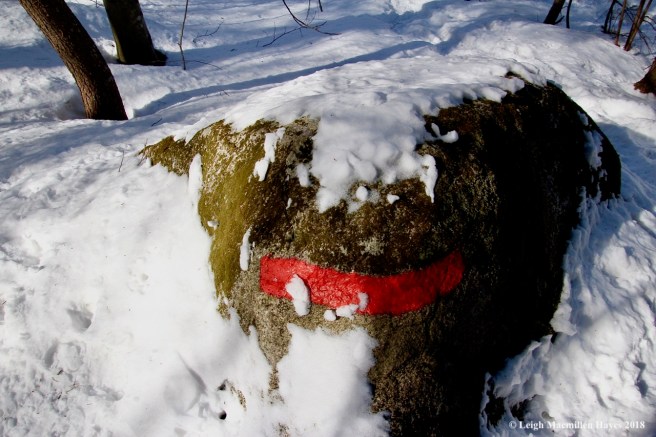
m10-trail well marked

All along, we’d noted the trail markers–bright colors and frequent placement made it easy to stick to the trail. But one caused me concern for it looked like it pointed us over the edge.

m11-trail makers

Not to worry, it was merely noting a junction and curve–my guy came in from the right because he’d chosen to follow the ledge from the Mt. Abram viewpoint, while I chose to return to our snack log and then follow the trail to meet him. Together again, we journeyed to the left as the trail markers indicated.

m12-marker curving 'round rock

Rather than stay on the Peaked Mountain Trail all the way back to the parking lot, we continued with our right-hand-turn progression and chuckled when we found one trail marker painted around the curve of a rock–so indicating yet another zig.

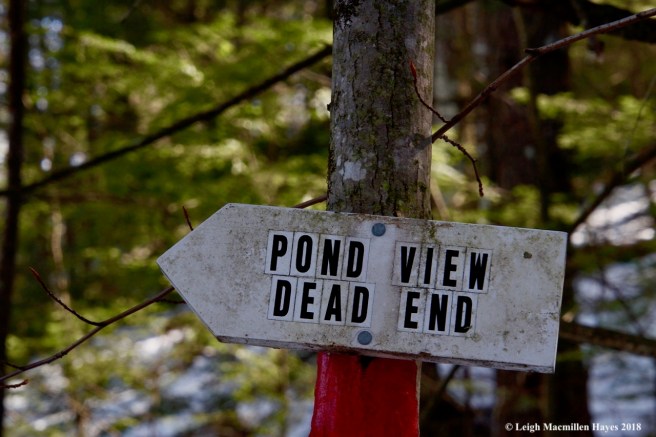
m13-dead end

A short spur on the red trail, aka Harriet’s Path, lead to one last point of view.

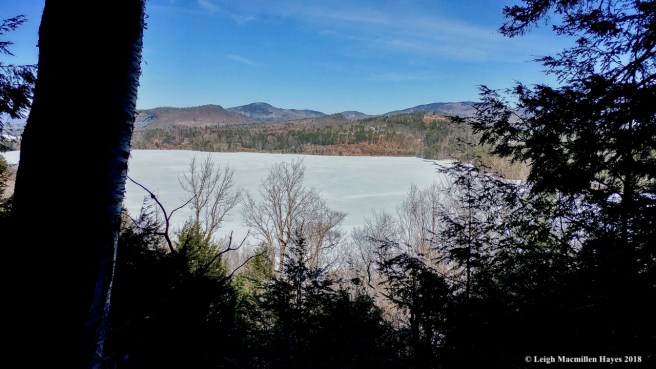
m14-pond view

South Pond below with Buck and Lapham Ledges in the distance–hikes saved for another day.

m15-boulder field

We looped back to the yellow trail and continued down through a boulder field–one more piece of what made this hike so interesting. It wasn’t long after that we completed the journey, but talked immediately about returning in other seasons for so delightful a trek it was. I can’t wait to see what flowers it has to offer and we both could only imagine it decked out with autumn’s tapestry.

m17-Greenwood Cattle Pound

On the way home, because I was driving, we had one last stop to make–by the Greenwood Cattle Pond built in 1835 just north of the city. Pounds were important features to secure stray animals prior to the invention of barbed wire and the stones would have stood taller than they do today, but still . . . another piece of history saved for this one is on the National Register of Historic Places.

At the end of the day we wondered why it had taken us so long to discover Maggie’s Nature Park, but thankfully we now have. And we gave thanks to Maggie Ring and her vision to protect “God’s good earth” for all of us. We loved the nature of Greenwood on this Mondate. Indeed.

P.S. Another claim to fame for this town: LL Bean was born in Greenwood in 1872.


Brain Share–Naturally

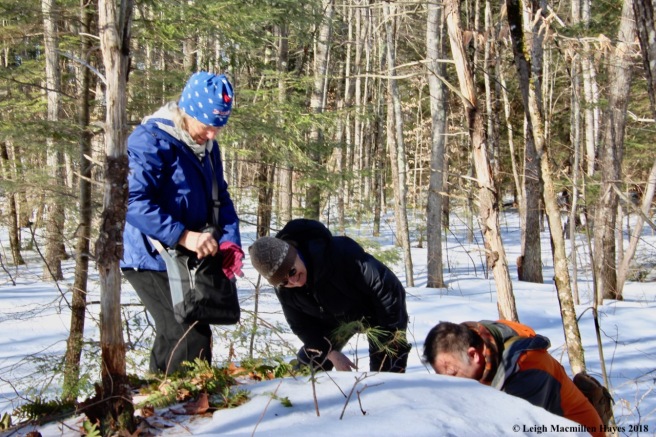
I was thankful I’d thrown my winter coat into the truck for I had a feeling it would be a better choice than a vest given the group I’d be traveling with this morning. And sure enough, though the sun felt warm, a breeze added a chill to the air. Plus, I knew we wouldn’t travel far and would spend much of our time standing around.

r0-life on a rock

Well, not exactly standing, for as Maine Master Naturalists, we’ve been trained to get down for a closer look. Our first stop–to check out the life on a rock that was revealing itself as the snow slowly melted. Karen is on the left, an Augusta grad, and Sarah and Anthony to her right, both South Paris grads.

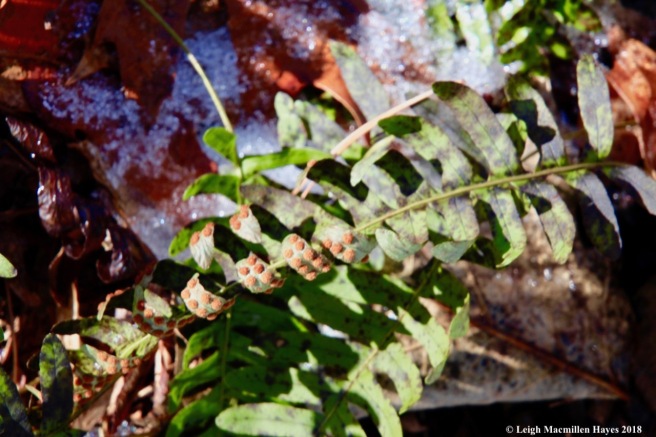
r0a-polypody

The focus of our attention was common polypody, a fern with leathery leaves and spherical spore clusters on the underside. Rocks are their substrate and they often give a boulder a bad-hair day look.

r1b-speckled alder

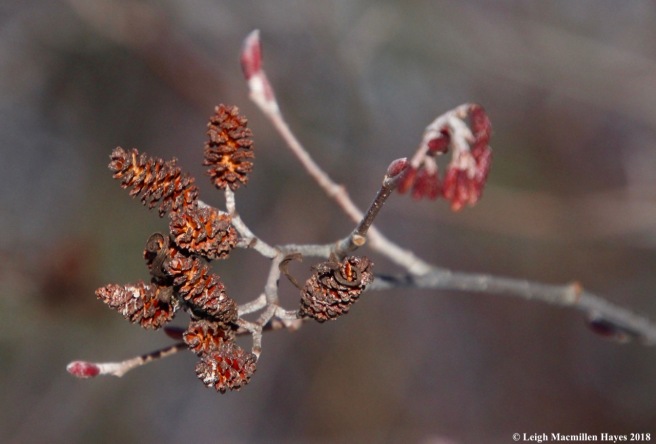
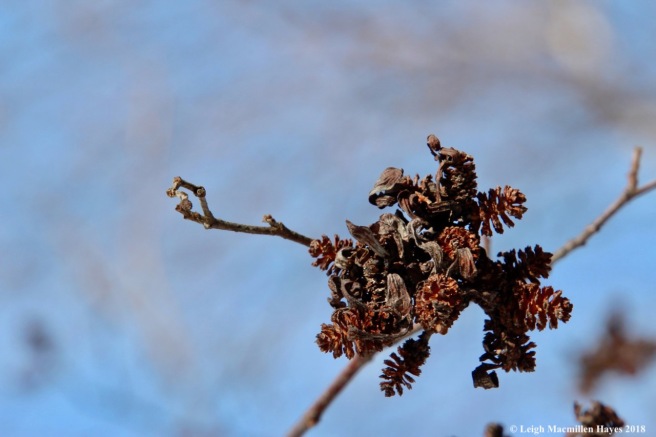
Moseying along, we reached a point where we knew we wanted to spend some time–at a wetland beside one of the Range Ponds (pronounced Rang) at Range Pond State Park in Poland, Maine. Because it likes wet feet, we weren’t surprised to find speckled alder growing there, but what did throw us for a loop was the protrusions extending from last year’s cones.

r1a-speckled alder

It was almost like they had tried to flower atop the cones and all we could think of was an insect creating a gall. Indeed, it appeared that the cones were also experiencing a bad hair day. After a little research, it may be alder tongue gall–resulting from a fungus rather than an insect infecting the female catkins. Apparently, the tongue-like growths are green to begin, but transform to orange, red and finally brown. It was certainly a new one for the four of us.

r2a-leatherleaf and sphagnum moss

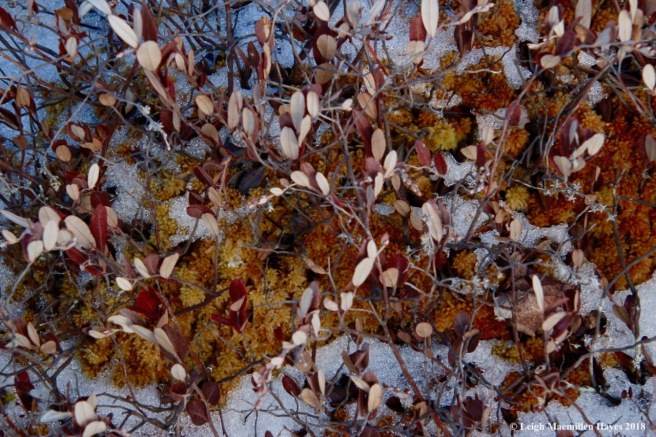
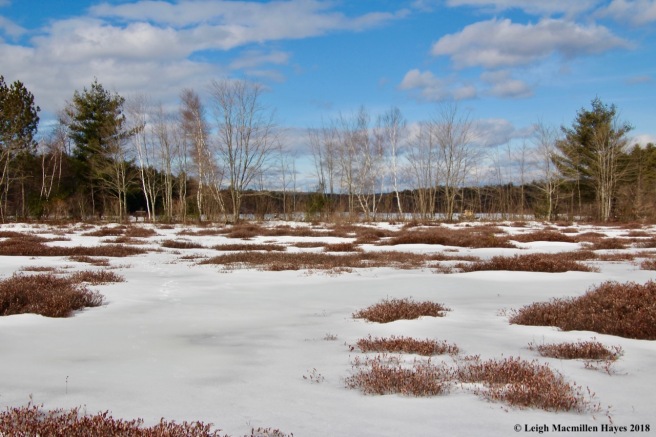
On we moved down to the wetland where the snow surprisingly held us for most of the journey and we didn’t leave behind too many post holes. Leatherleaf and sphagnum moss showed off their winter hues at our feet.

r4-cranberries

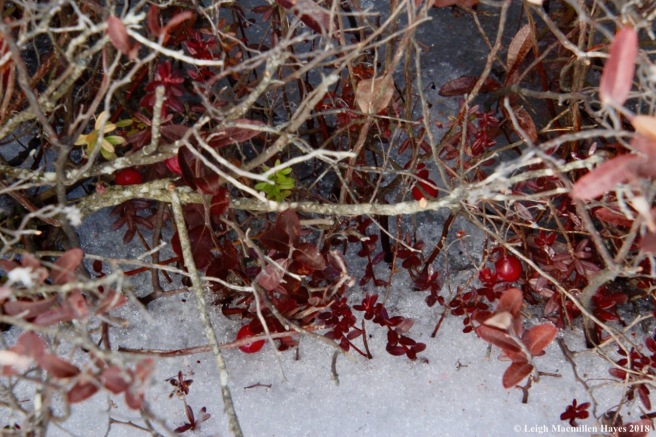
We also spied cranberries hiding underneath.

r3-cranberries among the leatherleaf

And sampled them. A few were tart, while others had fermented.

r1-two lodges

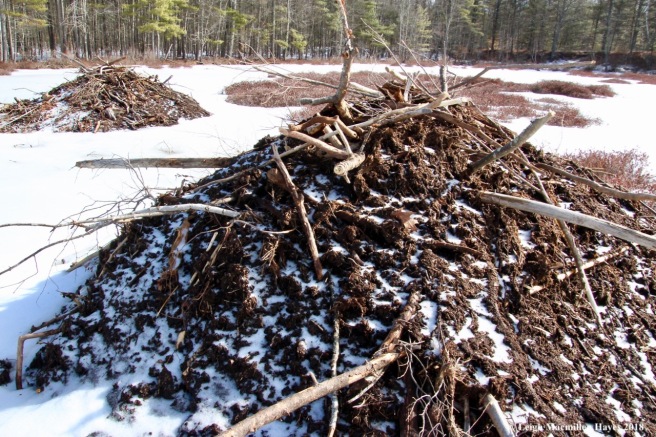
In the middle of the wetland, two well built lodges stood tall. They had fresh wood and had been mudded in the fall. One did look as if the vent hole had been enlarged, so we wondered if anyone still lived there. We heard no noises, but had to assume that we were bothering the residents so we didn’t stay long.

r2-wetland and pond beyond

One last view of the wetland and pond beyond, then we turned and walked toward the opposite side.

r5-bird nest

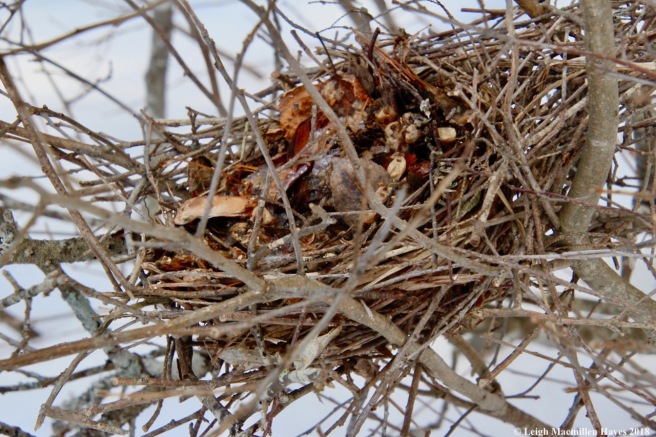
Just before climbing uphill, we spotted a bird nest in the winterberry shrubs. It was filled with dried berries, and we again made an assumption, that a mouse had cached its stash for the winter and maybe dined there in peace and quiet while the nest was covered in snow. That’s our story and we’re sticking with it. Whose nest it was prior to the mouse? We don’t know, but it was made of twigs. If you have an answer, please enlighten us.

r6-bone

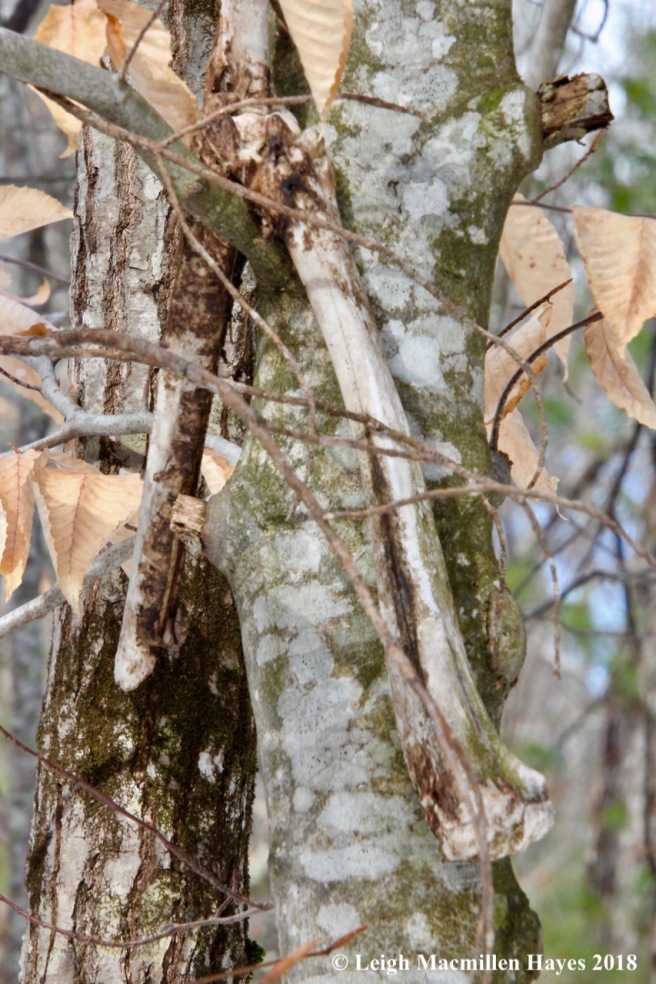
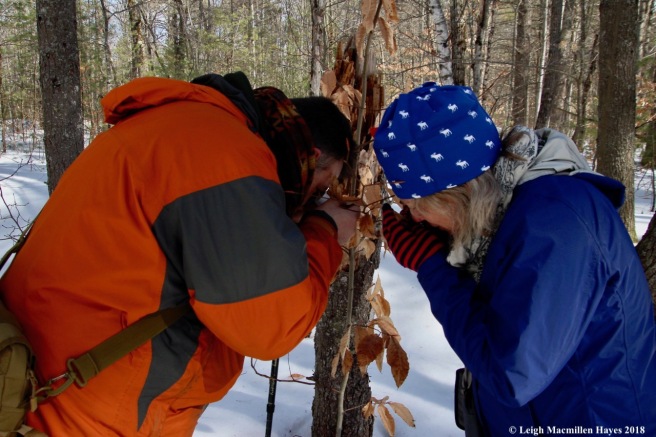
Back up on an old railroad bed, we again stopped frequently, including to talk about the beech scale insect and nectria fungus that moves in and eventually kills the trees. And then something else came to our attention–it wasn’t a broken branch hanging down like an upside-down V on the beech tree. No indeed. It was a bone. A knee bone. And it had been there for quite a while given its appearance.

r7-Introduced Pine Sawfly pupal case

Because Anthony was with us and he’s our insect whiz, we spent a lot of time learning from him–including about the pupal case of an introduced pine sawfly. The sawfly had already pupated and in this case no one was home.

r8-Introduced sawfly pupal case

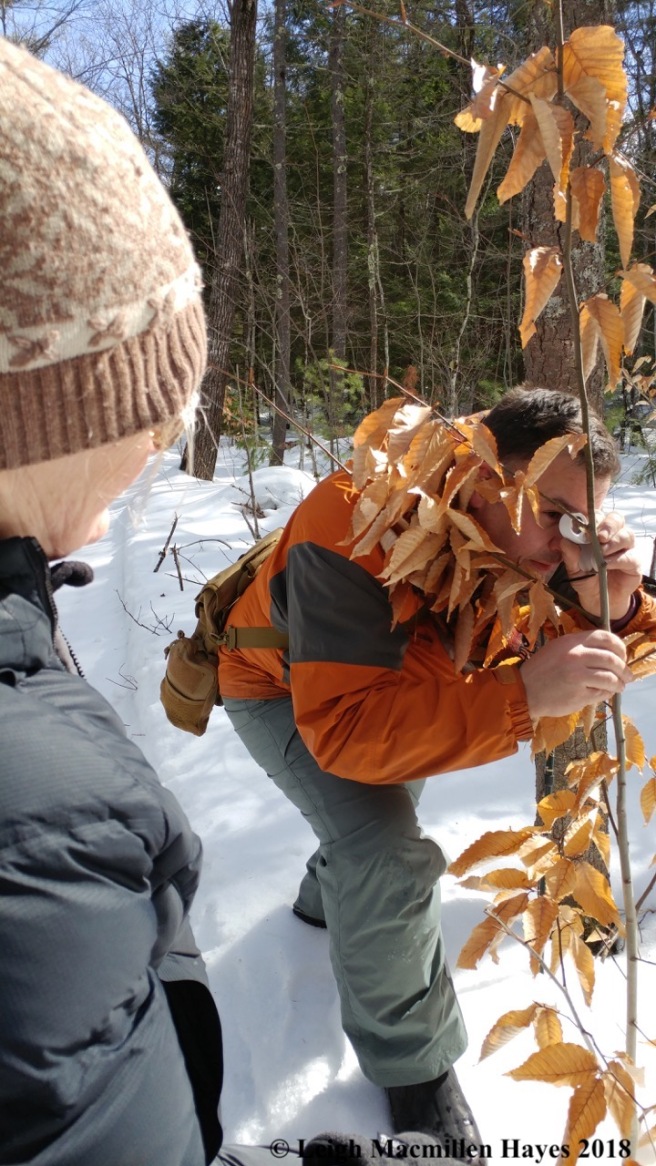
As the morning went on, we became quite adept at locating more cases of other sawfly species, including one that wasn’t yet opened. We each channeled our ten-year-old selves as we tried to be first to find the next one. But really, Anthony won for he had insect case eyes.

r9-going in for a closer look

And eyes for other things as well.

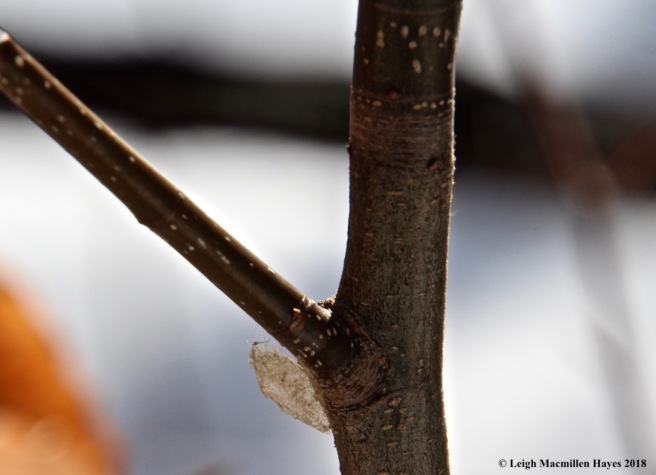
r10-old spider web case

This time we examined a delicate, almost lacy structure under a branch on a young beech. Anthony suspected a pirate spider, which tickled our fancy for we imagined them raiding the goods of others. But later he e-mailed with another option: “The old spider egg case could also be from an orbweaver of the araneidae family.” Either way, we were happy for the sighting; for taking the time to slow down and notice.

r11-beech leaves

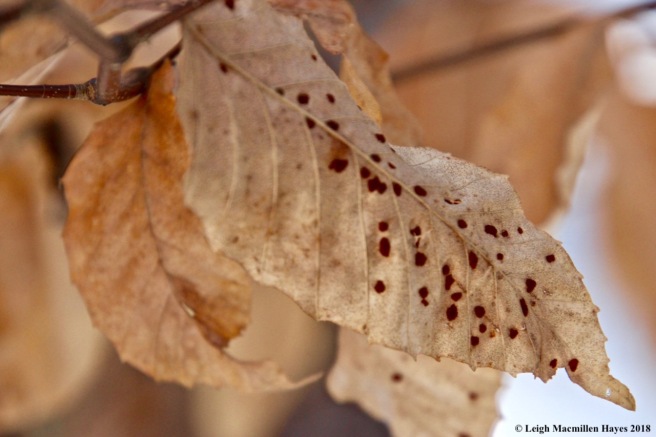
And there was more. Sarah had to leave us a wee bit early, so she missed our finds on the backside of beech leaves.

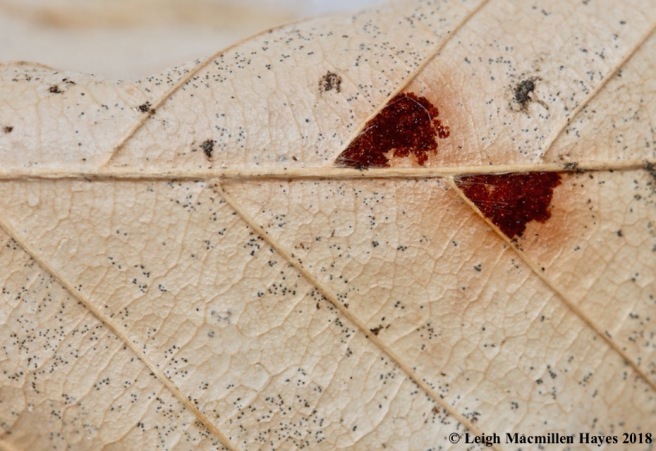
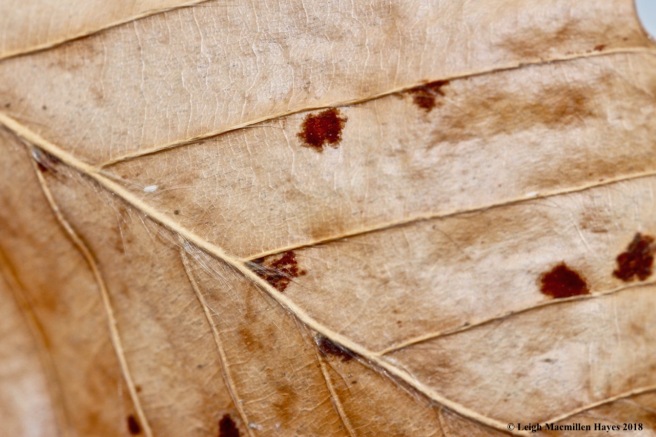
r12-maroon dots on beech leaves

They were dotted with raised bumps that under our hand lenses reminded us a bit of the sori on common polypody.

r13-maroon dots on beech leaves

Leaf rust? Was it related in any way to the splattering of tiny black dots also on the leaves? We left with questions we haven’t yet answered.

r14-hair on beech leaves

Taking a closer look did, however, remind us of how hairy beech leaves are–do you see the hairs along the main vein? And that reminded us of how the tree works so hard to protect the bud with waxy scales all winter, keeping the harsh conditions at bay. In early spring, slowly the leaves emerge, ever hairy, which strikes me as an adaptation to keep insects at bay, and then . . . and then . . . it seems like every insect finds a reason to love a beech leaf and in no time they’ve been chewed and mined and you name it.

r15-oak gall

We made one more discovery before heading out–a gall formed on oak twigs. Do you see the exit hole? It’s in the shape of a heart–apparently the insect that created the gall loved the oak.

r15-pine tube moth

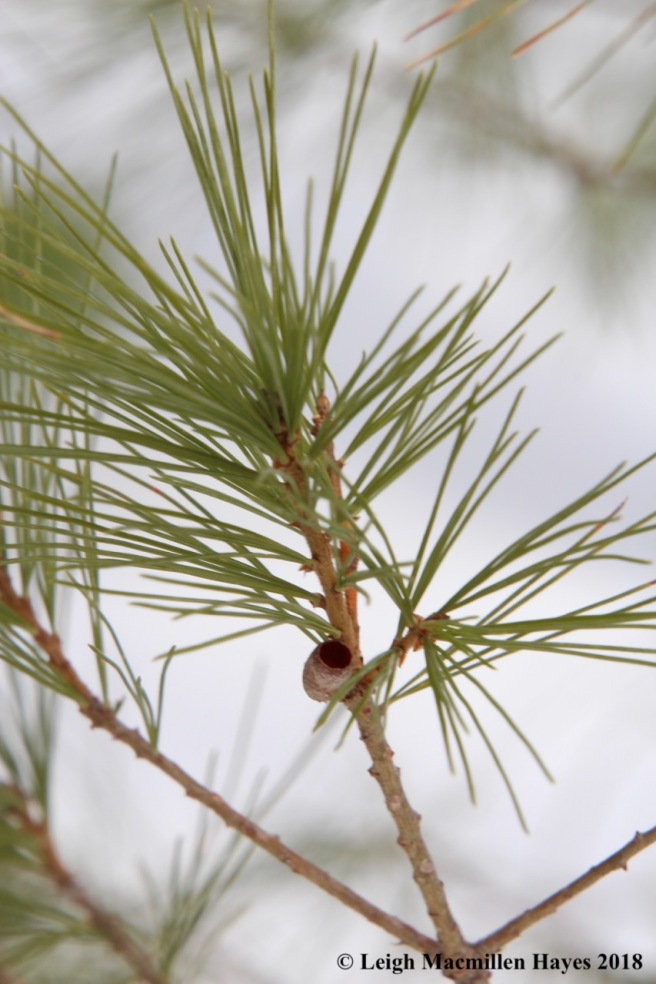
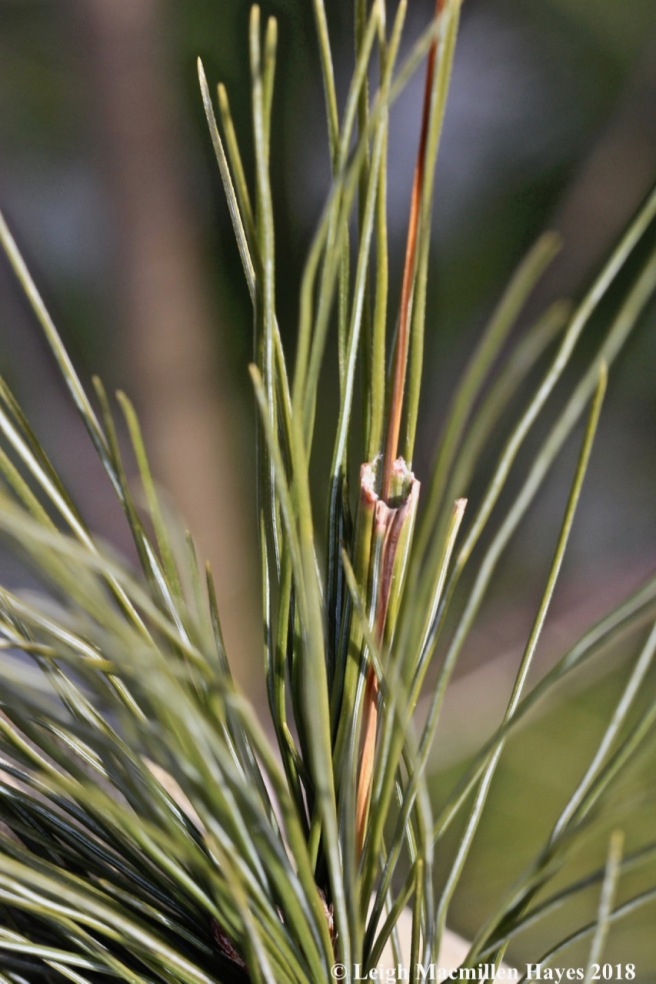
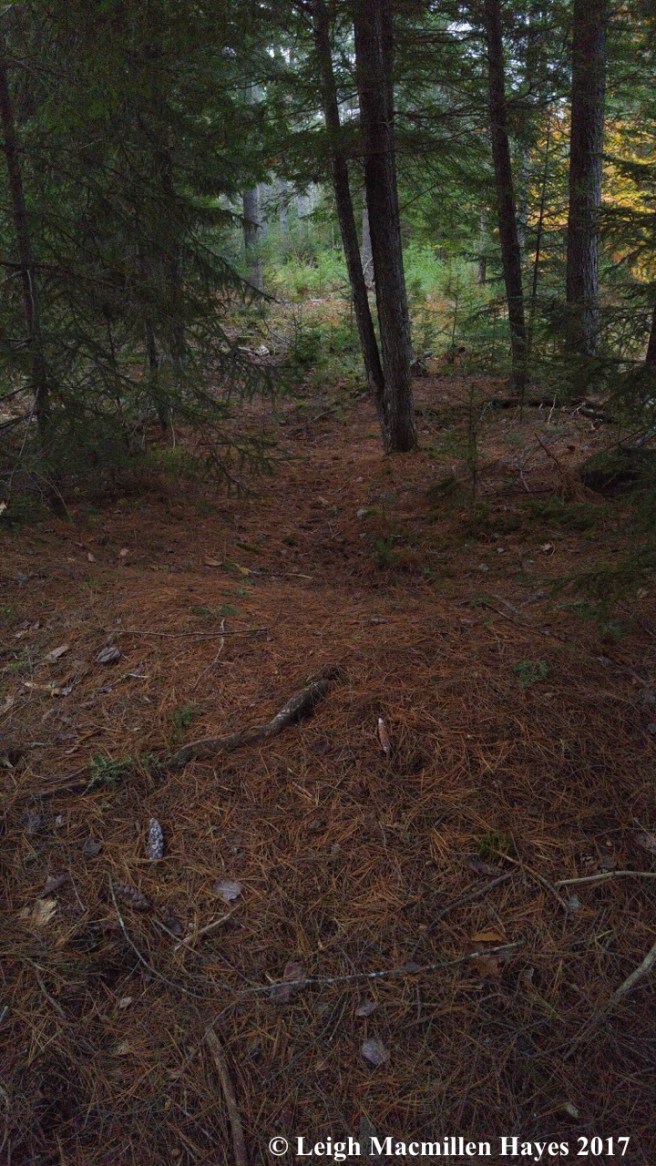
As we made our way back to the parking lot, I kept searching all the pine trees because I wanted to share an example of the tube created by a pine tube moth. Of course, there were none to be found, but as soon as I arrived home, I headed off into the woods for I knew I could locate some there. Bingo.

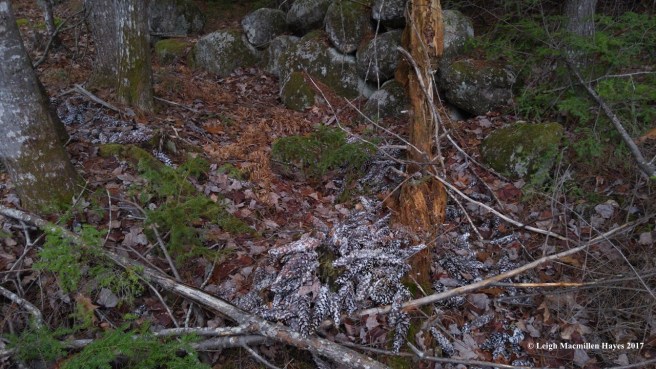
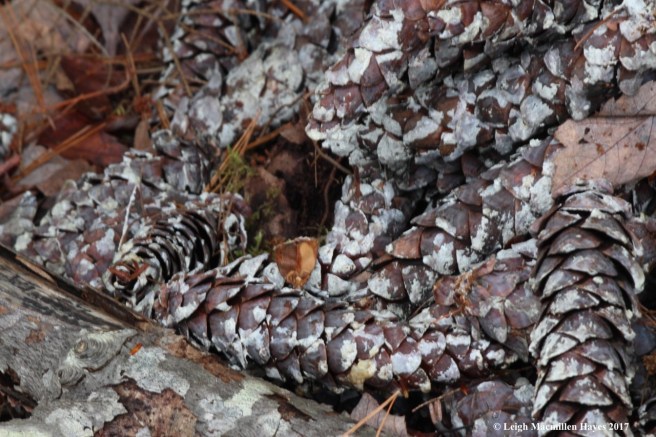
Notice how the lumps of needles are stuck together in such a way that they formed a tube. Actually, the tube is a tunnel created by the moth. The moth used silk to bind the needles together, thus forming the hollow tube. And notice the browned tips–that’s due to the larvae feeding on them. Eventually the overwintering larvae will pupate within the tube and emerge in April. Two generations occur each year and those that overwinter are the second generation. Fortunately, they don’t seem to harm the trees–yet.

Three and a half hours later we hadn’t walked a great distance, but our findings and learnings were many and we talked about how we’d added more layers to our understanding. Now if only we can remember everything. Thanks to Karen, Sarah and Anthony for sharing your brains me with–naturally.

P.S. Lewiston MMNP grads, et al, I’ll be in touch. Look for a doodle poll soon so we can get out and do the same. Or if you want to take the initiative, please feel free to go for it.


Through Younger Eyes

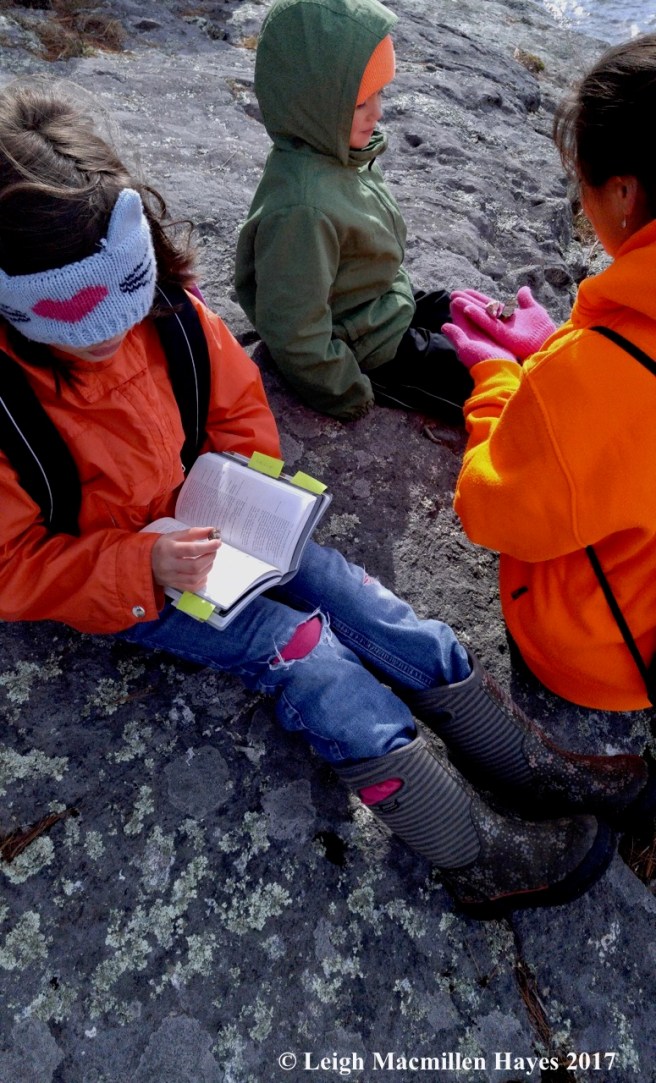
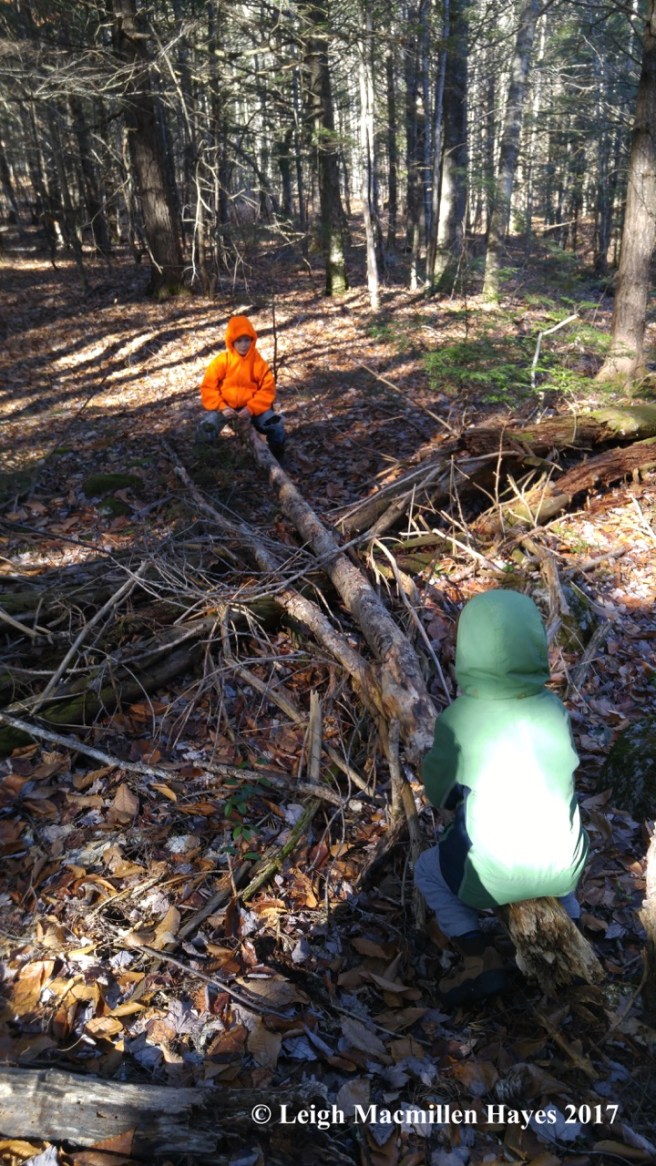
Zigzagging through the woods, my young friends find wonder in every moment. They embrace their discoveries–often with exclamations and excitement. Following the blazed trail is not in their blood, for they know that some of the coolest finds are off trail, where the fungi aren’t trampled and mammal signs not obliterated.

w-striped ledge

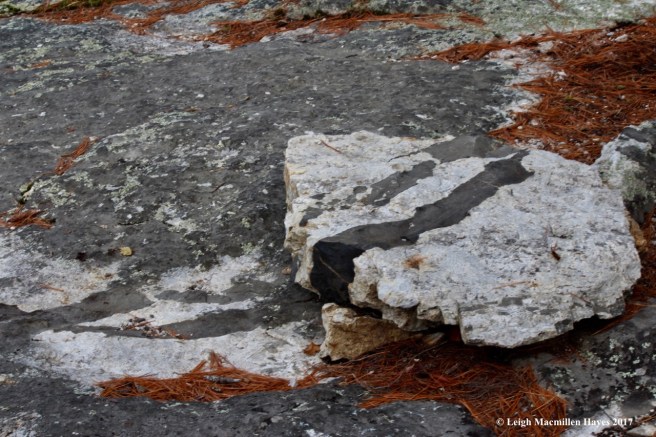
And so it was that this past week, I had the honor of spending lots of time exploring with them. First, on Tuesday, our Greater Lovell Land Trust docent tramp found us atop the “striped ledge” beside Keewaydin Lake in Stoneham, Maine. One of our docents, Mary, had obtained landowner permission for this grand adventure. From the Maine Geological Survey: “The dikes cutting the granite trend generally from southwest to northeast. They most likely intruded the host rock during the Jurassic period, when continental rifting caused extensive fracturing of New England’s bedrock (McHone 1992). Basaltic magma intruded these cracks, and cooled and solidified to form dikes such as those seen in Striped Ledge. Close examination of the ledge shows a complex intrusion history at this locality Some of the dikes have layering parallel to their walls, which may have resulted from several pulses of magma into the fractures and/or chilling of the dike margins in contact with cooler host rock . . . the dikes locally cross one another, with the older dikes being offset where they are torn apart by the younger ones.” How cool is that?

w-smiling for rosy quartz

Darn cool, especially when rose quartz was among the great finds.

w-rock hounds

And in that instant, a few rock hounds were initiated.

w-turning two twigs into a fish

When not looking at rocks, a couple of broken twigs on the ledge became a fish in one moment, and hotdog tongs in another–ever versatile were they.

w-eyeing a flower in rock tripe

But it wasn’t the ledge alone that drew their attention. When we stopped to admire rock tripe growing atop a boulder, it was the eye of the youth that discovered the green “flower” at the center.

w-Sucker Brook 2

And then the next morning, which dawned even colder than the previous, I joined the same family for a pre-hike at the GLLT’s Wilson Wing Moose Pond Bog Preserve as we prepared for a public hike. The trail meanders beside Sucker Brook, and we, too, meandered.

w-dipping into the cold for a Pooh stick

Pooh sticks were launched periodically and sometimes had to be dislodged.

w-wondering about foam

There were bubbles to watch in the brook and the foam formed to hypothesize about.

w-stump art

Nature’s artistic designs were viewed with awe.

w-pointing to hobblebush

The intention was to find a few of their favorite things. They found a few hundred and  . . .

w-seesaw

had lots of fun along the way.

w-exploring the stream

All the way along, the water, moss-covered rocks and sticks became part of their playground. But really, they also noted a variety of fungi, including their favorite green stain, which was in fruit,  a tree that had brought distress this summer for it housed honeybees and they learned that the hard way, great sliding spots from which to practice being river otters, the sunlight glittering on Moose Pond Bog and Indian pipes in their capsule form. There were sapsucker holes, pileated woodpecker activity, birch polypores, and even a surprise. They couldn’t wait for the public hike to show off their discoveries.

l-measuring diameter 4

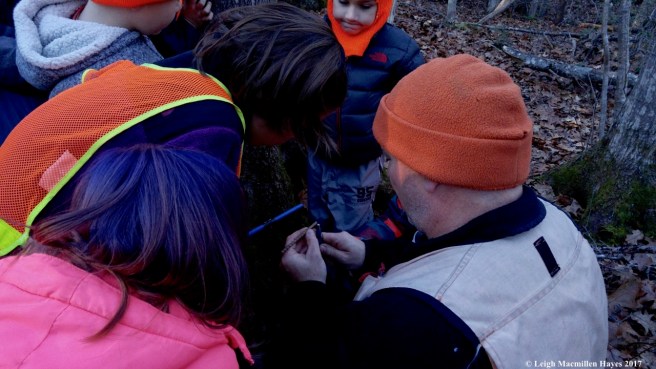
That same afternoon, District Forester Shane Duigan, joined our GLLT after-school program at New Suncook School in Lovell. The Trailblazers, as the group is known, first introduced Shane to their trees. And then he showed us some of the tools stored in his vest, such as the tape measure used to determine diameter.

w-learning how to age a tree

As the kids made guesses about a tree’s age, Shane demonstrated how foresters use an increment borer to extract a small core from a tree.

l-counting rings on tree core

They crowded in to watch him count its rings. The predicted age: 100. The actual age: 50. The fun: 100%.

w-Horseshoe Pond

And then this morning dawned, colder than our previous outings and the wind created white caps on Horseshoe Pond below the kiosk for the Wilson Wing Moose Pond Bog Preserve. It was time for our public walk to enjoy the wonders of Wilson Wing.

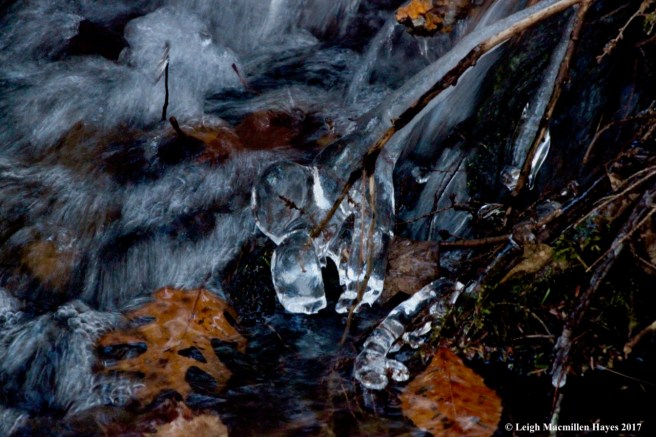
w-ice 1

One of the biggest surprises were the icicles that had formed on Sucker Brook since our last visit on Wednesday morning.

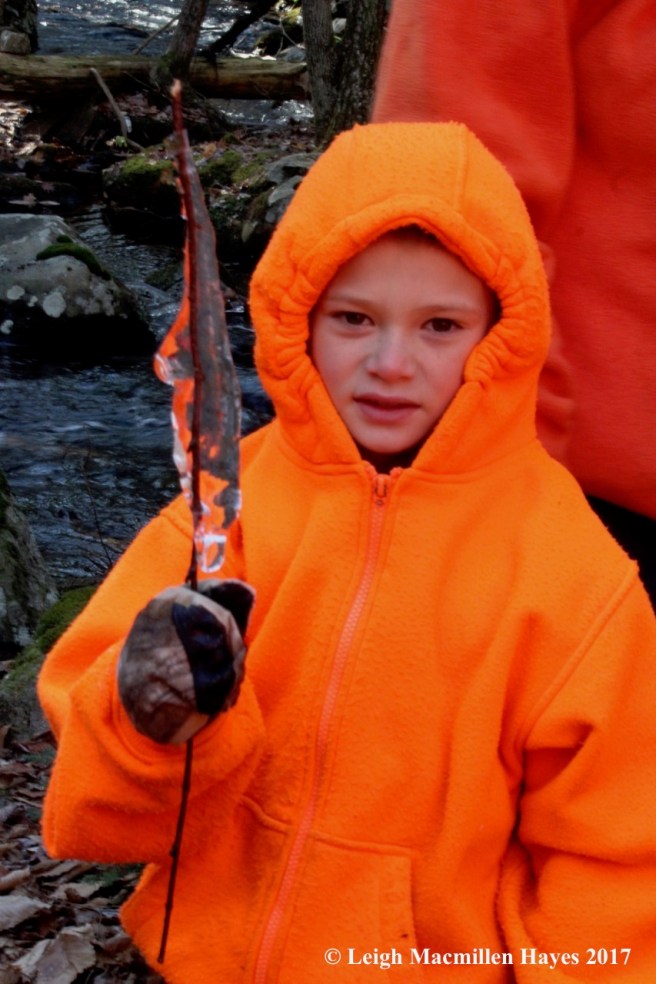
w-carrot-shaped icycle

And because they are kids, they couldn’t resist gathering such to admire up close. This one looked like a carrot, and actually appeared so as it reflected the blaze orange–our color of the season.

w-ice 2

The kids realized that the icicles formed upon all types of vegetation and created their own interesting shapes worth celebrating.

w-ice 3

One even looked like a flag blowing in the breeze when turned upright, and this guy showed it to his mom in honor of her service in the Army and the fact that today is Veterans Day. Turned on its side, it became a maze game and he really wanted to place a small ball in it and watch the ball move through. And as much as he wanted to take it home, it has to live on in his mind’s eye and this photograph.

w-wondering about the car

They showed us so many things of nature, and even the unnatural, though they imagined all the critters for which the old blue car might create a fine home–squirrels, weasels, porucpines, foxes, and coyotes were on their list. And then they turned into otters themselves and slide back down the hill over and over again.

w-polypody 1

They wanted to share some other great finds, including a few squirrel dining tables and a rock with bad hair day, but the crowd had gotten ahead of them. Despite that, they looked at the “bad hair day” fern, aka polypody, and realized that it had curled in since Wednesday’s visit. And then they figured out that the fern curls when it gets cold. Who knew you could use a fern to determine the temperature?

w1-artist conks

Though they didn’t get to share all of their finds this morning, they did make some new discoveries as they wandered off trail, like the artists conks that grew in abundance.

w1-dead man's fingers

And deadman fingers fungi that reminded one of them of scat standing upright. I’ve a feeling that description will stay with me each time I look at it going forward.

w-bear hair 1

In what seemed like no time, for we traveled the trail much faster than intended, we were back on Horseshoe Pond Road and one among us was particularly excited about a certain display upon pole 13. She ran ahead to be able to show all the participants as they passed by.

w-bear hair on pole 13

It was bear hair and scratch marks that she shared with enthusiasm. And the knowledge that we are not alone in these woods.

And just after that one of her brothers realized our walk was almost over and he was disappointed for so much fun had he had being a junior docent.

w-Sarah signing my book

A few hours later, my guy and I ventured to The Met Coffee House and Gallery in North Conway to meet up with another who encourages children and their adults to explore the outdoors. It was our great joy to join my dear friend, Sarah Frankel, for the first book signing event as she celebrated the publishing of Half Acre.

w-posing by an uprooted tree

And now it’s the end of the day and the end of the week, and I’m a better person because of the time I’ve spent with young friends as they’ve moved quickly at times and then stopped to wonder. They taught me the joy of looking with open minds.

If you don’t have kids to learn with and from, may you find time to channel your inner child and look at the world through younger eyes.


Sunday School

After church this morning, I stepped out the door, passed through openings in a couple  of stonewalls and then down the cowpath, crossed the power line, and ventured into my smiling place. It had been more than several months since I’d pushed the hemlocks aside to enter for it’s a wetland and woodland filled with growth that can make it difficult to meander through without snowshoes. But before winter arrives, I wanted to take a peek and learn what I could along the way.

o-oak saplings

My lessons started early as I noted a couple of red oak saplings growing in the hollow of an old tree stump, their color reminiscent of the Christmas season. Last year’s mast crop (and another for some oak trees this year) meant a plentiful supply of food for weevils, little brown things, squirrels, turkeys and deer. And yet, not all were consumed and so they sprouted. Now my plan will be to wait and watch–and wonder which of this array actually will win the race to adulthood.

o-huge squirrel cache 1

A little bit further into the woods, I spied a huge cache of white pine cones. This made my heart sing, for I love to keep on eye on big caches such as this and watch as they get whittled down over the course of the winter.

o-pine cones up close

While I stood there admiring the work of the red squirrel who’d filled its larder presumably when the cones were green (and by the way, these cones are two years old, for it takes two years for them to mature atop the pine trees), I thought about the sap that coats them in white. Though the sap is drier now, does it get stuck to their feet. I know that when I come in from a walk through a pine forest, I have sap on my soles, and attached to that may be pine needles or dried leaves. Is it the same for a squirrel? If so, does it wear off like that on my boots? It must because I’ve never seen it on their feet.

o-pine on the cob 1

And what about as they work on their pine-on-the-cobs? Does the sap on the scales come off on  their lips or teeth–much like when we eat something sticky and gooey like peanut butter?

o-pine seeds

It’s a lot of work to get to the two tiny seeds tucked within each scale. They look to be about an inch long, but most of that is the wing (think maple samara). When the weather is warm and dry, pine cone scales open to release the seeds. The squirrel who’d hoarded the stash, had plucked the cones when they were still green and atop the tree–dropping them to the forest floor before they opened so he’d have plenty to eat. And then he had to gather all that he’d dropped into the piles. And now I can’t wait for the coming months–to watch the pile dwindle and middens grow; to see the tunnels he makes in the snow; and just maybe to sit quietly nearby and watch him in action. He was a bit peeved that I was poking about today and let me know with so many chirrs from a branch nearby.

o-porky den?

I finally moved on and saw an uprooted tree I’ve visited on previous occasions. Last year I followed porcupine tracks to this very spot and spied porky within. But when I checked on later occasions, it didn’t seem as if he’d returned. Today, I peeked in and saw water. Even though it looked like a grand home to me, I’m learning that porky knows best.

o-walking in a hemlock grove

At times, I moved quietly upon the duff under the hemlock trees. Frequently, I stopped to listen and look.

o-cinnamon fern leaves1

And then in an opening, I was again in the wet zone where the cinnamon ferns grew abundantly. In curled formation, their leaves added interest to the landscape and a bit of a crunch to my footsteps.

o-cinnamon fern 2

And piled as they were surrounding each plant, I thought back to the pinecone cache. This was food of a different kind, for those leaves will decompose over the winter and nourish the earth.

o-snowberry 1

Continuing on, I came to one of my favorite spots–where the creeping snowberry grew. I hunted under the tiny leaves for the little white berries, but found none. And I’m not sure that I’ve ever seen them, especially in this place, for I suppose that I miss all the action since snow melt always seems to call a halt to such visitations and then I never make my way deep into these woods all summer. I have to assume that the little brown things and birds had a feast. Although, as any teacher knows, one should never assume. Perhaps next year, I’ll make a point of checking on these plants.

o-birch tree in offing

My tramp was a meander, for I knew not what direction each footstep might take me, changing my mind constantly and trusting that if I turned left or right, I wasn’t missing something in the opposite direction. The sight of a beech tree, its leaves ever rattling, did mean that I’d have a chance to move to drier land for a few minutes.

o-equisetum

And then I stepped up onto a rock, where the growth at my feet surprised me for I didn’t realize that equisetum grew in this part of the woods. Always something new to learn.

o-tamarack branch 1

That wasn’t all. As I looked around, a branch with yellow needles by my foot caught my attention.

o-tamarack branch 2

This was the twig of a tamarack tree, with its needles growing in tufts atop little spurs. Had we met before, the tree and me? If so, I couldn’t remember it. Nor could I find it.

o-evergreen hallway

Before me was a wall of evergreens, in a classroom all of their own, for really, these are among my favorite places where learning opportunities present themselves. But, today’s lesson wasn’t about the hemlock, white pine, fir and spruce idiosyncrasies.

o-tamarack tree

And so I scanned the sky, and about twenty-thirty feet away, I found the tree. A tamarack or larch or hackmatack tree, aka Larix laricina, is our only deciduous conifer because unlike all the evergreens, it sheds its needles each fall.

o-moose scat

A few minutes later, I heard movement, and looked up to see . . . no, not the moose that made this deposit last winter, but two flashes of white as a couple of deer bounded off. I think that’s one of my favorite lessons of these woods, for the landscape changes repeatedly and thus offers a variety of habitats for the mammals of western Maine. This is the place where I get to learn the most about them and their behaviors.

o-deer rub 1

Sometimes I’m rewarded with spying the mammal from a distance, but other times I find evidence of its behavior, like this antler rub with frayed bark at top and bottom and smooth wood between.

o-varied habitat 1

I’ve watched the forest succession in these woods for twenty-five years,

o-varied habitat 6

and it’s been logged again more recently.

o-varied habitat 4

With each change, comes more change. And so the mammals move from one spot to another, but they’re still all here–somewhere.

o-varied habitat

I just need to listen and look.

o-turkey tail fungi

It’s not just the mammals and trees that I get to learn about. My studies include among other topics, fungi, of which I’m only a so-so student. But I do know that this is turkey tail, aka Trametes versicolor.

o-Fomitopsis cajanderi  (Rosy Polypore) 2

And then I happened upon a hemlock stump topped with a large, beautiful display outlined in a coffee brown and salmon pink. It took me some work to remember its name. I can tell you where else I’ve seen it for it grows upon a hemlock log at Holt Pond.

o-unknown mushroom 1

Before I forget again, it’s a rosy polypore, if memory serves me right. I only hope my fungi teachers weigh in on this one.

o-logging road 1

At long last, it was time to follow a logging road back to the snowmobile trail.

o-snowberry on sphagnum

Sometimes, I slip back into the woods before reaching the trail, but today I chose to follow it. And what to my wondering eyes should appear, but more creeping snowberry atop sphagnum moss.

o-home sweet home

As I finally crossed the field toward home, I gave thanks for the classroom that is right outside our back door and for the lessons learned in this Sunday School. Now I just have to remember everything, which is why I record so much.


Peering In

As I pulled into the parking lot beside the old school in Sweden, Maine, I was excited to see the door open, meaning that for the first time I’d get to step inside and take a look.

S1-old school

The Sweden Historical Society had recently had the building cleared of asbestos and hopes to possibly turn the 1827 structure into a museum.

S2-lathe

My friend, Janet, who is past president of the SHS, invited me in and gave me the short tour–especially of the former bathrooms where the renovation revealed the plaster and lath originally used to finish a wall. The wooden lath was attached directly to the studs and then embedded with plaster; often horsehair plaster.

s3-wall paper

Once the plaster dried and formed a hard, smooth surface, it was either painted or covered with wallpaper. Janet was thrilled by the discovery of the latter and has plans to preserve it within a frame. Do you see Donny’s signature? I wondered if he got into trouble for writing his name on the wall.

s4-original entrance

We didn’t stay in the building long because we had a walk planned, but first, Janet provided a bit more history including pointing out the original door on the front of the building.

s5-foundry

And beside that in this small hamlet that is home to a community church, town hall, town office and the old school, sits another building that looked like it had been there forever. It was an old foundry that Janet explained had been moved from another location–a frequent happening during yesteryear. This year it was dedicated to the founders of the SHS (apropos–foundry for the founders), Kay and Dick Lyman.

At last, we were ready to begin our walk.

1858Map_comp_1000

1858 Map

1880_Sweden_small

1880 map

The route was a short one, but it took Janet, her friend Karen, and me about three hours to walk from Route 93 to Webber Pond Road and back again.

s6-the road

We began beside the foundry on the colonial road. Though it’s still a town road, it’s no longer traveled (except by logging trucks a few years ago).

s7-fence post

Not far along, Janet pointed out two granite pillars, indicating a fence line. And then we went off-roading, in search of other evidence of the use of this land.

s8-well

And what to our wondering eyes should appear, but an old well, its covering slabs now turned upright. We poked about some more, but found nothing else in that spot and suspected it was a well for the farm, rather than for a house.

s9-barbed wire

As we returned to the road, our suspicion was correct, for we found barbed wire that would have held the animals in. We stepped over it.

s12-bridge

Our journey continued and at a brook that flows from Keyes Pond to the north down to Webber Pond, we came to a crossing. It was a crossing that also had us wondering for it was made of large granite slabs than ran east to west in the direction of the road. Number one, we didn’t expect the slabs to serve as a bridge, and number two, if such was the case, we thought it would have made more sense if they were turned 90 degrees. And so again, we wondered what the story might be. Perhaps wood once covered the stone?

s19-single wall to double

For most of the journey, the road was bordered on both sides by stone walls–all freestanding, but some single-wide and others double. Single indicated either boundary or a way to keep animals in, while the double made us wonder about a plowed field. We noted neat construction where the stones were carefully stacked and messy sections where it seemed they’d been tossed, and again did some more wondering–were the messy parts the work of youngsters?

s11-Christmas fern 2

It wasn’t just the historical artifacts that drew our attention. Check out the withered leaflets on the Christmas fern. Its spores formed on the underside of a few leaflets, aka pinnae, of one or two fronds and that was sufficient for reproduction.

s15-lungwort 1

We also found an old favorite, lungwort; an indicator of old growth, thus a rich, healthy ecosystem.

s14-lungwort 2

And an equally fun lesson for Karen, who lives in Illinois, and had never encountered it before. Janet poured some water onto the lungwort, which is a foliose lichen, and the miracle occurred on cue.

s16-lungwort 4

With a twitch of her nose and a wink of one eye, we watched as the water reached the lungwort’s surface and changed its color from gray to bright green, while where no moisture flowed, it didn’t transform. Lichens have a high resistance to damage by dehydration and will suspend photosynthesis when they dry out. The cool thing about them is that once wet, they can quickly absorb water and get back to food production.

s18-bluestain 2

We also spied a cool fungi, and one that we seldom see fruit, but this year has been different and we’ve discovered it periodically. This is green stain fungi, so graced with the common name because it really does look as if the wood had been stained green. I used to think it was an old trail blaze. When it does fruit, the mushrooms are tiny, but among the most beautiful–at least in my mind.

s20-Mrs Webber

At last we reached Webber Pond Road and we crossed to the cemetery, where Janet pointed out those for whom the nearby pond and road were named. She also noted that while most foot stones in a cemetery are positioned in front of the headstones, these were located behind. Indeed curious.

The cemetery was our turn-around point and we followed the route back, but actually went off route because we were looking for a foundation or two. We found none as we paralleled the road, but that’s okay because it just means we need to return.

Back at the old school house, I said goodbye to Karen (on the left) and Janet (on the right) and gave thanks for the opportunity to look keenly with them–as we peered into history.


I Spy, You Spy, We All Spy

As I stepped out the door early this morning to dump yesterday’s coffee grounds, my eyes were immediately drawn to a pattern in the dew and I knew that Porky had paid us a visit.

t-porcupine trail in morning dew

His trademark sashay showed in the wet grass almost as well as it does in snow with that pigeon-toed pattern and swish of a tail. Only yesterday I’d been noting all the freshly nipped oak branches in our yard and woodlot, cut as they were at that telltale 45˚ angle.

t-flat hill sign--oxymoron

And then, after today’s coffee (grounds waiting until tomorrow to be disposed) and breakfast, I drove to Lovell to meet up with some Greater Lovell Land Trust docents for a climb up Flat Hill–that oxymoron of a name. But really, the summit is rather flat–after climbing the hill, of course.

t-trail light

It was early and felt more fall-like than we’ve experienced of late and we reveled in the temperature as well as the light along the trail as the sun played with the leaves and added a golden glow to our day.

t-coyote scat 1

When we weren’t looking up, we looked down. One of our first sights–scat! Coyote scat, we thought. Only the contents of this scat were different than most.

t-coyote scat 2

And so we went in for a closer look–for it was filled with quills. Not my home porky, but we know that the summit and rocky ledge below are porcupine territory so it made perfect sense that we found such scat in the middle of the trail.

t-fox scat

We found more scat a little further along–this one was filled with berries and seeds and also in the middle of the trail, atop a rock. Smaller in size, we suspected red fox.

t-paper birch lenticels

There were other things than scat to attract our attention, like the long lenticels on a downed paper birch–their pattern looking like either zippers on a jacket or a bunch of spruce trees in their spire formation.

t-maple-leaf viburnum

We marveled at the color and texture of the maple-leaf viburnums–like no other in the mix.

t-hop hornbeam bark and leaf

And when we reached the hop hornbeams with their shaggy bark and double-toothed leaves, we knew to look below for their seed pods. It wasn’t an easy search for they are small and blend in well with the birch and hornbeam leaves on the ground.

t-hop seed 2

But we found one–its papery sack enclosing the nutlet. We were curious to see the seed and so opened the inflated casing. It was almost a 3D tear-drop shape, coming to a sharp point.

t-hops

Skipping ahead for a moment, after we finished hiking I visited a tree back near the parking lot where Pam and I had noted plentiful fruits in the summer. It takes about twenty-five years for a hop hornbeam to fruit. And the common name–“hop” refers to the seed clusters that represent true hops used in beer production.

t-summit view 1

At last we reached the summit and stood for a while, in awe of the color display before us.

t-polypody 1a

From the same spot, we also noted the polypody ferns that grow upon the summit rock.

t-polypody spores 2

Ferns reproduce by spores rather than seeds. The itty bitty spores (think dust sized), called sporangia, grew on the underside of these leathery frond leaflets. The sporangia form clusters called sori and in the case of polypody the sori are naked. Some had already dispersed.

t-chipmunk

At last we started down, but not without a side trip of bushwhacking and annoying a chipmunk who had some housekeeping details to attend to.

t-docents 1

Less than three hours later (amazing for us), we gathered at the bottom and said our goodbyes to Darbee and David on the left–they’ll return to their winter home soon. Bob and Pam will hang with us for a bit longer, but while I reflected on all the wonderful reasons to enjoy winter in Lovell, the two couples made plans to connect in their winter habitat.

t-wooden spoon

The day wasn’t over yet and this afternoon another docent and I set up a “Kim’s game” of natural and unnatural items on a sheet covered with a bandana on the trail behind the New Suncook School. Then we walked further along the trail and hid a bunch of unnatural items for our after-school Trailblazers to locate. (We had to relocate them as well and are almost certain we found all of them. Maybe . . . )

t-noticing leaf colors

Before the kids did anything though, they introduced Linda to their trees–clusters of trees really for all are copiced, that they’ve befriended and named and gotten to know up close and personal. This afternoon, they noted that the colors of the leaves were changing.

t-Linda and Sassy

They loved giving Linda a tour and she loved being part of the action.

t-alligators in the woods

The kids did an excellent job with their observation skills, including locating at least one species that didn’t quite belong in these woods.

t-fallen log 1

And then we started gently rolling over fallen limbs, curious about what we might find below.

t-red-backed salamander

And what to our wondering eyes should appear? A red-backed salamander under the first one. We rolled a few more and didn’t find much. But then we heard something and stood still as we listened. Finally, it called again and we called back–a barred owl was somewhere nearby. At last it was time for the kids to head home and as we walked out of the woods to meet their parents, we stopped to roll one more log–where we found a yellow-spotted salamander. Unfortunately, in our excitement, I couldn’t take a decent photo, but still . . . we were thrilled.

What a perfect day–of I spy, you spy, we all spy. Indeed we did.


Continued Wandering into the World of Wonder

I’ve spent most of the last two years wandering, not even taking time to seek the answers I thought I sought.

c-ichnueomon wasp female

But along the way, I’ve seen so many incredible things that have been placed before me from the female ichneumon wasp with a disc on her cerci and her body throbbing as she injected her eggs into an insect larvae on tree bark  . . .

i-helleborine wasp 1

to a yellow-nosed wasp, so named by me for the pollen that was stuck to its antennae after it visited a helleborine flower . . .

i-dragonfly and exoskeleton 1

to a dragonfly emerging from its exuviae . . .

p16-fold looking toward lighthouse

to the folds of the earth at Pemaquid Point . . .

c-geology folds

and Mount Chocorua . . .

h-pond-quaking-bog

to fall colors reflected on Holt Pond . . .

r-crescent-view-2-1

and throughout Raymond Community Forest.

p-a future embraced

The answers are wrapped up in the promise of blossoms to come . . .

l-dandelion seed head

and seeds on the fly.

p-today-in-and-out

It’s recognizing the swish of a porcupine’s trail in the snow . . .

m-opossum-print-2

or the realization that a track I’d never seen before was visible in our woods—that of the opossum.

artist conks

And it’s all enveloped in the knowledge that mycelium cover the earth and through the process of decomposition break down most matter (all matter that matters, but not things we’ve created such as our ubiquitous plastic or even this computer).

l-wood fern with sori

It’s the realization that the Earth was formed eons ago and that the word eon refers to geologic time and that plates collided and continue to do so and pressures form and rocks develop. And plants like ferns . . .

l-princess pine

and club mosses were once dominate species and as tall perhaps as our trees. It’s this and so much more.

i-lady beetles canoodling

And all of this brings me to faith. And I realize I do believe in a spiritual being. But my spiritual being is not imbedded solely in the Trinity of Father, Son and Holy Spirit. It’s more than that. In all times, we’ve found people to emulate and follow. The Bible offers one such example and its writers were brilliant. For Jesus was a common person who came into this world in a way I’ve yet to understand. Was Mary really a virgin? Or was she a young woman free of sin? Or?

i-damsel larvae

According to the stories, for that’s what they are, or perhaps they are tales, sagas, lore passed from one generation to the next until all was eventually jotted down and probably revised many times over and edited by publishers, Jesus was a carpenter. A common man. With wise thoughts and perceptions. I know many such people. And so, I think that the Bible offers an example or a way to live. And a way to think. And a way to behave. But, I don’t think it should be taken literally. I don’t know how the universe was created, but it’s too simple to merely state God created it in one day or even one week.

i-baskettail, common baskettail 1

I also don’t understand those thin places where one can see both this side of life and the other side of heaven—if that’s what thin places means. But I do know that I’m intrigued by the concept. Maybe I’ve experienced such without the realization. And maybe I need to practice awareness and be more open to offerings.

i-ambush and bee 2

I have discovered that heaven and hell remain the same, whether I walk through the red doors at the church entrance and partake in communion and fellowship or find my way along a wooded path where other revelations occur before my eyes. And so, after all these years, while I embrace a church service, I’ve learned to leave guilt behind on those Sundays I choose to worship outdoors rather than in.

i-moth

In either case, I’ve so much more to learn. So many things not yet recognized; so many questions not yet formed.

i-hoverfly1

And so today, I invite you to continue the journey with me—into this world of wonder. May the answers slowly reveal themselves, while the questions never end.


From wet to sweat

“Will I need waders?” I asked before we departed from the Lakes Environmental Association’s office  early Wednesday morning.

Dr. Rick Van de Poll looked down at my hiking boots and said, “No, you should be okay if you don’t mind getting muddy.”

l1-into the fen

And so, LEA teacher/naturalist Mary Jewett and I joined him to begin a two-day survey of LEA’s Highland Lake Preserve. The 325-acre property was the gift of the David and Carol Hancock Charitable Trust. Except for two logging roads, there are no trails.

Our first destination was in the middle of the fen. OK, so Mary and I should have known better because we know how much it has rained this summer. But really, it was quite hot that morning and our feet did get wet.

In fact, she found a deep hole on the way in.

l1-fen plot

Once reaching the plot, our tasks were several.

l1-flag

We helped delineate the boundary with measuring tape and flagging, the first being 10 meters by 10 meters, and then found the center, thus creating four quarters.

l1-Rick 1

Under Rick’s patient guidance and teaching, we began to survey the site, section by section, while he recorded our findings.

l1-measuring trees

Trees were first and needed to be measured to make sure they were trees after all, and not considered saplings.

l1-rhodora 1

Layer by layer, including shrubs,

l1-tamarack

seedlings,

l1-round leaf sundew 2

and herbaceous ground cover,

l1-round-leaved sundew 1

we made our way down.

l1-wasp pupa on hornworm 1

Along the way, other discoveries presented themselves, including wasp pupae on a hornworm,

l1-garden spider 1

black and yellow garden spiders,

l1-garden spider 2

weaving their signatures,

l1-eastern pondhawk

eastern pondhawks,

l1-eastern pondhawk 1

up to the measure,

l1-green frog

and of course, green frogs.

Swamp Thing

Four hours later I found a deep hole as we departed that plot. We slogged out, water swishing in our boots, and quickly ate lunch.

l2-hemlock plot

And then it was back into the woods for the afternoon, this time a hemlock grove. On the way, we marked off a site for Thursday’s work, before reaching our destination for the afternoon.

l2-surveying the site

This plot was 10×20 meters and so within we had nine smaller plots to examine in the same manner.

l2-squirrel bites

Though we identified all the species from top to bottom, we also noted more cool finds like squirrel chews on a striped maple,

l2-glue crust fungus

a crust fungus that acts like a glue and attaches dead wood to live,

l2-spotted wintergreen

and spotted wintergreen, listed as S2 meaning this: “Imperiled in Maine because of rarity (6-20 occurrences or few remaining individuals or acres) or because of other factors making it vulnerable to further decline.”

l3-plot 3 (1)

I had to miss the Thursday morning session due to a GLLT hike, but met Rick and LEA’s education director, Alanna Doughty, as they finished their lunch. I think they extended it a few minutes as I was a wee bit late. This time, Alanna and I sat on the tailgate of Rick’s truck as he drove down a logging road–I, of course, held on for dear life, while she nonchalantly acted like it was a walk in the park. The best part of the ride was the smell of sweet-fern that our feet occasionally dragged over. And then our march began with a short trek through a wooded forest, before we reached the highbush blueberries and other shrubs that acted like hobblebush and made for careful movement.

l3-black and red spruce 3 (1)

The first afternoon site was in a black spruce bog and for once, I could confidently differentiate between black and red as they stood side by side–both by their colors, the black having a blueish hue, while the red was more yellowy-green, and their gestalt.

l3-cinnamon and chain ferns

One of my favorite learnings from that plot was the difference between cinnamon fern and Virginia chain fern. Again, they were easy to ID by their colors, the cinnamon already dying back. But notice the similarities.

l3-chain fern

And then we looked at the back side. While cinnamon has a separate fertile frond that forms in the spring and then withers, chain fern’s sporangia are oblong and on the underside.

l3-chain spores 2

The area was thick with the chain ferns and our every movement meant spores flew through the air.

l3-pitchers (1)

Every movement also meant we had to watch our every step, for so numerous were the pitcher plants. It was a great opportunity to ask Rick about the color of these–I’d been told that green is rare, but he said it’s just a matter of sunlight and age, all eventually take on a redder hue in veins and then overall leaf coloration as they mature.

l3-pitcher plants

Their flowers were also plentiful in this lush space.

l3-chanterelle waxy cap 1

Among other things, Rick is a fungi expert (and an overall fun guy with corny jokes–the mark of a teacher), and so our learnings were plentiful, including these chanterelle waxy caps.

l4-plot 4 (1)

After making our way back out through the tangle, we hopped back onto the tailgate for a short ride and then headed off into a mixed forest for the final 10x 20 plot.

l4-deer skull

Our cool finds in this one included a much gnawed skull,

l4-orchid

and spotted coral-root.

l4-bristly clubmoss

I also learned to ID one clubmoss–bristly tree so named for its bristly stem.

l4-back up the road

It was dinner time when I again held on for dear life as we drove up the road. To say we were sweaty, stinky, hungry and pooped would be an understatement. By the same token, I think I can speak for Mary and Alanna to say that we were more than grateful to have spent so much time learning from Rick. From wet to sweat–it was well worth the effort.


Into the Mystery

Step along the path with the Greater Lovell Land Trust docents and you’ll soon discover that we don’t have all the answers, but we enjoy considering the questions.

m-hazelnuts 2

For starters, we love the otherworldly structure of beaked hazelnuts but why do they  have such long beaks? Is it to keep animals at bay? The fuzziness isn’t enough? And why do some beaks form where no nut is present? Plus, how do the animals know when they are ripe? We asked the latter as a couple of us stood in the Flat Hill parking lot this morning at the end of Heald Pond Road.

m-hazelnut 1

The resident hazelnut is loaded and we’ve a feeling it won’t be long before they are harvested because as we looked under the leaves for other fruits, we discovered several splitting open. Perhaps that answers the question about how the animals know–do they smell the nuts that are exposed?

m-Indian pipe fertilized 1

Then there’s the Indian pipe that’s been fertilized. So, typically, the flower hangs down until fertilization. Who fertilizes it? I’ve heard moths and flies. But last year I saw a bee visit several. I’ve never seen either of the former, though they may be nocturnal. And then, how do the flowers make that transition from drooping to upright? Of course, it’s not just the Indian pipes that do that.

m1-cucumber

Indian cucumber root is another example. Just a month ago, its dainty flowers drooped below and now the fruits have formed above the second layer of leaves. Soon, as the fruits mature and turn purplish blue, so will the inner ends of the leaves–why is that? Is it a shout out to birds that the fruits are located there?

m1-marginal wood fern

And then there was the marginal wood fern growing on top of a rock, its stipe or stalk below the blade covered with brown scales and fronds blue-green in color, which is often a give-away clue that it’s a wood fern. How does it survive on this rock where there isn’t much soil?

m-marginal wood fern

We know how it got its name–for the round sori located on the margins of the underside of the pinnules or leaflets. Based on their grayish-blue color, they hadn’t yet matured. But why are some sori such as these covered with that smooth kidney-shaped indusium? What aren’t all sori on all ferns so covered? And why aren’t there more wood ferns in these woods?

m-mystery stones 3

At last we arrived at our biggest mystery of all–a stone structure on the back side of Amos Mountain. Last summer, after we visited this site with Dr. Rob Sanford, a University of Southern Maine professor and author of Reading Rural Landscapes, we came away with so many questions about this structure located on a mountainside so far from any foundations.

m-mystery hearth?

Who built it? What was it used for? Was there a hearth? Did it have a roof? Was it fully enclosed? Was there a front wall?

m2-rocks

Large boulders were used in situ and smaller rocks fit together. One part of the “room” is curved. For what purpose?

m-mystery 2

Immediately after that walk with Dr. Sanford, two of our docents decided to dig in and do some research at the Fryeburg Registry of Deeds and Lovell Historical Society. They are currently in the process of doing just that and maybe the mystery will be solved soon.

As curious as I am about the answers, I think I’ll be a wee bit sad if they are able to tell the story. Stepping into mysteries keeps us all on our toes–forever asking questions and seeking answers. Stay tuned on this one.


Sprinting up Mount Tom

With the Four on the Fourth Road Race only five days away, my friend Marita Wiser and I are in training. Perhaps a more apt description would be cross-training, for our actual time spent running has been sporadic, but we’ve both been on hikes that we’re sure will give us an upper edge. Look for us to cross the finish line in record time on Tuesday–or not.

To that end, this morning we climbed Mount Tom–with a desire to see what the new West Ridge Trail had to offer in a different season. In the past year, she and I hiked it in October, while my guy and I snowshoed up the trail in February. And so, Marita did what I like best because we wanted to make a loop–she parked at the base of the original trail about 2.3 miles in on Menotomy Road and we walked 1.4 miles down the road to the new trailhead.

t-Mount Tom Preserve sign

The last time I visited, the snow was deep and up to the base of the preserve sign. Today, a red maple sapling claimed that spot.

t-bristly sasparilla 2

Next to it grew a bristly sarsaparilla, its rounded umbels standing tall above the leaves.

t-bristly sarsapirilla 2

As we stood there and applied some bug dope, a hoverfly, an important pollinator, worked its magic on the flowers.

t-relic 1

And then we stepped onto the trail and were immediately reminded of the past by a relic someone left on a rock.

t-homestead foundation

The homestead, possibly that of A.H. Evans, is located within feet of the trail’s head. And it appears that if this did belong to A.H., he was the head of a large family for it’s a huge foundation.

t-center chimney

Equally large was the center chimney.

t-outbuildings and barn

And based on the configuration of rocks and boulders we stepped over as we turned left between the house, outbuildings and barn, all were once attached.

t-barn

The barn foundation was also impressive and we could sense the work that went into such a creation. Among all the buildings were some recovered artifacts and I’ve a feeling I know who unearthed them. I love to see these relics, but hope that others won’t continue to follow suit and look for them. Or take them. Okay–that’s my salt box speech for today.

Again, assuming all of this belonged to A.H., I did discover a 1916 document that suggested he grew rutabagas: “A. H. Evans, Fryeburg, raised 90 bushels rutabagas in 1-8 of an acre.”

t-old pine 2

We followed the white-blaze trail, which was fairly well defined, and passed through a mixed forest, where at least one old white pine spoke to the history of this land, for it obviously once stood in an opening allowing it to stretch its arms and perhaps provide shade for farm animals.

t-ledges 1

One of my other favorite features of the West Ridge Trail, besides the foundations, are the ledges that stand as tall rock gardens.

t-ledges 2

Some were even terraced and though we didn’t pause to look for evidence today, we got the sense of where the house and barn foundation stones were found.

t-wild sarsapirilla plant

As we continued to climb (and sweat for it was a bit of a cardio workout–and humid), a couple of woodland plants stood out, including the wild sarsaparilla, which had flowered  in the spring. It was fun to note the difference between the bristly and wild–for the former flowers now with those umbels above the leaves, while the flowers of the latter developed below its leaves.

t-wild sarsa fruits 2

The wild sarsaparilla flowers have since turned to green fruits, which in time will ripen to a reddish-purple display. They were rather like mini green pumpkins in fireworks formation, a description conceived due to the pending holiday.

t-marginal wood fern 2

Another offering was the bluish-green fronds of a marginal wood fern.

t-marginal wood fern 1

A bent frond on one showed off the round sori located near the margins.

t-summit 1

After about an hour and a half, which included our walk down the road to the trailhead and then up the trail, we reached the summit. In the fall and winter, Pleasant Mountain had been plainly visible in the background, but today we had to peek through leaves to see it.

t-new oak leaves

As we peeked, Marita asked about the red leaves on an oak–fall couldn’t be on the horizon already, could it? I shared one theory with her, but after a wee bit of research discovered there may be a second–and possibly more.

The leaves were young and the red may act as a sunscreen, protecting them until photosynthesis takes place when they are fully developed.

The other thought is that the red may serve as a warning sign to mammals that the leaves contain chemicals that will taste bad, thus preventing them from being eaten.

Other theories?

t-spotted st johnswort 2

Our summit stay wasn’t long, but long enough to enjoy the bushy stamen of spotted St. Johnswort.

t-pink corydalis 1

And the daintiness of pink corydalis.

t-hiking down the old trail

And then we followed the old trail down, through the hemlock grove and onto the logging road, which had grown in so much that it made us wonder if The Nature Conservancy wants to discourage its use. The thought of ticks crossed our minds, but she sported her treated tick gators and I used Repel®. Both worked for us, though I do want to get a pair of gators. I’m taking recommendations for brand.

t-Mt Tom cabin sign 2

Just before the end of the trail, we once again paused by the Mt. Tom Cabin, the real deal for a 19th century “camp” experience, but with a few added amenities including electricity. I like it for its structure, views and Northern white cedar.

t-Mt Tom cabin pond

Across the field, Old Glory blew in the breeze and reminded us of our need to “train.”

Our hike to the summit–it was as quick as we could make it, even with me taking a few pics, for the mosquitoes were thick. But–thanks to those very mosquitoes, we sprinted up Mount Tom in honor of our training regime.


Ain’t Lovell A Great Place To Be?

On my way to meet a few docents and the new interns for the Greater Lovell Land Trust this morning, a photo opp presented itself and I was forced to stop.

h-stan's sign

Stan Tupaj of Kezar Realty strikes me as the town cheerleader and I love to read his sign as I pass by. From time to time I’ve meant to photograph it, but somehow always seem to be in a rush to get to the next destination. But this morning I was a wee bit early and so this was the day.

h-heald sign

From there, I drove on to the Fairburn parking lot on Slab City Road where I planned to meet the crew.

h-green frog

Our goal was to walk to Otter Rock, not a far walk by any means, but it took us 1.5 hours to get there, such were the sights along the way, including a few green frogs in puddles along the trail. I know he’s a green frog and not a bull frog because he showed off a dorsal lateral fold along the sides of his back.

h-baby toad

While the green frogs were beside or in the water, the ground seemed to hop at our feet in dry places thanks to a kazillion baby American toads on the move.

h-Ellie and the baby toad

I noted that it seems the younger toads are in constant motion, while older and much chunkier ones pause and try to blend into their surroundings, allowing us to study them (and take photos–just saying). One of the younger members of our team, Ellie, proved me wrong as she charmed a young toad to stay still while she looked at it through her hand lens for several moments. It wasn’t until Ellie moved that the toad hopped away.

h-damselfly with eggs

While Ellie was the toad whisperer, her older brother Caleb wowed us with his ability to capture dragonflies and damselflies in a net, such as this one. As he held it high, he realized it was a she for there were eggs on her abdomen and so he gently released her–in hopes she’d find some vegetation on which to inject those tiny sacs.

h-keeping mosquitoes at bay

Their youngest brother, Wes, demonstrated the value of bracken ferns–which served as a fun hat to keep the mosquitoes at bay.

h1-Aidan

And it wasn’t until later that I realized I didn’t have a photo of Ellie’s other brother, Aidan, but I knew of one from a prior insect walk that showed his own curiosity.

h-grape fern

We looked at tons of plants as well and were all especially eager to re-greet the grape ferns that we knew grew there.

h-exoskeletons 2

At last we reached our destination, Otter Rock on Heald Pond, where we found what we had hoped for: exoskeletons decorated the landscape.

h-exoskeltons on shrub

Dragonflies lay egg clusters into sediments or tap small clumps directly onto the water’s surface. Each egg hatches into a small nymph, which grows until its ready to emerge as a flying adult. At that time, the nymph crawls to the surface, and ever so slowly, the adult pulls itself free of the exoskeleton. It’s the most amazing process to watch. But even if you don’t have that opportunity, just seeing the left over nymphal shells and knowing that the magic happened is worth a wonder.

h-exoskeletons on ground

We had to watch where we stepped, for the exoskeletons not only decorated the shrubs, but also the ground . . .

h-exoskeleton on tree

and even the trees.

h-widow skimmer

And then we began to notice newly emerged dragonflies like the widow maker on Otter Rock,

h-black-shouldered spinyleg

and black-shouldered spinyleg on the ground. We were afraid to step for everywhere our eyes focused, there was either an exoskeleton or a dragonfly drying its wings in preparation for a first flight.

h-chalk 5

As we looked about, Caleb spotted one struggling in the water, so he pulled it out.

h-chalk 4

Coated in a bit of pollen from the pond, it still clung to its exoskeleton.

h-chalk-fronted corporal 1

We watched for a few moments as it moved about, those wings slowly drying. I think my ID is right and this was a chalk-fronted corporal. At last it was time for us to draw our sense of wonder to a close and make our journey out.

h-meet the interns

But first, I asked our interns to pose–meet Hannah, Kelly and Dakota. Today was their first day of work and we probably overwhelmed the two guys a bit. Hannah was with us last year, so she knows our ways–that we walk slowly and look at everything. She gets it and we love that. We’re excited about the possibilities ahead. Join us for a GLLT walk or come to an evening talk and you’ll get to meet them.

h-heading out

Our walk out was much quicker, though we still stopped occasionally.

h-stan's sign

In the end, I have no doubt that we knew the answer to Stan’s question: Lovell IS a great place to be.