June Dandies

It’s early June and our world is lush, given this past winter’s snow and now the spring rain. Areas that we remembered as being dry last year, are filled with puddles or streams right now ( I promise I’m not going the mention those pesky little buzzers that frolic about my face and sting my hands–and how much they’re loving the current conditions. I did spot some dragonflies yesterday, but today not a one).

r-lady 3

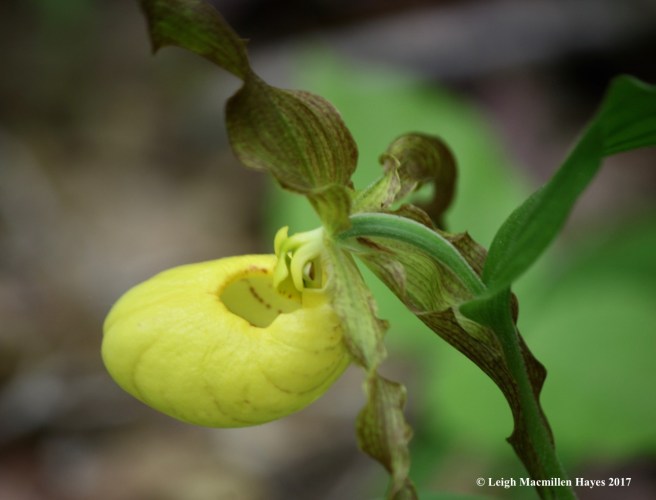
It’s those wet conditions that threw a friend and I off for a wee bit this afternoon as we tramped through the woods in search of a yellow lady’s slipper. Initially, we were about fifteen feet too far to the right as we tried to avoid the water.

r-lady 2

After wandering for a short bit, we finally found it on a bit of dry land–and then stood in awe–at our own ability to locate the flower, but even more so at the flower itself.  Yellow lady’s slippers are not rare, but uncommon and so we rejoiced with our find. They prefer mesic (moderately moist) nutrient-rich forests (as well as in bogs and swamps), thus the water (and mosquitoes–okay, so I broke my promise).

r-lady 7

Lady’s slippers are members of the orchid family.  I used to think orchids were flowers girls wore on their wrists for senior prom or grandmas coveted–though I never knew either of my grandmothers, but certainly it was an “old lady’s” flower. My, how my understanding and appreciation has changed because I am certainly NOT an old lady. Or am I?

Check out the reddish-brown dotted pathway–like landing lights at an airport runway. Their intention is to guide pollinators. If we remember to return in the fall and look for a seedpod, we’ll know that the dots worked. They often don’t.

r-brook 1

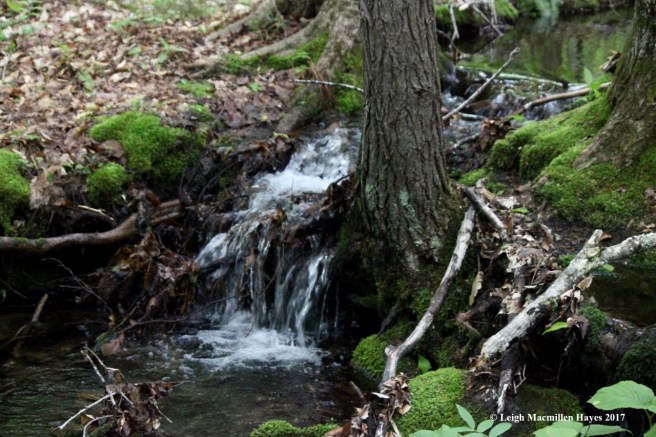
We could have gone home then, so tickled were we with our success of finding that pouch of a flower, but . . . as you might expect, we continued on, making several brook crossings as we went.

r-brook 2

Everywhere, mosses and liverworts offered forty shades of green. Oh wait–that’s Ireland. But right now, it’s western Maine as well.

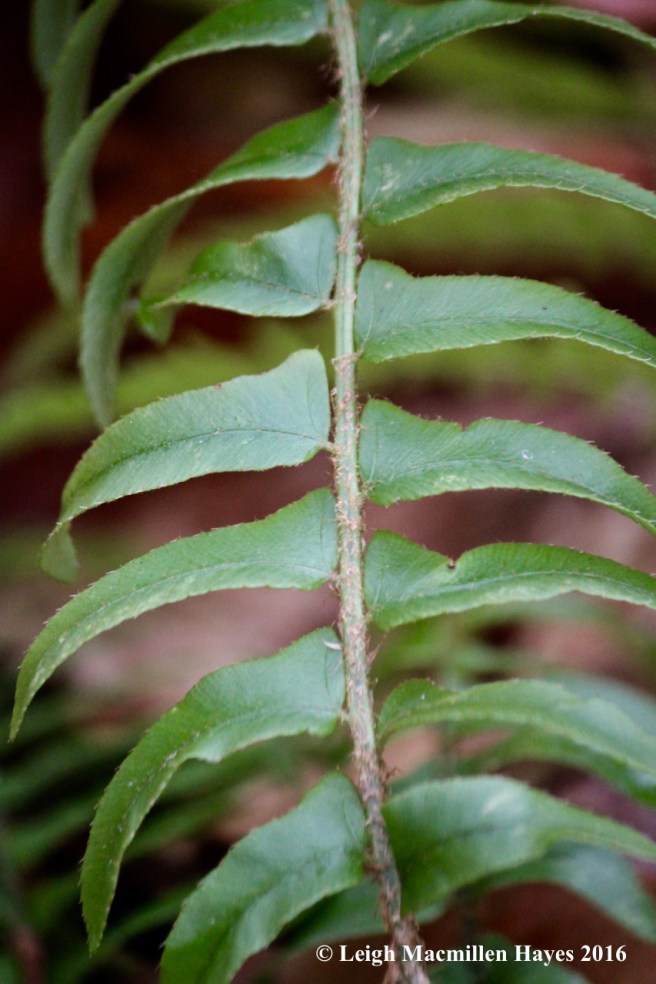
r-christmas fern 2

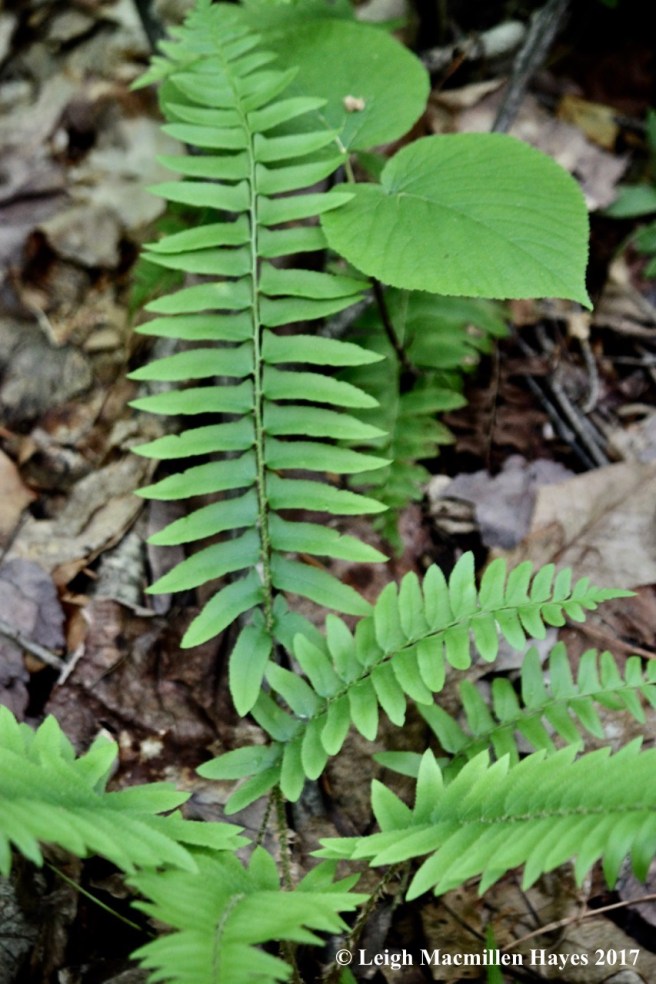
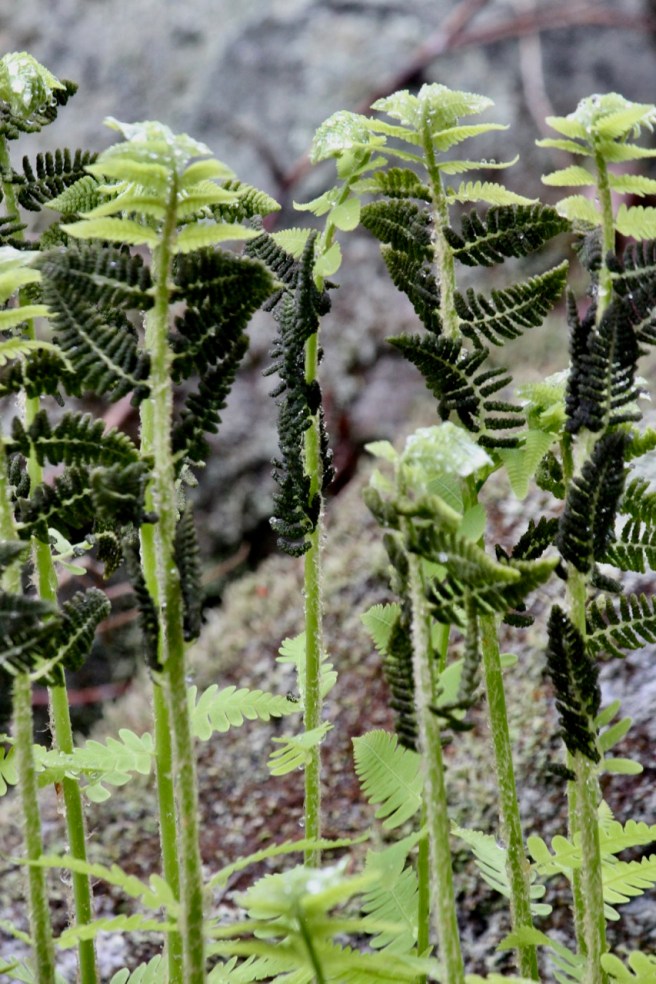
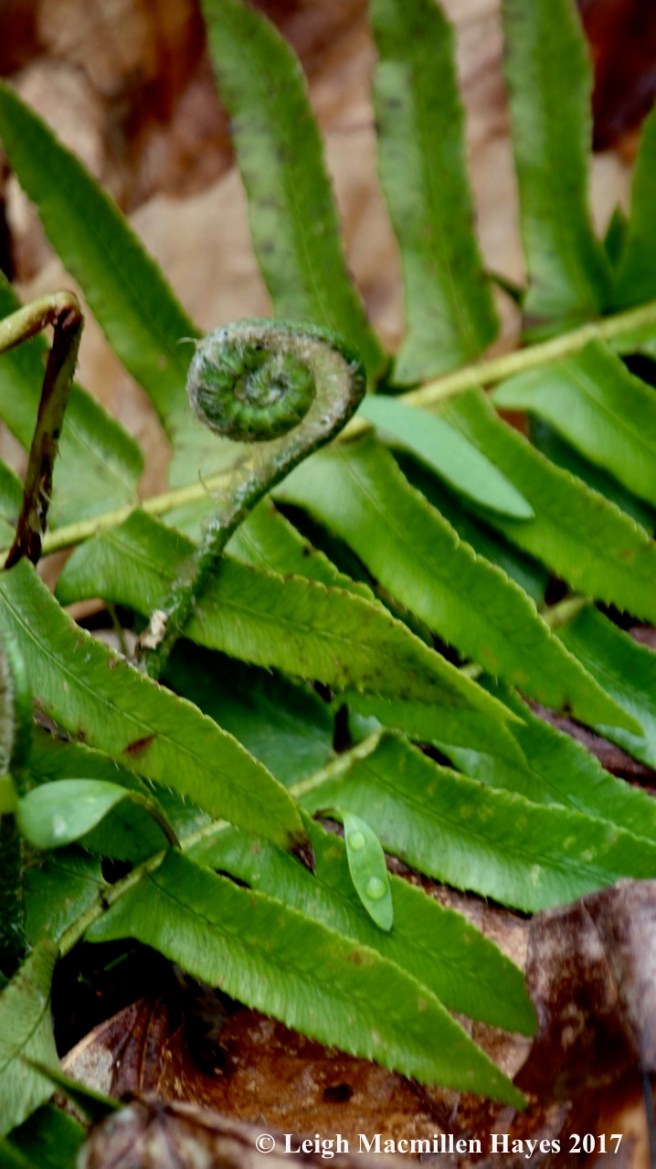
And because it was so damp, the forest we roamed was filled with Christmas ferns featuring young and old blades.

r-Indian cucumber Christmas fern

We even found one that sprouted an Indian Cucumber Root whorl as if it was a flower.

r-christmas fern gall

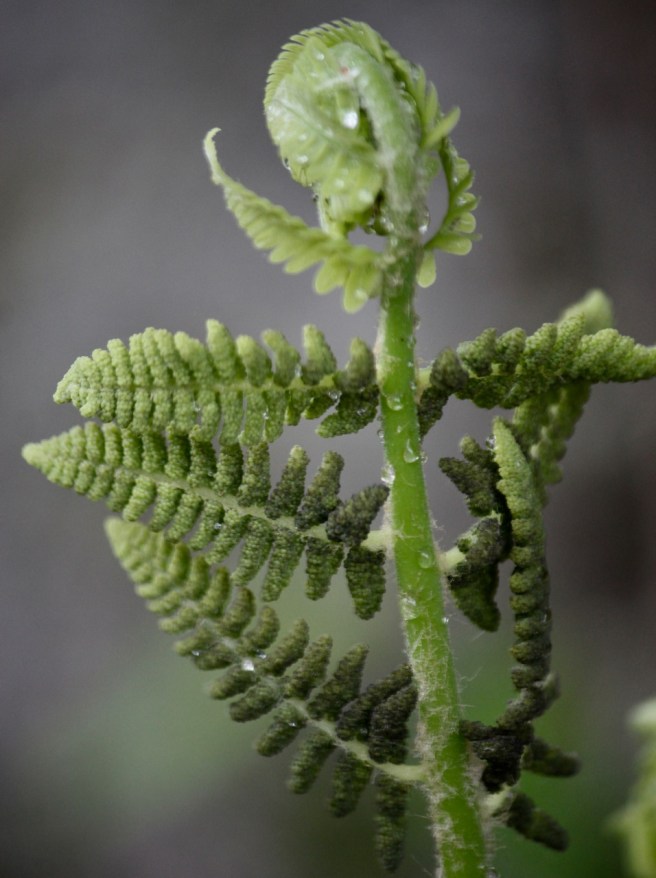
But what aroused our curiosity was another that seemed to have been affected by insects forming galls. Neither of us could remember seeing anything like this before, but then again, so many times when we see something we think of as new, we soon discover that it’s more prevalent than we realized. That being said, we only found the “galls” on a few of these ferns, all in the same area in a wet seep.

r-wild oat

Further along, we noted sessile-leaved bellworts, in flower a month ago, now sporting their seedpods or wild oats that speak to their other common name. And the leaf of at least this one had been visited by an insect–a leaf minor trail standing out in white against the green.

r-cannoddling craneflies 2

r-cannoddling craneflies

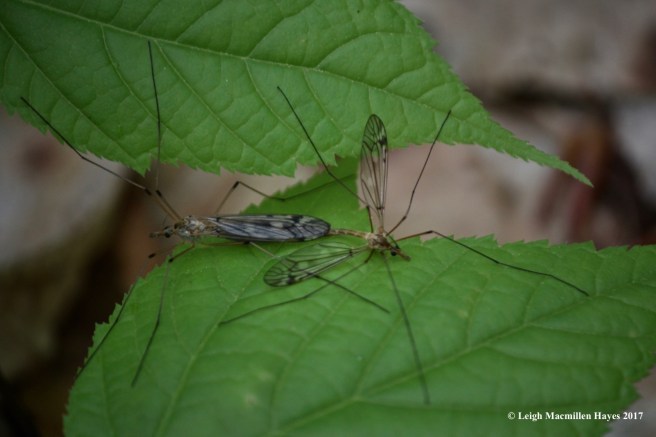
And then we found craneflies canoodling. They didn’t seem to care that we watched.

r-toad 1

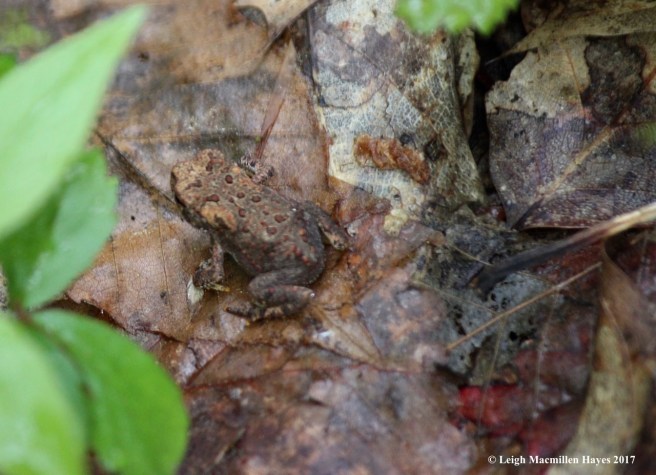
They weren’t our only wildlife sightings (besides the mosquitoes–did I mention mosquitoes?). A young American toad hopped by, pausing ever so slightly to show off its raised warts.

r-frog 1

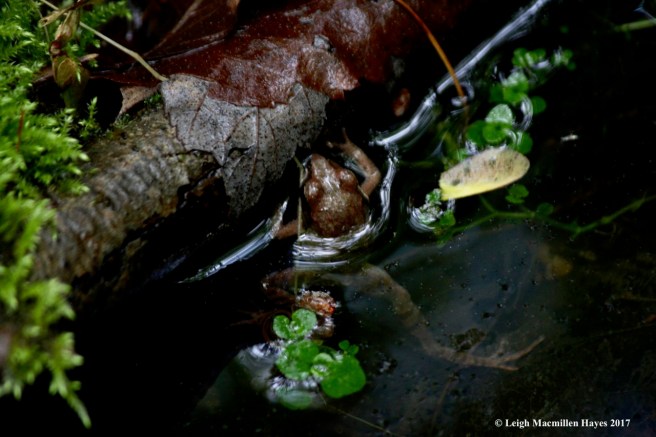
And a frog slipped into the water–the better to escape our ogling.

r-land of the cinnamon fern

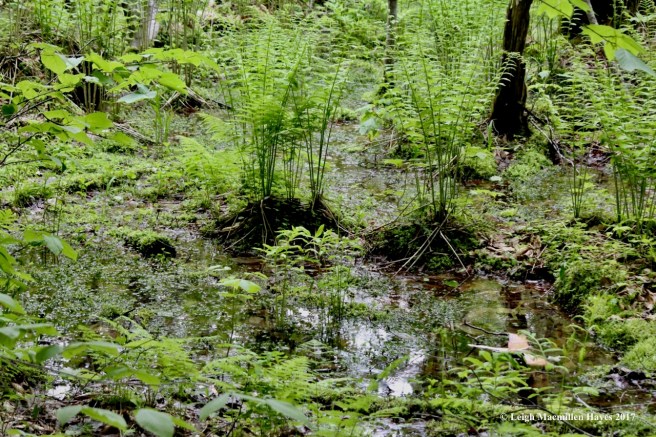
As we wound our way around a wetland filled with cinnamon ferns, we noted a few flowers in bloom or about to bloom.

r-clintonia 1

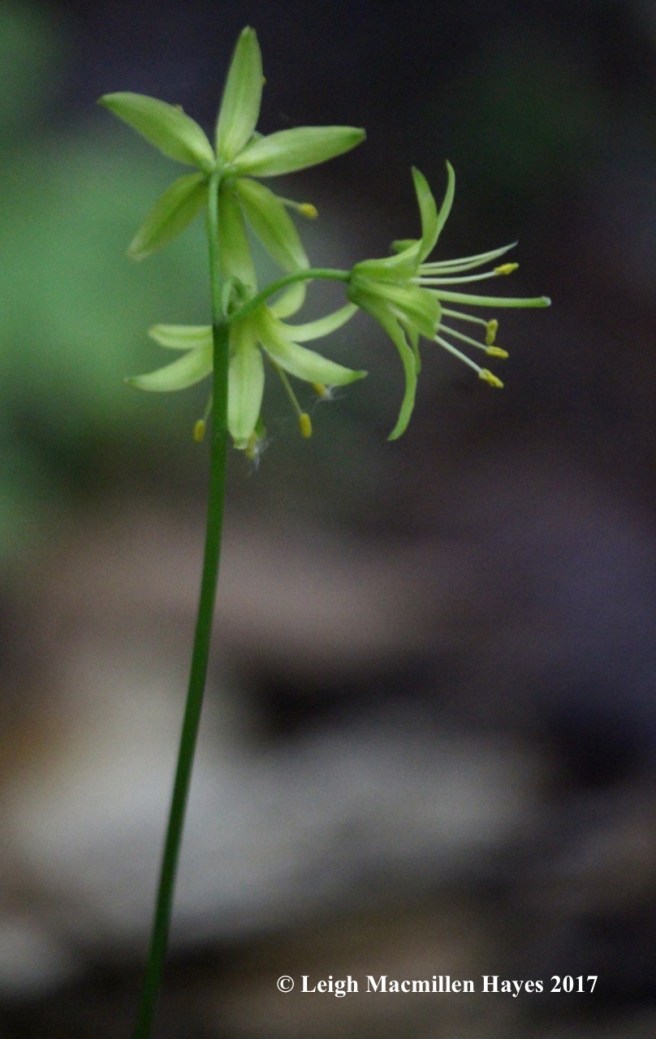
Yellow clintonia,

r-jack in the pulpit 1

Jack-in-the-pulpit (times two actually–and I’m not sure how we spied these for they hid like trolls under their leaves),

r-Indian Cucumber flower

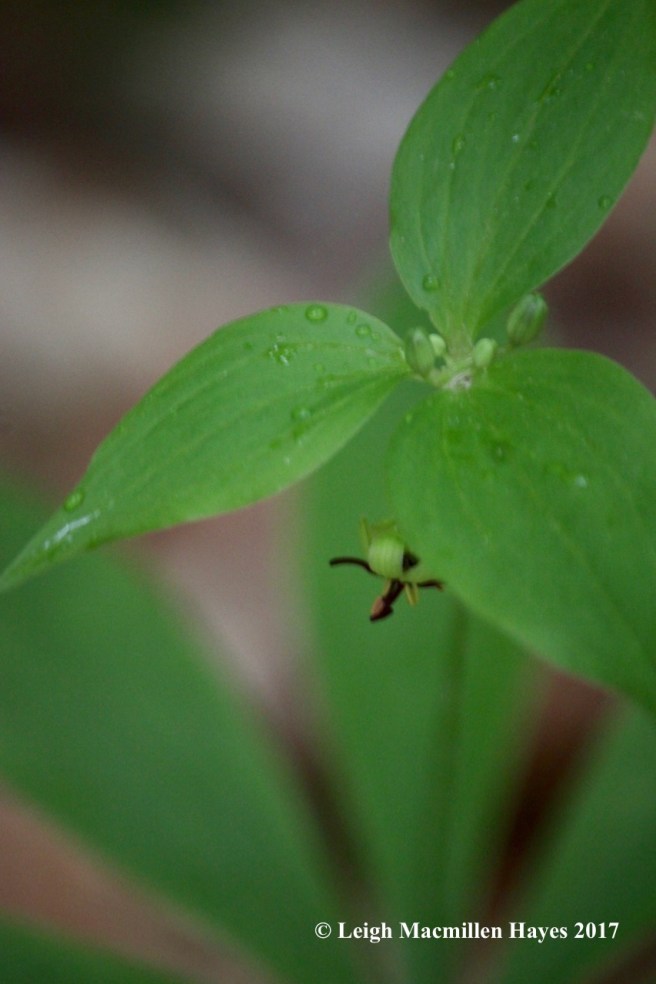
Indian cucumber root,

r-Early coralroot 2

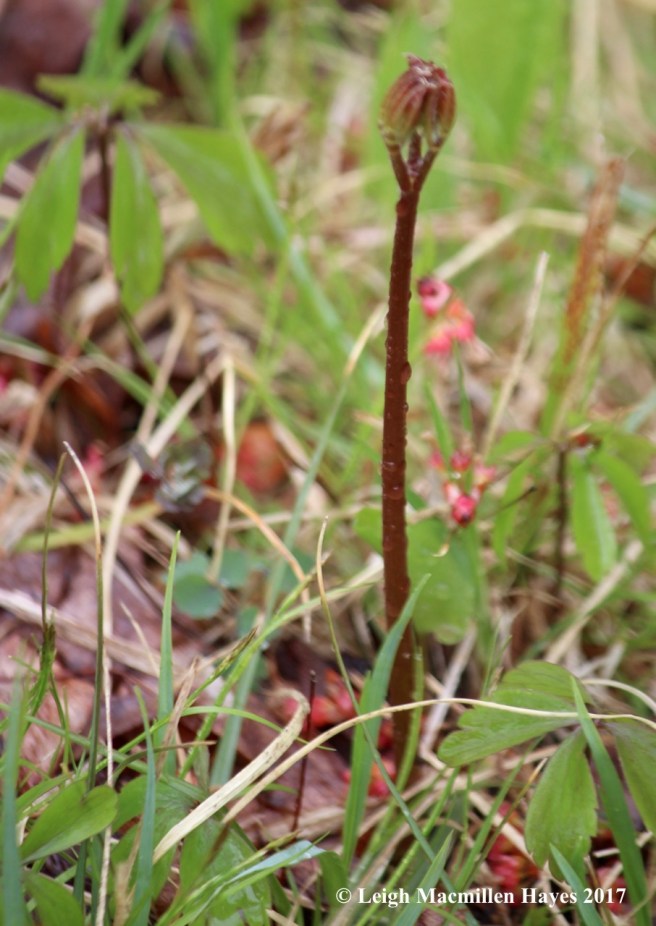
and early coralroot caught our attention.

r-round-leaf pyrola1

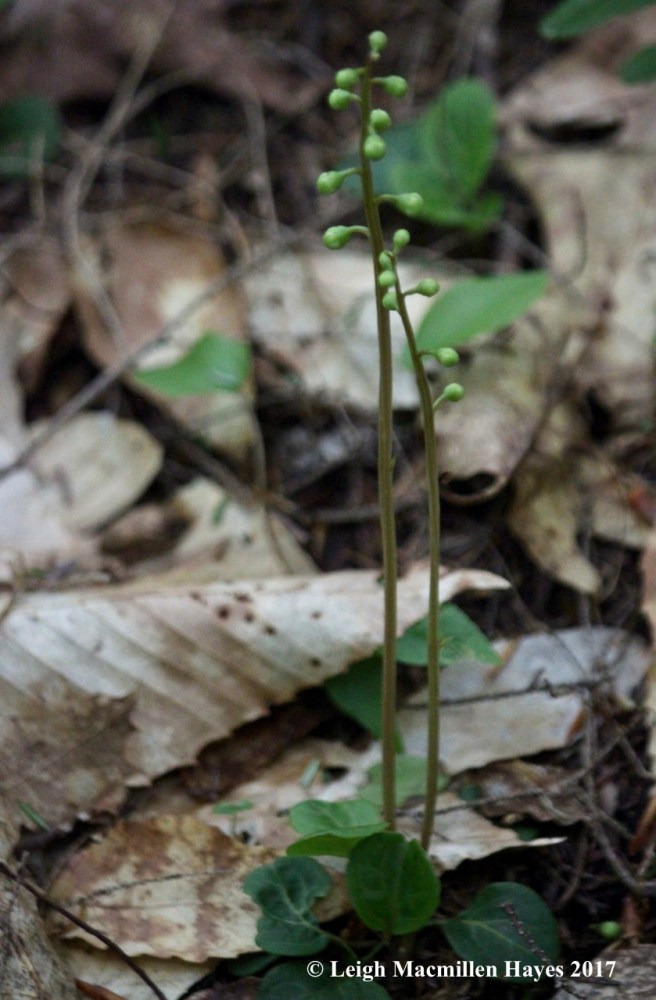
Not yet in bloom was the round-leaf pyrola, aka American shinleaf. Oh darn, another reason to return and see it blossom.

r-red trillium 3

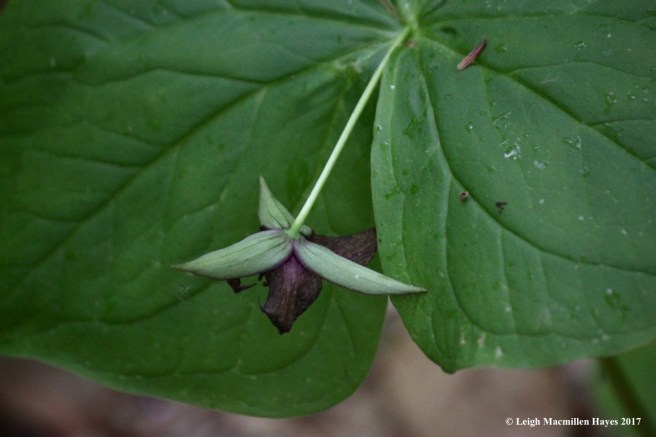
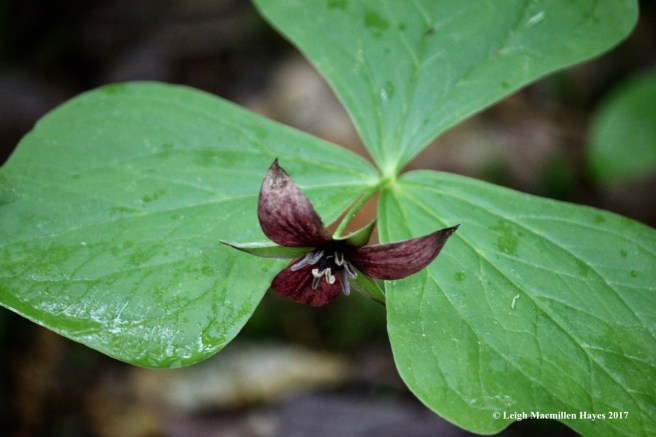
And just past its blossoming stage–red trillium,

r-red trillium 1

its red leached to almost maroonish brown and stamen looking rather gray.

r-Pam taking a photo of pyrola

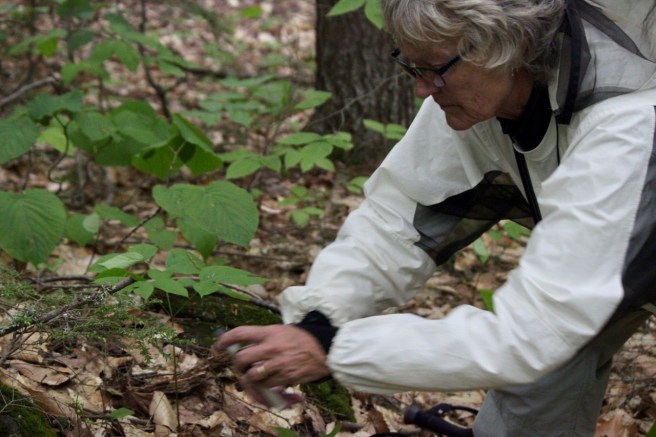
Despite the mosquitoes (what mosquitoes?) and a few raindrops, we shared a fun afternoon hike circling the path of the Greater Lovell Land Trust’s Ron’s Loop by Five Kezar Ponds.

The journey was with my friend named Pam, not June. But June is the month and together we enjoyed numerous dandies that need to be enjoyed in the moment for soon we’ll not realize they ever existed.

June dandies indeed–worth making time to wander and wonder. (Despite the mosquitoes.)


At a Snail’s Pace

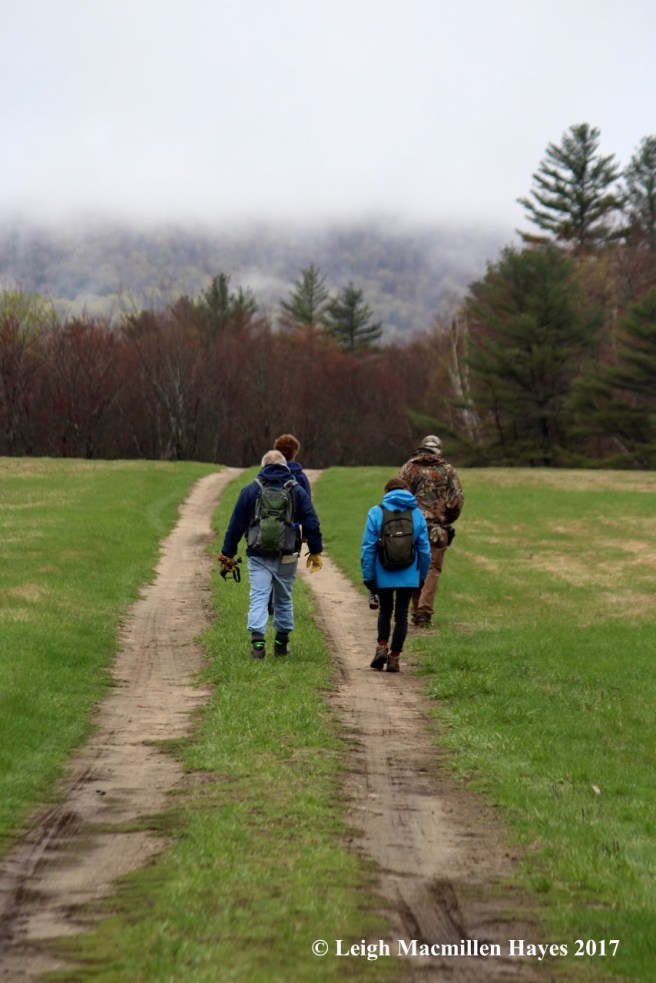
The mosquitoes were thick. The ground damp. But the rain held off and so four docents and I met at the Greater Lovell Land Trust‘s Flat Hill parking lot at the end of Heald Pond Road.

p-beaked hazelnuts forming

From the getgo, our fun began as we spotted numerous beaked hazelnuts forming–the trick is to pay attention to them and watch their continued growth, for in a flash, or so it seems, they’ll mature and . . . disappear. The nuts those hairy beaks cover are favorites for wildlife and we human folk also like them.

p-red trillium

Our mission was to get reacquainted with the spring flowers–some being obvious to us like the red trillium, though the fact that it was still in bloom offered a delightful surprise. We chatted about the fact that its also known as Stinking Benjamin for its undelightful odor, but try as we might and we did again today, none of us have ever been offended by it. Apparently, they smell like rotting meat, but you can’t prove it by us.

p-fringed polygala

Here and there we were awed by the delicate fringed polygala, aka gaywings. They did remind us of birds with crazy head dresses taking off in flight.

p-false solomon seal

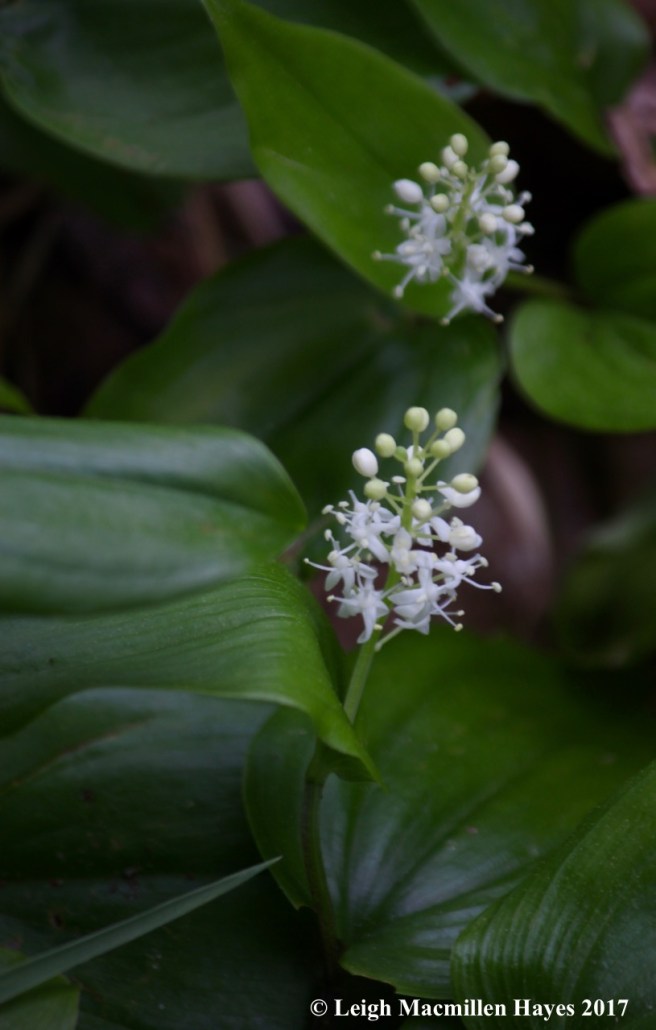
As we shared brains and practiced relearning species before the next season gives us even more, we felt proud to quickly ID a false solomon seal, aka wild spikenard, before it had fully flowered. It’s the cluster of flowers on the end branch, the arching, zigzag stem and long oblong leaves that stand out in our minds.

p-Rose Twisted Stalk or Rosybells

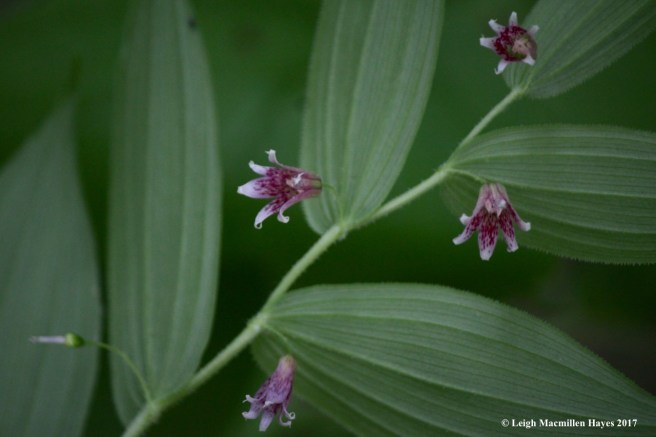
A seal of another sort, the rose twisted stalk, aka rosybells, also adorned the trail. Pam held the stalk up so we could look at the bell-shaped flowers that dangled below.  Notice how the leaves are green below and stalkless but don’t necessarily clasp the stem–as opposed to twisted stalk (white mandarin), which features greenish flowers dangling below and stalkless leaves that do clasp the stem. Plus the latter’s leaves have a white bloom on the underside. We didn’t see any twisted stalk, but were tickled with our rosybell finds.

p-raindrops all in a row

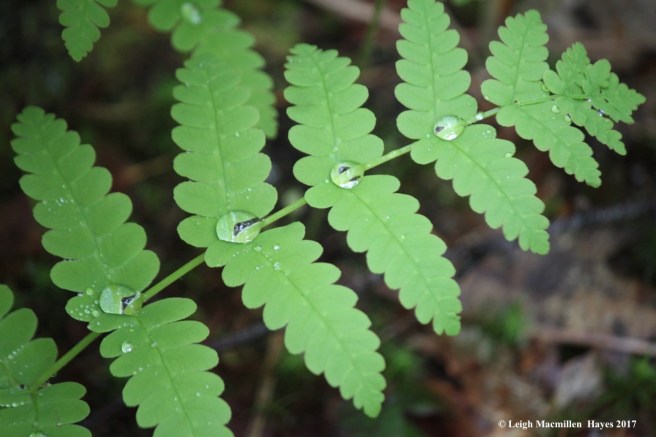
Periodically, we stopped to examine ferns, or quiz each other on the ID. But sometimes, it was just fun to notice presentations, including raindrops all in a row.

p-beech fern

And though a couple of our fern experts couldn’t be with us, Joan was and she loves nothing more than squatting beside them with the Fern Finder to determine a species, including the long beech fern.

p-clitonia 2

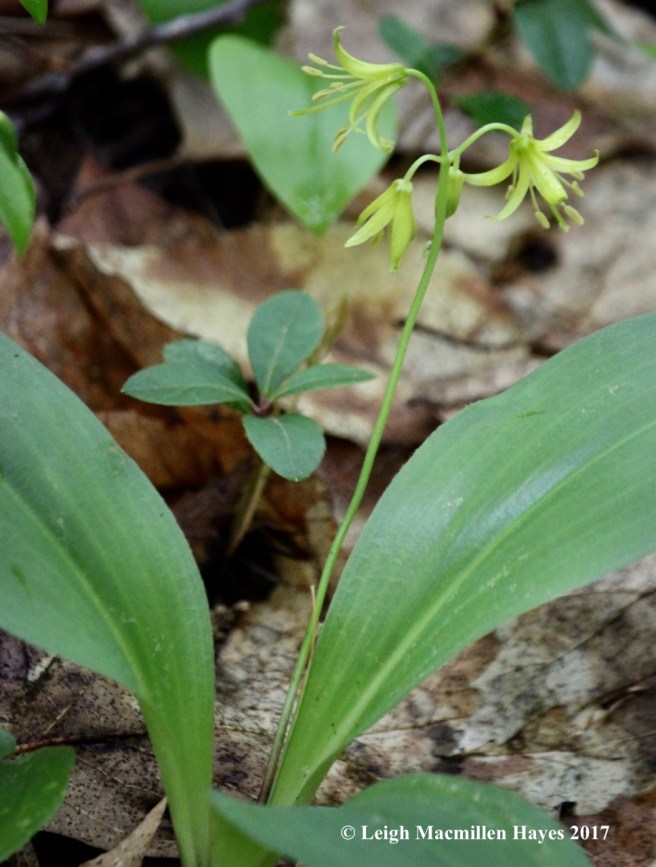
It was while looking at bracken ferns that Mary and Nancy spotted the greenish yellow flowers of clintonia. We were excited because we’d seen plenty of plants, but these were the first in flower, and they were well hidden.

p-clintonia flowers

Yellow clintonia is also called bluebead for the fruit that develops is a porcelain blue bead-like berry. Check out those pistils (she’s a pistil) dangling below the stamen, their anthers coated in pollen. Bring on the bees and the beads.

p-baby toad

Suddenly, we discovered movement at our feet and saw our first baby toad of the season. It’s diminutive size and obvious camouflage made it difficult to see, but unlike the adult members of its family who will freeze in position, thus allowing us to study them further, this little one wanted to escape as quickly as possible. Smart move on its part.

p-bench view

Only about two hours later we’d covered maybe a half mile and found our way to the bench that overlooks the swampy area surrounding the brook between the beaver pond and Bradley Pond.

p-red maple leaves

We sat below a red maple and listened to a chorus of birds–and gave thanks for the food supply. Let them eat bugs. We offered up a few mosquitoes.

p-red-winged blackbird

A red-winged blackbird flirted with us, showing off its bright red shoulder and yellow wing bar as it flew from shrub to shrub. The five of us swooned.

p-Indian Cucumber pre-flower

All along the path, we’d spotted Indian Cucumber Roots with their buds formed atop the second layer of their double-decker formation. When we finally stepped from the bench back to the trail, we noted a couple of the buds were beginning to dangle below the second story, meaning the blossoming season would soon be upon us.

p-Indian Cucumber flower 2

And just like that . . .

p-Indian Cucumber flowering

Voilà. I’m of the belief that if this flower doesn’t make you wonder, nothing will.

p-beaver pond view

Our next stop was at the bridges that cross below the beaver pond. We’d been looking for fresh beaver works all the while, but only discovered the work that had been completed over a year ago.

p-royal fern crown

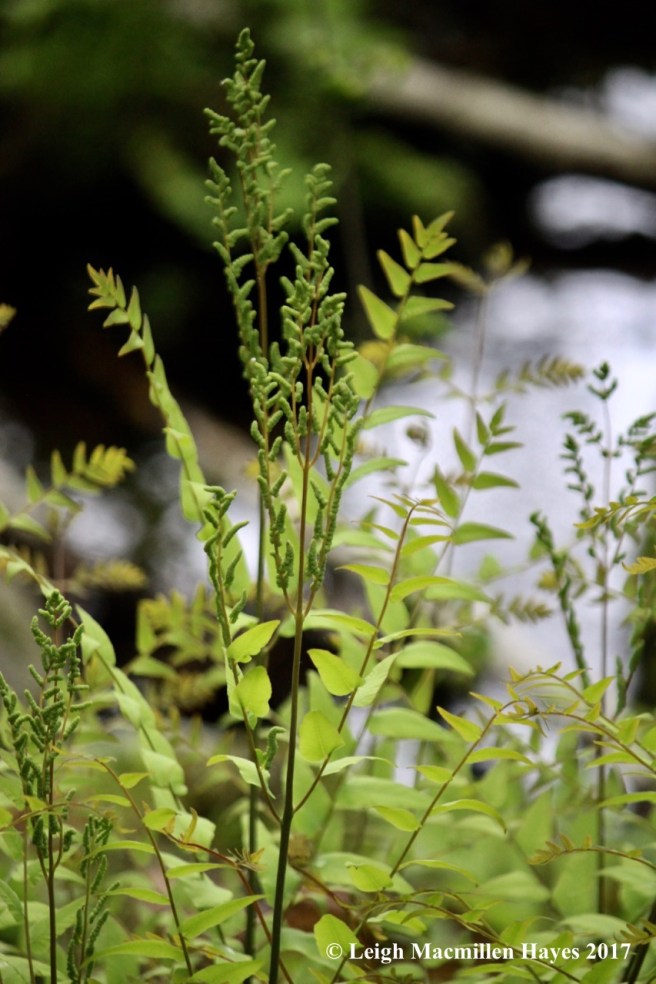
There was still plenty to see, including the fertile crowns atop royal ferns,

p-jack-in-the-pulpit 2

a small jack-in-the-pulpit,

p-mayfly hitchhiker

and a mayfly that chose Pam’s jacket to rest upon.

p-foamflower 1

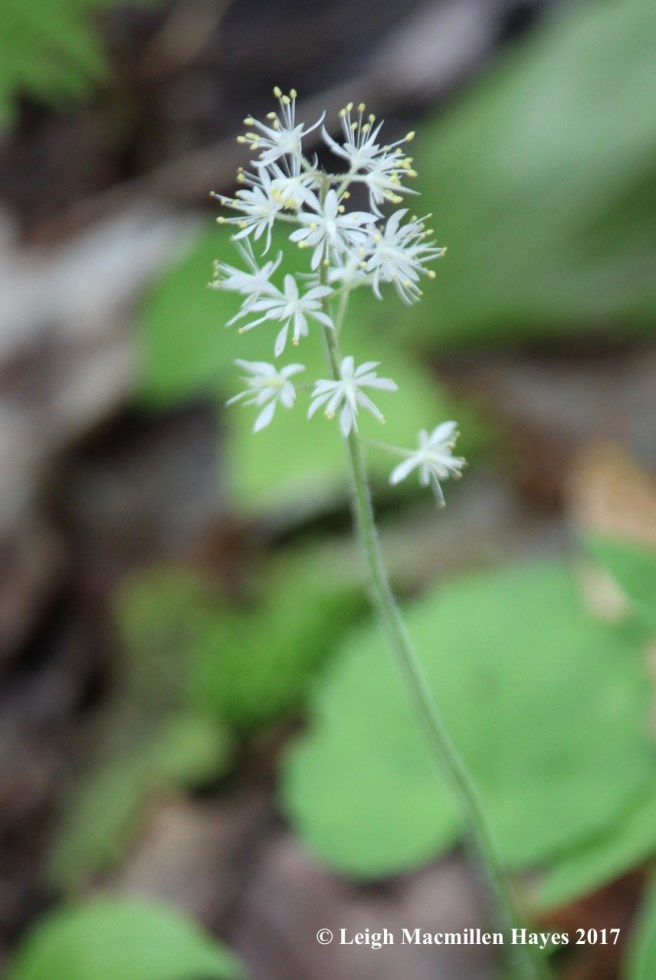
One of our many finds included foam-flower, with its cluster of star-shaped white flowers and conspicuous stamens. According to Mary Holland in her book, Naturally Curious Day by Day, “Its genus name, Tiarella, is the Greek word “tiara,” a word for a turban worn by ancient Persians which bears some resemblance to the shape of this flower’s pistil.”

p-foamflower carpet

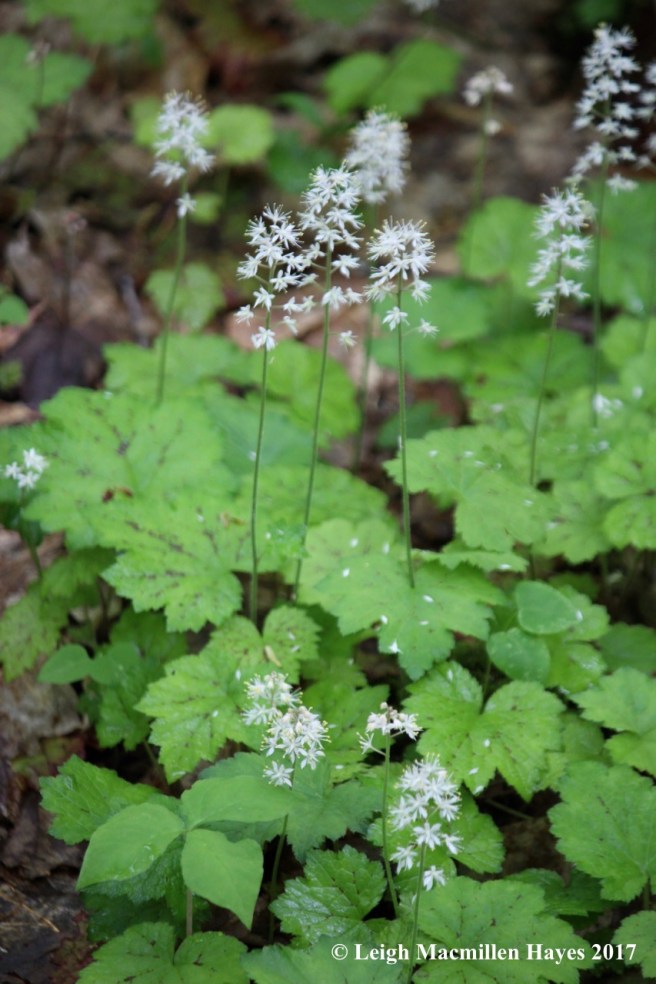
Tiara or not, we were quite taken with a carpet of it.

p-snail

Those were only a few of the findings we saw as we moved at a snail’s pace during our three hour tour along Perky’s Path. Each time we visit, we say, “This is my favorite property.” That is . . . until we visit another one of the GLLT properties.

May(be) a Mondate

We headed out the backdoor, into our woodlot, down the cowpath, along the snowmobile trail, veered left behind the church, walked down a driveway, crossed the road and snuck into Pondicherry Park.

p-NOrway maple and samaras

Or so we thought, but as we stood below this Norway maple with its widely-divergent two-winged samaras, a familiar voice hailed us. Our friend, Dick Bennett, appeared out of nowhere (well, really from somewhere–for like us, he lives nearby and uses these trails frequently to get to town) and so we chatted briefly. He was on a mission and we were headed in a different direction along the multi-layered loop system.

p-crossing the field

Within minutes we followed the path out of the woods and across the field–prepared as we were for rain. Our plan was to retreat when it started to pour.

Once we entered the woods again, we heard a barred owl call from the distance with its infamous “Who cooks for you?” “Our oldest son and his girlfriend,” was our response for they had surprised us this weekend with a visit and prepared last night’s meal.

p-foxhole debris

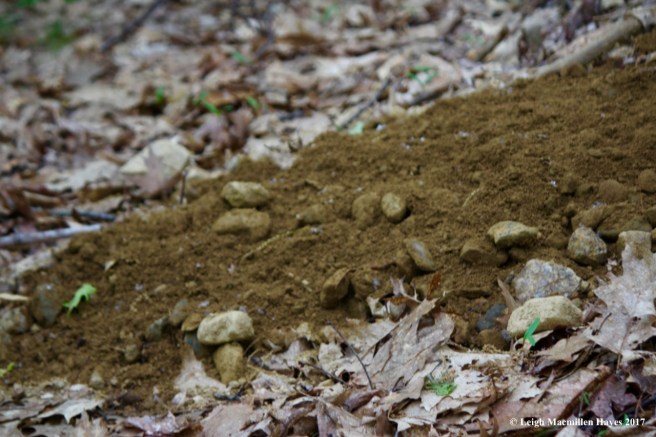
For the most part we stuck to the trail system, but then we stepped over the wall onto the Lake Environmental Association’s Maine Lake Science Center property because I wanted to show my guy this pile of dirt and stones.

p-fox hole

On a recent bushwhack with a few others, we’d discovered this fox hole and I immediately recalled all the fox tracks and seeing a red fox this past winter not far from this location.

p-boardwalk1

After poking about for a few minutes, we made our way back to the LEA trail and eventually landed at the boardwalk that weaves through a wetland. From there, it was back through the woods to the park trails. I know my guy wanted to move quickly, such were the bugs, but I wanted to take everything in and so he patiently waited from time to time.

p-Canada mayflower

After all, there were visions in white exploding with glory in the form of Canada mayflowers,

p-foamflowers

foam-flowers,

p-wild sarsapirilla

and wild sarsaparilla.

p-gaywings

We also feasted our eyes on visions offering the purplish hue of gaywings, aka fringed polygala.

p-fern stream

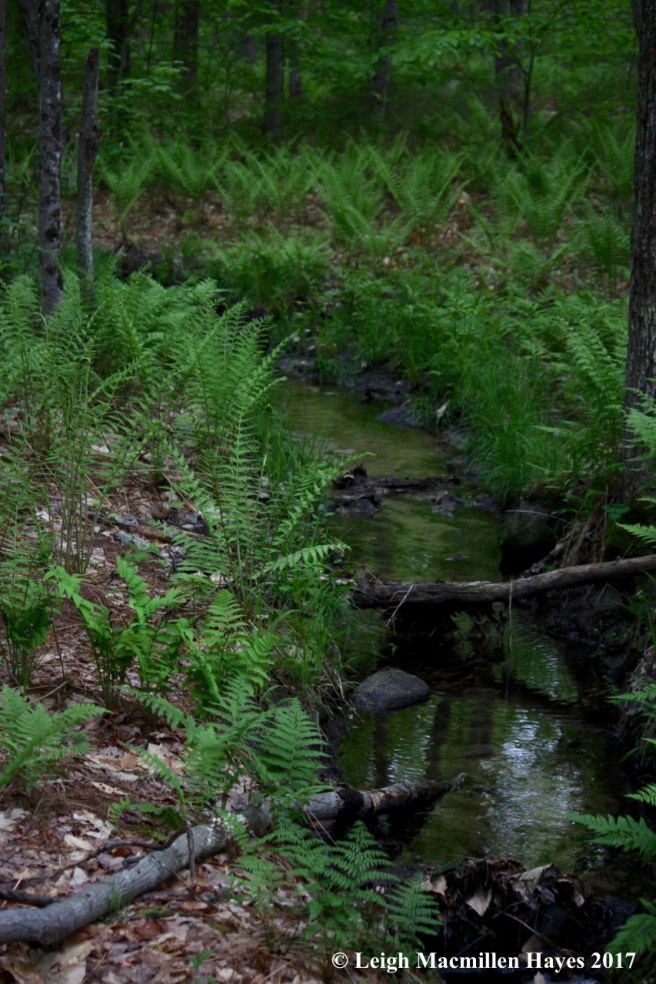
And then there were the ferns.

p-cinnamon fern fertile frond

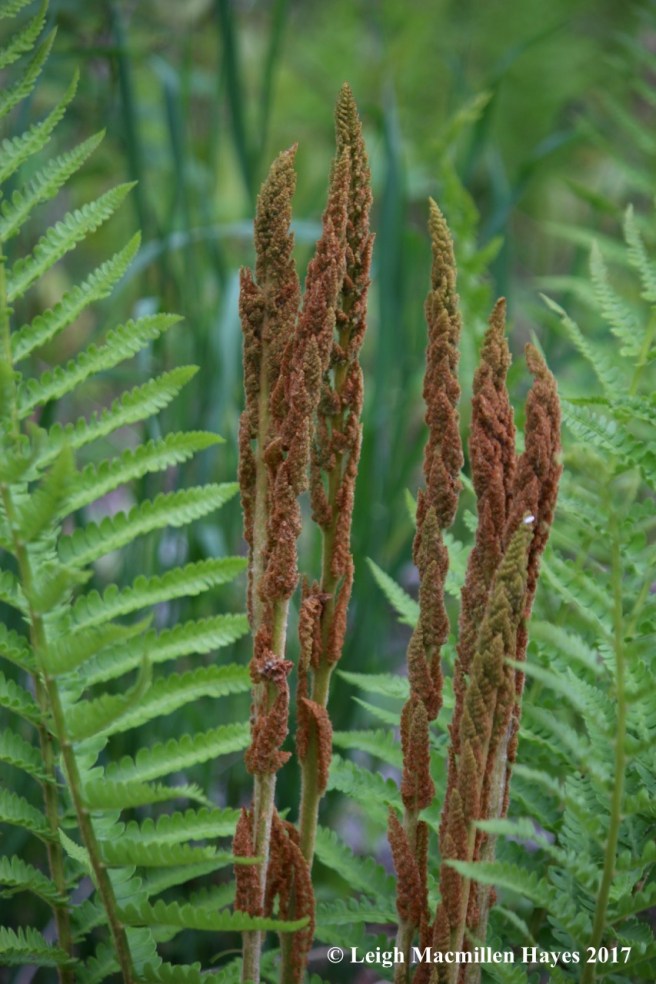
The fertile stalks of cinnamon ferns shouted their name,

p-royal fern

while the royal ferns were much more subtle–

p-royal fern fertile fronds

their fertile crowns practically blending into the sterile fronds.

p-chipmunk

At the chimney by the amphitheater, a chipmunk paused to ponder our intentions and then quickly disappeared.

p-Stevens Brook

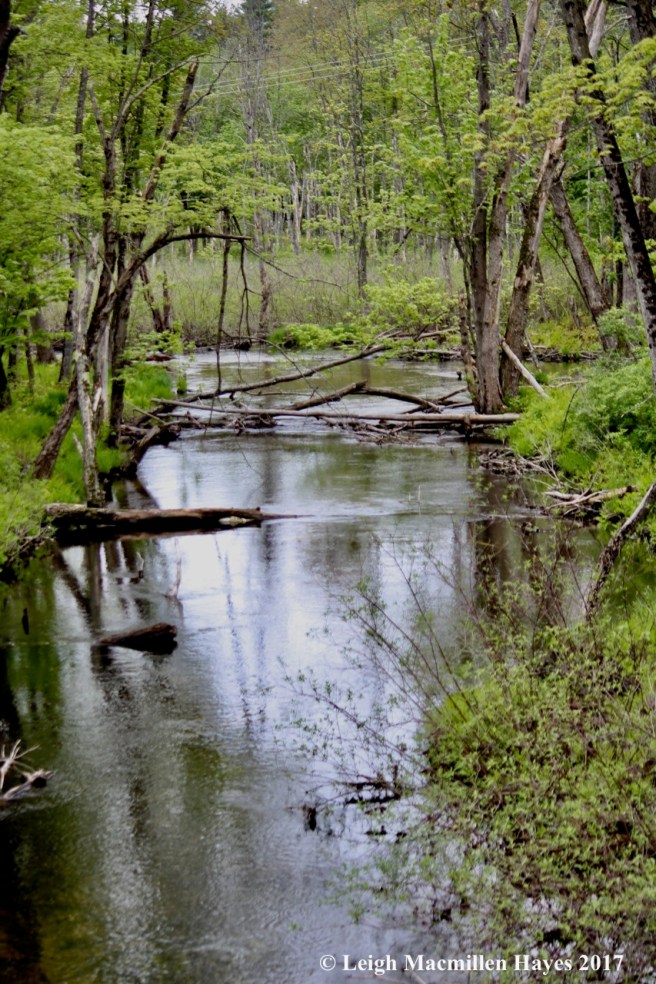
We followed the river trail to the Bob Dunning Bridge and noted all the shades of green beside Stevens Brook.

p-boxelder samaras

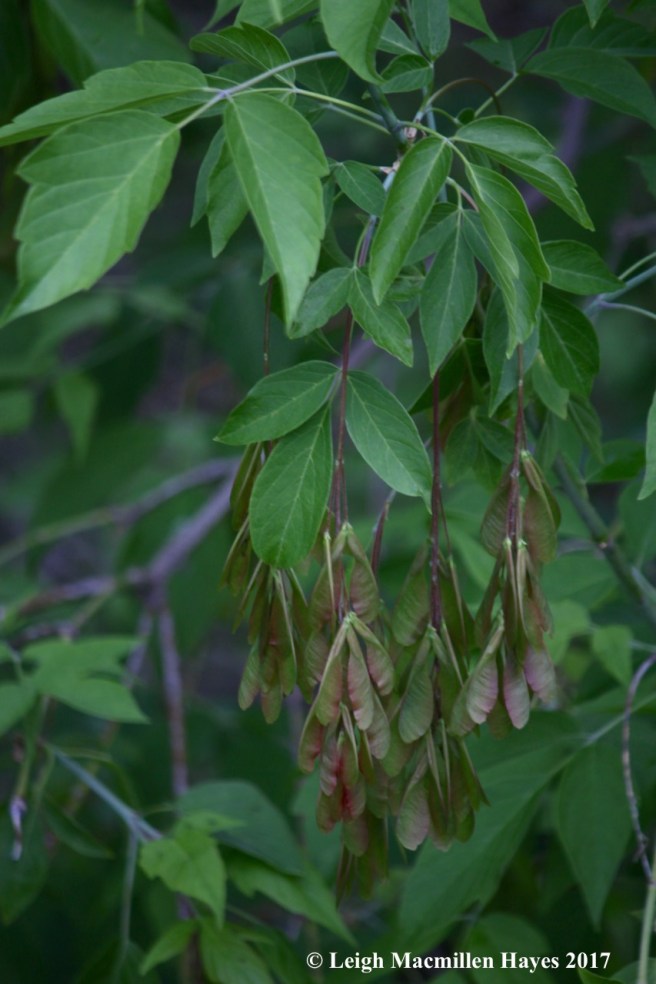
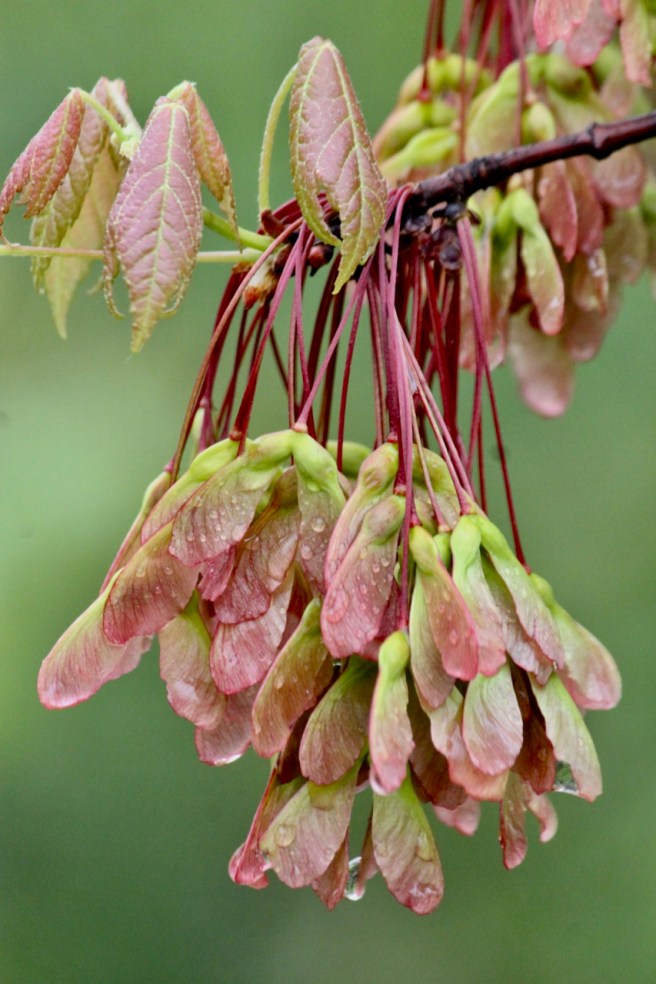
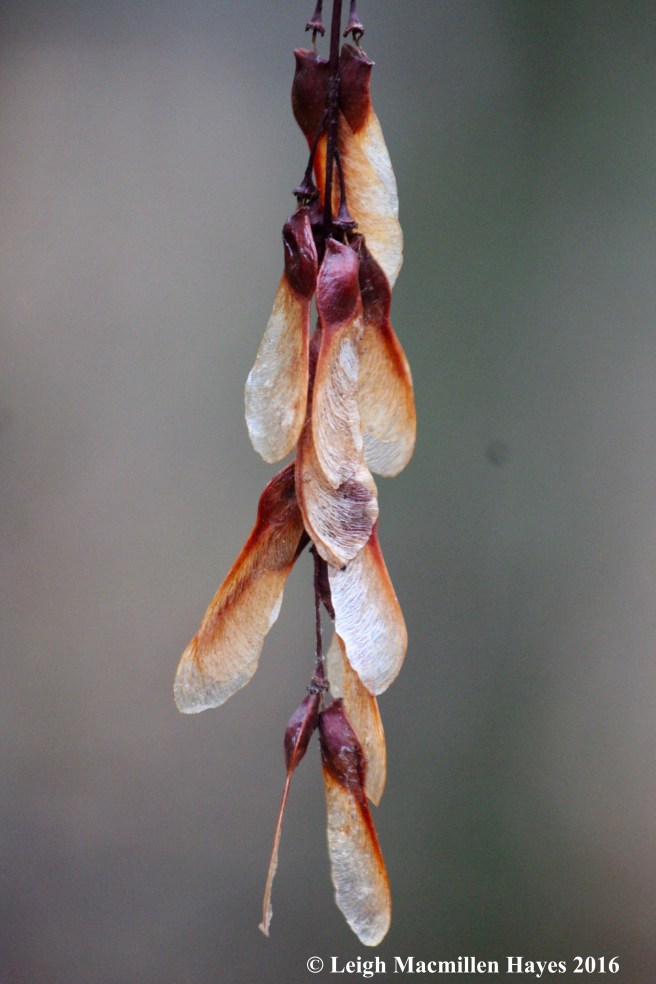
And then there were other sights to see, like the boxelder and its samaras. Its common name refers to the resemblance of its leaves to elder trees and the use of the soft wood for box making. Its also our only maple with compound leaves. And the samaras differ greatly from the Norway maple we stood under at the beginning of our walk–for the boxelder’s winged seeds more closely resemble upside down Vs or peace signs.

p-catbird 1

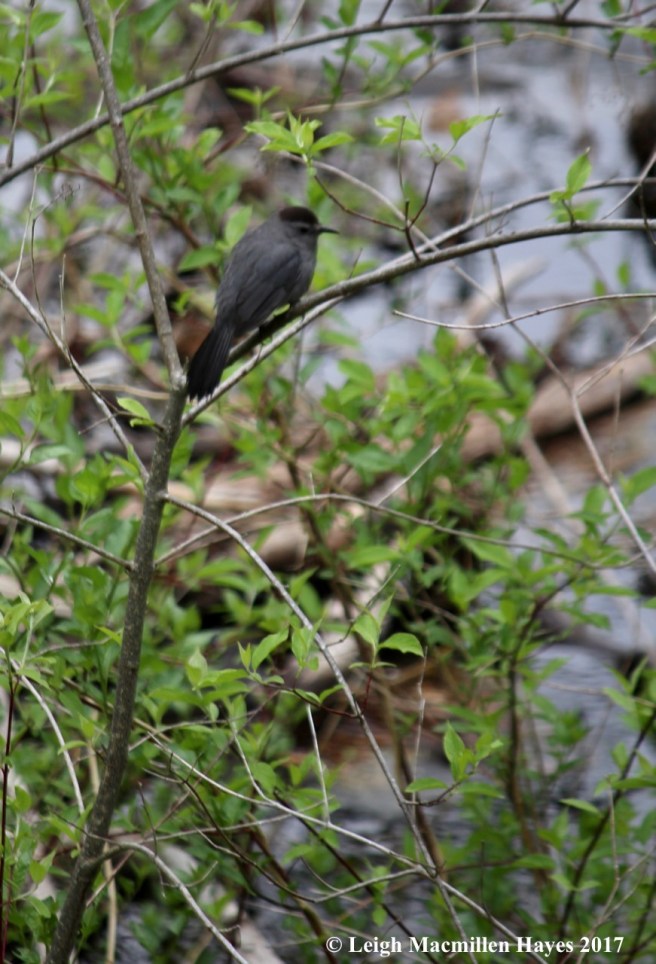
As is often the case when stopping by the bridge, the catbirds who nest in the undergrowth paused beside the brook during their foraging expeditions.

p-caterpillars on maple leaf

Nearby, we saw some food meant for them–a colony of Eastern tent caterpillars consuming maple leaves right down to the veins. It seemed like it was time for some units of energy to be passed along the food web.

Besides the wildlife, our only human encounters included a relative crossing the bridge on his way home from work and our friend Dick, whom we’d seen at the start.

For various reasons, May has been devoid of dates and so today’s adventure, though not long, served as our only Mondate celebration for the month–no maybes about it. And it never did rain.


Sharing My Site

I count myself among the fortunate because pollen doesn’t keep me inside during its high season. Nor do the bugs or rain. Mind you, I do my fair share of complaining–after all I am human. At least I think I am, though I was honored to be called an ent yesterday. (Thanks Cyrene.)

Enough of that. Let’s head outside to see what we might see.

IMG_5267

True confession. I took this photo yesterday, but didn’t have time to write. Finding this jack-in-the-pulpit beside a granite bench by my studio was a complete surprise.

IMG_5741

Today’s journey began in the front yard where sugar maple samaras dangled below full-grown leaves. Their presence will soon offer presents to the world below.

IMG_5302

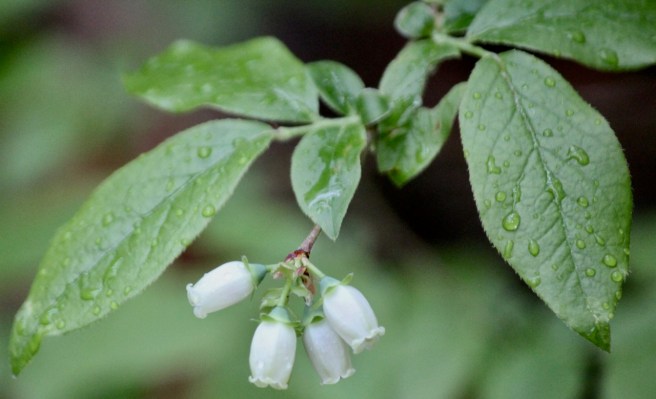
My next stop was beside another secret giver of gifts–blueberry flowers.

IMG_5301

And then I stepped into the woodlot, where a single striped maple which was the bearer of a deer antler rub last year and scrape (upward motion with lower incisors) this past winter, had something else to offer.

IMG_5480

Below its almost dinner-plate size leaves–flowers. Happy was I to find these little beauties.

IMG_5287

Perhaps . . . just maybe . . . there will be more striped maples offering their bark to those in need.

IMG_5517 (1)

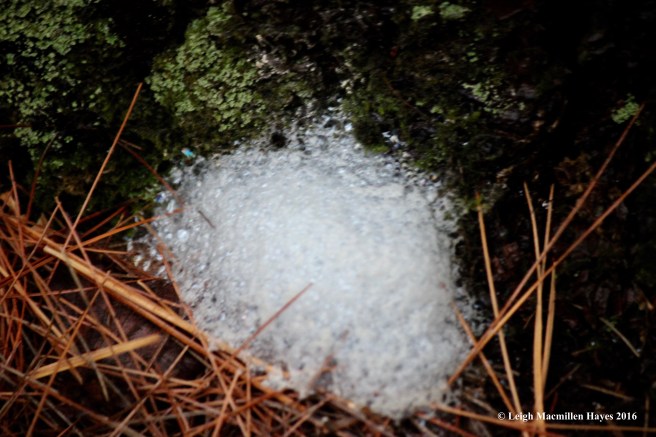
Moving along, I stopped at the opening of the cowpath to admire baby hemlock cones when something white and bubbly caught my attention. My first spittle bug sighting of the year. An adult spittlebug whips up some slimy froth to cover its eggs in late summer and the nymphs cover themselves while feeding in the spring–and so I concluded that I was viewing a nymph’s locale.

IMG_5327

Emerging under the power lines, the community changes. It’s here that the land is especially wet and species one might find in a bog grow–such as the black chokeberry shrub. These also like rocky ledges, but such is not the case in this spot.

IMG_5532

I was thankful to find it for those flattened bright pink anthers brightened this damp day.

IMG_5696 (1)

Heading north, I sloshed through the deep puddles on a quest to find the sundews I discovered growing in this area for the first time last fall.

IMG_5703

No such luck, but I did welcome the sight of the candy lichen fruits exploding from their crustose base. And then . . . and then . . . what did I see (but only when I looked at the photograph on my computer, and so now I know where they are located)? The round-leaved sundews–do you see them in the bottom right-hand corner? These are carnivorous plants (think Venus Flytrap) and their prey consists of small insects. Already, I can’t wait to make their acquaintance again.

IMG_5583

I turned around and headed south–on my way to the vernal pool. But before passing through a stonewall, I had to look at the bunchberries in bloom.

IMG_5581

Normally, a bunchberry plant has two-sets of leaves. But . . . when one is mature enough to grow a third set, typically larger leaves (perhaps to capture more energy) than the first two sets, it produces four white bracts that we think of as petals but they are actually modified leaves. The flowers are in the center–tiny as they are.

IMG_5680 (1)

And because I was in the neighborhood, in the land of mosses, reindeer lichens, Canada Mayflowers and wintergreen, trailing arbutus (aka Mayflower) spoke up. Its flowers were slowly transforming from white to rust and I shouldn’t rush the season, but I can’t wait to see its fruit again.

IMG_5586

At last I reached the vernal pool and realized I wasn’t the only visitor. What perfect hunting ground it proved to be for the . . .

IMG_5593

phoebe. I cheered for its insatiable insect appetite.

IMG_5596 (1)

Because the day was dark, it was difficult to see tadpoles, but I did note that many spotted salamanders were still forming. I also noted that the water level has dropped a wee bit–hard to believe–and where yesterday I found a few egg masses a bit high and dry, today they were gone. Something enjoyed eggs for dinner.  Scrambled or otherwise, I’m not sure.

IMG_5625

Back on the trail and at the next stone wall, interrupted fern showed off its fertile pinnae near the middle of the blades. It’s called interrupted because of the interruption in the blade. Again, this is an inhabitant of moist to wet forests and so it was no surprise to find it growing there.

IMG_5609

A fertile blade, such as this, may have two to seven pairs of middle pinnae.

IMG_5619

The globose sporangia is bright green when young, but darkens to tan or black as it matures.

IMG_5362 6.10.27 PM

On the other side of the wall, I spied some more flowers.

IMG_5360

These were the elongated loose clusters of black cherry trees, that open when the leaves are fully developed.

IMG_5636

One that flowers and fruits before its leaves are fully developed is the red maple.

IMG_5630

And fruits and fruits . . . need I say more?

IMG_5375

Though the wind blew, the samaras weren’t yet ready to let go and set down their roots. It won’t be long though, I’m sure.

IMG_5403

Finally returning home, I passed by the granite bench once more and was still stymied by the site I saw about a half hour after discovering the jack-in-the-pulpit yesterday.  It had been consumed. I suspected the woodchucks that live under the studio. Either that or a bear came along and I missed it.

And so ended today’s tramp. Thanks for traipsing along with me to visit these sites out our back door. I especially welcome those who are homebound with allergies, like my friend Jinny Mae. She gave me the inspiration to take a look today–to be her eyes for the moment and share my sight.

Meeting Old Friends For The First Time

Who are you? And you? And you? Such were the questions everywhere we turned this morning.

I’d picked up a few Greater Lovell Land Trust docents on the way to our Tuesday Tramp location and met a few others at the gate. After our meet and greet, we walked down the road at breakneck speed, not stopping much because we were more focused on catching up.

s-bear scat

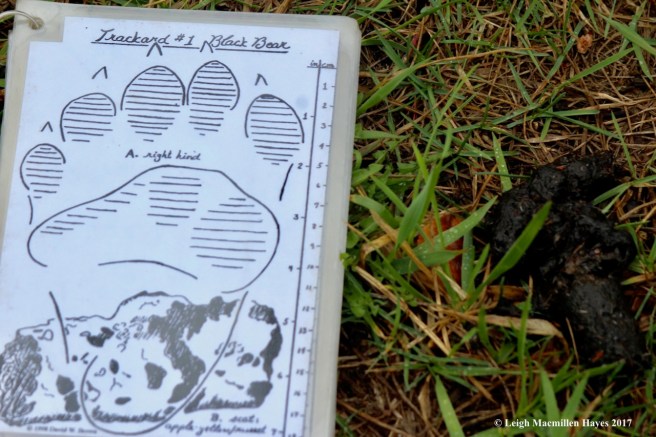
I say not much, but scat did give us pause. And in this place, we can always count on bear scat. Rather fresh bear scat. We never did see the bear, but knowing it was there was enough. Not long after that we listened to a barred owl. And then we flushed a couple of wood ducks that we barely viewed. It was OK with us that we didn’t see these critters–we felt honored to share the place.

s-into the orchard

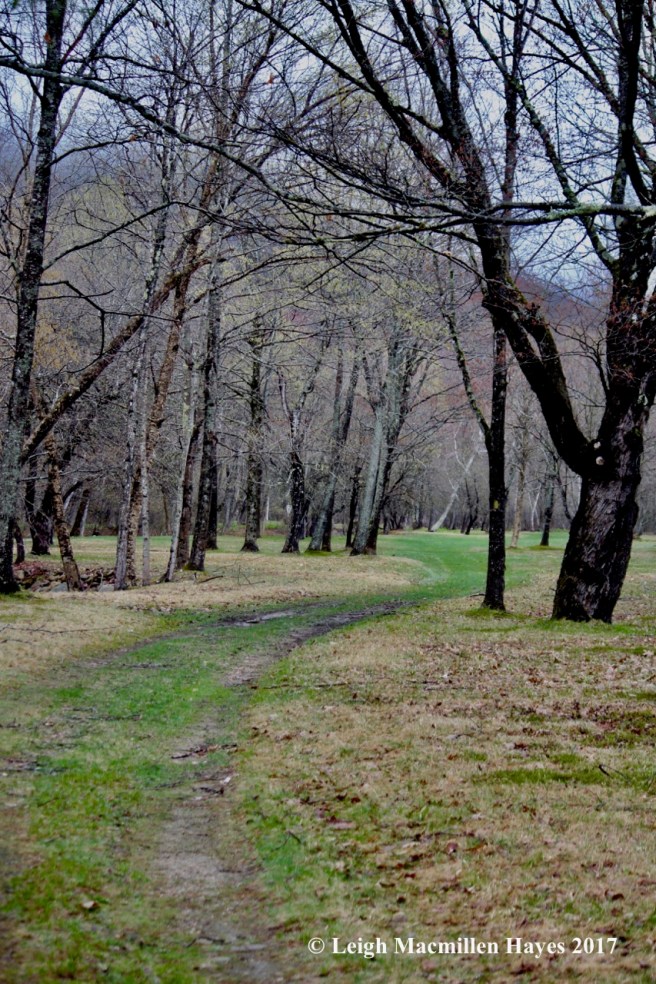
When the dirt road turned to grass, we continued on, anxious to reach our destination just below the cliffs that provided a backdrop to the spring foliage.

s-Rattlesnake Brook

As the brook came into view, our excitement rose.

s-birch reflections

At last, we’d arrived.

s1-slender toothwort

And that’s when the “Who are you?” questions really began to form. The slender toothwort wasn’t yet in bloom, so we had to key it out in Newcomb’s Wildflower Guide based on the compound leaves that were toothed. The flower buds hinted at pink, thus helping us. But really, we felt as if we’d never met this friend before.

s-sarsapirilla

And then there was the young stalk of a wild sarsaparilla. We shared a brain–looks like poison ivy when the leaves first open, three leaves, globe-shaped flower underneath, there’s another form–bristly . . . bristly sarsaparilla. And we suddenly remembered that we knew this friend, which was probably a wild sarsaparilla, the more common of the two.

s-bellwort

And who next showed its face–drooping in form as its flower did? Again, we had to think it through–finally recognizing it as a sessile-leaved bellwort or wild oat. Of course, once we knew it, we identified it with one amongst our group who first introduced us to it. For the rest of the summer, we’ll know it and will always recognize it as her plant.

s-false hellebore patterns

Then there was the accordion-leaved plant that grew abundantly–its spring green appearance enhanced by rain drops. We knew we knew it. We just had to rack our brains some more, much as one does when encountering any acquaintance not seen in a long time. False hellebore finally came to our tongues.

s1-dandelion

Thankfully there were some that didn’t tax our brains. We’re grateful for dandelions wherever they grow for the bees love them and we love the bees. We need the bees. We NEED the bees.

s-hobblebush 1

Other friends we could name immediately, but still were happy for the moments spent in their presence, like the hobblebush,

s-red trillium 2

red trillium,

s-dutchmen

and Dutchmen’s britches,

s-dutchman's britches leaves

plus their feathery leaves.

s-lady fern crosiers

Among our findings, we also had fern crosiers to greet once again, including lady ferns

s-cinnamon or interrupted

cinnamon,

s-Christmas fern crosier

and Christmas.

s-airstrip 1

After a delightful-despite-occasional-raindrops, three-hour tour, it was time for us to follow the road back.

s-friends 3
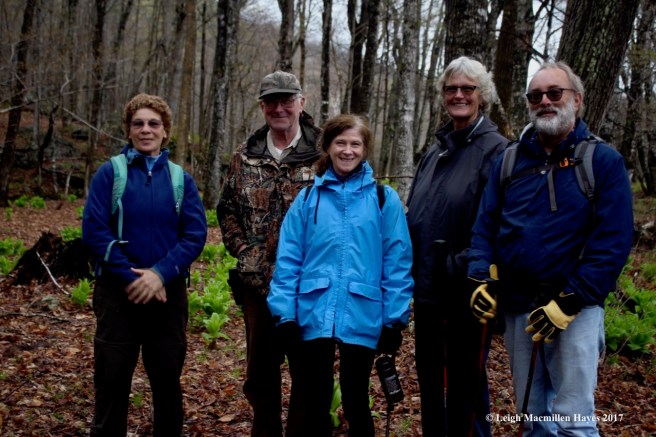
Nancy, Dave, Joan, Pam and Bob

We’d spent the morning among old friends, including two we hadn’t seen for months–we were happy to meet Pam and Bob again for the first time this season. Fortunately, we remembered their names ;-) and they ours. Phew!

As spring unfolds into summer, we know we’ll all continue to meet old friends for the first time–and share a brain as we try to remember their names. They say it takes a village. We love ours because we know it’s okay to ask, “Who are you?” Someone will have part of the answer and someone else will add to it and BINGO.

Into Focus

Sunshine. Spring sunshine. Need I say more. No, but I will as I bring the focus to two of my favorite watering holes.

h-Mount Wash

Of course, a visit to my first pond isn’t complete without a pause to recognize the power and the powerful.

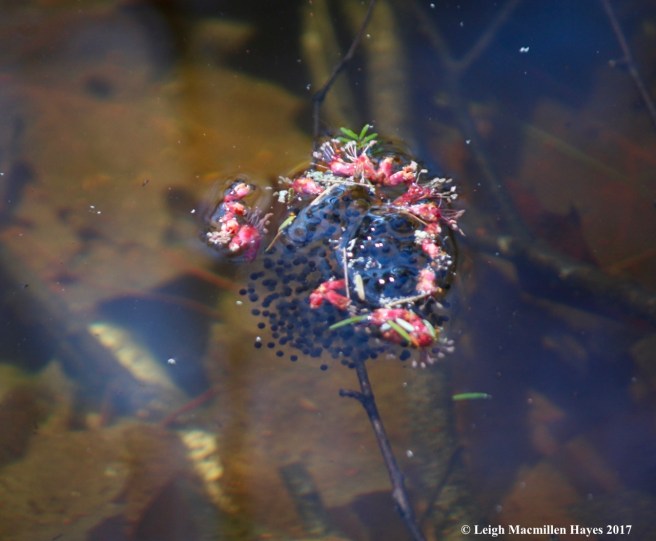
h-wood frog eggs 1

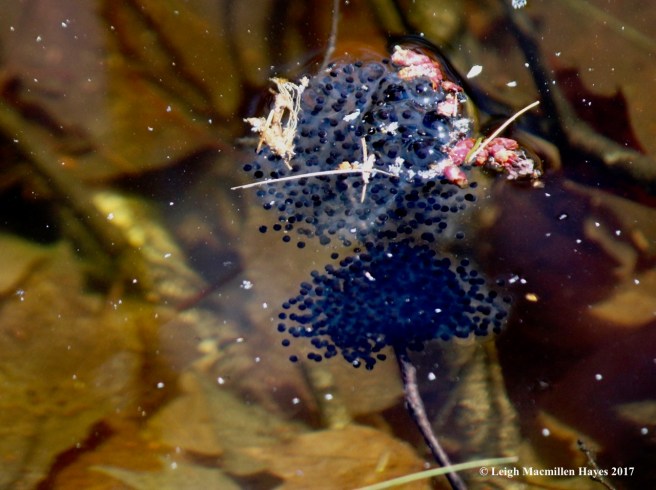
As I approached the vernal pool, I heard not a sound. But, my heart filled when I spotted a clump of wood frog eggs.

h-wood frog 1

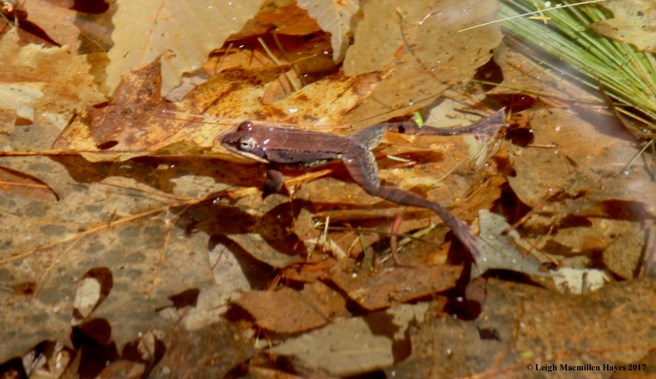
When our sons were youngsters, we always called it the frog pond rather than the vernal pool. And so it is . . . both.

h-willow pollination

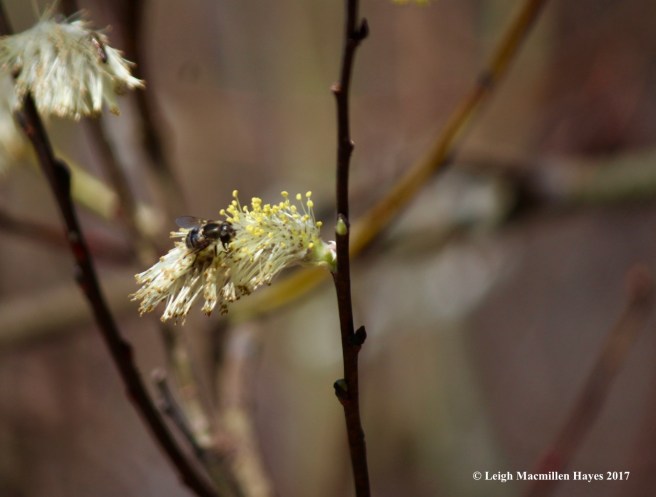
After an hour spent in the pond’s midst, I drove to another–Holt Pond–where I decided to park on the corner of Perley and Grist Mill Roads. I wasn’t sure of the conditions on Grist Mill Road and figured that provided the perfect excuse for a walk and an opportunity to take in the sights along the way. Stepping out of the truck, pussy willows called to me . . . and to their pollinators.

h-queen anne's lace

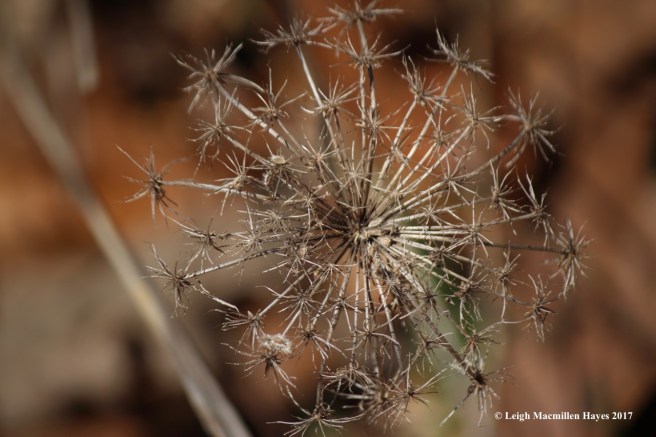
And on the corner, a dried Queen Anne’s lace displayed its fireworks formation.

h-sensitive fern frond

There were sensitive fern fronds, their beads still encapsulating many cases containing dust-like spores.

h-beaked hazelnut

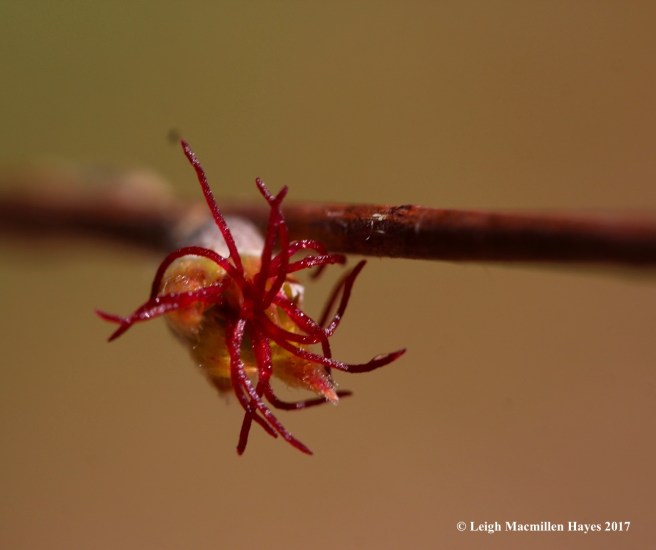
And I even found a few beaked hazelnuts still showing off their minute magenta flowers.

h-Grist Mill Road

I knew by my observations that I’d made the right decision to walk in–both in my findings and in the road conditions.

h-beaver works1

After following the initial trail and climbing over the stonewall, I was about to step onto the first boardwalk when I realized the beavers had been busy.

h-board walk-first section

The water was high as I quietly moved along the board walk, but not too high.

h-pitchers under water1

Although in some cases pitchers were submersed in the wet goodness.

h-speckled alder 1

The speckled alders didn’t mind for they love wet feet.

h-Muddy River

I stepped out to the Muddy River and listened to the chickadees sell cheeseburgers galore.

h-beaver lodge

And then I turned in the opposite direction to admire the beaver lodge and winter feeding pile beside it.

h-Boardwalk through red maple swamp 1

On the next boardwalk, the beauty of the red maple swamp surrounded me again.

h-Red Maple Swamp 1

Layers and colors spoke to the community and season.

h-red maple in swamp

And standing like sentries were the red maples for which it is named.

h-moose scat

It was here that I found evidence of another visitor, albeit this past winter–moose scat.

h-blueberry bud

And noted the swelling buds of highbush blueberries–their season in the offing.

h-Quaking Bog 2

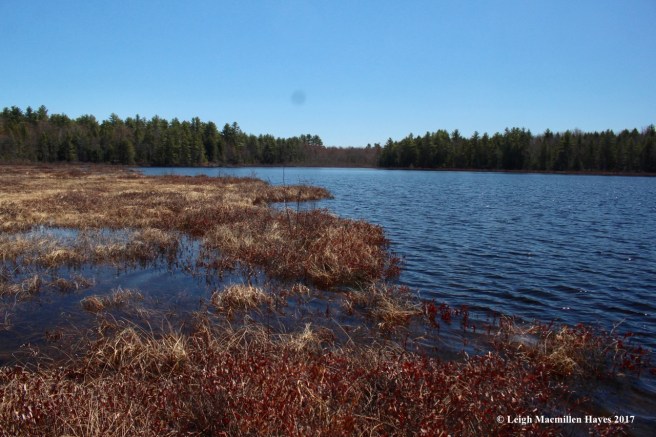
After passing through the woodlands a couple of times in between the swamp journey, I at last reached the quaking bog and Holt Pond.

h-cranberries

Beside the board walk, last autumn’s cranberries floated in the water.

h-pitcher 2

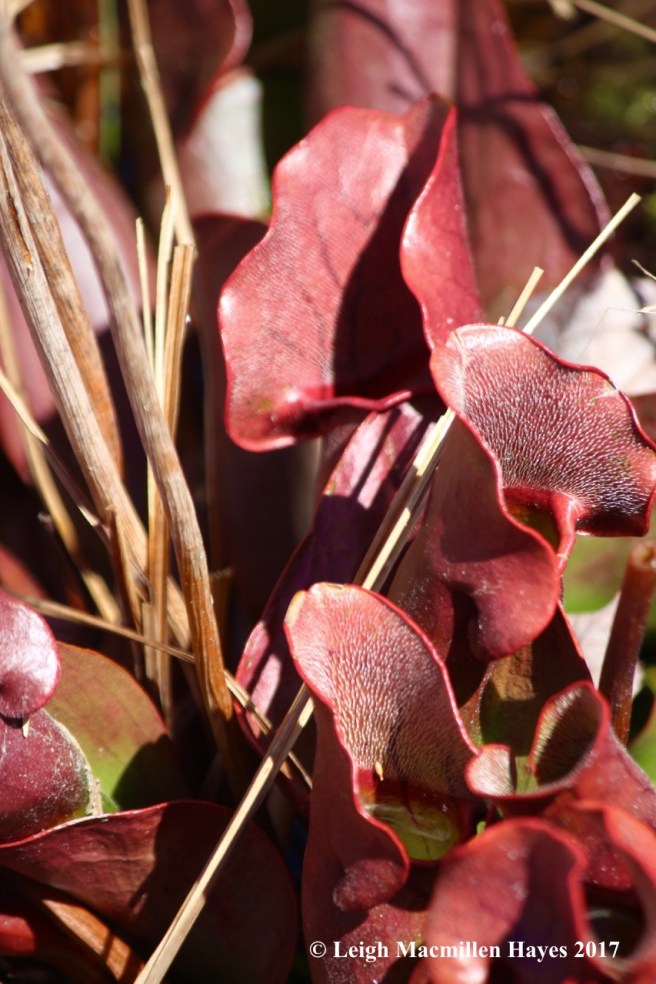
And more pitcher plants showed off their hairy entrance ways.

h-pitcher flower

Withered pitcher plant flowers dangled in their woody fashion–as beautiful in death as in full bloom.

h-Holt Pond south

By the time I reached the T on the boardwalk, I was standing atop it, but in six inches of water–thankful for my rain boots.

h-Holt Pond to Five Fields

And thankful for the opportunity to stand there on a gorgeous spring day as I looked toward Five Fields Farm.

h-Canada Geese

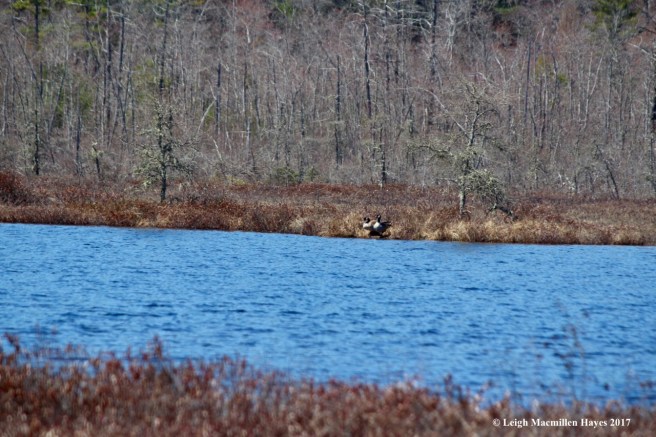
In that very view–two Canada geese. I wondered if they’d found a nest site.

h-dragonfly exoskeleton 2

Also in view, last year’s dragonfly exoskeleton that bobbed in the water flowing over the boardwalk.

h-cinnamon crosier 1

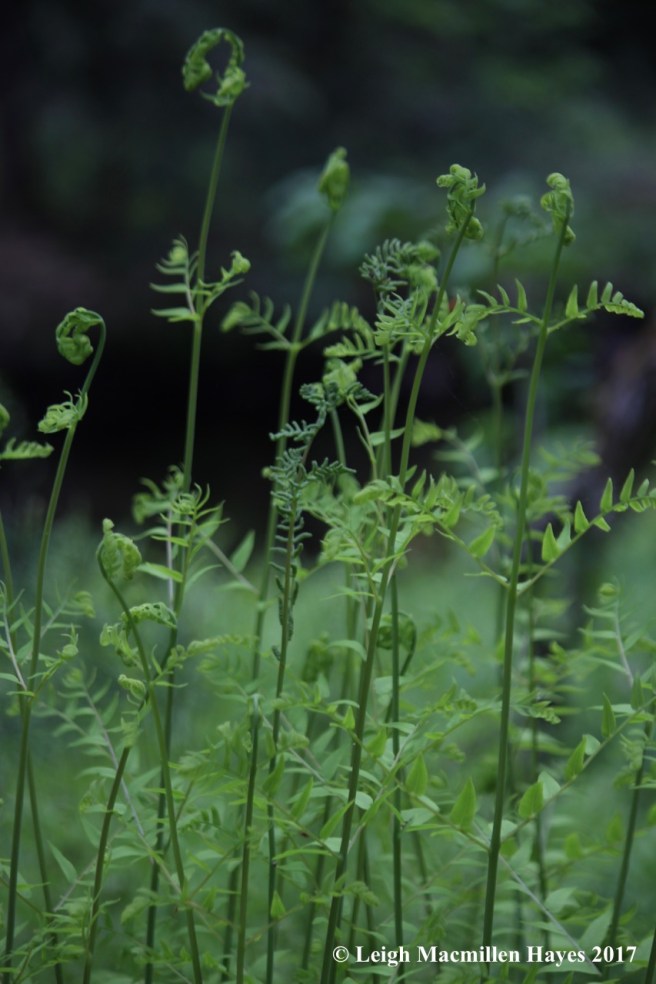
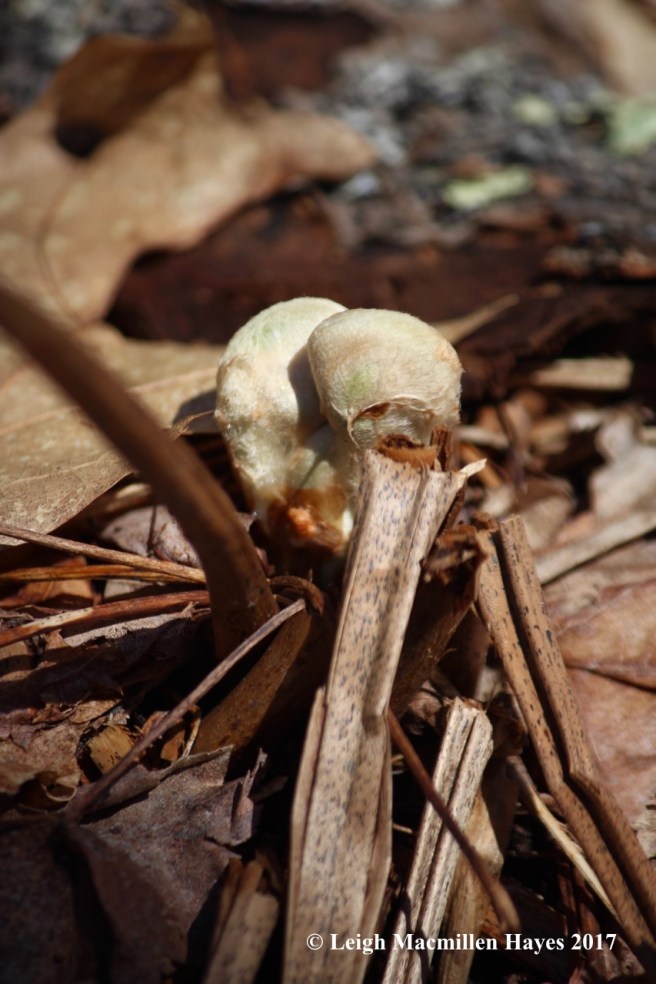
On the way back, I stopped once again. My first photo call was an ostrich fern that I didn’t realize grew there. See why you should walk in rather than drive? That photo didn’t come out so well, but I was standing in an area filled with cinnamon ferns and suddenly realized I was looking at my first crosiers of the season.

I was actually down by a stream beside the road when I found these. A truck came along and the driver paused. He and his friend thought I was fishing and were going to ask what I’d caught. “Only photos,” I said playfully.

h-garter snake 1

Upon returning home I decided to visit the frog pond one more time, thinking the lighting would be different. At the end of the cowpath I found a garter snake enjoying the warmth of the sun . . . and probably a few insects.

h-wood frog eggs 2

When I’d walked to the pond this morning, I was surprised at how quiet it was. That changed this afternoon as a chorus of wrucks added music to my day. And another egg mass had been added to the display.

h-wood frog 2

Of course, all quieted down once I arrived, but I waited . . . and realized the pond really is full of life.

I’d spent the day beside my favorite ponds and was well rewarded. I’d also played with my camera settings, avoiding auto-focus all day. I’ve got a lot to learn, but hey, isn’t that what it’s all about?

All Twigged Out

In preparation for a senior college class I’ll be teaching this week entitled “All Things Spring,” I headed out the door in search of twigs.

t-Mount Wash

Of course, it doesn’t look like spring quite yet. But then again, it does. And on this crystal clear day, the silhouette of the buildings atop Mount Washington were visible.

t-vernal pool

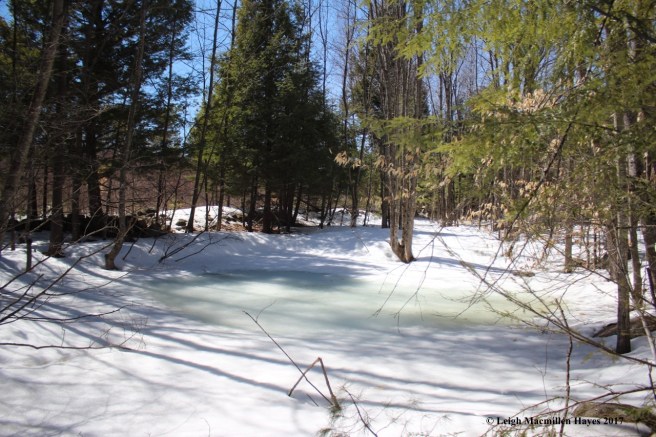
Before I could settle down to the work at hand, I visited the vernal pool, where all was quiet. But, I know the time is nearing. I could smell spring in the air and feel it in the warm sunshine that enveloped me and my surroundings.

t-chick 4

And then I slipped into the gray birch grove to begin my hunt,

t-chick 3

while a black-capped chickadee wondered what I was up to–no good, as usual.

t1-table top (1)

At last, I filled my satchel, but only enough–never wanting to take more than necessary. In fact, since I don’t know how many students will be present, they may have to share.

My plan is to begin with a slide show of flowers and ferns, mammals and birds, and of course, life evolving at the vernal pool (all photos were taken a year ago). I’ll bring some fun things to share, including scat–I sure hope they (whoever they are) think it’s fun.

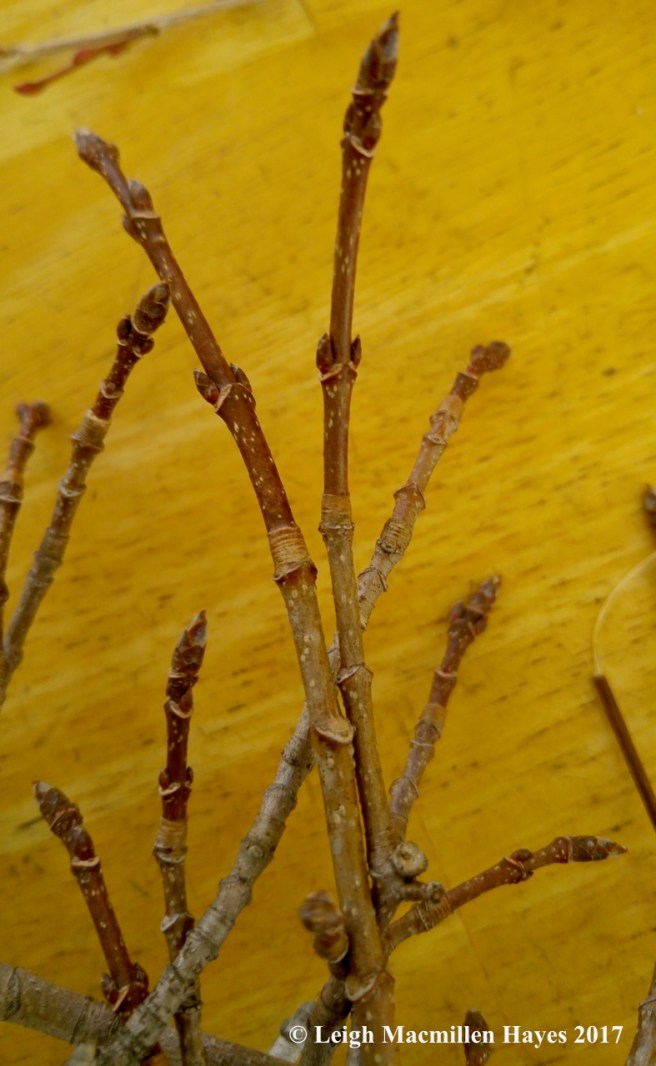
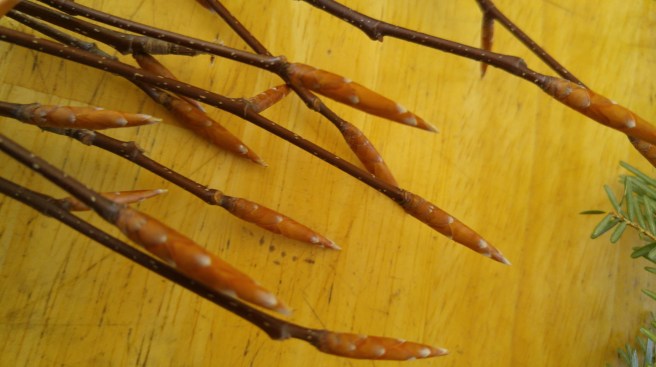
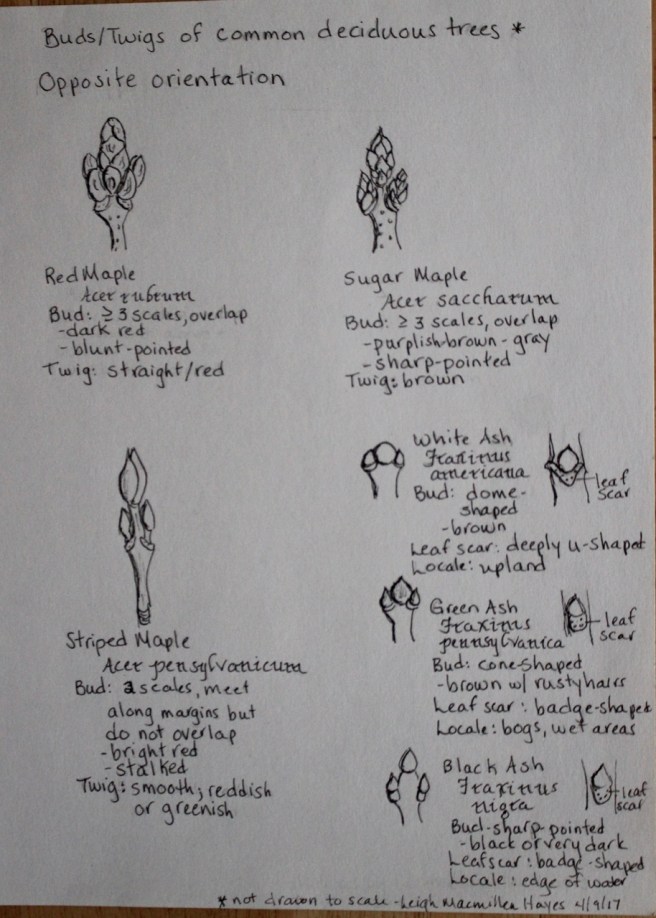
And then we’ll look at twigs through a hand lens so together we can examine the idiosyncrasies of our common deciduous trees,

t1-sugar maple (1)

such as these sugar maples and . . .

t1-striped maple twigs (1)

a few striped maples.

t-beech

We’ll look at beech,

t-quaking aspen

quaking aspens and several others.

t-opposite

My materials are almost ready, though I still need to pull something together about fern crosiers. Oh my!

t-alternate

I’m nervous, but excited. My hope is to instill a sense of wonder, but maybe no one will show. That would be okay–I’d just quietly slip back into the woods.

Until then, I’m trying not to feel all twigged out.


Celebrating Place–Naturally

Once the snow melts it will be more difficult for me to wander and wonder in the woods I explore all winter given its spring/summer water level and logging slash. And so I make the most of these days–trying to notice as much as I can before I can notice no more (or at least until next winter).

l-bushwhack 1

Though I’d promised myself I’d not go again in an effort to not disturb the deer, promises are meant to be broken. And from that came a lesson–the deer are sticking to the snowmobile trail and field edges where tender bark of young red maples and hemlocks, plus swelling buds meet their needs for the moment. So, it was OK that I broke my promise, for the deeper I tramped, the fewer tracks I encountered.

l-spring tails1

Today’s warmer temps in the low 40˚s found the springtails hopping about on any and all surfaces.

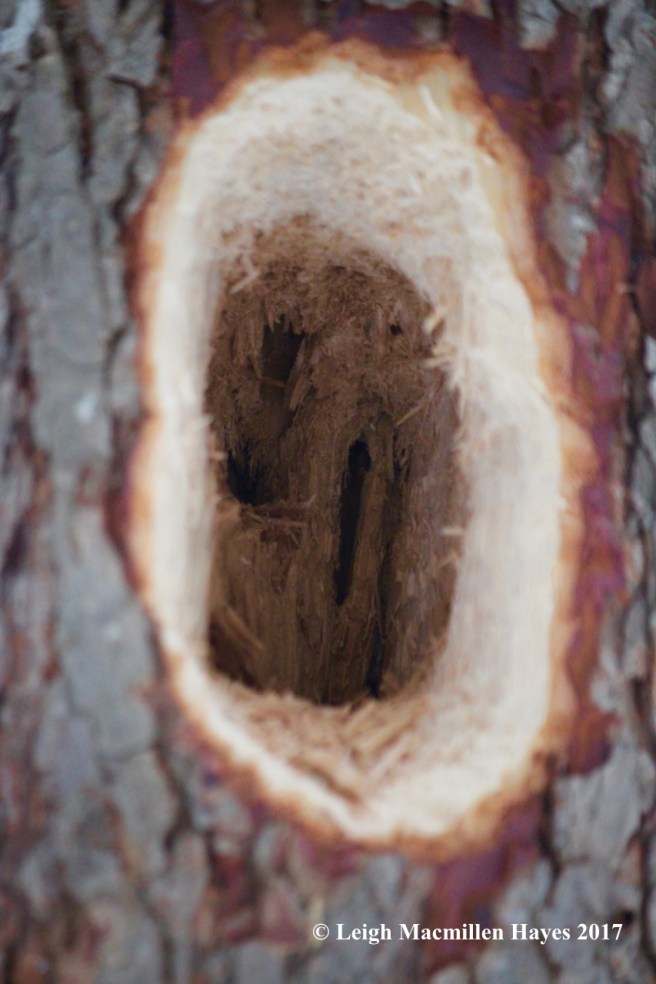
l-pileated hole

As is my habit, I checked on a pileated woodpecker hole when I saw bark and wood scattered atop the snow. Deep was this excavation in search of nourishment.

l-pileated scat-seeds and ant

And chock full was the scat below, which contained insect body parts and seeds of the dreaded bittersweet. Beside the scat, a springtail sought to placate its own food needs which among other things includes plant material and animal remains.

l-red maple bull's eye

Turning to another tree, I landed on a perfect bull’s eye! The target fungus that affects many red maples makes for an easy ID.

l-crustose, liverwort and moss

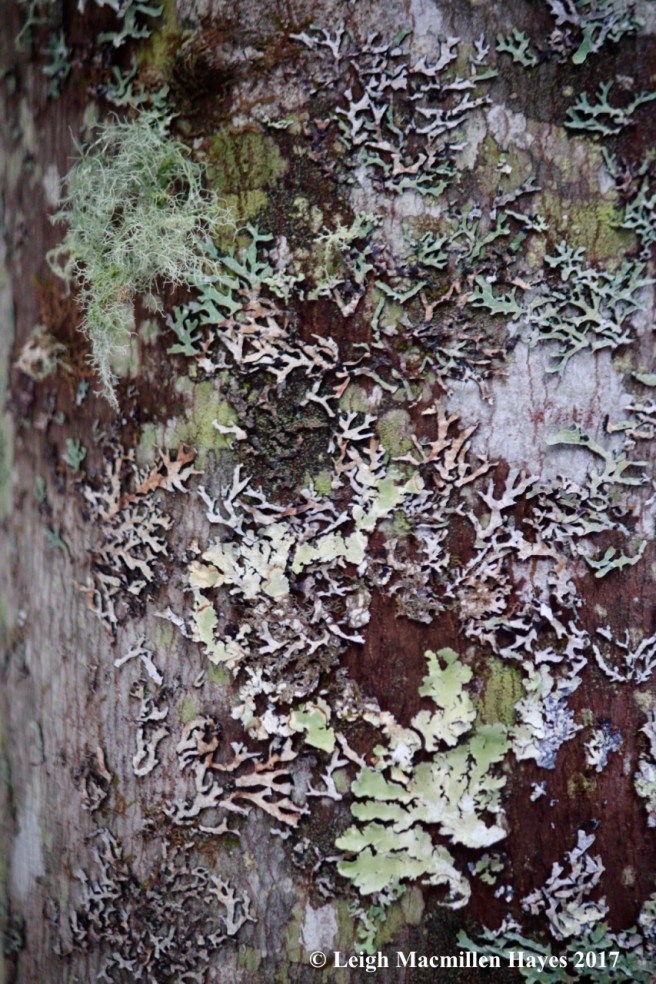
Lichens have also been a focus of late. What I like about this one, the circular green with the black disks of a crustose lichen (possibly bark disk lichen), was its location beside a liverwort (the beaded brown Frullania eboracensis) and a moss that I didn’t key out. Tree bark has its own structure and texture, but so often others also call it home.

l-shield lichens on rock

Rocks also serve as a substrate and this one featured a couple of leafy foliose shield lichens, their colors enhanced by yesterday’s inch of snow.

l-hair lichen and beard lichen

And dangling from a branch, two forms of fruticose (branching or fruit-like structure–) lichens. The dark is a hair lichen, while the green a beard–seems about right with the hair above the beard.

l-lichen garden

On another maple I spied a garden–you’ve got to liken it. (Corny joke that always manages to enter a lichen conversation.)

l-frullania 1

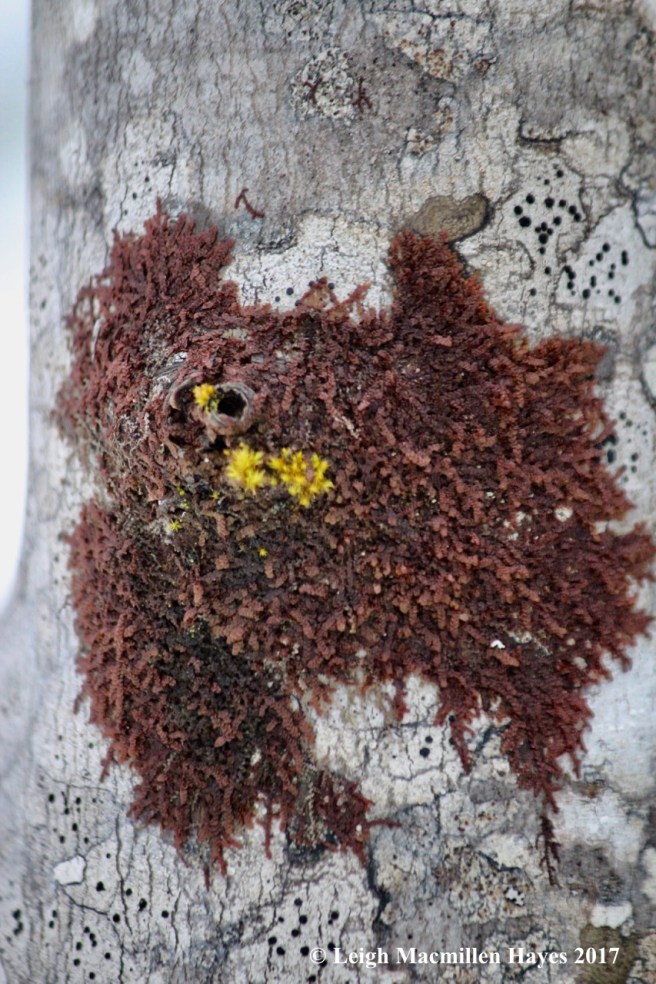
I’ve often paused beside Frullania eboracensis, a liverwort with no common name, but today several trees shared displays of mats called Frullania asagrayana, so named for a botanist and natural history professor at Harvard University from 1842-1873–Asa Gray.

l-frullania asagrayana 1

Its shiny, overlapping chain of red-brown leaves reminded me of caterpillars crawling along the maple bark.

l-spirea:steeplebush

Casting my eye elsewhere, steeplebush in its winter form offered an artistic presentation.

l-bracken fern1

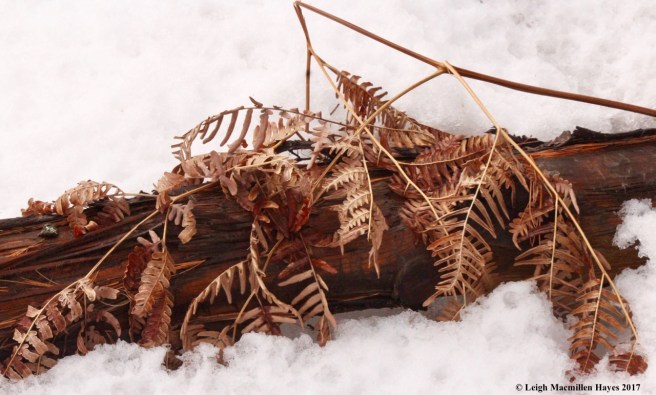
And as the snow melts, last year’s bracken fern made an appearance.

l-speckled 3

One last shrub made me stop. Minus any catkins or “cones” for which it is known, I had to think for a moment about the speckled alder. But those speckles or lenticels through which gas exchange occurs, and the buds and leaf scars were give aways.

l-speckled buds and leaf scar

The two bud scales meet at their edges and look like miniature footballs. But it’s the bundle scars where leaves were formerly attached that make me laugh. That vascular system looks like a face–two round eyes, a funny shaped nose and a round mouth, as if it’s exclaiming, “Ohhh” or “Wow.”

l-Pleasant Mtn in background

At last I reached my turn-around point. I could see Pleasant Mountain in the distance and knew where I was in the world. This is my place and I love every opportunity to celebrate it–naturally.

Beautiful Maine Mondate

Some Monday’s we look for new places to explore or mountains to climb, but today found us visiting an old favorite that is gorgeous in any season.

s1-Stone House Road 1

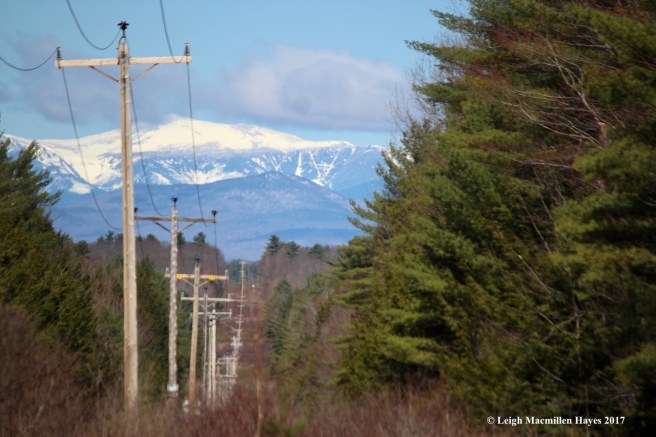
Because it’s still winter (and she’s not letting go right away), we knew our hike would be extended by more than a mile on either end. We parked by the Leach Link Trail on Stone House Road and followed the telephone poles in.

s2-bear number

These are my favorite telephone poles in the world–well, for today that is, for they show the works of the clever bears that inhabit this place. The wood has been scratched and bitten, while the shiny pole number was mutilated. This was pole 5. I suppose it still is.

s3-bear hair

Hair sticks out from splinters. Bear hair.

s4-more bear hair

We found lots of it on several poles today. More than we’ve seen in the past.

s6-another pole

I’m thinking that the bears in the area have a fondness for 5. Or a dislike, for pole 15 also received rough treatment. There are more, but it was on 5 and 15 that we noticed the number destruction.

s8-bear dogs

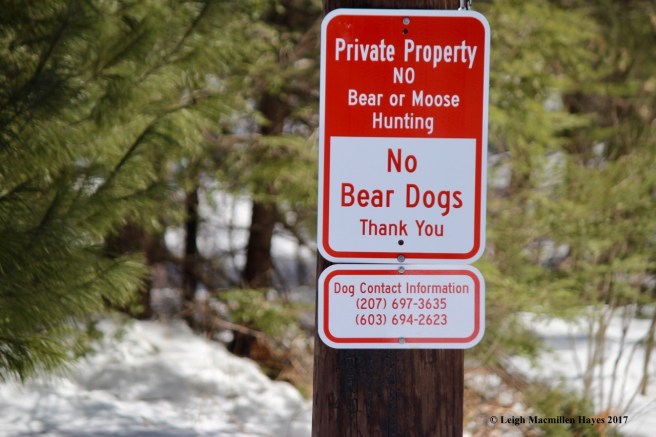
Despite that, the bears in this area are most welcome. Because the signs are new, I asked my guy what he thought the bears will do when they emerge from their dens soon. In my mind, I saw a similar behavior to the other poles and imagined that when we return again we’ll see that the signs have also been destroyed because that’s what bears do. My guy’s response, “Clap.” Indeed, they should.

s9-gate

At last we reached the gate where we usually park to hike the Stone House property and Blueberry Mountain trails. The Stone House property encompasses about 890 acres surrounded by the White Mountain National Forest. In 2011, the owners, David Cromwell and Sharon Landry, established a conservation easement held by the Greater Lovell Land Trust. The easement allows for traditional uses including commercial agriculture and forestry, but prohibits development and subdivision in perpetuity. Thus we have both this couple and the GLLT to thank for today’s adventure.

s10-black cherry bark

When we finally reached the Shell Pond trailhead, a black cherry immediately jumped out at me. The property was last logged in 1977 and features a mix of hard and softwoods. My bark eyes love the diversity.

s11a-birch and red maple

And my bark mind appreciates the kindred spirit of the trees that manage to support each other despite their differences–in this case a beech and red maple.

s14-pileated works

I’m not the only one who likes bark–the work of pileated woodpeckers,

s15-porcupine

porcupines,

s16-beaver works

beavers,

s13-yellow birch burl

and even insects was evident throughout our three-hour tour.

s17-Yale blue

As we hiked, my dad was also on my brain. I’d received a message this morning from his former boss at Yale University who fondly recalled Dad and his brother Bob. Though quiet men, he and his brother had a twinkle in their eyes, a love for music, especially opera, and always a good joke or prank up their sleeves.

When I saw this tree in the shape of a Y, I knew it was for Dad. Even the sky spoke of the university–though several shades lighter than Yale blue. And with that came the memory that any paint my father mixed had a touch of Yale blue in it–thus was his way. It was all meant to be for Mr. Cromwell, the property owner, is associated with Yale.

s18-my guy

I couldn’t help but think that Dad would have loved the idea of our Mondates. He also would have loved my guy, but sadly they never met. Dad died of a heart attack only days before he and Mom were to spend a weekend with me in Maine–thirty years ago.  But, my guy continues to wear a Yale sweatshirt when he runs, which he did this morning. In that way, he’s made his own connection. Yeah–that’s my guy!

s19-pond views

Now that I’m writing through tears, I’ll get back to the trail, which is delightful in winter because it offers more views of Shell Pond below.

s20-cliff views

And the icy ledges above. Later in our journey, I noted the trail to the ledges had been well used–probably by rock/ice climbers.

s22-water 1

Trail conditions were such that we walked on top of the hardened snow, though I did wear micro-spikes for the entire tour. Someone waited to put his on and did a little slipping and sliding along the way. Brook crossings required stepping low and high, so deep is the snow still.

s23-ice castle

While I marveled at a castle made of ice,

s24-Christmas tree

my guy spotted a Christmas tree.

s25-polypody

We even found a few hints of green. These polypody ferns were opened, indicating warmer temps and today we certainly noted the difference compared to the brisk weekend.

s26-polypody

Of course, on another rock, some were still curled in their cold formation. They were under a hemlock and more shaded.

s27-partridgeberry

Any bit of green is a welcome sight about now and I was surprised to see partridgeberry poking through the snow.

s28-lunch bench

At last we reached lunch bench, which my guy stood upon. Yup, that’s the granite bench under his feet.

s29-lunch

We sat on it to eat our PB&J (with butter for me, of course) sandwiches. And tried to keep from sliding right down to the pond.

s30-Shell Pond

Lunch view included Shell Pond and the Baldfaces in the background. All along, we’d noted mice, squirrel, mink, fisher, coyote, bobcat, ruffed grouse, turkey and moose tracks. But as we ate we listened to the whales groan–so moaned the ice in the afternoon sun.

s31-brook

A short time later we reached Rattlesnake Brook and the orchard, where the natural community transitioned and appeared almost bucolic.

s32-ostrich fern

One of my favorite finds along this section is the ostrich fern. The structure of its fertile frond makes me smile.

s33-airfield

From the orchard we moved on to the old airfield and wondered if the family ever flies to their summer home. Though I don’t think it’s used these days, the airstrip was apparently built in the 1940s by the military for practice landings and takeoffs during World War II.

Again, the views were breathtaking.

s34-stone house and Blueberry Mtn

As hikers, we’re reminded by signs to stay on the marked trails, thus protecting the land and giving the family some space. I’m in awe of their home. The Stone House was built in the early 1850s by Abel Andrews. He quarried the large, hand-hewn granite slabs from Rattlesnake Mountain and built the 40-foot by 25-foot house for his wife and thirteen children.

s35-another wetland

I did stay on the trail most of the time, but occasionally I heard the landscape calling my name and had to investigate. Fortunately, my guy stayed on the trail all the time and kept us honest.

s36-Beautiful Maine

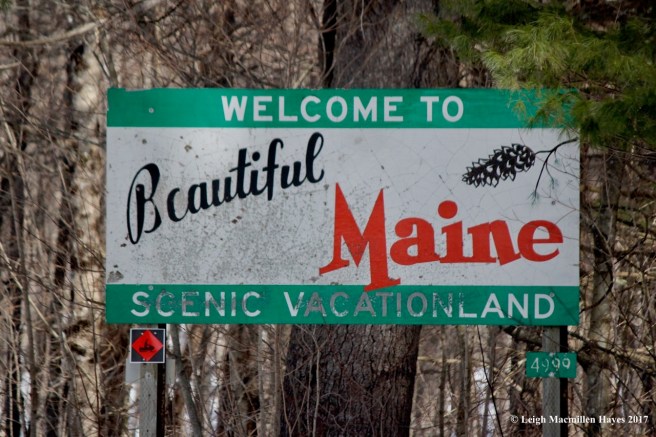
We walked back out to the truck and then decided to take a quick detour before driving home. Being on Stone House Road, we were only a mile from the winter closure point for Route 113 in the White Mountain National Forest. The road forms the state line between Maine and New Hampshire for several miles. And then it passes into Maine at the gate by the Cold River Campground and The Basin. And it’s there that you’ll find this iconic sign.

Welcome to Beautiful Maine and another scenic Mondate.


Frigid Reflections at Flat Hill/Perky’s Path

A sheet of ice greeted me in the parking lot at the GLLT’s Flat Hill trailhead this morning, not to be unexpected given the recent rain and fluctuation in temperature. From -8˚on Monday to +50˚ midweek and this morning back to 0˚, we’ve been riding a thermometer rollercoaster. Consequently, I chose micro-spikes over snowshoes and made sure I packed my hiking pole and hand warmers.

f-pumpkin

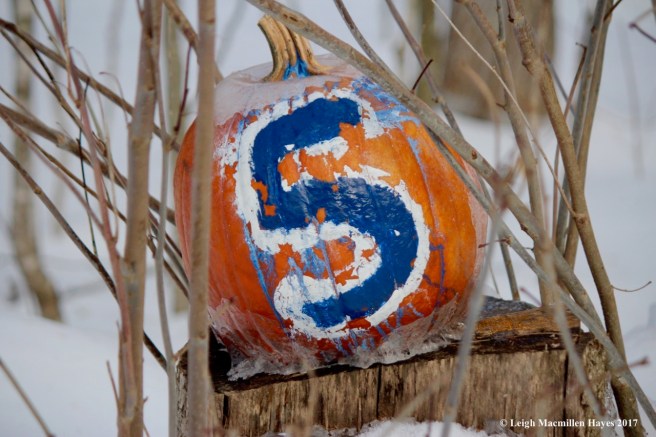
Even the pumpkin had an ice covering? What? I know not where this came from or what the “5” means, but it sits upon the basswood stump beside the lot and greets all who pass by.

f-first-bridge

Despite the rain and warmer temps for a couple of days, the snowpack is still over a foot deep and quite dense.

f-flat-hill-trail

In fact, it’s so dense, that a previous snowshoer who probably had hiked this way last weekend, barely broke through, and I was able to stay on top, except for an occasional post hole. Well, maybe more than occasional given that I frequently went off the main trail to check things out.

f-trail-leaves

Upon the trail, the leaves of marcescent trees gathered in the snowshoe indentations.

f-sugar-maple

Even a few that aren’t marcescent made their presence known, like this sugar maple. A friend ask me recently about the pronunciation of that word that I love to say because of how it makes my mouth work: ˌmärˈses(ə)nt. He wanted the first “c” to be hard, but indeed it isn’t.

f-birch-polypore-1

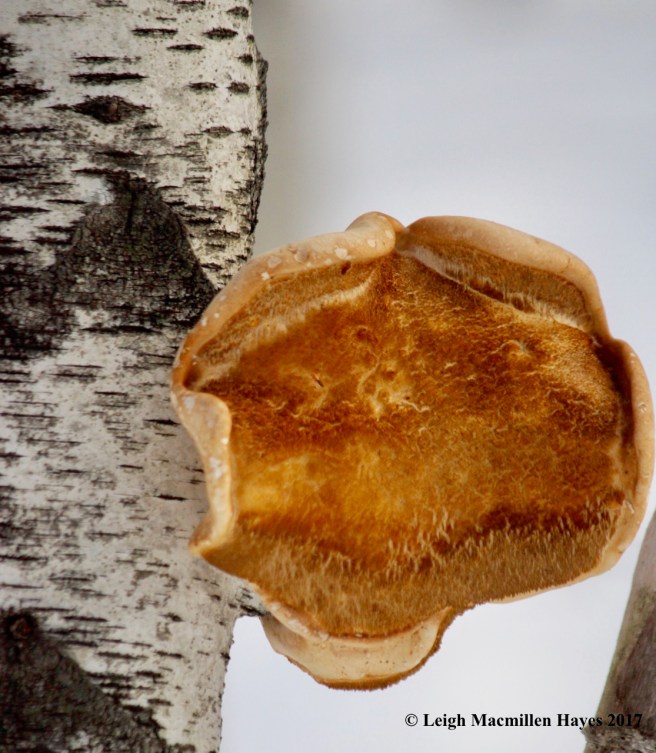
A birch polypore growing at an abnormal angle made me wonder what had happened. I’m still wondering.

f-pileated-1

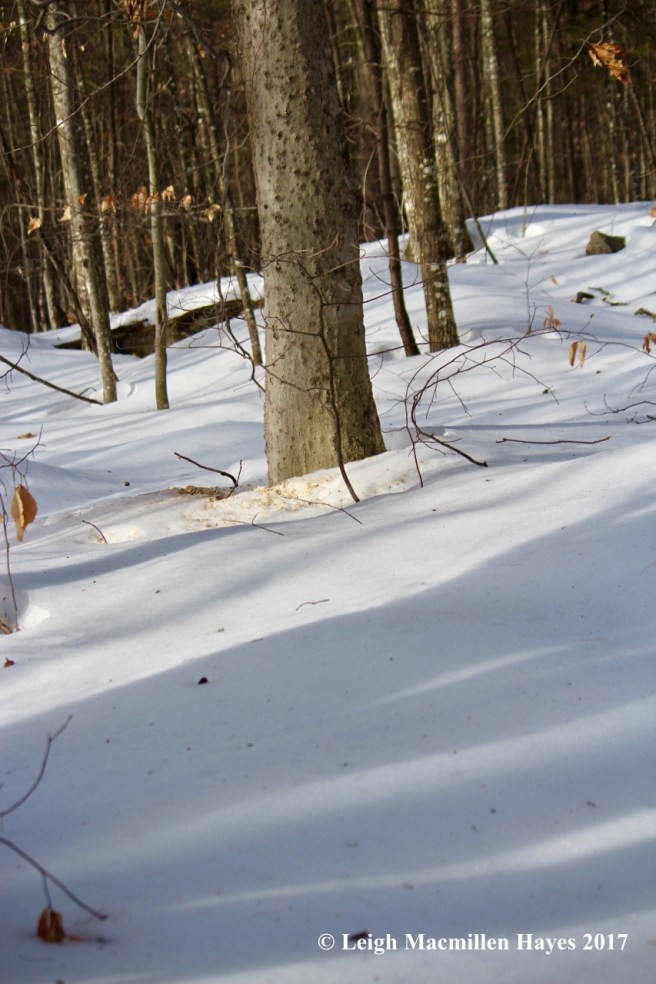
And then I spotted a different color on the snow beneath a beech tree. This was when I realized that rather than my hiking boots I should have worn snow boots. A few post holes and the snow slipped in under the boot tongues.

f-pileated-hole

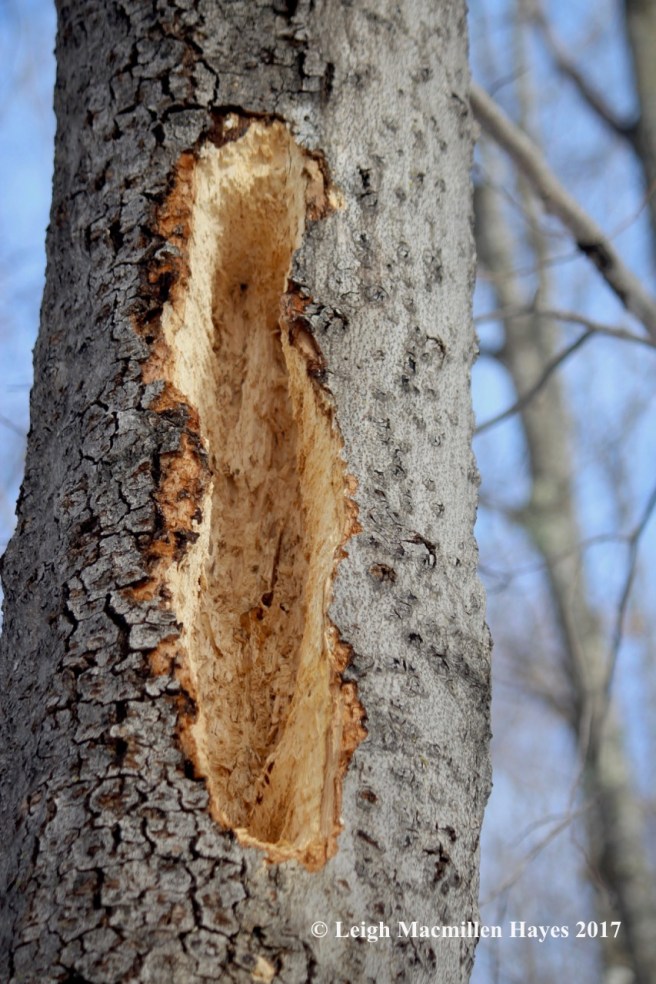
But . . . it was worth it. Up high–the elongated hole created by a pileated woodpecker.

f-pileated-scat

And down low–its scat. My day was made and I could have gone home, but . . . didn’t.

f-porky-pattern

As I continued hiking, I noticed tracks that crossed the trail in several places. They weren’t quite discernible, but I had a feeling they’d been made by a fisher. And then, further along, I noticed these, which though not perfect, were easier to determine. Their pigeon-toed, sashaying behavior indicated porcupine, a resident of this place (and prey of the fisher).

f-summit-deer-tracks

And at the summit, deer tracks.

f-summit-7-1

I love the name Flat Hill–an oxymoron it seems, though once you climb up, you realize that the top is almost flat. And from here the Baldfaces and Mount Washington enhance the view. I looked around for the typical porcupine works and perhaps the critter itself who sometimes can be seen in the treetops, but was disappointed to see neither. Despite the hand warmers, my fingers were frozen–probably because I kept taking my mittens off to take photos. I’d intended to eat lunch at the top, but it wasn’t to be.

f-polypody

Common polypody ferns that grow on the summit rock curled inward as if to confirm my chill.

f-blue-sap

And as I turned to descend, the blueness of pine sap seeping from a woodpecker hole also spoke to the day–the lower the temp, the bluer it appears.

f-porky-works-1

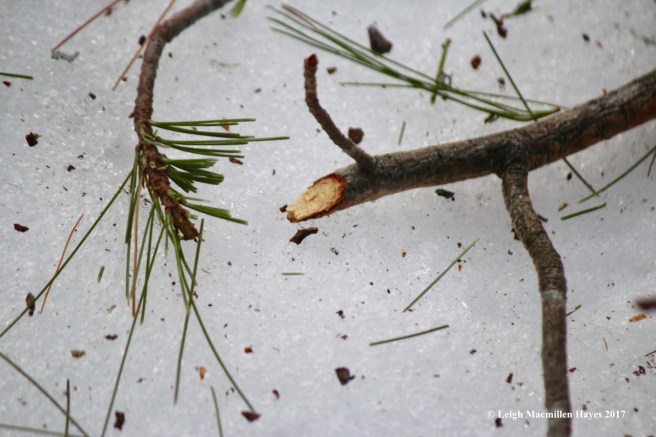
It was that sap that pulled my attention to another sight I’d missed on the way up. White pine branches were scattered below a couple of trees and tracks were almost visible all around.

f-porky-works-3

I looked up, but my friend was nowhere to be seen. And so I looked down to admire his work–angled cuts and nibbled needles. I can honestly say I’ve never paid attention to the needle works before.

f-porky-works-4

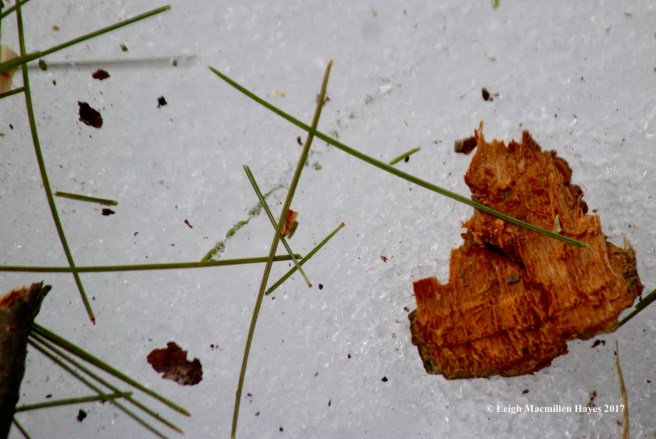
Amongst his offerings tree bark also decorated the forest floor for he discarded the bark to get at the cambium layer beneath. The one thing I didn’t find was scat. And believe me, I searched.

f-porky-3

f-porky-works-2

Though most of his work was on older trees, younger ones had also been visited. I was just to the left of the trail summit and in the past I’ve searched the ledge below for a den. Today, I didn’t do so, but his path led in that direction. Perhaps he saved his scat to serve as insulation back at the homestead. I don’t know, can porcupines choose when and where to leave such offerings? Usually it seems that they don’t have such control.

f-sign-post

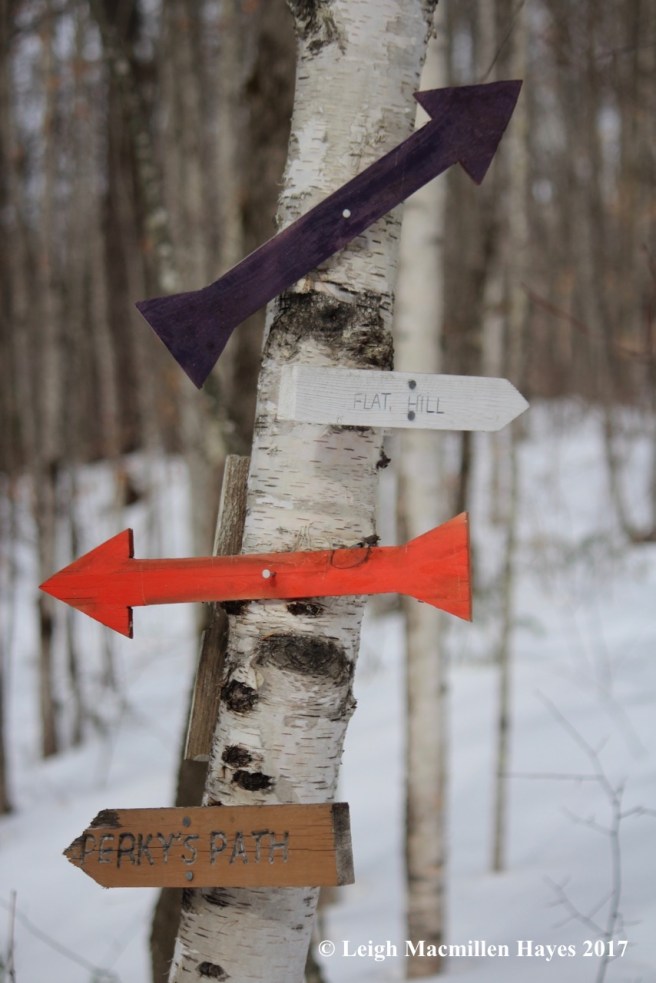
I left the porcupine findings behind and headed back down to Perky’s Path, a favorite place because of the wetland it passes through.

f-perkys-raccoon-2

No humans had been this way in a while, but a critter recently paid a visit.

f-perkys-raccon-prints

My brain went into overdrive. Could it be? Well, it had been warm for two days, so it could . . . be a raccoon. When I’m alone, I’m 100% correct, but today I kept questioning myself. The prints were the right size and the pattern and habitat worked. But if you think otherwise, I’m willing to listen.

f-perkys-beaver-lodge-1

What I do know is that the beaver lodge, the uppermost hump on the left, remained abandoned.

f-fox-hair-2

I decided to follow the wetland for a bit, until something caught my eye near the root system of an downed tree closer to the trail.

f-fox-hair-3

Hair. Small tufts of it.

f-red-fox-fur1

Gray. With red tips.

f-fox-hair-macro

Hollow in structure.

f-fox-scat

Beside hair-filled scat. There were no prints in the snow, such as it was. I wasn’t even digging post holes at that point, with the temperature lower closer to the wetland. Here’s my story of what I saw. As a red fox searched for prey, including in the hole beside the downed tree, the mites that have infected its skin made it itch. The tree roots provided the perfect back scratcher (there were a few hairs hanging from it) and so the fox took advantage. Its scat–incidental or intended, I’m not sure. Typically, it’s intended, leaving a message to others about boundaries, age, sex and the like. Does it also announce the presence of mites? Red foxes and not gray, are affected by the sarcoptic mange mites.

f-perkys-beaver-pond1

After such a finding, I needed to move on. By the bridges that cross the wetland, the view was as beautiful as ever.

f-perkys-royal-ferns

Royal ferns, almost a memory, leaned over the water’s edge.

f-perkys-brook-reflection

Trees offered reflections in the flow of the water.

f-ice-1

And ice gathered in solid, yet fluid motion.

f-hoar-florets

Hoar frost flowers bloomed, speaking to the frigid temp.

I, too, was chilled, but happy to have time to reflect on the lives that call Flat Hill and Perky’s Path home. And then I was happy to head home, the heat in my truck on high for most of the trip.

Books of December: A Holiday Wish List

In the spirit of changing things up a bit, I decided that I’d include five books I highly recommend you add to your holiday wish list and two that I hope to receive.

These are not in any particular order, but I’m just beginning to realize there is a theme–beyond that of being “nature” books.

b-forest-forensics-1

Book of December: Forest Forensics

Tom Wessels, forest guru and author of Reading the Forested Landscape, published this smaller work in 2010. Though only 5″ x 7.5″, the book is rather heavy because it’s filled with photographs. Despite the weight, Forest Forensics fits into a backpack and is the perfect guide for trying to figure out the lay of the land. Using the format of a dichotomous key, Wessels asks readers to answer two-part questions, which link to the photos as well as an Evidence section for Agriculture, Old Growth and Wind, plus Logging and Fire. In the back of the book, he includes Quick Reference Charts that list features of particular forest and field types. And finally, a glossary defines terms ranging from “age discontinuity” to “Uphill basal scar,” “weevil-deformed white pines” and “wind-tipped trees.” In total, it’s 160 pages long, but not necessarily a book you read from cover to cover. If you have any interest in rocks, trees, and the lay of the land, then this is a must have.

Forest Forensics by Tom Wessels, The Countryman Press, Woodstock, VT, 2010.

b-shrubs-1

Book of December: Shrubs of the Northern New England Forest

Michael L. Cline is executive director of Tin Mountain Conservation Center in Albany, New Hampshire. In September, I had the pleasure of attending a talk he gave at the center about Shrubs of the Northern New England Forest. The 6″ x 9″ book weighs about the same as Wessels’, and will also fit handily into your pack. Of course, you might want to leave the books in your vehicle or at home and look up the items later–thus lightening your load. Using Brownfield Bog as one of his main go-to places, Cline describes 70 species of shrubs from Creeping Snowberry to Mountain Ash. The book is arranged by family, beginning with Mountain Maple and Striped Maple of the Aceraceae (Maple) family and ending with the American Yew of the Taxaceae (Yew) family. Each two-page layout includes photographs (and  occasionally drawings), plus a description of habit, leaves, flowers, twig/buds, habitat, range, wildlife use, notes and other names. I have no excuse now to not know what I’m looking at as I walk along–especially near a wetland. That being said, I’ll think of one–like I left the book at home, but I’ll get back to you.

Shrubs of the Northern New England Forest by Michael L. Cline, J.S. McCarthy Printers, 2016

b-bogs-and-fens-1

Book of December: Bogs and Fens

Ronald B. Davis’ book, Bogs and Fens, was a recent gift from my guy. I hadn’t asked for it, and actually didn’t know about it, so I’m tickled that he found it. I’m just getting to know Dr. Davis’s work, but trust that this 5.5″ x 8.5″ guide about peatland plants will also inform my walks. Again, it’s heavy. The first 26 pages include a description of vegetation and peatlands and even the difference between a fen and a bog. More than 200 hundred pages are devoted to the trees, plants and ferns. In color-coded format, Davis begins with the canopy level of trees and works down to tall shrubs, short and dwarf shrubs, prostrate shrubs, herbaceous plants and finally, ferns. He also includes an annotated list of books for further reference, as well as a variety of peatlands to visit from Wisconsin to Prince Edward Island. As a retired University of Maine professor, Davis has been a docent and guide at the Orono Bog Boardwalk for many years. Field trip anyone?

Bogs and Fens: A Guide to the Peatland Plants of Northeastern United States and Adjacent Canada by Ronald B. Davis, University of New England Press, 2016.

b-lab-girl-1

Book of December: Lab Girl

I’d never heard of Hope Jahren until this summer and then several people recommended her book, Lab Girl, to me. Rather than a guide, this is the story of Jahren’s journey from her childhood in rural Minnesota to the science labs she has built along the way. As a scientist, Jahren takes the reader through the ups and downs of the research world. And she does so with a voice that makes me feel like we’re old friends. Simultaneously, she interweaves short chapters filled with  information about the secret life of plants, giving us a closer look at their world. I had to buy a copy because for me, those chapters were meant to be underlined and commented upon. I do believe this will be a book I’ll read over and over again–especially those in-between chapters.

Lab Girl by Hope Jahren, Alfred A. Knopf, 2016.

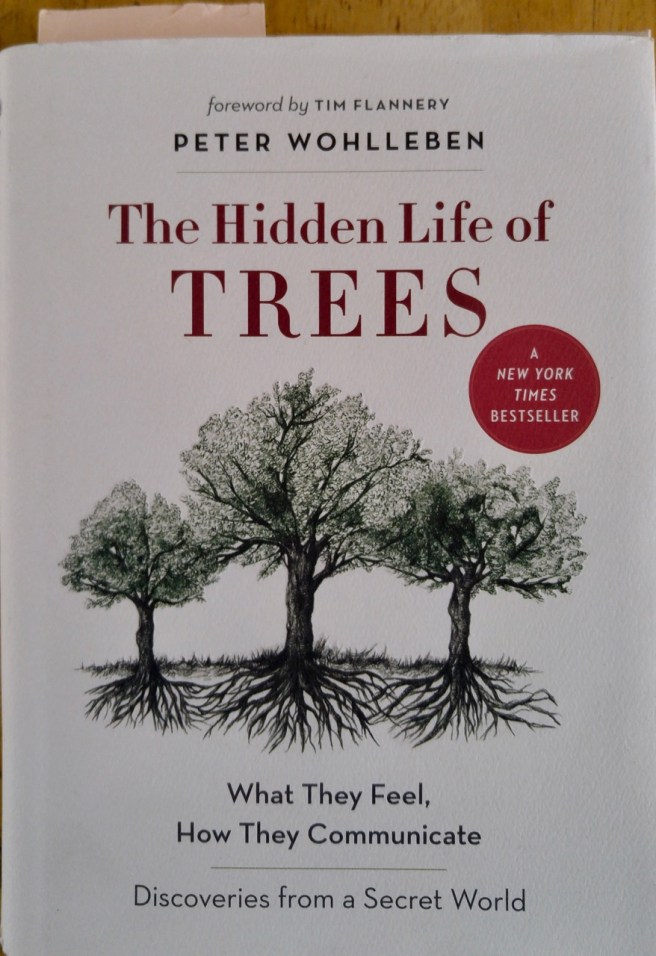
b-hidden-life-of-trees-1

Book of December: The Hidden Life of TREES

And finally, a gift to myself: The Hidden Life of TREES by Peter Wohlleben. I’d first learned about this book in a newspaper article published last year and had to wait until recently to purchase it after the book was translated from German to English. Again, it’s not a field guide, but offers a delightful read that makes me think. And thus, you can see my bookmark. I’ve not finished reading it yet, but I’m having fun thinking about some different theories Wohlleben puts forth. As a forester, Wohlleben has spent his career among trees and knows them well. He’s had the opportunity to witness firsthand the ideas he proclaims about how trees communicate. And so, I realize as I read it that I, too,  need to listen and observe more closely to what is going on in the tree world–one of my favorite places to be. Maybe he’s right on all accounts–the best part is that he has me questioning.

The Hidden Life of TREES: What They Feel, How They Communicate by Peter Wohlleben, Random House, 2016.

And that’s just it–the underlying theme of these five books you might consider is TREES. I can’t seem to learn enough about them. One word of caution, each author has their own take on things, so the best thing to do is to read the book, but then to head out as often as you can and try to come to your own conclusions or at least increase your own sense of wonder.

And now for the books on my list (My guy is the keeper of the list):

Naturally Curious Day by Day: A Photographic Field Guide and Daily Visit to the Forests, Fields, and Wetlands of Eastern North America by Mary Holland, Stackpole Books, 2016

Mosses, Liverworts, and Hornworts: A Field Guide to Common Bryophytes of the Northeast by Ralph Pope, Cornell University Press, 2016.

Do you have any other suggestions for me?

One final thought about books–support your local independent book store as much as you can. Here in western Maine, we are fortunate to have Bridgton Books. Justin and Pam Ward know what we like to read and if they don’t have a particular book we’re looking for, they bend over backwards to get it for us.


Pay Homage at Otter Rock

This holiday season, why not take a short hike and smell the roses along the way?

h-milkweed

Or at least admire the milkweed plants that grow in the field across from the boat launch. I did just before I walked the blue/red trail at the Greater Lovell Land Trust’s Heald and Bradley Ponds Reserve this morning. It wasn’t a long walk, but worth every moment. And I encourage you to do the same, whether here or somewhere else.

h-water-over-dam-1

Listen to the water flow over the dam.

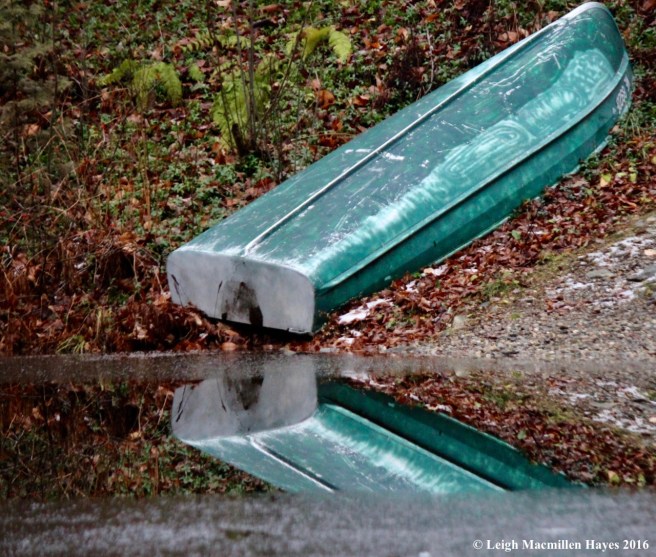
h-boat-1

Notice the greenery across the mill pond.

h-snow-on-trail

Follow the path sprinkled with snow.

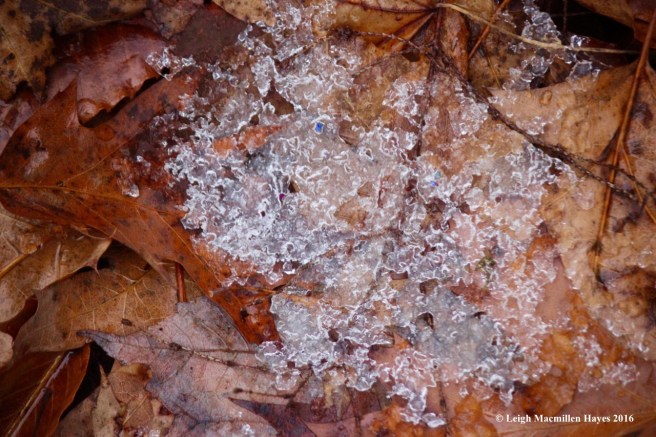
h-ice-on-leaves

Rejoice in the ice shapes atop various leaves.

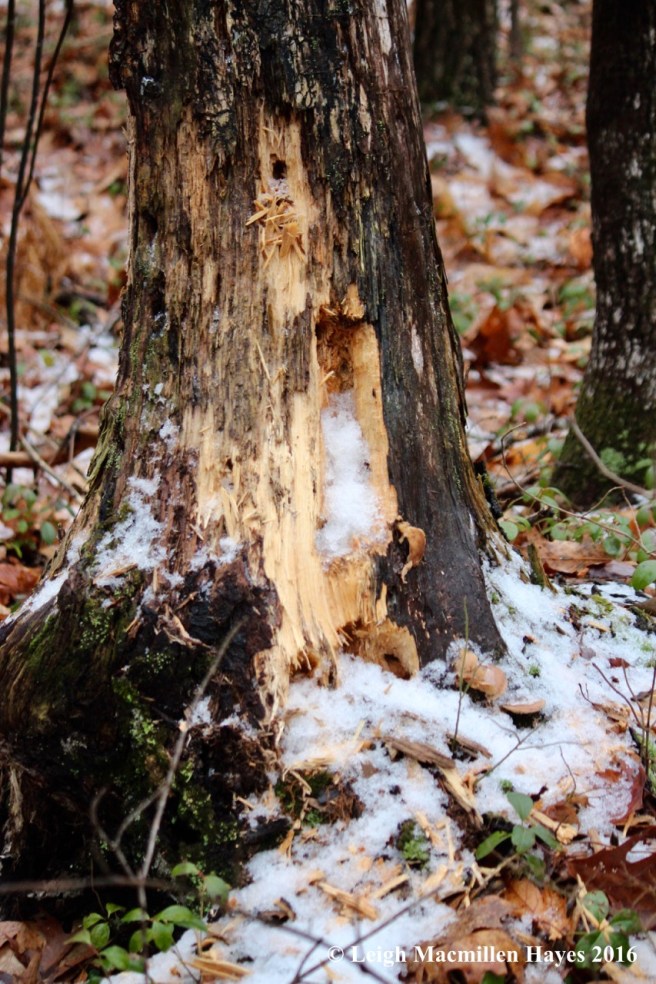
h-pileated-works

Check out the Pileated Woodpecker works in dead snags.

h-bright-beech

Let the Beech leaves brighten your day.

h-beech-and-witch-hazel

Distinguish between the hues of Beech and Witch Hazel.

h-four-trees

Greet four amigos–Paper, Yellow and Gray Birch, with the trickster Cherry posing as a Black Birch.

h-grape-fern

Applaud the maroon-fringed Grape Ferns at your feet.

h-sign

Follow the directions found on the sign.

h-bleeding-mycena-mycena-haematopus

Rejoice in late blooming fungi like these Bleeding Mycenas (Mycena haematopus).

h-otter-rock

Wonder at the various lichens that adorn the trees.

h-bristly-beard-lichen

Get up close and personal with a few, including the Bristly Beard.

h-rocks-near-otter-rock

Laud the reflections of water not yet frozen.

h-fall-colors

Praise the warm color of Royal Ferns gone by.

h-exo-1

Revere dragonfly and damselfly exoskeletons that still cling.

h-john-fox-2

Take in the view–ice and water and the old John Fox place–a testimony of yesterday, today and a glimpse toward tomorrow.

To Otter Rock–whether it takes you twenty minutes or three hours, make time in this busy season to pay homage.

The Be-Attitudes Sundate

Today marks the beginning of the season of hope and with that in mind, my guy and I climbed Singepole Mountain in Paris. Paris, Maine, that is.

s-halls-pond-start-1

Our hike began beside Hall’s Pond, where the water reflected the steel gray sky of this late November day.

s1-barbed-wire

And stonewalls and barbed wire reflected the previous use of the land.

s1-beaver-6

In a matter of minutes we learned of its present use.

s-beaver-works-3

Everywhere we looked, beaver sculptures decorated the shoreline.

s1-hemlock-grove

We passed from the hardwood community to a hemlock grove . . .

s-hemlock-girdled-2

where more beaver activity was evident. I’ve been reading The Hidden Life of TREES by Peter Wohlleben and have some questions about tree girdling such as this. There is a theory that beavers chew off the bark all the way around (girdle) to eventually kill trees such as hemlock, so preferable species will grow in their place. But, that’s thinking ahead to future generations. Do beavers really do that?

s-hemlocks-3

On page 18, Wohlleben states the following: “As the roots starve, they shut down their pumping mechanisms, and because water no longer flows through the trunk up to the crown, the whole tree dries out. However, many of the trees I girdled continued to grow with more or less vigor. I know now that this was only possible with the help of intact neighboring trees. Thanks to the underground network, neighbors took over the disrupted task of provisioning the roots and thus made it possible for their buddies to survive. Some trees even managed to bridge the gap in their bark with new growth, and I’ll admit it: I am always a bit ashamed when I see what I wrought back then. Nevertheless, I have learned from this just how powerful a community of trees can be.”

Could this theory be true? Are the surrounding hemlocks feeding that tree via their roots? If so, does that throw out the other theory? So many questions worth asking.

s-huge-maple-1

Soon, we left the Pond Loop Trail and started to climb the Singepole Trail, passing by a gentle giant.

s-maple-2

It’s a snag now, but this old maple offered tales of the forest’s past and hope for the future.

s-downy-rattlesnake-plaintain

On a smaller scale, Downy Rattlesnake Plaintain provided a cheery contrast among the leaf and needle carpet.

s-bobcat-ledges-1

The climb was a bit challenging in places, but we held out hope among the ledges that we might see a bobcat.

s-porky-den

No such luck, but we did find this . . .

s-porky-scat

a well used porcupine den.

s1-water-2

Water dripped in constant harmony as we stepped gingerly along the narrow ledges and tucked under overhanging rocks.

s-halfway-up-2-1

About halfway up, we took a break and paused to admire the view.

s-halfway-up-view-1-jpg-communities-defined

The hardwood and softwood communities became more obvious as we looked down.

s-summit-1-1

And suddenly or so it seemed, my guy reached the moment of truth–the summit.

s-halls-pond-to-pleasant-1

From the top, we looked around and embraced our home place, which appeared on the horizon in the form of Pleasant Mountain.

s-pleasant-to-whites-1

A slight turn and the view extended from Pleasant Mountain to the White Mountains.

s-quartz-intrusion

Below our feet, the granite pegmatite shared its showy display.

s-summit-1

We’d read that there was a quarry at the summit, so we headed toward a cairn, in hopes of locating it. Too many jeep trails confused us and we decided to save the quarry for another day. Instead, we turned into the woods to get out of the wind and munch our PB & J sandwiches, the grape jelly courtesy of Marita Wiser and family.

s-wickiup-1

As we poked about, something caught our attention and we moved closer.

s-wickie-3-1

s-wickie-2-1

s-wickie-1-1

A wickiup frame. We admired the efforts of someone to create this traditional structure.

s-pleasant-mtn

Emerging from the woods, we took one last look at Pleasant Mountain, and . . .

s-summit-4

one last view of what seemed to be the summit (though it may have been a false summit).

s-climbing-down

And then we started down, once again hugging the rocks and trying not to slip.

s-flower-mushroom

On the way, I did note a few things, including this fungi that looked more flowerlike than mushroom like.

s-girdled-beech-1

s1-porky-2

And I spotted a phenomenon that occurred repeatedly. Girdled beech trees too far uphill for a beaver. What or who had debarked these trees?

s-porky-works

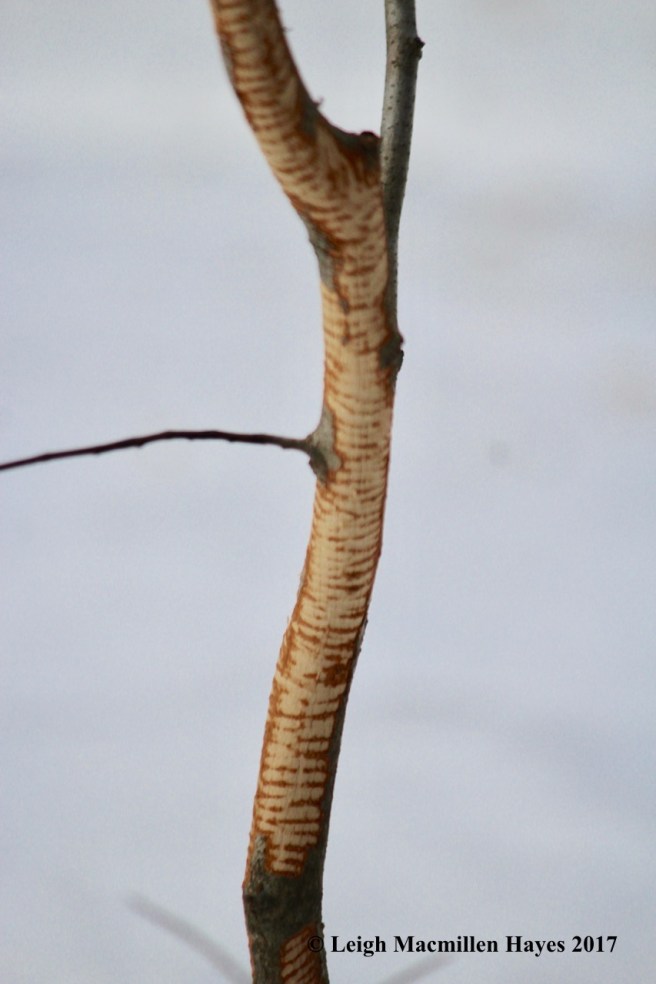
I may have been seeing things that weren’t real, but the lines on this particular tree made me wonder about the porcupines. Was I looking at the design they leave with teeth marks created in the distant past? Or were they wounds of another kind?

s1-beaver-5

When at last we reached the Pond Trail again, we continued to circle around it, noting more beaver works.

s-beaver-lodge

At last, we found the mud-packed lodge built into the edge of the pond. Here’s hoping for a warm winter within.

s-pond-at-end-of-day-1

Completing the circle, the biting breeze forced us to walk quickly toward our truck and the end of our hike. We have chores to complete tomorrow so our Sundate may have to suffice for a Mondate.

That being said, in this season of hope, we trust we’ll find more opportunities to consider these be-attitudes:

s1-trees-in-harmony

Be supportive of each other.

s1-christmas-fern-1

Be watchful of what’s to come.

s-heart

Be hopeful of love everlasting.

Meditation in the City

Though I grew up outside New Haven, Connecticut, and spent a great deal of time there as a child/tween/teen, I am not a city girl. In fact, stepping onto a sidewalk in even the smallest of cities yanks me from my comfort zone.

And so it was with great surprise that I met a city I rather liked. Over the last thirty years, I’ve passed through it numerous times, but twice this past week, I followed my tour guide from one monument to the next–my eyes wide and mouth gaping open with each new view, the obvious sign of a tourist.
w-bobsign

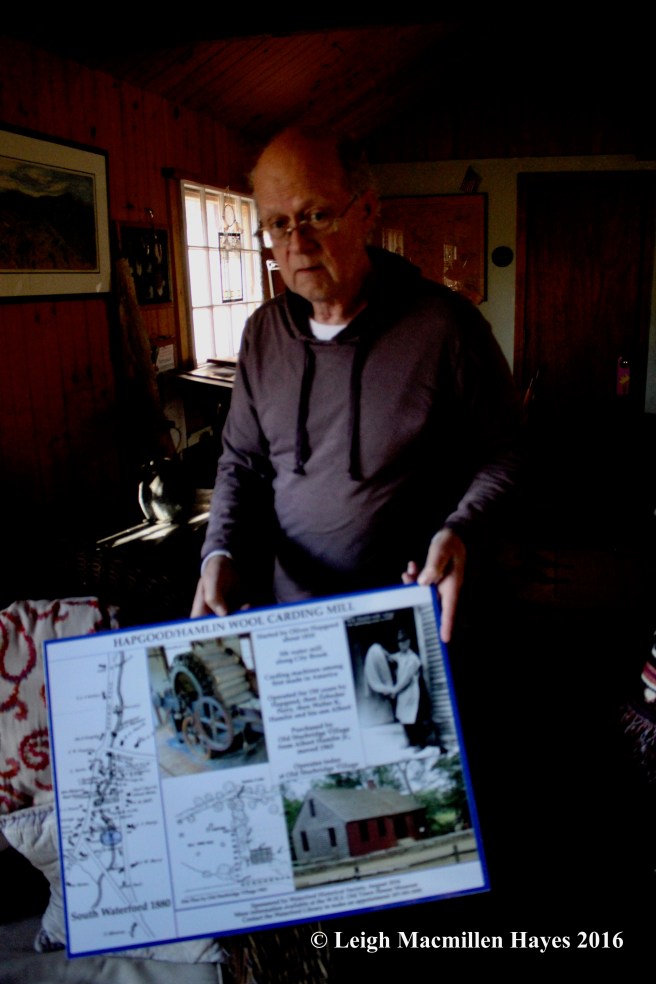
Meet my tour guide, Bob Spencer, who proudly displayed a future landmark sign.

w-indoor-view

Bob’s world view begins at City Center, aka Watson’s Falls.

w-watsons-falls-1

From the home he and his wife, Gere, have made in a former mill, the view encompasses one of nine water privileges or mill sites. Theirs is the fifth privilege along the stream, which was originally granted to Isaac Smith in 1795 for a saw mill. Over the course of its lifetime, the building served as a cloth and linseed oil mill, saw mill, salt box factory and cider mill. I love that apples still dangle above the water, a reminder of that last rendition.

w-library

On Saturday, we stepped north for a few minutes, and chatted about the mill pond and its function while Bob pointed out foundations and retaining walls and told stories of the standing buildings.

w-watson-falls-2

Then we turned south along the brook, where remnants of dams and the stonework foundations of other water-powered mills flourished from the days of the town’s settlement until the mid 1900s.

Bob is a fellow writer and naturalist with a keen interest in history. I’m flattered that he shared this place with me as well as his own written musings:

For most travelers on busy state Route 35/37, our brook is of little interest or importance. To the village of South Waterford, however, a cluster of thirty buildings which lie on either bank of this stony rill, it has served as a source of life and vitality throughout much of history. Landforms here were carved into the granite bedrock as a much larger ice-age water course scoured out a valley between Bear and Hawk Mountains to the east and Mount Tir’em and Stanwood Mountain to the west. Native Americans gathered along its banks to fish and camp. Eighteenth century settlers were drawn to the environs for a source of their fresh water and of power to produce lumber and flour, which were essential to survival. Nineteenth century industrialists, before and after the Civil War, earned their livelihoods by producing both commercial and consumer goods traded locally and in cities such as Portland and Boston.

w-flood-plainmill-pond

As we walk along he pointed out buildings still standing, those in stages of disrepair, and others that were merely memories. We paused by a meadow where he described the spring flooding events and I examined the evergreen wood ferns.

w-city-brook-meanders

And then we noted the gouge that deepened as we climbed, where “a glacial moraine as melt water engorged the brook into a raging river 15,000 years ago. The brook serves as the marshy wetland home of fish, birds and mammals. Such a short stream can teach everyone who allows the time many lessons about our ecology systems: how they work and how they were born.”

w-outlet-1

At the emergence of the brook we’d followed with two smaller brooks (Mutiny and Scoggins), we paused as Bob described their origins and journeys.
w-bear-pond

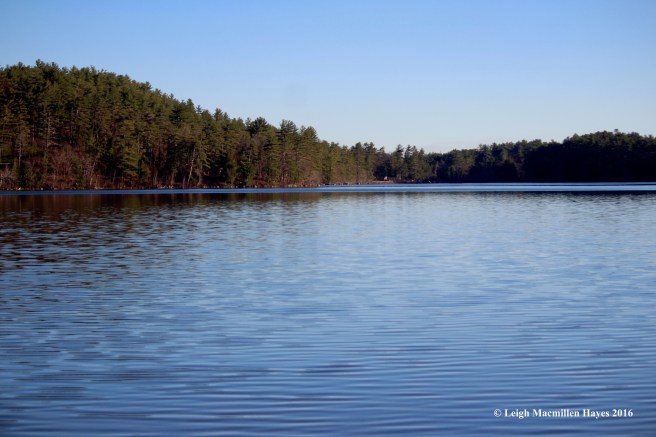
And then we turned to Bear Pond–the outlet. The temperature was relatively warm and pond almost inviting.

w-bear-mtn

With Bear Mountain overlooking, we’d reached the southern most point of the city.
w-beaverworks-2

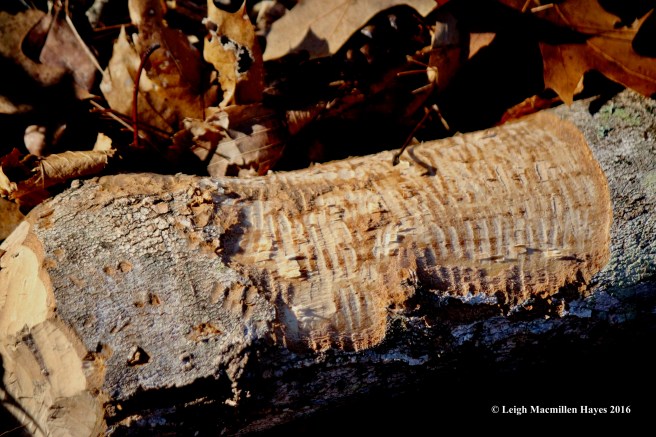
On our return trip, we found numerous signs that local residents were still industrious. Sometimes they were successful and the trees fell to the ground.
w-beaver-works-1

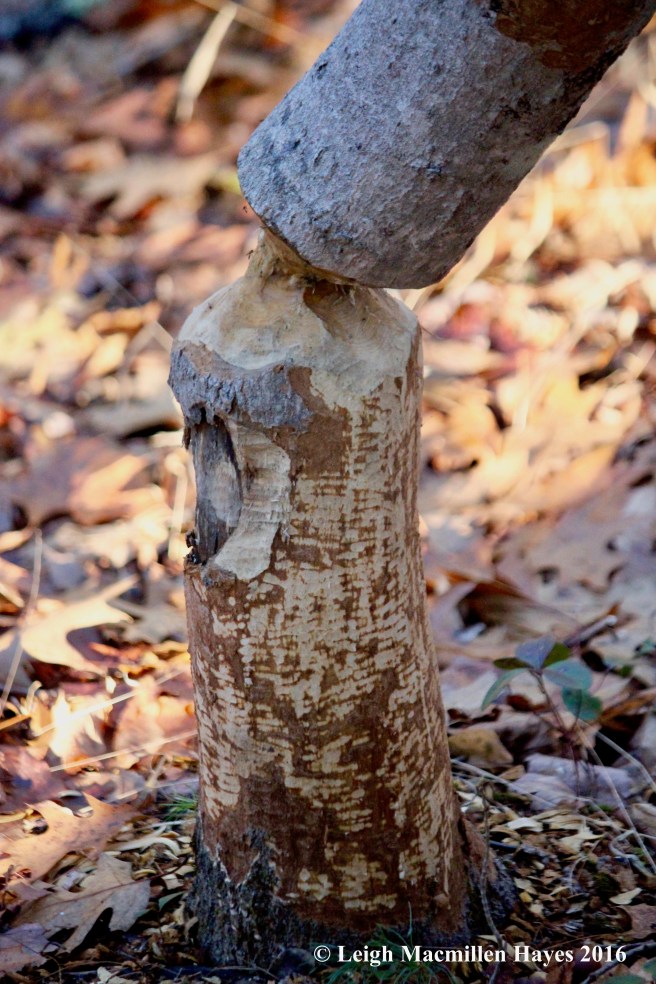
As with all industrious efforts, there were times when hang ups prevented success.
w-late-day-reflection

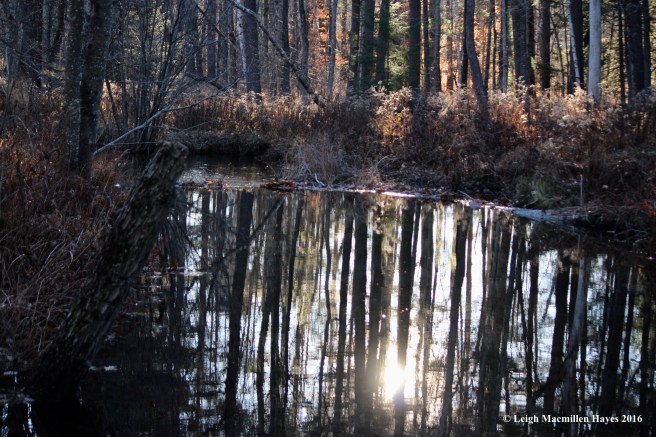
Sunshine and late afternoon reflections gave me a taste of why Bob referred frequently to the meditative nature of this place.
w-the-city

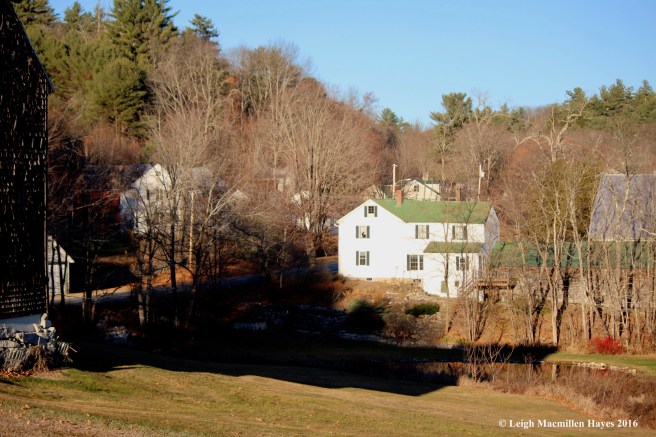
As we climbed a small hill and crossed a field, we again approached City Center.

w-sluice-1

And then we doubled back, walking to the intersection of Sweden Road with Routes 35/37. Plaster mills, bucket mills, a carding mill, saw mill and grist mill–waterpower was a necessity to any enterprise–beginning with lumber sawed for dwellings, grain ground for life-sustaining bread, shingles for siding and roofing, carded wool for the seamstress.

w-bucket-2-1

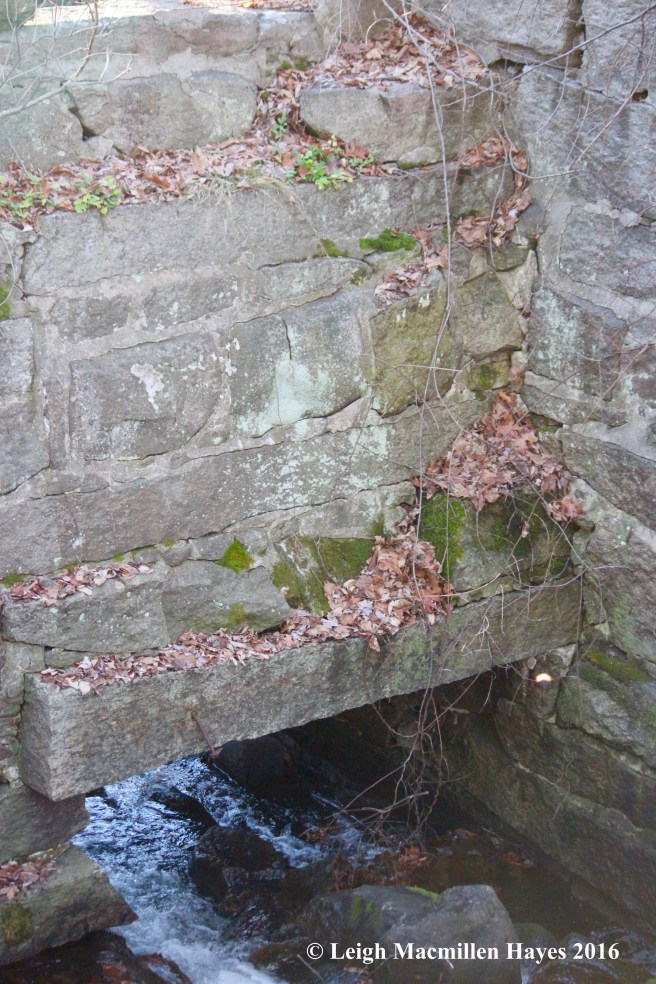
With the sun’s rays dipping lower in the sky, we stood in awe of the sluice and thought about the men and oxen and all the work that went into creating the mill–before the real work actually began.
w-sluiceway

How many times have I traveled past this site and never spied it? Too many.

w-bear-pond-2-1

After our first tour ended, I paused at the southernmost end of Bear Pond for further reflection.
w-brook-wall-2-1

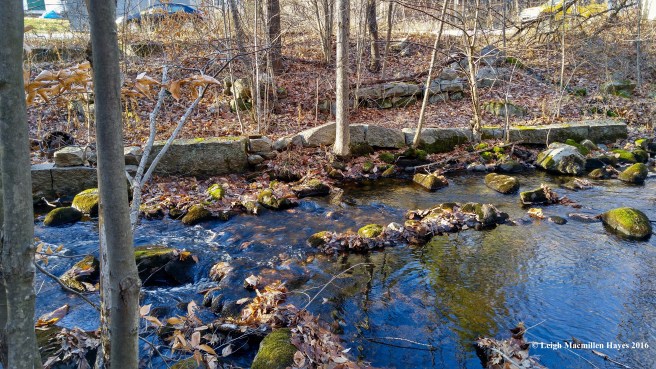
But . . . there was still more to see of the city and so a few days later I eagerly joined my tour guide again. This time we walked north, and wondered about the rock placements and considered their role as runways that once helped direct the water flow.
w-stones-line-brook

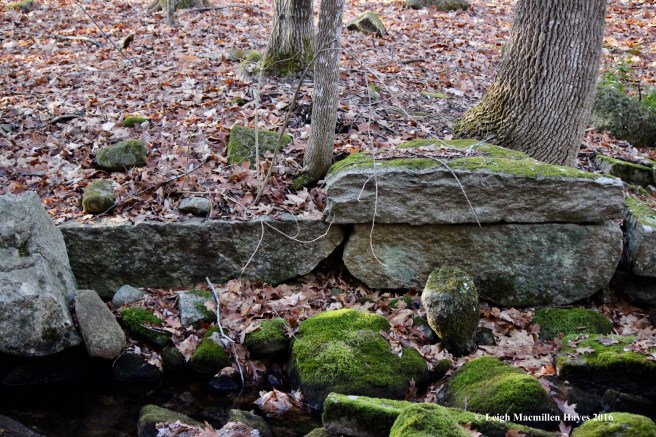
All along, we saw evidence of human intervention.

w-split-stone

We noted the feather and wedge marks on split stones.

w-barbed-wire

Barbed wire made us think about the land being used for agriculture. Though it didn’t seem that the land had been plowed, we wondered if farm animals had roamed. Bob reminded me that a carding mill once stood nearby and so we envisioned sheep.

w-barrel-wire

w-barrel-staves-1

w-artifact

Barrel wire and staves made sense to us, but we didn’t always recognize the artifacts for their use.
w-cellar-hole-2-1

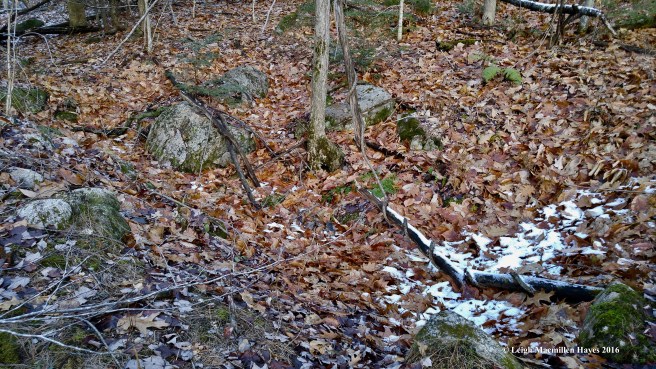
We even found a cellar hole, or perhaps a cellar hole, that Bob hadn’t seen before. Of course, we speculated. It certainly had structure. But why was it cut out around large boulders, we wondered.

w-tree-foundations

And we noted the industrial work of trees that forged their own way beside the brook.

w-city-brook-large-rocks-1

For every sight that we seemed to understand, there were more that we didn’t. With his vast knowledge of local history and the land formations along the brook, Bob pointed out natural and man-made features, but even he admitted he didn’t always get it. The pile of obviously quarried granite was one such.
w-sluice-and-old-dam-2-1

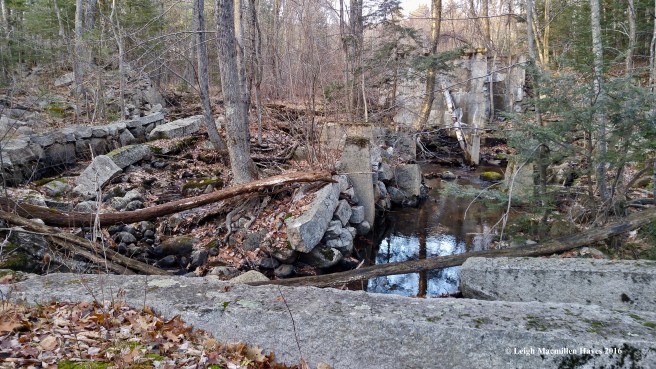
Suddenly, we reached what might be considered the crossroads of long ago and more recent past.

w-sluice-way-4

To the west, an obvious rock sluiceway.

w-stantion

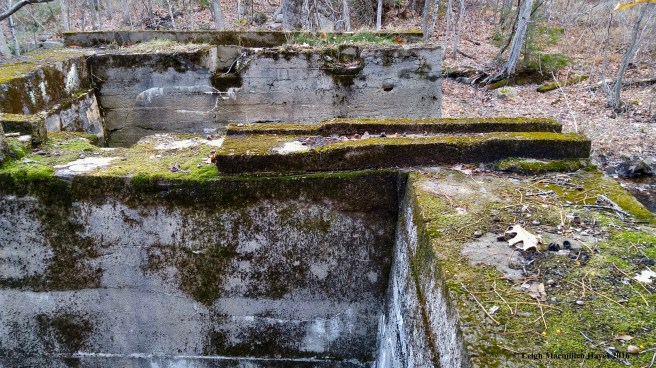
To the right, stanchions from a former, yet more recent power site.
w-old-dam-3-1

This was all located at the original spot of the first dam along the brook.

w-keoka-dam-2-1

Curiously, Bob explained as we walked along,  a more modern dam was built about a quarter mile north.

w-keoka-3-1

We’d reached Keoka Lake, formerly known as Thomas Pond. Supposedly, in the early 1900s, Thomas Chamberlain ran away from Native Americans and survived by hiding in a crack in a rock. Though the lake is no longer named for him, Tom Rock Beach holds his legacy. Today, the clouds told the story of the much cooler temperature. 

w-flats-1

Bob directed my attention to our left, where Waterford Flats was visible.

w-start-of-city-brook-1

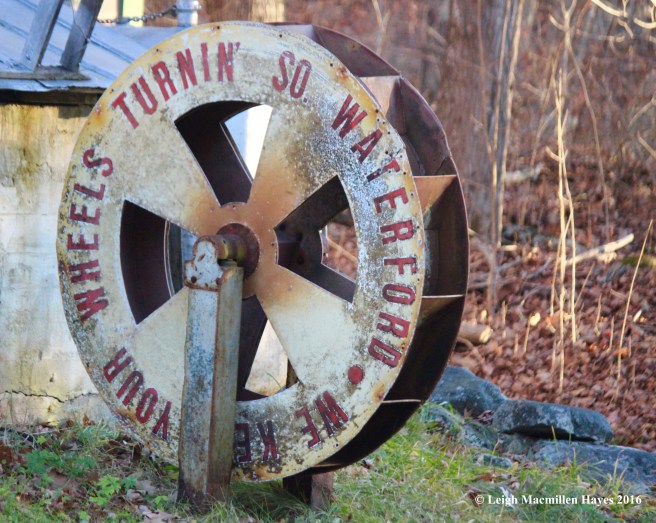
And then we looked south, to the outlet of Keoka and the beginning of City Brook–the place where it all began. Though no longer held by dams and funneled through the rock sluiceways, it was the water that passed this very way that once provided the energy converted by water wheels and turbines to power the life of the city.
w-wheel-2

w-wesleyan-church

w-bear-mountain-grange

“Waterford City” as it was known, has changed, though some standing monuments still speak to its former life. Until Saturday, I had no idea the brook was named City Brook or that South Waterford was known as a city, so named for the industry that once existed here.

As Bob wrote, “The age of industrial prosperity is now long gone, victim to growth of large manufacturing plants which required more powerful rivers and many other economic changes since the 1870s. At that time, South Waterford was dubbed “Waterford City” for the noise and bustle brought to the town by nine mills and many supporting outbuildings lining the brook. Invisible to today’s busy passerby are many remnants of a past industrial heyday: a large concrete and split stone ruin on the access road to Keoka’s modern dam, two-story stone work that served as the foundation for a 19th century bucket mill, a simple shingled mill building atop a 1797 stone dam beside the town’s last rustic stone bridge. Further exploration may reveal lost foundations beneath the water surface, a 36-inch rusty circular saw blade, burnt remains of Waterford Creamery or an earthen dam long overgrown by bushes and brambles. These vestigial remains of human endeavor are of historical interest to many.”

w-city-brook-2

After our tour came to an end,  I paused below the cider mill one more time–a fitting spot to share another of Bob’s ponderings on this place:

“The whirling bubble on the surface of a brook
admits us to the secret of the mechanics of the sky.”
Ralph Waldo Emerson

It is appropriate to begin this study with a quote from American philosopher, existentialist Ralph Waldo Emerson (1802-1882), whose life spanned from early days of village settlement through the denouement of its industrial zenith. Emerson spent much of his boyhood visiting three aunts who lived in Waterford. He likely honed his naturalistic views while exploring City Brook or Mutiny Brook near Aunt Mary Moody Emerson’s home, Elm Vale, which was located across from the cemetery of the same name on Sweden Road.

This is one city I’m thankful to have visited. And I look forward to further explorations.

I’m grateful to Bob for sharing this place with me and especially for pointing out all of his favorite meditative places. Meditation in the city–Waterford City style.
 

Forever a Student

Once the rain let up, I donned my Boggs and headed out the door in mid-afternoon, not sure where exactly I was headed. But after reaching the snowmobile trail, I decided to turn south. Since the spring, I’ve been to the vernal pool on the neighboring property numerous times, but not much beyond in that direction.

h-new-bridge

Part of the reason was that a local industry, of which we now have so few, was constructing a new building and had cut off the trail. Oh, I could have bushwhacked around the project, but the other part of the reason is that it’s a heavy tick zone and I normally avoid it come warmer weather. Given the new building, I wasn’t sure what to expect today, but as I passed through the stonewall, I discovered they’d added a bridge over a new water diversion and the trail was open. I’m glad for the small industry, but simultaneously sad that the willows are gone. No more pussy willows in the spring. Or willow galls, though I suppose that’s good news. And who knows, perhaps some viable willow seeds will spring forth in this place–a hypothesis to be tested.

h-artist-conk-top

After crossing behind the building, I moved through an opening in the next stone wall, and felt right at home again–in one of my local classrooms. This is one where I’m often the solo student, as was the case today.

h-artist-conk-2

I revisited an old stump, where art class was about to begin. The underside of the artist’s conk welcomed a sketch, but I left the canvas blank for another day.

h-gate

In social studies class, I took a look at former land uses. The wall opening and split stone gate bars helped me envision the fields that once were cleared. I followed several walls, which switched from single to double and even double-double, or so it seemed as one section was at least six feet wide and a football field long (The New England Patriots are winning in CA right now!). Barbed wire indicated the need to keep animals out and flat land with trees not a hundred years old spoke to the land’s former plowed use.

h-vp

A few minutes later, I moved over an old rock mound and stood before my science teacher–another vernal pool. As I recalled, this one dries out early in the season and grasses and other vegetation grow prolifically here. But unlike the smaller pool closer to home, this one held some water from the recent rain.

h-boots

As any student should, I stepped through the door and sunk my feet into class.

h-cinnamon-fern

Cinnamon ferns reminded me that they keep their fuzziness right up to the end.

h-birdnest-1

I wondered about strips of paper birch dangling from a young sapling and then realized I was looking at the remains of a nest–maybe a vireo.

h-seeds

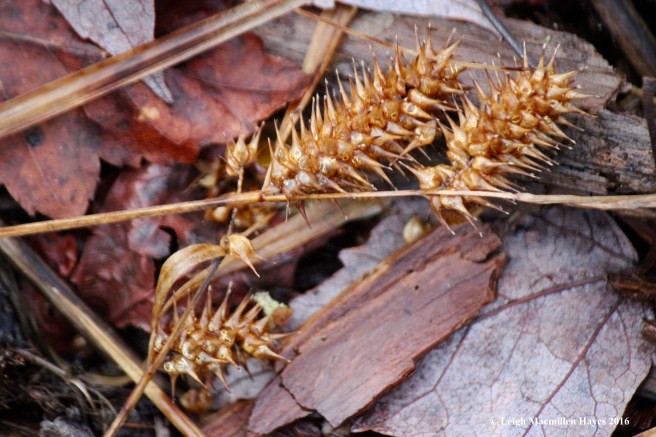
I questioned how the long-beaked sedge seedheads came to be bent over–by weather or wildlife or just because their time had come?

h-vp-bulrush-a-grass

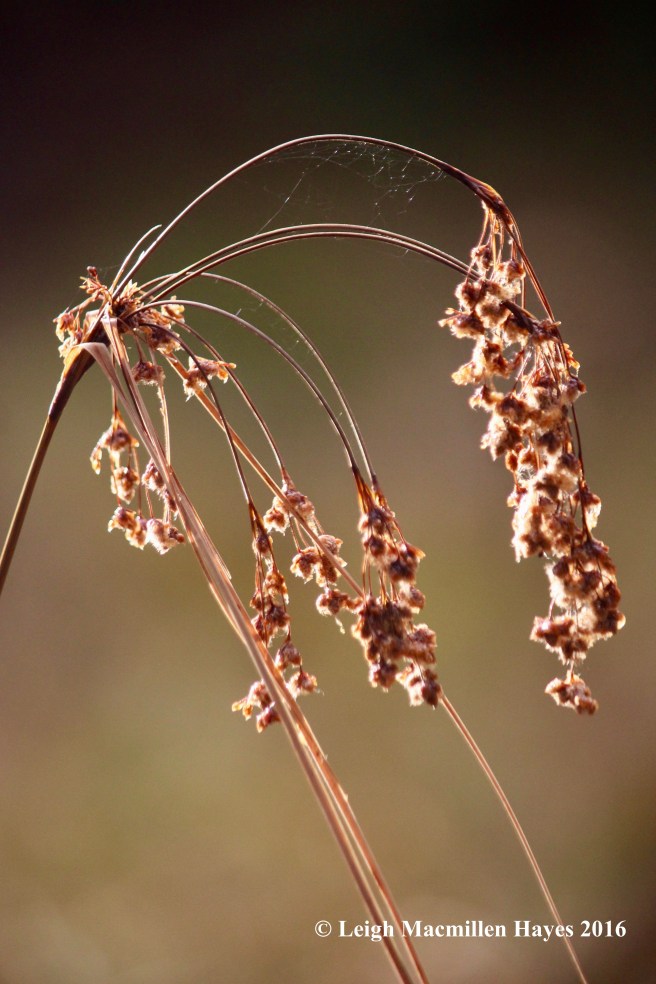
While bulrushes (actually a grass) offered flowing fountains pouring into the future, their seeds still clung–as did a spider web.

h-vp-steeplebush-web

And more spiders eluded me, though their webs stood strong among the steeplebush capsules.

h-vp-crystal-ballseeds

A few raindrops dangled like ornaments from a holiday decoration.

h-vp-backside-of-sensitive-fern-beads

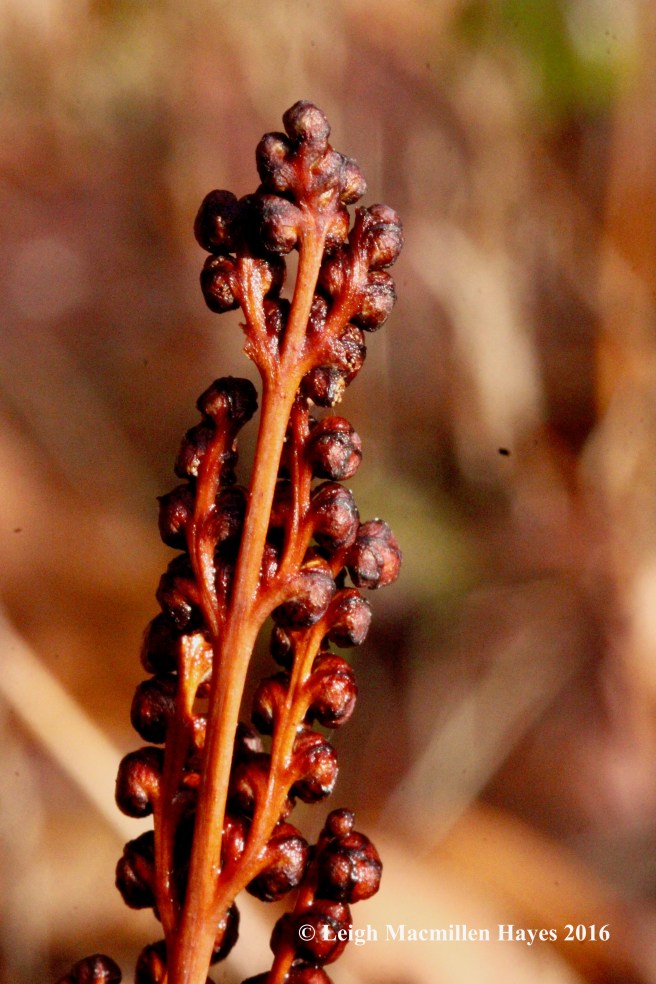
And bead-like spore structures on sensitive fern’s fertile stalk waited for another day to spread their good news.

h-lichen-or-fungus-2

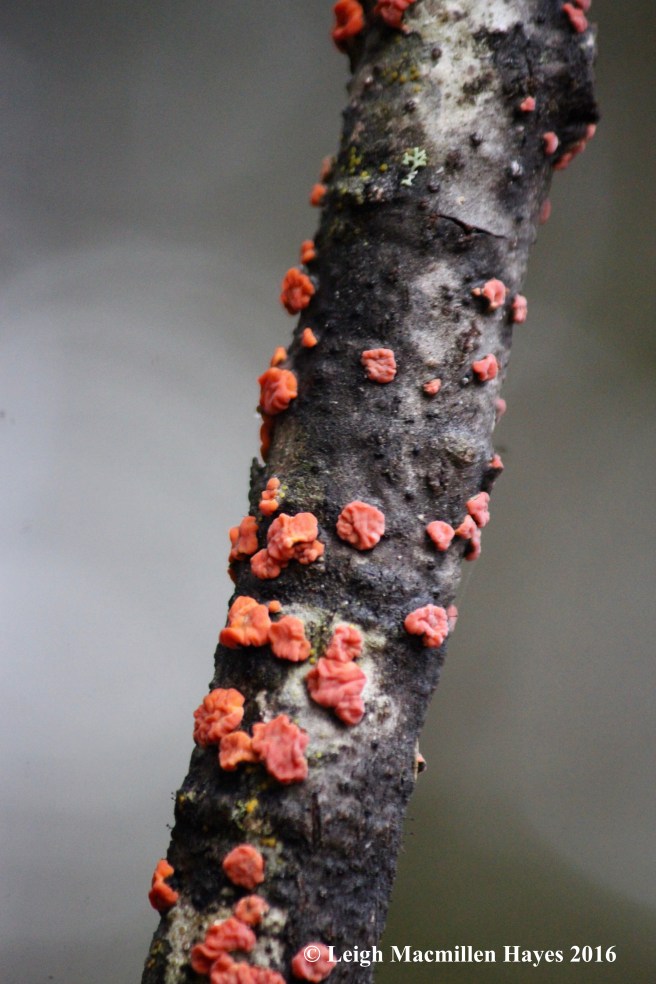
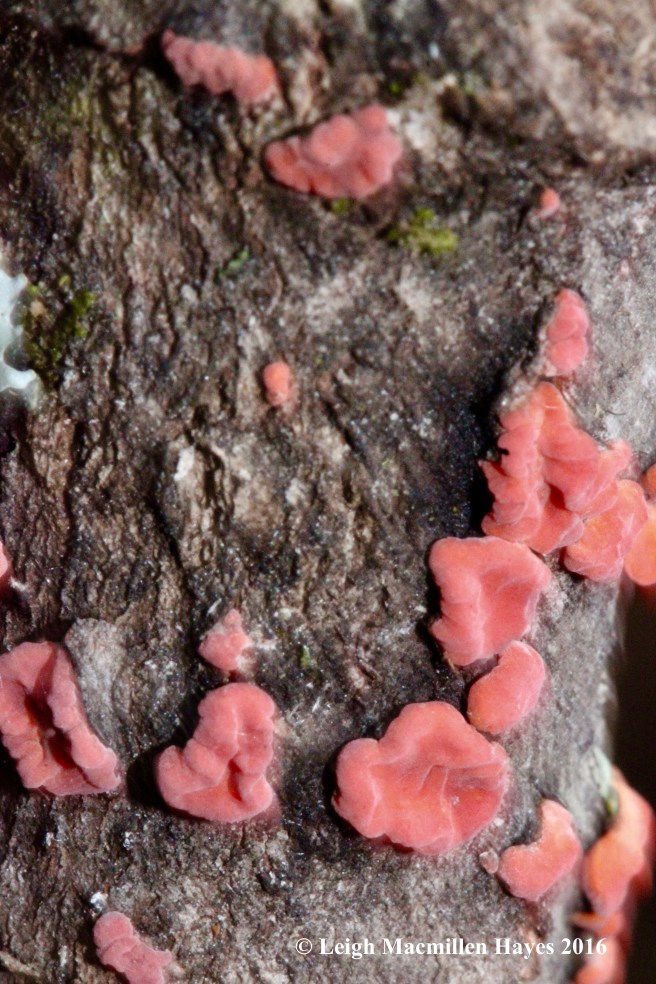
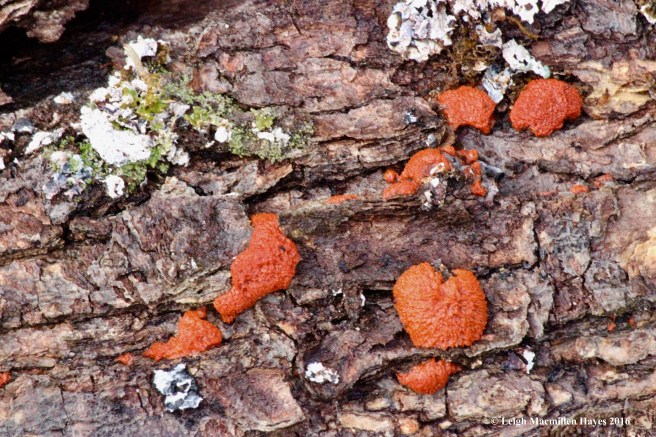
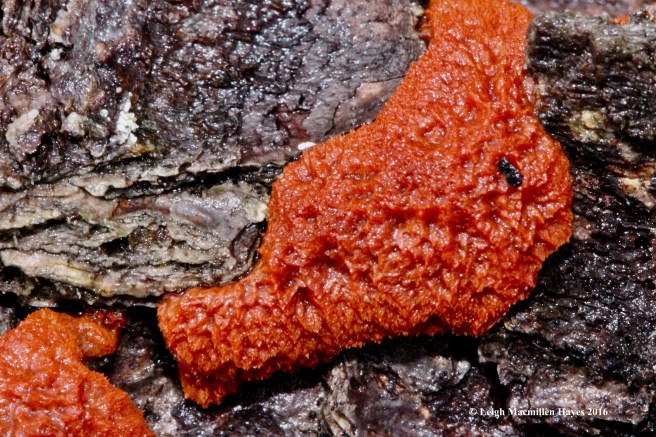
I finally left the vernal pool, but before heading back down the hallway, small salmon-colored growths stopped me. Lichen? Fungi? I didn’t think I’d ever seen it before and so it was a new lesson.

h-lichen-or-fungus

My first thought–lichen. In a way, it resembled the tops of British Soldiers that grow prolifically here. But my latest thought is red tree brain fungi (Peniophora rufa) . I may be wrong, but that’s what being a student is all about.

h-woodpecker-1

With each new lesson, I was also thankful for those that were reinforced, such as the chisel-like and shredded works of pileated woodpeckers. I used to think such trees were the result of bear activity.

h-woodpecker-2

I’m always awed by the resulting sculpture left behind by those powerful birds–their strong beaks stabbing away at the bark until they’ve consumed a meal of carpenter ants and beetles. Thankfully, their skulls are thick and spongy–allowing their brains to absorb the impact of such repeated drilling.

h-field-succession-layers

At a field, I paused to admire the layers–a testament to field succession. These woods are constantly changing.

h-male-turkey-scat-j

One thing that doesn’t change is the signature of a Tom Turkey–usually offered in straight or J formation.

h-slime-3

h-tubifera-ferruginosa

h-slime-2

At another wetland, I poked around and then my eye focused in on something decorating a fallen tree. A slime mold perhaps? Red raspberry slime? In one rendition it seemed to have a crater-like surface, while another was more flower-like with petals spraying from a center.

h-hemlock-cinnamon

At last I entered a hemlock forest where the cinnamon inner bark stood out on the wet trees. If not for the scales, I realized it would be easy to confuse this bark with that of red oak, but a quick look up the trunk and the answer was obvious.

h-striped-maple-seeds

As I walked back toward home, I looked along parts of the trail I’d skipped while exploring in the woods. And I wasn’t disappointed when I discovered one of the few striped maple trees–still bearing the seeds it produced last year. Why did they cling still? When released, will they be viable?

h-pine-suds

And then, a sight I was hoping for presented itself when I returned to our woodlot. Froth at the base of a pine tree. It’s not unusual and occurs following a rain event such as we’d had all night and morning. I had hoped to see some foam today, and felt rewarded for my efforts. So what causes the tree to froth? Well, like all lessons, there are several possibilities. Maine Master Naturalist Science Advisor Fred Cichocki recently had this to say about it: “I’ve noticed this phenomenon often, and in every case I’ve seen it’s associated with white pine, and always after a dry spell followed by heavy rain. Now, conifers, especially, produce hydrocarbons called terpenes (it’s what gives them their lovely pine, balsam and fir scent). These hydrocarbons are hydrophobic by nature and form immiscible films on water. During a heavy rain, water running down the trunk of a white pine picks up terpenes on the way. Air (having accumulated in bark spaces, channels, etc. perhaps under slight pressure) then “bubbles” through terpene-water films producing a froth. Recall the cleaning products PineSol, and the like. They are made from terpenes, and produce copious bubbles when shaken. One could get the same result directly by shaking terpentine in water, or by bubbling air through a terpentine-water mixture with a straw  . . .  Of course, it may be that other substances (salts, etc.) enhance the frothing.”

No matter how much I have learned on this life-long course, there’s always more. I certainly don’t have all the answers and for that I am thankful. I’m forever a student.


The Way of the Land at Long Meadow Brook Reserve

Last month the Greater Lovell Land Trust purchased a new property along Long Meadow Brook that further develops the wildlife corridor. A couple of weeks ago I first visited it with GLLT’s Executive Director Tom Henderson and a number of the land trust’s volunteer docents. As we left the property, Tom said to me, “I didn’t oversell this, did I, when I said this will become one of the docents’ favorite properties.” Indeed.

And so I couldn’t wait to get back there myself to spend a few hours exploring the almost one-hundred-acre reserve.

l-mullein-flower-2

Because the land was last logged by the previous owner in 2014, it’s in the early succession stage of regrowth.

l-mullein-flower-3

And so, it’s a place where those who like disturbed places tend to grow, such as the common mullein. What surprised me most was that I found a few still offering blooms.

l-mullein-cactus

Of course, it reminded me that I was in the great West–WESTern Maine, that is–with its occasional cacti-like form.

l-seeds-holidng-on

Scattered throughout are also the seedheads of white lettuce, waiting for release in lampshade-like formation.

l-orange-peel-fungi

Orange-peel fungi fruited prolifically in the gravel logging road.

l-future-parking-lot

That was all before I even reached the future parking lot, which had served as the log landing a few years ago. Already, sweet ferns and berry bushes have made themselves known.

l-sweet-fern-colors

The leaves of sweet fern, which is really a shrub rather than a fern, exhibited their version of autumn hues.

l-trail-marker

If you go, I encourage you to look for the blue ribbons that indicate where a future trail will be placed. It’s a loop trail that summer interns Hannah and Aidan laid out and leads to two focal features.

l-stonewall-double-to-single

The trail nears a neighboring property, which just happens to also be under conservation easement thanks to the foresight of its owners. I stepped off the blue flag trail and started to follow the wall for a bit–noticing that soon it changed from a double (garden or plowed land) wall to a single wall. A large pasture pine grew at the change-over point.

l-stonewall-barbed-wire-1

And where the wall switched to single formation, barbed wire indicated its former use a pasture boundary. And white pine scales indicated its current use–as a red squirrel’s dining room table.

l-forest-succession-2

After moving away from the wall, I noticed the mountains in the offing and ferns and young trees already filling in the empty spaces.

l-kearsarge

One of my favorite mountains to climb stood tall in the backdrop–Mount Kearsarge.
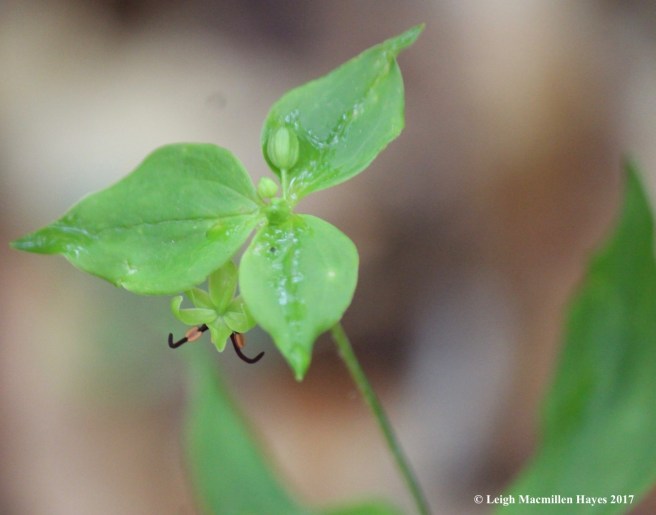
l-forest-succession-1

My bearings were off a bit, but I knew where the eastern boundary was as I moved across this opening.

l-pitch-pine-bark-1

Walking along the back edge, my tree passion was ignited yet again.

l-pitch-pine-1

Several pitch pines grow in this space. While the bark is similar to that of red pines, it’s platier (is that a word?). And the tufts of needles that grow along the trunk were a dead give-away.

l-pitch-pine-cone

l-pitchpine-needles

But . . . I always quiz myself and so I looked around. And right below the trees, pitch pine cones and the triple needle bundles common to this species.

l-wintergreen-berries

It was here that I discovered wintergreen growing by the base of a tree stump. What made me wonder was the amount of fruit on each plant. Yes, wintergreen grows prolifically in all of western Maine, but I can’t recall ever seeing so many little red globes dangling below the leaves.

l-marshy-1

From my half-circle around the opening, I wasn’t positive about my whereabouts and so decided to follow the land downhill because it looked like there may be an opening below. A few minutes later, I realized I was in a marshy spot where the cinnamon ferns grew. And the earth beneath my feet was rather spongy and damp.

l-beaver-lodge

I reached what I thought was the meadow I sought–only to realize that I was looking at a beaver lodge. I knew that beaver lodge, but from a different perspective–the neighbors’ property.

l-first-marsh

And then something else caught my attention.

l-marsh-tamaracks

Tamarack (aka larch) trees–our only deciduous conifers, which had turned a golden yellow as is their autumn habit.

l-tamarack-2

The spray of tamarack needles reminded me of witch hazel flowers, which also grow on this property. But soon, the former will drop, leaving only their barrel-like stems as a reminder of their presence.

l-maple-leaf-viburnum

I left that spot, retraced my steps and headed to the north on a cross-country bushwhack, where the mauve colored maple-leaf viburnum grew.

l-turkeys

I saw lots of mammal sign and even a few birds, including turkeys who are loving the fact that this is a mast year for acorns.

l-trail-to-meadow

At last I emerged onto the trail I remembered and headed downhill again.

l-meadow-brook-2

And then . . . I was rewarded for my efforts. Long Meadow Brook and the mountains beyond provided a WOW moment.

l-meadow-east

I looked to the east for a few minutes.

l-meadow-layers

And then turned west again, where the layers and colors spoke of diversity.

l-meadow-snags

Even the dead snags added beauty.

l-cat-n-nine-tails

Cat-in-nine tails added to the view and I noted others who like wet feet including steeplebush, meadowsweet and bulrushes growing along the old beaver dam. It’s also a place for a variety of evergreen species–hemlock, white pine, balsam fir, red spruce and tamaracks. Future teaching moments await.

l-hobble-2

My intention to stick to the trail was soon thwarted when I spied hobblebush.

l-hobble-bud1

Like all trees and shrubs, the future was already encased in a bud–in this case a bud we refer to as naked because it doesn’t have the waxy coating of most others. Methinks its furry presentation offers the same protection from winter’s cold.

l-back-of-hobblebush-leaf

And as I studied the back side of fallen leaves, I paid attention to the venation–reminiscent of the bud’s pattern.

l-hobble-leaves-2

In the glow of sunlight, I felt like I’d found the pot of gold.

l-meadowhawk-2

A short time later I reached the second opening that Hannah and Aidan’s trail encompasses. And what to my wondering eyes should appear–a meadowhawk dragonfly.

l-snow-on-balds-1

It provided a sharp contrast to snow on the Baldface Mountains.

l-secod-opening-2

It was at this six-acre opening that I poked around for a while longer. And watched a goshawk fly to a pine tree with something dangling from its talons. Did I take a photo? No, of course not. I was too mesmerized to focus my camera. But sometimes, the photo doesn’t matter. Being there in the moment does.

I’m thankful for such opportunities made possible by organizations such as the Greater Lovell Land Trust. I know that ultimately this property is for the mammals that travel through and I saw plenty of evidence that they use this place. But then again, I’m a mammal who also appreciates the land bridges created and opportunity to observe the connectivity. I spent the day getting to know the way of the land at Long Meadow Brook Reserve–and can’t wait to return.


Everybody Loves Raymond? Mondate

My guy and I were up for an adventure this morning as we headed off to a property recently acquired by Loon Echo Land Trust. I’d been there once before, but at that time there was no trail system and I certainly hadn’t climbed to the summit.

r-forest-climb

We were on a 356-acre property bisected by a paved road. First, we hiked the upper section, passing through a hardwood forest.

r-white-oak-green-leaves

Immediately, I realized we were in the presence of one of my favorites–noted for the mitten-ish presentation of its leaves. One would have to be all thumbs to fit into this mitten, but still, my heart hums whenever I spy a white oak.

r-white-oak-red-color

Or in this case, many white oaks, some exhibiting the wine color of their fall foliage.

r-white-oak-bark

And the bark–a blocky look that differs greatly . . .

r-red-oak-on-bm1

from the ski trail ridges of red oak.

r-hophornbeam-bark

Hop Hornbeam also grows abundantly in this forest.

r-approaching-forest-summit-yellow

As we neared the summit, we noticed that the sky view had a yellowish tone reflected by the ground view. Most trees were of the same age due to past logging efforts, but the predominant species was sugar maple.
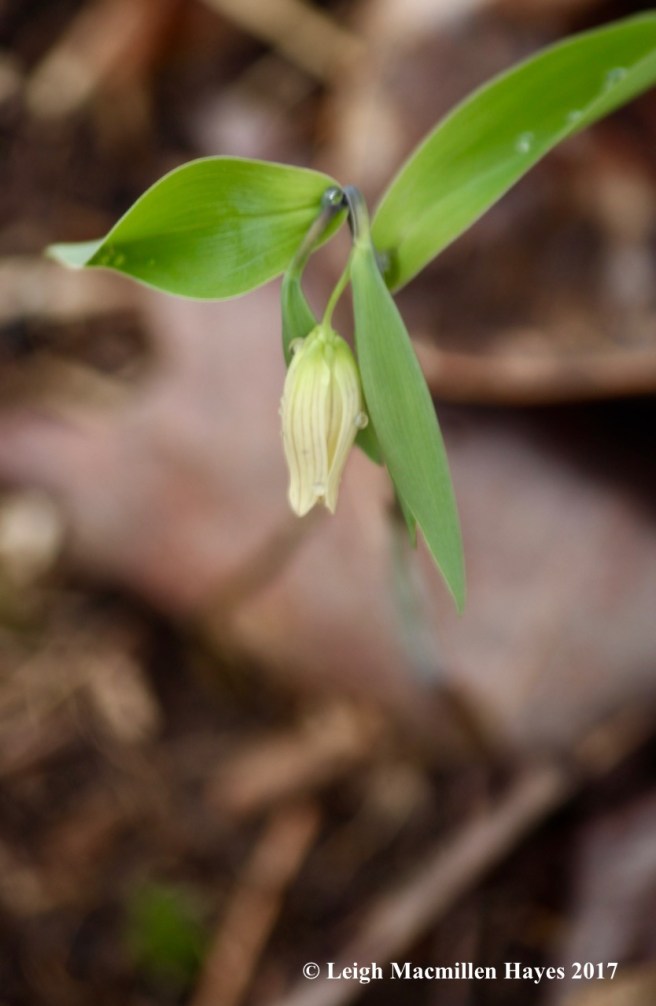
r-basswood-2

Another favorite tree also grew abundantly here. I think they are also favorites because I don’t see them as often. In this case, the bark, though furrowed and ridged like a northern red oak, featured an almost combed flattened ridge.

r-basswood-leaf

And its leaves–oh my! Notice the asymmetrical base? And the length–my boot is size 8. American basswood–an important timber tree that is known to share the community with sugar maples and hornbeams–all of which provided that yellow glow.

r-raymond-summit-view-1

At last, we reached the vantage point.

r-skyward

Above us, a mix of colors and species.

r-oak-leaves

Before us, a mix of white and red oak leaves.

r-crescent-view-3-1

And beyond us, the view of Crescent Lake

r-crescent-rattle-1-1

and Rattlesnake Mountain.

r-ladybird-1-1

While we admired the view, ladybird beetles (aka ladybugs) swarmed us. Well, not exactly in swarm formation, but more than is the norm.

r-green-trail-tag

After admiring the view for a while and wondering about the ladybirds, we backtracked a bit and decided to explore the green trail, assuming that it looped about the summit.

r-dry-leaf-sound

The trail conditions changed constantly, and one thing we realized was that the leaves had dried out and we wished we could have bottled their scent along with our crispy footfall as we trudged through–the smells and sounds associated with autumn.

r-bear-claw

Eventually, we entered a beech commune and what to my wondering eyes should appear–bear claw marks? We ventured closer, circled the tree and looked at others in the neighborhood before determining that our eyes had perhaps played a trick on us.

r-garter-snake

That was OK because within seconds a twig moved at our feet.

r-snake-tongue

We watched as its tongue darted in and out, red tipped with a black fork.

r-lunch-rock

Finally, we moved back to what we’d named Ladybird Lookout and found lunch rock where we topped off sandwiches with Bailey’s Irish Cream fudge a la Megan and Becky Colby. Life is good. Life is very good. (And we know a town in western Maine that would benefit greatly from a bakery–just saying, Megan!)

r-trail-ribbon-art

After lunch, we climbed back down and crossed Conesca Road to check out trails on the other side. There is no trail map just yet, but we never got lost. And we appreciated the artwork nature created of manmade marks.

r-forest-across-the-street-stonewall

This space offered a different feel where hardwoods combined with softwoods. And more stonewalls crossed the property, speaking to past uses.

r-hole-pink-flags

It’s here that we noticed an area demarked by pink flags and stopped to wonder why. Note to self–excavated hole and debris mean beware.

r-bee-himve

Upon closer examination, an old hive. So who dug it up? We had our suspicions.

r-mushrooms-1

We also noticed a fungi phenomena.

r-mushroom-growth

Fungi on fungi? Honey mushrooms attacked by something else?

r-mushroom-growth-3

The displays were large

r-mushroom-fungi

and otherworldly. I don’t recall ever seeing this before.

I sent the photos to Parker and Jimmie Veitch, of White Mountain Mushrooms, and Jimmie responded with this explanation:

“That’s what mycologists call “rosecomb” mutation, where a mushroom’s gills start forming on the cap in a really mutated fashion. It’s been reported in many mushroom species but I haven’t seen it in this one (Armillaria AKA honey mushrooms). As far as I know, no secondary fungus is involved.

The suspected cause (not so nice) is ‘hydrocarbons, phenols and other compounds contaminating the casing or contacting the mushroom surface. Diesel oil, exhaust from engines, and petroleum-based pesticides are thought to be the principal source.'”

r-red-leaves

As we concluded our visit, we passed over one more stone wall decorated with red maple leaves.

r-beginning-of-bri-mar

And then we hopped into the truck and traveled a couple of miles south to conquer another small mountain–one visible to us from Ladybird Lookout. (I really think LELT should name it such.)

r-brimar-milkweed

Here the milkweed plants grew abundantly.

r-brimar-white-oaks-in-field

In the field leading to the trail, the property owners planted white oak saplings in hopes of providing food for wildlife. Um, by the same token, they’d enclosed the saplings in plastic sleeves (reminding us of our findings in Ireland) to keep deer at bay.

r-brimar-ferns

The understory differed and ferns offered their own autumn hues.

r-brimar-evergreen-wood-fern

In contrast were the many examples of evergreen wood ferns.

r-bri-mar-beech-markings

We soon realized that quite literate bears frequented this path and announced their presence.

r-crescent-from-bri-1-1

At last, the view opened and we looked back at the opposite shore of Crescent Lake, though realizing that our earlier ascent was masked by the trees.

r-panther-from-bri-3-1

Turning about, Panther Pond came into view.

We’d spent the day embracing Raymond because everybody loves Raymond.

r-raymond-forest-sign

r-brimar-trail-sign

Raymond, Maine, that is. Loon Echo Land Trust is gearing up to celebrate the Raymond Community Forest that we explored this morning and the Bri-Mar Trail up Rattlesnake Mountain has long been traveled by many. In fact, when I used to write copy for the local chamber of commerce, I spent some time learning about Edgar Welch, who was the fastest man on foot and ran up Mount Washington at least once a year. He lived in Raymond and worked for David McLellan, who was partially blind from a Civil War injury. Because Mr. McLellan’s farm was at the foot of Rattlesnake Mountain, the sun would set one hour earlier than elsewhere in town. According to legend, after work each day Edgar ran up the mountain and moved rocks. Finally, he’d moved enough to let the sun shine on the farm for an hour longer. Another story has it that one day a man bet Edgar that he could beat him in a race to Portland. The man would race with his horse and buggy, while Edgar ran. When the opponent pulled into the city, Edgar was waiting for him. I love local lore.

And everybody loves Raymond. Well, my guy and I certainly gained a better appreciation for this town today.


In Constant Flux

Ever so slowly, the world around us changes.

h-starting-point

Sometimes it’s as obvious as the leaves that fall.

h-bee-on-flower-1

And other times, it’s a bit more subtle, evidenced by the bees that have slowed their frantic pace as they make final collections.

h-leaf-carpet

Mid morning, I headed down the cow path in search of other signs of change.

h-oak-branches-1

As I walked along, I began to realize the interdependence of all. Under the northern red oaks–many  chopped off twigs.

h-porcupine-works

The angled cut and empty cap indicated the work of porcupines seeking acorns.

h-leaves-on-hemlock

I found maple leaves pausing on hemlocks,

h-pine-needles-on-spruce

pine needles decorating spruce trees,

h-leaves-in-puddles

and occasional puddles offering a rosy glow. Eventually, all of these leaves and needles will break down and give back.

h-life-on-rock-1

I found life on a rock, where lichens began the story that was added to by mosses. The creation of soil was enhanced by a yearly supply of fallen leaves and needles gathered there. And then a seed germinated, possibly the result of an earlier squirrel feast.

h-orange-peels1-1

I found orange peel and many other fungi aiding the process of decomposition so that all the fallen wood and leaves will eventually become part of the earthen floor.

h-forest-succession-3

I found a healthy stand of trees and ferns competing for sunlight in an area that had been heavily logged about ten years ago.

h-deer-and-bobcat-prints

I found evidence of those who spend their lives eating and sleeping in this place.

h-aster-seeds

I found seeds attached

h-seeds-on-the-fly

and those on the fly–heading off in search of a new home.

h-witch-hazel-flowers-galore

I found the last flowers of fall

h-witch-hazel-1

exploding with ribbony blooms.

h-power-and-nature

After bushwhacking for a few hours, I found the snowmobile trail, where man and nature have long co-existed.

h-home-2

At last I found my way across the field rather than through our woodlot, thankful for the opportunity to take in the colors of the season one more time.

At the end of the day, I’m once again in awe as I think about how we, and all that we share this Earth with, are dependent upon each other and the abiotic forces that surround us.

And with that comes the realization that the scene is in constant flux and so am I.


On Hands and Knees to Wonder

When I invited Jinny Mae to join me at Loon Echo Land Trust’s Bald Pate Preserve this afternoon, she eagerly agreed. And three hours later, I know she had no regrets. Though we never reached the summit, neither of us cared. Our minds were boggled by all that we had noticed.

b-foster-2-1

Somehow we managed to beeline our way to the Foster Pond Lookout. And then we slowed down. To a stop.

b-shield-2

And so we got rather personal with the rock substrate as we took a closer look. At lichens. For what seemed like ever, it was thought that lichens were symbiotic life forms consisting of Freddy Fungus and Alice Algae, who took a liken to each other and their marriage formed a single organism. Sometimes, cyanobacteria or blue-green algae was tossed into the mix. The fungus provided shelter (algae can only live where they won’t dry out and so being surrounded by fungal cells meant Alice could live outside of water), while either of the photosynthetic partners, algae or cyanobacteria, produced food from the sun.

It’s no longer just a story about Freddy and Alice living together, however. New scientific research deems another partner in the mix–yeast, which also provides protection. I feel like just stating that puts me way out of my league.

b-shield-1

Our goal wasn’t to understand those relationships per say. We just wanted to spend some time looking and developing an eye to recognize these structures while appreciating their life’s work that often goes unseen.

b-shield-on-rock-2-1

Some grow at an especially slow rate–think hundreds of years rather than decades. That in itself, should stop us in our tracks. And yet, as we stand 5+ feet above those that grow on rocks, we hardly notice them.

b-green-shield-5-1

The  dark brown fruiting bodies, called apothecia, are where spores are produced and life continues. Walk tenderly, my friends.

b-toadskin-2

Jinny Mae’s excitement over the toad skin lichen was contagious. Notice its warty projections–much like the skin of an American toad, which varies in color.

img_6343

I spied this toad a few days ago, but its skin certainly helps qualify the lichen’s common name.

b-toad-skin-lichen-3

If you look in the center, you can see the point where the lichen attached to the rock–the belly button of this particular lichen making it known as an umbilicate lichen.

b-toad-skin-lichen-wet-and-dry

And among the favorite finds of the day, Jinny Mae was the first to spy this. It had rained this morning and everything was dry by the time we hiked, but some signs of moisture remained. In this case, it’s wet toad skin contrasted by dry toad skin. If you are willing to give up some water from your water bottle, you can create the same contrast. And note the black dots–its fruiting bodies or apothecia where its spores are produced.

b-british soldier patch (1).jpg

The more we looked, the more we saw.

b-Gritty British soldier lichen.jpg

British soldiers were topped by their brilliant red caps–forever announcing their presence.

b-pixie 1.jpg

Pixie-cup lichen stood like goblets, ready with magical potions.

b-pixie-cup-filled-to-the-brim

Some were filled to the brim and almost overflowed with life.

b-reindeer-1

We marveled at the green,

b-reindeer-gray

gray,

b-reindeer-foam-1

and foam-like structure of reindeer lichen. These are treats for reindeer and caribou, neither of which frequent our region except for one night a year.

b-yarn-moss

And then we looked at the next layer in succession on a rock. Once the lichens have established themselves, mosses move in. Did you ever think about the fact that mosses don’t have flowers, stems or roots? Instead, they feature tiny green leaf-like structures and microscopic hair-like structures. They send their “hairs” into the crevices created by the lichens and anchor themselves to the rocks. Today, we found a moss neither of us remember seeing before.

b-yarn-moss-2

To us, it offered a square presentation and we debated its identity. While we thought it may be yellow yarn moss, I’m now leaning toward medusa moss–though their leaf edges are smooth and these are obviously toothed.  Do you know? Which ever it is, we were wowed.

b-view-from-the-rock-1

We finally moved on, hiking to a false summit to take in the western view.

b-polypody-among-rock-tripe-1

The late afternoon sun and breeze played havoc with our views, but we eventually reached the rock tripe wall, where common polypody took advantage of the living conditions.

b-tripe-wall-1

The lichen covered a ledge, some of it green from the morning rain, but surprisingly much of it still brown. Like the toad skin lichen, rock tripe are umbilicate and attached to the rock at a single point. They reminded me of elephant ears flapping in the breeze.

From there, we headed down. Our pace on the slow side all afternoon.

And sometimes we had absolutely no pace at all, unless you consider the motion (and grunts) as we got down on our hands and knees and even our bellies to take a closer look. It was all worth a wonder. And we did.


Inching Along With Jinny Mae

Jinny Mae is a slow poke. Me too. And so today, we moved at slow-poke speed and covered maybe a mile in total.

h-yellow-necked caterpillar

We traveled a trail I frequent at Holt Pond Preserve, but I had the opportunity to view it through her eyes. That meant, of course, that we shared identical photos because we always pause to focus on the same thing. I trust, however, that our perspective was a wee bit different–as it should be. For isn’t that what makes us individuals?

Speaking of individuals, we saw only one of these yellow-necked caterpillars. I didn’t know its name until I looked it up later. Apparently, the adult is a reddish-brown moth. And this is a defense position–indeed.

h-Royal fern

And then the royal fern forced us to pay attention. The fertile blade of a royal fern typically looks similar to a sterile blade, but has a very distinctive cluster of sporangia-bearing pinnules at the blade tips that appear rather crown-like. What to our wondering eyes did we spy–sporangia on lower pinnules. Did this fern not read the books? We checked the rest of the royal ferns along the path and never saw another like this one.

h-entering pitchter

One of our next reasons to pause–those wonderful pitcher plants that always invite a closer look. We weren’t the only ones checking them out.

h-entering the pitcher

A yellow jacket was also lured by the smell of sweet nectar. A walk down the leaves was probably the last walk those insects took. Inevitably, they’d slip to the bottom of the pitcher where a pool of water awaited. There, they either drowned or died from exhaustion while trying to escape since the downward pointing hairs prevent such from happening. Eventually, after the insect bodies break down, the plant will access the nitrogen and phosphorus contained within each bug. I can’t visit this preserve without spending time in awe of the pitcher plants.

h-spread-winged damselfly

Damselflies and dragonflies also made us stop. We had walked on the boardwalk across the quaking bog. A spread-winged damsel posed beside Holt Pond. When at rest, it spreads its wings, unlike typical damselfly behavior.

h- darner dragonfly

We watched as the darner dragonflies zoomed about, just above the water and vegetation at the pond’s edge. Occasionally, one hovered close by–just long enough for a quick photo opp.

h-jack in the pulpit

As we continued back along the main trail, Jinny Mae spied a Jack-in-the-Pulpit. The fertilized flower cluster had produced green berries. Soon, they should ripen to a bright red before dispersing their seeds. If the thrushes and rodents are savvy, they’ll enjoy some fine dining. These are not, however, people food. Oxalic acid in the root and stems may cause severe gastric problems.

h-purple aster

In the same spot near Sawyer Brook, we admired the purple flowerhead of swamp asters. Within the flower disk, the five-lobed florets have started their transition from yellow to dull red.

h-jewelweed

With Jinny Mae’s guidance, I was able to take a decent photo of a jewelweed. I love the spurred sac that extends backward. And noted that a small seed capsule had formed. JM is from the Midwest and refers to this as Touch-Me-Not because that capsule will burst open and fling seeds if touched. You say potAto, I say potAHto. We’re both right. As we always are 100% of the time–insert smiley face.

h-inch worm

It was another three-hour tour filled with many ohs and ahs, lots of wonder, a few questions, several considerations and even some answers.

h-inching along

Inching along with Jinny Mae. Always worth the time and pace.