Doozy of a Playdate

When I sent out the invite to the Maine Master Naturalist Program’s Lewiston 2013 class for a tracking expedition at one of two possible locations, grad Alan responded, “Any place you pick in western Maine is fine; you know the area and conditions well. The only request I have is for you to try to show me a ‘bear tree.’”

Bingo! I pulled a third location out of my hat because it was within an hour of those who would join us and I knew that it passed the bear tree test.

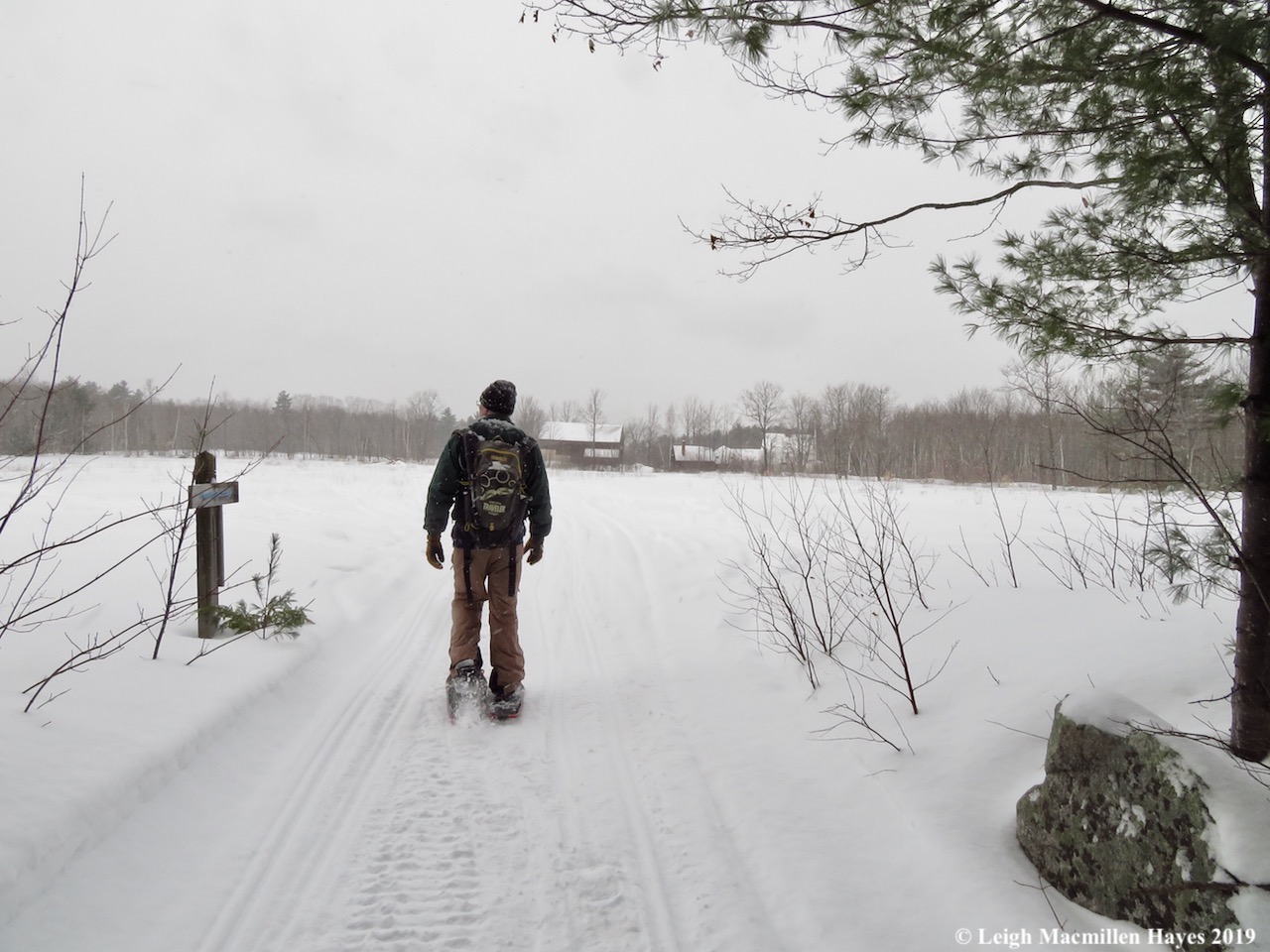
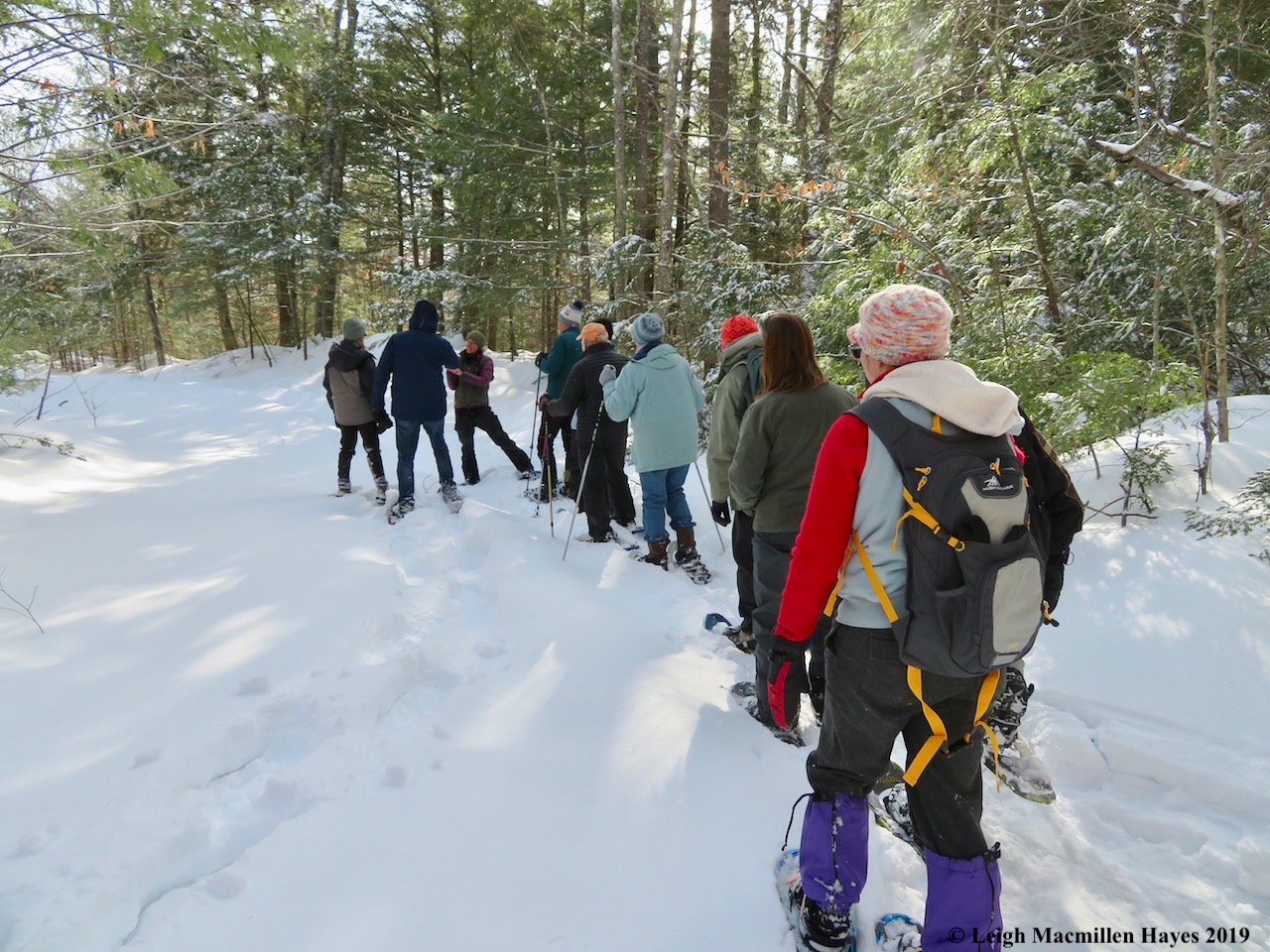
And so six of us met at 10am, strapped on our snowshoes, and ventured forth. It’s always such a joy to be with these peeps and talk and laugh and share a brain.
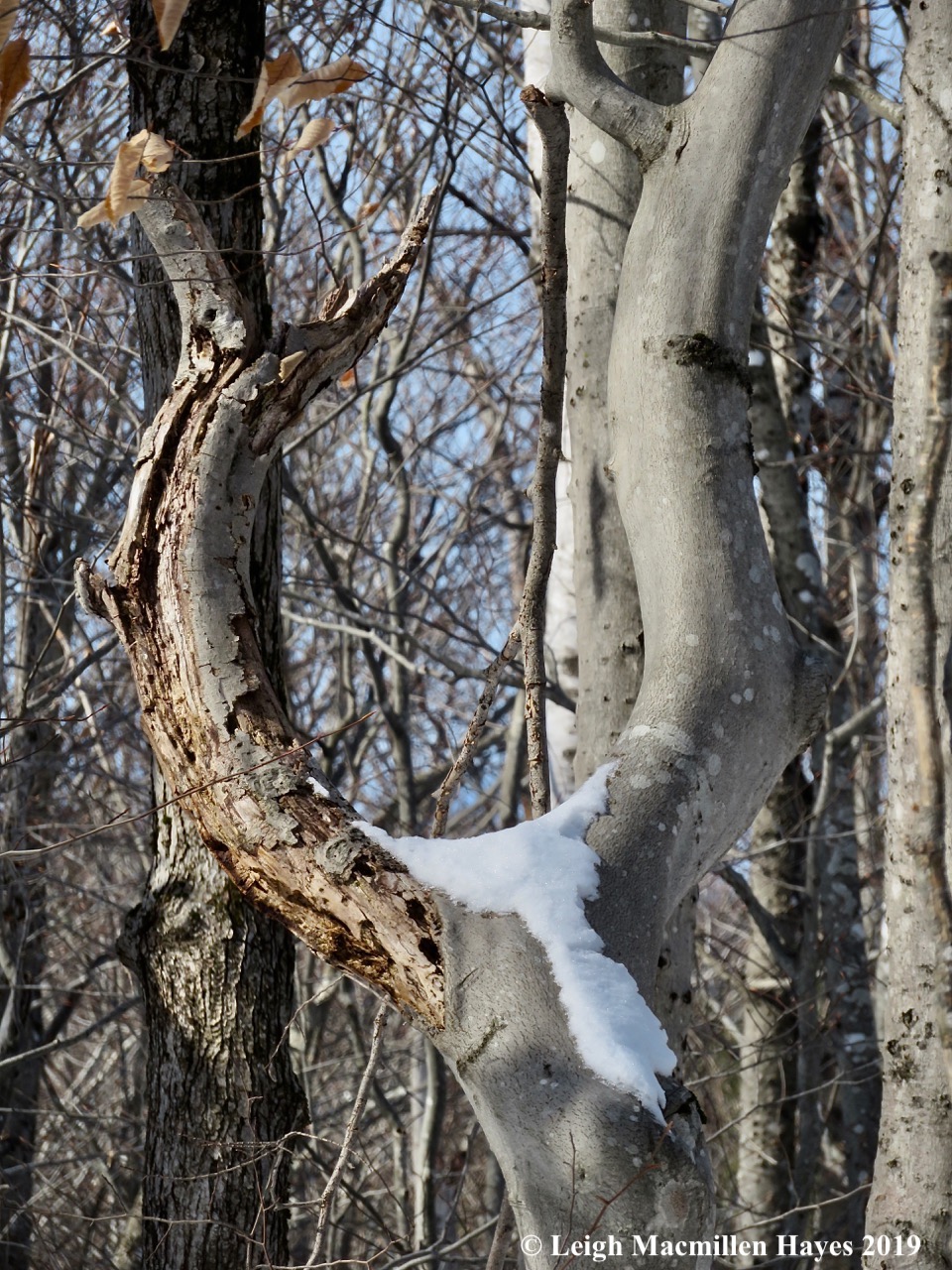
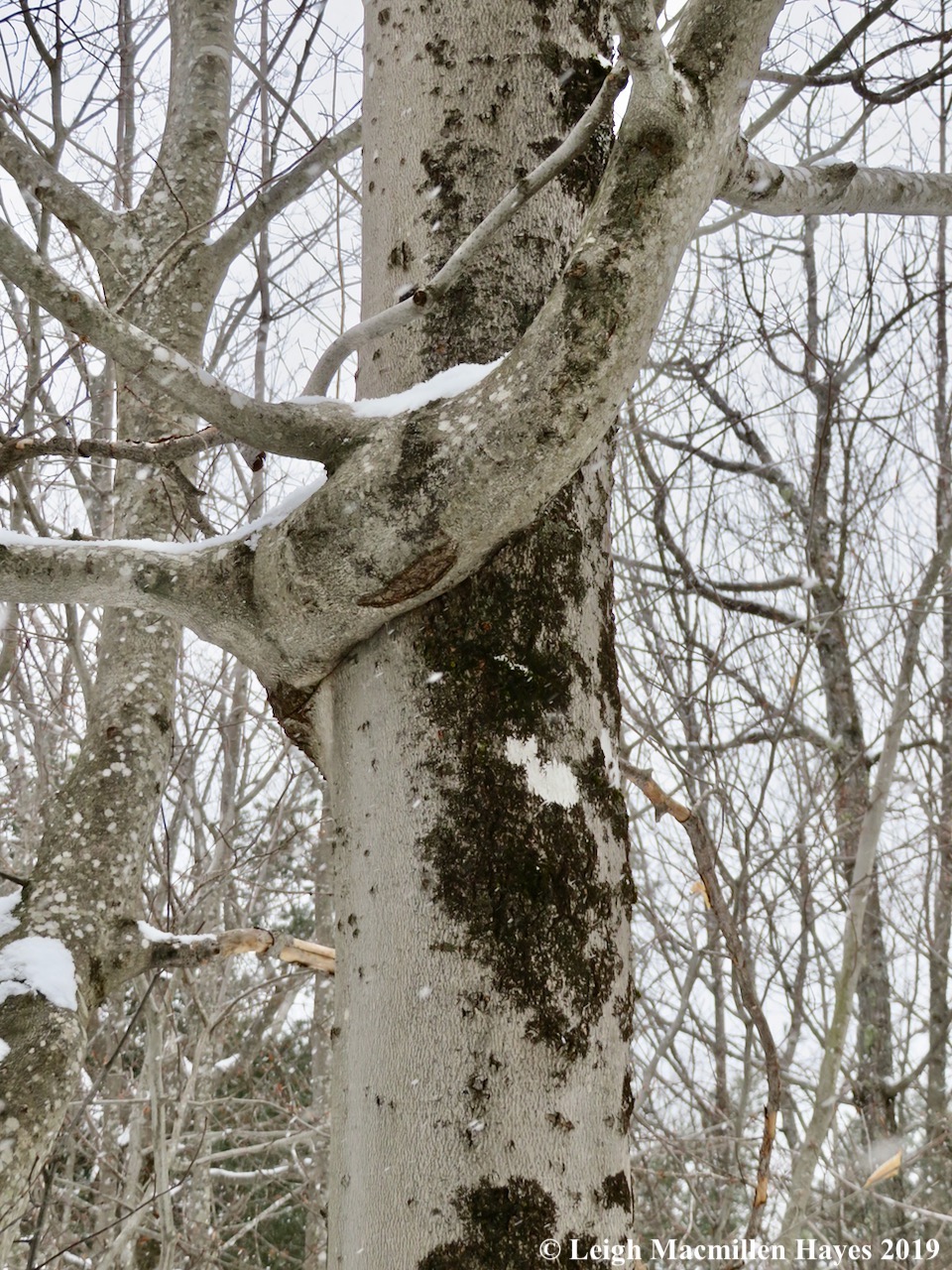
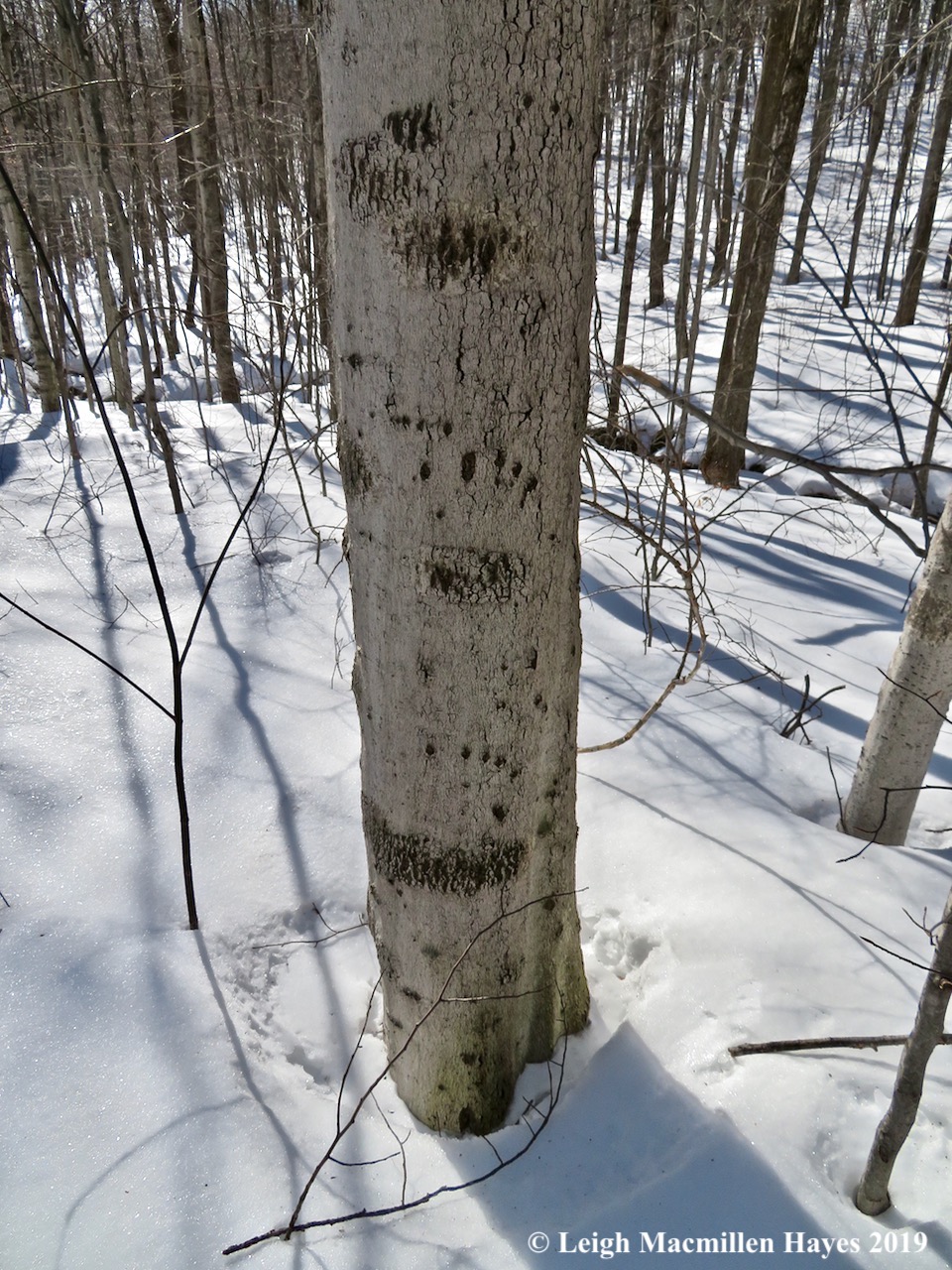
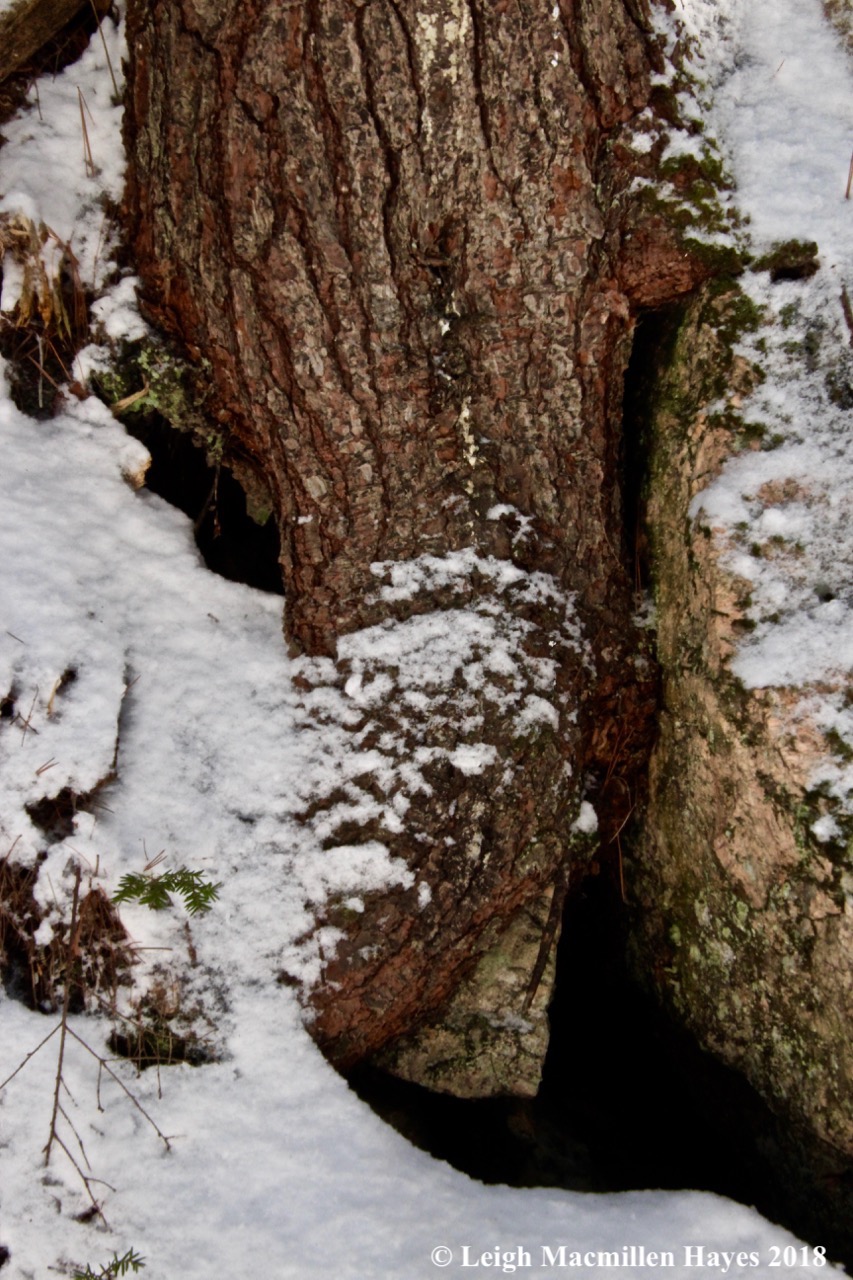
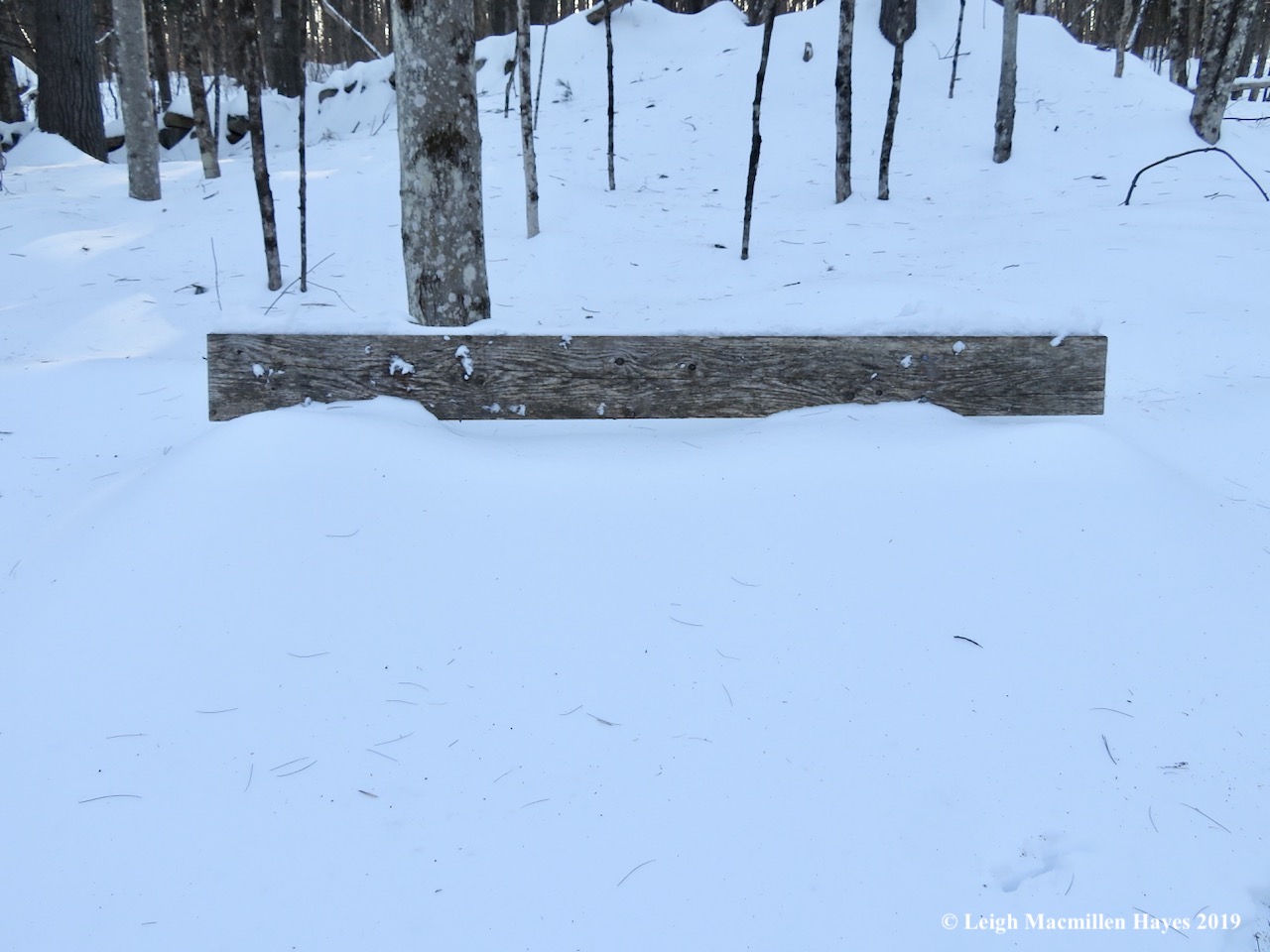
Because our focus at first was on beech bark while we looked for bear claw marks left behind, we also shared an imagination. One particular tree made us think of a horseshoe.

Even

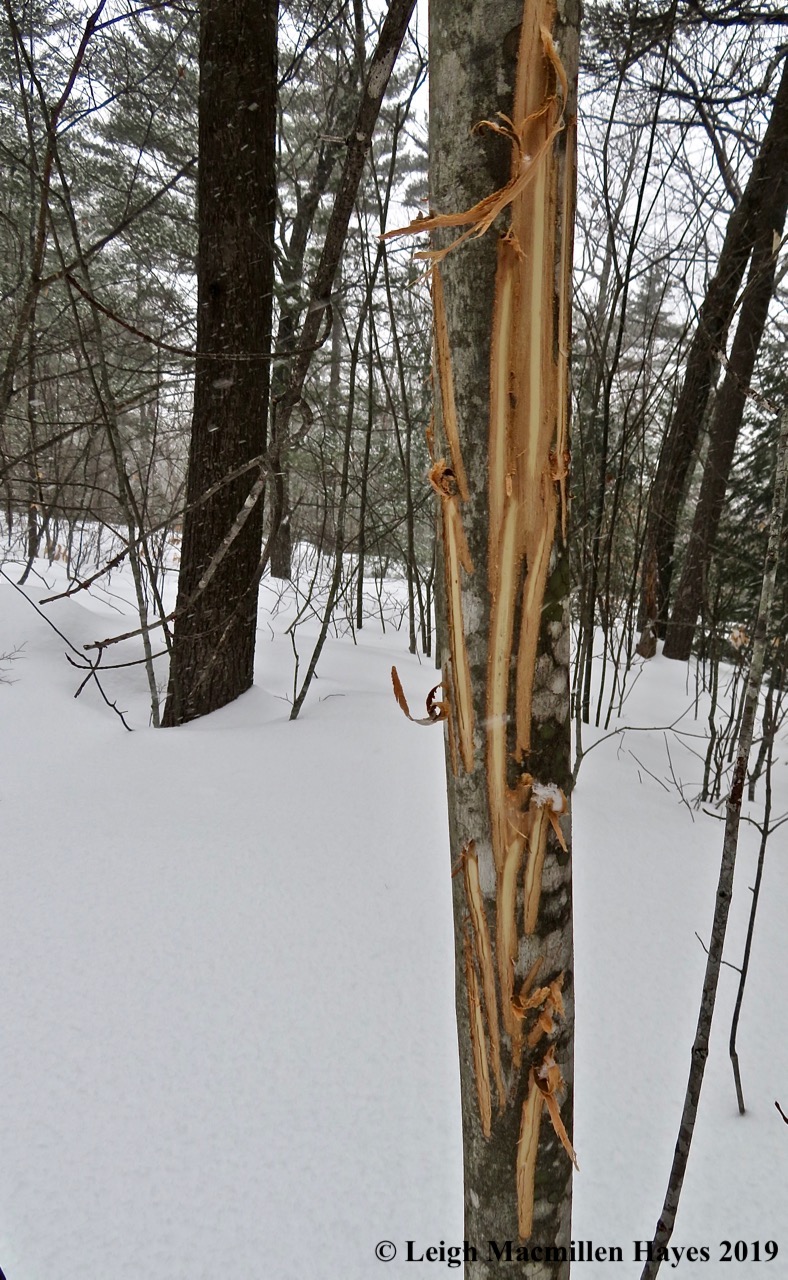
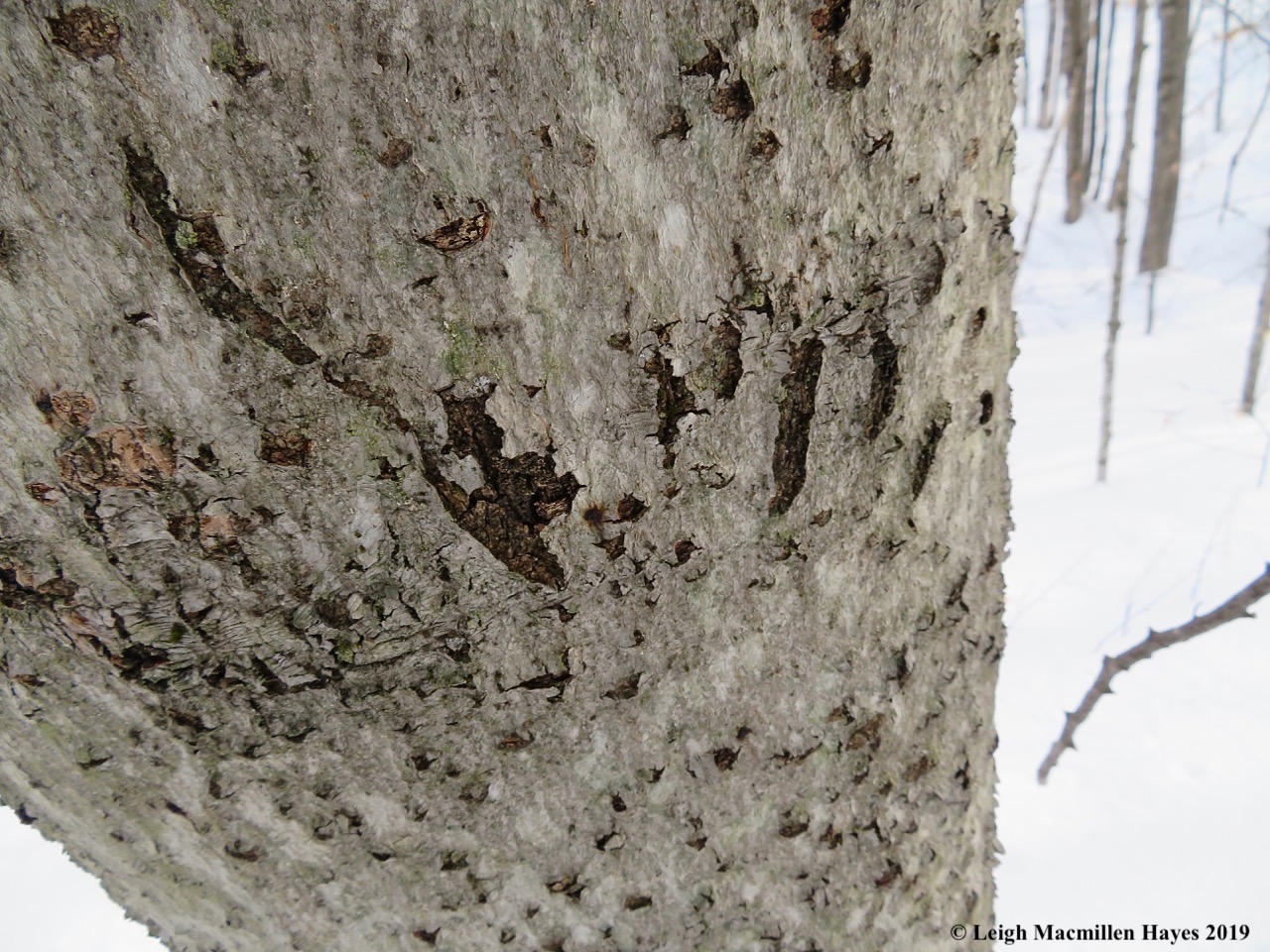
Eventually we found a few trunks with the etched scratches of bear claws that had grown wider with the years. After the first find, which was actually on a different tree, the others developed their bear tree eyes and became masters at pointing them out.

And though we’d come to track, there wasn’t a whole lot of movement in the preserve except for the occasional deer. But . . . we still found plenty to fascinate us, including Violet-toothed Polypore.
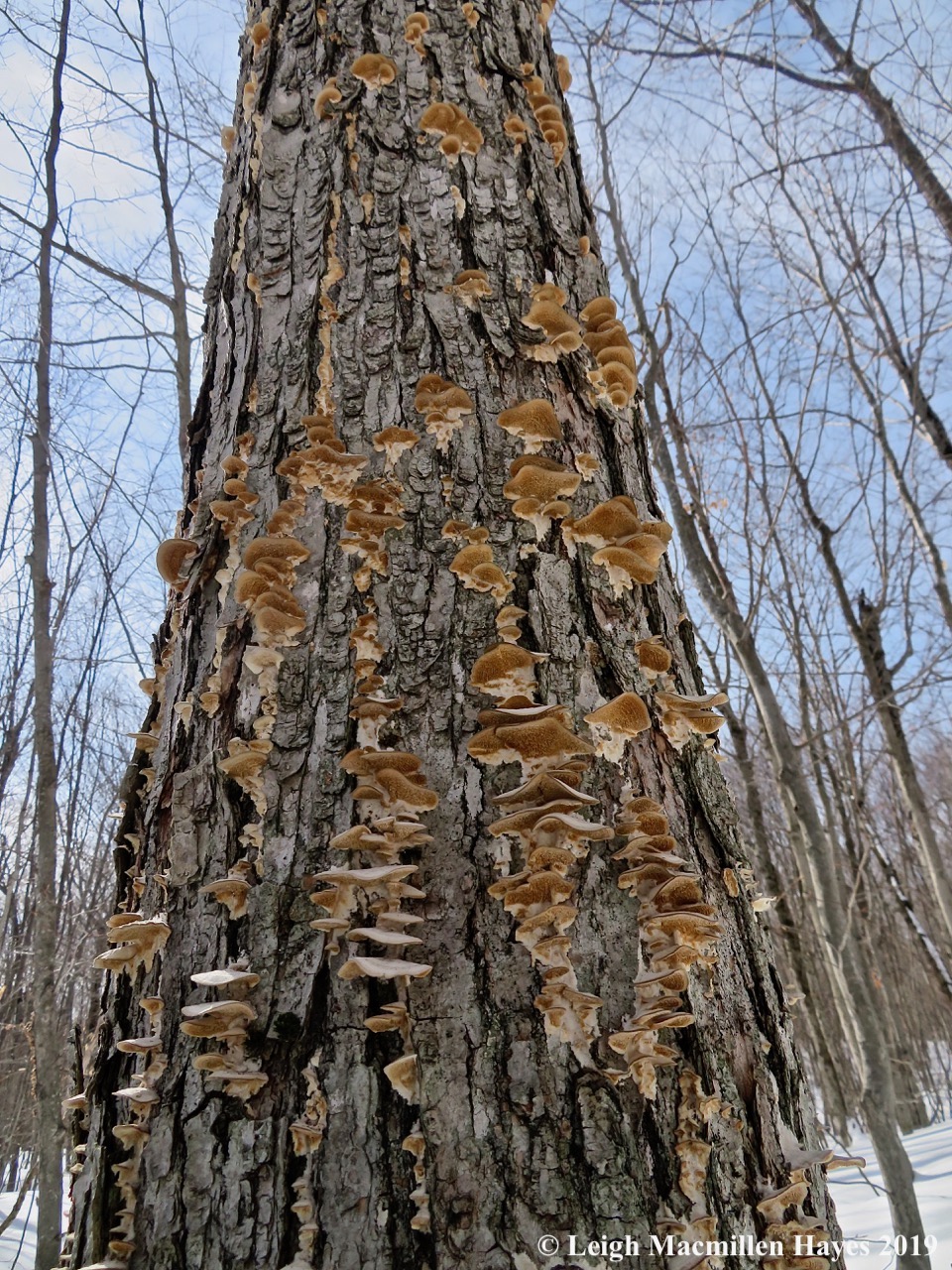
Alan was the fungi guru of the group and so to him we turned to confirm our ID. We were correct, but in the process he taught us something new about this gregarious mushroom. There are two types of Violet-toothed: Trichaptum biforme grows on hardwoods; Trichaptum abietinum grows only on conifers. Now we just need to remember that. Before our eyes the former reached to the sky on the red maple.

All along, as I’ve done all winter, I searched for an owl in a tree. Penny found one for me. Do you see it?
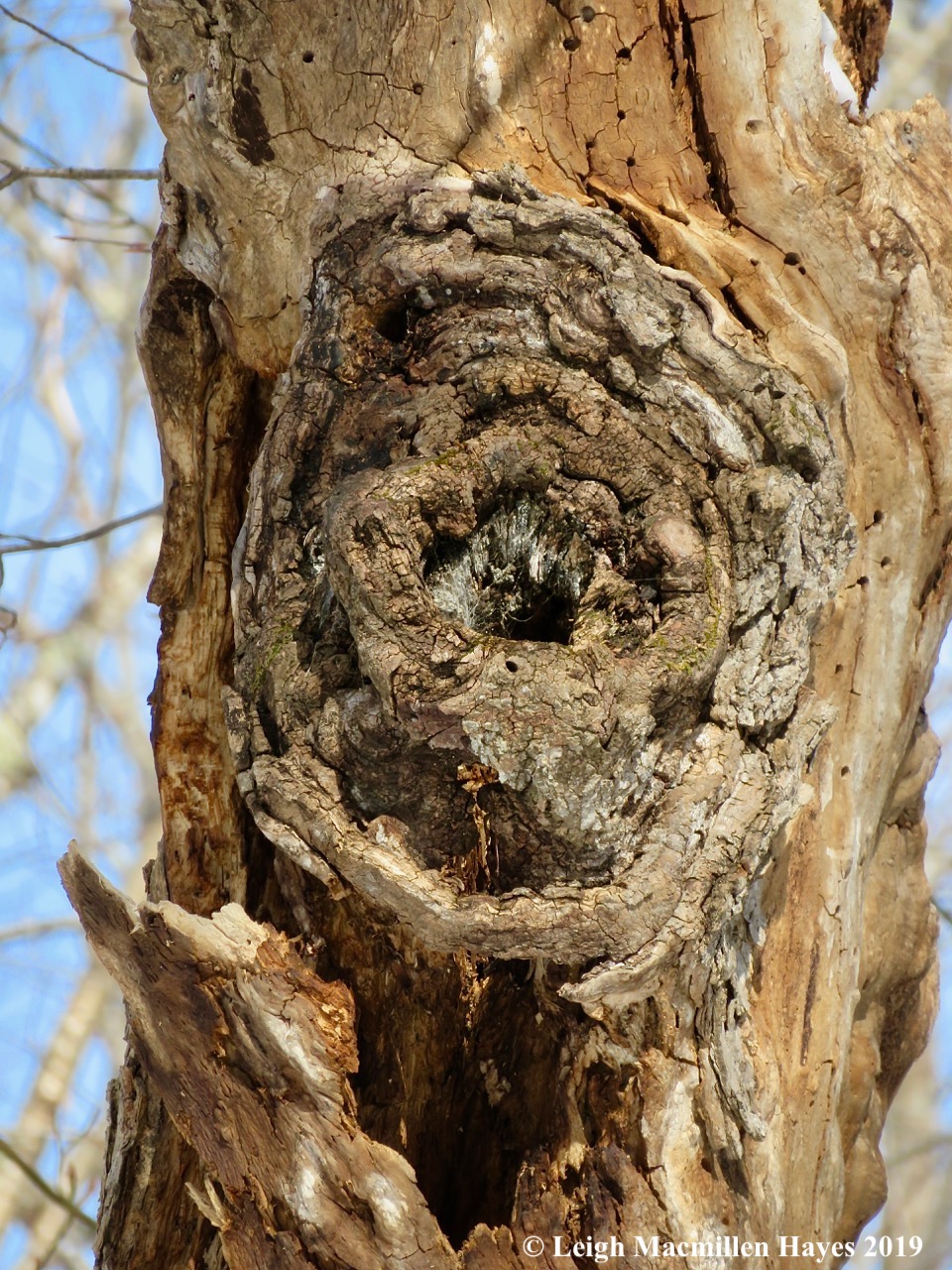
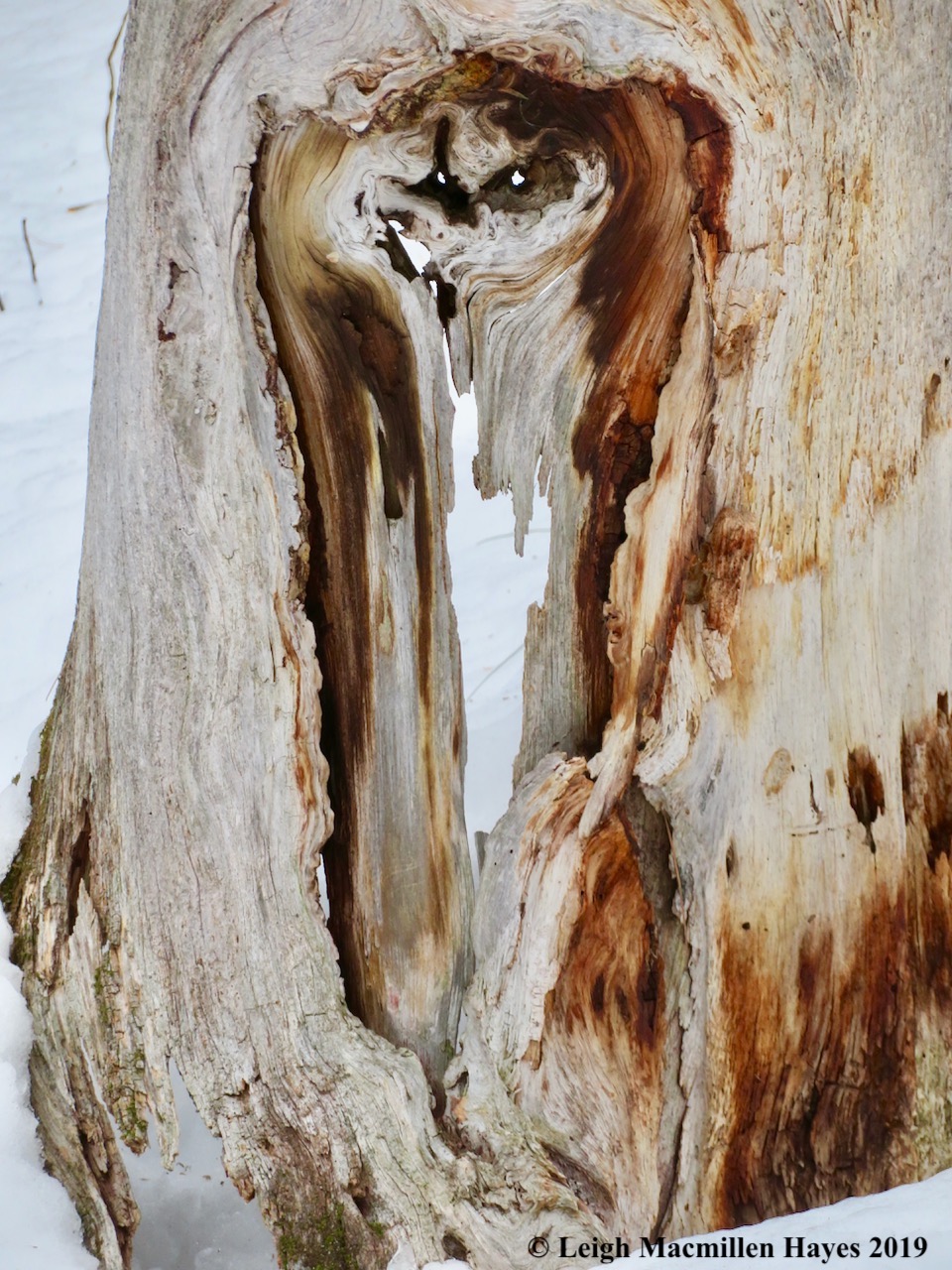
What I actually saw more than the owl was the face of a bear. OK, so I warned you that we took our imaginations with us.

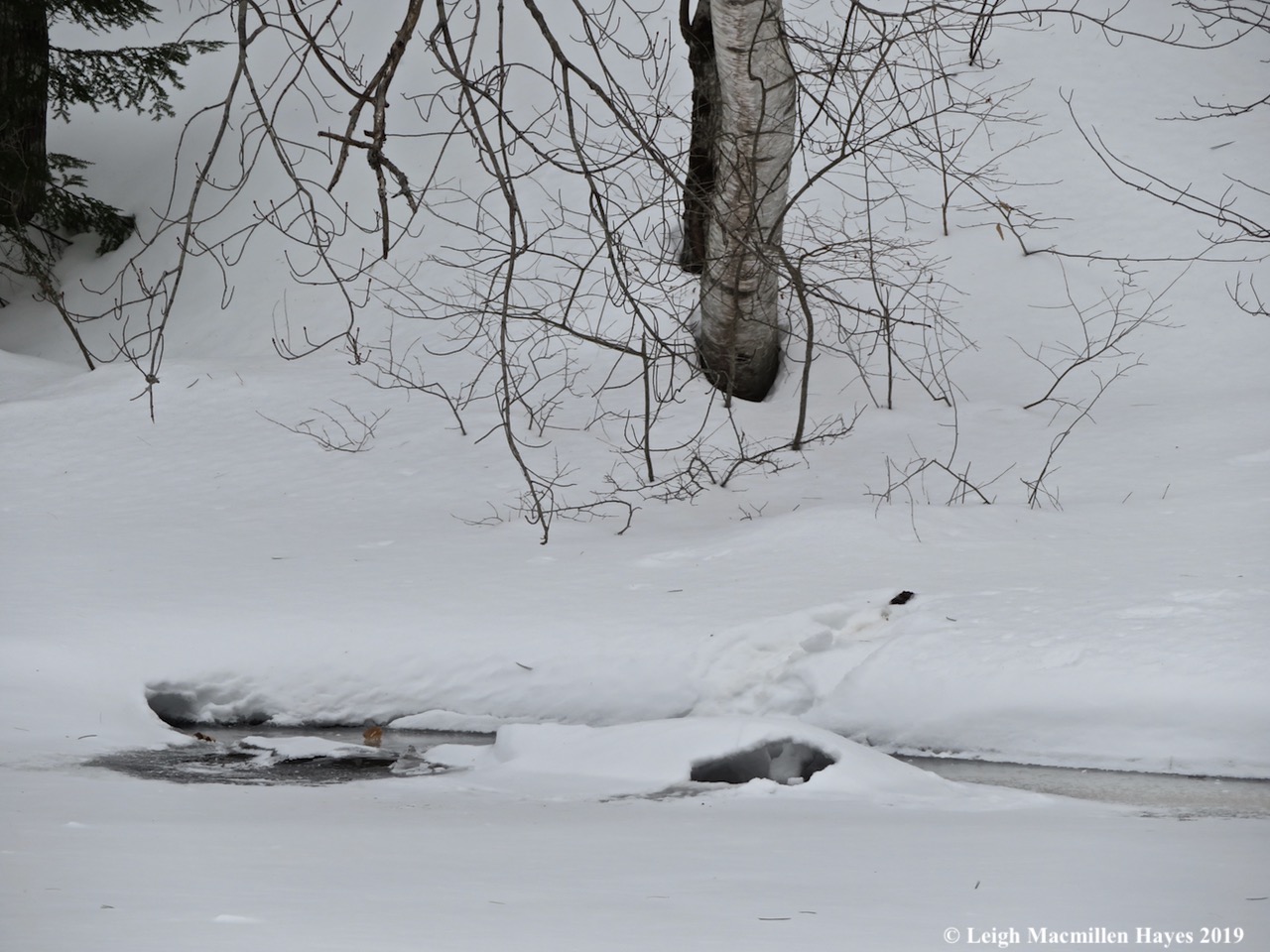
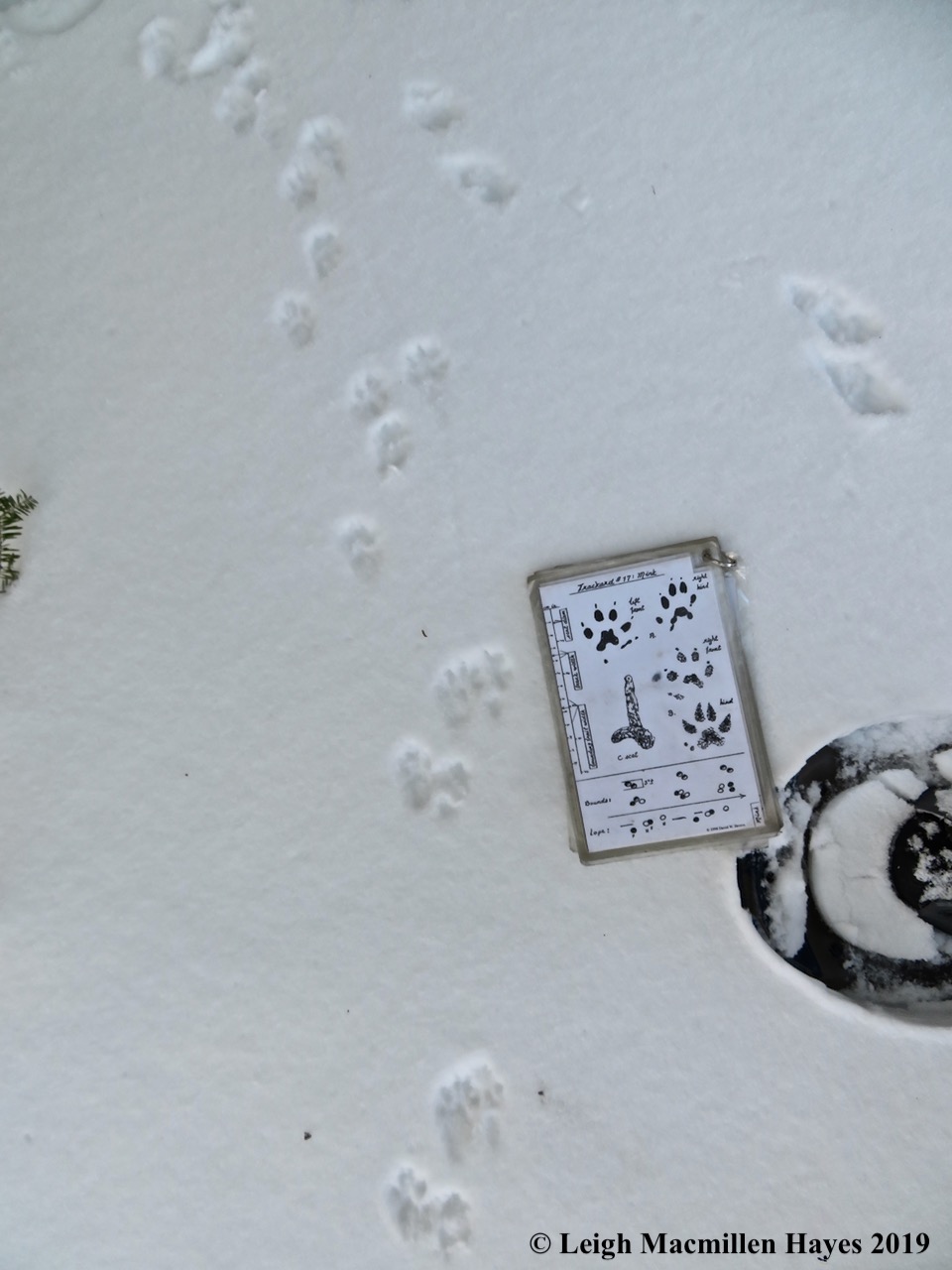
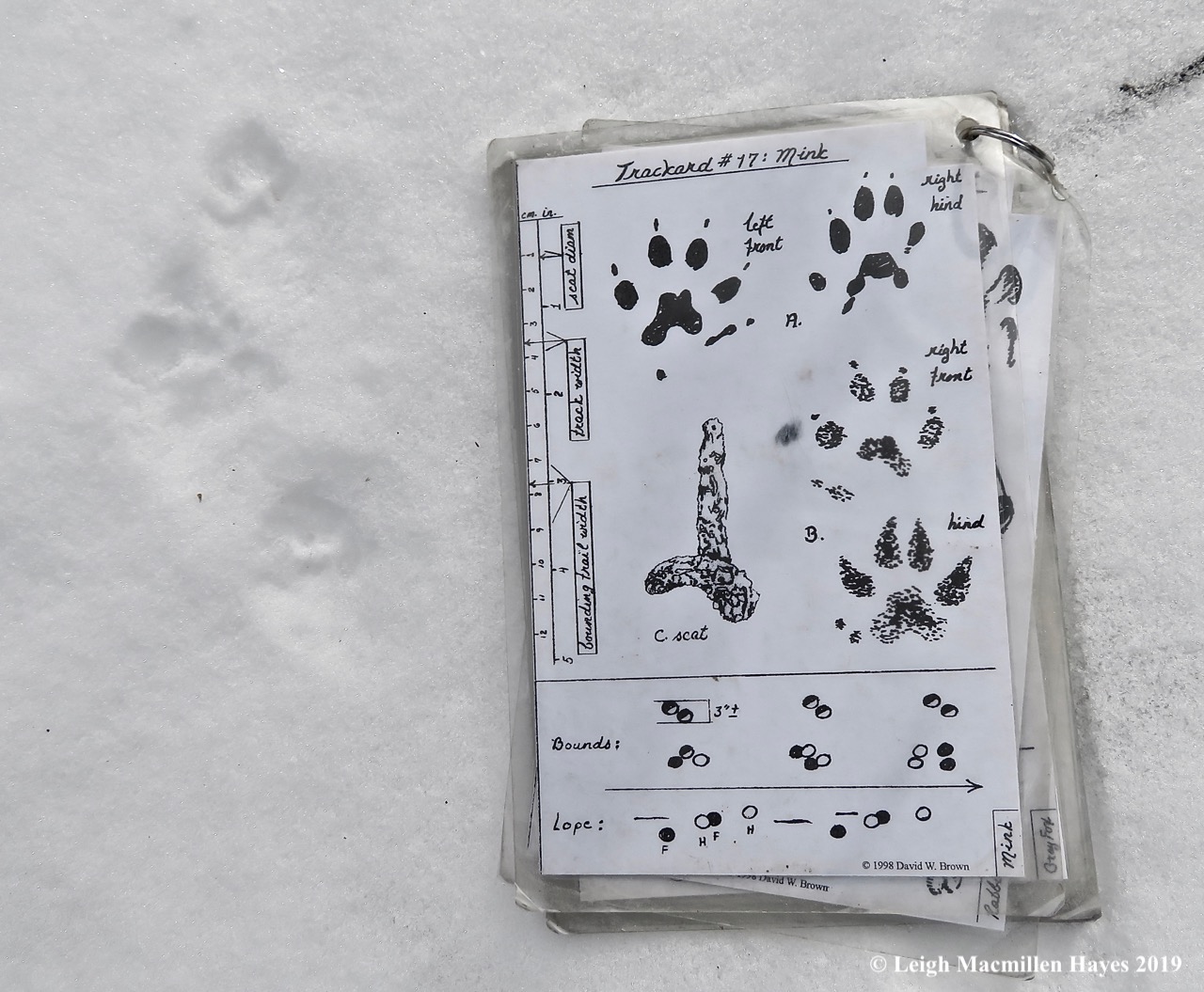
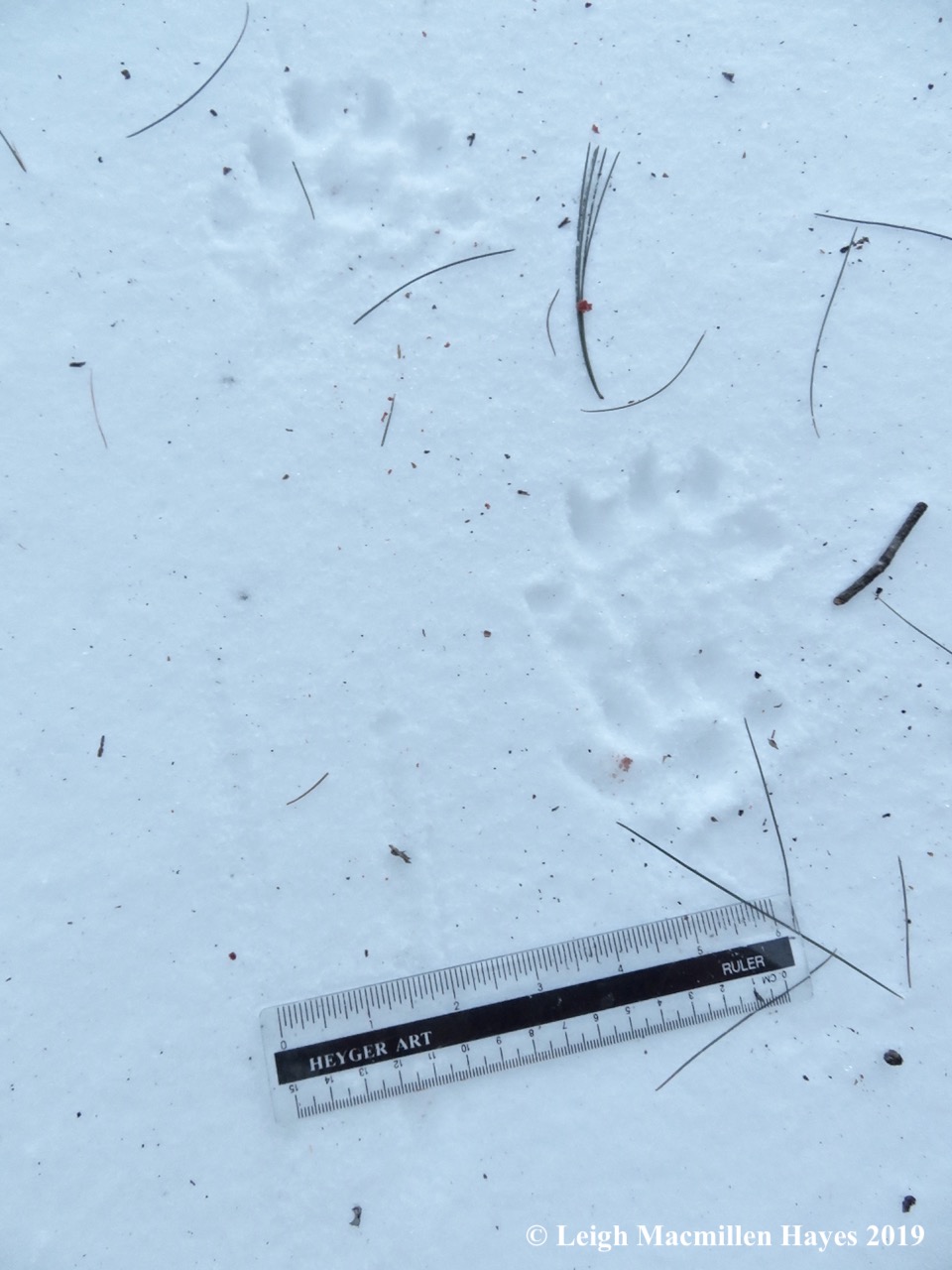
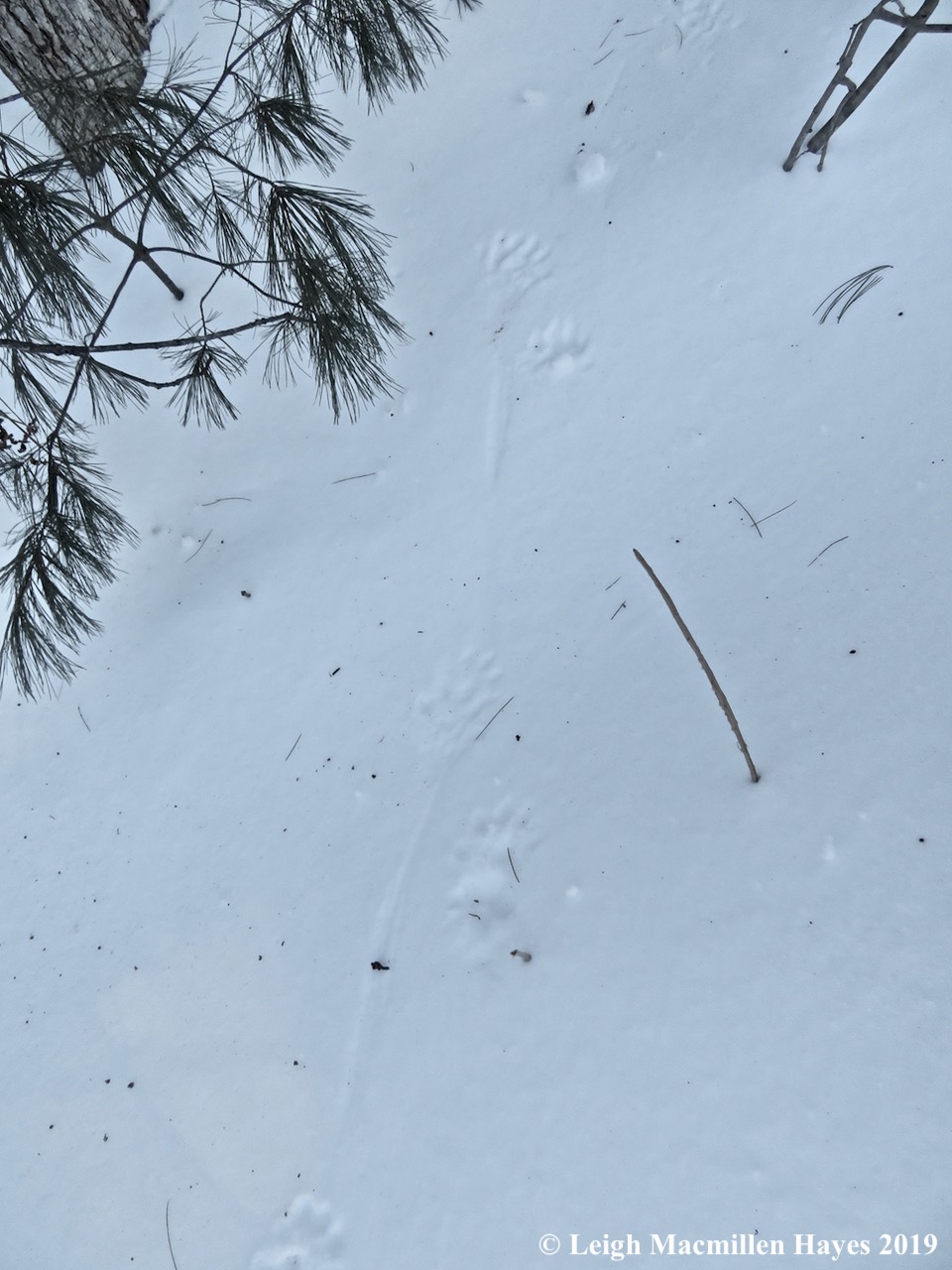
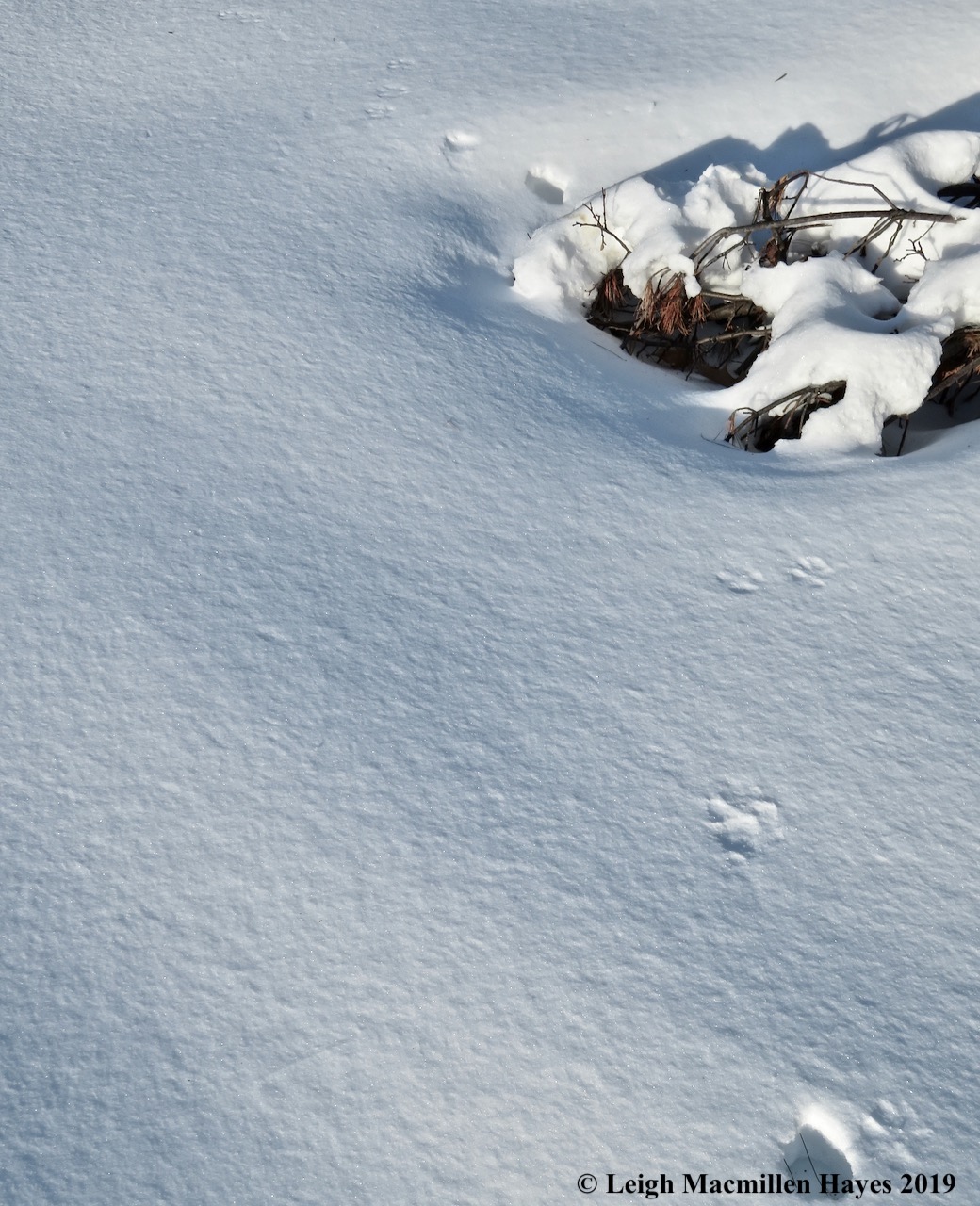
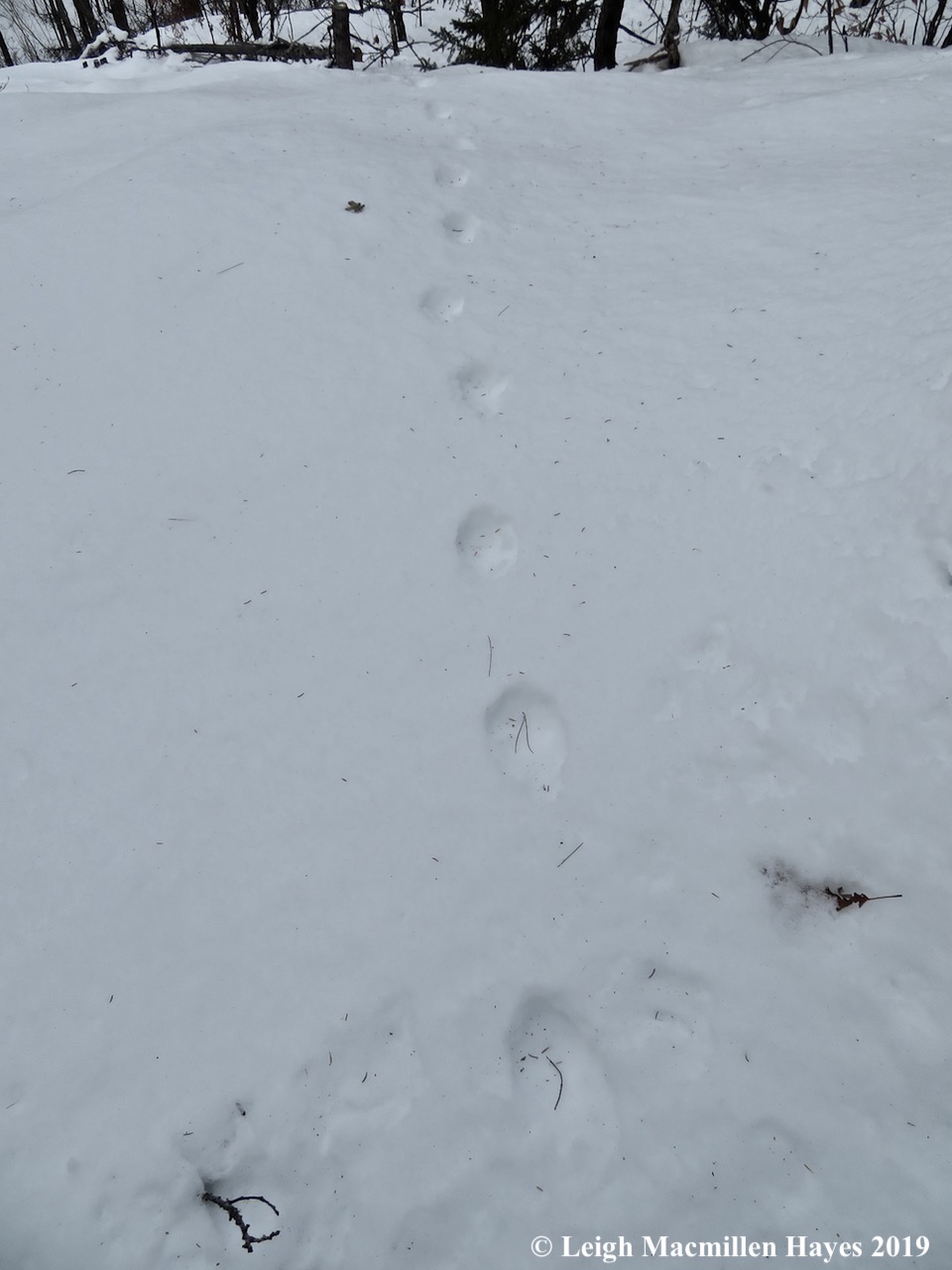
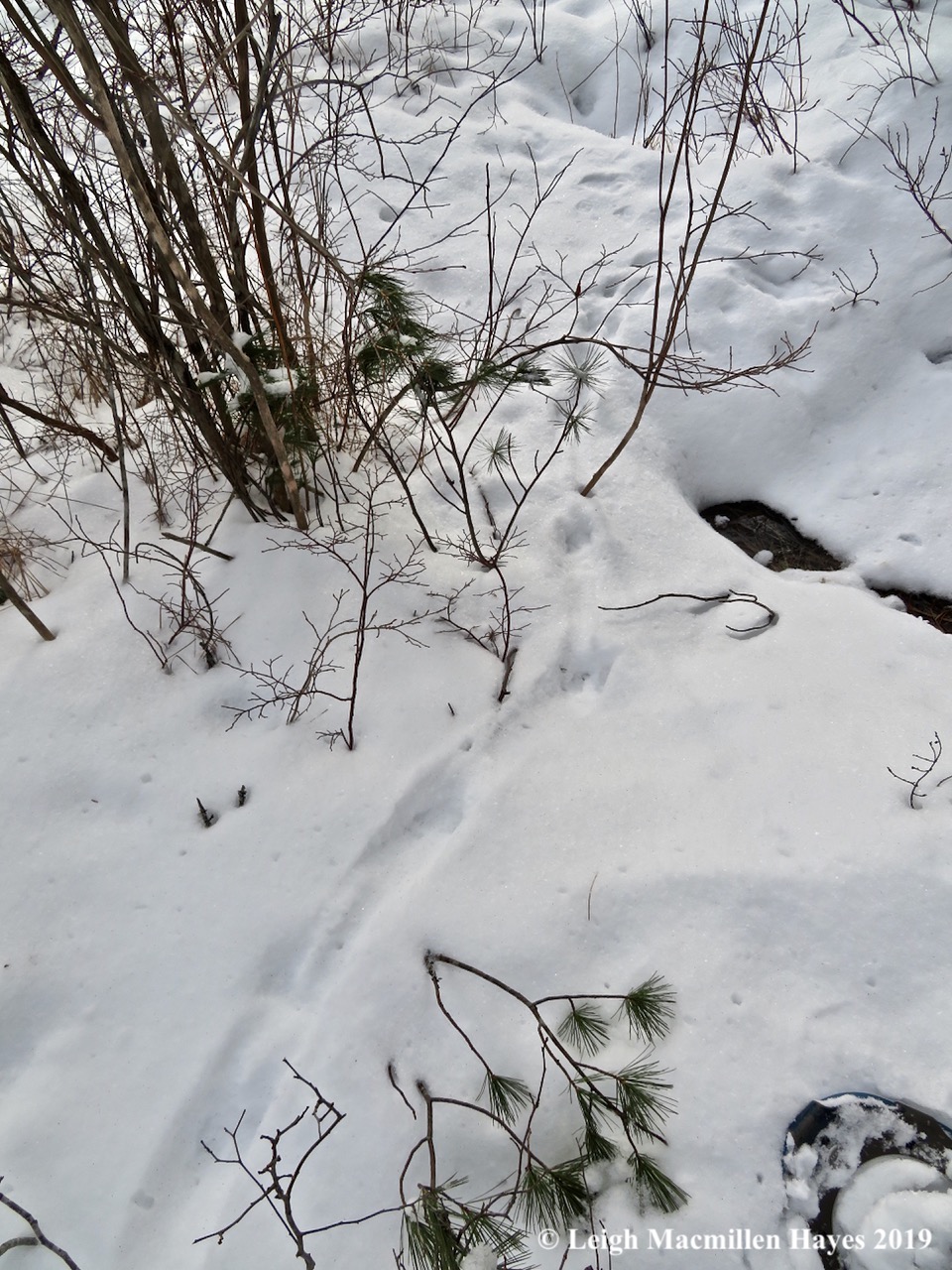
We were almost down to the water, when the group paused. Tracks at last. Near water. Track pattern on a diagonal meaning one foot landed in front of the other in a consistent manner for each set of prints. Trail width or straddle: almost three inches. Stride we didn’t measure because it varied so much, but it was obvious that this mammal bounded through the landscape. Identification: mink. Repeatedly after first finding the tracks, we noted that it had covered a lot of territory.

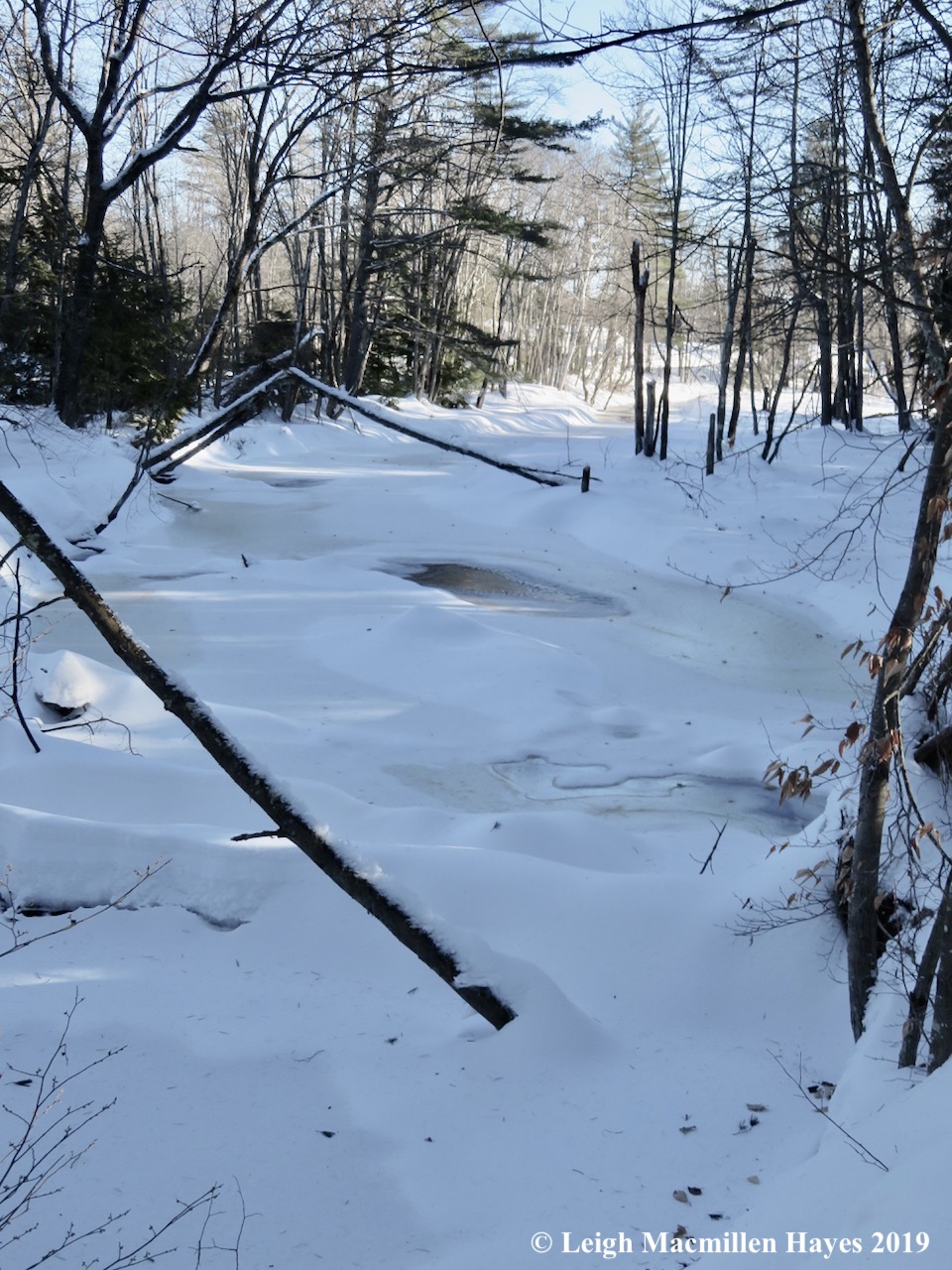
At last, we made our way out onto the wetland associated with South Pond and followed the tracks of a much bigger beast–in fact multiple beasts: snowmobiles.

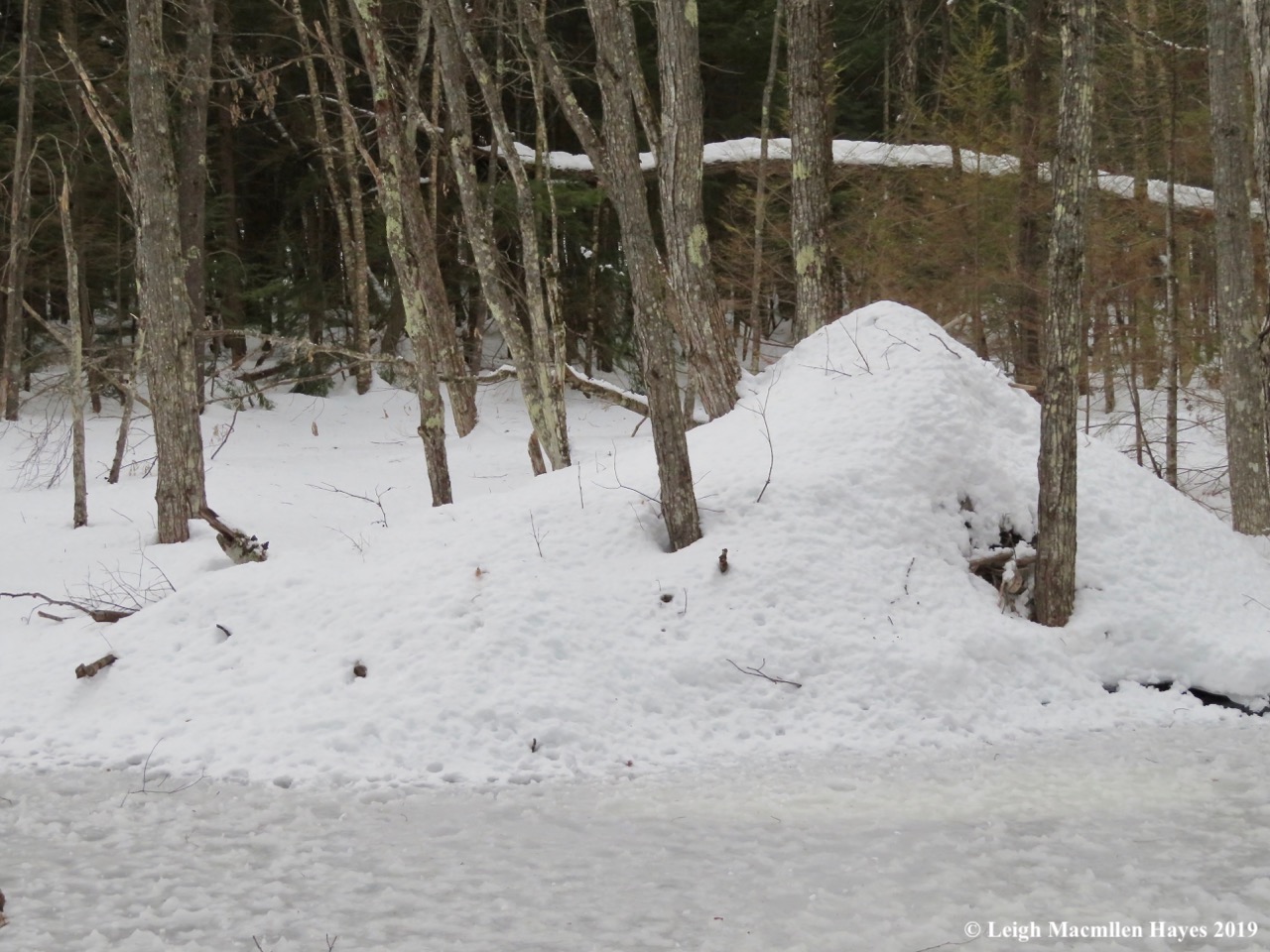
Rather than find lunch rock, we chose lunch lodge and stood in the warm sun to enjoy the view.

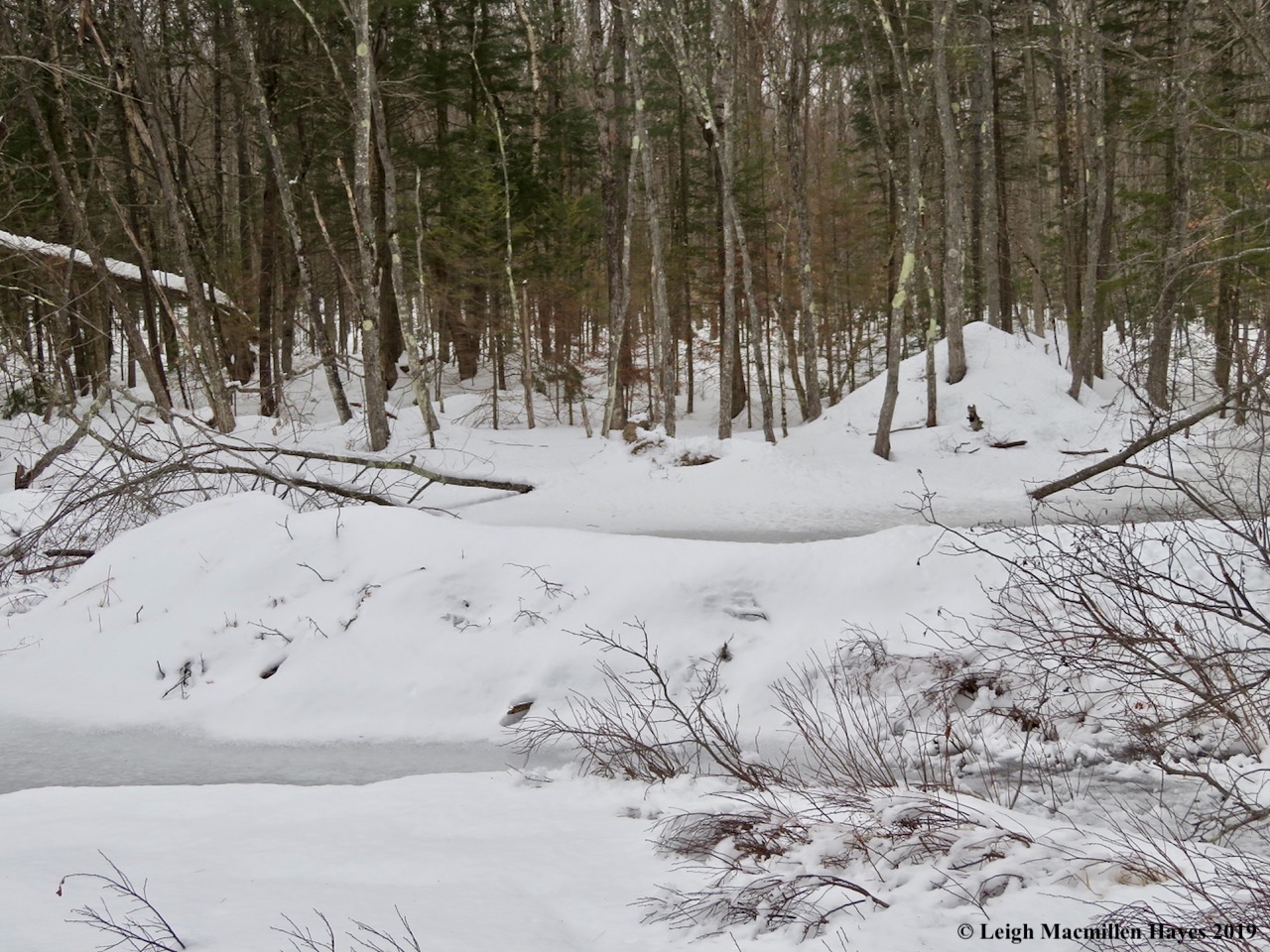
We did wonder if it was active and determined that though there had been some action in the fall as evidenced by the rather fresh looking sticks, there was no vent at the top so we weren’t sure any beavers were within. Maybe it was their summer cottage.

Close by, however, we found another lodge and the vent was open so we didn’t walk too near.
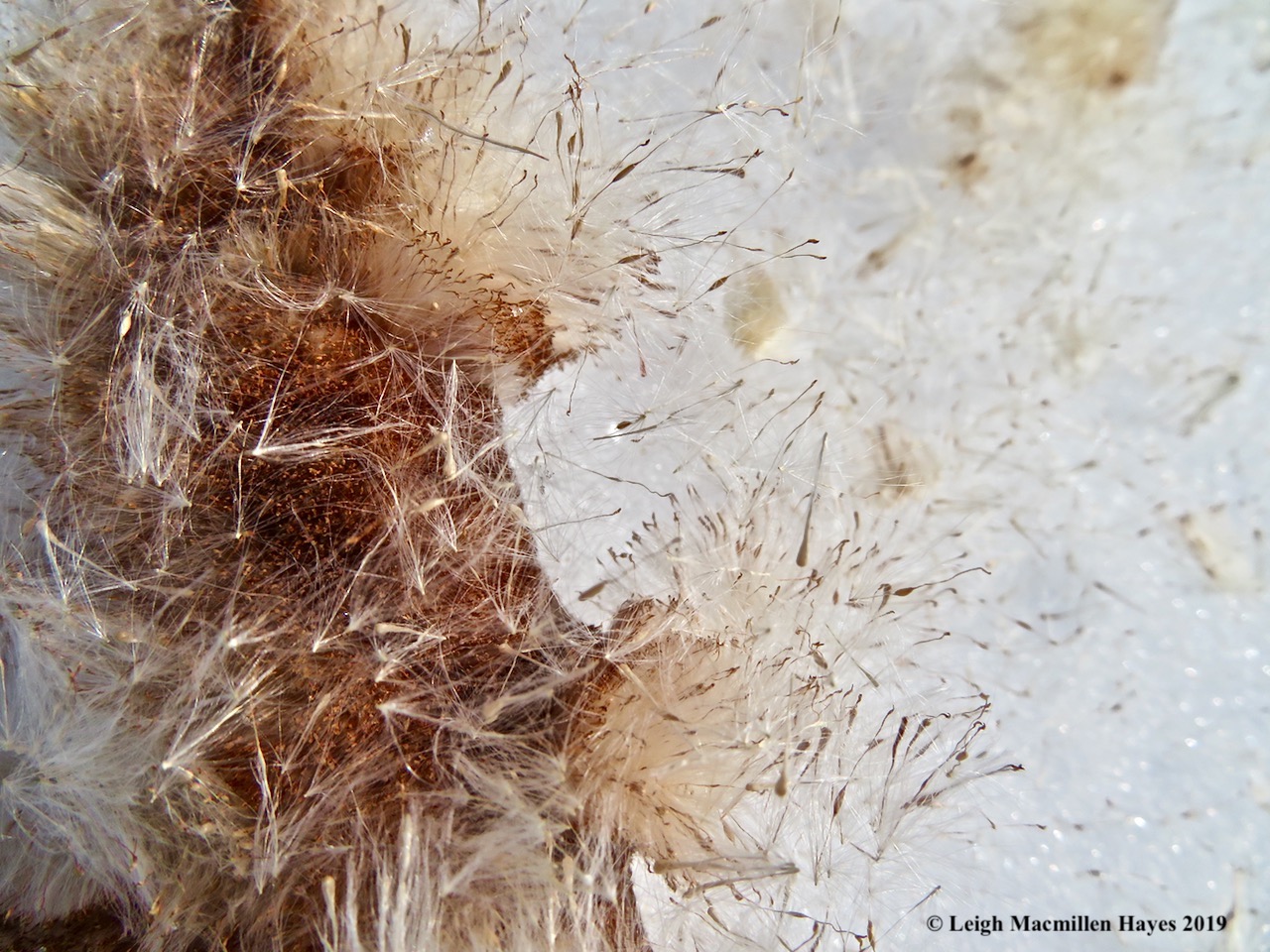
Because we were on the wetland, we did pause to admire the cattails, their seeds exploding forth like a fireworks finale (but of the silent type, which I much prefer).

Back on the trail, the bark of another tree stopped us. We looked at the lenticels, those lines that serve as a way to exchange gases much like our skin pores, and noted that they were thin rather than the raised figure 8s of a pin cherry.
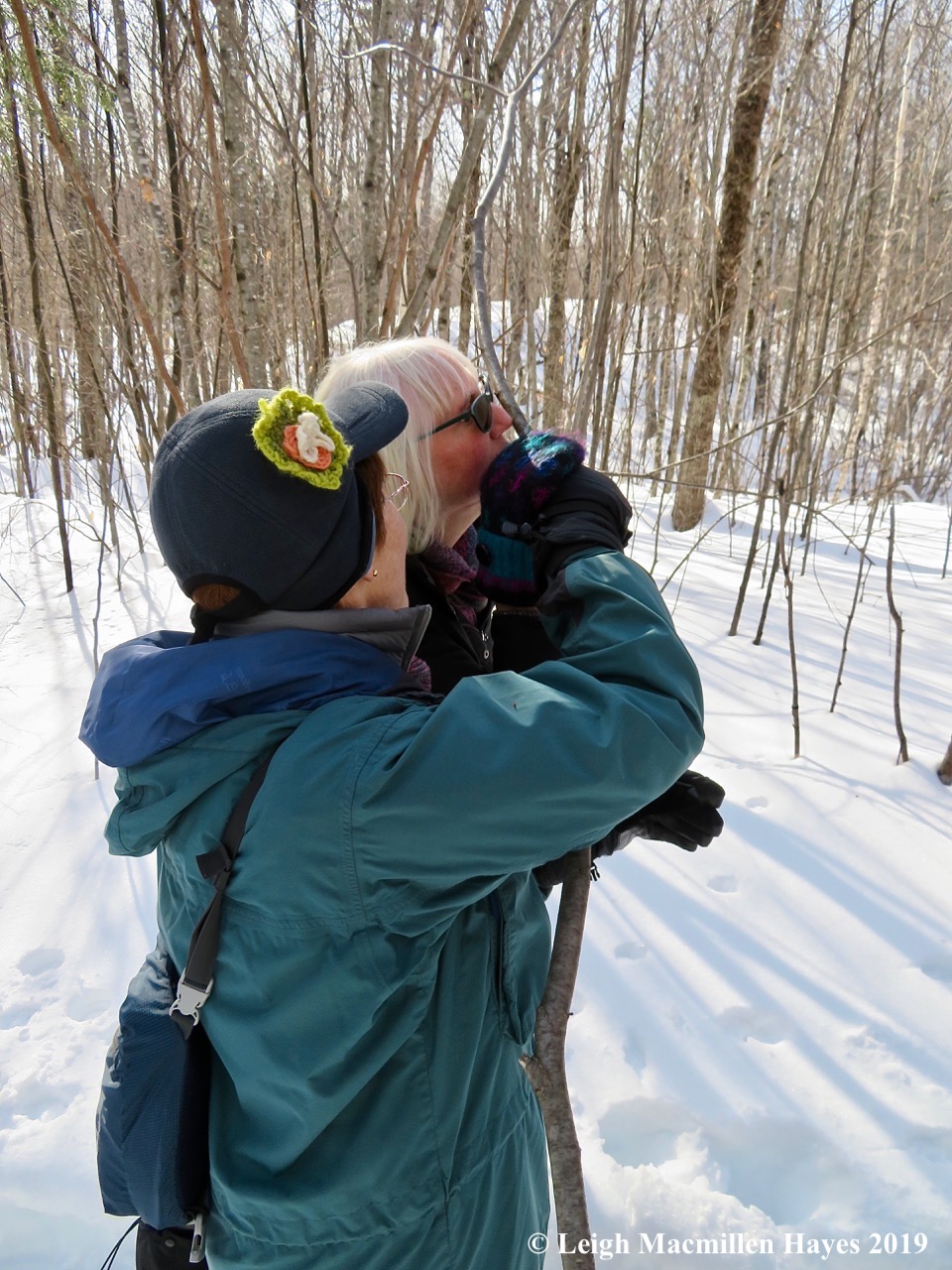
We had a good idea of its name, but to be sure we conducted a sniff test.

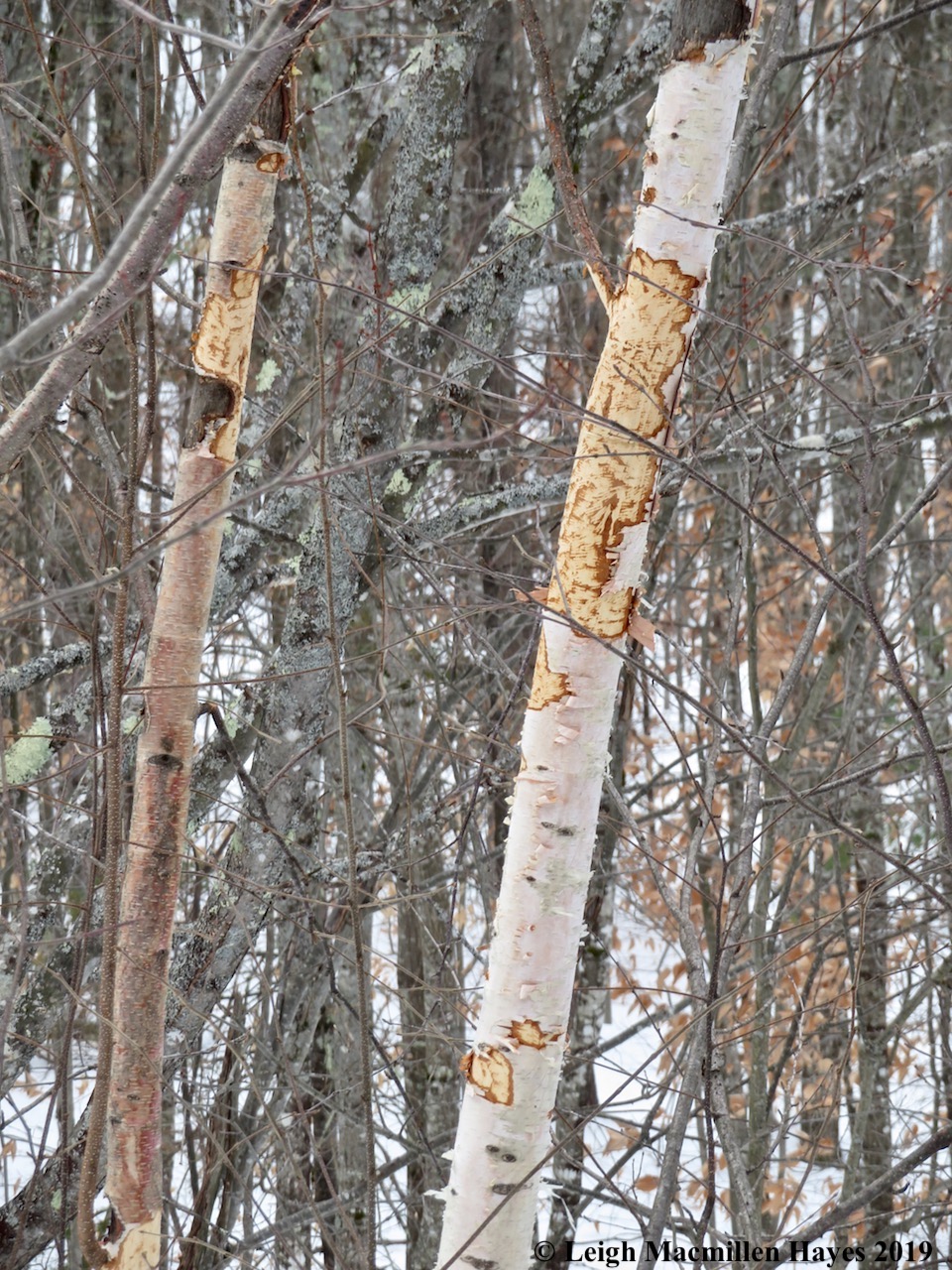
Smells like . . . wintergreen! We were excited to have come face to face with black or sweet birch. Some also call it cherry birch. Hmmm . . . why not wintergreen birch? Because, yellow birch, a relative, also has that wintergreen scent when you scratch the bark, especially of a twig.

Continuing along, the temperature had risen and snow softened so periodically we had to help each other scrape snowballs off the bottoms of shoes.

Otherwise the feeling was one of walking on high heels.
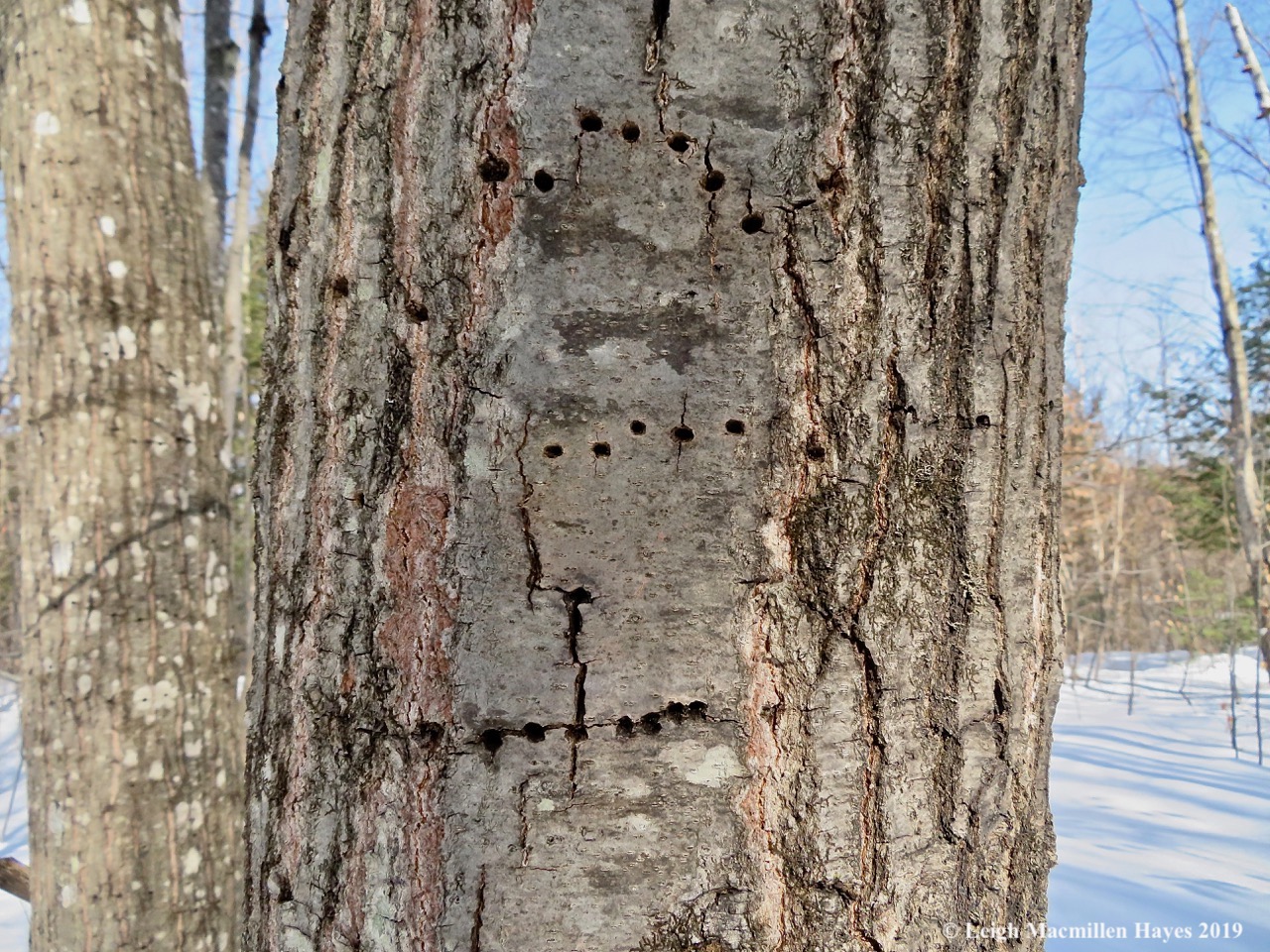
As I said earlier, all kinds of things stopped us, including the straight lines of the holes created by sapsuckers, those warm-weather members of the woodpecker family. One in the neighborhood apparently decided to drum to a different beat as noted by the musical notes of the top line.

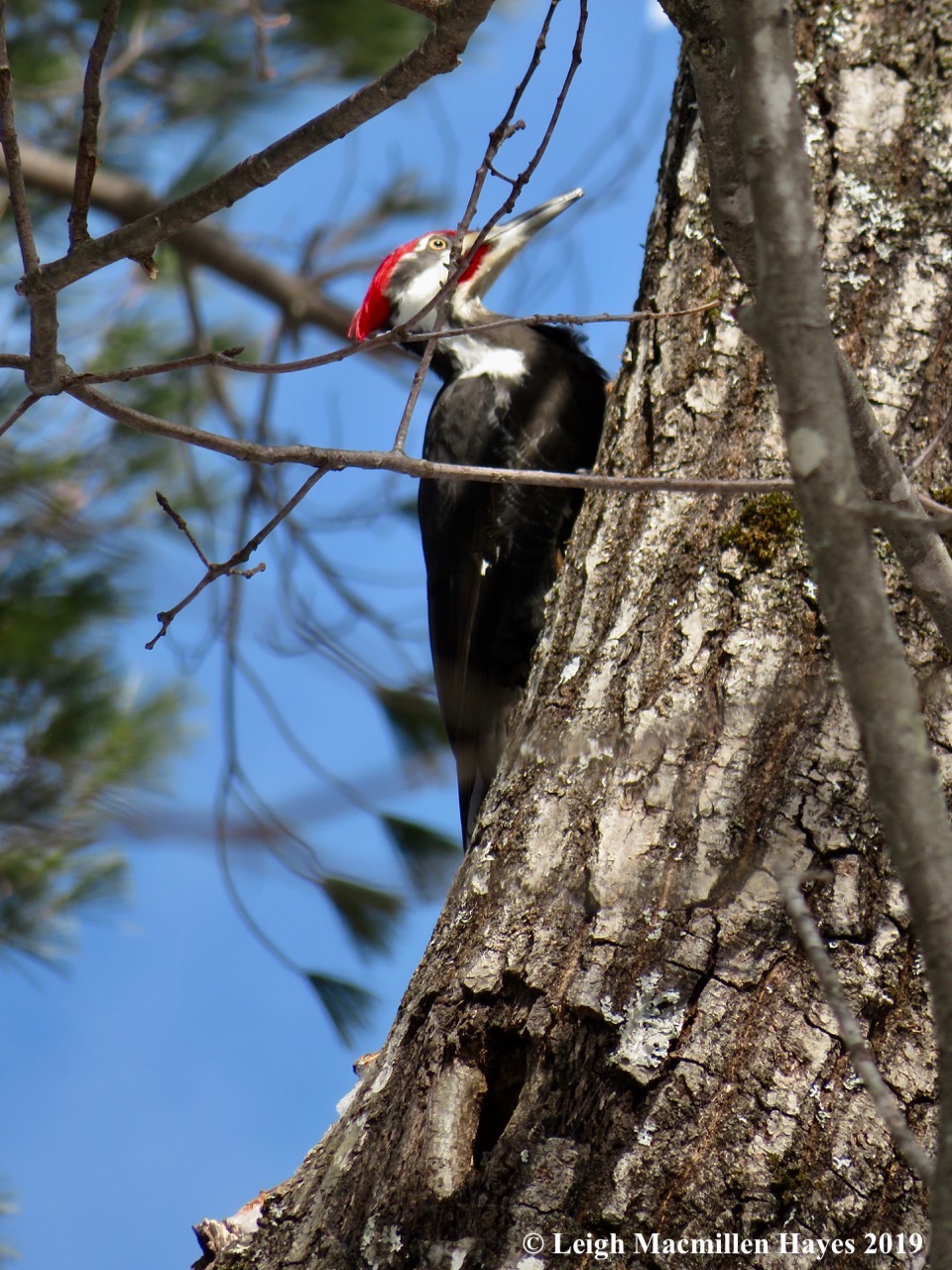
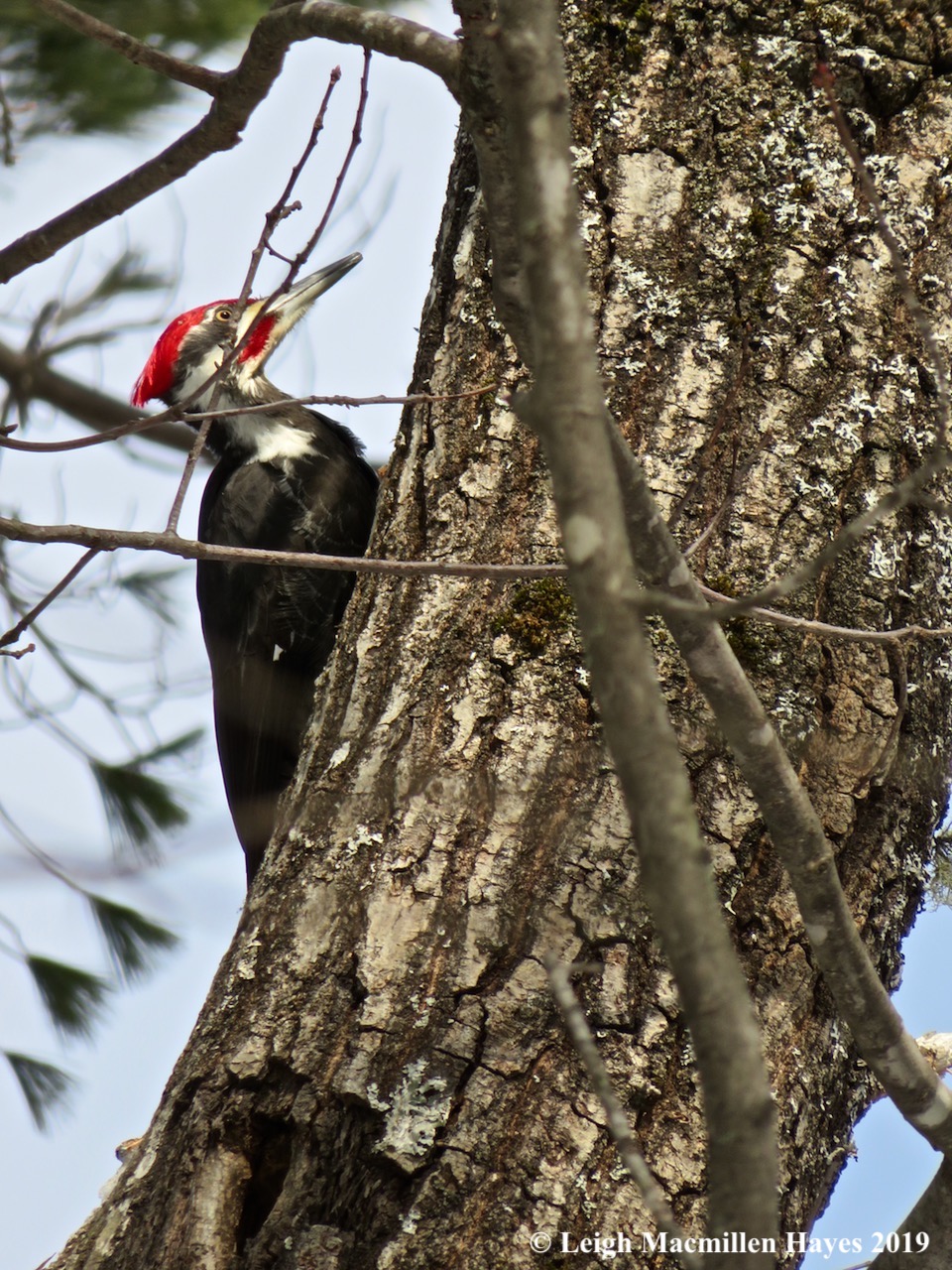
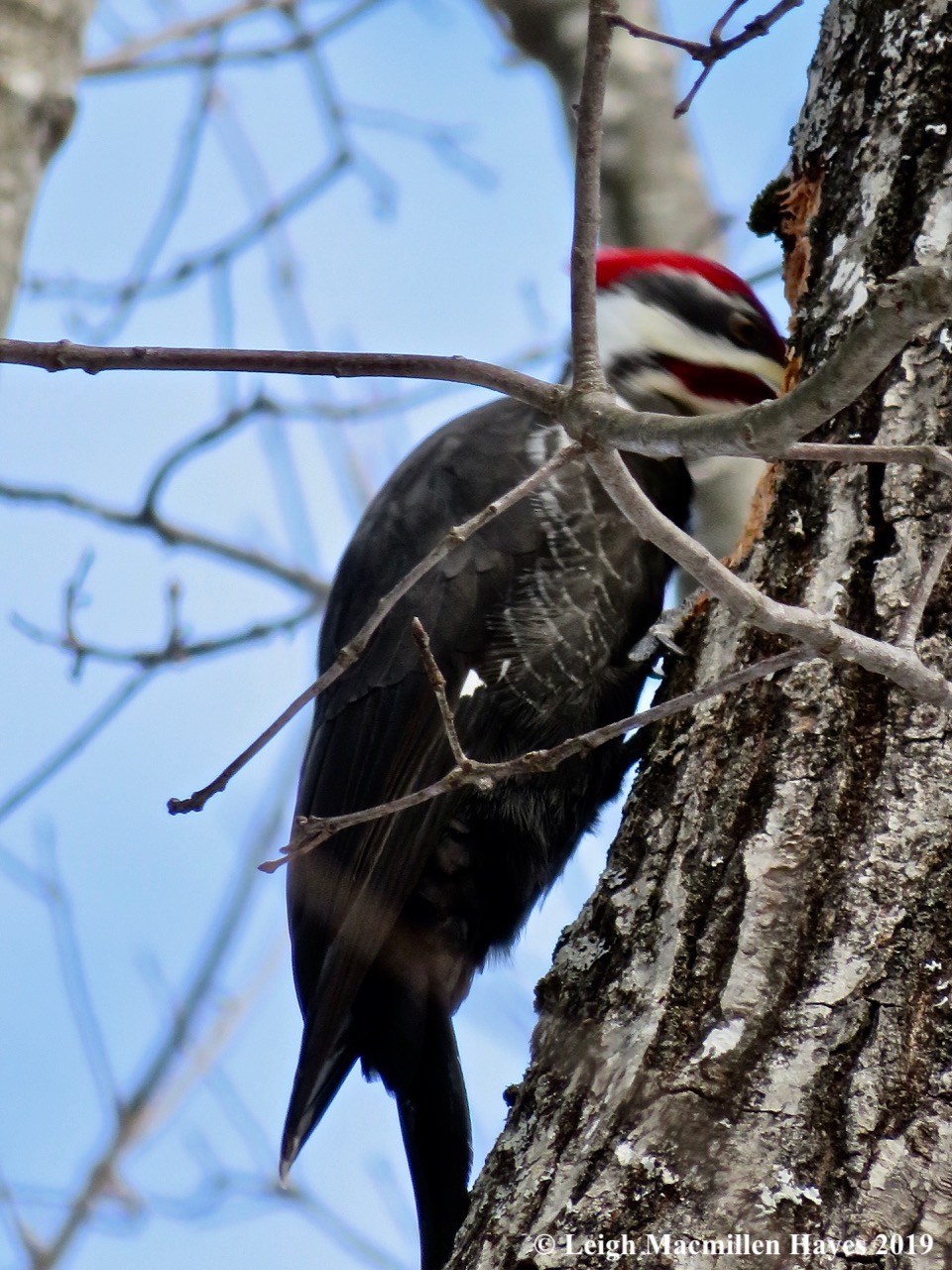
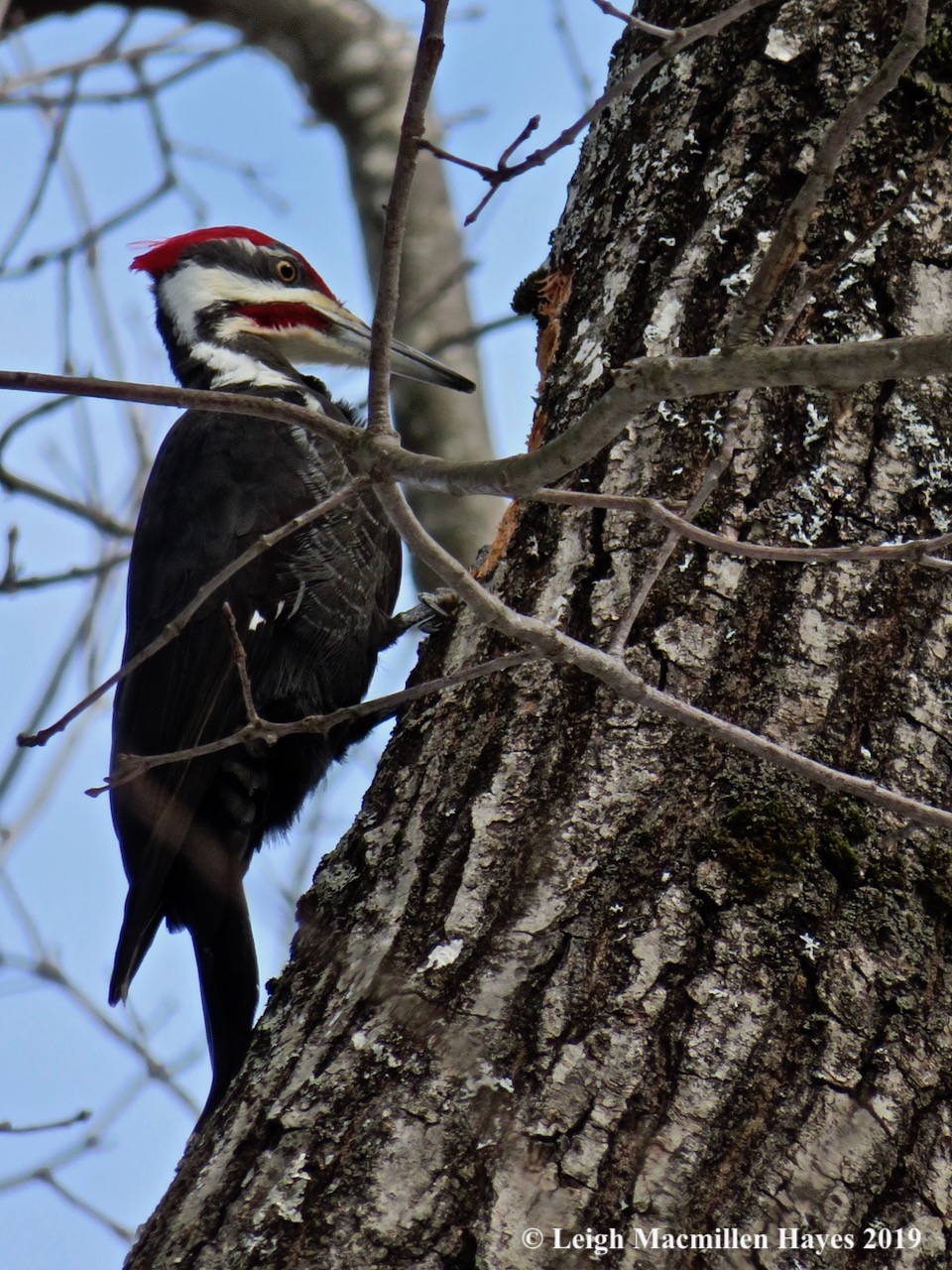
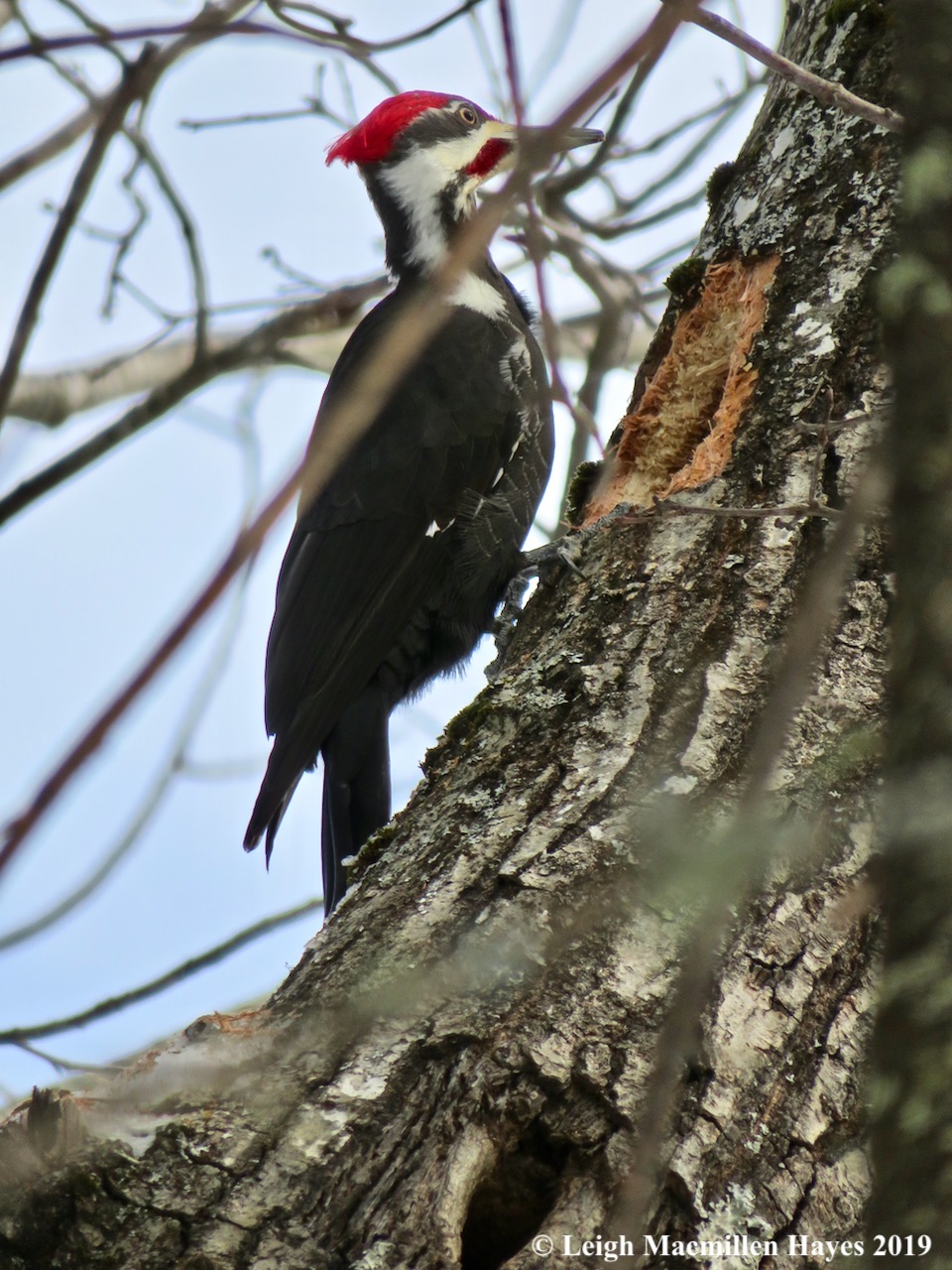
Speaking of woodpeckers, for a few minutes we all watched a pileated and admired its brilliant red crest in the afternoon sun, but we couldn’t focus our cameras on it quickly enough as it flew from tree to tree. We did, however, pause beneath a tree where it had done some recent excavation work.

And left behind a scat that resembled a miniature birch tree.

At last, four hours and two miles after starting (we’d intended to only be out for three), we’d circled around and stopped again at the kiosk to look at the map. Do note that we’d also picked up a passenger along the way for Carl Costanzi, a Western Foothills Land Trust board member and steward of the Virgil Parris Forest came upon us and joined our journey. We picked his brain a bit about the property and he picked up a pair of snowshoes that had malfunctioned for one of us. Thank you, Carl! That’s going above and beyond your duties.

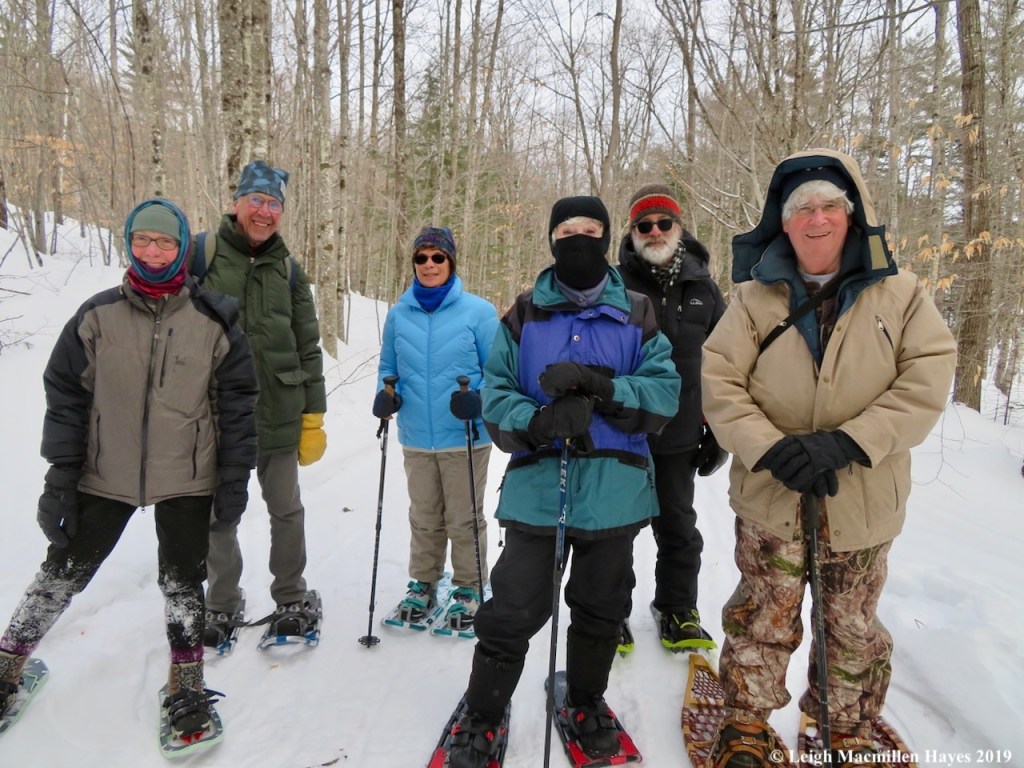
Before departing, we did what we often do–circled around and took a selfie.
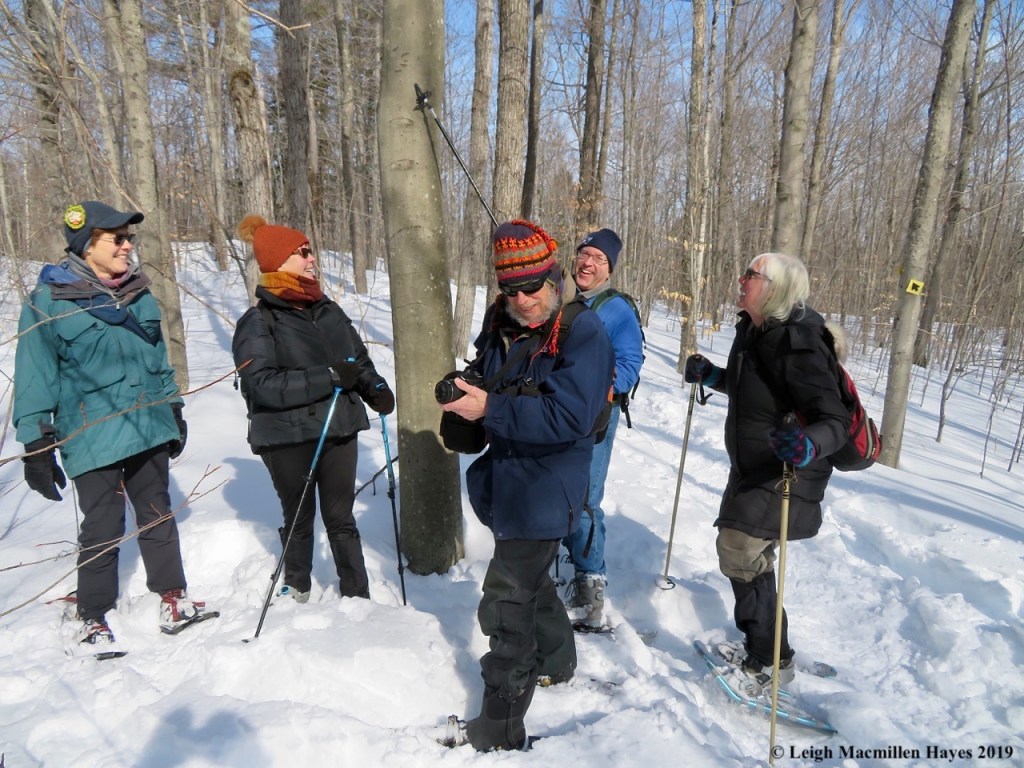
And then we left with smiles in our hearts and minds for the time spent reconnecting. Our memories will always be filled with the discovery of the first bear tree not too long after we began. As Penny said, “That first one was a doozy.”

Our entire time together was a doozy–of a playdate.

Thanks Beth, Gaby, Roger, Alan, and Penny. To those of you who couldn’t join us, we talked about you! All kind words because we missed you.

Wondermyway Celebrates Fourth Anniversary

My comings and goings are often a tramp through the woods, where I pause frequently to contemplate the world through which I wander. These provide me with glimpses at a small portion of the wonders of the universe. Please join me for a few minutes as I share the mysteries of the hills that have been revealed to me this past year.

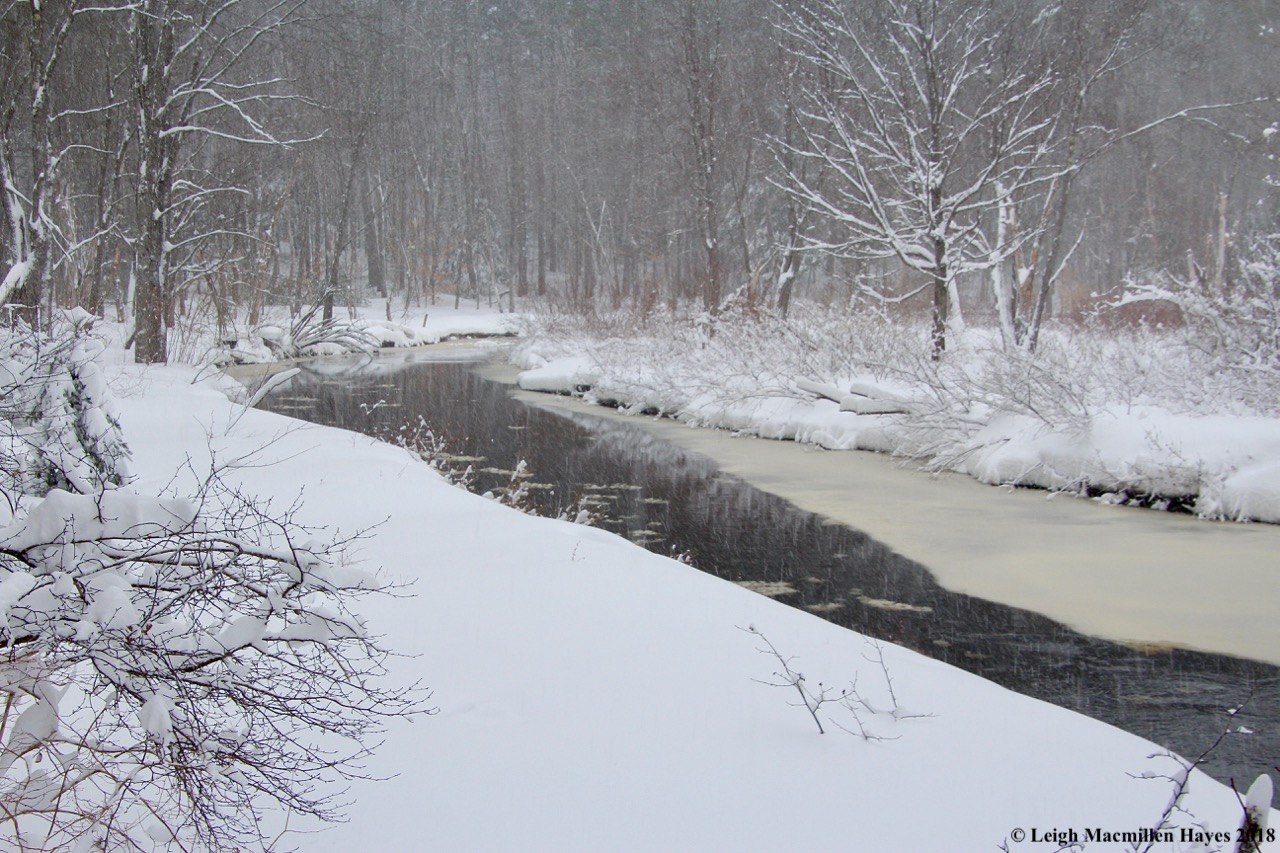
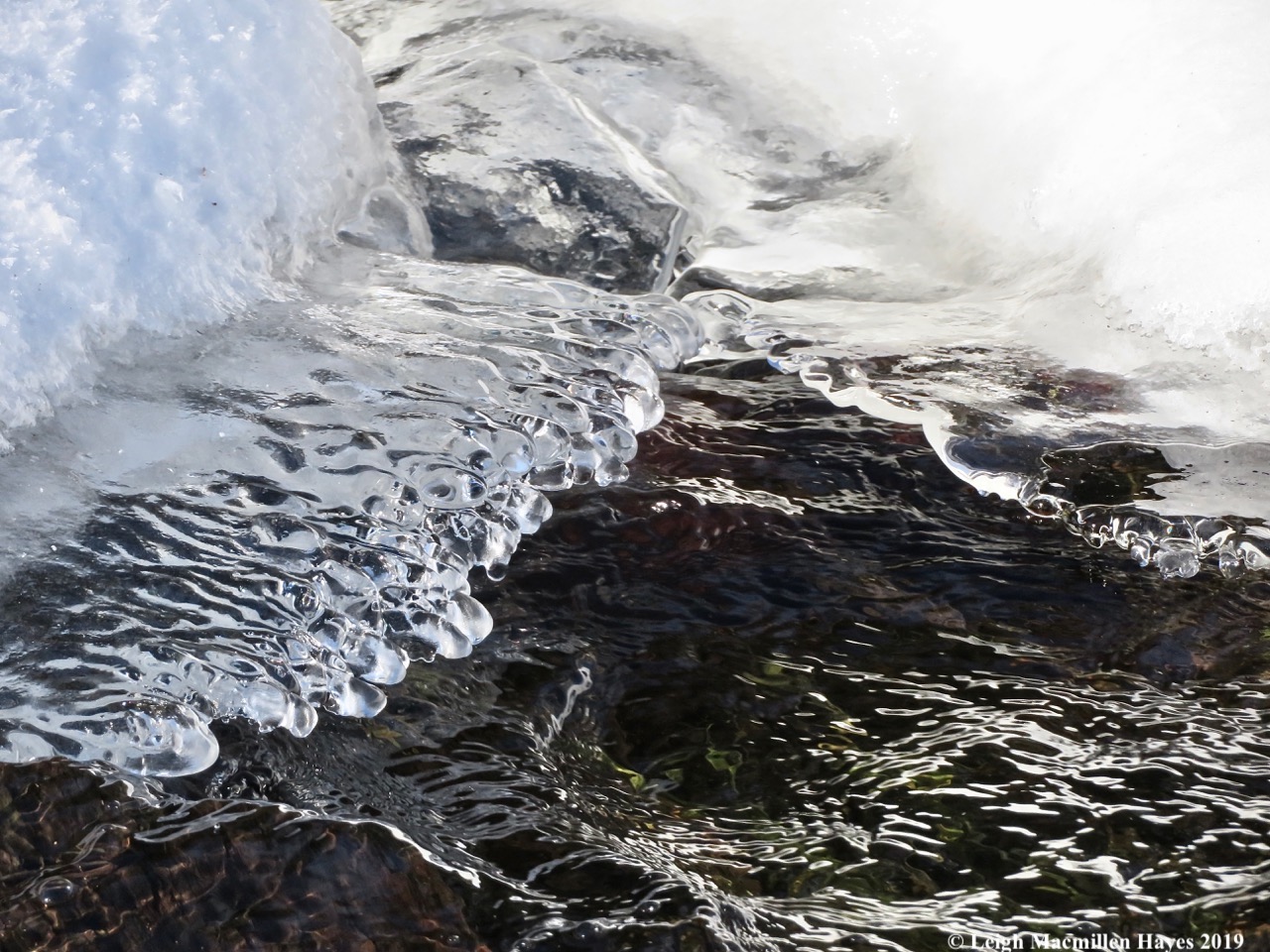
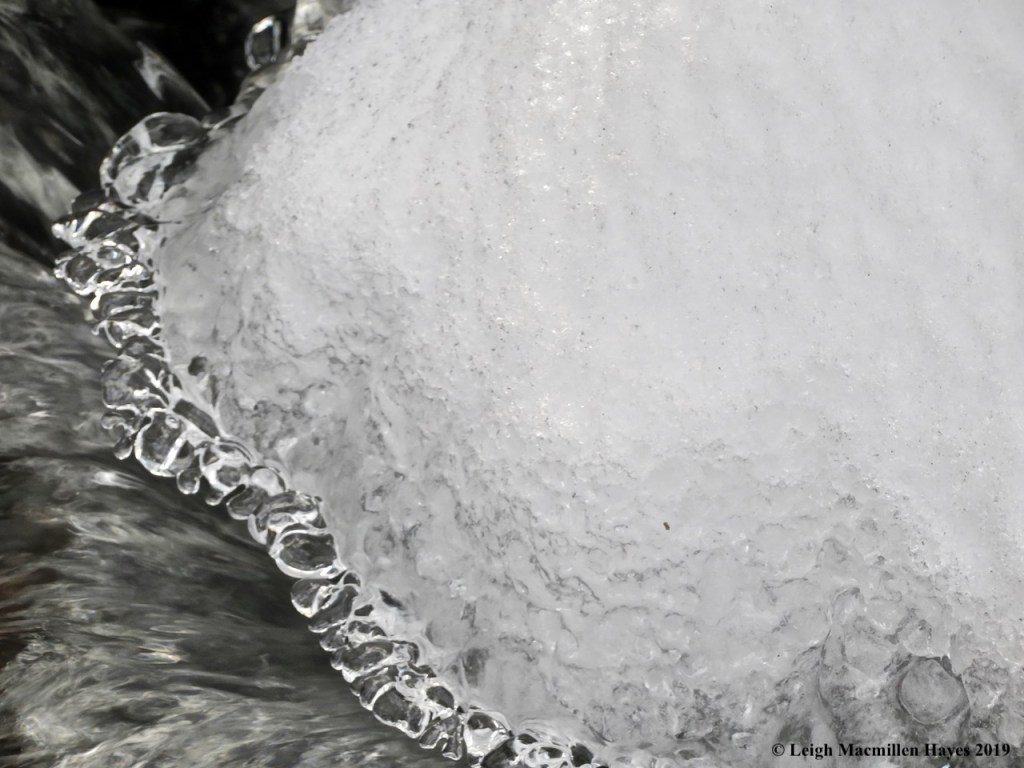
The ice delighted our sense of sight, understanding, and artistic form. Like the water from which it was created, it flowed in much variety.

And then . . . as we looked, a motion captured our attention. We were blessed with the opportunity to spend a few moments with a mink as it bounded down the hill before realizing it had an audience.

Next a splash startled us. What caused it? There was no snow high up on the trees that might have fallen. At last we saw the creators. There were actually three–swimming about slowly. Suddenly splashing again, they disappeared into the depths below. And the chambers within. We were in awe and felt honored to have shared a few minutes with members of the beaver family.

Sometimes our stops were to contemplate our next steps–especially when it came to the water that covered the cobblestones. Spying a bird nest, we wondered about its creator. There were some acorn pieces inside, so we thought it had hosted more than one inhabitant. Because we were near water, though most of it still frozen, and the temp was high, we weren’t surprised to find a set of baby handprints created recently by a raccoon.

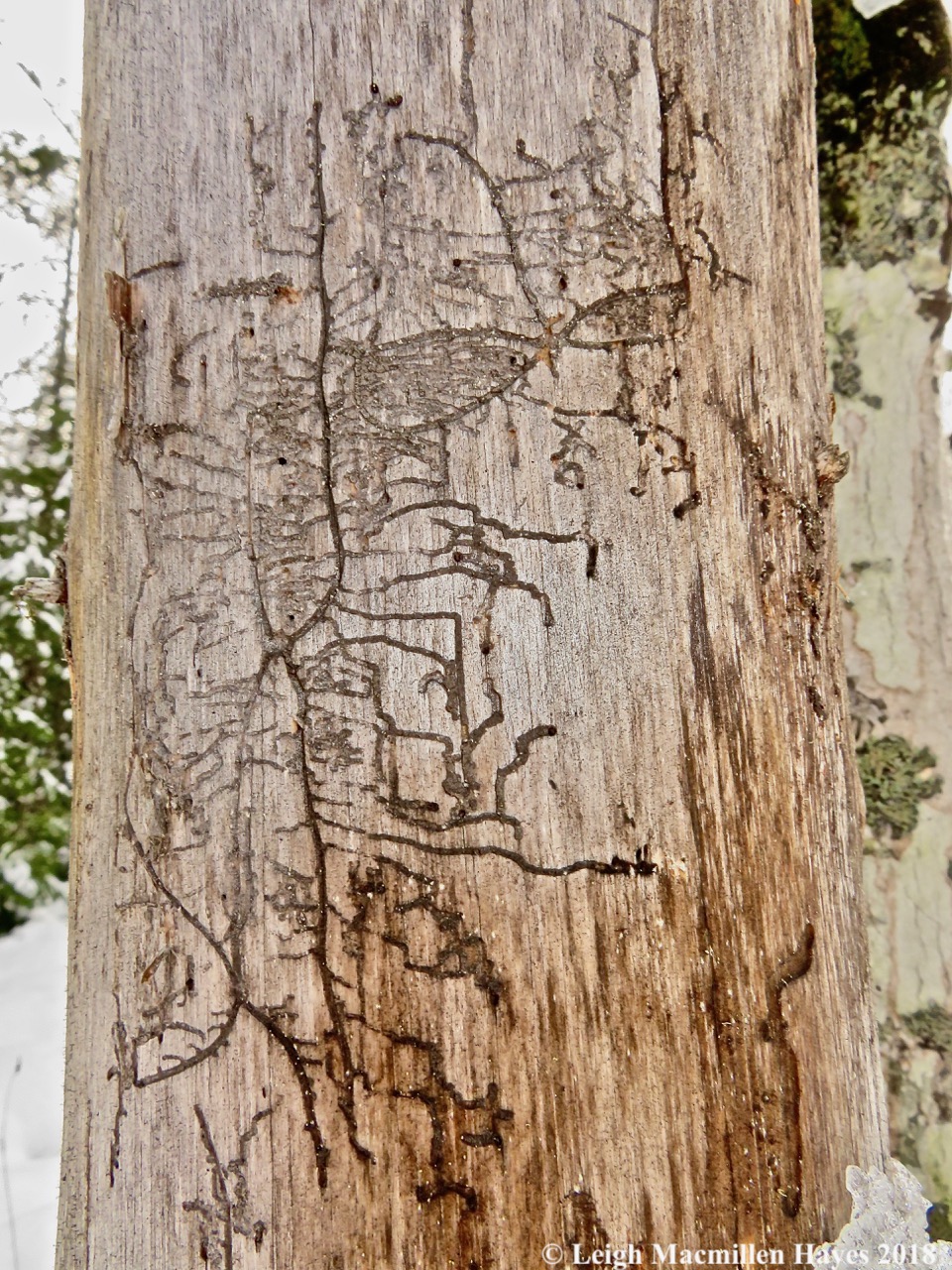
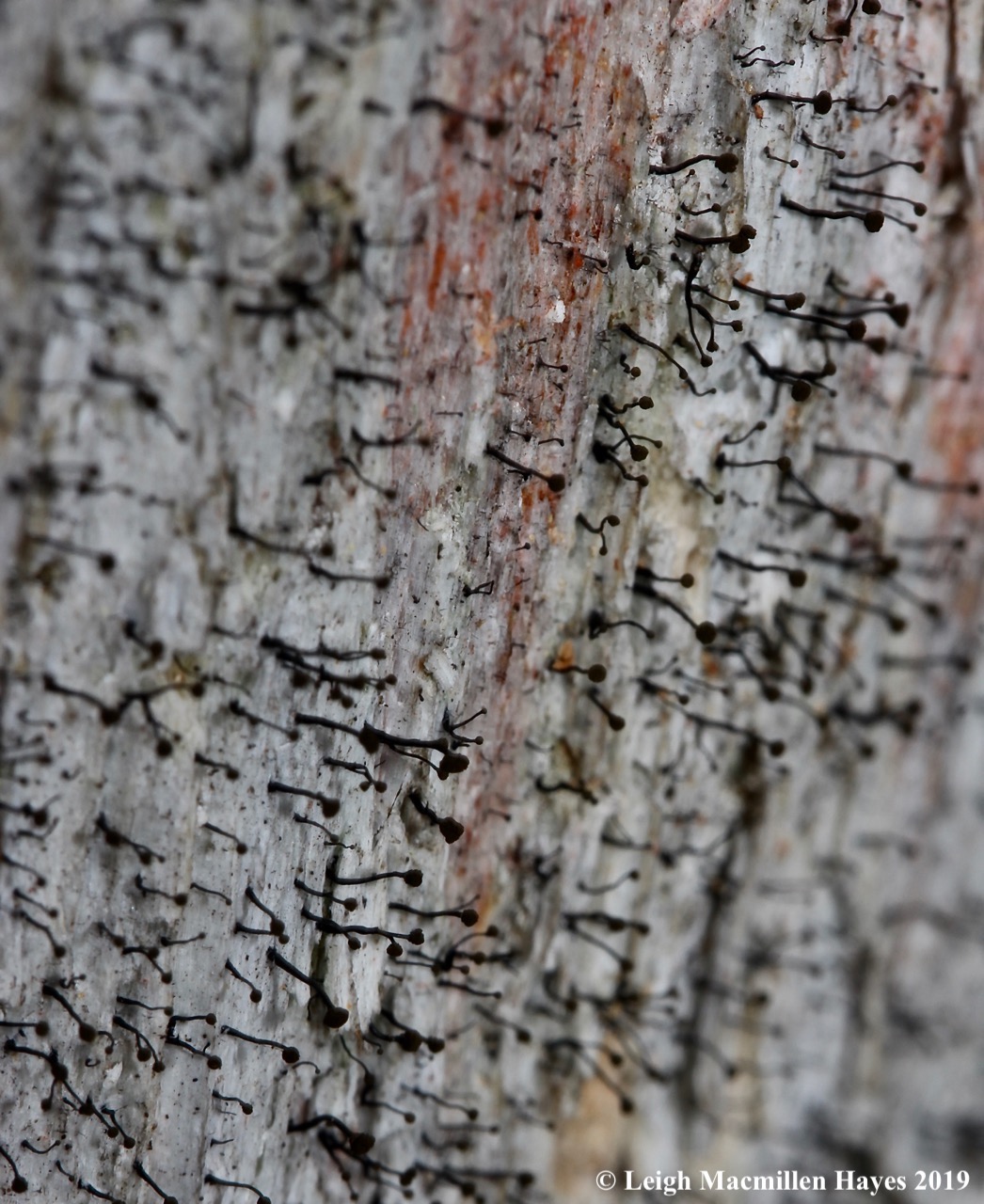
As I stood there looking for a million wild mammals, my eyes focused on the works of something much smaller. Insect egg tunnels on a dead snag read like a story book page. The overall design could have been a map leading to hidden treasures.

Within each soft snowflake I felt millions of wings brush against my face–reminding me of those I know who are at the moment downtrodden and have hurdles to conquer. Some tiny, others immense, all were angelic in nature. As the flakes gathered together, they enhanced the reflection of harmony with illumination. They brought Heaven down to Earth . . . and reminded me that even in the darkest hours I hope my friends remember that grace surrounds them.

Life, it seems, is always in transition. So it feels, when one season overlaps another.

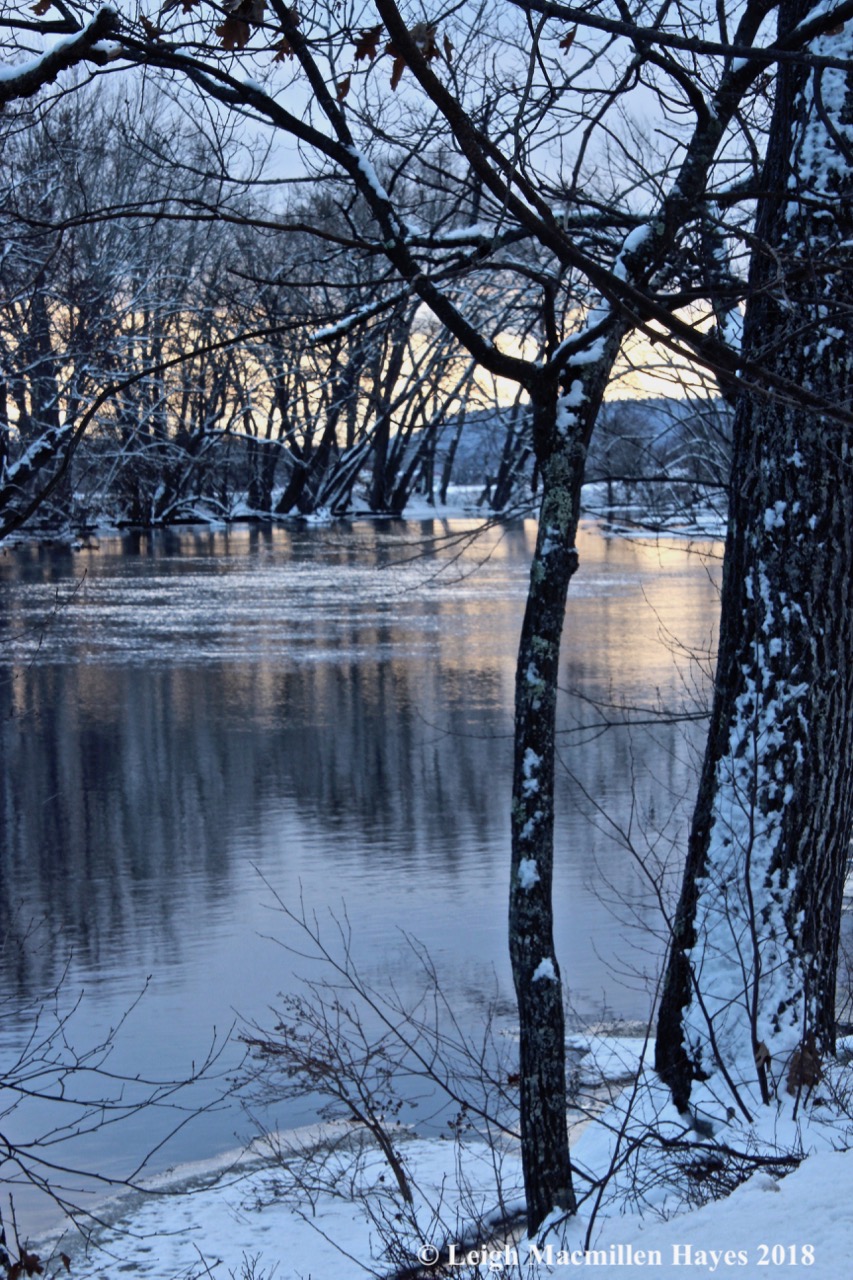
The scene is never the same, nor is the light. What may have appeared monochromatic was hardly that. When the sun began to set, the water harbored reflective moments as it transformed the views from crisp representations into impressionistic paintings.

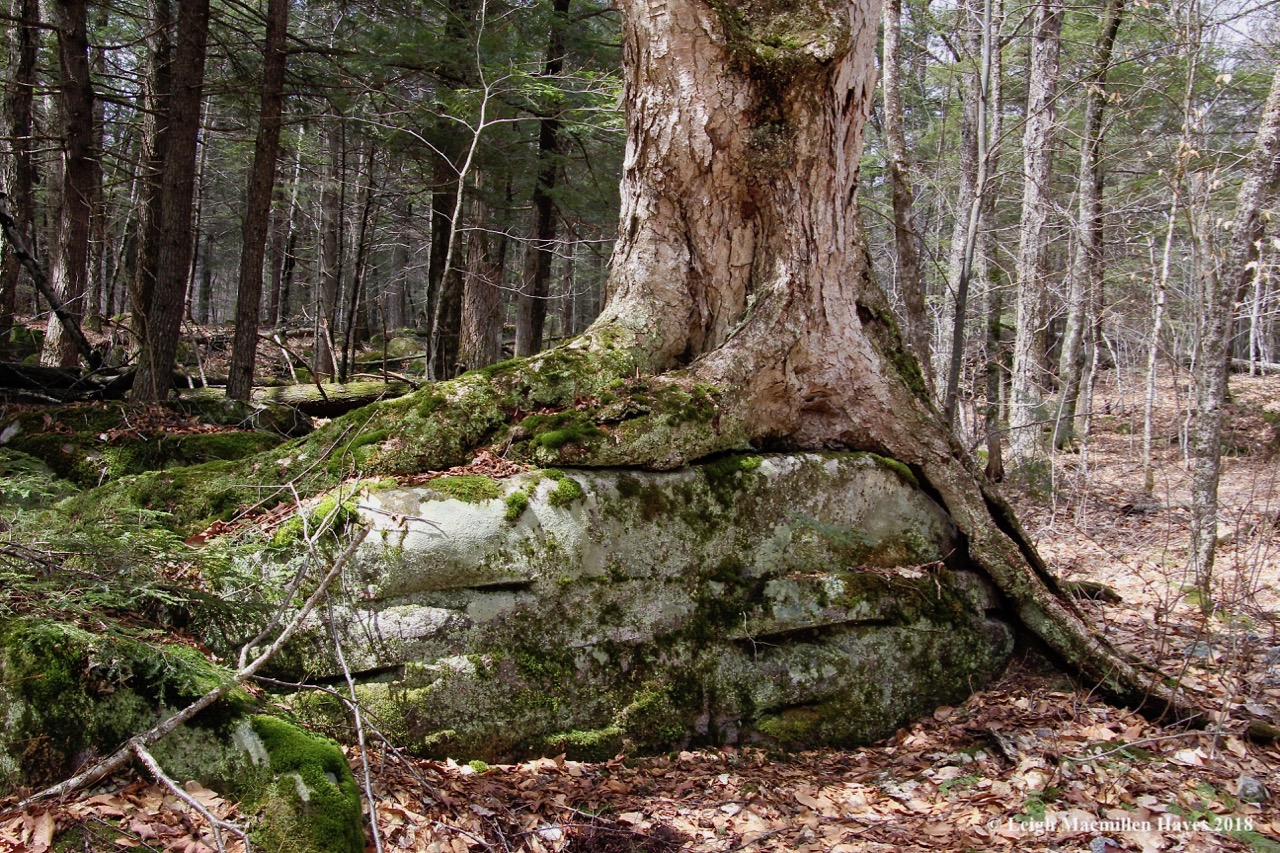
Right away, the trail’s tree spirit whispered a welcome. And another of my favorite trees begged to be noticed again. It’s an ancient yellow birch that has graced the granite for more than a century. The tree itself, wasn’t in good health, but the roots atop the rock splayed out in support of a life to be continued.

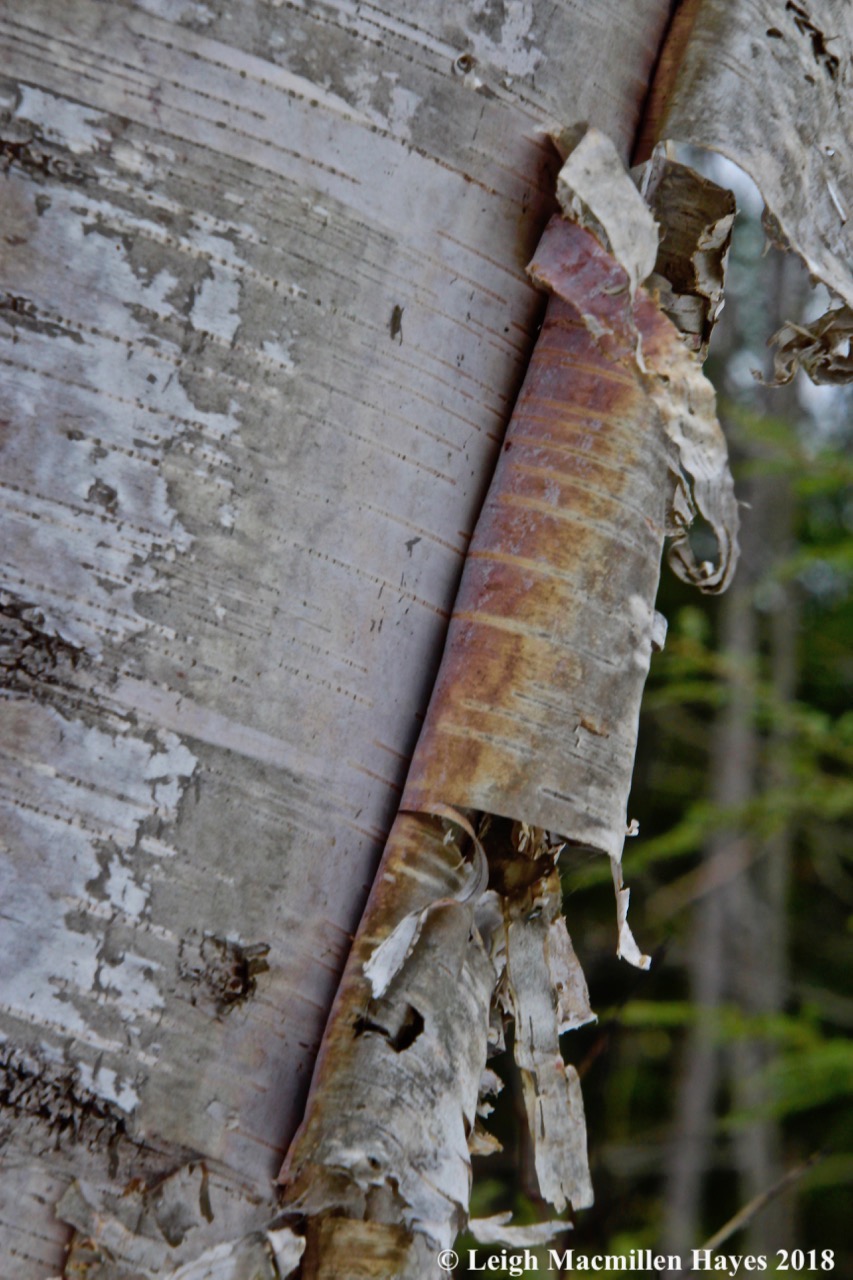
Beside it stood one that some know as white; I prefer to call it paper. The curled-back birch bark offered hues of a different color reminiscent of a sunrise in the midst of a graying day.

And not to go unnoticed, bark from another birch had fallen to the ground. It too, offered subtle pink hues, but it was the stitchery created by the tree’s pores that drew my eye. They reminded me of a million zippers waiting to reveal hidden secrets.

Near the stonewall along the cowpath stood tall an old pine that perhaps served as the mother and grandmother of all the pines in my forest. Today, bedecked in piles of flakes, her arms reached out as if to embrace all of her offspring.

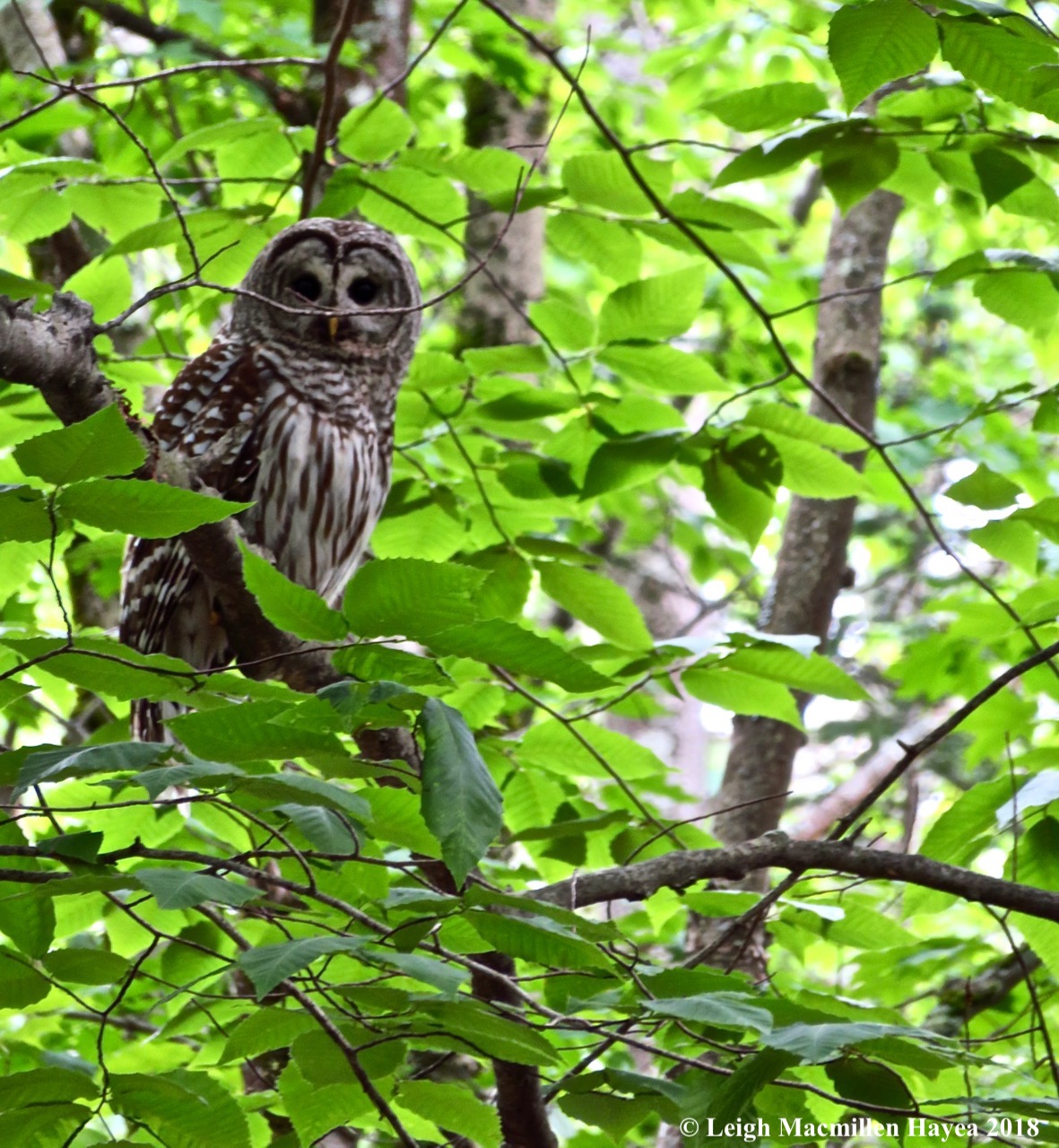
I had only walked a wee distance when I heard a Barred Owl call, “Who cooks for you? Who cooks for you all?” It was noon, after all, so it seemed totally appropriate. Suddenly, I heard a response somewhere ahead. For about five minutes they echoed each other. And then the world was silenced.

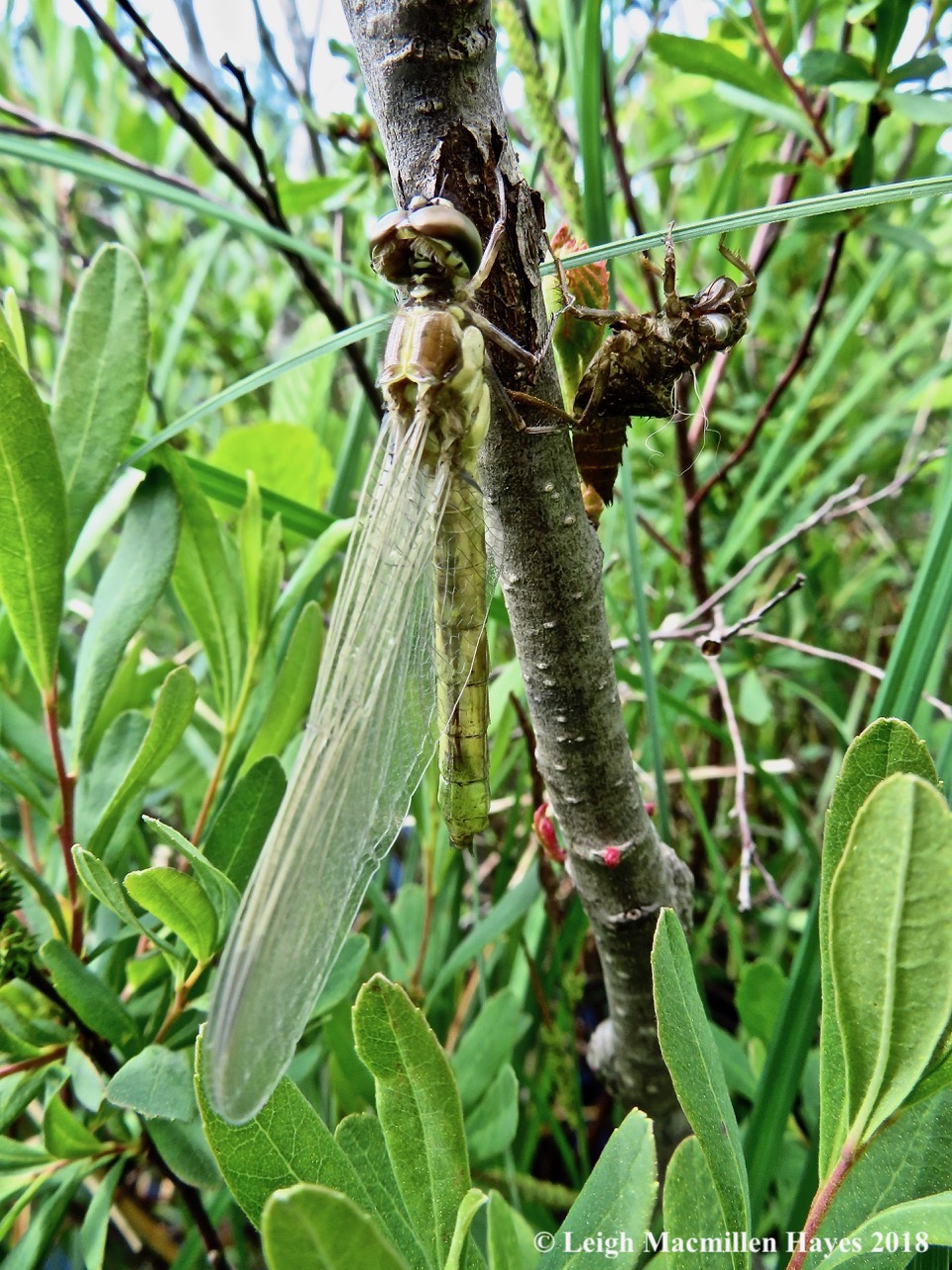
At last we reached the boardwalk, where we embraced stillness and listened to the green frogs strum their banjo voices and red-winged blackbirds sing their conk-la-ree songs. Our gaze became more focused when we realized we stood in the midst of a newly emerged dragonfly. We felt a sense of caretakers for suddenly it was our honorable duty to watch and protect this vulnerable being from becoming prey. With wonder, we observed it slowly change position and suddenly spread its wings. For at least an hour we stood sentry and noted the slightest movements while we delighted in how the breeze occasionally fluttered through the dragonfly’s wings. And then, in a flash, it flew off and we were proud parents who had sent our offspring into the world.

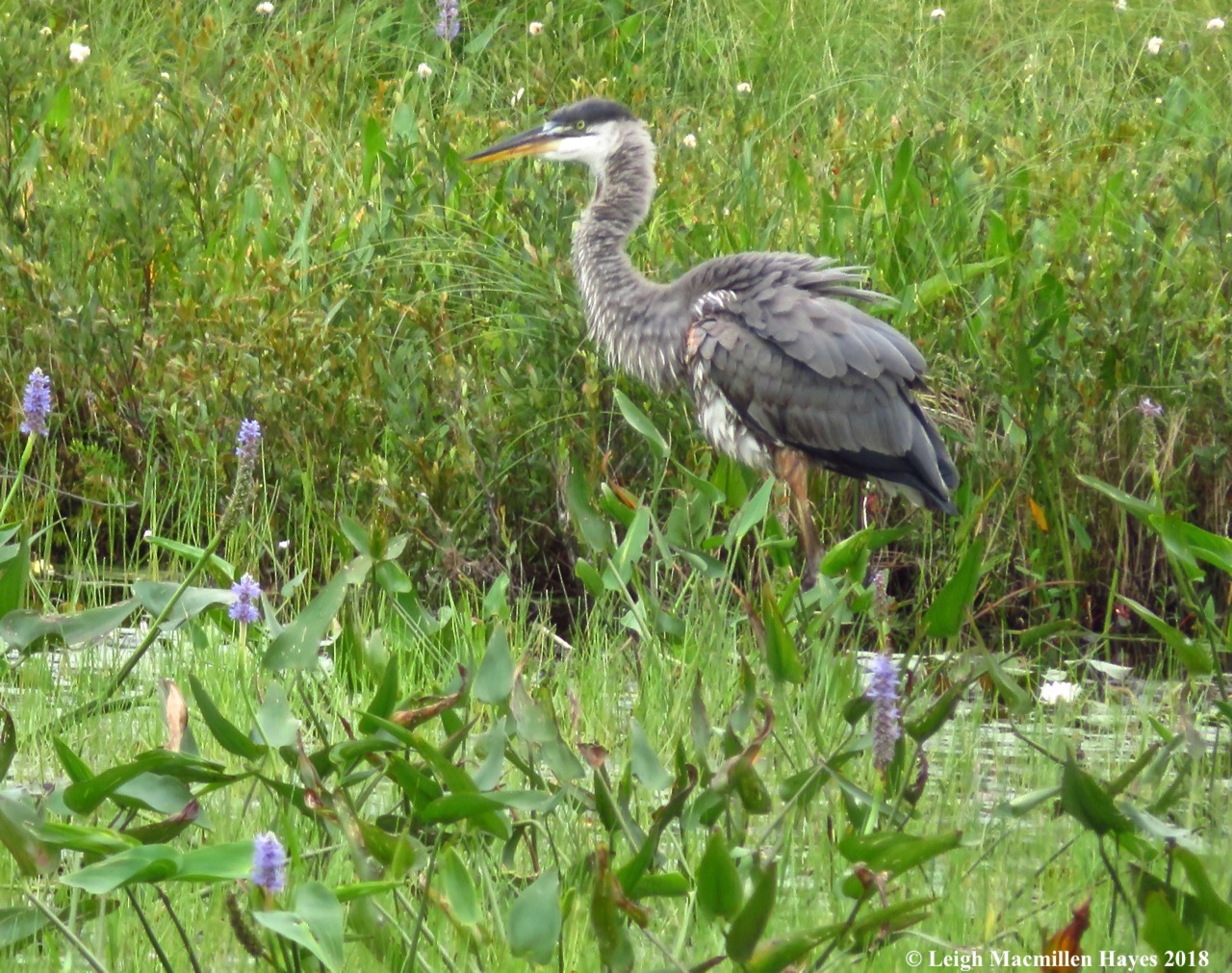
I have no idea how much time had passed, but suddenly we all stirred a bit and then someone who was noticing redirected our attention. We were encouraged to focus on another who was also paying attention. And narrowing in . . . on lunch. When the young bird flapped its wings, we were all sure the meal was meant “to go.” But thankfully, the bird stayed. And played with its food. Ever so slowly, the fish was maneuvered into its mouth. And gulped. Down the throat it slid, a slight bump in the long neck. And then the feathers were ruffled–rather like a chill passing through its body. Wing motion followed. But still, the Great Blue Heron stayed. And stalked some more.

A blanket of fog enveloped the view. It didn’t matter, for my focus zeroed in on what was before me rather than being swept up into the beyond. I began to look around and felt an aura. It was as if I stood in another place and time. The fog. The green. The gray. The world disappeared. And the scene before me opened. One yellow lichen inched across the granite face. Beside it, another stood out like tiles in a mosaic work of art. Meanwhile, the fog danced across the ridgeline, twirling and whirling in a ghostly quiet manner, its transparent gowns touching the ground ever so tenderly before lifting into the next move.

We watched him forage for seeds and wondered about his behavior. Typically, such birds are loners, except for mating season. But this one greeted visitors to its territory with somewhat regular frequency. When we moved, he did likewise–usually a few feet to either side of us. And when we stopped, the Ruffed Grouse did the same, seeming to share our curiosity.

One doesn’t necessarily step into the woods and expect transcendent events to occur, but then again by learning to live in the moment one never knows what to expect. 

These are my thin places, where I see the light more on this side of than the other. May the answers slowly reveal themselves by day and by night, while the questions and awe never end.

Thanks to all of you who continue to wonder and wander with me whether literally or figuratively. I truly appreciate our time spent together.

Otter Delight

Once upon a time in a land close, close at hand, there lived a family of Otters who were mothered by a Snowshoe Hare.

They spent most of their days and nights exploding through the ice and sliding up and down the mill pond’s edge.

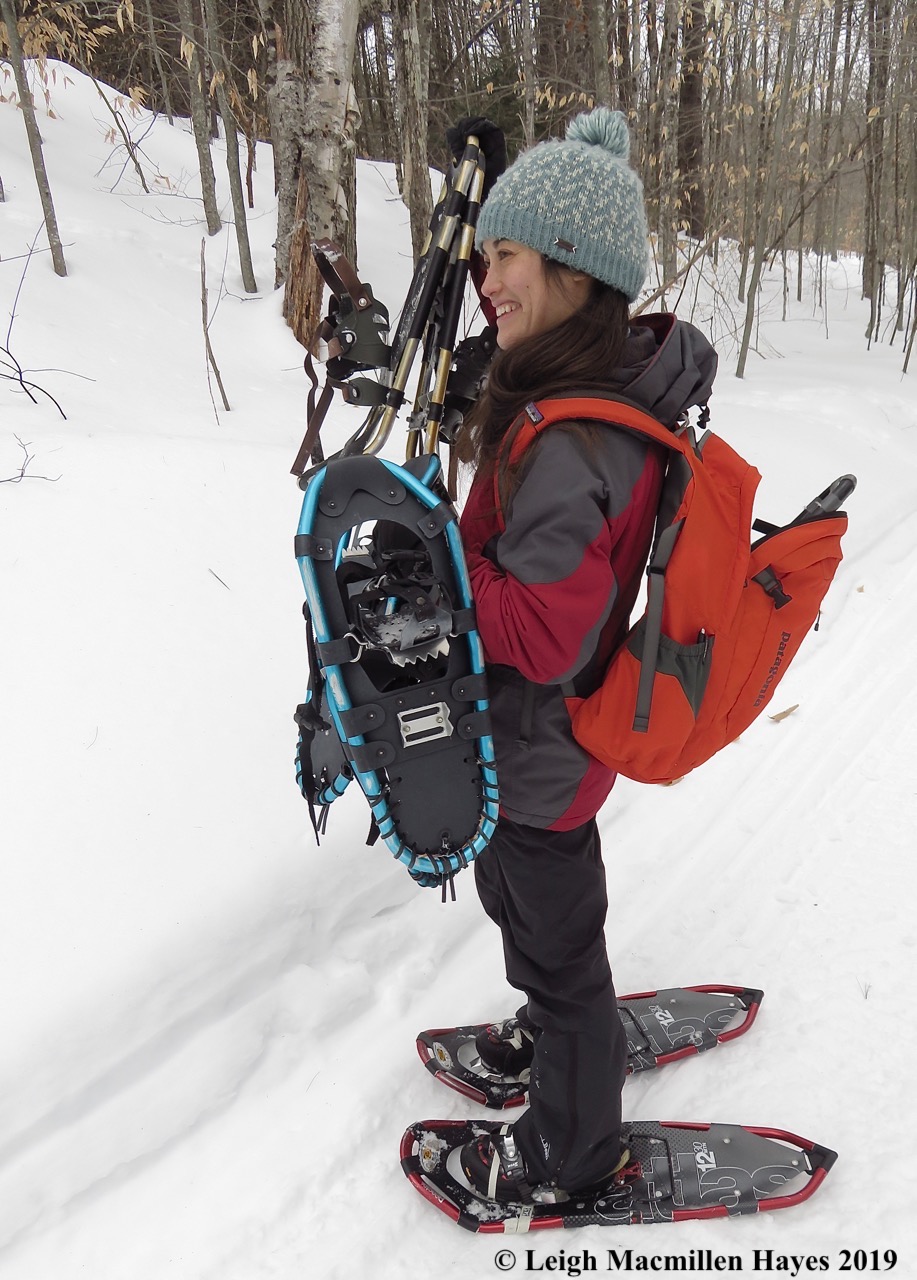
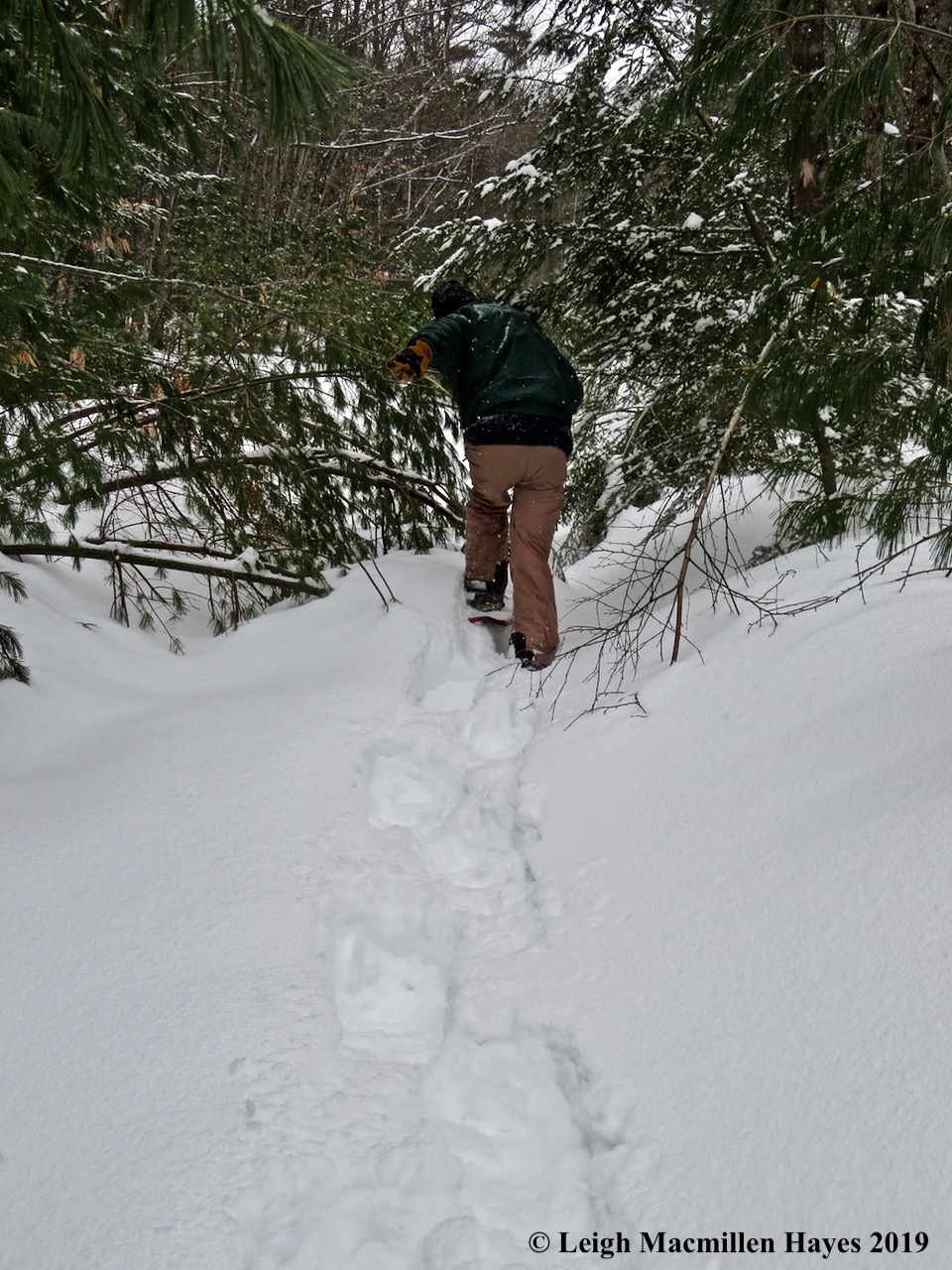
But one day their momma rounded up some snowshoes large and small and strapped them on to all.

The family headed off through the woods where moments of wonder captured their attention.

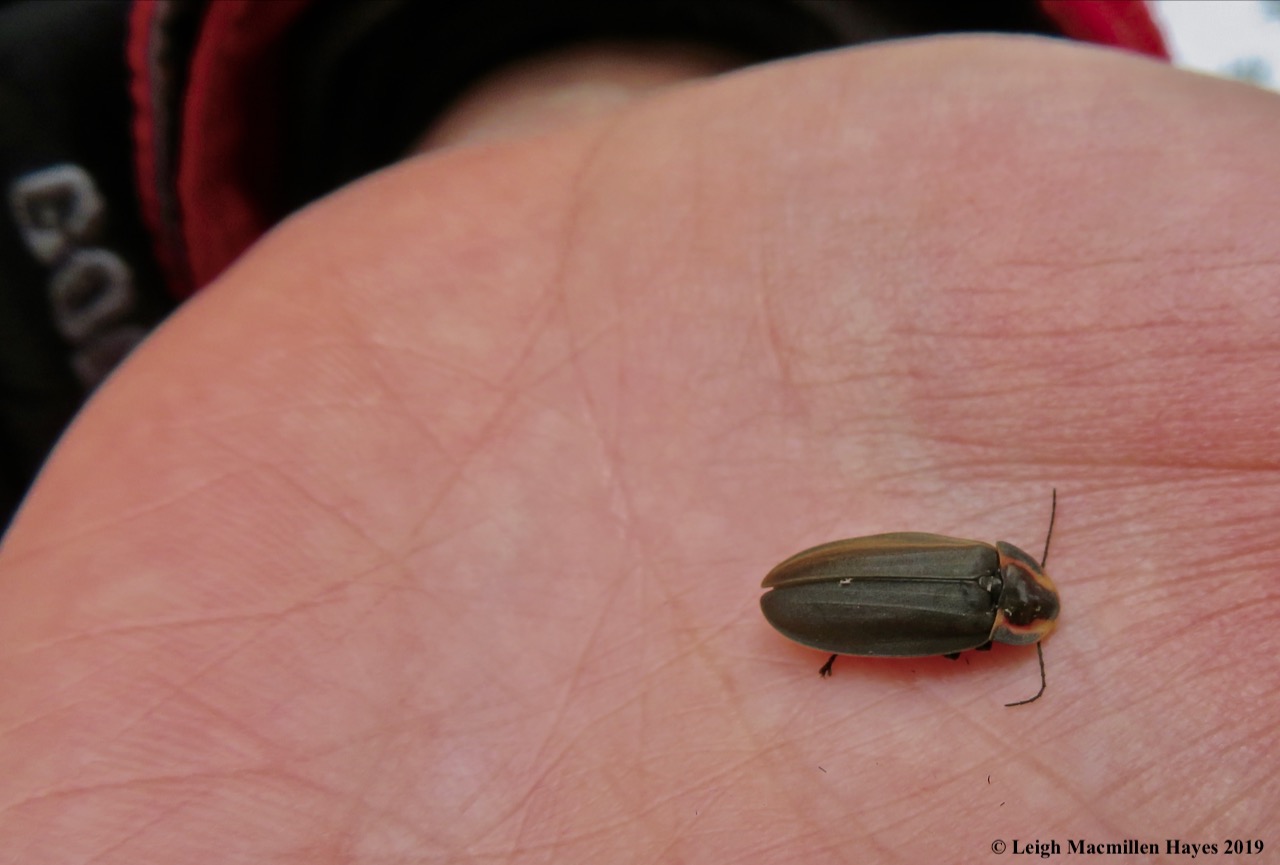
It wasn’t long into their journey when a winter firefly upon the snowy surface stopped them in their tracks.

E. Otter took the firefly that overwinters as an adult and looked for a safe place to deposit it.

She found such in an old beetle hole upon a dead snag and wished it well before she hopped away.

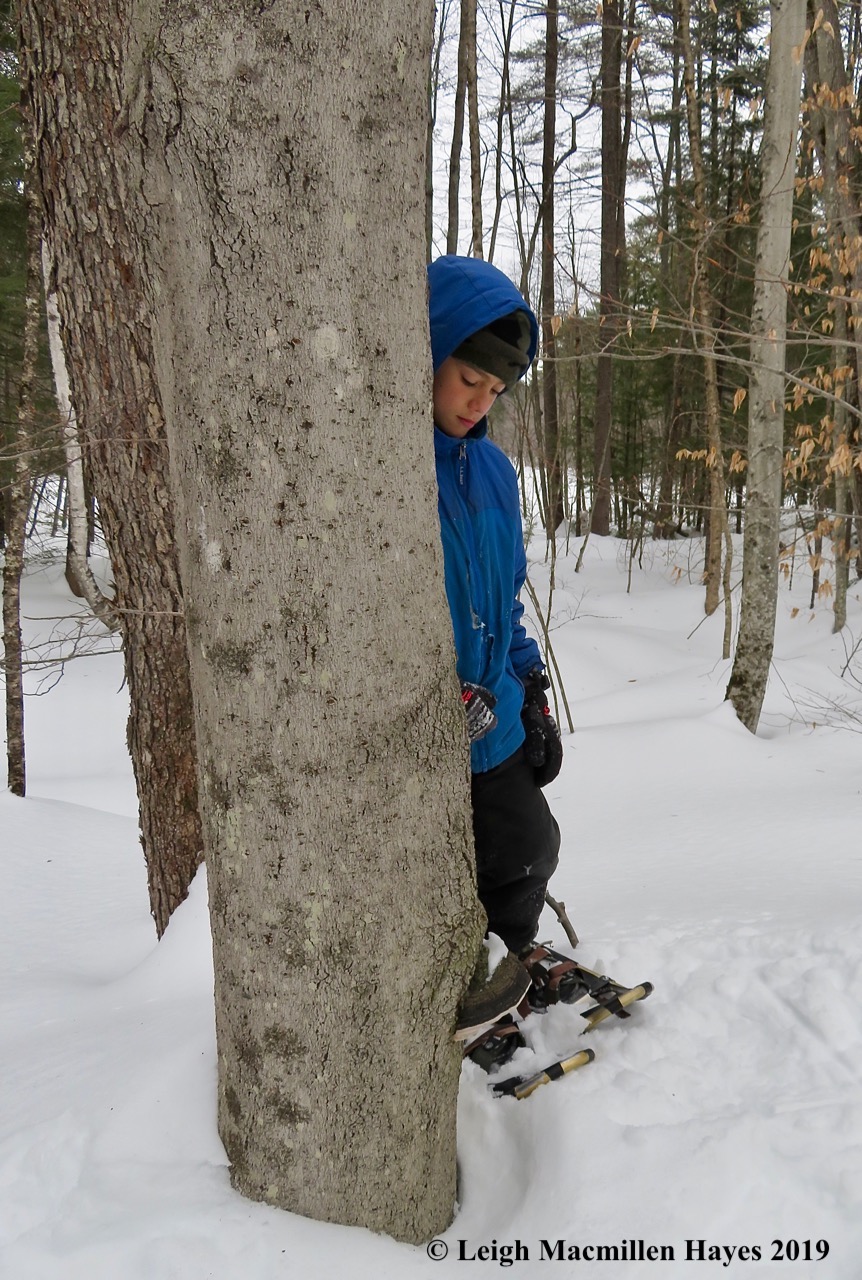
W. Otter found another tree that he quickly identified as a yellow birch and then honored with a hug.

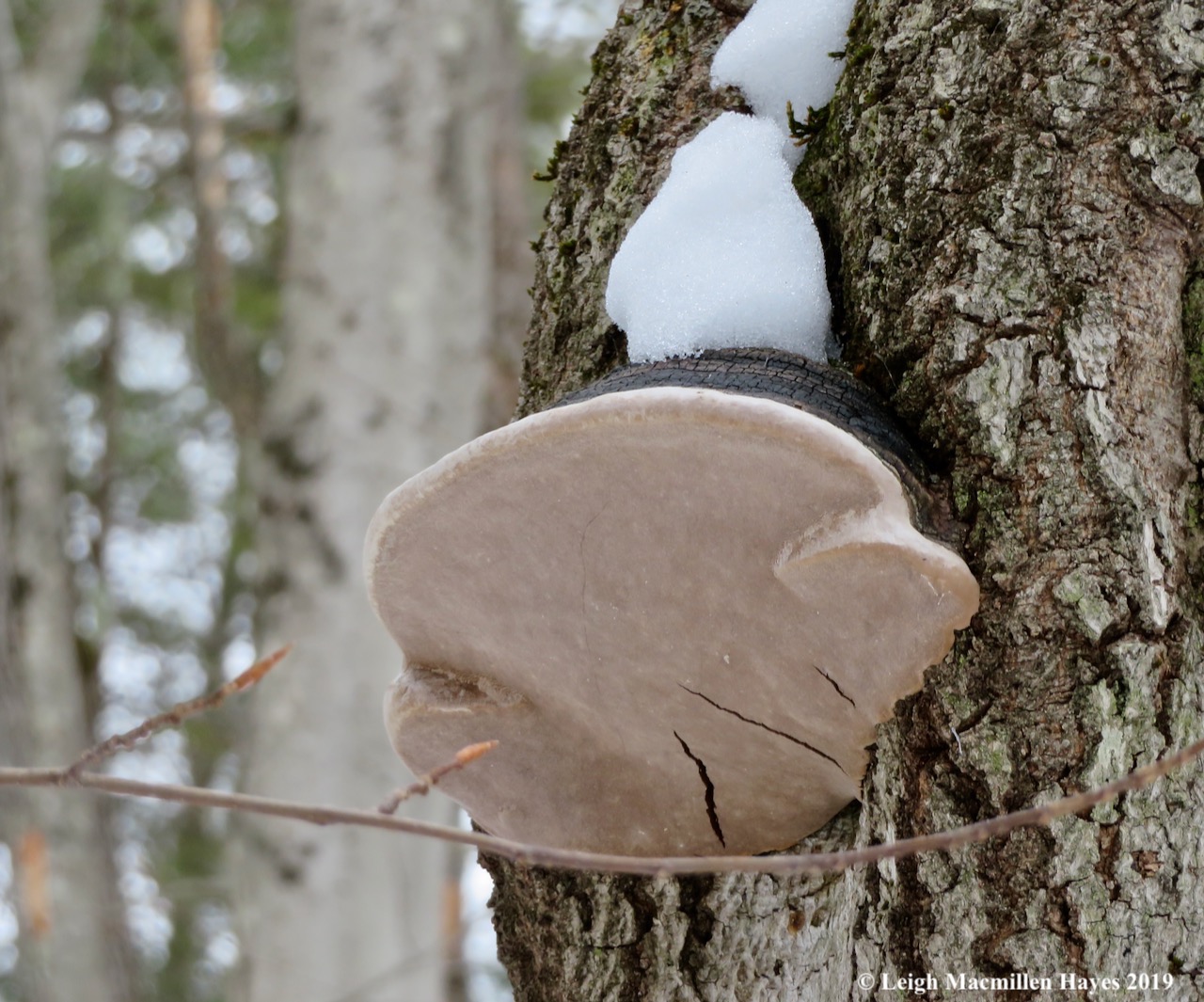
C. Otter looked upon the bark of a beech tree and was thrilled to spy a fungi.

On the tree’s back side he spied another and posed above the false tinder conk.

Soon, the little Otters convinced their momma that they didn’t want to try to be hares any more and so they shed their snowshoes.

Within moments, A. Otter decided to instead try his feet at being a frog.

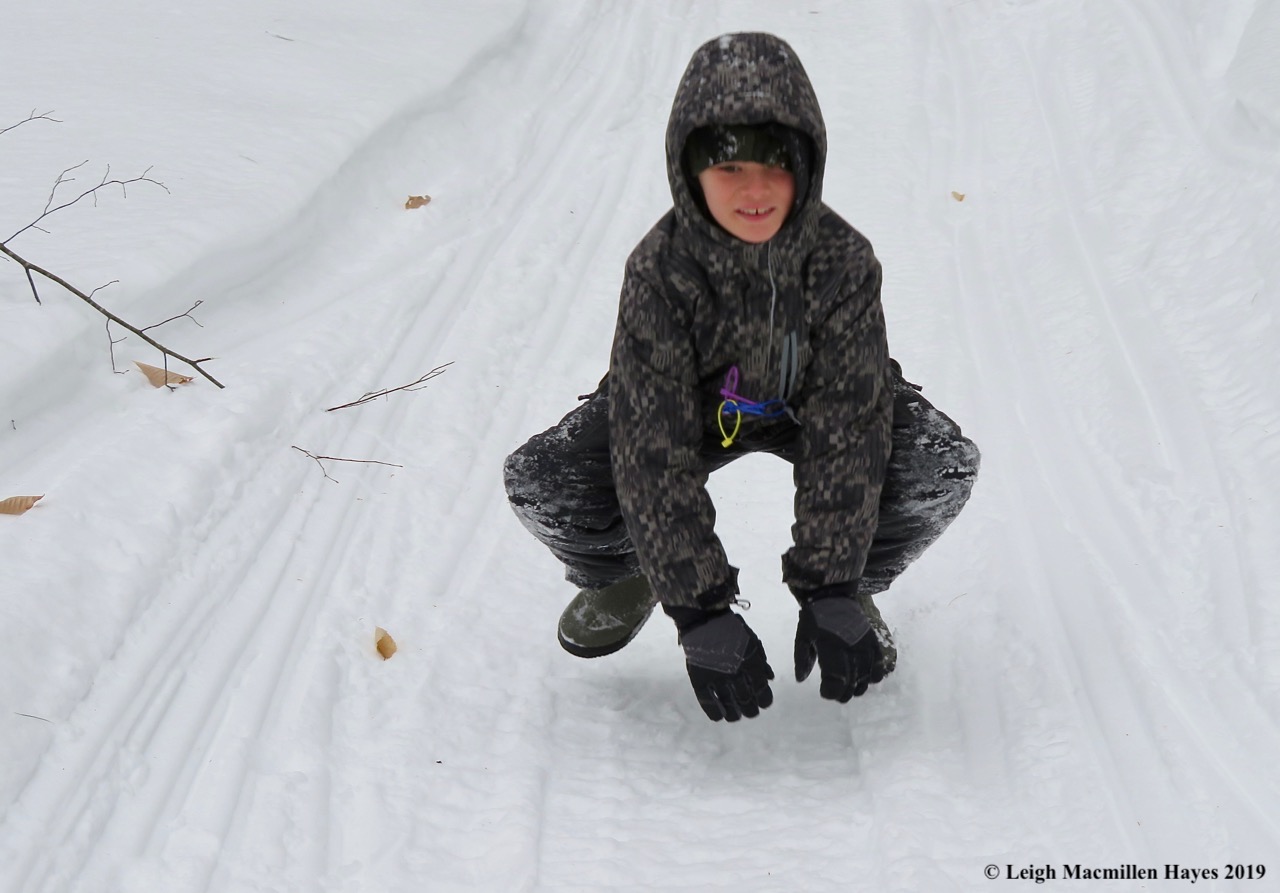
Catching some air, he leapt up the trail.

By a vernal pool he revealed his true identity–a tree frog.

Soon, his siblings joined him as they channeled their inner tree frogs.

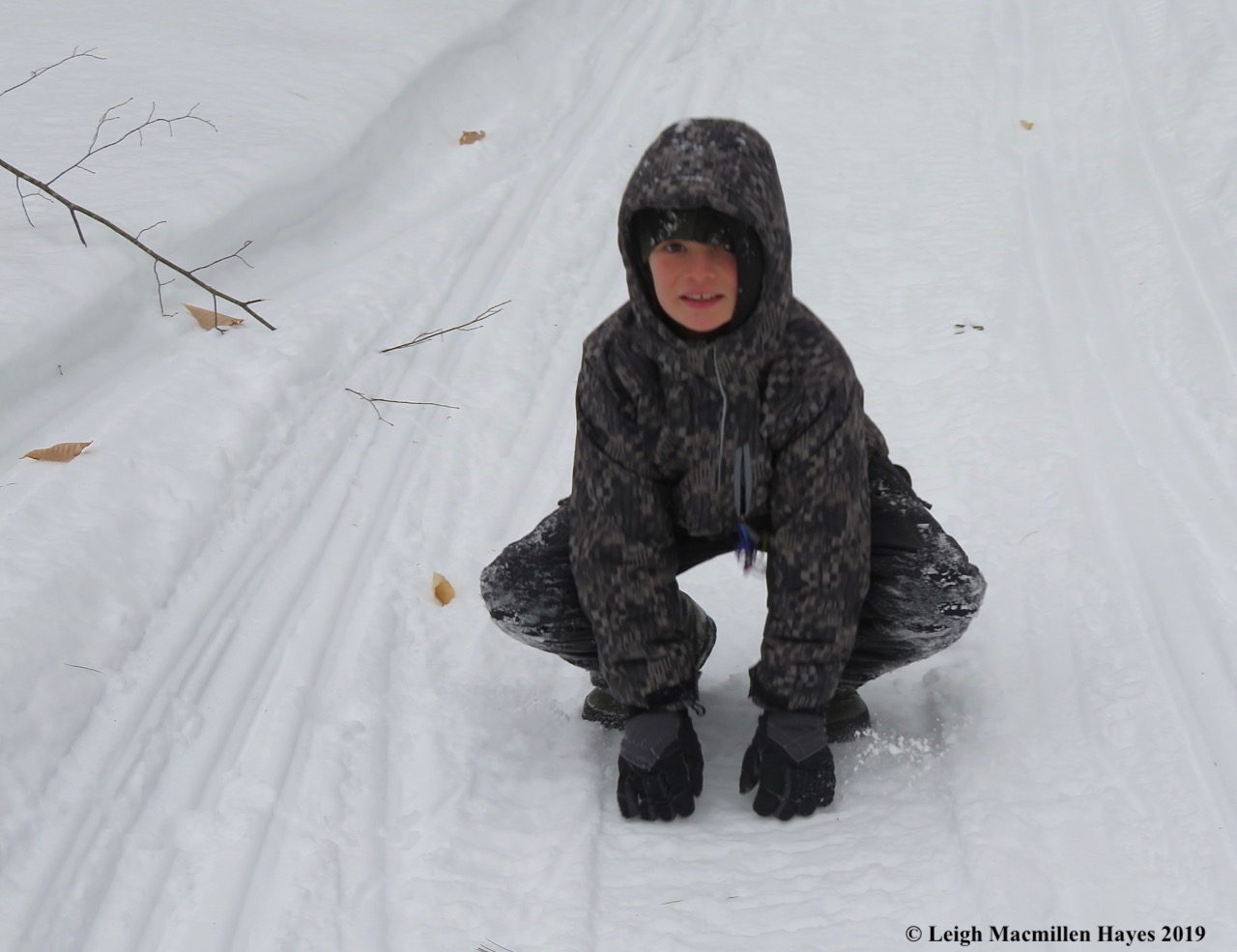
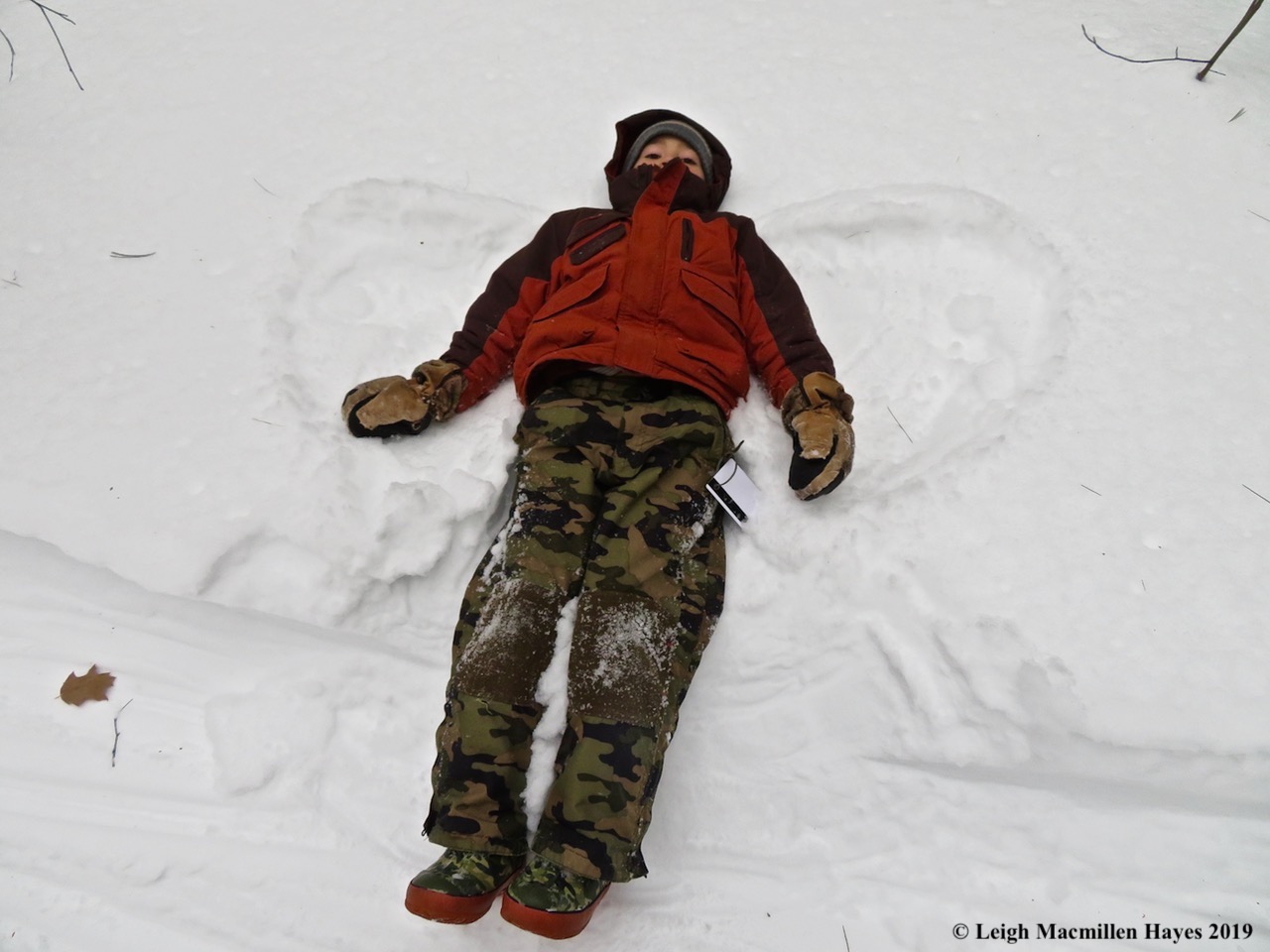
A short distance later, momma couldn’t help but smile when her young’uns displayed their angelic nature.

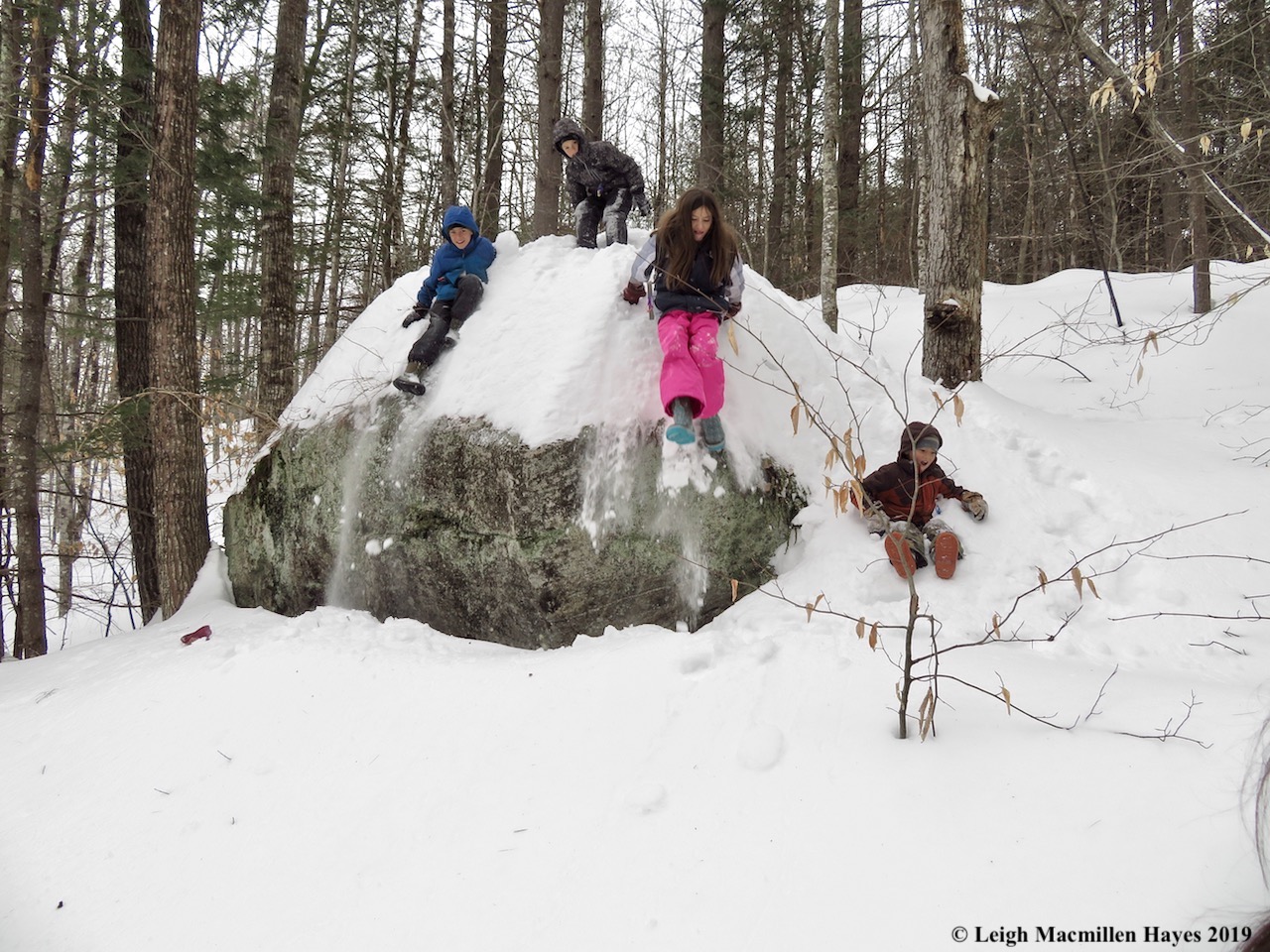
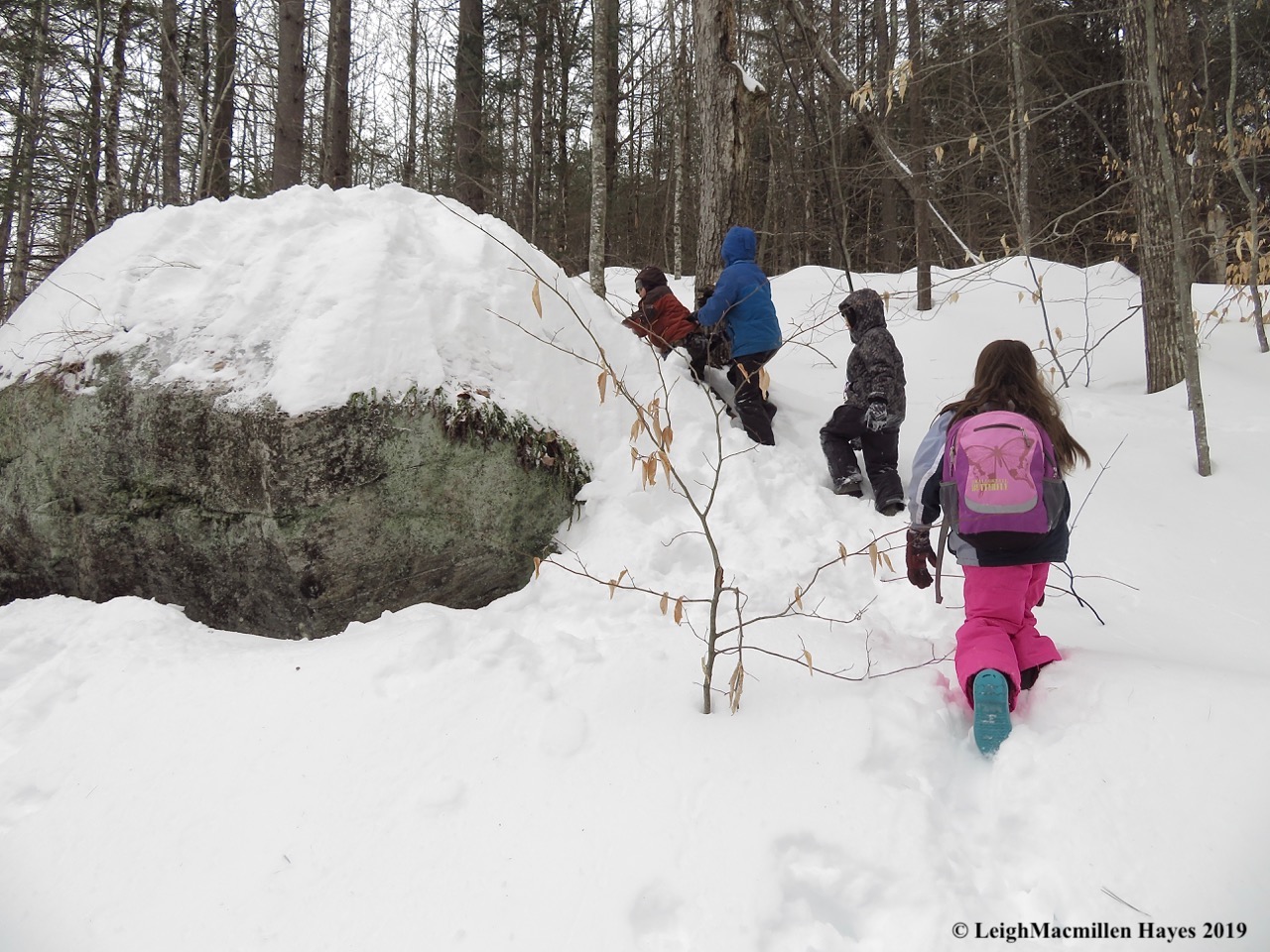
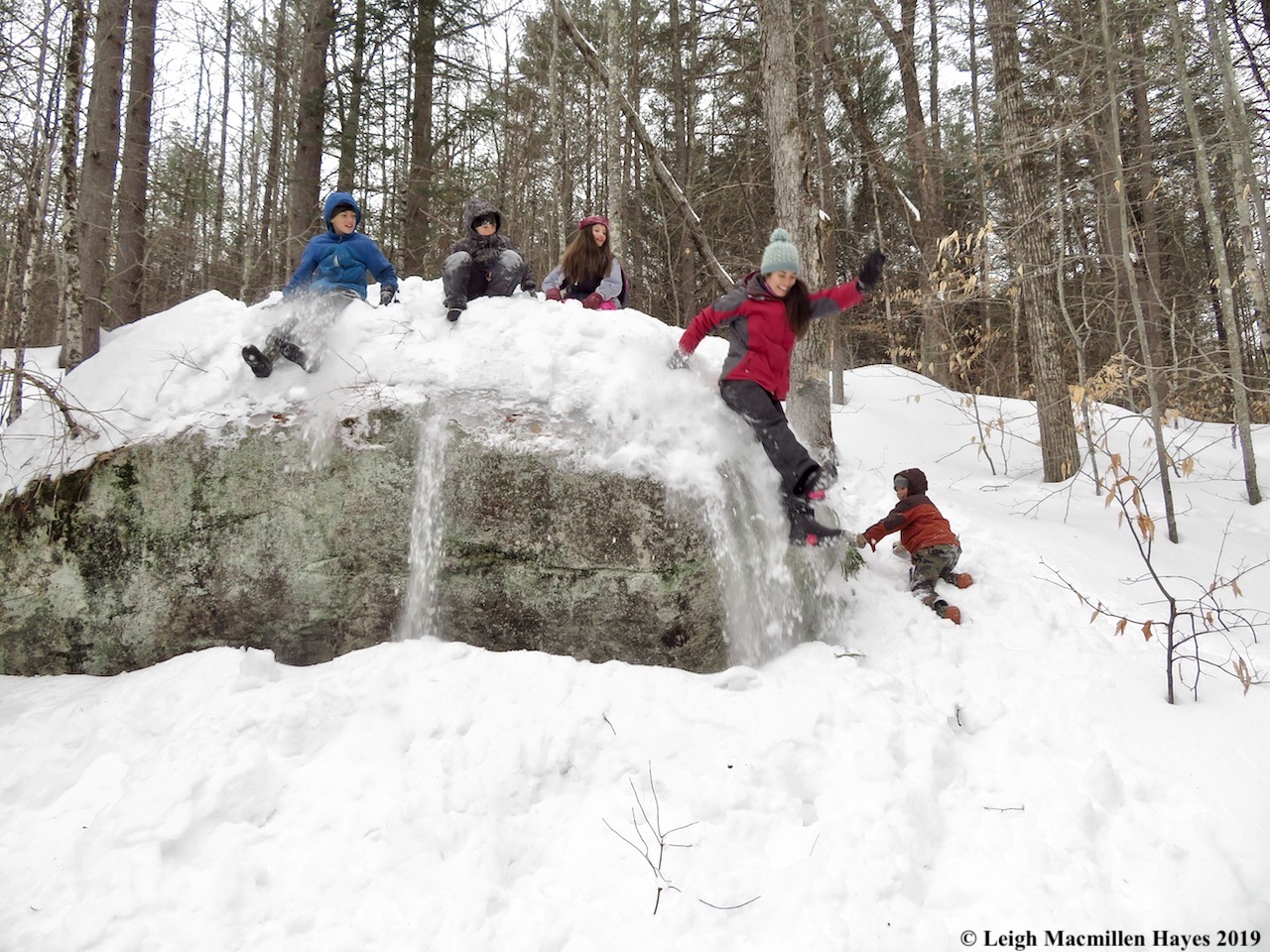
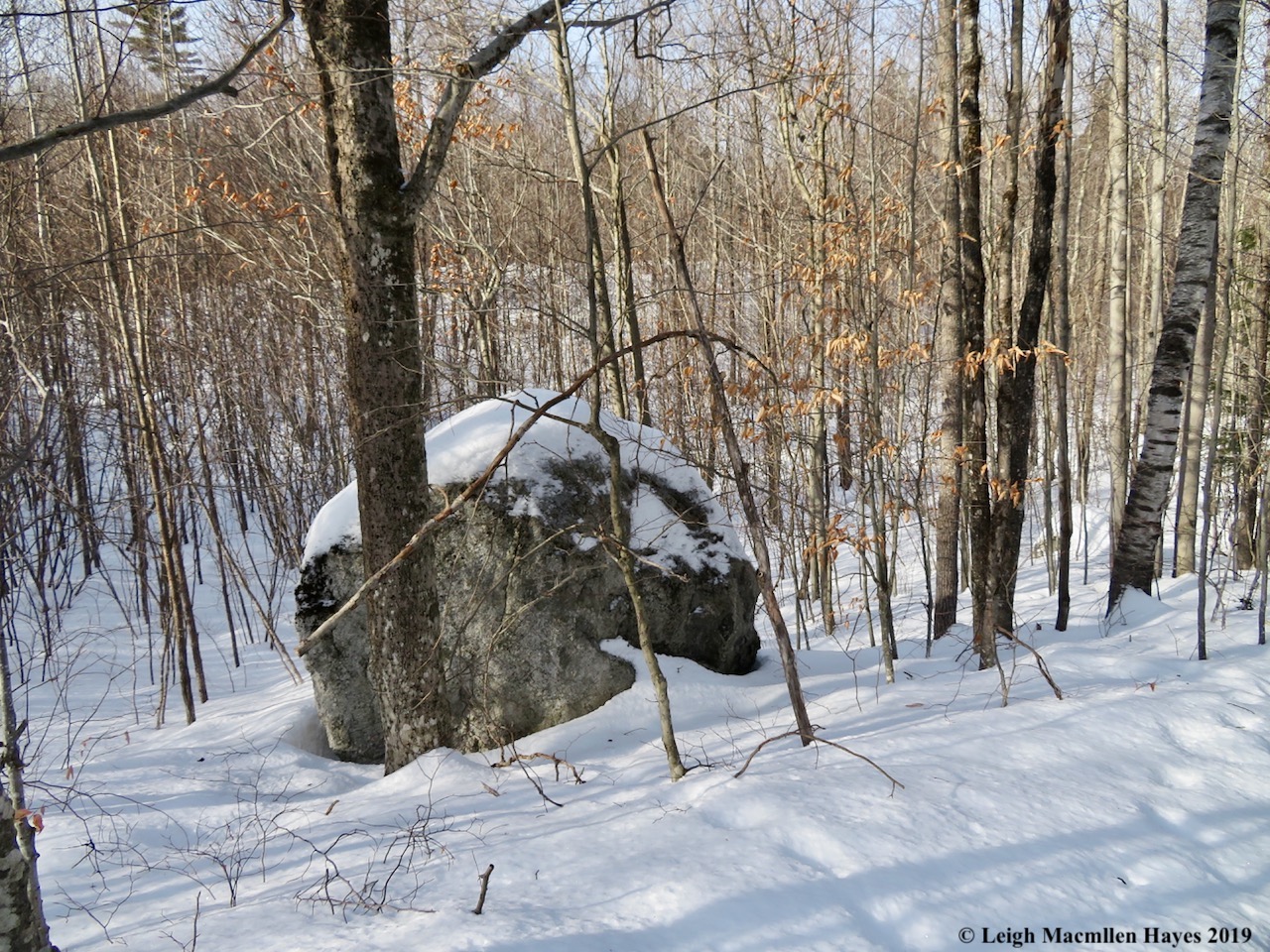
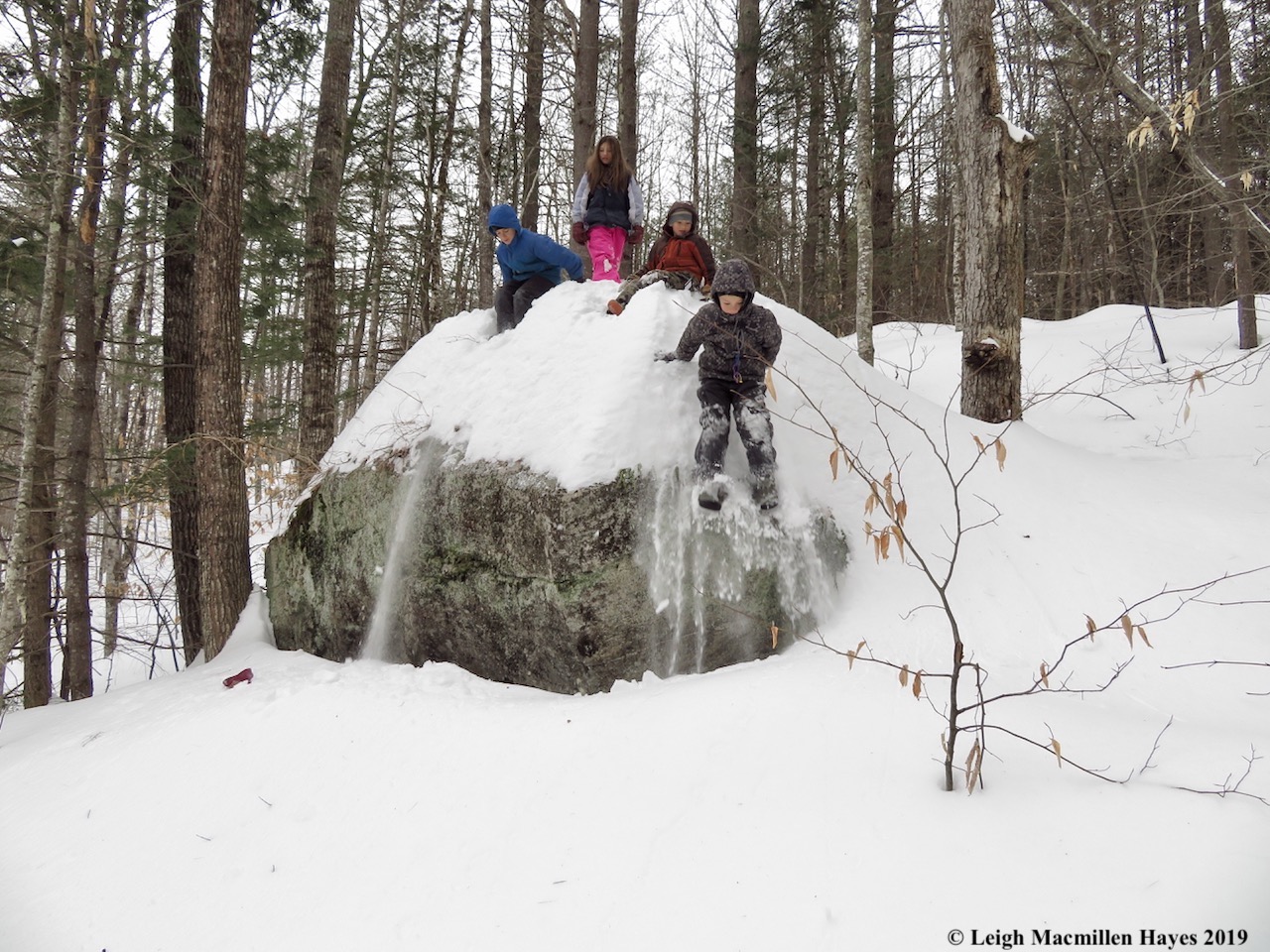
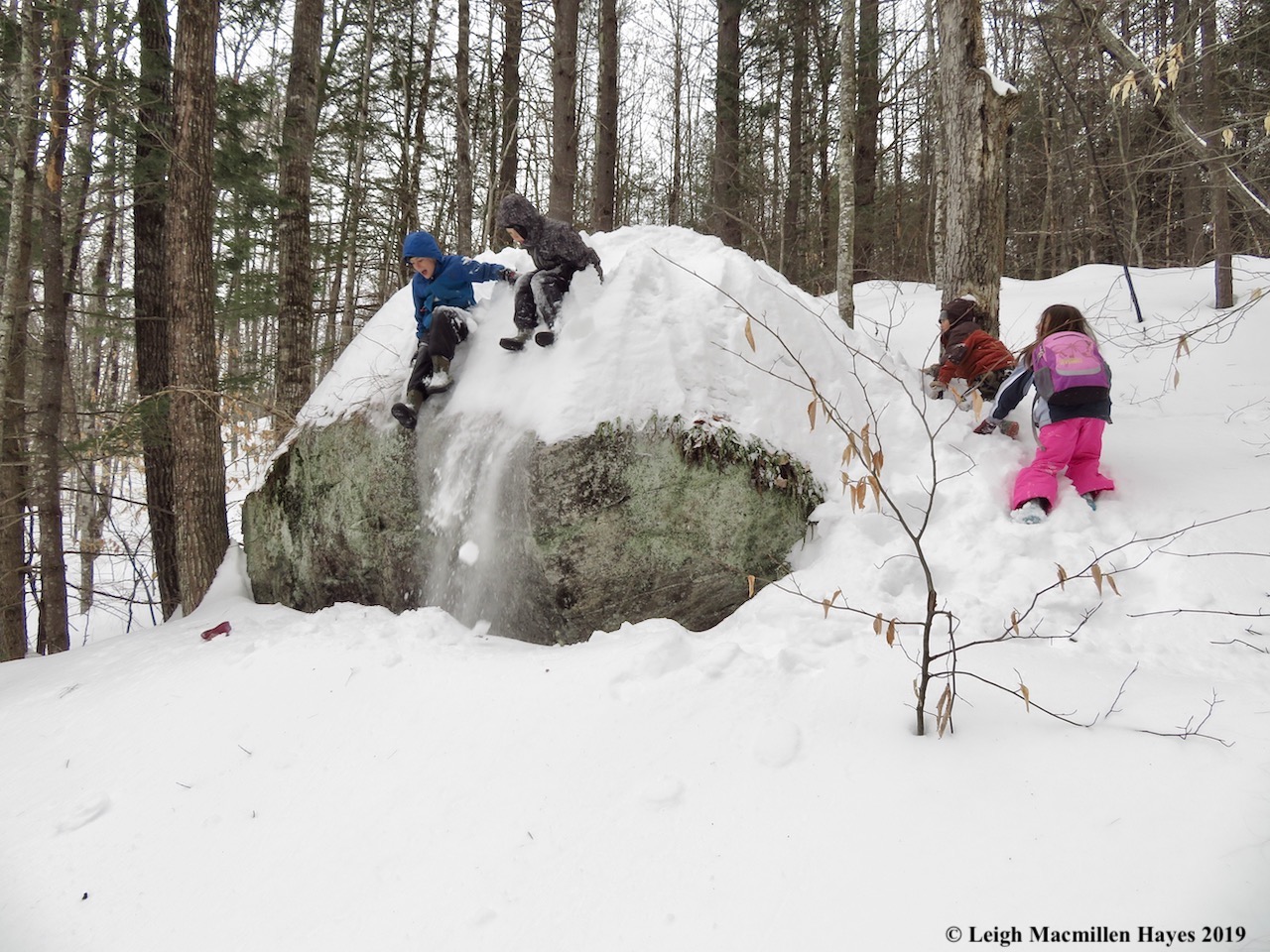
Those angelic Otters eventually found their way to the top of a huge boulder.

And then they began to do what Otters do.

They slid.

And climbed back up.

To slide some more.

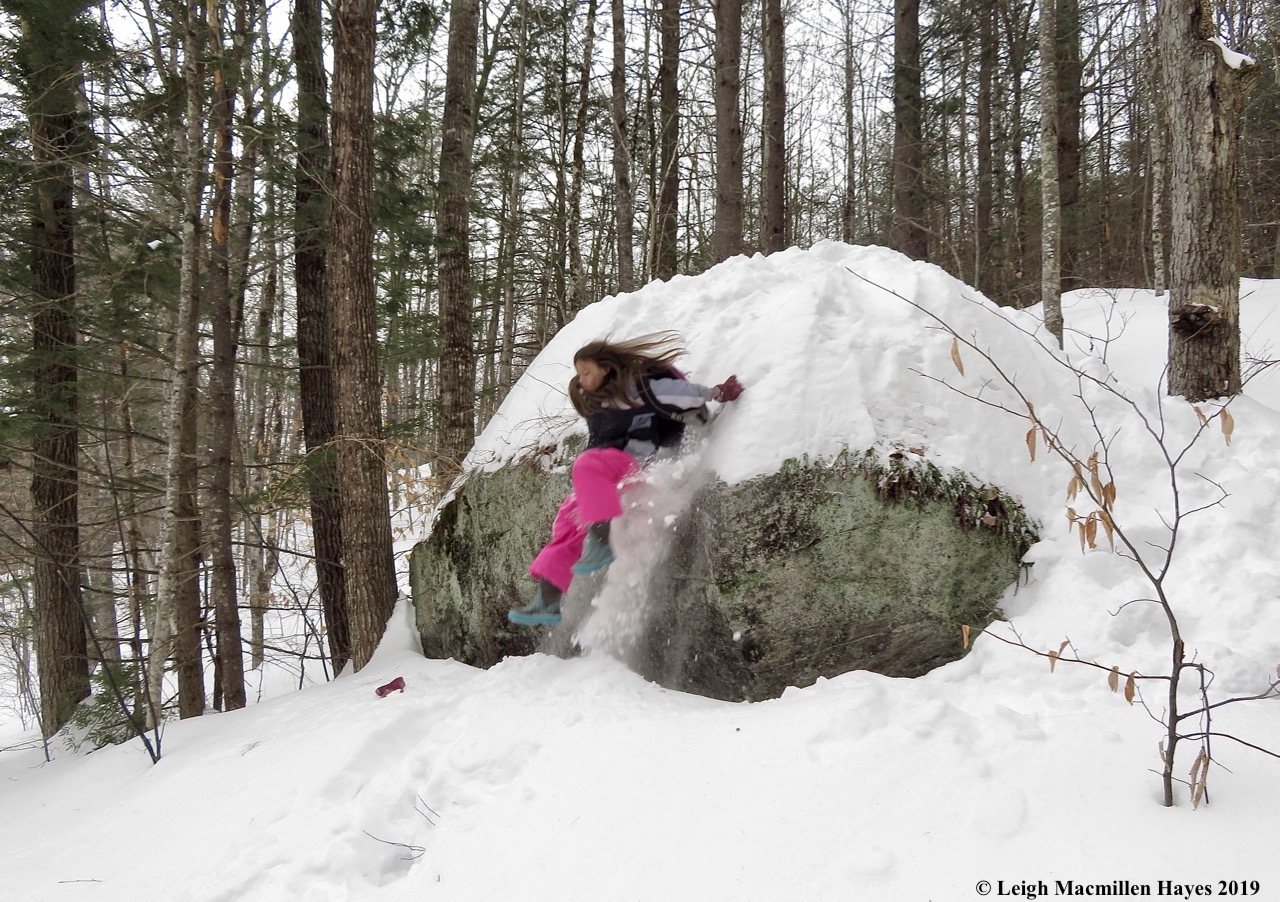
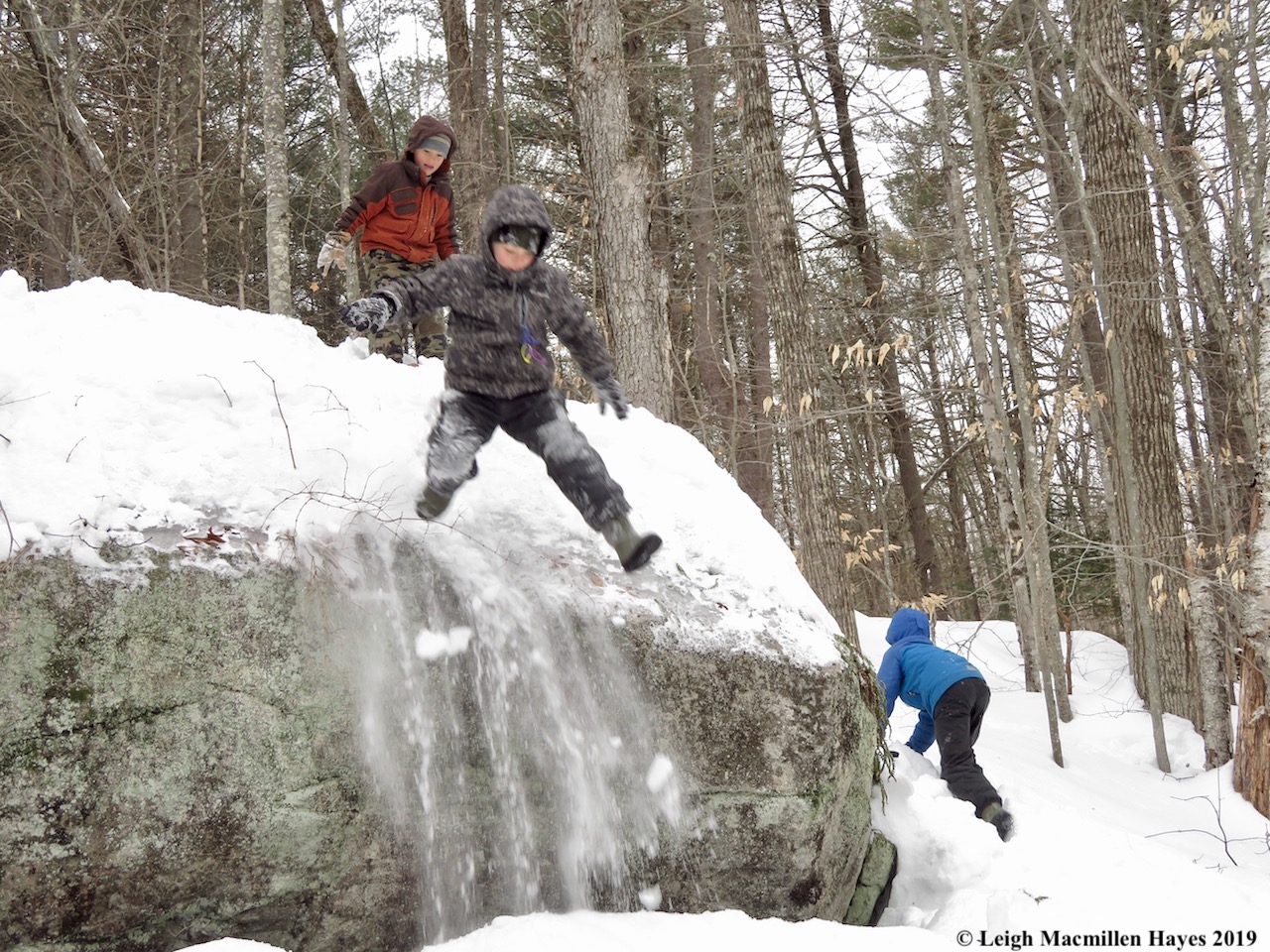
Sometimes, it seemed as if they flew down the boulder’s face.

Other times they bounded.

In true Otter rhythm, one foot landed diagonally in front of the other.

After creating a series of troughs in the snow, they begged their momma to join them.

Being a Snowshoe Hare, she wasn’t sure she would be able to slide quite the way they did.

But she shed her inhibitions and climbed up to join her children.

After noting how scary it was, she smiled and slid down in one of the troughs the children had created.

Once was not enough and up and down she went again.

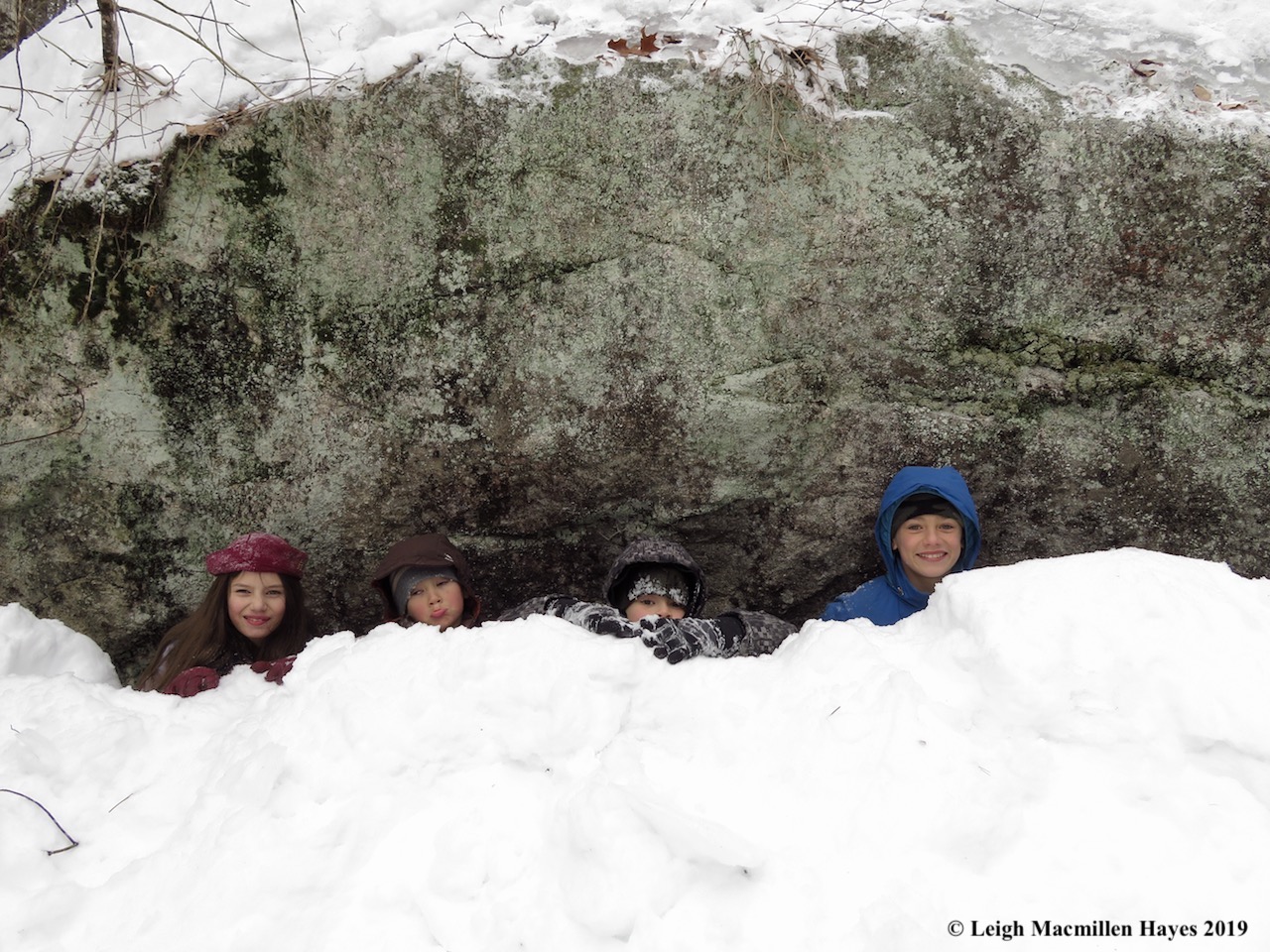
At last it was time to head for home. Being Otters, the children thought they might just den up below their favorite boulder. The youngest, of course, pouted for he wanted to slide some more.

But moments later, he showed his momma how much he loved her by presenting her with a snowheart.

What an otterly delightful family and equally otterly delightful way to spend the day!

Bear to Beer: Peabody-Fitch to Bear Trap

Our bear to beer tour was supposed to last a year, but here it is February 18, and we’ve already completed three of the treks. I think my guy really likes this Christmas present.

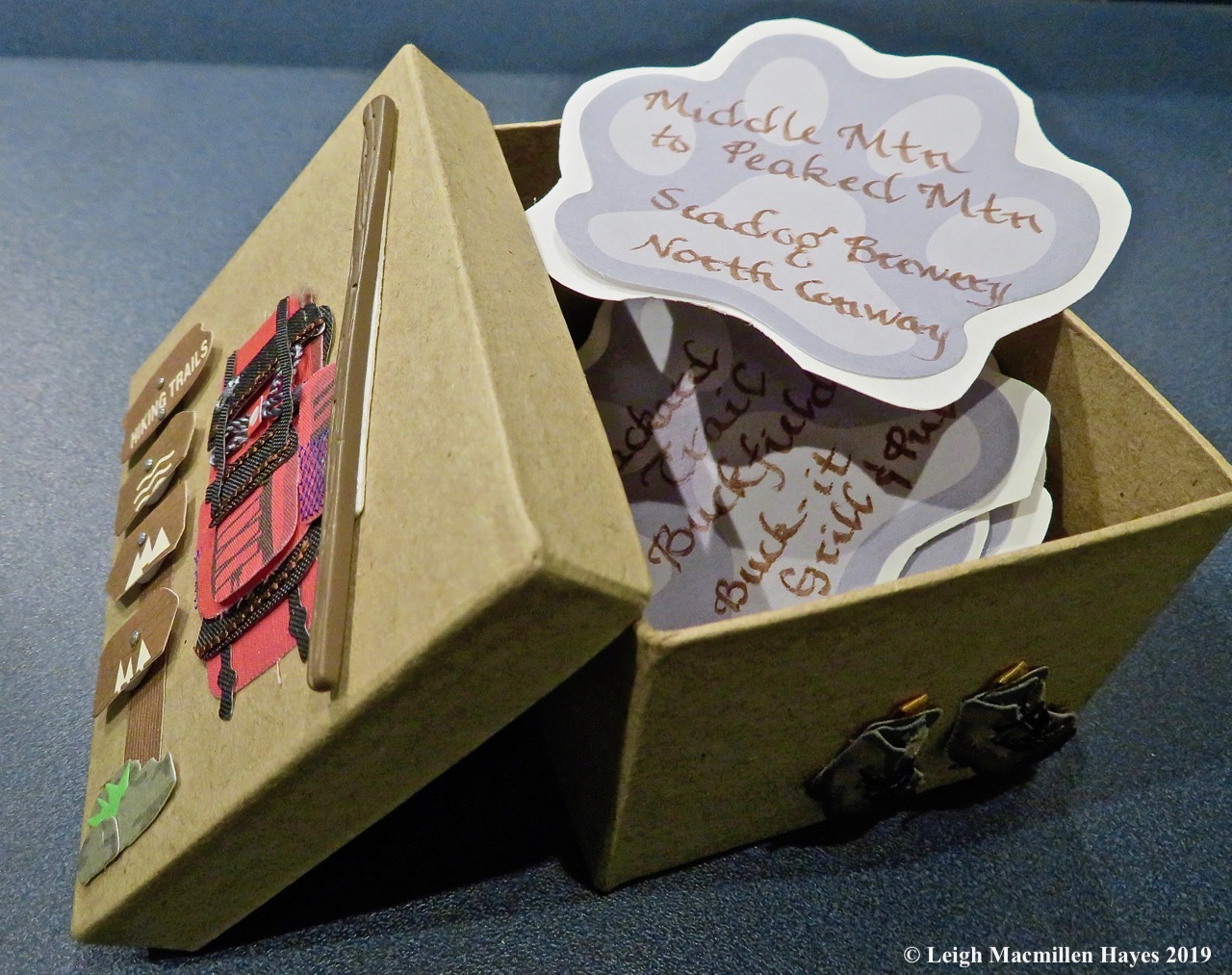
If you aren’t aware, for Christmas I gave him a small box I’d decorated with hiking stickers. Inside were thirteen pieces of paper (actually bobcat prints post-its) upon which I’d written the name of a trail where I thought we might find what we call bear trees for they are trees with bear claw marks, plus a place to grab a pint after the hike.

Because it was snowing today, we decided to stay closer to home and visit a property we hope Loon Echo Land Trust will soon own. It surrounds the Bridgton Historical Society’s Narramissic Farm and is one of our favorite places to wander in any season.

Rather than cross through the field as we usually do, I suggested that we follow the former road (current snowmobile trail) behind the barn. At the first stone wall, we passed from the Narramissic property on to what we hope will become the 252-acre Peabody-Fitch Woods that Loon Echo will own once they reach enough dollars to make the purchase.

Another part of my guy’s Christmas present was a donation toward said purchase, which an anonymous foundation will match. It seemed like a win-win deal when I sat down with Thom Perkins, former executive director of LELT to discuss the property proposal. And then last month I co-led a walk along part of the route we followed today and had the joy of learning more about it from Jon Evans, Loon Echo’s Stewardship Manager, and Matt Markot, LELT’s new executive director.

Not far down the snowmobile trail, we turned left at a stone wall, the same as we had during the LELT walk in late January. I was sure this was a route new to my guy, but it turns out it used the be the snowmobile trail and so he knew it. Right away, as we hobbled over and pulled up some downed trees, we began to see a variety of mammal prints muffled by the morning’s snow. Both prey and predator make their homes there and the property’s importance as part of the animal corridor was obvious.

Eventually, the trail swung around and rejoined the snowmobile trail. We followed it for a bit, then turned off at the blue arrow for that was our chosen way for today. It appeared that someone had an eye on my snowshoes.

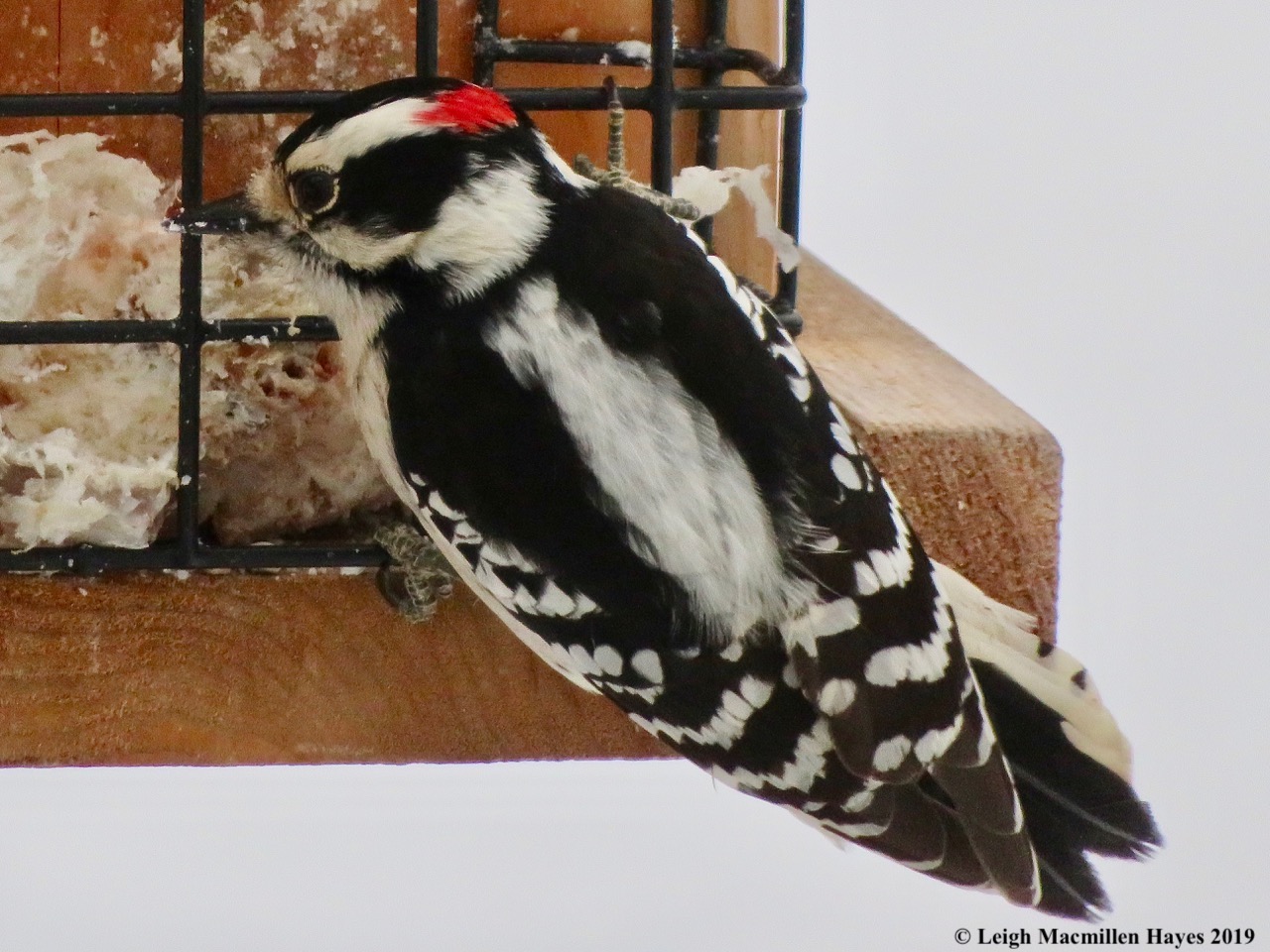
We’d no sooner started along the trail when I heard the rat-a-tat drumming of a male hairy woodpecker. Of course, I needed to pause and watch him for a few minutes. And wonder about the purpose of his drumming. Was he establishing territory? Trying to get a date?

My guy was patient with me, but our mission was about more than the birds, and so we journeyed on. Mind you, we kept looking at the trees along the way, but suspected we’d find bear evidence on our return trip when we planned to go off trail. In the moment, we were eager to get to the quarry and find lunch rock.

It was buried, but my guy in his chivalrous manner, wiped the snow off and we each ate a slice of cold, homemade pizza and drank some water.

Behind lunch rock, plug and feather holes served as reminders of an earlier time–much earlier than either of us remembered. The quarry was the source of the stone foundations for Narramissic, the Peabody-Fitch Farm, which dates back to 1797.

With lunch under our belts, onward and upward we hiked until we reached a certain stone pile.

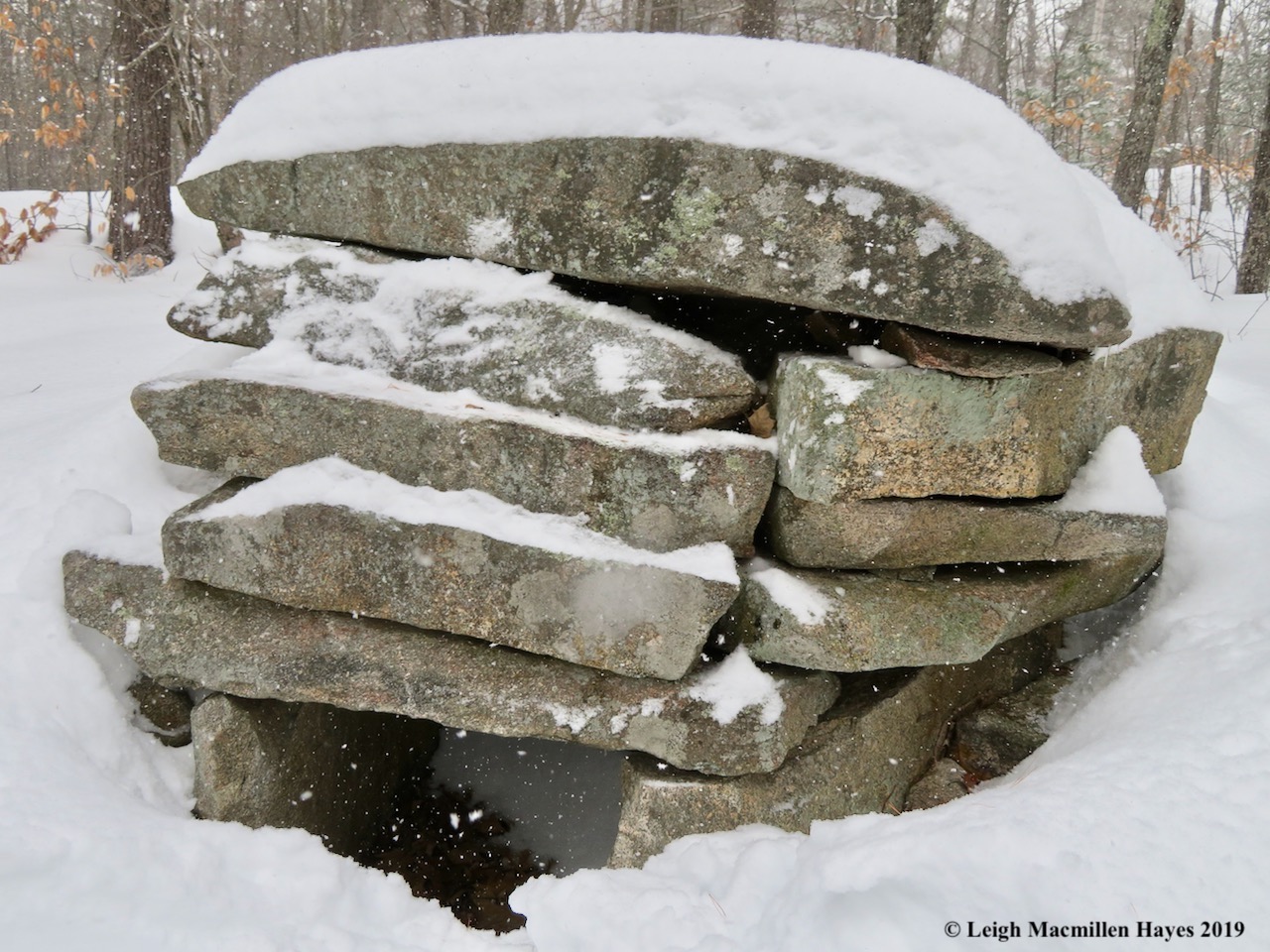
Mind you, it’s located a tad from the proposed Peabody-Fitch Woods, but still, we love to visit bear trap and imagine the past.

I’ve quoted this before, but it’s worth sharing again.

How did the bear trap come to be? According to an August 17, 1963 article in the Bridgton News, “Enoch Perley, early settler of South Bridgton, built his first house in 1777 and brought his bride to their new home in 1778. [I believe this was at Five Fields Farm.]

As Enoch acquired livestock, he was much troubled by depredations from bears. He built a bear trap on the hill back of his first home . . .

Tradition says that four bears were caught in this trap–not enough! So Mr. Perley later had an iron bear trap made which took care of eight bears. Without a doubt, many were disposed of by him personally. A story is told that in an unarmed encounter with a bear and two cubs beside a wood road at dusk, Mr. Perley allegedly strangled the mother bear with his garters . . .”

The article continues, “The bear trap is built of stone. A large stone door is suspended and as the bear takes the bait, he trips the lever and is caught in the stone enclosure.”

In a December 1954 issue of the Bridgton News, a brief article states: “The old stone bear trap on the mountain in South Bridgton known as ‘Fitch’s Hill,’ unused for more than one hundred years, has been reactivated by Dr. Fred G. Noble and Gerald Palmer and put in readiness to capture a bear.” As the story goes, they never did succeed.

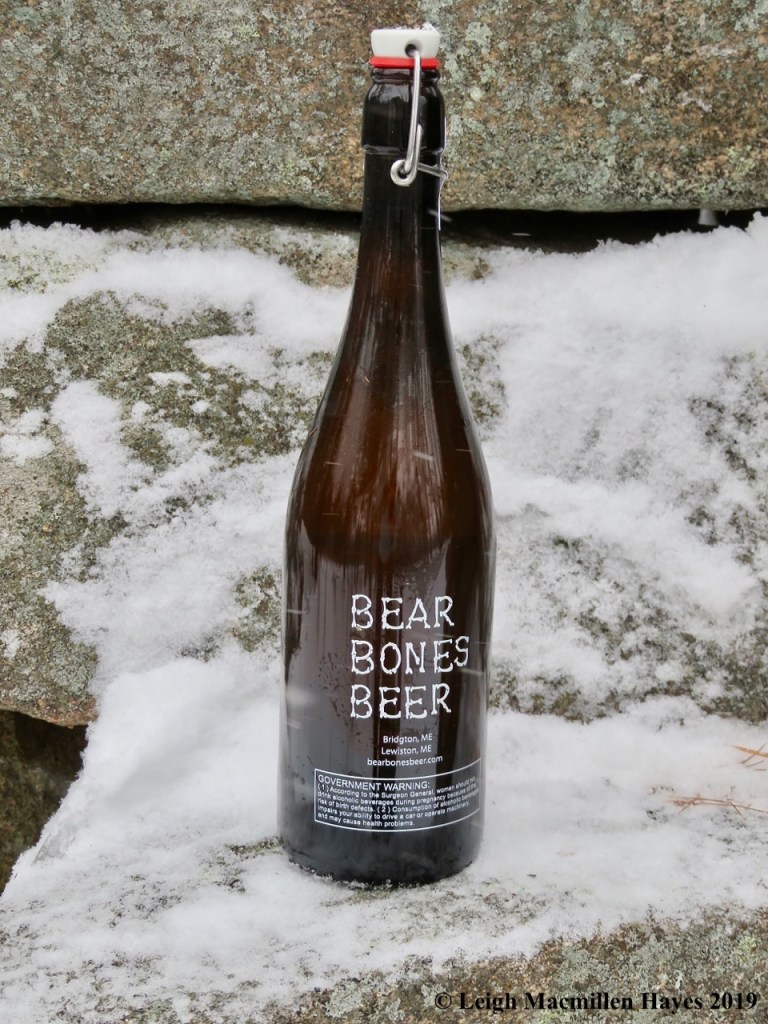
In honor of the Perleys, Peabodys, Fitches, and the bears, we’d brought along a growler, a Valentine’s Day present from my guy to me.

We each enjoyed a few sips and then peered inside the trap to see if anyone had taken up residence. Perhaps we should have done that first! Thankfully, no one was home.

Eventually, we headed back to the trail, but didn’t spend long on it.

Instead, we began looking for bear trees. To test your visual acuity, can you spot my guy?

I couldn’t always see him for we split up for about an hour and zigzagged our way from one beech tree to another. I found one that gave itself a hug.

There were those with false lines. Well, they weren’t really false, but they weren’t caused by a bear either. Instead, surrounding saplings blowing in the wind had scratched them.

Then there was the tree that seemed to have stitch marks on the outside of its wound. Unfortunately, the stitches didn’t help.

One of my favorites was the beech that made me think it was a deer bending over as if to take a bow.

That made perfect sense in these woods where the deer did dine.

And at least one rubbed its antlers.

Suddenly, from a distance I heard my guy call to me. He thought he’d found what we sought. A bear tree. The growth at the top certainly leant itself to that assumption.

I’m not one hundred percent sure that he was right, but there were some marks that looked consistent with bear activity–a bear with a very big hand.

Closer to the trail, we did find another tree with bear sign–left behind by Teddy Bear and K.F., whoever that might be.

About three hours after crossing through the stone wall behind the barn to enter the future Peabody-Fitch Woods, we did the same at the far end of the farm field.

And in the end, even if our bear tree wasn’t exactly that, we’d still had a bear sighting–in the form of the trap. Today’s brew was Double C.R.E.A.M. Ale from Bear Bones Beer Brewery. Bear to beer possibilities: Peabody-Fitch to Bear Trap.

Prehistoric Creatures of western Maine

I heard it before I saw it as I reached the summit of the Greater Lovell Land Trust’s Flat Hill this afternoon. The rhythmic tapping sounded as if a structure was being built and so I looked upward expecting to see a treehouse under construction. Scanning all the trees in the mixed forest, I saw only their crowns.

And then I smartened up and looked at the snow. Bingo! Fresh debris atop this week’s layers of snow from two storms and I had a better idea of the construction worker’s location.

Sure enough, high up in a deteriorating yet live red oak stood the one with a crown all his own–brilliant red as it was in the afternoon sun. By the red mustache on its cheeks, I knew the pileated woodpecker was a he. Call him either PILL-ee-ated or PIE-lee-ated; the word means “crested.”

Sometimes, when these birds are intent on their work, I find I’m able to quietly move in a wee bit closer. Mind you, he was up quite high (at least 25 feet above me) and there were other trees between us. I hoped if he was aware of me that he knew I meant no harm. I just wanted to observe.

And so I did for a good while. Check out that chisel-like bill.

In a seemingly effortless manner, he pounded away. Did you know that a pileated can peck up to 12,000 times a day? Not all on the same tree, of course.

Thank goodness for extra-dense neck muscles and a compressible skull bone. Between hammering, this guy paused periodically. To admire his work? To check on the food supply? Or just to take a break?

Can you see one of his four-toed talons grip the edge of the excavation site?

One cool thing about woodpeckers is how they use their tail feathers for support–as if the third leg on a three-legged stool.

As I watched, I noted that Woody Woodpecker, a name I give all pileateds because their rattling call reminds me of the television cartoon I grew up with, kept digging a bit deeper.

And deeper still.

Then he’d take a break and turn his head away from the tree and I finally realized that the tree was at such an angle that to remove debris he needed to drop it below.

Eventually, he flew off and so I checked on the woodchips in hopes of finding scat filled with insect body parts. There was none. For all of his work gouging the oak, he didn’t seem to have found any carpenter ants or wood-boring beetles. Maybe that’s why he moved on. And so I did as well.

About halfway down the trail, I came upon a sight that might have delighted the woodpecker. I know I was thrilled.

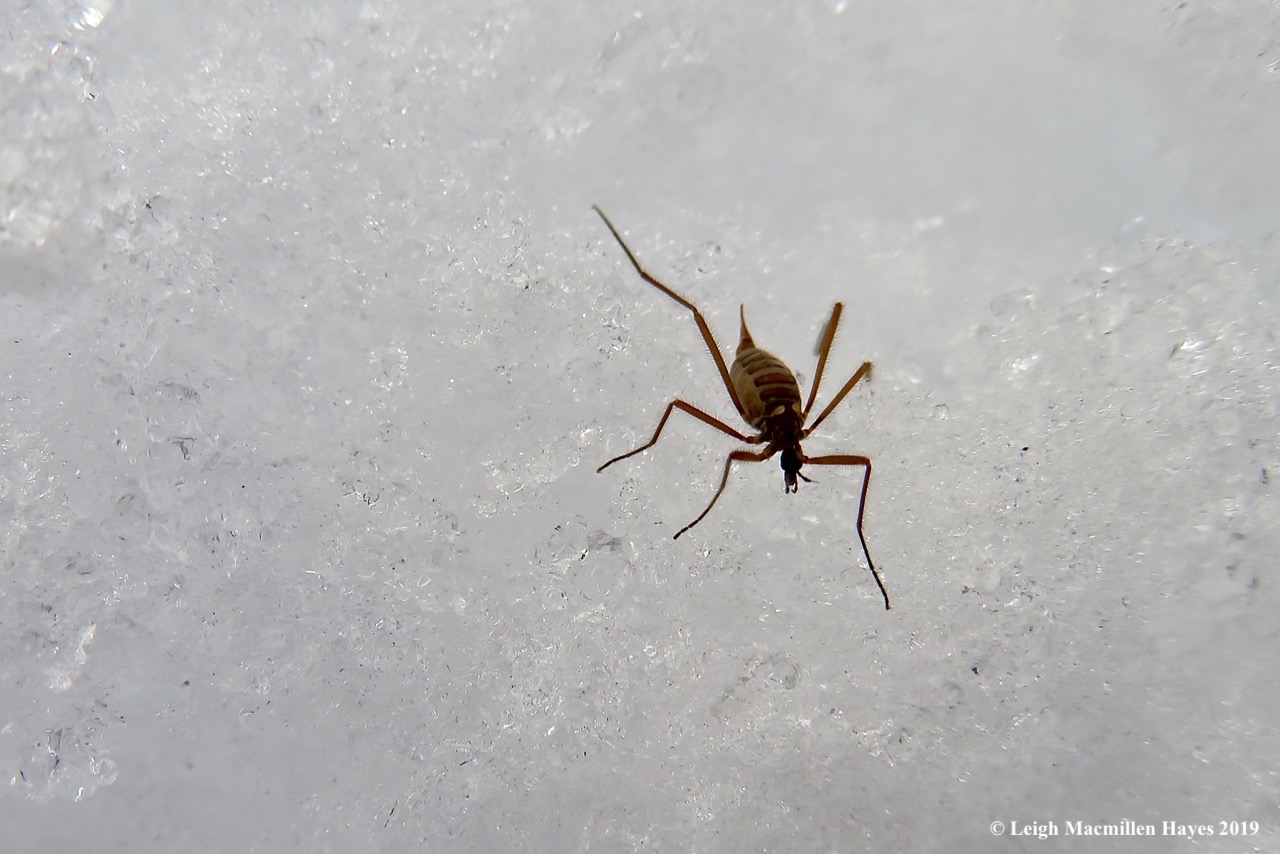
Within a few feet I spotted a second one. They were snow scorpionflies. Much like the fact that Flat Hill isn’t actually flat, nor can the snow scorpionflies fly!

On his website “Bug of the Week,” entomologist Dr. Michael J. Raupp explains, “They belong to a small order of insects known as Mecoptera. The “scorpion” moniker derives from the fact that males in this group have unusually large and upward curving genitalia that resemble the stinger of a scorpion. The “fly” part of the name comes from the fact many species of Mecoptera have wings and can, well, fly.”

To fly and not to fly. Predator and prey. Despite their extreme differences, both finds today certainly struck me as being prehistoric creatures of western Maine.

I’m with the TREES

When Alanna Doughty, education director of Lakes Environmental Association asked me to join her in co-leading and co-sponsoring a tree identification walk during Great Maine Outdoor Week(end) at LEA’s Highland Research Forest in Bridgton, I jumped at the opportunity. Alanna, you see, is a great joy to be in the presence of and I knew she’d make it a fun and unique experience.

I wasn’t disappointed; nor were the thirteen others who joined us this morning for a two-hour hike that turned into two and a half and even a little bit more.

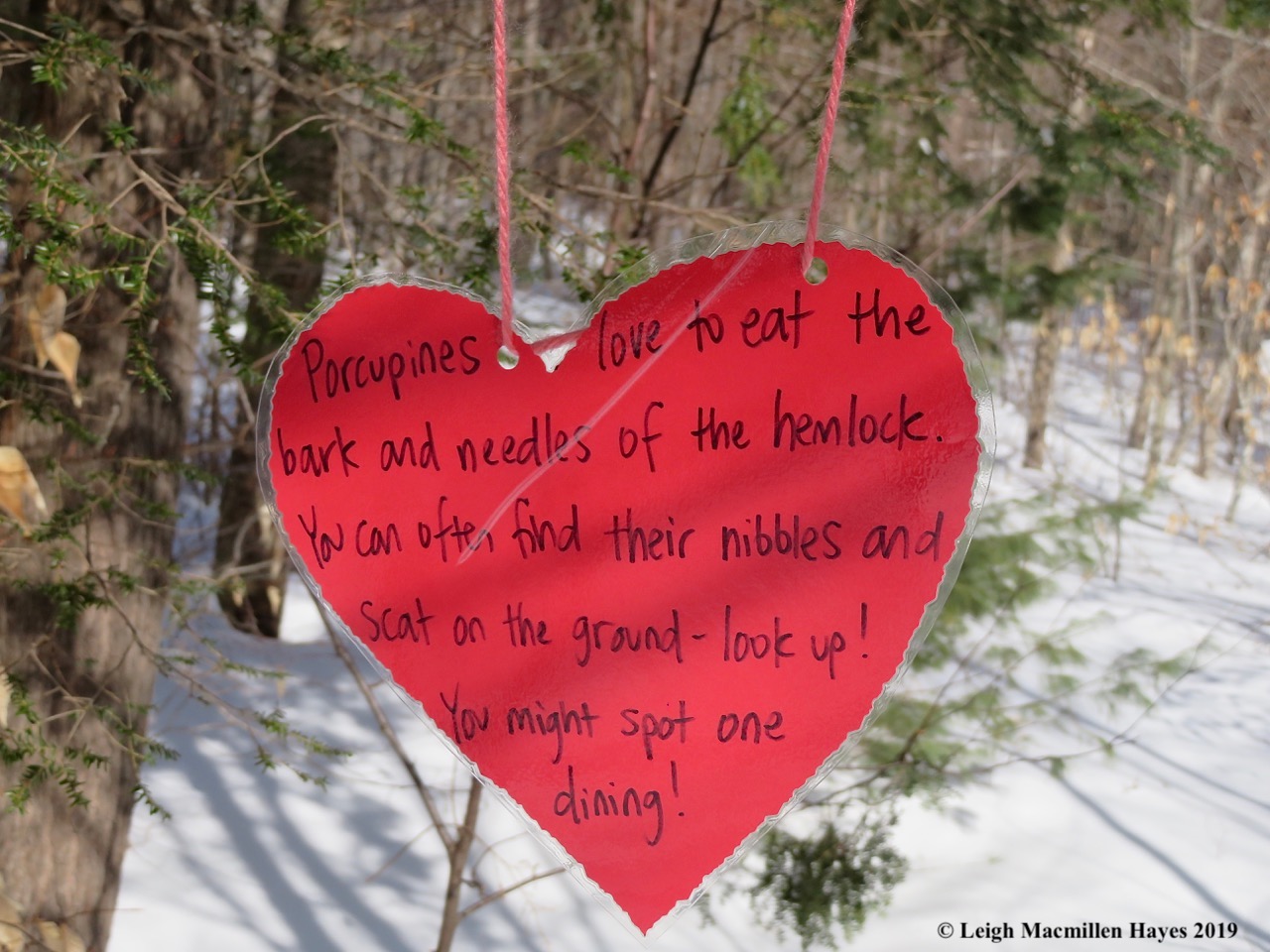
Alanna had gone out ahead of us and placed hearts with tree-related information along the trail we’d travel. Our crew was a delightful mix that included young and old, with members of LEA and the Greater Lovell Land Trust, which I was representing, as well as a woman from North Conway and man from Portland. Yes, Linda and Henri–that would be the two of you.

The first heart provided information about hemlock trees and after she read it, we encouraged everyone to channel their inner hemlock and so they leaned as this particular evergreen does. Check out those smiles. Don’t you want to be a hemlock too?

Of course, because we were among the trees on this property that the David and Carol Hancock Charitable Trust donated to LEA several years ago, and the snow was super soft from yesterday’s storm, the mammal tracks were outstanding.

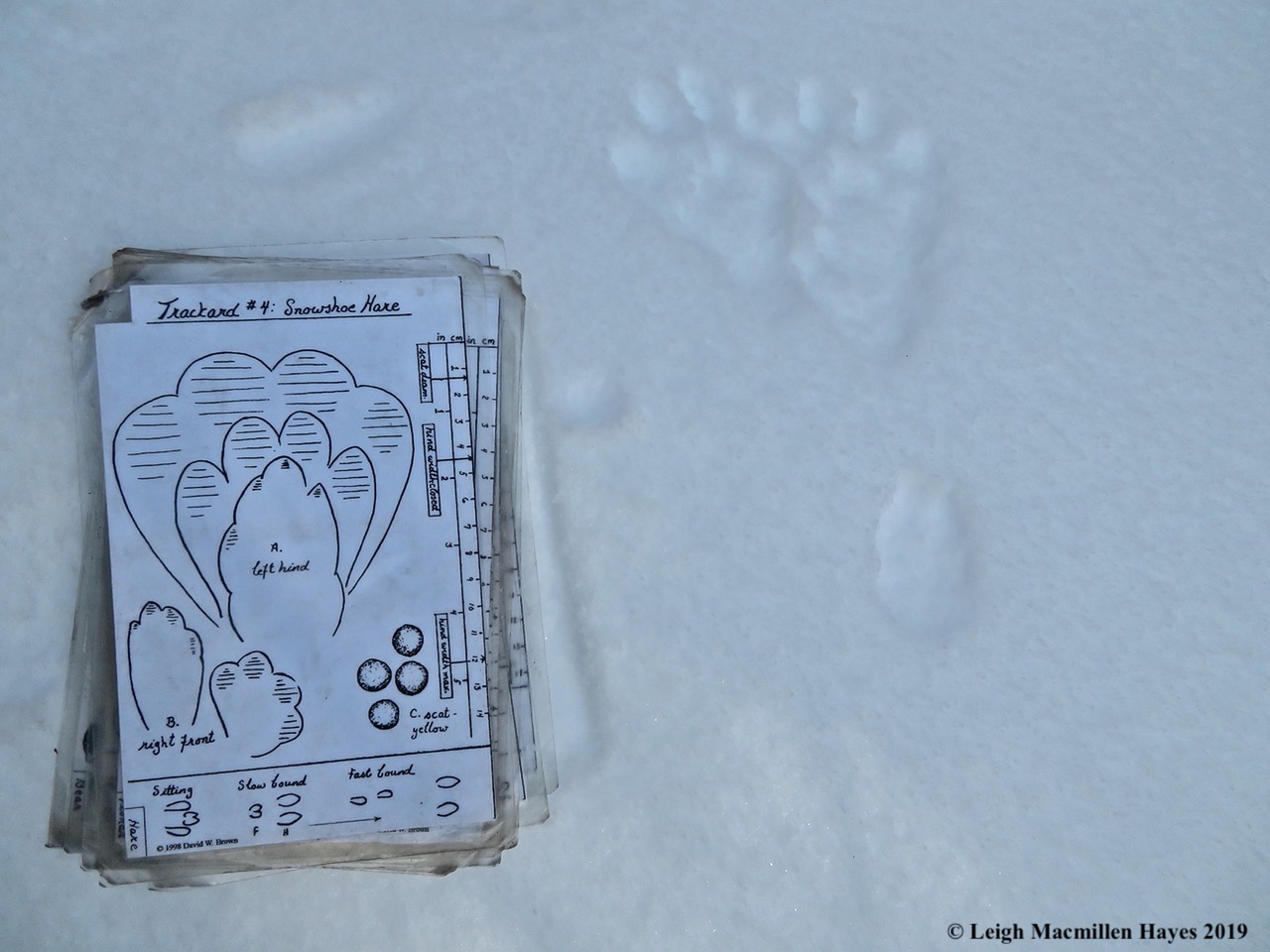
One of the favorites of the day–that of the snowshoe hare. It’s not often that one can see the hare’s toes so clearly, but today was the day. And as David Brown’s Trackards indicated, the footprint size depends upon the conditions.

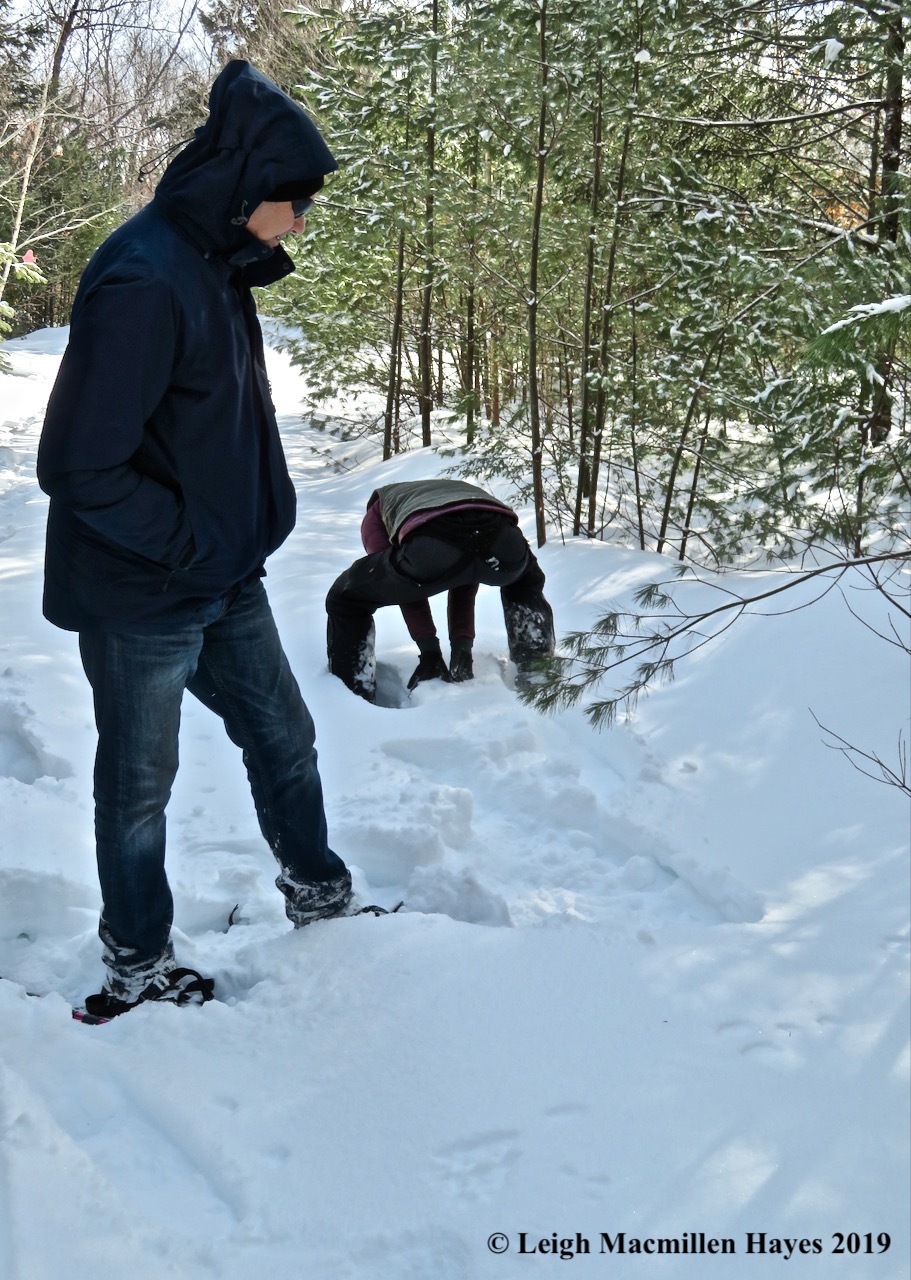
When it came to demonstrating and identifying the action of the mammal there were two rock stars among our group. Alanna was one for she got down on all fours and demonstrated how a hare moves (before she sorta fell). And Pam Marshall was the other for she correctly identified and shared information about how to recognize all of the track and print patterns that we saw. Pam only began tracking this year with the GLLT’s Tuesday Trackers, but she’s a quick study.

Onward we trekked, pausing whenever we saw a heart of red. And each time, Alanna’s voice came through in the message. Love at first bite! Indeed.

At a beech tree, we paused for a bit longer as we noted not only the twigs and buds that are beginning to swell, but also talked about how bear claw marks are most visible on them and how the beech scale insect has altered the once smooth look of the bark. The word marcescent, meaning withering but remaining attached to the stem, also entered the conversation.

After a bit of time, we emerged onto a wetland where only last week Alanna and a couple of people including one in our midst, Anne, had spotted a hole and lots of tracks and scat left behind by an otter. Today, no sign of that member of the weasel family, but still . . . we enjoyed the warmth of the sun.

And I took advantage of the time to dress Alanna as a twig. She was the perfect Miss Twiggy model and Henri took time to pose with her.

Back in the woods, we were stopped in our tracks by the tracks of another weasel–a mink.

And then as we retraced out steps and paused by a speckled alder to admire its male and female catkins and last year’s cones, someone honed in on something that wasn’t a remnant of yesterday’s snowstorm.

The cottony white masses of wooly alder aphids decorated a couple of branches. As Alanna explained, in a symbiotic relationship, during the warmer months, ants stroke the aphid with their antennae, while the aphid releases a drop of honeydew, much like a cow being milked. It’s actually rather creepy. Today, there were no ant farmers about, but a few like Justin, did step forward to take a closer look.

After that, we were confronted with a math problem. And you thought we were just out for a walk in the woods.

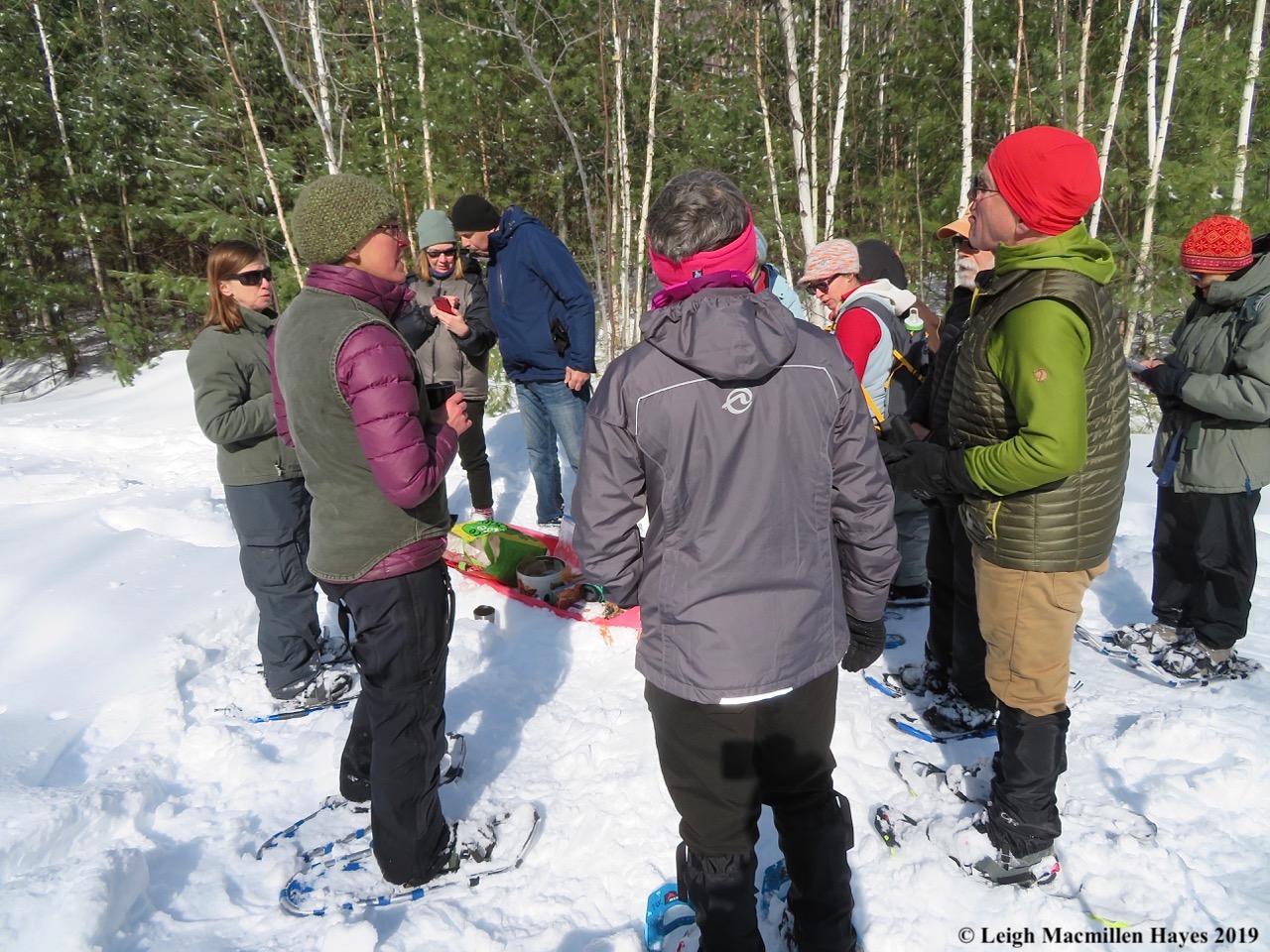
Finally, well sorta, we made our way back to an opening and stood around enjoying hot cocoa and tea, plus some goodies, and each others company.

Sherpa Anne had been kind enough to haul the supplies to the opening for us as our trek began. I know she was thankful she didn’t have to pull the sled all the way out to the wetland. And we were thankful for the good tidings it bore.

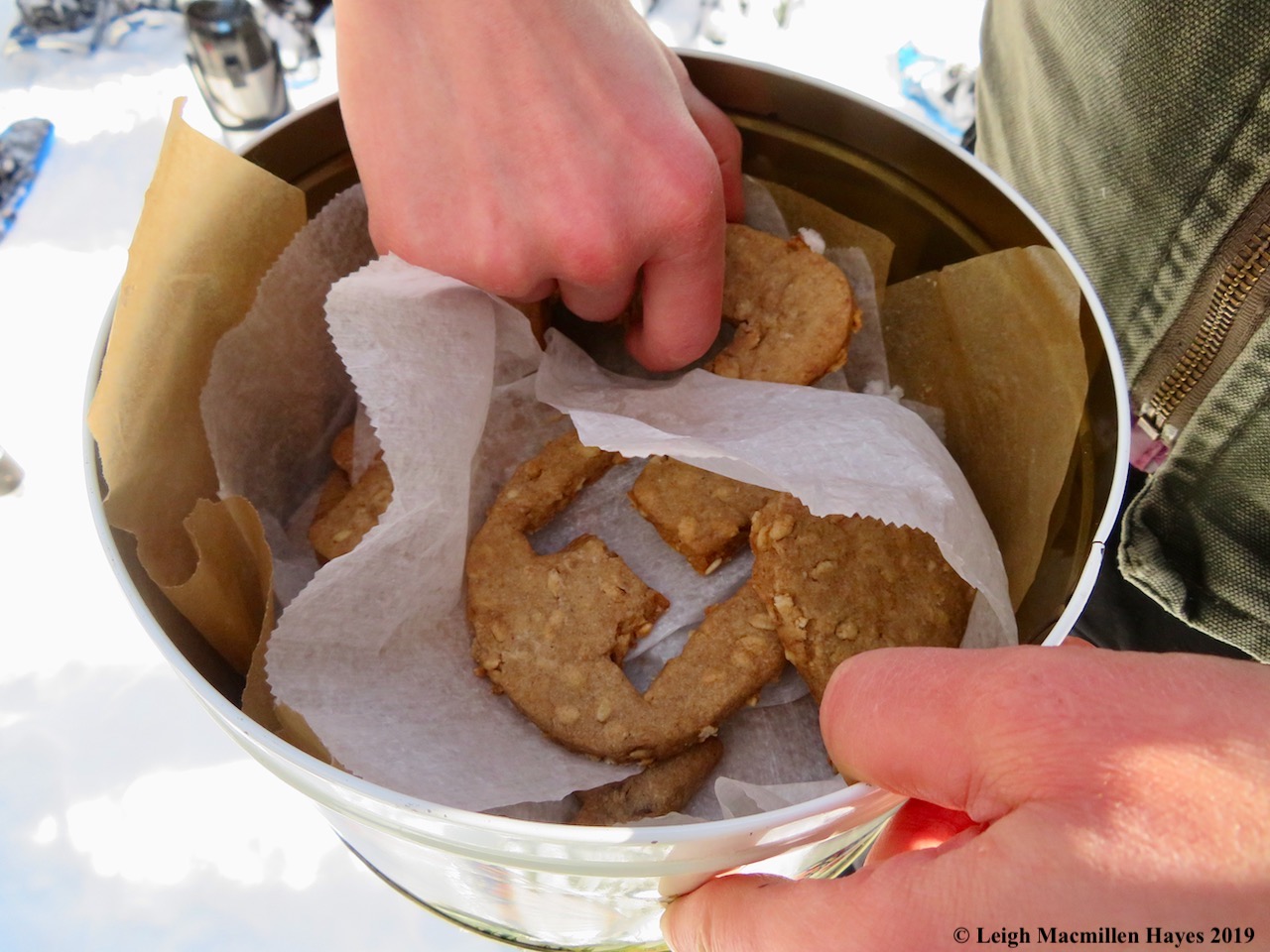
You see, Alanna is a woman of many, many talents, and baking is one of them.

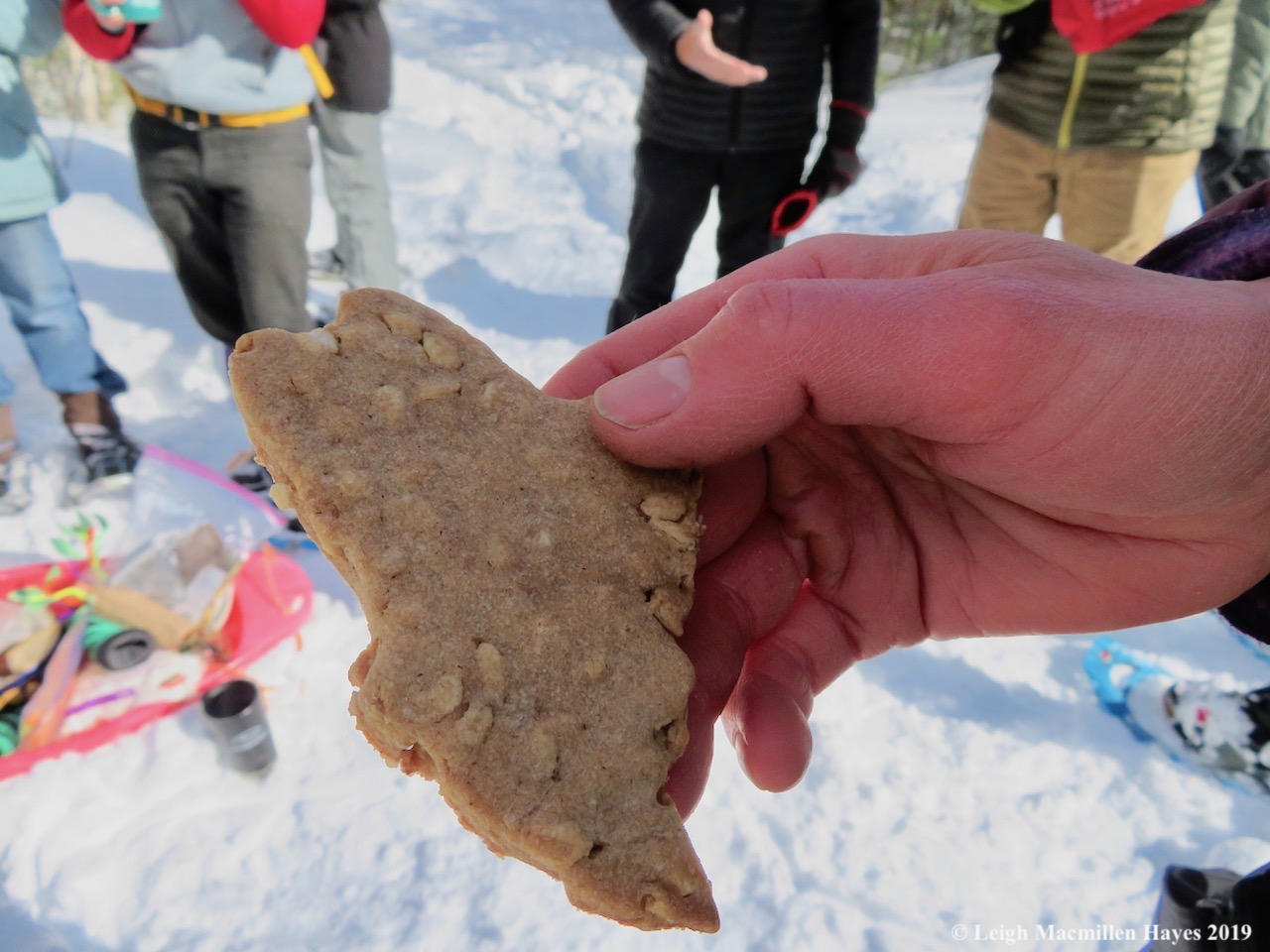
Did she get carried away with the cookie cutters?

We didn’t think so for we all love Maine.

And we also love trees, including red oaks with their bristly-tipped leaves and acorns.

That wasn’t all Alanna had created.

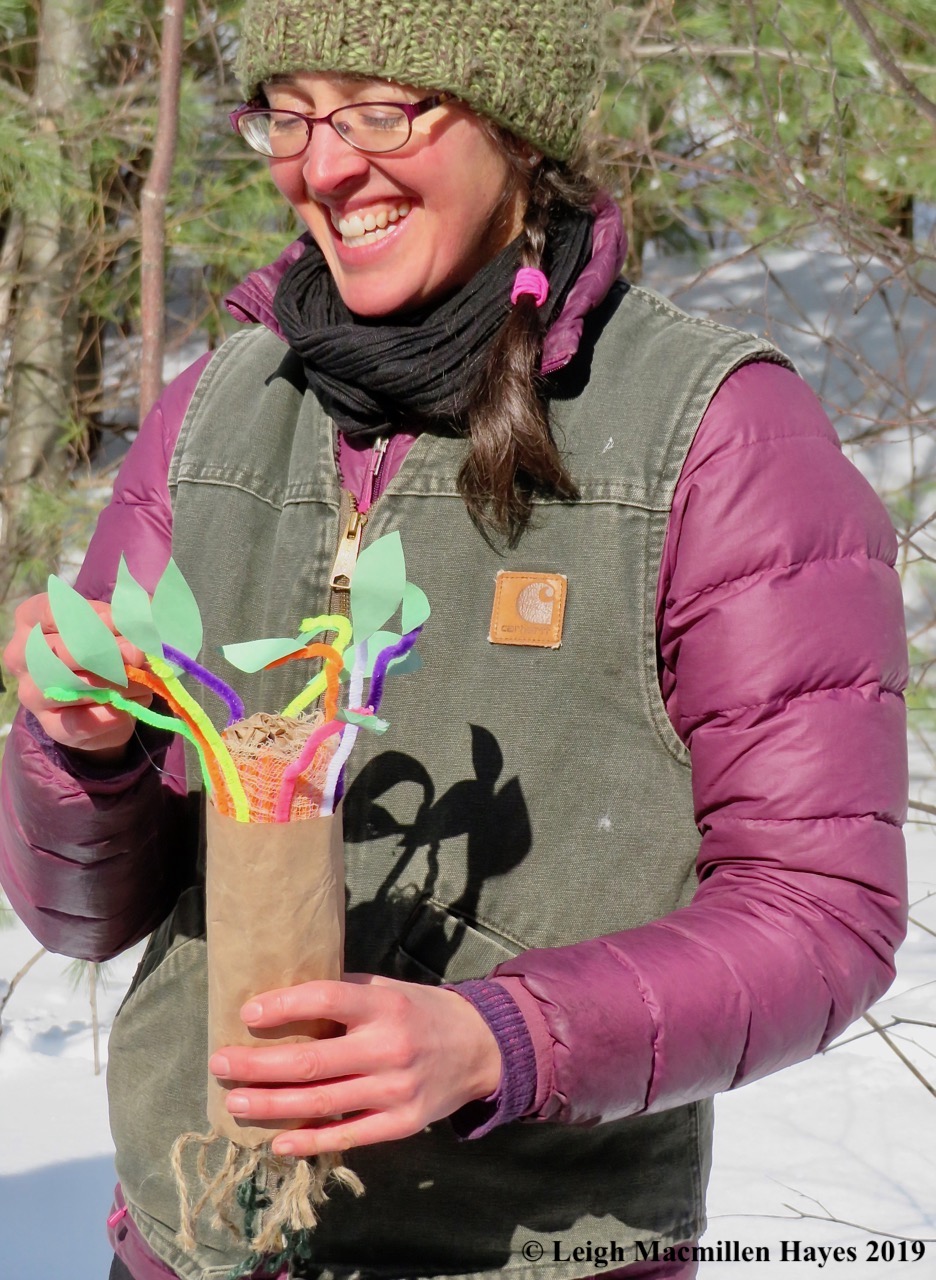
Her tree model was to be envied (at least by me). And she explained the different functions, from roots to leaves and outer bark to inner workings.

And just in case you are interested, I’ve come up with a new mnemonic, because we love memory aids.

Xylem is the vascular tissue in plants that conducts water and dissolved nutrients upward from the root and also helps to form the woody element in the stem.

Phloem is the vascular tissue in plants that conducts sugars and other metabolic products downward from the leaves.

My mnemonic: Xy high (think upward); Phlo low (think downward).

Of course, that didn’t occur to me until several hours later.

Before we finished off our delightful morning, there was one last heart with tree information to read. Hmmm. Porcupines, bark, needles, scat, look up? “You might spot one dining!”

And so up we looked.

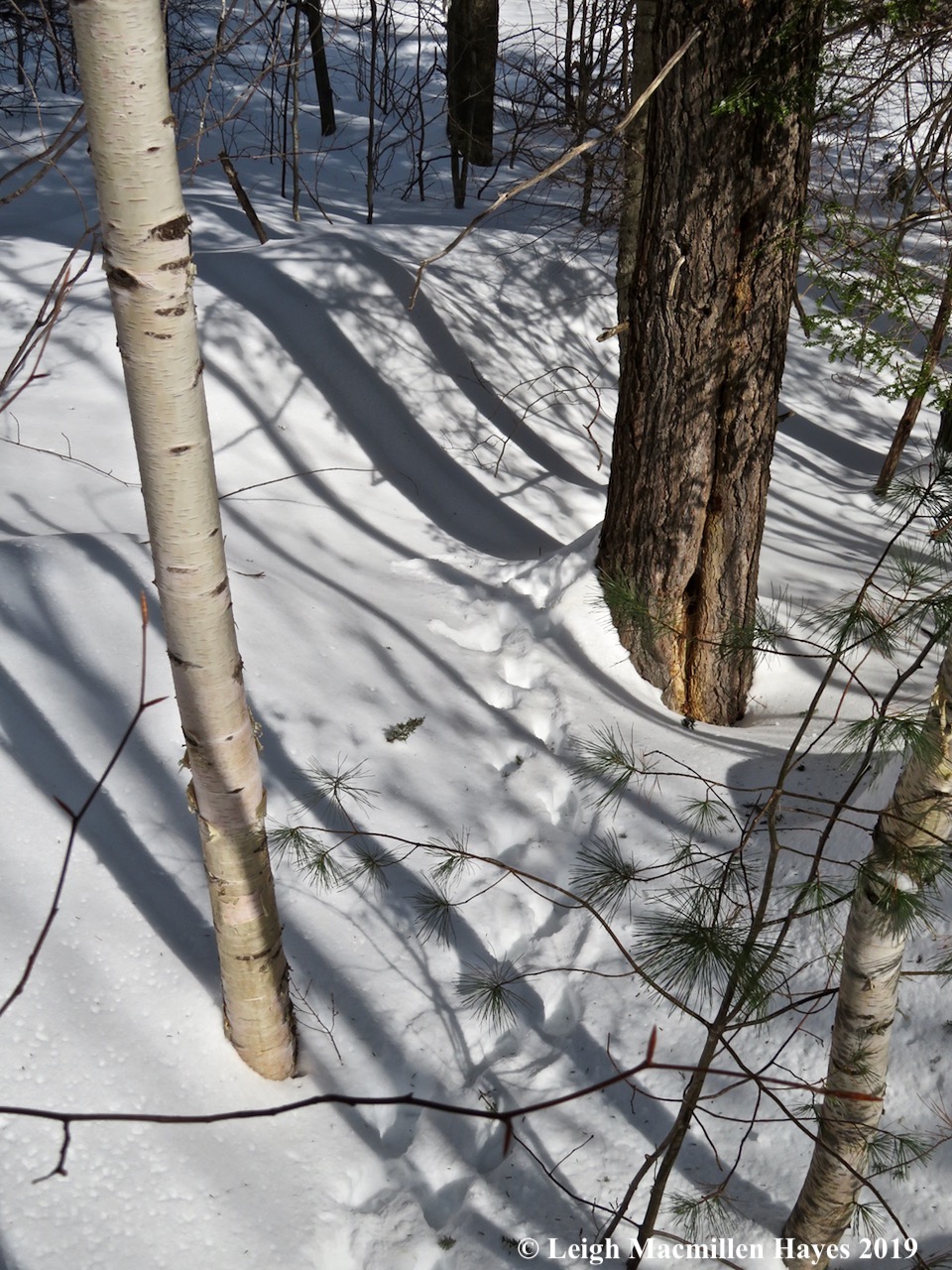
And down as well. We found some tracks and even took a closer look at some comma-shaped scat.

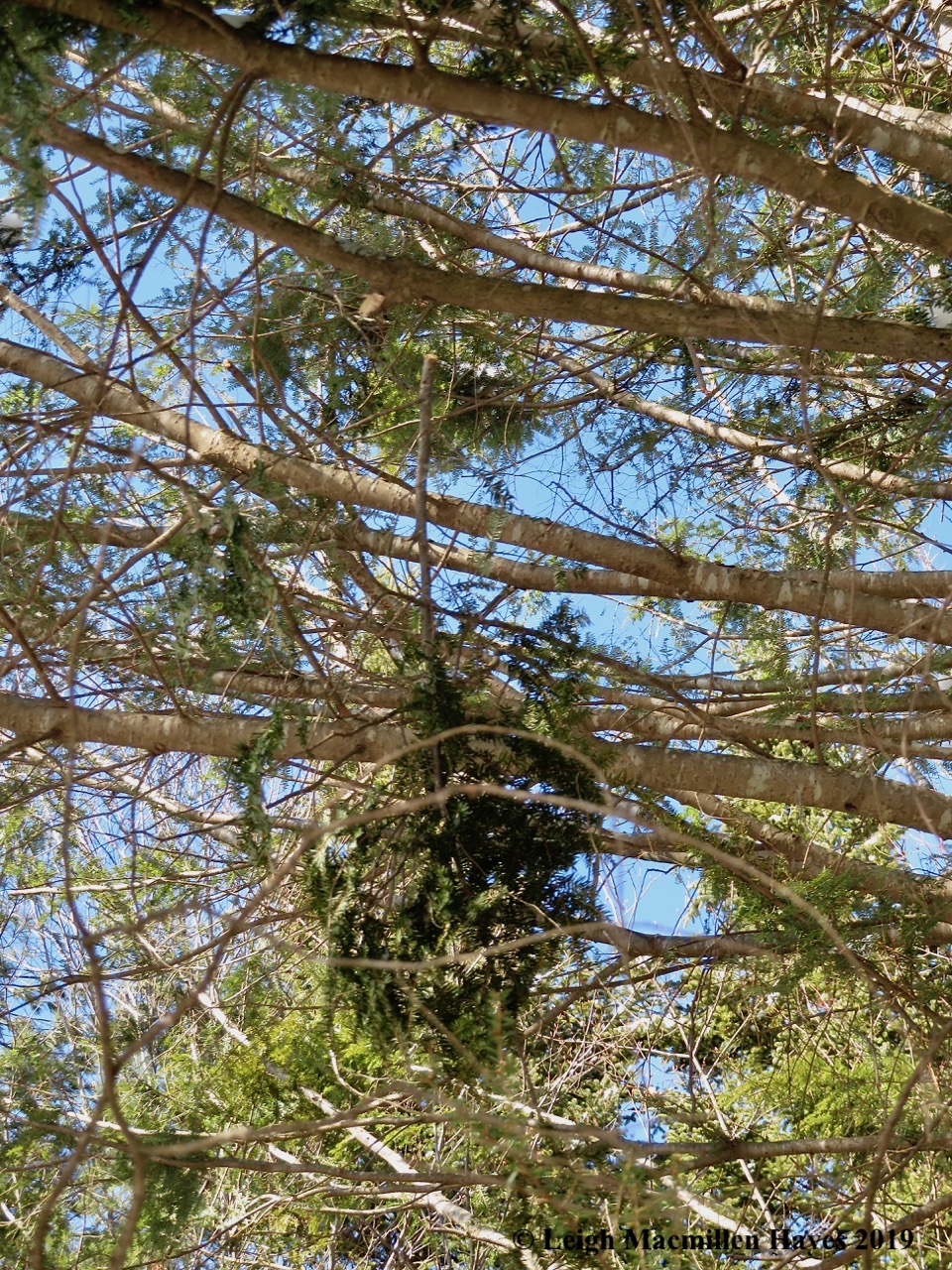
Because . . . the resident male was high up in the tree! Look at that handsome fella! We did. Over and over again. Henri was sure we had planted him and that he wasn’t real.

But he was. And if you look closely, you might see his orange teeth which one (like me) could almost mistake for a Valentine heart. Check out those toe nails. And can you see the rough soles of his feet, the better to grip the tree with?

Male porcupines are known to hang out on a tree during the day. I know we’re particularly thrilled about this one because he hasn’t let us down yet.

Think about this–while the male was hanging out in the sun, porcupines (like the one that lives under our barn) typically stay in their dens until dusk and then head off to munch on bark and needles in the darkest and coldest hours of a day. That’s to be admired.

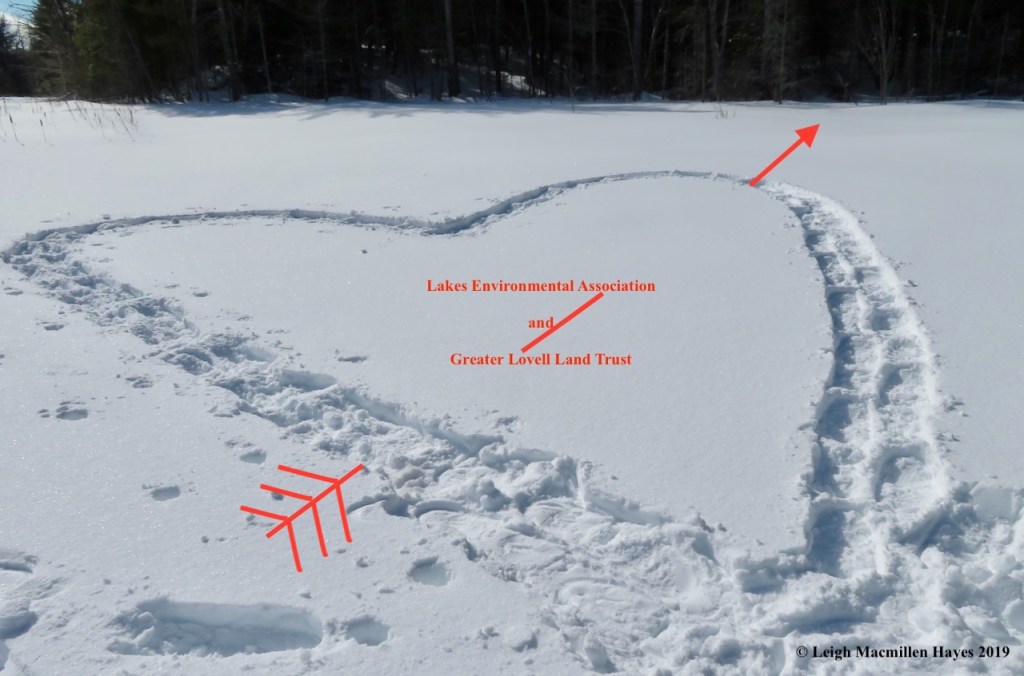
So is the work of our two organizations, Lakes Environmental Association and the Greater Lovell Land Trust. Both of us are with the Trees and we loved sharing the trail together this day.

We’re doing the same again on Sunday at 12:30 in Lovell, where we’ll go on a Porcupine Prowl–will we actually see the rodent as we did today? Who knows, but we’ll have fun as we join together again to celebrate Great Maine Outdoor Week(end).

I’m with the TREES. Are you?

Mondate Shared with Tom and Ron

Midmorning found us driving down a lane in Stoneham, Maine, made extra narrow by high snowbanks. At the second entrance to the Greater Lovell Land Trust’s Five Kezars Reserve we were delighted to discover the driveway had been plowed just enough to allow a vehicle or two to park. And so we did.

Our initial plan had been to wear micro-spikes and carry snowshoes, but as we’d passed by the first entrance, we noted that no one had climbed the Mountain Trail, and the road leading back to it had been well sanded, so we left the spikes behind.

Walking back up the road was easy, but then . . . we had to conquer what was probably the most difficult part of the entire journey–the snowbank between the road and the trail.

Thankfully in northern New England, those who drive plow trucks know to knock the snow back a day or so after a storm, thus leaving room for the next storm. (In this case, there’s one on the horizon for tomorrow night with another 8-12 inches predicted). The result is a shelf that makes the snowbank easier to climb up and over.

We did just that with the utmost grace in our steps.

Once on the other side, where the sign gave an indication of depth, we donned our outer footwear.

And walked up to the kiosk where we stood eye to eye with the roof rather than the map.

We did study if for a moment as my guy had not been on the new spur trail overlooking all five of the Five Kezars.

The trails are incredibly well blazed and blow down wasn’t much given the winds of winter, but . . . we did note one small beech that had fallen off trail and taken the signs with it.

A little further up we found another sign encouraging us to climb even higher–as in skyward. Perhaps it knew something we didn’t know.

For the first half of the trail, we mainly focused on our feet, making sure that the cleats on our snowshoes dug into the slippery surface.

Once the trail leveled off, we started looking around. And being winter with no leaves to distract one’s view, the snow-topped boulders stood out like tiny homes in the woods.

About halfway up the Mountain Trail, where it turns left and joins an old jeep road to the summit, a new path was carved last summer–Tom’s Path so named for the late Tom Henderson, who had long served as the land trust’s executive director.

My guy had walked about on the ledges there with me on previous excursions, but this was his first time actually following the new trail and so he studied the “You Are Here” spot on the map.

Along the way, I wanted to pause just before the trail turned left for I had a suspicion about the area below the rock. My suspicion proved correct; a porcupine had created a den under the ledge.

That was further verified by the downed hemlock twigs.

A bit further up the trail we found even more evidence of porcupine activity for many of the trees showed off the tooth scrape marks left behind as the critter sought the cambium layer below the bark.

Recently I saw bark under a porcupine tree that confused me for I’ve always thought of them as eating the bark completely and leaving no mess–unlike a beaver. But today’s findings indicated that all had been consumed.

Behind all of the porcupine artwork trees stood another much larger that will probably be naked by spring.

The debris was the typical–nipped twigs cut at an angle . . .

and plenty of healthy looking scat. ;-)

The bark on the big old hemlock, however, had flaked off revealing its cinnamon color beneath for the porcupine had created a regular climbing route.

From below, I looked up in hopes of seeing the rodent, but realized all the evidence had to be enough. I did wonder–Tom always said he wanted to return as an otter, but just maybe he’s a porcupine right now. He was a forester, after all, and loved anything tree related.

A few minutes beyond the porcupine area we found our way to the termination of the spur and took in the view of four of the Five Kezars below: Little Mud, Mud, Middle and Back.

Being winter, a few more steps to the left revealed the fifth of the Five: Jewett.

Retracing our steps, we returned to the Mountain Trail and followed it to the summit where lunch rock had been graciously cleared . . . just for us.

There was no wind and the sun felt delightful–so we sat for a bit taking in the view of the ponds below and Pleasant Mountain with Shawnee Peak Ski Area in the distance.

When we finally decided to move on, we first stepped out to the north so we could get a glimpse of Mount Washington in the backdrop.

And then we pulled it in with a telephoto lens.

Following the orange connector trail down, we began to notice more mammal activity. We’d left the porcupines behind, but the snowshoe hare always seem to dine in one particular location.

And scat ;-)

We also noticed bobcat tracks like these, muted though they were, crossing over the trail, while we followed coyote tracks down the trail.

And twice we encountered engravings in the snow that at first glimpse we thought were wing marks, but changed our story to one of the predators playing with a prey as it dangled from the mouth. Hmmm.

Continuing down, we constantly looked up–at beech trees for we knew many revealed bear claw marks. Sometimes we had to look extra closely because the cankers on the tree hid the possibilities.

Though this wasn’t part of the Christmas present to my guy in the form of Bear to Beer Possibilities, it could have been a contender.

Our eyes scanned many a tree and we know we missed a bunch today, but we’ll save those for another day. I did think about returning and creating waypoints to mark each one on GPS, but then we wouldn’t have the fun of looking.

And because we were doing such, we found a new one today. Chances are the next time we look, it will be new to us all over again–if you know what I mean.

One other tree also drew my attention. Well, really, they all did. But yesterday I was explaining this very pattern to some folks on a guided walk, and wish I’d had such an example: target fungus on red maple. Indeed!

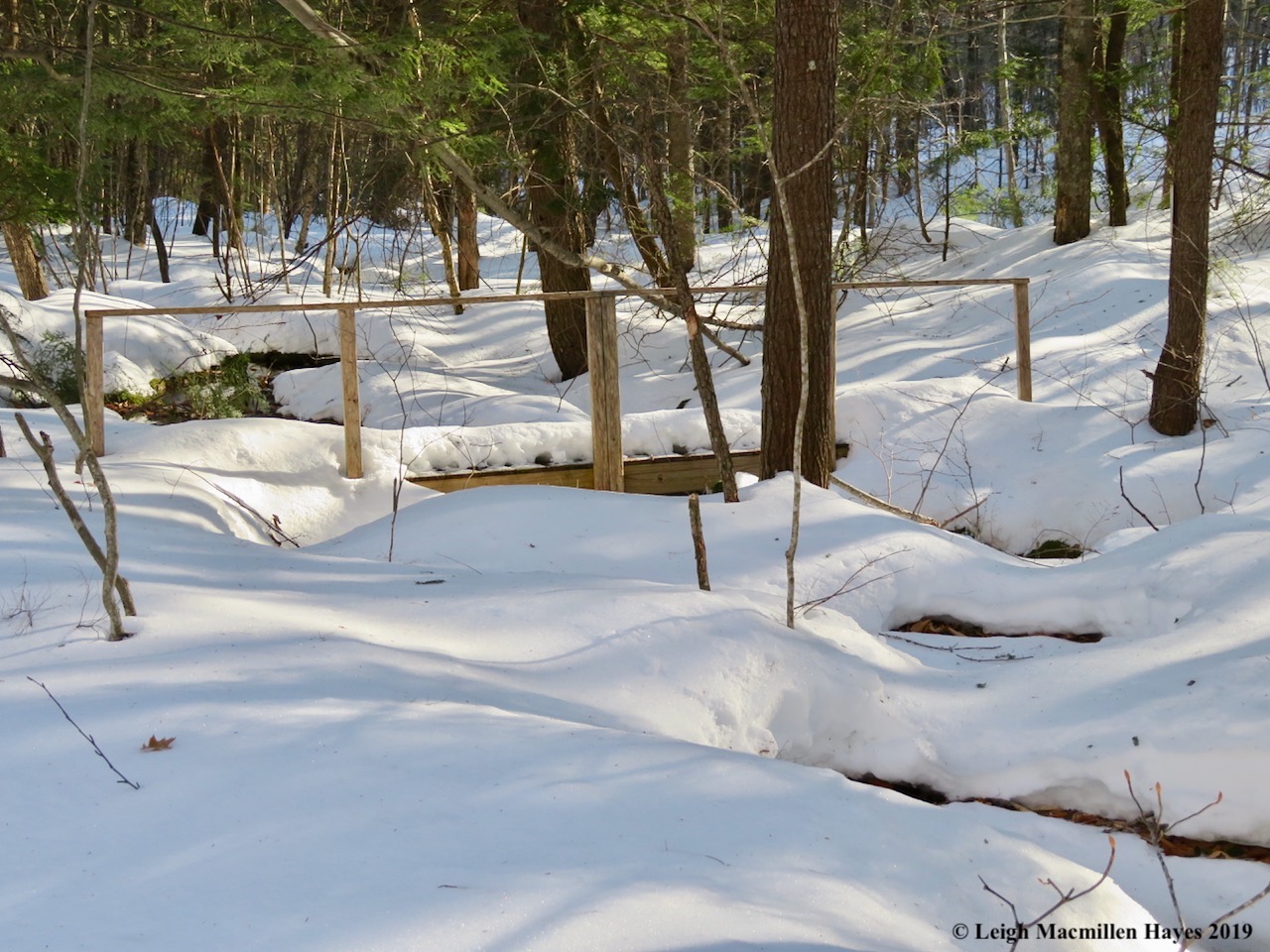
Eventually we reached the bridge crossing at Ron’s Loop, so named for Ron Gestwicki who was the first president of the Five Kezars Watershed Association and driving force behind creating this reserve that we could enjoy upon occasion, but the mammals know best.

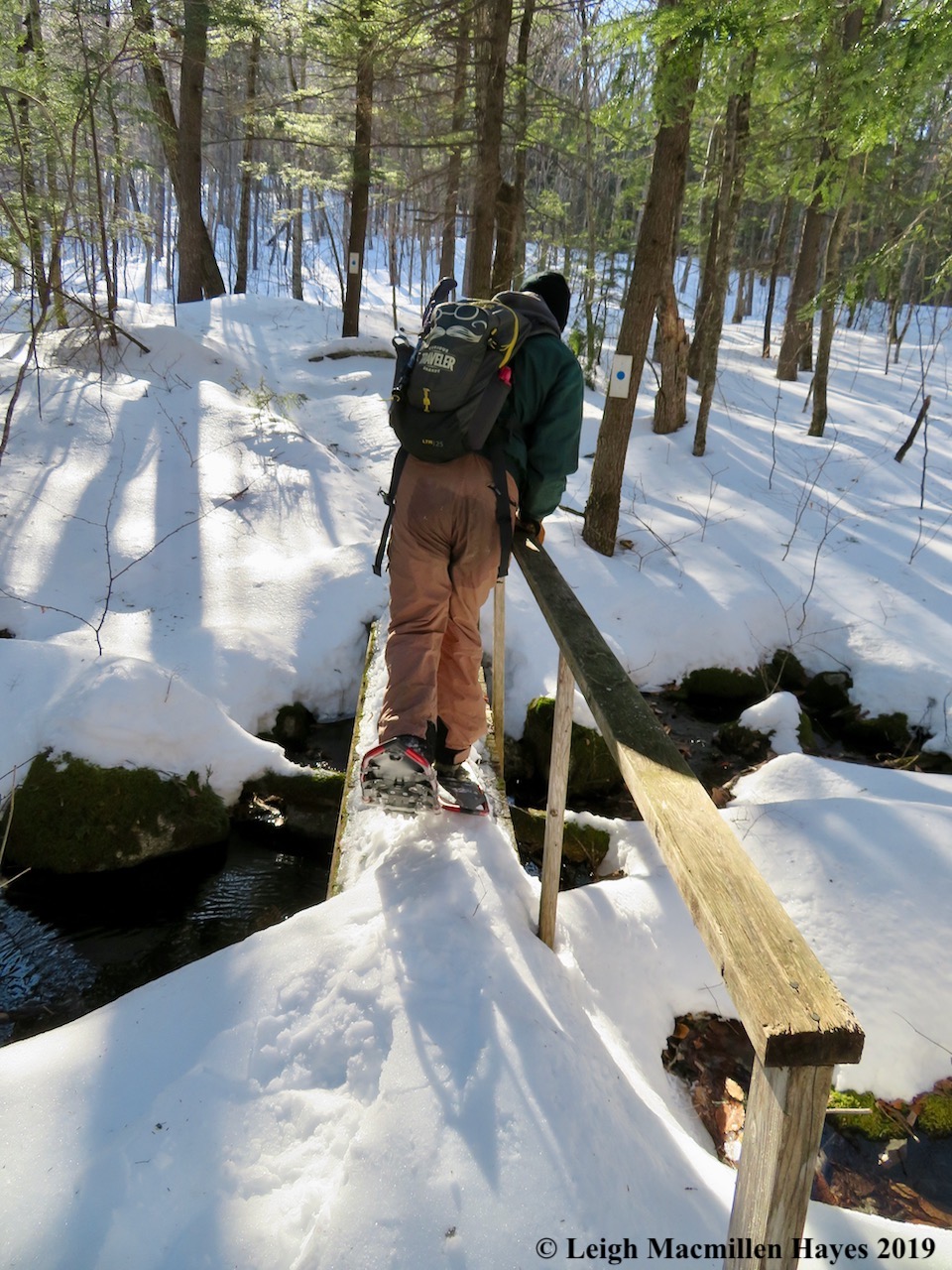
While my guy sashayed straight across the bridge, I chose to go forth in a sideways pattern. In the middle, I remembered once slipping down under the rail, but thankfully today I reached the other side without incident.

The mammal activity continued along the half of the loop that we traveled. Other travelers included the coyote that left its mark on a high spot in the middle of the trail and several more crossings by the bobcat.

I was hoping for an otter slide because sometimes we are so blessed, but instead we found a few tracks of fisher passing through, their five tear-drop shaped toes on display.

Though we’d spent several hours on the trail, it seemed we reached the final bridge crossing in no time and my guy performed a chivalrous act of stomping down the snow to make for an easy crossing.

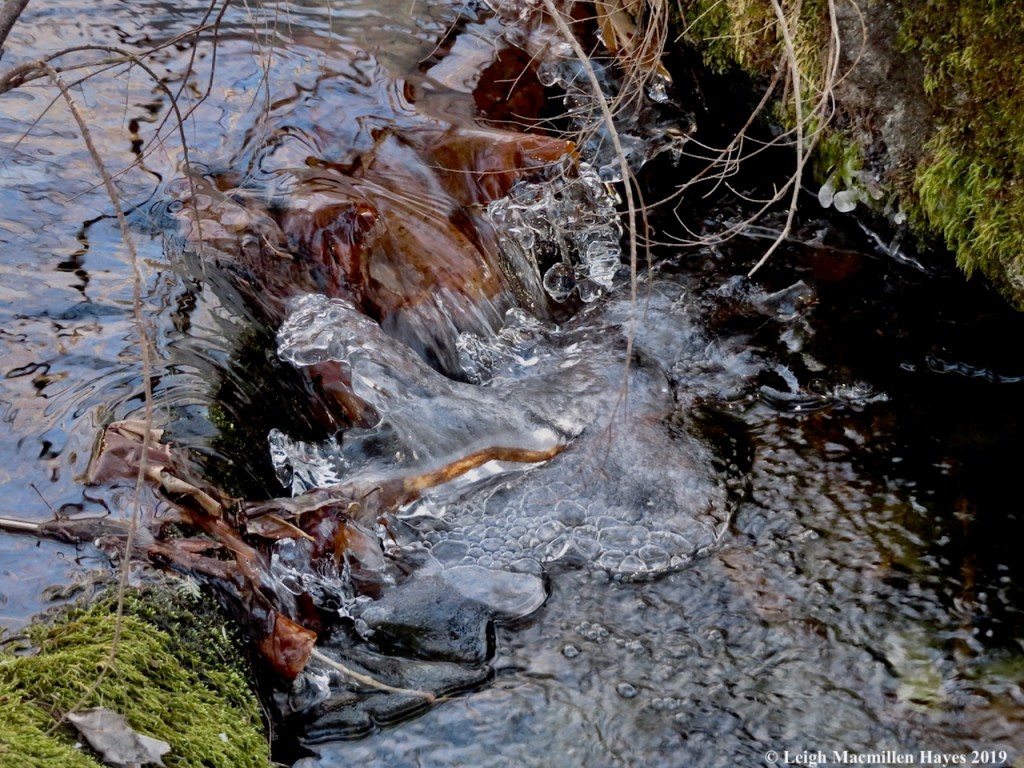
The water below offered a hint of every season as it flowed forth: summer’s blue sky, autumn’s dried leaves, winter’s clear ice, and spring’s fresh greens.

As we passed by the kiosk for Ron’s Loop on the way back to my truck, we gave thanks to the two men for which the trails were named: Tom Henderson and Ron Gestwicki. We were grateful for their leadership and the opportunity to continue to share the trail with them, especially on our Monday Date or Mondate.

Bear to Beer: Middle and Peaked Mountains

My guy opened his Christmas Bear to Beer box and considered the possibilities. The winner was . . .

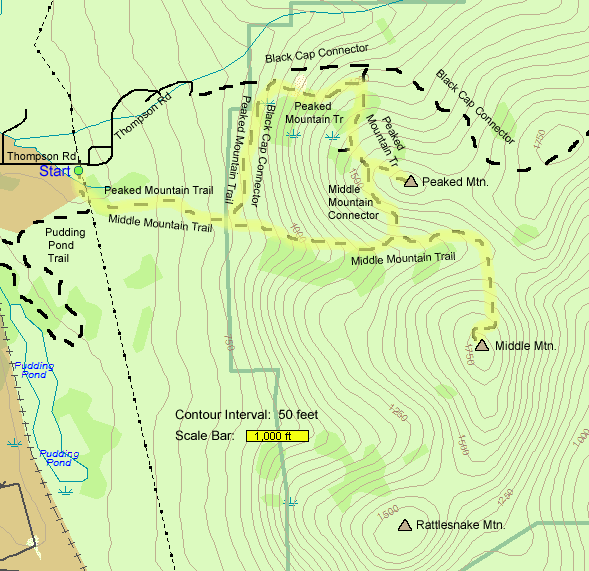
Middle to Peaked Mountains in North Conway, New Hampshire.

The day had dawned warm after the recent deep freeze and so we had to consider how to dress and what to use for footwear.

Given that our route would take us uphill as we ascended via the Middle Mountain Trail to Middle Mountain, retrace our steps to the connector before summiting Peaked Mountain and then follow the Peaked Mountain Trail down, we knew we needed to dress in layers, but not quite so many and not quite so heavy.

We also weren’t sure of our footwear until we arrived at the parking area and saw the well-packed trail. Our choice–micro-spikes over snowshoes. We only hoped that when we reached the intersection of the Middle Mountain Trail and the Connector Trail, we wouldn’t regret our decision. But time would tell.

In the meantime, after we climbed over the snowbanks to get to the trailhead, we had to conquer the gate. We’ve climbed Peaked in the past, as well as walked the Pudding Pond Trail, both part of the Green Hills Preserve, so we knew that typically one walks around the gate. Today, we merely stepped over it–which tells you something about the snow depth.

At .2 miles, the trail comes to a T. The right hand route leads to Pudding Pond, while the left requires a brook crossing before continuing on to the mountain trails.

A bit further along, we came to one set of several that denote the trail system. In terms of following it via the signs, trail blazes, and well worn path, it was easy. Given the soft snow conditions and contour, we’d rank it a moderate hike.

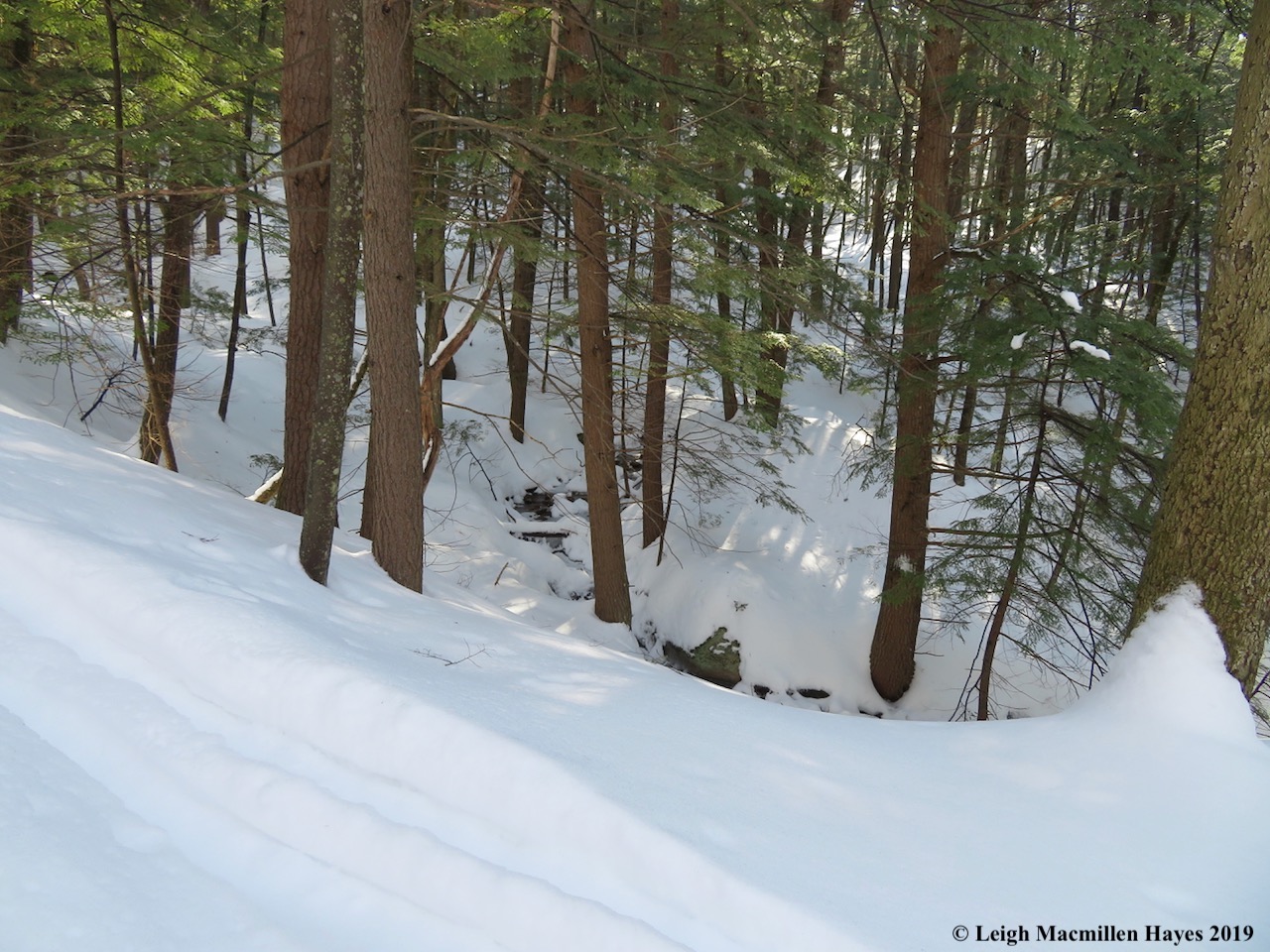
It was one that got the hearts pumping, which is always a good thing. And when one of us needed a rest, we pretended that we just wanted to admire the sound and sight of the gurgling brook.

We passed through a few natural communities, including hemlock groves, and mixed forest. But our focus was really on any beech trees and by the leaves that littered the path, we knew there were plenty.

We scanned the bark every time we spied a beech, and saw not a nail scrape anywhere. But . . . sad to say we did notice tarry spots which oozed out of the cracks in the bark caused by cankers a tree develops as a defensive attempt to ward off beech scale insects and the nectria pathogens that follow their entry points.

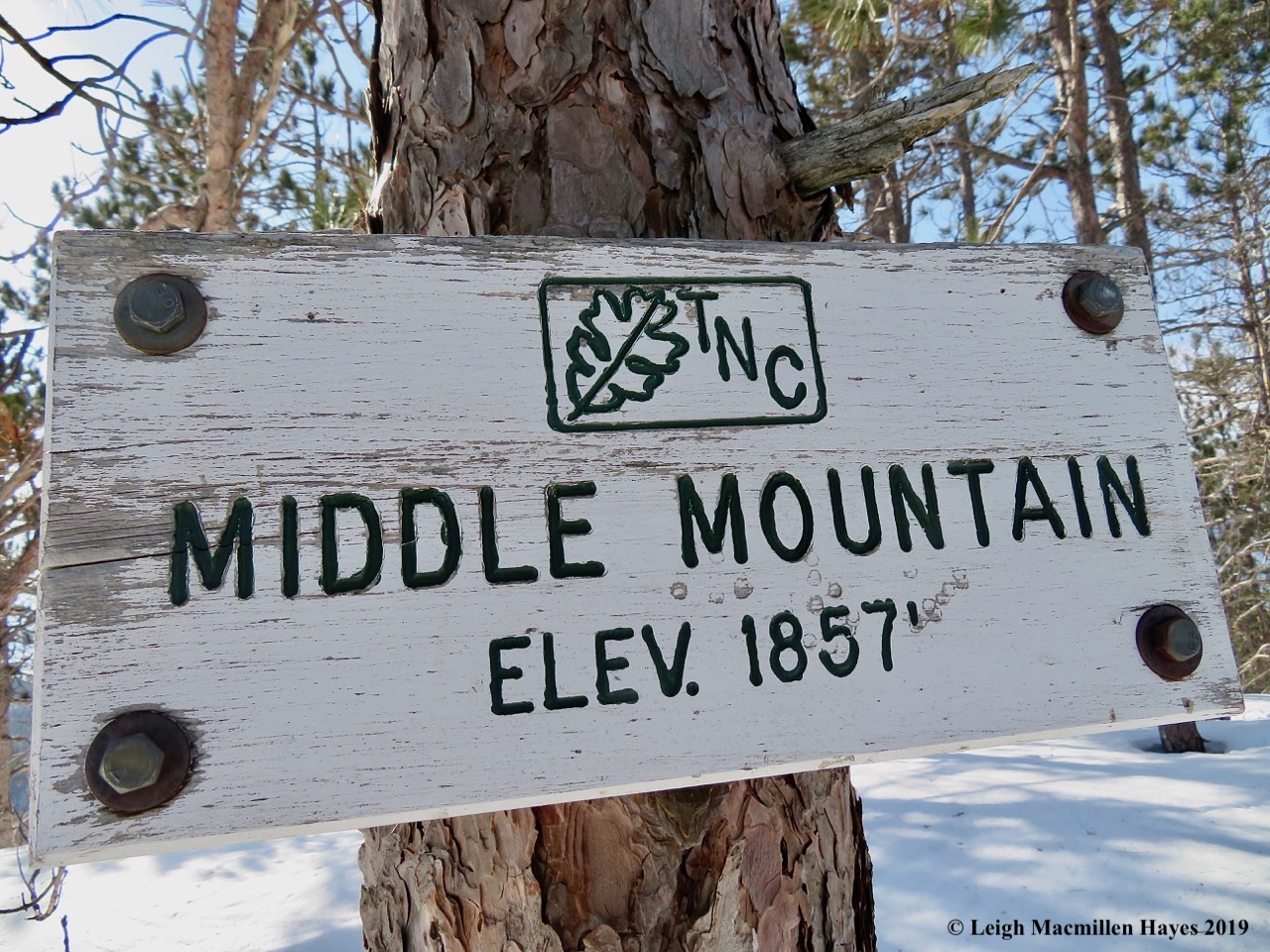
The community changed again as we approached the summit of Middle Mountain, where red pines dominated the scenery. And in the warm sun, the snow became softer.

Two miles and some sweat equity later, we’d shed some clothes and reached the top.

From there, my guy went in search of lunch rock and I eventually followed.

It was actually more of lunch ledge and we set up camp, using the jackets we weren’t wearing as our seating area.

The view beyond our feet included Conway Lake in the distance. Lunch consisted of chicken salad sandwiches made with our own cranberry orange relish offering a taste of day in the fen picking berries, a Lindt peppermint dark chocolate ball, and an orange, topped off with frequent sips of water.

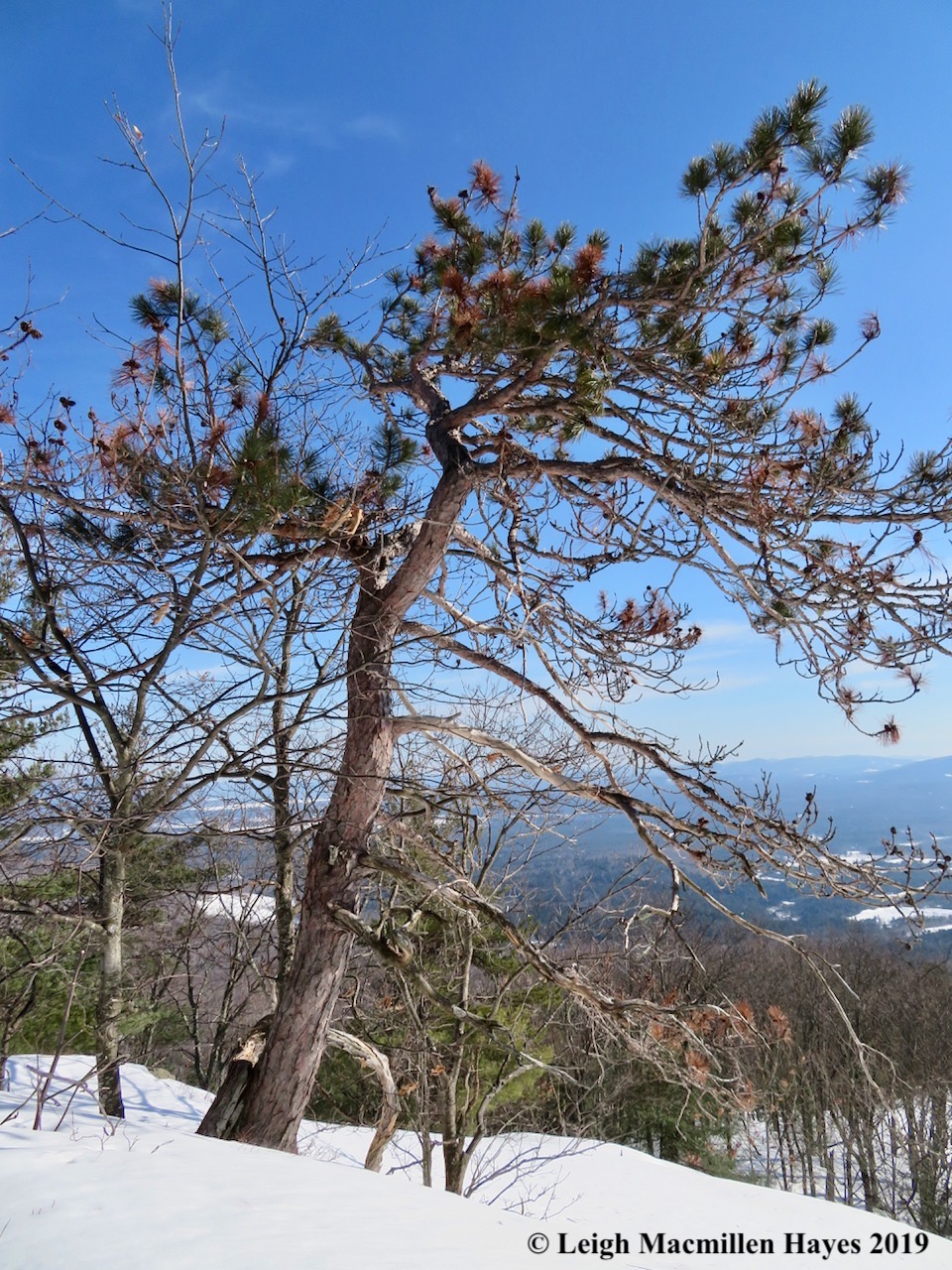
While we sat there, I did what I do. There were no beech trees to look at and so I focused in on the bonsai red pine in front of us. Its form, unlike its relatives who stood tall behind us, was the result of growing on the edge of the ledge where it took the brunt of the weather.

I took the liberty of turning a photo of a lower branch 90 degrees because I could see the face of the tree spirit reaching out as it formed a heart. It is February after all.

But enough of that. We were on a mission to find a bear paw tree. When I chose this trail, I had no idea if we’d see one. Yes, we’d climbed Peaked in the past, but never had we noticed any trees with such marks left behind.

So, down we slid, I mean climbed, off Middle Mountain until we reached the connector and could see Peaked’s summit in the background.

We weren’t too far along when our constant scanning paid off! Bingo. A bear paw tree. Some people bag peaks. We bag bear paw trees.

Our mission accomplished, though we continued to look, we journeyed on to the second summit.

From there, we had more of a view of North Conway below, the Moats forming the immediate backdrop, and Mount Chocorua behind.

In front of us, we looked across to Middle Mountain from whence we’d just come.

And behind, Cranmore Mountain Ski Area and Kearsarge North in the background.

With my telephoto lens I could pull in the fire tower atop Kearsarge. It’s among our favorite hiking destinations.

We didn’t stay atop Peaked as long as we had on Middle because the wind was picking up. On our journey down, the mountain views included Washington.

We continued to look for bear trees but found no others. That being said, there were plenty of beech trees on the Peaked Mountain Trail, but the sun was in our eyes for much of the journey, and we had to pay attention to where we placed our feet because traveling was a bit slippery given the soft snow. Maybe there were others after all, and we just didn’t notice.

We completed the 5.5 mile hike about four hours after beginning, ran a few errands, and finally found our way to the finish of today’s bear to beer possibility at the Sea Dog Brewing Company. Black bears like to sip too!

Amazing Race–Our Style: The Grand Finale

At last–the day we’d anxiously anticipated for the past month. Actually, for the past year.

I was sure the post-it note we found attached to the door would instruct us to drive to Lincoln, New Hampshire for a visit to the ice castle. My guy thought we’d find ourselves on a dogsled journey.

But no . . . either of those would have been too easy I suppose. Instead, we had to end this race in the same manner we had begun. Aboard a snowmobile. Egads! My least favorite mode of transportation.

To top it off, my guy’s two-seater is headed to the shop for some engine work. But his brother came through and lent us a machine so we were able to stay in the race. Our task was five-fold. 1. Ride through Sweden, Waterford, Lovell, Fryeburg and Bridgton; 2. Identify an interesting natural wonder; 3. Frame a picture; 4. Conquer the moguls; and 5. Pull the entire Amazing Race–our style together in a coherent order.

We started in the frigid morning air and no one else was about so we had Highland Lake and Stearns Pond to ourselves. Our journey took us whizzing across lakes and ponds, along open trails such as ITS 80 and 89, and through some narrow connecting pathways–or so they seemed to this untrained eye. I’d brought along my Trackards and the tracks were many, but all remained a blur.

You have to realize by now that for the two of us riding a snowmobile is like the tortoise meeting the hare–my desire to move slowly through the world met his need for speed. In the end, I did OK, and he went as slow as was safely possible, and even slower than that when he felt my knees nudge his back. But really, my teeth did chatter. Oh, maybe that was because of the temperature.

In Lovell, we got in line to gas up.

Funny things can happen when you’re standing around waiting for your turn at the pump. A nature moment presented itself in the form of a willow gall. Now I can’t wait to return to look at the willow blossoms in the spring.

From there, we made our way across to the Kezar River Reserve for the roadway had been groomed. Alas, at the kiosk, for some unknown reason, the groomer had backed up and headed out to Route 5, so we had to do the same. That wasn’t our only roadblock. We found our way onto a road that had previously served as the trail for a short bit, only to discover where road should have rejoined trail a house had been built. Again, we had to backtrack. Yikes. How would these affect our time?

We also noted historic sites as we cruised along, including the old Evan Homestead in Sweden, the Brick Church in Lovell, and Hemlock Covered Bridge in Fryeburg, which served as our lunch stop at 2pm.

It was there that I found the photo to frame for challenge three–the mixed forest reflected in the Old Course of the Saco as taken through a bridge window.

And then, after the bridge, we meet our fourth challenge: the moguls. For at least two miles, maybe more, between Hemlock Bridge Road and Knights Hill Road, we bounced up and down as if we were riding a bucking Bronco. Truly, I spent more time in the air than on the seat and each time I landed, it was with a thump. I was certain I’d fall off or at least my body would be flying behind the sled while I’d still be attached–via the vice grip I had on the backseat handlebars. Talk about white knuckles. Oh wait, maybe that was from being cold.

Somehow, we survived . . . and so did our relationship.

As for the other contestants, we weren’t sure where they were because as it turned out there were many riders out there and they all looked the same! Well, maybe they had their idiosyncrasies and I wasn’t paying attention to the little details of jacket and helmet color and design, but I’d much rather look at tree bark, mammal tracks, and winter weeds this time of year than people apparel.

Soon after the moguls, it was time for the last task. We encountered a display of twelve photographs; each represented a moment of wonder we’d encountered during the race and one of us had to place them in order from start to finish.

My guy had done all the driving and maneuvered us successfully through the mogul course (I didn’t fall off, remember) so it was my turn to complete this final challenge.

Episode one: The elephant face we discovered along the Narrow Gauge Trail.

Episode two: A rainbow in the Harpswell sea mist.

Episode three: The exotic kissing pigeons with heart-shaped white cere on their bills.

Episode four: The gallery of midnight artists at the Battery on Peaks Island.

Episode five: A Crimson-ringed Whiteface Dragonfly beside Shingle Pond on the Weeks Brook Trail.

Episode six: A sand collar in Clinton, Connecticut. While it felt like sand paper above and was smooth below, it was actually a mass of snail eggs.

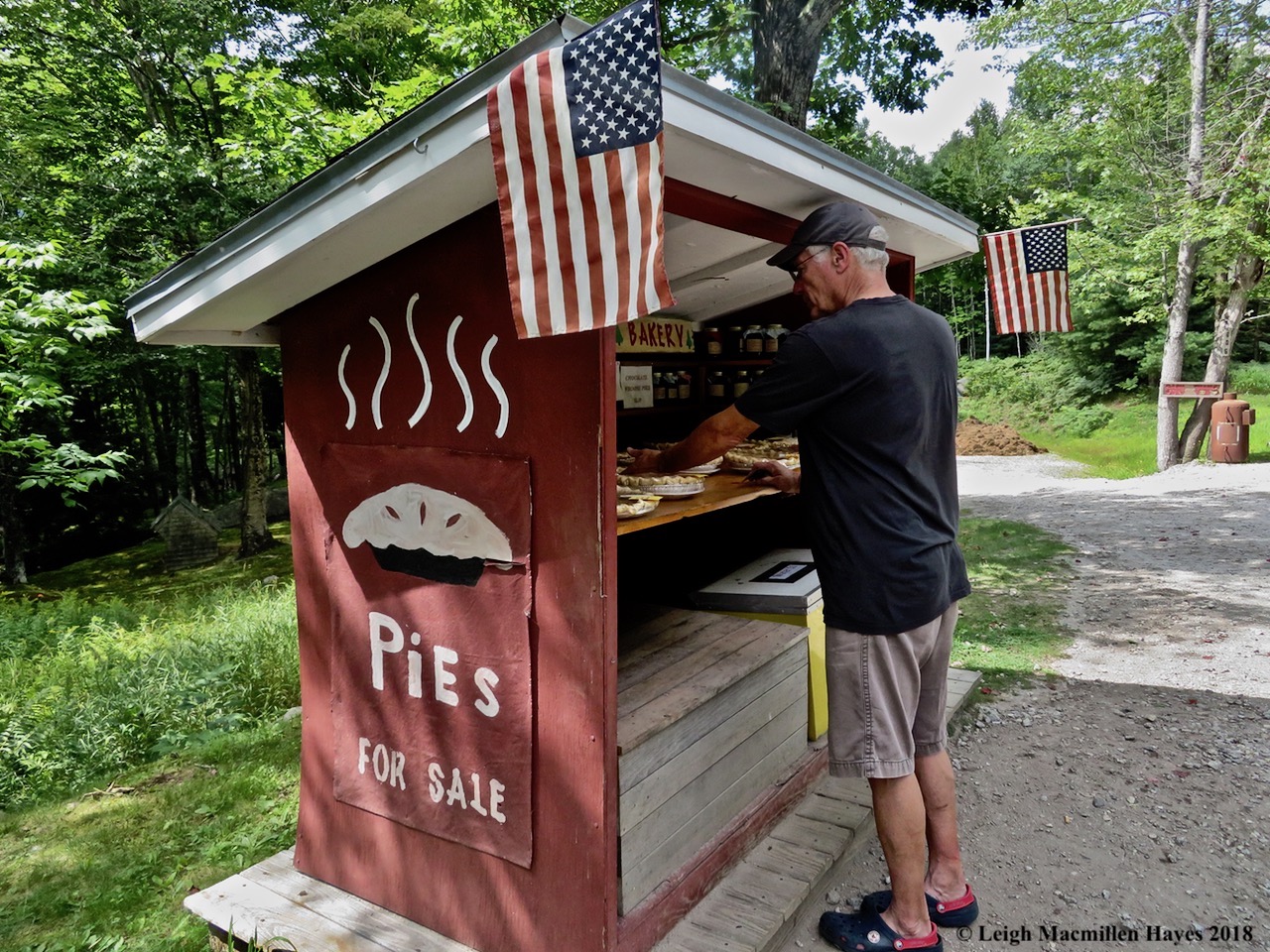
Episode seven: After climbing Table Rock, a couple paid for our pie at this roadside stand and so we did the same for the next vehicle that pulled up.

Episode eight: The 1930 122 ft. steel-hulled yacht Atlantide, that served in WWII and was featured in Dunkirk.

Episode nine: (possibly one of our favorites) The cribbage board in the two seater below Piazza Rock on Saddleback Mountain.

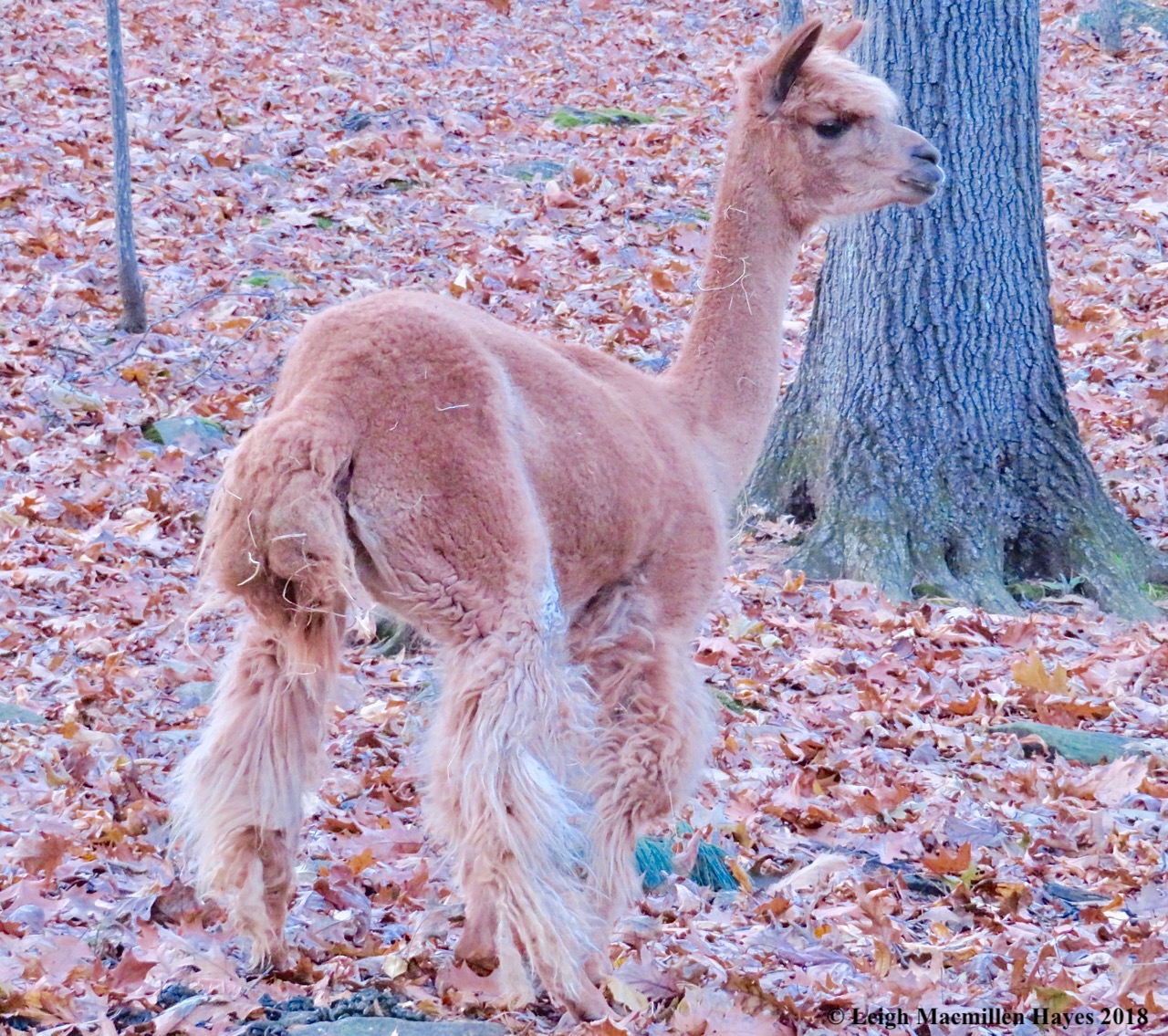
Episode ten: An alpaca at America’s Stonehedge in Salem, New Hampshire.

Episode eleven: Finding an H to represent us while looking for decorated trees in the Maine Christmas Tree Scavenger Hunt.

Episode twelve: The final episode and another framed photo of the Old Course of the Saco from Hemlock Bridge.

Phew. I was pretty certain I had them all correct. And so on to the mat we drove, arriving at 3:36pm. And then as we stepped off the sled we discovered that we’d lost our backpack somewhere on the trail. The only item of any value in it was my cell phone.

We were concerned about that, but also found out that without the pack we couldn’t cross the finish line. So, we made a quick decision because we needed to be done by 5pm. I hopped off the sled and my guy took off in a spray of snow to search. We were sure it had fallen off near the moguls. Apparently, along the way he questioned people and learned that someone (thank you whomever you are) had hung the pack on a tree. Over the moguls he went, but to no avail. He was in a dip on his way back to the covered bridge when he spied it. Wowza.

At 4:41pm he pulled up to the mat.

And we crossed it together–As. The. Winners. YES, we WON!

But, of course, we won. For if you have followed us from the start then you’ll remember that in episode one I wrote: I created a Valentine’s gift for my guy–our very own Amazing Race. My rationale was that we enjoy the show, but know that while there are certain stunts one or both of us could handle with ease, there are others that would certainly cause us to be last to the mat–and lose. So, why not create an Amazing Race that we have a 99.9% chance of winning. If we lose, we’re in big trouble.

I do feel bad that I fibbed to some of you, but you got caught up in the challenge and I didn’t want to let you down. Some of you asked me about it and I have a terrible poker face so I was sure you’d figure it out. In the spirit of it all, I was glad that you didn’t. That added to our fun.

And all of the characters–they were real people we met along the way. Team Budz in episode six was my sister and brother-in-law. Team Purple was a hearing-impaired woman full of moxie we met during episode eight in Camden. She hiked in sandals and had spent the previous month camping solo. The others we named for their attitudes, hometowns or some other attribute. I don’t know if you noticed, but we began the journey as Team Wonder, which I probably only mentioned once, but by episode eleven I’d forgotten that and called us Team Hazy–thus the H to represent us. Ahhhh.

Of course, my mom always washed my mouth out with soap when I fibbed, so if you want to do the same, I can’t say I blame you.
Thank you all for following us on this adventure. We’ve had fun looking forward to and participating in a variety of adventures. Though I’d given my guy a list of locales for each month, I didn’t know what the various additional challenges would be until they presented themselves.
Today’s activity was supposed to be a dogsled ride in January. But, the weather gods and price gods weren’t on our side and when the weather didn’t cooperate on his days off we chose not to spend the money. An alternative was the ice castle, but we’ve done that before and were too late in trying to purchase tickets this year, so . . . why not end as we began. On a snowmobile journey. The third of my lifetime and longest one yet. We spent over five hours on the sled. Well, my guy spent even one more hour. And now we’re snug at home and sipping some Bailey’s Irish Creme before we tune in to British comedies and fall asleep on the couch.

The Amazing Race–Our Style has come to an end. Thanks for tuning in. We had fun and hope you did too.

Porcupine: Down Low, Up High

While the ground hog won’t see his shadow in Maine tomorrow because he’s a true hibernator, his rodent cousin the porcupine may have to serve as a stand in. And ’round these parts, there are plenty of stand ins available.

A couple of friends and I searched for one today. We had barely begun tramping when we recognized its telltale sign of discolored snow.

Truth be told, we knew the porcupine lived there, but weren’t sure how this past week’s snow storm had affected it. And so we journeyed closer to take a better look. The hole is actually an old bank burrow that had once belonged to a beaver. Porcupines are known to take advantage of such if it’s high and dry.

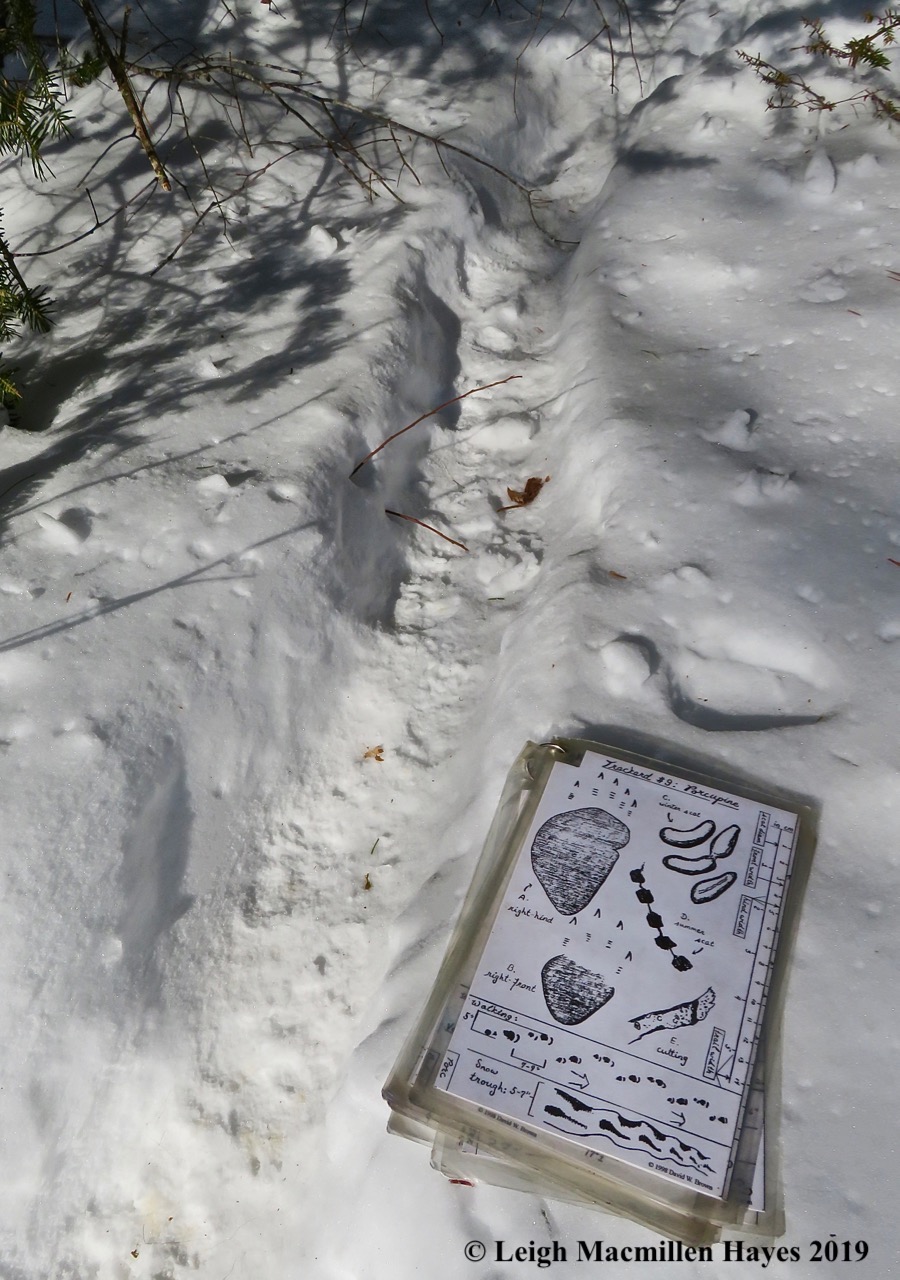
One of the things that always grabs my attention is the action of the animal as evidenced by its means of entry and departure. Standing there, I could envision it emerging from the hole, using its long claws to get a grip, turning to the left and then swaying to the right. The waddling motion of its hair and quill covered body adds a dimension to the story for if you look carefully you’ll see the wavy impression left behind.

Because its a frequent traveler from den to preferred trees, the entire body, that weighs anywhere from seven to forty pounds, can form quite a trough. Typically the trough is up to nine inches wide in the snow. Within those we saw today, recently cast prints showed the bumpy bottom surface of the foot pad and the five nail marks that extended across the front.

The mammal’s identification was further enhanced by other evidence–quills. The hollow structures were tipped with black barbs. Paul Rezendes, in his book Tracking and the Art of Seeing, states that “the porcupine’s scientific name [Erethizon dorsatum] can be loosely translated as ‘the animal with the irritating back.'” Indeed, many domesticate dogs and their owners would agree with that description.

Because we were on our hands and knees looking, we also noticed soft, wavy hair on the snow. A porcupine’s body is covered with at least 30,000 quills on its back, shoulders and the upper surface of its tail, but it’s not only those large stiff hairs that complete the animal’s coat. Their fur also includes fine hair found on the face, belly, and insides of its legs. In deep snow it’s easy to find the delicate hairs within the trough. Oh, and do you see the little yellow birch seed that looks like a teeny, tiny, brown insect?

We followed one of several troughs that led from the hole and kept looking up into the hemlocks in search of the critter. We never saw it, but we did see some recently nipped branches dangling from above.

Our search led us to a second hole that we’ve watched transform over the last couple of months. And again, we could see the action of the animal as portrayed in its journey.

We wondered about the tunnel from the wider opening in the woods to the smaller opening at the brook bank. Though both had seen recent action, we didn’t see any major amount of scat, which was a surprise. Then again, we didn’t climb in and search further. Perhaps it had moved toward the center of the tunnel during the storm.

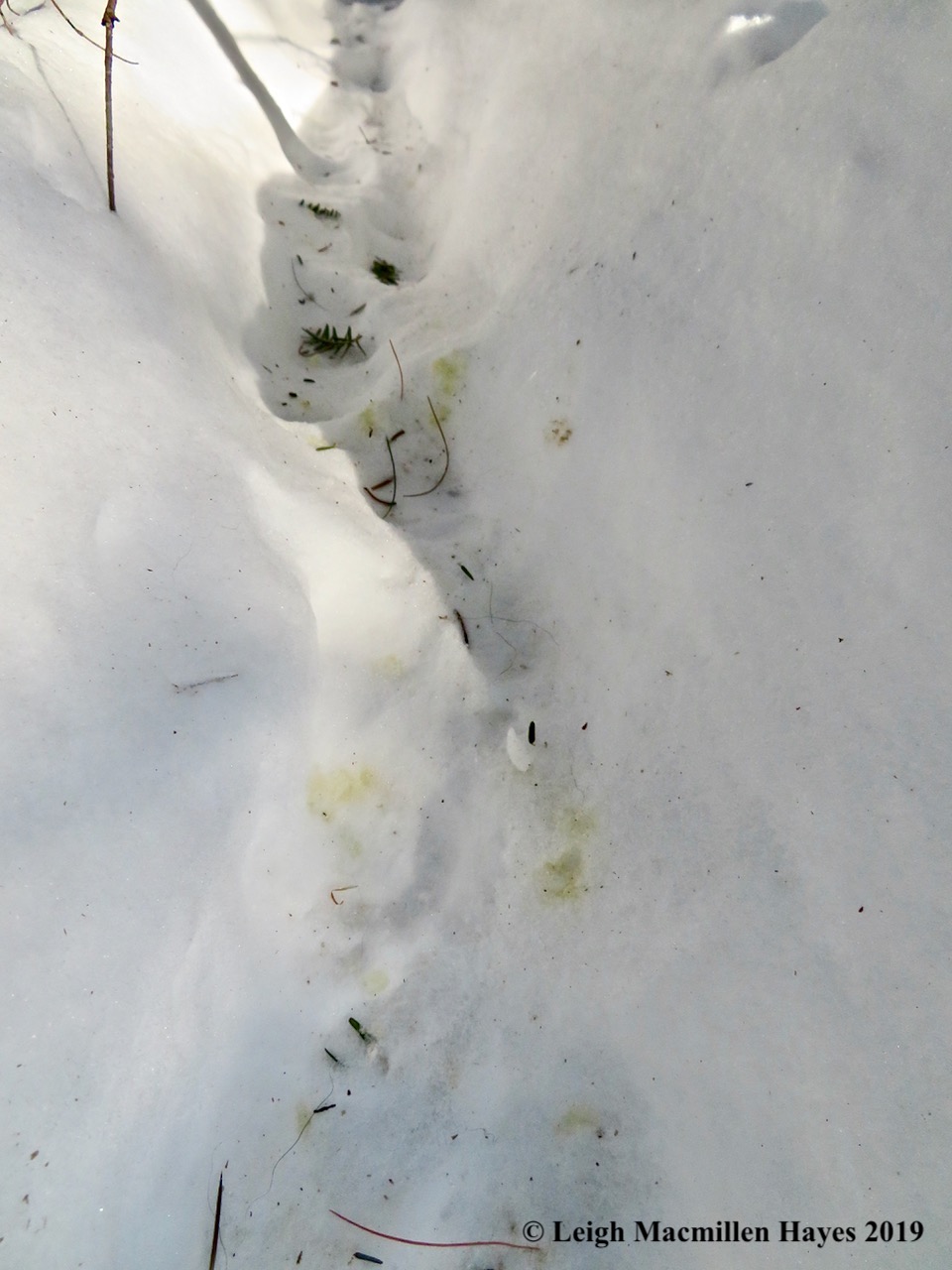
Another sign of porcupine’s activity was the dribble of urine that marked the trail. That made me realize that I often refer to them as the pigpens of the woods for they scat and urinate with abandon, but . . . all mammals pee, some with more purpose than others.

We followed the porcupine’s pathways for a bit and noted that they led to the nearby hemlocks and beyond.

But as often happens, we were distracted and stepped back out onto the brook where we followed deer tracks for a while.

Eventually, our curiosity about the porcupine gave us a reason to get out of the wind and we headed back into the woods, where we soon discovered another one of its trails. Curiously, the porky had ventured out toward the frozen, snow-covered brook, but turned and retraced its steps. Why?

Perhaps it smelled a coyote in the area. A porcupine has poor eyesight, but an excellent sense of smell. And coyotes will go after a porcupine, but they prefers other food sources. Fishers are the porcupines least favorite predator. A fisher will grab the porcupine by the nose. Once it dies, the fisher will flip it and expose the stomach. Remember that the stomach is covered with that soft wavy hair–and therefore unprotected.

The coyote didn’t appear to go near the porcupine. Our porcupine study, however, led us to what was probably a bear bait barrel. With no bears to worry about at this time of year, the barrel had been repurposed as evidenced by the tracks that led into and out of it.

And the pile of comma-shaped scat within. Was this where our porcupine weathered out the latest storm? It certainly got me thinking about those two holes to the beaver burrow and how the porcupine must have had to plow the snow out with its body. The barrel was a much better choice. And with the scat as an insulator, what a great place to wait out a winter storm.

Not far away, but perhaps with more luxurious digs, either a mate, or relative had apparently set up home under a barn.

While the porcupine by the brook traveled between an underground tunnel and a barrel buried in the snow, the one up the road preferred the high road. Wouldn’t you like to be there to witness its journey? I know I would.

Porcupine: down low, up high–worth a wandering wonder.

Intrepid Travelers

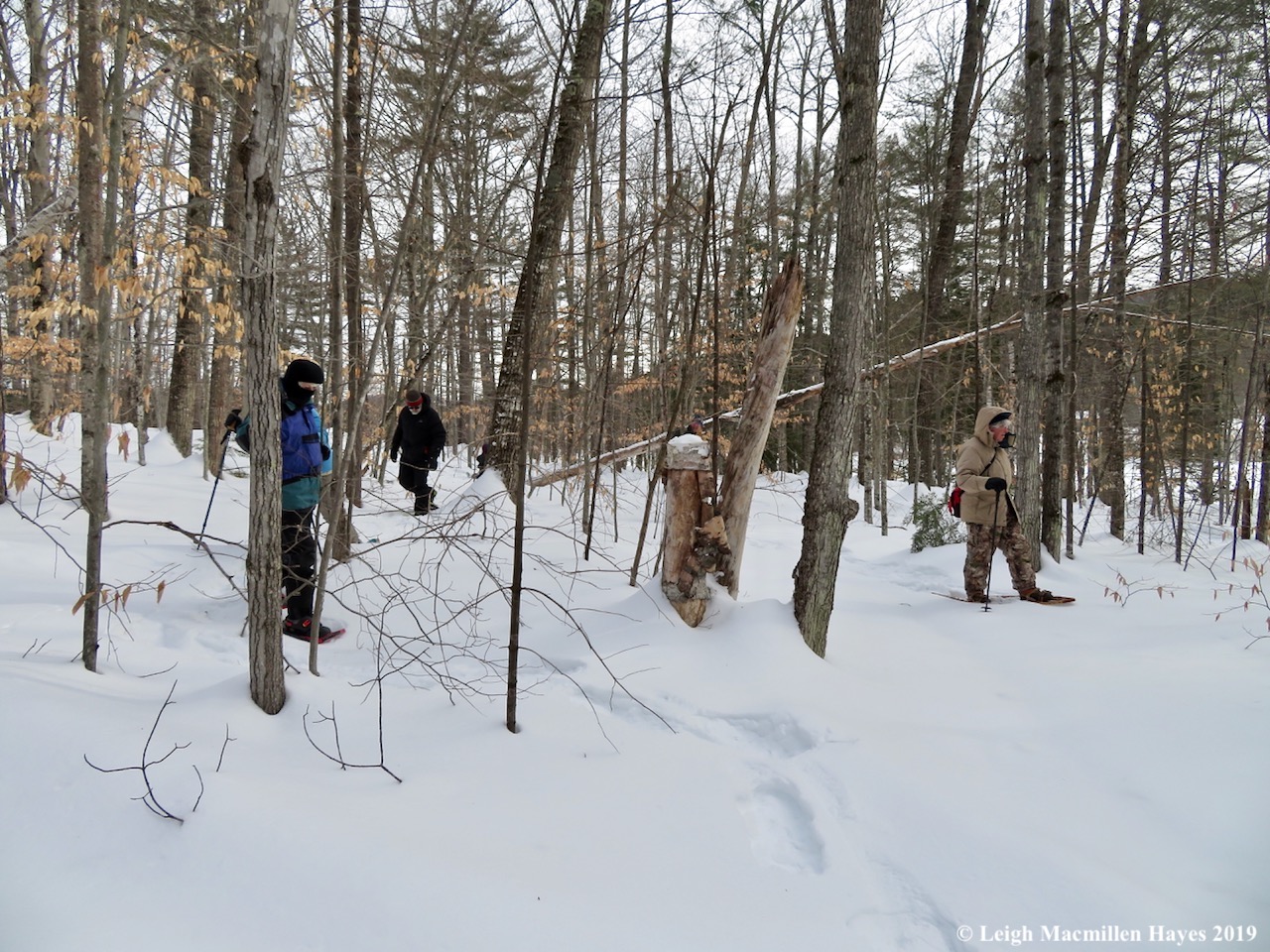
When we gathered at the Greater Lovell Land Trust’s Fairburn parking lot on Slab City Road at 9:30 this morning, the thermometer registered 4˚. But the good news–no wind. And . . . the six Tuesday Trackers who decided to join me and brave the elements were dressed for the occasion.

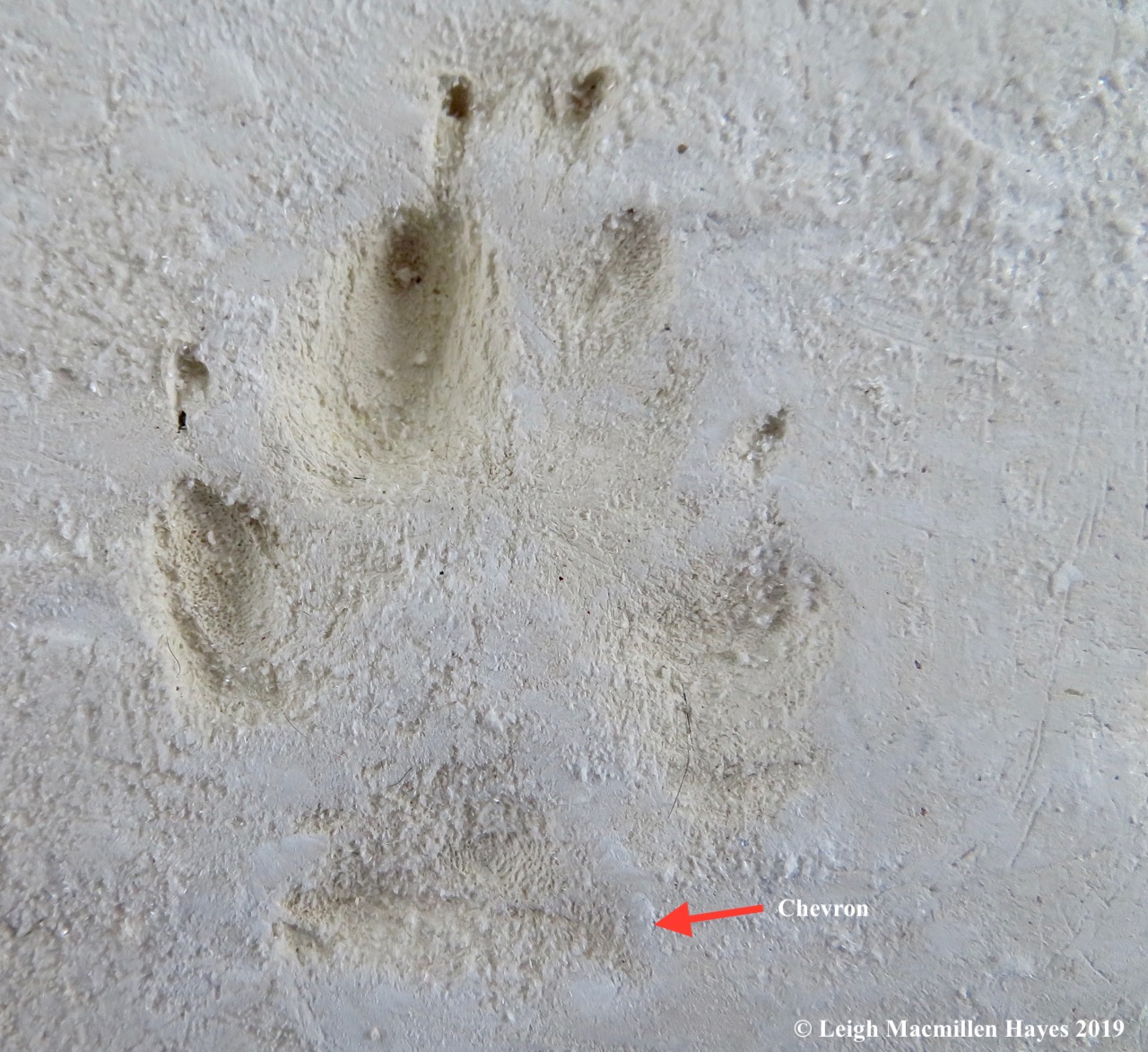
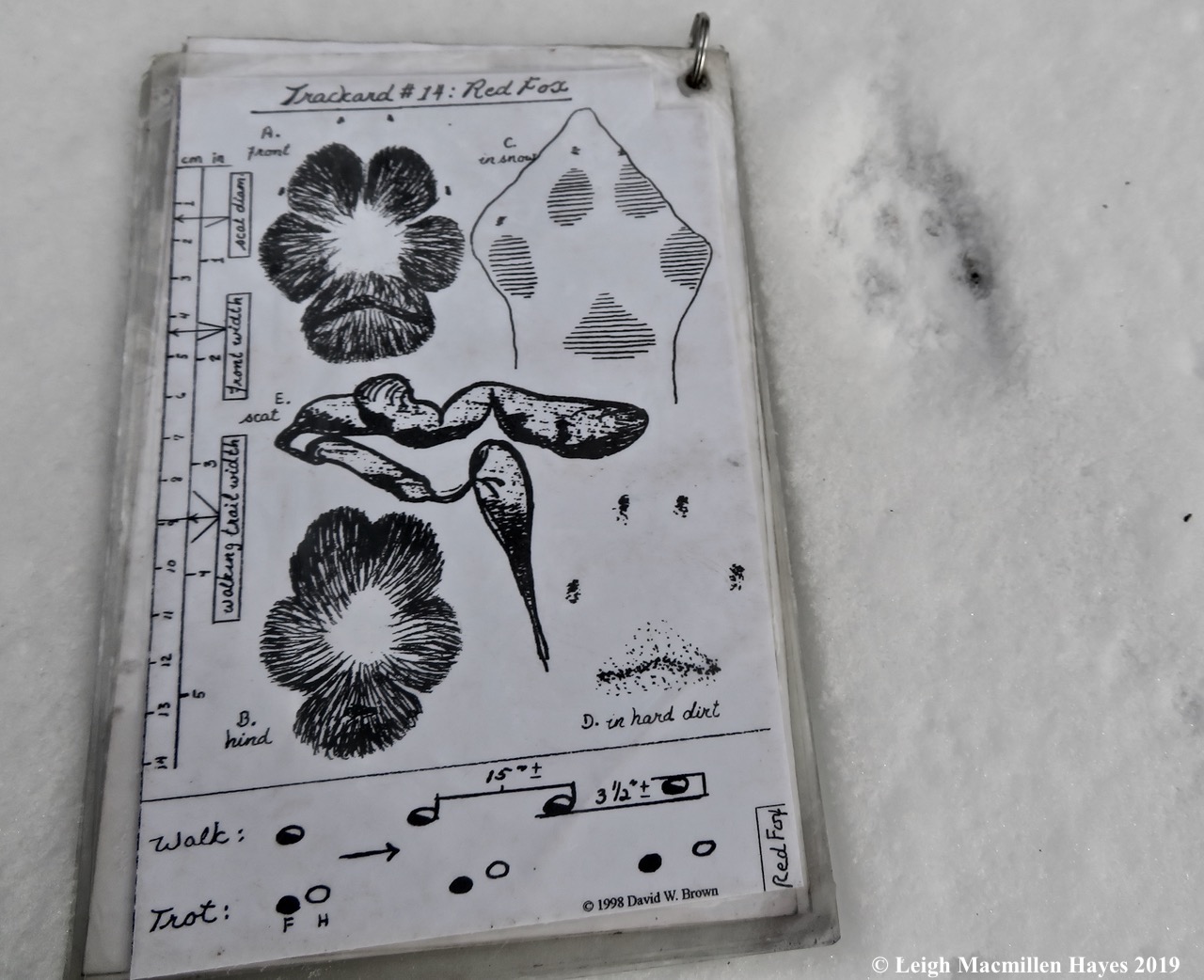
First though, it seemed I wanted to test their endurance so we circled up for a few minutes and they used mirrors to see how a deer might see (and I should have taken a photo, but didn’t) and then I shared some casts I’d made of track prints. This one was a red fox and not only was the hair a bit visible, but so was the shape of a chevron, which some see as a boomerang in the heel pad of the front foot. I should note that this particular cast was made from a road kill specimen, so the toes and nails aren’t exactly as close together as they typically would be, especially on a cold morning in January.

The next cast to view–a coyote in mud. I love this one because it demonstrates the direct registration of a back foot stepping into the impression made by the front foot. And the X we always associate with the canines, including Eastern coyotes, red and gray foxes, was visible. Notice the parallel toes close together and nails that point inward–all for the sake of retaining heat.

And finally in this morning’s demonstration, a bobcat cast with more of a C shape between the toes and heel pad.

At last we walked down the road to the trailhead for the Heald and Bradley Ponds Reserve.

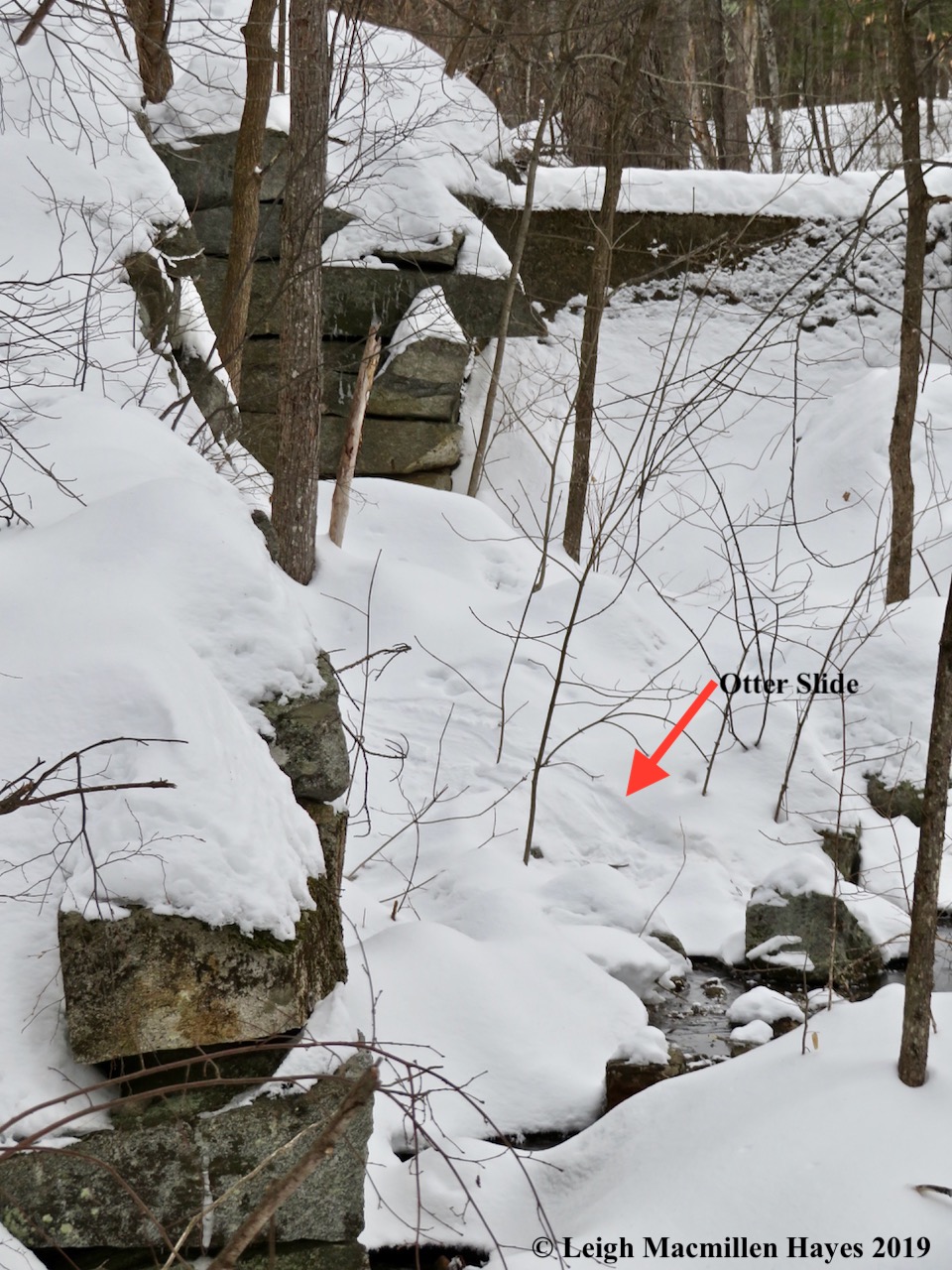
I chose this trail for today’s adventure because I had a feeling we might see what we saw–an otter slide! It’s a rare winter day when such activity isn’t visible there.

I was thrilled to note that a few people had beat us to the sight and observed the same. As we stood above the dam, we spied where the otter had come up out of the water, made its way around several trees . . .

then slide down into Mill Brook below. By the tracks and impressions in the trail we could envision his motion. And if folks had wanted to quit then, it would have been okay because we’d been so honored already.

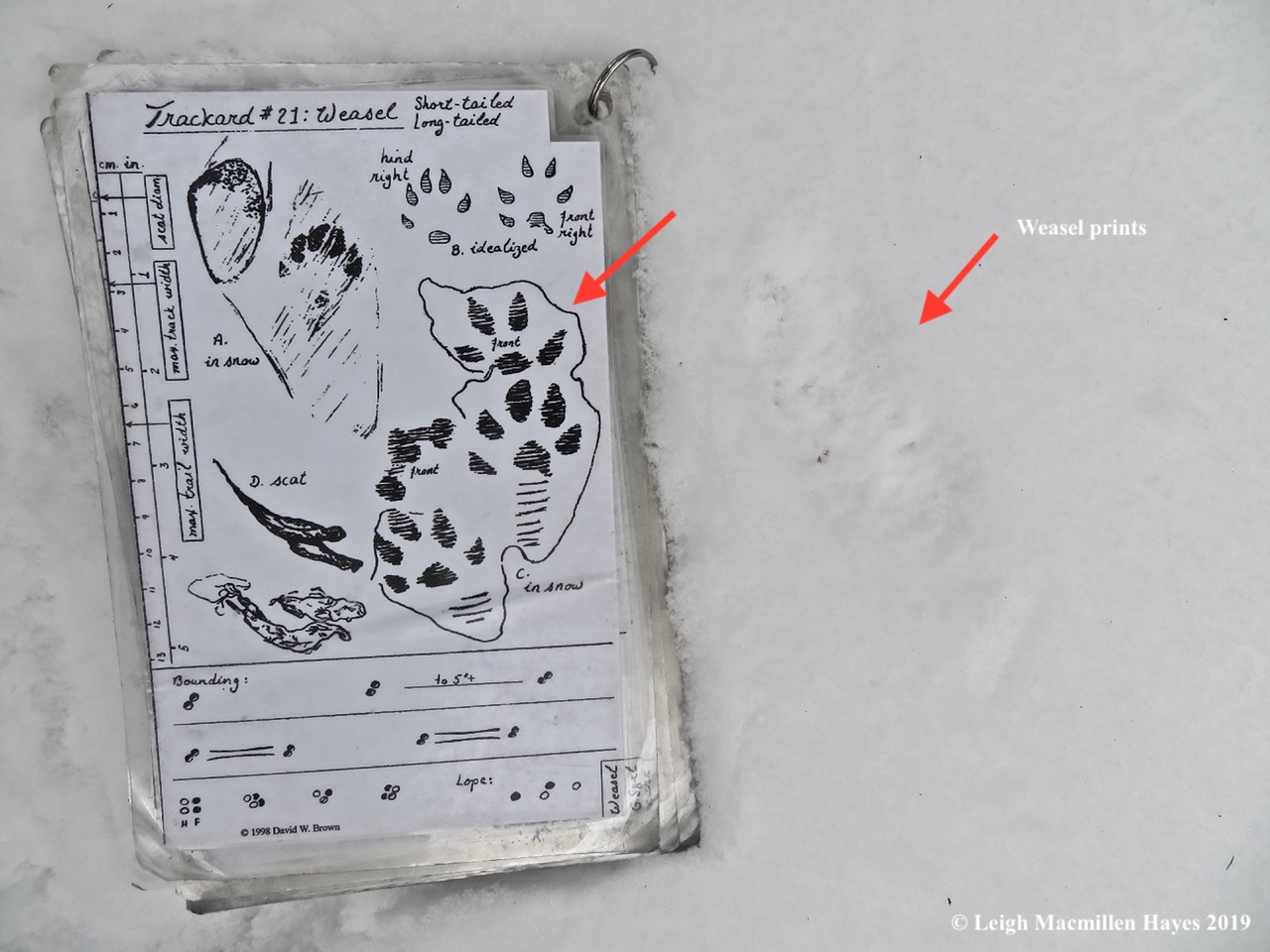
But they are a hardy group and right near the otter slide, prints of another were noted and based on their wee size and the diagonal angle of their presentation we knew we were looking at the track of either an ermine or long-tailed weasel. It’s difficult to tell the difference between the two by the print size. But the cool thing was that though they appear light in the photograph, the prints that we saw were a mirror image of what David Brown drew on his Trackards. (I think I should get a commission for promoting his cards, but really, they are the best.)

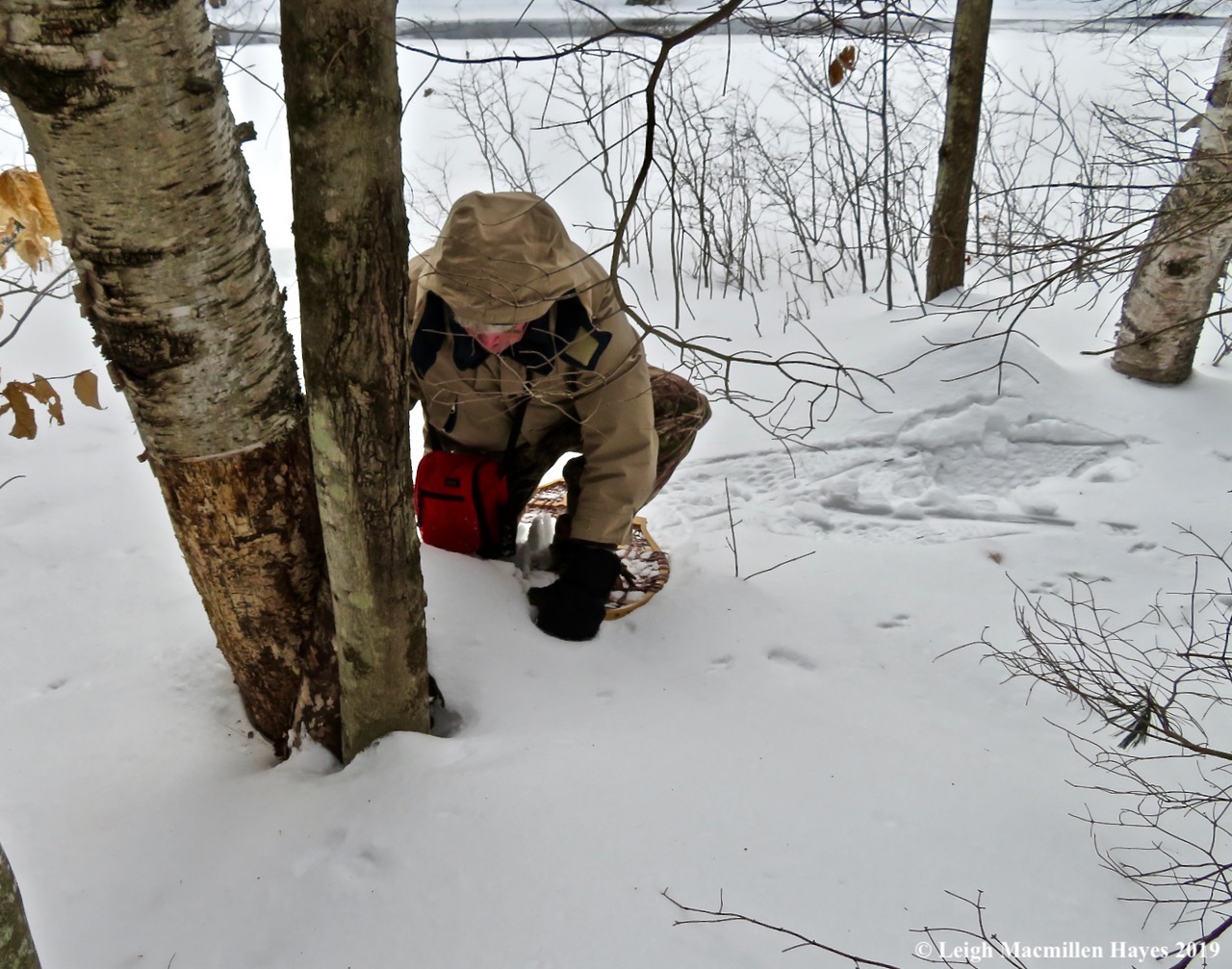
Following the weasel prints, Tom found a hole by a tree and got down to check on any activity within. His report came with a grin: “It’s deep.” Was the weasel successful in finding a meal? We don’t know. But we do know that it’s typical of them to check out every little hole and make some of their own.

Continuing our journey, we’d hardly gone far from the dam when we happened upon another creator of fine tracks. Bingo! A red fox by its shape, size, and chevron.

And then. And then we found prints left behind by a mink, their size a bit larger than the weasel. By now, we were in seventh heaven. Or so we thought. For there was more.

I’d just said to one of the group that we’d seen otter, weasel and mink–all members of the Mustelid family. It was due time for a fisher . . . and what to our wondering eyes should appear?

Tell-tale prints left behind by a fisher that had loped through the woods. Do you see the five tear-drop shaped toes?

Being good trackers, we decided to back track it, for one shouldn’t follow an animal and put stress on it. And so we headed toward the pond.

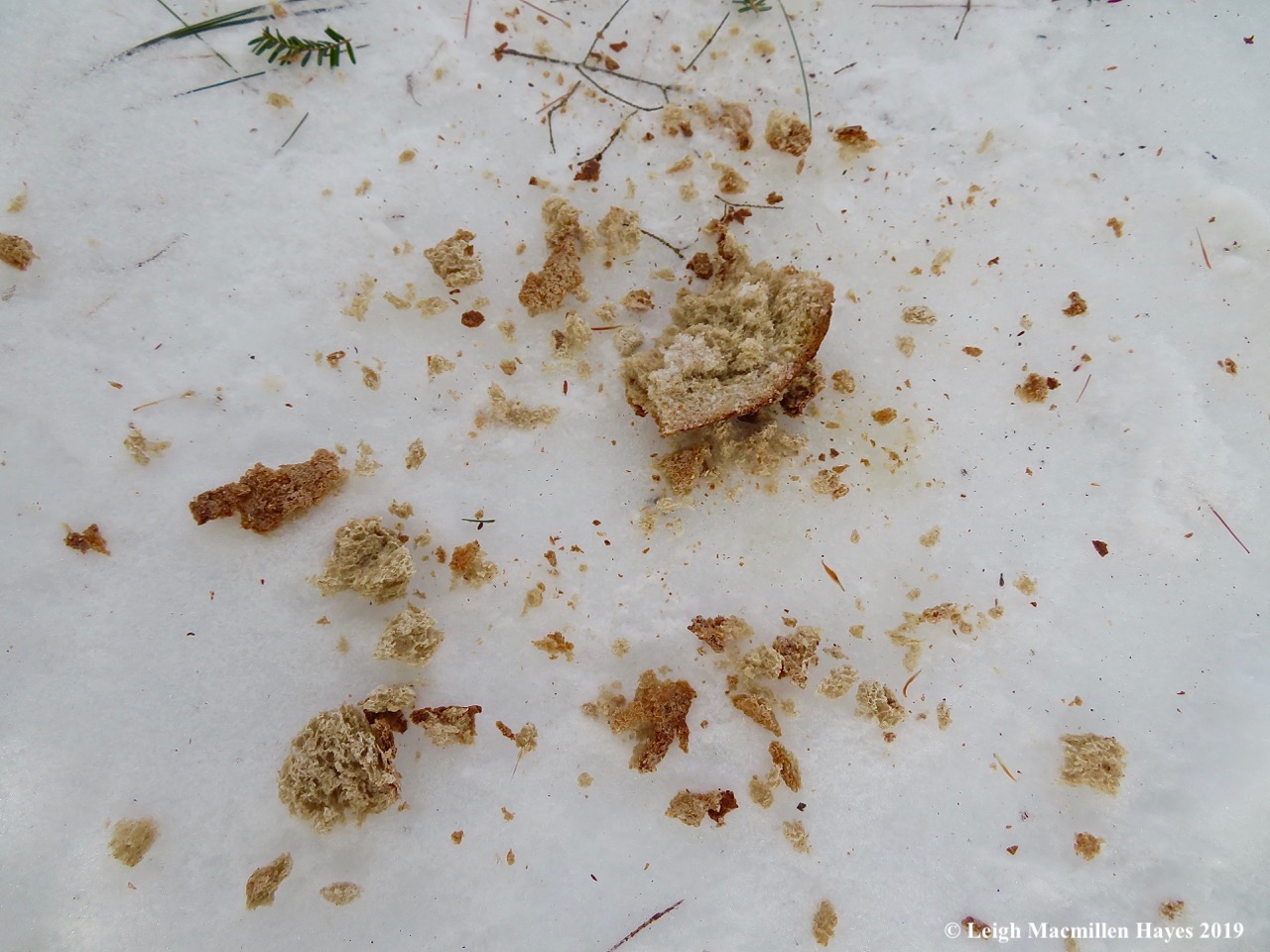
One in our group had gone ahead and under a hemlock Heinrich discovered a meal partially eaten. The fisher prints led directly to and from it. A mushroom? That was my first thought until I took off my mitten and played with it. A roll? Whole wheat? Had the fisher stopped at Burger King or raided someone’s ice fishing party? Did he eat the meat and discard the roll? Not into whole wheat? Certainly he prefers a gluten-free diet.

Behind the hemlock, we followed his tracks and noted a spot where he’d sat and fussed about for a bit. Was this his lunch site? If so, he’d at least not left any wrappers behind.

As the morning went on, one set of tracks led us to those made by another and near the fisher we found more red fox impressions.

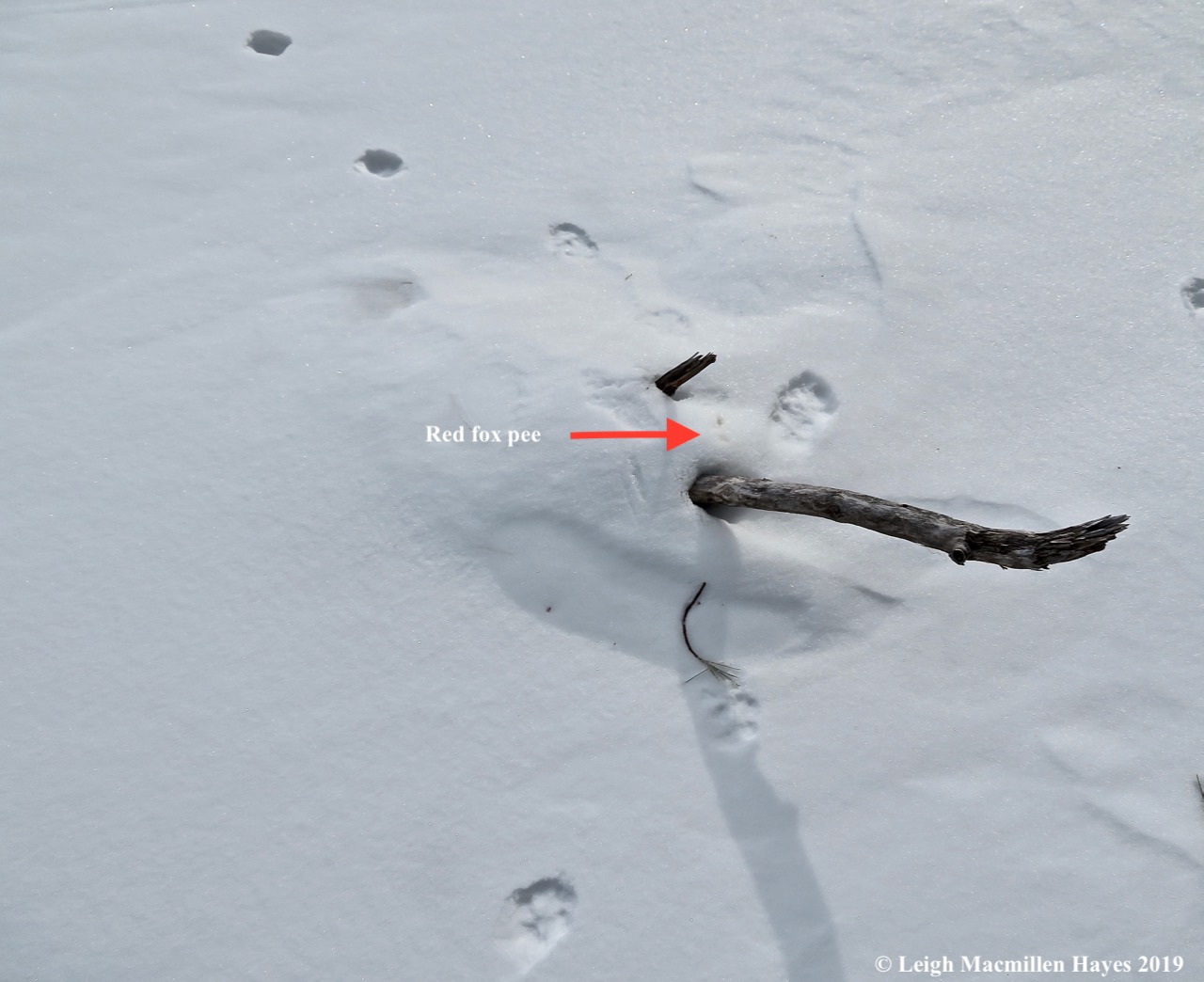
Astute eyes for we’re all so trained, also noted a dash of pee by a broken branch. Typical red fox behavior, especially given that this is mating season. But . . . in the air we couldn’t smell that delightfully skunky scent we associate with fox pee.

That is . . . until Pam got down. It was not as strong as we sometimes notice so we wondered if it was because of the cold air.

Despite that, Tuesday Tracker initiation involves getting down on all fours like Bob did. . .

and sniffing just like Paula. Come on–you know you want to join us and gain some bragging rights.

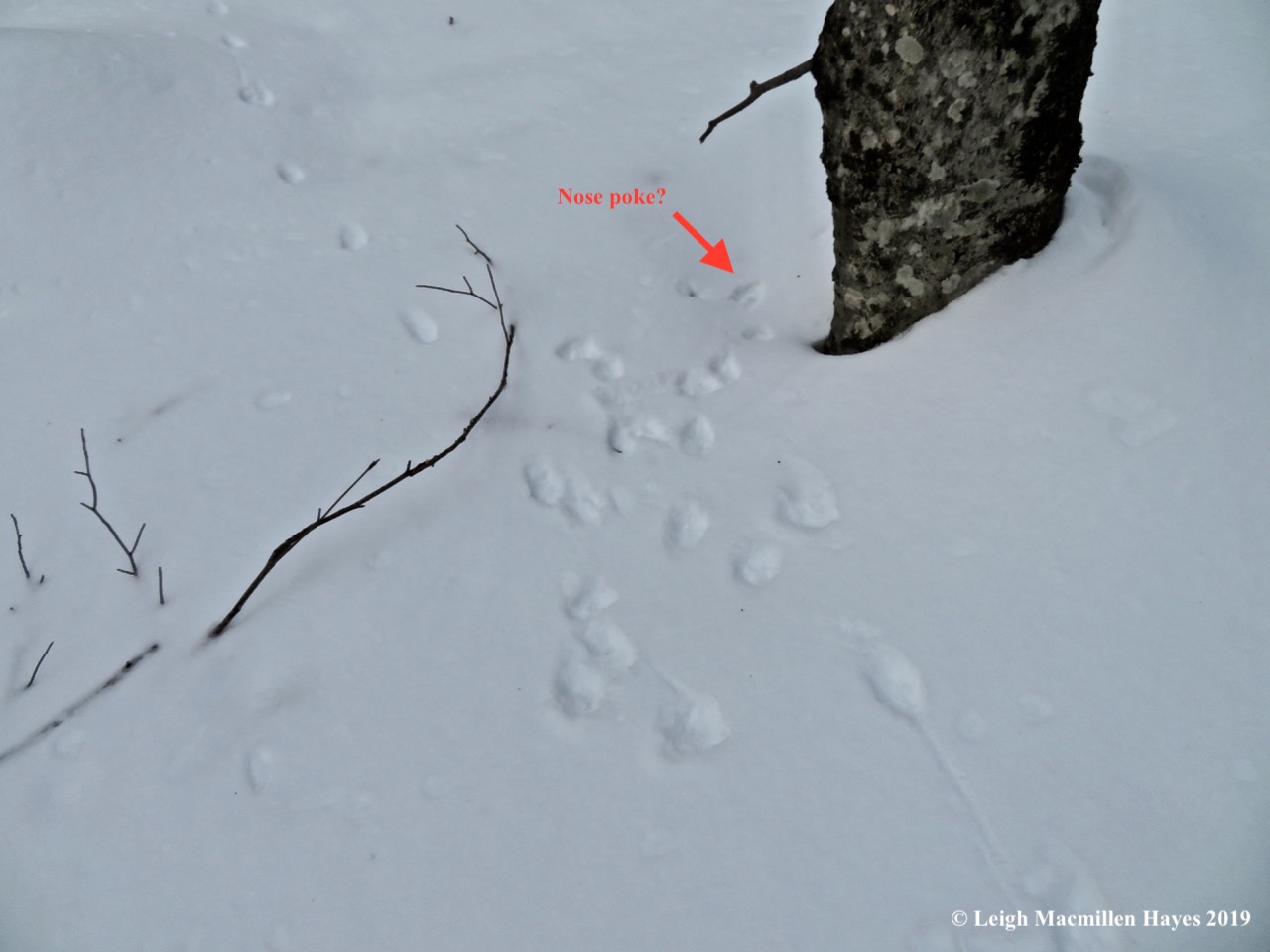
We decided to follow the fox for a while doing what we shouldn’t have done as we followed its forward motion rather than back, but suspected it was long out of range. We weren’t sure if it was one or a pair. At a tree, rather than pee, it or they seemed to dance around and possibly poke a nose into the snow. By now, the cold could have been getting to us and we were making up the story we read on the powdery page.

Eventually we did come to two sets of fox tracks and split our group in half, each following one set to see if they’d intersect again.

Well, the fox tracks led us back to the fisher and suddenly to the snowmobile trail. We saw that the fisher had headed up hill and thought we might spy it again if we followed the trail that leads toward Whiting Hill, so up we did climb. In no time at all, we found a pattern left behind by a little brown thing (LBT by tracking standards) and knew it was either a deer mouse or white-footed mouse out on a risky mission in search of seeds.

Next, a snowshoe hare had crossed the trail and we recognized it by its snow lobster shape. If you look at the second set of prints in this photograph, you’ll note that the animal was moving toward me and the two larger prints in the front were of its hind feet which had wrapped around and landed as the two smaller front feet leaped forward. Thus the overall impression looks like a lobster–at least in our minds.

Just beyond the hare, we met what we’d been looking for, the fisher. And then on a stone wall, Paula discovered two holes where it must have dug down looking for a meal. Was it successful? We so wanted a kill site to know what the critters had been eating, but saw no signs of blood or hair or bones or carcasses.

What we did see–a dribble of fisher pee that Pam checked out.

In the midst of fisher tracking, we came upon intersections, including one of a coyote and red fox. What kept us guessing was the apparent foot drag of the coyote. Was some of it tail drag? The snow under the powder was quite crusty so most of the fresh prints we found today didn’t require the mammals to break through the snow. But . . . had this coyote injured a foot on a previous journey when it was breaking through?

As the morning went on, the Trackers had to leave one by one and two by two until it was only Pam and me still on the prowl. We followed the fisher for a long way, and noted where it paused momentarily upon humps, but never discovered any sign of eating.

Eventually, we too, had to find our way out of the woods. It was rather easy for we followed the tracks the others had left behind. And chuckled at the patterns we all left in the snow. Not exactly discernible. What will the mammals say when they pause and study our prints?

Crazy humans! Ah, but I think they’ll also call us intrepid travelers, for like them, we prowled about on a frigid winter day.

We all left thrilled for we’d seen the tracks of so many in this mammal corridor. And curiously we noted those we hadn’t seen: deer and squirrel in particular, as well as moose and bobcat. Another day perhaps.

Today’s Tuesday Trackers included Pam, Heinrich, Nancy, Paula, Bob, Tom, and yours truly. Intrepid indeed.

Babe in the Woods

This morning dawned bright and brisk and offered a brilliant background for a journey through the almost Peabody-Fitch Woods that Loon Echo Land Trust hopes to add to their holdings. The 252 acres of the proposed project surrounds Bridgton Historical Society‘s Narramissic Farm.

Jon Evans, Loon Echo’s Stewardship Manager and board member of the historical society had asked me to join the walk that would highlight the Peabody-Fitch Homestead built in 1797 and introduce Loon Echo’s new executive director Matt Markot. In the morning light, we circled the house as Jon shared some of the farm’s story.

On the northern side of the house, we paused to enjoy the view, including Pleasant Mountain just beyond the trees to the left of the field. The land trust also owns and protects over 2,000 acres of the mountain that defines this area of western Maine.

Measuring the effect of the cold on the hike’s participants, Jon chose his stop points, where he shared his keen knowledge of the farm and the lands that surround it. For me, it’s always a joy to tramp with him because his connection to the land is personal, and this particular piece even more than most for Jon’s family long ago farmed an adjacent acreage and he grew up traipsing through the very woods we snowshoed today. (And this photo includes Margaret Lindsay Sanborn, mother of Matt Markot, LELT’s new ED who stands to his mom’s right.)

As we circled behind the barn I shared with Jon a bit of knowledge that adds to the lore of what’s always been known as the Temperance Barn, supposedly constructed during prohibition without the usual swigs of rum for all who helped in the building process. Following a blog post I wrote in December 2018 about this very property, a granddaughter of Margaret Monroe who gifted the property to the historical society in 1987 wrote the following message: Hi – I am glad you enjoy my grandmother’s property. A heads up that there is no written documentation from the period re: the barn actually being built without alcohol. My grandmother was prone to making up history. I want to give respect to hardy native Mainers: Monroes were largely summer people. My grandmother also said sherry wasn’t alcoholic and would drink a big glass of it every night before dinner, Lark cigarette in her other hand. Happy Holidays! Rebecca Monroe

It turns out that wasn’t the only story that had more to offer than I’d originally thought to be true. As we were about to pass through a stonewall behind the barn, my eyes cued in on debris below some trees. Certainly it was the work of woodpeckers and I stepped onto the wall in search of scat. Nada.

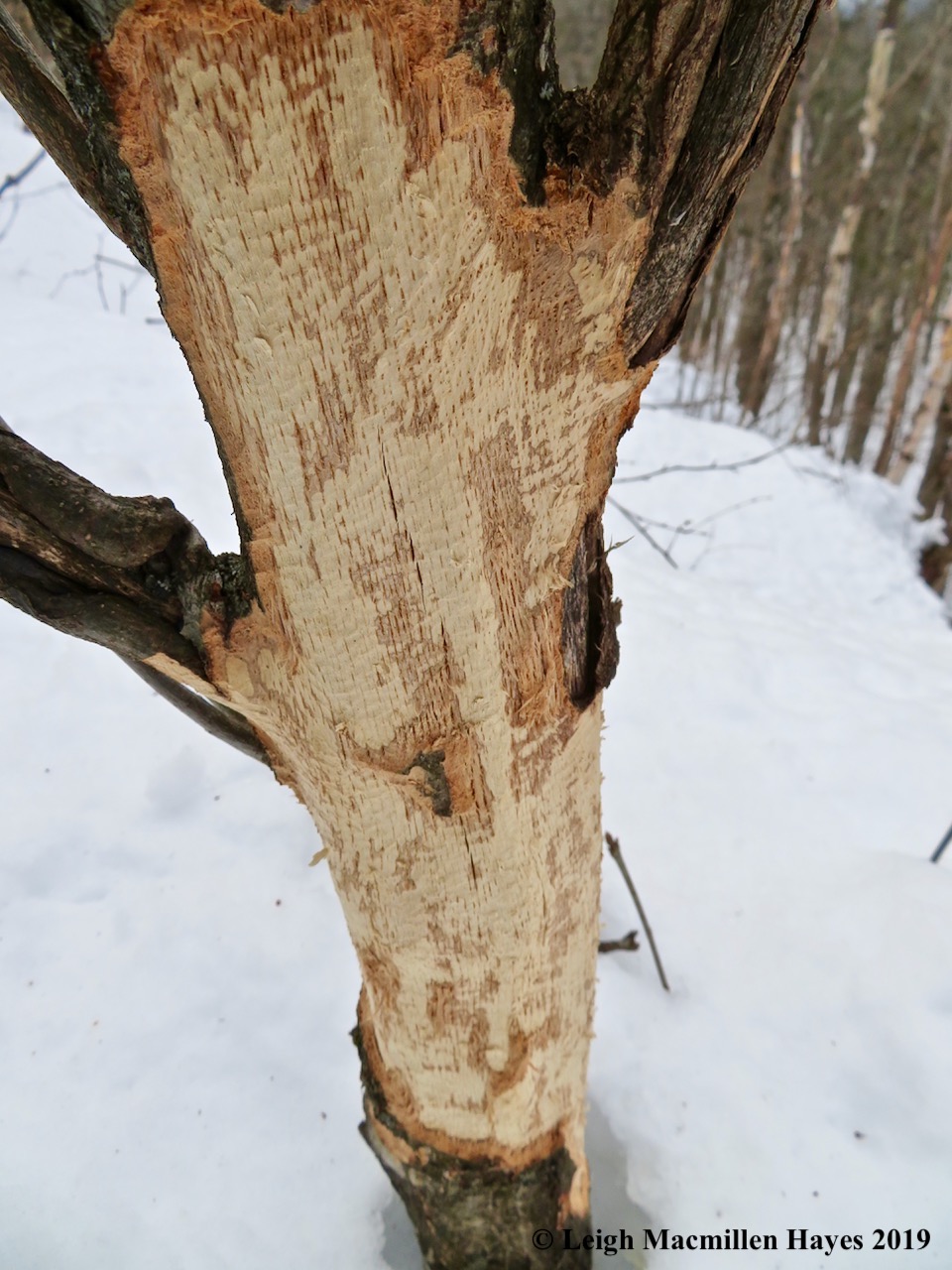
Looking up at the pin cherry tree, I found not pileated works, but the incisors of another that gave a clue.

And below, pigeon-toed tracks. Between the incisor marks and tracks I knew the creator, but it didn’t make sense to me, for though I find hemlock twigs below such a tree when a porcupine has clipped them, I couldn’t recall ever seeing bark chips below a porky tree. In my brain, the rodent ate the bark as it sought the cambium layer within. I dismissed it as a lesson to be considered and we moved on.

Jon led us along a colonial road from the historical society’s property to a stonewall that delineated the Peabody-Fitch Woods. We turned onto a trail I’d never traveled before and made our way along another farm road. Periodically, Jon, Matt, and I bounced off of each other as we shared our knowledge about the trees and forest succession that had occurred since the farm was last a working land. We also spied a few mammal tracks, including those of a bobcat.

At last, we circled around and found our way back toward the border between the P-F Woods and farm.

Close to the Temperance Barn again, porcupine tracks crisscrossed to the stonewall where we’d seen their activity at the start of our journey.

Near the parking lot and Blacksmith Shop, more porcupine works made themselves evident–by their tracks and the debarked trees.

Incredibly debarked trees. I’m always amazed by the fact that porcupines, given their size, can find support on trees and limbs that seem so flimsy. I’ve been told that they’re known to have many broken bones and it makes sense given the precarious choices they make to seek winter nutrients.

Once again, there was bark debris. In the past I’ve always said that beavers leave wood chips, but porcupines eat the bark and cambium layer.

The evidence was obvious given the prints and comma-shaped scat. But the bark debris proved me wrong today.

And I loved that. When Jon first introduced me as a Maine Master Naturalist, he asked how long I’ve been such. “Six years,” I said. And though I’ve spent my sixty years wandering and wondering in the woods and along the coast of southern and northern New England, it was the Master Naturalist class that taught me how to take a closer look.

Do you see the green of the cambium layer? And those incisor marks–how they are at opposing angles? Those I recognized.

But . . . the porcupines taught me something new today.

Six years–I’m still a babe in the woods.

Winter Wild Out My Door

Winter Storm Harper left its mark in the form of snow and wind upon our little spot in the universe.

And I was certain that any tracks I might encounter in the woods would have been erased by dervishes that whirled across the field yesterday, overnight, and into today.

Consequently, it was a pleasant surprise to discover porcupine tracks leading to and fro our barn and woodlot in their typical pigeon-toed pattern.

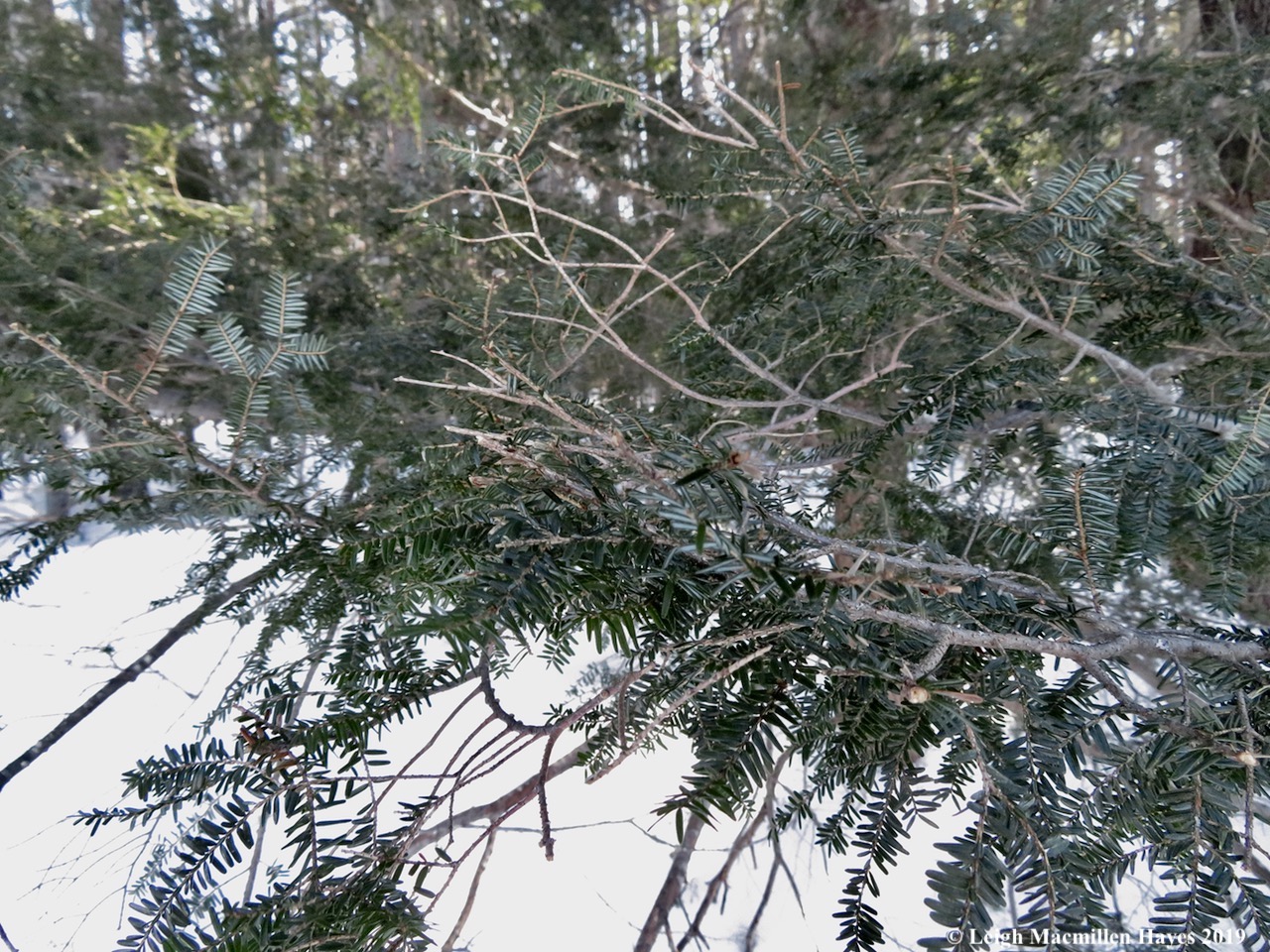
As delighted as I was, I was equally dispirited as I noticed that the tips of my favorite hemlock had been nipped to oblivion.

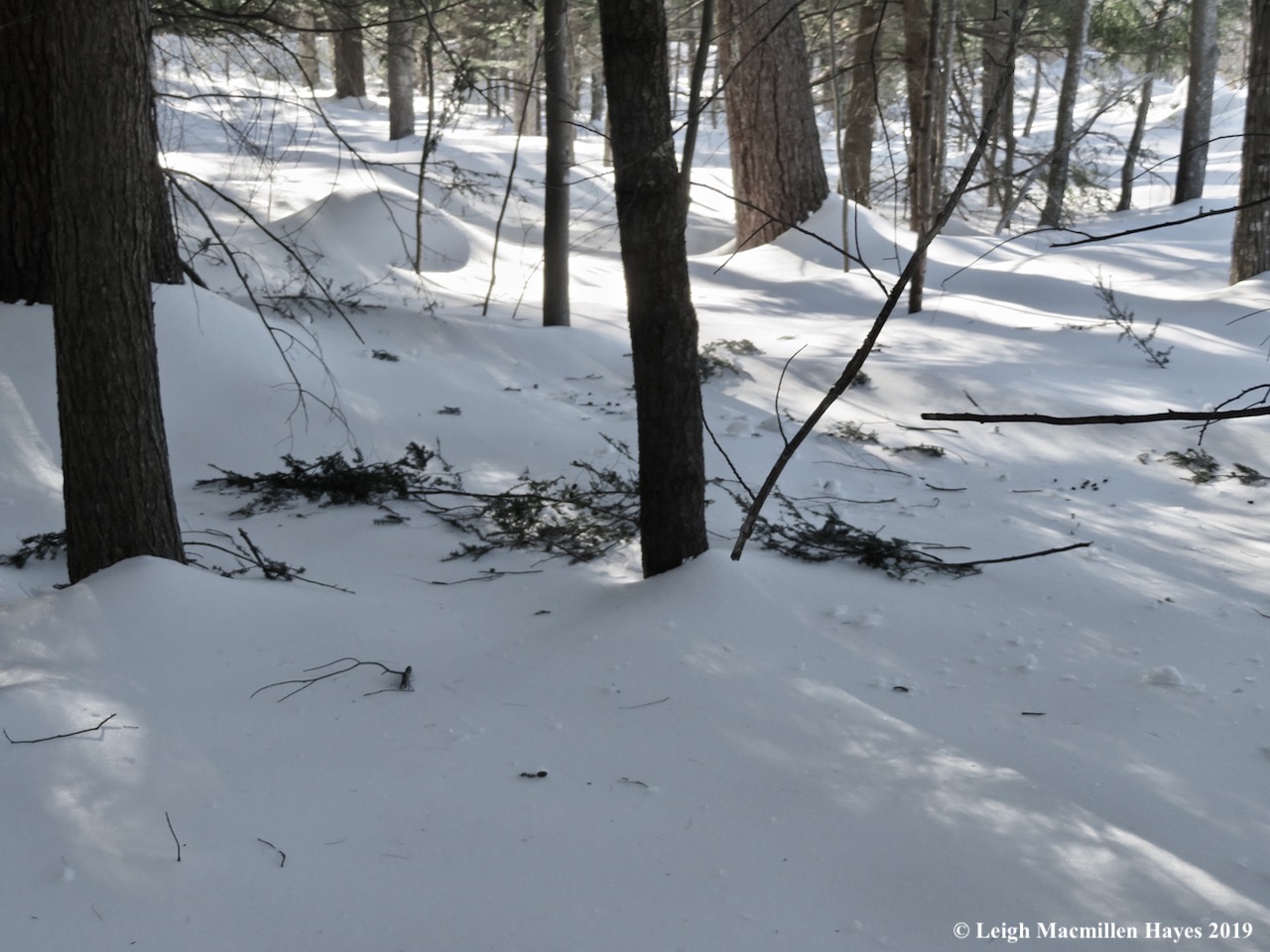
But, the porcupine had moved on from that tree, crossed over a stonewall, and visited several other trees in our woodlot, as noted by the downed twigs that decorated the snow’s surface. Like the tracks, the twigs were freshly cut in the past twenty-four hours or less actually.

Of course, I couldn’t overlook the woody commas amid the debris, much as they break up a sentence such as this, that added to the list of evidence that a porcupine had been present. Some call them scat.

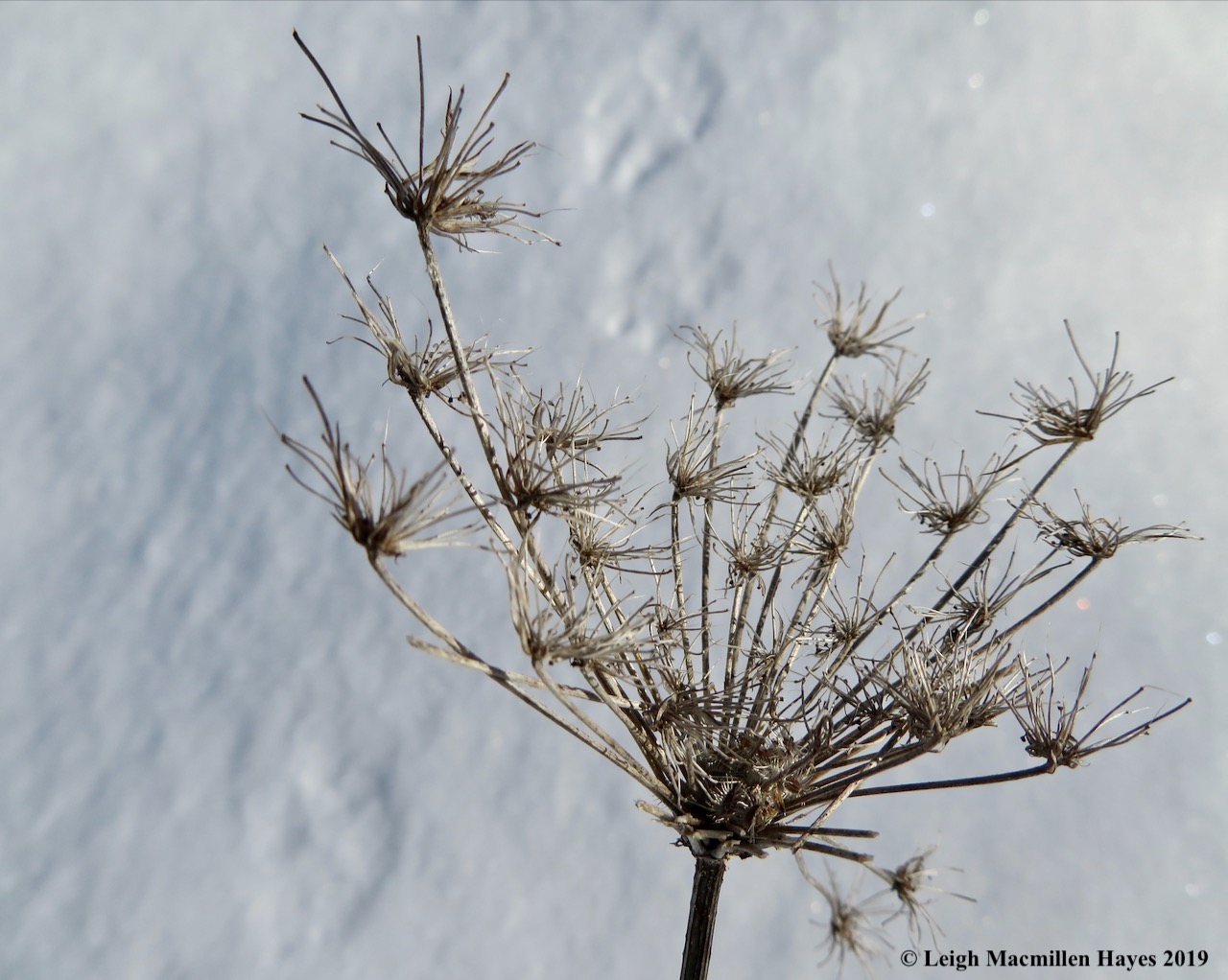
And then, as I continued onward, I followed the tracks of two others that frequent our yard. Even as I delighted in the winter structure of a Queen Anne’s Lace florescent, did I notice the red fox prints on the snow below.

The tracks led me to Stevens Brook, which has a journey of its own to trace.

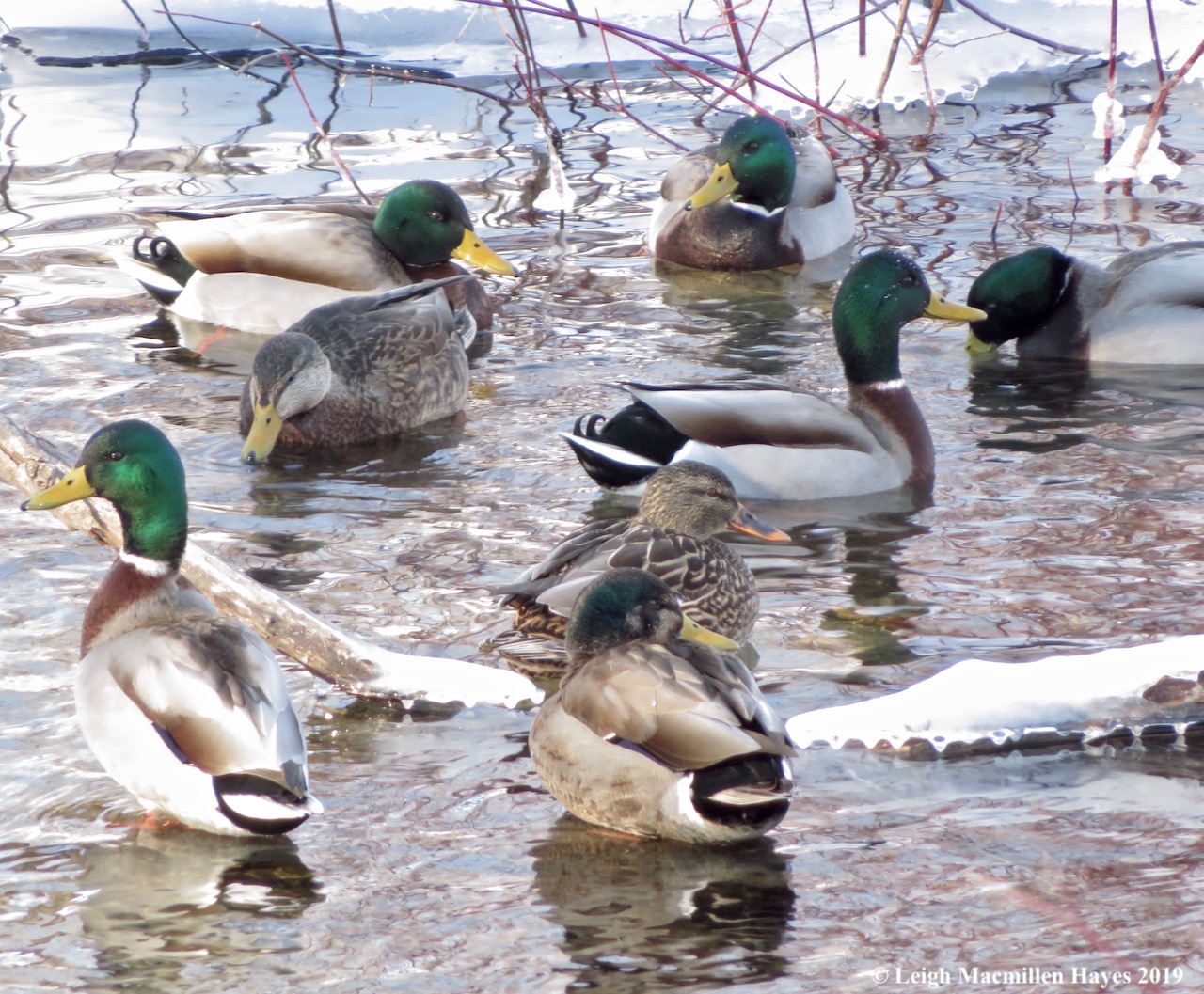
I went to look because I felt the need to add a bit of color to this wintry day and knew that the local congregation of Mallards would contribute not only that, but sound as well.

And then, as I snowshoed beside the trail that follows the brook, I began to notice tracks made by another–this one a member of the weasel family with tear-drop shaped toes of five on each foot.

The more I followed it, the more I realized it had walked and then loped and appeared to drag something along the way.

Sometimes it chose to slide on the downhills.

And equally left an impression as it journeyed up and over a stonewall.

Meanwhile, within the wall, I surmised another of a different species quivered as silently as possible so as not to attract attention, with the hope of creating hoar frost for another day.

Wherever I went, the weasel had also trekked. And frequently I noticed signs of blood as if something had been dragged and the life dripped out of it.

In some places the frozen vital fluid bespoke a meal perhaps waiting to be cached–the perfect sacrifice of one to nurture another.

So few were the tracks of mankind on the virgin snow and so abundant the weasel.

Soon I found myself beside another brook, this one named Willet, and I glanced about expecting to see evidence of action, but instead found ice and snow and shadows disappearing into the bend.

And then . . . upon the edge of the brook’s high bank, a sudden turn my weasel had made, choosing to not slide downward.

A bit further along, I was following its tracks again when I spied fresh woody debris upon the snow’s surface and knew that a pileated had been at work this day.

Rounding the tree, I discovered a series of holes made over a series of days or weeks or years.

From the woodpecker tree, it took a few minutes, but again I found the tracks of one very busy fisher. I never did find any kill sites, but suspected that it had a cache somewhere and let its fresh groceries dangle from its mouth as it carried them back to the pantry.

Making my way toward home, I didn’t need to rest, but had I intended upon such, it wouldn’t have been at the bench for so deep was the snow.

That was okay, for my movement kept me warm and I knew that I’d soon be stripping off my winter layers once I reached our kitchen. But first, there was a pasture to pass through, and while I seemed to have left the fisher behind, I came upon the tracks of the two red foxes I’d met earlier.


In typical red fox behavior, one of them had paused at the tip of a downed tree and urinated. One of these days perhaps it will finally get lucky.

In the meantime, I felt lucky for I’d seen the prints and tracks of so many on this day when I wondered if I’d see any–including those of the Mallards beside Stevens Brook.

And of all the winter wild out my door, today the ducks were my favorite because I not only got to watch them for a while, but I also appreciated the colorful display they added to the landscape.

From Bear to Beer Possibilities

Christmas in our house requires a bit of creativity and so it was that a light bulb went off and a theme was born.

I found a little brown cardboard box, decorated it with some hiking stickers and then did a bit of research on local trails and pubs. This was for my guy, you see, for on his days off, he’s always asking me where we should hike. I decided to make it easy for him to suggest a trail at least once a month, and the hike would be followed by sipping a brew at a local pub. There was one caveat: the hike had to include the search for bear paw trees. We both love a challenge. Some of the places I chose are familiar to us, and though we know the trees are there, will we find them again? That remains to be seen. Others are totally new on our list and I had no idea if they’d offer one of our favorite sights.

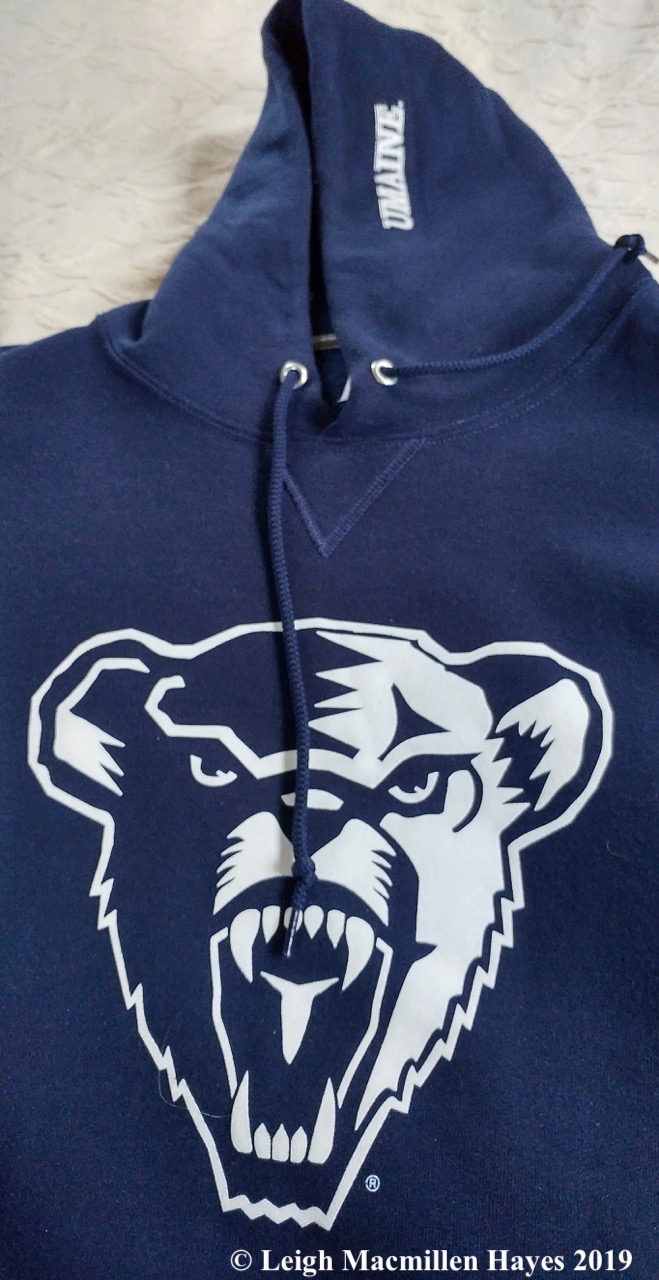
In keeping with the theme, I also gave him a UMaine sweatshirt; UMaine being his alma mater. Of course, back in his day, it was referred to as UMO for the University of Maine at Orono.

And finally, a growler from a local brew pub so he can walk down the street and refill it occasionally.

It was Western Foothill Land Trust‘s Packard Trail that he chose for this first adventure.

The property itself is the Virgil Parris Forest, named for this man who was born in Buckfield in 1807. Mr. Parris attended local schools, Colby College, and Union College in New York, where he studied law. In 1830, he was admitted to the bar and returned to his hometown to open a practice. His career followed a political path both at the state and national levels.

The main trail that loops around the 1,250-acre property was named for the Packard Family. According to the interpretive panel at the trailhead, “the farmstead’s foundations and family cemetery are on site. Daniel Packard was given this land in Buckfield as compensation for his service in the Revolution. Daniel was born in Bridgewater, Massachusetts in 1749 and married Elizabeth Connelly of Cork, Ireland during the war. Daniel died in Woodstock, Maine in 1836, and is buried there. It is said that Daniel and Elizabeth were the prototypes for James Fennimore Cooper’s Sergeant Hollister and Betty Flannigan in Cooper’s novel The Spy.”

The sky was brilliant blue as we began our journey, each step of the way scanning the trees. Had it been a couple of months later, we might have mistaken the large burl in a paper birch for a bear cub.

Though bears climb other trees, it’s on beech bark that their claw marks show up best.

When one focuses one sees . . . many a thing that might have been passed by, such as this beech, which began we know not as one or two, and if one, why did it become two we wondered? And then, like a work of magic, it was once again unified.

Another beech offered a snow chute that seemed like the perfect squirrel slide.

And yet another was decorated with the chiseled tooth marks of a natural logger–a beaver.

There were some decorated with cankers from beech scale disease that could have passed for ornamental faces.

And others that hosted squirrels who had built dreys appearing haphazard in construction from our stance about thirty feet below, but were really complex and apparently well insulated.

Fungi, such as this tinder conk, also fruited upon some trees. But . . . where were the bear trees? My guy asked how I’d chosen this particular path, and to be truthful, I couldn’t remember. I just thought it was a new one to us and might have some paw marks to boot.

Down an esker ridge we continued as we approached South Pond.

The wind was cold on the pond and snowmobiles zoomed past, oblivious to our presence, which was just fine with us.

And then we heard voices and framed between beech branches, we saw a dog sled team across the way.

And then, just as we turned from the Packard Trail onto the Cascade Trail, we spied some familiar marks. Or were they? We so wanted a bear paw tree that we convinced ourselves we’d found one.

It certainly did look the part. And so we felt successful.

Onward we journeyed, enjoying the cascades in their frozen form and promising ourselves a return trip in a different season.

As is his style, my guy moved quickly and I accused him of not searching, but he was.

And bingo! Another bear tree.

The cankers were abundant and made it difficult, but our bear paw eyes discerned the patterns.

And once we noticed, it seemed as if they began to pop out at us from every tall beech. Not really so. All in all we counted five. Well, five if you include the first tree, which we continued to question. And there were probably many more that we missed.

At last we’d completed our journey and relished our success. As I drove back down Sodom Road in Buckfield, I knew there were a few final trees that needed to be examined–telephone pole trees. Most were in great shape, but one close to the preserve had been visited by a large furry mammal that scratched it and nipped it and probably left a scent on it.

As planned, we knew exactly where we’d stop following our hike and so we made our way to the Buck-It Grill and Pub, another place we’d never visited before.

Lisa, the bartender, took our burger order and then we sipped Allagash White while we watched the Weather Channel on the TV above. Sitting next to us was Joyce, and she said that the impending storm was named for her partner’s niece, Harper. When did they start naming winter storms? Never mind. The important thing was that the fresh hand-packed burgers and fries were delish. The beer wasn’t bad either.

We went not knowing but came away with smiles after a successful hike–and already we’re looking forward to next month’s “From Bear to Beer Possibilities.”

Poking About Among the Trees

My intention this morning was to meet up with a few old friends, namely a porcupine and a beaver family. Added into the mix with any luck would be a barred owl.

But alas, it was not to be as I wandered on and off trail through the northeast corner of the Greater Lovell Land Trust’s Heald and Bradley Ponds Reserve.

Instead, it was those who seemed inanimate that came to life repeatedly.

Right from the start the trees pulled me in for I needed to, well, it wasn’t exactly a need, but still, I needed to check on the swelling red buds of a basswood that grows near the edge of the parking area.

And I could hardly pay homage to one and ignore its neighbor, and so I moved a few feet to enjoy the glory of a beaked hazelnut catkin and bud as they began the countdown toward spring.

Climbing the Flat Hill trail, an old tree grinch tried to sneer, but I noticed a tweak of a smile and knew he was glad to have me there.

He must have been for he made sure that I saw . . . such things as a beech leaf layered upon an oak atop the snow–mirroring the skyspace above.

And speaking of beech, I noticed one spiky husk, which actually surprised me with its presence for so few were the beech seeds this past summer.

The same was true of acorns and without a mast production, the squirrel middens were rather sparse in the landscape, but I did find two, both a couple of feet deep. But there’s something else to note–the trickle of yellow pee by the pine needles to the upper left of the hole. By its skunky scent, I knew that while the squirrel sought sustenance in the form of an acorn, a red fox hoped to dine on the rodent. The latter meal didn’t happen anywhere nearby, but that doesn’t mean it didn’t occur.

With lots of meandering on the way up, I finally reached the summit of Flat Hill, where the mountains beyond hinted at today’s snow flurries and this weekend’s impending storm. But it wasn’t to the mountains that I spent much time focusing. Instead, I scanned all the trees around–hoping for the sight of another spiky one–a prickly porcupine.

I suspected that I wasn’t alone in my search for just below the summit ledge, I spotted a bobcat track.

The evidence of the porcupine’s presence was everywhere as it had left its mark on so many trees where it scraped the outer bark to reach the softer inner tissue.

Shallow and narrow tooth marks were all that remained. I love bear trees, but porcupine trees rank right up there.

And the same is true for pileated woodpecker trees, which are easy to sight not only by their oblong holes, but the woody debris below them as well.

Who can resist searching the debris for scat? I know I can’t. What I found today was an exploded version with ant body parts spewed about in such an array that I almost wanted to glue them back together. Almost.

My wander continued as I walked a portion of Perky’s Path where the wetland mounds were so littered with snow drops that it was impossible to decipher any mammal tracks. I did make my way to the old beaver lodge in the center of the photo, the mound standing tallest toward the background, but the sight and sound of water meant caution was necessary.

The same was true at the rock stepping stones to the south of the wetland and though I have an affinity for water, I chose not to cross for a chilly bath wasn’t in my plans.

Instead, I backtracked and then followed the snowmobile trail for a bit until I reached the outlet of the old beaver pond.

It was there that I turned off trail and followed the stream through the woods.

Water gurgled below its frozen form and ice bridges offered crossings for those who dared. I did not.

My purpose was to check on another lodge that had been quite active a year ago. Today, I was surprised to find no one at home in the stick-built inn.

Beyond, the dam stood high, but the water behind it was low–another indicator that the beavers had moved on by their own doing. At least I hoped it was their own doing.

Evidence of their previous works was apparent all along the brook, where many a tree had been logged by the rodents, including this yellow birch.

Though that birch and others had been toppled, upon the snow old catkins, their fleur de lis scales grown large, added texture to the scenery and seeds to the future.

Finally, I made my way out and smiled at the smiles in the ice and water that mimicked my own. Today, my heart rejoiced with the affirmation this morning that my friend, Jinny Mae, had received good news about her health. She is one of my pokey hiking friends and I tried to emulate her as I celebrated. From Jinny Mae I’ve learned to do what Mary Oliver recommended in “Sometimes”:

Instructions for living a life:
Pay attention.
Be astonished.
Tell about it.

And so it was that as I paid attention just before leaving, I was astonished–by the tree I saw in the ice. I knew Jinny Mae, had she been beside me, would have taken the same photograph, for that’s what we often do when we’re together.

When I am among the trees,
especially the willows and the honey locust,
equally the beech, the oaks and the pines,
they give off such hints of gladness.
I would almost say that they save me, and daily.

I am so distant from the hope of myself,
in which I have goodness, and discernment,
and never hurry through the world
but walk slowly, and bow often.

Around me the trees stir in their leaves
and call out, “Stay awhile.”
The light flows from their branches.

And they call again, “It’s simple,” they say,
“and you too have come
into the world to do this, to go easy, to be filled
with light, and to shine.”

~Mary Oliver

Today, I stayed awhile, poking about among the trees that shined in honor of these two women who have shared the gift of bowing often.

Nature’s Larder

(Warning: Some photos in this post may be disturbing.)

A couple of friends and I didn’t let this morning’s brisk air keep us inside and so at the designated time and place we met, strapped on our snowshoes and journeyed forth.

Almost immediately we were greeted with evidence that others had had the same idea. And though we knew they were turkey and fox tracks that intersected on the snow-covered ice, we weren’t positive about the fox ID until a few minutes later. As it was, the prints were muffled in presentation, which led us to red versus gray fox, but the stride seemed a wee bit short.

And then we found the calling card and both friends were thrilled to get down on all fours and take a sniff. Indeed, the skunky scent made us certain that the fox’s color was red.

Everywhere, whether atop a snow-capped rock or sapling or winter weed, we found that calling card–most of it a mere dribble, but enough.

Everywhere we also found the fox tracks and wondered–one or two? It seemed likely that she followed he, but we couldn’t be absolutely certain.

And then something in the distance atop the snow called our attention and we quickly followed the fox tracks to the dark sight.

It turned out to be turkey feathers. And we got to wondering again. There were no turkey tracks nearby, only fox. What had happened?

Toward the shore we tramped and suddenly one of us found a display of feathers and cartilage.

And then another about ten feet away.

And still another.

Beside it all, we found the calling card of the red fox to be even more prominently displayed.

Later, after one of our group departed, two of us revisited the kill sight and realized that there were some black and gray hairs left behind. My assumption was coyote as we had also seen their tracks. And we found a rather robust coyote scat not far away.

So here’s the story as we pieced it together, though we know some pages are missing: The fox(es) stealthily sneaked up on the turkeys who were scratching about for food on the ground under some hemlock trees where the sun had melted the snow. They pounced on one who wasn’t able to fly off quickly enough, for if you’ve ever watched a turkey take off, you know it’s awkward motion in slow speed. We hoped that the kill was quick and the turkey didn’t suffer as its feathers were plucked. The body was dragged here and then there, and the fox urinated to stake his claim. Maybe he shared some meat with his girlfriend. Along came the coyote who didn’t care about the fox’s territory and perhaps he scared them off and helped himself to a tasty treat. We had to think about it as nature’s way and jules of energy being passed on from the insects and birds to plants and seeds to the turkey and on to the canines. They, too, need to eat.

We searched all over for a head and maybe leg remnants or other body parts, but found not much, though we did find a bony structure and wished our veterinarian friend had been with us to perhaps enlighten our understanding.

Finally, we moved on and a few feet away another sight made itself visible.

Tucked into the top of a tree snag was a partial ear of corn. The refrigeration obviously worked for it looked as fresh as one might eat on a summer day.

How did it get there? We know it came from a nearby corn field, but who was responsible for its placement? Perhaps a squirrel? Or a bird? It didn’t seem likely that a raccoon could climb the snag, but then again, in nature the impossible often happens when we aren’t looking.

Today, we looked and even when it wasn’t pleasant, we were excited for we gained a wee better appreciation for and understanding of nature’s larder.

The Spirits of Long Meadow Brook

People often ask me this question: Aren’t you afraid of hiking alone? My response is that I’m more afraid to walk down Main Street than through the woods, the reason being that it’s a rare occasion I encounter another mammal. Oh, I do move more cautiously when I’m alone and today was no different. But . . . there’s something uniquely special about a solo experience.

Perhaps it’s that my mind wanders with me and I see things I might otherwise miss when I’m distracted by conversations with dear friends and family members. That doesn’t mean I don’t like to travel with them, I just equally enjoy going forth on my own.

Today’s exploration of the Greater Lovell Land Trust’s Long Meadow Brook Reserve and the adjacent private property protected under a conservation easement with the land trust allowed such a wander, both literally as I only occasionally followed the trail, and figuratively as I was sure that the two-headed tree spirit chuckled with me, not at me. You’ll need to let your own imagination wander to see the spirits within the split tree–believe me . . . they are there.

One of the things I love best about the Long Meadow Brook Reserve is its cathedral of pines–and the route I chose today appeared to lead to infinity. It’s not the blazed route, but someone had obviously been that way before.

When I reached the first bench, I heard the voices of fellow travelers and the laughter of the Lovell Recreation Summer Campers who often clamber for a seat. For the time being, their good-natured chatter was buried until they return again.

From the bench I moved across the field as many a deer had done, and found my way down to the namesake for this property, Long Meadow Brook. I’ll never forget my first visit several years ago–and the awe when discovering this view in the summer. In every season, I welcome the opportunity to have my breath taken away.

The view by my feet also garnered my attention, for it was obvious that a red fox had walked this way before me.

How did I know it was a red fox and not gray? Well, first I measured the print size, straddle, and stride. And then I looked at the foot morphology as presented in the snow. The prints were a bit muffled, which is one aid in identification, for a red fox has hairy feet. And . . . I spied the chevron, a little indented ridge that appears in the foot pad. If you look at David Brown’s Trackard in the previous photograph, you’ll see the chevron as a dark line.

There were other clues as to the maker of the tracks–for some frozen urine by a sapling spelled his name. And its skunky scent added a flourish to his penmanship. It’s mating season and this boy had an announcement to make.

I suspected his words were heard for it appeared that more than one fox had traveled across the old beaver dam and I found more pee at each little post.

I desperately wanted to cross as others had, but I was alone and knew it was best to stay on the eastern side.

That didn’t stop me from looking and noticing what may have been a recent otter or mink slide in the midst of the fox tracks.

Or the remains of a snowball fight that I imagined the fox affectionately tossed as his date.

Looking south, I couldn’t see any action, unless you consider the cattails. But I had to wonder, were the fox and the mink and the otter and any others at the edges keeping watch over me?

I couldn’t be sure, but I did note that the cattails parachuted seeds were eager to set off on the breeze and start their own lives.

Likewise, the water at the dam added its form of action and color and texture and sound–in as many renditions as possible.

At last I moved on, followed the blazed trail and climbed to the second bench on the property, along a route the deer know so well. Where were they? Also at the edge, again keeping watch?

Had I startled them from browsing the red maples? Missing buds and long tags represented their mark on the land.

Before moving on again, I stood behind the second bench where the mountains in Evans Notch looked as if they’d been coated with frosting; and in the way of the winter world, they had.

And then I followed a seldom used trail back down to the brook, where I spied a fox track. Do you see it? It’s about in the lower middle of the photograph.

I was even more excited when I noticed mature tamaracks growing along the brook’s bank and gave thanks.

For you see, several years ago some young tamaracks that grew along the beaver dam had been inadvertently chopped down to make a pathway for the snowmobiles. I was saddened by the discovery because this is one of the few GLLT properties with this deciduous conifer that looses most of its needles each fall. And that spot had also featured balsam fir, hemlock and white pine, making it the perfect outdoor classroom.

Add to that the pitch pines that grow by the first bench, and voilà! A lesson completed.

That made today’s discovery of the tamarack’s nubby twigs extra special and I knew that the tree spirits weren’t making fun of me, they were smiling upon me.

With that in mind, I was going to follow the trail back, but decided instead to journey for a bit beside the brook, where I found a deer bed in the sunniest of spots.

Eventually, I climbed up a hill and back to the trail, crossed through a stone wall to the neighboring property, continued on to a field and across that to a stump dump. Why go to such effort to reach a stump dump?

Because it’s actually a porcupine condominium hidden among the rocks and decaying tree stumps.

There were several entry ways–all showing the telltale signs of the pigpens of the woods.

Nipped twigs covered with a tad bit of fallen ice made me think the creators were snug inside and not over my head.

I did look up, but I did the same thing last week and didn’t see what others saw from a few feet back. That day, a porcupine was right over my head. Today, I didn’t think so, but the sun was bright and I couldn’t be absolutely certain. One may have been observing my actions from above.

And wondering what my fascination was with its scat. Check out those woody commas.

As I wandered about by the stump dump, something else also caught my eye–a promethea silkmoth cocoon.

At last I climbed back on to the porcupines’ rooftop and had to watch my step for there were several frosty vent holes and I didn’t want to land inside the humble abode.

As I stood there, I searched again for any quilled critters, but saw none. What I did see–that only a skeleton of a hemlock remained. It’s a tree the porcupines have spent more than several years denuding.

And in the tree next door, I noticed that they’d not yet reached the tip of one branch. Word has it that porcupines have many broken bones from falling out of trees. I’d love to be present when one returns for this leftover.

At last it was time for me to make my way out. I’d made a silly mistake today and thought that because it was so cold the snow would support me so I hadn’t worn snowshoes. Instead I created post holes with each step I took.

As I started across a five-acre field, my own spirit led the way–encouraging me not to give up despite the fact that I was tired.

And by the edge of the field, I did find a spirit hanging out. What was the cairn thinking? Maybe its expression as reflected at the base of the tree was one of disgust that I’d ventured forth in its space. Or perhaps it was forlorn that I was now taking my leave.

I chose to believe the latter and gave thanks for the opportunity to wander among the spirits of Long Meadow Brook.

Romancing the Stone Mondate

Visiting a site in winter that is so popular in the summer we actually avoid it unless hiking past offers an entirely different appreciation.

And so between errands in North Conway, New Hampshire, this afternoon, my guy and I donned our micro-spikes to traverse the hard-packed snowy ice trail into Diana’s Bath in neighboring Bartlett.

Upon reaching Lucy Brook, the history of the area was briefly documented on an interpretive panel that provided information about George Lucy who built a sawmill in the 1860s powered by an undershot wheel on the brook and a home not far from its banks.

About 1890, when tourists began making regular visits to the brook, Mr. Lucy added a boarding house and barn, but business never took off the way he’d intended.

By the 1920s the water wheel was replaced by a turbine fed from a penstock pipe, the remnants of which remained for us to gain a better understanding of the passage of power.

Above the turbine we could see another piece of the penstock pipe burrowed within the ledge upstream.

Before climbing up to it, I walked below the turbine site while my guy stood over and thought about the Lucy family’s history, which in a professional way is connected to his own for the sawmill idea was eventually abandoned as the Lucys realized they could use a portable mill to harvest wood and later descendants owned a lumber yard and then one of them opened a hardware store and he and my guy periodically touch base to share ideas or stock and both could be known as Mr. Hardware.

Upon the interpretive panel, we appreciated a photograph of the sawmill for it aided our comprehension of the view before us.

To our best understanding, the cement located above the penstock was part of the mill and dam created by Chester Lucy in the 1930s. Today, water swirled through and flowed over.

Below, the natural formation of rocks obscured was reflected in the shape of icy indentations.

Above, water hugged rocks in mid-cascade and created designs and colors that changed with each moment frozen in time.

We finally moved upward where more baths were plentiful but on this frigid day the thought of a dip was quickly suppressed by reality.

Still, we were intrigued by the power of it all as water gushed between curtains of ice.

As for the name, Diana’s Bath, I’ve heard several renditions including this from Robert and Mary Julyan’s Place Names of the White Mountains (a great bathroom read):

These curious circular stone cavities on Lucy Brook originally were known as the Home of the Water Fairies; tradition says evil water sprites inhabited the ledges, tormenting the Sokokis Indians until a mountain god answered the Indians’ prayers and swept the sprites away in a flood. But sometime before 1859 a Miss Hubbard of Boston, a guest at the old Mount Washington House in North Conway, rechristened them Diana’s Baths, presumably to evoke images of the Roman nature goddess. The pools are also called Lucy’s Baths.”

In the midst of wondering, I noticed a rare sight that added to the mystique of this place. Do you see four circular discs in the water? All spun at the same rate despite their varied sizes.

They were ice discs spinning counterclockwise much to my delight. This rare phenomenon was caused by the cold, dense air formed within the eddy at the base of the fall.

After that sight, we continued to climb until the brook leveled out. And then we pause before the spirit of one made from the same crystals that flowed beyond; one who wore a smile indicating he knew the ways and whys and wonders of the brook even if we didn’t.

As it turned out, he wasn’t the only one.

The woods were full of those who listened like old sages,

and smiled with a secret knowledge tucked within their grins.

Through it all, we felt the love of the universe as we tried to interpret the romance of the stones–icy though they were. And on this first Mondate of 2019, we were grateful for our “dip” into Diana’s Bath. It’s so much better in the winter than summer, especially on a weekday, for there are far fewer people about. But the sprites and fairies. They are there. Some you might even find among the rocks and boulders; I know. I saw a few. And others, might be upon the tree trunks. Or in the midst of the water.

If you decide to Romance the Stones, do know that unless you have a White Mountain National Forest Pass, you will need to pay the $3 fee to park. For some reason, the sprites don’t take care of that. Hmmm . . . one would think.

Wandering the Wilson Wing Way

We’ve wandered there before, my friend and I, and we’ll wander there again. For as she said, “No matter how often we come here, there’s always something new to see.” And so it was that we found ourselves crawling over the crusty snowbank to get onto the trail of the Greater Lovell Land Trust’s Wilson Wing Moose Pond Bog Reserve.

Virgin snow greeted us as we sauntered ever so slowly beside Sucker Brook, which drains out of Horseshoe Pond. All along, we were serenaded with water songs, but bereft of such from any birds, which seemed eerily odd.

We did, however, have plenty of sights to admire, including the beaded fertile fronds of sensitive fern standing stalwart in the cold water. And then it dawned on us. Yes, the fern was standing in water. We know it prefers the edges of wetlands, but today’s offerings were at least ankle deep. And then we remembered. During the summer, it would have sprouted at the margin for the brook barely trickled through the landscape prior to the rain and snow that have fallen since then.

As we stood there, we noted reminders of others, such as the basal leaves of the Cardinal flowers that grace the brook in late summer. Visions of their red heads danced through ours.

And within our crowns, we mentally gathered the fertile fronds of royal fern. Already the days are lengthening and in a flash we’ll wonder how winter passed so quickly (well, some of us will) and dried brown leaves gave way to lush green.

Then we let the brook gather our attention again. The late morning sun played with the water and snow-covered mounds, casting shadows to its liking–and ours.

Beside the brook grow hardwoods and soft, but none were as brilliant as the yellow birch. Perhaps it was the glow of a winter day that encouraged their golden sheen to stand out among the rest.

For a few moments we stood before one of my favorite yellow birches. I love how its spindly legs stand tall above the rocks in the middle of the brook. Today, all were but another memory as they stayed snug below the blanket of white.

The boulders were also skirted in a coating of white, and hemmed with an icy floral display.

Eventually, we moved on–but only a few steps at a time. In this wintry landscape one might think there is so little to see. And one might be wrong. The trees know, their bark displaying crustose lichens of various shades and shapes overlapped by frullania.

Frullania is a genus of leafy liverworts that you’ll see on many a tree as it splays across the bark in a spiderweb-like manner. Each leaf consists of two parts, giving it a three-dimension look. On this particular tree it could have been a work of art–a scene that included the branching arms of a tree against a blue sky, the blue being a trail blaze.

Given the conditions, the blazes were hidden by many works of nature. But staying on trail wasn’t always our focus.

Between the two of us we spied one sight after another that begged to be noticed, like the fruiting bodies of a lichen possibly called Snag Pin that topped small stems sticking out perpendicular to an old tree stump.

And then there was the fungi to note, like witch’s butter, this particular specimen reminding me of a duck posing in a frilly gown and crown.

Almost hidden by the snow, an old false tinder conk with its cracked black upper surface sporting a velvety margin below.

We also found tinder conks with their equally velvety spore surface, concave as opposed to the convex form of the false tinder conk. Both are known as a hoof fungus for their shape somewhat resembles that of a horse’s hoof. Somewhat. Perhaps this particular horse high stepped through the woods.

My friend’s affinity is more to the fungi, but she knew I was equally drawn to the hobblebush, their leaves tucked inside praying hands embracing the global flowerhead. Do you see the touch of green peeking out? Again, for those of you who would prefer to wish winter away, spring isn’t far off.

It took us a while to reach the viewing platform along this not so long trail and we chose not to climb up.

Instead we opted for the view beside the brook as it flowed forth into Moose Pond Bog.

Our main reason for such was that we were curious to know if any others had traveled beside the water as well. And we weren’t disappointed when we immediately spied mink tracks.

If you look closely, you’ll also note a slide, for why bound all the time when occasionally you can take advantage of the snowy landscape and save some energy. And have a little fun.

The Wilson Wing Moose Pond Bog Preserve was born prior to the organization of the Greater Lovell Land Trust. Outside the White Mountain National Forest, it was the first parcel to be conserved in the area. Behind the scenes, retired Episcopal Bishop and outdoor enthusiast George Cadigan, who summered in Lovell, encouraged his Lower Bay of Kezar Lake neighbor Wilson Wing to purchase some acreage along Sucker Brook in the early 1970s and donate it to The Nature Conservancy since the GLLT didn’t yet exist. Additional acreage was added in the late ’70s, but because the nearest office of the conservancy was located closer to the coast and the GLLT was beginning to take shape, the land was deeded to the land trust with the request that it be named for Mr. Wing.

The 32 acres beside the brook is a preserve managed primarily in its natural state for preserves are deemed to be forever wild due to fragile ecological conditions. That means that when a tree falls at Wilson Wing, its voice will resonate in a variety of ways before it finally decomposes because it can’t be touched. It will serve as habitat to a variety of species whether on land or in water.

Across the street, the Bishop Cardinal Reserve is managed to protect water quality and provide recreation and habitat.

Today, I had the pleasure of meandering beside Sucker Brook with Jinny Mae in a fashion that I imagine Wilson Wing would approve–wandering the Wilson Wing way.