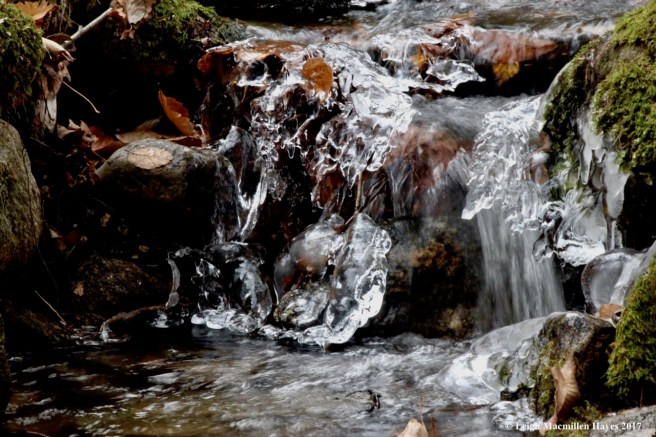
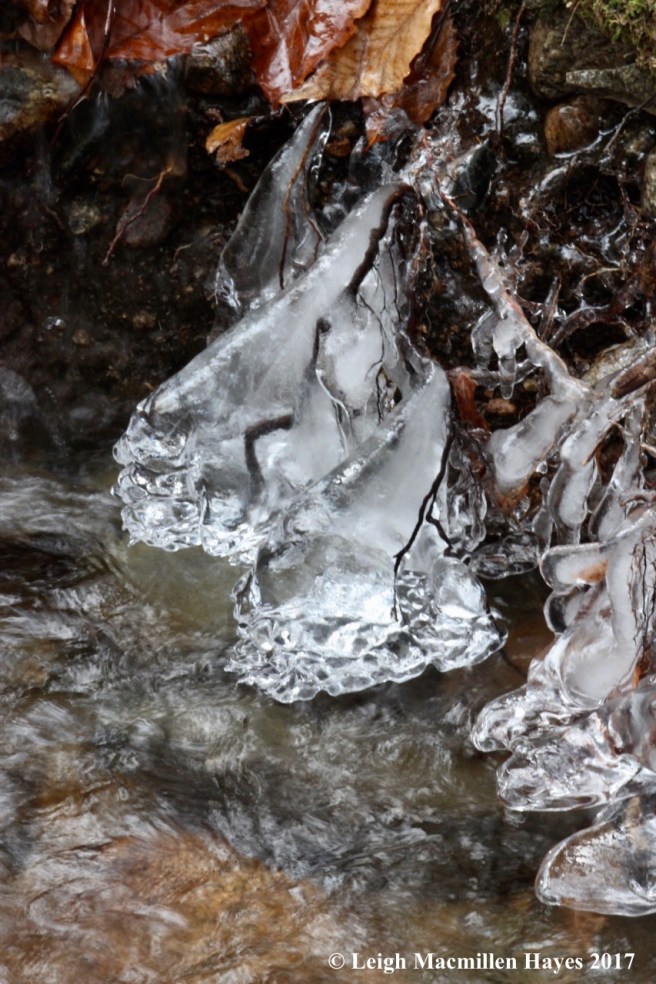
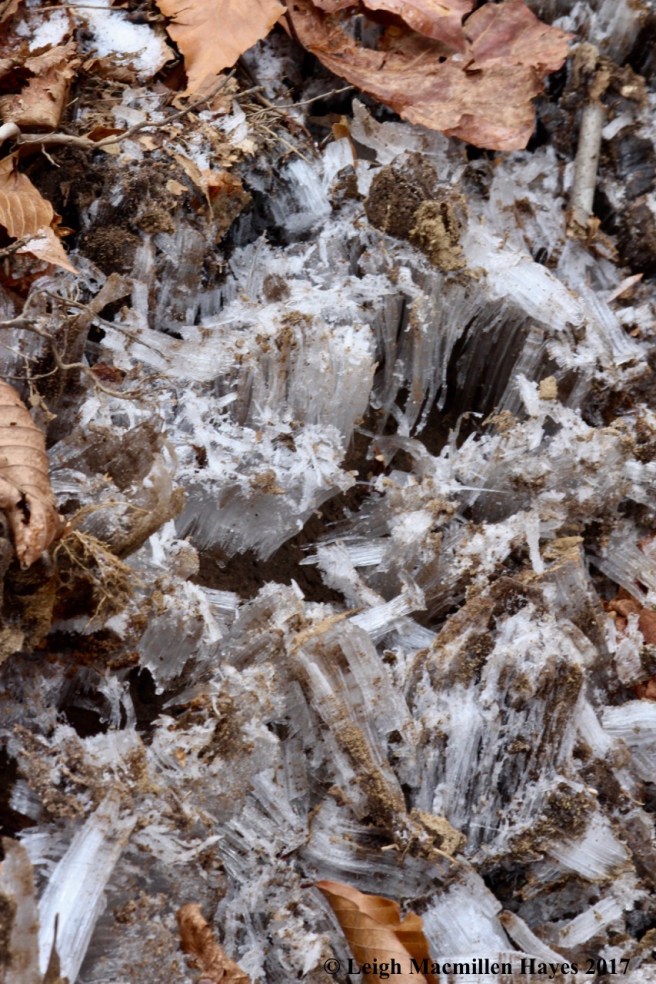
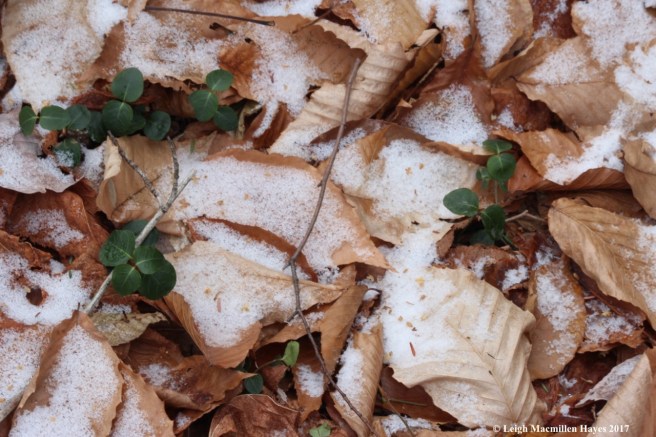
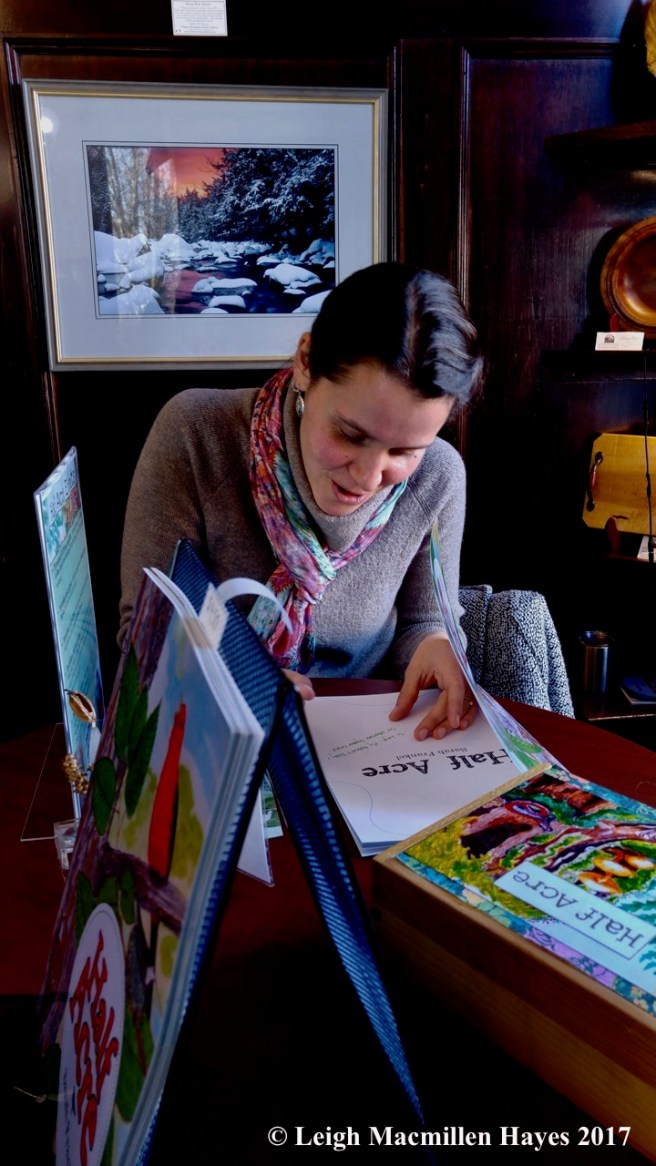
Celebrating First Day 2018 Lovell-Style

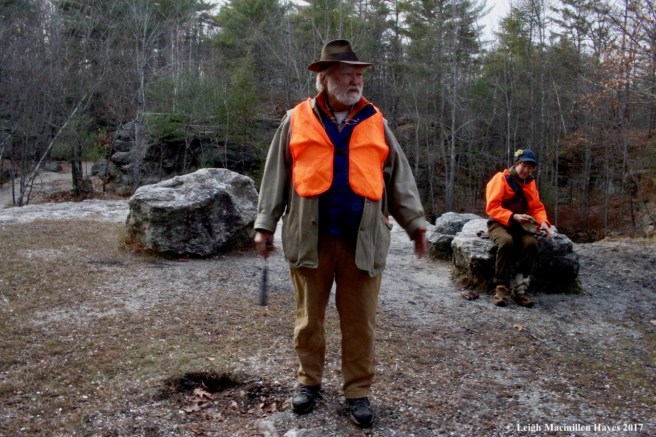
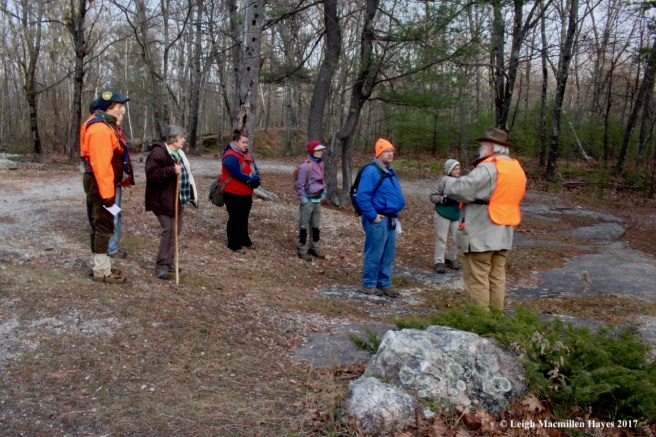
In the name of tradition, today the Greater Lovell Land Trust hosted a hike up Whiting Hill at the Heald and Bradley Ponds Reserve to welcome the new year. Last year’s inaugural hike attracted eight of us and the temp was so comfortable that we began to shed layers as we climbed. This year, six of us made the trek and conditions were a bit on the cool side–um, that would be an understatement.

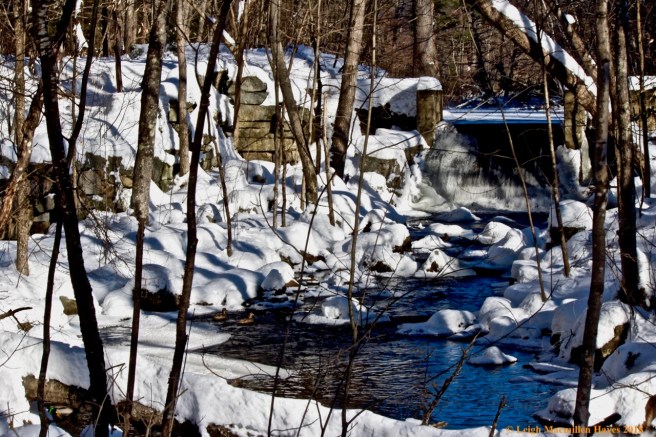
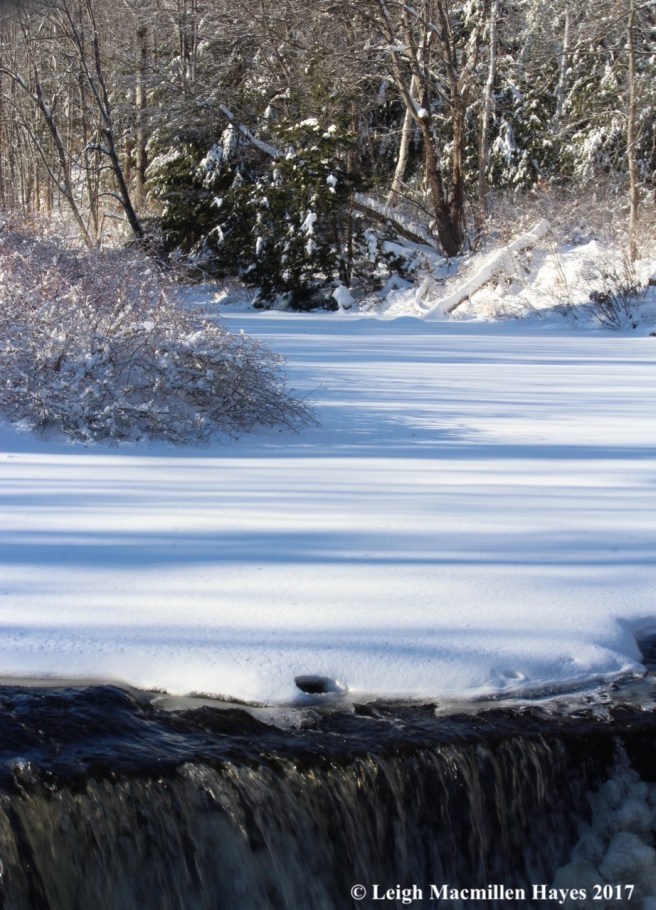
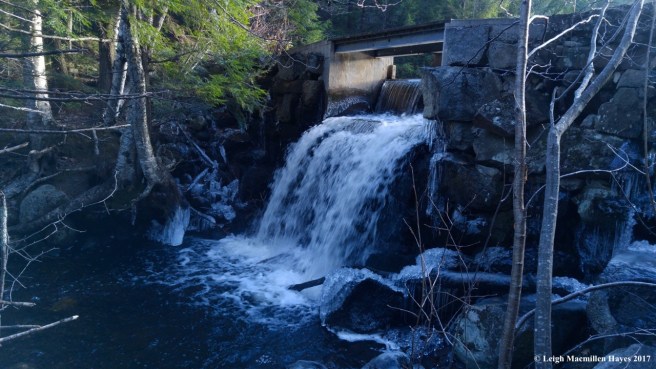
f-Heald Pond dam

But . . . the crisp air enhanced the beauty all around us and we began with a brief stop to appreciate the dam. What we didn’t realize until a minute later was that we’d also startled some wood ducks who immediately flew off.

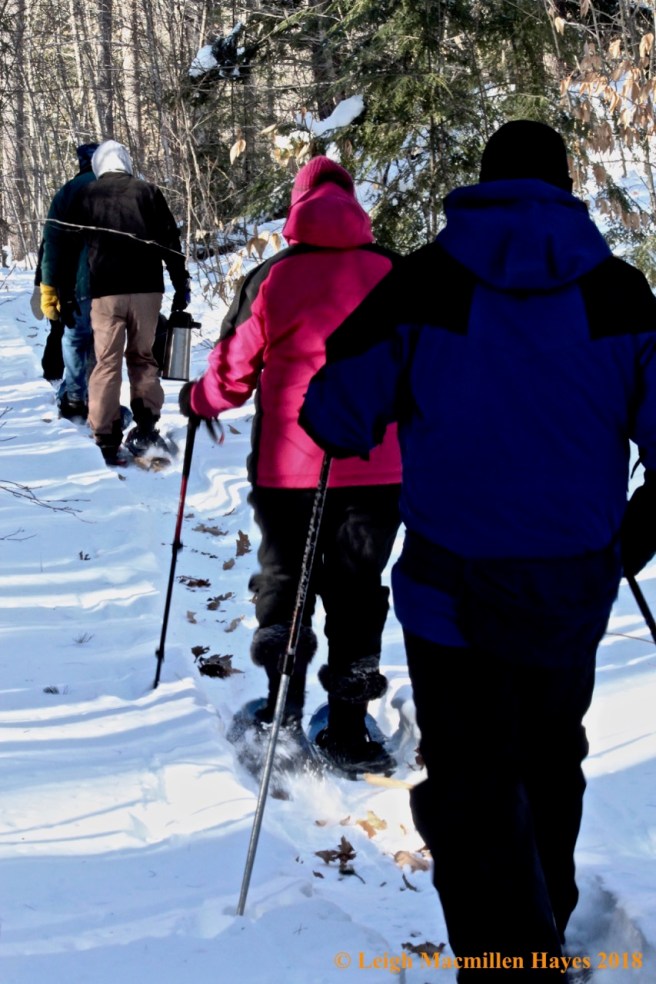
f-snowshoe journey up Whiting Hill Trail

Though our group was small, old friendships were renewed and new ones formed as we shared the trail.

f-otter trough 2

Periodically, we stopped to admire others who had carved their own trails. We read the stories of many mouse journeys, a fisher chasing a red fox, red and gray squirrel adventures and these–an otter bounding through the landscape.

f-otter trough 1

Otter troughs are about 6-10 inches wide, this one being the larger size. And in what can seem like two by two format, their front feet touch down as back feet rise, coming forward to land where the front feet had been just moments ago for they are bounders. Occasionally, this fun-loving critter chose to slide down on its belly.

f-summit achievement

By the time we reached the summit sign and turned right, we weren’t sure what to expect. Would it be so cold that we’d take a quick peek at the view and retreat? Would we be able to toast Lovell as planned?

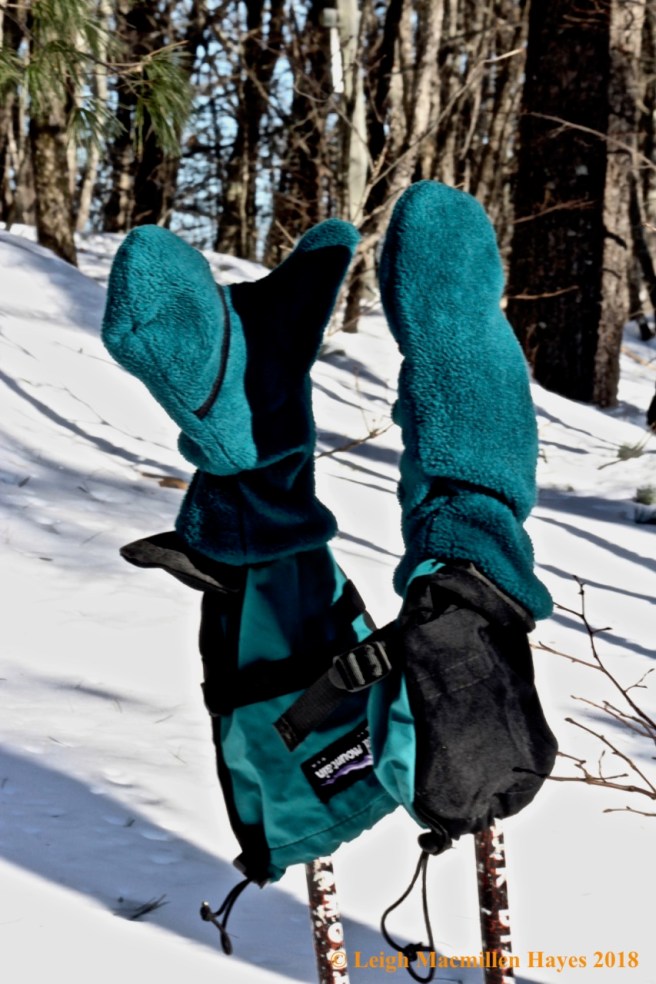
f-who said it was cold?

As it turned out, a few in our group found their hands getting too warm, so welcomed a chance for a mitten break.

f-sit a minute

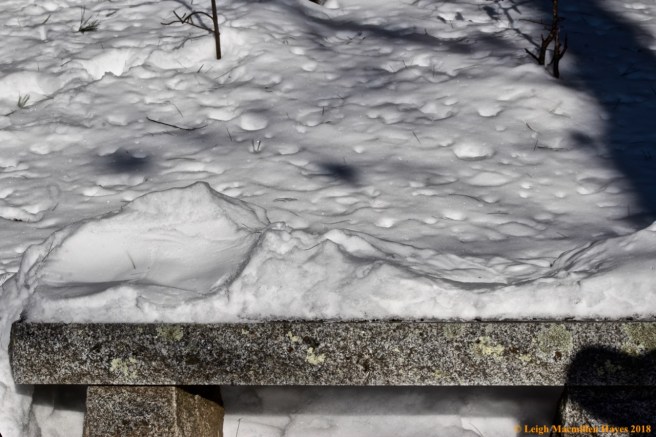
Others sat for a moment on the bench and left behind impressions.

f-hot water carafe

One of our docents had made pumpkin bread to enhance our toast and we brought a carafe full of hot water for cocoa or tea.

f-Heinrich filling cup

The water was very hot indeed and warmed us right up.

f-enjoying the summit and each other

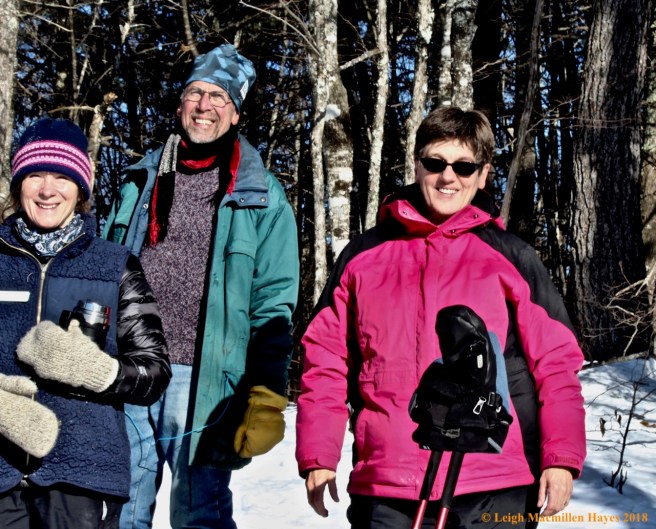
And so it was with big grins that we shared camaraderie at the summit, enjoyed the view and noted the fact that it wasn’t too windy and the cold air was tolerable.

f-red fox print and pee

When we did finally pack up to make our descent, we snowshoed first over to the bench on the Heald Pond side of the summit, where last year we found a sacrificial squirrel upon the altar. Prints left behind indicated a fox had dined there. Of course, a few of us got excited about the kill site and perhaps scared others away from joining us again this year. But . . . we just like to know what the mammals have eaten.

Today, an offering of another kind at the same bench. We found more fox prints all around it and as is typical on a raised object, a hint of pee–its skunky scent indicating it was a red fox. (Yes, I sniffed the pee. By the way, deer pee smells rather piney–just saying.)

f-deer trail

On the way down, more fox and mouse prints everywhere we looked, some old, others fresh. But also, deer tracks a few days old and filled with beech leaves that had recently blown down. It was much colder on our descent given that we were on the eastern side of the mountain and for the most part out of the sun.

f-John Fox Homestead

But that didn’t stop us from making a quick trip to Otter Rocks where two members of our party told us they had the great joy of watching a couple of otters frolic last summer.

f-dragonfly exuvia, lichen and ice:snow on otter rock

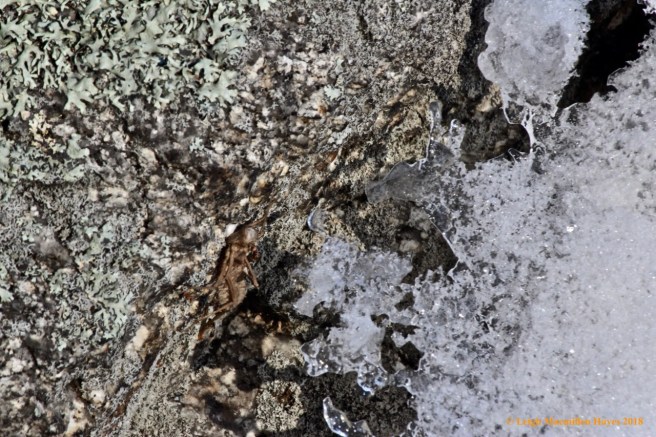
We stepped onto the ice and looked back at the large, erratic boulder that marks the point, and reveled in the sight of lichens, dragonfly exuviae and ice displayed.

f-dragonfly exuvia 2

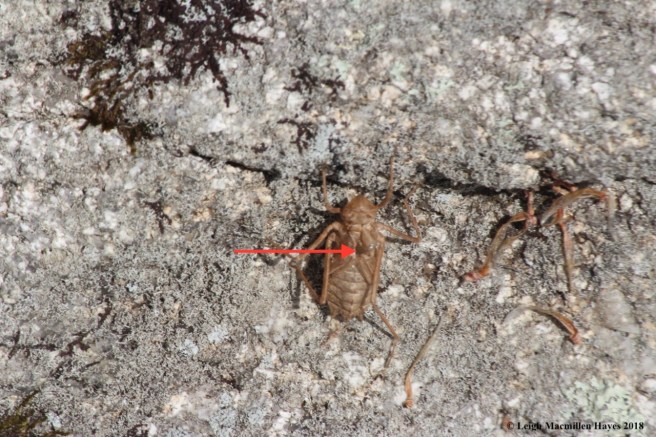
We always check the area for dragonfly exoskeletons but now that the ice has frozen, we can visit the rock’s backside for a change. A few remain, and it was easy to see the hole from which the dragonfly had cast off its external covering during last spring/summer’s moult.

f-Toasting Lovell

The temperature dropped drastically by Heald Pond and wind picked up, so we soon made our departure and headed back to the parking lot.

We were, however, tickled with the knowledge that we’d taken the opportunity to hike on this First Day of 2018. And while at the summit of Whiting Hill, on the count of three, we’d shouted Happy New Year to  Lovell, Stoneham, Stow and Sweden. Did you hear us?

The Sun Sets On 2017

Go without expectation I told a friend the other day. But I hardly take my own advice and so as I set out to snowshoe along the trails of Loon Echo Land Trust’s Bald Pate Mountain Preserve today, I silently hoped I’d spy a snowshoe hare or bobcat. Of course, both would have been over the top, but the possibility existed for their tracks were everywhere.

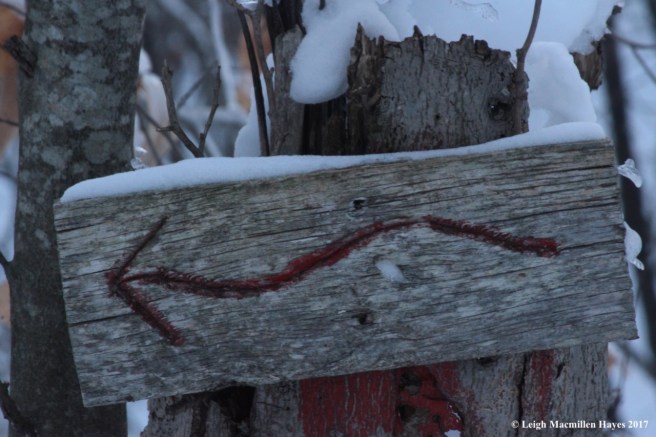
b1-Moose Trail sign

My first trail of choice was the Moose Trail. Maybe it was the snow cap atop the sign that helped me choose, but really, I like it because it circles halfway around the base of the mountain and then joins the South Loop Trail to complete the journey and ascend to the summit. Plus, it isn’t well traveled, except by critters. And so I went.

b5-q for question

Immediately, I saw a snowy Q and questioned what I’d see.

b2-spring is on the way

Despite the cold, there were signs of spring in many forms. One referenced a former use of the land.

b3-striped maple samaras

Another bespoke future offerings.

b4-water feathers

And a third bubbled up and created wispy feathers.

b6-nature's cathedral

Overhead, so much ice continued to cling to trees and jingled like a series of wind chimes along every path I traveled.

b8-porky 1

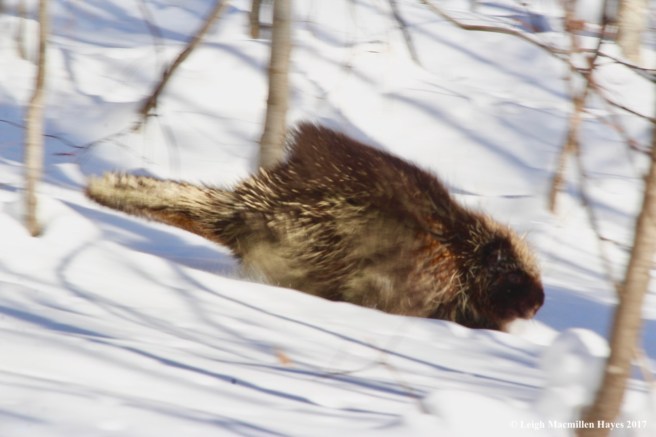
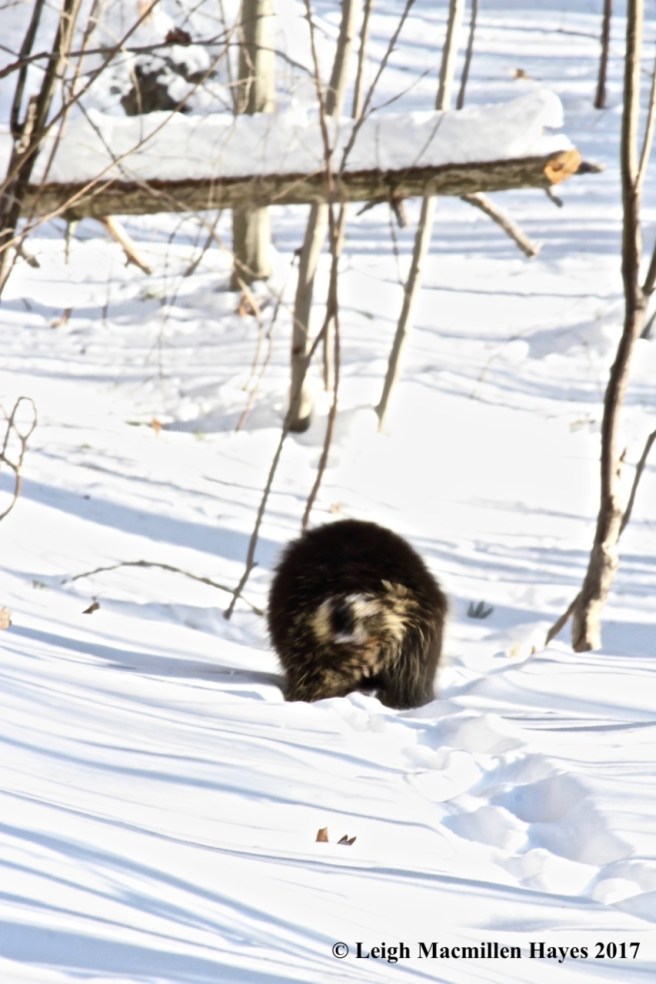
At last I was in an area of erratic boulders and certain that a bobcat was watching me. But . . . to my surprise a porcupine quickly waddled down its own well-packed trail.

b9-porky 2

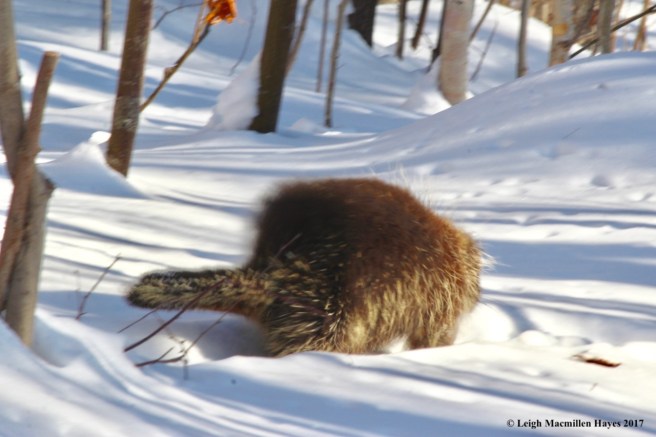
In my excitement, I could barely focus.

b10-porky

I did hear other people approaching and so called ahead to warn them. Turns out that was a good thing for they had a dog companion. Porky actually crossed the man-made trail and continued on its way.

b11-porky trail

The other hikers and I stood and watched it and then examined the trail left behind by this pigeon-toed mammal. I’ve always thought that the tail left a swish, but this big guy held its tail high. I’m more inclined to think its toenails and quills are responsible for the lines between prints.

b13-Peabody Pond

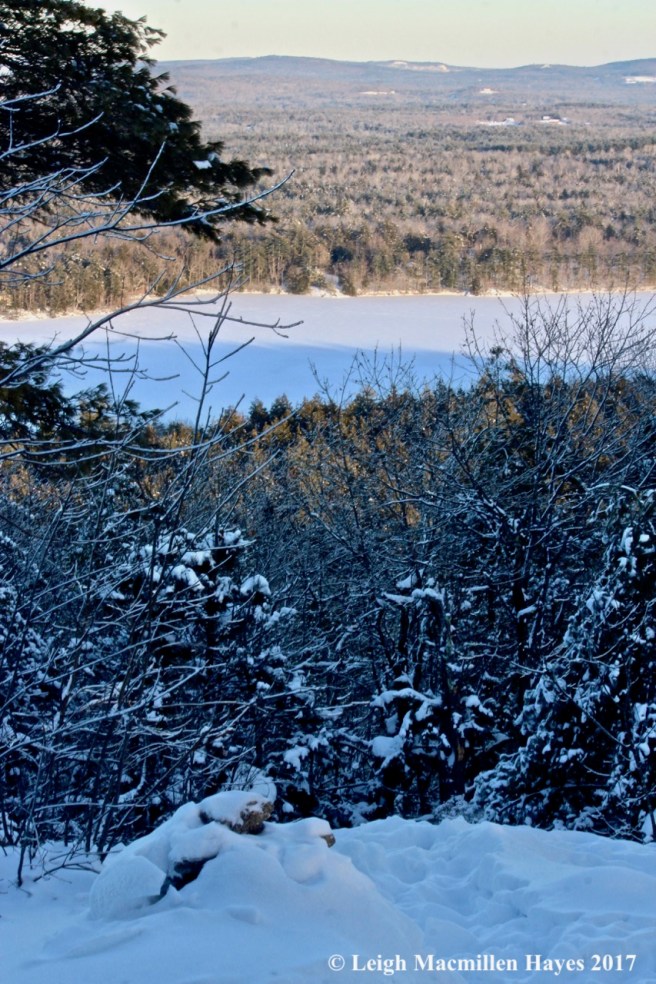
At last I climbed upward and Peabody Pond came into view.

b14-Pebody and Sebago beyond

And in the distance Sebago Lake, not yet covered in ice, though I read in this morning’s paper that forecasters think this might be the year that it finally freezes over again.

b25-Hancock Pond

From the summit, I could hardly see the bald pate for which this mountain was named. But, the views outward included Hancock Pond.

b16-Mt Washington

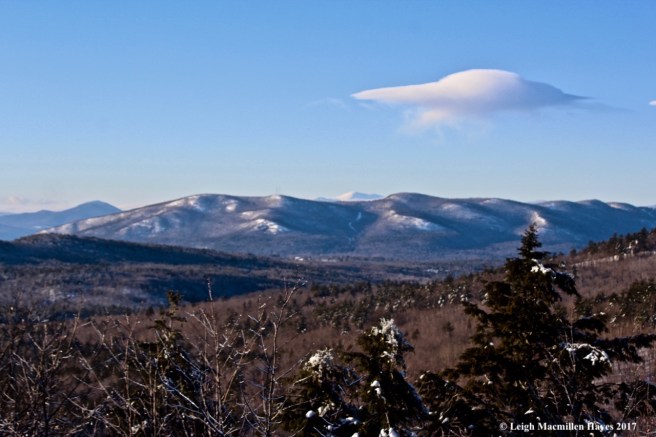
And then Pleasant Mountain with Mount Washington in its saddle.

b18-trail to outlook

Rather than follow the Bob Chase Trail down, I chose the scenic overlook trail to the Foster Pond outlet.

b20-Foster Pond cairn

Shadows were growing longer and I didn’t stay long. At that point my camera battery began to die and so I placed it inside my mitten to take advantage of a hand warmer. And took it as a hint–my cheeks were also beginning to feel the cold.

b17-subtle signs

It was time to follow the subtle . . .

b22-home sign

and not so subtle signs home.

b23-sun setting

After all, the sun was setting on 2017.

b24-following porky

Tomorrow will dawn a new day and a new year.

Thanks to all who have wandered with me this past year. Here’s to a wonder-filled 2018.

Happy New Year!

Oh Baby!

It’s so cold outside that probably the smart thing to do would be to stay snuggled within, but I couldn’t.

a-bluejay with seed

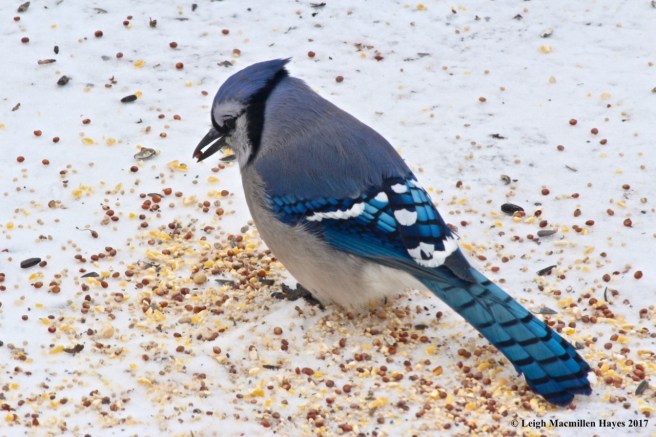
After all, the birds were on the move, though they were a bit puffed up, a normal behavior when the temp is below zero. Their feathers help insulate them from the cold (and my hands understand that as they were tucked inside down-filled mittens). Fluffing up traps as much air as possible, thus keeping our avian friends warm.

s-robin

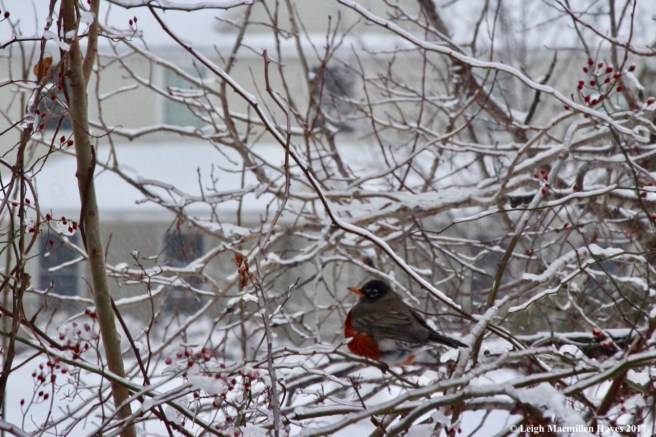
Their feathers are also waterproofed with an oil coating, a good thing on this not only frigid, but also slightly snowy day.

s-frost around squirrel homes

As I wandered, I noticed that the squirrels and maybe other small mammals had decided not to venture forth and found plenty of evidence that they were huddled inside. Ice crystals formed in holes beside trees, and . . .

s-frost by stone walls

openings in stonewalls . . .

s-frost again

reminded me of the feathery display on our windows on cold winter mornings. These were the mammals’ windows–such as they are.

s-stained glass

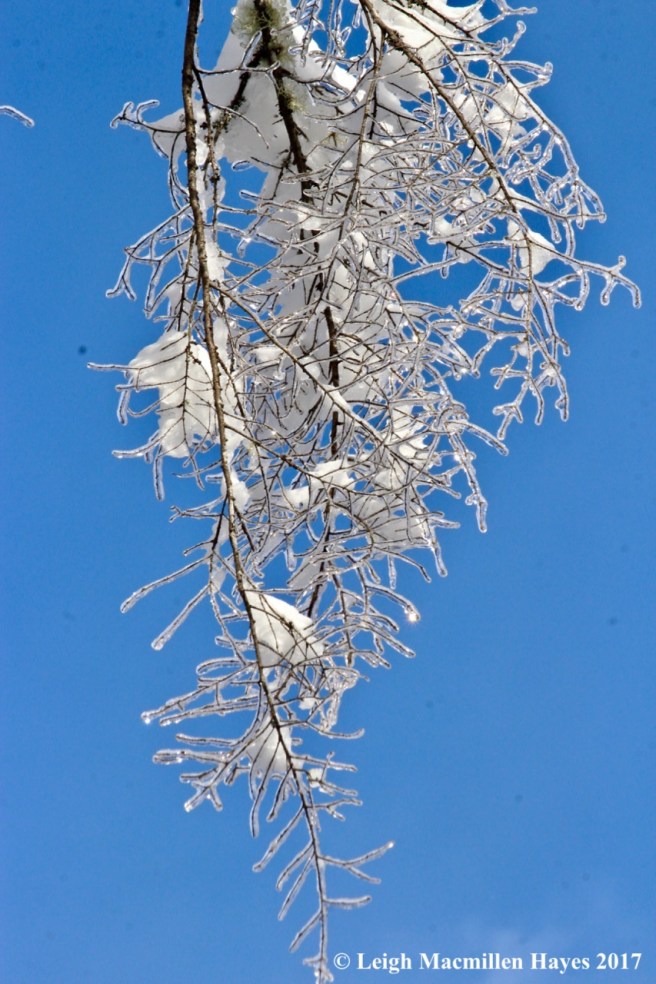
And speaking of windows and ice, which has lasted longer than usual following the Dec 23rd storm, everywhere branches reminded me of stained-glass leading highlighting the picture of our winter world.

s-red maple buds

But, here’s the thing about ice. Like feathers, it also serves as an insulator, keeping leaf and flower buds along tree branches protected from the cold. Oh, they have waxy coatings, but the ice adds another buffer.

s-beech bud

Some of the sights I saw today made me chuckle, like the beech bud poking through one of the tree’s marcescent leaves.

s-pinecone on maple

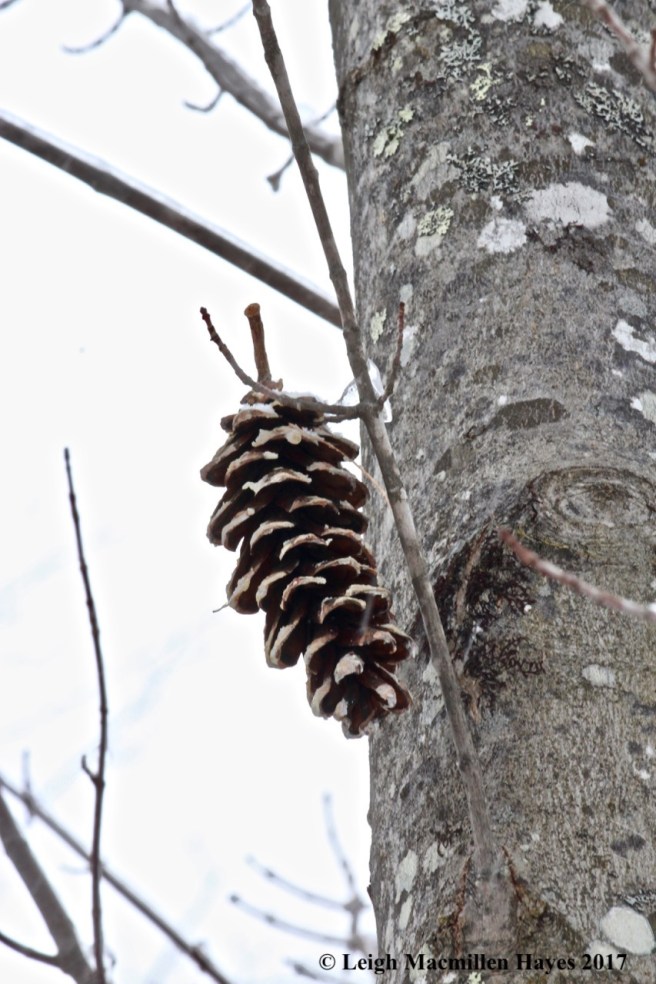
And a maple pinecone.

s-saw-whet owl 1

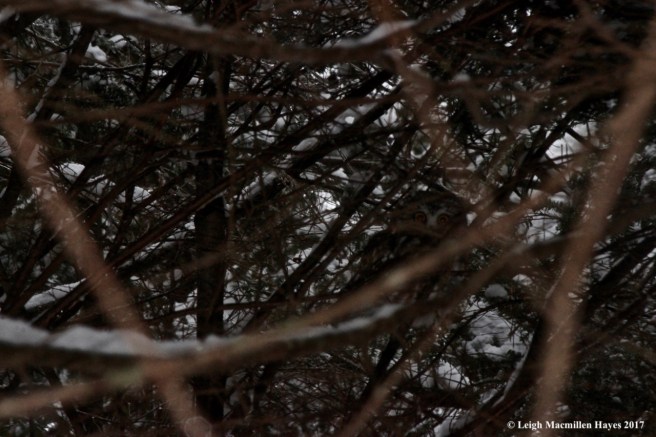
But my favorite find of all flew in while I was making my way rather nosily through a dense patch of hemlocks. Another where’s Waldo moment. Do you see it?

s-saw-whet owl 2

Yes, a Northern Saw-whet Owl! A first for me in the wild.

s-saw-whet 3

We shared about ten minutes together and it was definitely an “Oh baby!” occasion (which I reported to Jean Preis for our local Bird Count).

And with that, I’m proud to say, “It’s a boy!” The bird, I’m not sure. But I’m a great aunt to Baby Bud who was born at 12:24 this morning. May he develop a sense of wonder about the natural world and a love for winter.

The owl was the icing on the cake on this special day–Oh baby!


Counting Birds

In the name of citizen science, Kathy McGreavy and I ventured forth at 8am this morning as the temperature hovered just above zero.

c1-map

Our eyes were on the birds within view along a route outlined in orange. Up and down roads we journeyed, stopping periodically to jump out of the truck and focus our binoculars on our feathered friends and then keep track of them on the list provided. At the same time, other groups traveled different routes within the circle and also tallied their discoveries.

c6-junco 1

Together, we saw blue jays, crows, robins, tufted titmice, a female cardinal, brown creeper, some chickadees, and lots of juncos. We also enjoyed driving down roads less traveled and reveled in the ice and snow-coated scenery before us.

c3-robin 1

At noon, Kathy had to depart and so I headed home for a quick lunch before venturing out again to finish up our tour. And at Salmon Point boat launch I was rewarded with more robins.

c4-northern flicker

But my favorite spy of the day, two northern flickers at the outlet where Stevens Brook flows into Long Lake. I first spied one and then two on the trunk of a red maple. After a few minutes they flew below to dine on winterberries. But I wondered–northern flickers in December? They weren’t on the list, nor were they rare; just not typical winter visitors in western Maine.

c7-female downy woodpecker

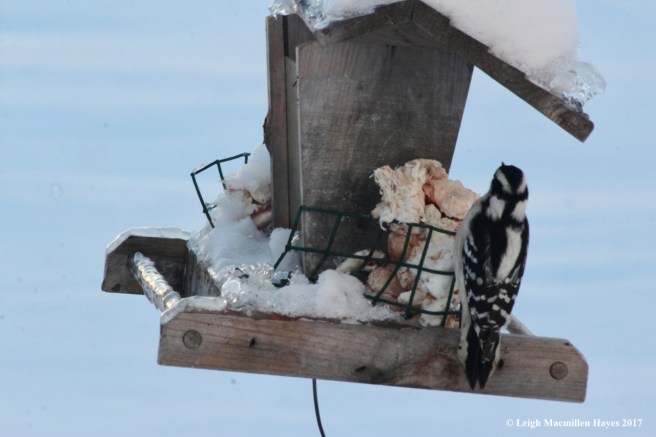
Seven and a half hours later, back at home, which was out of our part of the quadrant, a female downy woodpecker enjoyed some frozen suet. I couldn’t include it on the final report, but still . . .

c7-white-throated sparrow

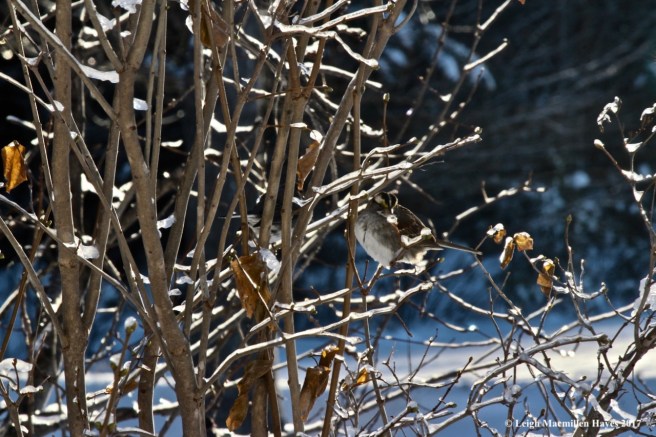
The same could be said for the white-throated sparrow that I frequently spot amongst the junco flock that partakes of our feeding station.

Participating in this citizen science project is great fun and I’m thankful it’s a winter tally for I can ID most of the species I see. Were it to occur in summer when all those warblers breed in this northern territory, my bird brain would be more challenged.

c2a-CMP dam

Another benefit of said participation is the opportunity to visit places such as the old dam on Stevens Brook during the winter season.

c2-otter slides

Because I was there, I saw tons of otter sign including numerous slides. A huge grin covered my face.

c5b-ice disk in Stevens Brook

And then, there was a certain rare sighting lower in the brook that drew my awe.

c5-ice disk 1

We had a form to complete for rare finds. But . . . it was for rare bird finds. Would my northern flickers suffice? I wasn’t sure and so filled in the information to be on the safe side. But . . . that which I saw in the brook itself was probably rarer.

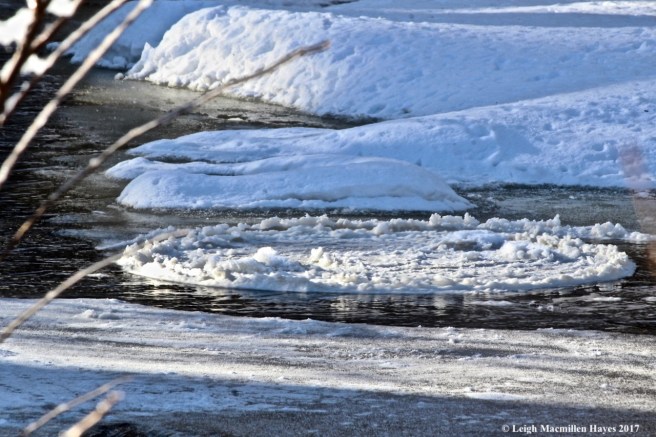
An ice disc.

According to Mary Holland’s recent post about such on her Naturally Curious blog: “An ice disc is a large disc of ice spinning in a river. It’s thought that this relatively rare natural phenomenon is likely caused by cold, dense air coming in contact with an eddy in a river, forming discs ranging anywhere from 3 to 650 feet in diameter.

While eddies contribute to the spinning, they are not the only cause. If they were, small discs would spin faster than big discs, and this is not the case. Discs of all sizes rotate at roughly the same rate. One would also expect that discs in still water, where there aren’t any eddies, wouldn’t start spinning, but they do.

The melting of the ice disc contributes to its spinning as well. When an ice disc starts to melt, the melted ice water is denser than the ice, and thus sinks below the disc. This movement causes the water to spin, which in turn spins the disc.”

Common and rare–and another fabulous day spent participating in the Audubon Society’s Christmas Bird Count for 2017.


Peace on Earth

One touch of nature and it seems to me we’d be able to achieve world peace, that idealistic concept of happiness, freedom and cooperation among all peoples and all nations.

o-ice on beech leaves

On a frigid winter day it would be extraordinary if only we could encourage more people to step outside and observe the beauty of the natural world. Of course, all would need to be  dressed for the conditions so they felt comfortable, and appropriately equipped so they could travel with some ease, and . . . and . . .  and. But still, surrounded by leaves blanketed with snow, and icicles extended like fingers reaching out to others, how could anyone resist sharing a collective awe.

o-ice and snow illuminated by sun

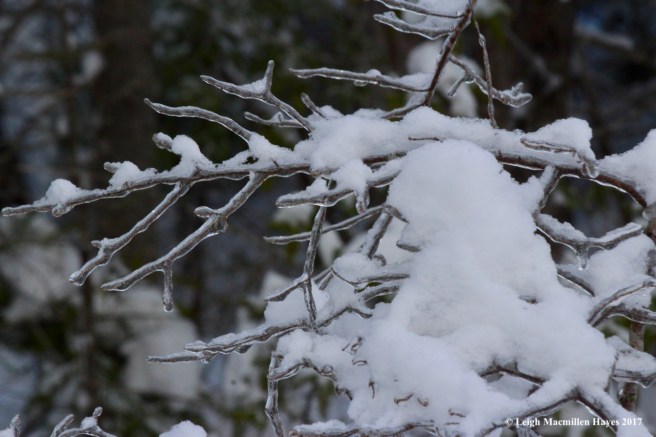
Snow and ice and more snow. And suddenly, the world transformed and branches intertwined in ways we’ve not seen before and the same could be true for all of us. Perhaps the key is to figure out how much snow and ice and snow creates such interesting intersections. And how we can do the same–make interesting interactions.

o-ice on pine like Hawaiian grass skirts

Be they conifers wearing grass skirts,

o-birch catkins enclosed

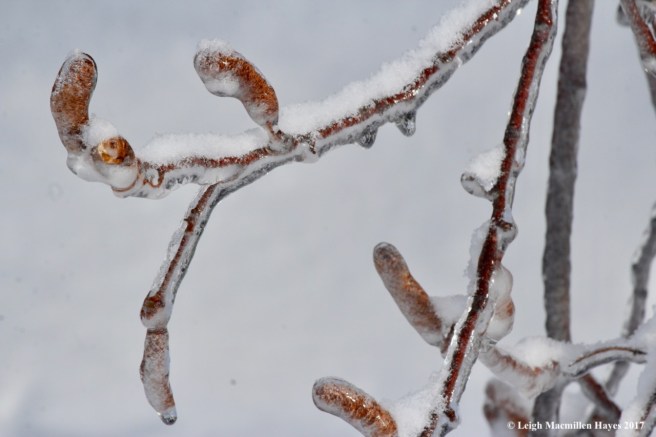
or catkins wrapped in union suits, nothing went untouched in the Christmas weekend storms.

o-ice on maple

Frozen condensation clung . . .

o-ice drips

in various formations and reflected all sort of colors.

o-ice on usnea lichens

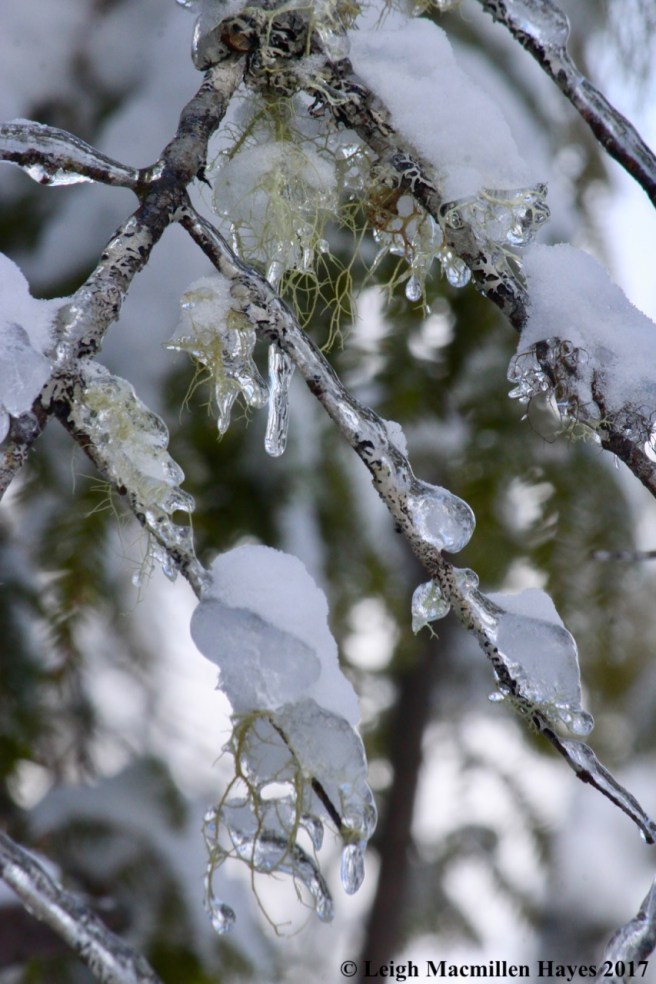
I wished I’d seen it all transpire. But I wasn’t able to until today and then, I was grateful for the opportunity and wonder of it all. I traveled alone, but in perfect hind sight, wish I’d invited another to join me.

o-ice above

To rejoice in those sparkling high above . . .

o-gray birch arches

and appreciate the burden of others bending low.

o-gray birches meet in the middle

To recognize new dance partners in the midst.

o-ice on pine finale

One step at a time. One look. One touch. One acknowledgement. One smile. And then two smiles. And three. And four. And many more.

Peace on Earth.

One touch of nature makes the whole world kin.

~William Shakespeare


Miracle of the Stable

Who knows how it all began. Perhaps it was a teeny, tiny thought tucked away in the back of a mind.

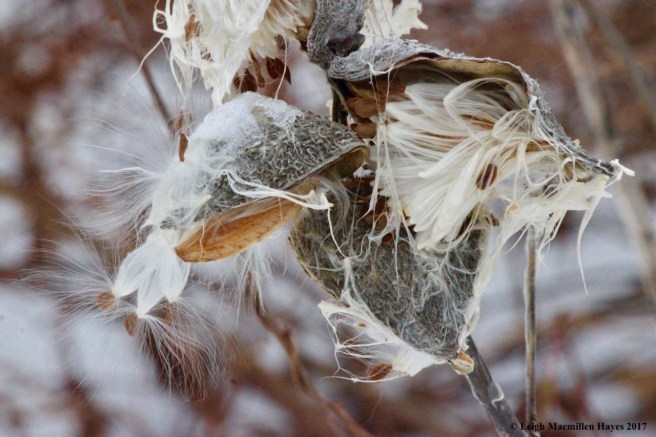
p-milkweed 2

A seed of an idea waiting to express itself in one form . . .

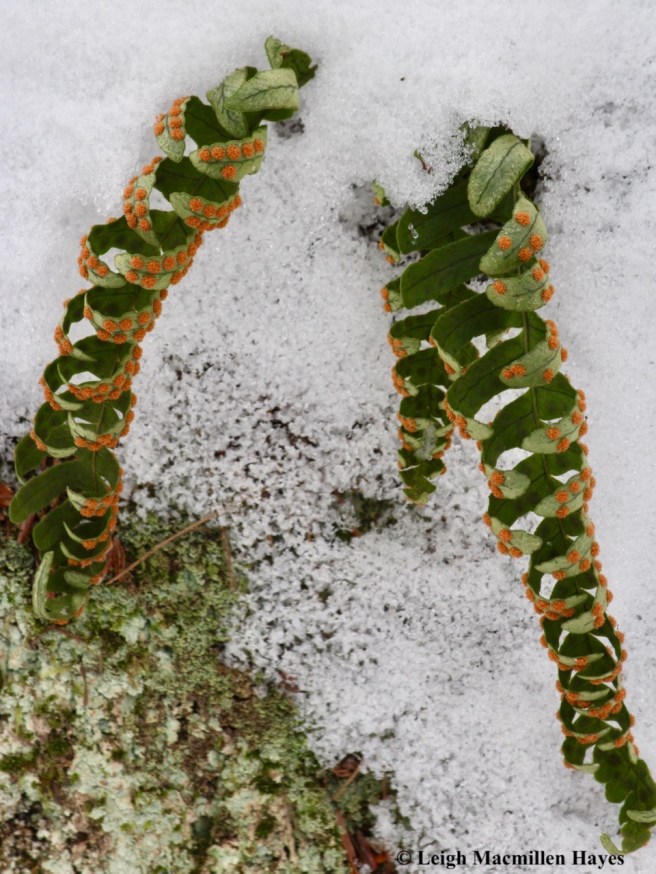
p-polypody

or another.

p-yellow birch in pine tree

The seed was sown and sprouted despite adverse conditions.

p-Normway maple leaf

More thoughts followed, some even considered “invasive” despite their exterior beauty.

p-bittersweet

Occasionally, the invasive ideas forged ahead and crowded the mind.

p-car

Certainly, not all the thoughts were natural in nature.

p-boardwalk

But still, new paths formed.

p-fisher tracks

And trails were traveled to and fro on a quest.

p-stream curves

The path was never intended to be straight and easy.

p-Stevens Brook 2

Obstacles became challenges.

p-brook reflections

And challenges offered reflections.

p-ice feathers

Amidst the offerings, fresh ideas feathered forth fostering education.

p-garland

And with education, knowledge was linked.

p-tree cookie

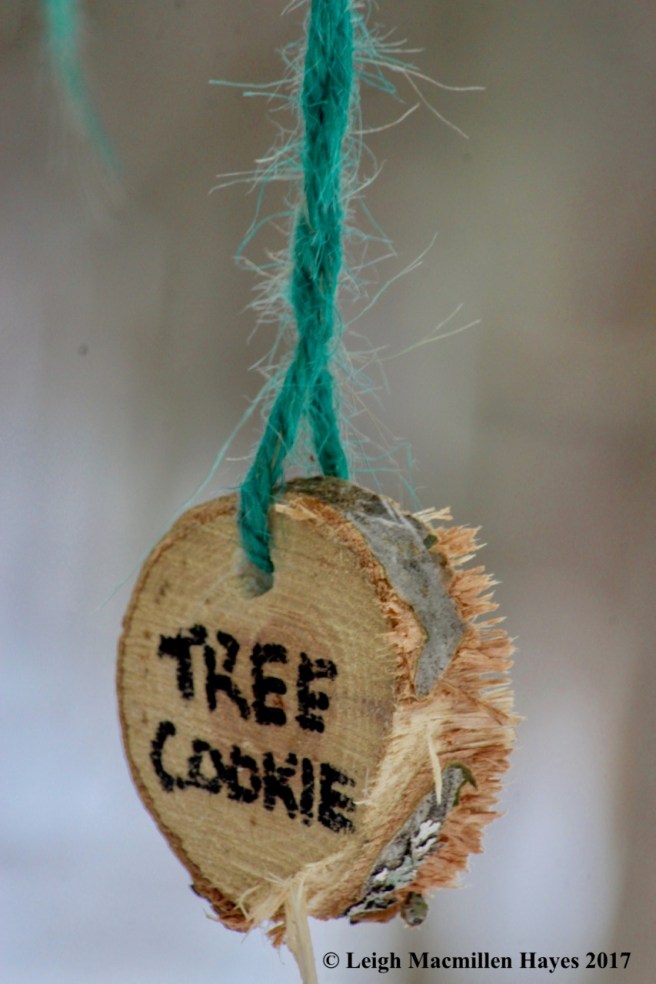
Because of all the seriousness, humor became a necessary ornament.

p-nativity

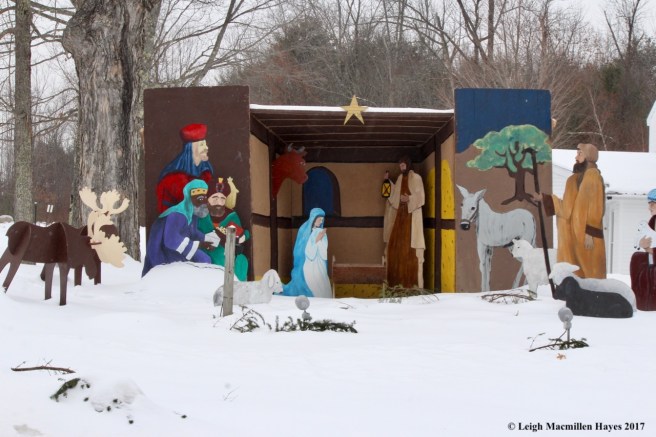
And so it was that moose stood watch with others by the stable in anticipation of a miracle that began with a seed of an idea and expressed the wonder of it all.


On Tippy Toes with Wonder

Snowshoes were a necessity this morning as I wandered, but with them came the constant sound of breaking glass as the frozen layer of ice atop the snow crackled with each  footstep. I doubted I would see anything amazing for so much noise did I make.

o-hemlock cones and seeds

I was right, of course. It was all the usual suspects that show up ever more clearly now that the earth is draped with a snow coat. I only found a gazillion hemlock cones on the ground, most descaled and their seeds consumed by a certain red squirrel.

o-squirrel cache

The hemlock cones were below trees near the squirrel cache I’ve been keeping an eye on. Curious thing about the cache–no tunnels to the goods within and one new snow-covered cone stashed atop. Did he decide the hemlocks were easier to deal with at the moment? Will he return to the pine cone cache for dinner? Of course, I’m assuming the work is that of one squirrel, but it could be more than one in the same area.

o-pinecone on hemlock

I did spy one that made me chuckle, for one of my pet peeves is when people call all cones “pine cones.” Pine cones grow on pine trees–whether white, red, pitch or jack. Hemlock cones grow on hemlock trees. And balsam cones grow on balsam trees. You get the idea. But what do you call a pine cone on a balsam tree? A tree topper, of course. Or . . . stuck. (And I’ve got the market on corny humor.)

o-turn left

Every which way I turned, there was nothing new to look at.

o-hoar frost on white pine

But the hoar frost . . .

o-hoar frost on hemlock

added crystalized ornamentation . . .

o-hoar frost 1

wherever it gathered . . .

o-rabbit-foot clover 2

from the feathery rabbits-foot clover . . .

o-Queen Anne's lace 3

to Queen Anne’s lace . . .

o-gray birch catkin 2

and gray birch catkins. Oh my.

o-ice waves 1

As the sun rose higher, my fascination with hoar frost melted away, but another ice sculpture begged notice–its formation called to mind hills and valleys of waves topped with white caps. And still, how does it do that?

o-goldenrod gall

I found goldenrod galls as well, this one with no opening, which may mean the gall fly larva was probably still sheltered within.

o-goldenrod bunch gall

The other was a goldenrod bunch gall created by a midge. Looking like a mass of tiny leaves, it’s also known as a rosette gall for the shape at the top of the stem. In both cases, it’s amazing that insects can change a plant’s growth pattern so dramatically.

o-tracks galore

Even the tracks were of all the usual suspects from mouse to moose and I realized yet again how fortunate I am to share this space with them and know all their haunts.

o-right sign

At last I took the right turn toward home.

o-deer beds 1

And under the hemlocks in our woodlot, I counted eleven deer beds and yet, I haven’t seen a deer in a while. This, however, has long been their frequent nighttime hangout.

o-deer beds 2

As I often do when I spy several ungulate beds–I looked at their orientation and as usual each had its back to the other given the smooth curved line–with all eyes and ears on the lookout.

o-moose ice

I also found a rather large print filled with a block of ice–actually, it’s a half block of ice for it fell off of only one of a moose’s cloven toes. I wondered if the moose felt like it was walking on tippy toes until that point.

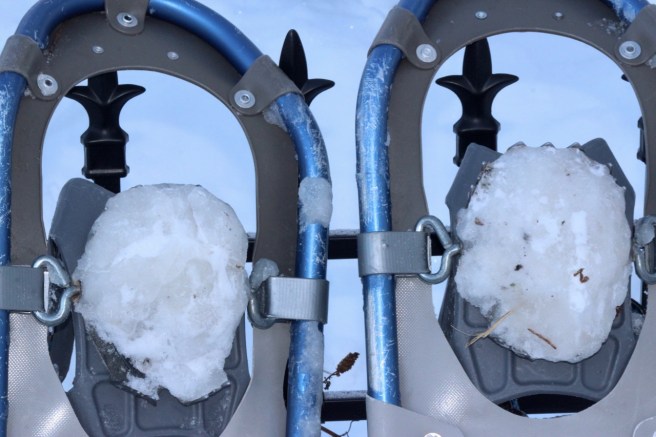
o-snowshoes

I certainly did, so frozen were the balls of ice on my snowshoes. That’s what I got for working my way through a half-frozen wetland. But it was that same water I had to thank for the creation of the hoar frost.

As awkward as it was, it was certainly fun to observe the world from my tippy toes. And despite the sameness of it all, my mind and heart were filled with wonder.


Like a Charm

White flakes floated earthward today and so I donned my snowshoes for the first time this season and joined the party.

s-snow!

Everywhere I looked, the world had transformed.

s-snow piling high

And ever so slowly mountain ranges took shape.

s-squirrel cache snow

One mountain in particular caught my attention,

s-squirrel cache 1

for I’ve been visiting it and two others nearby over the past few weeks.

s-refectory 1

Where previously, the refectory indicated hours of fine dining,

s-squirrel refectory snow

today there was none. But, I suspect by tomorrow a certain red squirrel that usually squawks at me will be back. Today, he probably hunkered down in his drey, hidden somewhere in the hemlocks above and out of my view. My intention is to keep an eye on him, just as he’ll continue to keep an eye on me, for I want to watch tunnels form and midden piles grow.

s-pinecone scales

After all, he worked hard this past summer and fall harvesting cones and acorns to fill his cupboards in preparation for the winter months. Though those months aren’t yet upon us, even in the fringe he enjoys what he’s gathered.

s-deer rub snow

I left his home base behind and continued on, noting how the snow had gathered–atop the ragged remains of a deer rub,

s-goldenrod snow

balanced on winter weeds,

s-snow tucked within

curled inside leaves,

s-snow on beech

and dangling from others.

s-oak and hemlock

A fun find came into view below the towering trees, where the veins of red oak mirrored the structure of the hemlock twigs and needles it was caught between.

s-snow at home

At last it was getting dark and time to return to the homestead.

And it was time to celebrate the only dance for which my feet can match the rhythm–the snow dance. I’m so glad I wore my pajamas inside out and slept with the silverware last night. It worked like a charm yet again.


Christmas on Flat Hill

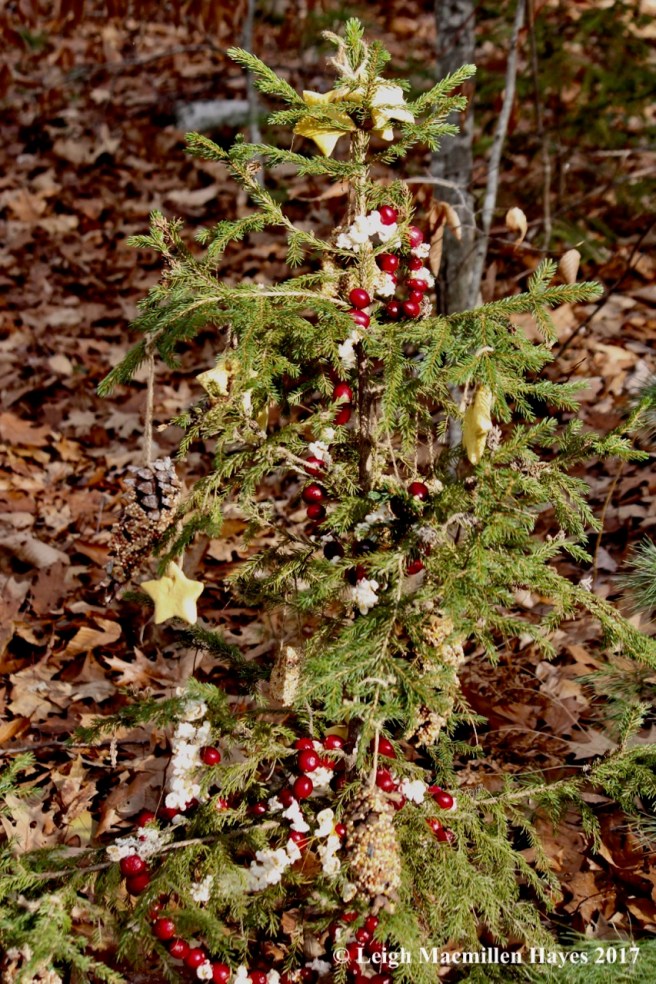
Two weeks ago the Greater Lovell Land Trust hosted a decorating party for the Fairs, Farms and Fun 4-H Group of Sweden along the trail to the summit of Flat Hill. It was the perfect tie-in to our planned hike to do the same during a guided walk scheduled for this morning.

f-finding the right spot

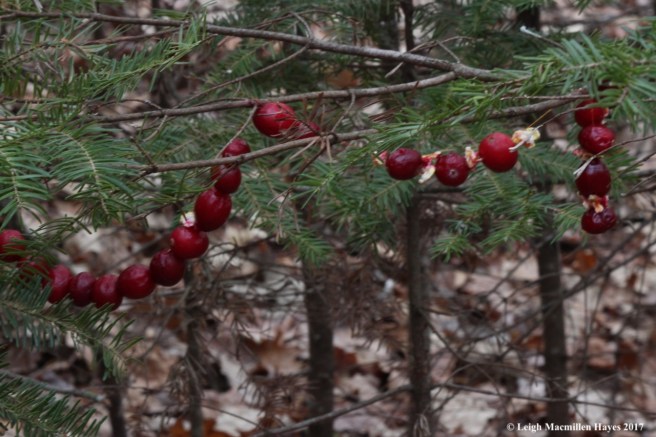
The homeschooled kids in the club had created ornaments with pinecones, peanut butter, and bird seed, plus garlands of cranberries and popcorn.

f-all done

Their efforts were for the first annual Maine Christmas Tree Hunt, a scavenger hunt intended for families to visit trails on several western Maine land trust properties.

f-Christmas Tree

The plan was to decorate one tree along the trail, but they had made so many ornaments that five or six trees actually were transformed into works of Christmas treats for the birds and mammals that call this place home.

f-chickadee

And so this morning we set off to check on the trees the kids had decorated and add a few of our own. We wondered what the ornaments might look like after two weeks. Some pinecones were nearly nude of the bird seed that once coated them. And if you look closely at the bottom left of this one, you’ll see a splash of gray–a chickadee moved quickly as it snatched seeds.

f-cranberries

We also discovered that the popcorn was a big hit and most had been consumed, but the tart cranberries remained.

f-ornaments 3

There’s still more out there and we added a few fresh ornaments today, so I highly encourage you to pull on your boots (and it looks like you might need snowshoes as it’s snowing while I write) and head to the trail at the end of Heald Pond Road in Lovell.

f-beech leaf skeleton

While you’re there, take a look around. There’s so much more to see, including skeletons of beech leaves,

f-bear claws

bear claw trees,

f-polypode spores

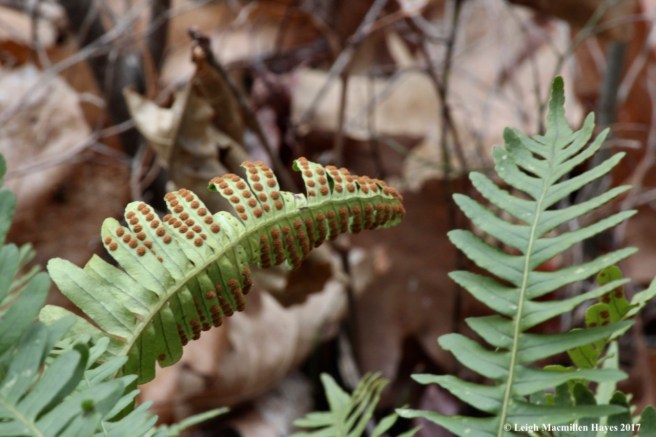
and polypody, some still dotted with sori.

f-baldfaces and Mount Wash

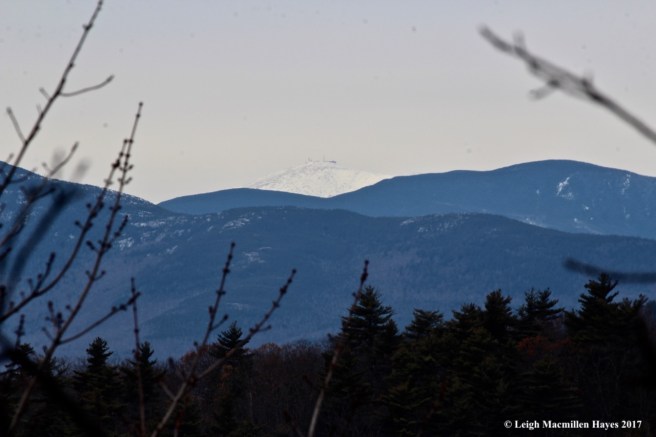
If your experience is anything like ours was, you’ll probably spy Mount Washington standing pure white between the branches of the red maple tree at the summit.

f-mt wash

And if you look closely, you may even see the buildings at the top of the greatest mountain in the Northeast.

f-porky 1

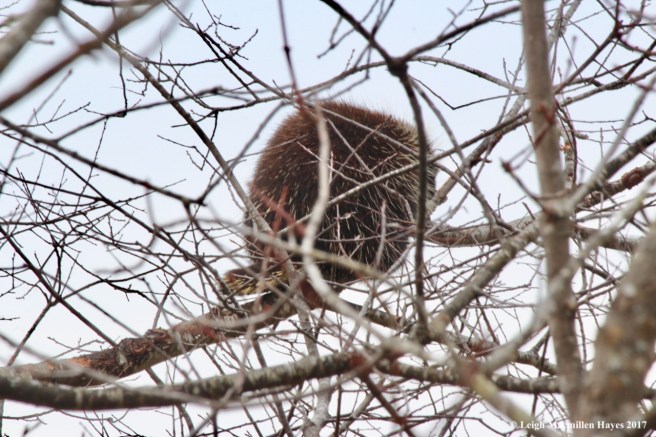
That’s not all that came into view. We occasionally are treated to the sight of the resident porcupine who lives in the area. And today–voilà.

f-porky bites

On our way partially down the back side of the summit cliff, we spied evidence of his work.

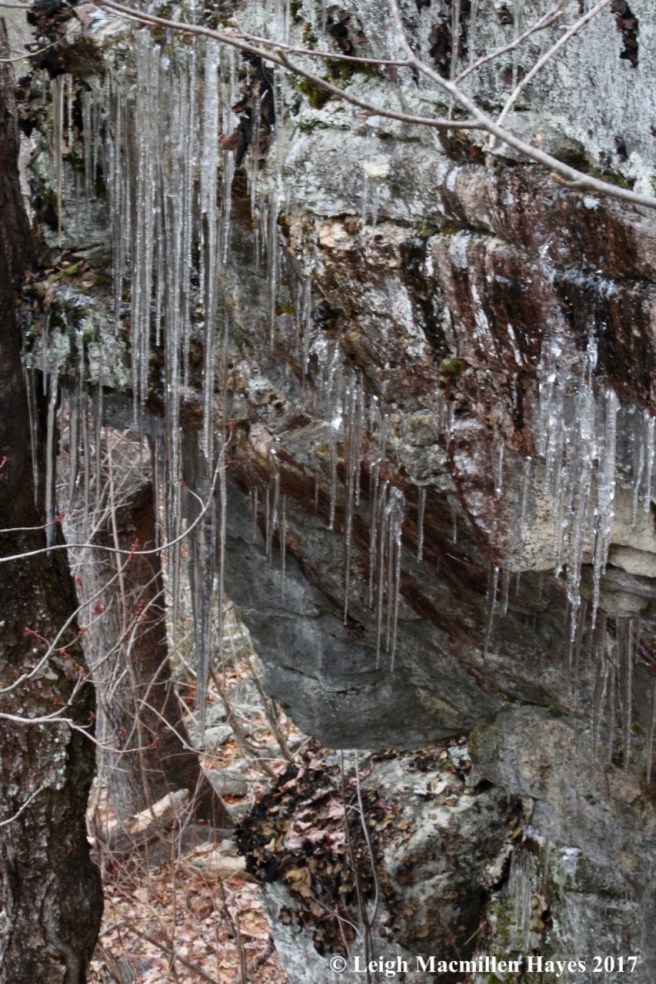
f-ice 2

And while we were looking, a crevasse drew our attention.

f1a-ice

The beauty of ice never ceases to draw out long “Ahhhhhhs.”

f-ice 3

The granite boulders wore the ice like necklaces–reminiscent of quills.

f-porky 2

And we got a tiny bit closer to our prickly friend.

The gifts are plentiful this Christmas season on Flat Hill. Take a hike and enjoy the wonders.

Merry Christmas and Happy Hanukkah from the Greater Lovell Land Trust and me.

A Beautiful Gray Day

Today dawned sunny with a bright blue sky. A perfect day to travel the trail with Marita.

g1-burl

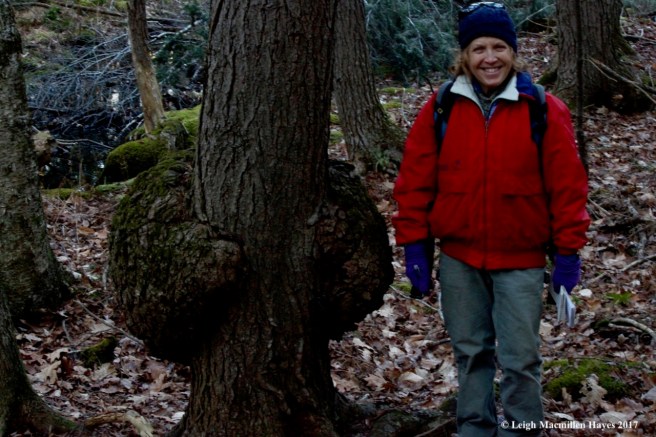
We wondered what we’d see and didn’t go far before spying a bear hiding behind a tree. Marita was happy to pose beside it in hopes of coaxing the critter to join her in smiling for the camera. Actually, it was the largest burl either of us could remember encountering.

g2-rock castle

After the bear burl, we discovered a rock castle that made us think of kids for we knew that when ours were youngsters they would have loved climbing the towers and hiding in secret cubbies.

g3-morgan meadow 1

But one of our favorite finds on this particular trail was the wetland.

g4-MM 2

A thin layer of ice reflected the changing sky above . . .

g5-MM3

until both were completely gray–but still rich in offerings from color to texture, and we imagined, wildlife.

g6-red maple roots

Beside the water, a red maple offered its own point of interest–and truly, I suspected the fairies lived within.

g7-water feather 1

And then, in another place we found another work of art. While Marita saw a fish, I saw a feather.

g8-water feather 2

From any point of view, we stood in awe.

g9-water feather 3

Such a design of bubbles all because a rock interrupted the flow.

g10-squirrel cache

Red squirrel caches and . . .

g11-squirrel table

dining tables also caught our attention. We heard a few chit and chat at us, but never saw them. Our only wildlife sightings were about a dozen turkeys and a hawk that surprised us.

g11-winterberry

We tramped miles and miles, but only found one spot of truly bright colors as we admired red winterberries juxtaposed behind bent over cattails.

g13-Libby Foundation

And in all our travels, we only found one foundation, where we admired the paper birch that represented the family tree.

g14-mm fav

At the end of the day, we’d walked miles along a variety of trails on a day that began with  blue skies, but ended with gray. Our favorite sight of all remained the first wetland.

In the end, it was a beautiful day in Gray, Maine.


Keeping Watch

My feet itched to move along the forest floor and so I followed them and wondered where they might lead.

o-tree buds

The first stop was to examine tree leaf and flower buds packed inside their waxy scales where they will remain protected from the northerly winds until a date unknown.

o-hemlock cones

Beside the red maple, Eastern hemlock cones dangled like Christmas ornaments, with woody scales of their own protecting tiny seeds tucked inside until those northerly winds might release them.

o-squirrel dinner table

Everywhere, any possible surface, particularly those a bit raised, became a red squirrel dinner table meant for dining upon this year’s abundant supply of seeds.

o-squirrel chatter 1

And everywhere I was chastised by squirrel chatter for they seemed so sure I wanted to wrestle with them for a few nibbles.

o-upper side, maze polypore

I paused beside mazed polypores, so named . . .

o-underside, maze polypore

for their maze-like underside from which they release their spores.

o-forest 2

Sometimes, my feet moved with ease despite occasional walls of evergreens–and when I encountered such, I pushed on through.

o-slash

Other times, it was over logging slash that I trudged, my feet taking a moment to choose the right balancing spot.

o-watery trail

There was even some island hopping thrown into the mix.

o-bobcat scat

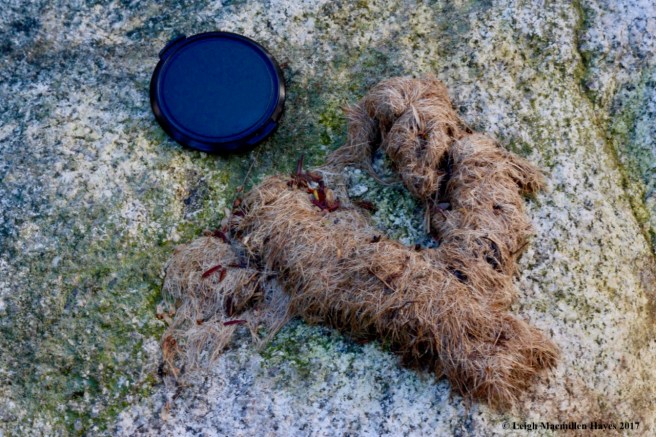
At last I reached a logging road and then different sights filled my heart with hope for I knew that though I saw more than a million red squirrels and heard a variety of birds, including a ruffed grouse, these woods are filled with life (and death). Based on the size and lack of bones, I think this was bobcat scat and the meal was a white-tailed deer.

o-coyote scat

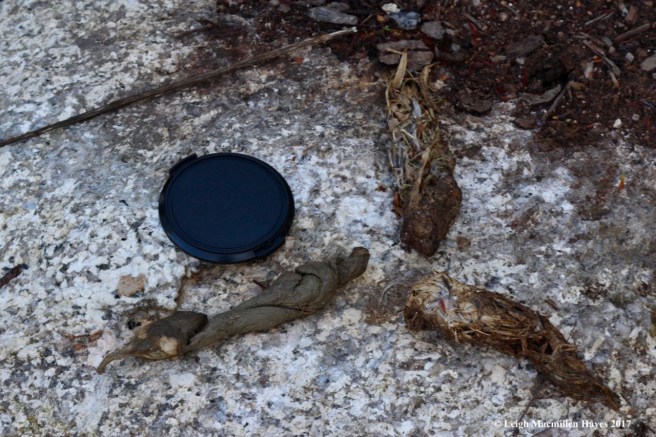
There was coyote scat, both old and new.

o-fox scat

And fox scat reflecting a recent meal–perhaps Sunday dinner.

o-bobcat tracks

And where there is scat, there are tracks–most of the time.

o-moose tracks

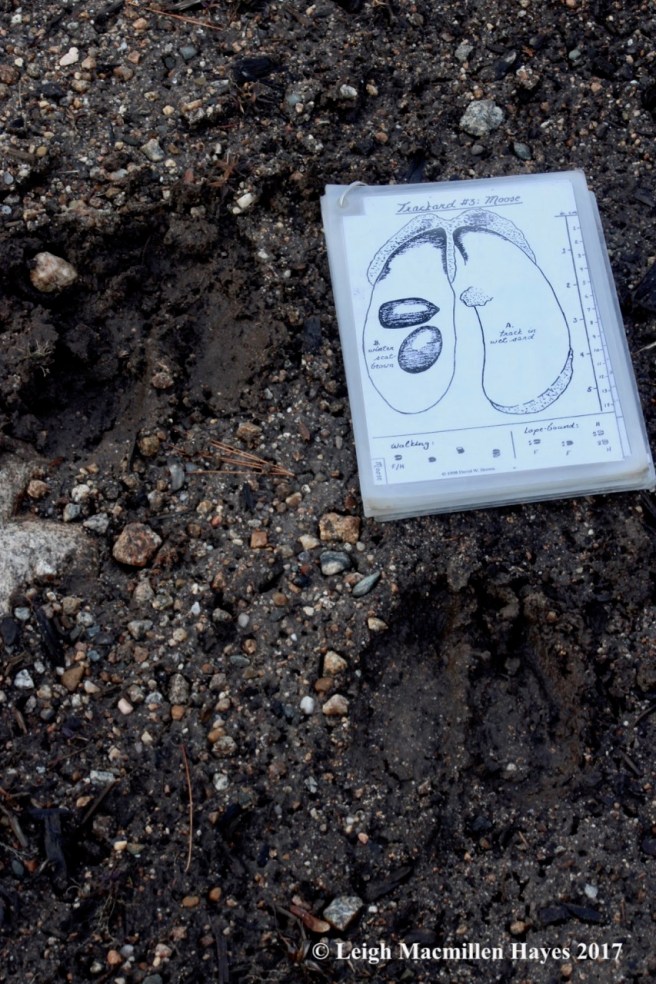
Today, I saw signs of bobcat, moose (more than one), deer, fox and coyote and my heart rejoiced for I love tracking season. I also love knowing that these mammals continue to share this space with me–or perhaps it’s that I share this space with them. I think the latter is more likely. I’m just a visitor.

o-ice art 2

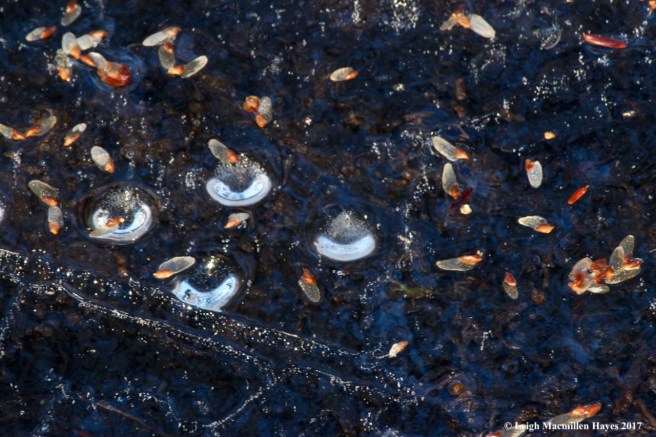
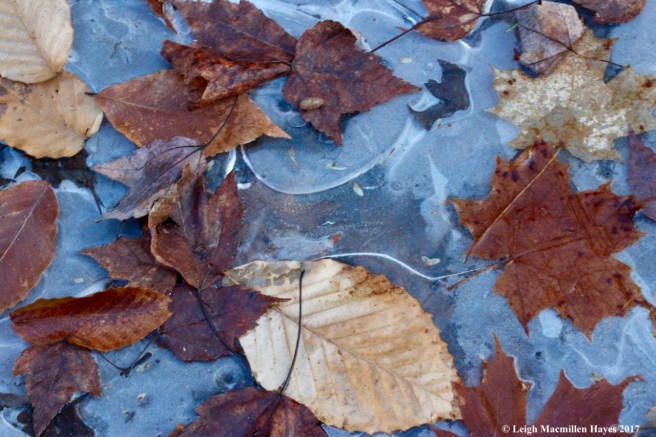
In places, ice also offered sights worth viewing. Atop a frozen puddle, those hemlock seeds I referred to earlier had found their release and their new home–temporarily at least.

o-ice art 1

Leaves, cones and seeds intermixed with the ice and created mosaics worth framing.

o-ice art 4

And branches and seeds imitated trees in another work of natural art.

o-ice art 3

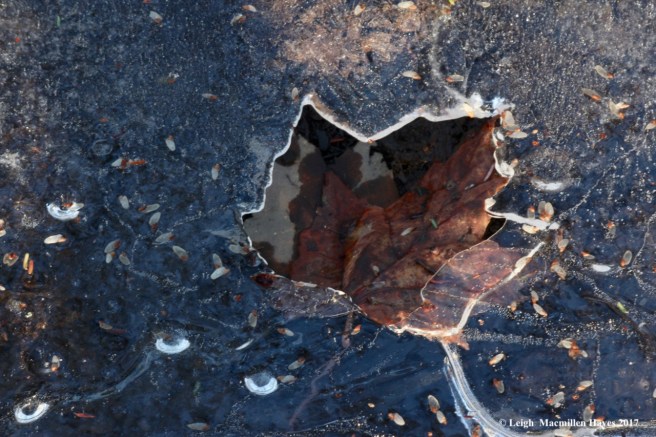
But my favorite was the red maple leaf cut-out that reminded me of Christmas cookie cutters.

Even if roaming through the woods isn’t your comfort level, I encourage you to take a few moments to step outside and look around. In this season of hope, may nature help you find wonder and through that wonder may you find peace within.

Any way you can, please join me in keeping watch.


Whetting Our Apatite

Our hunger is never satisfied each time we gather. We always manage to see more, share more and learn more because of our combined knowledge. We also always come away with questions. And so it was this afternoon when about ten of my Maine Master Naturalist Lewiston classmates and I gathered with two of the programs founders, Dorcas Miller and Fred Cichocki, to explore a public park in Auburn, Maine.

a1a-looking at trees

From the get go, we bounced back and forth along the trail to look at the idiosyncrasies of trees and chat about the book, A Beginner’s Guide to RECOGNIZING Trees of the NORTHEAST.

a1-red maple target fungus

And as they should, teachable moments kept presenting themselves, including a prime example of the bull’s eye target fungus on red maple bark. Suddenly, those who hadn’t quite seen the target in an earlier specimen had the opportunity to meet it and I trust they will recognize it going forward.

a2-slime mold

As much as we zigzagged down the trail, we also bounced off of each other as we shared our knowledge. Because we all suffer from Nature Distraction Disorder, and have the tendency to travel at a slower than slow pace, it was no surprise that a stop to look at a fungus closer to the ground meant that one of us noticed a slime mold in the crevasses of pine bark. A poke with a finger nail and the spores oozed out.

a2a-approaching the mines

There were mosses to look at. Ferns to recognize. Lichens to question. And a trench that probably had been used to drain water back in the day.

a3-Dr Fred

Just beyond the trench, the star of the show took over. Dr. Fred was in his element as he reviewed the geological history of this place.

a21

And when he talks, we listen.

a4- Greenlaw quarry 1

We had come upon the first of the quarries, where feldspar had been mined in the early 1900s for porcelain. But, as Fred explained, while mining the feldspar, rare and unusual minerals had been discovered including a phosphate mineral called apatite.

a6a-Maine Feldspar Quarry

From there, we circled down and around and looked across at the Maine Feldspar Quarry.

a6-Maine Feldspar quarry

We learned from Fred that the wall of the feldspar quarry was a demonstration of light-colored pegmatite just above the water, topped by gray metamorphic rock.

a8-basalt dyke

Next, we encountered a fractured wall of fine-grained basalt–an igneous vein that formed a dyke.

a9-basalt:iron

Basalt is fine-grained due to the molten rock cooling too quickly for large mineral crystals to grow. Typically, it’s gray to black in color with rust from iron oxidation.

a12-another quarry

From there we moved on to another quarry, where our attention was not so much focused on the rocks as on other things.

a13-squirrel cache

For deep within, we spied several red squirrel caches and dining tables. Later, we watched a chipmunk take advantage of the squirrel’s work. Minerals aren’t the only gems of choice at this place.

a14-labyrinth

As we made our way around to a quarry dump, we discovered a labyrinth that made its way around the pine trees. I followed it to the center–struck by the fact that we were examining rocks dating back to the Carboniferous period, and I was walking a path based on an ancient archetype dating back 4,000 years. Time. Worth a wonder.

a15-tourmaline 1

In the dump field, we scattered about looking for souvenirs and then paused at a boulder to examine its offerings.

a16-tourmaline crystal

On the back side, Fred pointed out several depressions where tourmaline crystals had been discovered and removed. We were awed.

a20-graphic granite

There was so much to see from milky and smoky quartz to feldspar, mica and garnet, but my favorite find was more graphic.

a17-graphic granite

Graphic granite–a pegmatite of igneous origin that splits in such a way to make it look as if stories have been expressed with a fountain pen. In this case, I was sure the story was about birds flying over mountains.

The quarries were our turn-around point. We had begun our adventure with plans to visit them quickly, then explore the outer trails of the park, but as we knew would happen, two and half hours later we’d only made our way to the quarries and it was time to head out because the sun was sinking.

That didn’t matter for happy were we to spend time exploring together and whetting our naturalist appetites at Mount Apatite.


Book of December: A Beginner’s Guide to RECOGNIZING TREES of the NORTHEAST

Fellow master naturalist Alan Seamans recently sent me an e-mail with this message: “I found a new book that might be of interest to you. It’s called A Beginner’s Guide to Recognizing Trees of the Northeast, by Mark Mikolas, published Oct. 3, 2017. Rather than leaves, buds or flowers, he focuses on bark, stature, habitat, and some other techniques to teach beginners how to recognize about 40 common tree species. It’s a compact softcover guide, very educational, lots of photos illustrating his points. Not text heavy. I like it, and learned many things.”

IMG_3897

Book of December

And so I did what I often do when I hear of a book that might interest me and marched into Bridgton Books in search of a copy. Alan was correct. It isn’t text heavy and indeed simplifies things in a way a dichotomous key cannot. Actually, this book includes so many of the nuances I like to share along the trail with folks who are looking at trees for the first or hundredth time and as I read it I felt like I was on a guided tour with a new friend.

Mikolas begins this tree identification book by restricting the focus area to the Northeast–in a zone those of us who live in New England may find amusing for it ranges from our grand states south to West Virginia and west to Indiana and Michigan. As he explains, though, that’s the Northeast as defined by the World Geographical Scheme of Recording Plant Distributions.

The book is divided into two sections–deciduous or broad-leaf trees and coniferous–or cone-bearing trees. And within each section, it’s broken down into individual trees with plenty of photographs to explain each characteristic.

Mikolas keeps it simple and I wish I’d had this book when I first began my journey into familiarizing myself with different tree species. Similar to the approach taken by Donald W. Stokes in A Guide to Nature in Winter, who suggested learning six deciduous trees and the evergreens, Mikolas also encourages the reader to start with the most common, though he prefers the number twelve.

I wondered what I might learn or relearn as I began reading. And found plenty of information, some of it already stored in my brain, and more to be tucked away.

s-target

The book begins with red maple, which always has something red to display, but Mikolas also mentions the target fungus that affects only this species, creating a round bull’s eye on the bark. I know from experience that once your eye focuses on the target, you’ll begin to see if on so many maple trees. And as he said, and a forester told me several years ago, here in western Maine, 90% of our maples are Acer rubrum. That’s one thing you don’t have to worry about, except for one instance that I could find, he doesn’t use the Latin names. For some folks, that may be a downfall, but this is a beginner’s guide.
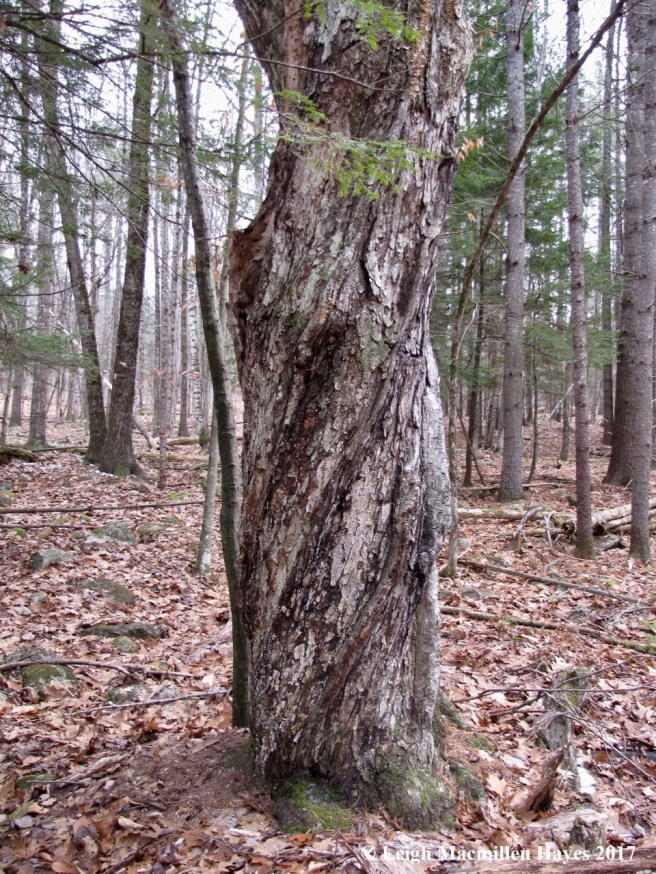
b-twisted maple

I was pleased that he included the twisting of a sugar maple. Other trees twist as well and I can remember first realizing this while tramping with a friend. We couldn’t understand what was going on. The reason for the spiral growth is on page 26–you’ll have to read it for yourself.

After describing these two trees, as he does periodically throughout the book, Mikolas gives clues on how to tell them apart. For these two, he describes their habitat, bark, twig and bud color.

m-beech sunshine

One of the clues he provides for beech trees is the fact that the leaves remain on the trees all winter. What I like about his comment is that he says this happens on young trees, for indeed, since I started paying attention, that’s what I’ve noted.
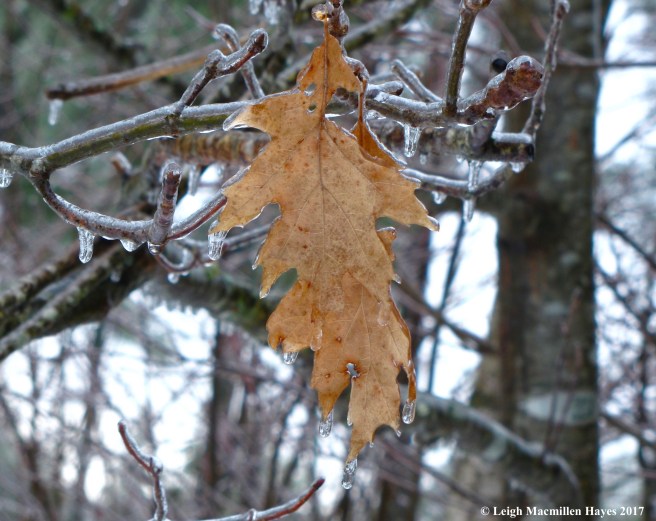
b-marcescent leaf

He also described the habit of oaks retaining their leaves, but what he didn’t mention was the term to describe this habit: marcescence or withering. Maybe I was disappointed because I just like to say marcescence.
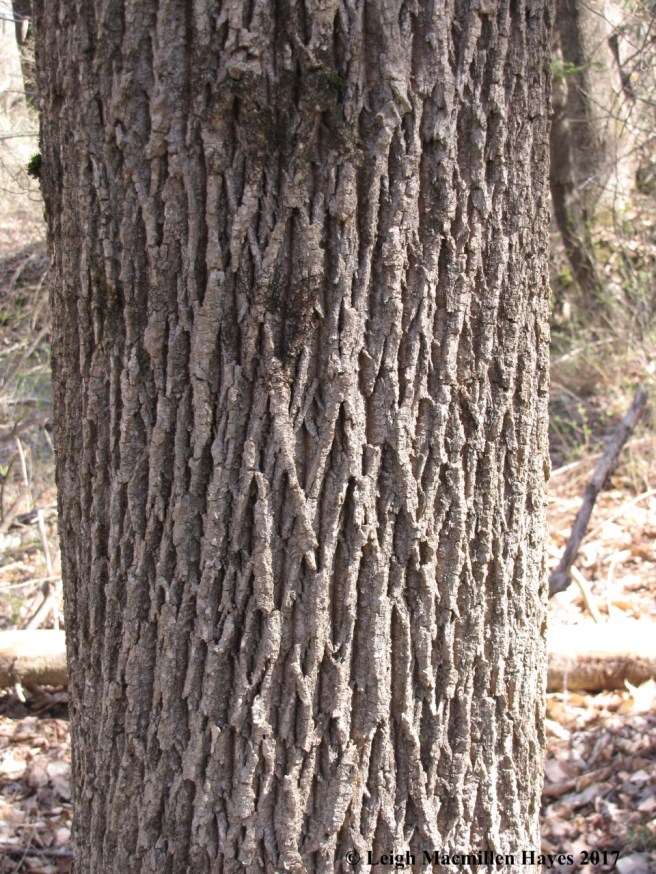
b-ash bark

When it came to ash trees, I was pleased that he described the bark as being diamond-shaped, but he added an X to the pattern and that may help when I next look at an ash tree with others. Some have a difficult time finding the diamonds. They don’t exactly glitter in the sunshine.

b-aspen bark

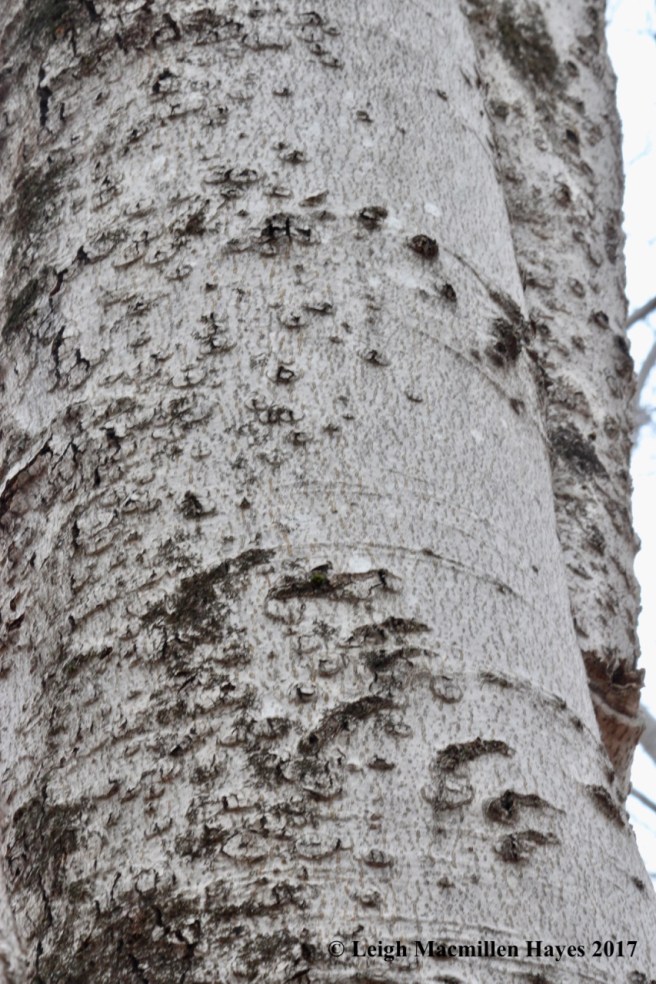
I was thankful that when it came to the quaking and big-toothed aspen trees, Mikolas acknowledged that they are difficult to identify by bark alone. A few years ago, I spent some time practicing my tree ID with two different foresters and when I asked about these trees, they too, had a difficult time pinpointing the differences. Both were sure we were looking at quaking, but a quick scan of the ground below showed us big-tooth leaves.
b-aspen 2

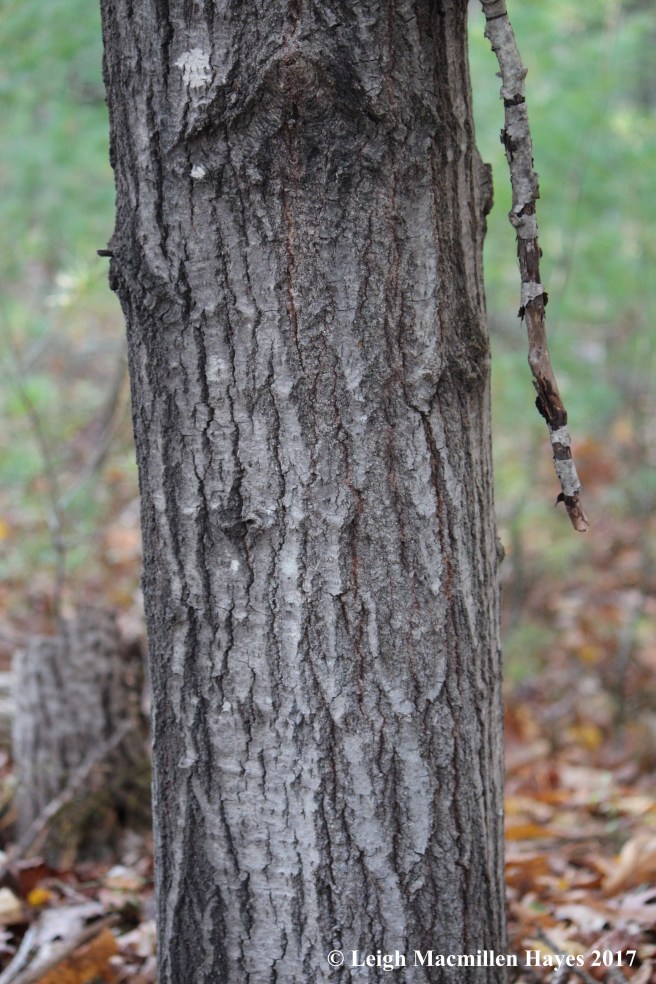
One thing I’d add to Mikolas’ description is that on the lower portion of older trees, the vertical lines are similar to that of a red oak. One of the really cool tricks I picked up from the book in reference to aspens is what he calls “birds on a wire.” Again, you’ll need to purchase a copy to find out what he means. Or join me for a tramp.
b-grandaddy birch

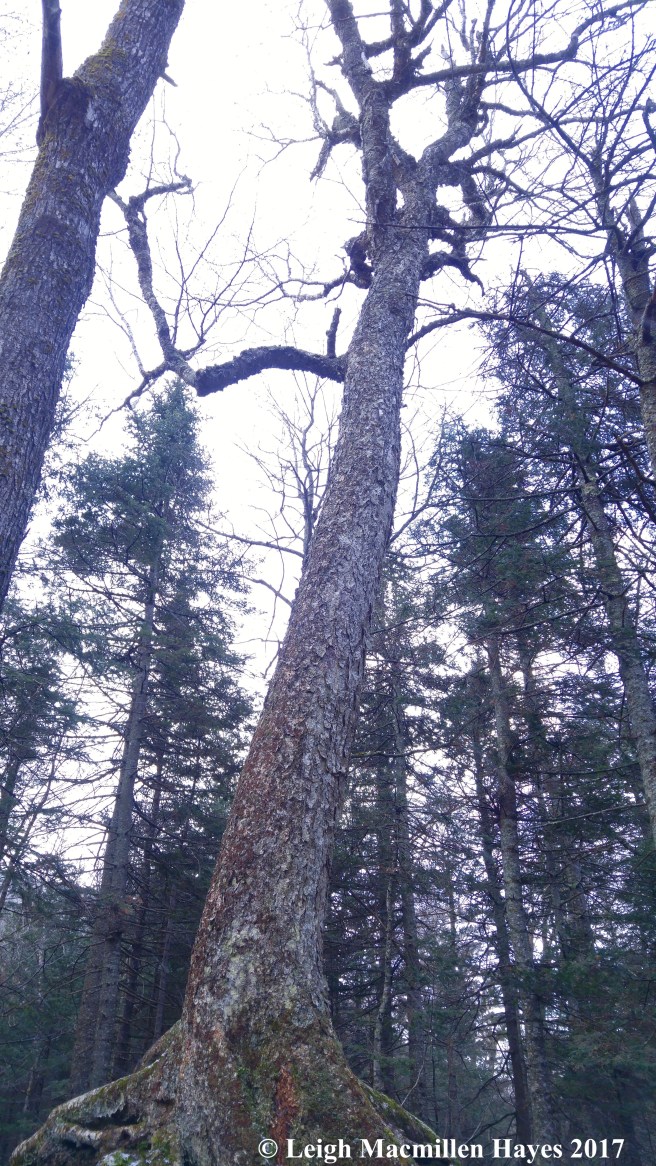
Another description that brought a smile to my face was how he casted a mature and shaggy yellow birch as “the granddads or old wise men of the forest.”
b-yellow birch

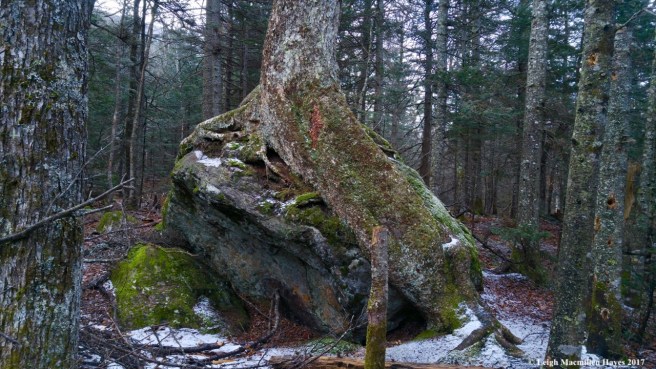
I had the good fortune to meet one such character just the other day.

b-basswood

In reference to basswood,  Alan Seamans wrote in his e-mail message: “I didn’t know you could confirm i.d. of basswoood by the sound it makes when you hit it with a stick!” I didn’t either, but you can bet that’s on my list of things to do–frequently.

b-paper-birch-old

Mikolas’ photo essay on the aging of paper birch bark from a teen to an old man is well worth a look. My only disagreement with him in this section is that what he sees as an inverted V over the branch, looks more like an inverted U to me, or as I’ve always described it–a fu manchu mustache of sorts.

b-gray birch

Likewise, Mikolas sees black triangles under the branches of gray birches. I could agree with him on that for when I say it’s a chevron, people don’t always get what I’m talking about. One friend, in keeping with the paper birch’s mustache, suggested the gray birch may have a beard–a gray beard. Mikolas also says that gray birches are chalkier than paper–experiment for yourself  by rubbing your fingers on the bark and come to your own conclusion on that one.

IMG_5301

Turning to striped maples, I was tickled to learn a new common name. He used goosefoot, which describes the leaf shape,  and moosewood because deer and moose like to leave their scent by rubbing their antlers on the bark, but a name I hadn’t heard before–whistle wood. Apparently, slip-bark whistles can be carved from striped maple or willow in the spring.

n-Central Park 1

I do wish I’d read this book before venturing to Central Park a few weeks ago. I was in awe of the American elms that grow there, and wondered about their health given that so many elms have succumbed to Dutch elm disease. What I didn’t realize is that what I saw before me was one of the largest and last stands of these majestic trees.

b-red pine plantation

Heading back into a woodland setting, and this one was actually in Vermont, occasionally we stumble upon red pine plantations. It was my understanding that these were planted by the CCC or Civilian Conservation Corps between 1938 and 1942 to provide farmers with a hill crop and others with employment. When walking in the woods and suddenly encountering a sterile environment where trees stand stalwart in lines and there is no undergrowth due to the thick needle cover below, and little diversity in wildlife, one may have entered such a plantation. At the time, it seemed like a good idea and provided work.
hemlock petioles (stems) and stomata lines

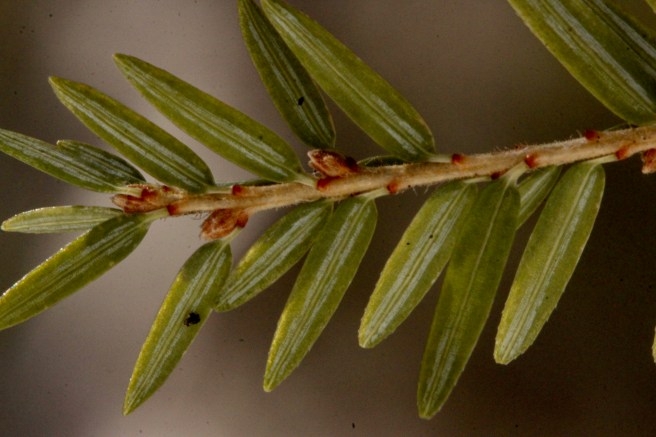
In the forest, I often discover hemlock and balsam fir saplings sharing a space. One word of caution when it comes to differentiating between the hemlock shown here and balsam fir needles that are shown on page 188–both have two white stripes of stomata on the underside. There are other clues to help tell them apart and I’ve actually written about such in the upcoming issue of Lake Living magazine so you’ll have to stay tuned.

spiky spruce

And then there are the spruces and I have to admit, I have a difficult time with red versus white, though forester friends have said they hybridize. I noticed that Mikolas mentions both, but doesn’t provide the fine details about scent and twig hair. Perhaps it’s enough to know it’s a spruce–especially if it’s spikey to the touch.

b9-tamarack gold

The tree descriptions conclude with the one and only deciduous conifer of our woods–the tamarack–the cone-bearing tree that loses its leaves (needles) each winter.

And with that, I will conclude this rather lengthy review. I’m so glad Alan recommended it to me, for it really is a gem. I hope you’ll purchase a copy and together we can head out on the tree trail and get to know our local species even better.

Put A BEGINNER’S GUIDE TO RECOGNIZING TREES OF THE NORTHEAST on your wish list and shop local.

A BEGINNER’S GUIDE TO RECOGNIZING TREES OF THE NORTHEAST, by Mark Mikolas, published 2017, The Countryman Press.

Post script, or maybe it should be post post. This comment appears on my About page, but I couldn’t resist including it here. I’m always tickled and honored when an author responds to one of my posts:

Thanks so much for the detailed and positive review of my book, A Beginner’s Guide to Recognizing Trees. It sounds like it would be great to take a hike with you. I really appreciate the good press. –mm

Liked by you

  1. Mark, Thank YOU so much for taking the time to read this and comment. I think A Beginner’s Guide to Recognizing Trees is a fabulous addition to my book shelf and back pack. In fact, I’m on the board of the Maine Master Naturalist Program and asked our curriculum coordinator to review it. If it doesn’t become one of our text books, it should at least be on our recommended reading list. Well done, indeed. Oh, and if you’re ever in western Maine–give a shout. LMH


For the Benefit of All

Living in an area where five land trusts protect land for us and the species with whom we share the Earth strikes me as a valuable reflection of who we are and where we live. Land trusts work with community members to acquire land for permanent conservation through purchases and donations. They also create legal and binding conservation easements that allow residents to protect land holdings in perpetuity, while retaining private ownership. Scenic views, wildlife corridors, flora and fauna, and topography remain, subject only to the whims of nature itself, which is ever-changing.

m1-first lodge

One of the biggest re-designers of the landscape is the beaver. And this afternoon, Jinny Mae and I ventured onto land owned by a friend and under conservation easement by the Greater Lovell Land Trust, to see what changes may have occurred in the past two months since we last visited.

First, we tramped off a logging road and checked on a lodge that was active two years ago. Today, the water level was low and there was no sign of activity. And so we continued on.

m2-pipsissewa

As we climbed up a small incline we stumbled upon a large patch of pipsissewa and had to celebrate our find.

m5-hexagonal pored fungi upperside

Back on the logging road, a tree brought down by one of nature’s recent whims introduced us to a fungi we had not met before–or at least as long as we could remember. And once we saw the underside, we were sure we would have remembered it.

m4-hexagonal-pored

Hexagonal-pored polypore (Polyporus alveolaris) caused us to emit at least six ohs and ahs.

m6-grape fern

Our next discovery–a grape fern. Actually, more than one grape fern once our eyes keyed in on them.

m7-checkered rattlesnake plantain

And then the checkered rattlesnake plantain; and again, once we spied one, we noticed that a whole patch shared the space. We just needed to focus for their presence was subtle amidst the brown leaves.

m8-bees nest 1

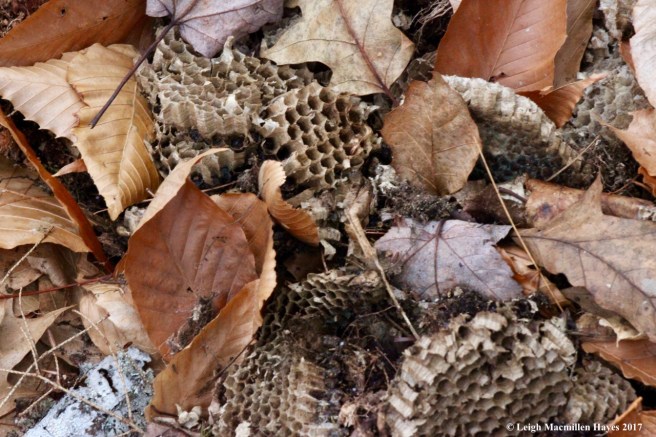
Before we met a snake of another kind, Jinny Mae spotted honey combs on the ground.

m8-excavation site

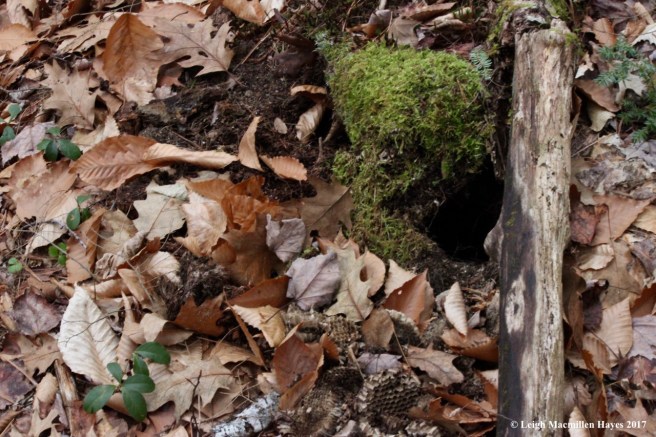
A look about and the realization that a raccoon or skunk had probably excavated the nest.

m9-snake liverwort

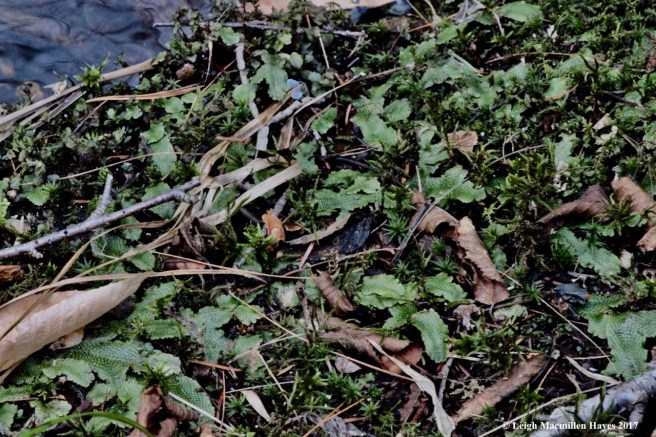
And then we met that other snake. You see, the last time we walked this property, we did see a garter snake. As we began our wander today, we commented that there would be no snakes or toads. But . . . we were wrong. This second snake was a snakeskin liverwort (Conocephalum salebrosum). For us, this was a second in another way for it was our second sighting of the species. Maybe now that we are aware of it, we’ll notice it growing in other places. We do know that its preferred habitat is wet or damp.

m10-umbilicate lichen?

In the same area, but across the brook in a place that we couldn’t reach today due to high water, we saw what looked like an umbilicate lichen, aka rock tripe. The color and substrate threw us off and so we’ll just have to visit again for further study. (“Oh drats!” they said with a smile.)

m11-beaver 1

The liverwort and mystery lichen were our turn-around point. On our way back, we decided to follow the water because we were curious. And within minutes our curiosity was appeased. The beavers we’d suspected might be casually active two months ago, had become incredibly active.

m12-beaver 2

Statue . . .

m13-beaver 3

upon statue . . .

m19-beaver 6

upon statue . . .

m20-beaver 7

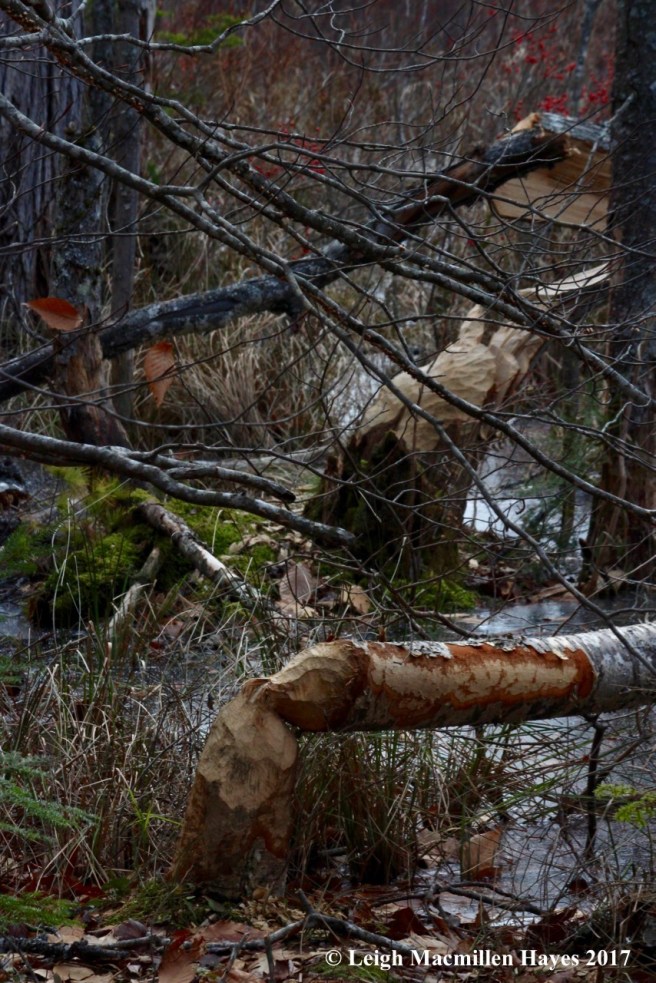
upon statue announced their presence. And we acknowledged the fact that they have to turn their heads to scrape off the bark.

m14-beaver 4

Any trees that hadn’t been hauled away had been downed and gnawed upon in situ.

m15-beaver 5

It looked as if this one was a more recent dining adventure for there were wood chips upon the thin layer of ice and a hole showing were the diners had entered and exited the refectory.

m16-oak leaf and ice

Because of the ice, we noted other works of art worth admiring.

m18-lungwort 2

And occasionally, our downward gaze turned upward when we spied trees covered in lungwort worthy of notice.

m21-beaver 8

But really, it was the beaver works that we celebrated the most.

m23-beaver 10

And the fact that thanks to the beavers we learned that the inner bark or cambium layer of a red maple is . . . red.

m23a--not all cuts work in the beavers favor

No matter where we looked, in addition to recent windstorms, the beavers had changed the landscape. The curious thing is that most often the trees landed in the direction of the water, making it easier for them to enjoy their chews of inner bark and twigs in a relatively safe environment, but occasionally, hang ups occurred. And that brought about the question, how is it that most trees are felled toward the water? But not all?

m23a--lodge

While our focus was on the trees along the shoreline, we also kept admiring the water view as well.

m24-lodge

And noted the most recent activity at this particular beaver lodge, including a mud coating to insulate it for the winter.

m28-welcome flag on lodge

We also appreciated that a welcome sign blew in the breeze–in the form of an evergreen branch.

m29-otter scat

And where one finds water and beavers, there are otters. We knew of their presence by the scat left behind in a trail well traveled. Several times we found examples of the same.

m31-main channel open

As the sun lowered while we approached the beaver dam, we quietly hoped to see North America’s largest rodents at work, but settled for sky reflections on water and ice. And the knowledge that by their works and sign, we trusted they were present.

m32-dam1

At last we reached the dam, an expansive one at that. It’s in great shape and so no time had been wasted repairing it. That’s a good thing given that a few flurries floated earthward on this day that felt like winter. There’s food to gather and a home to prepare so work must be efficient.

m33-dam other side

Water trickled through in a few places and ice formed, but the infinity pool created by the dam continued to exist.

m34-brook

And below, the water flowed on–to other beaver dams and otter adventures we were sure. For Jinny Mae and me, our adventure needed to draw to a close. But . . . we made plans to explore again in a few months to see what changes may have occurred–with land owner permission, of course.

As we walked out, we gave thanks for the owners and their appreciation of the landscape and those that call it home today and tomorrow.

From the land comes food and water that benefits the critters who live here and us. It also offers us good health when we take the time to embrace it by exploring, exercising and just plain playing outdoors.

Protection is key. So is education, which develops understanding and appreciation. I know for myself, my relationship with the landscape continues to evolve.

I’m thankful for the work being done to protect the ecosystem. There’s so much I still don’t understand, but with each nugget of knowledge gained, the layers build. Maybe someday I’ll get it. Maybe I never will. Either way, I’m happy for the chance to journey and wonder on properties owned by land trusts and individuals.

Even though we can’t all endow the future of our properties, we can get involved to ensure that these organizations continue to protect land for future generations of humans and wildlife so it will remain in its natural state for the benefit of all.


Gifts A Many

I was seranaded three times this morning, first by my guy, then my friend Marita (well, her family cut her short and maybe I helped by quickly thanking her), and finally by Gracie the beagle. The latter was the funniest of all and she managed to get through all the verses. But really, what Gracie wanted was to butter me up in hopes of joining Marita and me for a hike. Sorry Gracie. Maybe next time.

d-sign

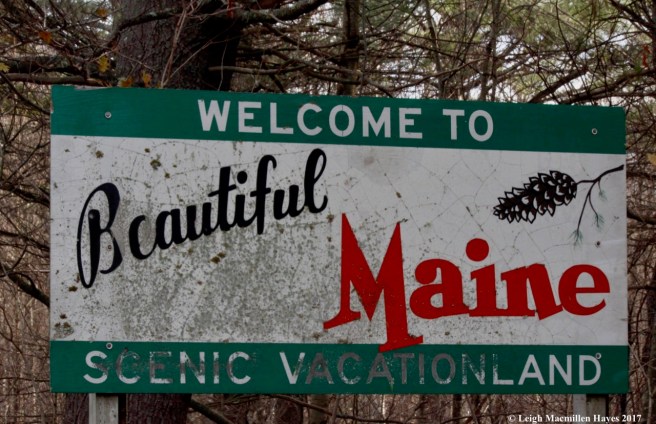
We crossed the state boundary a few times as I drove up into Evans Notch. Our plan was to start the day at The Roost, though we weren’t sure we could get there as we didn’t know if the gate on Route 113 had been closed. As we approached the “Welcome to Beautiful Maine” sign, we saw that the gate was open and so on we continued. Until . . . we hit ice. For those who know the road, and the steep ravines to the left as you travel north, you’ll understand why we decided to back up and turn around.

d-morning colors

Back to the sign and gate we went, pulling off for photos because we love the sign and because the field across the way offered an array of colors and more ice.

d-ice layer

It was a case of bad ice and good ice, much like the witches in the Wizard of Oz and WICKED.

d-frost on goldenrod

And the good ice sparkled like winter flowers.

d-Cold Brook 1

The curious thing was that along Cold Brook, which flowed beside the field, there was barely any ice.

d-bear scat

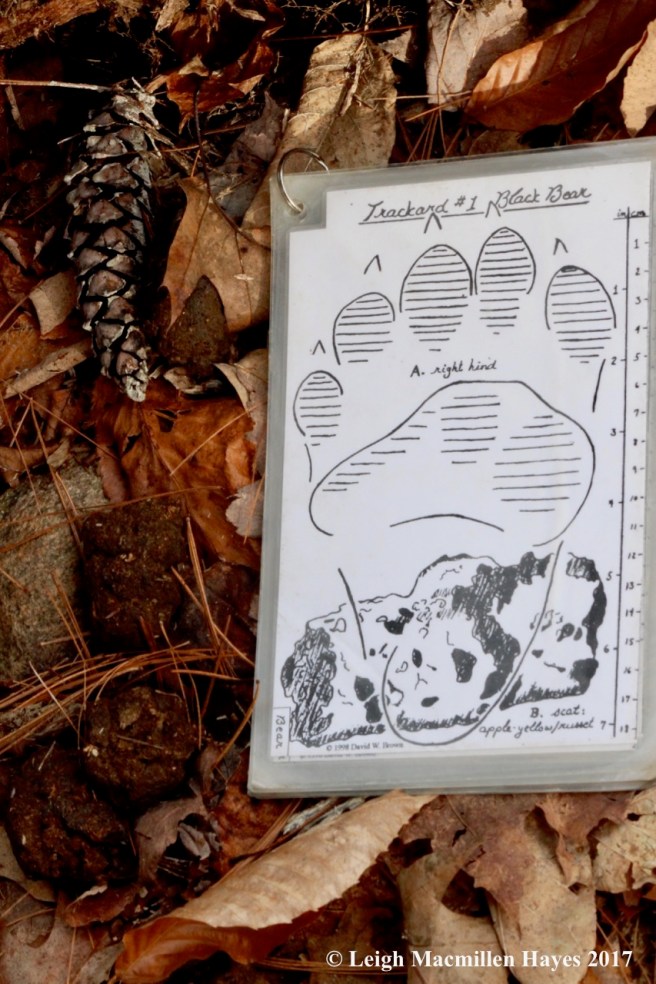
After a few minutes, we headed down the road to the parking lot for the Baldfaces and Deer Hill. The latter was our choice for today. And it turned out to be the perfect choice for early on the trail we found rather fresh bear scat. How sweet is that?

d-leaf bouquet

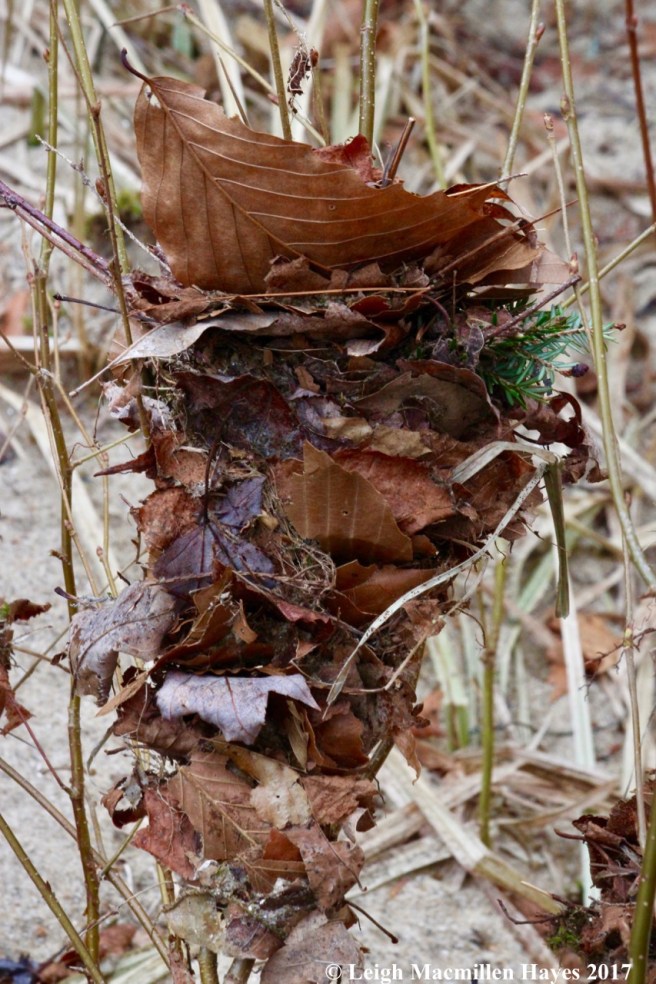
The trail is flat to begin as it follows the course of a dry river beside the Cold.  Evidence of high water from fall storms was everywhere and it was obvious that the dry section of the river hadn’t always been so. Left behind were displays floral in nature–this one reminded us of a stacked bouquet.

d-Cold Brook 2

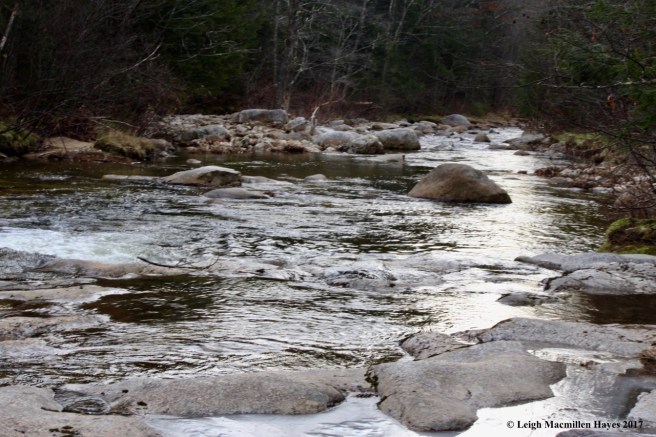
Again we reached the real deal–Cold Brook.

d-Cold Brook 3

And stopped to admire the view.

d-Granite and ice

And more good ice.

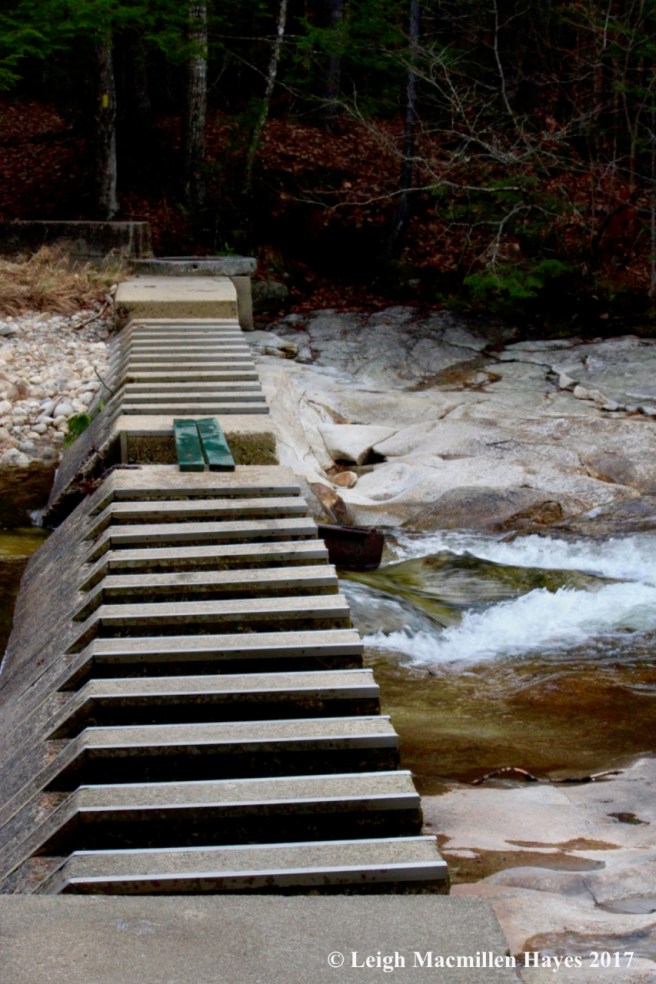
d-dam

Then it was time to make the crossing. Marita went first and when she got to the other side of the green planks she looked back and said, “You can do this.” She knows me well and that my brain kicks into “No, I can’t,” gear every once in a while. It seemed so simple and yet, at her encouragement, I kept taking deep breathes and finally after what seemed like hours but was only minutes, I put mind over matter and made my way across. And it wasn’t difficult at all.

d-hiking with Marita

The climb up was moderate and we were glad we’d donned our blaze orange on this last day of hunting season. In the parking lot, a hiker had laughed at me and asked if I thought I was going to see a moose. On the trail, we met a hunter who was out with his two sons. And at the summit we heard shots, though coming from a different direction. Yup, we were glad to be wearing blaze orange.

d-whale or frog?

We paused briefly on the climb, and noted that we weren’t alone. At first we both saw a whale, but then I noted a frog–a stone cold frog at that.

d-reaching the summit

We were only following one of the trails on this mountain today, and it wasn’t a long one.  Within the hour we reached the summit.

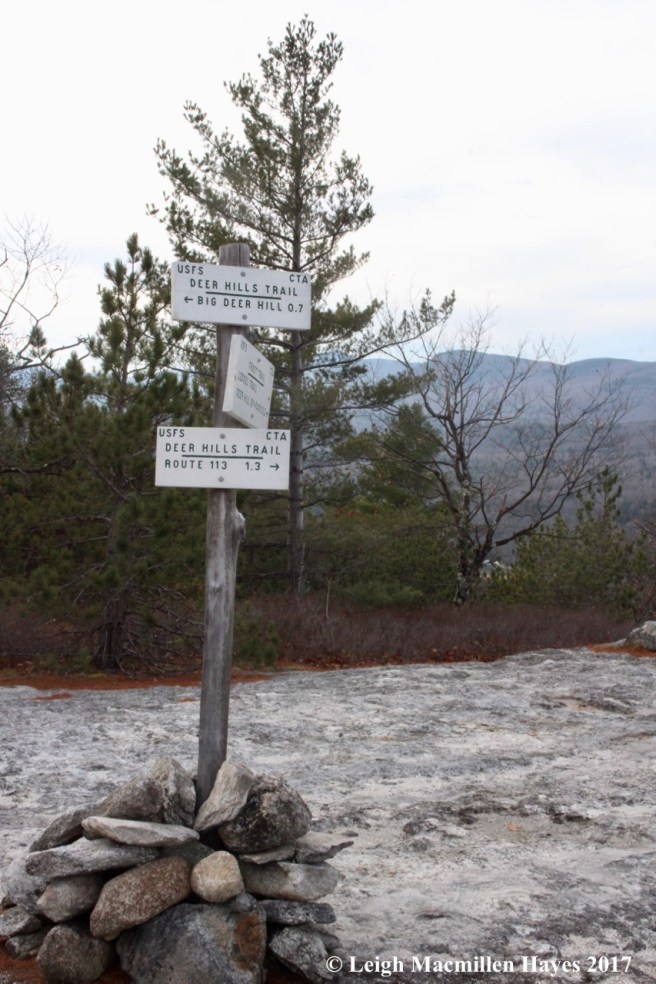
d-summit signs

Years ago, the signage was confusing, but it seemed much improved. Then again, we only hiked to Little Deer and don’t know about the others.

d-bald faces

From our snack spot, we enjoyed the view of the Baldfaces across the way.

d-Mount Meader

And Mount Meader to the right.

d-biotite plates?

At our feet were biotite (black mica) plates that reminded me of script lichen.

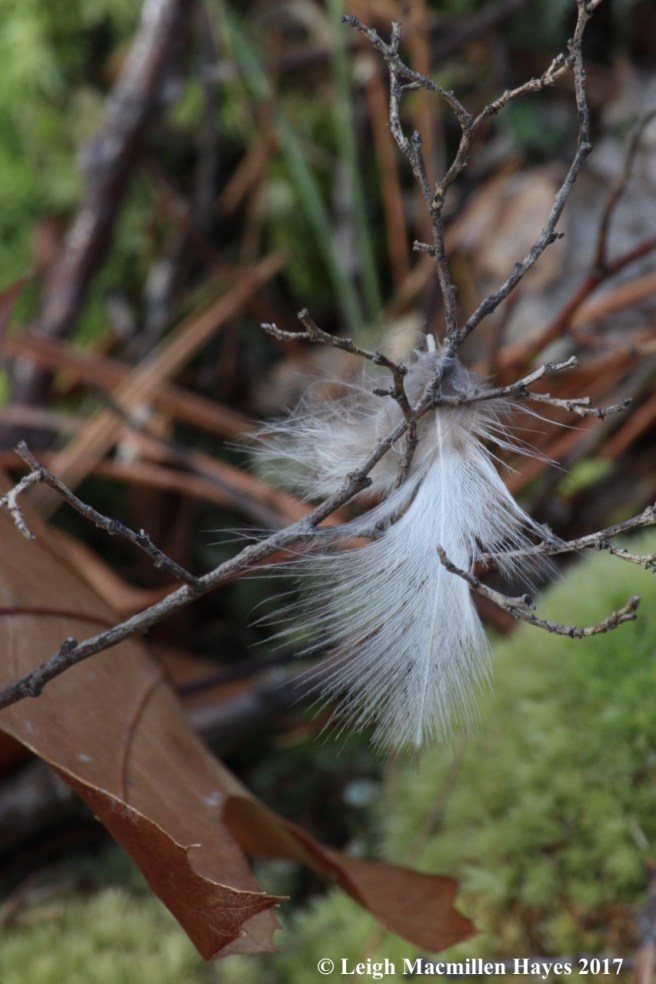
d-feather

And in the ladies room I always find the coolest sights when I pause and look around. Today it was a downy feather.

d-crossing 1

In what seemed like no time, we were back at the dam. Again, Marita went first.

d-crossing 2

She turned back, grinned at me and then watched as I quickly followed. “Yes, I can.”

d-Amy's article on Long Mountain Trail

When I arrived home, I discovered cards from family and friends in the mail, as well as a copy of the Bethel Citizen. Thanks to writer Amy Wight Chapman, Marita and I were both mentioned in an article she wrote about Long Mountain in Greenwood.

A few minutes ago, my sister and brother-in-law also called to serenade me.

It’s my birthday and I’ve enjoyed gifts a many–from ice crystals to bear scat to feathers, mixed in with songs and calls and cards and comments from family and friends near and far. I am blessed. Thank you all.


Black Friday Shopping Extravaganza

I somehow slept in and totally missed the early bird specials today, but still by midmorning I found my way to the store of my choice.

b1-trail sign-cross the threshold

It had been two years since I’d stepped over the threshold into the MDT shop and I’d forgotten what great selections it had to offer. While the last time I approached from the Fryeburg Information Center near the Maine/NH border, today I decided to use the back door and entered by the Eastern Slopes Airport.

b8-the main aisle

Beginning along the main aisle, I was delighted with the display before me. And lack of customers. Oh, I passed several groups, some in a hurry as they ran, others chatting amiably with friends or relatives, but all quite friendly and courteous. Even dogs were well behaved and therefore welcome.

b2-choice of colors--sweetfern 1

Immediately I had decisions to make. Which shade did I want?

b3-shapes,

And would I prefer a different style or shape?

b12-red oak 1

Had I thought about brown and bristly?

b13a-white oaks

Or did I like salmon and rounded?

b13-red oak on line

Though I preferred the salmon color of the white oak, I did like how the red oak leaves dangled in hopes of being plucked by a customer. And if not a customer, then perhaps the wind.

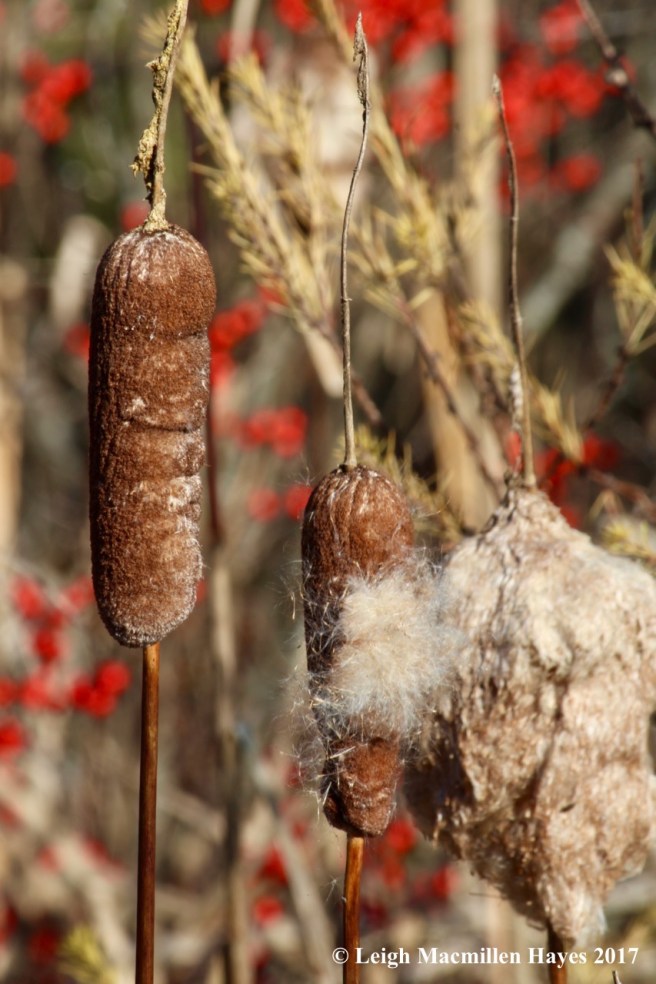
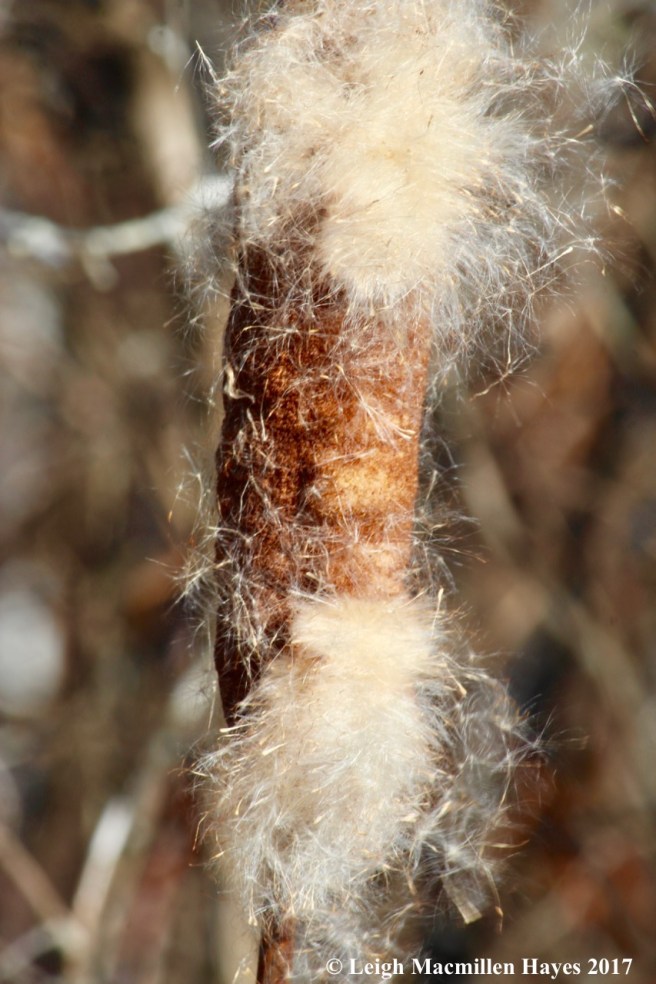
b11-cattails

In aisle five I found some cattails ready to explode into the future.

b11-cattail sparkles

Their tiny, parachuted seeds reminded me of sparklers on the Fourth of July, but because today is the day after Thanksgiving, I suspected these fireworks were intended for New Year’s Eve.

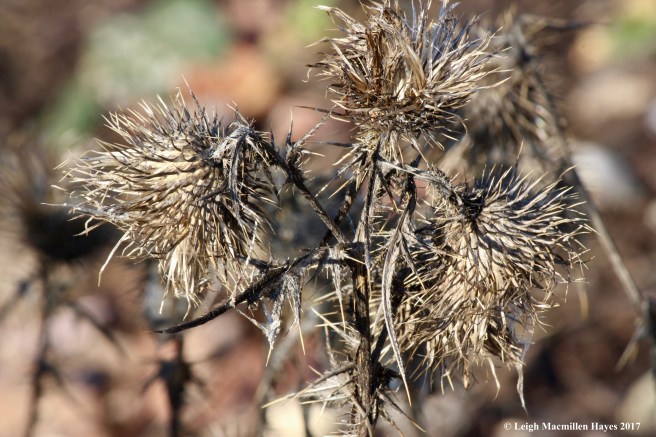
b6-autumn thistle

It seemed that everywhere I looked, the store was decked out with hues of silver and . . .

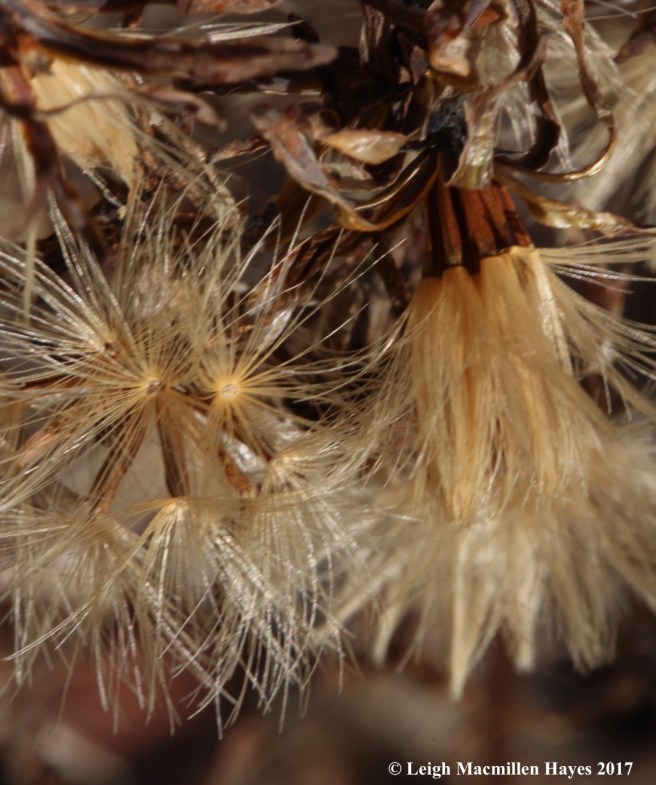
b4-aster display

gold.

b5-brown lacewing

And while admiring the golden decorations, I discovered I wasn’t the only one looking. A brown lacewing had heard there were deep discounts to be had.

b12-birch beer

As one should when one is spending an exorbitant amount of time (and perhaps money, though in this case no cash or credit was part of the deal), rehydrating is a good thing and the birch had been tapped for just that purpose. It’s been a long time since I enjoyed the unique taste of a birch beer, but thanks to a sapsucker it was on the menu at the snack bar.

b7-bench

And what better place to sit and sip, than on a bench in aisle 6.

b3a-winterberries

Refreshed, I was again ready to shop till I dropped. Everywhere I looked, the Christmas decorations impressed me.

b14-red oak Christmas decorations

The season’s colors enhanced the merchandise.

b19-Sumac decorations

And all ornaments were handsome in their own way.

b9-tamarack gold

As is always part of my shopping adventure, I didn’t know what I was looking for when I entered the store. But as soon as I saw this display, I knew I had to have it.

b10-tamarack 2

Its label was lengthy–tamarack, larch, hackmatack. Call it what you want, it’s our only deciduous conifer for it looses its needles in the winter. But first, the needles turn from green to gold and announce their presence.

b15-pitch pine trunk

Also in abundance as this shop–pitch pines. It’s so easy to confuse a pitch pine with a red pine, but a few identifying tips help. The unique thing about this tree is that not only do the stiff, dark yellow-green needles grow on the branches, but they also grow on the trunk. If you spy a tree that you think may be a red pine, scan upward and if you see green needles along the trunk, then you’ve discovered a pitch pine.

The name, pitch, refers to the high amount of resin within this tree.

b16-pitch pine cones

It’s the needles of pitch pine that also add to its identification for they grow in bundles of three, like a pitchfork’s tines.

As for their cones, you can barely see the stalk because they tend to be clustered together, but their key feature is the rigid prickle atop each scale tip.

b20-Northern White Cedar

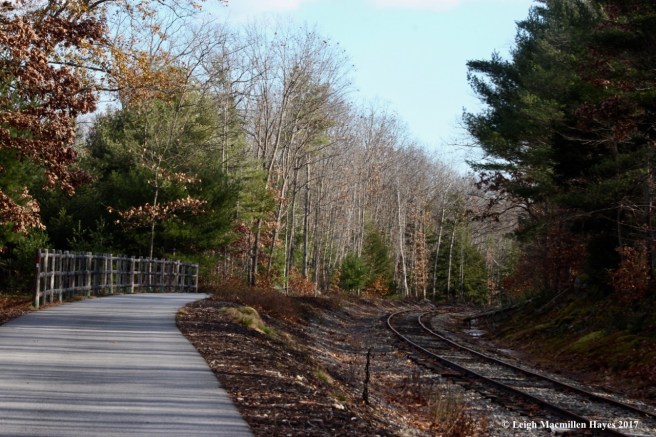
I was nearly at my turn-around point of three miles when I realized I was standing beside a row of doorbuster deals.

b21-northern white cedar leaves and cones

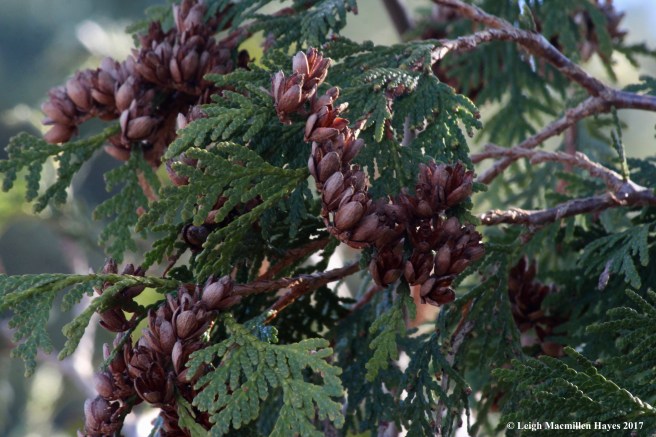
I couldn’t resist feeling the scale-like leaves of the northern white cedar. I had to have this item.

b17-black locust bark

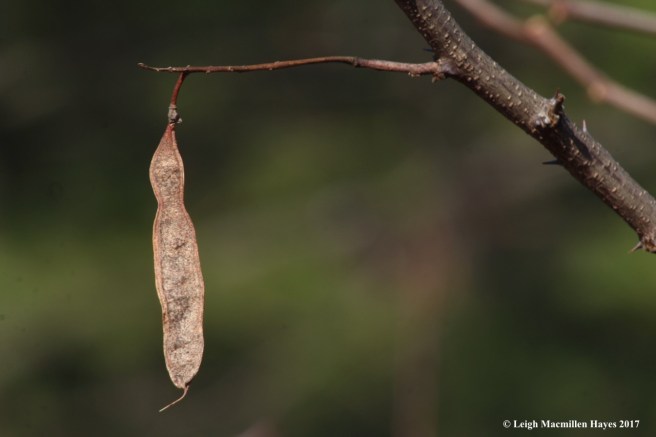
I did find one thing I decided to leave on the shelf–for the spines of the black locust would have pricked my fingers, I’m sure.

b18-black locust seed pod

Apparently, others did purchase this, for only one fruit pod remained.

b25-heading back

At last, I was on my way back up the main aisle with hopes to make a bee-line out, but had a feeling something around the bend would stop me in my tracks.

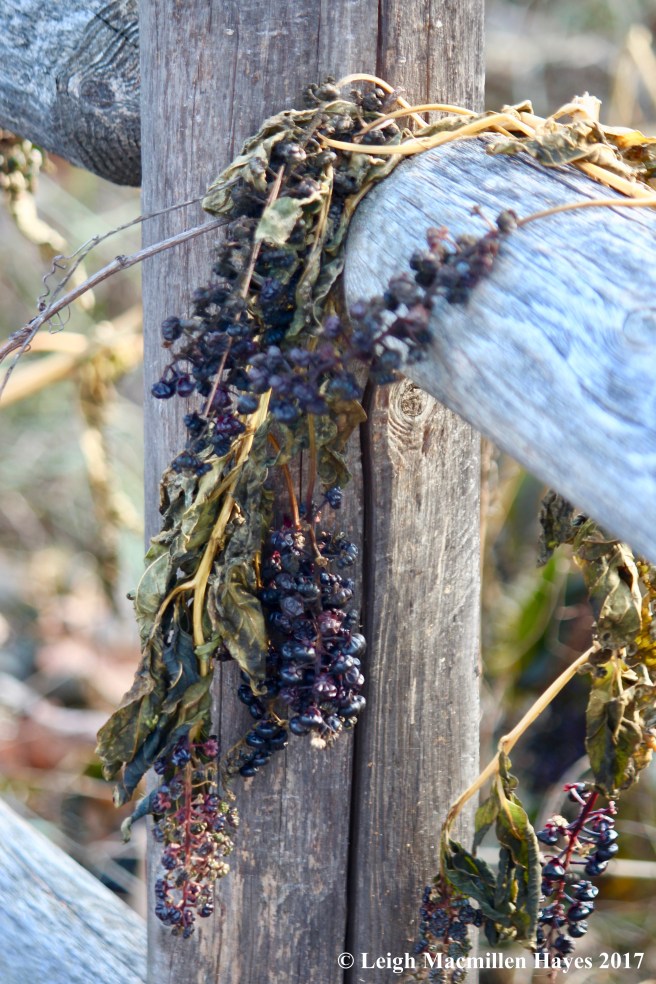
b23-pokeberry geometric display

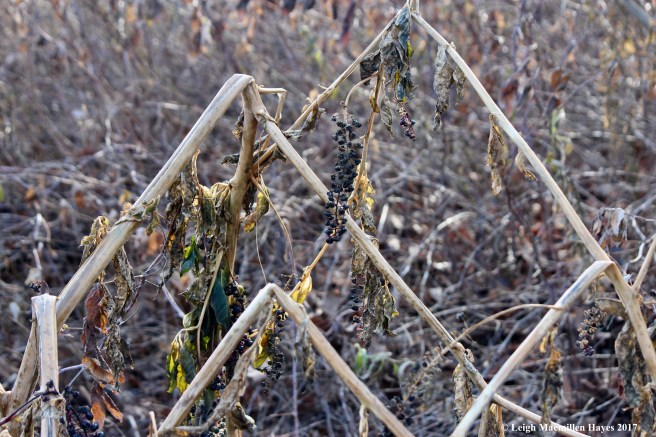
Sure enough–the pokeberry display was both geometric . . .

b23-pokeberry artistic display

and artistic in a dramatic sort of way.

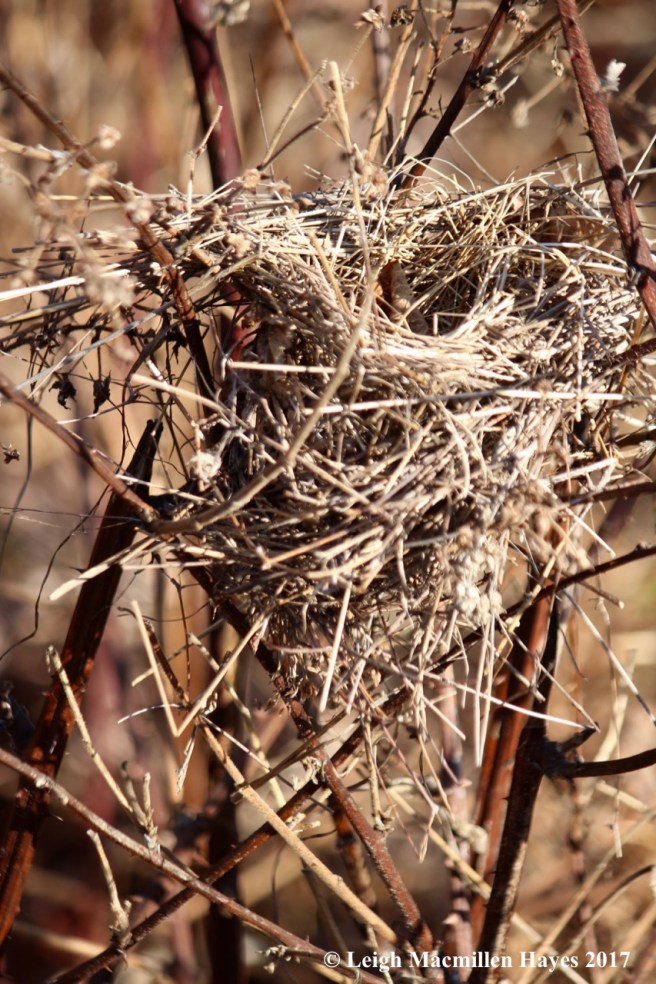
b27-bird nest

As I continued on, I saw and heard birds flitting about and thought about the fact that I need to visit this shop more often, particularly in the spring and summer for the various habitats made me think that birding would be spectacular. And then I spied a nest attached to some raspberry bushes. I knew not the species that made it, but hoped some small brown critter might use it as a winter home and so it remained on the shelf.

b26-heading back 2

At last, I’d raided enough aisles. My cart was full to the brim and my brain overwhelmed. I guess I’m not really a “shop-til-you drop” kind of gal. It was time to wind along the trail and end my Black Friday shopping extravaganza.


New York by Nature

Having grown up in a small town outside of New Haven, Connecticut, I used to be quite knowledgeable about city ways, but these days woodland trails are more to my liking. Stepping out of our comfort zone and onto the streets of Manhattan and Brooklyn this past weekend, I was sure I’d be a nervous wreck. The last time we’d ventured there, our sons were six and eight, and my knuckles white as I gripped their hands.

N-NBC

That was then. Maybe it was because we didn’t have young ones in tow, or because I decided to embrace the moment and smile at each person I was able to make eye contact with, this time was different. Even some cold rain didn’t stop us from enjoying the city’s vibe . . .

N-bakery

including all its colors and flavors.

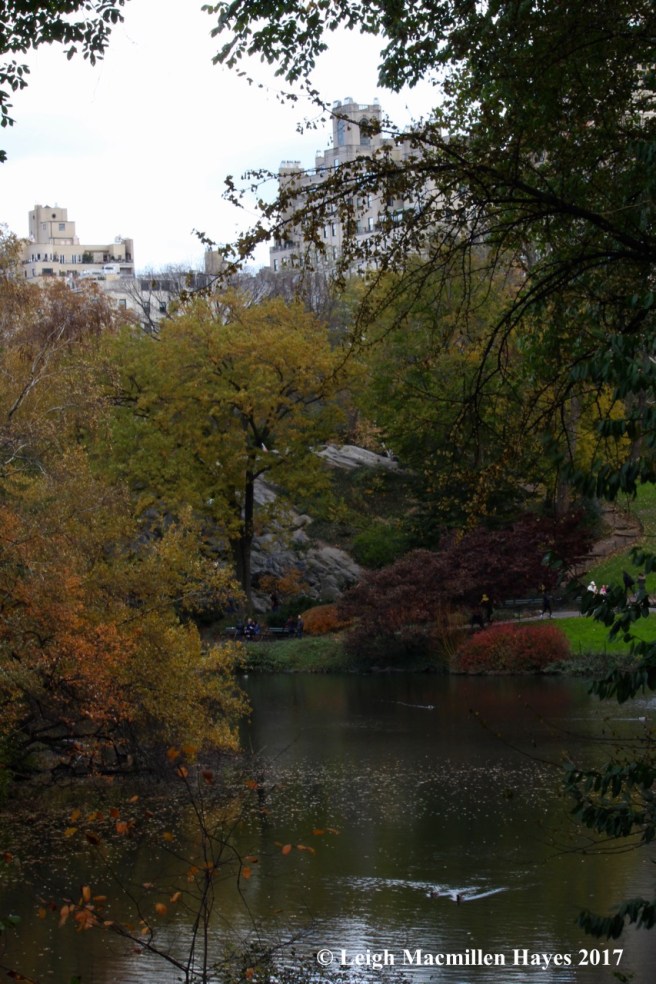
n-Central Park meets autumn

On a new day, the autumnal tapestry was like deja vu all over again, since we’d already experienced fall foliage over a month ago at home.

n-London Plane sycamore hybrid 1

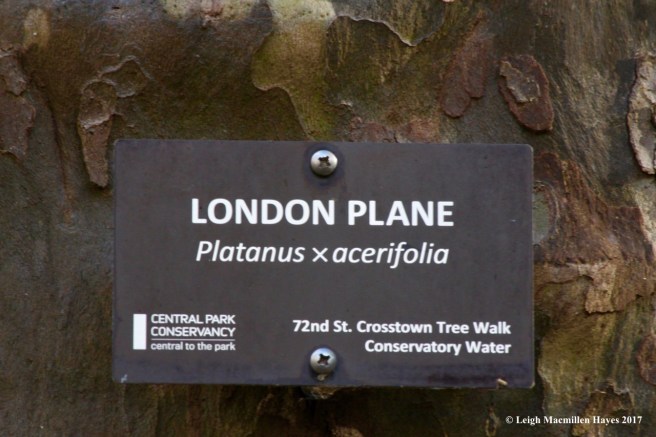
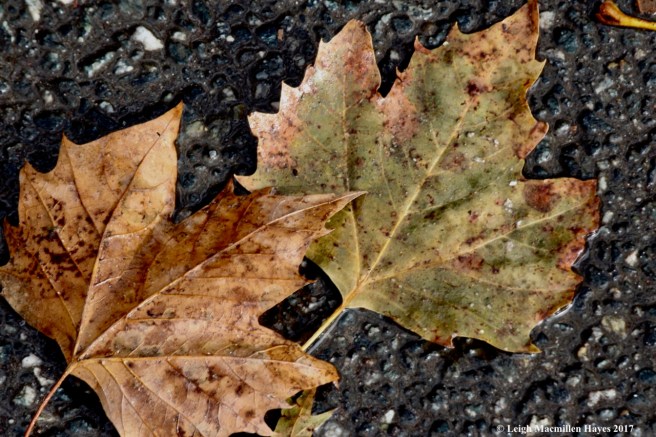
Even tree bark displayed variations of color, some that I thought I knew, until I found one with a name plaque.

n-London Plane

London Plane? Sycamore had been my first choice. It turns out that London Plane is a hybrid developed over 300 hundred years ago from the native  sycamore and oriental planetree.  And it was used as an ornamental to line streets . . . or park paths.

n-sycamore leaves1

Its scientific name, acerifolia, came from its maple-like leaves. I knew I’d learn plenty in the Big Apple, but didn’t expect trees to be among the lessons.

n-elms intermingling 2

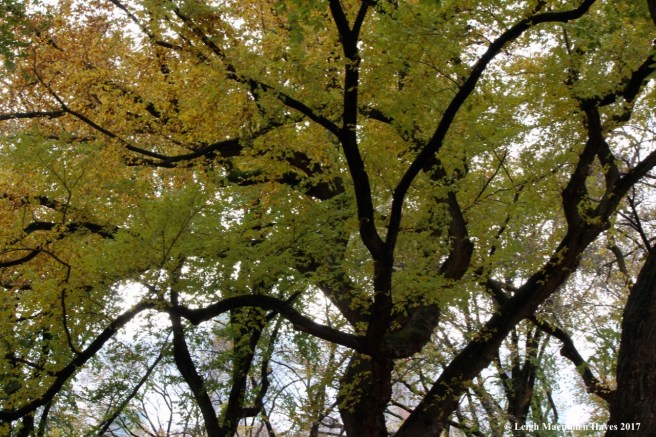
As we walked through Central Park, street vendors displayed their works below, while American elms gracefully danced across the canopy above.

n-Central Park 1

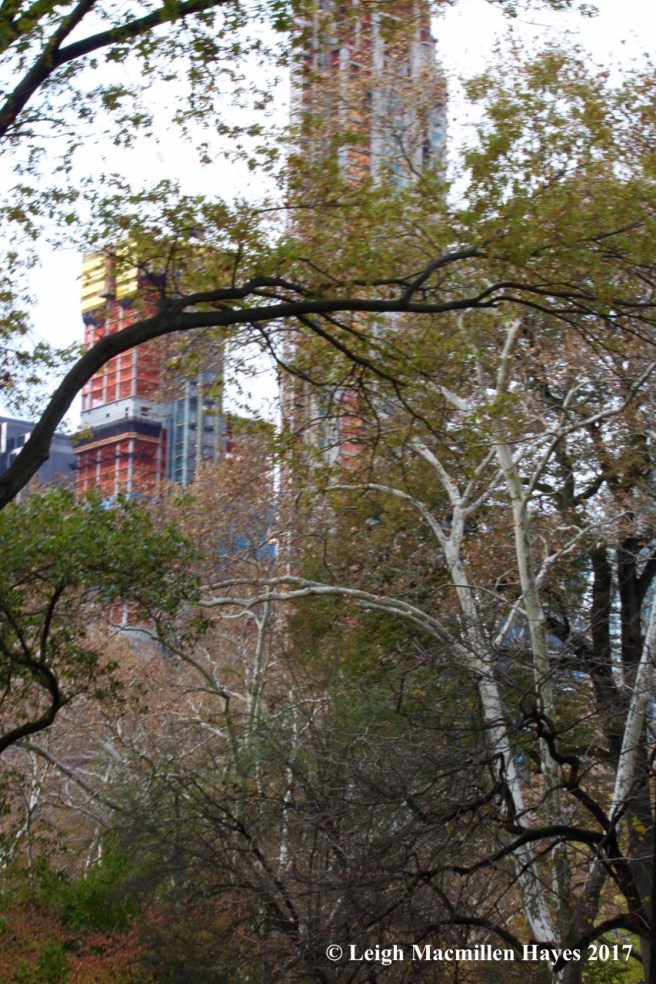
And buildings magically arose from the rocky substrate.

n-trees and buildings

We zigged and zagged and made our way about, though I had to depend on my guy for directions. I can find my way out of the woods, but even though there were maps throughout the park and the city streets are set in a grid, I was completely disoriented at each intersection.

n-house sparrow 2

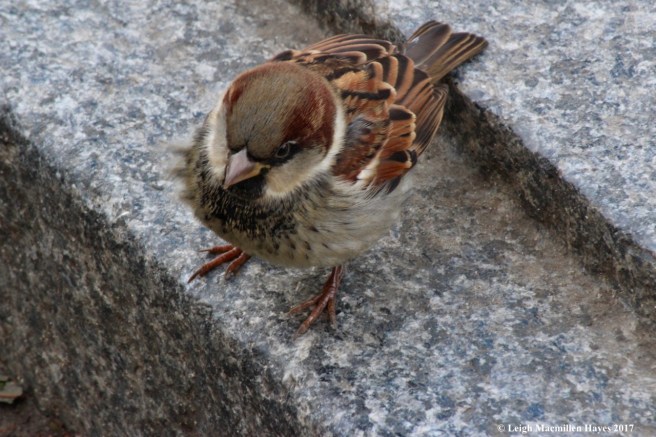
Perhaps it was because I was more taken with the little things. Even seeing house sparrows felt like a treat.

n-house sparrow 1

They were so tame.

n-Canada goose

I felt right at home among the Canada geese and . . .

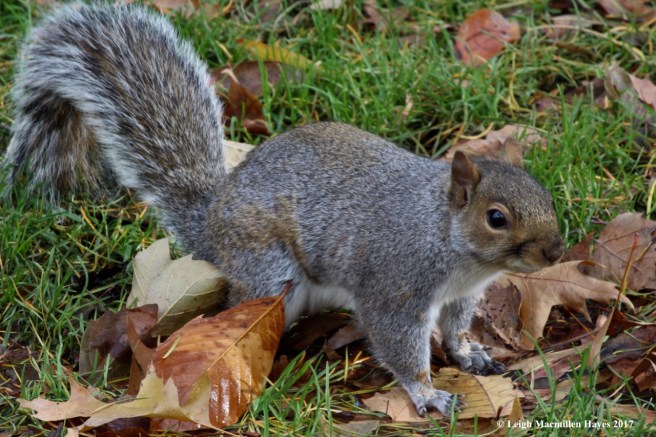
n-gray squirrel 1

gray squirrels.

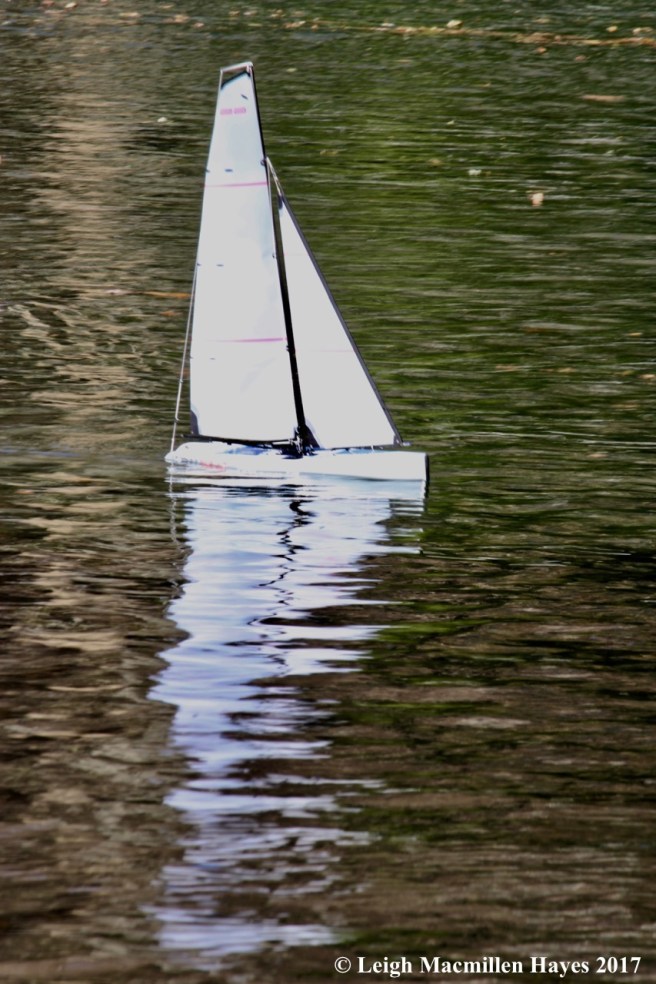
n-Stuart Little

We immediately recognized Stuart Little as he tacked back and forth.

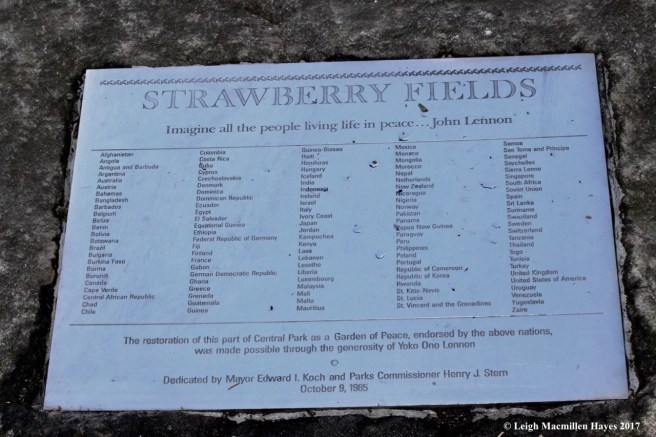
n-strawberry fields forever

And then we wound our way around again, pausing by Strawberry Fields–and imagined. If only.

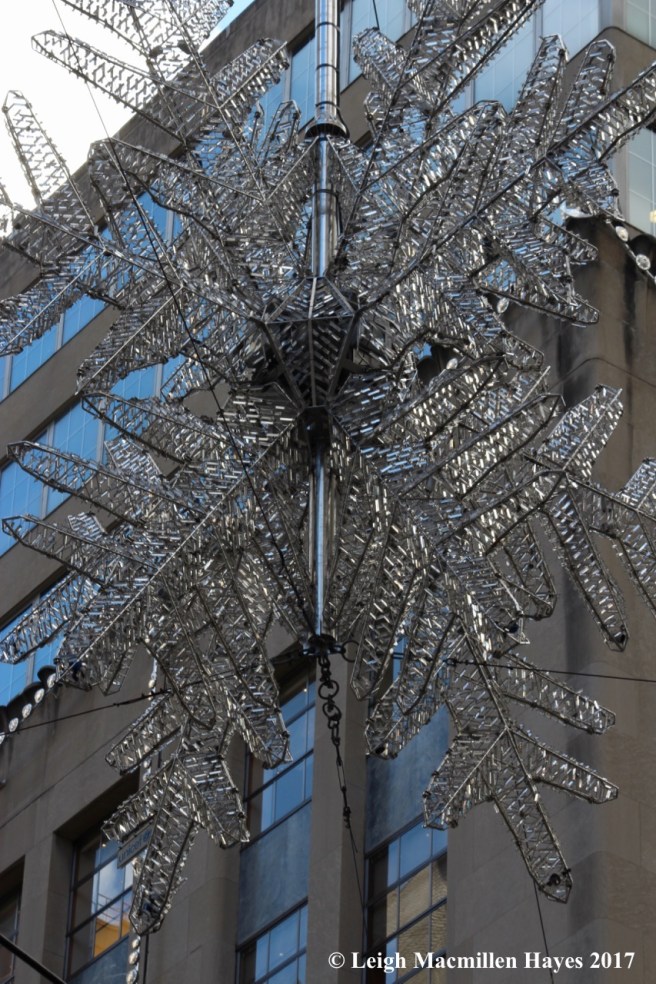
n-snowflake by Cartier

Back on the streets, we were dazzled by snowflakes . . .

n-Christmas lights 2

and Christmas lights.

n-Pat's Place

And then it was time to cross over to Brooklyn where we found a tour guide stepping out of his brownstone.

n-cement tracks

Like others before us, with him we pounded miles and miles of pavement and left behind our own tracks.

n-World Trade Center 1

He took us to the World Trade Center, which we viewed with awe . . .

n-9:11 memorial

and Ground Zero, where we felt the presence of so many as we remembered.

n-SoHo

Soho was our next destination, and though we didn’t shop, the architecture was enough to fill our minds with abundance . . .

n-architecture 1

and variety.

n-Wicked sign 1

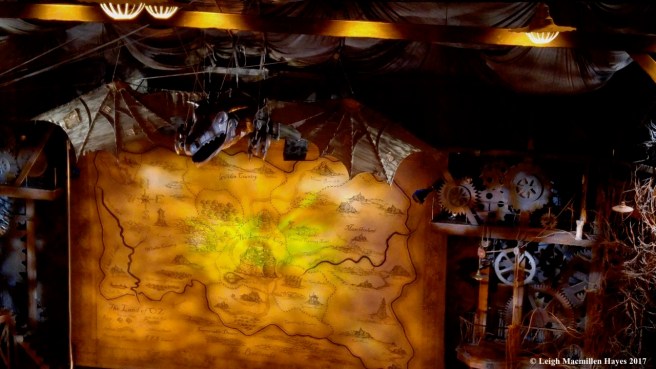
No visit to NYC is complete without taking in a performance and my guy, who is the world’s biggest fan of The Wizard of Oz, chose WICKED.

N-Wicked set 2

I won’t say it was my favorite show, but the set, costumes, acting, dancing, and singing were all well worth the experience. He thoroughly enjoyed it.

n-Rock center 4

Another must do is Rockefeller Center–or at least the ice rink. We didn’t skate, but enjoyed watching people take a spin, some more agile than others.

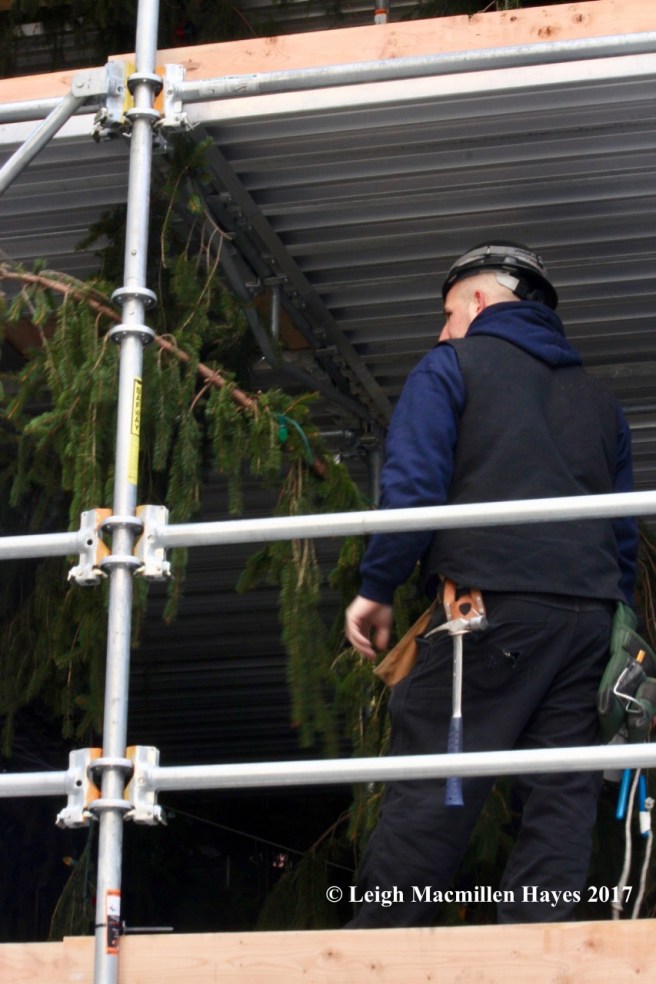
n-Rockefeller tree 1

Overlooking the rink, but encased in scaffolding stories high, a transformation was in the works . . .

n-Rockefeller 2

from a Norway Spruce discovered in State College, Pennsylvania, to the Rockefeller Center Christmas Tree.

n-toy soldier 2

Watching over all were the toy soldiers. And if you have ever wondered if they come alive after most of the world that gathers in New York goes to bed, they do. We know this first hand for we heard them. Our hotel room was located nearby and at about 2am we were awakened each night by an instrumental performance that had a symphonic sound. We couldn’t hear anyone in adjoining rooms. And we never heard a peep outside of Radio City Music Hall, so it had to be the toy soldiers and angels that surrounded the rink–and you have to become a believer.

n-Grand Central Station

At long last, it was Monday morning and time to head back through the terminal of Grand Central Station to make our way up the northeast corridor.

n-Allen, Pat and Tim

But . . . we left with fond memories and promises to return for somehow we who live in rural Maine raised a city boy.

Posing from left to right, my guy, our youngest and one of his roommates who also hails from Maine.

They’re both comfortable by nature in New York City.


Snow White Magic

Our first official snow storm of the season left us with about an inch of the white stuff that makes me rejoice. And upon waking this morning and peeking out the window, the sight of porcupine tracks looping around the yard brought a smile to my face.

m-porcupine trail 1

I love the first snow storm for even though I have seen signs of the critters that pass this way, their tracks confirm my convictions. Over the years, I’ve come to recognize the prints and trail patterns, but as the snow gets deeper the tracks sometimes become more difficult to decipher. This one was easy due to its pigeon-toed sashay.

m-porcupine prints

And then the individual prints, especially those that crossed the deck, showed the large foot pad and five toes with nails extended. A friend in Poland, Maine, sent me a couple of photos of the critter that crossed her deck this morning. She ID it herself, but wanted confirmation–for it was an opossum and a first for her.  I found my first opossum prints last December and wonder if I’ll have that opportunity again. Anything is possum-able.

m-worm and junco prints

Since the porcupine had drawn me out (and I noted that it disappeared under the barn–of course), I decided to head off into the woods. But before I left the yard, I spotted junco tracks–and . . .

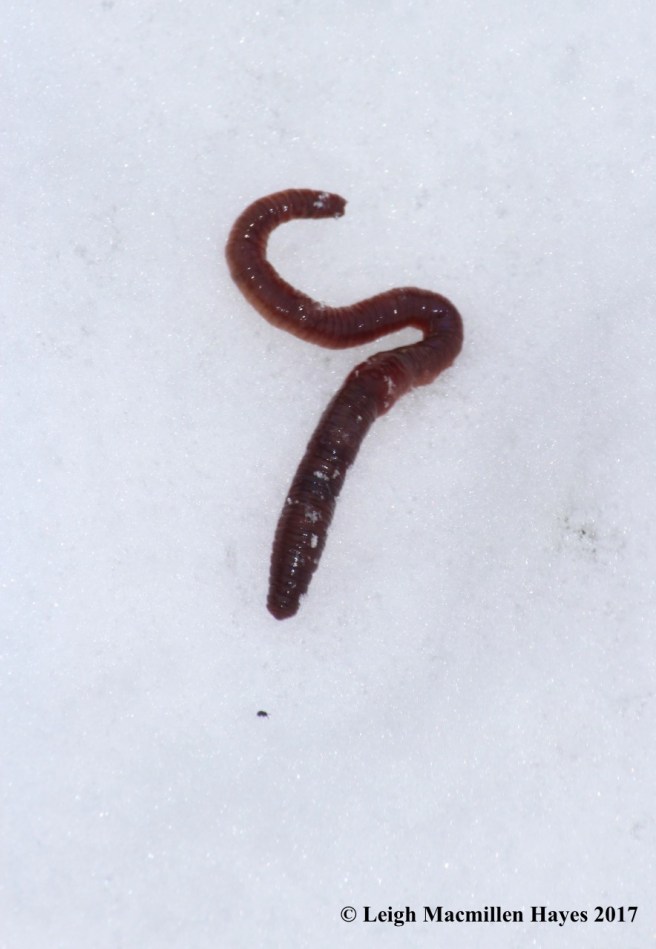
m-worm

a couple of worms–frozen upon the snow. Juncos don’t eat worms; they look for fallen seeds. And so it seemed that the bird flew off before quite reaching the C-shaped worm. And this other worm was about a foot away from the first worm. Robins were in the yard last week, and I can only hope that they returned today for a frozen dinner awaited.

m-snow art 2

Into the woods I trudged, and the ever-changing colors and designs at my feet reminded me of works of art.

m-snow art 1

Some were palettes of mahoganies juxtaposed against white. A variety of textures gave the scene relief, much like an inlaid mosaic.

m-snow art intersections

Others embodied interconnections; a mingling of lines outlined for emphasis.

m-rock people

Along the cow path, I noticed the rock people for the first time, their mouths gaping open.

m-snow fleas

The minute snow fleas would hardly sustain them.

m-morning light

As it does, my trail crossed the line, where power seemed to originate with its source . . . the sun.

m-Mount Washington

And in the opposite direction, it flowed from pole to pole and onward . . . as if powering the mighty mountain.

m-pine sapling

My journey continued into the land of the pines and their saplings, momentarily coated with decorative baubles.

m-mini oaks

And the red oak saplings I’ve been watching looked more festive than ever.

m-squirrel tracks

I was on a mission and soon found what I was looking for. Some tracks that looked like exclamation points led me to another source of sustenance that I wanted to check on.

m-squirrel cache growing

The red squirrel’s cache had grown taller in the past week, but . . .

m-squirrel dining room

many pine seeds had been consumed in the refectory. All that remained were scales and cobs to show a number of dinners consumed.

m-squirrel rocks

The dining hall extended beyond the reaches of the cache, for every table available was a table used.

m-squirrel dinner in the future

As I walked back toward home, I discovered another table awaiting a guest.

m-beech sunshine

I was almost home when I stood under a beech tree. As winter embraces me, I find that their marcescent leaves create their own golden glow and warm my soul.

m-British soldier

One more sweet peek offered a tiny touch of red to today’s fading winterscape–for the British soldier lichens’ red caps announced their minute presence.

m-snow drops

And then this afternoon, I joined a few friends for a gallivant across the Wild Willy Wilderness Trail beside Province Brook in South Chatham, New Hampshire. And the snowdrops created their own works of art announcing that the meltdown was on.

m-pinwheel 1

As we walked, we noticed delicate parasol-shaped fungi fruiting.

m-pinwheel gills

Their common name is Pinwheel Marasius, but in my mind the shape of the umbrella-like top above the wiry stem looked like a parasol and so I called it such. But to add to the confusion, I first called it carousel. Word association might get me there eventually, but it wasn’t until I looked it up in Lawrence Millman’s Fascinating Fungi of New England, that I realized my confusion. One of the fun facts from Millman is worth quoting: “Resurrection! Shriveled and inconspicuous, Marasmius species are rarely noticed during dry weather, but after rainy periods the tiny fungi revive–hence the nickname ‘resurrection fungi.'” And if not rain, then snow will make them rise again!

m-liverwort magic 1

The water from the melting snow highlighted other lifeforms along the Wild Willy Wilderness Trail. Bazzania liverwort grew abundantly, but one in particular gave us pause . . .  for it glowed. And no matter what position we stood in to look at this worm-like beauty, it continued to glow as if it had a golden halo surrounding it. We had no answers–only questions and wonder.

m-glue fungi

Another find that had been marked with tape, for it too was special–a broken branch attached to a young tree. I’m stepping out on a limb here–pun intended, but I believe this was an example of a glue crust fungus that glues twigs together. Seriously? Yes.

m-Bob, Janet and Pam

It was getting dark when we finally found our way to Province Brook and marveled at the water and ice forms. It was also getting close to the moment when we’d need to say, “See you later,” to Bob and Pam, for they’ll be heading to warmer climes soon. But we know they’ll be back for a winter adventure and then before we know it, spring will be here. And then, we hope the brook will be full with spring run-off from all the snow that is in our future. Until then, see you later we also said to much of the snow for it had almost disappeared.

m-ice works 1

But the ice art will continue to grow.

m-Province Brook 1

And the snow white magic will capture our minds again . . . one flake at a time. And with it, the wonders of the world will continue to be revealed.


Firsties

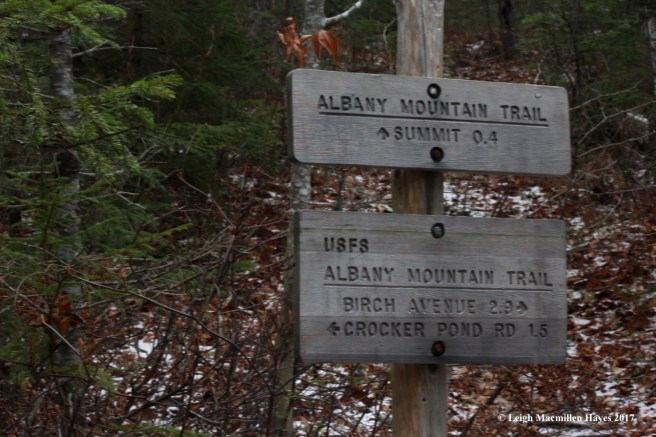
A week ago, I joined friends Marita and Marguerite Wiser for a hike up Albany Mountain from Crocker Pond Road. At the summit, we searched for a loop leading off from the left that I’d been told about, but couldn’t find it. There were cairns leading to the right, but we didn’t see any to the left.

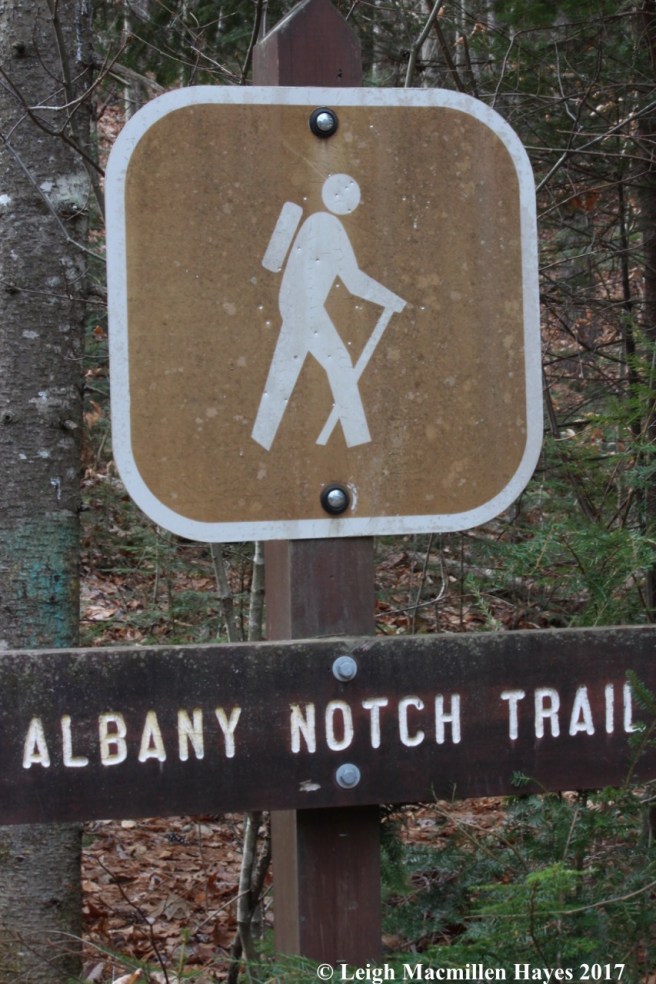
a1-trail sign

And so today, my guy and I headed back up the mountain with a quest in mind–to find the loop. For you see, this week when I again questioned the friend who’d told me about the summit loop, I was assured it was there and we just needed to follow the cairns to the left.

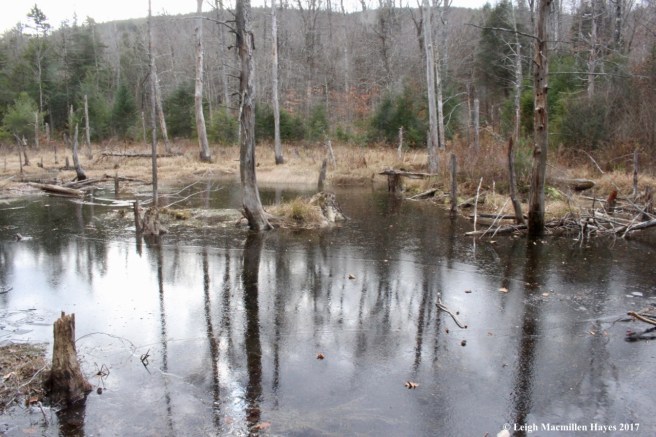
a2-ice on beaver pond

Not far along the trail, we reached the old beaver pond, which was open water last weekend, but coated in a thin layer of ice today. A first for us this season.

a3-dam crossing

We crossed the old beaver dam, made a wee bit easier because of the freeze.

a4-3 in 1 trees

And then we began climbing. Suddenly, I spied a red pine. A lone red pine. A red pine worth inspecting, for I suspected this was bear territory and thought perhaps the tree would show evidence of a past climb since it was the only red pine in the immediate area–bears like something different like a lone red pine. There were no signs of claw marks, but we did wonder about the resources shared by the pine, red maple and beech–a trinity of brethren in these mixed woods.

a5-ice

Moving upward, like all streams this month, water flowed with passion and because of the sudden drop in temperature this past week, ice formed upon obstacles. We slipped off the trail to admire its every rendition.

a6-more ice

Each coated twig offered its own fluid art.

a8-ice spirit

But my favorite of all was the ice spirit who watched over all as his beard grew long.

a9-ice needles

Back on the trail, conditions changed as well and ice needles crackled under our feet, adding to the crunch of dried beech and maple leaves.

am1

We weren’t far along, when we spied snow–another sight that made my heart sing on this brisk November day.

a10-SNOW

For us, it was the first snow of the season and we hope it bespoke the future.

a11-snow on the leaves

The higher we climbed, the more snow we saw, though really, it was only a dusting. But still–we rejoiced.

a12-new steps

Eventually we came upon some new trail work. Actually, last weekend, we’d chatted with the creator of such steps; and on our trip down, I’d asked him about the summit loop because we hadn’t found it. He said there was no such thing. But my friend insisted on such when I told her this info.

a13-climbing higher

On we climbed, reaching bald granite where sometimes conditions were slick. I’d brought my microspikes, but the trail wasn’t difficult and I never did pull them out of the pack. Still–better to be safe than sorry.

a14-Summit sign

At 1.5 miles, we reached the junction. And headed upward to the summit.

a19-ledge 1 view

About one tenth of a mile along, we turned right and followed a spur trail out to a ledge where the view west offered a backdrop featuring the White Mountains.

a16-first ledge and my guy

We suspected the summit loop may have taken off from this point, so my guy went on a reconnaissance mission to the left–to no avail.

a20-Mt Washington

But we did enjoy the view–including the summit of Mount Washington.

am3

Then we went in search of the mountain sage. Given the condition of its glasses, however, we suspected it was feeling a bit bedraggled from the recent wind. Or maybe it had tried to find the loop as well and was just plain tired from coming up short.

a21-lunch rock view

On to Albany Mountain summit we marched. And then we sat on a clear spot upon the granite to dine on . . . none other than the famous PB&J sandwiches (mine with butter, of course). Our view was framed by red pines and spruces.

a23-red pine needles

As it should, the red pines exhibited the look of chimney sweep brushes.

a22-red pine

One bent over, its leader long influenced by the northerly winds.

a23-spruce

Even a spruce known for its spire-like stance had performed the wind dance.

am4

After lunch, we poked around to the left, in search of cairns for the said loop . . . and found none.

am5

There were cairns to the right, however, which the Wisers and I had followed for a short distance last weekend. Today, we decided to see where they led. Cairns gave way to flagging.

am6

And flagging gave way to more cairns.

a24--views of balds from other trail

Meanwhile, the trail gave way to more views–of the Baldfaces.

a25-crossing the ledges

The trail seemed to circle around to the left, but then it turned right. Eventually, we met two young men and asked them if we were on the loop. We learned they’d spent the day exploring the top and knew of no loop, but informed us that we were on a spur. Funny thing is, they were from Texas and Wisconsin.

a26-view toward Pleasant Mtn

And they were right. About a half mile later, we reached the end of the cairns and the end of the spur and another panoramic view–with Keewaydin Lake in the foreground and our beloved Pleasant Mountain in the back.

am7

Again Mount Kearsarge greeted us with its pyramid formation and we stood for a while watching a bald eagle circle below us.

a27-foundation at trailhead

Our trip down the mountain passed quickly for it was my guy that I followed and within 45 minutes we were at the trailhead. Run much? While he went to the kiosk to double-check the map, I spied a foundation I’d previously missed. Who lived here? Was it the Crockers for whom the road was named?

a30a-Crocker Pond

Back in the truck, and because I was driving, we drove to the end of the road and I hopped out to look at Crocker Pond, which was partially coated in ice.

a28-Crocker Pond--backwards C

But it was a backwards reflection that really gave me pause for the birch trees seemed to spell the pond’s initials–backwards and upside down of course. CP. Humor me here. ;-)

a35-Patte Marsh

And then I drove down another forest road to Patte Marsh, which was almost completely covered in ice.

a32-dam at Patte Marsh

Its formations were varied below the dam.

a31-sky reflection and ice

But my favorite of all was upon the pond, where the sky was reflected on a wee bit of open water and ice that reminded me of the eagle in flight.

We didn’t find what we’d gone in search of and may just have to try again (oh darn), but it was a day of firsties for us–first ice-covered ponds, first snow, first time on the second spur trail. Definitely a first rate day for a hike.

P.S. Thanks for continuing to stick with me. Please feel free to tell your family and friends about wondermyway. And encourage them to click the “follow” button. I’d appreciate it if you’d help me increase my readership. You never know what you’ll read here because I never know what I’ll write. Even when I think I know, I don’t. The end result is always a wander and definitely a wonder.


Through Younger Eyes

Zigzagging through the woods, my young friends find wonder in every moment. They embrace their discoveries–often with exclamations and excitement. Following the blazed trail is not in their blood, for they know that some of the coolest finds are off trail, where the fungi aren’t trampled and mammal signs not obliterated.

w-striped ledge

And so it was that this past week, I had the honor of spending lots of time exploring with them. First, on Tuesday, our Greater Lovell Land Trust docent tramp found us atop the “striped ledge” beside Keewaydin Lake in Stoneham, Maine. One of our docents, Mary, had obtained landowner permission for this grand adventure. From the Maine Geological Survey: “The dikes cutting the granite trend generally from southwest to northeast. They most likely intruded the host rock during the Jurassic period, when continental rifting caused extensive fracturing of New England’s bedrock (McHone 1992). Basaltic magma intruded these cracks, and cooled and solidified to form dikes such as those seen in Striped Ledge. Close examination of the ledge shows a complex intrusion history at this locality Some of the dikes have layering parallel to their walls, which may have resulted from several pulses of magma into the fractures and/or chilling of the dike margins in contact with cooler host rock . . . the dikes locally cross one another, with the older dikes being offset where they are torn apart by the younger ones.” How cool is that?

w-smiling for rosy quartz

Darn cool, especially when rose quartz was among the great finds.

w-rock hounds

And in that instant, a few rock hounds were initiated.

w-turning two twigs into a fish

When not looking at rocks, a couple of broken twigs on the ledge became a fish in one moment, and hotdog tongs in another–ever versatile were they.

w-eyeing a flower in rock tripe

But it wasn’t the ledge alone that drew their attention. When we stopped to admire rock tripe growing atop a boulder, it was the eye of the youth that discovered the green “flower” at the center.

w-Sucker Brook 2

And then the next morning, which dawned even colder than the previous, I joined the same family for a pre-hike at the GLLT’s Wilson Wing Moose Pond Bog Preserve as we prepared for a public hike. The trail meanders beside Sucker Brook, and we, too, meandered.

w-dipping into the cold for a Pooh stick

Pooh sticks were launched periodically and sometimes had to be dislodged.

w-wondering about foam

There were bubbles to watch in the brook and the foam formed to hypothesize about.

w-stump art

Nature’s artistic designs were viewed with awe.

w-pointing to hobblebush

The intention was to find a few of their favorite things. They found a few hundred and  . . .

w-seesaw

had lots of fun along the way.

w-exploring the stream

All the way along, the water, moss-covered rocks and sticks became part of their playground. But really, they also noted a variety of fungi, including their favorite green stain, which was in fruit,  a tree that had brought distress this summer for it housed honeybees and they learned that the hard way, great sliding spots from which to practice being river otters, the sunlight glittering on Moose Pond Bog and Indian pipes in their capsule form. There were sapsucker holes, pileated woodpecker activity, birch polypores, and even a surprise. They couldn’t wait for the public hike to show off their discoveries.

l-measuring diameter 4

That same afternoon, District Forester Shane Duigan, joined our GLLT after-school program at New Suncook School in Lovell. The Trailblazers, as the group is known, first introduced Shane to their trees. And then he showed us some of the tools stored in his vest, such as the tape measure used to determine diameter.

w-learning how to age a tree

As the kids made guesses about a tree’s age, Shane demonstrated how foresters use an increment borer to extract a small core from a tree.

l-counting rings on tree core

They crowded in to watch him count its rings. The predicted age: 100. The actual age: 50. The fun: 100%.

w-Horseshoe Pond

And then this morning dawned, colder than our previous outings and the wind created white caps on Horseshoe Pond below the kiosk for the Wilson Wing Moose Pond Bog Preserve. It was time for our public walk to enjoy the wonders of Wilson Wing.

w-ice 1

One of the biggest surprises were the icicles that had formed on Sucker Brook since our last visit on Wednesday morning.

w-carrot-shaped icycle

And because they are kids, they couldn’t resist gathering such to admire up close. This one looked like a carrot, and actually appeared so as it reflected the blaze orange–our color of the season.

w-ice 2

The kids realized that the icicles formed upon all types of vegetation and created their own interesting shapes worth celebrating.

w-ice 3

One even looked like a flag blowing in the breeze when turned upright, and this guy showed it to his mom in honor of her service in the Army and the fact that today is Veterans Day. Turned on its side, it became a maze game and he really wanted to place a small ball in it and watch the ball move through. And as much as he wanted to take it home, it has to live on in his mind’s eye and this photograph.

w-wondering about the car

They showed us so many things of nature, and even the unnatural, though they imagined all the critters for which the old blue car might create a fine home–squirrels, weasels, porucpines, foxes, and coyotes were on their list. And then they turned into otters themselves and slide back down the hill over and over again.

w-polypody 1

They wanted to share some other great finds, including a few squirrel dining tables and a rock with bad hair day, but the crowd had gotten ahead of them. Despite that, they looked at the “bad hair day” fern, aka polypody, and realized that it had curled in since Wednesday’s visit. And then they figured out that the fern curls when it gets cold. Who knew you could use a fern to determine the temperature?

w1-artist conks

Though they didn’t get to share all of their finds this morning, they did make some new discoveries as they wandered off trail, like the artists conks that grew in abundance.

w1-dead man's fingers

And deadman fingers fungi that reminded one of them of scat standing upright. I’ve a feeling that description will stay with me each time I look at it going forward.

w-bear hair 1

In what seemed like no time, for we traveled the trail much faster than intended, we were back on Horseshoe Pond Road and one among us was particularly excited about a certain display upon pole 13. She ran ahead to be able to show all the participants as they passed by.

w-bear hair on pole 13

It was bear hair and scratch marks that she shared with enthusiasm. And the knowledge that we are not alone in these woods.

And just after that one of her brothers realized our walk was almost over and he was disappointed for so much fun had he had being a junior docent.

w-Sarah signing my book

A few hours later, my guy and I ventured to The Met Coffee House and Gallery in North Conway to meet up with another who encourages children and their adults to explore the outdoors. It was our great joy to join my dear friend, Sarah Frankel, for the first book signing event as she celebrated the publishing of Half Acre.

w-posing by an uprooted tree

And now it’s the end of the day and the end of the week, and I’m a better person because of the time I’ve spent with young friends as they’ve moved quickly at times and then stopped to wonder. They taught me the joy of looking with open minds.

If you don’t have kids to learn with and from, may you find time to channel your inner child and look at the world through younger eyes.