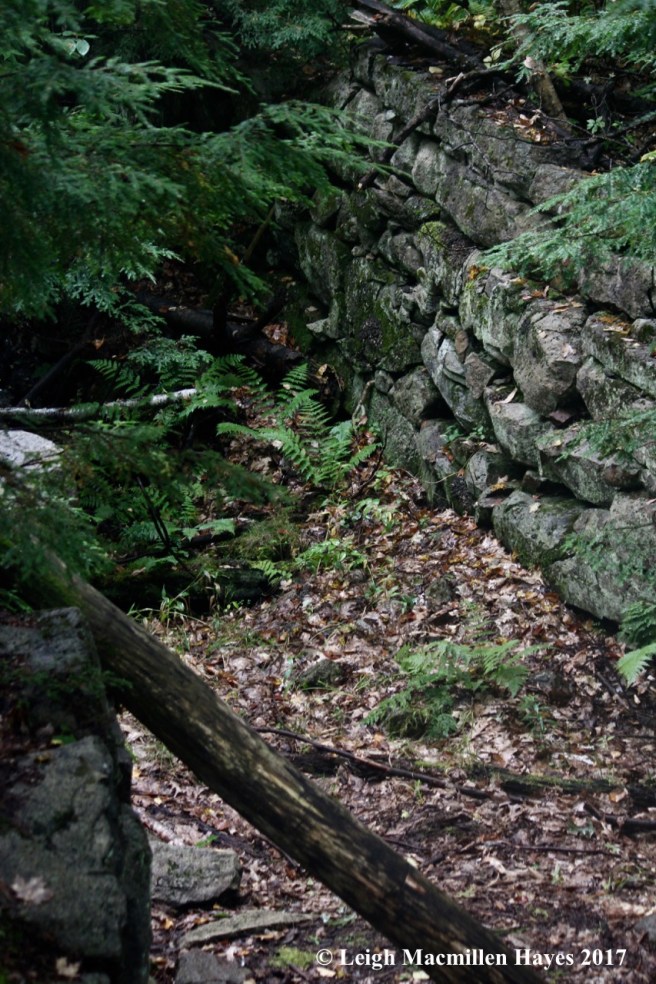
Poking Along Beside Stevens Brook

Raincoat? √

Notecards? √

Camera? √

Alanna Doughty? √

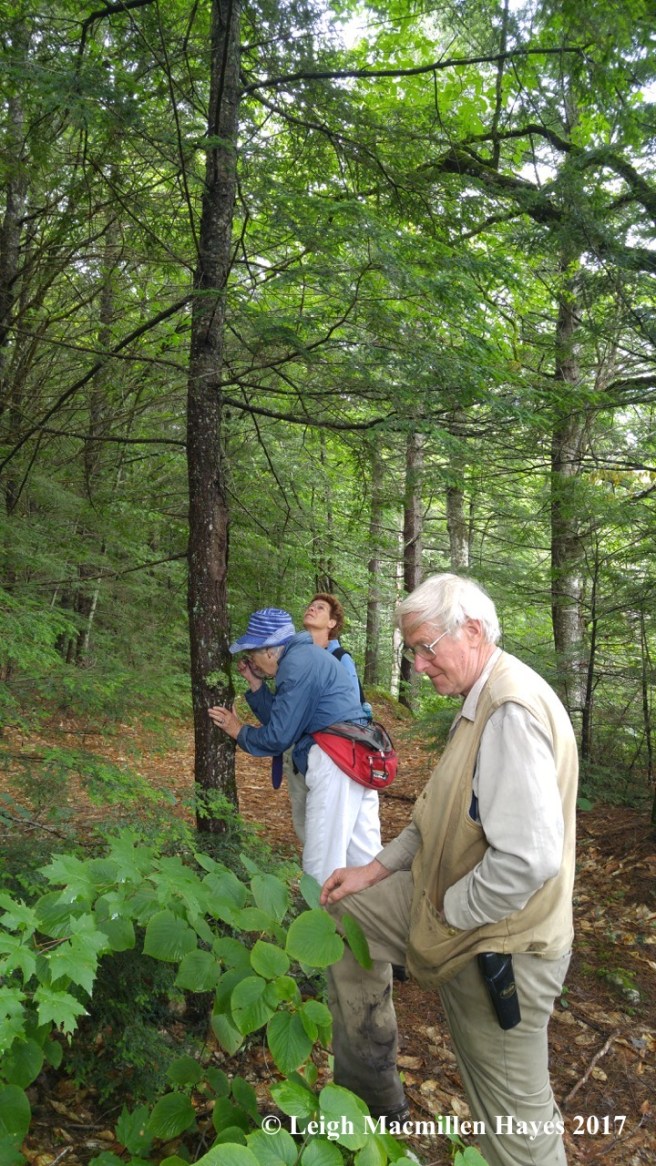
This morning I donned my raincoat, slipped my camera strap over my head, and met up with LEA’s Education Director Alanna Doughty for our reconnaissance mission along Stevens Brook in downtown Bridgton. Our plan was to refresh our memories about the mill sites long ago identified and used beside the brook.

Lakes Environmental Association maintains a trail from Highland Lake to Long Lake, which follows Stevens Brook’s twists and turns and passes by twelve power sites originally surveyed by Jacob Stevens in 1766.

s1-5th power site 1

We skipped the first mile of the trail and slipped onto it from the Route 302 entrance by the Black Horse Tavern, knowing that that will be our entry point for a walk we’ll lead with Bridgton Historical Society‘s Executive Director Ned Allen later this month. Alanna suggested I not pull out my notecards, and rather rely on my memory. Oh my.

As we made our way past the old trestle that once carried coal from the Narrow Gauge railroad to the Pondicherry Woolen Mill at the fourth power site (the other three are located between Highland Lake and the 302/117 intersection), we recalled that the now deceased Reg Fadden used to claim he knew the color of dye because as he walked to school each day he noted the color of the water. Scary thought.

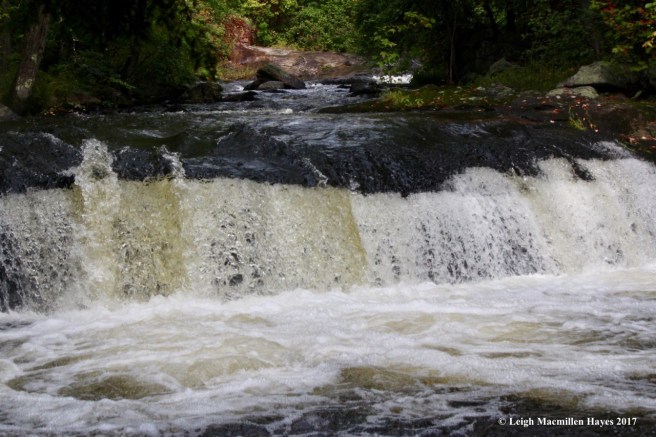
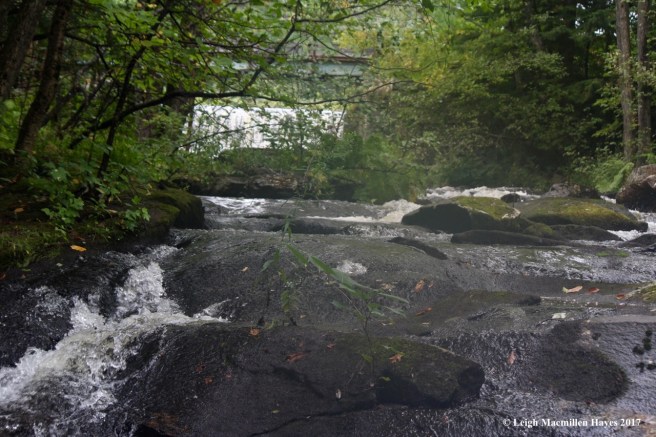
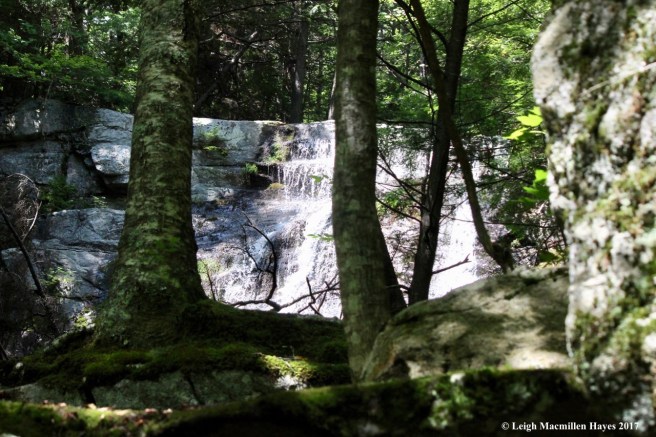
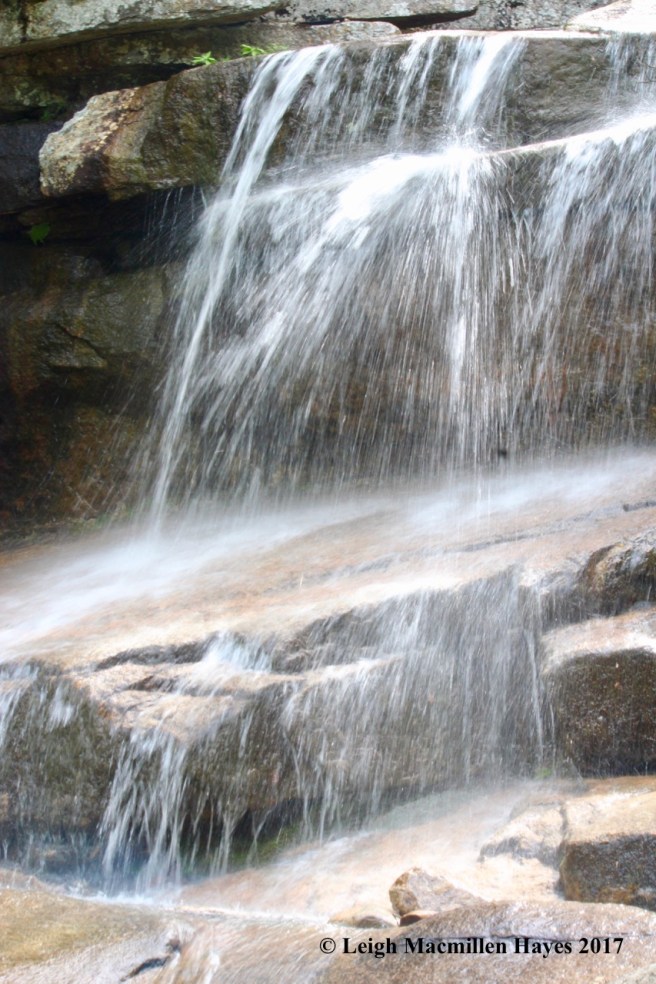
At the fifth power site, we went off trail to look around a bit. The water flowed over the rocks with such force that sometimes we couldn’t hear each other.

s2-5th site-Narrow Gauge trestle bridge

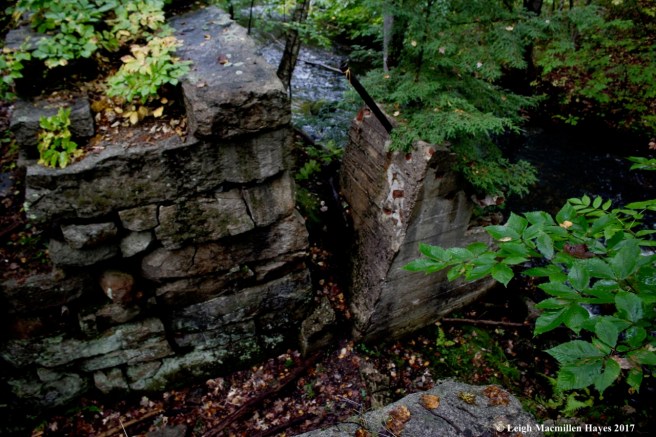
Before us was another former trestle spot–this one being part of the track that carried the train across the brook and on toward Harrison as part of a spur from the main line.

s3-5th site, nurse log

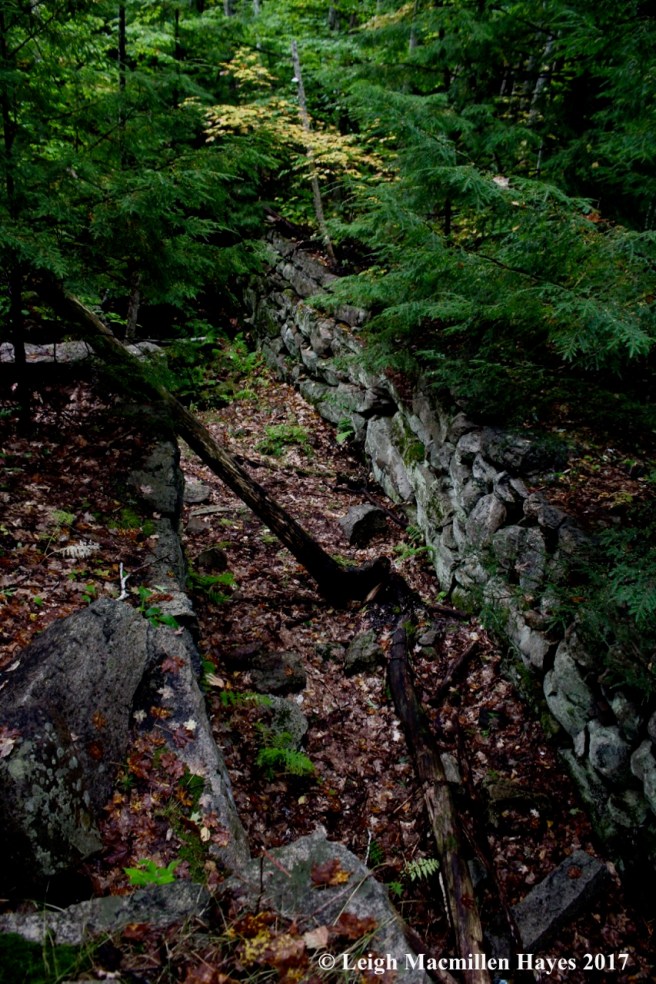
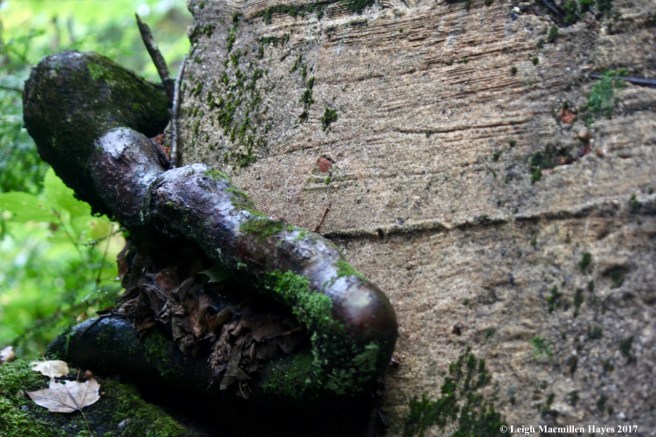
In front of it, large trees placed years ago to prevent anyone from crossing the now gone trestle, served as a nursery to many species. But it wasn’t just what grew there that gave us pause–it was also the textures and lines that seemed to reflect the water below.

s-poison ivy 1

As we walked, we looked at the lay of the land and wondered about mill ponds and berms. We also noted the one plant we wanted to avoid–poison ivy.

s-poison ivy 2

It grows in various forms, but the safe thing to know is that the two opposite leaves have short petioles that attach to the main stem, while the third and leading leaf has a longer petiole. As the saying goes, “Leaves of three, leave them be.”

s7-6th site water power

Site number six is one that we’re not sure we’ll share on our public walk. It’s a wee bit of a challenge to get to and was apparently never developed–though we did note the drop and some stonework on the far bank.

s8-blue-stemmed goldenrod 1

Before we stepped onto Smith Avenue for the next site, a goldenrod shouted for attention. We tried to figure out how many rays it had, but as it turns out, that number can vary from three to five. The flowerhead formed a ladder that climbed up the stem and this is one that we should recognize going forth for its display struck us as being different than other goldenrods. We’ll see if we actually do remember it the next time we meet.

s9-7th site, Lower Johnson Falls 1

As is often the case, it took us about an hour to walk a half mile. At last we emerged onto Smith Ave, by Lower Johnson Falls. The curious thing would be to note which was faster–the water or us. I have a feeling the water might win, but perhaps another time we should test that theory.

s11-coffin shop

For a few minutes we watched and listened and took in the view of the only mill still standing. I suspect this building was constructed in the 1860s as a sash and blind factory. Eventually it became the coffin shop, where Lewis Smith, the town’s first undertaker, built furniture and coffins.

s13-8th site, sluiceway different view

For about a tenth of a mile we walked down Kansas Road and then slipped into the woods again. I think this site is my favorite–site 8 and former home of the Forest Woolen Mill. There were actually two Forest Mills, one on either side of the road and connected by an overhead walkway.

s15-8th site, sluice way from above 2

Today it was the sluiceway that drew most of our attention. First we looked down.

s12-8th site, sluiceway1

And then we climbed down–paying attention to stones, bricks, cement and rebar, all necessary to build a foundation that still stands today.

s17-piece dangling

Well, most of it still stands. We were awed by a piece that appeared to dangle at the edge of the sluiceway.

s16-tree root in sluiceway

And a root that wound its way around the same cement stanchion . . .

s14-hemlock atop cement

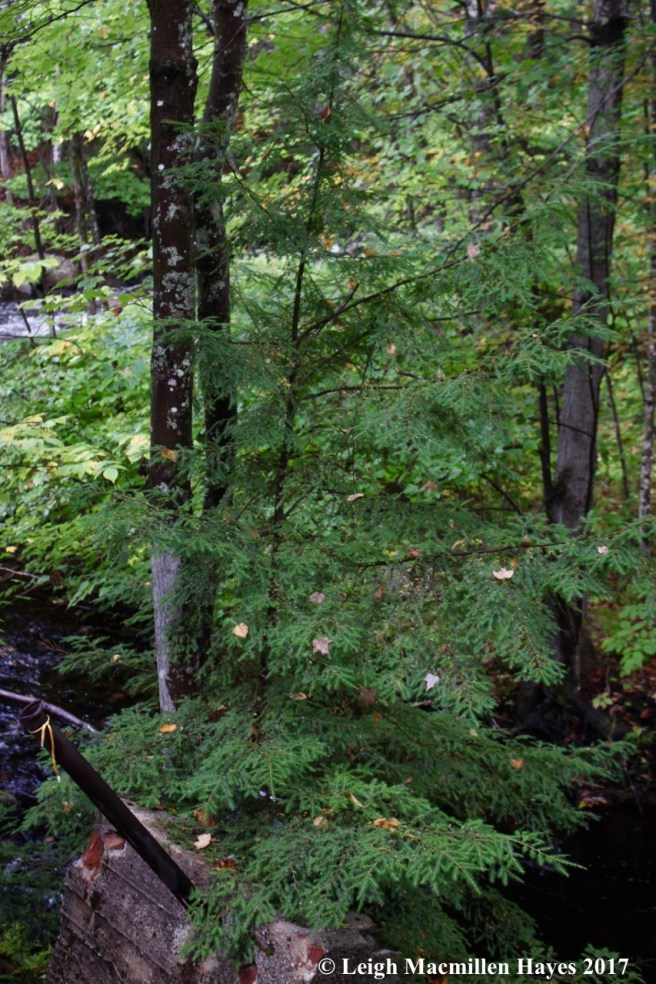
which happened to provide the perfect growing conditions for a hemlock.

s18-false Solomon's-seal berries

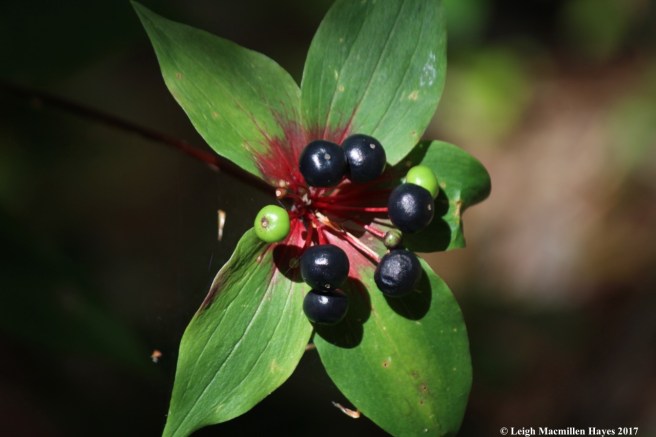
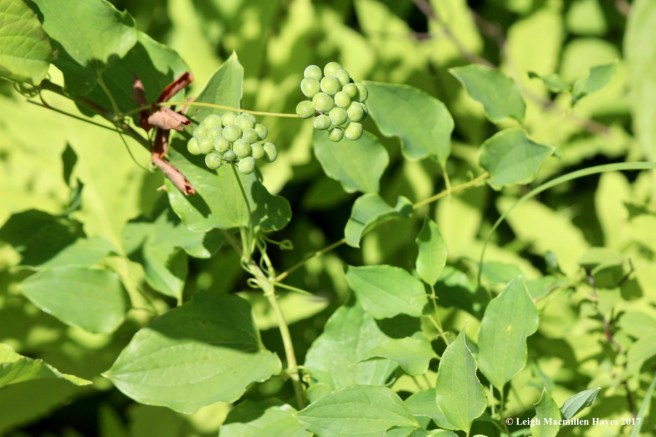
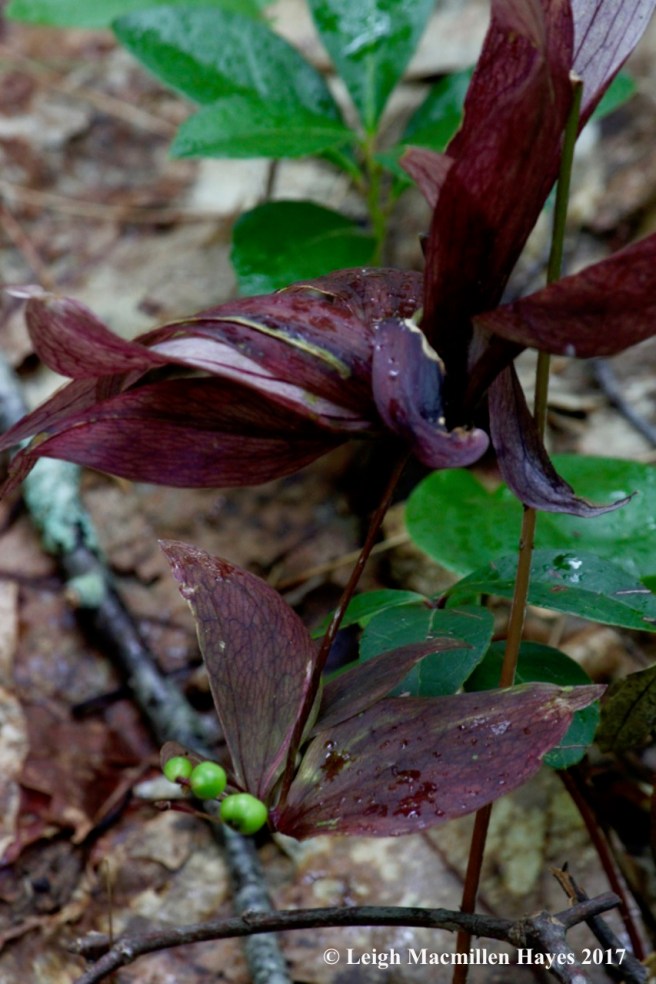
Crossing Kansas Road again, we ventured on. In a section under the current power lines we found flowers a many. The fruits of the false Solomon’s-seal looked like miniature strawberry and cherry-vanilla candies.

s19-winterberries

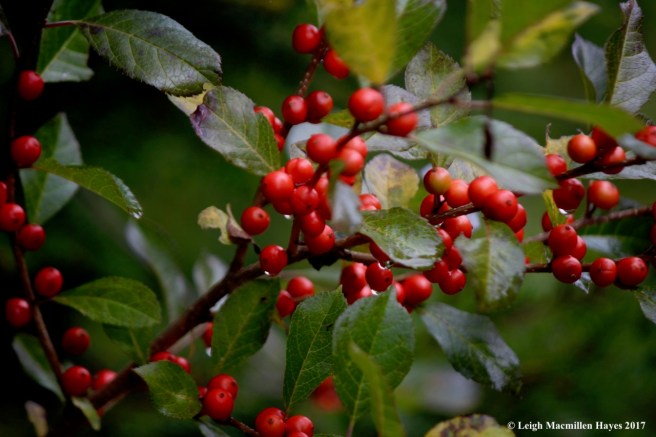
As we stepped onto a boardwalk across a wet area, winterberries glowed red and reminded us that the cold season isn’t all that far off.

s20-virgin's bower fruit, feathery plumes

It was there that we spied the feathery-fruited plumes of virgin’s bower,

s21-red-stemmed dogwood

red-osier dogwood berries,

s24-cat-in-nine-tails

and cat-in-nine-tails.

s22-cardinal flower

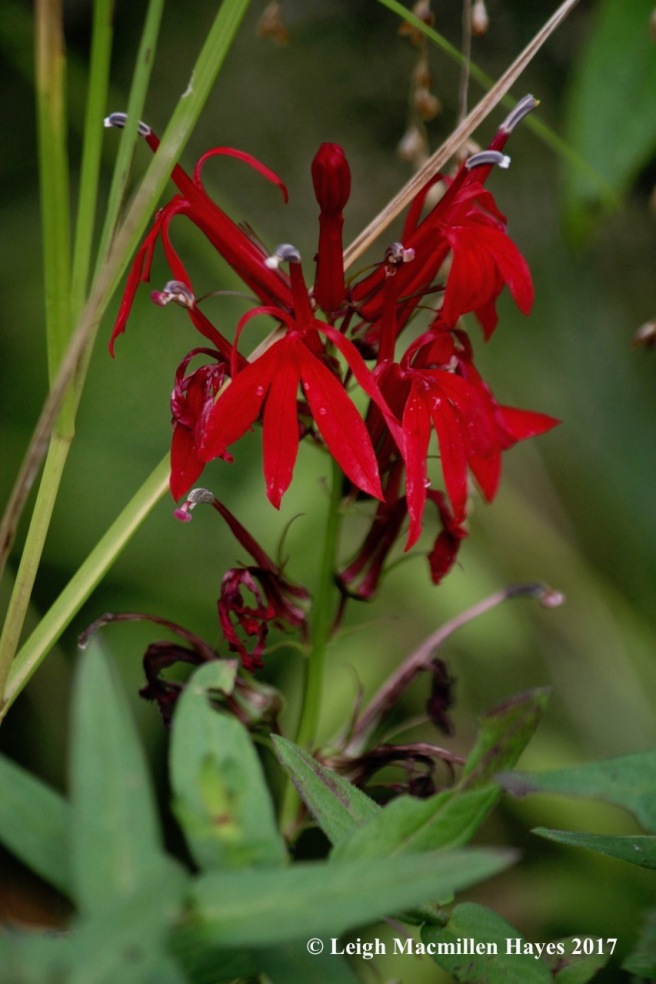
But our favorites: a cardinal flower still in bloom and . . .

s23-Northern beggar-ticks

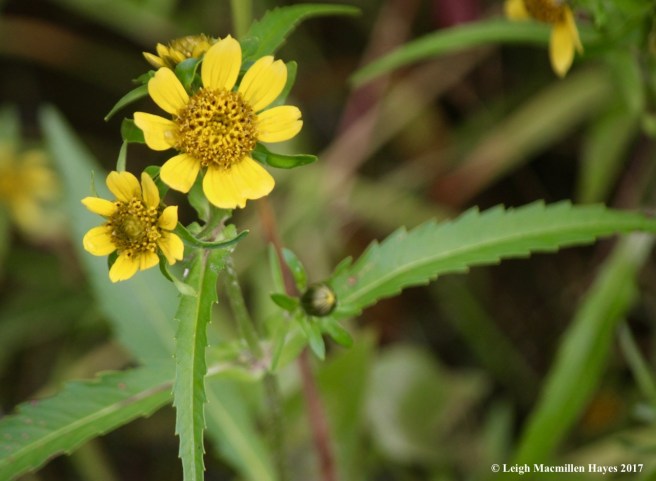
northern beggars-tick.

s28-10th site, CMP above

We passed by the tenth power site, knowing we’d return to it on our way back. Instead, we stood below and looked up at the water flowing over the improved dam.

s27-water below 10th site

It was in this section that the brook dropped 25-30 feet and created the greatest power at one time. It was also here that the eleventh site was located and where a penstock once provided a way to get water to a powerhouse in order to furnish local homes with electricity.

s31-Alanna laughing by skunk cabbage

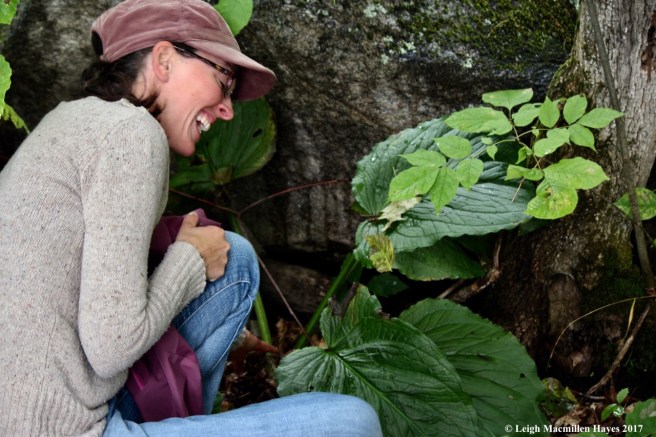
For us, it was a place to make more discoveries and share a laugh as we looked at the huge leaves of skunk cabbage.

s32-first witch hazel bloom

We also spied the first witch hazel flower of the season . . .

s33-maple-leaf viburnum

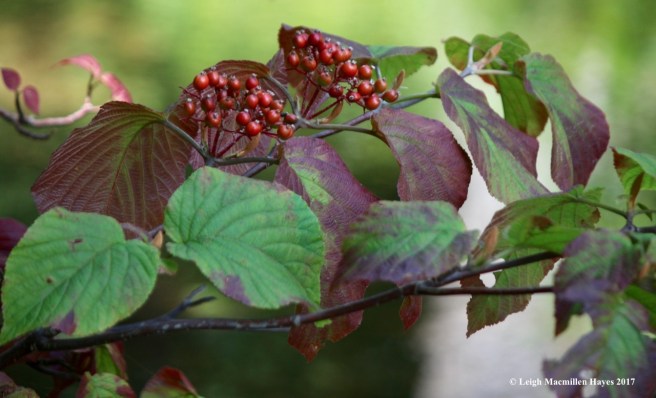
and a maple-leaved viburnum showing off its subtle fall colors.

s34-milkweed pods

In a spot just above the Central Maine Power substation, we found a garden of wildflowers including milkweed seed pods and . . .

s37-New England aster 2

New England asters offering a deep shade of purple.

s27-chicken of the woods

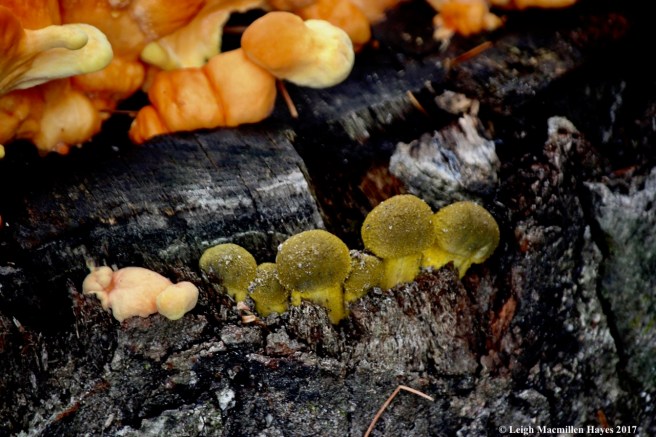
We also found some chicken of the woods.

s38-honey mushrooms?

And fruiting on the same stump, what I think was honey mushrooms (Armillaria mellea). I know a few fungi experts who occasionally read this, so I know they’ll correct me if I’m wrong with my ID.

s39-Stevens Brook outlet into Long Lake

The second half mile took us just as long as the first, and at last we reached the outlet into Long Lake.

s40-10th site, CMP dam

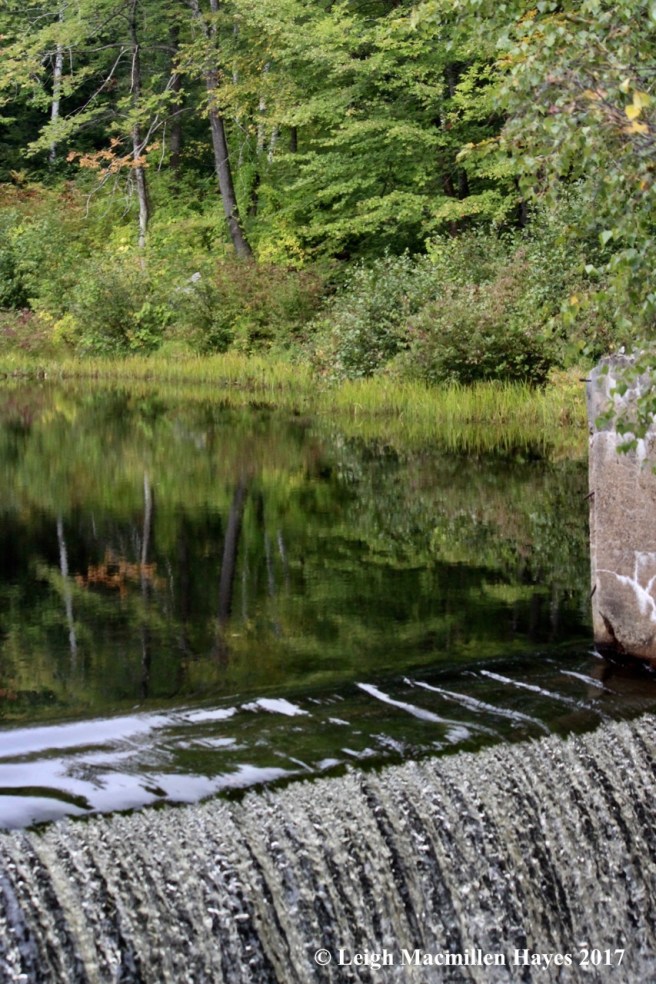
And then we made our way back, crossing over the bridge at power site 10, which was possibly the spot where Jacob Stevens, for whom the brook was named, built the first sawmill in 1768. We do know that in 1896, the Bridgton Water and Electric Company acquired the site and improved the dam. Eventually it passed on to the Western Maine Power Company and then Central Maine Power. In 1955, it was transferred to the Bridgton Water District. Through all the time, we could only imagine how the reflections changed.

s42-milkweed tussock moth caterpillar

To save time, we decided to walk along Lower Main Street as we made our way back. And to that end, our discoveries continued, for on a milkweed, Alanna first saw the chewed leaf and knew to look for the milkweed tussock moth caterpillar that was filling its belly.

s43-common snowberry

We also saw what I’ve always referred to as popcorn shrub because it reminds me of such, especially when I’m hungry for lunch. But really, it’s common snowberry. And not edible.

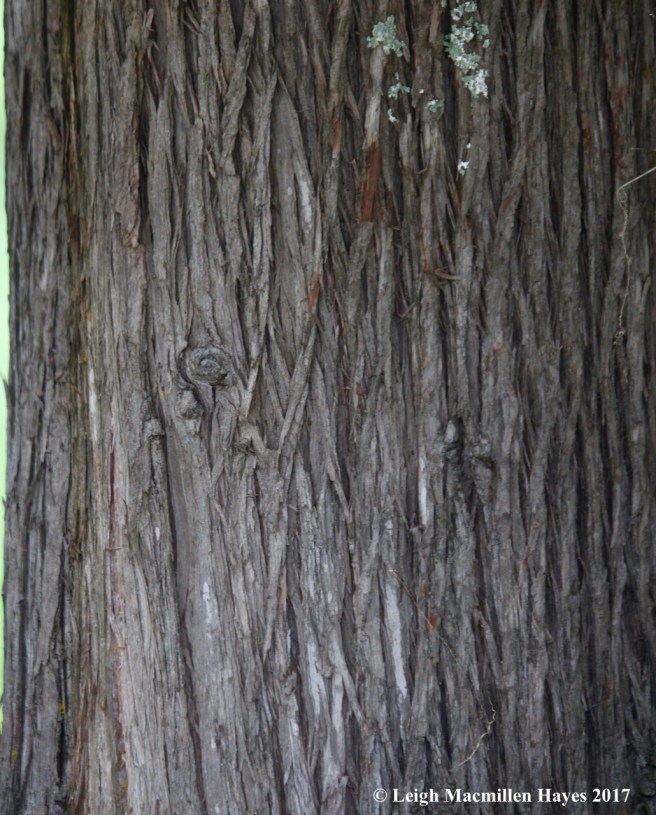
s46-northern white cedar bark

And then we found a tree that I didn’t know grew there–and I can’t tell you how many times I’ve run or walked by it: a northern white cedar with its scraggly striped bark.

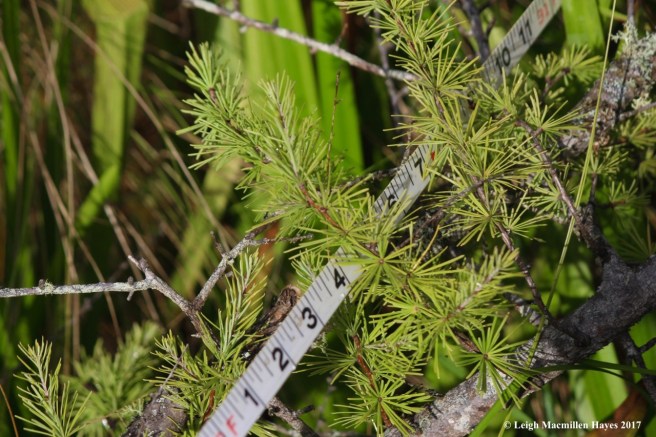
s44-Northern white cedar 1

As much as the bark, I like the overlapping scale-like blue-green leaves.

All in all, our one mile journey took us just over two hours and we did recall some of the info about the mills without referring to my notecards. But what was even more fun was our wonder and awe as we made new discoveries while poking along beside Stevens Brook.

If you care to join us, the talk by historian Sue Black will be on Wed, September 27 from 5-7pm at LEA’s Maine Lake Science Center and the walk will be the next morning from 9-11. We’ll meet at Bridgton Historical Society on Gibbs Avenue for that. Be sure to register for either or both by contacting Alanna at the following address: alanna@leamaine.org.


Falling Toward Autumn

It’s another nine days until the autumnal equinox, that time of year when the shift from sultry summer weather gives way to the crispness we all love about fall. But . . .  over the past few weeks we’ve been on the cusp. Warm days, some a little less warm than others, and cool nights, some a wee bit cooler. And with the change in temp comes a change in coloration of the world around us.

o-morning view 4

And so this morning as Marita and I approached Overset Mountain in Greenwood, our fancy was tickled by the tapestry reflected on Hicks Pond.

o-boulder in river

At last we reached the trailhead we were seeking, and first hiked beside Sanborn River, where the flow of the water added a voice to the display.

o-jack in pulpit fruit

On one small rocky outgrowth I spied something red and we quickly realized it was a lonely jack-in-the-pulpit in fruit form.

o-following marita

After a little more than a mile, the trail we chose to climb Overset Mountain turned right, away from the river and soon we passed under a power line, where energy hummed in a manner we couldn’t hear above. From our waists to our feet, however, the pollinators buzzed.

o-aster gone to seed

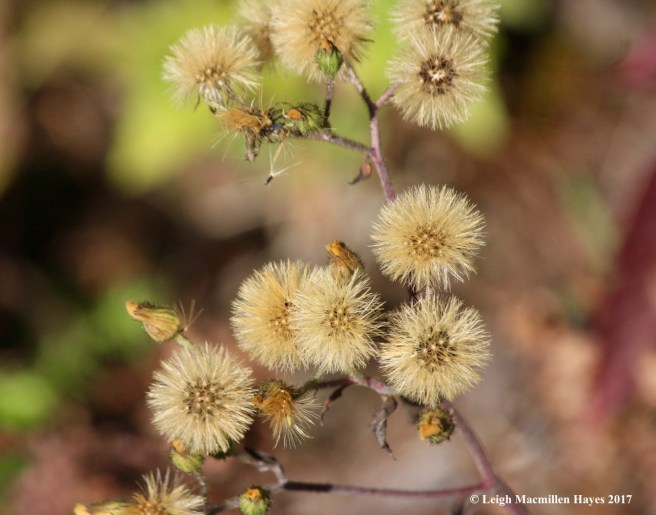
While many flowers were still in full bloom, a few, like this aster, were ready to send their young forth on individual parachutes.

o-Indian cucumber 2

Others also shared their colorful youth-filled fruits, including Indian cucumber root,

o-hobblebush

hobblebush,

o-bluebead lily

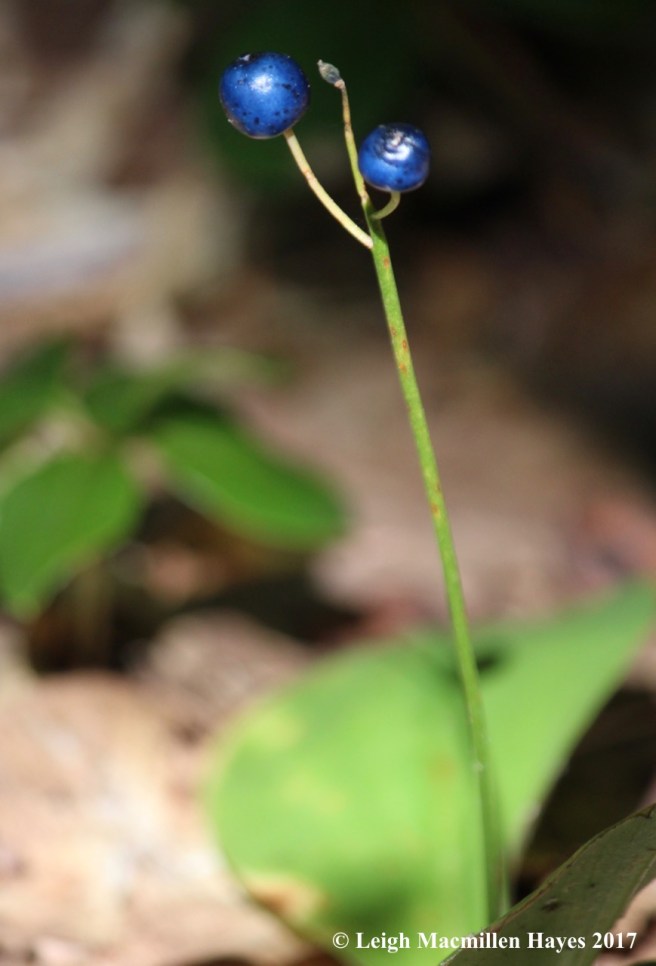
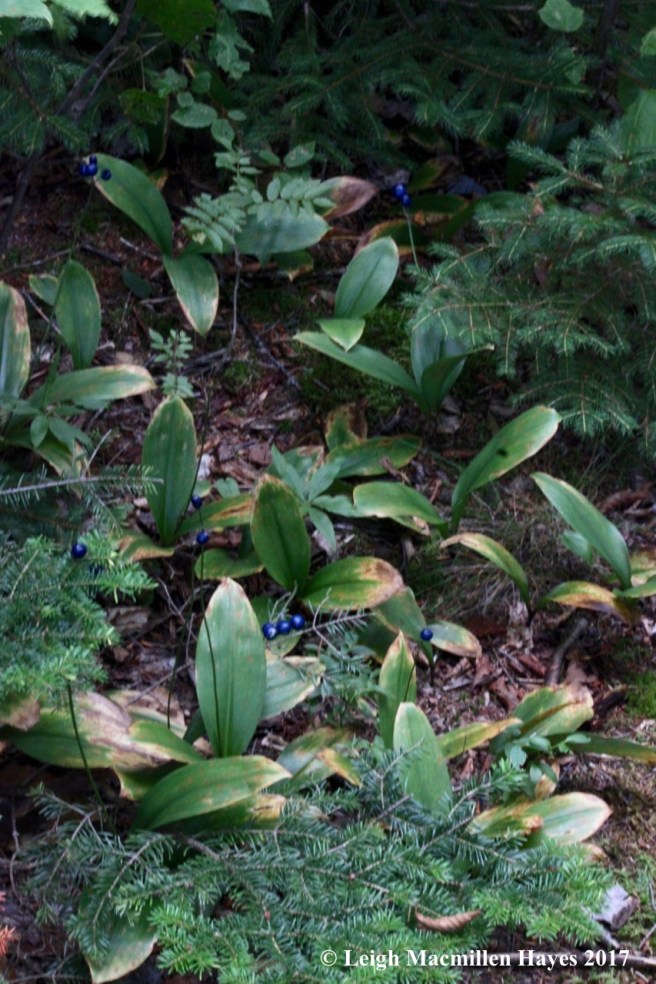
blue bead lily,

o-witherod berries

witherod,

o-maple-leaf viburnum

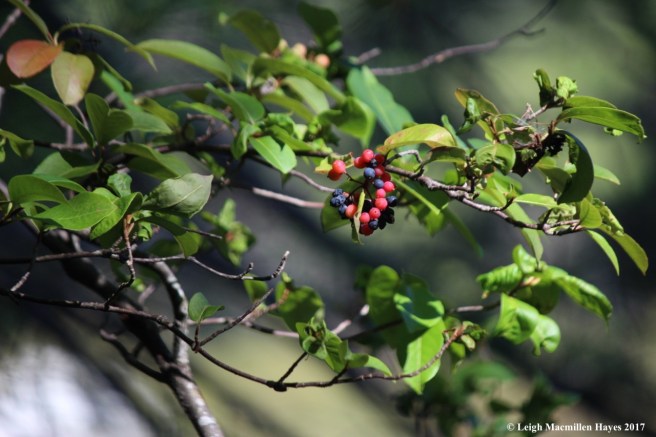
and maple-leaf viburnum.

o-overset pond and mountain

At last we reached Overset Pond, its water as calm as could be while it clearly reflected the sky and mountain we were soon to climb. Here and there, touches of color peeked out among so much green.

o-overset cliff

As we circled the pond, our voices echoed off the cliff above–our destination. We were going to climb up the rock face . . .

o-marita just before summit

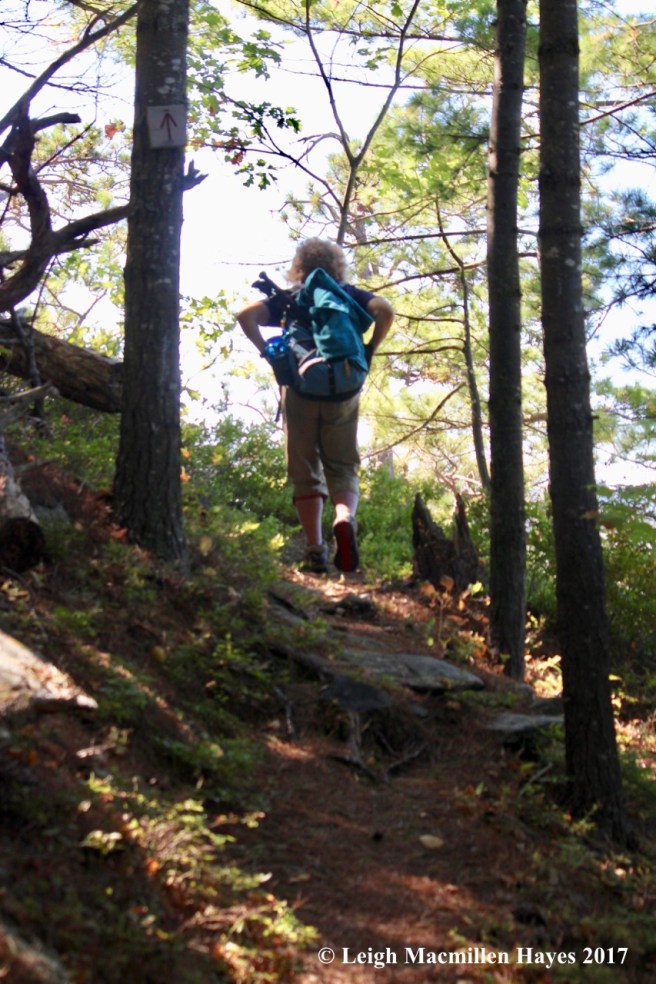
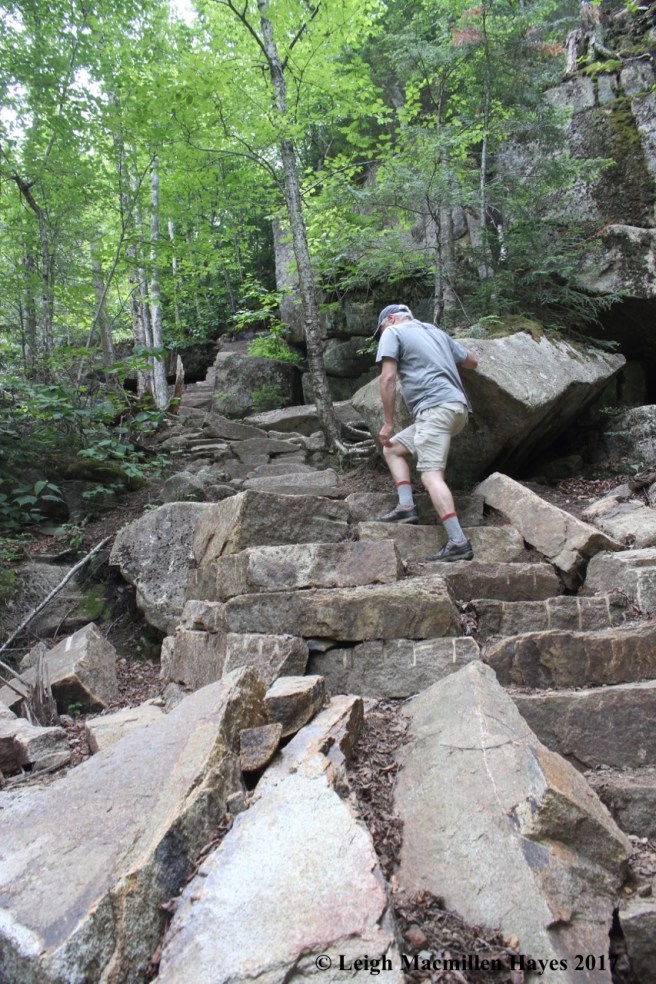
but decided we’d take our time and hike up the trail instead. (And if you believe we would have attempted that cliff, think again.) We’d describe the hike as a moderate climb to the summit. The terrain changed with the natural communities, so while we’d been on soft duff beside the river, we encountered some granite, including steps, on our skyward leg of the journey.

o-approaching the summit

About an hour and a half after starting, we reached the view point, where lunch was served–BYOB style, of course.

o-Noyes Mountain

To our left, we recalled a recent climb up Noyes Mountain.

o-tapestry begins

To the right, a colorful tapestry that changes daily.

o-heart-shaped overset pond1

And below us, Overset Pond, which appeared heart-shaped from this vantage point.

After lunch, we continued on the loop trail, paying attention for a ground nest we’d been forewarned about. Thankfully, we spied it before the bees spied us and were able to bushwhack around to avoid being stung. We continued on and finished up the mountain hike, then decided to also follow the Sanborn River Loop, thus covering about seven miles by the time we were done.

o-blood milkwort

And near where we’d parked I spotted some flowers I met for the first time the other day–purple milkwort. It’s always that way–meet something for the first time and then realize it’s everywhere. In this setting the milkwort added its own variation to the start of the fall tapestry.

I love all seasons and the in-betweens as well. That being said, it’s always hard to give one up for the next. But I guess that’s the job of the in-betweens–to help us transition. Right now, I’m falling toward autumn.


From the Bonny Banks to the Highlands

It had been ten years since we were last in Scotland. With our tween sons in tow, we had rented a house in Duns for a week as we toured the Scottish Borders and Edinburgh. But it was to the Highlands that I really wanted to return and so when an opportunity arose for us to do such, we hesitated for a wee bit and then embraced the invite.

After landing in Edinburgh quite early on September 1, we walked to the car rental, debated size, upgraded our choice, and in true Hyacinth and Richard style (BBC’s “Keeping Up Appearances”), drove off on the wrong side of the road—that being to the left of the center line.

s-ll in morning light (1)

Our first destination was Loch Lomond. Upon reaching the loch and locating our weekend stay, we were several hours too early and so decided to drive north—oh my.
s-tight squeeze 1 (1)

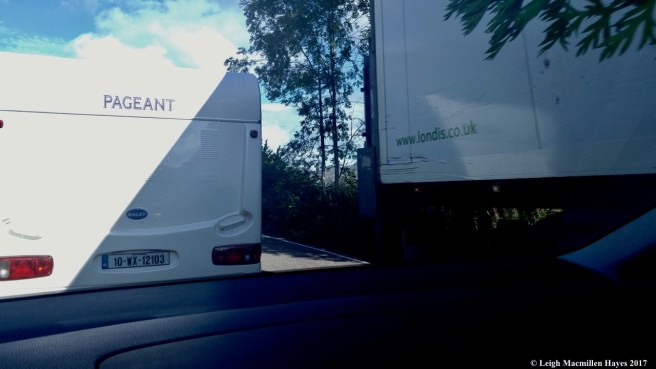
An exhausted driver in a rental car, and a tight squeeze between a retaining wall and lorries aren’t necessarily a good mix. Especially if you are Hyacinth. I constantly encouraged Richard to slow down with a flap of my hand while I muttered under my breath. Lucky for me, he didn’t come completely to a halt and make me walk. What surprised us both was that we were on the A82, a main road between Tarbet and Crianlarich. It hardly felt like a main road. With no other option for our return, we squeezed our way south as we finally headed to our place of rest.

s-Castle Steadings 1

Through Airbnb, we’d rented the Wee Wing at Castle Steadings in Arden, a most delightful spot.
s-starlilies

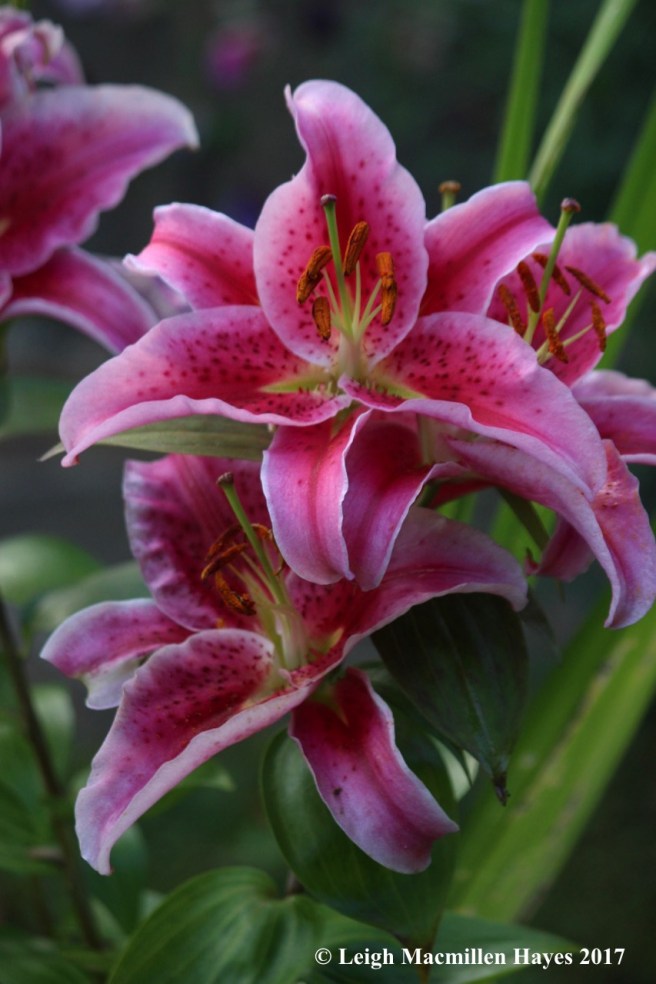
I knew we’d chosen correctly when I spied the star lilies in bloom by the front door, for my wedding bouquet 27 years ago had included these beauties.

s-breakfast spot

A mini-suite it was, with a large foyer, bathroom, bedroom with sitting area and private outdoor patio.
s-Balloch river 1

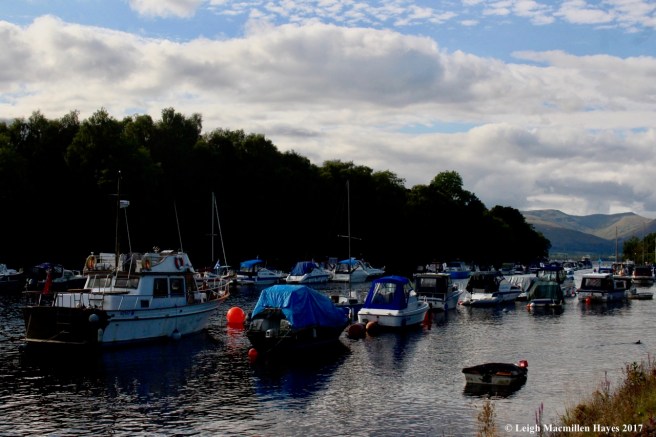
After a shower, which woke us up (sort of), we again hopped into the van and drove five minutes down the road to Balloch, a small tourist town at the River Leven outlet of Loch Lomond. It was there that we first walked along some trails beside the loch and then made our way to the pub at The Balloch House (a recommendation of our hostess, Amanda). Hans Christian Anderson had visited the hotel in 1847. What impressed us most about the cozy pub was the fact that dogs were welcome—and well behaved. We chatted with a couple at the next table, ate an early dinner of fish and chips for my guy and a burger for me, and then our heads began to bob and we knew we needed to return to the Wee Wing.
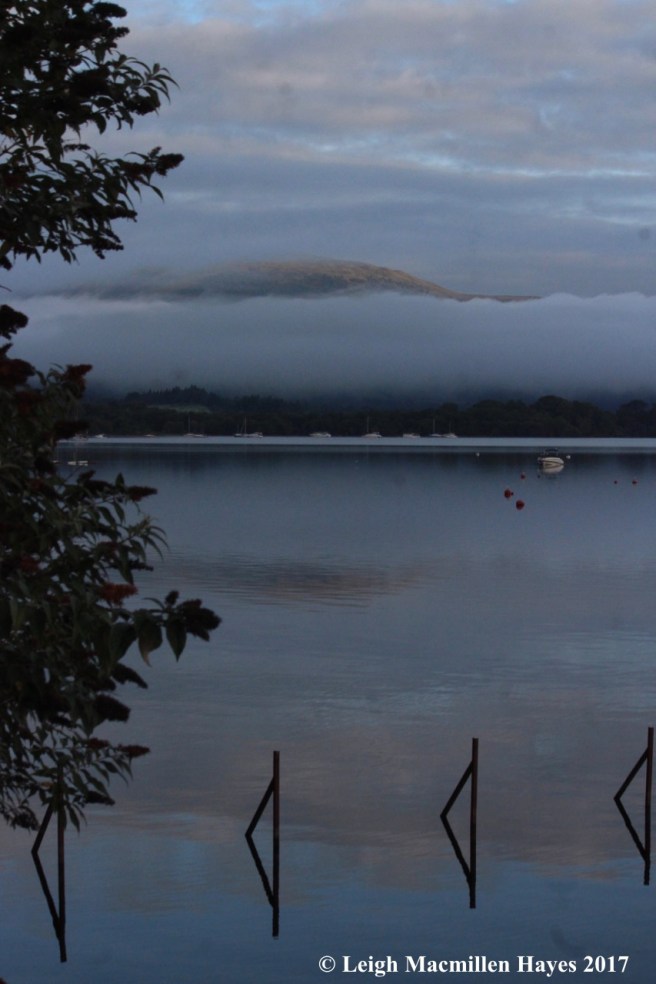
s-Loch Lomond in morning

Sleep greeted us quickly and in a flash morning dawned. My guy headed off for a run beside the loch, while I walked. The mountains were obscured by the clouds, but slowly they lifted.

s-breakfast at Steadings

Back at the Wee Wing, we again knew we were in the right place when each morning breakfast mysteriously appeared behind a curtain in the foyer. Fresh strawberries, yoghurt, croissants and muffins—we filled our bellies, skipped lunch and didn’t need to dine again until later. Blueberry muffins the first morning and chocolate the second, both fresh and delicious.

s-C Hill trail marker

Our plan for Saturday was to hike in the Trossachs National Park and so off we went in search of a trail. Much to our surprise, the park office in Balloch was closed, but we ventured into Tesco, where a young man suggested we drive toward Balhama.

s-view of C Hill from island

At last we found what we were looking for and began our ascent up Conic Hill.
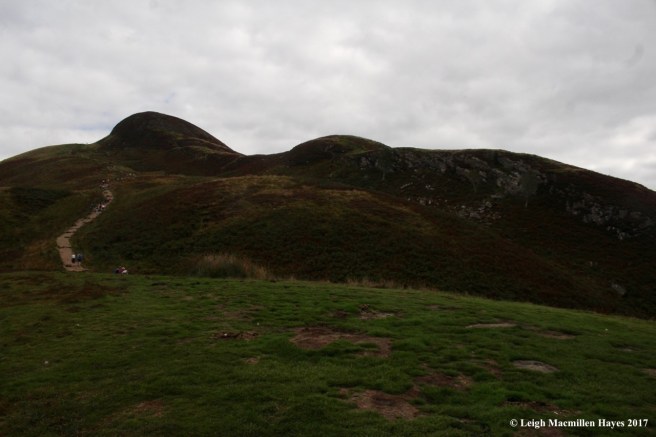
s-hiking up C Hill

It was a pilgrimage of sorts for so many were the people. All ages, all abilities, and all nationalities shared the trail.

s-loch lomond fault display (1)

Conic Hill features a sharp summit along the Highland Boundary Fault, a division between the Lowlands and the Highlands as demonstrated by this model. The fault traverses from Helensburgh on the Southwest coast to Stonehaven in the Northeast. To the north, the stone is hard, impervious schist, while to the south it is permeable sandstone, which is softer and offers good drainage.
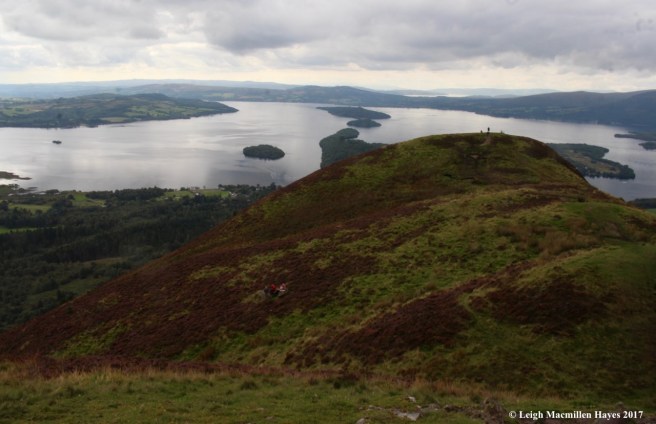
s-Loch Lomond below

The last leg of the journey was a bit of a scramble, but everyone offered suggestions and we agreed that staying close to the edge was the right choice. The view was well worth the effort. We’d learned from a park ranger that it was from this summit that postcard photos are taken—no wonder.

s-C Hill from harbor

Once we’d climbed down, we made our way to the small boat yard where we looked up to the summit.
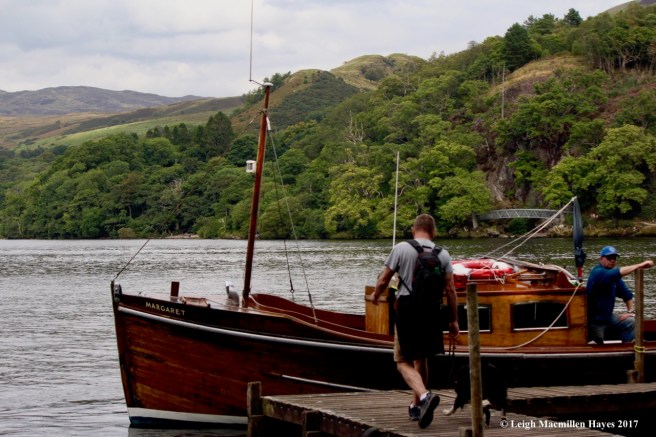
s-SS Margaret

And then we boarded the SS Margaret for a five minute journey to Inchcailloch, also part of the national park. There are twenty-two islands on the loch and their names were all coined originally in Gaelic. “Innis,” now anglicized to “inch,” means island. The name, Inchcailloch, can be defined as Island of the Cowled Woman for Saint Kentigerna supposedly set up a nunnery here and was buried on the island in 734 AD.
s-summit view 5

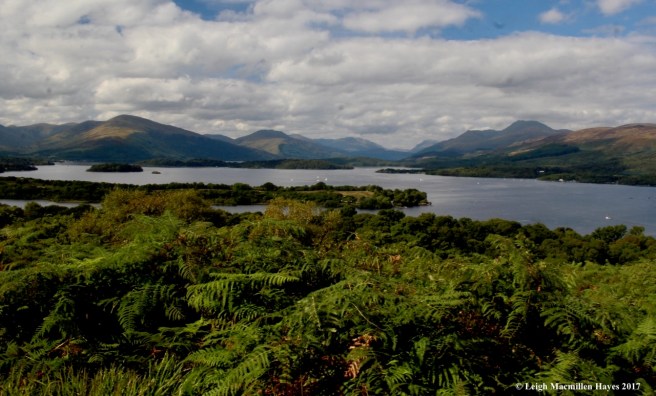
In an hour and a half, we took the high road first and climbed to the summit trail to take in another view of the bonny loch from Tom na Nigheanan or Hill of the Daughter.

s-island cemetery 1 (1)

And then we followed the low road, stopping at the foundation of the parish’s first stone church built in the 13th century and its adjacent cemetery. Apparently, folks were lucky to be buried for we read that in “a late 18th century account of a burial on Inchcailloch, the Highlanders are reported as having drunk so much whisky that they nearly forgot to bury the body.”
s-Tom Weir

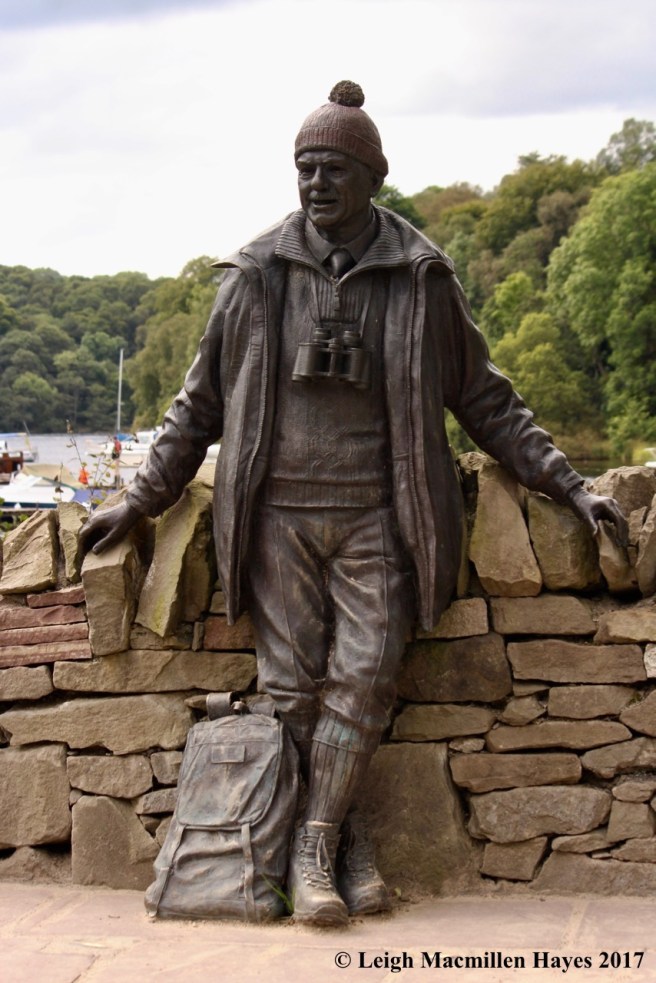
Back on the mainland, our hiking continued and we explored one more trail before finishing up for the day. Then we paid homage to the man responsible for all the trails we’d traveled—Tom Weir. He was quoted in 1976 as saying, “We revel in the totality of the natural world as we dump our bag and fairly dance up the airy ridge.” To Mr. Weir we gave thanks—for our chance to dance up the airy ridge . . . indeed.

s-arrochar

Sunday dawned a bit on the gray side, but once again breakfast mysteriously appeared behind the curtain at the designated time and we sat on the patio to enjoy it. And then we took off, again heading north but rather than following the road beside the loch, we turned left at Tarbet, a village where my sister and I once spent a long Easter Saturday in 1979 when I was a student at the College of York and Ripon St. John (now it’s just St John College) in York, England.

s-bus stop, Arrochar

She and I took the train to Tarbet, walked to Arrochar and waited for what seemed like hours to catch a bus to Adraishaig. The most wonderful part is that except for the updated bus, everything looked the same as I recalled.
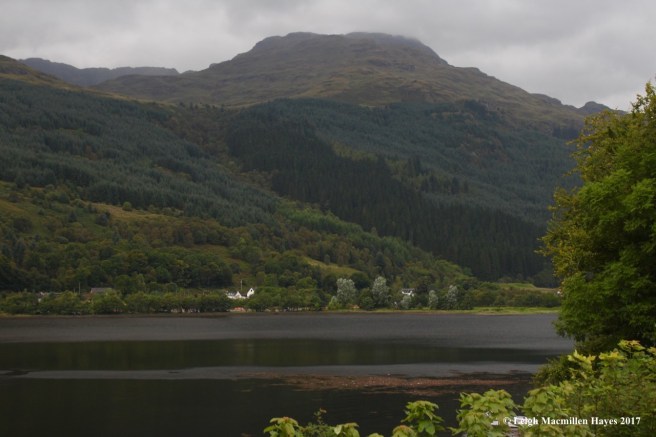
s-view of Loch Long and Mountains by Arrochar

The view my guy and I shared of Loch Long was the same that she and I had had so long ago. Memories flashed through my brain of our ride to Adraishaig, where at the bus driver’s recommendation we walked uphill and knocked on Mrs. Hastie’s door to ask for a room. A view of Loch Gilp, some little cheese sandwiches, a long chat with Mrs. Hastie, and hot water bottles in our bed—it was all quite perfect and when our mother learned of her hospitality, she wrote Mrs. H a thank you note. For years they corresponded.

As was our intention back then, our destination was Castle Sween. The approach was the same, but the journey different, for in 1979 at Mrs. Hastie’s suggestion, we hitchhiked.
s-sheep on way to Sween

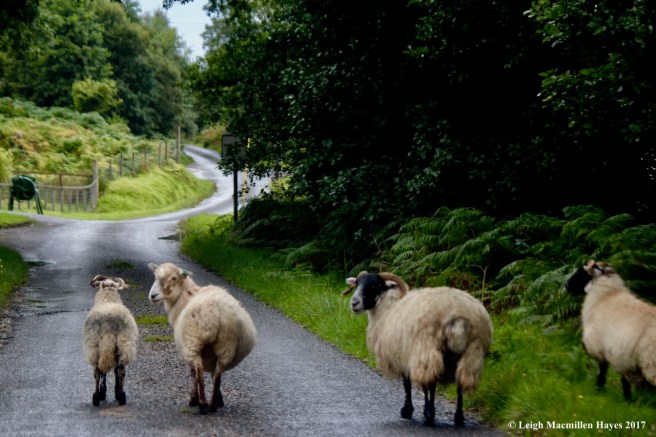
Perhaps the sheep that traveled our route this past week were descendants of those we’d encountered in the past.

s-phone booth by sween

At the red telephone booth, we parked and then walked down the road to the right.
s-Big Eric 2

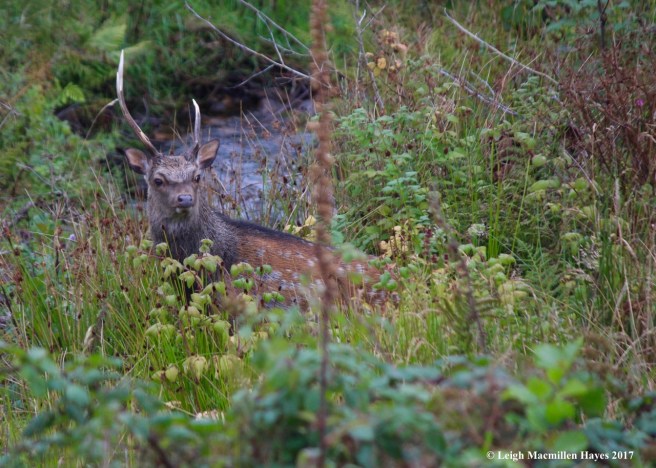
Our first view was of a deer and since another favorite British show is “Monarch of the Glen,” we wondered if perhaps we’d found Big Eric.

s-Castle sween approach

And then we saw the castle overlooking Loch Sween and my excitement increased.
s-Macmillen tower 3

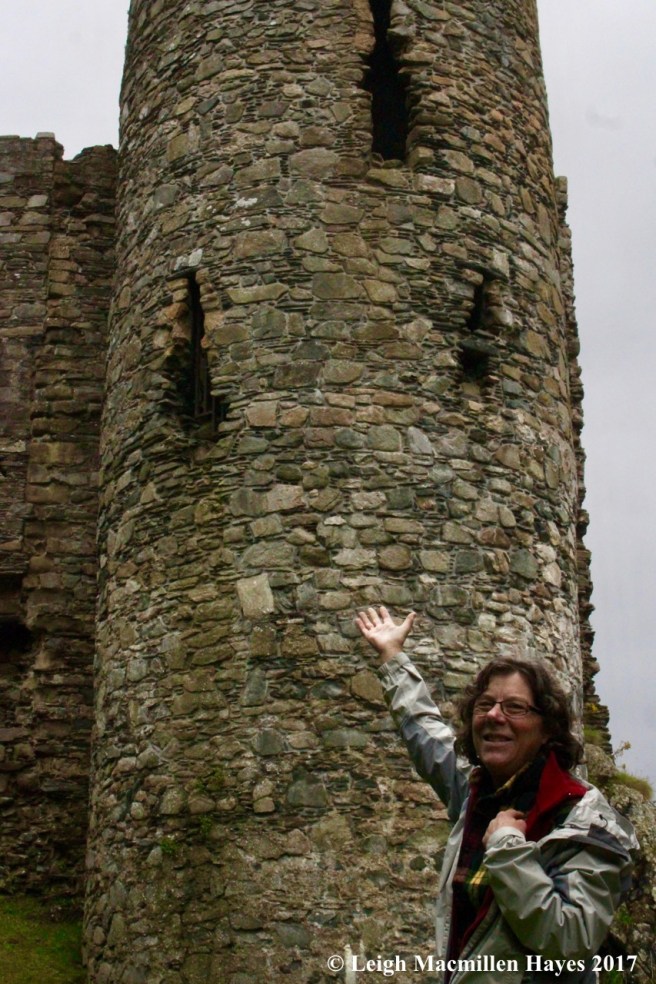
It was the 15th century Macmillan tower we came to see and I’d donned my flannel tartan (thanks for LL Bean for creating these two years ago) for the occasion.
s-Macmillen tower and faces

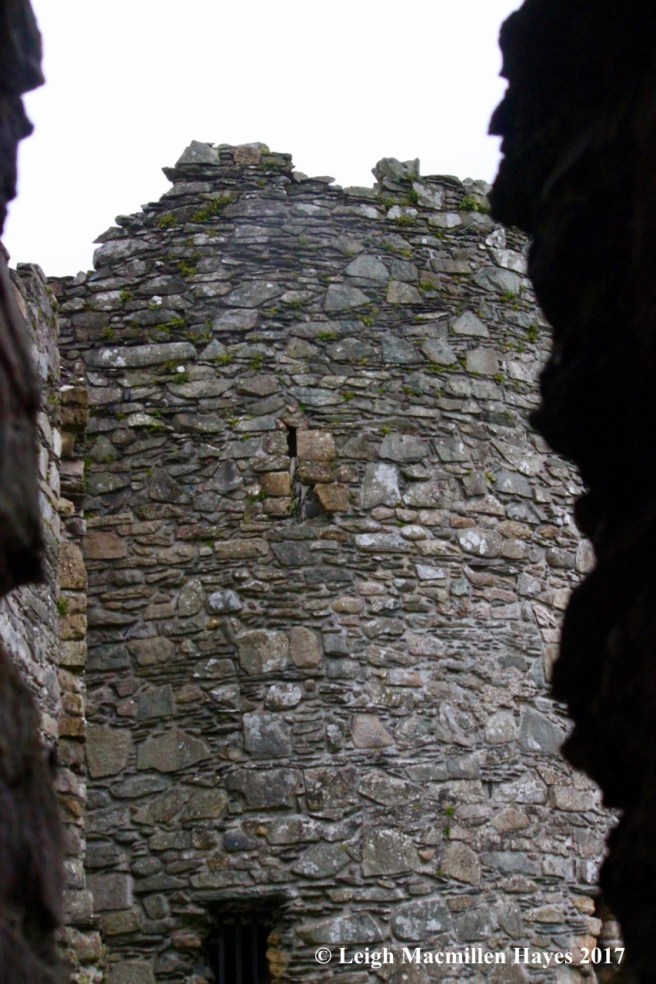
We poked around inside the castle remains and with ghosts of the past viewed the tower through a window. I suspected it was my long lost relatives who made their presence known in the stone, so many familiar faces did I see.

s-inside castle sween

Our tour wasn’t long, but I gave thanks to Alexander MacMillan, keeper of the castle in the 1470s. On a plaque we read the following: “With its towering curtain wall, Castle Sween is the most impressive of the early stone castles on Scotland’s west coast. Originally, the mighty walls enclosed several light wooden and stone buildings, serving as storage and accommodation . . . The MacMillan Tower had a kitchen in the basement with two storeys of private accommodation above.”

When I had traveled this way with my sister, we were able to hitch another ride from about a mile north of the castle back to Lochgilphead, where we caught a bus to Tarbet. Once there, we waited and waited for a train as the ticket man sat in his little building and sang to his heart’s content. Our journey this time was much faster and more convenient.

s-Inverary 2

The weather had turned from gray to drizzle and so as we drove back toward the Wee Wing, we decided to take a tour of Inveraray Castle, the setting of “Downton Abbey.” It was also a place I’d visited previously, but only to the outside for I was with my college flatmates on a grand tour of Scotland. If any of you are reading, I hope you’ll recall that this is where we met Herman the Vurm.

s-inverary dining room 2

Though a castle has stood at this spot since the 1400s, the Palladian and Gothic-style building that we toured was built in the 1700s and still serves as the monarchial home for Clan Campbell.
s-inverary guns

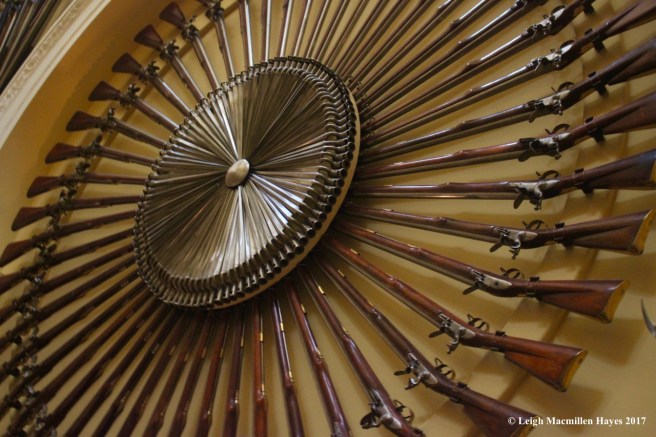
Despite all its pomp and circumstance and colossal displays,

s-charm stones and fairies (1)

it was the wee things that appealed to me most.

At last, we made our way back to the pub in Balloch to enjoy a pint before heading to bed; our departure would be too early for the mysterious visitor who left breakfast each morning, but since we were in Scotland, I trust it was a fairy who placed the covered tray on the wee stool behind the curtain.

Our early morning departure meant a drive to Edinburgh airport where we were to gather with the real reasons for our visit. Our oldest son’s girlfriend’s mother had rented a castle in the Highlands and invited us to join her family and friends for a four-night stay. Because our group was again too early for arrival, we decided to tour Glamis Castle on the way. But . . . the second vehicle for our eleven-member group had a bit of a problem at a roundabout just beyond the airport—a burned-out clutch. Apparently, smoke filled the car and they quickly excited. Then one brave soul went back to gather their luggage—all in fear that the car might catch on fire. Miles away, we wondered where they were and finally learned of their adventure as they stood on the grassy island and awaited help. And so, we detoured.

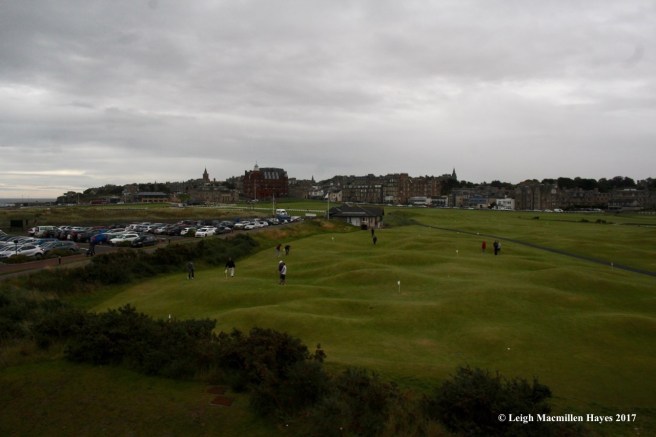
s-The Old Course, St. Andrews 1

With a little bit of time to spare, we drove to St. Andrews, the birthplace of golf, and walked along the greens of The Old Course,

s1-flowers at St. Andrews

where our awe included the beauty that surrounded us,
s-St. Andrews 2, Sept 4 blog

as we marveled at the five courses that sit between the North Sea and town center.

s-Bobby Jones consideration

And my guy reflected upon legendary American amateur golfer Bobby Jones and his Grand Slam season in 1930. He mentioned a ball that bounced off a building and into the hole. But which building?

s-Keplies

Before leaving, we paused by The Kelpie maquettes, handcrafted by renowned Scottish sculptor Andy Scott to honor the iconic Clydesdales, working horses vital to the industries of Scotland for providing both power and grace.
s-Glamis

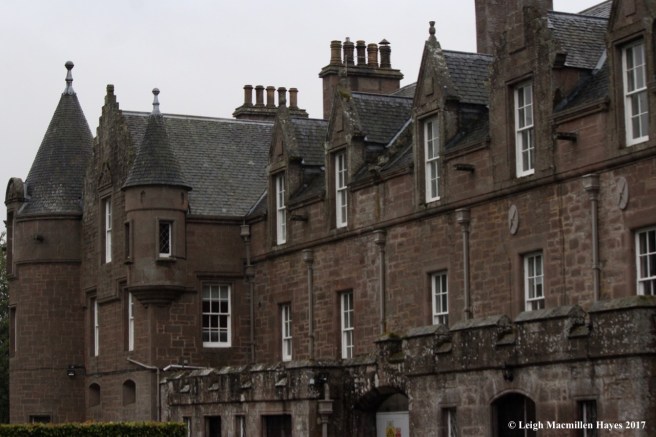
Soon we tucked back into the van, stuffed as it was with seven of us and our luggage overflowing the boot and packed all around.

Glamis Castle, setting of Shakespeare’s Macbeth and the Queen Mum’s childhood home, was our next stop and the point at which we finally reconnected with the second vehicle carrying five members of our group. A delightful woman named Pat gave us a tour full of stories filled with fact and fiction. We couldn’t take photos inside and it was pouring out, so we were limited in that department.

s-rose and thistle, Glamis

One of the things I found fascinating, besides the ghost who sometimes sits in the chapel, was the rose and thistle theme evident throughout and even on the roof railing—to represent the joining of Scotland and England. Of course, most of the Scots we spoke with hope the two will soon separate, but that’s politics.

s-Forter through gate, Sept 5

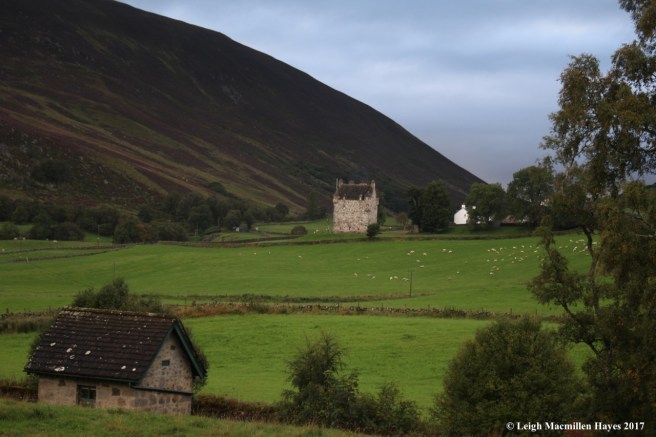
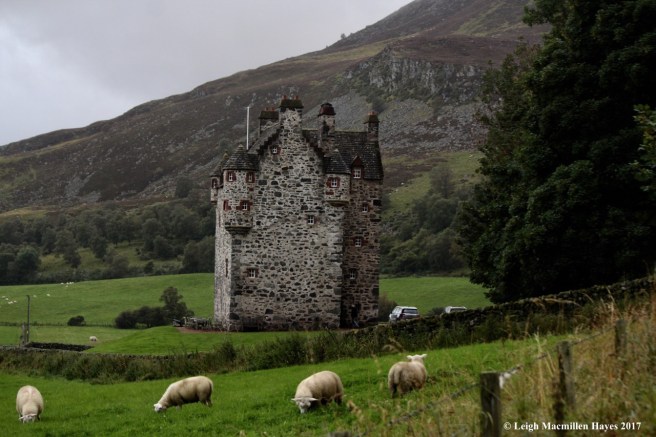
At last it was time for our own castle adventure to begin. On to Glen Isla we drove, passing around many a tight bend until at last it came into sight . . . Forter Castle and our own little kingdom. The castle was originally built in 1560 by James Ogilvy, Fifth Lord of Airlie, but was burned by Archibald Campell, the Eighth Earl of Argyll in 1640. From that time until the early 1990s, it was a ruin. That is until the Pooley family purchased and transformed it into our fantasy retreat.
s-Forter and Blair

For the next four days, we photographed it . . .

s-forter from trail, Sept 5

from the trail above,

s1-castle from Folda

road behind,

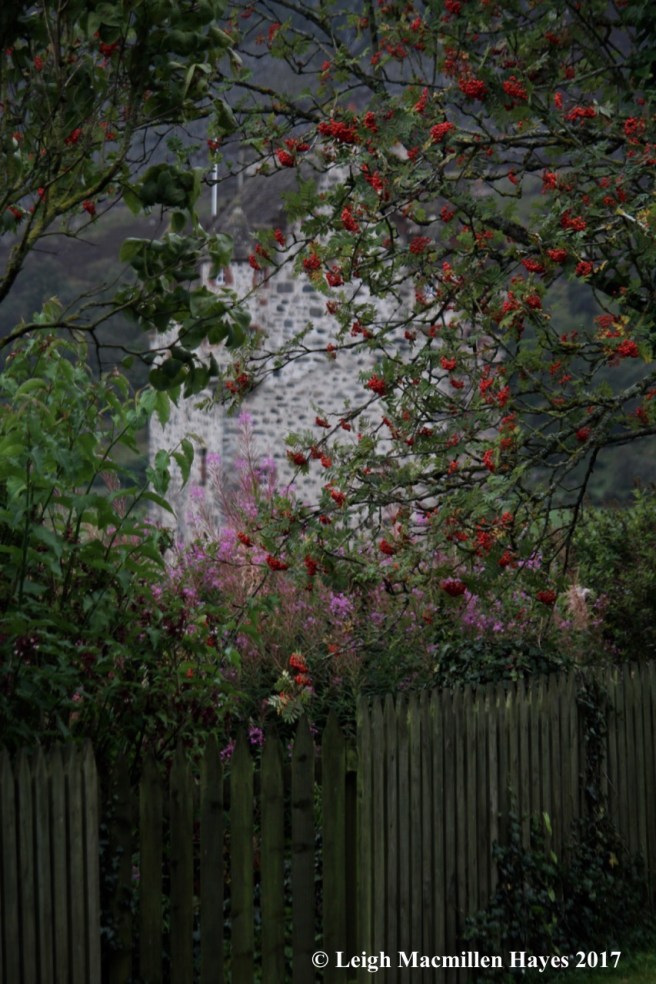
s-Forter through foliage, Sept 5

through foliage,

s-Forter in twighlight, Sept 7

in twilight,

s-Forter at night, Sept 7

and finally darkness.

s-rainbow

On our first evening as residents a rainbow marked the way.
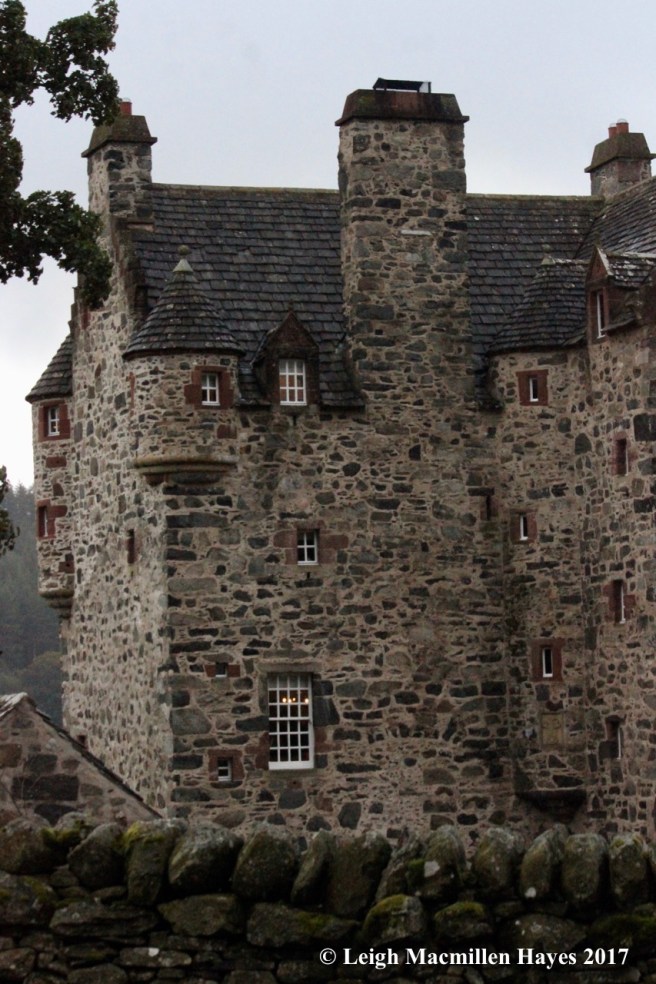
s-our tower--upper floor furthest left

We noted our tower on the far left . . .

s-our writing room

with the upper window housing the writing desk . . .
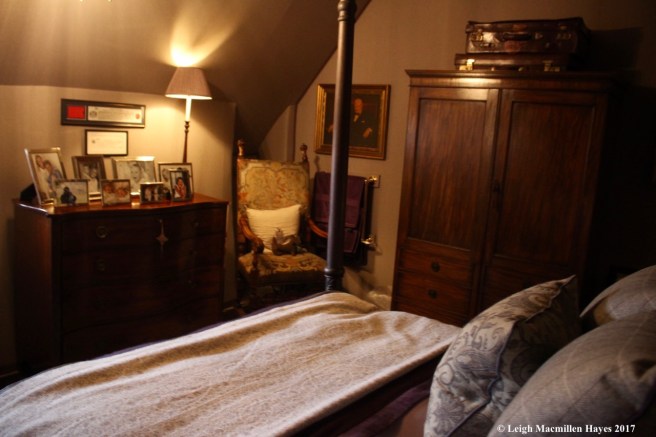
s1-Katherine Pooley Room

in our posh room.

s-view from the toilet

The bathroom was equally eloquent and the view from the throne worth every minute spent sitting.

s-pistols beside the toilet

Just in case we had unwanted visitors pillaging our fortress, we could sit on said throne and take aim.

s1-stairs

On a regular basis, we gave thanks for the rope in the spiral staircase as it guided us down and saved us from slipping.

s2-great hall

On the second level, we all frequently gathered in the Great Hall for conversation, fellowship, and . . .

s-Forter fire, Sept 7

warmth from the largest fireplace we’d ever sat by.

s2-kitchen (1)

And on the first floor, a well-equipped kitchen,

s2-breakfast room (1)

breakfast room,

s2-chapel (1)

and chapel.

s-piggery, Sept 5

Even doing laundry was a treat, for we had to enter the piggery for that task.
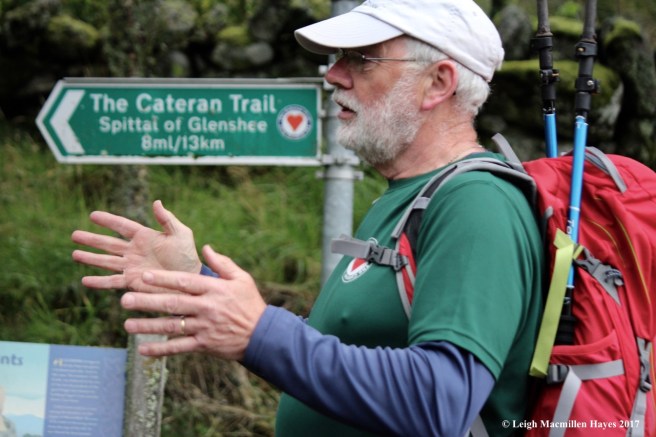
s-Cateran Bob, Sept 5

Daily we walked or ran along the lanes outside the castle, but on our second day, our hostess, Lady Anne, hired a local guide to lead the way up the Cateran Trail.
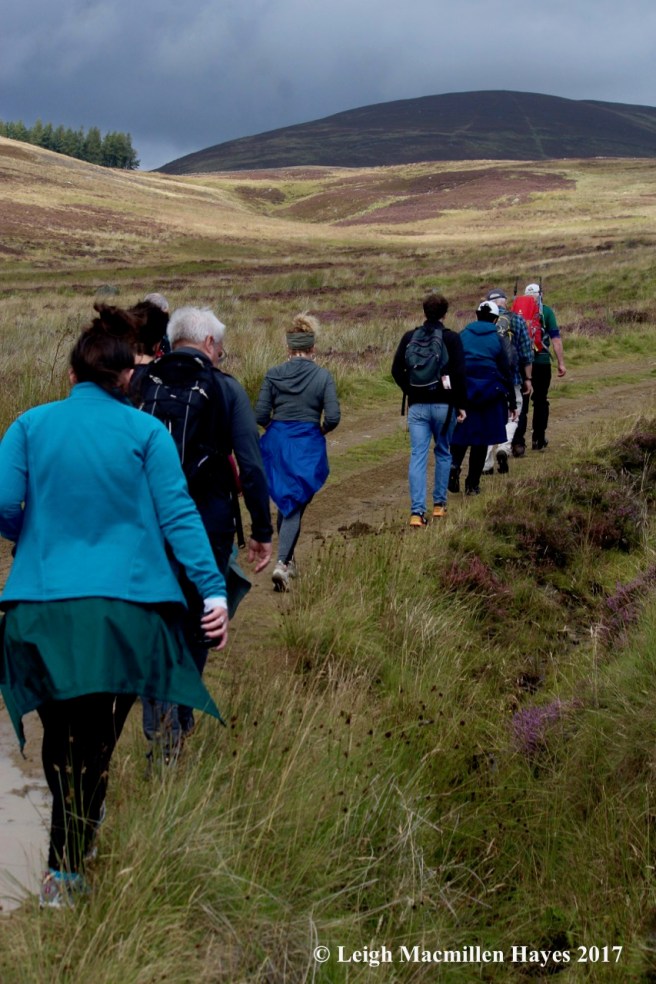
s-following Cateran Bob, Sept 5

Bob Ellis is a recently retired counselor and also designer of the trail, so we were in the best of hands as we followed a six-mile section of this 64-mile circular route.
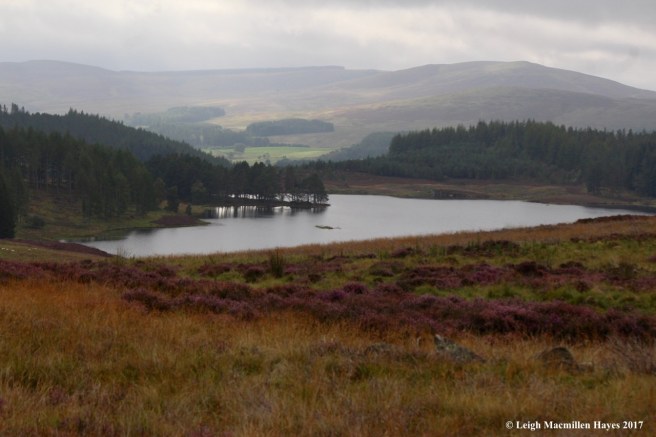
s-Cateran loch, Sept 5

Along the way, we stopped constantly to admire the heather and the loch below.
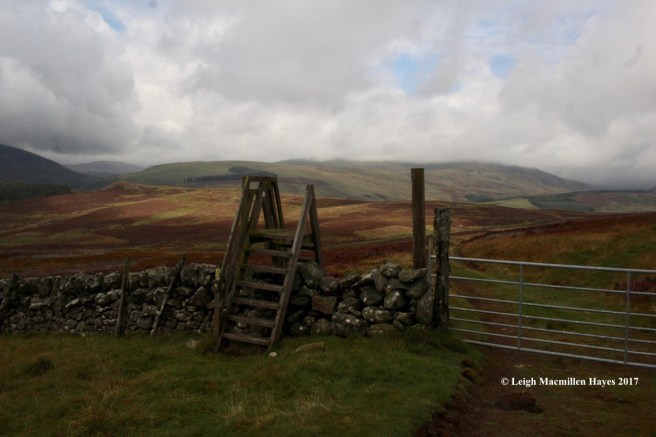
s-Cateran Bob's favorite spot1, Sept 5

Over stiles we climbed periodically,

s-S and H, Sept 5

and at one the two youngest in our group (and reason my guy and I were on this trip) showed off their happy faces.
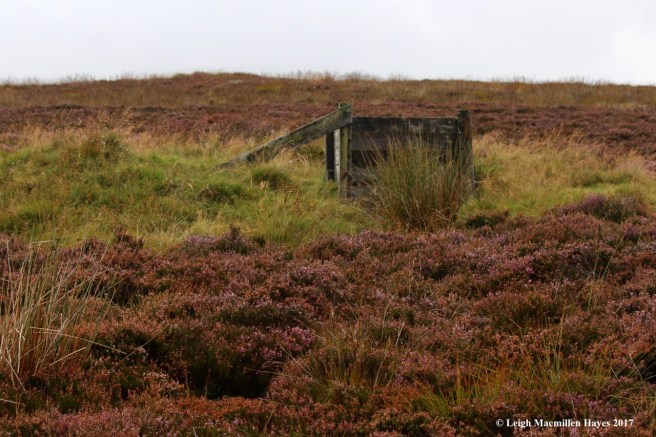
s-grouse blind, Sept 5

We spied grouse blinds,

s-crow catcher, Sept 5

and crow catchers (structure just left of center) used to capture crows that harass lambs.

s-lunch rock mystery, Sept 5

And we paused by a large boulder topped by another, though of smaller scale. Bob shared with us the legend of the trail, which goes something like this: At one time, two giants, a husband and wife, lived in the area. Colly Camb, the husband, was supposedly the last descendant of the giant Fingal, who was renowned for building Fingal’s Cave and the Giant’s Causeway (we’d walked along the Giant’s Causeway almost a year ago when we visited Ireland). According to this legend, Colly lived in a cave on Mount Blair, which towered behind our castle and we could see across the way. Colly had a habit of throwing stones from the top and so the locals feared him greatly. One day, in a rage, he threw a massive boulder intending to demolish a homestead. Thankfully, he missed, but the boulder still stands where it landed in the glen.

s-lunch rock, Sept 5

For us it became lunch rock.

s-boathouse on loch, Sept 5

Our journey was almost done as we circled around and came upon a boathouse by the small loch. As is typical in Scotland, we had sun and rain and a few drops fell before our tramp was completed, but that was OK for we were prepared and the colors around us enhanced.

s-Charles throwing hammer 1

Another day was spent with Charles, our sports director. Under his supervision, we learned the fine arts of axe throwing, archery, crossbows, and air rifles.

s-Charles releasing hammer

With apparent ease and masterful form, Charles sent an axe flying toward the target.
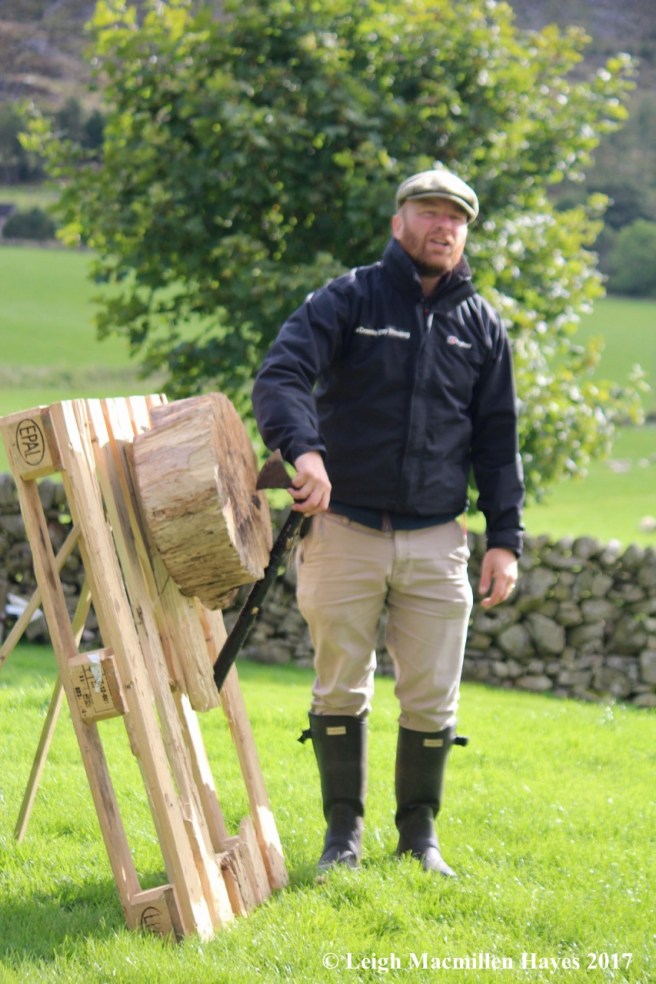
s-Charles at target

And met instant success.

s-S&H with Charles

After demonstrating all, it was our turn to give each activity a whirl.
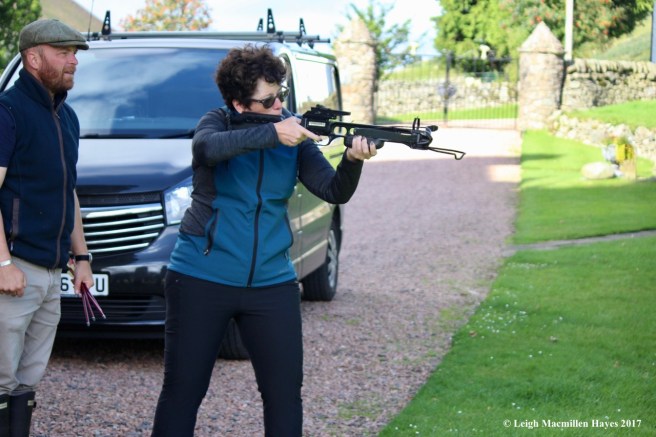
s-Ann aiming crossbow

M’lady Anne practiced her crossbow prowess,

s-Allen and John

while Laird John and my guy took up the air rifles.
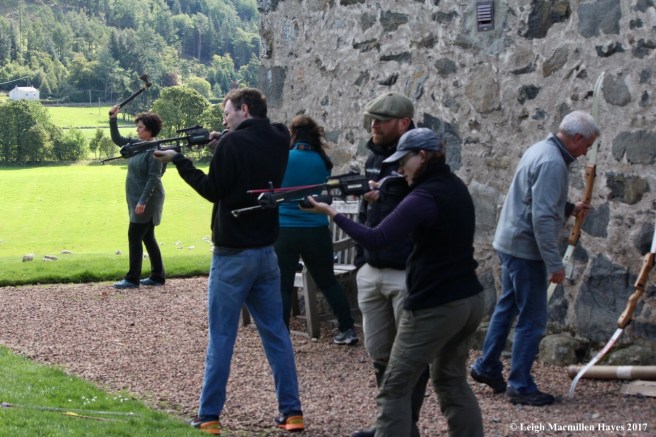
s-sports

Charles coached us for a couple of hours and then it was time for a competition between the men and the women.
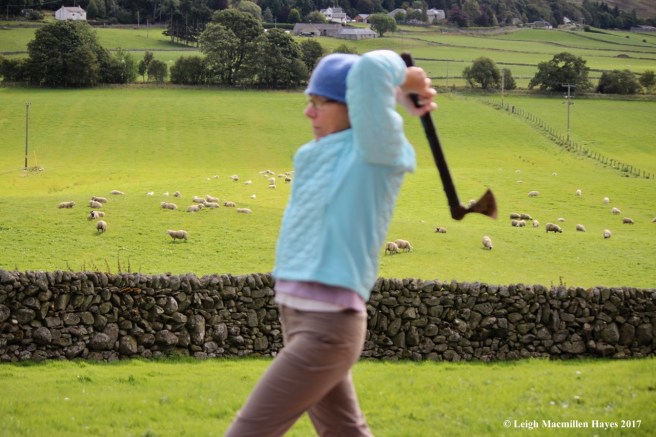
s-me with hammer

As we practiced, I discovered I could occasionally hit the axe target, as well as the crossbow and air rifle targets. The bow and arrow were definitely not my thing. When it was my turn to throw, however, and I went first, I missed each time, not exactly getting our team off to a good start. The women lost, but we all had a lot of fun and talked of creating our own axe targets. I know where I can find all the materials needed.
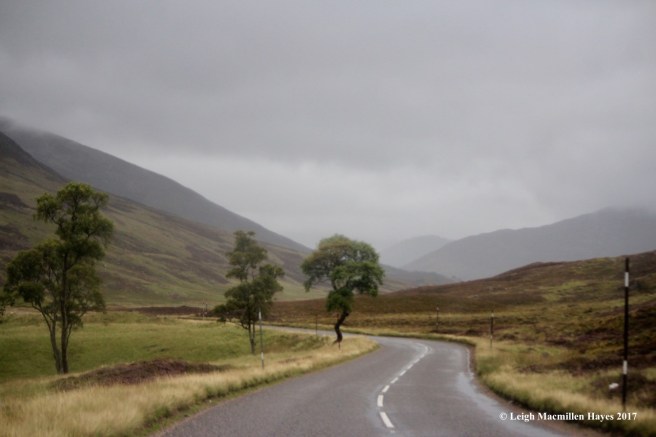
s-into the highlands

On the day my guy and I intended to bag a couple of Munros, it poured as we passed through Cairnwell Pass.

s-Glenshee ski area

Our intention had been to begin from the Glenshee Ski Area, but much to our disappointment, it wasn’t going to happen. Instead, we drove on.

s-Cathrie Church

At Balmoral, we stopped into a small gift shop, where a delightful tour guide and shop keeper told us that Queen Elizabeth was in residence so we couldn’t visit the castle, but we could walk up the hill to the local parish. And so we did.
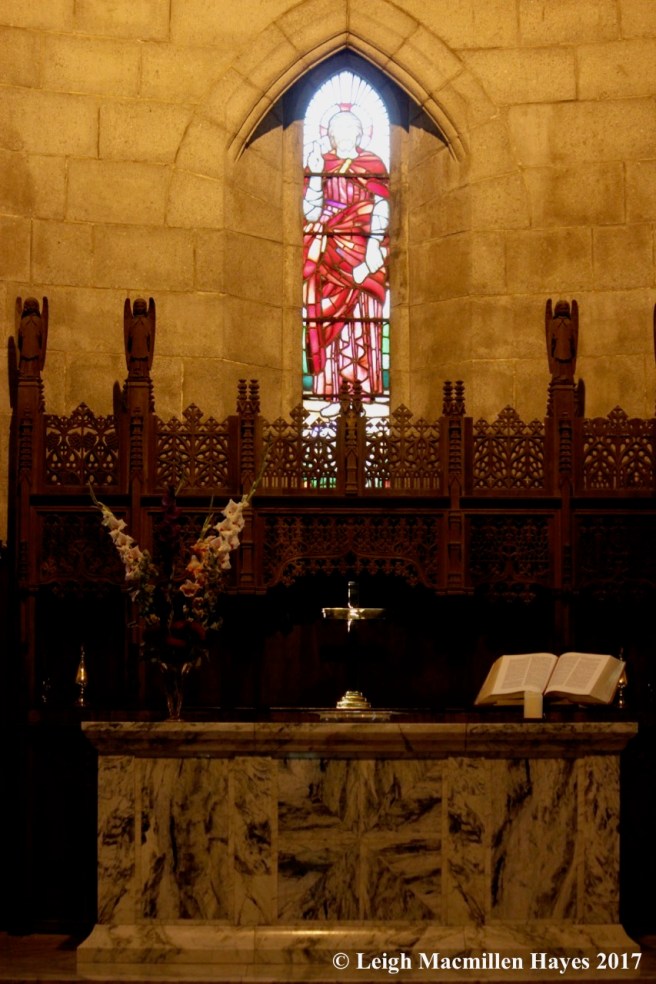
s-altar

Craithie Kirk is the Queen’s place of worship when she and the rest of the Royal Family are on holiday nearby. We learned from another guide that the family sits in pews in the south transept, which they enter from a private doorway. Apparently, the count of parishioners increases dramatically from the regular twenty or so when Queen Elizabeth is in town.

s-Queen Victoria

Queen Victoria had worshipped at the former kirk that stood on this site and laid the corner stone for the current building in 1893.

s-rose window

In the west gable, the rose window added a dash of color and life to the dark interior.
s-Allen, hardware man

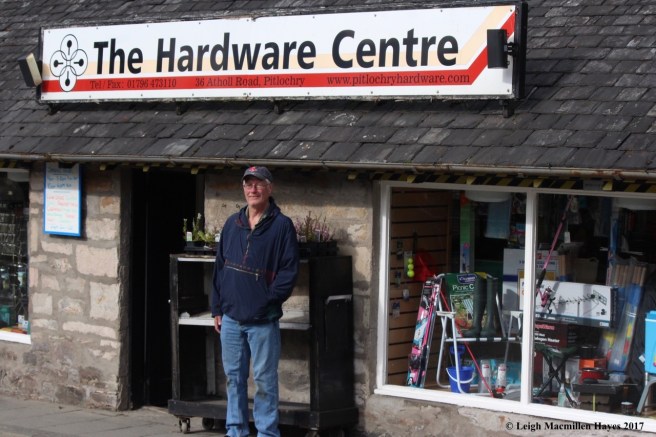
Our adventures about the region included a shopping trip and lunch in Pitlochry, where of course, my guy needed to visit The Hardware Centre.
s-hardware store

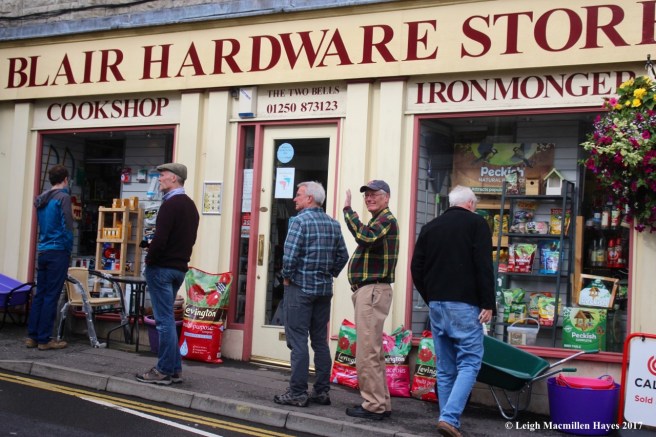
He also found one in Blairgowrie, where his comrades joined him for an exploration of goods.

s-weaver shop, Sept 8

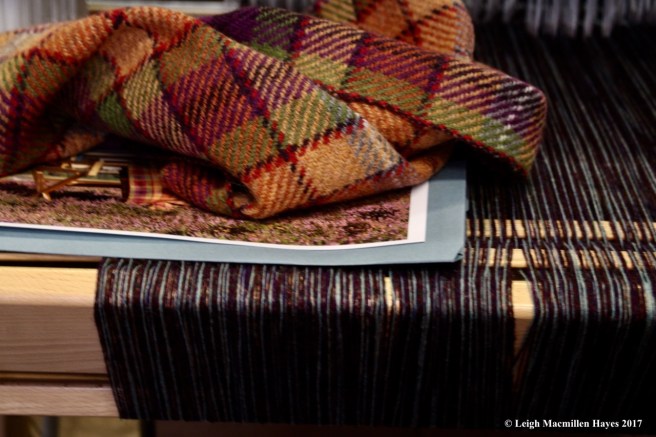
It was in Blairgowrie that the ladies of the castle discovered the works of master weaver and craftsman, Ashleigh Slater and his Warpweftweave Studio. He’s famous for his Blairgowrie Berries and Cherries tartan that honors the fruits grown locally.
s-Cataran plaid, Sept 8

What they were really interested in, however, was his latest work–created in honor of the Cateran Trail. While they placed orders, I chatted with Slater’s mother and learned a wee bit about the town of Blairgowrie. We talked about the fruits grown there and subsequent festival, weather of the region, tourism, or lack thereof, mills of yore that once dotted the town and Ashleigh’s work.

s-telephone booth library1

Several times as we were out and about we passed by iconic red telephone booths repurposed as libraries.

st-telephone library, Liz

A few of us needed to . . .

st-shep

take a closer look, where . . .

s-library books, Sept 7

we were impressed with the variety of offerings.

s-woodferns, Days 1 and 2

When not shopping or participating in an event, we walked. A lot. And saw so much more, including wood ferns,

s-polypody, wall by Arrochar

polypody,

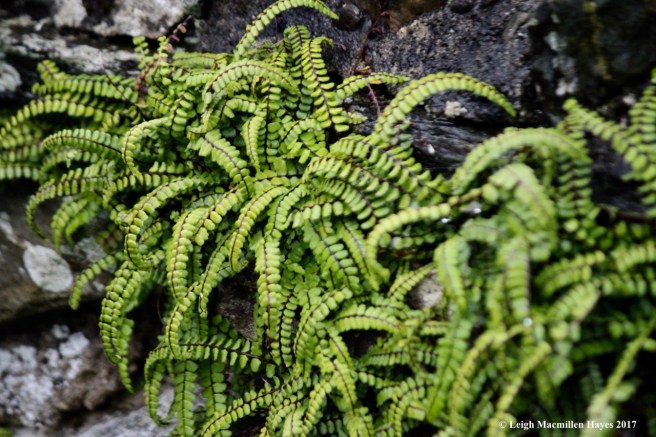
s-maidenhair fern 1

and maidenhead ferns.

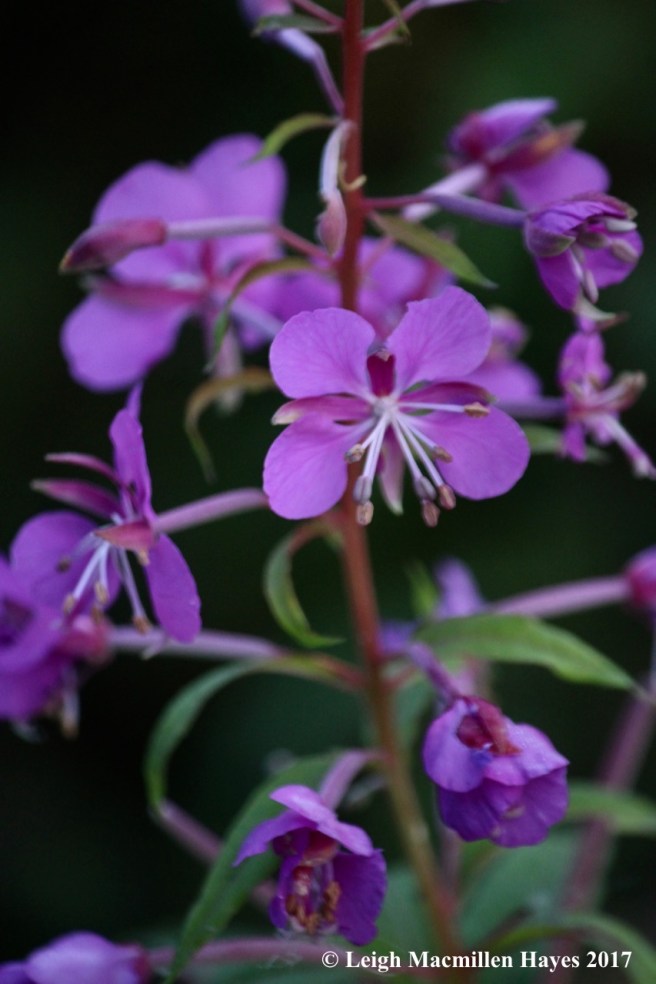
s-rosebay willowherb 1, days 1 and 2

Everywhere, the rosebay willow herb grew like weeds. I so love the common Scottish name for it over the American name of fireweed.
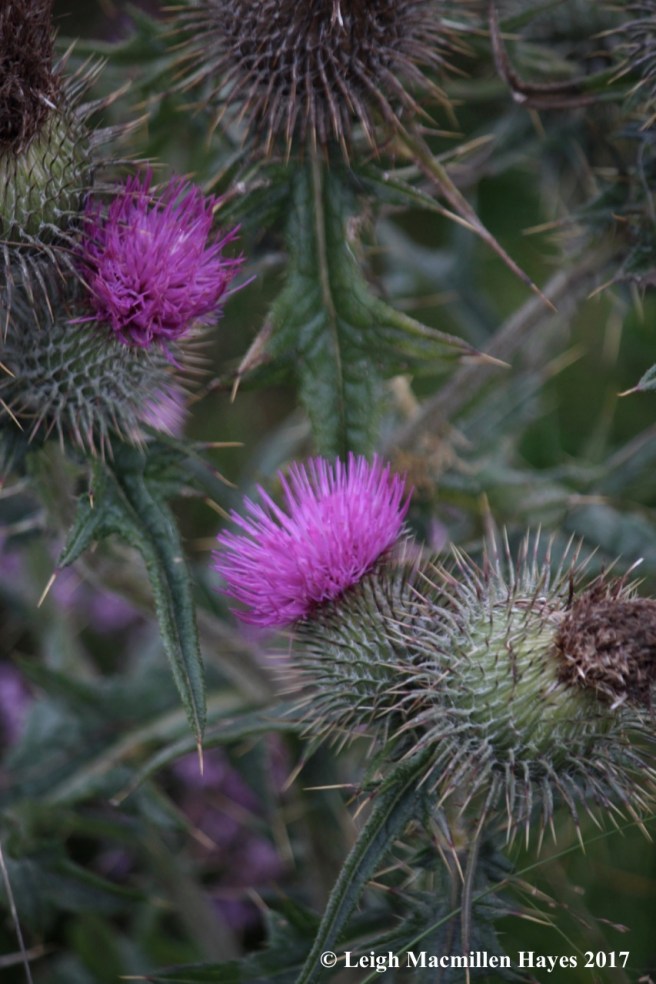
s-thistle 10

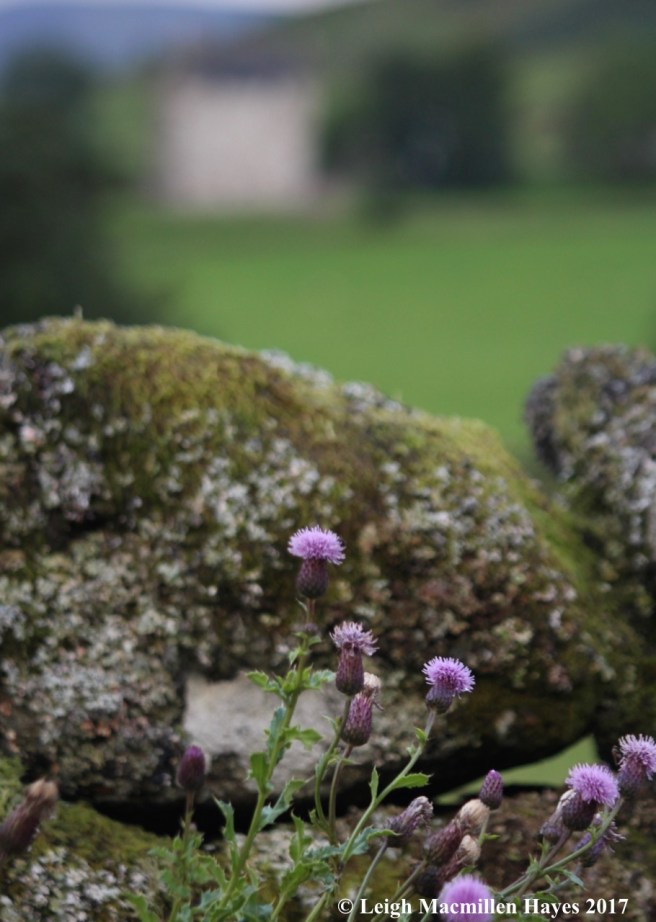
And besides carpets of heather, thistle also grew abundantly,

s-thistle 1

showing variation in color,

s-thistle 11

and texture,

s-thistle and bee, Days 1 and 2

from smooth to . . .

s-prickly thistles

prickly.

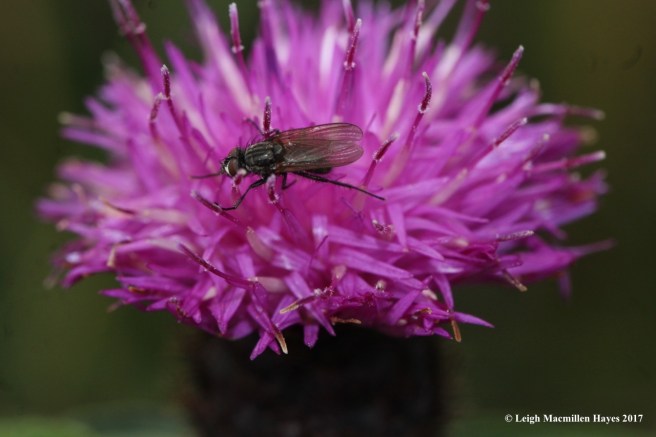
s-fly on thistle

Some was still being pollinated,

s-thistle seeds

while others had already set seed.

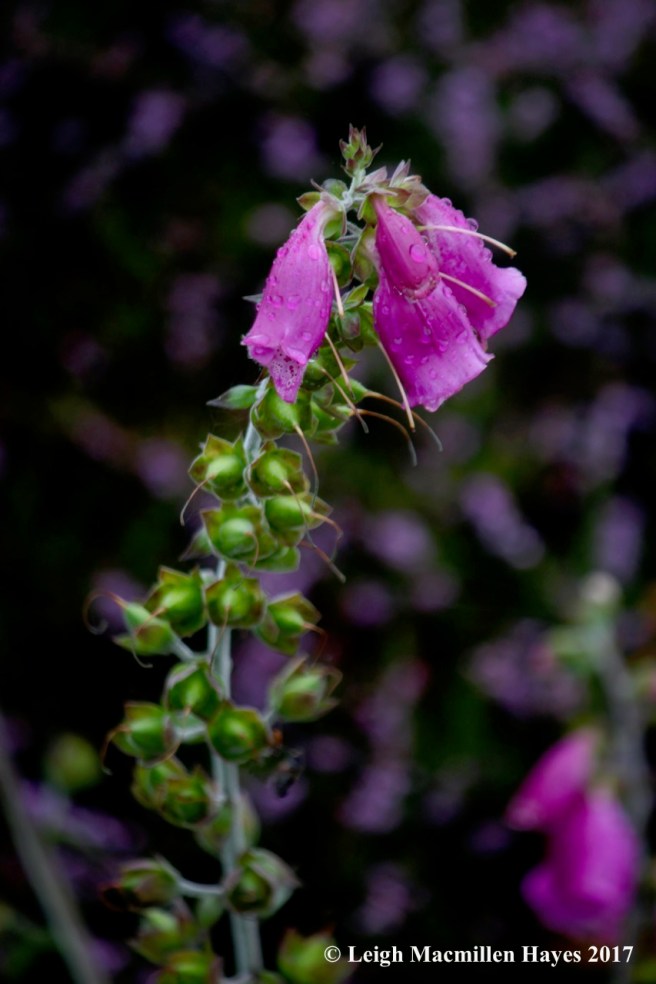
s-digitalis, Sept 5

Much to my surprise, on a few occasions I spotted digitalis,

s-Jacob's Ladder

and one morning found a single plant of Jacob’s ladder.
s-lichen

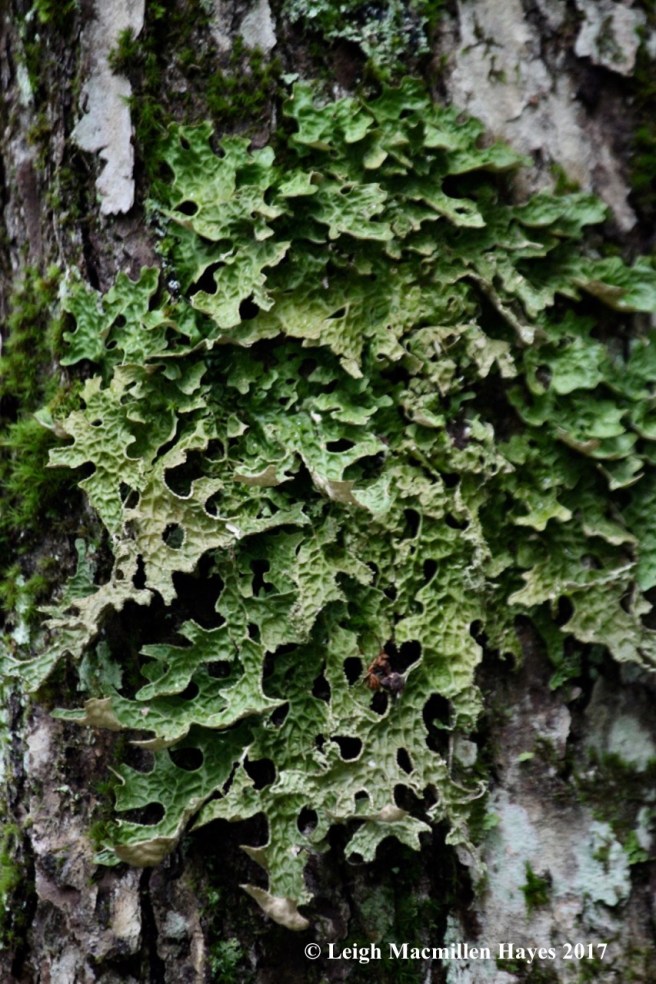
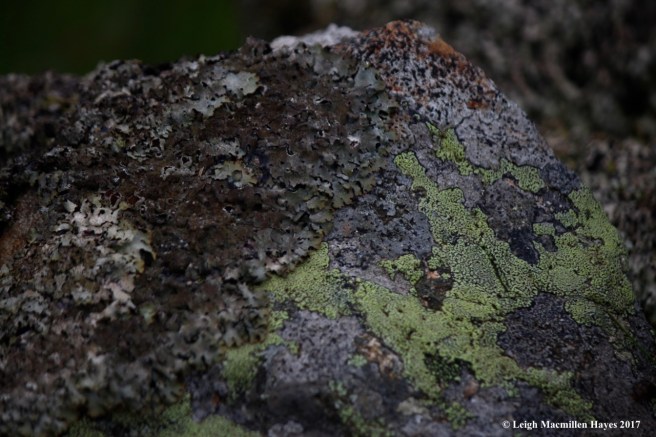
Lichens were also in full view everywhere we looked–I could have spent the entire week examining the crustose, foliose and fruticose forms.

s-black slug

And then there were other forms of life to admire, from thick black slugs to . . .

s-toad, Sept 5

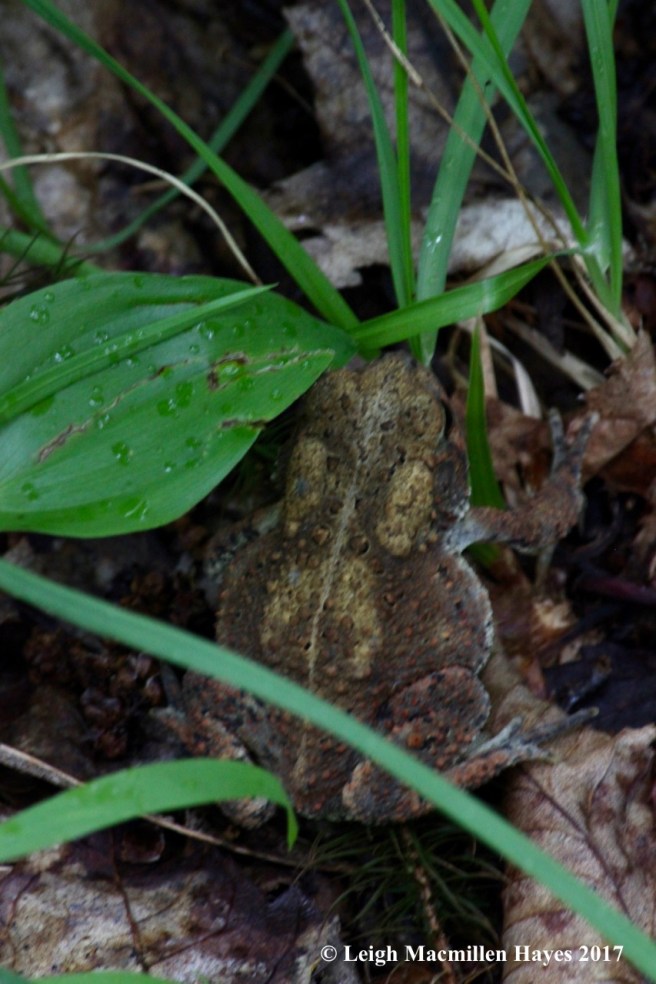
toads,

s-butterfly, Sept 5

butterflies,

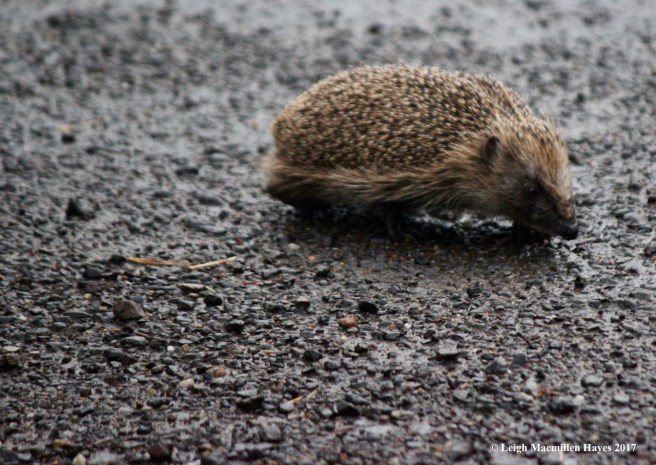
s-hedgehog, Sept 4

hedgehogs,

s-grouse, Sept 7

grouse,

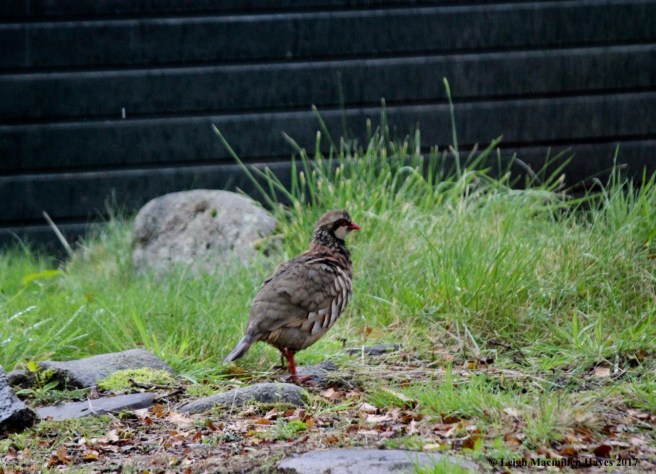
s-pheasant 1, Sept 7

pheasants,

s-brown hare

brown hares,

s-golden sheep

golden fleeces,

s-sheep 1, Sept 3 blog

rams,

s-ram 1, Sept 4

rams,

s-ram 2, Sept 7

and more rams,

s-Big Eric on Cateran, Sept 5

deer,

s-calf peeking

calves,

s-momma feeding calves

cows,

s-neighborhood bull, Sept 4

bulls,

s-cow 3, Sept 3 blog

and everyone’s favorite, the hairy coo.

s-tossing the sheep, Sept 7

Because we were at the castle located across the street from Forter Farm, we got to see some action, including sheep being returned to pasture,

s-cattle drive 1, Sept 8

and cattle driven past our gate.

s-new bridge over Forth, Sept 8

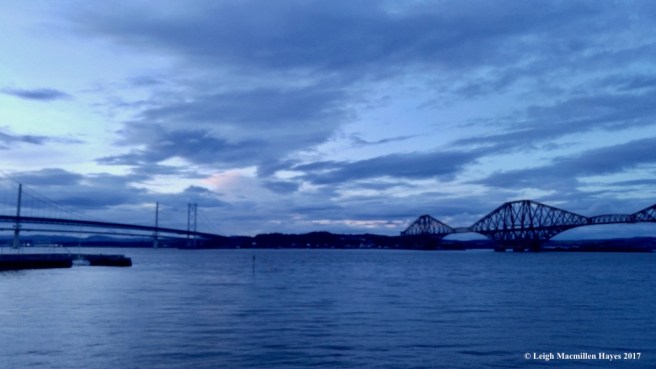
But . . . all great things must come to an end, and Friday afternoon found us driving south to the Queensferry Crossing, a just opened cable-stayed bridge across the Firth of Forth. Just after we’d headed north on Monday by crossing the Forth Road Bridge, Queen Elizabeth II had officially opened the new one fifty-three years to the day after she opened the adjacent former. Wow. Since we’d crossed both it felt like we’d come full circle on our Highland adventure. At the airport, my guy and I hugged goodbye to our lady and laird of Forter Castle, as well as our son, his girlfriend, and her family and their friends. They were returning their vehicle and heading into Edinburgh for the weekend. We drove back to Queensferry for our last evening.
s-q bridges (1)

And fell in love with one more town in Scotland, where we could view the two road bridges to the left and rail bridge I once crossed many moons ago to the right.
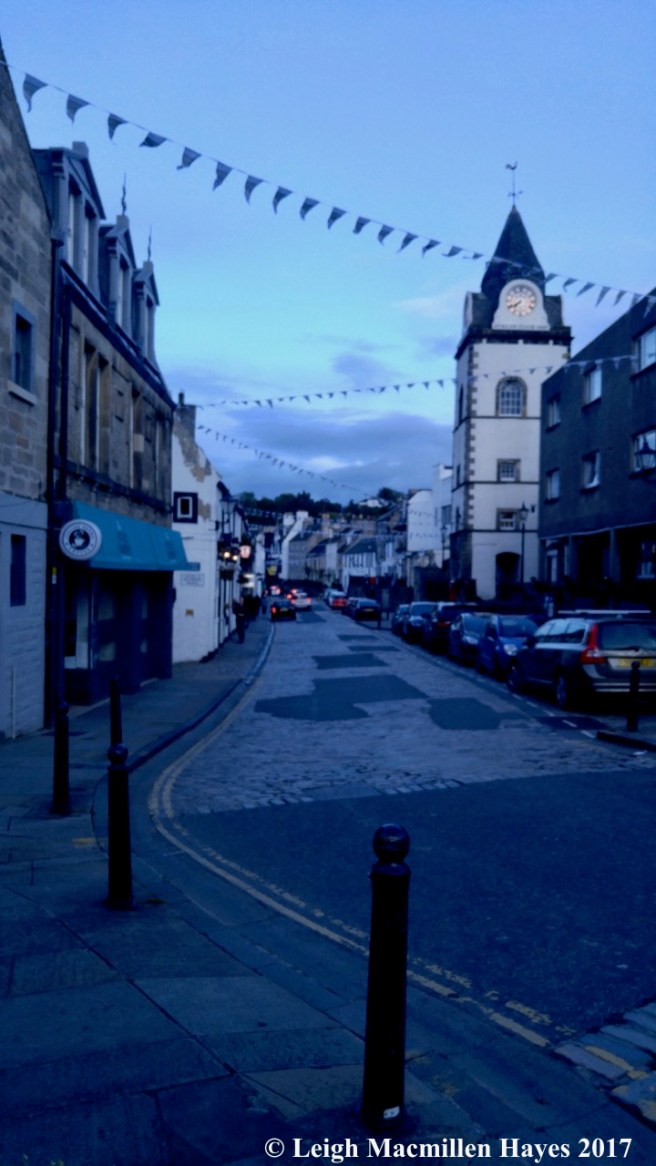
s-q 9 (1)

We were thrilled to discover this quaint village by the river,
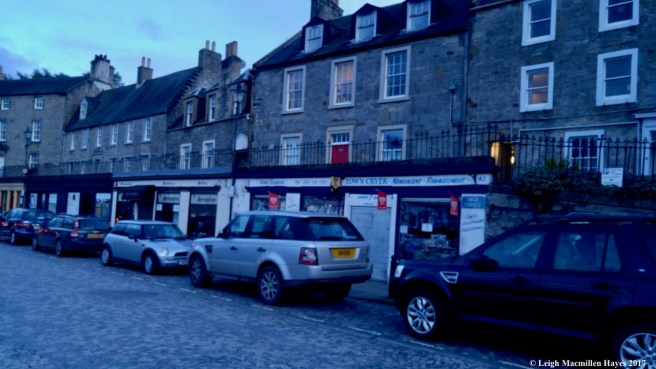
s-q 2 (1)

and enjoyed exploring its main street . . .
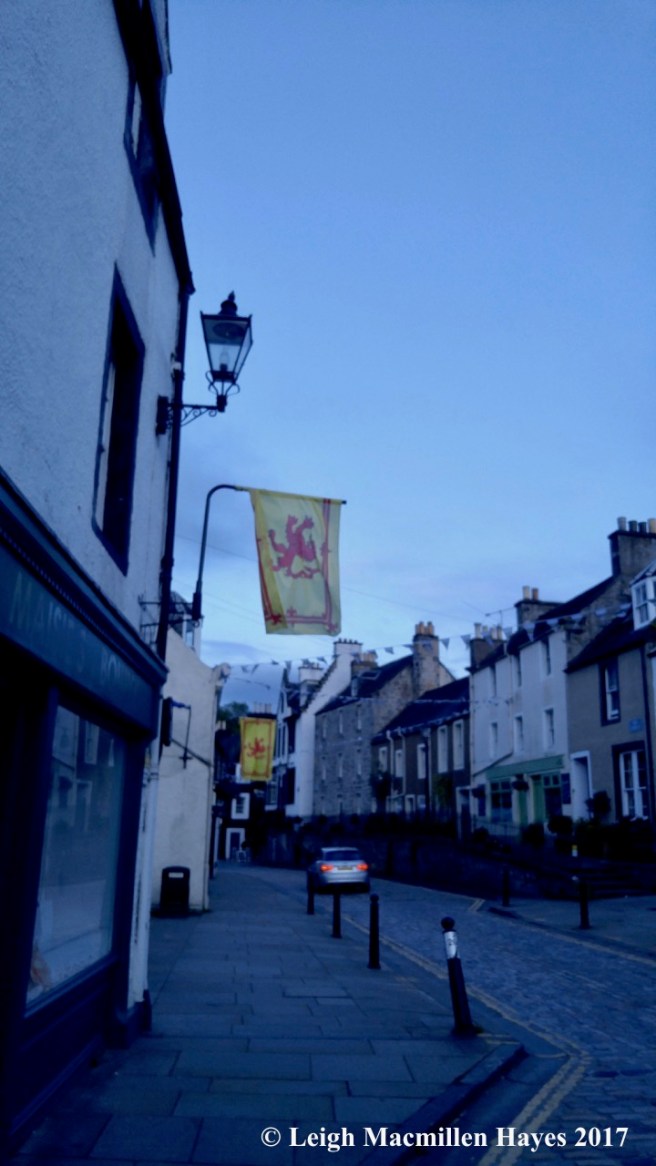
s-q6 (1)

where the Scottish lions flew.

s-qpub 4 (1)

In hopes of finding a drink and something to eat, we stepped into The Ferry Tap, a pub where locals gather. Of course, we were too late for any vittles, so tied ourselves over with a bag of crisps each.

s-q pub1 (1)

But . . . we made some new friends for as we’ve always noticed, the Scots are among the friendliest. While one Sandra took our photo through laughter, Segna,  Sandra (II), and Malcolm posed with us. We chatted for a couple of hours before climbing the hill to our last bed in Scotland.

From the Bonny, Bonny Banks of Loch Lomond to the Scottish Highlands, we’d enjoyed a delightful nine days and only wish it could have lasted longer.

Until we meet again, mòran taing.



The Will of the Wasps

While doing some work on our house today, I suddenly heard a thump and then saw my guy down on the deck. Huh? He’d been on a ladder last I knew. I grabbed the phone as I dashed out the door.

With a grin, he assured me that he was OK, but that he’d been stung on the ankle, first by a bee and then a double sting by a wasp. Neither of us was surprised, given the wildflowers in the garden where the ladder was placed so he could reach a second floor eave.

I spend hours watching all the pollinators at work, getting to know them by species and habit. But . . . I stand still for the most part and they fly around me. His movements were much quicker and more intentional.

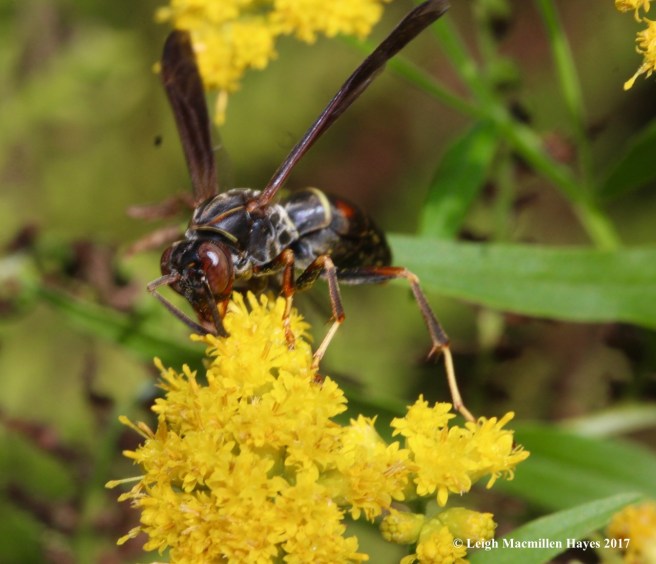
h-hornets nest 1

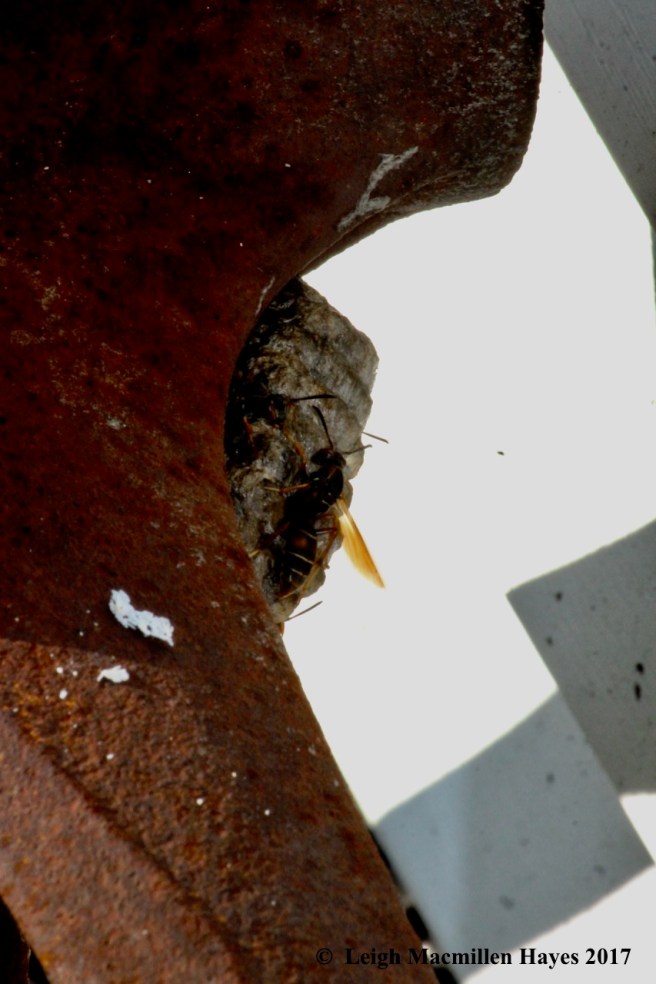
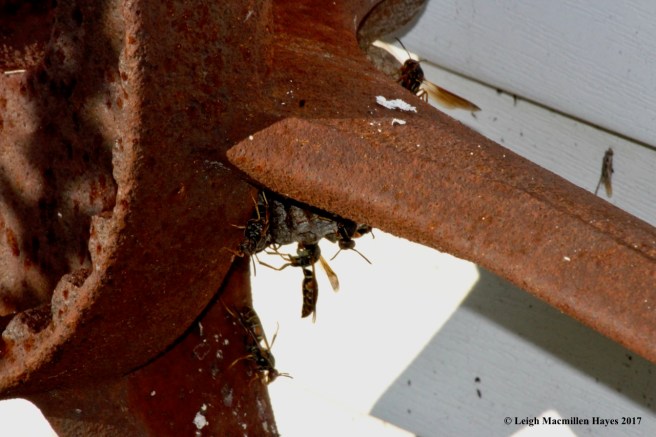
As we surveyed the garden and figured the best path for his return to it, we made a discovery–the wasps were building a home of their own right beside the narrow path my guy had been following to retrieve different tools. Notice the topaz-colored wing? It fluttered like mad, though that wasp stood still.  Was it sending some sort of message to others?

h-hornets 4

If so, there were plenty of workers available to receive the memo–each doing its job of contributing to the construction project.

h-hornets 8

Below and above, they came and went, the tools of their trade being within their mouths.

h-hornets 10

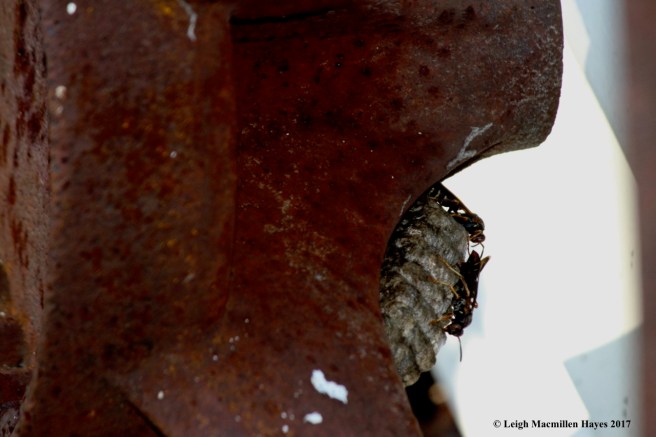
They’d collected plant and wood fiber, mixed it with saliva, and chewed it into a papier-mâché of their own form.

h-hornets 11

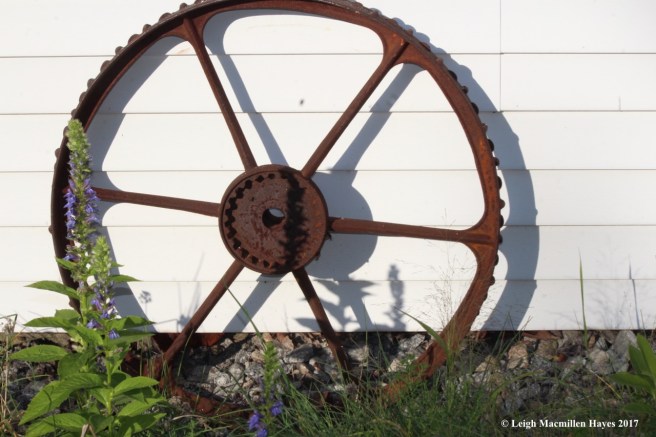
The location of choice for this latest construction was against an old tractor wheel that leans against the house. Over the years, we’ve found them building everywhere, but what my guy doesn’t know …

h1-horn 1

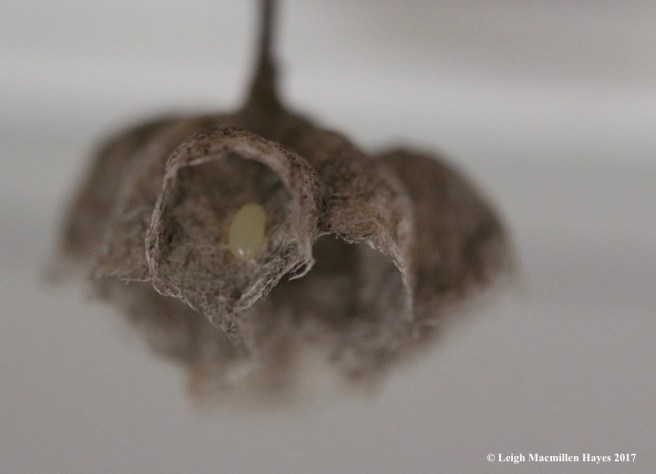
is that a few months ago a queen began an umbrella-like structure in the back door jam.

h1-horn 2

I watched the dangling nest slowly take form.

h1-horn 3

Within each cell . . .

h1-horn 4

an individual egg was deposited.

1-horn 5

Two wasps never seemed to mind that I pulled a kitchen chair over and climbed up to watch the action.

h1-horn 6

Work continued from morning to night, the wasps slipping away through a sliver of space in the outer door and then returning. Late in the afternoon, they settled on the nest and didn’t move until the next morning. Eventually, I knew I had to put an end to this construction project and while the adults were off seeking more fiber, I removed it. And felt guilty. But, I didn’t want my family to get stung–famous last words.
h-hornet on goldenrod

Paper wasps aren’t typically aggressive unless they perceive a threat–and today, much to my guy’s dismay, they felt threatened.

Despite the confrontation, we have to remember that they are beneficial to the garden as pollinators and predators.

My guy survived and for a bit longer, so will the wasps.

Home again, home again

Because we’d spent most of the summer at camp and I barely stopped at home, I hadn’t visited my usual haunts in a while. Today, that changed.

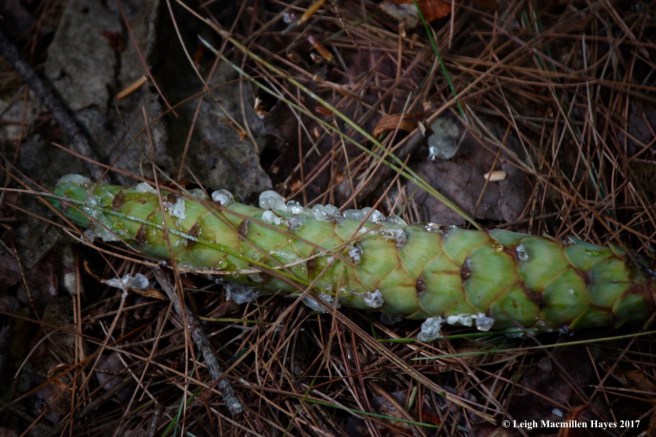
o-green cone sap

Into the woodlot I ventured, where green pine cones oozing with sap decorated the forest floor.

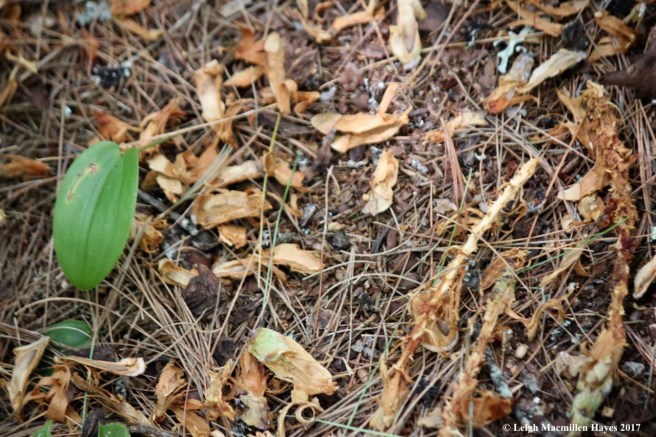
o-green cone midden

The remains of those serving as sustenance also lent a bit of color from the center cobs and deseeded scales left behind by red squirrels.

o-Inidan pipe from above

Most of the Indian pipes were past prime, but they remained beautiful with their flowers turned upright since being fertilized.

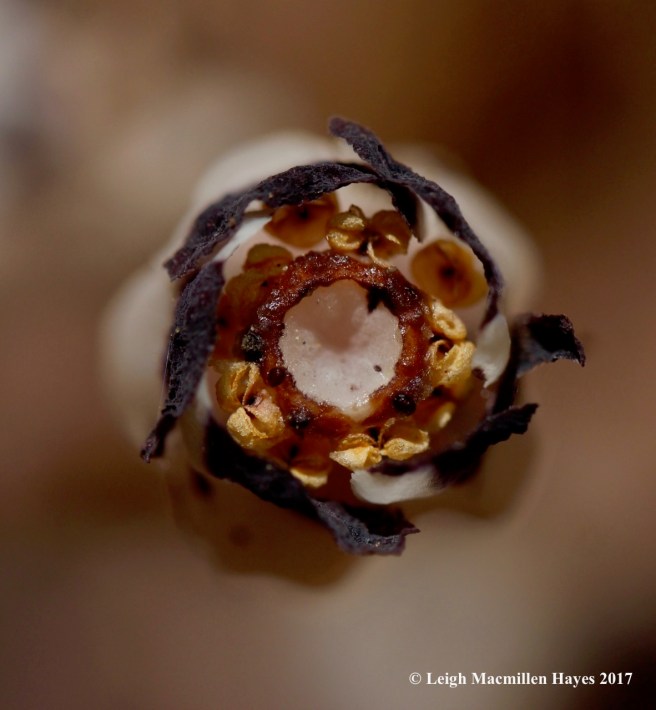
o-pine sap

The same was true for pine sap, which supported more than one flowerhead per stalk.

o-powerline

Emerging from the cowpath onto the power line, I found conditions to be as expected–anywhere I’ve traveled past such a line this summer, I’ve noticed that Central Maine Power has sprayed. I shouldn’t complain for I depend on that power and understand the need to keep the trees cleared, but it does make my heart cry for all that is lost.

o-sundew sad face

My sundews were among those that had suffered, brown and shriveled were they.

o-juniper

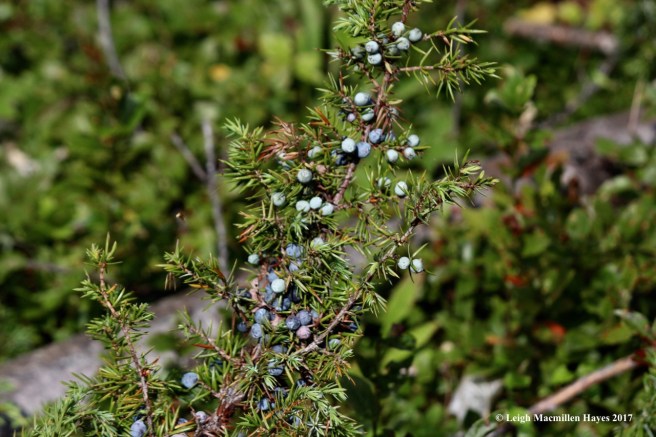
The white pines took a beating as well, but the juniper continued to grow and produce a bounty of fruits.

o-cicada

As I walked, the air buzzed with a chorus of cicadas,

o-field cricket

field crickets,

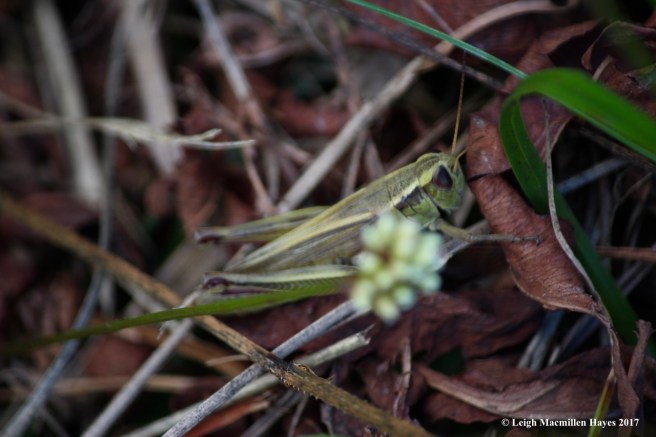
o-grasshopper

and grasshoppers.

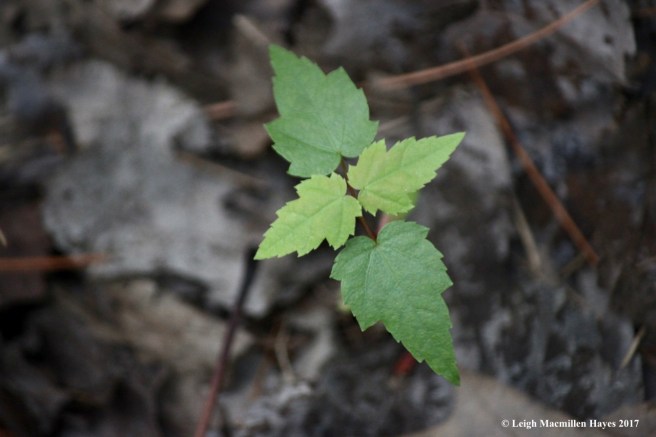
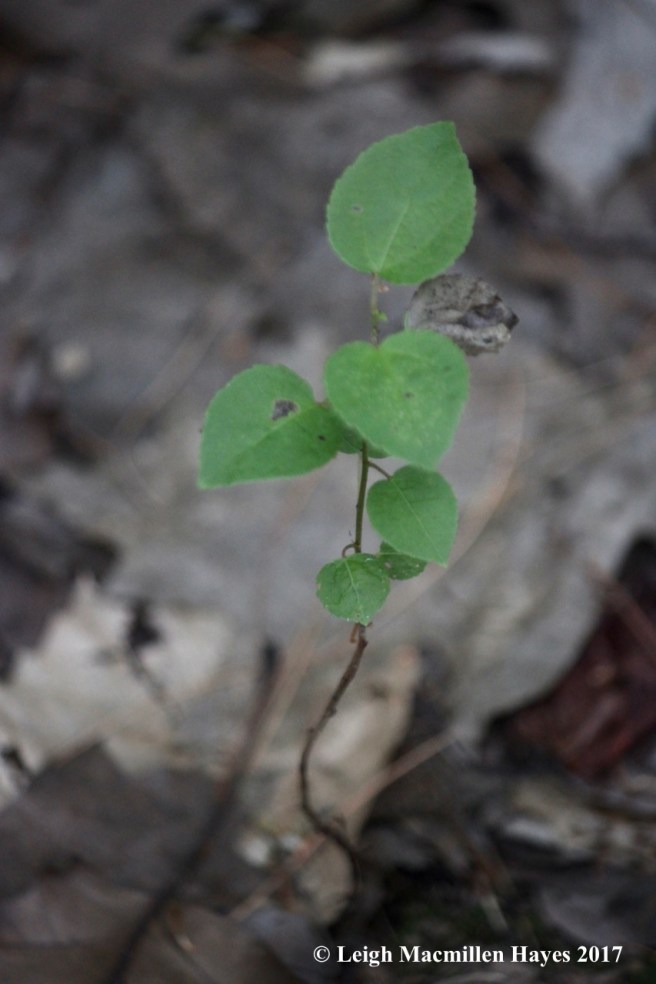
o-red maple cotyledon

A visit to the vernal pool was a must, and in true vp form all was dry, but from the bottom new life sprang forth in the form of red maple . . .

o-vp, quaking aspen

and quaking aspen seedlings. It’s worth a try on their part, but I suspect they’ll be short-lived for soon enough the pool will begin to fill with water from late summer, fall and winter storms yet to be.

o-vp, red leaf

Speaking of fall, some red maples had already stopped producing sugar, thus the chlorophyll disappeared and anthocyanin formed–evident in the red hue.

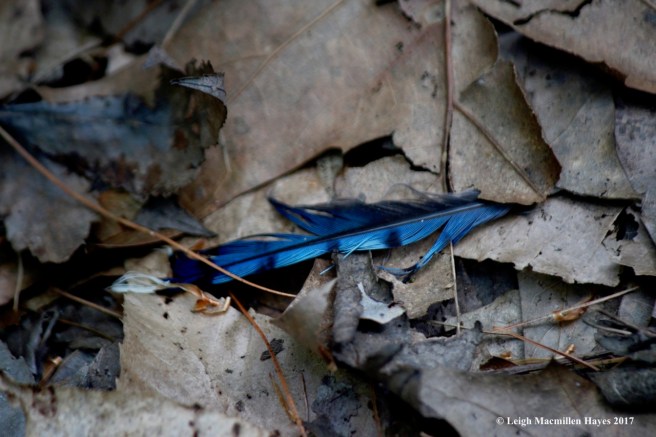
o-vp feather

I found some other color in a small blue jay feather. I only saw two and didn’t think much of it, until . . .

o-blue jay feathers on stump

I passed by an old stump and did a double take. It appeared a young jay had served as a feast.

o-field succession

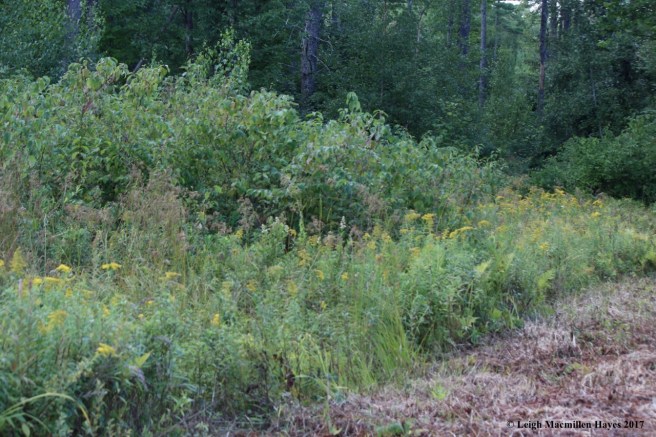
My next stop was the field, reached by passing through the two stonewalls that demark the boundary of our extended property. The field belongs to our neighbors’ parents and they recently had it bush hogged. At the western most end stood a fine example of forest succession, from mowed area to wildflowers and shrubs to saplings and finally the forest beyond.

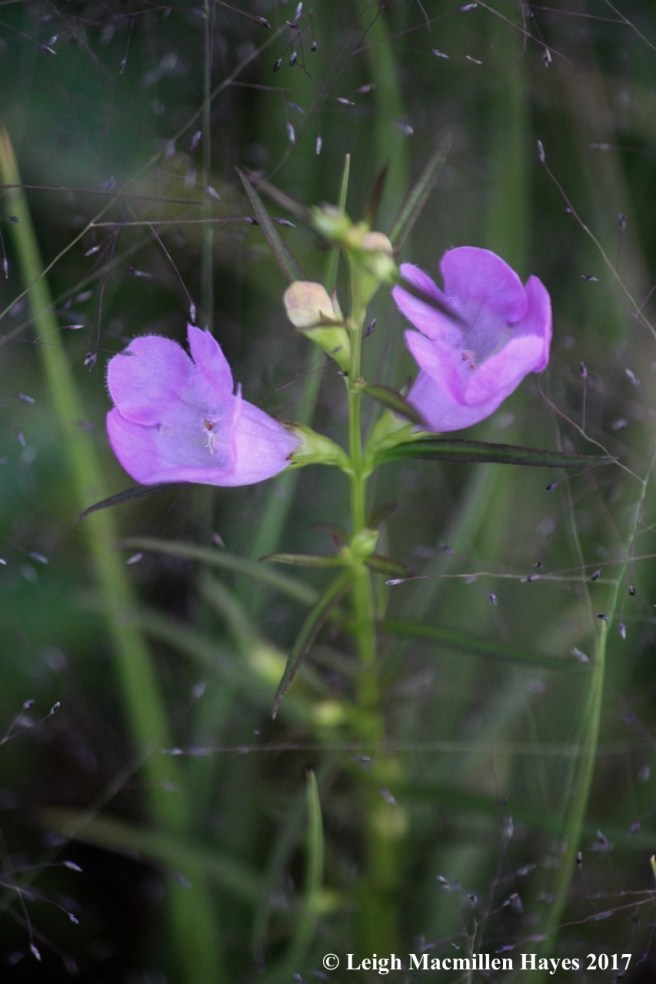
o-small-flowered gerardia

Among the flowers at the edge I found one I hadn’t met before–small-flowered gerardia with delicate, hairy petals and needle-like green leaves bordered in their own shade of purple.

o-steeplebush

Being Sunday, it seemed apropos that the steeplebush reached heavenward.

o-meadowhawk above

As I continued to look around, a meadowhawk flitted about, pausing occasionally.

o-meadowhawk face

I knew if I stood still long enough, it would get curious and let me approach.

o-meadowhawk up close

And I was right.

o-home view

At last it was time to head in. Home again, home again, jiggity jig.


From wet to sweat

“Will I need waders?” I asked before we departed from the Lakes Environmental Association’s office  early Wednesday morning.

Dr. Rick Van de Poll looked down at my hiking boots and said, “No, you should be okay if you don’t mind getting muddy.”

l1-into the fen

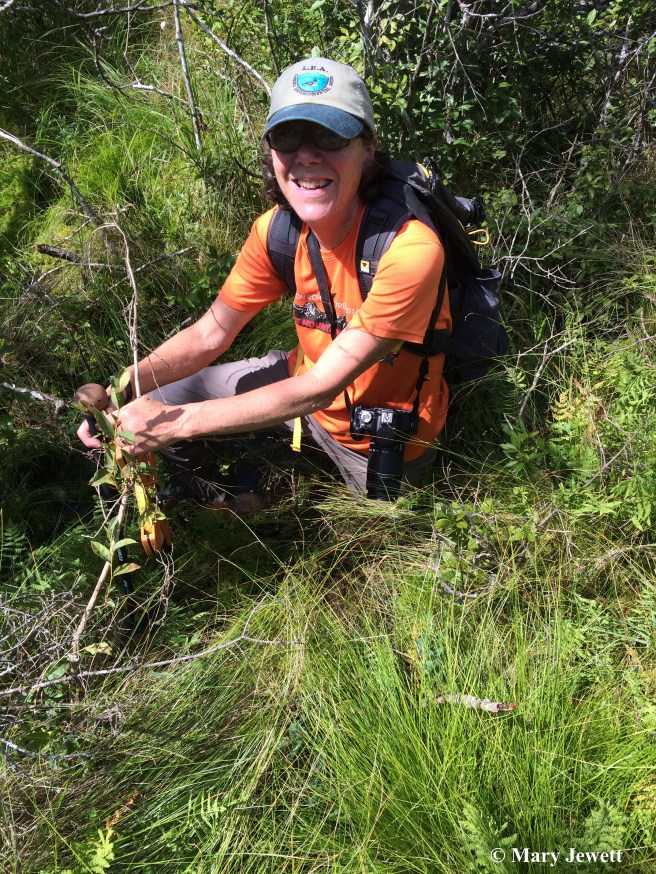
And so, LEA teacher/naturalist Mary Jewett and I joined him to begin a two-day survey of LEA’s Highland Lake Preserve. The 325-acre property was the gift of the David and Carol Hancock Charitable Trust. Except for two logging roads, there are no trails.

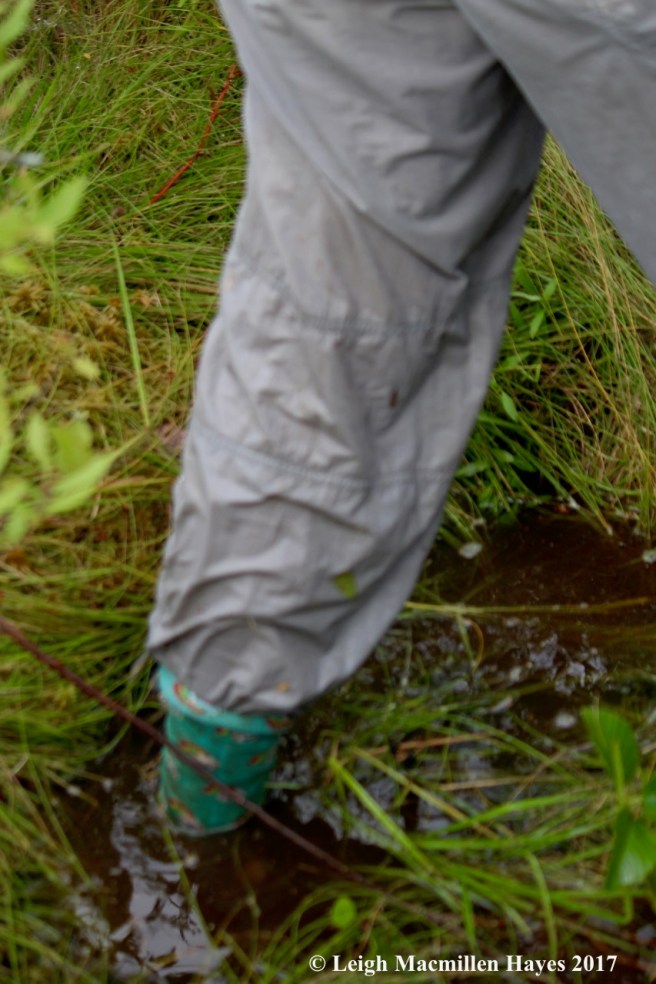
Our first destination was in the middle of the fen. OK, so Mary and I should have known better because we know how much it has rained this summer. But really, it was quite hot that morning and our feet did get wet.

In fact, she found a deep hole on the way in.

l1-fen plot

Once reaching the plot, our tasks were several.

l1-flag

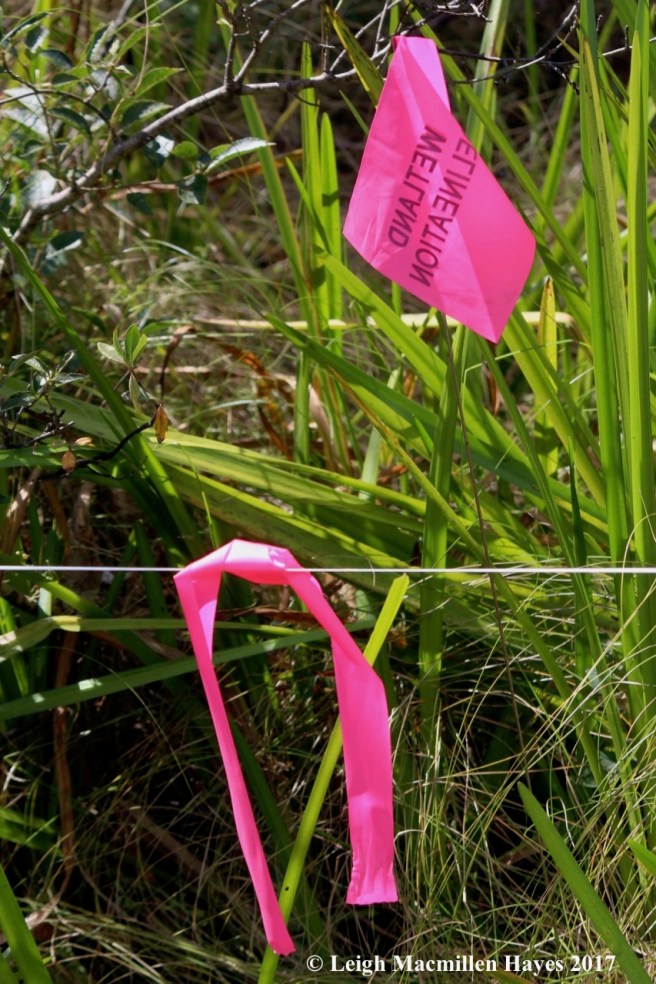
We helped delineate the boundary with measuring tape and flagging, the first being 10 meters by 10 meters, and then found the center, thus creating four quarters.

l1-Rick 1

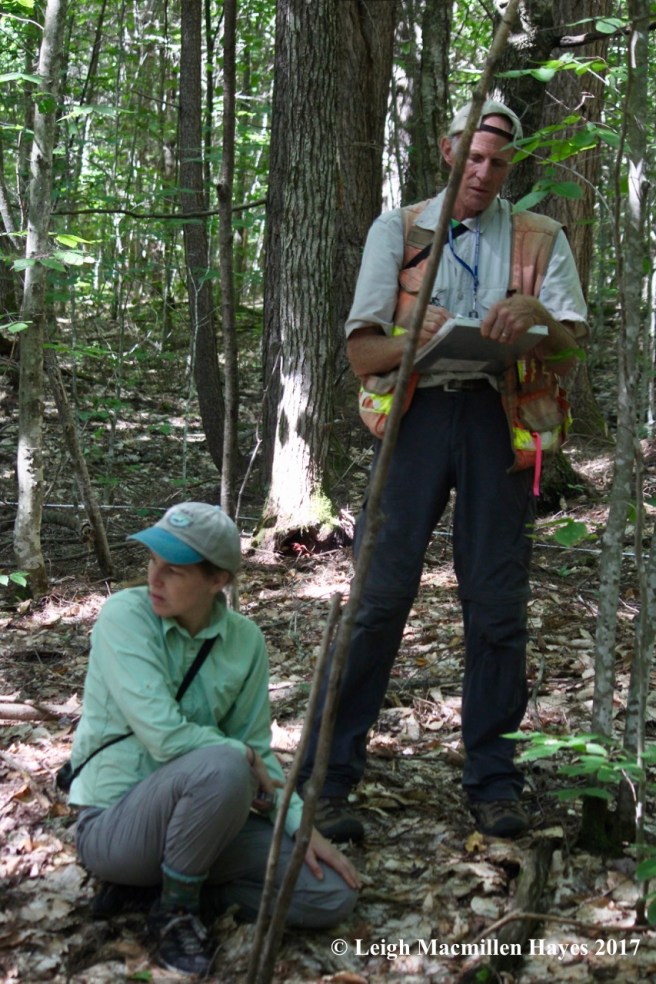
Under Rick’s patient guidance and teaching, we began to survey the site, section by section, while he recorded our findings.

l1-measuring trees

Trees were first and needed to be measured to make sure they were trees after all, and not considered saplings.

l1-rhodora 1

Layer by layer, including shrubs,

l1-tamarack

seedlings,

l1-round leaf sundew 2

and herbaceous ground cover,

l1-round-leaved sundew 1

we made our way down.

l1-wasp pupa on hornworm 1

Along the way, other discoveries presented themselves, including wasp pupae on a hornworm,

l1-garden spider 1

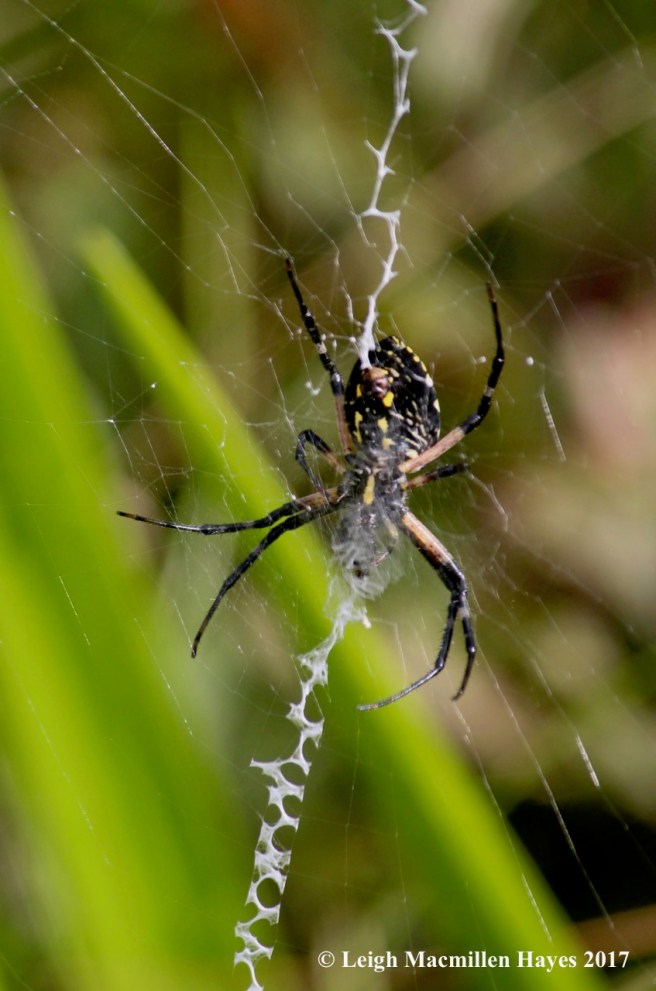
black and yellow garden spiders,

l1-garden spider 2

weaving their signatures,

l1-eastern pondhawk

eastern pondhawks,

l1-eastern pondhawk 1

up to the measure,

l1-green frog

and of course, green frogs.

Swamp Thing

Four hours later I found a deep hole as we departed that plot. We slogged out, water swishing in our boots, and quickly ate lunch.

l2-hemlock plot

And then it was back into the woods for the afternoon, this time a hemlock grove. On the way, we marked off a site for Thursday’s work, before reaching our destination for the afternoon.

l2-surveying the site

This plot was 10×20 meters and so within we had nine smaller plots to examine in the same manner.

l2-squirrel bites

Though we identified all the species from top to bottom, we also noted more cool finds like squirrel chews on a striped maple,

l2-glue crust fungus

a crust fungus that acts like a glue and attaches dead wood to live,

l2-spotted wintergreen

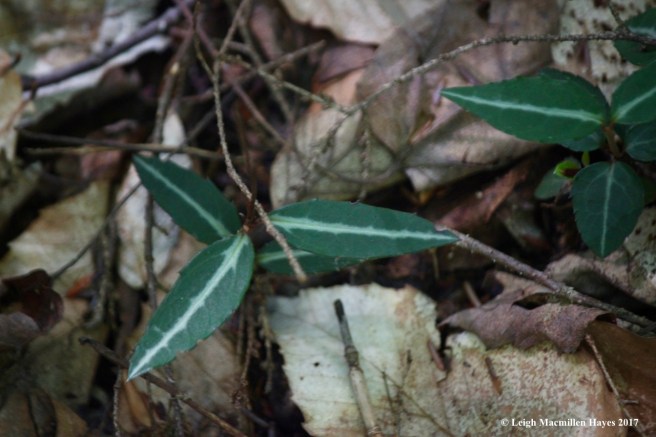
and spotted wintergreen, listed as S2 meaning this: “Imperiled in Maine because of rarity (6-20 occurrences or few remaining individuals or acres) or because of other factors making it vulnerable to further decline.”

l3-plot 3 (1)

I had to miss the Thursday morning session due to a GLLT hike, but met Rick and LEA’s education director, Alanna Doughty, as they finished their lunch. I think they extended it a few minutes as I was a wee bit late. This time, Alanna and I sat on the tailgate of Rick’s truck as he drove down a logging road–I, of course, held on for dear life, while she nonchalantly acted like it was a walk in the park. The best part of the ride was the smell of sweet-fern that our feet occasionally dragged over. And then our march began with a short trek through a wooded forest, before we reached the highbush blueberries and other shrubs that acted like hobblebush and made for careful movement.

l3-black and red spruce 3 (1)

The first afternoon site was in a black spruce bog and for once, I could confidently differentiate between black and red as they stood side by side–both by their colors, the black having a blueish hue, while the red was more yellowy-green, and their gestalt.

l3-cinnamon and chain ferns

One of my favorite learnings from that plot was the difference between cinnamon fern and Virginia chain fern. Again, they were easy to ID by their colors, the cinnamon already dying back. But notice the similarities.

l3-chain fern

And then we looked at the back side. While cinnamon has a separate fertile frond that forms in the spring and then withers, chain fern’s sporangia are oblong and on the underside.

l3-chain spores 2

The area was thick with the chain ferns and our every movement meant spores flew through the air.

l3-pitchers (1)

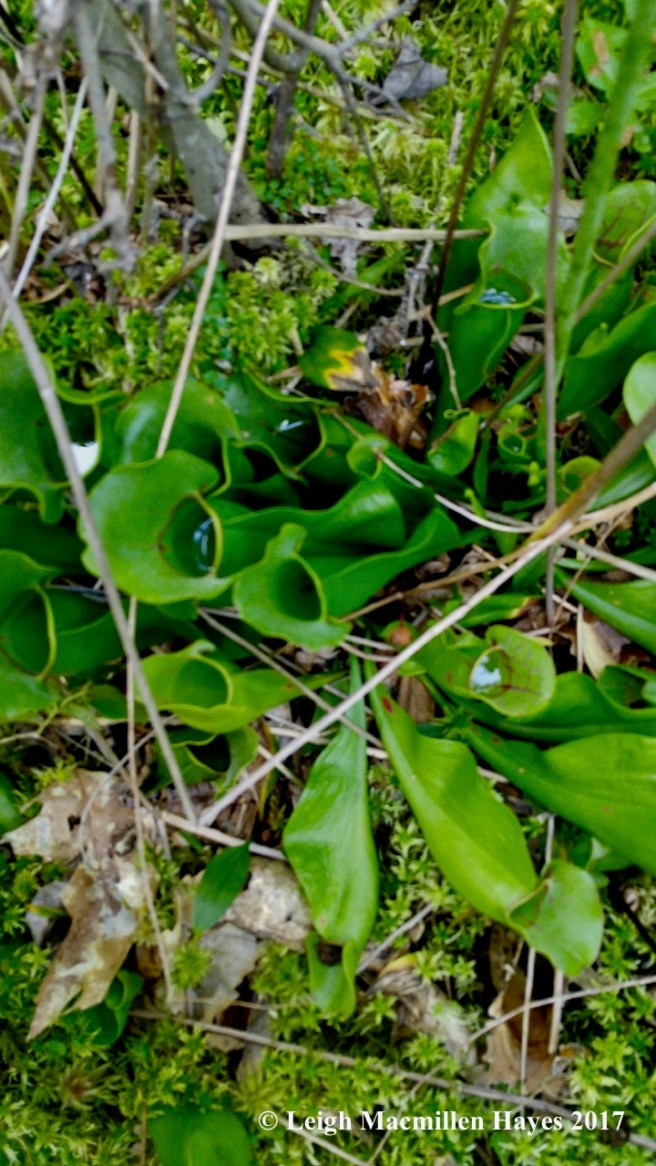
Every movement also meant we had to watch our every step, for so numerous were the pitcher plants. It was a great opportunity to ask Rick about the color of these–I’d been told that green is rare, but he said it’s just a matter of sunlight and age, all eventually take on a redder hue in veins and then overall leaf coloration as they mature.

l3-pitcher plants

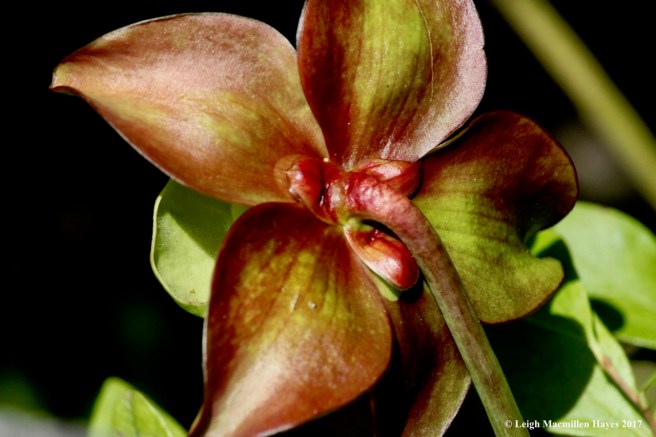
Their flowers were also plentiful in this lush space.

l3-chanterelle waxy cap 1

Among other things, Rick is a fungi expert (and an overall fun guy with corny jokes–the mark of a teacher), and so our learnings were plentiful, including these chanterelle waxy caps.

l4-plot 4 (1)

After making our way back out through the tangle, we hopped back onto the tailgate for a short ride and then headed off into a mixed forest for the final 10x 20 plot.

l4-deer skull

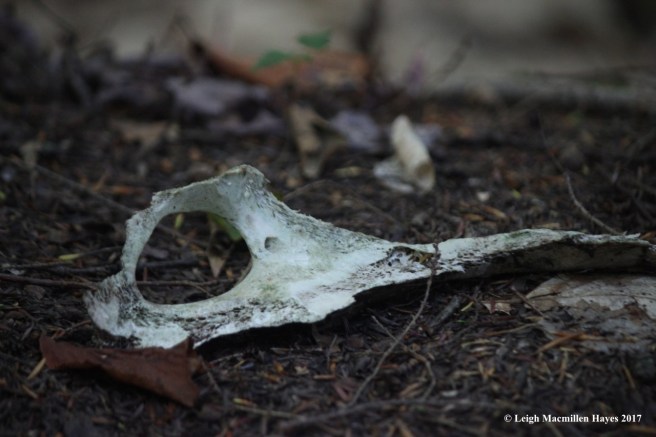
Our cool finds in this one included a much gnawed skull,

l4-orchid

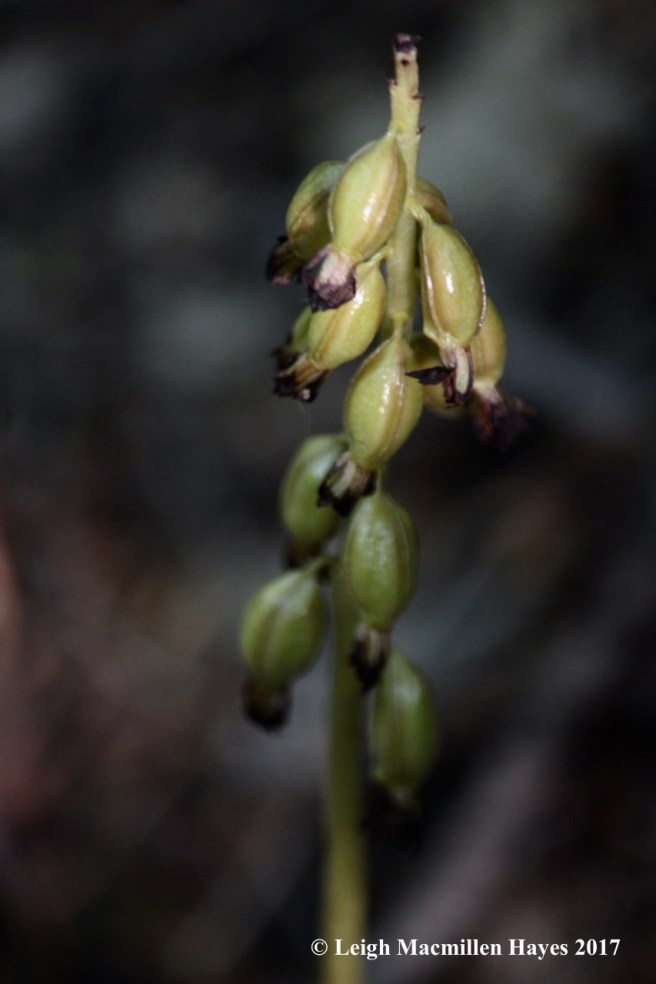
and spotted coral-root.

l4-bristly clubmoss

I also learned to ID one clubmoss–bristly tree so named for its bristly stem.

l4-back up the road

It was dinner time when I again held on for dear life as we drove up the road. To say we were sweaty, stinky, hungry and pooped would be an understatement. By the same token, I think I can speak for Mary and Alanna to say that we were more than grateful to have spent so much time learning from Rick. From wet to sweat–it was well worth the effort.


Artful Eclipse Mondate

Because they are so gracious, when I recently begged Faith and Ben Hall for an opportunity to follow them on a trail through the Perley Mills Community Forest, they not only invited us to walk, but planned out an intinerary, pre-hiked the trail, made chicken noodle soup for lunch and took us for a boat ride. All of this before the great solar eclipse of 2017.

h-perley pond beaver dam?

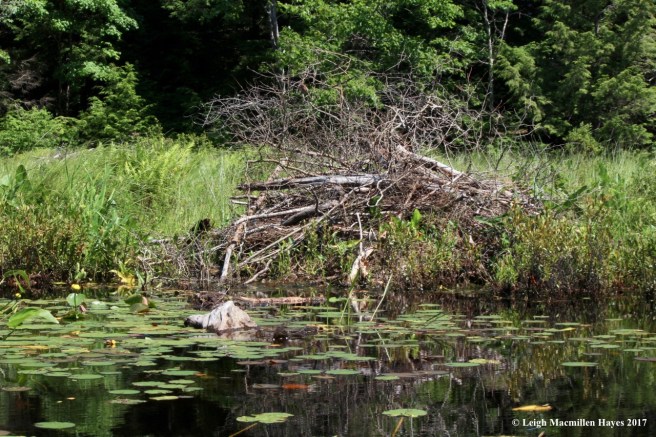
After taking a tour of their neighborhood, Faith dropped Ben, my guy, and me off to begin our first bushwhack beside Perley Pond. In a few minutes, we came upon an earthen structure and I couldn’t help but wonder if it was an old beaver dam.

h-perley pond

We were at the base of the pond and perhaps just as those who dammed it up for their mill sites, the beavers had their own intentions. Of course, I could be totally off and it could have been manmade, but such was the formation and growth above, that I’m sticking with my original thought.

h-sawdust pile

Moments later, we emerged into a clearing and grabbed handfuls of fine saw dust, letting it sift through our fingers as it slowly drifted back to the ground. Occasionally, on our tramps through the woods, we’ve encountered such mounds and have been amazed that they still exist with little vegetation.

h-mill site approach

The mound bespoke the reason for the mill up ahead. (Notice the stream beside–we crossed over it, two of us more successfully than the third, but fortunately for him, I didn’t take a photo. He preserved the rest of the hike with soaking wet pants, socks and boots, but never complained, such is my guy. Oops–don’t tell him I told.)

h1-mill site, looking down

Climbing up, we looked down. According to the “History of Perley Mills” by Arthur Rankin on the Denmark Historical Society’s website, the part of town known as Perley Mills was “1st settled by a family named Cliffords in the early 1800s. They built a road by Little Pond to connect with the stage road from Denmark to Ingalls Road and Cole Road in South Bridgton and to Biddeford. The Cole Family had apple trees. Mr. Cole was a fiddler and he used to play for the dances in Denmark and Sebago. Mr. Wallis Berry purchased the Cole farm. About 1807, Mr. Berry and Mr. Perley built a dam at the outlet of Pickerel Pond. They built a saw mill to saw staves and shingles. They made barrels. They employed many men.”

We weren’t sure exactly what we were looking at below, but pieces of the former structure remained intact in what looked like a sluiceway.

h-mill drill holes

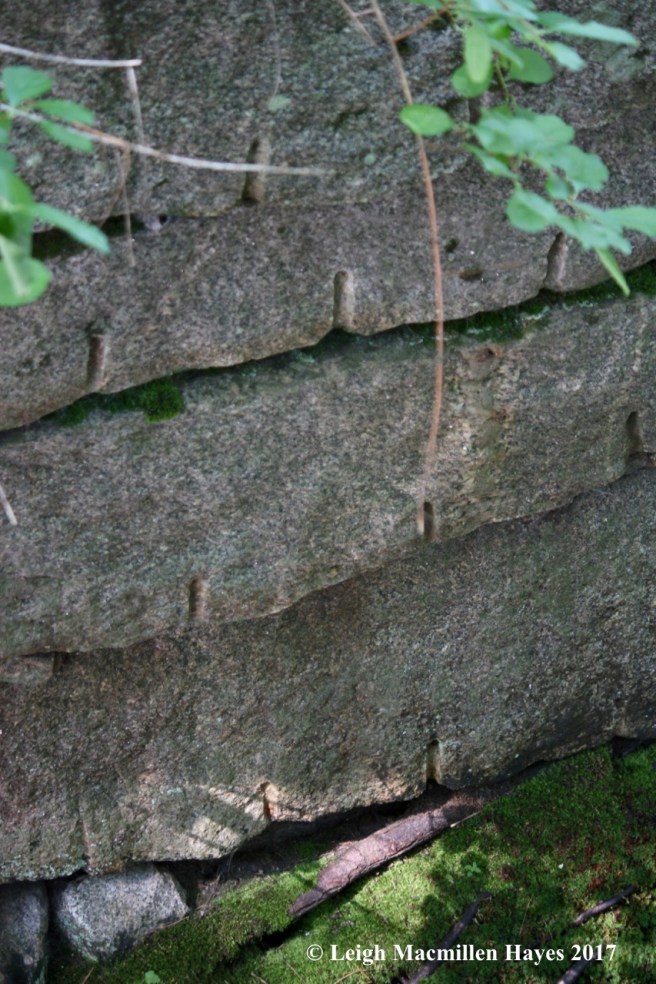
The stone had been split using the feather and wedge technique.

h1-mill site looking back

As we looked back, I was once again reminded of the work that went in to creating the foundations of yore.

h-cranberries 2

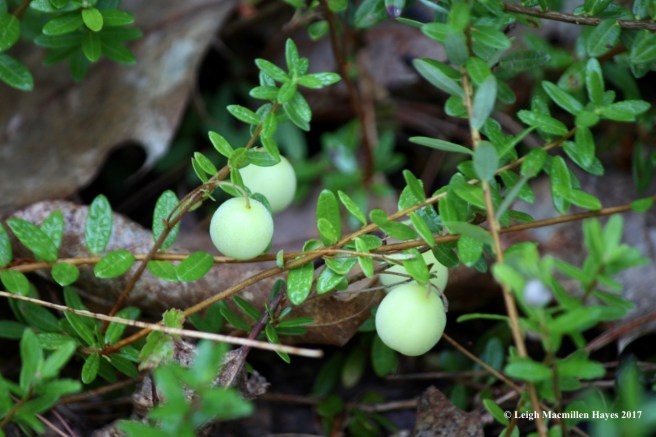
Our bushwhack included a few other fun finds, such as a small patch growing in an unexpected place.

h-cranberries

The little green balls actually threw me off when we first looked at them.

h-cranberrries 3

But it was my guy and his well-trained naturalist eye that knew they were cranberries.

h-virginia meadow beauty 1

We also spied a clump of Virginia meadow-beauty with its delicate petals and prominent stamen. It’s also known as Handsome Harry, but I think Harriet would be more fitting.

h-survey mark

When we reached the Narrow Gauge Trail, Ben showed us the elevation maker that neither of us recalled seeing previously.

h-pickerel pond

We stood beside the pond for a few minutes, looking for frogs.

h-sharp-shined back

h-sharp-shined front

And realized we weren’t the only ones on the hunt.

h-gall of the earth

As our journey continued down the old rail bed, we all wondered about the work that went into building it. Years ago, we used to find railroad spikes, but the trail has been improved recently and that seems hardly possible any more. Instead, we found gall of the earth in flower,

h-raccoon prints

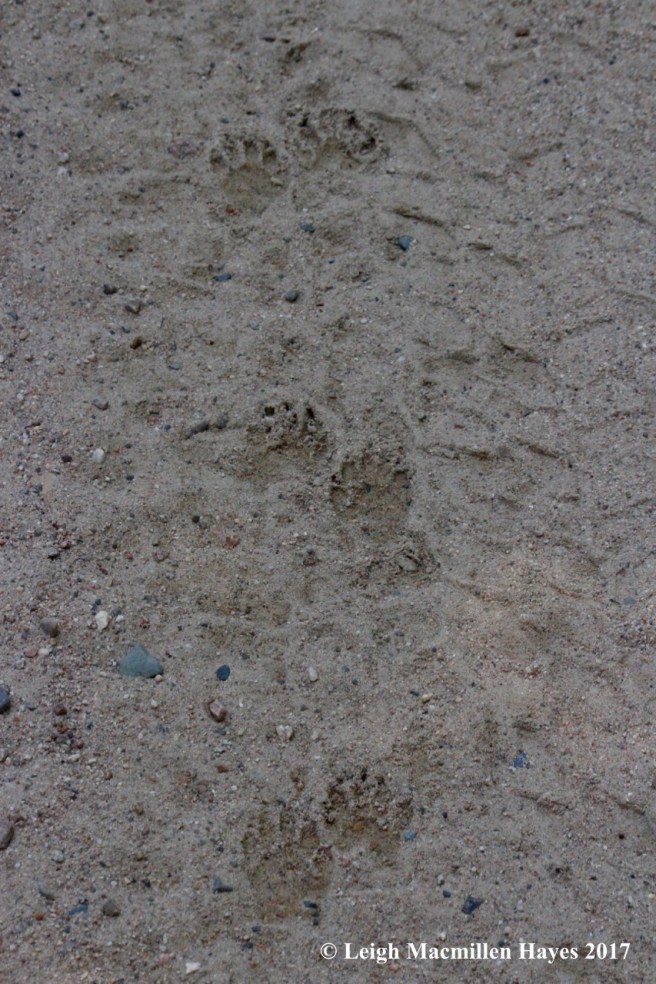
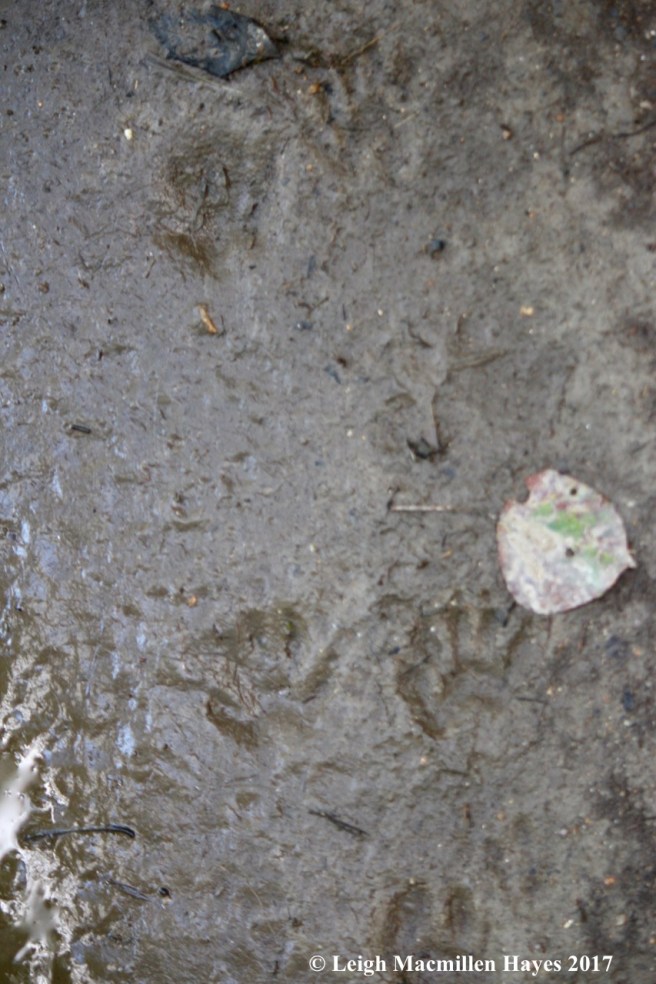
raccoon prints showing their opposite diagonal manner,

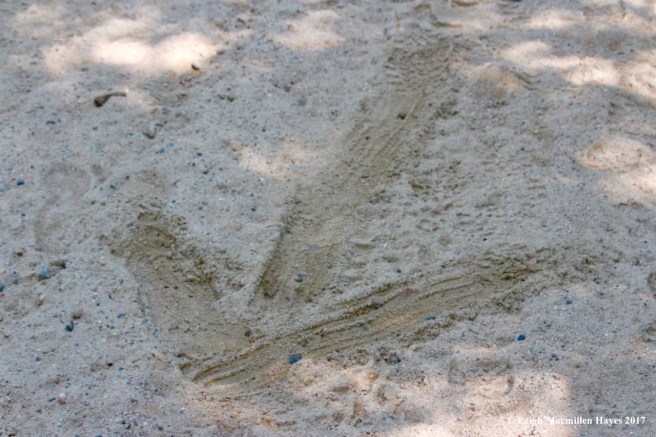
h-Faith's arrow

and either one large turkey print or a message in the sand. We knew it was the latter for Faith had preceded us and as we passed her she mentioned she’d left a note.

h-off the Narrow Gauge

It wasn’t long after Faith’s message, that Ben veered off the rail trail and took us up an old logging road.

h-following Ben

We followed him through thick and thin, the thickest being where the goldenrods bloomed and bees buzzed in former log landings.

h-approaching the stone cemetery

Along the way, he spoke of a stone cemetery. We both conjured up images of an old cemetery reflecting an earlier time. But . . . he meant a large pile of rocks that had been dumped by a previous owner who had logged the area.

h-walking the Narrow Gauge

Eventually, we met up with Faith again, then she drove to our next meeting point, while the three of us walked the Narrow Gauge in a direction my guy and I had never traveled.

h-beaver dam:infinity pool

It was there that we saw beaver works we were certain of, including a dam that created an infinity pool above.

h-swamp beside Narrow Gauge

Beside a swamp, we kept searching for moose, but never spied one.

h-thistles, Faith

At last our journey by foot came to an end . . . almost. Faith had a surprise waiting for us. And so she drove us back up their road and just past their house pulled off to the side on land owned by their oldest son. We’ve explored that property with them previously, but today she wanted to show me one of my favorite plants, which also happens to be hers.

h-thistles in all forms

Thistle . . . in all of its forms, it deserves reverence.

h-thistle 2

And so we revered.

h-Hayes True Value bucket

Back at their camp, our time together wasn’t over for we broke bread. And then they offered a quick boat ride. On the way to the dock, we knew we were in the right place, such did the signage on one bucket indicate.

h-Faith and Ben

Out onto the pond we went, thankful for a few more minutes with Ben and Faith. We cherish any time spent in their company before they head south again. And today, we were also excited to explore our local area and visit places we’ve never been to before. Thank you both for everything, from the hike to thistles to lunch and the boat ride and all the conversation in between.

h-squirrel and eclipse

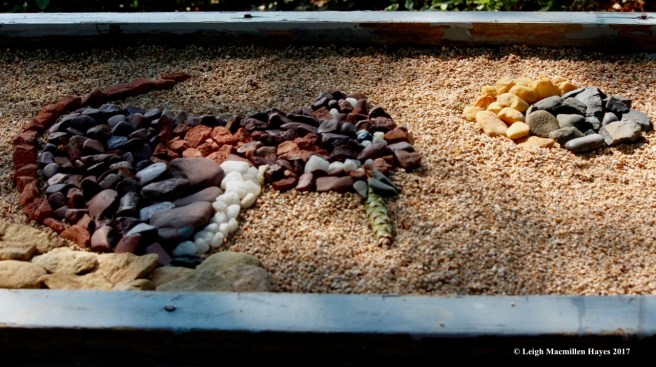
Before we departed, we had one more stop to make–at Ben’s sand table, where he recreates the natural world with found rocks.

Today’s creation–a red squirrel devouring the seeds of a white pine cone as the moon covered the sun–an artful eclipse on this Mondate.


Bee Kind

Because I have the good fortune to be involved with the Greater Lovell Land Trust, I spend my summers attending talks and walks on a variety of topics. Prior to this week, we learned about lichens, bryophytes, pileated woodpeckers, fungi, flowers, ferns, medicinal plants, peat bogs, wild turkeys, and land conservation. And then last night our focus turned to pollinators and the pollinated.

Guy Pilla, a beekeeper from Fryeburg, Maine, gave an informational talk on the art of beekeeping, followed by a question and answer period, and the crème de la crème –honey tasting. How often have you had a chance to taste Tupelo honey?
w-Guy 1 (1)

This morning we met up with Guy again, as he took us to a hive he has set up on private property under conservation easement with the land trust. Twenty-six of us gathered around to listen, watch, and wonder.

w-showing the frames

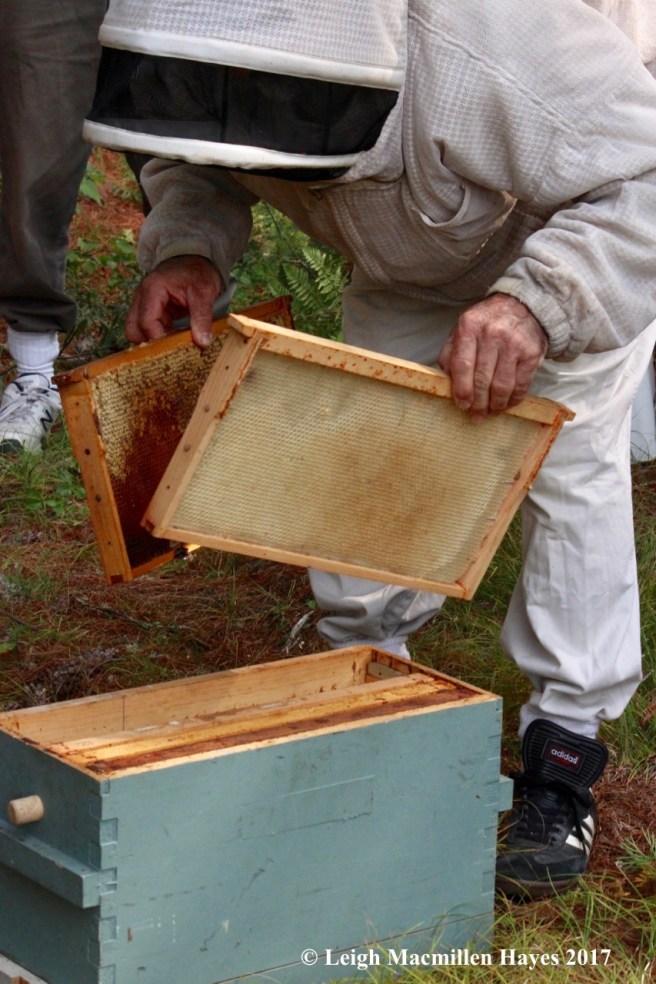
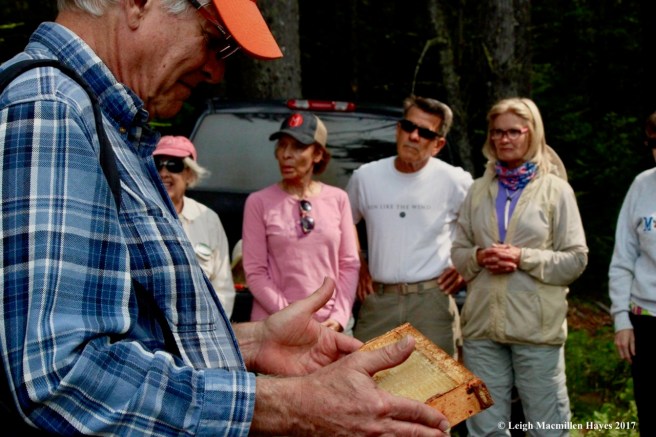
In his alien costume, Guy passed around frames, giving us an opportunity to look at a range of cells as he explained about spacing for honey expansion, storage and more. We learned about the good and the bad of beekeeping, but mostly the good.

w-Gary looking at frame

As frames were passed around, we noted variations and the fact that some were lightweight and others heavy.

w-hive--bear precautions

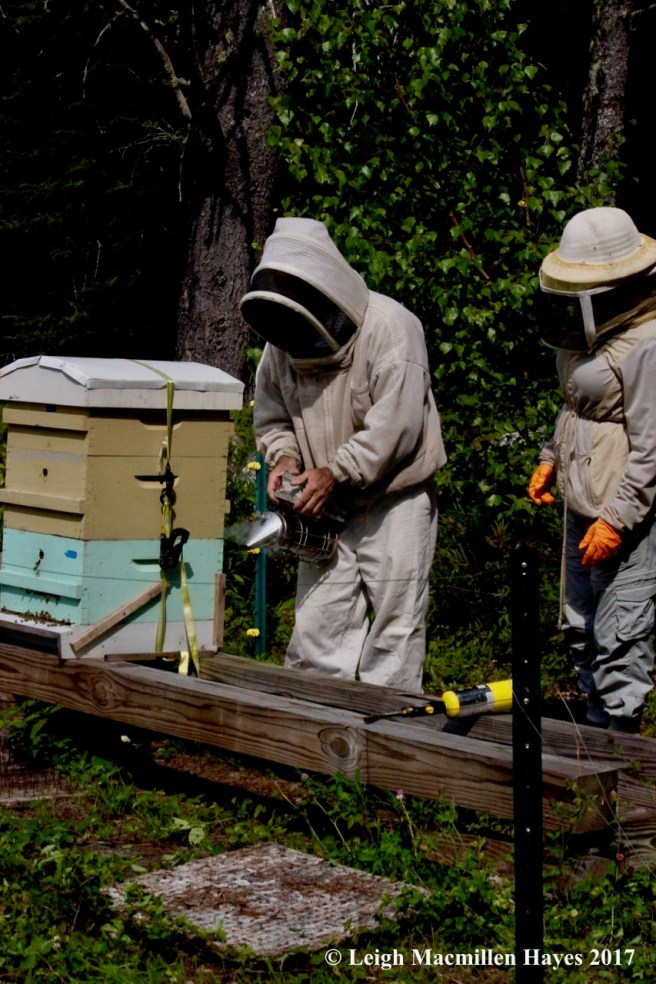
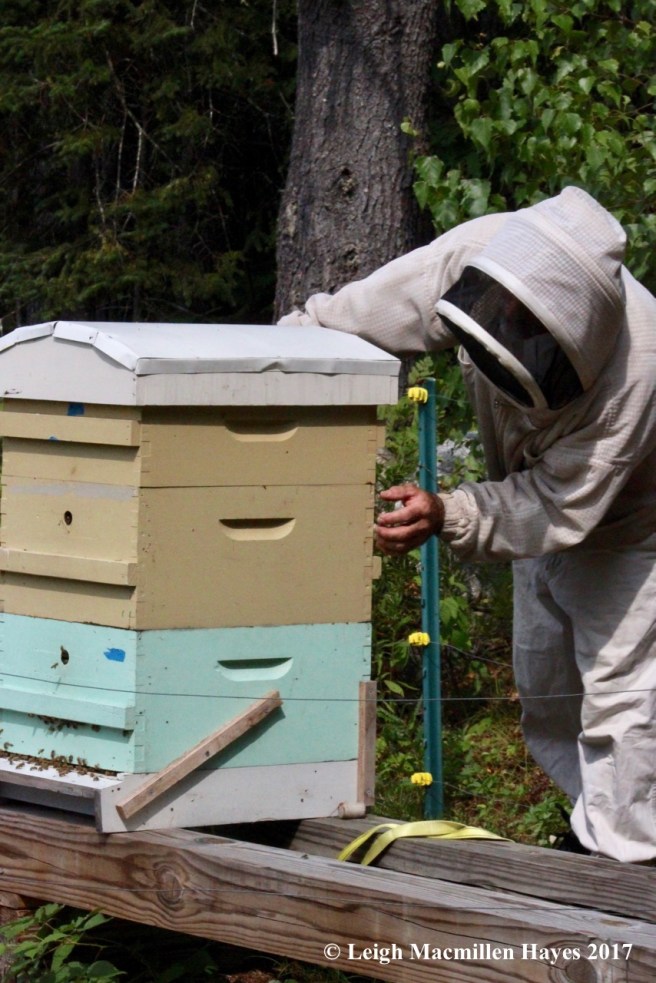
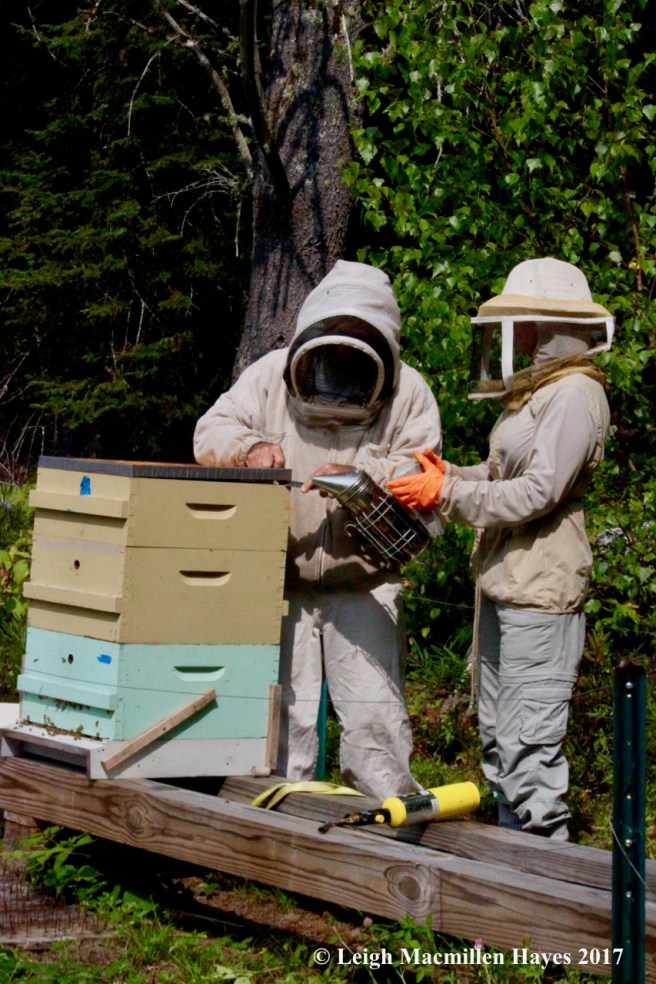
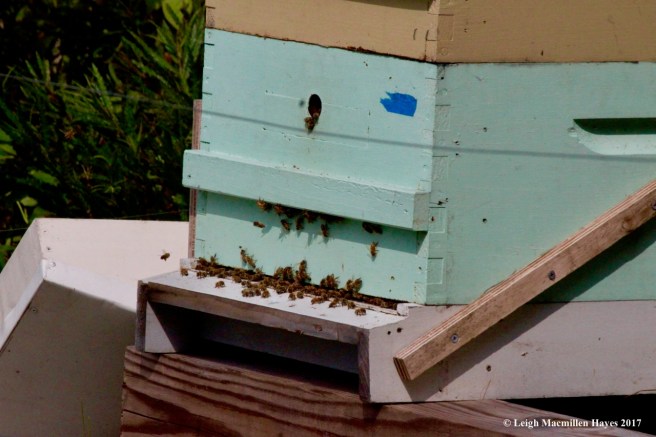
At last it was time for Guy to open the hive. Notice the electric fence surrounding it? And the fact that it’s strapped down. Bear defense. And we know there’s at least one in the area.

w-dressing like a beekeeper

And then he walked through the crowd and chose Mary to be his assistant. She donned a hat and veil to protect her face and neck, and took on the look.

w-testing the smoker

Into the bee yard, she followed Guy. If you look closely, you’ll see two platforms on the ground and might notice that the one directly below the hive has nails sticking up (the other is turned upside down because Guy only has one hive at this location this year). Those are to deter skunks, another predator. As Mary watched from behind and the rest of us watched from a few feet away beyond the fence (and out of the bee line), Guy ignited the smoker he’d filled with pine needles.

w-smoke coming out of smoker1

It took a few minutes, but finally, smoke puffed out.

w-Mary practices the smoker

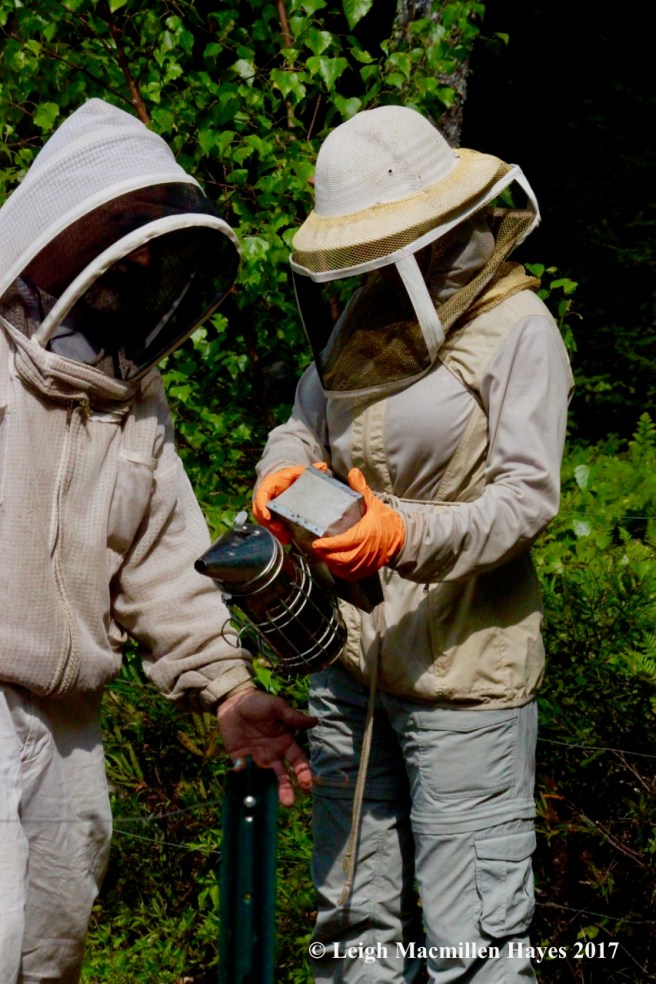
He then passed it to Mary, and her task was to press the bellows and create smoke. The smoker is an important line of defense.

w-preparing to open the hive

As we continued to watch, Guy took the straps off and explained the construction of the hive with one super stacked atop another in a vertical fashion. Though he ordered his equipment, he refashioned some of it including the roof, designed to let wet weather flow off rather than gather in puddles on the top of the structure.

w-Mary uses the smoker

As Guy wedged a hive tool into the bee glue (a resin-like propolis), Mary got ready to use the smoker. Smoke fools the honeybees into thinking a wildfire is nearby, thus prompting them to eat more honey in case they need to move to a new location.

w-showing off his bees

And with honey in their bellies, they become more docile. Note that Guy isn’t wearing any gloves. Usually he does, but Mary wore his gloves this morning and he trusted all would go well and the bees would remain calm. He was certainly calm, but spoke of his early days in the beekeeping business and how sometimes he would jump. Bees sense fear behavior exhibited by heavy breathing and that’s when stings occur. Having been stung recently after some youngsters received stings, I thought I was remaining calm, but apparently my breath spoke for me.

w-hive levels

We learned so much from Guy last night and today–about their various jobs as male drones, queens, and female workers who really do so much of the work. The workers clean out old material from inside the cells, attend to the queen, carry dead bees or larvae outside the hive, guard the hive’s entrance, fan at the entrance during the hot weather to keep the inside temperature down and to circulate fresh air throughout the hive, receive nectar and pollen,  store it away in cells, nurse newly laid egg, and seal cells around larvae at the appropriate moment. After doing all of this for about three weeks, they’ll earn the rights to collect nectar and pollen for about six. And then . . . they’ll die of exhaustion. Indeed.

w-wandering among the flowers

After our time at the hive, one of the land owners, Linda, took us on a mini-tour of the 100-hundred-acre property. Her goal was to take us to a flower meadow she and her husband have created. Originally, it was a garden with raised beds, but Linda has been collecting wildflower seeds from roadsides in Maine and New Hampshire and sowing them in the meadow.

w-learning from Linda

Today we were wowed by the results.

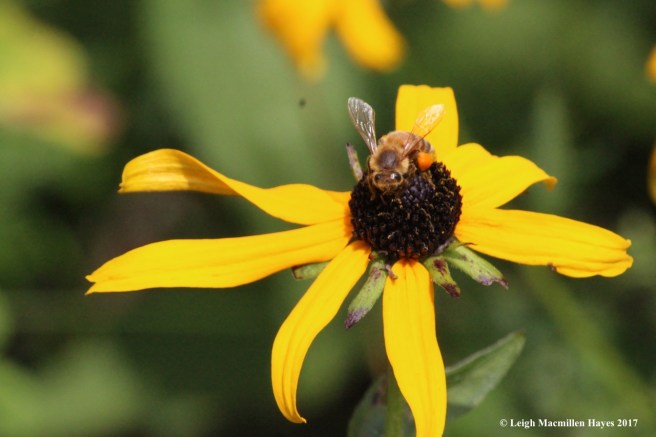
w-honey bee 1

And so were Guy’s honeybees.

w-honeybee on the move

They were on the move everywhere we looked.

w-bee using probiscus for honey

We watched as they sucked nectar with their proboscis mouth part.

w-bumblebee on Joe Pye Weed

Bumblebees also took advantage of the sweet offerings.

w-bumble with loaded pollen baskets

And filled their pollen baskets with the goods.

w-frittilary 1

Not to be left out, a fritillary was among those seeking reward.

w-male meadowhawk

And because we were there, we saw meadowhawk dragonflies on the prowl, he being red . . .

w-female meadowhawk

and she similar but brown.

w-Guy in the field (1)

Guy was tickled to see his bees at work and share his knowledge to all as we listened.

w-linda by her flower meadow

Linda was thrilled to see so many enjoying what she and her husband, Heinrich, had created.

w-Aa, gs 1

And speaking of Heinrich, just before we left he had one more insect to share.

w-Aa, garden 2

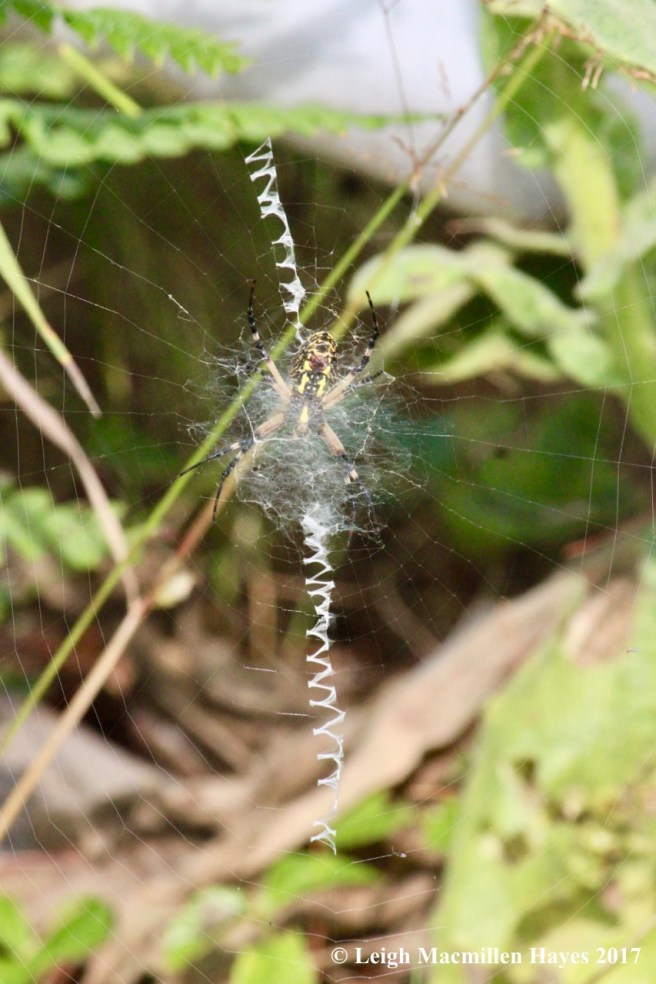
An orb spider known as a yellow and black garden spider or argiope aurantia had built its web near the greenhouse. I used to see these in our gardens frequently, but haven’t lately. Of course, I say that and tomorrow I’ll spy one.

w-Argiope aurantia, garden spider 4

In my brain, this is the smartest spider of them all for they create a web consisting of a series of concentric circles divided into sectors by lines that radiate out. And in the center–that amazing zigzag pattern, which is called a stabilimentum and perhaps intended to attract other insects. Or maybe its a message written in code and intended for a certain pig named Wilbur. This is Maine after all.

w-honey bee 2

We do know one message we learned in the last 24 hours: Bee kind–to one another for we’re all interconnected and we need each other to survive. And that includes letting the undesirables flourish in our yards, including the dandelions. Do so and watch them and just maybe you’ll realize they are desirable after all.

(Two final notes: Support your local beekeepers. Guy’s honey is available at Spice and Grain in Fryeburg; but really, you should buy honey from your area. And if you are interested in learning more about beekeeping, look for your local chapter of the Maine State Beekeepers Association.


Propinquity

I slipped into a kayak this morning and rather than paddle two miles north into the islands, decided to turn the bend round our point and search the shallows closer to home.

c-stump garden

It is there that the old stumps remind me once again that this water was once land until it was dammed back in the early 1800s. The stumps have given way to gardens and I have to wonder about the age of the mosses and plants that call them home.

c-fragrant 5

In a water garden below the stumps, fragrant water lilies added grace.

c-fragrant with visitors 2

And within, they offered a feast for those who foraged.

c-feather

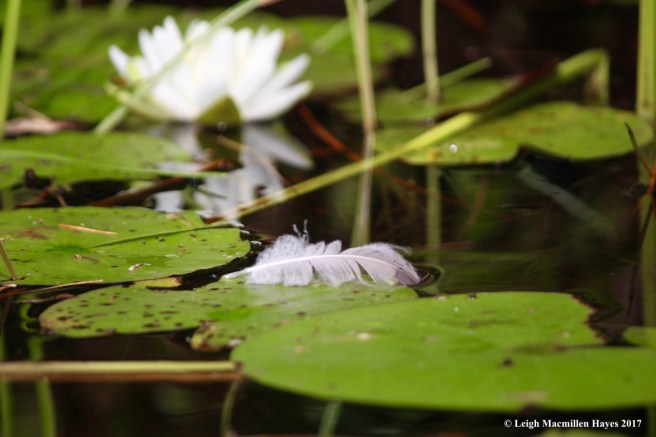
Nearby was evidence of another foraging expedition. It didn’t bode well for the young bird that sacrificed its life, but I suspect a larger bird gained a few jules of energy.

c-cove views

Everywhere I turned, there was another garden to inspect.

c-spider 1

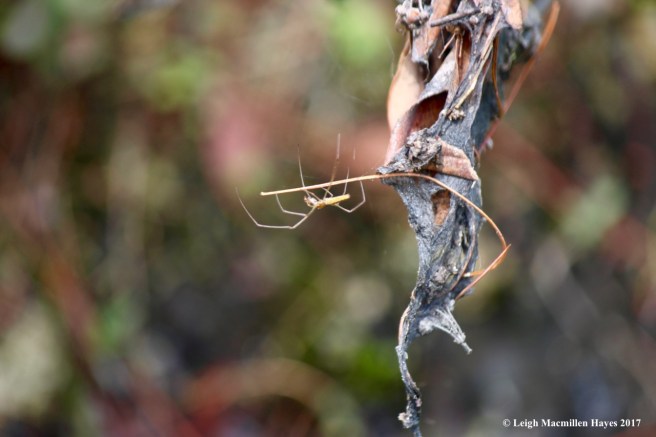
And friends to meet, be they spiders . . .

c-dragonhunter exuvae

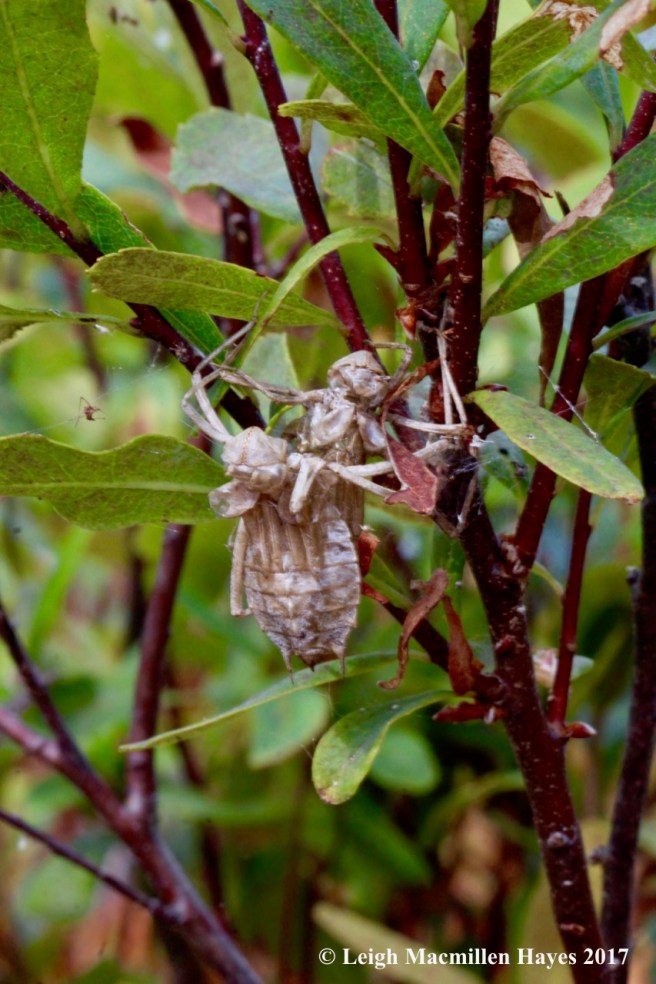
dragonhunter exoskeletons . . .

c-meadowhawk 2

or meadowhawks.

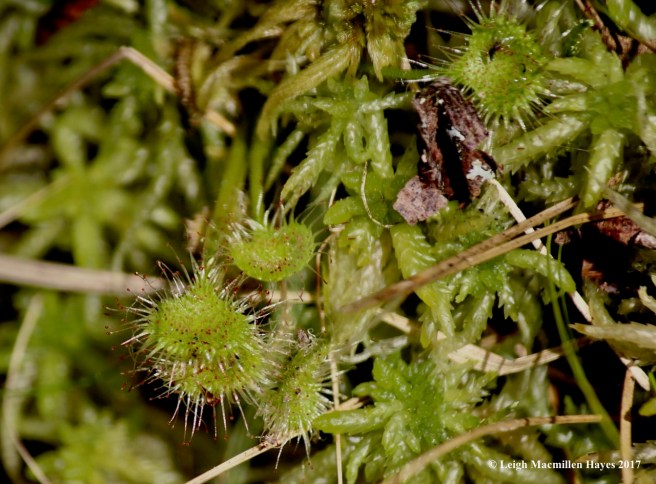
c-spatulate-leaved sundew and insects

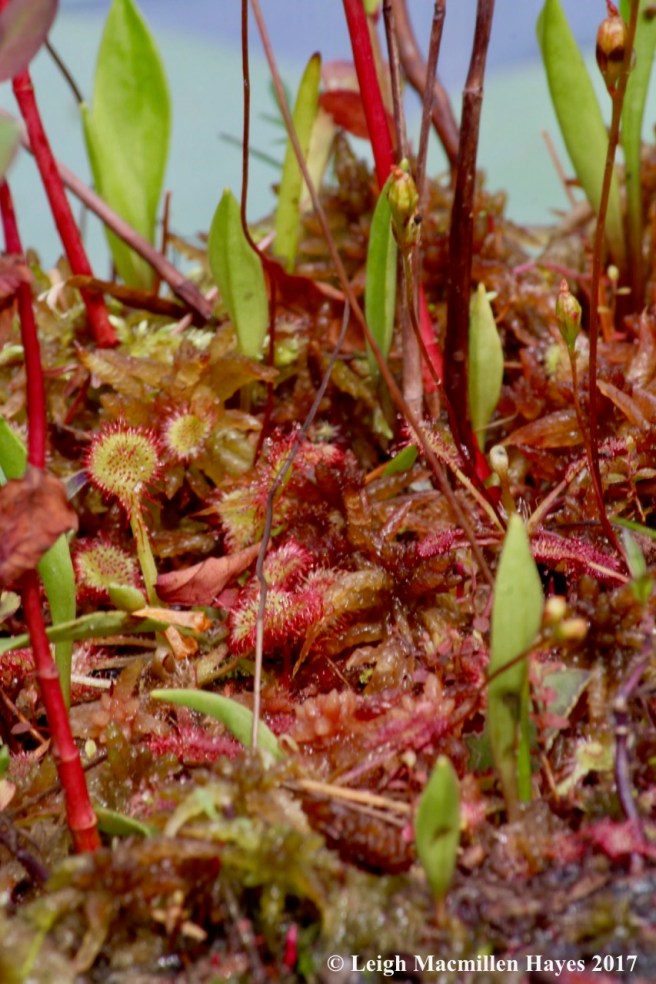
Among my favorites were the sundews and I watched several insects approach a spatulate-leaved bent down to the water.

c-round-leaved sundew

Among the spatulates, another showed its face–the round-leaved sundew standing tall above its family members.

c-pickerel 1 a

As I continued to swoon over those beauties, a different color caught my attention.

c-pickerel frog 1

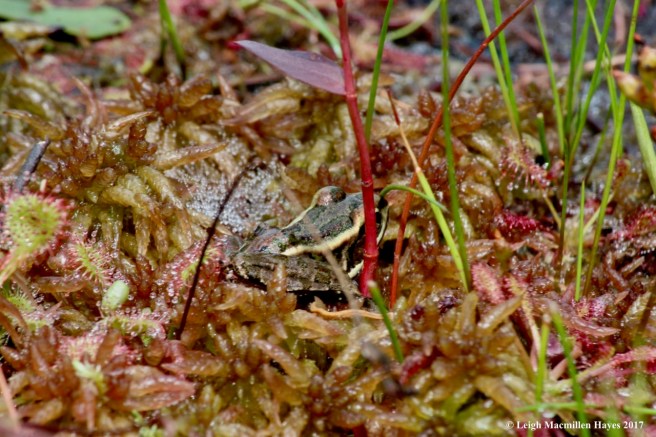
As still as could be, a pickerel frog posed and waited . . . I suppose for me to move on.

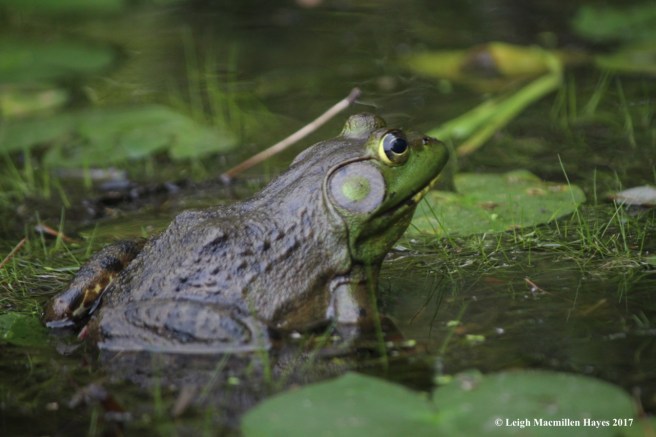
c-bullfrog 1

Eventually I did, and then I met a large male bullfrog–its external eardrum or tympanum larger than its eye. This guy was certainly all ears. ;-) (The female’s eardrum is about the same size as the eye). He sat in wait . . .

c-bullfrog youngster

while a young bullfrog of two or three years tried to hide about eighteen inches away. A bullfrog is a carnivore and while its diet consists of crayfish, water beetles, snails and dragonfly larvae, they also dine on fish, small turtles, young water birds . . . and other frogs. Beware little friend.

c-bullfrog reflection

For a while another bullfrog and I took a stab at a starring contest. He won.

c-beaver scent mound

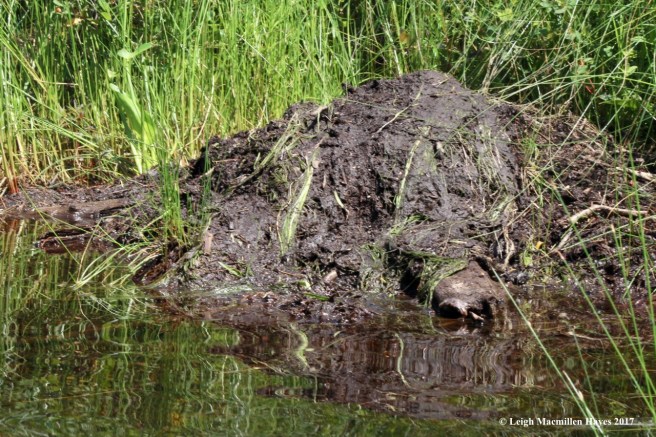
Again I moved on and at last found one of the reasons I headed around the corner. I’d been  wondering about beaver works in this area–and found a scent mound that looked rather fresh.

c-beaver lodge

Across the way was the lodge–that’s been in place since I’ve frequented Moose Pond, which means for just over thirty years.

c-beaver lodge garden

I noticed that the beavers have their own kitchen garden from which to choose–and poking out from it were a variety of sticks. Which ones came from our property? And how many more will be added in October, for I know that’s when they’ll come shopping.

c-camp from south side

Finally, it was time to head back out of the cove to our humble abode on the point.
c-camp 2

It was there that I would finally join my guy for some time in our  rocking chairs.

Propinquity.

Into the future

Turning the clock back two months, I can recall my slight apprehension about working with three interns at the Greater Lovell Land Trust this summer. Hannah I knew and loved from our time together last year, but the other two were complete unknowns. Not only that, but in the past we’ve always had two interns, so what would it mean to throw a third into the mix?

i-11

And then I met them and our first hike was a bug-ridden adventure to Otter Rock at Heald and Bradley Ponds Reserve on the evening of the summer solstice. To say the mosquitoes were intense that night would be an understatement, but Dakota, Kelley and Hannah didn’t complain.

i-9

In fact, their broad smiles that would accompany them throughout our time together broadcasted their strength as individuals and a combined force. And I knew all would be well.

i-12

Each week they joined us for the Tuesday Tramps the GLLT docents take on the properties to learn from each other. And occasionally they had an opportunity to show us the efforts of their hard work, for they built solid benches and platforms, cleared trails, and even built water bars to prevent erosion. They learned about land conservation and spent hours developing an understanding of the inner workings of a land trust.

i-6

On Tuesday Tramps the main focus was to develop a better understanding of species that call this place home–both flora and fauna–and all of us shared knowledge and asked questions as we poked along.

i-19

At our annual docent training, the interns jumped right into the flower ID workshop,

i-22

and worked on their new skills . . .

i-23

while studying details.

i-18

Their skills grew, but one was especially evident for wherever we went, they found the blueberries first.

i-7

They also helped us with the Lovell Rec Summer Camp Nature Program we provided each week. This was our third summer offering said program, and based on last year’s numbers we’d split the group in two–divided mainly by younger and older kids, with a few overlaps due to interest levels. As it turned out, the Rec Program numbers doubled in size. Because I knew she has a talent for working with young children, Hannah became the mainstay of the younger group, while Dakota and Kelley took on the task of leading the older kids who wanted “less talk, more walk.” Speed hikes were the name of their game.

i-interns at annual meeting

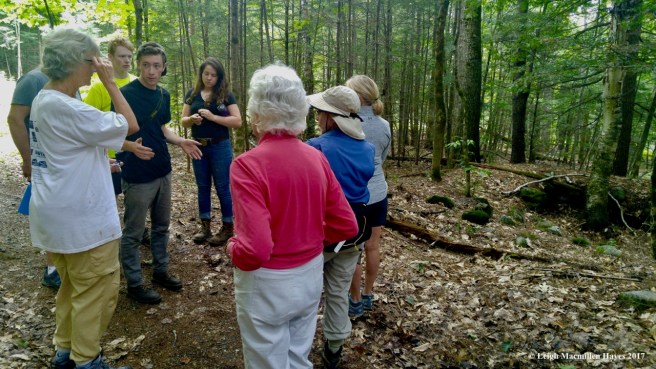
Somehow, the summer passed by much too quickly and though it isn’t over yet, suddenly it dawned on this week and it was their turn to be the featured speakers at our Wednesday night program and then to say something brief at this morning’s Annual Meeting. The triplets, as I fondly referred to them for they had formed a bond that I hope will last a lifetime, had to face the crowd. Wednesday night wasn’t so bad for they had a developed a slideshow and had fun recalling the various aspects of their summer job in front of a friendly crowd, most of whom they knew. But this morning the crowd reached 105. As they stood there, they looked like they were jail mates, but with steady voices they shared pieces of their combined experience.

i-Kelley 2

The moment to shine, however, wasn’t over. This afternoon, they led about twelve people on a walk along the Homestead Trail at Heald and Bradley Ponds Reserve. It’s a trail they knew well, but still they wowed us with their knowledge . . . of ferns,

i-Hannah at plantain

rattlesnake plantain, and

i-Dakota 2

even the forested landscape.

i-Kelley and Dakota up close

They looked for the tiniest of details,

i-Dakota, number on scythe

and took pleasure in recognizing old tools long ago left behind.

i-caesar explanation

With her hands, Hannah explained how when a Caesar’s mushroom expands, its universal veil is broken and the bottom of the veil forms a cup-shaped volva.

i-caesar 2

Then she pointed to one nearby that was a couple of days old and all wondered about the variation in shape.

i-Dakota explains foundations

It was our immense pleasure to travel the trail with them this afternoon and be in awe by all that they had learned and could share. One of the fascinating things for me was to hear their hypotheses, for there isn’t an answer to everything we see, but they asked questions and considered various answers.

i-2

I know I wasn’t alone in the fact that I didn’t want today’s walk to end, for that meant this team of three would head off toward their next adventures.

Tree 3 (1)

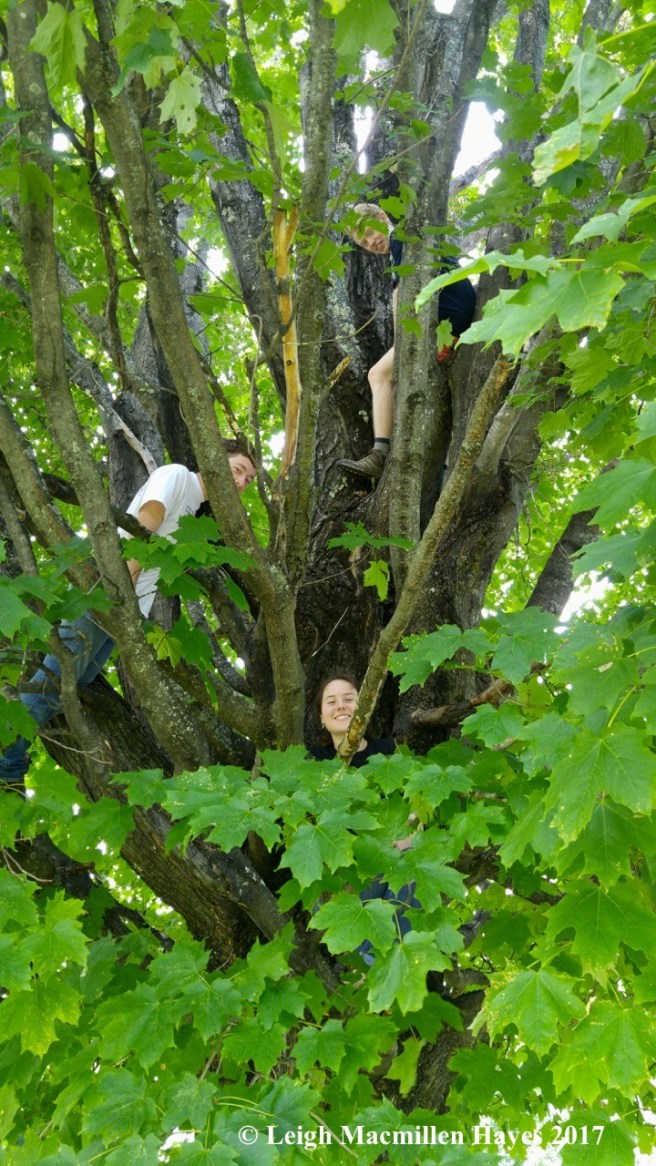
I can only hope that some day in the future when I least expect it, I’ll hear my name being whispered in the breeze . . . and I’ll recognize the voices and look up to see the triplets.

If our future is in their hands, we are in the best of hands in the land.

I want to end by sharing a poem written by Hannah. And I should add that writing and reciting poetry was another talent we discovered they have for we host a poetry workshop each summer followed by an open mic night of sharing and once again, their voices were powerful.

One who walks the woods often

Has learned silence is power

Silence allows for you to see

What lies beneath trees of tall green

Dragonflies of iridescent magic flight

Birds perched and ferns unsearched

One that has been rewarded the gift

after silence

Teaches others the wonders 

of observation

Appreciation for what surrounds us

Nature’s beautiful creations. 

~ Hannah Rousey

Thank you, Hannah, Dakota, and Kelley. As you travel into the future, I hope you’ll remember friendships formed and paths created this summer. I know I certainly will.

Until our paths cross again . . .


B is for . . .

Our original plan was to hike to the summit of Blueberry Mountain in Evans Notch today,  following the White Cairn trail up and Stone House Trail down. But . . . so many were the cars on Stone House Road, that we decided to go with Plan B.

And so up Route 113 I drove, turning left just before crossing from New Hampshire back into Maine.

b-view from Basin

By the parking lot for The Basin, we pulled out our lunch and set up camp temporarily at a picnic table as we enjoyed the view of the manmade pond and Sugarloaf Mountain before us.

b-basin rim

The Basin is a low-elevation glacial cirque carved out of the east side of the Baldface-Royce range. Though we’ve visited the pond on numerous occasions, we’d only hiked the trails circling it once before. And as we recalled while sharing a brain in the memory department, that had been thirteen years ago when our oldest son was in seventh grade. It was a fine September day and we’d headed off to climb the Basin Trail. At first, we couldn’t find the brook crossing, so eventually we made our own. And, what we didn’t realize that day was that at the top of said trail we should have turned around and descended. Instead, in our ignorance, we’d continued on the Basin Rim Trail, assuming they were one in the same. Not so. Hours later, we practically slid down one of the Royce trails, splashed across another brook, bushwhacked to the road and followed it down as quickly as we could to our vehicle. It was late in the afternoon and we knew that our seventh grader was anxiously waiting for us . . . because it was also the very day that he could receive his school-supplied Apple computer if his parents attended an after-school meeting with him. That was pre-cell phone time in our lives and we didn’t have enough change for the one pay phone at the Stow Corner Store, which happened to be closed. We raced home, found he wasn’t there and while my guy went in search of our younger son, I zoomed to the middle school, sweaty, muddy and bloody (from a few encounters with branches and rocks), to find that my sister-in-law who teaches there had stood in as a surrogate until I arrived. Today we carried a map.

b-trail sign

And knew what Rim junction meant.

b-hobblebush1

As the north wind blew, it felt rather autumn like and added to our memory bank, while also the perfect day for a hike. And the hobblebush berries and leaves showed off their almost autumn colors.

b-trillium 1

Berries were abundant–especially upon red trillium,

b-bunchberries

bunchberry,

b-doll's eye 1

and white baneberry (doll’s eyes–can you see why?).

b-following the yellow brick road

The trail was easy at the  start, switching from roots to stones to rocks before climbing. Since we’d attended Lake Region Community Theatre‘s fine performance of The Wizard of Oz last night and the trail blazes were yellow, it felt a bit like we were following the yellow brick road.

b-hermit fall sign

At about the one-mile mark, we chose the Hermit Falls loop.

b-lower hermit falls

Water poured over the lower falls,

b-Hermit Falls

and from there we spied the upper.

b-Hermit Falls 2

Though a couple of fallen trees crossed the waterway, the view and sound were pleasing to our senses. It was at this point that our climb became steeper.

b-bear tree 1

We spend a lot of time looking down when climbing up, but because we were in a beech forest I knew I had to look–for bear claw trees. And I wasn’t disappointed.

b-bear paw 2

Even in the upper trunk we could see the marks left behind.

b-maple division

And then my guy pointed out another tree he thought I should note–it looked rather like a burl gone bad. We don’t know what happened, but the final result was rather gnarly, and still the tree continued to grow and produced leaves.

b1-boulders

Huge boulders littered the woods as we continued our climb.

b-light at the end of the tunnel

Closer to the summit, the trail followed a rather precarious shelf beside the base of a big headwall cliff–I didn’t take time to photograph it for I was focused on each step, but at last we saw the light at the end of the tunnel.

b-summit which way should we go?

Before stepping out to the viewpoint, we walked ahead to the spot where we’d erred thirteen years ago. Today it’s well marked. In fact, this junction includes five options and my guy took the time to point in each direction. Our choice: to return from whence we’d come–behind us.

b1-summit 1 (1)

At last, we turned back to take in the view from the Basin below us to Pleasant Mountain on our far right. We noted a cloud casting its shadow over Blueberry Mountain and trust we would have been blown off had we stuck with Plan A.

b-summit blue bead garden

Though we’d brought containers to pick blueberries, that wasn’t to be. But at the summit we noted a blue of a different hue, a blue-bead lily garden by our feet,

b-summit mountain ash berries

and mountain ash berries maturing above our heads.

b-velvety fairy fan fungi 1

Finally, we started down. After the initial scramble on the rocks and roots just below the summit, I once again turned my attention to the life around me and realized I’d missed this display of fungi on the way up–velvet stalked fairy fan mushrooms (Spathularia velutipes). They actually reminded me of miniature cowboy finger puppets donning oversized hats.

b-bear tree on way down

And . . . another bear claw tree–this one highlighted with a trail blaze. How sweet is that?

Follow the yellow brick road.

b-back on flat ground

At last we were back on flattish ground and made our usual mad dash out.

b1-deer hill bog 4 (1)

As we drove home, I gave my guy a choice–ice cream at the Stow Corner Store or turn onto Deer Hill Road (actually a road of many names) to the bog and then to Evergreen Valley. He said the choice was all mine and so I chose the latter. And as I knew it would because it always does, it made me want to return when I have time on my hands. I will–that is a promise to myself.

b-bull frog 1

Today’s stop included a chorus of bullfrogs–adding to my list of finds beginning with the letter B.

b-bye

As it worked out, we were glad we followed Plan B.

B is for . . . The Basin and the bog and all that we saw in between.

Thanks for stopping by.

Bye bye!


A Generous Wander

When I donated a guided walk to a recent Lakes Environmental Association fundraiser, I was a wee bit nervous. Would anyone bid on it during the silent auction? And who might bid?

Thankfully, Carol notified me right away that she’d been the high bidder and my relief was immediate. I knew we’d have fun and the offer brought in a few bucks for an organization that has been near and dear to my heart for a long time. She chose the date, time and location. Plus she got to invite some friends along for the journey.

b-Kathy's sign 1

The chosen place–one of my favorites–Brownfield Bog. We started at the shack, where I pointed out Kathy McGreavy’s tiled map. Of course, they were wowed.

b-heron

And then we followed a short spur from the parking lot for the first view of the bog and a great blue heron flew up and then settled again.

b-buttonbush

It was there that they first viewed a buttonbush. Or at least that it first made its presence known, for I think that so many things we see often and they blend into the landscape until that moment when our eyes are opened–and our minds as well.

b-color 1

We followed another spur and noticed a sampling of fall foliage along the bog’s edge. In our minds it was swamp maple, aka red maple–or so we thought for a bit.

b-interrupted fern

At a fork in the road, Carol, Marylou and Sara chose the left-hand turn and so we entered the land of the ferns. It was here that they began to familiarize themselves with royal, cinnamon, interrupted and sensitive–noting features in their forms to tell them apart. While we walked, and at times we walked quickly for the mosquitoes were ferocious, it was fun for me to listen as they quizzed themselves.

b-meadowsweet

In a field at the end of the road, the spireas bloomed and we looked at the branching structure of meadowsweet with blossoms slowly opening in dainty clusters.

b-Saco River 2

When we reached Pirate’s Cove along the Saco River, we paused for a bit.

b-alder-leaf buckthorn 1

It was there that Sara spotted a shrub I couldn’t identify until I arrived home and slowed my brain down.

alder-leaf buckthorn2

The leaves were alternate and simple, with deep veins. But it was the color that stopped us–for it was a deep green, almost bronze on some. And we’d missed the flowers, but the fruits were spherical and when Sara opened one, she found three seeds. Turns out it was an alder-leaf buckthorn. And as far as I remember, it was the only one we spotted. But . . . as I said earlier, our minds were open and let’s hope it made an impact and the memory  lingers.

b-yellow loosestrife

We finally left the river area and as we started back on the road, they asked me to name a flower. I knew when I said its name I was wrong, but I couldn’t pull the real name out of the depths of my brain. So here ’tis–yellow loosestrife.

b-raccoon prints

Making our way back to the main road through the bog, we saw handprints in the mud and knew a raccoon had passed before.

b-Pleasant Mountain 2

Back at the intersection, we turned left and journeyed on, noticing all the pickerelweed and water lilies at the lower layer and changes in vegetation leading all the way to Pleasant Mountain.

b-meadow rue

It was along this route that we stopped most often, sometimes for things we knew like meadow rue

b-steeplebush

and the other spirea, steeplebush–these presenting several renditions of the same theme.

b-elm

We spied an elm tree and reminisced about elms of the past.

b-willow gall

And then a few willow galls shaped like pinecones called to us. This was a new one for them and though I couldn’t remember that the creator was a midge larva, the gall struck them as being a fruit, especially as we broke it open. Had we opened one in the winter, we might have seen the maggot nestled within a chamber at the center of the structure. In the spring a female midge fly lays a single egg in a terminal bud, initiating the gall formation through a chemical reaction causing the leaf tissue to harden into the shape of scales.

b-maleberry 1

I got stumped again when we kept seeing fruits on long stalks, with last year’s growth among the offering.

b-maleberry fruits 2

Once at home, I spent some more time with Michael L. Cline’s Shrubs of the Northern New England Forest, and realized it was a maleberry.

b-witherrod1

Another shrub that was plentiful throughout our journey was the witherod, aka wild raisin, its fruit ovoid in shape, turning blue as they withered.

b-swamp milkweed 1

Adding a splash of fuchsia along the way, swamp milkweed with its upright umbels.

b-silver maples 1

And then the other color that we’d noticed along the perimeter of the bog earlier and thought was red maples. Turns out those trees are silver maples and the ones with the wettest feet seemed to have already shut down their sugar production, thus allowing anthocyanin to form. This happens when sugar gets trapped in a leaf after the chlorophyll is gone and the leaf is exposed to sunlight–the resulting color being reds and purples.

b-silver maple 3

As hot as the day was, these presented a taste of the future. Some years they seem to turn earlier than others and this seems like one of the early years.

b-three amigos 1

At last we reached a turn-around point and these three amigos posed for a photo–Sara, Carol and Marylou.

b-picking blueberries

Of course, we only walked a few feet on our way back when high bush blueberries begged to be noticed. And gathered. And eaten.

b-carrion flower

Our journey back was much quicker, but still we stopped occasionally. Again I was stumped when one in the party spotted this vine. Turns out its the vine and fruit of carrion flower–one that I had never heard of before. (You know what that means.) According to Newcomb’s Wildflower Guide, the green flower is ill-smelling, apparently giving rise to its common name.

b-yellow-legged meadowhawk female

Though the mosquitoes were plentiful, more so at the start than the finish, we didn’t see too many dragonflies and I’m not sure why. But this female yellow-legged meadowhawk did pause briefly.

b-checking out the map

Back by my truck, we stopped again. While Sara went in search of the white and red oak trees and their different leaves, Carol and Marylou studied Kathy’s map as they figured where we’d traveled.

It was a glorious adventure–for me anyway. A casual ramble filled with good cheer and conversation. Thank you, Carol Nugent, for your generosity in support of LEA to make this wander possible. I hope the three of you enjoyed our time together as much as I did and took some of Brownfield Bog home in your hearts.

Lichen Everything We See

The Tuesday morning Greater Lovell Land Trust docent tramps don’t typically have a theme–we just like to explore a property together to see what it has to offer and learn from each other. But this morning I tried to invoke one–lichens–since we recently had Maine Master Naturalist Jeff Pengel present a talk on the topic and a few days later he led a walk for us.

w-on the trail (1)

I’m happy to say, we are who we are and within minutes we found ourselves easily distracted.

w-many fruited pelt lichen

We did spot a variety of lichens and talked about their forms and substrates. The youngest among us at age 5 found this pelt lichen growing among the mosses.

w-Wes

In fact, he spotted it just after he’d jumped off what he deemed Jockey Cap, a rock that represented the 600-foot ledge that overlooks neighboring Fryeburg. We welcome his keen eyes and those of his siblings, for they see things we overlook and have a natural curiosity. (Don’t you just want to pinch those cheeks?)

w-green stain fruiting

In fact, his oldest brother was the first to spot this fungi, the turquoise fruiting bodies of green stain fungi that I used to think was a remnant trail blaze. The fruits are minute but the color spectacular.

w-scaly vase chanterelle

And so our eyes began to focus on other fungi, the fruiting bodies of which are a result of all the rain we’ve received. Another great find today–scaly vase chanterelles. Our British docent, who is a fungi aficionado, reminded us, “It’s veys here, but back home I’d say vahz.”

w-ant pupa in heart shape

And then there was the heart that we had to love. One of our group had stumbled by a tree stump and some bark slipped off. Beneath it, the adults in an ant colony quickly went to work, moving their pupa to a safer location and we watched for a few minutes as they worked–the heart slowly losing form.

w-interns and young naturalists 2

All along the way, our interns took time to explain things to the younger set.

w-interns and young naturalists 1

And the younger set took time to practice what they knew,

w-poking a balsam blister

such as the fact that if you pop a balsam blister, the resin will ooze out. And your fingers may stick together. But it will smell like Christmas.

w-docents 1b (1)

It took us almost two hours to walk less than a mile and climb the “eagle nest” overlooking Wilson Wing Moose Pond Bog.

w-docents 3 (1)

A few stayed below and made more discoveries.

w-pipsissewa

We finally reached Horseshoe Pond Road, turned right and slowly made our way back to the kiosk where we’d parked. But still, we stopped periodically and took in the sights, including the pipsissewa in bloom.

w-spider

And a spider that was dangling when first spotted by one, but on the dirt road when we all gathered round. Check out the design on its legs.

w-lungwort

After all but one had left, she and I chatted over our brown bag lunches and then ventured across the street to the Bishops Cardinal Reserve in preparation for tomorrow’s  Lovell Rec Summer Camp Nature Hike. We offer two hikes–one for the younger set and another for the older kids, who wish we’d talk less and walk more. We can take a hint and so we do that for them. But still, there are cool things to see. We determined some fine stopping points today for the mammal theme, but the lungwort lichen also called out with its bright green coloration after yesterday’s rain.

w-Horseshoe Pond

Once we’d completed our reconnaissance mission, I decided to stop down the road at the Horseshoe Pond boat launch, ever in search of dragon and damselflies.

w-pickerel weed

It wasn’t warm or sunny enough, so I didn’t spy any of the odonatas.

w-pickerel and hoverfly 2

But I did notice hoverflies nectaring the pickerelweed flowers.

w-green frog

And a young green frog jumped into the water upon my approach. As I stood and looked at it, I heard rustling behind me.

w-snake 8

And in the grass, I spied the creator.

w-snake 9

Notice how thick its body was and the keels or ridges on its scales. Plus the coloration–dark brown to gray with reddish brown and even black splotches.

w-snake 1

It held its head up as if searching for me and I could see a variation of color on its neck.

w-snake 3

And then I moved again while it stayed still–the better to see it with.

w-snake 6

That’s when I realized that what I thought was a six-foot-long snake . . .

w-snake 4

turned into two three-foot-long Northern water snakes. Two? Why? They are known to be solitary. And mating season has since passed.

A few minutes later, a vehicle approached on the road above and slowed down. The driver reached out and grabbed a few blueberries from a high-bush shrub. We exchanged greetings and he told me he was stopping by for his daily dose on his way home from work. I asked if he’d seen the snakes, for I recalled seeing one in the same spot a year ago. As he jumped out of his jeep, he told me he’s caught water snakes in the pond while fishing, but he hadn’t seem them by the boat launch. And then . . . he said he wanted to pick one up and in a flash he did just that, catching one by its tail as the other quickly slithered into the water. I was a bit taken aback but the snake danced with such rhythm and force that he had to let go.

w-snake 11

It dropped into the water where we could admire its colors even more.

w-snake 12

And then it swung around–not necessarily to say hello. We noted a small frog nearby and commented on how still green frogs can be.

w-snake 13

Eventually, the snake moved off, all the while its forked tongue dashing in and out . . .

w-snake 14

and in and out some more as it snacked on insects.

So much for a lichen walk–instead, as always, everything spied on today’s adventure was worth liking.


Brief Retreat at HewnOaks Artist Colony

Brief Retreat

p-pyrola

Stepping out the door,

I immediately spot

the round-leaved pyrola

in bloom

with elongated pistils

arcing below

its petals of white

turned downward,

as if too shy

to share

its inner beauty.

p-mole ridge

Walking across the lawn,

I notice

a sudden change

in the ground

below my feet—

from solid to cushy,

where a raised ridge

about six inches across

snakes through the grass,

the work

of a mole

whose tedious tunneling

through the earth

is hardly ever

recognized as favorable.

p-red and white pines

p-red and white pines 2

Making my way

down the gravel road,

I find myself

in the land

of giant pines—

both red and white,

and so,

I bend my head

into a birder’s pose

to see their crowns—

so tall are they,

with branches and needles

intermingling,

even with

a neighboring hemlock,

as each vies

for the sun’s

life-giving rays.

p-trees kissing 1

Turning to the trees

beside them,

I spy

another white pine;

this one directly

connected to a hemlock,

like kissing cousins,

their trunks

naturally grafted,

providing internal support

as they

figure out

how to share

the space.

p-road

Moving downhill

with intention,

so as not to slip and fall

on the steep incline

and yet wanting

so desperately

to avoid the gnats

that harass my face

in their annoying fashion,

I wish for a breeze.

p-daylilies

p-daylily flower

Spying a splash

of vibrant color,

my attention

suddenly distracted

from the gnats,

I see Daylilies,

the perfect flower

with thee sepals

and three petals,

six stamen,

their anthers

loaded with pollen,

and one pistil

protruding straight out

as she seeks

the offerings of others.

p-meadowsweet 1

p-meadowsweet flowers

p-raindrop reflections

p-ants farming aphids

Rounding a corner

on the road,

I spy a clump

of meadowsweet

standing tall,

its buds

slowly opening

to flowers,

crazy full

of stamens

showing forth

a fireworks display,

and its leaves

holding raindrops

that reflect colors

of the canopy above,

while on one stem

ants farm aphids

in search

of the honeydew

they produce

from sucking

the sugar

out of the plant.

p-sweet-fern patch

p-sweet-fern leaves

Nearing the end

of my journey,

I pause

beside a patch

of sweet-fern,

which isn’t really a fern

for it has a woody stem,

but its presentation

of leaves

appear fernlike,

and I celebrate it

as much

for its look

of curly leaves

extending outward

in every direction,

as for its scent

that tickles my nose

in the most pleasant

of manners.

p-Kezar lake

Standing at last

beside the lake,

I watch dark clouds

flirt with mountains,

and it is here

that I meet

the breeze,

light as can be,

barely ruffling oak leaves

and only slightly swaying

boughs of hemlocks,

while creating

mere ripples

across the water’s surface

that give way

to gentle waves

lapping the tops

of mostly submerged rocks,

just enough

to distract the gnats.

p-HewnOaks 2

p-Hewnoaks

Revering the scene

before me,

I give thanks

for I’ve reached Kezar Lake

at HewnOaks Artist Colony,

where each year

due to

the generosity of others

I get to spend

two hours—

a time to listen

as Judith Steinbergh

shares poetry

in form and sound

and encourages all

to notice,

to hear,

to see,

to be,

and then sends us off

as if

we were world renown writers,

and in those moments,

I am renown

in my own world

as I listen

to my muse

and let thoughts form

first in my head

and then

on paper,

all the while contemplating,

writing and taking photos,

and come away blessed

by the voices

I hear

of the flowers,

and moles,

of the trees,

and ferns,

of the lake,

and this place.

Being.

I am.

It is enough

no matter

how brief.

Thank you,

Judy,

for once again

giving me

the opportunity

to retreat.

Embracing Quiet

If you are like me, you spend too much time racing from one moment to the next during this fleeting season of summer. With that in mind, I chose to slow down today.

m-stump islands

I know of few better places to do that than among the stump islands in the Upper Basin of Moose Pond. It’s been my place since I moved to Maine over thirty years ago.

Once upon a time, this was timberland–albeit prior to impoundment. A log sluiceway was built at the Denmark end in 1792 by Cyrus Ingalls, thus turning pastureland into the Lower Basin, so he could float logs to a nearby mill. In 1824, a more substantial dam was created and the height of that dam was raised by William Haynes in 1872 to create the current impoundment. While the Middle Basin of the nine-mile “pond” may be the largest at over 900 acres, its the 300-plus-acre Upper and Lower Basins that I like best to explore. And because the Upper is right out my summertime back door, I spend the most time there.

m-painted turtle

As I moved slowly, I greeted old friends like this painted turtle and even had the opportunity to pet a snapping turtle, so close to my kayak was it, but I paddled on.

m-newly emerged damsel 2

Actually, I didn’t paddle much once I reached the islands and stumps. Instead, I floated. And noticed. Before my eyes newly emerged damselflies pumped fluid into their bodies and wings, while their shed exuviae sat empty.

A family of three passed by in a canoe and I asked if they wanted to see something cool. When I told them about the damselfly, the father asked what a damselfly was and I told the family about its size and wing formation. They knew about dragons but had never heard of damsels. And didn’t want to stop and look. The mother commented on how magical it all was, but the father was eager to move on. I was sad for the son’s sake. He missed the real magic.

m-emerging damsel 3

Returning to my quiet mode, I found another, waiting as they all do, for the transformation to be completed. Do you see that the wings are not yet clear? I decided my presence was important, for I was keeping predators at bay.

m-orange bluet male

And then . . .

m-orange bluet 3

and then I met a new friend. An orange bluet–this being the male. I wanted to name him the Halloween damsel, but my field guide told me differently.

m-water shield and orange bluets 2

I kept waiting for him to meet her

m-orange bluets on water shield 1

and finally he did–

m-orange bluets mating

completing the wheel of damselfly love.

m-water shield 4

Because of the orange bluets, I also met the watershield flowers in their moment of glory. The flowers are described as being dull purple and inconspicuous. I found them to be various shades from mauve to muted red and lovely in presentation on day one of their life cycle.

According the US Forest Service Website, “On the first day the bud emerges above the water. Sepals and petals open and bend downward. Although stamens and pistils are present in each flower, on the first day of blooming, only the pistils emerge. Stalks of the pistils lengthen and spread outward over the petals. At night, the flower stalk bends and the flowers submerge beneath the water. On the second day, flowers emerge from the water again, but with the pistils retracted. The stamen stalks are lengthened and the anthers open. In this way flowers are cross-pollinated (Osborn and Schneider).

m-water shield old

Hardly dull, certainly unique. Even on day two.

m-newly emerged Hudsonian whiteface

Today, I also met a new dragonfly. And thought that I did it a favor, but I may not have. You see, when we first met, I noticed a web all around this immature Hudsonian whiteface (or so I think it is). With my paddle, I removed the web to free the dragonfly. But, um, it flew off and that’s when I realized it was several hours old and still drying its wings. Do you see how shiny they are? And the exuviae to which it clung prior to my “helping” hand? It’s best to leave nature alone. If it had been caught in the web, then good for the spider.

m-cotton grass 1

Speaking of spiders, I found some cotton grass gone to seed . . .

m-cotton grass with spider 2

and when I moved to photograph it with the sun behind me, I noticed what looked to be a camouflaged crab spider hiding in wait.

m-beaver lodge 1

Among the stumps, I’ve seen numerous beaver lodges over the years and know from the saplings they cut down on our property, that at least a few are active.

m-beaver scent mound 1

Today a recently visited scent mound added to that knowledge. Beavers pull aquatic plants and mud up from the bottom of the pond and create these mounds. They then secrete castoreum from castor glands beneath their tails to mark territory, deter predators, and say, “Hey baby, wanna check out my sticks?”

m-meadowsweet

The island flowers also grabbed my attention, including the fluffy heads of meadowsweet and . . .

m-grasspink orchid

grass-pink orchids now waning.

m-sweet-scented water lily

But . . . besides the dragons and damsels, I really went to see the aquatic flowers, like the sweet-scented water lily,

m-spatterdock

spatterdock,

m-pickerel weed 3

and one of my favs–pickerelweed.

m-pickerel weed

I love it for all its fine hairs and the way the flowers spiral up the stalk.

m-pickerel 2

I also love the coloration with two yellow dots on the upper lip providing a guide to the nectar it offers.

m-white face on leatherleaf 1

While I looked, another white-faced dragonfly, small in stature, kept following me. Finally, it paused on a leatherleaf shrub.

m-spatulate-leaved sundews with flower 2

And I paused beside the spatulate-leaved sundews.

m-spatulate--leaved sundew flower

I was about a week early, but one was in flower, with promises of plenty more to come.

m-pitcher plant 1

As I looked at the sundews, I realized that I’d never seen a pitcher plant in this place. As should happen, I was proven wrong, though I never would have noticed it if it didn’t have such a tall flower since its leaves were hidden by a mass of vegetation.

m-pitcher flower

Damselflies, dragonflies, and carnivorous plants–its an eat or be eaten world out there on the pond.

Bullfrogs bellowed from the edges, green frogs plinked, and fish splashed. I listened to Eastern kingbirds’ wingbeats as they dropped to the water to snatch insects, and red-winged blackbirds delightful conk-la-rees. I startled a great blue heron, the first I’ve seen on the pond all summer, and it flew off. In the midst of all the natural sounds and sights around me, I embraced the quiet on my four-hour paddle/float. And as Robert Frost might say, “That has made all the difference.”


Poking Along On Perky’s Path

Every Greater Lovell Land Trust trail is my favorite in any given moment and so it was that Perky’s Path received that ranking today.

p-beaked hazelnuts 2

I met my friend Pam in the parking lot and immediately our hunt for great finds began. We looked first at the basswood, but it was the shrub next door that heard us utter with delight–a beaked hazelnut showed off its fuzzy horned fruits.

p-hops on hop hornbeam

And then we walked back up the road a wee bit for at the entrance to the parking lot I’d spied a hop hornbeam also loaded–with hops.

p-striped maple sign

At last, we started down the trail, heading south where a self-guided tour begins. A small group of GLLT docents spent the winter months preparing signs for a variety of species along this route. It’s a task that requires choosing a particular trail one summer for the next, determining which species to ID, taking photographs, gathering and writing facts, creating and printing cards, laminating them, attaching them to posts, relocating the species and finally erecting the posts, which will be left in place until Labor Day. That’s a lot of work, so if you have a chance, take the tour. It includes trees, shrubs, flowers, ferns and more.

p-American toad

As we walked, the ground at our feet moved–in hopping fashion. We only saw one American toad, but plenty of frogs.

p-bloated female wood frog 2

All of them sported their camouflage colors, so after the ground moved, we had to focus in order to relocate them once they paused.

p-bloated female wood frog 1

This female wood frog’s robber mask was the only thing that helped us locate her.

p-young wood frog hiding under starflower leaf

You’ll have to use your own focus to find the baby wood frog that hid beneath a decomposing starflower leaf.

p-spring peeper

And another teeny, tiny one–a spring peeper with the X on its back.

p-common brown cup, Peziza varia

Because we were looking down all the time, we began to notice other things, such as the common brown cup fungi which looked rather like a wrinkled ear.

p-black trumpet Craterellus fallax

We also found a few black trumpets,

p-chanterelles 1

chanterelles (I’m leaning toward Cantharellus cibarius but don’t take my word for it–check with the Veitch brothers of White Mountain Mushrooms for positive ID is you are a forager.),

p-caesar's mushroom 1

and a couple of Caesar’s.

p-Indian cucumber 2

Though we found one Indian cucumber root that had been broken, its fruit continued to form.

p-round-leaf pyrola 3

Our hearts throbbed when we recognized that here and there hiding among the herb layer were round-leaved pyrolas.

p-round-leaf pyrola1

Their leaves were nearly round with petioles or stems no longer than the blade.

p-pyrola flowers 2

And their flowers–nodding.

p-pipsissewa flowers 1

Pam had shown me a photo of a pipsissewa that grew on her property and we then found a small patch just off the trail, their jester-hat flowers attracting small insects.

p-up close

What better way to admire those flowers than up closer and personal.

p-Pam's brackenfern hat 1

And then it was time to don a brackenfern cap for the mosquitoes were at times annoying–and biting.

p-Indian pipes 1

As we continued on, we noted that it is Indian pipe season. I asked Pam if she’d ever seen the pink version that occasionally occurs–and then we began to find several nodding heads . . .  all with a tinge of pink.

p-lichen sign

As we neared the platform overlooking the meadow and brook that flows between Heald and Bradley ponds, a sign of a different kind stood before a tree. Rather than focusing on one species, this one described the different formations of lichens.

p-lichen tree

And on the tree behind it–an example of all three, with several types of crustose (crust-like and look to be painted on), foliose (foliage) like the small ribbon lichen that is bright green and ribbony in the upper right hand corner, and fruiticose (think grape branches) of the beard lichens below the ribbon lichen.

p-lungwort 1

Behind that tree–another featuring lungwort lichen.

p-view to the south

For a few moments, we paused at the platform bench–taking in the sights . . .

p-looking north

and sounds as we wondered what may have passed through.

p-steeplebush

We also noted the difference in structure of the spireas, including steeplebush in bloom  . . .

p-meadowsweet 1

and meadowsweet not yet.

p-swamp candle, aka yellow loosestrife

Swamp candles added a tinge of color to the offerings.

p-blue bead lily1

Back on the trail, we were excited to find the porcelain beads of clintonia, one showing the transformation from green to blue.

p-dew drop 1

Dew drops shone white against their dark heart-shaped leaves covered in rain drops.

p-from the bridge

And further on by the primitive bridges that cross below the beaver pond,

p-tall meadow rue

tall meadow rue flowers presented a daytime fireworks display,

p-otter scat

while otter scat decorated a bridge slat.

p-end sign

We continued along, enjoying the offerings and quizzing ourselves on a variety of species, all the time pausing to read the self-guided tour signs. At last we reached the junction with the trail to Flat Hill and found our way back to the parking lot.

Perky’s Path is maybe a mile long, but it took us 3.5 hours to complete the tour as we poked along–rejoicing with each of our finds.

Nervous Nellie Mondate

Usually my guy asks me to recommend a trail for our Monday hikes. But this weekend he had one in mind. Actually, he wanted to conquer it on Saturday, but I put the kabosh on that plan because of predicted thunderstorms that didn’t develop here. We kayaked instead.

And then I was able to postpone it on Sunday because I thought we should do something more palatable for my left knee as I was recovering from a quirk in it due to training (LOL–two runs but plenty of cross-training activities) before participating in the annual Four on the Fourth Road Race. So yesterday, we drove to Bartlett, New Hampshire, and began our journey on the Langdon Trail with the intention of summiting Mount Langdon. But after meeting one couple on their descent and listening to them talk about the views from Mount Parker, we changed our minds mid-hike and climbed to the summit of the latter. It was a fun hike that at first seemed a wee bit boring (did I write that?) as it followed an old logging trail, but eventually the natural communities began to change and we really enjoyed the climb.

Because we often hike in companionable silence, that climb was filled with voices from so many friends who are currently dealing with a variety of difficulties–physically, mentally, emotionally and spiritually. I chatted with them along the way and lifted them on high at the summit–including those who suffer silently. May they all find a moment of peace in their lives.

But, it had to happen eventually and so today dawned. There were no storms on the horizon and after yesterday’s eight-mile climb, my knee felt fine. Darn. I’d run out of excuses. And so this morning I drove us to New Hampshire. At the stoplight in Conway Village, we could see the mountain’s craggy outline contrasted against the blue sky. I wanted to take a photo of a church spire in the foreground and mountain in the back, which seemed apropos for how I was feeling, but a large SUV blocked the total view at the stoplight. We continued on, turning onto the Kancamagus Highway for our trail of choice, for we chose the easy trail. Yeah, right!

c-waterfall 4

Our journey began with some easy hiking through a hemlock grove. I was liking it. We continued upward and at 1.5 miles reached a decision-making spot–turn left onto a loop by the waterfalls or continue straight. I’d read that the waterfall trail could be dangerous and that rescues were sometimes necessary, but agreed to go–stating, of course, that we had the option of backtracking.

c-waterfall 1a

The waterfalls, however, took my breath away–and my fear . . . for the moment.

c-water fall 1

I extended that moment by taking numerous photos in different settings of the same thing.

c-waterfall 2

Up and up we climbed beside them,

c-waterfall 3

and with every step the landscape changed. Watching water flow is like watching the flames in a campfire–each moment a glorious rendition of the same and yet a new statement.

c-wood sorrel

And at the same spot, a surprise–wood sorrel with its delicate candy-stripe petals.

c-waterfall stairs

At last we climbed the staircase to heaven–or at least back to the main trail.

c-ichneumon male

The higher we climbed, the rockier the trail became and so my focus was on the ground under my feet. But . . . a downed tree laden with lichen drew my attention for its beauty. As I looked, I realized something was flying about. In my current damselfly/dragonfly mode, I thought I’d spotted a spread-winged damsel until I took a closer look and realized it was a male ichneumon wasp.

c-ichnueomon wasp female

And in another spot below the downed tree, a female ichneumon, her lower abdomen twisted into a disc. My guy actually came back to watch with me as we saw her body throb–using her antennae, she must have honed in on a horntail wasp grub within the wood. Her intention was to drill and secrete a fluid into the grub and then deposit her eggs, which will eventually hatch and consume the grub. How cool is that?

c-northern bush honeysuckle

The trail became much rockier the further up we climbed. And I continued to look for things I haven’t seen recently, including Northern bush honeysuckle, its flowers still in their yellowish-green hue. Check out its long pistils. She’s a pistil!

c-looking for yellow blazes

A couple of hours later, we reached my moment of fate–when the treeline gave way to open rocks. At first it wasn’t so bad and I thought I could manage it.

c-view from lunch rock

Because the wind was more of an issue in the openness, we decided to find lunch rock before progressing further. The views were breathtaking as we looked toward Kearsarge and even our own Pleasant Mountain.

c-Mount Washington 1

Mount Washington was also part of the backdrop.

c-lichen lunch rock

And right under our butts–I was liken the lichens on lunch rock. I could have spent the rest of the day in their presence. And probably should have.

c-geology folds

But that was not to be. With other travelers on this mountain, we continued the journey from the false summit to the main summit. I tried to be positive as my knees buckled. I knew I wasn’t alone in that feeling as others also commented. But, I tried to stay focused and along the way, I realized I was looking at a fold as I channeled my inner geologist, Denise Bluhm.

c-summit view 1

Hand over hand, we scrambled up.

c-summit view 2

The views were incredible.

c-summit 4

Finding the trail wasn’t always easy and we all let the next know where the yellow blaze might be. Finally, after lots of scrambling, I realized I’d reached my ending point. A mental block flashed in my brain and I could go no further. My guy, however, despite his own fear of heights, wanted to give it a try. While he crawled the last 75 feet to the actual summit, I tucked into the mountain and became a trail guide, telling others where they should go and how to place their feet–like I knew.

c-after the summit

It wasn’t long before he descended–using the crab style that became our means of downward locomotion. We made it back to the treeline by the seat of our pants.

c-luna 1

From there, we were thankful to continue our downward descent. And then, less than a mile from the parking lot, we made a delightful discovery–a luna moth.

c-luna moth1

She seemed to embody our hike–clinging on as best she could. Her wings were a bit ragged and one ribbony tail missing. I too, was a bit ragged from the experience, and later discovered dried blood on my leg from an encounter with a branch. But, I lived. Sadly, she won’t live much longer–her main job to mate and then die.

Despite that, we were thrilled for the sighting. Seeing a luna moth is such a special treat and that fact that we saw it on the Champney Trail of Mount Chocorua even better.

I’ve spent about forty years avoiding that mountain and for good reason. But today, my guy pulled me out of my comfort zone–to a point. My nervous Nellie syndrome was well earned from my mom–Nellie. She, too, however, stepped out of her comfort zone many times and I have her to thank over and over again.


I used to think

c-mayfly 1

I used to think mayflies emerged only in May.

Maybe I’ve seen them in other months, but I’d never really thought about it. Yesterday this mayfly greeted me in the morning. And in the evening, it was still there. So my May-only theory proved to be wrong.

c-mayfly 2

I used to think they had only one adult form.

c-mayfly molt 1

That all changed this morning when I spotted it again. Only, I also spotted something else an inch or two away. An exoskeleton or exuvia? From a mayfly? It certainly looked mayfly-like with the same narrow and segmented body plus long-tail cerci.

c-mayfly beside molt

When I looked more closely, I realized that the exuvia was about half the size of the true adult form. As for that cloudy-winged specimen I’d spied yesterday–it had been a teenager, aka a subimago. I let the wings trick me because I didn’t know better. Though it looked adult-like, it wasn’t sexually mature yet.

Mayflies are unique in that after the nymph emerges from the water as the subimago (that fishermen call a dun) like yesterday’s model, they seek shelter before shedding their skin for the final transformation. How lucky for me that this dun chose our porch screen on which to rest.

c-mayfly size difference

And so, I was gifted a second opportunity to look. It can take a few minutes to two days before a subimago transforms into a clear-winged imago or spinner, though the actual metamorphosis is quick. I wish I’d seen it, but at least I got to see the end result.

c-mayfly mature 1

I’m not sure my friend appreciated it, but I was glad for our opportunity to spend some time up close and personal.

c-mayfly no mouth part

While in an aquatic form for a year or two, it had done plenty of eating. But as an adult, eating became a thing of its past as it had no functional mouth parts.

c-mayfly eyes 1

It did have plenty of eyes, however. The better to find food when immature and later a mate, I suppose.  Like other flies, its two outer eyes were large and compound.  Between them were three simple eyes (ocelli).

c-mayfly clear wings

The two pairs of triangular wings were held upright like a damselfly, rather than flat like a dragonfly. When I compared yesterday’s opague wings with today’s, the clarity of the new wings defined by dark veins seemed an obvious difference and one I’ll need to pay attention to going forth.

c-mayfly aedeagi at base of abdomen

Male or female? That was the question, but only for a moment. Do you see the aedeagi or penis-like appendages at the tip of the abdomen and below the two cerci (tail-like appendages)? Meet Mr. Mayfly.

c-mayfly bird's eye view1

I know that because mayflies emerge in swarms, they can be a nuisance. But this was only one. And our friendship only lasted for a few hours total–though he spent about 24 hours in the same spot. By noontime he had disappeared–of his own efforts I hope . . . heading off to do some courting. His days are numbered, I know, for his main function is to mate and maybe mate again, before he dies.

But today he served another function as he taught me a lesson. My best learning comes from observation . . . and realizing that what I used to think isn’t always accurate.

My thanks to a mayfly.


Orchid-Maine-ia

m-bald eagle 2

I took it as a sign when I first heard and then spotted a bald eagle on a white pine towering over Moose Pond. It seemed apropos that it should serve as a token of good luck, or at least a push out the door to spend some time wandering and wondering. And so I made the instant decision to drive to Holt Pond, where tomorrow I’ll join Ursula Duve and Kathy McGreavy as we lead a guided walk.

p-grasspink2

Our focus will be on orchids, such as the grass pink, which seems such a common name for this blooming beauty.

p-grass pink 1

The magenta flowers or Calopogons I spotted today are a wee bit off the boardwalk in the quaking bog, but even still I could see their showy formation with knobbed hairs on the upper lip. It is thought that the yellow crest on that lip imitates pollen, to attract pollen-seeking bees. But the real deal for orchids is that a collected mass of pollen grains are gathered together in a pollinium or anther lobe and thus deposited onto the bee’s abdomen.

p-rose pogonia 1

Rose pogonias were also blooming abundantly. In a way, their formation is opposite that of the grass-pink, with the fringed lower lip providing an attraction for pollinators.

p-pitcher leaf

Also on display as the water receded a wee bit despite a beaver dam on Muddy River–my favorite carnivorous pitcher plants with their urn-like leaves that serve as pit traps appeared quite robust.

p-pitcher flower

Carnivorous plants are orchid companions as they both prefer the bog habitat, like to fool their pollinators and are otherworldly beautiful. There is one aspect in which they differ–the orchids like to attract insects for pollination and the pitcher plants for nutrients. But first, the pitchers may use the insect as pollinators, thus fooling them into a visitation. Pollinators beware!

p-sundew

Equally seductive are the spatula-leaved sundews visible at the end of the quaking bog boardwalk. Until now, they’d been under water and difficult to see. The scent of sugary liquid on the leaf tips attracts unsuspecting insects who get stuck to the tentacles, which then curl inward and thus digest the nutrients from their prey. Again–beware.

p-trail sign

Orchids and their bog companions weren’t the only thing on view today.

p-painted turtle by Muddy River

When I stepped onto the short boardwalk to the Muddy River intent on hunting for dragonflies, I discovered a painted turtle sunning at the edge.

p-blue dasher 1

And then I found what I’d hoped–blue dashers dashed about, although occasionally one stopped so I could take a better look.

p-bluet love

And familiar bluets canoodled on a stem.

p-variable dancer

I discovered a female variable dancer damselfly on a small twig,

p-ebony jewelwing

a male ebony jewelwing fluttered and paused on red maple leaves,

p-flyby

and slaty blue dragonflies buzzed about Holt Pond in record-breaking speed.

p-slaty skimmer1

Finally, one stopped long enough for me to soak in its gray-blue color.

p-steeplebush

There were other flowers to enjoy as well, including the spirea,

p-swamp rose

swamp rose,

p-cranberry flowers

cranberry,

p-cowwheat

cow-wheat,

p-blue flag iris with hoverfly

and blue flag iris. If you look carefully, you may see a hoverfly following the runway on the left lobe.

p-blueberries ripening

I noticed blueberries beginning to turn blue,

p-cinnamon fern

cinnamon ferns with shriveled fertile fronds,

p-hobblebush leaves turning purple

and a few hobblebush leaves already taking on the fall shade of purple. Uh oh.

p-Holt Pond to the south

The wonders of Holt Pond . . .

p-Holt Pond west

never cease to amaze me.

p-quaking bog boardwalk

I hope that you can venture there yourself and discover your own Orchid-Maine-ia. Who knows what else you might notice along the way.

The Best Laid Plans

The opportunity was golden. Lakes Environmental Association’s Executive Director invited me to tag along with Dr. Rick Van de Poll as he conducted a Comprehensive Ecological Assessment at the Highland Lake Preserve. I couldn’t wait to be in Rick’s presence again, for he’s a walking naturalist encyclopedia. But . . . I’d been late in responding to an e-mail and didn’t know what time to meet him.

And so this morning I went in search. I located his truck parked just off the road at the northern end of the lake. I was certain I’d find him despite the fact that the preserve encompasses 325 acres and doesn’t have any trails.

h-Eastern pondhawk female 1

It does, however, have an old logging road that bisects the property.  At a sunny spot which had once served as a log landing, I realized I wasn’t alone. A female Eastern pondhawk dragonfly graced the airspace. Being a skimmer, she paused frequently so I could take a closer look at her markings and delight in her bright coloration.

h-Eastern Pondhawk 3

While her mate, whom I did not see, is powder blue, she was florescent green with black markings. And the stigmas toward the tip of her wings were pale brown. Did you know that Eastern pondhawks are known to be vicious predators and will even catch dragonflies similar in size–sometimes even other pondhawks? Wow!

h-turtle eggs

Because I spent long moments at the old landing, I noticed a pattern in the sandy substrate and followed it to a snapping turtle egg laying spot. Something, possibly a raccoon had done what they do best–dug up and eaten some of the eggs. My hope is that it didn’t get all of them. But what made me wonder was the location, for this location seemed a distance from the water. How far do snapping turtles travel to lay eggs?

h-hoverfly1

Also along the road, I periodically encountered hoverflies hovering. I’ve watched members of the species in my garden where they feed on nectar and pollen–known as nectaring. Hoverflies mimic the look of bees and wasps, but they don’t sting, which is good news.

h-snapper turtle sunning itself

Ever so slowly, with many pregnant pauses between movement, I made my way to the wetland that flows into the lake. And what should I spy? A snapping turtle sunning itself.

h-beaver lodge

As I listened to the chorus of bullfrogs and red-winged blackbirds, I also noted the beaver lodge. And I heard something in the water, but never determined what it was. Could it have been Rick? Maybe.

h-emerald jewelwing female 2

Following the shoreline, I suddenly found myself in the company of a female ebony jewelwing damselfly. She was absolutely gorgeous with her dark wings topped with white stigmas and green and bronze body.

g-porcupine den

Continuing on, a pile of scat under an old hemlock caught my attention (are you surprised?)–porcupine scat. I looked inside, but no one was home. In fact, it had been a while–maybe since winter that anyone had been in residence.

h-garter snake

At last it was time for me to head out of the preserve because I needed to head to Lovell for today’s start of the nature walk the Greater Lovell Land Trust provides each week for the Recreation Program. I made my way back to the logging road and followed it out. But again, along the way I was forced to pause. First, it was for a garter snake who I suspected was waiting for the sun to shine upon it. The snake never moved and I wondered if the leaves had served as a blanket and provided it a wee bit of warmth overnight.

h-Eastern pondhawk dining

And then I paused again to admire the pondhawk one more time and had the honor of seeing her catch an insect. I couldn’t tell what she was eating, though it looked like a large fly, but she gobbled it quickly.

I never did find Rick–my plans not being the best laid, but despite that I was tickled with my findings and knew it was time well spent. The opportunity was indeed golden.