Wallowing in Wonder

We knew what flowers we’d show off and had a general idea of what birds we’d see when we headed down the trail from the Flat Hill parking lot at the Greater Lovell Land Trust’s Heald and Bradley Ponds Reserve in Lovell early this morning. But from the get-go this turned into one very special hike that filled us all with the wonder of life.

p-silent march

Maybe it was because we headed off on a silent march, the better to take in the cacophony of bird songs. With Linda and Heinrich in the lead, our intention was to make a bee-line to the viewing platform. Linda encouraged everyone to note the flowers along the way–with a promise to stop and celebrate them on the return trip. We’d decided during a pre-hike that we wouldn’t follow the loop trail around Perky’s Path. We wanted this to be a different experience.

p-ph view from bench

The view from the bench was beautiful, but the birding there was only so-so, much to our dismay.
p-ph birding 2

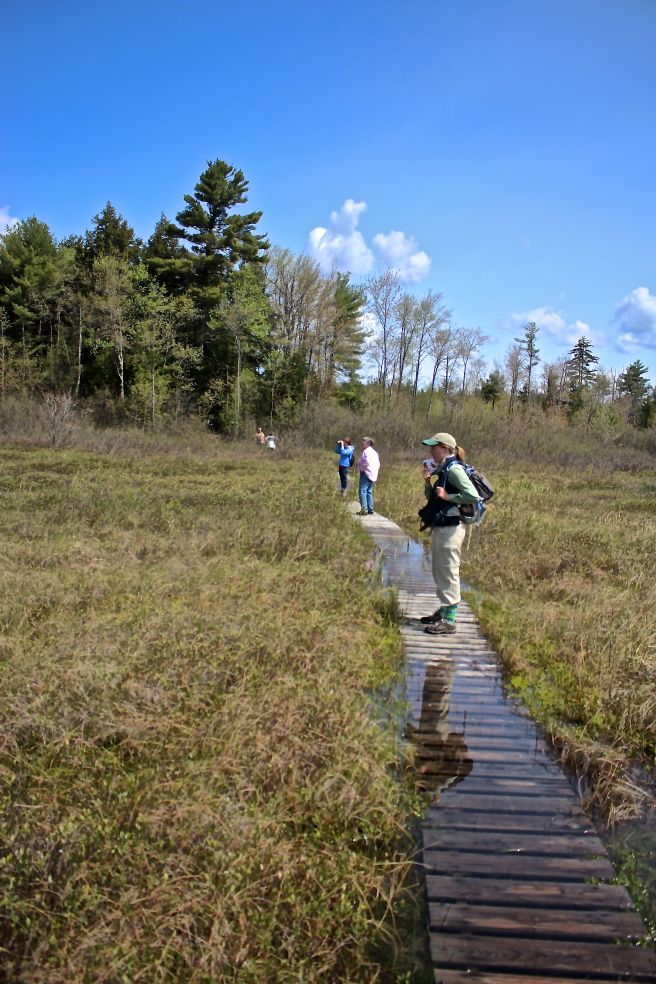
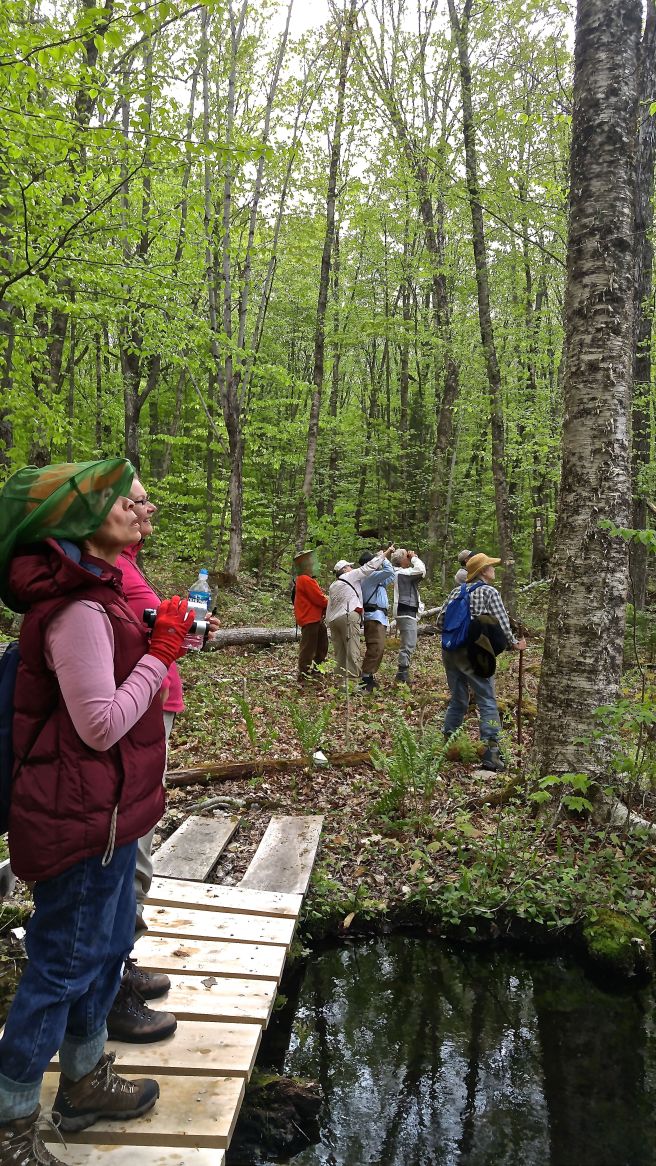
On to the bridge we moseyed. Our one disappointment, we didn’t hear the American bittern that had entertained us with its toilet plunger call during the pre-hike.

p-ph birding1

But that didn’t stop us from raising our binoculars frequently–for red-winged blackbirds, Canada geese, blue jays, several species of woodpeckers, sparrows, warblers, wood ducks, chickadees, a wood thrush and more. We heard the ovenbird and vireos, but never caught sight of them.

p-ph rosy 2

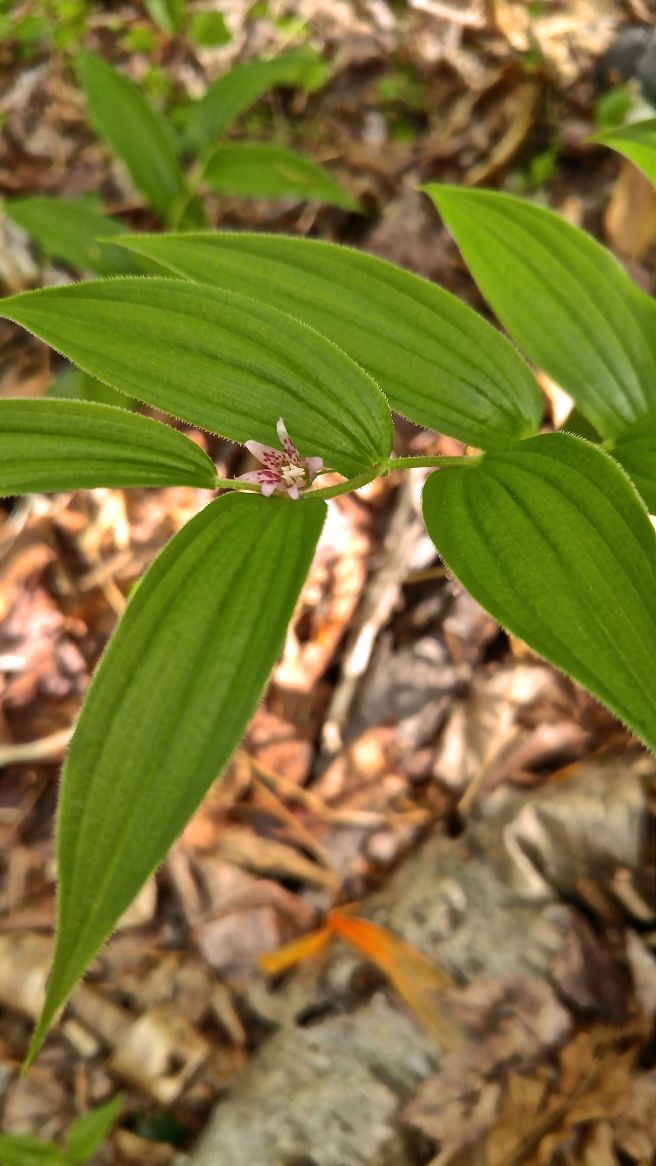
While Heinrich was our birding guide, Linda used the area just beyond the bridge to begin our examination of flowers.
p-ph rosy 1

It was while we were moving in for a closer look at the rosy twisted-stalk, that someone spied what became the center of our attention for the next hour.

p-dragon begin1

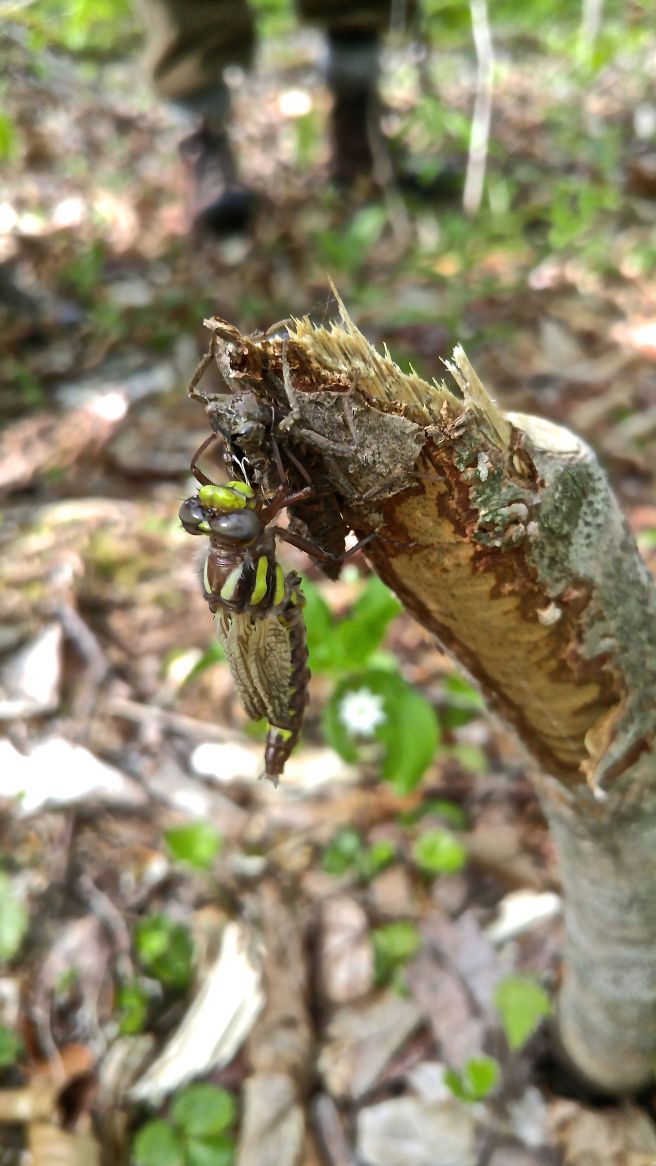
A dragonfly had just split open its exoskeleton and emerged from the nymph stage. Of course, we were standing by a beaver pond, and so it seemed only appropriate that it would use the top of a sapling cut by a beaver.
p-ph dragon middle 4

By pumping air into its body, the adult slowly grew larger.

p-dragon end 1a

As it inflated the wings with blood pressure, they began to extend.

p-ph dragon end7

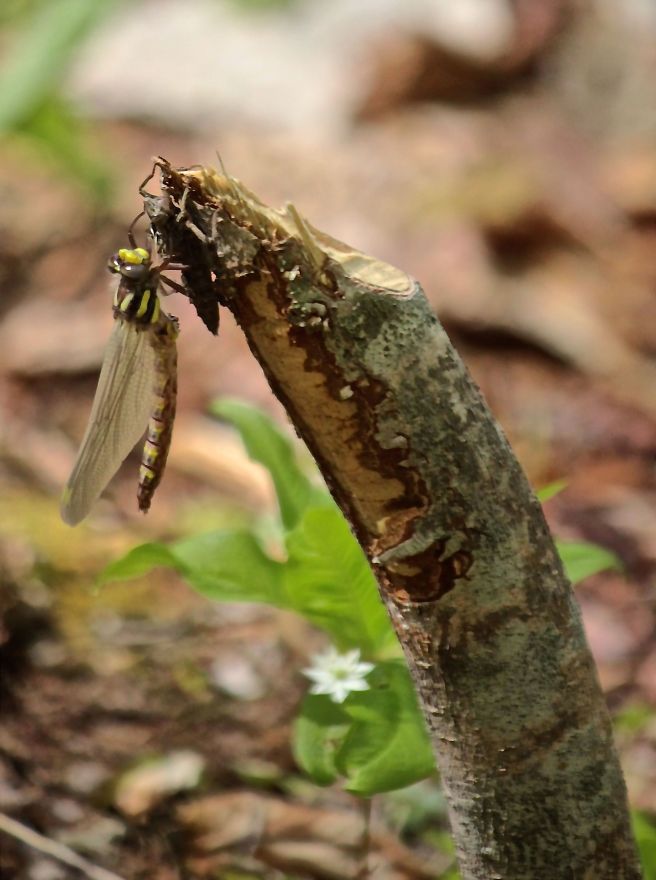
The veinous wings remained folded over its back as we continued to watch.

p-ph early coralroot orchid 2

We were in that one spot for a long time, but when Linda inquired if anyone wanted to start back, all were silent. We did, however, take our eyes off the dragonfly for brief moments. And because of it, we got to know a small area rather well. A few of our discoveries included  the yellow-green, early coral-root orchid, which has no leaves,

p-ph starflower 7

star flowers with their seven petals, seven stamens and sometimes seven leaves, though the latter wasn’t consistent,

p-ph yellow clintonia

and yellow clintonia, aka bluebead lily.

p-ph springtails 1

We also saw hot chili pepper on the leaf litter and . . .

p-spring tails 1

in the water. Springtails galore. Yes, aka snow fleas, but obviously we can see them even when there isn’t snow on the ground.
p-dragon end 1b

As we explored, we continued to keep a watchful eye on our friend. In fact, he became “our” dragonfly. An hour later, the melodic song of a Baltimore oriole pulled us away and we finally started back along the path.

p-cloak 5

We paused frequently to admire the flowers and leaves, but then another flyer slowed us down and became “our” mourning cloak as it settled on a fallen tree and then fluttered amongst us. Happy were we to have shared such moments of awe.
p-ph pack on Amos

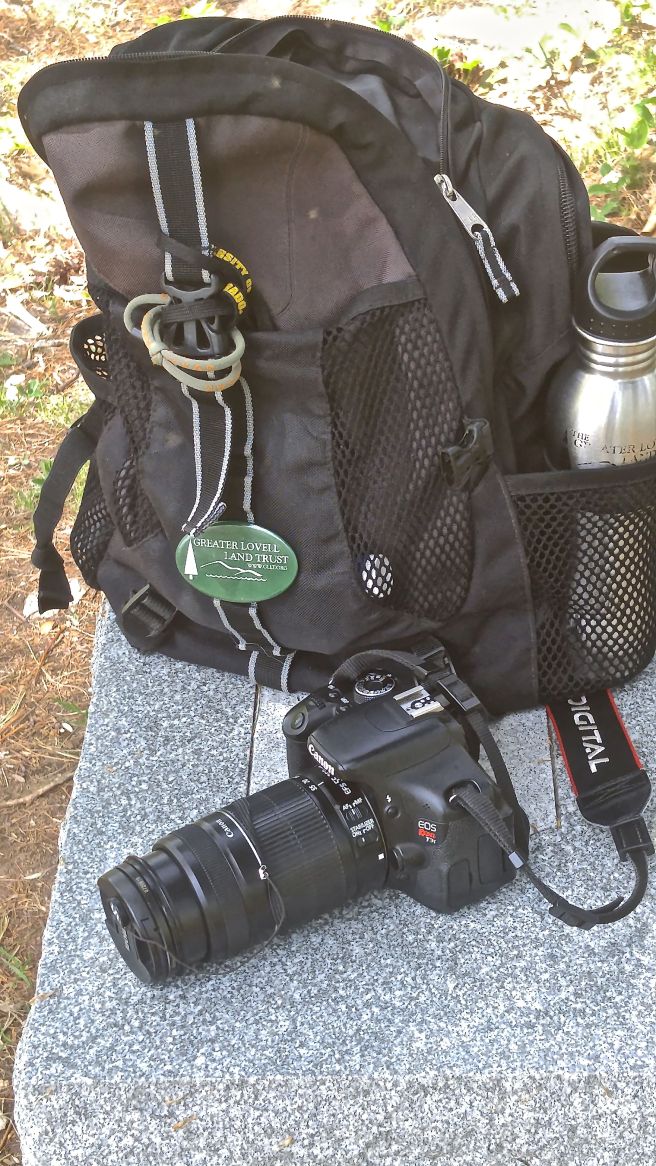
Though our walk had lasted longer than intended, I wasn’t ready to head home, so once everyone left, I turned back and climbed Amos Mountain using the Saddle Trail. It was hot and buggy, but I went for a reason and wasn’t disappointed.
p-amos 1

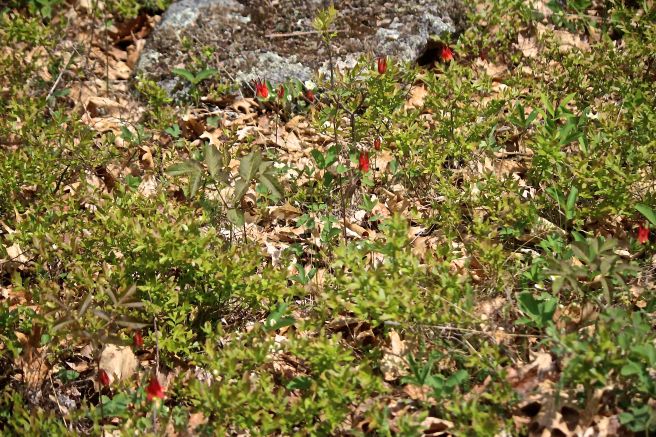
Among the grasses and violets,

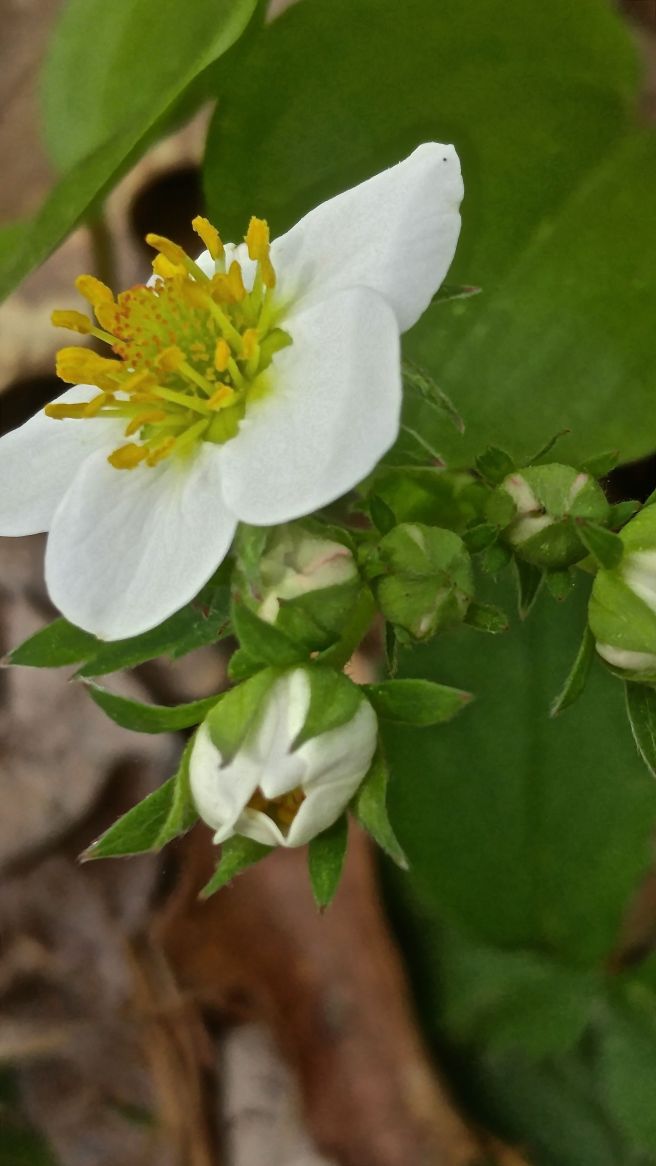
p-ph wild strawberry

the wild strawberries grow. But that’s not all.
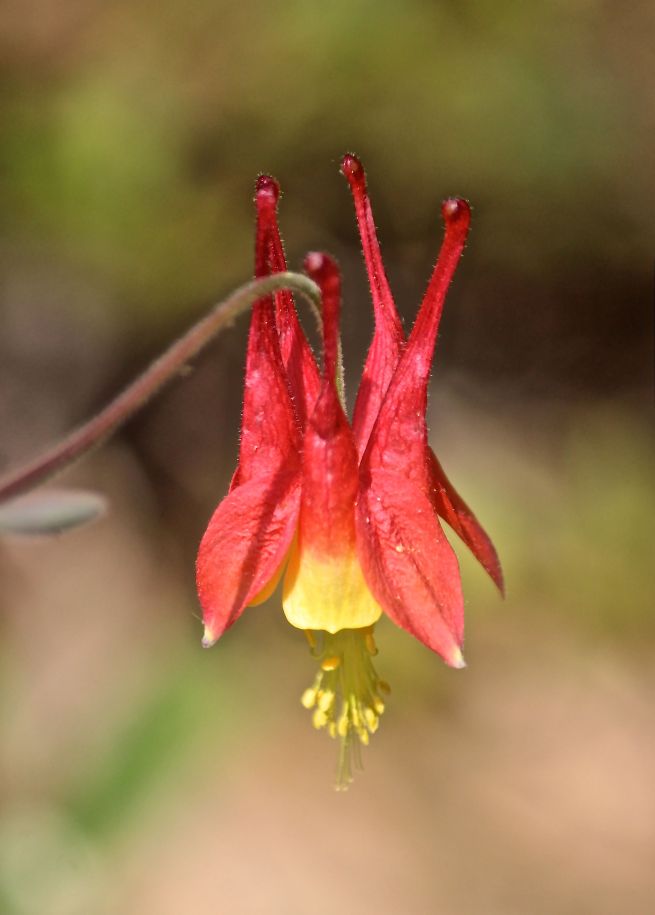
p-ph colum 5

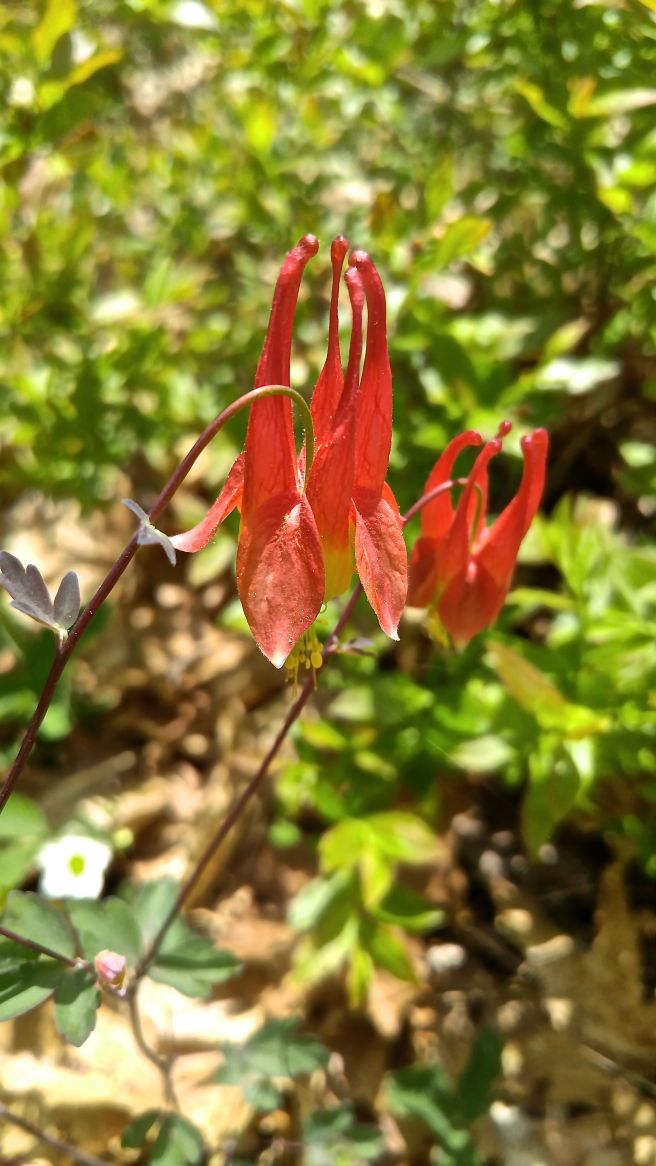
It was the spurred red and yellow flowers of wild columbine that I wanted to see.
p-ph colum 4

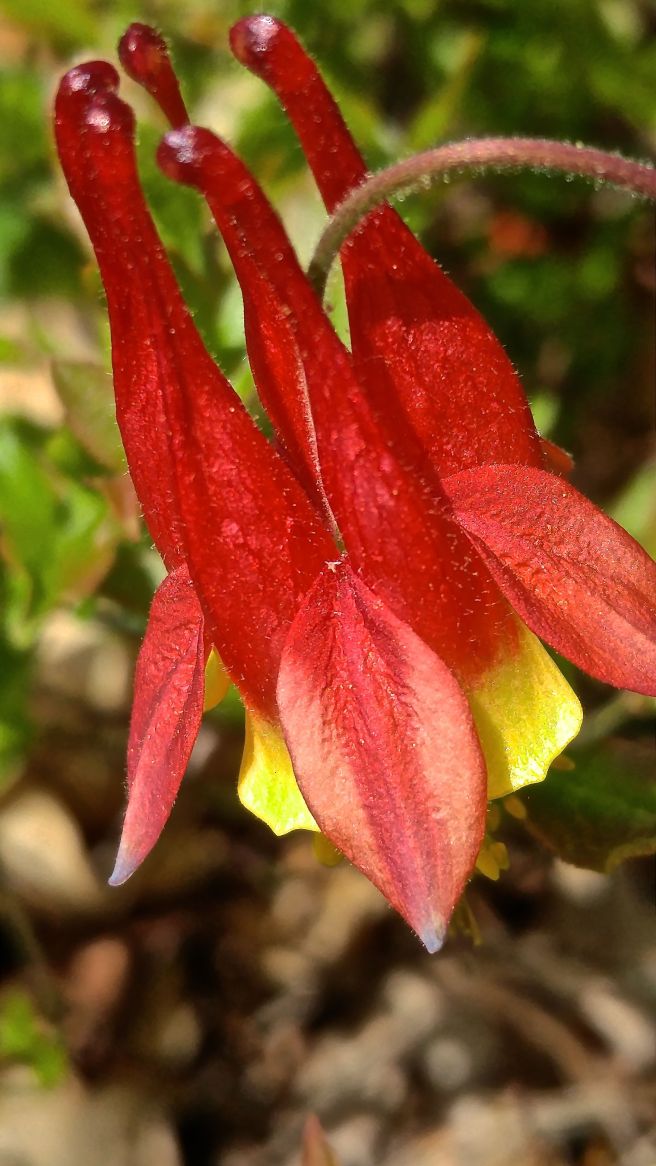
Their heads drooped dramatically.

p-columbine 1

Numerous yellow stamens projected downward and surrounded the green pistils with their long, thin styles, creating the look of an ornate lantern dangling from a post–thus its other common name, little lantern. I really don’t care what it’s called. Spending time in its presence was all that mattered.

The same was true for our dragonfly experience. We wallowed in wonder today and let nature reveal its glory.

Three Times A Charm

One might think that following the same loop through the woods in slow motion three times in one day would be boring. One would be wrong. My friend Joan and I can certainly attest this fact.

Round One: 9 am, Wildflower and Bird Walk with Lakes Environmental Association co-led by birder/naturalist Mary Jewett of LEA and the ever delightful botanist Ursula Duve.

h-hobblebush

In abundance here, the hobblebush bouquet–a snowy-white flower that is actually an inflorescence, or lacy cluster of tiny fertile flowers surrounded by a halo of showy, yet sterile bracts. Yeah, so I’ve showed you this before. And I’ll probably show it again. Each presentation is a wee bit different.

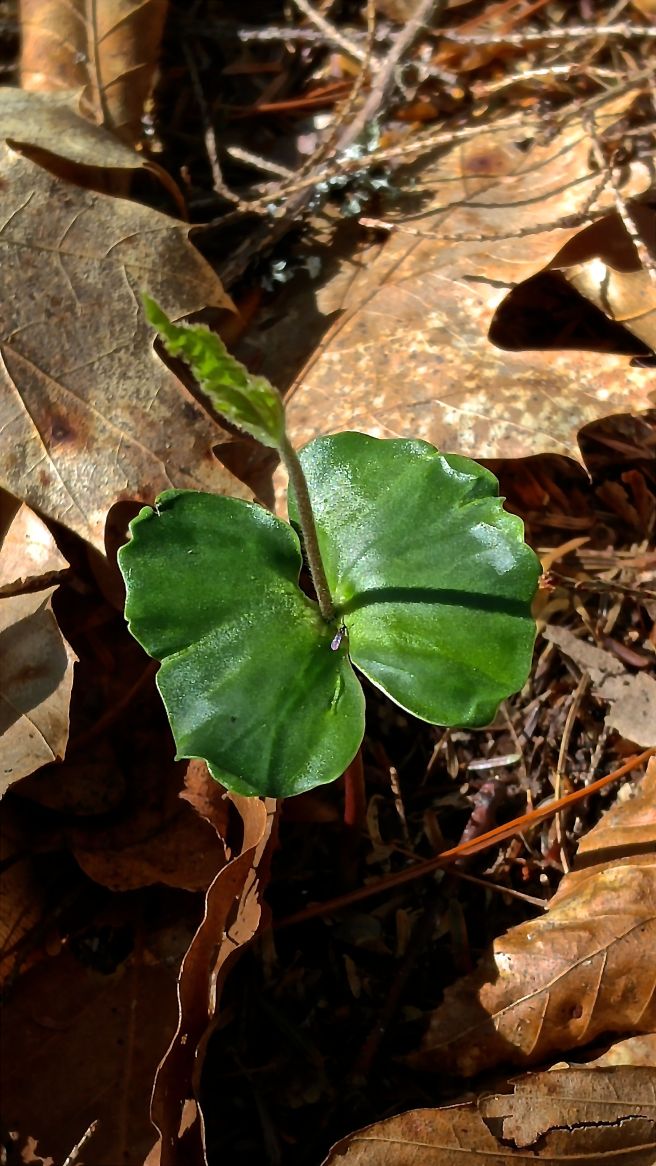
h-beech cotyledon1ph

And then we spied something that I’ve suddenly seen almost every day this week.

h-beech coty 4ph

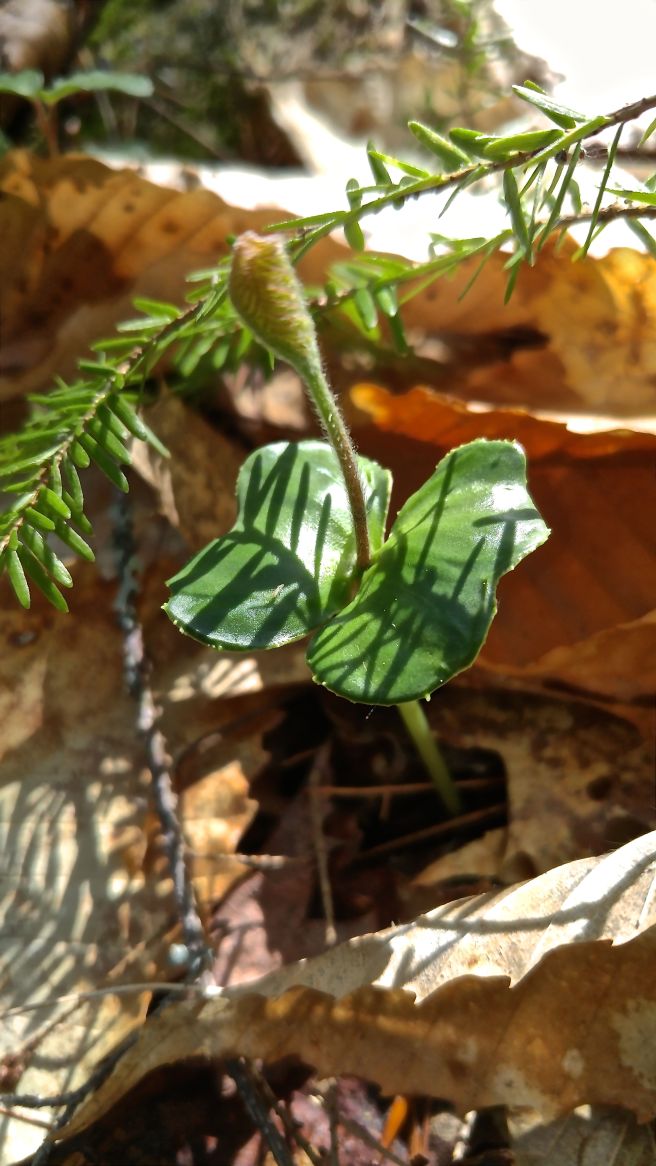
The cotyledon or seed leaf of an American beech. Prior to Monday, I don’t know that I’ve ever seen this and yet, since then I’ve continued to discover them almost every day. Worth a wonder.

h-beech coty 3ph

Think about it. The journey from seed to tree can be a dangerous one as the root is sent down through the leaf litter in search of moisture. Since the root system is shallow, lack of moisture can mean its demise. When conditions are right, a new seedling with a rather strange, yet beautiful appearance surfaces. The seed leaves of the beech, aka cotyledons, are leathery and wavy-margined. They contain stored food and will photosynthesize until the true leaves develop, providing a head start for the tree. I realize now that I’ve seen them all my life in other forms, including maple trees, oak trees and vegetables. But . . . the beech cotyledon captures my sense of wonder right now, especially as it reminds me of a luna moth, which I have yet to see this year.

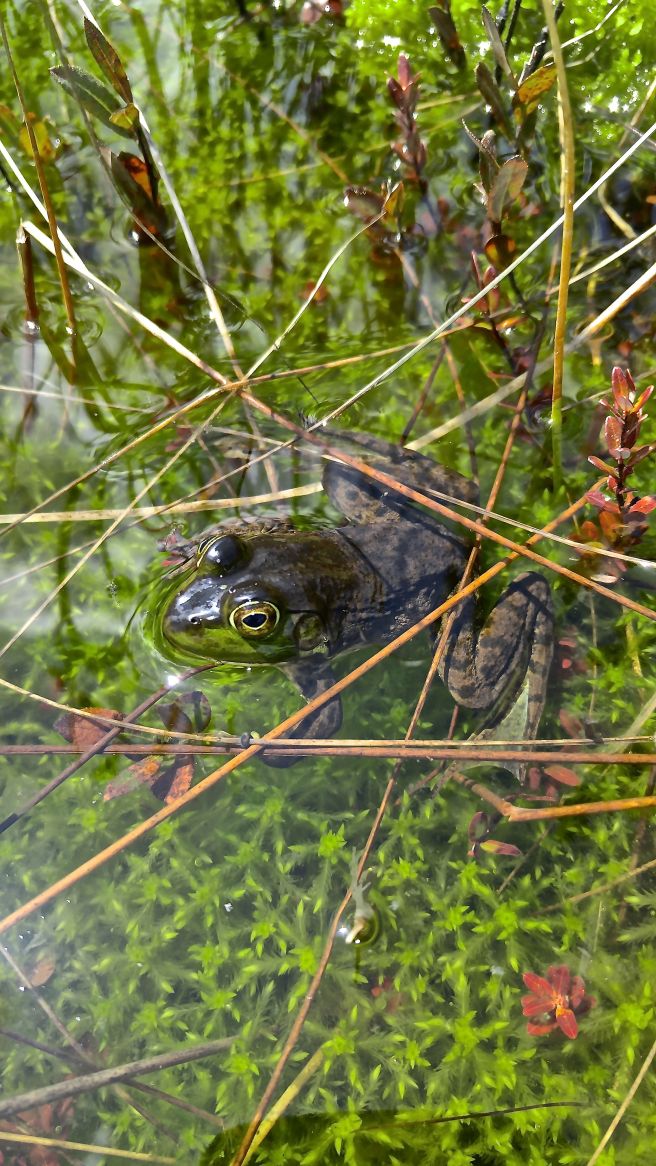
h-green frog 2

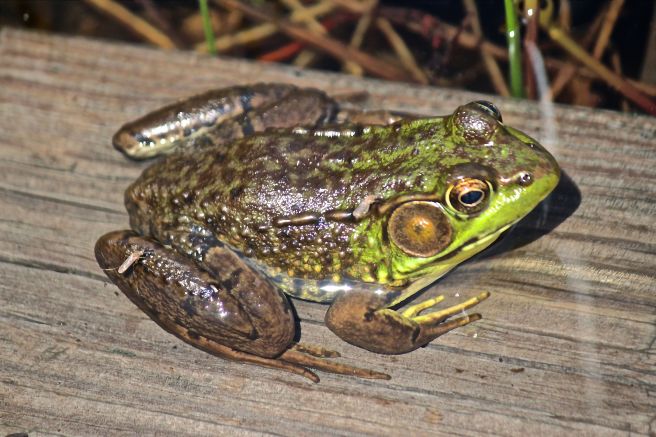
Crossing the first boardwalk through the red maple swamp, a large male green frog tried to hide below us. Notice the large circular formation behind his eye. That’s the tympanum, his visible external ear. A male’s tympanum is much larger than his eye.

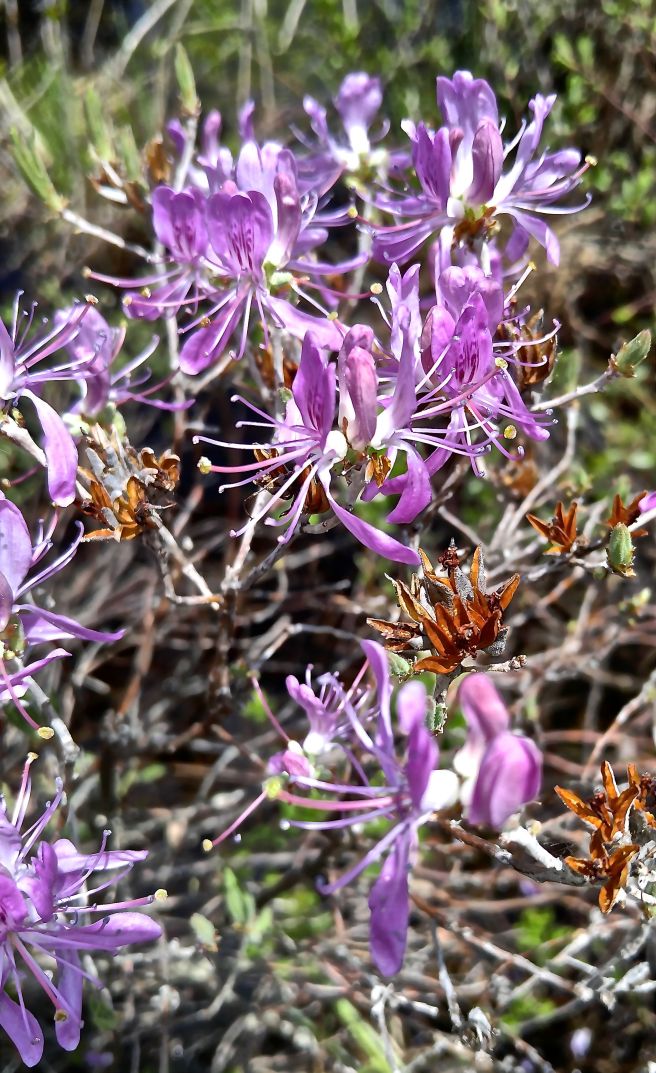
h-rhodora ph1

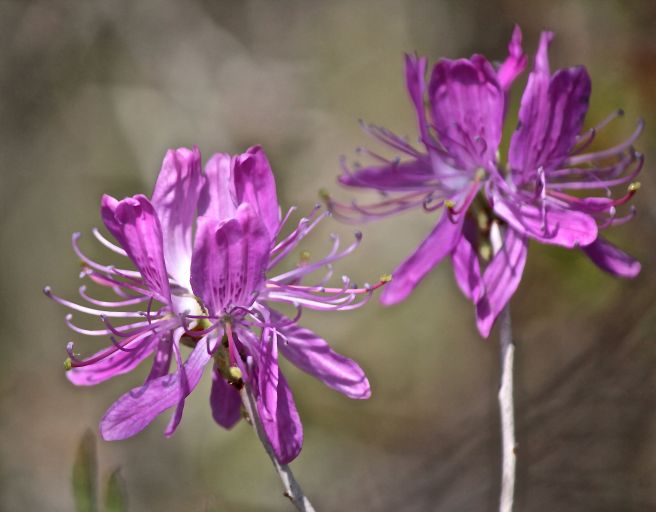
Other red maple swamp displays included the showy flowers of rhodora and their woody capsules.

h-rhodora1

Ralph Waldo Emerson knew the charm of this spring splendor:

The Rhodora

On being asked, whence is the flower.
In May, when sea-winds pierced our solitudes,
I found the fresh Rhodora in the woods,
Spreading its leafless blooms in a damp nook,
To please the desert and the sluggish brook.
The purple petals fallen in the pool
Made the black water with their beauty gay;
Here might the red-bird come his plumes to cool,
And court the flower that cheapens his array.
Rhodora! if the sages ask thee why
This charm is wasted on the earth and sky,
Tell them, dear, that, if eyes were made for seeing,
Then beauty is its own excuse for Being;
Why thou wert there, O rival of the rose!
I never thought to ask; I never knew;
But in my simple ignorance suppose
The self-same power that brought me there, brought you.

h-LEA group

To avoid getting our feet too wet, we spread out as we walked on the boardwalk through the quaking bog.

h-five morning

Morning light highlighted the layers from the pond and sphagnum pond up to Five Fields Farm and Bear Trap above.

h-trill 1

And because it was ever present, I couldn’t resist pausing to admire the painted trillium once again (don’t tell my guy).

h-dwarf ginseng1ph

One plant that I will always associate with this place and Ursula, who first introduced me to it years ago, is the dwarf ginseng. I love its global spray of flowers and compound leaves. But maybe what I love most is its beauty in diminutive form–just like Ursula.

Round Two: Noon, Lunch and a walk with my dear friend Joan.

h-bigtooth aspen

After returning to our vehicles following the morning walk, Joan and I grabbed our lunches. And I paused in the parking lot to enjoy the silvery fuzziness of big tooth aspen leaves. The quaking aspen in our yard leafed out a couple of weeks ago, but big tooth aspen leaves are just emerging. Like others, they begin life with a hairy approach–perhaps as a protective coating while they get a start on life?

h-muddy riverlunch

We ate lunch beside Muddy River where the spring colors were reflected in the water.

h-blueberries 1ph

And then we heard something jump in the water, so we moved silently like foxes as we tried to position ourselves and gain a better view. In the back of our minds, or perhaps the front, we wanted to see a turtle, beaver or especially an otter. Not to be. But we did see highbush blueberries in flower.

h-bee 1

And the bees that pollinate them.

h-pitcher 5ph

In their out-of-this universe form, we knelt down to honor the pitcher plant blossoms that grow along a couple of boardwalks.

h-red maple samaras

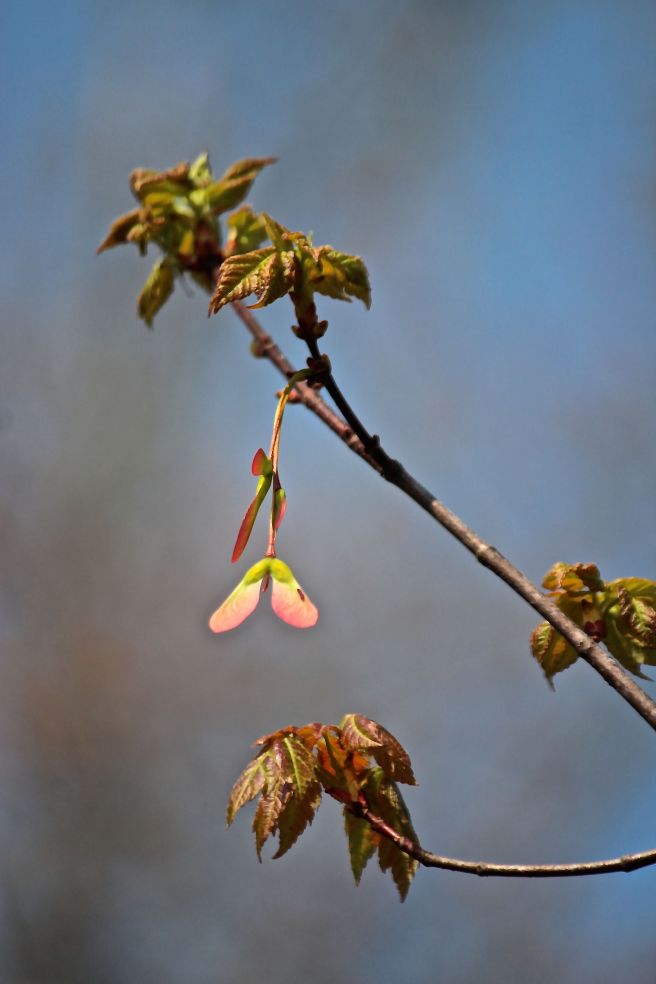
We were wowed by the color of the red maple samaras,

h-red winged

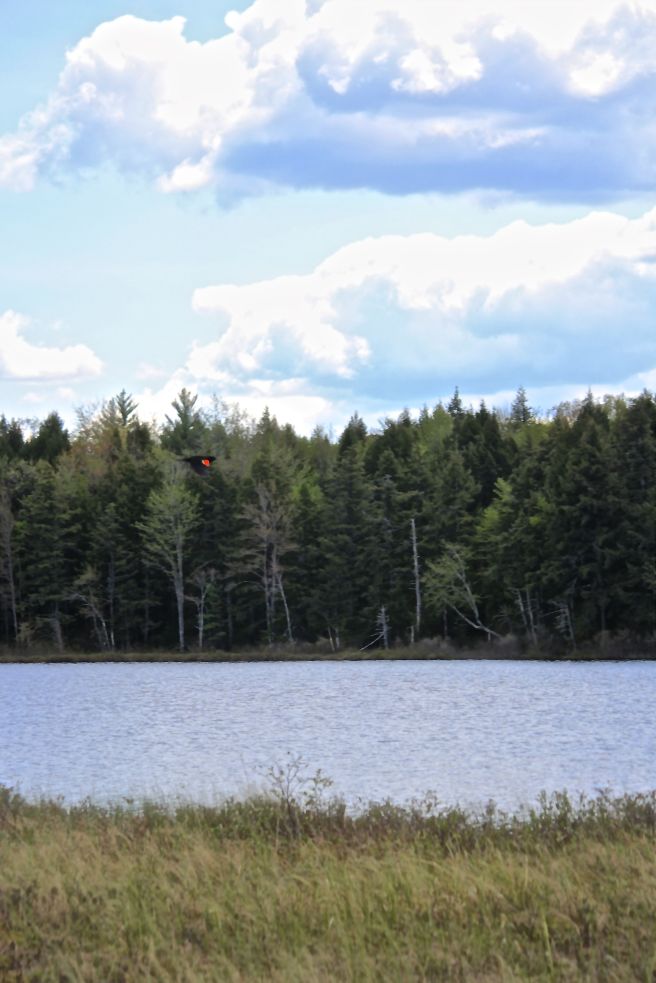
prominent shoulder patch of the red-winged blackbird,

h-cranberries

and cranberries floating on the quaking bog.

h-lone larch

And then our eyes were drawn to the green–of the lone larch or tamarack tree

h-green 9ph

and the green frogs.

h-green 8ph

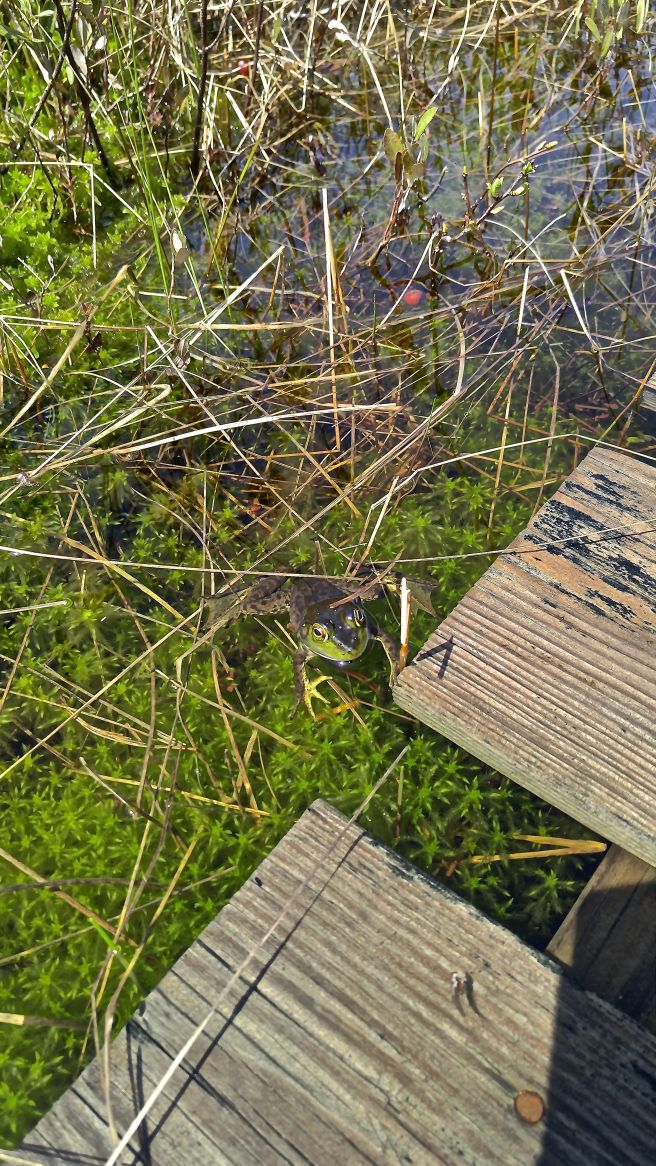
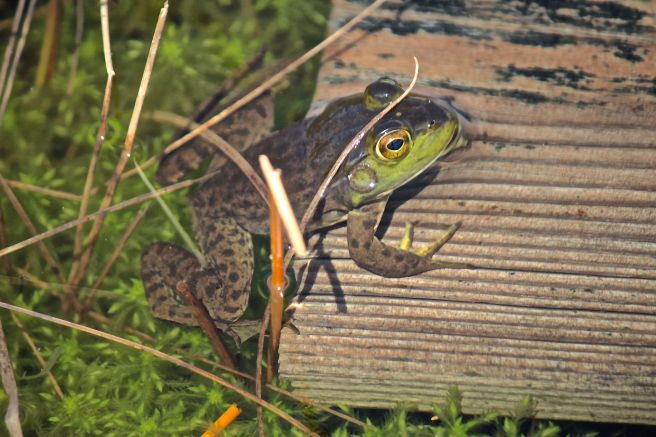
I spent some time getting to know one better.

h-green 3

She even climbed out to accommodate me–I’m sure that’s why she climbed up onto the boardwalk.

h-green 6

Or maybe she knew he was nearby. What a handsome prince.

Round Three: 2:30pm, Joan and I (co-coordinators of the Maine Master Naturalist Bridgton 2016 class) were joined by another MMNP grad, Pam Davis Green, who will lead our June field trip to explore natural communities at Holt Pond.

h-striped maple flower

h-spriped flowers 2

Cascading down from the striped maple leaves, we saw their flowers, which had alluded us on our first two passages.

h-speckled 2

The cottony white masses of wooly alder aphids decorated many of the speckled alders in the preserve. In a symbiotic relationship, ants stroke the aphid with their antennae, while  the aphid releases a drop of honeydew, much like a cow being milked. It’s actually rather creepy.

h-duck

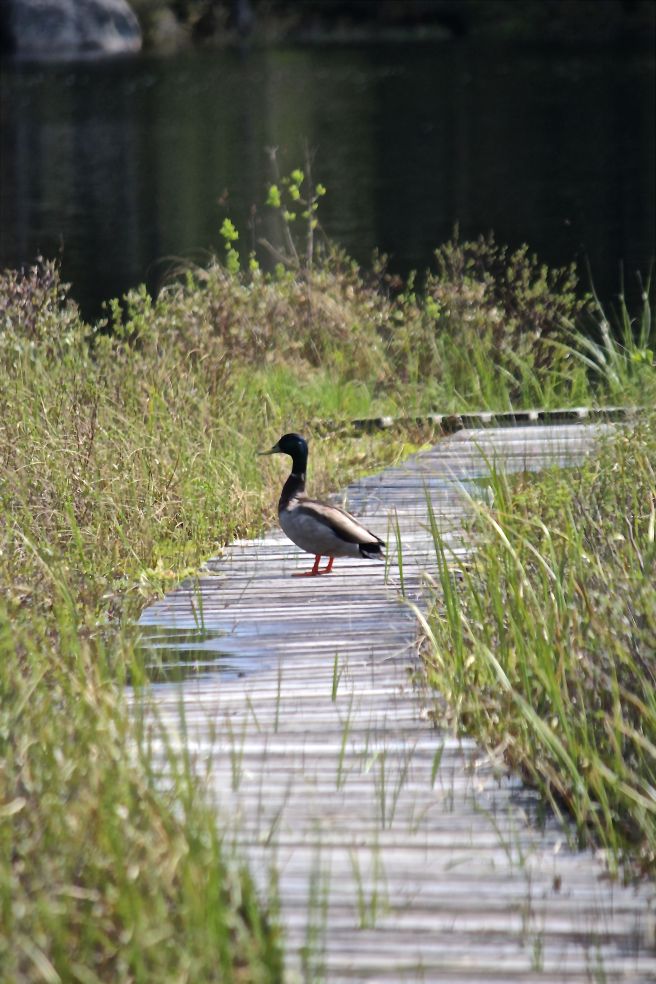
Two Canada Geese squawked from another part of the pond, but Mrs. Mallard stood silently by.

h-tree pants

Our final sight brought a smile to our faces–someone put his or her pants on upside down!

We hope that charms your fancy. Joan and I were certainly charmed by our three loops around and those we got to share the trail with today.

We also want to thank Ursula, Mary and Pam for their sharings. And we send good vibes and lots of prayers to my neighbor, Ky, and Pam’s brother-in-law.       

 

 

On the Edge

I’ve been blessed with amazing opportunities. From writing and editing projects to nature education, I get to meet and learn from a variety of people. Yesterday, I spent two hours with a couple who live off-the-grid on a farm in Stow and rent greenhouse and farm stand space in Lovell. Though we’d met only briefly at an owl presentation this winter, I immediately felt like I was among old friends. My task today was to turn our interview into an article.

Writing is a process that I embrace. I work best when the house is quiet. Then it’s pen or pencil to paper, letting the story flow from head and heart to hand.

Once the rough draft is completed and I’ve typed it, I’ll read it aloud and make some changes. But then I need to step away. And that’s what I did this afternoon.

Mt Wash

I didn’t go far. I felt the need to wander along the edge of the power/tree line, where the snow is melting.

blueberry twig

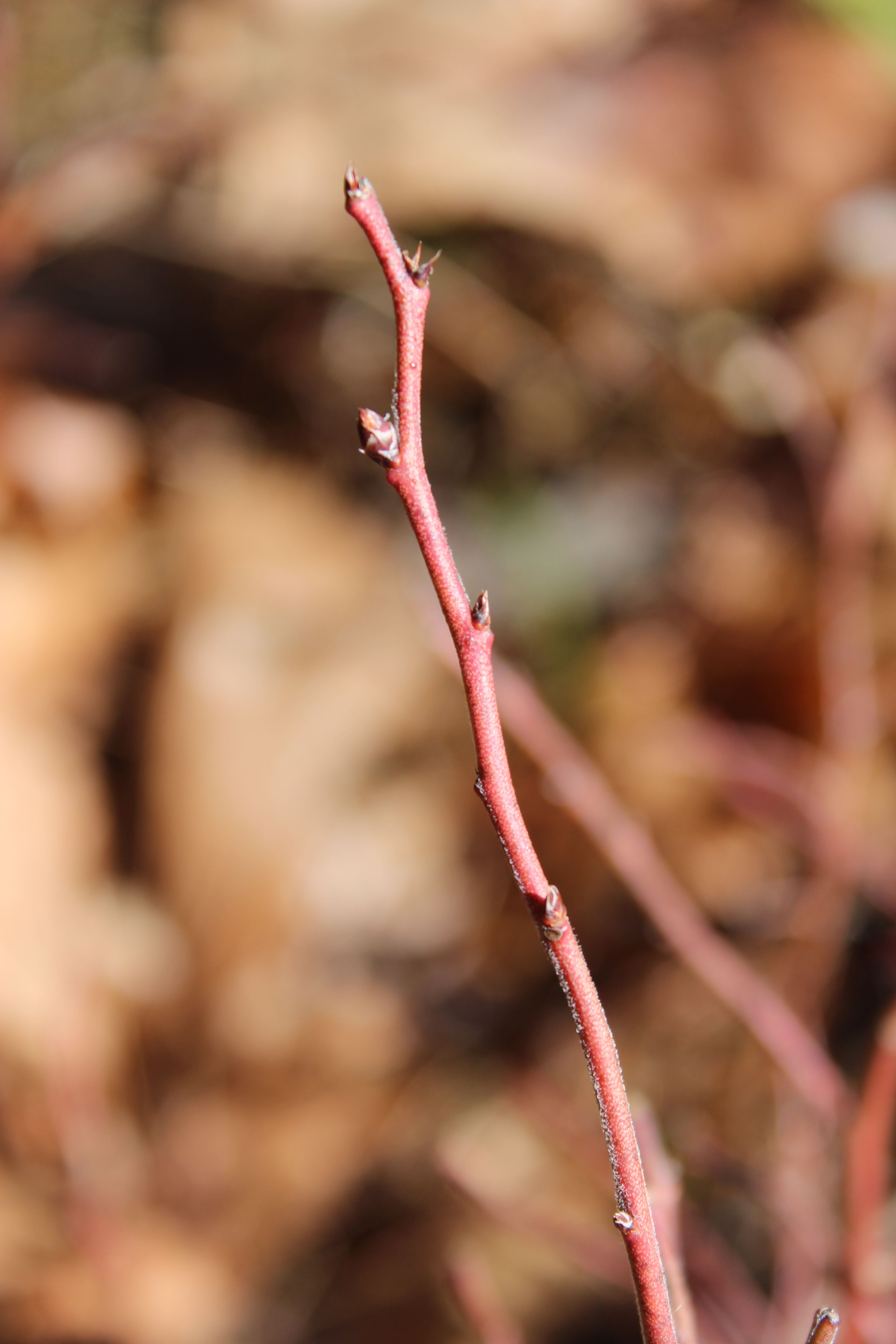
 The color red pulled me in for a closer look. Seems funny that blueberry twigs are red, but then again, I’ve never seen a blue twig . . . and never hope to see one.

teaberry

Still reddish maroon Teaberry or Wintergreen leaves. On summer walks, it’s refreshing to pick a leaf and breath in the wintergreen scent. Though the leaf shouldn’t be swallowed, some like to chew it for the flavor. Or make tea from it.

red maple

I can’t resist the Red Maples. In less than a month they should be flowering.

sketch

After walking along, sinking frequently in the still knee deep snow, I finally settled down. The sun was warm on my back. Every so often a gentle breeze made the hemlock boughs sway daintily above my head as dried leaves rattled on a nearby beech.

Hemlock leaves or needles are each attached to the twig by a hairy stem called a petiole. The needles on a Balsam Fir attach directly to the twig. I love the subtle differences between the two.

I love taking the time to sit and pay attention. To be. On the edge.

Island Hopping

island 1

Off on a care-free holiday in . . . Lovell, Maine. What sets it apart is the variety of islands. And, I suppose, the ferry service between each.

island 2

A naturalist friend and I set off on our grand adventure at the John A. Segur Wildlife Refuge this morning. This is a 598-acre refuge owned and cared for by the Greater Lovell Land Trust. We hopped, more like sloshed on snowshoes, from one island to another as we discovered the highlights of each.

mushroom 1

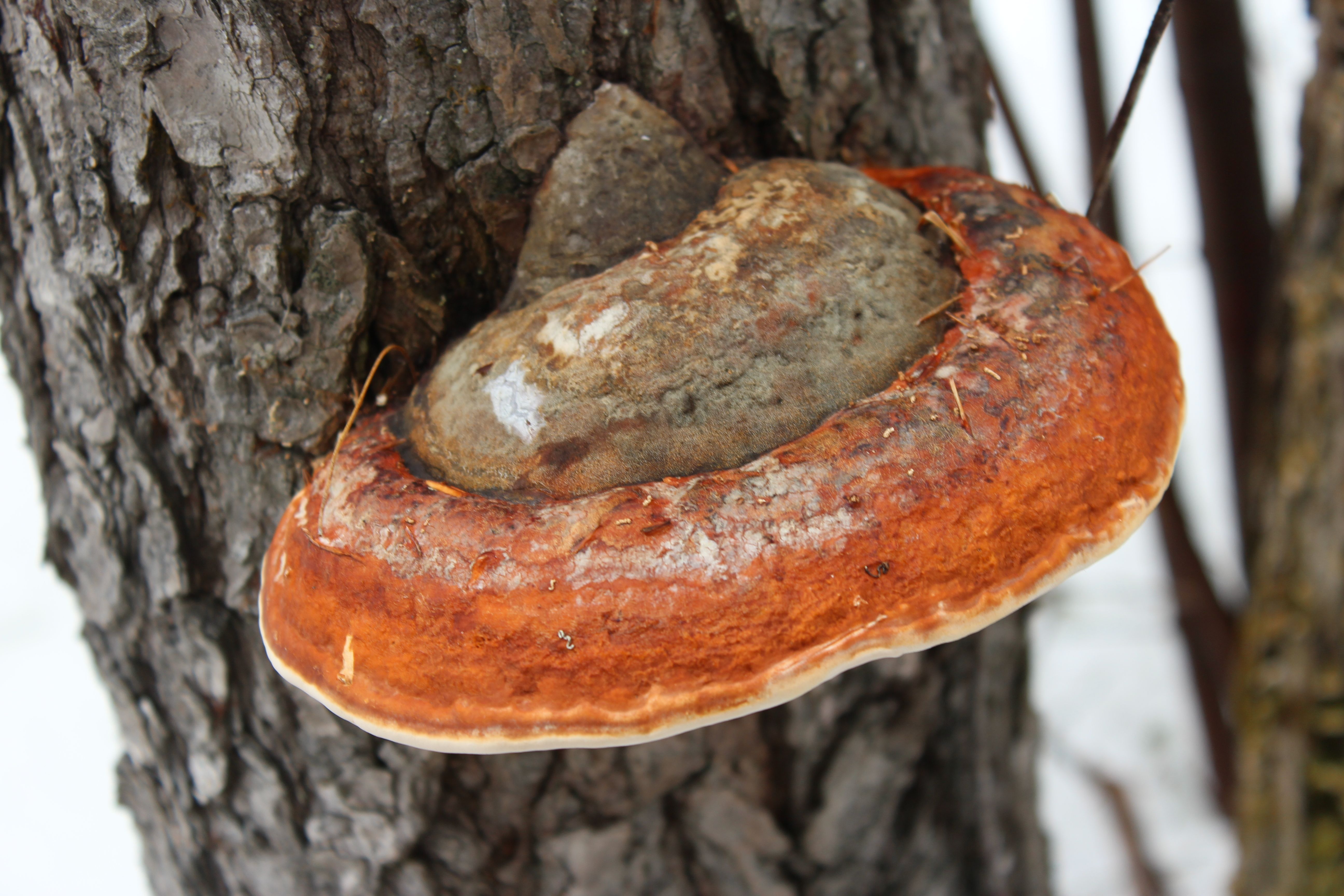
Red-belted Polypore Fomitopsis pinicola

Like on any island hopping experience, we were quite taken with the breathtaking diversity of vibrant colors and textures. This is a red-belted polypore (if I’m right), Fomitopsis pinicola. I have another friend who is determined that I will learn my fungi, so I hope he’ll read this and correct me as I go along. He knows only the Latin names. I’m lucky if I can remember a common name. (Don’t tell Mr. Cretella, my high school Latin teacher.)

turkey tail

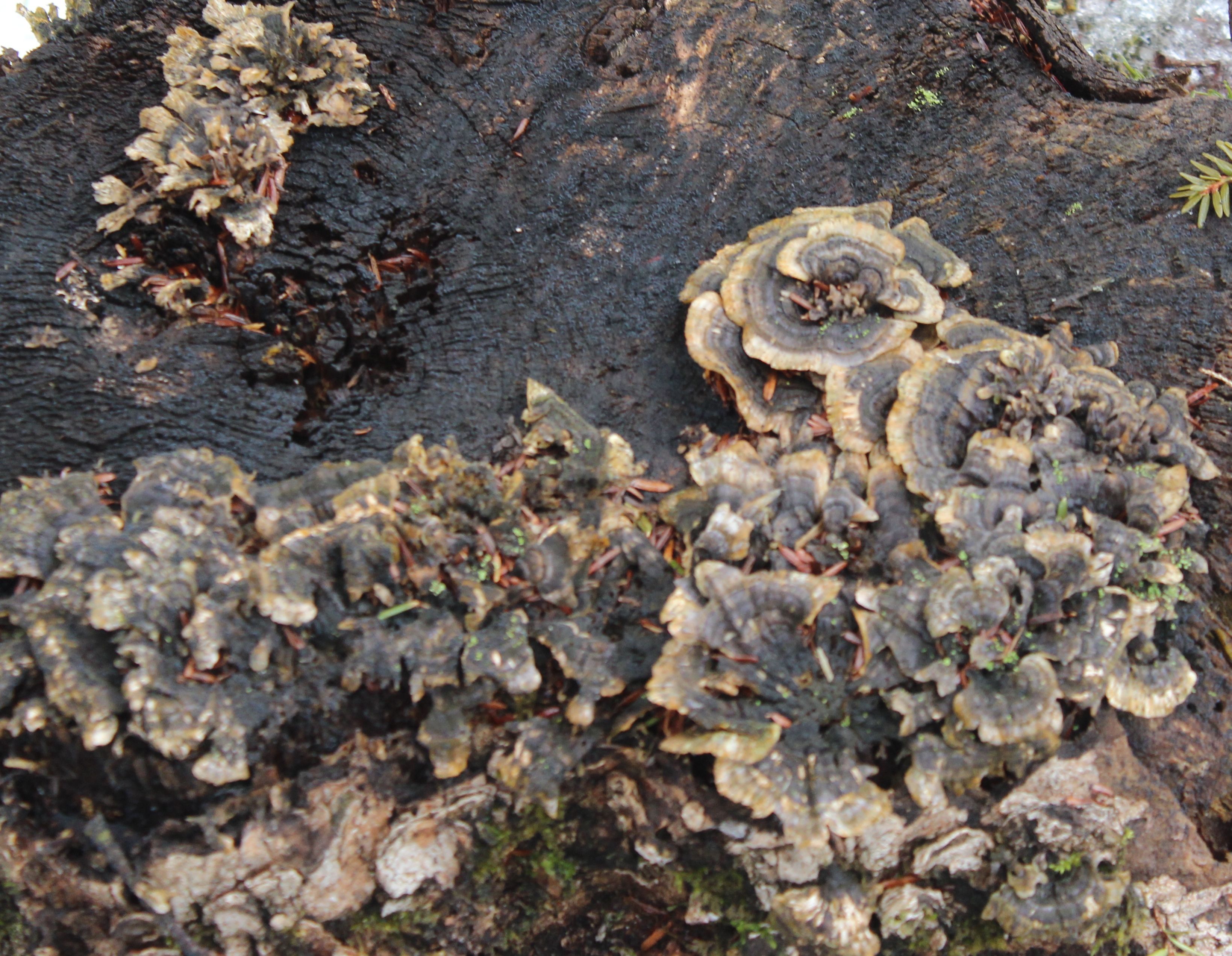
Turkey Tails (Trametes versicolor) were hanging out, doing their thing on some dead wood.

witches butter

More than once we were greeted by Witch’s Butter (Tremella mesenteric). I love butter, so this must be the good witch. (My PB&J sandwiches always include slabs of butter)

birch polypore

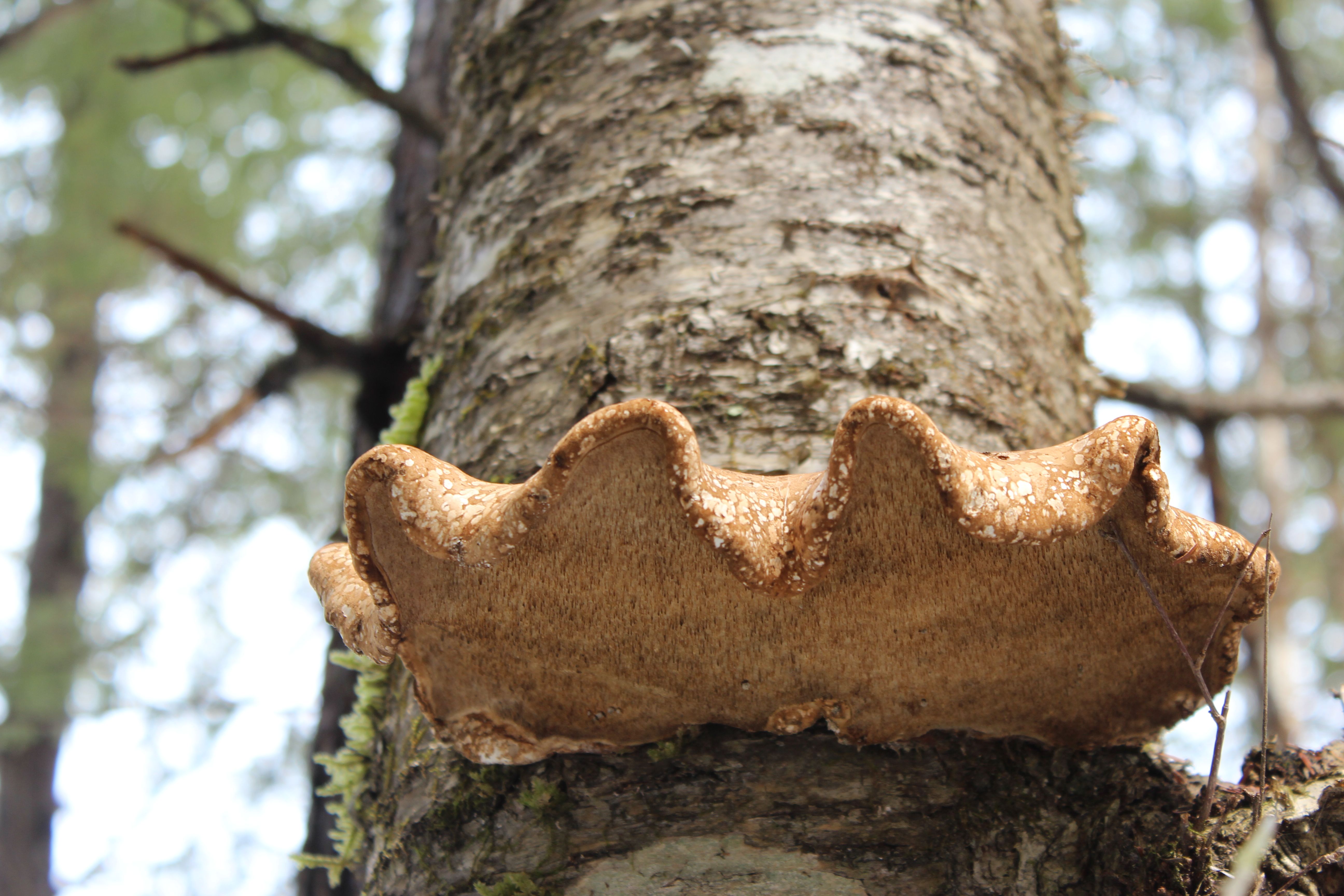
No island tour is complete without seashells. In this case, I think this is a Birch Polypore (Piptoporus betulinus) growing on the Yellow Birch. I’m thrown off by that wavy rim. Whatever it is, it’s beautiful.

British Soldier

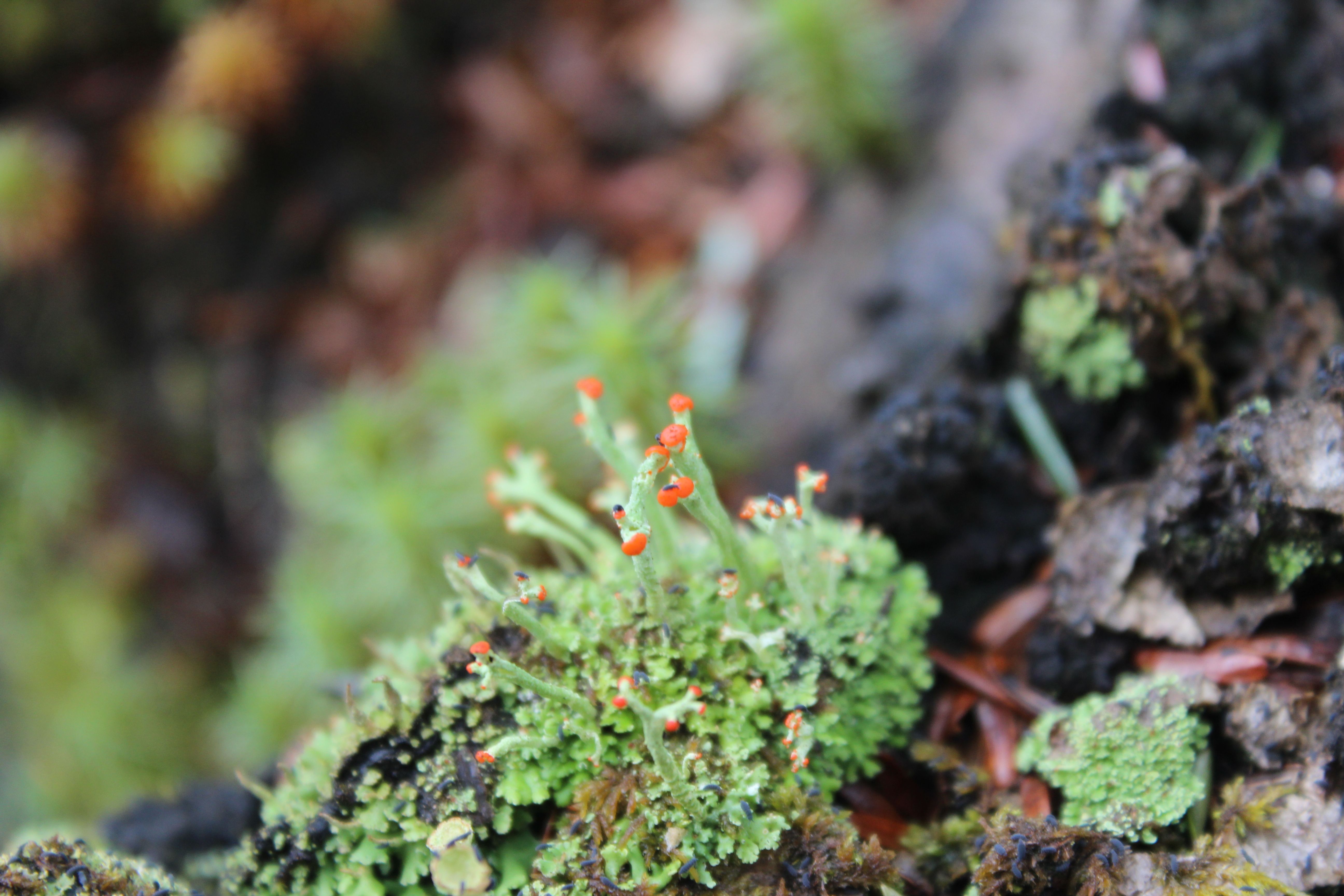
We didn’t just hang out with a bunch of fungi. British soldiers (Cladonia cristatella) were standing around, proudly inviting us to take a look at their red caps.

Kidney lichen

Yes, we took a liken to some other lichens as well. I believe this is Pimpled Kidney Lichen (Nephroma resupinatum).

lungwort

Being in the islands, we are on the cusp of the rainy season and the Lungwort (Lobaria pulmonary), was saturated and bright green. We had hoped we’d see it on this tour, and it didn’t lettuce down.

Mealy Pixie cup lichen

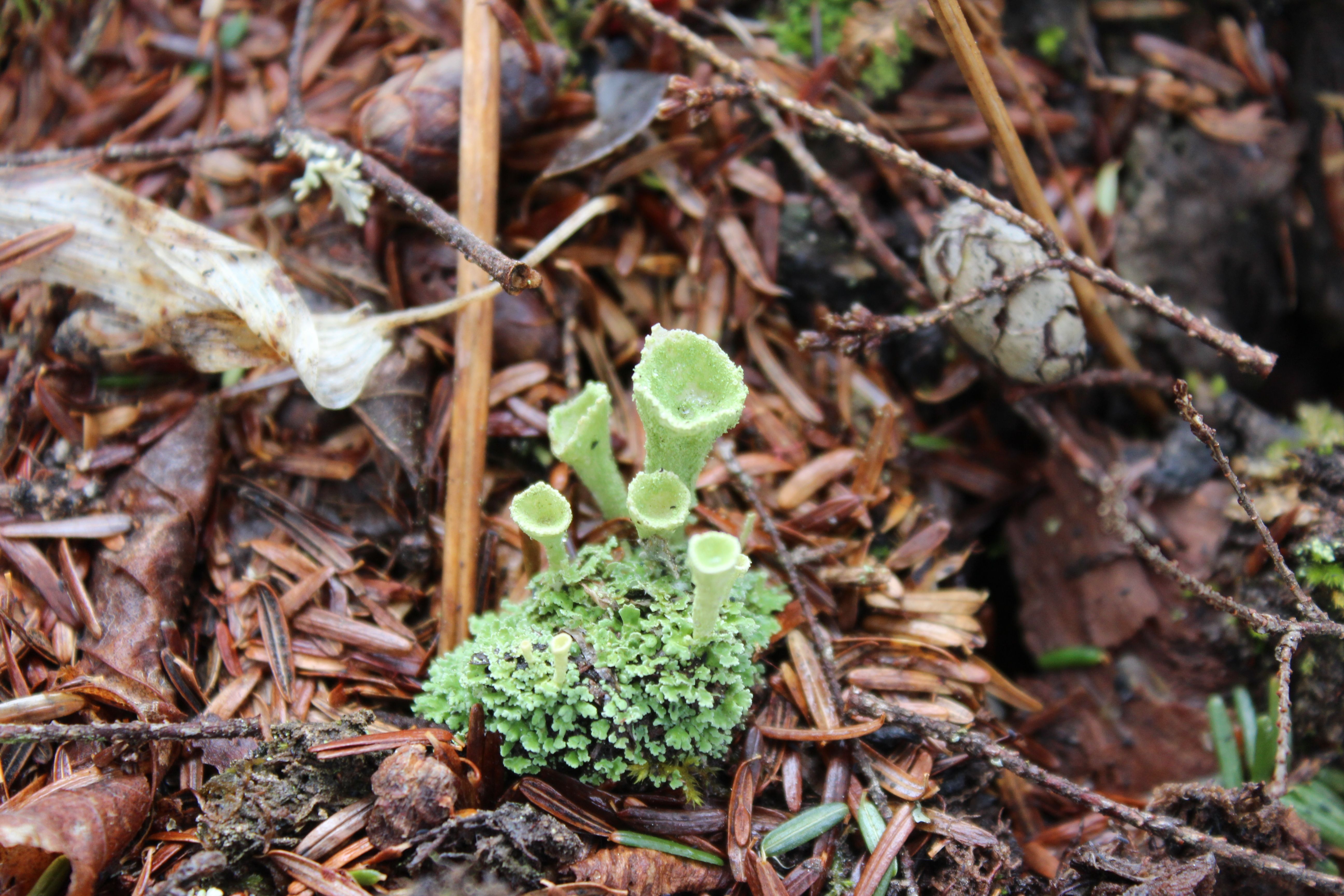
Are you still with me? There were so many more sights to see, including the Green Pyxie Cups, aka Mealy Pyxie Cups (Cladonia chlorophaea).

spore capsule, hair cap moss

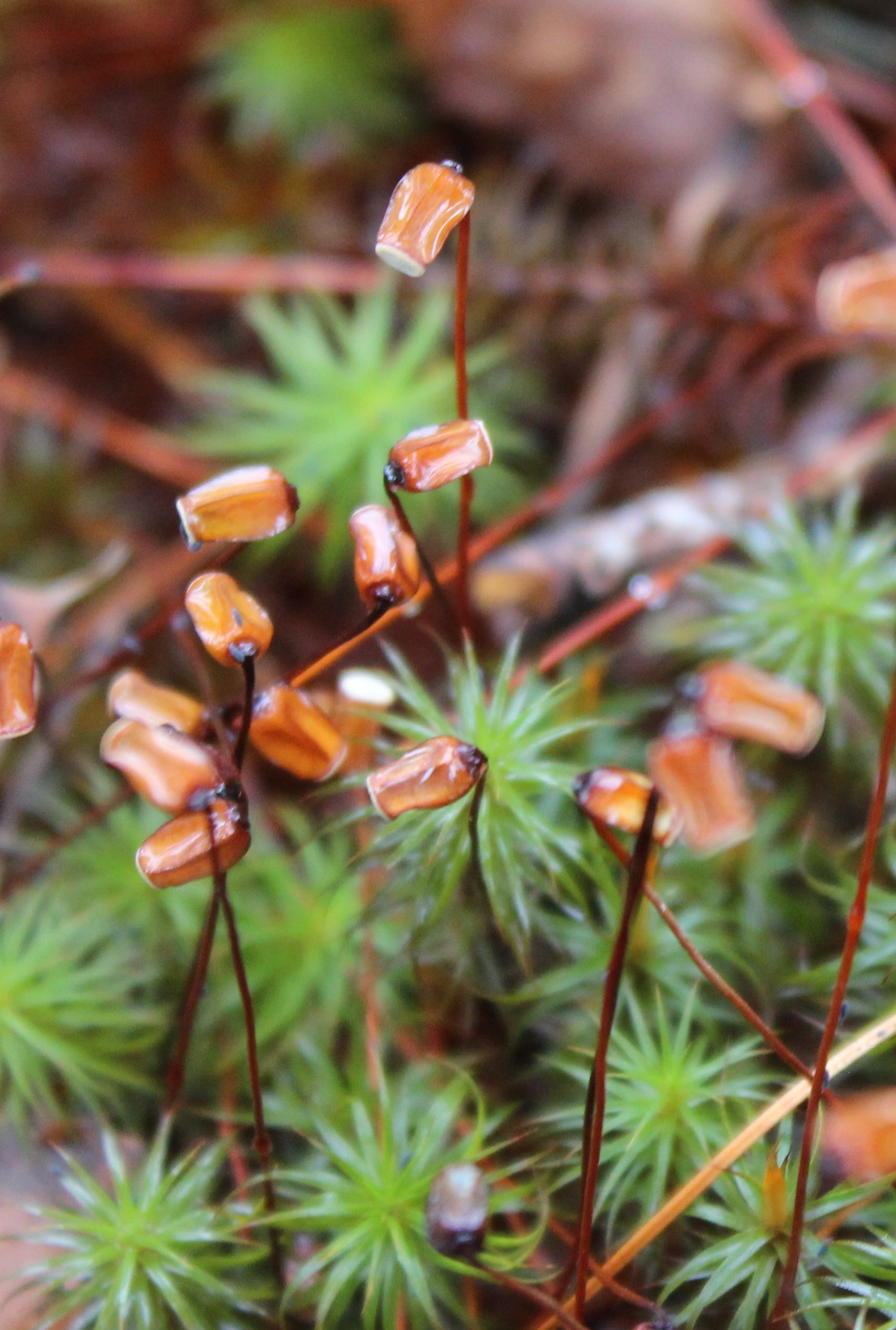
I should have paid better attention, but this hair-cap moss is either Polytrichum commune, (Common hair-cap) or P. ohioense. I’m thinking the former, which has a spore capsule that is no more than 1.5 X as long as wide, while the latter’s capsule is more than 1.5X as long as wide.

antler piece?

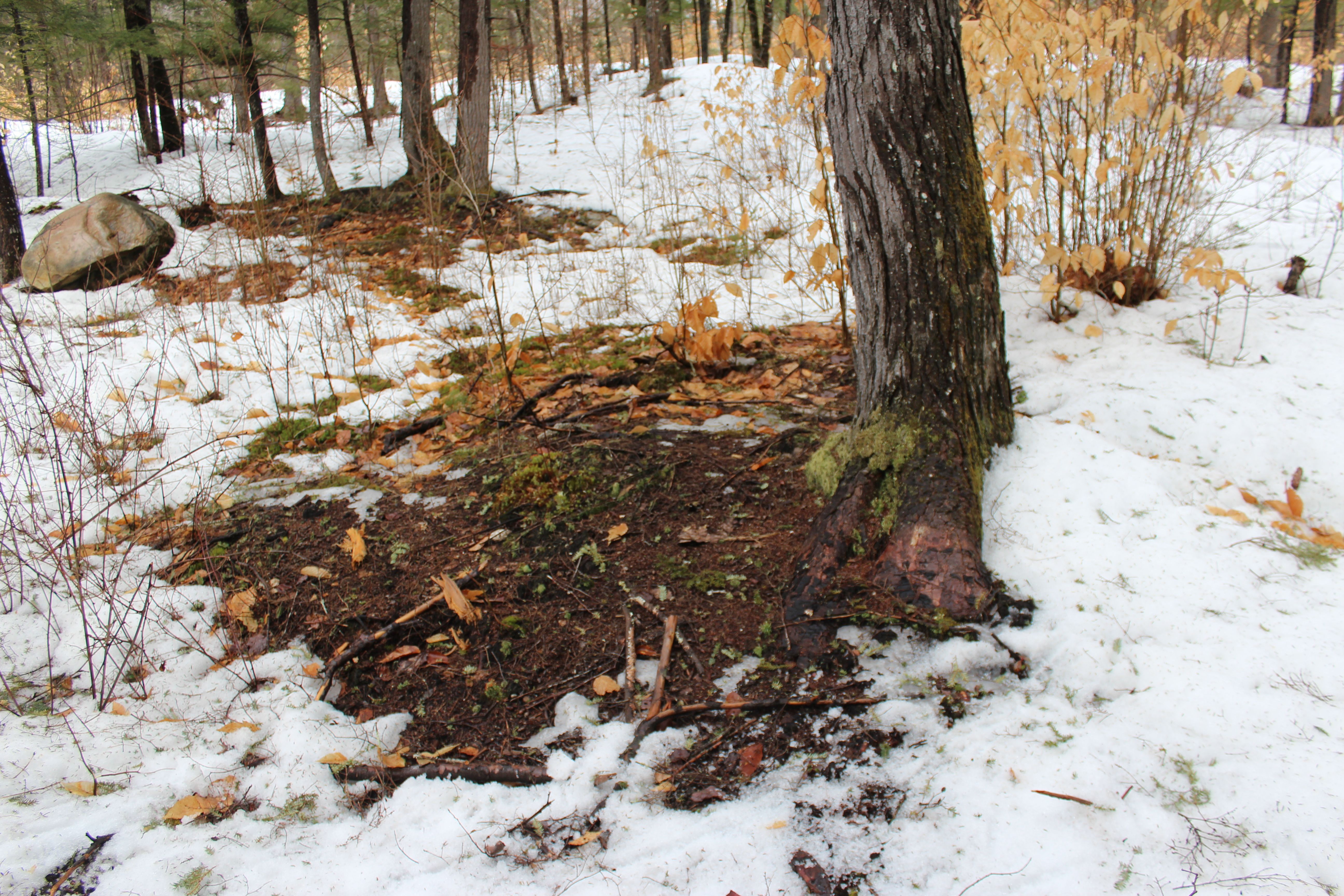
No matter where we looked, either on the islands or on the sea of snow between each, we found evidence that the deer had visited before us. Tracks, scat and beds everywhere. And then we found this. A bone fragment that had been nibbled on. Maybe a piece of an antler?

deer hair 1

And this–deer hair.

deer hair 2

And this. Lots of deer hair beside the plug of hair above. What happened here? We didn’t have a guide to ask, but the story unfolded before our eyes. A deer sat down to spend the night under the hemlock tree. Its body heat turned the snow to ice. And when it stood up the next morning, the hair stuck to the ice. Anyway, that’s our story and we’re sticking with it.

porcy scat

If you’ve stuck with me through these wonder-filled wanders, then you know that I may include a photo of scat. In this case, an island native made itself known by the debris on top of the island and snow–porcupine.

porky den

A few minutes later we came upon its den. Porcupines are the pig pens of the natural world. Despite that, we were excited to find this.

island 3

No need, however,  to stick around there. We bounded (hardly) off to another island, glad that we were able to stop at so many destinations in a single day. And the best part is that when we visit again, we’ll find other treasured spots to explore.

Thanks for stopping by to wander and wonder.

P.S. And take a look at my friend’s site–her photos are amazing and the map of our walk shows just how nature distracted we are.

My Native Land

stonewall

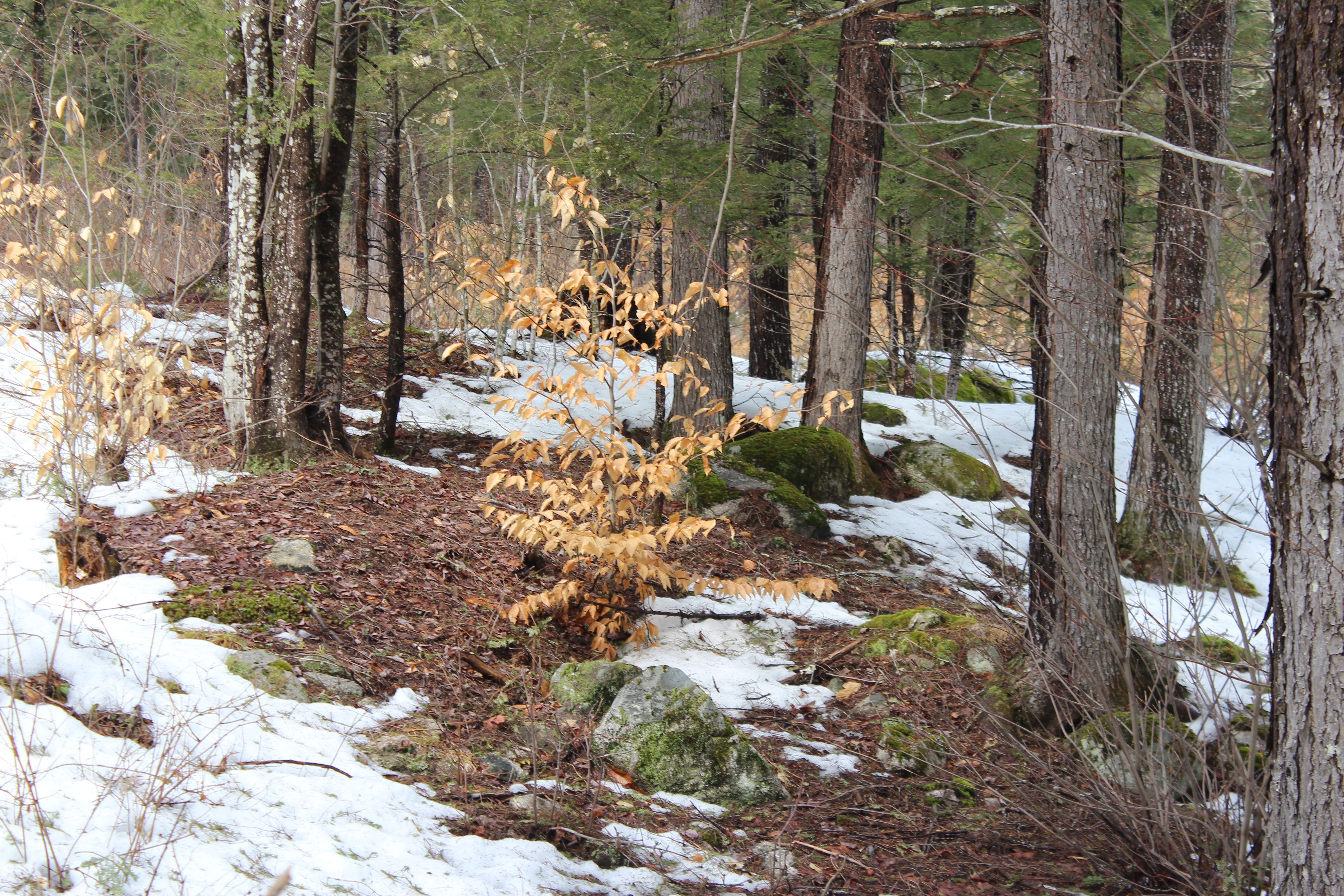
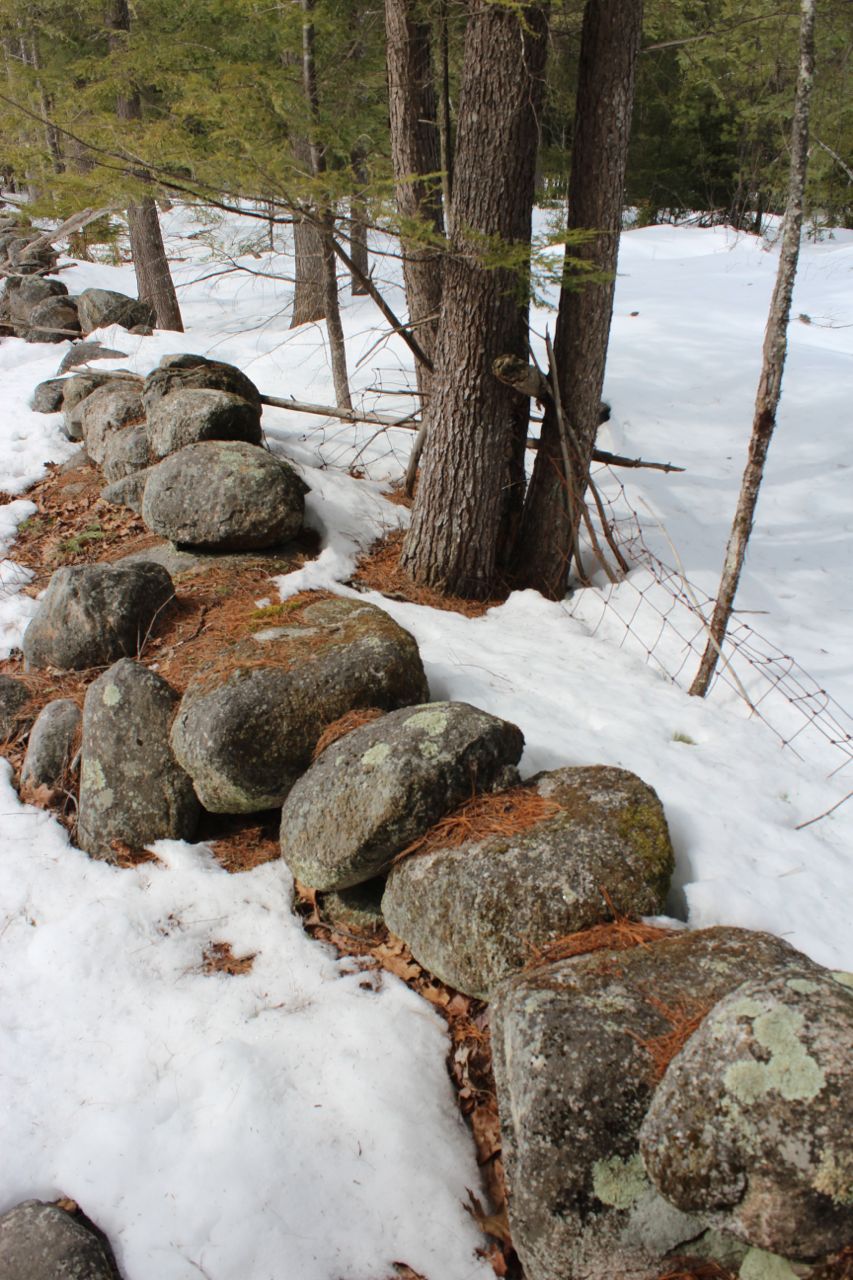
As winter draws to a close, I head out to capture its fleeting moments. The snow is here today, and will be tomorrow, but it’s changing in texture and amount. And all that has been covered and protected is slowly emerging.

vernal pool

It won’t be long before the vernal pool teems with life. Already, deer and skunks have stopped by.

bobcat

I ventured deeper into the woods behind us, into my smiling place, without snowshoes. That meant I had to follow my old tracks, which deer and a coyote had also used. And then I saw signs of commotion on the snow and some tracks that crossed my trail. Drats–without snowshoes, I couldn’t follow it. Will I ever learn? I certainly wouldn’t make a good Boy Scout! “Be, be, be prepared, the motto of the Boy Scouts.”

Anyway, bobcat tracks always make my heart jump with joy. I’m not sure why. Perhaps it’s their wildness. Or beauty. The fact that they are solitary, elusive and oh, so clever. Coyotes are cool too, in their own way, but they are loud and gregarious.

old beech

As I walked back, I paused by this old beech. Mr. Cretella, my high school Spanish and Latin teacher, popped into my head. No, not because he’s old now, if he’s still living. It actually had nothing to do with the tree and everything to do with the tree. In my yearbook, Mr. C. wrote, “Never lose your desire to learn.” Those words have reverberated with me over the years. I don’t remember what anyone else wrote, but his sentiment struck a cord. Pretty amazing, given that when I took Latin I my senior year, I was forever substituting Spanish words if I didn’t know the answer on a quiz or test.

Back to the old beech tree. I guess it was the realization that this tree is in the process of breaking down and giving back and I never would have understood this before I took the Maine Master Naturalist class. Tomorrow I’m going to attend an MMNP advanced seminar and learn about bone biology. Huh? Me? Don’t worry–I won’t be able to astound you with my knowledge after a three hour class. But it’s that desire to learn that Mr. Cretella encouraged all those years ago. Thank you, Mr. C., wherever you are.

beech life

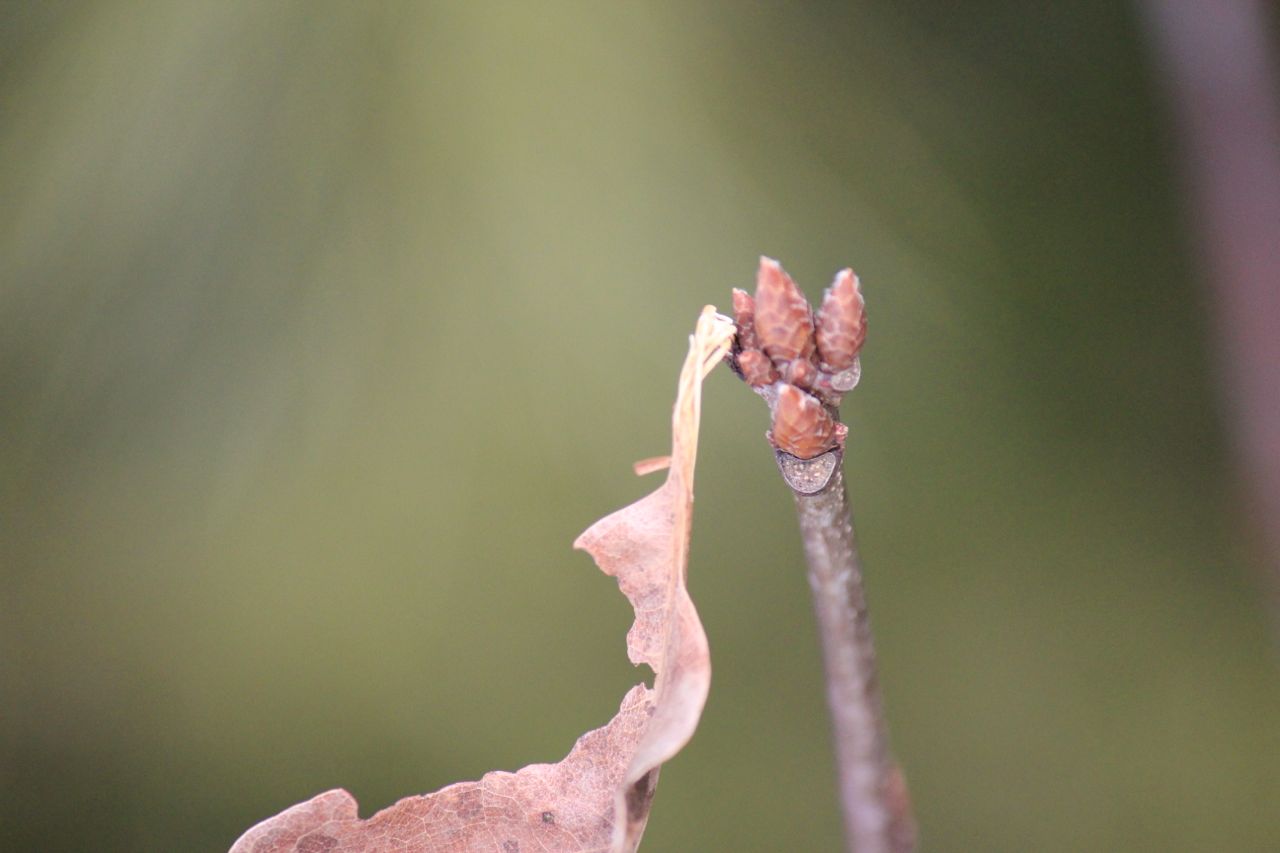
One more thing about the old beech. It still has signs of life as evidenced by the twigs with buds.

red maple

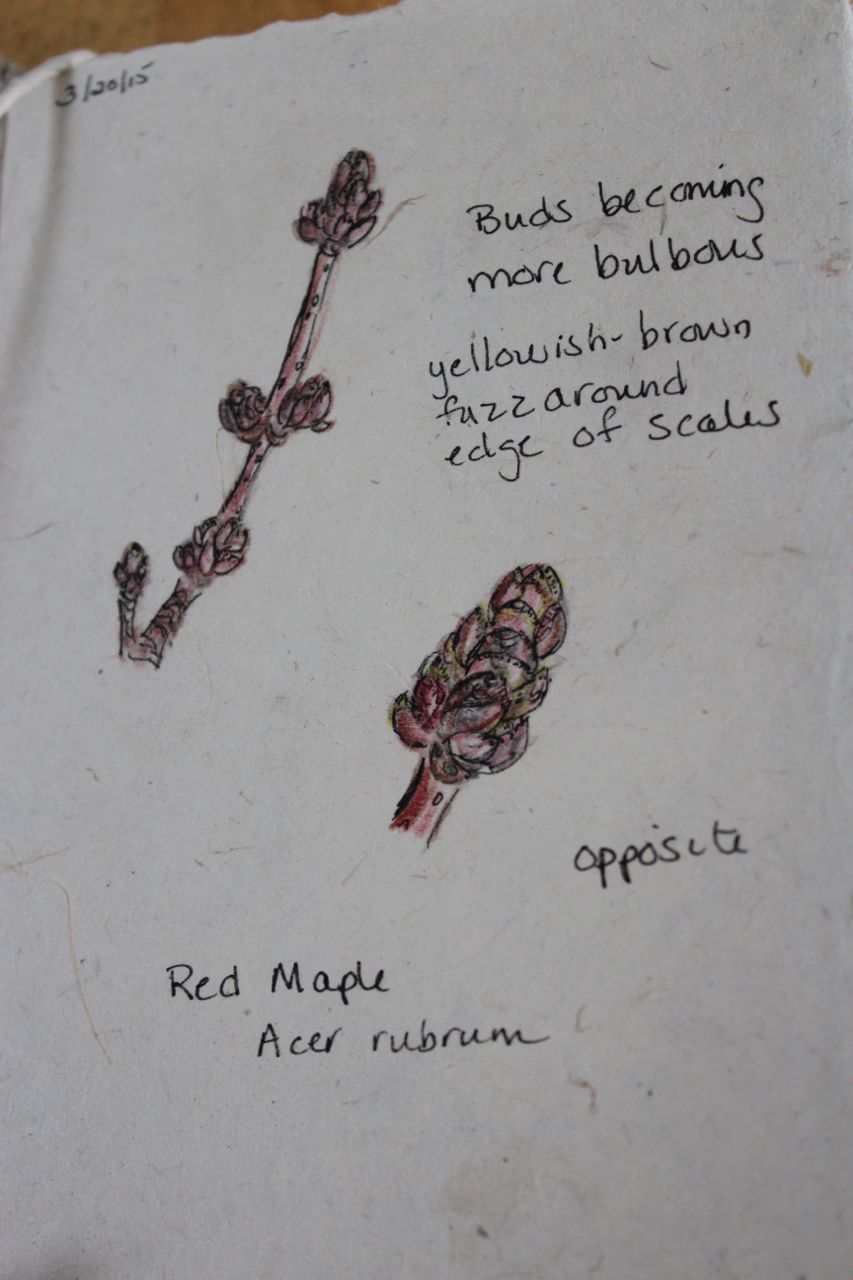
Finally, I settled down at the edge by the cow path and did some sketching because I don’t want to miss the grand moments in the lives of these trees.

red maple 1

Red Maple, Acer rubrum

red oak

red oak1

Northern Red Oak, Quercus rubra (oops, I forgot the “s” in the sketch)

beech

beech 1

American beech, Fagus grandifolia

Winter will draw to an end in an hour and 30 minutes (6:45pm). To celebrate spring, I’ve started reading a new/old/used book: Springtime in Britain by Edwin Way Teale. On page 2 (so I haven’t read much yet, but it isn’t spring yet), he writes, “Three centuries ago, an old English writer admonished the prospective traveler: ‘Know most of the rooms of thy native land before thou goest over the threshold thereof.'”

I’m still learning those rooms of my native land. I’m thankful for the opportunity and glad that you joined me on today’s wonder-filled wander.

P.S. Lake Living magazine is now being distributed throughout the Lakes Region of Maine. I’ll let you know when the Web site has been updated.

Milling About

snow waves

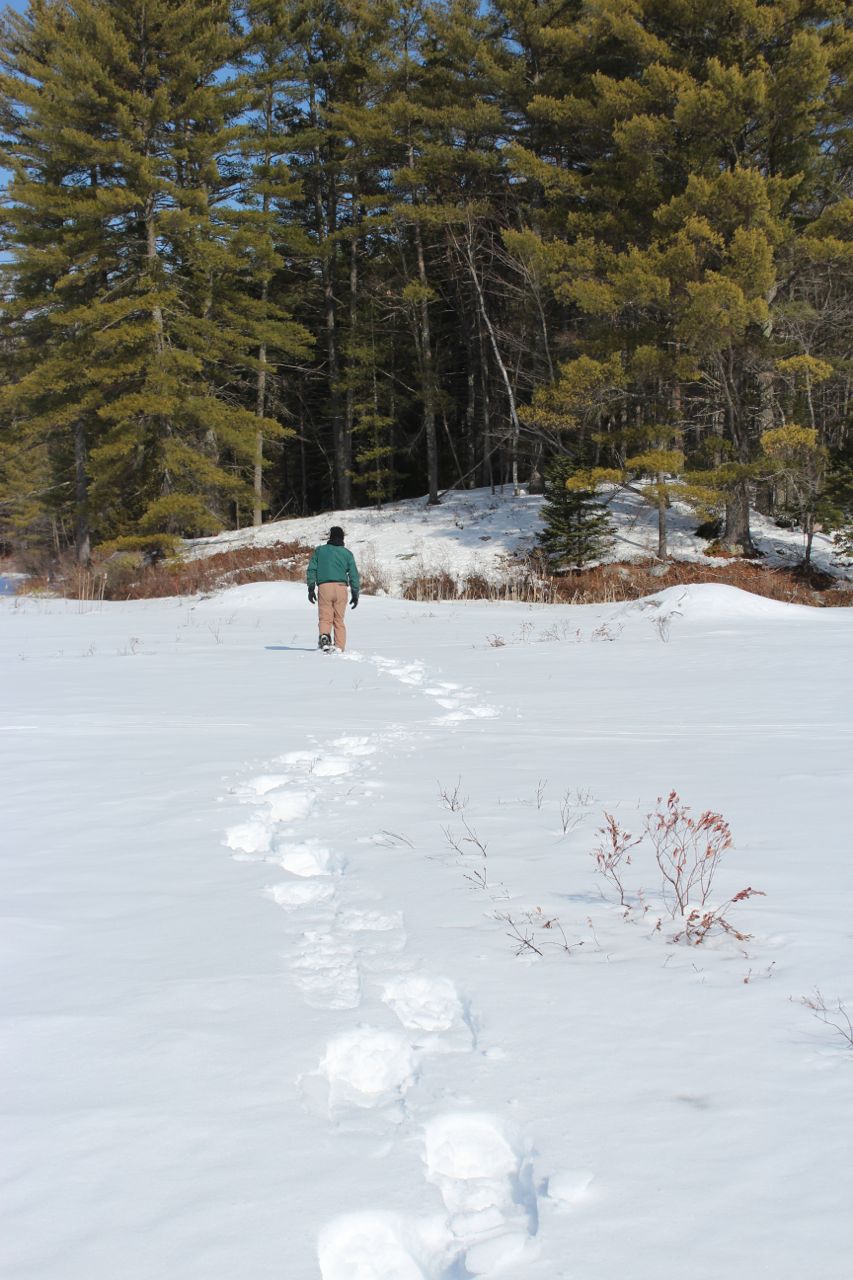
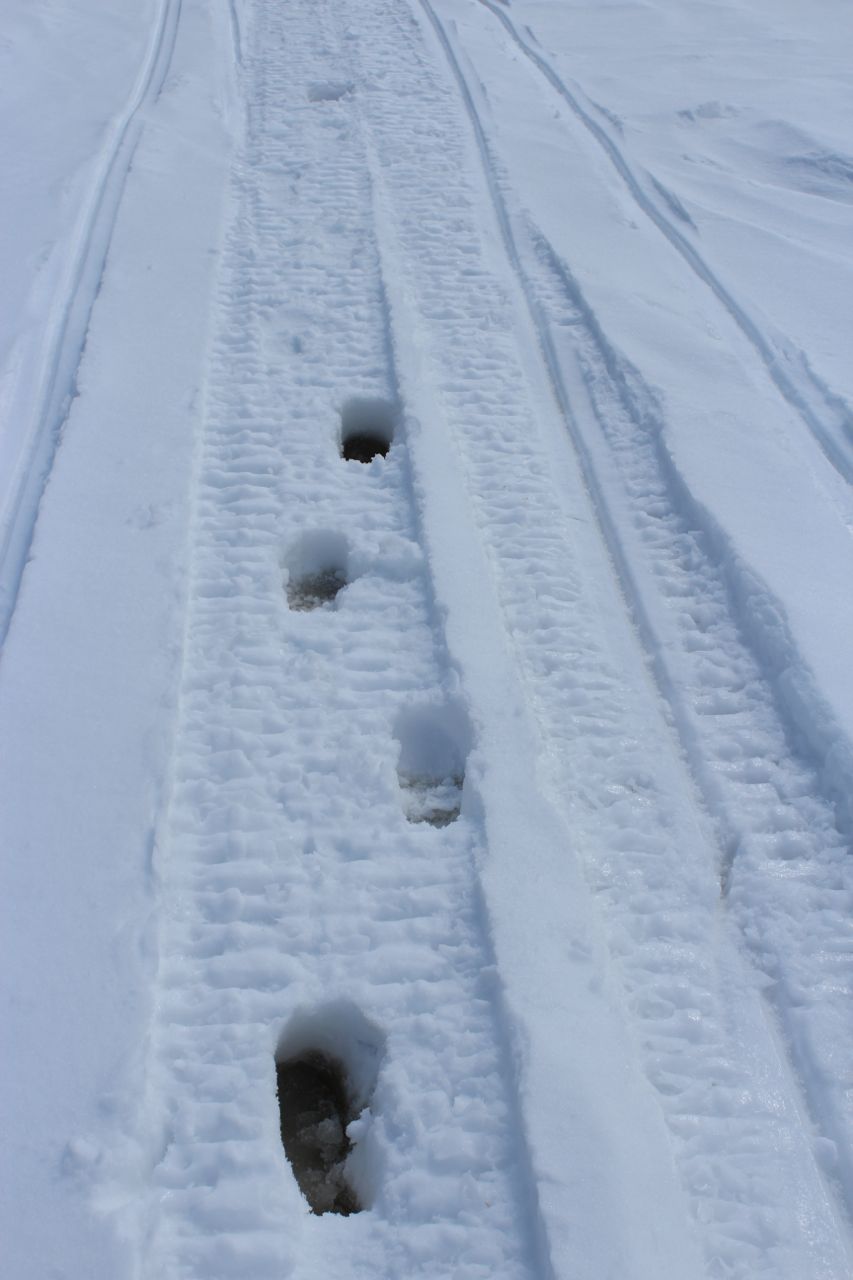
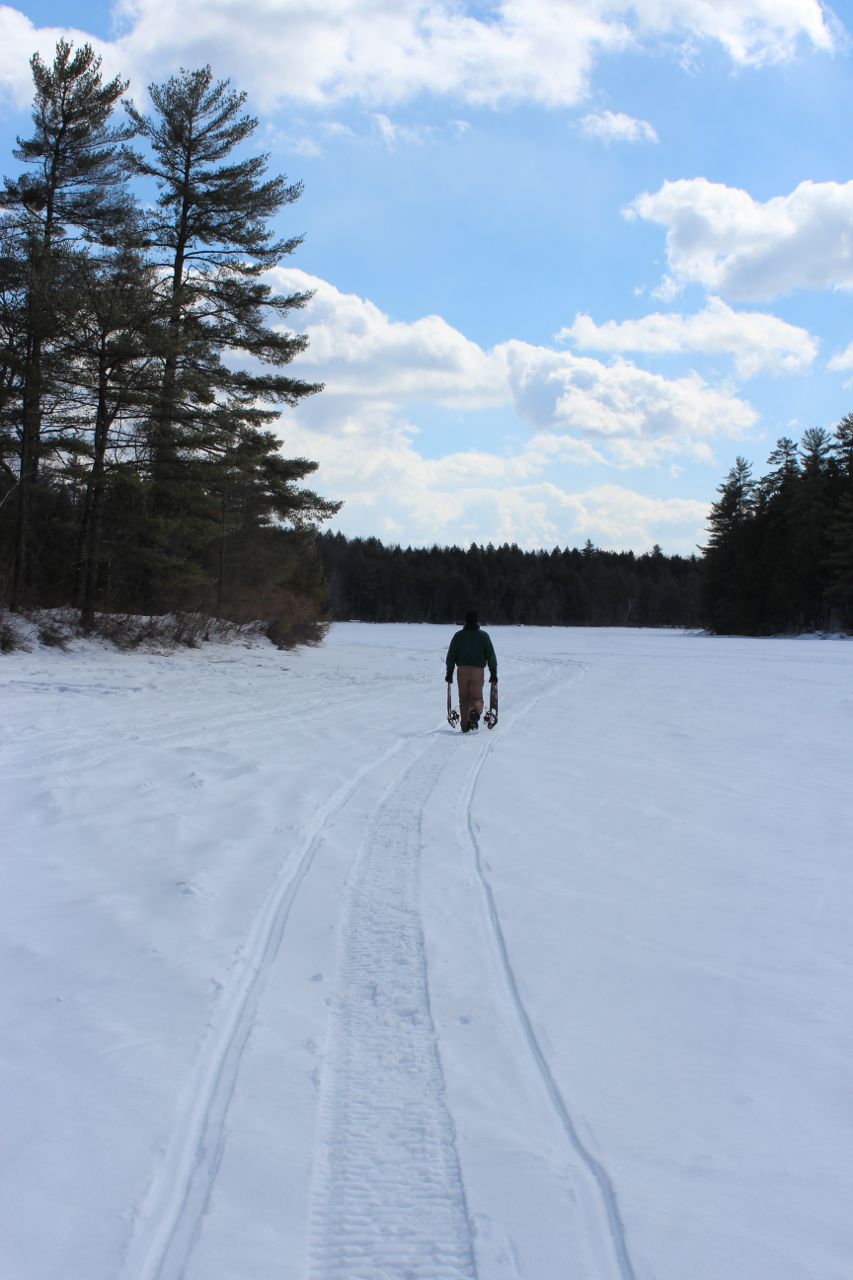
Today’s tramp found us heading north on Moose Pond again. The pond is covered in snowmobile tracks and snow swirls like these.

coyote print

Though we sink into the snow, this coyote had no problem moving along.

snowshoes

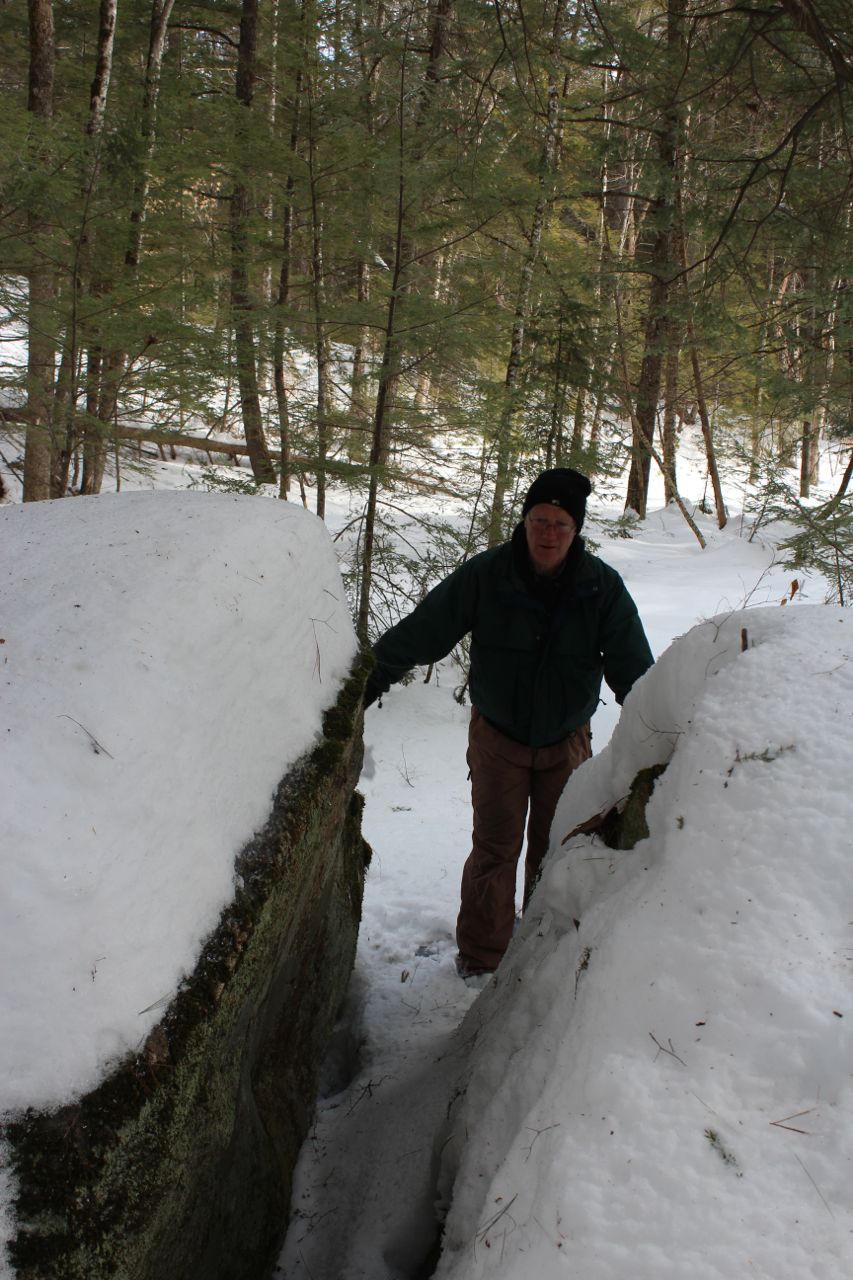
Snowshoes were a must for both of us. Our intended destination was Rueben Bennett’s saw mill–or at least the remnants of it. I’d been there about a year and a half ago with the current land owner and another friend, and wanted to show my guy. A couple of men who lived in the Old City neighborhood I wrote about yesterday, may have worked at the mill.

beaver lodge

We were almost to the outlet of the brook when we saw that this beaver lodge is active. Notice the breathing hole at the top. We moved away quickly so as not to add any more stress to them.

 cat tails

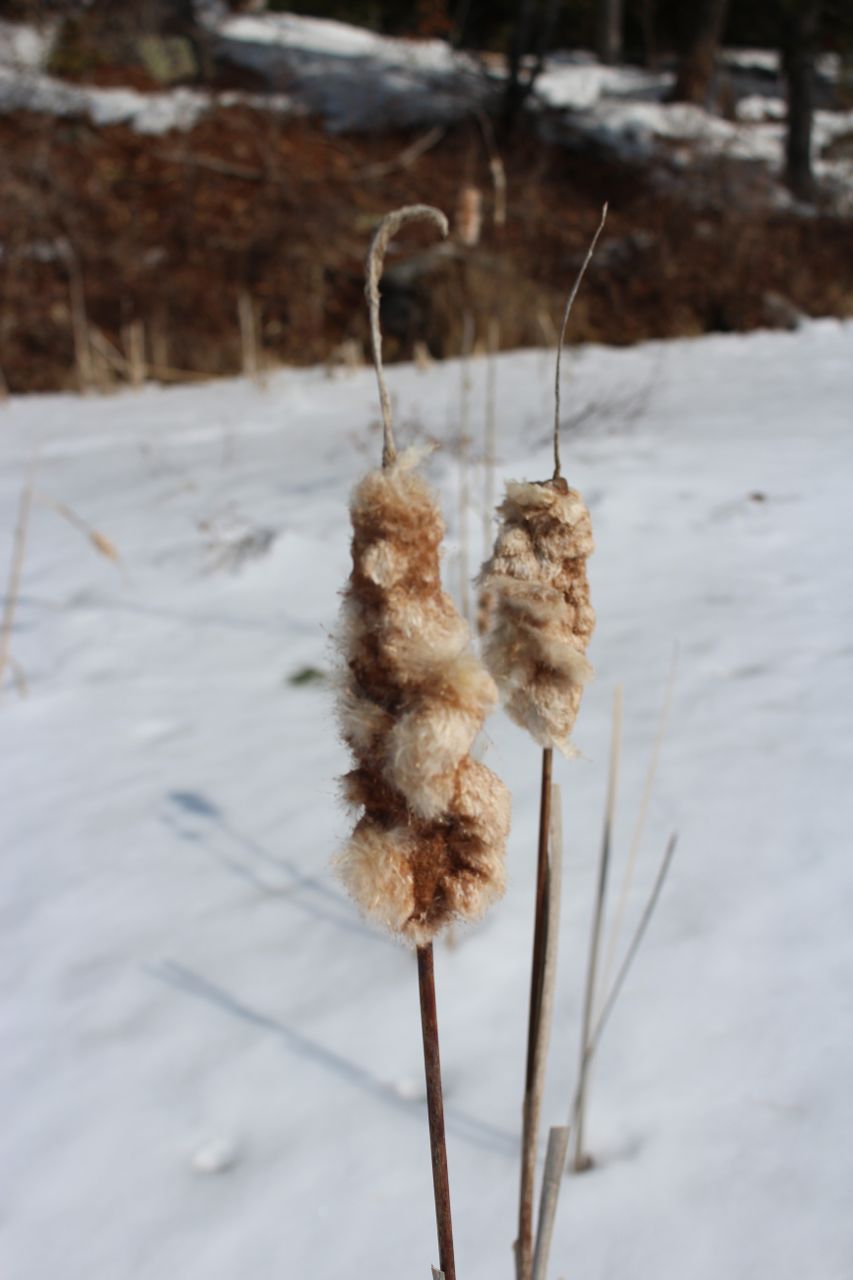
It looks like the fluffy seeds of these cattails are still emerging. It won’t be long before the Red-winged Blackbirds are perching on them.

stream

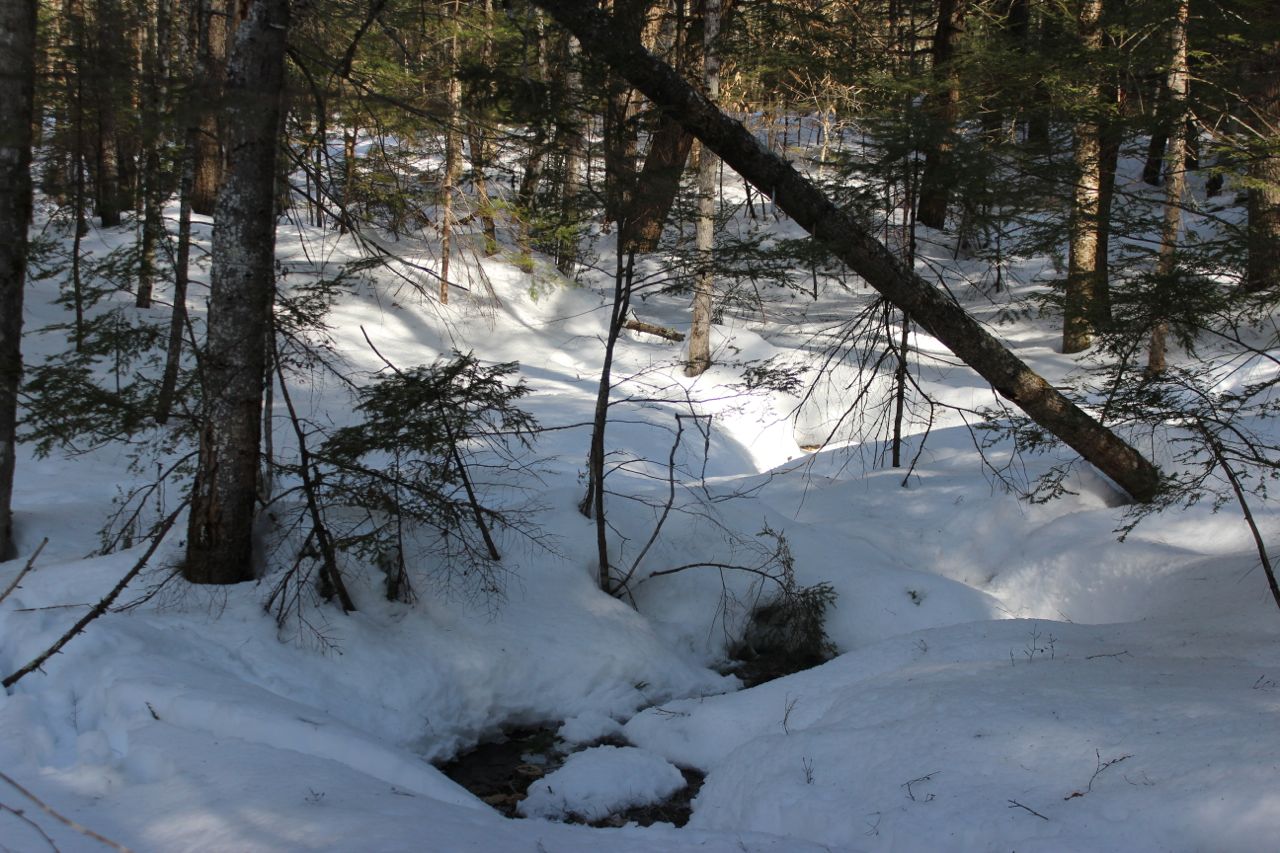
Following the stream, we kept looking for the rocks left from the mill site.

liverwort

Along the way, I spotted this lungwort or lung lichen. It’s one of my favorites because when it’s dry like this, it’s light in color and very brittle. But after a rain storm, it turns bright green and is quite pliable. And it’s got that lettuce leafy look to it. Some describe it as a lung tissue appearance. I’ll stick with the lettuce, thank you very much. Lungwort is an indicator species for a rich, healthy ecosystem. Always a good find.

chaga

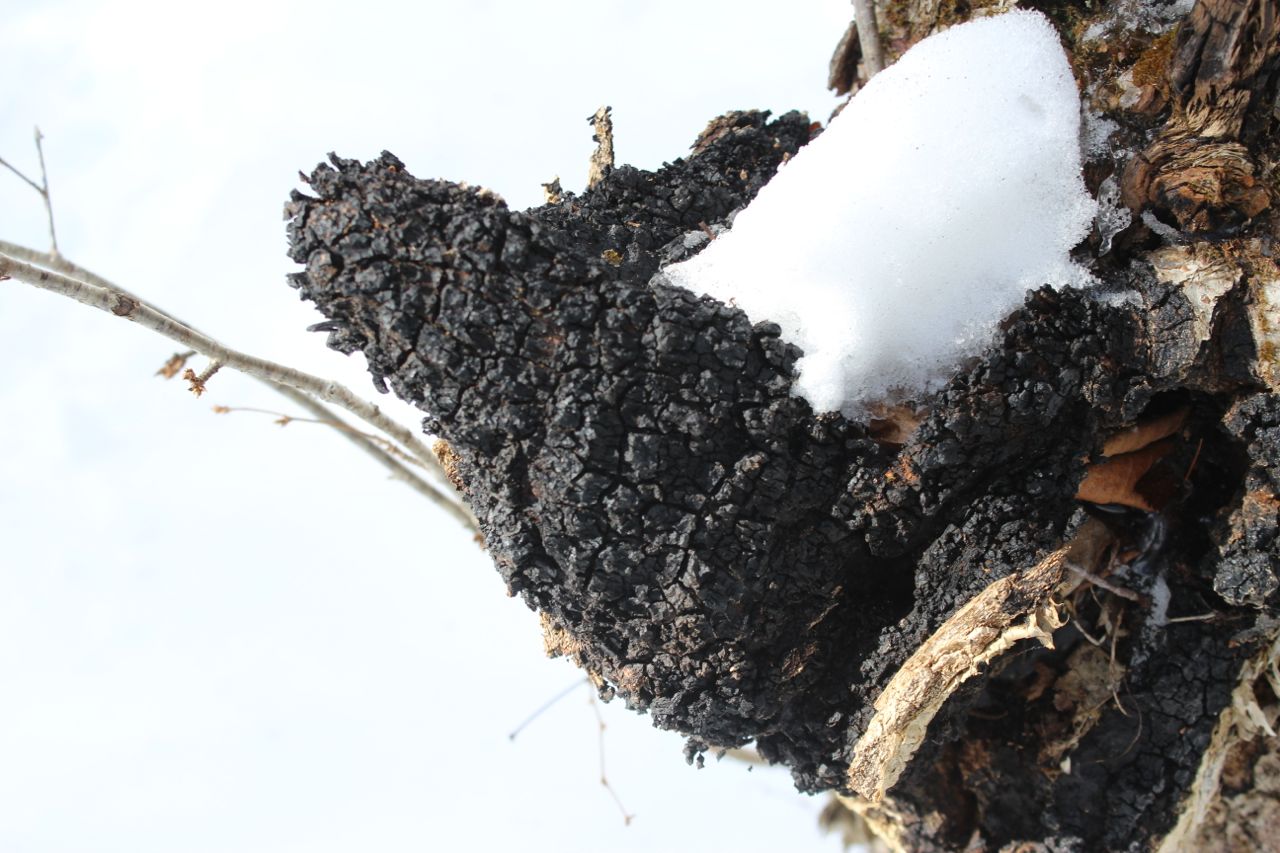
I’m not a mushroom expert, but I do know that this is Chaga. Another good find.  Unlike most other  hard, woody fungi, Chaga is coveted for its nutritional and medicinal benefits. If you want to know where this one is, you’ll have to follow our breadcrumb trail. I recently learned that the Siberians call it the “Gift from God” and the “Mushroom of Immortality.” To the Japanese, it is “The Diamond of the Forest,” and for the Chinese, “The King of Plants.” A mighty good find. It’s still there.

red maple swamp

We looked high and low for the mill site. At last we came to this Red Maple swamp and decided that perhaps it was Duck Pond, and we’d gone too far.

old City up the hill

Old City is located right up the hill. I was almost certain we were in the right place, but our search turned up nothing.

examining the erratic

We examined this rock to see if it was a glacial erratic or had been moved here for some reason. I vote for glacial erratic.

slush

After three hours of tramping about, we started for home. The wind was cool at our backs, but someone took of his snowshoes and you can see that it’s getting a bit slushy on the pond.

heading home

What’s that line about walk beside me and be my friend. I know it looks like I’m always following, but that’s not the case all the time. I do like to pause frequently and take photos to remember and ponder at a later time.

It turns out that we were milling about in the wrong area. I should have looked at my friend’s Web site prior to today’s adventure. She almost always has her GPS handy and had posted the exact location. I knew it didn’t feel quite right, but I was so certain it was closer to Old City than it actually is.

Oh well. A destination for another time.

Thanks for joining me for today’s wonder-filled discoveries.

Mountain Mondate

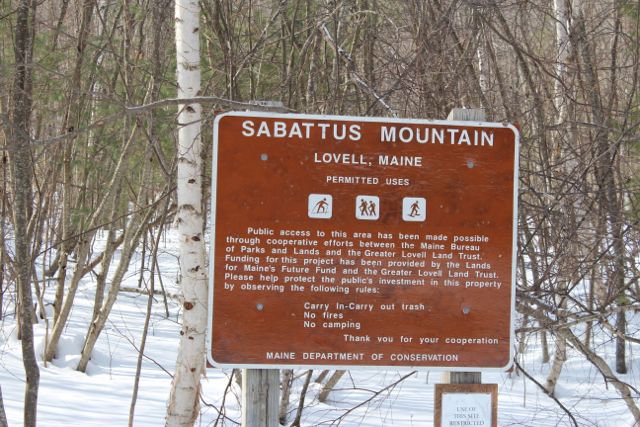
Sabattus Mtn sign

Our Monday date took us to Sabattus Mountain in Lovell this morning. It’s an easy trek offering great views, lots of wildlife activity and a decent workout in a short amount of time.

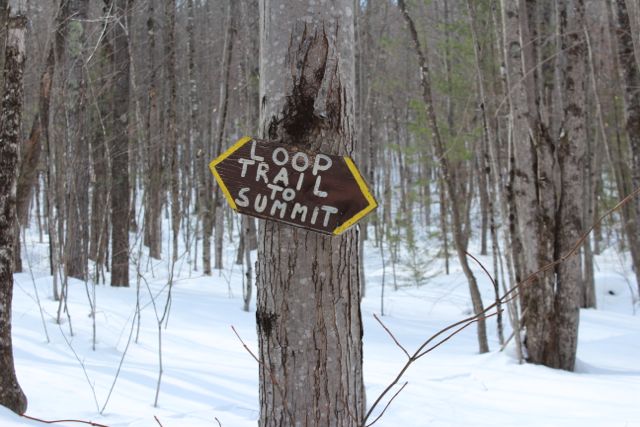
trail sign

Which way should we go? I ask myself that question over and over again. Habit took us up the right-hand trail, but in hindsight, maybe we should have mixed it up this time. A life lesson?

burl

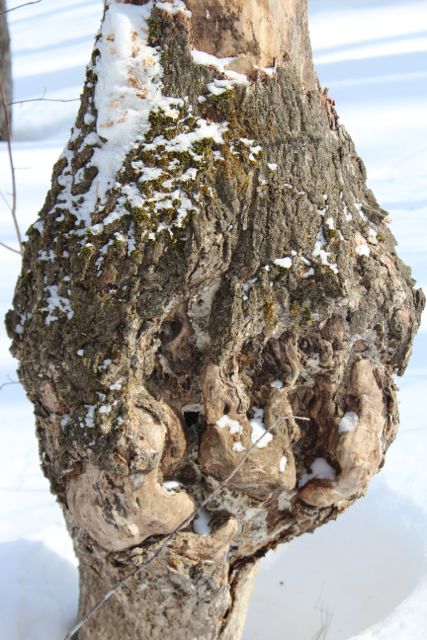
Check out this burl. Over and under and around, oh my!

transition 1

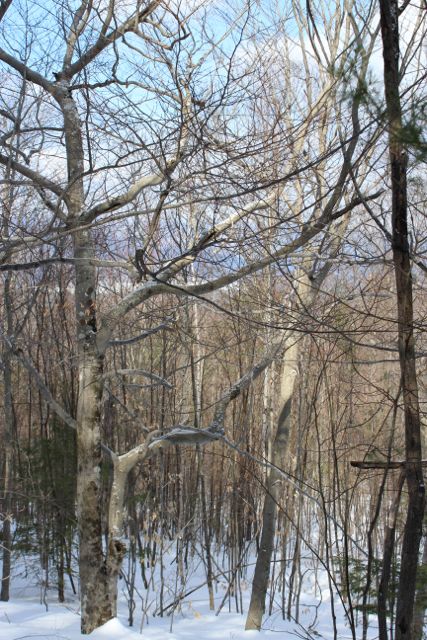
I stood at this spot on the trail and looked down–Lots of beech, hemlock, birch and maple in the mix.

transition 2

And then I turned to look up the trail. Oak, pine and hemlock dominated the scenery. A transition point.

growing apart

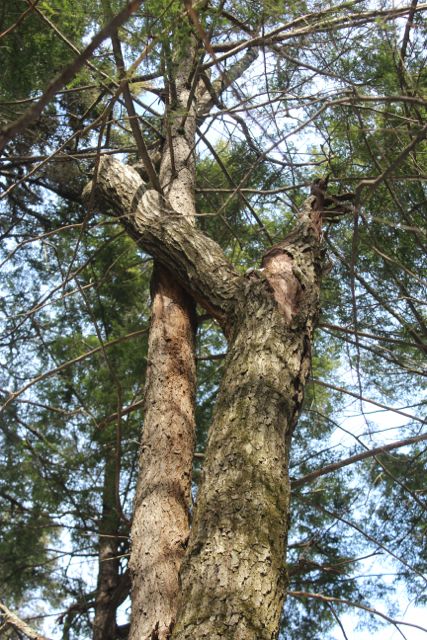
Speaking of transitions, this hemlock grew apart after a couple of years. With two rather than one terminal leaders growing side by side, they eventually found their way back together.

and together again

Here they are woven back together–it’s almost difficult to tell that the two have become one. It made me think of our relationship as we trekked up the mountain. Maybe this tree didn’t really grow apart, the two parts just respected each other as their life together began and they allowed each other to continue growing in their own way, knowing that they needed to stay together ultimately because being united and supportive is what it’s all about. And maybe I’m reading way too much into a natural occurrence.

porcupine 1

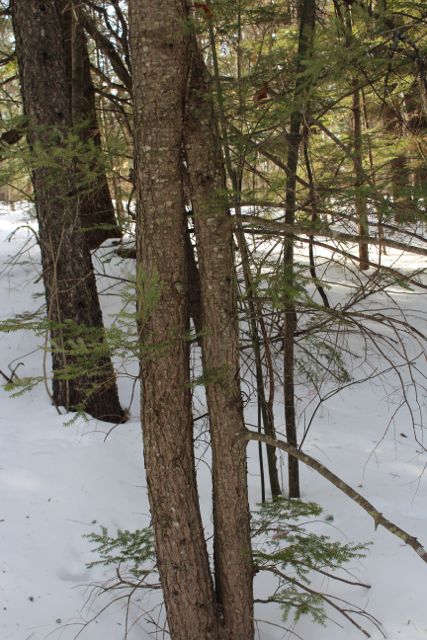
A porcupine tree. Lots of porcupine activity in the hemlock grove both on this trail and on the way down.

porc trail

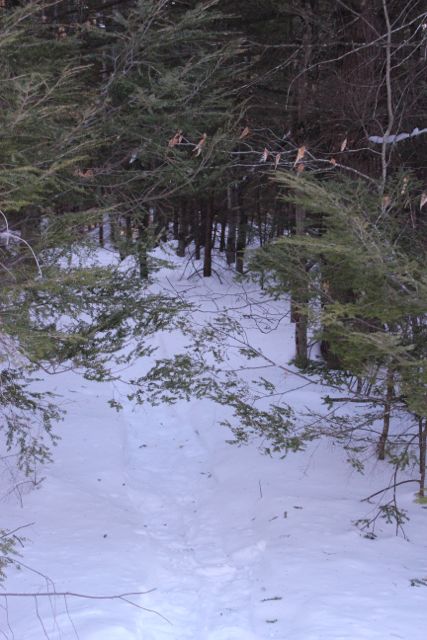
A well-traveled porcupine trail.

fire tower

The concrete stanchions that once supported a fire tower. Apparently, the tower was removed in 1963.

bench 1

Perfect spot for a hot cocoa break.

oake and pine

Eastern White Pine and Northern Red Oak–looks like the oak is ahead in the race to the sun right now. I wonder if that’s how it will play out over the years.

buried bench

And then there’s the other bench at the summit. We couldn’t actually sit on this one.

bobcat 1

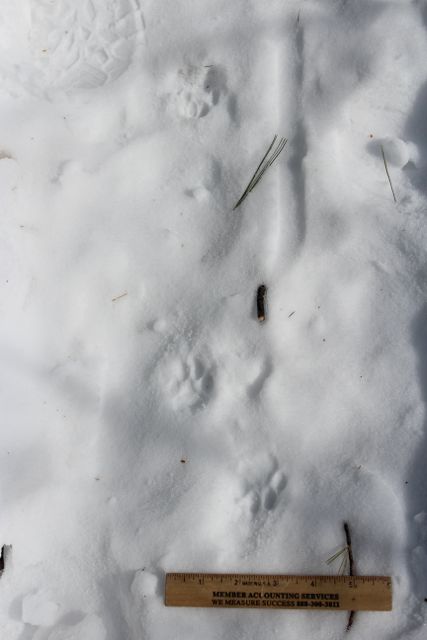
Heading along the ridge, we found these prints that always excite me. This critter had traveled to and fro before going off trail. Notice the “C” shape between the toes and the pad. C is for cat. Yup, a bobcat. And it was at some point in the last six hours or so, because we’d had a dusting of snow. These were fresh. Yippee!

bobcat2

A bobcat is a “perfect” walker. Ah, perfection. But really, it places a front foot down, and as that foot moves forward, the hind foot steps into its place. I think you can see that here–it looks like it might be two feet sharing almost the same space.

bobcat dinner?

Breakfast? The bobcat obviously snatched some little brown thing–or tried to. This was just off the man-made snowshoe trail and right by the ledge. I was a bit surprised that the cat had followed the trail for as long as it had. They usually cross our trails and have their own corridor. But, it sure makes for easier traveling to follow where others have gone before.

old oak

This old oak has seen better days. Amazing that it’s still standing.

support of a friend

But then I looked up. We all need the support of a friend. In this case, the friend is a white pine. They may compete for sunlight, but apparently they can count on each other occasionally.
heading down

Heading down. Transitioning again. There were a zillion snowshoe hare trails. And  mice. And squirrel. Good feeding grounds for a bobcat.
lunch 3

We finished up our trek before we were hungry for lunch. But, when hunger struck we ate PB&J sandwiches beside Kezar Lake.

Thanks for wondering along on this wander through the Maine woods.

My Smiling Place

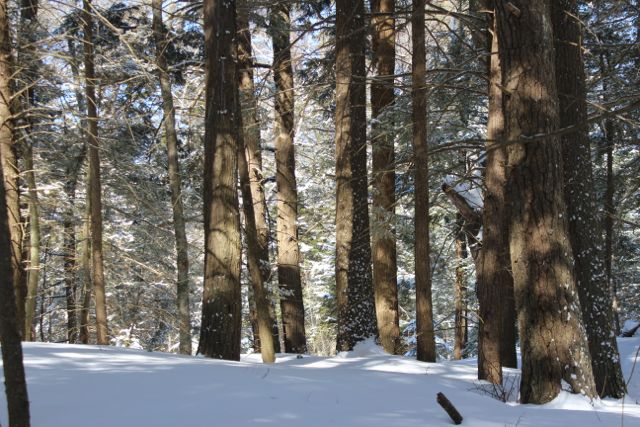
gateway

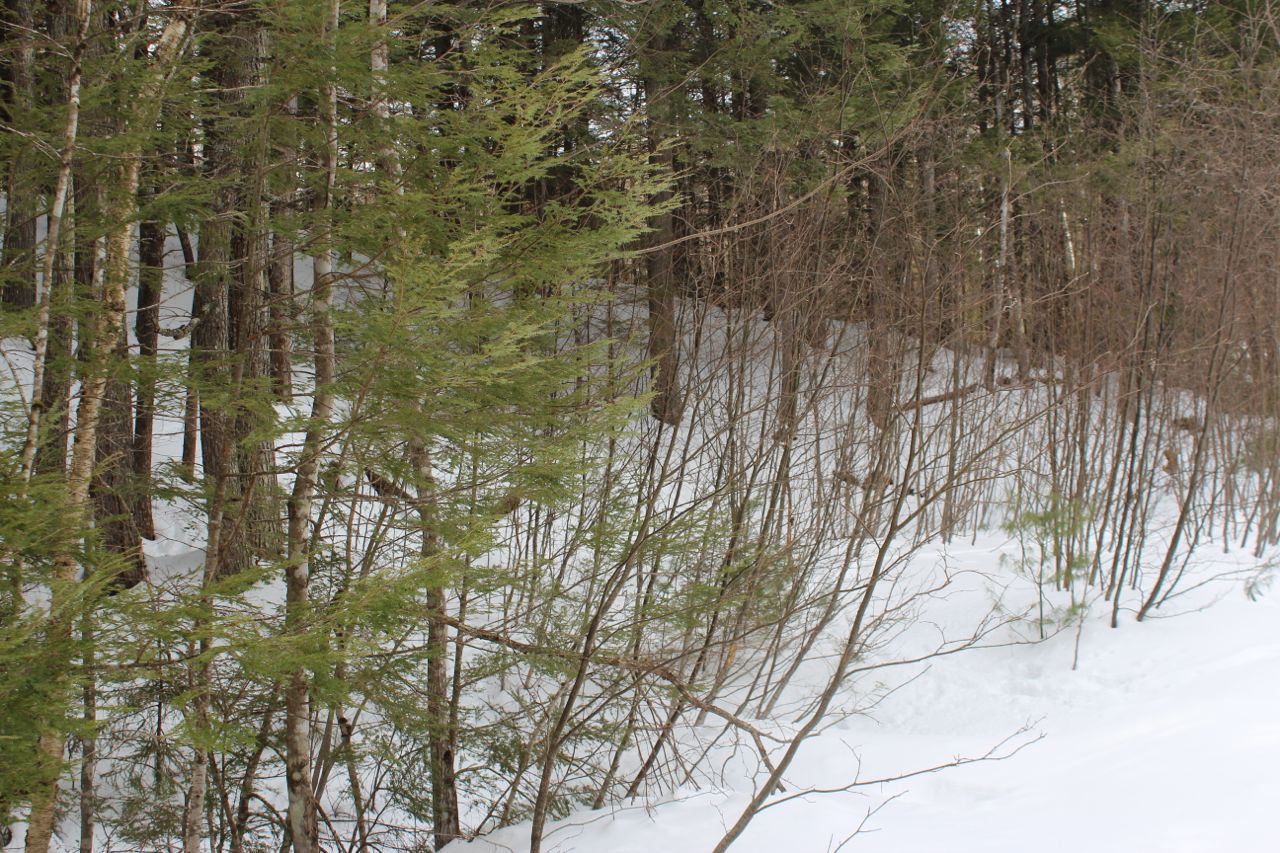
Hemlocks and beech trees create the gateway to my special place where few others wander and wonder. I’ve intentionally left these trees as is at the edge of the snowmobile trail so I can pass through and disappear into my own world. It never ceases to amaze me that I suddenly feel alive as I step into this section of the woods.

I spent this morning at the Maine Milfoil Summit and thought it was one of the best I’ve ever attended. And then a friend and I enjoyed lunch at Fishbones in Lewiston before I drove back to western Maine and she returned to her home closer to the coast. All in all, it was a wonderful day, but the moment I stepped through those tree branches, I was home. I was in my smiling place. It’s a feeling that I don’t think I can put into words. Some things are best left unsaid.

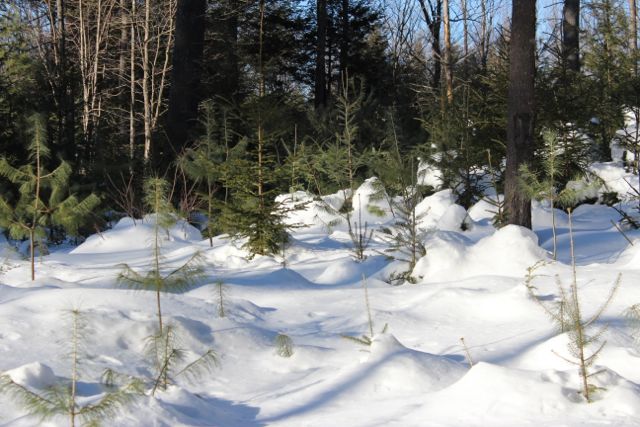
saplings

Part of the woods that I explored today had been logged about ten years ago. The openings created a nursery for hemlocks, pines, fir and spruce to spring up. Who will be the winner in the end? It’ll be a while before I know the answer to that one.

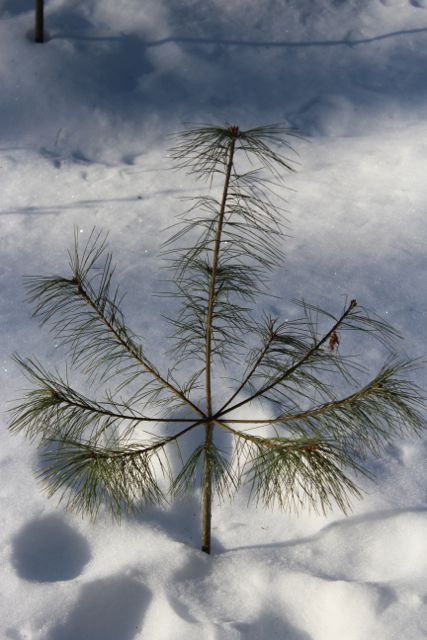
white pine whirl

Eastern White Pine trees win the prize when it comes to the kitchen growth chart, which, by the way, I finally painted over in our kitchen this winter and no one seems to have noticed. Each year, a white pine produces a whirl like the one you see here. A whirl is a group of branches that radiate out from the tree’s trunk.

white pine growth

So, our boys never had a growth spurt quite like this one–thank goodness. I should have measured it, but this white pine grew about two feet in one year as evidenced by the distance between one whirl and the next. Why? Because it’s in an area where most of the canopy or taller trees that would have blocked the sun and prohibited its growth, were taken down. Ample sunlight will do that to you.

snow tree 1

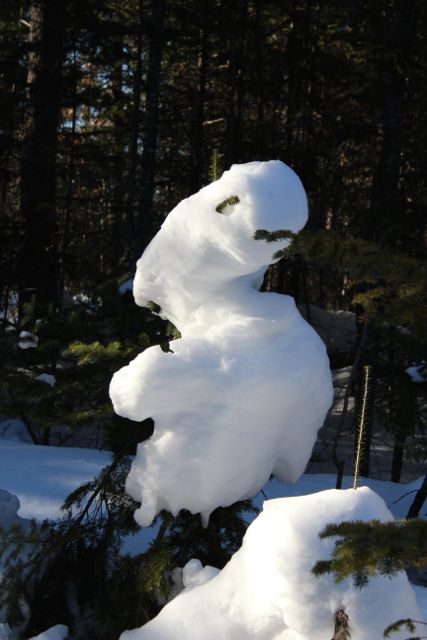
Snow ghosts! Even my computer suggested there was a person hiding under this snow costume–it wanted me to provide a name. Was someone in there? What would you name it?

snow tree creature

And a snow creature. Snowzilla?

deer run

The snow is quite deep, but the deer are moving about more and more. I found numerous deer runs like this one today–trails that they use over and over again. Sometimes other mammals follow them as well.

in my tracks

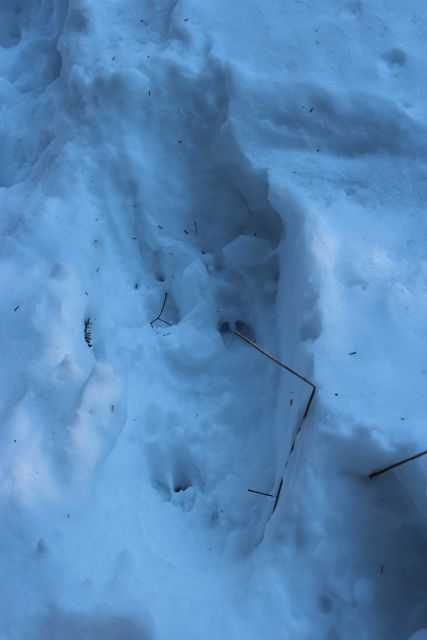
And sometimes the deer follow in my tracks as is the case here. The prints to the left indicate that a deer was traveling toward you as you read this. And the print to the right indicates that another was traveling in the opposite direction.

track

Deer prints are heart shaped. The point leads to the direction of travel.

deer beds

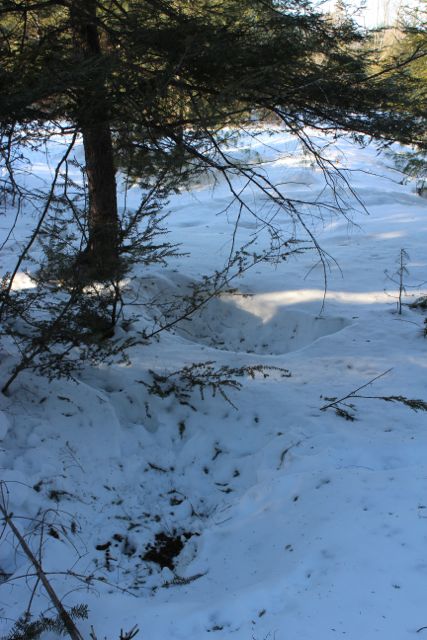
I’m always thrilled when I find deer beds. These two were quite large. And filled with scat–all I can say is, scat happens! The curious thing to note about deer beds is that when two or three are gathered, they tend to sleep with their backs to each other so they can keep an eye out for predators.

another bed

You can see where this deer pawed at the snow to get comfy for the night. Oh yeah, and more scat :-)

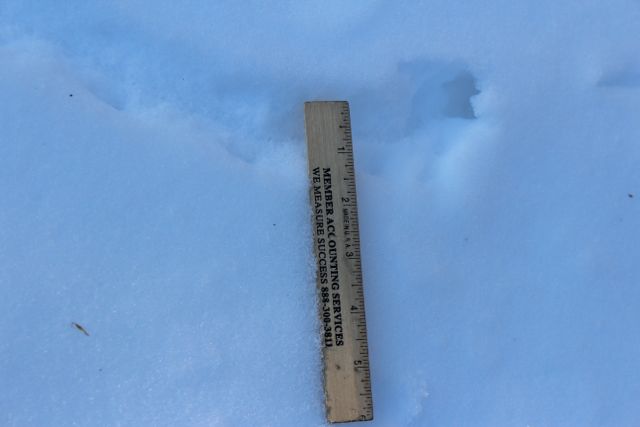
print with dew claws

So some say that when you see the dew claws in a deer print, those two small toes above the foot that look like two dots at the back, you have a buck. Maybe. Or maybe the snow is soft and deep and more shows in the impression.

oak leaf phenom

I was thrilled to find this young oak tree, one of the few that has grown in this area since the logging event. I don’t know if you can see from this photo, but there are frayed ends along the branches. I’d never noticed this until about a month ago when exploring a property in Lovell, where it seemed that every oak tree surrounding a field displayed these frayed ends. That field was near a porcupine condominium, so my first thought was porcupine activity. But there were no tracks to the trees. Then I thought of squirrels. But again–no tracks.
oak leaf phenom1

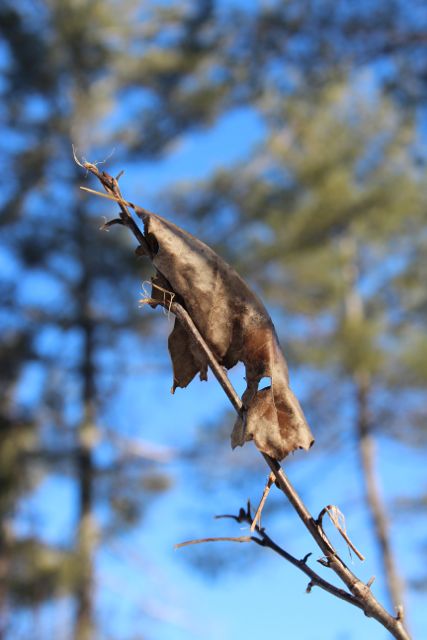
It wasn’t until recently that a friend who is a retired forester showed me it was a wind event that caused this. Like beech trees, oak leaves are marsescent. During wind events, and we’ve had plenty of those this winter, the leaf may get ripped from the tree–leaving a frayed stem or petiole. It makes perfect sense now. And the tree I found today, which displayed this phenomenon, is in the open, leaving it vulnerable.

vole

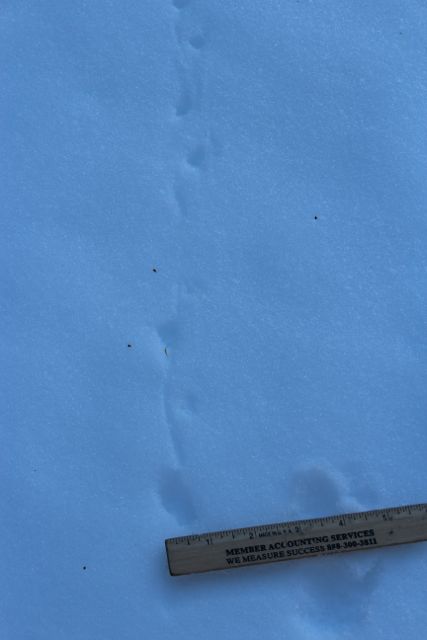
I was almost home when I discovered these tracks. Notice that they are a bit erratic.

vole2

Not a big mammal.

vole 3

Sometimes it exhibits the zig zag or alternate pattern of a perfect walker like a coyote, fox, deer, but . . . it’s a great deal smaller. A great deal smaller. And other times, it tunnels a bit.

vole hole

And leads to a small hole. A vole hole! I was excited because I found this in the same area where I found vole tracks last year. Voles are highly delectable treats for some predators. Ah, the food web.

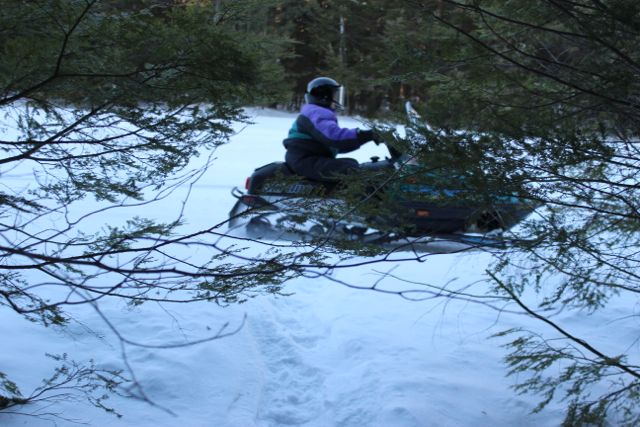
snowmobile

And then I was back at the snowmobile trail and this traveler never saw me. Yup, I like it that way. Rather like the mammals that I know are out there. I can’t see them, but I have to assume they know I’m about and watch me from their hidden spots. Maybe they share a smile with me.

I can only wonder as I wander. Thanks for joining me.

Wondering Among Giants

Robinson Woods

It’s not every day that I get to wander and wonder among 300-year-old giants, but such was the case today. A friend and I met at Robinson Woods in Cape Elizabeth. It was a reconnaissance mission for me as I’ll be leading a senior college class there next month. And for both of us, it was a delightful way to spend three hours snowshoeing on and off the trail, with frequent pauses to look, listen, touch, smell and learn.

Because the land was not suitable for farming (terrain rocky and uneven), it was left unchanged for all these years. Actually, we met the executive director of the Cape Elizabeth Land Trust along the way, and he told us that the Robinson family was a paper company family, but they left this piece untouched. Thanks go to them. And to the land trust for preserving the land so that it will remain in its natural state.

feeding cone

We could hear the birds sing and call as we moved along. Someone apparently wanted to make sure they have enough to eat as we found a couple of these “bird-seed” pine cones dangling from trees. (Separate note: back at home, for the second day in a row, I’ve had chickadees landing on my mitten to eat crushed peanuts–well, they don’t actually eat them on my hand, they just grab and fly to a nearby branch, where they use their feet to hold the nut or seed and then peck away at it.)

porcy trail

We followed this porcupine trail for a bit. As we backtracked our way toward the people trail, something caught our attention:

bear claws

Yes, even in Cape Elizabeth, and only steps from the ocean, you can find bear claw sign on beech trees.

bear claws2

We showed these photos to the executive director of CELT–he had no idea they were there. I’ll be curious to see if he adds black bears to the list of mammals that frequent the property. I did see that they have pine martens on the list–that surprises me.

gnarly tree

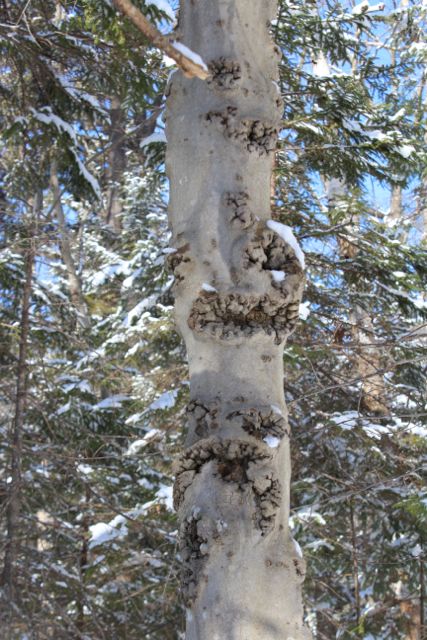
I know I’ve spent a lot of time writing about beech trees, but this one looks like a totem pole of gnarly faces. Think gargoyles. Was the beech scale disease initially responsible for this? I wonder.

gnarly face

more gnarliness

Very gnarly indeed. In the center, you can see where a branch broke off.

burls on a maple

This Red Maple had some serious burls. Perhaps they were caused by stress or injury, though researchers don’t know for sure why they occur. Despite the bumpy, warty growths, the tree appears to be healthy. You can see that there is new growth–young red branches sprouting from the burls. Removing a burl causes a large wound that could eventually harm the tree, so they’re best left alone–though I know woodworkers covet them.

walnut?

We were almost back to our trucks when we came across this tree. It’s a young tree and we tried to key it out. We’re pretty sure it’s Shagbark Hickory, but if you know otherwise, please enlighten me.

Thanks for wondering along with me on today’s wander through the woods.