Detecting the Nature of Wilson Wing

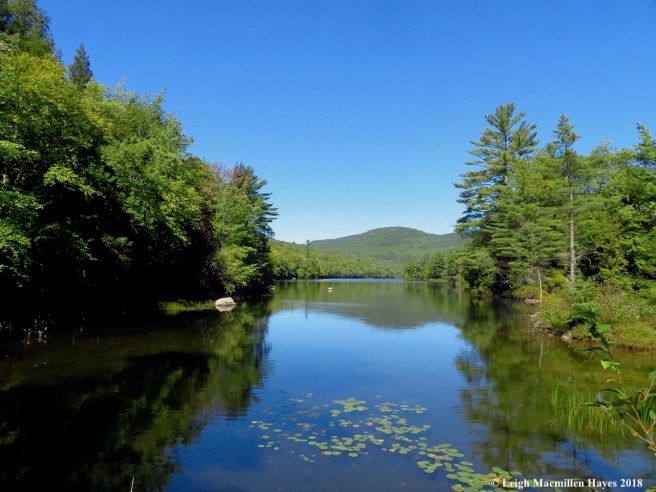
Before heading onto the trail beside Sucker Brook at the Greater Lovell Land Trust’s Wilson Wing Moose Pond Bog Preserve on Horseshoe Pond Road in Lovell, today, a friend and I walked down the road to the pond where we hunted for dragonflies and frogs.

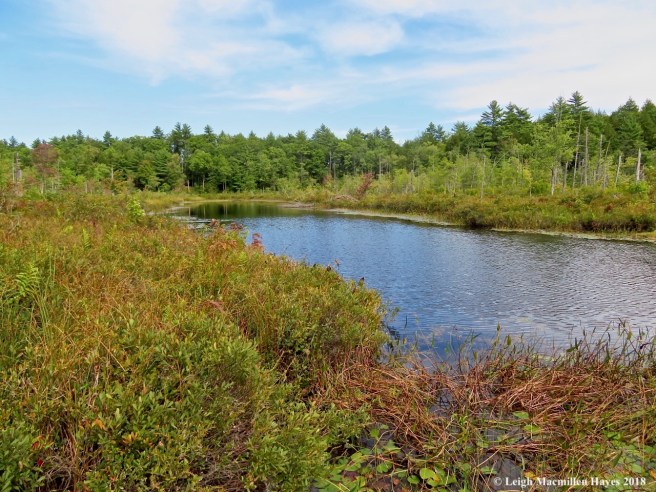
1-Horseshoe Pond

There wasn’t a cloud in the sky on this first day of fall and a crisp day it was, bringing smiles to our faces and adding sweatshirts to our attire.

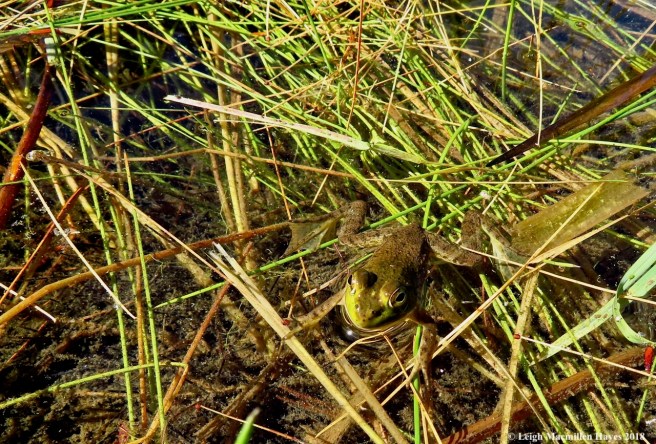
3-green frog

Though we saw a few darner dragonflies and even a meadowhawk, it was the green frogs that we spent the most time trying to spy for they blended in well with their grassy surroundings at the water’s edge.

2-bobber

A bit further out, and unfortunately beyond our reach, we spotted a bobber and fishing line. While it offered a picture filled with color and curves, the reality wasn’t so pleasant.

4-Common Loon

Nearby, this loon and a youngster swam and fishing line left behind is bad news for them as they could get tangled in it. Please, please, please, if you are near the Horseshoe Pond boat launch, and have the means to retrieve the bobber, do so. And if you are anywhere else in this world, do the same–for the sake of all birds everywhere.

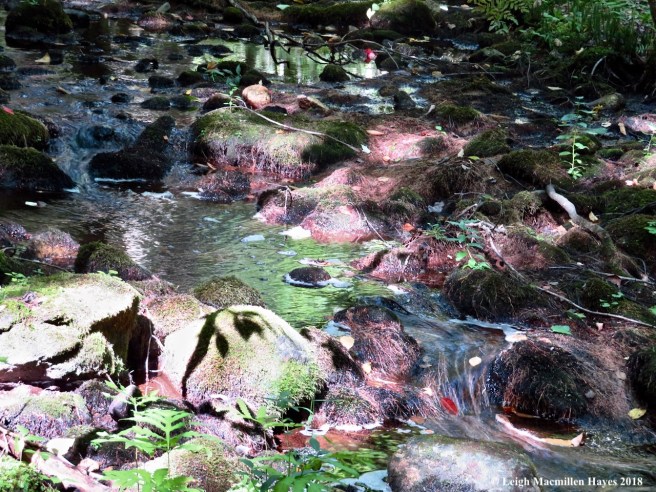
7-Sucker Brook

At last, we pulled ourselves away from the pond and followed the brook that flows from it–Sucker Brook.

5-Jack in the Pulpit

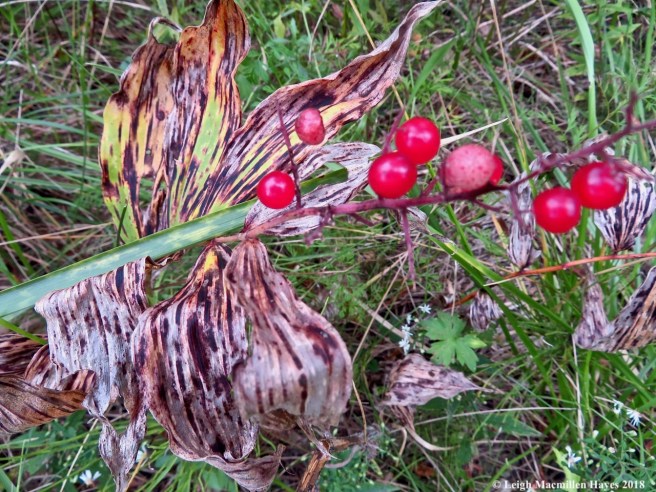
Right away, we were in awe of the Jack-in-the-Pulpit plants with fruits still intact. Jack is actually a curious plant and sometimes channels its feminine side. While the plant starts life as a male, if the soil is poor, it turns female, flowers and bears seed. It could turn male again. In the case of what we saw today, meet Jill.

6-thin maze polypore

As our journey continued, we noted fungi everywhere. Some had rotted and added to the earthy smell of the woods. Others displayed their unique structures, colors, and lines, including the Thin-mazed Polypore.

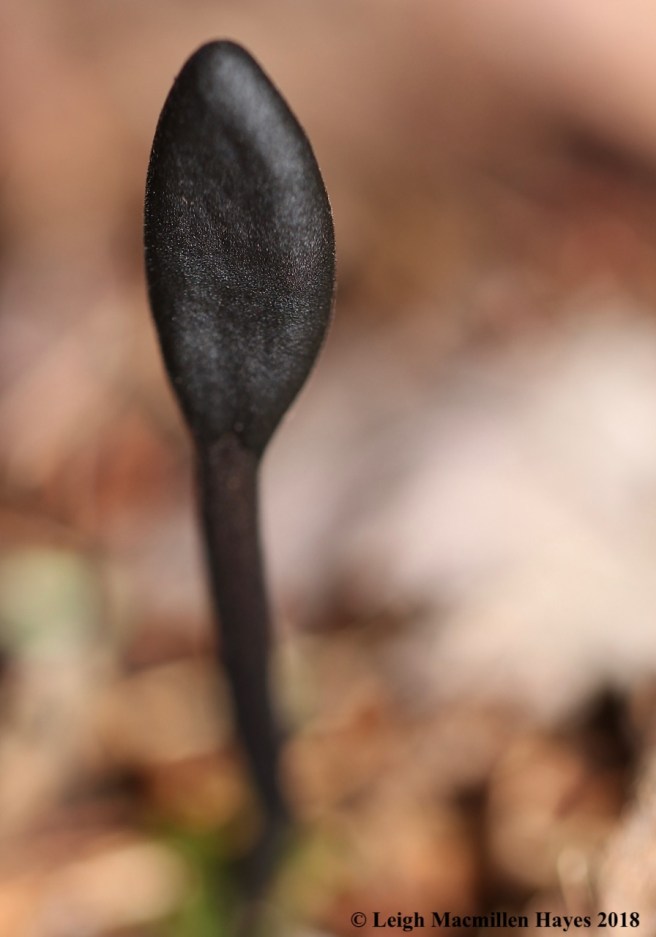
11a-earth tongue

We also found at least one Black Earth Tongue, its common name reflecting its tongue-like appearance as it stuck up from the ground.

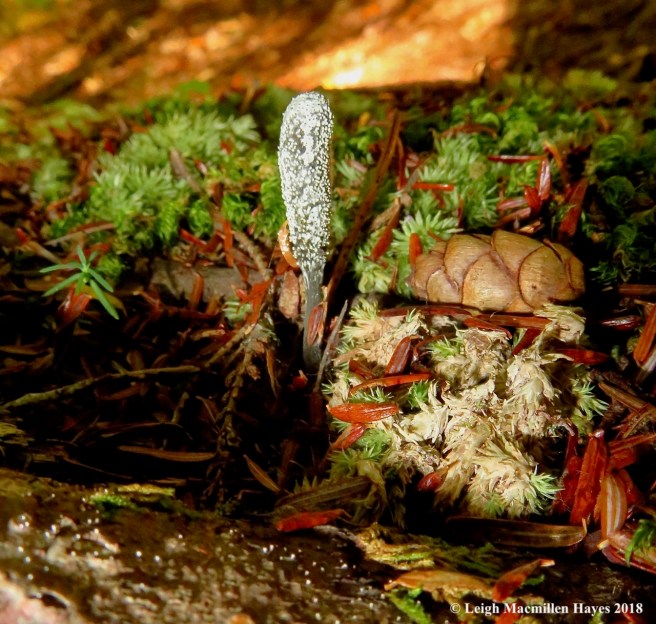
11-Dead Man's Finger

And in keeping with human body parts, we noticed a singular Dead Man’s Finger. But . . . its presentation offered questions we couldn’t answer. It was our understanding that on Xylaria longipes the young fruiting bodies would be covered with a whitish or gray powder in the spring. The powder isn’t really a powder, but rather the asexual spores of the species. So, did we find a confused youngster? Or was it an oldster parasitized by a mold?

10-Choclolate Tube slime

Speaking of molds, we stumbled upon a log featuring a feathery appearance reminiscent of antennae on a moth or butterfly. Well, maybe a collection of antennae. A huge collection.

10a-chocolate tube slime

Turns out it was Chocolate Tube Slime, a new discovery for me. In his book, Fascinating Fungi of New England, author Lawrence Millman describes it as “dozens of erect, brown tubes mounted on thin, seemingly polished black stems.” Bingo.

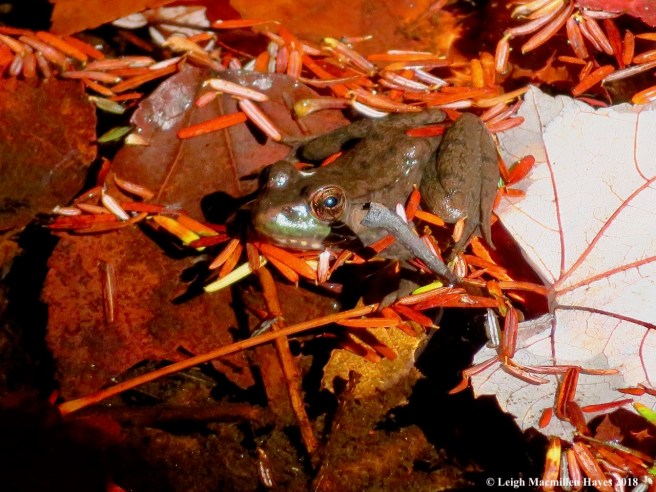
9-green frogin sucker Brook

Also appearing a bit chocolate in color was another green frog. And being the first full day of autumn, I began to realize that my time spent admiring amphibians and dragonflies will soon draw to an end. But . . . on the horizon . . . tracks and scat ;-)

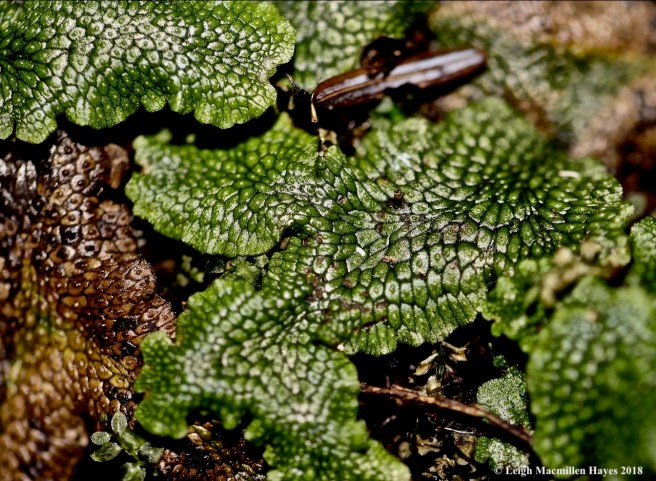
8-Conocephalum salebrosum

Because we were beside the brook, and we’d seen this species before, we searched each and every rock and weren’t disappointed. Conocephalum salebrosum showed off its snakeskin-like leaves.

8b-cono

The conspicuous grooves of the thalli on this liverwort defined the surface and gave it that snakeskin appearance.

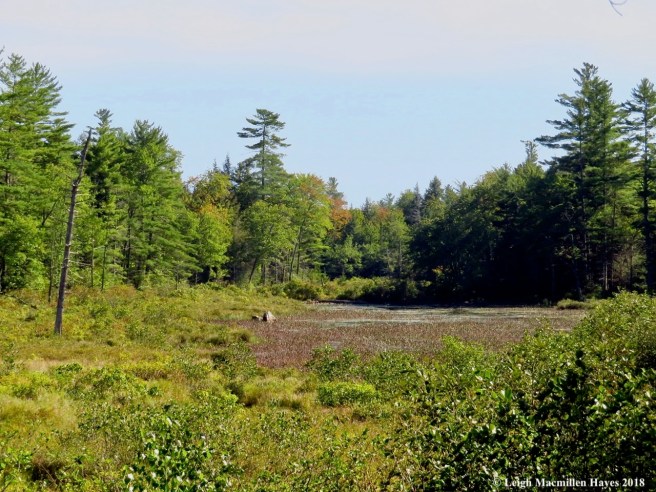
12-Moose Pond Bog

Continuing on, we finally reached the platform and climbed up to look out toward Moose Pond Bog. Of course, we hoped to see a moose. No such luck. We did spy one dog named Bella and her owner, Meg Dyer, the Lovell Rec Director, out for a Sunday walk in the woods. But they were on the trail below us and not in the bog. One of these days . . . maybe we’ll see a moose. When we least expect it, that is.

12-winterberry fruits buried

Back on the trail ourselves, our next great find–winterberries in a recently dug hole about four inches deep. Who done it? We poked the hole with a stick and determined that it didn’t go any deeper or have any turns, such as a chipmunk might make. Nor did it have a clean dooryard, which they prefer. Turkey? Perhaps. Squirrel?

13-winterberries among midden

We think we answered the question for on top of a tall hemlock stump that has long served as a red squirrel diner, some red winterberries appeared among the pine scales left behind.

14-liverwort?

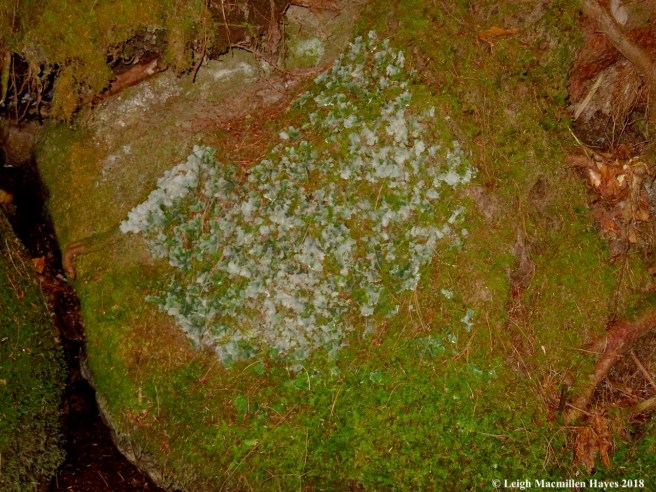
Almost back to the road, we crossed the final bridge and then backtracked. We knew our destination was up the streambed it crossed over and were thankful that it held not much water. That meant we could climb up and take a closer look at the large boulders in the middle. And it was there that we made a new discovery.

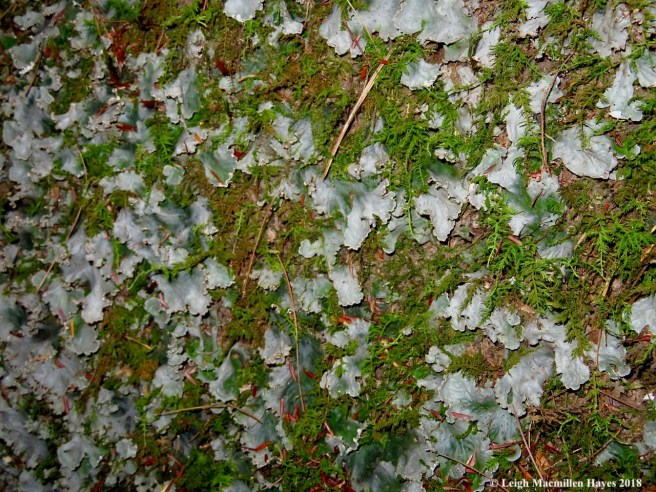
14a-Peltigera aphthosa

You see, in the past we’ve not been able to get too close to the boulders and from a bit of a distance we were sure we had looked at more snakeskin liverwort. But our ability to get up close and personal today made us question our previous assumption. Suddenly, the gray-green leafy structure took on a more lichen-like appearance. Though its color wasn’t the same, it very much reminded me of rock tripe.

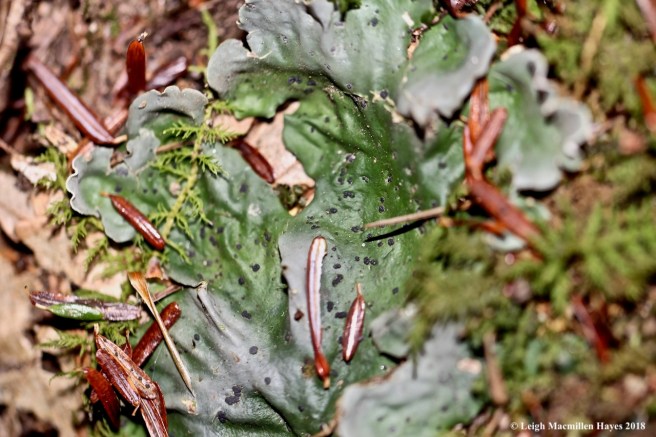
14c-Peltigera aphthosa

We studied its lobes and structure, including the tiny warts and questioned ourselves as we continued to examine it. I kept thinking it was an umbilicate based on the way it adhered to the rock substrate.

14b-Peltigera aphthosa

A little research and I think I’ve identified it correctly, but know some will alert me if I’ve assumed too much–Peltigera aphthosa, aka Freckled Pelt Lichen, also called Spotted Dog Lichen. The bright green center indicated it was wet. From borealforest.org, I learned that the little warts contain tiny colonies of cyanobacteria, which supply the lichen with nitrogen.

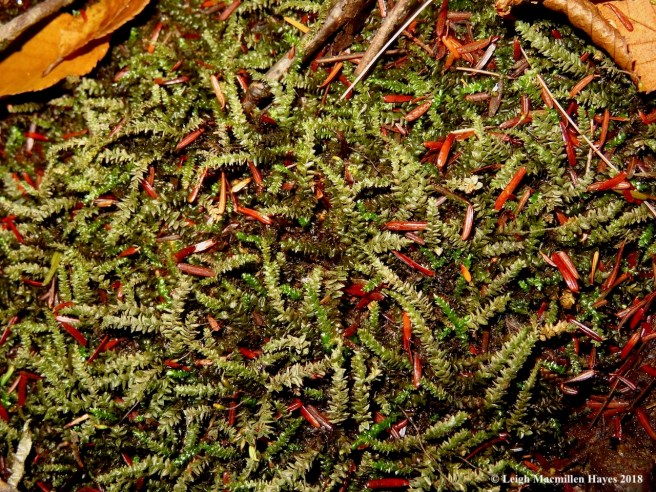
15-Racomitrium aciculare?

And right beside the lichen, we found a moss that also reminded us of a liverwort for it resembled Bazzania. But . . . if I identified this correctly, it’s Racomitrium aciculare. Some know it as Yellow-fringe Moss.

15a-Racomitrium

In his book, Mosses, Liverworts, and Hornworts, Ralph Pope described it as “common on wet rocks along streams and under waterfalls.” In watery seasons for this particular stream, that would be its exact location–under a waterfall.

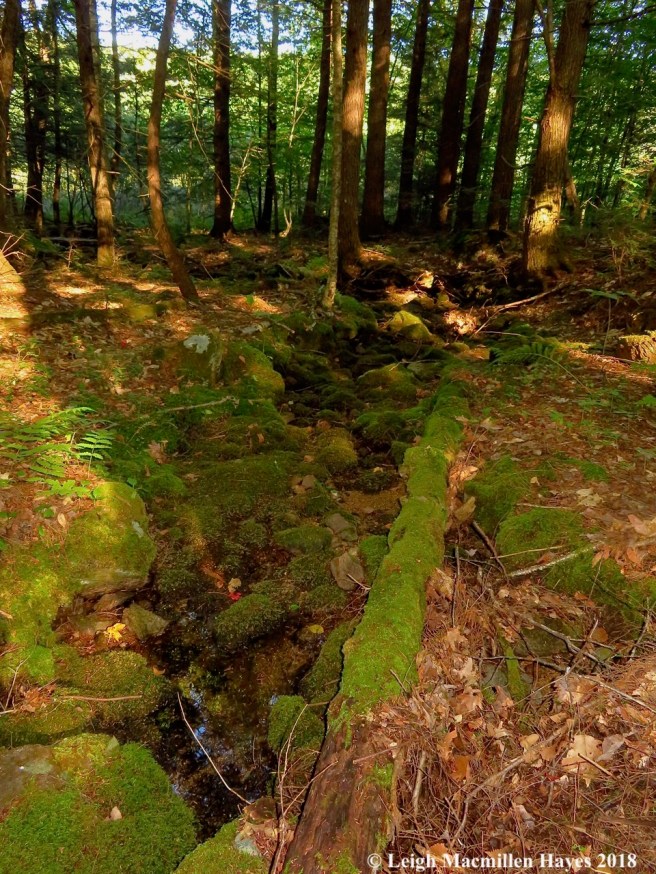
16-dry stream bed

Today, the stream bed leading down to Moose Pond Bog and Sucker Brook was just about dry. But . . . because of that we were able to take a closer look.

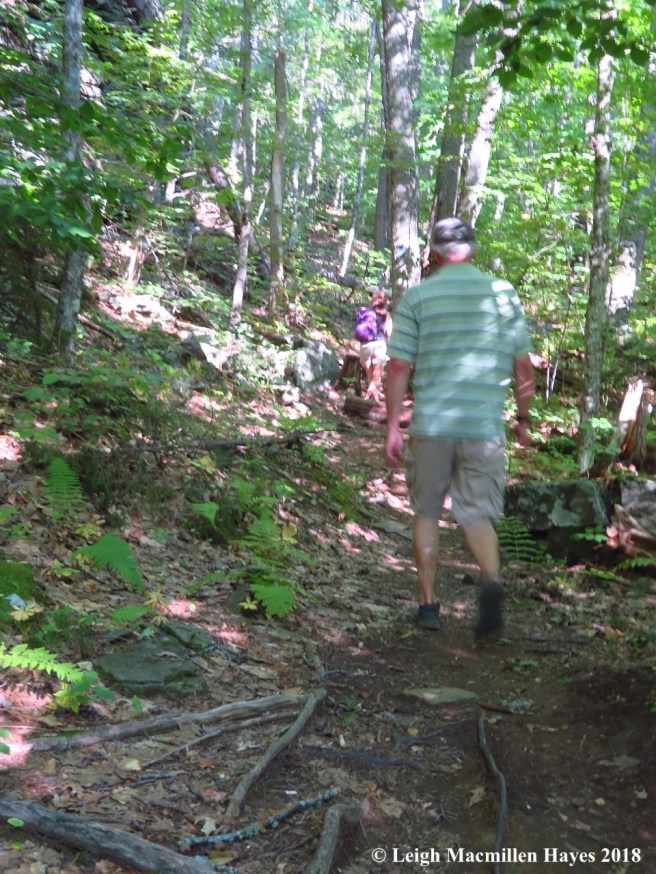
In fact, it took us almost four hours to follow the mile or so trail, but it was all about taking a closer look through our 10X lenses and cameras, slowing down our brains,  and channeling our inner Nancy Drew as we paid attention to clues and tried to decipher the scene around us–all the while detecting the nature of Wilson Wing.


Amazing Race–Our Style: episode eight

The clue arrived as mysteriously as usual on Sunday and we had to quickly book a seat for two on a seaworthy vessel. Thankfully, we got the first time slot for 10:30 Monday morning. And so, despite some fog, we drove northeast.

But . . . before we reached our destination, we had a challenge to answer to along the way. My guy needed to complete the crossword puzzle in the Portland Press Herald on his own. And then, while I did the driving, he needed to give me a clue, word by word until I’d completed the puzzle orally. Unfortunately, one letter held me up and we knew we’d loose a few moments if everyone else in the Amazing Race–Our Style finished it without flaws. We wouldn’t know for sure until the end. My glitch–the “r” in Urdu–the language spoken mainly in Pakistan.

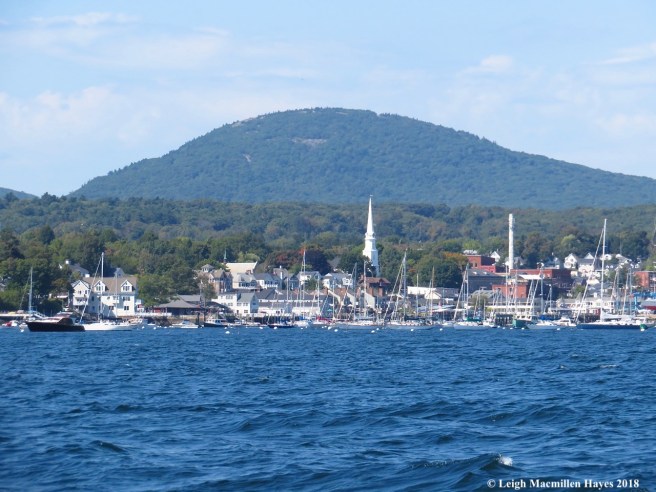
1-Camden Harbor

Two and a half hours later we reached the location where our next challenge would begin. Of course, we had to pay attention to the signs and not park where permission was granted only to those who worked the waterfront.

3-Schooner Surprise

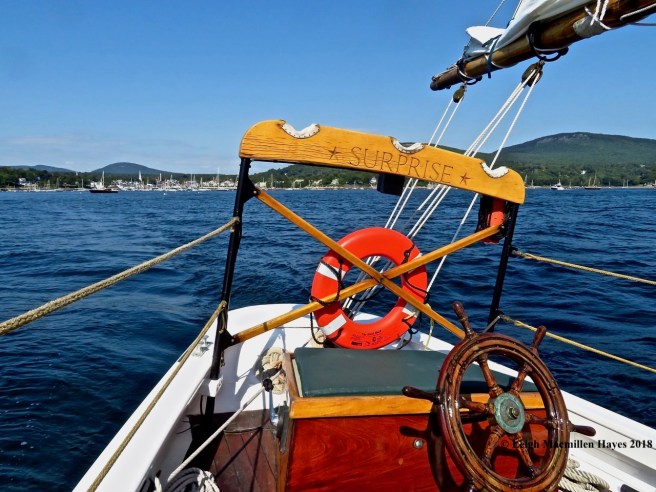
Our mission was to sail upon the gaff-rigged schooner Surprise. According to her website, Surprise was “built by the Waddell Shipyard in Rockport, Massachusetts, for Martin Kattenhorn. Surprise began her life as a racing and cruising yacht. Mr. Kattenhorn had commissioned Thomas McManus, the most famous American designer of fishing schooners, to design a vessel of about 45 feet, which could be safely sailed by a crew of no more than three persons. In early 1918, Surprise slid down the marine railway.

Her final dimensions were: Length overall 57 feet, Length on deck 44 feet, Beam 12 feet, Draft 7 feet, Displacement 21 tons.

Her topsail schooner rig allowed Mr. Kattenhorn to fly a mainsail, foresail, staysail , jib,  and a fisherman staysail. Her working sail area, not counting topsails, was just under 1000 square feet. Surprise was a respected racer. In 1923, she captured sixth place in a fleet of 22 vessels in the first race to Bermuda after World War I. Mr. Kattenhorn was a founding member of the Cruising Club of America, and Surprise carried the club’s ensignia from Bermuda to Nova Scotia and ports in between from 1918 until Mr. Kattenhorn’s death in 1959, an incredible sailing career!”

All of that history, and we realized we needed to pay attention. (Note to self: remember these facts) Already into the eighth leg of the race, we had a feeling that the historical value of some of our adventures would play a key part if we stay in the race until the final episode.

4-Captain Will applies sunscreen

At the established time, we boarded the boat and looked around at our shipmates. No fellow contestants. Huh? How could that be? But perhaps the rest had chosen the alternate activity that involved some baking and deliveries. We were much more comfortable setting sail with Captain Will, who when he wasn’t applying sunscreen, used his left foot to steer the boat out of Camden Harbor.

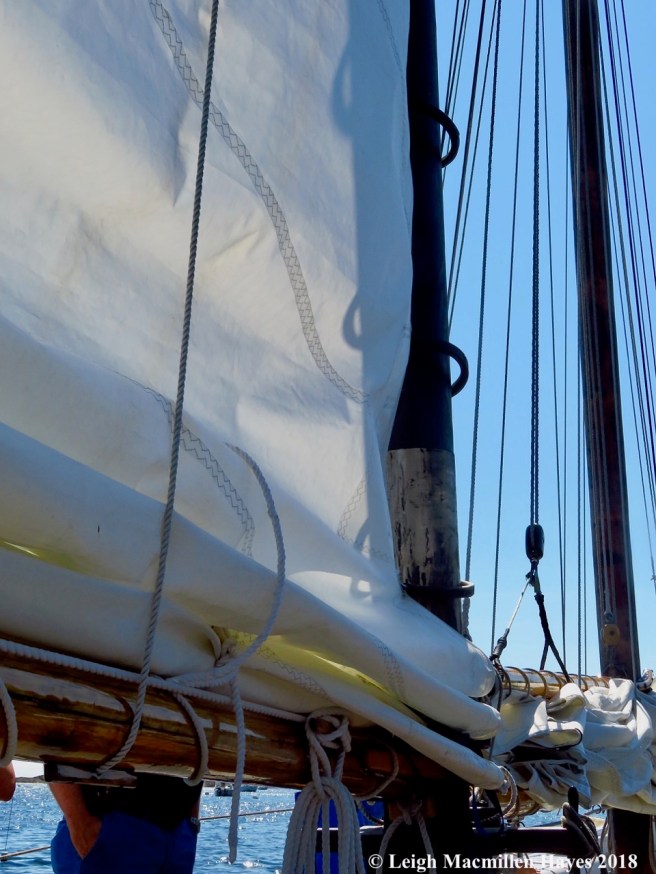
5-we raised the mainsail

Half way out, First Mate Laird asked for help in hoisting the sails. We knew this offering was intended for us. I quickly jumped up and my guy followed. My job–to use the hand-over-hand method to raise the raise the main gaff at the top as my guy kept the main boom parallel.  Of all our challenges thus far, this was among the easiest and we felt right at home.

6-Surprise

Finally under sail rather than motor power, the boat moved away from Camden Harbor and out into Penobscot Bay.

7-First Mate Laird

As we continued, the captain and first mate exchanged roles, because really, they are both comfortable and supportive in each. While Captain Will explained that Surprise was celebrating her 100th birth year, First Mate Laird looked up.

8-100 years old

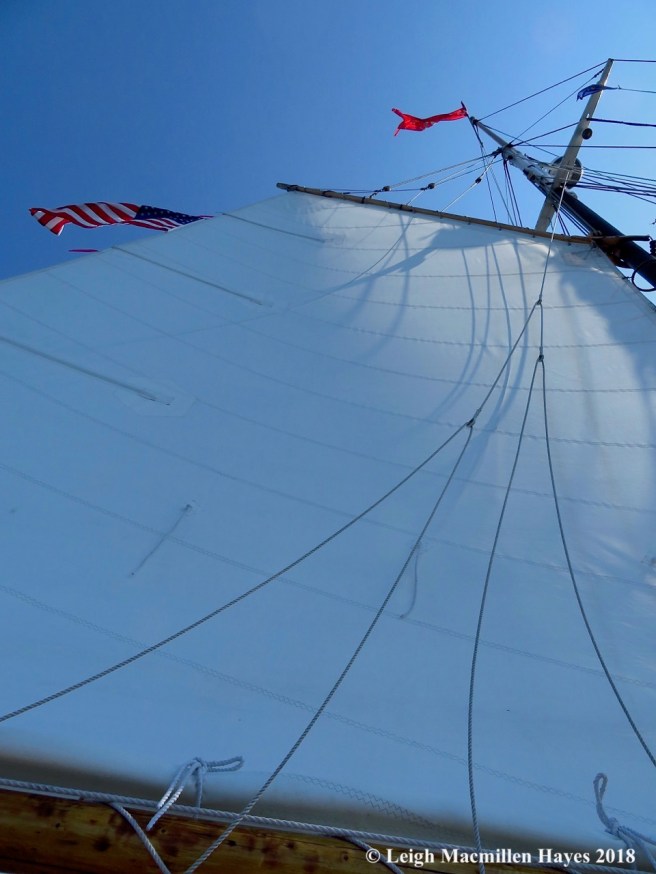
Above, a flag blowing in the breeze commemorated the celebration.

9-ghost ship on the horizon

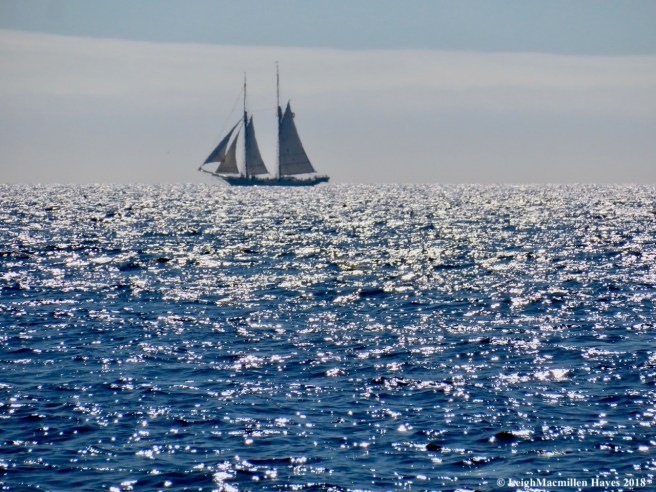
As we headed out to Mark Island in Penobscot Bay, so named because early mariners used the island to mark their bearings, we noted a ghost ship on the hazy horizon.

10-sailing Penobscot Bay

Will and Laird both exclaimed about what a perfect sailing day it was. Indeed.

11-Lobster Boat surrounded by gulls

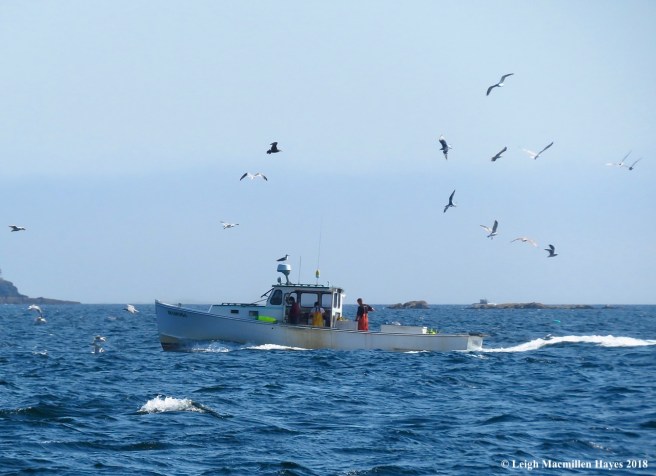
The further out we moved, the more we noticed lobstermen checking their traps as gulls circled in hopes of an offering.

15-pulling traps

These were the folks who had headed out onto the water at 4 am as they surveyed the  grounds where they’d set traps. A Maine lobsterman is allowed to set up to 800 traps, but as we learned today, it not only takes time to gain a lobster license and no longer is it a tradition handed directly from father or grandfather to son or daughter, but one doesn’t set the full amount of traps to start. And we learned that Lobsterman Toby is the local God of the Traps and the one to consult before dipping into a lobstering career.

16-third lobster boat

Some collected lobsters while others replaced traps. It’s not an easy life, but don’t tell a lobsterman that. Oh yeah, and one more fact, women who lobster are also called lobstermen . . . with pride.

17-different tack

Once we changed tacks, positions on the boat shifted, as should be expected.

18-Curtis Island Light

From all sides, we viewed the Curtis Lighthouse. The station was first established in 1836. As the lighter rocks tumbled down in front of the current house indicated, when the first building was demolished, the rocks were not intended to be reused or repurposed. The present lighthouse was build in 1896 and automated in 1972. (Note to self: remember these facts)

19-Camden Harbor

Slowly we tacked and then motored back into the harbor, with Mount Battie’s domed shape, a reflection of the harbor’s outline, standing tall in the background.

21-boat featured in movie Dunkirk

Captain Will shared a third point of interest to add to our bag of potentially important historical points should we make it to the end of this race: The 1930 122 ft. steel-hulled yacht Atlantide. The boat played a life-saving role in World War II as allied troops pinned down by the invading German army were evacuated at Dunkirk, France. And it was featured in the movie Dunkirk.

23-sails coming down

As we sailed closer to shore, in a pattern of symmetry that matched our departure, everything was restored to its original position and the term shipshape revealed.

25-old boat railway

Back under motor power, we passed by an old marine railway, which probably resembled the one Surprise originally slid down.

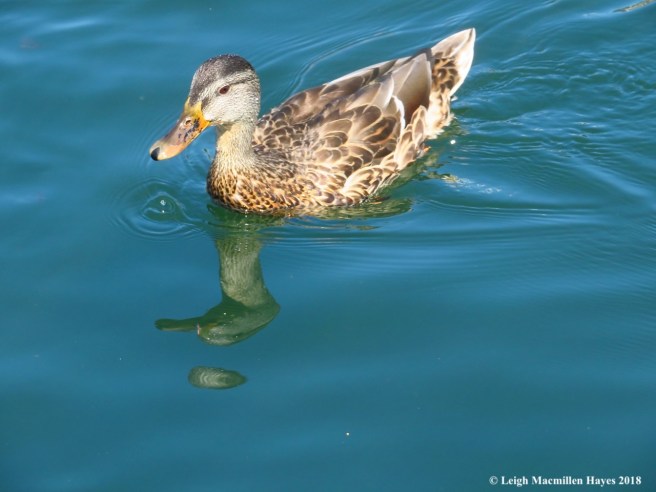
23-female mallard

At last, our sailing experience of the day slowed. And a female mallard swam beside the boat, perhaps her hope for a handout redeemed occasionally by others.

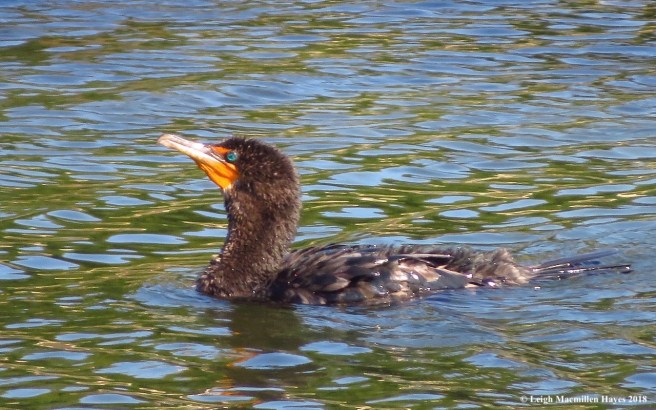
2-Comorant

Meanwhile, a cormorant bathed.

24-docking

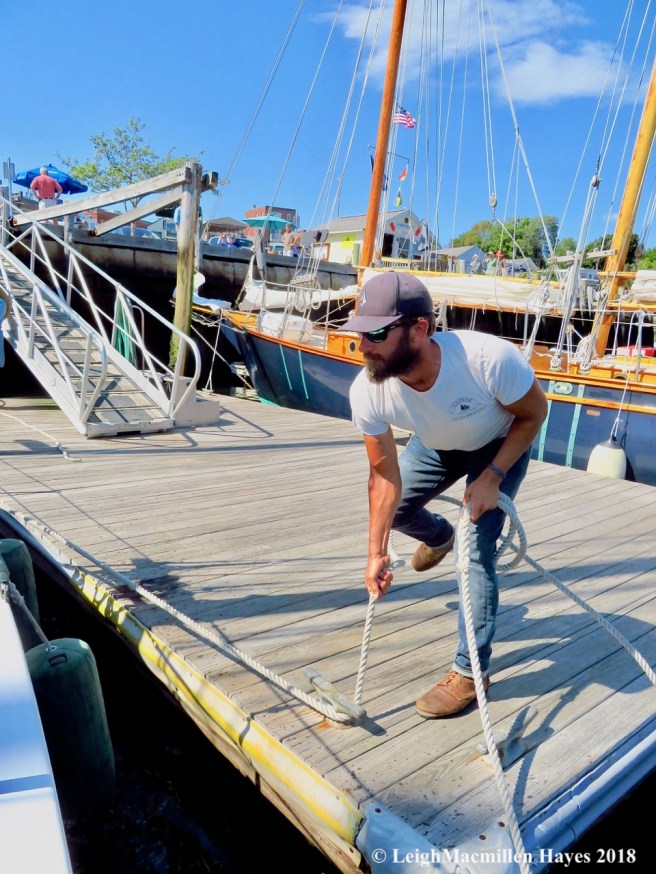
With precise precision as a neighboring boat docked, we pulled in, Laird jumped off the boat and all ropes were secured. Our journey had ended and we needed to hustle to a lunch spot.

25-beer at Peter Otts

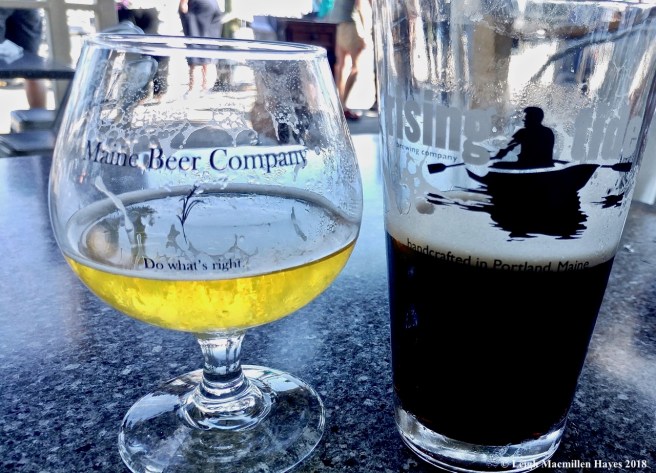
We chose Peter Otts and a Maine Beer Company Peepers Pale Lager for me, while my guy enjoyed a Guinness–because it’s good for you! Two delish haddock sandwiches rounded out our menu choices.

25-Climbing Battie

But we still had one more task to complete–to locate a symbol of WWI while hiking. And so up Route One we drove to Camden Hills State Park in hopes that we’d chosen the right place. It was rather deceiving at the start of the hike for across one boardwalk after another did we walk.

26-changing terrain

Eventually, however, the incline steepened and terrain became more of what one might expect along the coast of Maine–rocks and roots to navigate around and over.

27-wavng hello

We hadn’t seen a single other contestant and had no idea how we were doing, but knew we’d lost a wee bit of time on the crossword challenge, and so we paused for a second and my guy expressed his inner Cousin Itt.

28-Camden below

The funny thing we noticed about the trail system was that no matter how much further we had to go, many of the signs indicate 0.5 miles, and even after we’d covered a section of 0.25, the next sign stated the summit was still 0.5 ahead. It amused us and from then on we knew everything was a mere half mile away from somewhere.

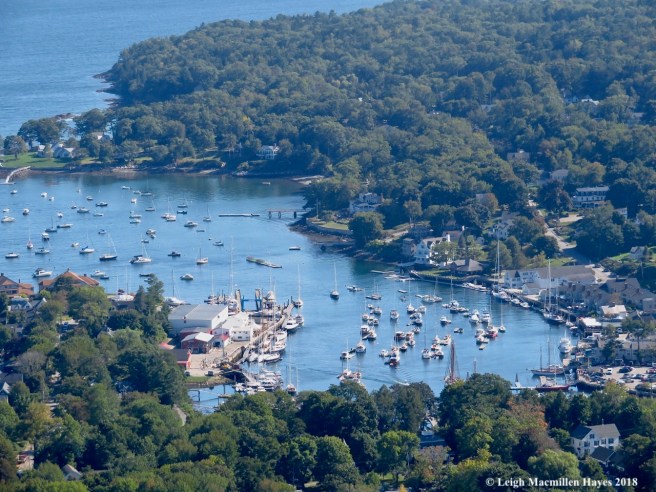
At the summit of Mount Battie, the view encompassed the harbor below.

29-tower

But it was what stood behind us that became significant.

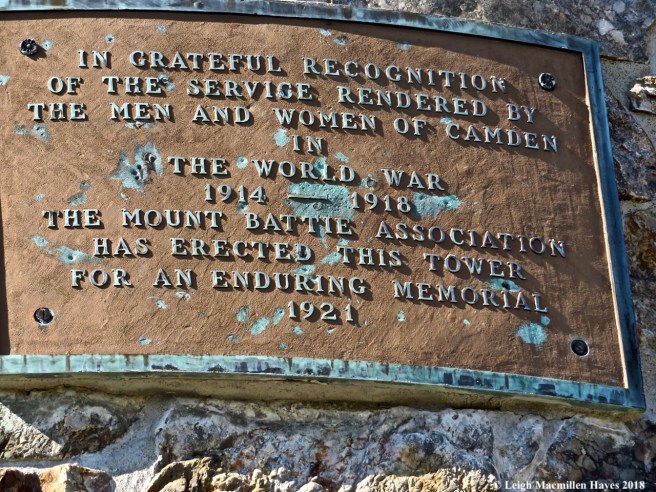
31-tower dedication

We’d found our WWI symbol, a memorial to those local people who served our country. And another piece of history to tuck under our hats for future reference.

30-view from the tower

Though we couldn’t see Acadia because of fog, the view was still breathtaking from the top. It was there that we encountered another contestant who actually asked us for some help with the trail system. Team Purple is legally deaf and her partner had deserted her, so we were happy to offer assistance.

32-Edna St. Vincent Millay

To that end, we gave her a head start while we paused to honor Edna St. Vincent Millay. And give thanks that we saw what she had seen.

34-Team Purple

Eventually, we did catch up with Team Purple, but she was a hearty hiker and we let her continue to lead.

35-Crossing the mat together

She, however, had another idea in mind, and in true alliance fashion, the three of us, our shadows lengthened as the sun slowly lowered, crossed the finish line of this episode together. We weren’t the first to complete today’s challenges, but we’re still in the race.

Going forward, we wish Rebecca of Team Purple the best.

Phew, eight episodes of the Amazing Race–Our Style completed. Only four more to go. Will we survive? Stay tuned.

Speaking to the Future, Jinny Mae

As a kid, science and history eluded me. Reading, and writing, and even, ‘rithmitic, I embraced. Well, only a wee bit of the latter, though my father thought my abilities were far greater than they were and he saw a bank position in my future. He was the mathematician. It wasn’t a subject for me to pursue. And so I became an English teacher.

And then one day I woke up and found I’d developed an interest in the how and why and the science of stuff. Added to that was a desire to know more about the past. And voila, here I am, some days spending way too many hours pursuing insects in the garden or bark on tree or dragonflies buzzing about. Other days, its following trails of yore and trying to understand the lay of the land and those who came before that interests me. My favorite days are probably those that find me pursuing the two subjects simultaneously.

1-Ambush Bug on Hydrangea

Today, I devoted spurts of time to a hydrangea bush that we rescued from a shady spot in our yard about fifteen years ago and transplanted to a sunny spot. What once was a dying shrub that rarely produced more than one flower is now a healthy specimen laden with blooms. And the insects love it.

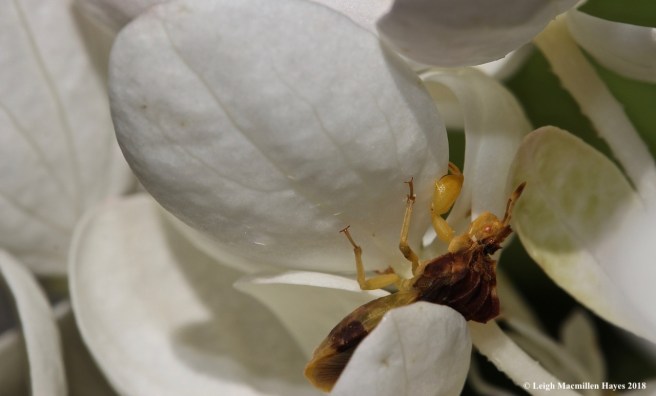
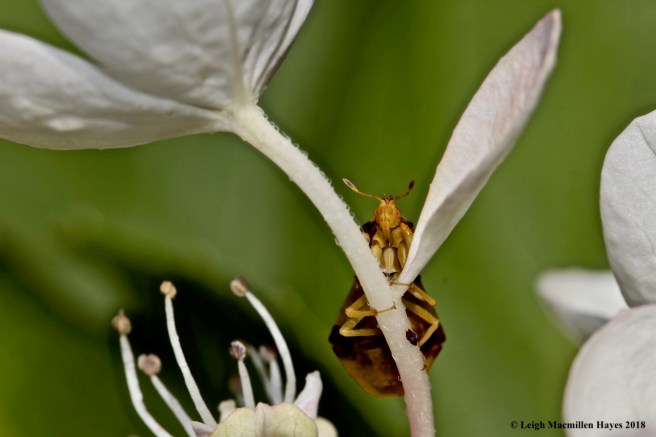
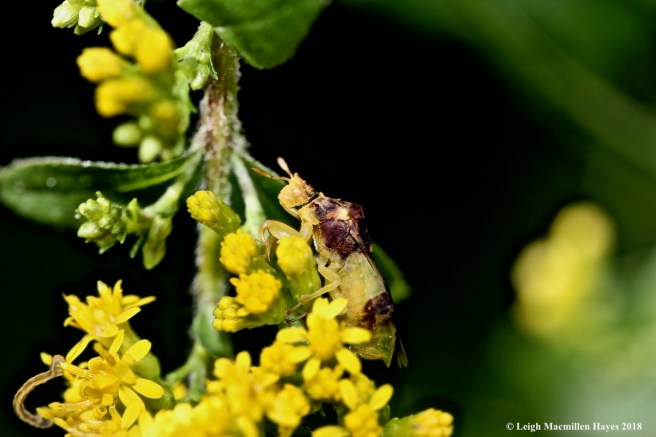
My biggest surprise, however, was to find an Ambush Bug sitting atop one of the newly opened white flower petals. For the first time since I’ve been paying attention, the bug was on something other than a goldenrod and I could truly see its body. I’ve always thought it exhibited a hint of a smile, and do believe I’m correct.

An Ambush Bug is my “iguana” insect for its body structure always brings to mind a neighbor’s iguana that got loose one day and never was spied again when we were kids. (Or was it? Didn’t we find a dead iguana on the old dump road, Kate and Lynn? Was that Rob’s lizard?) Anyway, I think the Ambush Bug resembles an iguana, on a much smaller scale, of course. MUCH smaller.

2-Ambush Bug

Seeing the bug on the white petals really threw me for a loop. Why was it there? What would it ever find to eat? The pollinators no longer bothered with the shrub on which it stood. They’d moved on to the goldenrods and asters below.

And how could this insect behave as one who ambushes when it was hardly camouflaged on the white petal? It must have questioned the same (if Ambush Bugs can question) for it turned this way, then that, and back again, and then moved from petal to petal and flower to flower. Usually, it hardly seems to flex a muscle as it remains in one spot for hours or days on end.

3-eye to eye with Ambush Bug

We studied each other, eye to eye, or perhaps more correctly, lens to lens, until I blinked and it flew off. I trust it landed on a nearby goldenrod, where a meal wasn’t too long in the making.

4-Tiger Moth Caterpillar

Just after the Ambush Bug and I parted ways, I noticed a subtle movement below and watched a tiger moth caterpillar that reminded me of a soft boa scarf one might wrap around a neck quickly slither down another flower on the shrub until . . .  it reached the edge of the final petal and fell to the ground, climbed up a fern frond, found its way back to the shrub and moved on to the world within.

7-grasshopper 1

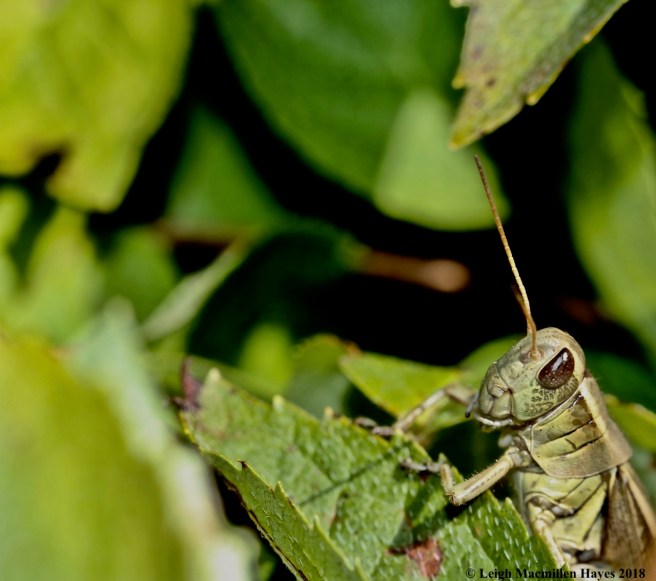
I was beginning to think that all of the insects on the hydrangea would move on or in, but then I met the Red-legged Grasshopper. He set his elbow on the leaf bar and we consulted each other. Would he fly away if I moved into his personal space, I wondered. He wanted to know why I stalked him.

8-red-legged grasshopper

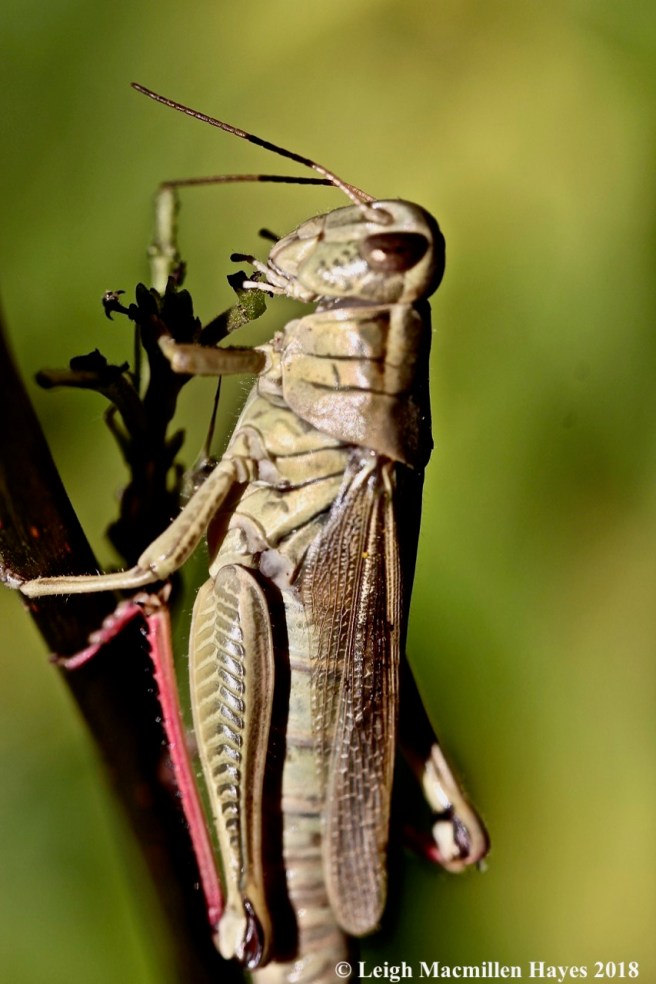
I mentioned his body of armor and the herring bone design and the leg joints and the spurs on its legs that drew my awe.

9-grasshopper

As a solo traveler, I knew it didn’t appreciate that I wanted to share the space. But, I couldn’t resist. Notice its feet and the segments on its abdomen and even the veins in its wings. Did I mention its mandibles?

10-caterpillar scat

As it turned out, there may have been a reason it wanted to be alone, but I was there. To. Witness. The. Poop. A blessed moment. It would have been more of a blessed moment had it pooped on me. Oh, and did I mention that grasshopper poop, like all insect poop, isn’t called scat. Rather, it is frass. Thanks go to Dr. Michael Stastny, Forest Insect Ecologist in New Brunswick, Canada for reminding me of that term. Cheers Mike.

14-shield bug

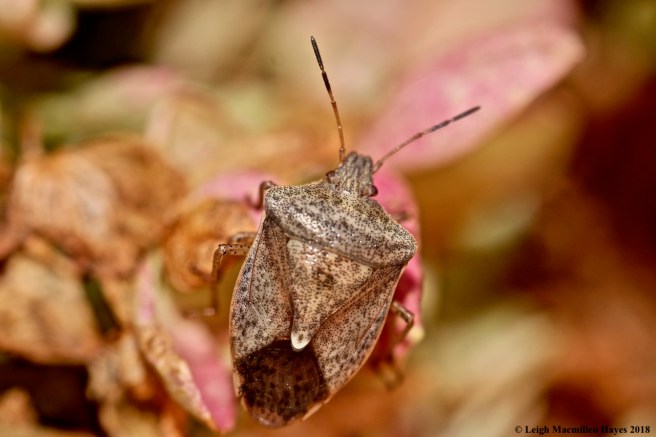
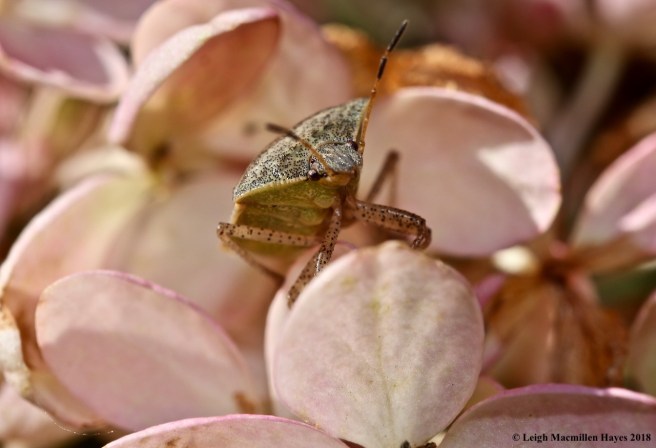
Another moving about was a shield bug, so named for the shield on its back. It does make me think of a piece of metal one might use as protection. Combine the shield with the grasshopper’s suit of armor and you might think you were spending time in an earlier era. Much earlier.

15-shield bug

But this shield bug didn’t care about the Middle Ages. Instead, it had one thing on its little mind.

12a-shield bug eggs?

Depositing eggs.

13-shield bug eggs?

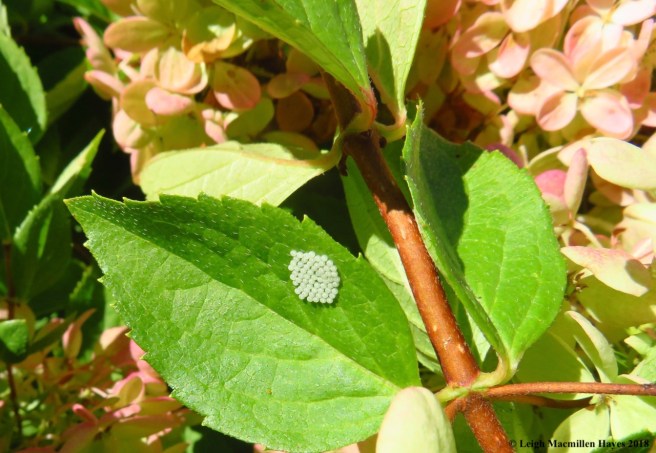
Its offering was almost minute, yet pearl-like in structure.

16-wasp within

The world I watched on the outside of the hydrangea made me wonder what might possibly go on within. As much as I wanted to break through the branches and take a better look, I knew I’d ruin everything and after all, it wasn’t my place. I did, however, get to witness one moving about briefly for a paper wasp left the goldenrods and heading under the hydrangea leaves to move the pollen about on its body. Why did it go under? Why not pause atop a leaf for such behavior? And how did it escape the inner world without . . .

16a-spider web

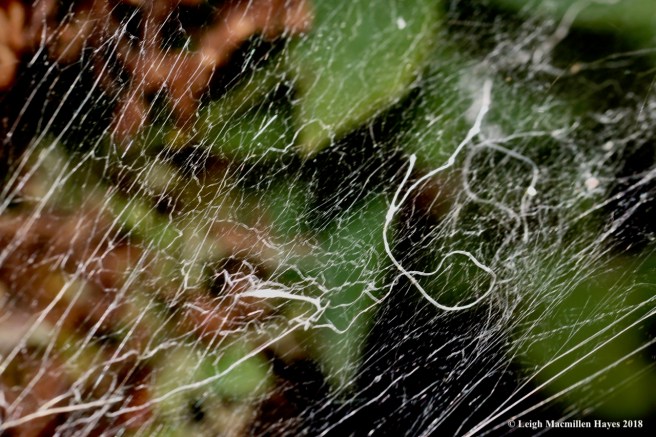
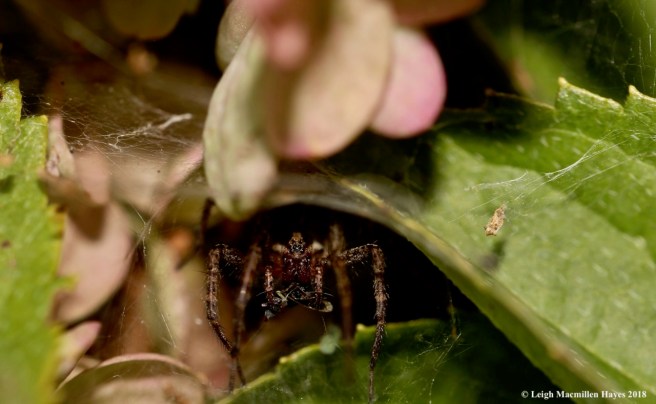
encountering a spider web? Funnel spiders had practically veiled the entire shrub with their silken structures.

16b-web anchors

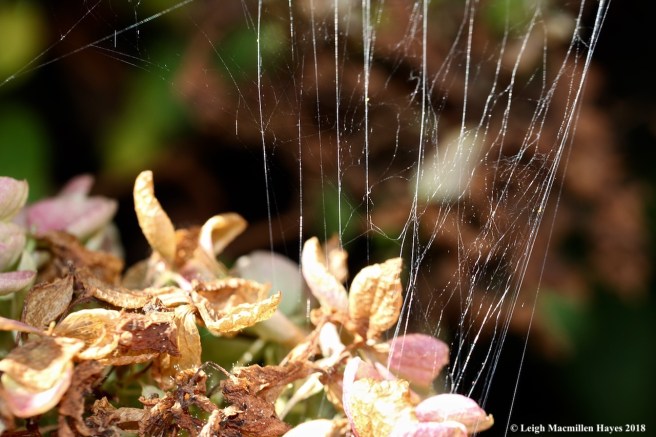
Though anchored with strength, they were extremely soft to the touch.

17-spiders

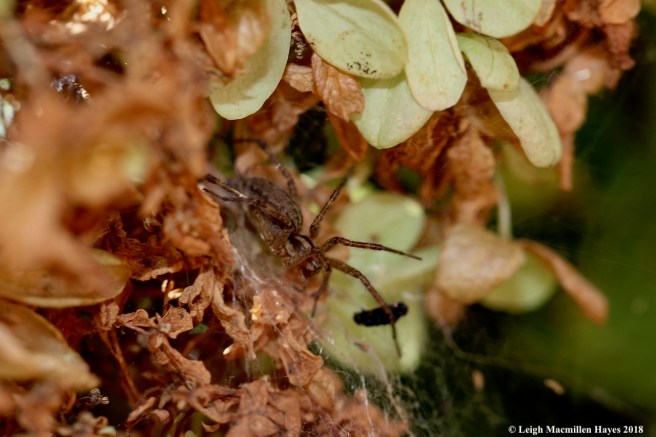
As the day progressed, I kept tabs on three funnel spiders, the mighty weavers that they were. All were wary of daylight.

18-food in front

But one had set up its home on the eastern side of the shrub and so it spent the day in the shade and enjoyed fine dining on a small bee that I assume made a mistake of pausing while shifting some pollen on its body.

19-dining

There wasn’t much left of it by the time this spider had finished its meal.

21-dinner in hand

Later in the day, a web weaver on the western side began to show itself–and it also had a meal secured.

All of the insects and arachnids I saw, and I had to assume even more enjoyed the inner structure of the condo that the shrub certainly was, all spoke not to the past, but to the future.

And with that, I dedicate this blog entry to you, Jinny Mae. You have a better eye and understanding and ask better questions than I ever will. Here’s to the future!

Global Golden Sights

Until I spent time watching, I never realized how global a goldenrod could be. In fact, I must admit that there were years when I tried to eliminate these hardy yellow plants from the garden. After all, weren’t they weeds? You may think thus for so prolifically do they grow, but these days I prefer to think of them as volunteers who add beauty in any season. And during this season, they mimic life as we know it.

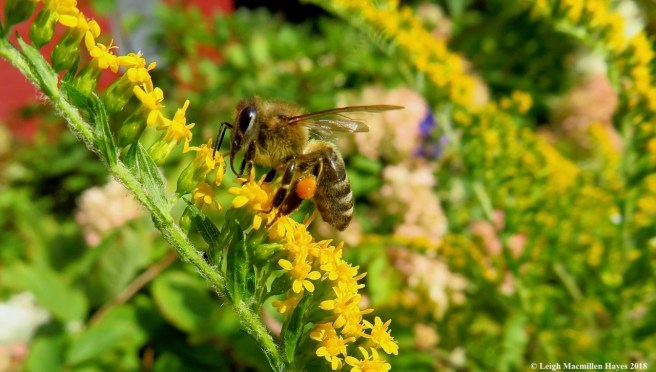
1-worker honeybee foraging

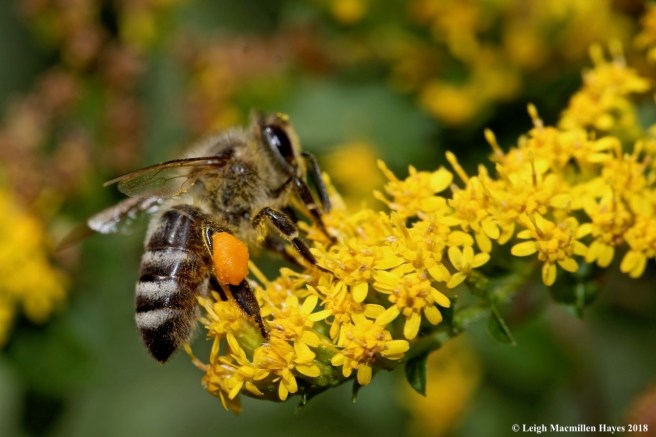
First, on sunny days European Honey Bees buzzed about. Yes, they are not native. But don’t tell them that. After all, they think they own the place.

2-honeybee

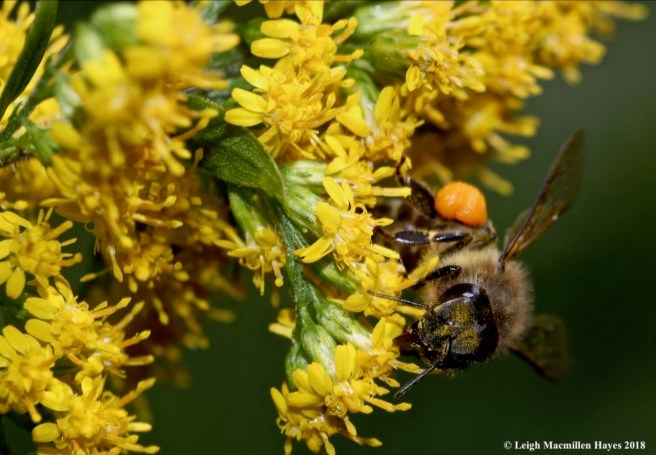
As quickly as they could, they sought nectar from the flowers and in the process, pollen clung to their hairy bodies. Aha, so in their greediness, goodness happened. How could that be? Or rather, how could that bee? (Corny jokes are forever a teacher’s forte)

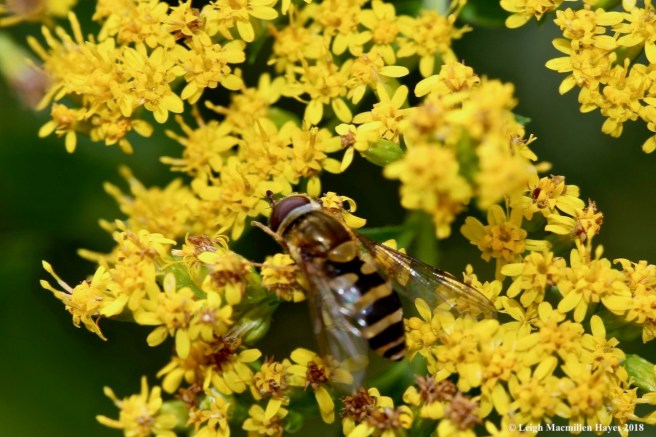
3-hoverfly

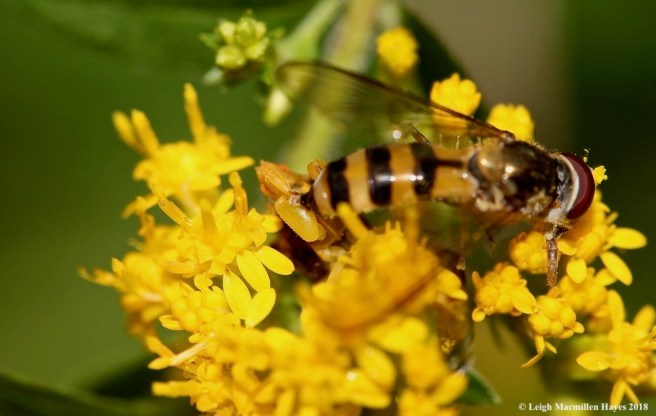
As I gazed upon the minute flowers of the Rough-stemmed Goldenrod, I had to look for subtle changes of color in order to read the story. Ever a fan of the coloration of the Hover Fly, I was thrilled that I could focus in on this one. Then the realization struck–this fly wasn’t . . . flying. In fact, it was dead. And yet it still held its structure.

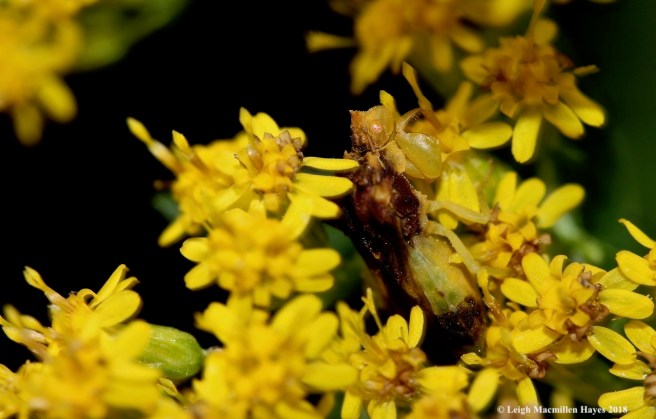
4-ambush bug

Looking up a stem or two, I noticed a predator in the waiting, its structure so otherworldly, much like an armored iguana. But it wasn’t a lizard.

4a-ambush bug

It was a common insect that changed position as I changed lenses. The amazing thing is that it blended in so well, but that was all part of the insect’s strategy. Did the Hover Fly’s death have anything to do with the Ambush Bug? All are innocent until proven guilty and I needed to remember that, but I still suspected I knew the perpetrator.

4b-ambush bug

For three days I stalked him as he stalked others. An Ambush Bug is willing to wait until just the right moment to attack its prey with those oversized raptorial forelegs and quickly dispatch it with a stab from his sharp beak. Who knew that in the small world of the goldenrod one needed to be ever on the alert?

6-honey bee

And still, a Honey Bee foraged and farmed.

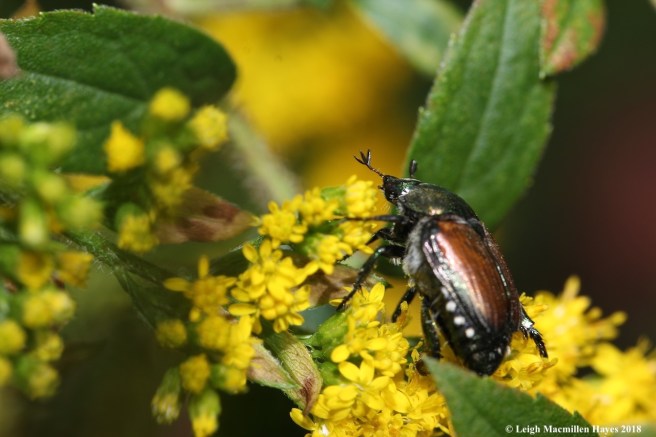
9-Japanese Beetle

Also on a mission was a Japanese Beetle, another immigrant in the mix. And I know that if I were to point out the unique idiosyncrasies of its body structure, I’d get booed out of town. But  . . . look at those colors, the details, and especially the antennae. It’s tough being the one dude that no others appreciate.

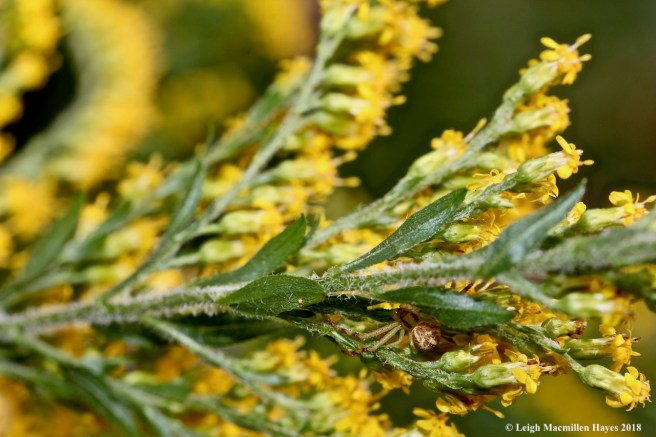
18-Where's Waldo the spider?

For every foraging or unwanted citizen, there was one hiding in the shadows, ever ready to catch the neighbors when they were most vulnerable. Do you see the green and brown crab spider?

25-spider web

Some even set up traps to catch their prey, but after all, we are all hunters and need to dine.

10-pollen all over body

Still the Honey Bees flew in and out and chased off any others, even their siblings who got in the way. All were females, for such are the workers in their society. Ahem. Oh, excuse me. Just clearing my throat.

12-locust borer

For all the time that I watched (and really, I only spent an hour or so each day for I did have work to do) I noticed a Locust Borer on one particular plant. Females tunnel into bark to lay eggs and I probably should have taken a closer look at the quaking aspen in the garden that has been compromised by so many insects. But here’s another thing–do you see the yellow tip on its abdomen? Locust Borers don’t sting, but should you touch one it will try to bore its tail end into you as if it were a stinging insect. Silly bug.

22-Assassin bug 1

Peeking under a nearby stem, I found another seeking others–an Assassin Bug that was related to the Ambush Bug. Assassin Bugs are proficient at capturing and feeding on a wide variety of prey. Though they are good for the garden because they act as tiny Ninjas and prey on enemies of the plants, they don’t always discriminate about their prey. The unsuspecting victim is captured with a quick stab of the bug’s curved proboscis or straw-like mouthpart. I’ve had the opportunity to watch the action in the past, but I couldn’t always locate the little warrior, thought I knew it was somewhere among the drooped stems.

8-honey bags

And still , the Honey Bees flew, filling their sacs being their main priority.

15-drone fly 2

Not everyone could be a bee, but some surely tried to mimic their adversaries. Thus is the life of a Drone Fly that may have a bit of a hairy body, but it can’t sting. Instead, it had to outsmart its predators by being a look-alike. Such is known as Batesian mimicry, so named for the famous English naturalist, Henry Walter Bates. Bates discovered this concept while working in the Brazilian Amazon.  In the course of his studies, he realized that numerous non-toxic butterflies looked identical to a few very potent types.

16-sawfly?

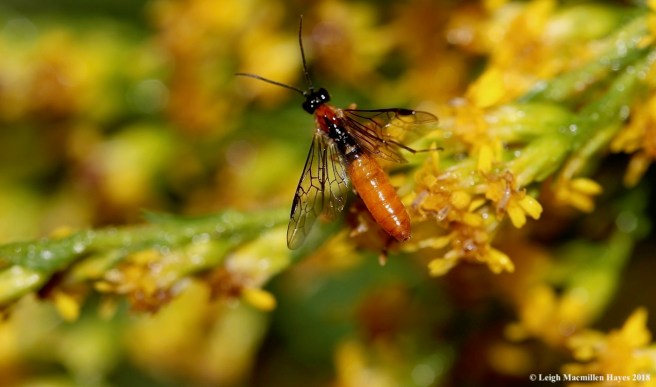
Other non-bees on the flowers included a rather handsome sawfly, its wings so distinctly veined.

17-honey bee moving pollen on body

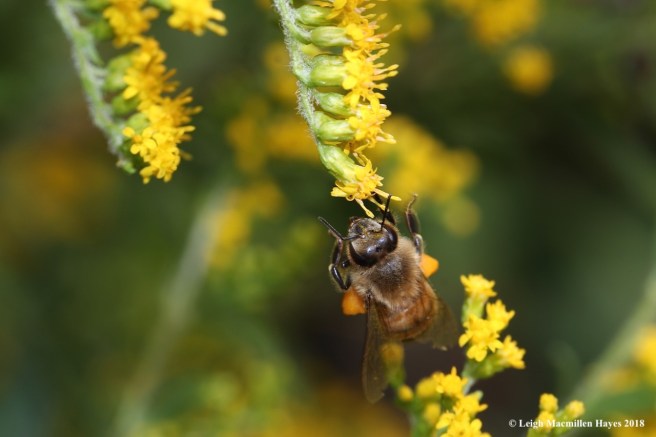
But the honey bees were on the move the most and managed to control the activity of those smaller and larger by giving chase to all. Occasionally, one had to pause and dangle in order to move some pollen into its sac.

30-crab spider

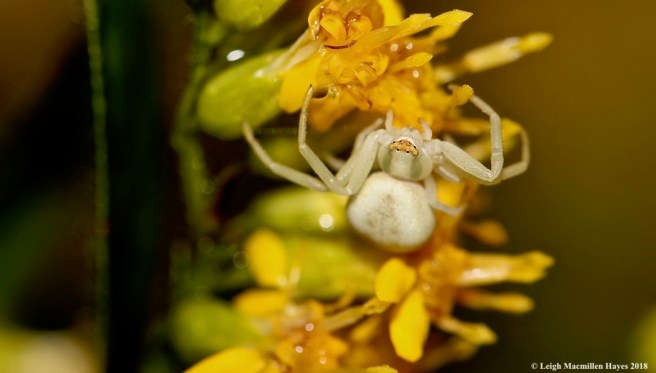
Also known to dangle, for that’s what spiders do best, was another crab spider, Crab spiders may be tiny, but they can be cunning and ferocious. Like the predatory insects, waiting was the name of the arachnid’s game and I don’t doubt that this one was successful in securing its next meal.

32-inch worm

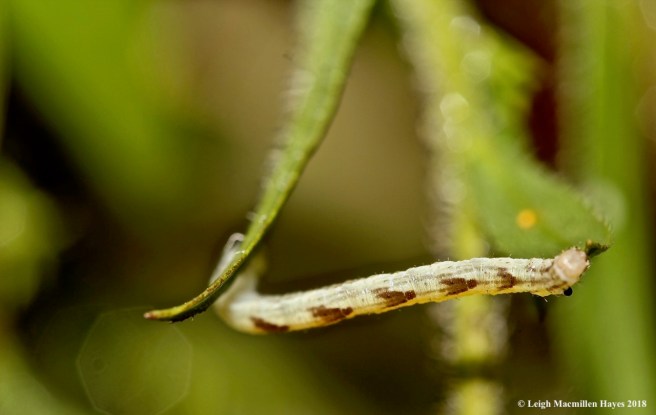
And while still in a dangling mode, there were the inch worms of varying colors to spy, most of them slithering ever so slightly among the plants flowers, but some were on the move to the leaf that was greener on the other side.

36-dead inch worm

This morning, I did discover a dead inch worm and again, like the Hover Fly that met its demise, I wondered who done it. Ambush or Assassin Bug? Those were my two choices.

39a-hover fly

I did find a live Hover Fly and its presence made me happy. There’s something about its streamlined structure and minute hairs and clear wings and hovering ability that appeal to me.

39-hover fly an dinch worm

One even demonstrated that it could share the space with an inch worm.

37-flesh fly

Equally admirable was the Flesh Fly with its brick red eyes and handsomely striped abdomen. It’s called a Flesh Fly for its habit of locating decomposing carcasses and laying its eggs. I have to admit that thinking about that and the maggots to follow gives me a chill.

40a-metallic green sweat bee

A metallic green Sweat Bee flew in periodically, but never stayed long. Thankfully, it chose to ignore me. In fact, considering how close I was and in the faces of so many, as always, the insects and spiders left me alone. I, on the other hand, continued to stalk them.

42-paper wasp

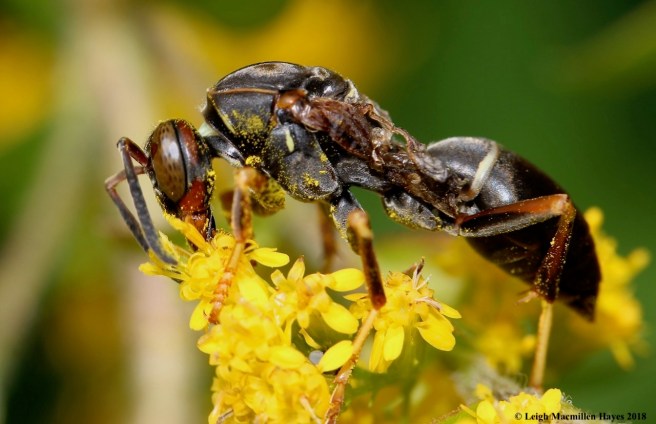
Surprisingly, even the rather aggressive Paper Wasp ignored me. I could hardly ignore it. Whenever he flew, most other flying insects performed a mini dance, flying up, swirling down and then settling again.

But take a moment to look at that body. It’s as if some insects wear a coat of armor. And in the wasp’s case that coat was dusted with pollen, just as nature intended so fertilization could occur.

44-bumblebee

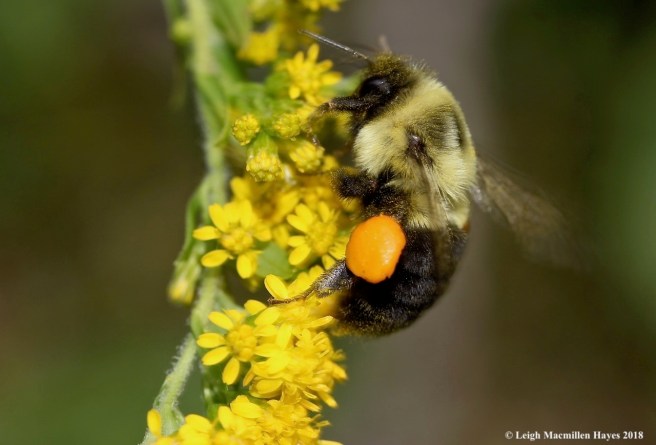
Even the aggressive Bumblebee let me bumble about without incident. In my three days of watching, there were plenty of Bumblebees buzzing, but they tended to visit all of the surrounding flowers. Today, however, in a frantic frenzy, one sampled this flower and that along the goldenrod stem.

45-locust borer waving

While the Locust Borer I mentioned earlier spent the last three days on the same plant, a second one flew in today and settled on a goldenrod about seven feet away from the first LB. Will they meet? I assume so, but in the meantime, it waved.

41-assassin bug

And in a different location than the first day, I found an Assassin Bug. The same one? Perhaps. But again, no food. Still, it waited.

50-ambush bug

As did the Ambush Bug.

39-half-inch worm and ambush bug

In three days, it hadn’t moved far, but finally decided to take a different stance. To its left, a half-inch worm stayed in one spot, though it kept changing position. And I kept waiting–why didn’t the Ambush Bug grab the little thing and suck its guts out?

46-ambush dining on hover fly

Because . . . it was waiting for a more substantial meal I later learned. And my question was answered. What killed the first Hover Fly? An Ambush Bug. And this afternoon it worked on another. Drats. But, in this insect or arachnid eat insect world, finding a meal and gathering energy from it was the most important thing.

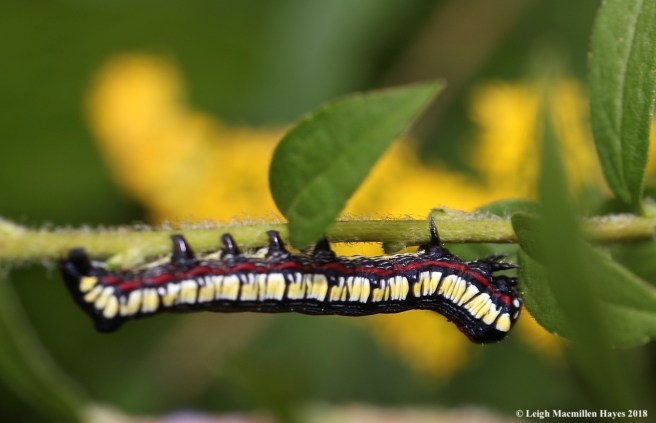
43-larvae of brown-hooded owlet moth

Much to my delight because I was looking–I spied the larvae of a brown-hooded owlet moth. Besides a monarch caterpillar, oh and a sphinx moth, and . . . and . . . the brown-hooded owlet moth caterpillar is one of my favorites.

33-forage looper moth

Its mature form wasn’t quite as attractive.

35-I see you

But still, what a sight to see tucked in among the goldenrods.

The garden may be small, but its offerings were global in nature when you think about it. Ah, those golden sights. Worth a wonder.  (And I left a few out!)


Mast Landing Mondate

What should you do when you come to a fork in the road . . . and a mailbox?

2-mailbox in the woods

Why open the mailbox, of course, enter the date and your names on the notebook stored within, and then follow the trail to the left. If all goes well, a couple of hours later you’ll emerge via the trail on the right. With lots of zigs and zags along the way, that is.

3-foundation

The story of this place dated back to the 1700s when the massive white pines that once grew there were harvested for the British navy. A dam was built and mills as well. In fact, at one time there were four mills, including a saw mill, textile mill, and two grist mills, plus a woodworking shop. We spied a foundation just off the trail, but didn’t know its part in the story.

5-lily of the valley surrounding foundation

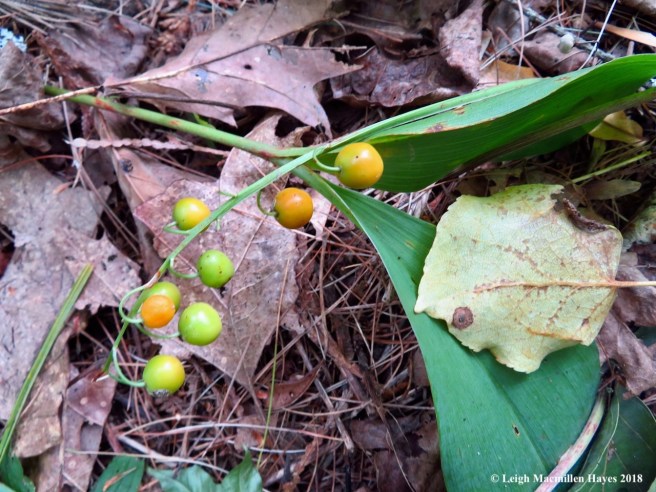
Surrounding the foundation in abundance, however, were lily of the valley plants, their fruits taking on their fall hue. And I imagined the lady of the house tending her garden.

4-black-capped chickadee egg?

Though the homesteaders were no longer in residence, we found evidence that others called this place home–possibly a black-capped chickadee egg.

3a-old vechicle

A little further on, we found another artifact dating to an earlier time. Much earlier given its structure and how buried it was. This had once been farmland before the forest grew up again.

6-climbing under blow down

It wasn’t far into our journey, however, that we began to notice something about this land–it had been hit over and over again by windstorms, all blowing from the east, which made sense given that we were less than a mile from the ocean. We found ourselves stepping over, crawling under . . .

7-walking through blowdown

walking between . . .

8-destruction everywhere

and starring in awe at all of the destruction. It was nothing like we encounter in western Maine, and we began to feel trail snobbish.

9-uprooted

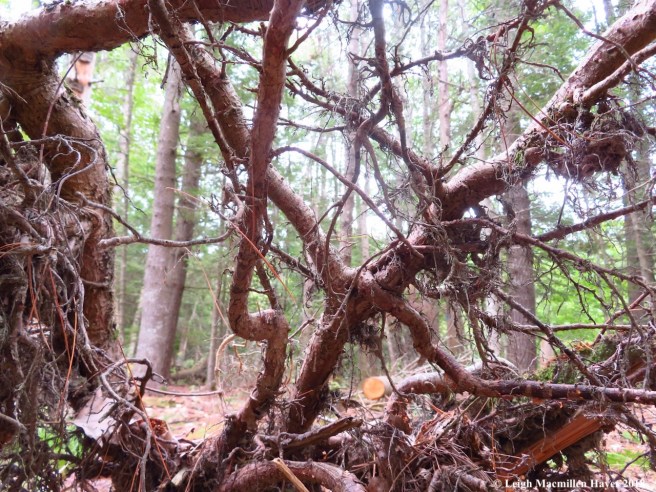
But . . . uprooted trees do offer interesting art forms from above . . .

10-underrooted

and directly below. Think of it as nature’s stained glass window.

10a-bark beetle tunnel art

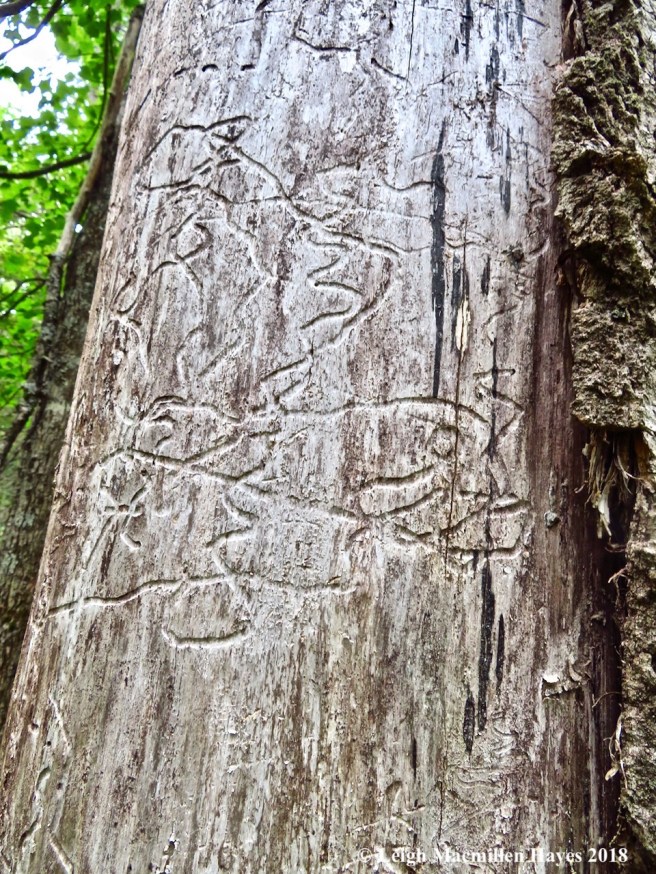
There was other artwork to admire, including those zigzaggy tunnels created by bark beetles. They must dance to their own tunes as they mine their way across the cambium layer.

10b-artist conks

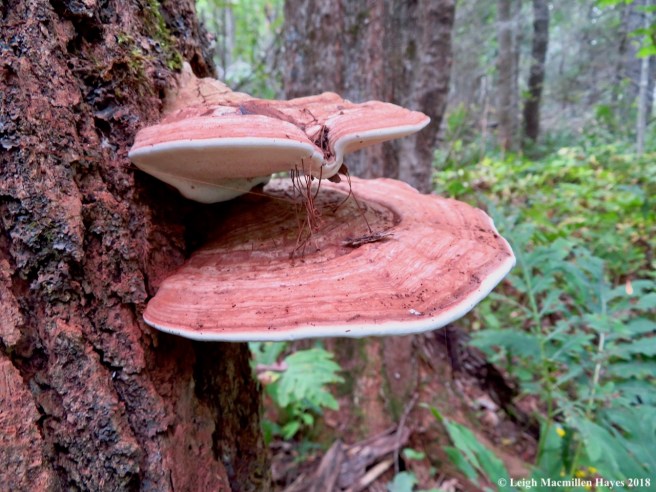
On the same tree we also found fine specimens of artist conk fungi. How apropos.

12-education building

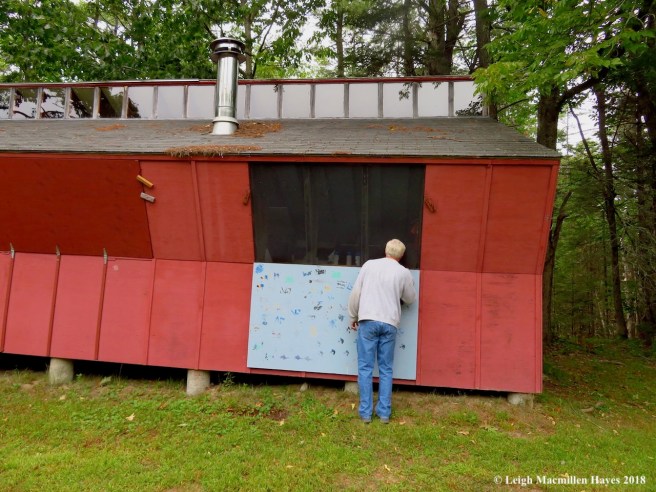
Soon we came to a modern structure. A peek through the window and we knew we’d reached an education center, where cubbies lined a wall, and posters no longer quite secure rolled from the points at which they’d been tacked.

14-tick check

My favorite was a painting on the outside. Tick Check!

15-apple tree

Because the land had been farmed, apple trees danced in their forward leaning forms.

16-apple

And gave forth fruit among the maze of branches.

17-apples on ground

Some trees were more prolific producers than others.

18-eating an apple

And according to my guy, the offerings were delicious.

18-silky dogwood fruit

There were other fruits to admire, including the wedgewood blue of silky dogwood.

18a-hobblebush fruits

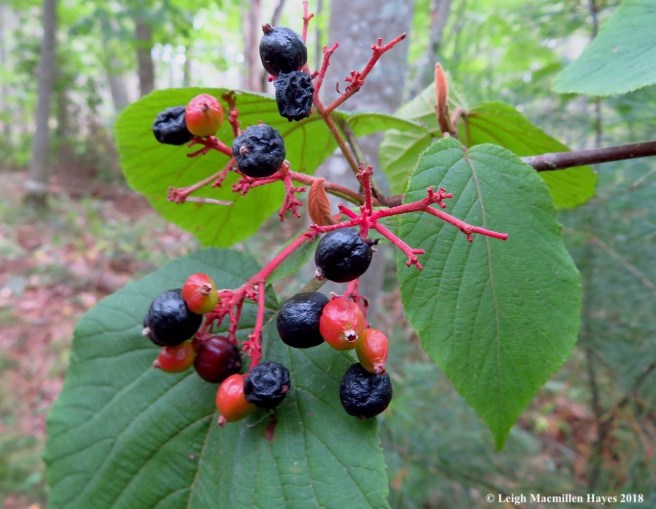
And the green turning red, red turning blue, purplish, blue and almost raisin-like fruits of hobblebush.

19-Norway Maple samara

Even the Norway maple showed off its seeds in samara form.

22-more asters

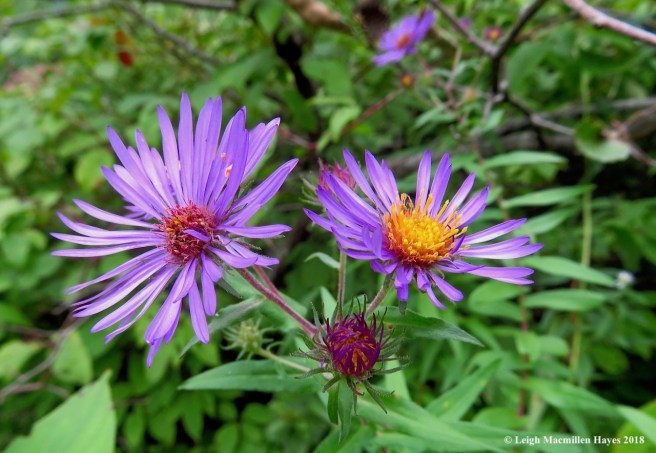
The asters added delightful touches of color to the rather drab landscape.

11-Nephrotoma eucera, tiger crane fly

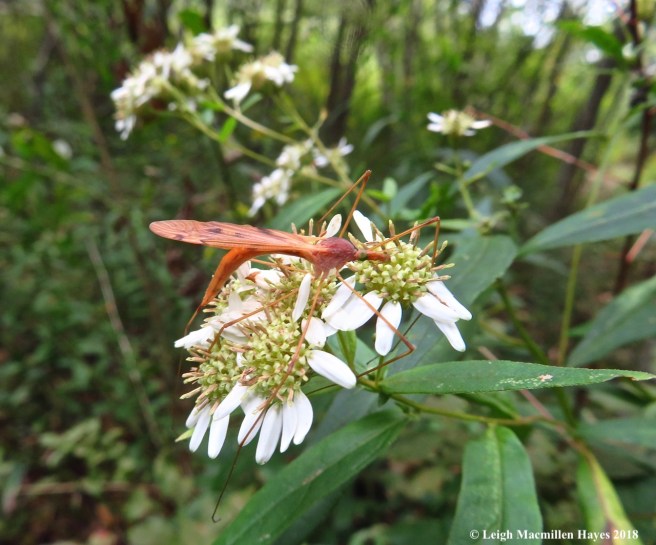
And among them, insects such as a tiger crane fly, enhanced the scene.

23-turtlehead

We found turtlehead,

24-false solomon's seal

false Solomon seal in its fruit form,

25-beach rose

and beach roses showing their bright florescence.

26-rose hips

And where there were roses, there were rose hips and I was reminded of my father who couldn’t walk past a rose bush on our travels from our cottage in Harbor View, Clinton, CT, to town via the town beach, without sampling such.

27-dam

Eventually today, after a few backtracks, for we occasionally got fake lost and with all the downed trees, every trail began to look the same, we found the dam.

29-dam breached

It had been breached long ago, and according to the property’s history, the mills were “destroyed by fire in the early 1860s, and not rebuilt.”

29-old mill structures

We could see some evidence through the woods, but weren’t in a major gotta-see-more mode I guess, which isn’t really our way, but today it was.

j30-below the dam--low tide

Down below, the mill stream became the Haraseekeet River if we understood correctly. It was low tide in the estuary. And smelled to me like the mud flats in Clinton Harbor and I was transported to my childhood for a moment.

31-caretakers house

On our way out, we passed by the caretaker’s house, built in 1795 by mill master Abner Dennison. Sadly, it looked like it needed some care taking.

32-head start on Halloween

Nonetheless, it was decorated for the upcoming season.

34-tree spirits

At the end of our journey, we decided that the trails were not our favorite given all the blowdowns and a stagnant Mill Brook that seemed like an oxymoron, but we’d still found plenty of delightful sights. And tried not to make too many contrary comments for the tree spirits kept many eyes on us.

35-tree gnomes

And listened from their gnome homes.

On this Mondate, we whispered that we probably don’t need to return to Maine Audubon’s Mast Landing, but we didn’t want them to hear us.


Wondering With Jinny Mae

It takes us forever and we like it that way. In fact, today a woman who saw us in our typical slo-mo movement commented, “It’s like you’re on a meditative walk. I always move quickly and miss so much.” Indeed we were and when I travel beside Jinny Mae there isn’t much we don’t see. But always, we’re sure that we’ve moved too quickly and missed something. Then again, we realize that whatever it was that we accidentally passed by this time may offer us a second chance the next time.

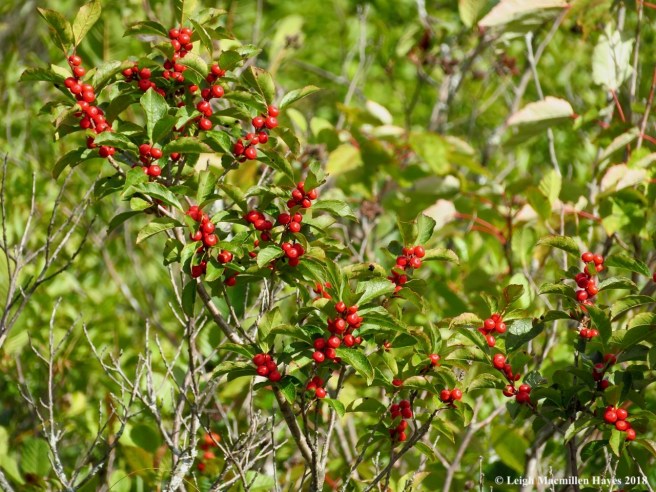
1-winterberry

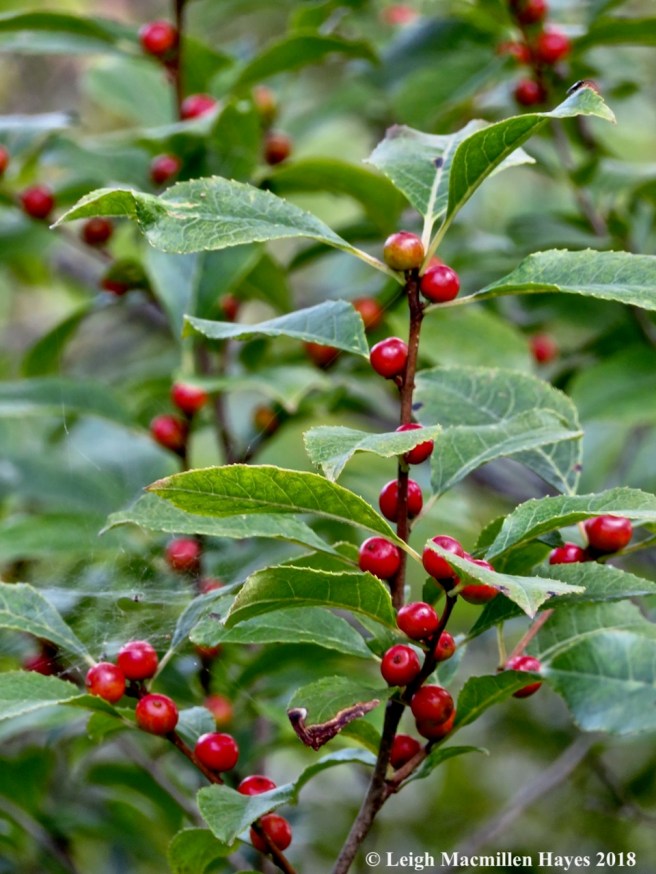
Today’s wonder began with the realization that winterberry holly or Ilex verticillata, grew abundantly where we chose to travel. This native shrub will eventually lose its leaves, but the plentiful berries will last for a while–until they’ve softened considerably that is and then the birds will come a’calling.

2-winterberry

Everywhere we turned, or so it seemed, we found them ranging in color from spring green to shades of red. As summer turns to autumn, the leaves will yellow and eventually fall.

3-winterberry

And then the brightly colored berries that cling to every stem will add color where it’s otherwise lacking in the landscape.

4-winterberry

Even while the leaves still held fast, we found some brightly colored berries that offered a breathtaking view.

5-to Muddy River

We passed through numerous natural communities, tiptoeing at times, such as on the boardwalks, for we didn’t want to disturb the wildlife around us–no matter what form it took.

9-dragonfly attachment

And we rejoiced in spying a cherry-faced meadowhawk couple in their pre-canoodling mode. Can you see how he has used his cerci to clasp the back of her head? His hope is that he can get her to connect in the wheel position and they’ll take off into the safety of the nearby shrubbery to mate.

6-Muddy River

At the river, we began to notice other signs that we’ve once again entered a transition between seasons, for subtle were the colors before us.

7-beaver lodge

Across the river and just north of where we stood, we spotted an old lodge, but weren’t sure anyone was in residence for it didn’t seem like work was being done to prepare for winter. Then again, we haven’t done anything to prepare either, for though the temperature has suddenly shifted from stifling to comfortable (and possibly near freezing tonight), it’s still summer in Maine. And we’re not quite ready to let go.

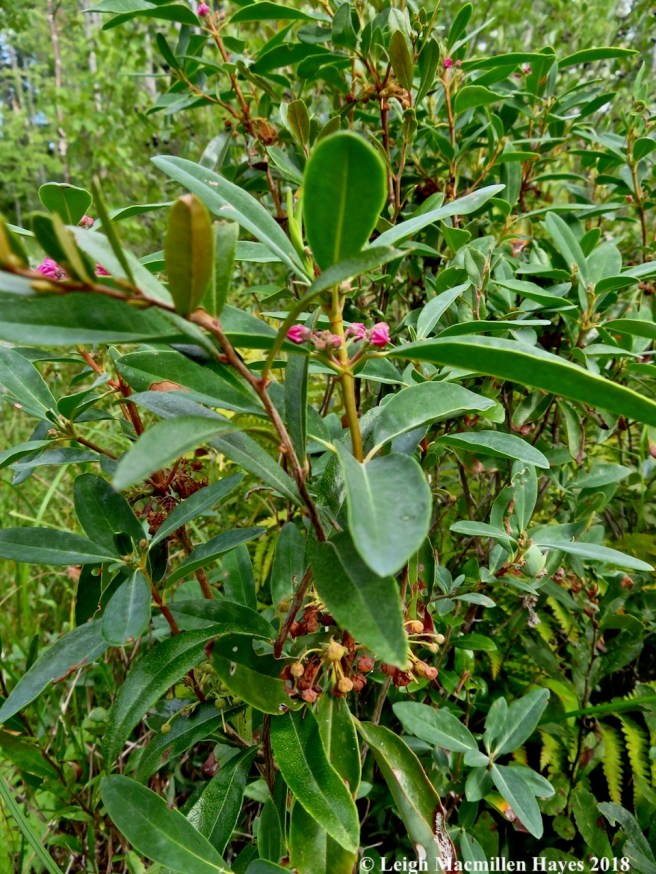
17-Sheep Laurel

That being said, we found a most confusing sight. Sheep laurel grew prolifically in this place and we could see the fruits had formed from this past spring’s flowers and dangled below the new leaves like bells stringed together.

18- sheep laurel flowering in September

Then again, maybe it wasn’t all that odd that it still bloomed for when I got home I read that it blooms late spring to late summer. I guess we’ve just always noticed it in late spring and assumed that was the end of its flowering season. But then again, it appeared that this particular plant had already bloomed earlier in the season and produced fruit, so why a second bloom? Is that normal?

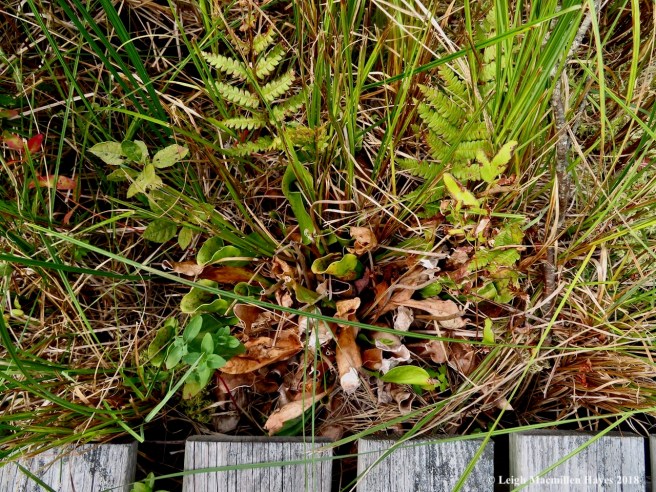
10-pitcherplant 1

As we continued on, we started to look for another old favorite that we like to honor each time we visit. No matter how often we see them, we stand and squat in awe of the carnivorous pitcher plants.

11-pitcher plant 2

But today, we were a bit disturbed for one that we’ve admired for years on end looked like it was drying up and dying. In fact, the location is typically wet, but not this year given the moderate drought we’ve been experiencing in western Maine. What would that mean for the pitcher plant?

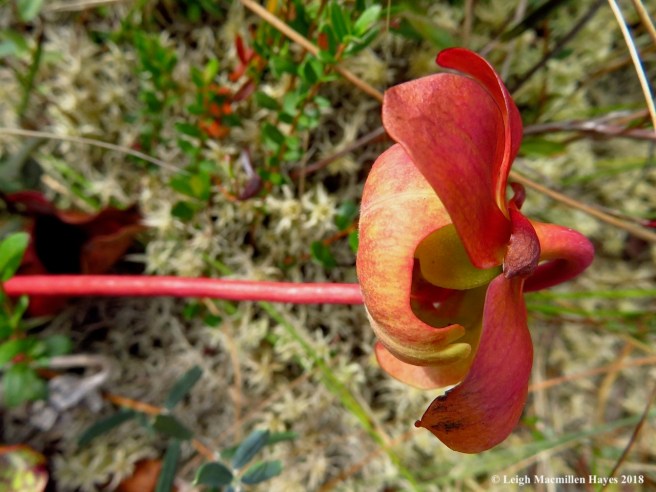
13-pitcher plant flower

Even the flower pod of that particular one didn’t look like it had any life-giving advice to share in the future.

14-Pitcher Plant 4

Fortunately, further on we found others that seemed healthy, though even the sphagnum moss that surrounded them had dried out.

14a-pitcher plant

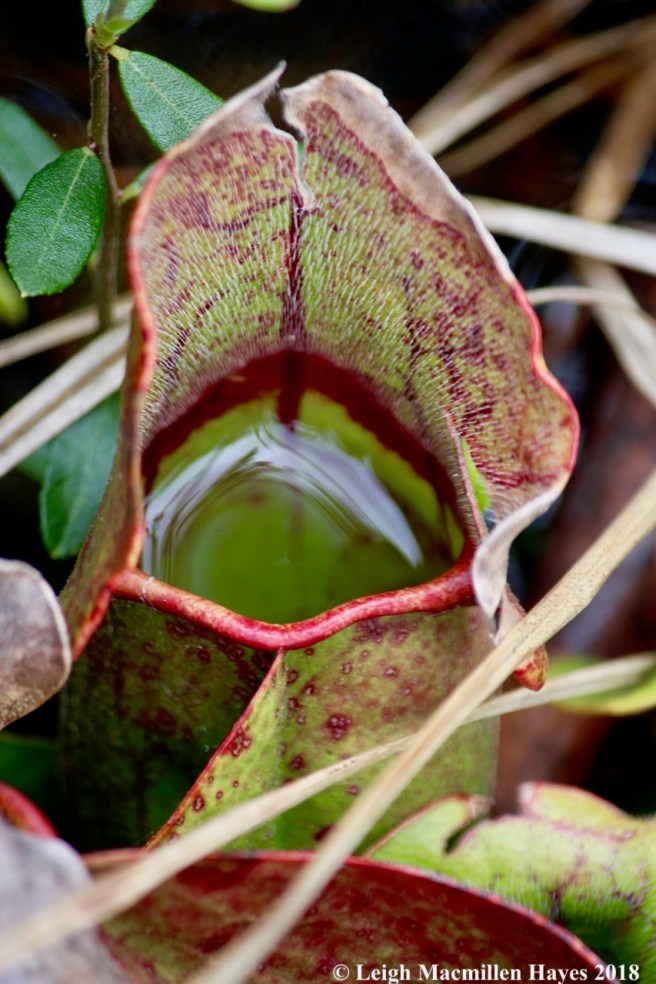
Their pitcher-like leaves were full of water and we hoped that they had found nourishment via many an insect. Not only do I love the scaly hairs that draw the insects in much like a runway and then deter them from exiting, but also the red venation against the green for the veins remind me of trees, their branches spreading rather like the tree of life. Or maybe a stained glass window. Or . . . or . . . we all have our own interpretations and that’s what makes life interesting.

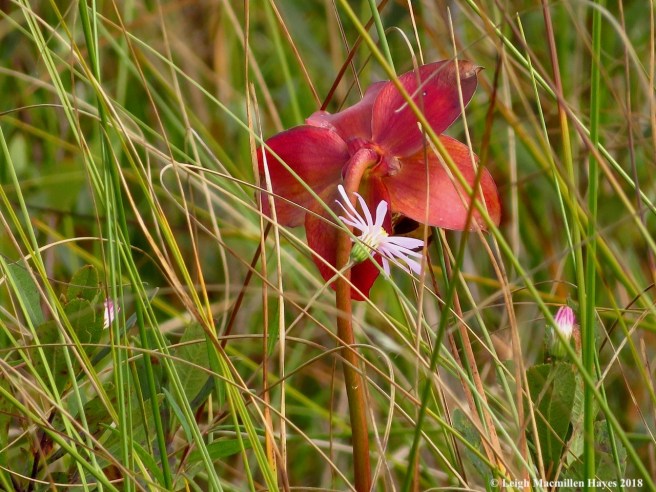
15-pitcher plant flower 2

Speaking of interesting, the structure of the pitcher plant flower is one we revere whenever we see it because it’s so otherworldly in form. And this one . . . no the photo isn’t sideways, but the flower certainly was. If you scroll up two photos, you’ll see it as it grew among the leaves. The curious thing is that it was sideways. Typically in this locale, Jinny Mae and I spy many pitcher plant flowers standing tall. Today, we had to squint to find any.

16-pitcher flower and aster

She found the sideways presentation and this one. But that was it. Because of the drought? Or were we just not cueing in to them?

20-cinnamon fern

We did cue in to plenty of other striking sights like the light on a cinnamon fern that featured a contrast of green blades and brown.

21-cinnamon fern drying up

Again, whether the brown spoke of drought or the transition to autumn, we didn’t know. But we loved its arching form dramatically reflected in each pinna.

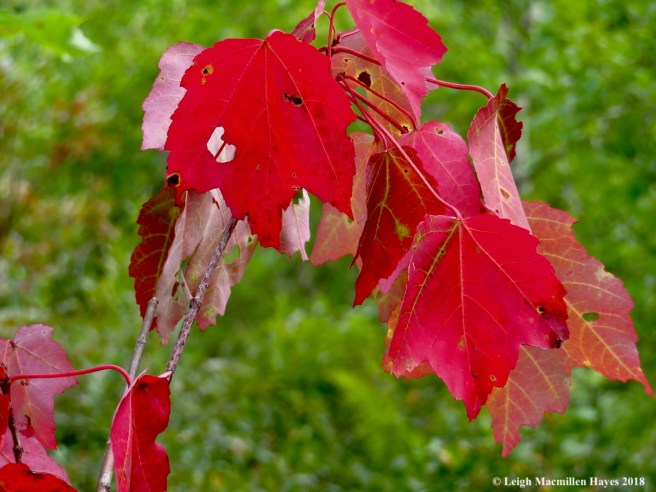
18a-swamp maple

But here’s another curious thing we noted. We were in a red maple swamp that is often the first place where the foliage shows off its fall colors and while some in other locales have started to turn red, only the occasional one in this place had done so. Our brains were totally confused. Sheep laurel blooming for a second time; pitcher plants drying up and dying; and few red maples yet displaying red leaves?

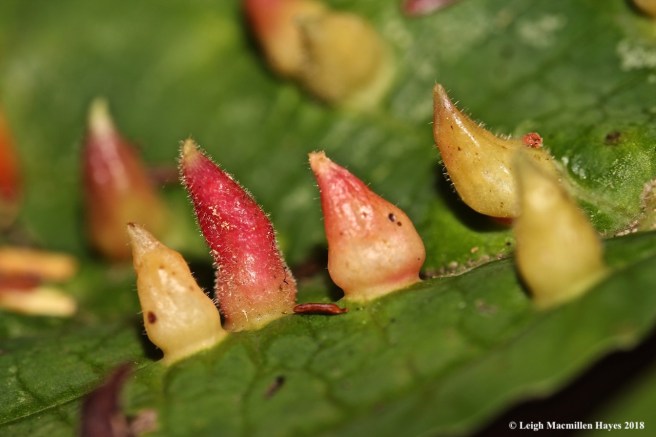
19-witch's caps or candy corn

We needed something normal to focus on. And so we looked at the candy corn we found along the trail. Some know them as witch’s caps. They are actually witch hazel cone galls caused by an aphid that doesn’t appear to harm the plant. It is a rather cool malformation.

24-white-faced meadowhawk

On a boardwalk again, we stepped slowly because the white-faced meadowhawk kept us company and we didn’t want to startle it into flight.

25-white-faced meadowhawk dining

One flew in with dinner in its mouth and though I couldn’t get a photo face on before it flew to another spot to dine in peace, if you look closely, you might see the green bug dangling from its mouth.

26-New York Aster

All round us grew asters including New York, water-horehound, cranberries, bog rosemary and so many others.

27-Virginia marsh-St. John's Wort

There was Virginia marsh St. John’s Wort,

28-fragrant water lily

fragrant water lilies,

28-jewelweed

jewelweed,

29-pilewort globe

and even pilewort to admire. The latter is so much prettier in its seed stage than flowering. Why is that we wondered.

30-Holt Pond Quaking Bog

Ahhhh, an afternoon of wondering . . . with Jinny Mae. At LEA’s Holt Pond Preserve. In Bridgton. An afternoon well spent. Thanks JM.


The Amazing Race–Our Style, episode six

The clue was rather vague as clues go: Drive five hours south to the second dot to the right in Harbor View. And so we did.

c1a

The map provided helped–sorta.

c3

And just before dark we located the spot that included not only a view of the outer harbor, but also the back side of Hammonassett Beach State Park on Long Island Sound in Connecticut. It was like we knew exactly where we were going.

c1

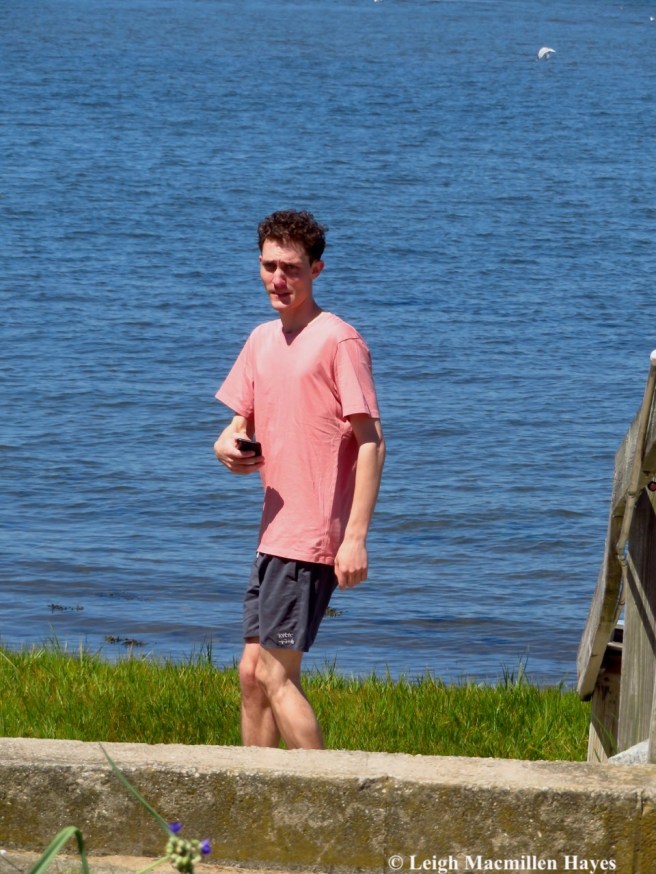
As it turned out, we were joined by another couple with whom we’d formed an alliance for the race and so we decided to spend the weekend completing the challenges together. Funny thing–I think we felt so comfortable with them because she looked very much like my sister and he reminded us of my brother-in-law. With them was a young man who is about to celebrate his 24th birthday (in two more days) and so we all celebrated with him–but even his presence was part of the challenge. And so Team Budz (the alliance couple) and Team Wonder (us), shared the responsibility of his presence. They picked him up at the train station. We provided the cake, which he decorated himself. We also offered the musical accompaniment, much to his dismay. And together, presents, much to his delight.

c4

Refreshed after a good night’s sleep in that delightfully salty air, we faced new challenges, such as sighting three mammals. Together, Team Budz and Wonder spied cottontail rabbits, which were probably the eastern species that was introduced into New England in the late 1800s/early 1900s and have expanded in range ever since, rather than the native New England Cottontail. Both feature large hind feet, long ears, and a short, fluffy tail that resembles its namesake–a cotton ball. Suffice it to say: it was a cottontail. We also saw a red fox that looked a bit mangy and was too close to home, poking up as it did on the rocks in front of our accommodation, and a momma raccoon that, sadly, had been struck by a car–ever so gently struck.

c5

Challenge number two found us seeking two sea birds. We found adult Osprey standing guard,

c8

and scanning the water for a fishy meal.

c7

Meanwhile, their young patiently awaited breakfast in the nest built of sticks upon man-made platforms that were installed at least thirty years ago. And actually, while we watched them, we noted something disturbing–tangled fishline dangling from the construction site. That led us to send out a word of caution–dispose of your tangled fishline so the birds and other aquatic species with whom we share this Earth don’t get wrapped up to the point of no escape, aka death.

c6

We did note that while some of the young Osprey stretched their wings to capture the sun’s warmth and waited for mom and pop to return with a meal, a couple of smaller birds used the nest structure as a great place to pause below and contemplate the surrounding world. Osprey eat fish and perhaps the smaller birds knew that? Or they just made the right decision.

c9

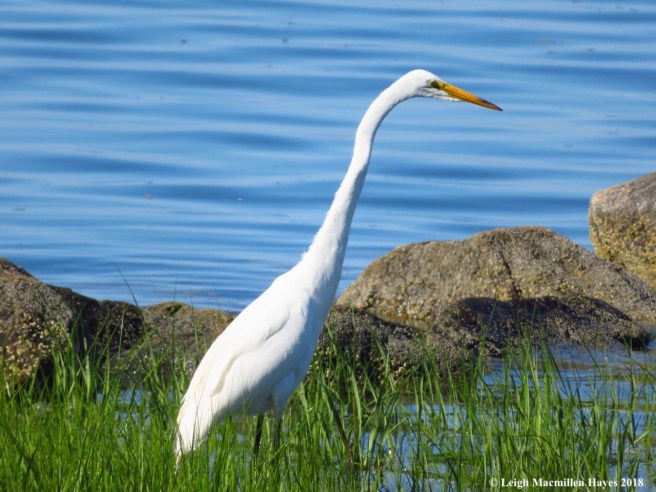
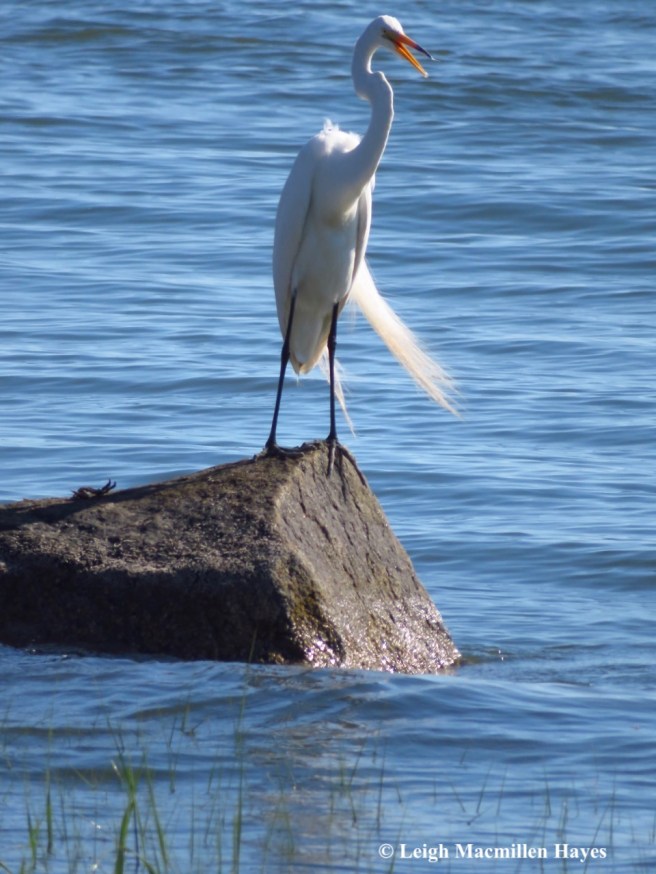
The Great Egret was the second bird we were assigned to watch . . . as it watched.

c10

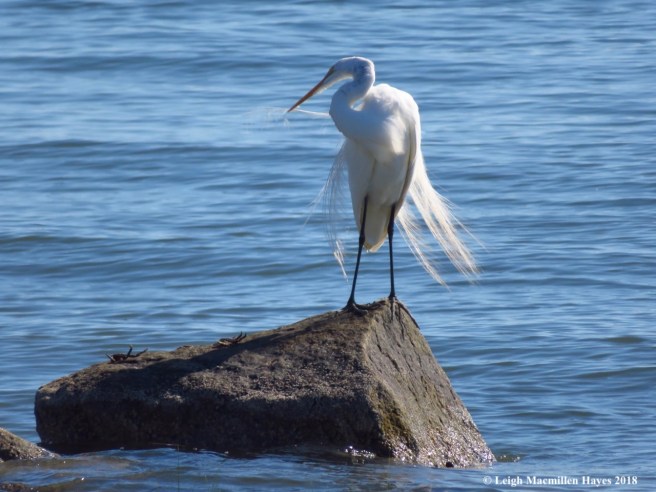
And preened.

c11

And exclaimed its beauty.

c12

And watched some more.

c13

And focused.

c14

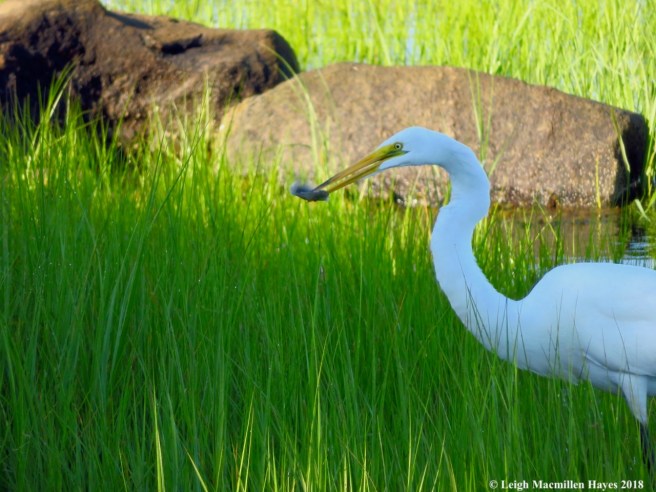
And then . . . the splash.

c15

And success.

c16

A meal.

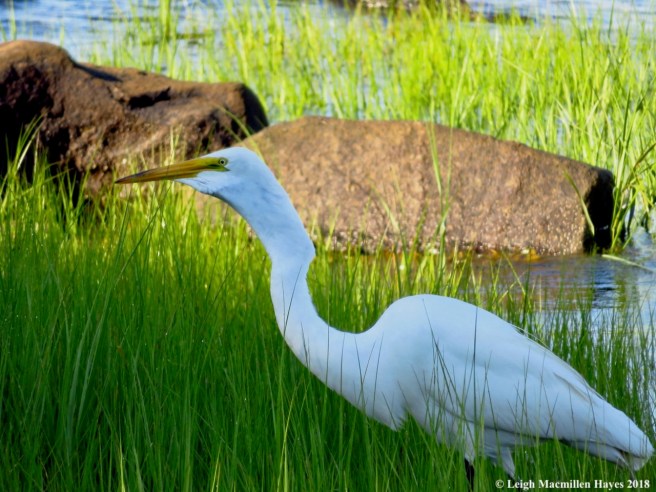
c17

To pull in.

c18

And swallow.

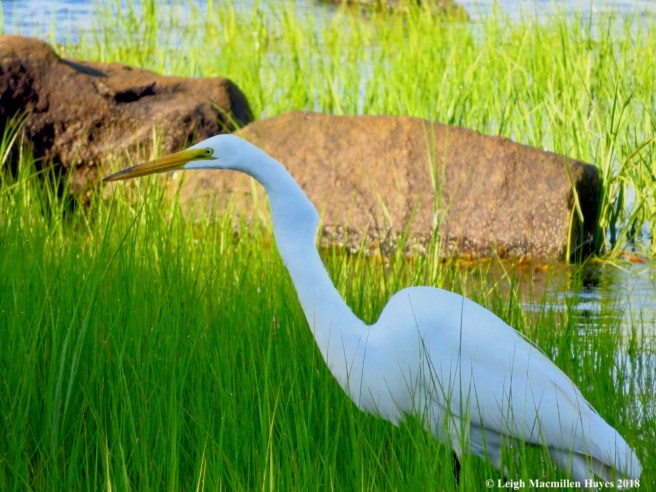
c19

And swallow some more.

c20

Suddenly, in a flash of time, for so it seemed, Team Wonder needed to hold up its end of the alliance bargain and get this guy back to the train.

c21

But–we needed directions to the railroad station, for we wanted to make sure that he made his connection in New Haven.

c22

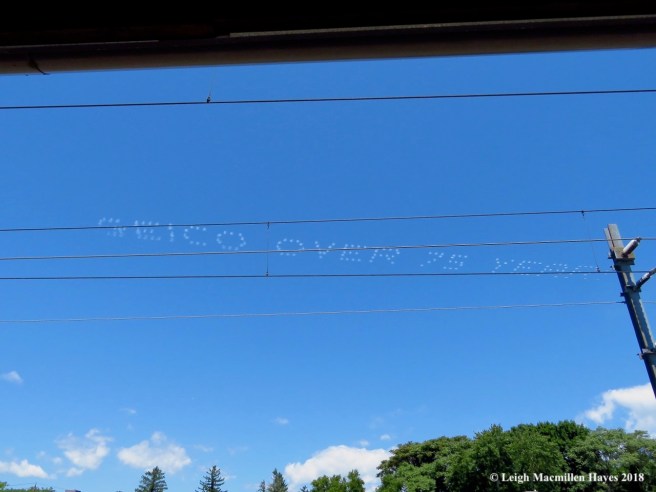
We were told to look to the sky for a message–and it was there that we found an advertisement unfolding in what struck us as a strange place, but perhaps it wasn’t so strange after all, for it was above some train tracks. Another Happy Birthday Message?

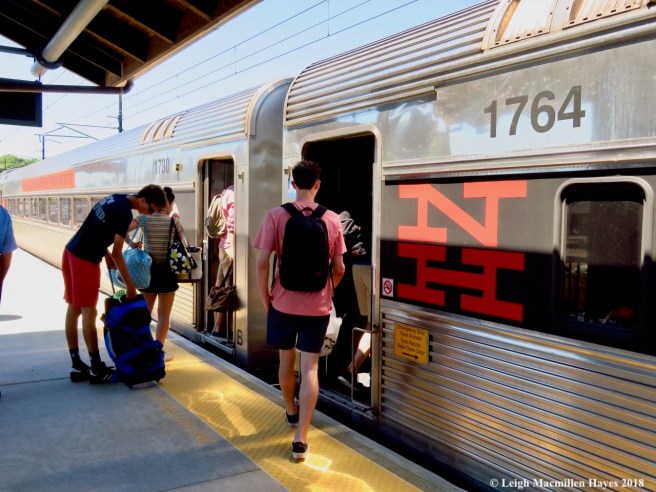
c23

Whatever, it turned out to be the right one. First, the Shoreline East to New Haven and then the Metro North to Grand Central. And off he went–to his home of the past year and his career in the film editing industry (and his 24th birthday in two more days).

c24

Meanwhile, back at the ranch, aka Alliance Inn, the tide was slowly coming in, but we headed out, two teams as we were, ready to take on the next adventure.

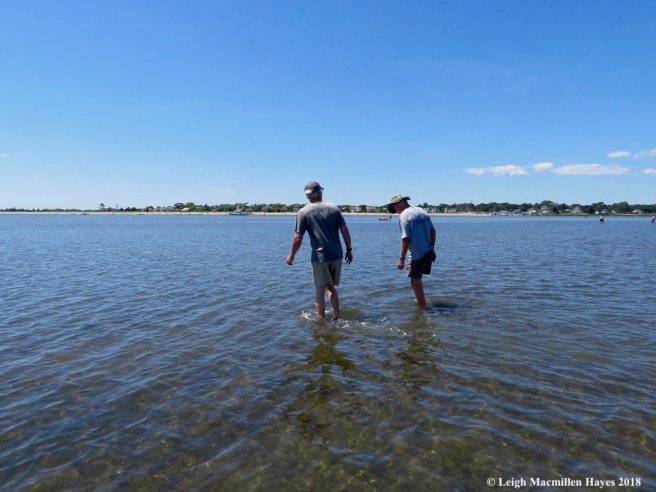
c25

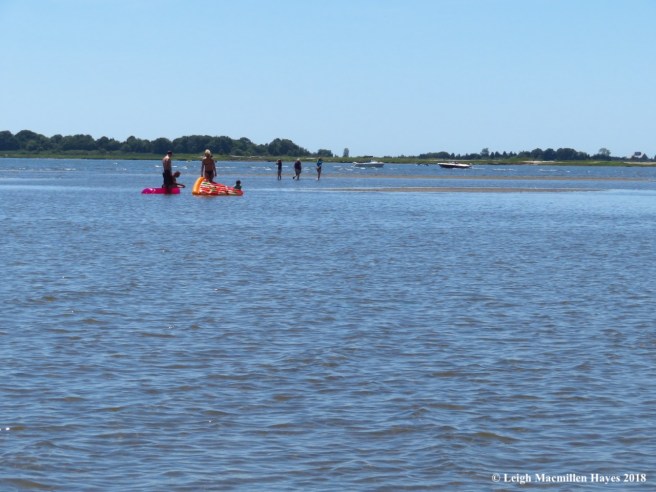
My guy and Mr. Budz led the way through the shallow water the outer harbor has long been famous for.

c26

It’s a tradition of the neighborhood–this gathering place at low tide.

c27

Team Wonder did get a wee bit worried when Team Budz paired up ahead–where they going to ditch us at the channel?

c28

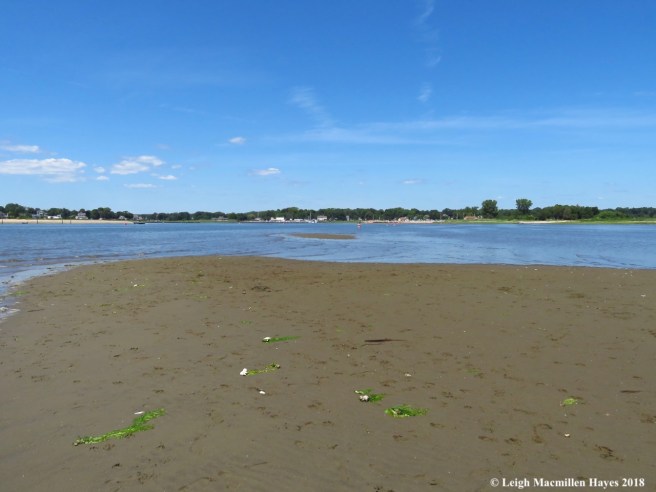
But they didn’t. Instead, they paused with us to look at one of the wonders we needed to find by the sandbars–what was it?

c29

A sand collar–which felt like sand paper above and was smooth below. It was actually a mass of snail eggs. A rather amazing form.

c30

On the sandbars and in the water, Spider Crabs appeared fierce, but were really quite nonchalant. Note the round and spiny carapace, with small spines running down its back. The crab is known to attach bits of algae, mud, and seaweed to many sticky hairs all over its bodies for camouflage, thus giving it a frightening look, but don’t take it seriously. It moves quite slowly and won’t pinch your toes like some of its relatives.

c32

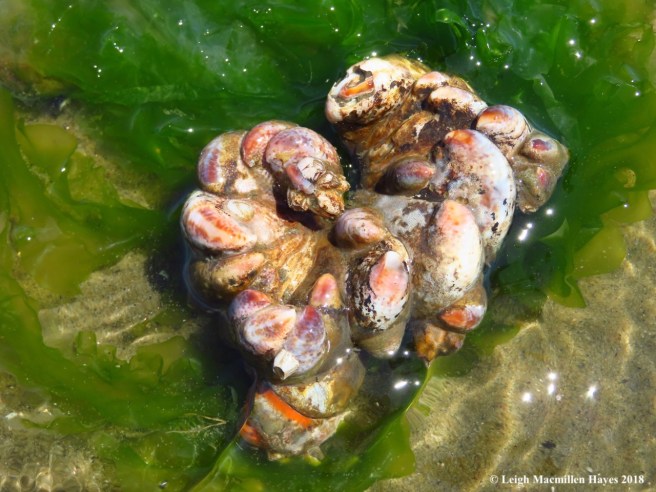
And then we saw the wicked cool Lady’s Slipper of the Sound. Slipper shells they may be, but their natural history is amazing. The following is from the University of Rhode Island: This shell is shaped like an egg or oval that has been cut in half with the top of the shell turned sharply to one side. Looking at the underside of the shell, it is easy to see how it got its name. Underneath the shell is a ledge to support the internal organs; this ledge extends about half the length of the animal. Different slipper shell species are characterized by different shell textures, including rough, smooth, ribbed, corrugated, and flat. Although they have a foot for locomotion, by the time they reach maturity they anchor themselves to a hard substrate and remain stationary.

And there’s more: All common slipper shells start their lives as males, but some change to females as they grow older. A waterborne hormone regulates the female characteristics. Once they change into females, they remain females. They often stack up on top of each other for convenient reproduction. The larger females are on the bottom, the smaller males are on the top, and the hermaphrodites are between the two. If the ratio of males to females gets too high, the male reproductive organs will degenerate and the animal will become female. Eggs are laid in thin-walled capsules that the female broods under her foot.

Common slipper shells also form stacked aggregations when there is no hard substrate on which to attach. They attach to objects in large numbers and can sometimes suffocate the animal on which they are attached.

Who knew? I just thought they were common slipper shells.

c31

We’d finished the sandbar challenge and had no idea how the other teams might be doing, though we did wonder if some of them were thrown off for we spotted a sign that said “sanbars” instead of “sandbars” and we could only hope that they’d gone off in search of the former–to no avail.

c34

Alliance Inn beckoned, as did the incoming tide, and so we headed back toward the shore.

c36

And the next challenge–completing the Sunday crossword puzzle. My guy read the clues and told us how many letters and the four of us shouted out answers–whether they fit or not. I silently kept score (sorta) and was sure that Team Wonder was in the lead, but didn’t want to make a big deal out of it, for we had agreed on an alliance after all. At least for this weekend.

c37

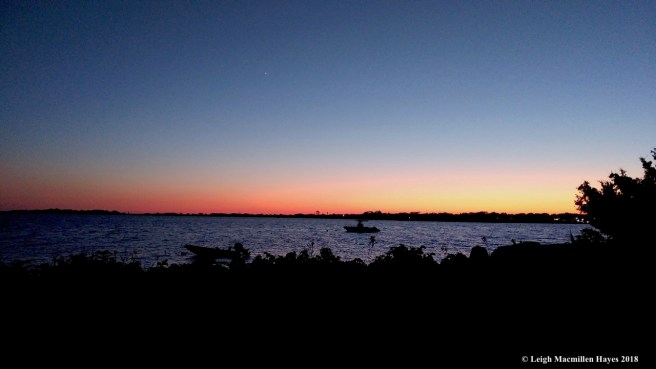
At last the sun set on the day. And the outer harbor.

c38

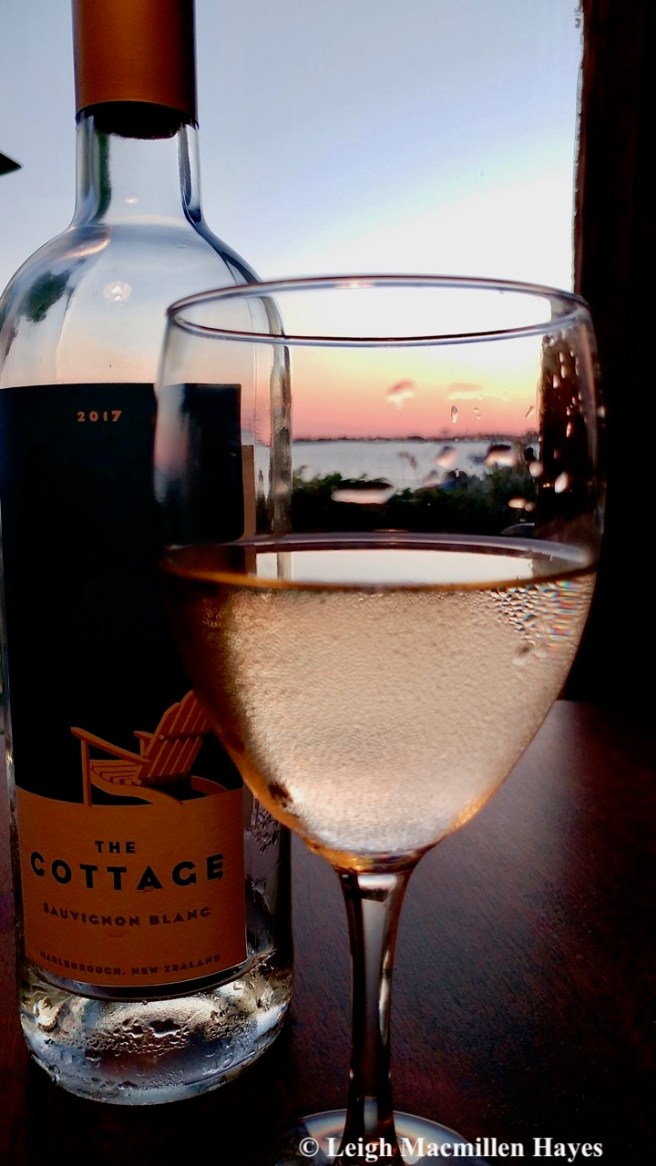
And we celebrated the day’s discoveries with a bottle of The Cottage for it seemed apropos. I think we were all in agreement, however, that the bottle was much better  looking than the flavor and we aren’t exactly wine connoisseurs.

c39

And then this morning dawned with another bird ID challenge. First up–who had taken up housekeeping in the apartment building meant for the Purple Martins? House Sparrows.

c40

And we wondered if they might have some young in Apartment D for come and go did the male and female, both attentive to whomever hung out within.

c41

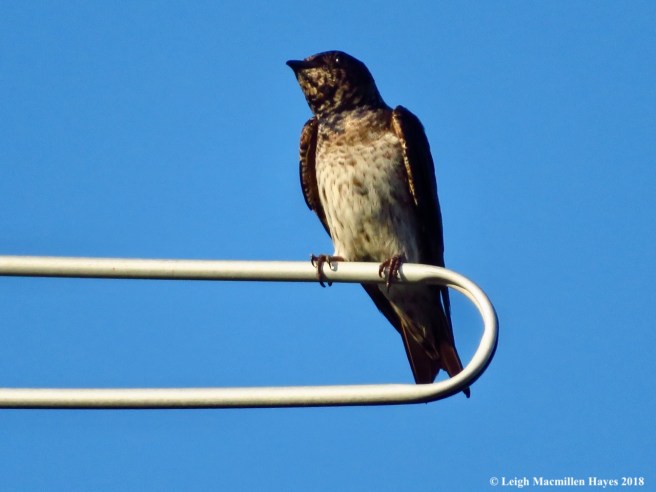
Overlooking it all, a Purple Martin–though he never defended his territory.

c42

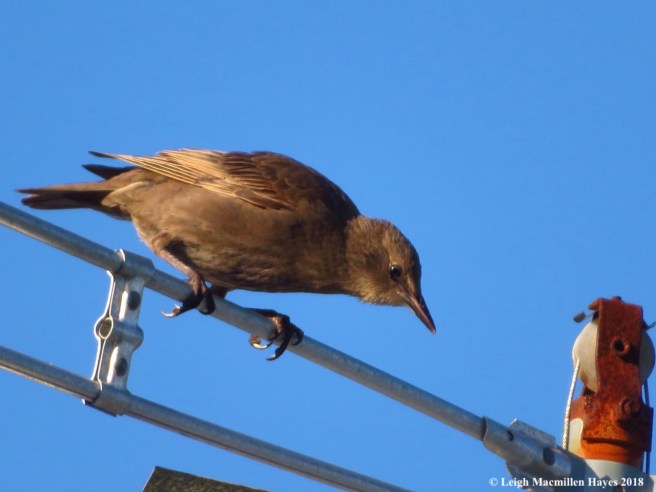
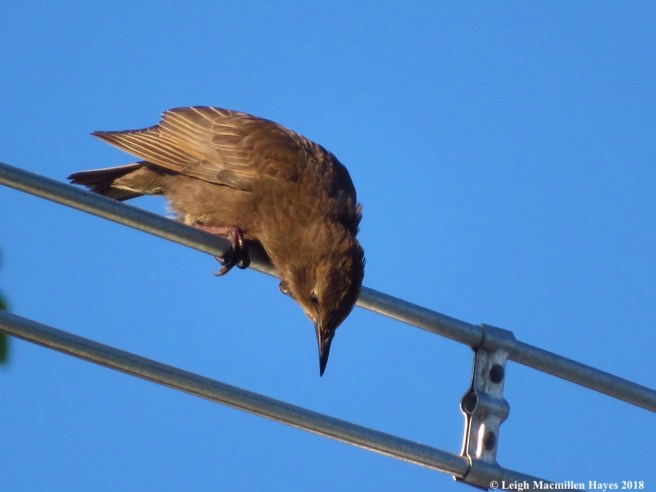
And immature Starlings . . .

c43

as invasive as ever . . .

c44

stood ever so ready to move in to Apartment B.

c46

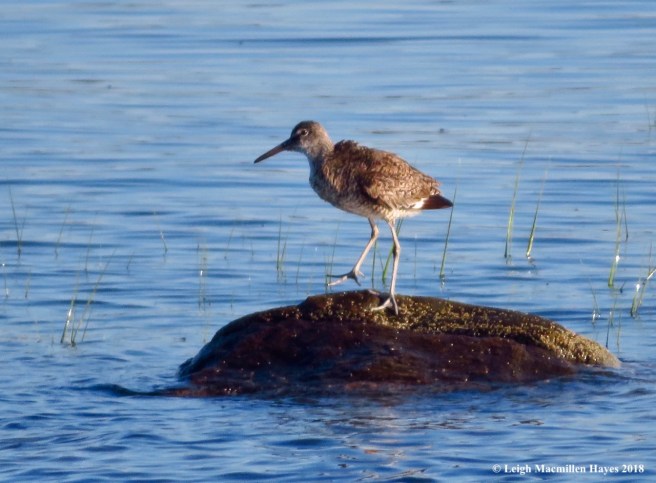
Who stood on the right-hand jetty? A Greater Yellowlegs Sandpiper, its bill longer than its head.

c47

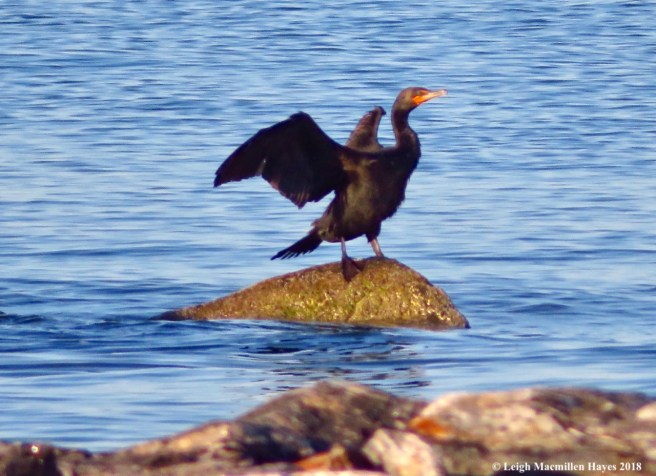
And on another jetty to the south–a Cormorant gathered warmth in its wings, first turning to the right.

c49

Then to the left.

c51

And finally slipping back into the water and cruising by.

c52

At last, much to our dismay, our time with Team Budz drew to an end, quite like the way a day lily such as those my mom so loved and planted everywhere, shared their pollen and then closed up. Who knows what the next episodes will bring. Will we continue to join forces with Team Budz to complete the next challenges? Will they pull ahead of us? Or we ahead of them? We’re only halfway through the Race and as we all know–anything can happen.

But–as we lived in the moment, we certainly loved this episode’s opportunity to celebrate a certain young man’s 24th birthday, ID birds we hadn’t paid attention to since we were kids, explore the sandbar once again, and enjoy the camaraderie of this couple we’ve grown quite fond of. As we go forward, may the best team win . . . and if it can’t be Team Wonder, then we sure hope it’s Team Budz.


Remembering Sue

Our greater community has lost a remarkable woman with the sudden passing of fiber artist and historian Sue Black. Though we didn’t tramp together as often as we would have liked, when we did my journey was enriched as Sue added an historical observation to the context. And she was just plain down-to-earth and fun.

For years, she chuckled when she saw me in the audience of her talks about the mills along Stevens Brook that she gave each summer at Lakes Environmental Association. The talk was always the same, but each time I came away with a new understanding. And then I’d join her guided walk beside the brook the next morning.

As time passed, Sue couldn’t always lead the walk and so I had the honor of trying to fill her shoes. I was humbled by the experience, and though I could hear her whispering facts into my ears, I couldn’t add the personal touch that made Sue’s walks so enjoyable for she’d raised sheep and as she often demonstrated at various fairs and fests, she’d processed the wool, creating her own fiber.

At the mill sites, Sue brought the former activity to life again–albeit in our minds–with her detailed descriptions.Once or twice a year, Jinny Mae, Sue and I tramped together along other routes than the brook, always a journey that included stonewalls, dam sites and cellar holes left behind. Our mission, which we delightfully accepted, was to become sleuths and interpret the various scenes, looking for evidence of those who had come before.

I last saw Sue and her husband, Sam, two weeks ago and she and I started chatting about our next adventure with Jinny Mae. We knew the location, but hadn’t yet set the date.

Jinny Mae and I will continue to tramp, and will take Sue along in spirit, our lives forever imprinted with her smile and voice and love for the next adventure.

Two years ago I posted this blog about the mills along Stevens Brook and here it is again:

For Sue . . .

Milling About Stevens Brook

I must begin with a thank you to fiber artist, historian and friend, Sue Black. Sue has led numerous walks along the very trail I followed today and I’ve often been in her presence–usually with notebook in hand so I could jot information down and gain a better understanding of this place.

s-trail sign

Though she wasn’t with me today, I could hear Sue as I mosied along examining the old mill sites of the Stevens Brook Trail in Bridgton. And many of the words that follow are probably hers. I also gleaned info from the Bridgton Historical Society several years ago, when Sue couldn’t lead the walk and asked me to fill in. So I guess, really, what follows is like the confluence of the Stevens and Willet Brooks–two streams that meet to form one.

s-boardwalk under water

Bridgton was once a thriving mill town and Stevens Brook its source of power. Of course, to do this properly, I should begin at Highland Lake, the source of the brook, but  I’m not a proper-sort-of gal and you’ll have to bear with me. I didn’t begin at Pondicherry Park either–for the boardwalk was under water.

s-below Pondicherry

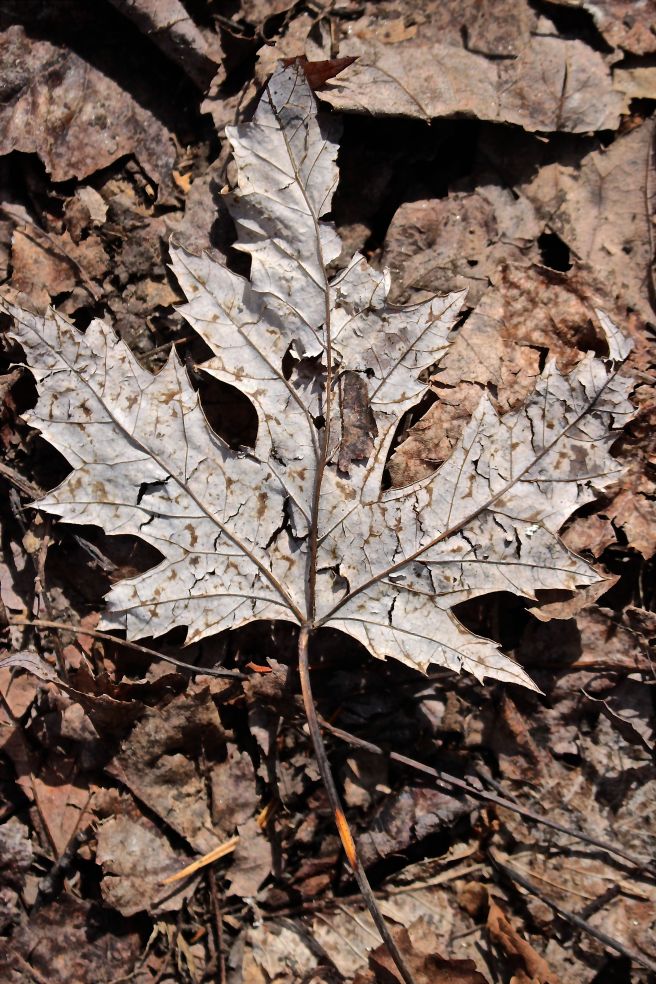
Instead, I slipped onto the trail at Depot Street, beside the Bridgton Community Center. By this point, Willet Brook has joined forces with Stevens, thus increasing the power of the water. I was backtracking, and again didn’t get far because of water flowing over the trail, but along the way I made a discovery. Those beautiful trees that lean over the brook–silver maples (Acer saccharinum). It never occurred to me that they grew here, but made perfect sense.
s-silver maple leaf

The backside of the deeply-lobed leaves are silvery gray in old age and silvery white during their prime.

I should have taken a photo of the old Memorial School because that was the sight of the train depot (Depot Street) for the Bridgton and Saco River Railroad that was built in 1883–a narrow gauge operating from Hiram, but didn’t think of it at the time. Instead, I followed the stone steps down, walked beside the brook as it ran below the deep bank by Stevens Brook Elementary School and came up behind a few old buildings, back on Depot.

s-food city bridge

And then I stood on the bridge overlooking Food City. I should note that this is power site #4. Yup, I’ve skipped the first three for now. Stick with me. We’ll get there. In 1822, this area of town wasn’t part of the main village–that was confined to Main Hill. A water-powered carding mill equipped to prepare wool for spinning, thus replacing the tedious hand work of disentangling, cleaning and intermixing the fibers was in operation in this area at the time. By 1825, James Flint and Aaron Littlefield built a sawmill, which they operated for 15 years. In 1840, this was the site of the Walker Saw Mill and Grist Mill. And then things changed. The Pondicherry Mill was built in 1865 to manufacture woolen goods. It was one of the most extensive manufacturing plants in Maine at that time and employed 50 operators. Standing where I was on the bridge, I could see the stones related to the mill and dam. The dam disintegrated in the 1960s.
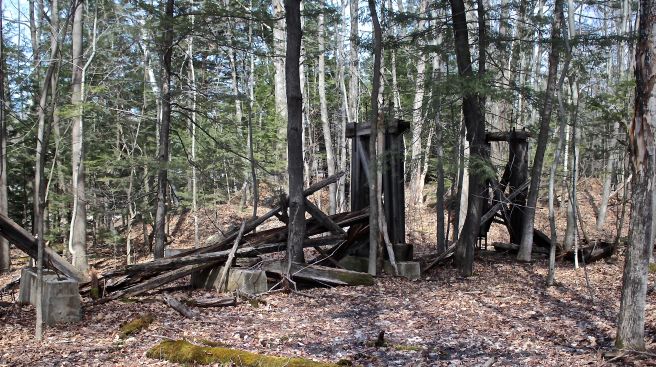
s-coal trestle

s-trestle 2

In 1898, the neighboring town of Harrison wanted to be joined to the railroad and the RR owners obliged. From this spur, a trestle was built that carried coal in dump carts to the Pondicherry Mill. The structure has deteriorated immensely, but still stands as a monument to this moment in history. So wait, think about this coal situation. The mill had grown to employ 225 people and water power from the brook was no longer dependable. An immense coal-burning chimney about 100 feet in height had been added to the mill. Sixty looms produced 18,000 yards of cloth weekly. Though the building stood until the mid-sixties, the industry moved south long before that. The stones by the brook and trestle are all that are left to tell the story. A now-deceased resident, Reg Fadden, used to tell the story of knowing what color they were dying the wool on any particular day–he’d see the color in the water as he walked to school.
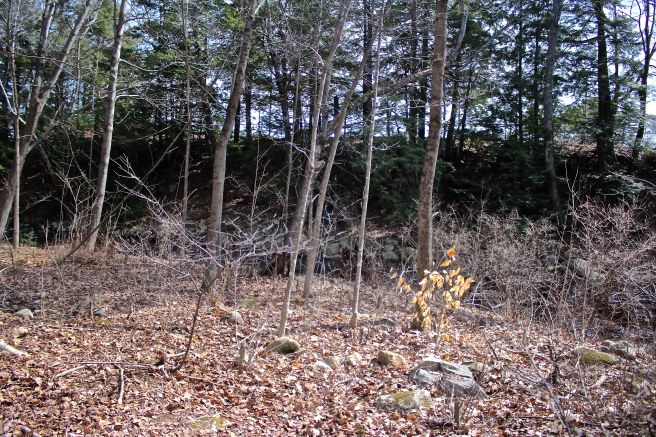
s-former millpond:5th site

Above power site #5, the land was flat and indicative of a former mill pond.

s-5th site

A stone dam and some other foundation work is all that’s now left. The first mill to be located here was a sawmill built in 1868. By 1871, a shovel factory was built on the west side, which was the side I stood upon. By 1899, the Bridgton Lumber Company had located to this power site, with two mills operating–one for boxes and house furnishings; the other for lumber. This apparently was a successful site because in 1911 it became the Burnham and Newcomb Sawmill, which was purchased by Harry Bisbee in 1920. He used a turbine since the water power wasn’t dependable. Though it gushed over the rocks today, in the summertime, this is the perfect place to sit on the flat rocks and dangle ones feet. I can’t remember if Sue told me this or I read it, but apparently there was a treacherous footwalk that crossed the brook in this area and even at age 90, Mr Bisbee would walk across. The sawmill eventually burned, with only the office remaining. This time using a diesel engine, Mr. Bisbee started a smaller sawmill. In 1953, the dam washed out with a flood and local lore has it that Mr. Bisbee walked out one day, leaving it all behind. He died a couple of years later, gifting the mill to the public library.

Charles Fadden and his son, Reg, bought the mill at auction and operated a box mill, using a turbine for power. The office was still standing until about ten years ago, when it collapsed.

s-narrow 1

By the mill, the Harrison Narrow Gauge crossed over a trestle; today only the stone stanchions remain. A sixth power site was never developed.

s-locust bark

It was here that I recognized another tree I don’t always encounter–a black locust (Robinia pseudoacacia). The bark appears almost braided.

s-locust pod

And below it, an old flat pod that contains bean-like seeds.
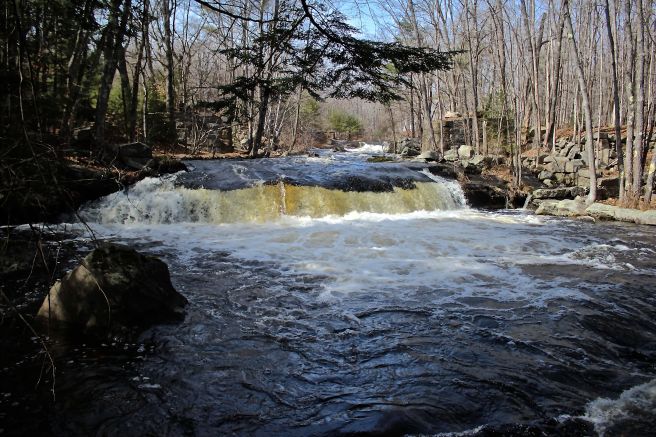
s-7th site, Johnson Falls

I followed a new trail (possibly private, but it wasn’t posted) and was delighted to get a better view of what I believe was power site #7.

s-lower johnson falls site 7

If I’m correct in my thinking, this is Lower Johnson Falls, and was the possible 1859 site of the Milliken Bedstead Factory.

s-remnants by Johnson falls

A foundation is still visible on the eastern side of the brook.
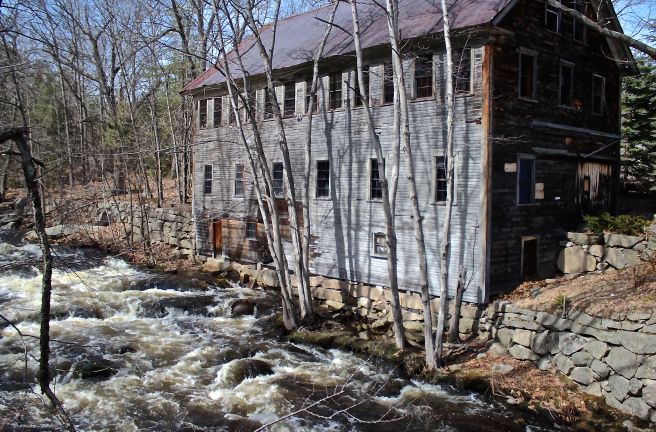
s-7th site, smith sash 1

Below power site #7, I came to the coffin shop. Hey, somebody had to build them. Lewis Smith built the two-story building with a basement in the late 1860s. It was a sash and blind factory, but he also built furniture, and yes, coffins. More local lore: he was the town’s first undertaker. While the building has had several owners since then who have tried to restore it, it still needs some (way more than some) tender loving care so it doesn’t go the way of all the other mills.

s-turbine rig

All that remains of a water-powered turbine still reaches over the brook. Originally, all the water wheels along the brook were overshot wheels. While an overshot wheel had horizontal axils, a turbine wheel had vertical axils, thus making it smaller, more efficient and more dependable given the rise and fall of the water.
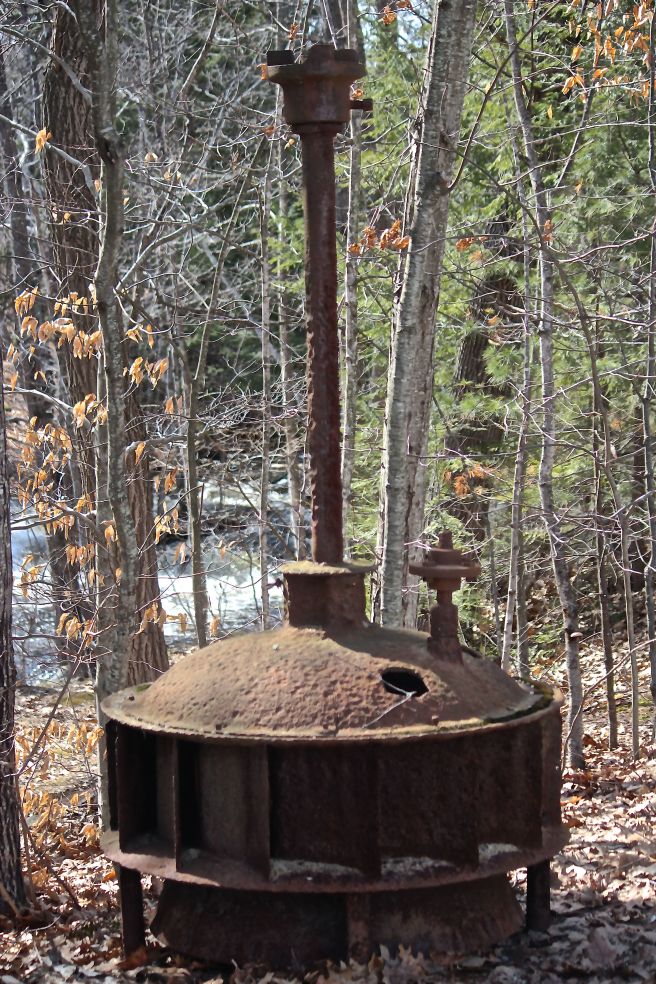
s-turbine

And on the front lawn of the coffin shop, the real deal–a Perry Turbine Water Wheel. In 1877, Richard Bailey and Samuel Miller operated an iron factory and machine shop built by William Perry and George Taylor across the road from the Smith factory. When they sold their business to Forest Mills owed by William  Fessenden Perry, it was renamed the Bridgton Machine Company with George and Frank Burnham taking over as managers. In 1887, the Perry turbine was invented and it received nation-wide popularity for use in mills along small streams.

s-forest mill a

Power site #8 is one of my favorites. This is where Perry and Taylor erected a mill in 1862 to manufacture woolen goods. The dam was built to provide a fifteen-foot fall with a mill pond above.

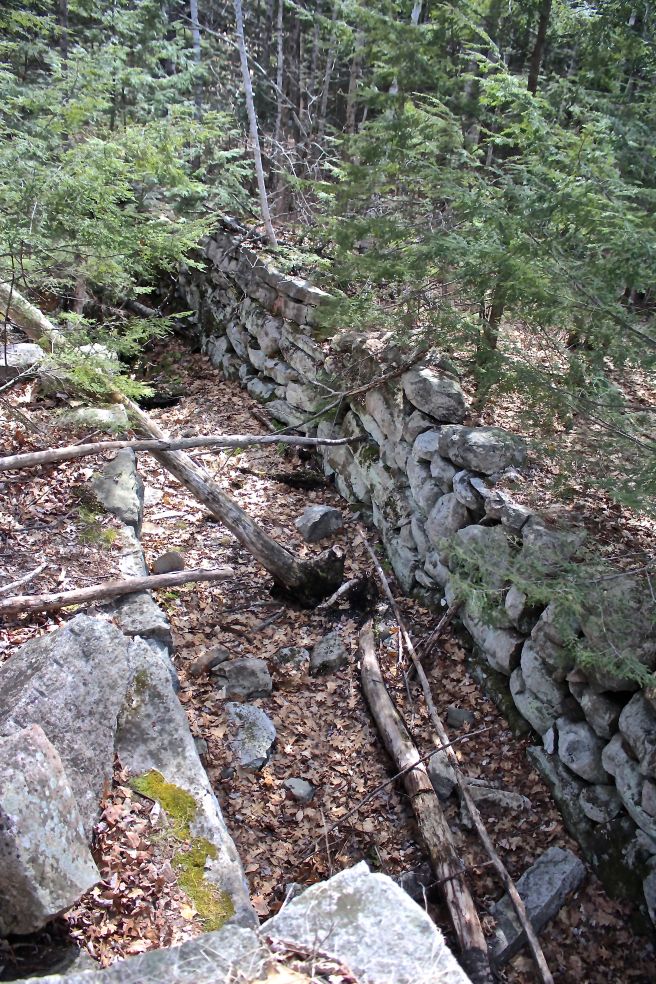
s-Forest Woolen Mill 2

s-forest sluice

Today the sluiceway is dry, but I can imagine the water pouring through here.

s-forest woolen mill 3

With the advent of Kansas Road in 1865, the woolen mill expanded to 200 feet by 45 feet and stood two stories tall. With more looms than any mill in the area, outerwear was produced here and shipped to Boston. During the Civil War, attention turned to creating war materials.

s-9th site, Kennard Dam

Across the street, I ventured down the wrong trail at first and found myself on the upper side of the dam built at power site #9. The 13′ dam built by Boothby and Chadwick in 1864 was near Kennards Stocking Mill. It was originally intended that Kansas Road would cross the dam, but the turn would have been too sharp and too steep.

s-vp by Kennards, 9th site

Today, a vernal pool sits below the former dam. I checked it and several others along the way. No signs of life. I’ve yet to hear spring peepers.

Anyway, Taylor and Perry purchased this site in 1865 and built a three-story carding mill with an overhead walkway that crossed Kansas Road and connected their two mills: Forest Mill #1 and Forest Mill #2.  By 1879, Mr. Taylor had died and Mr. Perry re-organized as the Forest Mills Company, which employed 130 workers and produced cashmere. As Sue has told me, this was not from cashmere goats but rather a lightweight fabric consisting of wool fiber that had either a plain or twill weave.
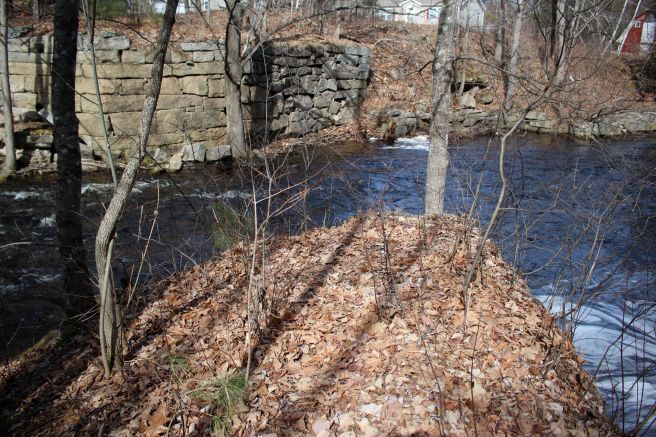
s-power 9

A railroad spur and trestle were built in 1900 to unload coal and other supplies for the Forest Mills Company. The American Wool Company purchased the mill, which was large for Bridgton, but small compared to those south of Maine. Eventually, business moved south. In 1925, a shoe shop moved in, but it wasn’t successful either. The building was torn down in 1962.
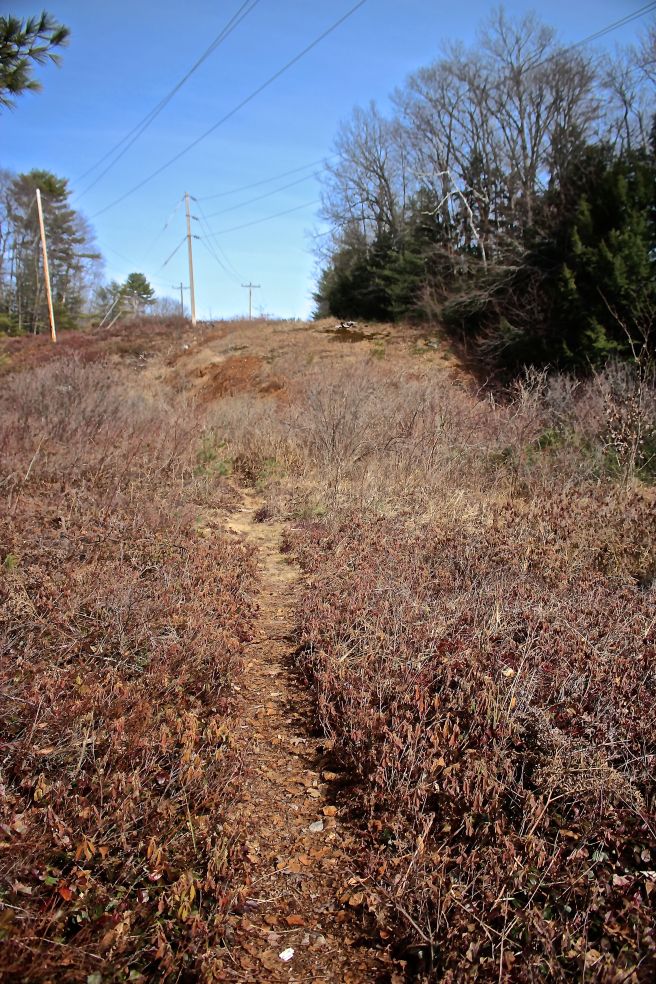
s-powerline trail

The scene changed briefly when I followed the trail onto the present day power line.
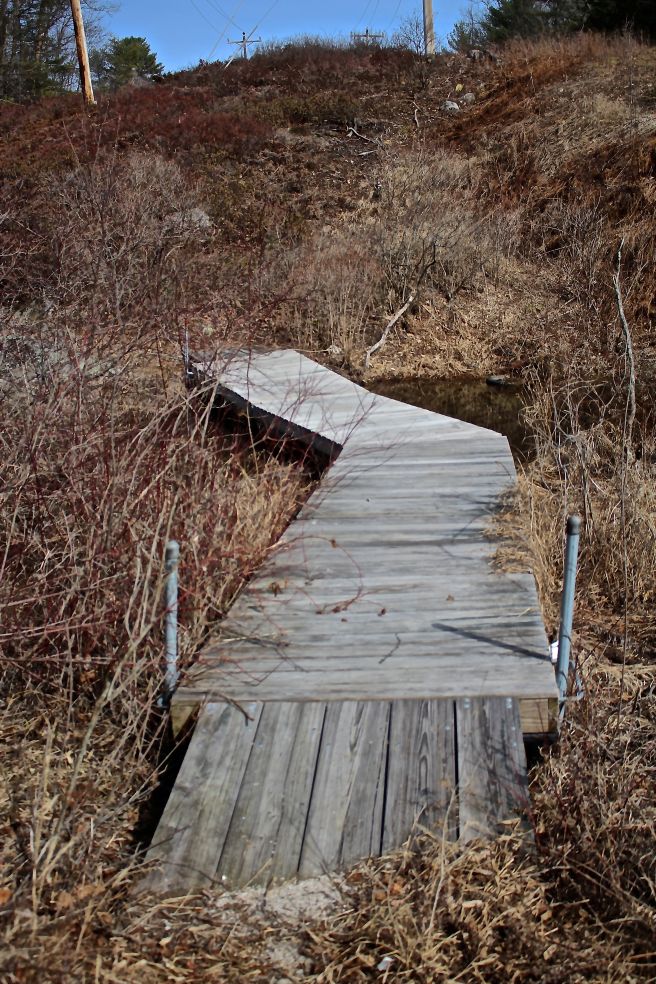
s-powerline boardwalk

Typically, this boardwalk is under water in March and April. But this year is far from typical.

s-cmp pond

And then I reached power site #10. This is the most modern of them all, but again, it has a history. It’s possible that this was the site of Jacob Stevens’s first sawmill built in 1768.

s-cmp dam 1

Mr. Stevens would have built a boulder and gravel dam, not one of cement certainly. He lived nearby and raised eight children; the four oldest worked beside him. Mr. Stevens was a ranking member of the survey crew that came to what is now called Bridgton in 1766 from Andover, Massachusetts. He returned in 1768 under contract with the Proprietors to develop water power and make it serve the early settlers by creating mills that provided building materials and grain for food. Stevens was the one who identified twelve power sites along the almost two-mile brook with a drop of 156 feet from its source at Highland Lake (known originally as Crotched Pond) to its outlet at Long Lake (Long Pond). It made sense for him to build a site here for both a saw mill and grist mill, as this is near the mouth of the stream and would have provided him with easy access to the main thoroughfare of Long Pond and beyond. The proprietors required that the saw mill operate for fifteen years and the grist mill for twenty.

s-cmp dam 4

I don’t know what happened between 1768 and 1896 when the Bridgton Water and Electric Company took over as the first source of electricity and water for the village. The concrete dam was built in 1931 by Central Maine Power after several transfers of ownership. The greatest power could be found between this site and power site #11, where the brook drops 25-30 feet.

s-penstock start

A 790-foot penstock was built to regulate the flow of the water.

s-penstock channel

s-penstock support

Evidence remains of its position and actually, it’s easiest to see right now before the summer foliage obscures so much.

s-1

Somewhere in this area was power site #11. The Hart Tannery may have been built on an island in the middle of the brook.

s-water drops below CMP

The exact location of power site #12 is also elusive, but rumor has it that a shingle factory was located between site #11 and the outlet.

s-1922 brick

Early on, a wooden structure was used as a power house. That was replaced by a brick building built in 1922 by the Western Maine Power Company. Notice where the penstock entered. And above it, a turbine generator.

s-Long lake 2

All was calm by the time Stevens Brook emptied into Long Lake today.
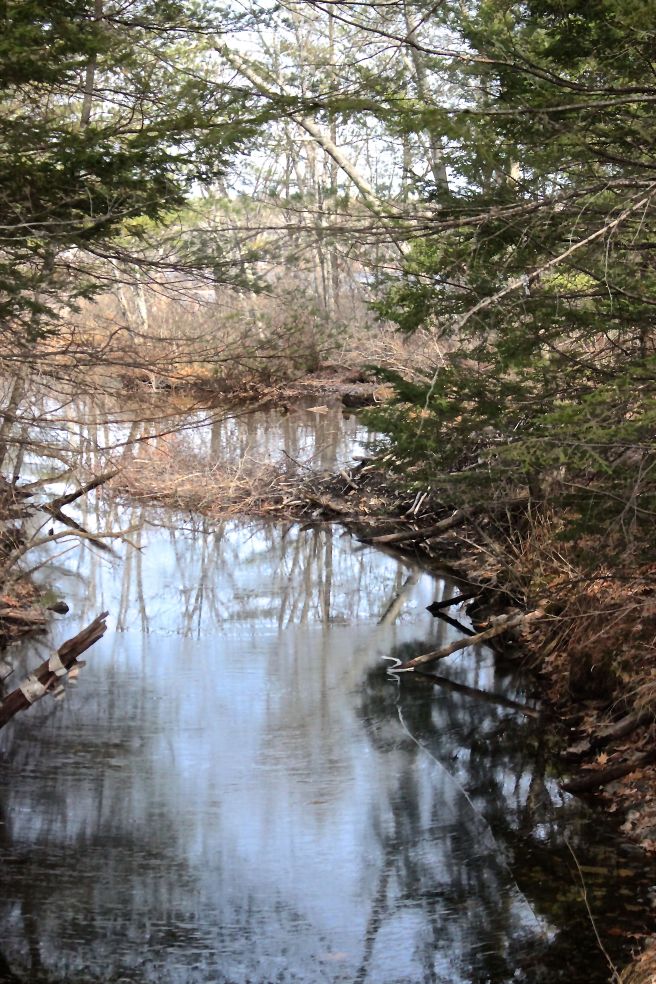
s-beaver 1

Though it’s easy to miss, this area still offers a source of dams and industry.
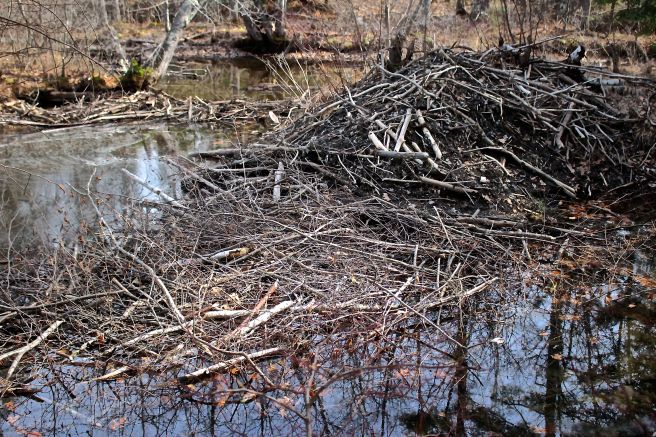
s-beaver lodge and dams

Beaver style.

s-3

I walked back up Main Street and headed to the first three power sites, which I present in backwards order at the risk of confusing my tired readers. Power site #3 has a storied past: 1813-fulling mill (put weaving on hot water and beat it to close fibers); 1822-saw and grist mill; 1830-saw, grist and plaster mill; 1845-mill burned; 1857-rebuilt two stories; 1877-never rebuilt. Yet this was long known as the Dam Site and a Dam Site Restaurant stood here for years. Across the street was a tannery, which didn’t need water for power, but did need water to fill the 140 vats. Using hemlock bark, 10,000 hides were tanned each year.

s-shorey park dam 1

I’m only just realizing that I missed power site #2. I looked at it as I walked by, but must have been tired. Anyway, it’s below this split stone dam and served as a grist mill in 1798 and a sash and blind mill in 1835.
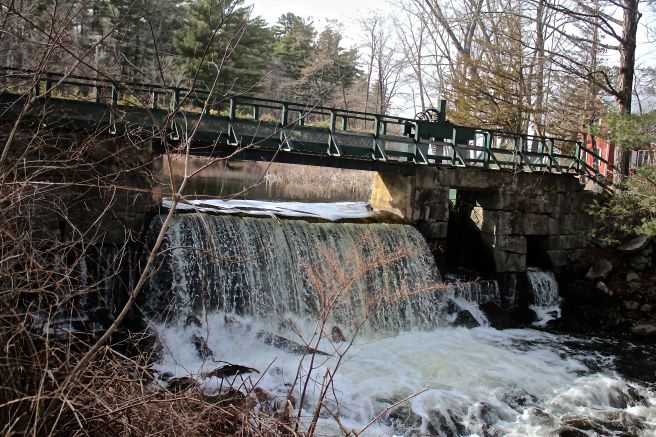
s-sp 3rd power site

Power site #1 was originally a saw mill built by Asa Kimball at the head of Stevens Brook. The lay of the land has changed since roads were constructed and Highland Lake (Crotched Pond) had a different configuration and lower depth. The pond served as Mr. Kimball’s mill pond, where he floated logs from Sweden (Sweden, Maine, that is). The split stone dam was erected in 1849-50 by Rufus Gibbs and others, thus providing power for the first big mill in the village that stood four stories tall, employed 50 workers, ran 20 looms and made blankets for the Civil War. By 1941, is was demolished.

s-sp millpond

This is the mill pond as we see it today, but if my vision is clear, before Highland Road intercepted it, this was part of Crotched Pond.

s-highland

And the start of it all, the thing that got me milling about today, Highland Lake and the source of Stevens Brook.

Dear reader, if you are with me still, thank you. It was a long journey and I appreciate that you came along.

P.S. Addendum, June 24, 2018. Thanks for all of your contributions to our greater western Maine community, Sue. May you rest in peace.

 

Left-handed Mondate

Yesterday I discovered a male ring-necked pheasant in our backyard–a most unusual sighting. As I watched, he headed over a stone  wall and into our woodlot where he cackled and beat his wings in hopes of attracting a mate. The only responses he received were gobbles from Tom Turkey. And so it went for a while . . . cackle . . . gobble . . . cackle . . . gobble.

This morning we were awakened at 5 a.m. to the same mating calls. Who needs a rooster?

w1

When I stepped out the back door, neither bird was anywhere to be seen or heard.

w2

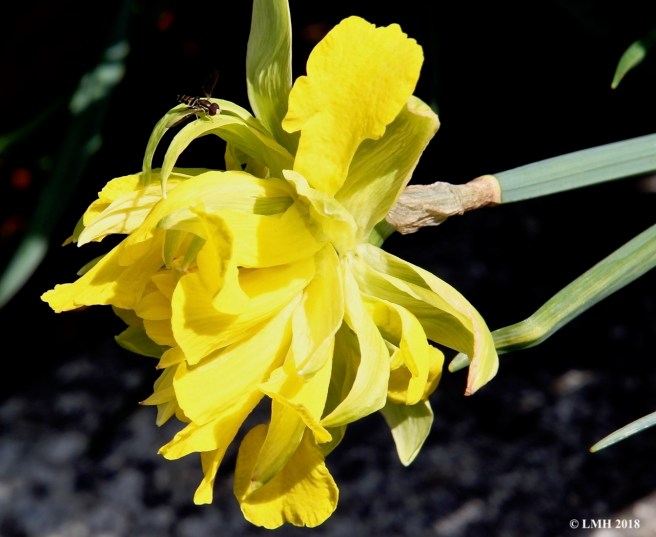
But the double daffodils that came with our house showed off their cheery faces to all who looked.

w3

And by the road, the magnolia we planted about fifteen years ago added its own pastel palette to the scene–however momentary.

w4

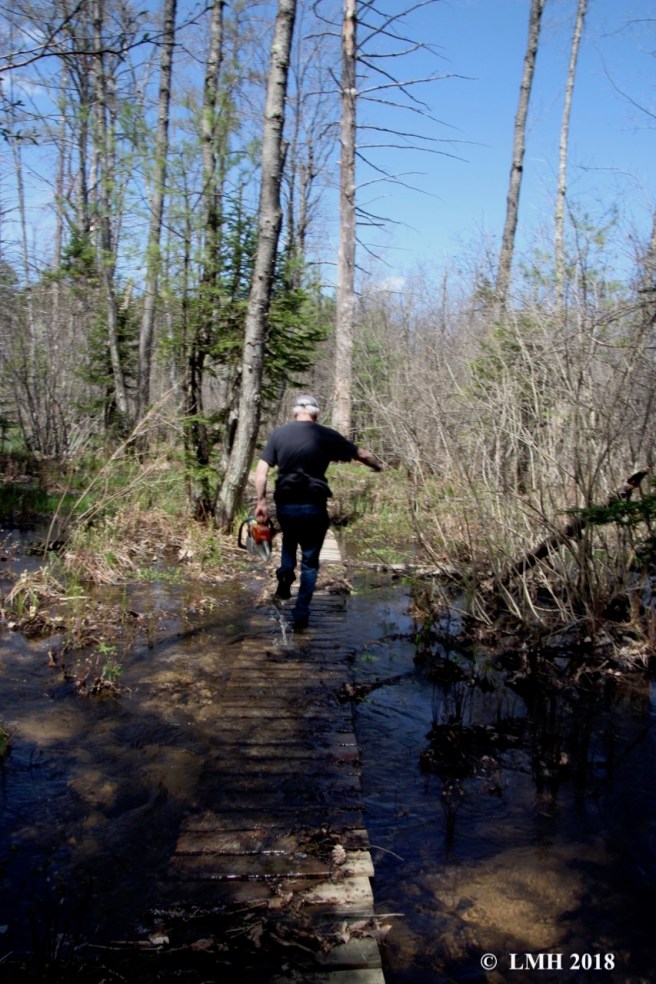
By late morning, we changed our focus from the yard to a woodland a few miles away for today was the day we chose to work on the section of trail we steward at Lake Environmental Association’s Holt Pond Preserve. 

w5

There were trees and limbs to clear. And trimming to be done as well. The last time we were on the Southern Shore Trail, which was only a couple of months ago, we noted a few trees that would need our attention, but today there were between fifteen and twenty.

w11

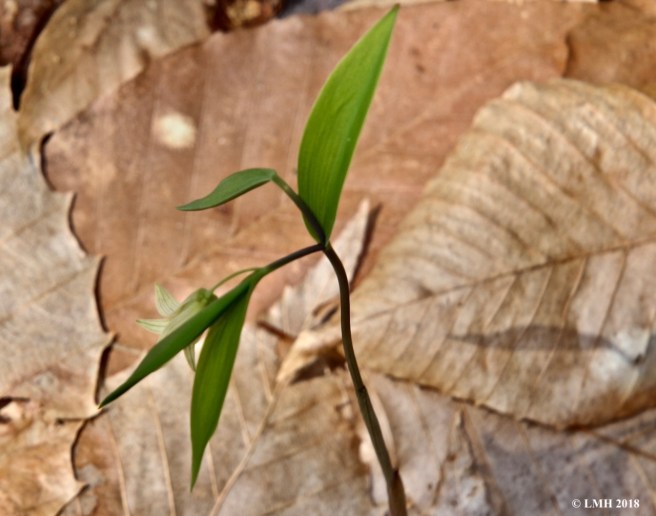
Occasionally, as my guy used the chainsaw and I waited to clean up, I spied old friends like a wild oat or sessile-leaved bellwort in bloom.

w6

And then I made a discovery that had eluded me in the past–a spotted wintergreen. It was an exciting find for it’s listed as S2 ranking, meaning “Imperiled in Maine because of rarity (6-20 occurrences or few remaining individuals or acres) or because of other factors making it vulnerable to further decline.”

w7

We were close to an outlook by Holt Pond when we saw the spotted wintergreen, Chimaphila maculata, and so we paused to take in the view looking across to the quaking bog as we dined atop a stump.

w10

From there we moved on, making rather quick progress to the “field,” a former log landing where the forest is slowly reclaiming its ground.

w8

As we approached we startled a ruffed grouse and came upon a familiar sight at this spot for the trail through the field has always provided a dust bath for these birds.

w9

And on the edge of the “tub” a telltale downy feather.

w12

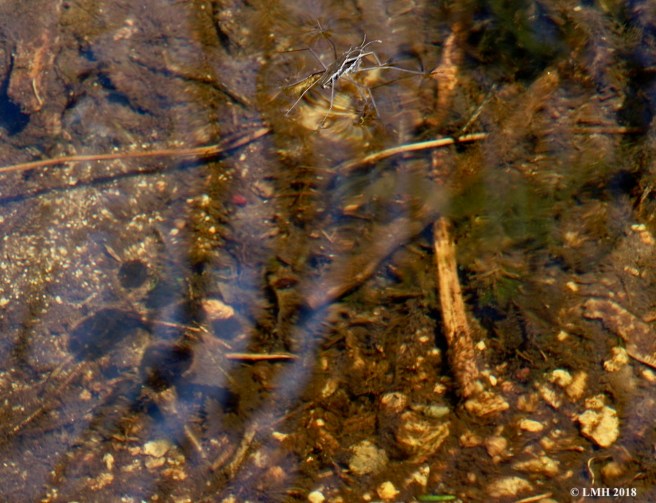
Typically, when doing trail work, our turn-round point is the field for that’s what we’d agreed to years ago. Today, we decided to keep going and made a small stream our end point. We shifted a bridge and watched the water striders for a while. Apparently, love wasn’t just in the air, but on the water as well.

W13

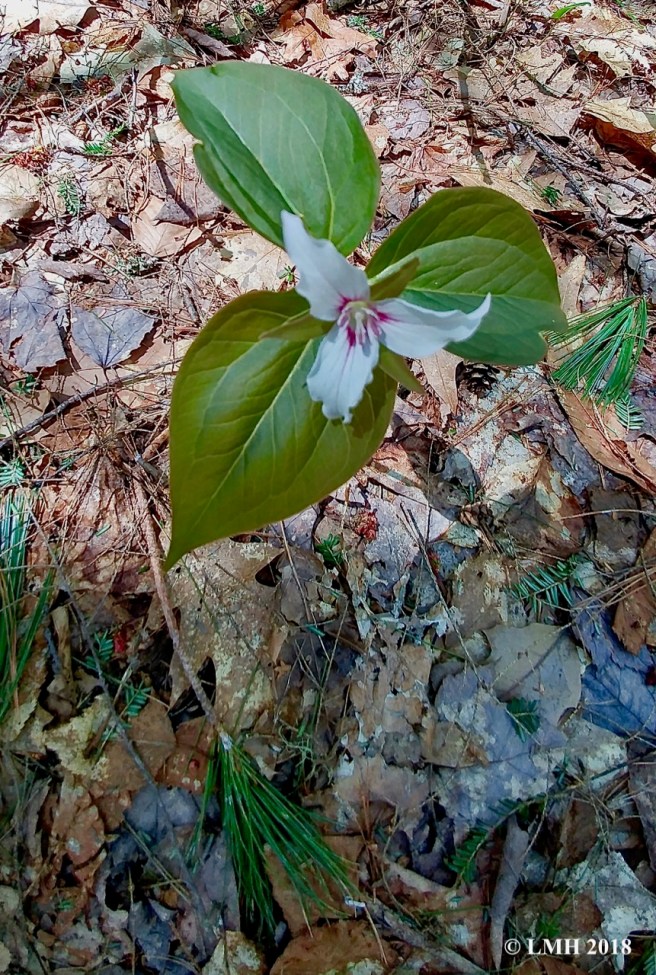
On the way back, I was delighted to discover my first painted trillium of the season. I sensed my guy’s groans for he knows I’ll exclaim over and photograph each one I see–not satisfied until I reach a trillion trilliums.

W14

Oh, and there were fern crosiers to celebrate, especially the scaly spiral of the Christmas fern.

w15

At last we reached the beginning of our section of trail and I told my guy that I wanted to go down by the water for a moment, but not cross the boardwalk because my hiking boots leak. He put the saw down, contemplated the water, and made the crossing. From the other side he suggested I join him since the water wasn’t that deep. Before I did so, however, he asked me to move the saw off the trail and out of sight. As I started to hide it, he crossed back over and said, “I’ll take it in case we need it.” And back again he went, the saw in his left hand for he’s a southpaw. He’d just reached the other side when I stepped on the boardwalk and began to carefully move, ever mindful of my boots . . . until those very boots slipped out from under me. Down I went. Crash. Bam. Smash. On the wood. My right forearm took the brunt of the fall and my camera ended up in the water.

My guy came to the rescue as he lifted me up . . . though first I insisted on the camera being saved. And now I have used the hunt and peck method to type this story for I am a southpaw for the next six to eight weeks as I recover from a fracture to the ulna and radius. That’s how today became a left-handed Mondate.

The camera is also in recovery mode–here’s hoping a rice bath will work wonders.


Cinco de Mayo, Naturally

The hour and a half drive to Litchfield, Maine, was worth every second on this fifth day of May. The spring tapestry that spread before my eyes had me oohing and aahing around each bend in the road for such were the colors–so many shades of greens, mixed in with reds and magentas and pinks and yellows. It was almost intoxicating.

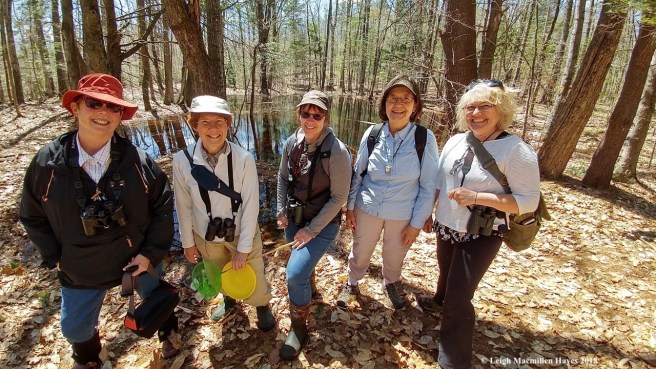
But . . . a photograph will have to wait for another day for I needed to reach my destination and catch up with my peeps–fellow classmates from our 2012-13 Maine Master Naturalist class. For the last five years we’ve tried to get together quarterly. It doesn’t always work out, but this year we’re making a concerted effort.

s1-Smithfield map

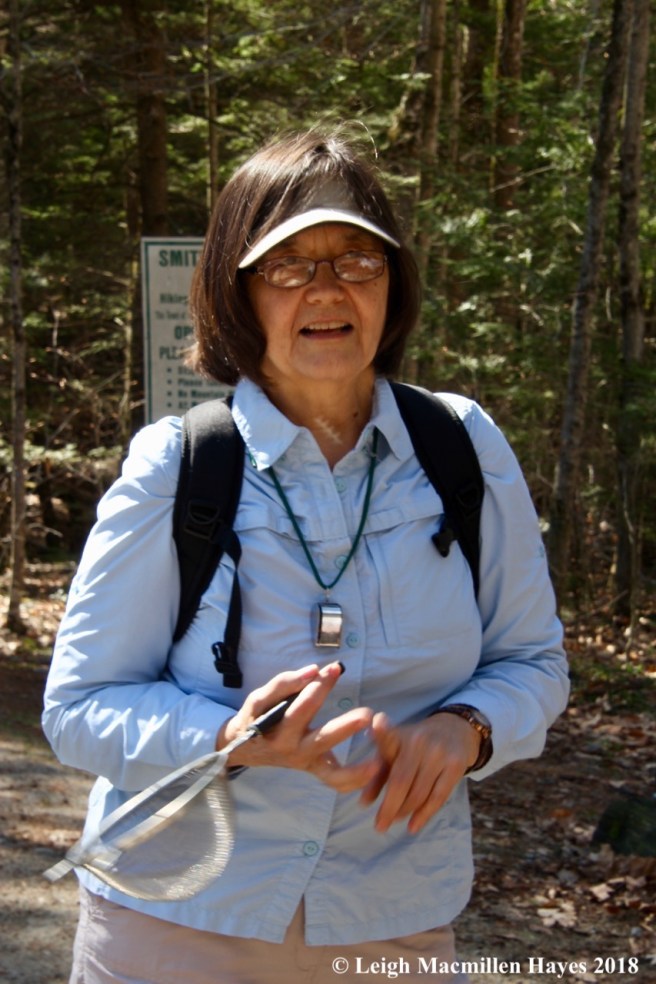
Today’s destination was the vernal pool at Smithfield Plantation, a 103-acre property the town of Litchfield conserved. If you look carefully, you might see a reflection of Sharon, who has lead many a school group along the trails and knows the property intimately.

s1a-Sharon T

Before we headed to the pool, she oriented us to the site.

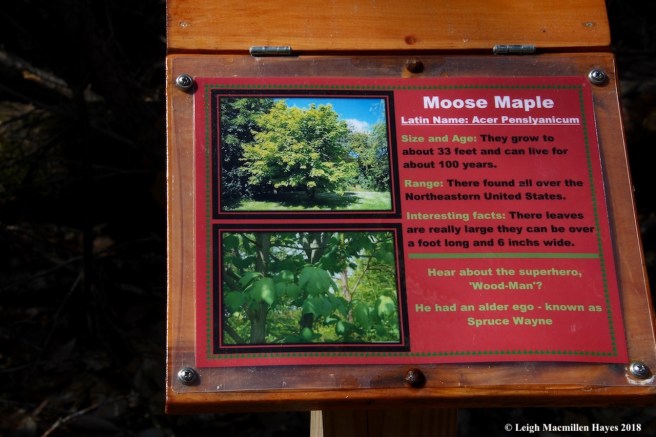
s2-moose wood

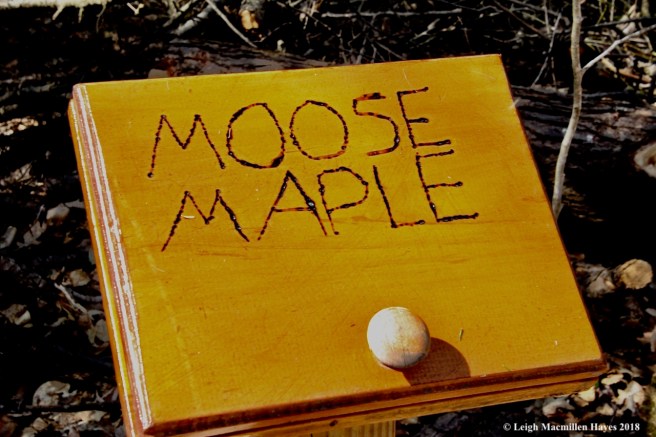
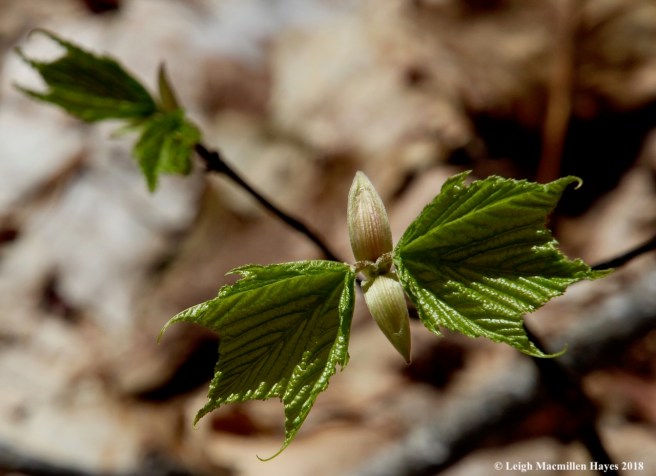
One of the things Sharon explained was that a Boy Scout had created an interpretive tree trail and so we paused at one of his stops to admire the craftsmanship.

s2b-moose wood maple leaf

Indeed, right behind the sign, a striped maple, aka moose maple, shared its newly emerged pastel buds and leaves.

s2a-moose maple

And then we lifted the lid to reveal the information. OK, so there were a few typos for the grammar police, but on each of his cards, he included a joke. What a great idea as that would certainly appeal to the younger set. It definitely appealed to those of us who are still ten years old in our minds.

s4-hobblebush

And on the opposite side of the trail, we spotted another type of moose wood–hobblebush just beginning to flower. Both striped maple and hobblebush are favorite foods of moose, thus their nicknames.

s3a-clintonia

Onward we walked until a patch of leaves stopped us. And our brain-sharing began. We thought we knew what the plant was, but then questioned ourselves as it wasn’t in flower yet. Each season, we need to relearn some. Despite the lack of flowers, we decided to key it out in Newcomb’s Wildflower Guide using two other descriptors–leaves both basal and entire.

s3-clintonia 1

For those familiar with Newcomb’s that meant of the three numbers in the locator key, we didn’t know the first, but went with 22 for the second and third representing basal leaves and entire leaves. Then we tried, 122, 222, etc.

s3b-clintonia buds

And landed on our first suspicion: 622–Yellow Clintonia or Bluebead (Clintonia borealis).

s6-vernal pool

The trail wasn’t long, but as one might expect, it took us a while to reach the vernal pool. And then we were stopped in our tracks and didn’t approach it right away.

s7-solitary sandpiper

Instead, we stood back and spent a while watching a solitary sandpiper on a downed tree.

s7a-solitary sandpiper

As we watched, it bobbed its tail. And at one point we were sure it took a mid-morning nap. Eventually, the bird flew to another part of the pool and a few minutes later departed.

s10-setting up camp

And so we set up camp, dropping some of our gear on the bench.

s10a-setting up camp

And more of it on and beside a log. We had macro-invertebrate charts and vernal pool pamphlets and books, plus all kinds of containers for pond dipping.

s9-Pam's journal

Pam was the smart one and she’d packed her sketch book and colored pencils. That’s one skill we all appreciate for it slows us down and makes us really notice. I, for one, haven’t done enough sketching in the past year and so this was the perfect incentive for the future.

s8-mosquito larvae

As we looked into the pool and Sharon told us what we might find, we immediately noticed the most abundant residents–mosquito larvae doing their whirligig dances.

s11-first fairy shrimp

But on her first dip, Sharon pulled up the crème de la crème–a fairy shrimp. Bingo–a significant pool it was as she knew, though not so documented with the state.

s12-examining the fairy shrimp

With her loupe, Jen took a closer look.

s13-five fairy shrimp

On Sharon’s next dip she pulled up not uno, not dos, not tres, not quatro, but cinco fairy shrimp.

s13-Pam sketches the fairy shrimp

And so Pam settled in to sketch them in all their glory.

s13-Pam's sketches

And added a caddisfly larva for we’d also captured one of those.

s14-female fairy shrimp

One of the cool things that Sharon pointed out, the brood pouch at the end of the abdomen, so indicating a female. How cool is that?

s15-caddisfly larvae

And here is our caddisfly, his casing created out of fallen hemlock needles. Caddisfly larvae that create their bodies from woody material are the log-cabin variety. We watched it move about in the tray, sometimes extending its soft body out of the case.

s17-spotted salamander egg mass

The dipping continued and a spotted salamander egg mass was pulled out, but only for us to take a closer look. And then it was returned from whence it came. Notice the individual eggs within the greater gelatinous matrix.

s18-egg mass

After that, Sharon found another reason to celebrate. She’d worn her waders and so was able to go deeper into the water than the rest of us.

s18-tadpoles

A quick dip and she’d pulled up an egg mass that almost melted as life burst forth–tadpoles. The first of the season for all of us.

s20-predacious diving beetle larvae

One last dip revealed one not so kind to all the other species we’d located. Known as a water tiger or toe biter, you can tell that it’s one mean little thing. This was the larval stage of a predacious diving beetle and the tadpoles had everything to fear for like its adult form it was a predator.

s23-Cinco Amigas

After that last find, it was time for us to pack up our gear and leave the pool behind. But, we took with us memories of a delightful spring morning spent exploring together. And . . . we had a chance to catch up, show each other field guides we thought might be of interest, share experiences of our volunteer opportunities, provide suggestions for ways to make a nature program work be it for kids or adults, and realize that we were not alone in any obstacles that may cause an issue during those programs.

What a naturally wonderful way to spend this Cinco de Mayo . .  . con cinco amigas. Thanks Gaby, Beth, Jen, Sharon and Pam.


Mayday Alert

Each time we explore a Greater Lovell Land Trust property, we have no idea what we might discover and this day was no different. For today’s Tuesday Tramp I suggested we visit the Cohen Property near the Lower Bay of Kezar Lake, which was the last acquisition under the direction of the late Tom Henderson. We’d only been there once before–and that was a few months ago when we explored via snowshoes. At that time we discovered ice-covered depressions and so a journey to check them out as vernal pools seemed apropos.

m2-moose print ID

There are no trails yet and so after parking, we followed the road back a ways to the area of our winter expedition. And what to our wondering eyes did we spy on the road? Moose prints! One should always look through a magnifying glass to make certain the ID is correct. Wes confirmed our suspicion.

m2-scooping

We found sitting water and running water and began to wonder about the wetland and whether what we thought might be a vernal pool really was, for we knew that a v.p. shouldn’t have an inlet or outlet. As the first dips of the day were made, black flies began to swarm around us. We hoped to pick up their larvae in the moving water, but instead we found many springtails.

m3-what did you catch

And a few mosquito larvae as determined by Caleb, Linda and Nancy.

m5-blob and algae

In another spot, we also found a mystery. At first we thought it might be some sort of egg. And maybe it was, but how was it related to the algae that seemed to be a host? We didn’t know, but now that we’re aware of it, we’ll continue to wonder and perhaps become enlightened.

m6-pool?

We checked out “pool” after “pool” and found not one egg mass (except for a false start that fooled us momentarily), which rather disappointed us. Were these really vernal pools? We suspected so as they were shallow and looked like they’ll dry up in the summer, if not before, plus they supported no fish. Were they significant vernal pools? Definitely not. To be a significant vernal pool, the body of water must contain one of the following obligate species: 1 fairy shrimp or 10 blue-spotted salamander egg masses or 20 spotted salamander egg masses (yellow spots) or 40 wood frog egg masses. Fairy Shrimp? No. Salamander egg masses? No. Frog egg masses? No.

m7-examining species

Despite the lack of indicator species, we scooped up water to determine what did live there.

m8-mosquito larvae

The most abundant residents found–mosquito larvae. And do you see the small jar in Ellie’s hand? She created a mosquito larvae aquarium and discovered that they seemed to like the algae she’d added. Perhaps they’d found microorganisms we couldn’t see.

m8a-pointing out antics of mosquito larvae

Watching the acrobatics of the larvae entertained us for a while. They twisted and turned somersaults and wriggled in the water and we soon realized that eggs left behind by last year’s females who had sucked our blood before breeding, must have remained dormant all winter until the snow melted and spring rains began.

m9-chironomid midge larva

We did find another species to admire, that also wriggled in a constant state of contortion–this one being a chironomid midge with blood-red coloration. According to A Field Guide to the animals of Vernal Pools, the color is “due to a hemoglobin-like pigment that helps them retain oxygen. This pigment allows the larvae to survive in water that is very low in dissolved oxygen, as is common in vernal pools as drying proceeds throughout the seasons.”

m10-Trailing Arbutus--May flower

Because I had to meet someone at noon, and Dave knew that it would take us at least a half hour to make the short trek back to our vehicles due to our incessant nature distraction disorder, we had to cut our journey short. Dave was right–as he often is–and we were forced to stop several time, including to sniff a couple of mayflowers, aka trailing arbutus or officially: Epigaea repens.

m11-ribbon snake 1

We finally reached the spot where we’d parked with fifteen minutes to spare when Linda sighted movement beside the tires of my truck and our hearts jumped with joy.

m12-ribbon snake captured

We didn’t want to run it over as we backed out and so Heinrich captured it. What is it? An Eastern ribbon snake, which is a species of special concern in Maine. According to the Maine Inland Fisheries and Wildlife website, “A species of special concern is any species of fish or wildlife that does not meet the criteria of an endangered or threatened species but is particularly vulnerable, and could easily become, an endangered, threatened, or extirpated species due to restricted distribution, low or declining numbers, specialized habitat needs or limits, or other factors. Special concern species are established by policy, not by regulation, and are used for planning and informational purposes; they do not have the legal weight of endangered and threatened species. The Maine Department of Inland Fisheries and Wildlife reviews the list of special concern species at the beginning of each calendar year, and, based on criteria in the Maine Endangered and Threatened Species Listing Handbook , revises the list as appropriate.”

m13-ribbon snake 2

And that is why it’s so important to protect the land. I knew Tom was smiling down upon us due to this find. Interestingly, we also spotted a ribbon snake at the John A. Segur Wildlife Refuge on Farrington Pond Road in early May 2015.

m14-paper birch superhero

Finally, we all departed and I was only ten minutes late for my quick meet-up, after which I headed back down Route 5 to reconnect with my favorite little naturalists at the Kezar River Reserve across from the Wicked Good Store. There’s a tape across the road, which I suspect was put in place by the local snowmobile club when the ice was questionable on the river, but it remains, which given the recent rain is probably a good thing. We’ll take it down soon, but it has prevented the road from becoming more rutted than normal.

Anyway, Wes climbed out of the family’s vehicle with his paper birch armor. He’d spied it in a V between to birch trees on our morning trek and his mom climbed up to retrieve it for him.

m15-brother bomb

Birch Man posed again and again, until his older brother Aidan, sporting a missing front tooth, jumped in front.

m16-root art

The boys stood on a hump of earth beside a tree root. And it was through their eyes that we noticed some interesting finds among the tree’s former life support.

m17-canister cover

We found pottery and cast iron and realized the tree had grown upon an old dump site.

m19-VW

And that hump of earth–the four siblings were sure that it hid a Volkswagen Beetle.

m23-Kezar River

It took us a while to walk down the “roadway” and then the left-hand loop. We made a few discoveries, including coyote scat filled with bones, and the kids did some trail work. At last we reached the canoe/kayak landing at the Kezar River and noted some otter scat and a few slides, plus some fishing lures and line stuck in the trees. It was at that point that the family had to leave, but before they left they asked me what I’d do before I had another meeting in the afternoon. I told them I planned to hike the second loop, which happens to be longer and dips into an interesting ravine.

m23-salamander eggs

That never happened. As it turned out, I stood at the boat launch for about an hour. First, I spied one small clump of salamander eggs.

m24-equisetum

And then realized that the raft before me, which filled the small cove, was equisetum. Where it came from I didn’t know for I couldn’t recall ever seeing it at this property.

m24-Mayfly 1

But, regardless, it provided a perfect camouflage for aquatic insects. It took me a while to key in on the species before me, but I knew they were there because every once in a while, one took flight. Do you see the mayfly subimago that had recently emerged? The teenager stood atop its nymph exuvia. Mayflies are unique in that after the nymph emerges from the water as the subimago (that fishermen call a dun), they seek shelter before shedding their skin for the final transformation.

m25-mayfly 2

I really had to focus in order to spot them.

m27-Mayfly

But once I did, they were . . .

m28-mayfly

everywhere.

m29-mayfly larva

And in all forms, including a nymph.

m30-Mayfly up close

The cool thing is that thirteen mayflies are also on the list of species of special concern. Was this one of the species? I have so much more to learn.

m31-water scorpion

As I continued to watch, there was an incredible amount of activity. And then I saw a predator that was about two and half inches long. Do you see it? Not atop the vegetation, but rather under it in right-hand center of the photo. Behind it, almost to the right edge of the photo, was a bubble at the end of its long breathing tube.

m33-water scorpion

As I watched, it continued to swim forward, the vegetation providing it’s favorite type of habitat. Again, you have to look carefully.

m34-water scorpoin

And again. It was a water scorpion with an oval-shaped abdomen. Do you see it?

m35-ribbon snake

Finally, it was time for my next meeting, but as I walked back up the trail I reflected upon the wonders of the day and the work of the land trust under Tom’s leadership. Creating corridors is important for mammals, but also for all critters that share the various habitats.

There was no need to put out a distress signal today. Indeed. With others and alone, I was thankful for the opportunity to be gifted with such sightings: Mayflowers and Mayflies! And a water scorpion. Topped off with a ribbon snake. May Day Alert of the best kind.


Lichen Province Brook Trail

My guy completely surprised me this morning when I asked where he wanted to hike and his response, “Province Brook Trail.” Though we’ve travelled many trails repeatedly, he often prefers to explore a new place. Me–I love those repeats for there’s always something new to see, as well as the familiar.

p1-trail sign

From South Chatham Road in South Chatham (pronounced chat-HAM), New Hampshire, I turned onto Peaked Hill Road, which leads to the trailhead.

p2-gate closed

And quickly parked the truck for the gate was still closed. That meant an almost three-mile hike to reach the trailhead. We didn’t mind as it’s a Forest Service Road and easy to walk upon, even as it gradually climbs.

p3-trail sign

Along the way, we noted where some of our favorite bear trees were located, but decided to leave them for another day. Instead, we were eager to move on and hoped to be able to get to the shelter. We weren’t sure what the water conditions might be, so promised ourselves only Province Pond. The shelter would be icing on the cake if we got there.

p4-tree spirit

Right away, the trail’s tree spirit whispered a welcome.

p6-yellow birch

And another of our favorite trees begged to be noticed again. It’s an ancient yellow birch that has graced the granite for more than a century. The tree itself, wasn’t in good health, but the roots atop the rock were still dramatic.

p7-split rock:heart

Conditions were different on the trail than the road, and though it’s a wide space used by snowmobiles in the winter, we had to watch our step for we encountered snow, ice, rocks and mud. But one rock was especially appealing and I’m not sure we’ve ever seen it before. A perfect split revealed a heart tucked within. As it should be.

p8-slow down

Onward and upward, we heeded the sign.

p9-lunch rock

And then hunger overtook our desire to wait until the pond, so we found lunch rock and enjoyed the feast we’d prepared. PB&J topped off with a Clementine and Extra Dark Chocolate Truffle, with water to drink, of course.

p23-Province Brook

Province Brook rushed past while polypody ferns provided a head of hair atop one of the boulders.

p10-moose tracks

After lunch, we had a wee bit further to travel before reaching Province Pond. At the dam, our excitement heightened for we discovered moose tracks in the snow.

p11-moose tracks

And more in the mud.

p12-Mount Shaw and Province Pond

Before us, the pond and Mount Shaw created a pleasing picture. We listened to the wood frogs wruck, though we couldn’t see them. Nor could we see any moose, but we hoped.

p13-Mount Shaw reflection

As usual, I got hung up on the reflection of the mountain and the subtle colors of spring, which was about a week later than back down the road.

p14-me

As I stood on the dam built to prevent beavers from creating their own, my guy took his first ever iPhone photo. I had to chuckle for it was the same view of me that I typically get of him. And do you notice who carries the pack–on the way up when it’s the most full with lunch and water? He always gets it for the descent, which works for me.

p14a-looking toward the shelter

From the dam, we looked across the pond toward the shelter, a tiny speck of roofline almost visible on the far shore, just right of center. And still we wondered, would we be able to get there?

p15-leatherleaf

Before trying, I noted leatherleaf with buds. Within a month, I suspected those tiny buds will become bell-shaped flowers.

p15a-sweetgale

Beside the leatherleaf, the overlapping burgundy and white scales of sweetgale catkins provided a delightful contrast beside the sky’s reflection on the water.

p16-shelter

We moved on, following the trail to the hut–and made it, the water we needed to cross over not being high at all. Built in the 1930s, the shelter has many stories to tell, and my guy read a few of them.

p17-shelter view

We’d actually saved our dessert, our form of icing on the cake, and so enjoyed the view as we finished lunch.

p18-lungwort on tree

On our way back down the trail, the brilliant green upper leaf of lungwort drew my attention as it has always done. The bright green was due to yesterday’s rain, which set the algae into production. The underside was pale with pockets of cyanobacteria, known as blue-green algae. Though it’s named for its resemblance to lung tissue, it does have a lettuce-like look. According to Lichens of the North Woods by Joe Walewski, lungwort is “found in rich, unpolluted and often very old forests.” Bingo!

p19-lungwort on ground

What surprised me was that we found some on the ground, this batch on snow. Moose have a preference for lungwort. Had they pulled it off a tree?

p20-lungwort apothecia

More surprising was that some had apothecia, its spore-producing structure. Do you see the tiny tans specks along the lobe margins? It’s uncommon to see these and was a first for me. Typically, lungwort reproduces by granule-like masses called soredia that form on the surface, break off, land on a suitable substrate and grown into new lungwort lichens.

About nine miles round trip and our journey was completed. Old joke, but I can’t resist for I was lichen the Province Brook Trail from the start and it just kept getting better and better.


The Amazing Race–Our Style, episode 3

We were a bit confused by the clue–something about an oven and ice and we felt like maybe we were headed to a kitchen. My guy doesn’t cook all that much and I avoid it as much as possible, so we knew this was going to be a tough leg of the race. Surely, we’d be there all night trying to concoct something and the sky would darken on our chance of winning.

To top it all off, it was an equalizer. That meant that though we were early to the starting point, all participants would begin at the same time. And so we had some time on our hands and a few dollars to spend on lunch and libations.

o1-clue

As we sipped, our clue was revealed. And we were ready to heed it, despite our anxiety over the cooking issue.

o2-footbridge

Following lunch, we still had more time to kill and decided to walk across the footbridge in Boothbay Harbor.

o3-ghost harbor

It was a bit of a ghost harbor on this day, but it won’t be long and people and boats and more people will fill this space.

o5-sign of snow

As we walked around town, we did some window shopping–of the best sort.

o4-clock

And then a view at a clock reminded us that we had a place to be by 1:15.

o6-crooked sign

Look for the crooked sign, the clue stated. We found it.

o8-trail conditions

Follow the trail. We did.

o10-mud below

Note the tide. It was obviously out.

o11-bridge

Locate the bridge that connects Oven Mouth Preserve West to Oven Mouth Preserve East. Bingo.

o13-ice house cove dam

But what was below us, we wondered. And that was our next challenge. We had to figure out the configuration of this land. It looked like an old bridge, but rather, it was a former dam that had been used to create an ice pond on the other side of the bridge upon which we stood. Aha–the icy portion of this leg of the race. Our task was to discover its history. Reading a brochure produced by the Boothbay Region Land Trust we learned the following: “In 1880, in response to a growing demand for ice, [the cove now known as Ice House Cove] was dammed to form a fresh-water pond and an ice house was built. The ice was shipped by schooner, mainly to Boston and New York.” Today, any blocks of ice would surely have melted as happened in our water bottles.
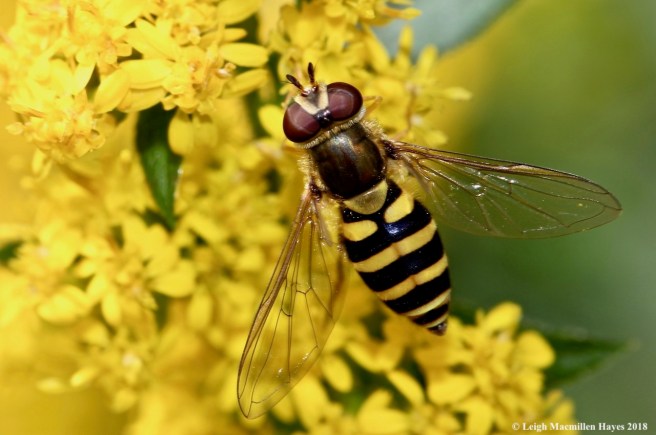
o7-garter snake

While we looped around the two peninsulas we had a several other challenges to complete. First, we needed to find three examples of critter sign–other than the ubiquitous red squirrel middens. We checked off number one with a garter snake that slithered past.
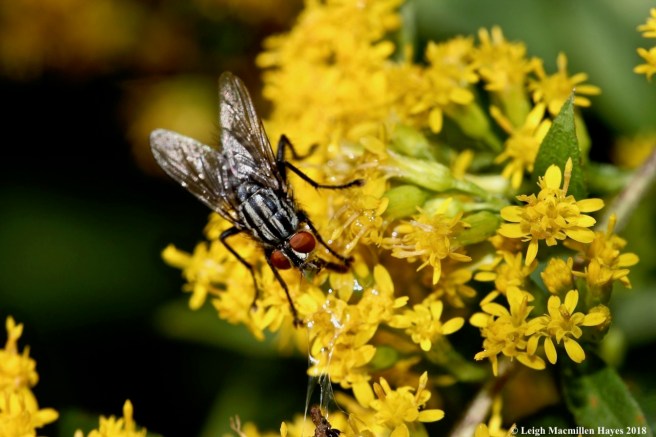
o7b-mammal tracks

Number two: mammal tracks in the mud below. We couldn’t get close enough to identify it, but noted the trotting pattern.

o7a-wasp nest

And number three, the remnants of a paper wasp nest.

Another challenge down. How many more to go?

o12-scavenger 2

It wasn’t long before the next presented itself as we wound our way around the property. First, we needed to find evidence of the land’s former use–as a sheep pasture in the 19th century.

o12-scavenger hunt 1

And then the letter D. We never did learn what the D stood for, but . . . we found it.

o15-sausage-shaped boudins

And finally, a sausage-shaped boudin among the folds, formed by the pinching and swelling from compression and shearing.

o13-Cross river

The tide slowly flowed in as we journeyed on.

o14-rip where Back and Cross River met

And at the point where the Cross River met the Back River, we noted a rip current visible in the swirls.

o14-ice house dam and today's bridge

At last we crossed back over the bridge from east to west and then peeked at the dam juxtaposed as it was in the shadow of the modern-day bridge.

o16-oven?

From the outermost point of the west side, we paused to look back toward the dam and bridge–did the early explorers really see this rounded cove as the inside of an oven, thus naming it Ovens Mouth? It was certainly unique. Fortunately, we could enjoy the view without turning up the heat. If they thought it was an oven, we agreed. If it meant we didn’t have to cook, we definitely agreed.

From the brochure, we did learn more history: “This area has always been inviting for maritime activities because of its deep-water access and protected location. Settled in the mid-1700s, one of the region’s earliest shipyards was located here and both British and American vessels hid in the coves during the Revolution. Soon after the Civil War, the property came into the hands of the Tibbets-Welsh family, who owned it for more than a hundred years.”

o17-kissing tree

We had one last challenge to complete before finding our way to the mat. Our final mission: to note three sights that represented our relationship.

Kissing trees–check.

o17-heart

A heart-shaped rock–check.

o17-pigeons

Whispering sweet nothings–check. (Note the heart-shaped white cere on their bills. And no, he is not picking her nits. Well, even if he is, isn’t that a loving move?)

Once again, we managed to stay ahead of other contestants, didn’t squabble too much, avoided our worst fears and completed the assigned tasks without much stress. In the third episode of our imaginary rendition of The Amazing Race–Our Style, we landed on the mat in first place once again. What’s next? Stay tuned.


Dear Earth

Dear Earth,

In your honor, I decided that on this Earth Day I would head out the back door and travel by foot, rather than vehicle.

e1-Mount Washington

My journey led me down the old cow path to the power line right-of-way and much to my delightful surprise, Mount Washington was on display. It was so clear, that I could even see the outline of buildings and towers at the summit. Thank you for providing such clarity.

e2-vernal pool

Rather than walk to the mountain, I turned in the opposite direction and found my way to the vernal pool, where ice still covered a good portion. You know, Earth, as much as I want this to be a significant vernal pool because it does usually have two qualifiers (and only needs one): more than forty wood frog egg masses or more than twenty spotted salamander egg masses, I know that it is not. I believe it was created as part of the farm based on the rocks at the far end, not exactly forming a retaining wall, but still situated so close together in a way that I haven’t found anywhere else in my extensive journeys of the hundreds of acres behind our house. Plus, it dries up much too quickly to be a natural pool. And each year I’m surprised to find wood frogs, their egg masses, spotted salamander spermatophores, and their egg masses, given that the water evaporates before the tadpoles finish forming. If these species return to their natal vernal pool, Earth, then how can that be since no one actually hopped or walked out as a recently matured adult? Or were these frogs on their way to another pool and they happened upon this one? You know me, Earth–lots of questions as I try to understand you better.

e4-dorsal amplexus

Whatever the answer is, each year you work your magic and on a visit yesterday afternoon, I spied a male wood frog atop a female in what’s known as amplexus, aka, mating. According to Maine Amphibians and Reptiles, edited by Malcolm L. Hunter, Aram J.K. Calhoun, and Mark McCollough, “When mating, the male clings tightly to the females back. Visible contractions of the female’s body signal the onset of oviposition, at which time the male’s hind feet are drawn up close to the female’s vent. As the eggs are expelled, the male releases sperm into the water and strokes the egg mass with his hind feet, which presumably aids in distributing the sperm more evenly.” I looked this morning, but didn’t find any sign of eggs. Don’t worry, Earth, I’ll keep looking because perhaps they were there but hadn’t absorbed water yet.

e5-dead frog

One other thing I saw yesterday that greatly disturbed me was a dead frog in the water. Last year I also found such. My concern is that it was caused by a virus, but perhaps it was old age. Or some other factor. I do have to confess, though, Earth, I intervened and removed the body from the pond. I know, I know, it’s all part of the cycle of life, and I should leave nature to its own devices, but disease was on my mind and I didn’t want others to be affected. I may have been too late. Only time will tell.

e7-leaf variety

When I arrived this morning, I’m happy to report that I didn’t see any dead frogs. For the longest time I stood upon a rock–you know the one I mean, Earth, for you’ve invited me to stand there before. It’s sunny in that spot and the frogs know it well, for that is where they’ll eventually deposit their eggs. As I waited, I looked down at the leaves on the pool’s bottom and noticed how they offered a reflection of the trees above, beech and oak and maple and pine and hemlock. All still displayed their winter colors, but when the pool does dry up, they’ll turn dark brown and form a mat that will provide nutrients for the plants that colonize the area. You’ve got a system, don’t you Earth.

e8-frog 1

I knew if I stood as still as I could, I would be rewarded. While beech and oak leaves, the last to fall from their trees, danced somersaults across those already on the ground and matted by the past winter’s snow, red and gray squirrels chatted and squawked, and chickadees sold cheeseburgers in their songs, my eyes constantly scanned the pool. And in a flash, a frog emerged from under those leaves.

e8-wood frog 1a

For a while he floated, allowing the breeze to push him to and fro within a two square-foot space. But then he decided to climb atop a downed branch. Perhaps he was trying out a calling sight to use once I left.

e9a--wood frog 3

And then, there was another. And after that another. Yesterday I saw a total of six. Today only four. But that doesn’t mean the others weren’t hiding until I left, right Earth? I hope that’s what it meant. One thing you have taught me via the frogs is patience. If I stand still long enough at least one will swim to the surface. And they, too, are patient as they wait: for me to leave; for the gals to come. Well, maybe when the gals do come they aren’t all that patient.

e10-mosquito larvae

I actually returned to the pool a second time today and more of the ice had melted. While in the late morning I couldn’t see any insects on the move, in the early afternoon I eyed thousands of mosquito larvae. Everyone moans about mosquito larvae, Earth, but . . . they provide food for salamanders and the adult form for birds. I’m just trying to look on the bright side.

e11- snowmobile trail

This afternoon, I waited and waited for the frogs to emerge, but either my eyes didn’t key in on them or they decided to wait until I left. So . . . I finally did just that, and did head toward Mount Washington after all, following the snowmobile trail. As you well know, Earth, it was a bit tricky between the snow, soft mud, ruts and rocks exploding from your earth.

e11a-boots

My right foot managed to fall through the icy snow into a hidden rut filled with water that covered my Bog boots. And then my left foot found some mud that squelched with glee. Or was that you squealing with delight, Earth? I had one wet sock, but ventured on.

e11b-Mansion Road

At the junction, I turned to the west, following the log road and remembering the days of yore when my guy and I, as well as neighbor Dick Bennett, used to work up a sweat on a winter day following a snow storm, for it was our duty to you, Earth, to release the snow from your arched gray birch trees. And then, a few years ago, the road became the main route to the timber landing/staging area again, and all of those trees we’d worked so hard to protect year after year were cut to make way for machinery. As much as my heart broke, it does give me time to watch forest succession in action, and I gave thanks that you have such a plan in mind.

e14-deer dance

It also provided a blank stage upon which the does danced and left behind their calling cards.

e12-buck

And Buck sashayed each partner across the floor. The deep dew claw marks and cloven toes indicated he’d made quite an impression.

e11c-coyote scat

All along the way, upon raised rocks in the middle of the “road,” coyote and fox scat was prominent and in the sandy surface I also found their prints.

e18-vernal pool near landing

At the left-hand turn that led to the landing, I was surprised when I shouldn’t have been, for suddenly a million “wrucks” filled the air. I knew the water was there but it had slipped my mind. Thank you for the song of many more wood frogs. Thanks for filling my ears with joy.

e15-wood frog egg masses

And the chance to spy their good works. Thankfully, you make sure that life continues. At least in the form of wood frog egg masses.

e17-wood frog egg mass

I loved their gelatinous blob-like structure, all bumpy on the outside they were. Actually, I believe what looked like one mass, was several, but I didn’t dare step in to check and disturb the frogs that hid below.

e16-wood frog 5

Again I stood as still as possible, and again I was rewarded. For a bit I thought that the frog before me had no arms, but then I realized that they were just plastered to its sides.

e19-wood frog under log

A squirrel sounding bigger than itself caught my attention briefly and I turned unexpectedly. When I turned back, the frog was no longer at the water’s surface, but appeared below a downed gray birch. For a while the two of us remained still. I hoped another frog or two or three or three thousand would pop up, but that wasn’t your plan, was it? It’s okay. One was enough.

e21-log landing

I finally left my one, oops, I mean your one frog alone and continued on to the log landing, noting all the mammal tracks and looking for other signs. There was more scat, but I was disappointed not to find bobcat or moose prints. Where were you hiding them? I suspect the moose had moved to the swamp below.

Rather than go much further, for major ruts from the logging equipment were filled with water, I turned around just beyond the landing and headed back across it. Twenty-five years ago it was a much smaller clearing with a few pine trees. Over the years, I’ve watched it change and the mammal activity as well. And then, about five years ago it was converted back to a landing and I can’t wait for it to fill in again, but my desire and your plan are not necessarily the same, are they?

It all seemed like so much destruction, but I had to remind myself that I am part of the equation, with my own needs for power and wood and food and everything that you provide. And cuts do bring about a change, sometimes for the better, for the trees and the mammals and the birds and the plants and the decomposers and the consumers and all who call this place home. Am I convincing you, Earth? Am I convincing myself?

e22-frog 7

As I passed by the lengthy vernal pool again I decided to revisit the egg masses. I stood on the rock and slowly scanned the area. No frogs. On second glance, there was one right beside the rock on which I stood. And it looked like the same one I’d seen previously. I wondered why. Why didn’t I scare it? Was that you, Earth, taking a peek at me?

e23-Mourning Cloak butterfly

I had one more surprise on my journey–the first butterfly of the season, a mourning cloak. With its wings closed, it wasn’t all that attractive.

e24-mourning cloak

But upon opening them, I saw its beauty hidden within–another lesson, eh Earth? Oh, and your sense of humor. For yes, that was coyote scat on which the butterfly sucked as it sought amino acids and other nutrients. A fly also dined. Yum.

What a day, Earth. Your day. Dear Earth Day. May I remember to treat you so dearly every day.

Sincerely,

wondermyway


Craning My Neck

I’ve spent a lot of time thinking about living in the moment lately, a concept that really drove itself home during the years that my mother dealt with dementia and I was forced to realize that each time I left the room, my return was a new visit; a new adventure. And now, so many friends are dealing with issues that make every second precious and I realize once again the importance of slowing down and noticing and making the most of being present. Now.

f1

Such was the case this afternoon when I joined two friends who had pulled in from their winter home in Florida this week. We met at one of the parking lots for the Mountain Division Trail in Fryeburg, Maine, a rail trail that makes one feel like you could walk to the White Mountains in a matter of miles. But, to get back to the moment, the original plan had been to travel the trail with two different friends and then one had to back out and I found out that the Florida friends had returned and so I invited them to join the other and me, and then my other friend had to back out and so it was the Florida duo and me. And it was so fabulous to spend time with them that we walked rather quickly, which completely surprised me when I thought about it for I know that they love a slow journey. But we had much to catch up on and because the trail is paved we didn’t have to think about foot placement and perhaps that’s what spurred us on.

f2-tamarack 1

At last, however, it was spurs that stopped us, for one of them spied a branch with upward facing cones and little spurs and she wondered what it was. The cones certainly looked like hemlock cones. But why were they upright? And what happened to the needles? When I explained that it was a tamarack, she again questioned it for she’s always been here in the autumn when the needles are a brilliant yellow and she thought those needles stayed on all winter. Not so, I explained, for a tamarack (larch, hackmatack–take your pick of common names) is our only deciduous conifer in northern New England. The golden needles fall the same as maple leaves.

f11-pussy willows

We also put on the brakes when she spied pussy willows–a sure sign of spring in their Zen-like presentation.

f20

Onward we marched, catching up on past months. But then, as the day would have it, first he had to turn around and head back to the parking lot and then a short time later she had to do the same. And that got me thinking about how the walk had evolved. I was sorry that the two I had originally planned to share the trail with couldn’t join me, but equally thankful for the two with whom I did travel. Living in the moment means embracing a change in direction.

f3-evening primrose basal rosette

The rail trail is four miles long in one direction and I turned around at the 2.5 mile marker. On my return, I was entirely surprised by the offerings that had escaped my attention previously, like the beauty of an Evening Primrose’s basal rosette.

f4-pitch pine cone

It’s fractal fashion was reflected in the pitch pine cones I spotted on the ground and surrounding trees.

f5-pitch again

The pitch pines always draw my fancy and I was especially intrigued by the past, present and future–as I tried to live in the moment. It’s not as easy as it sounds for we so often get caught up in what was or what could be.

f8-red oak

The past produced fruits long since deployed.

f10-speckled alder catkins

The future grew longer before pollinating the shorter.

f7-trailing arbutus in bloom

But in the moment–I spied the first blossoms of Trailing Arbutus.

f9-spotted salamander spermatophores

My return journey was much slower than the first leg, for there was so much to see. Included in the expedition was an examination of a small vernal pool. And what to my wondering eyes did I see? Spotted salamander spermatophores–those little chunks of sperm left behind by males atop cauliflower-shaped platforms.

f14-wood frogs quaking

As if that wasn’t enough, further on I heard a familiar quack and knew wood frogs were active though I couldn’t see them.

f15-wetland

And still further I discovered a wetland I’d never noticed before. Spring peepers sang from the far edges. It was all a surprise for on the walk out I’d told my friends from Florida that I hadn’t seen or heard any vernal pool action yet.

f15a--chipmunk

I just need to spend more time listening and waiting and letting it all play out before me, the same as the chipmunk that was sure I couldn’t see him.

f16-Canada geese

After a three-hour journey, I found my way back to the truck and then decided to take some back roads home. As I passed through farmland where cornfields are prolific, I noticed movement. I so wanted the movement to be another bird, but it was a huge flock of Canada Geese that attracted my attention. Again, I had to live in the moment and enjoy what was before me.

f17-sandhill cranes

And then I turned into the harbor, and was pleasantly surprised for suddenly my eyes cued in on those I sought who stood tall.

f17a--sandhil cranes

And preened.

f18-sandhill cranes

And craned their necks. Sandhill Cranes. In Fryeburg, Maine. They have returned to the harbor for at least  the past five years, probably more and I’ve had the privilege to hear them fly over several times, but today was the first time I was honored to see them. Thank you, Parker, for the tip.

I craned my neck and gave thanks for the moments spent in their presence and lifted up several people who will benefit from a dose of this medicine–Tom, Jinny Mae and Lifeguard Wendy: this one is for the three of you.


Greenwood Nature Mondate

We love Maine both for its natural beauty and historic nature. And so it was today that we enjoyed a wee bit of both as we headed off to Greenwood.

m1-Greenwood City sign

More specifically, Greenwood City.  According to the town website, “The first saw and shingle mill was constructed at ‘Greenwood City’ in 1805. In the mid-1800s, the wood industry moved to the Village of Locke’s Mills as a result of the railroad and a fire which destroyed Greenwood City.” Apparently, the city had been the economic and civic center of Greenwood, but the fire of 1862 changed everything. Nevertheless, this was our kind of city and our intention was to climb the mountain to the left of the sign–Peaked Mountain.

m3-Maggie's Nature Park sign

For years now, I’d heard of Maggie’s Nature Park, but never gave it much thought as a destination. That all changed today. The park encompasses 83 acres of mixed forest across the street from South Pond. It was gifted to the town by Maggie Ring, who had placed it under conservation easement with the Mahoosuc Land Trust. According to an article by Josh Christie in an April 2016 issue of the Portland Press Herald, “As Ring told the MLT in 2005, ‘I gave the land so my grandchildren and everyone else’s grandchildren can enjoy these woods. I want them to enjoy some of God’s good earth.’” 

Our plan was to begin on the orange Ring Hill Trail, and consistently stay to the right as we wove our way around the hill and up Peaked Mountain before descending via Harriet’s Path and finishing with the yellow trail.

m4-elbow tree

Because the temperature was on the crisp side, the snow pack was firm, though there were icy portions in the hemlock grove, and bare trail and ledges as well. As we began, we immediately noted an elbow tree, so formed probably when another tree landed upon it.

m4a-cedar

Moving along at my guy’s brisk speed, I was delighted to note the variety of trees, including cedar, and couldn’t help but imagine the teaching opportunities.

m6-evergreen wood fern

Where the snow had melted, shades of green drew my attention. And with a new season ever so slowly unfolding, I realized I needed to practice my fern ID and so I slowed my guy down for a wee bit. I think he secretly welcomes the breaks for he always finds a rock upon which to sit. One of the characteristics that helped in this ID was the first downward pointing pinnule–it being shorter than the one next to it. I also noted that the stipe or lower stalk, was shorter than the blade, and it was grooved.

m6a-evergreen wood fern

A look at the underside added to my conclusion for last year’s sori were round and all in a row between the midrib and margin. So what was it? Evergreen Wood Fern or Dryopteris intermedia if you choose to get technical. I choose to brush up on my fern ID.

m5-icicles

As we continued along Ring’s Hill, we took in the views from the ledges and under them as well, where icicles pointed toward the land they’d nurture.

m7-snack log

Eventually we followed the yellow blazes to the summit of Peaked Hill–and what to our wondering eyes should appear at a downed log near the view point? Two Dove eggs–the dark chocolate species. A perfect reward for our efforts. But really, the trail required little effort due to its well-executed construction with many zigs and zags to prevent erosion. We hardly felt like we were climbing yet we constantly moved upward.

m8-Mount Abram

The summit of Peaked offered the best views–this one being of Mount Abram, with its ski area at the top and to the right. The ski area is closed for the season, but snow still covered the trails that we could see.

m9-blueberry bushes

Also within our view–highbush blueberry buds suggesting a delightful treat for another day.

m9-toad lichen

And common toadskin lichen reminded me that Big Night is coming soon–that special rainy night(s) when we become sally savers and help amphibians cross that the road to their natal vernal pools. Stay tuned for that–there might be some migration later this week.

m10-trail well marked

All along, we’d noted the trail markers–bright colors and frequent placement made it easy to stick to the trail. But one caused me concern for it looked like it pointed us over the edge.

m11-trail makers

Not to worry, it was merely noting a junction and curve–my guy came in from the right because he’d chosen to follow the ledge from the Mt. Abram viewpoint, while I chose to return to our snack log and then follow the trail to meet him. Together again, we journeyed to the left as the trail markers indicated.

m12-marker curving 'round rock

Rather than stay on the Peaked Mountain Trail all the way back to the parking lot, we continued with our right-hand-turn progression and chuckled when we found one trail marker painted around the curve of a rock–so indicating yet another zig.

m13-dead end

A short spur on the red trail, aka Harriet’s Path, lead to one last point of view.

m14-pond view

South Pond below with Buck and Lapham Ledges in the distance–hikes saved for another day.

m15-boulder field

We looped back to the yellow trail and continued down through a boulder field–one more piece of what made this hike so interesting. It wasn’t long after that we completed the journey, but talked immediately about returning in other seasons for so delightful a trek it was. I can’t wait to see what flowers it has to offer and we both could only imagine it decked out with autumn’s tapestry.

m17-Greenwood Cattle Pound

On the way home, because I was driving, we had one last stop to make–by the Greenwood Cattle Pond built in 1835 just north of the city. Pounds were important features to secure stray animals prior to the invention of barbed wire and the stones would have stood taller than they do today, but still . . . another piece of history saved for this one is on the National Register of Historic Places.

At the end of the day we wondered why it had taken us so long to discover Maggie’s Nature Park, but thankfully we now have. And we gave thanks to Maggie Ring and her vision to protect “God’s good earth” for all of us. We loved the nature of Greenwood on this Mondate. Indeed.

P.S. Another claim to fame for this town: LL Bean was born in Greenwood in 1872.


Kinship With All Forms of Life

I walked today with intent, as I sometimes do, only that intention morphed between the beginning and ending of my journey. You see, I awoke with a need to reach a certain heron rookery that I’ve helped monitor for the Heron Observation Network of Maine during the off-season,  before the owner of the land returns. It’s a bit of a bushwhack to reach the site and in the past, I’ve accompanied Tom for this citizen science effort. Each spring, we’ve visited it at least once to count the number of nests and adults. Sadly, Tom won’t be joining me this year and so I headed off this morning to see what I might see–and be his eyes.

m1-squirrel

They were big eyes to fill–as big as the red squirrel who paused to watch me and then dashed along a stonewall on a mission of its own making.

m2-brook peek

Initially, the journey was a bit of a bee line as I followed a snowmobile trail. It was there that I delighted in the color of the sky and realized that most of the ice had melted on the beaver pond and brook below. I could have headed down to the water’s edge then, but chose to continue toward my destination.

m3-beaver dam inactive

I was almost there, when an old beaver dam forced me to stop. And then I heard a loud crash. I scanned the area and stood still–listening, waiting, wishing.

And then another noise–of movement. Again, I stood still. Nothing.

m4-land bridge

Finally, I arrived at the land bridge that would lead me to the rookery, but . . . my journey stalled and I realized I’d have to save the crossing for another day. Water rushed over the mossy mounds and because I was alone I decided not to risk falling in. As I stood and admired the flow, I thought some more about Tom and the crossing he is making from this life to the next.

m6-more ice bubbles

And I thought of his sense of wonder and ability to instill such in others, even over something as simple as ice baubles.

m 5-ice bubbles

I could hear an eloquent explanation flow forth from him about the movement of bubbles within an icicle formed on a branch.

m7-ice fingers

And I knew he would appreciate the artistic rendering before our shared eyes–in this case a wee bit reminiscent of M.C. Escher’s Transformation Prints.

m27-forest

At last I pulled myself away from the crossing I couldn’t make and turned back toward the forest from which I’d come. Tom had a hand in the vision of these woods–as a forester and as the executive director of the Greater Lovell Land Trust. His vision included forest management that would benefit wildlife. From where I stood, I saw turkey, deer, bobcat, and squirrel tracks.

A third time, I heard a sound and knew that I wasn’t alone. We never are, are we?

m8-mergansers

Eventually I made my way to the water’s edge and noted Hooded Mergansers in the distance. Around another bend, I spotted Wood Ducks. Tom would have loved it for birding was also one of his passions.

m10-beaver works

Within footsteps I admired the work of another forester who called this place home.

m11-beaver attempt

It seemed he’d sampled some trees and they weren’t to his liking–at that moment. Or perhaps something had startled him and he quickly retreated to the water. Either way, he treated this land as if it were his. For it was.

m12-more beaver

Everywhere, beaver works both old and new decorated the forest.

m18-lodge

And a lodge stood tall still partially surrounded by ice.

m7a-goldthread

But there was more of  the woods to see this day, like goldthread’s evergreen leaves that reminded me of cilantro. And also of Tom’s garden, for which he actually has some seedlings that will be ready to plant in another month and its produce will be enjoyed at a later date by those he loved most. Their dinners will be enriched for one last season by his green thumb.

m13-tiny shell

Next, I spied a tiny, fragile shell that was iridescent on the inside and brown on the outside. It couldn’t be a bird egg. Was it from a snail?  Tom would have known.

m14-holy leaf

And then there was a striped maple leaf like none I’ve ever seen before–almost stained-glass in its offering. It only made sense that it be so hol(e)y for in its life cycle it had provided energy to insects and as it continues to break down it will nourish the earth. Tom would recognize the significance of such–renewal, rather than devastation.

m15-hobblebush

There were other things to note, including a hobblebush flower bud that formed between its praying hand leaf buds.

m21-lungwort

And lungwort that served as an indicator of a rich, healthy ecosystem. Indeed.

m19-heron

I stood for a long time by the water’s edge, thinking of Tom and then I spied it. A Great Blue Heron flew in and landed across the way. My intention was honored. And Tom’s.

m24-rotten apples

At last I headed back the way I had come and passed through a field where a couple of apple trees grow. As I’d journeyed I had noted scat after scat–some filled with apple chunks and seeds. Of course, I rejoiced because I have an affinity for scat.

But Tom, too, would have rejoiced for what he set out to do so many years ago was to create wildlife corridors–those links of joined natural habitat. For Tom, that’s what it’s all been about–maintaining the ecological processes that allow mammals of all kinds to move and continue to be viable. And for the land on which they traveled to also be viable.

His has been a kinship with all forms of life beginning with the minute, like his shiitake mushrooms and the earth within his gardens and ending with . . . there is no ending, only new beginnings. May Tom’s next beginning be through the eyes of a Golden Eagle. As he soars above us, may he approve of the continued good works of others who try to emulate the legacy he will leave behind.

Godspeed Tom. And thank you.


Celebrating Mud Season

Mud Season — unique to northern states, indecisive weather, sloppy. What’s to love about it?

m1-breaking ice

Everything when thirteen Tuesday Trackers headed out for the final expedition until next winter. And no thin ice went unbroken by this hearty group.

m2a-turkey track

Prints in the snow we found along the way, but most were difficult to discern. In the mud, however, they were magnificent and we kicked ourselves for not thinking to bring some Plaster of Paris for great casts those would have made.

m2-Jo tells a snake story

Our tracking efforts were only part of the journey for along the way we were enraptured as we listened to Storyteller Jo Radner share a tale about a water snake, her grandmother, and some visitors to a children’s camp on Kezar Lake . . .

m3-bog

passed through the black spruce peat bog at the Kezar River Reserve on the eastern side and remembered time spent there with GLLT’s former executive director Tom Henderson (I told you, Tom, that you’d be with us and you most certainly were as we felt your spirit and heard your voice among the trees. We decided we need to return in the near future and spend more time getting to know that place–today, it required careful footwork and so we didn’t stay long) . . .

m4-Canada Geese

and finally found our way to Kezar River, where the Canada Geese and a couple of ducks awaited our arrival.

m6-ice

While some ice art in a stream that feeds the river drew our attention, we were there to look for evidence of a mammal that frequents the area.

m6a-otter scat

With youngsters among us, our eyes were more eagle than ever, and one of them found the sign we sought. At first sight, it appeared to be lichen on bark, but then our eyes focused and we knew what was before us–river otter scat.

m6b-otter scat formed

Some was matted as it had disintegrated a bit and only the scales remained, but others were formed in a tubular shape, all filled with fish scales, bones, and crayfish parts.

m7-otter scat

We rejoiced as we’d found a latrine site, a spot the otter returned to as a place to defecate, urinate and roll around in what’s known as a brown-out. It all provided information that we appreciated but meant even more to others of its own kind. “Hi, my name is Otty, I’m good looking and would be happy to meet up for a cup of fish stew. You available?”

m9-MUD

In the same area, we noted slides leading to the water and imagined the otters movement. And then some of our crew channeled their own inner otter and headed down to the feeder stream where the mud was difficult to resist.

m14-MUD

Mud! Worth showing off.

m11-washing off

And then the joy of cleaning off by stepping into the river.

m15a-mud angel

Mud season–celebrated with mud angels.

Book of April: Take a Wetlands Walk

Those of you who have followed me on the trail or through wondermyway for a while know that I’m not only drawn to mountaintops, but wetlands as well. And I have a few that I frequent including several vernal pools, Holt Pond Preserve, Perky’s Path, and Brownfield Bog.

w1

Book of April

Therefore, when I spotted Take a Wetlands Walk by Jane Kirkland at Maine Audubon’s Nature Store a few years ago I wasn’t surprised that it jumped into my hands and dragged me to the checkout. Since it’s April and the snow is slowly melting in western Maine, and some afternoon in the near future I look forward to receiving an email announcing our local Big Night celebration, it seemed apropos that I should feature Take a Wetlands Walk as the book of the month.

w-Holt P 2

Holt Pond boardwalk

This is a children’s book and I like how the author divided it into three sections, using a phrase often heard at the starting line.

Get Ready–encourages kids to gain a better understanding of wetland terminology in an easy to understand manner. In fact, it’s as if the author is sitting beside you, so conversational is the tone.

w-fairy shrimp

Fairy Shrimp

w-tadpoles

Tadpoles

w-wood frog

Wood Frog

w-painted turtle

Painted Turtle

w-water snake 1

Water Snake

w-water snake 2

Water Snake (notice his tongue)

Get Set–introduces amphibian and reptile species associated with wetlands.

w-pitcher plant

Pitcher Plant

Go!--sends the children outside to read the signs of nature and jot down their observations.

w-Holt Pond quaking bog

Quaking Bog at Holt Pond

In the Go! section, Kirkland describes what the kids might discover in such places as bogs, estuaries, salt marshes, freshwater marshes, streams, rivers, lakes, vernal pools, swamps, and the Everglades.

w-Red-winged Blackbird

Through sidebars, illustrations, and photographs, Kirkland touches on many topics related to wetlands, but constantly encourages further research, including of course, heading out the door. She also includes a wee bit of information about citizen science projects and wetland careers.

w-pileated woodpecker

Pileated Woodpecker

Each time she first uses a technical term, she adds a pronunciation key. One of my favorites: The Pileated Woodpecker (Py-lee-ata-id or PILL-e-ate-id). I prefer the latter, but occasionally hear the former uttered. “You like to-may-toes and I like to-mah-toes!”–Although in that sense, I prefer the former tomaytoes.

w-spotted sallie 2

Spotted Salamander

Throughout, Kirkland shares personal experiences as well as those of her acquaintances. Finally, she includes pages filled with photos to help you identify birds, plants, reptiles, amphibians, mammals and insects related to wetlands.

w-pond dipping

Pond Dipping

Yes, this is a children’s book, but adults can also benefit from reading it. And then heading outside.

Get Ready, Get Set, Go! Pick up a copy of Take A Wetlands Walk and visit your nearest wetland.

Take a Wetlands Walk by Jane Kirkland, Stillwater Publishing, 2011

Mallards, Beavers, and NOT Squawroot, Oh My!

Since posting this blog yesterday, my Maine Master Naturalist mentor, Susan Hayward chimed in and corrected me. If you’ve read this previously, please be sure to scroll down to the Squawroot discovery. (Or not Squawroot). Thank you, Susan, for sharing your knowledge once again and setting me on the right track.

Our intention today when Connie Cross and I visited the wetland at Sebago Lake State Park’s Campground was to . . . well . . . walk with intention. There were several miles of trails to explore during the offseason, but we decided, or rather I did, that we should circle the beaver pond to see what we might see.

b1-horseshoe bog

It was raining as we drove to our meet-up point. And so we piled on extra layers to ward off the damp chill, and thought about snowshoes–to wear or not to wear? Connie chose to throw hers into a backpack and I went without.

b1a-raccoon prints

Our journey down to the wetland was one that had been recently traveled by others, including a certain waddler who showed off its finger-like prints in the melting snow. It made perfect sense to us to follow the track of a raccoon for it would lead to water.

b2-beaver works

Everywhere by the water’s edge, we noticed the works of another mammal–some old and others more recently hewn by the local beaver family.

b6-lodge

And then we spied the lodge and noted the mudded sides and recent additions to the chimney stack at the top and knew that it was active.

b3-duck on lodge

As we watched, we noticed that someone decided to call upon the residents–for a female mallard hopped from the water to the lodge and began to climb up.

b4-duck on lodge

One might expect a fox or coyote to pay a visit to a beaver lodge and reenact the story of the big bad wolf and three pigs. Or as noted on tonight’s PBS show entitled Nature: Leave it to Beaver, the visitors might be a muskrat, mouse, or frog who check in at the inn, but a mallard?

b5-mallard

Apparently, she liked the contents amid the mud used to insulate the house.

b7-sky reflection

As we watched, the sky above began to change and we noted such in the water’s reflection. Clouds, sun and blue sky marked a morning in transition.

b8-mallard couple

Continuing along the trail, Mr. and Mrs. Mallard became our friends and seemed to follow us, that is, until he signaled to her rather like a dog points, and a few seconds later off they flew.

b9-beaver

In the meantime, we heard a splash in the water behind us. What caused it? There was no snow high up on the trees that might have fallen. And then . . . we saw the creators. Beavers. There were actually three–moving about slowly and then suddenly splashing again and disappearing into the depths below. And the chambers within. We were in awe and felt honored to have shared a few minutes with members of the family.

b12-squawroot

Finally, we pulled ourselves away. And then . . . we came upon another find. And somewhere from the depths of my brain after some word association like Indian pipe and Pine sap, I pulled up the name–Squawroot. Connie looked it up on her phone and tada, I was right. Another name for this parasitic plant is American cancer-root for it only occurs where it can attach to oak roots and we were in a forest of red and white oaks. Like Indian pipe and Pine sap, this plant doesn’t have any chlorophyll and therefore no green color. It actually reminded us of a pineapple.

And tada, I was actually wrong. Though they look sorta similar, this is what Susan shared: “Your squawroot looks to me to be the favorite food of those beaver.
Bullhead Lily or Spadderdock Root. Squawroot is later in the summer. There is rarely any residual after the winter; maybe a clump of twiggy dried stems. The Lily root is much more substantial tissue than squawroot. It is carbon loading for the beaver.

I had never seen the roots of Spadderdock before. I learn something knew every day–thankfully.

b14-checking the trail

We continued to circle the bog, and on the northwestern side I gave thanks that Connie had packed her snowshoes, for she packed the trail while I followed. We did try to figure out why it was called Horseshoe Bog. The shape didn’t speak to the name, but perhaps someone once found a horseshoe in the area–or so we wondered.

b13-snowman

We weren’t the only ones wondering. A snow creature posed over the space with many a question about the future on its mind.

b15-from the other side

As we circled, the skyview changed and we finally began to feel the warmth of the day.

b16-another lodge

We also noted at least three other lodges that had provided warm spaces in previous winters.

b17-a closer look

The one noted in the last photo showed no signs of mud when we took a closer look so we knew it wasn’t active this year. If they had intended to stay, the beavers would have worked hard to interlock the sticks and then add plenty of mud like we add insulation and siding to our homes.

b19-beaver lodge trail

After three hours, we’d completed our journey–traveling maybe a mile in all that time. But we rejoiced for we’d spent time with the mallards and beavers and squawroot. Mallards, Beavers, and Squawroot, Oh My!