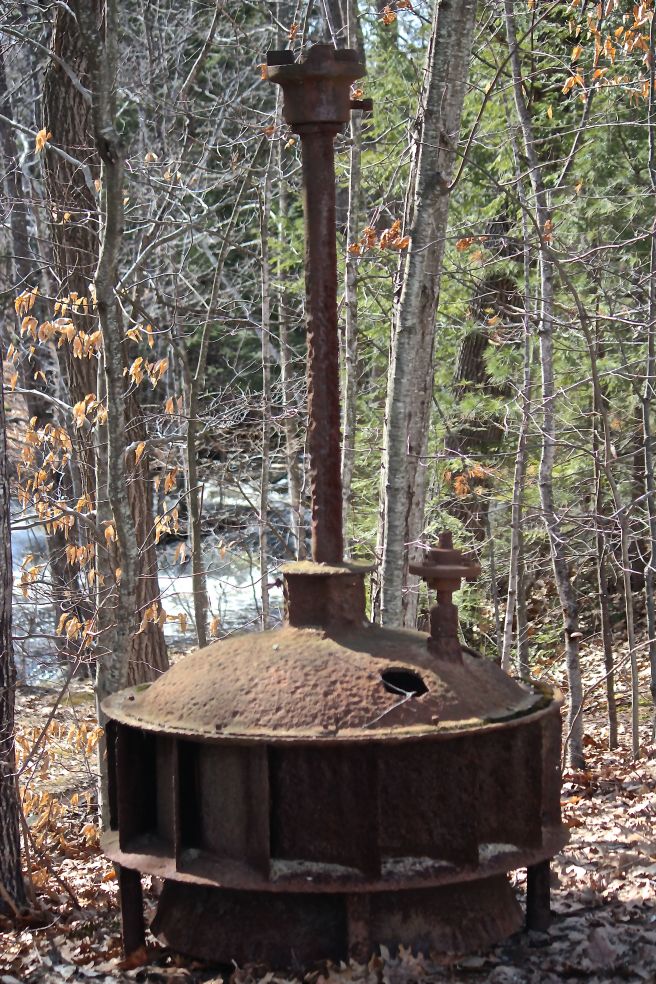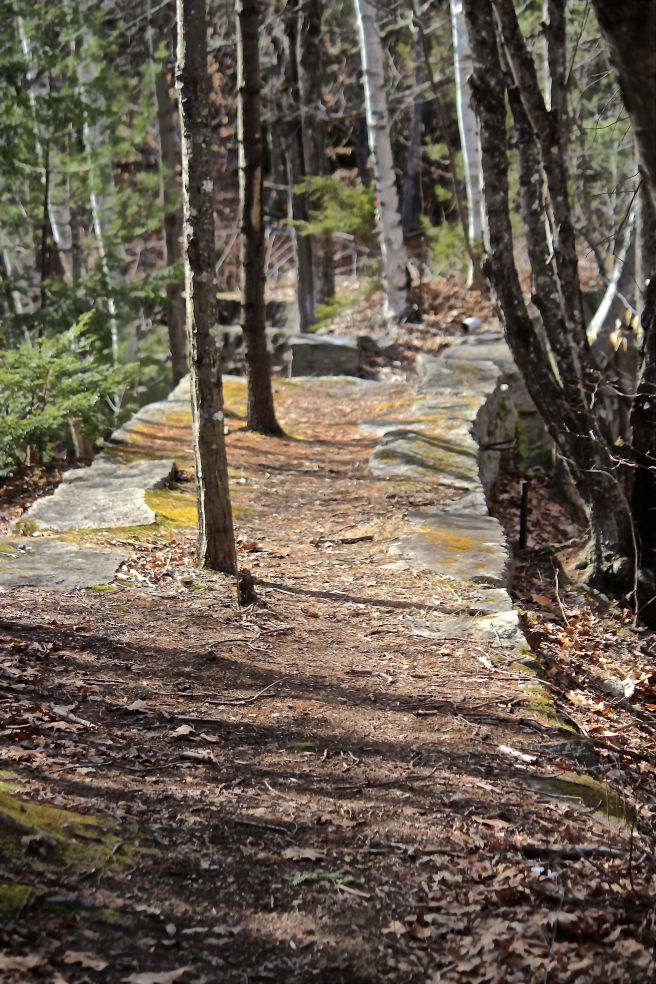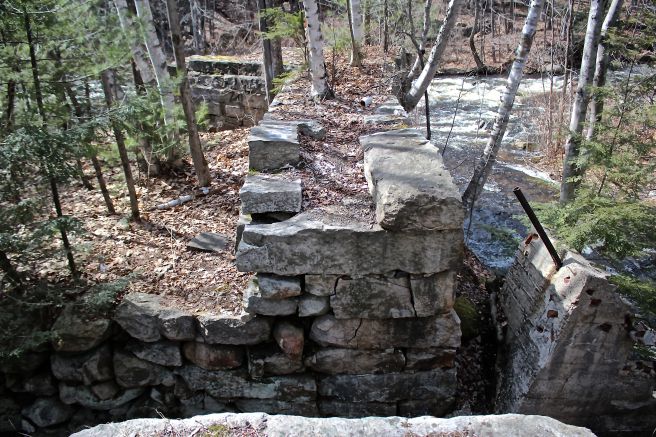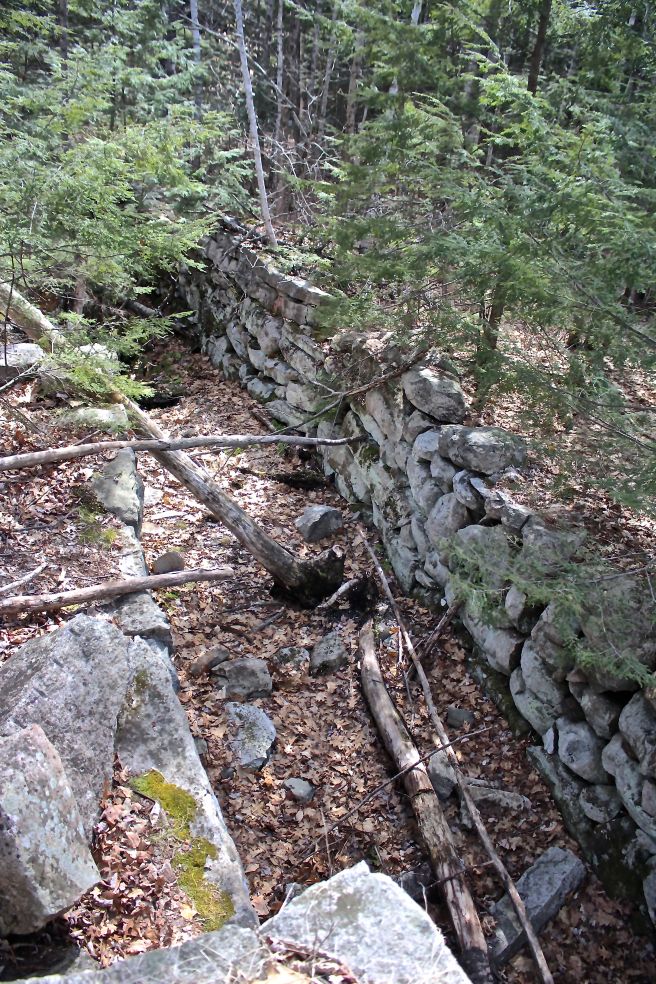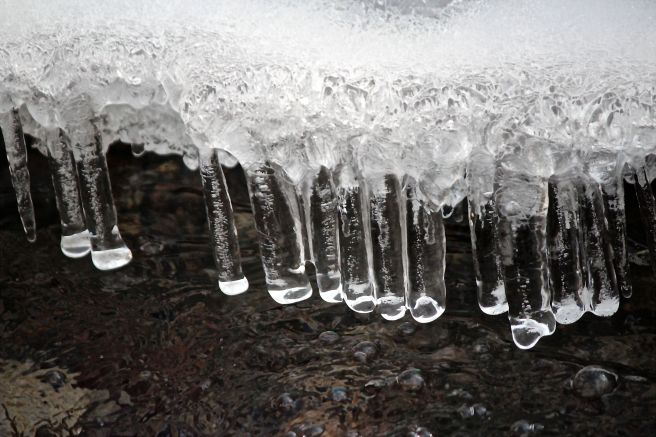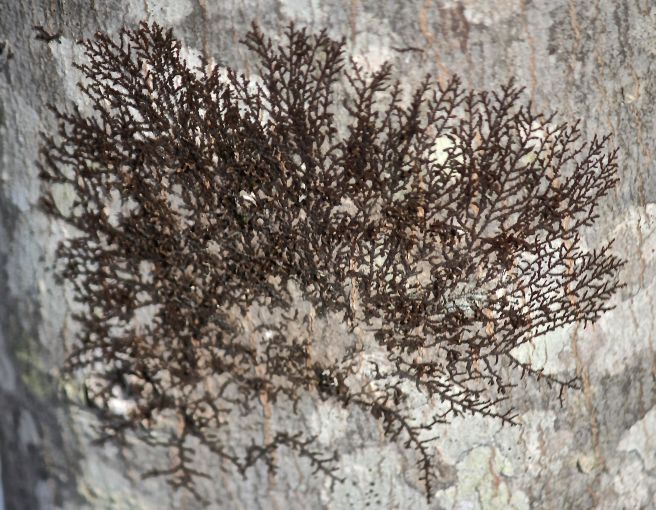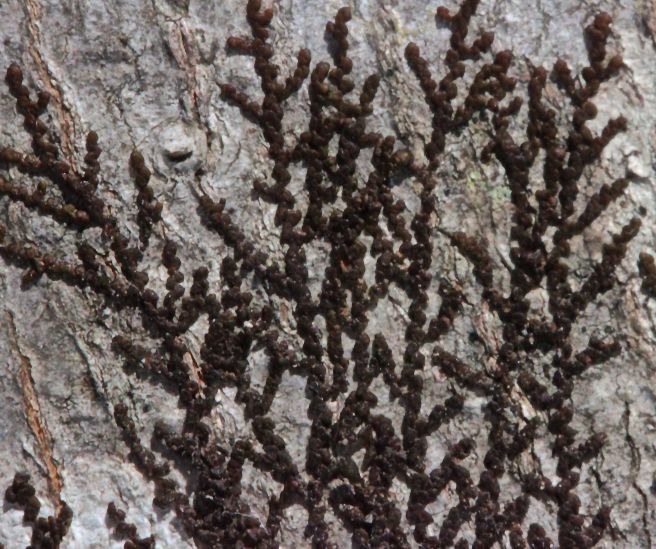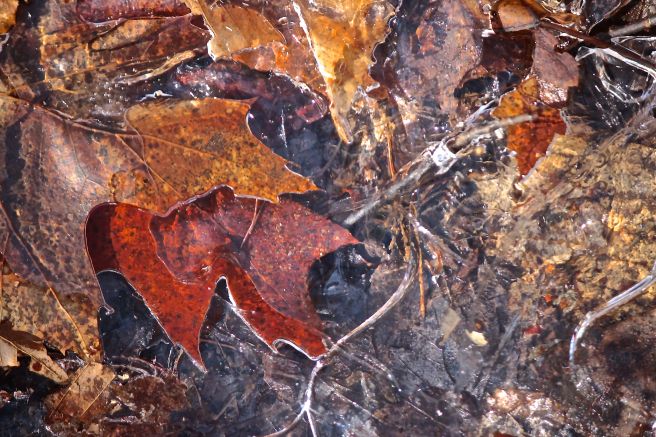
Meditation in the City

Though I grew up outside New Haven, Connecticut, and spent a great deal of time there as a child/tween/teen, I am not a city girl. In fact, stepping onto a sidewalk in even the smallest of cities yanks me from my comfort zone.

And so it was with great surprise that I met a city I rather liked. Over the last thirty years, I’ve passed through it numerous times, but twice this past week, I followed my tour guide from one monument to the next–my eyes wide and mouth gaping open with each new view, the obvious sign of a tourist.
w-bobsign

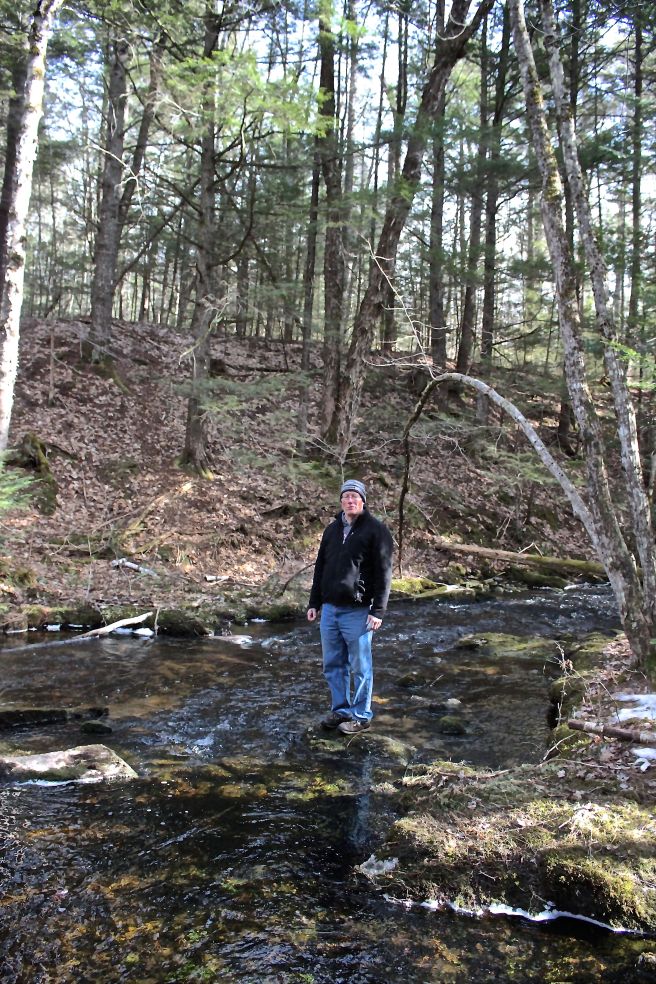
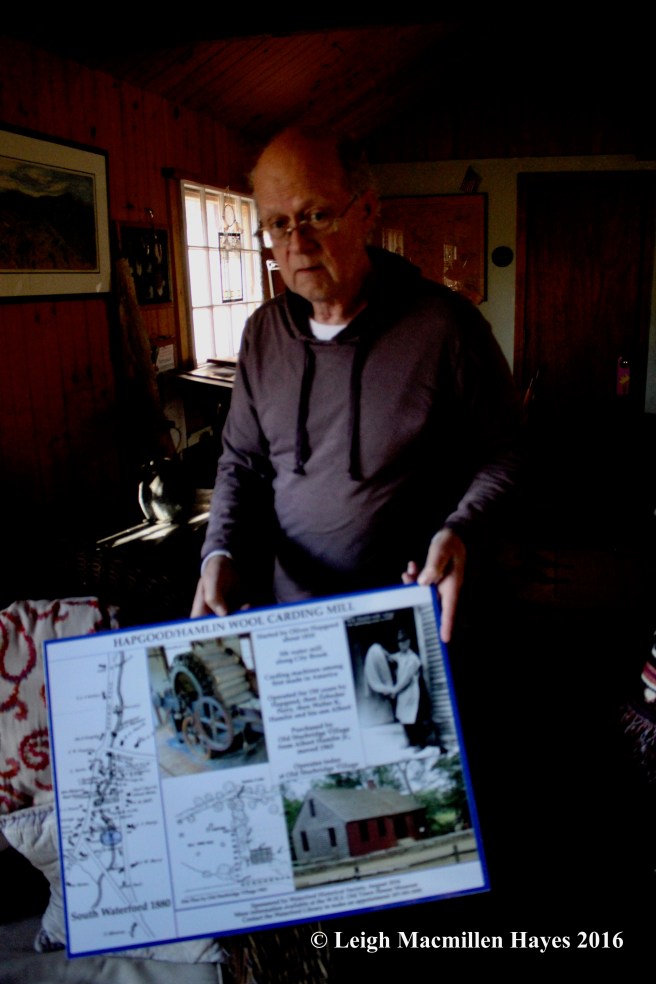
Meet my tour guide, Bob Spencer, who proudly displayed a future landmark sign.

w-indoor-view

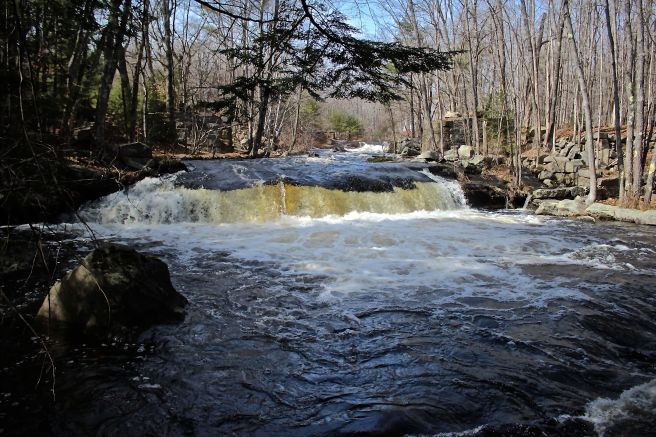
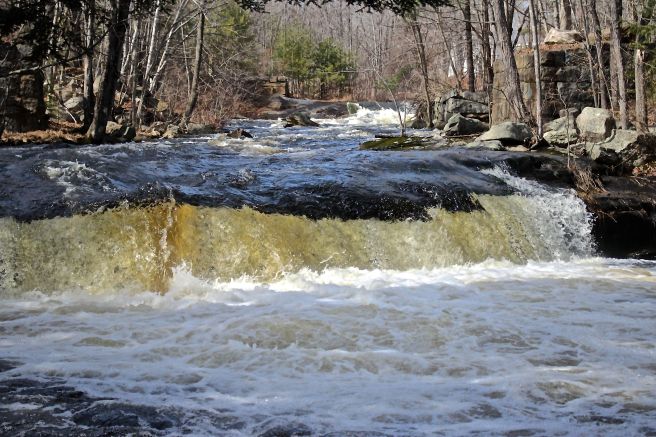
Bob’s world view begins at City Center, aka Watson’s Falls.

w-watsons-falls-1

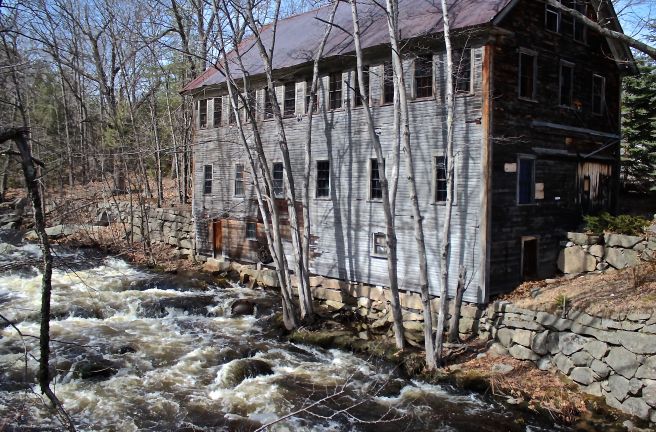
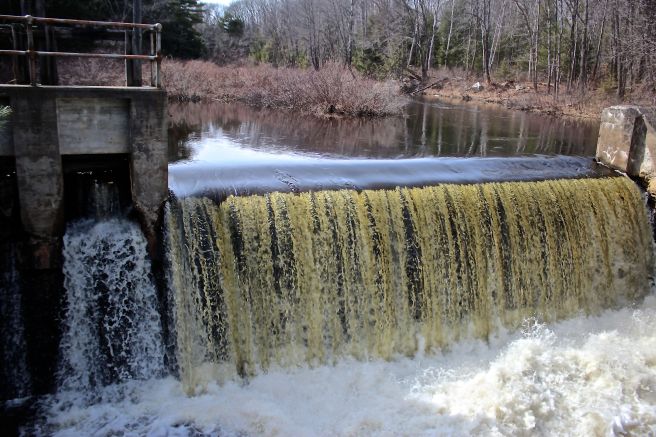
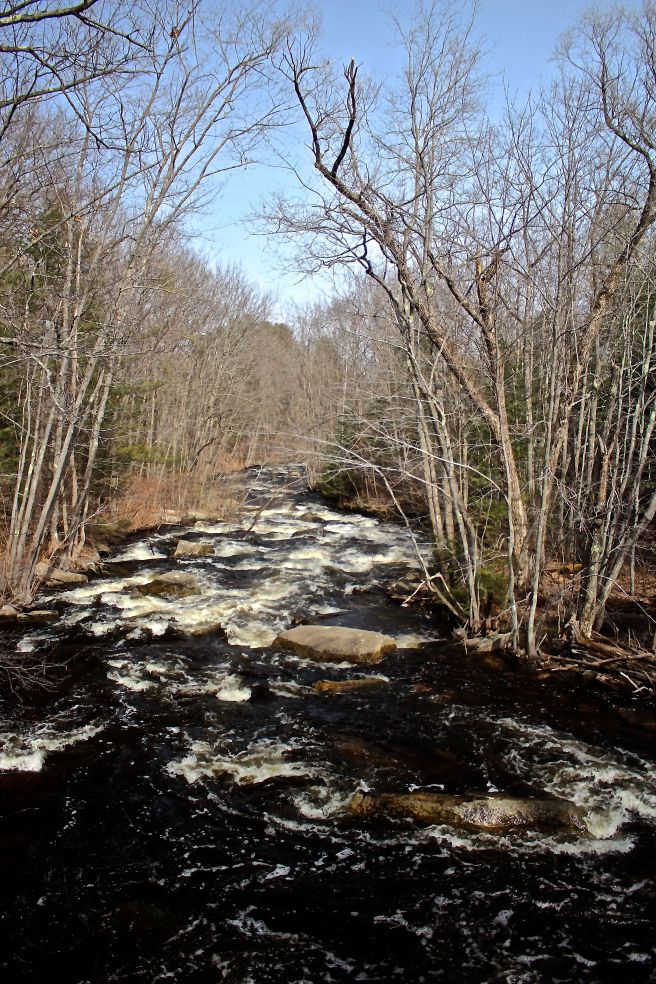
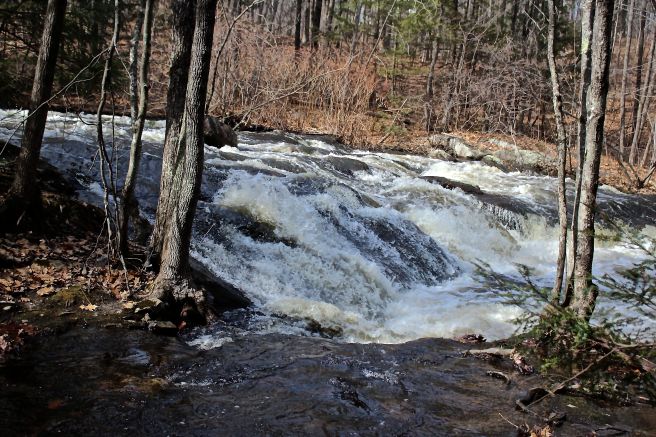
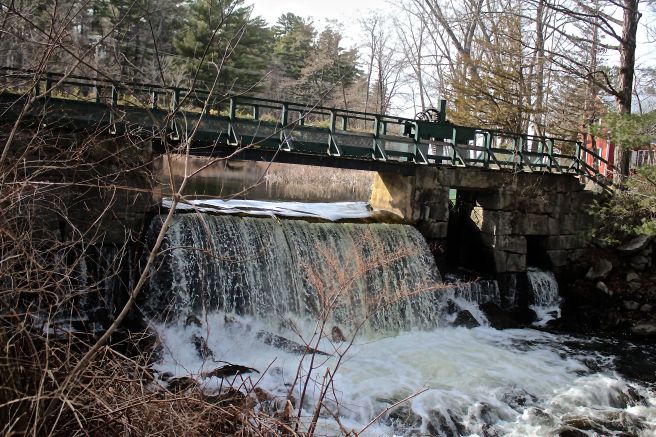
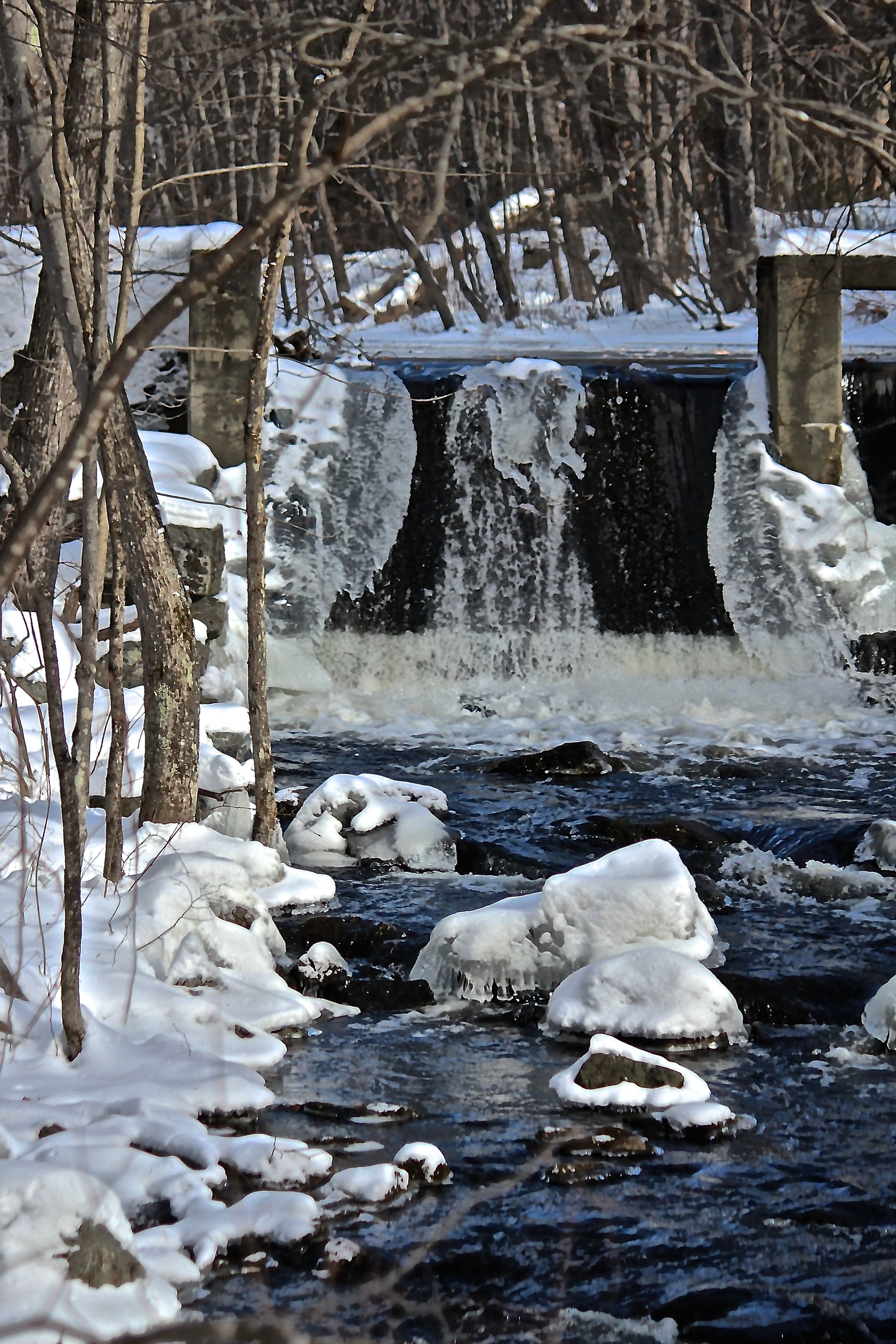
From the home he and his wife, Gere, have made in a former mill, the view encompasses one of nine water privileges or mill sites. Theirs is the fifth privilege along the stream, which was originally granted to Isaac Smith in 1795 for a saw mill. Over the course of its lifetime, the building served as a cloth and linseed oil mill, saw mill, salt box factory and cider mill. I love that apples still dangle above the water, a reminder of that last rendition.

w-library

On Saturday, we stepped north for a few minutes, and chatted about the mill pond and its function while Bob pointed out foundations and retaining walls and told stories of the standing buildings.

w-watson-falls-2

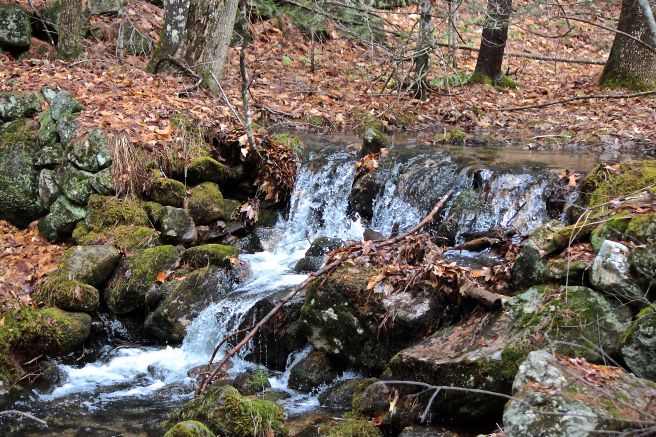
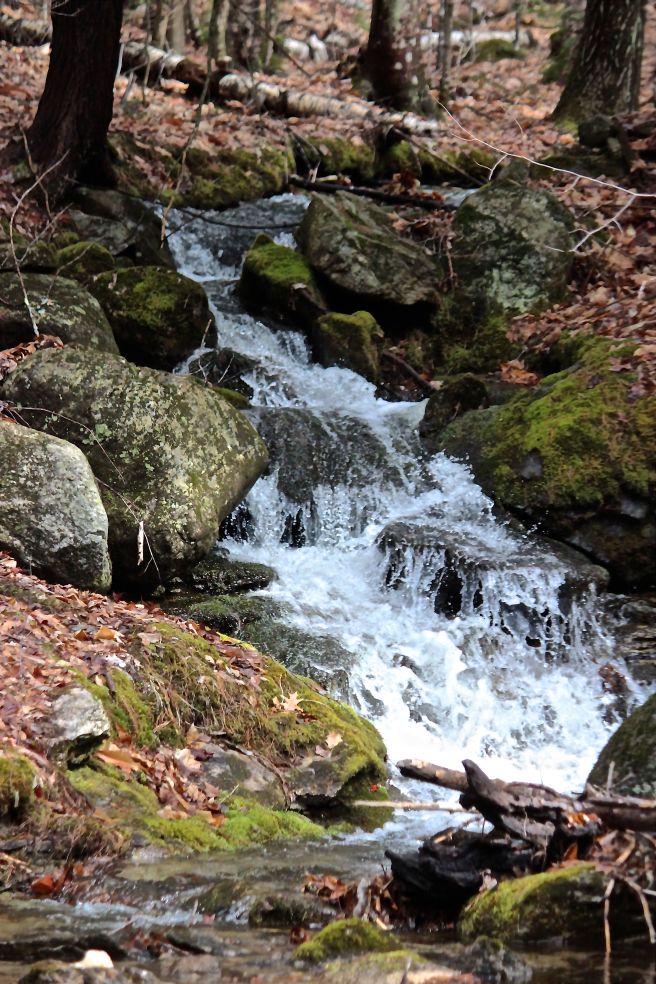
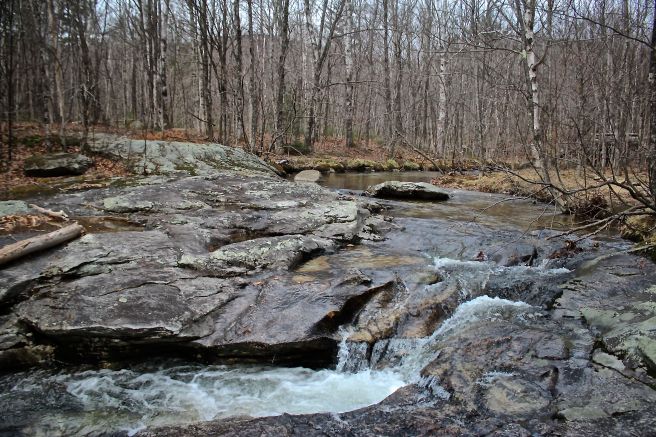
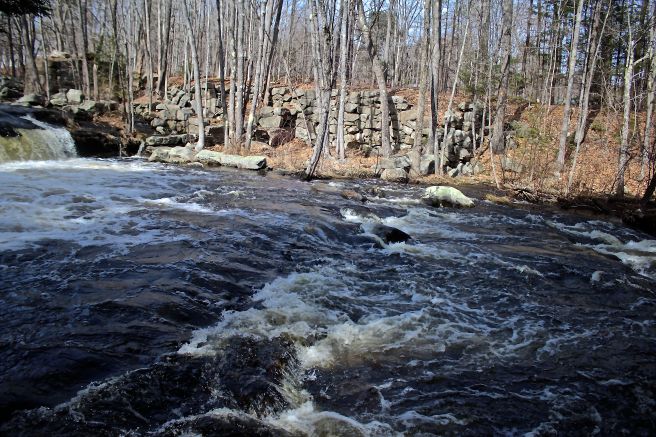
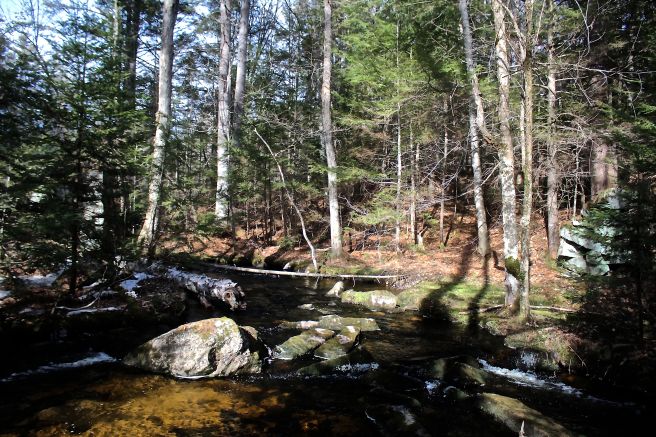
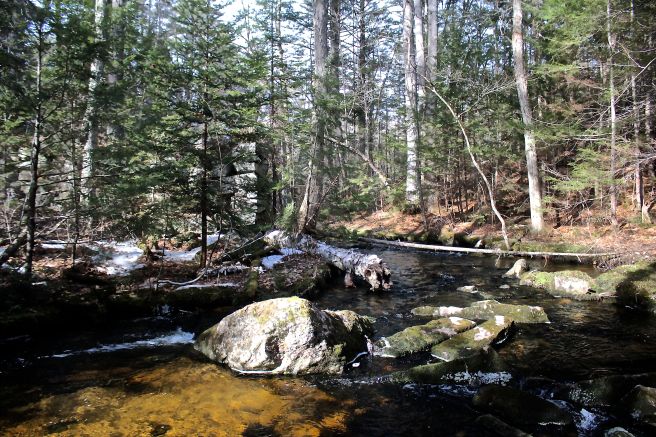
Then we turned south along the brook, where remnants of dams and the stonework foundations of other water-powered mills flourished from the days of the town’s settlement until the mid 1900s.

Bob is a fellow writer and naturalist with a keen interest in history. I’m flattered that he shared this place with me as well as his own written musings:

For most travelers on busy state Route 35/37, our brook is of little interest or importance. To the village of South Waterford, however, a cluster of thirty buildings which lie on either bank of this stony rill, it has served as a source of life and vitality throughout much of history. Landforms here were carved into the granite bedrock as a much larger ice-age water course scoured out a valley between Bear and Hawk Mountains to the east and Mount Tir’em and Stanwood Mountain to the west. Native Americans gathered along its banks to fish and camp. Eighteenth century settlers were drawn to the environs for a source of their fresh water and of power to produce lumber and flour, which were essential to survival. Nineteenth century industrialists, before and after the Civil War, earned their livelihoods by producing both commercial and consumer goods traded locally and in cities such as Portland and Boston.

w-flood-plainmill-pond

As we walk along he pointed out buildings still standing, those in stages of disrepair, and others that were merely memories. We paused by a meadow where he described the spring flooding events and I examined the evergreen wood ferns.

w-city-brook-meanders

And then we noted the gouge that deepened as we climbed, where “a glacial moraine as melt water engorged the brook into a raging river 15,000 years ago. The brook serves as the marshy wetland home of fish, birds and mammals. Such a short stream can teach everyone who allows the time many lessons about our ecology systems: how they work and how they were born.”

w-outlet-1

At the emergence of the brook we’d followed with two smaller brooks (Mutiny and Scoggins), we paused as Bob described their origins and journeys.
w-bear-pond

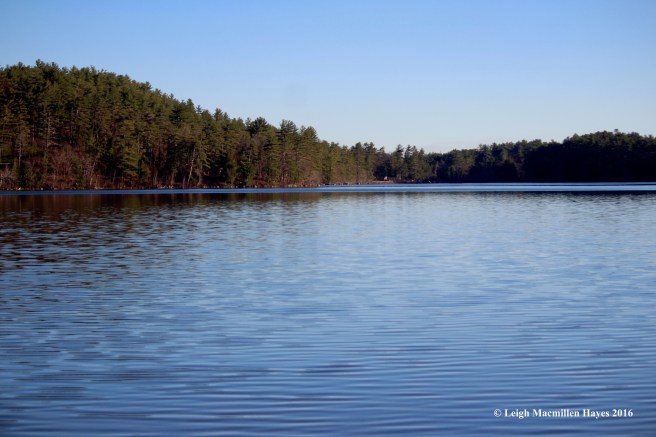
And then we turned to Bear Pond–the outlet. The temperature was relatively warm and pond almost inviting.

w-bear-mtn

With Bear Mountain overlooking, we’d reached the southern most point of the city.
w-beaverworks-2

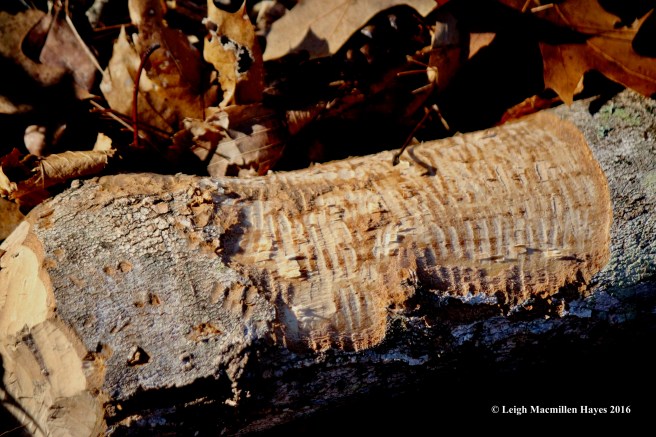
On our return trip, we found numerous signs that local residents were still industrious. Sometimes they were successful and the trees fell to the ground.
w-beaver-works-1

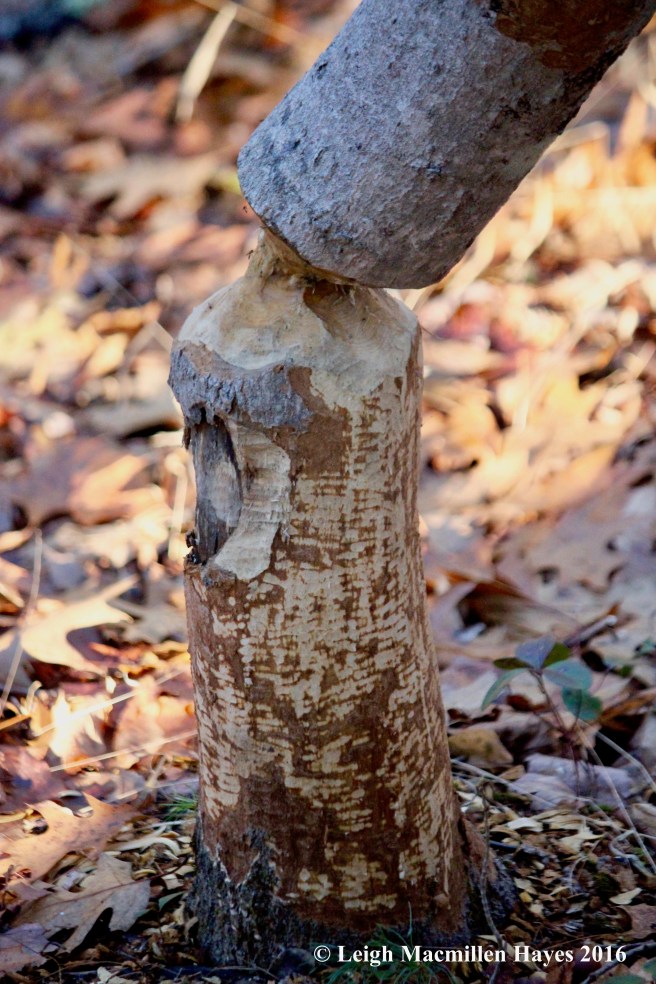
As with all industrious efforts, there were times when hang ups prevented success.
w-late-day-reflection

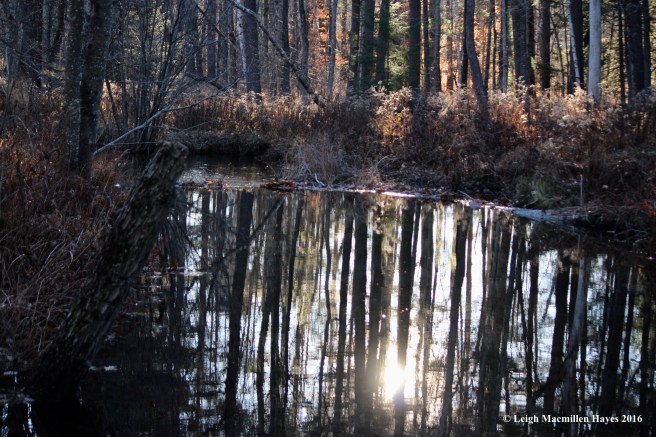
Sunshine and late afternoon reflections gave me a taste of why Bob referred frequently to the meditative nature of this place.
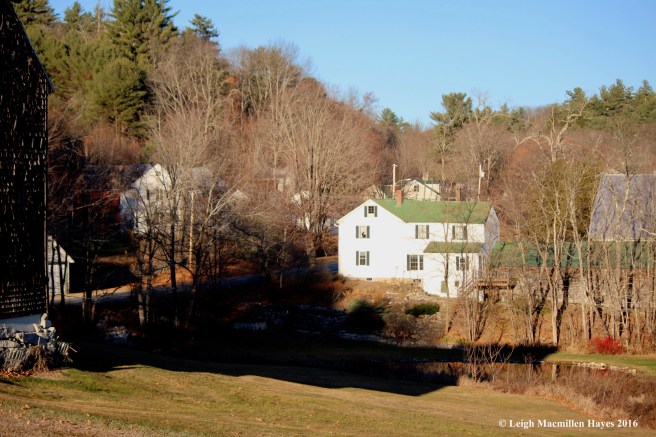
w-the-city

As we climbed a small hill and crossed a field, we again approached City Center.

w-sluice-1

And then we doubled back, walking to the intersection of Sweden Road with Routes 35/37. Plaster mills, bucket mills, a carding mill, saw mill and grist mill–waterpower was a necessity to any enterprise–beginning with lumber sawed for dwellings, grain ground for life-sustaining bread, shingles for siding and roofing, carded wool for the seamstress.

w-bucket-2-1

With the sun’s rays dipping lower in the sky, we stood in awe of the sluice and thought about the men and oxen and all the work that went into creating the mill–before the real work actually began.
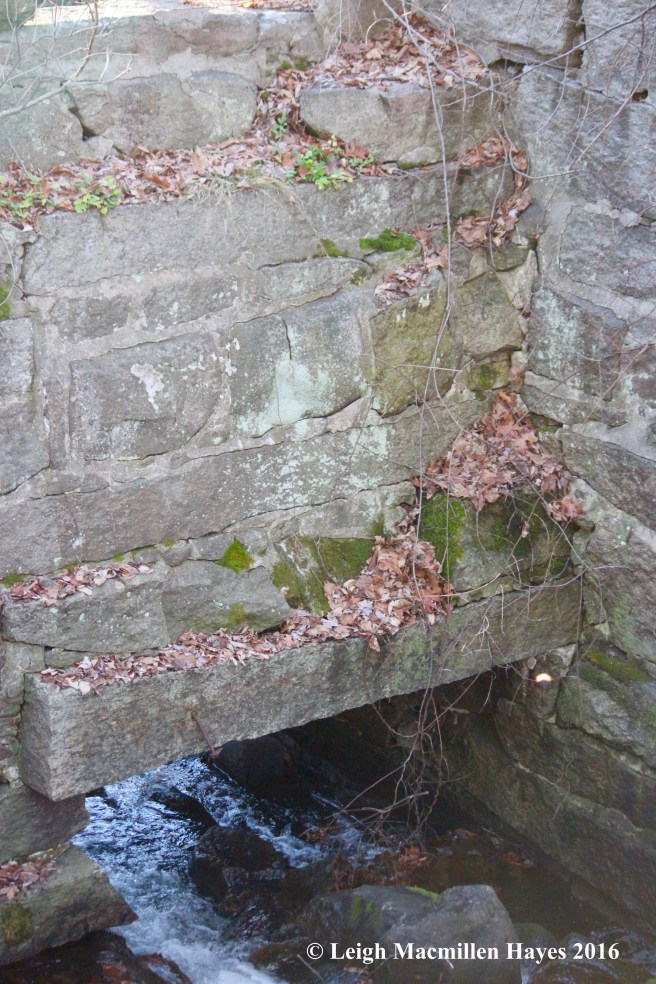
w-sluiceway

How many times have I traveled past this site and never spied it? Too many.

w-bear-pond-2-1

After our first tour ended, I paused at the southernmost end of Bear Pond for further reflection.
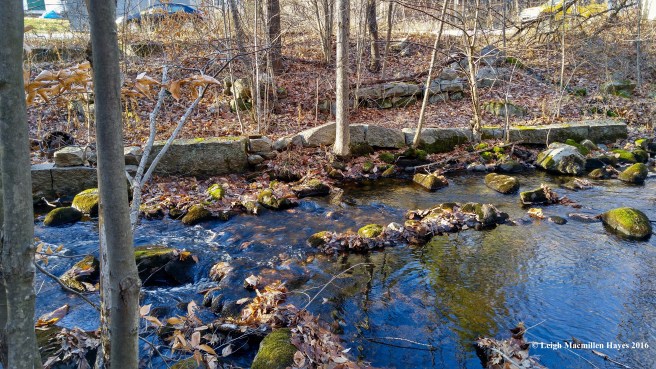
w-brook-wall-2-1

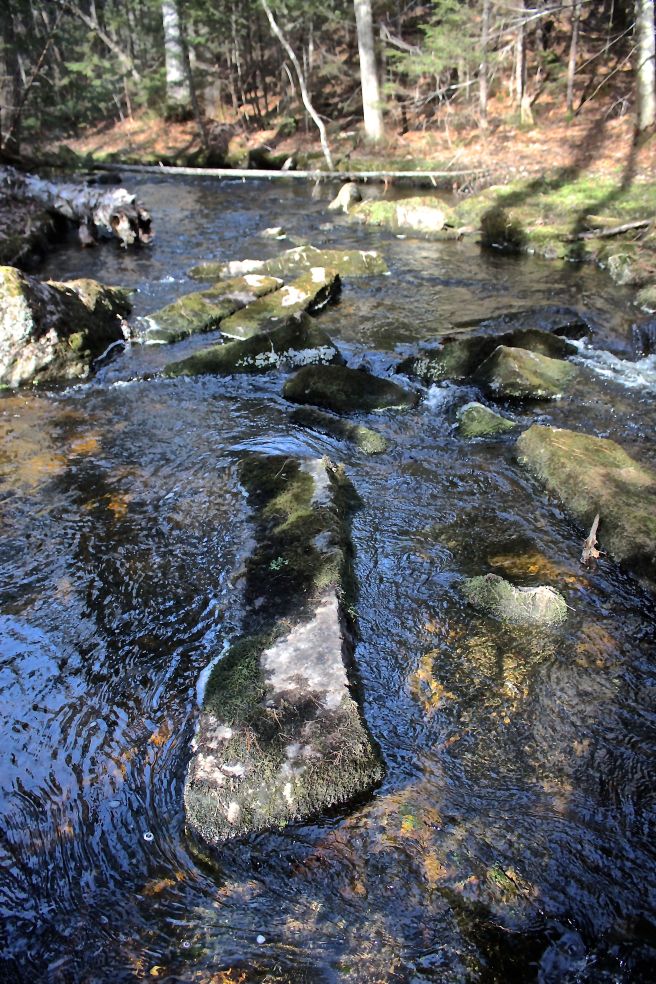
But . . . there was still more to see of the city and so a few days later I eagerly joined my tour guide again. This time we walked north, and wondered about the rock placements and considered their role as runways that once helped direct the water flow.
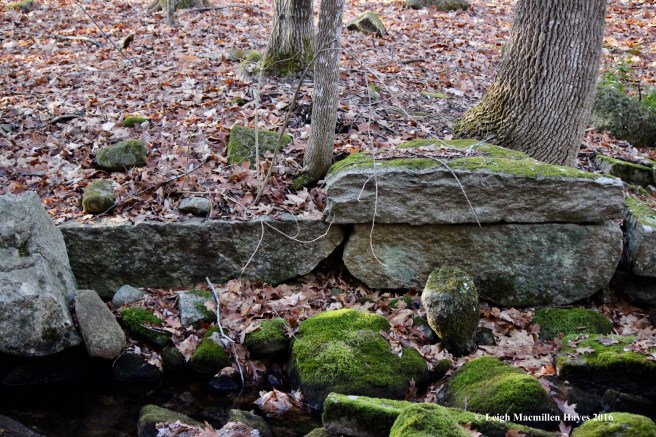
w-stones-line-brook

All along, we saw evidence of human intervention.

w-split-stone

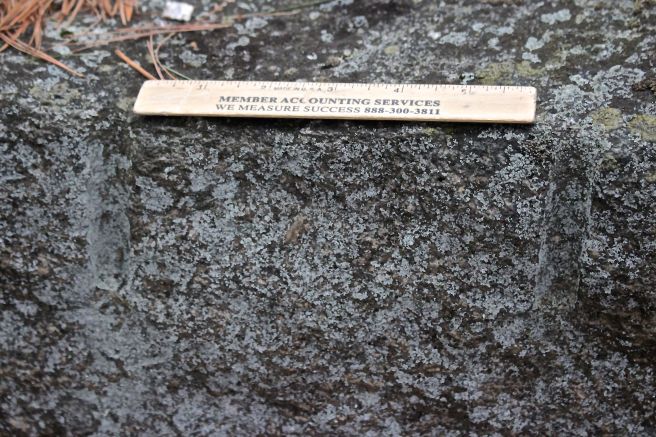
We noted the feather and wedge marks on split stones.

w-barbed-wire

Barbed wire made us think about the land being used for agriculture. Though it didn’t seem that the land had been plowed, we wondered if farm animals had roamed. Bob reminded me that a carding mill once stood nearby and so we envisioned sheep.

w-barrel-wire

w-barrel-staves-1

w-artifact

Barrel wire and staves made sense to us, but we didn’t always recognize the artifacts for their use.
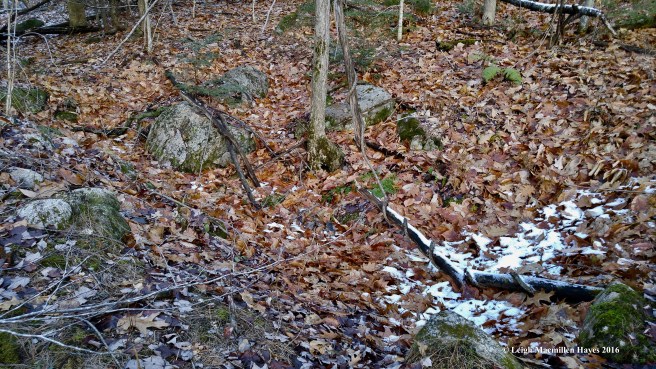
w-cellar-hole-2-1

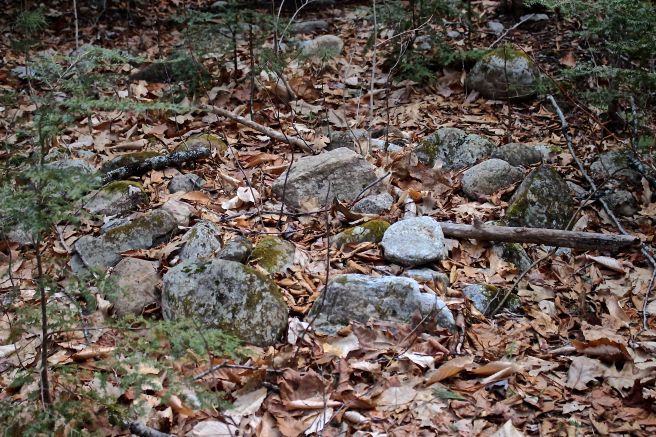
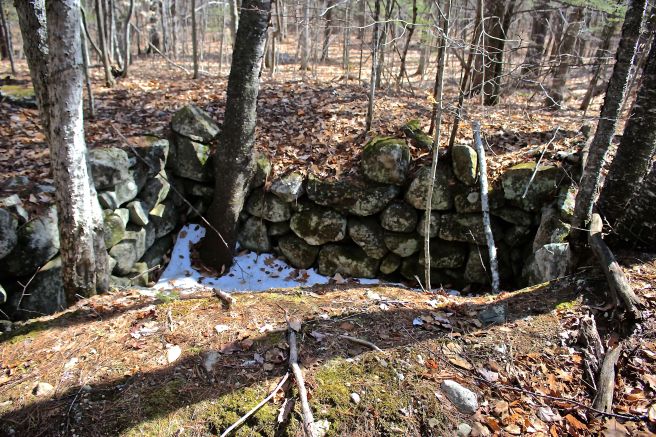
We even found a cellar hole, or perhaps a cellar hole, that Bob hadn’t seen before. Of course, we speculated. It certainly had structure. But why was it cut out around large boulders, we wondered.

w-tree-foundations

And we noted the industrial work of trees that forged their own way beside the brook.

w-city-brook-large-rocks-1

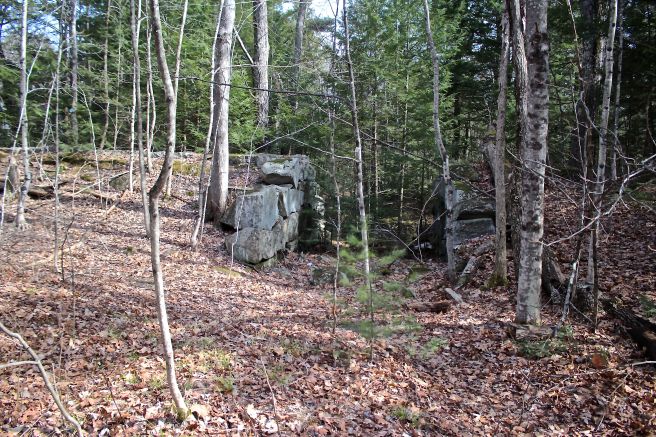
For every sight that we seemed to understand, there were more that we didn’t. With his vast knowledge of local history and the land formations along the brook, Bob pointed out natural and man-made features, but even he admitted he didn’t always get it. The pile of obviously quarried granite was one such.
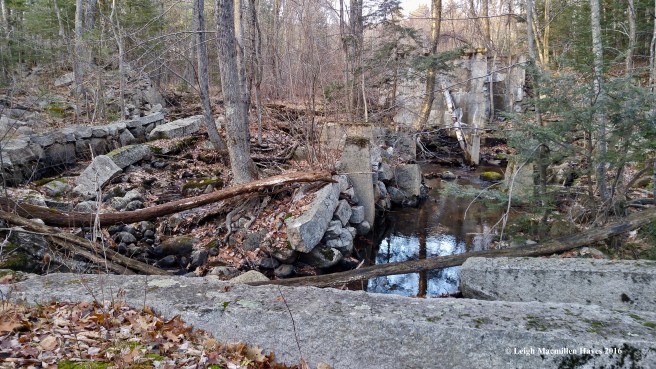
w-sluice-and-old-dam-2-1

Suddenly, we reached what might be considered the crossroads of long ago and more recent past.

w-sluice-way-4

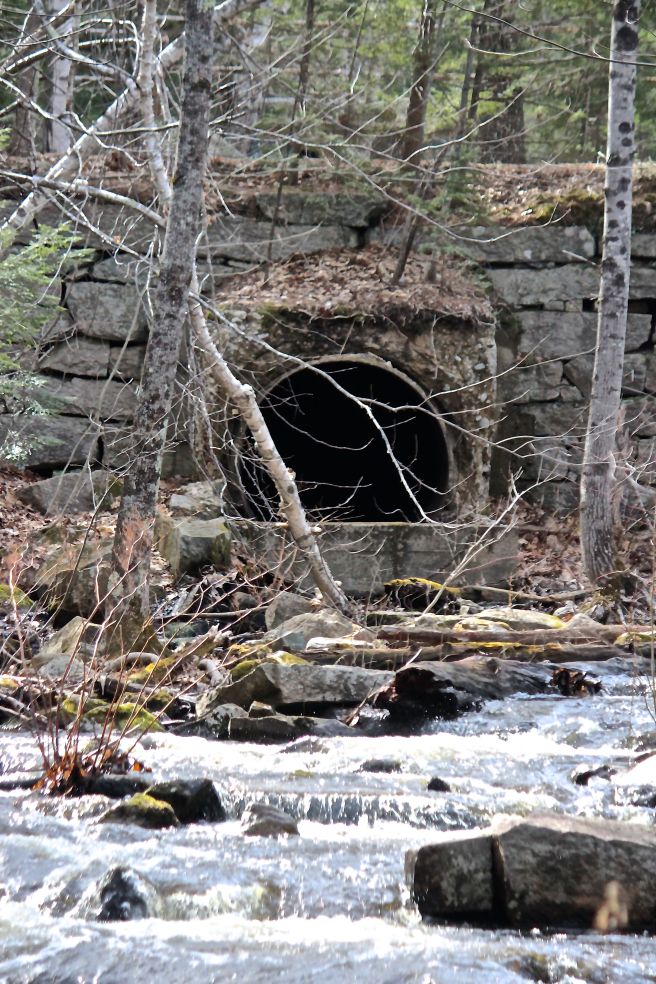
To the west, an obvious rock sluiceway.

w-stantion

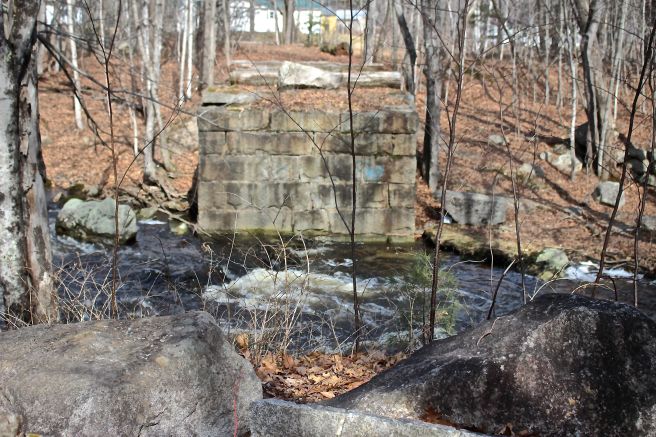
To the right, stanchions from a former, yet more recent power site.
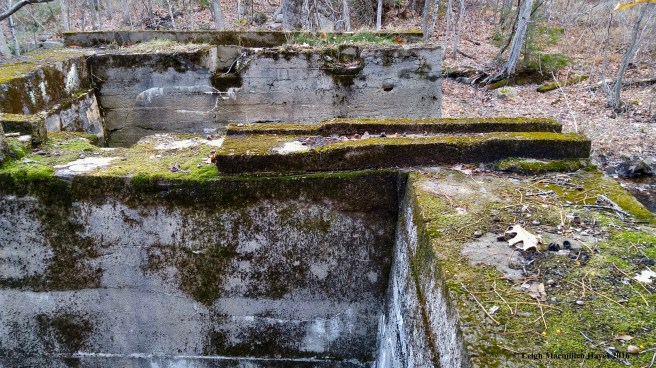
w-old-dam-3-1

This was all located at the original spot of the first dam along the brook.

w-keoka-dam-2-1

Curiously, Bob explained as we walked along,  a more modern dam was built about a quarter mile north.

w-keoka-3-1

We’d reached Keoka Lake, formerly known as Thomas Pond. Supposedly, in the early 1900s, Thomas Chamberlain ran away from Native Americans and survived by hiding in a crack in a rock. Though the lake is no longer named for him, Tom Rock Beach holds his legacy. Today, the clouds told the story of the much cooler temperature. 

w-flats-1

Bob directed my attention to our left, where Waterford Flats was visible.

w-start-of-city-brook-1

And then we looked south, to the outlet of Keoka and the beginning of City Brook–the place where it all began. Though no longer held by dams and funneled through the rock sluiceways, it was the water that passed this very way that once provided the energy converted by water wheels and turbines to power the life of the city.
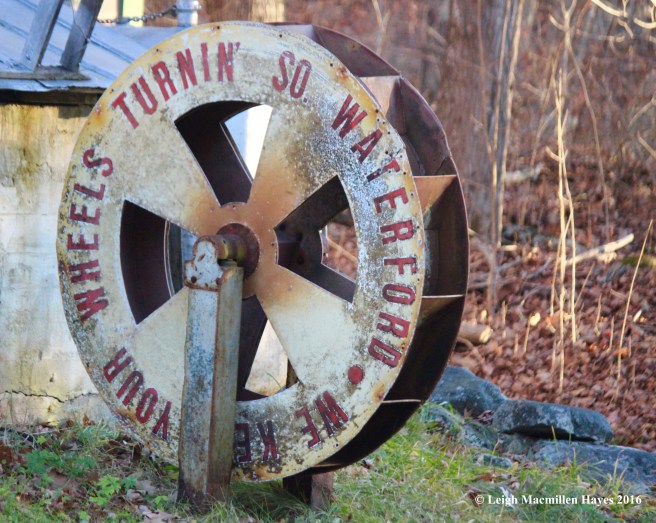
w-wheel-2

w-wesleyan-church

w-bear-mountain-grange

“Waterford City” as it was known, has changed, though some standing monuments still speak to its former life. Until Saturday, I had no idea the brook was named City Brook or that South Waterford was known as a city, so named for the industry that once existed here.

As Bob wrote, “The age of industrial prosperity is now long gone, victim to growth of large manufacturing plants which required more powerful rivers and many other economic changes since the 1870s. At that time, South Waterford was dubbed “Waterford City” for the noise and bustle brought to the town by nine mills and many supporting outbuildings lining the brook. Invisible to today’s busy passerby are many remnants of a past industrial heyday: a large concrete and split stone ruin on the access road to Keoka’s modern dam, two-story stone work that served as the foundation for a 19th century bucket mill, a simple shingled mill building atop a 1797 stone dam beside the town’s last rustic stone bridge. Further exploration may reveal lost foundations beneath the water surface, a 36-inch rusty circular saw blade, burnt remains of Waterford Creamery or an earthen dam long overgrown by bushes and brambles. These vestigial remains of human endeavor are of historical interest to many.”

w-city-brook-2

After our tour came to an end,  I paused below the cider mill one more time–a fitting spot to share another of Bob’s ponderings on this place:

“The whirling bubble on the surface of a brook
admits us to the secret of the mechanics of the sky.”
Ralph Waldo Emerson

It is appropriate to begin this study with a quote from American philosopher, existentialist Ralph Waldo Emerson (1802-1882), whose life spanned from early days of village settlement through the denouement of its industrial zenith. Emerson spent much of his boyhood visiting three aunts who lived in Waterford. He likely honed his naturalistic views while exploring City Brook or Mutiny Brook near Aunt Mary Moody Emerson’s home, Elm Vale, which was located across from the cemetery of the same name on Sweden Road.

This is one city I’m thankful to have visited. And I look forward to further explorations.

I’m grateful to Bob for sharing this place with me and especially for pointing out all of his favorite meditative places. Meditation in the city–Waterford City style.
 

Our Place

h-tom2

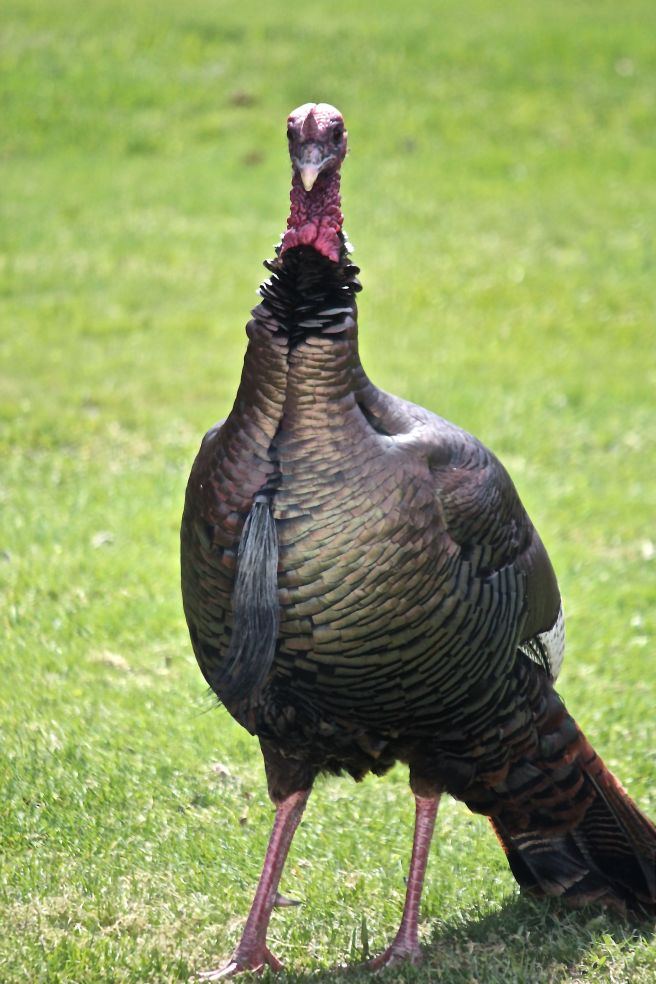
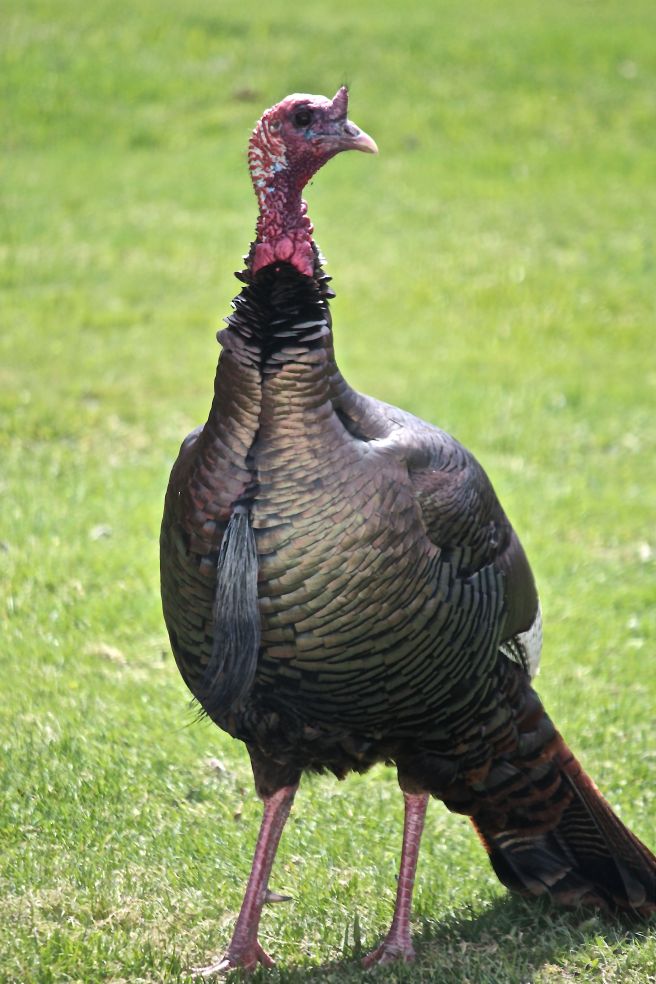
Gooble. Gooble. Gooble. Gooble. Gooble. Gooble. Gooble. Seriously . . . is all that noise necessary? Apparently it is. Mr. Tom felt the need to awaken us at this morning’s first light with his non-stop gobbling–his way of calling the hens to join him. Disclaimer: I didn’t take this photo until later in the day. In all his ugliness, I have to say that he really is a handsome fellow.

h-female turkey

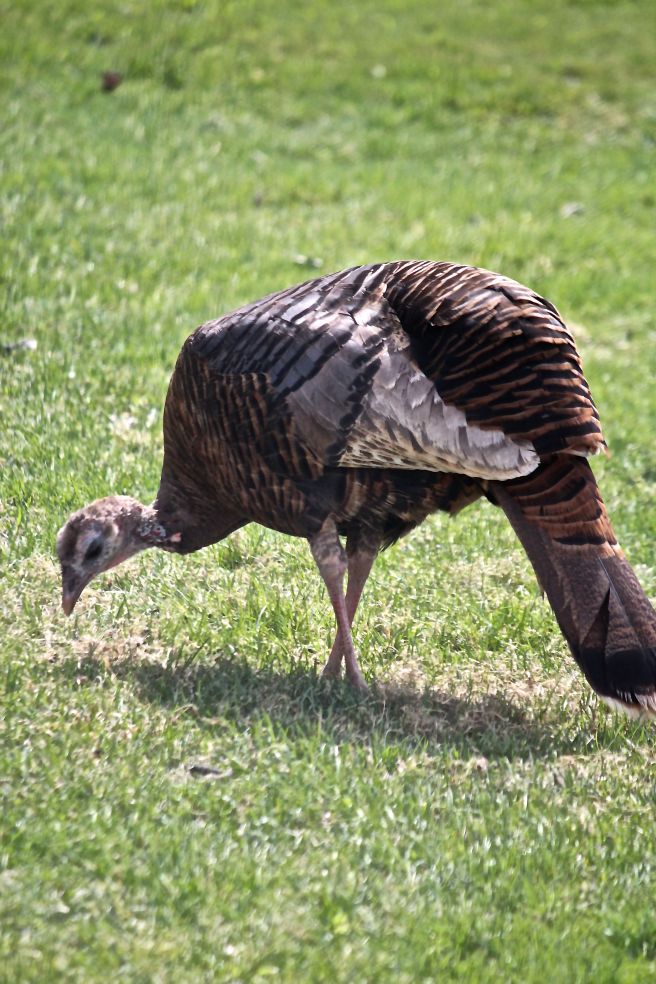
The hens who hang out with him don’t appear to care, but maybe they’re just playing coy.

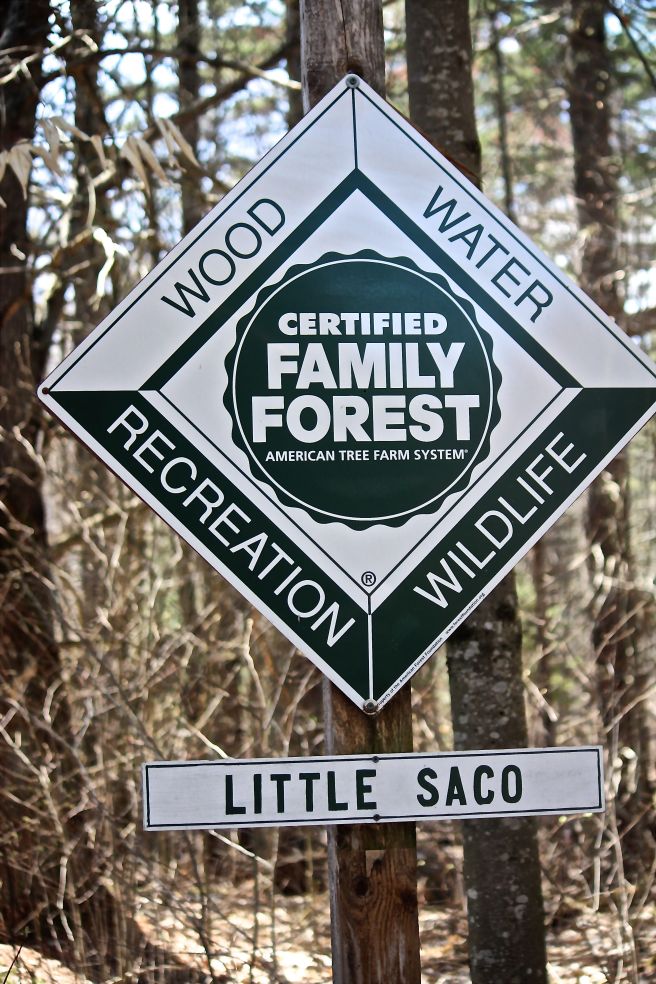
p-little saco sign

We left them to the bird seed scattered on the ground and drove to Farnsworth Road in Brownfield for a hike up Peary Mountain. The trail is located on private property and we’re thankful that it’s open to hikers. Much of it is a snowmobile trail as well.

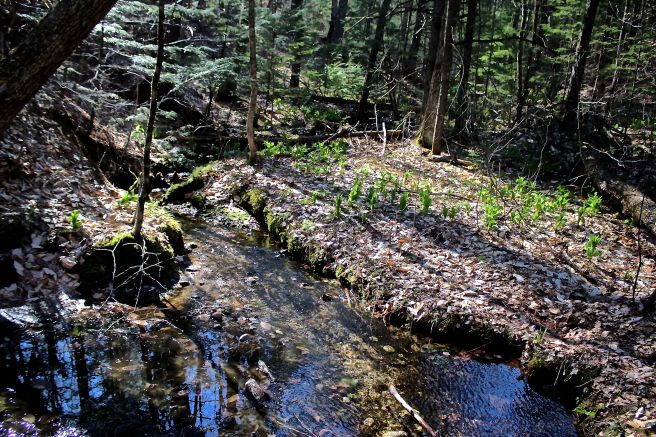
p-Little Saco

The Little Saco flows over moss-covered rocks beside the lower part of the trail.

p-false 4

As we followed it, bright green growth in the damp soil warranted a closer look.

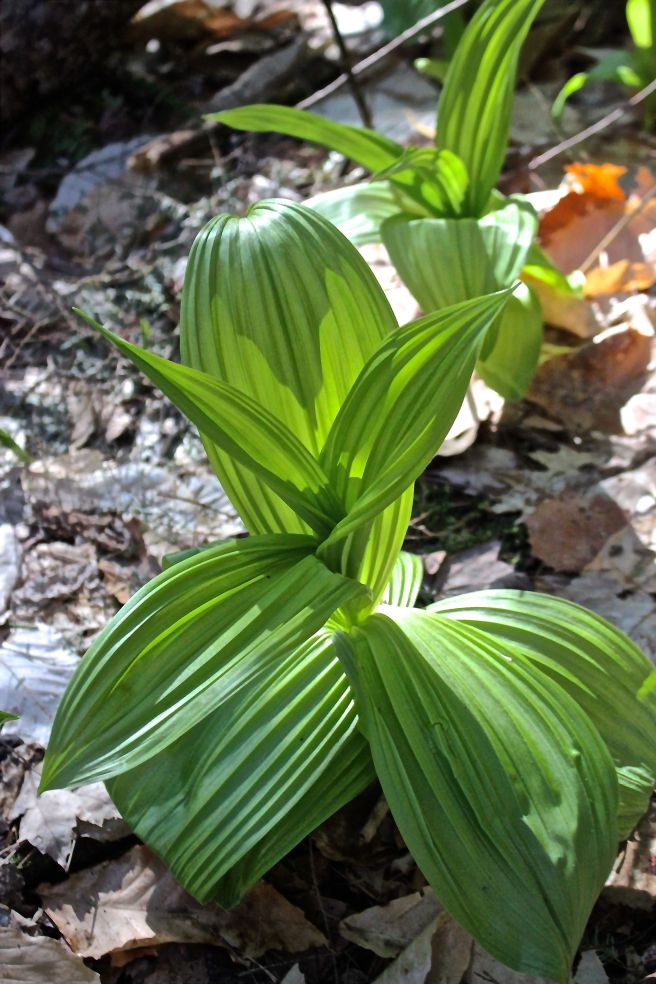
p-false hellibore 2

A true sign of spring–false hellebore with its corrugated leaves.

p-striped 2

There are plenty of other signs, including the pink and green striped maple buds. I’m missing my macro for these moments of early glory, but so it is.

p-beech 1

While some beech trees still have a few marcescent leaves clinging until they can no more, I noticed a few buds beginning to burst.

p-summit sign

At a stone wall, the trail suddenly turns 90˚ to the left.

p-fdn 2

But in the opposite direction–the remains of an old foundation.

p-fdn ledge 2

And above, a ledge from whence the stones presumably came.

p-porc scat

The ledge continues to provide a dwelling–for critters like the porcupines who keep the hemlocks well trimmed.

p-bluets

As we climbed to the top, delicate bluets showed their smiling faces.

p-bench view1

And then we emerged on the 958-foot summit, where the bench view is glorious. The small mountain was named for Admiral Peary. Apparently, his mother’s family, the Wileys, lived in neighboring Fryeburg. Upon graduating from Bowdoin College in 1877, Peary lived in Fryeburg and conducted survey studies of the area for a couple of years, before moving to DC and later leading an expedition to the North Pole.

p-mount wash

If you’ve seen similar views of the big mountain, its because it’s part of our place.

p-my guy view

I followed my guy along the ridge line to the end–where the view turned homeward.

p-pointing

My guy made a point of recognizing landmarks from Mount Tom and Lovewell Pond along the Saco River to Pleasant Mountain and Brownfield Bog.

p-Pleasant 2

If you look closely, you’ll notice a horizontal line just below the bog–that’s the Saco River. And the little mountain to the left of Pleasant Mountain–Little Mountain in West Bridgton.

p-Pleasant Road1

The only part of the view that we don’t get–the new road that was constructed up the backside of the mountain within the past year. It worries us. And that is why we appreciate the efforts of Loon Echo Land Trust for protecting most of the rest of the mountain.

b-pitch pine

We headed home for lunch and to pull out the lawn furniture.* And then we parted ways, my guy to attend a celebration of life for an old friend, and me to climb Bald Pate. My purpose–to look at the pitch pines and jack pines.

b-pitch 2

In bundles of three, the stiff needles surround the male pollen bearing cones on the pitch pine.

b-jack pine1

Jack pine features two needles per bundle–think Jack and Jill.

b-peabody & sebago

From the summit, I paused to take in the view of Peabody Pond and Sebago Lake beyond. It doesn’t matter how often I climb to the top of this 1,100-foot mountain, the view is ever changing.

b-mount wash1

And again, I could see Pleasant with Mount Washington in its saddle. This time, however, I was on the opposite side looking at the front of Pleasant Mountain. You may wonder about the road–it leads to two cell towers near the Southwest Ridge summit.

b-sweet fern 1

As I made my way to the Foster Pond Lookout, I stopped frequently to enjoy the ever-artful presentation of sweet fern.

b-blueberries

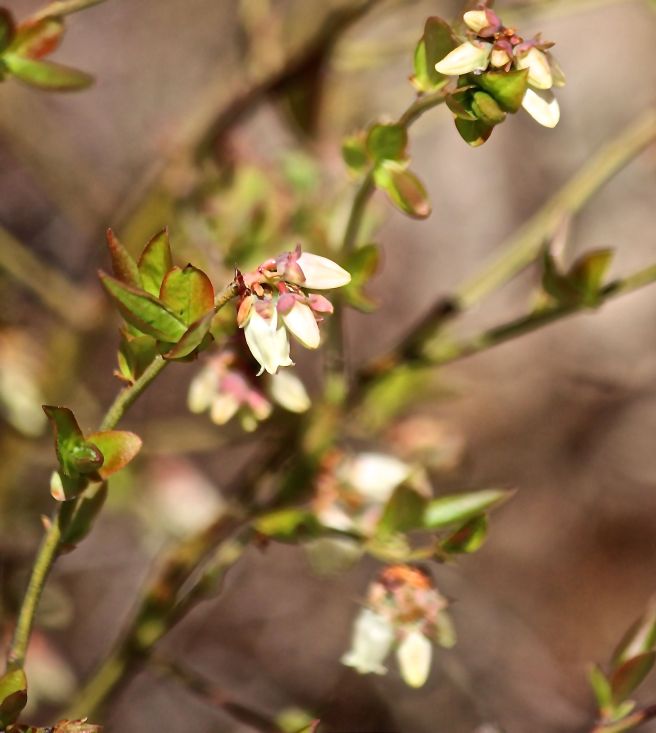
And I noticed another sweet offering that many of us will enjoy this summer–blueberry plants in bloom.  A year ago next week, I saw the same on this very mountain. Seems early, but I think they’re well protected in a sunny spot.

b-foster pond 2

I’m sure had my guy been with me, he would have named a color chip that matched Foster Pond–perhaps turquoise blue best described it in that moment.

b-bird treat 1

Heading back to my truck, I noticed some bird treats dangling from the trees. Perhaps our turkeys will fly to South Bridgton.

h-tom 3

Apparently not. Back at home, Tom had returned. He’s a frequent visitor to our place. And we’re frequent visitors to the area beyond our backyard. It’s all really his place and our place.

* If you live in our area, expect at least one more snowstorm. It always snows once we pull out the lawn furniture.


Following In The Footpath Of Others

Rain marked this morning’s dawn, but that didn’t daunt our group of six. We donned overcoats, gloves, hats and waterproof boots knowing that we’d encounter mud along our intended route.

And so we met near the former site of the Methodist church in the northeast corner of Sweden–Sweden, Maine, that is. Our intention was to follow the snowmobile trail for a couple of miles and visit foundations and a few other historic sites along the way.

s-you are here map

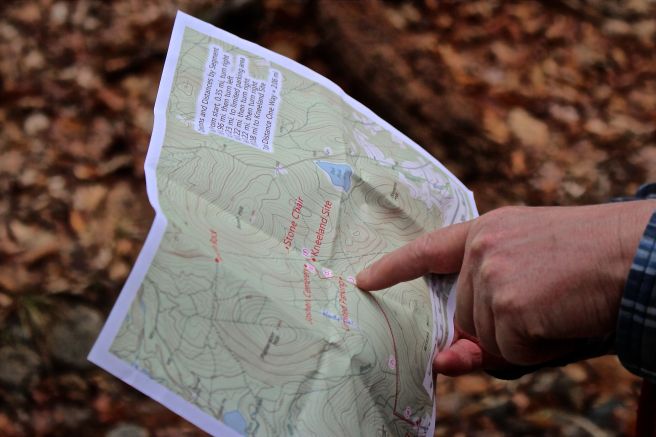
Maps dated 1858 and 1880 show a network of roads that served the scattered neighborhoods of this town. The trails we were about to walk on follow the footpaths and wagon tracks of earlier people. These were once town roads. We happened to be in the presence of the president of the Sweden Historical Society and she gave us copies of the maps to help us gain a better understanding of our destination. She also printed out a topographical map so we’d have no excuse for getting lost.

s-following trail in

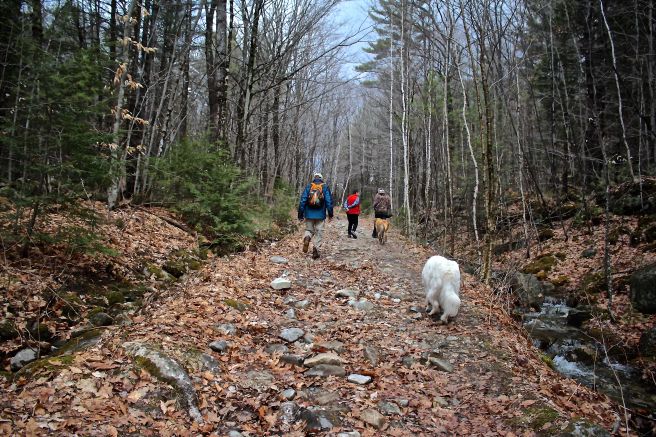
With the sun suddenly shining upon us, we laughed at ourselves as we moved along because we traveled at breakneck speed. Well, for us anyway–1.8 mph when we were moving. Note the phrase: “when we were moving.”

s-stream to Patterson 1

Along the way, we paused to admire the streams that flow toward Patterson Brook and

s-vp 1

checked on life in a potential vernal pool.

s-stream 2-mill site

While we find water so mesmerizing, I couldn’t help but wonder about its potential here for the early settlers.

s-stream 3

Several times we found stone walls on either side of the streams and didn’t know how to interpret their meaning. That was OK–we appreciated not having all of the answers.

s-stream 4

The opportunity to partake of the beauty among friends old and new was enough.

s-cheyenne

Even four-footed friends.

s-single:double wall

The stonewalls, both double and single in structure, indicated that the land had been cultivated. We tried to make sense out of the sudden switch from single to double and back to single in a short distance, but really, they didn’t necessarily build walls according to our expectations of what life must have been like–a single wall meaning keep the farm animals in or out and the double being a garden wall–lots of times it was probably just plain common sense and a need to get rid of the stones that rose with the frost.

s-drilled rock

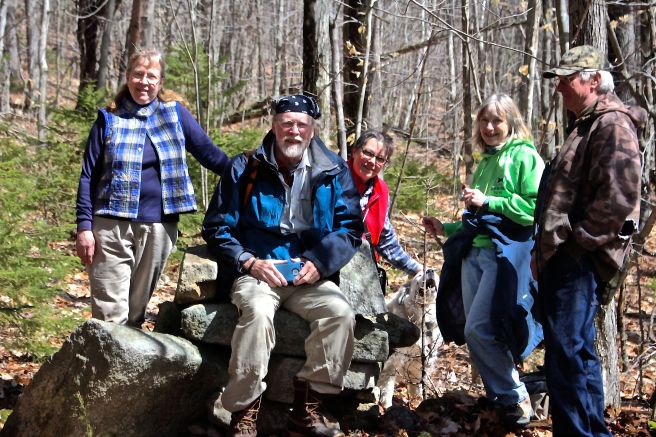
Eventually, we climbed over the wall and headed up toward this monument. Dave, who lives in this neighborhood and knows these woods well, encouraged us to ponder.

s-drilled rock 2

Why was the top of the rock split off intentionally and then left there?  Was it intended for a foundation stone? Was the neighborhood abandoned before this piece was used?

s-town line 1

We wandered further through the woods and came to the Sweden/Waterford town line. Two stone walls less than ten feet apart mark the boundary. Waterford to the left and Sweden to the right. (Did I get that right, Linda?–my left and right?)

s-town line

Orange paint also marked the boundary line.

s-kneeland foundation

We’d crossed into Waterford and stopped for a break at the Kneeland (1858)/Kimball (1880) residence, a rather large foundation with a center chimney.

s-fdn rocks, squirrel table

Apparently, we weren’t the only ones who paused here for a snack.

s-hidden brook

And then we crossed the snowmobile trail once more and began bushwhacking again. Though you see only tree shadows, leaves and moss here, it wasn’t what we saw, but what we had the honor to hear that made us stop–an underground brook. It felt like we’d stumbled upon a secret spot.

s-stone chair 2

Dave led us uphill to another special spot a friend of his discovered years ago–the stone chair. You have to wonder about this. We’re in the middle of nowhere that was once somewhere. Below this is a large hole in the earth, possibly a foundation of sorts. And beside, a skidder trail. So, who built the chair?

s-stump by chair 100:50

Atop the foundation of sorts was this cut stump–we surmised it was cut about fifty years ago and that it was about 100 years old at that time.

s-group 1

It really doesn’t matter. What matters is sharing the discovery.

s-chair and Sophie

Another four-footed friend also thought it was rather special.

s-cable

Not too far from here we found something else that spoke of logging.

s-goshen 2

We continued our bushwhack to another site of importance–and came upon it from the backside.

s-goshen sign 2

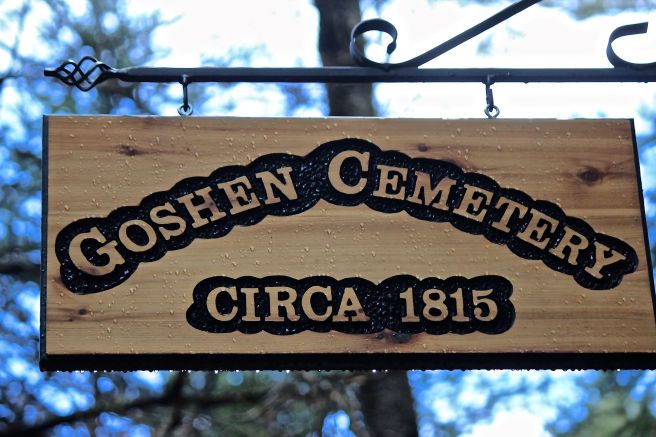
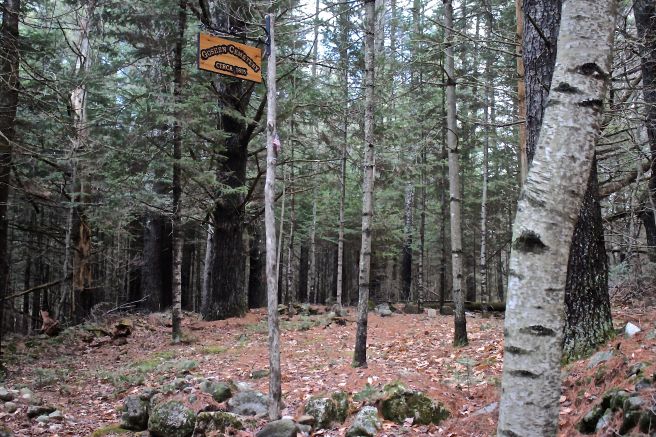
The Goshen Cemetery, circa 1815. Notice the raindrops and blue sky. A few drops fell in the middle of our walk and then it cleared again.

s-goshen cem 3

The cemetery contains stones that had been buried under the duff, but when discovered, were uprighted in spot.

s-goshen stone 2

s-goshen tomb stone

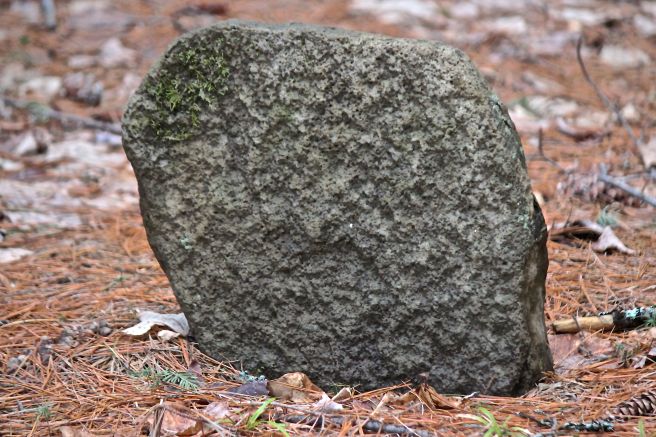
The tombstones are unmarked and as far as I know, two theories exist–an epidemic struck the neighborhood and those who died needed to be buried as fast as possible, or these were the tombs of the residents from the town’s poorhouse.

s-goshen sign 3

One thing we do know for certain. The bears like the sign and it has been remade several times and posted higher and higher in hopes that they’ll leave it alone.

s-bark art 1

Those were our historical finds, but we also made time to enjoy our surroundings, beginning with artwork created naturally.

s-beech elephant

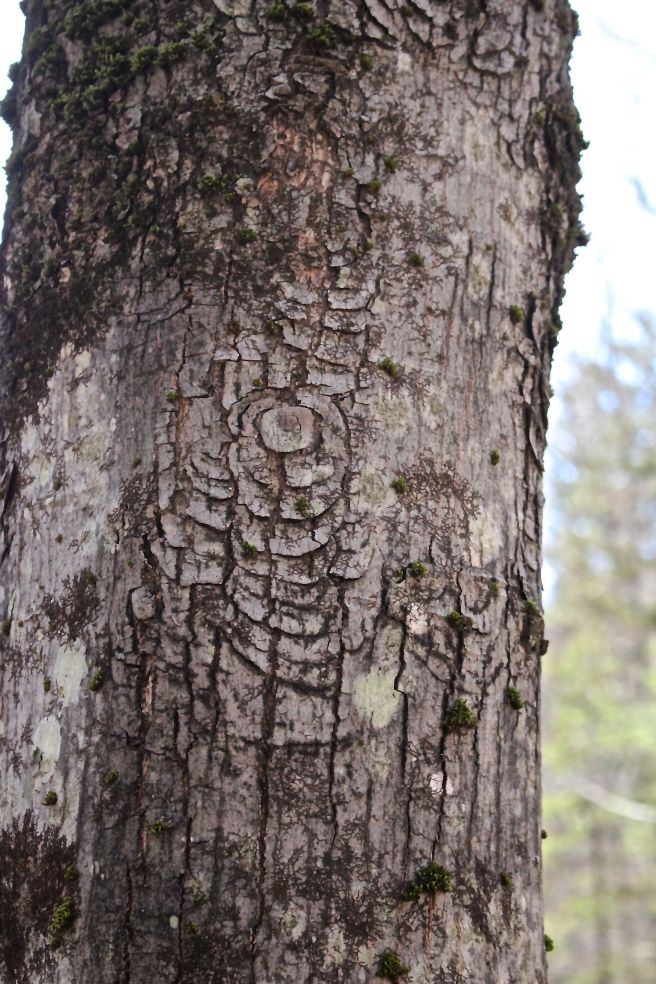
I always say that beech bark doesn’t remind me of elephant skin, but today–elephant legs and feet, for sure.

s-downy rattlesnake plantain

Peaking out from the leaf litter, downy rattlesnake plantain showed off its white-veined leaves. Stained glass windows come to mind whenever I spy this. And though its the commonest of the rattlesnake plantains, I’m always in awe.

s-checkered rattlesnake

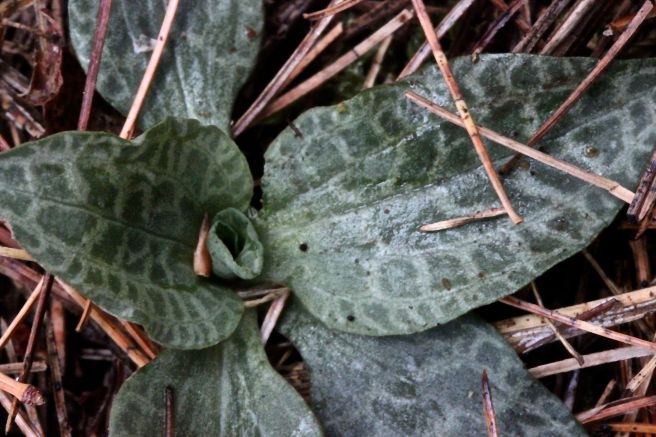
We also nearly stepped on its cousin, checkered rattlesnake plantain. I do have to say that if I were in charge of the world, I’d switch their names.

s-artist conks

We found artists conks and

s-hemlock shelves 1

old hemlock varnish shelves.

s-porcupine den

We know where the porcupines denned,

s-moose:striped maple

moose browsed,

s-pileated 1

woodpeckers dined,

s-deer rub

deer rubbed their antlers,

s-deer rub:paw

and pawed the ground. Do you see it at the bottom of this photo? It’s a scrape meant to communicate information to other deer.

s-flying squirrels 1

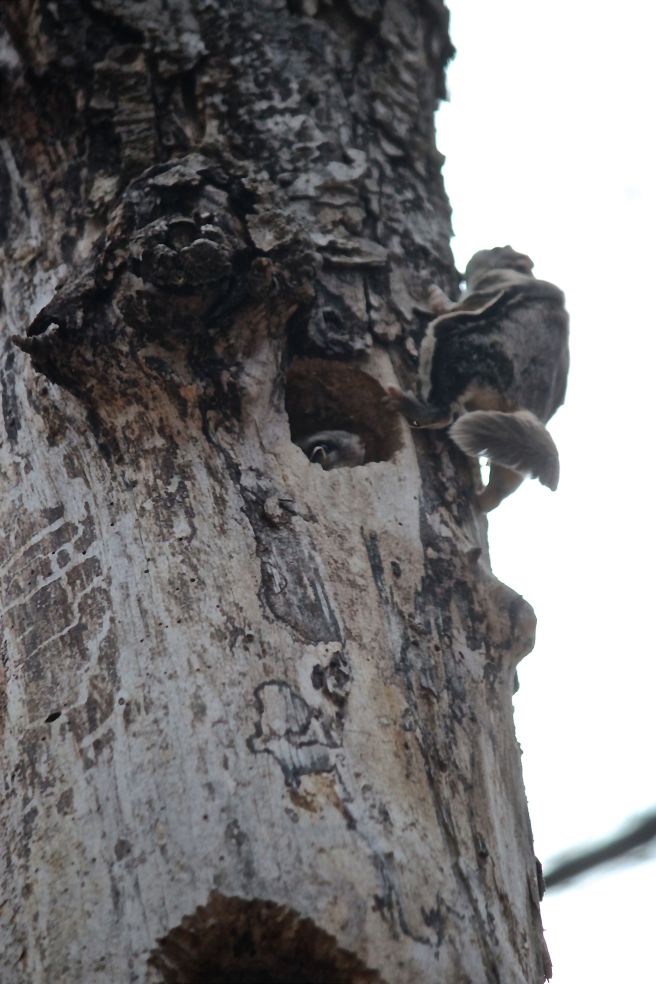
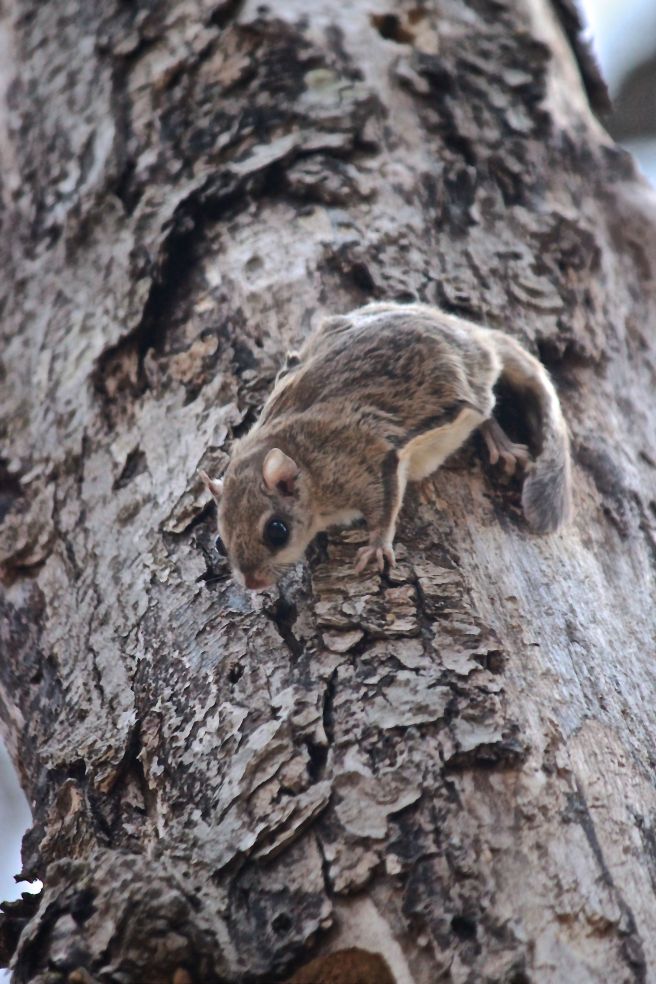
But one of my favorite sights of the day–the flying squirrels that scampered up an old snag. Notice the flat tail–a rudder.

s-fs 2

And the flap on its side, that furry membrane that stretches from the wrist to ankle–a parachute of sorts for gliding from tree to tree.

s-fs 4

And those bulging eyes–the better to see in the dark.

s-heading home

Four hours and almost six miles later, we followed the trail out, thankful for the opportunity to spend time wondering together and follow in the footpath of others.


Wondering Beside Willard Brook

I dragged my guy along for a wander in the Hut Road neighborhood today and we made Willard Brook the center of our attention.

That being said, our journey began at Great Brook. I parked by the gate that isn’t open yet due to  road conditions–not realizing that the only other vehicle belonged to a friend, who kindly left us a note we found under the windshield wiper as we drove away hours later.

The wind was wild and we felt it rattle our bones while we walked along Forest Service Road #4. That just meant a fast walk to the start of our adventure.

h-Great falls

The beauty of this spot never ceases to take my breath away.

h-ice

But we didn’t pause long because that wind was cold and icicles helped tell the story.

h-map

Lately, when I’ve tramped about in this area, I’ve been on the Great Brook Trail to start, but I contacted a few folks in the past two days because they’ve made comments on previous posts that indicated they have some understanding of the Native American presence that once existed here. And perhaps still does.

Stoneham_Hut_Road_1858_12-06-2015

My friend, Jinny Mae, had intended to join us today, but that didn’t work as planned. She and I have explored this area a couple of times in the past few months and she’s my GPS techie, as well as a talented historian and naturalist. The above map is from a section of the 1858 map of Stoneham she posted. (Thanks JM for letting me borrow this without asking.)

Stoneham_Hut_Road_1880_12-06-2015

As Jinny Mae indicates on her blog, this is from the 1880 map and there’s been a change in ownership of the neighborhood homes.

h-stone pile beside willard

We chose a different route than the one she has outlined in red. Ours led to Willard Brook. Just before the snowmobile bridge, we turned right and began to follow the brook. I realized immediately that I’d been here before. Part of my quest was to take a look at stone placement and think about it not as Colonial only, but also as Pre-colonial or Native American. And so, I paused at every rock formation I found, including this circular configuration beside the brook. Current day fire pit? My guy didn’t think so. I don’t know.

h-stove 2

As happens in our woods, we suddenly found ourselves visiting an old camp. Debris is scattered about. This particular piece from a stove front caught my guy’s attention. He was born in Taunton, Massachusetts, and immediately recognized this as coming from The Weir, an industrial section of town. If memory serves him right, there were at least three stove companies in that area.

h-mailbox

My favorite will always be the mailbox, truly a tribute to snail mail.

h-yellow birch

Our intention had been to follow the brook north, but we let an already traveled trail lead us instead. Soon we came to another landmark I remembered, the great yellow birch. An old yellow birch. Very old. I led a bark workshop yesterday and this is one of the trees we talked about. Yellow birch can live to be 200 years old, much longer than any of their relatives. I don’t know the age of this monument, but I do wish I could hear the stories it has to tell of this land.

h-colonial road

We turned left and followed the former road to Willard Brook. Colonial road or older?

h-stone wall turtle

I’ve learned from others to look at the shapes incorporated into stone walls and fences. I may be making this up because I’ve had an affinity with turtles since I was a young child and own quite a collection even to this day, but I see a turtle configured in this wall. Planned or coincidence? Worth a wonder.

h-stone wall 2, turtle

Potentially another in this section of the same wall, but at the same time, this part seems more consistent in structure.

h-Willard 1

We ate the quickest lunch in our hiking history because our fingers were so cold. Even winter temps didn’t seem to bother us as much as today’s temp and wind chill. Lunch rock  sat beside Willard Brook with Speckled Mountain above.

h-entering neighborhood

And then we backtracked up the road and I took my guy up to the Hut Road neighborhood. He’d not visited this particular community before, so was happy to make its acquaintance.

h-1st fdn

Our first encounter was with the Willard homestead of 1858; later known as the McKeen homestead of 1880.

h-wall on hill, balancing

As we moved up the hill to another foundation, we passed by this stonewall, where I wondered about the difference in stone size. A balancing act perhaps?

h-fdn 2 and chamber

Homestead #2 belonged to the Durgins in 1858 and Rowlands in 1880. It’s one of my favorites because of the stone chamber within. Which came first–the stone chamber or the rest of the cellar? Was the entire cellar considered a root cellar?

h-chamber interior

Hence, a closer look. Oh yes, and the porcupine scat pile is still there in the back right-hand corner, but none of it is fresh. Darn.

h-chamber stones 1

On the outside of the chamber’s edge that connects with the cellar–again my imagination took over. Perhaps my turtle’s head is the large blocky rock bottom center. Or is it a smaller version in the rocks above. Am I seeing things that are not there? Overthinking as my guy would suggest?

h-chamber back

Perhaps in the back wall?

h-chamber int 2

And in the side? Again, I see a face peering out at me just up from the bottom center/left. Do you see it?

h-rock pile 2

h-stone 5

h-stone pile 4

h-stone pile 3

While I was busy photographing stone piles in the woods and wondering about their significance, my guy followed his nose and made a discovery that has eluded Jinny Mae and me for months.

h-tombstones 1

Just like that he found the cemetery.

h-Sarah Dergin

Sarah, daughter of Anna and Ephraim, is the first tombstone. She died in 1858 at age 22.

h-Mary Dergin

Beside her, Mary, wife of Sumner Dergin, who died before Sarah–in 1856. She, too, was 22 years old. As best I can tell, Sarah and Sumner were siblings.

h-Ephraim Durgin

And Ephraim, Sarah’s father, who died in 1873 at age 81. Notice the difference in stone from the two girls to Ephraim? Slate to cement. And the name spelling–Dergin and Durgin. As genealogy hobbiests, we’ve become accustomed to variations in spelling.

I found the following on RootsWeb:

8. ANNA3 FURLONG (PATRICK2, JOHN1) was born 1791 in Limerick, Maine, and died 1873 in Stoneham, Maine. She married EPHRAIM DURGIN June 18, 1817 in Limerick, Maine14. He was born April 13, 1790 in Limerick, Maine, and died in Stoneham.

Children of ANNA FURLONG and EPHRAIM DURGIN are:
i.OLIVE4 DURGIN, b. 1811, Stoneham, Maine; m. DUNCAN M. ROSS, April 11, 1860, Portland, Maine.
ii.SALOMA DURGIN, b. 1813.
iii.ELIZABETH DURGIN, b. 1815.
iv.SALLY DURGIN, b. 1817.
v.SUMNER F. DURGIN, b. 1819, Of Stoneham, Massachusettes; m. MARY ANN DURGAN, July 11, 1853, York County, Maine; b. Of Parsonsfield, Maine.
vi.CASANDIA DURGIN, b. 1821.
vii.EPHRAIM DURGIN, b. 1823.
viii.FANNY DURGIN, b. 1825.

Sarah isn’t listed above. But . . . Sally and Sarah were often interchangeable.

h-cemetery view-Durgin

Though only these three stones stand upright, leaning against a wall, this potentially was a large cemetery. And the view–Durgin Mountain.

h-down from cem

Rather than backtrack again, we decided to travel cross-country back toward Willard Brook.

h-bog

At the bottom of the hill, the area was filled with sphagnum moss and cinnamon and interrupted fern.

h-bear scat

Though I didn’t find any bear trees today, I did find bear scat ;-)

h-moose scat

And plenty of moose sign.

h-red maple

The red maples offered numerous examples of the bull’s-eye fungi that I told yesterday’s workshop participants to notice. I encouraged them to develop bark eyes. Meanwhile, I’m working on my stone eyes. (not stoned!)

h-willard dry bed

As we traipsed across the landscape, my guy recognized the large yellow birch we’d come upon earlier. And then we followed the walls down to Willard Brook where bushwhacking became the name of the game. Sometimes we found ourselves moving cautiously along the rocks in a dry section of riverbed–the overflow.

h-rock slide by Willard

I kept my eyes open for stone treatments and found this twenty-foot rock slide that didn’t look natural. I have no idea what it represents.

h-wheels

One of the things I continue to notice and love about the woods around us–no matter how far from civilization you think you are, you never are. Notice the wooden wheel spokes.

h-trees and rocks beside willard

I also noticed the trees and rocks across Willard, where the water’s rise and fall over the years has carved out a unique landscape and each entity is intertwined with the other.

h-2nd bridge

Eventually we came out at the spot where we’d headed off the snowmobile trail and decided to turn right and follow it toward Evergreen Valley.

h-cairn

Though the walk was nice and the wind not so strong, we got to this modern-day cairn and felt we’d gone far enough. We turned back and bushwhacked down to Willard Brook.

h-scouting willard

Like Lewis, my guy scouted for a crossing. Like Clark, I followed.

h-brook crossing

Our spot to ford the brook looked easier than it was. He crossed first and landed without issue. Me too–um, almost. Only one foot slipped. His comment, “Good thing your hiking boots are waterproof.” My response, “Yeah, but my socks aren’t.” Oh well. I’ve had wet feet before and will again. When I finally took my boot off at home, I was surprised at how drenched the sock was.

h-great brook on way back

We made our way through balsam fir saplings and hobblebush and a variety of other species and turned away from Willard assuming we’d eventually encounter Great Brook again. Success.

h-great structure 2

I’d been told to pay attention to Willard for Native American sites, and found this beside Great Brook. I have no idea what it represents.

h-3rd fdn central chimney

And lo and behold as we headed back to our starting point, we found ourselves at a third foundation–a rather large one with a center chimney between two cellar holes and an addition behind it. It’s where the school probably stood in 1858 and A. Gray’s home in 1880.

h-fnd 3 chimney

Bricks still top the central chimney.

h-final

Just like that, we were back at our starting point–looking at it from the opposite side of the brook.

Thanks to all those I bugged about what to look for as we tramped about today. And thanks again to Jinny Mae for her talent. I can’t wait to share this trail with you again.

We’d wandered for hours and found plenty to wonder about–especially along Willard Brook.


Milling About Stevens Brook

I must begin with a thank you to fiber artist, historian and friend, Sue Black. Sue has led numerous walks along the very trail I followed today and I’ve often been in her presence–usually with notebook in hand so I could jot information down and gain a better understanding of this place.

s-trail sign

Though she wasn’t with me today, I could hear Sue as I mosied along examining the old mill sites of the Stevens Brook Trail in Bridgton. And many of the words that follow are probably hers. I also gleaned info from the Bridgton Historical Society several years ago, when Sue couldn’t lead the walk and asked me to fill in. So I guess, really, what follows is like the confluence of the Stevens and Willet Brooks–two streams that meet to form one.

s-boardwalk under water

Bridgton was once a thriving mill town and Stevens Brook its source of power. Of course, to do this properly, I should begin at Highland Lake, the source of the brook, but  I’m not a proper-sort-of gal and you’ll have to bear with me. I didn’t begin at Pondicherry Park either–for the boardwalk was under water.

s-below Pondicherry

Instead, I slipped onto the trail at Depot Street, beside the Bridgton Community Center. By this point, Willet Brook has joined forces with Stevens, thus increasing the power of the water. I was backtracking, and again didn’t get far because of water flowing over the trail, but along the way I made a discovery. Those beautiful trees that lean over the brook–silver maples (Acer saccharinum). It never occurred to me that they grew here, but makes perfect sense.

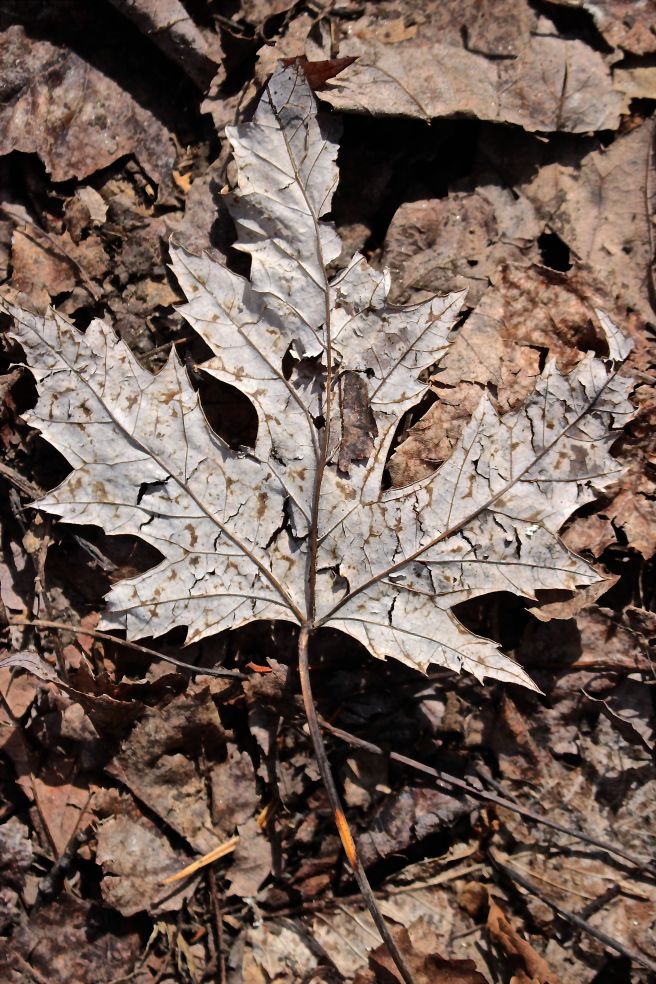
s-silver maple leaf

The backside of the deeply-lobed leaves are silvery gray in old age and silvery white during their prime.

I should have taken a photo of the old Memorial School because that was the sight of the train depot (Depot Street) for the Bridgton and Saco River Railroad that was built in 1883–a narrow gauge operating from Hiram, but didn’t think of it at the time. Instead, I followed the stone steps down, walked beside the brook as it ran below the deep bank by Stevens Brook Elementary School and came up behind a few old buildings, back on Depot.

s-food city bridge

And then I stood on the bridge overlooking Food City. I should note that this is power site #4. Yup, I’ve skipped the first three for now. Stick with me. We’ll get there. In 1822, this area of town wasn’t part of the main village–that was confined to Main Hill. A water-powered carding mill equipped to prepare wool for spinning, thus replacing the tedious hand work of disentangling, cleaning and intermixing the fibers was in operation in this area at the time. By 1825, James Flint and Aaron Littlefield built a sawmill, which they operated for 15 years. In 1840, this was the site of the Walker Saw Mill and Grist Mill. And then things changed. The Pondicherry Mill was built in 1865 to manufacture woolen goods. It was one of the most extensive manufacturing plants in Maine at that time and employed 50 operators. Standing where I was on the bridge, I could see the stones related to the mill and dam. The dam disintegrated in the 1960s.

s-coal trestle

s-trestle 2

In 1898, the neighboring town of Harrison wanted to be joined to the railroad and the RR owners obliged. From this spur, a trestle was built that carried coal in dump carts to the Pondicherry Mill. The structure has deteriorated immensely, but still stands as a monument to this moment in history. So wait, think about this coal situation. The mill had grown to employ 225 people and water power from the brook was no longer dependable. An immense coal-burning chimney about 100 feet in height had been added to the mill. Sixty looms produced 18,000 yards of cloth weekly. Though the building stood until the mid-sixties, the industry moved south long before that. The stones by the brook and trestle are all that are left to tell the story. A now-deceased resident, Reg Fadden, used to tell the story of knowing what color they were dying the wool on any particular day–he’d see the color in the water as he walked to school.

s-former millpond:5th site

Above power site #5, the land was flat and indicative of a former mill pond.

s-5th site

A stone dam and some other foundation work is all that’s now left. The first mill to be located here was a sawmill built in 1868. By 1871, a shovel factory was built on the west side, which was the side I stood upon. By 1899, the Bridgton Lumber Company had located to this power site, with two mills operating–one for boxes and house furnishings; the other for lumber. This apparently was a successful site because in 1911 it became the Burnham and Newcomb Sawmill, which was purchased by Harry Bisbee in 1920. He used a turbine since the water power wasn’t dependable. Though it gushed over the rocks today, in the summertime, this is the perfect place to sit on the flat rocks and dangle ones feet. I can’t remember if Sue told me this or I read it, but apparently there was a treacherous footwalk that crossed the brook in this area and even at age 90, Mr Bisbee would walk across. The sawmill eventually burned, with only the office remaining. This time using a diesel engine, Mr. Bisbee started a smaller sawmill. In 1953, the dam washed out with a flood and local lore has it that Mr. Bisbee walked out one day, leaving it all behind. He died a couple of years later, gifting the mill to the public library.

Charles Fadden and his son, Reg, bought the mill at auction and operated a box mill, using a turbine for power. The office was still standing until about ten years ago, when it collapsed.

s-narrow 1

By the mill, the Harrison Narrow Gauge crossed over a trestle; today only the stone stanchions remain. A sixth power site was never developed.

s-locust bark

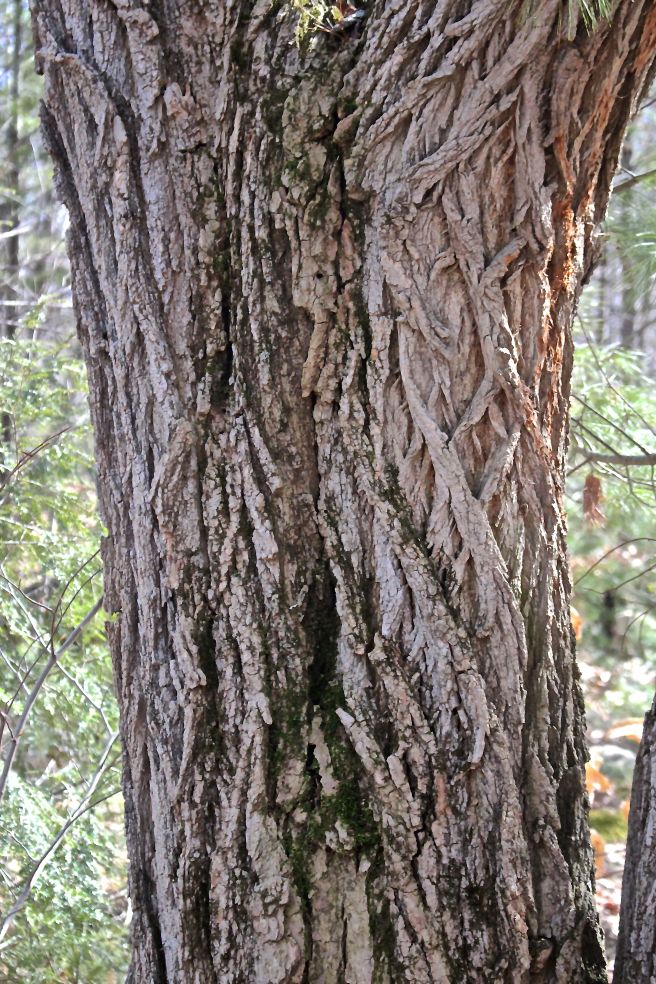
It was here that I recognized another tree I don’t always encounter–a black locust (Robinia pseudoacacia). The bark appears almost braided.

s-locust pod

And below it, an old flat pod that contains bean-like seeds.

s-7th site, Johnson Falls

I followed a new trail (possibly private, but it wasn’t posted) and was delighted to get a better view of what I believe is power site #7.

s-lower johnson falls site 7

If I’m correct in my thinking, this is Lower Johnson Falls, and was the possible 1859 site of the Milliken Bedstead Factory.

s-remnants by Johnson falls

A foundation is still visible on the eastern side of the brook.

s-7th site, smith sash 1

Below power site #7, I came to the coffin shop. Hey, somebody has to build them. Lewis Smith built the two-story building with a basement in the late 1860s. It was a sash and blind factory, but he also built furniture, and yes, coffins. More local lore: he was the town’s first undertaker. While the building has had several owners since then who have tried to restore it, it still needs some (way more than some) tender loving care so it doesn’t go the way of all the other mills.

s-turbine rig

All that remains of a water-powered turbine still reaches over the brook. Originally, all the water wheels along the brook were overshot wheels. While an overshot wheel had horizontal axils, a turbine wheel had vertical axils, thus making it smaller, more efficient and more dependable given the rise and fall of the water.

s-turbine

And on the front lawn of the coffin shop, the real deal–a Perry Turbine Water Wheel. In 1877, Richard Bailey and Samuel Miller operated an iron factory and machine shop built by William Perry and George Taylor across the road from the Smith factory. When they sold their business to Forest Mills owed by William  Fessenden Perry, it was renamed the Bridgton Machine Company with George and Frank Burnham taking over as managers. In 1887, the Perry turbine was invented and it received nation-wide popularity for use in mills along small streams.

s-forest mill a

Power site #8 is one of my favorites. This is where Perry and Taylor erected a mill in 1862 to manufacture woolen goods. The dam was built to provide a fifteen-foot fall with a mill pond above.

s-Forest Woolen Mill 2

s-forest sluice

Today the sluiceway is dry, but I can imagine the water pouring through here.

s-forest woolen mill 3

With the advent of Kansas Road in 1865, the woolen mill expanded to 200 feet by 45 feet and stood two stories tall. With more looms than any mill in the area, outerwear was produced here and shipped to Boston. During the Civil War, attention turned to creating war materials.

s-9th site, Kennard Dam

Across the street, I ventured down the wrong trail at first and found myself on the upper side of the dam built at power site #9. The 13′ dam built by Boothby and Chadwick in 1864 was near Kennards Stocking Mill. It was originally intended that Kansas Road would cross the dam, but the turn would have been too sharp and too steep.

s-vp by Kennards, 9th site

Today, a vernal pool sits below the former dam. I checked it and several others along the way. No signs of life. I’ve yet to hear spring peepers.

Anyway, Taylor and Perry purchased this site in 1865 and built a three-story carding mill with an overhead walkway that crossed Kansas Road and connected their two mills: Forest Mill #1 and Forest Mill #2.  By 1879, Mr. Taylor had died and Mr. Perry re-organized as the Forest Mills Company, which employed 130 workers and produced cashmere. As Sue has told me, this was not from cashmere goats but rather a lightweight fabric consisting of wool fiber that had either a plain or twill weave.

s-power 9

A railroad spur and trestle were built in 1900 to unload coal and other supplies for the Forest Mills Company. The American Wool Company purchased the mill, which was large for Bridgton, but small compared to those south of Maine. Eventually, business moved south. In 1925, a shoe shop moved in, but it wasn’t successful either. The building was torn down in 1962.

s-powerline trail

The scene changed briefly when I followed the trail onto the present day power line.

s-powerline boardwalk

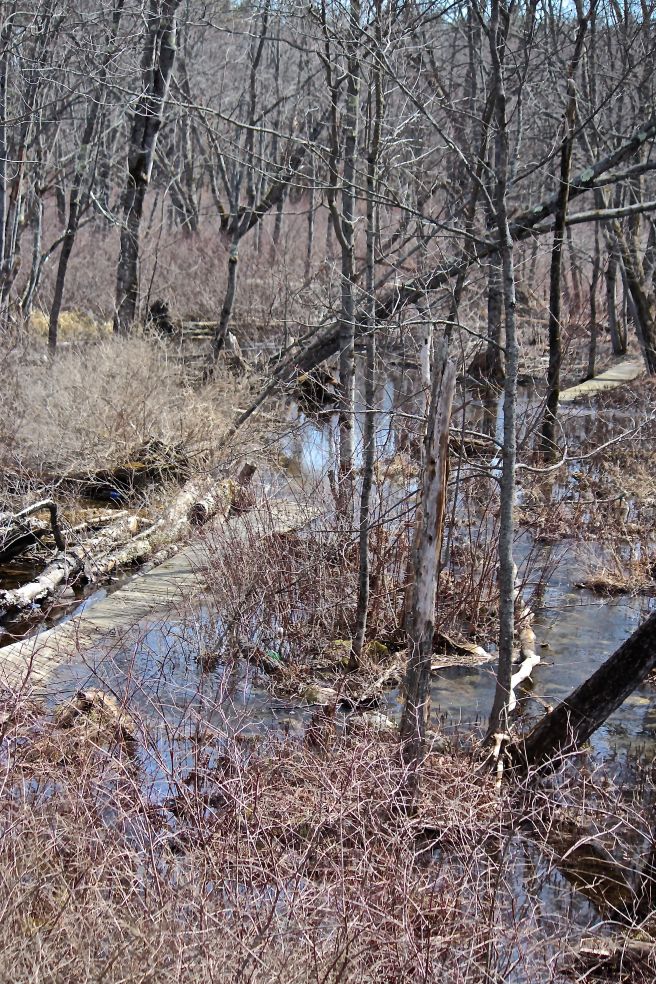
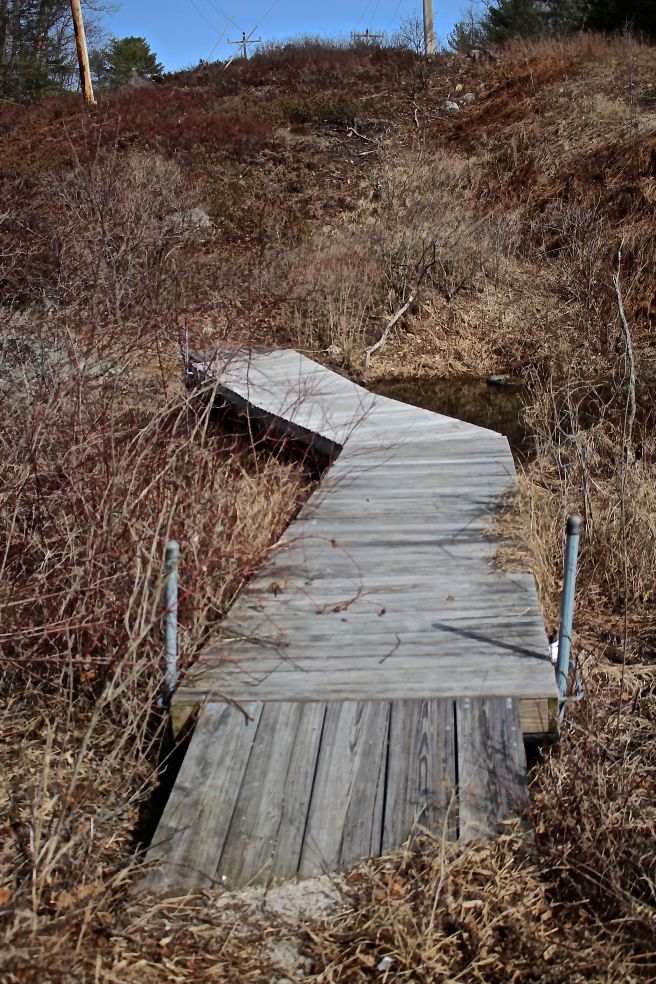
Typically, this boardwalk is under water in March and April. But this year is far from typical.

s-cmp pond

And then I reached power site #10. This is the most modern of them all, but again, it has a history. It’s possible that this was the site of Jacob Stevens’s first sawmill built in 1768.

s-cmp dam 1

Mr. Stevens would have built a boulder and gravel dam, not one of cement certainly. He lived nearby and raised eight children; the four oldest worked beside him. Mr. Stevens was a ranking member of the survey crew that came to what is now called Bridgton in 1766 from Andover, Massachusetts. He returned in 1768 under contract with the Proprietors to develop water power and make it serve the early settlers by creating mills that provided building materials and grain for food. Stevens was the one who identified twelve power sites along the almost two-mile brook with a drop of 156 feet from its source at Highland Lake (known originally as Crotched Pond) to its outlet at Long Lake (Long Pond). It made sense for him to build a site here for both a saw mill and grist mill, as this is near the mouth of the stream and would have provided him with easy access to the main thoroughfare of Long Pond and beyond. The proprietors required that the saw mill operate for fifteen years and the grist mill for twenty.

s-cmp dam 4

I don’t know what happened between 1768 and 1896 when the Bridgton Water and Electric Company took over as the first source of electricity and water for the village. The concrete dam was built in 1931 by Central Maine Power after several transfers of ownership. The greatest power could be found between this site and power site #11, where the brook drops 25-30 feet.

s-penstock start

A 790-foot penstock was built to regulate the flow of the water.

s-penstock channel

s-penstock support

Evidence remains of its position and actually, it’s easiest to see right now before the summer foliage obscures so much.

s-1

Somewhere in this area was power site #11. The Hart Tannery may have been built on an island in the middle of the brook.

s-water drops below CMP

The exact location of power site #12 is also elusive, but rumor has it that a shingle factory was located between site #11 and the outlet.

s-1922 brick

Early on, a wooden structure was used as a power house. That was replaced by a brick building built in 1922 by the Western Maine Power Company. Notice where the penstock entered. And above it, a turbine generator.

s-Long lake 2

All was calm by the time Stevens Brook emptied into Long Lake today.

s-beaver 1

Though it’s easy to miss, this area still offers a source of dams and industry.

s-beaver lodge and dams

Beaver style.

s-3

I walked back up Main Street and headed to the first three power sites, which I present in backwards order at the risk of confusing my tired readers. Power site #3 has a storied past: 1813-fulling mill (put weaving on hot water and beat it to close fibers); 1822-saw and grist mill; 1830-saw, grist and plaster mill; 1845-mill burned; 1857-rebuilt two stories; 1877-never rebuilt. Yet this was long known as the Dam Site and a Dam Site Restaurant stood here for years. Across the street was a tannery, which didn’t need water for power, but did need water to fill the 140 vats. Using hemlock bark, 10,000 hides were tanned each year.

s-shorey park dam 1

I’m only just realizing that I missed power site #2. I looked at it as I walked by, but must have been tired. Anyway, it’s below this split stone dam and served as a grist mill in 1798 and a sash and blind mill in 1835.

s-sp 3rd power site

Power site #1 was originally a saw mill built by Asa Kimball at the head of Stevens Brook. The lay of the land has changed since roads were constructed and Highland Lake (Crotched Pond) had a different configuration and lower depth. The pond served as Mr. Kimball’s mill pond, where he floated logs from Sweden (Sweden, Maine, that is). The split stone dam was erected in 1849-50 by Rufus Gibbs and others, thus providing power for the first big mill in the village that stood four stories tall, employed 50 workers, ran 20 looms and made blankets for the Civil War. By 1941, is was demolished.

s-sp millpond

This is the mill pond as we see it today, but if my vision is clear, before Highland Road intercepted it, this was part of Crotched Pond.

s-highland

And the start of it all, the thing that got me milling about today, Highland Lake and the source of Stevens Brook.

Dear reader, if you are with me still, thank you. It was a long journey and I appreciate that you came along.


Celebrating the Vernal Equinox

We fell asleep to winter and awoke early this morning–eager to celebrate the vernal equinox.

b-dark

It was dark and cold (15˚) with a brisk breeze when we joined others for a 6am hike up Bald Pate sponsored by Loon Echo Land Trust.

b-sun begins

While we waited at the summit and tried to stay warm, we were treated to hot cocoa and amaretto cake. YUM!

b-sunrise1

And then . . .

b-sunrise 3

the sun shone upon this first day of spring.

b-vernal pool

After church, I made a quick visit to the vernal pool where ice is still the name of the game.

b-wet road

And after lunch, we headed off on another adventure. At first we followed an old road, which was tricky business.

b-1st fdn

Though at least six foundations are located along this road where young men carved out a living prior to the Civil War, we allowed ourselves time only to stop at one. We were on a mission.

b-powerline1

We turned north at the power line and trudged up and down hills in search of a brook.

b-stream crossing

That direction didn’t feel quite right, so we followed our noses and turned into the woods.

b-posted 1

And then we stumbled upon a property line that was posted. We love the fact that in Maine one can walk upon any property that isn’t posted. This one was recently marked and so we respected the landowner’s wishes.

b-meandering stream

That is, until we got to a point where we decided to trespass after all. Our journey took us past meandering streams,

b-stream crossing 2

stepping across others,

b-wetland 1

slogging through boggy areas,

b-bushwhack

and tripping among the understory.

b-deer rub

We saw where a deer had rubbed its antlers,

b-deer scrape

another enjoyed fine dining, and

b-deer skull

a third said goodbye as it returned from whence it came.

b-polypody 2

We found common polypody fern (Polypodium vulgare) indicating that the temperature was higher than it had been earlier in the morning.

b-polypody 1

This was our view of polypody when the temperature was much lower on Bald Pate.

b-pork den

We passed a porcupine den.

b-porky tree

And then we came upon downed hemlock branches and

b-pork scat 1

fresh scat.

b-pork in tree 1

I looked up.

b-pork in tree

He looked down.

b-game trail beside brook

Finally, we found ourselves walking along a game trail beside a brook–feeling like we might just be on the right track.

b-mill pond

Where the brook widened into a pond, we knew we were in the right place.

b-on a rock

Just below the pond, my guy stood in the middle of the brook, excited about our find. We’d attempted to locate this spot a year ago and missed it by a long shot.

b-mill site1

According to the 1858 map of Oxford County, we were at the sight of R. Bennett’s sawmill. I’d first visited two years ago with my friends, Sue and Janet. It’s actually located on Sue’s land. We’d come in from her home on my first visit, but today we came via Old City.

b-b mill 3

b-b mill 2


b-bmill stones brook

A year ago, my guy and I snowshoed in search of this sight but never found it so we were gleeful about today’s success.

b-fdn near mill.jpg

Our intention had been to search for the mill until 3:30. We found it just after 4pm. And rather than try to follow the stream back, we decided to bushwhack in a more westerly direction. On a hill above the mill we found a foundation made of drilled stones that are neatly hidden by moss and ferns and assume it was part of the mill.

b-rock pile?

Our bushwhack continued until we finally emerged by a rock pile beside Old City Road. Its circular formation had me thinking water well.

b-double wall

Will we ever find it again? That’s always a question, but now we know to walk along the road until we reach the last double-wide wall and then turn at the well.

b-ghost

I liked the ghost-like effect of my guy walking back on the road–reminiscent of the men who once lived here and worked these woods. I followed my guy out and both of us occasionally felt the suction of mud. Occasionally one foot was drawn into the earth as if it intended to stay behind. We finally returned to our truck at 6pm (so much for our intention to be home by 4:30), our celebration of the vernal equinox complete.


To Bear Trap and Back

A change of plans today meant I had time for a trek to Narramissic Farm and the historic bear trap in South Bridgton before the rain began.

N-view from road

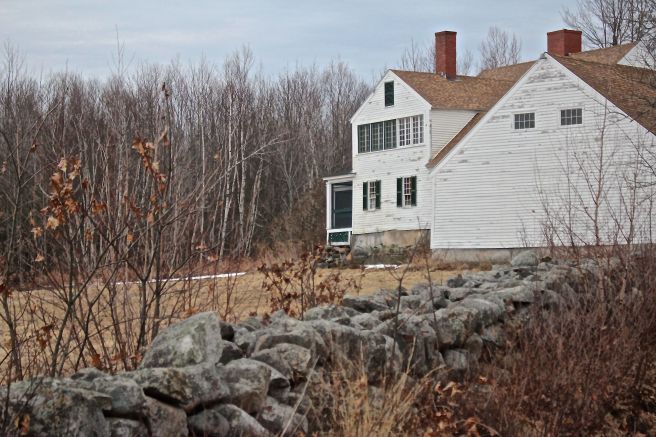
From Ingalls Road, where I decided to park, I took in the view of the front fields and house.

N-Narramissic Road

Narramissic Road is passable, but I wanted to slow down and soak it all in.

N-pussy willow 1

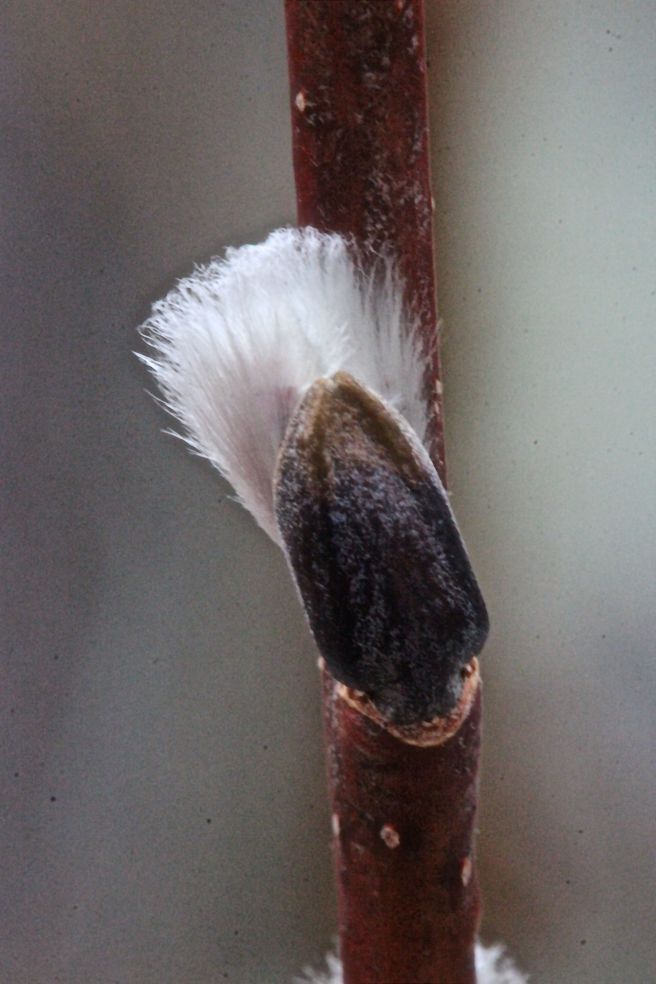
From pussy willows to

N-staghorn

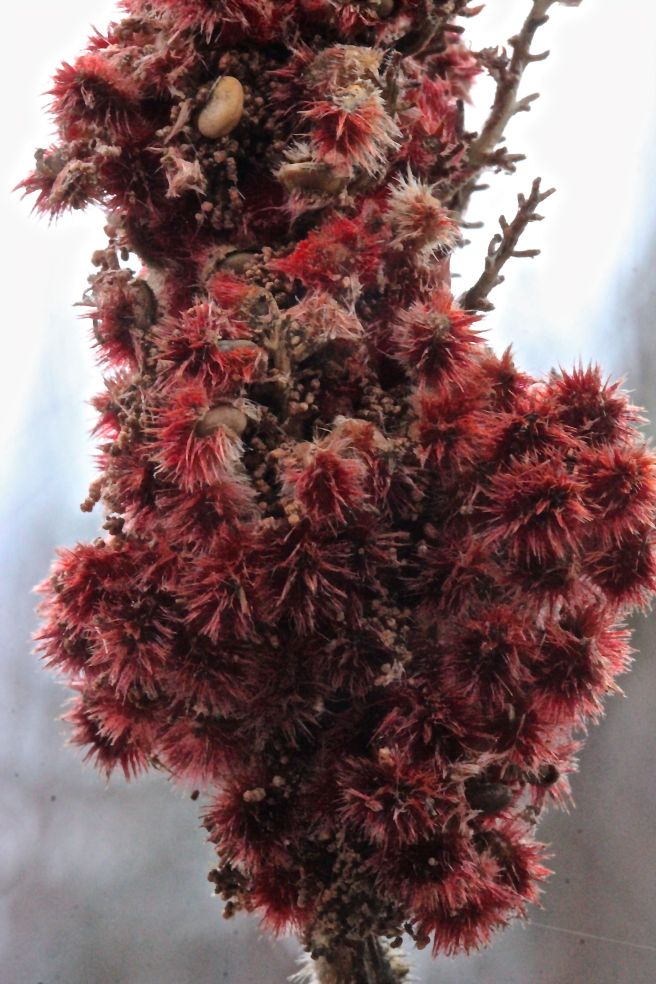
fuzzy staghorn sumac, I was thankful I’d taken time for the noticing.

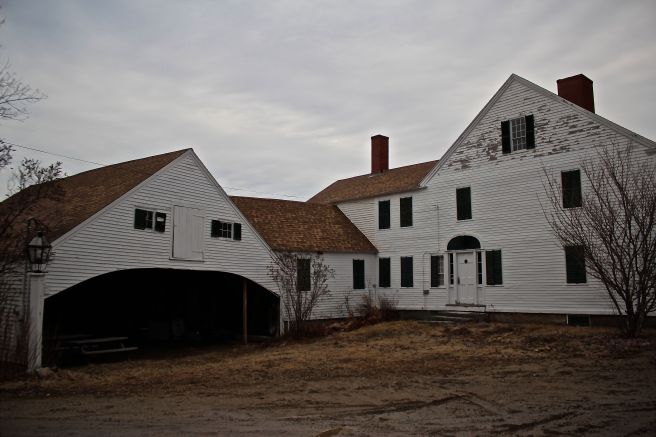
N-house & attached barn

The Bridgton Historical Society acquired the 20-acre property in 1987 when it was bequeathed by Mrs. Margaret Monroe.

N-house

Turning the clock back to 1797, William Peabody, one of Bridgton’s first settlers, built the main part of the house.

Peabody sold the farm to his daughter Mary and her husband, George Fitch, in 1830 and they did some updating while adding an ell.

N-barn front

The Fitches had a barn erected that has come to be known as the Temperance Barn; historical records claim it to be so named “because it was raised without the traditional barrel of rum.”

N- barn face

Both the barn and the house are in need of repair, but I couldn’t help but wonder about what mighty fine structures they were in their day. While today, a visit to the farm feels like you’re in the middle of nowhere, during its heyday it was located in the center of somewhere–at the junction of two roads that have since been abandoned.

When Mrs. Monroe purchased the property in 1938, she named it Narramissic, apparently an Abenaki word for “hard to find” because it reflected her long search for just the right piece of real estate.

N-blacksmith shop

A blacksmith shop is located between the house and Temperance Barn, and beside the trail I chose to follow through another field and off into the woods.

N-garden wall 1a

Massive stone walls indicate the fields had been plowed.

N-rock uplifting

Even today, “stone potatoes” continue to “rise” from the ground, making them one of the farmer’s best crops.

N-pearly 2

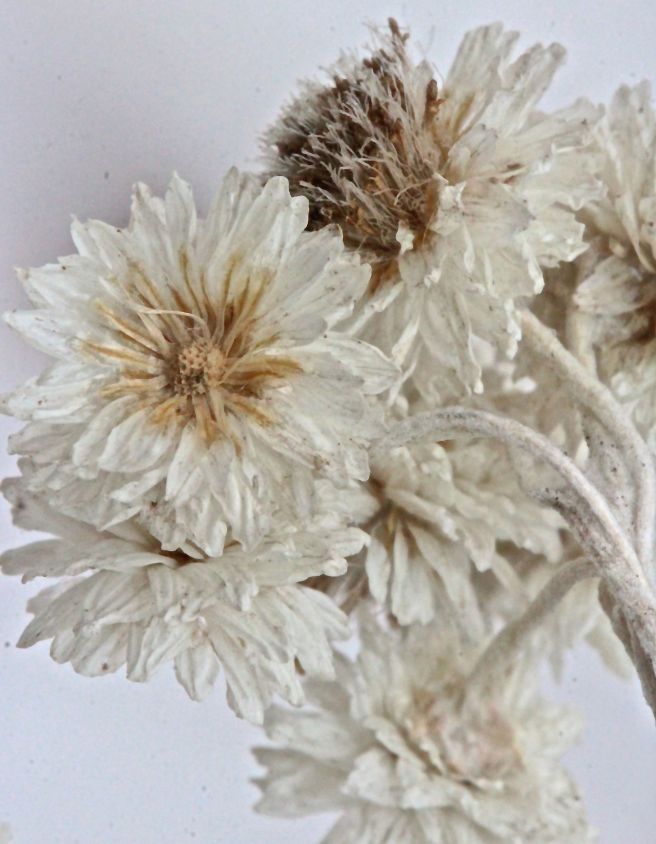
My destination was two-fold: the quarry and bear trap. But along the trail, I stopped to smell the roses. Or at least admire the beauty of pearly everlasting in its winter form.

N-gray birch litter

Several trees had snapped in the season’s wind, including a gray birch that scattered scales and seeds as it crashed to the ground.

N-gray fruit seeds

But . . . because the top of the tree was no longer in the wind zone, a surprising number of catkins continued to dangle–all the better for me to see. Notice the shiny seeds attached to the scales.

N-gray birch generations

The tree speaks of generations past and into the future.

N-jelly 2

Further along, I found a wavy and rubbery jelly ear (Auricularia auricla) beside a gray birch seed.

N-sign 2

Finally, I reached my turn-off.

N-quarry 1

N-feather 2

This is the spot from which the foundations for the buildings were quarried so long ago, using the plug and feather technique that was common in that time.

N-common toadskin 2

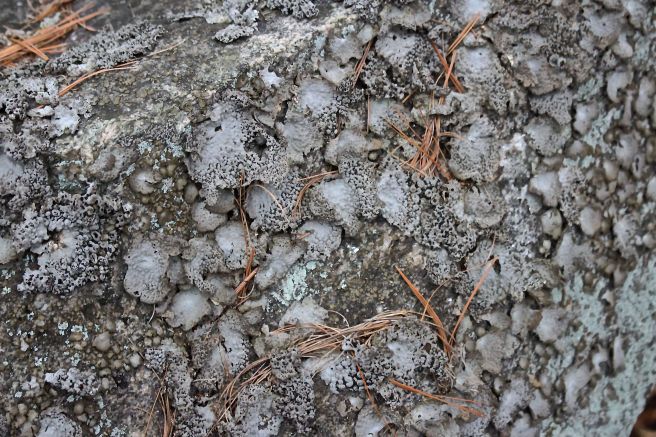
Life of a different sort has overtaken some of the stones–common toadskin lichen covers their faces.

N-common toadskin 3

In its dry form, it looks perhaps like the surface of a foreign planet, but this is another lichen that turns green when wet–allowing the “toad” to become visible.

N-bishop's face in ice

Speaking of becoming visible, I noticed the bishop’s face topped with a mitre as water dripped off the rocks and froze. My thoughts turned to my sister–she doesn’t always see what I see, but maybe this one will work for her.

N-young beech

Heading back out to the main trail, I startled a snowshoe hare and of course, didn’t have my camera ready. As I turned toward the bear trap, I continued in the land of the beech trees. Most are too young to produce fruit, but I looked for larger trees and, of course, checked for claw marks.

N-beech slashes

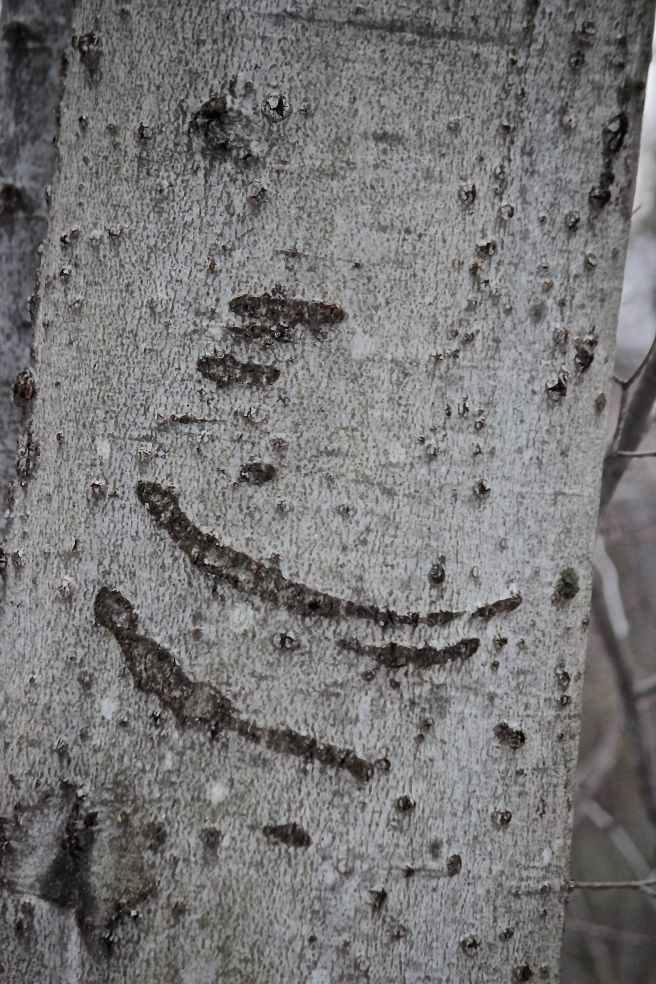
The best I found were slashes–probably caused by another tree rubbing against this one.

N-initials

Oh, and some initials carved by one very precise bear.

N-No parking

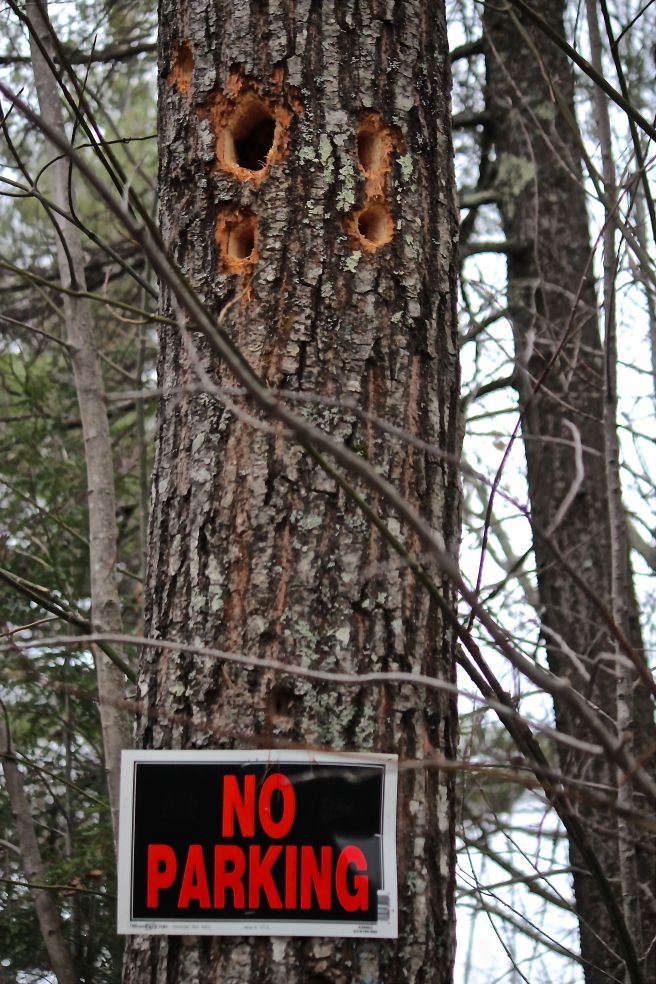
I was almost there when I encountered a “No Parking” sign. A new “No Parking” sign. On a trail in the middle of nowhere that used to be somewhere. The pileated woodpeckers obviously ignored it. Me too.

N-BT1

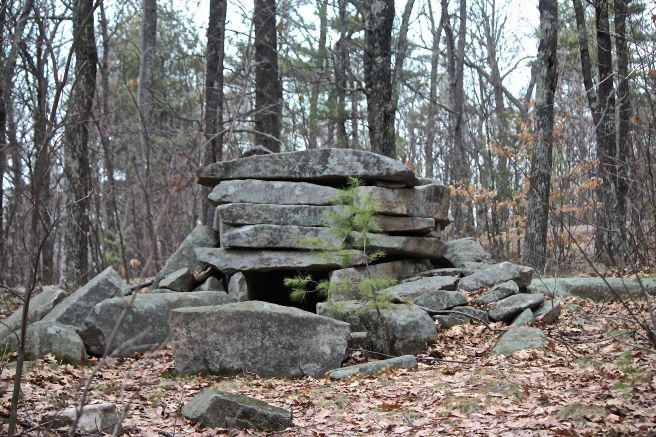
At last, Bear Trap! According to an August 17, 1963 article in the Bridgton News, “Enoch Perley, early settler of South Bridgton, built his first house in 1777 and brought his bride to their new home in 1778. [I believe this was at Five Fields Farm.]

As Enoch acquired livestock, he was much troubled by depredations from bears. He built a bear trap on the hill back of his first home . . .

Tradition says that four bears were caught in this trap–not enough! So Mr. Perley later had an iron bear trap made which took care of eight bears. Without a doubt, many were disposed of by him personally. A story is told that in an unarmed encounter with a bear and two cubs beside a wood road at dusk, Mr. Perley allegedly strangled the mother bear with his garters . . .”

N-bear trap 1

The article continues, “The bear trap is built of stone. A large stone door is suspended and as the bear takes the bait, he trips the lever and is caught in the stone enclosure.”

N-BT inside

I looked inside and found no one in residence. In a December 1954 issue of the Bridgton News, a brief article states: “The old stone bear trap on the mountain in South Bridgton known as ‘Fitch’s Hill,’ unused for more than one hundred years, has been reactivated by Dr. Fred G. Noble and Gerald Palmer and put in readiness to capture a bear.” As the story goes, they never did succeed.

N-BT back view

A side view.

N-BT*back side

And a rear view. A few years ago there was talk of moving this monument because land ownership had changed. I hope it stays put because its authenticity would be lost in a move.

N-pine scale?

Just below the trap, I noticed a white hue decorating only one of a bunch of young pine trees. I can’t say I’ve ever seen this before or venture a guess about its origin. I’m waiting to hear back for our district forester–maybe he has some insight.

N-heading back 1

As I headed back down the trail and the barn came into view, I spied a single red pine thrown into the mix of forest species that have taken over this land.

N-red pine

Ever on my bear claw quest, I checked the bark of this tree. Though beech provides an easy display of such marks, it’s not the only species of choice. Among others, single red pines that appear to be anomalies have been known to receive a visit.

N-hare

There was sudden movement as I approached the pine and then what to my wondering eyes should appear, but a second snowshoe hare! It paused long enough for me to snap a photo. Do you see it? Also known as the varying hare, its fur is still white.

Behind the tree, I found where it had been dining and defecating.

N-Pleasant Mtn ridge

N-farm view from back

As I crossed the upper field, the ridge line of Pleasant Mountain and ski trails at Shawnee Peak made themselves known to the west. And beyond the farmhouse, the White Mountains.

And then,

N-shagbark hickory

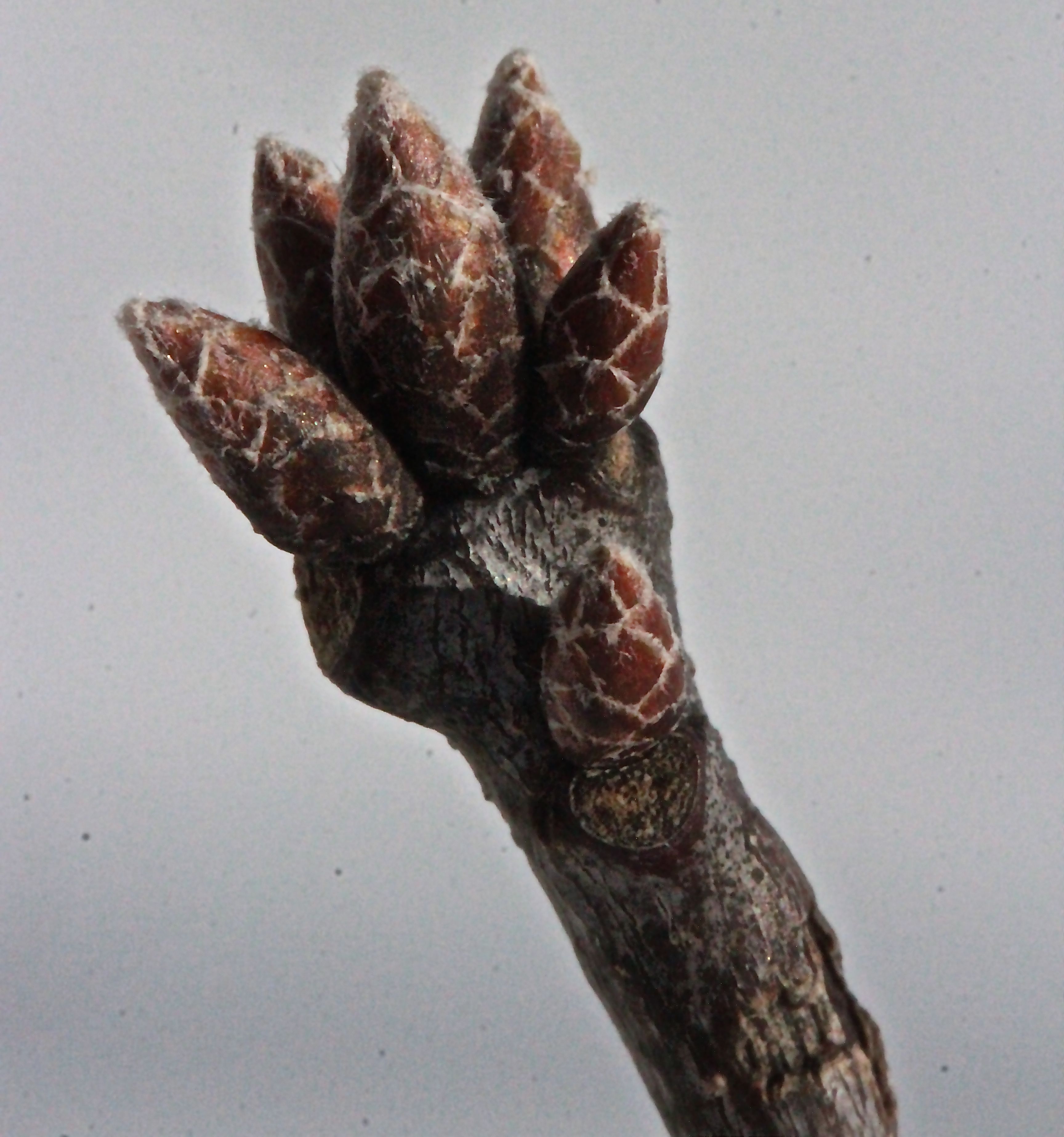
and then . . .  an oversized bud captured my attention as I walked back down the road.


Shagbark hickory isn’t a common species around here. But, Jon Evans of Loon Echo Land Trust had recently told me some mature trees were found on a property in South Bridgton that is under conservation easement. (We actually may visit them tomorrow). The bulbous, hairy bud scales and large leaf scar made even the young trees easy to identify. Curiously, according to Forest Trees of Maine, the wood “was formerly used in the manufacture of agricultural implements, axe and tool handles, carriages and wagons, especially the spokes and rims of the wheels.” That fits right in with the neighborhood I’d been visiting.

N-mud season

One final view–yup, it’s mud season in western Maine. But still worth a trek to bear trap and back. Thankfully, the rain held off until my drive home.


Same Old is New

Same old, same old. Sometimes it feels that way as we travel familiar trails and recognize members of the community. And so it seemed today.

a-fdn 1

We paused to check on a few neighbors along the Homestead Trail at the Greater Lovell Land Trust’s Heald and Bradley Ponds Reserve, but no one was home.

a-signs

And so we decided to climb to the summit of Amos Mountain.

Along the way, I realized we weren’t the only ones exploring this property–several times we saw where a mink had bounded across, even enjoying a short downward slide in the midst of its journey.

a-summit view

From the summit, Kezar Lake stretched before us as we ate our PB&J sandwiches and Girl Scout cookies–Lemonades™.

a-whiting to pleasant

And another view, Whiting Hill in the center foreground and a peek at our beloved Pleasant Mountain, visible just to left of the center pines.

a-stonewalls 1

On the way down we decided to explore the stonewalls for a bit, at times terraced and following the contour of the mountain.

a-bear 3

And that’s when the same old started to change. Yes, we found another bear tree.

a-bear 4

And on what side of the tree should we find the claw scars? Why the north of course, adding to our unscientific theory that bears climb trees on this side. Typically, the northern side is the uphill side. Our mission is to continue to pay attention to this–tough job that we choose to accept.

a-stonewalls 4

Sometimes the walls appeared to enclose pens.

a-stonewalls 6

And other times they opened–perhaps to pastures?

a-northern white cedar

As we wandered and wondered about the walls the farmer had created and why, we noticed other things we’ve somehow missed upon previous visits, including this northern white cedar tree.

a-stonewall fdn

In what today appears to be the middle of nowhere, a small foundation. House? Shed? Sugar shack?

a-red-belted polypore

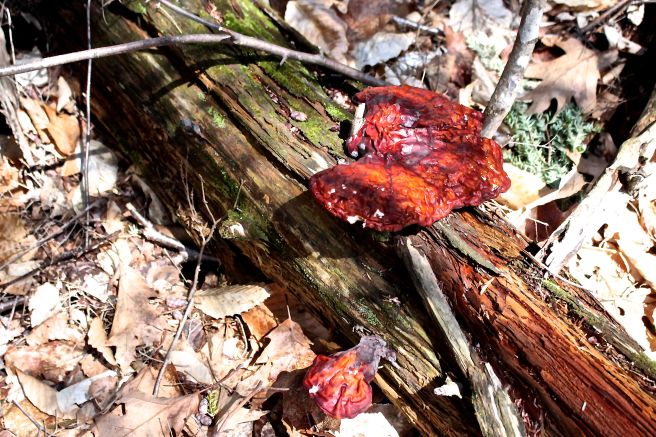
We climbed a hill to see what was on the other side and found this red-belted polypore (Fomitopsis pinicola) growing on an Eastern white pine. In Lawrence Millman’s Fascinating Fungi of New England, he says this is “apparently not a picky fungus. F. pinicola has been recorded on more than 100 different species of tree hosts.”

a-stonewall last

The snow had softened since we first started so we did some slipping and sliding as we followed another stonewall back to the trail.

a-3 birch

And then my brain kicked into birch tree mode. These woods are filled with paper, gray and yellow birch. And next week, the GLLT will host a “Which Birch Is It?” walk about the birches and their relatives.

a-yellow bark

The ribbony curls and whorls of yellow birch bark are signatures of this tree that can change in color from silver to yellow to reddish brown and circle back to silver again in old age. Did you know that a yellow birch can live to 200 hundred years, unlike its cousins, the gray birch and paper birch? Gray birch live about fifty years and paper reach a ripe old age of somewhere between 50 and 150 years.

a-yellow 4

Another cool fact about yellow birches: the interior of dead branches begin to decay quickly, even while still on the tree; eventually reduced to mush, the trees rid themselves of these non-productive limbs quite easily with the help of wind. Look for tubes of outer bark  filled with rotting wood on the ground.

a-birch stitch

Also becoming visible as the snow melts, paper birch bark from downed trees. It seems curious that the lenticels resemble stitches, especially considering that Native American’s built sturdy, lightweight canoes from birch bark; the bark was stretched over a framework of white cedar, stitched together and sealed with pine or balsam resin. All the components exist in these woods.

a-tripe 1

Back on the trail, a few other things revealed themselves, including smooth rock tripe (Umbilicaria mammulata). No matter how many times I see this, it’s never the same old.

a-tripe 4

In great contrast to the smooth upper surface is the coarse pitch black of the underside reminding me of fresh tar–kind of like what town crews are using to fill pot holes right now.

a-tripe 3

The greenness of the upper side was witness to the melting snow.

a-liverwort

Similarly, lungwort displayed its dryer gray presentation because it lacked moisture.

a-heading out

As we continued down the Gallie Trail, bypassing the Homestead, it seemed that we were back in the land of the sameness.

a-speckled catkins 2

But . . . speckled alder, a member of the birch family, is about to come into its own. While the burgundy brown male catkins hang from the ends of twigs, smaller female catkins await the release of pollen.

a-speckled leaf

Speckled alders are pioneer species–that first step in natural transition of farm land or logged land back to forest. In this instance, it’s both of the former.

And that’s not its only claim to fame. Speckled alders are nitrogen fixers. Atmospheric nitrogen absorbed by bacteria live in nodules on the alder roots and change into a form of nitrogen plants can utilize as fertilizer, thus fertilizing fields that may have been depleted of nitrogen by years of farming. Its leaves are also rich in nitrogen, so when they fall they help to fertilize soil. For some reason, this one chose to hang on, but its moment will come. In the meantime, it offers grace in form and design.

a-gumdrop 2

Equally graceful, the hairy bracts and seed head of Black-eyed Susans (Rudbeckia hirta) found near the parking lot.

It’s all always been here. It’s all the same, day in and day out and yet it’s all new. Change is the only constant–offering moments of wonder.


Gallivanting Around Great Brook

It’s been a couple of months since Jinny Mae and I last checked in on the doings in the Great Brook neighborhood off Hut Road in Stoneham, Maine.

H-Forest Road 4

Forest Road 4 isn’t plowed in the winter. That’s OK. We welcomed the opportunity to admire our surroundings as we hiked above the brook. So much to see that is so often missed as one drives.

h-paper birch blue

Though the temperature was on the rise, the blueness of a few paper birch trees reminded us that it’s still winter.

h-sphagnum

We found sphagnum moss looking a bit frosty but cheering us on with its pompoms.

h-chaga

On more than one yellow birch, chaga offered its medicinal qualities in quantity.

h-yellow and white partners

We came upon a special relationship–a yellow birch and a white pine. Rooted in this place, they embrace and share nutrients.

h-yellow birch:white pine

Forever conjoined, they dance through life together.

h-GB1

Finally beside the brook,  we couldn’t see the rocks below very well, but watching the water race over them gave us a better understanding of the forces that have smoothed their surfaces.

h-GB south

In a few more months, we’ll stand here and wonder where all the water went.

h-ice drips& bubbles

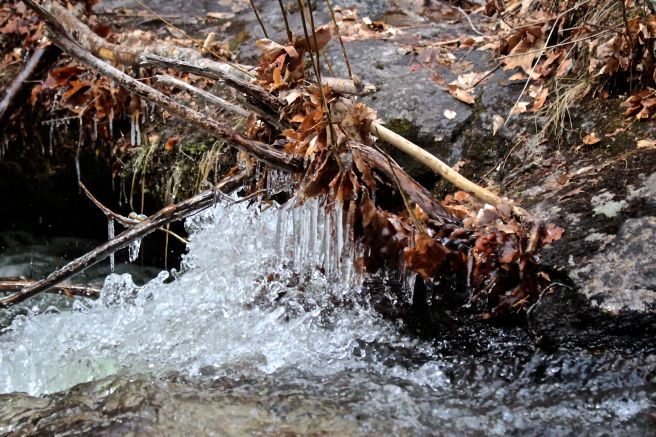
But today, it was the ice formations that we couldn’t stop admiring. Bubbling water below and dripping ice above, each adding to the other and both constantly changing.

h-ice 2

So much variation on the same theme as coursing water freezes into ice while at the same time carving into the rocks below.

h-ice pedastle support

Looking beneath, we noticed pedestals shaped like elephant legs providing support to shelves above.

h-gb ice castle

Occasionally, we saw crystalline turrets, translucent arches and frozen chandeliers of castles captured in ice.

h-sets of ice feet

Sometimes, it seemed like ballerinas danced on their tippy toes. That’s what water really is, isn’t it–a dance through time with changing tempos along the way?

H-GB

We crossed Great Brook and then paused for a moment as we decided which trail to follow.  We took the road less traveled by. I laughed when Jinny Mae referenced Robert Frost’s poem. My former students don’t read this, but that was one of the poems they had to learn and recite. And my guy–poor soul–knows it through association. Actually, he’s a better soul for that reason.

h-tree owl 2

So you may not see it, but Jinny Mae and I did–an owl hidden in the ash bark. Not a live owl, mind you. Well, that depends on your perspective, I suppose.

h-heal all

Within minutes, we knelt to admire Selfheal or Heal All (Prunella vulgarism) and its hairy calyces.

h-survey sign

We stood by the survey marker sign and realized it had been attached for many years.

h-survey marker

Perhaps 51 years!

h-frullania 1 on red oak

h-frullania 2

On a red oak, we pause to look at the reddish-brown liverwort–Frullania. There’s history in this species–dating to the earliest land plants. No matter how often we see it, and we see it often, we feel privileged.

h-leaves and ice

The trail switches from snow to ice to water and back again. Ice covered leaves draw our appreciation.

h-fnd 1a

In the neighborhood, we pause to check on the local families.

h-fdn 1 chamber

I climb down to the root cellar and discover that the porcupines haven’t visited all winter. Old scat still present in there, but nothing new.

H-Fdn 2

Moving up the colonial road, we come to the second residence.

h-fdn 2 yellow birch on mantel

Atop the mantel grows an old yellow birch. Like any TV screen above the fireplace, it offers an ever-changing display.

h-brook upland

We moved toward Shirley Brook, where we were once again in awe of ice.

h-water and ice1

Water and ice: a relationship in constant flux–at the moment.

h-brook structure

Beside the brook is a stream that’s currently dry. We look edat the snow-covered stonework that crosses over it and realized we need to return and try to figure out what the structure might have been and why it was built here. Stuff like this adds to the intrigue. Man-made. When? Why?

h-spider 3

Poor Jinny Mae. She had to wait for me constantly as I shifted from one lens to the next. But check out this spider.

h-stone piles 1

We are the queens of bushwhacking and love discovering the stories hidden in the woods. In this neighborhood, lots of stone walls tell part of the story. Rock piles enhance the chapters.

h-moose scat 1

And then we found more. Fairly fresh moose scat insisted upon our attention. We’d noted that there were some old snowshoe hare runs and we found some moose browse on a nearby striped maple, but we were surprised that there weren’t many fresh tracks. Where have all the mammals gone?

h-moose scat 2

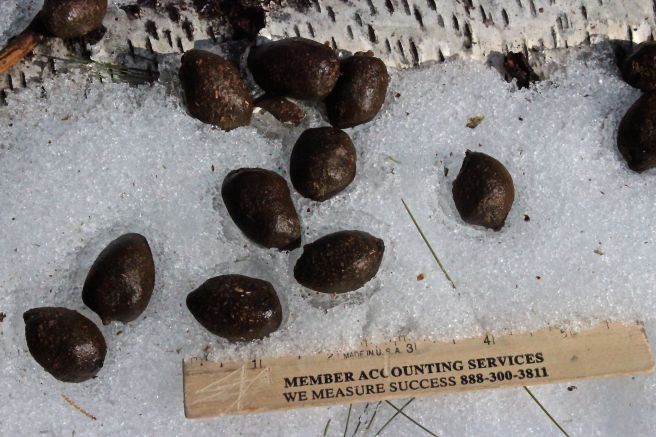
This scat is some of the biggest moose scat we can recall seeing. A few gems followed me home.

h-lady's slipper

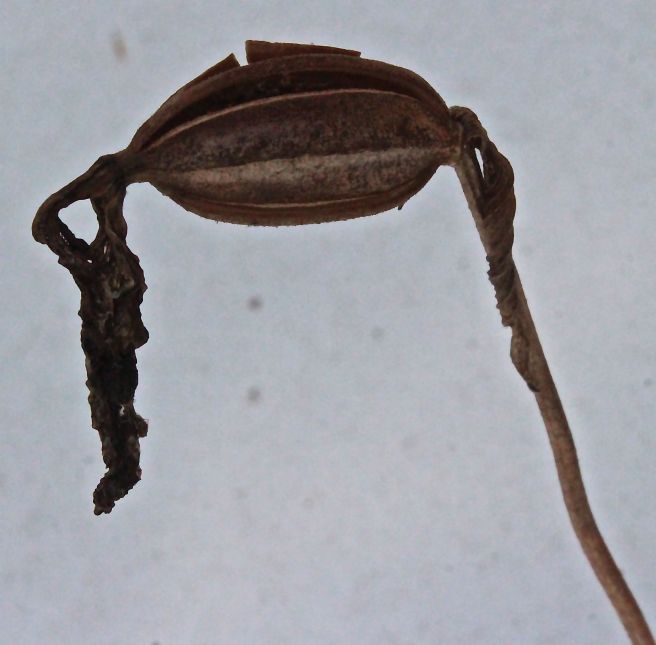
And then we happened upon something neither of us have seen before–at least that we are aware of. We had our ideas about what winter weed this is, but since we haven’t encountered it before our sense of wonder kicked in.

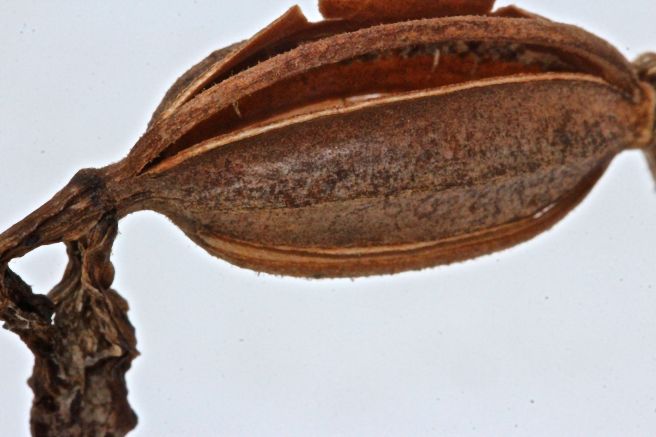
h-lady's slip pod 2

Back home, I looked it up in Weeds and Wildflowers in Winter by Lauren Brown. The capsule is woody and about two inches long. As you can see, it’s closed at both ends, but opens along slit lines–six in all, actually.

h-lady's bract at base of pod

At the back end, a long, curved bract.


And at the front, the slipper gone by. Yup–Lady’s Slipper (Cypripedium acaule). And the reason we didn’t recognize it–because it’s a rare find in the winter woods. Wow.

h-bear 1

We’re on our way out when we spotted these marks on beech bark. We’d looked and looked because we know this is bear territory.

h-bear NW

Compared to other bear trees, these claw marks are newer than most I’ve seen. Jinny Mae was as excited about the find as I was. I’d told her earlier as we scanned the trees that my guy has come to an unconfirmed scientific conclusion that bear claw marks appear on the northern side of trees. This one didn’t let us down. Based on the location of the sun that’s grew lower in the sky, these are on the northwestern side of the tree.

At last it was time to drive home.

Gallivant: go from one place to another in the pursuit of pleasure or entertainment. Over five miles and almost five hours later, we were thankful for the opportunity we shared today to gallivant around Great Brook.


Chillin’ at Heald Pond

It was chilly this morning. Understatement. It was mighty cold, given the wind. But that didn’t stop the intrepid Tuesday Trackers of the Greater Lovell Land Trust from exploring a property under conservation easement. For some though, that was enough. A few of us had intended to explore a trail in Stoneham, but postponed that trip for another day. The temperature was dropping as the wind increased.

My brain and body, however, were still in exploration mode, so I drove to the Heald/Bradley Ponds Reserve. A sip of hot cocoa and I was ready to continue.

Mill Brook

Mill Brook takes on a different look in its winter coat.

ice twists 2

Below the tree that lays across the stream, a series of twists remind me of flames–frozen in time.

 Mill site dam

mill dam

As the water cascades over the old dam site, the ice builds up, creating a new scene moment by moment.

mill site

I love the combination of newer dam beside the old foundation stones. History was made here.

otter slide

And above those very rocks a sight that warmed my heart–an otter had been chillin’. In my next life please let me be an otter. I know they are fierce predators, but they seem to have such fun and they LOVE winter. Me too.

otter climb

An upward climb . . .

Otter 4

and another downward slide

Otter 3

   otter tracks by mill brook

back to the water. Check out those webbed tracks on the angle noted for members of the mustelid family.

mink tracks

A mink had also passed through. Oh my! I could have turned around then and headed home, but I didn’t.

pileated tree, Heald PondPil tree

Near the kiosk, a pileated woodpecker has been enjoying a feast. I found scat among the wood chips below. If you go, look for it–filled with carpenter ant bodies.

exoskeleton

Despite hand warmers, my fingers were feeling the cold, so I bee-lined to Otter Point. Whenever here, I feel compelled to check on the dragonfly exoskeletons.

ice on wh leaf

No otter tracks at the point, but there was plenty to capture my attention including ice coating a witch hazel leaf. The contrasting yet complimentary patterns and color demanded a closer look.

wintergreen leaves

A few wintergreen leaves featuring their winter hue poked above the snow.

red oak leaf

As I started back on the trail, the wind made my eyes water and burned my cheeks. It provided a good excuse to turn onto the blue loop and climb toward the summit of Whiting Hill, all the while warming me. And so did this red oak leaf.

beech leaves

Nearby, a faded beech leaf. Take another look at the witch hazel, wintergreen and oak–notice their veins. Compare them to the beech. So many differences for something we might simply call a leaf.

 Kezar 3

Kezar Lake

At the summit, the sky and mountains offered a dramatic view. Winter blues dominated the scene. Happy blues.

red oak buds 2

As I enjoyed the sun’s warmth, I focused in on my nearby surroundings. I wasn’t the only one appreciating extra layers today–the crowned formation of Northern red oak buds don their own warm and fuzzy coats.

aster

An aster waits patiently–huddling yet ever ready to go forth and multiply.

ruffed grouse tunnel 3ruffed grouse with scatRuffed Grouse trail

And then I saw this. Another slide? No–actually, it’s a tunnel of sorts created by a ruffed grouse. The middle photo shows the bird’s scat. The bird plowed through the fluffy snow as it fed at the summit.

mouse 2mouse

Everywhere I snowshoed (the zip ties work so far as they hold my snowshoe strap together), there were mouse tracks–the risky business critters of the world.

fisher tracks 1 fisher tracks 3fisher tracks 2

I’d seen fisher tracks crisscrossing my trail as I climbed toward the summit. And then on the way down, not much of anything except mice . . . until these tracks below a hemlock. We had light snow yesterday that has filled in many tracks, but these were quite clear–making them easy to ID.

hare 1

As the trail turned sharply left, I entered the home territory of another mammal. Within these tracks I always see the winter lobster.

snowshoe print 1

A snowshoe hare–its smaller front feet land first–one before the other and often at an angle. Then the larger hind feet swing around and make a deeper impression as the hare pushes off in a bound toward its next landing spot.

snowshoe hare convention_2

I felt like I was at the scene of a hare convention.

snowshoe hare scat

And no convention is complete without some scat. Take a look at the vegetative substance of these milk duds.

This morning we were talking about the fact that we’re seeing many more tracks right now than is normal for January. We think it’s the snow cover–easy enough for them to move around. And it’s been warmer, though you couldn’t prove that today.

milkweed 1 milkweed 2  milkweed seeds

As I headed toward the parking lot, the milkweeds that grow at a former homesite across the road called to me. Their parachutes were in constant motion in the wind, but still they clung on to the pod.
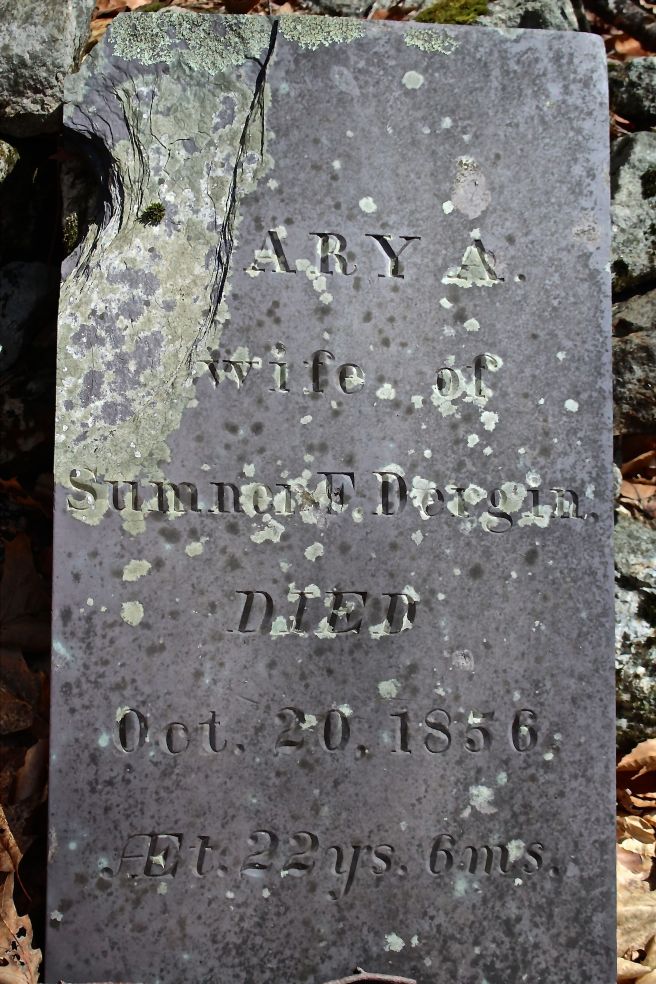
I couldn’t feel my toes, so I didn’t have to worry about them. ;-) But my fingers didn’t appreciate it when I took my mittens off for a photo call. Despite that, I’m so glad I spent the afternoon chillin’ at Heald Pond.

Everything Old is New Again

Sometimes my feet wander down trails I’ve traveled many times before and other times they pull me into new territory. Either way, I’m happy to bumble along.

vp

My morning tramp began with a visit to the vernal pool. A week ago it was empty. Some rain and cooler temps suddenly mean water glazed with ice.

gateway 1

Continuing along, I stopped at an old gateway where granite posts mark the former opening. There is a cowpath on our property. Is this another one? Was there a barn nearby?

gate 2 gatepost

The split granite spoke of earlier times. Rather than pass through, as is usually my manner, my feet turned and I found myself following the stonewall in a westerly direction.

double wall

Curiously, it’s a double wall or two parallel walls, which typically indicates plowed land. That makes perfect sense, as the land was flat. But, what I noticed is that there aren’t many small stones between the outer walls as is traditionally the case. Why?

well

Eventually, I reached a corner, and found where all the smaller rocks had gone. They form a triangle–a common way to get rid of the little guys. I also noticed what I believe to be a well. There are wells throughout this woodland–rather curious.

dump site

Some artifacts, though rusted or broken, remain to provide further evidence that this area served a different use at one time. It now stands in tree growth and is lumbered every 30 years or so.

super double wall

As the wall turned, so did I. And here I was even more confused. The wall is about eight feet wide. The reason? I can only wonder.

island hopping

At the next corner, rather than continue to follow the wall, I climbed over and did some island hopping.

sphag 2 sphagnum 1

Sphagnum mosses display their pompom heads.

evergreens evergreens2

Evergreens compete for sunlit spaces.

snow flurries

And suddenly, snowflakes land on ice. Only flurries, but still . . . it’s snow.

lost 1

At times, I was lost. Not really lost because I knew I could find my way home, but fake lost–curious about where my next steps would lead.

turkey tails

Among my findings as I wandered about, turkey tail fungi (Trametes versicolor),  proving that they are as prolific as the tails of strutting turkeys for which they were named. And one hundred times more beautiful.

hemlock varnish shelf

Exhibiting its winter color is a hemlock varnish shelf (Ganoderma tsugae).

witch's butter & bark beetles

Witch’s butter (Tremella mesenterica) put me under its spell. I didn’t have any pins to prick it and let the jelly juices run, thus counteracting any adverse effects, but that’s okay–I think it’s a good witch.

ice needles

The ice needles are forming again, ever curious in style and design.

balloon

A different color catches my eye–deep in the woods and yet . . . and yet, the human effect leaves its mark. Don’t worry, it’s not there anymore.

deer trail

Finally, I followed the deer and moose trail home, and later decided to follow a more conventional trail.

 brook 2

brook reflection

Though I explore the trails beside the brook frequently, the change is constant.

 weeping treeweeping 2

This white pine, which is actually a snag, has taken to weeping. It’s nearing life’s end. I’d cry too if my outer layers of skin were cast away as if they meant nothing.

art 2

art 3

Another snag shows off its palettes of great size–artist’s conks.

   pileated 1

A third snag is an old favorite for pileated woodpeckers and me. I can see by the light color that it’s been visited within the last week.

pile, 3

Fresh holes, fresh chips and fresh saw dust.

pile scat

Of course, the crème de la crème–pileated woodpecker scat filled with carpenter ant carcasses.

 hemlock inner bark

hemlock 2

In the midst of it all, the inner bark of the hemlock tree decked out in its characteristic bright cinnamon red color reminiscent of the varnish shelf that grows on this species.

false tinder conk on red mapletinder conk

A false tinder conk and a tinder conk, both looking a bit like a horse’s hoof, appear ready to gallop away.

jelly ear 2

The jelly ear fungus listens attentively to all who choose to share their thoughts.

cache

And finally, a cache on an old stump let’s me know that winter is drawing near.

At day’s end, I’m ready for the next season, confident in the knowledge that everything old will be new again.

Thinking Big

A return trek to the old neighborhood off Hut Road in Stoneham left me thinking big.

J.M joined me for this exploration and it’s a wonder we got any further than our parking place beside Great Brook.

Great Brook

It was a sensational, albeit too warm for this time of year, December day. We could have spent all our time taking in the sounds and smells and sights as the water coursed over the rocks.

road

But we pulled ourselves away and went in search of a time gone by. Single and double-wide stone walls line the old road and mark pastures and gardens. Miles of walls.

rock pile

And dotting the landscape–piles of rocks picked from the ground. This was farm country before the forest took over.

fdn 1root cellar

We called on the neighbors and were glad they didn’t mind us examining their root cellar. The only contents–old porcupine scat in the back corner.

tree

The foundation is big and must have supported a large family. Today, it’s home to a large family tree.

well

It always excites us to find other signs of life–including a stone-lined well; it’s a deep subject.

fdn 2

The neighbors lived up the street in an equally large home. Were they related? We’re still trying to figure that out.

Red Rock Brook

We paused beside Willard Brook before turning back.

polypores chaga

Passing through rich woods, we found ourselves in the land where giant polypores and chaga thrive.

moose scat

That’s not all that thrives here. Moose browse on striped maple and piles of scat were abundant.

bearblack bear scat

We practically tripped over the biggest scat of all. Well, J.M. tripped. And that’s how it caught our attention. Classic. Love it.

sugar maple

Equally impressive in size and perseverance. And age. The sugar maples.

leaves

And because J.M. was with me, we saw things I may have passed by like the ice patterns on leaves. We celebrated hiking together knowing that the small things in life are the biggest.

Work We Must Mondate

Today was a day made for some writing/editing work and yard work, but . . . my guy and I managed to squeeze in a hike–yesterday.

Last week, our friend, Dick B., excitedly shared with us a hiking location we’d never explored–Notch Mountain in Porter. He had recently walked the trail with the Denmark Mountain Hikers, a local group that ventures off each Friday.

So it was, we followed Dick’s directions and drove to Porter in search of the trailhead. An easy miss, but we spied the wood kiln he spoke of as we drove past it and turned around at the Hiram town line, knowing we’d gone too far. Backtracking, the trailhead was across from Clemons Point Road and the kiln.

.Notch sign

The sign–about twenty feet in from the road. Unassuming to say the least.

Notch trail wet

As we played dodge the water and looked at the slayed trees, we turned to each other and grimaced. What was Dick thinking?

Notch foundation 1

But we journeyed on and the muckiness abated. Then, this foundation practically jumped out at us.

Notch foundation 2

We weren’t sure exactly what we were looking at, but felt that this was a large house and there was either an attached barn or large shed, or the other structure was located quite close to the house.

Notch fdn bricks

Buried beneath the leaves, bricks indicated a chimney on an outside wall.

Notch tool shed?

We discovered what may have been a tool shed–a separate, three-sided room.

Notch farm remnantNotch plow 2

Indeed, we even found a few tools, including a plow, which became significant as we continued to explore along the trail.

Notch fdn feather:wedge

In the barn foundation, I like how one stone is wedged between the other two. It offers a reflection of how these rocks came to be in this place. The minerals, like quartz and feldspar, that are an essential part of granite’s make-up, interlock like pieces of a jigsaw puzzle. The end result: granite is one of the strongest and most durable rocks.

Using the plug and feather method practiced in the 19th century, small holes were hand drilled every six or seven inches across the stone. Two shims, called feathers, were placed in the hole and a wedge or plug was hammered between them. The farmer probably built this house in the winter when his farming duties weren’t as plentiful. And by drilling then, ice formed in the holes and helped to complete the work of splitting the granite. He and his family would have used a stone boat or sledge pulled by oxen to move the stones into place.

Notch mound of stones

A little further along, we came upon a massive wall of medium-size stones. This farmer must have cleared many, many acres, thus producing an incredible stone potato crop. And then moved them all so he could plow. My fingers twinge and my back hurts just thinking about all the work involved–makes our yard work look so easy.

Notch trail

On either side of the trail were stone walls, indicating this was more than a logging road at one point in time.

Notch big rocks

Throughout the woods, we found more piles of rocks, some with small stones and others, like this with medium-size stones. Rather than quilting bees, this family must have enjoyed stone bees–an exercise to remove as many stones from the ground as possible.

Notch wall:gnarly old maple

The stone wall frenzy is evidenced all along the trail. Sometimes double-wide garden walls, and other times single walls, also called farmer or pasture walls that were built as boundaries, and to keep animals from destroying crops.

Notch cemetery

Dick had mentioned the Wormwood cemetery, but we were still surprised when we happened upon it.

Notch grave 2

Charles B. Fly

b. Jun. 20, 1828; d. Oct. 27, 1860

Notch grave 1

Mehitable Wormwood

b. Oct. 16, 1825; d. Nov. 27, 1851

Notch, stone 4

Lydia Jane Osgood Wormwood

b. 1826; d. Dec. 27, 1851

Notch, stone 3

Rosanna Warren Wormwood, 2nd wife of Ithamar Wormwood

b. Oct., 1791; d. Feb. 28, 1856

Notch, 2 stones

Hannah and Ithamar Wormwood (b. May 29, 1791; d. Jul. 16, 1865). Two-year-old Jason Fly was also buried here.

Apparently the Flys were related to the Wormwoods, which makes sense. I suspect that there are other foundations to be discovered, but I was with my guy–Mr. Destinationitis, and so we continued toward the summit.

Notch glacier

As we climbed, we noticed glacial striations on rocks (aka snowmobile etchings),

Notch, beech contortionist

beech trees that think they are contortionists,

Notch oaks

and a mix of white and Northern red oak leaves.

Notch summit 1

Then the summit came into view.

Notch stop sign

Thank goodness for the faded stop sign

Notch summit fairy

and the fairy who watches over all who step too close to the edge.

Notch view

As the rain clouds gathered, we ate our PB&J sandwiches, this time topped off with Halloween candy and views of Clemons and Little Clemons ponds.

Notch, burnt meadow and pleasant

Burnt Meadow Mountain and Pleasant Mountain formed the backdrop.

We hiked down among rain drops, but the sun shone once we arrived home.

mansion, hunter and hunted

I was restless and didn’t want to deal with yard work, so I went for a walk and came upon evidence of the hunter and the hunted.

Today, while our work continued, I had the opportunity to escape to Pondicherry Park for a stewardship committee meeting–now that’s my idea of a great meeting place.

snowman

On my way, this guy reminded me that the next season is right around the corner (literally).

Pondicherry Reflection

And in the park–still plenty of color to reflect upon.

We know we have to work, whether to earn a living or maintain a home, but we do love our opportunities to explore new and old places. Thanks for sharing this one with us, Dick. It warrants further exploration to wander and wonder.

Book of October: Reading Rural Landscapes

Book

There are many reasons why I love living in western Maine, and the fact that I can walk into Bridgton Books, an independent bookstore, and be handed a book that   shop owner Pam Ward thinks I would enjoy is one of them. Pam was so right.

Reading Rural Landscapes by Dr. Robert Sanford, professor of environmental science at the University of Southern Maine, is a perfect follow-up to Tom Wessels book, Reading the Forested Landscape.

Sanford takes us one step further in looking at the remnants in the woods. Here in western Maine, I often stumble upon stone walls, barbed wire, foundations, mill sites and other evidence of life gone by. All of this appears in places that seem so far away from civilization. How can it be? Did people actually live in these out of the way places? Why?

Sometimes, it’s difficult to imagine that the make-up of the neighborhood was completely different from what we know. We forget that following the Civil War many people left the area for greener fields and less of that good old stone crop. We forget that numerous farms once decorated our landscape. We forget that all the trees we love, didn’t exist.

Reading Rural Landscape’s size (5″x8″) means it fits easily into a backpack and has become one of the guides that I often carry. Sanford includes information about plants and trees at homesites, transitions that occur after fields have been used for pasture or agriculture, examinations of house, barn and outbuilding foundations, mill sites and early commerce, indications of rural roads from farming and stagecoach to logging and trolley, the meanings of stonewalls and barbed wire, plus cemeteries and symbols on gravestones.

Sanford includes a glossary, chapter notes that are as interesting as the chapters, and an extensive reference section. For $19.95, this is a valuable resource.

Ultimately, Sanford encourages stewardship of the land–protection of these historical places. He also encourages us to support those who continue to farm the land and work in the forests in sustainable manners.

Reading Rural Landscapes: A Field Guide to New England’s Past by Robert Sanford, PhD, published 2015, Tilbury House Publishers

Nature Works

Sometimes when you walk off the beaten path you discover that you are actually on the beaten path. A path once created by those who walked before. Such was the case today for ten of us from the Greater Lovell Land Trust.

We began our journey by carpooling from the main road, Route 5. One side road led to another, much curvier and bumpier. Eventually, that road became a dirt road. And finally, it ended at a gate where we parked.

There were several choices of paths to follow and we choose the one closest to the brook.

early fall day

As we crossed the brook, my eye was drawn to the changing color of the maple leaves. The days have been warm and sunny, but the nights are beginning to cool down and so sugar made in the leaves during the day gets trapped there. As the leaves begin to stop their food-making process, the yellow, red and orange carotenoids that are masked by the green pigment all summer slowly become visible.

downy woodpecker's feathers

One of our docents had a keen eye today. While the rest walked past, she spotted this dinner site. Downy woodpecker feathers and body parts. Good find, Ann.

got mail

Got mail? Though this mailbox wasn’t our intended destination, it’s on the way. We wondered about its purpose, knowing it was beside a former logging/hunter camp. But still . . . it struck us as odd.

bed frame 1

Nature slowly reclaims that which was left behind.

massive yellow birch

We turned right at this yellow birch. Though we didn’t hug it, I think it would have taken two or three of us to embrace this tree. There were others equally as big or bigger–mostly sugar maples, which led a few to surmise that they were left because of their importance for sap production.

country lane

At last we were in the old neighborhood, where the path existed between two single-wide stone walls. The farmland is bordered by numerous walls that stand stalwart, though some sections are more ragged that others.

chatting in the parlor

Standing in the parlor, my friends tried to make sense of an old foundation. Trees, roots, frost, weather, critters and humans have added to the foundation’s demise, but what remains left us in awe of those who had lived on this land. We suspect the neighborhood was abandoned post Civil War, when soldiers/farmers discovered that there was fertile ground elsewhere where stone potatoes were not the number one crop.

root cellar

Within the cellar of a neighboring foundation was a root cellar.

root cellar 2

Taking a closer look, we learned that someone else has made use of it. Or should I say something else–a porcupine. The back corner is filled with scat.

snapping turtle headshape

We explored the hillside and checked out some boulders taller than us. The ragged edges reminded us that this didn’t get rolled about by the glacier, but may have been part of a boulder field left behind. Sometimes our imagination turned from the historical nature to whimsy. I see a snapping turtle head; someone else saw a frog in this stone formation.

moose femur

Another great find by the woman in blue (Ann, you had eagle eyes today!) was the femur of a moose. It had some nibble marks–evidence that a rodent had been gnawing it to get the benefit of the calcium. The circle of life dictates that something will then eat the rodent, and the calcium will continue to make its way through the food web.

Sarah's stoneMary's stoneEphraim's stone

We bushwhacked to the site of a cemetery. It was interesting to note that the two stones on the left are slate. Hmmm . . . it would have cost more money for slate since it’s not a local stone.

barbed wire

On the way back, someone spotted barbed wire growing through a tree–or rather, a tree that grew around barbed wire, another indication of this land’s use once upon a time.

shrew 2

And a dead shrew–easy to identify by its elongated snout. It was killed but not consumed, probably because it has a musky gland that makes it smell unappetizing–but it’s not until the animal has died that the smell is evident. Why after death? One of my mentors, Kevin Harding, was with us today and so I posed this question to him. He and Naturalist David Brown theorize that one shrew takes a hit for the whole team. In other words, its predators might recognize the next shrew and decide to let it live. Maybe so.

Hobblebush

If you’ve been following my wanders, you know I can’t pass by a hobblebush without admiring it.

GB 3A

Three hours later we returned to the trailhead, thankful for a chance to spend time together on an autumn day and wonder how nature works.

What Would Jinny Mae See?

My friend, Jinny Mae, was recently blindsided by a dreaded diagnosis. It has slowed her down significantly, but today she was with me in spirit as I walked along the Homestead Trail/Gallie Trail at Heald and Bradley Pond Reserve in Lovell, and then headed to the summit of Amos Mountain.

What would Jinny Mae see? That became my mantra along the way. I love to explore with her because she makes me slow down and take a closer look. She asks questions. She is incredibly knowledgable about the natural world. And even more so about the historical context of our area.

So . . . this one is for you, Jinny Mae.

HT 1

It was a beautiful afternoon and the mosquitoes were almost non-existent. I felt Jinny’s presence in the breeze that kept the biting insects at bay.

Interrupted Fern

And I knew the Interrupted Fern would draw her in for a closer inspection.

dragonfly and cinnamon fern

As would the fertile frond of a Cinnamon Fern–and a dragonfly.

bracken fern 1bf2

She’d love the juxtaposition of a young Bracken Fern beside an older one.

mullein

Then there was the wooly texture of the Common Mullein leaves begging to be caressed.

Foundation and stuff

Jinny Mae and I have explored these foundations before, so I needed to stop by again.

Hemlock foundation

And I knew that she’d marvel at how this hemlock tree has grown among the rocks and bricks.

Amos Andrews Trail

The Homestead Trail comes to an end at the handicap-accessible picnic area. And here the Amos Andrews Trail begins.

uphill

It’s a bit of an uphill climb, though not steep. For Jinny Mae, I’m thinking positive thoughts that her experience will be uphill all the way. Chin up, girl. You can do this. You’ve already amazed me with your attitude. May I strive to be half the person you are.

Maple Leaf Viburnum

There’s more to see like this Maple Leaf Viburnum,

wild oats

the three-angled seed pod of Wild Oats,

Indian Cucumber Root

flowering Indian Cucumber Root,

stone walls

terraced stonewalls,

young American toad

and a young American toad.

summit

At last I reached the summit.

stick bug

Again, I looked around and wondered what Jinny Mae might see. Despite its camouflage, I knew she’d find this walkingstick insect. The woman has eagle eyes.

dragonfly 2dragonfly 3

Maybe a more apt description is dragonfly eyes–with 30,000 lenses, they can see all the way around.

damsel fly

Not to be overlooked, a damsel fly.

strawberry

Wandering about, I found Wild Strawberries

raspberry

and Raspberries in bloom.

IMG_3915

But I saved the best for last. Wild Red Columbine. I can hear Jinny’s happy sigh. I was going to pick it. Kidding.

She’ll be happy to know that I arrived back at my truck three hours later. Another three hour tour–somehow that always happens when we explore together, so I knew for sure that she was channeling this hike.

Here’s to you, Jinny Mae. I know you would have seen even more than I found along the way, so I can’t wait to hit the trail with you again.

This Lady’s Delight

There’s something about the Chip Stockford Reserve on Ladies Delight Road in Lovell that keeps pulling me back. I think it’s the history associated with this property that fascinates me. And the questions it raises.

From the start, there is a cellar hole and barn foundation. foundtion 1

About seven years ago, during a visit to the Lovell Historical Society, I learned that  Eldridge Gerry Kimball had purchased 200 acres on January 31, 1880 from Abraham E. Gray.

Various journals from that time period include entries about driving cattle over to the Ladies Delight pasture, picking cranberries over by The Pond, as they called Kezar Lake, picking apples, driving sheep to pasture, picking pears, mowing oats and trimming pines.

large pines

Today, it’s the huge pasture pines, stonewalls and a couple of foundations that tell part of the story. I’ve also heard that this area was used as a cattle infirmary. According to local lore, diseased cattle were brought to Ladies Delight to roam and die, thus preventing disease from spreading to healthy cattle.

pileated condo

The big old pines provide investigation for others.

p scat

Who sometimes leave presents. Can you see the ant bodies?

cs

Yup, that’s snow. I took this photo in December because I was impressed with the stock pile of cones a red squirrel had made.

midden

It took me a few minutes to locate the tree today. I wanted to see what the midden looked like and wasn’t disappointed.  In trying to find the tree, however, I developed an appreciation for the red and gray squirrels who cache their food and then return to it. Of course, if a gray squirrel doesn’t remember where it stored an acorn, then a turkey or deer may find a treat, or a tree may grow. No matter how you look at it, it’s all good. As for me, I need to learn how to use our GPS.

Another story about Ladies Delight hill is that this is the place where people would come to picnic in the 1800s. Did the women get dressed up to enjoy a day out, a break from their farming duties? I have visions of them wearing long dresses and bonnets and carrying picnic baskets. But could they really afford a day away from their chores?

red spur

The blue trail loops around the 155-acre reserve, and a spur trail (red) leads to the vantage point–a view of Lower Bay on Kezar Lake and the White Mountains.

chip stockford

A bench at the outlook was placed in memory of Chapman “Chip” Stockford, a founding officer of the GLLT who lived in the neighborhood.

view

Spring color–more subtle than fall foliage.

white pine

On the short spur between the red arrow and the outlook, the variety of trees offers a study in bark. Eastern White Pine–with horizontal lines on the scales.

hemlock

Flaky, cinnamony-gray (is that a word?) scales of Eastern Hemlock.

ash

Ash’s diamond-shaped furrows.

beech

And the smooth, silvery-gray American Beech–with some blotches of lichen adding a dash of green and white.

hop hornbeam

Hop Hornbeam’s shaggy strips.

red maple

And the bull’s eye target on Red Maple.

red oak

Finally, the flattened ridges of ski tracks that run down a Northern Red Oak.

pine age

Back on the blue trail, the sun poked through the clouds, shining on pines that represent a variety of ages.

found 2

I’m not sure who lived in the house above this cellar hole, but it’s always fun to visit and wonder.

In her book, Blueberries and Pusley Weed: The Story of Lovell, Maine, Pauline W. Moore wrote that Ladies Delight, “was not named for the view. Nor because it made a delightful walk for ladies to take on a Sunday afternoon or because it was covered with wonderful blueberries . . . (It was) named in sarcasm because women who tried to live in two houses built there could not endure the loneliness and isolation.”

Was this one of the houses?

found 3

It’s been a long time since any vegetables were stored in this cellar.

As I was told at the historical society,  the bridge across The Narrows wasn’t yet built when the ladies lived there, so the only way to get to the other side was walking across the ice.

the rock

No visit to Chip Stockford is complete without a visit to The Rock. Today, I startled two grouse that flew up from behind it.

grouse dust

Dust bath? Nest site?

sweet fern

A few more things to see as I headed out. Sweet fern, which is really a shrub.

baubles

Baubles on pine saplings.

paper birch bark

Young Paper Birch bark.

striped maple

Swollen Striped Maple buds.

phoebe nest

And a phoebe nest under construction.

This lady was delighted to have time to wonder and wander. Thanks for taking a look.

Walking With Nature On Earth Day

I only got fake lost on my way to Old Point beside the Kennebec River in Madison this morning. The plan was that I would meet K.D., a Maine Master Naturalist student, near the monument honoring Father Rasle. All was going smoothly and I was almost to my destination by 10am–right on time. Maybe it was because I was feeling so smug about getting there without any hassles. Or maybe it was because I’m just not tech savvy.

Somehow, I either plugged the wrong address into Map Quest last night, or Map Quest decided that I should go to the wrong address. Anyway, I turned onto Blackwell Hill Road and drove along looking for the trail head and K.D.’s car. And then I reached the end of the road and had to make a choice. It was a T–turn this way or that (oh my, I’m tired and “turn” and “that” also begin with T). Instead, I made a U turn and headed back to town. Mind you, I had our cell phone with me, and K.D. had given me her number, but I never bothered to jot it down. Lesson learned? Probably not.

I kept hoping she’d stop being polite and just call me. Back in Madison, I pulled over and examined the Delorme map again. Blackwell Hill didn’t seem like the right place because I knew the trail was near the Kennebec River, but it looked like there might be trails off another road in that area, so I turned around.

Again, I hoped she’d call. After a third U-turn, she did. And she was on the other side of town. Yeegads. But as I said earlier, I was only fake lost. I could find my way home (sort of).

Kennebec River

Like all rivers in Maine, the mighty Kennebec was roaring today. Snow melt and rain.

I was meeting K.D. because she’s working on her capstone project for the MMNP course. The focus, a trail that honors Father Rasle, a Jesuit missionary who lived among the Abenaki people and died there during an English raid. K.D.’s plan is to tie the historical aspect of the trail in with the natural world. I’m excited for her and can’t wait to see the final product. I just may have to return for her walk during Madison-Anson Days, but don’t tell her that.

Father R

This is the monument erected in 1833 on what is believed to be the site of the 1724 massacre.

Father R 2

Father Sebastian Rasle (there are several spellings of his name) lived here for 34 years. K.D. said that the western side of the river was the English side and the eastern side was the French side. I think I got that right.

Father R 3

During his tenure, Father Rasle taught the Abenakis and created a dictionary of their language.

start of Sandy River

Though we didn’t try to go down the steep embankment, in this photo is an island and here the Sandy River discharges into the Kennebec. It’s her understanding that the Abenaki people originally settled on the island, but moved to the eastern side, which in the end led to the demise of the reverend and some members of the tribe. Perhaps the vantage point wasn’t as good.

jelly ears

As we walked along, thinking about what had happened here, we also identified species. For K.D.’s project, she’ll stick to the Native American theme–how was it useful to them? I’m not sure about these Jelly Ear’s (Auricularia auricle), but they are a good find anyway–and we found plenty.

Rush

And then there was a large patch of Equisetum, the only descendant of ancient horsetail plants that grew during prehistoric times.

beaver work

Occasionally, we saw evidence of beaver works. I’m glad that the person who cut this red oak left the chewed section as a monument to these industrious critters.

cellar home

A cellar hole is filled with snow and evergreen wood fern. As it turns out, K.D. believes this was the home of one of her husband’s ancestors. His family dates back three generations in the area.

Hermit thrush

While my bird expertise ends at my backyard feeders that must come down soon, K.D. is an avid birder. With her, I saw my first ever Kinglets today. They are little round balls of action. Golden Eyes played on the river, Tree Swallows soared above and a Bald Eagle sat in a nest watching over all. In this photo–a Hermit Thrush. We watched it for a while and heard another singing nearby.

BL 1

And then we got stumped. Yup, more bark. We think we figured this one out, but if you know better, holler. Black Locust. The bark, light gray, deeply furrowed and intersecting.

 bl bark 3

The ridges are finely cracked. Now that the snow has melted, we looked for leaves on the ground because the branches were high above us. Below each tree, we found what we believed to be dried leaflets that were about two inches long and had entire margins. Again, if you know otherwise, holler.

bl

Curiously, we found these Black Locust saplings at a different site along the trail. Apparently, the thorns are found on the branches of young trees–a warning sign to animals. Ingenious.

After three hours (it seems like it always takes three hours), it was time for me to head southwest.

wood frog eggs

Once home, I couldn’t resist the urge to walk up to the vernal pool. The ice melted while we were away this weekend, and already there are wood frog egg sacs. I waited for some action, but between some rain drops and a breeze, they weren’t making themselves known.

red maple flowers

And the other moment I’ve been waiting for–Red Maples beginning to flower. Time to sketch asap.

John Muir quote

This sign was along the trail beside the Kennebec. I’m thankful for the opportunity to walk and wonder with nature today, to share it with K.D. Happy Earth Day!