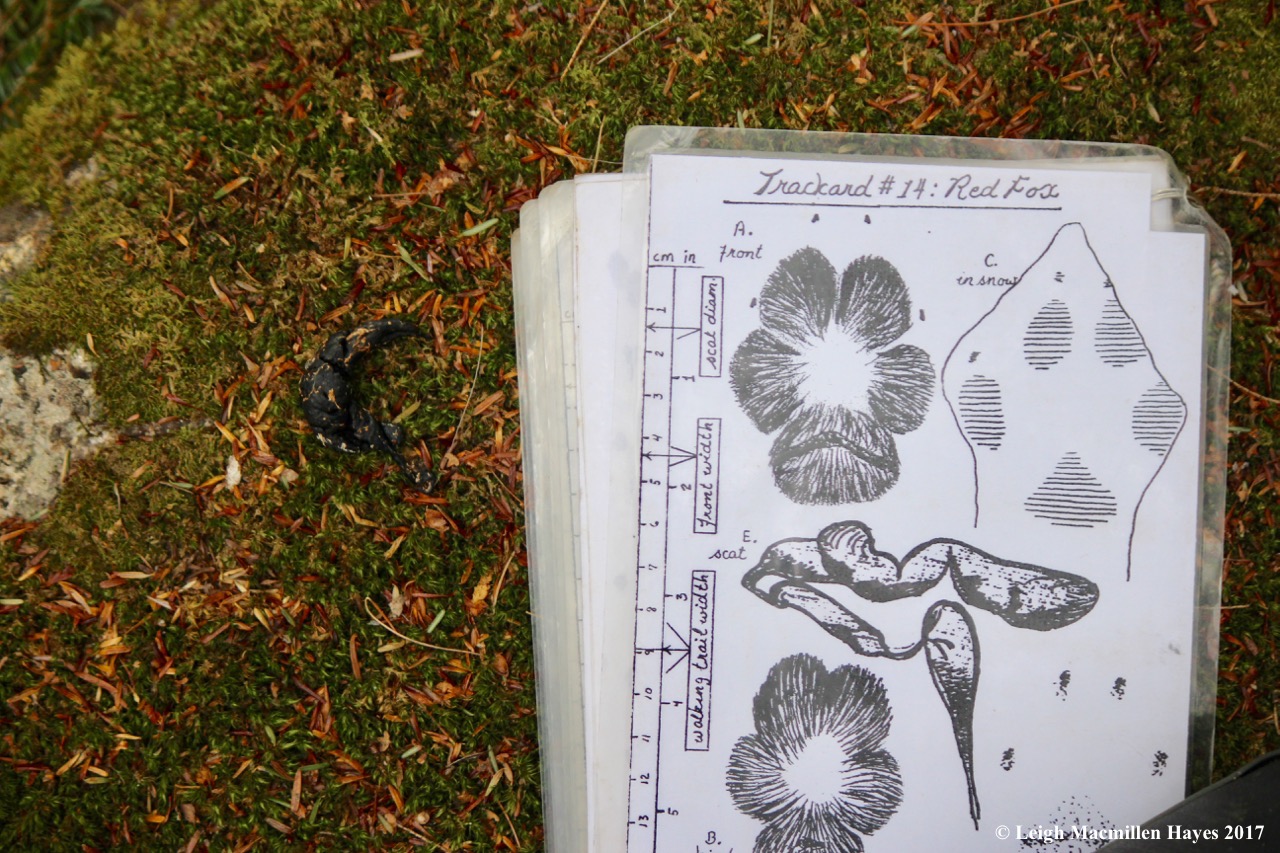
Beyond the Edge

My life is rich on so many levels and people are a huge part of that, despite the fact that I’m a happy loner and a happy introvert at heart.

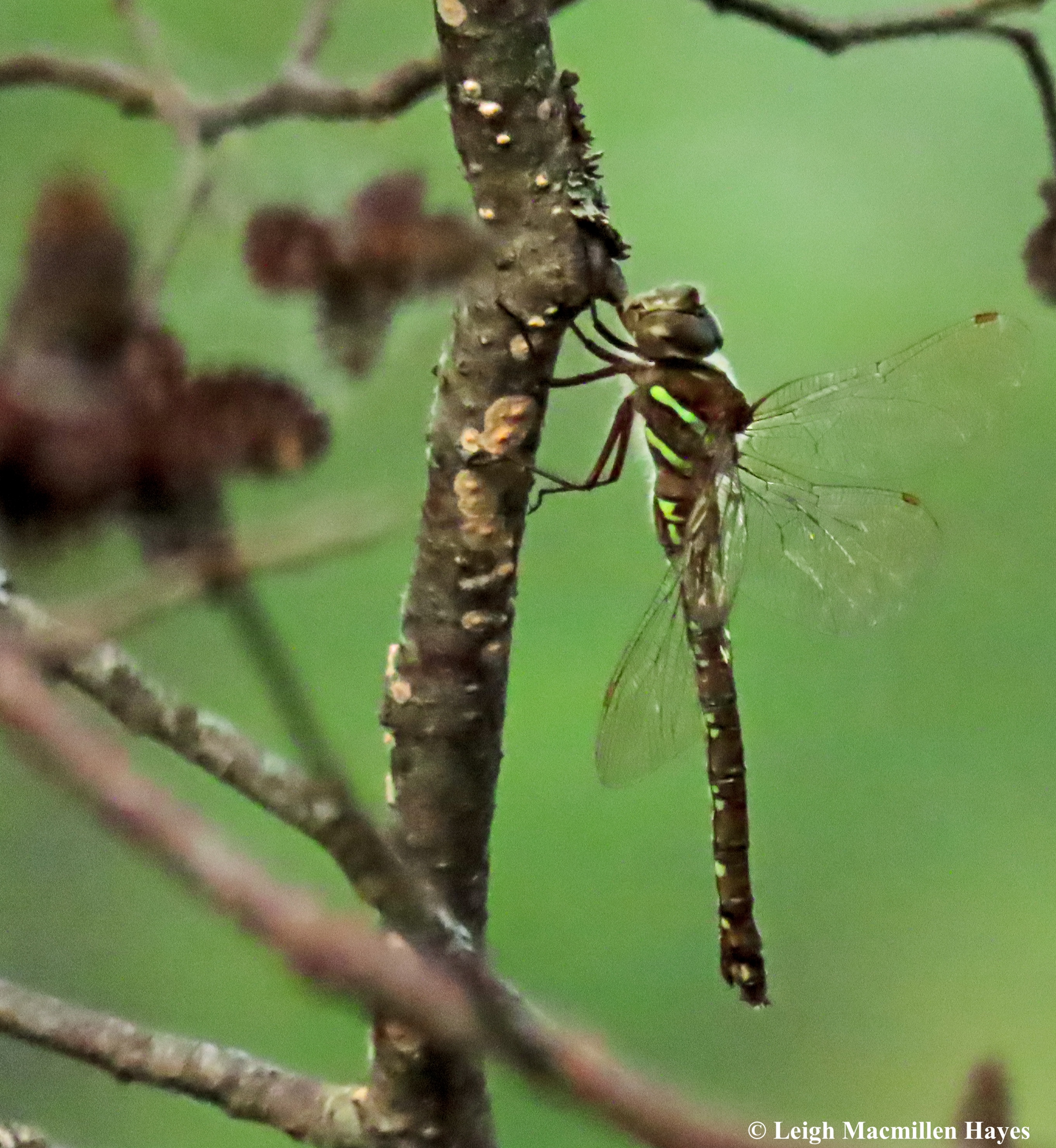
Just the other day, I wrote about the gift of a dragonfly specimen in Lessons in the Shadows.

And I actually saw a few Shadow Dragonflies on the wing this weekend, or pausing between defending territory, dining, and mating, or at least trying to do the latter.

But it’s other things that I noticed and want to share before I reveal today’s gift.

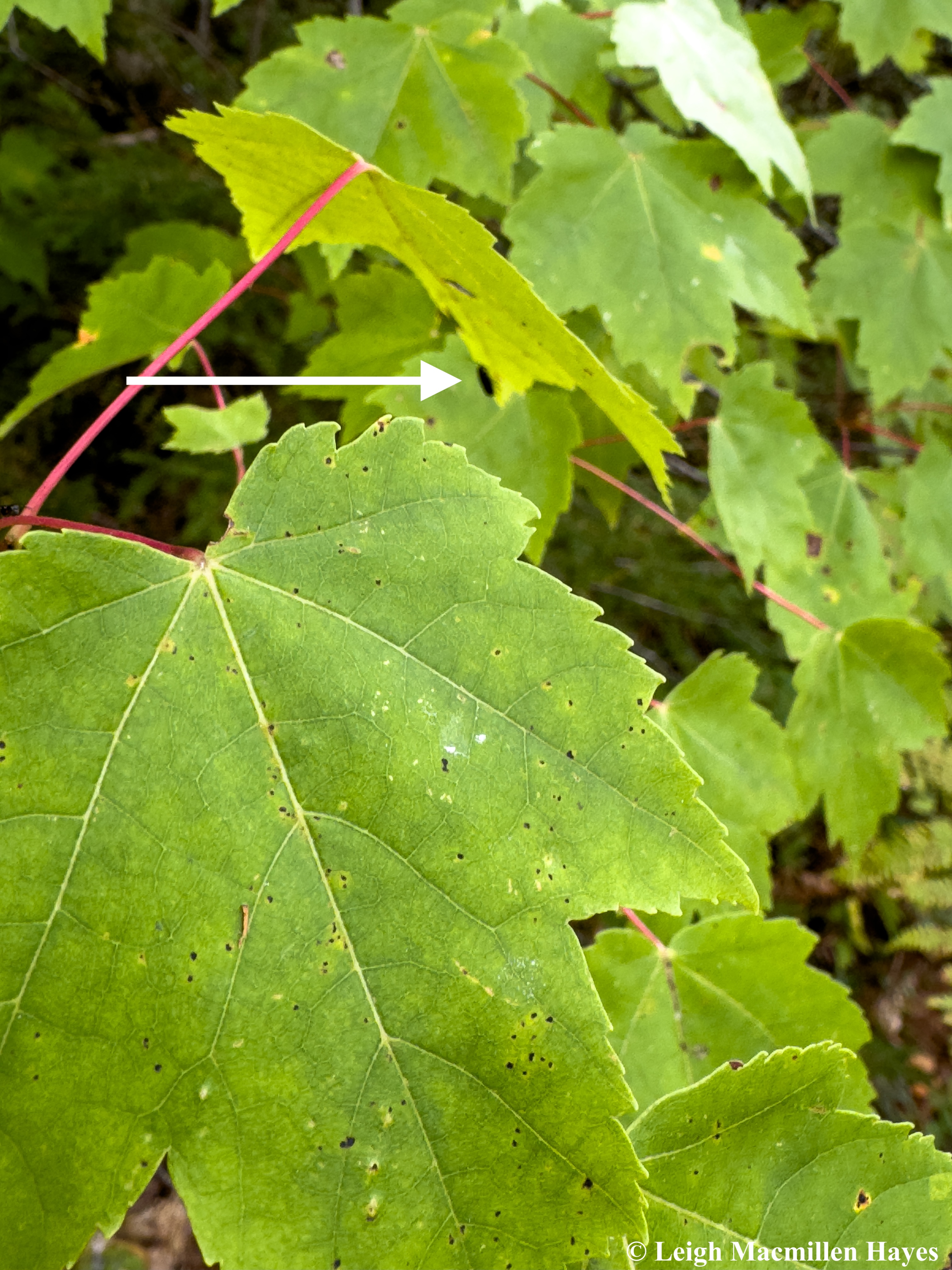
I do not know how I spotted this insect under a Red Maple leaf, but it was made known to me in the silence of a walk I took, and it too, was a gift.

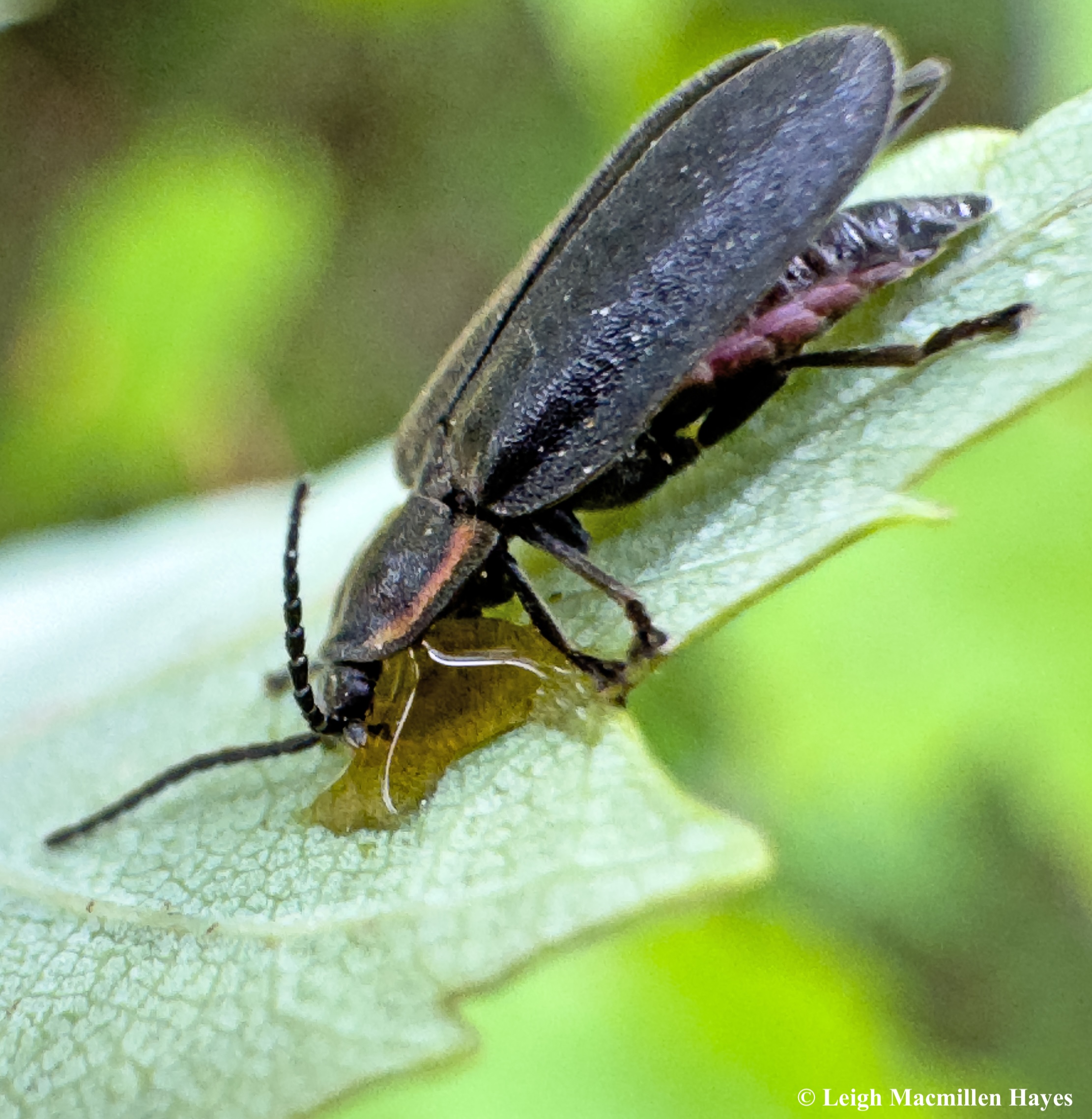
The insect was a Winter Firefly, a species I love to find in the winter months, usually on or behind tree bark, the latter being bark that has pulled away from the trunk. Winter Fireflies in their adult form do not light up our evenings, but the fact that we can spot them in winter is special enough.

They also don’t disappear once summer arrives and lately it seems, I’ve been spying them regularly.

But it is what this insect was doing that turned out to be so spectacular. Remember, I spotted it on the much lighter in color underside of the leaf, and then turned the leaf over to take a closer look.

Much to my surprise, it was dining. I’ve never really thought about them dining before, but of course, they must. And do. Like my Ambush Bugs, and yes, you’ll meet a few more of them later in this post because I can’t resist taking their photos, Winter Fireflies use their mandibles to pierce into a prey species, inject it with chemicals to paralyze it, and then add enzymes to the mix to turn the other insect’s tissues into a smoothie.

Right before my eyes, the Firefly drank its meal! Despite the fact that I was in its personal space. For moments on end.

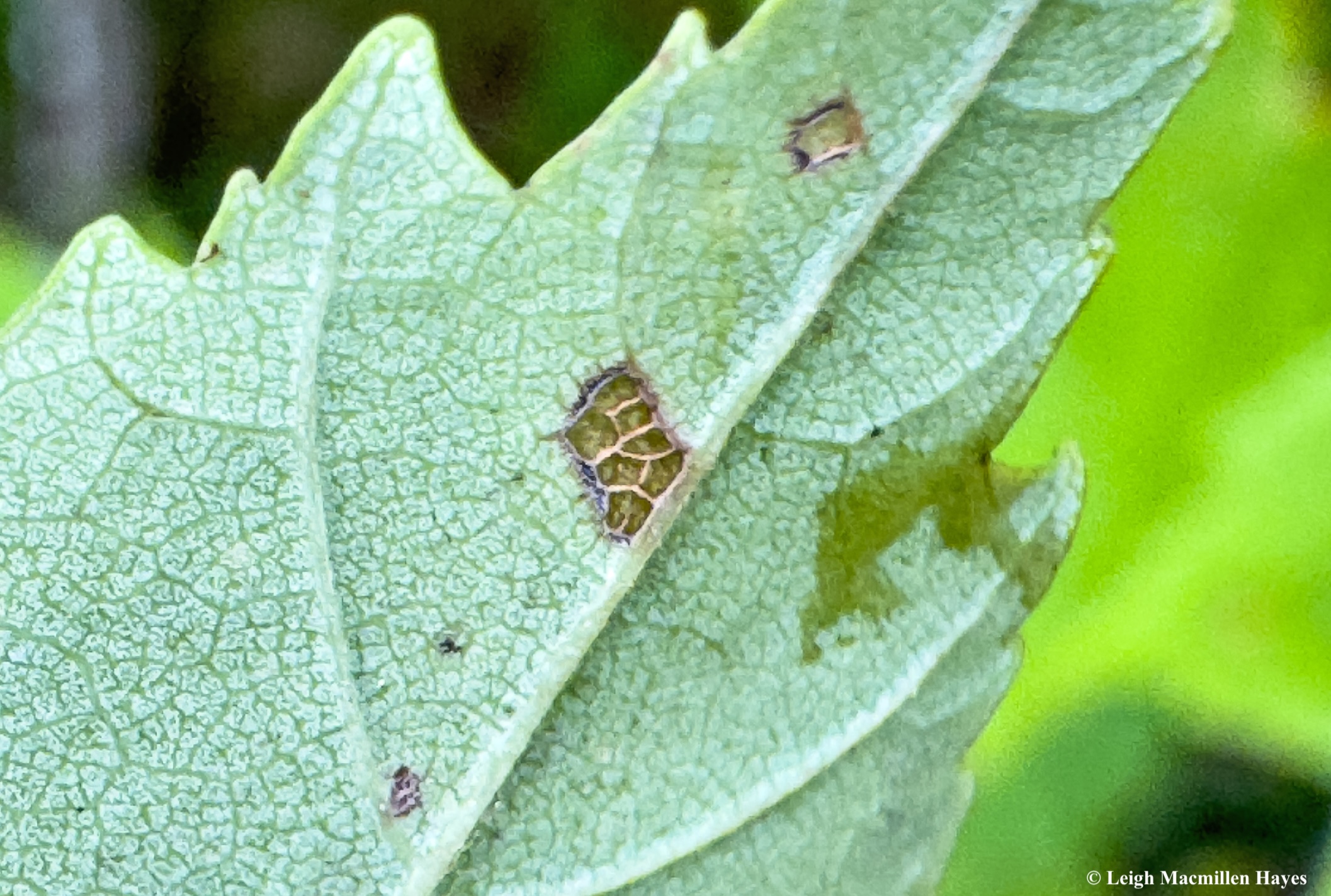
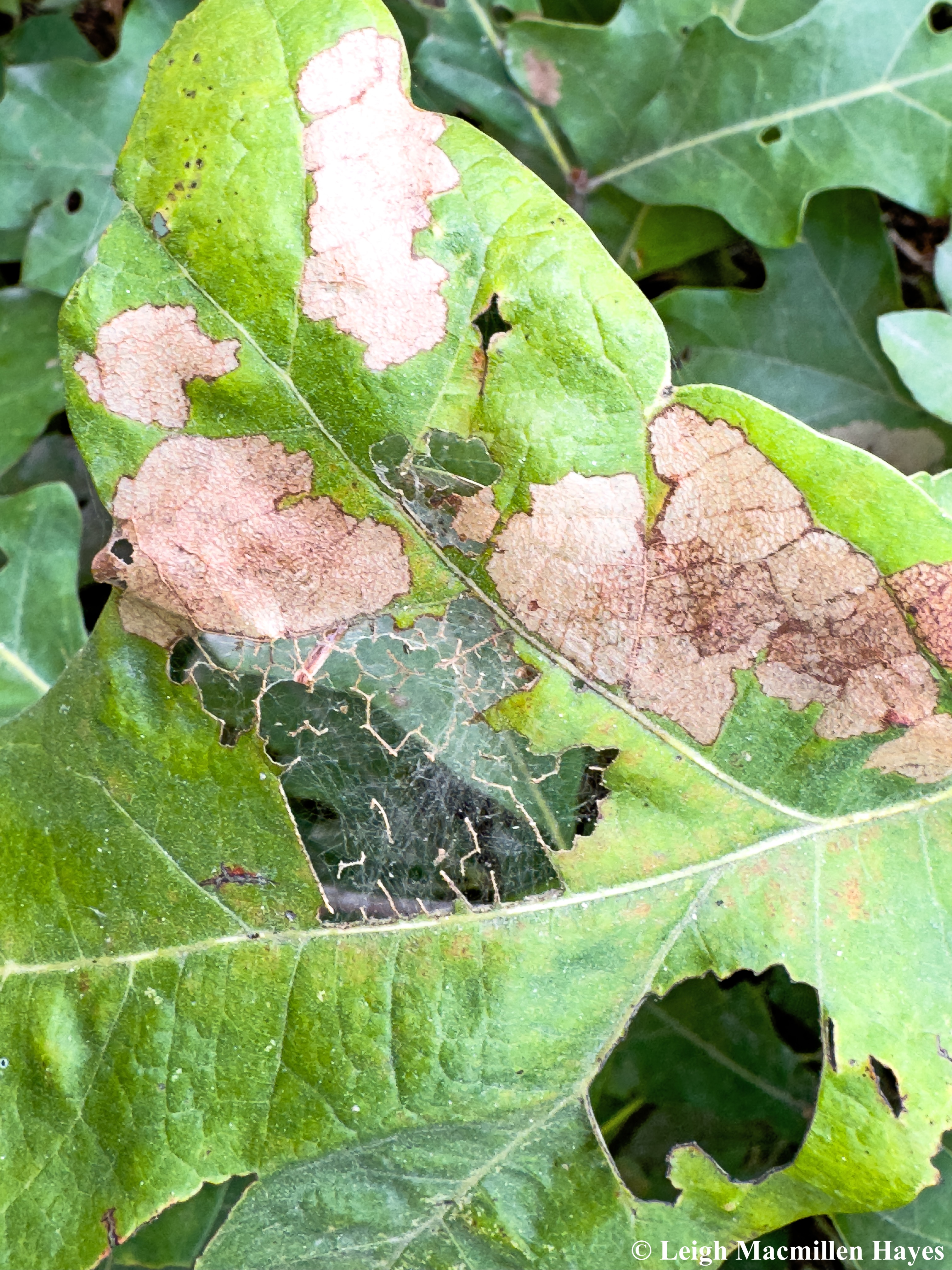
And when it had finished, there was only a remnant of the liquid form left and the Firefly moved on. But the other thing of note on this leaf is how another insect had chewed bits of the bottom layer of the leaf, leaving a skeleton of veins that provided a window to the next layer. I’m always trying to show people this by pulling leaves apart, and often meet with little success, but this leaf showed me that it is possible.

And then, because I was suddenly focusing on leaves, I began to notice a variety of structures that were not leaflike.

Oak Galls. In the Summer 2025 issue of Northern Woodland magazine, Michael J. Caduto wrote the following: “Oak galls are tumorlike growths caused by small wasps . . . Oak galls make up about 80% of the roughly 700 different kinds of plant galls formed by insects in the USA, and most of Canada and Mexico . . . During the spring, adults lay eggs in the tissues of leaves or twigs and at the same time inject substances that induce the surrounding plant tissue to grow in a particular manner and at an accelerated pace.”

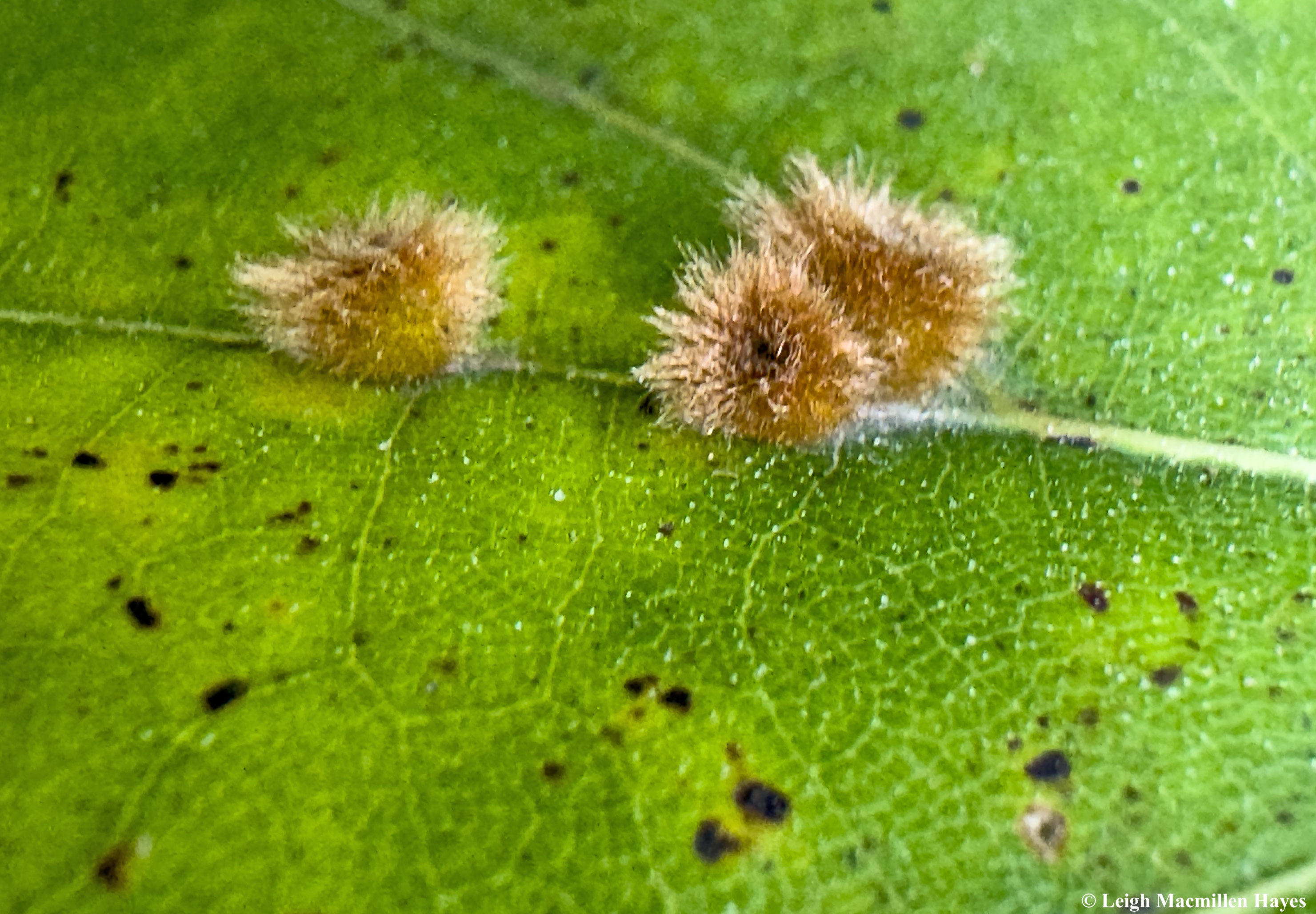
Above are pictured some woolly oak galls that result from the growth of tiny hairs on the leaves.

Gall tissues protect the wee wasp or midge larvae that develop inside, and they also provide food. As the young grow, the galls increase in size due to something in the insects saliva that imitates the plants growth hormone. Nature is amazing.

Those photographed above are caused by Oak Leaf Gall Midges. They are cosmetic and won’t harm the tree. After all, the leaves fall off in the autumn anyway, and until then they have done their duty of feeding the tree despite being laden with galls.

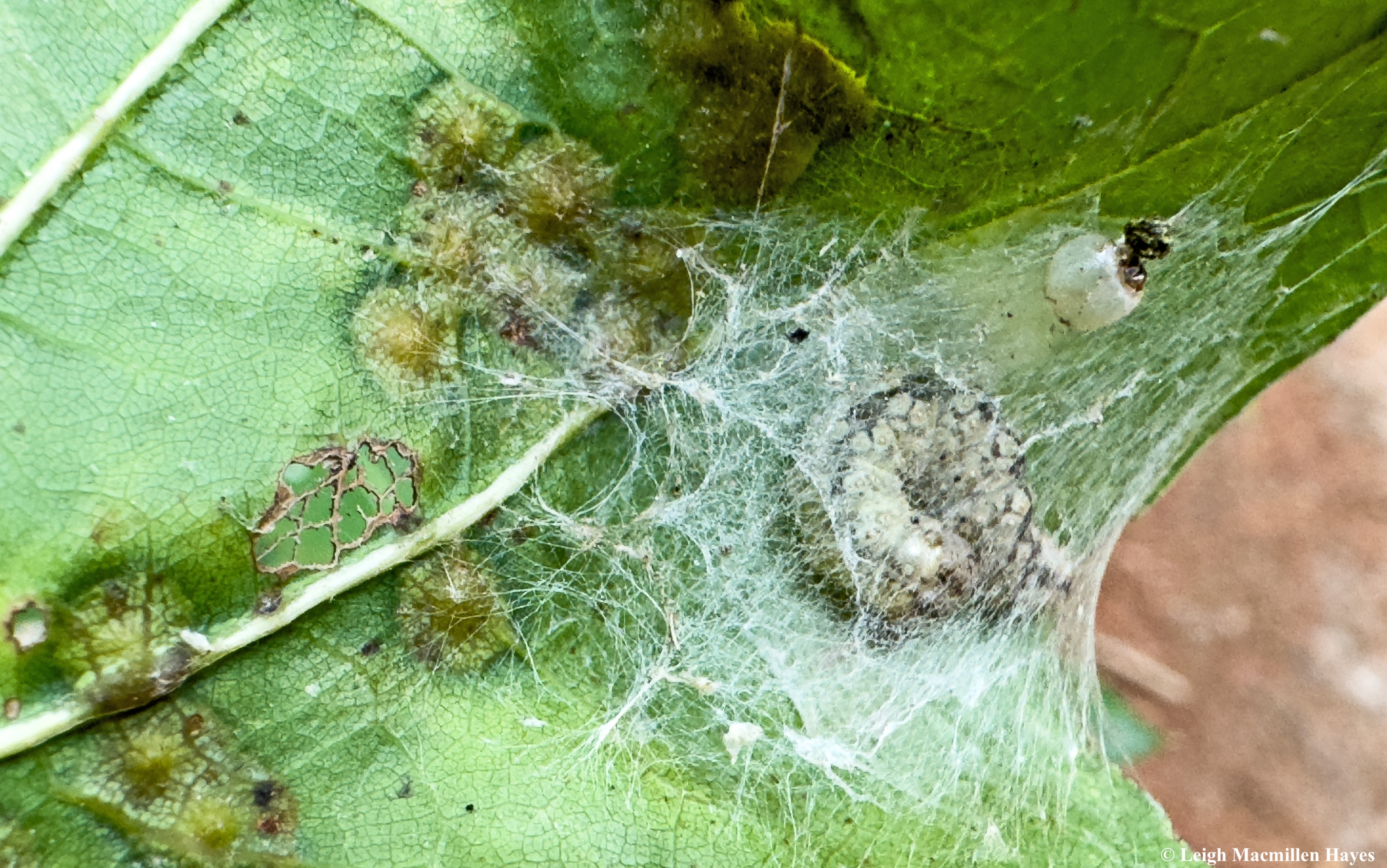
When I turned the same leaf over to look at the underside of the galls, I found a caterpillar who was ready to pupate and possibly the egg of another insect. So much going on in such a short time, given that in the north woods our leaves are only on the trees from mid-May through October or maybe a wee bit beyond for the most part.

Upon the underside of another leaf, I found Oak Leaf Seed Galls. They were quite small, and it looked like the initial gall was a dried papery structure within which were clusters of smaller galls.

And then I found one of my favorites, the Oak Apple Gall. I’ve written about this before following a visit to Trinity College in Dublin, Ireland. There, My Guy and I took the self-guided tour of the 18th century Old Library and viewed that most ancient of manuscripts–the Book of Kells, a 9th century book featuring a richly decorated copy of the four Gospels of the life of Jesus Christ. A favorite discovery: the monks used Oak Apple Galls to create ink–apparently, they crushed the galls and soaked them in rainwater, wine or beer until they softened.

What was cool about the one pictured above, was that the adult wasp had chewed its way out and I could see the fiber-like structure, those threads radiating from the center, that had supported its pupating form. Perhaps to keep other insects from parasitizing it.

And lest you think galls only occur on leaves, here are some on twigs, these being created by the Banded Bullet Gall Wasp.

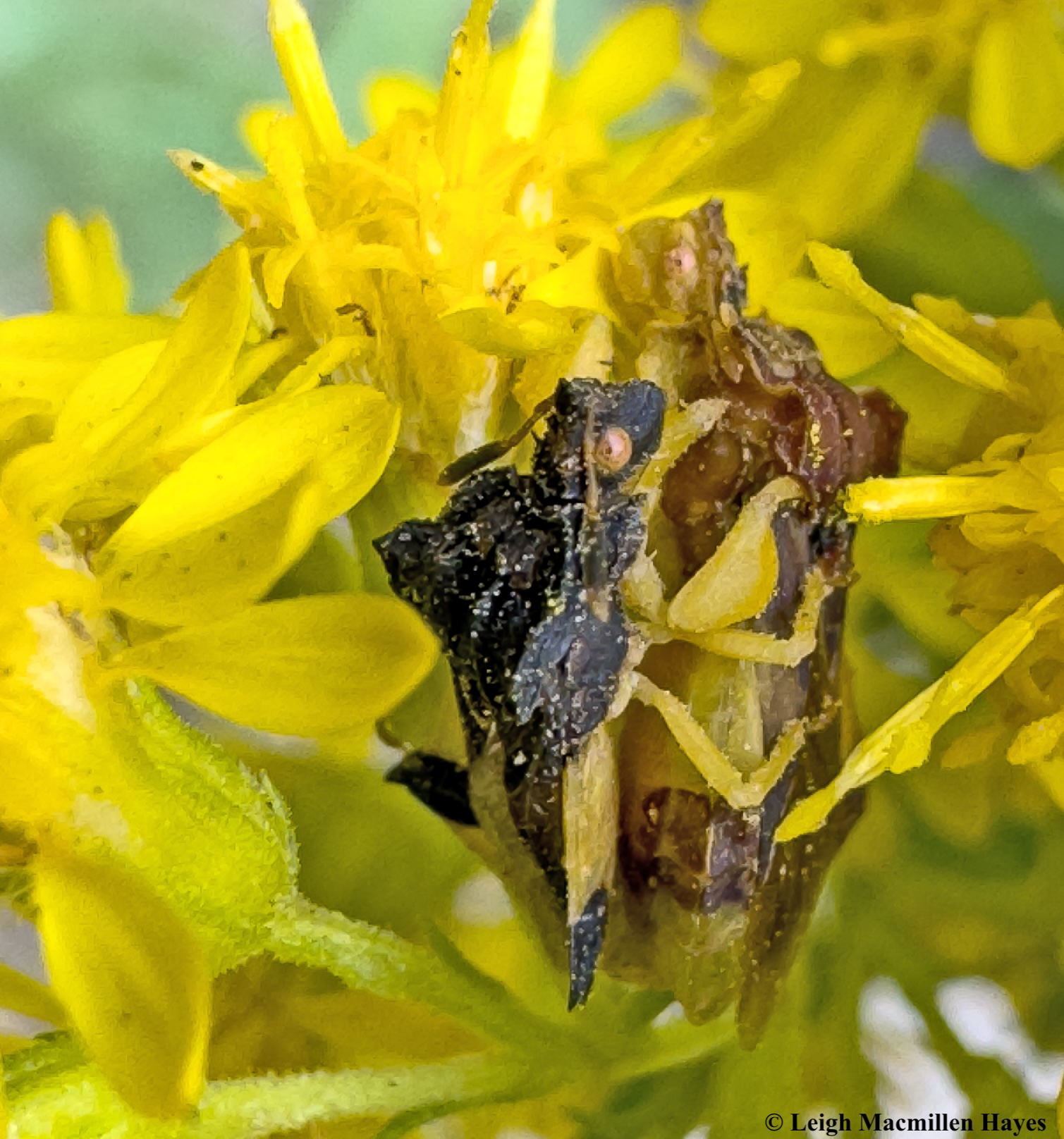
And then without meaning to, but because the path I followed offered some Asters in bloom, I began to meet my old friends, the Ambush Bugs, this one being a male.

And on another, a female.

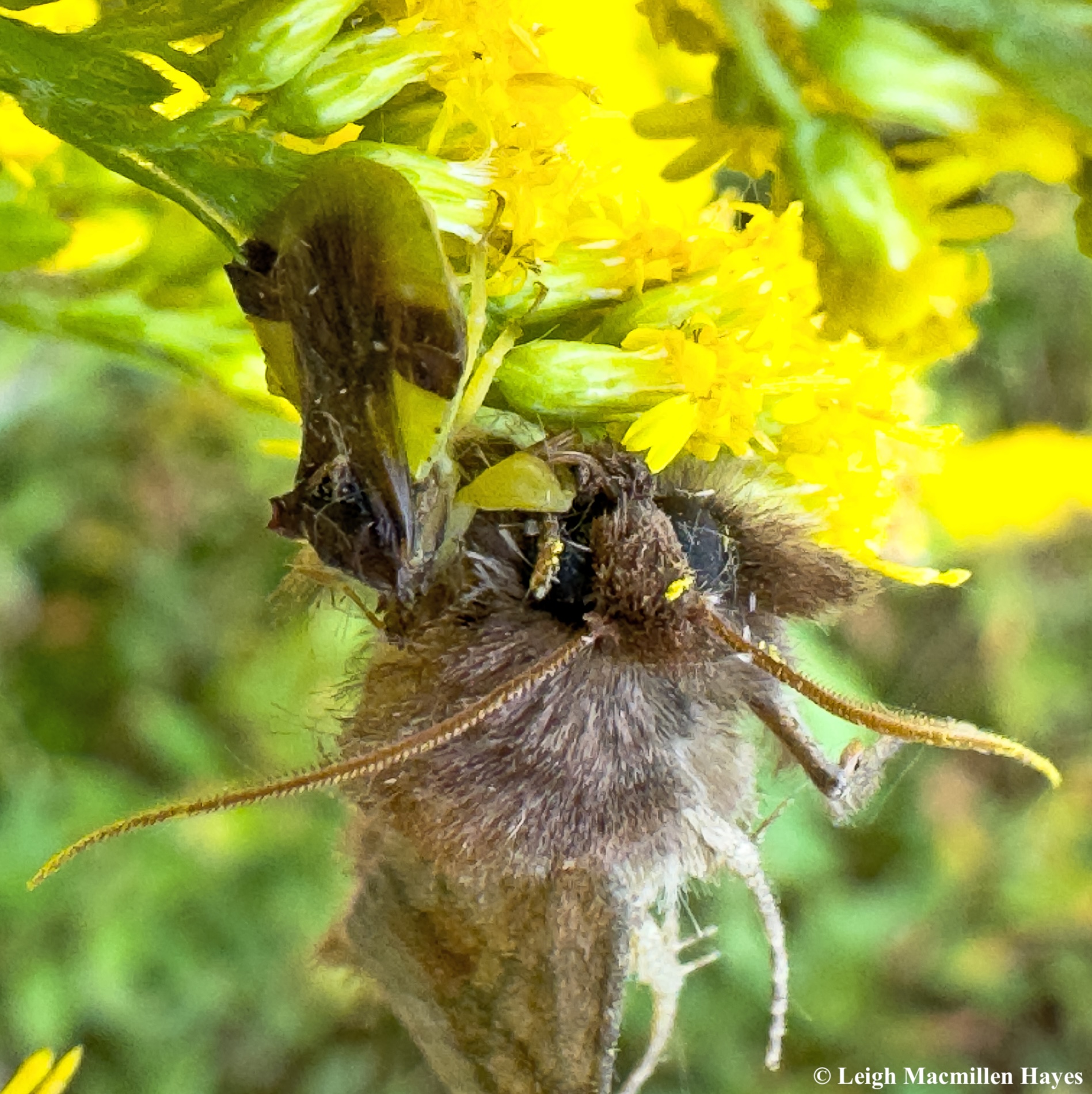
Wherever Ambush Bugs are, I look for their feeding sites, made visible by insects dangling in unsuspecting manners like this moth.

And tada, there she was having a go at a major meal.

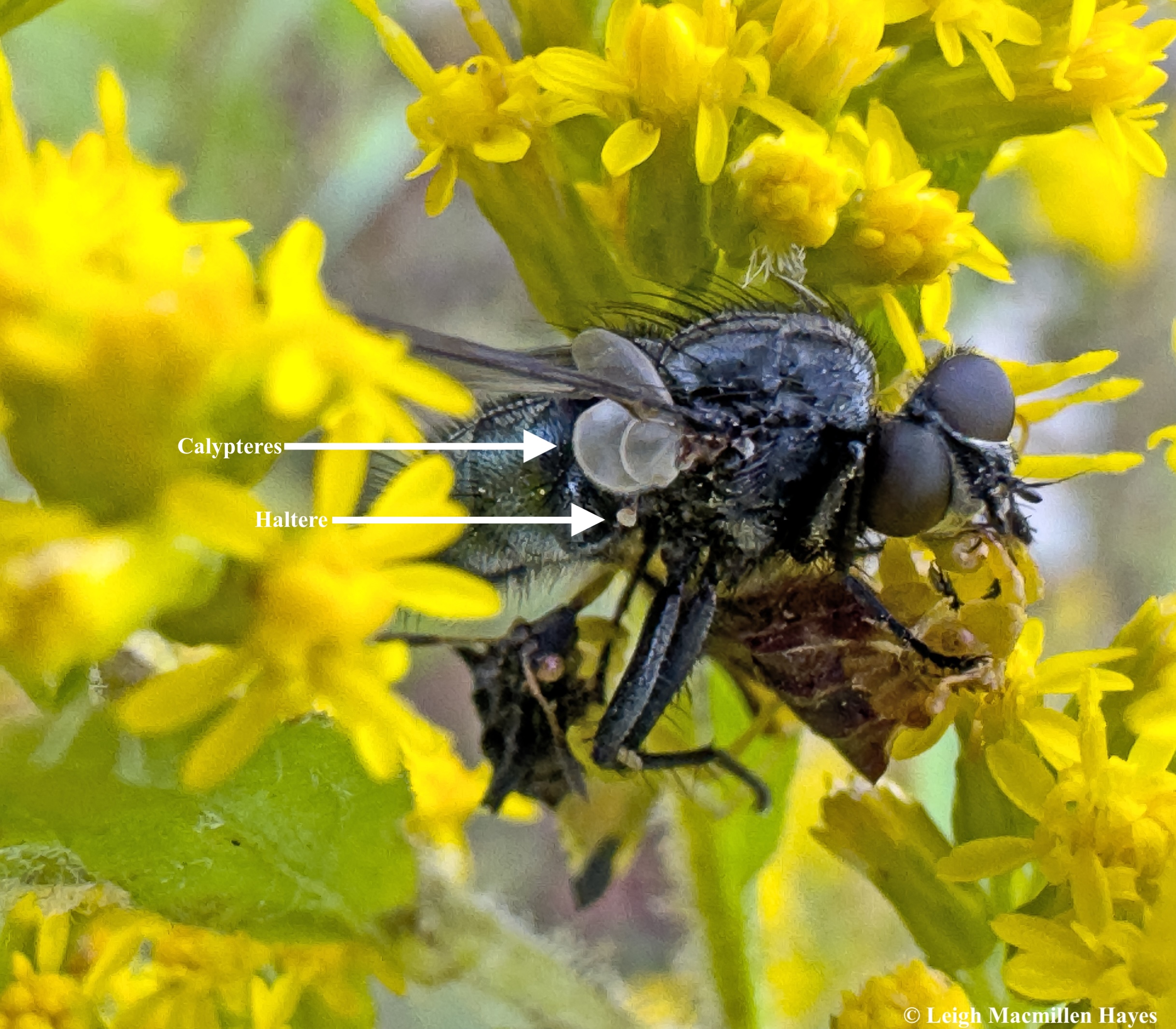
And sometimes those meals teach me other things, such as this fly that was being dined upon by both a male and female Ambush Bug. But more importantly, I captured the fleshy white structures on the fly. Those are calypteres! The calypteres are small membranous flaps or lobes that are located at the base of the wing in some species of fly. Flies often have two calypteres (commonly called the upper and lower calypteres) on either side of their bodies. And they cover the halteres, the little knobs that take the place of hind wings. You can see the little knob or haltere sticking out a tiny bit below the bottom-most calypter. Sooo cool. A new learning for me.

And then trying to hide within the Goldenrod blooms elsewhere, a canoodling pair.

Upon another plant that had gone to seed, a Dusky Stink Bug lurked, one of the smallest of the stink bug species.

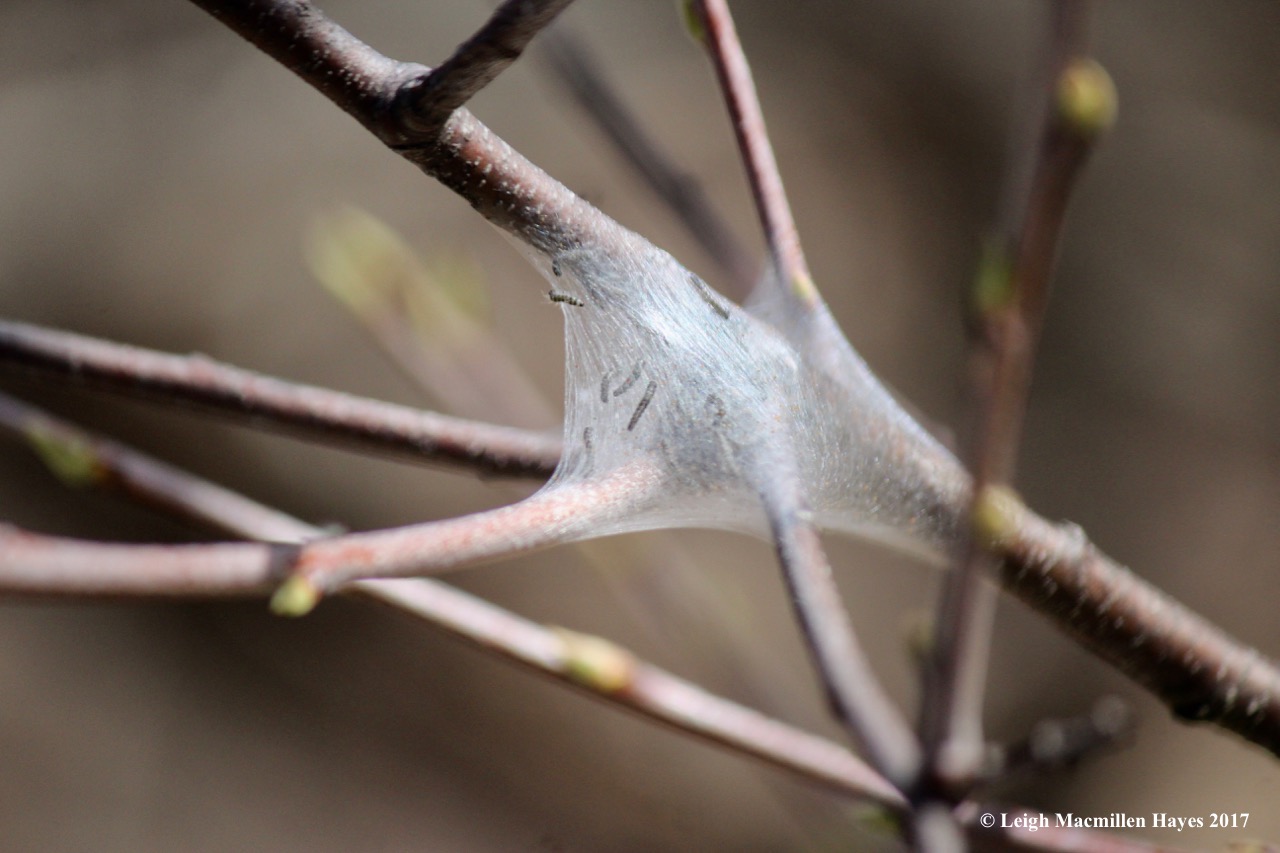
In another spot, something else caught my eye. Yes, it’s bug related. This is the egg mass of Tent Caterpillars. There might be up to 400 eggs encircling the twig on this Cherry tree. The mass is shellacked with a substance that will protect it throughout the winter, thus the reason for its sheen.

Because I’d been looking so closely at insects or insect structures, it struck me as interesting the various ways different insects dine upon a given leaf, from those who eat all of the cells and veins, to those who leave most of the veins as they skeletonize the leaf, to those who mine between the upper and lower leaf surfaces. All of this on one leaf. And still it was green and had done its food factory work for the tree.

I was almost back to my starting point when I noticed new leaf growth on some trees, which given that its September surprised me. But these days, nothing should surprise us.

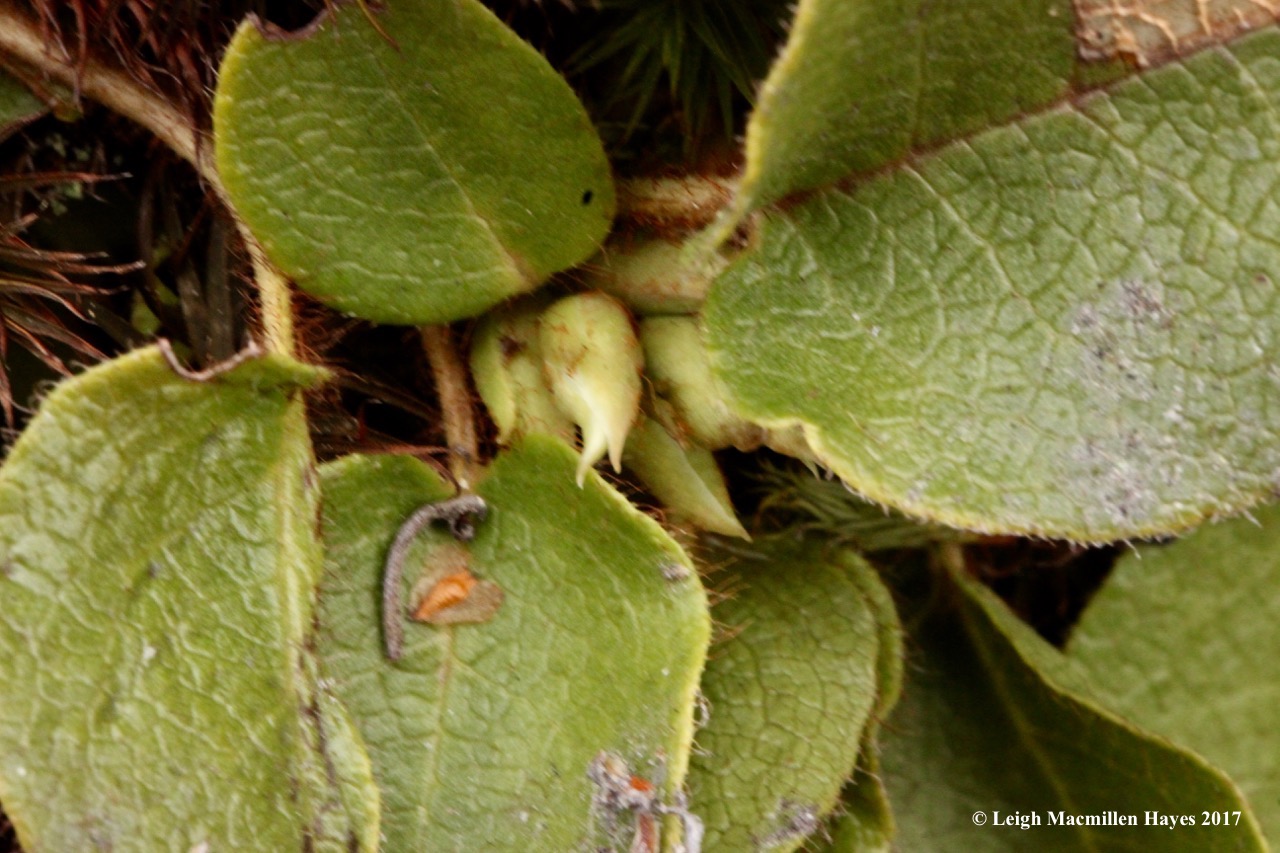
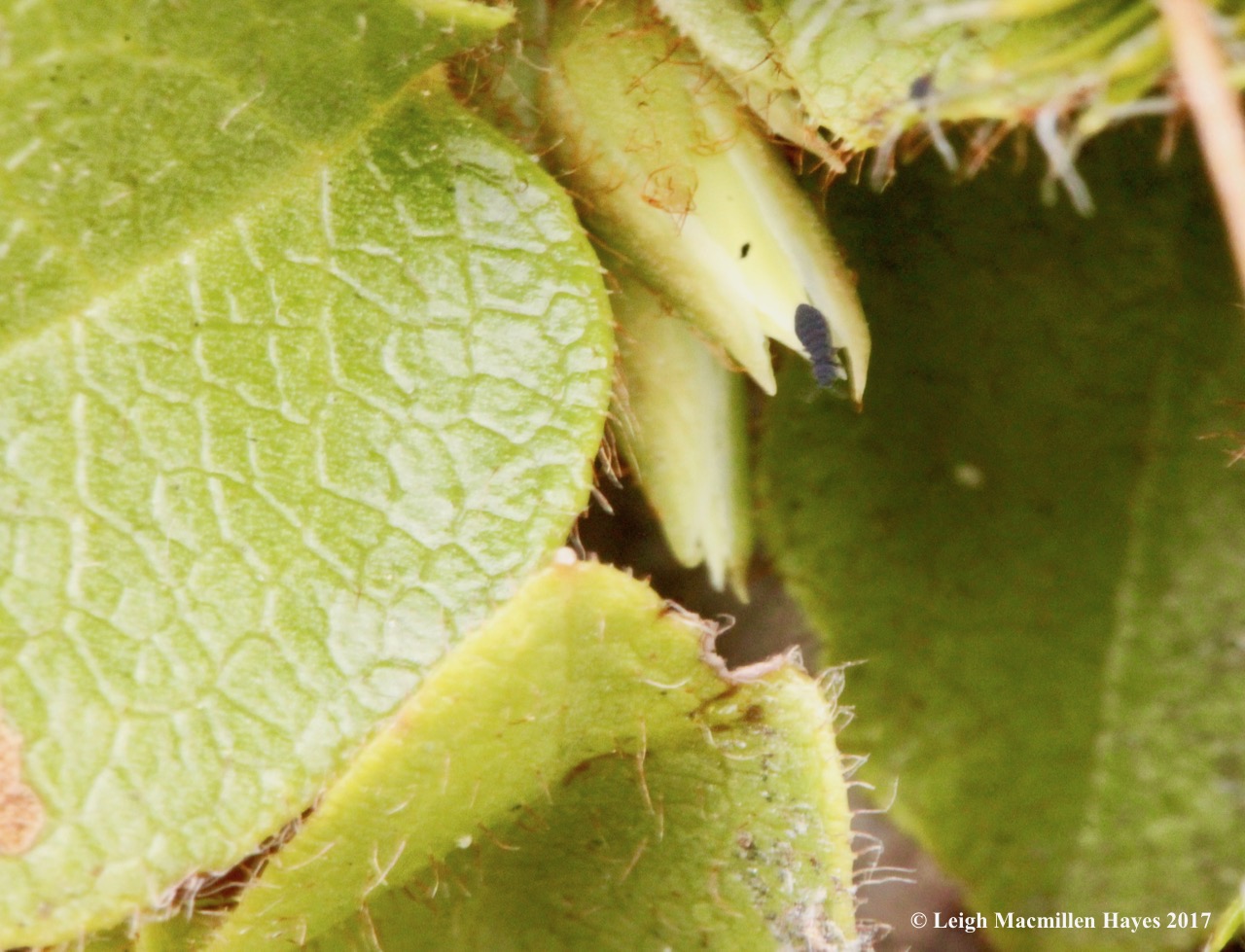
Until something does. For right there on the same tree an anomaly caught my eye. Do you see what I saw? Yes, lots of munching. And yes, lots of new and older leaves. But take a look at the buds. One bud is not like the rest in the crown.

Because it wasn’t a bud. Hiding in that spot was an insect I am only familiar with in its larval aquatic form. It’s a cool one for it builds its own home depending upon its species, some using hemlock needles and maple flowers, others specks of sand, and still others plant or tree material, while some are net spinning and others free-living.

What I’d had the good fortune to spot was a mature Northern Caddisfly. As adults, they don’t have mouthparts, their only job being to mate. Adults don’t live more than a month, and I felt honored to have spotted this one. And Caddisflies are indicators of clean water. I was truly honored to spot this insect.

In the same way, I was equally honored to receive this gift of music created around words I’d written in a blog post in 2018, entitled From the Ground Up, where I’d offered the history of St. Peter’s Episcopal Church where I am a parishioner and then focused on all of the other species who had gathered on the ten-acre lot.

Thank you, Richard Michael Joseph, composer, musician, tenor, and chair caner, for taking my words and writing music to embrace them. Beyond the Edge indeed. Thank you also Richard, for your part in making my life so rich.

Step into the woods beyond the edge, and know that life carries on in the most incredible ways, we just have to be open to receiving them.

Becoming Tree Wise

So here’s the deal. A friend and I were supposed to lead a tree workshop today, but the weather didn’t cooperate. I’m not complaining about the few inches of snow–it’s the sleet that came first and the rain that is now eating up some of the snow that bothers me.

That said, I’m going to take you on a deep dive to meet some of the trees of Maine in their winter format. We are so fortunate to live in a section of the country where there is such variety, but that doesn’t mean we all know a species with just a quick glance. Oh, maybe you do. I know I sometimes have to slow my brain down before my mouth makes an announcement.

I found a drawing of a tree “cookie” on the internet this past week and decided to recreate it in one of my sketch books this morning. I like it because it helps me better understand how a tree works.

The key factor here is that trees are made of . . . wood. You knew that. But, what exactly is wood? Think scaffolding and plumbing. A tree needs structure to grow so tall, but it also very much needs food and water. Two components, therefore, make up the wood: Xylem and Phloem. Xy (think sky high) transports water from the roots, while Phloem (Think flow low) moves the sugar made in the leaves via photosynthesis during the summer down through the trunk.

As you can see from the sketch, the Phloem is only present on the outer layer of a tree–right under the bark. The Xylem makes up the majority of the wood.

And all those Xylem cells–they are made up of an outer wall of lignin, which gives the trees structure, and an inner layer of cellulose, which provides flexibility. Some trees, like Gray Birch, have a high concentration of cellulose, thus allowing them to bend under the weight of the snow, usually, but not always, without snapping.

The Xylem actually acts as a bunch of straws pulling up water, along with nutrients and minerals, from the soil. But can we actually see this action occuring in the trees? The answer is a resounding, “No.” It’s not at all like we might use a straw to slurp up a frappe, but rather a passive flow, where the water molecules evaporate through the stomata (holes in a leaf surface, similar to our pores), they draw other water molecules upward from the soil to the roots, and the roots to the Xylem, and the Xylem to the leaf, and the leaf to the air (Think water vapor = Transpiration).

Going back to the sketch above, the early wood of each year, which occurs in spring and summer, is much lighter in color than that of the late wood, but the two together create a ring documenting that particular year.

The heartwood, which isn’t labeled, is the inner core. It provides support for the trunk and is actually dead because over time the Xylem gets clogged up with resin. And each year more of the tree dies from the inside out.

If you are still with me, let’s get to the actual trees I want you to meet.

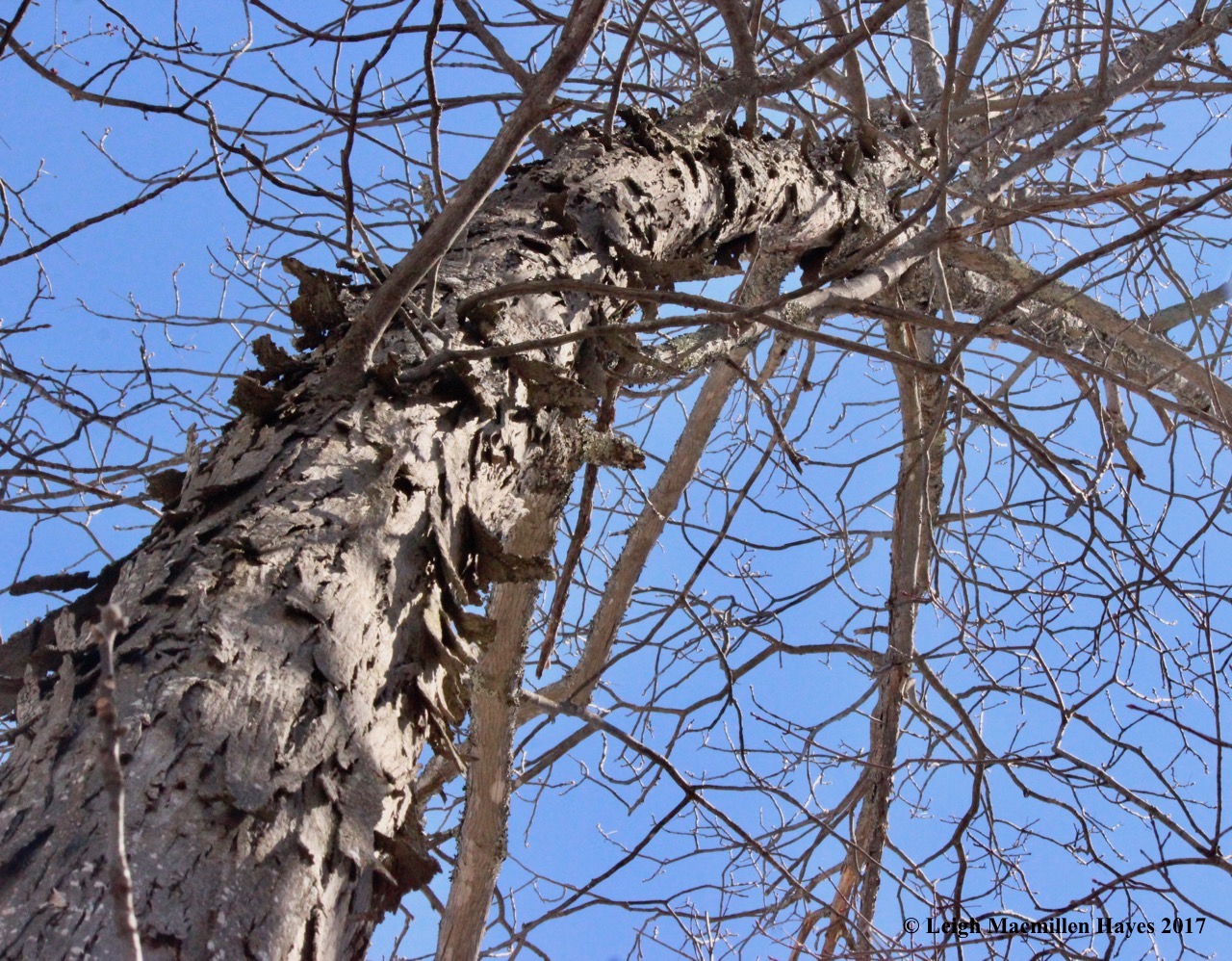
Up first is a White Ash, Fraximus americana. This is one of those species that once you get to know it, you spot it from a distance because of the pattern of the bark. What exactly is the pattern? Well, I see intersecting ridges that form obvious diamond-shaped furrows which appear as an X or cantaloupe rind, but others see an A for Ash, and still others see a V, and some even spy a woven basket. The thing is, whatever pops out for you and will help you identify it in the future should be your go-to image stored in your brain.

One of my favorite things about Ash bark is that it is corky and after a storm, you can pinch water out of it or stick a fingernail into it.

The twig is quite stout and ashy-gray in color. The buds are opposite, and the terminal bud at the tip of the twig is rounded or dome-shaped.

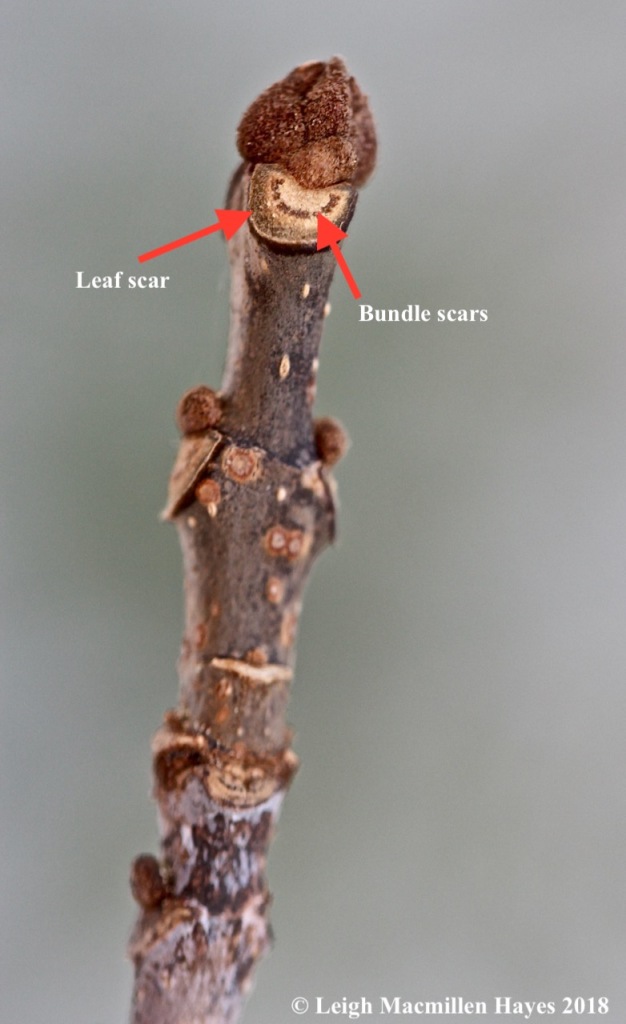
One of the features that speaks to the color of this Ash is the shape of the leaf scar below the new bud. A leaf scar is where last year’s leaf was attached until the end of the growing season. At that time an abscissa layer formed between the petiole (stem) and the twig. The leaf fell off and the tree healed the wound quickly with a protective cork. The bundle scars are part of the pipeline as they were the vascular tissue contained in the petiole of the leaf. Each tree has its own number of bundle scars located within each leaf scar.

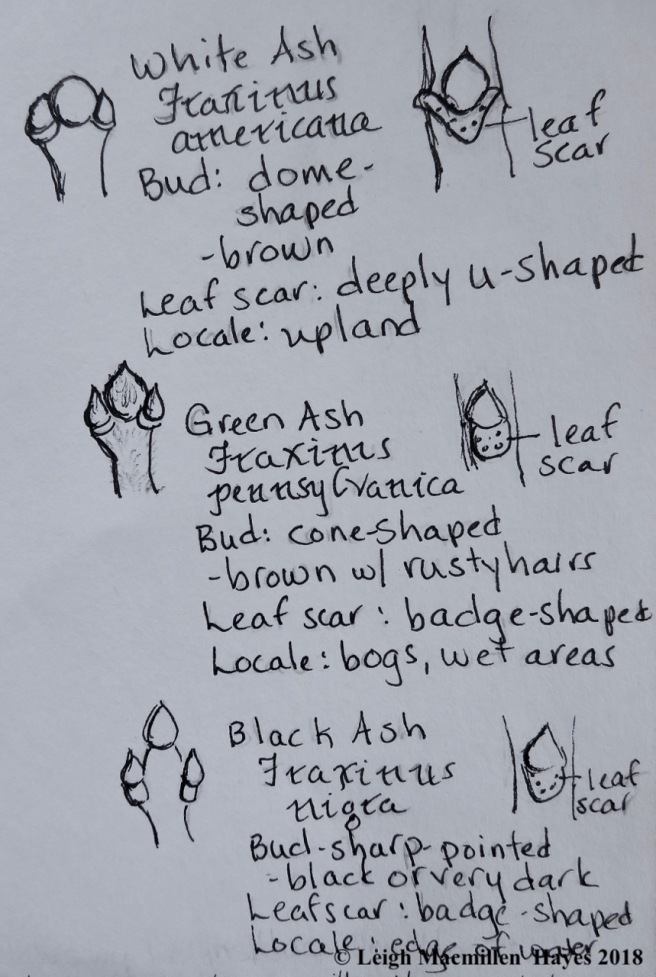
Back to the shape–can you see how the bud dips a bit down into the leaf scar rather than sitting across the top of it. This tells us it is a White Ash and not a Green Ash. Add to that the fact that the terminal bud is not hairy.

And my rendition of White Ash bark.

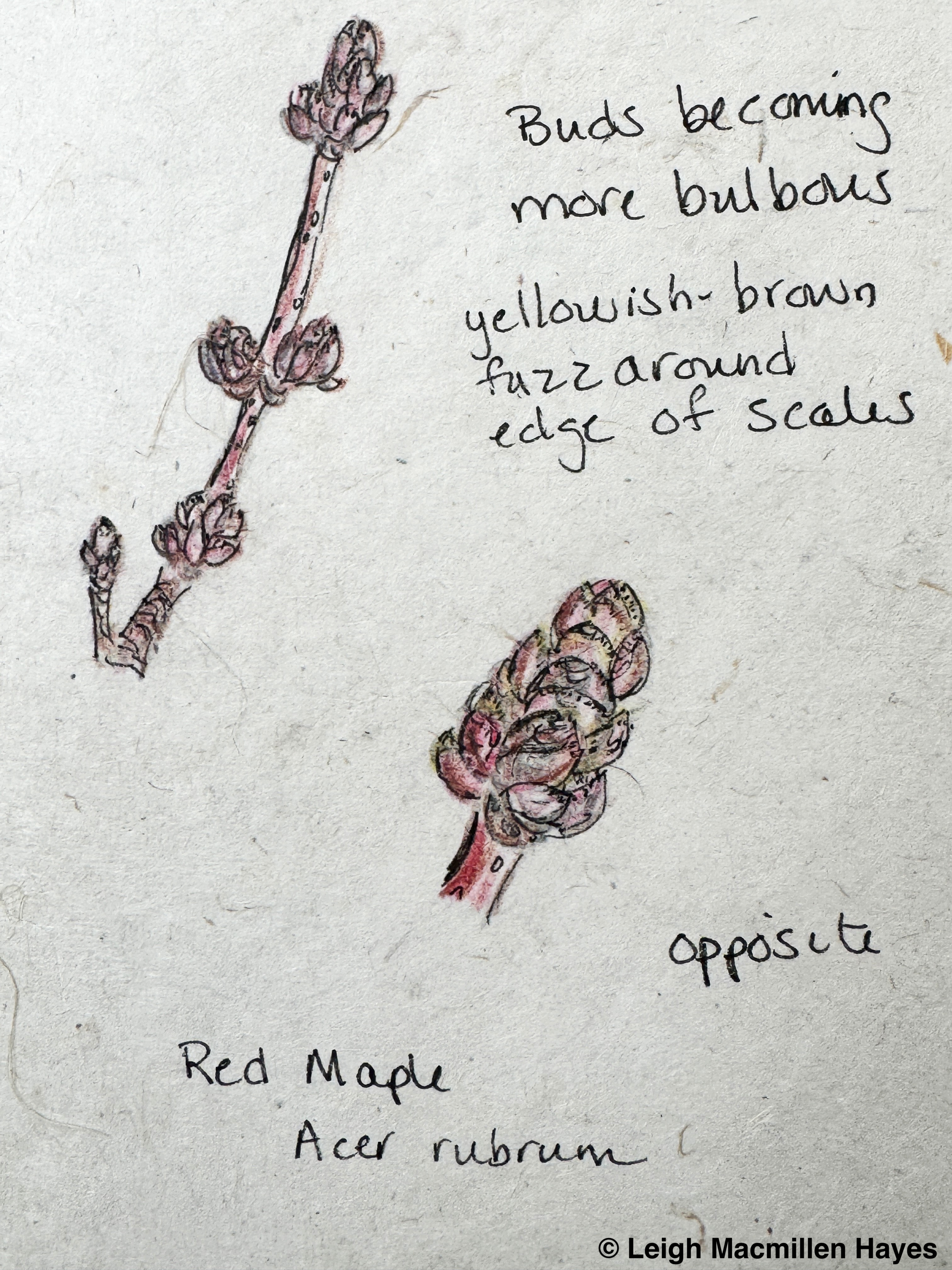
Up next is another favorite. Oh never mind. They all are my favorites. This is a Red Maple, Acer rubrum.

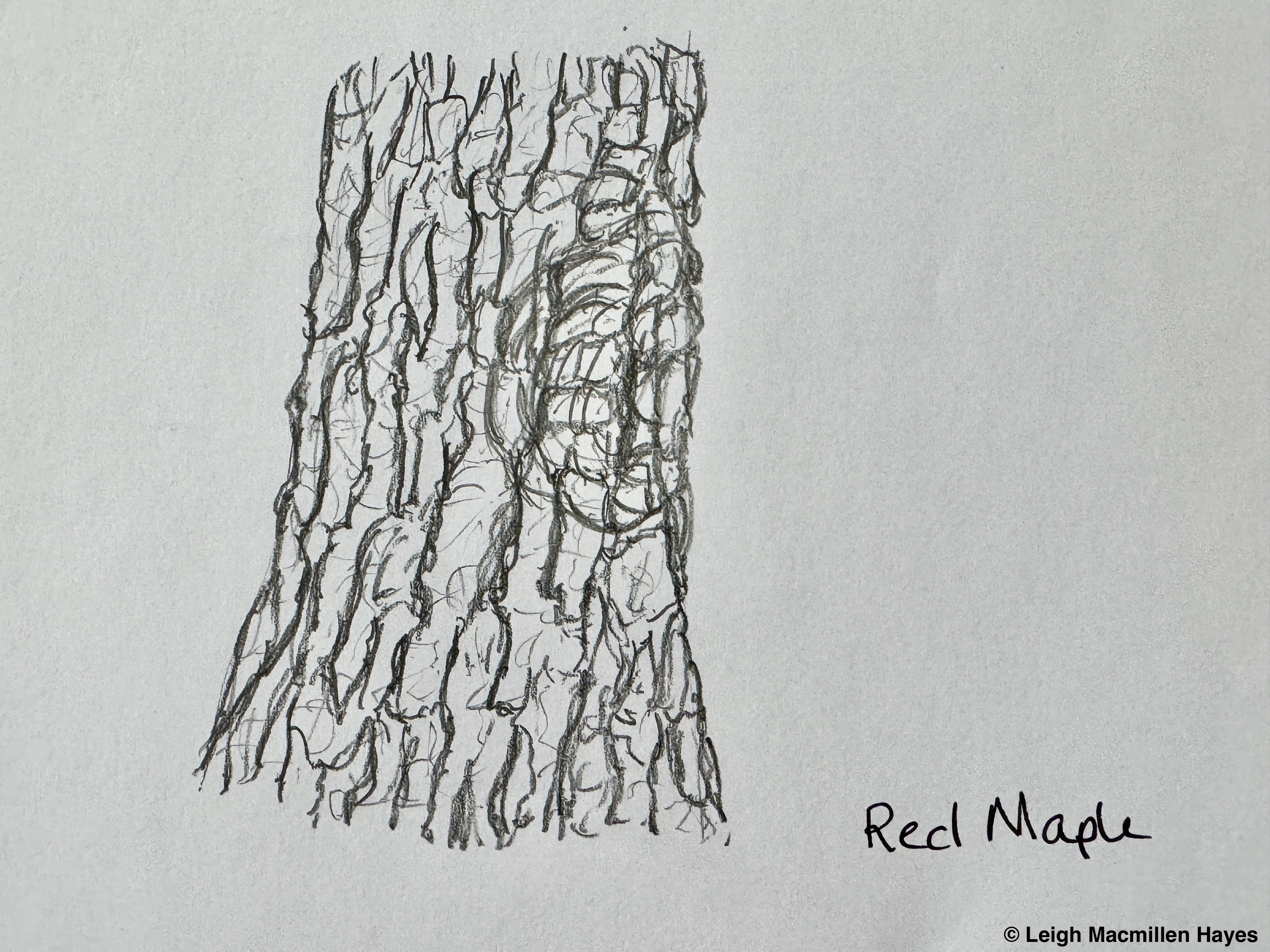
The bark is light to dark gray in coloration and almost smooth with crackled, vertical, plate-like strips. It curls outward on either side, and on older trees, look for tails to curl out on ends of strips.

Sometimes, it is difficult to determine if a maple is Red or Sugar, but one of the clues I look for is the Bull’s Eye target on the bark. There are several on this one, can you see the rounded patterns that aren’t completely formed? The target is formed as a reaction to a fungus.

Again, this is a tree with opposite branching. So one of the keys to tree ID is to know if the branching is opposite or alternate. I love this mnemonic devise: Very MAD Horse. Trees/shrubs with opposite branching include Viburnums like Hobblebush; Maples; Ash; Dogwoods (unless it’s the Alternate-leafed Dogwood); and Horse Chestnut.

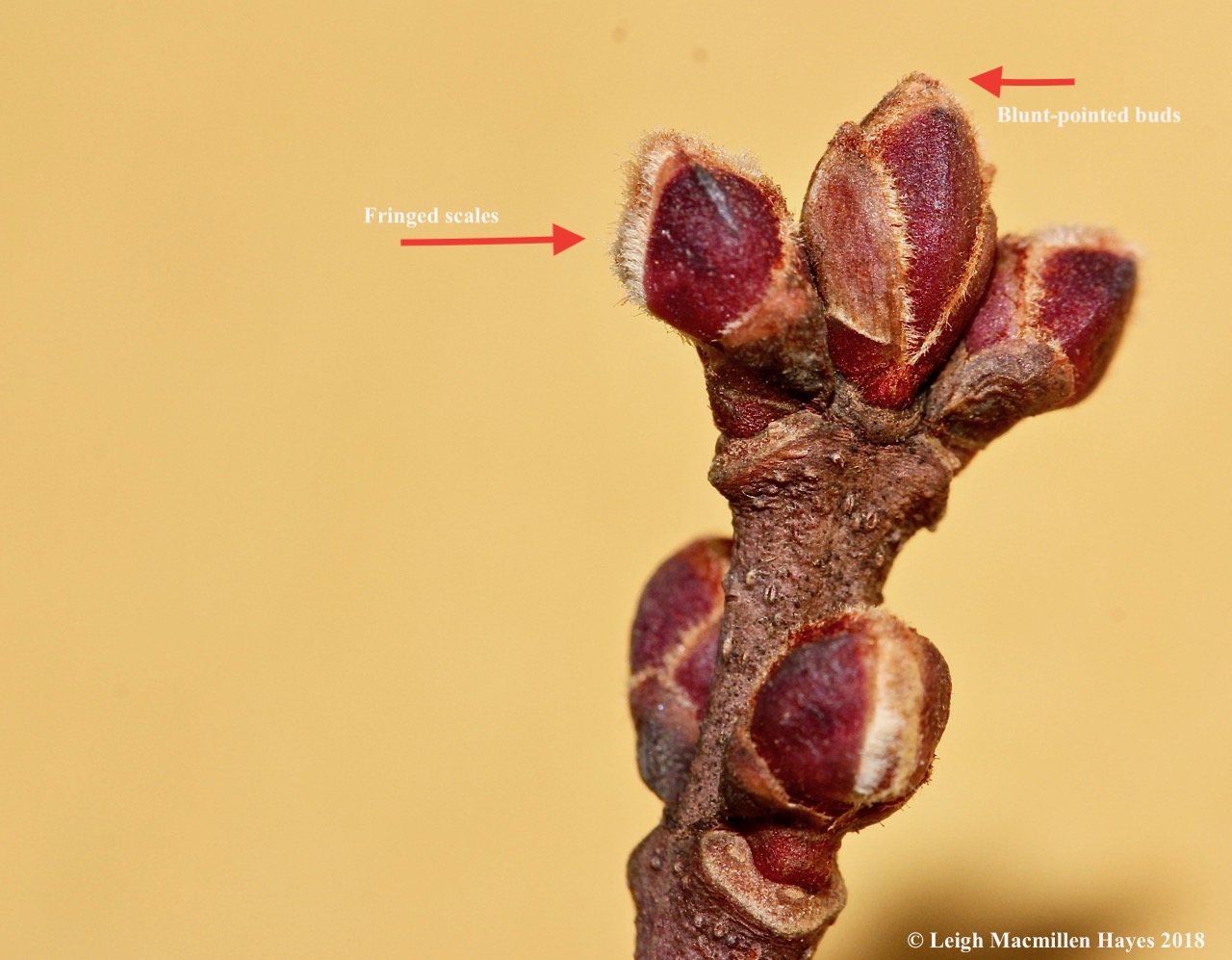
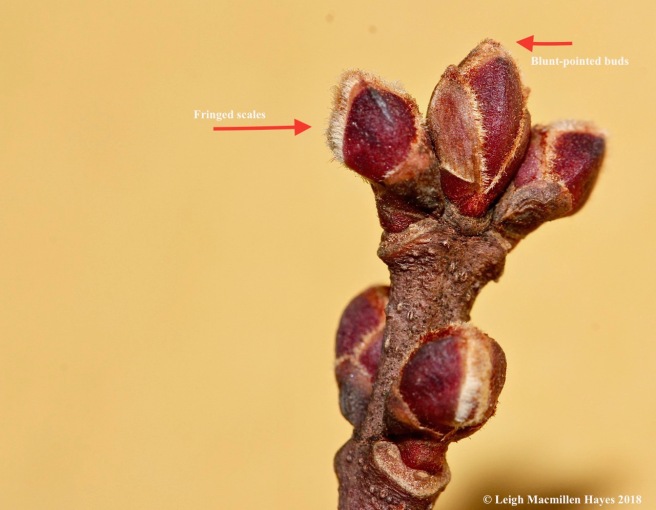
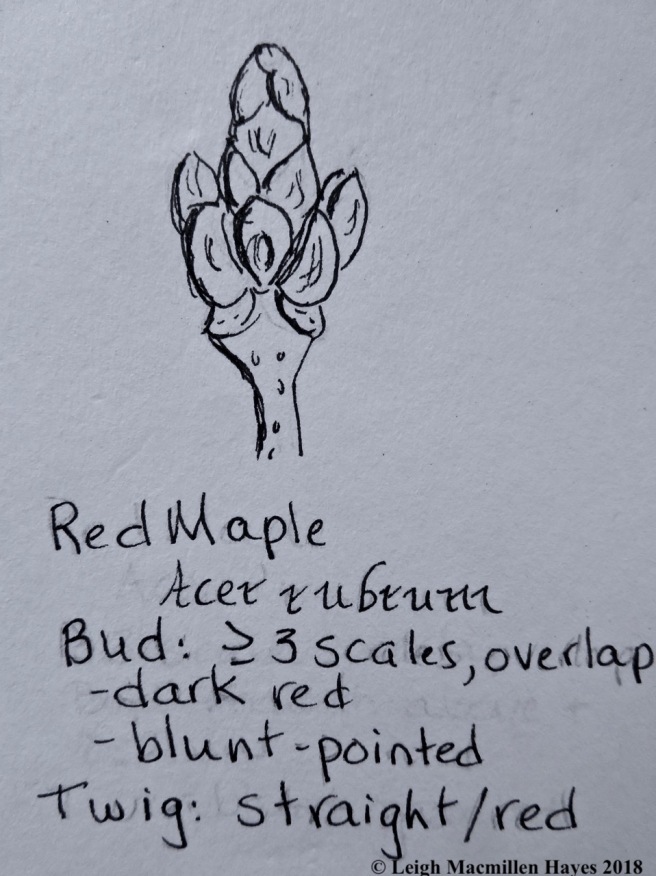
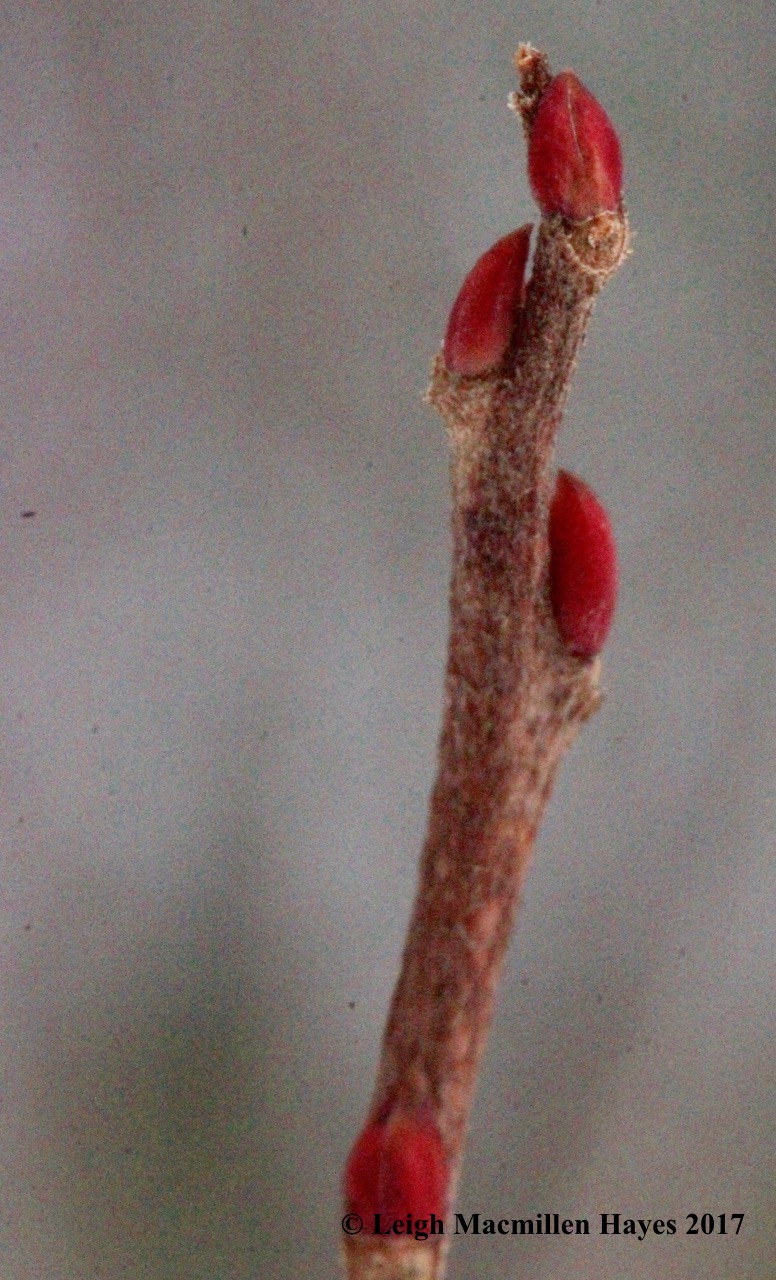
As you can see, the buds are red. This is another clue that it’s a Red Maple: there’s always something red on the tree. Sugar Maple buds are much smaller and brown.

Each bud has 3 or more scales and each scale is fringed with little hairs. The twigs are straight and also red, especially newer wood.

My rendition, though I do need to work on the target.

And the twigs/buds, which are already becoming more bulbous. I have to be honest with you. As a kid and young adult, I did not know that buds for the next year form in the previous summer and overwinter under those toasty scales for protection. I suppose I never actually thought about it. But of course they do, because that’s when the tree has the most energy. In April, they will flower, and by May the leaves will begin to form.

But right now, it is snowing again–YAHOO!

American Beech, Fagus grandifolia, is our next exhibit. These trees can tolerate shade and I will never forget when a local forester showed some students a tree cookie that was about two inches in diameter and he asked one to count the number of tree rings. Sixty years old. Yes, they tolerate shade.

In fact, Beech trees tolerate a lot. Typically, the bark is smooth, unless . . . there are cankers or blisters dotting it that are caused by the tree’s reaction to a fungus that gains access via a tiny puncture made by Beech Scale Insects. The insects are teeny little things, with fluffy white coatings, and they congregate on the bark for 50 weeks, where they pierce the tree repeatedly to get sap. For two weeks of their lives, they can fly. The rest of the time, they stay put and sip.

Another thing that Beech trees tolerate is Bear Claw marks and if you are a follower of wondermyway, I need say no more. If not, search for bear claw trees in the search bar.

They also tolerate humans carving initials. More than they should; And those initials and those bear claw marks will always be present as long as the tree lives. In fact, they’ll be in the exact same place at the same height that they were originally made, but they’ll have widened a bit each year.

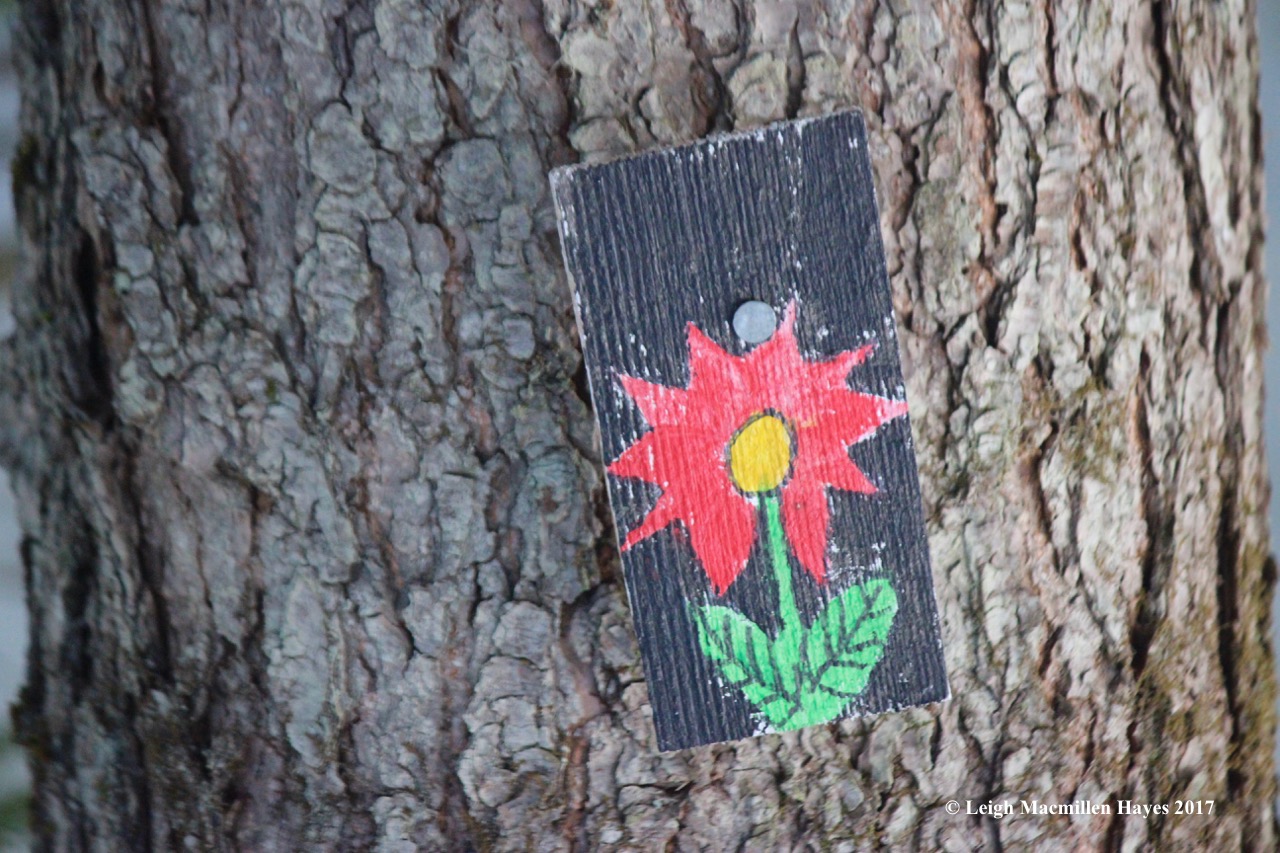
All trees grow out from the heartwood, and up from the uppermost branches. So if you place a trail blaze on a tree, it will always be in the same spot, you just need to make sure that you don’t screw it all the way into the tree or the tree will grow around it eventually. (Rule of thumb: leave about two inches between the sign and the tree; and check it each year)

Beech twigs are deep brown with white lenticels. Oh yikes. We haven’t talked about lenticels yet. All trees have them. A lenticel is like the pores in our skin and allows the tree to exchange gases. Lenticels come in a variety of shapes including raised circular, oval, and elongated. (Remember, leaves have stomata for the same purpose.)

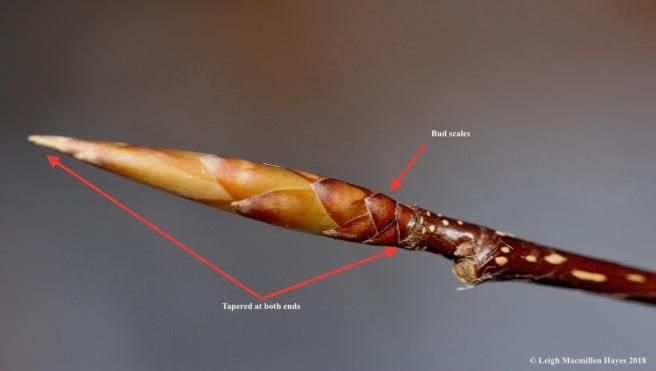
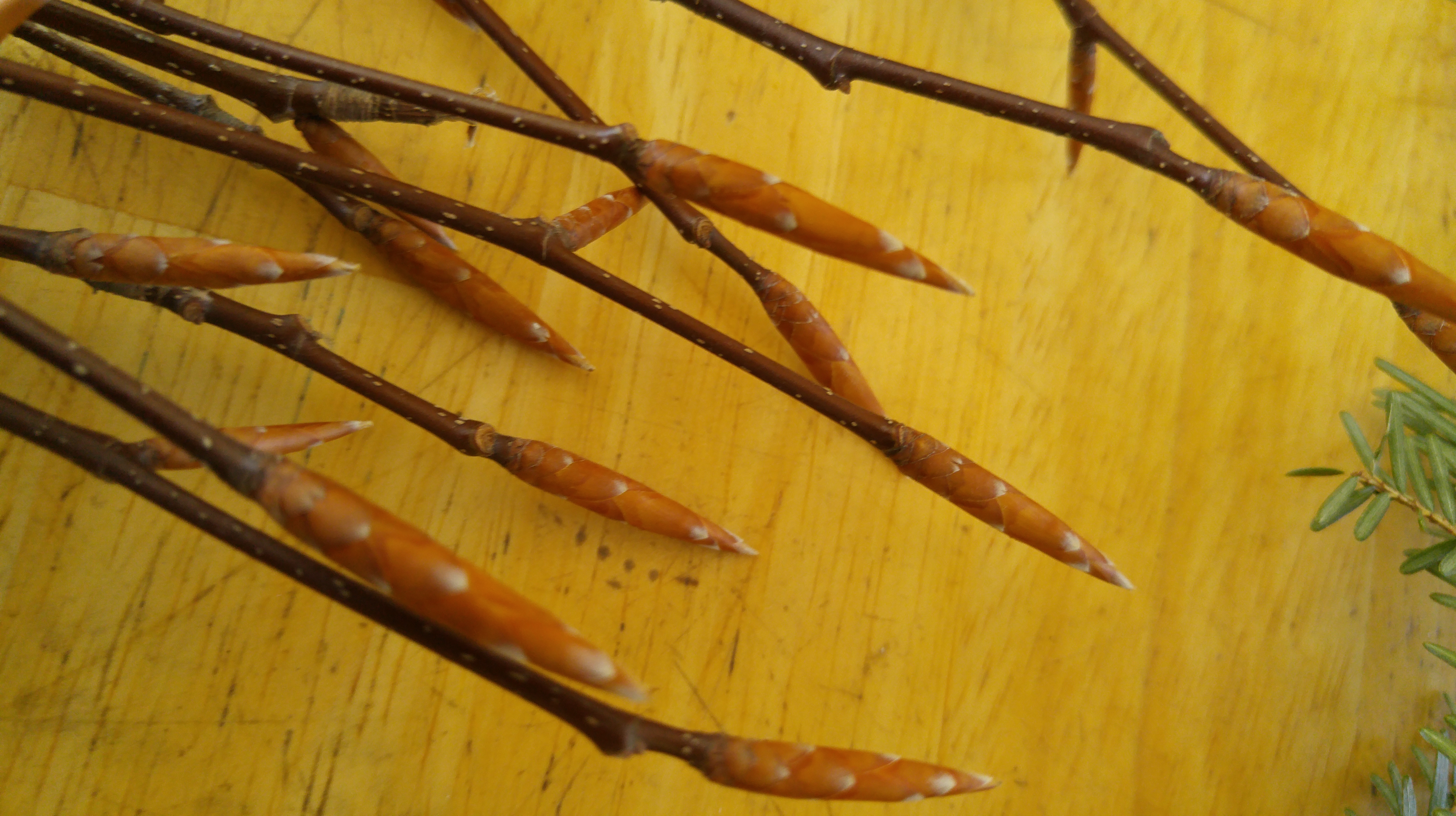
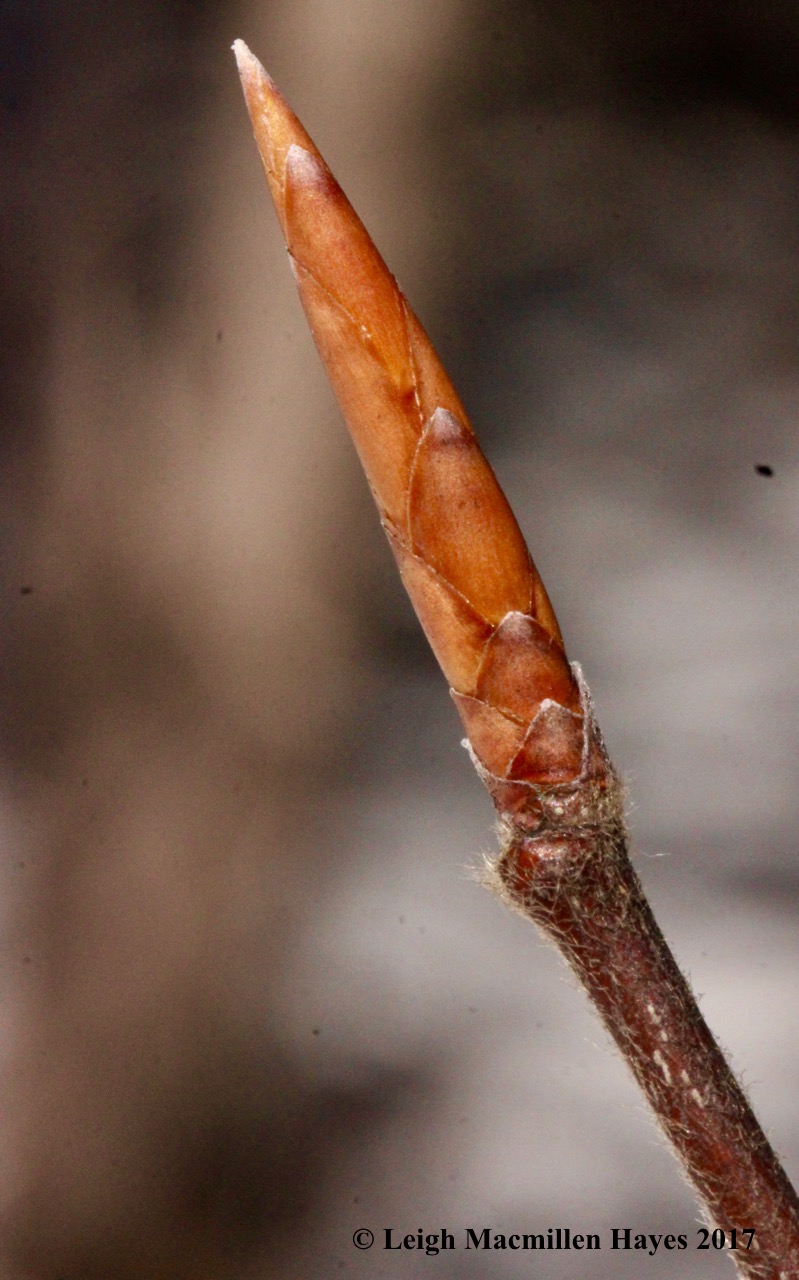
As you can see, the bud is sharp-pointed, covered with many scales, and a delightful golden brown. Some see it as a cigar. That description doesn’t work for me, but it is tapered at both ends. And really, nothing else looks like this in the north woods. While this photo is of a terminal bud, the twigs and buds are alternate.

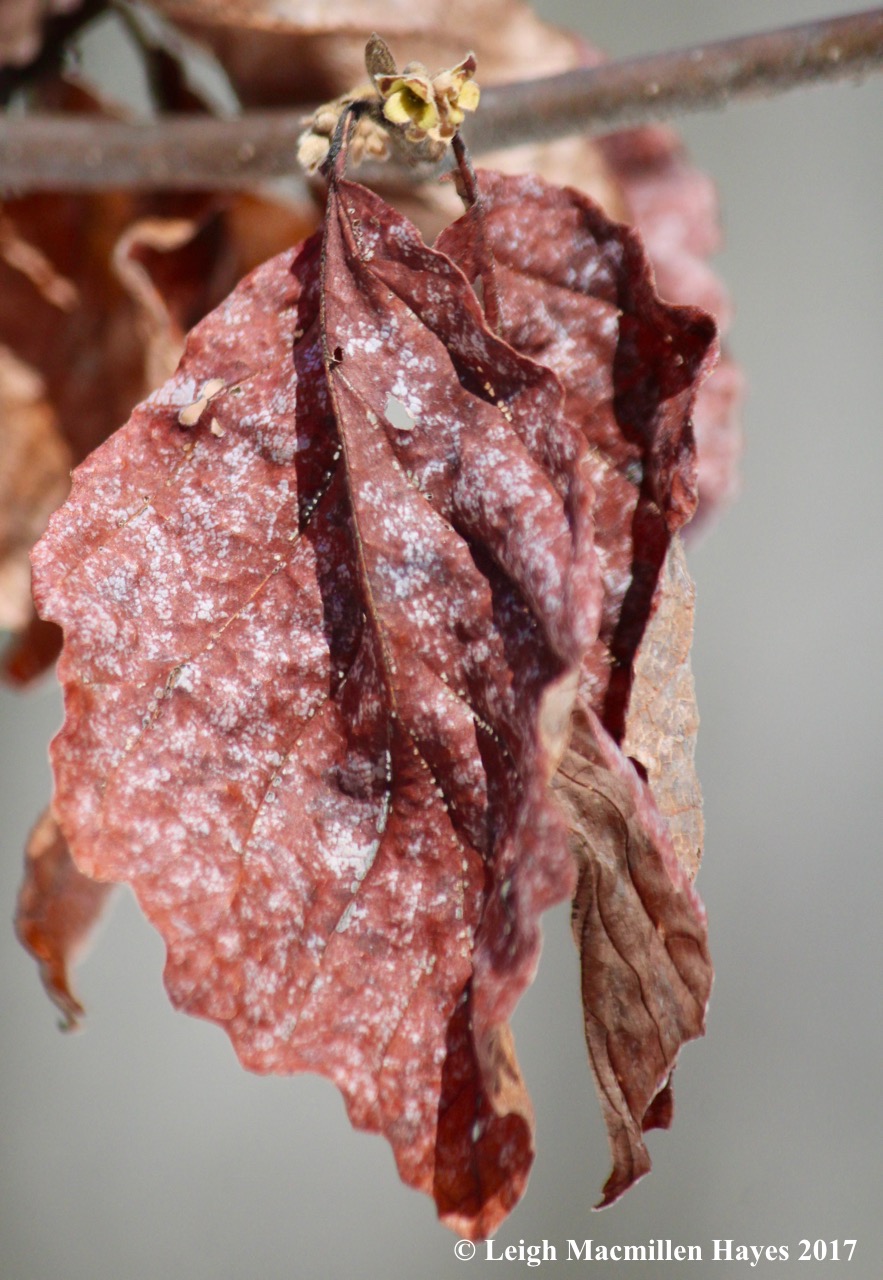
Leaves on Beech are marcescent and wither on the trees over the winter. In fact, if there is a sudden breeze and the leaves start to rattle, I’ve been known to become rattled, thinking there is something or someone else in the woods with me.

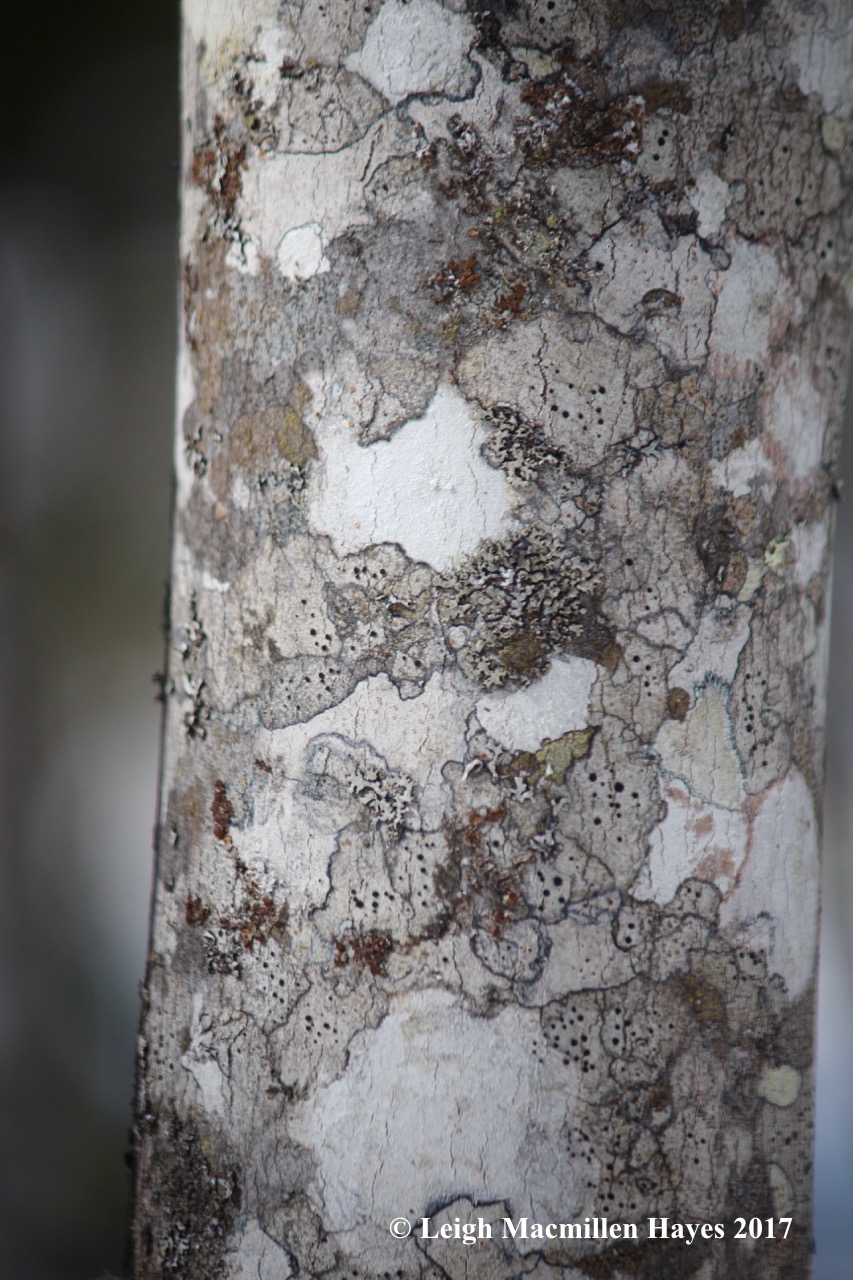
And this time I present American Beech, which can be blotched with crustose lichens (look like they’ve been painted onto the bark).

And a twig, showing the growth rings, which occur where the previous year’s terminal bud had been.

And now for an upclose look at the bark of Northern Red Oak, Quercus rubra. (I almost wrote Maple, and for some you’ll know that as “my mouth or in this case my fingers before my brain”–like when I call a Beech, that I know darn well is a Beech, a Birch. Such is life.)

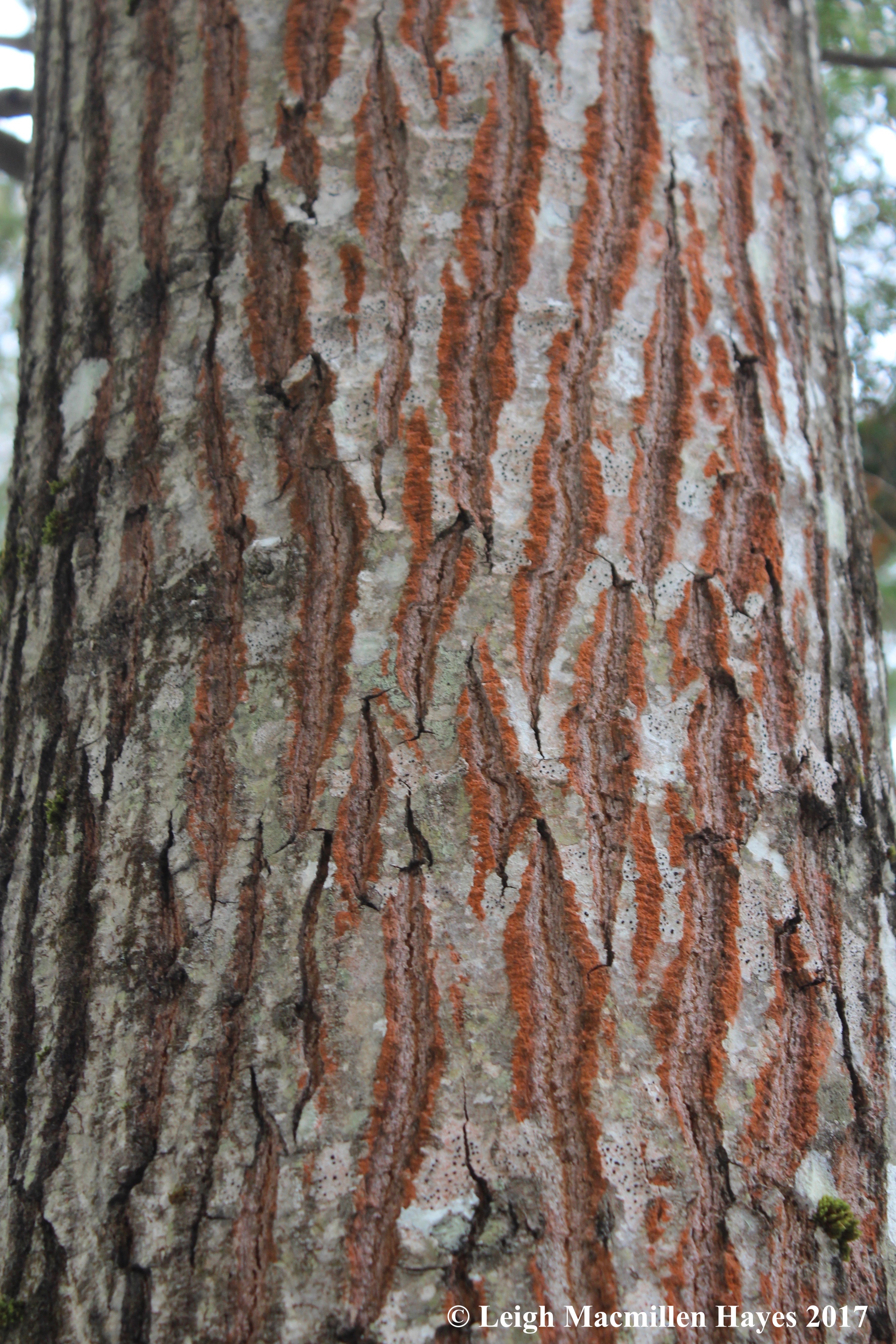
Red Oak bark is greenish brown or gray and has rusty red inner bark. When I look at it, I see wide, flat-topped ridges that run vertically parallel but also intersect like ski tracks. Shallow furrows separate the ridges.

The red inner bark is especially noticeable in winter.

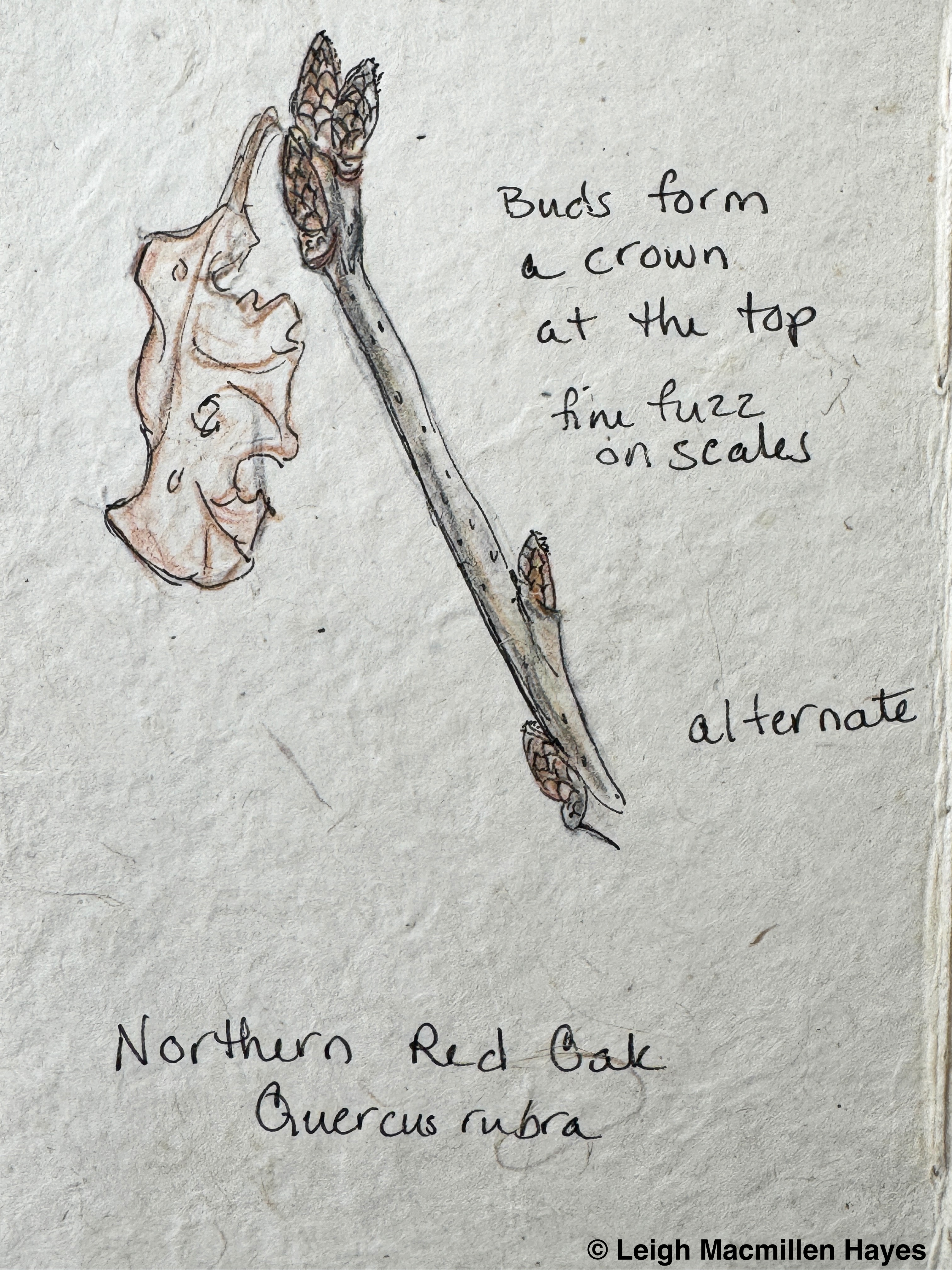
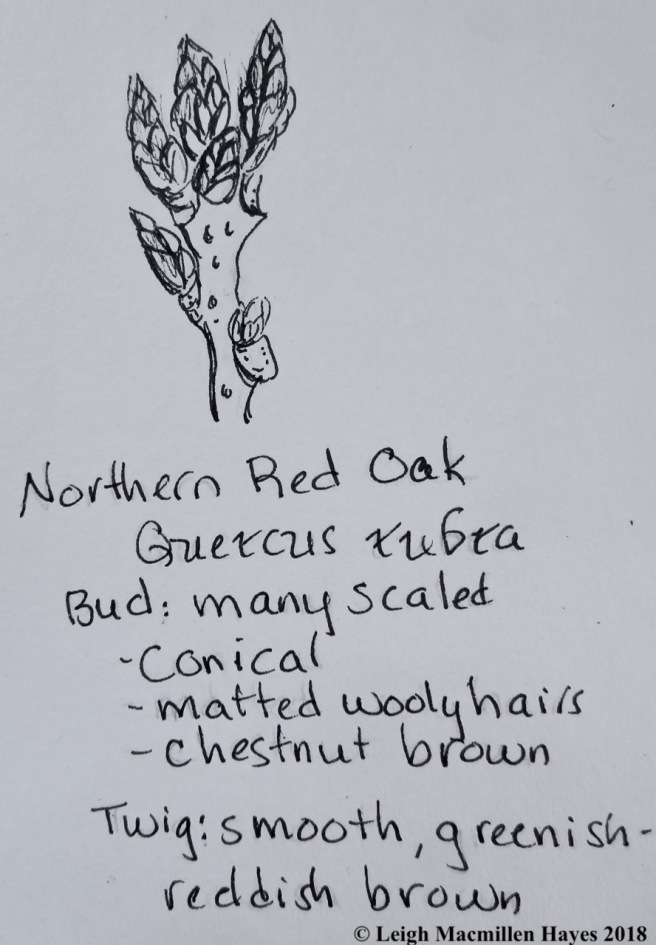
The twigs and buds are alternate in orientation. The twigs are smooth, and greenish brown, but the buds are much more intersting as they occur in a crown at the tip of the twig. Each bud has many scales and matted wooly hairs. I love their chestnut brown color.

My rendition of a Northern Red Oak.

And the twig. As you can see, there are also buds along the twig, not just at the tip, and they do grow alternately. Also, Oaks have marcescent leaves as well, though most fall off before spring. I did spot a very mature Red Oak the other day that is overwhelming full of dried leaves.

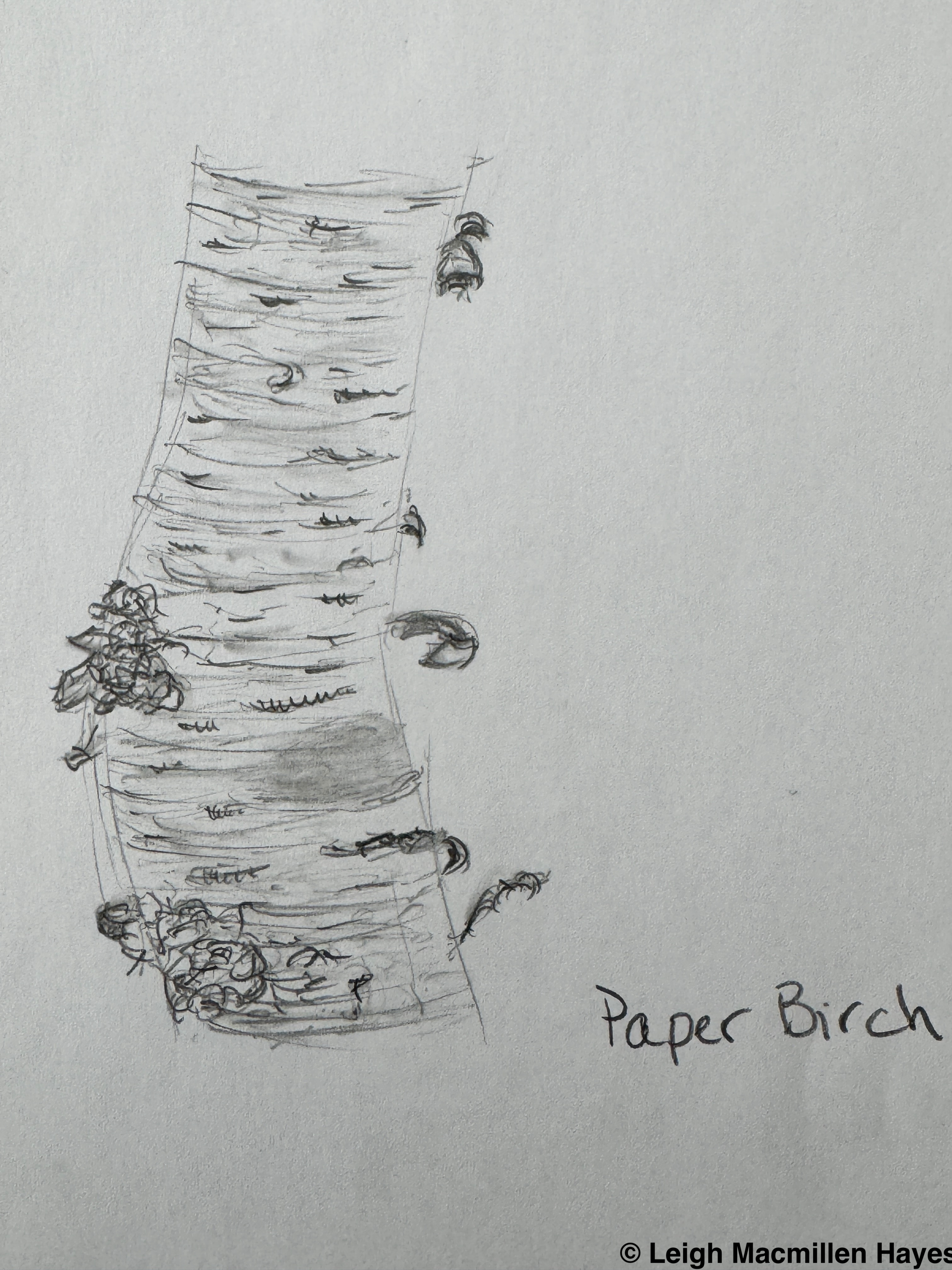
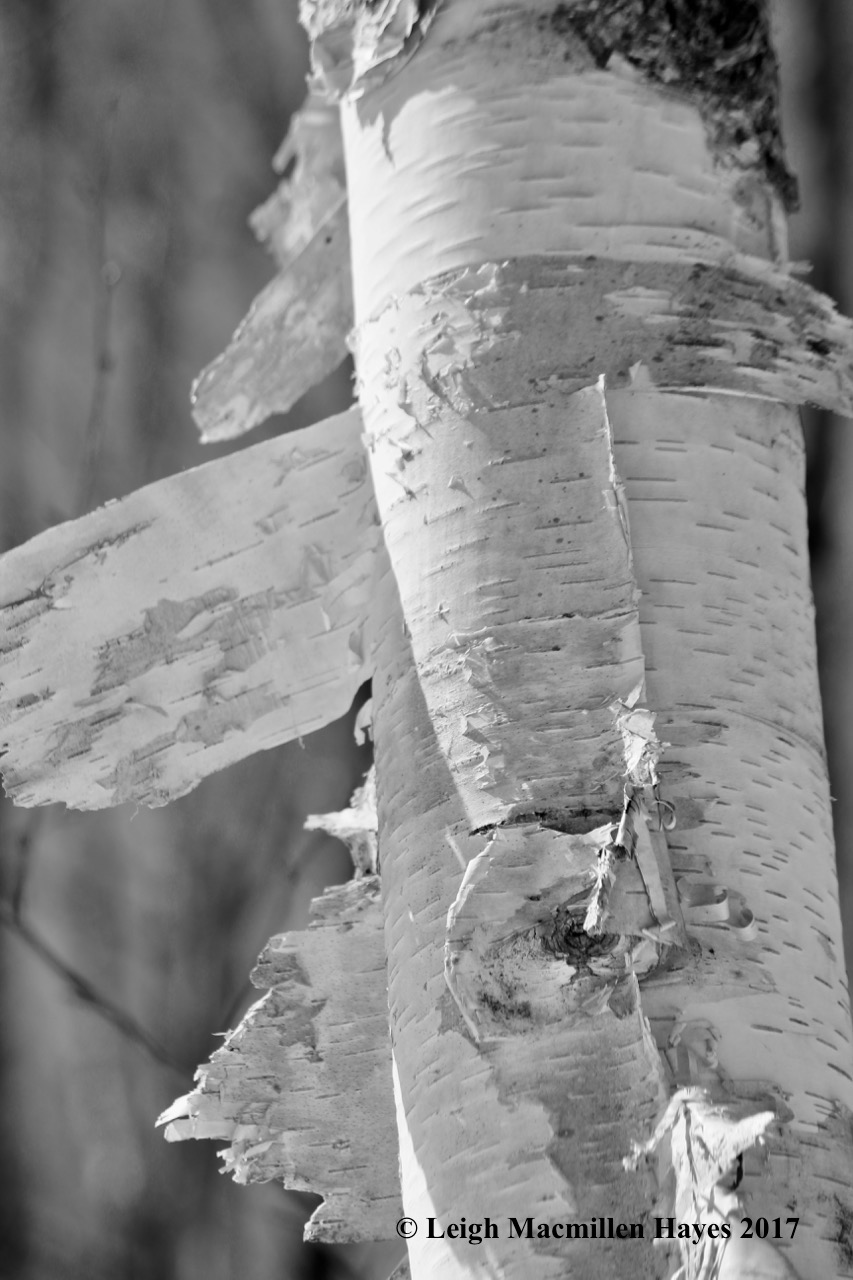
And now let’s meet several members of the Birch Family. Up first is the Paper Birch, Betula papyrifera. You may know this commonly as a White Birch, but I prefer Paper, and will explain why after introducing you to its kin.

Betulin is a compound in the cells of the outer bark that is arranged in such a way as to reflect light and make it appear white. The betulin crystals provide protection from the sun as well as freeze/thaw cycles. It also protects the tree from pests. And to top it off, betulin is the reason the bark is a good fire starter as its highly flammable and waterproof. Your go-to for a rainy day fire. It was also used to build birch bark canoes.

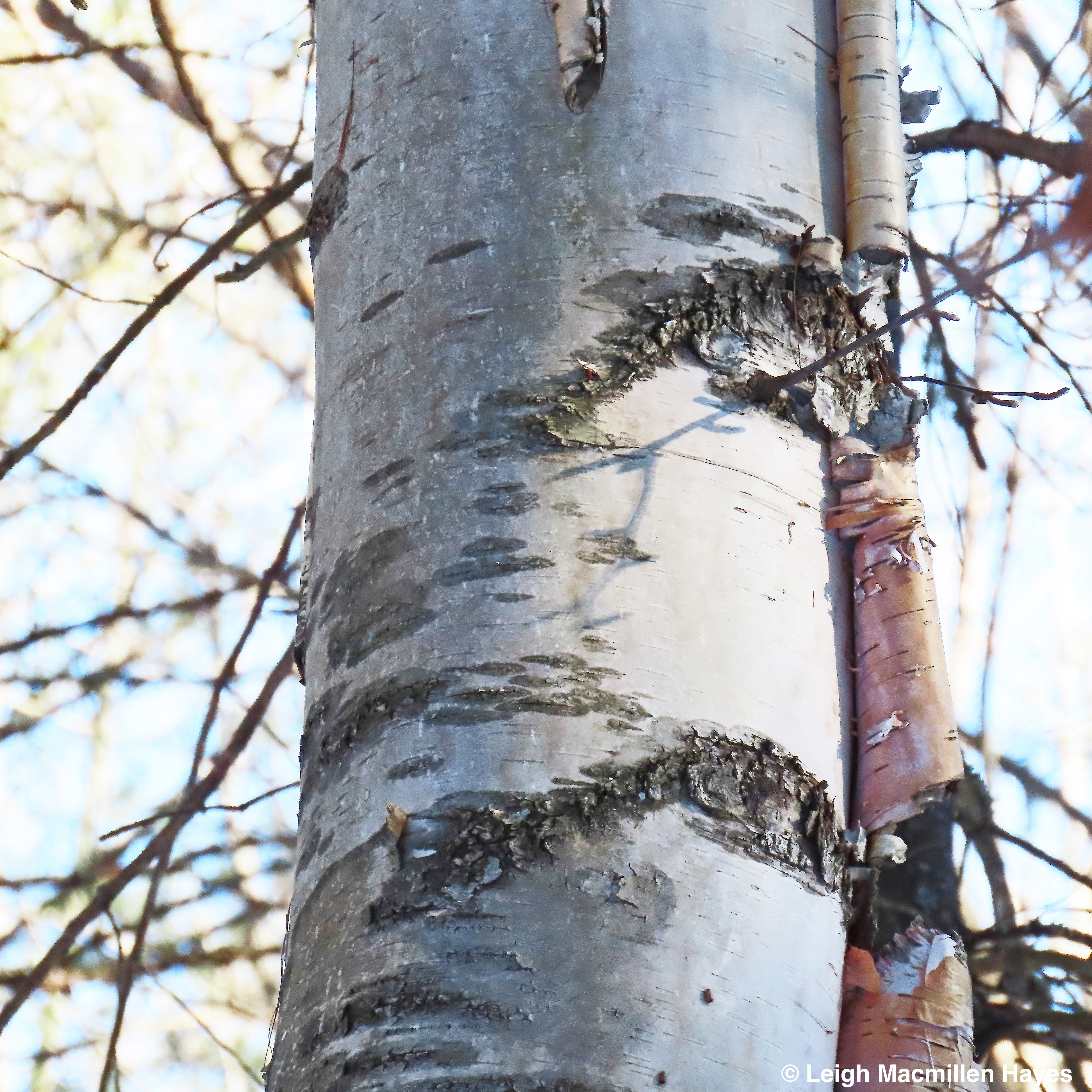
Young Paper Birch bark is white, but often with an orange and pinkish tinge. It has thin, horizontal, light-colored lenticels. As it matures, the bark changes from white to creamy white. Sometimes I even see the colors of a sunset in it, including some blue in the winter.

The outer layers separate from the trunk into curled sheets, thus the paper nomenclature. But, I caution you not to pull it off, as prematurely exposing the cambium layer may harm the tree.

Older bark can sometimes make this tree more difficult to identify because it has gray sections of rough, irregular designs, especially around the base.

One of the features I look for on a Birch to determine if it is a paper, besides the curly bark, is the mustache that is drawn over the branches on the trunk. In the photo above, the branches are no longer there, but do you see two mustaches? Sometimes both ends droop down even more.

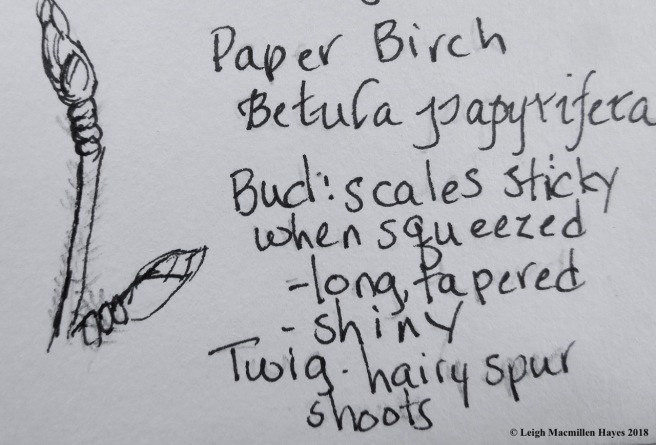
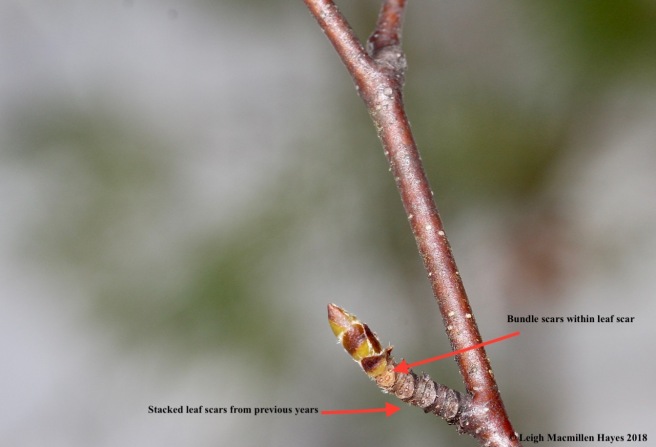
The twigs of Paper Birch are alternate, as are the buds. New growth on a reddish brown twig is usually hairy. And buds may grow on shoot spurs, which I’ll show you in a minute.

Paper Birch buds are covered with scales that are sticky, especially if squeezed. And for the most part, they are not hairy.

Their flowers are in the form of catkins, with tiny seeds protected by fleur de lis-shaped scales. Paper Birch catkins appear mostly in clusters of three.

My rendition, though I need to sketch one with the branches and mustaches. Another day.

This sweet tree has long served as a reminder to me to go off trail and look for a mesmerizing spring of water. Oh, not every Yellow Birch reminds me to do that, but I know where I took this particular photo and the spring is about an eighth of a mile behind it.

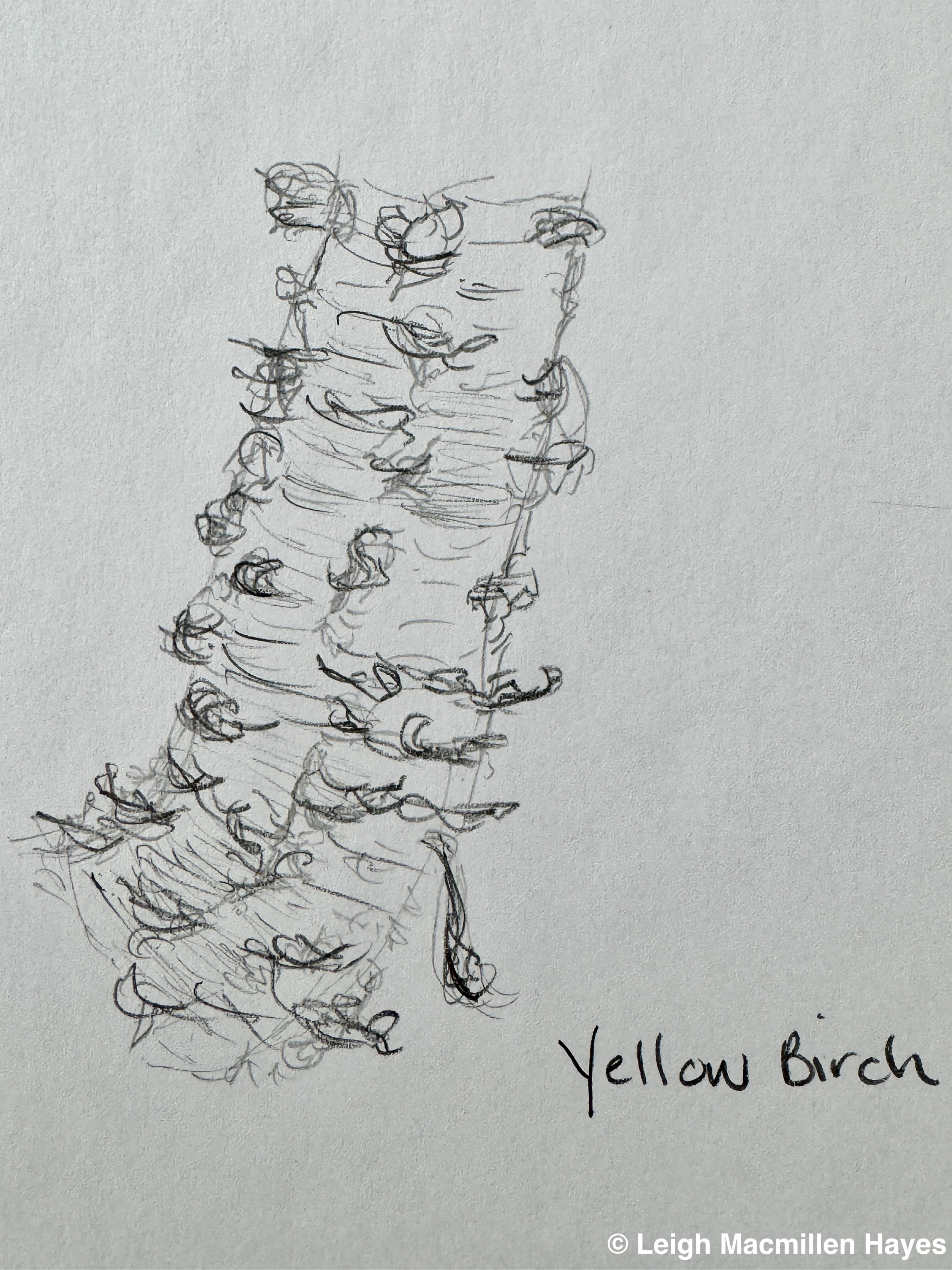
Yellow Birch, Betula alleghaniensis, has bronze to yellowish-gray bark that is shiny. And it too curls, but this time it curls away in thin, ribbony strips, giving the bark a shaggy appearance.

One special note about Yellow Birch, and the same is true for one of our conifers that I’ll discuss soon, is that the seeds struggle to germinate on the forest floor, but give them a moss-covered rock, or tree stump, or nurse log, and bingo, a tree grows on it. As it continues to grow, the roots seek the ground below and if it is upon a stump or log that eventually rots away, you have a tree in the forest that appears to stand on stilted legs.

So I mentioned for Paper Birch that they have spurs of stacked buds and so do the Yellow Birch. The bud appears at the end of the stack and by the leaf scars left behind you can count the age of the spur.

The twigs are not hairy, but they have their own unique distinction. I wish I could share this with you, but you’ll have to go out on your own and find a Yellow Birch twig–the distinction is a scratch ‘n sniff test. If you scratch it and smell wintergreen, then you have found a Yellow Birch.

Three to four catkins appear on Yellow Birches, but they are not clustered, so that’s another clue as to the color/name of the tree.

My Yellow Birch.

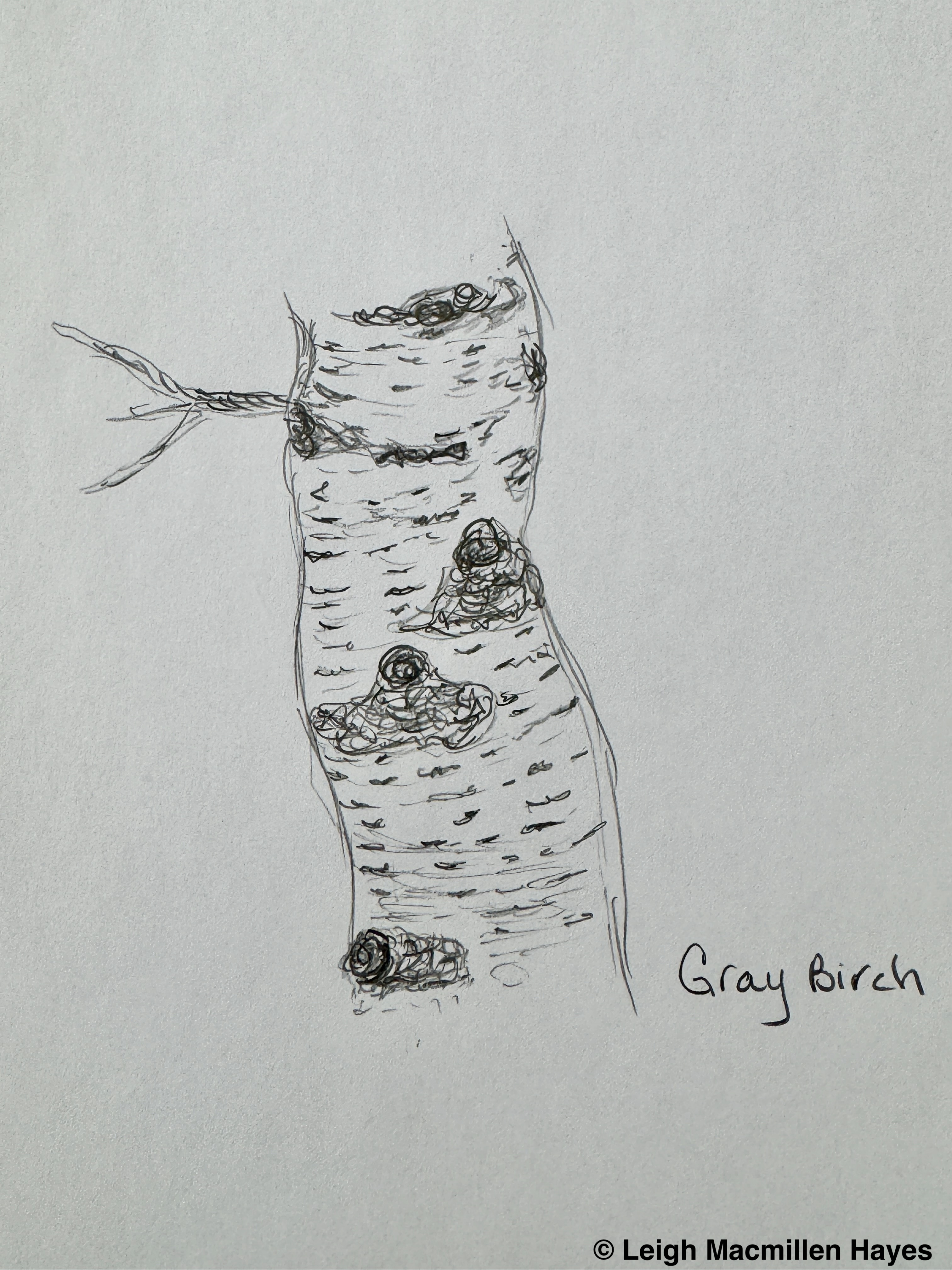
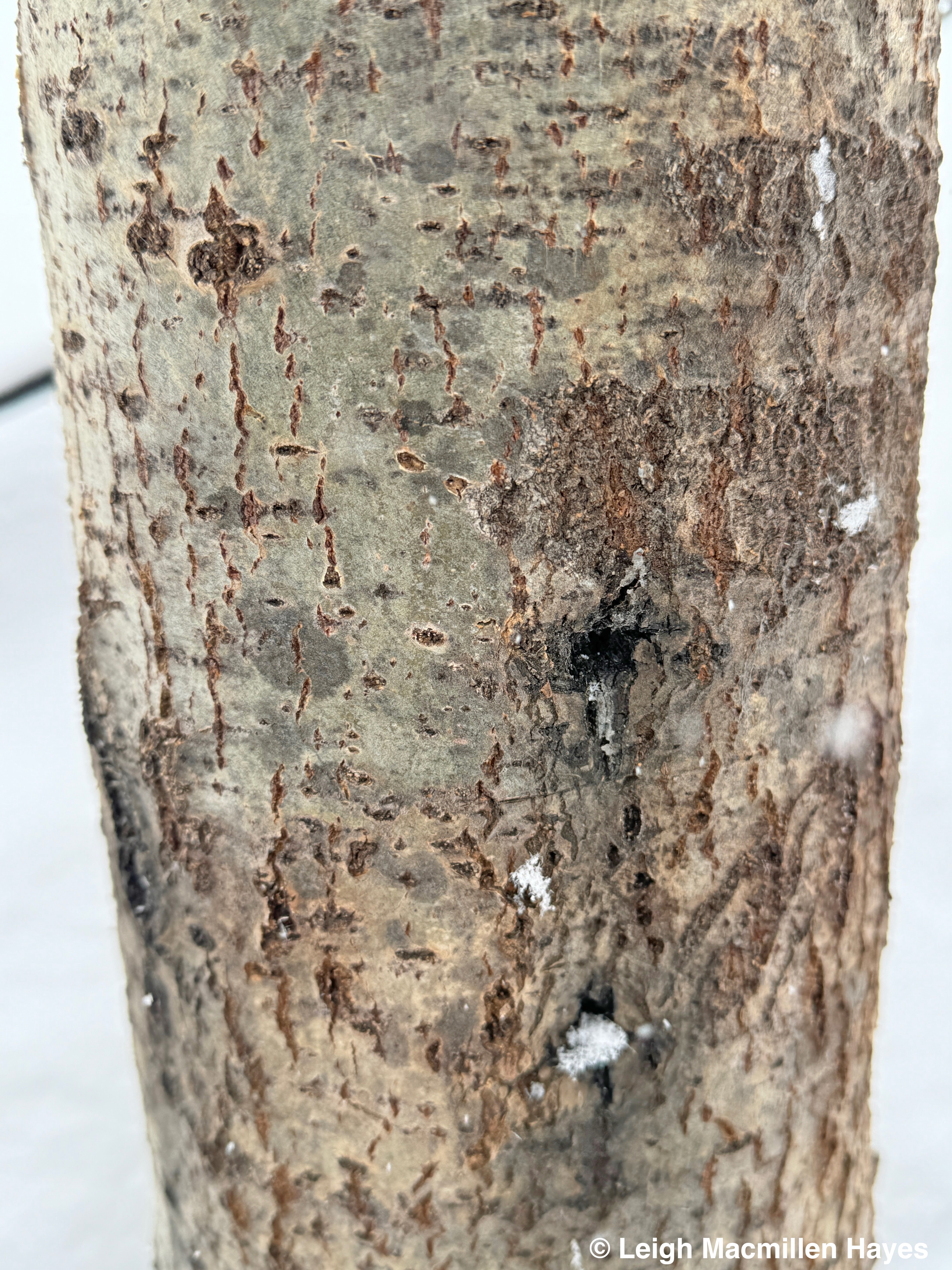
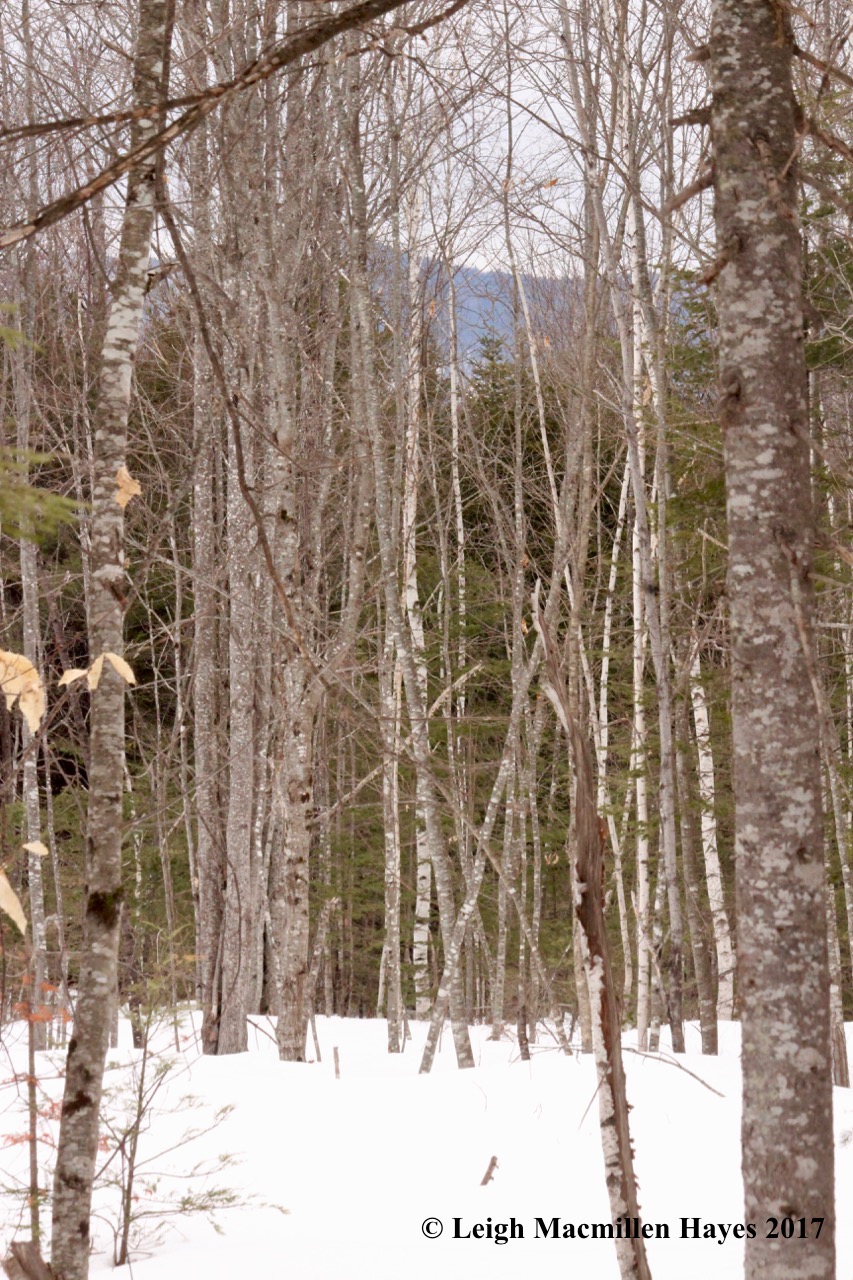
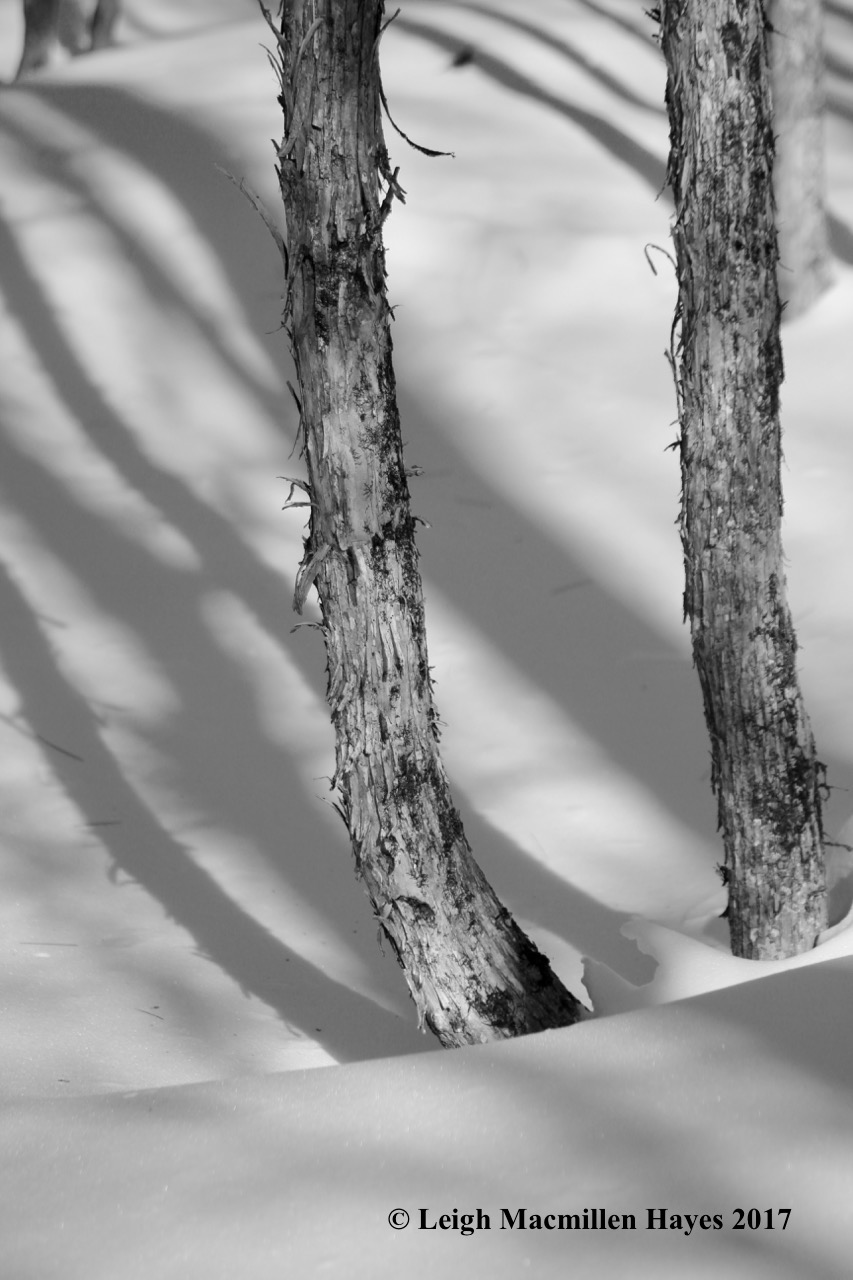
Gray Birch, Betula populifolia, is an early succession tree, meaning when an area has been cleared, this is one of the first trees to grow. Unlike Paper Birch, which can live to the ripe age of 90 or so if conditions are right, and Yellow Birch that can survive over 200 years, Gray Birches are not long lived and many only survive 30 – 60 years.

Often these trees are leaning, even if they don’t have snow piled upon them. And their lower branches remain on the tree, where Paper Birch tend to self-shed. The branches are pendulum, leaning toward the ground in an arc. And below each branch or where a branch had been, is a triangular shaped gray beard.

I mentioned earlier that I prefer Paper over White for a Paper Birch, and one reason is because Gray Birch also appear white. But Gray does tend to have a dirtier look to it and it has little to no peeling.

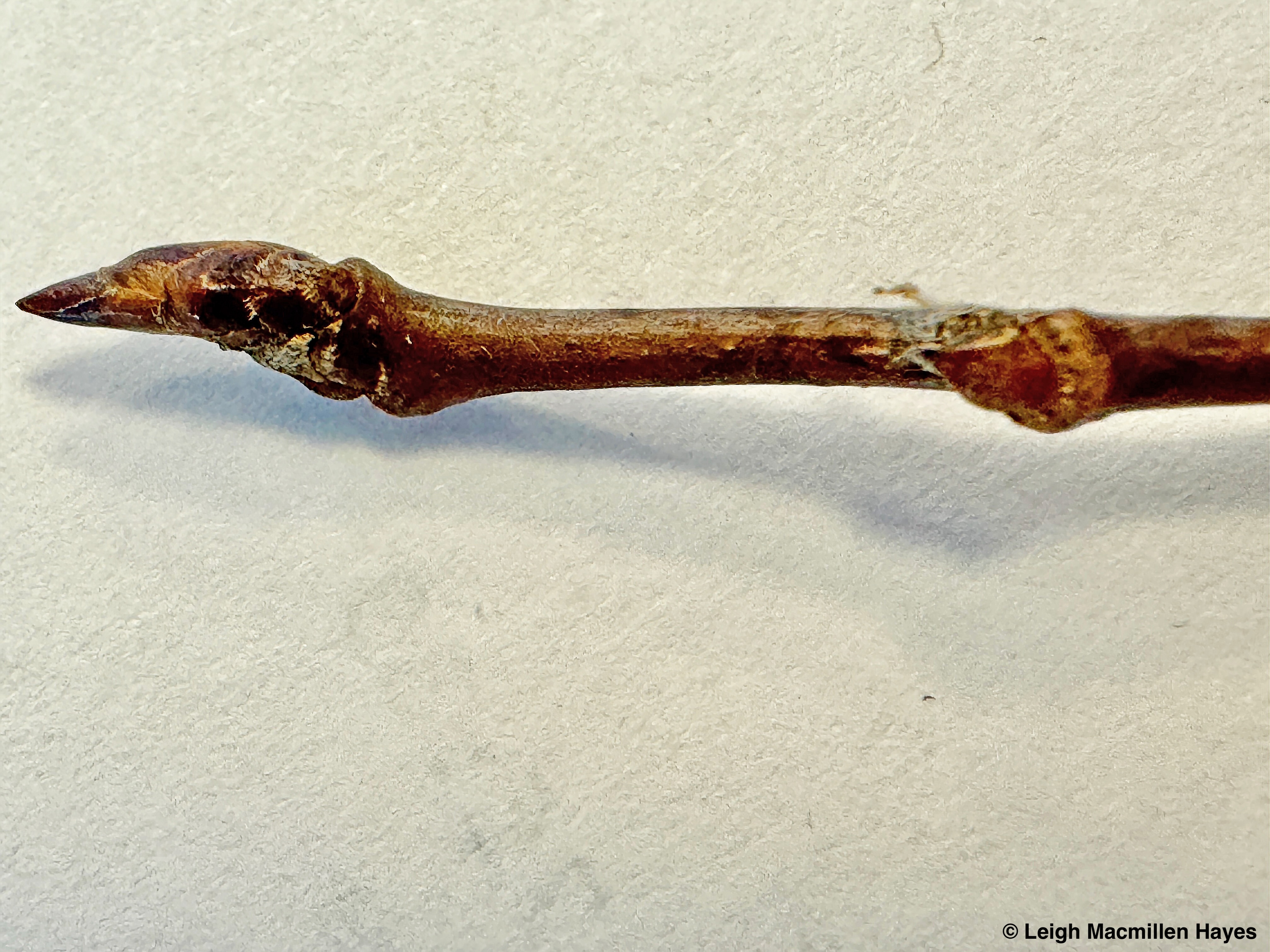
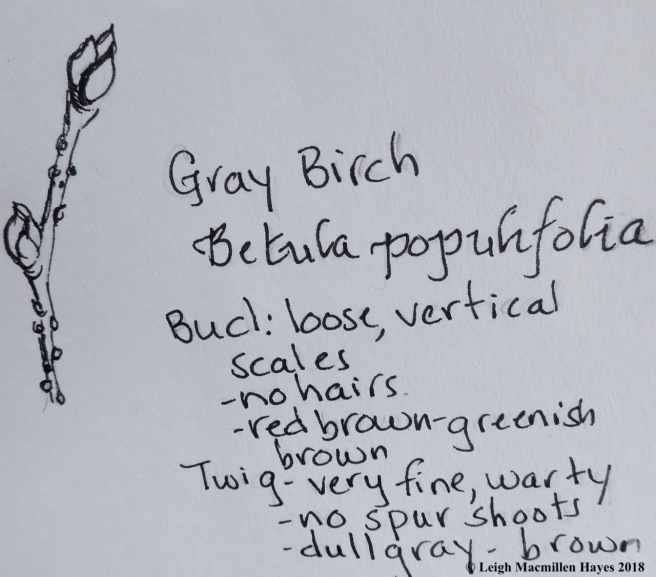
Gray Birch twigs are very fine, and super warty. In fact, it’s fun to run your fingers over them and feel the lenticels, like someone glued salt crystals to them. Their coloration is dull gray to brown and they are not hairy, nor do they smell like wintergreen when scraped.

The red brown to greenish brown buds are short, with scales that also lack hairs, and they are not sticky.

As for catkins, most appear in early spring as a single one or a pair. If you spot a single one in the fall/winter, then it is usually a solitary male.

Tada. A Gray Birch.

The final deciduous tree is a Quaking Aspen, Populus tremuloides. (I bet you are thinking, “Oh phew, she’s almost done, but never fear, I have four conifers to share with you.)

Quaking Aspens are also early succession trees, and they can grow from seeds, but also like to root sprout. One tree in Utah has over 50,000 stems from one root and covers over 100 acres.

The bark is grayish-green, and more so green on a wet day like today. It also has horizontal bands that become more evident as the tree matures.

The buds of the Aspen are alternate, shiny and dark brown. They aren’t sticky like its cousin, the Big Tooth Aspen. I think the most defining feature of these buds is their varnished appearance. My experience is that Porcupines love them.

The twigs are thick, smooth, and chestnut brown.

I haven’t sketched this tree yet, so I’ve added it to my to-do list.

Balsam Fir, Albies balsamea, smells like a Christmas Tree. This is a conifer that stands straight and tall as if in military fashion.

Its bark is pale gray and smooth, but covered with small dash-like raised lenticels and blister bumps filled with a sticky resin. Pick up a stick when there are puddles nearby, poke a blister and let the resin ooze onto the tip of the stick and then place the stick into a puddle and watch the essential oils form and change shape on the water’s surface. This works best on calm water.

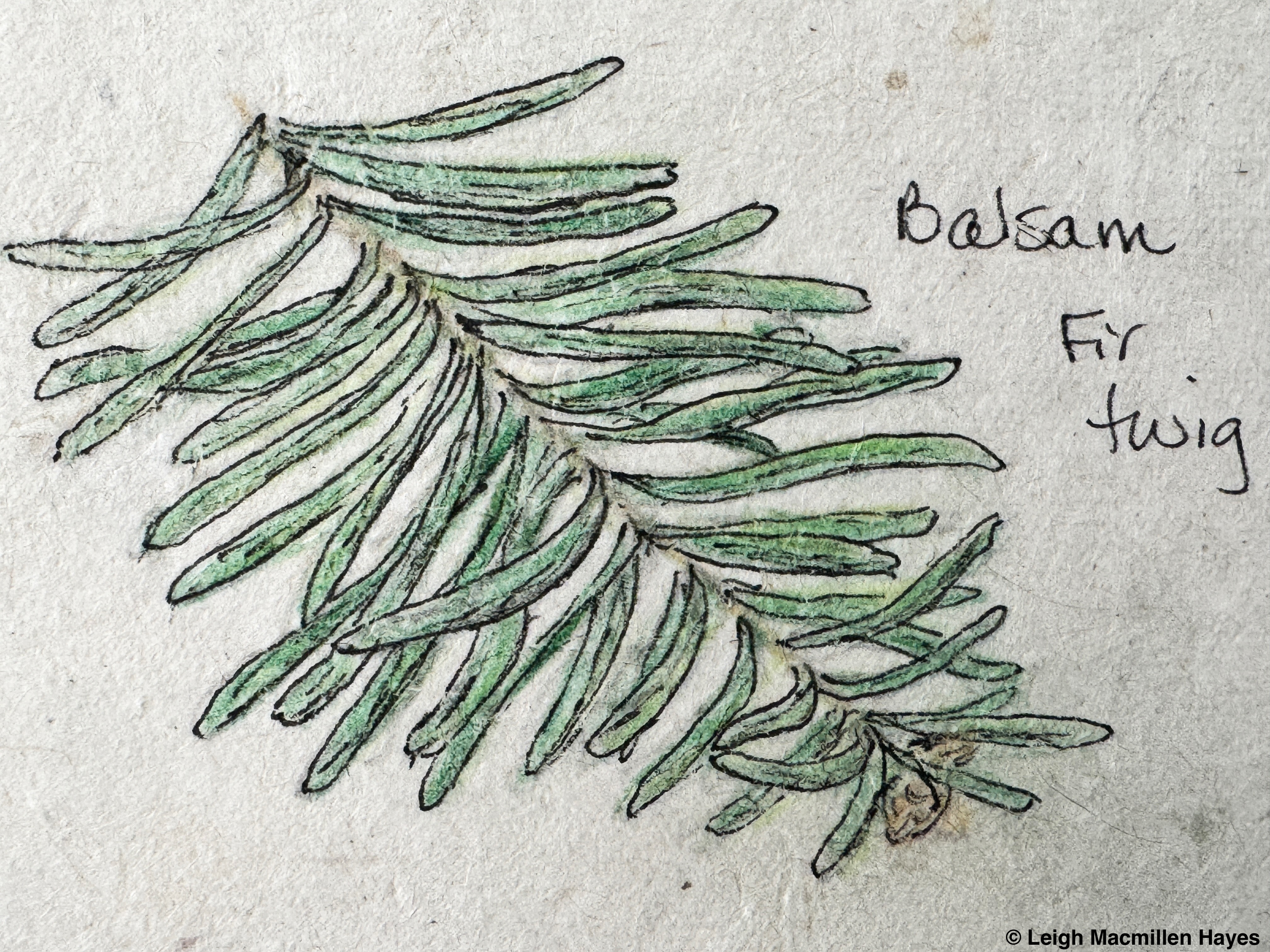
Being an evergreen, Balsam Fir have leaves (needles) that are always on them, though they lose some each year. And gain new ones, of course. If you were to remove all the needles, you’d find a smooth twig.

The needles appear to be arranged in a flat manner, but actually spiral around the twig. They are shiny above and have two rows of white lines below, which are actually the stomata.

At about an inch in length, they attach directly to the twig and some have notched tips.

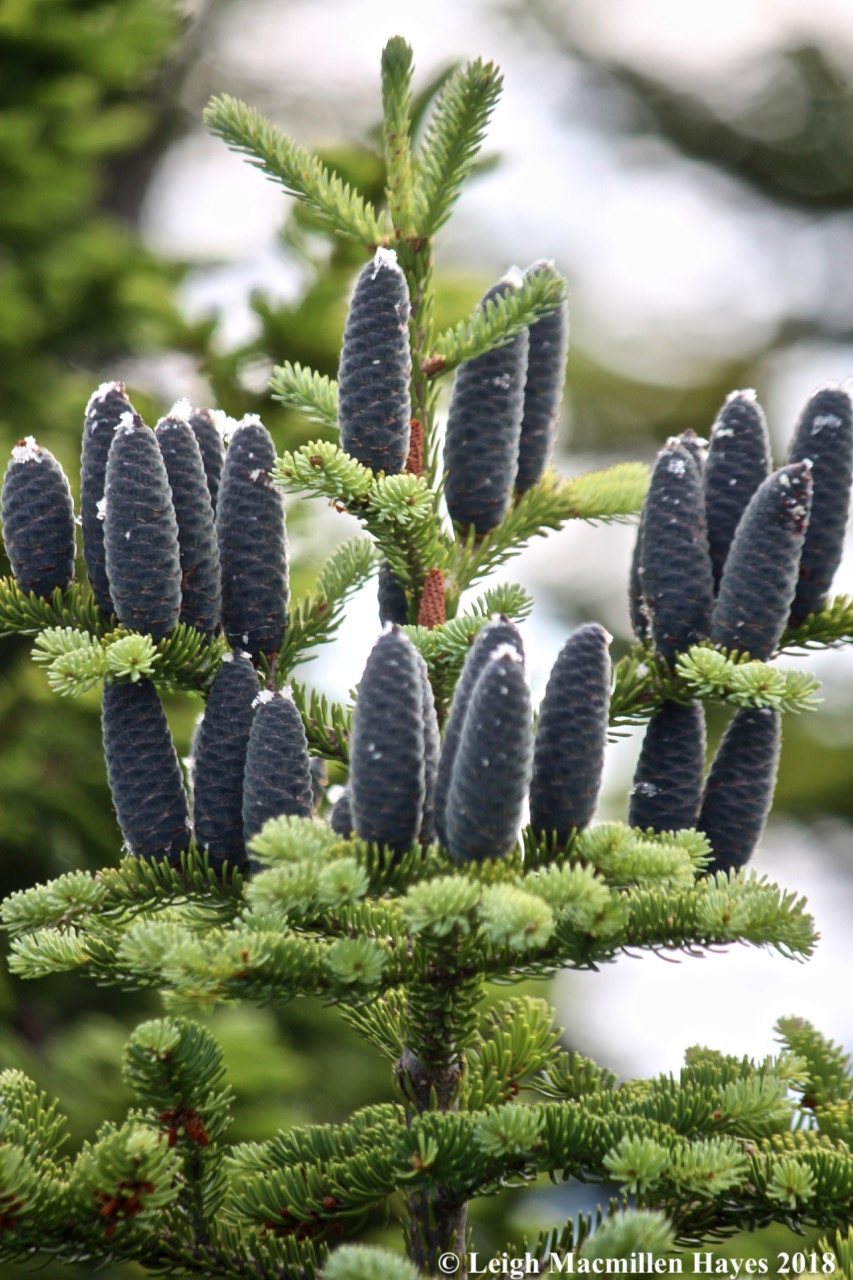
Their cones are 2 – 4 inches in length, and are dark purple before maturity. The unique thing about Balsam Fir cones is that they stick up from the twig rather than hanging down like other conifers.

I think I found the only Balsam Fir in the forest that wasn’t military straight, but as I always say, “Not everything reads the books we write.”

And my offering of the twig.

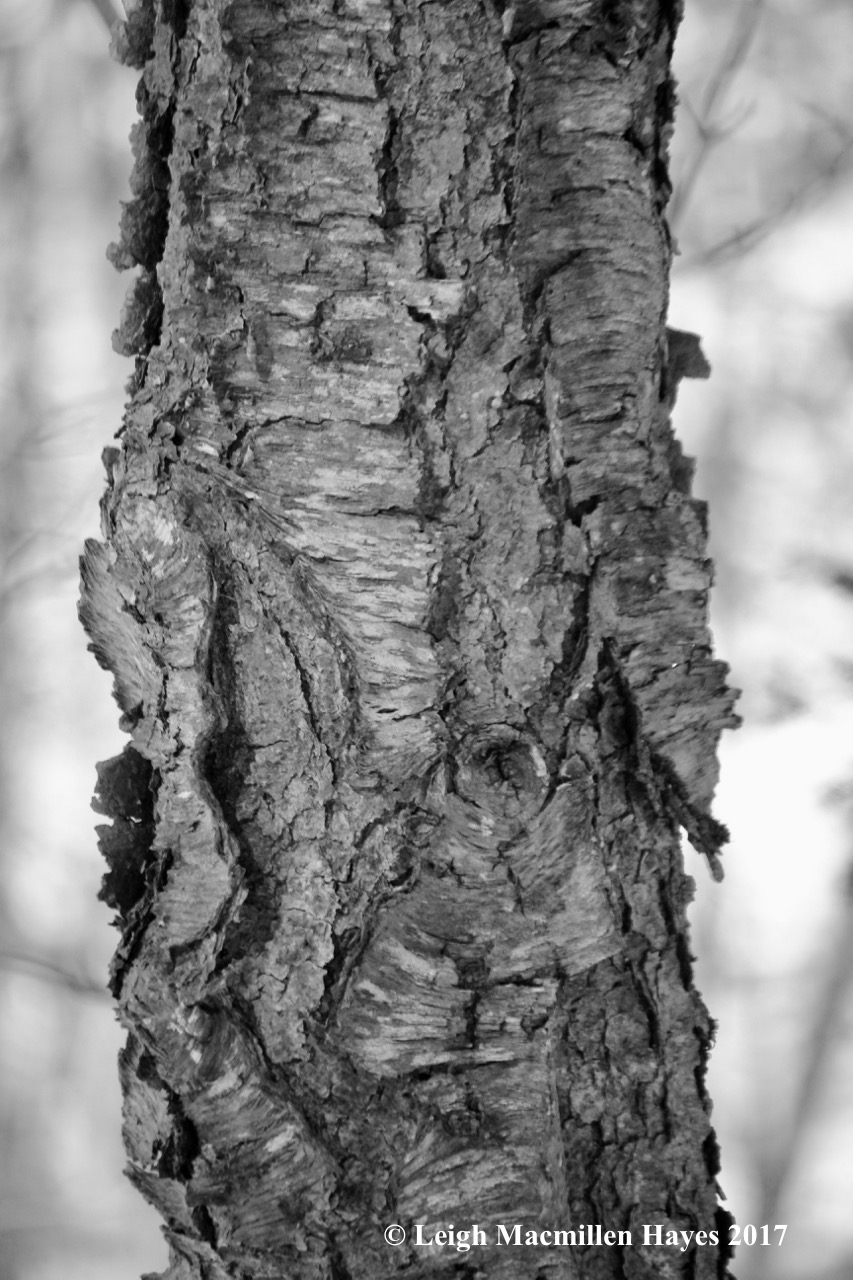
Eastern Hemlock, Tsuga canadensis, has cinnamon red to gray bark. As the tree matures, the bark features narrow, rounded ridges covered with scales that look like they could flake off, but they are rather sturdy.

Overall, the tree has a lacy look and its leader bends over making it appear to dance in the forest.

Hemlocks are like Yellow Birches, in that they need a moist area to set root and often grow on moss-covered rocks or tree stumps or nurse logs, so called because they are rotting trees that provide nurturing places for other things to take form.

While the Balsam Fir needles are about an inch long, Hemlock needles are about a half inch in length. And whereas the Fir needles are directly attached to the twig, Hemlock needles are attached via tiny petioles or stems. And the underside also has two rows of stomata, but so close together, they may appear as one.

The twigs are very fine and very flexible.

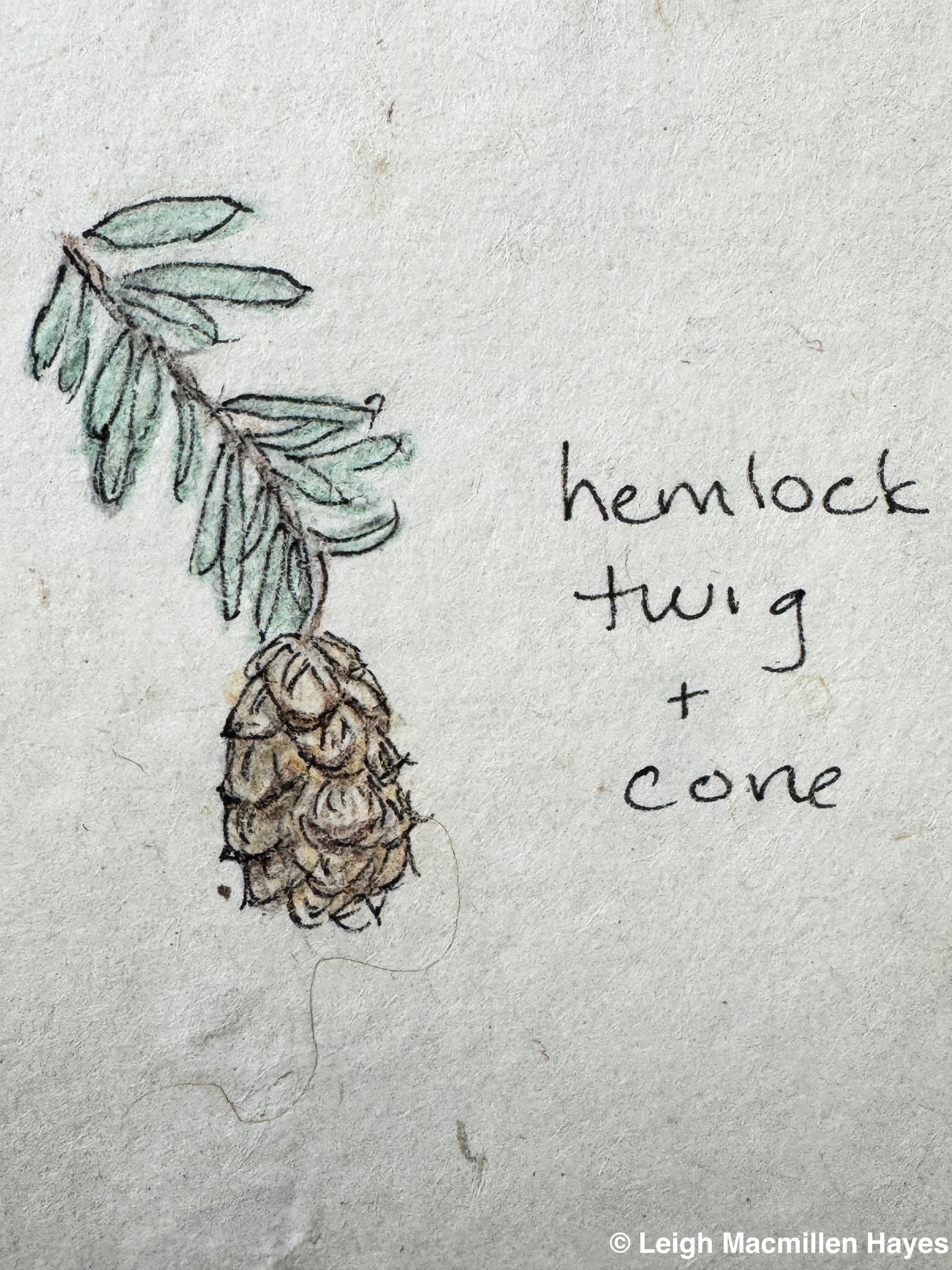
Hemlock cones are about 3/4 inch in length ( I got carried away with the size of this one, or you could say its a macro look at the cone) and oblong in shape. They are pendant, meaning they hang off a slender stalk. And small rodents and birds love to eat their seeds that are attached as a pair to the underside of the scale.

Oh, did I say they are all my favorites? Well, maybe my favoritist of all is the Red Pine, Pinus resinosa.

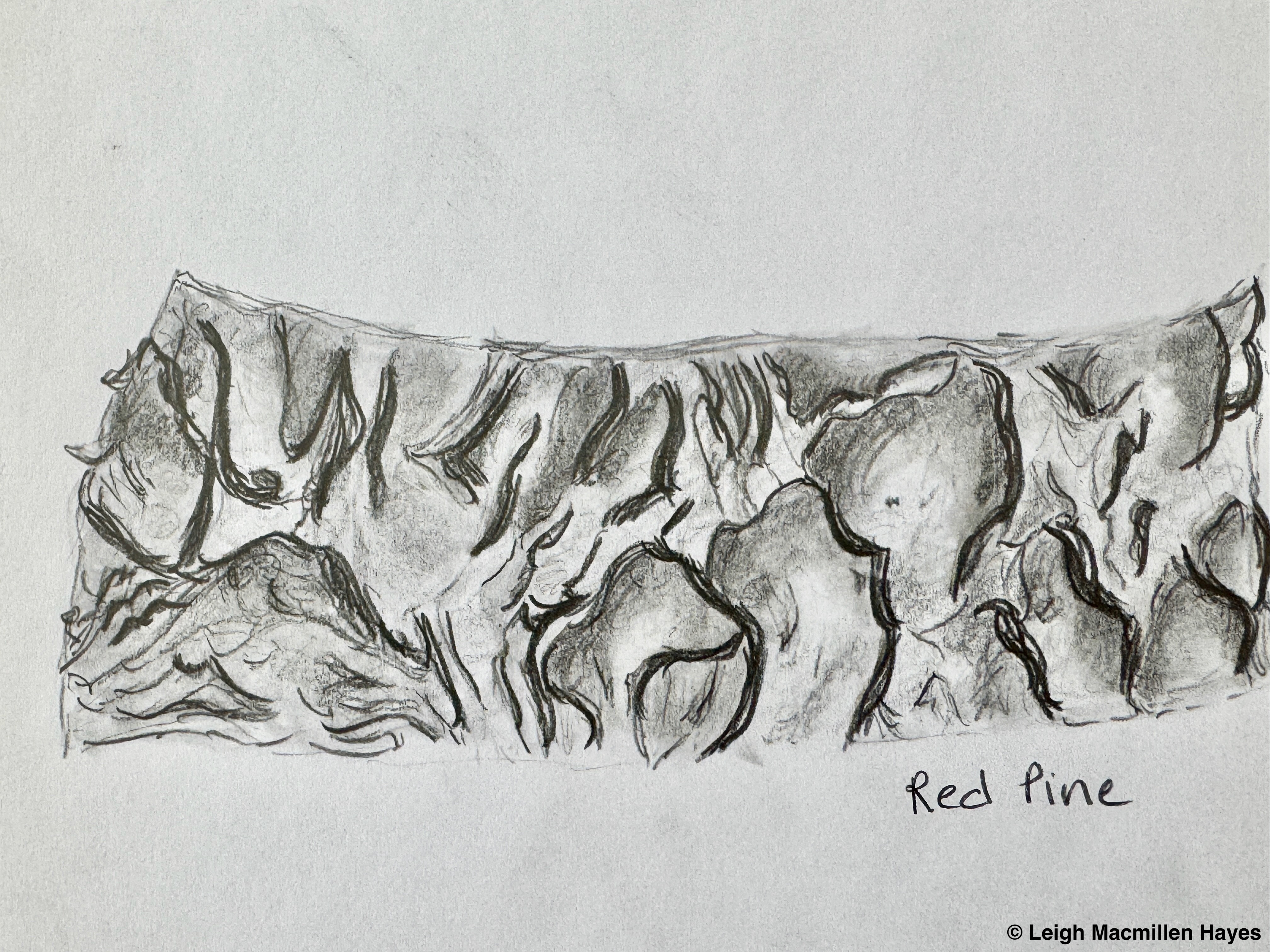
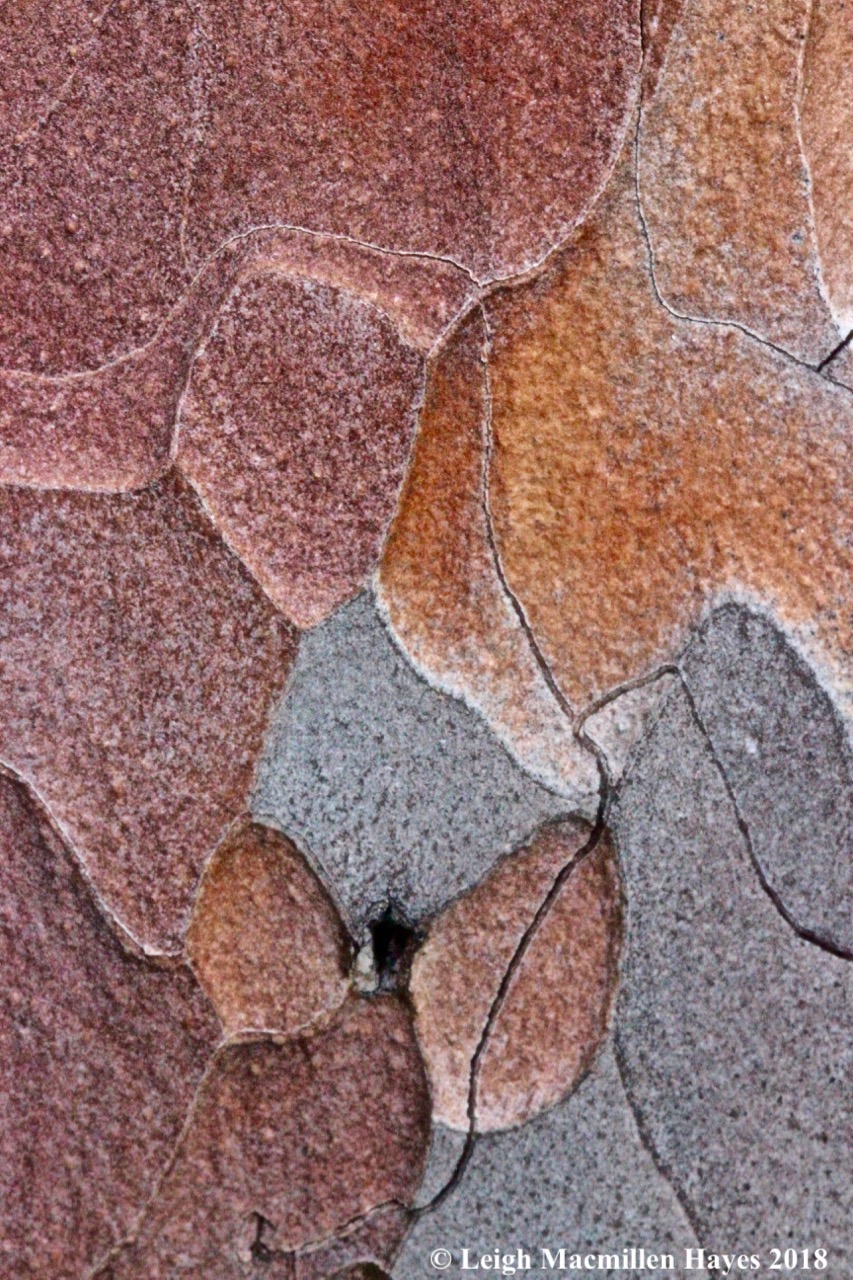
The bark is reddish brown to pinkish gray. I see it as a jigsaw puzzle, but my friend and fellow naturalist Dawn, sees it as a topo map.

Its broken into irregular, thin, flaky scales, that you may see on the ground surrounding the trunk.

As the tree matures, those scales are broken by deep fissures into irregular looking blocks.

Red Pine was of particular importance during the 1930s to 1960s, when the Civil Conservation Corps (CCC) planted plantations of this species on former pastureland as a reforestation project. Once in a while I stumble upon a grove of Red Pines planted in rows and realize that I’m in such a plantation. They were considered a cash crop for telephone poles.

The orange-brown twigs of the Red Pine tend to curve upwards and if you look upward you’ll notice that the needles are all clustered at the end, giving them the look of bushy chimney sweep brooms.

The needles are in bundles of two, and they are about 4 – 5 inches long. If folded in half, they break cleanly.

Red Pine cones are egg-shaped, about two inches in length, and lack prickles like some other species sport. It takes two years for them to mature.

What do you see? Jigsaw puzzle? Topo map? Or something else entirely?

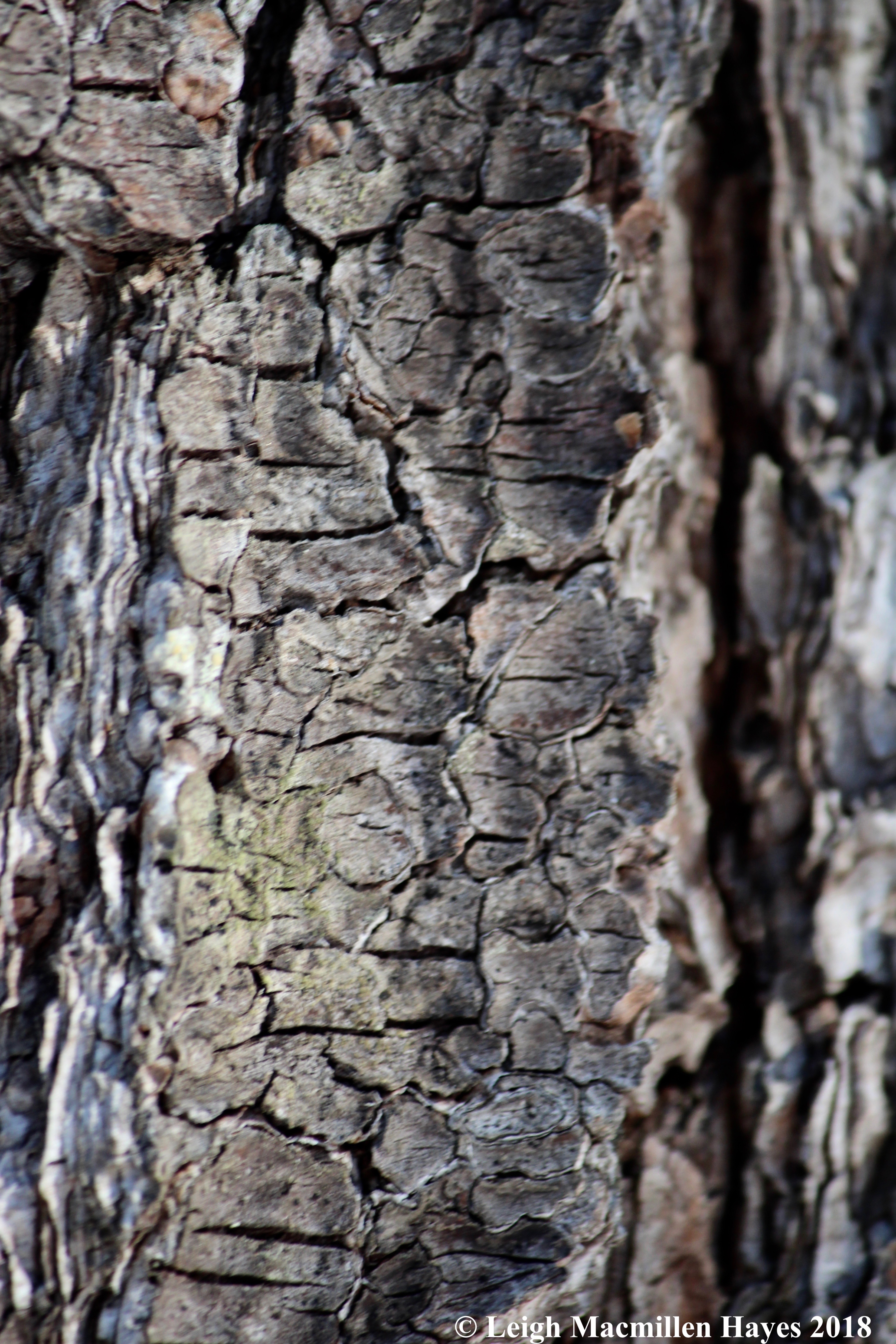
Finally, we have reached the last species for today, White Pine, Pinus strobus. I’m showing you the bark of a mature tree, but if you look at a young pine you’ll note it is very different with its smooth, pea green bark.

Mature trees, such as this, have dark gray to brown bark, with long flat ridges, and deep, dark furrows. What I love about mature White Pines is that the flat ridges have lines that resemble writing paper and I love to write.

White Pine twigs are slender and gray-green to orange-brown. Bundles of five needles is the count for White Pine, which is cool because it spells its name: W-H-I-T-E, or M-A-I-N-E, since it is our State Tree. (Please remember that Red Pine has only two needles in a bundle, and doesn’t spell its name.)

Cones are 4 – 8 inches long, cylindrical, and also take two years to mature. And it takes a Red Squirrel about 2 minutes to peel back the scales and eat all the seeds as if they were corn kernels on a cob.

Dear readers, if you made it this far, I thank you for sticking with me. I do love to write and maybe I’ve written too much.

But I hope you’ll venture out and get to know these trees better by studying their idiosyncrasies and coming up with your own mnemonics to remember their names.

May you become tree wise and may I continue to learn about and with the trees.
Where The Moose Led Us Mondate

It seems there are never enough rainy days to complete home chores so when today dawned as such I thought that all the contents I’d been sorting from a closet would finally make their way to new homes like the dump store or community clothing closet or back into containers to be stored for another rainy day.

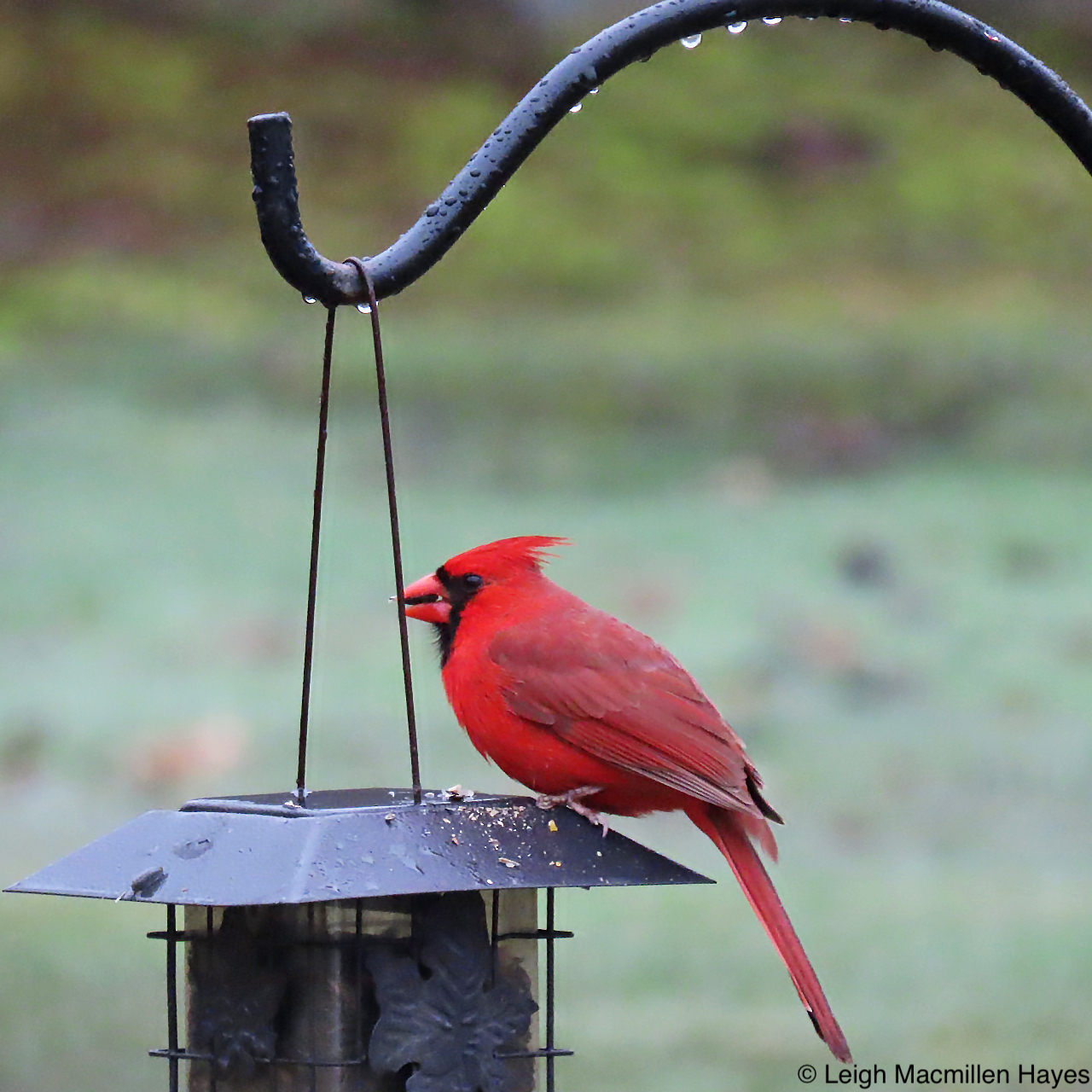
Apparently, I thought wrong for the Cardinal beckoned and we answered the call to head out the door.

When I mentioned a location for today’s hike to My Guy, he agreed that it sounded good, though come to find out, in reality he thought we were going someplace else and even when we arrived at Great Brook, he couldn’t recall our last visit, which was in 2016. Fair enough. I’ve been there many more times.

It soon became apparent that we were in Moose territory and our excitement rose. Actually, on another trail in this same neck of the woods we once spotted a Moose, so all we could do was hope that today we’d receive the same honor.

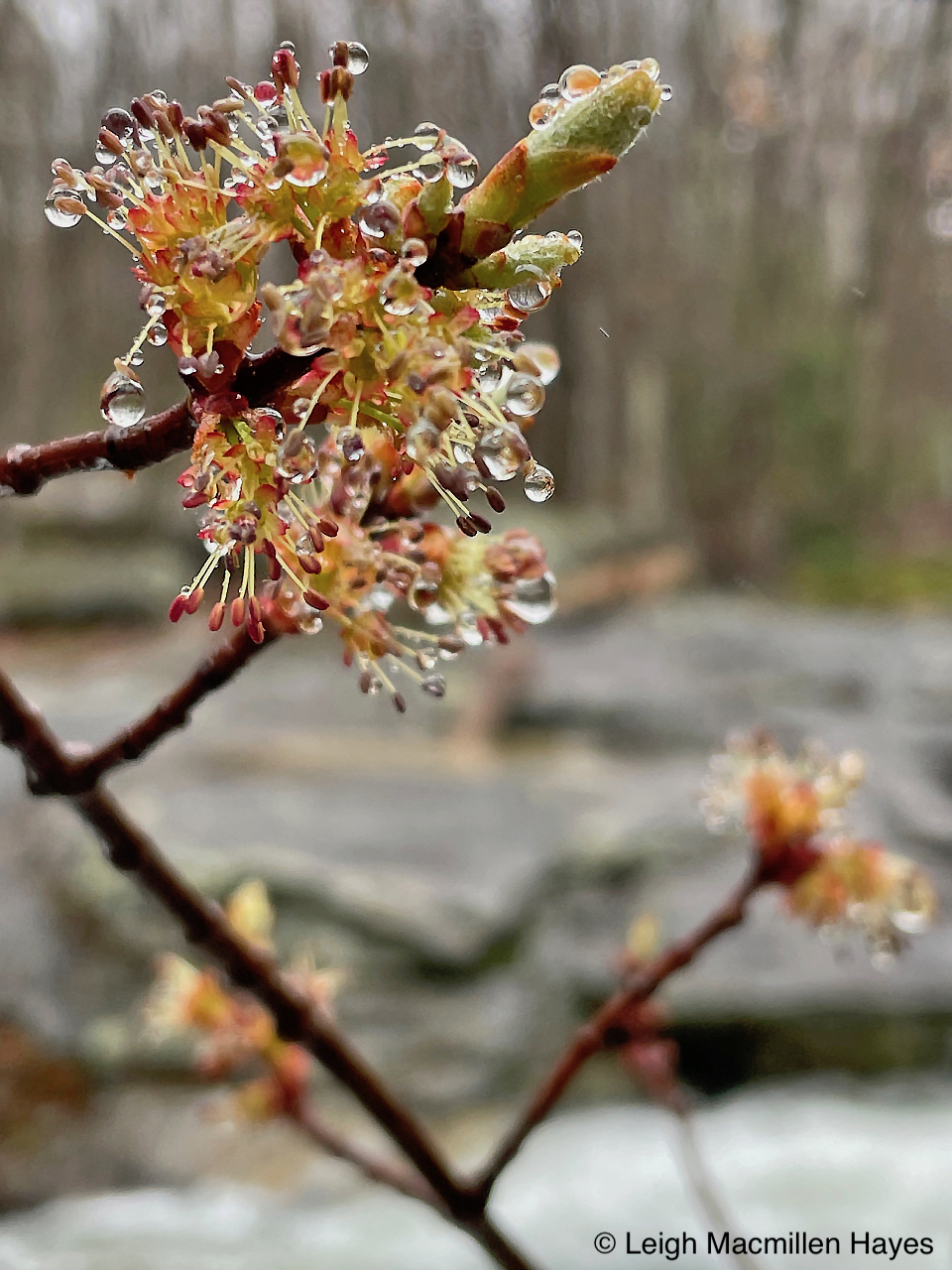
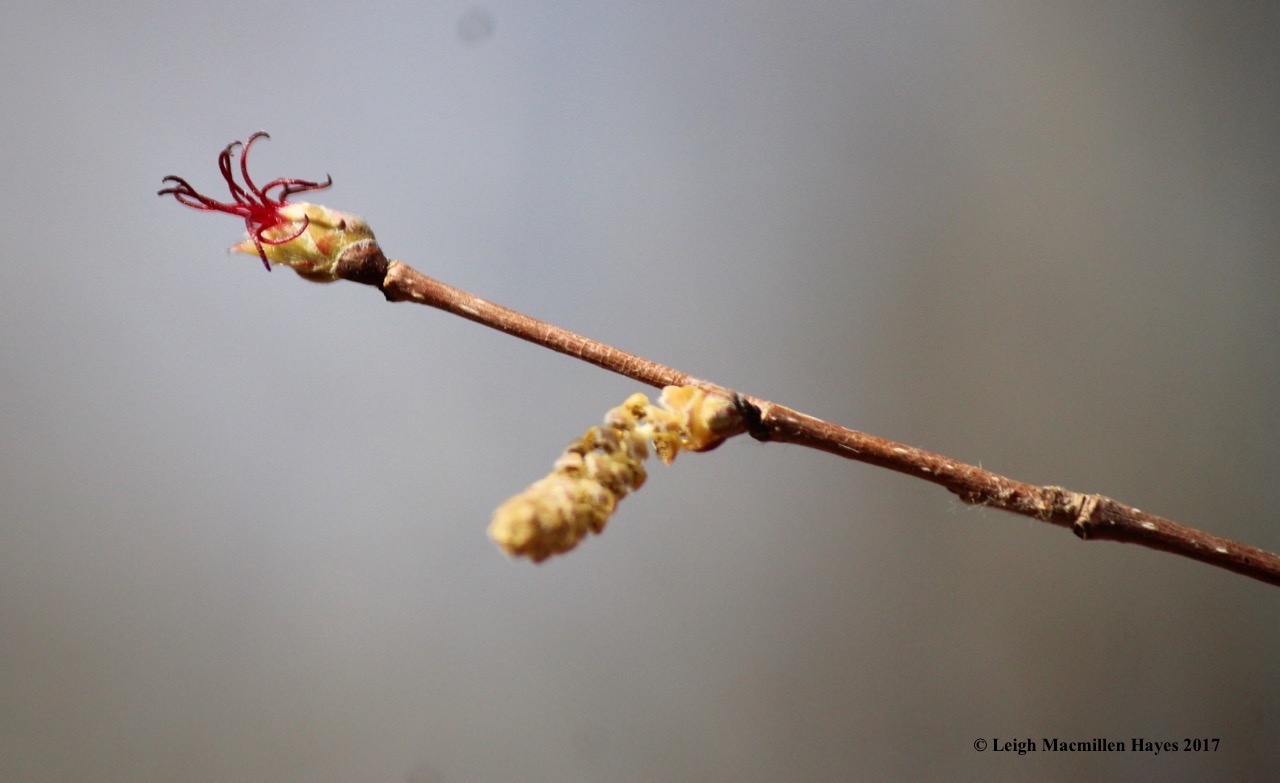
But first, there were other honors to receive, such as this bouquet of flowering Red Maple.

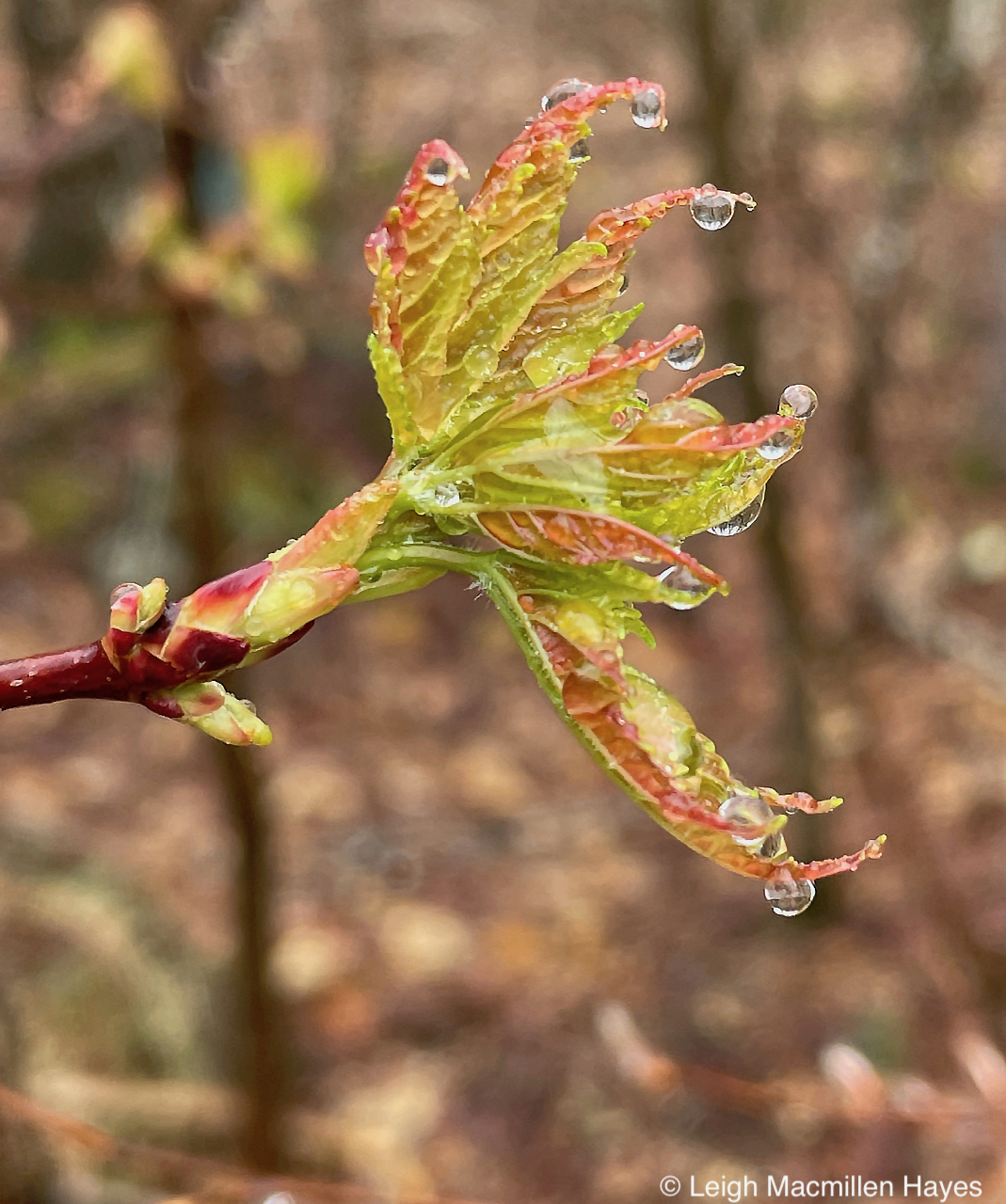
And the first of the season for us, maple leaves bursting forth in all their spring glory of color.

Onward we hiked deeper into the woods where a place one might think of as no place was once some place. This particular foundation has long been a favorite of mine because within is a root cellar.

It’s one I can’t resist stepping into because you never know what tidbit might have been left behind.

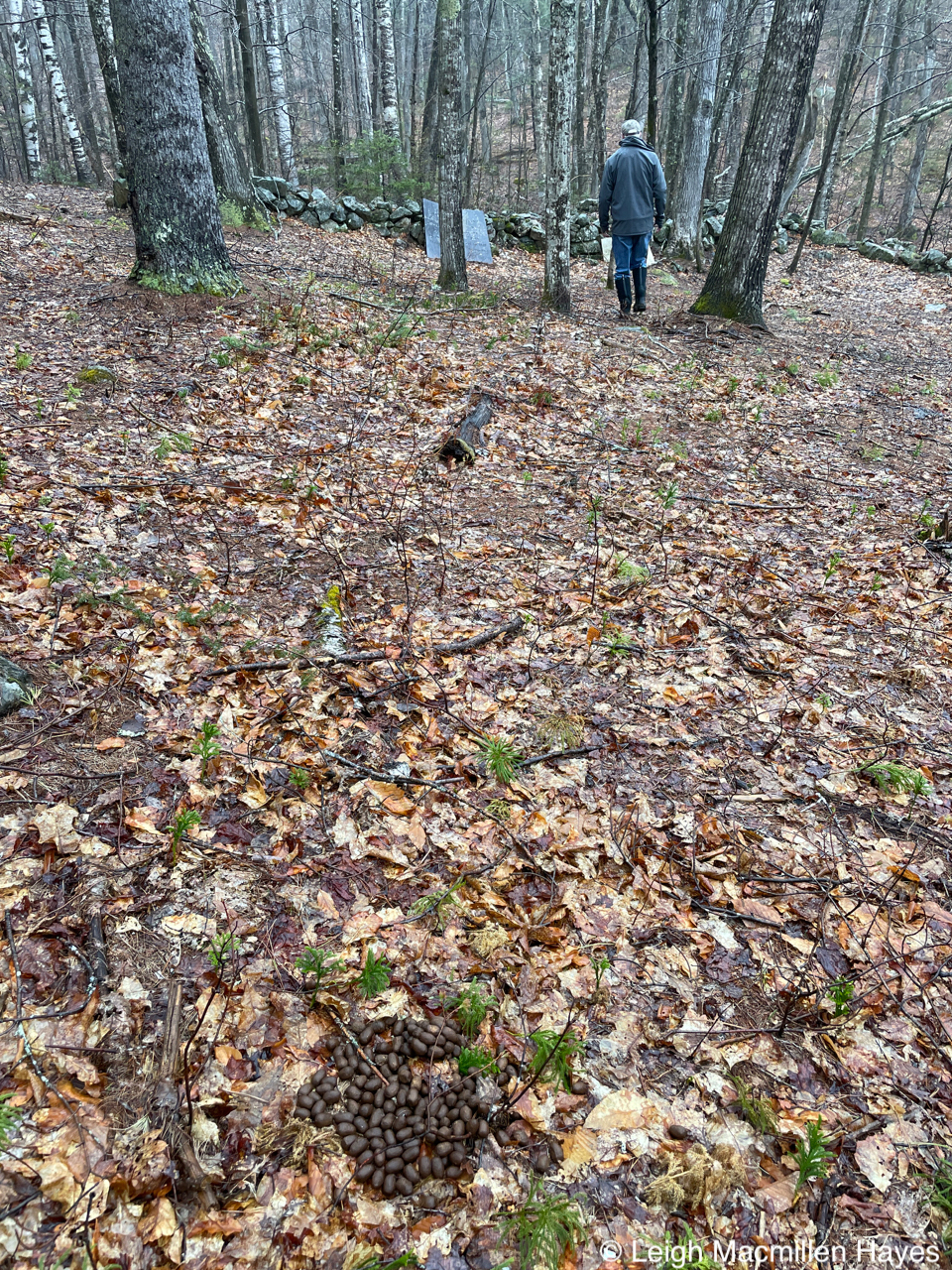
Porcupine scat! Rather old, but still.

My friend, Jinny Mae (RIP), was a talented techie and though the red line isn’t the entire route we followed today, it’s one she and I explored back in 2016. The map is from a section of the 1858 map of Stoneham. And we were at E. Durgin’s old homestead.

Knowing that there were some gravestones in the woods behind the house, we once again followed the Moose who led us directly to the family cemetery. Someone has cleared the site a bit, so it was easy to spot, especially since the trees haven’t fully leafed out.

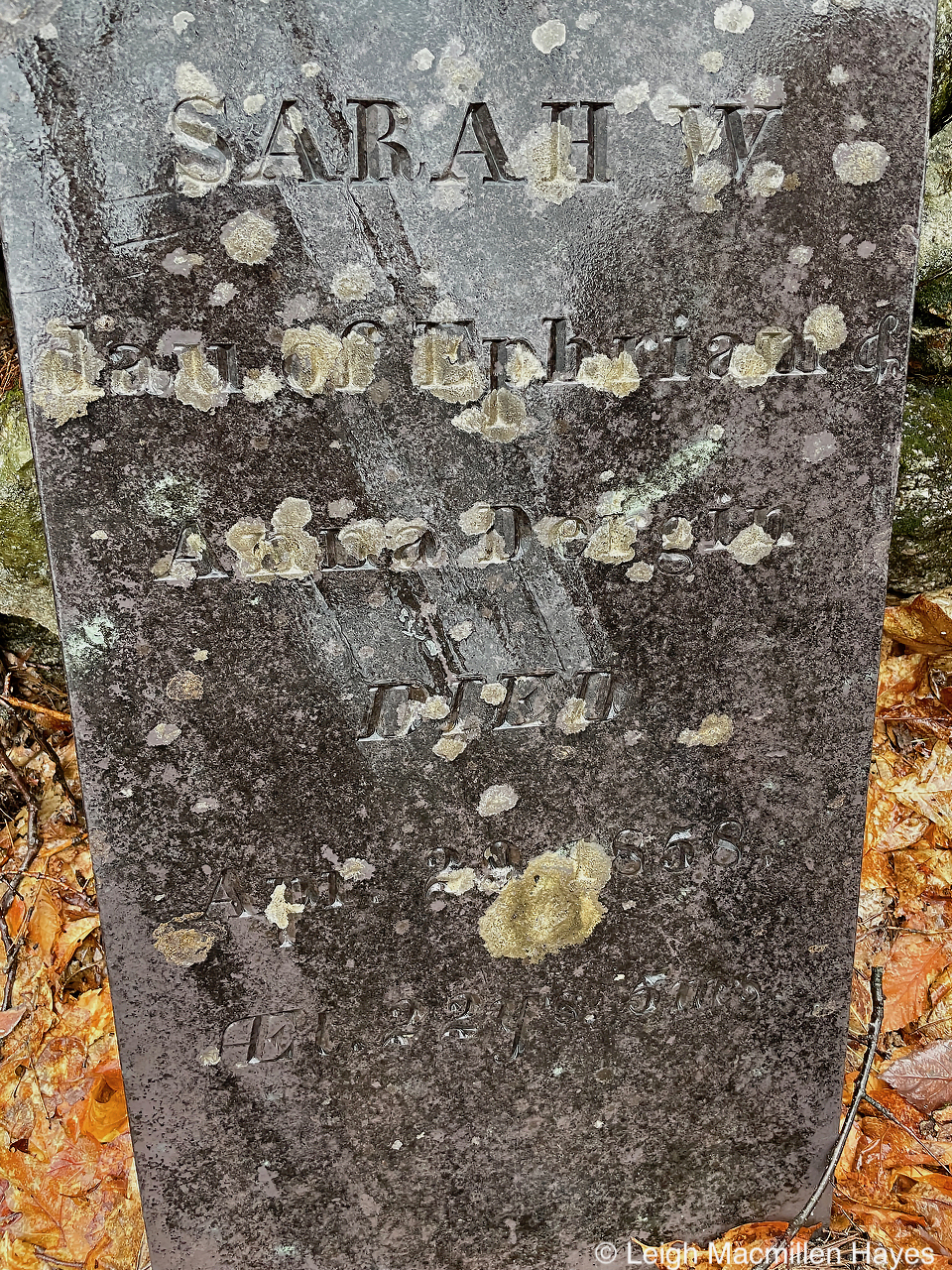
Sarah, daughter of Anna and Ephraim Durgin, is the first tombstone. She died in 1858 at age 22.

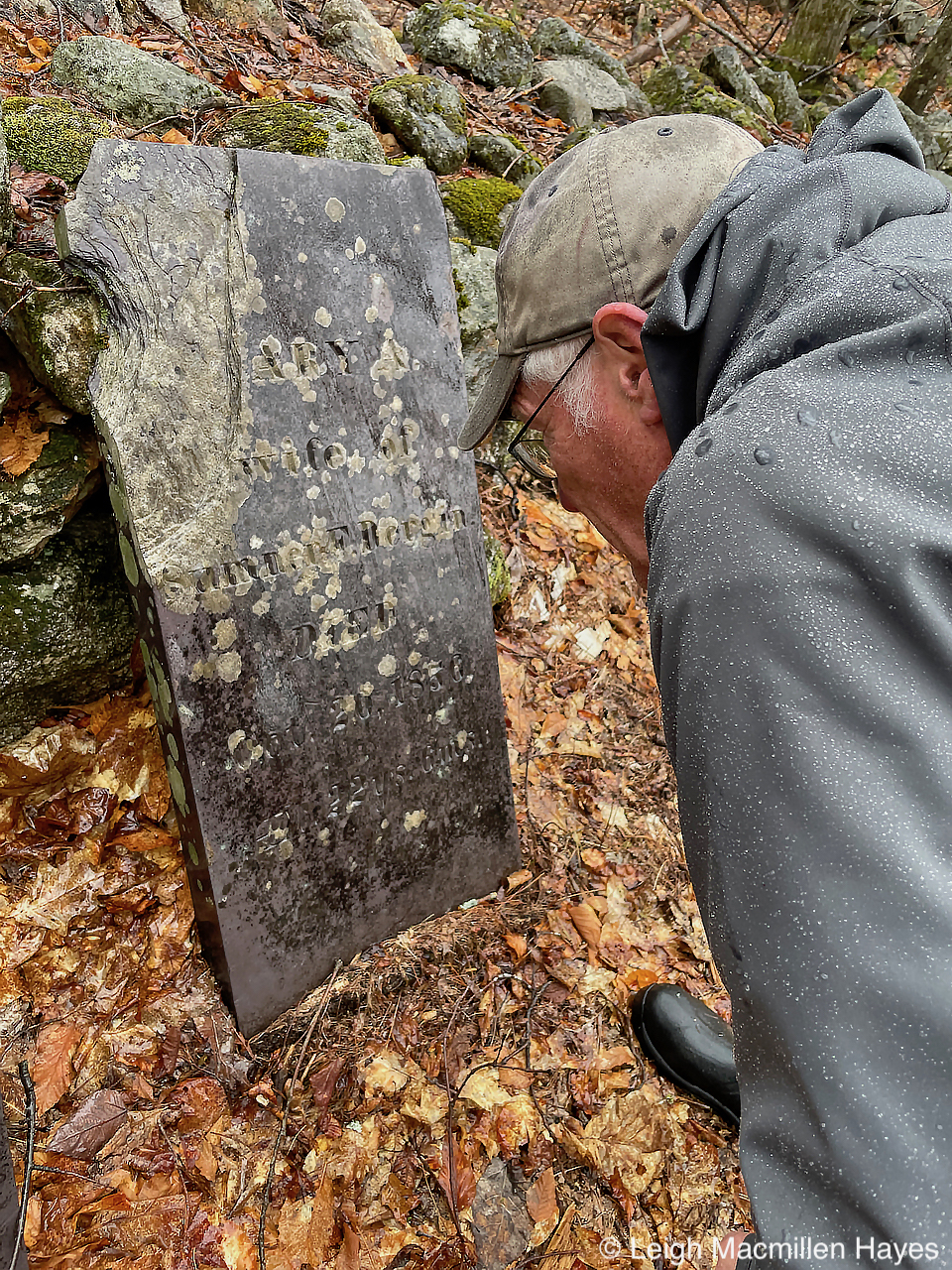
Beside her is the stone for Mary, wife of Sumner Dergin, who died before Sarah–in 1856. She, too, was 22 years old. As best I can tell, Sarah and Sumner were siblings.

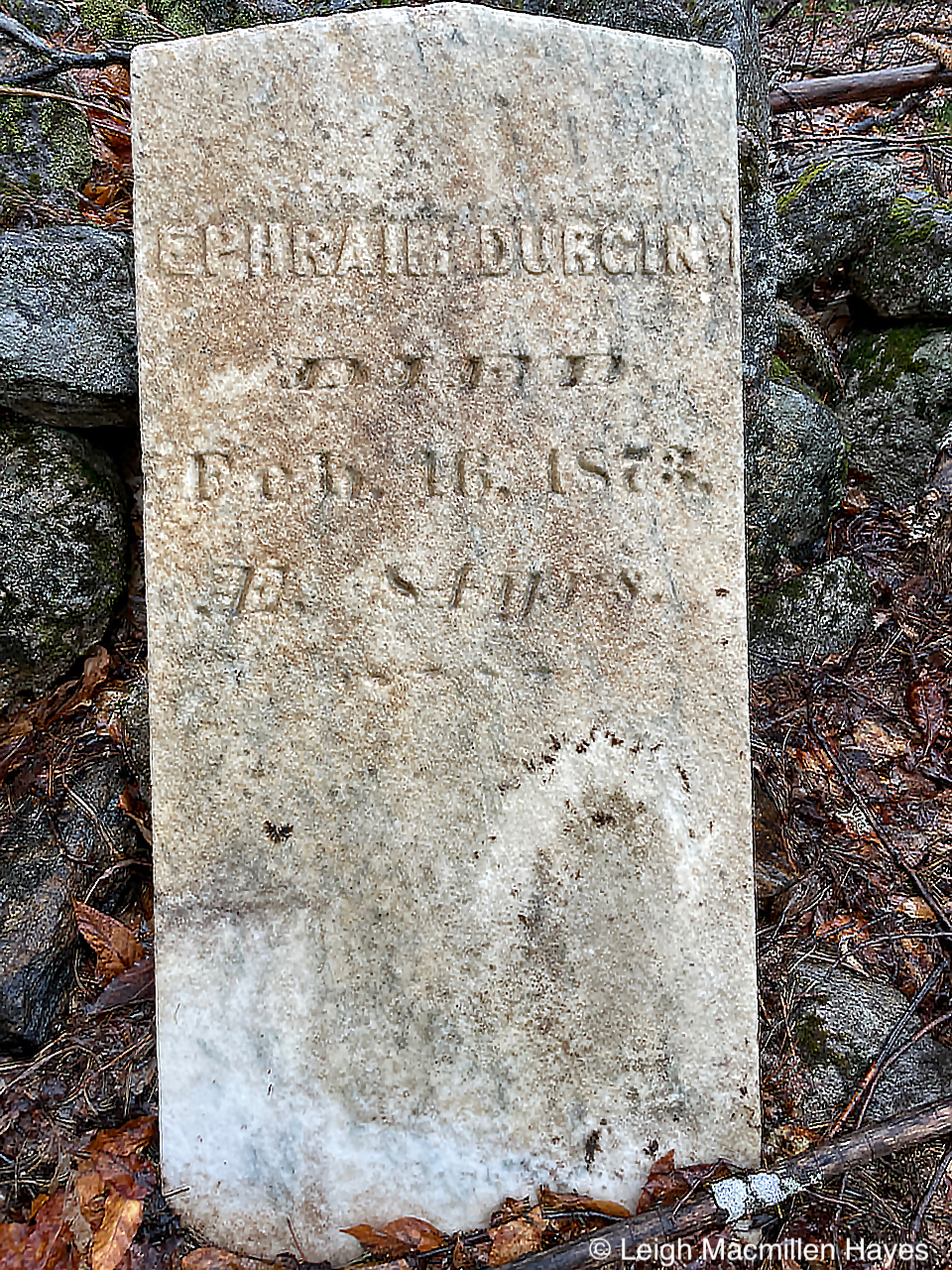
And Ephraim, Sarah’s father, died in 1873 at age 81. Notice the difference in stone from the two girls to Ephraim? Slate to cement. And the name spelling–Dergin and Durgin. As genealogy hobbiests, we’ve become accustomed to variations in spelling.

I found the following on RootsWeb:

8. ANNA3 FURLONG (PATRICK2, JOHN1) was born 1791 in Limerick, Maine, and died 1873 in Stoneham, Maine. She married EPHRAIM DURGIN June 18, 1817 in Limerick, Maine14. He was born April 13, 1790 in Limerick, Maine, and died in Stoneham.

Children of ANNA FURLONG and EPHRAIM DURGIN are:
i.OLIVE4 DURGIN, b. 1811, Stoneham, Maine; m. DUNCAN M. ROSS, April 11, 1860, Portland, Maine.
ii.SALOMA DURGIN, b. 1813.
iii.ELIZABETH DURGIN, b. 1815.
iv.SALLY DURGIN, b. 1817.
v.SUMNER F. DURGIN, b. 1819, Of Stoneham, Massachusettes; m. MARY ANN DURGAN, July 11, 1853, York County, Maine; b. Of Parsonsfield, Maine.
vi.CASANDIA DURGIN, b. 1821.
vii.EPHRAIM DURGIN, b. 1823.
viii.FANNY DURGIN, b. 1825.

Sarah isn’t listed above. But . . . Sally and Sarah were often interchangeable.

By 1880, there had been a change in ownership of the neighborhood homes and the Rowlands had moved into the Durgin house.

Again, we followed the moose, this time in the form of a Striped Maple browsed upon, curious to see what might be ahead.

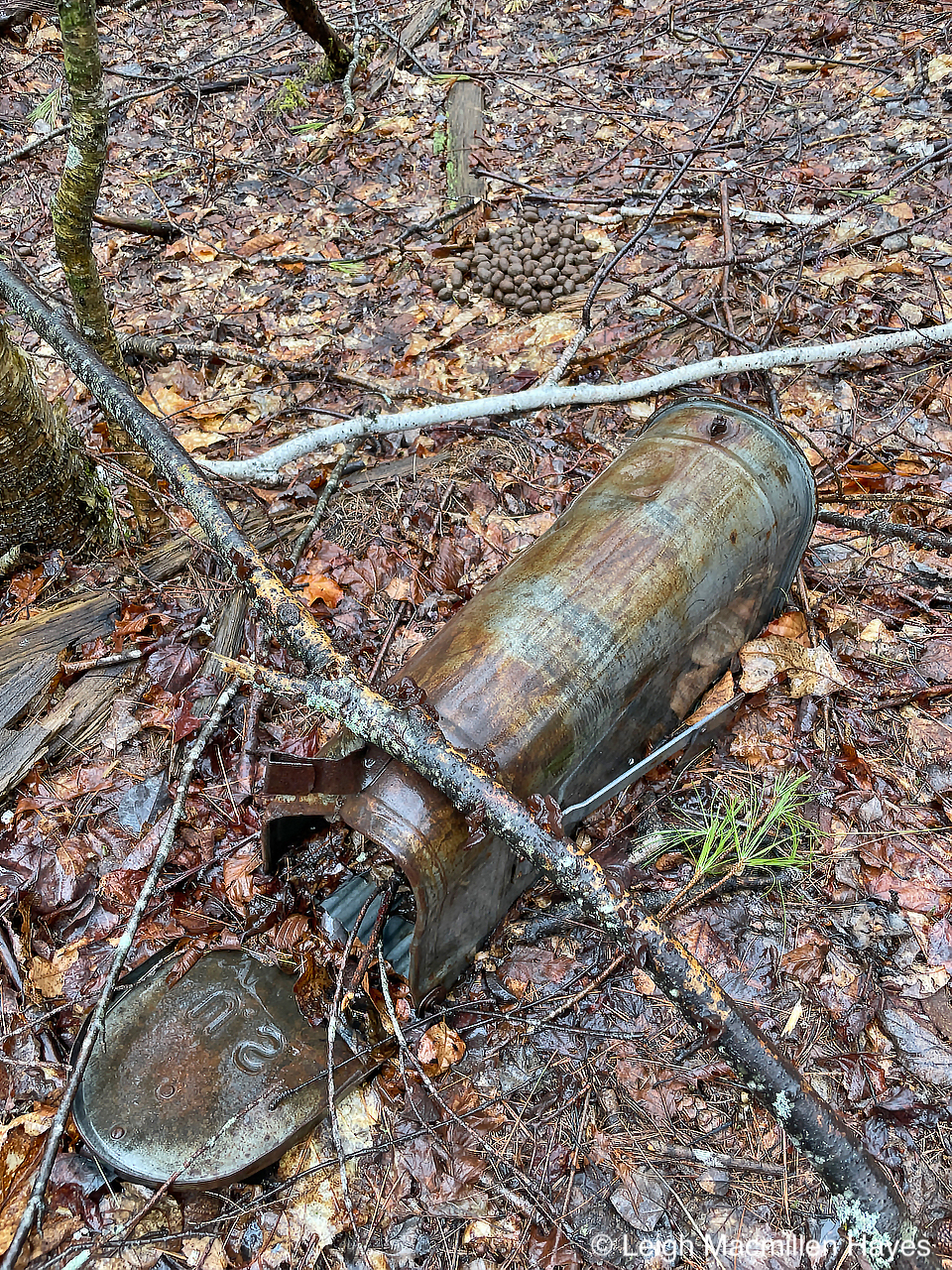
A chuckle. Yes, a mailbox in the middle of nowhere, this spot being a place where someone once had a camp. Our Moose tried to send a letter, but missed by a couple of feet.

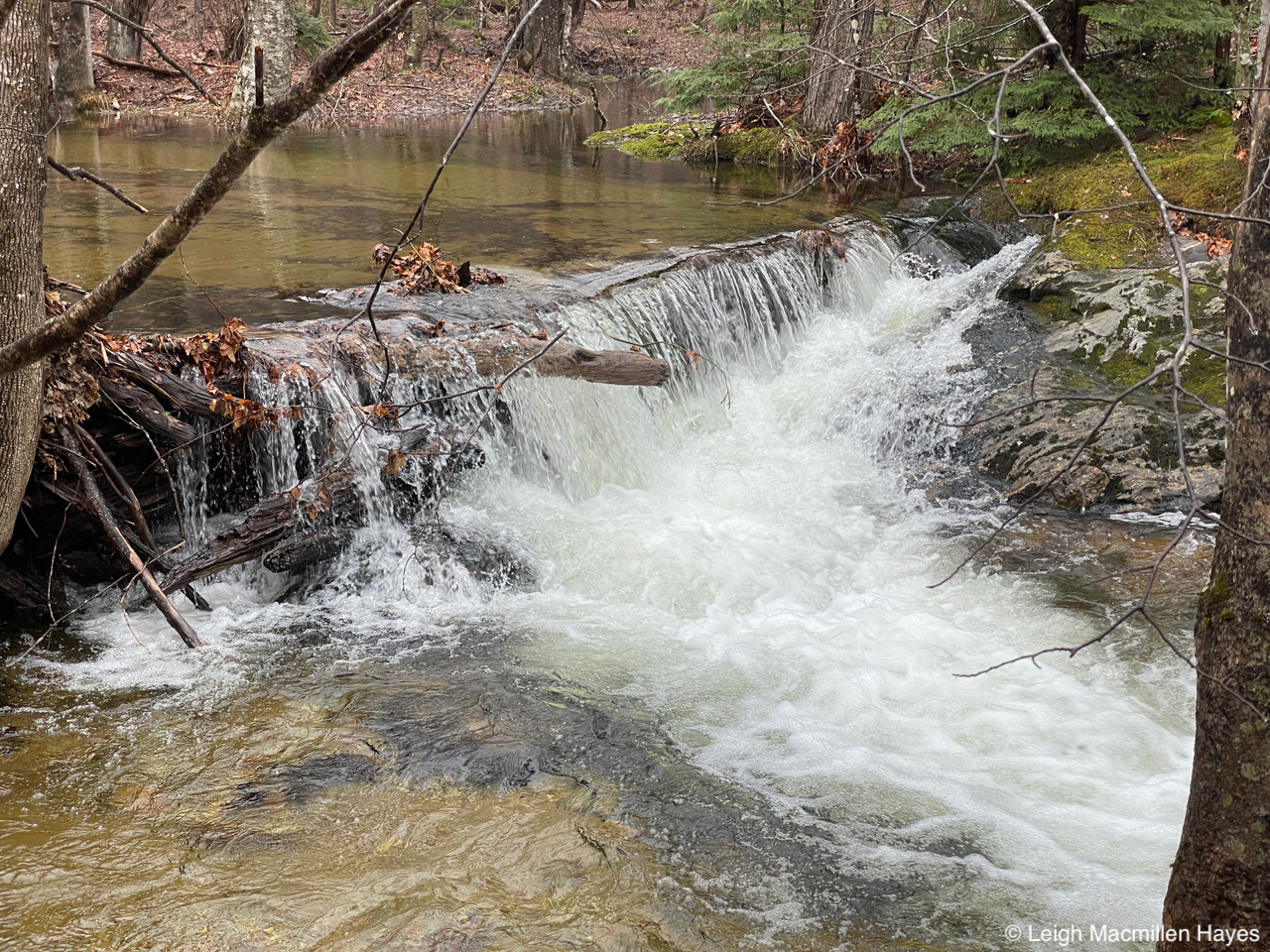
Willard Brook was our next stop and I was reminded that when I first started wondermyway.com, a post about this brook initiated some discussion about the Indigenous stonework found throughout the area. I’ve explored it looking for such and convinced myself in the past that I saw the turtles in most of the stonewalls. In fact, I see them everywhere, but today I was looking at different subjects.

Beside the brook, lots of Hobblebush looked ready to burst into life and we thought how fortunate that the moose hadn’t decided to dine. Yet.

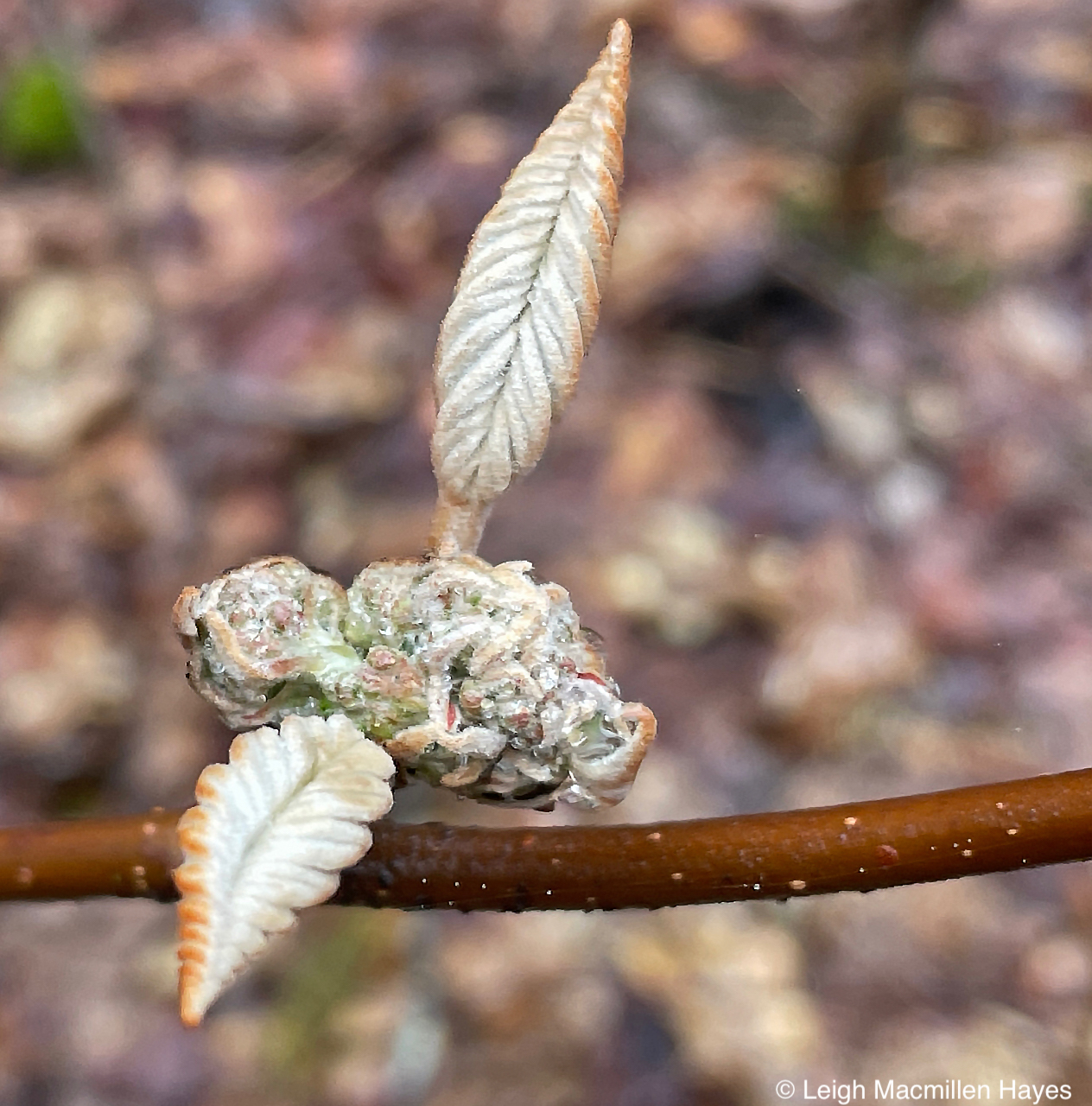
There were even tiny Hobblebush leaves to celebrate for their accordion style.

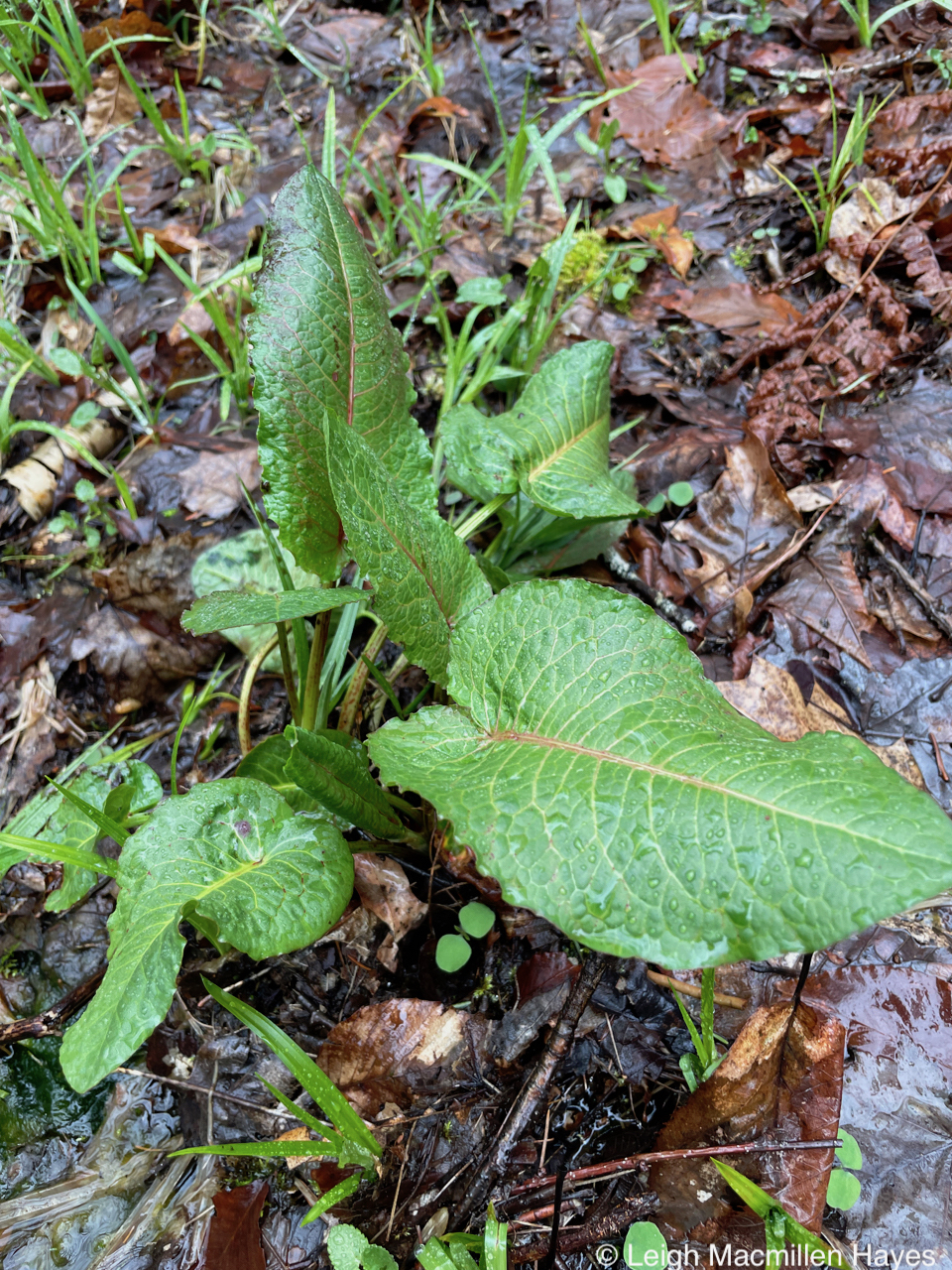
And Broad-leaved Dock looking quite happy and healthy.

Back to Great Brook we eventually wandered, still with no actual Moose in sight.

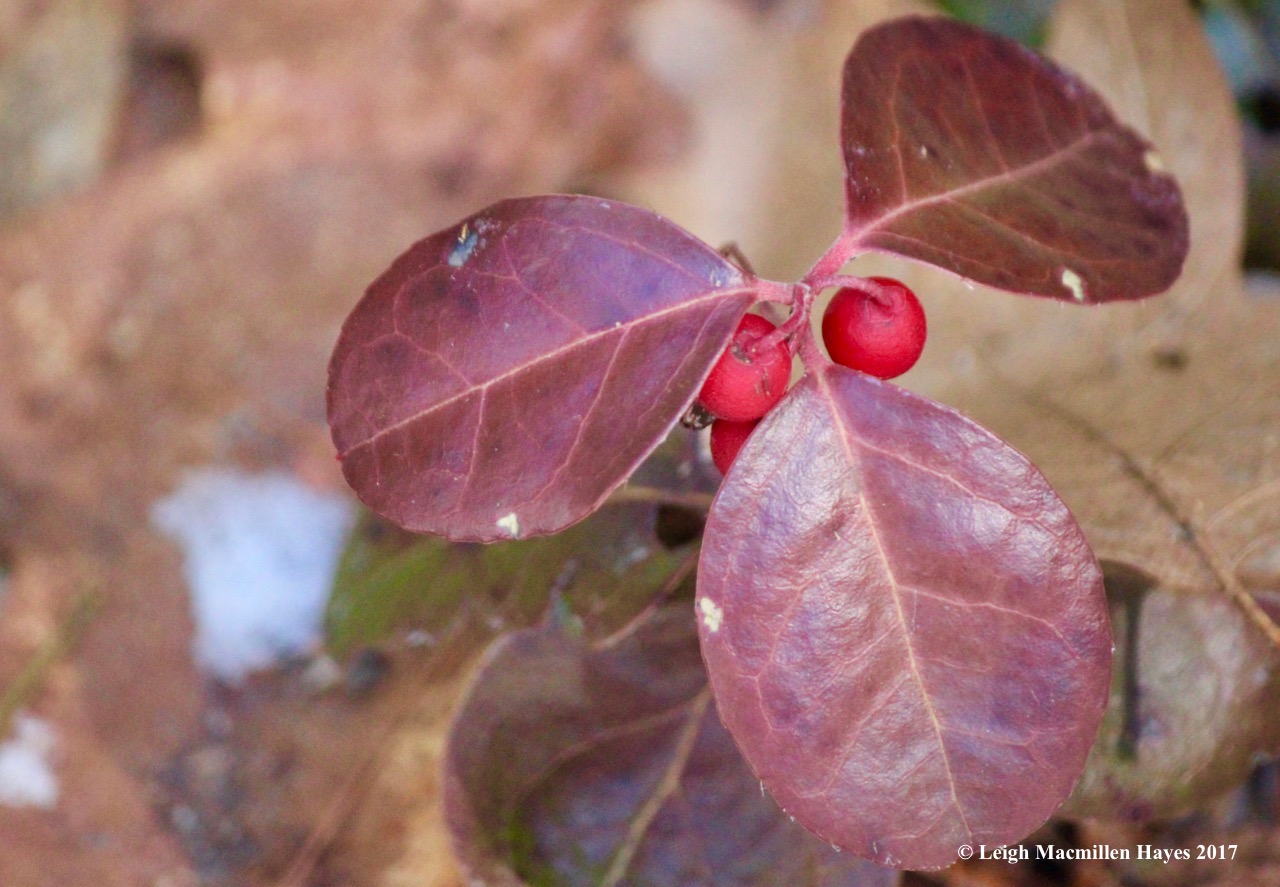
But beside the brook I did spot some Trailing Arbutus buds preparing for their grand opening.

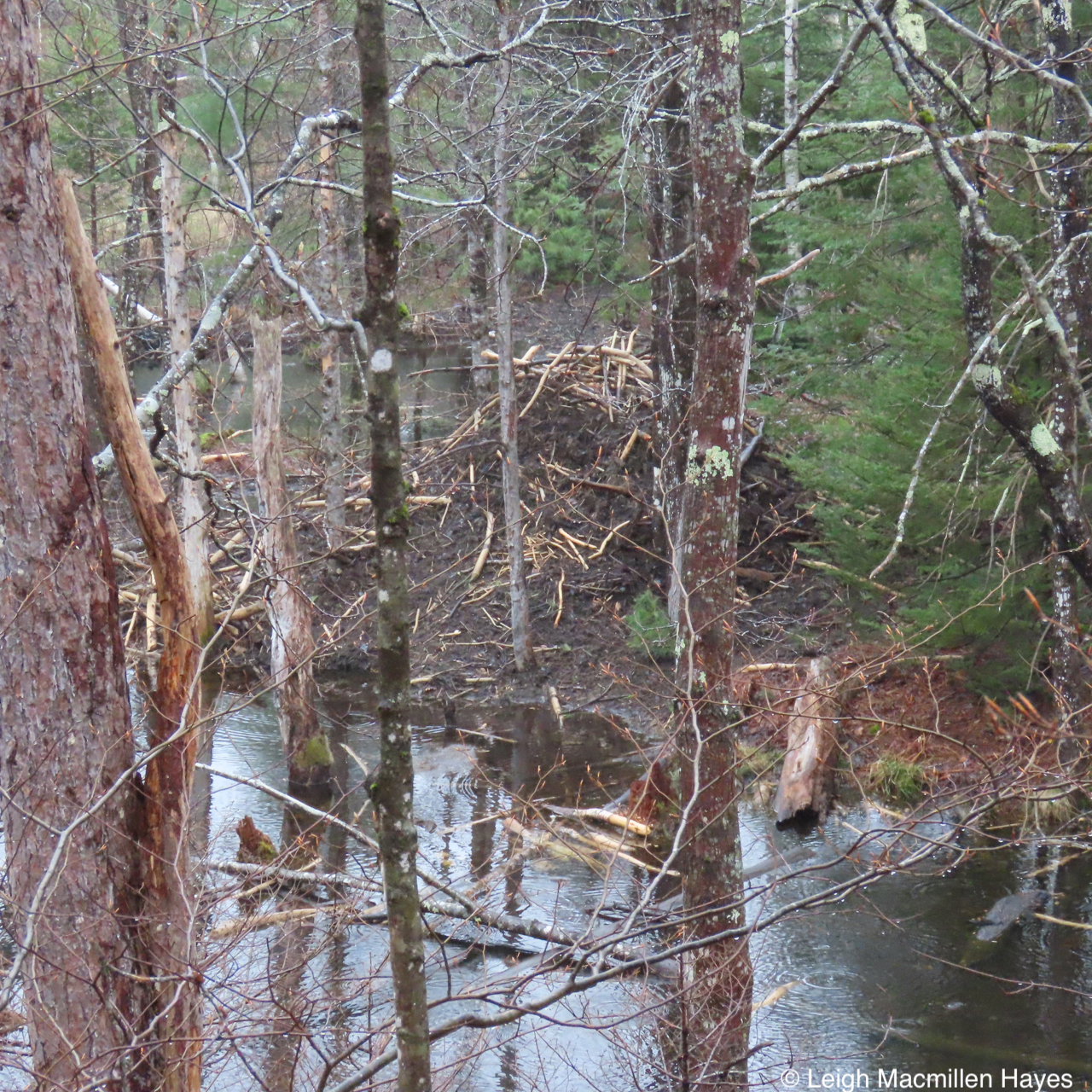
As we walked back on the dirt road we’d walked in on, we paused beside a beaver pond where Spring Peepers sang their high-pitched love songs. I made My Guy scan the area with me because just maybe . . .

or maybe not. We did spot a Mallard couple. Oh well, We still had fun discovering everything else where the Moose led us on this rainy day.

And when we arrived home I had an email from an acquaintance double-checking with me that the print he found on his shore front of Kezar Lake was a moose print. Indeed it was!

(And now it’s time to prepare for Big Night. Finally. The temperature is in the 40˚s; it’s been raining all day and will continue tonight; and though lots of amphibians have moved to their native vernal pools, I think there will be some action tonight and we’ll be able to help them cross the road safely.)

Lost and Found Mondate

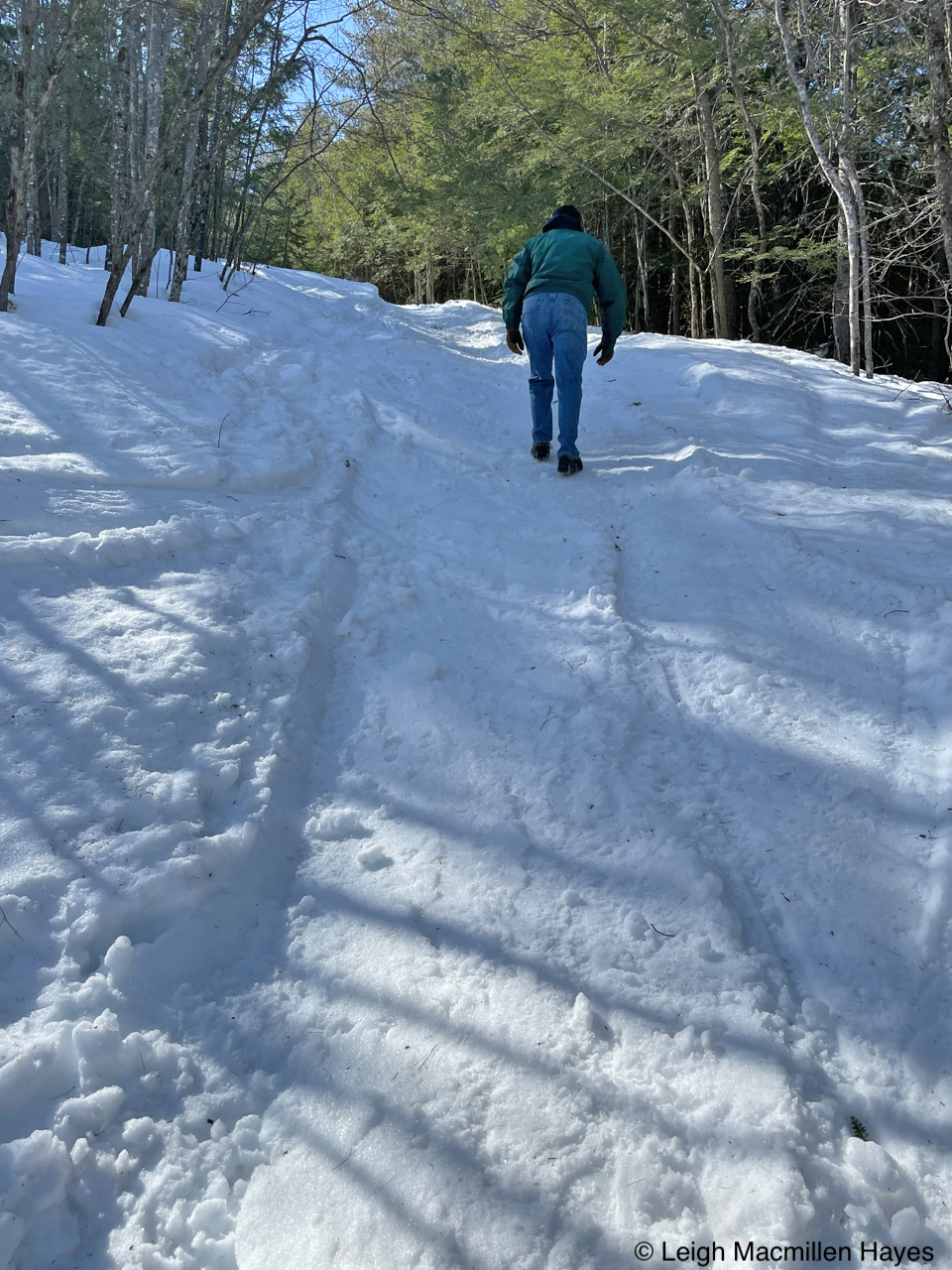
We chose a trail we’ve never hiked before, though we’ve conquered this mountain from two other trails many times over the years. Today’s choice was based on an email from Allen Crabtree, leader of the Denmark Mountain Hikers. The lovely thing about it was we walked along a snowmobile trail to the summit and so were happy to be on micro-spikes and not snowshoes or postholing. And the temperature was crisp enough to keep the snow firm, at least on the way up Burnt Meadow Mountain.

After passing by what I think was an old barn foundation, the trail continued on fairly level ground for a bit and we worried that I may have misunderstood the directions.

But that didn’t really matter because we were in the woods, together, and enjoying the fact that a fisher had loped across the landscape probably last night when the snow was still soft enough to leave impressions before this morning’s temp of 17˚.

At last the trail began to get steeper and I gave great thanks that it was such a packed trail for it made for an easy ascent. We had no idea what conditions might be under the snowmobile trail, but I suspect on a summer day this isn’t an easy way to go. Not that the other two trails are either.

My real reason for suggesting this hike to My Guy was because I wanted to revisit this site, which we’d reached previously on a exploration down from the summit in 2012.

At the time I was working on an article for Lake Living magazine entitled “Maine’s Lost Ski Areas” and interviewing various skiers and making MG tag along with me as I visited the former ski areas. “Trails hidden in the forest provide us with clues that our town fathers worked hard to create recreational areas, but also to boost the local economy,” I wrote in the article. “You can still find some of the trails and remnants of rope tows and chair lifts. When you unexpectedly come upon cement pads and towers while hiking, it’s a bit like entering a ghost town, a place that has seen a livelier day. So many people have a history with these legendary ski areas. They learned to ski at this one, met their spouse at that one, or won first place in a race.

The skiing industry began in the lakes region in 1936 when a group of ten businessmen each invested $25 and considerable labor to build the first rope tow in Maine. The Jockey Cap Ski Tow helped make Fryeburg ‘The Ski Capital of Maine’ for a brief time.

According to newspaper articles and brochures preserved by the Fryeburg Historical Society, the Fryeburg Winter Sports Committee hired Paul Lamere, a ski instructor, to run a branch of the Lamere School of American Skiing. Lessons were offered one day a week.

Because the Maine Central Railroad had a station in town, Fryeburg residents saw the ski area as a means to support businesses during the Depression. Leaflets proclaiming “Weekends for Your Winter Sports” mentioned “good motels, good restaurants, good rooms in private homes, all prices reasonable . . . use the lighted ski-tow, Friday and Saturday nights, a brilliantly lighted slope and rope to pull you up the hill, a new thrill for winter sports enthusiasts” were distributed in the Portland area. The cost for a ride on the snow train from Portland to Fryeburg was $1.50 and a ski ticket was about $1.00.” (I should mention that the photo above was made possible to Lake Living by the Fryeburg Historical Society.)

But we weren’t at Jockey Cap today. And this ski area was a wee bit newer as I quoted former Lake Region High School principal Roger Lowell telling me he’d skied at Burnt Meadow Mountain, which had one lift and a lodge. If you look below the arrow, the top tower was the end of the line and skiers had to exit off the T-bar at that point.

From my article, “According to NELSAP (New England Lost Ski Area Project), in 1967 the Burnt Meadow Mountain Recreation Area received a loan from the Farmer’s Home Association to create a ski area that opened for the 1971-72 season, but saw its demise when several bad snow years followed. In 1980, Wendell Pierce, owner of a northern Maine ski area, purchased Burnt Meadow and renamed it Zodiac Skiway.”

“‘It had pretty good skiing from the top,’ recalls Roger, ‘but three quarters of the way down it flattened out and you had to get up steam to make it all the way without poling.’ He and his team got into trouble for going too fast. ‘WE were bombing the thing so we wouldn’t have to skate to the lift,’ he says.

While there on his own one day, Roger learned about a race. After discovering he couldn’t inspect the course, he found himself last in line. ‘I figured what have I got to lose so I went fast. It didn’t matter if the gates were down a bit. You would have thought I was Jean-Claude Killy.’

Roger won the race and received a blue ribbon similar to what they award at the Fryeburg Fair. ‘I think it said something like FIRST on it,’ he says, a wry look on his face. ‘It was very generic. A conversation piece.’ That was the last race held there. The ski area continued to lose money and closed in 1982. The T-bar still stands intact.” That was 11 years ago, but today’s photos speak to the fact that it still stands intact.

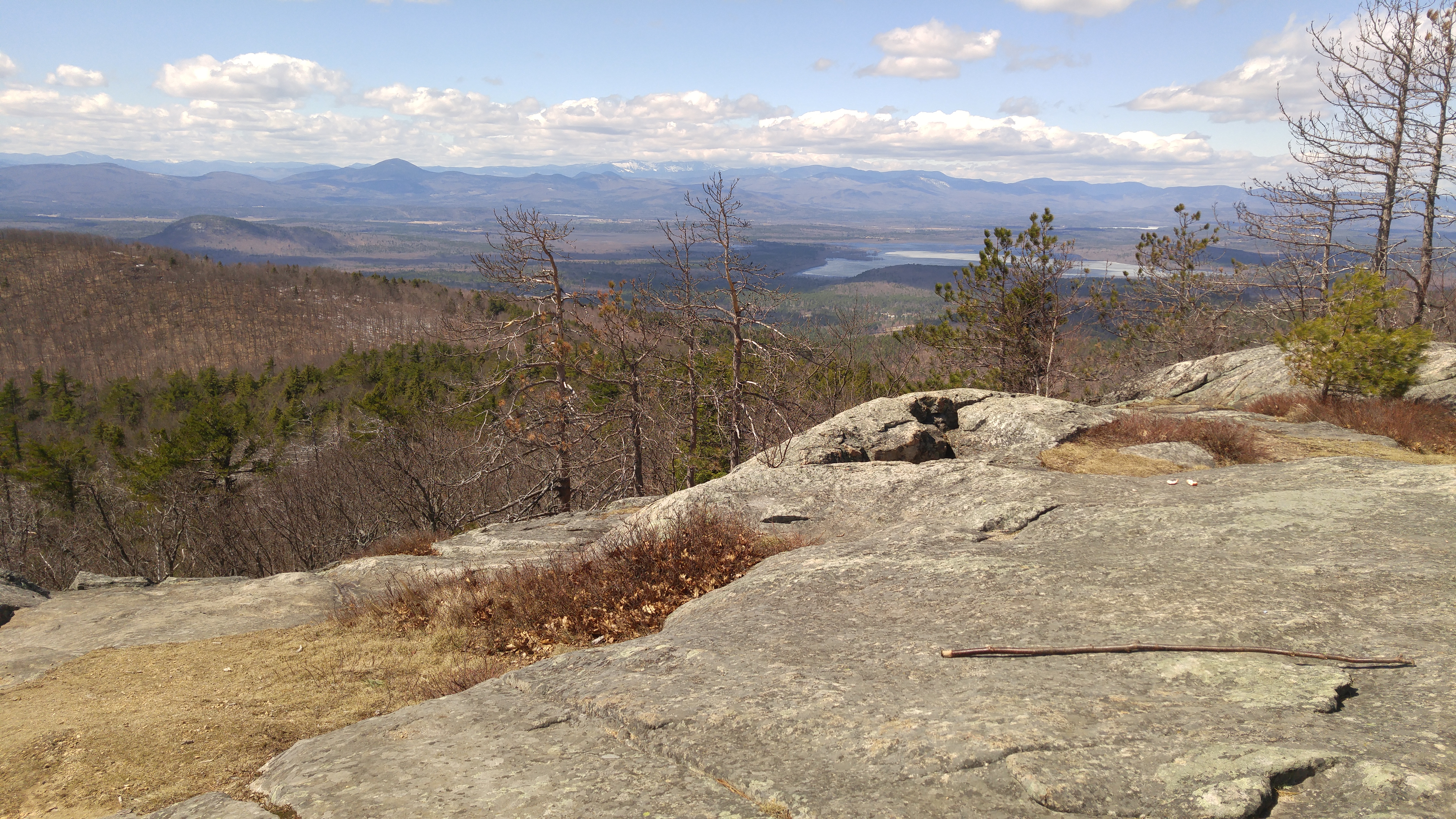
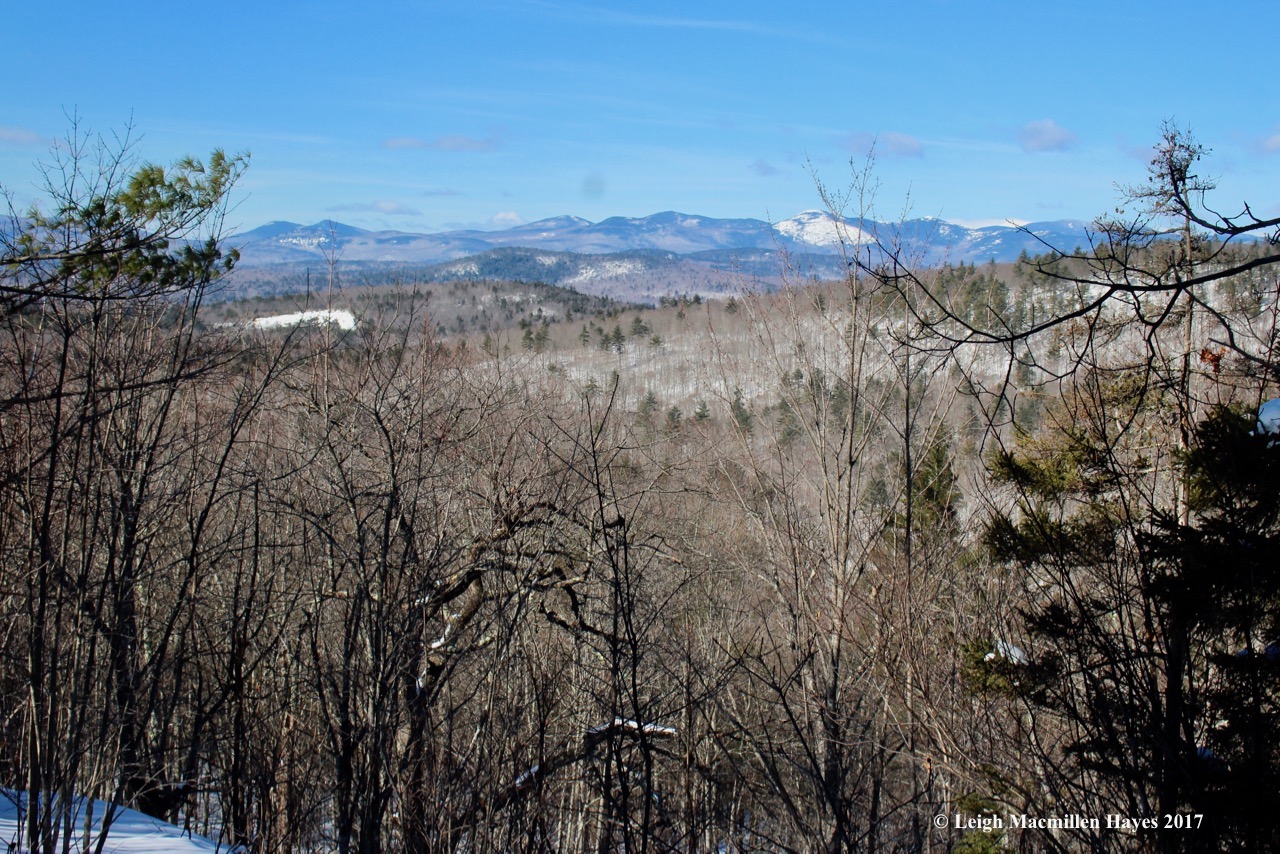
It didn’t take long for us to reach the summit, where we walked around taking in the views beyond, this a look toward Stone Mountain, which is accessible via the Twin Brook Trail.

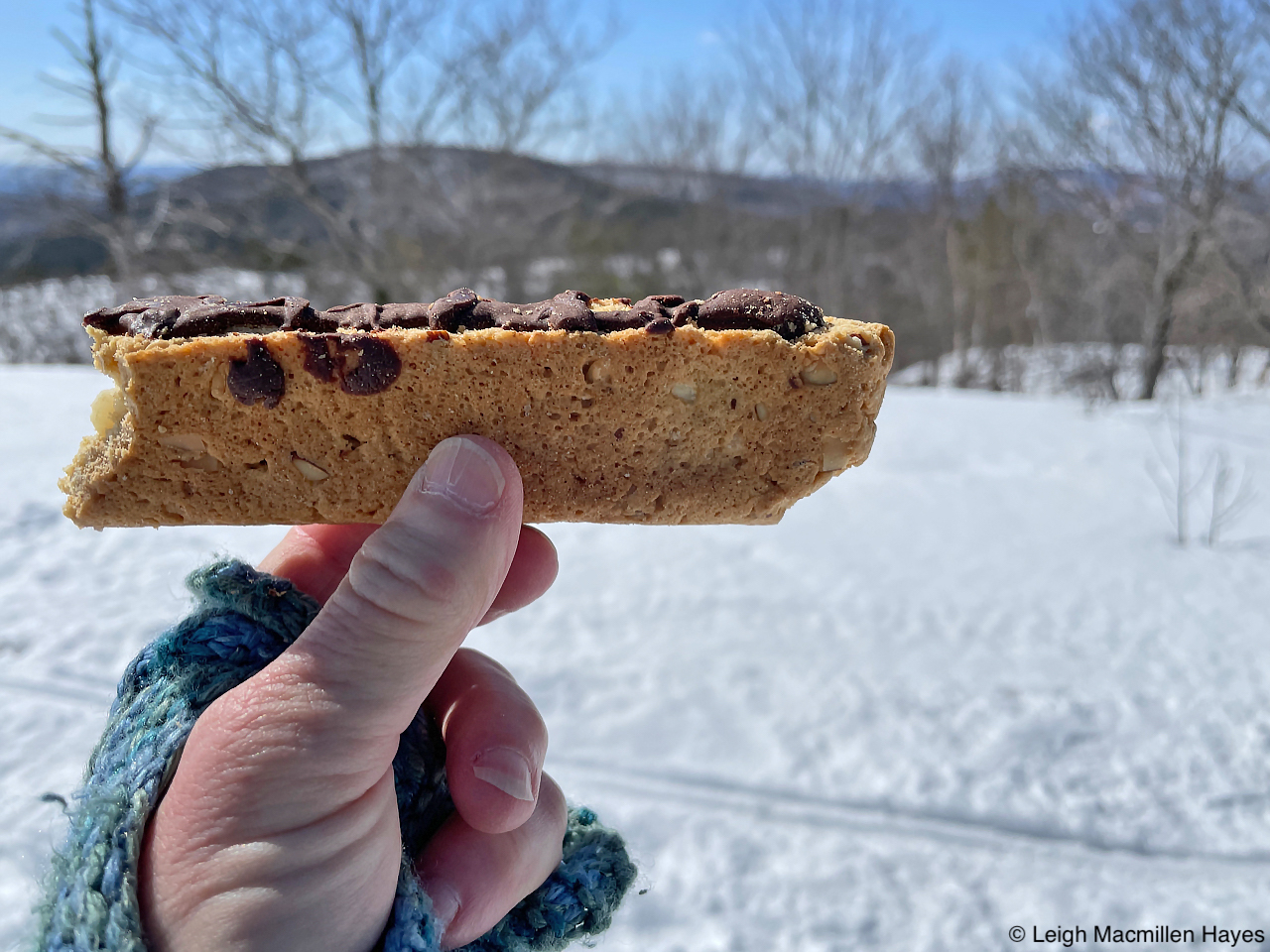
Finally, we sat upon lunch rock to enjoy our sandwiches, followed by Fly Away Farm’s Almond Biscotti with Mocha Drizzle. MG just thought it was chocolate so let’s keep that secret between us.

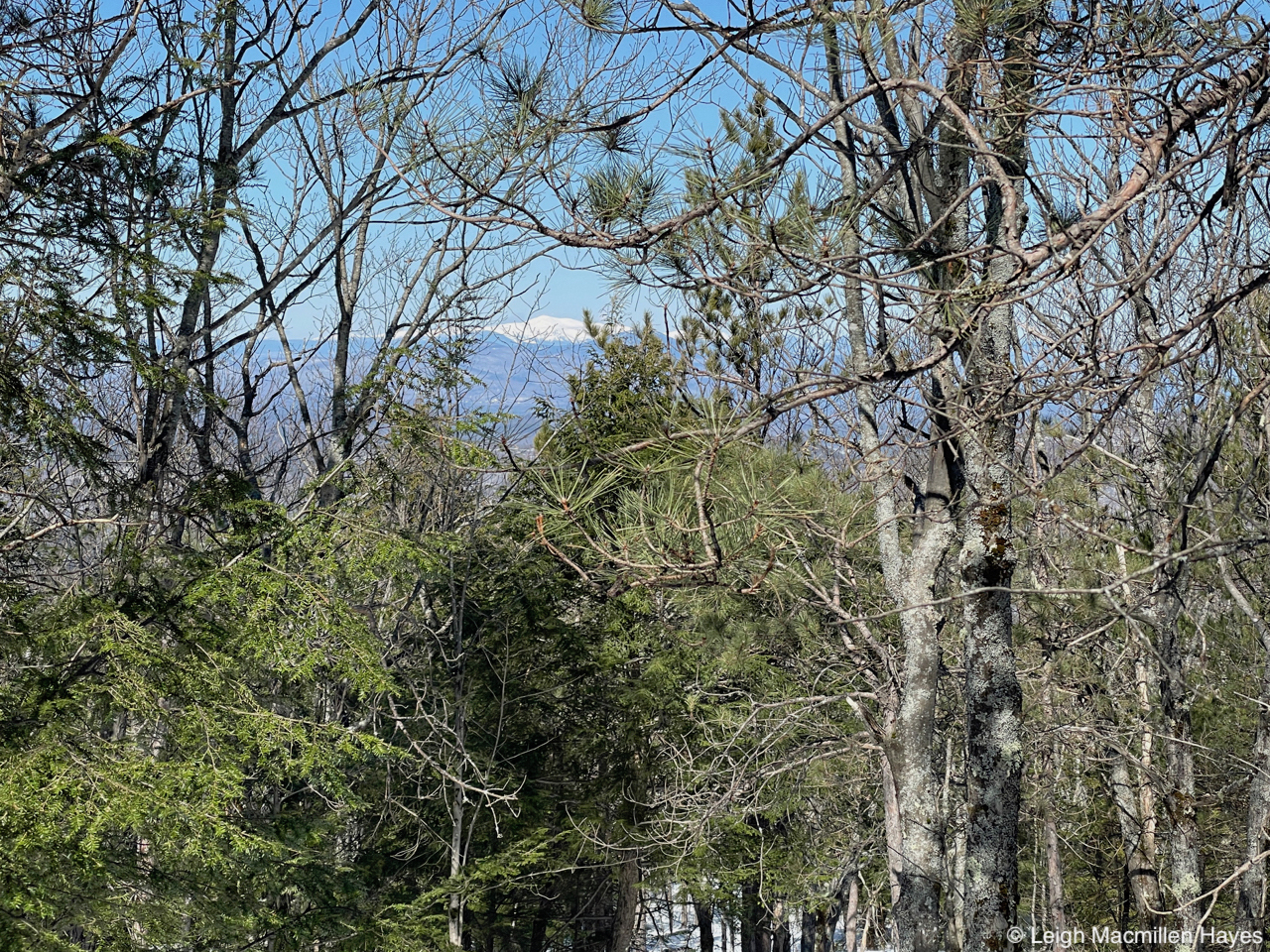
At last we began our descent, with a goal to find Mount Washington. And we did. Do you see it between the trees?

And then we found it again when we slipped off trail to take in the scene from a ledge. We always love to know where we are in the world. Our little world.

As we continued downhill, I was stopped in my tracks. That happens occasionally. (Insert smiley face) But this tree that leaned across the trail begged to be noticed and I’d missed it on the climb up the mountain.

Its manner of growing needles upon the trunk like no other evergreen that I know of gave me an immediate identification.

Add to that the number of needles that grow in short individual bundles: 3. Three strikes and you are out. Pitch Pine. Get it?

In the end, we thought we’d lost winter, but we found it alive and well and holding on for a wee bit longer. And even longer than that if you are at the summit of Mount Washington.

At the same time, because we are on the cusp of a seasonal change, we found spring in the form of swelling Red Maple buds . . .

and Striped Maple.

We also found some stuff left behind by other recent hikers. We left the sunglasses on a cairn at the summit.

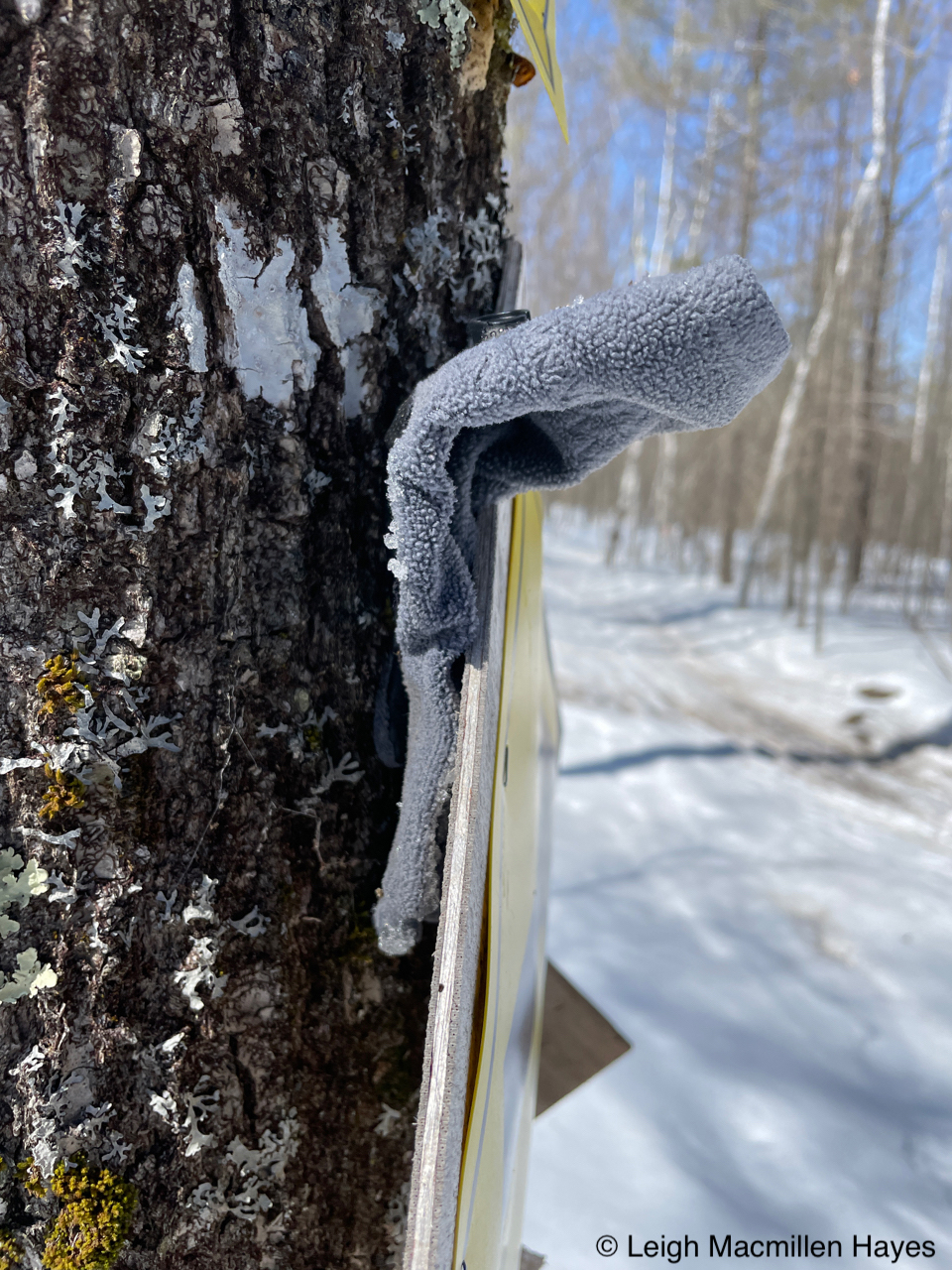
And a glove at the trail intersection.

In fact, just after putting the glove on the sign we found an optic cleaning clothe–maybe to clean the sunglasses?

This was indeed a lost and found Mondate.

Oh, and thanks again to Allen Crabtree for his write-up and directions to the trailhead and mention of my friend Marita Wiser’s book: Wrote Allen: “The origin of the name “Burnt Meadow” is not clear.  Most trail guides attribute the lack of large trees on the mountain to the Great Fires of 1947 which also burned more than 80% of the old homes in Brownfield.  Marita Wiser, in her Hikes in and around Maine’s Lake Region says,”…the name of Burnt Meadow was established long before [1947].  It is shown on…an 1858 map of Brownfield.’”

I’m with the TREES

When Alanna Doughty, education director of Lakes Environmental Association asked me to join her in co-leading and co-sponsoring a tree identification walk during Great Maine Outdoor Week(end) at LEA’s Highland Research Forest in Bridgton, I jumped at the opportunity. Alanna, you see, is a great joy to be in the presence of and I knew she’d make it a fun and unique experience.

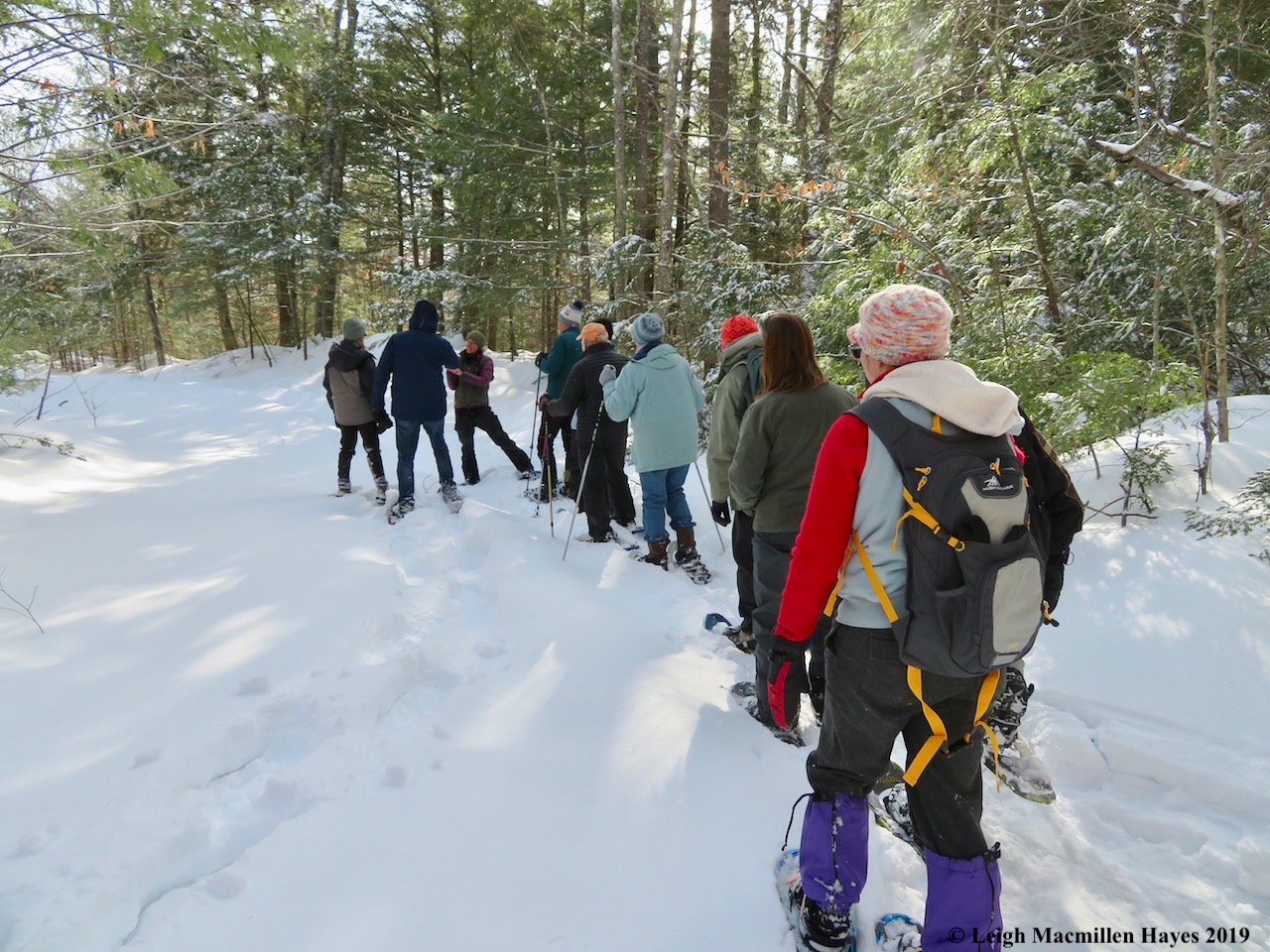
I wasn’t disappointed; nor were the thirteen others who joined us this morning for a two-hour hike that turned into two and a half and even a little bit more.

Alanna had gone out ahead of us and placed hearts with tree-related information along the trail we’d travel. Our crew was a delightful mix that included young and old, with members of LEA and the Greater Lovell Land Trust, which I was representing, as well as a woman from North Conway and man from Portland. Yes, Linda and Henri–that would be the two of you.

The first heart provided information about hemlock trees and after she read it, we encouraged everyone to channel their inner hemlock and so they leaned as this particular evergreen does. Check out those smiles. Don’t you want to be a hemlock too?

Of course, because we were among the trees on this property that the David and Carol Hancock Charitable Trust donated to LEA several years ago, and the snow was super soft from yesterday’s storm, the mammal tracks were outstanding.

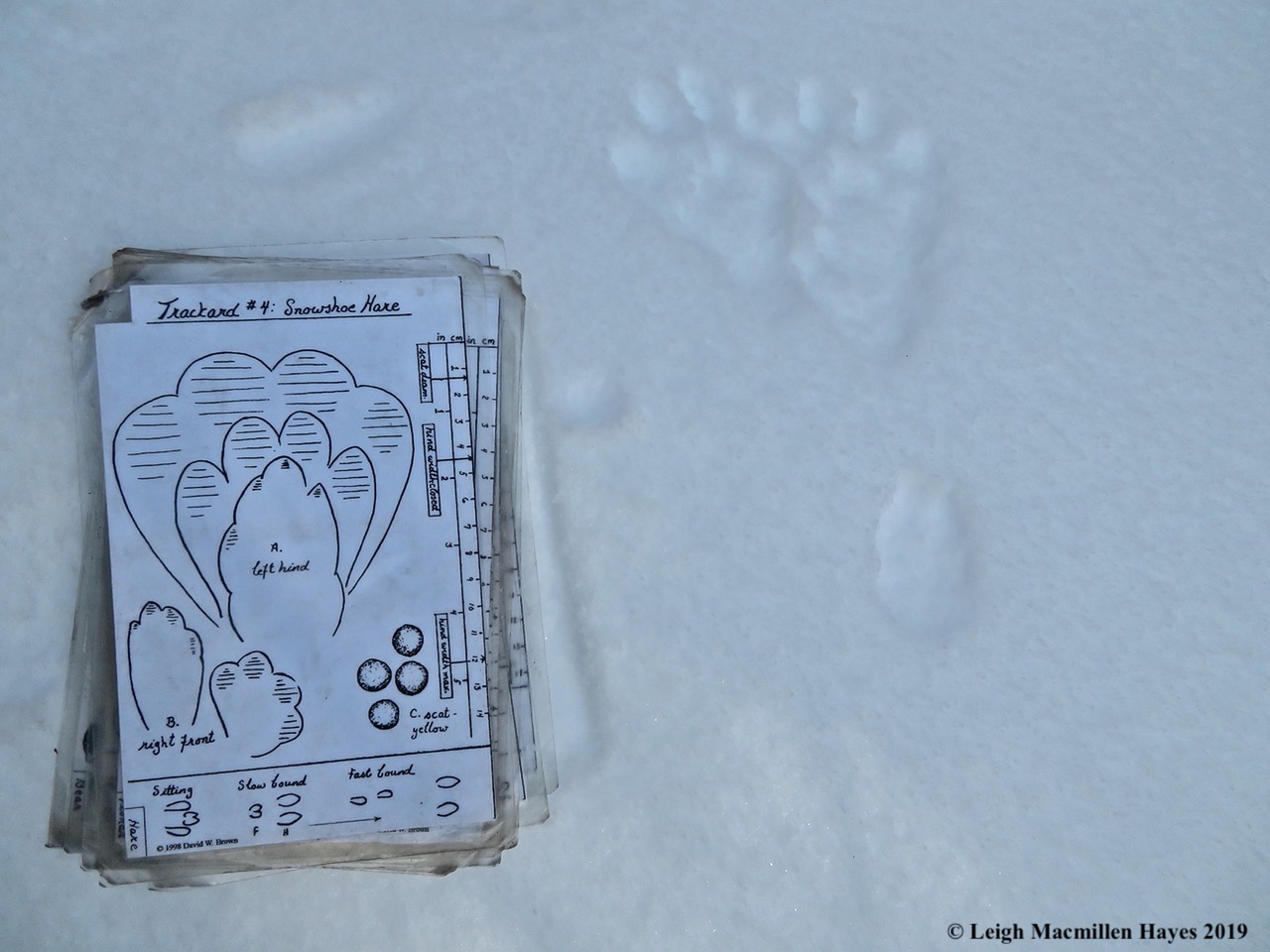
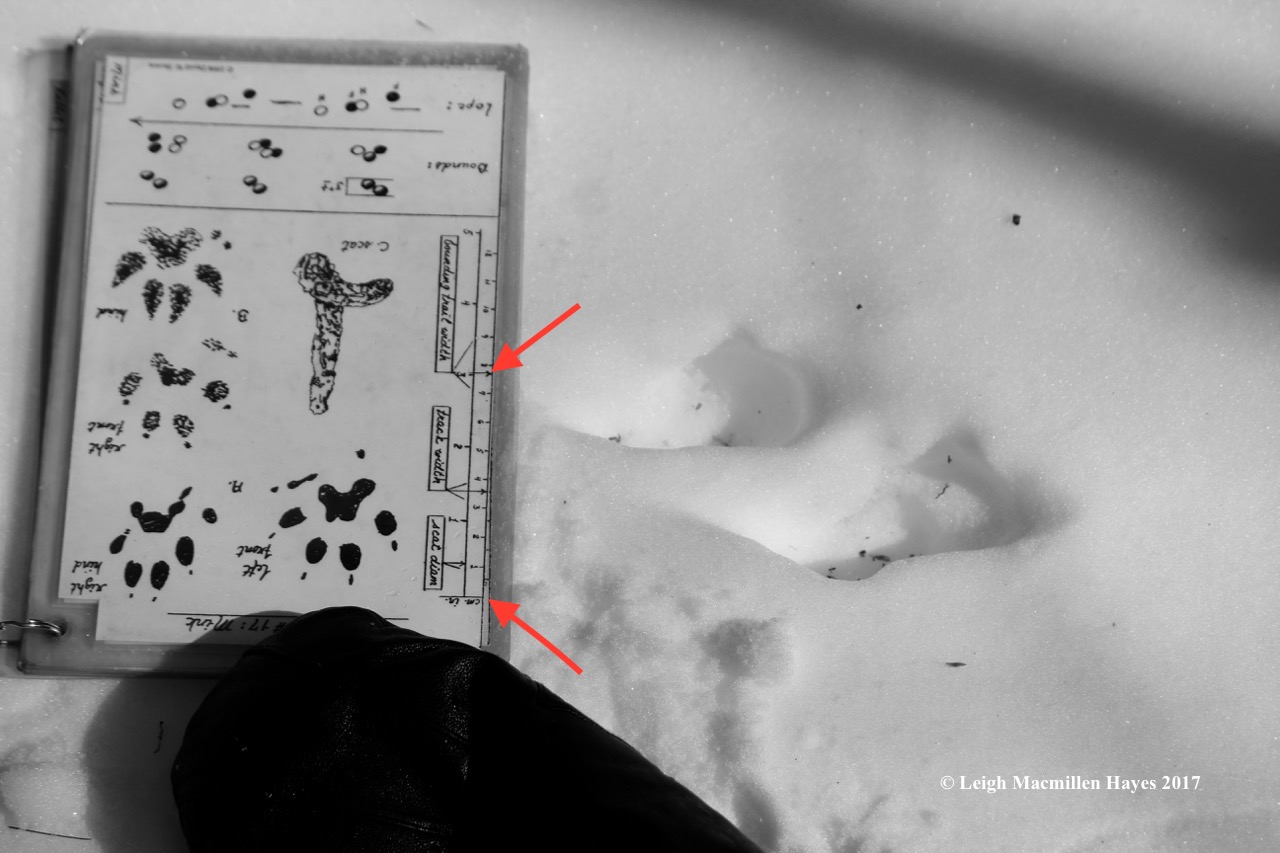
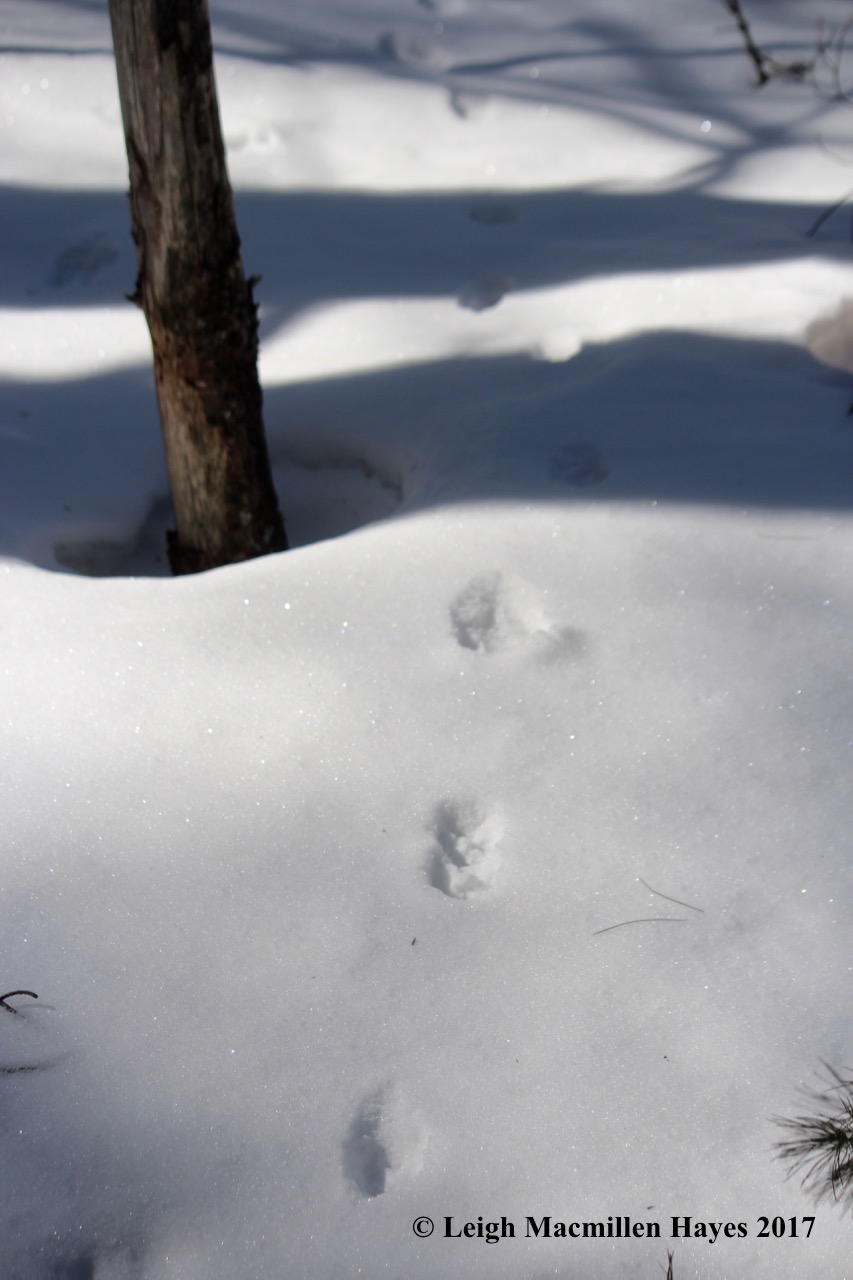
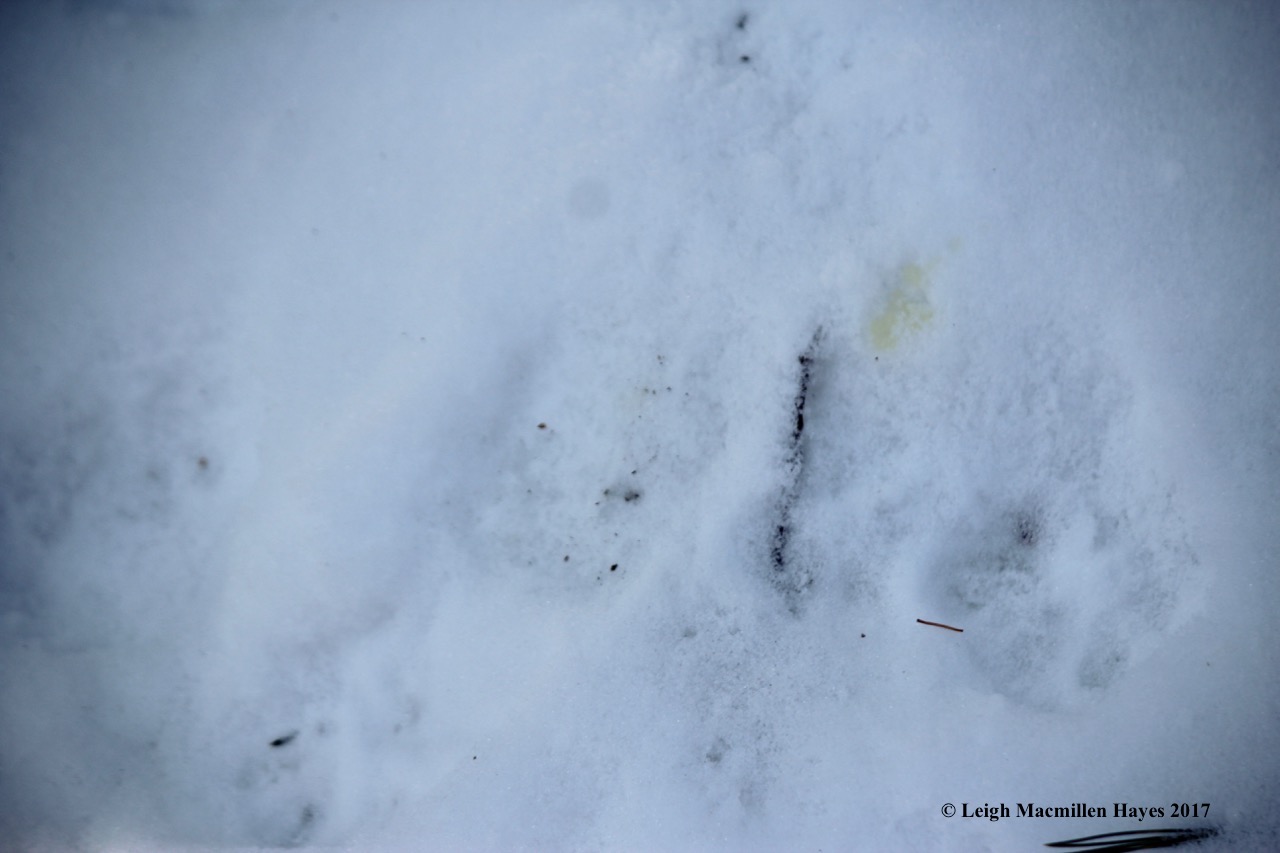
One of the favorites of the day–that of the snowshoe hare. It’s not often that one can see the hare’s toes so clearly, but today was the day. And as David Brown’s Trackards indicated, the footprint size depends upon the conditions.

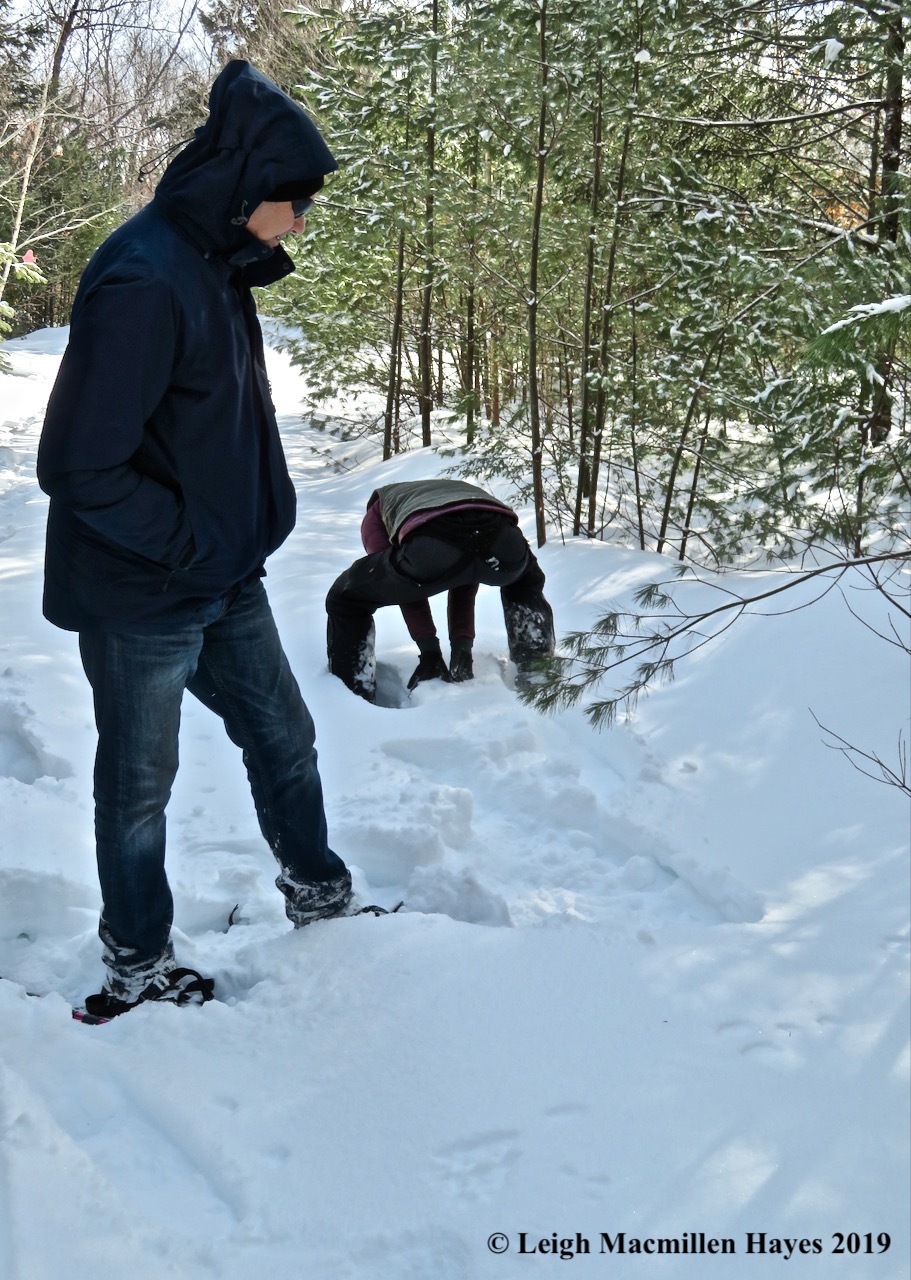
When it came to demonstrating and identifying the action of the mammal there were two rock stars among our group. Alanna was one for she got down on all fours and demonstrated how a hare moves (before she sorta fell). And Pam Marshall was the other for she correctly identified and shared information about how to recognize all of the track and print patterns that we saw. Pam only began tracking this year with the GLLT’s Tuesday Trackers, but she’s a quick study.

Onward we trekked, pausing whenever we saw a heart of red. And each time, Alanna’s voice came through in the message. Love at first bite! Indeed.

At a beech tree, we paused for a bit longer as we noted not only the twigs and buds that are beginning to swell, but also talked about how bear claw marks are most visible on them and how the beech scale insect has altered the once smooth look of the bark. The word marcescent, meaning withering but remaining attached to the stem, also entered the conversation.

After a bit of time, we emerged onto a wetland where only last week Alanna and a couple of people including one in our midst, Anne, had spotted a hole and lots of tracks and scat left behind by an otter. Today, no sign of that member of the weasel family, but still . . . we enjoyed the warmth of the sun.

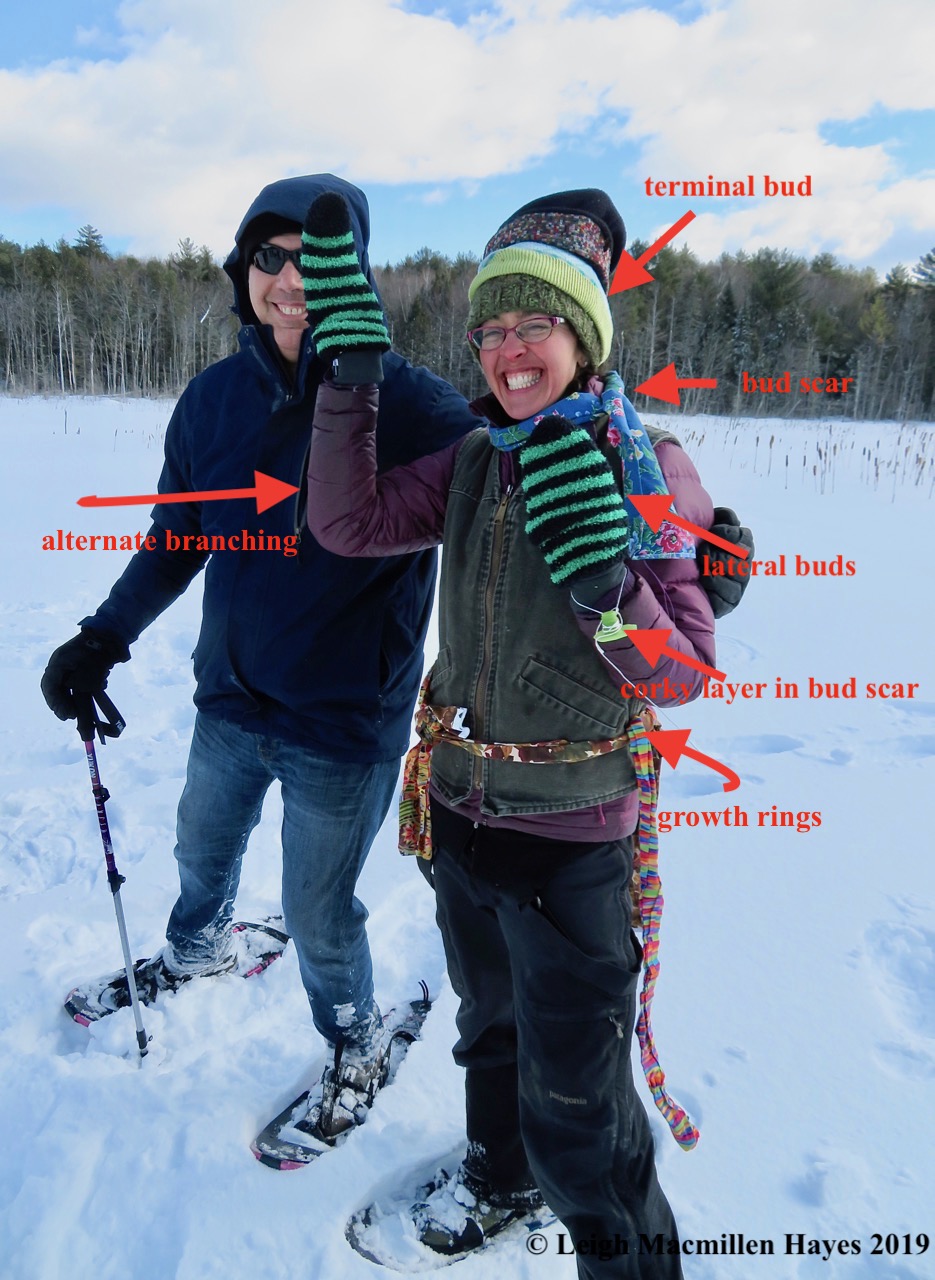
And I took advantage of the time to dress Alanna as a twig. She was the perfect Miss Twiggy model and Henri took time to pose with her.

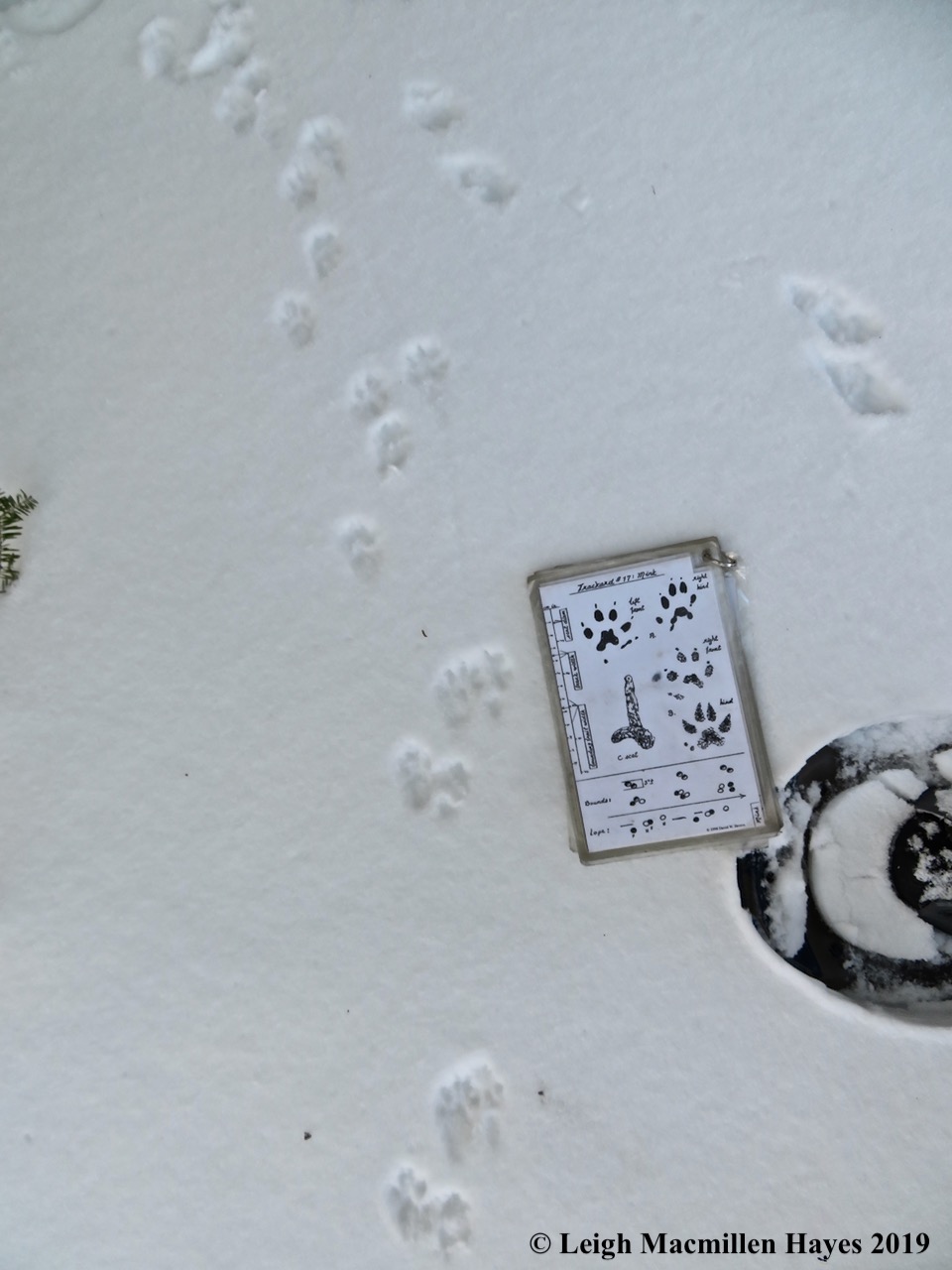
Back in the woods, we were stopped in our tracks by the tracks of another weasel–a mink.

And then as we retraced out steps and paused by a speckled alder to admire its male and female catkins and last year’s cones, someone honed in on something that wasn’t a remnant of yesterday’s snowstorm.

The cottony white masses of wooly alder aphids decorated a couple of branches. As Alanna explained, in a symbiotic relationship, during the warmer months, ants stroke the aphid with their antennae, while the aphid releases a drop of honeydew, much like a cow being milked. It’s actually rather creepy. Today, there were no ant farmers about, but a few like Justin, did step forward to take a closer look.

After that, we were confronted with a math problem. And you thought we were just out for a walk in the woods.

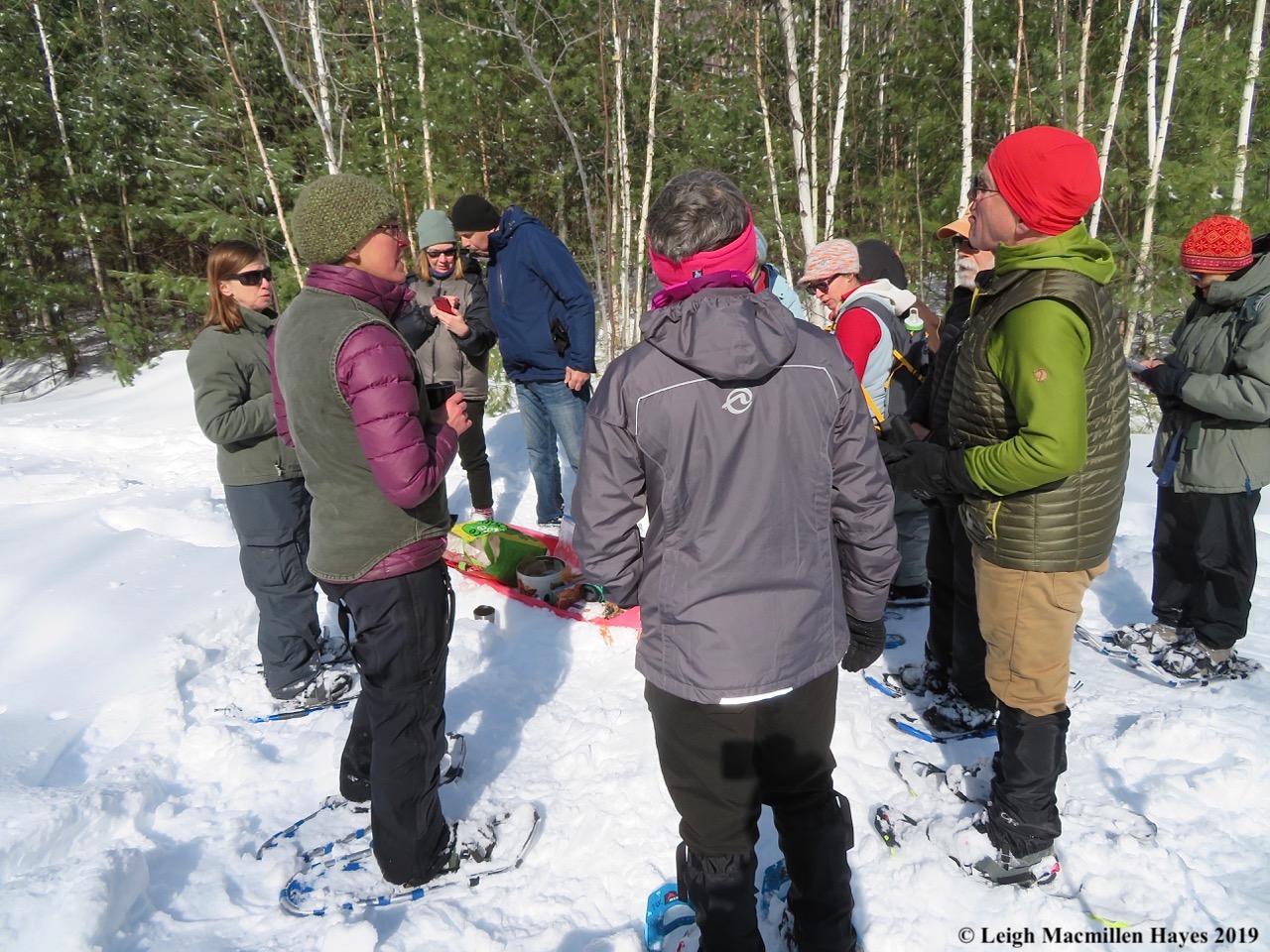
Finally, well sorta, we made our way back to an opening and stood around enjoying hot cocoa and tea, plus some goodies, and each others company.

Sherpa Anne had been kind enough to haul the supplies to the opening for us as our trek began. I know she was thankful she didn’t have to pull the sled all the way out to the wetland. And we were thankful for the good tidings it bore.

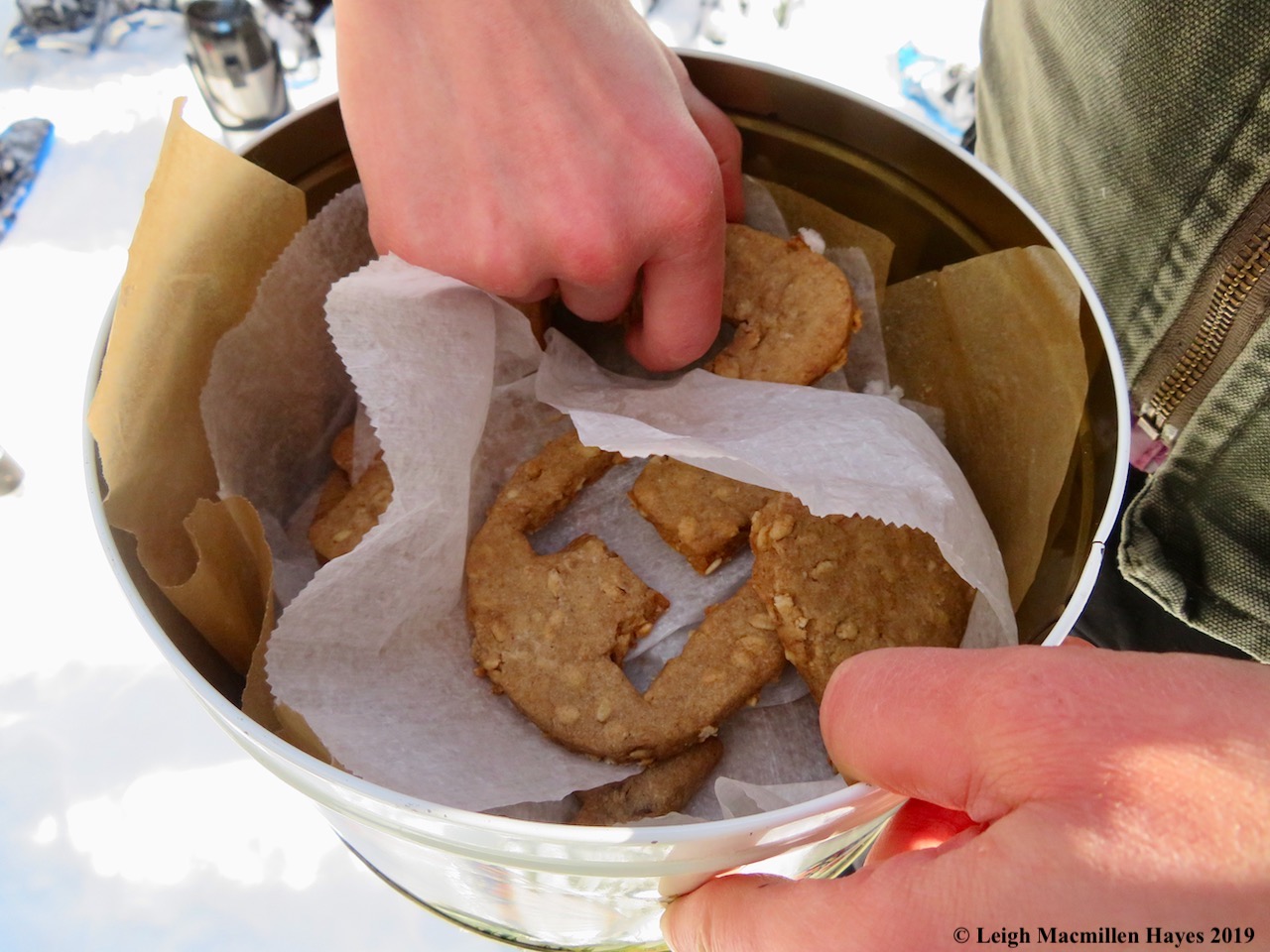
You see, Alanna is a woman of many, many talents, and baking is one of them.

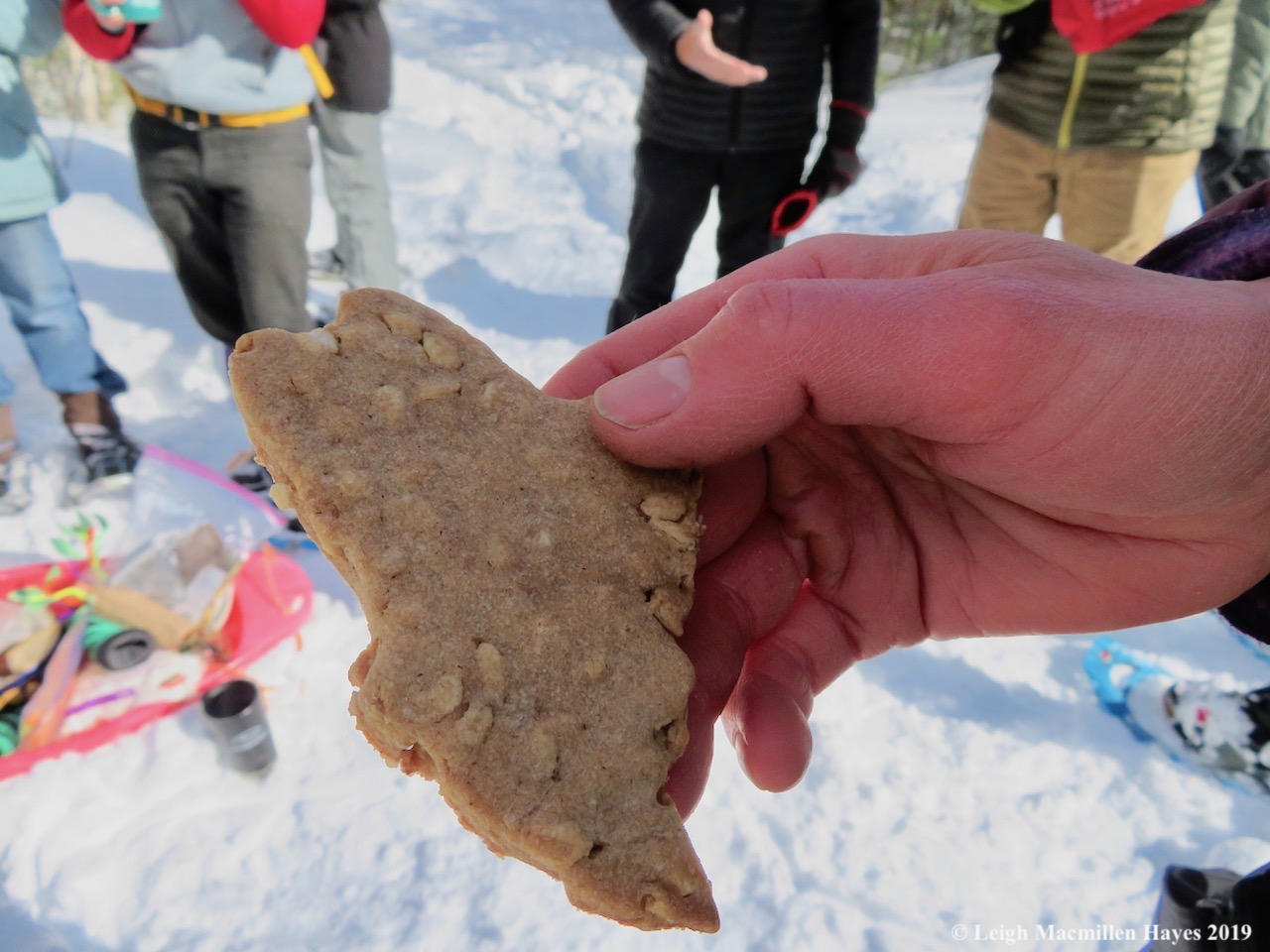
Did she get carried away with the cookie cutters?

We didn’t think so for we all love Maine.

And we also love trees, including red oaks with their bristly-tipped leaves and acorns.

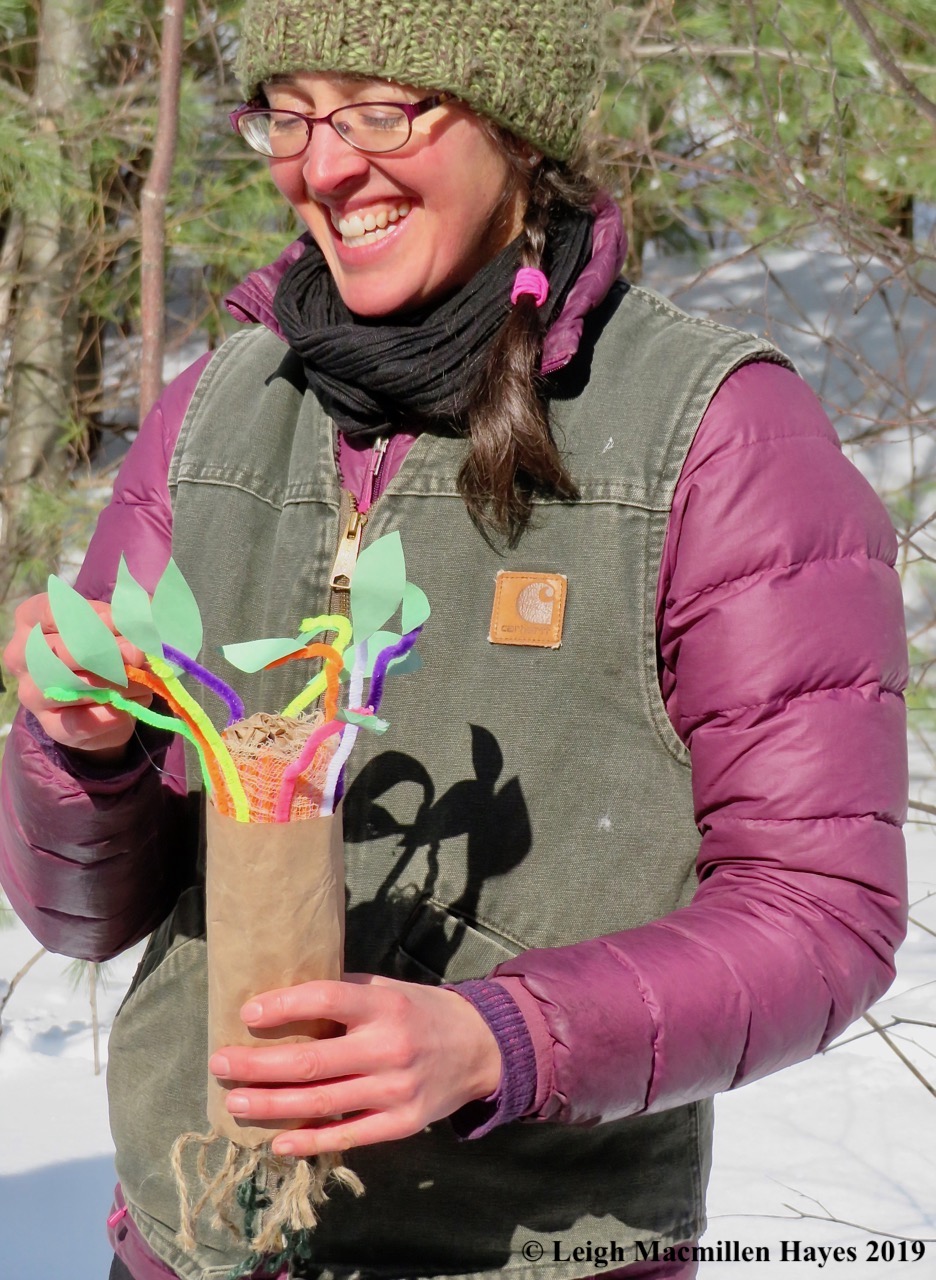
That wasn’t all Alanna had created.

Her tree model was to be envied (at least by me). And she explained the different functions, from roots to leaves and outer bark to inner workings.

And just in case you are interested, I’ve come up with a new mnemonic, because we love memory aids.

Xylem is the vascular tissue in plants that conducts water and dissolved nutrients upward from the root and also helps to form the woody element in the stem.

Phloem is the vascular tissue in plants that conducts sugars and other metabolic products downward from the leaves.

My mnemonic: Xy high (think upward); Phlo low (think downward).

Of course, that didn’t occur to me until several hours later.

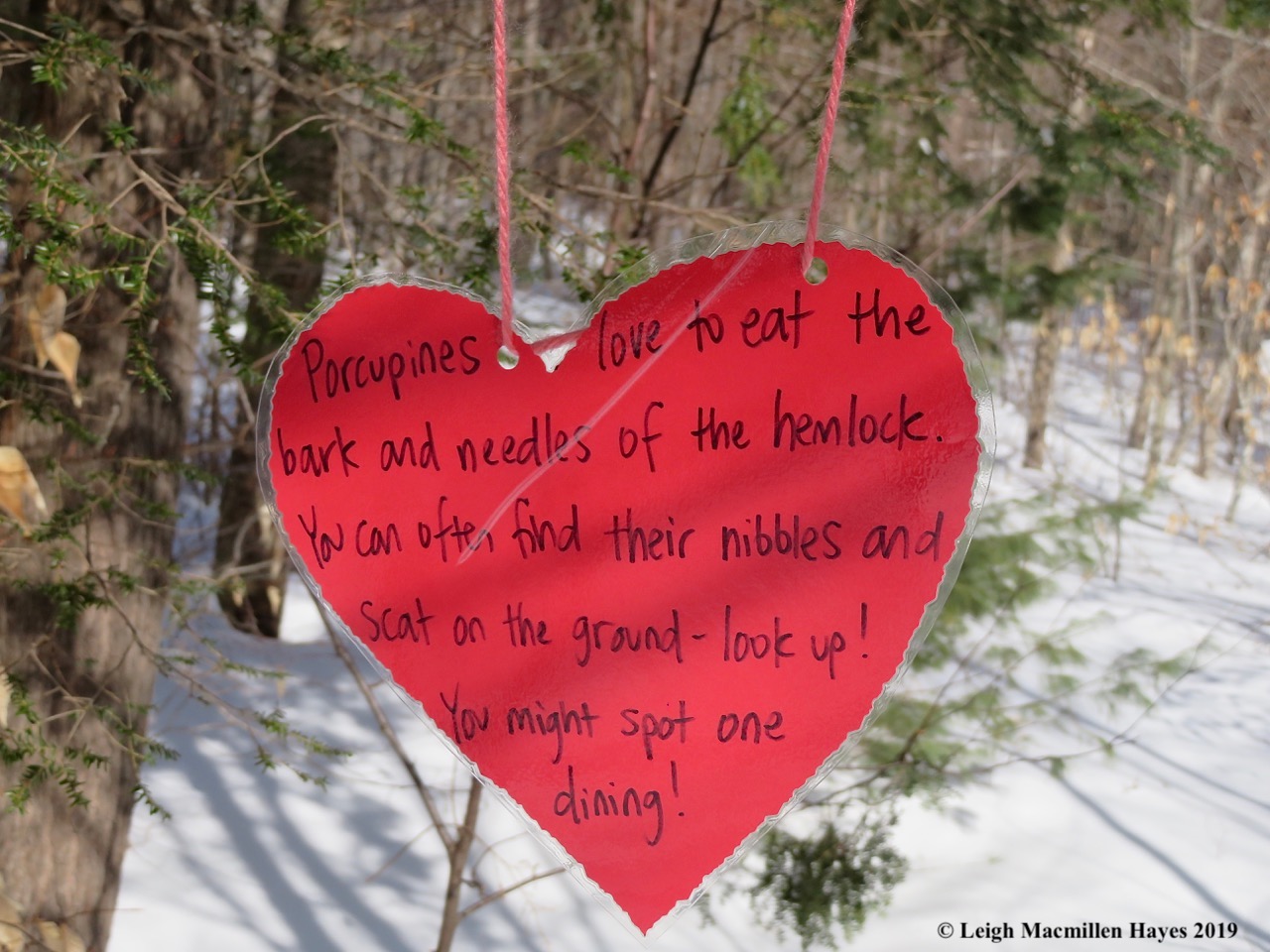
Before we finished off our delightful morning, there was one last heart with tree information to read. Hmmm. Porcupines, bark, needles, scat, look up? “You might spot one dining!”

And so up we looked.

And down as well. We found some tracks and even took a closer look at some comma-shaped scat.

Because . . . the resident male was high up in the tree! Look at that handsome fella! We did. Over and over again. Henri was sure we had planted him and that he wasn’t real.

But he was. And if you look closely, you might see his orange teeth which one (like me) could almost mistake for a Valentine heart. Check out those toe nails. And can you see the rough soles of his feet, the better to grip the tree with?

Male porcupines are known to hang out on a tree during the day. I know we’re particularly thrilled about this one because he hasn’t let us down yet.

Think about this–while the male was hanging out in the sun, porcupines (like the one that lives under our barn) typically stay in their dens until dusk and then head off to munch on bark and needles in the darkest and coldest hours of a day. That’s to be admired.

So is the work of our two organizations, Lakes Environmental Association and the Greater Lovell Land Trust. Both of us are with the Trees and we loved sharing the trail together this day.

We’re doing the same again on Sunday at 12:30 in Lovell, where we’ll go on a Porcupine Prowl–will we actually see the rodent as we did today? Who knows, but we’ll have fun as we join together again to celebrate Great Maine Outdoor Week(end).

I’m with the TREES. Are you?

Twig and Bud Primer of western Maine

Some people collect salt and pepper shakers, others small figurines or coins or stamps or antique cars or beer caps or . . . TWIGS! Yep, I would fall into the latter category and because I used them last week to teach a class, I thought I’d also share them with you.

If you stop reading right now, I understand. If you choose to continue, please know that some of what you read I’ve learned from the Maine Master Naturalist course, which first opened my eyes to twigs and buds; some from a variety of books on the subject; and lots from personal observation. You may not always agree with me, but I strongly encourage you to step outdoors and take a look. Keep track of your observations and begin to note idiosyncrasies.  But do remember this: nature hasn’t read the books and doesn’t always follow the rules we’ve insisted upon as we try to make sense of the world around us. 

Next year’s flower and leaf buds formed this past summer and overwinter inside bud scales, which are actually modified leaves. Most scales, such as this one, provide protection with a waxy coating. (Species: Norway Maple, Acer platanoides)

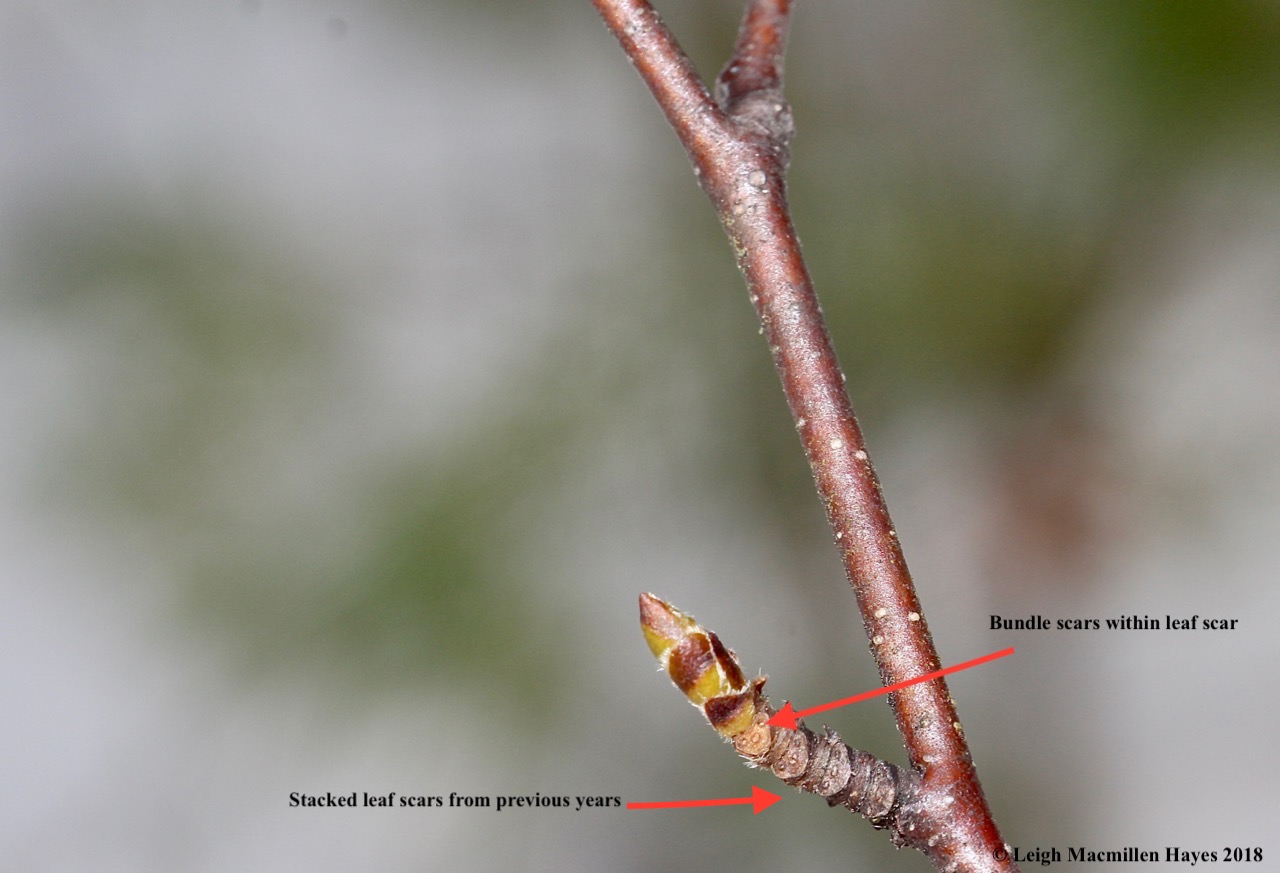
Terminal buds are  located at the tips of most twigs. When that bud forms, the tree ceases to grow for the year. At the base of the terminal bud is a leaf scar where a former leaf stem was attached to the twig. And within the leaf scar are little corky dots called bundle scars that were actually the vascular tissue that had connected the leaf to the twig. Think veins. The shape of the leaf scar and number of bundle scars can be used as an identifying mark since they are often consistent across a species. (Species: White Ash, Fraximus americana)

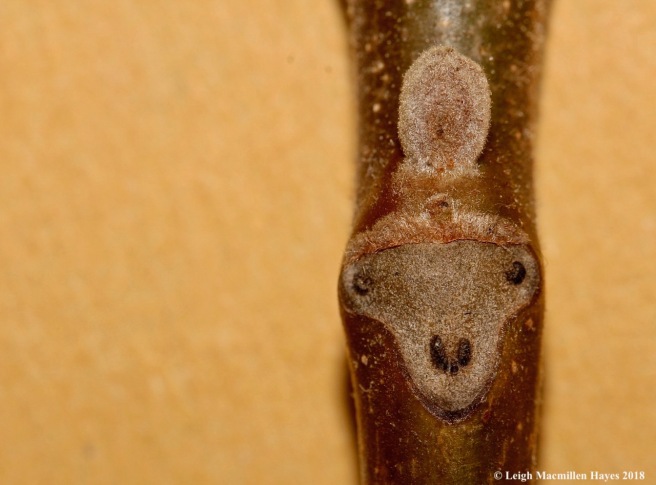
Leaf scars come in a variety of shapes, including monkey faces topped with hairy caps. (Species: Butternut, Juglans cinera)

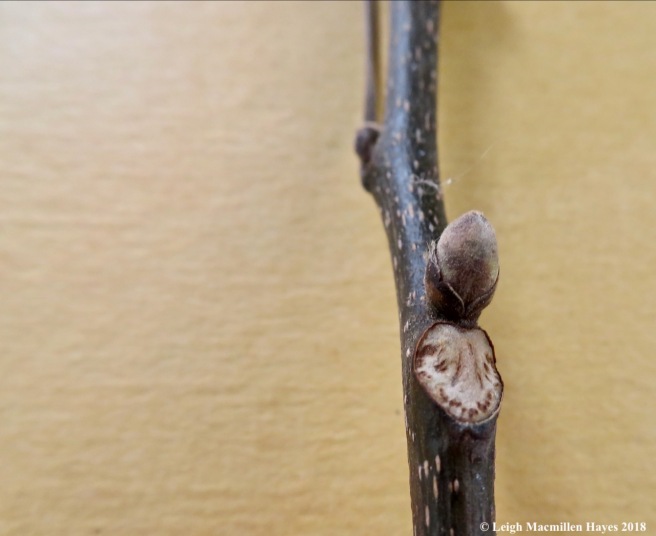
Others may be shield shaped, though you could also see a bit of a funny face in this one. (Species: Shagbark Hickory, Carya ovata)

And there are those that nearly encircle the bud. (Species: Staghorn Sumac, Rhus hirta)

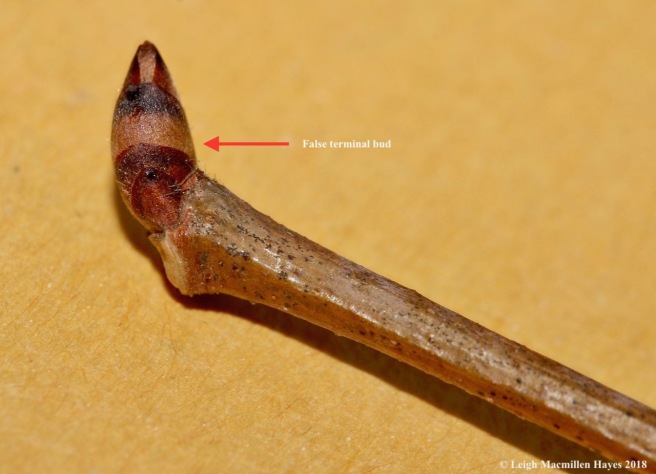
Some twigs feature a false terminal bud. In reality, it was a lateral or side bud that took the position of the terminal bud. On twigs that don’t have actual terminal buds, such as American Elm and Basswood, the wood kept growing until the tree could no longer supply it with nutrients or something else impeded its growth. The twig then died back to the last terminal bud and dropped off. (Species: American Elm, Ulmus americana)

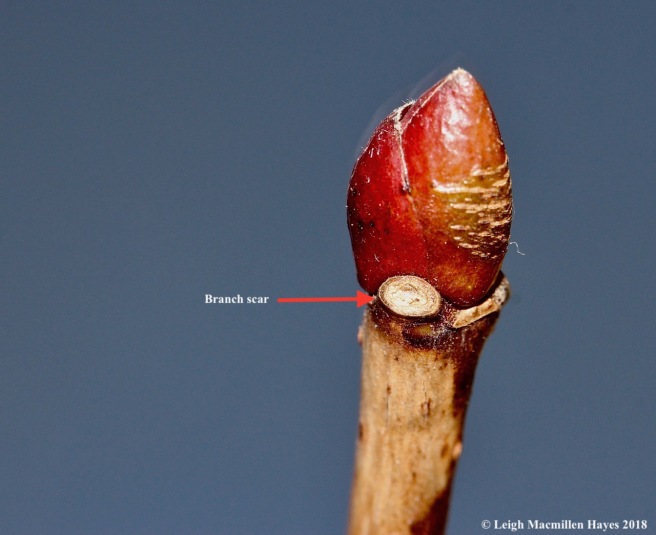
On those twigs with a false terminal bud, a branch scar was left behind when the woody structure broke off. The branch scar is located . . . 

opposite the leaf scar, which contains bundle scars. (The branch scar does not have bundle scars.) (Species: American Basswood, Tilia americana)

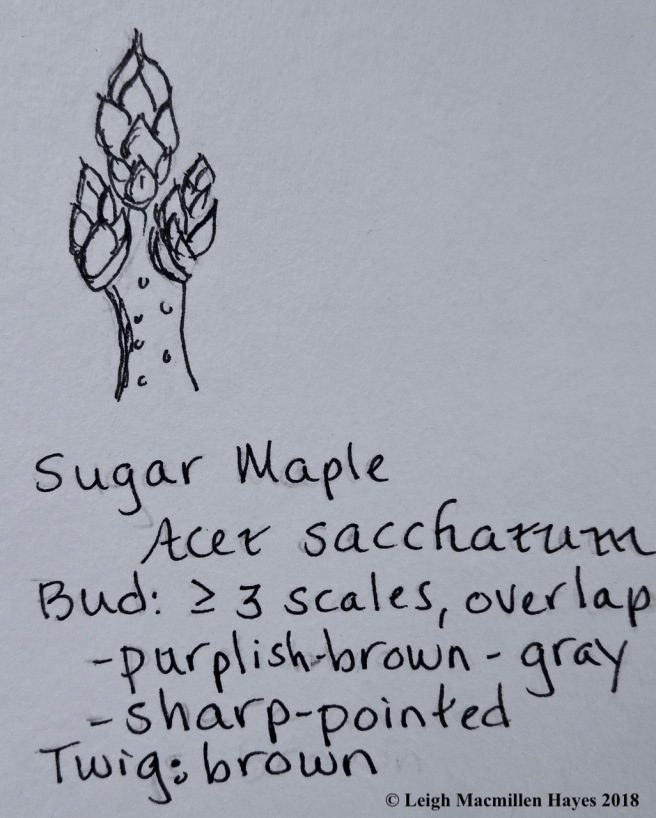
Below the terminal or false terminal buds are lateral buds, those which grow on the side of the twig. Their orientation may be opposite, such as this example. (Species: Sugar Maple, Acer saccharum)

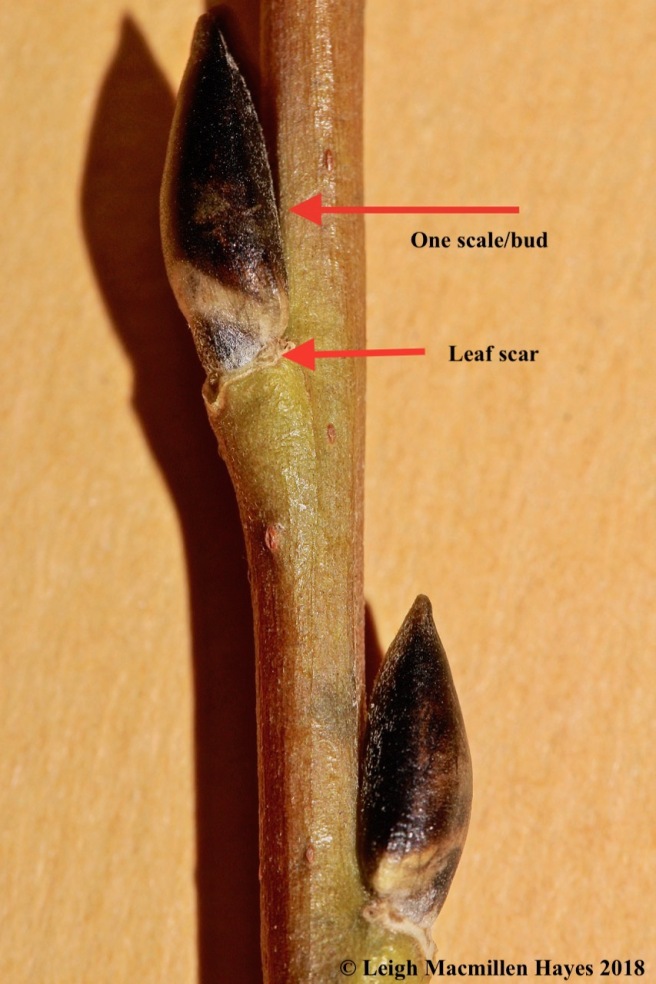
Others are alternate. The cool thing about this example is that the alternate buds are also appressed, meaning they grow flat to the twig; and they are one scaled (well, actually two scales fused together as one). (Species: Willow, Salix spp.)

Alternate appressed buds may grow far apart or quite close to each other such as with this particular tree and its globous buds. (Species: Quaking Aspen, Populus tremuloides)

Others are divergent and stick out away from their twig. (Species: American Beech, Fagus grandifolia)

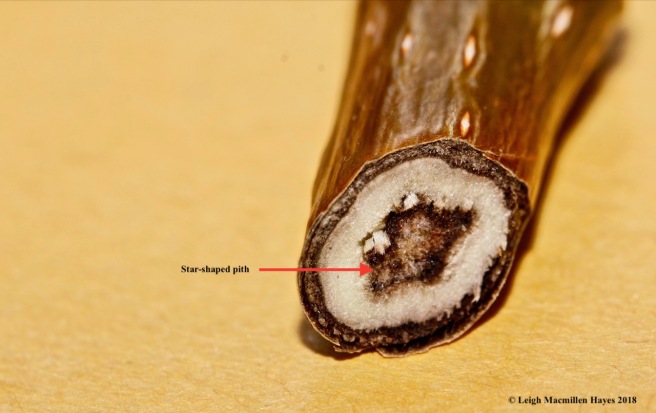
Then there’s the pith. I just like saying that word–pith, pith, pith. Pith is the soft central core or interior of the twig. It comes in a variety of patterns including round, triangular and star-shaped such as is illustrated here. (Species: Quaking Aspen, Populus tremuloides)

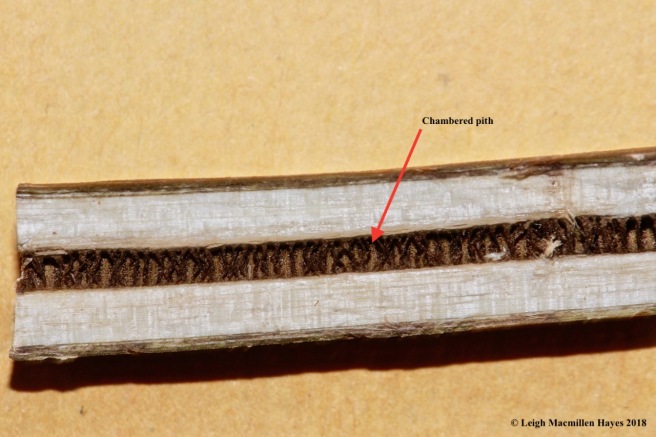
In some species, its shape is best viewed in cross-section by halving the twig lengthwise with a sharp knife. Diaphragmed pith, solid with partitions, can be seen in Black Gum, which I didn’t find. But this example is chambered pith, which is hollow with partitions. (Species: Butternut, Juglans cinerea)

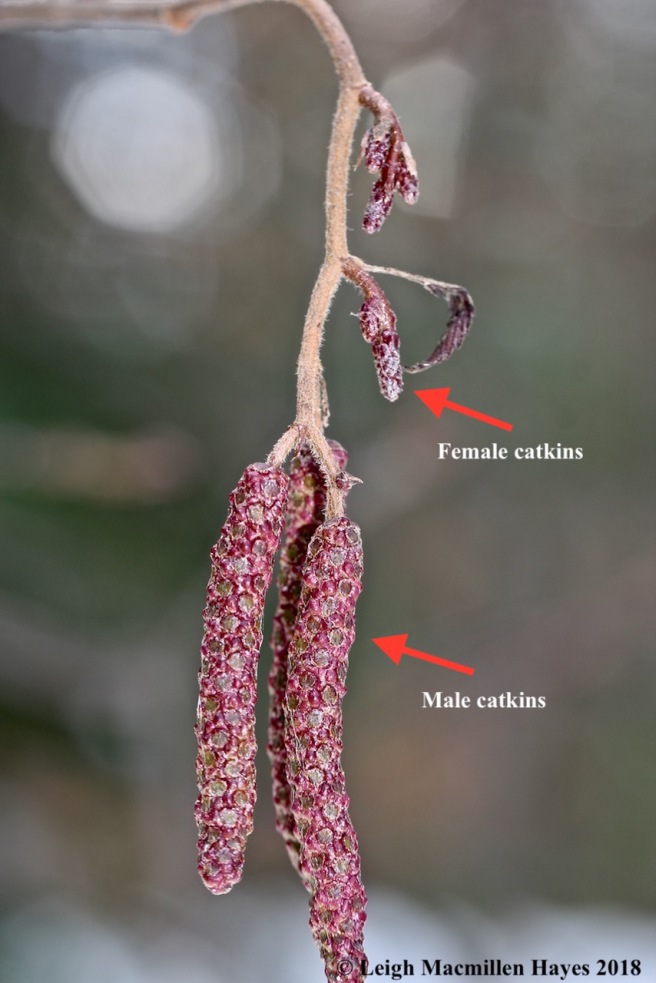
Another fun characteristic that aids in identification is the occurrence of catkins on members of the birch family. (Note: Betulaceae, the birch family, includes six genera of deciduous nut-bearing trees and shrubs: the birches, alders, hazels, hornbeams, hazel-hornbeam, and hop-hornbeams.) (Species: Speckled Alder, Alnus incana ssp.rugosa) Speckled Alder is really a shrub, but don’t tell it that. 

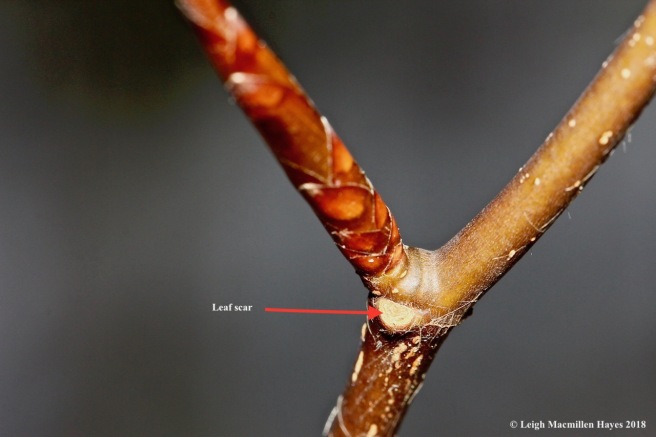
Another fun thing to point out are the growth rings on twigs. We often think of aging a tree by counting the rings from the heartwood out to the bark, but . . . twigs have rings of their own. They’re a bit raised and wrinkled in presentation, but each cluster of rings indicates where that year’s leaf and flower buds had formed, developed, and released their seeds. After that, the twig continued to grow. The same will develop once the current buds complete their cycle. (Species: Striped Maple, Acer pensylvanicum)

If you’ve stuck with me, know that the end is in sight. I’d like to conclude this post with examples of some of my favorite trees found in the western Maine woods. I’ll begin with those deciduous trees with alternate buds. This particular twig is in a family that features catkins. It has several cousins so it’s worth getting to know a few of them. Notice the hairy twig, but not so hairy and rather pointed buds. Buds on older branches grow on stacked scars, which I’ll share an example of in a minute. If you were to squeeze these buds, they’d be sticky. Those are all great clues, and here’s one more. The tree’s bark is white and it curls away from the tree in rather big sheets. 

Did you guess correctly? 

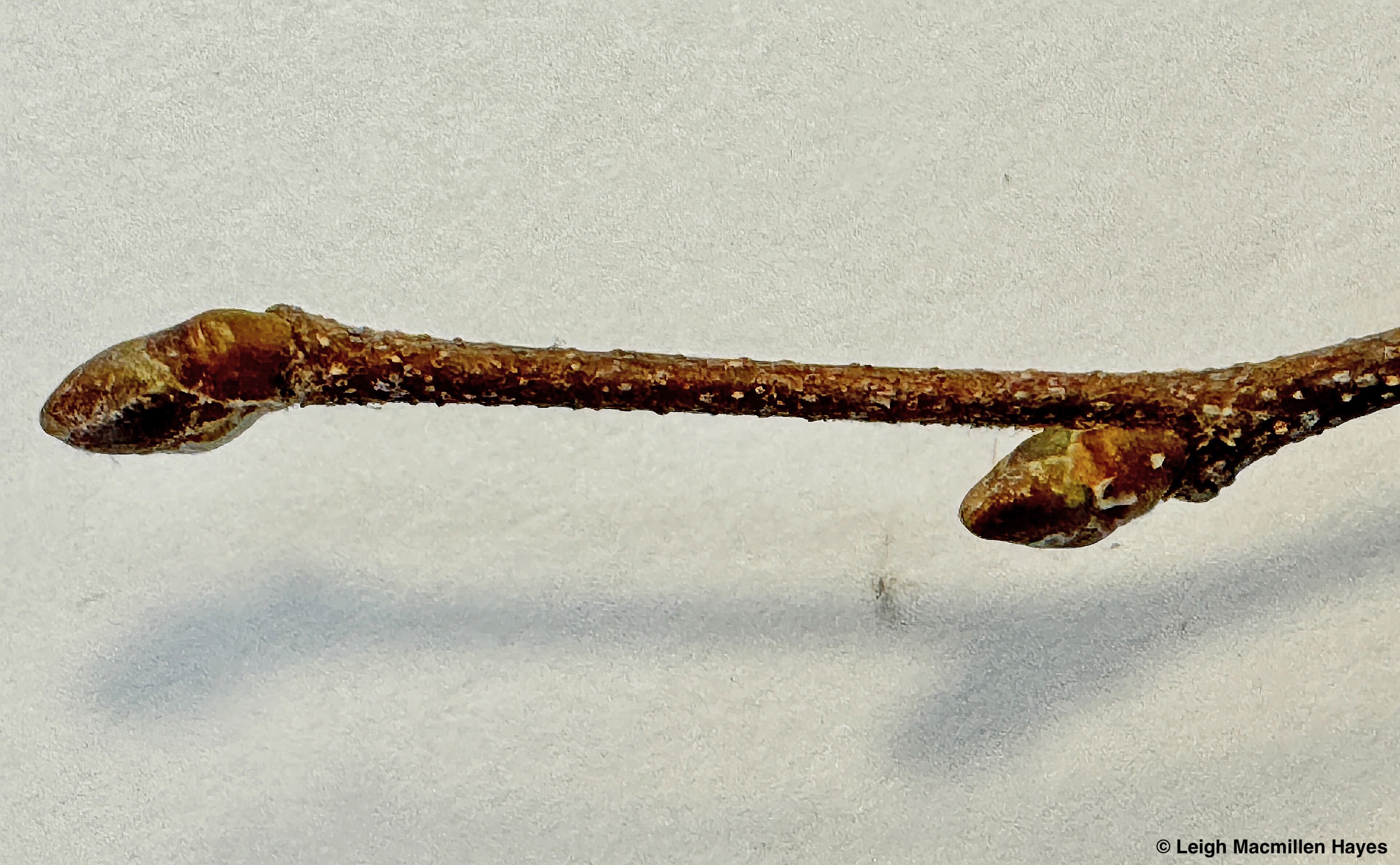
Here’s a cousin and that example of stacked scars with the bud at the end that I promised. Notice the lack of hair? The clues for this species: scrape the bark on the twig and sniff it. Does it smell like wintergreen? And the bark on the trunk–does it peel away like ribbons? (Species: Yellow Birch, Betula alleghaniensis)

And another member of the Betula family. This one is an early succession tree, meaning it grows quickly in fields and along roads that have been disturbed. But it is also the shortest lived of the family and doesn’t reach an old age in tree years (Yellow Birch can grow to be about 250 years and Paper Birch about 150). This species is lucky if it reaches its 90th birthday. Though you can’t see it here, the twig isn’t hairy, but it is quite bumpy or warty. And it doesn’t have a wintergreen odor if scratched. Also, the bud isn’t sticky. Though only one catkin is shown here, it could have two, while Paper Birch has three and Yellow three or four. Who is this? 

I’m sure you guessed it. 

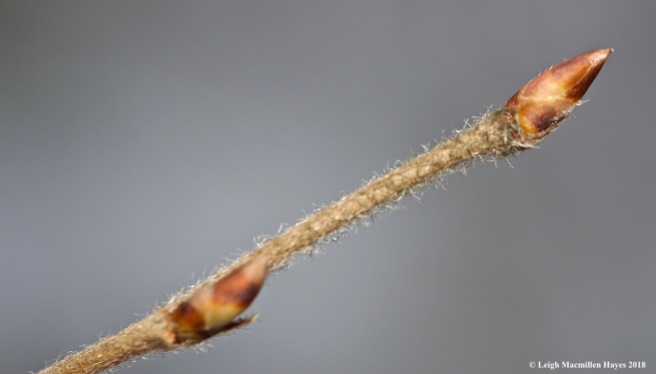
Another of alternate twig and bud orientation, this particular bud is often described as a cigar. I’m not sure that works for me–maybe as it expands a bit in the spring, but the multiple overlapping scales and pointed tip make it seem obvious as its different from all other presentations. Plus, its leaves are marcescent, meaning they wither or remain on many younger trees throughout the winter. Actually, it’s easy to be fooled into thinking a mammal is moving nearby for in a slight breeze the marcescent leaves rattle. I’ll admit I’ve jumped a few times. Back to the buds–the other thing to note is that like a New York Fern, it tapers at both ends (maybe they, too, keep their lights on at both ends of the day). Who is this? 

Bingo! You are on a roll! I should define lenticel at this point. Those raised white dots on the twig are the lenticels, which are the pores that provide openings for air-gas exchange. 

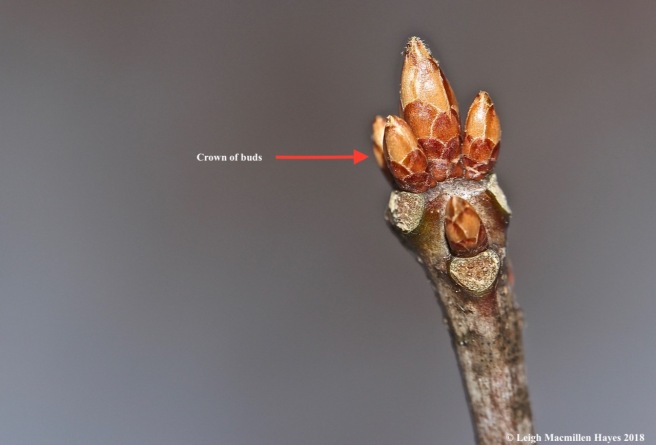
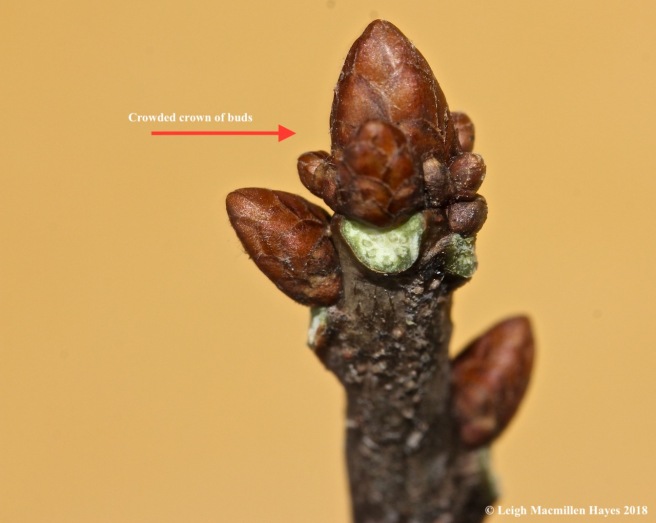
We haven’t talked about the fact that some twigs have buds crowded at the tip. In this particular case, I think of them as a crown. 

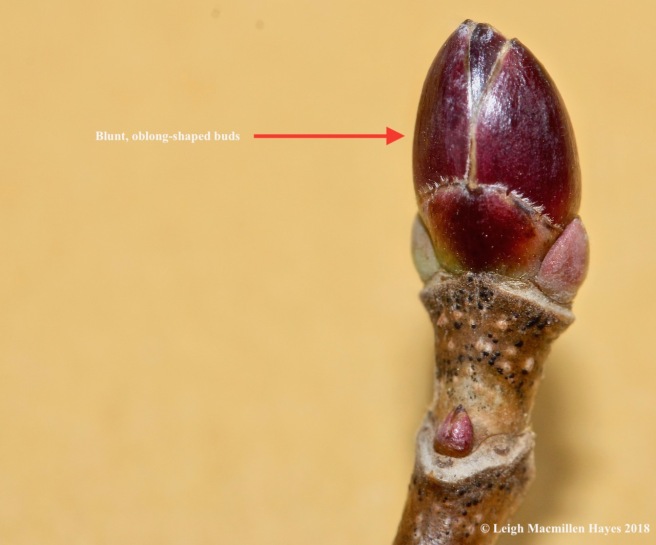
This cousin also wears a crown. So, what are their differences? The first is more conical and shinier than the second. And look at their colors. Number 1 comes in shades of chestnut brown, while number 2 is much darker and almost reddish brown in tone. You’d have to look carefully to see the silky hairs at the pointed tip of number 1, but trust me that they are there. Number 2 is hairless and blunt. 

This is number 1. Did you guess that correctly? And number 2 is . . . White Oak, Quercus alba

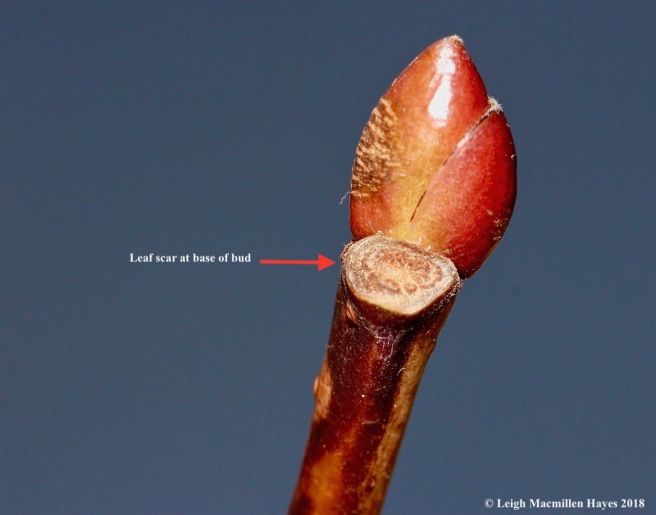
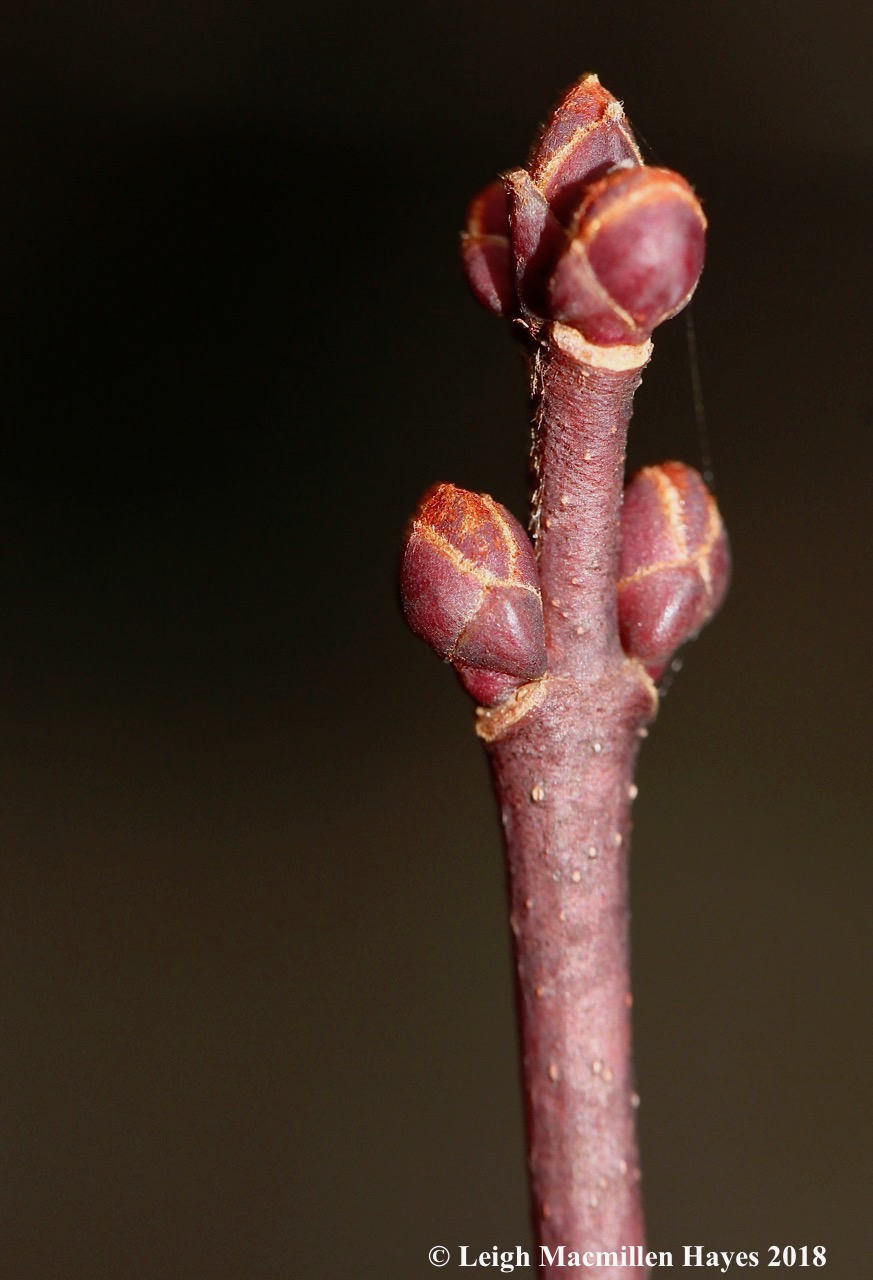
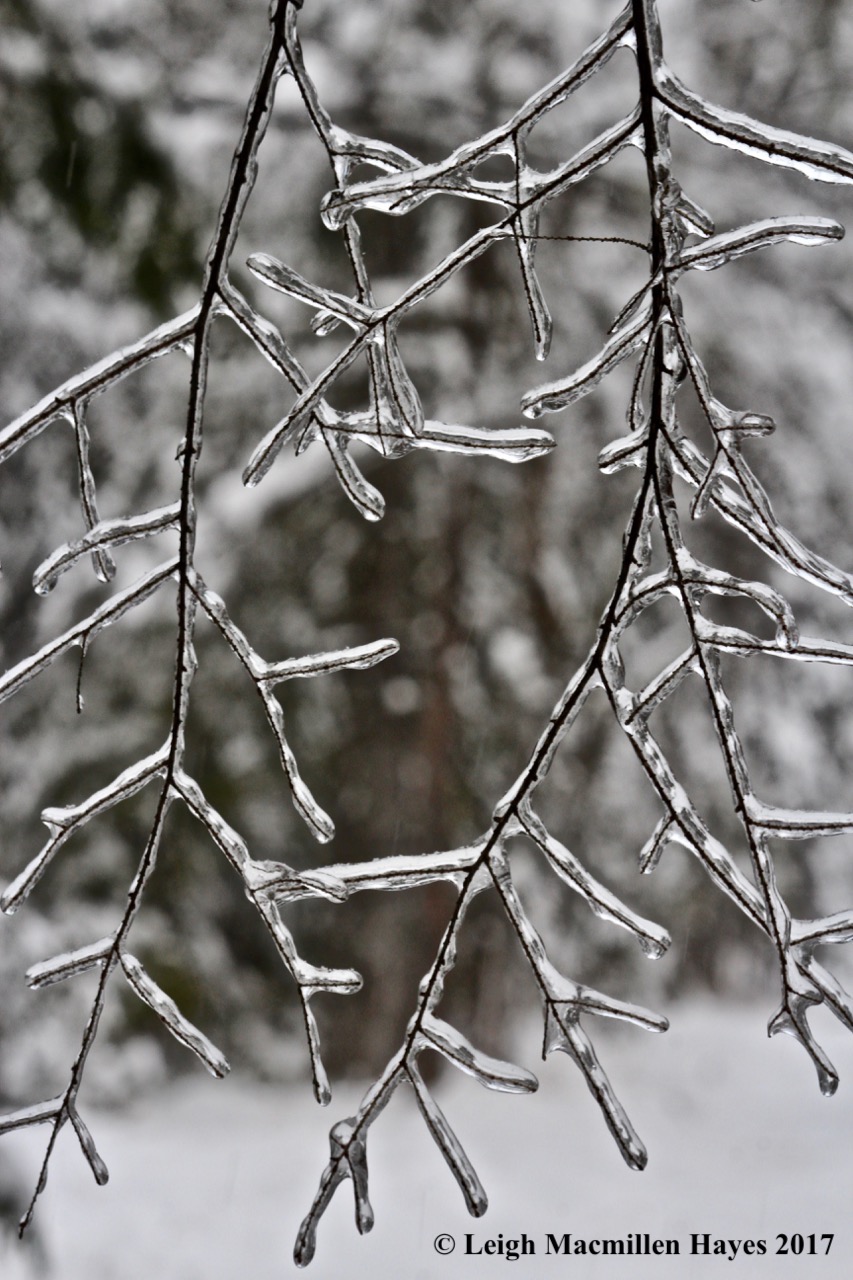
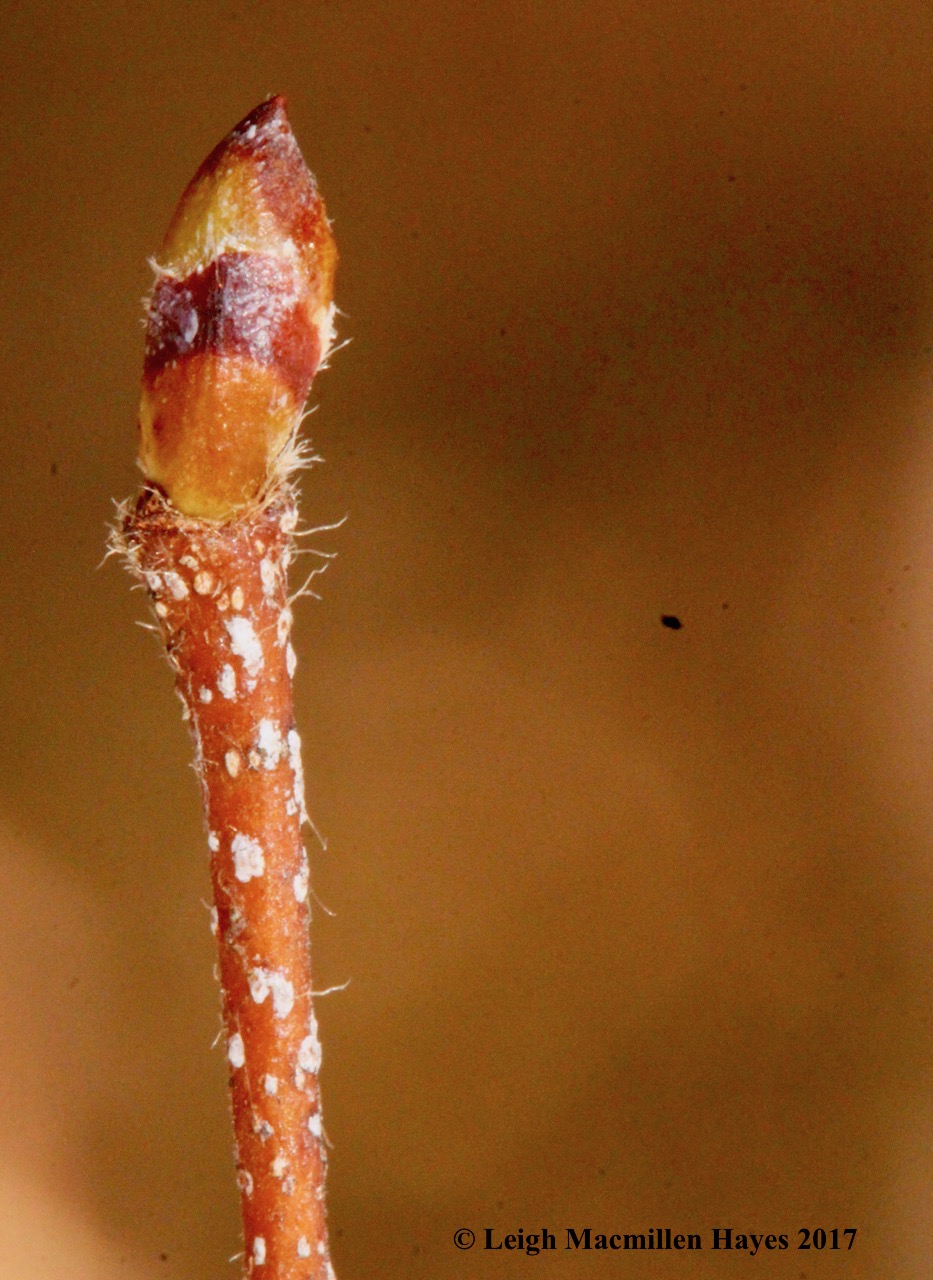
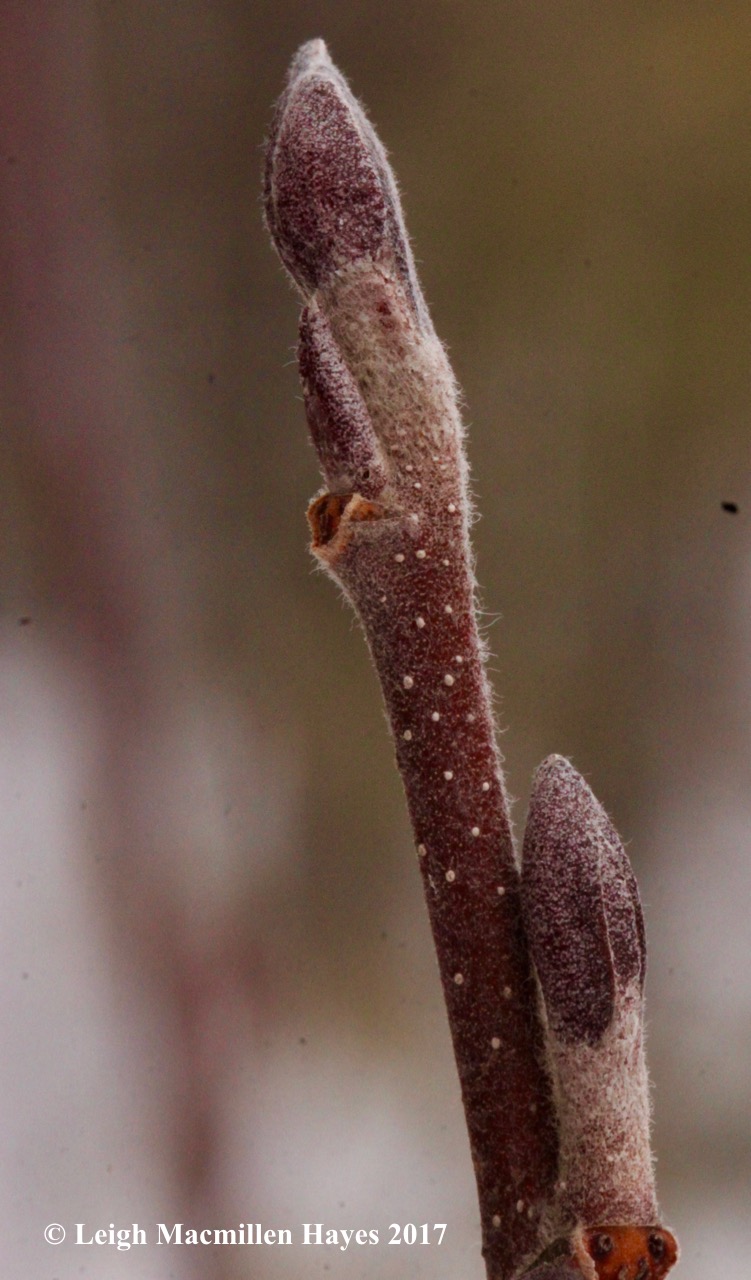
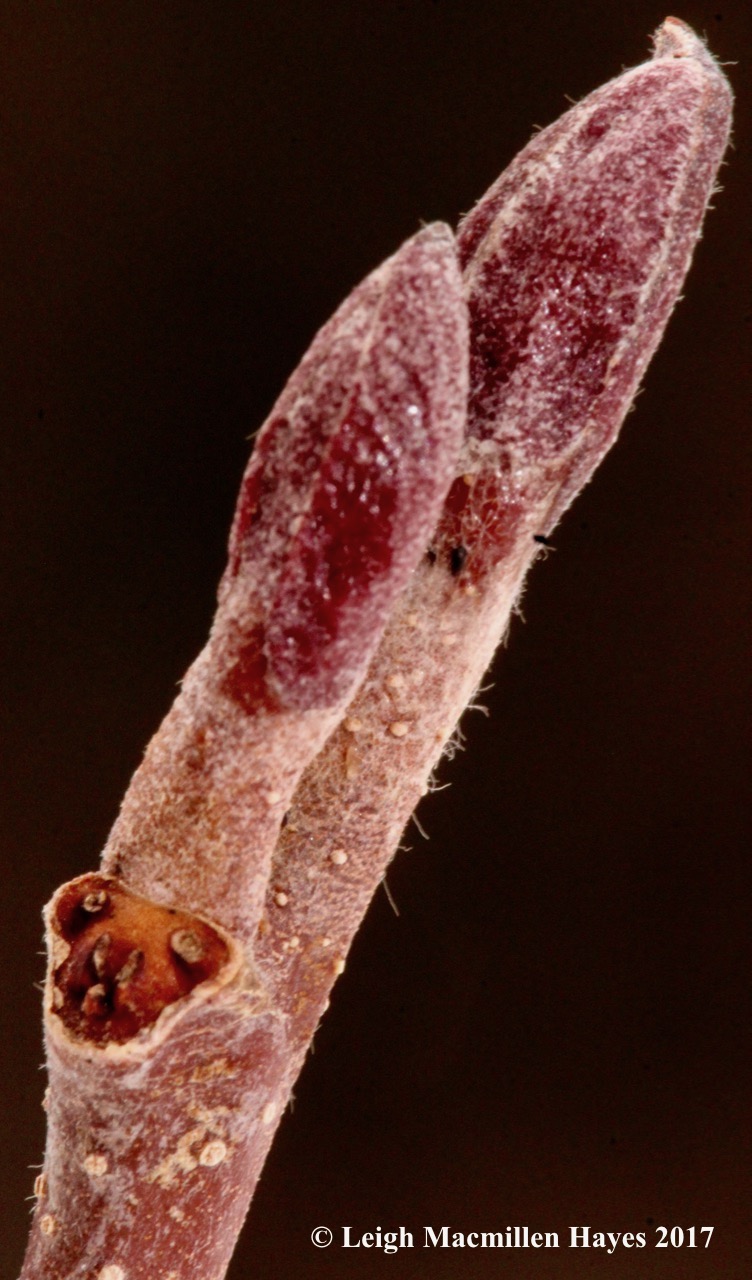
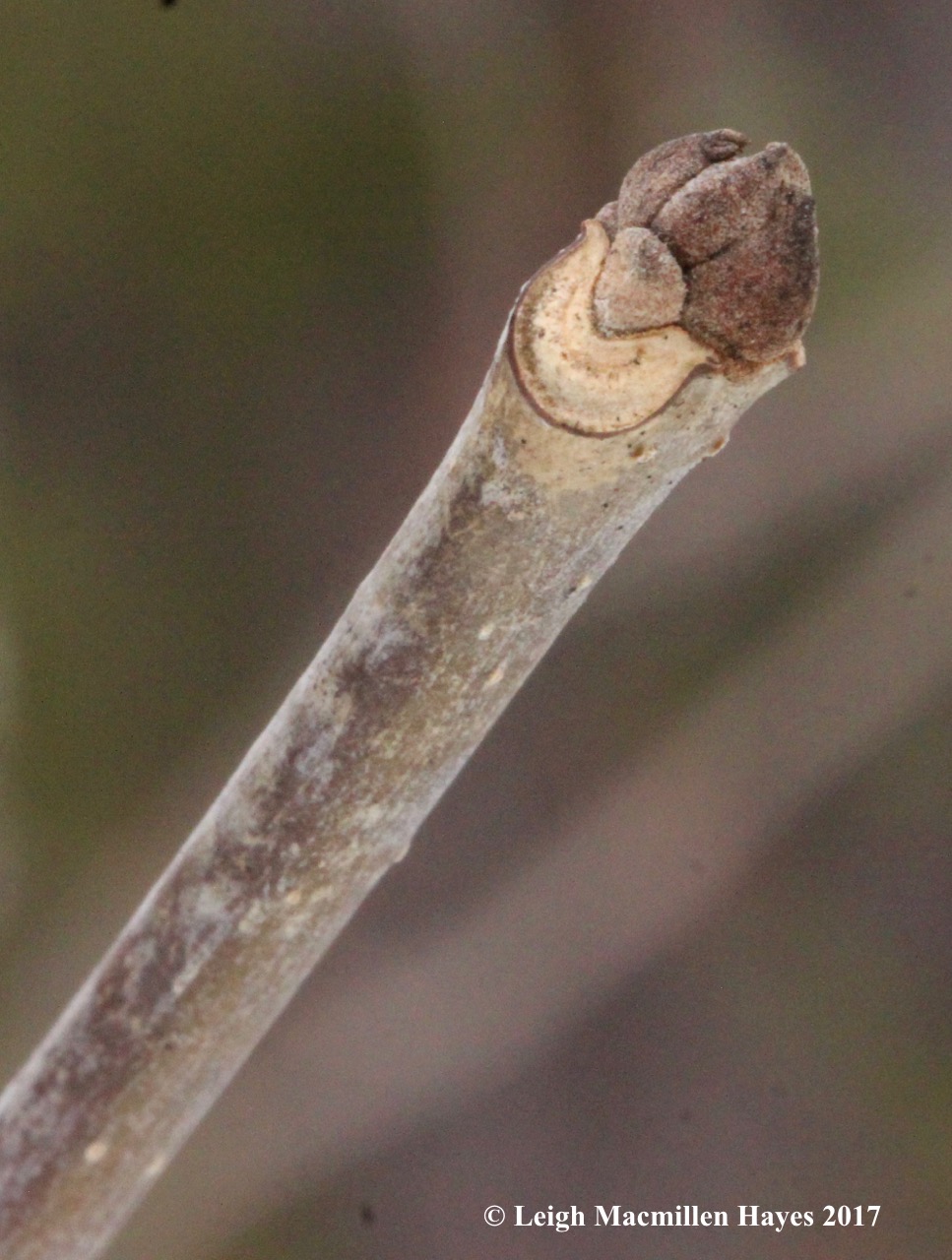
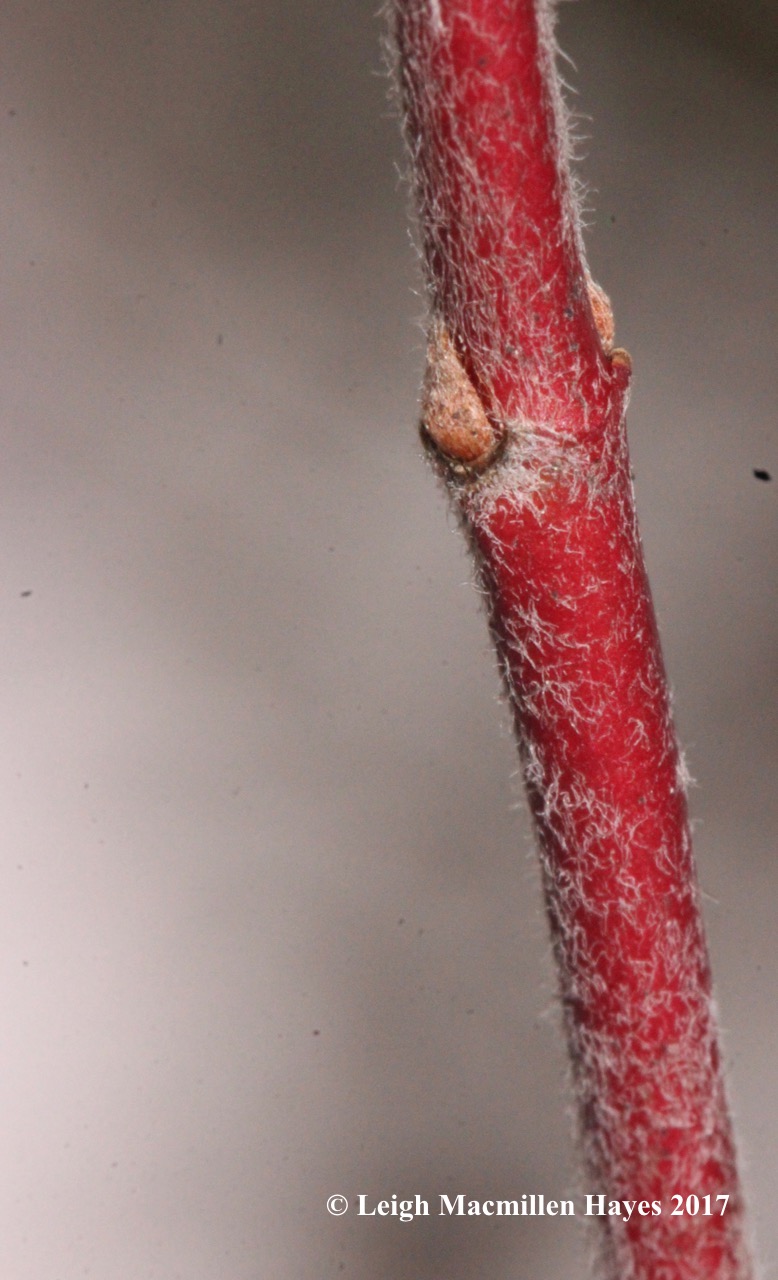
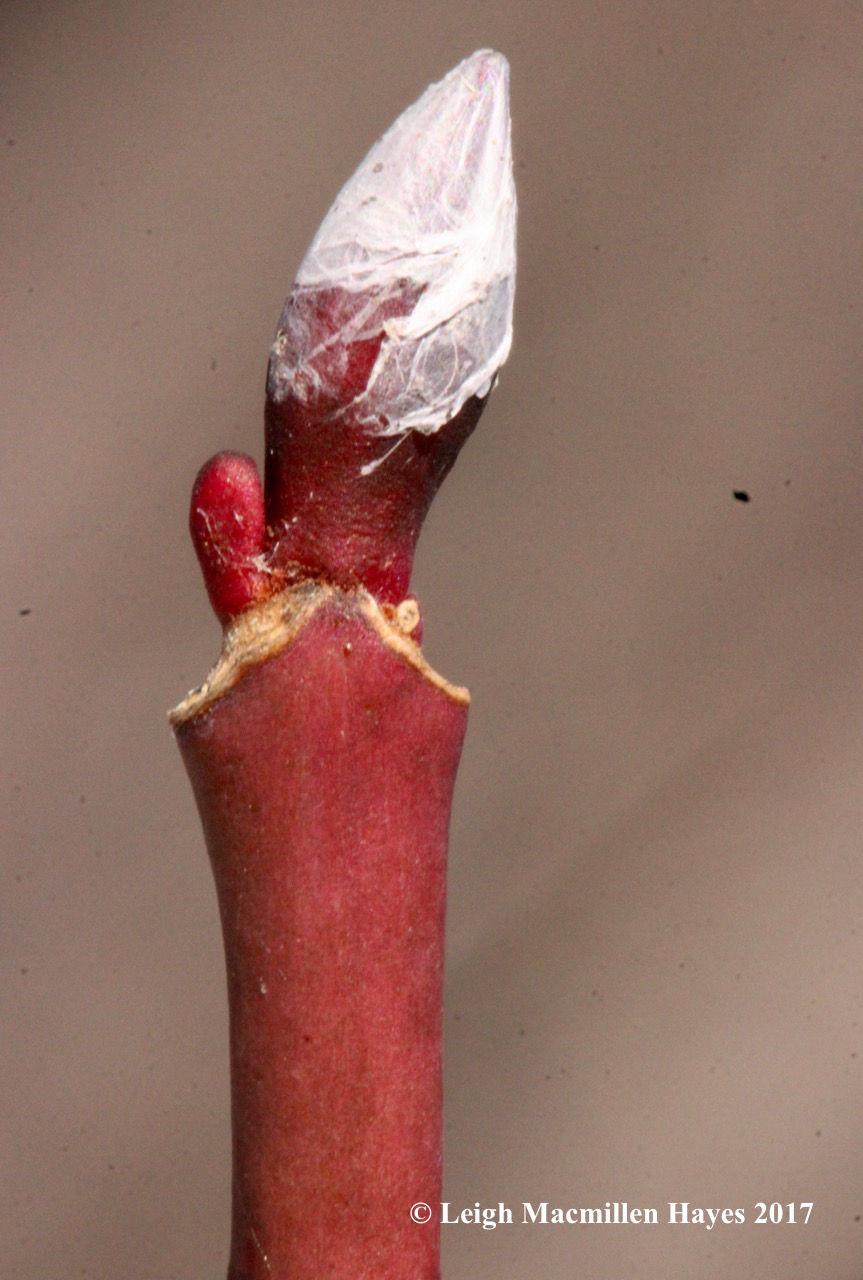
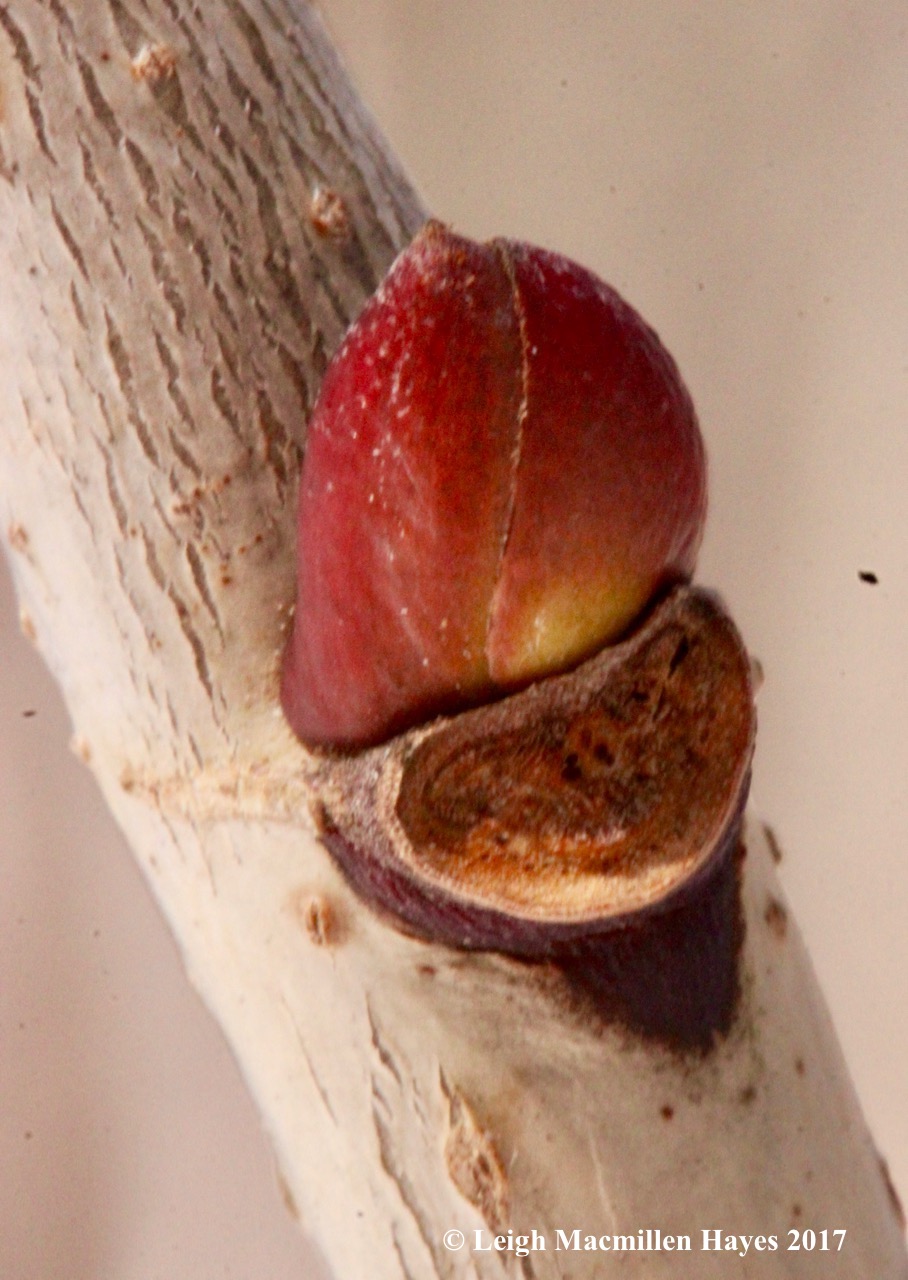
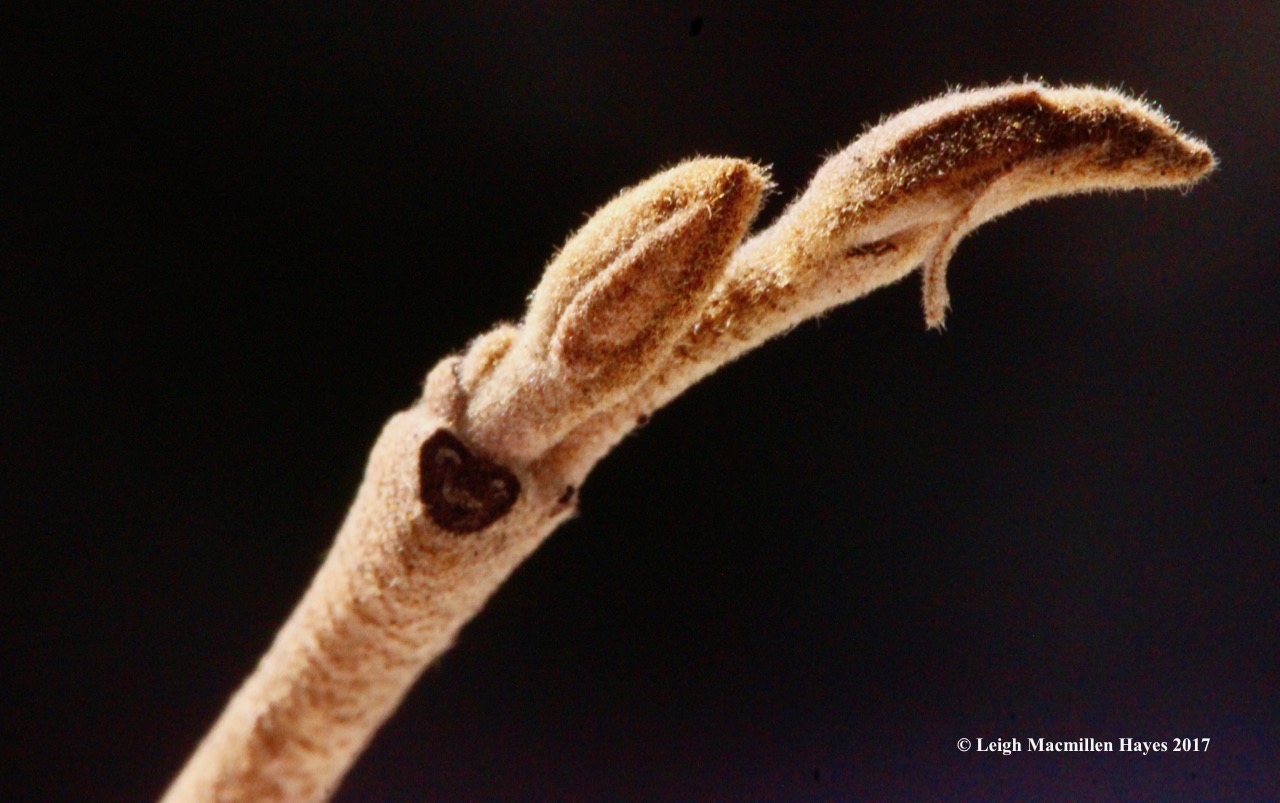
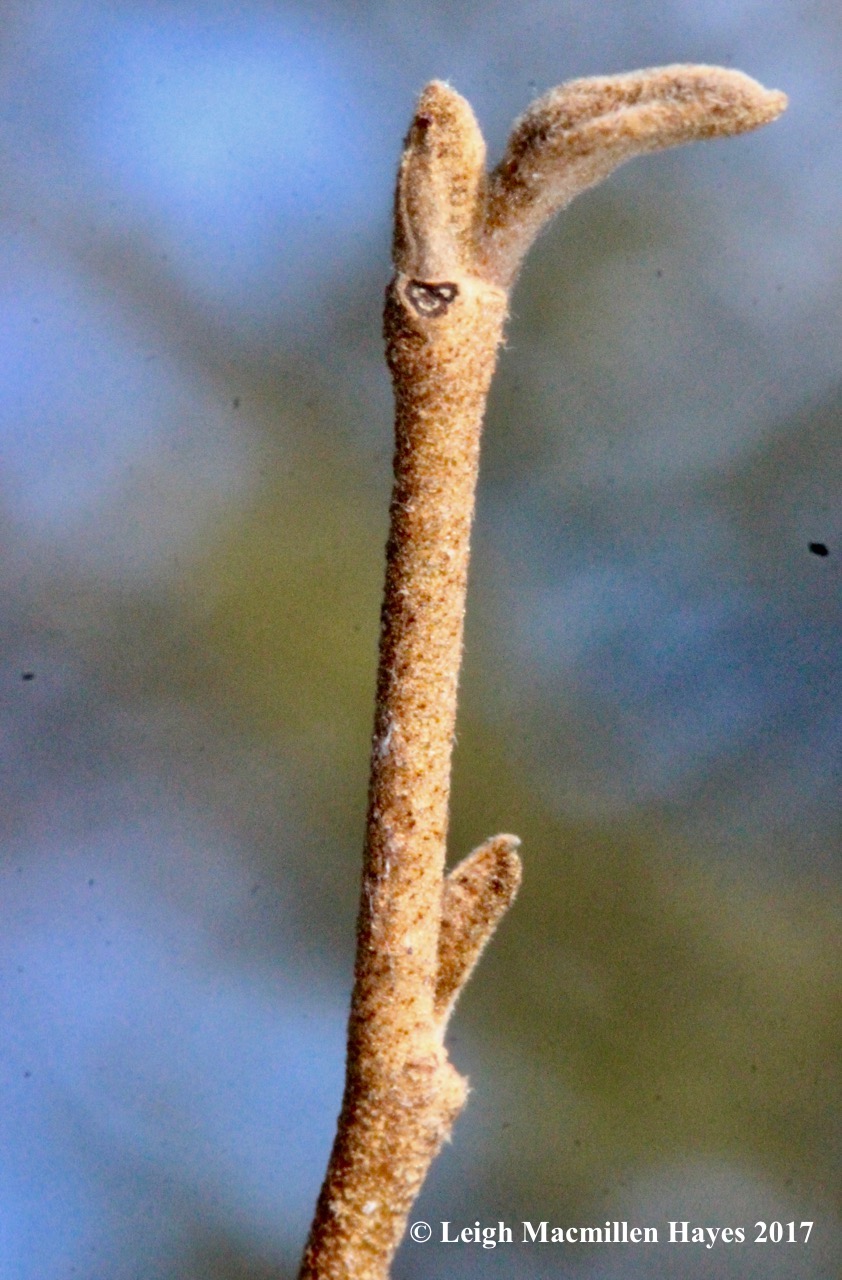
Now it’s on to trees with opposite orientation. And if you think you’re seeing double, you are! I used this photograph at the start. But now, let’s compare this twig to that of a cousin. 

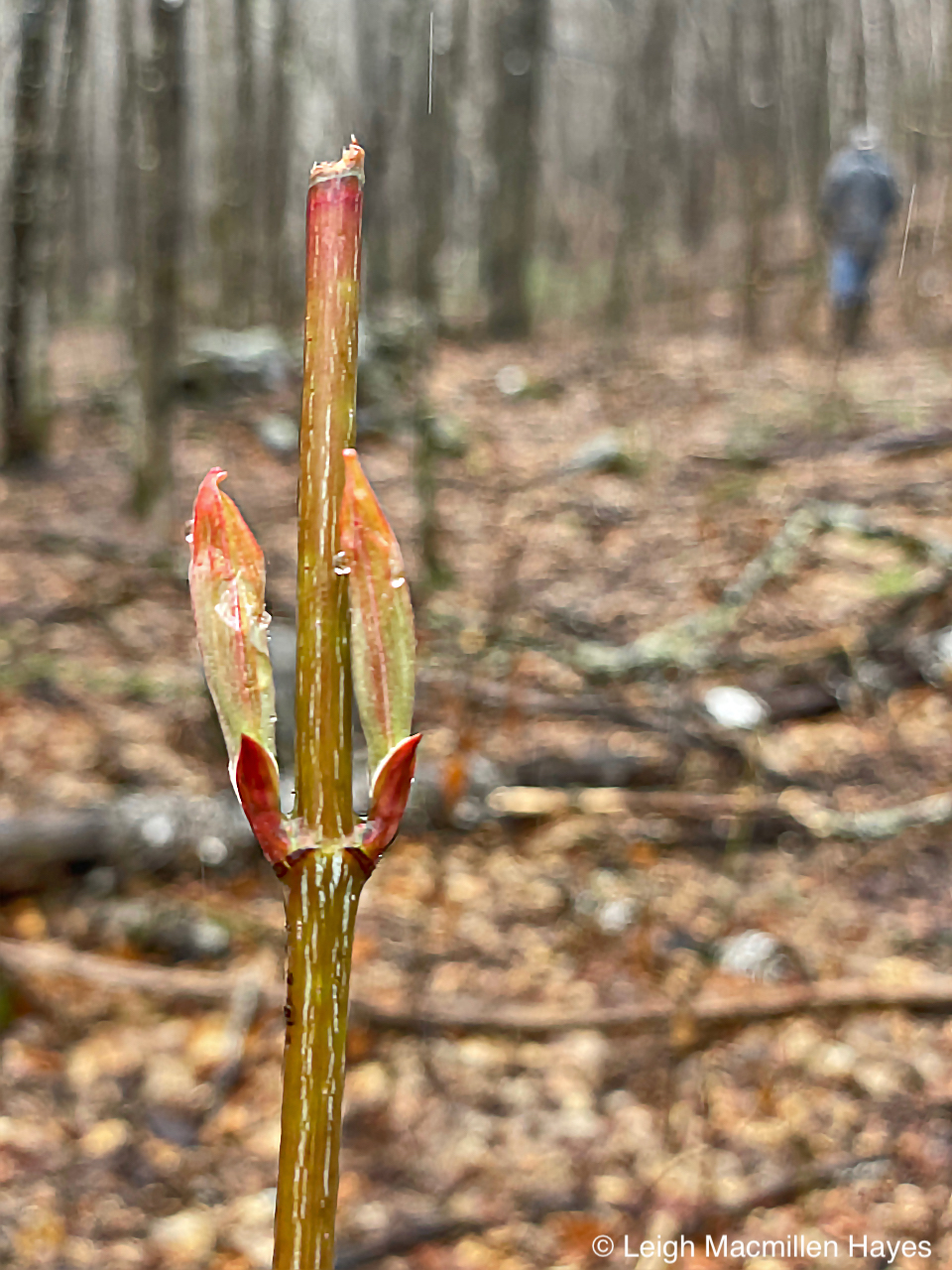
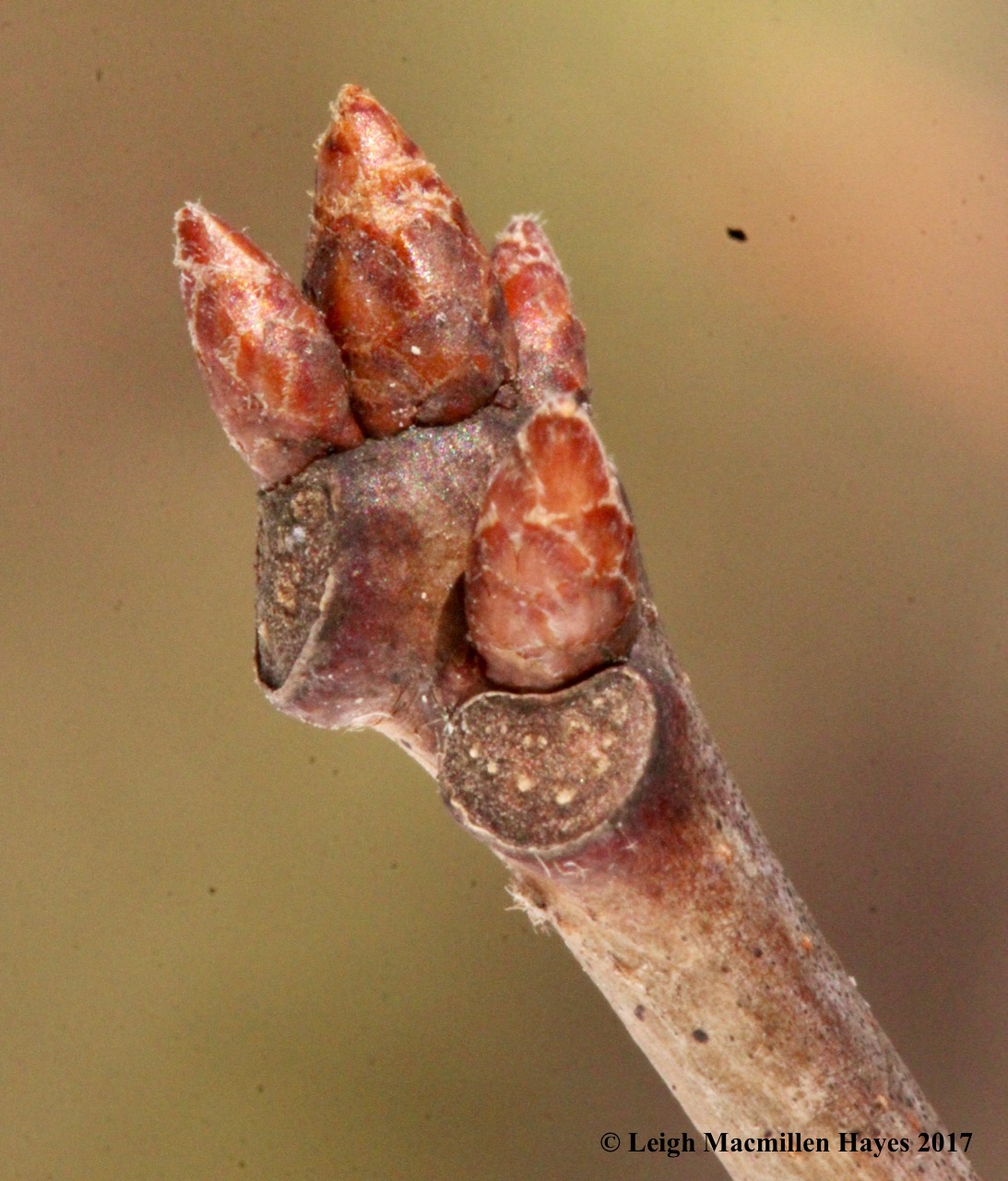
Can you see the fuzz on this one? And no fuzz on the one above? Also, notice in the first one the notched leaf scar. The second is not deeply notched. Who are they? 

Two of the three ashes that grow locally. Identifying White and Green Ash, as they are respectively, is never easy, but the hairs or lack of, and the shape of the leaf scars are the key elements. 

And finally, two members of probably everyone’s favorite fall trees. Notice the lateral buds are arranged on opposite sides. The buds and branch are purplish brown. On the twig, the buff colored lenticels practically jump out. The bud is a tad bit hairy and sharp pointed. Do you see the leaf scar bundles? How many? I hope you counted three. And who might this be? 

You are almost done. Only one last twig to examine. 

This one is probably Maine’s signature tree when it comes to fall foliage. And of all the members of the Maple family, this is the most abundant species. So, remember the crowded buds on the Oaks? Well, this twig also sometimes wears a crown. But, the terminal bud is wedged between two opposite lateral buds. And the color–red, because there’s always something red on this tree. Hint. Hint. If that didn’t give it away, this will . . . 

I love Red Maple. If you haven’t done so, follow the progression of its buds and I hope you’ll be wowed when it flowers next spring. Until I looked, I never noticed its dainty flowers. Now, I can’t not look. 

If you’ve stayed with me thus far, congratulations. You deserve an award. Or at least a hearty THANK YOU!   

 There’s more, but I’ll let the bigwigs handle that. I just learned of a new book about trees that I plan to purchase soon entitled Woody Plants of the Northern Forest: A Photographic Guide by Jerry Jenkins. Thanks to fellow naturalist Anita Smith for the recommendation. I can’t wait to add it to my bookshelf. 

Who knew there could be so many idiosyncrasies? After all, aren’t they all just twigs and buds? Ah, the wonder. 

I hope you’ll refer to this primer periodically as you gain a better understanding of twig morphology. And share it with your friends ;-)

Focus on Home Mondate

Some days are meant to be spent at home, especially when there’s yard work to finish up before the snow flies. And so today was just such a day and my guy chose to work on the leaves while I finished putting the gardens to bed and mowed one last time for this year.

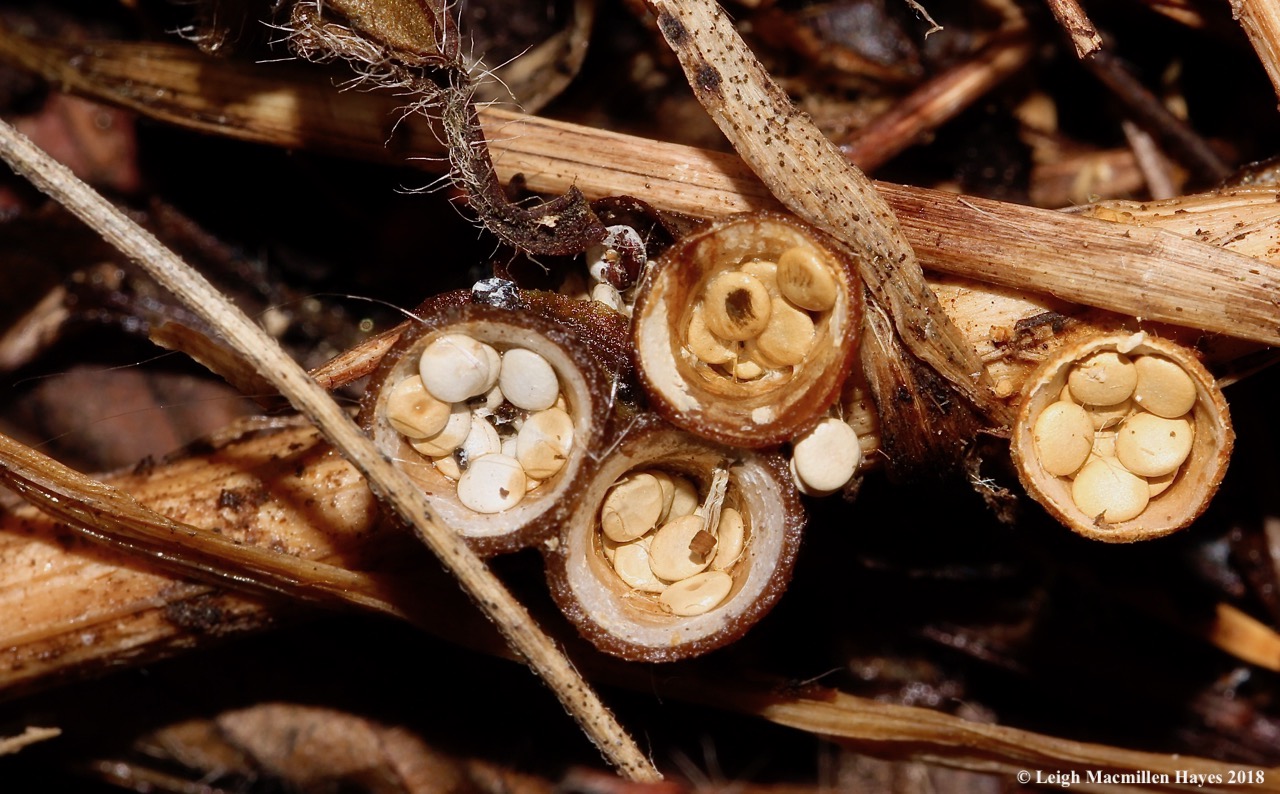
1-bird's nest fungi

It was while putting the garden to bed that I made a discovery–a form of bird’s nest fungi, this one being Crucibulum laeve! The structure is so named because it resembles a tiny bird nest. Prior to spore distribution, each “nest” is covered with a yellowish lid. Inside, the little disc-shaped “eggs” are called peridioles, which contain the spores. When a raindrop falls into the nest, the eggs are projected out of the cup. I’ve had the honor or watching that one rainy day, but it was one of those “you had to be there” moments that will live on in my mind’s eye.

2-porcupine tree

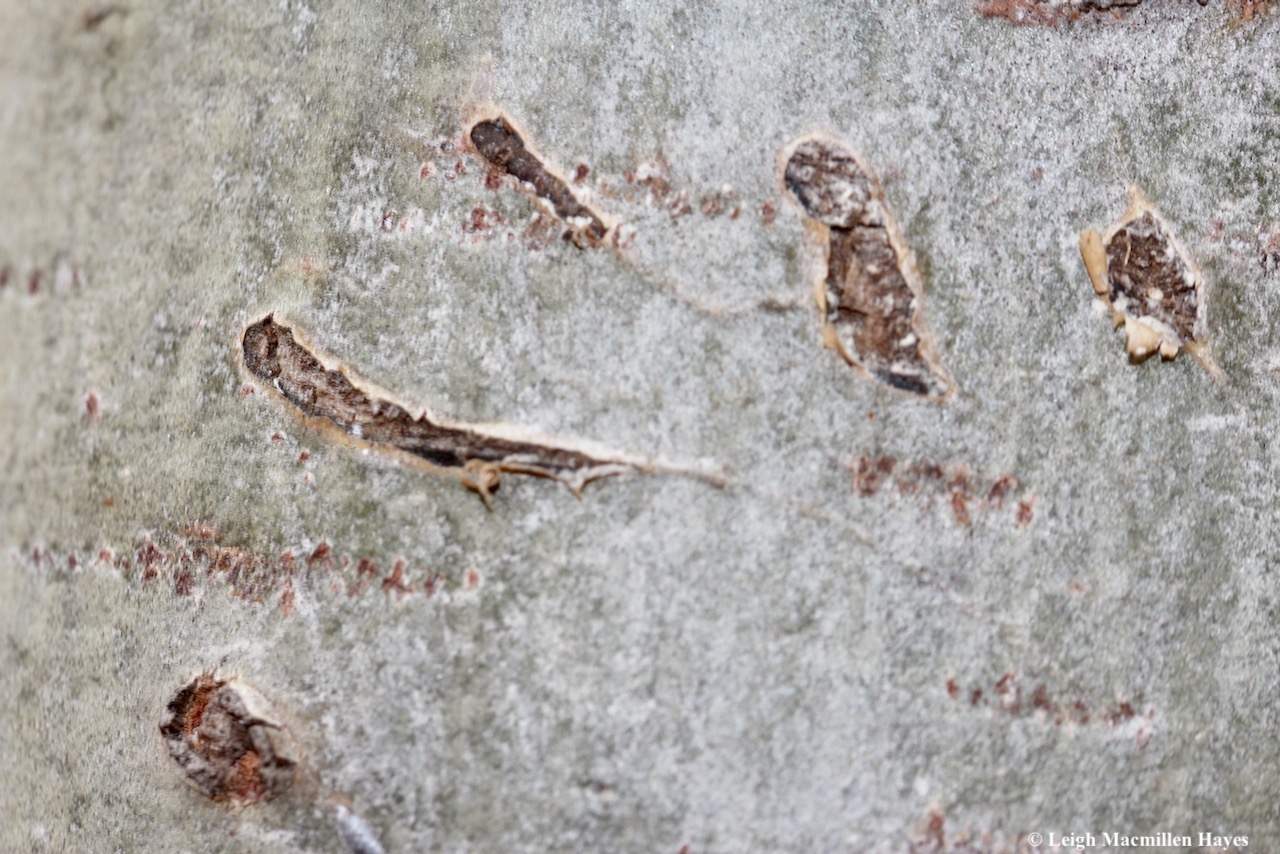
In one of the gardens stands a rather decrepit Quaking Aspen. It’s a favorite tree for woodpeckers and porcupines. thus it’s terrible condition. And usually I post photos of bear claw trees, but this particular aspen sports many, many porcupine scratches, some new and others older, such as these.

3-lady bug

As I looked at the bark to notice what else might be about, I spotted a spotted ladybug. We’d had a frost overnight, but she continued to move, however lethargically.

12-bagworm

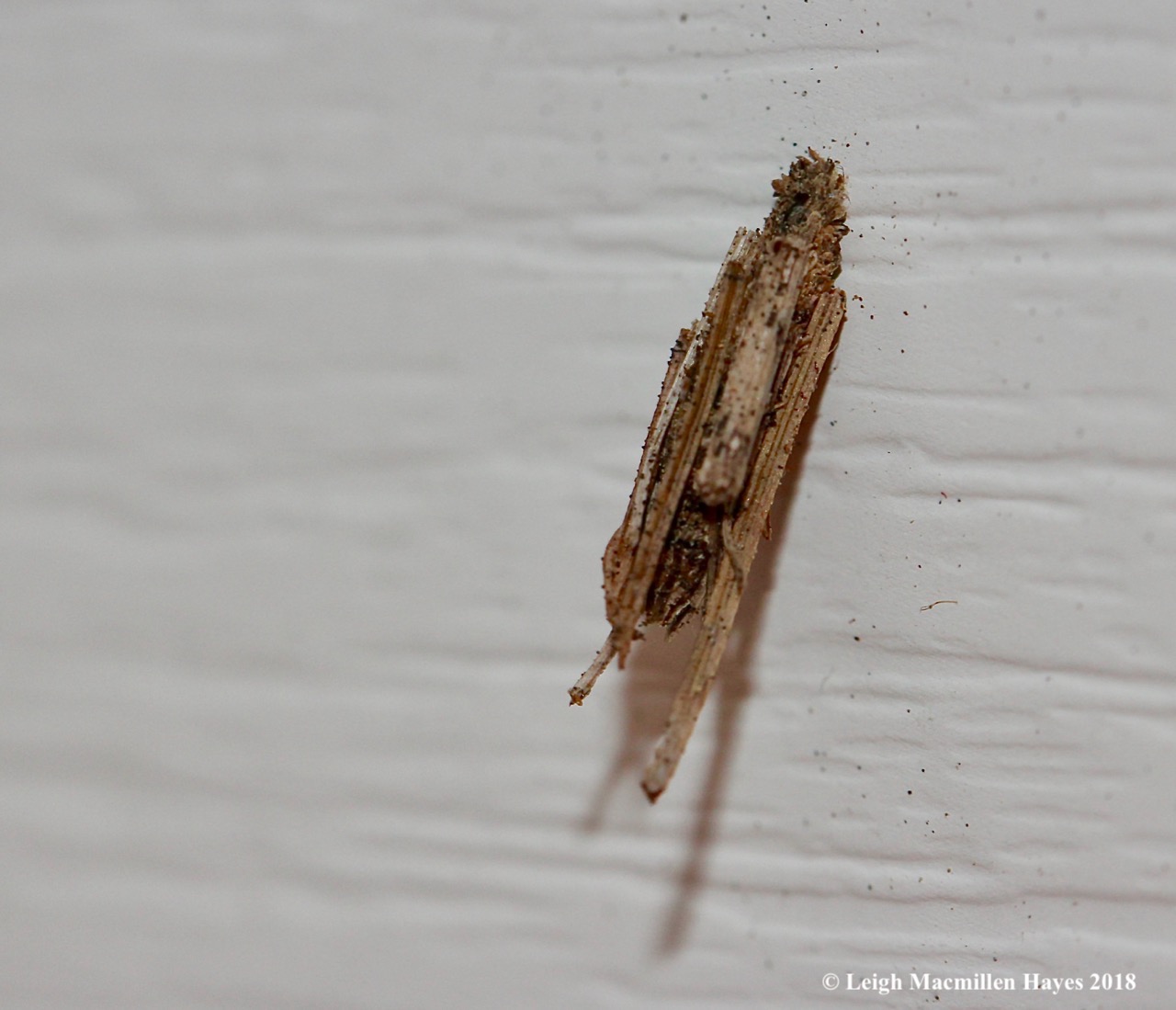
By the kitchen garden, I found another insect I’d forgotten all about these last few weeks–the caterpillar larvae of the Psychidae or bagworm moths that construct cases out of silk and environmental materials, much the way a caddisfly might. It’s the perfect camouflage from predators such as birds and even other insects.

4-milkweed seed

Everywhere throughout the garden were milkweed seeds, some wearing beaded skirts that will likely keep them in place. That’s fine with me, for I love milkweed. Even if this one does eventually fly away on a whim and voluntarily plant itself in another location, I know that my plants will produce more seeds for they also increase their population via underground tuberous rhizomes. Some call them invasive; I call them welcome.

12-hole in yard?

I’m not so sure the creator of this large hole in the yard is welcome. I know my guy wasn’t impressed. It’s about a foot wide and deep. We suspect one of “our” woodchucks. I’d rather think it was excavated by the beautiful red fox that crosses the yard several times a day, but it’s a bit away from the fox’s route.

5-mealy pixie cup lichen

My wander eventually took me from the garden to the stone walls, where lichens form their own little gardens and support such species as the Mealy Pixie Cups, a fruticose lichen with a stalk or podetia below the cup.

6-Rock Shield

Foliose-styled rock shield lichens grow abundantly on the rock’s surface, their success due to the numerous disk-shaped structures called apothecia. Reproductive spores develop on the rolled edges of the brown berets, awaiting the time when conditions are just right for them to move on and grow into a new lichen.

7-Cinder Lichen

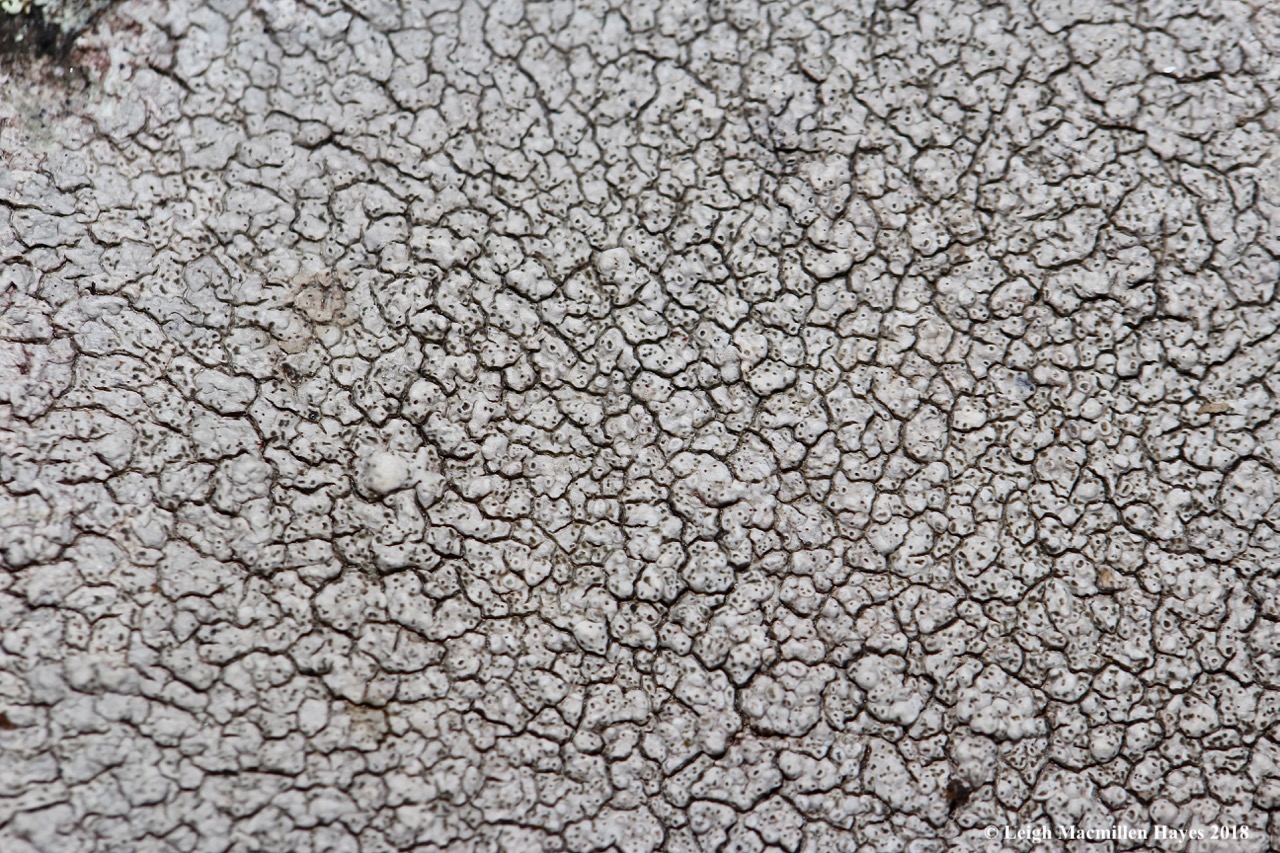
Crustose lichens were the most plentiful with their painted on appearance, like this ash-gray Cinder Lichen that reminded me of a mosaic piece of artwork.

8-Concentric Boulder Lichen

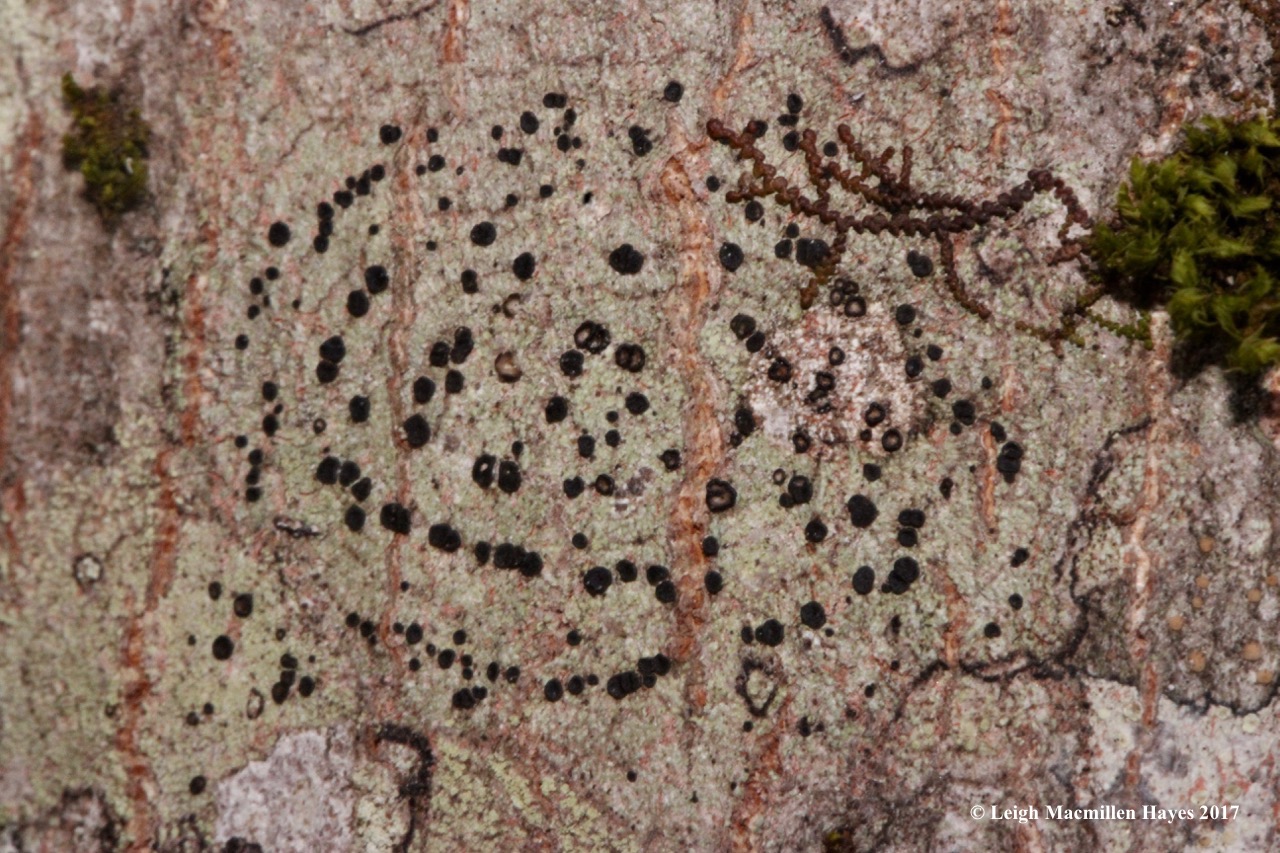
One of my favorite crustoses, however,  was the Concentric Boulder Lichen with its raised blackish-brown apothecia. Each time I saw the pattern created by the little disks, I felt like I was looking at a maze.

9-tent caterpillar egg cases

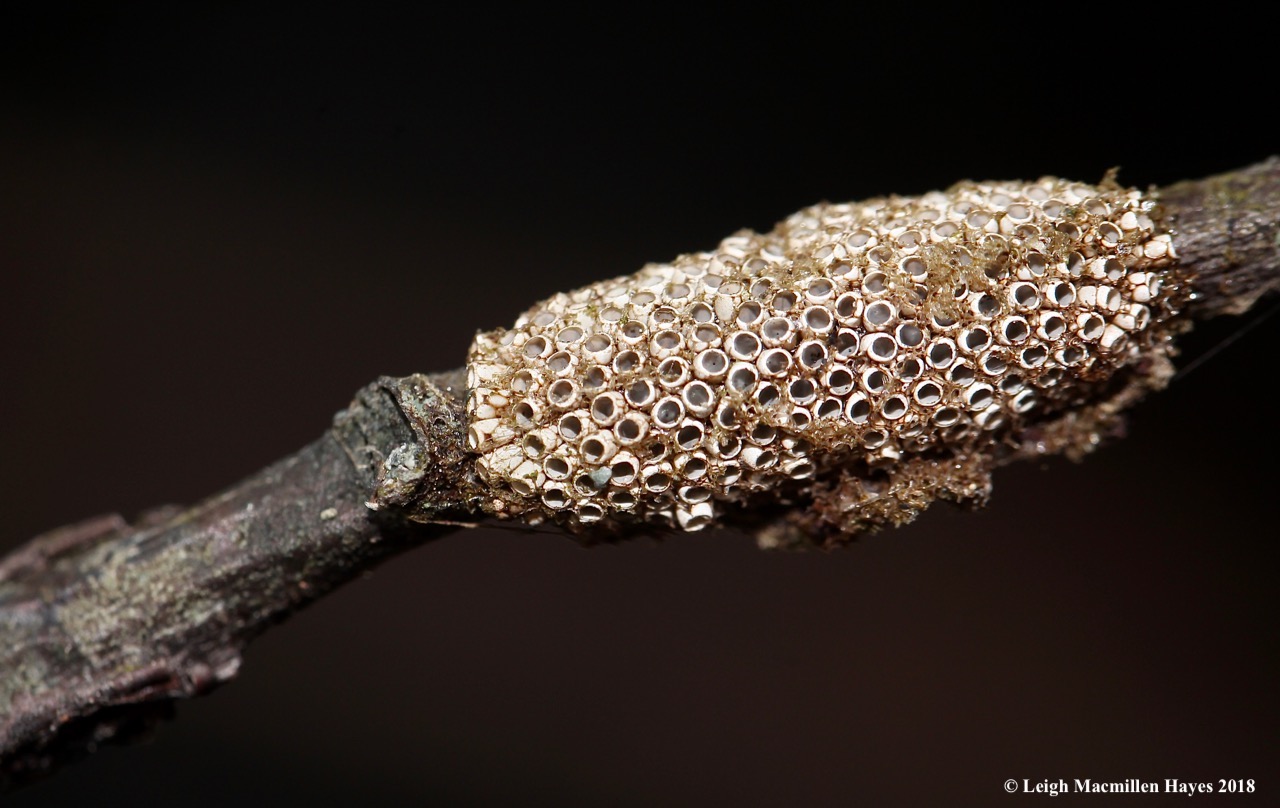
And then I stepped over the wall and turned my attention to some trees. That’s when I spied numerous tent caterpillar eggs cases. The Eastern Tent Caterpillar overwinters as an egg. Each one is part of a greater mass of anywhere from 150 to 400 eggs. They encircle a branch and are almost impossible to see, until your eye begins to recognize the structure. This was an old one and no longer had the shiny varnish-like coating that will help keep winter at bay.

11-red maple flower and leaf buds

Also keeping winter at bay were the waxy scales of tree leaf and flower buds. The buds formed in the summer and now must wait for February’s warm sun before they begin to swell and ready themselves for next spring’s bloom. In the meantime, they are snug inside their tight structures.

10-tube caterpillar tube

My next great find–tubes or tunnels created by the Pine Tube Moth. Last summer, larvae hatched from eggs deposited on the needles. Though Eastern White Pine needles grow in packets of five (W-H-I-T-E or M-A-I-N-E is a mnemonic we use to remember how many needles on the white pine, spelling “white” for its name or “Maine” because it is the state tree.) Anyway, the tube moth used silk to bind a bunch of  needles together, thus forming a hollow tube. Can you see the silk at the top? Notice the browned tips–that’s due to the larvae feeding on them. Eventually the overwintering larvae will pupate within the tube and in April they’ll emerge. Two generations occur each year and those that overwinter are the second generation. The good news is that Pine Tube Moths are not considered a significant pest.

13-pinesap winter capsules

One of my favorite finds as I headed down the cowpath toward home was actually an old friend–Pinesap in its winter capsule form. Pinesap is similar to Indian Pipe, another Monotropa (once turned speaking to its flower that turns upright after fertilization). The creamy whitish flowers developed into woody capsules. As the capsules mature, the structures become erect. Once ripened, seeds will be released through slits that open from the tip to the base of the capsules.

14-False Tinder Polypore

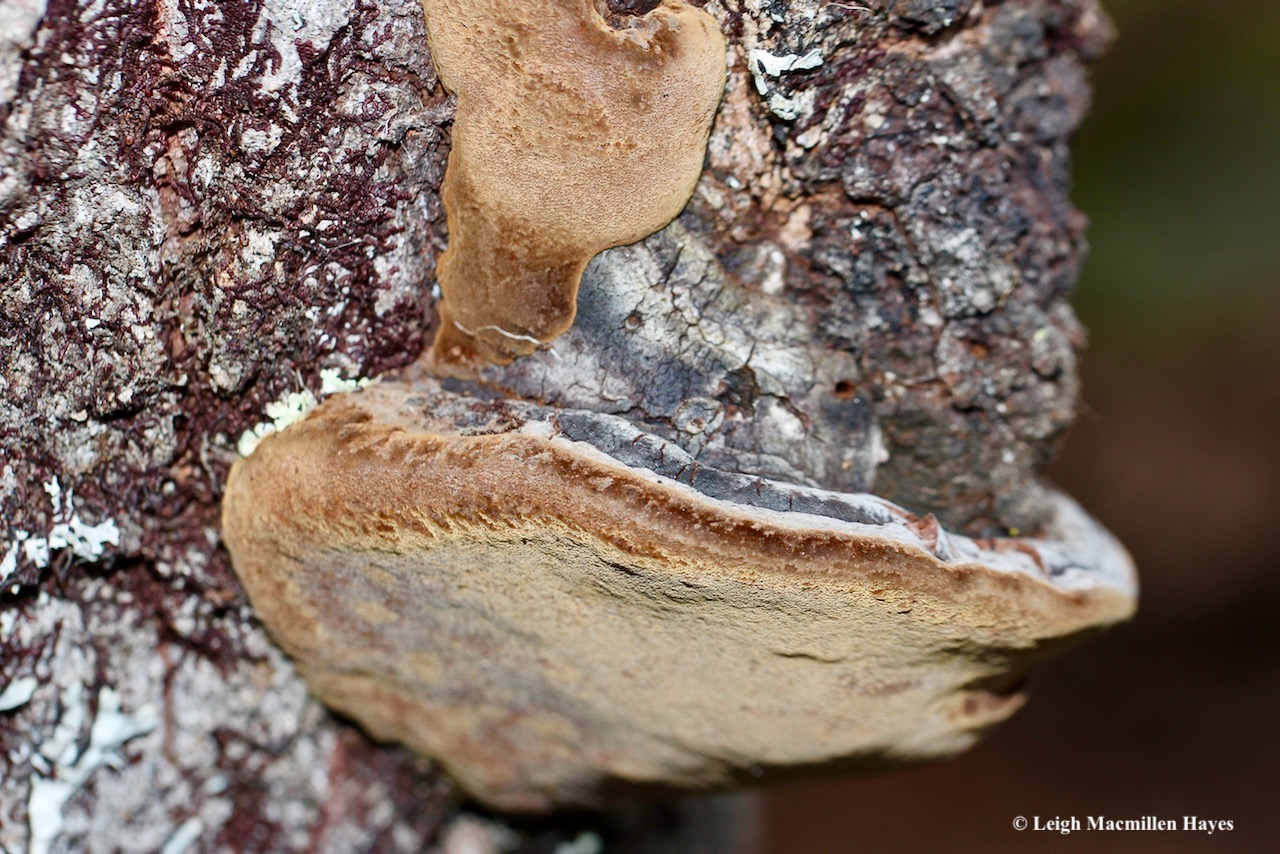
I was back in the grassy part of our yard when I passed by a tree in the corner and made a new discovery–a false tinder conk or polypore, with its black fissured cap. My very own Phellinus ignarius! While a Tinder Conks pore surface is usually concave, in the false specimen, it’s angled downward from the rim to the tree.

I know my friend Faith will see a smiley face in the upper spore surface; it rather reminds me of a weasel.

We never left home today, my guy and me. Our focus was on the yard, but mine was a wee bit different than his. And for those of you who have been asking–these photographs were all taken with the Canon Rebel T3i. Yep, that’s the one that got wet when I decided to flip off a boardwalk last May.

Forever Green

According to a Cherokee legend, one cold season an injured sparrow knew he could not fly south with his family, so he bid them farewell and went in search of a place to survive.

Sparrow asked Oak to shelter him among its leaves so he might heal and greet his family upon their return in the spring.

But being a crusty old tree, Oak didn’t wish to have a winter house guest and so he turned Sparrow away.

Downtrodden, Sparrow approached Maple. Sweet as she might be, Maple also turned Sparrow away.

And so it went. Sparrow was turned down by each tree he visited, until there was only Pine left to ask for help.

Pine listened to Sparrow’s pleas and his heart heard Sparrow’s plight. And though Pine knew his leaves were tiny and more like needles, and his branches not as many as the others, he welcomed Sparrow to join him for the cold season.

As hoped, Sparrow healed and greeted his family the following spring.

Creator heard and saw all that had happened and called a great council of the Trees. In his address, he rebuked them for they’d been given so much and would not share the least of what they had with Sparrow in his time of need. Therefore, from that day forward, when cold came upon the land, their leaves would wither, die and blow away.

Creator then spoke to Pine, praising him for being the least among the trees, and yet giving so much. And so, Pine was honored to remain forever green.

e-eastern white pine magestic.jpg

The Eastern white pine (Pinus strobus), strikes me as the majestic tree of our forest. Of course, it was once even more majestic. In the 1600s, the British Royal Navy blazed all of those two feet or more in diameter and within three miles of water with the broad arrow indicating they were to be cut, harvested and sent to England for ship masts. The blaze became known as the King’s Arrow in honor of King George I. At that time, the trees may have been 300-400 years old and over 200 feet tall. The oldest and tallest white pines in our current landscape are 80-100 years old and maybe about 100 feet tall.

v-white pine

The three to five-inch white pine needles are blueish-green and bound in bundles of five. That’s easy to remember for you can spell both the tree’s name W-H-I-T-E with each needle or M-A-I-N-E for the white pine is our state tree.

e-pine tube insect

Occasionally, I’ve spotted trees with clumps of needles stuck together in such a way that they formed tubes. Actually, they were the tunnels created by the pine tube moth. Larvae hatched from eggs deposited on the needles during the summer. They used silk to bind the needles together, thus forming a hollow tube. Notice the browned tips–that’s due to the larvae feeding on them. Eventually the overwintering larvae pupate within the tube and emerge in April. Two generations occur each year and those that overwinter are the second generation. Fortunately, they don’t seem to harm the trees.

e-pine whorls

In addition, the arrangement of branches is another important feature of this white pines for they are arranged in whorls radiating from the tree’s trunk like spokes on a bicycle wheel, with each whorl representing one year’s growth. Sometimes on older trees that grew beside stone walls in pastures, the older branches remain and when topped with snow look like a spiral stairway to heaven.

e-lines in white pine bark

On younger white pines, the bark has a greenish hue, but as the trees mature the bark turns dark gray to reddish-brown and forms into thick, vertical scales with furrows between. Upon the flattened ridges of the scales, look for a pattern of horizontal lines reminiscent of the lines on notebook paper.

e-red pine bark

Red pine (Pinus resinosa) is a favorite of mine because of its bark, which reminds me of a jigsaw puzzle. Ranging in colors from faded orange to mottled red and grayish brown, its flaky flat scales hug the tree.

e-red pine needles, chimney sweep

In a perfect world, red pine would produce three needles/bundle to spell R-E-D. Alas, the world isn’t perfect, nor is that the case with this tree. Instead, it has two dark green needles that are twice as long as those on a white pine and quite stiff. In fact, while a white pine’s needles are soft and flexible, bend a red pine needle and it will snap in half. Because of the needle arrangement on these two members of the Pinus family, from a distance I can name them. To my eyes, a white pine’s branch tips look like bottle brushes, while a red pine’s remind me of the brush Bert used to sweep chimney’s in Disney’s Mary Poppins.

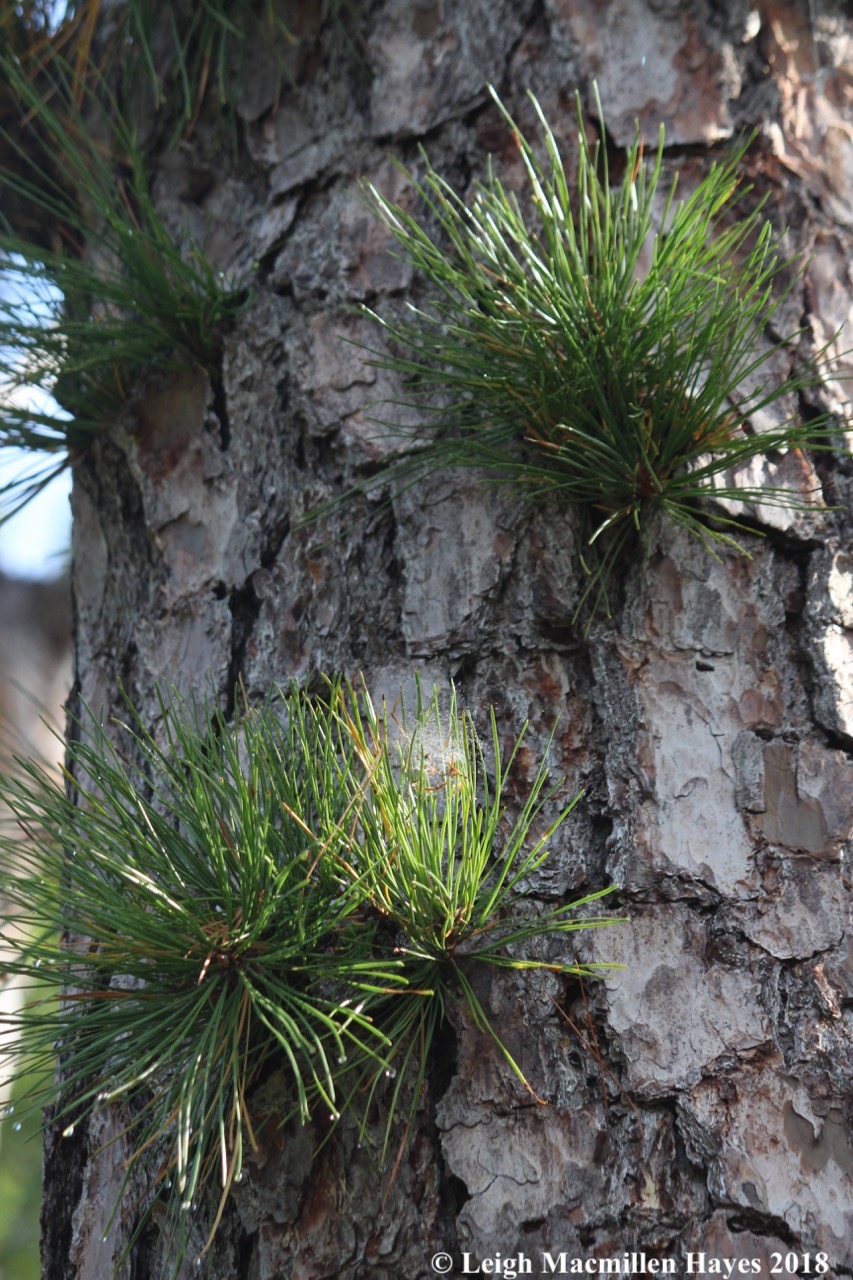
e-pitch pine needles on trunk

Another common pine in our area of Maine is pitch pine (Pinus rigida). This one is easy to confuse with red pine because the bark looks similar in color, though it strikes me as forming thicker plates. The name, pitch, refers to the high amount of resin within this tree.

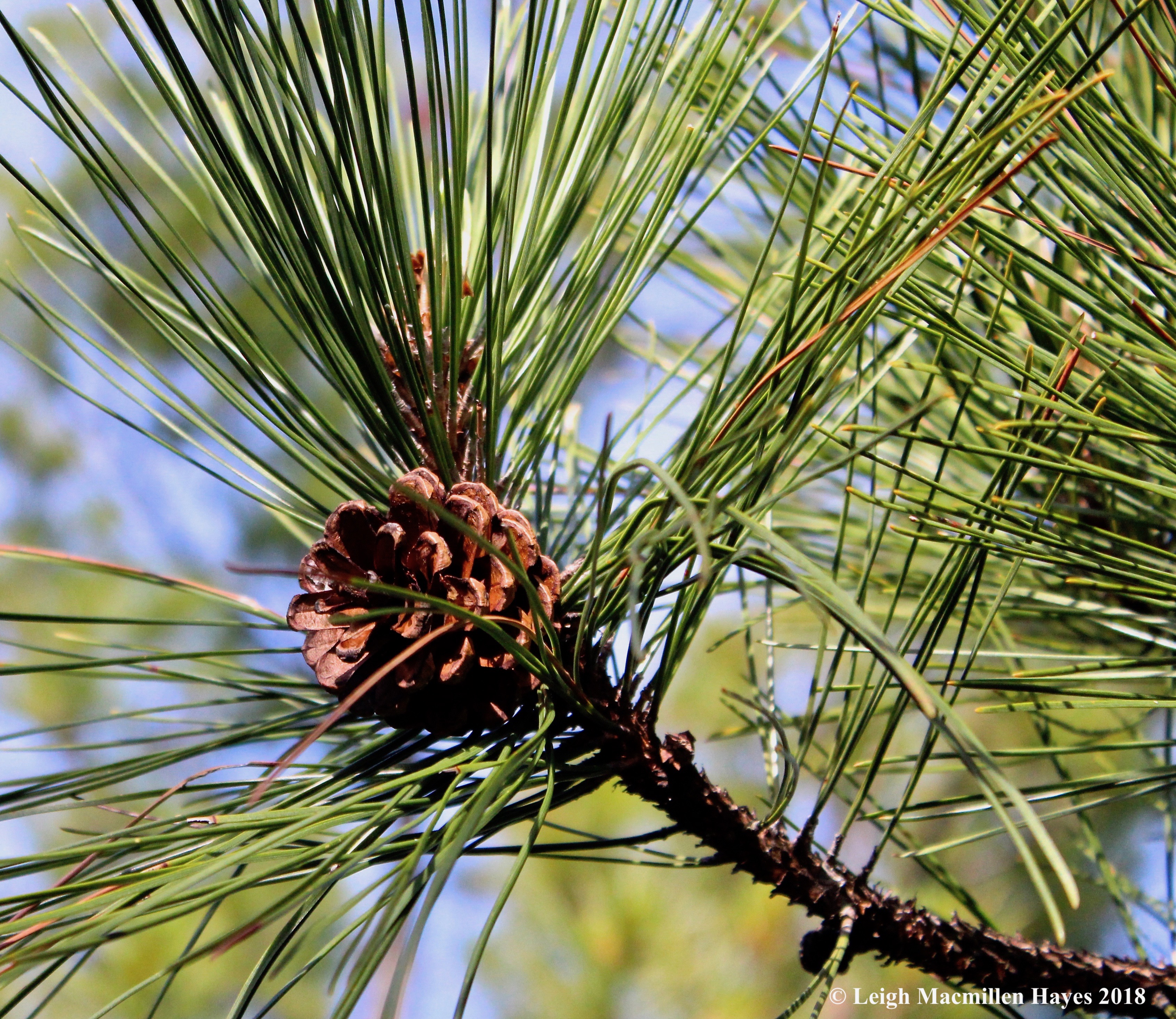
It’s the needles of pitch pine that also add to its identification for they grow in bundles of three, like a pitchfork’s tines. The unique thing about this tree is that not only do the stiff, dark yellow-green needles grow on the branches, but they also grow on the trunk. If you spy a tree that you think may be a Red Pine, scan upward and if you see green needles along the trunk, then you’ve discovered a Pitch Pine.

Pitch pine is an important species for it is the only pine that is well adapted to fire and can even resprout.

e-jack pine

Finally, for our native pines, and I can only think of a few local places where I’ve seen these, including along the Foster Pond Outlook Trail at Bald Pate Mountain in South Bridgton, is Jack pine (Pinus banksiana). It seems to prefer the coast and central northern Maine. But . . . walk Loon Echo Land Trust’s trail at Bald Pate, and see if you can spot them.

Jack pine has two yellow-green to dark green needles in each bundle so an easy way to remember its name: Jack and Jill. I don’t know about you, but I love mnemonic devices.

e-white pine cone, red pine cone, hemlock cone

One last way to differentiate the pine trees is by their cones. Cones are the fruits of the trees and they consist of scales that protect seeds. When conditions are right, the scales will open to release the seeds, which have wings much like a maple samara, allowing them to flutter off in the wind and find their own spot upon which to grow. The line-up in this photo from left to right: white pine, red pine, hemlock.

e-white pine with two year old cones

White pine is easy to ID for it produces long, narrow cones, often coated with white sap. It takes two years for a white pine cone to mature.

e-pine cone midden

Red squirrels are known to gather mature cones and store them in a cache for winter consumption. During the winter, the squirrels tunnel under the snow to access the cache, then climb up to a high spot and remove each scale to reach the seeds. Left behind is a midden or garbage pile of scales and center cob of the cone.

e-red pine cone and needles

Red pine cones are about two inches long and egg-shaped on short stalks.

e-pitch pine cone 1

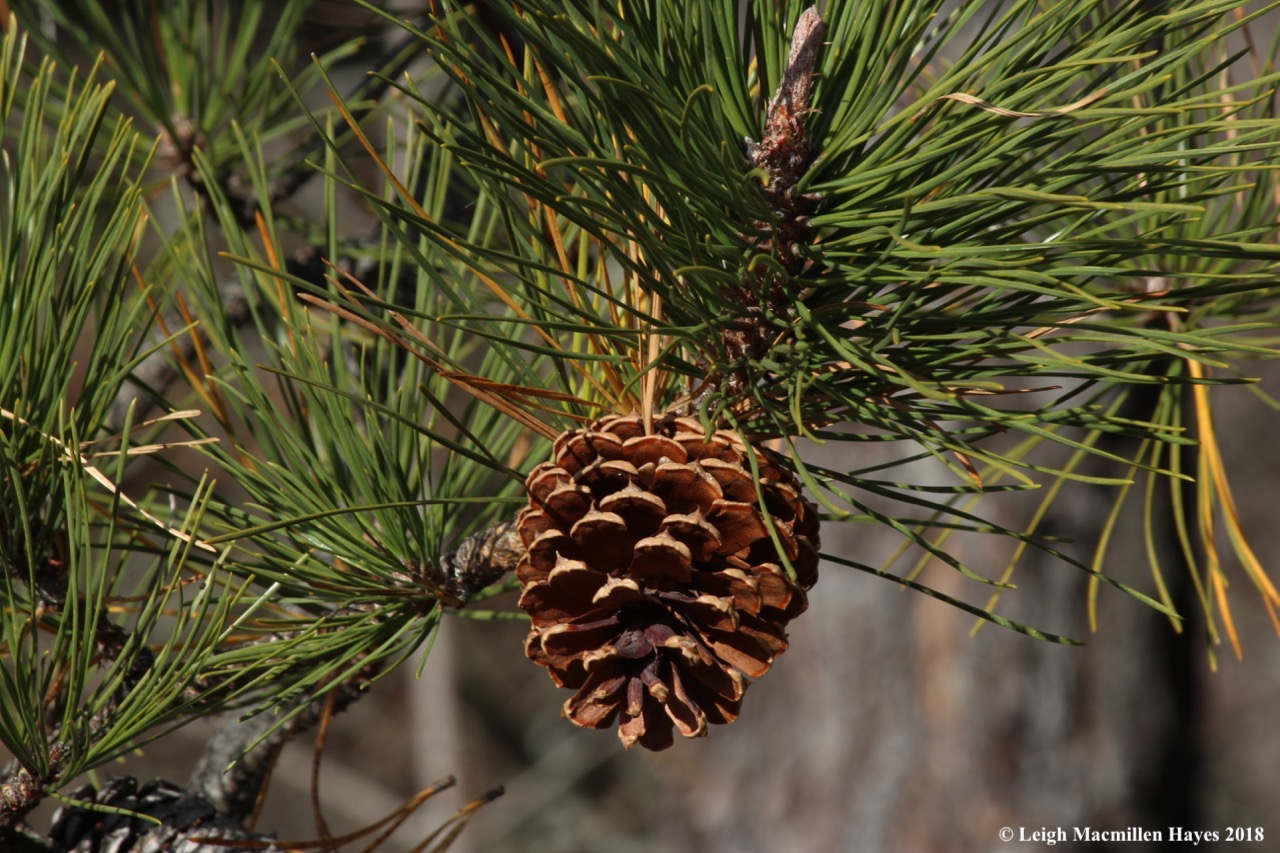
You can barely see the stalk of pitch pine cones that tend to be clustered together, but their key feature is the rigid prickle atop each scale tip. On Jack pines, the cones are about two inches long and slightly curved like a comma.

Before I move on to the other evergreens, I need to make one point. Members of the Pinus family produce pinecones. All other evergreens produce cones, but they aren’t pinecones because they don’t grow on pine trees.

e-mixed forest 2

Eastern hemlock (Tsuga canadensis) grows almost as abundantly as white pine. Often white pine, hemlock, balsam fir and spruce saplings can be observed growing together, and a perfect classroom situation evolves.

e1-drooping hemlock

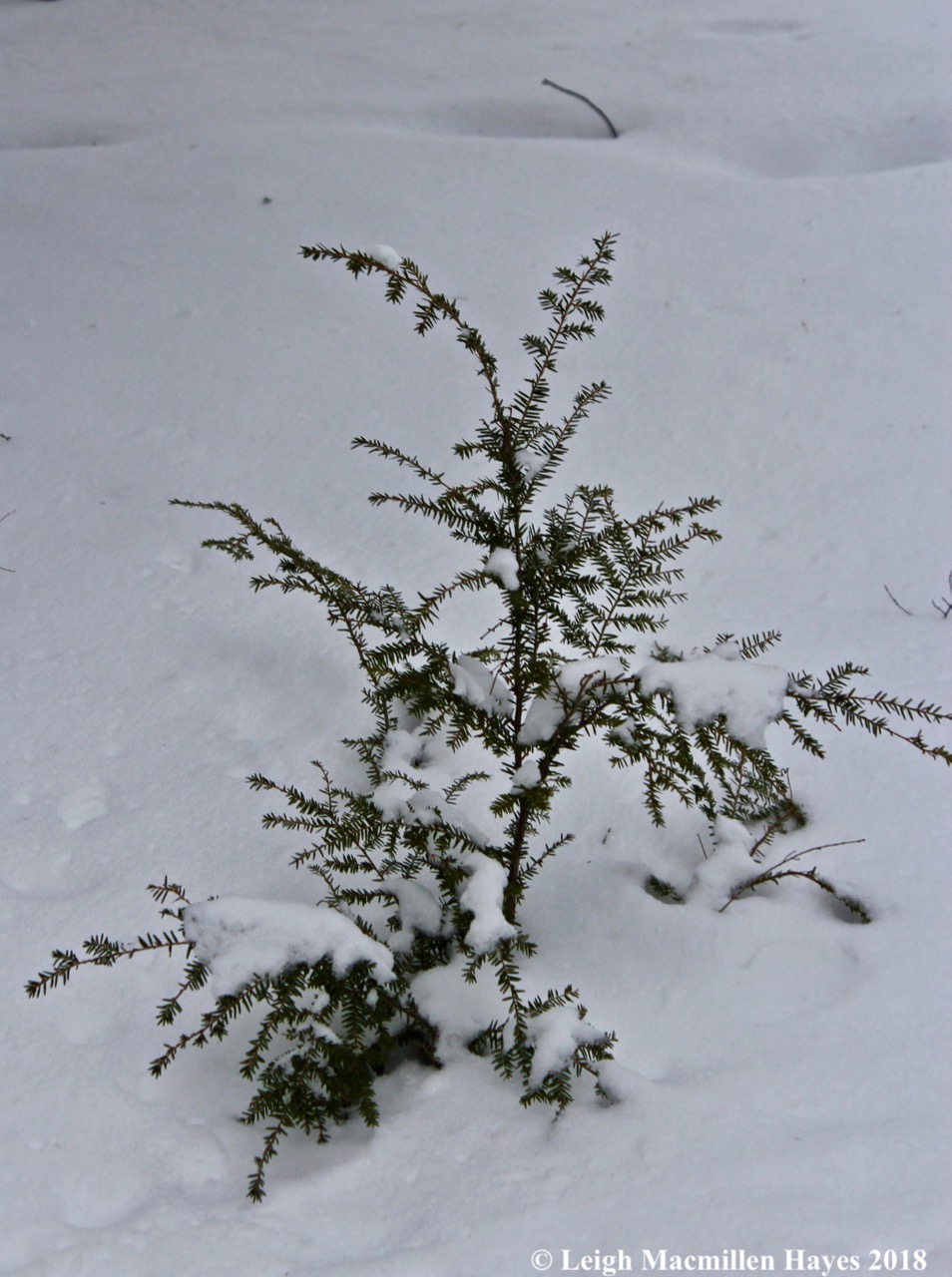
The hemlock is easy to ID once you realize its characteristics. To begin with, and especially noticeable in younger trees, is the drooping terminal shoot. In fact, all of the branches droop, providing the overall effect of a graceful tree.

e-hemlock gathering snow

Those sturdy, down-sweeping boughs also hold snow, thus creating the perfect spot for deer to hunker down under on a winter night.

e-hemlock porcupine evidence below hemlocks

Another mammal that takes advantage of the hemlock is the porcupine. If you spy nipped twigs on the ground surrounding a hemlock, then it’s best to look up and make sure you won’t become a pin cushion should the animal fall.

e-hemlock porcupine

Typically, the downed hemlock twig features a cut made at a 45˚ angle.

e-hemlock petioles (stems) and stomata lines

The half-inch hemlock needles taper to a dull point. You may only see this with a hand lens, but each needle is attached to the twig by a short stem, aka petiole. And the needles extend outwards from both sides of a twig, thus giving it an overall flat appearance.

e-inner bark of hemlock

The bark on a hemlock, initially grayish and smooth, becomes cinnamon brown and scaly with age. I also enjoy looking at the inner bark that might be exposed by an injury, for its features various shades of reddish purple.

e-hemlock cones

Hemlock cones are petite in comparison to pinecones, at only .75 inch in length. In the spring, their scales are blue-green, maturing to a tan by autumn.

e-balsam fir standing upright

While the hemlock droops, a balsam fir (Albies balsamea) stands straight and tall as it forms a spire with a symmetrical crown.

e-balsam fir needles

Like the hemlock, the needles are flat, but they differ in that they attach directly to the twig, are about an inch in length and some have a notch at the blunt end. The upper side is a shiny dark green, while the underside is silvery-blue.

e1-balsam bark

The pale gray to green-brown bark of balsam fir is also different than the other evergreens. It has raised dashes, aka lenticels. All trees have lenticels that allow for the exchange of gases. On some trees, however, the lenticels are more noticeable. Balsam fir bark also is riddled with bumps or resin-filled blisters. Poke one with a stick and watch the pitch ooze out. Beware, it’s very sticky. And it smells like Christmas.

e-balsam fir cones

One other unique characteristic of a fir tree is that the cones point upward rather than dangling down. That, in itself, offers an easy ID.

e-spruce

The next family, the Picea or spruces, I find more difficult to distinguish in a crowd. Like balsam fir, the leaders or top sections point skyward giving it an overall pyramid shape, but its the idiosyncrasies within the family that sometimes stump me.

e-spiky spruce

The one thing I am certain of is that they are spruces if their needles are sharp and pointed. Shake hands with a branch and if it hurts, it’s a spruce.

e1-spruce bark

Spruce bark is broken into irregularly-shaped scales in general, and white spruce bark is gray to reddish-brown.

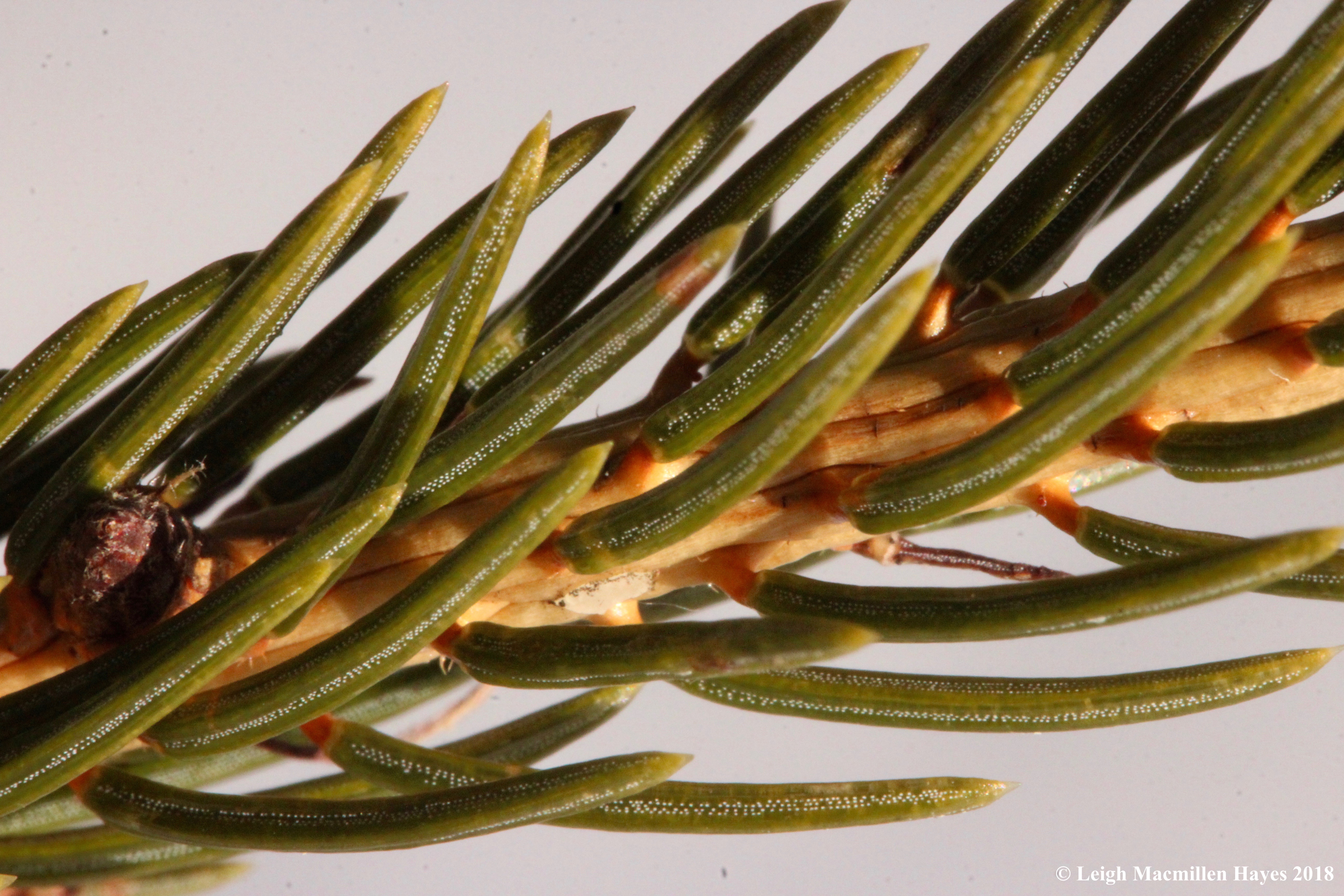
Again, I’m brought to things to remember when trying to determine whether I am looking at a fir or spruce—firs are friendly, spruces are spiky. Fir needles are flat, spruce needles are square.

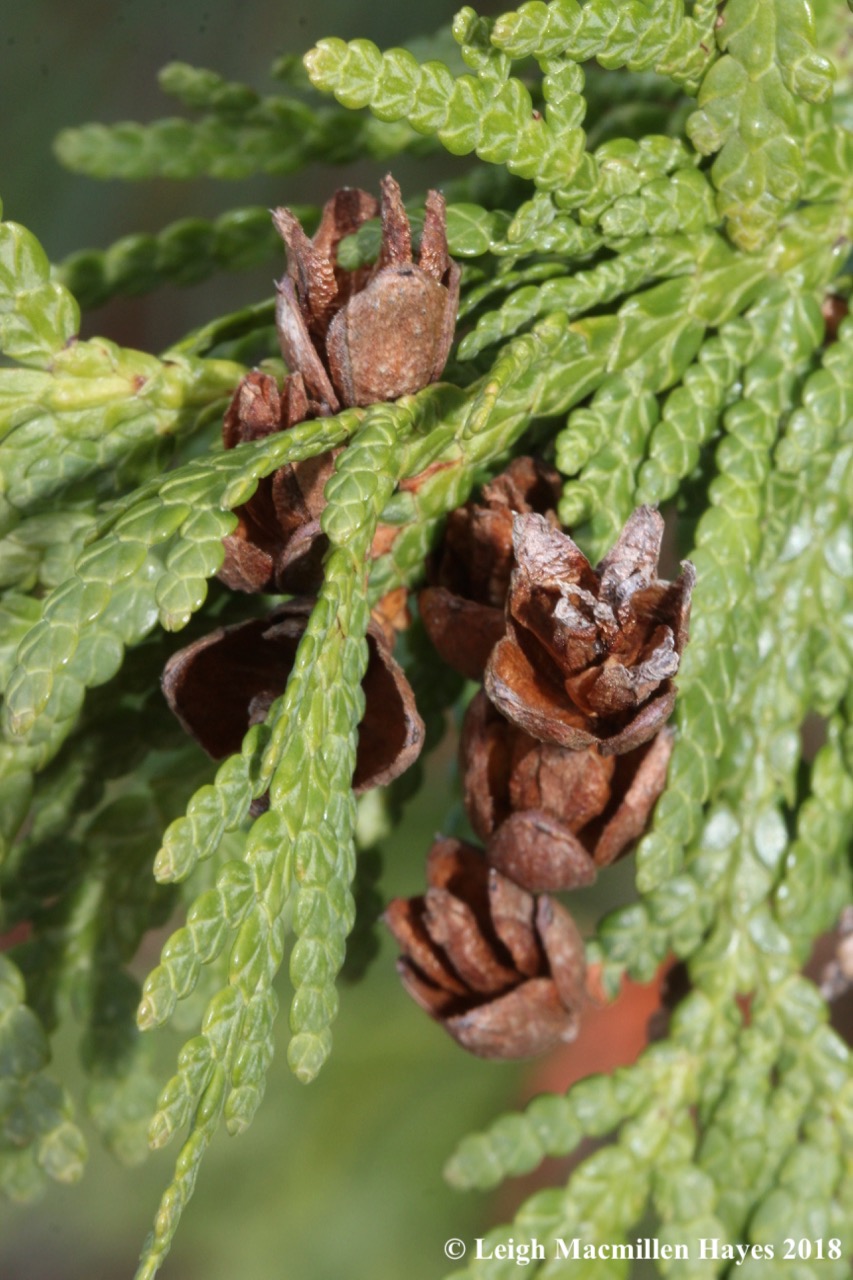
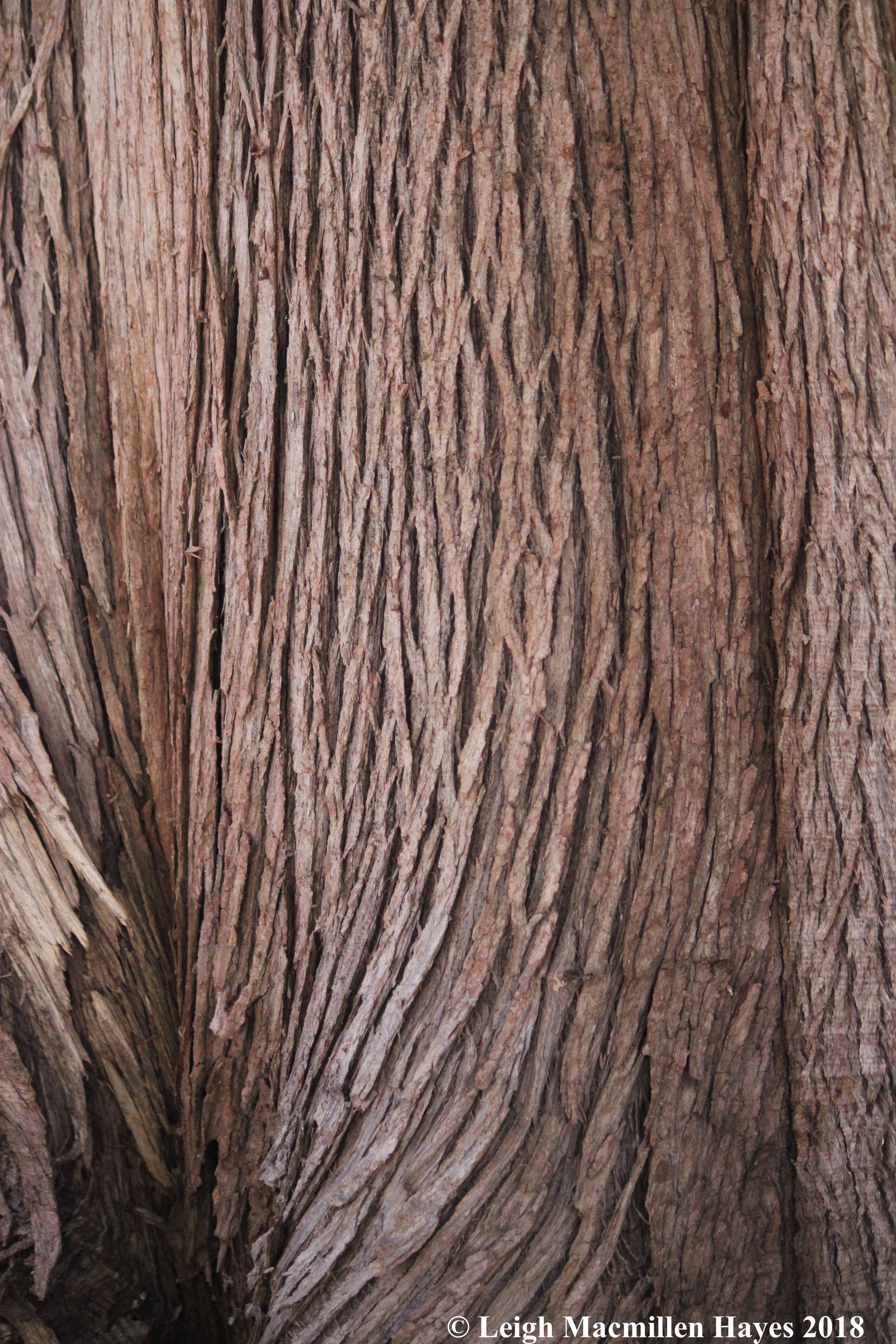
The only cedar tree native to western Maine is the Northern white cedar. Whenever I sniff its fragrant scent, I’m reminded of my mother’s cedar chest and the treasures it stored.

e-Northern white cedar leaves and cones

Northern white cedar (Thuja occidentalis) is also known as Eastern arborvitae. Its scale-like leaves appear opposite each other along the twig and have short, blunt points.

The cones are about a half inch long, oblong in shape and borne upright on the branches. Their scales are leathery, red-brown and notched. They also have a small spine on the tip.

e-Northern white cedar bark 2

Again, the bark is fibrous, red-brown, which weathers to gray and features a diamond-shaped pattern. This small to medium-sized tree looks like a pyramid with a broad base and rounded top. It often features several main trunks.

And then there’s the tamarack.

e-tamarack in fall

A tamarack or Larix laricina is a native deciduous conifer because it sheds its needles each fall, after they’ve turned a golden yellow, therefore it’s not really an evergreen.

e-winter

I know how easy it is to look at the winterscape and think that everything looks the same in the almost monochromatic mosaic we call the woods.

e-spring 1

But even in spring, as buds give way to leaves,

e-summer evergreens

summer when so many greens dominate our world,

e-fall 2

fall, when evergreens provide a contrast for autumn’s foliage,

e-fall 3

and late fall, when the evergreens continue to be green as the broad leaves drop, these trees make a statement in the landscape.

Thanks to Creator, they are forever green.


Oh Baby!

It’s so cold outside that probably the smart thing to do would be to stay snuggled within, but I couldn’t.

a-bluejay with seed

After all, the birds were on the move, though they were a bit puffed up, a normal behavior when the temp is below zero. Their feathers help insulate them from the cold (and my hands understand that as they were tucked inside down-filled mittens). Fluffing up traps as much air as possible, thus keeping our avian friends warm.

s-robin

Their feathers are also waterproofed with an oil coating, a good thing on this not only frigid, but also slightly snowy day.

s-frost around squirrel homes

As I wandered, I noticed that the squirrels and maybe other small mammals had decided not to venture forth and found plenty of evidence that they were huddled inside. Ice crystals formed in holes beside trees, and . . .

s-frost by stone walls

openings in stonewalls . . .

s-frost again

reminded me of the feathery display on our windows on cold winter mornings. These were the mammals’ windows–such as they are.

s-stained glass

And speaking of windows and ice, which has lasted longer than usual following the Dec 23rd storm, everywhere branches reminded me of stained-glass leading highlighting the picture of our winter world.

s-red maple buds

But, here’s the thing about ice. Like feathers, it also serves as an insulator, keeping leaf and flower buds along tree branches protected from the cold. Oh, they have waxy coatings, but the ice adds another buffer.

s-beech bud

Some of the sights I saw today made me chuckle, like the beech bud poking through one of the tree’s marcescent leaves.

s-pinecone on maple

And a maple pinecone.

s-saw-whet owl 1

But my favorite find of all flew in while I was making my way rather nosily through a dense patch of hemlocks. Another where’s Waldo moment. Do you see it?

s-saw-whet owl 2

Yes, a Northern Saw-whet Owl! A first for me in the wild.

s-saw-whet 3

We shared about ten minutes together and it was definitely an “Oh baby!” occasion (which I reported to Jean Preis for our local Bird Count).

And with that, I’m proud to say, “It’s a boy!” The bird, I’m not sure. But I’m a great aunt to Baby Bud who was born at 12:24 this morning. May he develop a sense of wonder about the natural world and a love for winter.

The owl was the icing on the cake on this special day–Oh baby!


Honoring the Earth

It would have been so easy to stay home last night, curled up on the couch beside my guy while watching the Bruins play hockey. After all, it was raining, 38˚, and downright raw. But . . . the email alert went out earlier in the day and the evening block party was scheduled to begin at 7:30. And so, I piled on the layers from a wick-away shirt to Under Armour, a turtleneck, sweater, LL Bean vest and rain jacket. I slipped into my Bogg boots and made sure I had the right gear–smartphone for photos, reflective vest, headlamp and flashlight. With a visored hat on my head to shield my glasses from the rain, I was finally ready. Out the door and down the road I went, headed to the Lakes Environmental Association‘s office for Big Night.

h-Big Night Patrol 3 (1)

I wasn’t the only one crazy enough to attend the party. Our number was about twenty. I think the best part was that we ranged in age from 6 to almost 60, the latter being me–the oldest kid on the block. And in that mix, one teen who was celebrating his 15th birthday (Happy Birthday, Kyle), and several teens who had never attended before but came because one of their crowd was an annual participant. We even had two policemen in the mix–and though their job was to slow traffic and keep us safe, they had as much fun as we did completing our mission.

h-spotted sallie 2 (1)

Said mission–to help spotted salamanders . . .

h-spring peeper 1 (1)

and spring peepers cross the road.

h-redback salamander (1)

We did so for a while and then headed back to our vehicles. Just before reaching the spot where we’d all parked, someone spotted this redback salamander–I smiled because its the symbol of the Maine Master Naturalist Program.

We were wet. We were cold. And we were happy. As nature would have it, Big Night preceded Earth Day–a perfect beginning.

h-candy lichen

Earth Day began appropriately with a board meeting at Lakes Environmental, where among other topics, Dr. Ben Peierls, the new research director of LEA’s Maine Lake Science Center, shared with us his plans for the water quality testing laboratory. Ben addressed us first so that he could drive to Portland and join the March for Science. We continued our meeting, but were thankful for his representation. Meanwhile, directly outside and all around town, another gathering was taking place as many people participated in an Earth Day cleanup.

By the time I left the meeting pleased with all that had been accomplished, I was ready for a solo adventure to find out what the Earth wanted to share with me since most of the snow melted this past week. Despite being another raw day, or maybe because of it, the candy lichen brought a smile to my face. I think one of the cool things about this lichen is that even though its salmon-colored fruits stand atop stalks, this is really a crustose (crust-like) lichen, the bluish-green surface being the actual structure.

h-juniper berries

Near the candy lichen, the bright blue of some berries stood out on the common juniper. They remain on the shrubs all winter and it seemed only a wee bit ago they looked all withered. Today’s offerings were plump and pretty.

h-pine droplets

And then there were the raindrops, each waiting its turn to continue the journey toward the earth. I had to wonder what else it might fall upon before reaching its final destination–each little ball encapsulating nourishment.

h-lambkill

One of the receivers, sheep laurel, which displayed its own new life.

h-trailing arbutus

And at the base, trailing arbutus. One year ago, as I noted in my Earth Day post, it was already in bloom. This seemed a reminder from Mother Earth that we need to practice patience.

h-wild turkey

I continued my mosey, as quiet as could be, and so was startled when one large, exotic bird, and then another, and a third flew off from behind a stone wall. And then I realized they were wild turkeys–who truly are exotic if you take a look at all the colors in their feathers.

h-tinder conks on beech

I’d been on the snowmobile trail, but traveling was difficult given some remaining icy snow and deep ruts filled with water. As if I needed an excuse, I decided to slip into the woods. One of my first delights–tinderconks lining a tree as I looked up.

h-moss covering

But really, it was the thick moss coating at the top of the tree that first drew my attention. Several trees in the neighborhood displayed the same fashion.

h1-woods south (1)

My wander was aimless, taking me through boggy areas . . .

h-snow1

and small sections where snow still blanketed the ground.

h-deer prints in snow

Besides plenty of deer scat, I found prints . . .

h-deer hair

and hair.

h-deer hair bubbles

Raindrops enhanced the hair.

h1-moose scat 1 (1)

And though I suspect they’ve moved toward open water, there was plenty of evidence that the moose had also spent the winter in these woods.

h-moose hair

They, too, have shed hair–preparing for the summer scene.

h-moose maple

A couple of months ago, I’d been concerned that the moose had consumed all the tree buds, but the red maples showed me otherwise.

h1-woods south 2 (1)

At one point, I stood for a while atop a rock and looked to the south.

h1-woods north (1)

And then to the north. It was as I stood there that I heard a repeated sound. It began with a few slow beats, and then a swift series of beats. All seemed muffled. It finally occurred to me that I was listening to a ruffed grouse. Eventually, I followed the drumming and came close to the one beating its wings against a log–the work of a displaying male. I didn’t bother to seek out the actual bird for I knew I’d startle it and it would fly off, so I let it drum in peace, thankful for the opportunity to at least hear it. Really, it was a first for me. Oh, I’ve possibly heard it before, but only today did I recognize it for what it was.

h1-widowmaker (1)

For a while, I was fake lost . . . and then I heard another repeated sound that lead me to a widowmaker and I knew exactly where I was. But where was the maker of the sound?

h-owl 1

In a tree above me.

There were actually two barred owls and I was so thankful for the honor of listening to and watching them on this Earth Day.

I was also thankful for all the privileges bestowed upon me. The privilege of living. The privilege of noticing. The privilege of questioning. The privilege of understanding. The privilege of wandering. And especially, the privilege of wondering. Thank you for your offerings, Mother Earth. I am honored to know you.


May I Have This Dance?

Haha. If you know me well, you know I’d rather be a wall flower than step onto the dance floor. I easily managed to avoid all high school dances, except one prom. And then, barely danced at that, probably much to my date’s dismay. After that, so many moons ago, I don’t think I danced again until my wedding–at which time any dear friends in attendance watched with humor at my awkward movements. But today, I felt the rhythm surging through my body.

v-snow on trail

It all began on my way to the vernal pool. Perhaps it was really just a shiver as the breeze blew across the last of the snow, hard packed still along the snowmobile trail.

v-springtails 1

Or maybe it was the depression that held the snowmelt and was covered with an oil slick of sorts . . .

v-springtails 2

which turned out to be a million springtails bopping to their own tunes.

v-trailing arbutus 1

It could have been the sudden sight of so many trailing arbutus plants that got me going.

v-trailing arbutus 2

Certainly I wasn’t the only one excited by those flowers yet to be. (Do you see the springtail on the tip of the bud?)

v-vernal pool

Or it might have been the ever shrinking ice cover at the pool that made my feet tap.

v-vp edge opening

Perhaps it was the fallen beech leaves atop tree reflections that forced me to sway.

v-leaf offerings

Or the way the hemlock, oak, maple and beech leaves intermingled.

v-spermatophores

What I do know is that there was no stopping me once I spotted spotted salamander spermatophores atop leaves in several open sections–the sperm being located at the top of the cauliflower-shaped platforms.

v-frog 1

And then I saw something swim under some leaves that really got me rocking. Do you see the face of the wood frog, hiding as best it could?

v-fox scat beside vernal pool

As I began to circle around the dance floor, I noticed an offering of scat that made me think a red fox had sashayed beside the pool.

v-sharp-shinned hawk feather?

On my own sashay home, I discovered that there were other dancers in the midst–this one possibly a sharp-shinned hawk.

v-woodpecker feather

And after that a woodpecker.

v-junco feather?

And then a junco.

v-red maple flowers 1

Along the cowpath, the red maple flowers blushed as I might were I to get all gussied up in a flowing dress.

v-red maple flowers 2

Much the way a suitor might wink, so much has happened so quickly. Within the past week the snow melted almost entirely away and winter released its hold on me. Now I’m ready to groove with the choreography of spring’s rhythm. I hope you’ll join me on the dance floor.

May I have this dance?


A Good Mourning Mondate

A good mourning? Indeed it was. Yesterday we celebrated Easter and the resurrection. Today we celebrated an opportunity to climb our favorite mountain.

p-Mountain stream

And so we parked the truck at Loon Echo Land Trust’s Ledges Trail parking lot on Mountain Road in Denmark and then walked 1.5 miles back to the trailhead we chose to make our ascension up Pleasant Mountain. Along the way, mountain streams quickly moved the meltwater downward toward Moose Pond, where it will mingle with the lake water and eventually find its way to another stream and then the Saco River and finally out to sea. And whether via future raindrops or snowflakes or even fog, traces of the same water molecules may again find their way down these streams.

p-bald peak trail

At last we reached the trail head for the Bald Peak Trail, where less than a week ago Marita and I had to climb over a tall snowbank to reach the path.

p-ice chunk

As we climbed and paused to admire the water flowing beside us, I noted differences between last week and today, including the shrinking of an ice chunk tucked under a rock. Ever so slowly, it joined the forces of downward motion, as if letting go was meant to happen with care.

p-Needles Eye

And then at the spur, my guy and I turned left to Needles Eye. Some ice and snow still covered parts of the path, but it was much easier to negotiate than last week. And he did. I followed him, but didn’t need to step into the chasm since I’d just been there. (wink) Instead, I climbed below to try to capture the world above.

p-returning from Needles Eye

And then I rejoined my guy and wished I’d taken a photo of this section last week for today’s conditions didn’t reflect the same treacherous stretch Marita and I worked our way across.

p-snow on trail

We continued up the trail, where snow and ice were more prevalent. Though we had micro-spikes in our pack, we managed to avoid wearing them. And only once did I completely sink in–just below Big Bald Peak. I actually went up to my thigh, so deep was the snow. And cold. But I was hot, so it felt refreshing.

p-pileated scat

But before we reached the sharp left turn on Big Bald Peak, we noticed tons of chips at the base of a hemlock tree. Such a discovery invited a closer look–and I spied the largest pileated woodpecker scat I’d ever seen. Later on, when we were almost at the Fire Warden’s Trail, we saw two hikers on their way down and I quickly realized one was my dear friend Joan–another lover of scat and all things mammalian. Of course I told her what to look for as she and her hiking friend headed down the Balk Peak Trail. And I just received an e-mail from her: “Deb and I saw it! It was huge! She was so excited to see all the little ant bodies!” Indeed.

p-Mt Wash from top of Bald Peak Trail

The wind blew fiercely when we reached Big Bald, where white and red pines framed a view of another big bald–Mount Washington in the distance.

p-view from lunch rock 2 (1)

Not far along the trail, we found lunch rock in a section that offered some protection from the gusty wind. It was the perfect place to enjoy our PB&Js followed by Cadbury Digestives (thanks sis).

p-view from lunch rock

Through the trees, we could again see the mighty mountain to our west.

p-blueberries 1

And at our feet–blueberry buds galore. My guy began to see blue where no blue yet exists–the promise was enough.

p-along ridge line

Walking along the ridge line was like a walk in the park. At times, where the sun didn’t hit the northwest sides of ravines, we found more snow, but more often than not, the trail was neither icy nor muddy.

p-wood frogs

It was in one of the ravines, however, that we heard a song of spring–the wruck of the wood frogs singing from a vernal pool located below. A first for us this year and we were happy to be in the presence of such a sound.

p-fire tower 1

It seemed like in no time, we approached the main summit where the iconic fire tower still stands tall.

p-summit 6 (1)

We took in the view toward Brownfield and beyond.

p-summit toward Washington

And again looked toward Mount Washington.

p-Mt Wash1

Even upon the mighty one, we could see the snow has melted gradually. But our stay wasn’t any longer than a few minutes for the wind was hat-stealing strong and I had to chase mine.

p-hiking down ledges

And so down Ledges Trail we descended in order to complete our loop. Here we rarely saw signs of snow or ice.

p-ledge view 1

The southern basin of Moose Pond stretched before us, most of its surface still covered with the grainy gray ice of spring. Any day now, ice out will be declared, late as it is.

p-tent caterpillars

It was on the ledges that I noticed tent caterpillars already at work.

p-red maple 1

Thankfully, there were more pleasant sights to note, including the first flowers of red maples.

p-striped maple buds

And along the trail below the ledges, plenty of striped maples showed off their swelling buds.

p-acorn

Last summer, the oaks produced a mast crop and those not consumed by the squirrels and turkeys have reached germination. This one made a good choice about a place to lay down its roots–hope burst forth.

p-beaked hazelnut 2

As we neared the end of the trail, I began to notice the beaked hazelnuts and savored  their tiny blooms of magenta ribbons. And we could hear spring peepers. So many good sights and sounds along our journey.

p-mourning cloak 1

On each trail we hiked today, we were also blessed with butterfly sightings. It’s always a joy to see these beauties, who actually overwinter as adults in tree cavities, behind loose bark, or anywhere they can survive out of the wind and without being consumed by predators. They survive by cryopreservation–the process of freezing biological material at extreme temperatures. In Britain, their common name is Camberwell Beauty. In North America, we know them as Mourning Cloaks–so named for their coloration that resembled the traditional cloak one used to wear when in mourning.

I think I may have to stick with Camberwell Beauty for a name, given those velvety brown wings accented by the line of black with azure dots and accordian yellow edge. What’s to mourn about it?

So we didn’t. Instead, we enjoyed a good morning Mondate–and afternoon.

A Blue Bird Kind of Good Friday

When Jinnie Mae picked me up this morning, our destination was the Narrow Gauge Trail. But somewhere between here and there, she pulled a U-turn and drove to Narramissic Farm owned by the Bridgton Historical Society.

It had been just over a year since I last visited and I wanted to show her the shagbark hickory buds. And maybe even the bear trap.

n-Pleasant Mtn to Narramissic1

We crossed the field behind the house and started off on the path to the quarry and bear trap, but snow and water in the woods resulted in another U-turn. We’d been talking so much, we’d hardly noticed our surroundings, but the view stopped us in our tracks.

n-Pleasant Mountain

To the left, the long ridge line of Pleasant Mountain, where the ski trails of Shawnee Peak Ski Area made themselves known.

n-Narramissic

And in front of us, the Temperance Barn and Peabody-Fitch homestead, built in 1797. We had the place to ourselves and reveled in the quiet of the day–when we weren’t talking, that is.

n-shop and flagpole

Heading to the road for our tree bud search, we passed by the blacksmith shop where horseshoes were probably made in the day.

n-temperance barn

And at the Temperance Barn, so named “because it was raised without the traditional barrel of rum,” I can never resist admiring the structure even though it’s in great need of repair.

n-ash tags

And then we were stumped by a flowering tree. It sure looked like an ash as Jinnie Mae suggested, but what were those lacy tips? What came to my mind first were the tags on red oaks that I didn’t understand a few years ago until a friend helped me realize that they were leaf stems left behind when the wind finally claimed the dried leaves. Was this the same?

n-double-wide stonewall

Climbing onto the double-wide wall, I took a closer look.

n-white ash danglers 1

Turns out Jinnie Mae was right. But my question still remains. Were these the stems of the ash samaras or compound leaves?* For some reason I’ve never before seen them left behind. Ah, there are so many things to discover in this world.

n-black walnut 3

We continued down the road, noting budding pussy willows and flowering red maples. And then I spied the bulbous buds I wanted to show her. Only, it turns out that we hadn’t reached the hickory trees yet.

b-black walnut leaf scar 2

The monkey face leaf scar should have been a clue. But my brain was stuck in hickory mode and I completely forgot that black walnut leaves leave such a formation. At home, I pulled out Forest Trees of Maine and then seesawed between black walnut and butternut (aka white walnut). Both feature leaf scars shaped like a monkey’s face. But the top of the leaf scar serves as the give away–this one did not have thick fuzzy eyebrows like a butternut, so I’m going out on a limb and declaring this a black walnut.

n-shagbark bud hairy 1

A bit further down the road we spotted more bulbous buds. These were definitely the ones I was looking for–shagbark hickory. In the moment and because the two trees weren’t close together, we thought they were all one in the same. But hindsight being 20/20 as it is, the photographs tell the story.

n-shagbark bud 6

The subtle colors and fuzziness wowed us and we both took numerous photos.

n-shagbark leaf scar1

Then there were the leaf scars–definitely more heart-shaped than the previous trees.  And lacking that smiling face. We smiled for them.

n-Long Lake below

It wasn’t enough to find the small saplings beside the road and so we crossed another field in search of the mother tree.

n-grasshopper 1

Along the way, Jinnie Mae spotted a wee grasshopper–the first of the season for us.

n-shagbark bark from distance

And then her newly trained shagbark hickory eyes keyed in on the momma.

n-shagbark bark 3

If you go, it’s located behind the barn.

n-shagbark bark 5

And shouts its name in presentation.

n-shagbark bark 4

Looking upward, we could see the bulbous buds on the twig tips contrasted against the bright blue sky.

n-bluebird

Happiness is a blue bird kind of day–sweetened by time spent exploring with Jinnie Mae, making discoveries and watching bluebirds move between the field and the trees. Indeed it was a Good Friday.
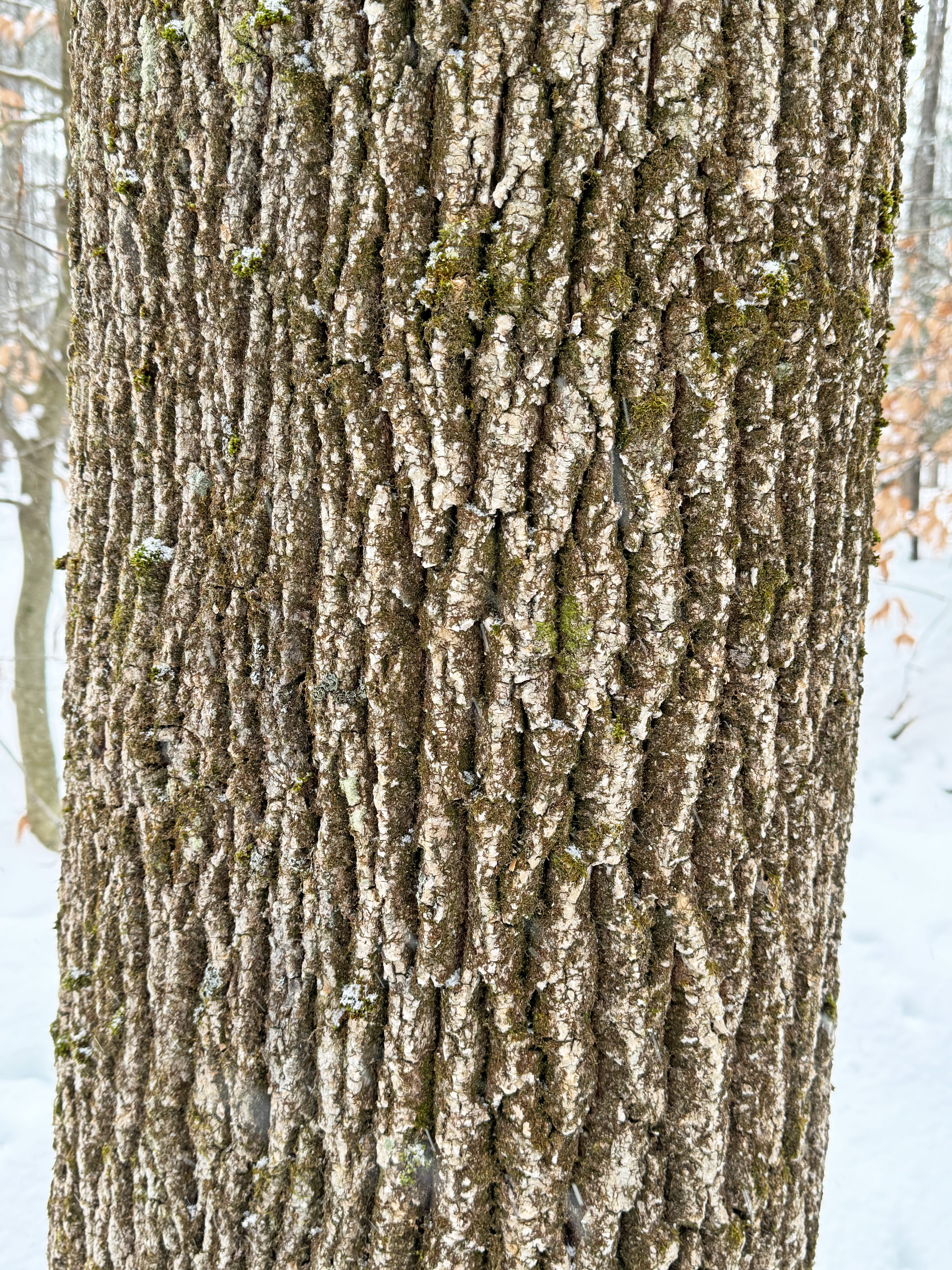
Now we need to return and find the mother black walnut.

*Thanks for Maine Master Naturalist Pam Davis for IDing the ash strand as the rachis of the compound leaf. She reminded me that I have seen these on the ground in the fall. But–to be still dangling from the tree was new to my eyes and mind.


All Twigged Out

In preparation for a senior college class I’ll be teaching this week entitled “All Things Spring,” I headed out the door in search of twigs.

t-Mount Wash

Of course, it doesn’t look like spring quite yet. But then again, it does. And on this crystal clear day, the silhouette of the buildings atop Mount Washington were visible.

t-vernal pool

Before I could settle down to the work at hand, I visited the vernal pool, where all was quiet. But, I know the time is nearing. I could smell spring in the air and feel it in the warm sunshine that enveloped me and my surroundings.

t-chick 4

And then I slipped into the gray birch grove to begin my hunt,

t-chick 3

while a black-capped chickadee wondered what I was up to–no good, as usual.

t1-table top (1)

At last, I filled my satchel, but only enough–never wanting to take more than necessary. In fact, since I don’t know how many students will be present, they may have to share.

My plan is to begin with a slide show of flowers and ferns, mammals and birds, and of course, life evolving at the vernal pool (all photos were taken a year ago). I’ll bring some fun things to share, including scat–I sure hope they (whoever they are) think it’s fun.

And then we’ll look at twigs through a hand lens so together we can examine the idiosyncrasies of our common deciduous trees,

t1-sugar maple (1)

such as these sugar maples and . . .

t1-striped maple twigs (1)

a few striped maples.

t-beech

We’ll look at beech,

t-quaking aspen

quaking aspens and several others.

t-opposite

My materials are almost ready, though I still need to pull something together about fern crosiers. Oh my!

t-alternate

I’m nervous, but excited. My hope is to instill a sense of wonder, but maybe no one will show. That would be okay–I’d just quietly slip back into the woods.

Until then, I’m trying not to feel all twigged out.


Morning Glory at Kezar River Reserve

Some mornings the hallelujahs spring forth from my being–and fortunately not from my vocal cords.

k-Kezar River sign

Today was one of those days as I ventured down the snowmobile trail, aka Parnes Landing Road, at the Greater Lovell Land Trust’s Kezar River Reserve. Just past the kiosk, I veered to the left to follow the GLLT’s trail into the woods.

k-jelly topside1

Within steps I was greeted by Auricularia auriula, a jelly ear fungus. The sun’s beams revealed veins reminiscent of stained glass windows and polished woodwork in an older church.

k-jelly under 2

Flipping the fallen oak branch to look at the underside revealed an equally, if not more beautiful design with its frosted outline.

k-wintergreen

On a steep hill beside Kezar River, actually the sloped side of a ravine I’d never hiked upon before, a southerly orientation presented lives past and present.

k-bench

Below, at the point where the trail, road and river meet, few have paused recently, including no sign of otter.

k-river view

But many have zoomed by with a need to reach the next destination as fast as possible.

k-ravine 1

I followed their tracks a little way out and peeked into the second ravine from a vantage point seldom celebrated.

k-big tooth aspen leaf

And then I headed back up the road to the next trail intersection. At my feet, form bespoke name, such is the manner of the big tooth aspen.

k-ravine 2

Down into the second ravine I tromped as I made my way to view the outlet from the other side.

k-otter 1

Because of the snow’s depth, I traveled to places less frequented and beside the stream I noted previous action. Lots of it.

k-otter activity1

And I spied evidence of the creator–whose prints were hard to distinguish, but other signs easily discernible.

k-my otterness

In my attempt to take a closer look, I practiced my inner otter and managed to find the water and leave my own set of muddy, though not quite webbed, prints. I laughed aloud as I pulled myself up and gave thanks for remembering to bring my hiking pole. Fortunately, the breakthrough was the only sign I left behind.

k-nature's snowball

Heading up the ravine, I smiled at the sight of the universe having fun–nature rolled her own snowballs–perhaps in preparation to build a snow woman.

k-pine cathedral

Through the cathedral of pines I continued–always looking up . . .

k-ice art

and down, where intricate patterns formed naturally in the ice offered a feathery look at the world below.

k-paper birch lateral bud

Sometimes, I stopped to spend a few moments with family members . . .

k-yellow birch

taking time to marvel in their similarities and differences as they stood side by side.

k-oak gall

And it seems there are many hosts throughout our woodlands that offer a spot for others to evolve.

k-oak crown

Despite or perhaps because of that, knowing they’d offered a helping hand, the oaks sported their crowns proudly.

k-pussy willow

Quite unexpectedly, I stumbled upon a picture of youth that warms my heart endlessly.

k-flowers in bloom

My journey wasn’t long, such is the trail. It’s decorated with small bright signs painted by local youngsters. Though I wouldn’t want to see these on every trail, they make me smile as I enjoy their colorful renditions of the natural world.

Not a picture of a morning glory, certainly, but a morning full of glory as I wandered and wondered and sang hallelujah along the trail at Kezar River Reserve.


Celebrating Place–Naturally

Once the snow melts it will be more difficult for me to wander and wonder in the woods I explore all winter given its spring/summer water level and logging slash. And so I make the most of these days–trying to notice as much as I can before I can notice no more (or at least until next winter).

l-bushwhack 1

Though I’d promised myself I’d not go again in an effort to not disturb the deer, promises are meant to be broken. And from that came a lesson–the deer are sticking to the snowmobile trail and field edges where tender bark of young red maples and hemlocks, plus swelling buds meet their needs for the moment. So, it was OK that I broke my promise, for the deeper I tramped, the fewer tracks I encountered.

l-spring tails1

Today’s warmer temps in the low 40˚s found the springtails hopping about on any and all surfaces.

l-pileated hole

As is my habit, I checked on a pileated woodpecker hole when I saw bark and wood scattered atop the snow. Deep was this excavation in search of nourishment.

l-pileated scat-seeds and ant

And chock full was the scat below, which contained insect body parts and seeds of the dreaded bittersweet. Beside the scat, a springtail sought to placate its own food needs which among other things includes plant material and animal remains.

l-red maple bull's eye

Turning to another tree, I landed on a perfect bull’s eye! The target fungus that affects many red maples makes for an easy ID.

l-crustose, liverwort and moss

Lichens have also been a focus of late. What I like about this one, the circular green with the black disks of a crustose lichen (possibly bark disk lichen), was its location beside a liverwort (the beaded brown Frullania eboracensis) and a moss that I didn’t key out. Tree bark has its own structure and texture, but so often others also call it home.

l-shield lichens on rock

Rocks also serve as a substrate and this one featured a couple of leafy foliose shield lichens, their colors enhanced by yesterday’s inch of snow.

l-hair lichen and beard lichen

And dangling from a branch, two forms of fruticose (branching or fruit-like structure–) lichens. The dark is a hair lichen, while the green a beard–seems about right with the hair above the beard.

l-lichen garden

On another maple I spied a garden–you’ve got to liken it. (Corny joke that always manages to enter a lichen conversation.)

l-frullania 1

I’ve often paused beside Frullania eboracensis, a liverwort with no common name, but today several trees shared displays of mats called Frullania asagrayana, so named for a botanist and natural history professor at Harvard University from 1842-1873–Asa Gray.

l-frullania asagrayana 1

Its shiny, overlapping chain of red-brown leaves reminded me of caterpillars crawling along the maple bark.

l-spirea:steeplebush

Casting my eye elsewhere, steeplebush in its winter form offered an artistic presentation.

l-bracken fern1

And as the snow melts, last year’s bracken fern made an appearance.

l-speckled 3

One last shrub made me stop. Minus any catkins or “cones” for which it is known, I had to think for a moment about the speckled alder. But those speckles or lenticels through which gas exchange occurs, and the buds and leaf scars were give aways.

l-speckled buds and leaf scar

The two bud scales meet at their edges and look like miniature footballs. But it’s the bundle scars where leaves were formerly attached that make me laugh. That vascular system looks like a face–two round eyes, a funny shaped nose and a round mouth, as if it’s exclaiming, “Ohhh” or “Wow.”

l-Pleasant Mtn in background

At last I reached my turn-around point. I could see Pleasant Mountain in the distance and knew where I was in the world. This is my place and I love every opportunity to celebrate it–naturally.

The Sun Always Shines

In the grayness of the day sunlight lit my way.

o-skunk tracks

Oh, it wasn’t as bright as yesterday when I wandered in brilliant light under clear blue skies and saw hints of spring, including skunk prints in the snow,

o-algae

and some blue-green algae in a vernal pool that is slowly opening up.

o-ice goddess

But given the temperature and wind, the ice goddess reminded me that winter prevailed.

b-deer 2

This morning presented a different picture that didn’t feature Mount Washington in the background because it was obscured by clouds. Rather than don my snowshoes, I decided to stick to the snowmobile trail for the most part. I wasn’t the only one who ventured that way. Because I wasn’t making as much noise as usual, the deer didn’t hear me approach. And so we stood for many minutes contemplating each other. I didn’t want to scare her for I knew she wouldn’t just stick to the trail and the snow depth continues to be such that she sinks with each step. It was in those shared moments that I began to think about energy and how much she put forth all winter and now continues to do the same as spring evolves. Every day I spy more and more young hemlocks trunks that have been scraped. She and her family are feeding on sunlight, which first feed the insects in the soil and then the trees. At each stage or tropic level of the food chain only ten percent of biomass from the previous level is retained. Thus, a thousand pounds of plant biomass is necessary to support a hundred pounds of an herbivore–that’s a lot of little buds for a deer.
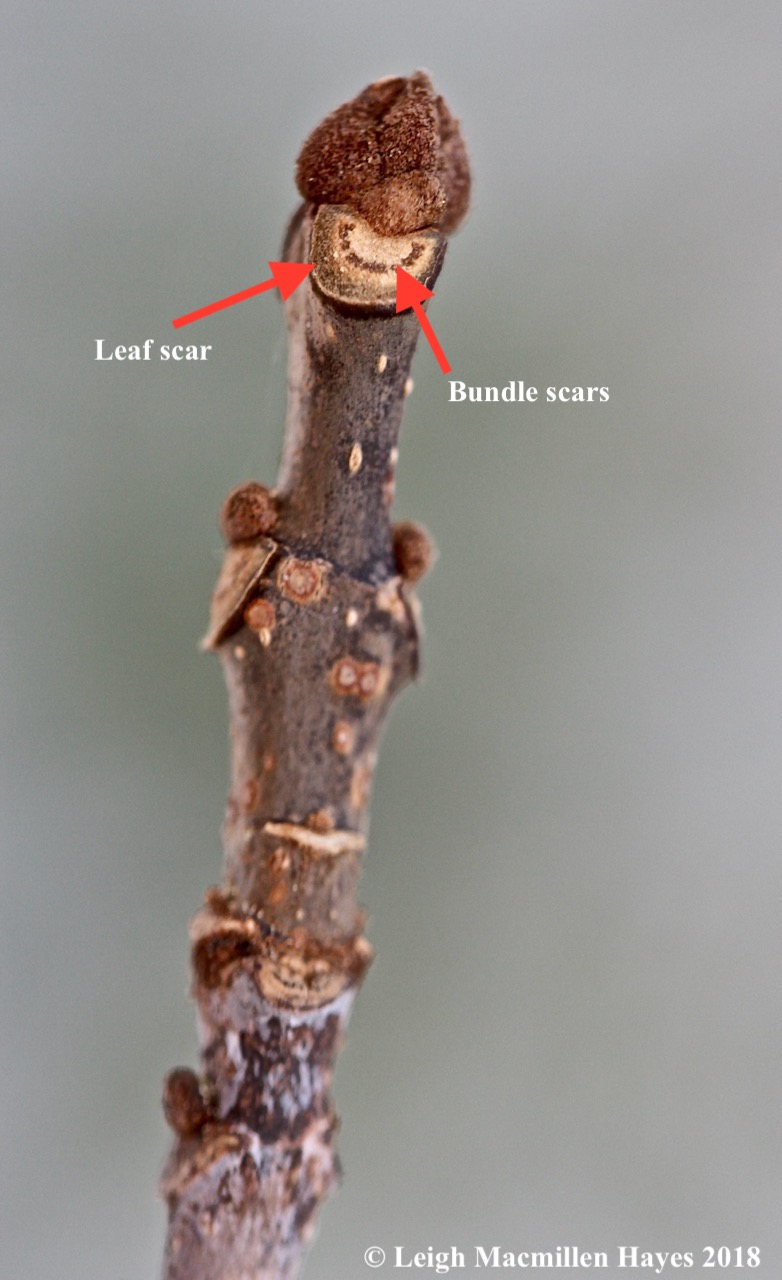
b-bobcat prints

Eventually, she made her way across the powerline and joined her family. I decided to turn around so I wouldn’t disturb them further. And it’s then that I recognized some prints I’d missed previously. My micro-spike print is on the left, beside those of a carnivore–a bobcat, or rather, two. Usually bobcats travel in a solitary manner, but their breeding season is upon them. And those thousand pounds of plant biomass that supported  a hundred pounds of herbivore, in turn support ten pounds of carnivore. The hunt becomes important.

b-motherwort

I did find a few spots where the snow had melted and winter weeds, such as this motherwort, provided hints of future buffet items for the herbivores and omnivores to consume.

b-junco and hemlock needle

And then I came upon junco feathers and knew that a different consumer had benefited from the sunlight offered forth by this little bird. The hemlock needle provides a perspective of size.

b-junco feathers 2

Despite its demise, the feathers surrounded by melting snow created an artistic arrangement. That was my attempt at positive thinking, for like us, all things must eat to survive.

b-white ash opposite

And then a few producers caught my attention and I found myself focusing on young trees and shrubs. I’ve walked past this young tree numerous times and never saw it until today.

b-ash 2

White ash or green? They both look similar, but the leaf scar is the giveaway. It’s shaped like a C or misshapen horseshoe with a deep notch at the top.

b-ash bud

And its terminal bud is domed. In these woods, the ash trees aren’t a preferred food source of the deer–lucky for them.

b-silky 2

Nearby, another neighbor caught my attention and it, too, I hadn’t met before.

b-silky dogwood 1

My assumption was dogwood, given the bright red/purpishish color of its shrubby stems, long-gone fruits and opposite leaf buds. But–red osier or silky? I’ve leaned toward the latter but will have to pay attention as the season moves forward. These did seem to tickle the herbivores fancy from time to time, though not nearly as much as the maples that grow nearby.

b-peanut

As I headed toward home, I stumbled upon another site I’ve seen frequently all winter. Actually for the past few winters. There must be a peanut plantation somewhere in these woods. That, or the blue jays have discovered a good source at someone’s bird feeder.

b-ice goddess

Before heading indoors, I paused to acknowledge another ice goddess, one who also knows the sun’s power and found relief in today’s shadows . . .

b-snow

and flakes. It’s snowing again, this fourth day of spring. Liquid sunshine, for the snow also provides nourishment to all who live here.

You see, the sun always shines . . . even when you can’t feel the warmth of its rays.


The Irish Colors

With so much snow still on the ground, it’s easy to see the landscape as a monochrome palette of grays. And so I set out on this St. Patrick’s Day to find some color.

f-bridge

My destination was the Greater Lovell Land Trust‘s Flat Hill trail and Perky’s Path from the end of Heald Pond Road. The parking lot is almost non-existent, so much snow do we have. And the bridge crossing tricky.

f-cherry bark

As I climbed upward, the thought that some see the world as black (cherry) and . . .

f-paper birch 1

white (paper birch) kept racing through my brain.

f-gray birch 1

And then there are those who accept that gray areas exist (gray birch–a brother of paper birch from another mother).

f-yellow birch bark

Textures visible in shadows reflected differences (yellow birch–a cousin),

f-hop hornbeam

even among family members (hop hornbeam–also a birch relative.)

f-mink tracks

It may have seemed there wasn’t much new to see and wonder about, but . . .

f-mink prints

the straddle (width from outside of one print in a set to outside of the other) and angle of these prints told a different story. A mink had crossed the trail. (My mitten had to hold the Trackard in place or it would have slid down the trail.)

f-porcupine trail

Nearing the top, I went in search of another mammal who has frequented this area for years–and I wasn’t disappointed. The porcupine trough was fresh.

f-view from Flat Hill

And then I reached the summit of Flat Hill (forever an oxymoron) and the whites, greens, browns and blues of mountains and sky opened before me. There was even a hint of red in swelling buds.

f-downhill from Flat Hill

The wind was cold, so I didn’t pause for long. Instead, I retraced my own tracks down the hill.

f-orange trail

And then I turned onto the orange trail that is Perky’s Path and realized the symbolism of the color and this day. My Scottish ancestors smiled down on me.

f-beaver lodge

I’m always drawn to the wetland and had to take a peek at the beaver lodge, which remained snow covered, indicating that no one was home. But there again, the sky enhanced my view.

f-wetland from bridge

The path leads to another set of small bridges, and there I stood for a while, taking in the peacefulness and beauty before me. Oh, and the warmth of the sun as its strong rays embraced me.

f-chickadee 1

While I stood and listened, a chickadee called and I watched as it entered a hole in the birch snag. This was a wow moment, for though I know birds use old pileated holes, I rarely see them come and go.

f-chickadee 3

Out he popped, giving a curious look–perhaps because I was pishing.

f-chickadee 2

He paused for a moment and then flew off, chickadee-dee-deeing across the bright blue sky.

f-brook view

I, too, took off, but not before enjoying a few more reflective moments.

f-ice swirls

The juxtaposition of snow, hemlock branches, water and ice created colorful swirls of artistic design beyond understanding.

f-wintergreen

And then I found a few wintergreen plants, their waxy leaves transforming from winter maroon to summer green.

f-beaked hazelnut

On my way out, I stopped to examine a few buds–and catkins, in this case. I love winter, but I am beginning to crave color and beaked hazelnuts will be among the first to flower.

f-striped maple bud1

A striped maple showed off its waxy buds, leaf scars and growth rings. The bud reminded me of hands in prayer–perhaps worshipping the patron saint of Ireland.

f-striped maple covered

One bud was sheathed in white. Even with my hand lens, I couldn’t figure it out. I’d like to think it was an angelic covering, but suspect it is a cocoon.

f-basswood 2

And then there were the bulbous bright buds on the basswood tree.

f-basswood lateral bud

Indeed, they were a sight to behold. Though winter reduced the color palette to the essentials, slowly the transition to spring has begun.

f-Irish flag in breeze

My journey was done, but I made one more stop along Route 5, where Irish flags flapped in the breeze to commemorate this day. The Irish color–where white signifies the truce between the Orange and the Green.

I always wear a hint of orange on this day in contrast to my Irish guy’s green. And I remind him that St. Patrick was born in Scotland.


Because I Wandered

It’s still cold and blustery. Oh, we had warm spells in January and February. But now it’s March. And it’s Maine. So wind chill in negative to single digits shouldn’t come as a surprise. Nor should the impending Nor’easter predicted for this week. Only more than a foot of snow possible.

Today’s cold wasn’t nearly as frigid as yesterday’s and when I stepped out the back door, I could feel the warmth of the sun penetrating my outer being. It worked wonders for my inner being as well.

o-quaking aspen

My first stop was beside the quaking aspen tree. Yesterday, some Maine Master Naturalist students and I examined tree buds and their characteristics. I love looking at these and do so every day since the tree is right off our back deck.

Varnished scales protect the  aspen’s leaf and flower buds as they lay dormant through the winter. Its flower is produced within a catkin and already the cottony part of the seeds is appearing, much like a pussy willow.

o-striped maple

As I moved into the woodlot, I stopped to re-admire the only striped maple that grows here. Last year a deer used the lower portion of the bark as an antler rub. Yesterday, as we stopped to look at the characteristics of its bark, we noticed it’s been used most recently as deer food. This tree is barely larger than the circle formed within my thumb and pointer finger–and I have small hands. How much more deer attention can it take?

o-gray fox tracks

As I looked at the striped maple, my eyes were drawn to the activity of another mammal. Out came my Trackards and I took measurements. I knew by the walking pattern that it was a canine. And I knew by the size that it was a fox. But red or gray was the question. I suspected the latter because I could see details clearly in the soft snow atop the hardened crust.

o-gray fox prints

Measurements and a look at a bunch of prints confirmed my suspicion. Rather than stay on the path, I decided to backtrack the fox’s trail.

o-gray fox and coyote 1

Within minutes, I realized another mammal had traveled in the opposite direction. Also a canine.

o-gray fox and coyote intersect

And atop a double-wide stone wall, I found where the coyote (follow the red pencil) and gray fox (yellow) crossed paths. Not at the same time, I’m sure, but given the track conditions, I don’t think they were too far apart. We saw neither set of tracks as we examined trees and lichens in the same area yesterday.

o-gray fox sat and peed

I also found where the fox sat and then peed. Not much odor–in case you’re wondering.

o-turkey plus

My journey took me across a few more stone walls and through a hemlock grove. I lost the fox, but followed the coyote and then I found others including squirrels, deer and turkeys.

o-turkey wings

It looked like the turkeys had been dancing on an ice-covered puddle. And then perhaps they took off for the wing marks were well defined. Did they fly because the coyote approached? Or was there another reason? Time to head up into the trees for the night, maybe? It’s difficult work for these hefty birds to lift off.

o-many travelers

Everywhere I went, others had been before me. It seemed the prey followed the old logging routes and predators crossed.

o-bs lichen

My own wander became a bushwhack meander. And a few lichens called me in for a closer look. My inclination was to quickly brush off all the gray foliose (leaf like) lichens as weedy hammered shield, but I suspect there was some bottleshield lichen in the mix and realize I need to look again. I’m forever a student–thankfully.

o-crustose mosaic

While there were specks of shield lichens on a young maple tree, the variety of flattened crustose lichens covered so much of the trunk that it was almost difficult to distinguish the bark color.  The mosaic pattern suggested a painting–naturally.

o-beech 1

The buds and leaves of the beech trees also asked to be noticed. It’s been my experience that younger American beech keep their leaves throughout the winter–perhaps because their buds are lower to the ground and therefore easy targets for hungry herbivores. There are other theories as well, but I think it’s key to note that it’s the younger trees who keep their leaves, or in the case of this one, those that remain were on the lower branches.

o-beech leaves

They remain until the tree buds begin to break or leaf out. The word to describe this leaf retention is marcescent (mahr-ses-uh nt), which means withering but not falling off. Their rattling in the slightest breeze may be enough to keep those herbivores at bay.

o-beech 4

In the tree’s silhouette, the pointed buds stood out,

o-beech scales


each one a cylinder of overlapping scales in opposite orientation on a hairy stem.

o-witch hazel leaves

That, of course, led me to another marcescent tree that loves this wet woodland, the witch hazel. Its leaves have always intrigued me with their wavy margins and asymmetrical base. But it’s the winter color of the withered leaves that I also find attractive.

o-witch hazel scalpel

And its naked buds, which don’t have waxy scales like the aspen or beech. Somehow the fuzzy hairs must provide enough protection for the winter months.

o-witch hazel bracts

Everything is fuzzy on a witch hazel, including the bracts left from last fall’s ribbony flowers,

o-witch hazel pods

and the woody, two-seeded pods that ripen a year after the flowers have formed. These split open in the fall as the seeds were forcibly ejected.

o-moose scat

I wandered for hours and miles and never saw any prints from the moose that frequented these woods earlier in the season. But, where the snow had melted under a spruce, I found evidence that blended in with the leaf litter.

o-moose browse

And in an area I used to frequent prior to the logging operation of the last few years, I found more sign. The ruler is mine and this side shows centimeters.

o-coyote x2

When I reached the former log landing, my coyote friend made its presence known again. Actually, one became two as they had walked in single file and then split apart several times. They were on the hunt and a snowshoe hare was in the vicinity.

o-cherry

I followed the main logging trail for a while and then turned off to explore unknown territory. But . . . before turning, it was the maroonish color of the cherry bark that warranted attention. And the lenticels–raised, elongated and horizontal imprinted on my brain.

o-deciduous forest

My meanderings continued and again I saw lots of predator and prey activity. Even a porcupine, though that shouldn’t come as a surprise. Finally, I walked into an area of young red oak, red maple and gray birch and knew I was approaching familiar ground. And so I stepped onto the snowmobile trail.

o-deer 1

All along, I’d thought about the many tracks I’d seen, but no mammals . . . until I approached our cowpath. I wasn’t the only one headed that way.

o-deer browsing first

The deer herd seems to have survived this winter well. I’ve yet to find evidence that suggests otherwise.

o-deer browsing

And I felt blessed that I was able to move as close as possible despite the crunching of the snow beneath my feet. The wind was in my favor. And then, it heard me, flashed its white tail and ran down the cowpath. Perhaps we should rename it the deer path for a cow hasn’t walked on it in decades, but like me, the deer use it almost daily.

My day was made because I wandered.


Seeing Red

I wander through the same woods on a regular basis, sometimes following old logging roads and other times bushwhacking through the understory–a mix of young conifers and hardwoods that are slowly reclaiming their territory. Always, there are water holes to avoid as this is a damp area, so damp that in another month I probably will have to curb some of my wandering habits because it will become difficult to navigate.

h-maleberry-buds

But it’s that same water that gives life to the flora and fauna that live therein, such as the buds on the maleberry shrub. Notice how downy the twig is. And the bright red bud waiting patiently within two scales–preparing for the day when it will burst forth with life.

h-maleberry-pods

On the same shrub exists evidence of last year’s flowers, now capsules reddish-brown and five-celled in form.

h-red-maple-buds

And like the maleberry buds, the red maples buds grow more global each day, some with three scales of protective covering and others more.

h-snowflakesbuds

Today was a day of contrasts, from sunshiney moments to snow squalls, as well as greens to reds, tossed in with a mix of browns and grays.

h-moose-scrape

Continuing my venture, I soon realized I wasn’t the only one enjoying red. The moose and deer with whom I share this place, also find it a color of choice–especially the bark of young red maple trees.

h-moose-scrape-2

As I looked at the tree trunks, I could sense the motion of the moose’s bottom incisors scraping upward and then pulling against its hard upper palate to rip the bark off. Everywhere I turned, the maples showed signs of recent scrapes.
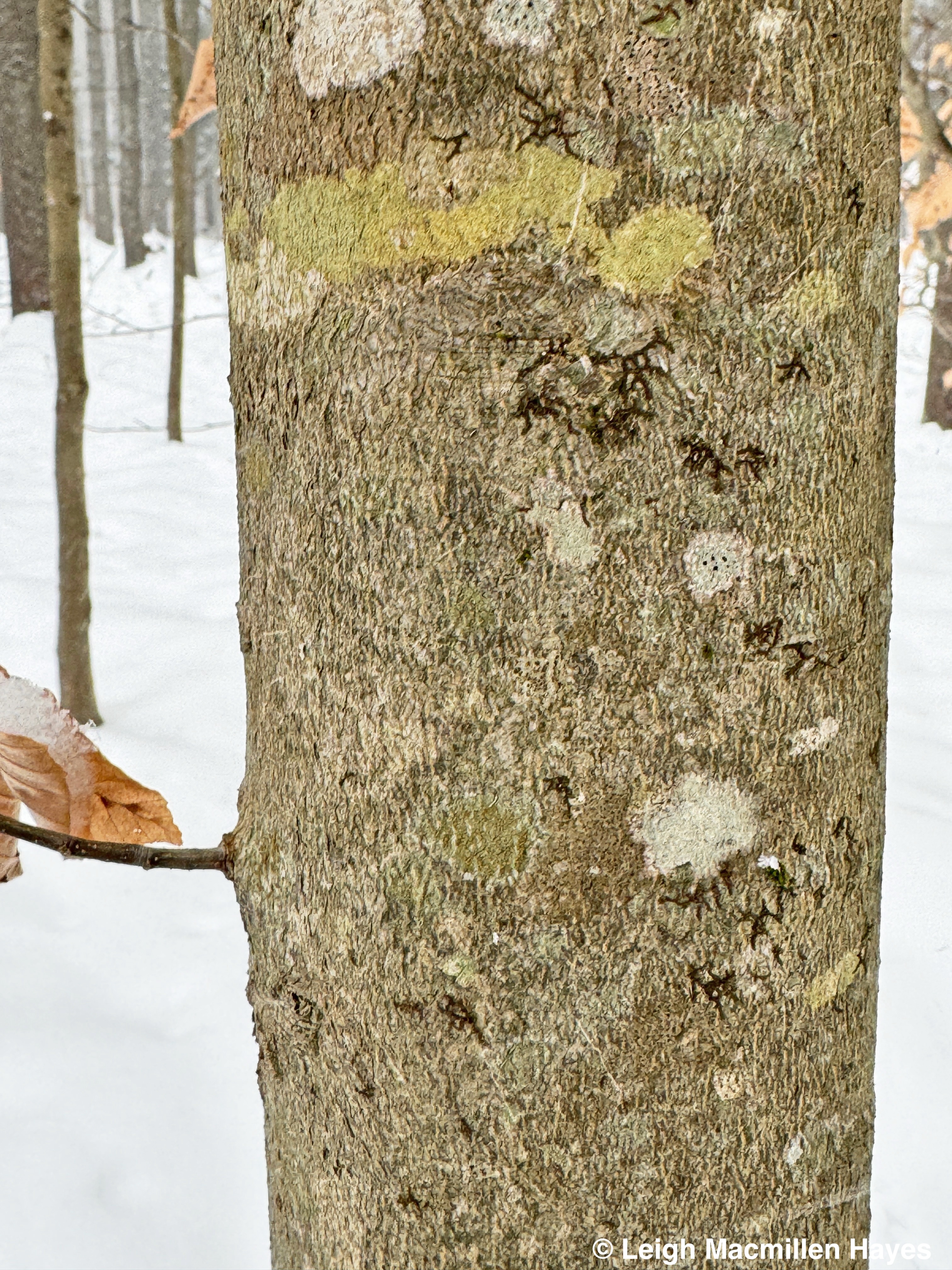
h-moose-rub

Less frequently seen were antler rubs such as this one, where the middle was smoothed by the constant motion and the upper and lower ends frayed. Such finds offer noted differences between a scrape and rub–the former has tags hanging from the upper section only and the teeth marks stand out, while the latter often features a smooth center with the ragged edges at top and bottom. But . . . like us, nature isn’t perfect and not everything is textbook, so I often have to pay closer attention.

h-moose-bedscat

I saw more than red and so I could hardly resist a moose bed filled with scat and urine. I’m always in awe of the sense of size and again I saw motion, of this large mammal laying down to take a rest and perhaps a few hours later, getting its feet under itself to rise again, do its duty and move on to browse some more.

h-witch-hazel-scattered

Deer tracks were even more numerous than moose and the solidness of the snow allowed them to travel atop the crust. At one point I spied something I didn’t recall seeing before–witch hazel capsules decorating the snow.

h-witch-hazel-pod

At this time of year, these grayish tan capsules persist on the trees, but their work was completed in the fall when they expelled their two glossy black seeds.

h-witch-hazel-bud-nibbled

Ruffed grouse, wild turkeys and snowshoe hare like witch hazel buds. As do deer, who rip them off in the same fashion as a moose and leave a tag behind–as a signature.
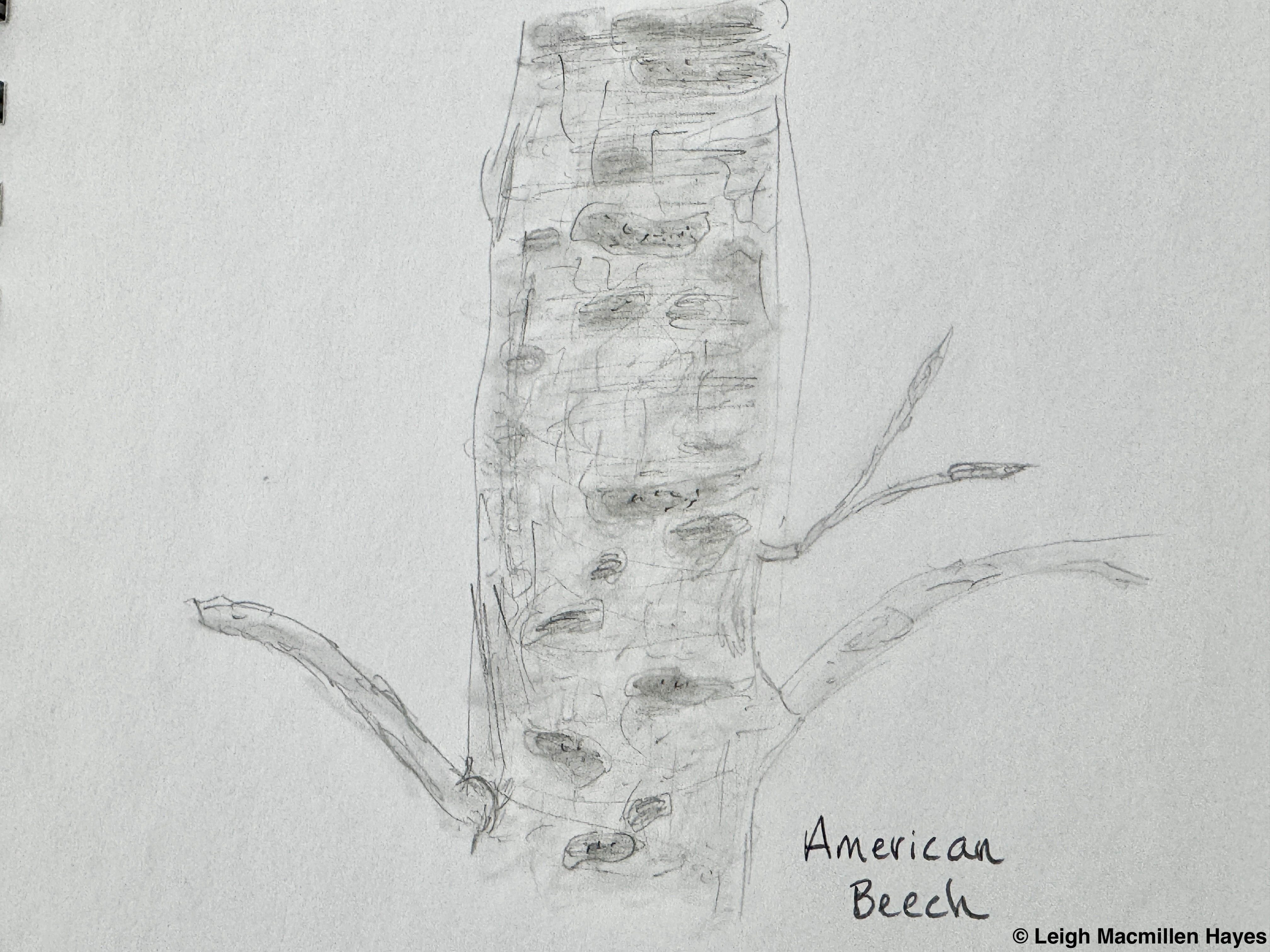
h-witch-hazel-bud

Not all were eaten–yet. Notice these buds, ensconced in dense reddish/yellowish/brown hairs rather than the waxy scales of the maleberry and maple. And the shape extending outward from the twig, almost in scalpel-like fashion. Yeah, I was still seeing a hint of red.

h-witch-hazel-flower-bracts

If I wanted to carry my red theme to the extreme, I could say that the bright yellow bracts that formed the base of the former flowers were framed in red, but really, it’s more of a hairy light tan along their rims. Eventually, the bracts will develop into seed capsules and next autumn they’ll be the ones to shoot their seeds with a popping sound. We always talk about that sound and refer to Henry David Thoreau for as far as I know he was the one to first hear it. This past fall, a friend tried this and like Thoreau, he was awakened during the night by the seeds being forcibly expelled. (Credit goes to Bob Katz for that experiment.)

h-british-soldiers

Back to red. Under the hemlocks where the deer had traveled, I was looking at some mosses when these bright red soldiers showed their cheery caps–it’s been a while since I’ve seen British Soldier lichens, most of it buried beneath the snow.

h1-red-oak-bark

As I headed toward home, a red oak beside the cowpath asked to be included. It seems in winter that the rusty red inner bark stands out more in the landscape, making the tree easy to identify. Of course, don’t get confused by the big tooth aspen, which slightly resembles a red oak at the lower level, but a look up the trunk suddenly reveals similarities to a birch.

h1-acorn-cap

Many of the acorns have been consumed after such a prolific year, but their caps still exist and the color red was exemplified within the scales.
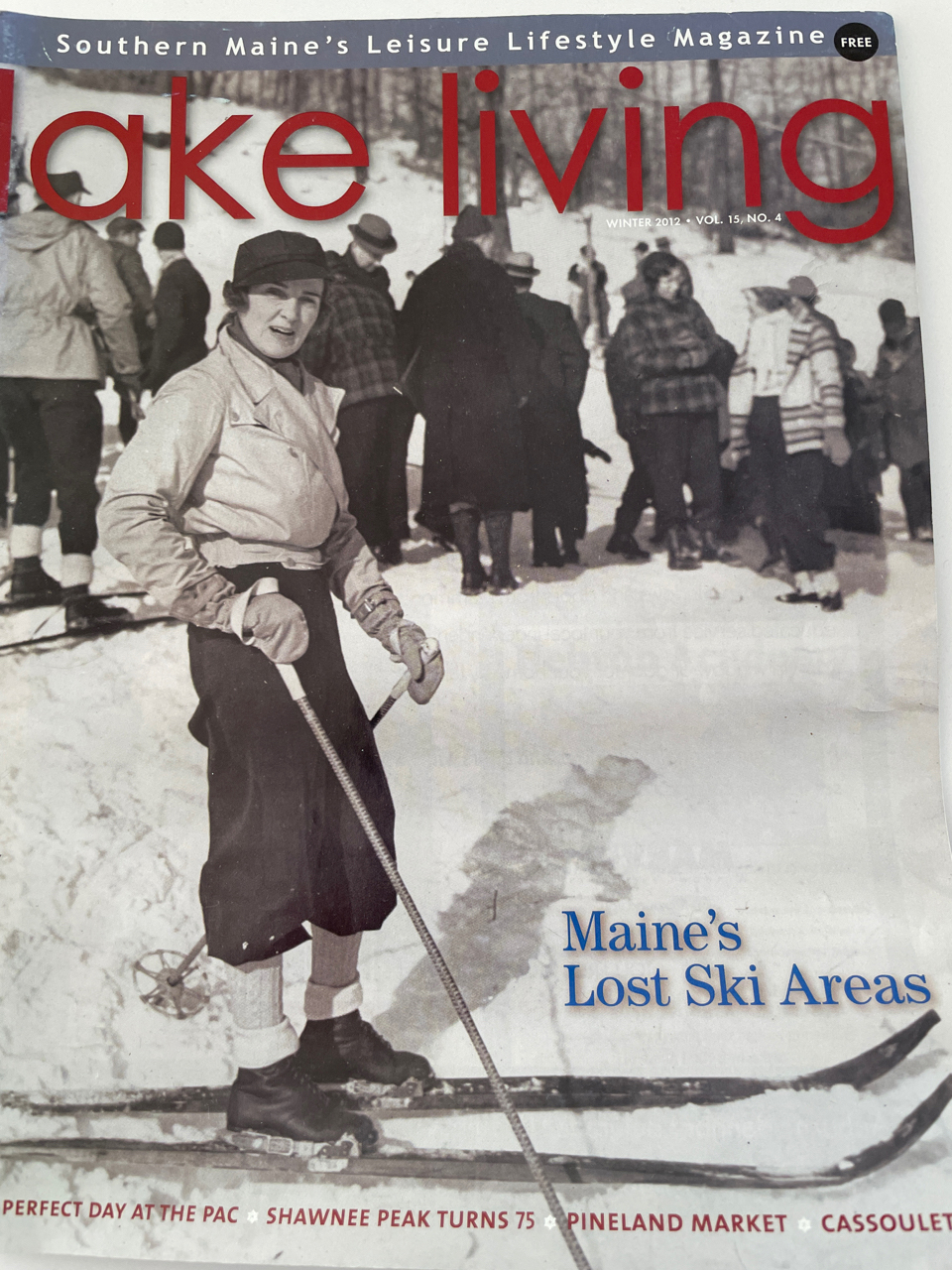
h1-icicles

Back at the homestead, I walked by the shed attached to the barn where icicles dripped–again speaking to this day. By that time the snow squalls had abated and sun shone warmly, but a brisk wind swirled the snow in the field into mini whirling dervishes. My cheeks were certainly red.

h-cardinal

My red adventure was completed at the bird feeder. A happy ending to scenes of red.