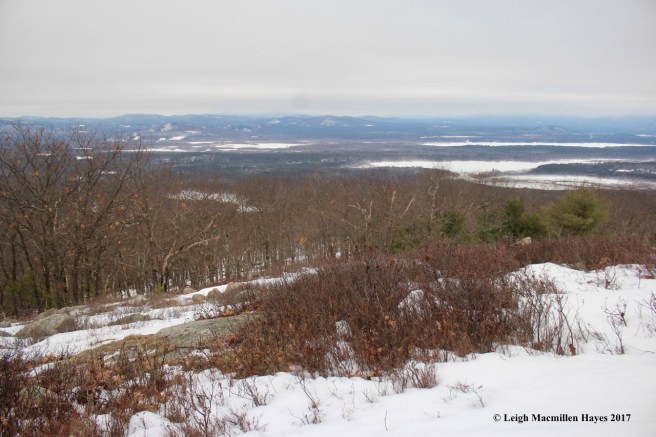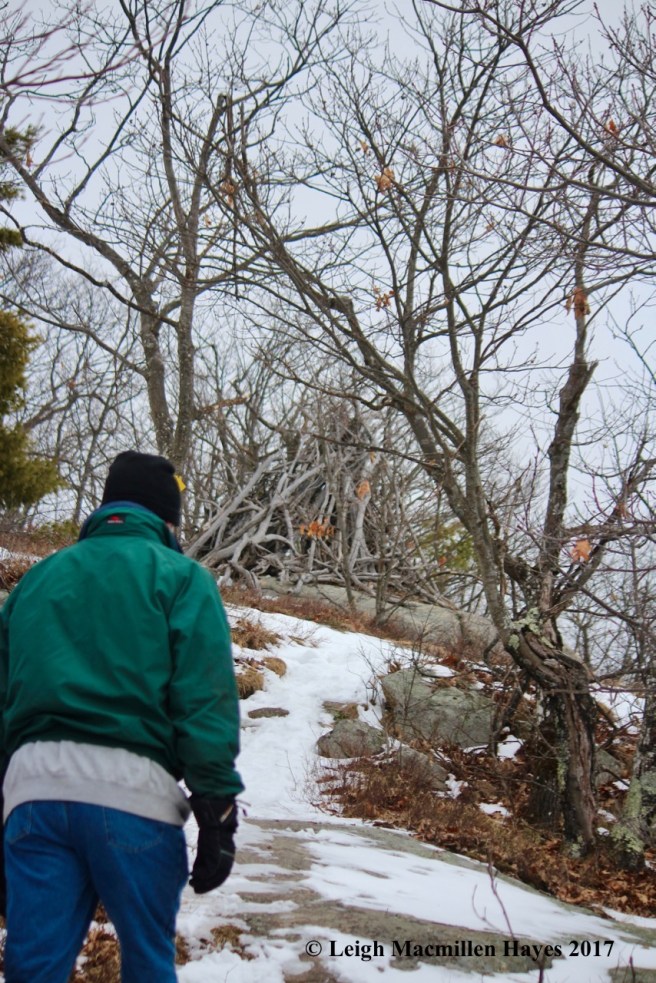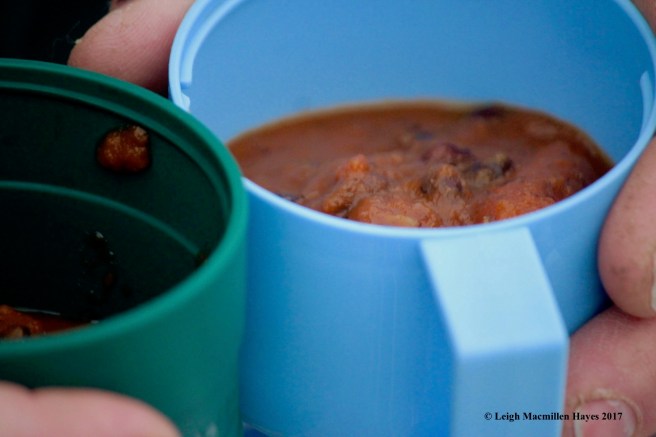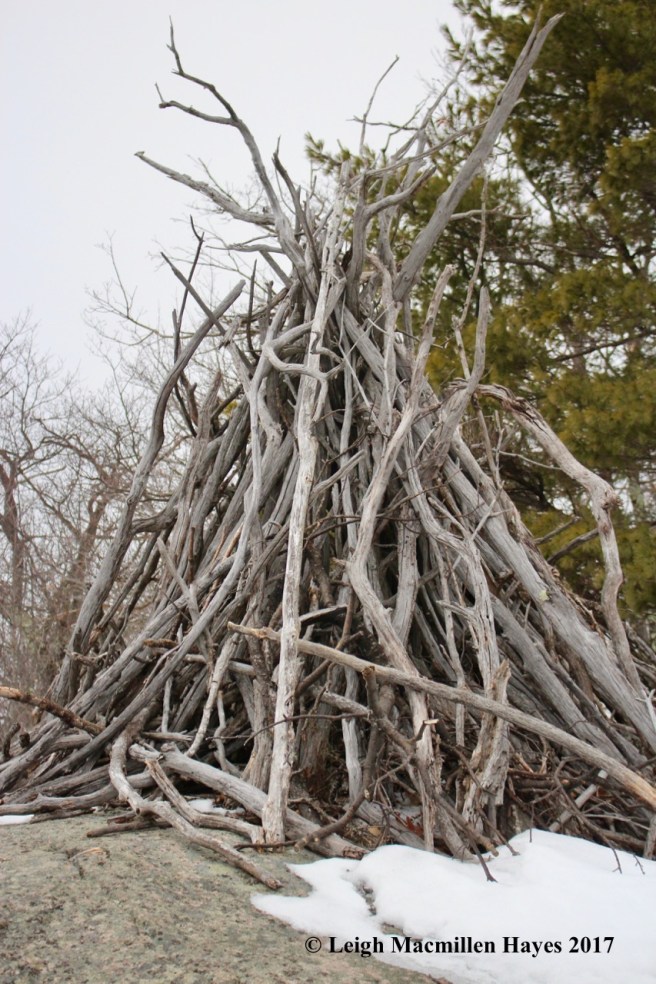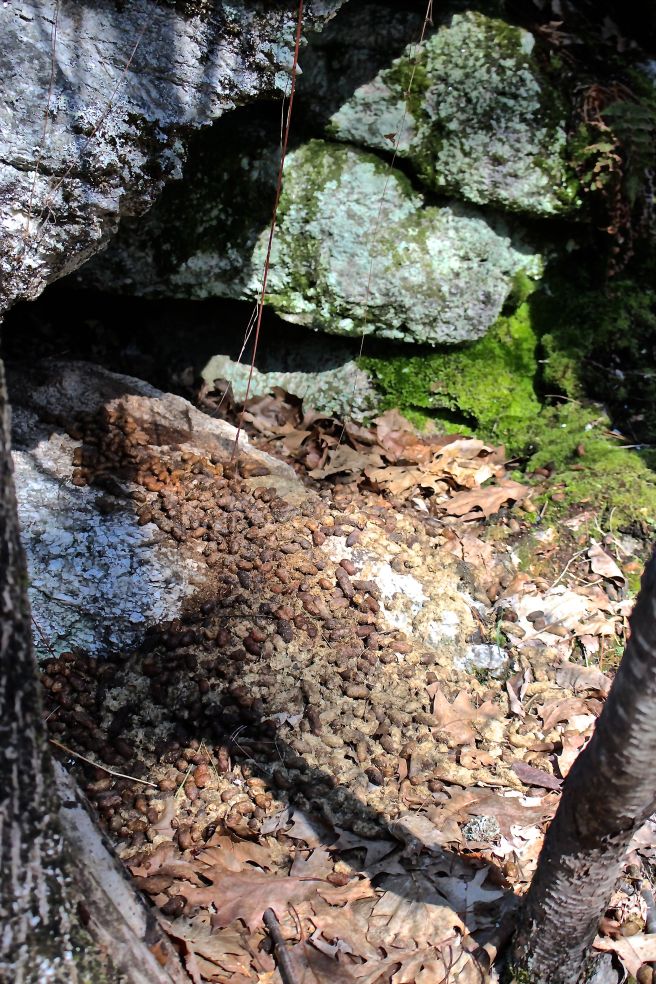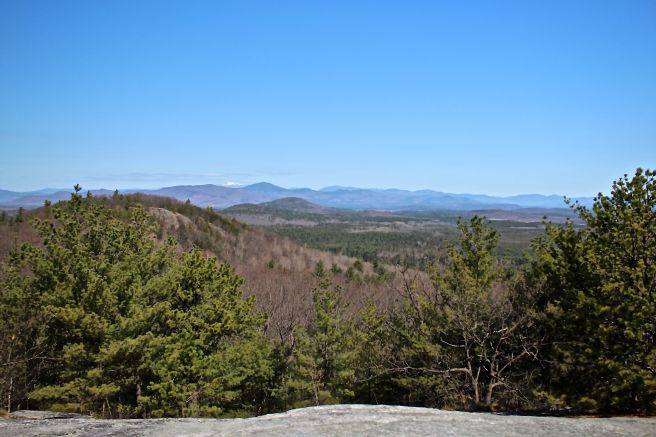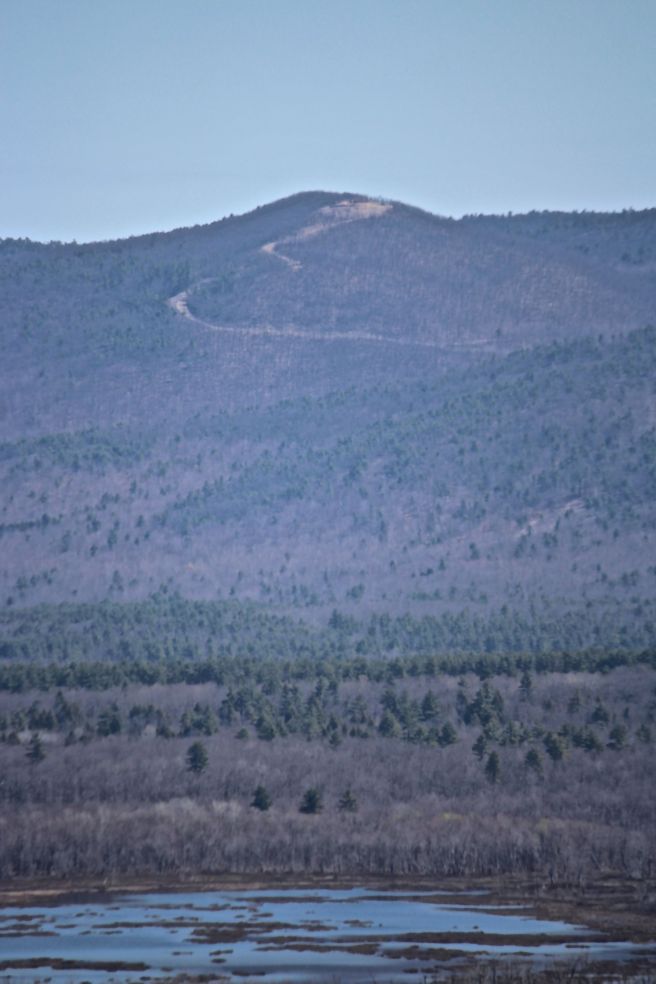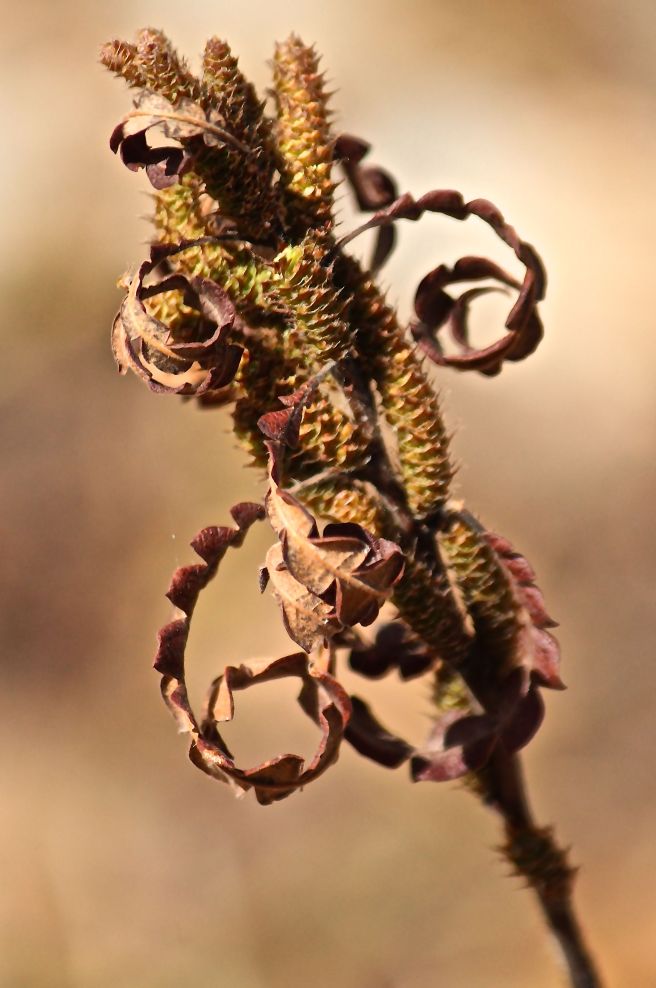
A Blue Bird Kind of Good Friday

When Jinnie Mae picked me up this morning, our destination was the Narrow Gauge Trail. But somewhere between here and there, she pulled a U-turn and drove to Narramissic Farm owned by the Bridgton Historical Society.

It had been just over a year since I last visited and I wanted to show her the shagbark hickory buds. And maybe even the bear trap.

n-Pleasant Mtn to Narramissic1

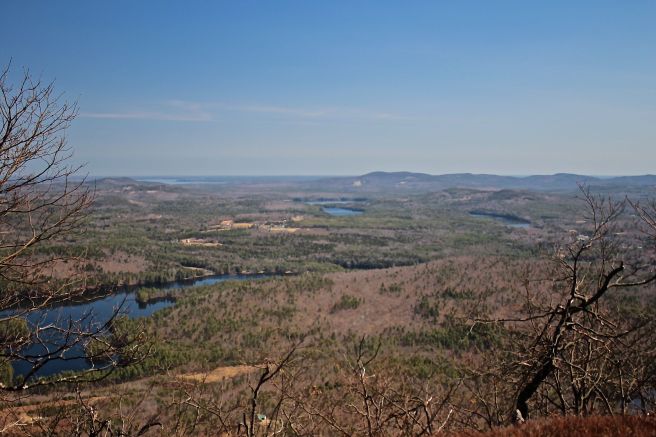
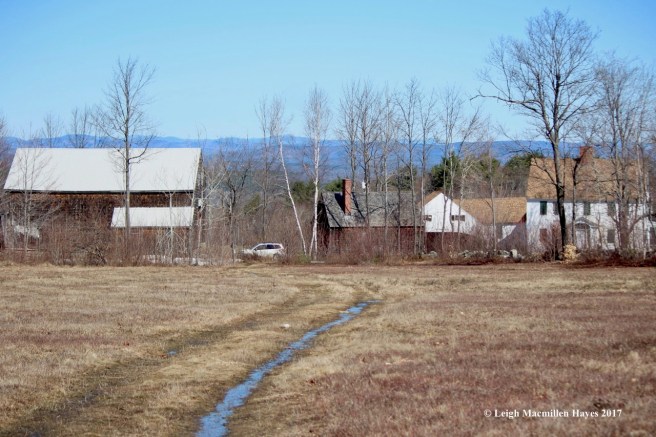
We crossed the field behind the house and started off on the path to the quarry and bear trap, but snow and water in the woods resulted in another U-turn. We’d been talking so much, we’d hardly noticed our surroundings, but the view stopped us in our tracks.

n-Pleasant Mountain

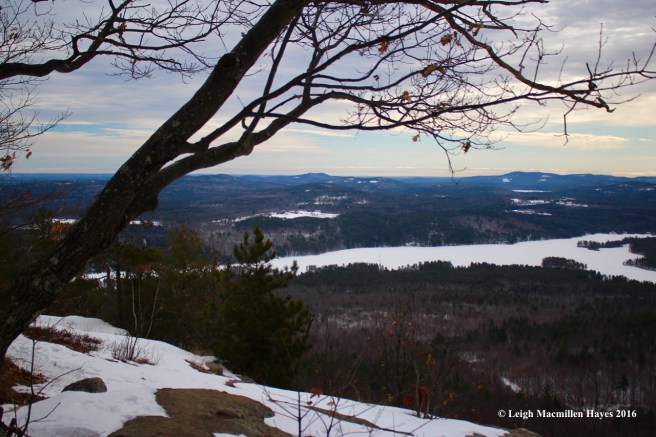
To the left, the long ridge line of Pleasant Mountain, where the ski trails of Shawnee Peak Ski Area made themselves known.
n-Narramissic

And in front of us, the Temperance Barn and Peabody-Fitch homestead, built in 1797. We had the place to ourselves and reveled in the quiet of the day–when we weren’t talking, that is.
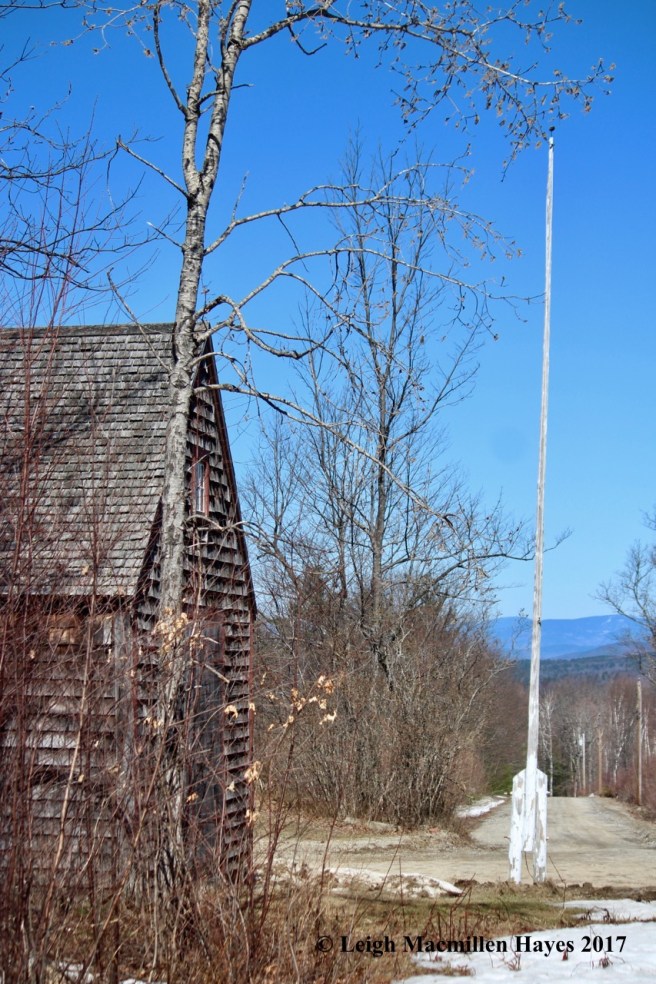
n-shop and flagpole

Heading to the road for our tree bud search, we passed by the blacksmith shop where horseshoes were probably made in the day.

n-temperance barn

And at the Temperance Barn, so named “because it was raised without the traditional barrel of rum,” I can never resist admiring the structure even though it’s in great need of repair.

n-ash tags

And then we were stumped by a flowering tree. It sure looked like an ash as Jinnie Mae suggested, but what were those lacy tips? What came to my mind first were the tags on red oaks that I didn’t understand a few years ago until a friend helped me realize that they were leaf stems left behind when the wind finally claimed the dried leaves. Was this the same?

n-double-wide stonewall

Climbing onto the double-wide wall, I took a closer look.

n-white ash danglers 1

Turns out Jinnie Mae was right. But my question still remains. Were these the stems of the ash samaras or compound leaves?* For some reason I’ve never before seen them left behind. Ah, there are so many things to discover in this world.
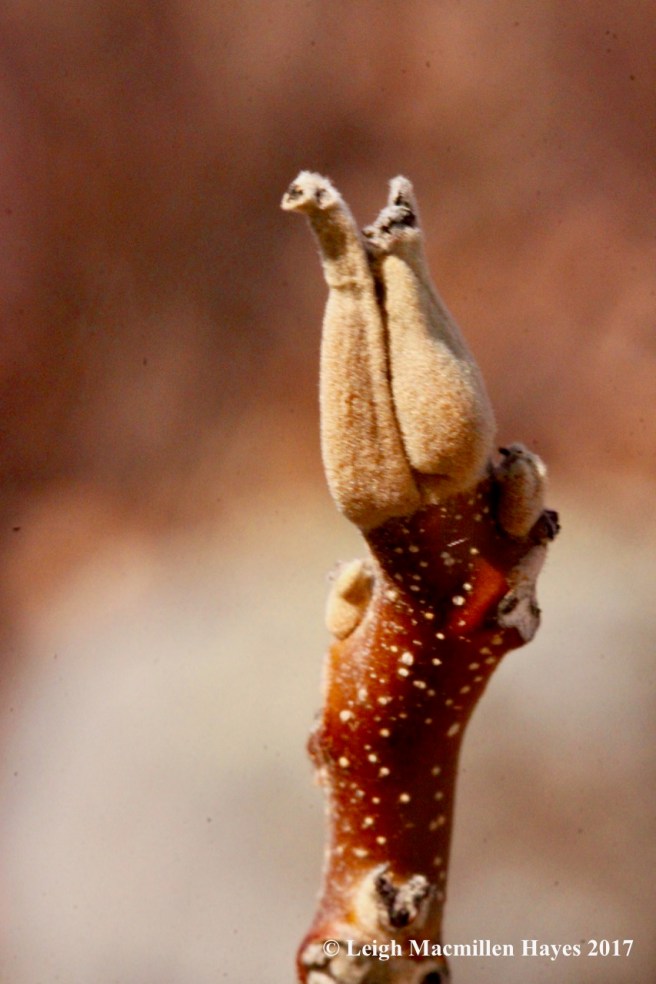
n-black walnut 3

We continued down the road, noting budding pussy willows and flowering red maples. And then I spied the bulbous buds I wanted to show her. Only, it turns out that we hadn’t reached the hickory trees yet.

b-black walnut leaf scar 2

The monkey face leaf scar should have been a clue. But my brain was stuck in hickory mode and I completely forgot that black walnut leaves leave such a formation. At home, I pulled out Forest Trees of Maine and then seesawed between black walnut and butternut (aka white walnut). Both feature leaf scars shaped like a monkey’s face. But the top of the leaf scar serves as the give away–this one did not have thick fuzzy eyebrows like a butternut, so I’m going out on a limb and declaring this a black walnut.
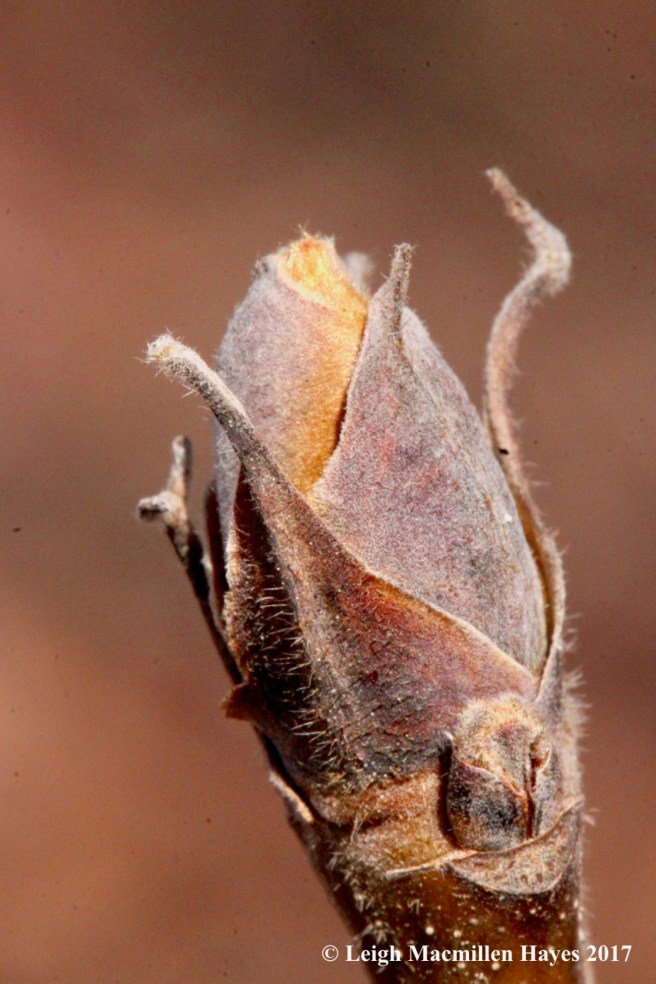
n-shagbark bud hairy 1

A bit further down the road we spotted more bulbous buds. These were definitely the ones I was looking for–shagbark hickory. In the moment and because the two trees weren’t close together, we thought they were all one in the same. But hindsight being 20/20 as it is, the photographs tell the story.
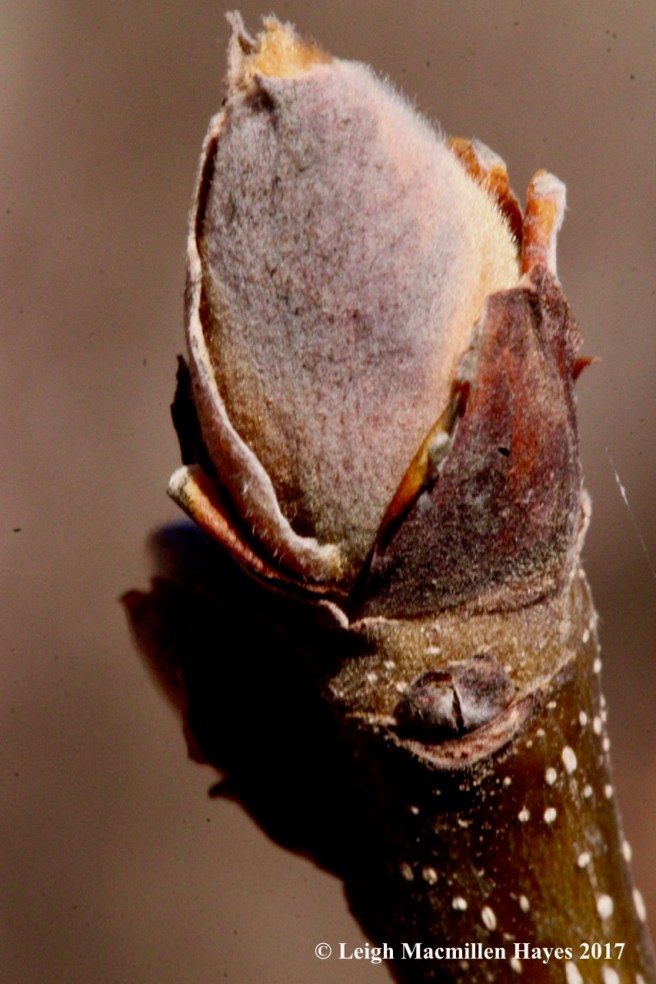
n-shagbark bud 6

The subtle colors and fuzziness wowed us and we both took numerous photos.
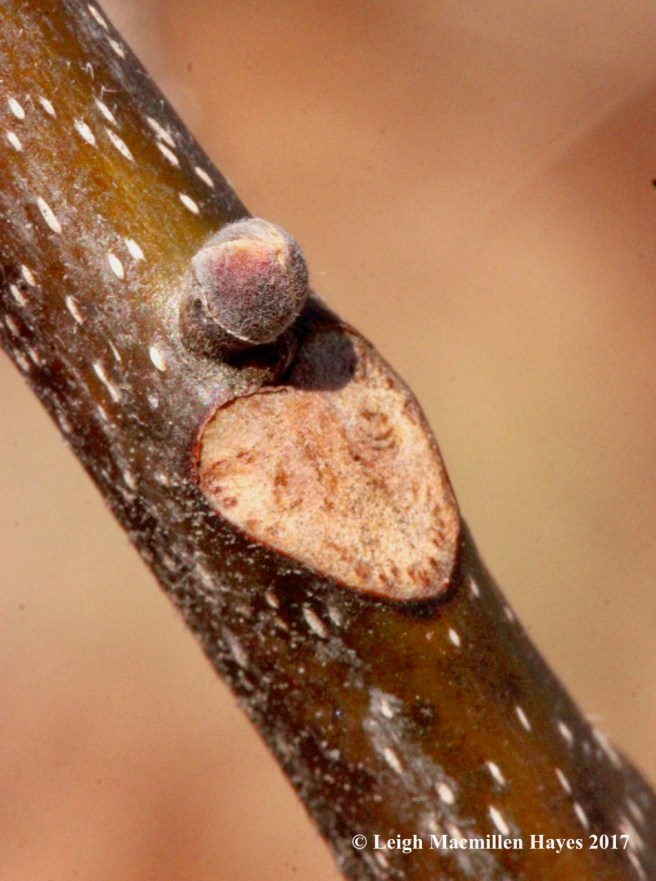
n-shagbark leaf scar1

Then there were the leaf scars–definitely more heart-shaped than the previous trees.  And lacking that smiling face. We smiled for them.
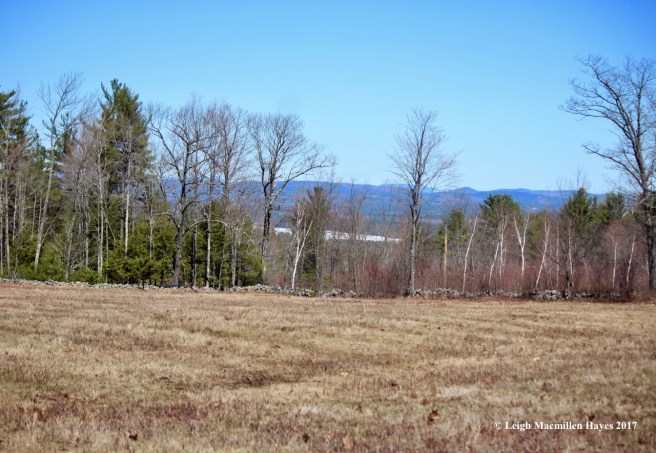
n-Long Lake below

It wasn’t enough to find the small saplings beside the road and so we crossed another field in search of the mother tree.

n-grasshopper 1

Along the way, Jinnie Mae spotted a wee grasshopper–the first of the season for us.

n-shagbark bark from distance

And then her newly trained shagbark hickory eyes keyed in on the momma.
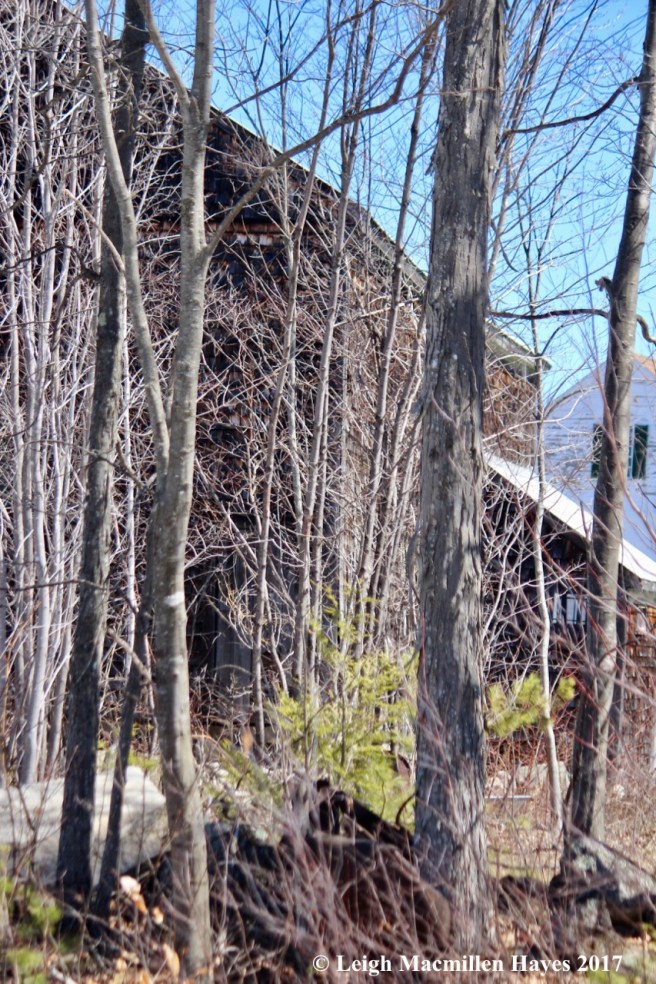
n-shagbark bark 3

If you go, it’s located behind the barn.
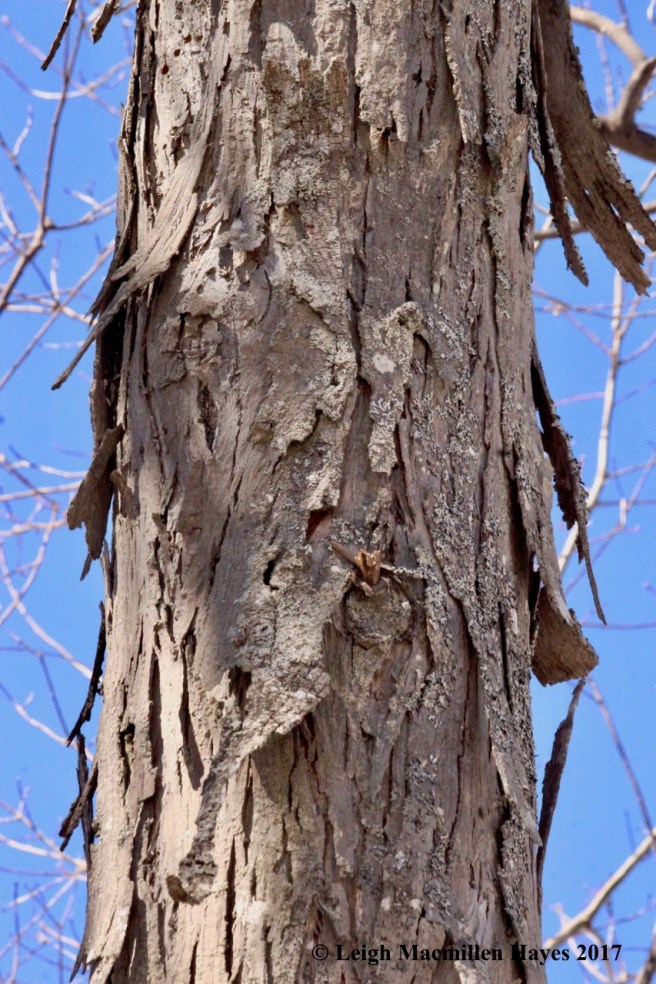
n-shagbark bark 5

And shouts its name in presentation.

n-shagbark bark 4

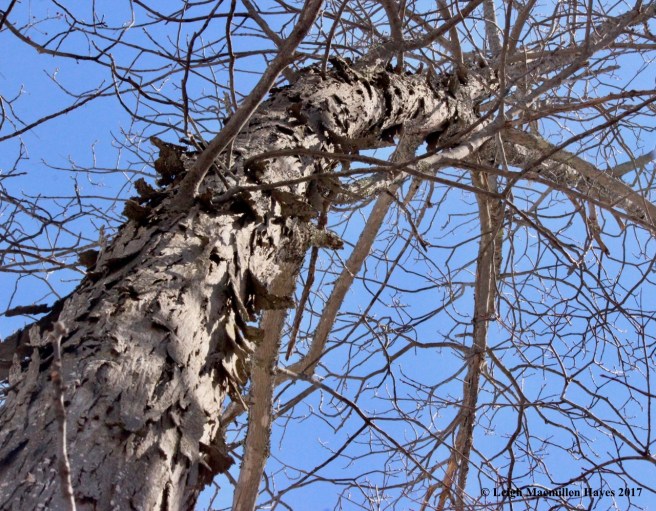
Looking upward, we could see the bulbous buds on the twig tips contrasted against the bright blue sky.

n-bluebird

Happiness is a blue bird kind of day–sweetened by time spent exploring with Jinnie Mae, making discoveries and watching bluebirds move between the field and the trees. Indeed it was a Good Friday.

Now we need to return and find the mother black walnut.

*Thanks for Maine Master Naturalist Pam Davis for IDing the ash strand as the rachis of the compound leaf. She reminded me that I have seen these on the ground in the fall. But–to be still dangling from the tree was new to my eyes and mind.

 

A Wiser Soul

It all began when I stepped out the back door just before six o’clock this morning. From the treeline I heard a barred owl call, “Who cooks for you? Who cooks for you all?” I could have returned to bed then, happy for the opportunity to hear such a wise one.

n-Northern Flicker

Not long after that, as I passed by a window in the butler’s pantry (no, we don’t have a butler, just an old farmhouse), a splash of red on the ground drew my focus–a Northern flicker had stopped by to feed. Notice the subtle curve of its bill? The better to dig up ants and beetles, as is the custom of this ground-feeding woodpecker.

n-water coursing 2

An hour or so later, I met my friend, Marita, for a hike up the Bald Peak trail at Pleasant Mountain. Our destination–not the summit as we had a time constraint–but rather, Needles Eye.

n-beside the brook

Our climb included frequent stops at vantage points to take in the sound and beauty of the place.

n-water art 2

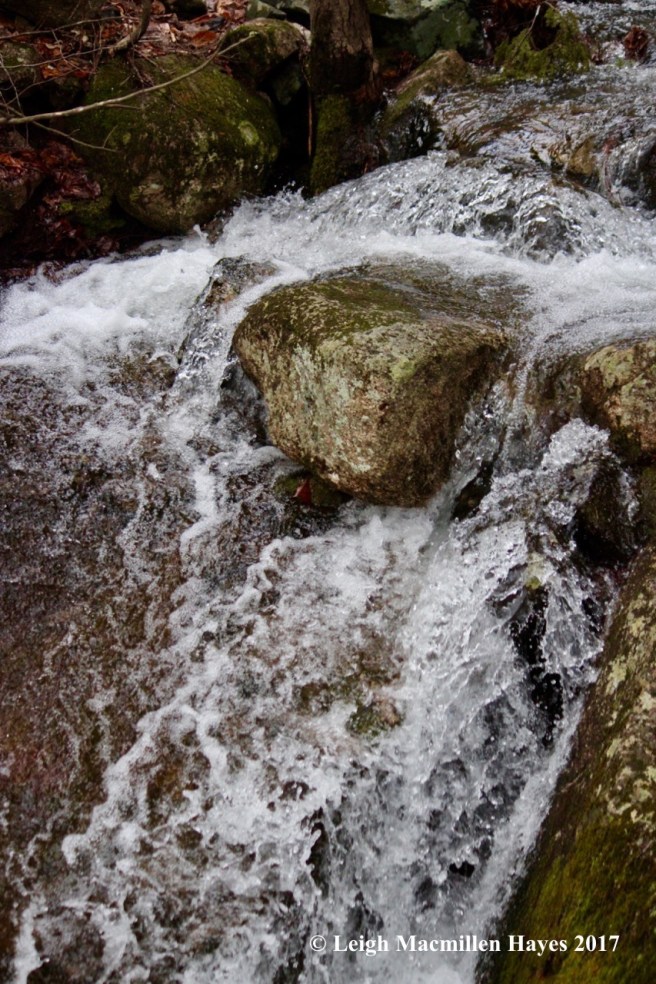
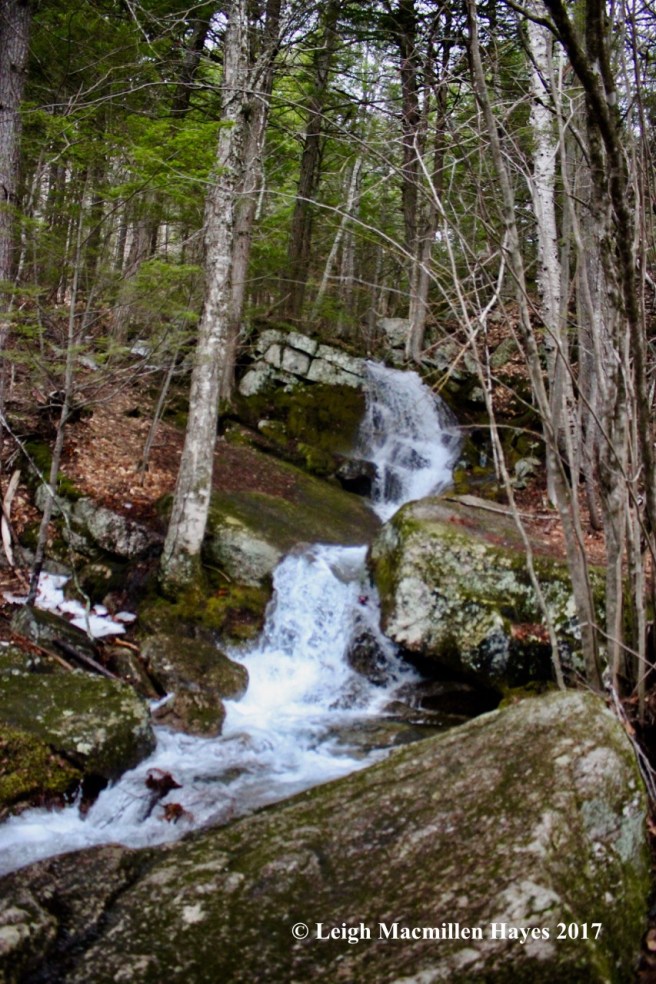
The flow of the living water and its ever changing presentation mesmerized us much as leaping flames do.

n-water art

It spiraled over the rocks like a sculpture in fluid motion.

n-ice hiding

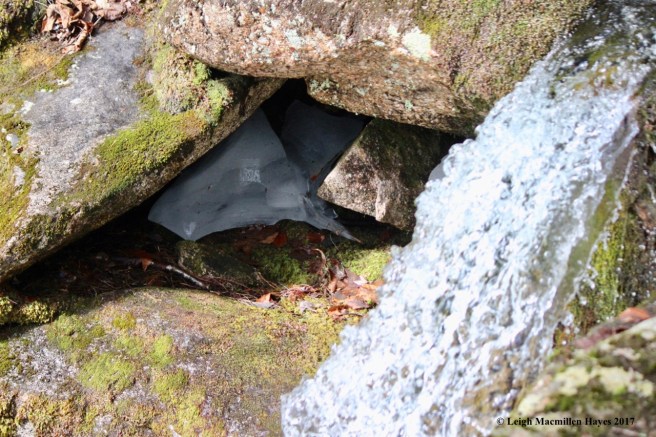
And while so much poured forth and wound its way down the mountain stream,

n-ice at Needles Eye

some remained frozen in time.

n-crossing toward Needles Eye

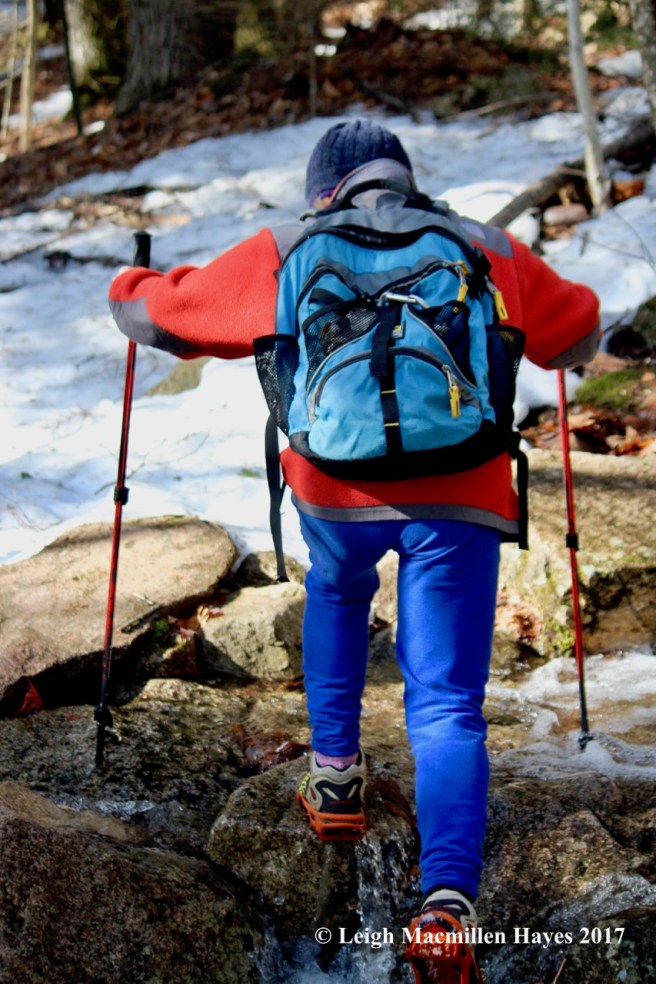
At the sign pointing toward Needles Eye, we crossed a stream and then worked our way across the short spur to the narrow formation of rocks that water threads through.

I should qualify that. Marita sauntered across the ice and snow, seeking the wee bit of dirt and leaves at the edge of the trail. It’s a steep edge and even on a summer day, I pick my way carefully over rocks and tree roots. Today, my brain suggested I call it good and sit still. But, she’s a good friend, and realizing my trepidation (I’d forewarned her), she spoke to me calmly about each foot placement, and even turned back to demonstrate exactly what I should do, waited patiently as my brain shouted, “Don’t do it!” and my heart said, “I think you can, I think you can,” and offered a hand when necessary.

n-marita 3 (1)

Together, we did it. This photo is Marita’s as I didn’t want to change my camera lens once we stood in the chasm and watched the water fall.

n-inside the needle

On a summer day, it’s a delightfully damp place to rest before continuing up the mountain. Sometimes, there’s only a hint of a stream. Today, it was equally enchanting–perhaps we should have bowed in respect of the beauty and power before us. And just maybe we did.

n-climbing down 2

Returning on the spur, Marita again came to my aid. And then we hiked a bit further up until time forced us to head down again.

n-morning light

The descent seemed easier as the snow had softened a bit in the two hours we’d spent enjoying each other’s company and filling our senses with the sights and sounds surrounding us.

n-vp visit

Back at home, I was pulled out the door again and made my way to the vernal pool. Ever so gradually, the ice is melting.

n-crack across vp

And across the center, a crack divided it in two from east to west, while a line between the sunshine and shade completed the quadrants from north to south.

n-snowfleas 2

Piles of pepper, aka springtails, floated on melted water atop the ice.

n-snowfleas

Others clustered on the open water at the pool’s edge. Other than that, I could see no action. Every day, however, will bring something new so I know I’ll check back frequently.

n-our house:field

Leaving the pool behind, I headed toward the area where I’d heard the barred owl several hours earlier–and I called. It didn’t respond. But, I reminded myself that this morning’s greeting was enough.

n-crocuses1

Returning home again, I couldn’t resist the crocuses that I first noticed yesterday. In the past few days, the snow has receded quickly and with today’s light, these spring beauties finally opened.

n-first daffy--a double

And then, in the garden beside the house, I found one more surprise–a double daffodil blossoming under some leaves. In this season of watching with wonder, my heart was full.

n-Marita

This day will stick with me for its offerings and I’ll be forever grateful to Marita . . .

n-marita 4 (1)

for without her help, I wouldn’t have had the gumption to stand in the Needles Eye. She is a kind and funny and wise(r) soul. And I am blessed by our friendship.

P.S. Two minutes after posting this blog, a woodchuck ran across the deck–headed toward the barn, of course.


Celebrating Place–Naturally

Once the snow melts it will be more difficult for me to wander and wonder in the woods I explore all winter given its spring/summer water level and logging slash. And so I make the most of these days–trying to notice as much as I can before I can notice no more (or at least until next winter).

l-bushwhack 1

Though I’d promised myself I’d not go again in an effort to not disturb the deer, promises are meant to be broken. And from that came a lesson–the deer are sticking to the snowmobile trail and field edges where tender bark of young red maples and hemlocks, plus swelling buds meet their needs for the moment. So, it was OK that I broke my promise, for the deeper I tramped, the fewer tracks I encountered.

l-spring tails1

Today’s warmer temps in the low 40˚s found the springtails hopping about on any and all surfaces.

l-pileated hole

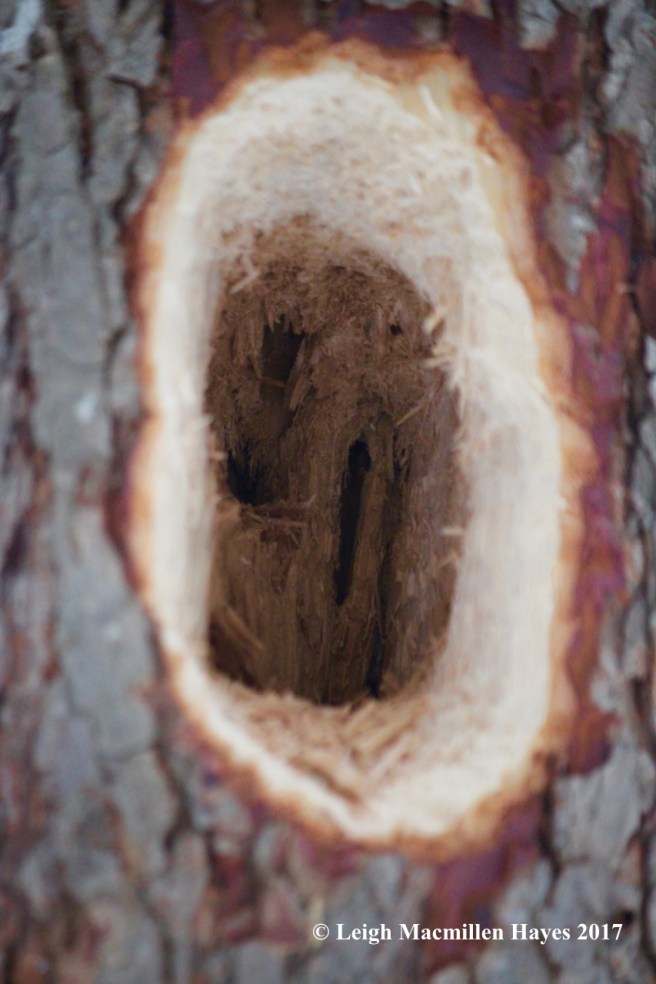
As is my habit, I checked on a pileated woodpecker hole when I saw bark and wood scattered atop the snow. Deep was this excavation in search of nourishment.

l-pileated scat-seeds and ant

And chock full was the scat below, which contained insect body parts and seeds of the dreaded bittersweet. Beside the scat, a springtail sought to placate its own food needs which among other things includes plant material and animal remains.

l-red maple bull's eye

Turning to another tree, I landed on a perfect bull’s eye! The target fungus that affects many red maples makes for an easy ID.

l-crustose, liverwort and moss

Lichens have also been a focus of late. What I like about this one, the circular green with the black disks of a crustose lichen (possibly bark disk lichen), was its location beside a liverwort (the beaded brown Frullania eboracensis) and a moss that I didn’t key out. Tree bark has its own structure and texture, but so often others also call it home.

l-shield lichens on rock

Rocks also serve as a substrate and this one featured a couple of leafy foliose shield lichens, their colors enhanced by yesterday’s inch of snow.

l-hair lichen and beard lichen

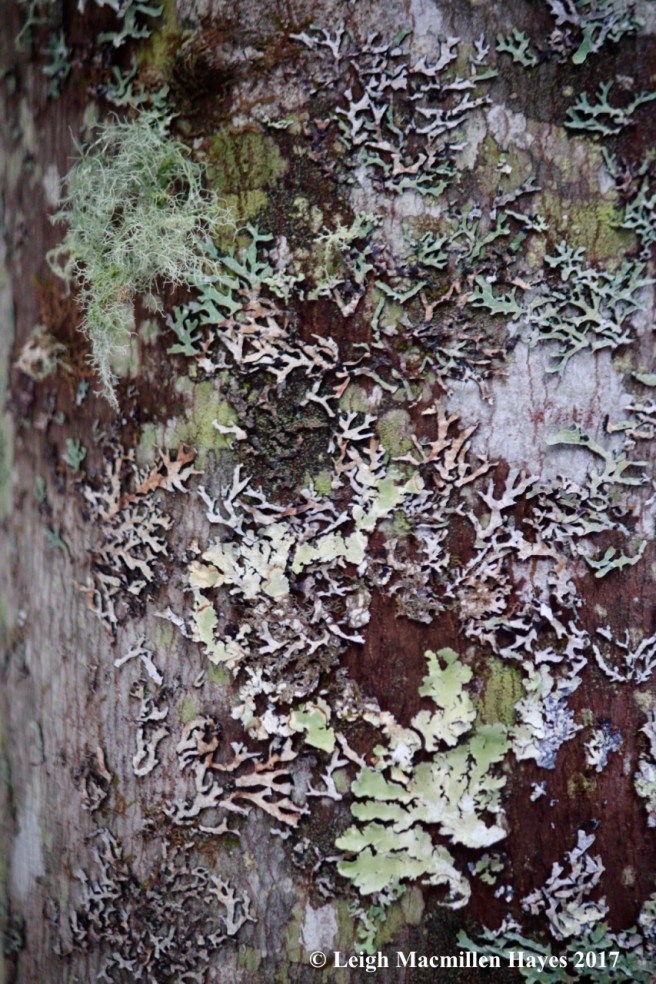
And dangling from a branch, two forms of fruticose (branching or fruit-like structure–) lichens. The dark is a hair lichen, while the green a beard–seems about right with the hair above the beard.

l-lichen garden

On another maple I spied a garden–you’ve got to liken it. (Corny joke that always manages to enter a lichen conversation.)

l-frullania 1

I’ve often paused beside Frullania eboracensis, a liverwort with no common name, but today several trees shared displays of mats called Frullania asagrayana, so named for a botanist and natural history professor at Harvard University from 1842-1873–Asa Gray.

l-frullania asagrayana 1

Its shiny, overlapping chain of red-brown leaves reminded me of caterpillars crawling along the maple bark.

l-spirea:steeplebush

Casting my eye elsewhere, steeplebush in its winter form offered an artistic presentation.

l-bracken fern1

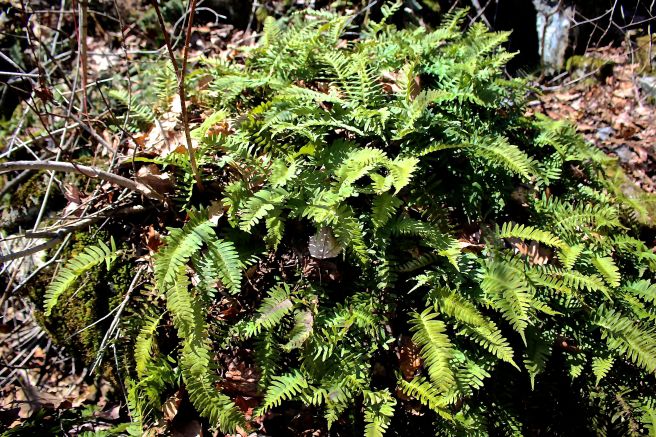
And as the snow melts, last year’s bracken fern made an appearance.

l-speckled 3

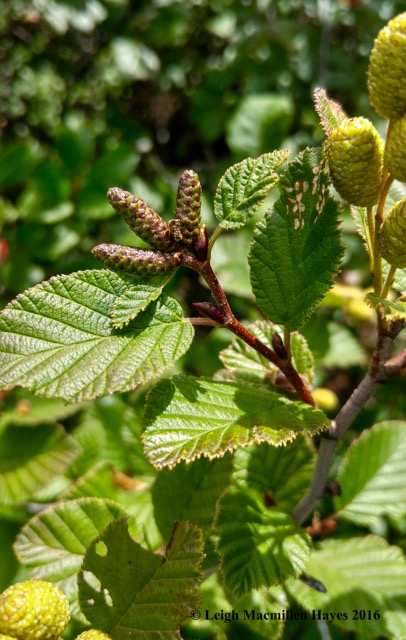
One last shrub made me stop. Minus any catkins or “cones” for which it is known, I had to think for a moment about the speckled alder. But those speckles or lenticels through which gas exchange occurs, and the buds and leaf scars were give aways.

l-speckled buds and leaf scar

The two bud scales meet at their edges and look like miniature footballs. But it’s the bundle scars where leaves were formerly attached that make me laugh. That vascular system looks like a face–two round eyes, a funny shaped nose and a round mouth, as if it’s exclaiming, “Ohhh” or “Wow.”

l-Pleasant Mtn in background

At last I reached my turn-around point. I could see Pleasant Mountain in the distance and knew where I was in the world. This is my place and I love every opportunity to celebrate it–naturally.

Beware the Ides of March

As I write, snow flurries float earthward landing atop the almost two feet of snow we received yesterday. Perhaps I should have heeded the soothsayer who warned Julius Caesar to “Beware the ides of March,” in Act 1, Scene 1 of Shakespeare’s play about the Roman politician. 

But I didn’t. I stepped out the door this morning and took my friend, Judy Lynne, with me for today is her birthday, thus making March 15 a day of celebration rather than one to be dreaded.  

As for “ides,” that word refers to the day in the middle of the month. Every month has a day that divides it in half, therefore, every month has an ides. But still, in the play it sounds so ominous–and is eventually.

And as for Judy, she missed the blizzard (and all our winter weather) because she teaches in China. And she is not at all like the Roman soldiers. Rather, Judy embraces every person and critter around the world and sheds love wherever she goes. 

p-porky

Since she can’t be in western Maine to enjoy the results of a late season storm, she’ll have to travel vicariously–beginning with the porcupine who didn’t let a little snow stop him from plowing through. Those of us who know Judy travel in a similar manner as she shows us parts  of the world we may never actually visit. 

p-Mount Wash

The view of Mount Washington will help her get her bearings. It is this and Pleasant Mountain and our orientation to them on the horizon that help us recognize our place in the world.

p-snowshoe hare

I didn’t expect to see many tracks this morning, but was pleasantly surprised. Besides the porcupine, I saw deer, mouse, red and gray squirrel, chipmunk and these. I can’t give you lobsters for your birthday, Judy, but I can give you the lobster-like prints of snowshoe hare. 

p-AMC bridge

I often don’t know where I’m headed when I walk out the door, and today was no different. This journey took me into Pondicherry Park where I stopped by the AMC bridge and thought about Judy’s ability to cross bridges with people of other cultures, no matter how deep the snow may be.

p-AMC bench

Today, however, if she wanted to pause after making such a crossing, she’d need a shovel, such was the depth on the bench by the bridge.

p-willet brook from bench site

Together, we headed down the trail to the viewpoint beside Willet Brook. Judy is an artist and I had visions of her recreating this scene of winter snow and spring ice. This picture of transitions reminded me of the changes in her life as she interviews for jobs in other countries.

p-Willet 2

The change will be difficult as she leaves behind friendships formed in the last five years, but I trust in reflection she’ll know she’s making the right choice.

p-false tinderconk

As I snowshoed, I found a few things I knew, but didn’t necessarily understand. Bumps in the road you might say, Jude, or at least on the spore surface of a false tinderconk.

p-hammered, green shield and cocoon

Because she loves design and has an insatiable curiosity, I knew she’d enjoy taking a look at the shield lichens, both hammered and common green.

p-cocoon 2

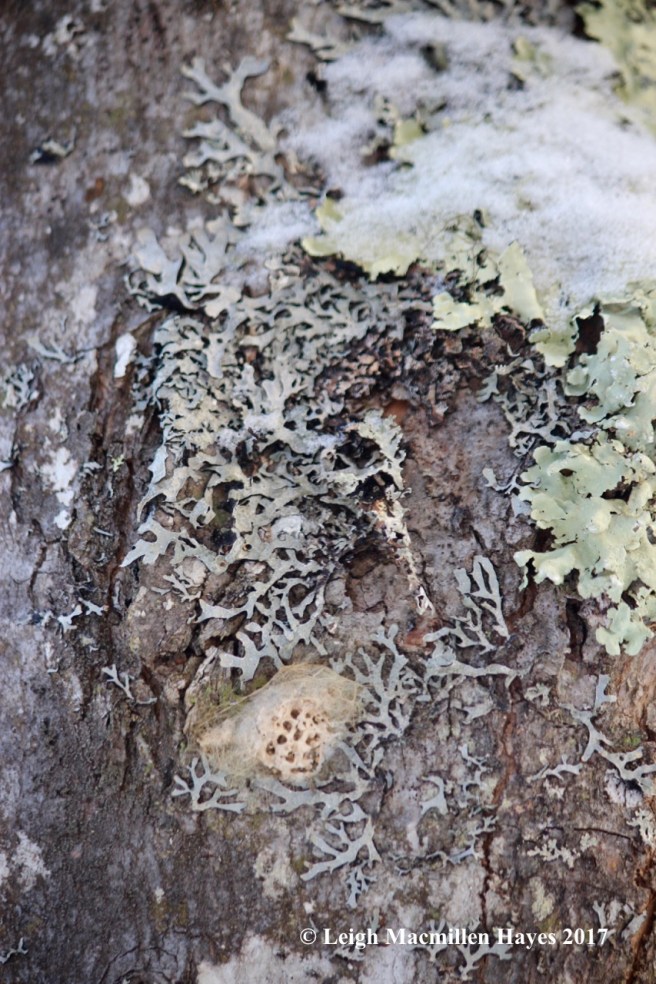
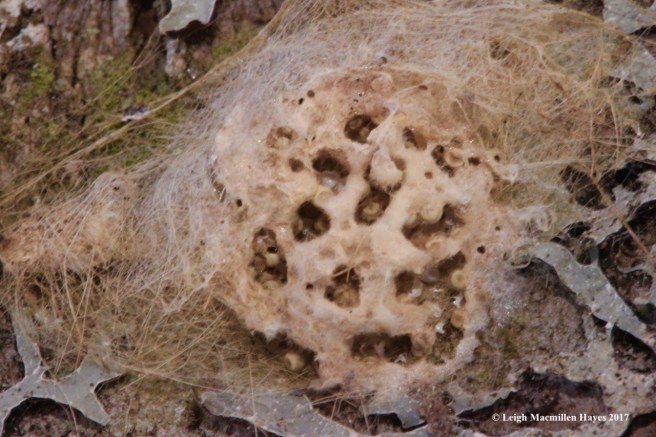
And that would have brought her to notice something else on the bark. She’d have laughed as I stuck my chin against the tree to get a closer look at the silky-hair cocoon embedded on the lichen. Perhaps a tussock moth?

p- Hooded Merganzer

As I wound my way back, I checked Willet Brook again–and spied a hooded merganser swimming away, its crest described as a hammerhead. Hammershield, hammerhead. Methinks Judy will nail down a new job soon.

p-beech bud breaking

And then there was the beech bud already breaking–I’ve seen this happen in previous years; a few scales bursting open before their time.  For Judy, it would have turned into a science lesson for her Chinese high school students. And perhaps a drawing lesson for art class.

p-deer, maple leaves on ground

Throughout the park, I didn’t roam alone for deer tracks were obvious everywhere and I saw three of the creators. But it was the leaves atop the snow that made me pause and I’m sure Judy would have done the same.

p-maple leaves

Occasionally I spot a single withered maple leaf on a tree, but this tree was covered and it made no sense. Maples aren’t typically marcescent–they don’t retain their leaves like beech and oak. It wasn’t until I stepped back and looked at the tree that I finally understood; this was a branch that had fallen when the tree was still in leaf and the deer browsed the tips of some branches, though I trust they didn’t find much nutrition for they moved on. I laughed again and heard Judy roar with me.

p-deer crossing stream:watercress

At the stream below the spring, I noticed the deer had walked right through the water to get to the other side.

p-watercress 1

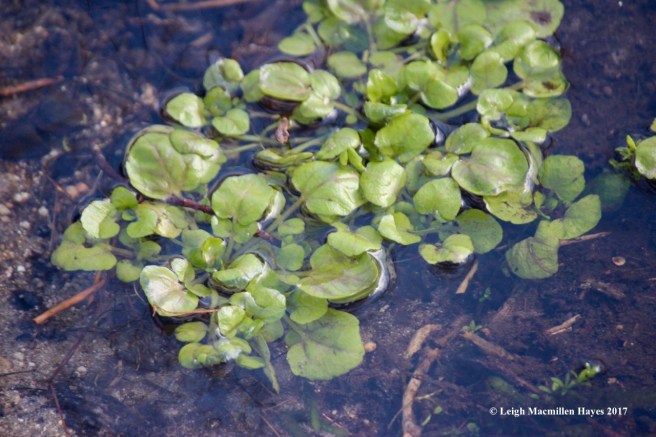
I couldn’t tell for sure, but trust they sampled some wild watercress that grows freely there. And I thought of the foods Judy has sampled during her time in China and other travels.

p-deer crossing bridge

Not all of the deer chose to walk through the water. Some actually crossed the bridge. It struck me that they learned to use it to get to the other side. Judy has learned so much about herself and the world as she’s crossed bridges I’ll never set foot on.

p-dunning bridge 1

The best bridge of all awaited, its roof supporting the weight of the snow. This bridge was built by many to honor a community member, whose wife just happened to be the reason Judy and I met 25 years ago. Wow–it’s been that long since we practiced breathing techniques in Lamaze class .

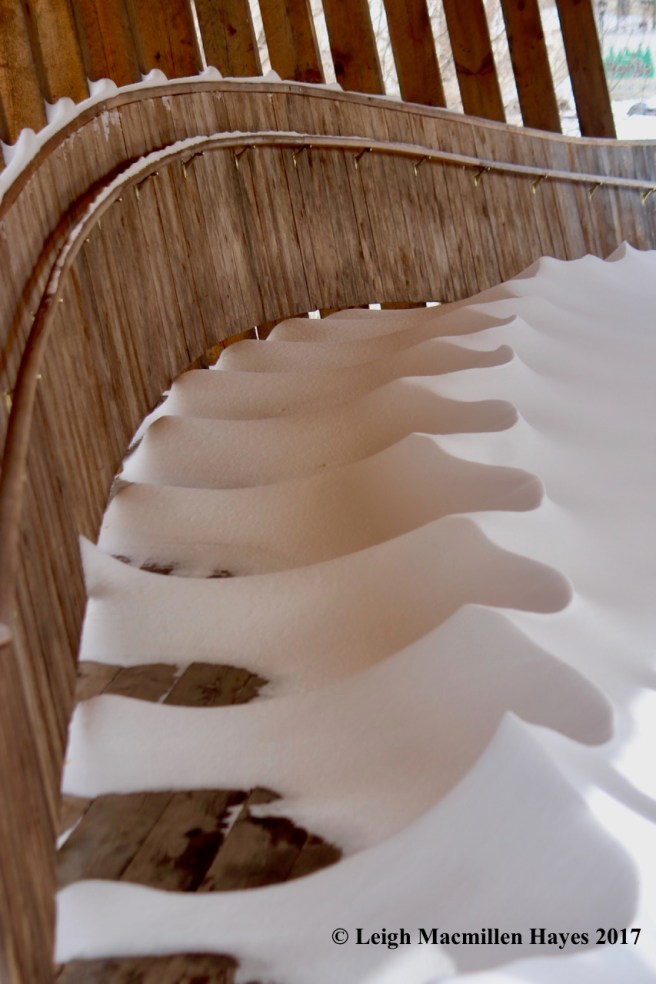
p-snow on Dunning bridge

One of the cool things this morning because I was the first one there, the peaks and valleys left behind by the storm. If she’d been here, Judy would have taken the very same photo.

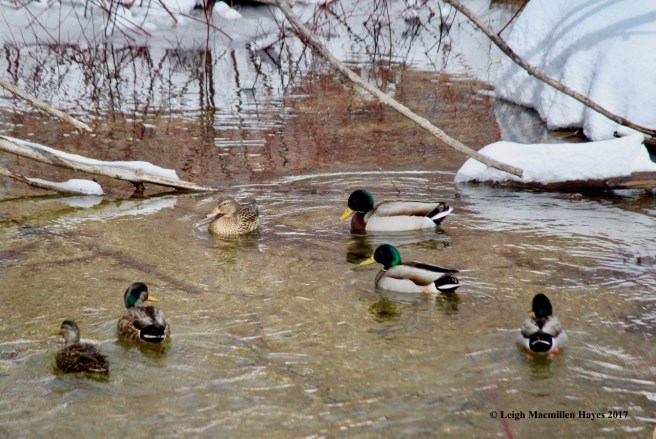
p-ducks 1

I went to the bridge to see the other ducks that frequent this location. The sight of the snow-topped rocks and vegetation made me think of frosting and guess who also teaches a cooking class–yup, Judy.

p-ducks 4, black:mallard hybrid?

Within the mix, what I think are two black ducks. I’m still learning my birds, but it did look like one may be a hybrid–a cross between a black duck and a mallard. Of course, I could be wrong on all accounts. No matter–what does matter is that they all get along and that’s what is important to Judy. She’s also a great believer in random acts of kindness and has performed so many good deeds for others.

p-robins 2

I was almost home when I saw some color in the gray birches–more color than the berries being eaten.

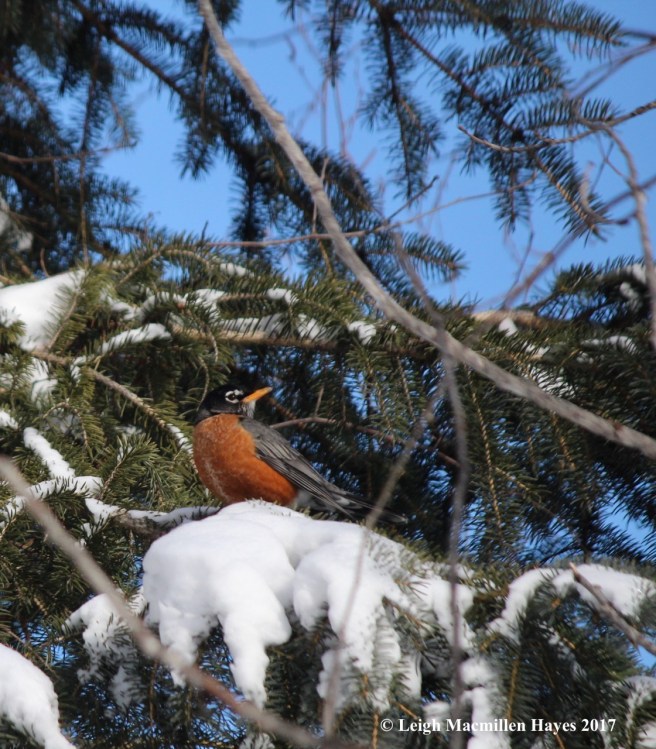
p-robin 3

A flock of robins dined on the “junk” food of the bird world–bittersweet berries.

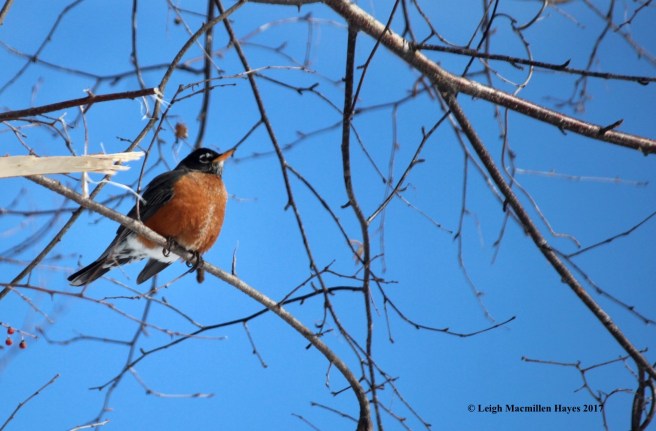
p-robin 1

After one drank some snow, it showed off its rufous-colored breast, reminiscent of Judy’s red hair.

This one posed atop the snow-covered branch seemed a mighty fine representation of our move from one season to the next. (Or might it be one country to the next, Jude?)

In the end, today’s journey reminded me once again to Be Aware–the eyes of March. And be thankful.

I am thankful for my friend, Judy Lynne, born on the Ides of March, but not actually reading this until the day after her birthday. I’ll be forever in awe of her.

The Bears of Mount Tire’m

Mary Holland posted in her Naturally Curious blog that black bears are emerging now and it’s time to bring in the bird feeders. Maybe so, but today surely didn’t feel like a good day to give up a cozy spot and head out in search of food that doesn’t exist because the snow is crusted and two feet deep.

Winds were out of the northwest at about 18 miles per hour. The temperature was 8˚ that felt like -10˚ or lower. But sunshine. We had plenty of sunshine. So maybe the bears are waking from their long winter’s nap.

t-porky-works-2

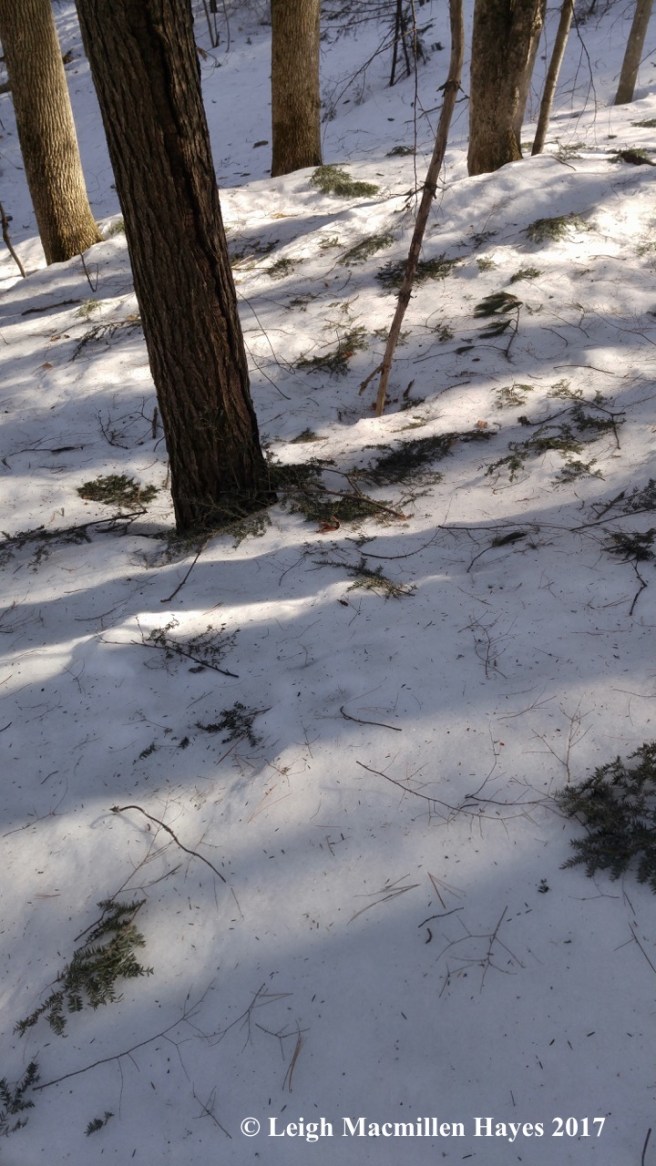
Post lunch, my guy and I decided to don micro-spikes because of the snow conditions and ascend the trail to the summit of Mount Tire’m in Waterford. Only a few seconds after starting up the trail, we spied downed hemlock branches and knew one of the critters that frequents these woods.

t-porky-wall-walk-1

As I looked on the stonewall beside the trail, I could see that the porcupine had left its own trail while it came and went. We wondered where it might be, but when I turned and looked back down to the road, I saw that the trail continued that way and have a feeling that Porky lives under one of the nearby barns, much the same as our local Porky lives under our barn.

t-woodpecker-hole-1

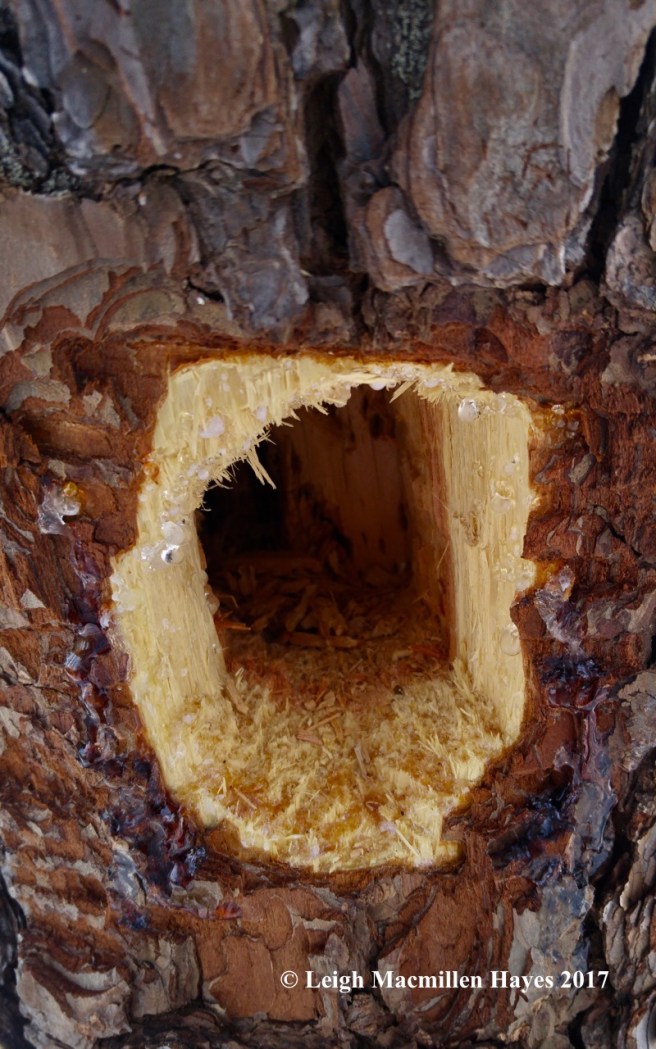
Our hike to the summit was brisk because it was so cold. Every once in a while, my guy paused, including beside this newly excavated pileated woodpecker hole. If I were the local chickadees, I’d choose this one tonight and gather all my friends and relatives within since it was deeper than many.

t-fungi-1

There were the fire tenders nearby–birch bark and false tinder conks–so keeping the home fire lit should help keep them warm.

t-keoka-1-1

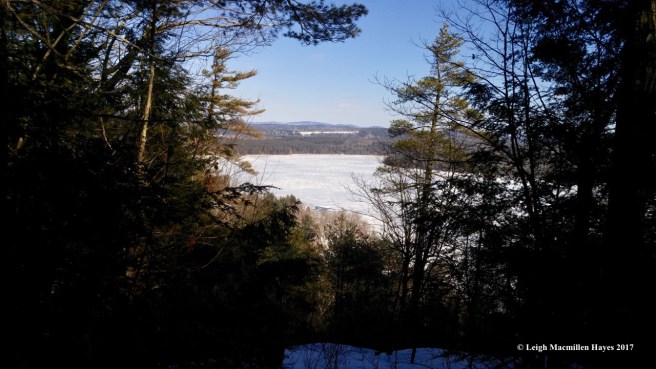
Over halfway to the summit, there’s a brief opening to Keoka Lake and Streaked Mountain in the offing. We could see a wee bit of open water below, and know that despite this weekend’s weather, change is in the air.

t-summit-view-2-1

It seemed like we reached the summit in a matter of minutes, so cold was it. But, we were out of the way of the wind and the southerly exposure meant less snow.

t-summit-view-4-1

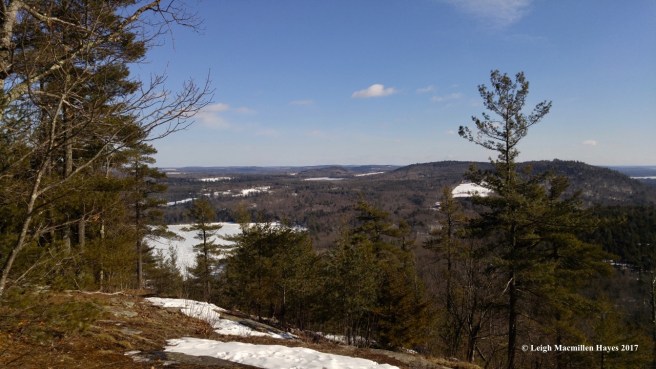
We looked to the left, with Keoka Lake below. And behind the single pine, Bear and Hawk Mountains.

t-summit-view-3-pleasant-1

To our right and through the pines, we could see the snow covered ski trails at Shawnee Peak Ski Area on Pleasant Mountain.

t-summit-view-2-1

Straight below, Waterford City, Bear Pond and Long Lake beyond.

t-tirem-rocks-2-1

This hike is never complete without a visit to the rock castle hidden in a hemlock stand behind the summit. It was a favorite for our sons when they were youngsters and we still like to pay homage.

t-rock-cracks-1

Life on a rock has long been exemplified here, with crustose lichens topped by mosses that grow among the cracks, where pine needles and seeds gather.

b-tree-on-rock-1

The result– dirt so birch trees may grow out of the side of the boulders.

t-bear-cave-2-1

When one visits the castle, it’s important to check out the caves because you never know . . . t-me-2-1

who might emerge.

t-bear-1-1

We decided to bushwhack on our way down. Turns out, Ms. Holland was right. We met a bear in the woods today.


Progressive Lunch Mondate

Today’s hike found us climbing one of our favorite mountains in western Maine. We love the fact that we can ascend along various trails and change it up if we want with up and back routes, circular routes and ridge-line routes.

p-trail-sign

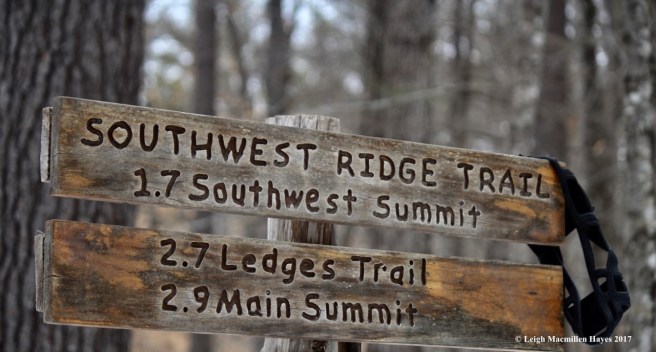
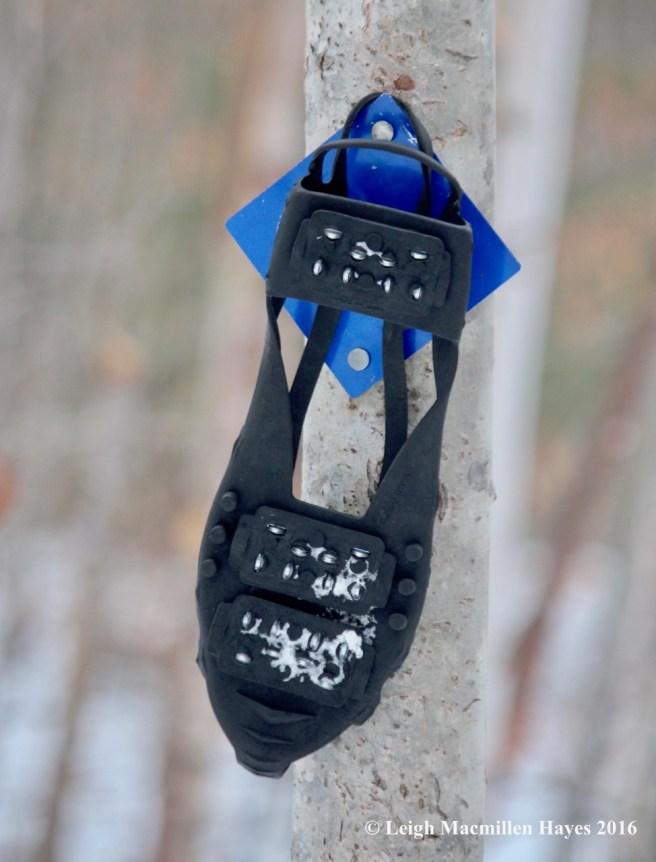
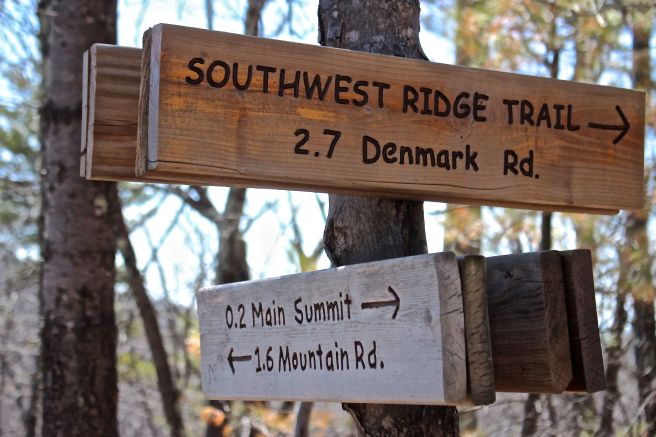
Since we chose the Southwest Ridge Trail, we drove to the parking area on Denmark Road. Ours was the only vehicle, but trail conditions and a single Stabilicers™ ice cleat indicated many others had traveled this way recently. As for those ice cleats, my guy informed me he’s sold tons this winter and he has STABILicers™ Powder Straps for sale as well, so they don’t end up as trail sign decorations.

p-deer-skipper-and-doe

The beginning of the trail was mostly covered in frozen snow. Immediately we wondered who had used the trail more–humans or deer? The imprints of the latter spoke of timing. The smaller skipper on the left, must have moved this way after a recent warm day and the adult, which I suspected was a doe, earlier when temperatures were colder and the snow firmer. With temps a bit lower than yesterday, we found it rather firm for our purposes.

p-deer-run-1

At least seven different deer runs crossed the trail between the parking area and first ledge.

p-deer-run-2

Being on the southwestern side of the mountain, the snow level was significantly less than elsewhere and one run was completely open to the leaf litter, making it easier for food foraging.

p-spring-trail-1

Conditions kept changing for us as well. A friend from Florida had been asking about signs of spring, and this trail certainly hinted at a change of seasons.

p-trail-ice

p-spring-trail-2

In fact, we experienced a bit of every season, from snow and ice to leaves, mud and water.

p-cracker-rock

About an hour into our climb, we found two rocks meant for a pause. And so we did.

p-cracker-cheese

Lunch Course Number One: Pineland Farms Creamery’s Salsa Jack cheese on crackers.

p-cracker-view-1

Our break gave us time to take in the view toward the White Mountains where we’d hiked yesterday. Though our visibility was rather good for a cloudy day, it was obvious that those mountains were again in the mist.

p-staghorn-1

A bit further on, the bright orange-red fruit clusters of staghorn sumac brightened our day. As vibrant as they are, most of the pompom fruits remained, waiting for songbirds, turkeys and grouse. Apparently, they are not a preferred food source and will often remain until late winter. Though I’ve never tried it, the crushed fruit can be used to make a lemonade-like tea. And the tannin-rich bark was used to tan hides.

p-staghorn-2

The “staghorn” part of the common name derived from the fact that the stem is covered in reddish-brown hairs and features a manner of growth that somewhat resembles the velvet-covered horns (antlers) of a stag (male deer).

p-teepee-1

We solved the problems of the world as we continued up, all the while looking down to choose the right foot placement so we were both surprised when we realized we’d already reached the teepee at the summit of the trail.

p-soup

Lunch Course Number Two: Black Bean Soup.

The recipe was shared with me eons ago by my friend Carissa. When our sons were young, they loved to help me make it. And I was thrilled when our oldest asked for the recipe last week. I thought you might appreciate it.

Black Bean Soup

1 lb plum tomatoes, halved lengthwise

1 large onion, halved and cut into wedges

1 lb carrots, peeled and quartered

3 lg garlic cloves, chopped

1 Tbsp olive oil

1/2 tsp dried oregano

4 C vegetable broth

3 1/4 C cooked black beans or two 15oz cans black beans, rinsed and drained

Combine first six ingredients and roast at 350˚ for one hour, stirring occasionally. Set carrots aside. Purée other roasted veggies. Pour some broth into roasting pan and scrape up bits. Hold aside one cup beans. Purée other beans, using some broth if necessary. Chop carrots. Heat everything together. Add salt and pepper to taste. Serve with a dollop of plain yogurt.

p-summit-1-1

We enjoyed the view and talked about the Hike and Bike Trek that Loon Echo Land Trust hosts each year. This is the spot that my friend, Marita, and I spend the day at as we perform our hostess duties for the six-mile hikers.

p-teepee2

Before we began our descent, we took one last look at the teepee, created years ago by the late George Sudduth, director/owner of Wyonegonic Camps, the oldest camp for girls in America.

p-hiking-down

Back down we went, carefully picking our way. We were actually surprised at how quickly we finished, the climb down not nearly as treacherous as at least one of us had anticipated.

We’re expecting a Nor’easter overnight into tomorrow and hope it’s an all snow event (despite the prediction for freezing rain and sleet after the snow) because we aren’t ready to give up winter yet.

Lunch Course Number Three: Two Dark Chocolate McVitie’s Digestives when we reached the truck. A perfect ending to a Progressive Lunch Mondate on Pleasant Mountain.


Final(ly) Mondate

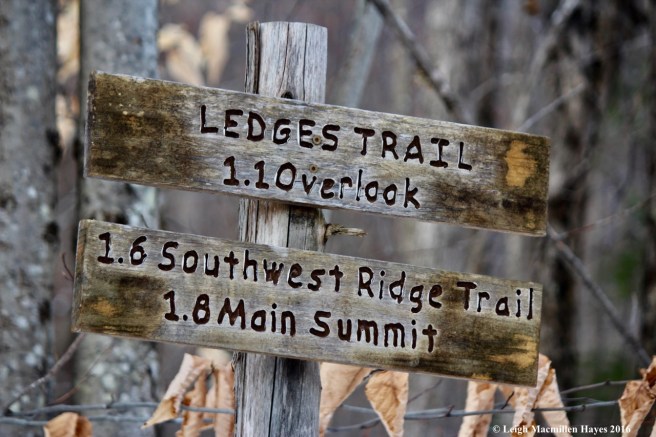
With lunch packed, donning new hiking boots for him and longjohns for me, my guy and I climbed the Ledges Trail up Pleasant Mountain today.

p-trail-signs

Our destination: the main summit.

p-trail-marker

The bright blue trail blazes shone brilliantly in the winter landscape, some decorated by those who’d passed this way before us.

p-microspikes

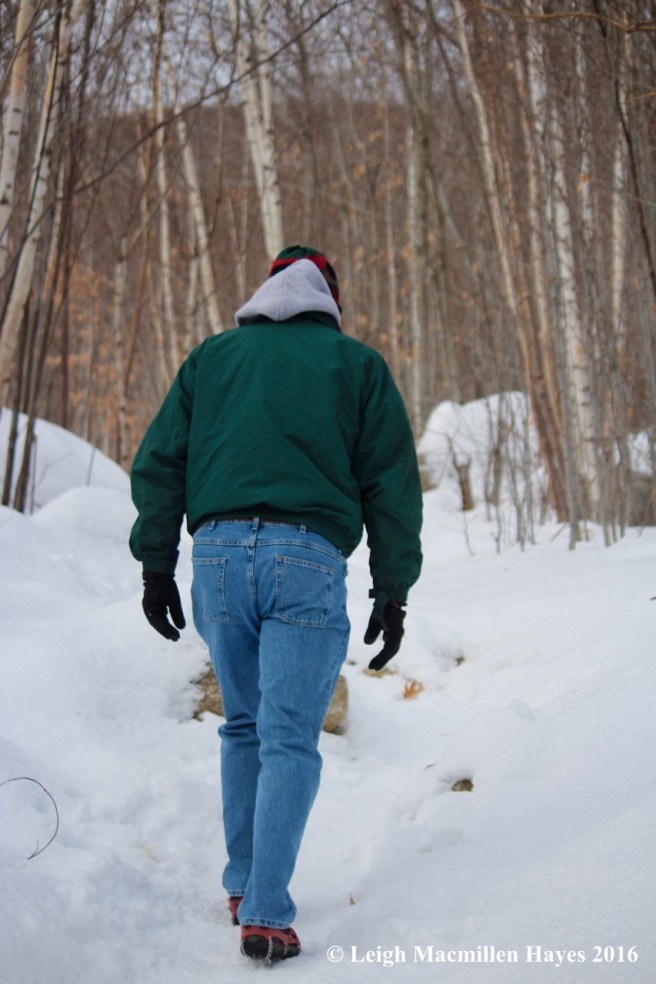
We gave thanks to them and snowshoers, who’d packed the trail down, which meant we could get away with micro-spikes. It felt more like a walk in the park. We love it when conditions are such and watching our every step on slippery leaves or rocks is not a worry.

p-deer-path

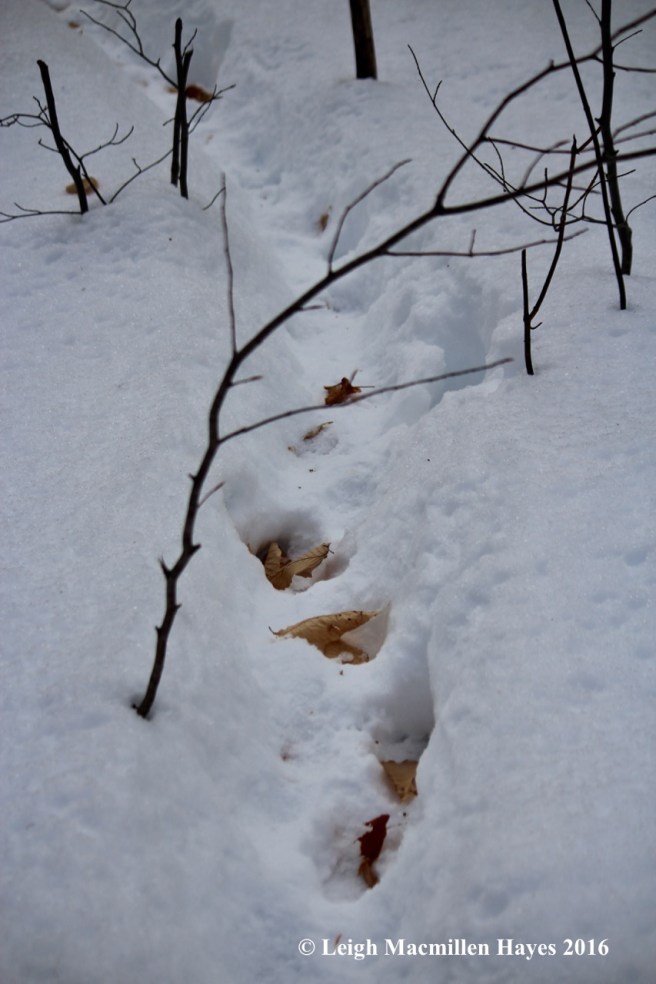
All along, deer tracks criss-crossed over the “human” route, creating their own trails from shelter to food.

p-porky-trough

A porcupine had done the same, its trough at least six inches deep.

p-brook

Though no water flowed through the streams that the trail crosses, snow created the effect of fluid motion and offered a promise for the future.

p-hop

As I looked down, the papery fruit of a hop hornbeam reminded me to look up.

p-hop-hornbeam

And right there, the tree showed off its shaggy bark. With that came a recollection of the first time I’d met said tree–it may have been this very one for it was on this trail many years ago.

p-snow-growing-on-rock

I knew I’d spent too much time looking about when in his smart aleck way, my guy pointed to a rock. “Tall rock,” he said. “What’s growing on it?” I asked. “Snow,” he responded.

p-beech-contortion

But still, he was the one to notice the beech contortionist.

p-beech-o

And another that demonstrated the circle of life.

p-beech-laughter

And then there was Beech Man–his mouth agape with laughter . . . and just maybe wonder.

p-moose-pond

We paused briefly at the Ledges overlook and then continued up, our eyes focused more on the sky than anything else at that point.

p-climbing-with-ease

My least favorite section of trail, where the rock face sometimes makes me pause and contemplate my next step, provided for an easy ascent given the conditions.

p-summit-1

It seemed like no time had passed when we reached the top and we felt like we’d missed parts of the trail, everything being different with the new season.

p-summit-2

We had the summit to ourselves. My guy immediately found lunch rock–and the view.

p-sippings

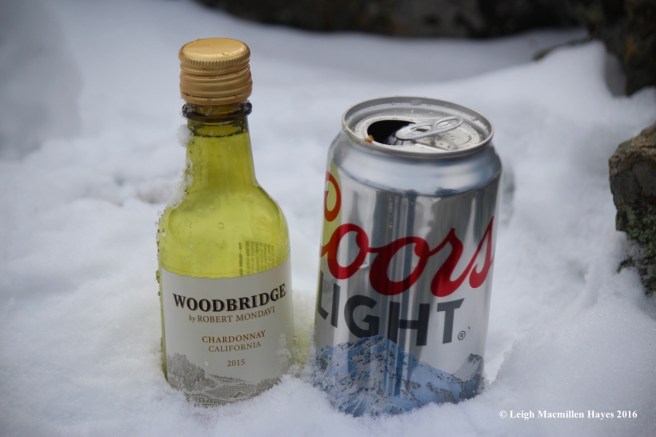
I pulled out our sandwiches and surprised him with two beverages–one having found its way into the fridge this past week that spoke to our Colorado connection. We toasted our opportunity to be on top of the world.

p-summit-sky

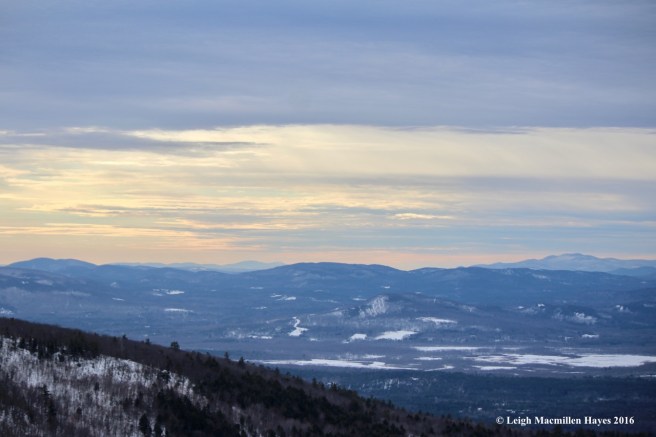
All around us, serene hues of blue and icy gray contrasted with pastels and reflected winter’s enchantment.

p-rock-in-tree

We didn’t stay on top too long as the wind started to pick up. Just below the summit, I spotted another moment of wonder.

p-sunrisesunset

As we continued to climb down, our eyes were again drawn to the sky. “It’s the middle of the day and yet it looks like a sunrise or sunset,” said my guy.

Indeed. The perfect ending to our Mondate. Finally a Mondate. A final Mondate–for 2016, that is.


The Be-Attitudes Sundate

Today marks the beginning of the season of hope and with that in mind, my guy and I climbed Singepole Mountain in Paris. Paris, Maine, that is.

s-halls-pond-start-1

Our hike began beside Hall’s Pond, where the water reflected the steel gray sky of this late November day.

s1-barbed-wire

And stonewalls and barbed wire reflected the previous use of the land.

s1-beaver-6

In a matter of minutes we learned of its present use.

s-beaver-works-3

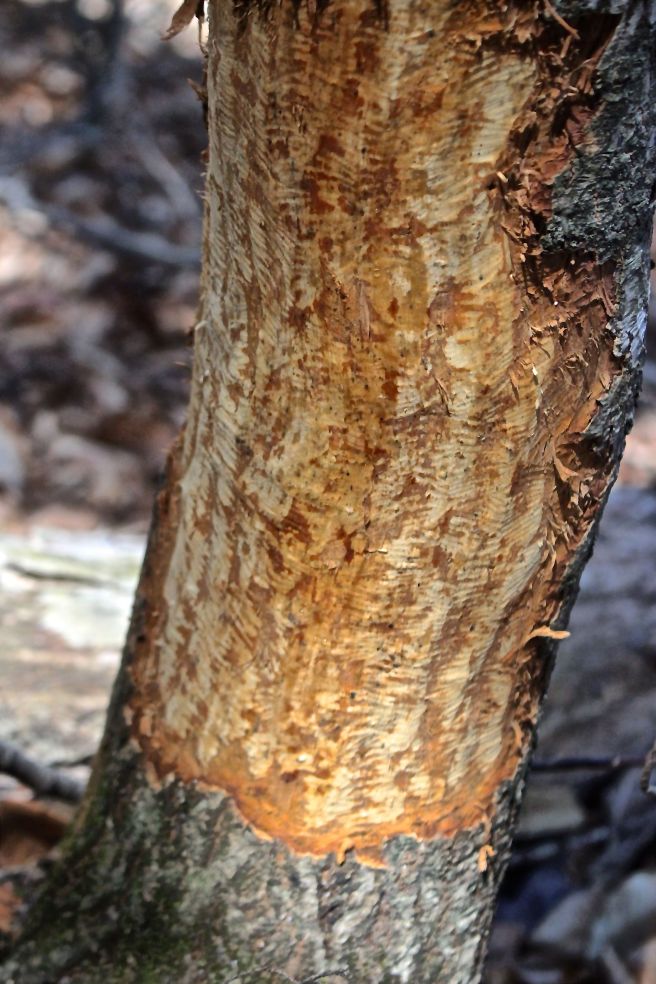
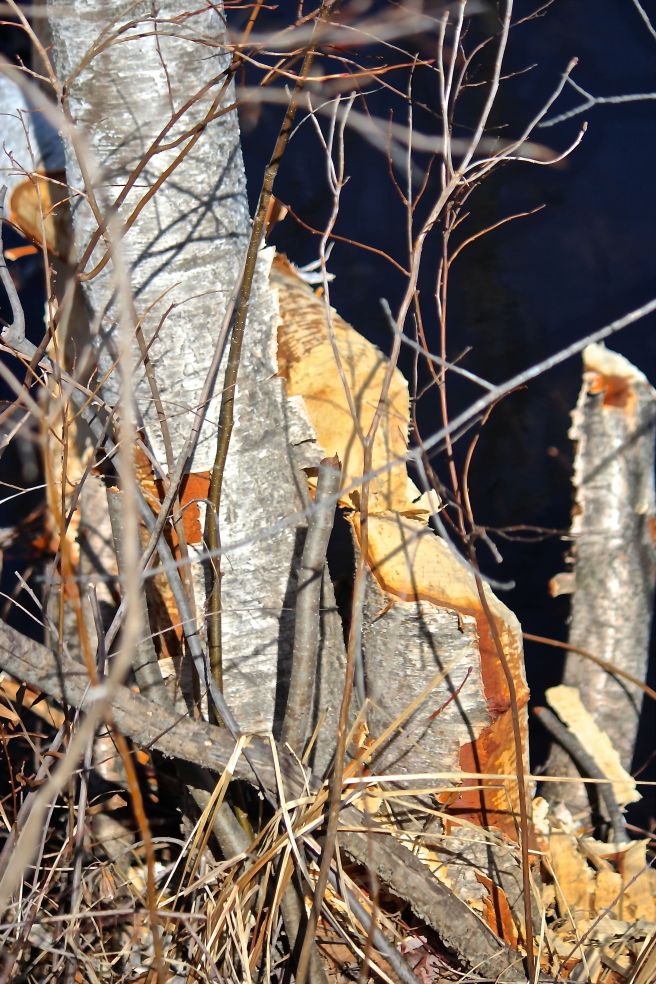
Everywhere we looked, beaver sculptures decorated the shoreline.

s1-hemlock-grove

We passed from the hardwood community to a hemlock grove . . .

s-hemlock-girdled-2

where more beaver activity was evident. I’ve been reading The Hidden Life of TREES by Peter Wohlleben and have some questions about tree girdling such as this. There is a theory that beavers chew off the bark all the way around (girdle) to eventually kill trees such as hemlock, so preferable species will grow in their place. But, that’s thinking ahead to future generations. Do beavers really do that?

s-hemlocks-3

On page 18, Wohlleben states the following: “As the roots starve, they shut down their pumping mechanisms, and because water no longer flows through the trunk up to the crown, the whole tree dries out. However, many of the trees I girdled continued to grow with more or less vigor. I know now that this was only possible with the help of intact neighboring trees. Thanks to the underground network, neighbors took over the disrupted task of provisioning the roots and thus made it possible for their buddies to survive. Some trees even managed to bridge the gap in their bark with new growth, and I’ll admit it: I am always a bit ashamed when I see what I wrought back then. Nevertheless, I have learned from this just how powerful a community of trees can be.”

Could this theory be true? Are the surrounding hemlocks feeding that tree via their roots? If so, does that throw out the other theory? So many questions worth asking.

s-huge-maple-1

Soon, we left the Pond Loop Trail and started to climb the Singepole Trail, passing by a gentle giant.

s-maple-2

It’s a snag now, but this old maple offered tales of the forest’s past and hope for the future.

s-downy-rattlesnake-plaintain

On a smaller scale, Downy Rattlesnake Plaintain provided a cheery contrast among the leaf and needle carpet.

s-bobcat-ledges-1

The climb was a bit challenging in places, but we held out hope among the ledges that we might see a bobcat.

s-porky-den

No such luck, but we did find this . . .

s-porky-scat

a well used porcupine den.

s1-water-2

Water dripped in constant harmony as we stepped gingerly along the narrow ledges and tucked under overhanging rocks.

s-halfway-up-2-1

About halfway up, we took a break and paused to admire the view.

s-halfway-up-view-1-jpg-communities-defined

The hardwood and softwood communities became more obvious as we looked down.

s-summit-1-1

And suddenly or so it seemed, my guy reached the moment of truth–the summit.

s-halls-pond-to-pleasant-1

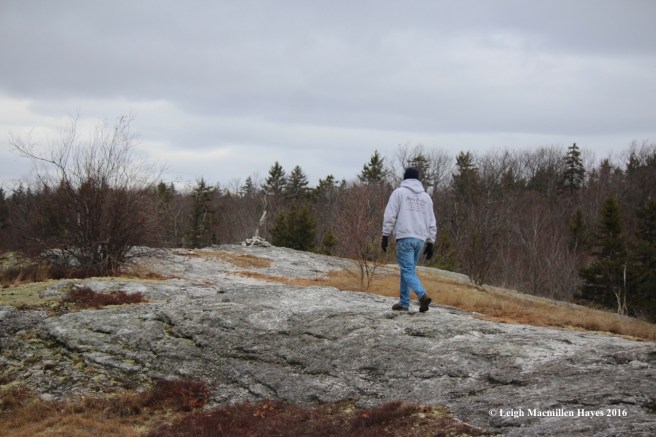
From the top, we looked around and embraced our home place, which appeared on the horizon in the form of Pleasant Mountain.

s-pleasant-to-whites-1

A slight turn and the view extended from Pleasant Mountain to the White Mountains.

s-quartz-intrusion

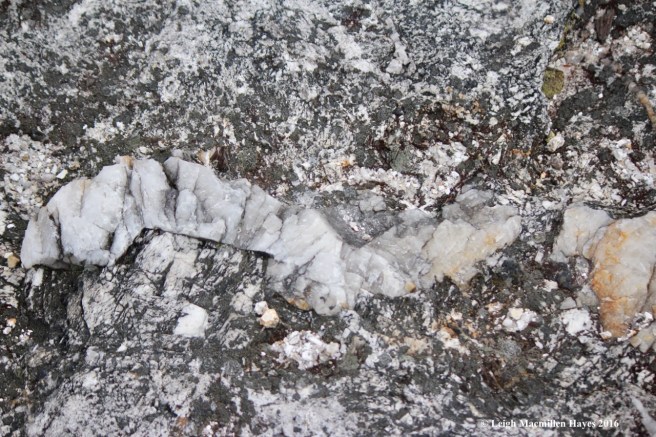
Below our feet, the granite pegmatite shared its showy display.

s-summit-1

We’d read that there was a quarry at the summit, so we headed toward a cairn, in hopes of locating it. Too many jeep trails confused us and we decided to save the quarry for another day. Instead, we turned into the woods to get out of the wind and munch our PB & J sandwiches, the grape jelly courtesy of Marita Wiser and family.

s-wickiup-1

As we poked about, something caught our attention and we moved closer.

s-wickie-3-1

s-wickie-2-1

s-wickie-1-1

A wickiup frame. We admired the efforts of someone to create this traditional structure.

s-pleasant-mtn

Emerging from the woods, we took one last look at Pleasant Mountain, and . . .

s-summit-4

one last view of what seemed to be the summit (though it may have been a false summit).

s-climbing-down

And then we started down, once again hugging the rocks and trying not to slip.

s-flower-mushroom

On the way, I did note a few things, including this fungi that looked more flowerlike than mushroom like.

s-girdled-beech-1

s1-porky-2

And I spotted a phenomenon that occurred repeatedly. Girdled beech trees too far uphill for a beaver. What or who had debarked these trees?

s-porky-works

I may have been seeing things that weren’t real, but the lines on this particular tree made me wonder about the porcupines. Was I looking at the design they leave with teeth marks created in the distant past? Or were they wounds of another kind?

s1-beaver-5

When at last we reached the Pond Trail again, we continued to circle around it, noting more beaver works.

s-beaver-lodge

At last, we found the mud-packed lodge built into the edge of the pond. Here’s hoping for a warm winter within.

s-pond-at-end-of-day-1

Completing the circle, the biting breeze forced us to walk quickly toward our truck and the end of our hike. We have chores to complete tomorrow so our Sundate may have to suffice for a Mondate.

That being said, in this season of hope, we trust we’ll find more opportunities to consider these be-attitudes:

s1-trees-in-harmony

Be supportive of each other.

s1-christmas-fern-1

Be watchful of what’s to come.

s-heart

Be hopeful of love everlasting.

Book of October: HIKES & Woodland Walks in and around Maine’s LAKES REGION

Better late than never is the name of my game. And so it is that I’m finally posting the Book of October. Since I was away at the beginning of the month, I’ve been playing catch-up, but also, I had three different books I wanted to write about and couldn’t choose one. And then, the other day after hiking with my friend, Marita, and mentioning her book, I realized when I tried to provide a link from my Book of the Month posts that though I’ve mentioned the book several times, I’ve never actually written about it. And so, without further ado . . .

m-cover

the Book of October is HIKES & Woodland Walks in and around Maine’s LAKES REGION by Marita Wiser.

Of course, since we’ve been friends for a long time and I’ve served as editor on several editions of the book, I suppose you might deem my review as being biased. It is.

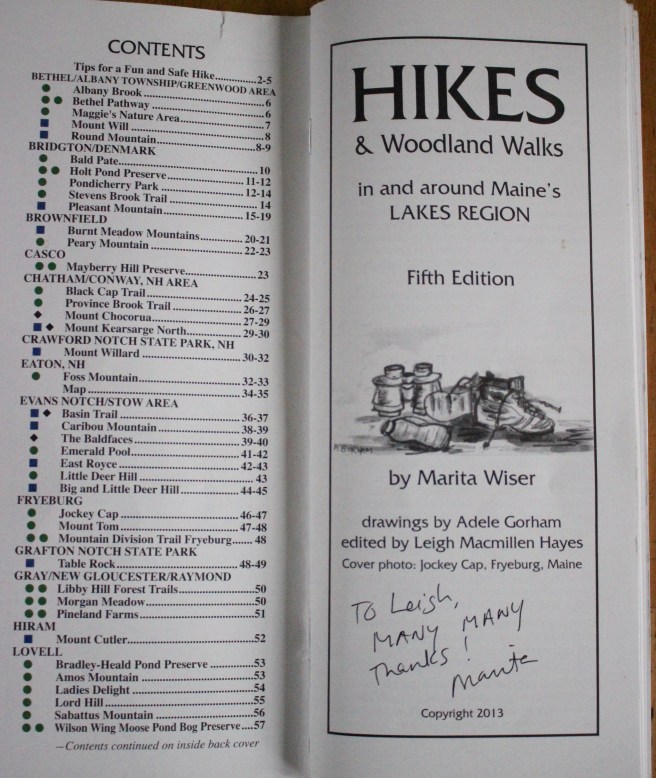
m-table-of-contents

And if you find the typo that has survived several editions, I might give you an extra candy bar for Halloween. Just remember, only God is perfect.

As you can see from the table of contents, trail descriptions are organized based on location and she ranks the difficulty, making it easy for the user to make a decision about which trail to hike. Do you see the blue box on Mount Cutler in Hiram? I actually had a brain freeze there and couldn’t put mind over matter and get to the summit. I was stuck in one spot for at least a half hour before feeling a slight bit of bravery and making my way down. I laugh at that now because I’ve completed all the black diamonds except for Chocorua–guess that needs to go on my list. Of course, my guy and I did have a heck of a time descending one trail on the Baldfaces, but we survived and have a story to tell.

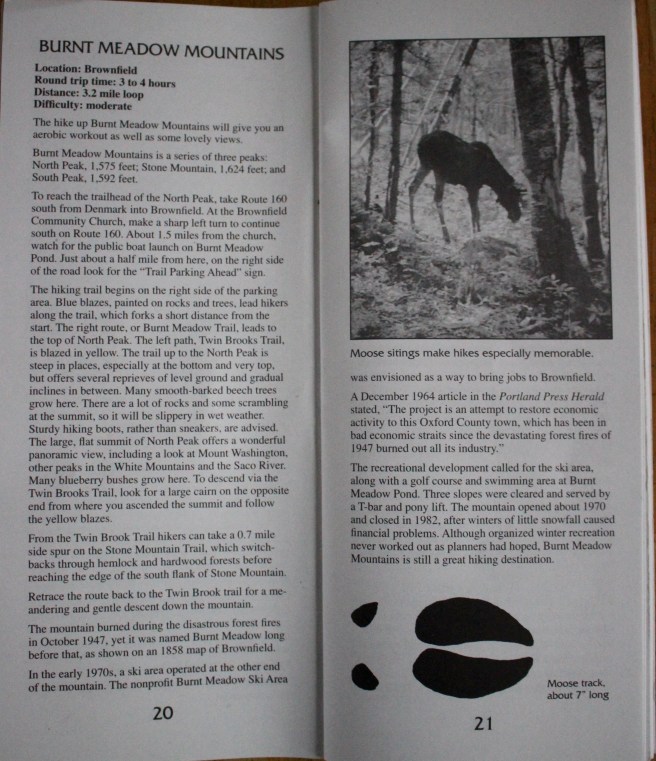
m-burnt-meadow

The trail descriptions include directions, distances, time allotment, difficulty and often history. I think knowing the history of the place is extremely valuable so you can better understand the features around you.

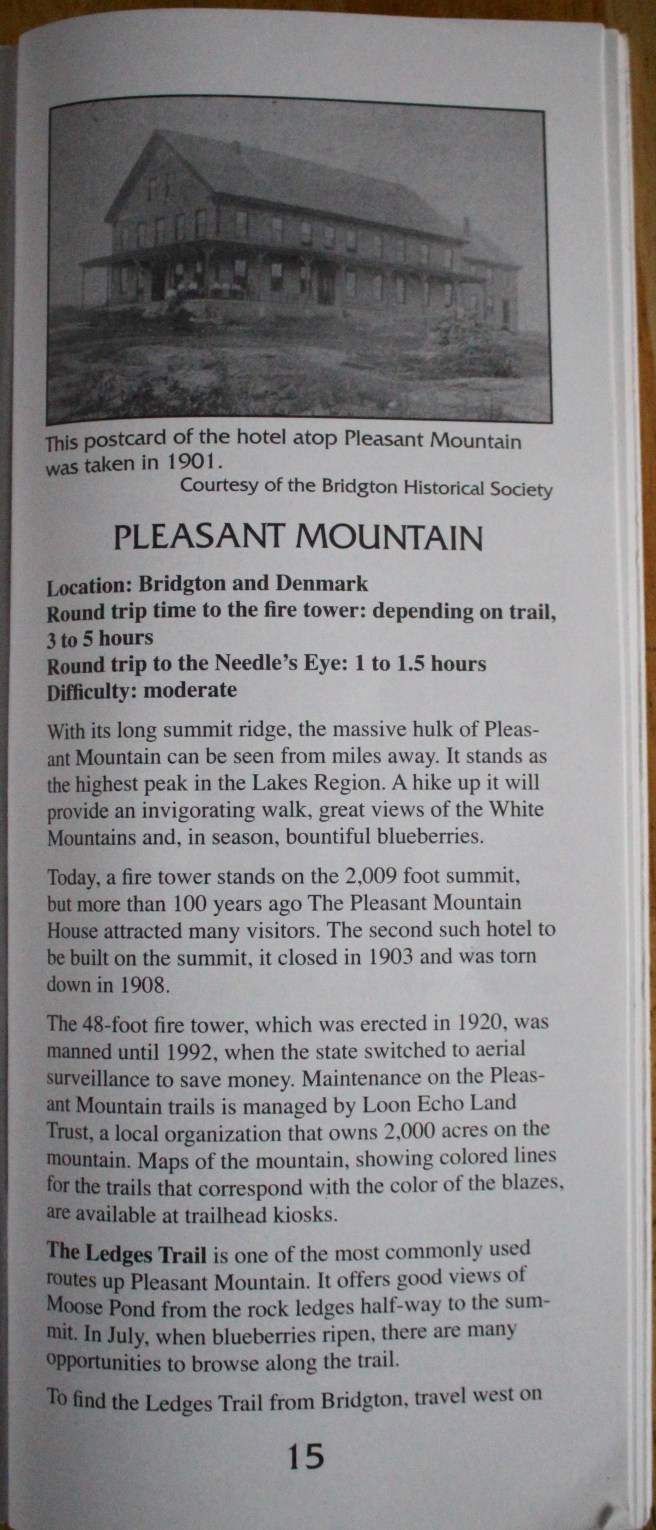
m-pleasant-1

For one of the local favorites, Pleasant Mountain, she includes five pages to describe the various trails and even includes an old photograph of the Pleasant Mountain Hotel. Standing at the summit, I often imagine the horses and carriages that carried visitors up the Firewardens trail, that is after they’d arrived by Steamboat, having followed the Cumberland and Oxford Canal from Portland to Harrison. Their journey makes any hike we take seem so easy. Well, maybe not, but still.

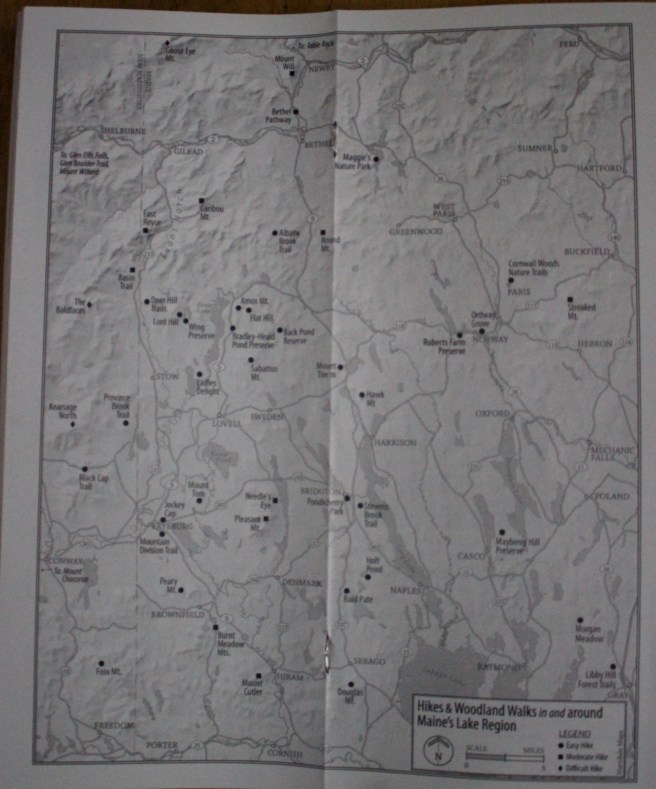
m-center-map

The centerfold provides an overview of all the areas Marita writes about.

m-other-activities

And while she begins the book with a variety of hiking tips about everything from water, food, trash and clothing to ticks, hunting and trail markings, she ends with a scavenger hunt and information on how to reorder the book.

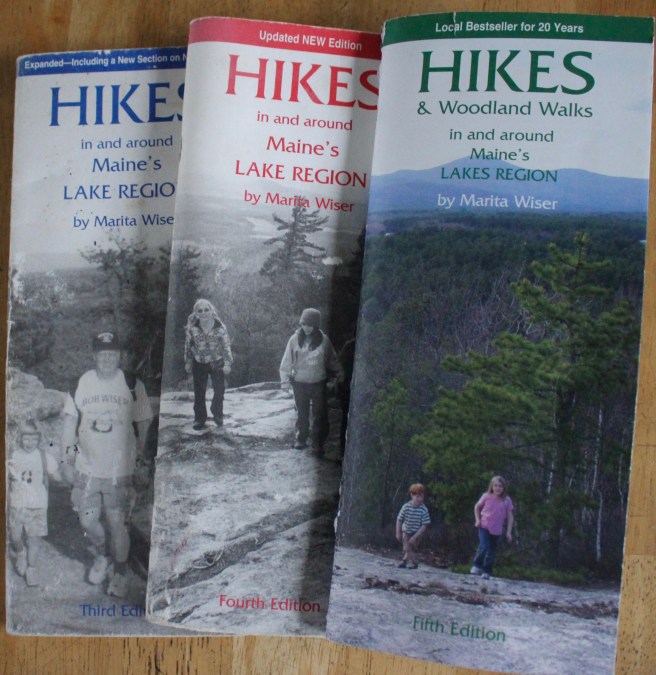
m-covers

With time comes change and her covers reflect such. Marita started this project when she wrote a hiking column for The Bridgton News years ago.

The beauty of her book is that she actually goes out and explores all of the trails over and over again, and in each edition she provides updated descriptions. She also adds and deletes trails, so even if you have an older version, you might want to purchase the current copy.

m-marita-and-me-1

I’m thankful for the book and my friendship with Marita. And glad that I often get to join her on a reconnaissance mission. (We also co-host the rest stop at the teepee on the Southwest Ridge Trail of Pleasant Mountain each September for Loon Echo Land Trust’s Hike ‘n Bike fundraiser before we traverse the ridgeline to the summit of Shawnee Peak Ski Area–thus our southern-themed headwear.)

This Book of October is a must have if you live in or plan to visit the Greater Bridgton Lakes Region area. And it’s available at many local shops, including Bridgton Books.

HIKES & Woodland Walks in and Around Maine’s LAKES REGION, fifth edition, by Marita Wiser, © 2013.


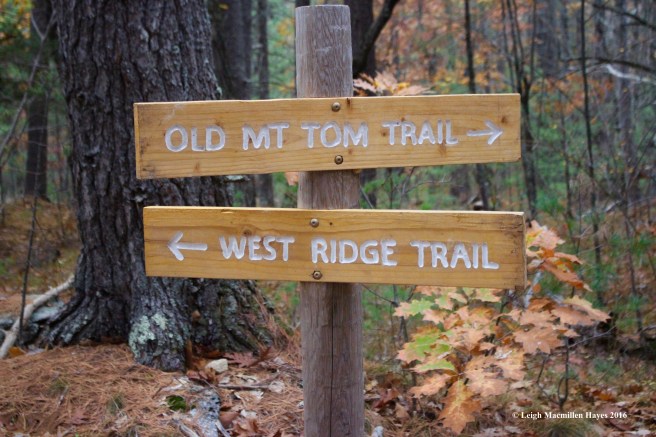
Finding Our Way on Mount Tom in Fryeburg, Maine

I ventured this afternoon with my friend Marita, author of  Hikes and Woodland Walks in and around Maine’s LAKES REGION, along with her daughter’s beagle, Gracie, on a new trail in Fryeburg.

t-preserve-sign

Mount Tom, a Roche Moutonnée, is an asymmetrical hill with a gently sloping up-ice side that has been smoothed and polished by a glacier. The other side is abrupt and steep–the down-ice side where the rocks were plucked off, leaving a more cliff-like appearance. As Marita noted, its most impressive view is from a distance, but today we sang its praises from up close. We’ve both hiked a 1.5 mile trail to the summit for years, but recently The Nature Conservancy developed a new trail that we were eager to explore.

t-fdn-1

Within seconds I was exclaiming with joy. A huge, and I mean HUGE foundation shared the forest floor. Note the outer staircase to the basement.

t-center-chimney

And the large center chimney.

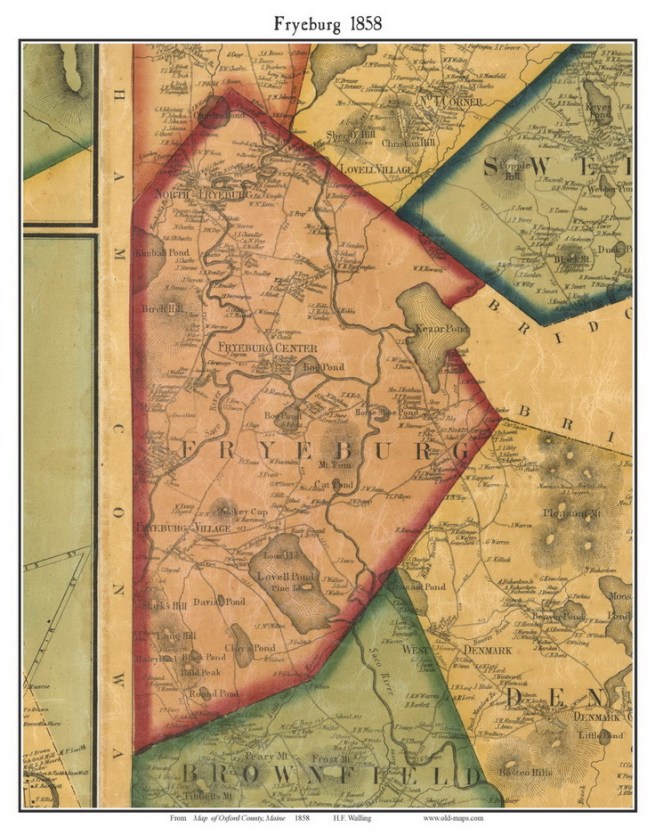
t-fryeburg-1858-map

On an 1858 map, I found that A.H. Evans owned a home in about this vicinity, but I don’t know if this was his. Or any more about him. It will be worth exploring further at the Fryeburg Historical Society.

t-house-connected-to-barn

The house extended beyond the basement.

t-barn-1

And was attached to an even bigger barn.

t-barn-2

Ash trees grow beside the opening, but I wondered if we were looking at the manure basement.

t-trail-blaze

Finally, we pulled ourselves away and returned to the trail. Well, actually, we tried to return to the trail but couldn’t find it. So we backtracked, found this initial blaze and again looked for the next one. Nothing. Nada. No go. How could it be?

t-marita-and-gracie

That didn’t seem right, so we decided to follow our noses, or rather Gracie’s nose, and sure enough we found the trail. If you go, turn left and cross between the house and barn foundations.

t-gracie

After that, for the most part, we were able to locate the trail, but it was obscured by the newly fallen leaves and could use a few extra blazes. Gracie, however, did an excellent job following the scent of those who had gone before and leaving her own.

t-saw-dust

The path took us over a large mound of sawdust, something I’ve found in several areas of Fryeburg.

t-color

The predominate trees were beech, white and red oaks, thus providing a golden glow to the landscape.

t-ledges-1

And then we came to the ledges. Bobcat territory. Note to self: snowshoe this way to examine mammal tracks.

t-ledge-island

The trail was situated to provide a close up view of the ledge island, where all manner of life has existed for longer than my brain could comprehend. Life on a rock was certainly epitomized here.

t-intersection

We continued our upward journey for over 2.3 miles (thanks to Marita’s Fitbit for that info) and eventually came to the intersection with the trail we both knew so well.

t-summit-sign

From there, we walked to the summit where the views have become obscured by tree growth.

t-pleasant-mtn-from-summit

But . . . we could see the long ridge of Pleasant Mountain in front of us,

t-kezar-pond

Kezar Pond to our left,

t-richardson-1

t-richardson-farm

and the Richardson Farm on Stanley Hill Road to our right.

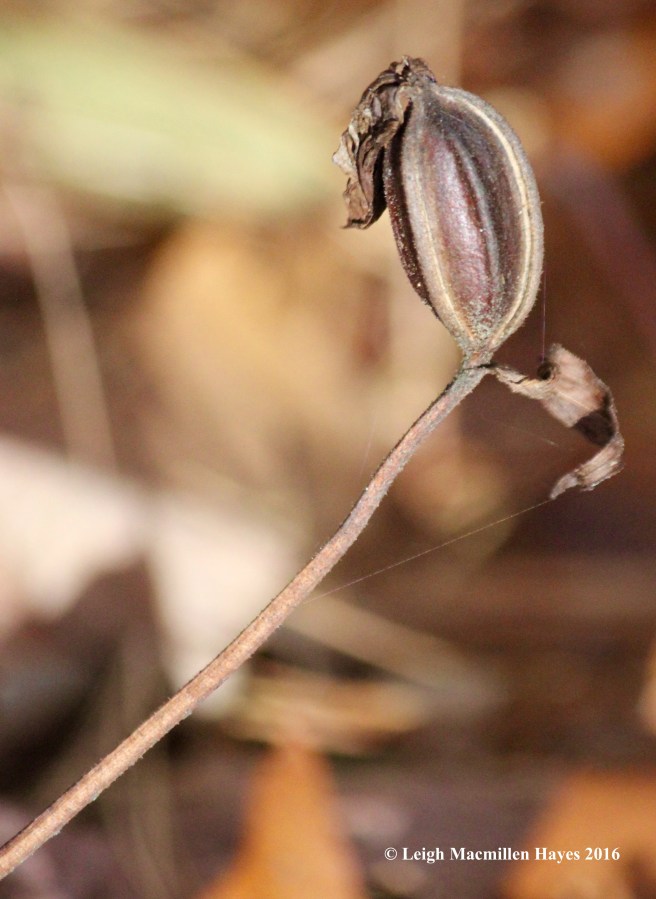
t-ladys-slipper-pod

Also along the summit trail, the woody seedpod of a Lady’s Slipper. Ten-to-twenty thousand seeds were packaged within, awaiting wind dispersal.

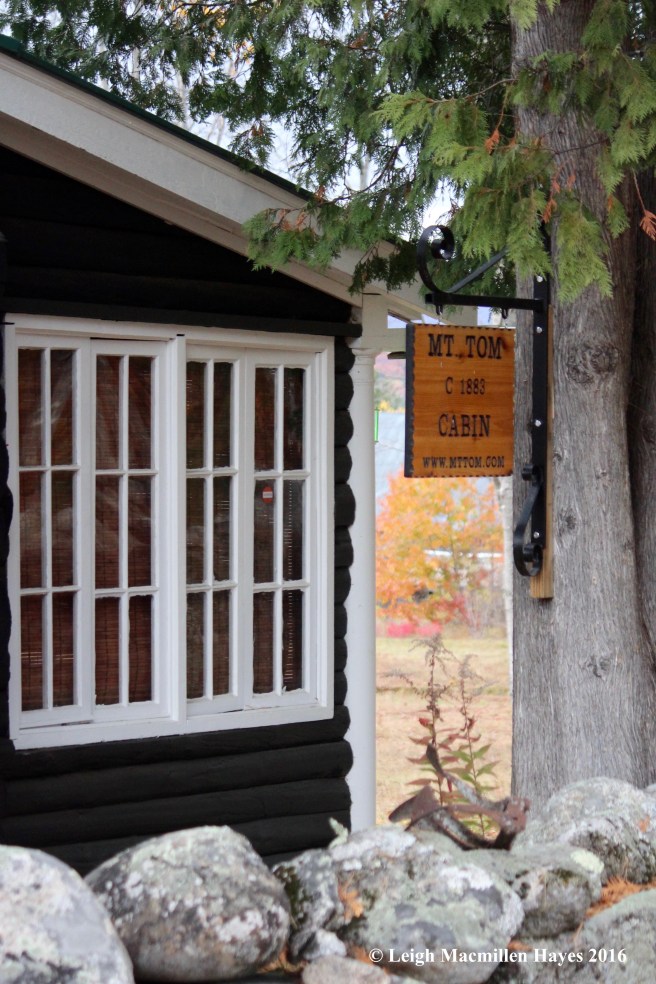
t-mt-tom-house

We decided to follow the old trail down, which passes through a hemlock grove and then suddenly changes to a hardwood mix. Both of us were surprised at how quickly we descended. And suddenly, we were walking past some private properties including the 1883 Mt. Tom cabin.

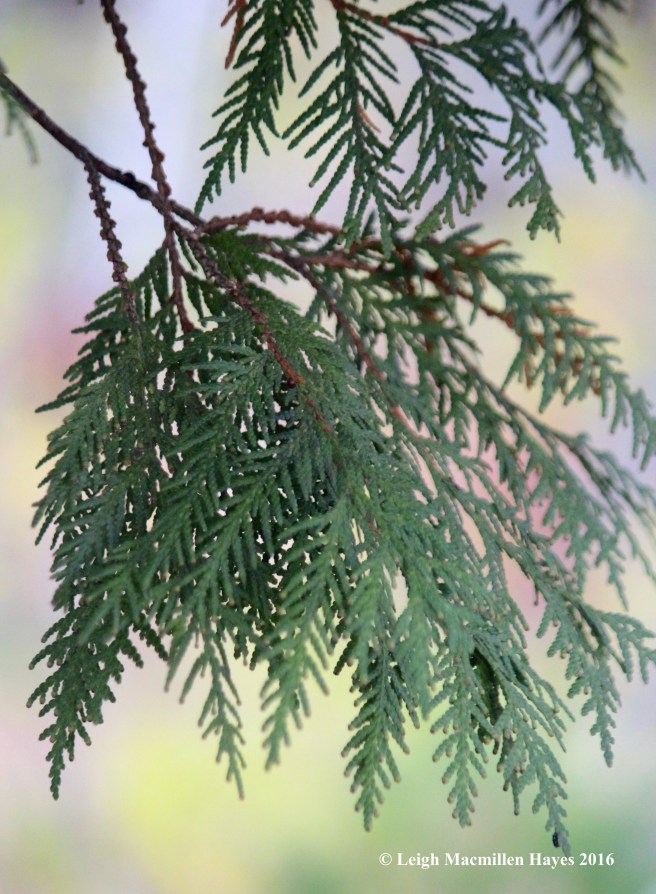
t-northern-white-cedar-bark

t-northern-white-cedar

The cabin sign was actually attached to a Northern White Cedar tree. I’m forever wowed by its bark and scaly leaves.

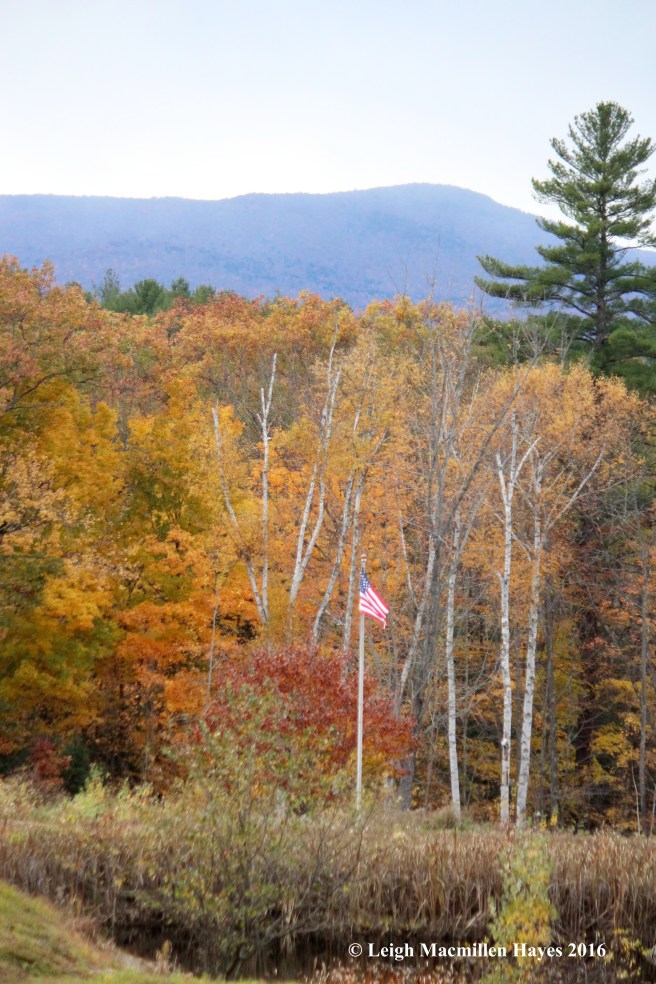
t-flag

In the field beyond, Old Glory fluttered in the breeze.

t-barn

And just before Menotomy Road, we spied Mount Kearsarge in the distance.

t-menontomy-cemetery

Since we’d taken the loop trail approach rather than an out and back on the same trail, we had to walk along Menotomy Road, so we paid the cemetery a visit and checked out the names and ages of those who had lived in this neighborhood.

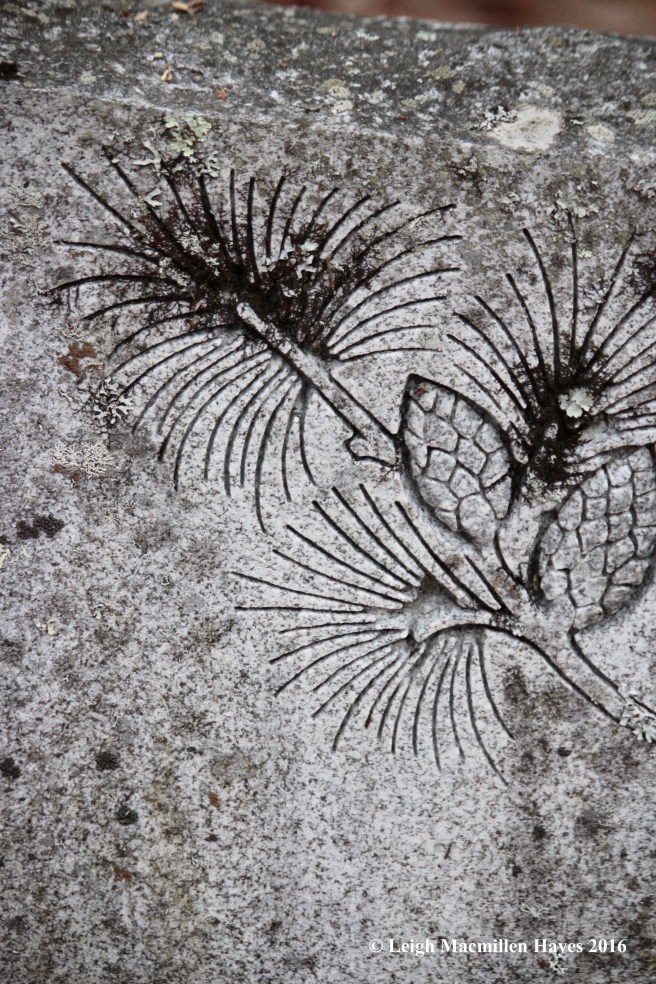
t-pine-on-grave-stone

One of the older stones intrigued me with its illustration. I think I would have enjoyed getting to know these people.

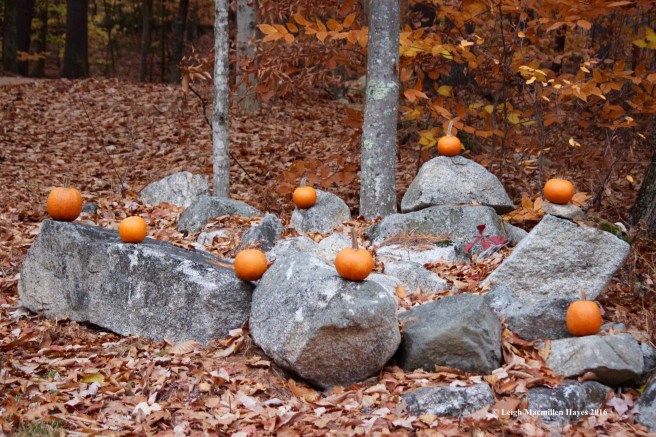
t-menotomy-pumpkins

As we continued on, I was reminded of recent adventures in Ireland  and the realization that we notice more when we walk along the road rather than merely driving by. We both admired this simple yet artful pumpkin display.

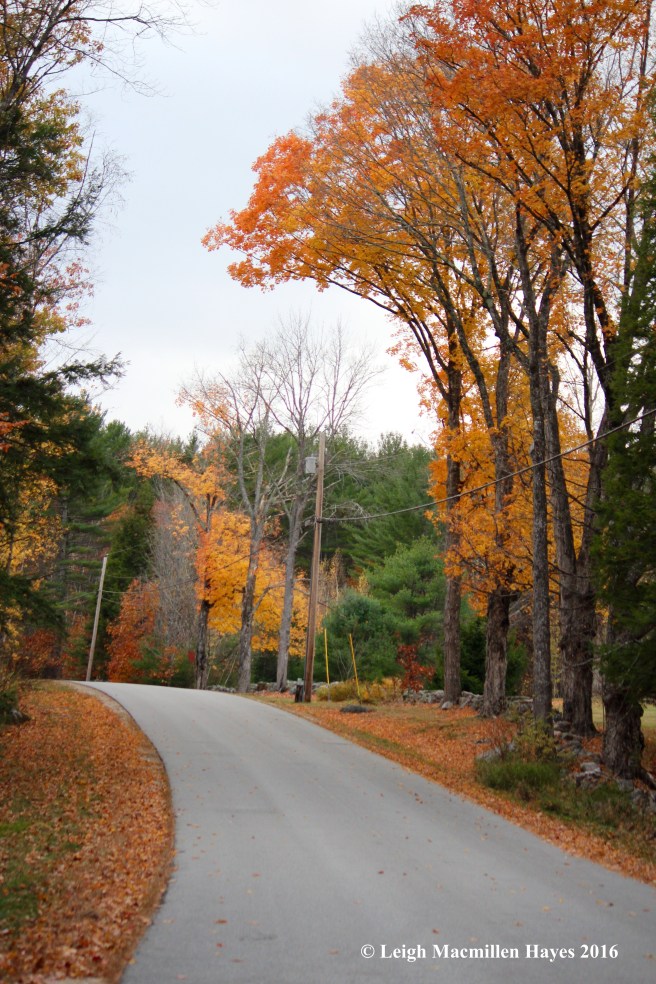
t-menotomy-road-1

If you go, you might want to drive to the old trailhead, park your vehicle and then walk back to the West Ridge Trail. We parked at the latter and had to walk the 1.5 back at the end, when it seemed even longer. But truly, the road offers its own pretty sights and the temperature was certainly just right, even with a few snow flurries thrown into the mix, so we didn’t mind. We were thankful we’d found our way along the new trail and revisited the old at Mount Tom. And I’m already eager to do it again.


The Fruits Of Our Labor Day Mondate

I feel like a broken record when I say that my guy works too many hours, but so it has been. This was his weekend off and he worked more than a half day on Saturday and all day plus on Sunday. This morning he burned it all off with a seven mile run and then we headed off for a hike.

k-trail sign 1

Mount Kearsarge North off Hurricane Mountain Road in North Conway, New Hampshire, is an old fav that deserved a visit.

K-trail goes this way

It was great to be out of town and finally goofing off on this Labor Day holiday. He’s labored. I’ve labored (really–even when it seems like I’m playing, I truly am working, honest). And we needed a break. If we followed this blaze, however, we would never have found the summit.

k-climbing higher

Fortunately, we knew better. The hike is challenging, especially on the upward climb. We later commented about how the downward climb is faster, but does require attention to foot placement.

K-approaching tower

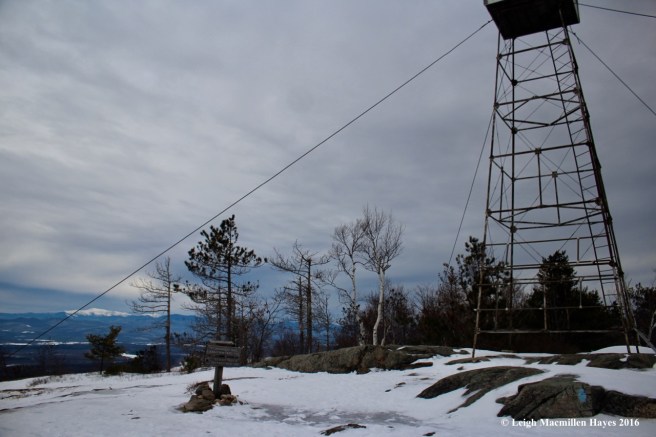
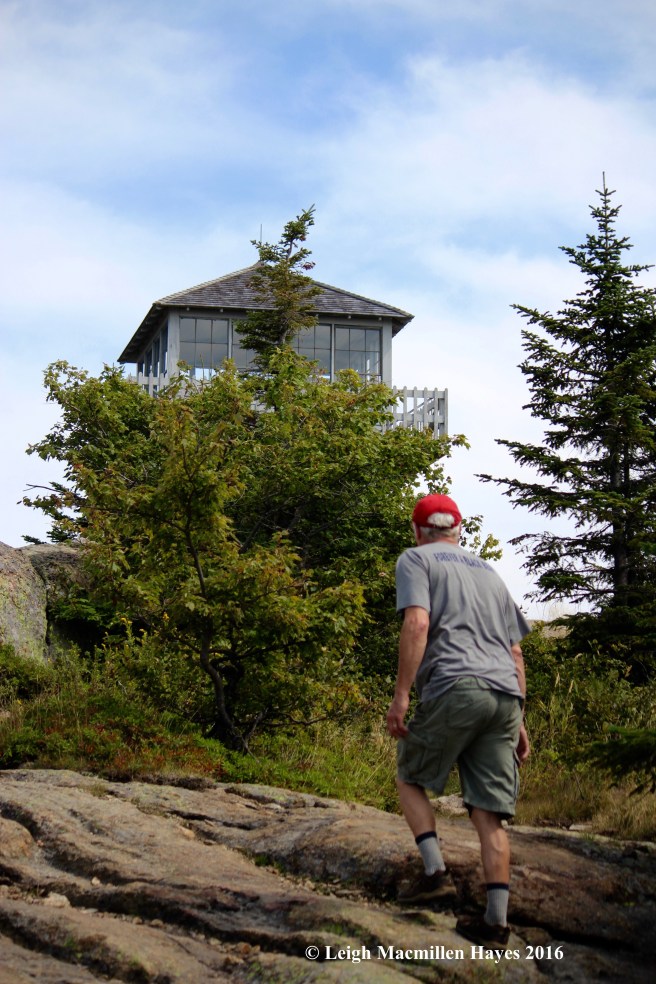
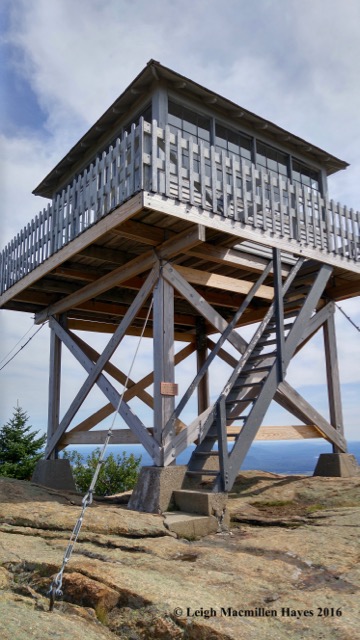
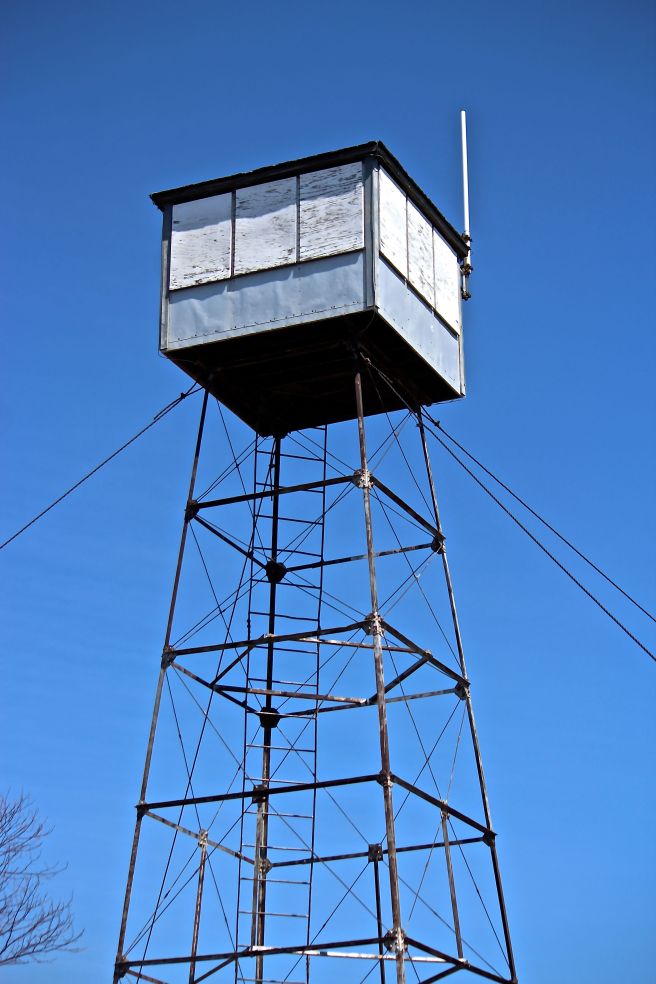
Just over two hours later, we approached the fire tower at the summit. Though no longer in use, it’s obvious from the 360˚ view why a fire lookout was built at this summit. Constructed in 1909, the structure was rebuilt by the US Forest Service in 1951. Prior to the replacement of fire towers by airplane surveillance, this tower was in operation until 1968.

k-summit fire tower (1)

Since we were last here about a year or so ago, it looked as if some of the support beams had been replaced.

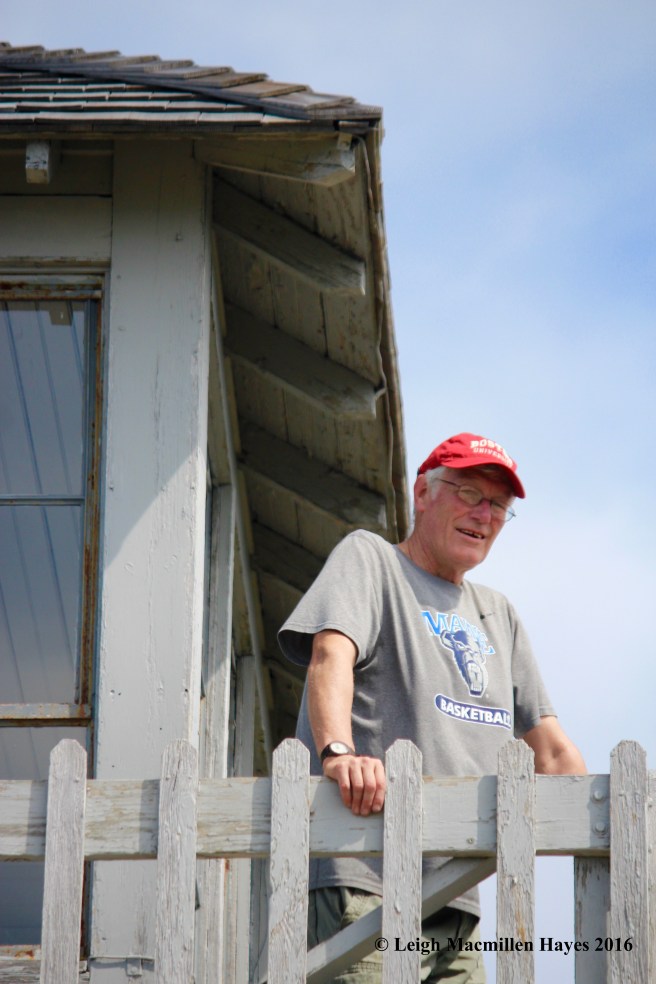
k-my guy at tower

Despite the cooler temps and wind, it’s always worth a climb up.

k-summit tower 3 (1)

Once inside, all was calm. And the view–to die for. It made the efforts of our labor well worth it. We signed the log before moving back outside.

k-summit view 1 (1)

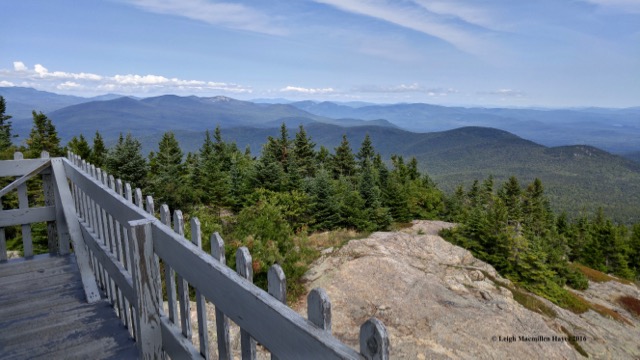
I was thankful for the railing that kept me from being blown to the great beyond as I gazed toward the Baldfaces,  though the wind wasn’t nearly as strong as last week’s Mount Crawford Mondate.

k-summit Mount Washington (1)

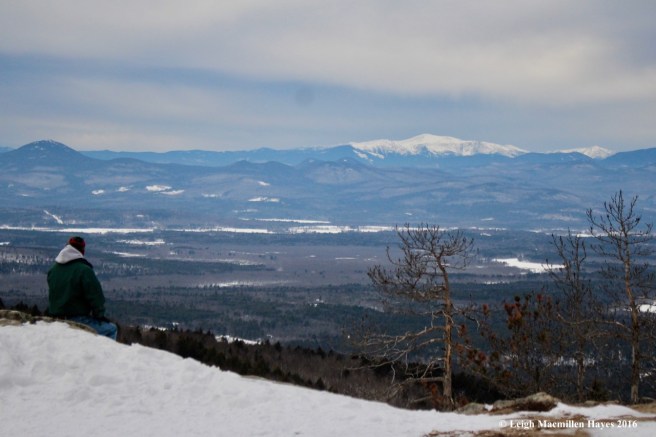
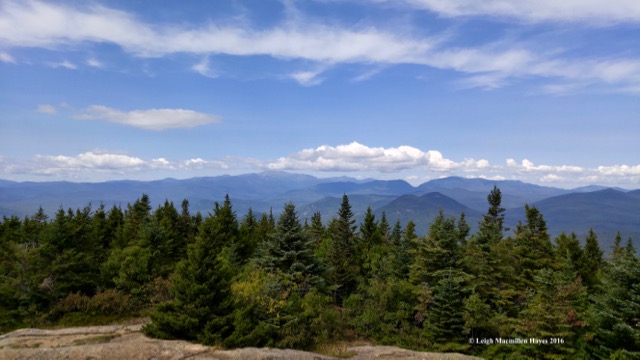
Back on the granite, we twirled about and took in each view–including Mount Washington with cumulus clouds grazing its summit.

k-summit to ledges and moats (1)

The cloud cover varied as we looked toward the valley with Cathedral Ledge, the Moats and beyond. Because we’ve set our feet down at those various levels, we appreciated the layers before us.

k-summit toward cranmore (1)

And we noted the Green Hills Preserve, where we’ve also hiked many a trail.

K-Pleasant Mtn

The cloud cover changed as we turned toward home and saw Pleasant Mountain in the distance. Our house is located about center beyond the mountain. And our camp to the left end of said mountain.

k-summit lunch rock (1)

Of all the rocks, lunch rock was the most important find. Sometimes, it’s difficult to locate such among all the opportunities, but this one spoke to us. And so we sat. And ate. Sandwiches (not PB&J–those are more for winter fare) and brownies (great any time of the year).

k-my guy snoozing (1)

And then my guy decided to snooze. He deserved it.

k-hare scat

I took advantage of the opportunity to observe and was tickled to find these woody fruits–the milk duds of the north woods. Snowshoe hare scat. I found numerous examples and wondered where the hares hid. Actually, they could have been anywhere because among the bald rocks there were plenty of islands filled with brushy undergrowth.

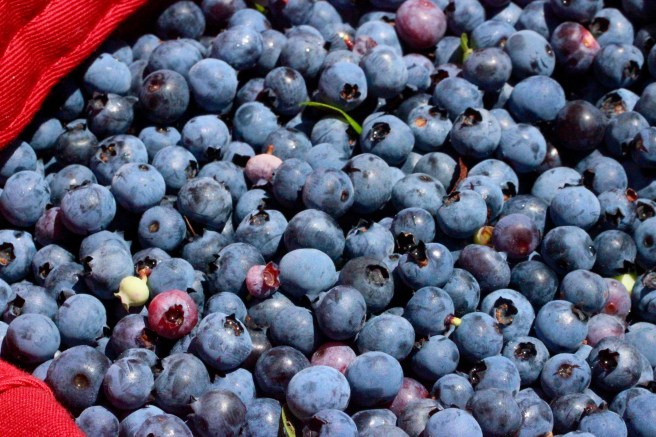
k-blueberry.jpg

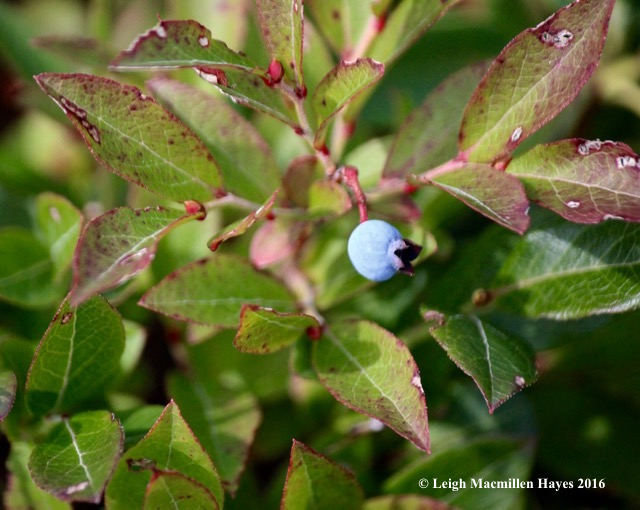
And so I poked about. Though the low bush blueberry plants were plentiful, the fruits were sparse. In fact, I only spotted this one.

k-mountain cranberries

More prolific were the mountain cranberries, aka lingonberries.

k-summit speckled alder (1)

What surprised me was the presence of speckled alder in the mix because I think of this as a species with wet feet, but really, this mountain top is much moister than most of our lowlands, so in the end I guess it made sense. Always something to wonder about.

k-sheep laurel fruit.jpg

It wasn’t just speckled alder that made me wonder. Sheep laurel also grew there. I know it well in bogs and even along the power line behind our house. And yet, it loved the habitat on the summit.

k-summit huckleberries (1)

The same was true for huckleberries–which I look at beside Moose Pond all summer. How can they like wet feet and a bald mountain landscape. But again, I think perhaps it’s the moisture for these mountains are often lost in the clouds.

K-mountain holly

Mountain holly also liked this habitat. Again, I’ve seen this at camp where the fruits have already been consumed. Songbirds love these berries and the supply on Kearsarge will disappear soon as migration begins. Here today, gone tomorrow.

k-wild raisins 2

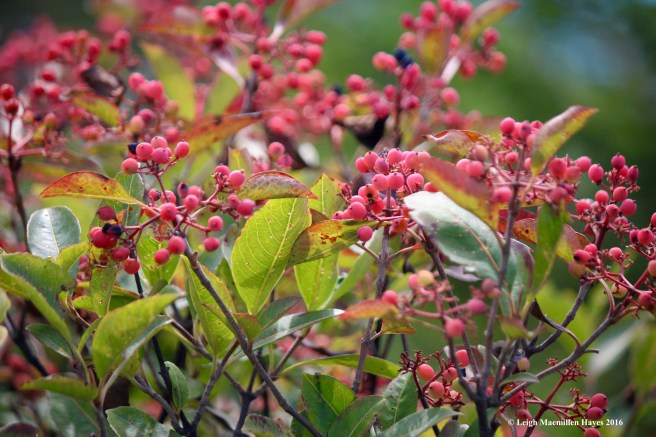
Wild raisins were equally plentiful and worth admiring.

k-wild raisins 3

The berries are edible, at least for birds. But . . . if not consumed, the fruits shrivel up–thus the name of wild raisin.

k-trail sign 2

At last, my guy awakened and we picked our way among the rocks and roots on our descent.

K-oak plum gall (1)

At least one more fruit showed its face on the downward route. Or was it a fruit? Actually not–it was an oak plum gall created by a wasp.

We talked about Labor Day as we climbed down. Labor Day is a tribute to the contribution of those who work and contribute to the strength, prosperity and well-being of our country. We gave thanks to our parents and the work ethic they taught us. And we noted the fruits of labor we saw in the natural world.

Finally, we toasted all with a beer at Delany’s Hole in the Wall in North Conway–a Shock Top for him and Tuckerman’s Pale Ale for me. On this Mondate, we felt rewarded with the fruits of all labor.


Our I Dos

Twenty-six years ago we both said, “I do.” And those two little words have stuck with us ever since.

t-road

The road has had a few bumps and turns, but relatively speaking, it’s been an easy path to follow.

t spider web

Sometimes the web we’ve woven has torn, but we’ve learned to mend it when necessary.

t-birds nest fungi

We’ve filled the nest and watched our sons disperse, and welcomed them home again.

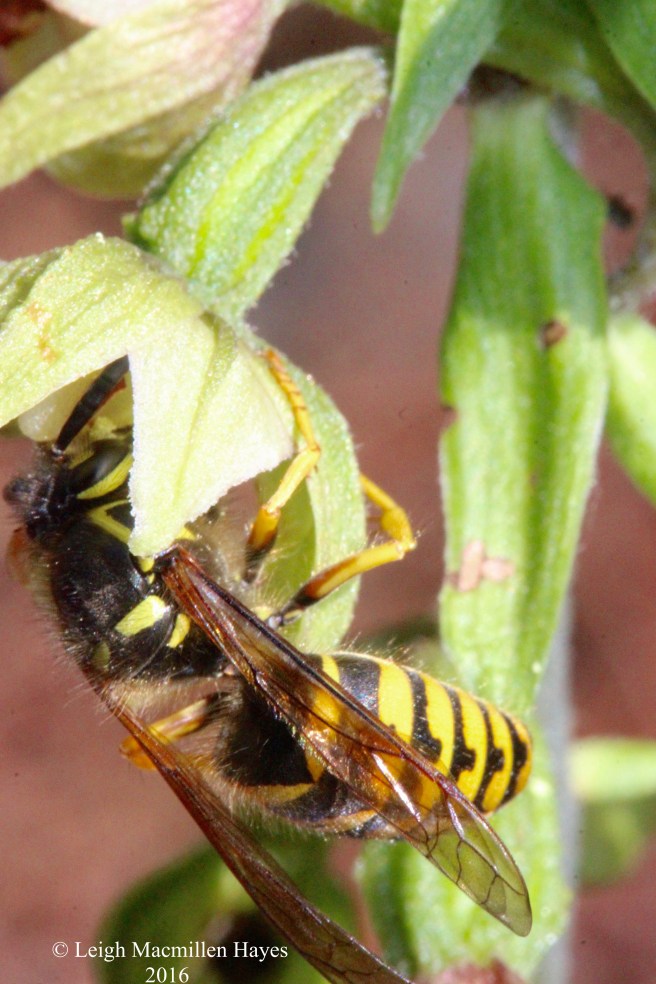
t-orchid pollinator

We’ve found fulfillment  . . .

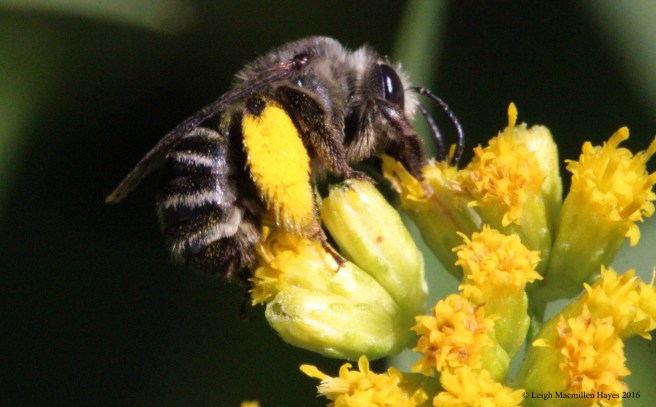
t-pollen

and tried to share it with others.

t-wings

We’ve each grown wings and let the other fly.

t-pleasant mtn

We’ve cherished the beginning of our journey and give thanks for all the uphill moments.

sunset 3

At the end of the day, we don’t know what the future holds, but we appreciate the past.

Happy Anniversary to my guy. If I had to do it all over again, I’d still say, “I do.” And I know you would too.

Filled to the Brim Mondate

It’s been a few weeks since my guy and I shared a Mondate. And so, this morning after joining our youngest for breakfast, we mosied on over to Pleasant Mountain in West Bridgton. Leaving the truck at the base of the Ledges Trail, we walked 1.5 miles down the road to the Bald Peak Trailhead. Since we didn’t have two vehicles, it was much easier to get the road piece done first, rather than at the end when we would be hot and tired. The climb up was a wee bit slippery since it had rained most of the weekend and was still raining at 5am. But the rain had stopped, the sun shone brilliantly and the breeze made for a pleasant adventure up our favorite mountain.

p-Indian cucumber root

My guy encouraged me to go first and I surprised him with a steady pace. I did pause, however, when I spotted fruit beginning to form on Indian cucumber root.

p-berries wet

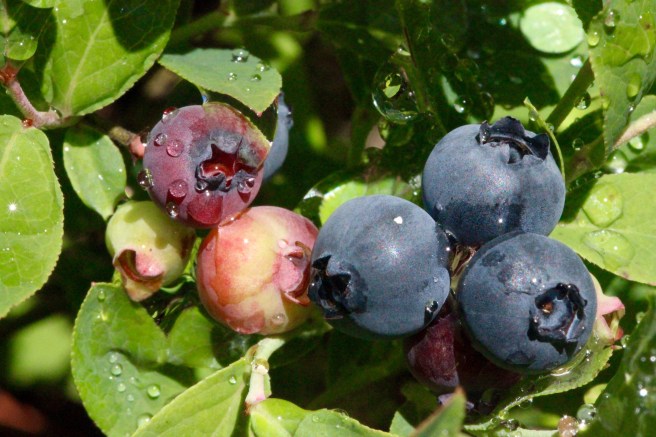
By the time we reached the intersection with the North Ridge Trail, we realized we were in for more fruit–a sweet treat. Since the high bush blueberries at home aren’t ripe yet, we didn’t even think to bring containers for the low bush berries that carpet the mountain’s ridgeline.

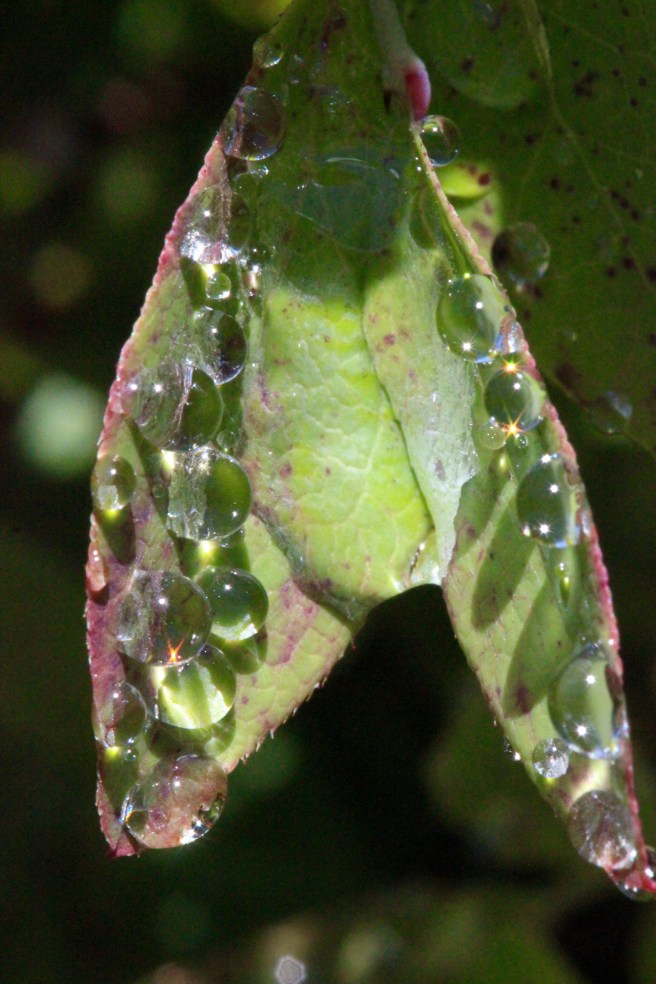
p-rain on berry leaves

Bejeweled berries and leaves sparkled in the morning sun.

p-ridge view 2 (1)

We continued across the ridge, but in the slowest of motions for us. My guy lagged behind, which isn’t usually the case.

p-picking berries 1

Unless, that is, he spies blue. Everywhere.

p-picking4

At first, we ate them on the spot.

p-picking2 (1)

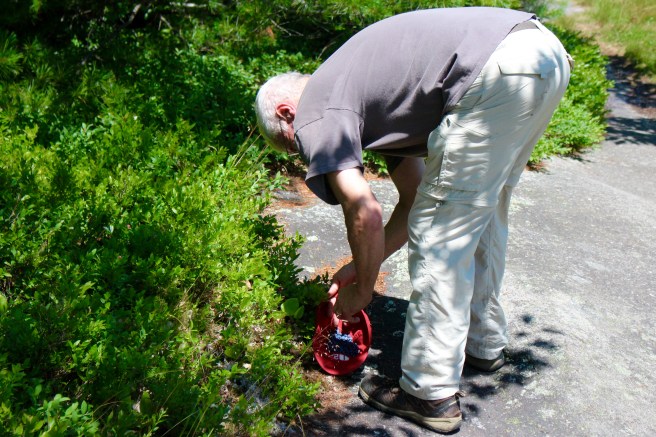
But then he decided that his hat would serve as the perfect container.

p-picking berries 1 (1)

And that’s when greed set in.

p-picking 6

Blueberry greed.

p-picking 5

He couldn’t pick them fast enough.

p-filled to the brim

Even as we sat to eat our sandwiches in an area where the only view was blueberry bushes, a few oaks and pines, he continued to pick until his hat was filled to the brim.

p-summit 1

Somehow, he finally pulled himself away and we continued on to the summit.

p-wood lily 2

I was eager to get to the summit and then move on because I hoped to find the wood lily in bloom.

p-wood lily 2 (1)

And I wasn’t disappointed.

p-ledges 2 (1)

Our descent was much quicker as the berries aren’t quite so abundant along the Ledges Trail. Speaking of that, those who fear that I’ve given away a prime location, fear not. My readership is low and the berries plentiful.

p-camp kayak

Back at camp, we checked on some high bush berries, but they’re still green. The greed will have to hold off for a few more days. Thank goodness we could find our way home with the help of a cairn–in the water?

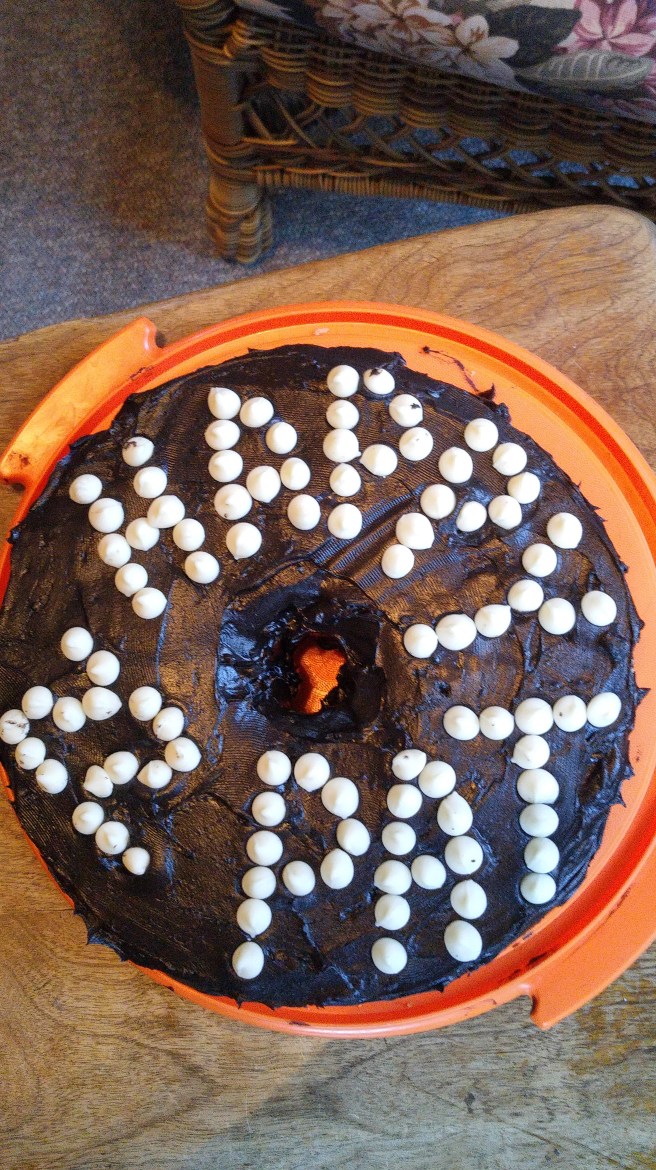
p-cake 2

And then it was time to prepare dinner and help our youngest celebrate his birthday. He’d spent the day playing in Boston, much more fun that hanging out with the ‘rents.

A pleasant Mondate indeed. Filled to the brim were we–with each other, blueberries, cake and family time.

Hawk-eye Mondate

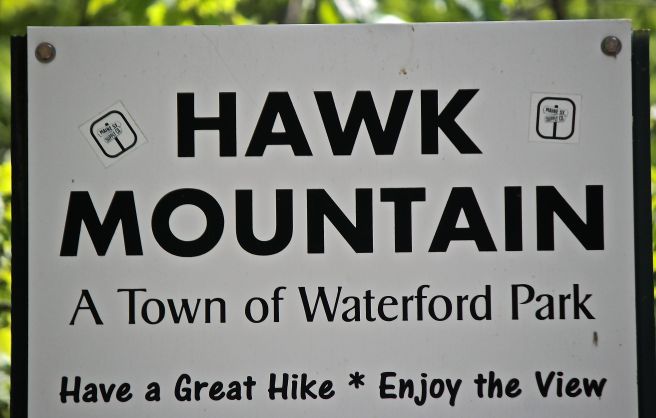
Some Mondates are shorter than others and such was the case today. But . . . we made the most of it as we walked up the trail to Hawk Mountain in Waterford.

hm-sign

It’s a half mile trek up a dirt and gravel road–just right when you want a great view and time is short. Of course, you could spend hours at the summit, but we weren’t there long.

hm-interrupted1

On the way up, I noticed interrupted fern in its interrupted form. Fertile leaves toward the middle are densely covered with sporangia (spore-bearing structures). I’m fascinated by their contorted, yet beautiful structures.

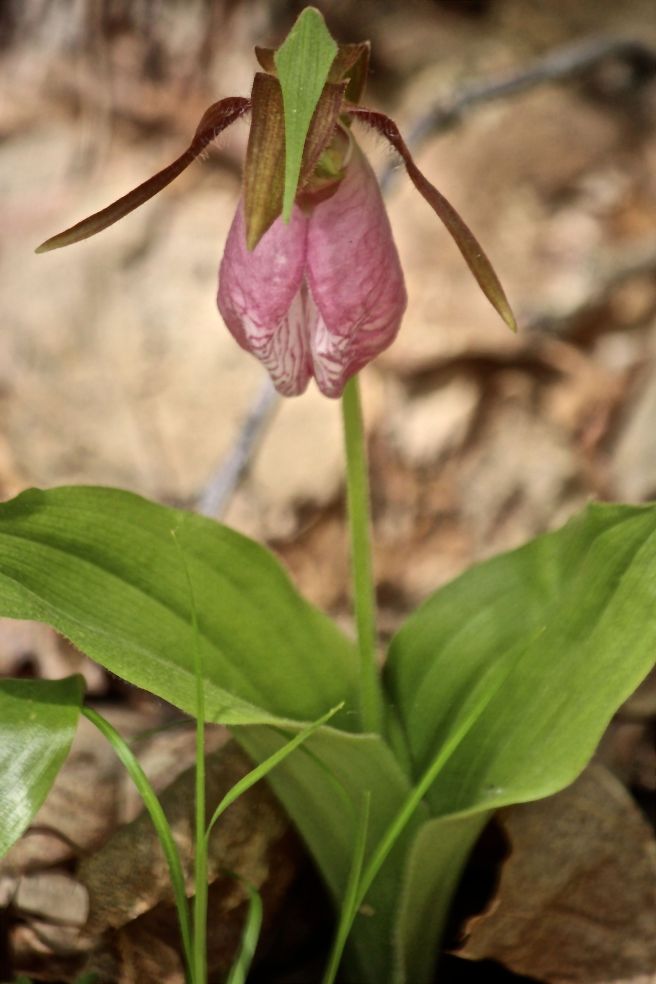
hm-lady1

Another favorite–lady’s slippers. Again, its structure is beyond my understanding.

hm-cyrstal and long2, ph

At the summit, we paused briefly and gazed toward Crystal and Long Lakes.

hm-white oak 4, ph

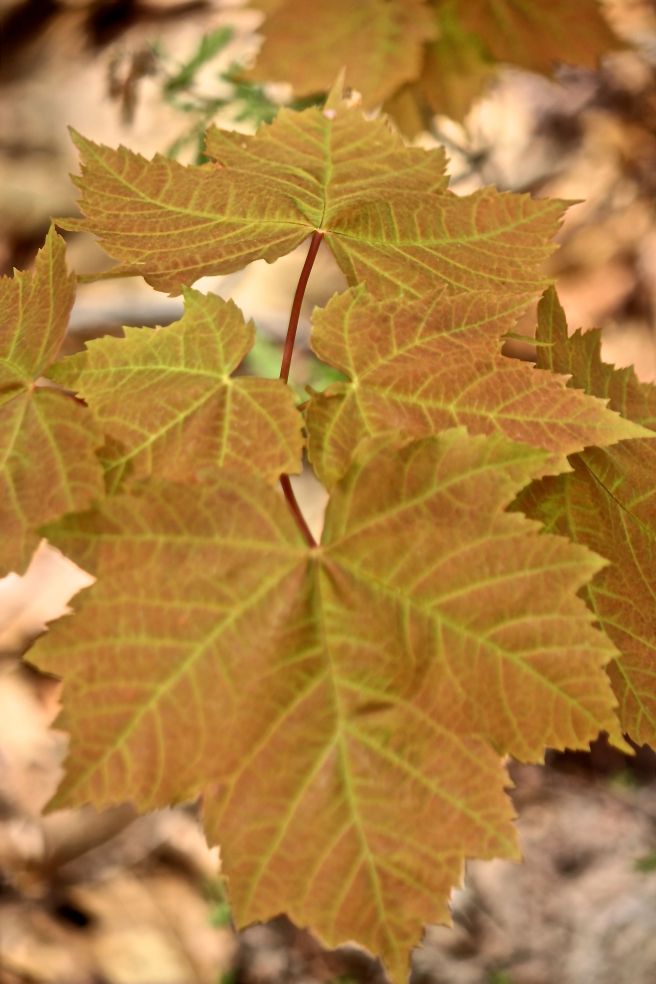
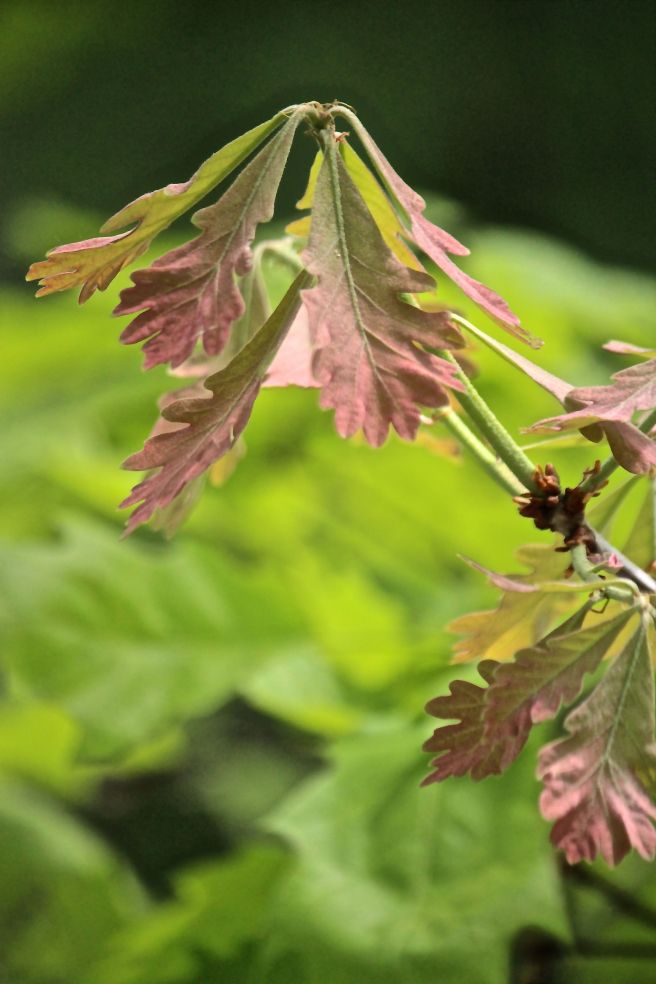
While my guy moved on to the better vantage point, I stopped several times. First, it was the color of these leaves that slowed me down. Have you noticed how spring foliage provides a subtle play on fall foliage? A few friends and I have been thinking about this lately, and this morning I had the opportunity to pick the brain of Dr. Rick Van de Poll, a well-known mycologist/naturalist/educator.

hm-red maple 1

He reminded me that the various hues of color in leaves is caused by the presence of pigments called anthocyanins or carbohydrates that are dissolved in the cell sap and mask the chlorophyll. As our spring temperatures rise and light intensity increases, red pigment forms on a leaf and acts as a sunscreen to protect the plant from an increase in ultraviolet rays.

hm-white oak1

It wasn’t only the color that caught my eye. Take a look at the lobe shape of the reddish leaves and that of the green in the background. In my continuing personal citizen science project to informally connect the dots of where white oaks meet red oaks, I added another pin on the map. Rounded lobes=white oak in the foreground. Pointed lobes=Northern red oak in the background.
hm-bee1

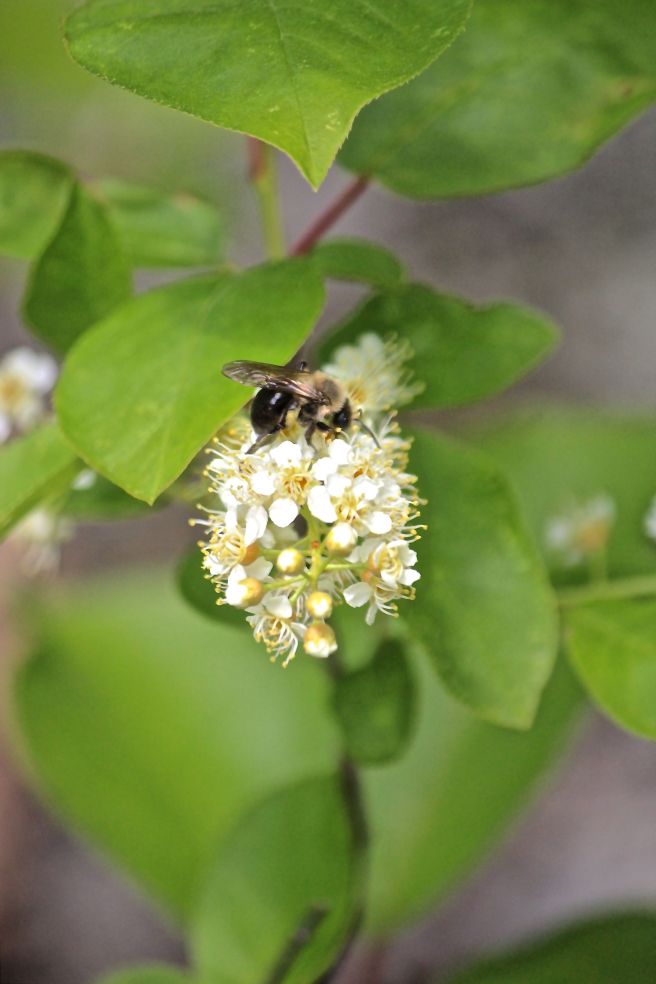
As I headed toward my guy, I noted that the cherry trees were abuzz.

hm-wild columbine1, ph

And hiding among the rocks at the base of a tree–another treat for the eyes. Wild columbine. Splendid indeed.

hm, cyrstal and long, ph

Equally splendid–the view from the ledges. Crystal and Long Lakes again.

hm-bear river

Bear River below. I always expect to see a moose here. Or maybe a bear. One of these days.

hm-pm1, ph

Pleasant Mountain and my guy.

hm-dragon5

As we walked back down the trail and concluded our Mondate, we celebrated the fact that dragonfly season has begun. With their hawk eyes, may they capture and consume a kazillion black flies and mosquitoes.


Our Place

h-tom2

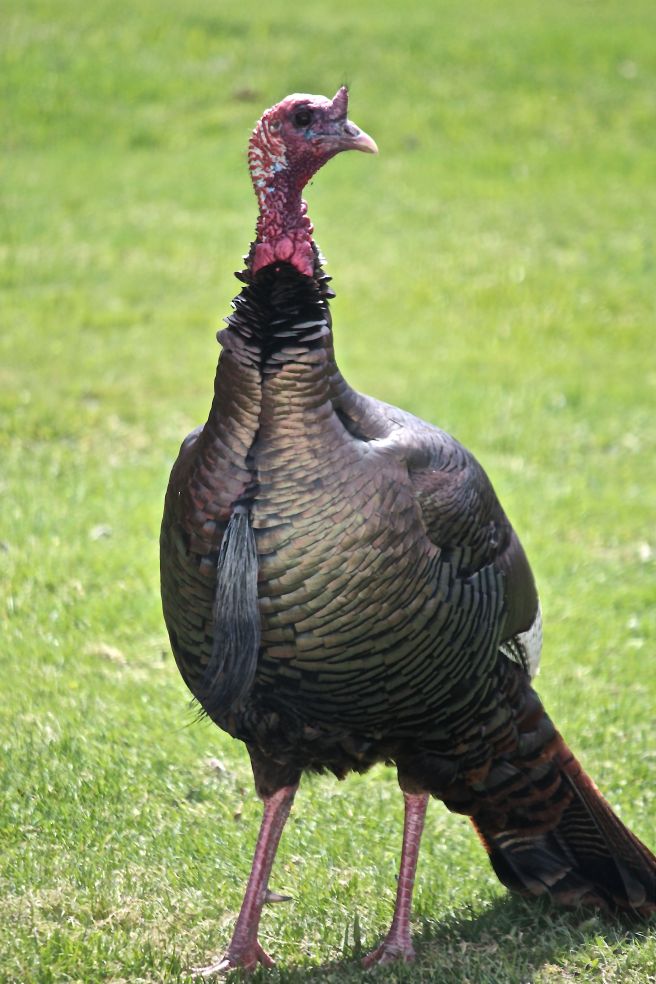
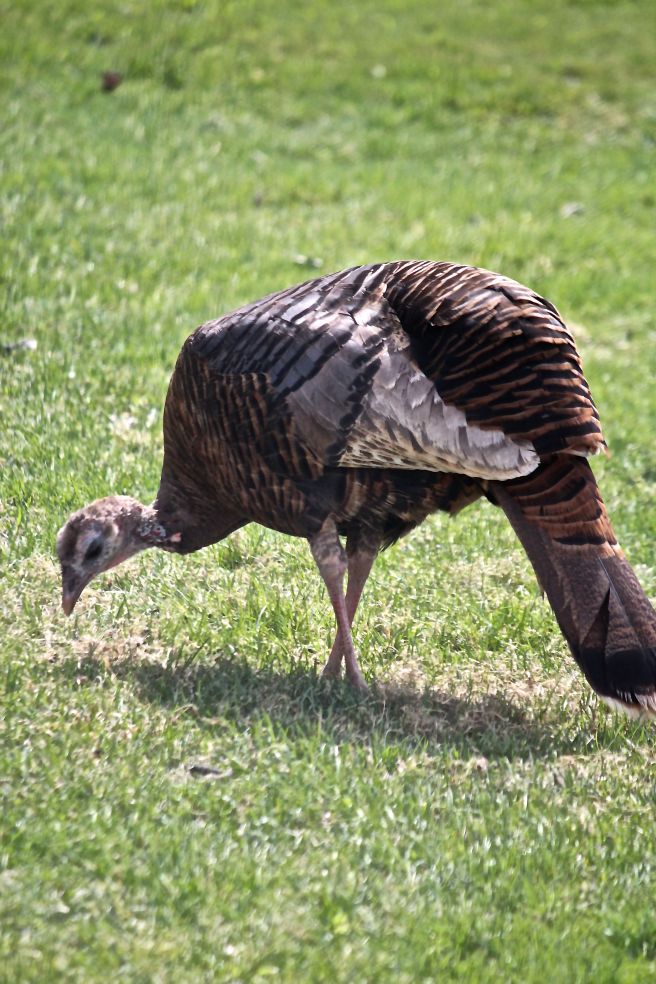
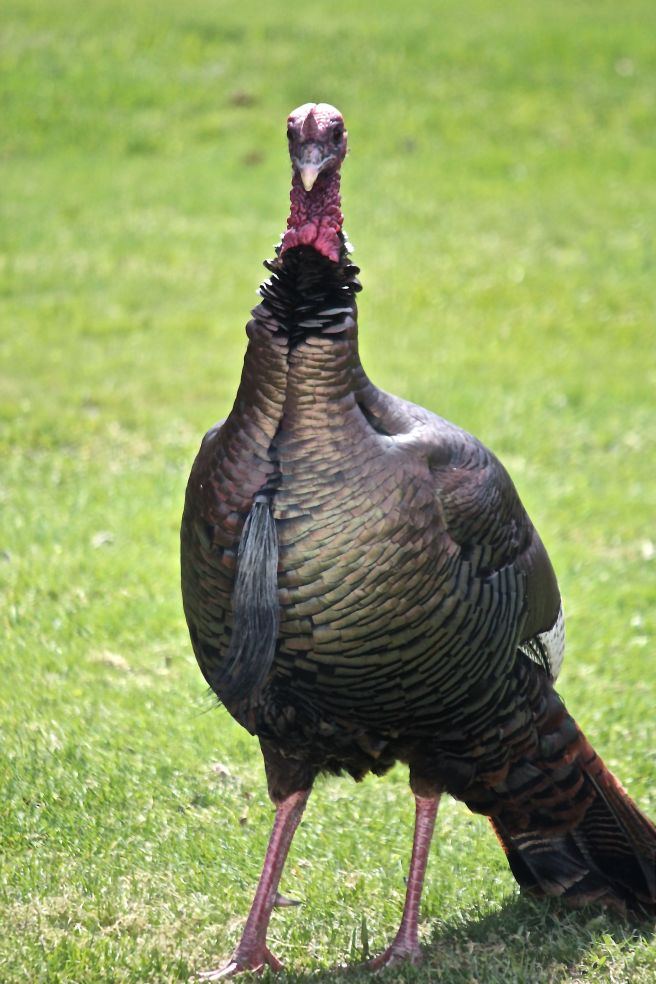
Gooble. Gooble. Gooble. Gooble. Gooble. Gooble. Gooble. Seriously . . . is all that noise necessary? Apparently it is. Mr. Tom felt the need to awaken us at this morning’s first light with his non-stop gobbling–his way of calling the hens to join him. Disclaimer: I didn’t take this photo until later in the day. In all his ugliness, I have to say that he really is a handsome fellow.

h-female turkey

The hens who hang out with him don’t appear to care, but maybe they’re just playing coy.

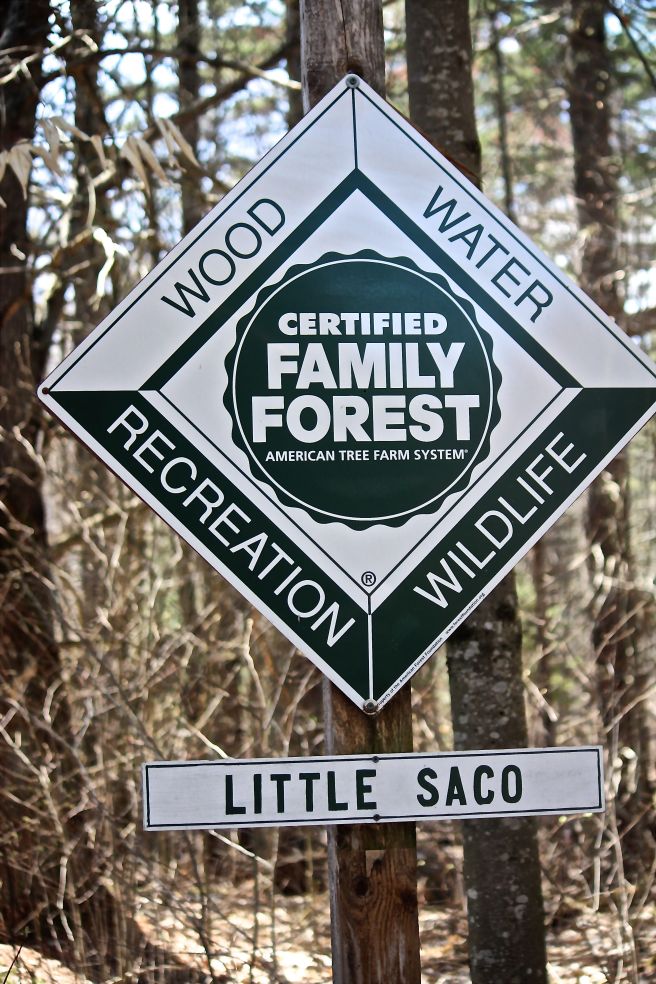
p-little saco sign

We left them to the bird seed scattered on the ground and drove to Farnsworth Road in Brownfield for a hike up Peary Mountain. The trail is located on private property and we’re thankful that it’s open to hikers. Much of it is a snowmobile trail as well.

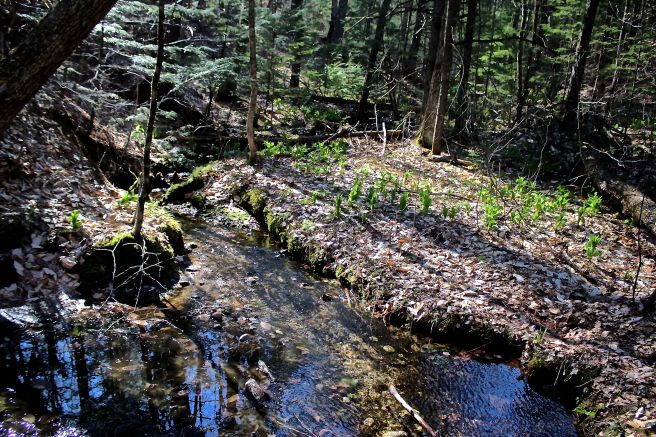
p-Little Saco

The Little Saco flows over moss-covered rocks beside the lower part of the trail.

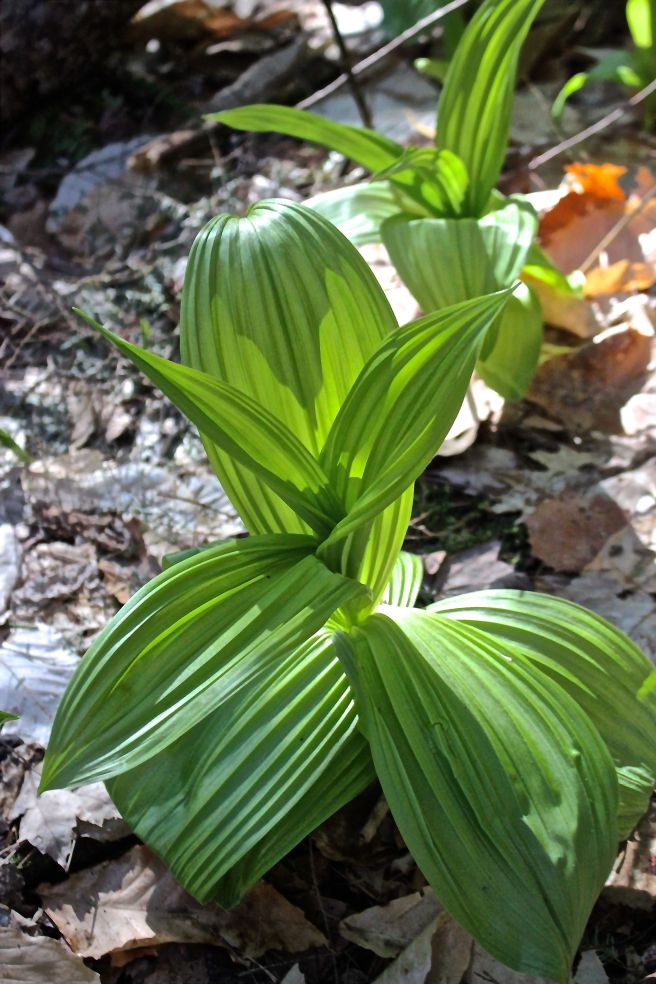
p-false 4

As we followed it, bright green growth in the damp soil warranted a closer look.

p-false hellibore 2

A true sign of spring–false hellebore with its corrugated leaves.

p-striped 2

There are plenty of other signs, including the pink and green striped maple buds. I’m missing my macro for these moments of early glory, but so it is.

p-beech 1

While some beech trees still have a few marcescent leaves clinging until they can no more, I noticed a few buds beginning to burst.

p-summit sign

At a stone wall, the trail suddenly turns 90˚ to the left.

p-fdn 2

But in the opposite direction–the remains of an old foundation.

p-fdn ledge 2

And above, a ledge from whence the stones presumably came.

p-porc scat

The ledge continues to provide a dwelling–for critters like the porcupines who keep the hemlocks well trimmed.

p-bluets

As we climbed to the top, delicate bluets showed their smiling faces.

p-bench view1

And then we emerged on the 958-foot summit, where the bench view is glorious. The small mountain was named for Admiral Peary. Apparently, his mother’s family, the Wileys, lived in neighboring Fryeburg. Upon graduating from Bowdoin College in 1877, Peary lived in Fryeburg and conducted survey studies of the area for a couple of years, before moving to DC and later leading an expedition to the North Pole.

p-mount wash

If you’ve seen similar views of the big mountain, its because it’s part of our place.

p-my guy view

I followed my guy along the ridge line to the end–where the view turned homeward.

p-pointing

My guy made a point of recognizing landmarks from Mount Tom and Lovewell Pond along the Saco River to Pleasant Mountain and Brownfield Bog.

p-Pleasant 2

If you look closely, you’ll notice a horizontal line just below the bog–that’s the Saco River. And the little mountain to the left of Pleasant Mountain–Little Mountain in West Bridgton.

p-Pleasant Road1

The only part of the view that we don’t get–the new road that was constructed up the backside of the mountain within the past year. It worries us. And that is why we appreciate the efforts of Loon Echo Land Trust for protecting most of the rest of the mountain.

b-pitch pine

We headed home for lunch and to pull out the lawn furniture.* And then we parted ways, my guy to attend a celebration of life for an old friend, and me to climb Bald Pate. My purpose–to look at the pitch pines and jack pines.

b-pitch 2

In bundles of three, the stiff needles surround the male pollen bearing cones on the pitch pine.

b-jack pine1

Jack pine features two needles per bundle–think Jack and Jill.

b-peabody & sebago

From the summit, I paused to take in the view of Peabody Pond and Sebago Lake beyond. It doesn’t matter how often I climb to the top of this 1,100-foot mountain, the view is ever changing.

b-mount wash1

And again, I could see Pleasant with Mount Washington in its saddle. This time, however, I was on the opposite side looking at the front of Pleasant Mountain. You may wonder about the road–it leads to two cell towers near the Southwest Ridge summit.

b-sweet fern 1

As I made my way to the Foster Pond Lookout, I stopped frequently to enjoy the ever-artful presentation of sweet fern.

b-blueberries

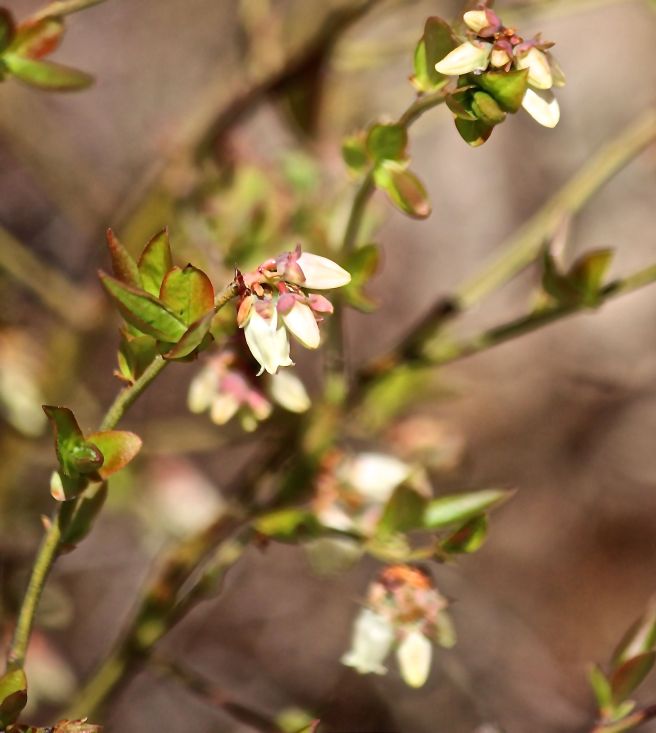
And I noticed another sweet offering that many of us will enjoy this summer–blueberry plants in bloom.  A year ago next week, I saw the same on this very mountain. Seems early, but I think they’re well protected in a sunny spot.

b-foster pond 2

I’m sure had my guy been with me, he would have named a color chip that matched Foster Pond–perhaps turquoise blue best described it in that moment.

b-bird treat 1

Heading back to my truck, I noticed some bird treats dangling from the trees. Perhaps our turkeys will fly to South Bridgton.

h-tom 3

Apparently not. Back at home, Tom had returned. He’s a frequent visitor to our place. And we’re frequent visitors to the area beyond our backyard. It’s all really his place and our place.

* If you live in our area, expect at least one more snowstorm. It always snows once we pull out the lawn furniture.


From Peak to Shining Peak

Maybe we’re a wee bit crazy. Maybe there’s no maybe about it. My guy and I climbed Pleasant Mountain again, only this time we took a much longer route than yesterday.

p-Bald sign

After leaving a truck at the Southwest Ridge trail, we drove around the mountain and began today’s trek via Bald Peak. It’s always a good way to get the heart beating, but then again, any of the trails up the mountain will accomplish that mission.

p-bald stream 2

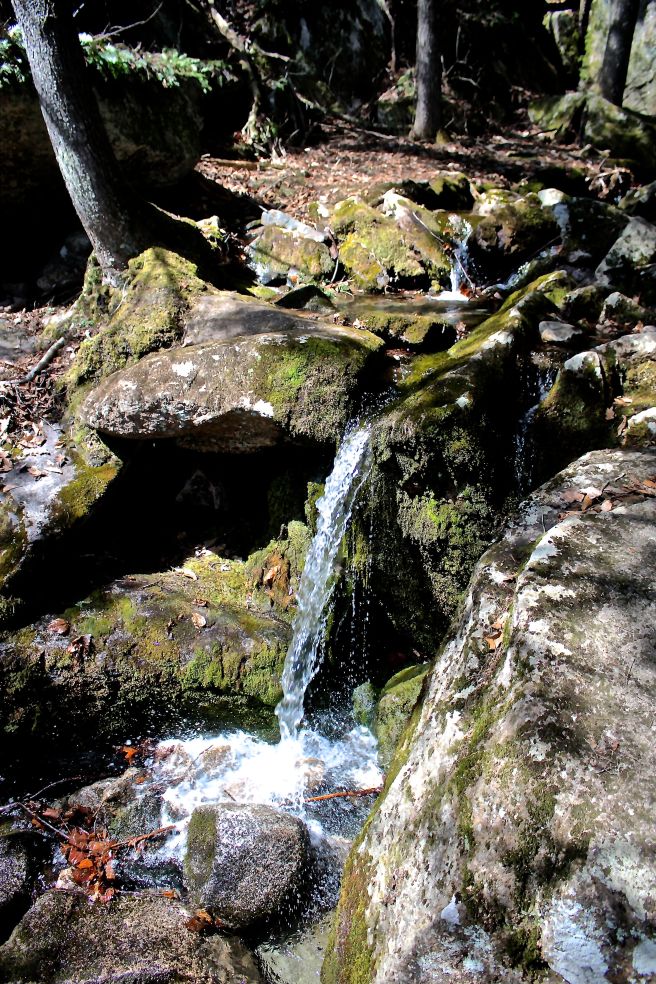
One of my favorite features of this path is the voice of the stream–water rippled with laughter as it flowed over moss-covered rocks before splashing joyously below.

p-Sue's Way signs

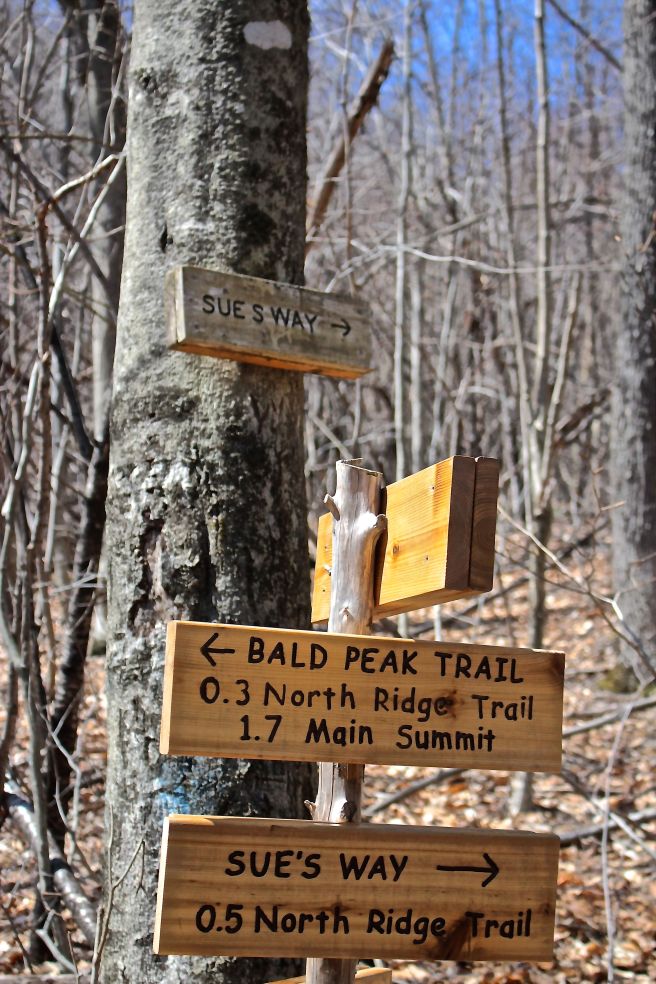
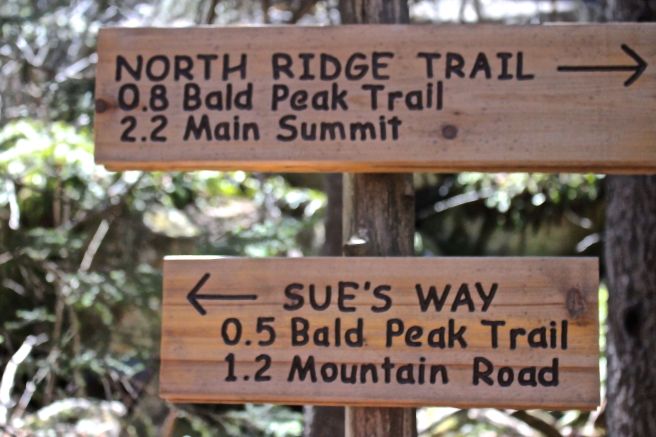
And then we turned right onto Sue’s Way. We never knew Sue, but are thankful for this path carved in her honor.

p-Sue's snow on East

Across the ravine, snow still clung to the East slope at Shawnee Peak Ski Area.

p-Sue's porky

Oaks, beech, hemlock and yellow birch form most of the community, feeding the needs of their neighbors–including porcupines.

p-Sue's 2

We followed the trail as it embraced another stream and watched the landscape change.

p-Sue's polypody

Eventually, we were in the land of large boulders and ledges, all decorated with common polypody and moss–an enchanted forest.

p-shawnee chair

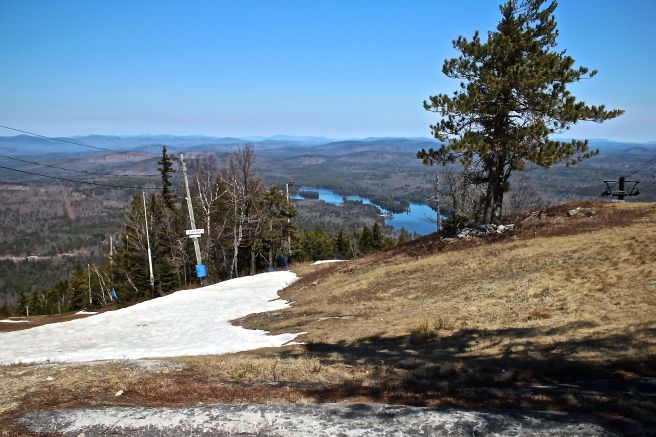
At the top of Sue’s Way, we detoured to our first peak–Shawnee Peak.

p-shawnee

Splotches of snow signified the end of a season.

p-Shawnee chair 1

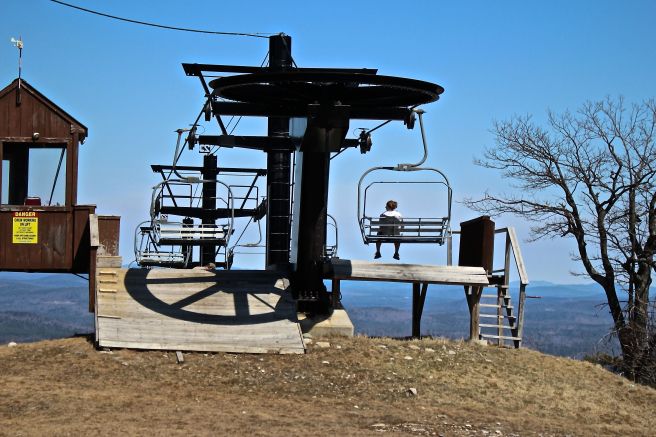
The Pine chairlift silently rested, its duty accomplished until it snows again.

p-shawnee ski chair 2

And in the shack, the back of ski chair spoke of past adventures and adventurers.

p-signs by mtn

From there, we followed the North Ridge Trail to our first official peak.

p-north peak trail ice1

Despite today’s warmth, ice still reflected movement frozen in time.

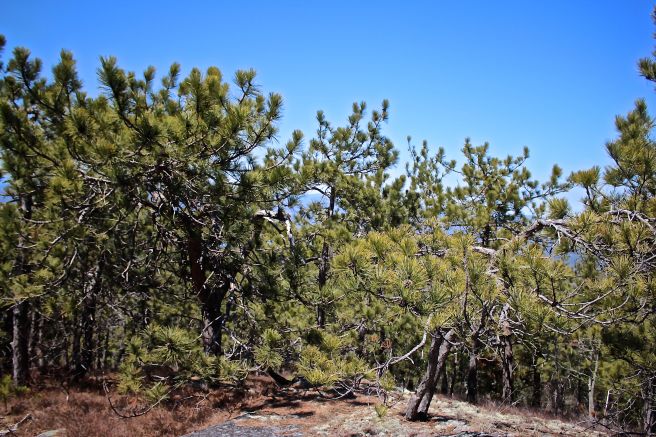
p-north peak pines

North Peak has always been one of my favorite spots on this mountain. In the land of reindeer lichen, blueberries and dwarfed red pines, we ate lunch–day two also of ham and  Swiss. This is becoming as much of a habit as climbing the mountain.

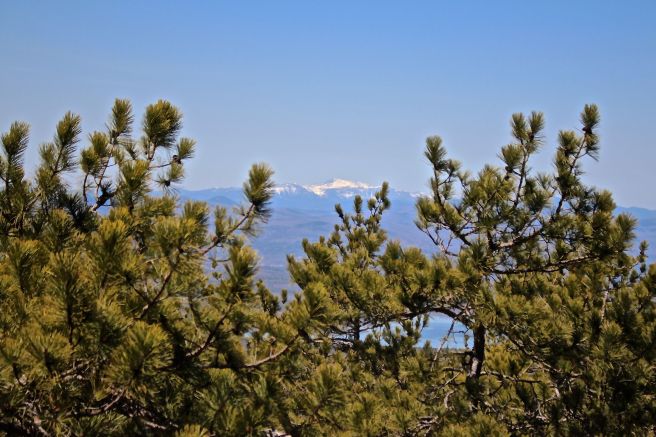
p-Mtn W from lunch rock

When we stood up on lunch rock, our view included the master of all New England mountains glowing in the distance.

p-north peak

In a few months, the treasures of this place will give forth fruitful offerings.

p-ridge line

With North Peak behind, our view encompassed the rest of the peaks.

p-Bald Peak, Mtn W and Kezar Pond

Continuing down and up again, we heard plenty of quaking coming from a vernal pool about one hundred feet off the trail. And then we were atop Bald Peak, where Mount Washington again showed its face, with Kezar Pond below.

p-bald peak causeway

The other side of the trail offered a photo opp of the Route 302 causeway that divides the north and middle basins of Moose Pond.

p-ft again

Our decision today was to hike the mountain in a backward fashion as compared to our normal routes, so we approached the main summit from the Firewarden’s Trail.

p-summit crowd

Once again, many others also took advantage. We did chuckle because except for one guy, of all the people we encountered, we were the oldest. The youngest–a baby in a backpack.

p-SW sign

At the junction below the main summit, we began to retrace yesterday’s footsteps on the Southwest Ridge Trail.

p-SW mayflower

The sunny exposure made this the warmest of all trails and the Trailing Arbutus prepared to make its proclamation about the arrival of spring.

p-SW Hancock

Near the teepee, I felt compelled to capture the ponds again. Another beautiful day in the neighborhood.

p-SW 2

After chatting with a family at the teepee, we began our descent. Of course, someone was mighty quicker than me.

p-SW 3

Where no trees grow on the bedrock, cairns showed the way.

p-SW mnts

Before slipping into the forest again, I was thankful for the opportunity to capture the  blue hue of sky, mountains and ponds.

p-cairns final turn

We made our final turn at the three cairns and

p-SW final

followed the path down–though we did begin to think that maybe they’d moved the parking lot.

p-LELT

Over six miles and four hours later, we had Loon Echo Land Trust to thank once again for protecting so much of the mountain and maintaing the trails. We reminisced today about how our relationship began at a halloween party held at the ski area thirty years ago and the number of treks we’ve made along these trails since then. Whether hiking to the ledges or teepee, making a loop or walking peak to peak on a sunshiny day such as this–it never gets old.


From Sheep to Dinosaurs, Oh My!

After leaving a truck at the base of the Ledges Trail on Pleasant Mountain, my guy and I drove to Denmark Village to attend an annual celebration of fiber: the Denmark Sheepfest.

s-sheep 1

Like us, local sheep were ready to shed their winter coats.

s-sheepish look

Waiting their turn, they offered sheepish looks.

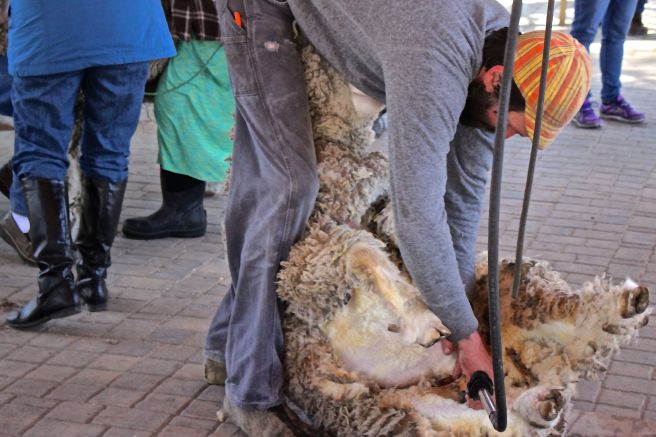
s-sheep shearing

But we heard no complaints as the shearing began.

s-MacKay 1

From there, we continued on to the Southwest Ridge Trail of Pleasant Mountain. As we climbed, we thought about the former name of the trail: MacKay’s Pasture Trail.

s-Mac 2

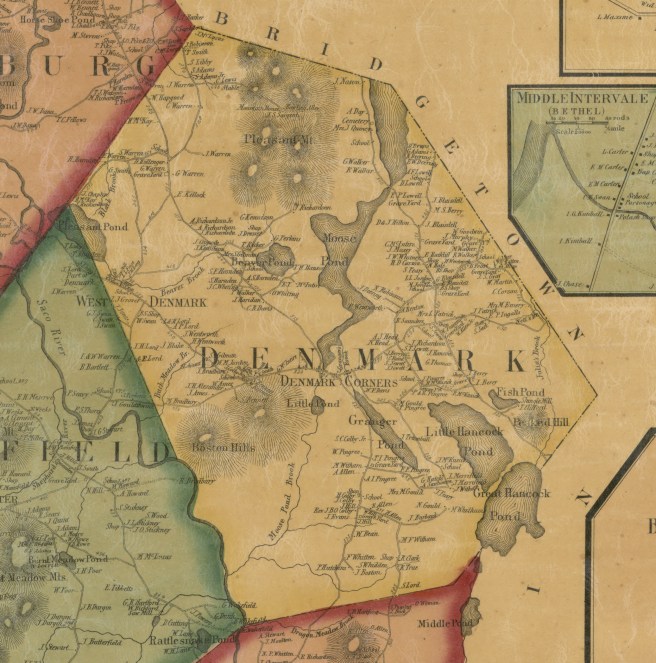
Between the rock outcrops and slope we decided that in the 1800s sheep probably roamed this side of the mountain. I found an 1858 map on the Denmark Historical Society’s Web site, but it’s too small to check names.

s-Denmark_1858

(Thanks to Jinny Mae for sending me a better copy of the map–the McKay’s property is located near the base of the trail on the Denmark/Fryeburg line–makes perfect sense that the side of the mountain served as pastureland for their farm.) Sheep and shepherds–We feel a certain affinity to shepherds/shephards because it’s a family name and were saddened to learn yesterday of the death of one relative we met this past fall in New Brunswick, Canada. Our acquaintance was short, but relationship long. As the Irish say, “May the light of heaven shine upon your grave.” Rest in peace, Ellis Shephard.

s-hiking

We love climbing up this trail and pausing . . .

s-mac 3

to take in the views behind us–Brownfield Bog, Lovewell Pond, Eastern Slopes Airport in Fryeburg, Maine, and White Mountains of New Hampshire in the distance.

s-lunch

In no time, or so it seemed, we reached lunch rock by the teepee. The teepee was constructed by the late George Sudduth, director/owner of Wyonegonic Camps , the oldest camp for girls in America. His wife, Carol, whom I’ve had the pleasure of hiking with, and family still run the camp, located below on Moose Pond.

s-lunch view

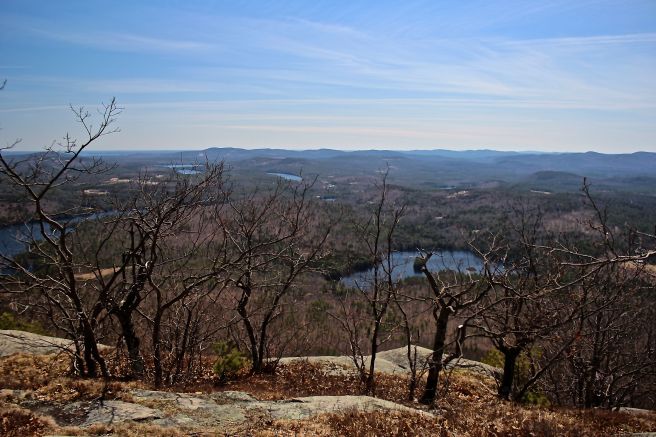
Our view as we appreciated fine dining–ham and swiss instead of PB&J–Moose Pond’s lower basin to the left, Sand (aka Walden) Pond with Hancock Pond behind it, Granger Pond and Beaver Pond directly below us. Actually, if you look closely, you might see Long Lake between Moose and Hancock. This is the Lakes Region of Maine.

s-fire tower 1

We continued along the ridge and the fire tower came into view. Once the leaves pop, this view will disappear until fall.

s-vp

At the vernal pool between knobs, we only saw one large egg mass–I had to wonder if the number is related to the amount of human and dog traffic.

s-ft2

And then . . . we were there. At the summit of Pleasant Mountain. With a kazillion other people and dogs.

s-summit 3

Again, we could see the bog and Lovewell Pond behind it,

s-summit view

plus Kezar Pond in Fryeburg and Mount Washington beyond.

s-summit 2

No matter how often I gaze upon this view, I’m always awestruck.

s-trail sign

We had two options because we’d left two trucks, and decided to follow the Ledges Trail to Mountain Road.

s-toadskin

Though I was with my guy, Mr. Destinationitis, I did stop long enough to admire the common toadskin lichen with its warty pustules.

s-toadskin and tripe

Had this been a teaching moment, the lesson plan was laid out in front of me–toadskin versus common rock tripe. Warty versus smooth. A difference in color. Both umbilicate lichens–attached to the rock substrate at a single point. OK, so maybe it was a teachable moment.

s-rest

But one of us didn’t give two hoots. He tolerated me . . . while he rested. ;-)

s-ledges 1

For the most part, we hiked within feet of each other, but I can never resist stopping at this point as we come upon the beginning of the ledges that gave this trail its name.

s-trees

Continuing down, I frequently grasped trees and thought about how many handprints are imbedded in the history of this land–from Native Americans to surveyors to shepherds to trail blazers and hikers. On this made-in-Maine type of day, we encountered many people of all ages and abilities–and were glad to share the trail with them.

s-dino1

It’s not only people and sheep who have moved across Pleasant Mountain. Even today, dinosaurs made their presence known.


Wet Feet at Brownfield Bog

When I suggested to Marita that we explore Brownfield Bog this afternoon, she wondered  how much water we might encounter on the road. And so we wore boots. Marita donned her Boggs, while I sported my waterproof hiking boots.

b-johnny jump up

Until we got there, we didn’t realize that the privately-owned road leading into the bog isn’t open yet, but thought we’d park at a driveway near the beginning and leave a note. The owner came along, whom she knew, and graciously invited us to park  near his home and cross through his woods down to the bog road. He and his wife share a piece of heaven and I took only one cheery photo to remind me of their beautiful spot and kind hospitality.

b-river road literally

And then on to the bog it was. Just after the gate, we realized that we couldn’t walk to the Saco River–literally a river road.

b-bog 1

But this is a bog, where all forms of life enjoy wet feet.

b-willow 2

From pussy willows to . . .

b-speckled alder 1

speckled alders,

b-cranberry

cranberries,

b-red maple 2

and flowering red maples–wet feet are happy feet and they all thrive in seasonally flooded places.

b-ducks 1

We kept scaring the ducks off, but know that there were wood ducks among the mix. They, of course, know the importance of wet and webbed feet.

b-lodge 2

b-beaver tree

b-beaver scent mound

And by their lodges, tree works and scent mounds, we knew the beavers had been active–another wet-footed species. We did wonder about the survival rate of those that built beside the road–seems like risky business given the predators that travel this way.

b-pellet

Speaking of predators, check out the orange rodent teeth among all the bones in this owl pellet.

b-bog 2

On this robin’s egg kind of day

b-pleasant mtn

with Pleasant Mountain sandwiched between layers of blue,

b-field 1

the breeze brisk at times and the sun warm always,

b-water over road on way back

the flow of water didn’t stop us.

b-wet feet

Waterproof boots and wool socks–the perfect combination to avoid wet feet. Well, maybe a wee bit damp, but five hours later and I just took my socks off.


Spotlight on Sabattus

Following this morning’s Greater Lovell Land Trust trek at Chip Stockford Reserve, where we helped old and new friends form bark eyes as they examined various members of the birch family, my feet were itchy. Not in the scratchy sort of way–but rather to keep moving.

It was a lovely day for a hike and Sabattus Mountain in Lovell was my destination. I love this little mountain because it offers several different natural communities and great views.

s-com 1

Though there are a few softwoods on the lower portion of the trail, it’s really the land of a hardwood mix.

s-downed twigs

About halfway up, the neighborhood switches to a hemlock-pine-oak community. It was then that I began looking for downed hemlock twigs in an array at the base of trees. I’ve found them here before, and today I wasn’t disappointed.

s-porky chew 3

The twigs had been chewed off and dropped by a porcupine as evidenced by the 45˚-angled cut and incisor marks. Though red squirrels also nip off the tips of hemlock twigs, they do just that–nip the tips. Porcupines cut branches.

s-porky cliff

Downed branches usually mean scat, but I searched high and low and under numerous trees that showed signs of activity and found none. A disappointment certainly.

s-pippipsewa

My search, however, led me to other delightful finds that are showing up now that most of the snow has melted, like this pipsissewa that glowed in the afternoon sun. As is its habit, the shiny evergreen leaves look brand new–even though they’ve spent the winter plastered under snow and ice. A cheery reminder that spring isn’t far off.

s-Pleasant 1

At the summit, I got my bearings–the ridge of Pleasant Mountain and Shawnee Peak Ski Area to the southeast.

s-mount tom & kezar pond

To the southwest, the asymmetrical Roche Moutonnée, Mount Tom, visible as it stands guard over Kezar Pond in Fryeburg.

s-Kearsarge 2

And to the west, Kezar Lake backed by Mount Kearsarge in New Hampshire. I wanted to venture further out on the ledge, but some others hikers had arrived and I opted not to disturb their peace.

s-summit wind

Instead, I sat for a few minutes and enjoyed the strong breeze offering possibilities as it floated over the summit and me.

s-porky cuts1

Crossing the ridge, I left the trail and found more porcupine trees, including this young hemlock that had several cuts–look in the upper right-hand corner and lower left hand. A number of younger trees along this stretch will forever be Lorax trees.

s-golden moonglow1

On the outcrop of quartz, I paused to admire the golden moonglow lichen–it’s almost as if someone drew each hand-like section in black and then filled in the color, creating an effect that radiates outward.

s-polypody patch

I was pleasantly surprised to find a patch of polypody ferns on what appears to be the forest floor but was actually the rocky ridge. Notice how open-faced it is, indicating that the temperature was quite a bit warmer than what I’d seen on cold winter days.

s-polypody sun

Sunlight made the pinna translucent and the pompoms of sori on the backside shone through.

s-glacial 1

The trail doesn’t pass this glacial erratic, but I stepped over the logs indicating I should turn left and continued a wee bit further until I reached this special spot.

s-porky scat 1

Its backside has been a porcupine den forever and ever. Nice to know that some things never change.

s-hemlocks and oaks

After returning to the trail, I followed it down through the hemlocks and oaks. This is my favorite part of the trail and though it’s a loop, I like to save this section for the downward hike–maybe because it forces me to slow down.

s-fairies 1

For one thing, it features the land of the fairies. I always feel their presence when here. Blame it on my father who knew of their existence.

s-fairies 2

I had a feeling a few friends were home–those who found their way into a fairy tale I wrote years ago. I left them be–trusting they were resting until this evening.

s-community transition 1

As swiftly as the community changed on the upward trail, the same was true on my descent.

s-birch bark color

On our morning trek, we’d looked at paper birch, but none of the trees we saw showed the range of colors like this one–a watercolor painting of a sunset.

s-birch bark 1

This one shows the black scar that occurs when people peel bark. The tree will live, but think about having your winter coat torn off of you on a frigid winter day. Or worse.

s-black birch 1

Off the trail again, I paused by a few trees that I believe are black birch. Lately, a few of us have been questioning black birch/pin cherry because they have similar bark. The telltale sign should be catkins dangling from the birch branches. I looked up and didn’t see catkins, but the trees may not be old enough to be viable. This particular one, however, featured birch polypores. So maybe I was right. I do know one thing–it’s not healthy.

s-pines 2a

And then I reached a section of trail that I’ve watched grow and change in a way that’s more noticeable than most. I counted the whorls on these white pines and determined that they are about 25 years old. I remember when our sons, who are in their early twenties, towered over the trees in their sapling form. Now two to three times taller than our young men, the trees crowded growing conditions have naturally culled them.

s-birch planter

Nature isn’t the only one that has culled the trees. Following their selection to be logged, however, some became planters for other species.

s-3 trees

Nearing the end of the trail another view warmed my heart. Three trees, three species, three amigos. Despite their differences, they’ve found a way to live together. It strikes me as a message to our nation.

Perhaps our leaders need to turn the spotlight on places like Sabattus. It’s worth a wonder.


Pure Bliss Mondate

It took us a while to get our act together today, but finally we heard the call from the Ledges Trail up Pleasant Mountain. Since it was late morning, we packed a lunch. Very late morning. 11:30 a.m. start.

ledges sign

And a very warm day. February first and the temperature is 53˚ in western Maine. Unreal. The  breeze was downright balmy and more reminiscent of a spring day. Will the ground hog see his shadow tomorrow?

ledges trail 2

Trail conditions varied from mud and soft snow to slush and ice. Not a snowshoe-type of day at all. We haven’t had too many of those lately. Micro-spikes were the right choice.

ledges O 2

Of course, I was still a slow-poke. But that’s okay because as he waited for me along the way, my guy began to notice his surroundings. OOOOh my! He started pointing out the oddities in the beech trees.

ledges beech elbow

This one struck him as an elbow–well, not literally. Popeye’s biceps perhaps.

ledges beech joined in dance

And then there were the two that joined hands in a woodland dance.

ledges wedge 1

We even found a couple kissing a long gone relative.

So what causes a tree to graft? Under the bark is the cambium layer, which consists of living cells. Outside the cambium layer, the cells divide and multiply, thus creating bark tissue. And inside, they create woody tissue. The newest cells act as a two-way system–moving  water and minerals that the roots sucked from the soil up into the tree and carbohydrates made by the leaves down.

In order for two trees to create a union by fusing together they have to be compatible–so a joint fusion occurs within one tree or between two trees of the same or closely related species.

Of course, the tree or limbs have to be in direct contact and under pressure for the cells to naturally graft. A dash of magic also helps.
ledges laughing faceThis woodland spirit laughs at us for gawking at its relatives. But really, it is amazing and worth a wonder.

ledges green leaves

Here and there, leaves litter the trail. But this one stopped me in my tracks. Green leaves? How can that be? Another mystery.

ledges Canada mayflower

Because the snow was melting rapidly, we found bare ground here and there showing off some treasures, like these Canada mayflower leaves. We all know that one person’s junk is someone else’s treasure–so for every person who sees this as a dead leaf, I bet there are as many of us who are fascinated by the design left behind by the vascular system and rejoice in the nutrients the leaves have contributed to the earth as nourishment for future generations.

ledges trailing arbutus

That wasn’t the only find. I’m reminded by this sight that Trailing Arbutus, also known as  Mayflower, has evergreen leaves. If today’s temperature is any indication of what’s to come, it won’t be long for these harbingers of spring to bloom. I’m not ready for that and can only hope that the woodland spirit can pass on the word that more snow would be most welcome.
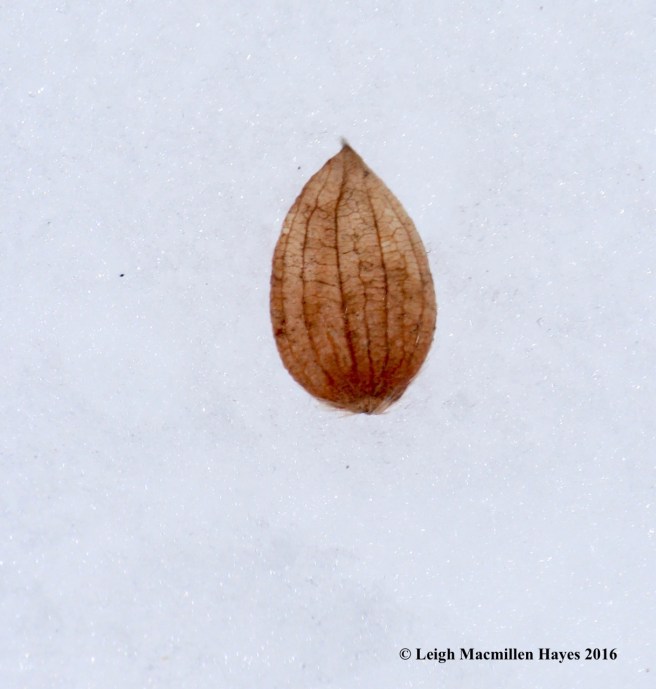
ledges glacial 2

Glacial striations mark some of the bare rocks. Those glaciers must have been crazy as they retreated–melting and scraping this way and that. ;-)

ledges icicle 2

No matter what season we pass by this rock, water drips from it. Today, it’s suspended in a milky icicle.

ledges mossy maple

Mossy maple polypores gathered at the base of this old tree while

ledges toadskin tripe1ledges smooth rock tripeledges toadskin 2

smooth rock tripe and common toadstool lichen decorated the rocks nearby.

ledges mooseledges lunch view

Lunch rock provided us a view of the middle basin of Moose Pond on the left and lower basin on the right.

We stayed just long enough to eat our sandwiches on the ledges. We didn’t have time to head to the summit. On the way down, both of us left plenty of handprints on the trees that grow beside the trail–happy to have their support.

ledges bliss

We had an errand to run in Portland this afternoon, and then it was home again, home again, jiggity jig. Our day was topped off with a supper of blueberry pancakes coated with maple syrup while watching the Beanpot hockey tournament. Thanks to Pam Lord Bliss for the amber treat–this Mondate was truly pure bliss.