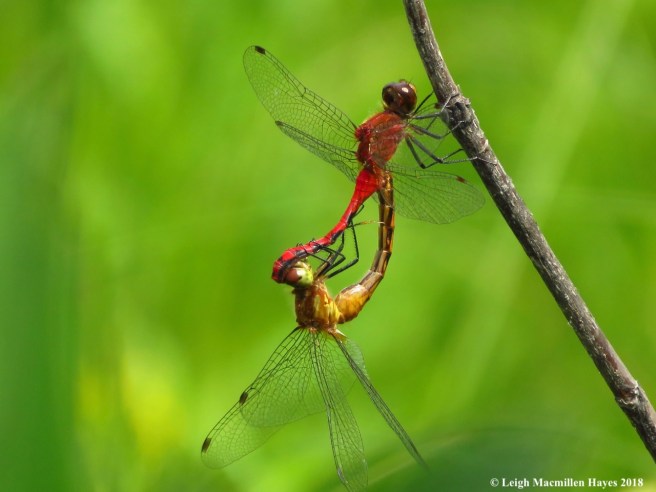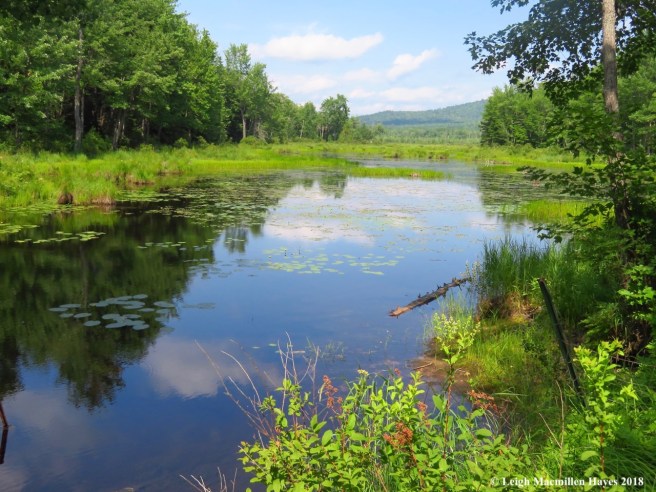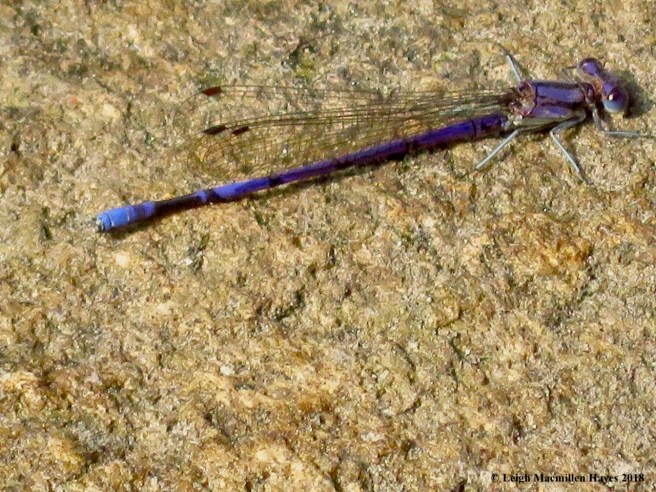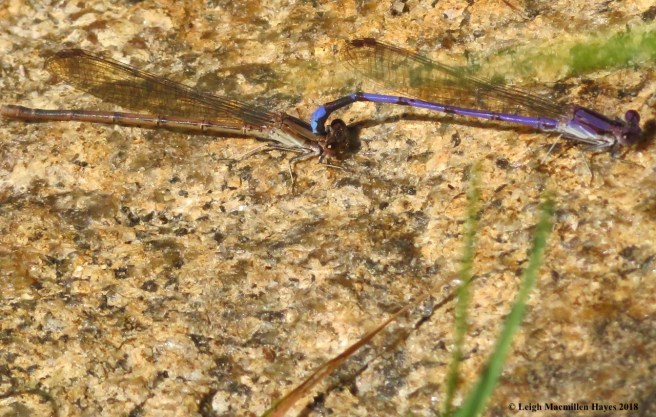
Island Hopping Mondate

Paddling together in “Big News,” our double kayak so named for it was a gift from the Neubigs many moons ago (thank you, Carissa and Bob), is one of our favorite summer pastimes. With wrist almost fully mended, it’s an even sweeter journey for me because it means I don’t have to work hard.

1-prepping the kayak

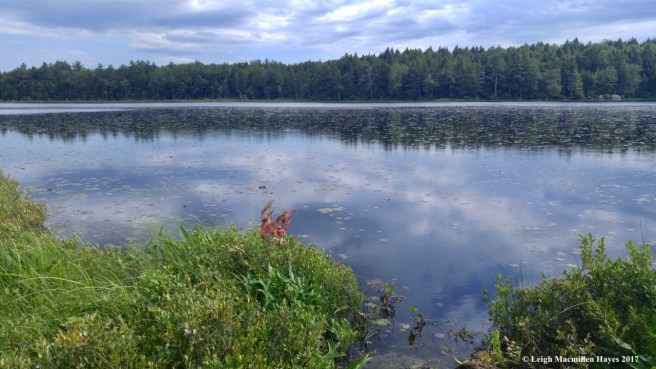
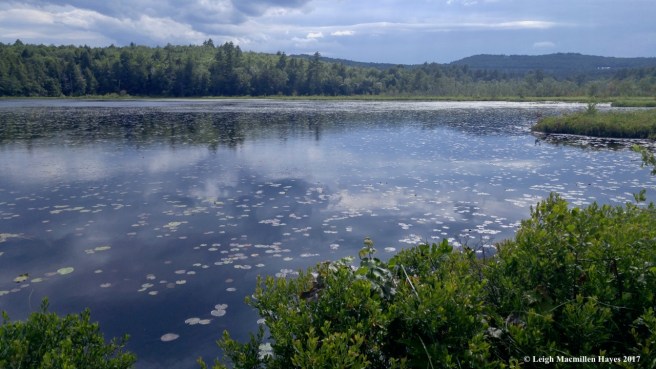
And so it was that my guy prepped Big Red for today’s journey–an exploration of the northern basin of Moose Pond. The “pond” is a 1,697 water body with a 33.3 mile perimeter that’s broken into three sections. We know the north best, which offers about a four-mile round-trip journey from camp up into the islands of Sweden. The other section that we don’t visit as often, but do enjoy exploring, is the southern section in Denmark, for it’s equally interesting.

2-BLUEBERRIES!

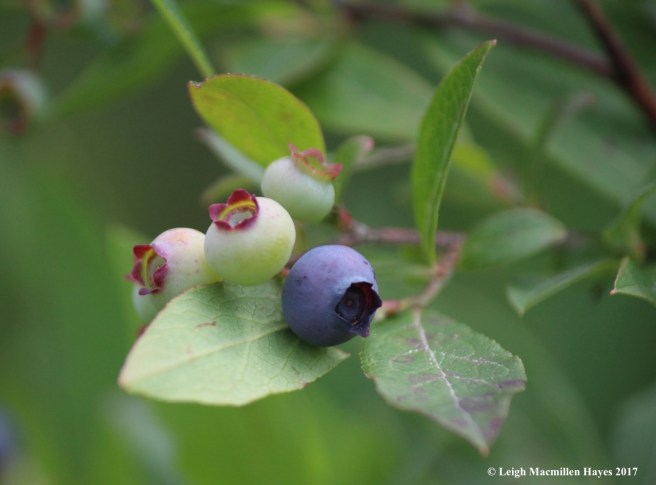
Today, though, my guy had a mission worth gold in mind–to make some headway on his blueberry greed.

6-yellow-necked caterpillars

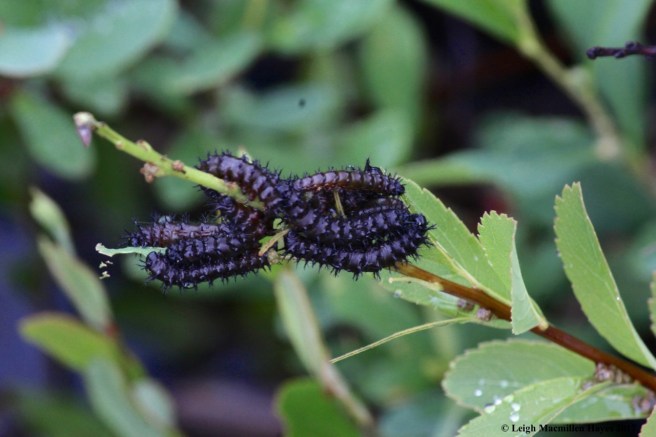
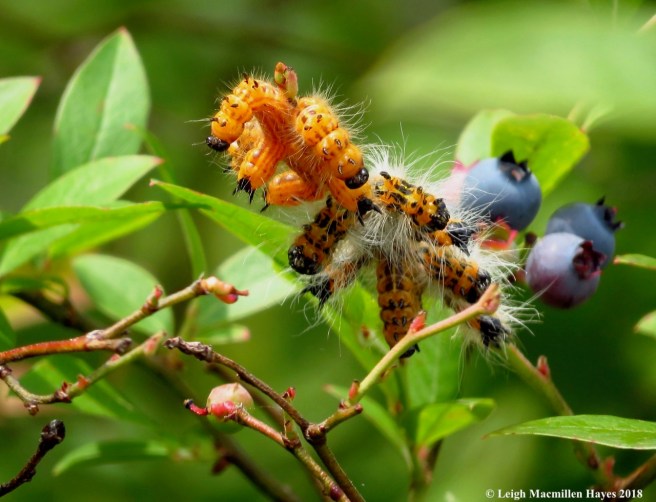
Along the way we discovered an interesting sight. Our friend, and pond neighbor from the western shore, Lili Fox, asked yesterday if I could identify some yellow and black caterpillars. After a wee bit of research, I suggested Yellow-necked Moth Caterpillars. I didn’t expect to meet them quite so soon myself, but immediately recognized the group that clustered at the tip of a blueberry twig. At first, they seemed immobilized, but then I realized they were in the defense form that I’ve witnessed with other caterpillars, curling outward to form a U. I’d just picked a few berries below and so they saw me as prime predator. Fortunately, no attack was made.
8-yellownecked 2

Overall, they have yellow and black stripes, but it’s the yellow segment or neck behind their black heads for which they were named. These very hungry caterpillars were reaching maturity and soon should drop to the ground. They’ll apparently overwinter burrowed below as pupa and emerge in adult form next year.

10a-fluffy yellownecked

I assumed that those with the most wiry hair were the oldest. We probably should have shaken them off the branches and into the water, but we didn’t. Nature knows what to do and some will become a food source for wasps or birds, passing along the energy contained in the blueberry leaves to another level.

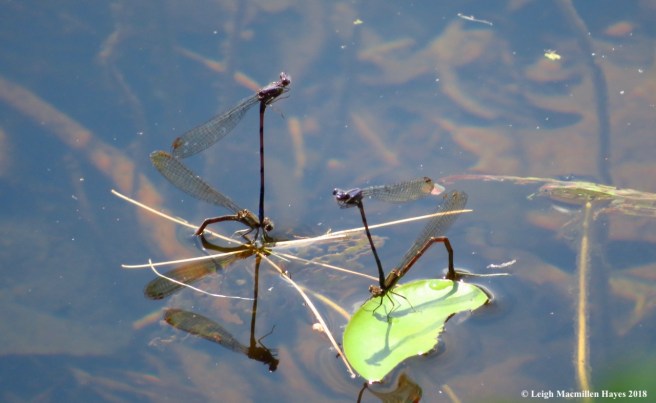
3-variable dancer damselfly

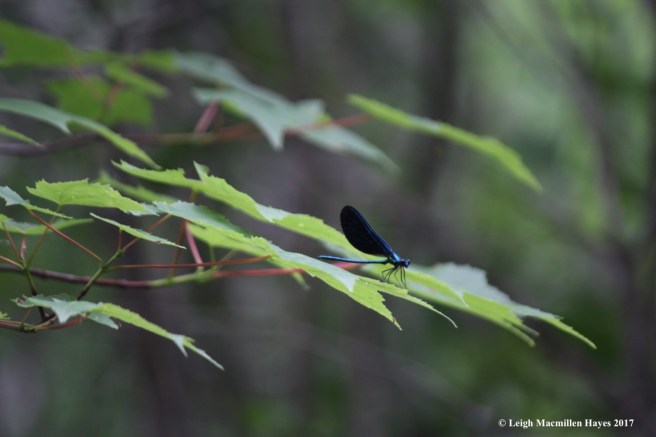
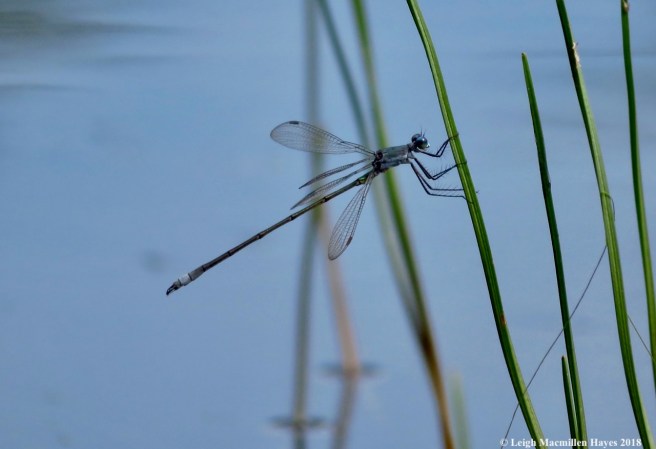
In the meantime, I became the Yellow-necked Lookout Warden as my guy continued to pick. Accompanying me with his own bulbous set of eyes was a male Variable Dancer Damselfly.
4-spreadwing

The damselflies actually could care less about the caterpillars and more about finding a mate and so they all posed, either on the kayak, or nearby vegetation.

5-orange bluet damselflies

Both turned out to be the right substrate on which to perform mating rituals, this being a pair of Orange Bluet Damselflies on the kayak.
7-emerald spreadwings canoodling

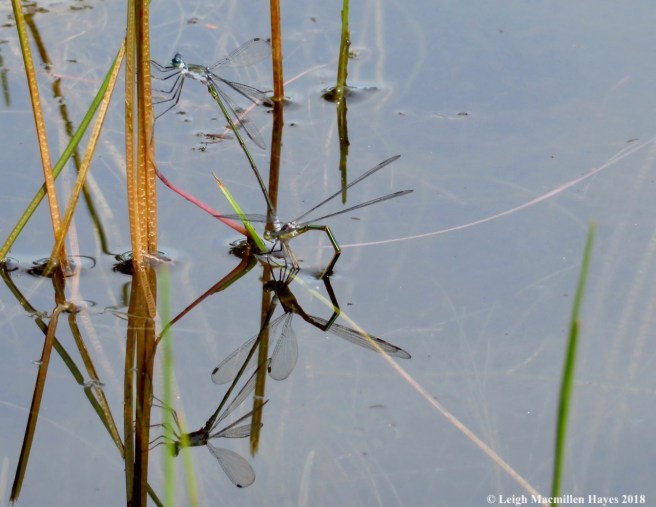
And Emerald Spreadwings offering a reflection on the pond of their canoodling efforts.
10-heading north

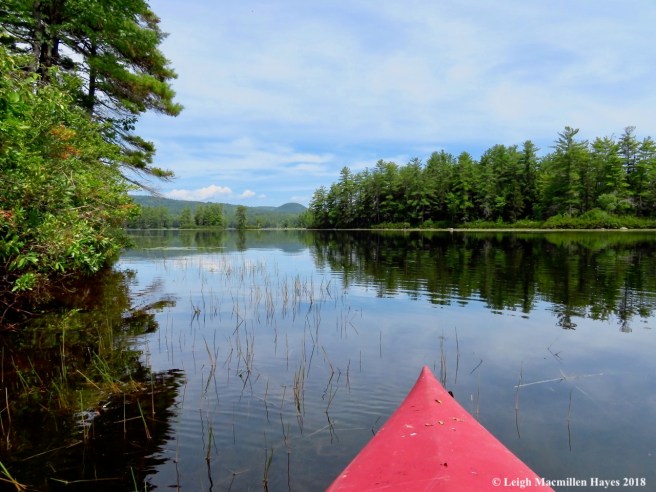
At last we continued further north, island hopping along the way.

12-Eastern Pondhawk Dragonfly

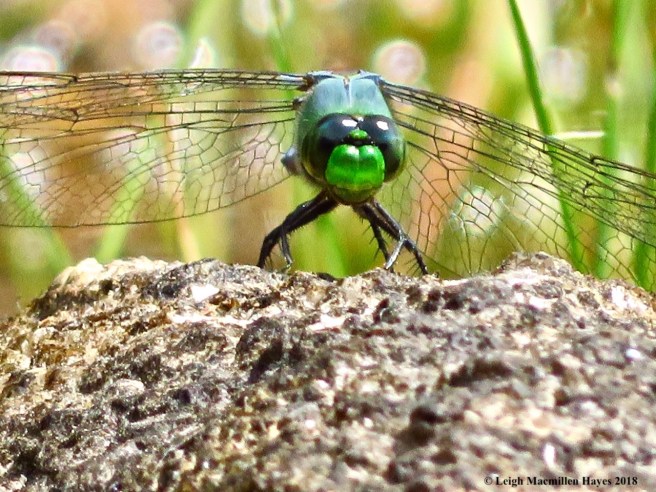
Though their natural communities all looked similar, with each stop came a different offering, including the Eastern Pondhawk that displayed one of my favorite combinations of color-sky blue pond green.
13-EAstern Pondhawk

Eye to eye, we contemplated each other. I have no idea what he thought of me. Well, actually, I’ve no idea if dragonflies can think. Is all their action instinctive? As for my thoughts, I didn’t want to gobble him up in a literal fashion, but wish I could have taken him with me so I could continue to stare, infatuated with his colors as I was. On his thorax I saw a watercolor painting reflecting a sunny day by the pond.
14-Floating Heart Plant

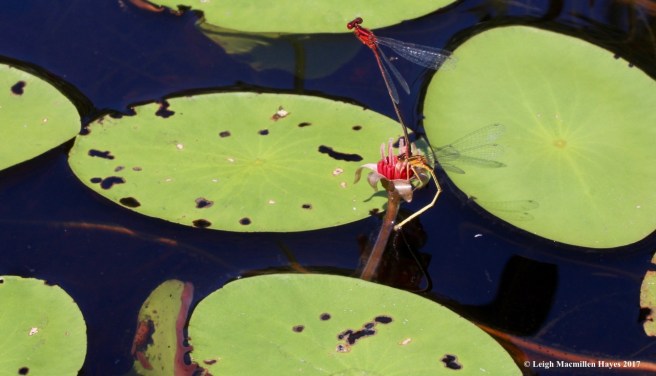
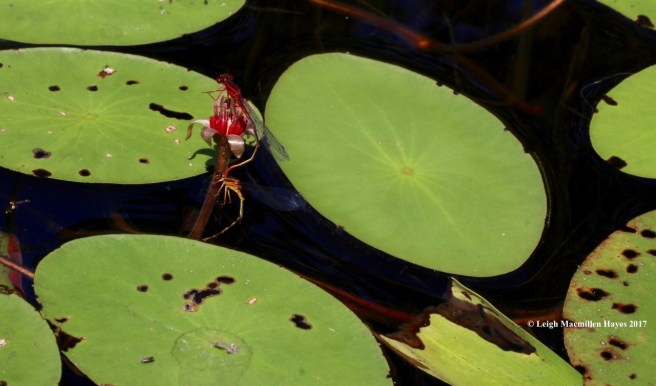
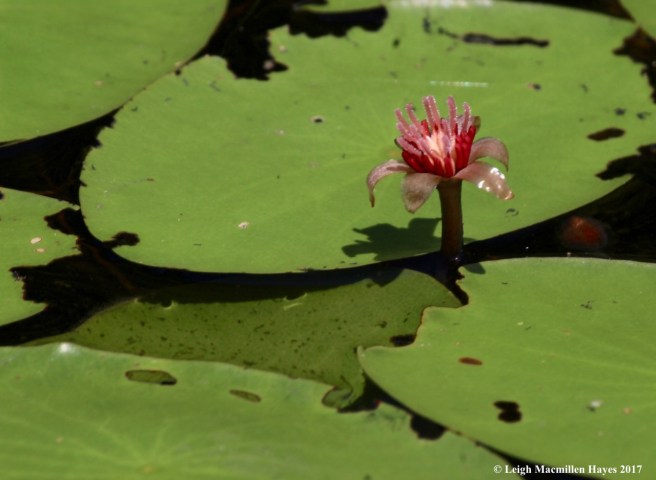
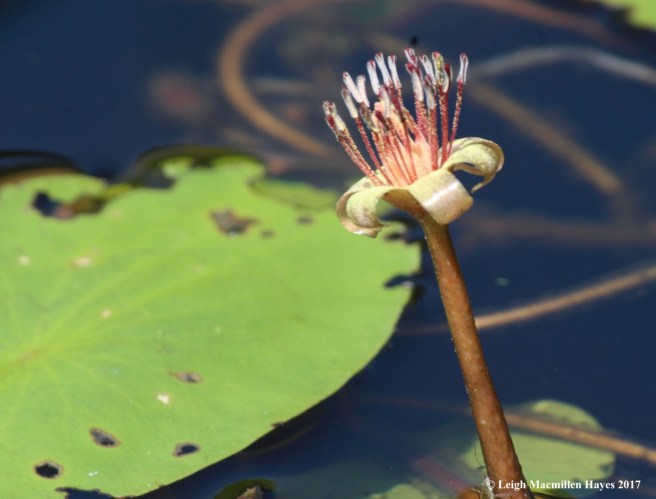
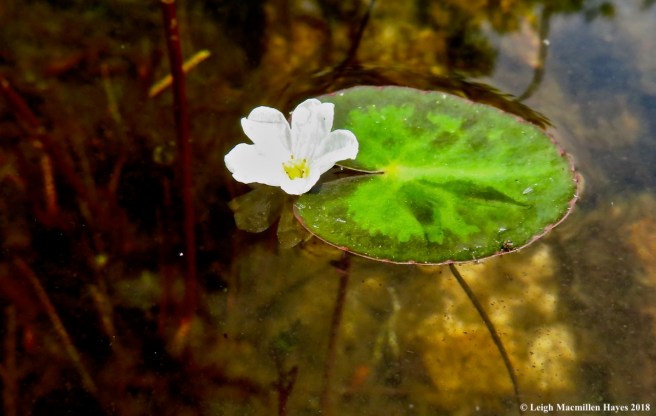
Another island and another find–the delicate flower of a Floating Heart Plant.

14-bullfrog on lily pad

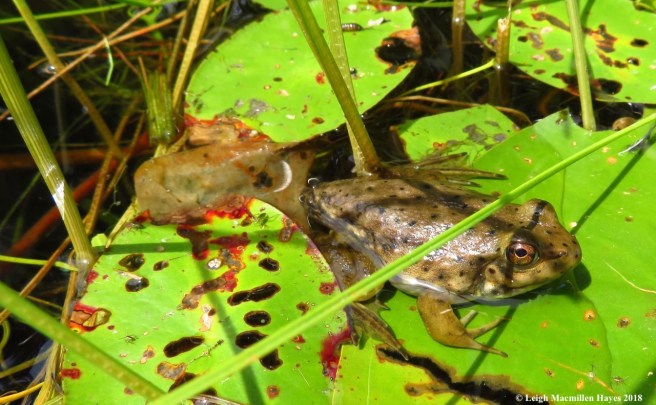
And then a frog on a lily pad, a young frog that is.
15-bullfrog froglet

If you look closely, you may see her tail extending behind. I couldn’t help but think that she’s got big feet to grow into.

16-beaver lodge

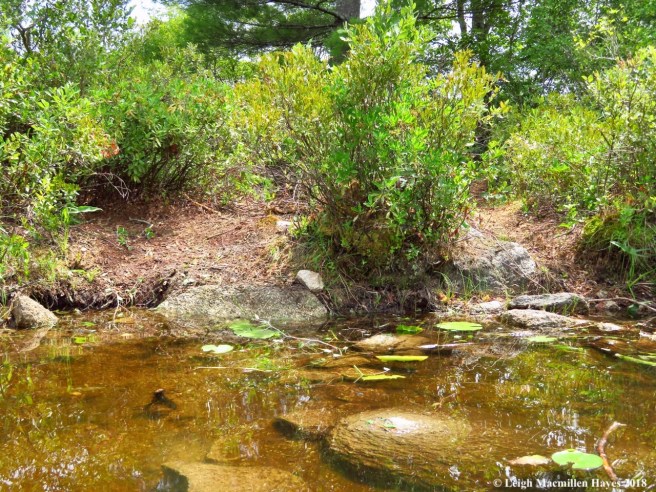
Beside one of the last islands we visited, we saw that the neighborhood had changed quite recently and a new house had been built. Though none of the residents came out to greet us, we weren’t surprised. Based on the greenery and wet mud we suspected they’d been busy as beavers all night and needed a rest.
17-beaver island

A quick look around and we knew the source of their building materials. It reminded us that they’ve been secret visitors to our land in the past and have helped themselves to young saplings much to our dismay. Then again, it is their land as well. We’re just the ones who pay the taxes.
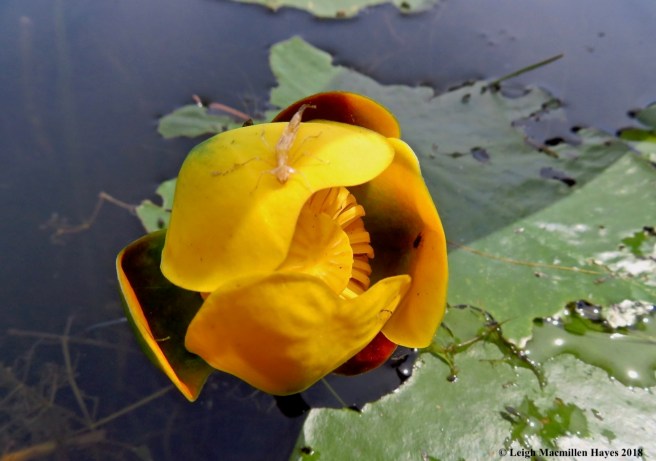
11-spadderdock with damselfly exuvia

Of course, no water adventure is complete without a photo of Spatterdock, this one featuring a damselfly exuvia.

17-fragrant water lily

And Fragrant Water Lily. That rayed presentation. Those prominent yellow stamens. The symmetry. And, of course, the fragrance.

18-honeybee

What could be better than the two together? The two together with small flies on one and a honey bee, its buckets full, visiting the other.

19-painted turtle

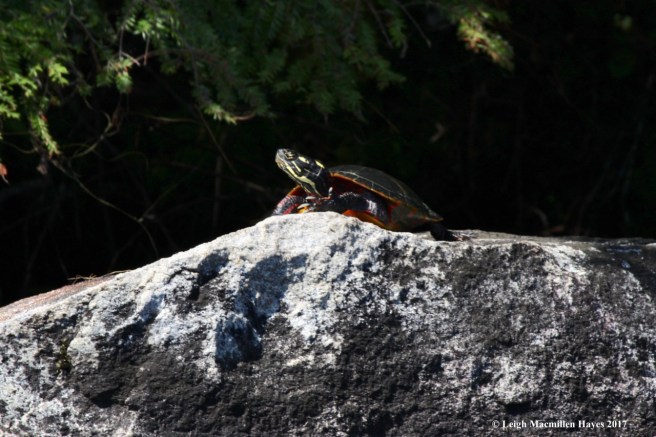
At last, it was well after lunch, which we’d neglected to pack and my wrist was sore, so my guy said he’d paddle us home. And because we’d startled a turtle earlier, he said he’d find one for me. Wow! Both the turtle and I were impressed.
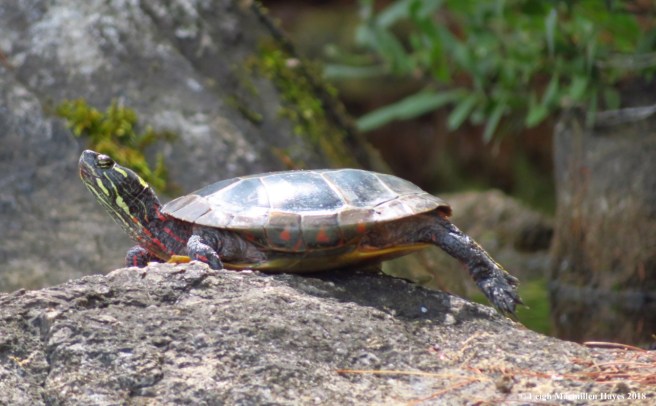
20-turtle basking

As turtles do, he stretched out his back legs demonstrating how they need to capture additional heat given that they are cold-blooded animals. Basking helps them to absorb warmth and vital UV rays.
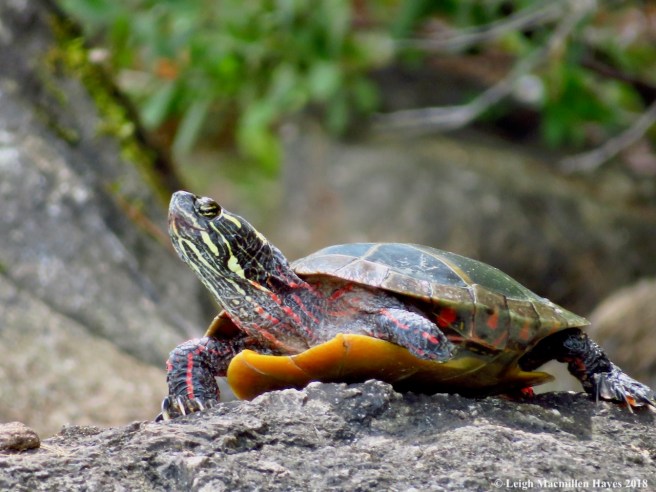
21-waving goodbye

What he did next surprised us. He began to wave his front left leg–I took it as a goodbye, but it was probably either a way to push an insect toward his mouth or an aggressive move telling us to move on. We did, heading back to camp as we finished up our Island Hopping Mondate.
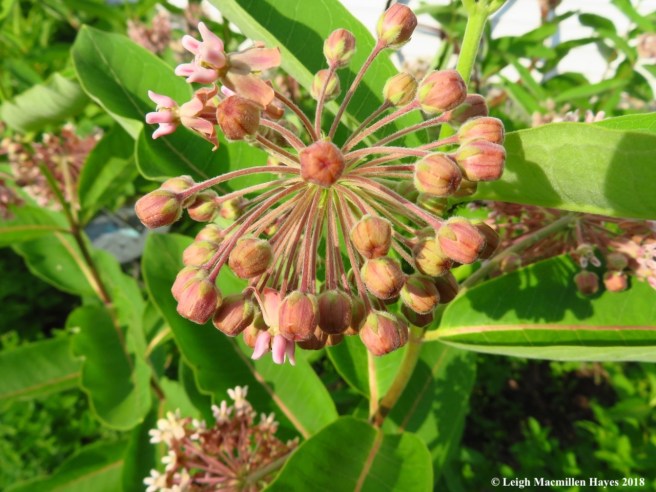
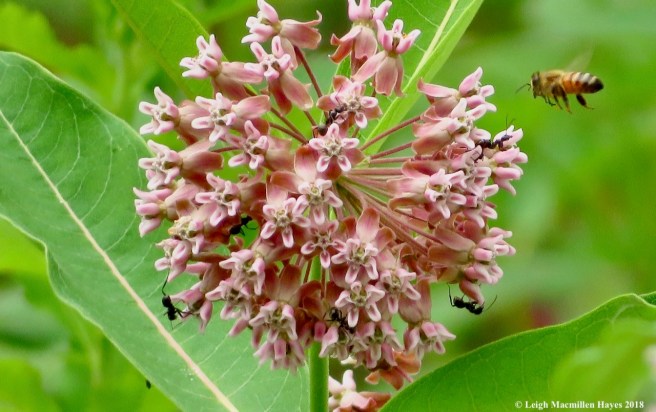


Queen of the Butterflies

At the beginning of July, the Common Milkweed that I’m allowing to grow more abundantly in my herb garden began to blossom, its hypnotic scent filling the air with an almost honey-like fragrance.

m1a-milkweed flowers

Being close to the Fourth of July in its blooming, the milkweed’s formation reminded me of the fireworks that filled the sky over and over again. I only wish those had been as silent as the milkweed.

m2-ants and honeybees

Then again, it was hardly silent or unnoticed for the bees and ants sought the sugary nectar stored in the shell-shaped structures.

m4-honeybee

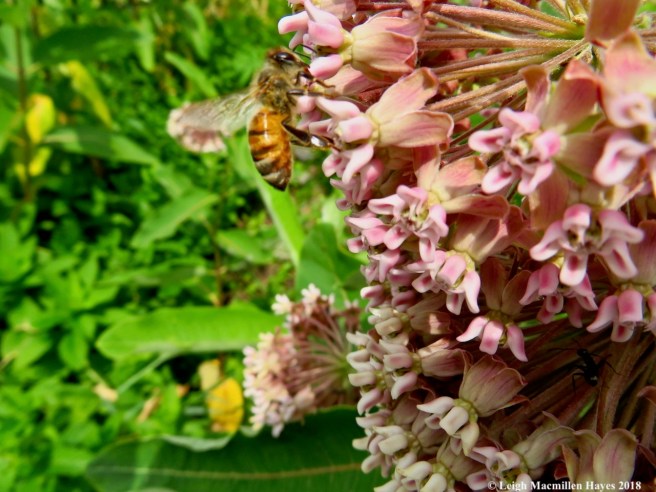
So few honeybees have I seen all summer, but as long as the milkweed was in bloom, I noticed four of them probing for the goodness hidden within.

m8-wasp

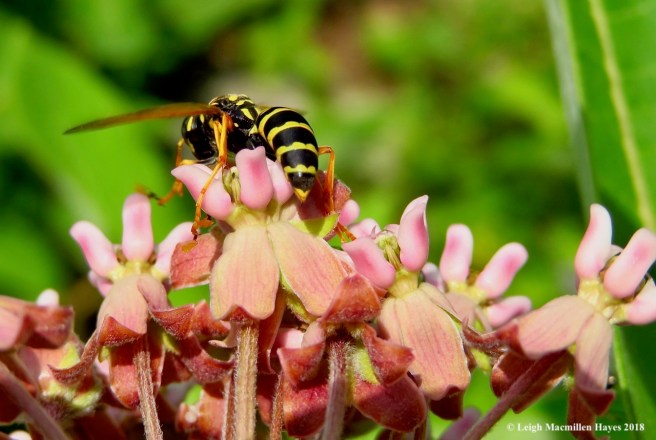
Visitors were from every ilk, some with striped bodies,

m9-tachinid fly

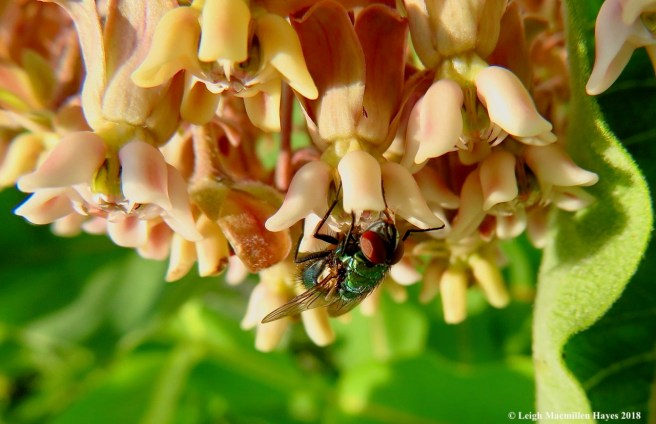
and others covered in spiky hairs.

m7-skipper

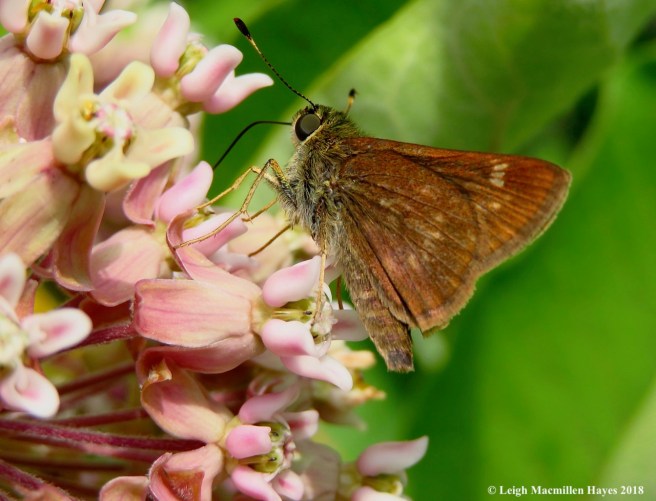
The pollinators included skippers . . .

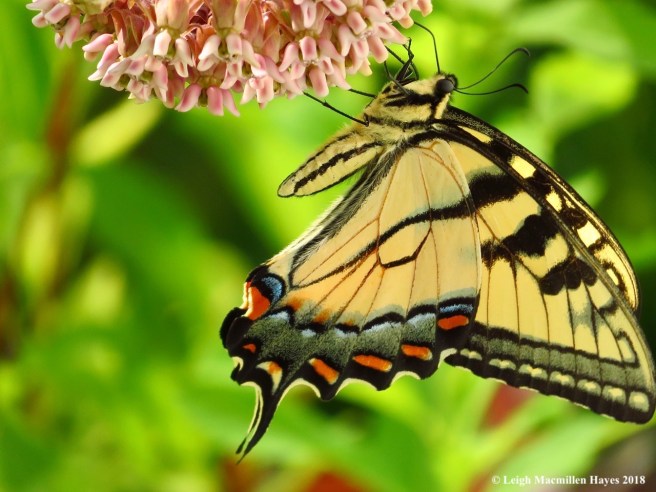
m1-swallowtail butterfly

and swallowtails.

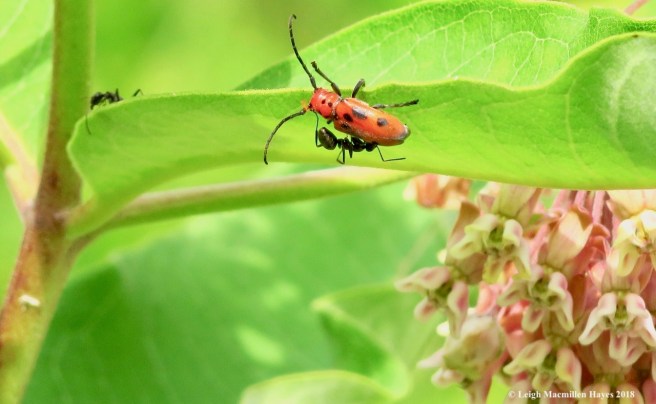
m5-red milkweed beetle and ant

Upon the plants’ leaves were Red Milkweed Beetles, this one being checked out by an ant. The bright red coloration announced the beetle’s distastefulness for he’s one of the few insects that can feed on the leaves of milkweed, store the plant’s defense chemicals and assure that he won’t be consumed.

m6-ant climbs over red milkweed beetle

The ant apparently discovered the beetle wasn’t worth dealing with and so climbed over it and moved on. Or maybe the beetle had accidentally rubbed against some nectar and the ant was attracted to it–for all of a second.

m10-honeybee

The milkweed flowers in my garden began to die back, but this week I discovered another place where they grow abundantly. And at least one honeybee recognized the same.

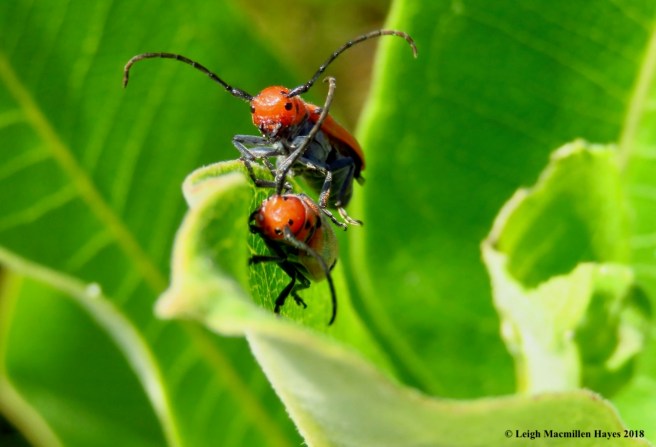
m17-red milkweed beetles

As did more long-horned Red Milkweed Beetles, and now rather than finding only one, I’ve noticed there often appear to be two working in unison to ensure a continuation of their species.

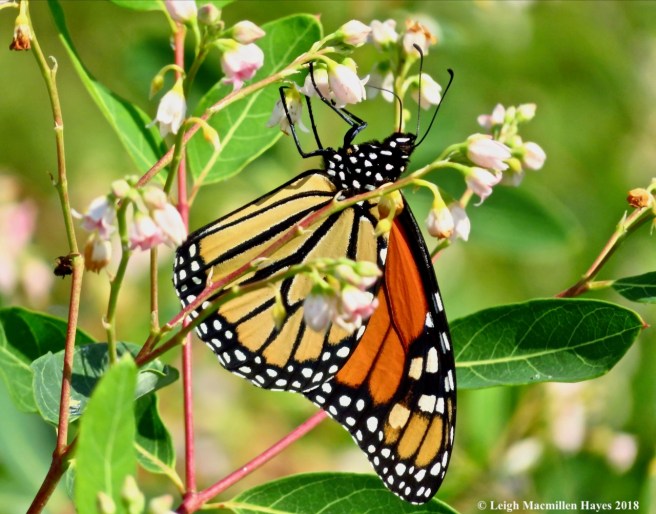
m15-monarch on dogbane


And much to my delight, I spotted sipping nectar from the Spreading Dogbane that grows beside the milkweed, a Monarch Butterfly.

m14-monarchs fluttering

And it wasn’t just one Monarch. I can’t say how many I saw in total, but I watched them for a while as they floated over the meadow flowers in their flap, flap . . .

m21-monarch and shadow

glide routine, sometimes chasing each other or their own shadow before alighting.

m13-monarch puddling

Like the Clouded Sulphurs I noticed the other day, the Monarchs too sought nutrients from the gravel road, their mouthparts, aka proboscises, extended in search of minerals.

m22-probiscus curled

When not in use, the tubular and flexible straw that serves as a mouth curled inward, retracted as it would be during flight.

m16-viceroy butterfly

Also in the area, because it too likes the nectar of the milkweeds and other flowers offering a sweet meal, was the Monarch mimic, a Viceroy. The differences between the two: Viceroys have a wing span of about 2-3 inches, while Monarchs’ span is 3-4. And Viceroys have a black horizontal stripe that crosses near the bottom of its back wings. Well, actually, it looks more diagonal. And really, who came first? The Monarch or the Viceroy?

m19-silvery checkerspot butterfly

Also present because it too feeds on native milkweeds, a few small Silvery Checkerspot Butterflies, their wing span less than two inches.

m20-silvery checkerspot butterfly

And they also sought those road nutrients, so suffice it to say, its a butterfly habit . . . at least in this neck of the woods.

m24-milweed tussock moth caterpillars

I had to eventually leave the road and meadow behind and run home to grab something, which meant an opportunity to check on my milkweed plants. Those in the kitchen garden hosted some Red Milkweed Beetles, but that was the most interesting thing I saw, besides the fact that the dried flowers were transforming into warty green seedpods. But by the front door, where more milkweed grows, I noticed first a pile of caterpillar scat on a leaf. Getting down on my knees to look underneath, I spotted a mature Milkweed Tussock Moth and its larvae feeding.

m24-tiny monarch caterpillar

And then my heart was still, for I found a tiny Monarch caterpillar.

m25-adult monarch caterpillar

And near it, one that had been very hungry and seemed to have stopped eating. I can’t wait to check again and see if it’s still there–only in a transformed stage.

m26-two monarch caterpillars

As I continued to look, there were more, these two clearly munching away.

m29-munching leaves like an ear of corn

They reminded me of humans eating corn on the cob for it seemed they moved back and forth as they chomped on the plant’s leaves. Monarchs, and other butterflies that feed on the green leaves in their caterpillar form, are like the Red Milkweed Beetle in that they can tolerate the chemicals and it makes them not tasty to predators.

m27-medium-sized monarch caterpillar

Everywhere I looked, I began to see Monarch caterpillars in various stages of growth.

m30-probiscus curlced

My hope is that I’ll discover chrysalises as I continue to search and eventually our yard and flower gardens and the field beyond will be full of the queen of the butterflies:  Monarchs.


Taking Flight

Morning had broken . . .

h1-morning has broken

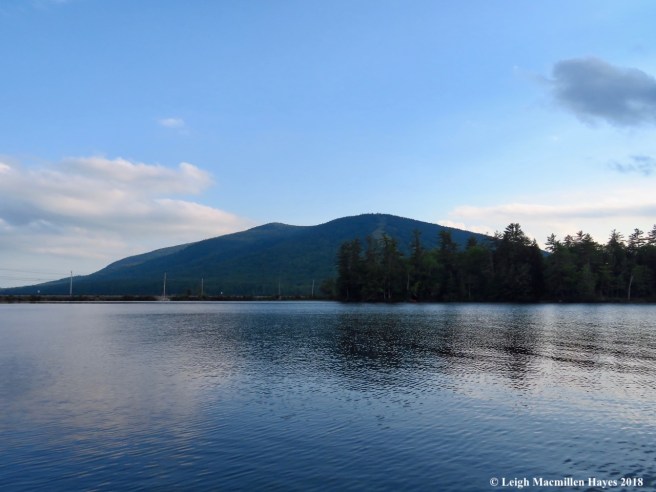
and Pleasant Mountain’s reflection marked a new day.

h2-variable dancers conducting variable dance

New life was also in the making as the Variable Dancer Damselflies practiced the fine art of canoodling. I’d never noticed an oviposition aggregation before, but it made sense if it minimized the threats a couple receives from unattached males. Plus, if the spot was good enough for one pair to lay their eggs, then it must be fine for another. And so I learned something new today.

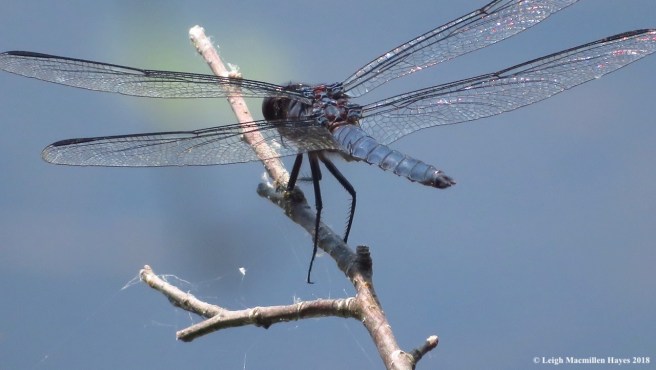
h3-slaty skimmer

Perhaps it also cut down on predation, though I couldn’t stay long enough to note if the Slaty Skimmer that hung out above turned either pair into breakfast. If so, I hope they at least had a chance to leave their deposits.

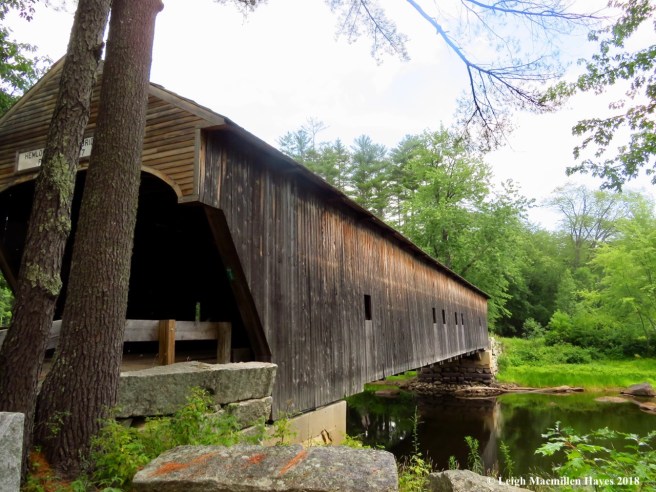
h4-Hemlock covered bridge

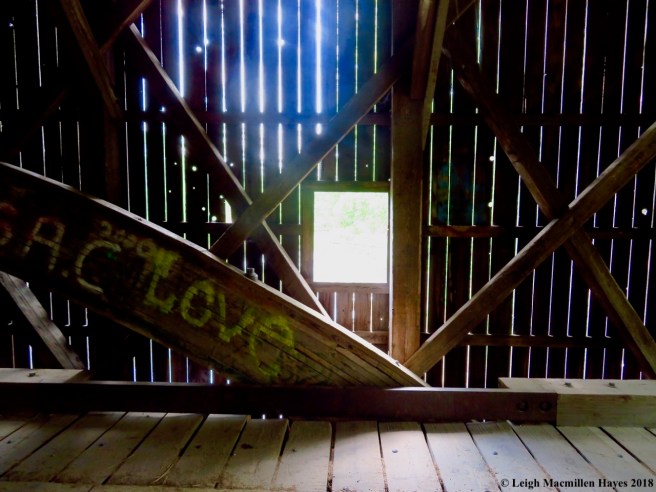
That was my morning view, but I changed it up a bit this afternoon and darted across the Hemlock Covered Bridge that spans the Old Course of the Saco River in Fryeburg. Built in 1857 of Paddleford truss construction with supporting laminated wooden arches, the bridge is a quaint and charming reminder of days gone by.

h5-bridge

Though reinforced in 1988 so you can drive across, it’s even more fun to glide while admiring the work of our forefathers and . . .

h8-water low

peer out a window at the river from Maine’s oldest remaining covered bridge.

h6-LOVE

The handiwork of more recent travelers . . .

h7-love lasts forever

was also clearly visible.

h9-river jewelwing-female, white dots in sync

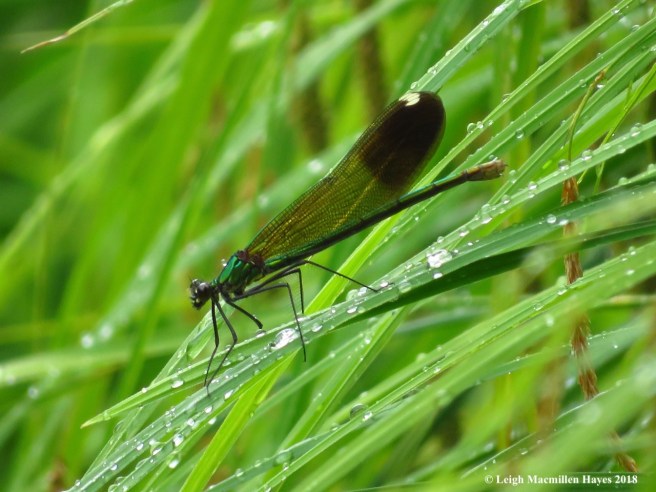
Down by the Old Course, I spotted a female River Jewelwing, the white dots on its four wings showing off in the day’s light. Just prior, a few sprinkles had fallen and one teeny droplet rolled down her thorax. A few even teenier ones clung to her legs.

h10-Hemlock Covered Bridge

With one more look back to reflect upon the bridge, I was then ready to set sail again.

h11-Mt. Kearsarge

Heading toward Frog Alley, the view across the fields included Mount Kearsarge amid the summer haze that had developed.

h18-Mount Tom

Mount Tom was more clearly visible for it was so much closer.

h12-Dianthus armeria, Deptford pink

But what I really stopped to look at where those things closer to the ground, like the brilliant pink Dianthus with their petals all spotted and toothed at the tips.

h14-bindweed

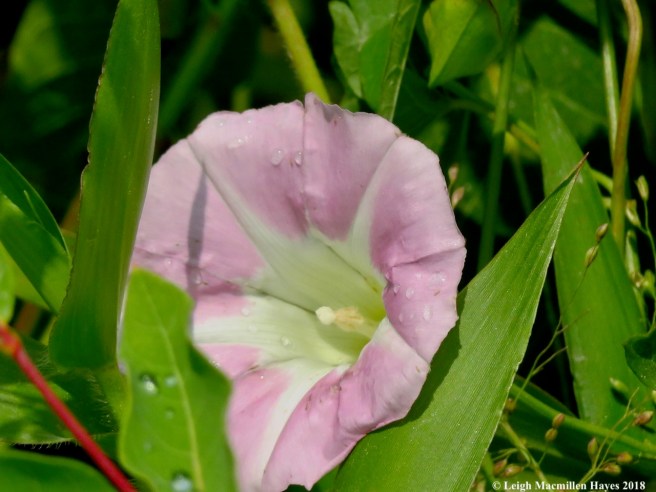
Offering a lighter hue of pink, a bindweed twined its way through the roadside wildflowers.

h13-honeybee on milkweed

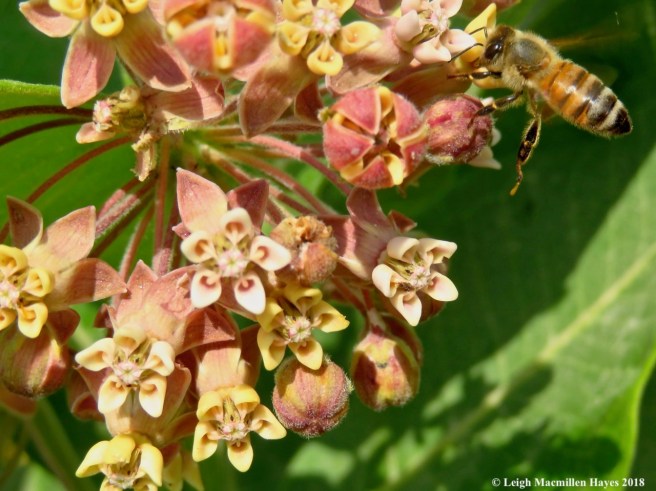
Also with shades of pink and the yellow complexion of those flowers already pollinated, milkweed was in full bloom and the ants and some flies were making the rounds, but I only saw one honeybee taking advantage of the sweet nectar. It reminded me that the same was true on the milkweed growing in my garden where, at most, I’ve seen four honeybees rather than the usual swarms.

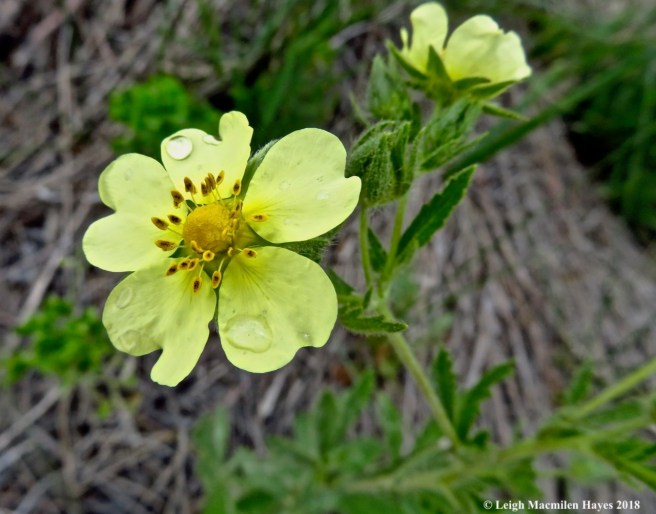
h17-sulphur cinquefoil

And then there was the subtle yellow of the Sulphur Cinquefoil showing off its cheery face despite a few tear drops. Actually, it may have cried for only a few drops had fallen from the sky and we really do need a soaking rain.

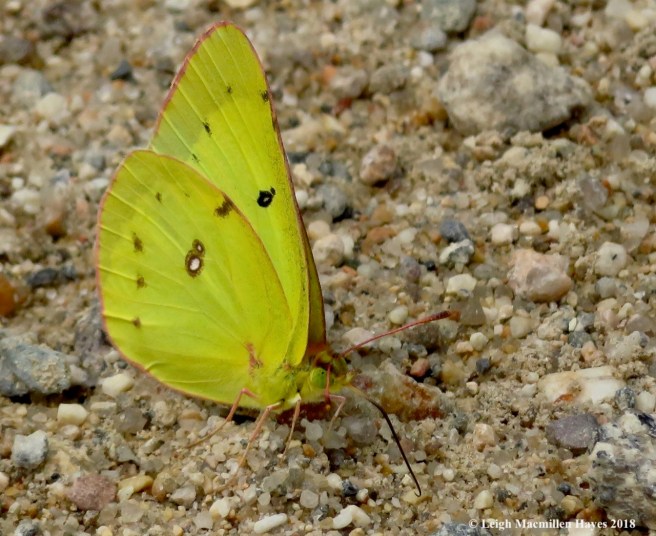
h16-clouded sulphur butterfly

As if taking a cue from the cinquefoil, Clouded Sulphur butterflies flitted and danced along the road.

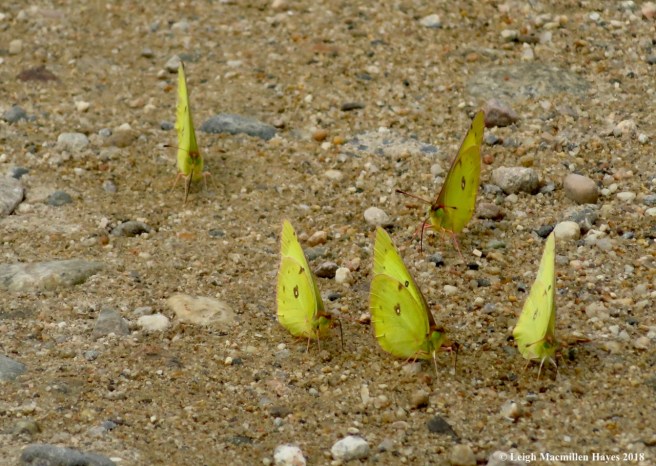
h16- clouded sulphurs puddling

And then I realized that they kept gathering in groups. It’s a form I’d read about but never observed before–puddling. This was a male habit and apparently their intention was to suck nutrients from the wet ground. I guess even a few raindrops served the purpose.

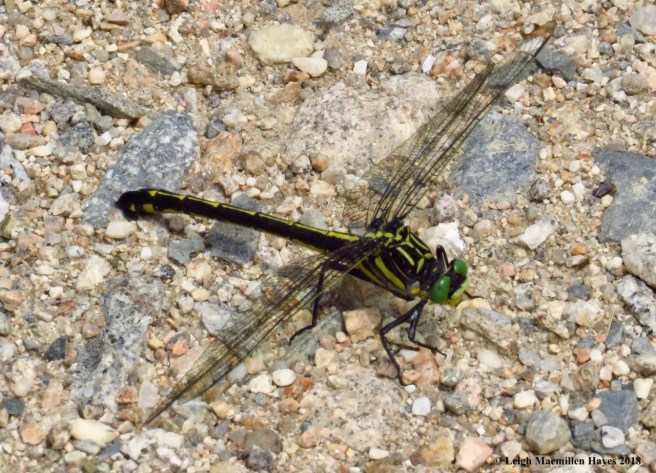
h15-dragonhunter

Before I moved on again, my heart was still as more yellow entered the scene in the form of a striped thorax and I realized I was watching a Dragonhunter Dragonfly. Though it wasn’t so easy to see the tip of tail once it landed, as it flew about in my vicinity it kept its abdomen curved down–a habit of these big guys.

h29-Fryeburg Bog

The Fryeburg Bog was my next landing and though I didn’t head out to the water that was more like an over-sized puddle, I found plenty to focus on.

h19-buttonbush

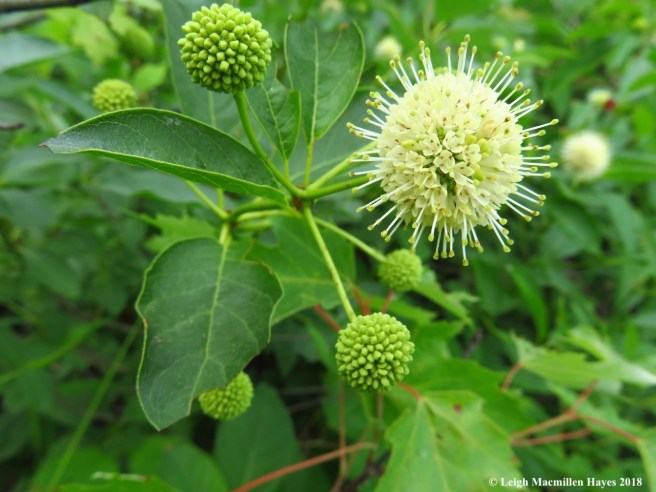
For starters, the Buttonbush had begun to bloom and I loved its otherworldly presentation.

h21-frosted whiteface

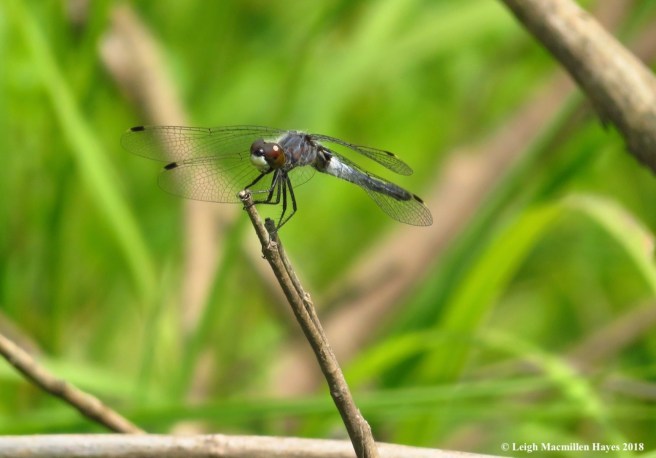
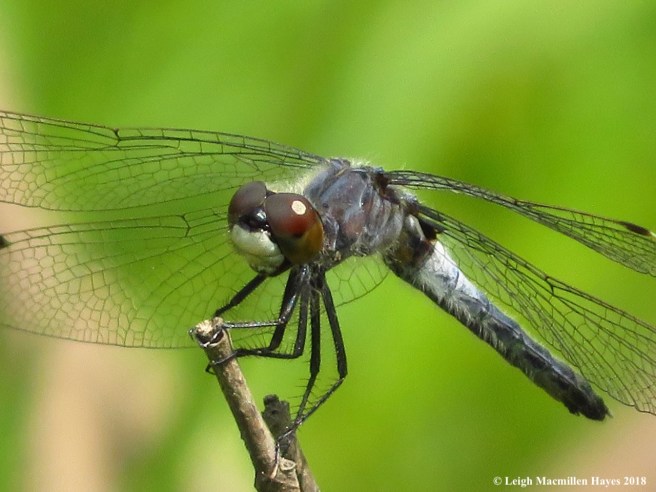
It was there that I saw the smallest of dragons, in the form of the Frosted Whiteface.

h22-frosted whiteface

At most, he was about 1.5 inches long–quite probably the smallest of the species that I know.

h20-ruby meadowhawk

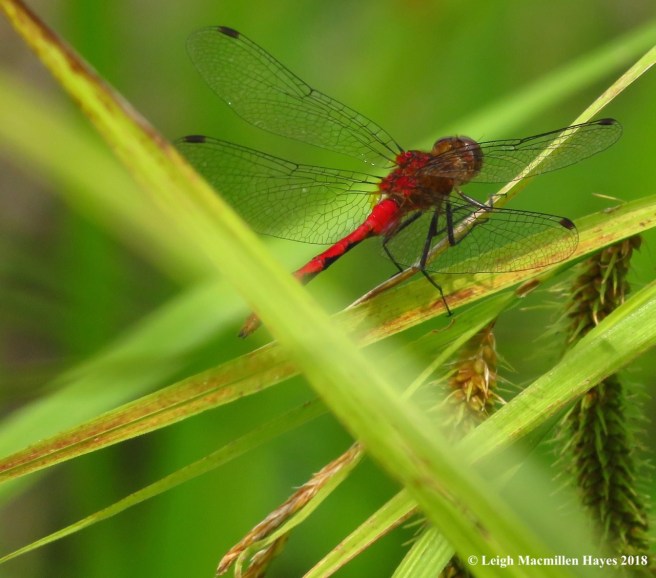
It was there that I also spotted my first Ruby Meadowhawk of this year.

h23-ruby meadowhawks canoodling

And then there were two! And in the future, obviously, there will be more.

h23--late afternoon snack

And finally, it was there that I noticed a Song Sparrow had nabbed a butterfly snack–all part of the circle of life.

h30-Smarts Hill

My final stop on today’s journey was at Popple Hill Brook along Smarts Hill Road in Sweden.

h25-variable dancer

And like the Variable Dancers I’d seen this morning, I found many more beside the brook. Not only was the male’s purple coloring stunning, but notice those silvery legs.

h26-variable dancers canoodling

Of course, where there is more than one dragonfly or damselfly, there is love.

h27-variable dancers canoodling

As my tour began, it ended–with the Variables dancing to their heart song.

h28

And with that, I flew back to camp, where the mountain’s reflection was conducting its own dance routine as the sun began to slip toward the horizon.

h31-rainbow

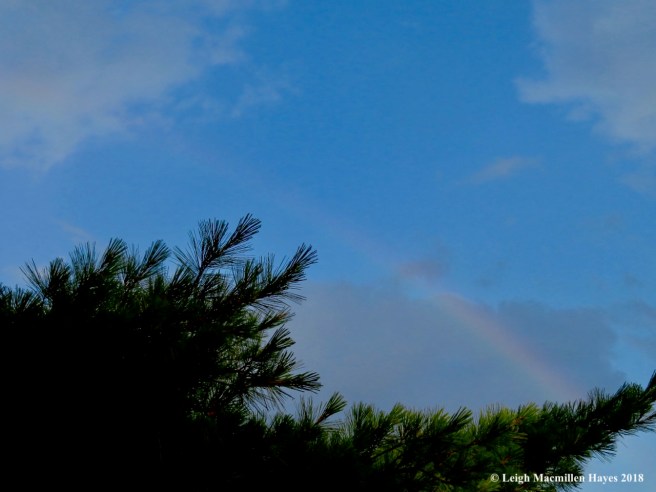
And a few more raindrops produced a rainbow in the eastern sky.

Thanks for taking flight with me on this wonder-filled wander and soaring above some of the areas that are so unique and yet we tend to overlook them.


Upta Camp

It’s been a gray day and a quiet day–the right mix of ingredients for a perfect day. And except for saying goodby to my guy this morning, the only conversations I have had, too numerous to count, were with myself.

c2-gray squirrel

Well, maybe that’s not quite accurate, for I did talk to a squirrel, but in unusual squirrel manner, it stayed as still as could be and didn’t respond. Together, however, we eyed our domain.

c5-mayfly

It turned out we weren’t the only ones with big eyes that chose to hang out all day. Attached to the screen was a Mayfly subimago–the teenage form of the insect.

c6-close up

Mayflies are unique in that after the nymph emerges from the water as the subimago (that fishermen call a dun), they seek shelter before shedding their skin for the final transformation. I’m tickled that this dun chose our porch screen on which to rest.

m6c-close up

Notice the cloudy wings–that’s a clue as to its age. It can take a few minutes to two days before a subimago transforms into a clear-winged imago or spinner, though the actual metamorphosis is quick. Will I see it? You know I’ll keep watching.

c6-sawfly insect case

In the meantime, there was more to discover, including a sawfly insect case featuring the tiny hole where the insect chewed its way out.

c19-round-leaved sundew

As I looked about, I made one extremely exciting discovery–at least to me. Since 1986, I’ve stalked this land and today was the first time that I noticed the carnivorous Round-leaved Sundew growing here. Its leaves were filled to the brink with insect parts.

c18-round-leaved sundew

Perhaps that was why it looked so healthy and ready to flower. Expect to meet it again in future blog posts. (I warned you.)

c14-swamp rose

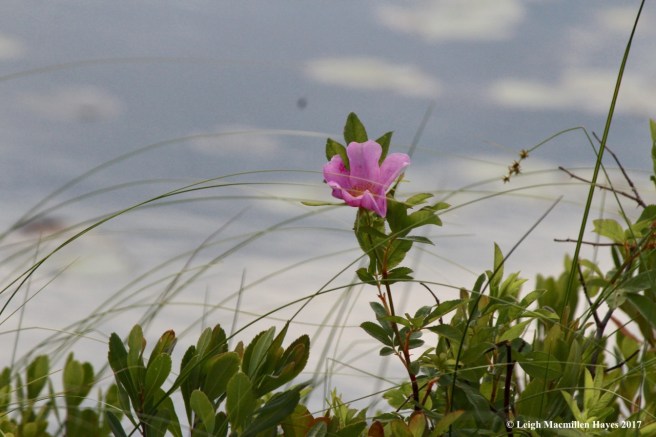
I also spotted a few Swamp Roses offering a bright contrast to the day’s overcast reflection.

c13-red pine

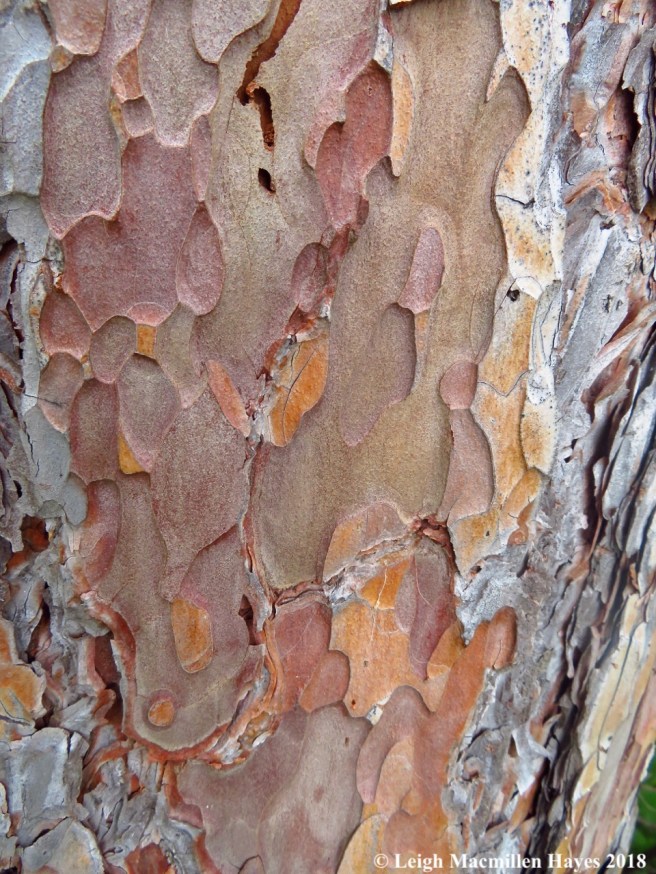
Featuring its own display of color was my favorite red pine–all pink-orange-gray hued in a jigsaw puzzle manner.

c15-red pine cone developing

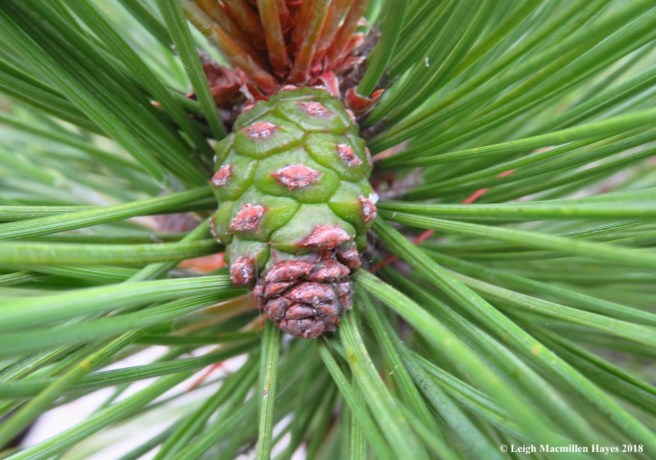
At the ends of its branches I found young cones growing larger and greener.

c16a-spider

And old cones offering the perfect camouflage for a spider that had created a large network in which to trap its prey. I think it was of the garden cross variety, but without breaking the web, I couldn’t get too close, and I didn’t want to ruin all of its work.

c17-dragonfly exuvia

Entangled in a bit of another web and dangling from the floor of the porch and beside the foundation was a skimmer dragonfly exuvia. Today wasn’t a flight day for dragonflies, and so I had to wonder–where do they hide when the sun doesn’t show its cheery face?

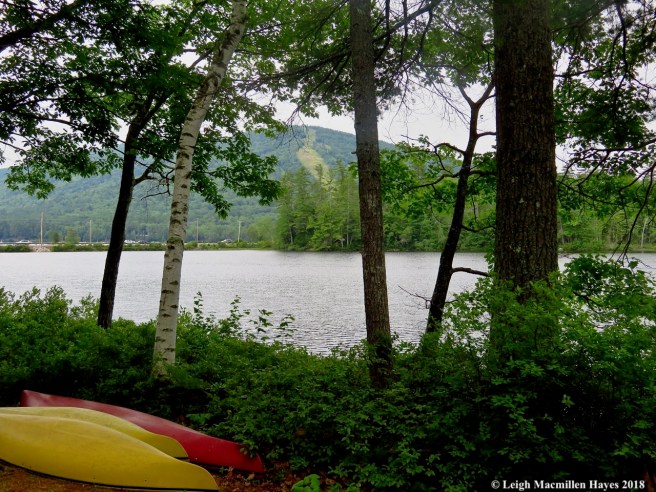
c1-camp view

Perhaps in the buffer zone of vegetation that surrounds Propinquity, our point of view.

c2a-dock view

It only took us about a month longer than usual . . .

c2-Pleasant Mtn

to make the long journey (7 miles) to the water’s edge.

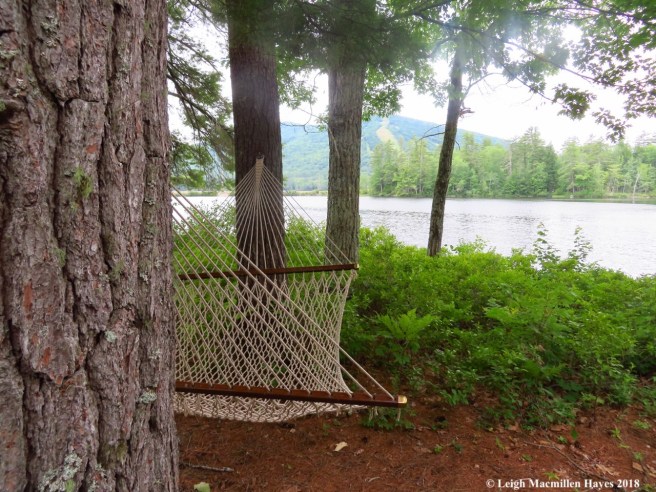
c20-hammock

But at last we’ve arrived.

c21-hammock view

Upta camp. The way life should be.


Flying With John A. Segur

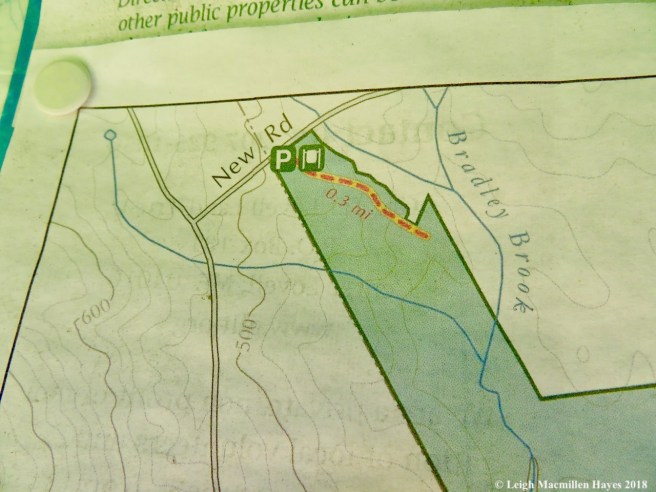
I never had the honor of meeting Mr. Segur, but it was my honor to be his eyes for a short time today as I wandered down the short trail off New Road in Lovell at the Greater Lovell Land Trust’s John A. Segur Wildlife Refuge. Upon his death, a bequest in his name was left to the land trust to preserve habitat for native wildlife to thrive.

The JAS Wildlife Refuge actually encompasses 592 acres and I only explored the .3 mile trail on the western section of the property, but on an extremely hot summer day my finds were enough. Follow me and I think you’ll see what I mean.

j1-Across from the sign and telephone pole

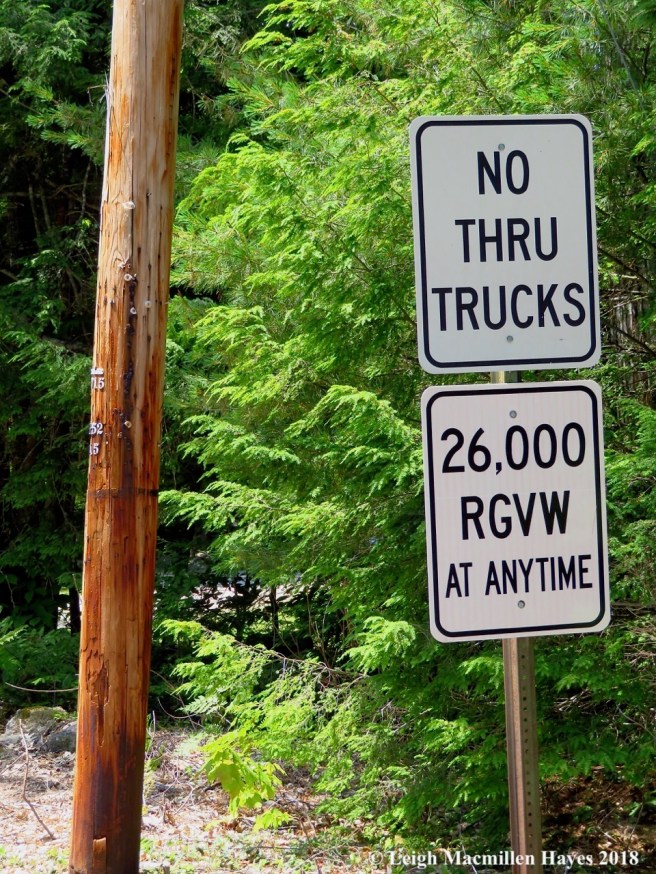
First off, you need to locate the small undefined parking lot. It’s about a mile beyond Foxboro Road, but I don’t pay attention to that. Rather, I look for the “No Thru Trucks” sign and turn on my left-hand blinker as soon as I spot it.

j2-trail and kiosk

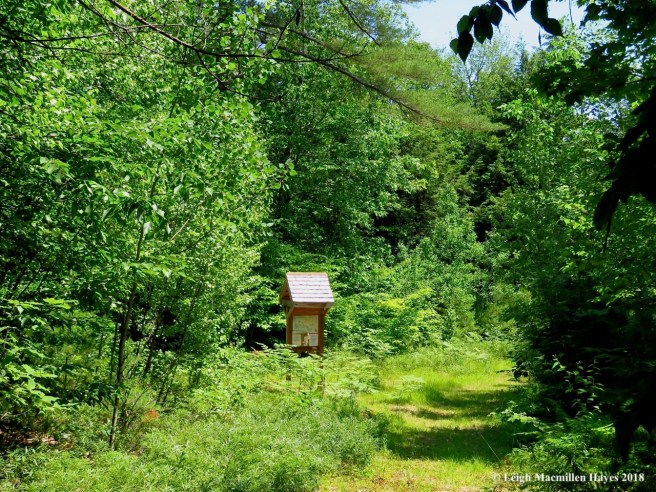
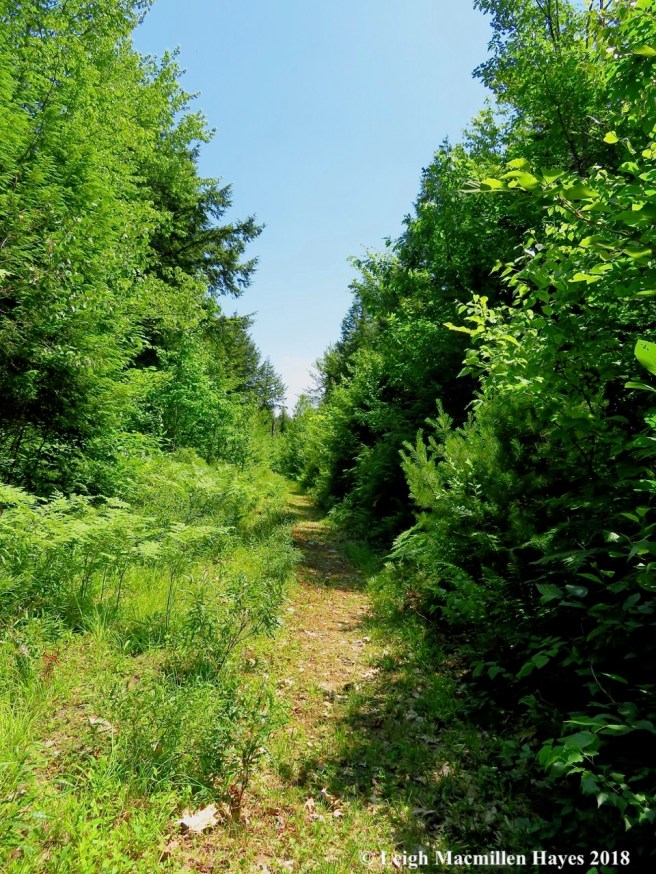
Just beyond a couple of boulders placed to keep vehicles from driving down the old skidder trail, stands the kiosk where you can take a look at the trail map and check out some other GLLT materials.

j3-map

As I said, this is just a small part of the overall refuge, but it’s well worth an exploration, especially if you don’t have much time (though some of us have been known to spend at least three hours making our way down and back).

j3a-the trail mowed

Recently, the GLLT’s Associate Team and Intern mowed the trail, making it passable and not quite so tick-infested. But . . . still take precautions. Always! The trail is rather level, so it’s an easy one to travel.

j4-daisy and crab spider

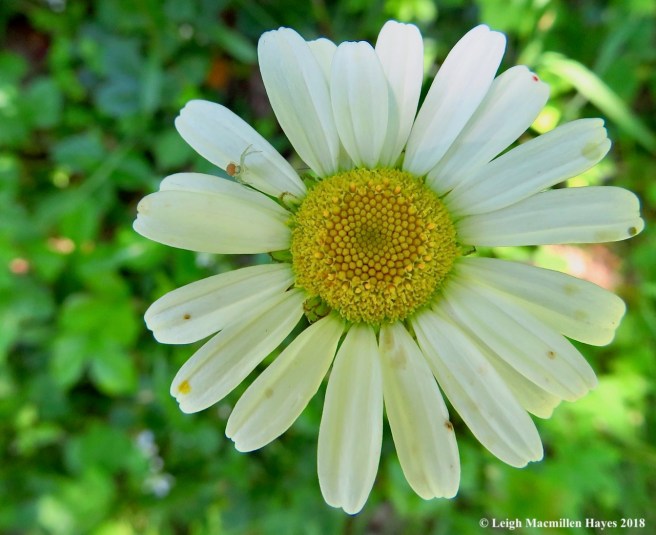
This is a place where you’ll find the ordinary, like a daisy. And trying to decide if “he loves me, he loves me not,” you might see a small crab spider.

j5-sundews

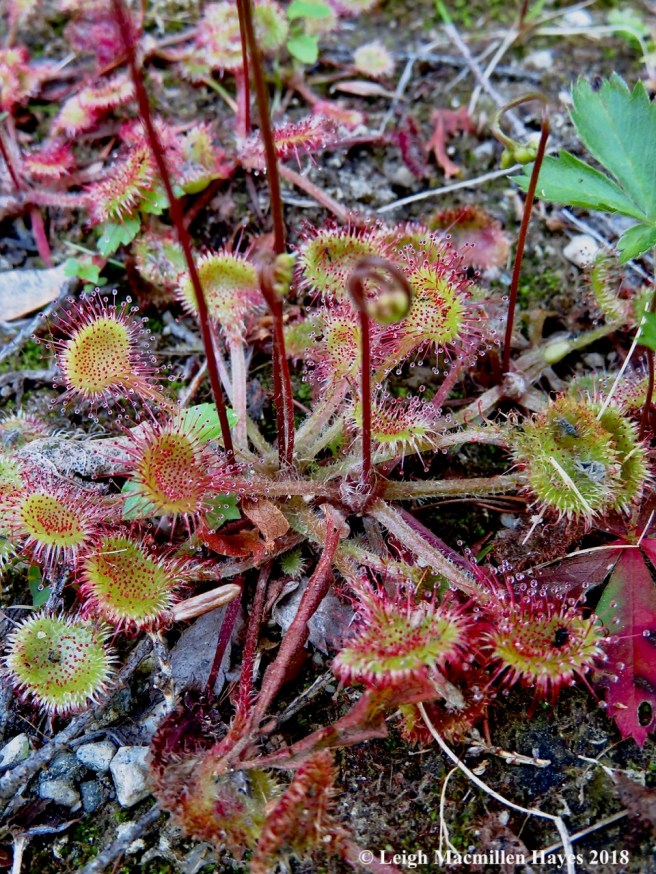
This is also the land of the extraordinary–in the form of the carnivorous Round-leaved Sundews. Check out the glistening droplets at the ends of the hair-like tendrils that  extend from each round leaf. The droplets are actually quite sticky. Just like a spider sensing a bug on its web, the tendrils detect the presence of prey and then curl inward, thus trapping the prey.  The whole leaf will eventually wrap around the insect and in the process of digesting it, the plant will absorb the bug’s nutrients. Sundews tend to grow in areas that lack sufficient nutrients, so this is the plant’s way of supplementing its diet. And if that wasn’t enough–it was just plain beautiful.

All that being said, this is a tiny plant and right now preparing to flower. So, if you travel this way, about a tenth of a mile into your journey, look down at your feet for these minute gems, take a closer look, and then walk with care.

j6-sweet-fern

Further along the trail you’ll see a few species of ferns, as well as the fern that isn’t a fern. Sweet-fern is so named for it’s fern-like appearance, but it has a woody stem and is actually a shrub. It’s yellowish green flowers that first appeared in spring were giving way to greenish brown, burr-like nutlets. In any season, this shrub has such variation to offer, that like hobblebush, I can’t resist honoring it with a million photographs.

j8-raspberries

One of the sweet joys of this trail is that because of previous logging, early succession is taking place in terms of the plants and trees that grow beside the trail, including blackberries not quite ripe and these raspberries already offering a delightful reprieve on a humid summer day.

j14-the field

Eventually, the trail leads to the turn-around point, the old log landing, which also displayed signs of forest succession, for its there that some wildflowers and sweet-ferns grow in the center. At the perimeter, white pines, gray birch and blackberries crowd each other.

j10-four-spotted with food

And on the edge, the dragonflies fly. And dine. This Four-spotted Dragonfly settled on a dead red pine to consume an insect.

j11-4 spotted eating

Ever so slowly . . .

j12-feeding frenzy

the body disappeared into its mouth.

j13-4 spotted, back view

While it was busy eating, I was busied myself in getting as close as possible to enjoy all of its nuances, from the four spots on its wings, to the basal display on the hind wings to the placement of its eyes and colors on its thorax and abdomen. All of those details help in ID.

j15-old coyote scat

And then into the field I went, with a memory of a winter expedition when we noticed that a shrike had deposited a mouse in a tree. Today’s finds included a pile of old coyote scat probably also deposited this past winter that indicated a territory repeatedly marked.

j16-turtle?

I also spied lots of recently made depressions. While one might suspect dust baths by a turkey or grouse, feathers are usually left behind in the process. Instead, the ground was more disturbed and because the landing is close to Bradley Brook, I determined I was looking at recently dug holes made by turtles. Snappers and painted turtles have been depositing eggs recently and these may be the incubation nurseries for their offspring.

j16-racket-tailed emerald

As I turned back toward the trail, I noticed a dragonfly seeking shade, for so hot was it. Notice the bright green eyes of the Racket-tailed Emerald. Thank goodness for those emerald eyes that always help in narrowing down the choices.

j18-common dewberry:sphinx moth

I found it a bit more difficult to ID the sphinx moth that paid a visit to the Dewberries. There are only 1,450 species in the Sphingidae family, but my leaning was toward Nessus Sphinx, though I could be totally off on that one.

j20-Northern-bush Honeysuckle

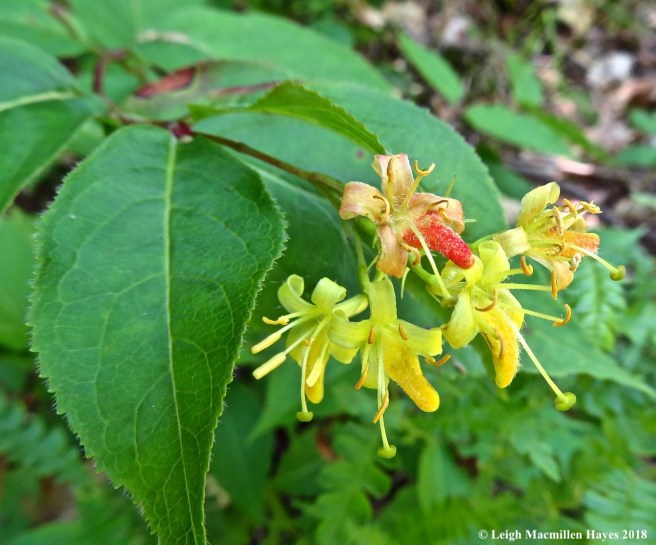
I was much more confident about my ID of the native Northern-bush Honeysuckle with its greenish-yellowish-orangish flowers. The plant is actually a shrub with a woody stem, and one that moose and deer like. I’ve yet to see a moose print along this piece of the property, but I know its part of a deer yard.

j21-Spotted St. John's-wort

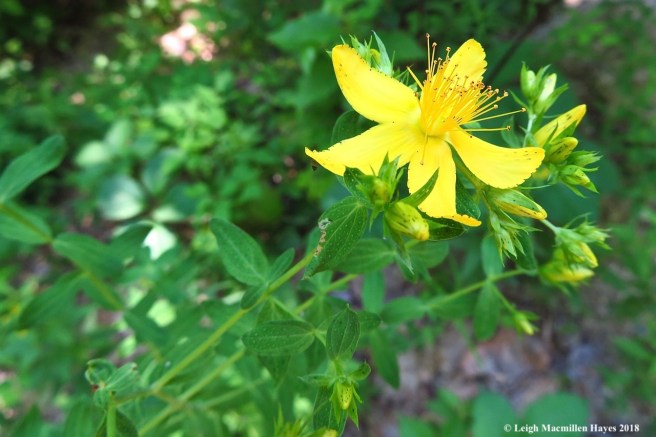
Also springing forth with yellow blossoms was Spotted St. John’s-wort, with its translucent spots on the leaves and tiny black dots outlining its petals.

j22-whorled yellow-loosestrife

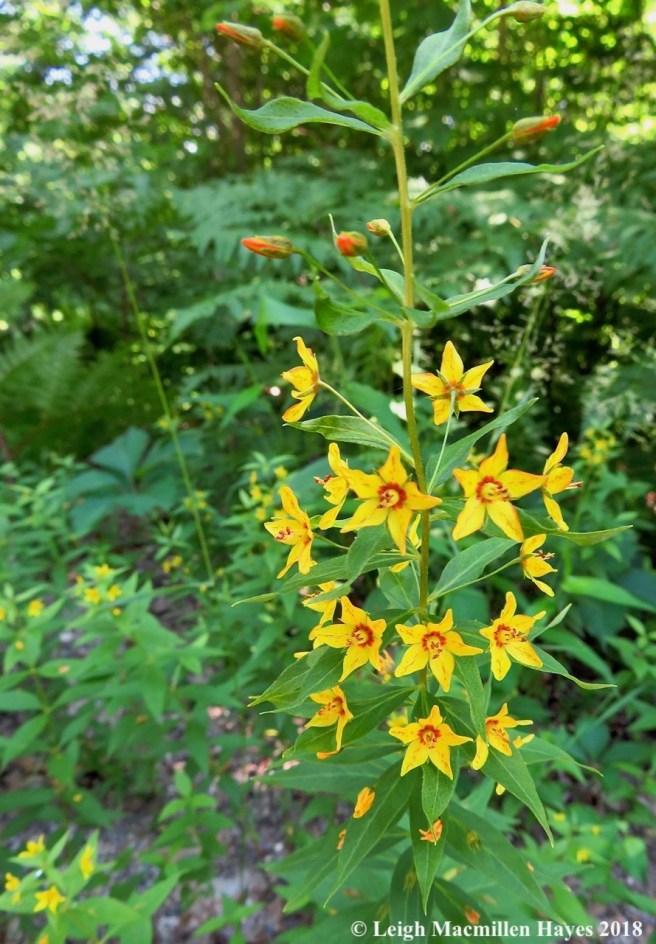
And not to be overlooked, the Whorled Yellow-Loosestrife with its cheery flowers extended in a whorl from the stem by long petioles.

j23-hitchiker

My journey wasn’t long, but with all that I saw, I was thankful for the spirit of Mr. Segur that flies over this place.

Just possibly, he graced me with his presence today . . . in the form of Spangled Skimmer.

Summer Solstice Sweetness

My dear friend Carissa sent me an e-mail about this week being Pollinator Week and challenged me to write about it. Her inspiration came from an e-mail she’d received from Natureworks Horticultural Services in Northford, Connecticut–part of our old stomping grounds as babes, toddlers, tweens and teens. (She grew up in Northford, while I grew up on the other side of the tracks in North Branford–two distinct villages that formed one town.)

Part of the message included this passage: “Happy Pollinator Week. There really is a week for that? You betcha. Pollinators are vital to life on this planet. And, at Natureworks, we are teaching our customers to protect and help pollinators every single day. It all starts with an organic garden. It includes planting lots of pollinator-friendly flowers. It continues with the way you manage your landscape and the way your community manages their public spaces. Pollinators are in decline around the world. We need to take this seriously. Let me just say . . .  we have the plants for that!

f1

And then another friend, Pam, invited me to join her on a mini-hike to Foss Mountain today in Eaton, New Hampshire, and it all came full circle. To travel here with Pam was an incredible opportunity because she had some personal experience with the property and shared the local lore, including a story about a peddler who long ago repeatedly traveled a road that crosses the mountain and apparently spent some time canoodling with another man’s woman. And then, on one of those journeys, the peddler vanished into thin air–never to be seen or heard from again.

f2

Pam’s brother and sister-in-law had previously owned the land we were about to explore, but it’s now owned by the Town of Eaton and is protected in perpetuity by the Upper Saco Valley Land Trust. The property is managed by the Eaton Conservation Commission, which maintains the trail and blueberry fields.

f3

The blueberry fields were really a sign of early succession following a 150+ year history as pasture land. According to information posted on one of the three kiosks, there was a description of the farming heritage that included along the timeline the decade that the fields reverted to blueberries, juniper and gray birch, and the man who oversaw the blueberry crop–Frank French.

At some point along that timeline, the Brooks family homesteaded there, but not much was known about them. Pam and I wandered about the remaining cellar hole as we tried to interpret the scene, but didn’t quite understand all that we saw. (We sure wished our friend Janet had been able to join us and add her understanding of such historical sites.)

f4

We continued on the short journey upward, passing through a pleasant White and Red Pine forest along a well-defined trail with switchbacks to help eliminate erosion.

f6

Suddenly, the natural community changed and we entered an open area where White-throated Sparrows serenaded us with their “Old Sam Peabody, Peabody, Peabody” song. Sheep Laurel surprised us with its bright pink flowers, but . . . we spied no pollinators.

f7

We also discovered a cinquefoil growing abundantly among the rocks, and though it had a few pollinators, it was just that–only a few.

f7a

Now allow me to interrupt with an explanation of the common name for this cinquefoil or Sibbaldiopsis tridentata: it’s known as Three-toothed (tridentata) for the three teeth at the tip of each leaflet. Do you see them?

f8

Though we only saw a few pollinators among the cinquefoil, the abundance of blueberries suggested a lot of previous action. A few blueberries had already ripened. We conducted a taste test and suggest you totally avoid Foss Mountain this summer for we certainly couldn’t taste the sunshine in those little blue morsels. (And my nose just grew longer–Pinocchio-style.)

f13

As we reached the summit, we shifted our attention from flowers and pollinators to the 360˚ view that surrounded us.

f14

In every direction . . .

f15

we relished the sight . . .

f16

of blueberry plants . . .

f17

and mountains–including the Ossipee, Belknap and Presidential ranges.

f19

After a lunch break in the middle of this longest day, we started down and made more discoveries–including the sweet flowers of Blue-eyed Grass and its fruits indicating it had been pollinated.

f20

And nearby on a Red Clover . . .

f21

a bumblebee sought nectar while simultaneously filling its pollen sacs.

But in the whole scheme of things, we saw few pollinators and wondered–what’s up? This is an organic field and public space, as Carissa’s contact at Natureworks encouraged. And yet . . . Pam and I weren’t able to answer all our questions today.

f22

But . . . as we looked upon the abundant blueberry crop before us on this first day of summer, we gave thanks for those who had protected the land and those who had performed the mighty act of pollination despite adversity and we looked forward to the sweetness that will follow this Summer Solstice.

The Amazing Race–Our Style, episode five

I’m not sure how it happened, but when we arrived at Route 113 in Fryeburg to pick up our clue we realized we were the first contestants for this episode of The Amazing Race–Our Style.

Consequently, we had a quick decision to make–the main clue referred to the Baldfaces and we recognized the fact that that entailed a challenging climb. Though my cast has morphed into a smelly splint [envision sliced cast up one side and then add two wide strips of velcro], I was relieved that we could take advantage of the Fast Forward clue that mentioned shingles in a white forest.

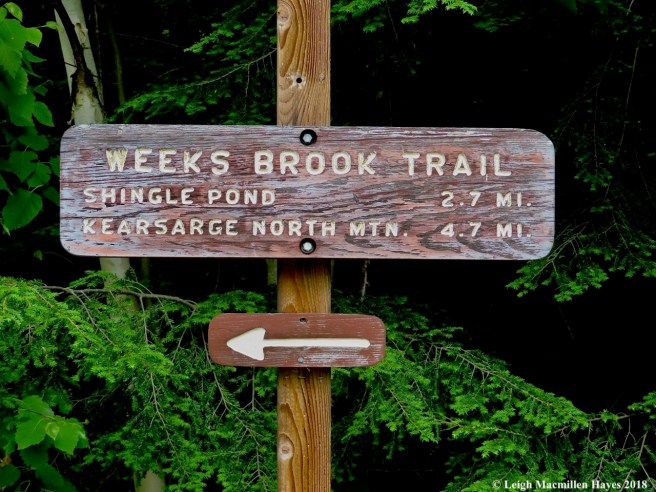
s1-trail sign

We checked the map and located a trailhead for Shingle Pond only a few miles away. BINGO.

s2-heading into the woods

The trail begins along Forest Road 317, but a few curves later heads into the nitty gritty of the White Mountain National Forest.

s8-locating the trail

Toward the beginning we could hear the buzz of logging machinery in the distance, but it wasn’t all that loud and certainly didn’t drown out the not-so-sweet buzzing of the local mosquitoes. Our first real challenge, for one can hardly count those flying buzzers and stingers as an obstacle, but more a way of life, came in the form of staying on the trail. It was blazed yellow, but occasionally we had to slow ourselves and our minds, and look around for some clues. There was only one cairn, which was fine with us, but after that spot we spent several minutes of valuable time looking for yellow in every direction . . . to no avail. Finally, however, my eyes cued in on what appeared to be a worn path between some trees to our right and my guy passed through some muck and logging slash to discover that indeed we had found it. That happened more than once, but each time we paused, scouted and eventually made the right decision. They didn’t promise us easy when we signed on for our own version of the reality show.

s11-crossing Weeks Brook

The path took us across Weeks Brook for which the trail had been named and it was there that we noted a trillion trilliums–all past their prime.

s9-patch cut

Through hemlock groves and mixed forests we hiked, occasionally passing by patches of clearcuts. Our next challenge was to determine the benefits of such habitat. The answer seemed obvious for so much was the bird song–from those I recognized like Ovenbirds, Veerys, and Hermit Thrushes to warblers that we could hear but not see. If we hadn’t been racing against the clock it would have been fun to try to figure out some of the song makers.

s10-browse

We also noted plenty of signs, such as browsed tree buds, that told us moose and deer had foraged in those areas.

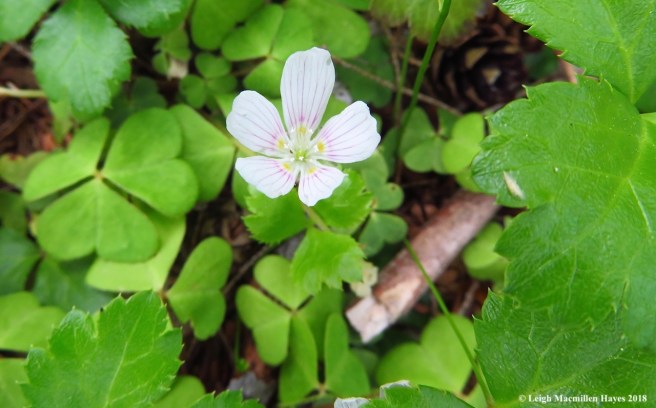
s5-wood sorrel

Challenge number 3 required that we locate a few plants and note whether they were edible or not. Wood Sorrel was easy–and most welcome on this sultry day for its a thirst quencher.

s6--Indian Cucumber Root

Indian Cucumber Root was another enticing edible and it grew abundantly in the forest. As pleasing as the flower is above its second tier, it’s not their fruits that appealed to us, but rather the small white rhizomes buried in the ground which offered a cool and crisp cucumbery taste. Even my guy can attest to that.

s7-wild calla

The one herb we didn’t taste test was the Wild Calla or Bog Arum. It’s known to cause severe irritation of the mouth and throat if consumed. We left it be.

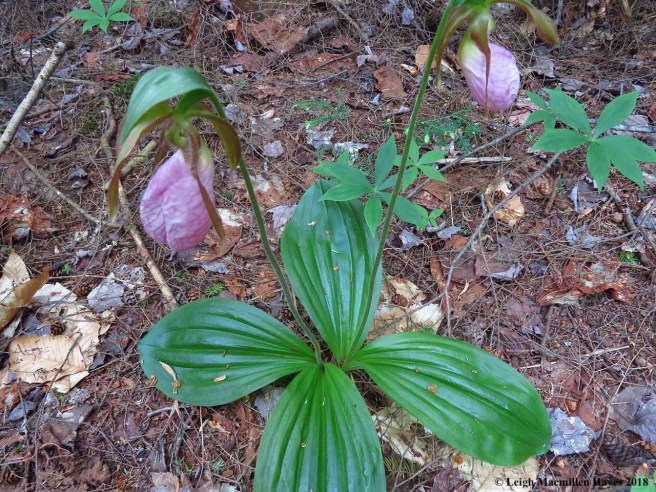
s12-lady's slippers

We did find one other plant that we wouldn’t think of eating, but always revere–Pink Lady’s Slippers, in this case a matching pair.

s13-prince charming

And not far beyond–Prince Charming himself. Even his eyes were surrounded by a ring of gold.

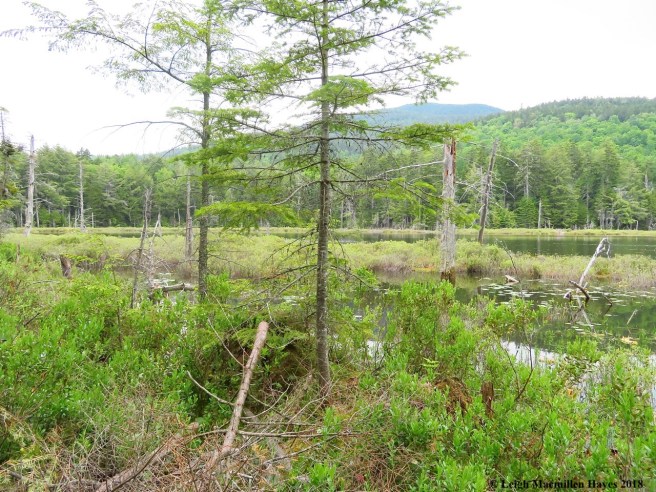
s14-Shingle Pond

At last we reached the two-acre Shingle Pond. Though we wanted to be greeted by a moose in the water, we were pleased with all that we saw and heard, including bull, green and tree frogs.

s15-Kearsarge Fire Tower

Though we were two miles and lots of ledges below the summit of Kearsarge North, as we ate our PB&J sandwiches created by my guy, the sight of the historic fire tower evoked lots of memories and got us dreaming about our next opportunity to sign the guest notebook.

s17-crimson-ringed whiteface dragonfly

Our task at the pond was to bushwhack around its perimeter and note some of the species who called this mountain pond home. Probably my favorite discovery was the Crimson-ringed Whiteface Dragonfly.

s17b-crimson-ringed whiteface

Over and over again we saw it, that bright red body standing out in contrast to its dark abdomen. There were a zillion dragonflies, many of them darners and clubtails zooming about, but this skimmer had the decency to perch frequently and reveal its finer details.

s17a-bushwhack

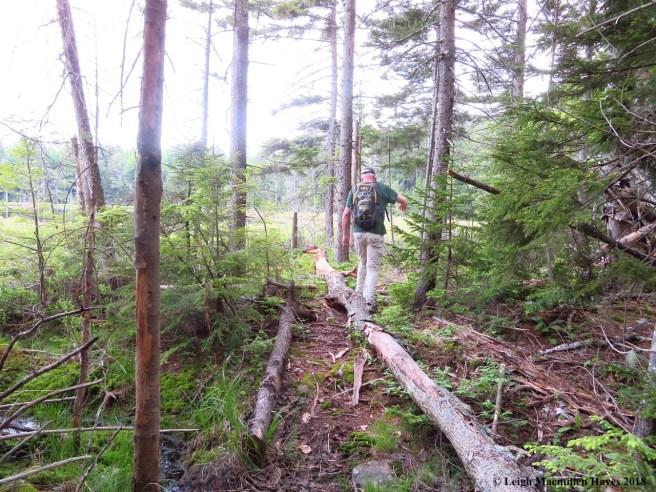
As we moved around the pond, we met trees to climb over, under and around.

s18-beaver works

Many were felled by the resident beavers, so we had another who made its home there to add to the list.

s19-beaver lodge

In fact, we found the most recently built beaver abode.

s19a-beaver dam

And the dam that made it all possible.

s20-bear scat

One special sign of wildlife may gross you out, but we were delighted for this pile of scat indicated a bear had passed by earlier this spring. I’d wanted to look for bear trees on the hike up, but these days my eyes are mighty focused on trail conditions. And scat is just as good, if not better than a tree with old claw marks. Well–both are wonderful . . . really.

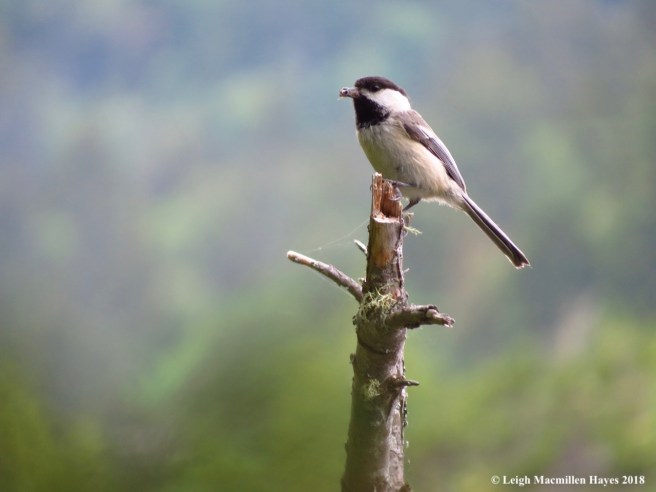
s21-chicakdee

One other resident was insistent that we take notice and I think we may have paused near a nest tree. When I asked my guy if he could hear the Conway Scenic Train whistle emanating from the other side of the mountains, he said that all he could hear was the chickadee’s chatter.

s22a-Atlantis Fritillary

The return hike down was via the same trail, but when we reached the log landing and later the logging road we had one final challenge to complete–the flutter-by challenge. Who were those beauties that flitted about, gracing the landscape with their presence? For starters, we discovered several Atlantis Fritillaries seeking nectar from eggs and bacon flowers, aka Bird’s-foot-trefoil.

s24-atlantis 2

Once over easy, it was equally beautiful.

s25-white admiral

And the learning continued for we watched numerous White Admirals flit from spot to spot. But notice the coloration–including orange spots below its white bars.

s25a-white admiral

This blue version was also a White Admiral. Needless to say, we admired it no matter its variation.

And with that we had successfully completed the fifth episode of The Amazing Race–Our Style. All day we didn’t know our status in comparison to the other contestants, but six miles and four hours later we had nothing to fear. We definitely won this leg for we stood upon the mat at the Pit Stop much earlier than any of the other contestants.

As much as we would have liked to climb the Baldface Circle, it wasn’t in the cards for us today.  And as a final note to today’s journey–I added a few more mosquitoes to the natural history museum forming on the velcro of my splint. It’s a museum, however, that I hope will close soon, for it stinks–literally and figuratively.


Dying To Get In

When I told my guy that Connie was taking me to Evergreen Cemetery in Portland today, he gave me a questioning look and asked, “Why?”

‘Why not?” I responded.

But really, it was because both she and I have friends who have posted incredible photographs of the natural world that is part of the cemetery and we wanted to discover what it was all about.

e1-evergreen cemetery

At first glance, Evergreen Cemetery may look like Anytown Cemetery for it features gravestones, memorials and tombs throughout. But . . . as we read on a panel near the entrance: “Established by the city in 1854, the cemetery was designed by Charles H. Howe as a rural landscape with winding carriage paths, ponds, footbridges, gardens, a chapel, funerary art, and sculpture. It also includes extensive wooded wetlands. Evergreen was modeled after America’s first rural cemetery, Mount Auburn in Cambridge, Massachusetts.

The cemetery, the second-largest publicly-owned open space in the City at 239 acres, has been host to a variety of wildlife such as geese, ducks, pheasants, swans, turtles, blue heron, fox, mink, deer, and moose. Its spaciousness combined with old growth pine and oak, vegetation, ponds, and surrounding wetland, provides a true wildlife oasis. It is considered a premier birdwatching sanctuary. Maine Audubon utilizes the cemetery for field trips, to include their annual Warbler Weeks conducted in May. Evergreen Cemetery is also a wonderful location to enjoy the vibrant colors of fall foliage in Maine.

e2-sunburst lichen

We didn’t actually spend much time exploring the cemetery itself, though that would be fun to do on a return trip, but as we waited for Connie’s friend Linda to join us, we did look at a few gravestones and were especially enamored with the sunburst lichen that lightened a stone gray morning.

e3-male mallard

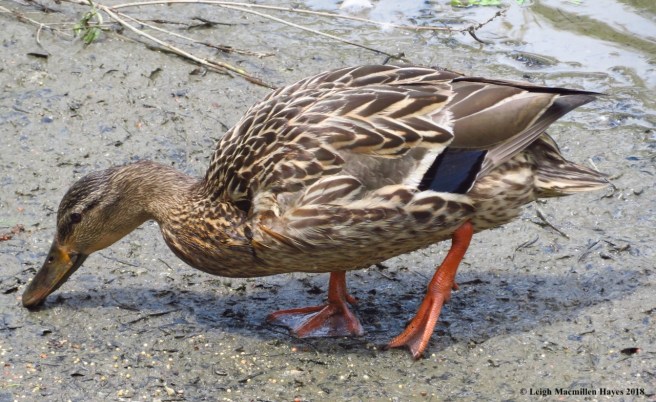
Linda was only a few minutes behind us and then we all traveled to the back end of the cemetery, where the Mallards stopped us in our tracks. While you might ask why, remember that we are women of wonder and wonder we did: about his iridescent head,

e4-famale mallard

her lack of ducklings despite four attentive males,

e5-mrs. mallard

why their feet were orange,

e6-duck tweed

and the tweedy pattern of their feathers.

e7-ducklings

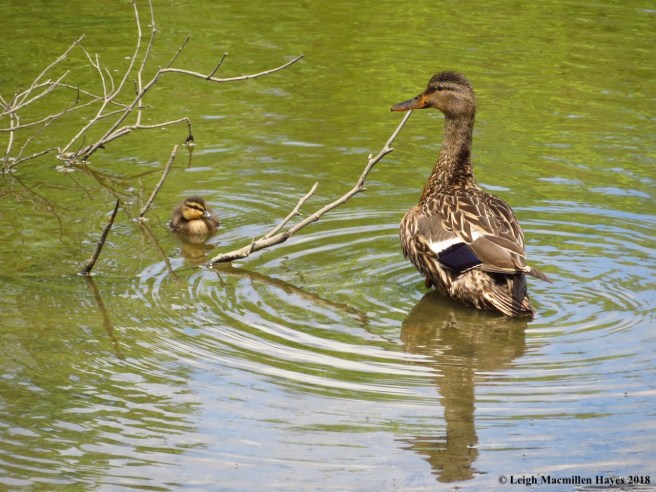
And then we spied a couple of other females with ducklings, this one standing tall as she allowed her youngsters to explore.

e7-chipping sparrow

They weren’t the only ones exploring–a Chipping Sparrow was doing the same, though it was almost impossible to see given that it blended in so well with its surroundings.

e8-black swallowwort

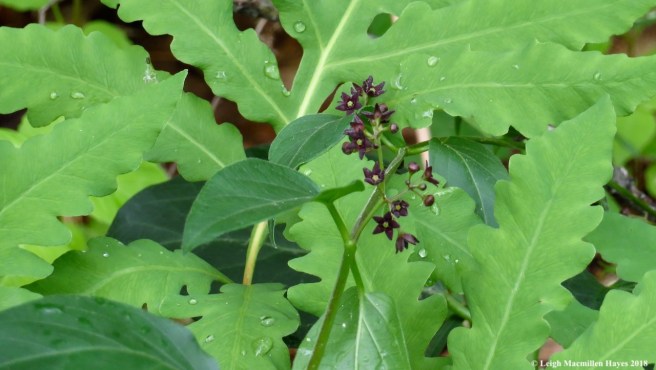
At last we pulled ourselves away from the ducks and our view of the car, and started down a trail where flowers and leaves made us take note. Last year, I first met the dark maroon flowers of Black Swallowwort, an invasive. Diminutive and pretty, it was difficult to dismiss them, especially when juxtaposed as they were against a sensitive fern frond.

e9-ragged-robin

Connie introduced us to another invasive that she immediately recognized as Ragged-robin. Linda and I were wowed by the pink petals, irregularly cleft.

e10-sunburned oak meat

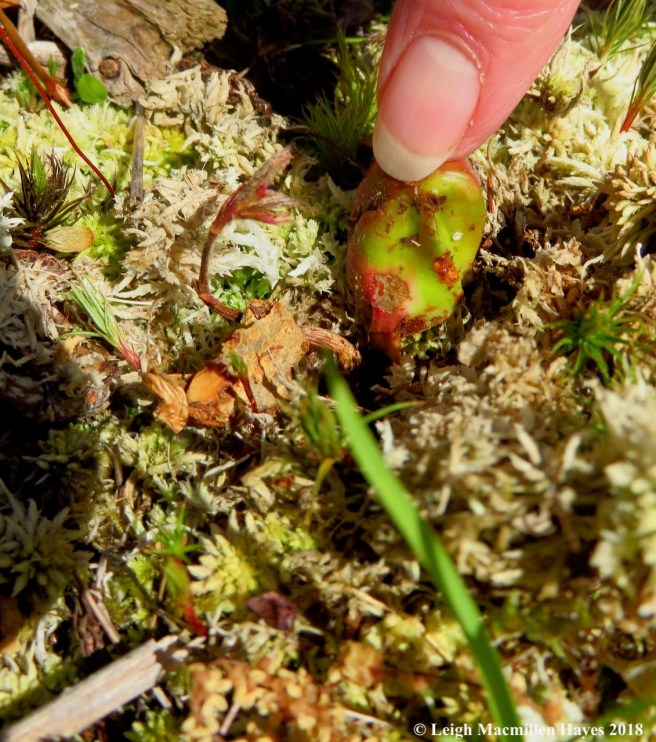
The natural community kept changing and suddenly we found ourselves under a power line where dried spaghnum moss made us wonder if the land was typically wet. And then we saw something red, and the discarded outer shells nearby spoke to its source. It was the “meat” of an acorn, the red being its “sunburned” presentation.

e11-oak setting root

The evolution of an oak tree–it begins with an acorn.

e12-song sparrow

In the same opening, we watched several Song Sparrows move among the shrubs, and then one paused to serenade us.

e13-song sparrow

Upon finishing, it waited as if for our applause.

e14-arrowwood viburnum

Before moving on, we had one more plant to ID. Thanks to iNaturalist, Connie informed us that it was Arrowwood Viburnum. While we appreciated its umbel of flowers and large-toothed leaves, one stem in particular drew our attention. In a symbiotic relationship, ants stroked brownish-red aphids with their antennae, while the aphids released drops of honeydew sucked from the stem. The process was much like a cow being milked. It was actually rather creepy, but wicked cool and all three of us used a loupe to take a closer look.

e15-American honeysuckle

Back along a woodland trail we continued, again stopping periodically to take in the sights, ask questions, and appreciate our surroundings. Among our finds we discovered the newly forming fruits of a native honeysuckle.

e16-beaked hazelnut

We also rejoiced when we encountered the beaked fruits of Beaked Hazelnut.

e17-mallards

At last we’d completed a short loop, and found ourselves drawn in again by the Mallards, both young and old.

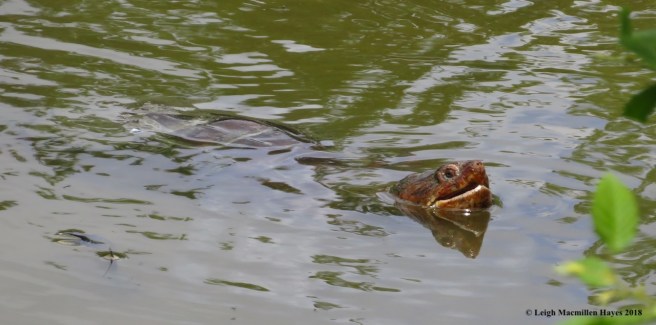
e19-snapping turtle

But then our eyes focused on other residents in the shallow water.

e20-ducks and turtle

And we feared that we’d witness a snapping turtle devour a duckling. We kept encouraging mama to move her kids out of the way.

e21-3 turtles

Especially when we realized the pond was full of snappers and they all seemed focused on swimming to the same focal point.

e22-injured duck

But mamma took her time and let the kids roam freely. We did realize that she had an injured foot or leg and moved with a hop, which added to our anxiety. I also felt a certain affinity with her, given my current one-armed bandit situation due to a broken wrist that is slowly healing. Here’s hoping that she heals as well.

e22-mouth open

As we watched the drama play out before us, we noted two adult ducks hanging out under some alders beside the shore. Suddenly, a snapper approached them quickly and opened his mouth wide. Was he exhibiting aggressive behavior?

e23-mouth closing

We weren’t sure, but as suddenly as he’d approached, he closed his mouth and turned away.

e18-ducklings all in a row

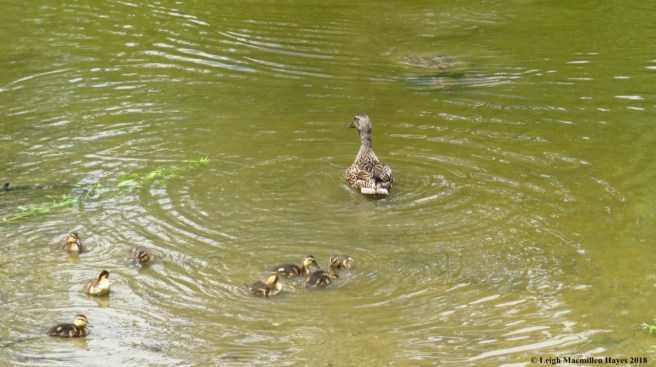
We noticed that turning away was typical turtle behavior. They seemed to get within a couple of feet of the ducks and then turn. Why? We were, however, glad when momma got her ducklings all in a line and moved on.

e25-green heron

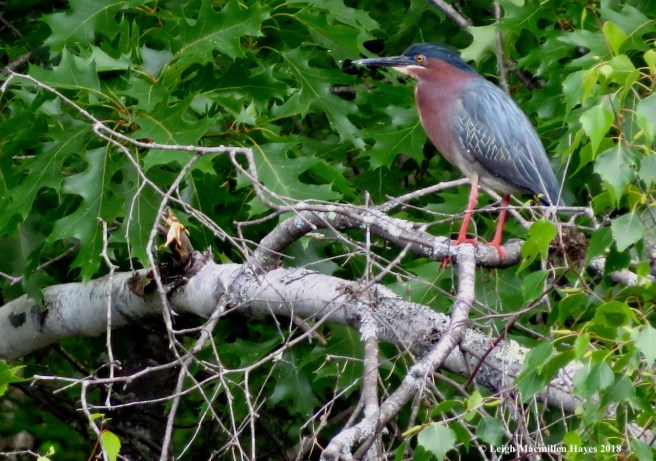
We, too, moved on . . . a few more feet toward the car. And then we stopped again to check on the action in the pond. That’s when a Green Heron flew in.

e26-green heron

He was also looking for lunch, though we never saw him succeed in his search.

e27-turtle wars

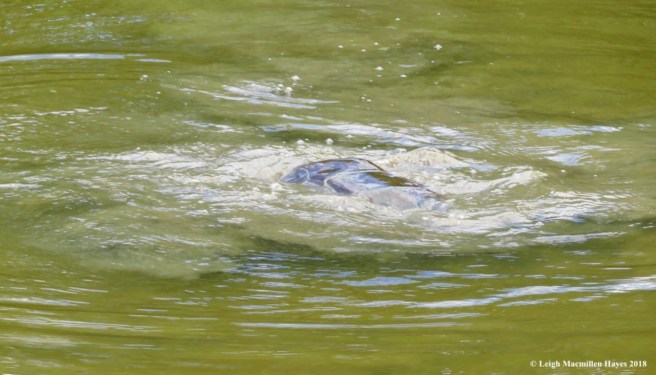
We did see the ducks and turtles again. And our turtle questions continued for we noticed that they would gather and then one would go after another and the water would boil. An act of aggression? Or a mating ritual?

e28-turtle face

We didn’t have all the answers, but one thing we knew–we’re dying to get into the cemetery again.


From the Ground Up

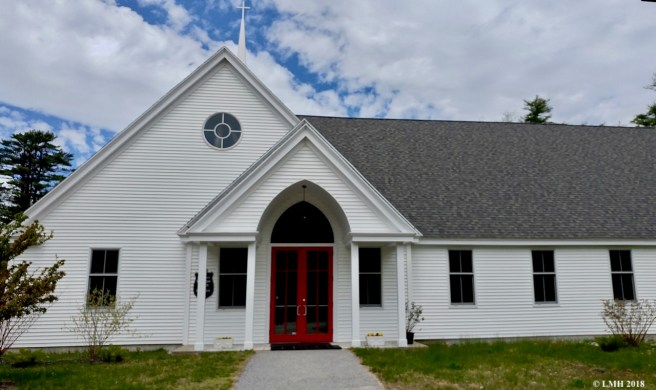
“I am the Alpha and the Omega, the Beginning and the End, the First and the Last . . . The end of a beginning . . . A new beginning . . .” So began Bishop Chilton Knudsen’s sermon shared with over 170 parishioners and guests who attended the Dedication and Consecration of St. Peter’s Episcopal Church in Bridgton on Sunday, June 1, 2008.

Standing behind the pulpit in a site line between the entrance to the sanctuary, altar, cross and a circular pane that provided a window on God through the movement of the trees, wind and sun, Bishop Knudsen reminded us, as our rector, the Rt. Reverend John H. Smith, retired Bishop of West Virginia, had done previously, that the new building was just that — a building. She encouraged us not to get so caught up in the building that we lose sight of our mission of outreach to each other, our communities and the greater world.

St. Peter’s Episcopal Church began as a summer mission in 1962. On September 8, 1974, St. Peter’s-by-the-Lake held its first service of extended ministry. Though it did not have a home of its own, the church provided an Episcopal presence to summer and year-round residents of the Lakes Region by meeting in various locations including people’s homes, Bridgton Academy, and local churches of different denominations. In 2003, the parish voted to purchase a ten-acre lot at the junction of Routes 302 and 93, one mile west of downtown Bridgton.

After renting space for all those years, in 2007, church members enthusiastically supported a capital campaign; through gifts and pledges the full amount of the building cost was raised. Under the leadership of parishioner Beatrice White, a building committee was formed. The Vestry engaged the services of William Whited, Architect, to design a building that would be both beautiful and affordable.

S2-BISHOP KNUDSON BREAKS GROUND

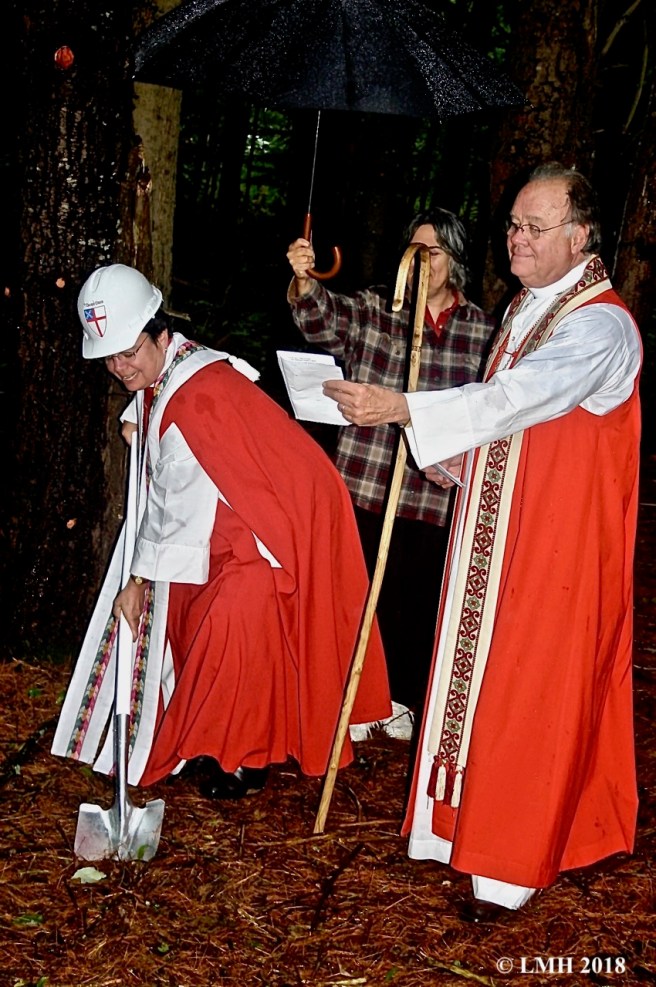
On September 15, 2007, Bishop Knudsen, donning a hardhat decorated with the Episcopal shield, dodged raindrops as she helped break ground.

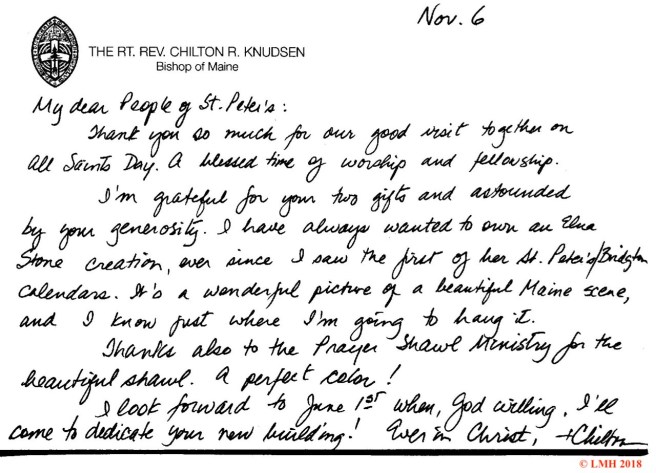
S2A-LETTER FROM BISHOP KNUDSON

Following that initial groundbreaking, parishioners met at the site the first Sunday of each month for prayers and hymns. Rain . . . snow . . . mud . . . the weather presented a few obstacles, but the project proceeded in spite of it.

S3-CHURCH TAKES SHAPE

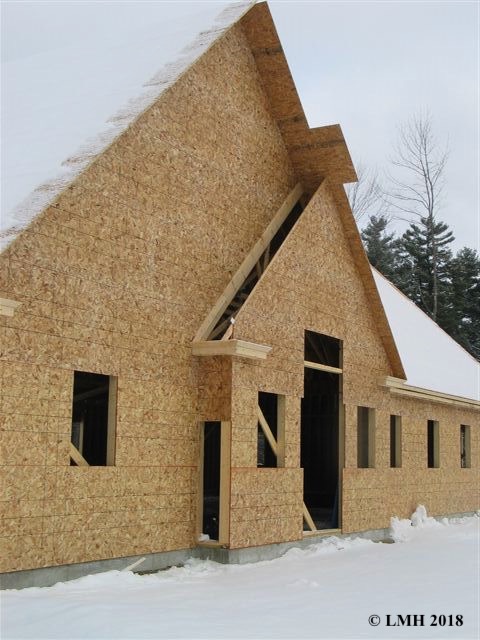
Over time, the building began to take shape.

S4-WINTER

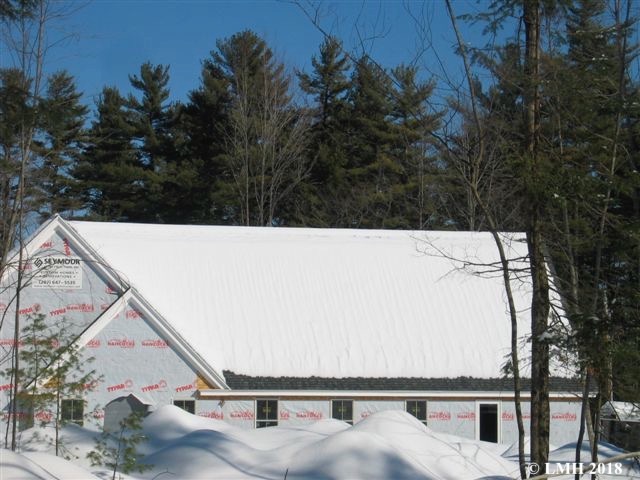
With the advent of winter, it was wrapped in Typar . . and continued prayers.

S5-ALTAR

Within, the altar found its formation.

As parishioners, we watched it grow into a structure for worship and fellowship. Upon entering the church for the first service on May 25, 2008, one word was expressed over and over again, “Wow!”

S6-NEW CHURCH DEDICATION

For St. Peter’s, the Dedication and Consecration of the building on June 1st was the culmination of years of discussions, planning, being amazed at fund raising miracles and working together to reach a goal. That grand and meaningful worship service is one that many people never experience unless they build a new church. Using the service of Dedication and Consecration as outlined in The Book of Common Prayer, Bishop Knudsen knocked her crosier and called for the doors to be opened. Gregg Seymour, General Contractor, opened the door and handed the Bishop a hammer as a symbol of his work. Beatrice White presented the building blueprints while Junior Warden Eric Wissmann gave the Bishop a set of purple building keys. A procession including the Bishops of Maine, our rector, a deacon, verger, wardens, crucifer, taperers, parishioners and guests flowed through the narthex into the simple, yet beautiful sanctuary. Following prayers for the building, the Bishop moved about the church and consecrated the baptismal table and bowl, cross above the altar, lectern/pulpit, hangings and parish banner, tapers, piano, kitchen, classrooms and offices, narthex table, credence table, altar shelf, fair linen, and other special gifts. She then celebrated the Holy Eucharist, assisted by the Reverend Christine Bennett, Deacon, and George Wright, Verger. The Eucharistic Bread was baked and offered by the “SPY” group, Saint Peter’s Youth. During Holy Communion, the choir sang “Jesu, Jesu,” accompanied by Evan Miller, Director of Music. Following the service, the parish continued the celebration indoors and out with a reception and pot-luck dinner. 

S7-CHURCH TODAY

Fast forward and the parishioners are now preparing for Bishop Steven Lane to visit next week and celebrate the tenth anniversary of St. Peter’s. In all that time, so much has changed . . . including the land. And so this afternoon I spent some time wandering around the grounds in quiet reflection of the people and the place. No, not the church building, though I continue to appreciate its simplicity and still love to gaze out the circular window above the altar.

S8-ANTS ON DANDELIONS

Today, however, I wanted to note all the other species that have gathered here, including the ants seeking nectar. Have you ever gotten as close to a dandelion as an ant or bee might? Did you know that each ray has five “teeth” representing a petal and forms a single floret. Fully open, the bloom is a composite of numerous florets. And equally amazing is that each stigma splits in two and curls.

S9-DANDELION SPREADING THE SEEDS

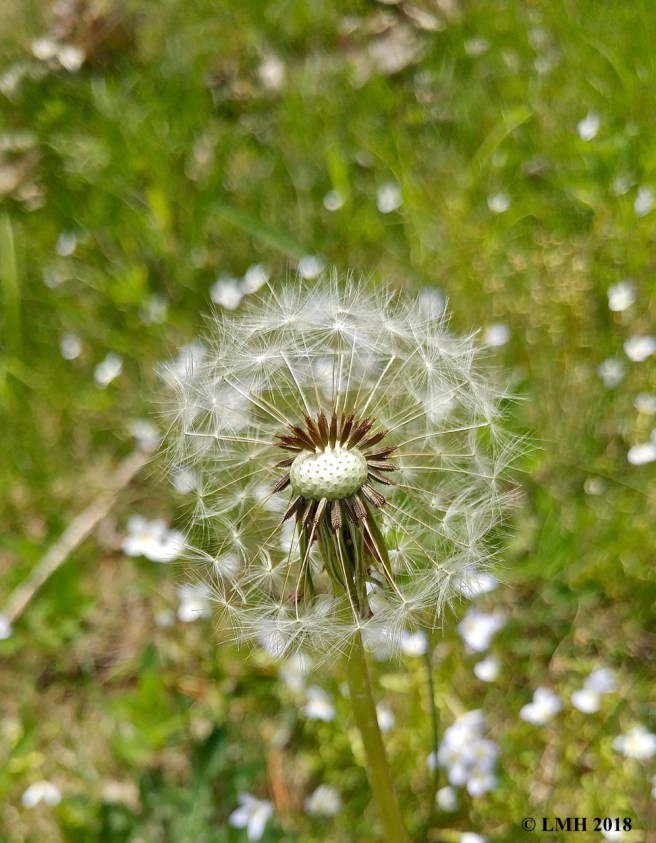
Of course, if you are going to admire a dandelion in flower, you should be equally wowed as it continues its journey. At the base of each floret grows a seed covered with tiny spikes that probably help it stick to the ground eventually. In time, the bloom closes up and turns into those fluffy balls waiting for us or the wind to disperse the seeds, rather like the work of the church. Until then, they look like a spray of fireworks at our feet.

S10-MEMORIAL GARDEN

My wandering led to the Memorial Garden where parishioners with greener thumbs than mine created a small sanctuary for one who wants to sit and contemplate.

S11-CELTIC CROSS WITH LICHENS

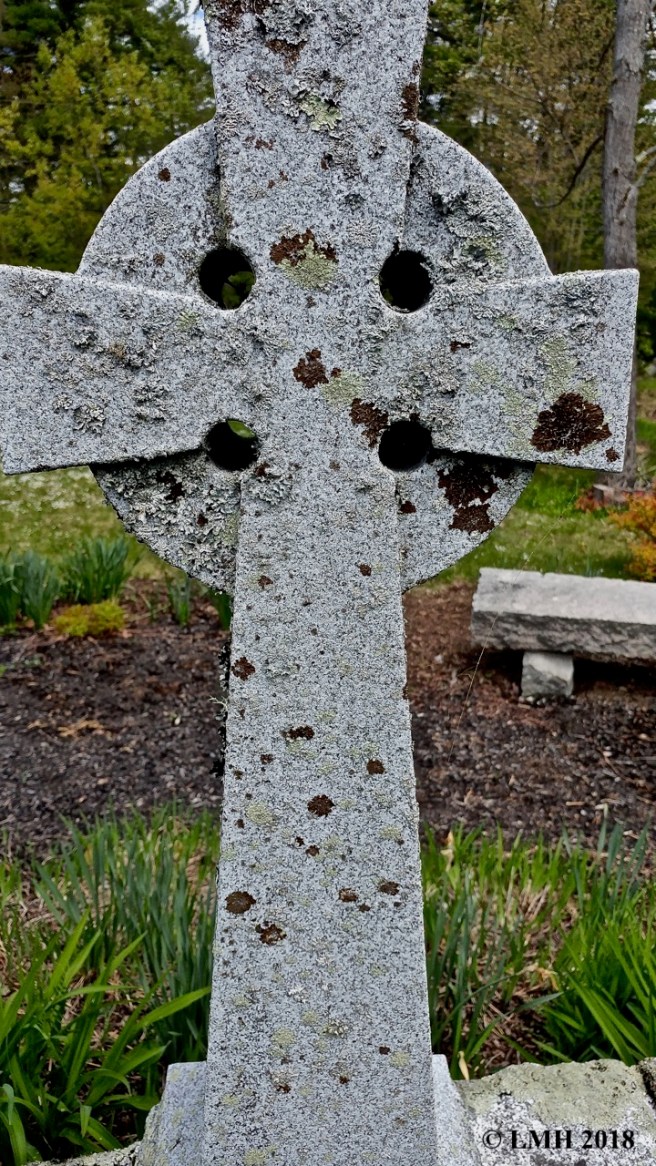
The garden’s center offers a cross depicted in the Celtic tradition. I remember when it was installed as a “clean” piece of granite and realized today that I hadn’t been paying attention, for as is true on any of the surrounding benches, lichens had colonized it, enhancing the circle of life.

S15-GRAY BIRCH

What I really wanted to look at though was the edge where various species spoke of forest succession. I found an abundance of gray birches, one of the first to take root after an area has been disturbed. It’s always easy to spy once you recognize its leaf’s triangular form, which reminded me of Father Dan Warren’s demonstration this morning about the Trinity.

S12-PAPER BIRCH LEAVES

Nearby grew an already established paper birch, its leaf more oval in shape.

S13- QUAKING ASPEN

Then I couldn’t help it and my tree fetish took over. Quaking or trembling aspen showed off its small toothed edges, while . . .

S14-BIG TOOTH ASPEN

its young cousin displayed big teeth. Despite its fuzzy spring coating, insects had already started devouring the pubescent leaves. One of my favorite wonders about both big-tooth and quaking aspen leaves is that they dangle from flattened stems or petioles and ripple in a breeze as they send out messages of good tidings.

S16-BEECH LEAVES

Also along the edge I found a beech tree donning huge leaves that looked like they were in great shape . . . momentarily.

S17-VERY HUNGRY CATERPILLAR

For on the backside, a very hungry caterpillar had been dining on its own form of the Bread of Life.

S17A-FLOWERING DOGWOOD

I found two other young trees that I suspected were planted within the last ten years–the first: flowering dogwood. Growing up in Connecticut, we had a large one in the side yard and so memories of times long ago intermingled with those of the more recent past and my home church, Zion Episcopal, entered into my reflections.

S17B-LOCUST

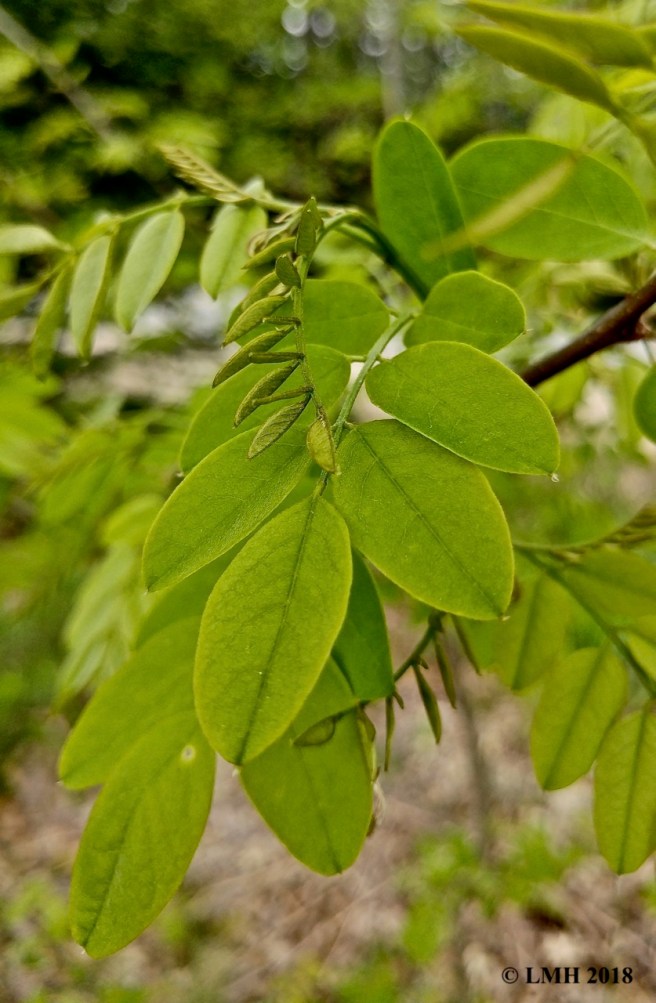
Like the dogwood, we also had a mature locust looming tall near my mother’s garden. Spying this one, I gave thanks for the ability to span the years, travel many routes, and remain faithful to my beginnings.

S22A-SWEET FERN

Slowly my eyes shifted downward . . . and fell upon a most pleasing sight–sweet-fern. It’s one of those, like hobblebush, that wows the eye in any season.

S18- WILD STRAWBERRY FLOWER

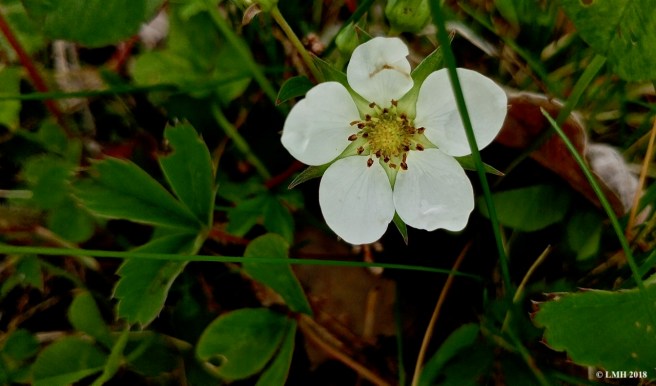
And then I turned my focus to the ground where an incredible variety of flowers either in bloom or still to come, mosses and grasses all shared the common space in seeming harmony, though I suspected there were those that crowded out others. Patches of wild strawberries graced the carpet. Five petals surrounded about twenty stamens and soon a fruit may form–meant to sustain small mammals and birds.

S21-FRINGED POLYGALA

Gay wings or fringed polygala surprised me with its presence. So delicate, so beautiful, so fleeting.

S24-STONE WALLS

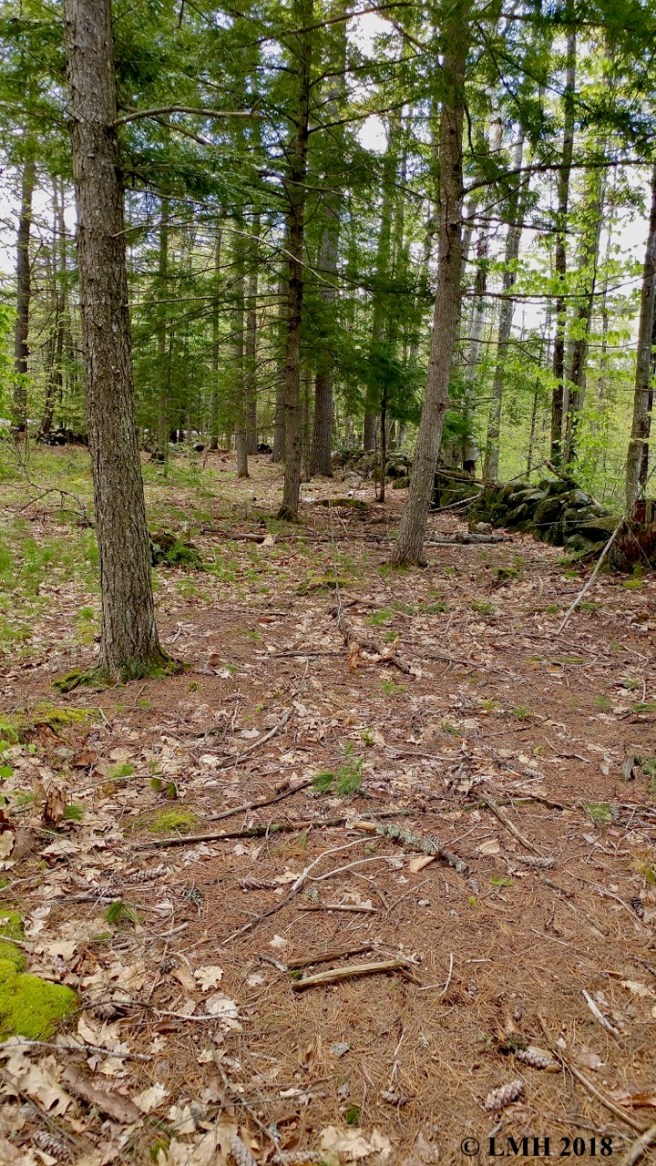
I stepped into the woods beyond the edge and was reminded that ten years ago I wanted to create a nature trail on this property–a place where anyone could partake of a short wander away from reality; a place where someone might be nurtured by nature.

S19-STARFLOWER

A place where the stars above would be reflected in the flowers below.

S20-DWARF GINSENG

A place where flowers like dwarfed ginseng would erase global issues–if only for a moment.

S23-GIANT BUMBLEBEE

A place where everyone recognized the system and from such recognition began to work together toward common goals.

S22-INTERRUPTED FERN

A place where interruptions occurred because life happens, but such were accepted as part of the norm.

S23A-BUMBLEBEE BREAK

A place where one could find a bench upon which to rest before beginning again.

S25-ENTER HERE

Here’s to beginning again St. Peter’s.

Here’s to remembering all those who made this place a reality.

Here’s to maybe someday a nature trail.

Here’s to continuing to create a place where all are welcome whether they pass through the red doors, into the Memorial Garden, or choose to take in the offerings from the ground up.


Petals and Wings: A Window of Opportunity

Spring ephemerals. Those species that take advantage of the short stretch of time between snow melt and leaf out. We celebrated such today at the Greater Lovell Land Trust’s Heald and Bradley Ponds Reserve as we ever so slowly walked along the orange trail from the Flat Hill parking lot and then looped around on Perky’s Path.

S1-GATHERING

But first, we gathered in the parking lot where Docent Peter explained that he thought I was crazy when I suggested a May date for a flower and bird walk. He’d not been in Maine during May previously and only this week learned the joys of birding with minimal leaf cover. I think he’s hooked. And I’m still crazy.

S4-WILDFLOWER GUIDES

Our journey began with Docent Linda locating wildflowers that are opportunists who bloom early, get pollinated and produce seeds before the deciduous trees blanket the floor of the forest in shade.

S2-STINKING BENJAMIN

Among those early bloomers was one that stinks! And yet, it’s exquisitely beautiful. Stinking Benjamin is one of its common names because of the flower’s malodorous scent. Of course, you need to get down on your hands and knees to get a whiff.

S5-HAND LENS

Our focus wasn’t just on flowers and birds as we all soon realized, for it seemed that many things caught our attention, including the seeds of deer tongue grass. As a collective group, we suffered from Nature Distraction Disorder.

S6-WILD SARSAPIRILLA LEAVES

Because of such, we observed more than just the flowers that were in bloom. In one instance, the flower was yet to come, but the leaves in their early stage were worth noting. Linda pointed out that the color of wild sarsaparilla’s new leaves was reminiscent of poison ivy. But, poison ivy has leaves of three.

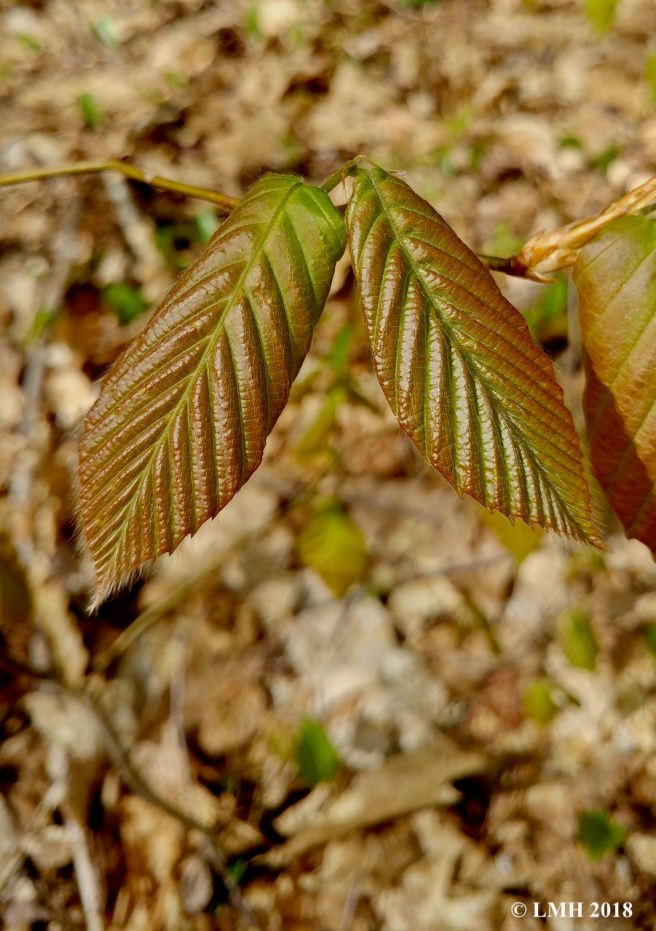
S7-BEECH LEAVES

And that reddish tint that we saw in the sarsaparilla, beech and other leaves? The various hues of color in leaves was caused by the presence of pigments called anthocyanins or carbohydrates that are dissolved in the cell sap and mask the chlorophyll. As our spring temperatures rise and light intensity increases, red pigment forms on a leaf and acts as a sunscreen to protect the plant from an increase in ultraviolet rays.

S8-BIRDING

We’d been looking down for a while, but then bird song pulled our attention to the tree tops. Without the use of my Cannon Rebel, which is currently enjoying what I hope will be a successful rice bath :-( , I couldn’t capture the many warblers we spied. Some, as Peter, and his wife Molly, told us, were only in the area temporarily to fuel up on insects before continuing the journey to their breeding grounds in Canada.

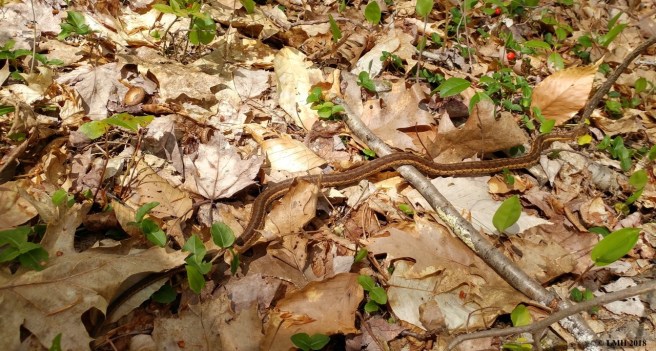
S10-GARTER SNAKE

And looking at our feet once again, another in search of insects. We saw a garter snake who stayed as still as possible while we ogled it. Was it cold and trying to soak up warmth from the sun? Or did it stay still in hopes we wouldn’t spy it?

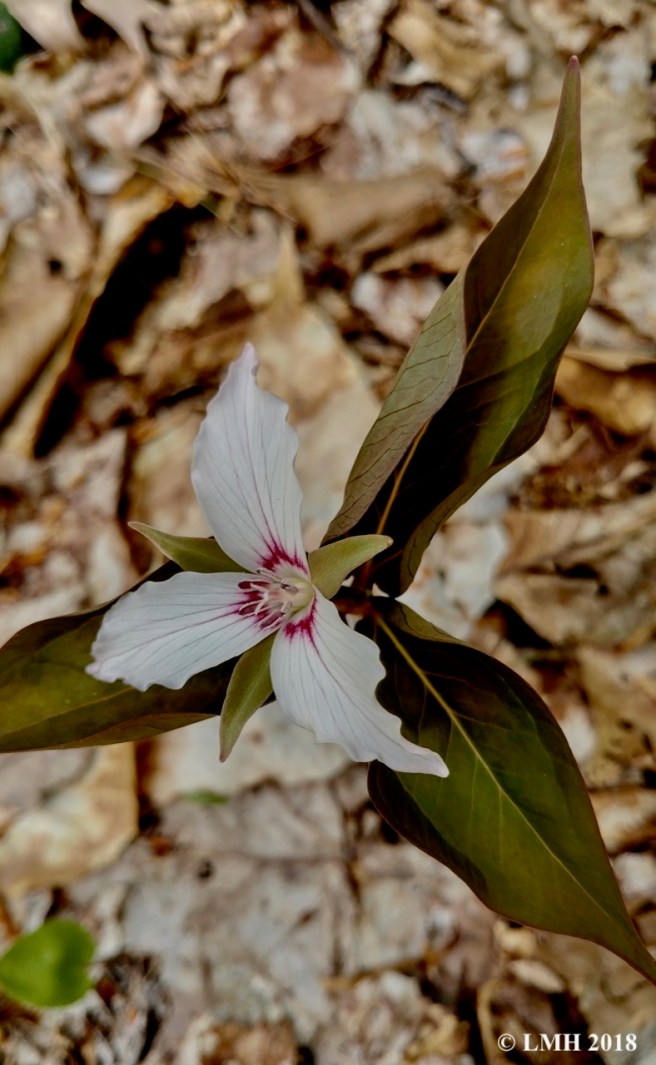
S11-PAINTED TRILLIUM

We finally left the snake in peace. And paused next to gaze upon a painted trillium.

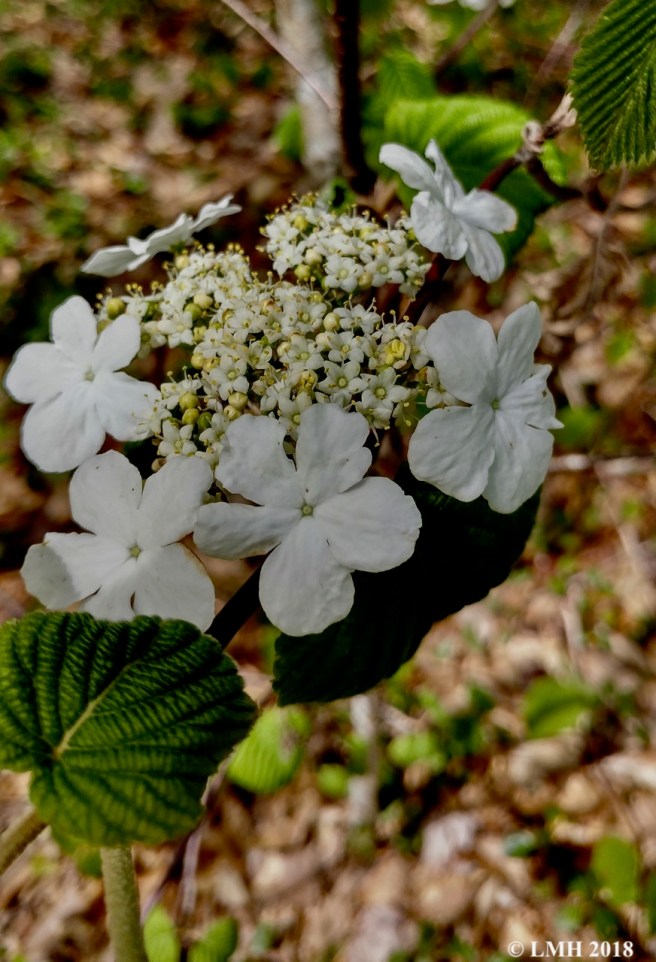
S12-HOBBLEBUSH FLOWERS

Almost two hours after our start, we approached the wetland and overlooking bench. It was there that a hobblebush laden with blossoms caught our attention in the shrub level. The hobblebush bouquet was really an inflorescence or lacy cluster of tiny fertile flowers surrounded by a halo of showy, yet sterile bracts. Those larger, sterile flowers attract insects while the tiny fertile flowers do all the work of seed production. Nature has its way.

S13-BIRDING BY THE BENCH

It was at the bench that bird song again greeted us and we looked above the shrubs toward the tree limbs above.

S14-BIRDING

For many of us, we looked through our binoculars at birds we’d only heard of before, including a Bay-breasted Warbler. Peter explained that he’s participating in the citizen science project to update the Maine Birding Atlas and so he uploaded the 38 species identified today to the e-bird website.

S15-LINDA TURNS HER FOCUS UPWARD

Even though she’d spent a lot of time directing our attention to the beauty at our feet, Linda was also in awe of those who moved above, however, she was heard to comment that it’s a whole lot easier to ID flowers that stand still.

S16-BEECH FERN

As our journey finally continued, we found a patch of beech ferns with their own variation of today’s theme, for each leaflet attached to the rachis in a winged formation.

S18-FRINGED POLYGALA

Another that spoke to the theme was a flower that hadn’t quite yet bloomed–fringed polygala, aka gay wings.

S17-SPRING PEEPER

Despite all the flowers and birds, our NDD followed us right to the end–when we spotted a tiny spring peeper . . .

S21-GREEN FROG ON A LOG

and then a green frog.

S22-FEMALE WHITEFACE SKIMMER

While the frog marked the end of our journey, I moved on to the GLLT’s Kezar River Reserve, where another winged critter flew at the flower level–the first dragonfly of the season: a female whiteface skimmer.

Today was filled with petals and wings and all things ephemeral. I hope you’ll have a chance to take advantage of this short window of opportunity.


Left-handed Mondate

Yesterday I discovered a male ring-necked pheasant in our backyard–a most unusual sighting. As I watched, he headed over a stone  wall and into our woodlot where he cackled and beat his wings in hopes of attracting a mate. The only responses he received were gobbles from Tom Turkey. And so it went for a while . . . cackle . . . gobble . . . cackle . . . gobble.

This morning we were awakened at 5 a.m. to the same mating calls. Who needs a rooster?

w1

When I stepped out the back door, neither bird was anywhere to be seen or heard.

w2

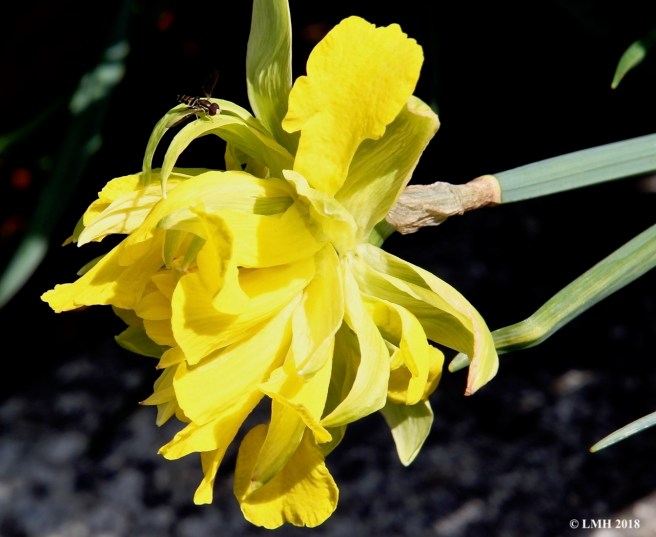
But the double daffodils that came with our house showed off their cheery faces to all who looked.

w3

And by the road, the magnolia we planted about fifteen years ago added its own pastel palette to the scene–however momentary.

w4

By late morning, we changed our focus from the yard to a woodland a few miles away for today was the day we chose to work on the section of trail we steward at Lake Environmental Association’s Holt Pond Preserve. 

w5

There were trees and limbs to clear. And trimming to be done as well. The last time we were on the Southern Shore Trail, which was only a couple of months ago, we noted a few trees that would need our attention, but today there were between fifteen and twenty.

w11

Occasionally, as my guy used the chainsaw and I waited to clean up, I spied old friends like a wild oat or sessile-leaved bellwort in bloom.

w6

And then I made a discovery that had eluded me in the past–a spotted wintergreen. It was an exciting find for it’s listed as S2 ranking, meaning “Imperiled in Maine because of rarity (6-20 occurrences or few remaining individuals or acres) or because of other factors making it vulnerable to further decline.”

w7

We were close to an outlook by Holt Pond when we saw the spotted wintergreen, Chimaphila maculata, and so we paused to take in the view looking across to the quaking bog as we dined atop a stump.

w10

From there we moved on, making rather quick progress to the “field,” a former log landing where the forest is slowly reclaiming its ground.

w8

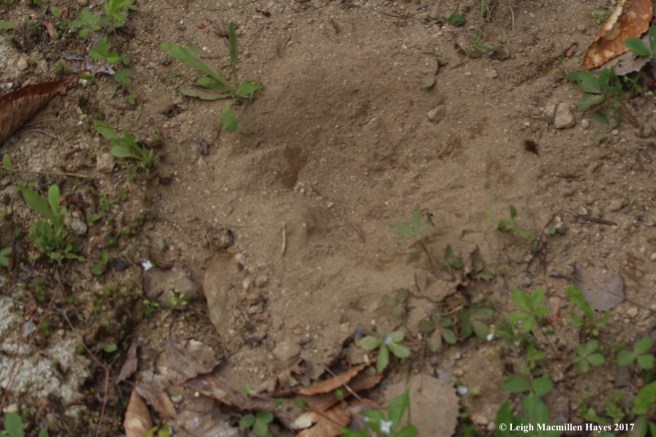
As we approached we startled a ruffed grouse and came upon a familiar sight at this spot for the trail through the field has always provided a dust bath for these birds.

w9

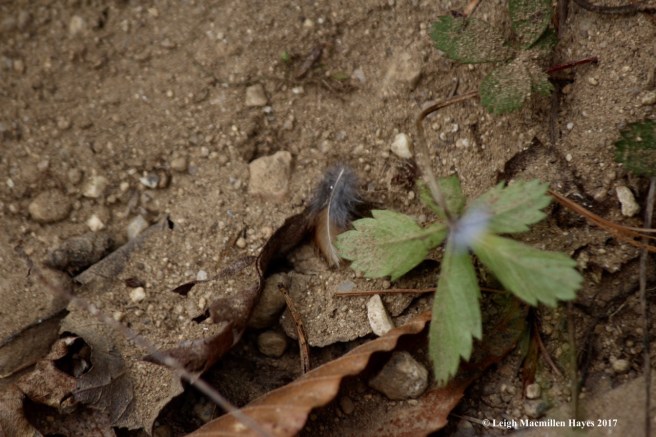
And on the edge of the “tub” a telltale downy feather.

w12

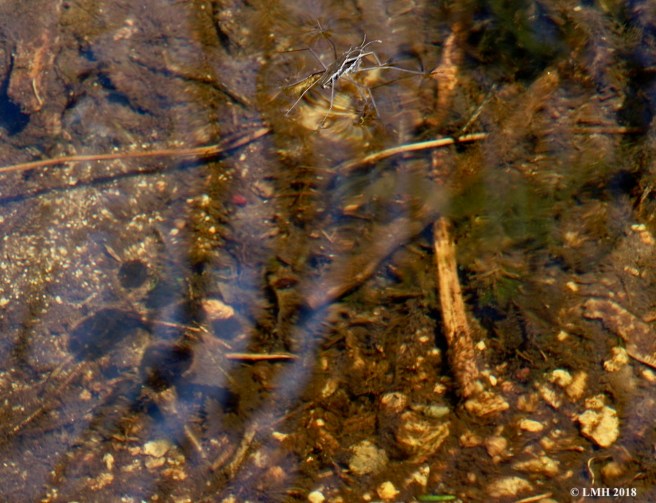
Typically, when doing trail work, our turn-round point is the field for that’s what we’d agreed to years ago. Today, we decided to keep going and made a small stream our end point. We shifted a bridge and watched the water striders for a while. Apparently, love wasn’t just in the air, but on the water as well.

W13

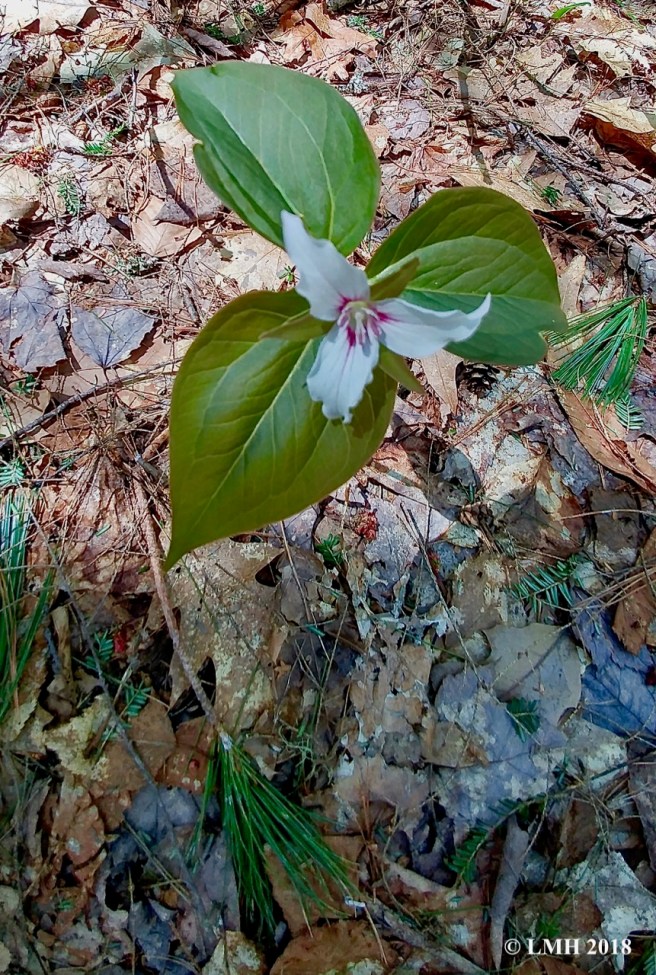
On the way back, I was delighted to discover my first painted trillium of the season. I sensed my guy’s groans for he knows I’ll exclaim over and photograph each one I see–not satisfied until I reach a trillion trilliums.

W14

Oh, and there were fern crosiers to celebrate, especially the scaly spiral of the Christmas fern.

w15

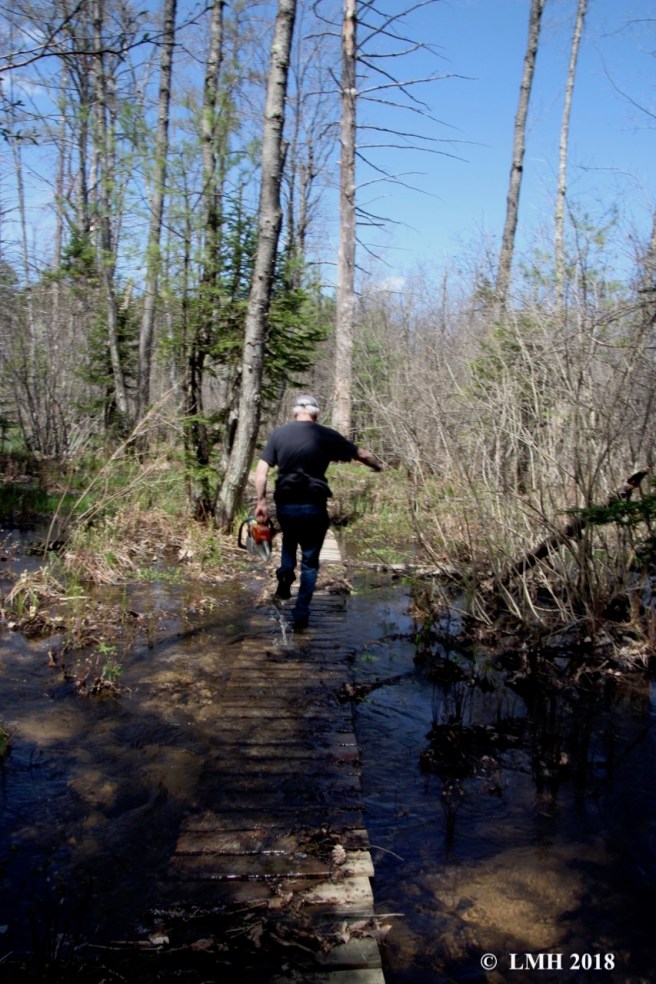
At last we reached the beginning of our section of trail and I told my guy that I wanted to go down by the water for a moment, but not cross the boardwalk because my hiking boots leak. He put the saw down, contemplated the water, and made the crossing. From the other side he suggested I join him since the water wasn’t that deep. Before I did so, however, he asked me to move the saw off the trail and out of sight. As I started to hide it, he crossed back over and said, “I’ll take it in case we need it.” And back again he went, the saw in his left hand for he’s a southpaw. He’d just reached the other side when I stepped on the boardwalk and began to carefully move, ever mindful of my boots . . . until those very boots slipped out from under me. Down I went. Crash. Bam. Smash. On the wood. My right forearm took the brunt of the fall and my camera ended up in the water.

My guy came to the rescue as he lifted me up . . . though first I insisted on the camera being saved. And now I have used the hunt and peck method to type this story for I am a southpaw for the next six to eight weeks as I recover from a fracture to the ulna and radius. That’s how today became a left-handed Mondate.

The camera is also in recovery mode–here’s hoping a rice bath will work wonders.


Cinco de Mayo, Naturally

The hour and a half drive to Litchfield, Maine, was worth every second on this fifth day of May. The spring tapestry that spread before my eyes had me oohing and aahing around each bend in the road for such were the colors–so many shades of greens, mixed in with reds and magentas and pinks and yellows. It was almost intoxicating.

But . . . a photograph will have to wait for another day for I needed to reach my destination and catch up with my peeps–fellow classmates from our 2012-13 Maine Master Naturalist class. For the last five years we’ve tried to get together quarterly. It doesn’t always work out, but this year we’re making a concerted effort.

s1-Smithfield map

Today’s destination was the vernal pool at Smithfield Plantation, a 103-acre property the town of Litchfield conserved. If you look carefully, you might see a reflection of Sharon, who has lead many a school group along the trails and knows the property intimately.

s1a-Sharon T

Before we headed to the pool, she oriented us to the site.

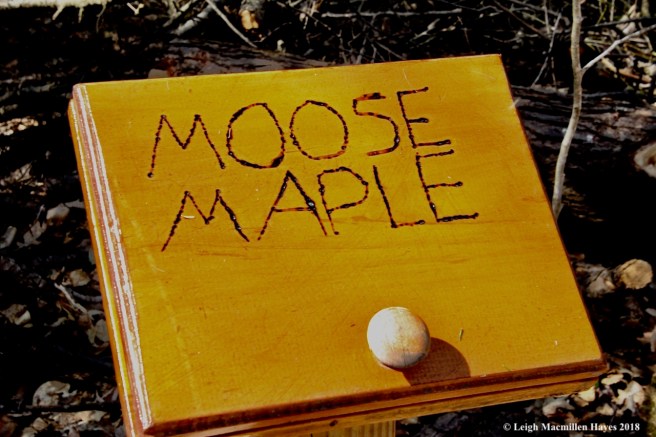
s2-moose wood

One of the things Sharon explained was that a Boy Scout had created an interpretive tree trail and so we paused at one of his stops to admire the craftsmanship.

s2b-moose wood maple leaf

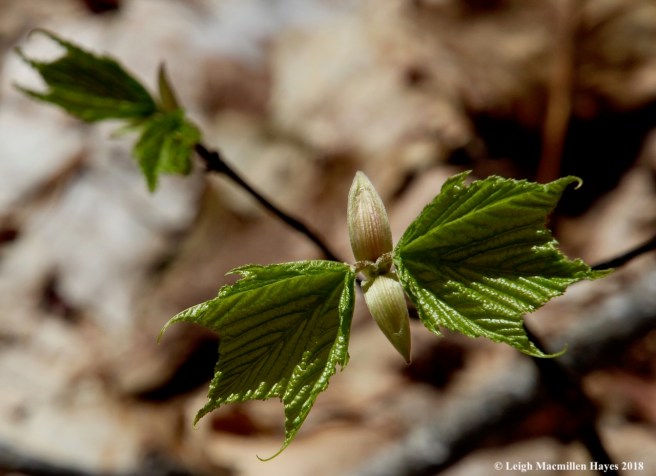
Indeed, right behind the sign, a striped maple, aka moose maple, shared its newly emerged pastel buds and leaves.

s2a-moose maple

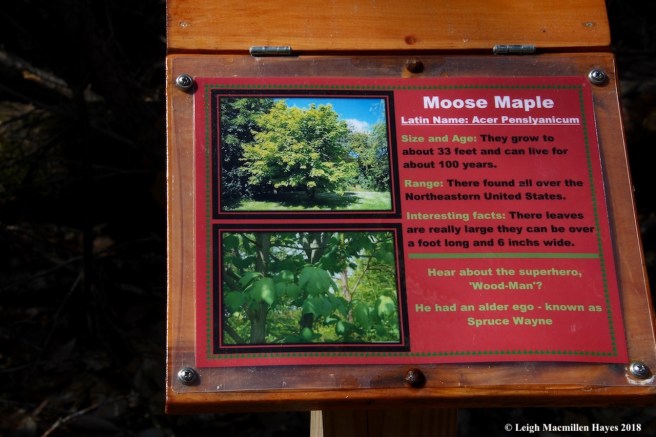
And then we lifted the lid to reveal the information. OK, so there were a few typos for the grammar police, but on each of his cards, he included a joke. What a great idea as that would certainly appeal to the younger set. It definitely appealed to those of us who are still ten years old in our minds.

s4-hobblebush

And on the opposite side of the trail, we spotted another type of moose wood–hobblebush just beginning to flower. Both striped maple and hobblebush are favorite foods of moose, thus their nicknames.

s3a-clintonia

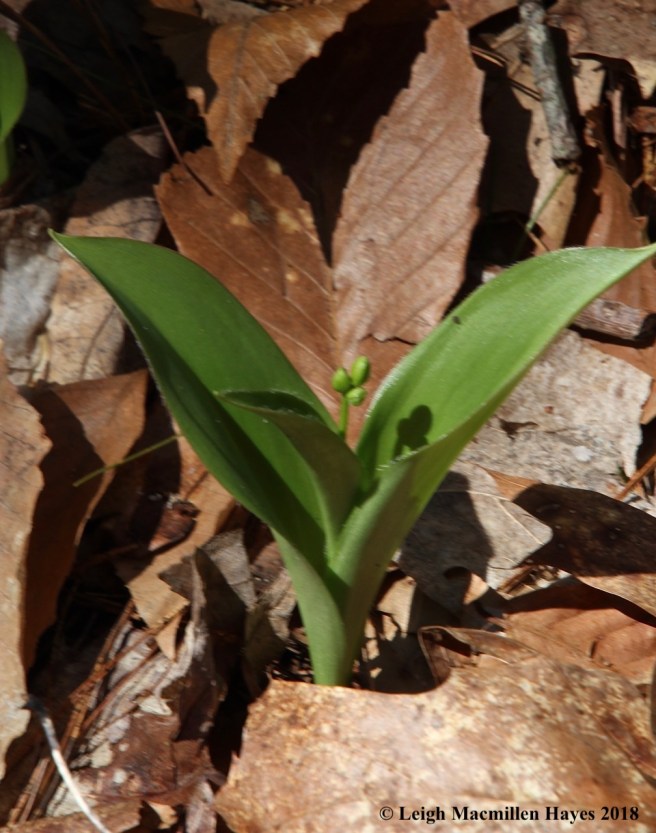
Onward we walked until a patch of leaves stopped us. And our brain-sharing began. We thought we knew what the plant was, but then questioned ourselves as it wasn’t in flower yet. Each season, we need to relearn some. Despite the lack of flowers, we decided to key it out in Newcomb’s Wildflower Guide using two other descriptors–leaves both basal and entire.

s3-clintonia 1

For those familiar with Newcomb’s that meant of the three numbers in the locator key, we didn’t know the first, but went with 22 for the second and third representing basal leaves and entire leaves. Then we tried, 122, 222, etc.

s3b-clintonia buds

And landed on our first suspicion: 622–Yellow Clintonia or Bluebead (Clintonia borealis).

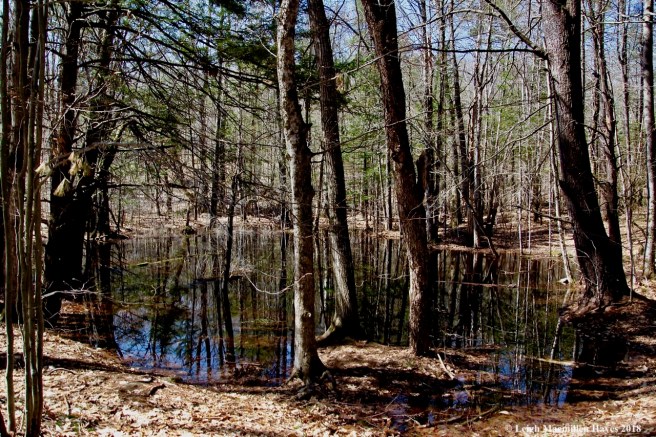
s6-vernal pool

The trail wasn’t long, but as one might expect, it took us a while to reach the vernal pool. And then we were stopped in our tracks and didn’t approach it right away.

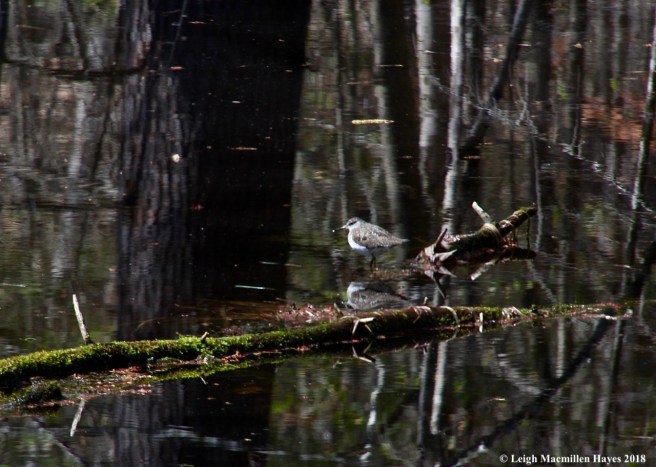
s7-solitary sandpiper

Instead, we stood back and spent a while watching a solitary sandpiper on a downed tree.

s7a-solitary sandpiper

As we watched, it bobbed its tail. And at one point we were sure it took a mid-morning nap. Eventually, the bird flew to another part of the pool and a few minutes later departed.

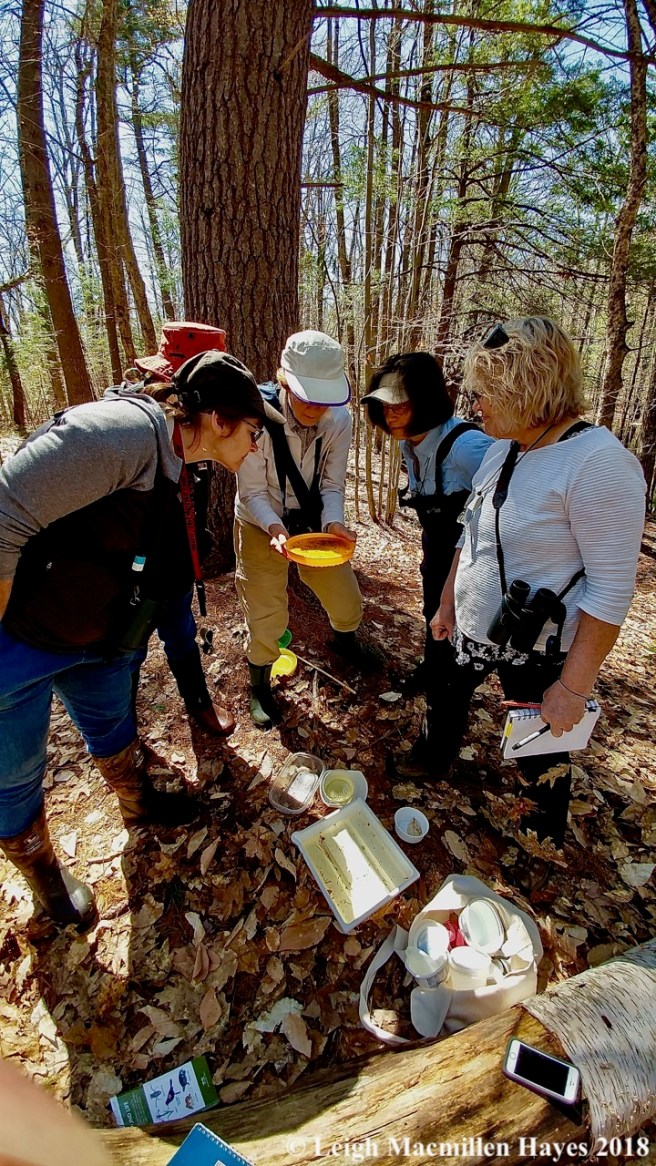
s10-setting up camp

And so we set up camp, dropping some of our gear on the bench.

s10a-setting up camp

And more of it on and beside a log. We had macro-invertebrate charts and vernal pool pamphlets and books, plus all kinds of containers for pond dipping.

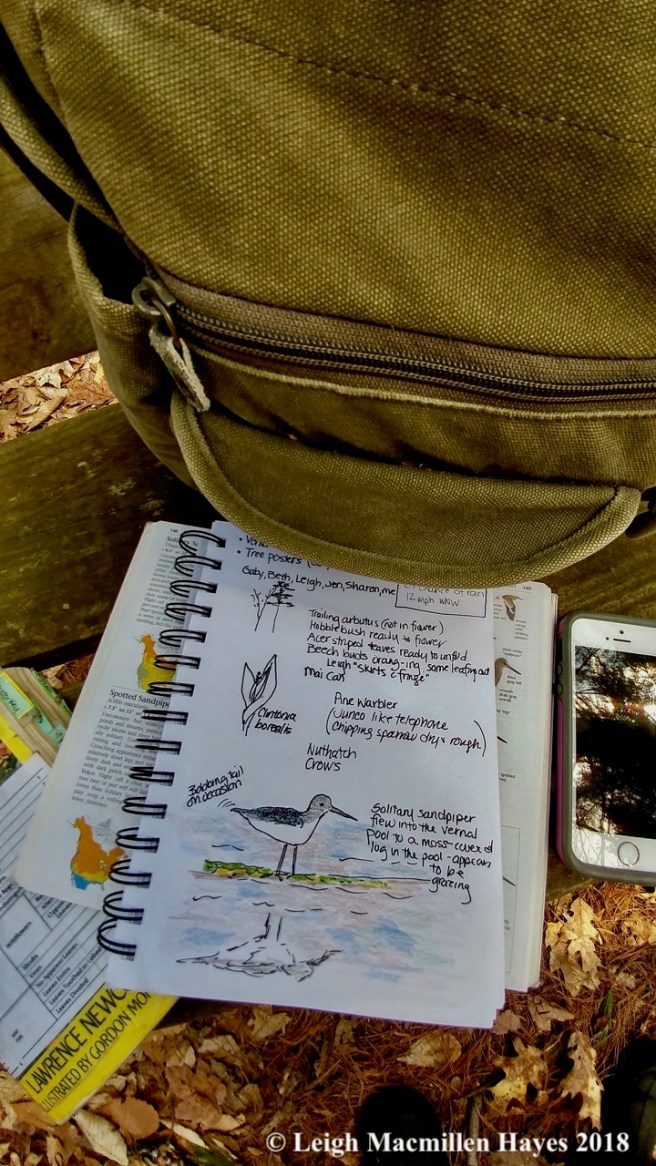
s9-Pam's journal

Pam was the smart one and she’d packed her sketch book and colored pencils. That’s one skill we all appreciate for it slows us down and makes us really notice. I, for one, haven’t done enough sketching in the past year and so this was the perfect incentive for the future.

s8-mosquito larvae

As we looked into the pool and Sharon told us what we might find, we immediately noticed the most abundant residents–mosquito larvae doing their whirligig dances.

s11-first fairy shrimp

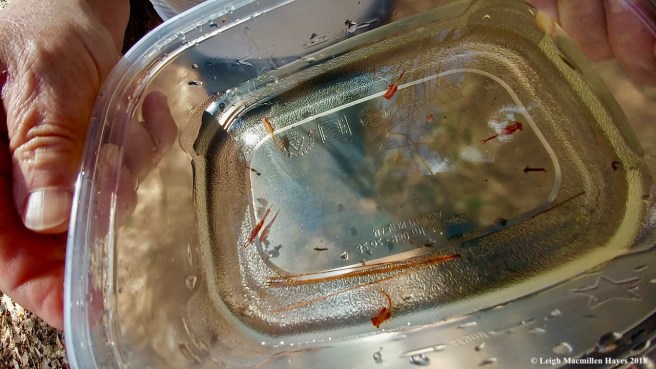
But on her first dip, Sharon pulled up the crème de la crème–a fairy shrimp. Bingo–a significant pool it was as she knew, though not so documented with the state.

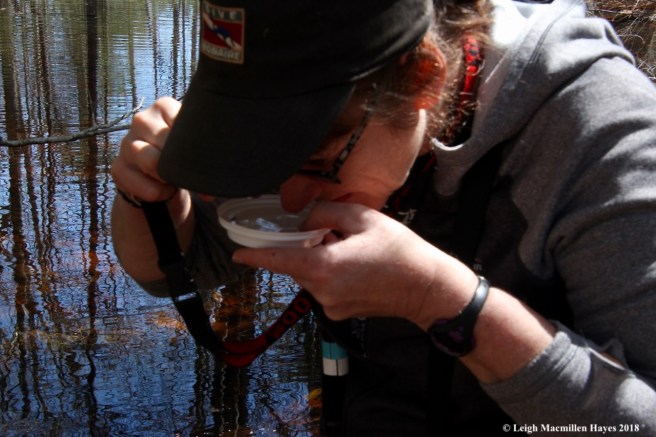
s12-examining the fairy shrimp

With her loupe, Jen took a closer look.

s13-five fairy shrimp

On Sharon’s next dip she pulled up not uno, not dos, not tres, not quatro, but cinco fairy shrimp.

s13-Pam sketches the fairy shrimp

And so Pam settled in to sketch them in all their glory.

s13-Pam's sketches

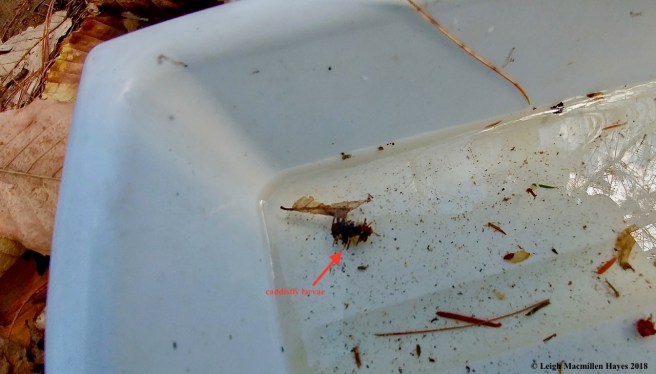
And added a caddisfly larva for we’d also captured one of those.

s14-female fairy shrimp

One of the cool things that Sharon pointed out, the brood pouch at the end of the abdomen, so indicating a female. How cool is that?

s15-caddisfly larvae

And here is our caddisfly, his casing created out of fallen hemlock needles. Caddisfly larvae that create their bodies from woody material are the log-cabin variety. We watched it move about in the tray, sometimes extending its soft body out of the case.

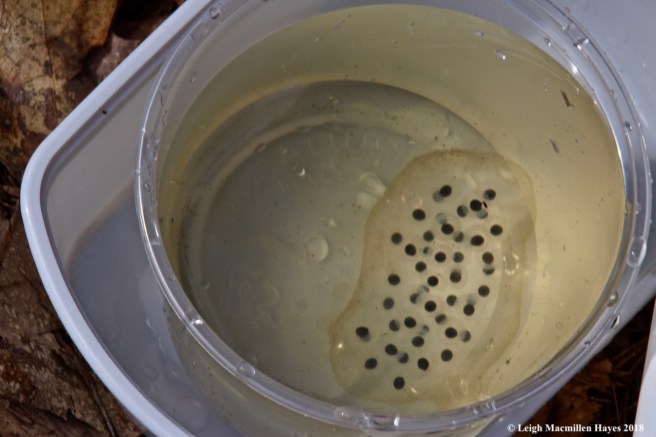
s17-spotted salamander egg mass

The dipping continued and a spotted salamander egg mass was pulled out, but only for us to take a closer look. And then it was returned from whence it came. Notice the individual eggs within the greater gelatinous matrix.

s18-egg mass

After that, Sharon found another reason to celebrate. She’d worn her waders and so was able to go deeper into the water than the rest of us.
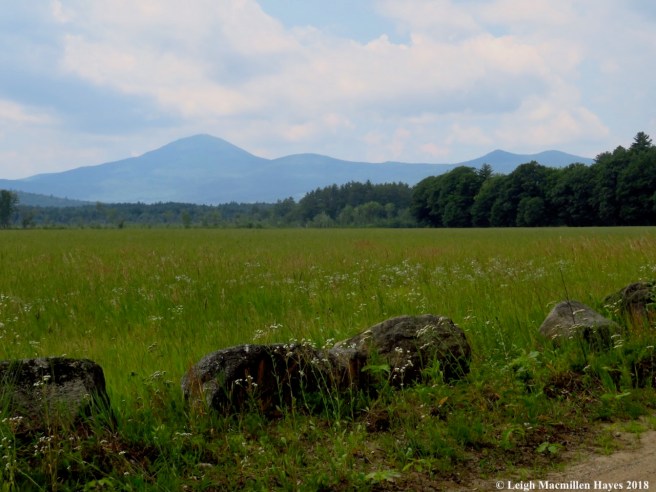
s18-tadpoles

A quick dip and she’d pulled up an egg mass that almost melted as life burst forth–tadpoles. The first of the season for all of us.

s20-predacious diving beetle larvae

One last dip revealed one not so kind to all the other species we’d located. Known as a water tiger or toe biter, you can tell that it’s one mean little thing. This was the larval stage of a predacious diving beetle and the tadpoles had everything to fear for like its adult form it was a predator.

s23-Cinco Amigas

After that last find, it was time for us to pack up our gear and leave the pool behind. But, we took with us memories of a delightful spring morning spent exploring together. And . . . we had a chance to catch up, show each other field guides we thought might be of interest, share experiences of our volunteer opportunities, provide suggestions for ways to make a nature program work be it for kids or adults, and realize that we were not alone in any obstacles that may cause an issue during those programs.

What a naturally wonderful way to spend this Cinco de Mayo . .  . con cinco amigas. Thanks Gaby, Beth, Jen, Sharon and Pam.


Craning My Neck

I’ve spent a lot of time thinking about living in the moment lately, a concept that really drove itself home during the years that my mother dealt with dementia and I was forced to realize that each time I left the room, my return was a new visit; a new adventure. And now, so many friends are dealing with issues that make every second precious and I realize once again the importance of slowing down and noticing and making the most of being present. Now.
f1

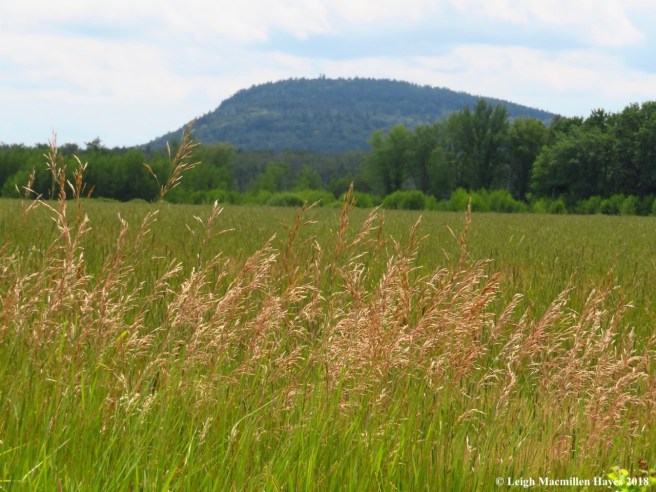
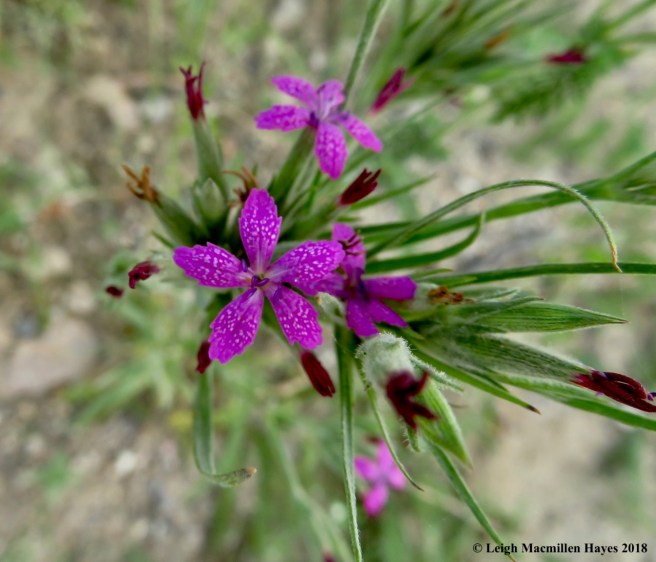
Such was the case this afternoon when I joined two friends who had pulled in from their winter home in Florida this week. We met at one of the parking lots for the Mountain Division Trail in Fryeburg, Maine, a rail trail that makes one feel like you could walk to the White Mountains in a matter of miles. But, to get back to the moment, the original plan had been to travel the trail with two different friends and then one had to back out and I found out that the Florida friends had returned and so I invited them to join the other and me, and then my other friend had to back out and so it was the Florida duo and me. And it was so fabulous to spend time with them that we walked rather quickly, which completely surprised me when I thought about it for I know that they love a slow journey. But we had much to catch up on and because the trail is paved we didn’t have to think about foot placement and perhaps that’s what spurred us on.

f2-tamarack 1

At last, however, it was spurs that stopped us, for one of them spied a branch with upward facing cones and little spurs and she wondered what it was. The cones certainly looked like hemlock cones. But why were they upright? And what happened to the needles? When I explained that it was a tamarack, she again questioned it for she’s always been here in the autumn when the needles are a brilliant yellow and she thought those needles stayed on all winter. Not so, I explained, for a tamarack (larch, hackmatack–take your pick of common names) is our only deciduous conifer in northern New England. The golden needles fall the same as maple leaves.

f11-pussy willows

We also put on the brakes when she spied pussy willows–a sure sign of spring in their Zen-like presentation.

f20

Onward we marched, catching up on past months. But then, as the day would have it, first he had to turn around and head back to the parking lot and then a short time later she had to do the same. And that got me thinking about how the walk had evolved. I was sorry that the two I had originally planned to share the trail with couldn’t join me, but equally thankful for the two with whom I did travel. Living in the moment means embracing a change in direction.

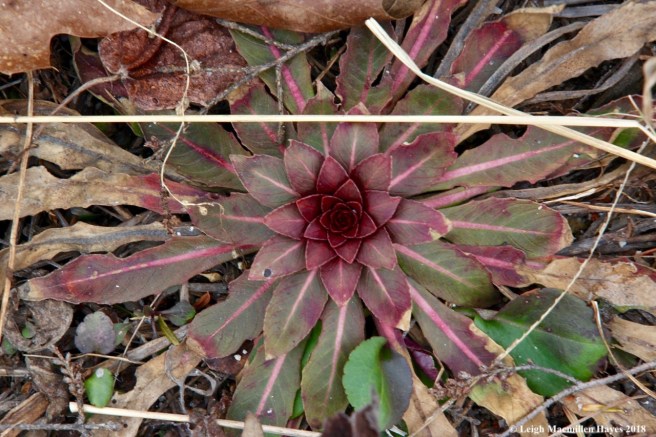
f3-evening primrose basal rosette

The rail trail is four miles long in one direction and I turned around at the 2.5 mile marker. On my return, I was entirely surprised by the offerings that had escaped my attention previously, like the beauty of an Evening Primrose’s basal rosette.

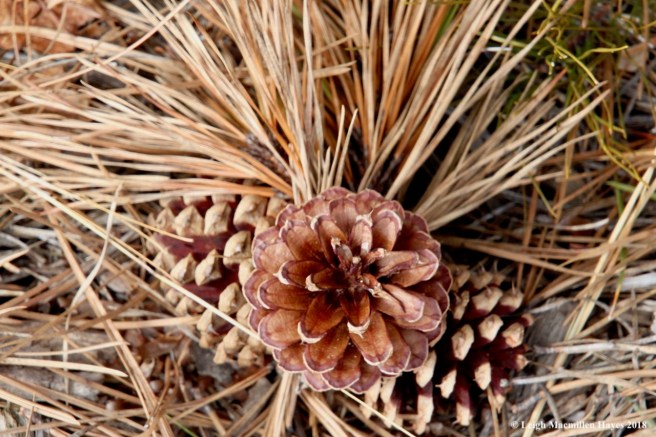
f4-pitch pine cone

It’s fractal fashion was reflected in the pitch pine cones I spotted on the ground and surrounding trees.

f5-pitch again

The pitch pines always draw my fancy and I was especially intrigued by the past, present and future–as I tried to live in the moment. It’s not as easy as it sounds for we so often get caught up in what was or what could be.

f8-red oak

The past produced fruits long since deployed.

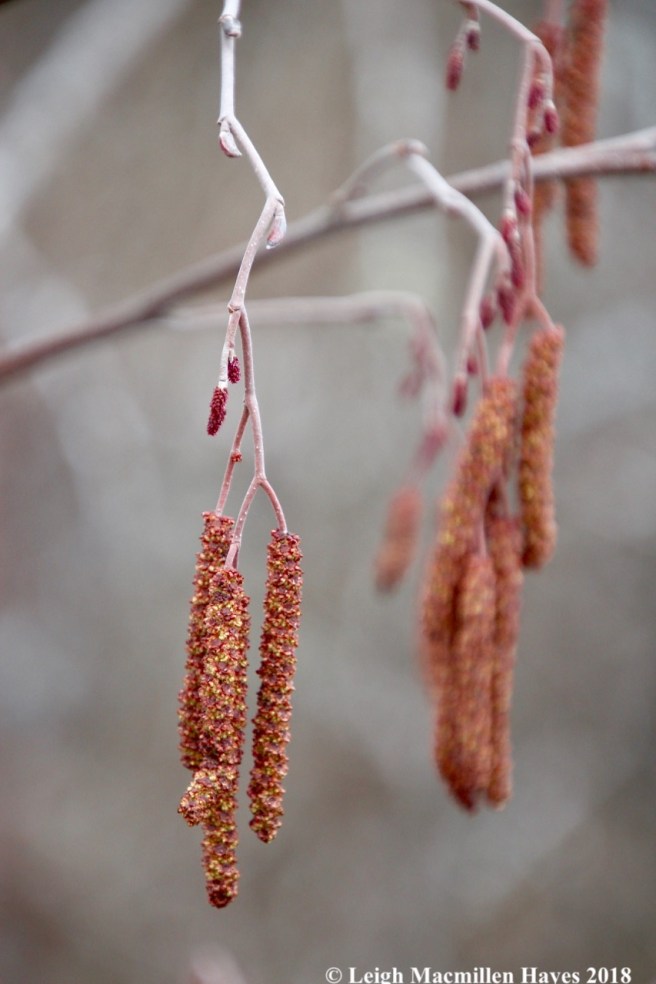
f10-speckled alder catkins

The future grew longer before pollinating the shorter.

f7-trailing arbutus in bloom

But in the moment–I spied the first blossoms of Trailing Arbutus.

f9-spotted salamander spermatophores

My return journey was much slower than the first leg, for there was so much to see. Included in the expedition was an examination of a small vernal pool. And what to my wondering eyes did I see? Spotted salamander spermatophores–those little chunks of sperm left behind by males atop cauliflower-shaped platforms.

f14-wood frogs quaking

As if that wasn’t enough, further on I heard a familiar quack and knew wood frogs were active though I couldn’t see them.

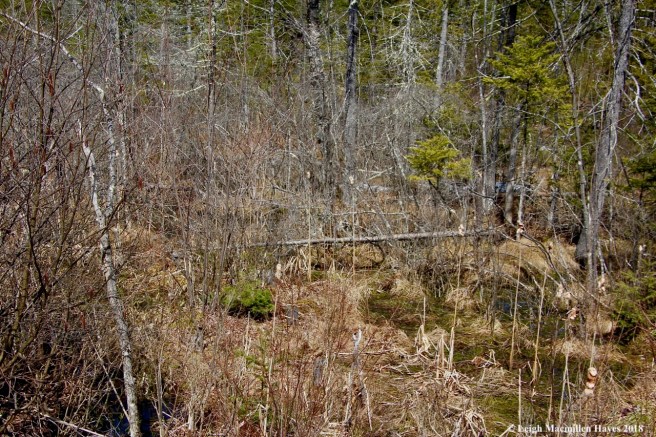
f15-wetland

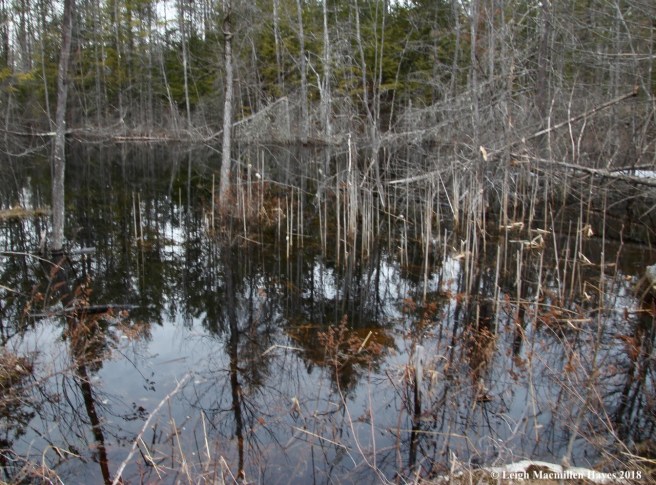
And still further I discovered a wetland I’d never noticed before. Spring peepers sang from the far edges. It was all a surprise for on the walk out I’d told my friends from Florida that I hadn’t seen or heard any vernal pool action yet.

f15a--chipmunk

I just need to spend more time listening and waiting and letting it all play out before me, the same as the chipmunk that was sure I couldn’t see him.

f16-Canada geese

After a three-hour journey, I found my way back to the truck and then decided to take some back roads home. As I passed through farmland where cornfields are prolific, I noticed movement. I so wanted the movement to be another bird, but it was a huge flock of Canada Geese that attracted my attention. Again, I had to live in the moment and enjoy what was before me.

f17-sandhill cranes

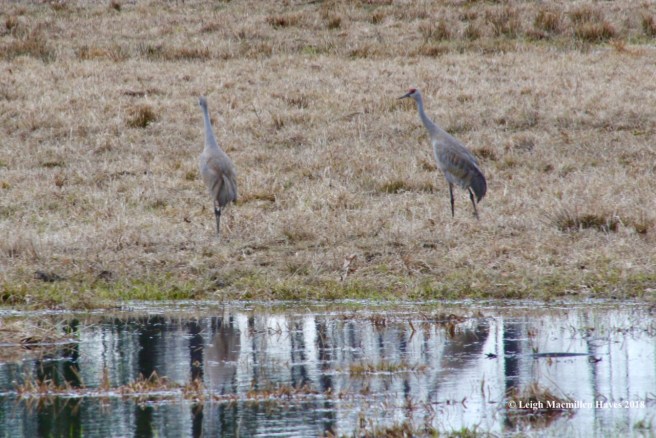
And then I turned into the harbor, and was pleasantly surprised for suddenly my eyes cued in on those I sought who stood tall.

f17a--sandhil cranes

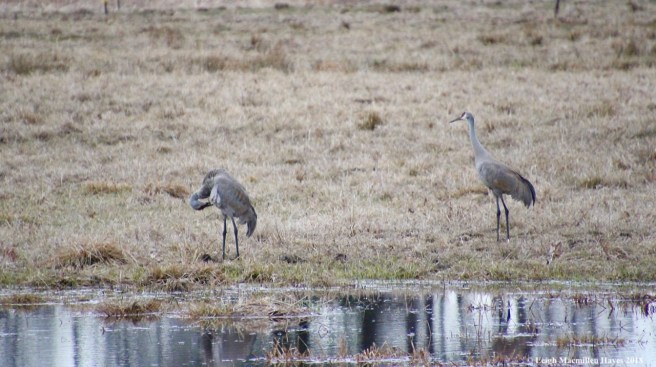
And preened.

f18-sandhill cranes

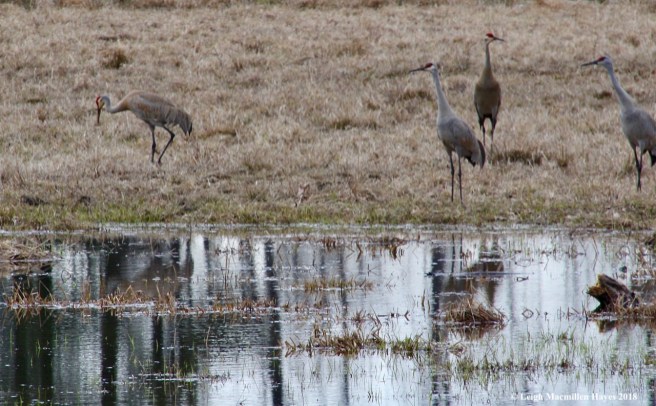
And craned their necks. Sandhill Cranes. In Fryeburg, Maine. They have returned to the harbor for at least  the past five years, probably more and I’ve had the privilege to hear them fly over several times, but today was the first time I was honored to see them. Thank you, Parker, for the tip.

I craned my neck and gave thanks for the moments spent in their presence and lifted up several people who will benefit from a dose of this medicine–Tom, Jinny Mae and Lifeguard Wendy: this one is for the three of you.


Poking Along Beside Stevens Brook

Raincoat? √

Notecards? √

Camera? √

Alanna Doughty? √

This morning I donned my raincoat, slipped my camera strap over my head, and met up with LEA’s Education Director Alanna Doughty for our reconnaissance mission along Stevens Brook in downtown Bridgton. Our plan was to refresh our memories about the mill sites long ago identified and used beside the brook.

Lakes Environmental Association maintains a trail from Highland Lake to Long Lake, which follows Stevens Brook’s twists and turns and passes by twelve power sites originally surveyed by Jacob Stevens in 1766.

s1-5th power site 1

We skipped the first mile of the trail and slipped onto it from the Route 302 entrance by the Black Horse Tavern, knowing that that will be our entry point for a walk we’ll lead with Bridgton Historical Society‘s Executive Director Ned Allen later this month. Alanna suggested I not pull out my notecards, and rather rely on my memory. Oh my.

As we made our way past the old trestle that once carried coal from the Narrow Gauge railroad to the Pondicherry Woolen Mill at the fourth power site (the other three are located between Highland Lake and the 302/117 intersection), we recalled that the now deceased Reg Fadden used to claim he knew the color of dye because as he walked to school each day he noted the color of the water. Scary thought.

At the fifth power site, we went off trail to look around a bit. The water flowed over the rocks with such force that sometimes we couldn’t hear each other.

s2-5th site-Narrow Gauge trestle bridge

Before us was another former trestle spot–this one being part of the track that carried the train across the brook and on toward Harrison as part of a spur from the main line.

s3-5th site, nurse log

In front of it, large trees placed years ago to prevent anyone from crossing the now gone trestle, served as a nursery to many species. But it wasn’t just what grew there that gave us pause–it was also the textures and lines that seemed to reflect the water below.

s-poison ivy 1

As we walked, we looked at the lay of the land and wondered about mill ponds and berms. We also noted the one plant we wanted to avoid–poison ivy.

s-poison ivy 2

It grows in various forms, but the safe thing to know is that the two opposite leaves have short petioles that attach to the main stem, while the third and leading leaf has a longer petiole. As the saying goes, “Leaves of three, leave them be.”

s7-6th site water power

Site number six is one that we’re not sure we’ll share on our public walk. It’s a wee bit of a challenge to get to and was apparently never developed–though we did note the drop and some stonework on the far bank.

s8-blue-stemmed goldenrod 1

Before we stepped onto Smith Avenue for the next site, a goldenrod shouted for attention. We tried to figure out how many rays it had, but as it turns out, that number can vary from three to five. The flowerhead formed a ladder that climbed up the stem and this is one that we should recognize going forth for its display struck us as being different than other goldenrods. We’ll see if we actually do remember it the next time we meet.

s9-7th site, Lower Johnson Falls 1

As is often the case, it took us about an hour to walk a half mile. At last we emerged onto Smith Ave, by Lower Johnson Falls. The curious thing would be to note which was faster–the water or us. I have a feeling the water might win, but perhaps another time we should test that theory.

s11-coffin shop

For a few minutes we watched and listened and took in the view of the only mill still standing. I suspect this building was constructed in the 1860s as a sash and blind factory. Eventually it became the coffin shop, where Lewis Smith, the town’s first undertaker, built furniture and coffins.

s13-8th site, sluiceway different view

For about a tenth of a mile we walked down Kansas Road and then slipped into the woods again. I think this site is my favorite–site 8 and former home of the Forest Woolen Mill. There were actually two Forest Mills, one on either side of the road and connected by an overhead walkway.

s15-8th site, sluice way from above 2

Today it was the sluiceway that drew most of our attention. First we looked down.

s12-8th site, sluiceway1

And then we climbed down–paying attention to stones, bricks, cement and rebar, all necessary to build a foundation that still stands today.

s17-piece dangling

Well, most of it still stands. We were awed by a piece that appeared to dangle at the edge of the sluiceway.

s16-tree root in sluiceway

And a root that wound its way around the same cement stanchion . . .

s14-hemlock atop cement

which happened to provide the perfect growing conditions for a hemlock.

s18-false Solomon's-seal berries

Crossing Kansas Road again, we ventured on. In a section under the current power lines we found flowers a many. The fruits of the false Solomon’s-seal looked like miniature strawberry and cherry-vanilla candies.

s19-winterberries

As we stepped onto a boardwalk across a wet area, winterberries glowed red and reminded us that the cold season isn’t all that far off.

s20-virgin's bower fruit, feathery plumes

It was there that we spied the feathery-fruited plumes of virgin’s bower,

s21-red-stemmed dogwood

red-osier dogwood berries,

s24-cat-in-nine-tails

and cat-in-nine-tails.

s22-cardinal flower

But our favorites: a cardinal flower still in bloom and . . .

s23-Northern beggar-ticks

northern beggars-tick.

s28-10th site, CMP above

We passed by the tenth power site, knowing we’d return to it on our way back. Instead, we stood below and looked up at the water flowing over the improved dam.

s27-water below 10th site

It was in this section that the brook dropped 25-30 feet and created the greatest power at one time. It was also here that the eleventh site was located and where a penstock once provided a way to get water to a powerhouse in order to furnish local homes with electricity.

s31-Alanna laughing by skunk cabbage

For us, it was a place to make more discoveries and share a laugh as we looked at the huge leaves of skunk cabbage.

s32-first witch hazel bloom

We also spied the first witch hazel flower of the season . . .

s33-maple-leaf viburnum

and a maple-leaved viburnum showing off its subtle fall colors.

s34-milkweed pods

In a spot just above the Central Maine Power substation, we found a garden of wildflowers including milkweed seed pods and . . .

s37-New England aster 2

New England asters offering a deep shade of purple.

s27-chicken of the woods

We also found some chicken of the woods.

s38-honey mushrooms?

And fruiting on the same stump, what I think was honey mushrooms (Armillaria mellea). I know a few fungi experts who occasionally read this, so I know they’ll correct me if I’m wrong with my ID.

s39-Stevens Brook outlet into Long Lake

The second half mile took us just as long as the first, and at last we reached the outlet into Long Lake.

s40-10th site, CMP dam

And then we made our way back, crossing over the bridge at power site 10, which was possibly the spot where Jacob Stevens, for whom the brook was named, built the first sawmill in 1768. We do know that in 1896, the Bridgton Water and Electric Company acquired the site and improved the dam. Eventually it passed on to the Western Maine Power Company and then Central Maine Power. In 1955, it was transferred to the Bridgton Water District. Through all the time, we could only imagine how the reflections changed.

s42-milkweed tussock moth caterpillar

To save time, we decided to walk along Lower Main Street as we made our way back. And to that end, our discoveries continued, for on a milkweed, Alanna first saw the chewed leaf and knew to look for the milkweed tussock moth caterpillar that was filling its belly.

s43-common snowberry

We also saw what I’ve always referred to as popcorn shrub because it reminds me of such, especially when I’m hungry for lunch. But really, it’s common snowberry. And not edible.

s46-northern white cedar bark

And then we found a tree that I didn’t know grew there–and I can’t tell you how many times I’ve run or walked by it: a northern white cedar with its scraggly striped bark.

s44-Northern white cedar 1

As much as the bark, I like the overlapping scale-like blue-green leaves.

All in all, our one mile journey took us just over two hours and we did recall some of the info about the mills without referring to my notecards. But what was even more fun was our wonder and awe as we made new discoveries while poking along beside Stevens Brook.

If you care to join us, the talk by historian Sue Black will be on Wed, September 27 from 5-7pm at LEA’s Maine Lake Science Center and the walk will be the next morning from 9-11. We’ll meet at Bridgton Historical Society on Gibbs Avenue for that. Be sure to register for either or both by contacting Alanna at the following address: alanna@leamaine.org.


From wet to sweat

“Will I need waders?” I asked before we departed from the Lakes Environmental Association’s office  early Wednesday morning.

Dr. Rick Van de Poll looked down at my hiking boots and said, “No, you should be okay if you don’t mind getting muddy.”

l1-into the fen

And so, LEA teacher/naturalist Mary Jewett and I joined him to begin a two-day survey of LEA’s Highland Lake Preserve. The 325-acre property was the gift of the David and Carol Hancock Charitable Trust. Except for two logging roads, there are no trails.

Our first destination was in the middle of the fen. OK, so Mary and I should have known better because we know how much it has rained this summer. But really, it was quite hot that morning and our feet did get wet.

In fact, she found a deep hole on the way in.

l1-fen plot

Once reaching the plot, our tasks were several.

l1-flag

We helped delineate the boundary with measuring tape and flagging, the first being 10 meters by 10 meters, and then found the center, thus creating four quarters.

l1-Rick 1

Under Rick’s patient guidance and teaching, we began to survey the site, section by section, while he recorded our findings.

l1-measuring trees

Trees were first and needed to be measured to make sure they were trees after all, and not considered saplings.

l1-rhodora 1

Layer by layer, including shrubs,

l1-tamarack

seedlings,

l1-round leaf sundew 2

and herbaceous ground cover,

l1-round-leaved sundew 1

we made our way down.

l1-wasp pupa on hornworm 1

Along the way, other discoveries presented themselves, including wasp pupae on a hornworm,

l1-garden spider 1

black and yellow garden spiders,

l1-garden spider 2

weaving their signatures,

l1-eastern pondhawk

eastern pondhawks,

l1-eastern pondhawk 1

up to the measure,

l1-green frog

and of course, green frogs.

Swamp Thing

Four hours later I found a deep hole as we departed that plot. We slogged out, water swishing in our boots, and quickly ate lunch.

l2-hemlock plot

And then it was back into the woods for the afternoon, this time a hemlock grove. On the way, we marked off a site for Thursday’s work, before reaching our destination for the afternoon.

l2-surveying the site

This plot was 10×20 meters and so within we had nine smaller plots to examine in the same manner.

l2-squirrel bites

Though we identified all the species from top to bottom, we also noted more cool finds like squirrel chews on a striped maple,

l2-glue crust fungus

a crust fungus that acts like a glue and attaches dead wood to live,

l2-spotted wintergreen

and spotted wintergreen, listed as S2 meaning this: “Imperiled in Maine because of rarity (6-20 occurrences or few remaining individuals or acres) or because of other factors making it vulnerable to further decline.”

l3-plot 3 (1)

I had to miss the Thursday morning session due to a GLLT hike, but met Rick and LEA’s education director, Alanna Doughty, as they finished their lunch. I think they extended it a few minutes as I was a wee bit late. This time, Alanna and I sat on the tailgate of Rick’s truck as he drove down a logging road–I, of course, held on for dear life, while she nonchalantly acted like it was a walk in the park. The best part of the ride was the smell of sweet-fern that our feet occasionally dragged over. And then our march began with a short trek through a wooded forest, before we reached the highbush blueberries and other shrubs that acted like hobblebush and made for careful movement.

l3-black and red spruce 3 (1)

The first afternoon site was in a black spruce bog and for once, I could confidently differentiate between black and red as they stood side by side–both by their colors, the black having a blueish hue, while the red was more yellowy-green, and their gestalt.

l3-cinnamon and chain ferns

One of my favorite learnings from that plot was the difference between cinnamon fern and Virginia chain fern. Again, they were easy to ID by their colors, the cinnamon already dying back. But notice the similarities.

l3-chain fern

And then we looked at the back side. While cinnamon has a separate fertile frond that forms in the spring and then withers, chain fern’s sporangia are oblong and on the underside.

l3-chain spores 2

The area was thick with the chain ferns and our every movement meant spores flew through the air.

l3-pitchers (1)

Every movement also meant we had to watch our every step, for so numerous were the pitcher plants. It was a great opportunity to ask Rick about the color of these–I’d been told that green is rare, but he said it’s just a matter of sunlight and age, all eventually take on a redder hue in veins and then overall leaf coloration as they mature.

l3-pitcher plants

Their flowers were also plentiful in this lush space.

l3-chanterelle waxy cap 1

Among other things, Rick is a fungi expert (and an overall fun guy with corny jokes–the mark of a teacher), and so our learnings were plentiful, including these chanterelle waxy caps.

l4-plot 4 (1)

After making our way back out through the tangle, we hopped back onto the tailgate for a short ride and then headed off into a mixed forest for the final 10x 20 plot.

l4-deer skull

Our cool finds in this one included a much gnawed skull,

l4-orchid

and spotted coral-root.

l4-bristly clubmoss

I also learned to ID one clubmoss–bristly tree so named for its bristly stem.

l4-back up the road

It was dinner time when I again held on for dear life as we drove up the road. To say we were sweaty, stinky, hungry and pooped would be an understatement. By the same token, I think I can speak for Mary and Alanna to say that we were more than grateful to have spent so much time learning from Rick. From wet to sweat–it was well worth the effort.


Embracing Quiet

If you are like me, you spend too much time racing from one moment to the next during this fleeting season of summer. With that in mind, I chose to slow down today.

m-stump islands

I know of few better places to do that than among the stump islands in the Upper Basin of Moose Pond. It’s been my place since I moved to Maine over thirty years ago.

Once upon a time, this was timberland–albeit prior to impoundment. A log sluiceway was built at the Denmark end in 1792 by Cyrus Ingalls, thus turning pastureland into the Lower Basin, so he could float logs to a nearby mill. In 1824, a more substantial dam was created and the height of that dam was raised by William Haynes in 1872 to create the current impoundment. While the Middle Basin of the nine-mile “pond” may be the largest at over 900 acres, its the 300-plus-acre Upper and Lower Basins that I like best to explore. And because the Upper is right out my summertime back door, I spend the most time there.

m-painted turtle

As I moved slowly, I greeted old friends like this painted turtle and even had the opportunity to pet a snapping turtle, so close to my kayak was it, but I paddled on.

m-newly emerged damsel 2

Actually, I didn’t paddle much once I reached the islands and stumps. Instead, I floated. And noticed. Before my eyes newly emerged damselflies pumped fluid into their bodies and wings, while their shed exuviae sat empty.

A family of three passed by in a canoe and I asked if they wanted to see something cool. When I told them about the damselfly, the father asked what a damselfly was and I told the family about its size and wing formation. They knew about dragons but had never heard of damsels. And didn’t want to stop and look. The mother commented on how magical it all was, but the father was eager to move on. I was sad for the son’s sake. He missed the real magic.

m-emerging damsel 3

Returning to my quiet mode, I found another, waiting as they all do, for the transformation to be completed. Do you see that the wings are not yet clear? I decided my presence was important, for I was keeping predators at bay.

m-orange bluet male

And then . . .

m-orange bluet 3

and then I met a new friend. An orange bluet–this being the male. I wanted to name him the Halloween damsel, but my field guide told me differently.

m-water shield and orange bluets 2

I kept waiting for him to meet her

m-orange bluets on water shield 1

and finally he did–

m-orange bluets mating

completing the wheel of damselfly love.

m-water shield 4

Because of the orange bluets, I also met the watershield flowers in their moment of glory. The flowers are described as being dull purple and inconspicuous. I found them to be various shades from mauve to muted red and lovely in presentation on day one of their life cycle.

According the US Forest Service Website, “On the first day the bud emerges above the water. Sepals and petals open and bend downward. Although stamens and pistils are present in each flower, on the first day of blooming, only the pistils emerge. Stalks of the pistils lengthen and spread outward over the petals. At night, the flower stalk bends and the flowers submerge beneath the water. On the second day, flowers emerge from the water again, but with the pistils retracted. The stamen stalks are lengthened and the anthers open. In this way flowers are cross-pollinated (Osborn and Schneider).

m-water shield old

Hardly dull, certainly unique. Even on day two.

m-newly emerged Hudsonian whiteface

Today, I also met a new dragonfly. And thought that I did it a favor, but I may not have. You see, when we first met, I noticed a web all around this immature Hudsonian whiteface (or so I think it is). With my paddle, I removed the web to free the dragonfly. But, um, it flew off and that’s when I realized it was several hours old and still drying its wings. Do you see how shiny they are? And the exuviae to which it clung prior to my “helping” hand? It’s best to leave nature alone. If it had been caught in the web, then good for the spider.

m-cotton grass 1

Speaking of spiders, I found some cotton grass gone to seed . . .

m-cotton grass with spider 2

and when I moved to photograph it with the sun behind me, I noticed what looked to be a camouflaged crab spider hiding in wait.

m-beaver lodge 1

Among the stumps, I’ve seen numerous beaver lodges over the years and know from the saplings they cut down on our property, that at least a few are active.

m-beaver scent mound 1

Today a recently visited scent mound added to that knowledge. Beavers pull aquatic plants and mud up from the bottom of the pond and create these mounds. They then secrete castoreum from castor glands beneath their tails to mark territory, deter predators, and say, “Hey baby, wanna check out my sticks?”

m-meadowsweet

The island flowers also grabbed my attention, including the fluffy heads of meadowsweet and . . .

m-grasspink orchid

grass-pink orchids now waning.

m-sweet-scented water lily

But . . . besides the dragons and damsels, I really went to see the aquatic flowers, like the sweet-scented water lily,

m-spatterdock

spatterdock,

m-pickerel weed 3

and one of my favs–pickerelweed.

m-pickerel weed

I love it for all its fine hairs and the way the flowers spiral up the stalk.

m-pickerel 2

I also love the coloration with two yellow dots on the upper lip providing a guide to the nectar it offers.

m-white face on leatherleaf 1

While I looked, another white-faced dragonfly, small in stature, kept following me. Finally, it paused on a leatherleaf shrub.

m-spatulate-leaved sundews with flower 2

And I paused beside the spatulate-leaved sundews.

m-spatulate--leaved sundew flower

I was about a week early, but one was in flower, with promises of plenty more to come.

m-pitcher plant 1

As I looked at the sundews, I realized that I’d never seen a pitcher plant in this place. As should happen, I was proven wrong, though I never would have noticed it if it didn’t have such a tall flower since its leaves were hidden by a mass of vegetation.

m-pitcher flower

Damselflies, dragonflies, and carnivorous plants–its an eat or be eaten world out there on the pond.

Bullfrogs bellowed from the edges, green frogs plinked, and fish splashed. I listened to Eastern kingbirds’ wingbeats as they dropped to the water to snatch insects, and red-winged blackbirds delightful conk-la-rees. I startled a great blue heron, the first I’ve seen on the pond all summer, and it flew off. In the midst of all the natural sounds and sights around me, I embraced the quiet on my four-hour paddle/float. And as Robert Frost might say, “That has made all the difference.”


Poking Along On Perky’s Path

Every Greater Lovell Land Trust trail is my favorite in any given moment and so it was that Perky’s Path received that ranking today.

p-beaked hazelnuts 2

I met my friend Pam in the parking lot and immediately our hunt for great finds began. We looked first at the basswood, but it was the shrub next door that heard us utter with delight–a beaked hazelnut showed off its fuzzy horned fruits.

p-hops on hop hornbeam

And then we walked back up the road a wee bit for at the entrance to the parking lot I’d spied a hop hornbeam also loaded–with hops.

p-striped maple sign

At last, we started down the trail, heading south where a self-guided tour begins. A small group of GLLT docents spent the winter months preparing signs for a variety of species along this route. It’s a task that requires choosing a particular trail one summer for the next, determining which species to ID, taking photographs, gathering and writing facts, creating and printing cards, laminating them, attaching them to posts, relocating the species and finally erecting the posts, which will be left in place until Labor Day. That’s a lot of work, so if you have a chance, take the tour. It includes trees, shrubs, flowers, ferns and more.

p-American toad

As we walked, the ground at our feet moved–in hopping fashion. We only saw one American toad, but plenty of frogs.

p-bloated female wood frog 2

All of them sported their camouflage colors, so after the ground moved, we had to focus in order to relocate them once they paused.

p-bloated female wood frog 1

This female wood frog’s robber mask was the only thing that helped us locate her.

p-young wood frog hiding under starflower leaf

You’ll have to use your own focus to find the baby wood frog that hid beneath a decomposing starflower leaf.

p-spring peeper

And another teeny, tiny one–a spring peeper with the X on its back.

p-common brown cup, Peziza varia

Because we were looking down all the time, we began to notice other things, such as the common brown cup fungi which looked rather like a wrinkled ear.

p-black trumpet Craterellus fallax

We also found a few black trumpets,

p-chanterelles 1

chanterelles (I’m leaning toward Cantharellus cibarius but don’t take my word for it–check with the Veitch brothers of White Mountain Mushrooms for positive ID is you are a forager.),

p-caesar's mushroom 1

and a couple of Caesar’s.

p-Indian cucumber 2

Though we found one Indian cucumber root that had been broken, its fruit continued to form.

p-round-leaf pyrola 3

Our hearts throbbed when we recognized that here and there hiding among the herb layer were round-leaved pyrolas.

p-round-leaf pyrola1

Their leaves were nearly round with petioles or stems no longer than the blade.

p-pyrola flowers 2

And their flowers–nodding.

p-pipsissewa flowers 1

Pam had shown me a photo of a pipsissewa that grew on her property and we then found a small patch just off the trail, their jester-hat flowers attracting small insects.

p-up close

What better way to admire those flowers than up closer and personal.

p-Pam's brackenfern hat 1

And then it was time to don a brackenfern cap for the mosquitoes were at times annoying–and biting.

p-Indian pipes 1

As we continued on, we noted that it is Indian pipe season. I asked Pam if she’d ever seen the pink version that occasionally occurs–and then we began to find several nodding heads . . .  all with a tinge of pink.

p-lichen sign

As we neared the platform overlooking the meadow and brook that flows between Heald and Bradley ponds, a sign of a different kind stood before a tree. Rather than focusing on one species, this one described the different formations of lichens.

p-lichen tree

And on the tree behind it–an example of all three, with several types of crustose (crust-like and look to be painted on), foliose (foliage) like the small ribbon lichen that is bright green and ribbony in the upper right hand corner, and fruiticose (think grape branches) of the beard lichens below the ribbon lichen.

p-lungwort 1

Behind that tree–another featuring lungwort lichen.

p-view to the south

For a few moments, we paused at the platform bench–taking in the sights . . .

p-looking north

and sounds as we wondered what may have passed through.

p-steeplebush

We also noted the difference in structure of the spireas, including steeplebush in bloom  . . .

p-meadowsweet 1

and meadowsweet not yet.

p-swamp candle, aka yellow loosestrife

Swamp candles added a tinge of color to the offerings.

p-blue bead lily1

Back on the trail, we were excited to find the porcelain beads of clintonia, one showing the transformation from green to blue.

p-dew drop 1

Dew drops shone white against their dark heart-shaped leaves covered in rain drops.

p-from the bridge

And further on by the primitive bridges that cross below the beaver pond,

p-tall meadow rue

tall meadow rue flowers presented a daytime fireworks display,

p-otter scat

while otter scat decorated a bridge slat.

p-end sign

We continued along, enjoying the offerings and quizzing ourselves on a variety of species, all the time pausing to read the self-guided tour signs. At last we reached the junction with the trail to Flat Hill and found our way back to the parking lot.

Perky’s Path is maybe a mile long, but it took us 3.5 hours to complete the tour as we poked along–rejoicing with each of our finds.

Orchid-Maine-ia

m-bald eagle 2

I took it as a sign when I first heard and then spotted a bald eagle on a white pine towering over Moose Pond. It seemed apropos that it should serve as a token of good luck, or at least a push out the door to spend some time wandering and wondering. And so I made the instant decision to drive to Holt Pond, where tomorrow I’ll join Ursula Duve and Kathy McGreavy as we lead a guided walk.

p-grasspink2

Our focus will be on orchids, such as the grass pink, which seems such a common name for this blooming beauty.

p-grass pink 1

The magenta flowers or Calopogons I spotted today are a wee bit off the boardwalk in the quaking bog, but even still I could see their showy formation with knobbed hairs on the upper lip. It is thought that the yellow crest on that lip imitates pollen, to attract pollen-seeking bees. But the real deal for orchids is that a collected mass of pollen grains are gathered together in a pollinium or anther lobe and thus deposited onto the bee’s abdomen.

p-rose pogonia 1

Rose pogonias were also blooming abundantly. In a way, their formation is opposite that of the grass-pink, with the fringed lower lip providing an attraction for pollinators.

p-pitcher leaf

Also on display as the water receded a wee bit despite a beaver dam on Muddy River–my favorite carnivorous pitcher plants with their urn-like leaves that serve as pit traps appeared quite robust.

p-pitcher flower

Carnivorous plants are orchid companions as they both prefer the bog habitat, like to fool their pollinators and are otherworldly beautiful. There is one aspect in which they differ–the orchids like to attract insects for pollination and the pitcher plants for nutrients. But first, the pitchers may use the insect as pollinators, thus fooling them into a visitation. Pollinators beware!

p-sundew

Equally seductive are the spatula-leaved sundews visible at the end of the quaking bog boardwalk. Until now, they’d been under water and difficult to see. The scent of sugary liquid on the leaf tips attracts unsuspecting insects who get stuck to the tentacles, which then curl inward and thus digest the nutrients from their prey. Again–beware.

p-trail sign

Orchids and their bog companions weren’t the only thing on view today.

p-painted turtle by Muddy River

When I stepped onto the short boardwalk to the Muddy River intent on hunting for dragonflies, I discovered a painted turtle sunning at the edge.

p-blue dasher 1

And then I found what I’d hoped–blue dashers dashed about, although occasionally one stopped so I could take a better look.

p-bluet love

And familiar bluets canoodled on a stem.

p-variable dancer

I discovered a female variable dancer damselfly on a small twig,

p-ebony jewelwing

a male ebony jewelwing fluttered and paused on red maple leaves,

p-flyby

and slaty blue dragonflies buzzed about Holt Pond in record-breaking speed.

p-slaty skimmer1

Finally, one stopped long enough for me to soak in its gray-blue color.

p-steeplebush

There were other flowers to enjoy as well, including the spirea,

p-swamp rose

swamp rose,

p-cranberry flowers

cranberry,

p-cowwheat

cow-wheat,

p-blue flag iris with hoverfly

and blue flag iris. If you look carefully, you may see a hoverfly following the runway on the left lobe.

p-blueberries ripening

I noticed blueberries beginning to turn blue,

p-cinnamon fern

cinnamon ferns with shriveled fertile fronds,

p-hobblebush leaves turning purple

and a few hobblebush leaves already taking on the fall shade of purple. Uh oh.

p-Holt Pond to the south

The wonders of Holt Pond . . .

p-Holt Pond west

never cease to amaze me.

p-quaking bog boardwalk

I hope that you can venture there yourself and discover your own Orchid-Maine-ia. Who knows what else you might notice along the way.

Swamp People

The phone rang as I was getting ready this morning and I don’t usually answer those with IDs such as “Private Caller,” but I did. And that made all the difference. Alanna Doughty was on the other end of the “line” and wanted me to know that this morning’s Lakes Environmental Association walk to explore the wetland plants at Holt Pond was still a go. She also asked if I wanted to borrow a pair of waders. Indeed, I did.

About 30 minutes later a group of eight had gathered at the preserve parking lot despite the raindrops. A few didn’t learn about the event until they read a description in this week’s Bridgton News, and so though they were prepared with raincoats and bug spray, they didn’t have Bogg boots or waders, but Alanna had brought along a few extra pairs and most made do. One gentleman had large feet and said he didn’t mind getting his sneakers wet. Such was the spirit of the morning.

p-red maple swamp

Without much further ado, we stomped down the trail and then slipped off it, through the woods and directly into the red maple swamp . . .

p-blue flag iris

where raindrops enhanced the dainty leaves of the blue-flag iris. Going off trail offers a certain liberating feeling.

p-pitcher plant

It also offers different species. Our movement was interrupted frequently by our findings, and as we stopped to determine the identification of a shrub that stumped us for a while, another plant drew our attention. Holt Pond is home to many pitcher plants, but this one cast its spell upon us for the curvy flower stems and new urn-shaped leaves. Most often, the stems stand stalwart.

p-pitcher spider

The otherworldly flowers protect friendly pollinators from accidentally being consumed. Unlike the pit trap below, aka the urn-shaped or pitcher leaves, the flowers are friendly and provide bees and other insects with nectar and pollen. This morning a spider wandered within, stepping on fallen anthers.

p-pitcher 4

I’ve forever found it a wonder that the extremely large style sits below the rest of the structure in order to capture pollen in its upside-down umbrella shape.

p-pitcher flower 1

Though those flowers have aged, their leathery sepals remained, fading from red to magenta. Below the sepals the large swollen ovary may house as many as 300 tiny seeds.

p-working our way through the swamp

After a long period of admiration, we finally pulled ourselves away and continued our tramp, finding our way through the swamp. And only briefly did we feel fake lost, but knew that wherever we came out, we’d recognize our position and continue the journey.

p-Great St. Johnswort

Among the sphagnum moss grew Great St. Johnswort not yet in flower.

p-slug

And slugs dined.

p-grasses, sedges and rushes

There were maples of course, and gray birches and speckled alders and royal and cinnamon ferns. But, there were also grasses and sedges and maybe even rushes. When at last we left the swamp and found ourselves on Tire Alley, about where we wanted to be, Alanna shared the ditty that helps us to maybe not name a particular species, but at least to know where to begin: Sedges have edges, rushes are round, grasses have joints all the way to the ground. Of course, she passed around examples so everyone could feel the edges of the sedge and see the joints on the grass.

p-Alanna describing hobbleush flowers

Then she stopped to describe the former flower of hobblebush, and I noticed the bouquet in her hand had expanded–her collection intended for further study later in the day.

p-slime mold on birch

We were about to head from the trail into the quaking bog by Holt Pond when Mary Jewett spied a growth on an old birch tree.

p-slime mold 2

My best guess was a slime mold for it looked like the Son of Blob had arrived. She and I both touched it and the outer coating fell off. It was rather creepy.

p-dark green fritillary caterpillars

At that point, we did a 180˚ turn and started out onto the quaking bog, literally, but a few in the front decided it wasn’t quite what they had bargained for since the water was especially deep. So, Alanna and Mary ventured that way and I joined the rest for a walk on the boardwalk, which was wet as well, but a bit more stable. Along the way, we spotted caterpillars actively consuming spirea leaves. Upon later research, I determined they were dark green fritillary caterpillars that will soon metamorph into those beautiful orange butterflies that we often mistake for monarchs. (Note: I spotted a monarch on milkweed not yet in bloom yesterday)

p-bog rosemary

Among the many plants growing on the quaking bog, the bog rosemary stood out with its bluish gray leaves.

p-bog rosemary 1

Newer leaves formed at the top, giving off a reddish hue and adding to their distinctiveness.

p-bog rosemary 2

The netlike venation on the leaves was also noticeable and though the blooms have passed, the pretty pink fruits hadn’t yet matured into brown capsules.

p-sundew with Mary

Since we’d seen the pitcher plants, Mary wanted to find the sundews that grew near the boardwalk. With the high water as a result of a beaver dam on the Muddy River, it’s been  hard to spot the sundews, but she persevered and located one, showing off its glistening tentacles intended to capture small insects. Should one land on the tiny leaf, the insect’s feet become ensnared in the sticky secretion and the end is eminent. Within mere minutes the tentacles curl around the victim and suck the nutrients out of it.

p-snakeskin 1

Meanwhile, Alanna continued to wander off the boardwalk and suddenly she discovered a shed snake skin. I had intended to join her, but I have to say that though I wore hip waders and my feet and legs were mighty dry, I could feel the bog quake with each step and I didn’t get far. Blame it on my camera, but I didn’t want to risk a fall. And do you know that squelchy sound of pulling a foot out of several inches of mud? That’s how it was when I tried to get back on the boardwalk. It’s not just a few plants that are carnivorous–it’s the entire bog.

p-snake skin 1

Never fear. We all survived and she brought the skin back for us to admire.

p-black chokeberry 1

We stayed on the boardwalk and trail as we finally looped back and still, there was much to see. The shrub that had stumped us when we first spotted the pitcher plant in the red maple swamp suddenly spoke its name and we knew we were looking at the fruits of the black chokeberry. Only a week or two ago we’d admired their flowers.

p-serviceberry 2

And then there was the berry that reminded us of a rose hip, as it should for it was in the rose family.

p-service berry gall?

Its ripening pomes will eventually turn purplish-black. But . . . we spied something we weren’t familiar with at all–do you see the growth on one? It rather reminded me of the Son of Blob slime mold we’d seen earlier and must have been a gall. Nature certainly provides as many questions as answers.

p-Northern Arrowwood

All spring and summer the flowers of the bog change by the week, or so it seems. This week, the Northern arrowwood was showing off its creamy-white blooms.

p-sheep laurel 2

And the sheep laurel, its fuchsia-colored blossoms.

p-bog monster web

For three hours we oohed and aahed and had great fun. We made one last stop before returning to the parking lot for the spirit in the hemlock called out to us–seemingly doing its own oohing and aahing.

Such were the offerings of the preserve this morning. And the people who gathered . . . I only knew Alanna and Mary before we began, but because of our shared experience the group was quite chummy by the time we were ready to depart. That’s what I love about walks such as this where complete strangers become instant friends, even if it’s only in the moment.

Swamp people . . . don’t mind rain or mosquitoes or wet feet. Swamp people . . . get to move where the spirit takes them. Swamp people . . .  find joy and wonder along the way.


Fawning with Wonder

Though fawning is most oft used to describe someone who is over the top in the flattery department (think old school brown nose), the term is derived from the Old English fægnian, meaning “rejoice, exult, be glad.”

I just knew it was going to be that kind of day when I drove toward Holt Pond Preserve this morning. First, on Route 302, a deer dashed in front of my truck–and I avoided hitting it by mere inches. (And being hit by the woman who was smack dab on my tail.) Then, as I drove up to the summit of Perley Road, a red fox crossed my path.

To top off my feeling of gladness, in the preserve’s parking lot I met up with the most gracious of hostesses, Lake Environmental Association‘s Education Director Alanna Doughty, and the ever delightful host, Loon Echo Land Trust‘s Stewardship Director Jon Evans. Those two dynamos had joined forces to lead a public walk that looped all the way around Holt Pond. Joining the group was a gentleman named Bob and two others–my dear friends Faith and Ben Hall. The Halls had arrived at their summer camp recently and this was my first opportunity to welcome them home. After intros and a discussion about how the two organizations have collaborated on projects including Holt Pond, along with an explanation of how they differ (LEA is about water science and protecting our precious lakes and ponds, while LELT is about protecting the uplands and lowlands that surround the watershed), we headed off on our adventure.

p-oak apple gall 1

Within minutes, a small, rubbery green ball, about the size of a ping pong ball, caught our attention. This was the result of an apple oak gall female wasp (yes, there is such a species) that crawled up the tree trunk of a Northern red oak earlier in the spring and injected an egg into the center vein of a newly emerged leaf. As the larva grew, it caused a chemical reaction and mutated the leaf to form a gall around it. The leaf provided the larva sustenance. Had we left it alone, once it matured into a wasp, it would have sawed its way out through a small escape hole.

p-oak apple gall 2

Because we were curious, however, Alanna split it open so everyone could see the spoke-like structure hidden inside, that provided support for the developing insect.

I shared with the group a little tidbit I learned last fall in Ireland. When working on the manuscript for the Book of Kells, monks used these galls for the color green, soaking them in beer or mead to create a dye.

p-Alanna and Jon

That set the stage and from there on, we paused periodically to wonder, though I think we said at one point that we wanted to get all the way around before 1pm. But there’s so much to see that we had to stop. And because the pitcher plants grow beside the boardwalk, it was hard to ignore them. Being Alanna, she got down on her knees to talk about how this carnivorous plant functions, enticing insects into its pitcher-like leaves that are filled with water and digestive enzymes. Because of downward-sloping hairs  on the leaf, insects can’t climb out and eventually they succumb–allowing the plant to break them down and absorb their nutrients.

p-pitcher plants flowering

Today, the pitcher’s flowers were beginning to bloom.

p-Indian Cucumber Root

As our journey continued, we stopped to admire other flowers including the Indian Cucumber Root,

p-jack in the pulpit

Jack in the Pulpit,

p-lady's 1

and pink lady’s slipper.

p-Faith on beech

To show off the contorted growth of a tree, Faith graciously took a brief break at the beech.

p-greater bladder sedge

While Jon shared a lot of information about South Bridgton’s historical past, Alanna enlightened us on the works of nature, including the bladder sedge with its inflated, teardrop-shaped sacs that enclose its fruit. Though common, like the pitcher plant flowers, it’s otherworldly in form.

p-nannyberry?

And then we got stumped by one shrub we should have known. Witherod (wild raisin) or Nannyberry? We decided on the latter for a couple of reasons–the petioles (stems) of the leaves were somewhat winged and the veins beneath the leaves were not scurfy. Scurfy? That was a new term for me–meaning rough to the touch or covered with scales.

p-Bob, Alanna, Faith 1

As our journey continued, we passed lots of hobblebush in the understory. But not to be missed were the witch hazels. And more galls, this time the witch’s cap that grows on their leaves and forms a cone-shaped structure much like a witch’s cap. How fitting that the Witch Hazel Cone Gall Aphid (Hormaphis hamamelidis) chose this particular shrub. Having caused the leaf to form a gall around her, mother aphid stayed inside, where she’s protected as she feeds and reproduces.

p-porky 1

During our journey, we shared brains and eyes. I’m thankful for others who thought to look up, and spotted a porcupine looking down.

p-grouse bath

We also looked down, spying the spot where a bird took a dust bath.

p-grouse bath feather

In this case, it was the work of a ruffed grouse that wanted to rid itself of lice and mites. A stray feather was also left behind. Do you see it?

p-fawn 3

But our best find of all–a young fawn curled up beside the trail. I was leading and talking at the time and didn’t even see it. Faith quietly called me back and I was sure she wanted to show me a snake. We paused quickly to take a few photos and this babe never flinched, obeying its mother’s order to stay put while she went off to feed. (I used to try that at the end of the aisle in a grocery store when my guys were young–but they did their fair share of flinching.)

We’d been blessed–and we all rejoiced while fawning with wonder.