Stepping Out For Others

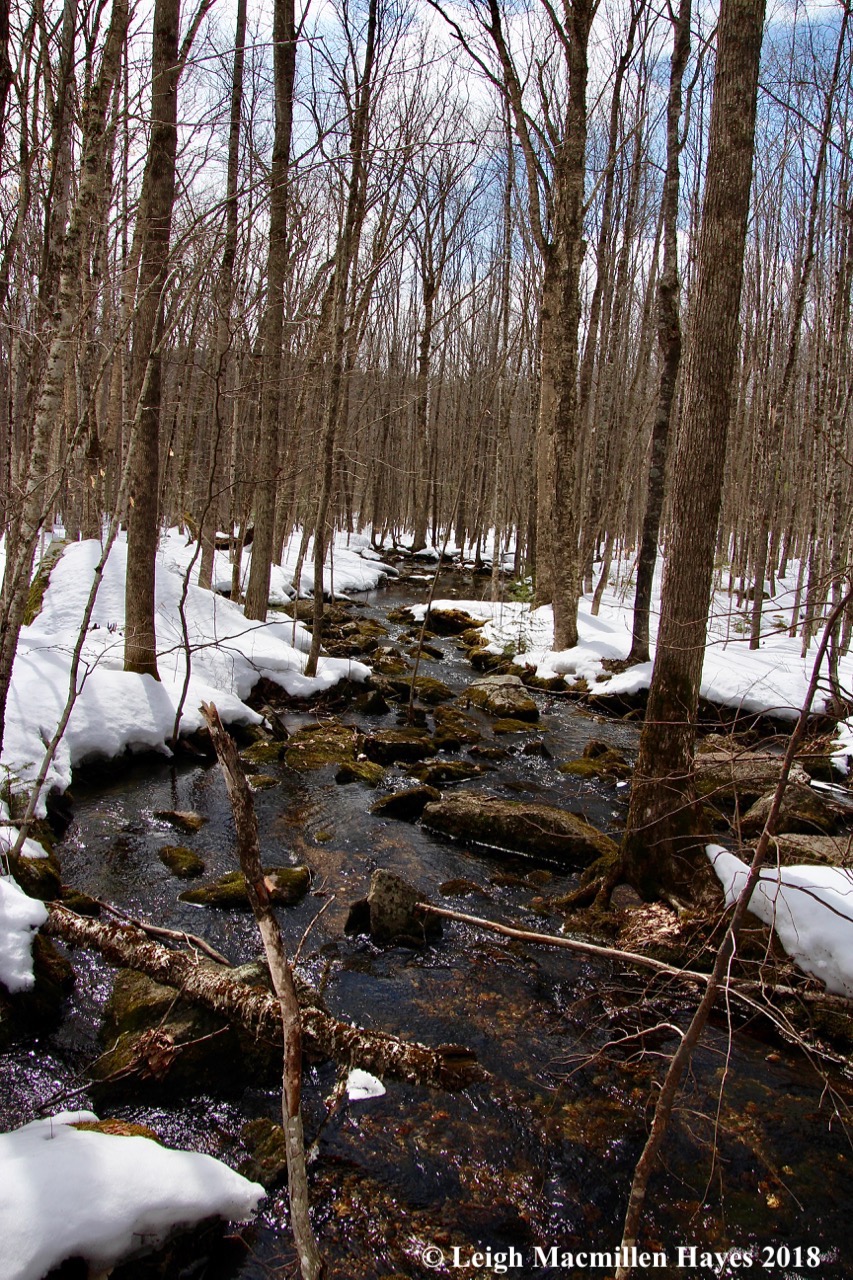
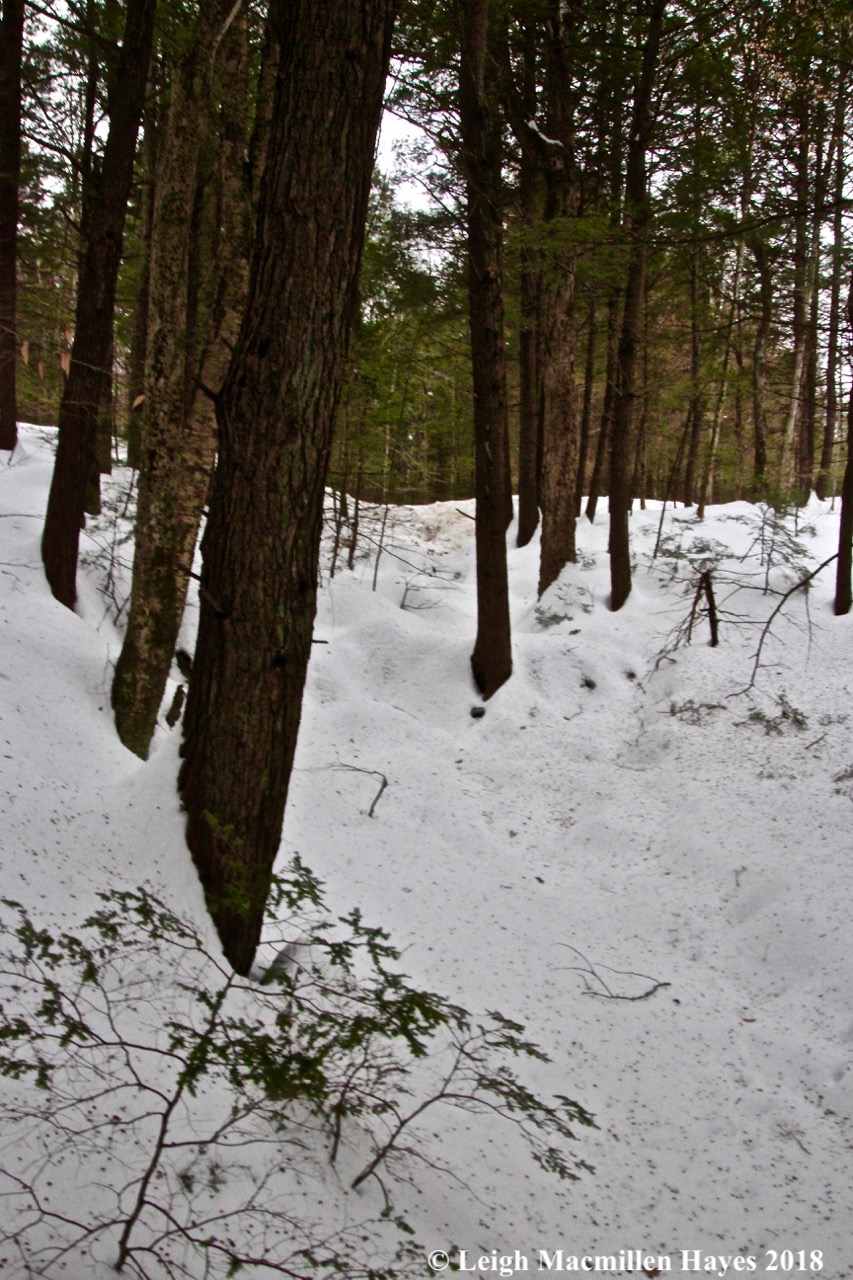
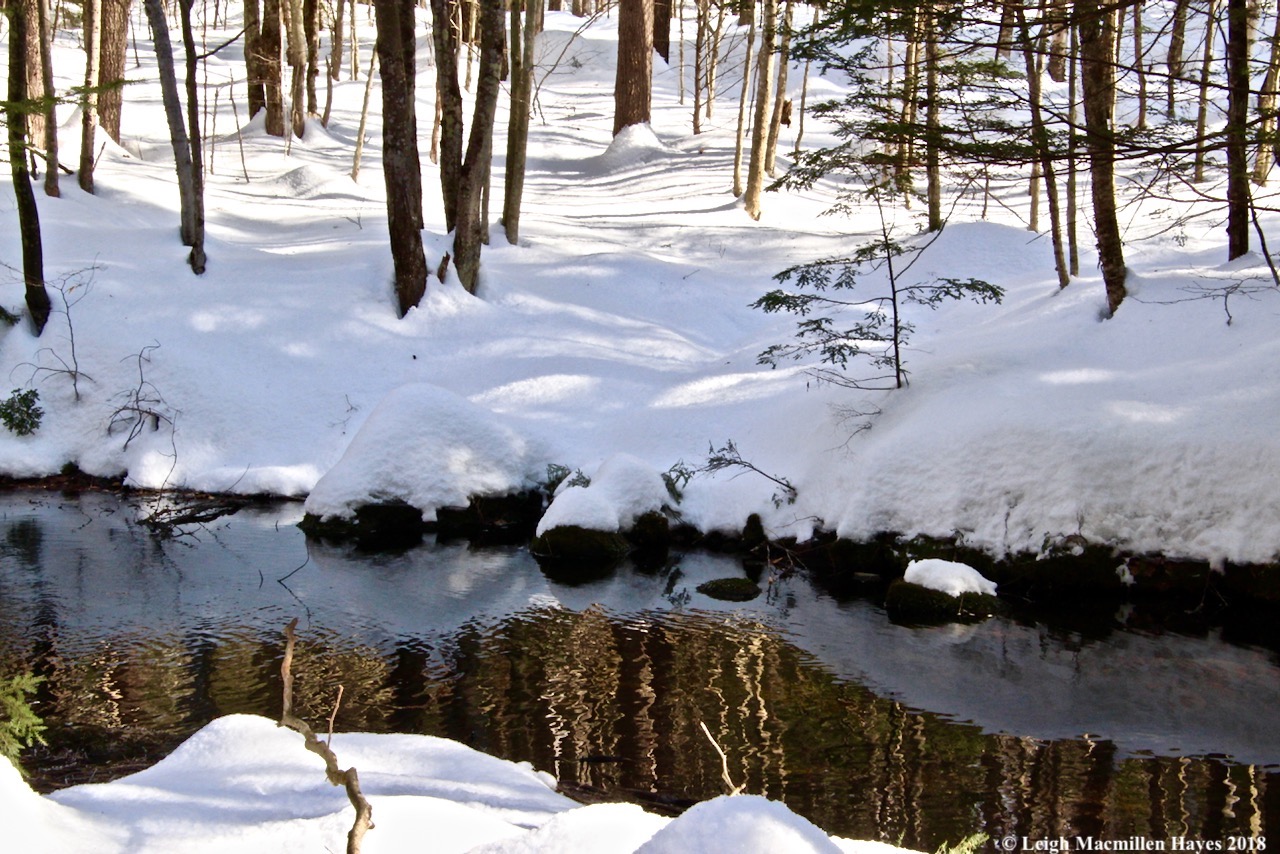
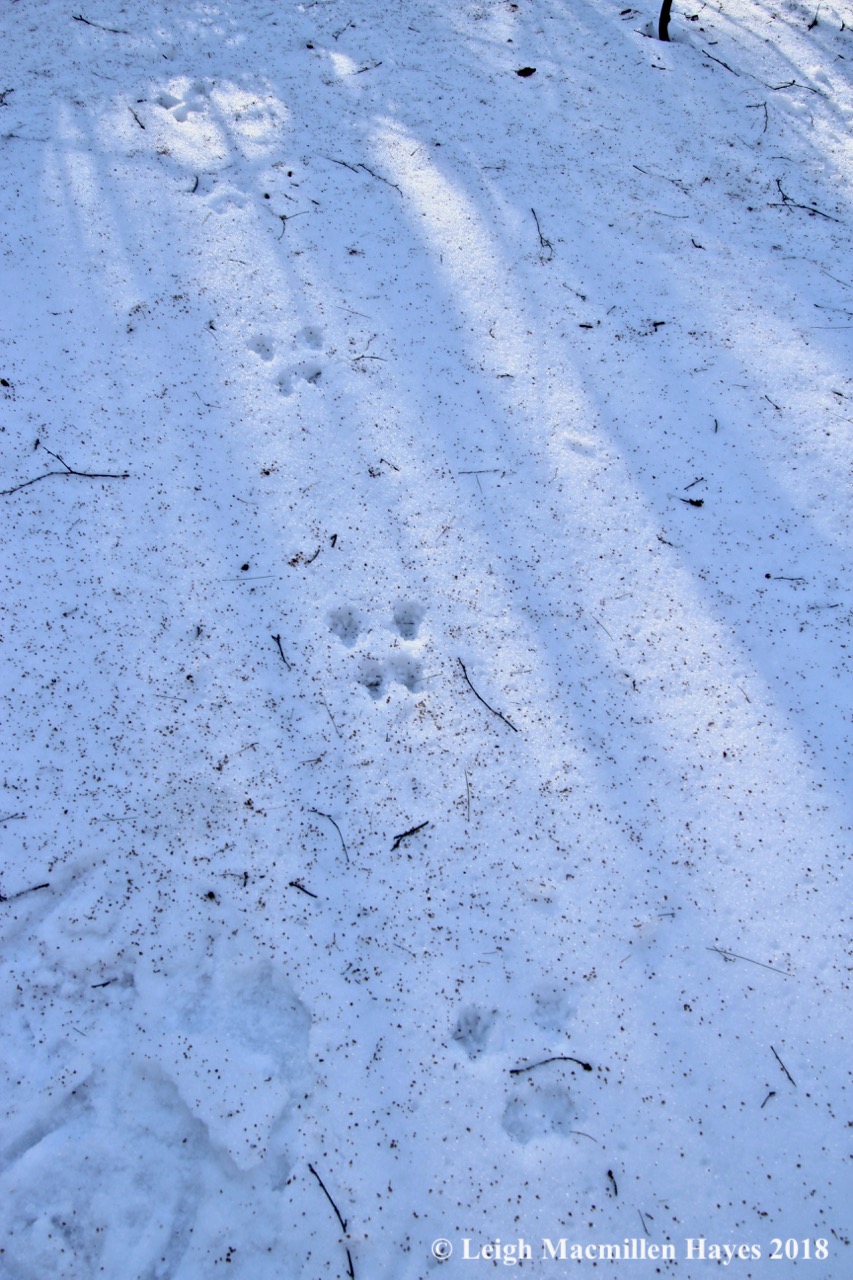
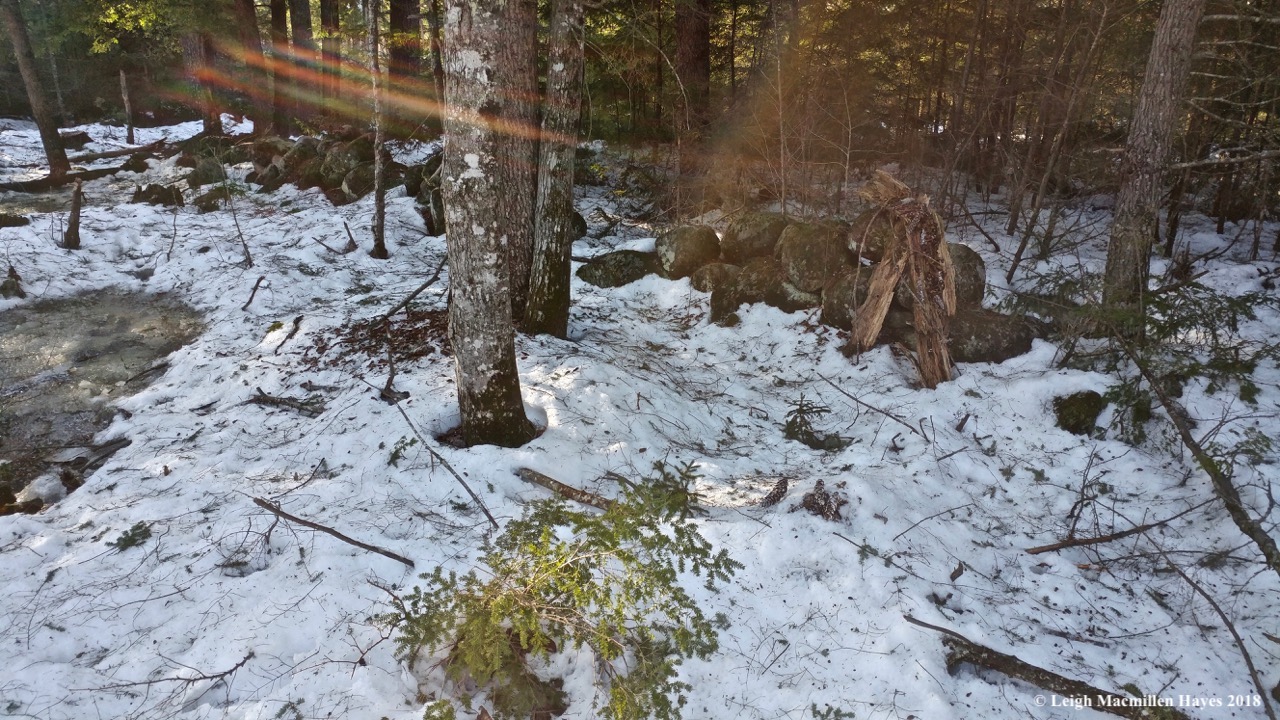
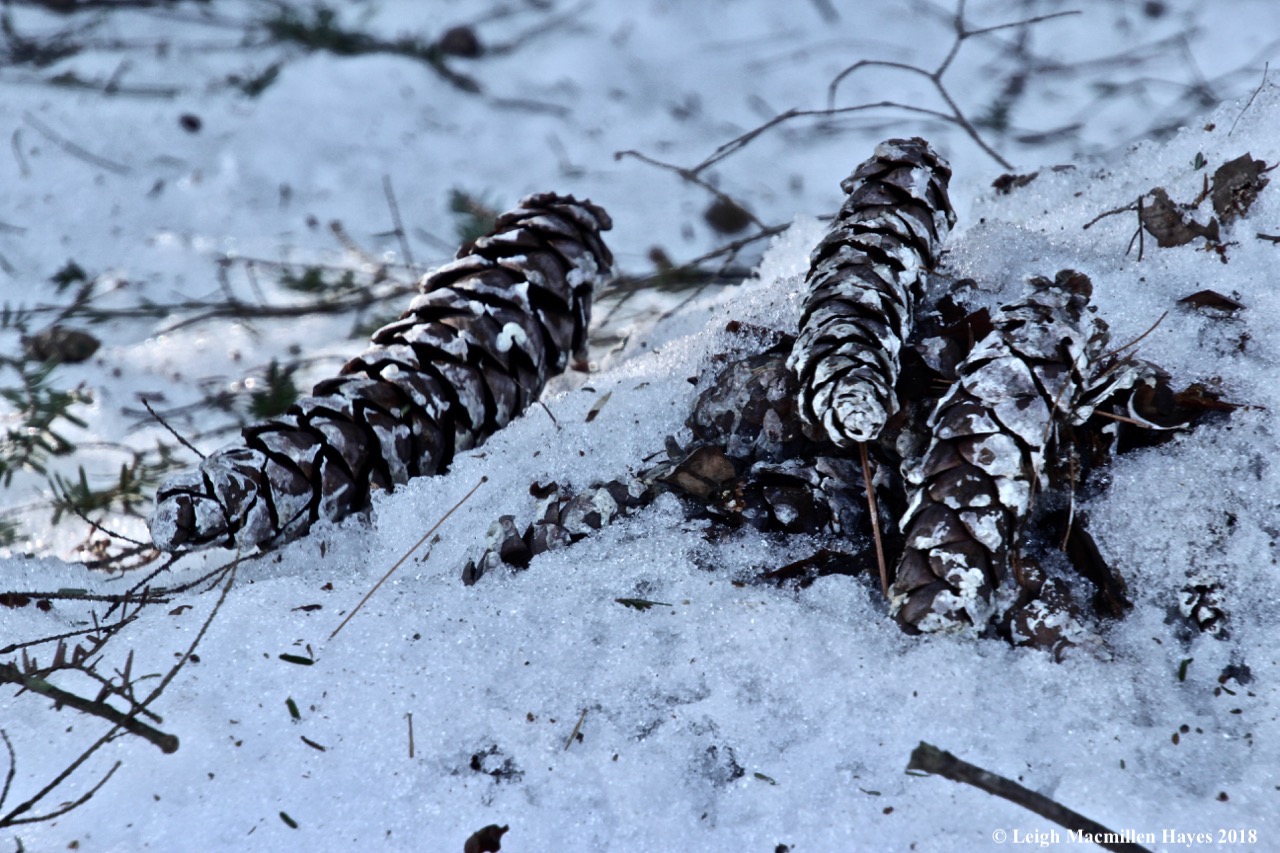
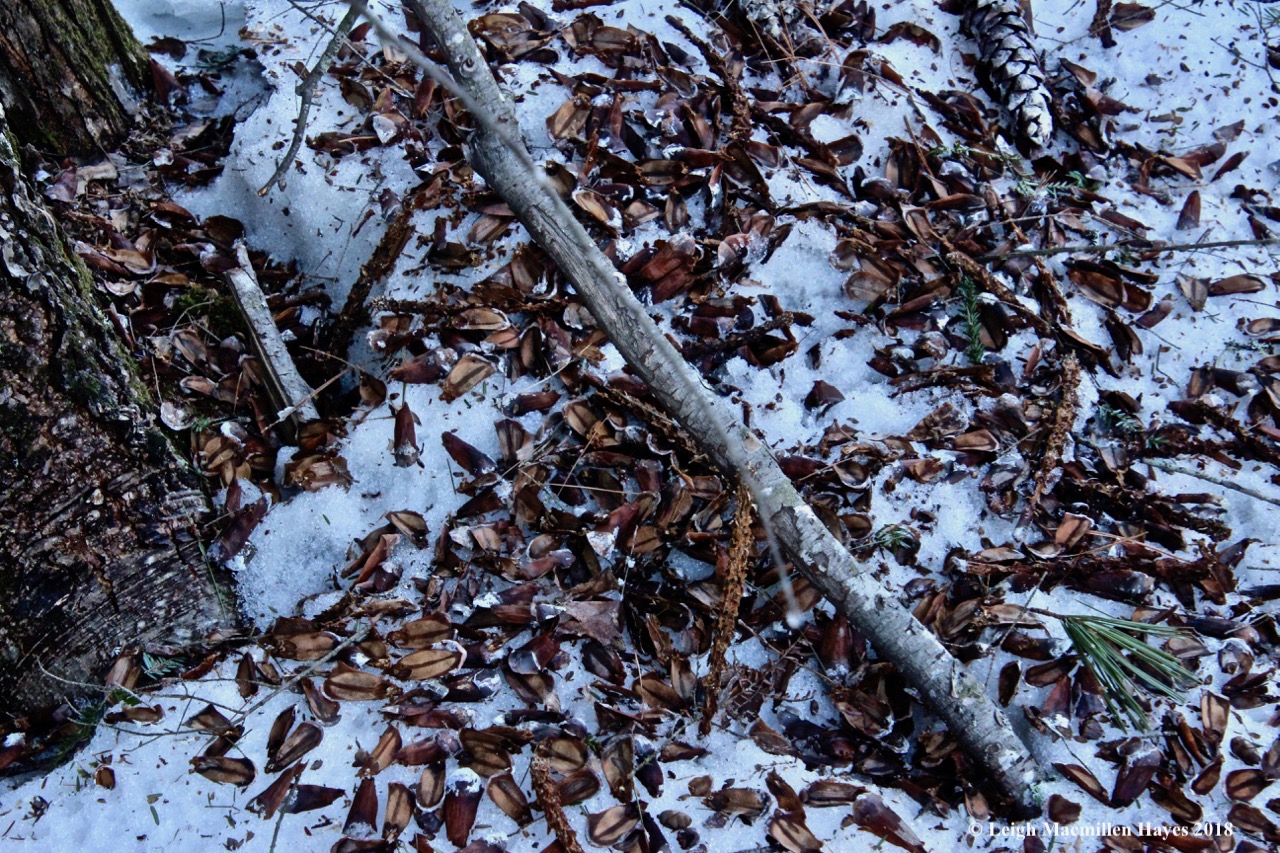
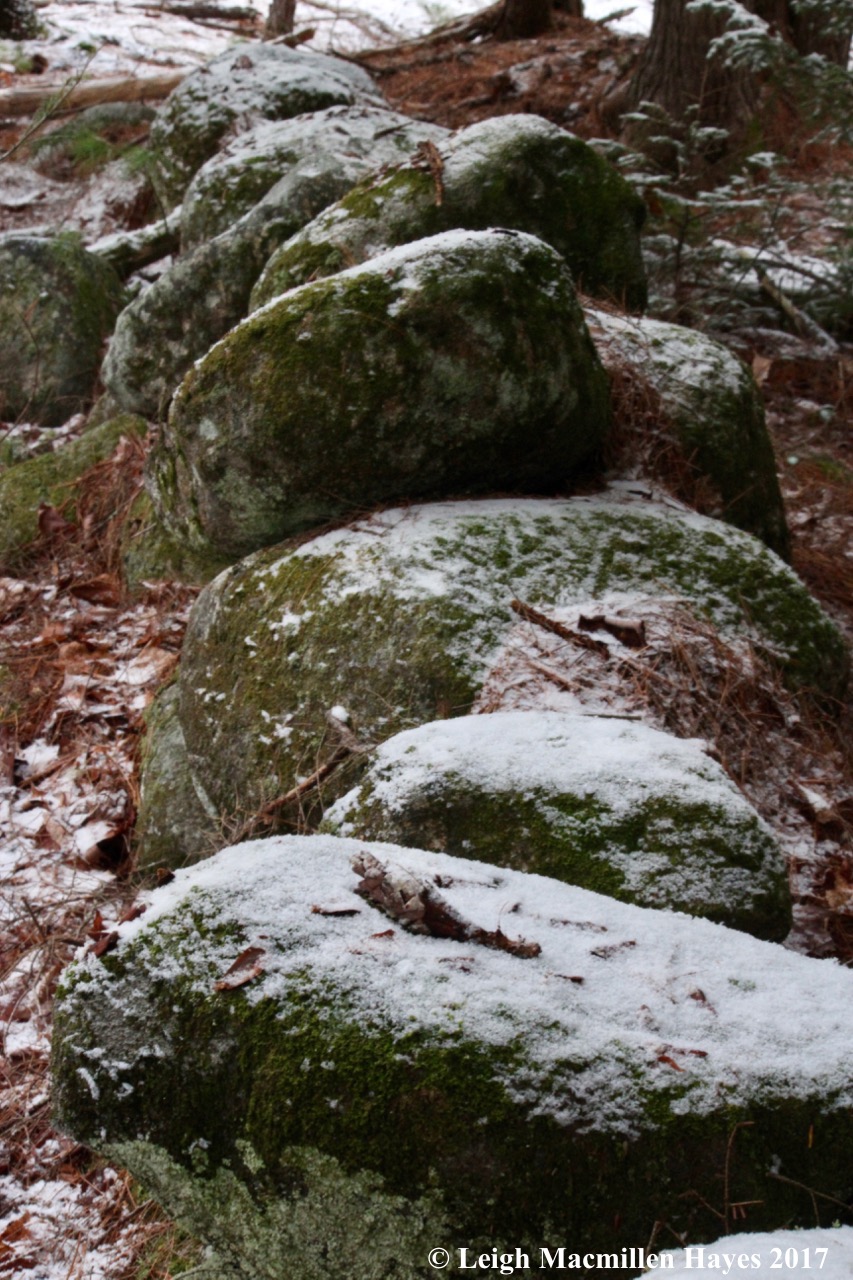
With the most recent snowstorm now history, I strapped on my snowshoes this morning with a sense of eager anticipation about the possibilities. And then it hit me like the snow plops that fell from the trees and landed on my head or slid down my neck: I could do this while others could not and it was for them that I needed to focus. 

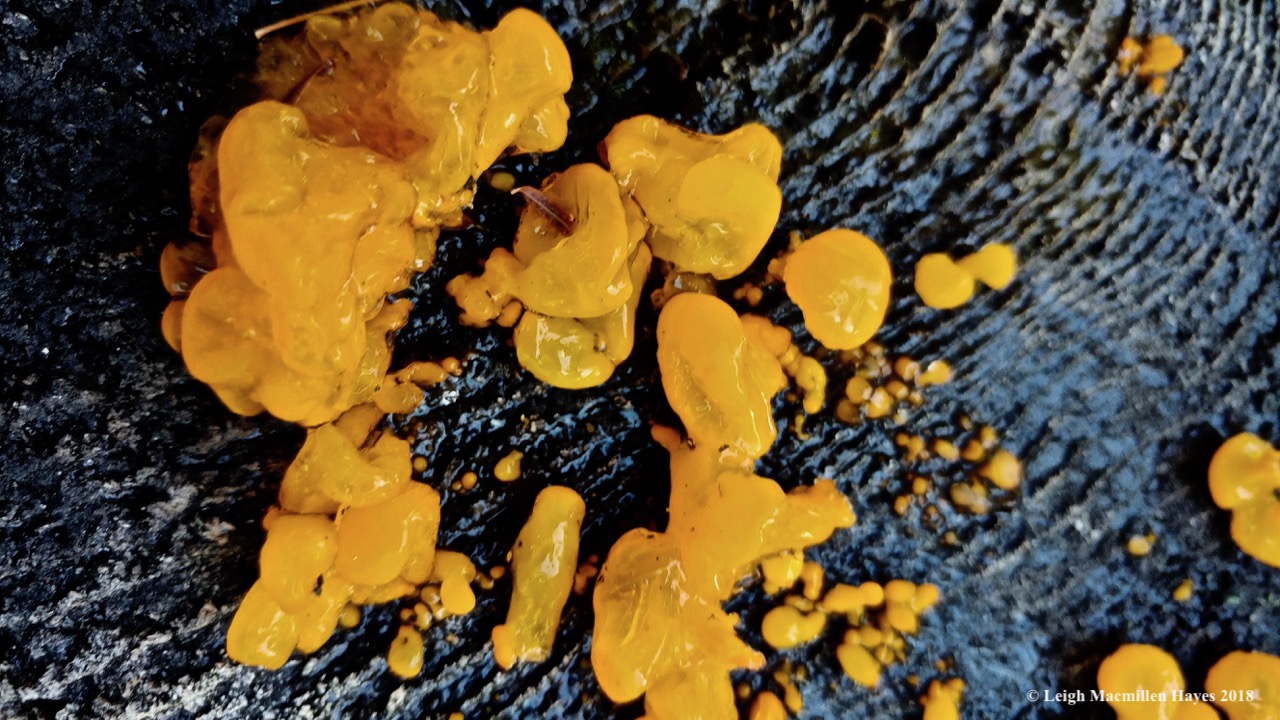
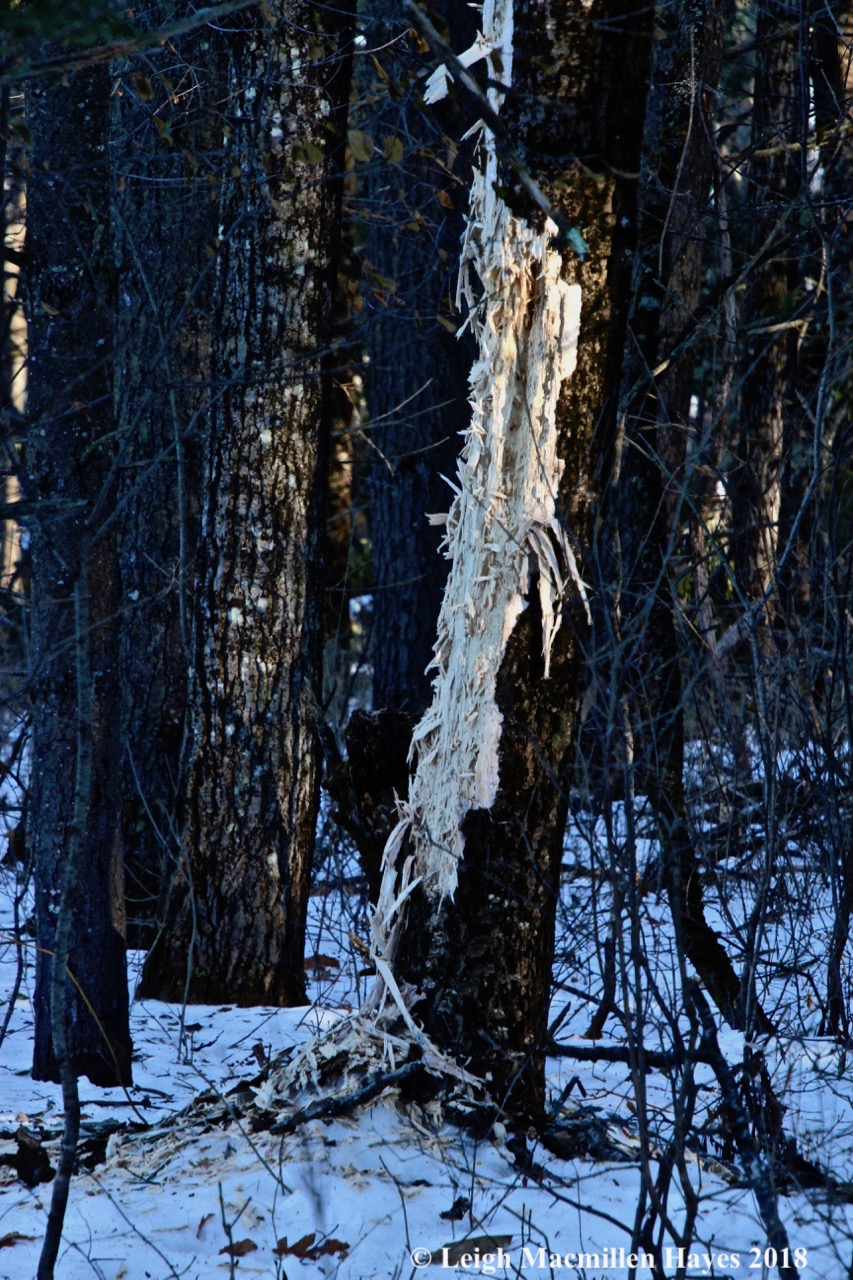
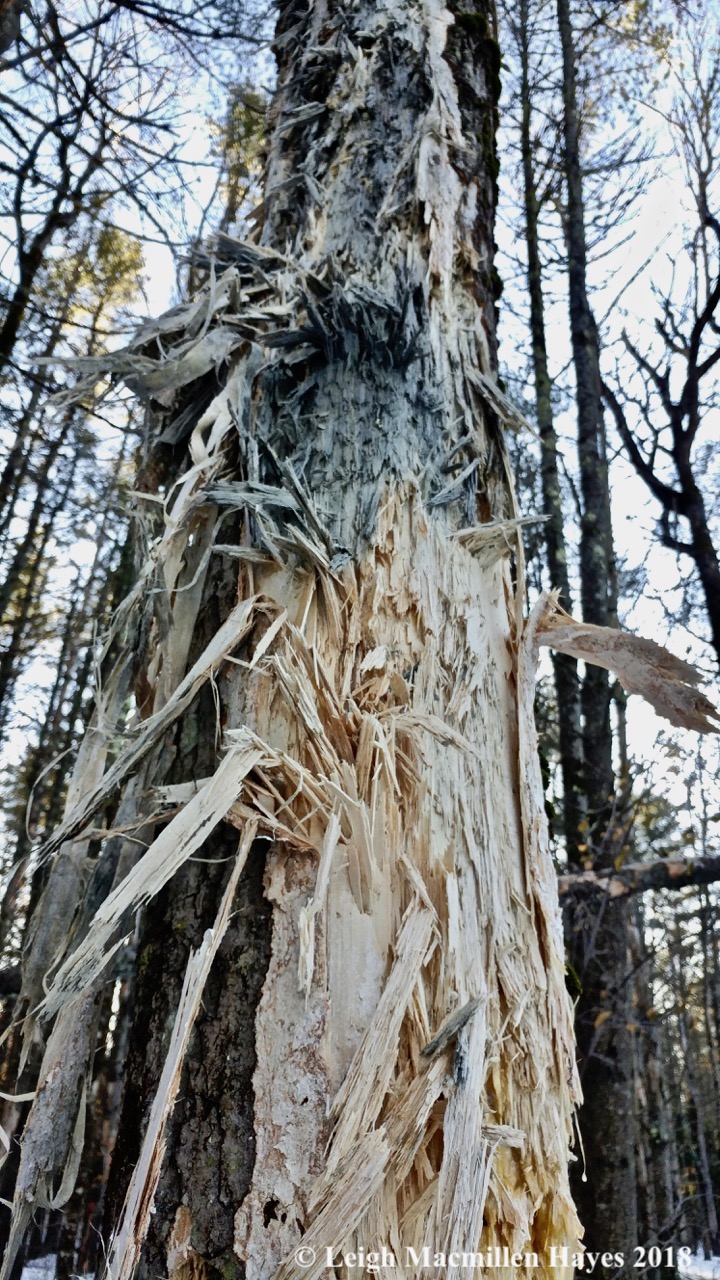
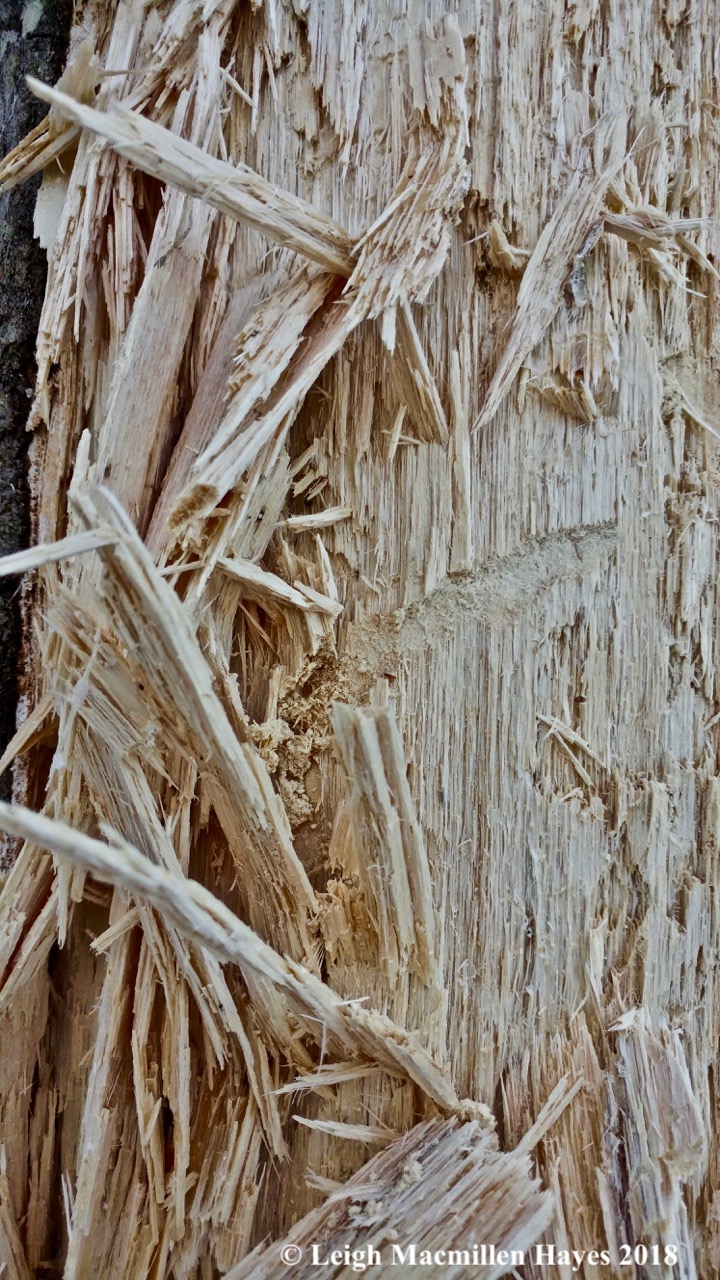
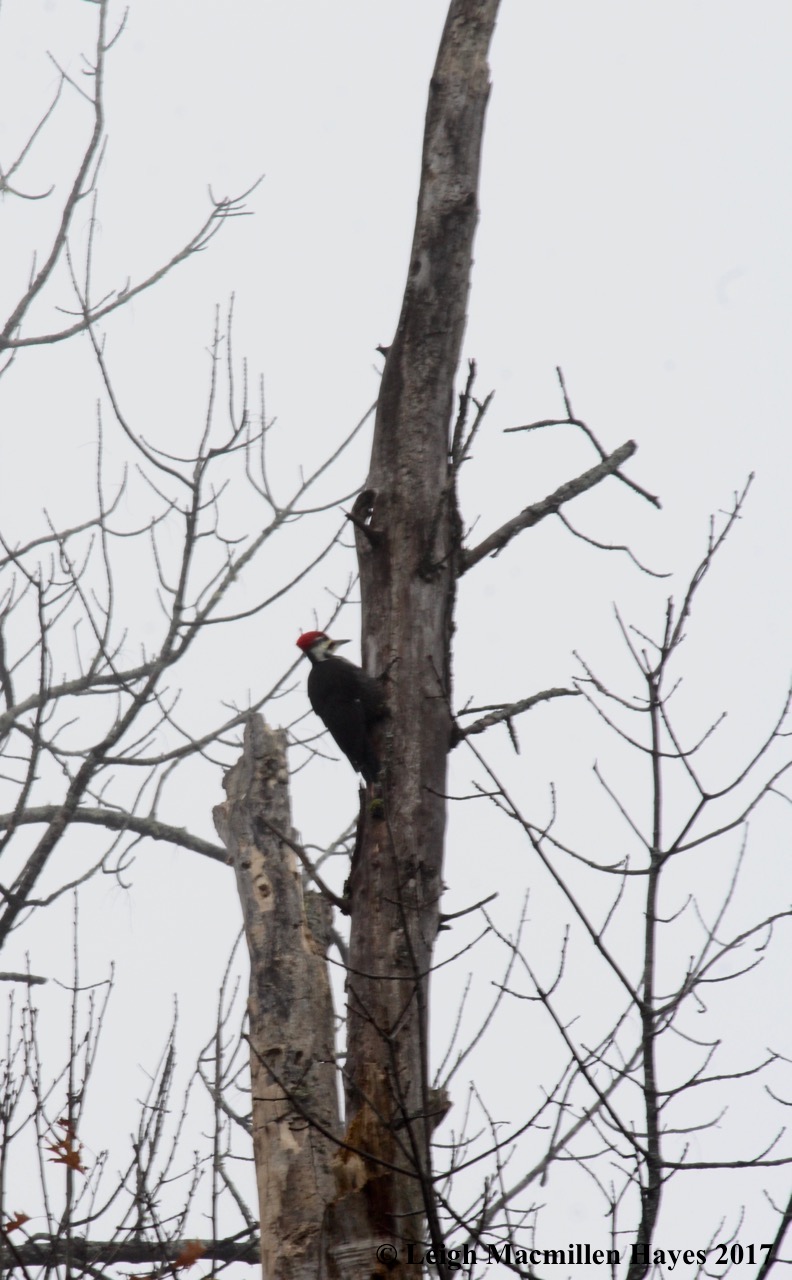
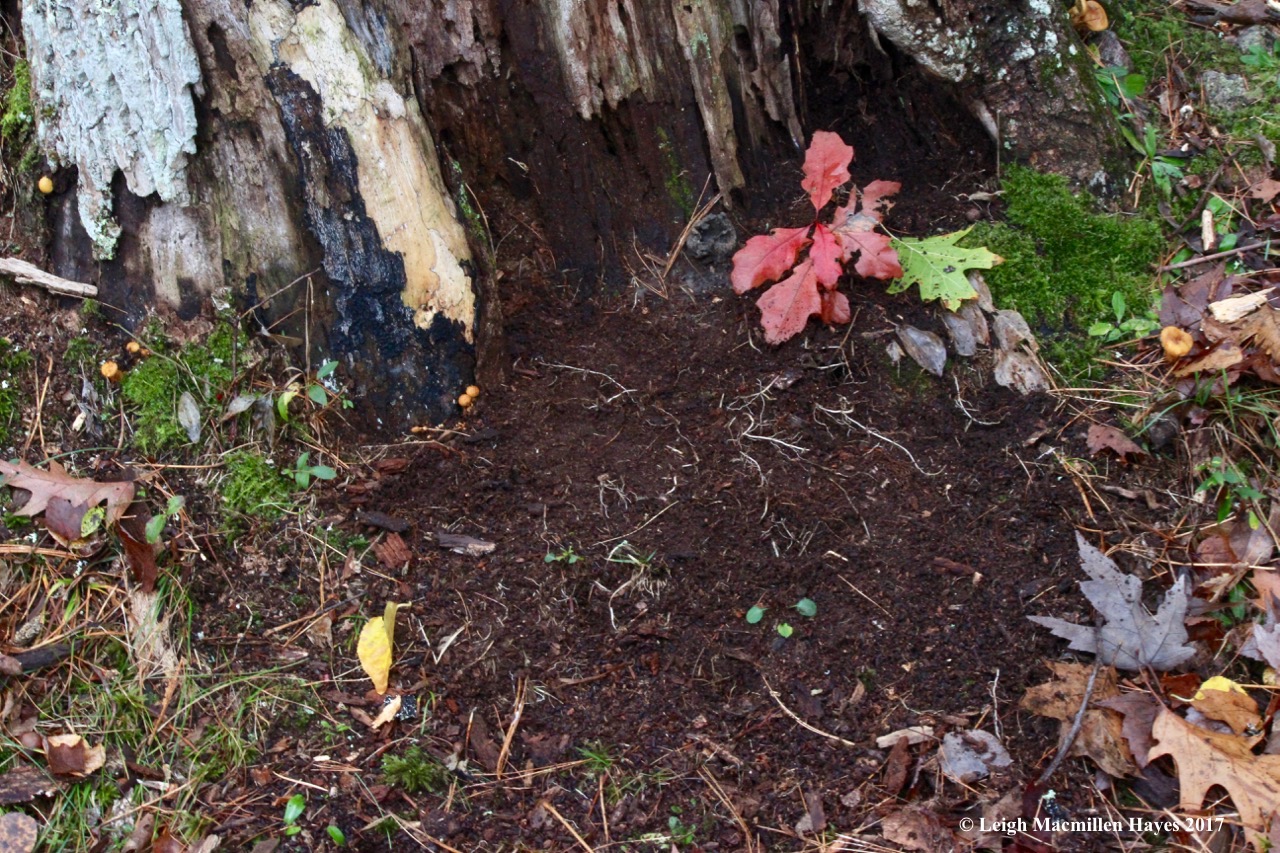
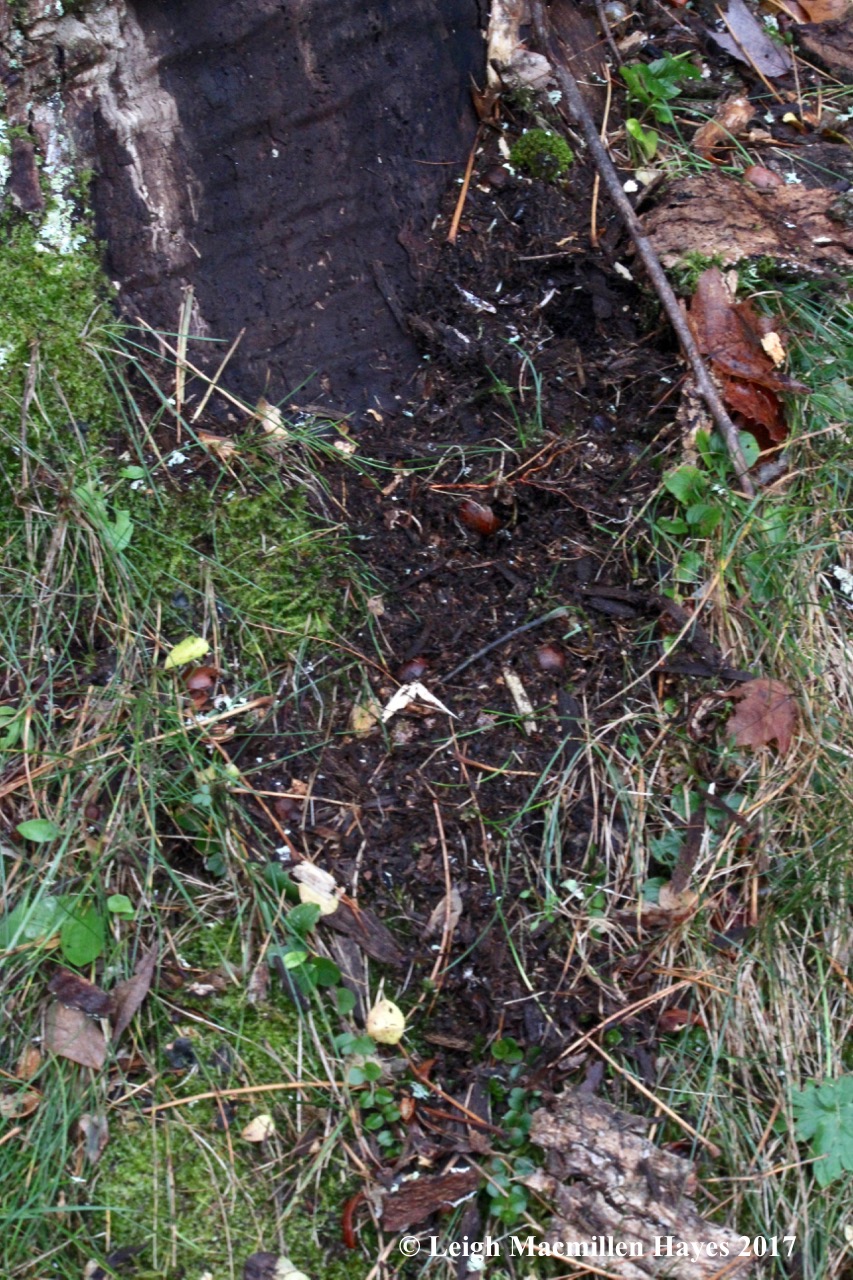
I hadn’t gone far when my first moment of wonder stood before me. Actually, just prior, I’d been looking at some pileated woodpecker works–ever on the search for the bird’s scat, and in the process had noticed other bird scat soiling the snow. But . . . what was all the amber color? 
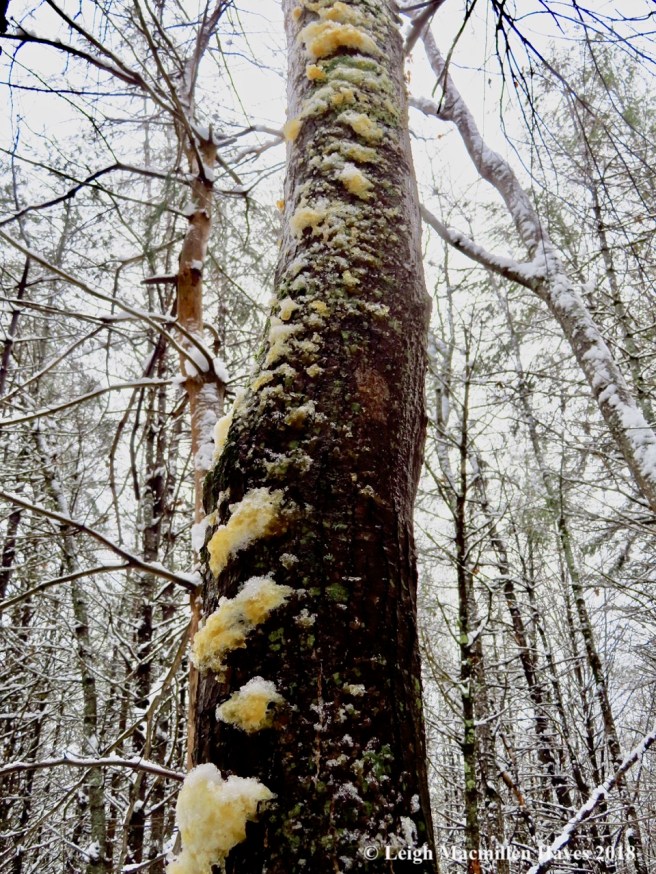
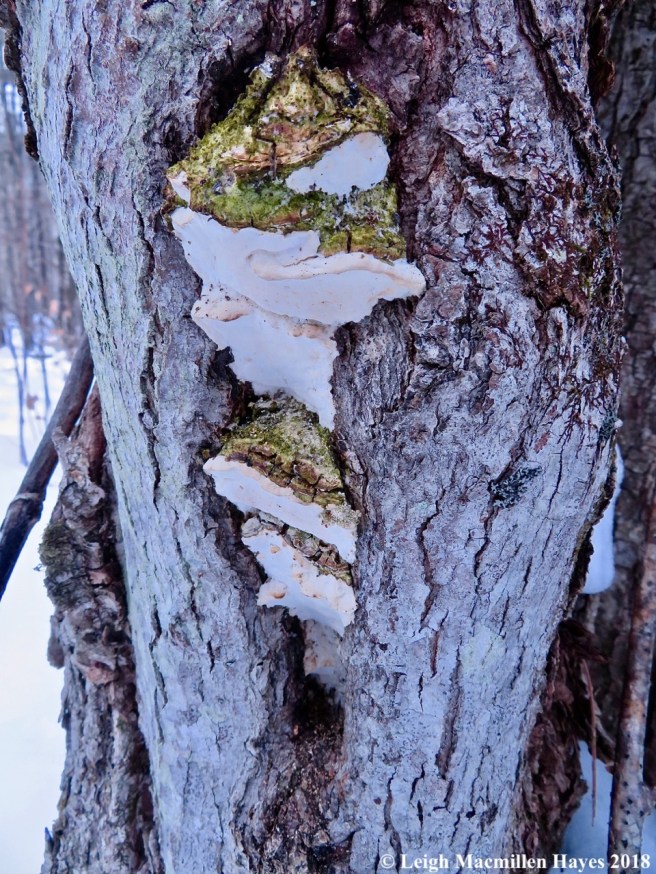
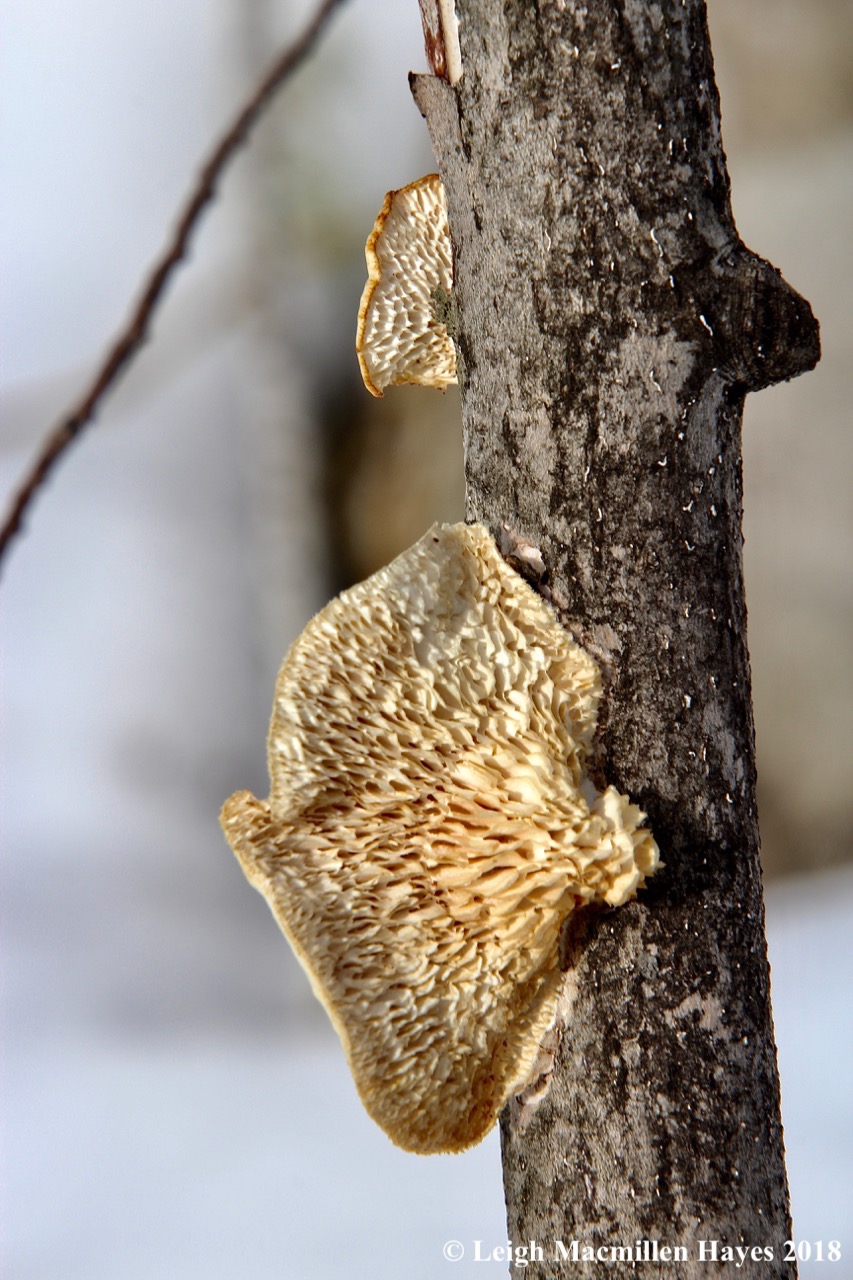
Had snow collected on mushrooms that decorated the bark? If so, why hadn’t I seen them yesterday or the day before? 

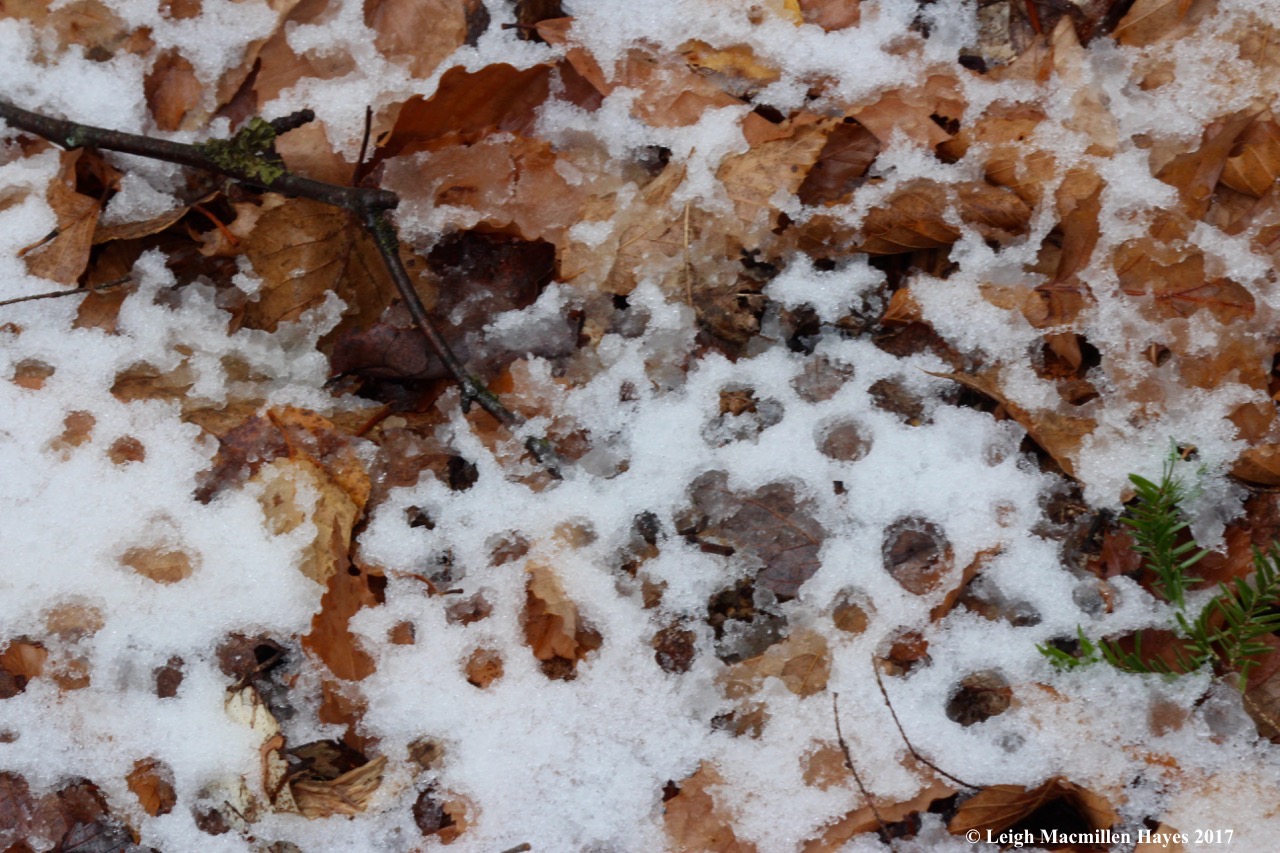
Upon a closer look, I realized it was sap. But why the big clumps? And why so much on a dead snag? 

I poked it with my finger and found it to be of snow consistency. And so . . . the mystery remained. But it was certainly worth a wonder and I knew that those I was intentionally walking for would appreciate the sight. And yes, I did see plenty of other examples of dripping sap at the base of trees, but nothing like this. As usual, if you know what was going on, please enlighten me.

My next moment of wonder was one that always gives me pause–and again I knew that my friends would feel the same. A miniature evergreen world momentarily encapsulated in a droplet of melting snow. 

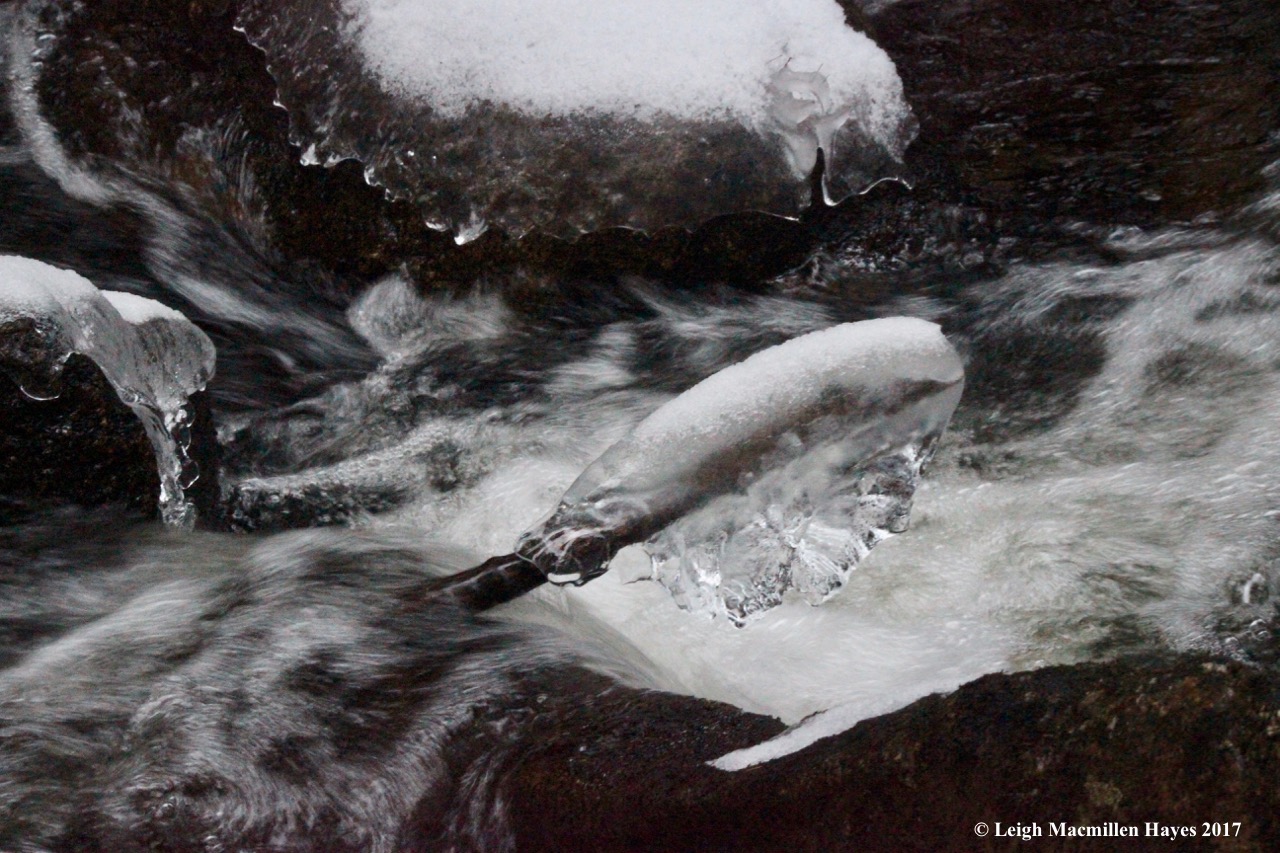
Everywhere, the meltdown offered a variety of shapes and designs, each worthy of reverence . . . and a photograph, of course. 

One of my favorites was plastered to a tree in such a way that it looked like it was flat against the bark until further study revealed otherwise. As it melted before my eyes, its ever changing formation resembled a series of little flowers scattered here and there. Just maybe you have to see that through my eyes. 
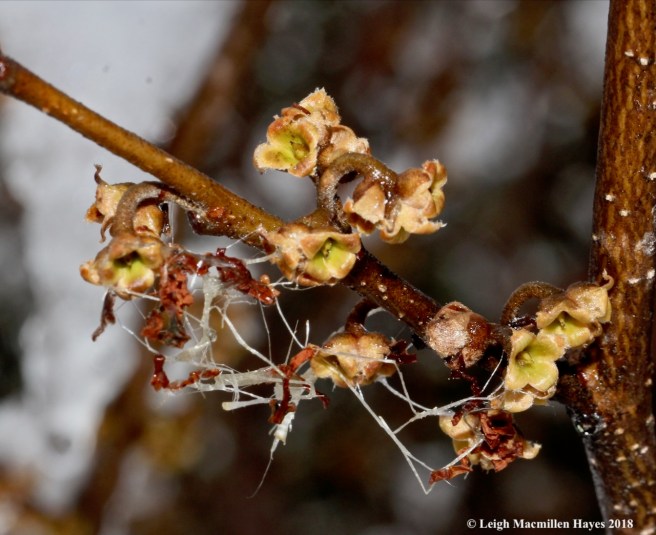
And then I stumbled upon another mystery–a web of sorts like Charlotte might have woven? I studied the shrub and found numerous examples of a similar pattern, but no arachnids in sight. Besides, the silky lines seemed too thick. But, what could it be? It took me a while as I studied the area and then I remembered. Before the snowstorm, I’d taken some photographs of the winter structure of a thistle. The storm had knocked down the fruiting form, but I think my gaze was upon the filaments that had served as parachutes for the thistle’s seeds. 

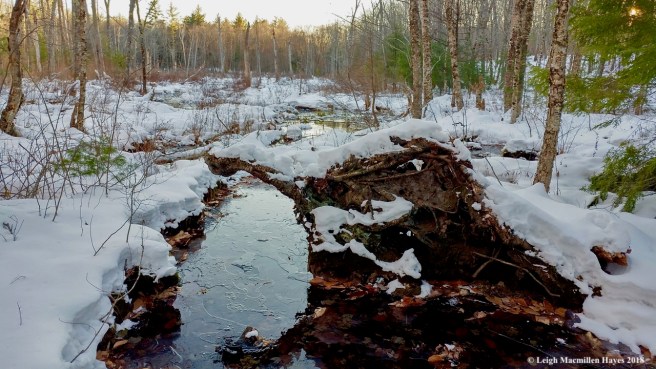
My journey into the winter wonderland continued, though not all the trees along the way were fortunate to withstand the weight of the snow that was quickly melting. It sounded like a rain storm as I walked under the arched branches. 

At the the other end of the snow tunnel, I emerged into a field with its own offerings. Typically, I pass by, but today I was inspired by those who virtually walked with me to explore. And I don’t think they’ll be  disappointed by the findings. First there was the Goldenrod Ball Gall. The round gall occurred in the middle of a stem, the top of which had broken off. In the spring, the Goldenrod gall fly laid her eggs on the stem. Hatched larvae chewed their way into the stem and the gall started to develop. And from the looks of the hole on the side, it appeared the creator had chewed its way out and flown off. 
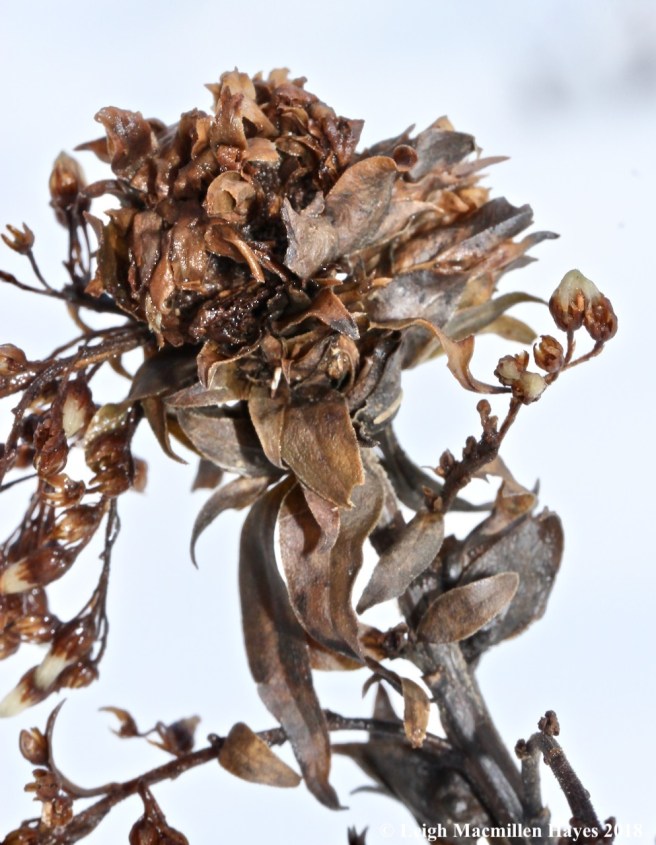
Also in the field, a Rose Bedeguar Gall, aka Robin’s Pincushion Gall on Meadowsweet, which happens to be a member of the rose family. Burrowing in to the leaves and stem of the plant was a two-fold offering for the fly larvae it hosted, for the insect benefited from the nutrients while it was simultaneously protected from predators. 

There were also numerous examples of a structure that might baffle the onlooker. Beaded formations of the fertile stalk from a Sensitive Fern poked up through the snow. Typically, the beads or capsules remain intact with their brown dust-like spores waiting inside for the structure to break open during the rains of early spring. 

I moved on from the field and eventually reached a wetland that I couldn’t cross. But, I could stand and listen and so I did. All around me the forest orchestra performed its Plop, Plop, Swish, Plop, Splash symphony. 

 At first, it sounded and looked like I was surrounded by a million wild animals, but really . . . all the sound and sights were a result of snow falling, either gently with a whisper of the wind or harshly with a thud and splash. 

As I stood there looking for the million wild mammals, my eyes focused on the works of something much smaller. Insect egg tunnels on a dead snag’s trunk read like a story on paper. 
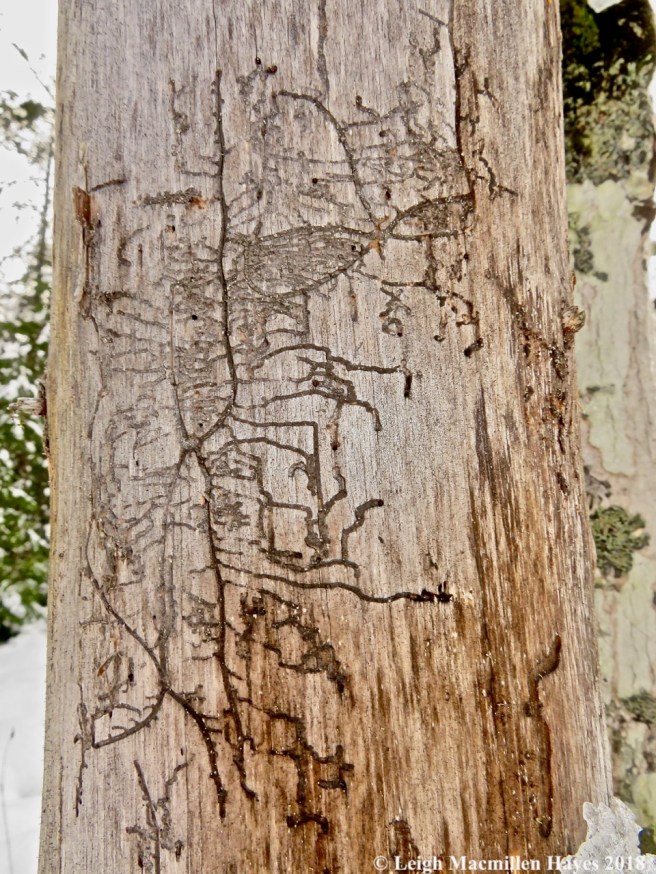
The longer tunnels were bored by a female Bark Beetle. From the sides of her tunnels, larval mines radiated outward. The overall design could have been an abstract drawing. 

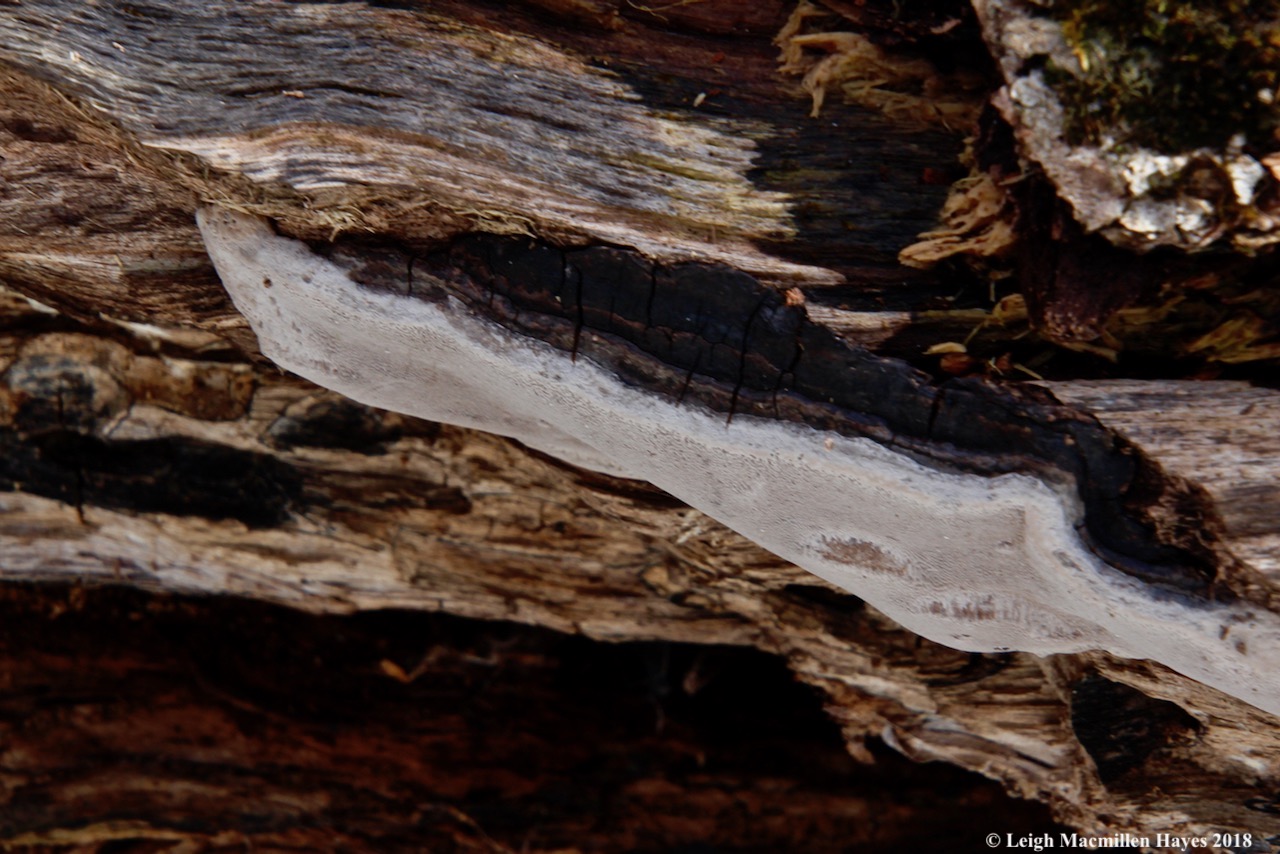
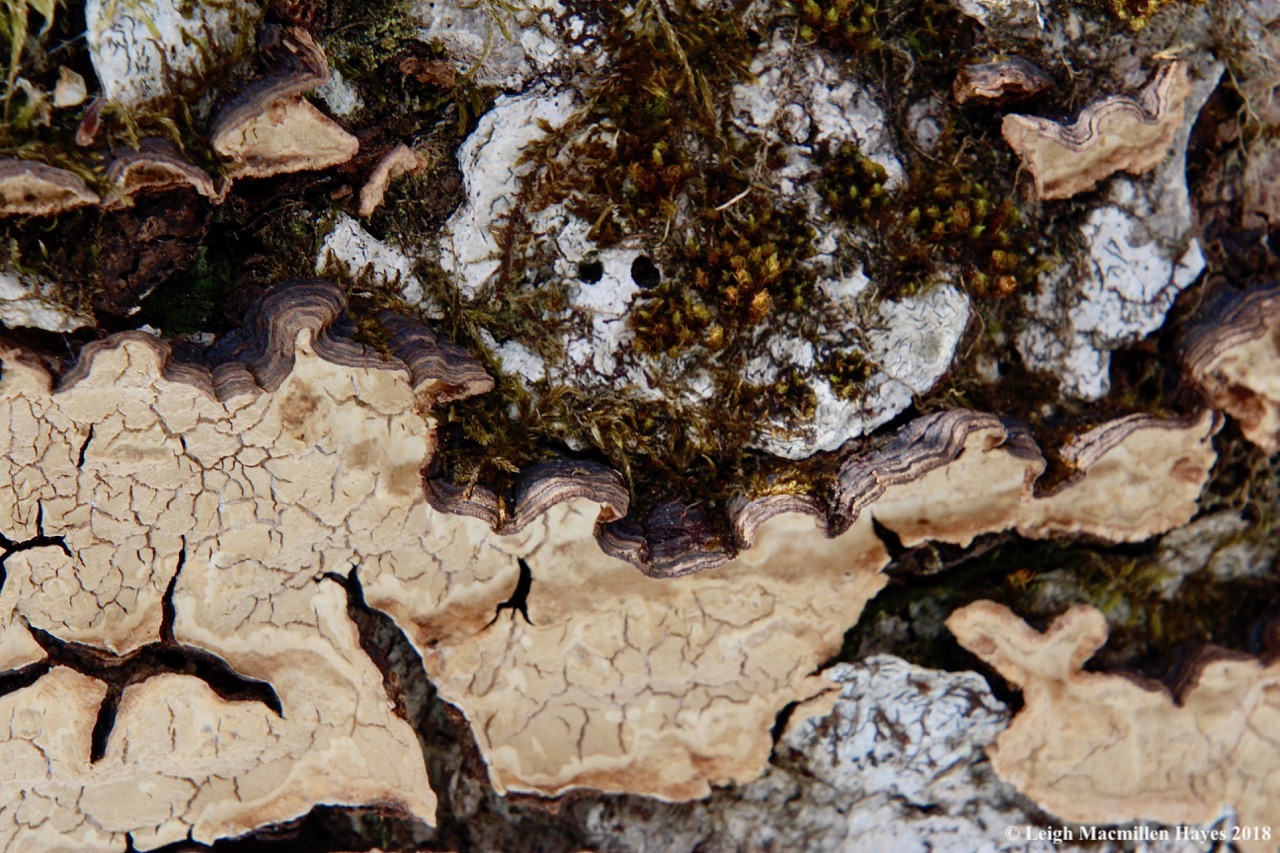
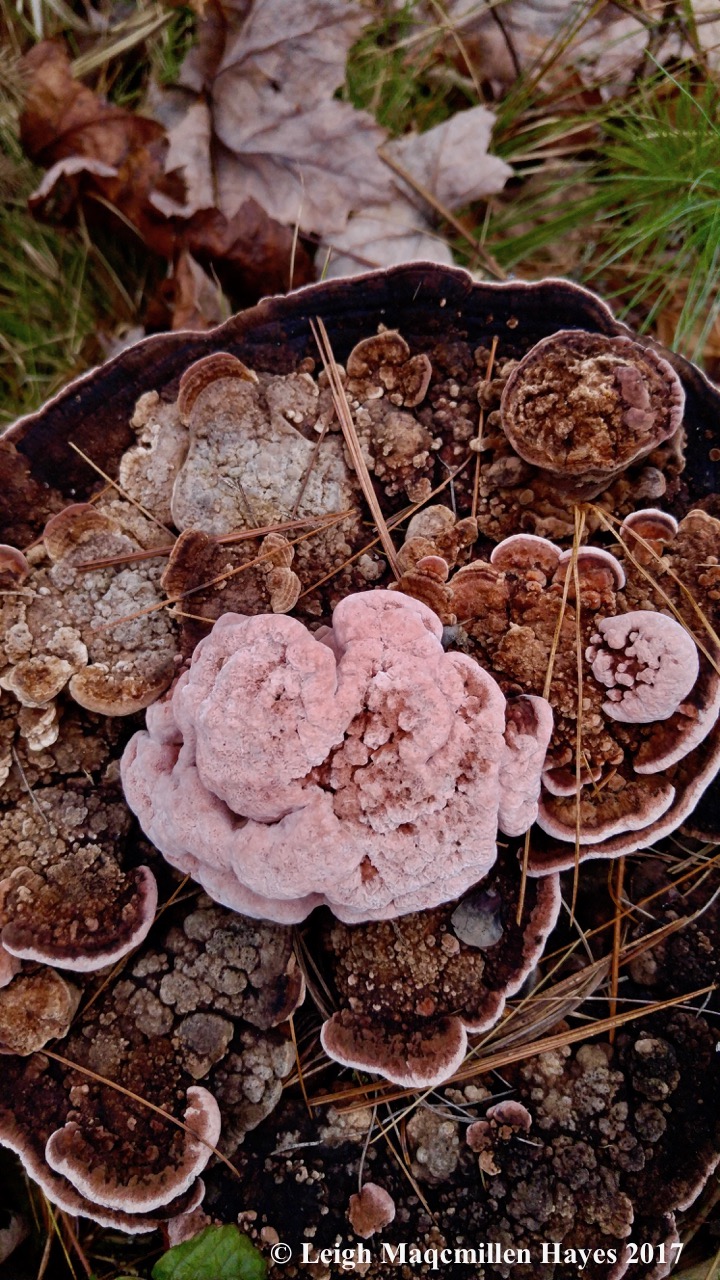
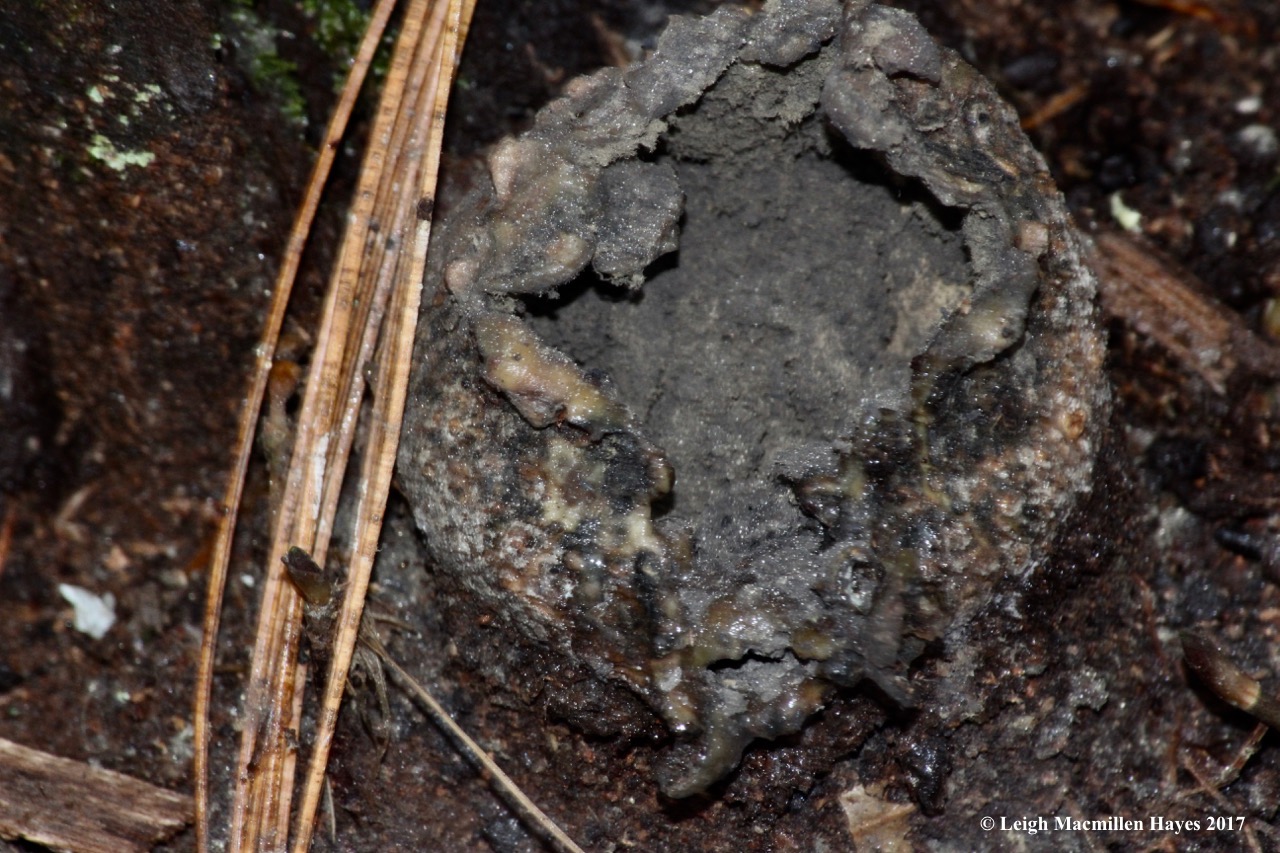
At last  I started for home, thankful that I was retracing my steps for often new sights are revealed when one does that. And so, I believe it was a crust fungus and perhaps it was an oak curtain crust fungus, but let it remain that I discovered a fungus I don’t think I’ve seen before, with a warty, rust-colored underside and dark upperside. Suffice it to say, it was a mushroom of some sort. 
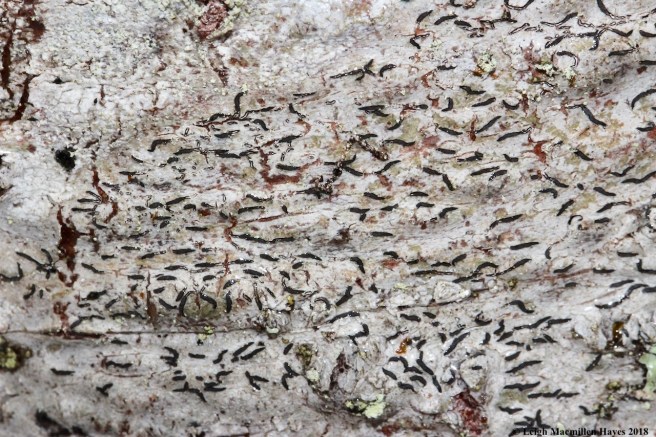
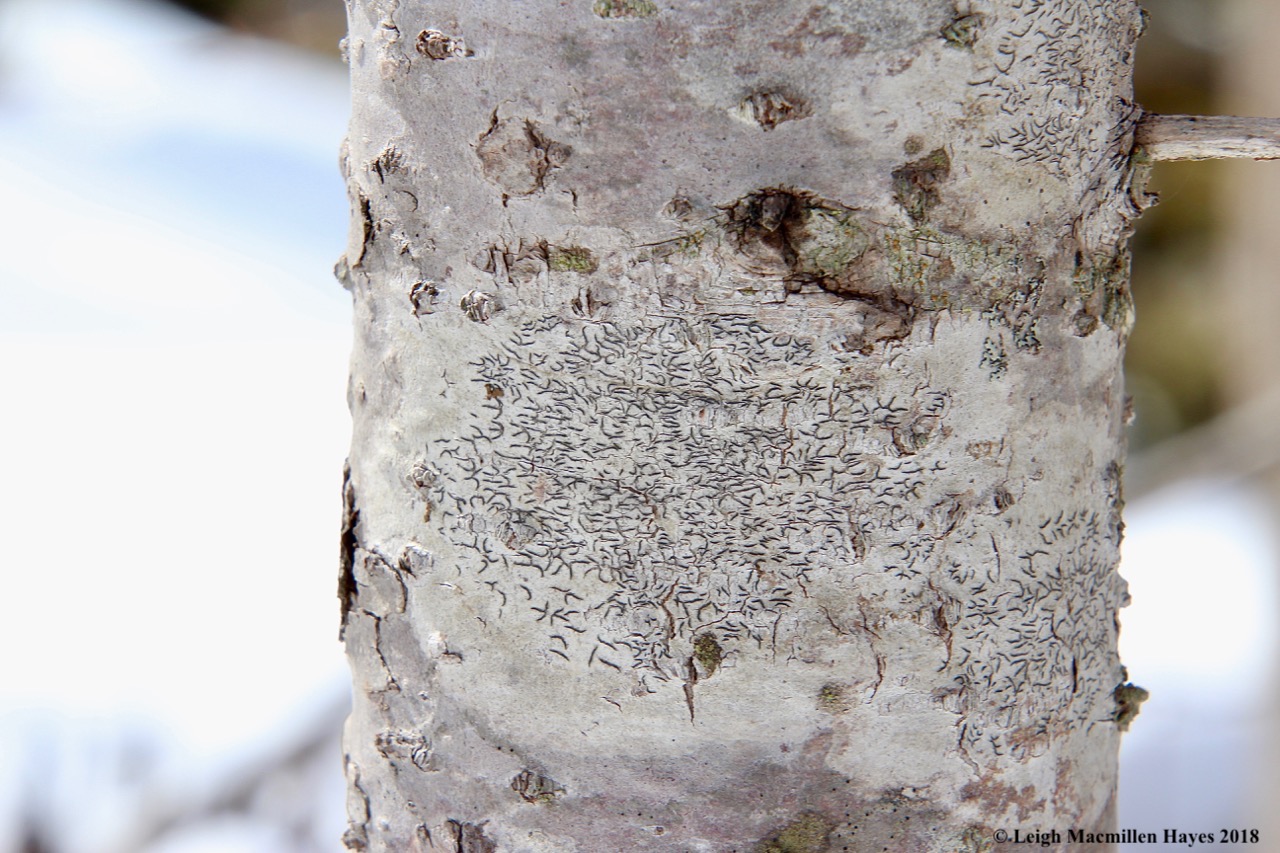
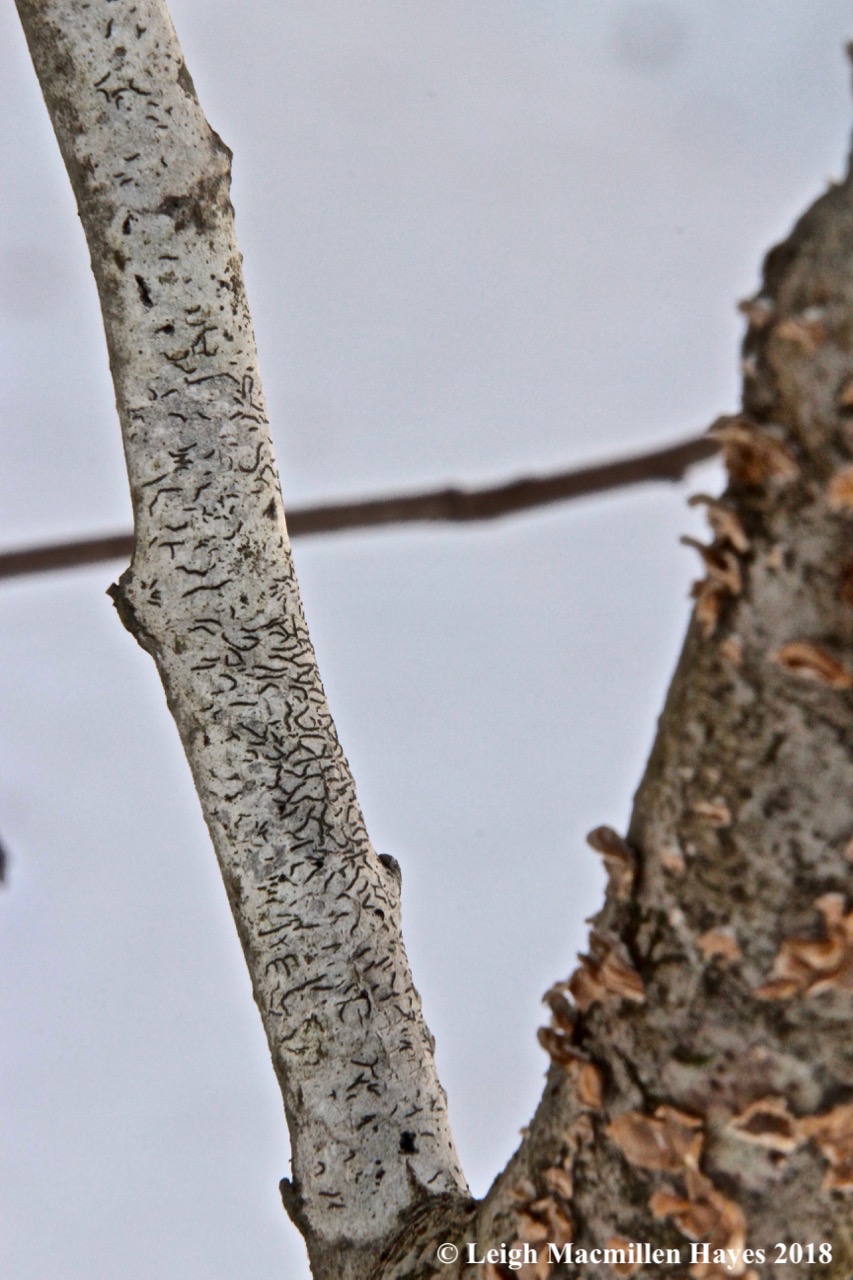
Along the way was a script lichen, which looked to me like someone had doodled. Commas and apostrophes decorated that page. 
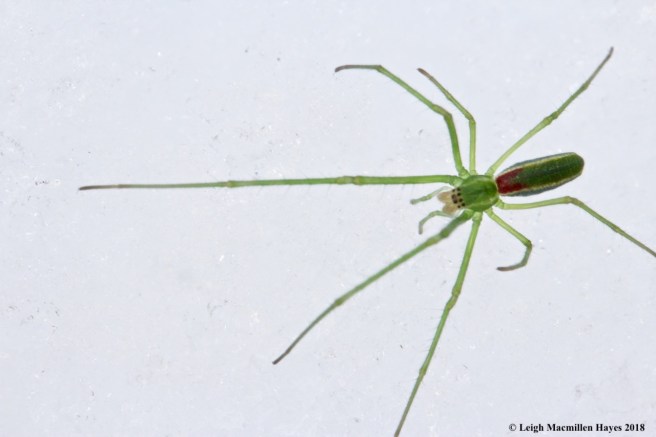
And then, and then, Tetragnatha viridis, a green long-jawed orb weaver. I actually saw two of them. Typically, the translucent green color helps them camouflage amongst pine needles, their usual habitat, but they can frequently be seen on snow, especially if the temperature is in the 25˚-35˚ range as it was this morning. 

The orb weaver’s characteristics: eight eyes in two parallel sets of four; long chelicerae (jaws); enlarged pedipalps; long legs with spines; and that color–oh my! 
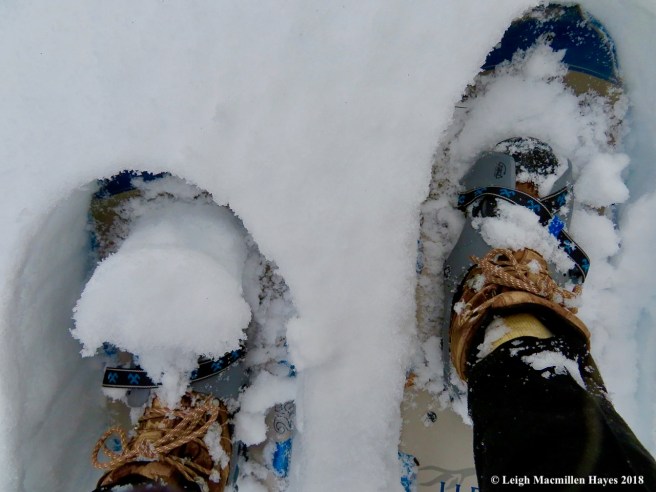
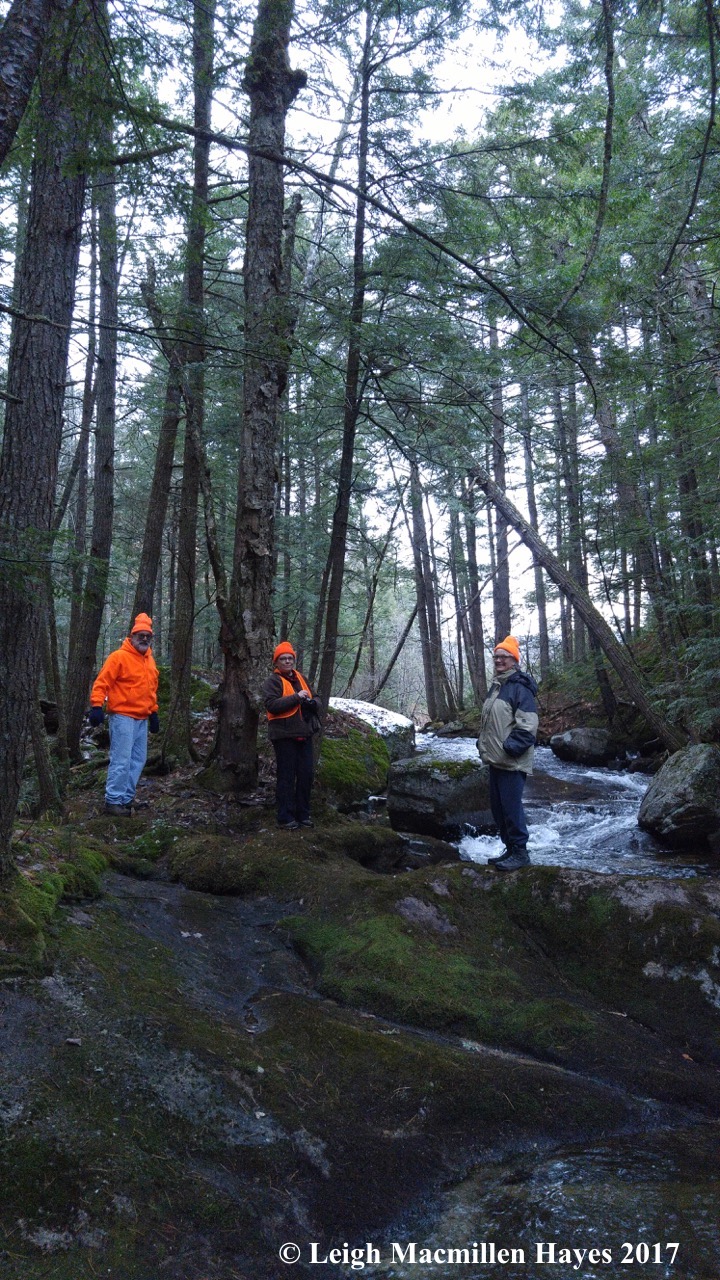
It was for eight parallel eyes that I walked today, the eight representing Jinny Mae, Dick, Kate, and Carol. 

Where trees didn’t cover the trail the snow was about fourteen inches deep and as you can see I chose the wrong boots and forgot my gators. But that was okay because I knew that I would eventually wander home and change my sopping wet socks. What mattered more was the fact that I was honored to step out for others when they couldn’t necessarily do the same. Here’s to the four of you–thanks for letting me be your eyes. 

Black Friday Lit Up, Naturally

With a mantra of “Shop Locally,” I did just that on this Black Friday 2018. Thankfully the time to take advantage of the doorbuster sales wasn’t limited and so it was okay that I didn’t pull into the Flat Hill parking lot until 1pm. 

Turns out, as in any shop today, the aisles were a bit crowded with customers searching for items on clearance and other great deals. 

I paused for a bit in aisle one, where I contemplated the Made-in-Maine artwork and thought about those on my Christmas list. Perhaps a water scene for Marita  because she likes the gurgling sound of a brook. 

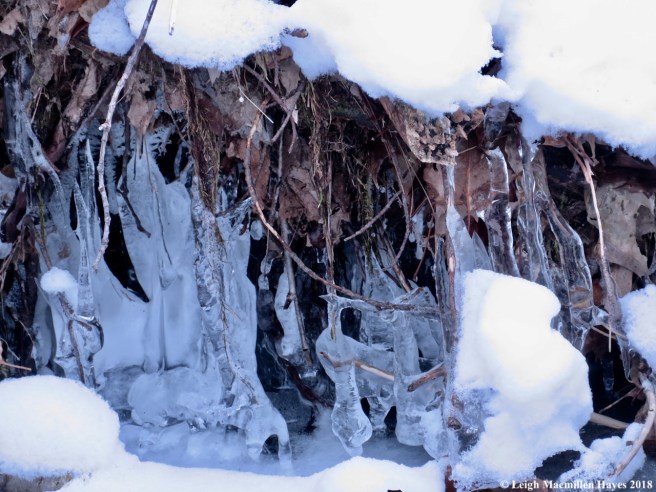
For Pam K., I decided on an ice sculpture to add to her winter home. 

And for Pam M., I was sure that an abstract piece would be just right–especially as it echoed the mountain range and transformed into a bird, only sorta/kinda M.C. Escher in style. 

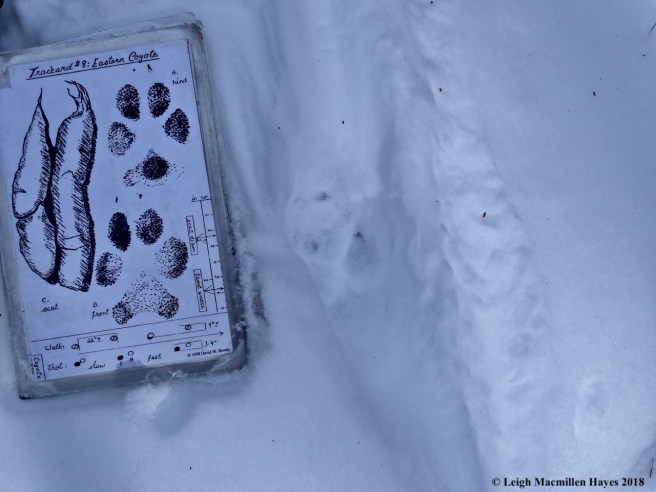
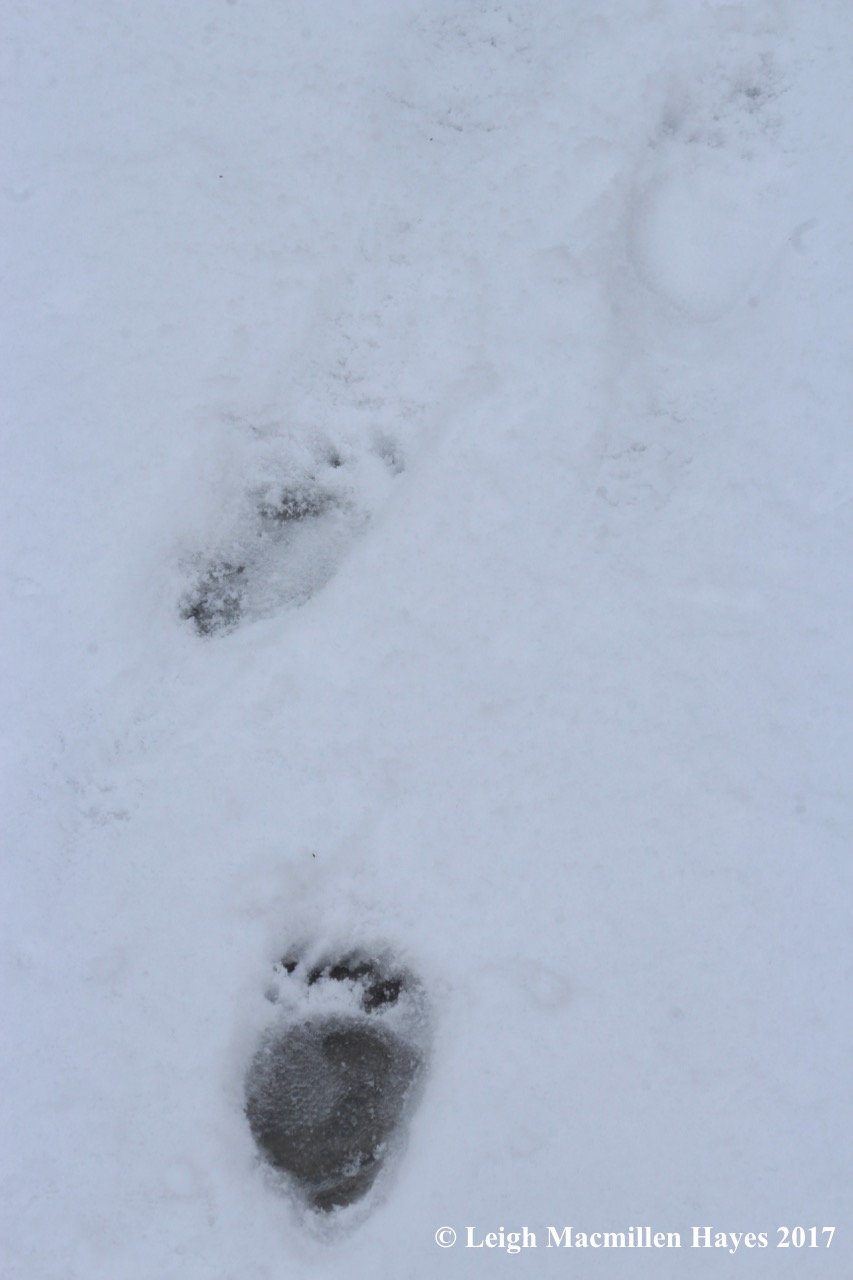
There were others on the list to consider and the decisions became more difficult as the selection increased in aisle two. Mouse, vole, squirrel both red and gray, deer and coyote tracks all were on display and the sign indicated I could buy one and get one free. But which one to buy? And for whom? 

And then just like that, it became clear–the coyote track for Simon because he’d caught on quickly to the squirrel patterns and appreciated that the predator was hungry. 

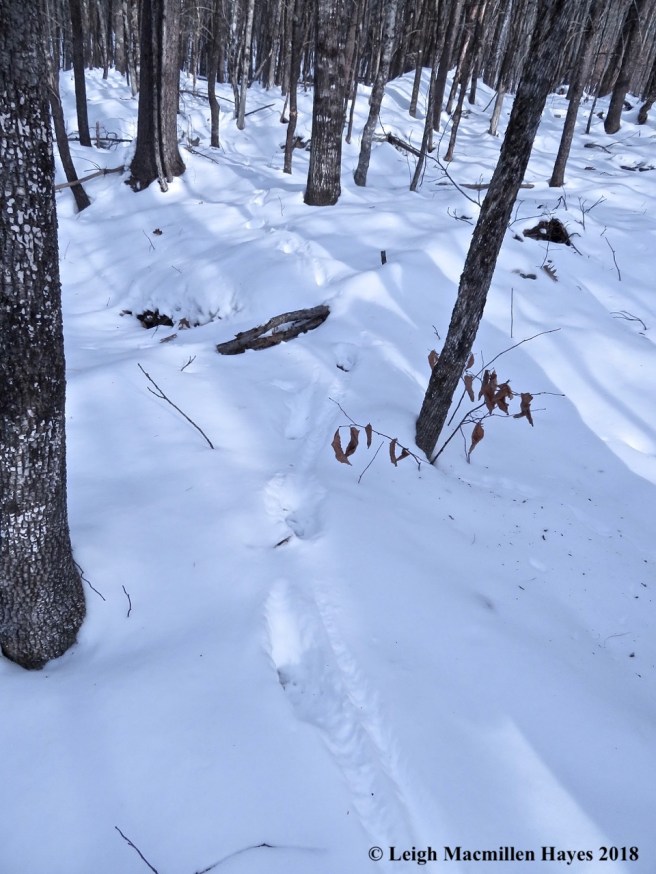
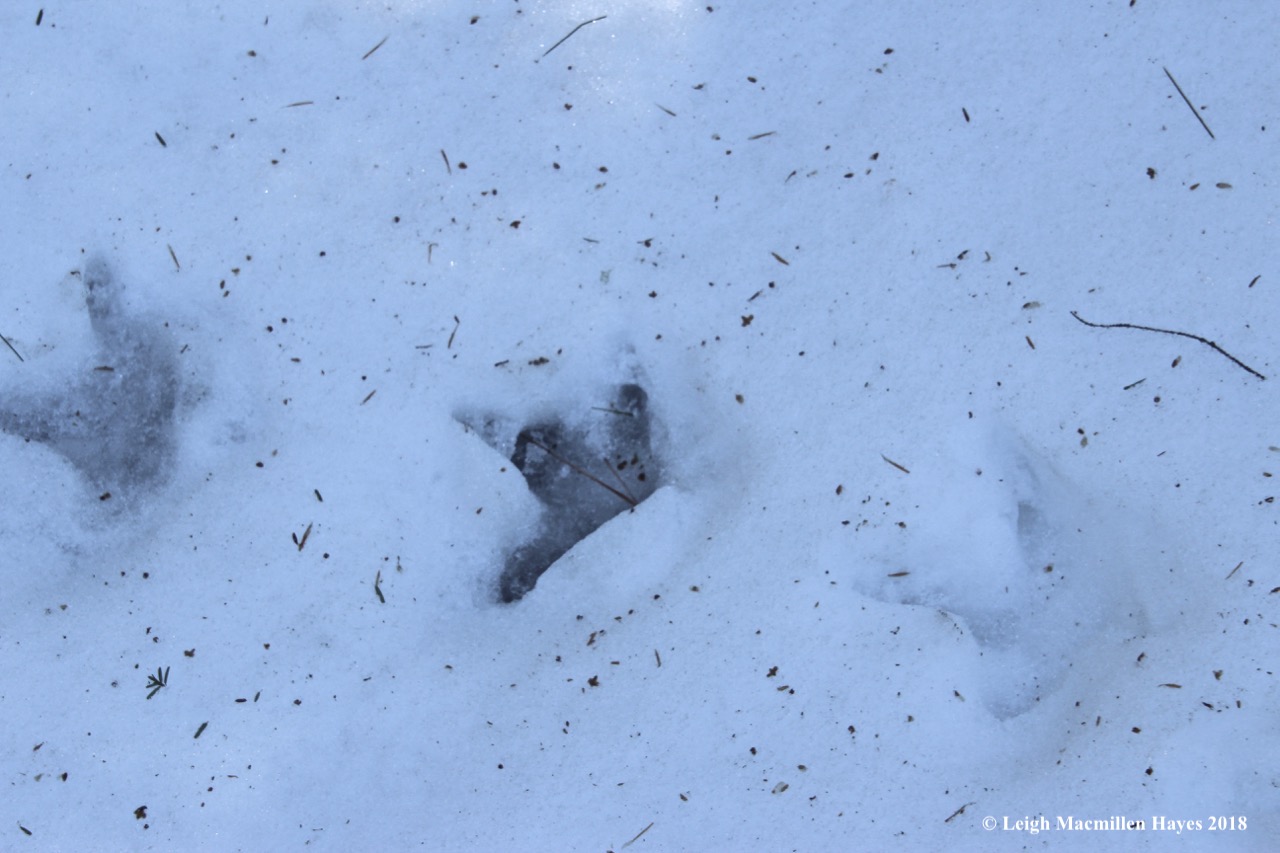
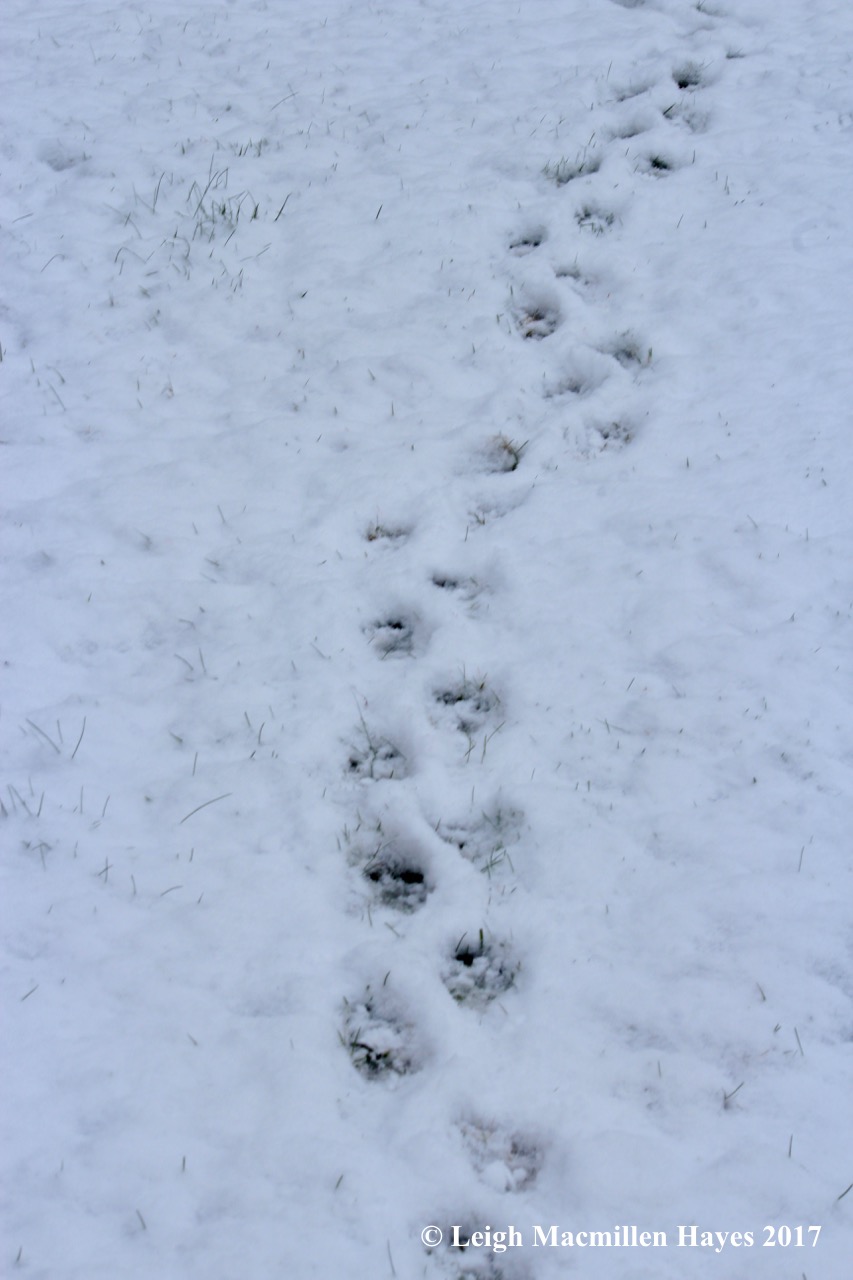
For every one set of tracks, there were fifty others, especially those of the mice and squirrels. But I chose the porcupine trough as my “get one free” when I saw it on the climb up the hill. 

The trough with its pigeon-toed prints and sashaying tail would be perfect for Bob.

Of course, I could have mixed and matched the prints, but thought it best to keep them separate. 

Continuing the dash for more must-have gifts, I spied a mossy maple polypore on a lower shelf and thought immediately of my guy. He doesn’t like to consume mushrooms, but there’s something about the mossy maple that draws his attention. 

And then on an end cap I saw the kissing beech/maple out of the corner of my eye and turned to read the sign: Limited in Quantity. On impulse I purchased it. Maybe I’ll stick it on my guy’s bureau and he can wrap it up for me. I’ve done that before ;-)

There were a few free surprises. Not all freebies are created equal, but I really liked the bronze ornament that would be a nice addition on our Christmas tree. 

At last it was time for a little break at the Flat Hill Cafe. Today, the view offered more bang for my buck as Mount Washington glistened white behind the other mountains. 

Also enjoying the view and the oxymoron of the name Flat Hill were fellow shoppers Bob, Pam K., Marita, Simon and Pam M. I made sure they didn’t see what was in my pack and visa versa. I do so hope they are as excited as I am about the gifts I purchased for them.

When the cafe got crowded, we decided to walk back down the main aisle together toward the check out. And then a few of us remembered we had coupons for the seasonal section. But . . . alas, we were too late. It was the only part of the store that was closed because everything had sold out. The stepping stones were  covered with water and ice to keep us from venturing any farther. We turned around, only a bit disappointed that our shopping adventure was about to come to an end, but understood that being a three-season section we had taken our chances by arriving so late in the day. 

No matter. The view from Perky’s Path thrilled us. All afternoon, we enjoyed the lighting, and especially the sun as it lowered–making this Black Friday light up, naturally. 

I highly encourage you to visit; the doors are open all hours and it’s a great place to shop in style. 

Today’s Black Friday Lit Up, Naturally experience was brought to you by the Greater Lovell Land Trust’s Flat Hill, Heald Pond Road, Lovell. 

I Spy . . .

This afternoon’s goal: To find a Christmas Tree to decorate for the Christmas at Ladies Delight Walk on December 1st. For the reconnaissance mission, I joined the Coombs family at the GLLT’s Chip Stockford Reserve.

The Coombs children are homeschooled by their amazing mother, Juli, and though they learn many lessons at home, they are also well educated in the outdoors. In fact, they are among my favorite naturalists.

And they belong to a 4-H Homeschool group that will decorate a tree(s) with biodegradable ornaments prior to the December 1st walk.

1

And so we set off on our tour looking for just the right tree. But . . . as is always the case with this family, there was so much more to see.

2

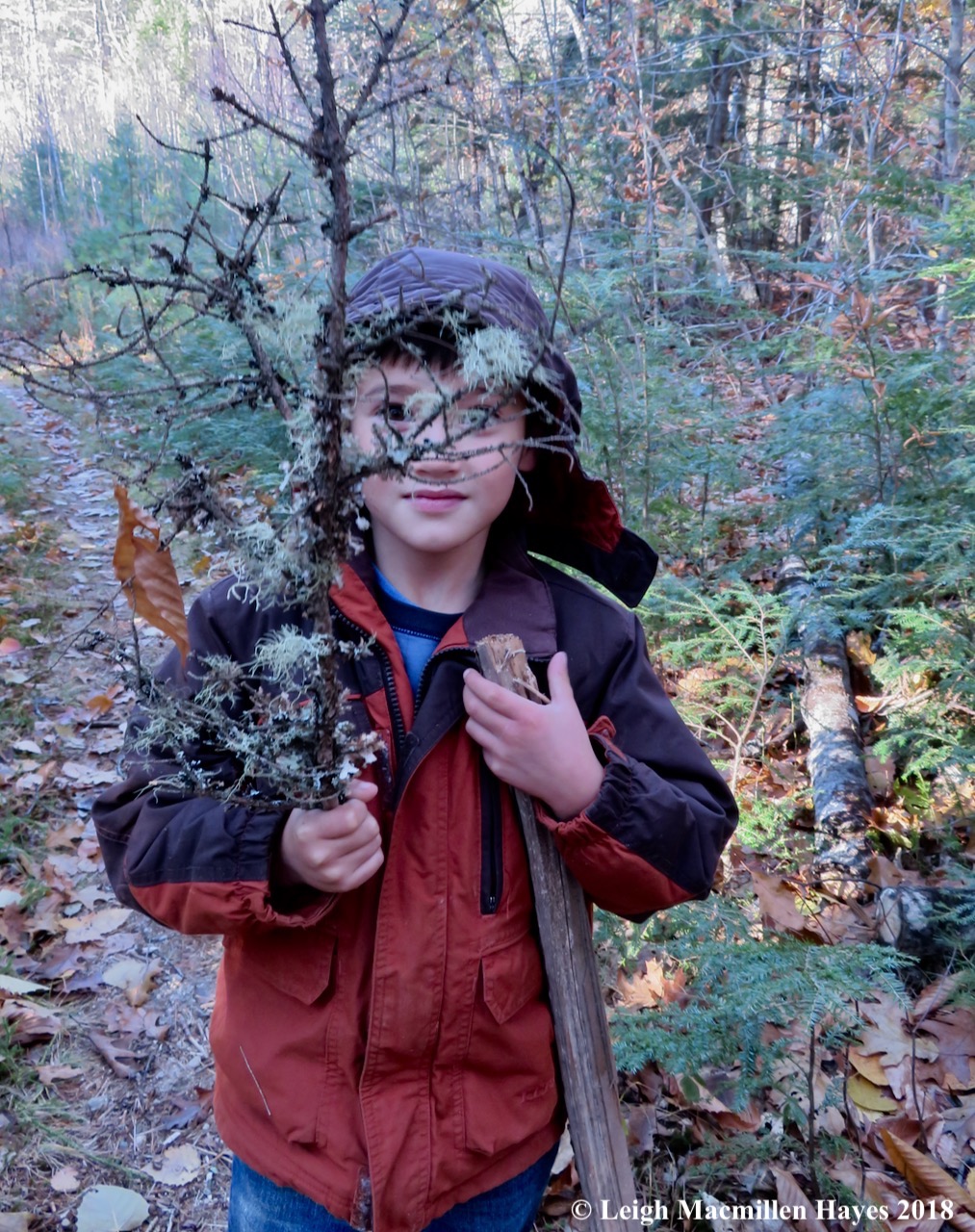
Since Juli is a Maine Master Naturalist Program student, so are her children. And every topic she studies, they study, so it was no surprise to me that six-year-old Wes picked up stick after stick loaded with various forms of lichens.

3

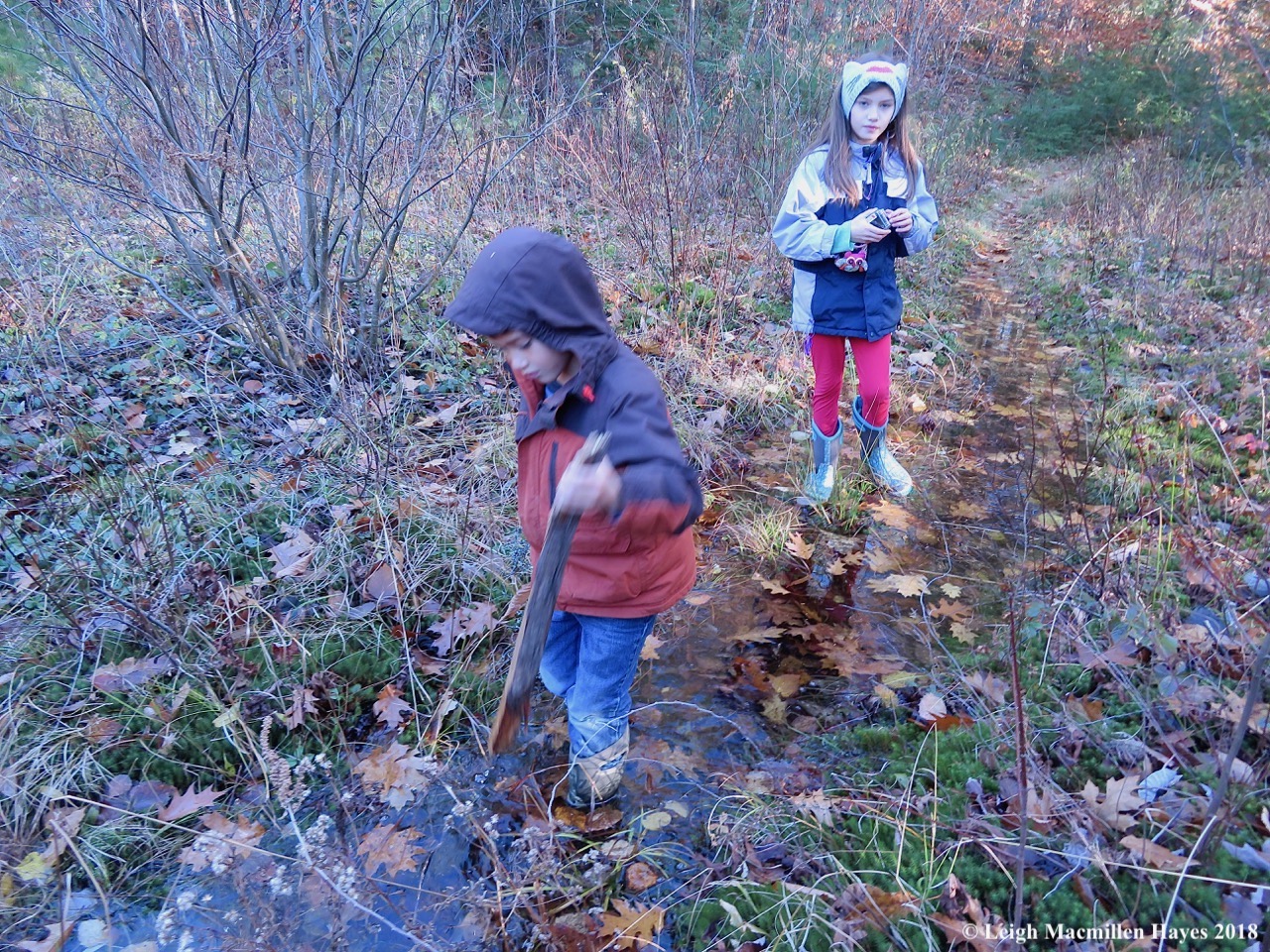
Of course, they are children, ranging in age from six to eleven, and puddles are invitations. The family motto is this: No puddle shall remain unsplashed.

4

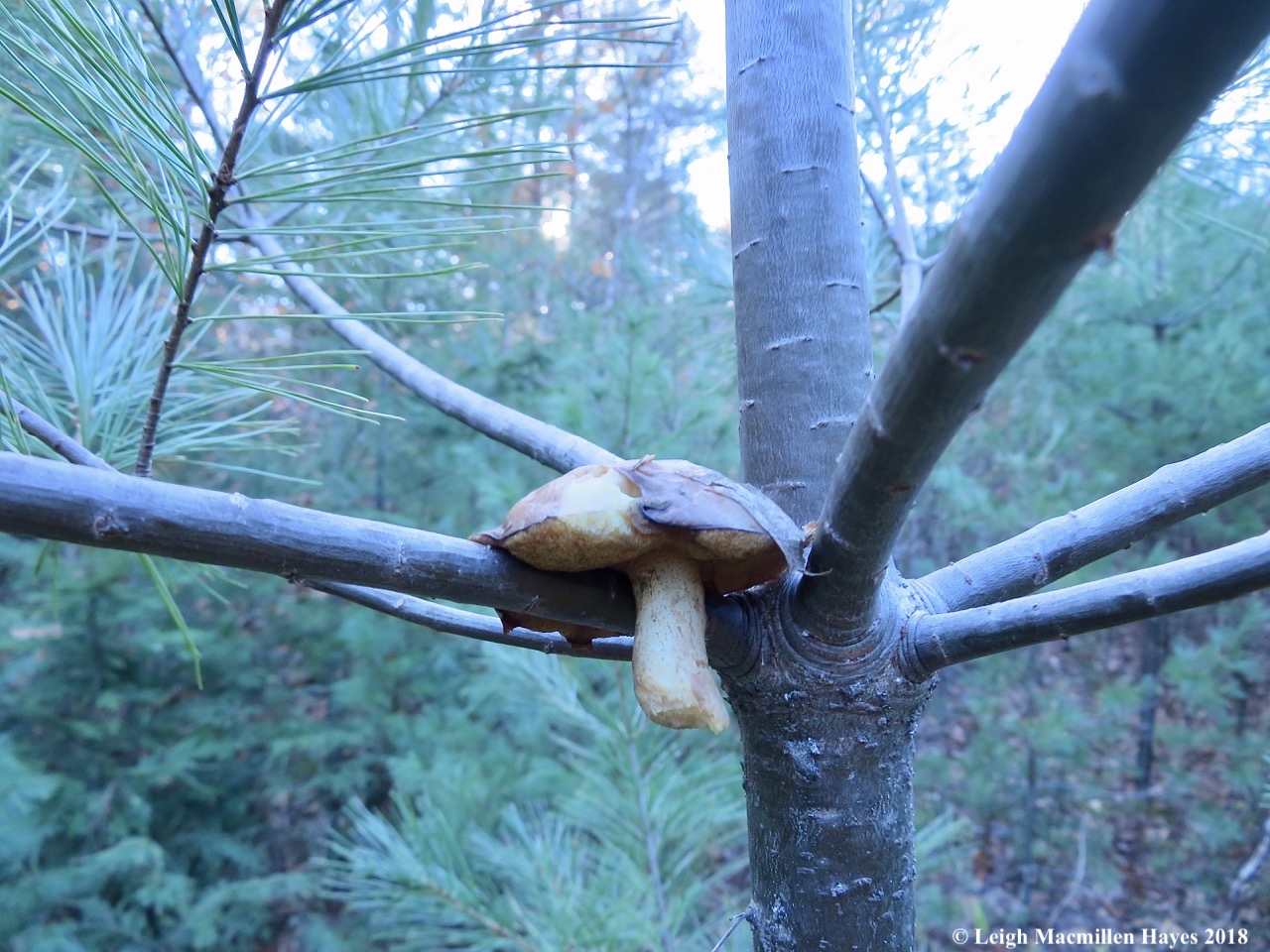
But just after the puddle, at the start of an old log landing, we began to notice something else. A mushroom drying on the whorl of a White Pine.

5

As we stood and looked at the first, someone among us spied a second.

6

And then a third, and so it went. We knew that squirrels dried mushrooms in this manner, but never had we seen so many. It dawned on us that we were standing in a squirrel’s pantry. One squirrel? Two squirrel? Gray Squirrel? Red Squirrel? One Fish, Two Fish, Red Fish, Blue Fish.

7

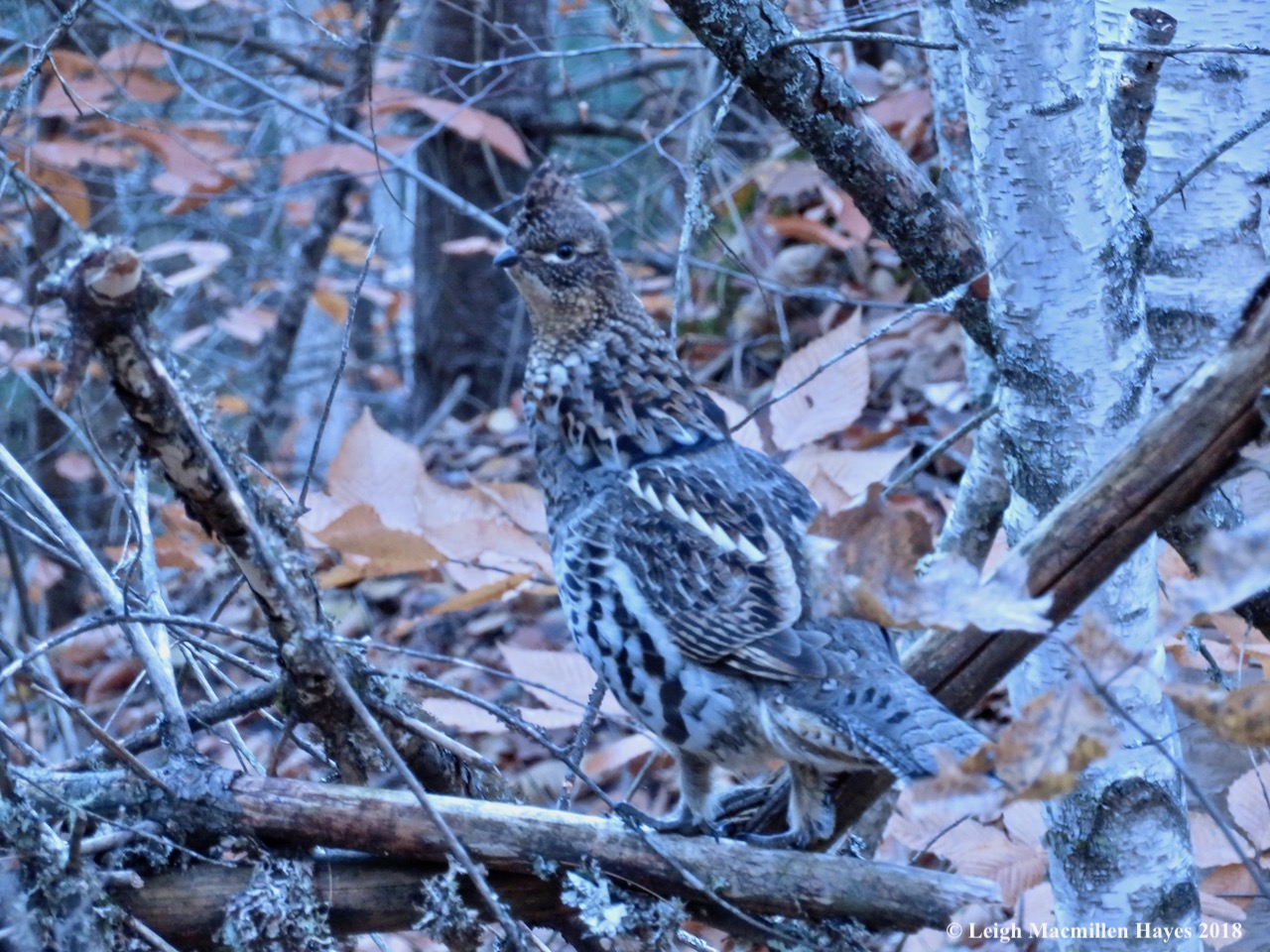
For a while we paused by an erratic boulder and looked at the lichens that grew atop it. The kids and their mom also checked the sand under and behind it and I told them that the only critter sign I’d ever noticed was that of a Ruffed Grouse sand bath–and I only recognized it as such because I’d startled the two birds and they startled me as they flew off. In fact, on another hike this morning at the GLLT’s Five Kezar Ponds Reserve, friend Teresa and I had startled a grouse and we talked about how the bird’s explosive behavior makes us feel as if we’ve encountered a moose.

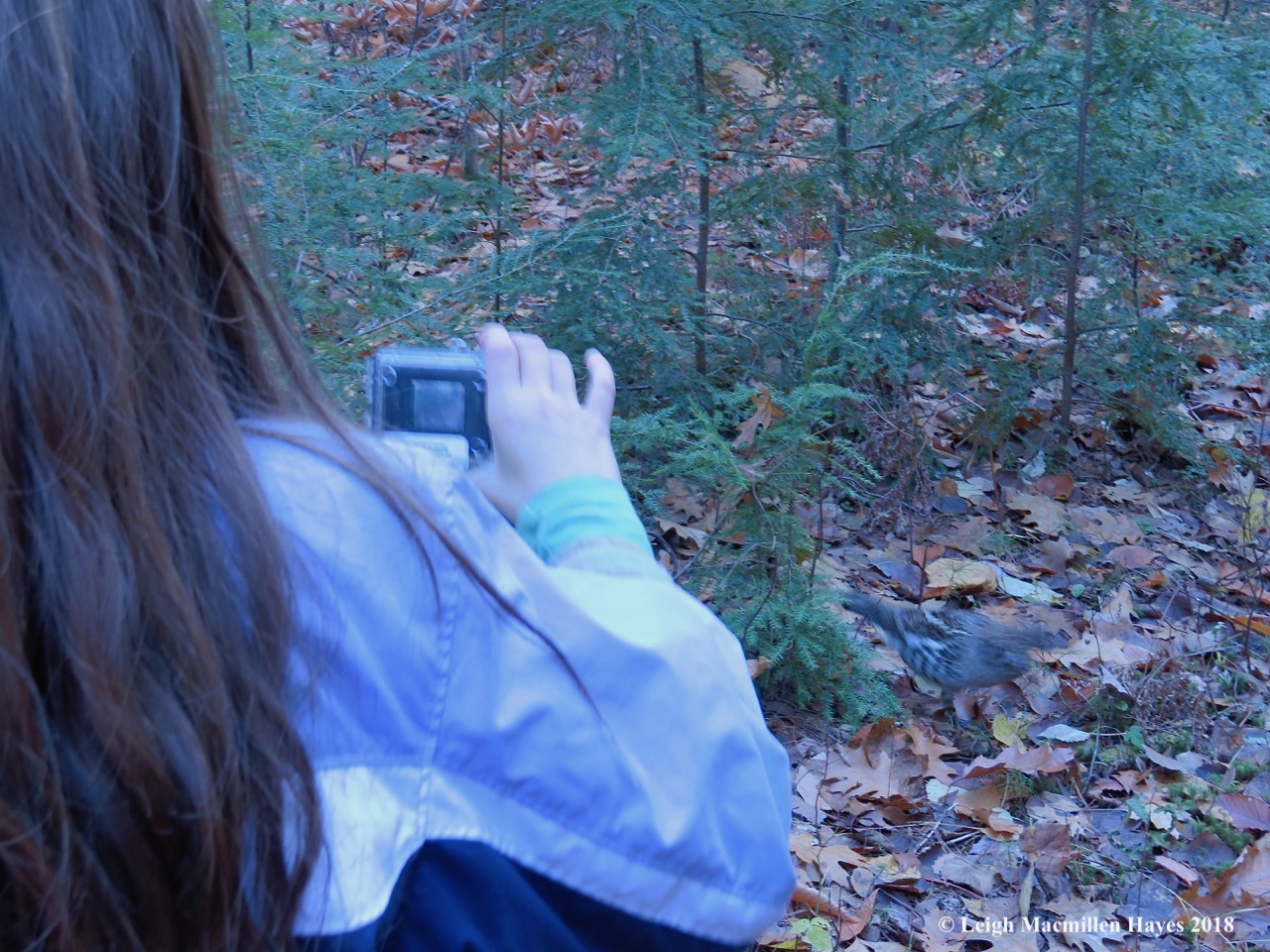
Well, just beyond the boulder, as we all chatted and moved about with quick motion, Caleb spotted something and told us to stop. A Ruffed Grouse!

8

It threw leaves about as it sorted through them in search of seeds and buds and we all watched in silence.

9

As we stood or sat still, the bird moved this way and that, making soft clucking sounds the entire time.

10

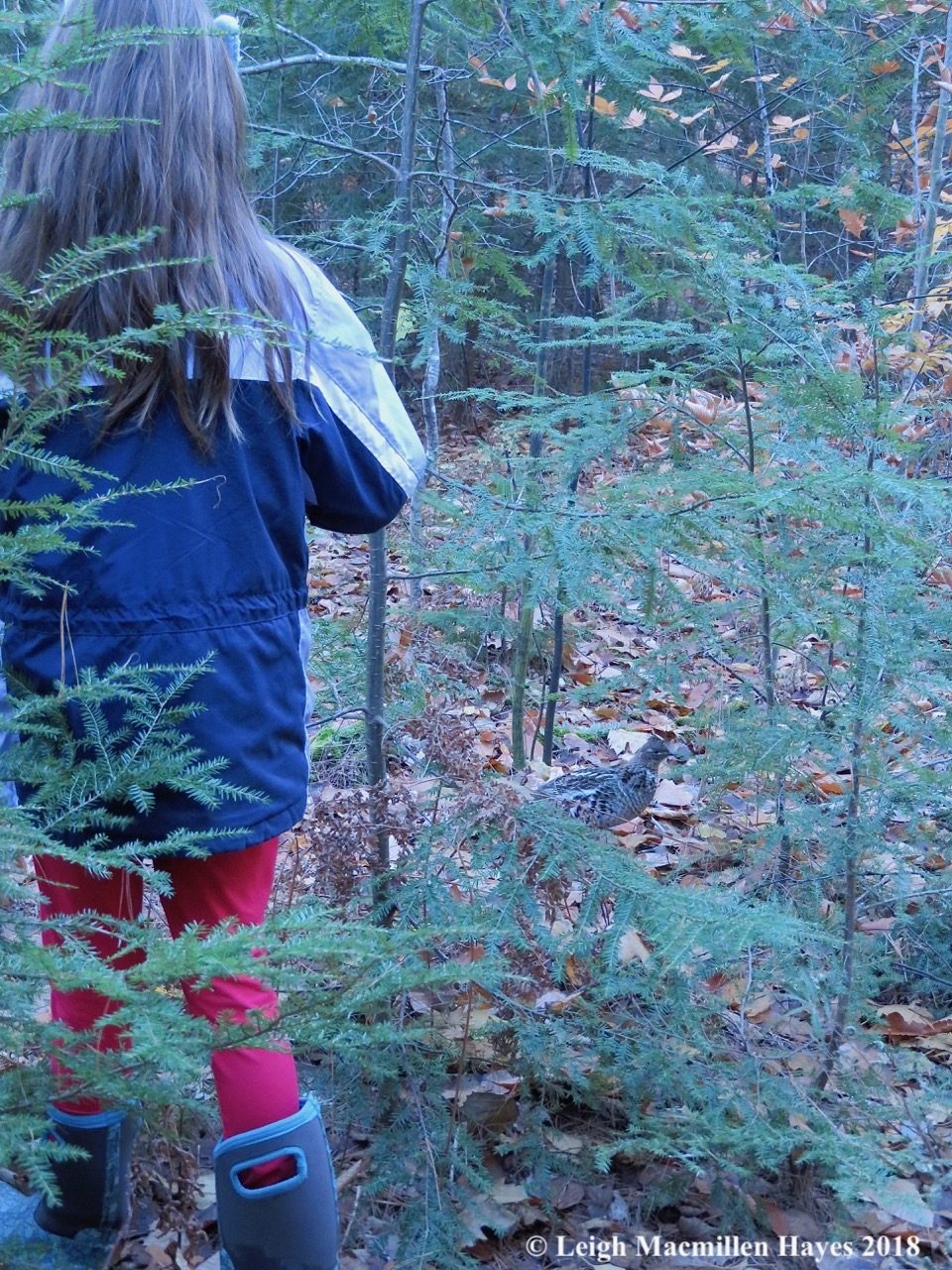
Ellie stood in front as the bird moved a few feet ahead of her and crossed the trail. I kept looking back at Juli in wonder. How could this be? Why wasn’t it disturbed by us? I’ve spotted Spruce Grouse in higher elevations and they are much “friendlier” or less wary of people, but I’d never been able to get up close to a Ruffed Grouse.

11

Our fascination continued and we noted its feathered legs, making us think perhaps it had pulled on some long johns for a cold winter night.

12

It eyed us and we eyed it back–our minds filled with awe.

13

Think about this: four children and two adults and we were starting to get fidgety because we’d been still for fifteen or more minutes and we had begun to whisper our questions and still . . . it let us watch.

14

And it let Ellie be the Grouse Whisperer for she began to follow it off the trail. Eventually, it climbed up a fallen tree and she knelt down beside, taking photos as it stood less than a foot from her. How cool is that?

15

We were all wowed by the experience, but when Ellie finally turned back, we continued on . . . sometimes running and other times pausing to ride imaginary horses.

16

Or listen to Birch Polypores! Yes, Juli did listen for it’s part of an assignment for the Maine Master Naturalist class. So what exactly does a Birch Polypore sound like? “I couldn’t hear the ocean,” she said with a smile.

17

And what does it smell like? “Wood.”

18

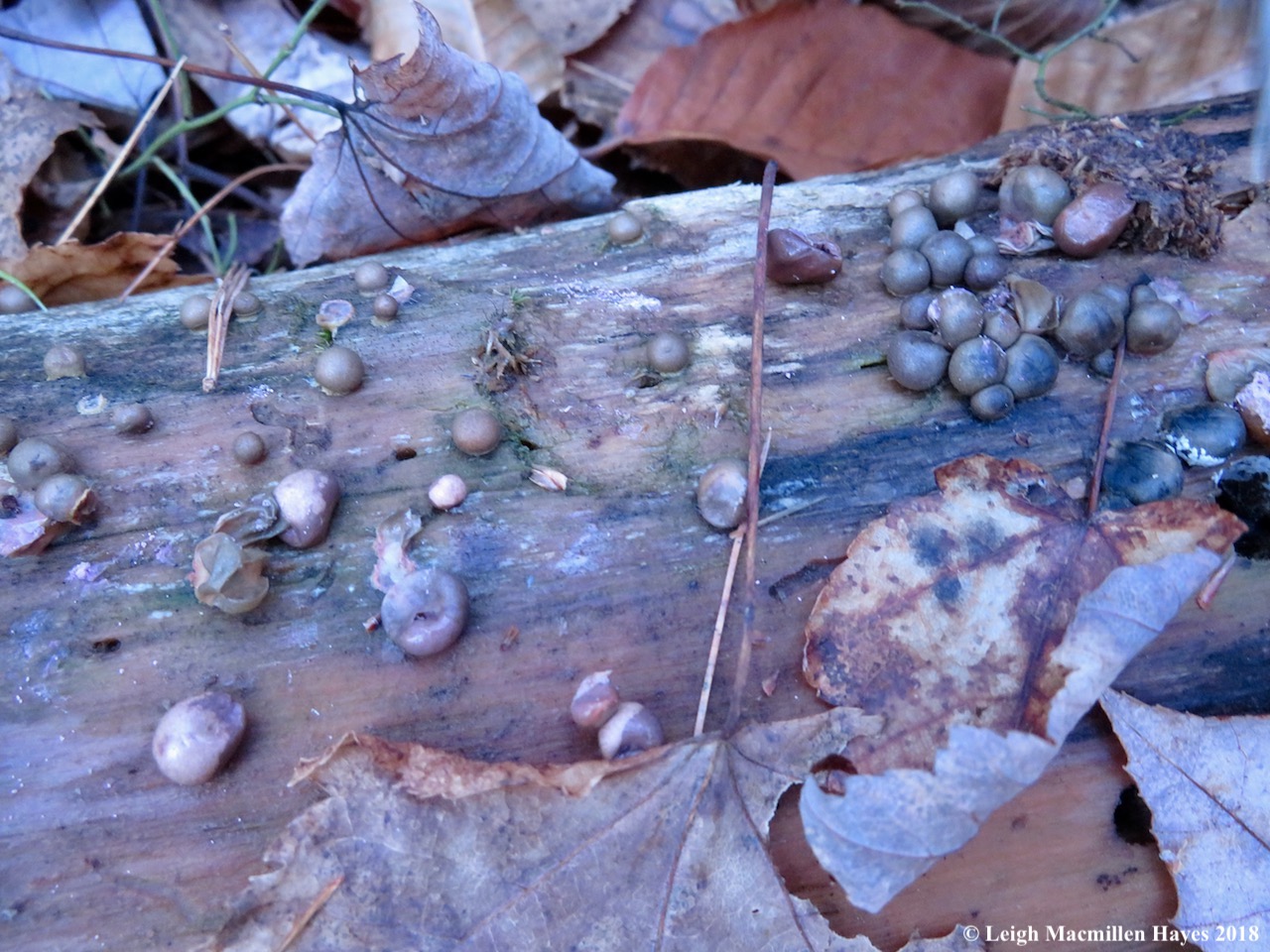
The next moment of glee–poking Wolf’s Milk Slime Mold and watching it ooze.

19

“It’s cool and gross at the same time,” said Ellie.

20

Onward and again, more fungi drying in trees as Aidan pointed out.

22

We even found a few stuck on spiky spruces much like ornaments might be and we reminded ourselves that we were on a mission and still hadn’t found the right tree to decorate.

23

At last, however, we did. And then we made our way out to the spur and recently opened view of Kezar Lake’s Lower Bay and Cranberry Fen, plus the mountains.

24

This became our turn-around point as it was getting cooler by the minute and the sun was setting. We promised Wes we’d look only at our feet as we followed the loop trail down, though occasionally we stopped again to admire more fungi tucked onto tree branches and a set of trees that formed a rainbow arched over the trail.

As for the fungi, we wondered if we were seeing so many because last year’s mast crop of pinecones, beech nuts, and acorns didn’t exist this year. And when the 4-H club returns in a couple of weeks to decorate the tree, will the mushrooms still be there? Will there be more? How long do the squirrels wait before consuming them? So many questions and so many lessons still to be learned.

25

And so many things to spy. We were honored with the opportunity to do just that and my heart smiled with the knowledge that the kids appreciated it as much as their mom and I did.

I spy . . . we spied . . . INDEED!

Oh, and  please join the GLLT for Christmas at Ladies Delight. I have the inside word that there will be hot cocoa and cookies somewhere along the trail.

December 1, 9:30 – noon
Christmas at Ladies Delight: The Maine Christmas Tree Hunt is a fun holiday scavenger
hunt to find decorated trees in western Maine. We’ll search for the decorated tree along the Bill Sayles Loop at the Chip Stockford Reserve and may add a few of our own biodegradable ornaments along the way. Location: Chip Stockford Reserve, Ladies Delight Road, Lovell.
Degree of Difficulty: Easy.

Election Day Tramp

It always strikes me that no matter how often one travels on or off a trail, there’s always something different that makes itself known–thus the wonder of a wander.

And so it was when Pam Marshall, a member of the Greater Lovell Land Trust, joined me for a tramp at the John A. Segur Wildlife Refuge West on Farrington Pond Road this morning. She had no idea what to expect. Nor did I.

13-puff balls to pop

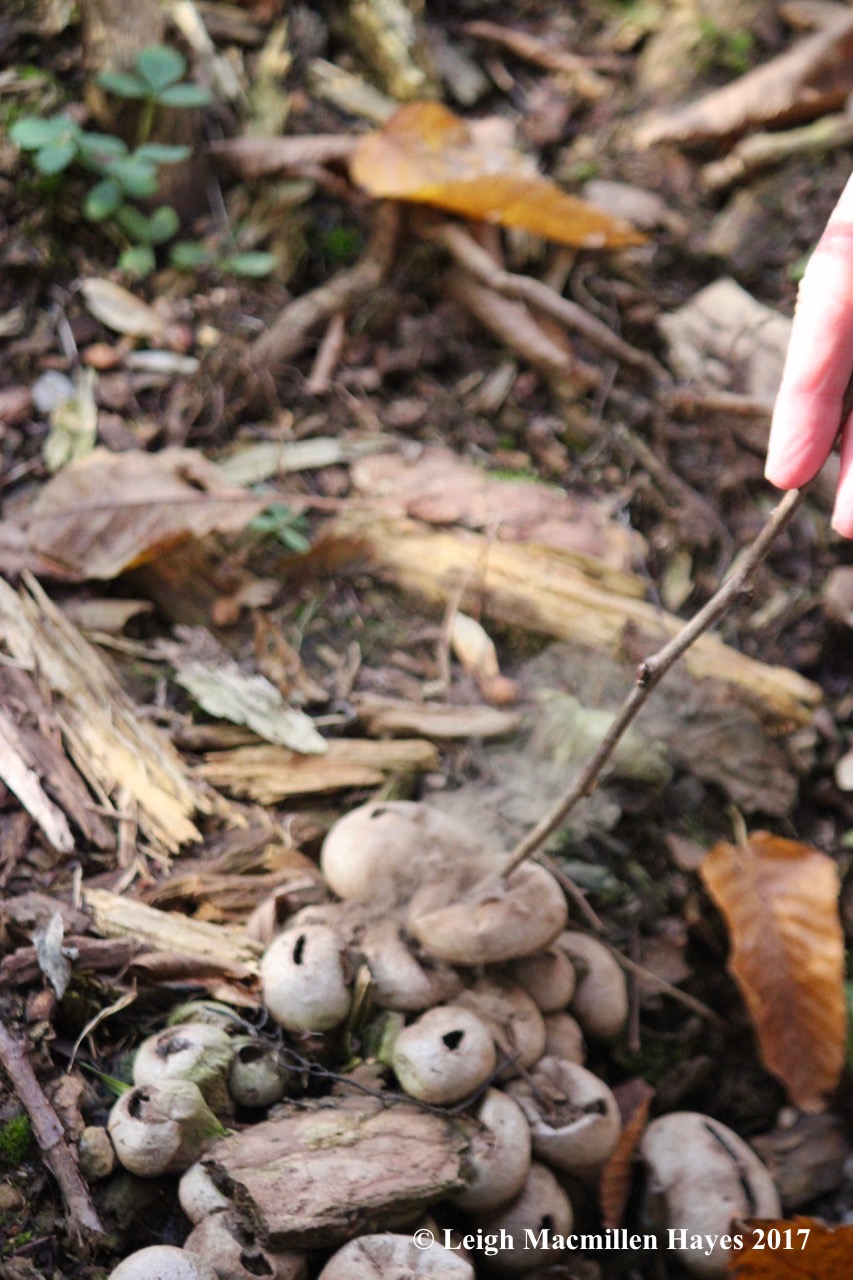
It was misty when we met, but neither of us was daunted by the weather. Ever so slowly, we made our way over the wet leaves, roots, and rocks, pausing frequently–especially each time we saw puff balls. How can one resist poking or squeezing them to watch the spores waft out like smoke. The skin of mature puffballs split prior to releasing spores. And we . . . we helped the process a wee bit.

20-blue stain fruiting

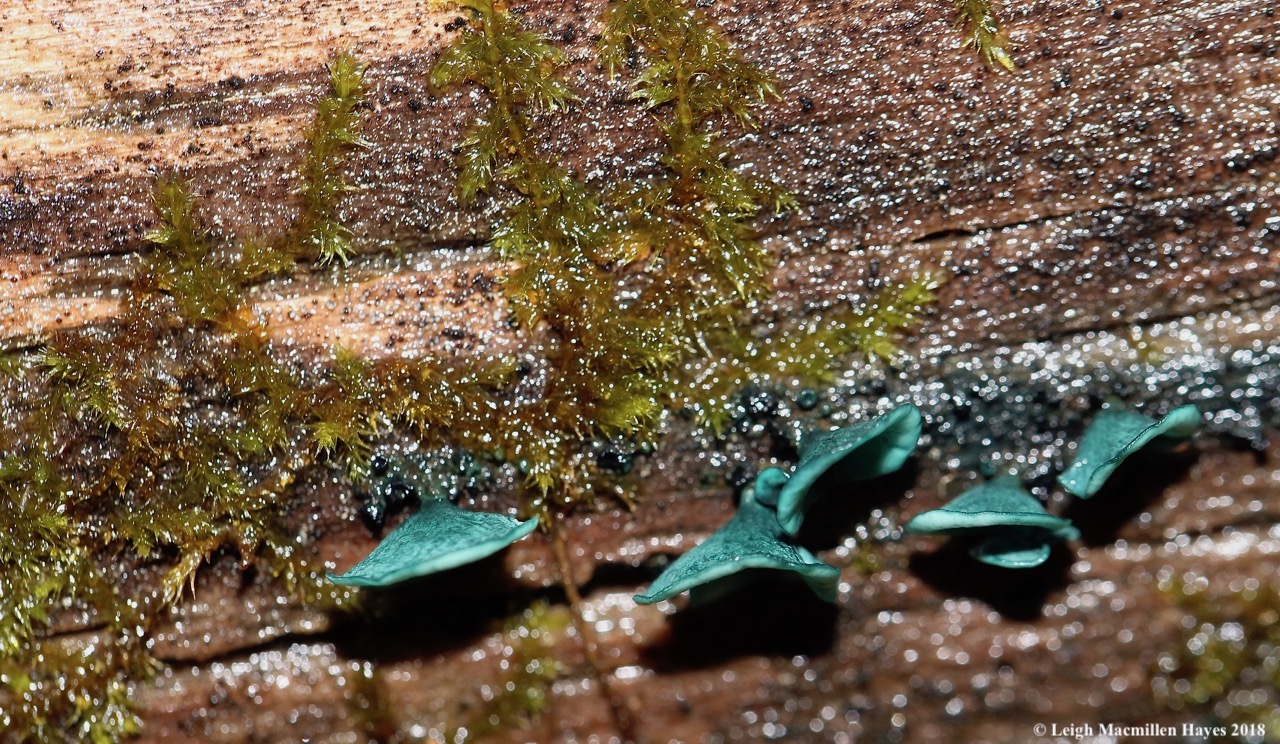
Green stain fungus also drew our attention. Its fruiting bodies were minute, but well worth wet knees for a closer examination.

19-hexagonal-pored polypore

With Pam in the lead for most of the way, she kept finding cool stuff, like this hexagonal-pored polypore.

1-Sucker Brook Outlet

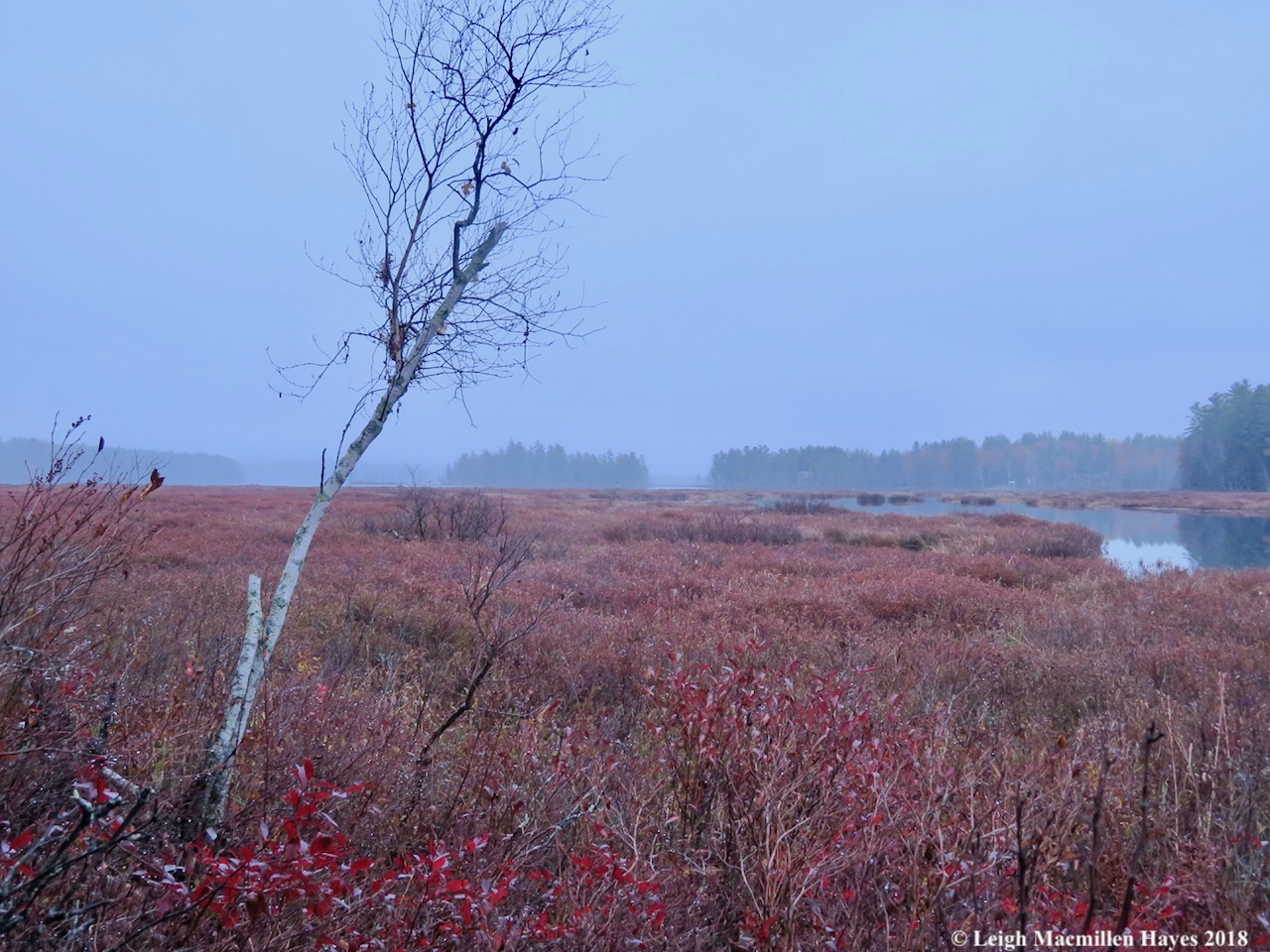
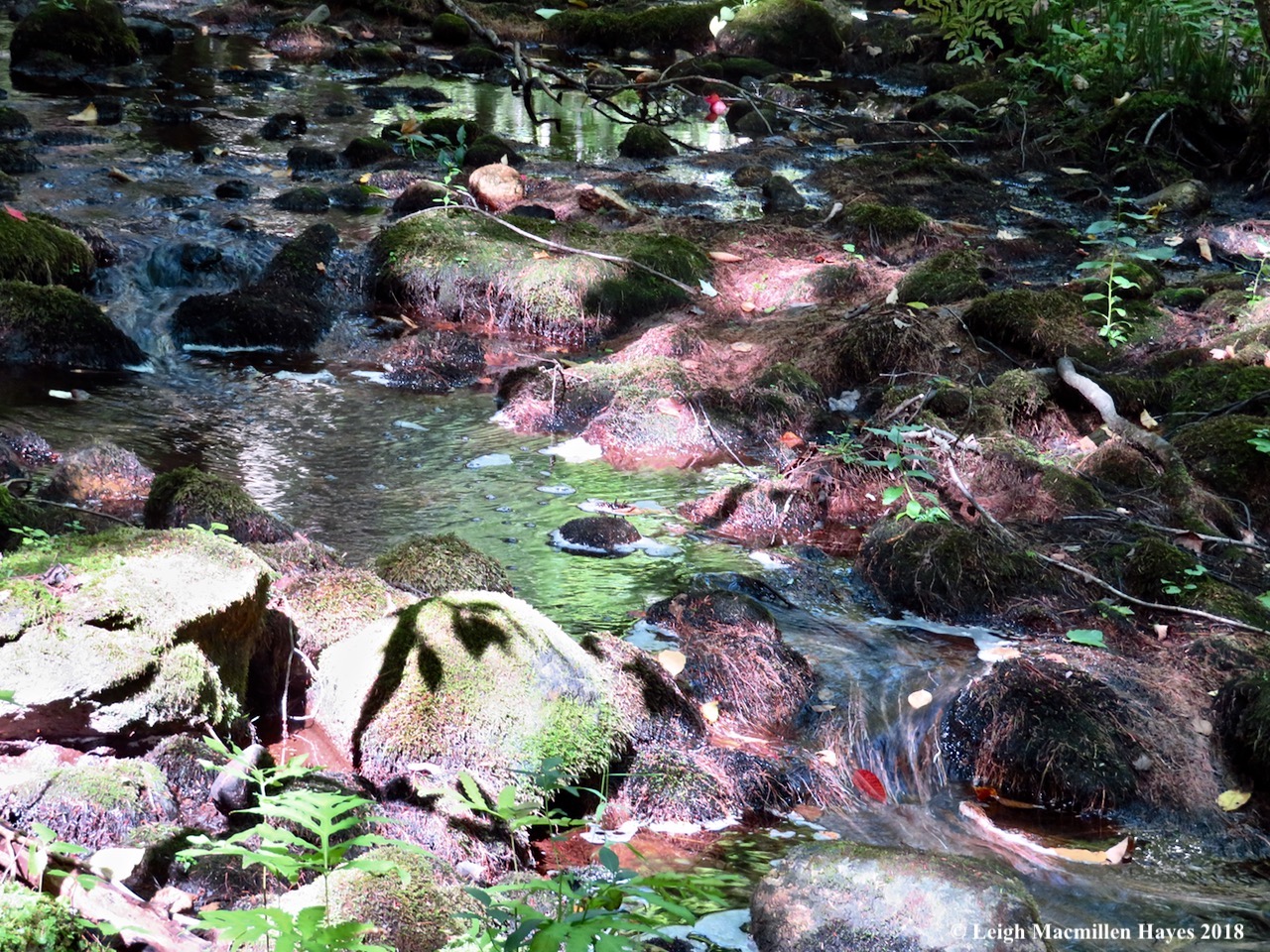
It took us a while, but we finally reached the wetland by the Sucker Brook Outlet where blueberry, maleberry and leatherleaf shrubs added color to the otherwise gray day.  For a while we stood under the protection of a large hemlock and took in the scene in silence.

2-Silhouettes on Lower Bay and cotton grass

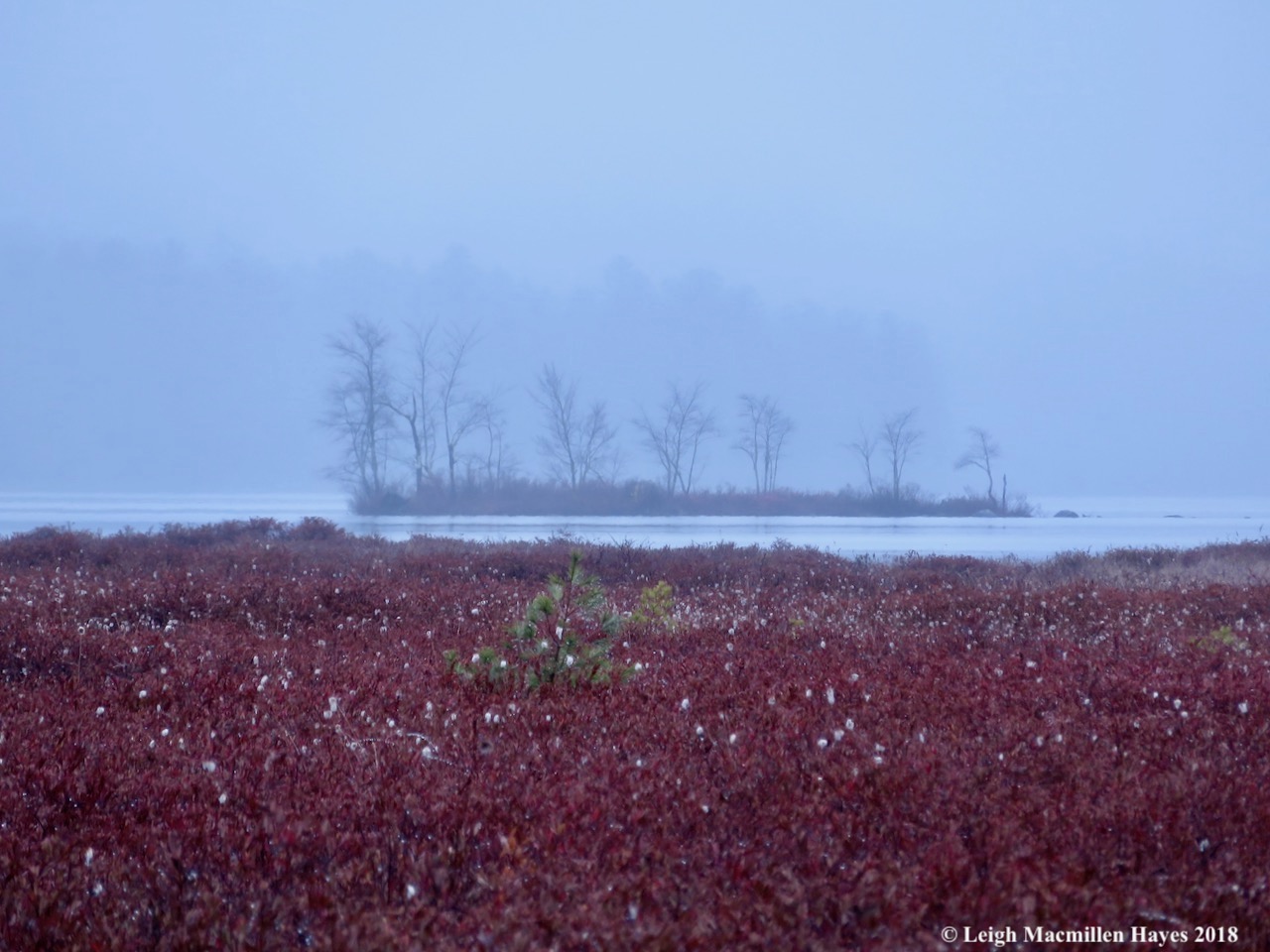
From our vantage point, an island in Kezar Lake’s Lower Bay looked like a ghost ship. And in the foreground, cotton grass still touted its tufted heads.

3-beaver lodges

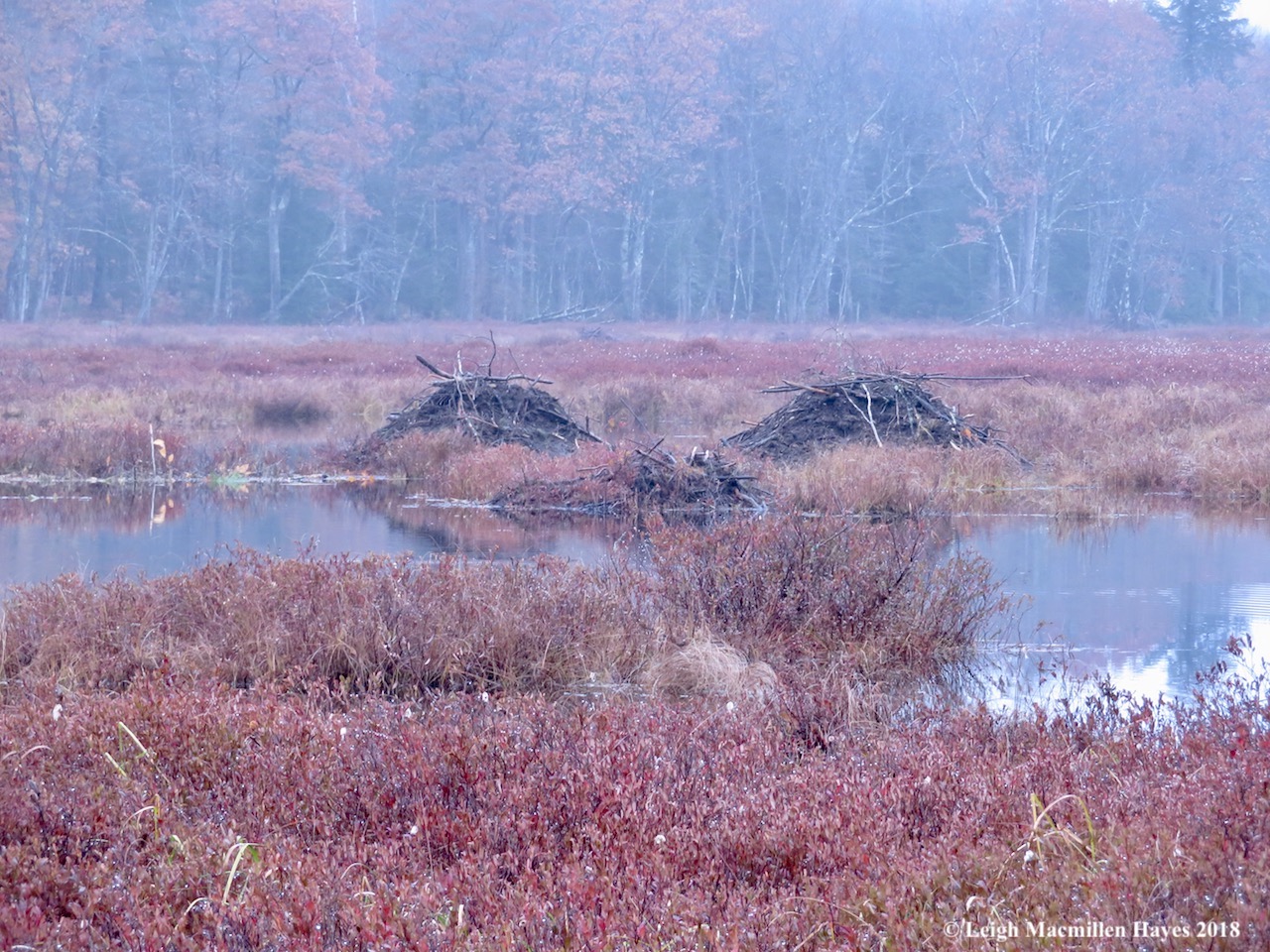
At our feet we could see some aquatic plant roots floating in the water, a beaver treat, and trusted by the mud on the lodges that there had been recent activity. Perhaps they rested indoors before planning to spend time later in the day preparing for the cold months ahead.

4-Pitcher Plants

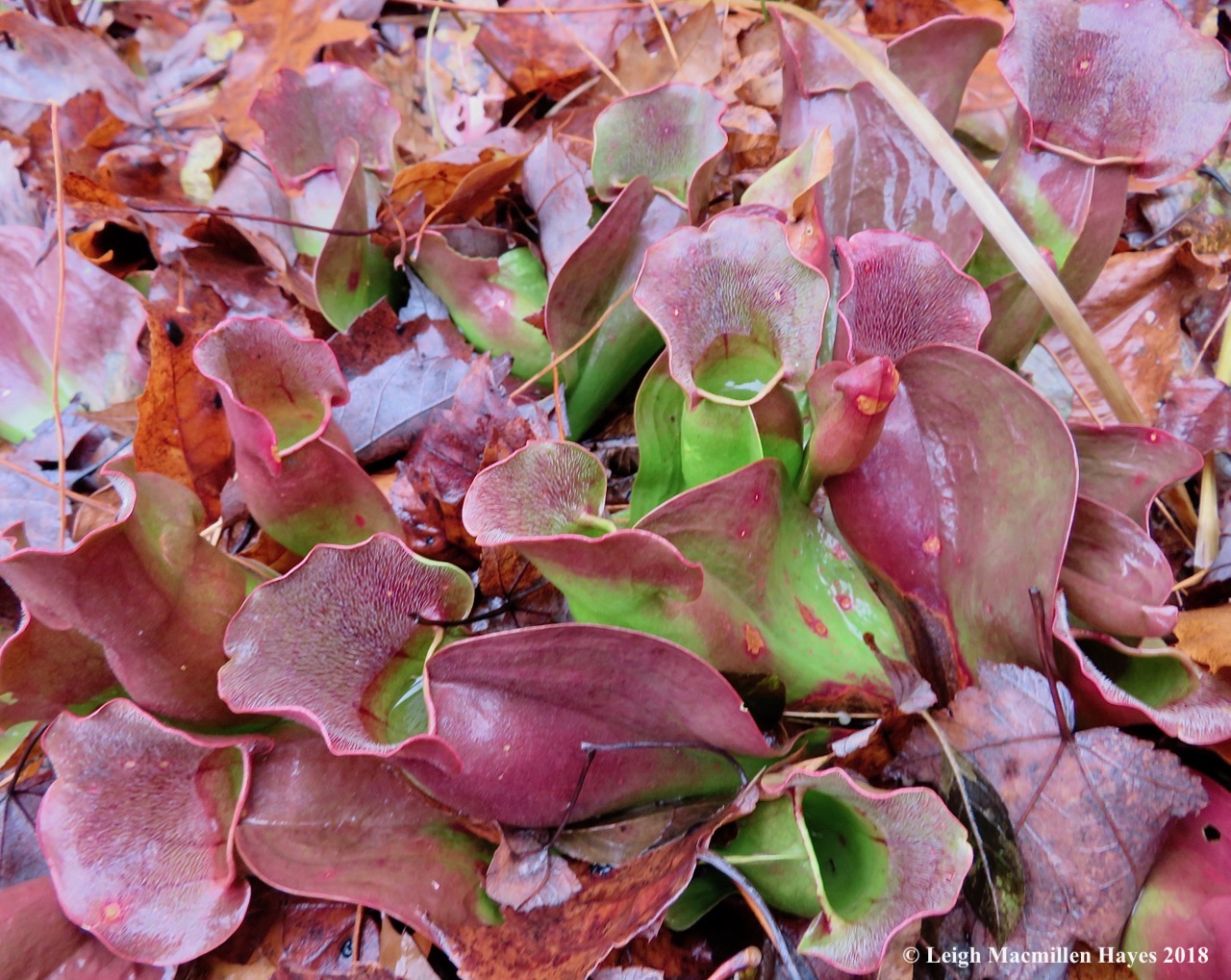
After a while and because I knew they were there, I took Pam along the edge of the brook for a short distance to locate several pitcher plants. Someone once photographed them in their young green form and described them as rare. While helping Dr. Rick Van de Poll, principal of Ecosystem Management Consultants (EMC) in Sandwich, New Hampshire, set up study plots at Lakes Environmental Association’s Highland Lake Reserve in Bridgton during July 2017, we had to watch where we stepped to avoid crushing pitcher plants. It was a perfect time to ask Rick about the green color. Were there green pitcher plants in Maine? And if so, were they rare? He explained that it was just a matter of sunlight and age, all would eventually take on a redder hue in veins and then overall leaf coloration as they matured.

5-pitcher plant runway

This morning, we found some sporting brighter red leaves.

6-spiders within and webs above

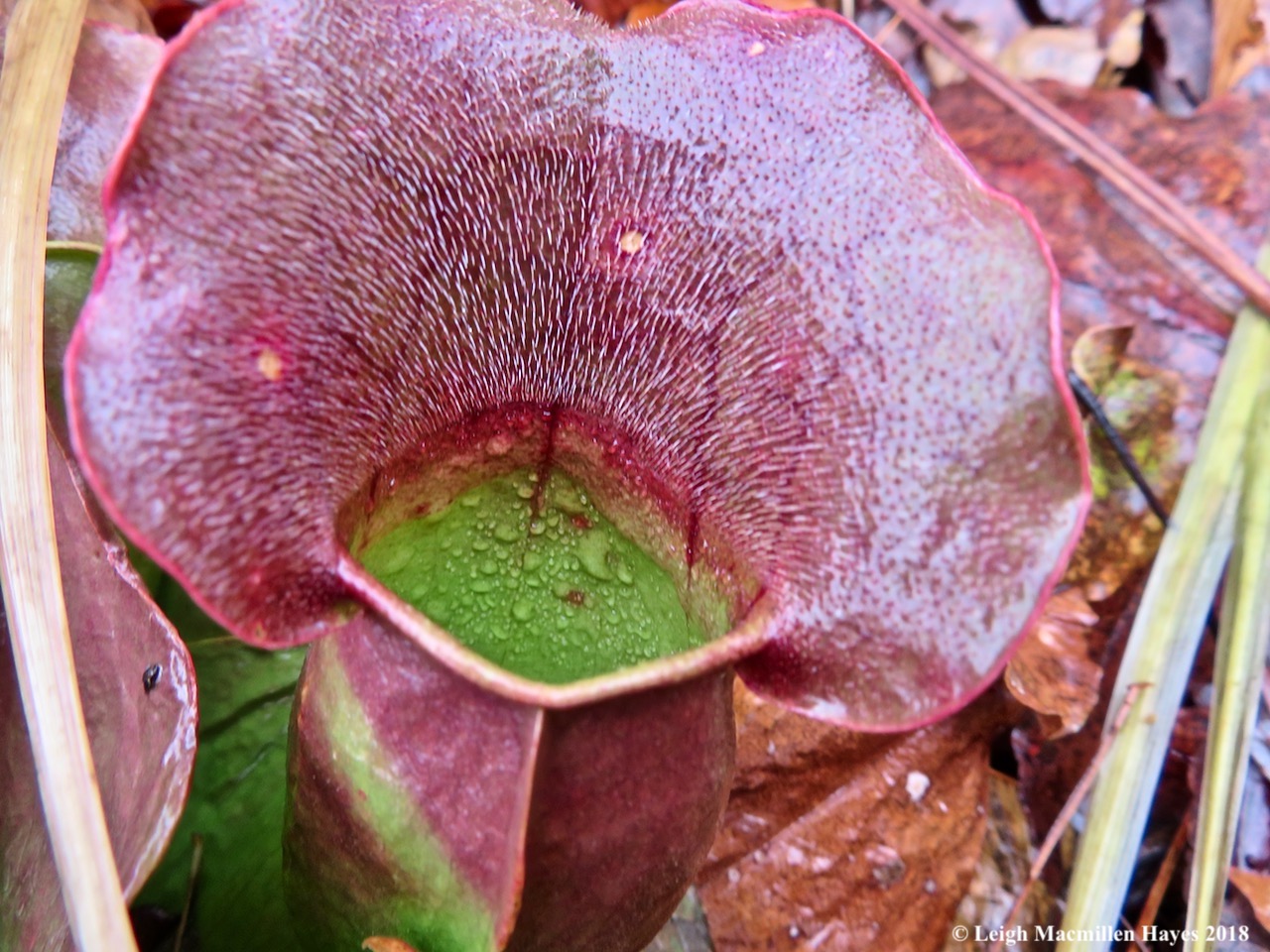
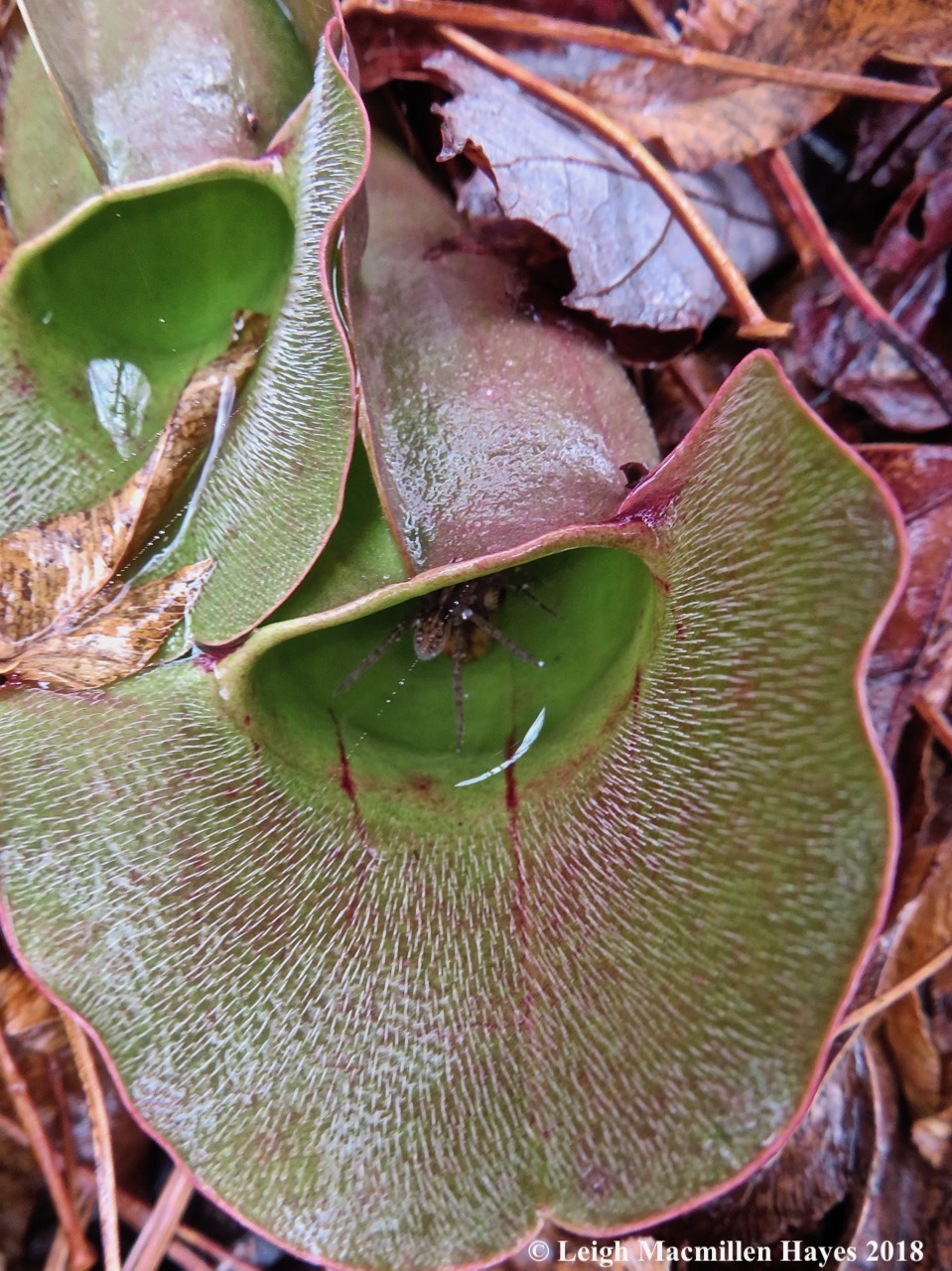
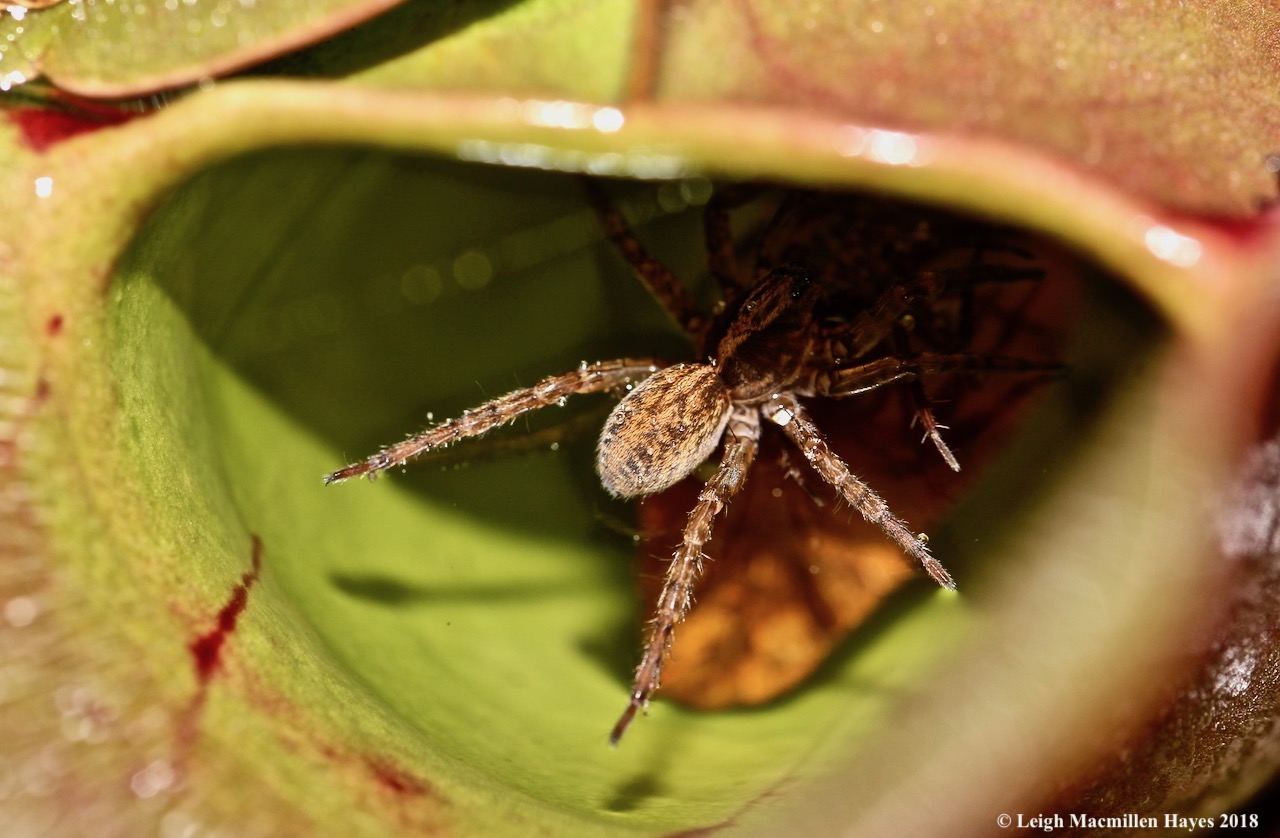
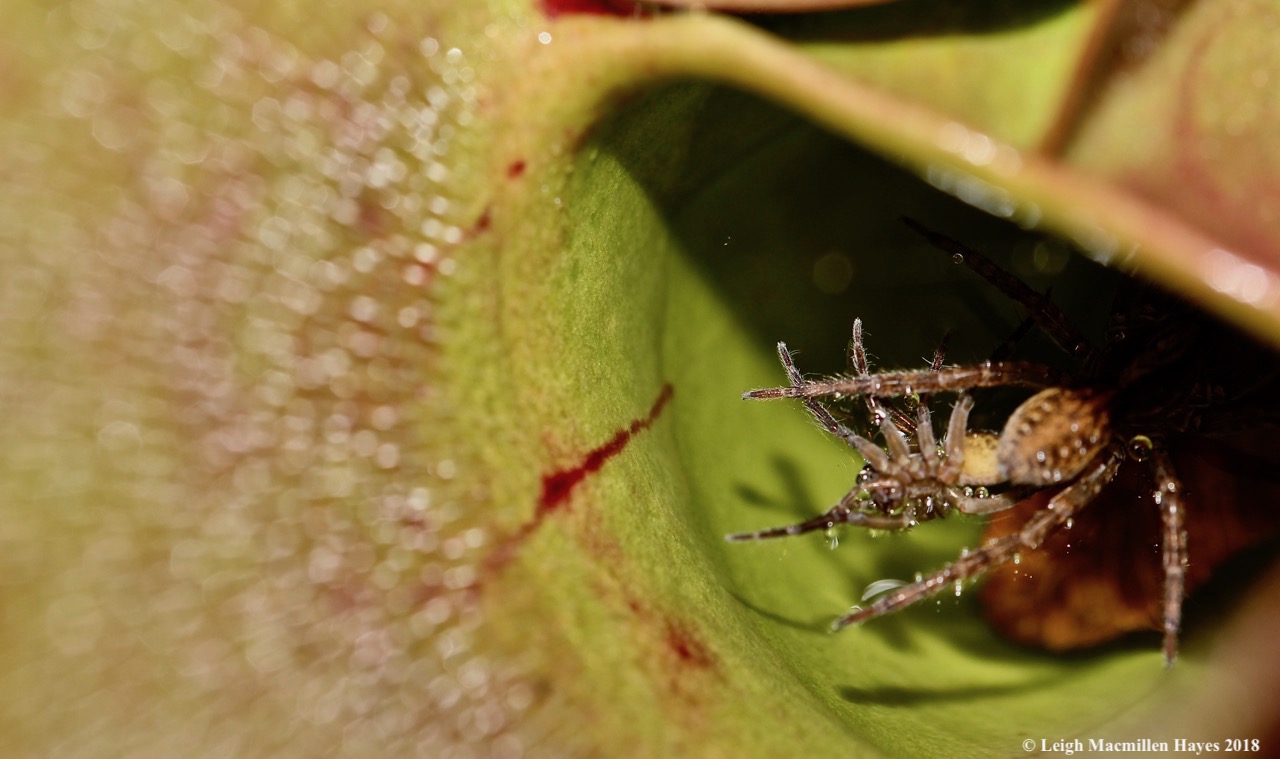
And another plant that was duller in color. Since we were in the locale where the green plant had been discovered, I trusted that it was beginning to show its age. It was the duller one that drew most of our fascination. Carnivorous pitcher plants obtain nitrogen and phosphorus by eating insects. Their oddly-shaped leaves form a pitcher partly filled with water and digestive enzymes. The spout is a hairy landing platform for insects attracted by red venation and nectar glands. Imagine this: an insect crawls to the edge of the leaf, aka pitcher, slips on the downward-sloping hairs and plunges into the liquid below where enzymes and bacteria break it down. Any chances for escape are zapped by those stiff hairs. Do you see what we saw? A spider web across the top of the leaf? And within?

8-larger spider manuevering the smaller one

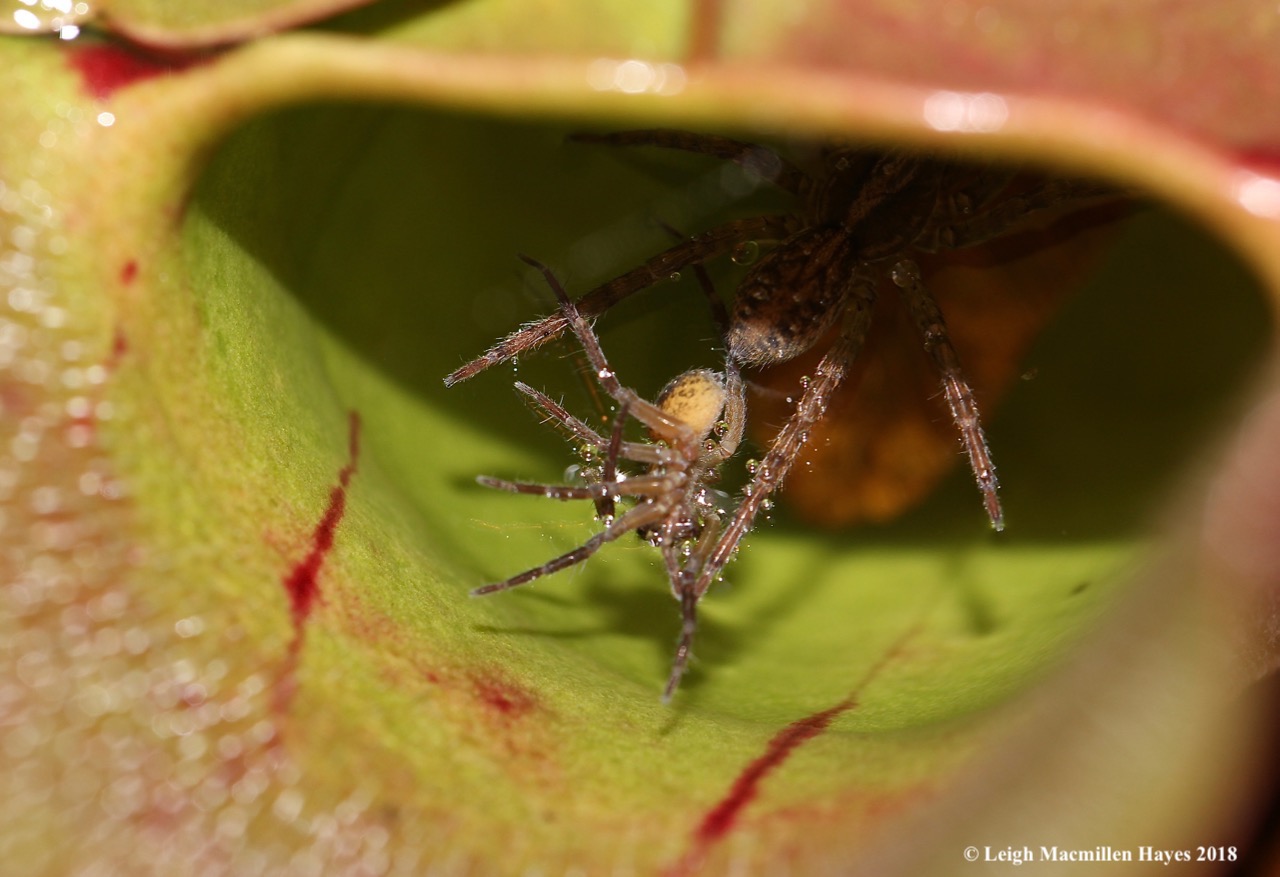
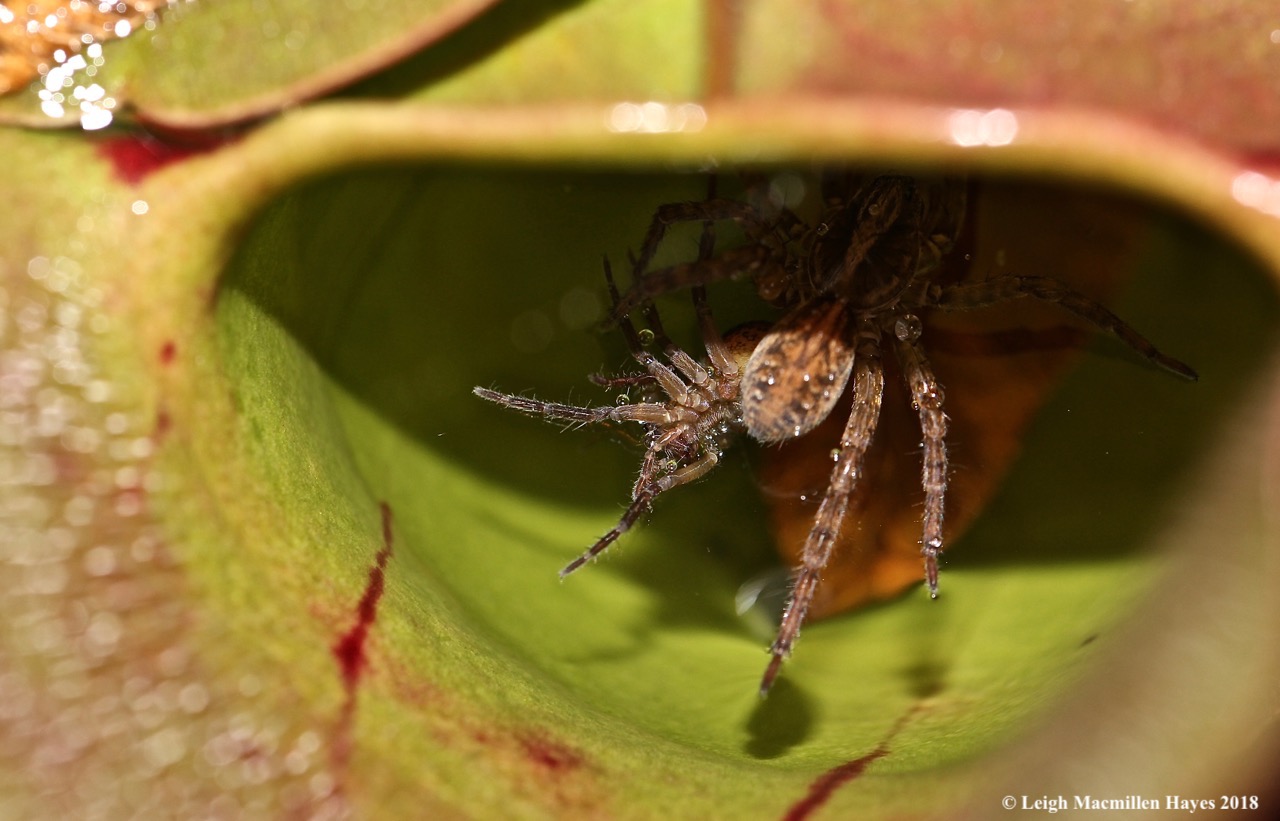
Dueling fishing spiders.

9-pulling it under its body

And so we watched.

10-and out again

The larger one continuously manipulated the smaller one, which appeared to be dead. Back and forth under its body, it kept moving the smaller kin.

11-and back under

Was it trying to eat the other? One last meal before it too succumbed to the plant? Was it trying to move past the dead spider so it could try to climb out? Should we save it?

12-let 'em be

In the end, we left the action with questions in our minds and didn’t interfere.

7-watching the spider action

Except, that is, to take photographs and make a film. Again, our knees were wet and we didn’t care.

14-pigskin puffball 1

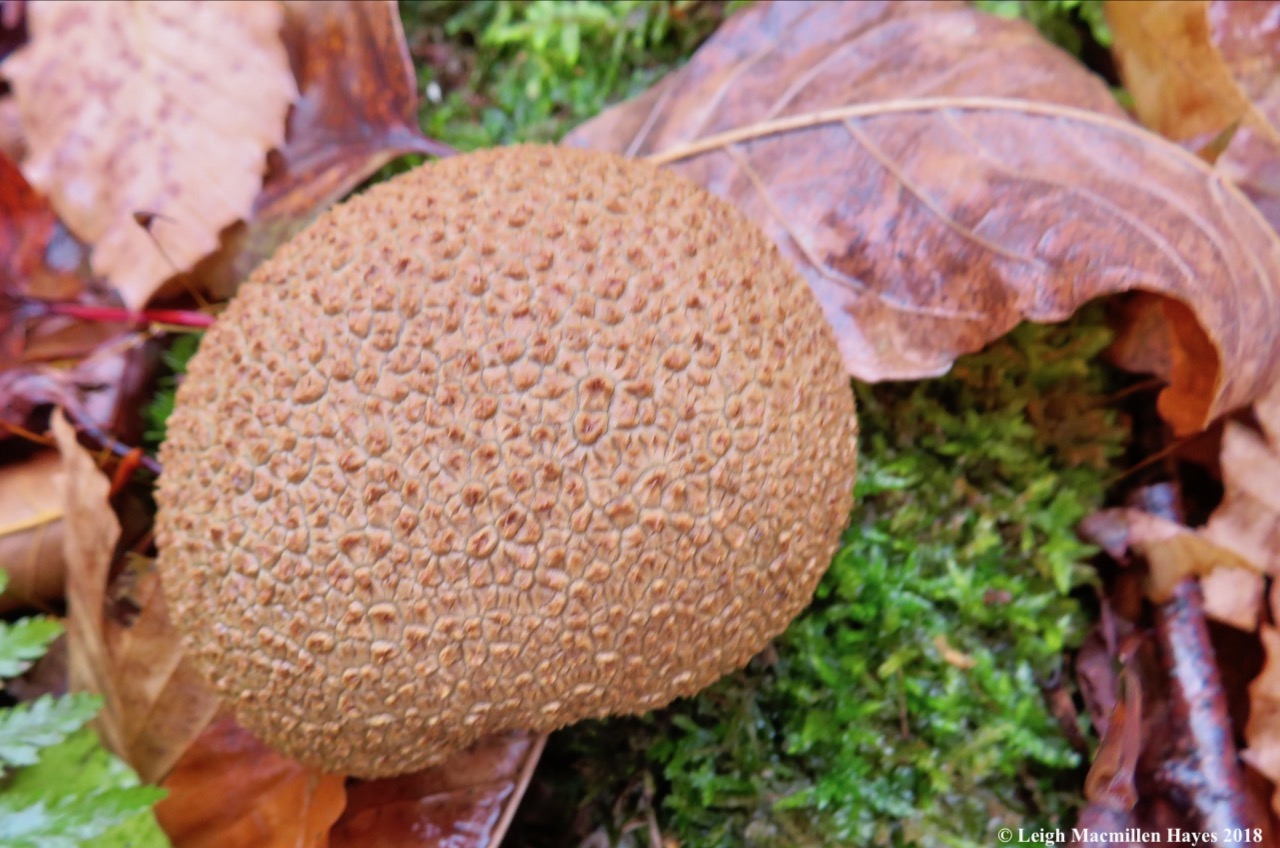
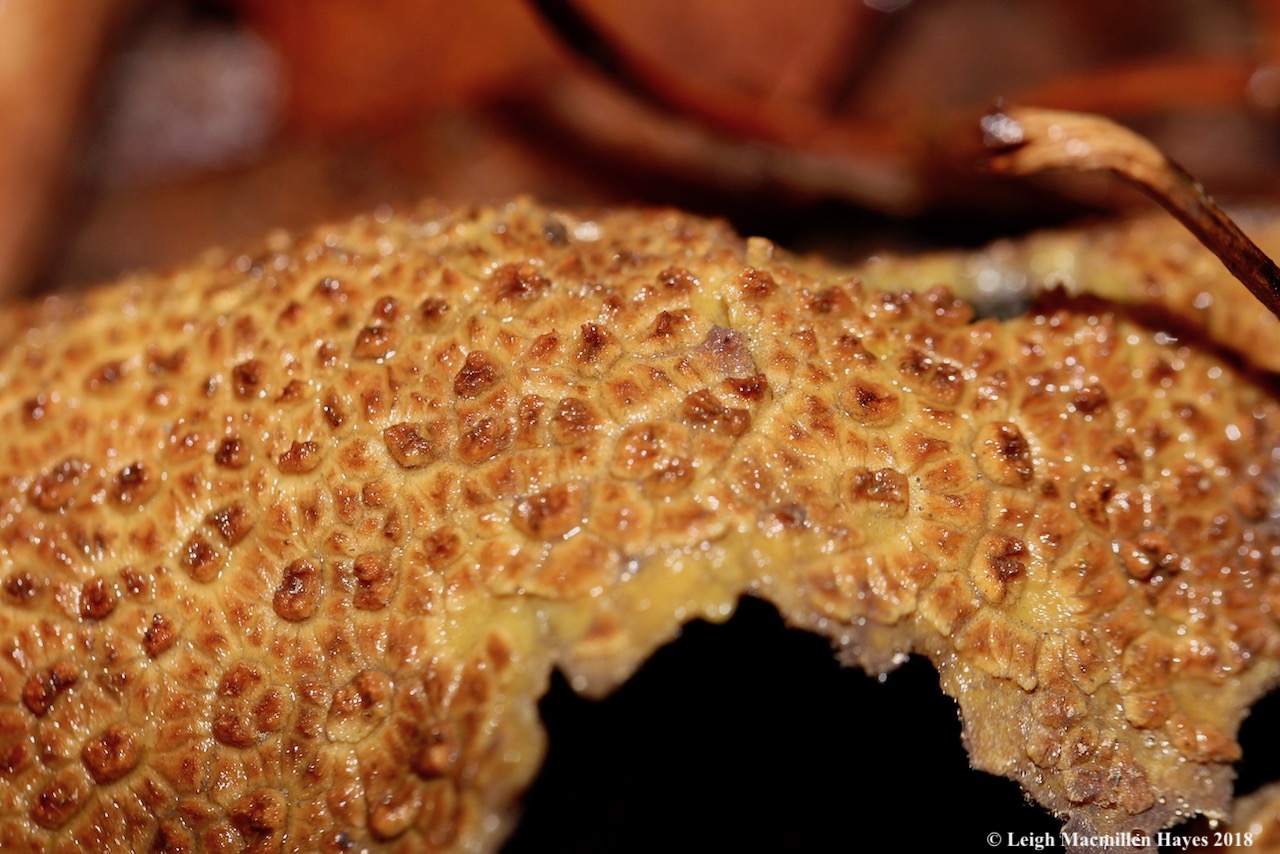
Back on the trail, we found an area where Earthballs decorated some old lumber slash. Their warty outer skin drew our attraction.

15-skin of pigskin

Another common name for Scleroderma citrinum is Pigskin Poison Puffball. Since it’s football season, it’s good to note that footballs used to be made of a pig’s . . . bladder and not its skin, though historically they were called pigskins. Rather than feel leathery, these seemed more rubbery, thus the reference I guess.

15-popping pigskin

And because they were puffballs, they invited a poke.

16-an explosion of spores

From a couple of slits, mature blackish spores erupted. I had to chuckle for no matter with whom I share a trail, puffballs always invite the same reaction–pick up a stick and give it a jab. And each time we share the same moment of glee. And our inner child is released one more time. Thankfully.

18-insect within pigskin

Of course, we found ourselves on our knees yet again when Pam spied something within an Earthball that had exploded prior to our visit. Upon closer inspection, it turned out to be an inanimate insect that looked like it was covered in spores. Canary in the coal mine?

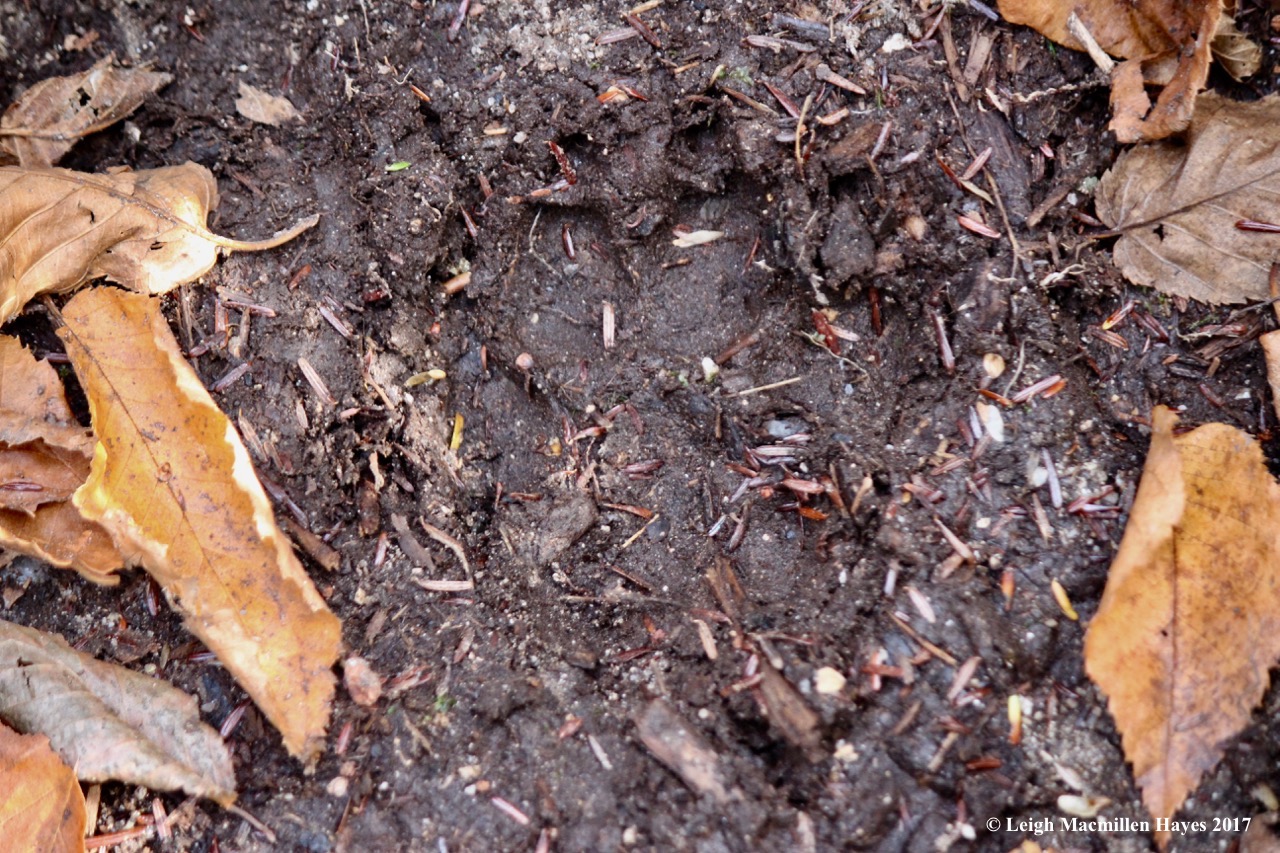
25-Pam and the bear scat

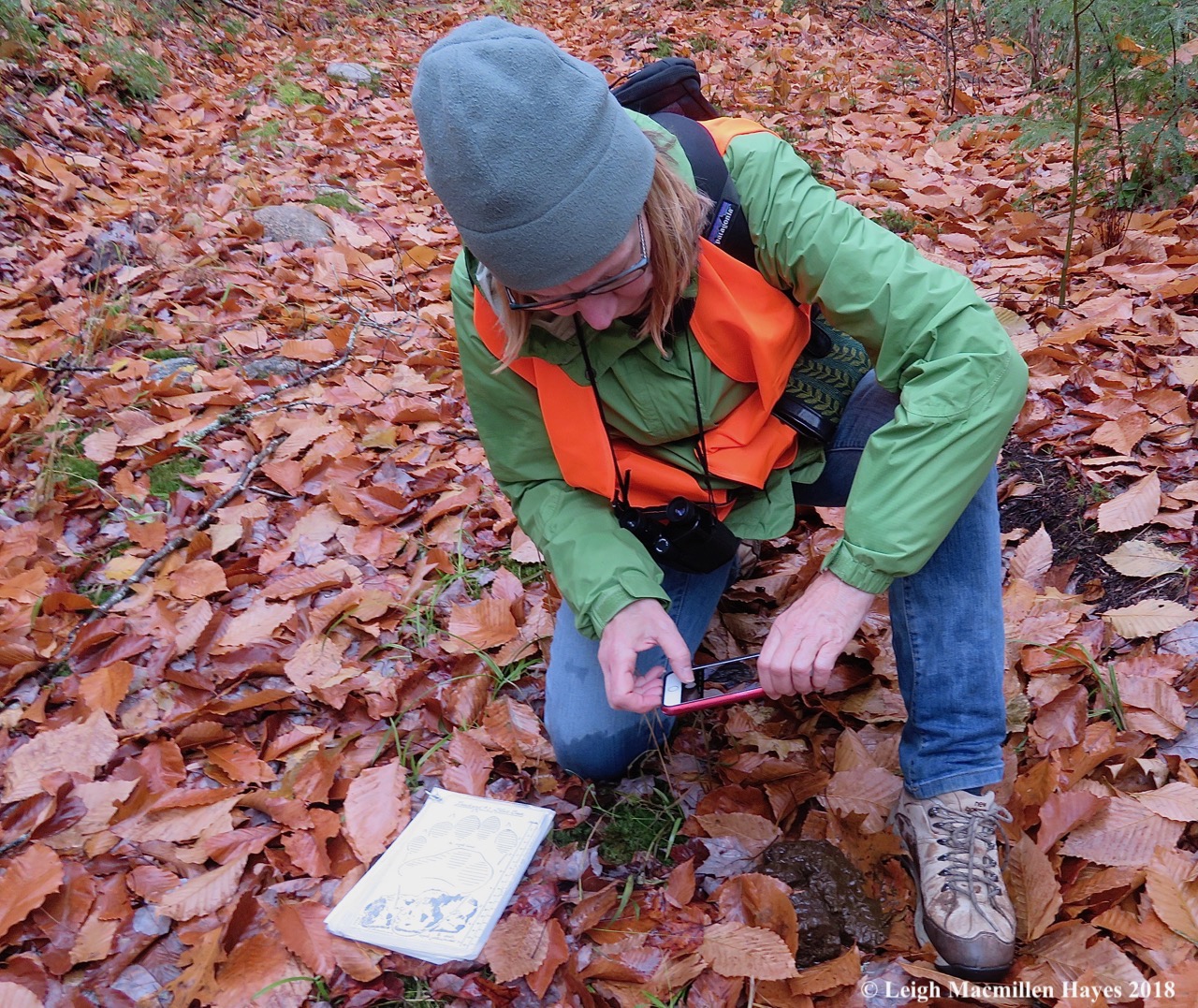
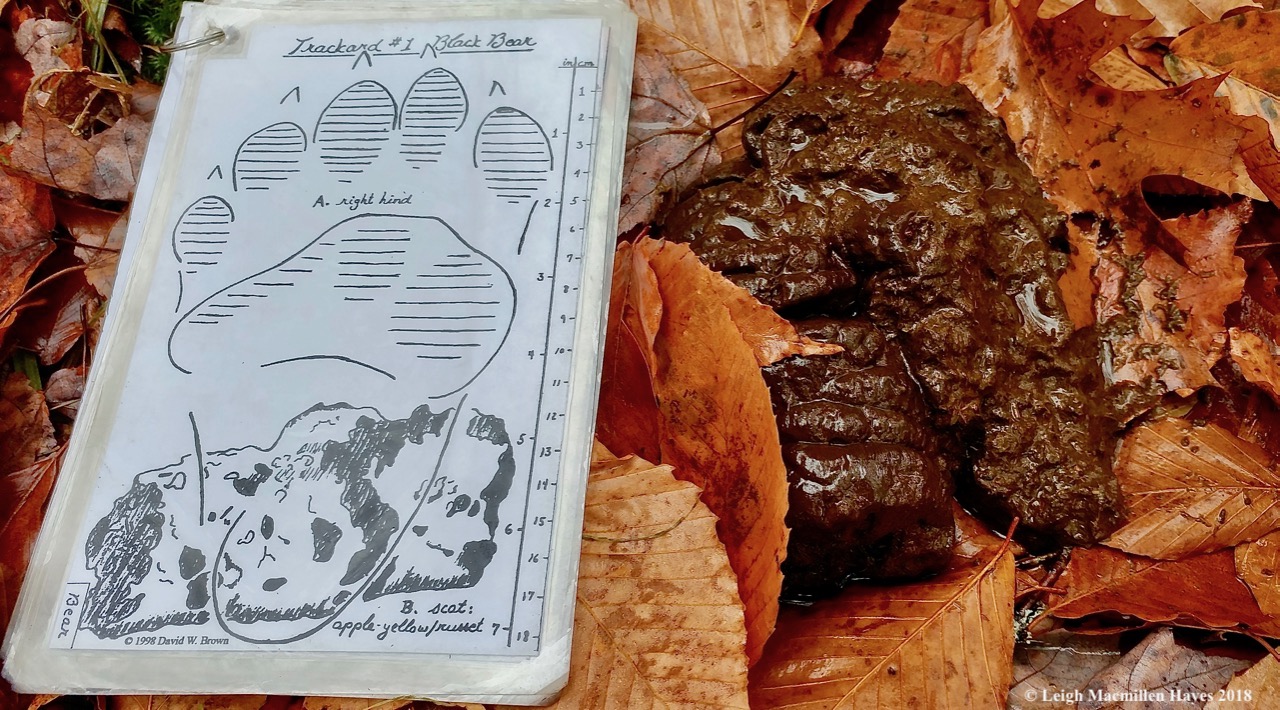
Our next great find was of a different sort and I had to pull the Trackards from my pack while Pam got down for another upclose and personal look. Notice her knee?

22-bear scat

Black bear scat! Indeed. Cylindral and large. We looked for tracks, but conditions were such that we didn’t find any. The scat was enough for this day.

24-Tamaracks

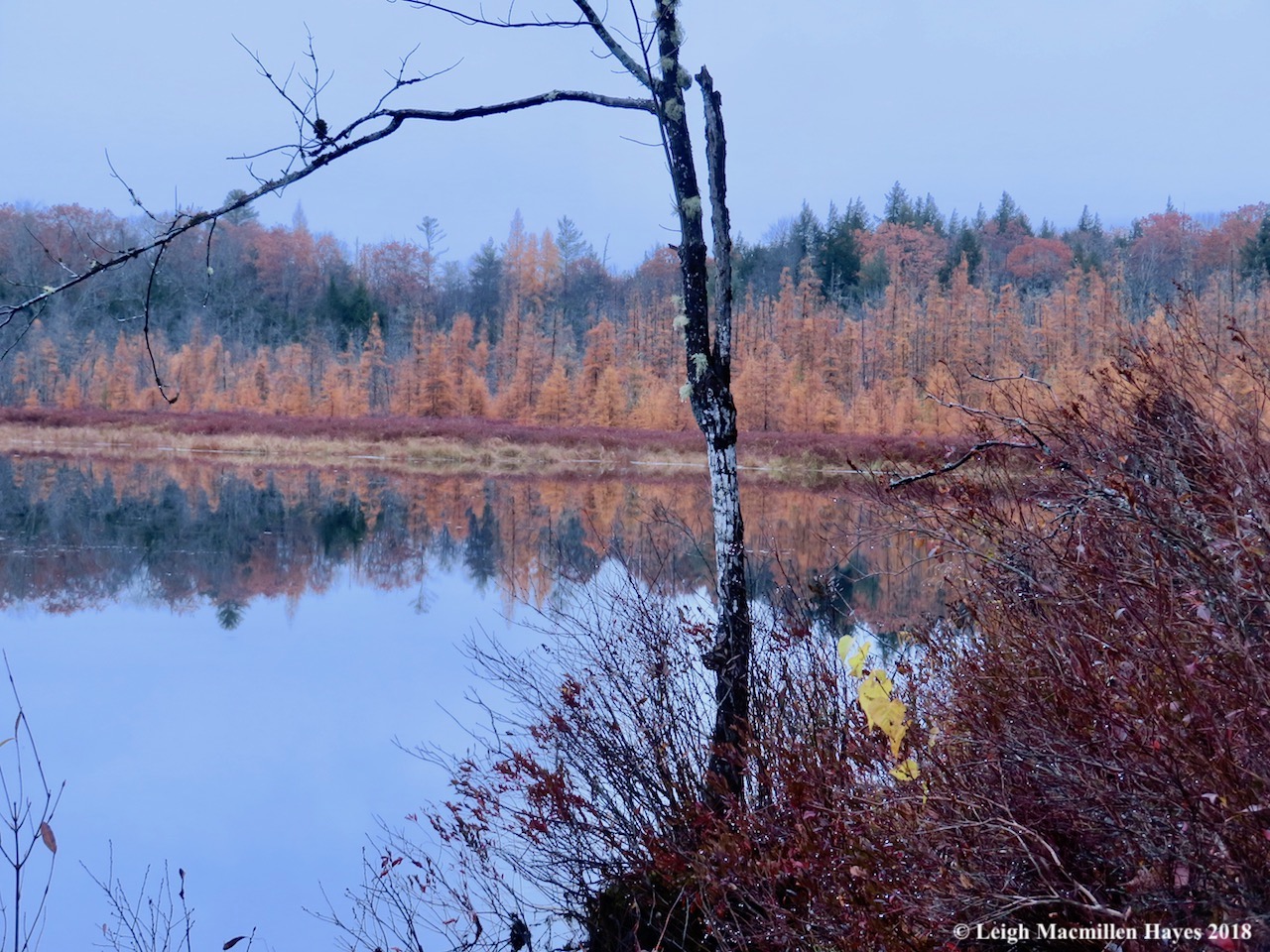
If you go, we strongly encourage you to follow the green trail all the way to the bird/wildlife viewing point along Sucker Brook. Today, the tamaracks on the shore to our right added a tone of bright beauty to the overcast day.

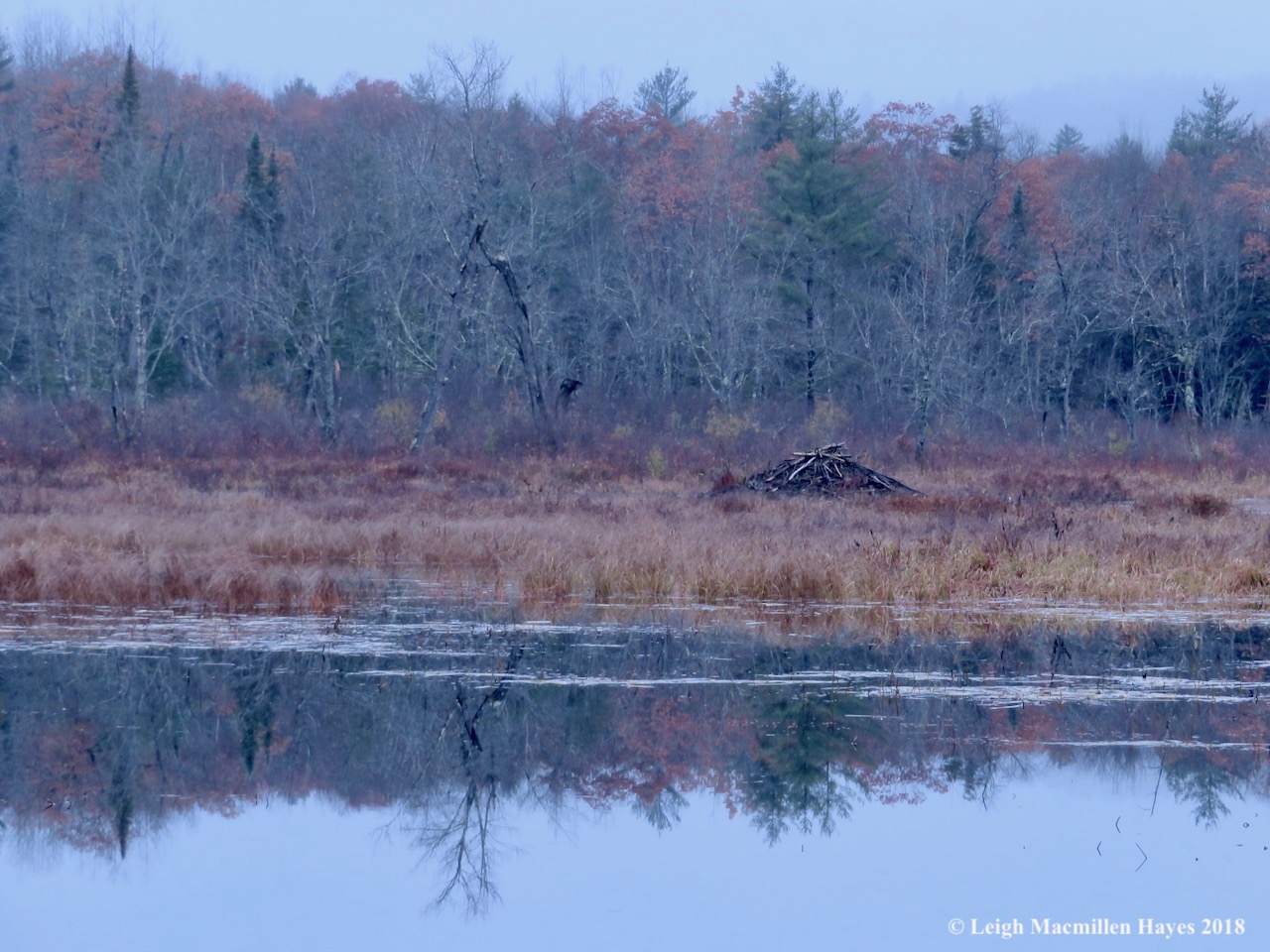
25-Sucker Brook--beaver lodge

And another old beaver lodge also looked like it had received a mud treatment. We could see some beaver chew sticks in the water by the edge of the brook and so we knew again that there had been recent activity. It just means we’ll have to return for another visit if we want to catch some action–perhaps earlier in the day.

In the meantime, we let the view point become our turn-around point and quickly (sorta) followed the blue trail back for we both needed to move on to the rest of our day.

But . . . despite the mist and occasional raindrops, we elected to tramp. And were delighted with the results. Here’s hoping the rest of the day goes like that.


Bishop Cardinal Reserve: Where (Wo)Man and Nature Intersect

Perhaps we should have tiptoed and tried to silently pass through the woods much the way a fox or bear might, but that is not our habit. And so on today’s Tuesday Tramp for the Greater Lovell Land Trust, we chatted and wondered aloud as we hiked along the  trails of Bishop Cardinal Reserve on the upper side of Horseshoe Pond Road in Lovell. Consequently, our wild mammal sightings were non-existent. Despite that, we saw soooo much.

9-docents Bob and Pam

Our team was small this morning, with only docents Bob and Pam joining me, but still we made plenty of noise as we looked about.

4-bear pole

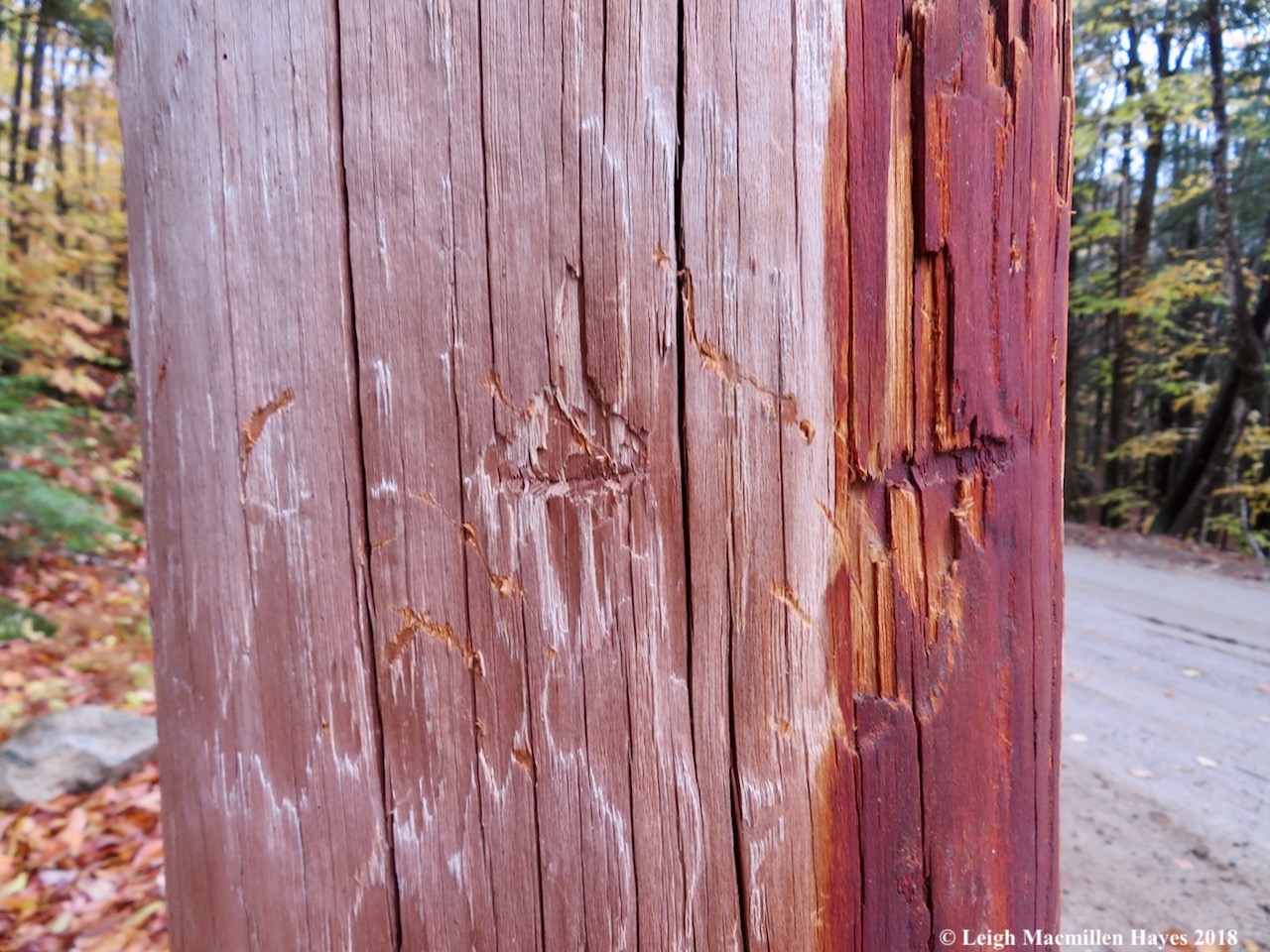
The first sign of mammal and human interaction, of course, was the telephone pole beside the trailhead. If you’ve traveled with me either literally or virtually before, you know how I LOVE a telephone pole. It’s not the fact that such brings electrical power and other modern day amenities to our homes, but instead the realization that bears are attracted to them and like to leave a mark as they claw and bite at the anomaly in the forest surroundings. I always check for hair left behind, but today was disappointed to find none.

5-scratches on bear poles

Despite the lack of hair, there were a few newer scratches worth celebrating.

6-spider

And a small spider tossed into the mix. The temperature was on the chilly side as the wind blew, but not cold enough to begin the process of accumulating glycols in its blood (e.g., antifreeze) that would allow the spider to supercool. By physiologically adapting via special antifreeze compounds, the tissues of some Maine spiders remain unfrozen at temperatures well below freezing, and thus avoid turning into little blocks of ice once winter sets in. Of course, had it been a little bit cooler, this spider probably would have hidden in the leaf litter below rather than trying to send a telegram via the phone pole.

7-bear tree

A little further along the trail, however, we did find more bear sign in the form of claw marks on beech trees. And that raised the question: Do bears only climb beech trees? No. But, beech bark is one of the best to show off their signature scratches.

10-Pam's bear tree 1

After I showed Pam and Bob a couple of trees with claw marks, they began to look about and Pam spied one I’d not noticed before.

10-Pam's bear tree

Congratulations on your First To Find (FTF) Award, Pam! Well deserved.

11-deer skull

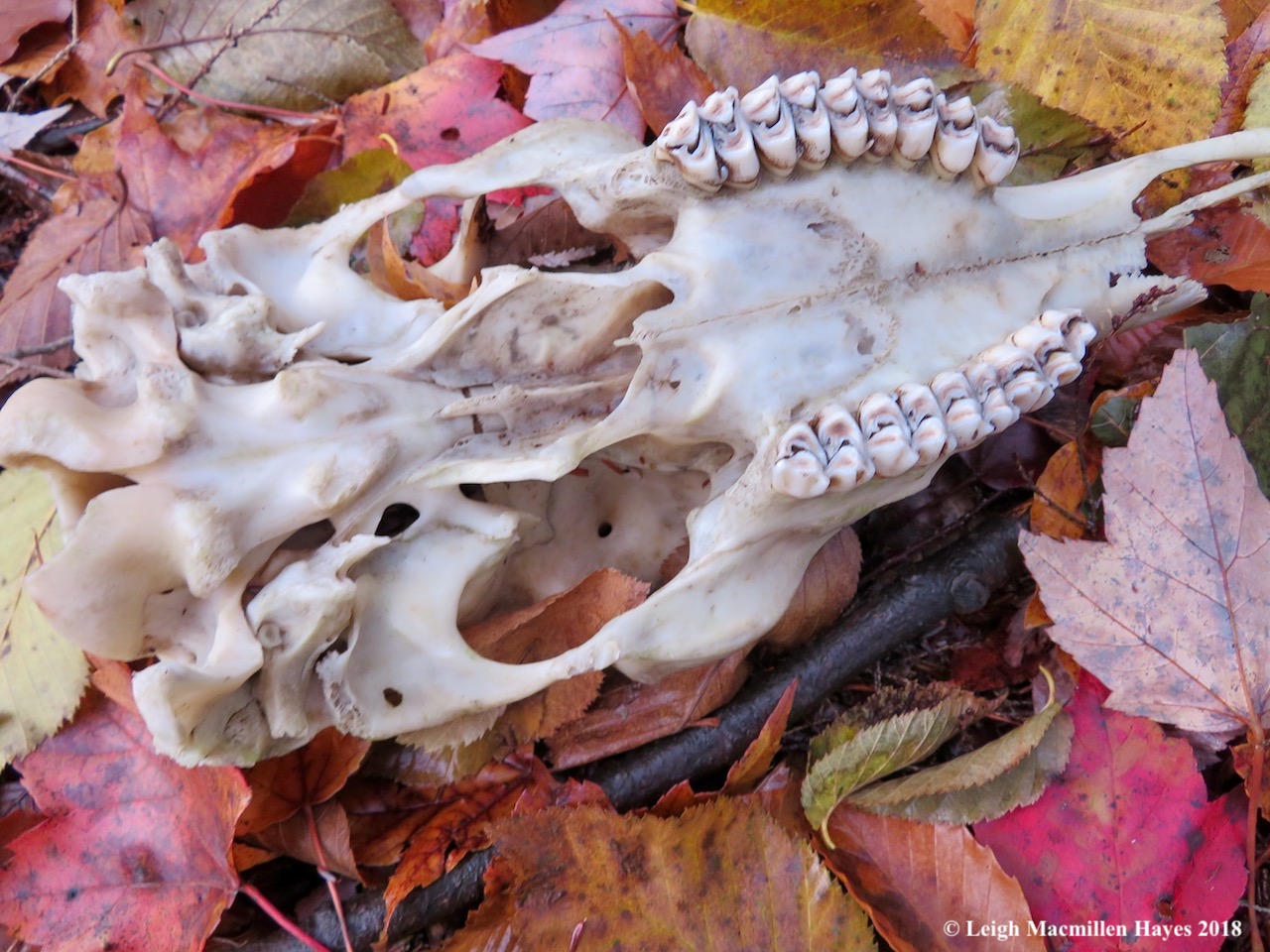
It wasn’t only bear sign that made the walk intriguing. A year and a half ago, this same couple had spied an entire deer carcass along the lower part of the trail. And so when we arrived in the vicinity today, we looked around. And eagle eyes Pam spied half the skull atop the leaves. What had happened to the deer? Human interaction? Old age? It was a rather large skull.

12-herbivore teeth

My, what flat teeth it had. Because herbivore teeth are highly specialized for eating plant matter which may be difficult to break down, their molars tend to be wider and flatter, thus allowing the animal to grind its food and aid in digestion.

13-lower jaw

We looked about for other bones and had to satisfy ourselves with a lower jaw. Had the rest of the skeleton been scattered and we just couldn’t see it below the recent leaf cover or had mice and other rodents dined on the bones from which they sought calcium? Coyotes, bears, and even another deer may also have moved the bones and found their own nourishment. Whatever happened, we knew it had been recycled . . . naturally.

14-coyote scat

And not far away on the edge of a bridge over a stream . . . coyote scat. It was not fresh, but fresher than the deer skull event, and full of hair. On what did the coyote dine? Snowshoe hare? Gray squirrel? Some other delectable offering? We weren’t sure.

15-squirrel storage

Dinner in the woods came in many forms, however, and on a fallen tree about four feet from the ground we found a mushroom turned upside down. Despite recent wind storms, we didn’t think it had blown up to that spot. Instead, a squirrel had set it there to dry. A squirrel’s food pantry is far bigger than a kitchen cupboard. Would it remember where it had placed the mushroom? Probably. Would another squirrel discover and snag it? Possibly.

16-squirrel storage

But there were others set in different spots to dry, so the original cacher might have some success in retrieving the food it had stored.

17-icy formation

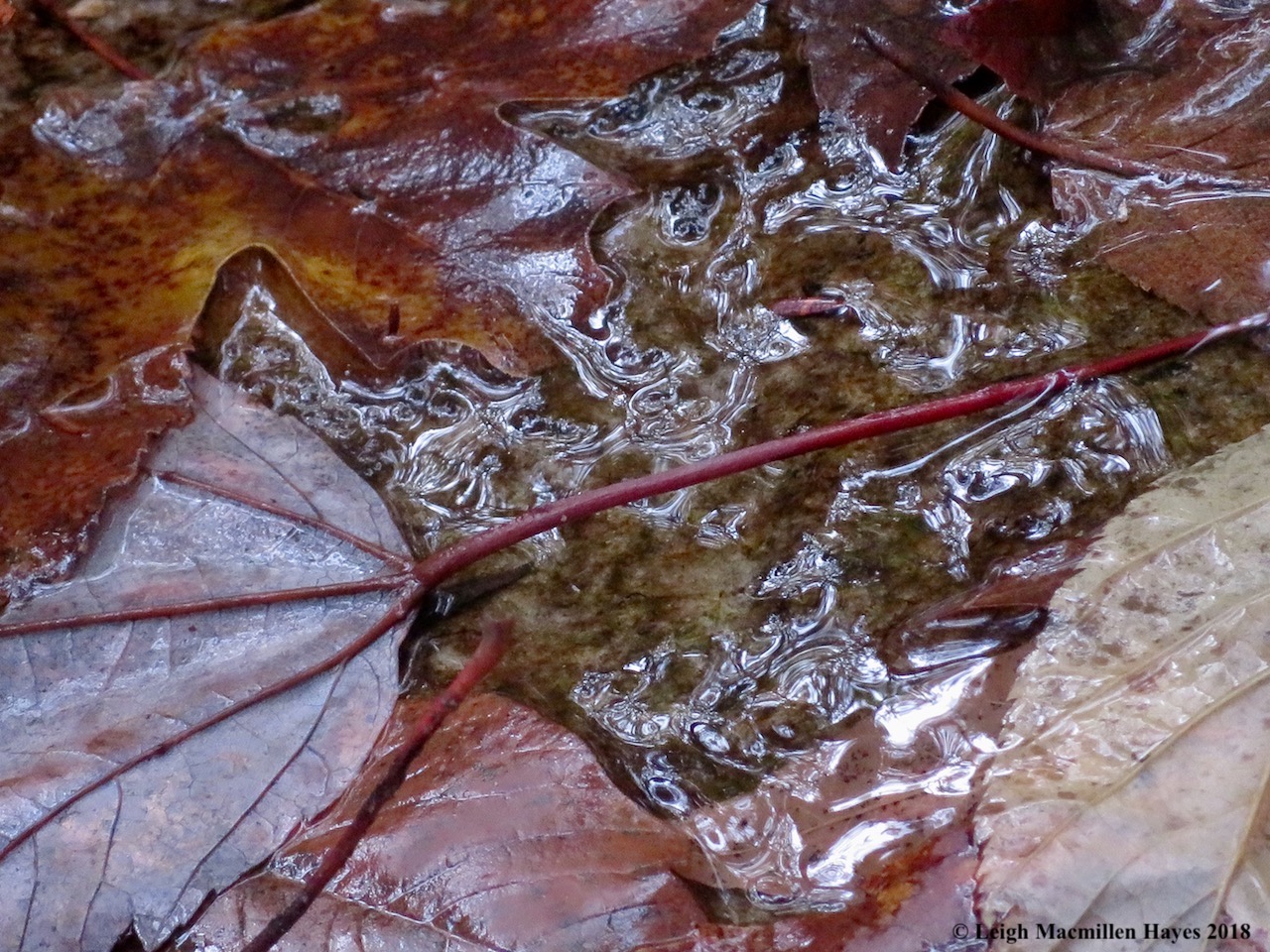
As our time drew to a close, we noticed patterns in the mushrooms imitated by icy spots in a stream that spoke to the morning’s chill.

18-Horseshoe Pond Road

But the sun had come out and we relished its warmth as we headed back to our vehicles and on into the rest of our days.

16a-man-made wonder

Before doing so, however, there were two more sights to commemorate–the man-made line up of doors found deep in the woods . . .

2-Sand castle

and rain-made castles along the road side.

Bishop Cardinal Reserve–where man and nature intersect.


A Keen Eye for the Wonders at Our Feet

As beautiful as the trees are right now with their autumnal display in full force, if you walk slowly in the woods and on the bald faces of our local granite, I think you might find yourself amazed. I know a friend and I always are and this afternoon was no different. We didn’t journey far; we didn’t need to journey far. We just needed to be present in the moment.

1-bird's nest fungi

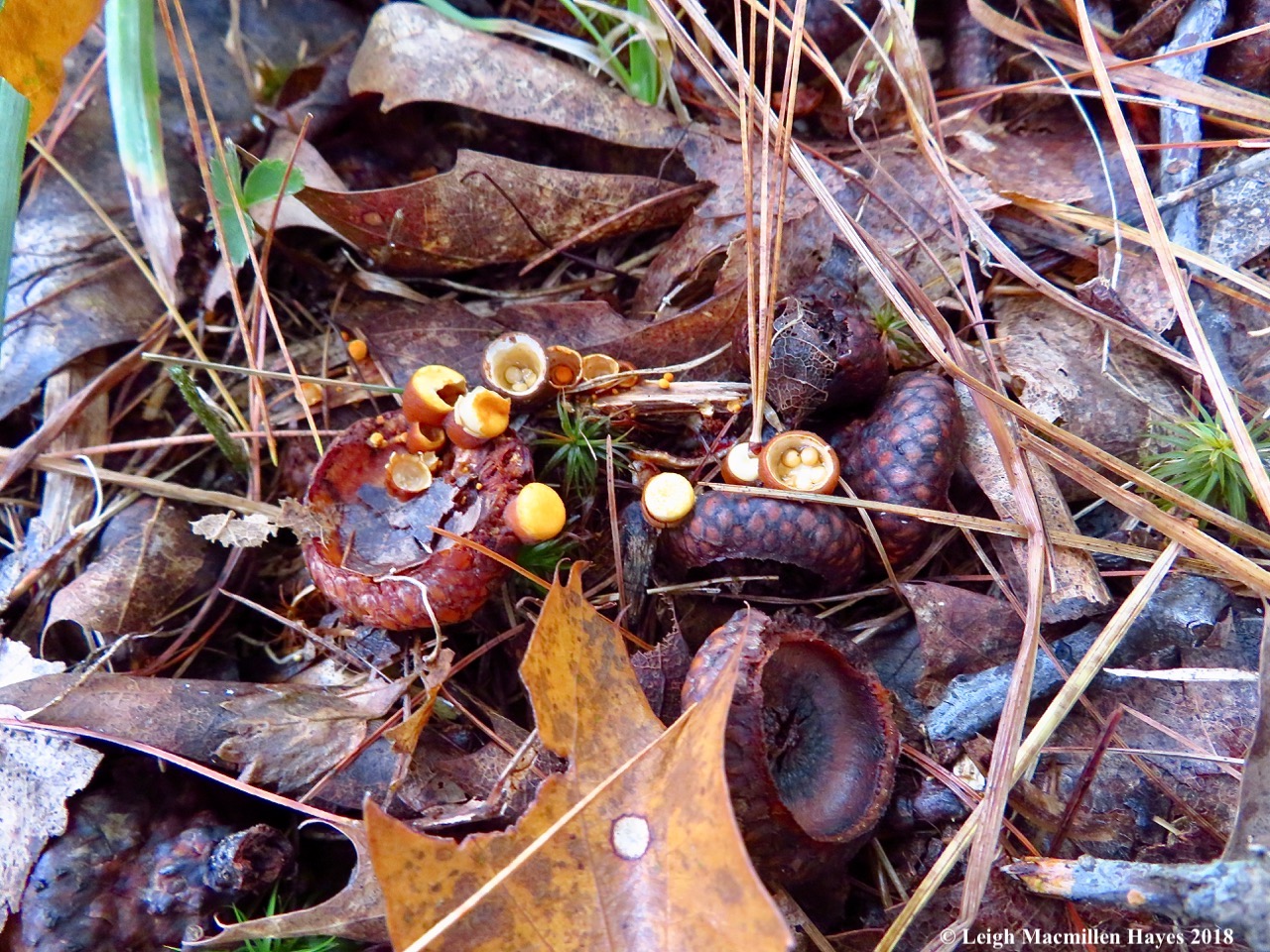
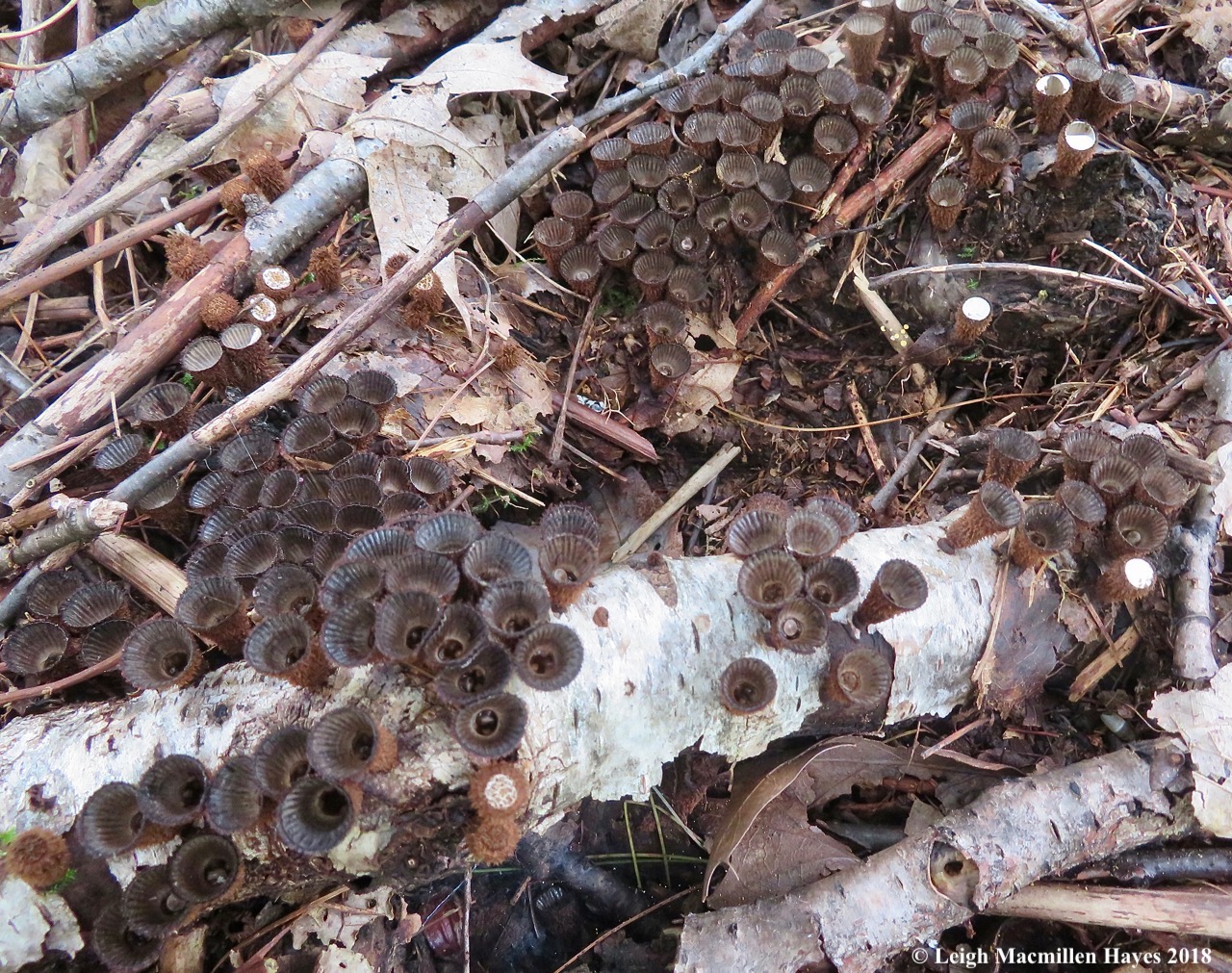
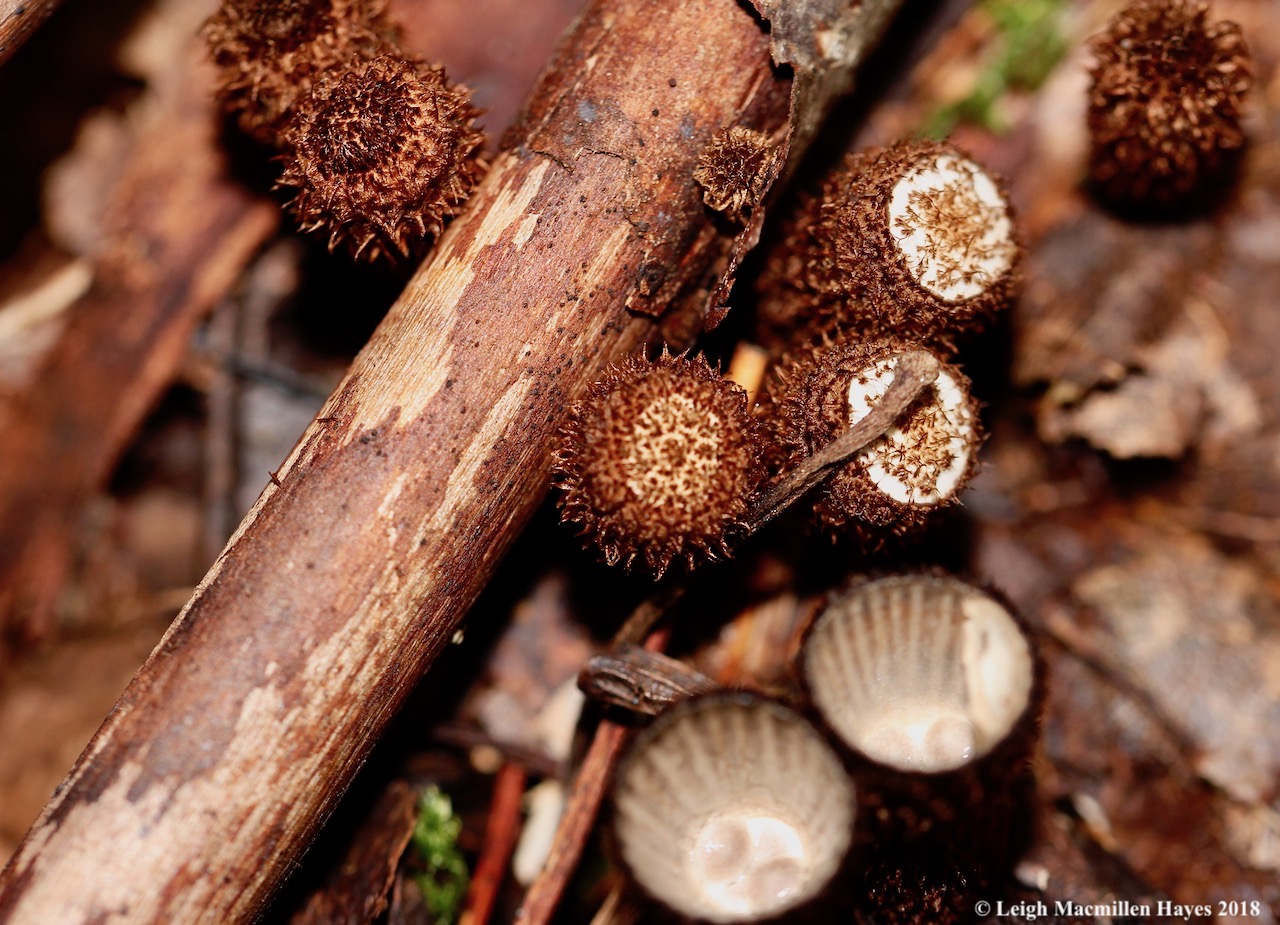
Our first find was actually a discovery she’d made the other day. In her front yard, mixed in with the acorn caps, were teeny tiny examples of Cyathus striatus or Splash Cup Fungi.

2-bird's nest

Only two weeks ago, she’d shown me a larger version of this Bird’s Nest Fungi in the form of Fluted Bird’s Nest, but today she had this miniature version to share. They really do resemble their common name.

3-beads of slime mold

Because our eyes were focused on the minute, it was no surprise that Wolf’s Milk Slime Mold, all beady in structure, should attract our attention.

4-stink horn

Our next great find discovered by my friend with the eagle eyes was a Common Stinkhorn (Phallus ravenelii). She said it stunk. I didn’t notice, but the flies loved it. Love, in fact, seemed to be a common theme, for on the stalk, which is typically white, appeared a heart, with arms/hands wrapped around below. Even though it’s “common,” I don’t often encounter any form of a Phallus fungus, so I’m not sure if the two-toned stalk is a common feature.

6-green stain fungi

The next discovery–the fruiting form of Green Stain Fungi (Chlorociboria aeruginascens). The turquoise fruiting body was only about a third of an inch in diameter and so it’s another one that’s easy to overlook. But . . . our movement was intentionally slow as we moved without expectation and were constantly excited by our discoveries.

7-onto the granite

At last, we stepped out of the forest and onto a bit of a bald spot where granite greets sky, with lots of life layered between the two.

8-liliputian world

And onto our knees we knelt for life on the granite was lilliputian in nature.

9-candy lichen

And varied, but it was the lichens that really pulled me into the fold. Some, like the Candy Lichen, a blue-gray crustose lichen with orange to salmon colored fruits, grew so abundantly that we practically ignored it.

9a-pixie cups

Then there were the delightful pixie cup goblets scattered throughout awaiting a visit from the wee folk.

10-British soldiers

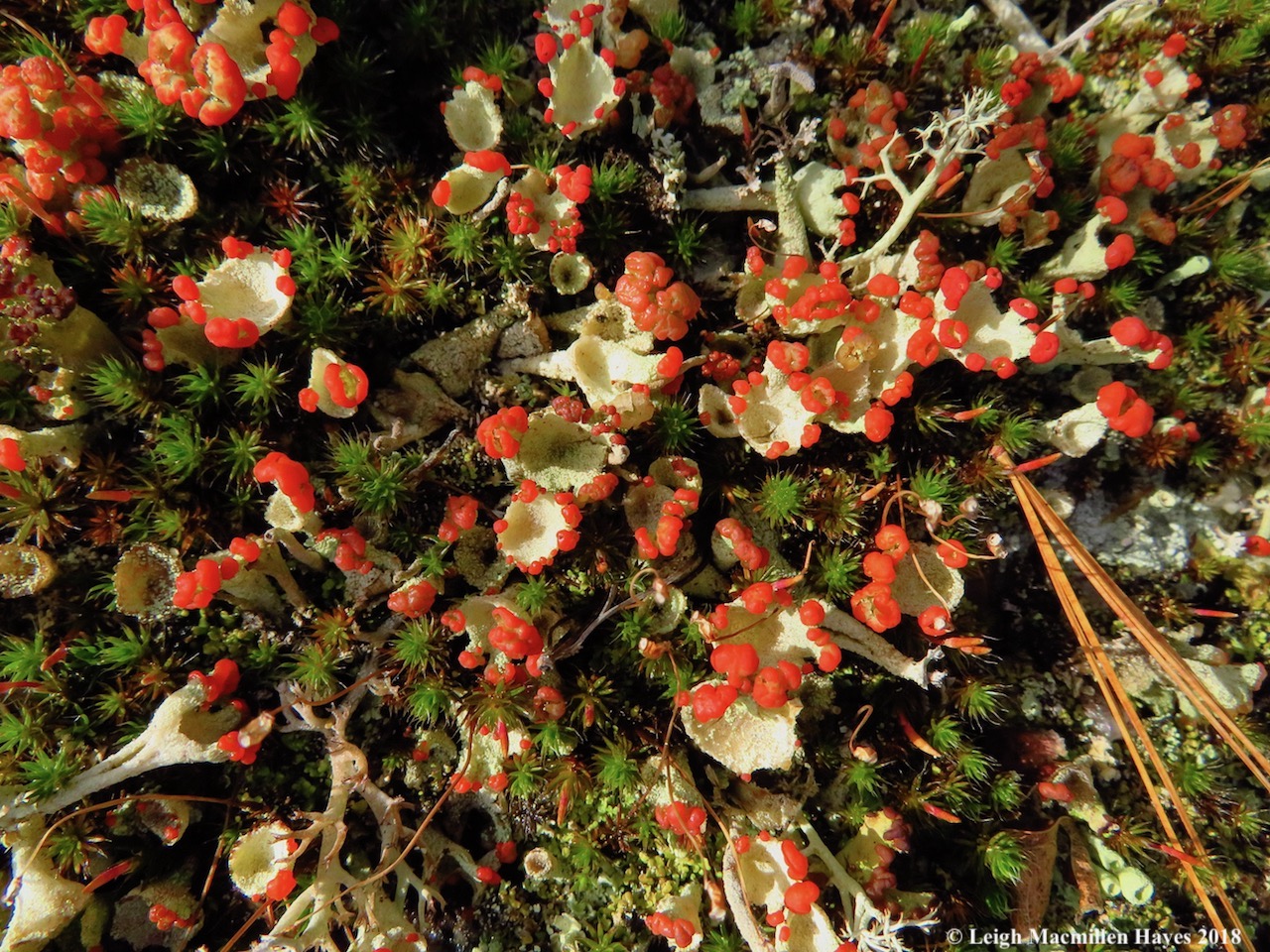
And British Soldiers (Cladonia cristatella) standing tall yet branched as they watched over all, their crimson red caps bespeaking their ancestral heritage.

11-lipstick powderhorn

Beside them were a few Lipstick Powderhorns (Cladonia macilenta) with bright red caps above single stalks, rather like the lipstick I’ve never worn.

12-red-fruited pixie cups

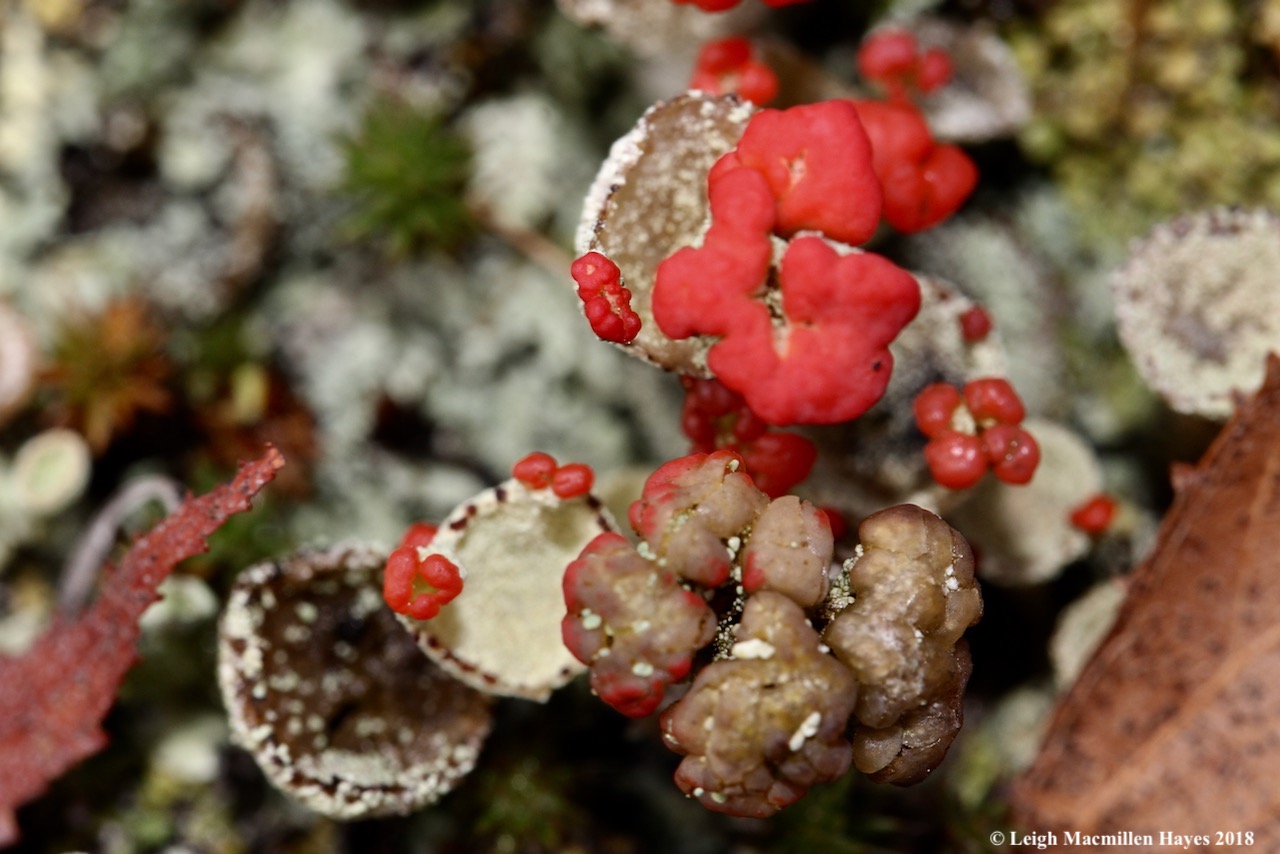
And rounding out the red-cap series were the Red-fruited Pixie Cups (Cladonia pleurota), with their multiple red fruiting bodies outlining the cups.

13-red-fruited lichens

Pixie cups would have been enough. But pixie cups with bright red caps–and we were wowed. The other cool thing–like the Bird’s Nest Fungi with its splash cup form, these lichens offered something similar. The Bird’s Nest depends on droplets of water (think rain) to release its spores from the tiny “eggs” situated within each cup. For the Red-fruited Pixie Cups, it’s the same idea–the splash cup goblets allow the lichen to disperse its reproductive materials.

14-red-fruited brown

We found a few with the red caps turned brown and assumed they’d done their duty.

15- Ladder Lichen Cladonia verticillata

Just when we were about to move on my friend made another exciting discovery. Ladder Lichen (Cladonia verticillata) with its brown fruits reminded me more of fountains containing chocolate treats at the outer edge of each level.

16- Ladder Lichen Cladonia verticillata

Or perhaps a way for Jack to ascend from the world of the minute to the giants in the sky.

17-milkweed seeds

And with that, our eyes moved upwards–to the milkweed seeds that awaited their turn for release and a chance to find their own place in the world.

18-large milkweed bug

A Large Milkweed Bug reached the end of one pod, but the future possibilities seemed endless for it–as long as the spider web didn’t hinder any progress.

19-ash leaves

With upturned attention, we noted a young ash tree presenting its fall colors ranging from golden green to magenta all on the same trunk.

20-oak leaves

And even higher up, a Red Oak already showing off its carotenoid chemistry with yellows and oranges overtaking the green pigment.

21-colors

While fall foliage is at or near peak in western Maine and causing all of us to stop in our tracks to note the beauty of the live paintings that surround and embrace us in their ever changing way, its the color and variety and wonders at our feet that drew the attention of my friend and me today. And I’m forever grateful for her keen eye.

(And help searching for a needle in a haystack a little while later–thanks J.M.)

Postcards from Sweden

Sometimes I forget when traveling that I should share my surroundings with those back home. A photograph of a local scene and a quick note are enough to say that though I was away, you were on my mind.

1-splash cup

And so dear readers, these are for you. The weather is great, I wish you were here. For if you were, your jaw would drop as mine did at the sight of these little morsels that so look like candy wrappers. Of course, the right thing to do would be for me to purchase a few to share with you.

2-splash cup

But, looks can be deceiving, and really, these are a fungi called Cyathus striatus, or Fluted Bird’s Nest. While they remind me of marshmallows covered with burnt coconut, they are really the young fruit bodies of the species. The lids, known as epiphragms, cover the structure and prevent rain drops from entering until the eggs within are ripe, for it’s the drips of the drops that release the spores of this fungi.

3-splash cup fungi

More mature structures, those that look like chocolate cups also coated in coconut, contained the “eggs” or lens-shaped structures known as peridioles.

4-eggs in splash cup fungi

This fungi is difficult to spy because it is teeny and inconspicuous and prefers a dark, moist habitat, but my hostess had her eye on these for a while and couldn’t wait to share them with me. And now, I’m excited to share them with you. The flute darkens with age, and that pale lid falls away or collapses inside the structure which does resemble a bird’s nest. Within each nest there are typically four or five silvery flattened “eggs.”

5-turkey tail fungi

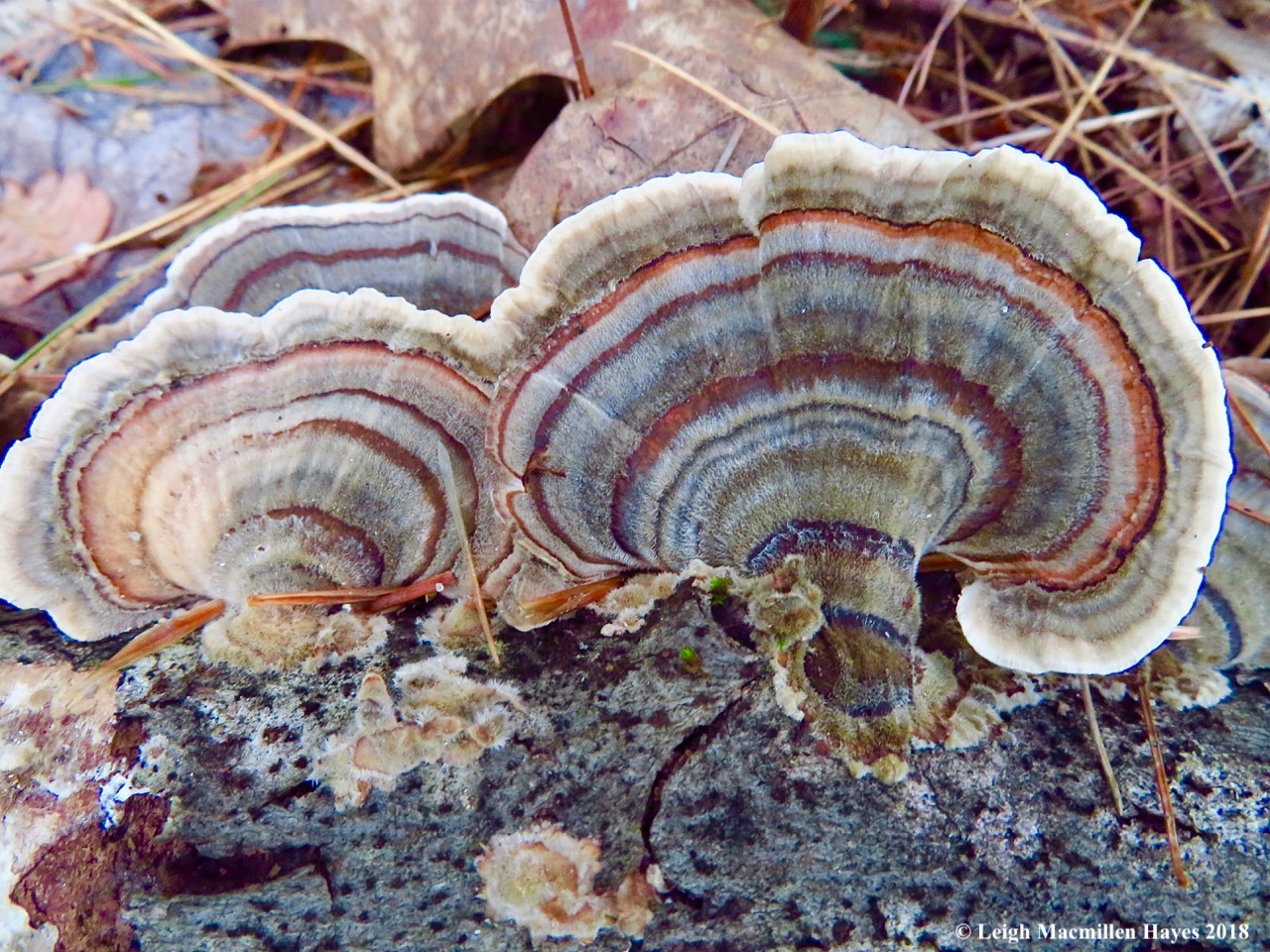
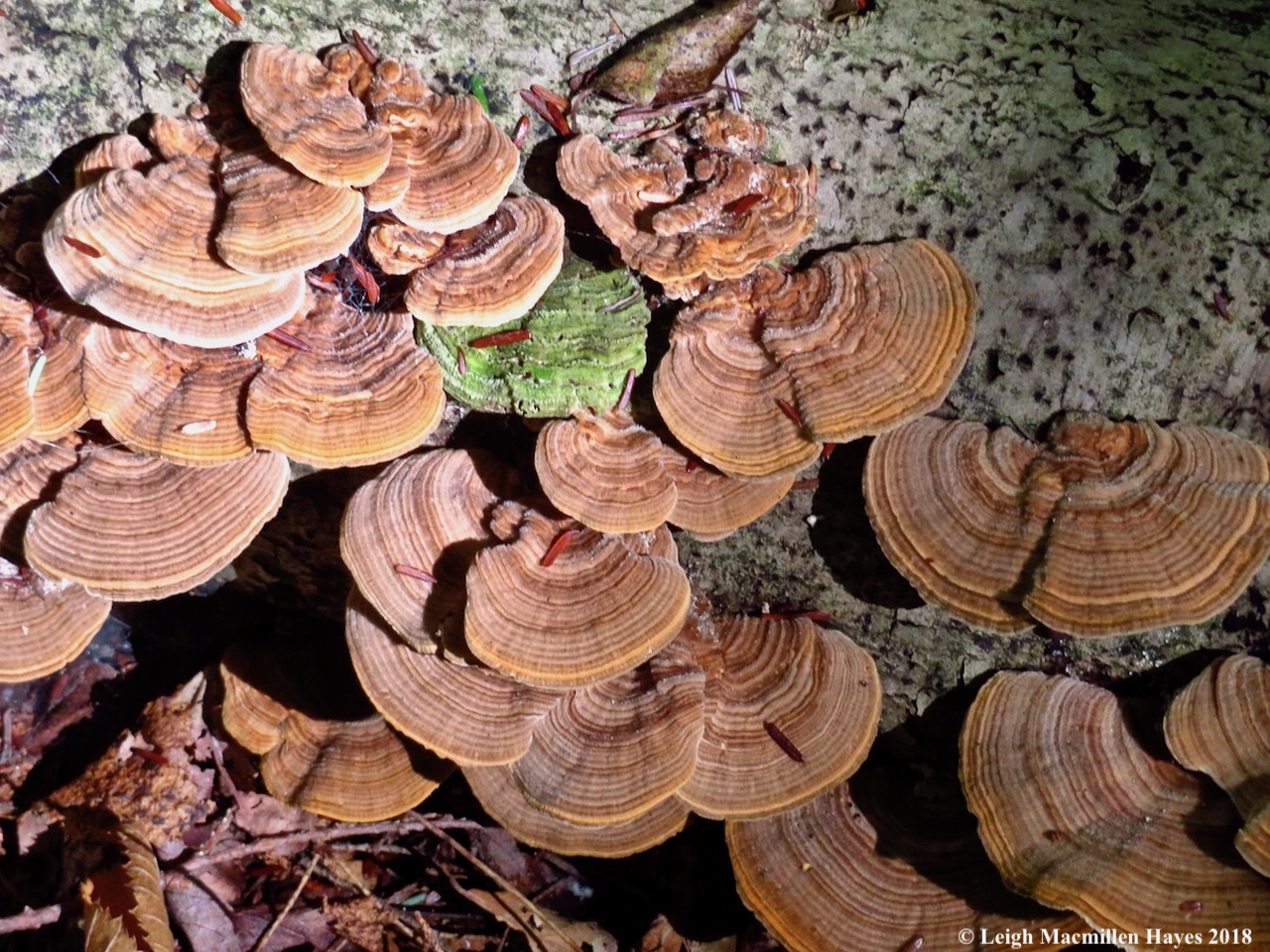
We moved along and our next destination made me think of home. Back home, it seems the wild turkeys are taking over the world as we spy them in the yard, field, forest, and beside many a road. In the forest my hostess knows best, it was a turkey of a different kind that she shared. Trametes versicolor or more commonly, turkey tail fungi, grow prolifically in her woods. And their tail feathers are just as colorful and neatly arranged as the ones I know so well.

10-slime mold

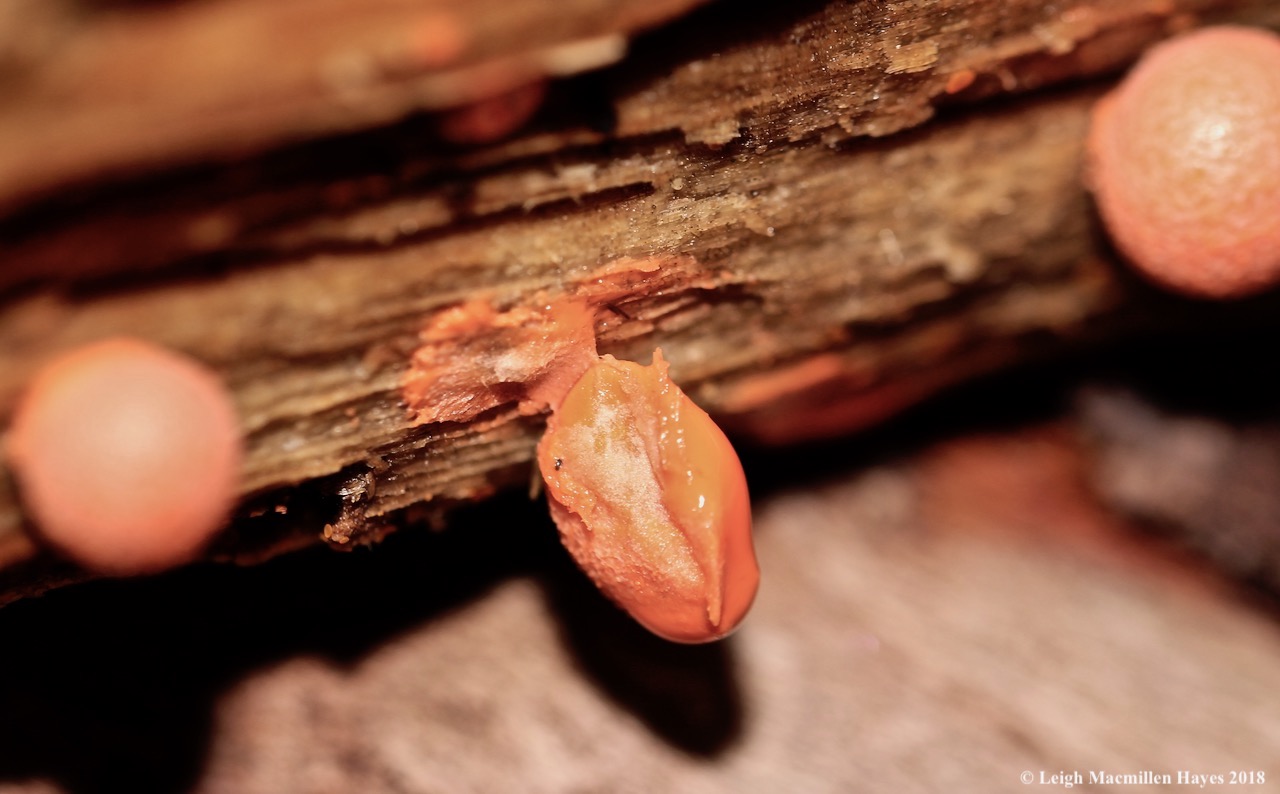
Our next stop on the tour found her sharing a parlor trick with me. She poked a fruiting body of Lycogala epidendrum, or Wolf’s Milk Slime Mold, with a stick. Out oozed some goo, which had the fungi been mature would have been a more powdery spore mass.

10a-slime mold being slimy, parlor trick

You might say, “YUCK.” But it’s almost magical. The salmon-colored balls deflate instantly when poked and as the goo leaks we smile and think about sharing such a finding with others. When next I wander with you, we’ll have to look for slime molds.

11-Aleuria aurantia--orange peel funit

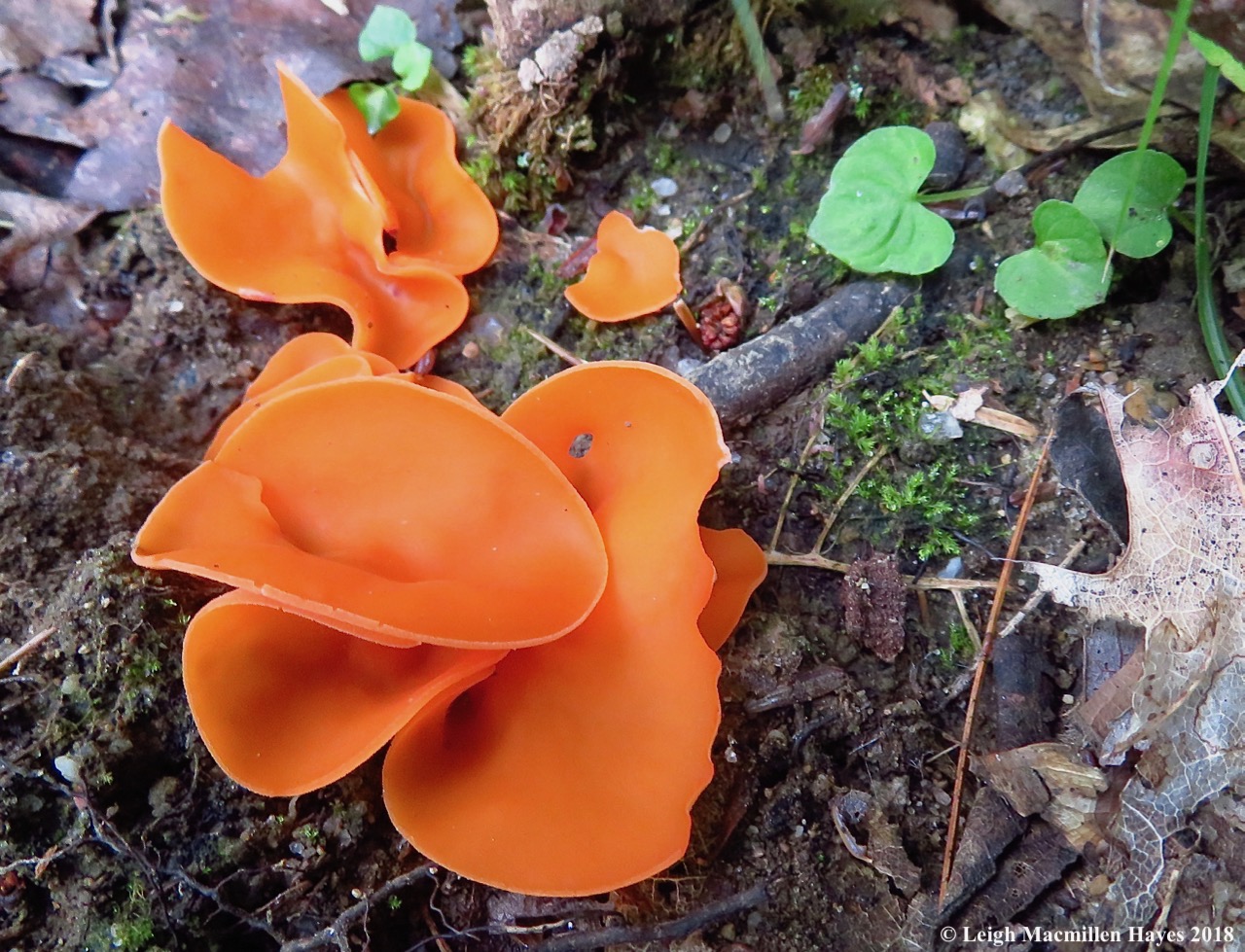
Because we’d been walking for a bit, you might think that my hostess offered a snack. The fun thing about exploring a place she knows so well is that sometimes there are surprises and such was the Aleuria aurantia or Orange Peel Fungi. We were looking at something else in the vicinity when suddenly we both spied the bright orange color and then realized there was a colony of it all about our feet.

14-earth tongue forest

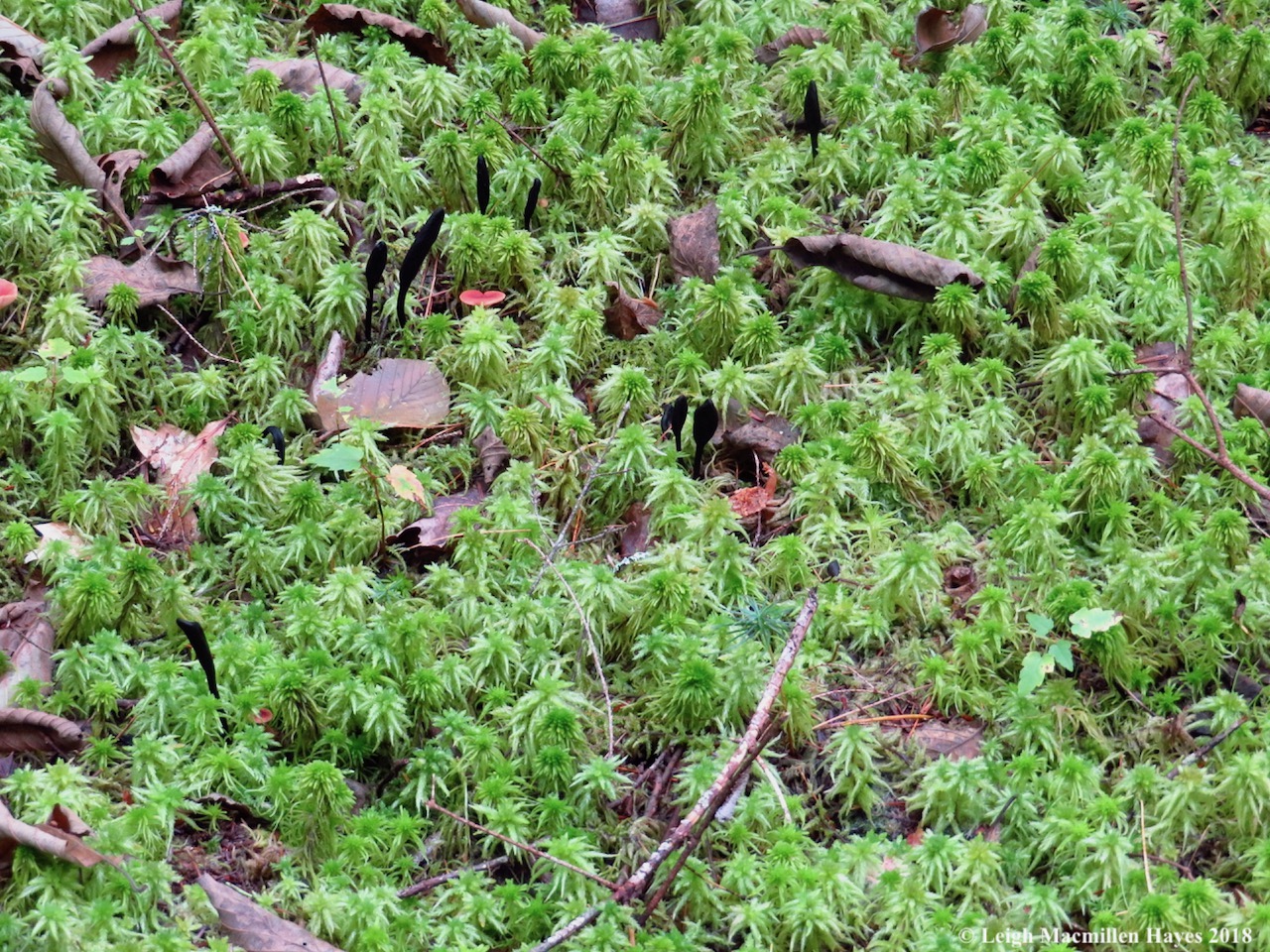
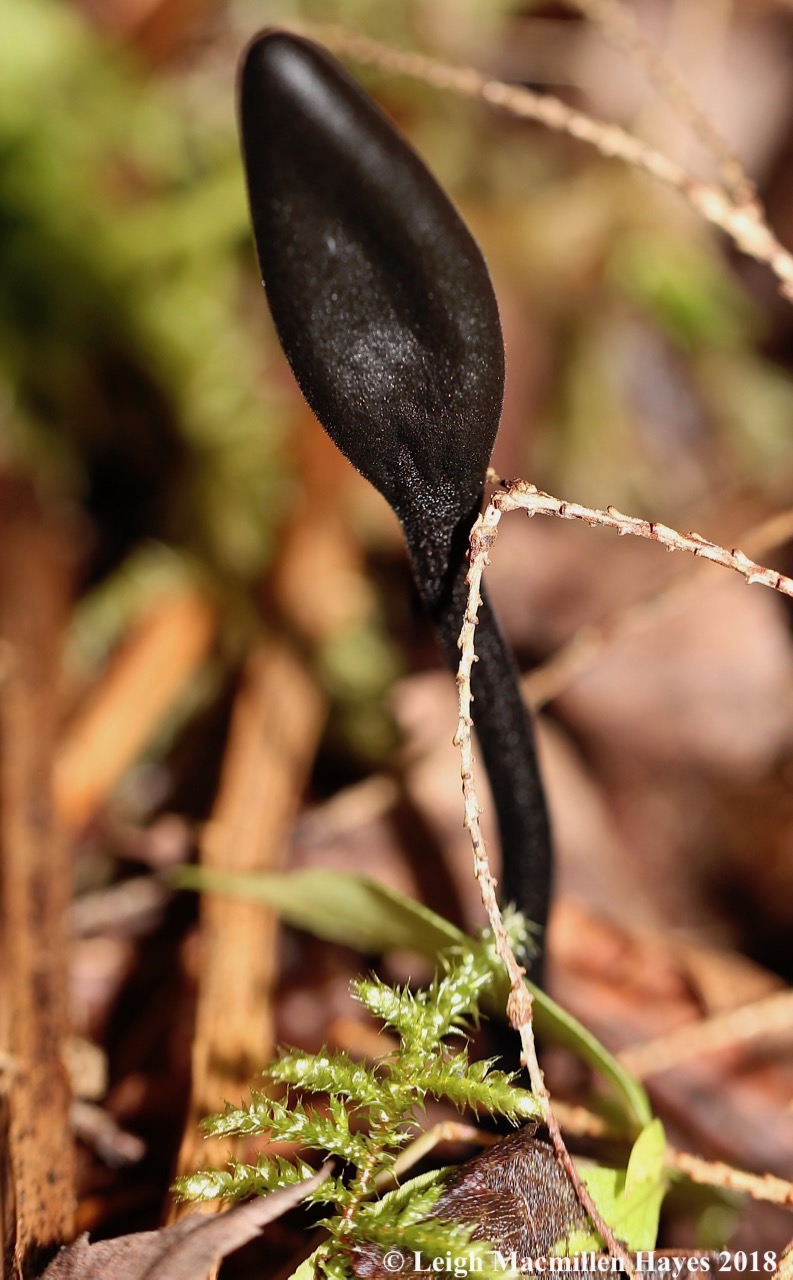
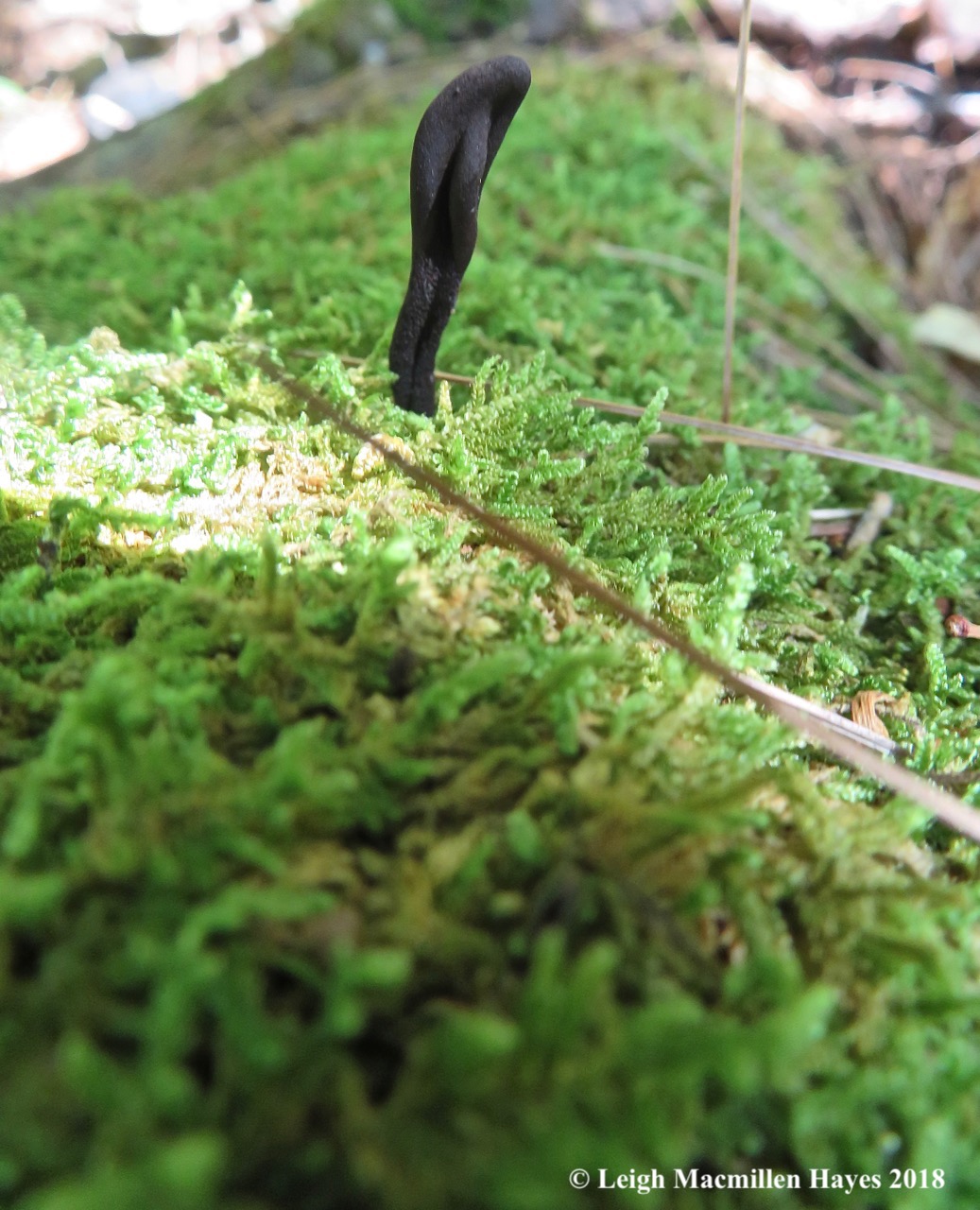
In a different habitat, one where the sphagnum moss grows, we encounter a different fungi that I know, but had never seen in such an abundance: Trichoglossum farlowii is also known as Black Earth Tongue. I had never visited an Earth Tongue garden before but in a foreign land it apparently reigns.

15-singular tongue

Most of the structures are singular fruits, but . . .

15-forked earth tongue

we found one forked tongue.

16-green-headed jelly baby fungi

Nearby, on a rock covered in Bazzania, a liverwort, we found a small colony of Leotia viscosa or Green-headed Jelly Babies. Much like the Fluted Bird’s Nest, it looks like a another candy I should bring home to share, but I left the souvenirs behind and took only photographs.

17-green stain fungi fruiting

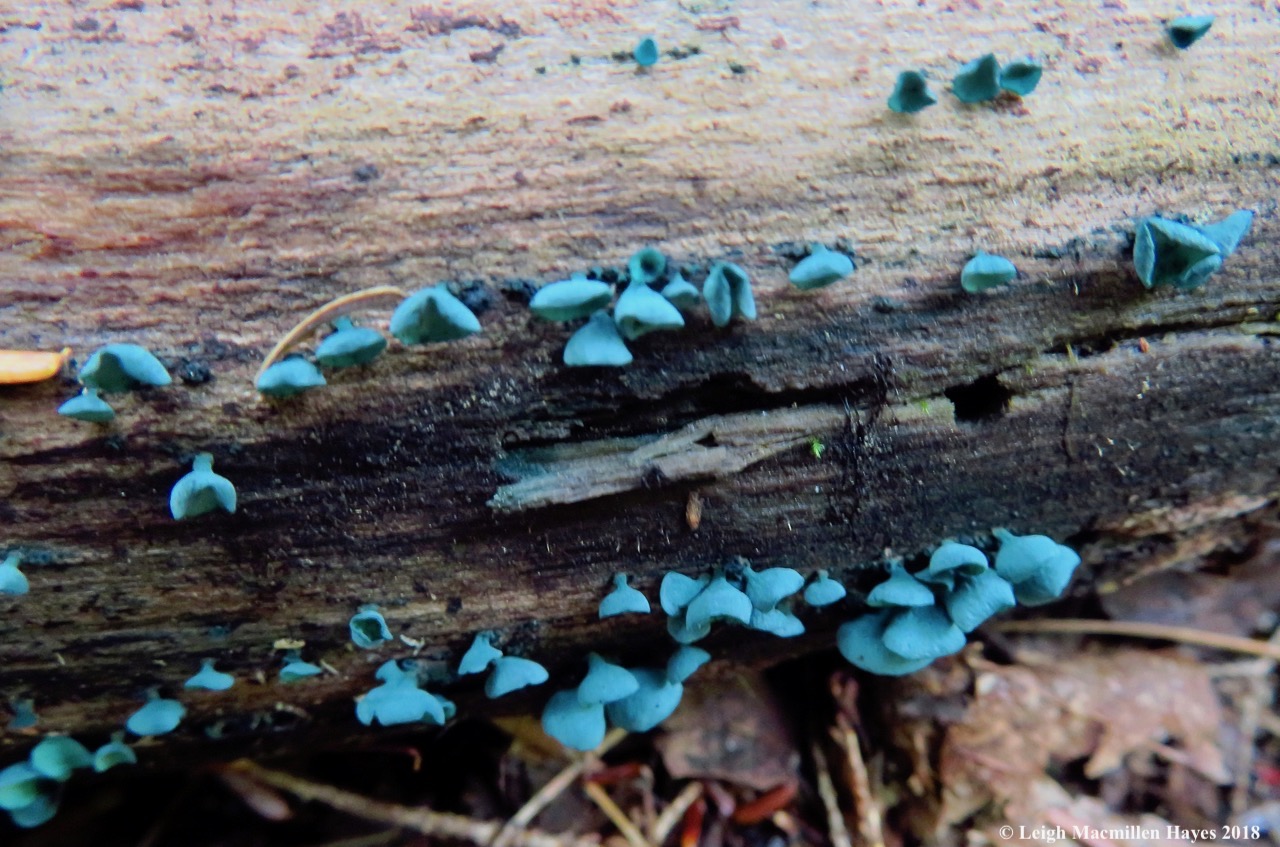
Our forest journey wasn’t over, but our fungi finds were complete when she showed me the fruiting bodies of Chlorosplenium aeruginascens, or Green Stain Fungi. Really, it should be called turquoise-stained, but I didn’t come up with the name. It’s difficult to photograph these beauties for so petite are they, and always a thrill to see.

18-Sweden forest

Many of our finds were located in the vicinity of a forest bog where cinnamon ferns grow tall and wild and add texture and color to the scene, making it look rather pre-historic.

6-beaver pond

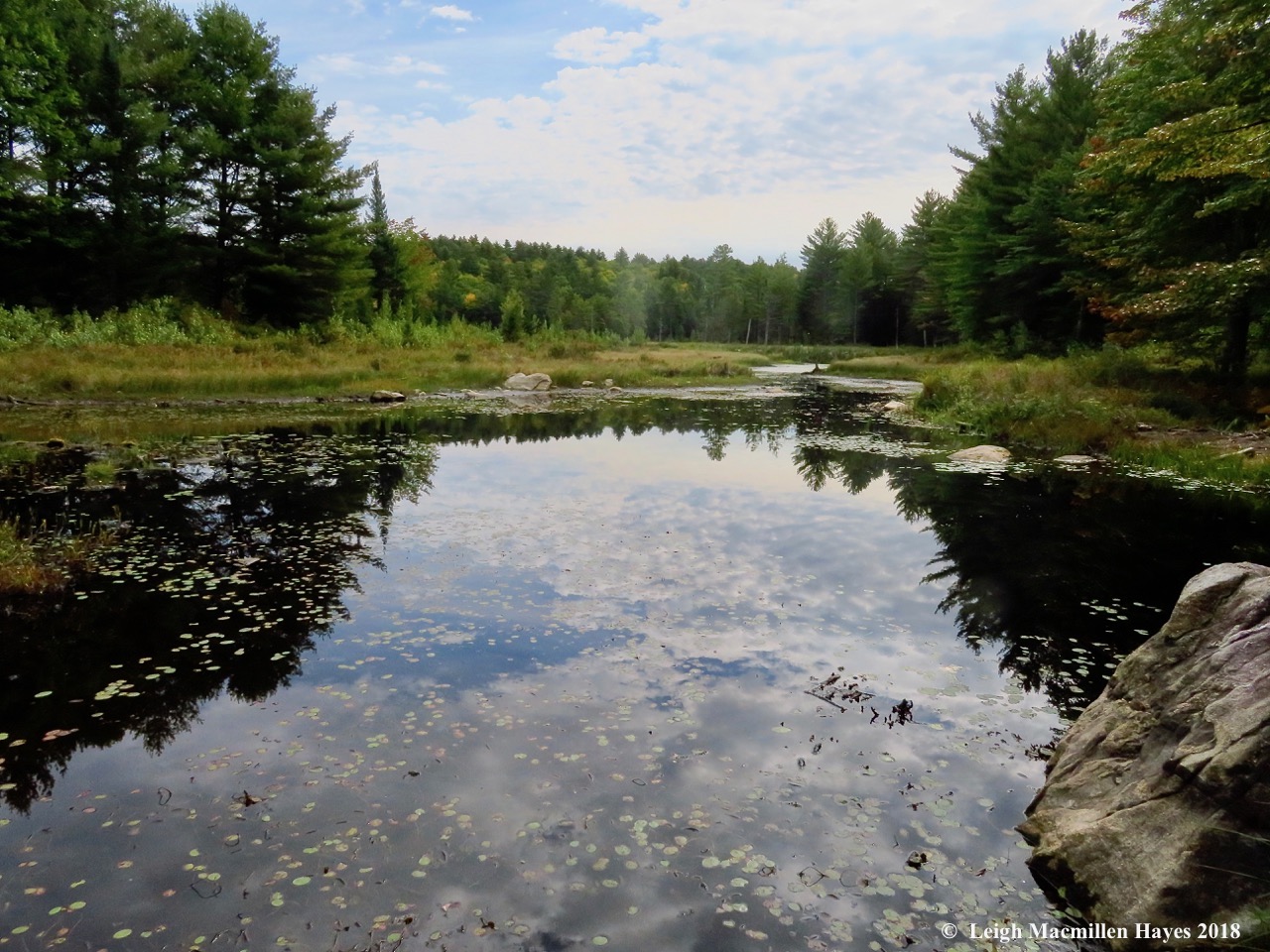
Not only did my hostess share her woodland habitat, which is so different from my own, but she also took me to a beaver pond. Our intention was to say hello, but by the depth we noted that the beavers aren’t currently home. We’ll have to call on them another day during my stay.

8-green frog

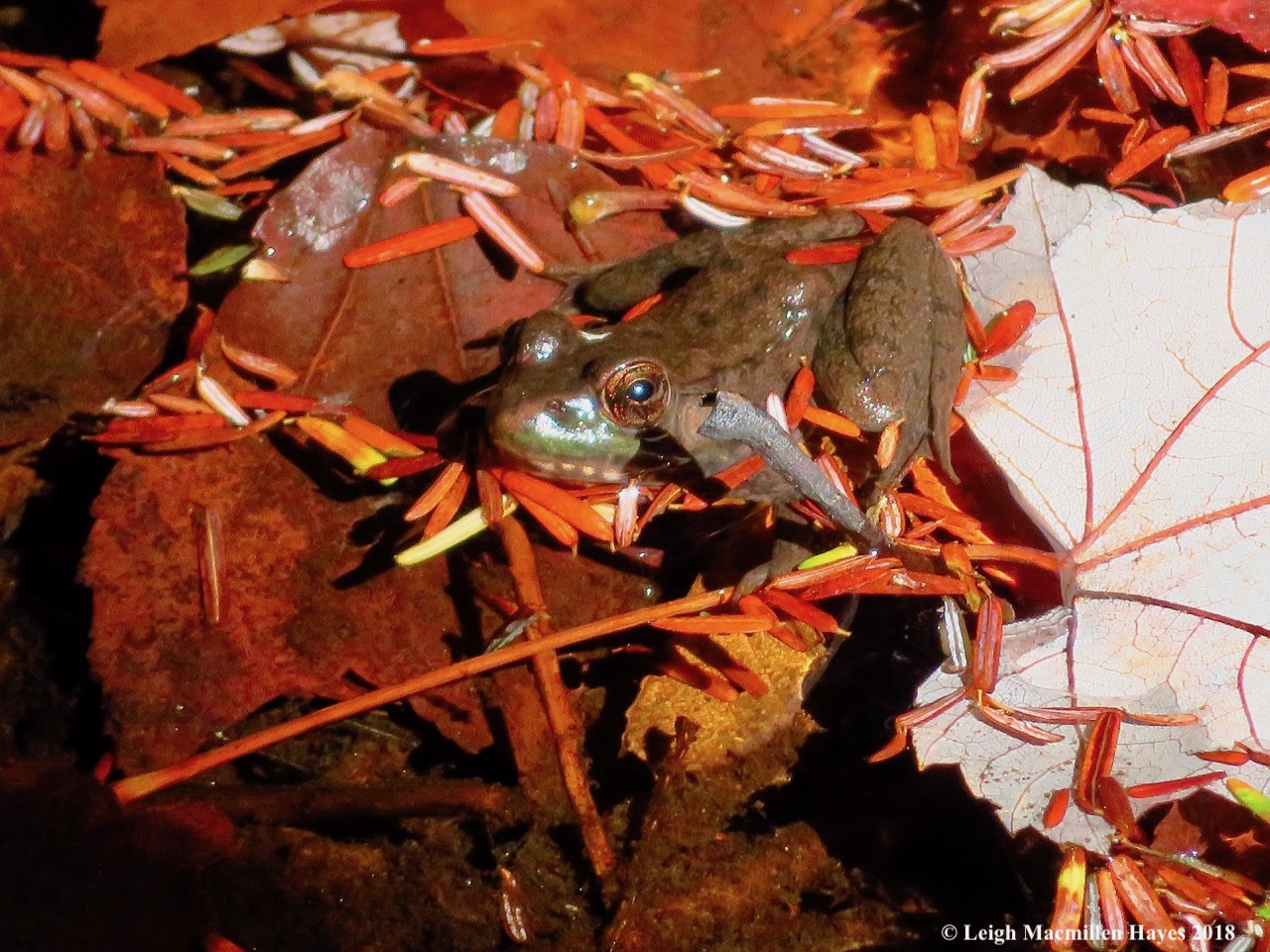
What we did find were green frogs that squeaked as we approached and then leaped into the water to hide.

9-sundews, both round-leaved and spatula-leaved

As a gift for her hospitality, I was able to share something with my hostess–in the form of round-leaf and spatula-leaf sundews that grow at the water’s edge. Both are carnivorous and so she can now add another parlor trick to entertain her guests–feed insects to the plants.

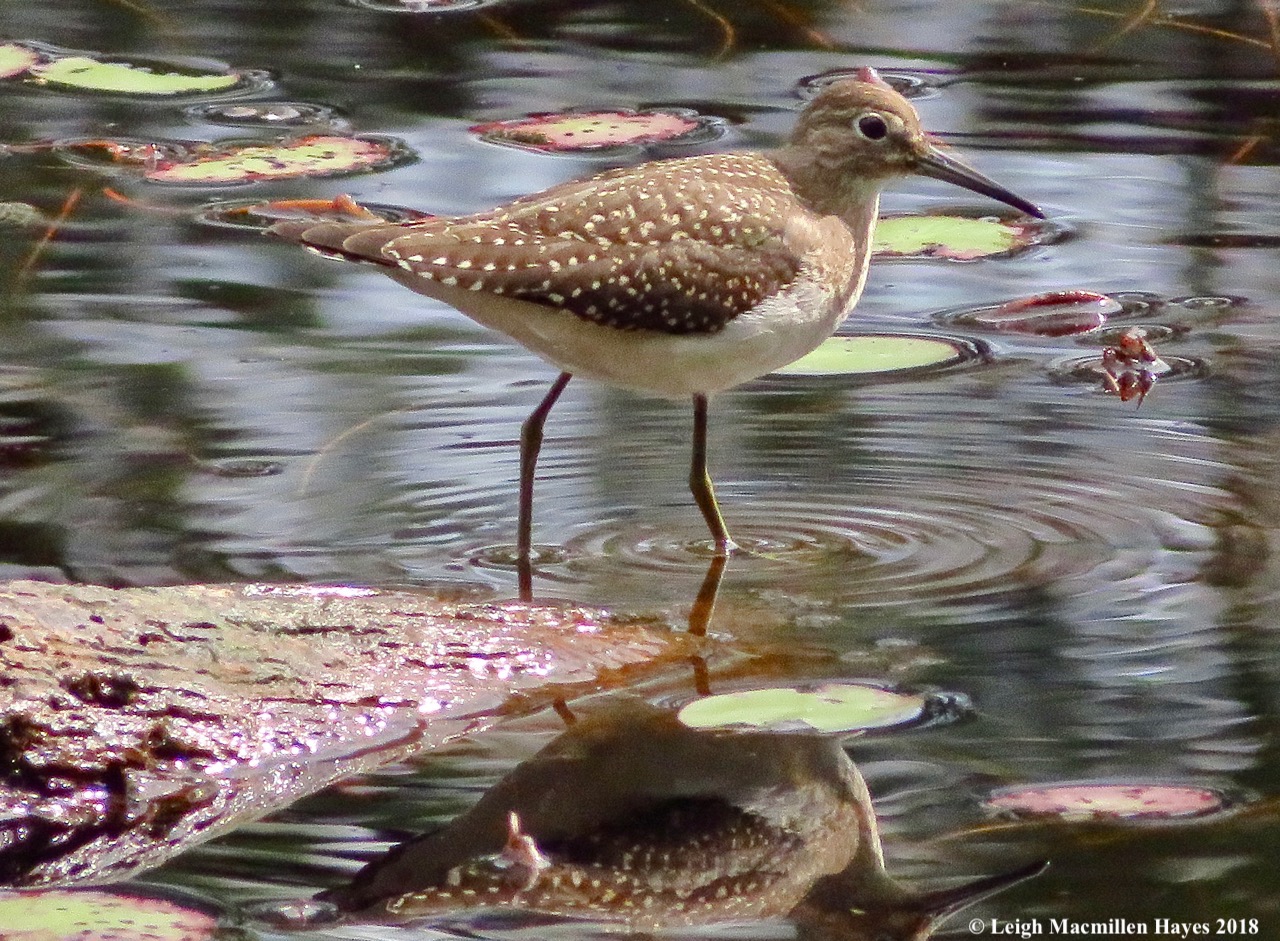
7-solitary sandpiper

One final scene to share because she and I shared the same view: a Solitary Sandpiper on the hunt. We watched for a few minutes before it flew off.

And now it’s time for me to fly home. But the airmail has been stamped and if you have read this then you are on the receiving end of postcards from Sweden. Sweden, Maine, that is.

Thank you to my hostess, J.M., for your kindness and willingness to share so many special scenes with me. I can’t wait to return to your neck of the woods.


Detecting the Nature of Wilson Wing

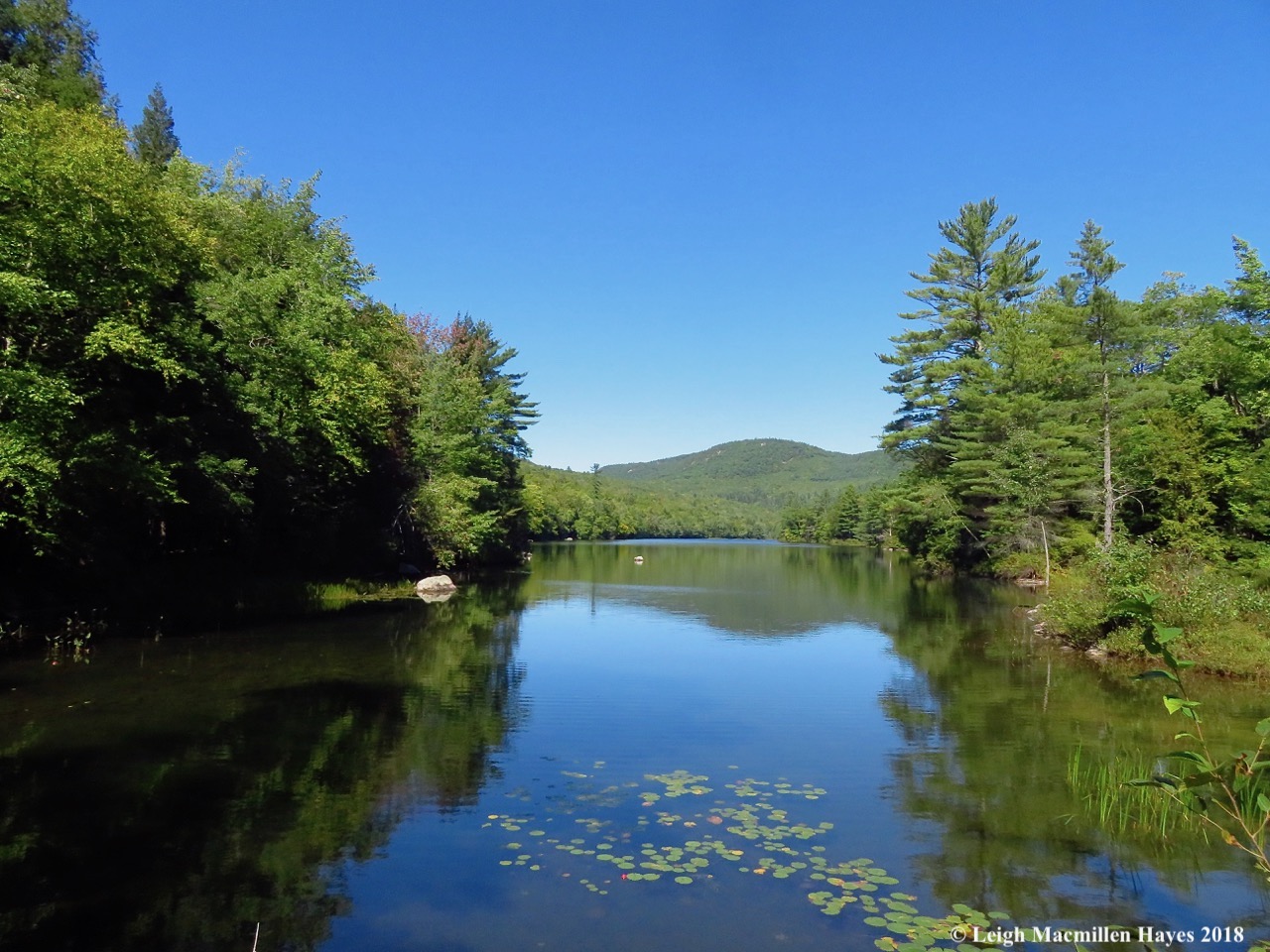
Before heading onto the trail beside Sucker Brook at the Greater Lovell Land Trust’s Wilson Wing Moose Pond Bog Preserve on Horseshoe Pond Road in Lovell, today, a friend and I walked down the road to the pond where we hunted for dragonflies and frogs.

1-Horseshoe Pond

There wasn’t a cloud in the sky on this first day of fall and a crisp day it was, bringing smiles to our faces and adding sweatshirts to our attire.

3-green frog

Though we saw a few darner dragonflies and even a meadowhawk, it was the green frogs that we spent the most time trying to spy for they blended in well with their grassy surroundings at the water’s edge.

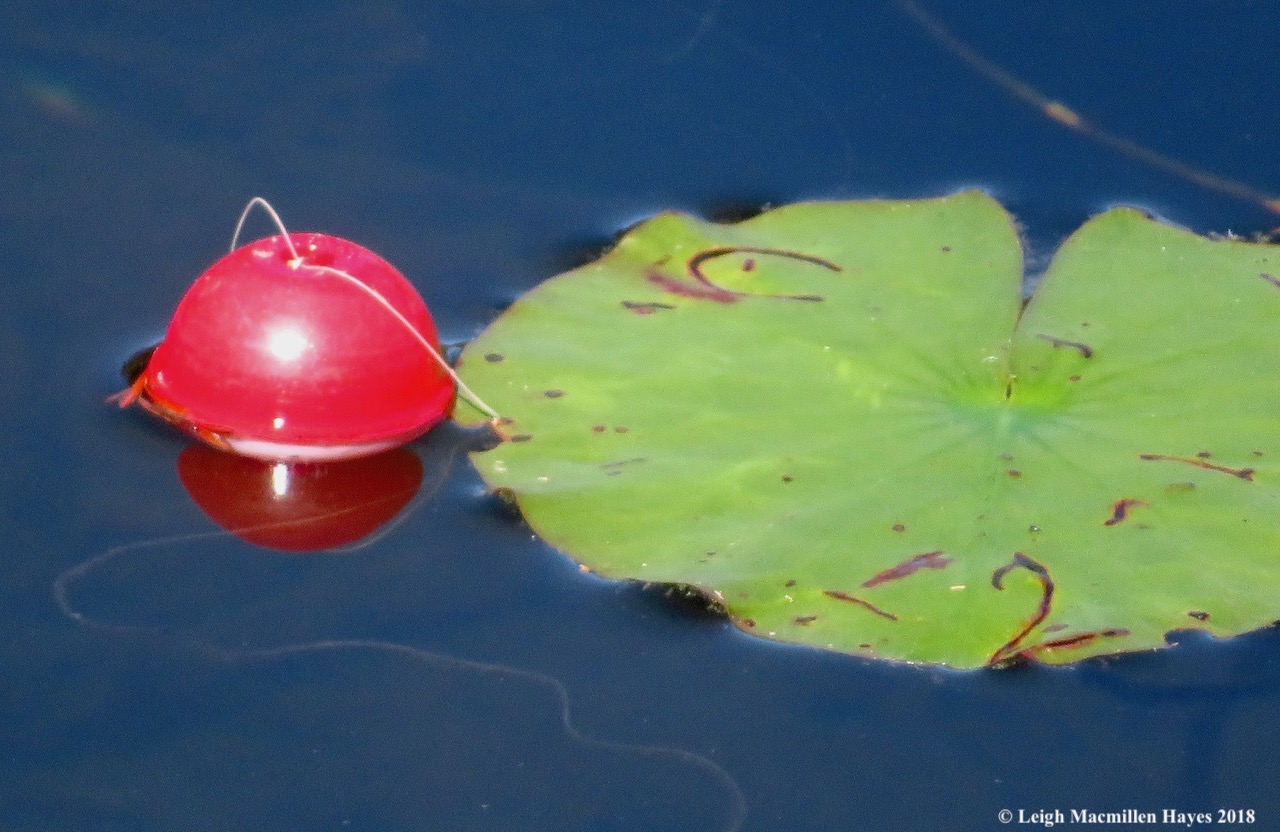
2-bobber

A bit further out, and unfortunately beyond our reach, we spotted a bobber and fishing line. While it offered a picture filled with color and curves, the reality wasn’t so pleasant.

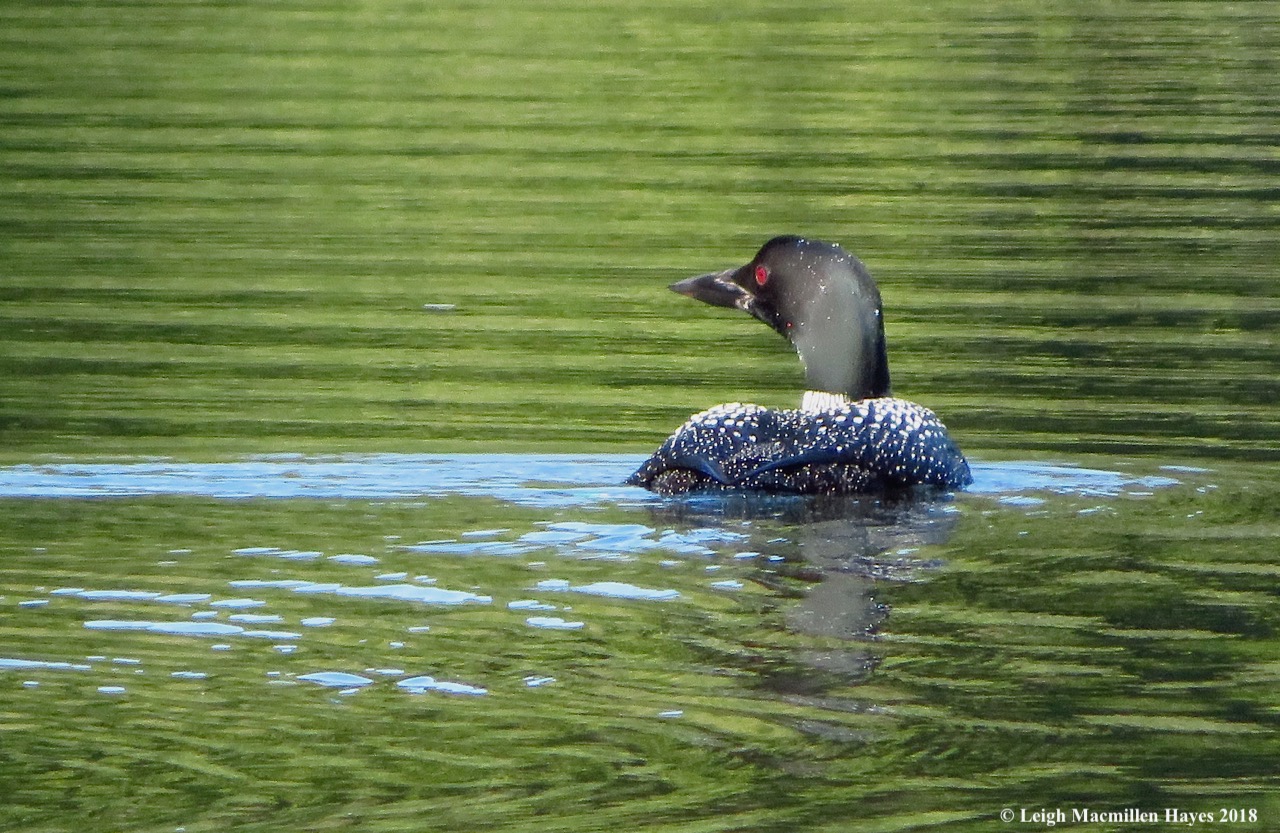
4-Common Loon

Nearby, this loon and a youngster swam and fishing line left behind is bad news for them as they could get tangled in it. Please, please, please, if you are near the Horseshoe Pond boat launch, and have the means to retrieve the bobber, do so. And if you are anywhere else in this world, do the same–for the sake of all birds everywhere.

7-Sucker Brook

At last, we pulled ourselves away from the pond and followed the brook that flows from it–Sucker Brook.

5-Jack in the Pulpit

Right away, we were in awe of the Jack-in-the-Pulpit plants with fruits still intact. Jack is actually a curious plant and sometimes channels its feminine side. While the plant starts life as a male, if the soil is poor, it turns female, flowers and bears seed. It could turn male again. In the case of what we saw today, meet Jill.

6-thin maze polypore

As our journey continued, we noted fungi everywhere. Some had rotted and added to the earthy smell of the woods. Others displayed their unique structures, colors, and lines, including the Thin-mazed Polypore.

11a-earth tongue

We also found at least one Black Earth Tongue, its common name reflecting its tongue-like appearance as it stuck up from the ground.

11-Dead Man's Finger

And in keeping with human body parts, we noticed a singular Dead Man’s Finger. But . . . its presentation offered questions we couldn’t answer. It was our understanding that on Xylaria longipes the young fruiting bodies would be covered with a whitish or gray powder in the spring. The powder isn’t really a powder, but rather the asexual spores of the species. So, did we find a confused youngster? Or was it an oldster parasitized by a mold?

10-Choclolate Tube slime

Speaking of molds, we stumbled upon a log featuring a feathery appearance reminiscent of antennae on a moth or butterfly. Well, maybe a collection of antennae. A huge collection.

10a-chocolate tube slime

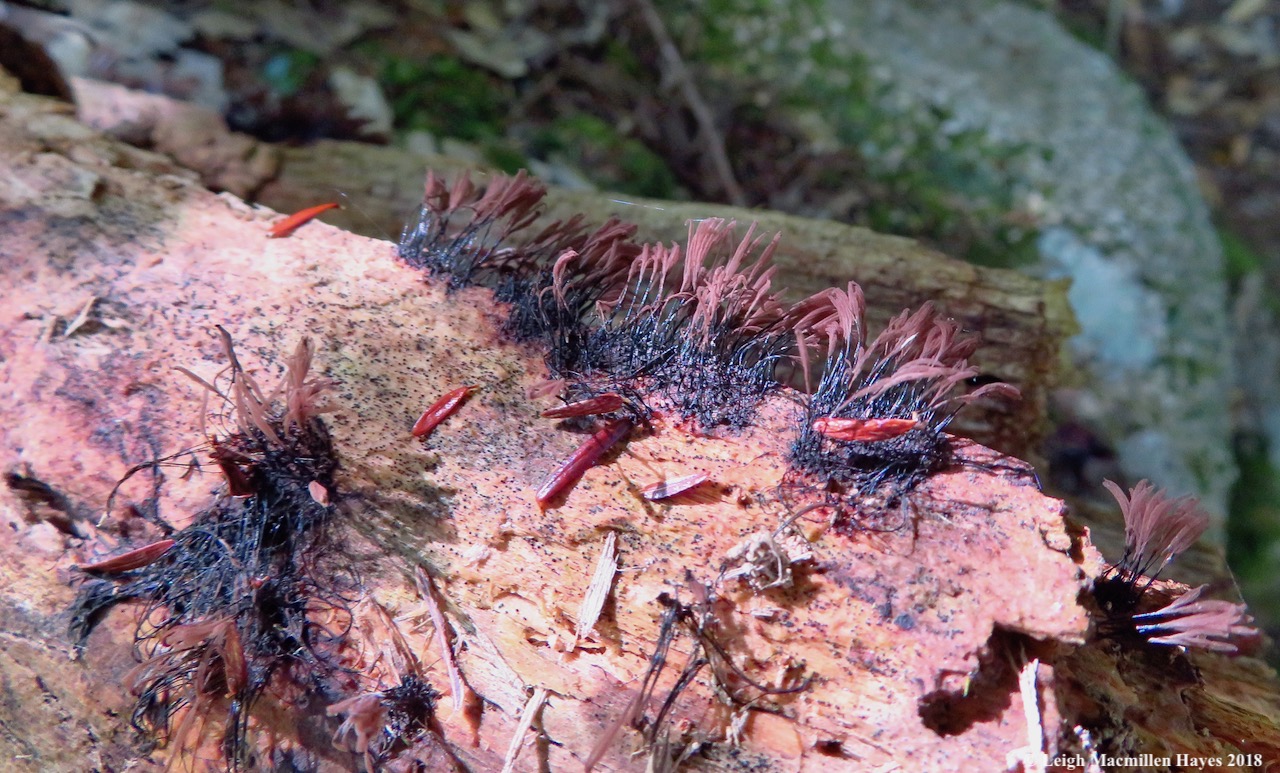
Turns out it was Chocolate Tube Slime, a new discovery for me. In his book, Fascinating Fungi of New England, author Lawrence Millman describes it as “dozens of erect, brown tubes mounted on thin, seemingly polished black stems.” Bingo.

9-green frogin sucker Brook

Also appearing a bit chocolate in color was another green frog. And being the first full day of autumn, I began to realize that my time spent admiring amphibians and dragonflies will soon draw to an end. But . . . on the horizon . . . tracks and scat ;-)

8-Conocephalum salebrosum

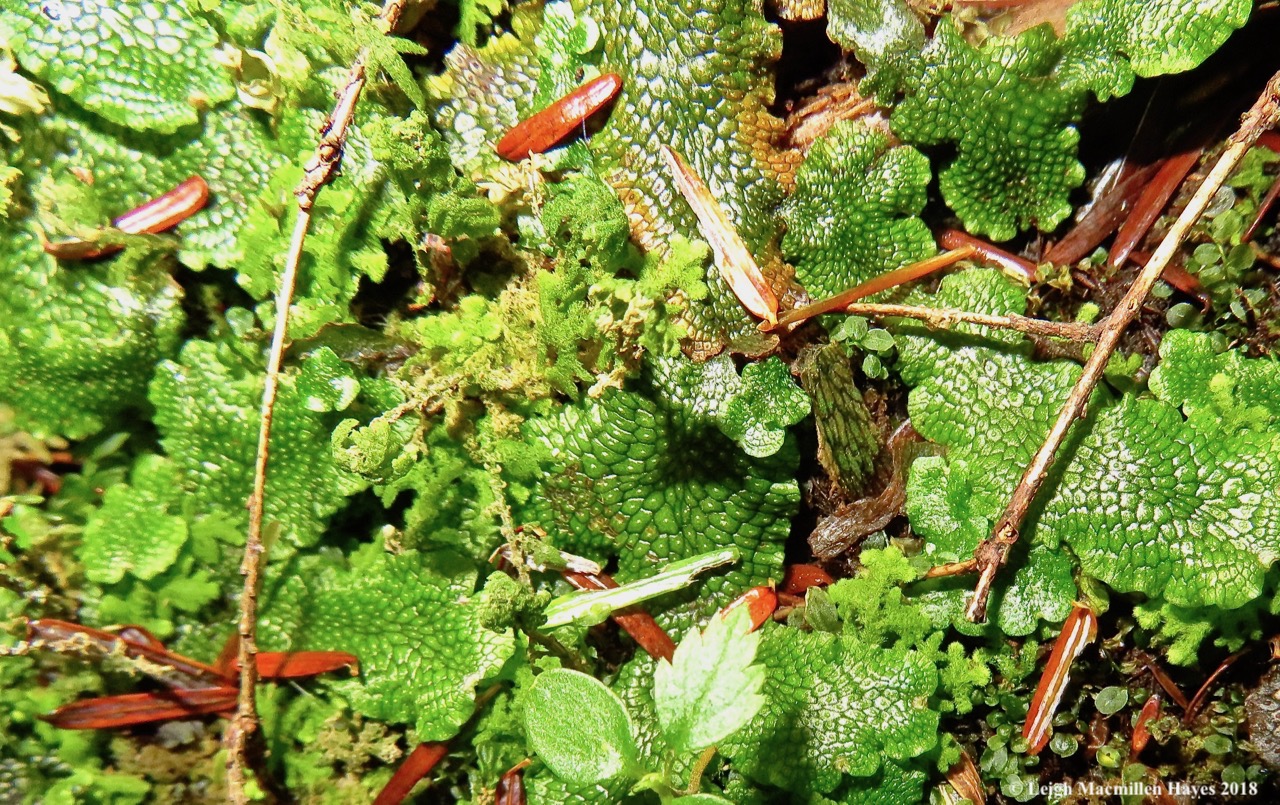
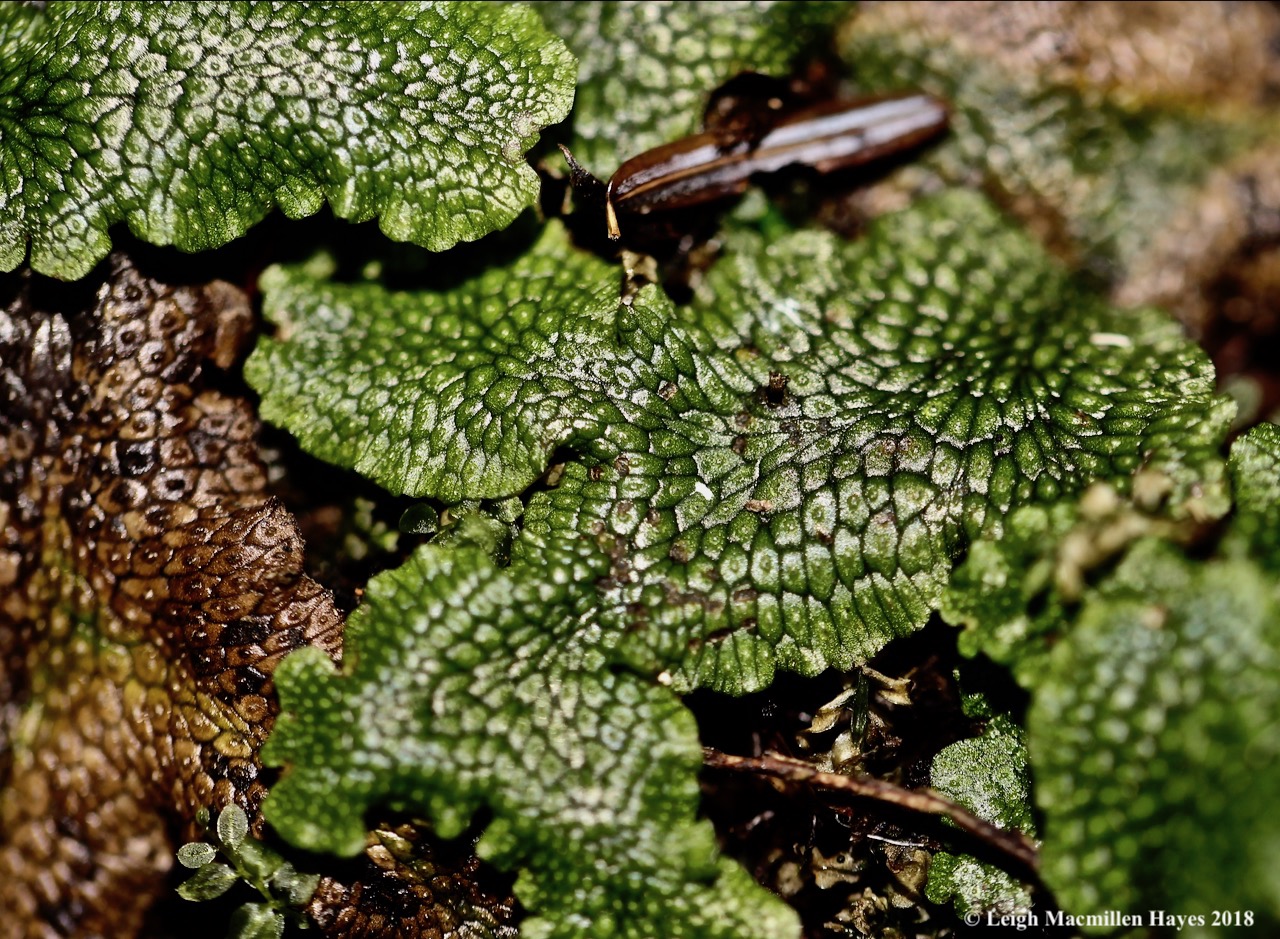
Because we were beside the brook, and we’d seen this species before, we searched each and every rock and weren’t disappointed. Conocephalum salebrosum showed off its snakeskin-like leaves.

8b-cono

The conspicuous grooves of the thalli on this liverwort defined the surface and gave it that snakeskin appearance.

12-Moose Pond Bog

Continuing on, we finally reached the platform and climbed up to look out toward Moose Pond Bog. Of course, we hoped to see a moose. No such luck. We did spy one dog named Bella and her owner, Meg Dyer, the Lovell Rec Director, out for a Sunday walk in the woods. But they were on the trail below us and not in the bog. One of these days . . . maybe we’ll see a moose. When we least expect it, that is.

12-winterberry fruits buried

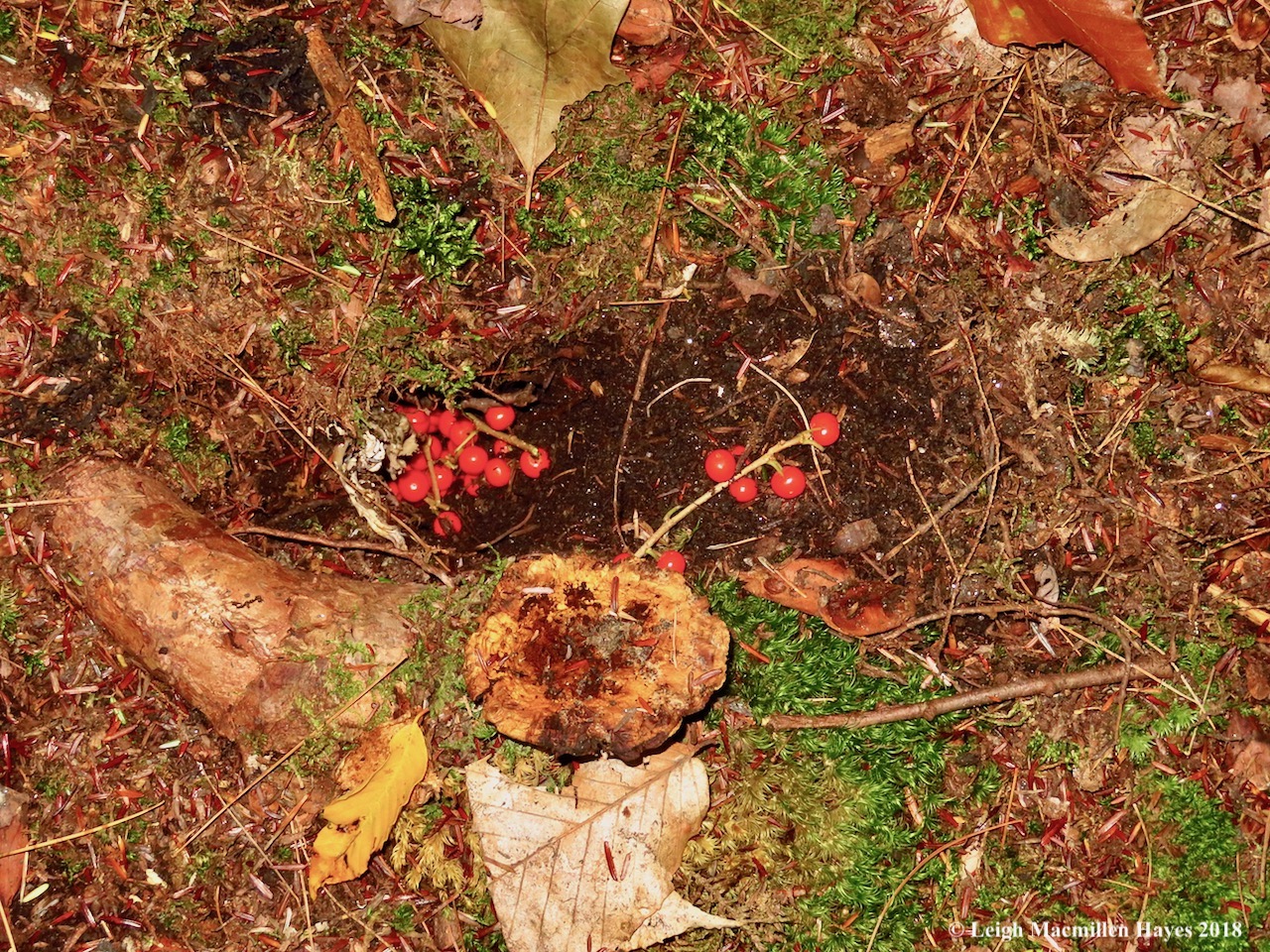
Back on the trail ourselves, our next great find–winterberries in a recently dug hole about four inches deep. Who done it? We poked the hole with a stick and determined that it didn’t go any deeper or have any turns, such as a chipmunk might make. Nor did it have a clean dooryard, which they prefer. Turkey? Perhaps. Squirrel?

13-winterberries among midden

We think we answered the question for on top of a tall hemlock stump that has long served as a red squirrel diner, some red winterberries appeared among the pine scales left behind.

14-liverwort?

Almost back to the road, we crossed the final bridge and then backtracked. We knew our destination was up the streambed it crossed over and were thankful that it held not much water. That meant we could climb up and take a closer look at the large boulders in the middle. And it was there that we made a new discovery.

14a-Peltigera aphthosa

You see, in the past we’ve not been able to get too close to the boulders and from a bit of a distance we were sure we had looked at more snakeskin liverwort. But our ability to get up close and personal today made us question our previous assumption. Suddenly, the gray-green leafy structure took on a more lichen-like appearance. Though its color wasn’t the same, it very much reminded me of rock tripe.

14c-Peltigera aphthosa

We studied its lobes and structure, including the tiny warts and questioned ourselves as we continued to examine it. I kept thinking it was an umbilicate based on the way it adhered to the rock substrate.

14b-Peltigera aphthosa

A little research and I think I’ve identified it correctly, but know some will alert me if I’ve assumed too much–Peltigera aphthosa, aka Freckled Pelt Lichen, also called Spotted Dog Lichen. The bright green center indicated it was wet. From borealforest.org, I learned that the little warts contain tiny colonies of cyanobacteria, which supply the lichen with nitrogen.

15-Racomitrium aciculare?

And right beside the lichen, we found a moss that also reminded us of a liverwort for it resembled Bazzania. But . . . if I identified this correctly, it’s Racomitrium aciculare. Some know it as Yellow-fringe Moss.

15a-Racomitrium

In his book, Mosses, Liverworts, and Hornworts, Ralph Pope described it as “common on wet rocks along streams and under waterfalls.” In watery seasons for this particular stream, that would be its exact location–under a waterfall.

16-dry stream bed

Today, the stream bed leading down to Moose Pond Bog and Sucker Brook was just about dry. But . . . because of that we were able to take a closer look.

In fact, it took us almost four hours to follow the mile or so trail, but it was all about taking a closer look through our 10X lenses and cameras, slowing down our brains,  and channeling our inner Nancy Drew as we paid attention to clues and tried to decipher the scene around us–all the while detecting the nature of Wilson Wing.


Long Speck-tacular

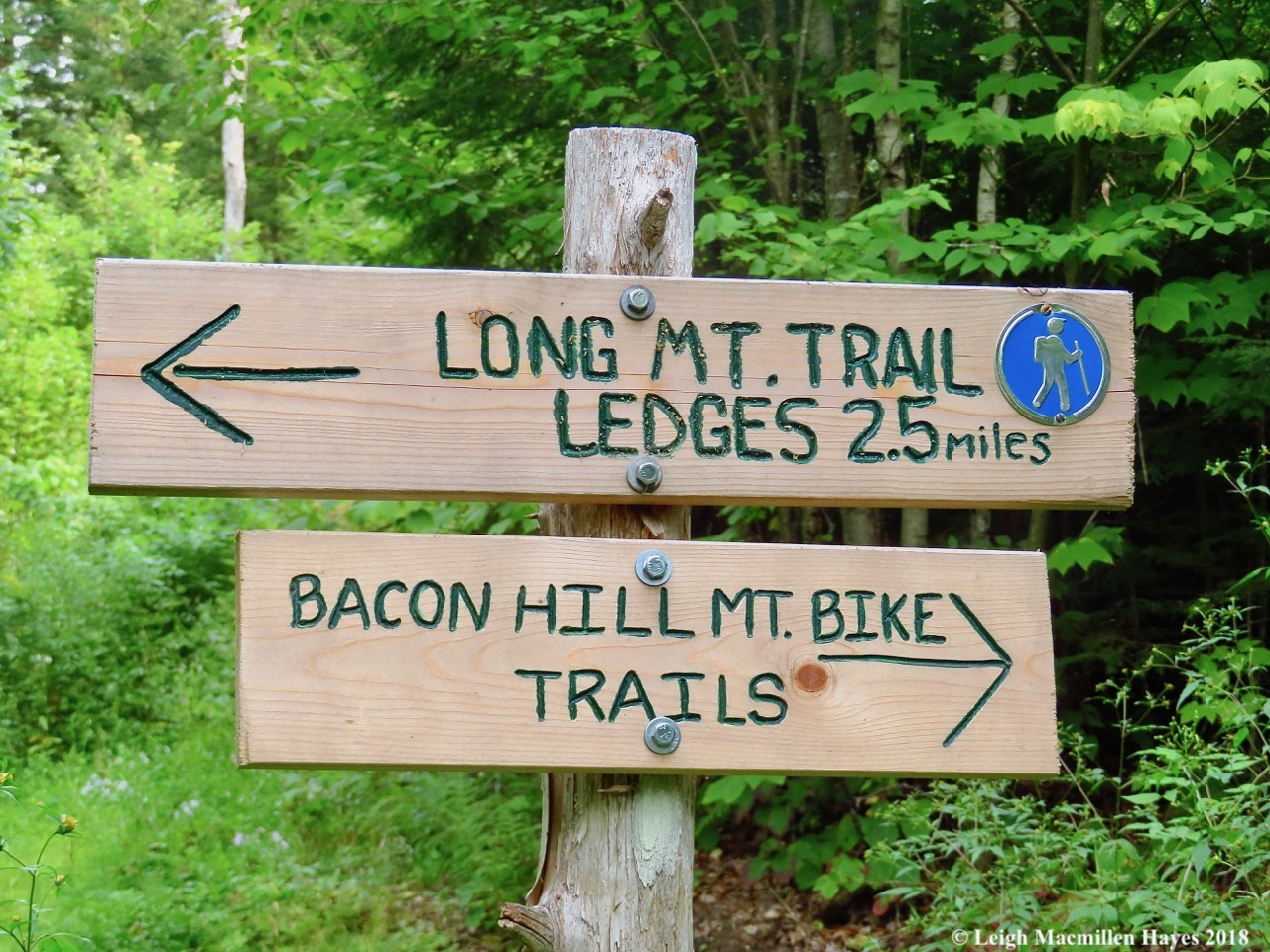
I suggested two hikes today to my guy and rather than choose one, he thought both sounded perfect. And so our journey began about noon as we ascended the 2.5 mile trail that twists and turns beside Mill Brook. Our destination: Long Mountain Ledges off Vernon Street in Albany, Maine, a property owned by Mary McFadden and Larry Stifler. Through their generosity, many trails in the area are open to the public. And through the work of their employee, Bruce Barrett, those trails are well maintained.

1-Long Mtn Trail

And well marked.

2-through the bog

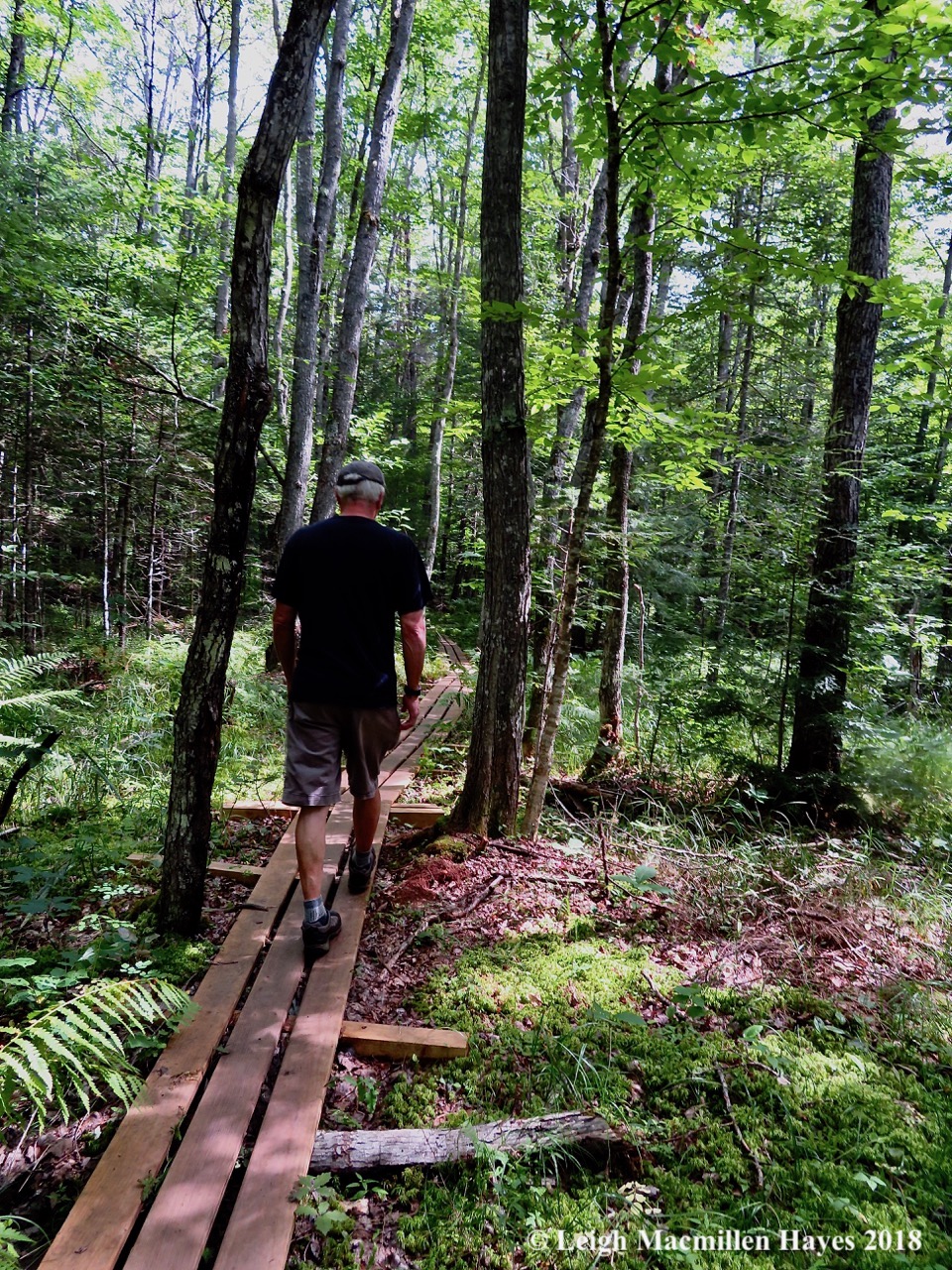
At the start, a long series of boardwalks passes through a wettish area where so many ferns, and mosses, and wildflowers grow.

3-blue cohosh

Some, such as the Blue Cohosh, have matured to their fruiting stage–and their leaves hinted that another season is in the near offing.

4-red-belted polypore appearing to sweat

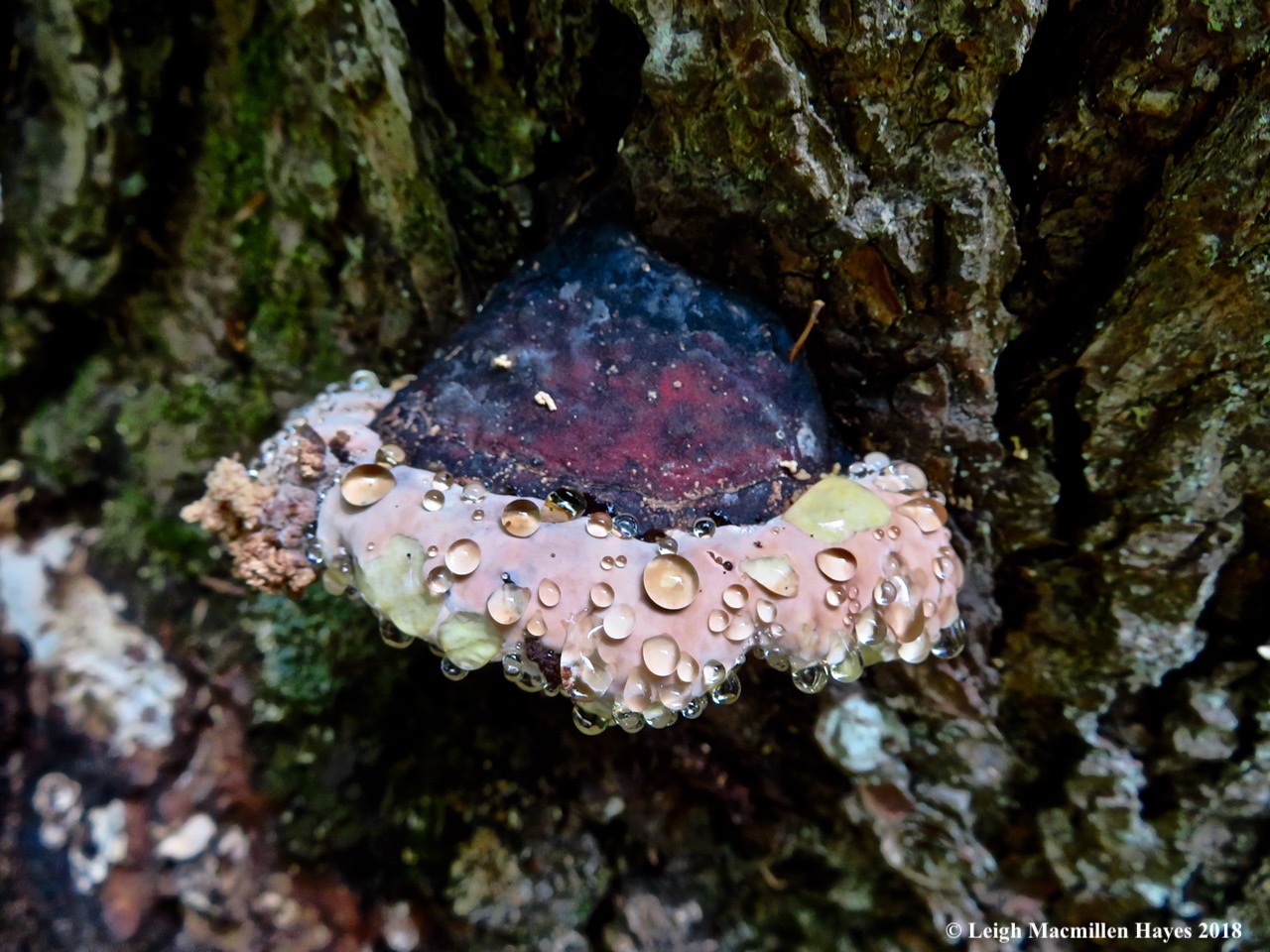
Once we began to climb, the natural community changed and so did the residents. One in particular reminded me that I have yet to understand its behavior. Why does the Red-belted Polypore weep, I wondered. It’s not a case of morning dew for nothing else appeared to have droplets of water. In searching for an answer, I learned a new word: gut·ta·tion–/ɡəˈtāSHən/, noun: the secretion of droplets of water from the pores of plants. On gardeningknowhow.com, I found this explanation: “The plant doesn’t always need the same amount of moisture. At night, when temperatures are cool or when the air is humid, less moisture evaporates from the leaves. However, the same amount of moisture is still drawn up from the roots. The pressure of this new moisture pushes out the moisture that is already in the leaves, resulting in those little beads of water.” If this is correct, I’m assuming the same is true for fungi.

5-pancake fungi

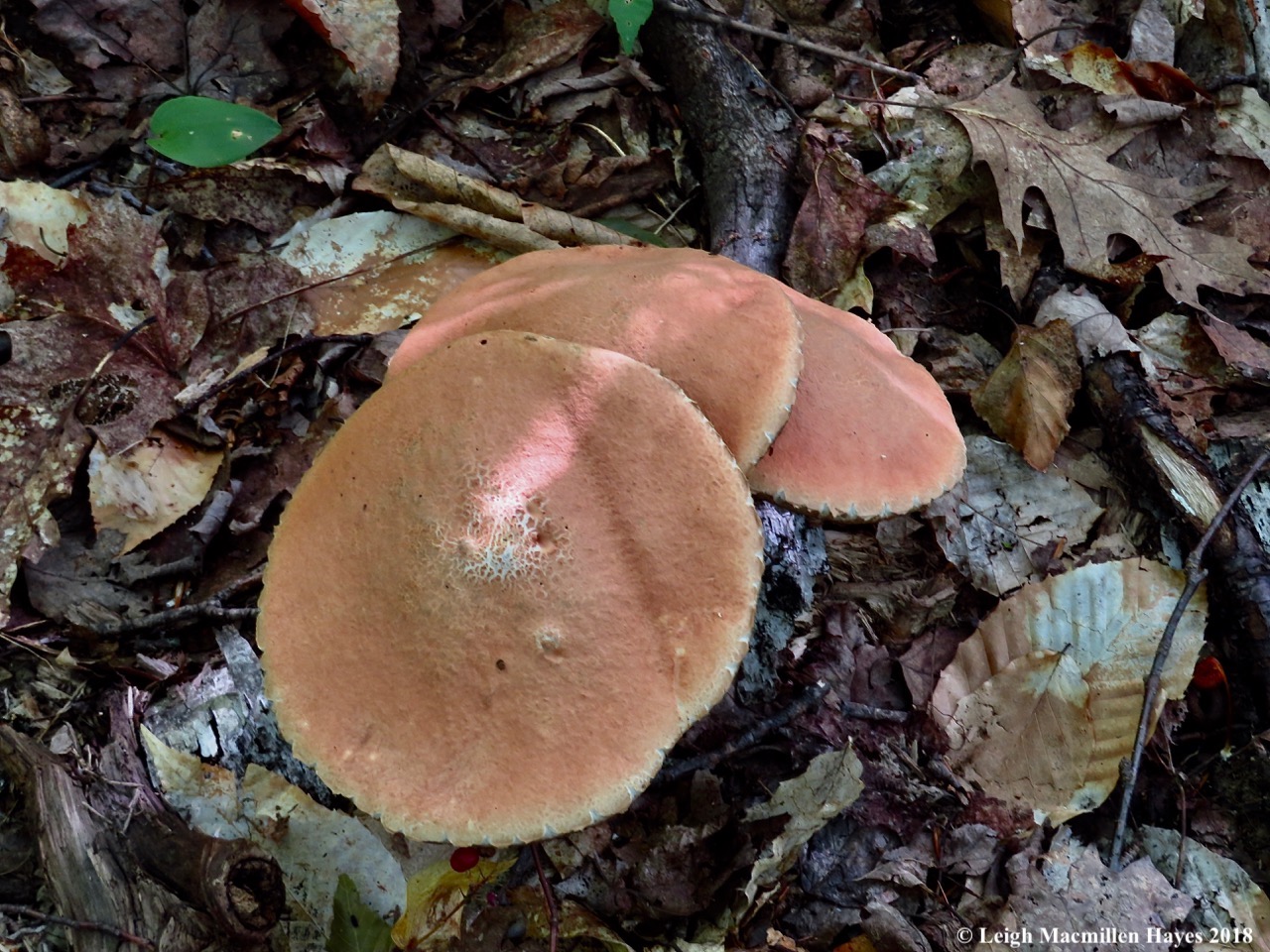
There were plenty of other mushrooms to see, including the pancake fungi my guy pointed out. He’s such a mushroom guru (NOT) that I instantly believed his identification. After all, they were plate-size and did resemble pancakes. All they needed were some blueberries, butter, and maple syrup.

6-Long Mountain Trail Ledges

Because the trail was so well created, it hardly felt like a climb and in just over an hour we had reached the ledges where the view included Round Mountain to the immediate left, also owned by the Stiflers, and the Whites in western Maine and eastern New Hampshire beyond. Suffice it to say, this was lunch rock.

7-crown-tipped coral

We descended via the same trail and I love doing that because there’s always something different to see. Today, it was a purple coral fungi. Did it begin life as a different color and the purple was a sign of maturity, I wondered. It didn’t matter. What mattered was that I couldn’t recall ever seeing that color before and it seemed rather royal.

8-hobblebush berries

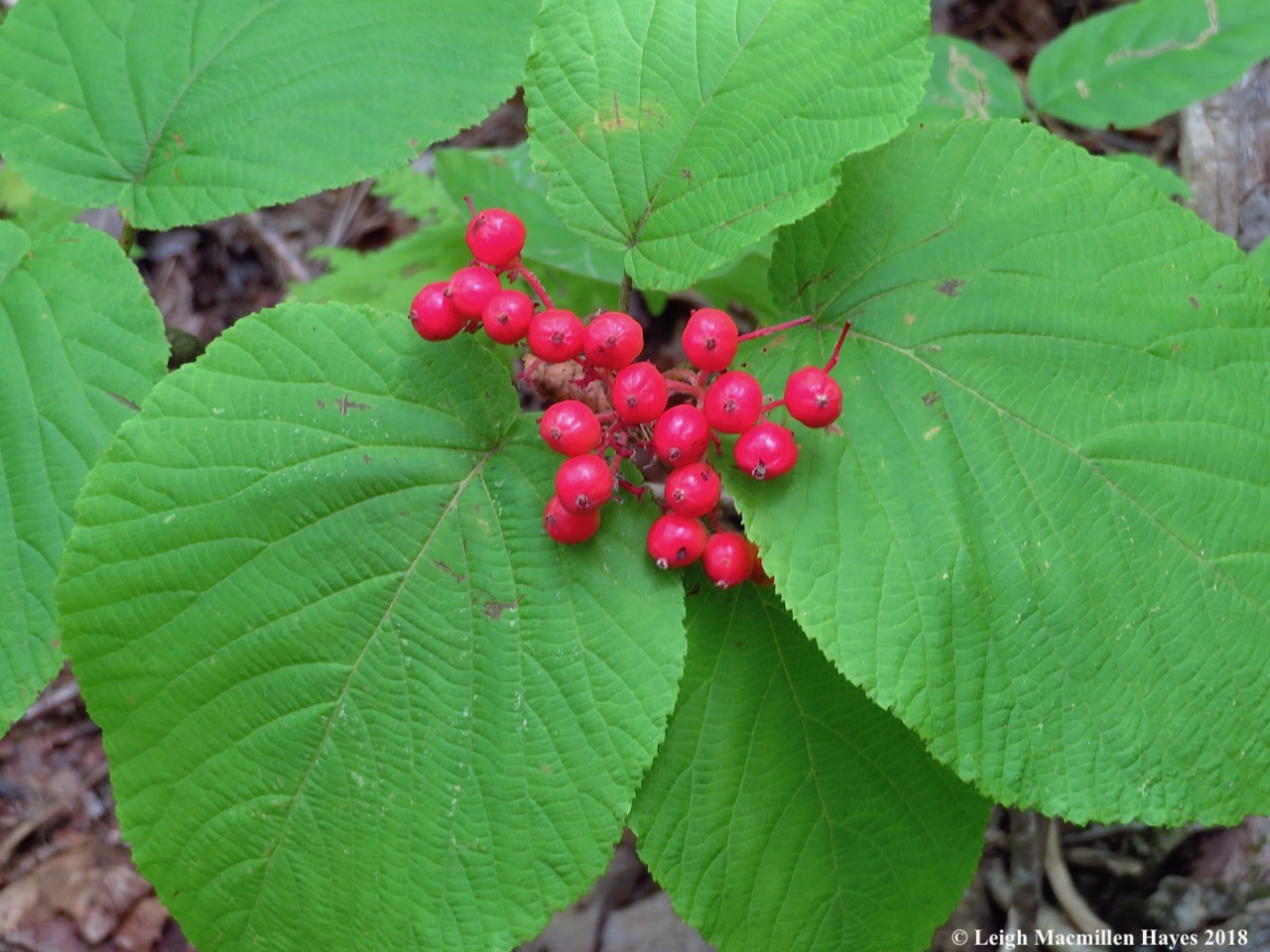
There were also hobblebushes to admire, they’re green leaves and red berries adding a bit of Christmas joy to the scene. OK, so I’m rushing seasons, but I am a winter gal.

9-heading out

Five miles and 2.5 miles later, we walked back across the board walk, hopped into the truck, and drove south.

10-Speck Ponds Trail

For all of ten minutes, for our next destination was another property owned by the Stiflers. This time, we followed Hunts Corner Road to Hutchinson Pond Road and looked for the trailhead to the Speck Ponds Trail. If you go, know this, drive until you think you are almost there, and then drive some more. It’s located on the right, along the dirt portion of the road, just after the mailbox tucked into a canoe! Huh? You’ll have to take a look for yourself to understand what I mean.

11-the chair

I’d heard that some trail improvements had been made since I’d last ventured there. Indeed, they had, including new red trail blazes and an Adirondack chair by the trail map. The significance of the chair, however, wouldn’t be revealed to us until we finished. Onward we journeyed.

12-Crossing the line

And crossed from Albany to Norway, Maine, via the woodland trail.

13-home of many beaver homes

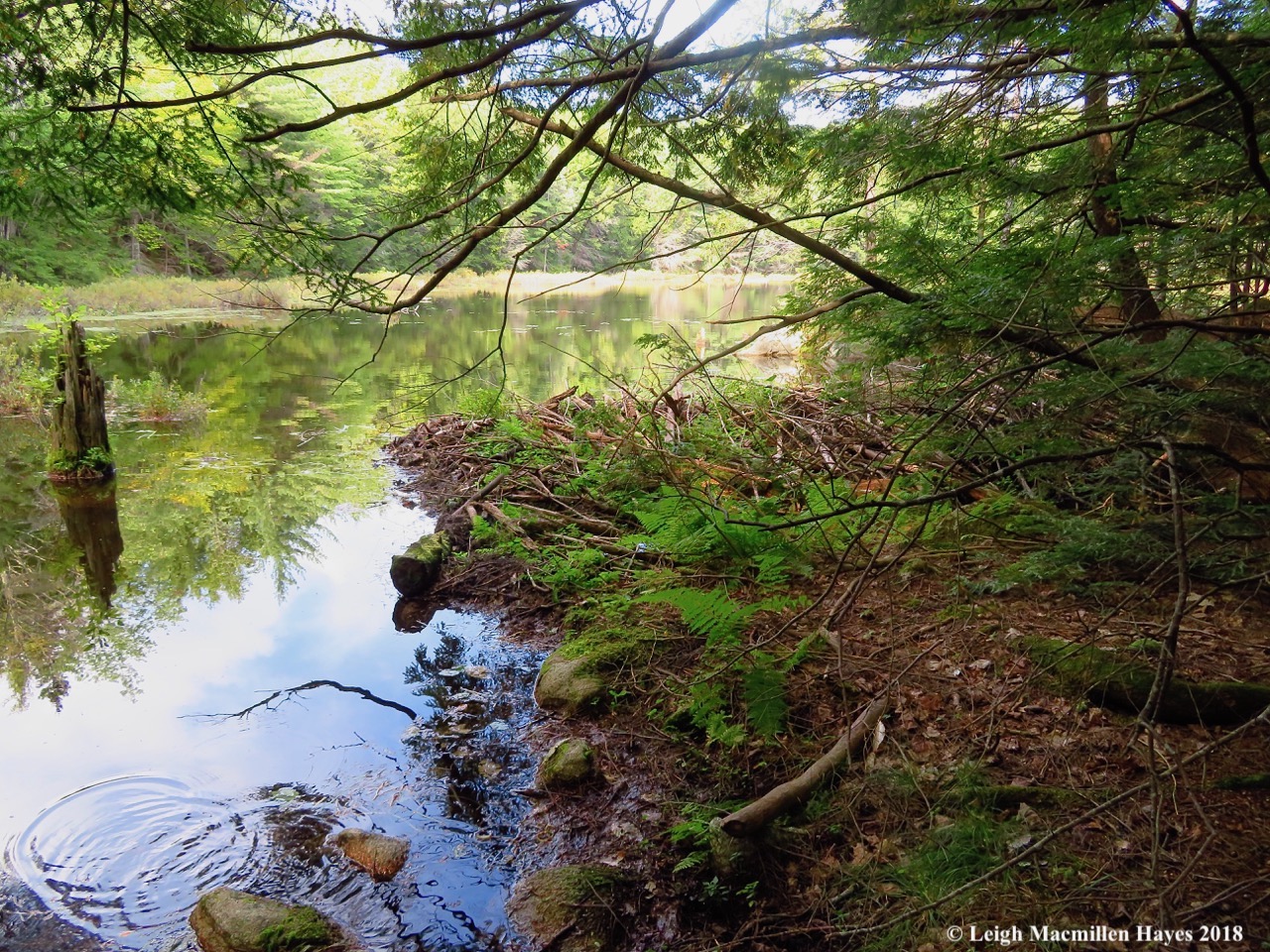
First, we circled halfway around Upper Speck Pond, noting signs everywhere that beavers had lived there in the past.

14-if this canoe could talk

And an old canoe that had its own stories of yore to tell. Somewhere, a family or group of friends know the history of this sunken artifact.

15-beaver dam on Lower Speck Pond

About halfway around, and really, directly behind the sunken canoe, another trail connects to the Lower Speck Loop. We followed it and eventually came to more beaver sign, including a dam with some new wood atop.

15a-beaverworks

Downed trees with freshly chopped chips also graced the area.

15b-beaver lodge

And another lodge. I lost count of how many we saw today, but suspected the one on Lower Speck was active.

16-Lower Speck Pond

We moved quickly as we circled round both ponds for my guy had visions of tonight’s pizza dinner on his mind. And maybe a Red Sox game that he was missing as well.

17-comorant

Despite our speed, we did pause to admire one of the pond residents–a cormorant.

A total of nine miles later, we’d climbed and circled and oohed and aahed and wondered along the way. Oh, and that chair, we considered sitting in it for we were hot and tired by the time we finished, but had we done so, we’d still be there–snoring away!

A Long Mountain-Speck Ponds Spectacular.


The Perks of Perky’s Path

It’s such a sweet trail and so named for Juanita Perkins, a local photographer and naturalist who was an avid member of the Greater Lovell Land Trust. To follow in her footsteps is not an easy task, but today I journeyed along the path trying to see what Juanita might have seen.

1-lancet clubtail

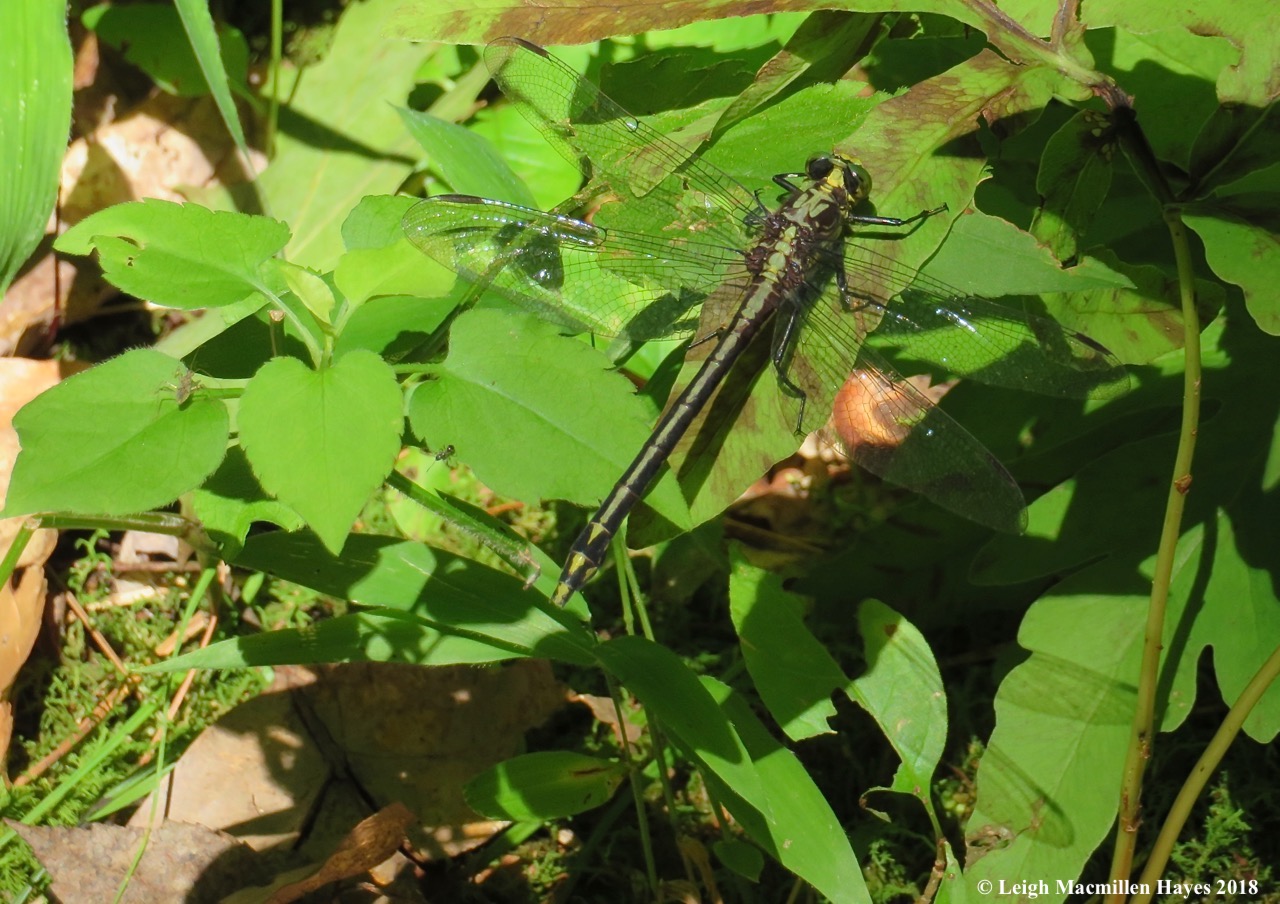
Immediately upon stepping down the trail, a clubtail dragonfly landed in front of me. Identifying dragonflies has become one of my passions of late, but still I struggle. And go back and forth. Lancet Clubtail or Pronghorn? I lean toward Lancet only because I’m not sure Pronghorns are a Maine species. But it’s to Dragonflies of the North Woods that I turn, and the abdomen that I try to zone in on. The abdomen consists of ten segments. Lancet: segment 8 has a smaller top spot and segment 9 is all yellow on top, (except for the female’s top spot which is narrower). Pronghorn: segment 8 has a smaller top spot and segment 9 is all yellow on top. Segment 10 has a narrow stripe. The Maine Odonata survey does not include the Pronghorn and so I find myself deciding on the Lancet. Suffice it to say, this is a clubtail.

2-ebony jewelwing damselfly

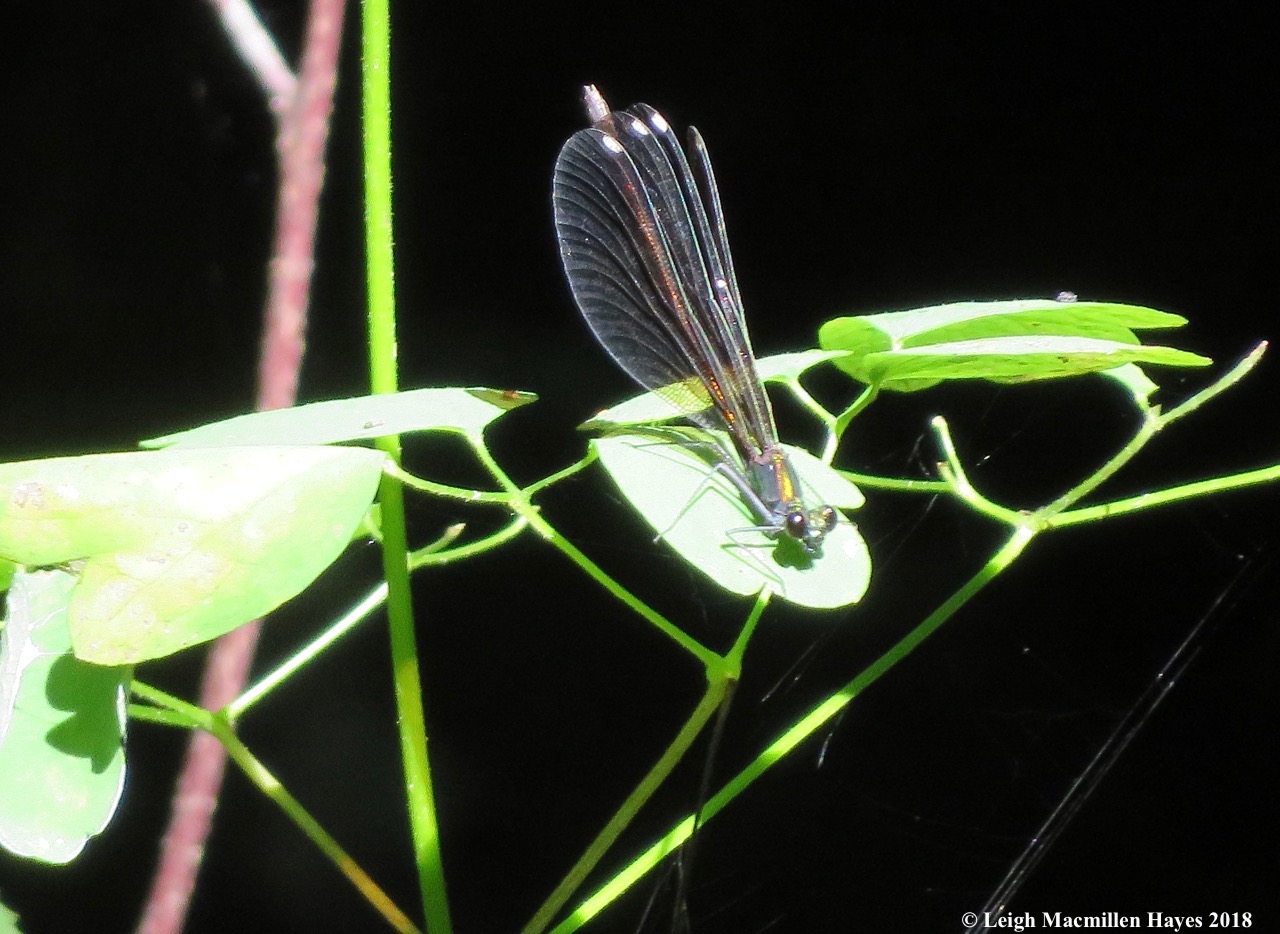
A much easier species for me to ID is the ebony jewelwing damselfly. Several danced and posed by the brook leading from the wetland the path encircles to Heald Pond. I trust that when Juanita traveled this path, she too saw the jewelwings dance, their bodies as bejeweled as their wings–maybe more so. A female’s wings are smokier in color than the males and each is dotted with one white spot at the tip.

3-male ebony jewelwing

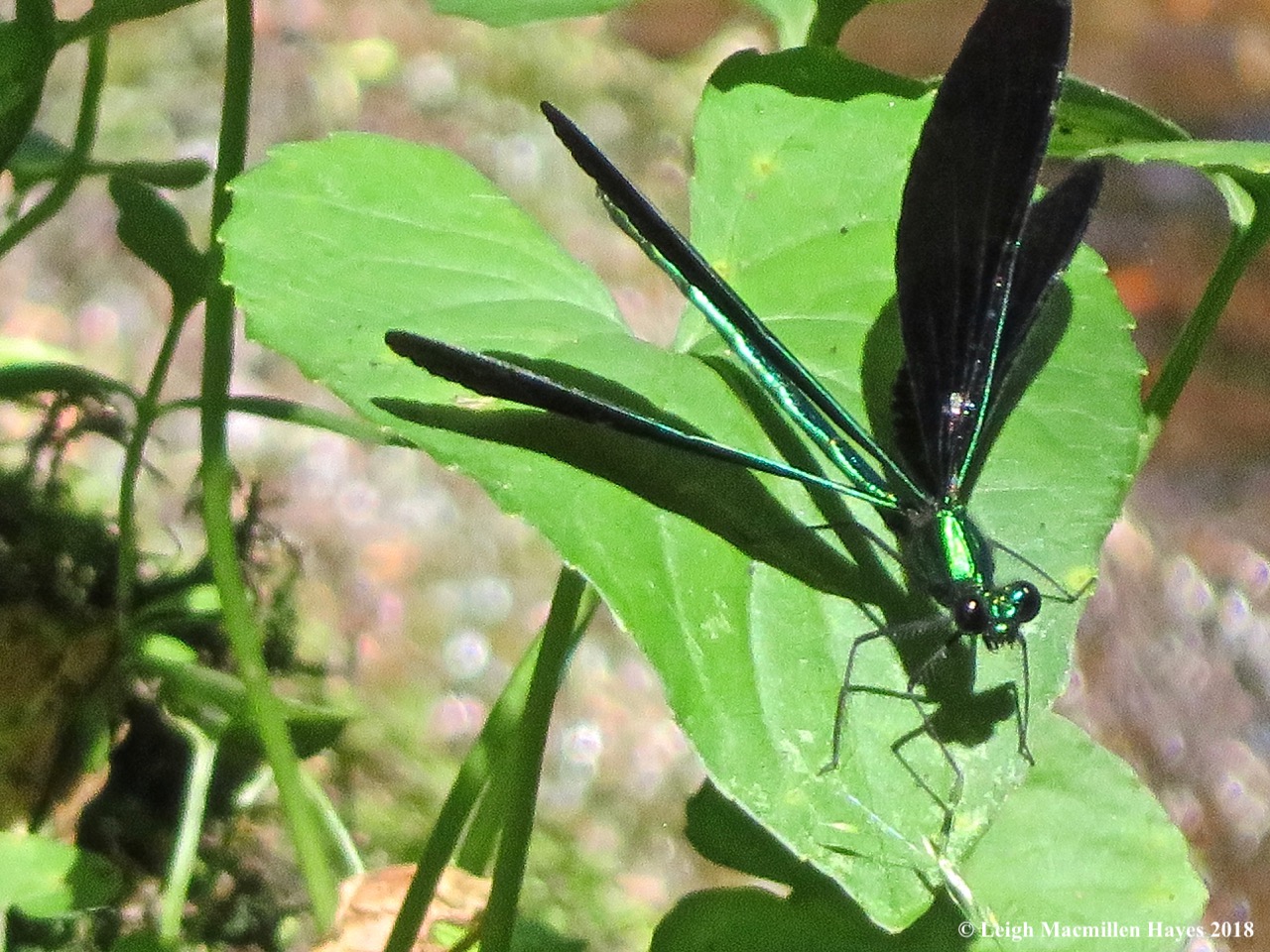
The male’s wings are more ebony in color and body more metallic. This handsome fellow had three ladies in waiting so he couldn’t pause for long.

4-trail sign

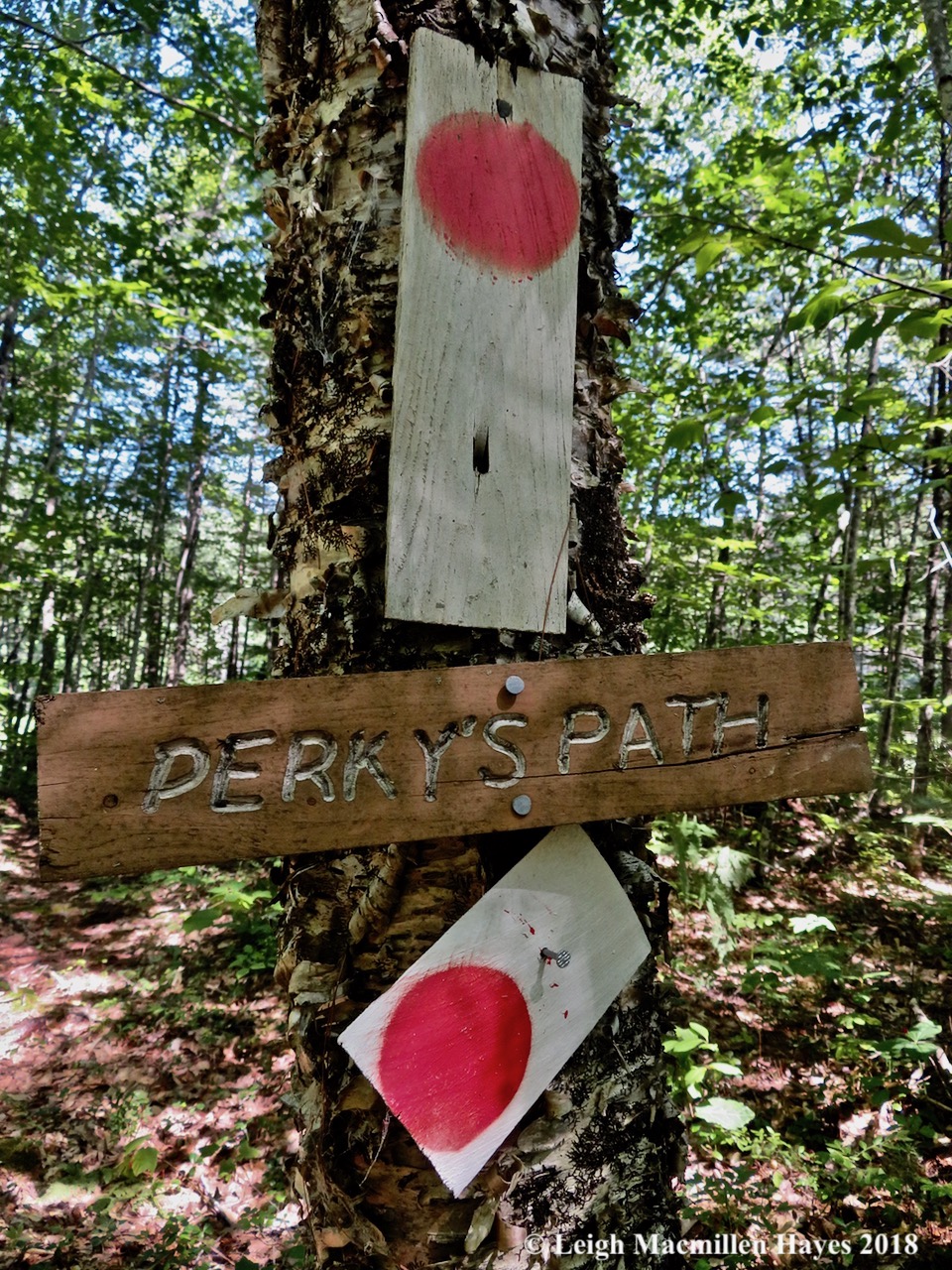
Though I refer to the entire loop as Perky’s Path, in reality I hadn’t even reached it by the time I encountered the “You Are Here” sign. I’d actually been walking along a snowmobile trail that is part of Heald and Bradley Ponds Reserve.

5-perky's path

It was a couple of tenths of a mile later that I finally stepped onto the path blazed with orange.

6-bench

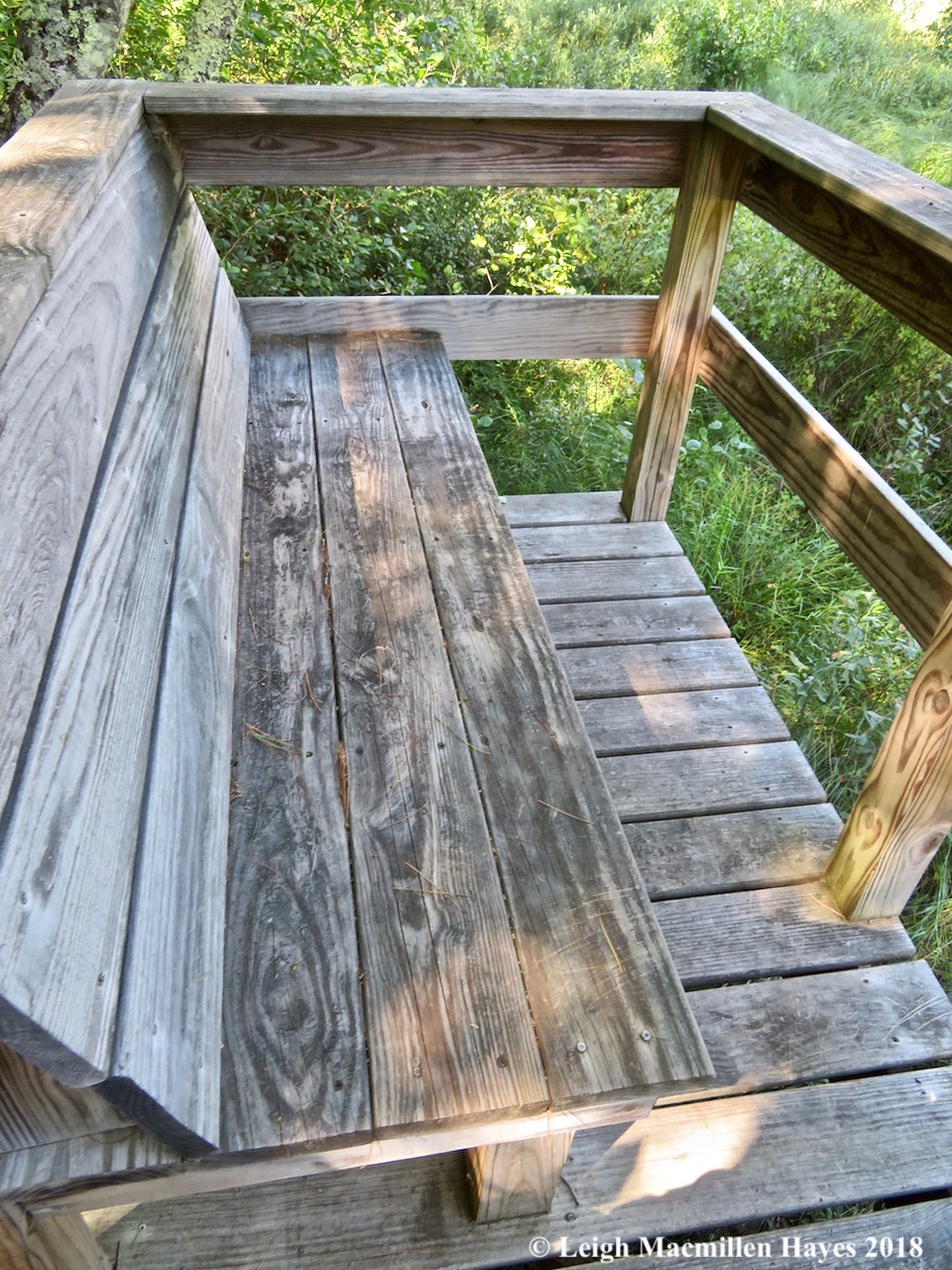
One of my favorite hangouts is the bench located along a short spur. Usually I spend moments on end, but today I was eager to move on.

7-Indian Cucumber Root

Along the spur trail, I did note one of my favorite fruits beginning to ripen–that of Indian Cucumber Root. And as it ripens, the base of the leaves turn red. All I could think of is that the red is a sign to birds–come dine at this table. You won’t regret it.

8-trillium fruit

Another red fruit stood upright above leaves of three–that of a painted trillium.

9-new stone bridge

It’s been six years since Juanita Perkins passed away and I don’t know when she last walked the path, but at that time, where the stream from Bradley Pond flows into a beaver wetland before continuing on toward Heald Pond, she probably crossed the water via a wooden bridge. Time and weather had taken their toll on the bridge and so at the beginning of this summer a group of volunteers and a couple of GLLT staff members pulled the wood out and placed flat rocks as stepping stones. It makes for a magical crossing, especially as it slows the wander and encourages one to notice the surroundings. Though we never officially met (I do remember her dropping off photographs at a local gift shop where I worked for several summers back in the late 1980s), I trust she would appreciate the change.

10-stream archs

Of course, I’ve always been one to enjoy water and all its variations. By the stepping stones (boulders), smaller rocks below the surface added to the overall arching effect, creating an interconnection. I felt a sense of Juanita’s time spent on the path woven into today.

13-jewelweed

By the water, there were a variety of flowers to note, including whorled asters and cardinal flowers, but it was the jewelweed that brought a smile to my face. I don’t understand why, but one of the sepals forms a pouch-like structure with a long spur. Jewelwings and jewelweed–indeed, a very special place.

11-Golden Spindle

Adding to the wonder right now due to recent and much appreciated rain are all the fruiting forms of mushrooms and this path has its fair share. I’m not great on my identification of boletes and others, but there are a few individuals that I remember from year to year. It’s the fact that their spores are everywhere and those spores form hyphae, that then forms mycelium, that then eats anything organic, that when mating is successful forms fruit, is wicked cool. We’re wowed by the fruit, but really, we need to honor the entire system. And so I honor the Golden Spindle,

12-white spindle fungi

White Spindle (which I don’t recall ever seeing before),

12b-scarlet waxy cap

Scarlet Waxy Caps,

12a-earth tongue fungi

and Earth Tongues.

14-into the wetland

And then I slip off the path and down to the wetland, wondering what else I might see.

15-cherry-faced meadowhawk

Instantly I am rewarded with numerous sightings of Cherry-faced Meadowhawks, their wings all aglow.

16-hobblebush leaves

They aren’t the only shade of red in the vicinity, for some of the hobblebush leaves have taken on their autumn hue already. (Say it isn’t so!)

16c-brook to wetland

I almost complete the loop and reach the bridge crossing just before the parking lot at the end of Heald Pond Road, when I decide to follow the stream bed back toward the wetland. I suppose I did so because I wanted to extend my journey and my time honoring Juanita.

16-green frog

Here and there, where pockets of water exist, green frogs either try to hide from me or make sudden leaps.

17-back to the wetland

I bushwhack back into the wetland, not wanting to let go, and forever thankful for Juanita. Every time I wander her way, I discover new perks along Perky’s Path.


A Rare and Exotic Mondate

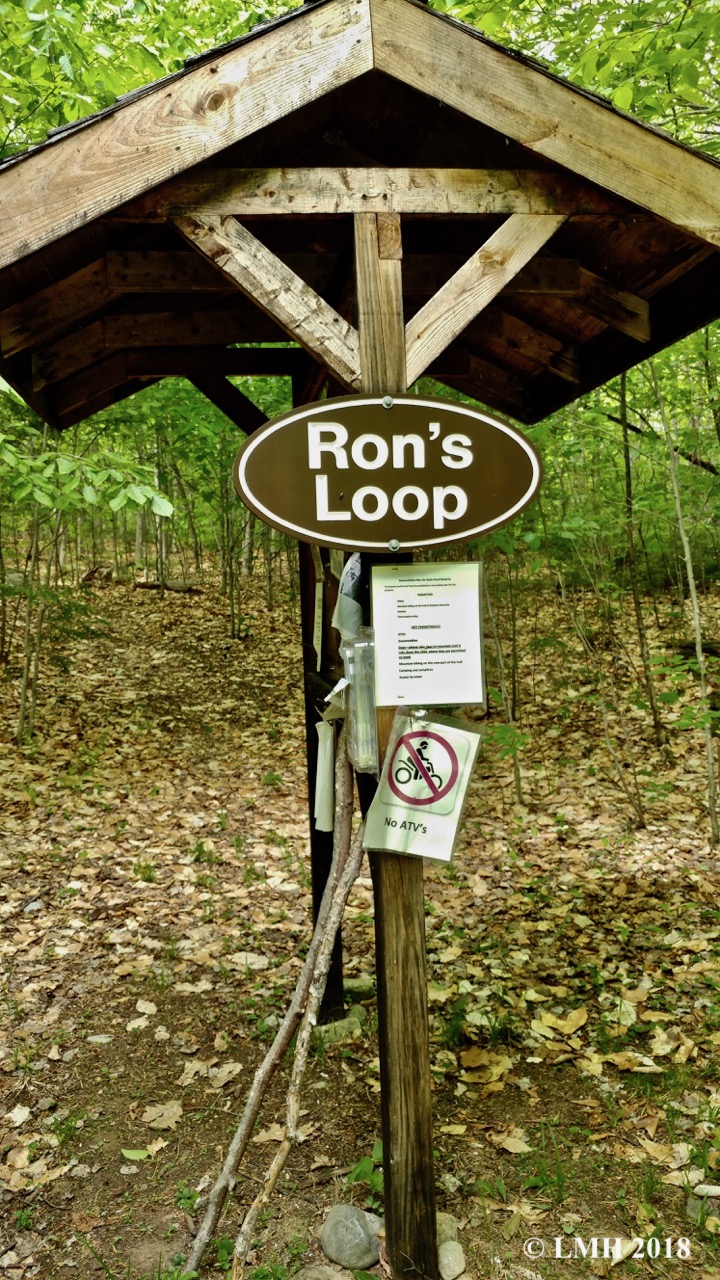
When my guy and I began our journey this afternoon, he thought our mission was simple and two-fold. First, we’d double check road names and directions for a friend’s book that I’m editing. And then we’d hike the easy Ron’s Loop at the Greater Lovell Land Trust’s Back Pond Reserve in Stoneham, Maine.

Y7-RON'S LOOP KIOSK

No sooner had I parked the truck and we hopped out, when I announced that we had a detour to make. Always one for adventure, he followed along. And when I told him our quest, he began to search the forest floor. I have to admit time and again that though he pretends not to care about so much that naturally distracts me, he has a keen eye. Or maybe its just that he likes a challenge. Perhaps, too, he just wanted to make the find and move on for the mosquitoes were robust and hungry.

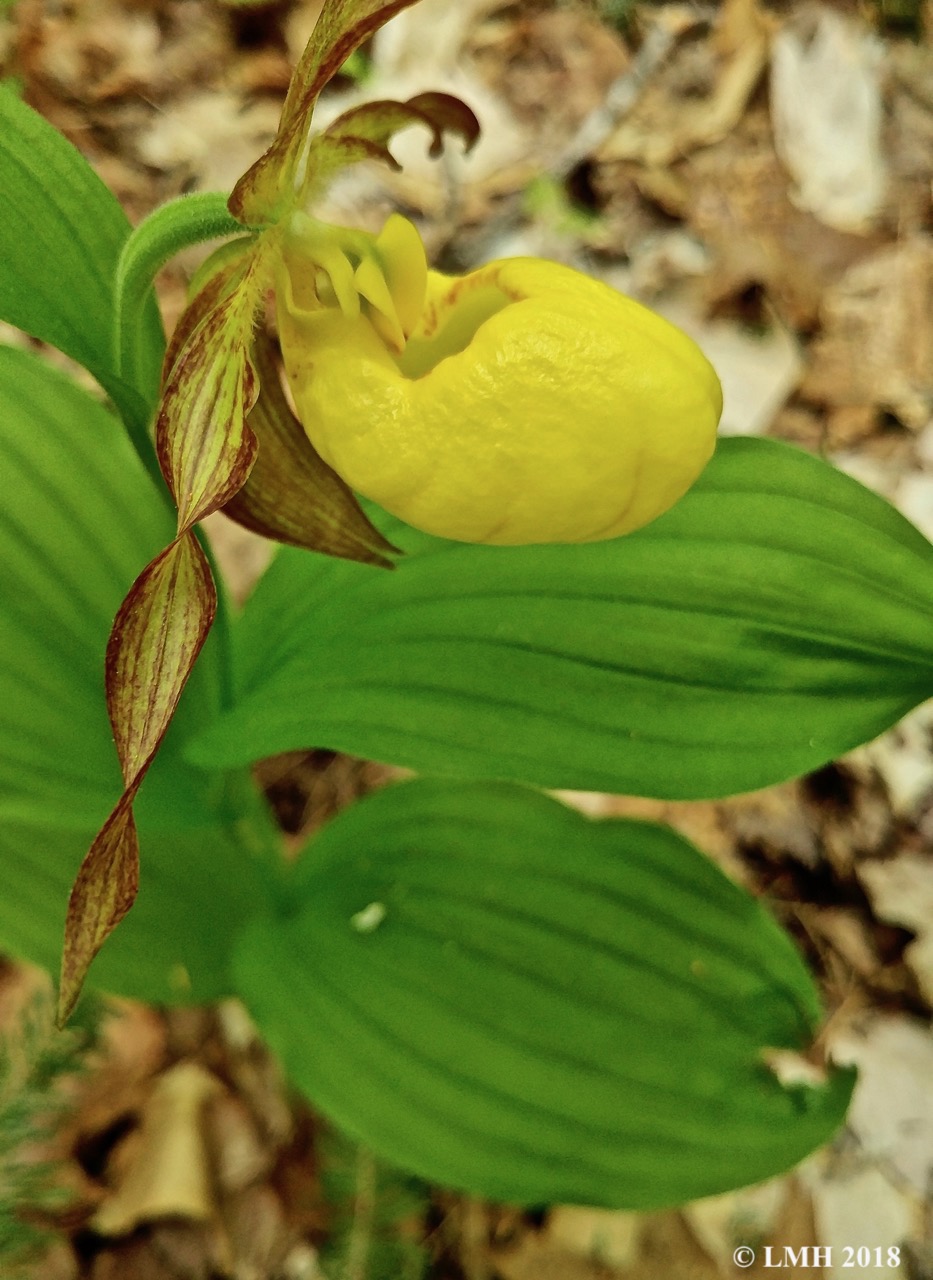
y1-yellow lady's slipper

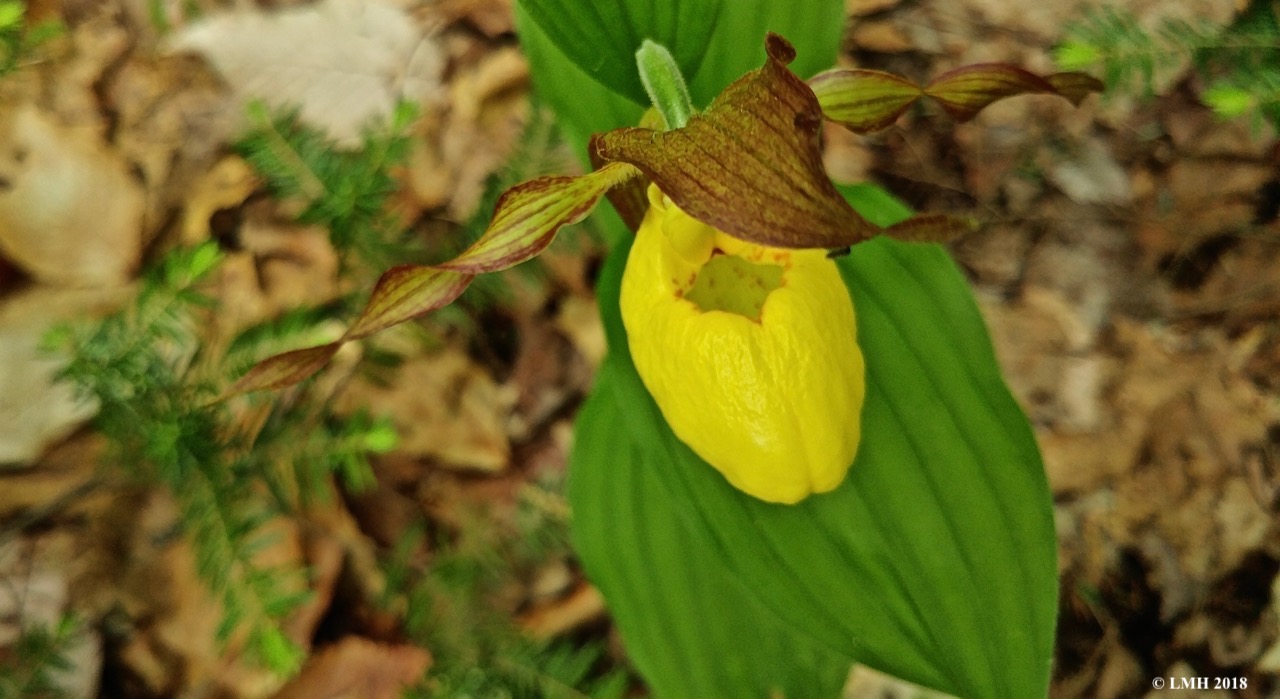
What mattered most was that he channeled his Prince Charming and was the first to find Cinderella’s golden slipper.

Y4-ALL THE PARTS

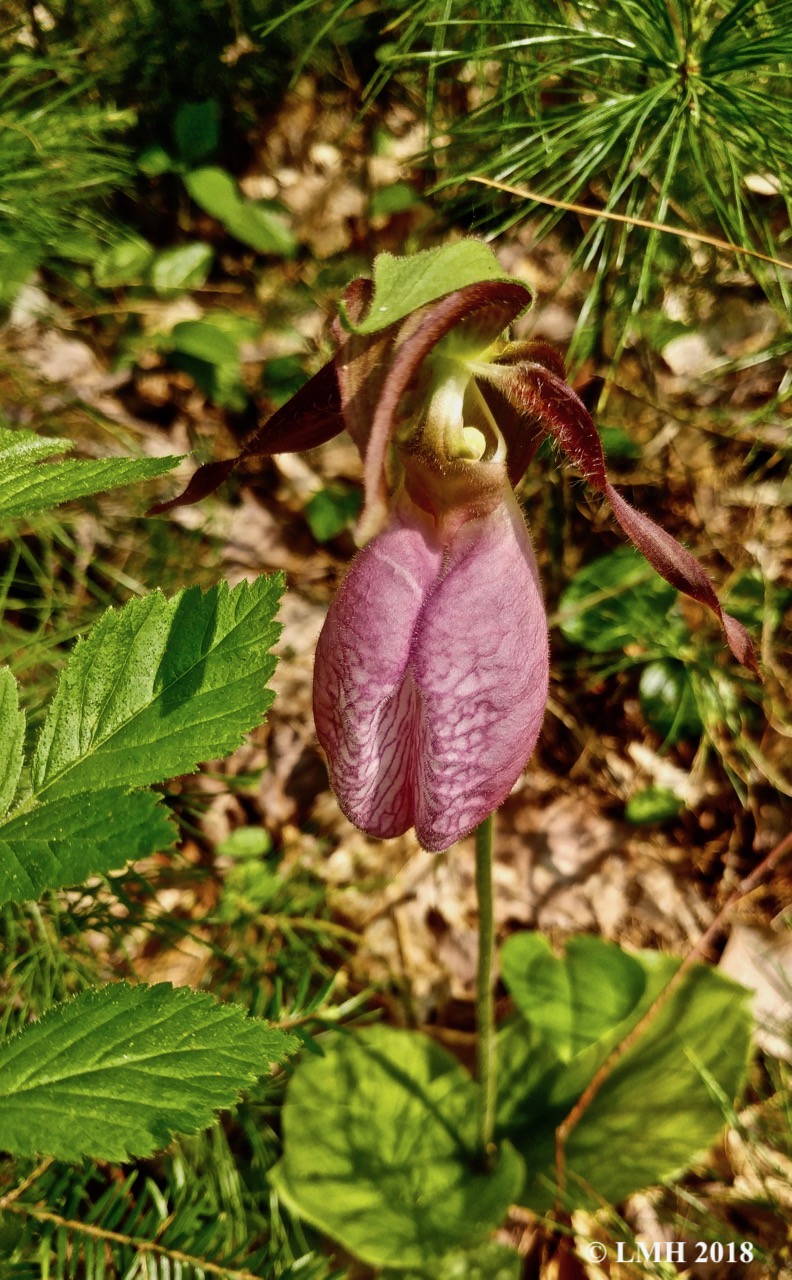
Members of the Orchid family, lady’s slippers feature the typical three petals in an atypical fashion. The pouch (or slipper or moccasin), called the labellum, is actually one petal–inflated and veined.

Y3-TENDRILS

With a purplish tint, the petals and sepals twisted and turned offering their own take on a ballroom dance. From every angle, they were simply elegant rising as they did from their stem with leaves forming a royal staircase.

lady's slipper

Though we didn’t see any pink lady’s slippers on today’s hike, it’s interesting to note their differences, with the sac of the pink dangling down like a high-heeled shoe, while the yellow is more ballet-like in its presentation. And the pink features two basal leaves, in contrast to the alternate steps of the yellow’s leaves.

Both, however, are in the genus Cypripedium in the Orchidaceae family. The genus name Cypripedium is derived from the Greek words “Cypris,” an early reference in Greek myth to Aphrodite, and “pedilon” for sandal, so named for the fused petals that form the pouch and their resemblance to a slipper or shoe.

Y2--LOOKING WITHIN

All lines on this orchid led to . . . well, not exactly Rome, but certainly the labellum, or sac-like structure. With the rim turned inward, the pollinators found it easy to enter, but much more difficult to exit, the better to rub against the stigma and anthers, thus collecting pollen. Some bees find it difficult to simply fly away from the lady’s charm, but by chewing their way out, they are able to move on to the next and leave a message from the princess in the form of a pollen deposit.

Y7-BEECH COTYLEDON

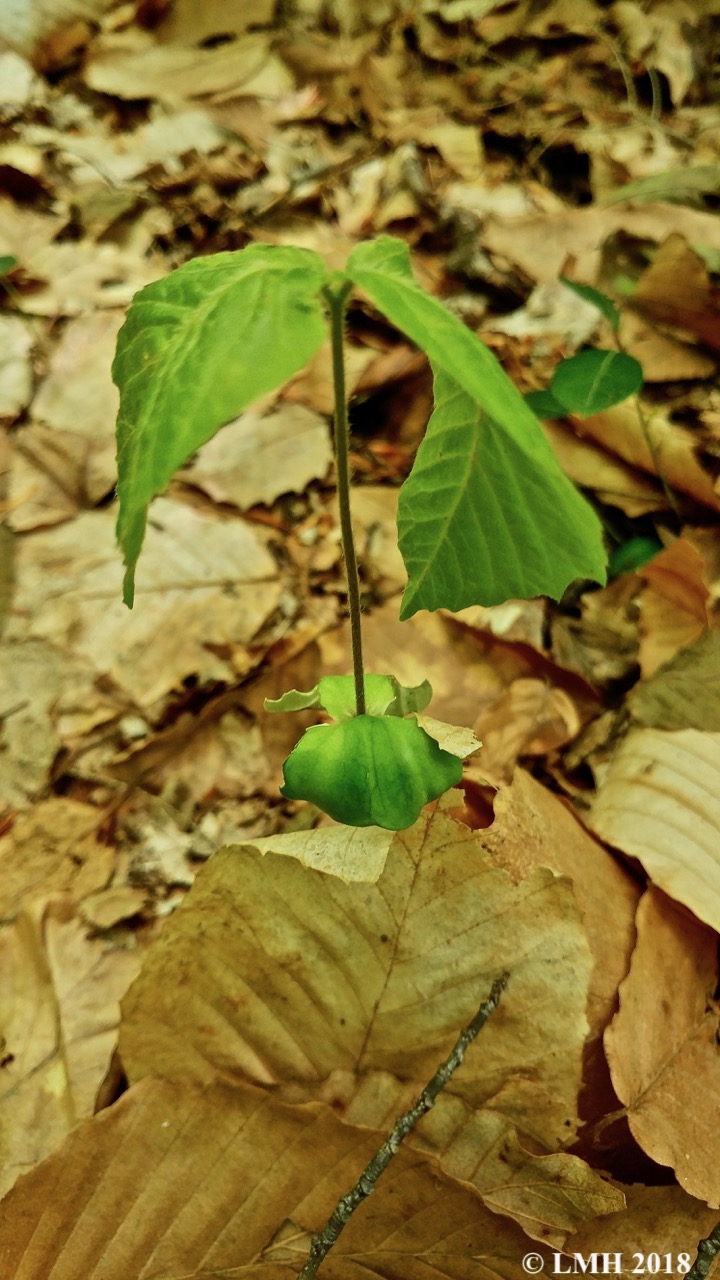
We finally moved on with the not-so-sweet drone of those larger-than-life mosquitoes buzzing in our ears. And then we stumbled upon one American beech cotyledon after another and were reminded of last year’s mast crop of beech nuts.

Y8-BEECH COTYLEDON

I was again reminded that it’s my duty to bring attention to these structures, the seedling form of beech trees. The lower set of leathery embyronic leaves that remind me of a butterfly, appear before the tree’s true leaves make themselves known. Part of what intrigues me about these seed leaves that appear before the tree’s true leaves is that they contain stored food. Some of these food stores wither and fall off, but in the case of the many we saw today, the cotyledons had turned green and photosynthesized. I also love how the word cotyledon (cot·y·le·don \ ˌkä-tə-ˈlē-dᵊn \) flows off my tongue, much like marcescent, which describes the leaves of this same tree that cling, wither and rattle all winter long.

Y8A-BEECH GROVE TO COME

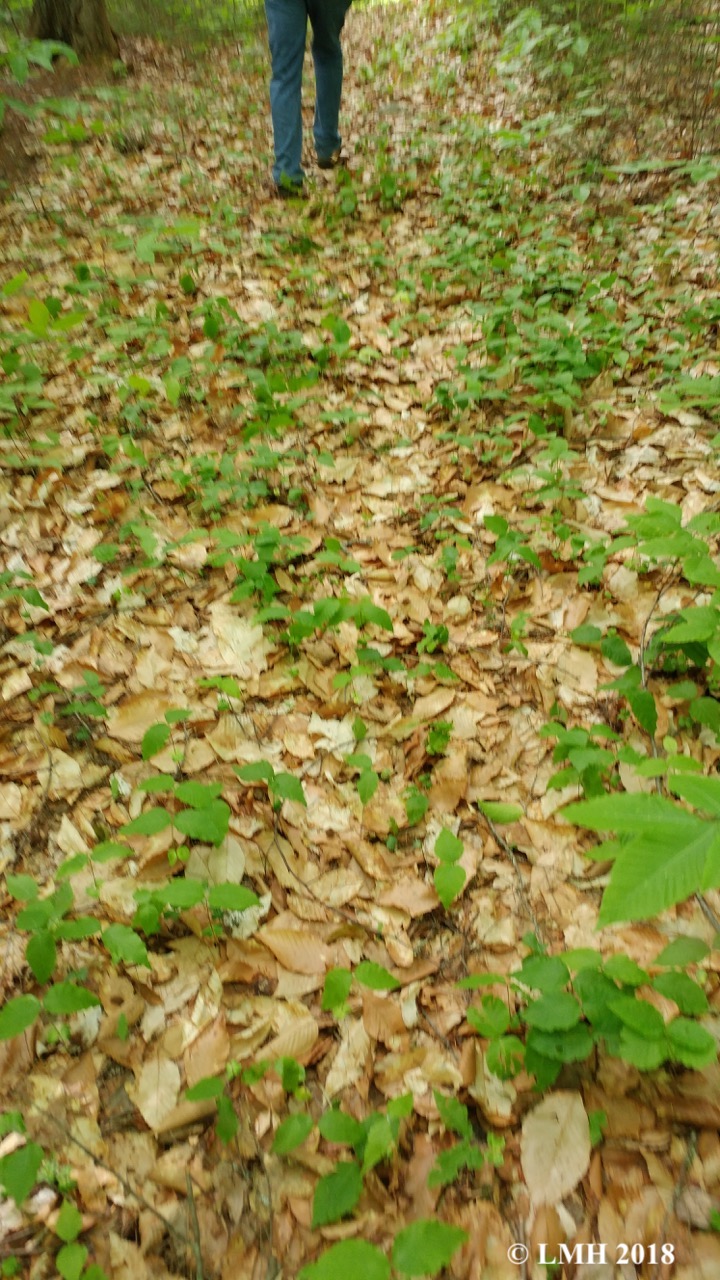
Though I’ve read that seeing beech cotyledons is a rare event and could attest to that fact  in the past, thrilling with each siting, today we noted their ubiquitous nature.

Y9-RED MAPLE COTYLEDON

Red maple cotyledons also decorated the trail. If the plant has two seed leaves, such as these, it is a dicot (dicotyledon), and if only one it is a monocot (monocotyledon).

Y10-MAGIC ALONG THE TRAIL

Onward we moved, stopping occasionally as my guy did some trail work because its part of his nature to make a path clear for those who follow. Being a one-armed bandit, my help was still limited, but it won’t be long and I’ll be able to offer two capable hands.

Y11-BUNCHBERRIES

Further along the trail, bunchberries were beginning to bloom. Normally, a bunchberry plant has two sets of opposite leaves. But . . . when one is mature enough to grow a third set, typically larger leaves (perhaps to capture more energy) than the first two sets, it produces four white bracts that we think of as petals. In reality, the bracts were modified leaves. The flowers were in the center–tiny as they were.

Y12-1ST BRIDGE CROSSING

In what seemed like no time, for we moved so quickly, we reached the first bridge. It was at this point that we began the loop back toward the trailhead. And smiles crossed my face as I recalled memories of explorations along the way with so many others.

Y8B-CANKERED BEECH

On the way back, we noted so many beech trees that dealt with nectria and we could only hope that within some of those cotyledons there might be some trees resistant to the beech scale insect that delivers such devastation to these trees.

Y13-SEATED TREE

One of my favorite trees along the way sat as it always does, taking a break upon a granite bench.

Y14-TINDER CONK

And a tinder conk showed off its form, which for me recalled a childhood spent along the Connecticut shoreline, for it surely resembled an oyster shell.

Y15-INDIAN CUCUMER ROOT

We were almost to the end of the loop when my heart and not my mouth sang with joy once again. While you might give thanks for small blessings like the fact that I’m a great lip sinker rather than the opera star my mind hears, I made my guy stop because the Indian Cucumber Root was in bloom.

Y16-INDIAN CUCUMBER ROOT

Like the bunchberries that need that third set of leaves in order to fruit, Indian Cucumber Root needs two levels to produce a flower. I’m of the belief that if the structure of this flower doesn’t make you wonder, nothing will. It strikes me as a northern version of a bird of paradise.

Y18-2ND BRIDGE

In what seemed like my shortest adventure along this trail because we didn’t want to overdo our offerings to the female mosquitoes who needed our blood in order to reproduce, we crossed the second bridge back toward the trailhead.

Y19-YELLOW LADY'S SLIPPER WITHOUT FLOWER

It was near that crossing that I checked on a couple of yellow lady’s slippers and as has been true since I first met them–they weren’t in flower. From what I’ve learned, it’s not so odd that the plants have yet to bloom. Apparently, it takes 10-17 years for a seed to mature into a plant capable of blooming. For this plant and the one beside it, perhaps the blossoms are on the horizon.

Y5-ALL PARTS 2

One day they’ll reach the status of their neighbor. For any lady’s slippers, the dance is rather intricate. The stage floor must be painted with an acidic soil and there needs to be a sashay with Rhizoctonia fungi. As the fungi digests the outer cells of the seeds, inner cells escape digestion and absorb some of the nutrients the fungus obtained from the soil–all in the name of a symbiotic dance.

Though our journey flew by on the wings of the world’s largest, loudest, and meanest mosquitoes, our finds on this Mondate afternoon extended from lady’s slippers to cotyledons, bunchberries and Indian Cucumber Root. All appeared rare and exotic.


Cozy Cabin

This afternoon Jinny Mae and I went in search of the perfect location to build a cabin. A tiny cabin. A one room cabin. With an outhouse of course. And an infinity pool.

p1-Old Beaver Pond

Deciding where to place it proved to be the most challenging part of the building process. We didn’t want to rush into the things and so we stood. For a long time. And absorbed the sun’s warmth. And reveled in the quiet. It was a contender, but decided we might have to return in another month or so when the song birds sing to decide if it was the right spot, for it was almost too quiet.

p4-brook

And so we continued our journey beside a stream where the ice had melted and water gurgled.

p5-water

In fact, it gurgled so much that it was irresistible and we began looking about because we felt drawn to the spot.

p3-hexagonal-pored polypore (Polyporus alveolaris)

The neighborhood also appealed to us because it had so many interesting landmarks including the hexagonal-pored polypores,

p11--tinder conk pore surface

tinder conks (aka hoof fungus) with their pore surfaces exposed,

p10-false hoof fungus

and even some false tinder conks.

p7-script lichen

One of the things that surprised us was all the writing on the bark for we found script lichen on many a tree trunk. It felt like we’d stumbled upon volumes of research about the construction process.

p12-hairy curtain crust fungus 2

When building, the old adage is location, location, location, but it helps when local resources are available–which we found in the form of curtains, aka hairy curtain crust fungus (or so I think).

p15-many fruited pelt lichen

We also spied multi-fruited pelt lichen that would be suitable to cover the floors.

p17-beaver 2

And then we began to notice the available lumber.

p19-beaver 4

It came in a variety of tree species.

p20-beaver 5

And was already de-barked.

p19-beaver 6

And pre-hewn.

p23-infinity pool

When we saw the infinity pool, we were certain that we’d found the prime location.

p24-lodge roof top

And then we spied a pre-built cabin with a new roof top and we imagined a chimney in the center of the structure.

p25-lodge and dinner raft below water

As it turned out, there was no need for us to build a tiny cabin after all, for we found one already constructed and it even included a refrigerator filled with a cache of branches. Fine dining was definitely in our future.

We were excited because we wouldn’t need to do the building ourselves and our dream was realized in a lodge that was well placed as it graced the landscape and took advantage of the local offerings. A cozy cabin indeed.

Distracted by Nature

A morning message from my dear friend Carissa set the tone for today. Her Lenten devotional is based on the poetry of Mary Oliver and she thought of me when she read “The Summer Day.”

The Summer Day
Who made the world?
Who made the swan, and the black bear?
Who made the grasshopper?
This grasshopper, I mean-
the one who has flung herself out of the grass,
the one who is eating sugar out of my hand,
who is moving her jaws back and forth instead of up and down-
who is gazing around with her enormous and complicated eyes.
Now she lifts her pale forearms and thoroughly washes her face.
Now she snaps her wings open, and floats away.
I don’t know exactly what a prayer is.
I do know how to pay attention, how to fall down
into the grass, how to kneel down in the grass,
how to be idle and blessed, how to stroll through the fields,
which is what I have been doing all day.
Tell me, what else should I have done?
Doesn’t everything die at last, and too soon?
Tell me, what is it you plan to do
with your one wild and precious life?
~Mary Oliver

A perfect beginning, indeed.

w-Horseshoe Pond

A short time later I joined a couple of other friends and we traveled together to the Greater Lovell Land Trust’s Wilson Wing Moose Pond Bog Preserve. Our snowshoe journey began beside Horseshoe Pond where we paused to enjoy its beauty and recall trips up Lord Hill, whose face was obscured to the left.

w-hemlock cones and seed below

Once we got onto the trail, it was the little things that we noticed, like the hemlock cones with partially opened scales, their seeds all released. One tiny seed sits atop my name in this photo, but we wondered together why we’ve always seen the cones only in their closed up formation, whether fresh or old. Had they always looked like this one in late winter and we just never realized it previously?

w-frullania liverwort with new growth

And then we paused beside yellow birches where the liverwort Frullania eboracensis grew in abundance. Again, a new realization for us. We knew it to have brown stems, but today spied the green. As it turns out, in his book, Mosses, Liverworts and Hornworts, author Ralph Pope begins his description with this: “Plant dark green to brown . . .” Our eyes were opened.

w-crowded parchment laterally fused

Next there was the Crowded Parchment fungus that threw us off momentarily. We recognized the cap, but were unsure about the part of the fungus that was spread out flat like a crust. It turns out, the flat parts or fertile surfaces of this mushroom laterally fuse or join together at the dark ridges. This behavior certainly spoke to its name of crowded. In Fascinating Fungi of New England, Lawrence Millman refers to it as “One of the most common fungi as well as one of the most crowded in New England . . . It’s not unusual to see several hundred gregarious fruiting bodies laterally fused or in dense clusters on a single branch.” Common or not, we were wowed.

w-script lichen

And because we stopped to gain a better understanding of the Crowded Parchment, another gift was offered in the form of script lichen writing its own story on an adjoining branch.

w-nectria fruiting bodies?

Nearby, there was a similar cinnamonish color on beech bark. This particular beech was dotted with the waxy exterior winter coating of the beech scale insect. As I’ve noted before, the scale insect or more technically, Cryptococcus fagisuga, is a tiny insect that sucks sugar and other nutrients from beech trees only.

Soon, the beech scale insect will molt into its second, legless nymph stage and emerge. Immediately, it will start sucking sap through its tubular mouthpart or stylet. That instar stage doesn’t last long, and quickly it will become a mature female. For the rest of its life it will remain sedentary, but repeatedly remove and reinsert its piercing stylet, wounding the tree and providing entry points for fungi to enter. An interesting fact about beech scale insects–its a world of females who reproduce by parthenogenesis; there are no known males.

w-closer look

But what about that cinnamon color? Was it a fungus? Or was it related to the insects? Yes and yes. As some further research revealed, two species of nectria fungi are associated with beech bark disease, Nectria coccinea var. faginata and Nectria gallengiaIt is now my understanding that what we examined was a large area of the former’s fruiting bodies. Oh my.

w-lichen garden1

We also paused frequently beside gardens dominated by lichens. Crustose, foliose and fruticose varieties completely enveloped the bark of this toppled tree, their individual colors and textures adding to the visual display.

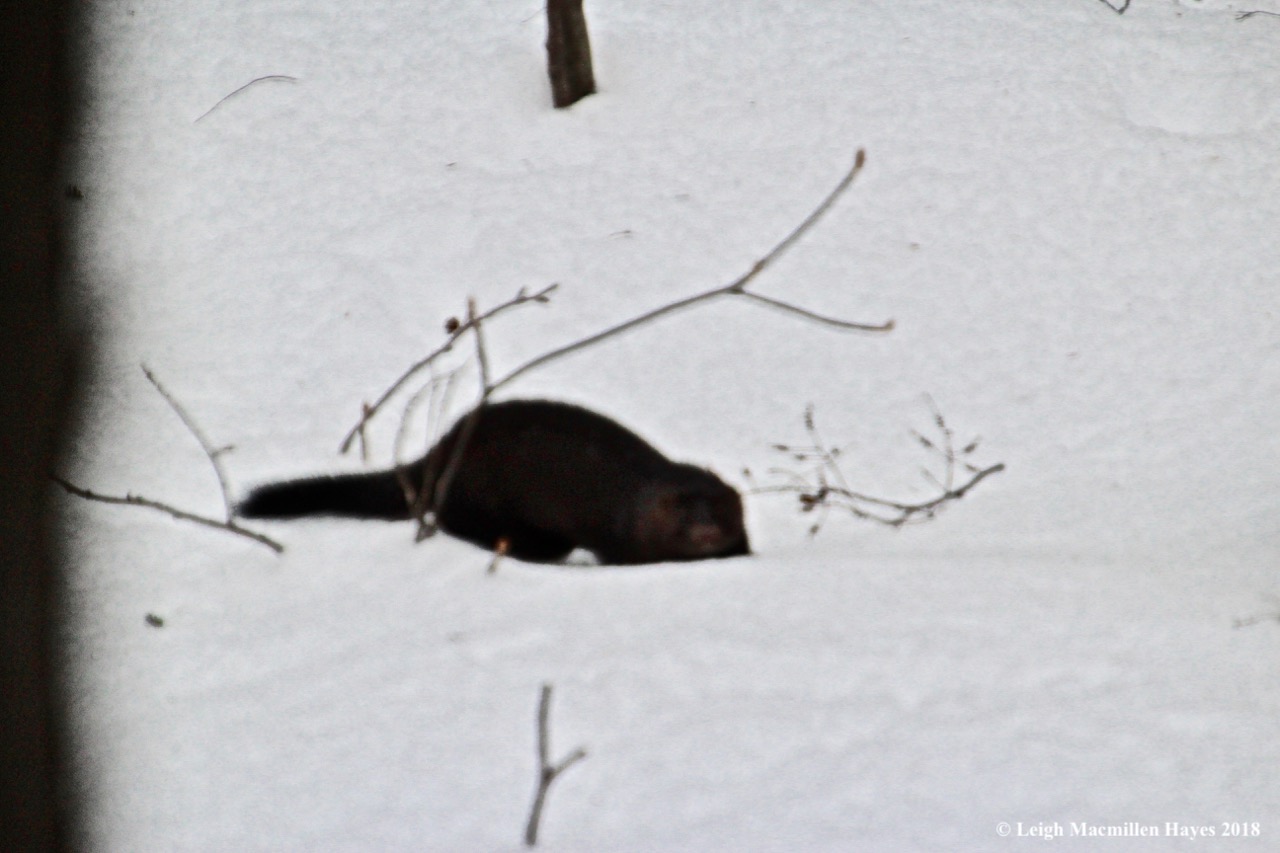
w-mink 1

And then . . . and then . .  . as we looked, a motion captured the attention of one in our group. I only wish my focus had been better, but still, it was enough.

w-mink 2

We were blessed with the opportunity to spend a few moments with a mink as it bounded down the hill before realizing it had an audience.

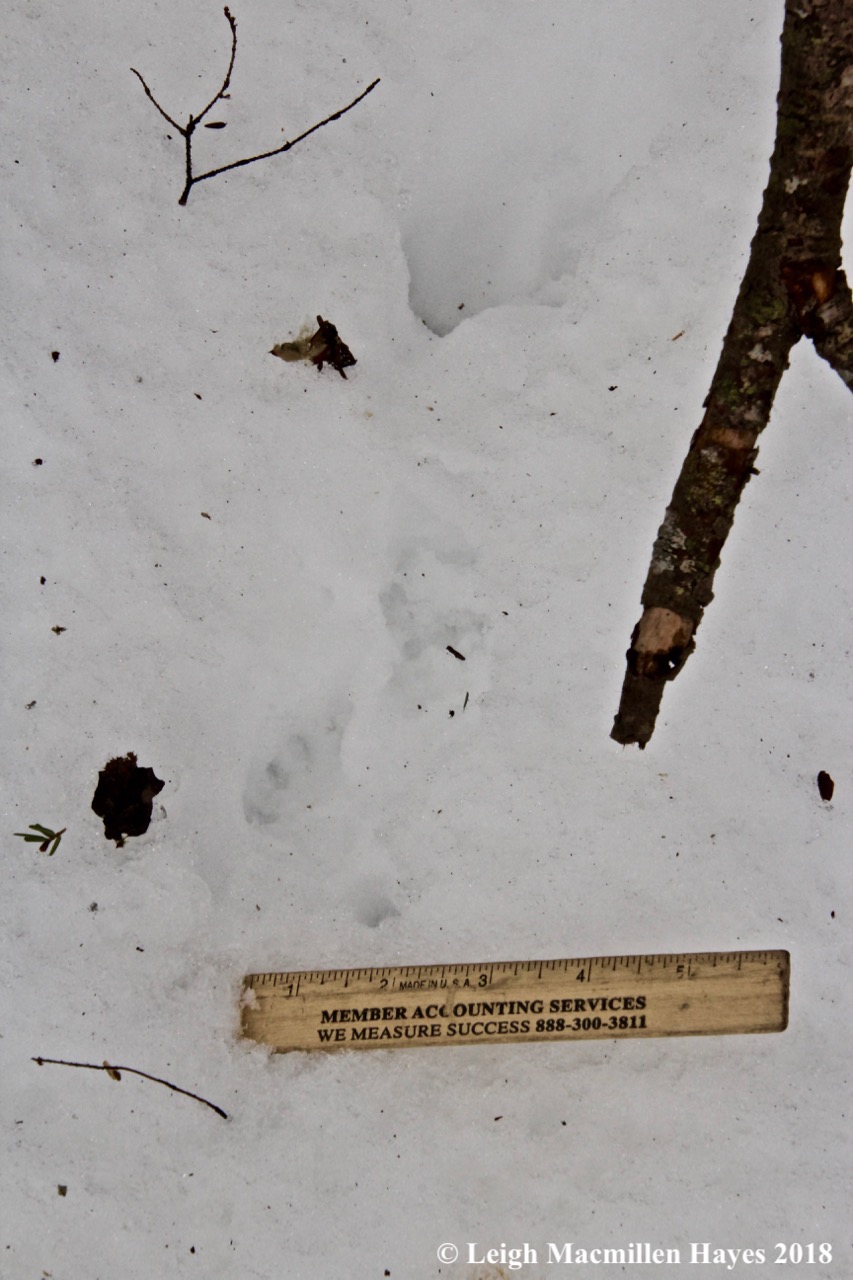
w-mink measurements

Of course, after it disappeared down a hole into a stream and we’d waited a bit, we checked out the tracks it left behind. The size of the prints and length of the straddle or measurement from the outside of one print to the outside of the other confirmed our ID.

w-mink prints

From that point on, we continued to find evidence that the mink had traveled to and fro over the course of several days. Our hearts were grateful to have shared such a moment.

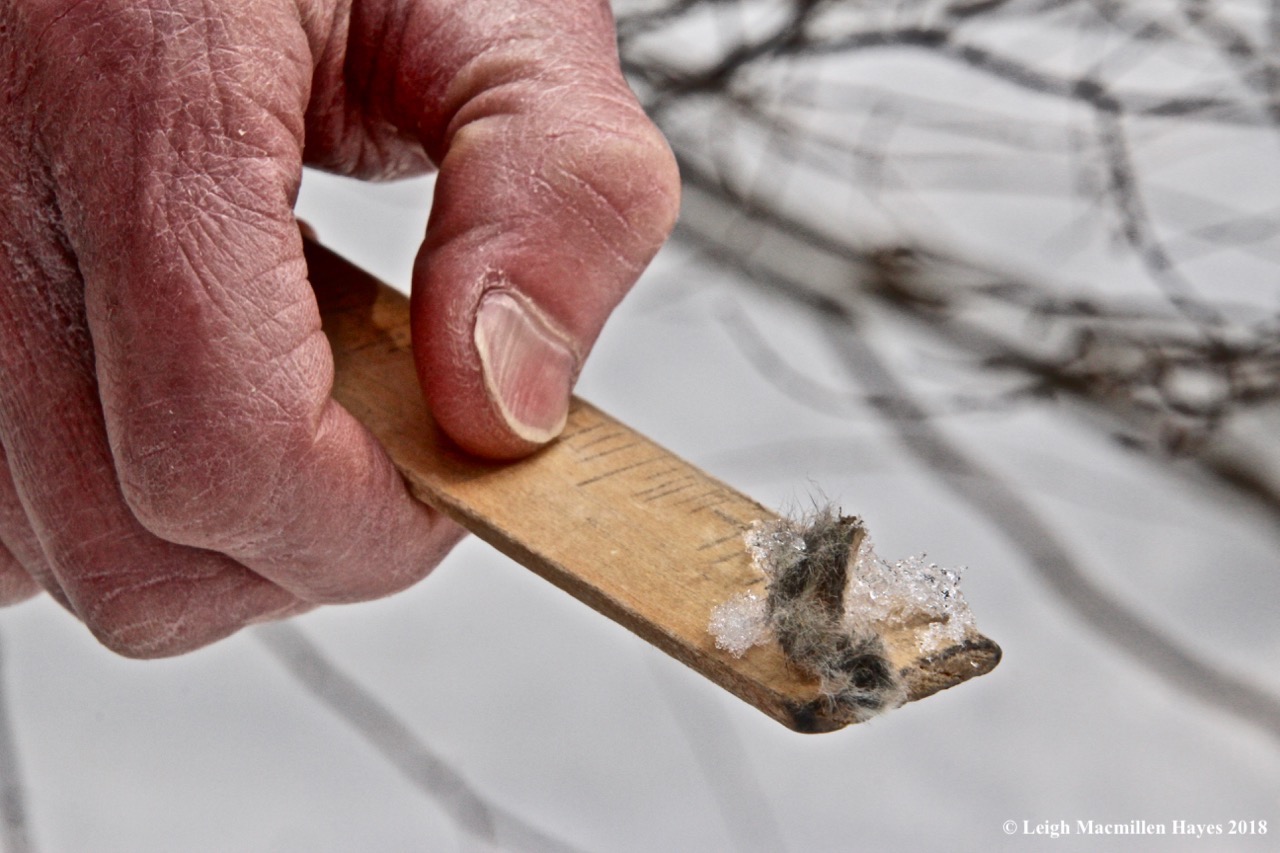
w-hairy, bony find

And as we took measurements, we spotted something else on the snow. Something hairy and bony found about three or four inches from the fresh mink tracks.

w-hairy, bony--scapula

A scapula from a little brown thing, possibly a vole. Dropped from the mink or from above by a bird? We’ll never know. But we do know that someone consumed someone else–as it is in the natural world.

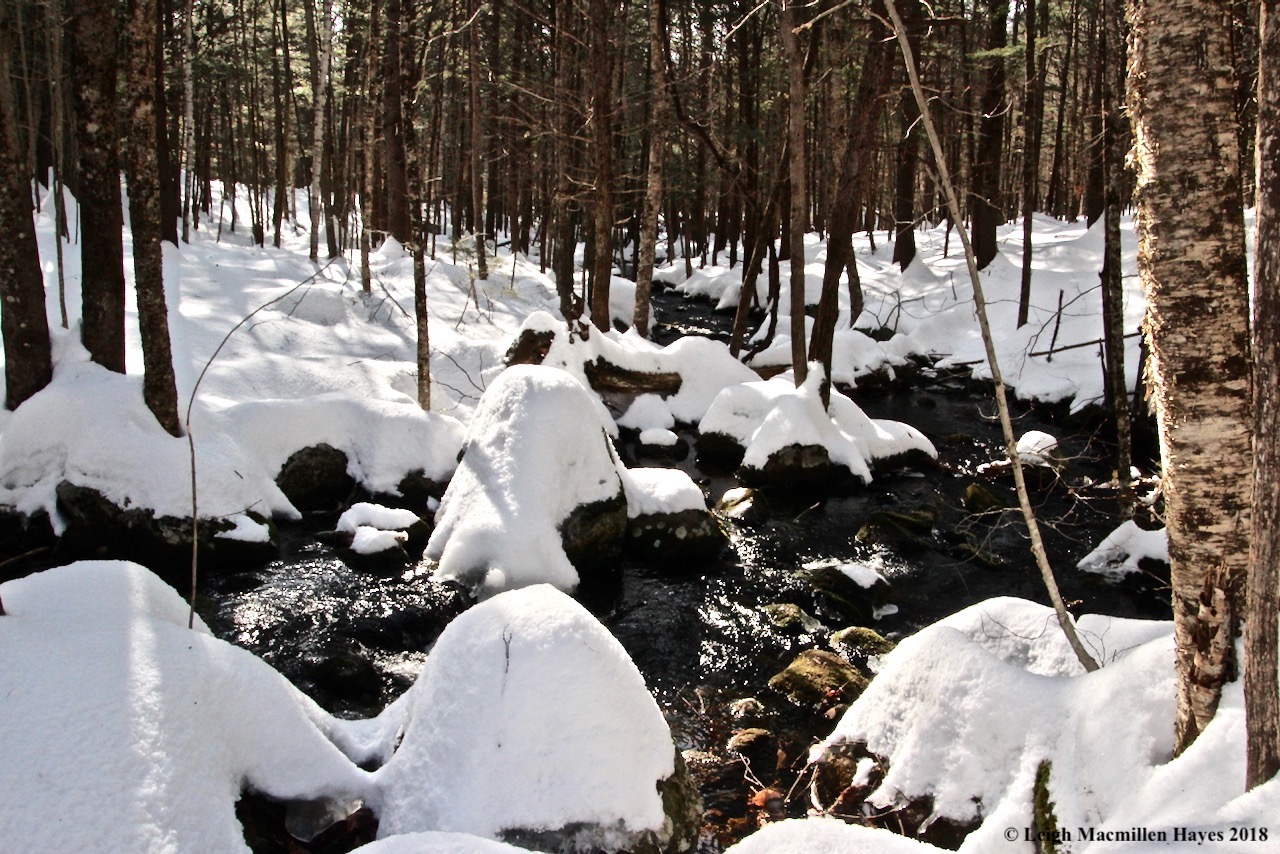
w-Sucker Brook

Seeing the mink made perfect sense because we traveled on and off trail beside Sucker Brook.

w-hobblebush flower and leaf buds

It was there that the naked but hairy hobblebush leaves and flower buds reminded us that spring isn’t far off. The three of us don’t necessarily want winter to end for we love how it forces us to notice other things such as the nectria’s fruiting bodies. And we love to track. But . . . we also love the other seasons, so we’re happy exploring at any time of the year.

w-suds

Beside the water, the icy formations kept calling my name and I honored many by snapping a photograph. But, then we met the suds. Water foam is caused by the decay of twigs and plants and occurs naturally in streams and brooks. As they release compounds, the interaction breaks the surface tension, allowing air to mix in and create bubbles. And just as we found the Crowded Parchment living in a large community, we also found this congregation of bubbles–creating a design all its own.

w-Wilson Wing Moose Pond Bog

Despite the short trail, it took us forever to reach the point where the brook becomes Moose Pond Bog, but we did.

w-stream with rattlesnake liverwort

And then we beelined (sort of, for still we kept stopping) to the final stream crossing on the trail for we wanted a glimpse of the rattlesnake liverwort we’d discovered growing there last year. Alas, it was buried under snow. And that means we’ll have to return again. Darn.

w-sucker brook reflections

In the end, it was a morning well spent as we dillied and dallied over the littlest of things. And watched a mink. We got to see a mink!

No, it wasn’t a summer day. But . . . we were distracted by nature. As Mary Oliver asked, “What else should we have done?”


Melt Down

After a few weeks of extreme cold, January did what it always seems to do–cranked up the thermometer. That might have been okay except that with the warm temps (40˚s and above) came the rain. And with the rain came the fog. And with both disappeared the snow.

j1-soggy bluejay

And so our deck was clear, except for the bird seed, of course. And a rather bedraggled bluejay. I’d noted in the past few days that all of the birds are much skinnier than I remembered, given that they didn’t need to puff out their feathers and insulate themselves from the cold.

j2-squirrel feast

The gray squirrels also came by, their mouths like vacuums as they scoffed much of the sunflower seed supply.

j3-squirrel feast 2

They, too, offered a rather bedraggled appearance, but the rain didn’t stop them from getting their fill.

j4-snow thaw and debris

And then, the rain ended, clouds moved swiftly southward, arctic wind gained strength, temperature dropped dramatically, and sun shone brilliantly. Abruptly, the thaw ended. That was fine with me for I was afraid we’d lose all of our snow cover. As it was, we lost well over a foot in the past two days. And what’s left was riddled with natural debris.

j6-vernal pool

I decided to check on the vernal pool, curious about its condition. As expected, it was still frozen, but with that yellowish brown ice of warmer days.

j7-leaves embedded in ice

Fallen leaves remained entrapped in the thin, mosaic layer.

j10-ice on ruts

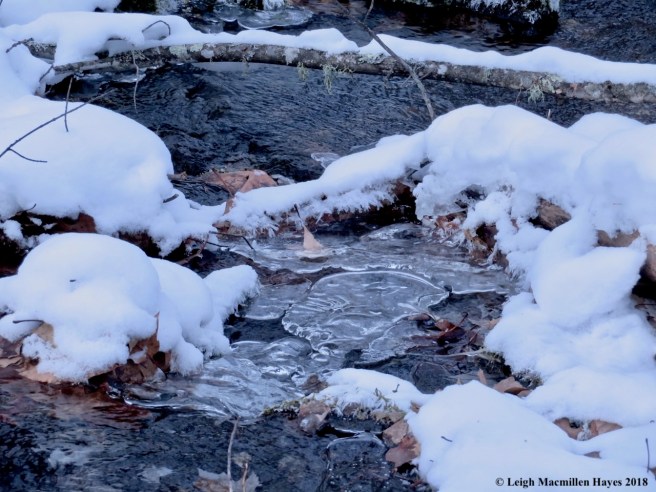
Nearby, I found open water in many places; some of it with thin ice designs decorating the edges.

j25-ice

Ice forms in various ways . . .

j11-ice forms

and these three offerings were a few feet of each other.

j8-squirrel tracks

I discovered the ice as I followed red squirrel tracks created when the snow was a wee bit softer. By the time I moved across it had started to freeze again and though my snowshoes made a lot of noise and got a wee bit wet and frosty, I was thankful for them as they made my tramp easier.

j9-squirell prints

The beauty of the squirrel prints was that their toes and toe nails showed. It’s a rare occasion when conditions are just right for good prints.

j12-my squirrel cache

My next destination was to check on the creator of the tracks. And I felt as if a sun spirit was doing the same. Meanwhile, the squirrel chatted at us from a nearby tree.

j14-cones exposed but not touched

The top of its pile had been exposed, but I suspected the cones hadn’t been touched. Instead, the snow had melted off of them. I think he’s saving this pile for another rainy day.

j15-midden exposed

In the meantime, he has been busy as demonstrated by a midden slowly growing near another of his stashes.

j16-turkey prints

I decide to let him feast in peace, and instead followed some turkey tracks to another location.

j11-witches butter fungi

Along the way, it was the witches butter on an old pine stump that gave me pause. It’s also called orange jelly fungus and some say it looks like a brain. I wish I’d seen this small patch more recently, because I wondered if it had grown under the snow or if the melted snow and rain had affected it. Either way, it’s always a fun find and especially now as it adds a dash of color to our somewhat monochromatic landscape.

j17-pileated tree

My next great find was a pileated tree. I last saw it a few weeks ago, but it seemed to me that even more chiseling had taken place.

j18-pileated tree

At first, when I saw the gray wood above, I thought it might have been older work.

j19-pileated tree

And that the newer work was much lighter in color. Do you see the chisel mark? Just imagine the head banging that went into this masterpiece.

j20-pileated debris

Like the squirrel, a growing pile below added to the story. For me, it was the realization that the gray wood was excavated at the same time as the lighter wood. My new theory, the gray wood had been caused by a fungus or rot of some sort and then the insects followed and finally the woodpecker. If you know otherwise, please enlighten me for I want to understand. Of course, I looked for scat, but came up empty handed. Drats.

j21-second vernal pool

At last I reached a second vernal pool, though the going was a wee bit difficult given the conditions. This one was more open than the first.

j22-ice melting

And on this winter day that began with the tail end of a heat wave, but had chilled significantly, a watery reflection was a fun treat.

j23-sun setting behind vernal pool

On my way home, I made one more stop at the first vernal pool while the sun began to set behind it. I trust it will freeze up again, probably tonight.

What surprised me was how much had melted in the last two days. And from the looks of photos I’ve seen posted by others today, my neck of the woods shows only a wee bit of the January thaw.

We’ve had a melt down. Now it’s time for a freeze up.  Back into winter we shall go–thankfully.


Snow White Magic

Our first official snow storm of the season left us with about an inch of the white stuff that makes me rejoice. And upon waking this morning and peeking out the window, the sight of porcupine tracks looping around the yard brought a smile to my face.

m-porcupine trail 1

I love the first snow storm for even though I have seen signs of the critters that pass this way, their tracks confirm my convictions. Over the years, I’ve come to recognize the prints and trail patterns, but as the snow gets deeper the tracks sometimes become more difficult to decipher. This one was easy due to its pigeon-toed sashay.

m-porcupine prints

And then the individual prints, especially those that crossed the deck, showed the large foot pad and five toes with nails extended. A friend in Poland, Maine, sent me a couple of photos of the critter that crossed her deck this morning. She ID it herself, but wanted confirmation–for it was an opossum and a first for her.  I found my first opossum prints last December and wonder if I’ll have that opportunity again. Anything is possum-able.

m-worm and junco prints

Since the porcupine had drawn me out (and I noted that it disappeared under the barn–of course), I decided to head off into the woods. But before I left the yard, I spotted junco tracks–and . . .

m-worm

a couple of worms–frozen upon the snow. Juncos don’t eat worms; they look for fallen seeds. And so it seemed that the bird flew off before quite reaching the C-shaped worm. And this other worm was about a foot away from the first worm. Robins were in the yard last week, and I can only hope that they returned today for a frozen dinner awaited.

m-snow art 2

Into the woods I trudged, and the ever-changing colors and designs at my feet reminded me of works of art.

m-snow art 1

Some were palettes of mahoganies juxtaposed against white. A variety of textures gave the scene relief, much like an inlaid mosaic.

m-snow art intersections

Others embodied interconnections; a mingling of lines outlined for emphasis.

m-rock people

Along the cow path, I noticed the rock people for the first time, their mouths gaping open.

m-snow fleas

The minute snow fleas would hardly sustain them.

m-morning light

As it does, my trail crossed the line, where power seemed to originate with its source . . . the sun.

m-Mount Washington

And in the opposite direction, it flowed from pole to pole and onward . . . as if powering the mighty mountain.

m-pine sapling

My journey continued into the land of the pines and their saplings, momentarily coated with decorative baubles.

m-mini oaks

And the red oak saplings I’ve been watching looked more festive than ever.

m-squirrel tracks

I was on a mission and soon found what I was looking for. Some tracks that looked like exclamation points led me to another source of sustenance that I wanted to check on.

m-squirrel cache growing

The red squirrel’s cache had grown taller in the past week, but . . .

m-squirrel dining room

many pine seeds had been consumed in the refectory. All that remained were scales and cobs to show a number of dinners consumed.

m-squirrel rocks

The dining hall extended beyond the reaches of the cache, for every table available was a table used.

m-squirrel dinner in the future

As I walked back toward home, I discovered another table awaiting a guest.

m-beech sunshine

I was almost home when I stood under a beech tree. As winter embraces me, I find that their marcescent leaves create their own golden glow and warm my soul.

m-British soldier

One more sweet peek offered a tiny touch of red to today’s fading winterscape–for the British soldier lichens’ red caps announced their minute presence.

m-snow drops

And then this afternoon, I joined a few friends for a gallivant across the Wild Willy Wilderness Trail beside Province Brook in South Chatham, New Hampshire. And the snowdrops created their own works of art announcing that the meltdown was on.

m-pinwheel 1

As we walked, we noticed delicate parasol-shaped fungi fruiting.

m-pinwheel gills

Their common name is Pinwheel Marasius, but in my mind the shape of the umbrella-like top above the wiry stem looked like a parasol and so I called it such. But to add to the confusion, I first called it carousel. Word association might get me there eventually, but it wasn’t until I looked it up in Lawrence Millman’s Fascinating Fungi of New England, that I realized my confusion. One of the fun facts from Millman is worth quoting: “Resurrection! Shriveled and inconspicuous, Marasmius species are rarely noticed during dry weather, but after rainy periods the tiny fungi revive–hence the nickname ‘resurrection fungi.'” And if not rain, then snow will make them rise again!

m-liverwort magic 1

The water from the melting snow highlighted other lifeforms along the Wild Willy Wilderness Trail. Bazzania liverwort grew abundantly, but one in particular gave us pause . . .  for it glowed. And no matter what position we stood in to look at this worm-like beauty, it continued to glow as if it had a golden halo surrounding it. We had no answers–only questions and wonder.

m-glue fungi

Another find that had been marked with tape, for it too was special–a broken branch attached to a young tree. I’m stepping out on a limb here–pun intended, but I believe this was an example of a glue crust fungus that glues twigs together. Seriously? Yes.

m-Bob, Janet and Pam

It was getting dark when we finally found our way to Province Brook and marveled at the water and ice forms. It was also getting close to the moment when we’d need to say, “See you later,” to Bob and Pam, for they’ll be heading to warmer climes soon. But we know they’ll be back for a winter adventure and then before we know it, spring will be here. And then, we hope the brook will be full with spring run-off from all the snow that is in our future. Until then, see you later we also said to much of the snow for it had almost disappeared.

m-ice works 1

But the ice art will continue to grow.

m-Province Brook 1

And the snow white magic will capture our minds again . . . one flake at a time. And with it, the wonders of the world will continue to be revealed.


Through Younger Eyes

Zigzagging through the woods, my young friends find wonder in every moment. They embrace their discoveries–often with exclamations and excitement. Following the blazed trail is not in their blood, for they know that some of the coolest finds are off trail, where the fungi aren’t trampled and mammal signs not obliterated.

w-striped ledge

And so it was that this past week, I had the honor of spending lots of time exploring with them. First, on Tuesday, our Greater Lovell Land Trust docent tramp found us atop the “striped ledge” beside Keewaydin Lake in Stoneham, Maine. One of our docents, Mary, had obtained landowner permission for this grand adventure. From the Maine Geological Survey: “The dikes cutting the granite trend generally from southwest to northeast. They most likely intruded the host rock during the Jurassic period, when continental rifting caused extensive fracturing of New England’s bedrock (McHone 1992). Basaltic magma intruded these cracks, and cooled and solidified to form dikes such as those seen in Striped Ledge. Close examination of the ledge shows a complex intrusion history at this locality Some of the dikes have layering parallel to their walls, which may have resulted from several pulses of magma into the fractures and/or chilling of the dike margins in contact with cooler host rock . . . the dikes locally cross one another, with the older dikes being offset where they are torn apart by the younger ones.” How cool is that?

w-smiling for rosy quartz

Darn cool, especially when rose quartz was among the great finds.

w-rock hounds

And in that instant, a few rock hounds were initiated.

w-turning two twigs into a fish

When not looking at rocks, a couple of broken twigs on the ledge became a fish in one moment, and hotdog tongs in another–ever versatile were they.

w-eyeing a flower in rock tripe

But it wasn’t the ledge alone that drew their attention. When we stopped to admire rock tripe growing atop a boulder, it was the eye of the youth that discovered the green “flower” at the center.

w-Sucker Brook 2

And then the next morning, which dawned even colder than the previous, I joined the same family for a pre-hike at the GLLT’s Wilson Wing Moose Pond Bog Preserve as we prepared for a public hike. The trail meanders beside Sucker Brook, and we, too, meandered.

w-dipping into the cold for a Pooh stick

Pooh sticks were launched periodically and sometimes had to be dislodged.

w-wondering about foam

There were bubbles to watch in the brook and the foam formed to hypothesize about.

w-stump art

Nature’s artistic designs were viewed with awe.

w-pointing to hobblebush

The intention was to find a few of their favorite things. They found a few hundred and  . . .

w-seesaw

had lots of fun along the way.

w-exploring the stream

All the way along, the water, moss-covered rocks and sticks became part of their playground. But really, they also noted a variety of fungi, including their favorite green stain, which was in fruit,  a tree that had brought distress this summer for it housed honeybees and they learned that the hard way, great sliding spots from which to practice being river otters, the sunlight glittering on Moose Pond Bog and Indian pipes in their capsule form. There were sapsucker holes, pileated woodpecker activity, birch polypores, and even a surprise. They couldn’t wait for the public hike to show off their discoveries.

l-measuring diameter 4

That same afternoon, District Forester Shane Duigan, joined our GLLT after-school program at New Suncook School in Lovell. The Trailblazers, as the group is known, first introduced Shane to their trees. And then he showed us some of the tools stored in his vest, such as the tape measure used to determine diameter.

w-learning how to age a tree

As the kids made guesses about a tree’s age, Shane demonstrated how foresters use an increment borer to extract a small core from a tree.

l-counting rings on tree core

They crowded in to watch him count its rings. The predicted age: 100. The actual age: 50. The fun: 100%.

w-Horseshoe Pond

And then this morning dawned, colder than our previous outings and the wind created white caps on Horseshoe Pond below the kiosk for the Wilson Wing Moose Pond Bog Preserve. It was time for our public walk to enjoy the wonders of Wilson Wing.

w-ice 1

One of the biggest surprises were the icicles that had formed on Sucker Brook since our last visit on Wednesday morning.

w-carrot-shaped icycle

And because they are kids, they couldn’t resist gathering such to admire up close. This one looked like a carrot, and actually appeared so as it reflected the blaze orange–our color of the season.

w-ice 2

The kids realized that the icicles formed upon all types of vegetation and created their own interesting shapes worth celebrating.

w-ice 3

One even looked like a flag blowing in the breeze when turned upright, and this guy showed it to his mom in honor of her service in the Army and the fact that today is Veterans Day. Turned on its side, it became a maze game and he really wanted to place a small ball in it and watch the ball move through. And as much as he wanted to take it home, it has to live on in his mind’s eye and this photograph.

w-wondering about the car

They showed us so many things of nature, and even the unnatural, though they imagined all the critters for which the old blue car might create a fine home–squirrels, weasels, porucpines, foxes, and coyotes were on their list. And then they turned into otters themselves and slide back down the hill over and over again.

w-polypody 1

They wanted to share some other great finds, including a few squirrel dining tables and a rock with bad hair day, but the crowd had gotten ahead of them. Despite that, they looked at the “bad hair day” fern, aka polypody, and realized that it had curled in since Wednesday’s visit. And then they figured out that the fern curls when it gets cold. Who knew you could use a fern to determine the temperature?

w1-artist conks

Though they didn’t get to share all of their finds this morning, they did make some new discoveries as they wandered off trail, like the artists conks that grew in abundance.

w1-dead man's fingers

And deadman fingers fungi that reminded one of them of scat standing upright. I’ve a feeling that description will stay with me each time I look at it going forward.

w-bear hair 1

In what seemed like no time, for we traveled the trail much faster than intended, we were back on Horseshoe Pond Road and one among us was particularly excited about a certain display upon pole 13. She ran ahead to be able to show all the participants as they passed by.

w-bear hair on pole 13

It was bear hair and scratch marks that she shared with enthusiasm. And the knowledge that we are not alone in these woods.

And just after that one of her brothers realized our walk was almost over and he was disappointed for so much fun had he had being a junior docent.

w-Sarah signing my book

A few hours later, my guy and I ventured to The Met Coffee House and Gallery in North Conway to meet up with another who encourages children and their adults to explore the outdoors. It was our great joy to join my dear friend, Sarah Frankel, for the first book signing event as she celebrated the publishing of Half Acre.

w-posing by an uprooted tree

And now it’s the end of the day and the end of the week, and I’m a better person because of the time I’ve spent with young friends as they’ve moved quickly at times and then stopped to wonder. They taught me the joy of looking with open minds.

If you don’t have kids to learn with and from, may you find time to channel your inner child and look at the world through younger eyes.
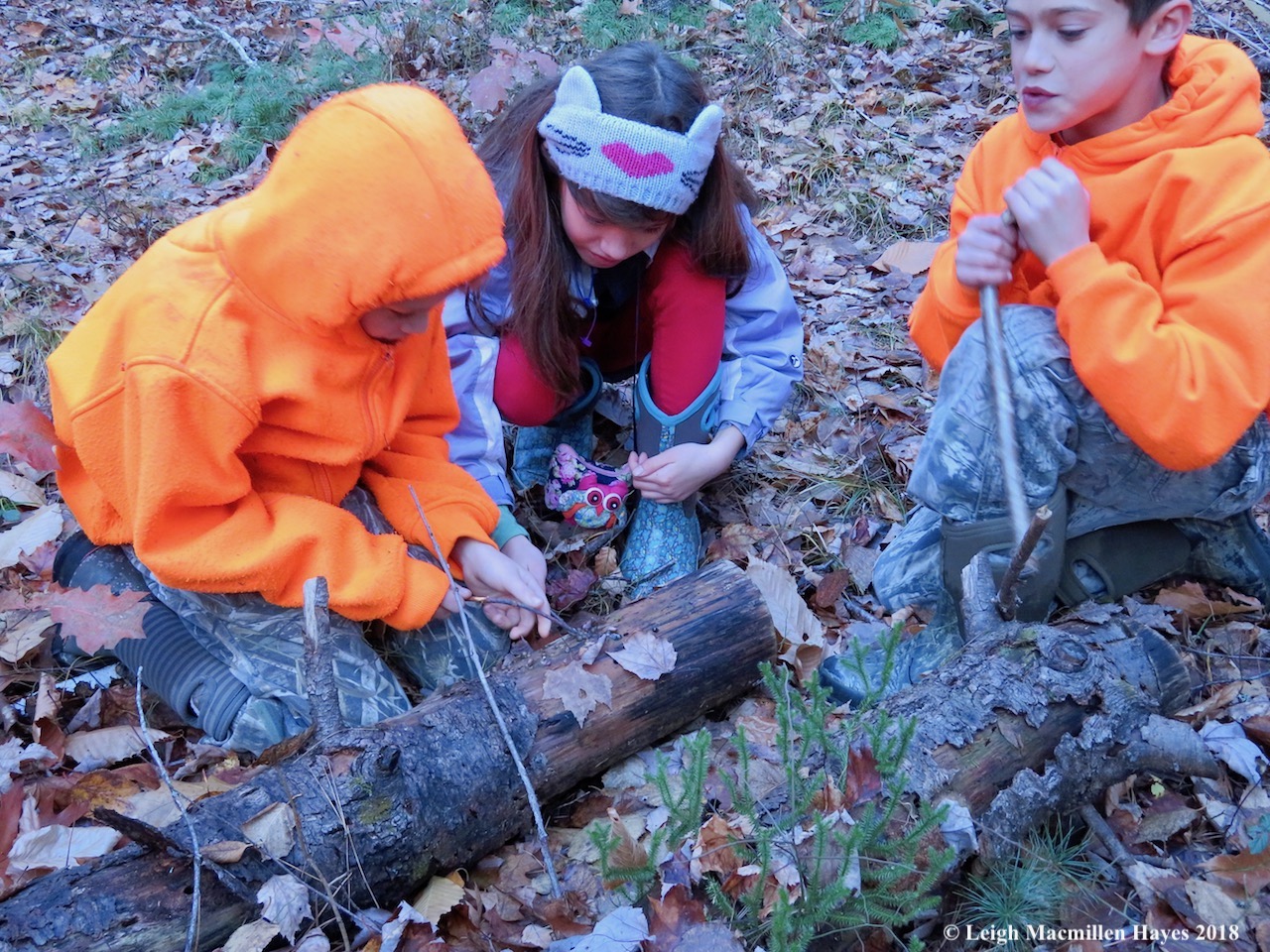


Sunday School

After church this morning, I stepped out the door, passed through openings in a couple  of stonewalls and then down the cowpath, crossed the power line, and ventured into my smiling place. It had been more than several months since I’d pushed the hemlocks aside to enter for it’s a wetland and woodland filled with growth that can make it difficult to meander through without snowshoes. But before winter arrives, I wanted to take a peek and learn what I could along the way.
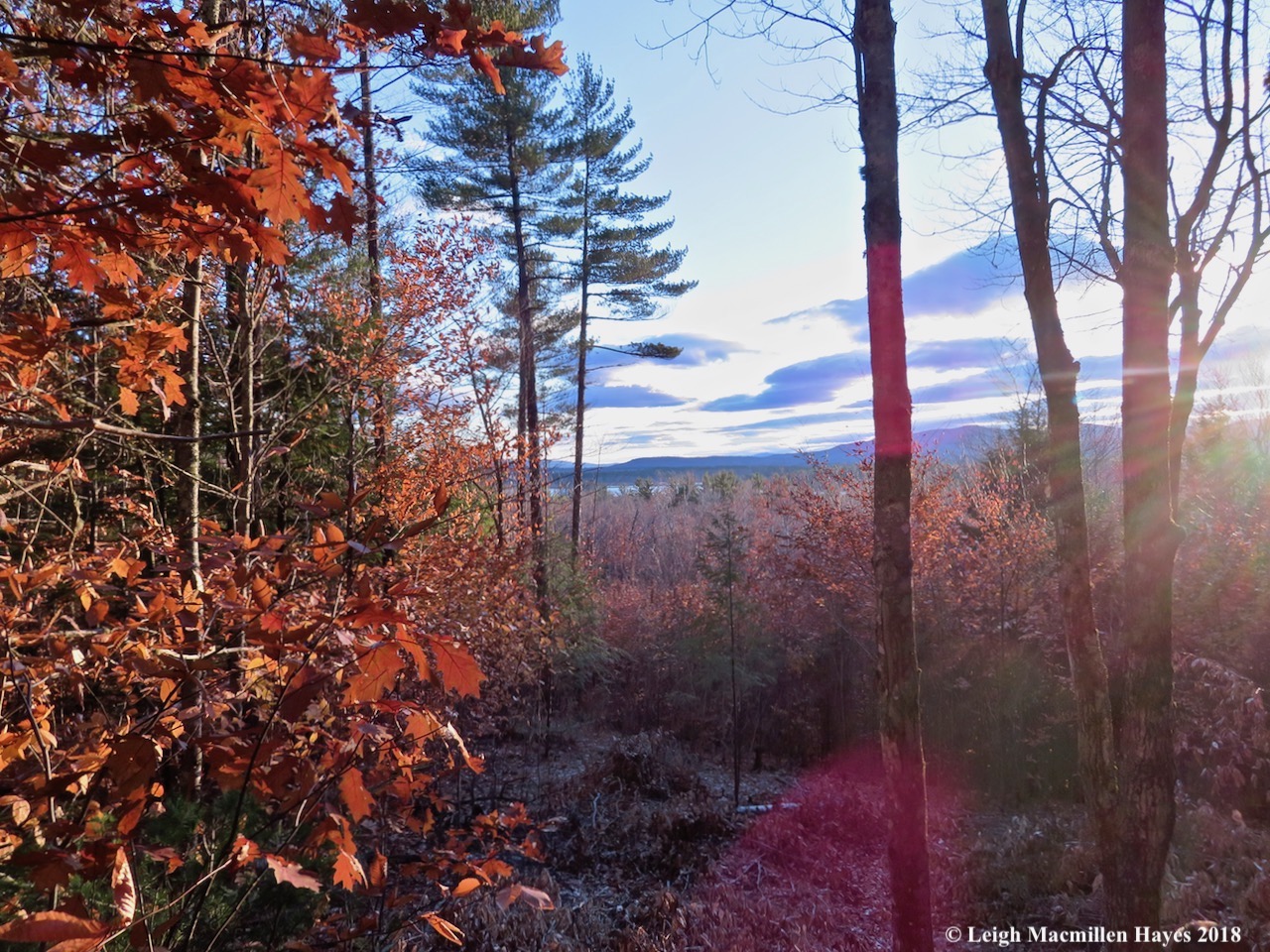
o-oak saplings

My lessons started early as I noted a couple of red oak saplings growing in the hollow of an old tree stump, their color reminiscent of the Christmas season. Last year’s mast crop (and another for some oak trees this year) meant a plentiful supply of food for weevils, little brown things, squirrels, turkeys and deer. And yet, not all were consumed and so they sprouted. Now my plan will be to wait and watch–and wonder which of this array actually will win the race to adulthood.

o-huge squirrel cache 1

A little bit further into the woods, I spied a huge cache of white pine cones. This made my heart sing, for I love to keep on eye on big caches such as this and watch as they get whittled down over the course of the winter.

o-pine cones up close

While I stood there admiring the work of the red squirrel who’d filled its larder presumably when the cones were green (and by the way, these cones are two years old, for it takes two years for them to mature atop the pine trees), I thought about the sap that coats them in white. Though the sap is drier now, does it get stuck to their feet. I know that when I come in from a walk through a pine forest, I have sap on my soles, and attached to that may be pine needles or dried leaves. Is it the same for a squirrel? If so, does it wear off like that on my boots? It must because I’ve never seen it on their feet.
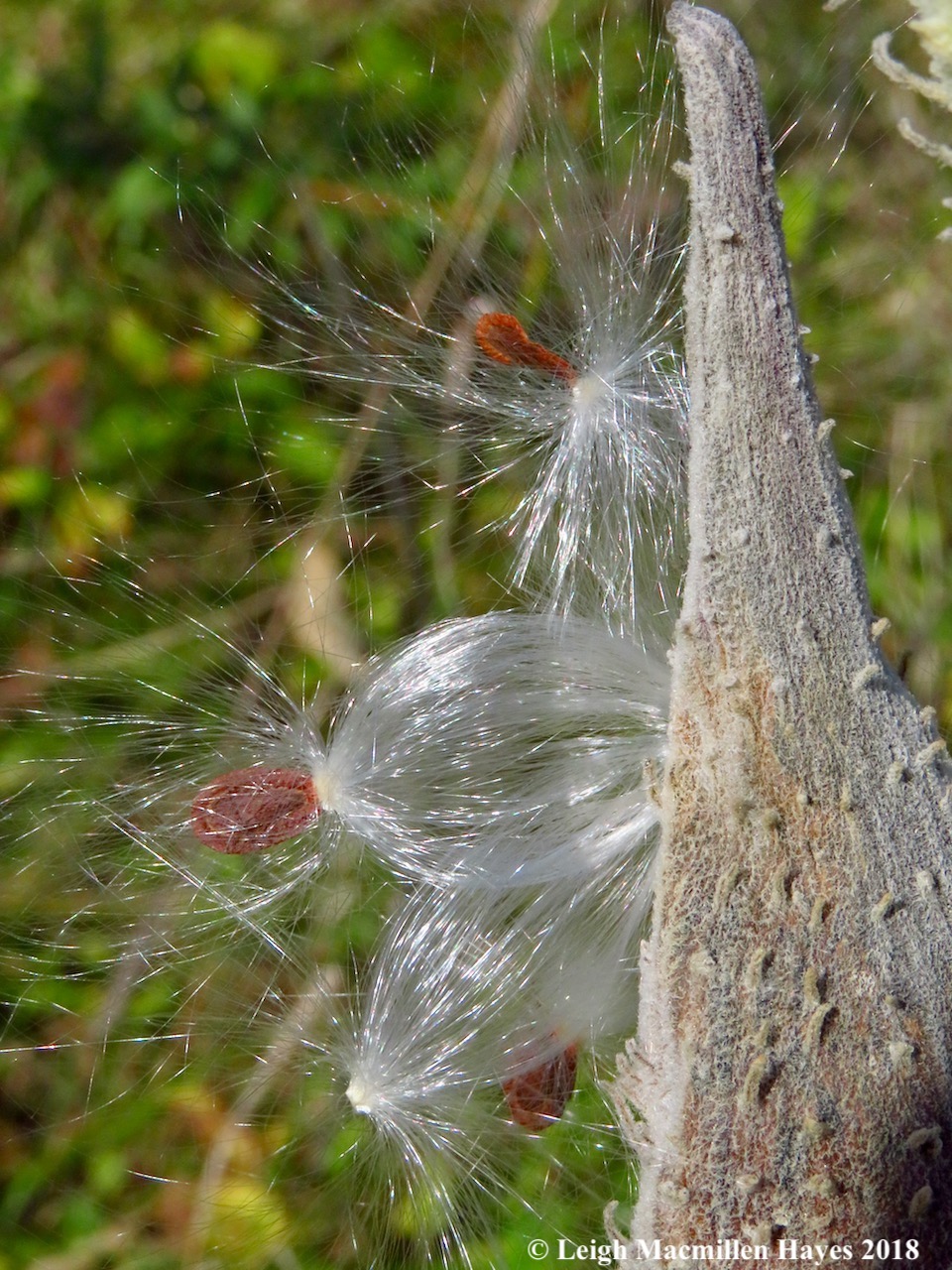
o-pine on the cob 1

And what about as they work on their pine-on-the-cobs? Does the sap on the scales come off on  their lips or teeth–much like when we eat something sticky and gooey like peanut butter?

o-pine seeds

It’s a lot of work to get to the two tiny seeds tucked within each scale. They look to be about an inch long, but most of that is the wing (think maple samara). When the weather is warm and dry, pine cone scales open to release the seeds. The squirrel who’d hoarded the stash, had plucked the cones when they were still green and atop the tree–dropping them to the forest floor before they opened so he’d have plenty to eat. And then he had to gather all that he’d dropped into the piles. And now I can’t wait for the coming months–to watch the pile dwindle and middens grow; to see the tunnels he makes in the snow; and just maybe to sit quietly nearby and watch him in action. He was a bit peeved that I was poking about today and let me know with so many chirrs from a branch nearby.
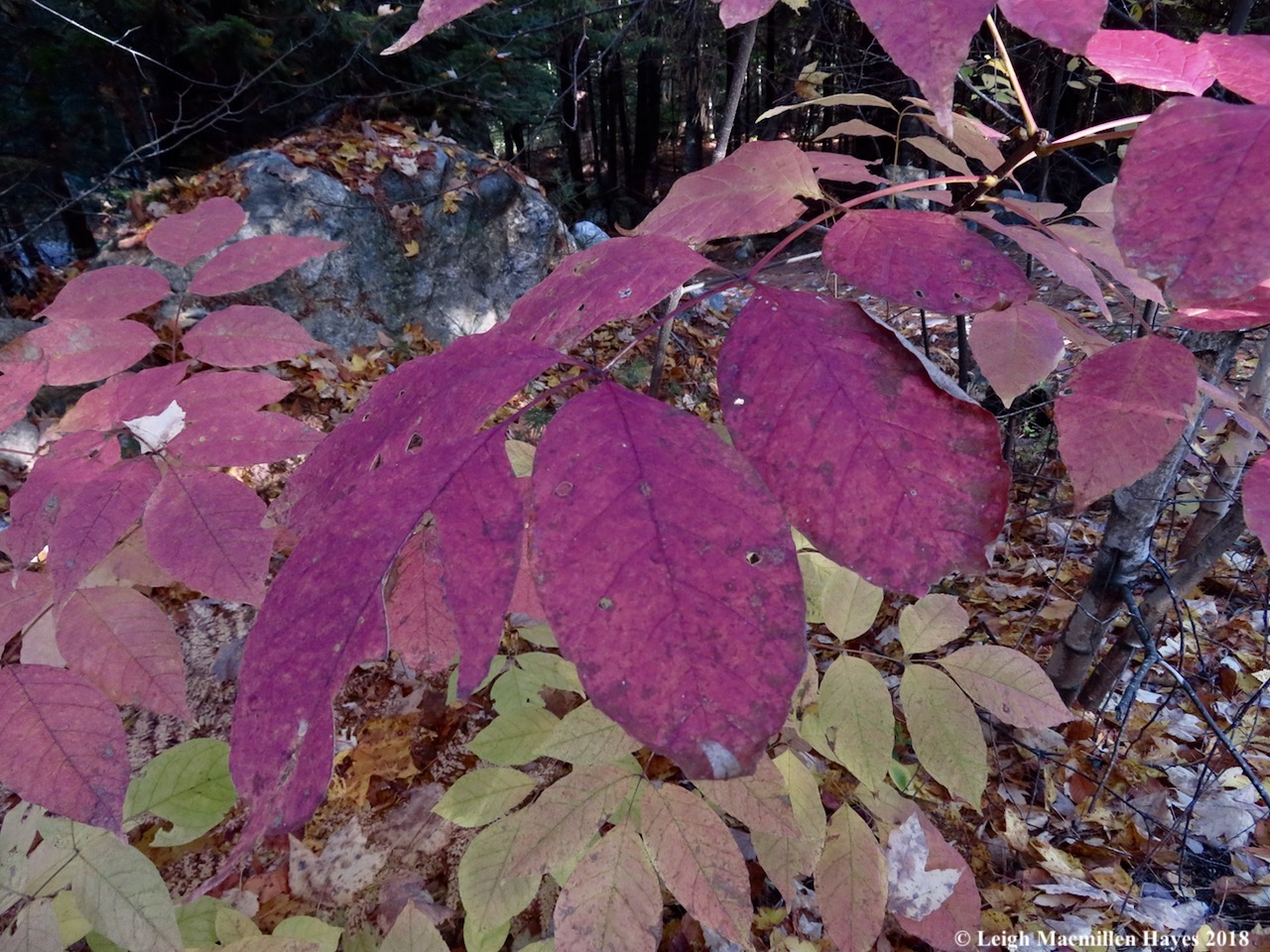
o-porky den?

I finally moved on and saw an uprooted tree I’ve visited on previous occasions. Last year I followed porcupine tracks to this very spot and spied porky within. But when I checked on later occasions, it didn’t seem as if he’d returned. Today, I peeked in and saw water. Even though it looked like a grand home to me, I’m learning that porky knows best.

o-walking in a hemlock grove

At times, I moved quietly upon the duff under the hemlock trees. Frequently, I stopped to listen and look.

o-cinnamon fern leaves1

And then in an opening, I was again in the wet zone where the cinnamon ferns grew abundantly. In curled formation, their leaves added interest to the landscape and a bit of a crunch to my footsteps.

o-cinnamon fern 2

And piled as they were surrounding each plant, I thought back to the pinecone cache. This was food of a different kind, for those leaves will decompose over the winter and nourish the earth.

o-snowberry 1

Continuing on, I came to one of my favorite spots–where the creeping snowberry grew. I hunted under the tiny leaves for the little white berries, but found none. And I’m not sure that I’ve ever seen them, especially in this place, for I suppose that I miss all the action since snow melt always seems to call a halt to such visitations and then I never make my way deep into these woods all summer. I have to assume that the little brown things and birds had a feast. Although, as any teacher knows, one should never assume. Perhaps next year, I’ll make a point of checking on these plants.

o-birch tree in offing

My tramp was a meander, for I knew not what direction each footstep might take me, changing my mind constantly and trusting that if I turned left or right, I wasn’t missing something in the opposite direction. The sight of a beech tree, its leaves ever rattling, did mean that I’d have a chance to move to drier land for a few minutes.

o-equisetum

And then I stepped up onto a rock, where the growth at my feet surprised me for I didn’t realize that equisetum grew in this part of the woods. Always something new to learn.

o-tamarack branch 1

That wasn’t all. As I looked around, a branch with yellow needles by my foot caught my attention.

o-tamarack branch 2

This was the twig of a tamarack tree, with its needles growing in tufts atop little spurs. Had we met before, the tree and me? If so, I couldn’t remember it. Nor could I find it.

o-evergreen hallway

Before me was a wall of evergreens, in a classroom all of their own, for really, these are among my favorite places where learning opportunities present themselves. But, today’s lesson wasn’t about the hemlock, white pine, fir and spruce idiosyncrasies.

o-tamarack tree

And so I scanned the sky, and about twenty-thirty feet away, I found the tree. A tamarack or larch or hackmatack tree, aka Larix laricina, is our only deciduous conifer because unlike all the evergreens, it sheds its needles each fall.

o-moose scat

A few minutes later, I heard movement, and looked up to see . . . no, not the moose that made this deposit last winter, but two flashes of white as a couple of deer bounded off. I think that’s one of my favorite lessons of these woods, for the landscape changes repeatedly and thus offers a variety of habitats for the mammals of western Maine. This is the place where I get to learn the most about them and their behaviors.

o-deer rub 1

Sometimes I’m rewarded with spying the mammal from a distance, but other times I find evidence of its behavior, like this antler rub with frayed bark at top and bottom and smooth wood between.

o-varied habitat 1

I’ve watched the forest succession in these woods for twenty-five years,

o-varied habitat 6

and it’s been logged again more recently.

o-varied habitat 4

With each change, comes more change. And so the mammals move from one spot to another, but they’re still all here–somewhere.

o-varied habitat

I just need to listen and look.

o-turkey tail fungi

It’s not just the mammals and trees that I get to learn about. My studies include among other topics, fungi, of which I’m only a so-so student. But I do know that this is turkey tail, aka Trametes versicolor.

o-Fomitopsis cajanderi  (Rosy Polypore) 2

And then I happened upon a hemlock stump topped with a large, beautiful display outlined in a coffee brown and salmon pink. It took me some work to remember its name. I can tell you where else I’ve seen it for it grows upon a hemlock log at Holt Pond.

o-unknown mushroom 1

Before I forget again, it’s a rosy polypore, if memory serves me right. I only hope my fungi teachers weigh in on this one.

o-logging road 1

At long last, it was time to follow a logging road back to the snowmobile trail.

o-snowberry on sphagnum

Sometimes, I slip back into the woods before reaching the trail, but today I chose to follow it. And what to my wondering eyes should appear, but more creeping snowberry atop sphagnum moss.

o-home sweet home

As I finally crossed the field toward home, I gave thanks for the classroom that is right outside our back door and for the lessons learned in this Sunday School. Now I just have to remember everything, which is why I record so much.


Time Well Spent

Time. I never seem to have enough of it. Time with my guy. Time with our sons. Time with family. Time with friends. Time to explore. Time to reflect. Time to write. Time to sketch. Time to be . . . in tune with the world around me and my own soul.

b-pileated 1

And so today, when I heard a pileated woodpecker as it worked on a dead ash tree by one of the stonewalls, I decided to take a break from my own work and give it the attention it so loudly demanded.

b-pileated 2

Its a repeat visitor to that tree; along with crows and hawks and smaller birds as well. The tree can no longer create its own source of food, but it continues to provide for others, be they bird, insect or mushroom. And I suspect that it secretly shares its knowledge of the world with the younger ash it towers over–to the right. As for the pileated, his time at that tree came to an end . . . for the moment. He’ll be back–probably soon.

b-ash tree 1

Because I stood below and no longer need to look up, I turned my gaze downward. And then had to pause. What had happened? Who had visited? And scraped the ground right down to the roots? And left a pile of leaves and sticks and other debris at the edge? A mushroom foray? An acorn frenzy? I looked for hair and found none. Turkey? Squirrel? Porcupine?

b-ash tree 2

And at the base of the next old ash, similar behavior.

b-scat 2

Returning to the first tree, I discovered that what looked like dirt was actually little pellets of scat . . . tiny scat. Tons of scat. A latrine. Did perhaps a meadow vole live somewhere nearby and a predator went after it? I did also suspect that there may have been a bunch of mushrooms that were harvested and in the process the vole’s latrine was exposed. I’m not sure if I’ll ever really know, but since I had stopped to look, I noticed something else.

b-pigskin poison puffball (Earthball)

Tucked near the base of the tree and relatively untouched by whatever had spent some time clearing the area, was a pigskin poison puffball, so named for its outer skin that feels like a football. (In his book, Fascinating Fungi of New England, Lawrence Millman writes: “historical note: footballs used to be made of pigs’ bladders, not pigskin.”) The dark spore mass within seemed to reflect the ashen color of the tree beside which it grew.

b-pelt lichen1

I should have returned to work then, but the puffball discovery and my wonders about the latrine made me want to poke about some more. Since I’d missed the puffball, what else hadn’t I noticed. A few steps to the left upon another tree root–a pelt lichen with many fruits, aka many-fruited pelt. I first discovered this lichen upon Bald Pate Mountain a few years ago, but didn’t know that it grew here–right under my nose.

b-many-fruited 2

Its smooth brown lobes shone brightly due to all the recent moisture, but it was the reddish-brown apothecia or fruiting forms that I found so intriguing. They’re described as saddles, and I suppose if you look at one from the right angle, yes, you can see the saddle-like structure.

b-field dog lichen

On the next tree, another pelt known as dog lichen–apparently named because its fruits reminded someone of dog ears.

b-spring tails 1

The algal component of a lichen goes into food production during rain, and so I continued to peer around. But first, a clump of Indian pipes caught my attention and upon them I noticed springtails doing their thing–springing about in search of food. Their diet consists of fungi, pollen, algae and decaying organic matter. Springtails are among the most abundant of insects, but because they are so small, they often go undetected unless you see them on snow in the winter.

b-mealy pixie cups

And then back to the lichens it was. I found mealy pixie cups in great number growing on a stonewall.

b-pixie cups fruiting

And one large patch looked like it was going to produce another, for so prolific were its fruits of tiny round balls.

b-lichen design

Also among my great finds, were the lichens decorating branches that had fallen to the ground in our recent wind storm. I loved the picture they painted with variations on a theme of color . . .

b-foliose and fruticose

and form.

b-lichen 3

My favorite of all reminded me of so many things–a rose in bloom, waves echoing forth with ripples, and even a topographical map.

Alas, I was short on time and needed to head in, but my finds–were the greatest. Even a wee bit of time spent wondering is time well spent.


Power-filled Mondate

It may not have been a hurricane, but the storm that began as Philippe, left its mark as it whooshed through New England. Along its path, the world darkened. We lost power about 1am, but it was restored by the time we awoke this morning. And yet, many may be without electricity for days.

Our tentative plan had been to hike, but we realized last night that we’d need to consider Plan B. And when the sun shone this morning, we were rather oblivious to the havoc caused by downed trees and flooding. We did check the weather report, however, and saw that there would be a few showers and the wind would continue to blow. So, Plan B it was–yard work between rain drops.

For my guy, that began with work on the back screen door for a bang we’d heard in the night turned out not to be the grill or furniture sliding off the deck, but rather the door banging against a bench. And after that, it wouldn’t shut properly.

o2-bee on lavendar

While he worked on the door, I headed into the kitchen/cottage garden, which had become quite overgrown due to my lack of a green thumb. While my intention was to put the garden to bed, some flowers like the lavender needed to remain for they still invited visitors.

o3-spring tails

As I poked about, cutting some plants back, I made a few discoveries, including the sight of snow fleas or spring tails climbing a stalk.

o1-bird nest fungi 1

And buried beneath, I unearthed bird’s nest fungus, which look like such for which they were named, only in miniature form for they are no more than a quarter inch in height or diameter. Nestled inside the nests, like a bunch of eggs in a basket, are the fruiting bodies that await drops of water in order for their spores to spring out and find their own substrate on which to grow.

o5-beebalms last bloom

And then I approached the beebalm, where a few blossoms still bloomed on this late date.

o4-meadowhawk 1 on bee balm

Most of the beebalm had long since gone to seed, and today one structure became a resting spot as the wind blew. A male autumn meadowhawk seemed to hold on for dear life.

o6-meadowhawk 2

Of course, I took advantage of his moments of rest to take a closer look at the divine body structure . . .

o7-meadowhawk 3

from a variety of viewpoints.

o8-meadowhawk 4

Gender determination is based on the terminal appendages. Male dragonflies have three, known as claspers, which they use to grasp and hold a female during mating. The upper or from this view, outer appendages, are called cerci, while the lower, or middle appendage, is the epiproct–meaning its the appendage situated above the anus. Females have only a pair of cerci, and I’m not sure of their purpose. That beebalm still stands–in hopes he’ll return again.

o9-quaking aspen buds and leaf scars

As I continued to work and observe the world around me, my guy found one project after another to complete–each of which required a trip to the hardware store. Hmmmm. And so, I too, decided to go for a trip–into the woods. Donning my blaze orange vest and hat, and knowing that I wasn’t going far, I took off. My first stop was at a branch below the quaking aspen that had fallen in the night. Though it had reached its end of life, the waxy bud scales and leaf scars were a sight to behold. The smiley-face leaf scar showed where the stem or petiole of this past year’s leaf broke from the branch. As the leaf pulled away, it severed the vessels through which water and food moved. The dots within the scar indicate where those vessels had been connected and are known as bundle scars.
o10-pathway in woodlot

In our woodlot, my trail was littered with pine cones and branches, but that was the extent of tree damage.

o13-selfie

I found puddles that invited me in.

o11-jelly ears

Some branches, decorated with a variety of lichens and jelly ear fungi also found their way to the puddles.

o12a-vernal pool

At last, I reached the vernal pool and was surprised to find it only partially filled.

o12-vernal pool leaves

Atop and within it, the mosaic of broad leaves and needles formed a tapestry of shape and color–in the moment.

014-goldenrod bunch gall 1

Nearby, I paused by a goldenrod that sported a bunch, rosette, or flower gall, for really, it resembles all three.

o15-goldenrod bunch gall 2

The Goldenrod Gall Midge, which is a tiny fly, laid an egg in a leaf bud, hatched into grub form, and prevented the stem from growing, though the plant continued to produce leaves that formed a tight cluster.

o16-maple samara between milkweed pods

I finally made my way home, and turned to other gardens on the eastern side of the house, where milkweed pods also needed to remain standing. I even left the sugar maple samara because I thought it was a fun place to land.

o-17-aphids on milkweed

Also at home on the milkweed were a hundred aphids all clustered together.

020-monarch chrisalys

But the best find of all–the delicate remains of a monarch butterfly chrysalis. I had no idea it was there, but presume it housed one of the monarchs that consumed my attention a few weeks ago.

Just after we headed in, my sister-in-law called to say her sump pump had conked out. Off my guy went again.

It wasn’t the hike date we’d hoped for, but our day was filled with power tools and powerful insects and power-filled love.


Marathon Mondate

As he’s done every year for the past however many, my guy is training for the Moose Pond Half Marathon, a race around Moose Pond in Bridgton and Denmark that supports the Shawnee Peak Adaptive Ski Program. The race is only two weeks away and so this morning he headed off to run ten miles. And afterward, he said he felt like he could have run the additional 3.1 miles that would complete the race. That being said, we headed west to join our friends, Pam and Bob, on a hike at a new preserve in New Hampshire.

The plan was to meet at the trailhead near Hurricane Mountain Road on the Chatham/Conway town line. We knew the road, but not the spot, and were racing to get there, so of course I drove right by. But . . . I spied Pam sitting in their car in the parking lot and probably burned some rubber as I came to a screeching halt and then quickly put the truck into reverse. Fortunately, my guy didn’t get whiplash. It’s a back road, so not well traveled, thus I could drive backwards for a hundred feet or more without any problem–thus is the way ’round these parts. And one of the reasons we love it so.

m-sign 1

Another is that local land trusts preserve land for the benefit of the species who call this place home, both flora and fauna–and for us so that we, too, may benefit from time spent tramping along trails, making discoveries and forging friendships. The preserve we visited today isn’t quite open, but Pam said she’d heard they plan to open on November 4th. There were no signs on the kiosk or trail maps, but we quickly learned that none were necessary for the route was easy to follow. We were at the Monroe-Lucas Preserve, a 62-acre property donated to the Upper Saco Valley Land Trust.

According to their website: “The land was given to USVLT by Barrett Lucas in honor of his wife, the late Leita Monroe Lucas. Leita’s family has deep roots in East Conway and Redstone, and her father, Ernest “Red” Monroe, also wanted to see the land preserved. Adjacent to the Conway Common Lands State Forest, The Nature Conservancy’s Green Hills Preserve, and the White Mountain National Forest, this parcel builds on an existing network of preserved land, and has wonderful opportunities for future trail development and increased public access. A branch of Weeks Brook also runs through the property, and the property lies within USVLT’s ‘Green Hills’ focus area. The site is also remarkable as the one-time summer residence of the American Impressionist painter Thomas Wilmer Dewing, and his fellow painter and wife, Maria Oakey Dewing. Their cottage, built in the late 1800s, fell into disrepair in the mid-1900s. Now only the chimney remains onsite.”

m-puff ball fungi 1

With Pam in the lead, we started up the trail and within minutes the fun began. She spotted a large patch of puff balls begging to be poked. The spores wafted up and away with hopes of finding the perfect place to grow nearby. We assume they will be successful, for within a fifteen foot area, we found patch after patch and knew we weren’t the first to encourage their spores to blow in the breeze.

m-bobcat print

And then Pam began to spy prints in the mud. First, a moose. Then this bobcat–if you look closely, as we did, you may see the hind pad matted down; above that a raised ridge in the form of a C for cat; and four large toes, the two in the center being asymmetrical. Because it was a muddy substrate, we even saw nail marks, especially above the two center toes. Five feet further, we found deer prints. And so we rejoiced in the foresight of the Monroe-Lucas family to protect this land.

m-Weeks brook flowing 1

A bit further on, we heard the brook before we saw it–a branch of Weeks Brook that borders the property. We all stood beside and let it mesmerize us.

m-weeks brook 1c

We thought about its forceful action each spring and the eons it took to carve into the rocks along its banks.

m-weeks brook baths

We shared visions of a summer day spent sliding down its smooth channels and slipping into the pools below.

m-weeks brook between the rocks

And we marveled at the way it split the granite above . . .

m-weeks brook between 3

and flowed between the shelves.

m-weeks brook bubbles

All the while, it raced to the finish line and we could only assume it made good time.

m-hobblebush flower?

It was beside the brook where the hobblebush grew prolifically and offered a myriad of colors among their leaves and clasping or clapping hands among their buds. Because we were looking, we noticed one flower forming into its globe shape as it usually does in late winter. Was it confused?

m-hobblebush new leaf

And on another, a new leaf.

m-hobblebush 2

Fortunately, most behaved as they should and gave us an autumnal display worth celebrating.

m-hobblebush:hemlock shadows

One even added some shadow play.

m-mount kearsarge

Eventually, we turned away from the brook and followed the trail down. A peak through the trees and we could see Mount Kearsarge across the way.

m-slime mold 1

On a tree stump, we found a couple of fascinating fungi including a slime mold all decked out for Halloween.

m-jelly fungi

And on the same stump, a display of jelly ear fungi.

m-old moose scat

Around the corner was more evidence of moose traffic, though since it was moss-covered, we decided it was a couple of years old. None of us could ever recall seeing moss grow on moose scat before, but it made perfect sense that it would be a suitable substrate. I did wonder how they’d categorize that on a moss ID key–grows on rock, tree, ground, moose scat?

m-pippsisewa

Our moments of awe weren’t over yet. We sent up three cheers for the pipsissewa and its seedpods (Bob, did you take one?),

m-red-belted polypore

and red-belted polypore.

m-frullania 2

And then Bob spied the frullania. The smaller, spider-webby display in the lower right hand corner is Frullania eboracensis, a liverwort with no common name. But the larger mass is known as Frullania asagrayana, so named for a botanist and natural history professor at Harvard University from 1842-1873–Asa Gray.

m-frullania

We all went in for a closer look at its worm-like leafy structure.

m-frullania and muy guy

Even my guy got into the act, much to his reluctance. And he was certain he didn’t need a lesson on how to use a hand lens. Thankfully, he doesn’t read these blog posts, so I can get away with this. Shhhh.

m-uprooted pine 1

Around the next bend, for the trail has enough S curves to make the descent easy, we came upon a white pine long since uprooted. Did anyone hear the crash?

m-uprooted picture frames

It offered a wonderful view–of more red-belted polypores, the root system and rocks, plus several windows on the world beyond.

m-photo frame hand

If you go, watch out . . . Thing of The Addams Family, might be lurking about.

m-Pam holding a huge striped maple leaf, Bob photobombing

Continuing on, we moved out of the hemlock and pine grove and back into the land of the broadleaves, including one with the broadest of them all–a huge striped maple leaf that Pam spotted; and Bob made sure to photo bomb the Kodak moment.

m-cottage sign 2

And then, as the trail evened out, we crossed a narrow gangplank to the location of the original cottage. According to a sign posted there, “Thomas Wilmer Dewing (1851-1938) and Maria Oakey Dewing (1845-1927) were 19th century American painters based in New York City. Maria often painted flowers and garden scenes, while Thomas is known for his figure paintings of aristocratic women, notably ‘Lady in Yellow’ hanging at the Isabella Steward Gardner Museum in Boston. The couple spent their summers at a popular artists’ colony in Cornish, NH, during the early 1900s. The Dewings also lived and painted in a cottage located here on the Monroe-Lucas Preserve for several years.

m-site of Dewing cottage 1

All that’s left is the chimney.

m-cottage stove

And some artifacts.

m-toilet

Including the john.

m-pokeweed

Our final view was a pokeweed still in flower and fruit. Again, we wondered about its timing, while appreciating its offering.

With that, we were back at the parking lot, where Bob informed us that our distance was just over a mile and time two hours–hardly record breaking. And hardly a “quickest to the destination hike” for my guy, but he kept finding stumps to sit upon as we gazed more intently on our surroundings; I think he secretly appreciated our slow pace and the opportunity to rest his legs.

If you want support his effort to raise funds for the Shawnee Peak Adaptive Ski Program, stop by and see him. Any and all donations are most welcome.