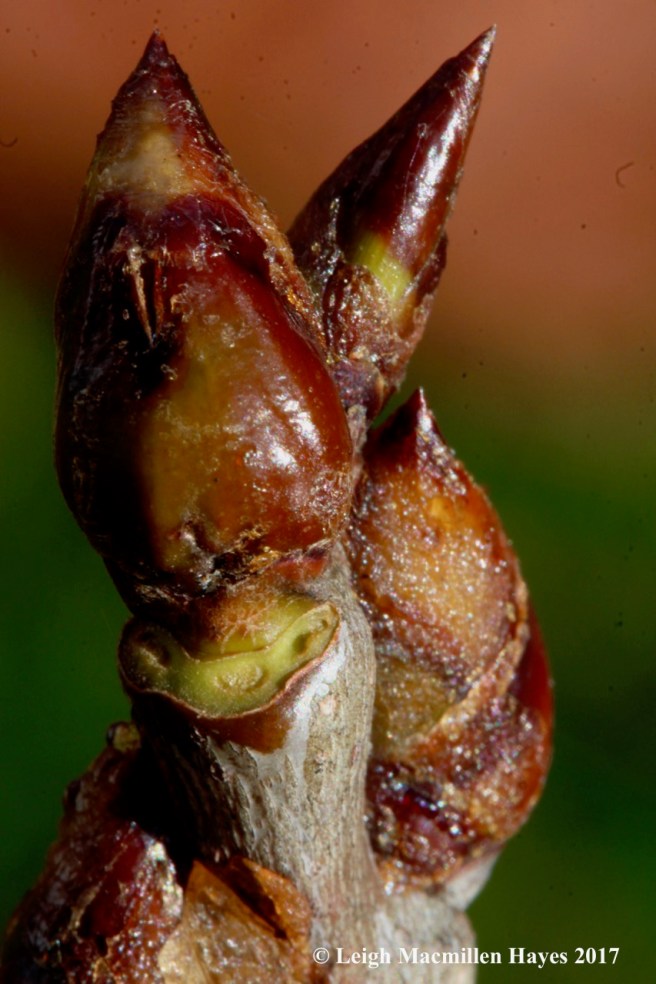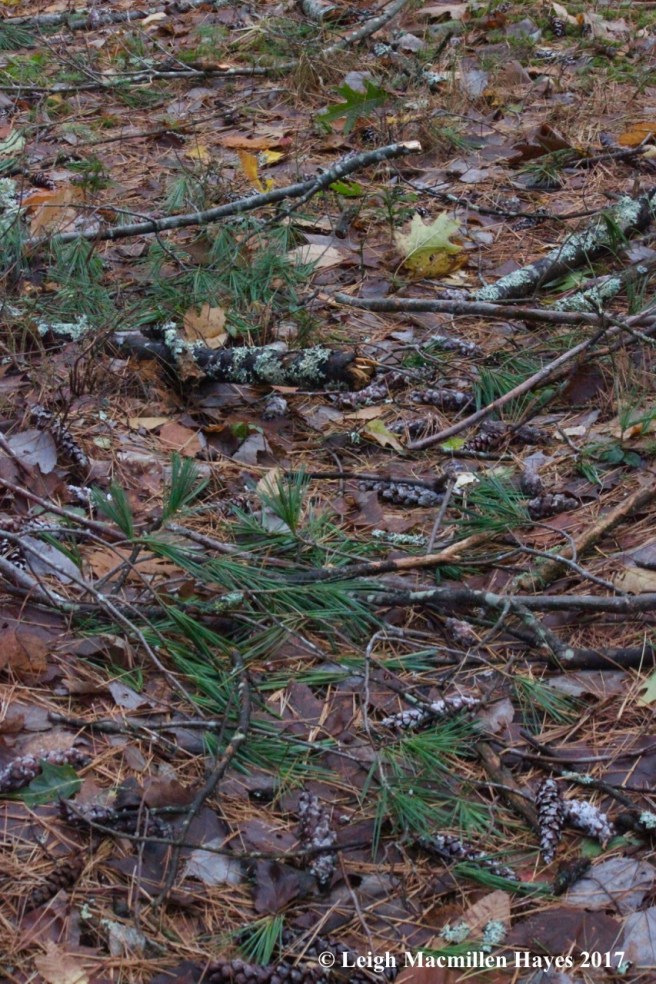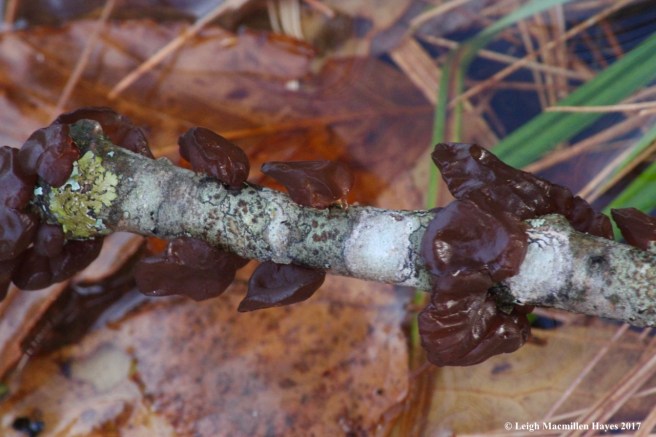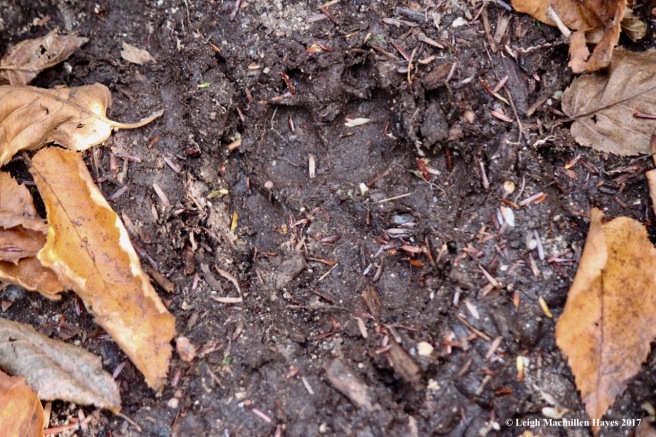
Sunday School

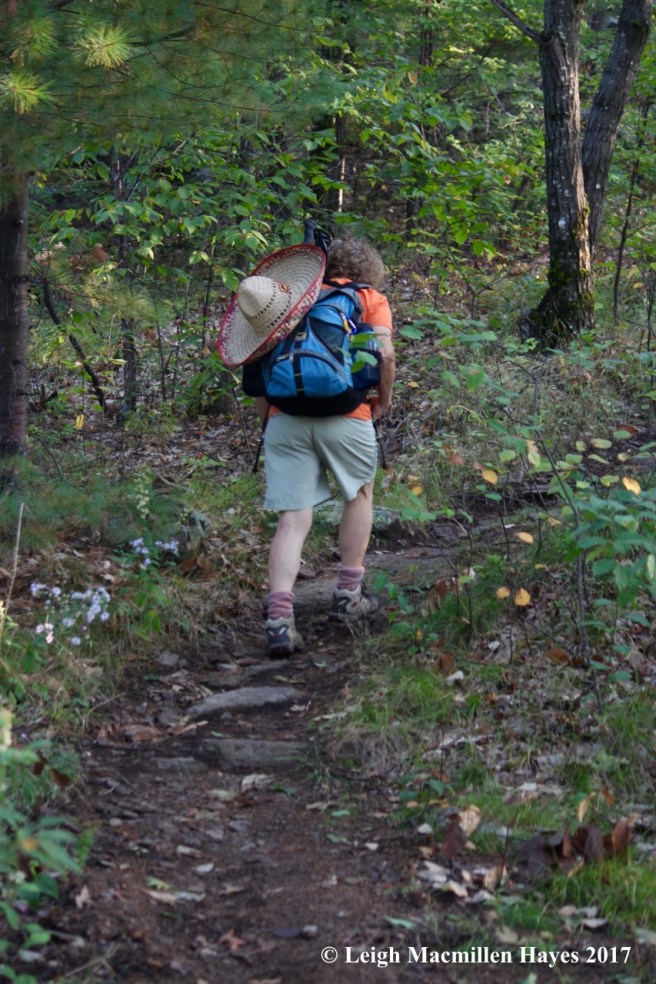
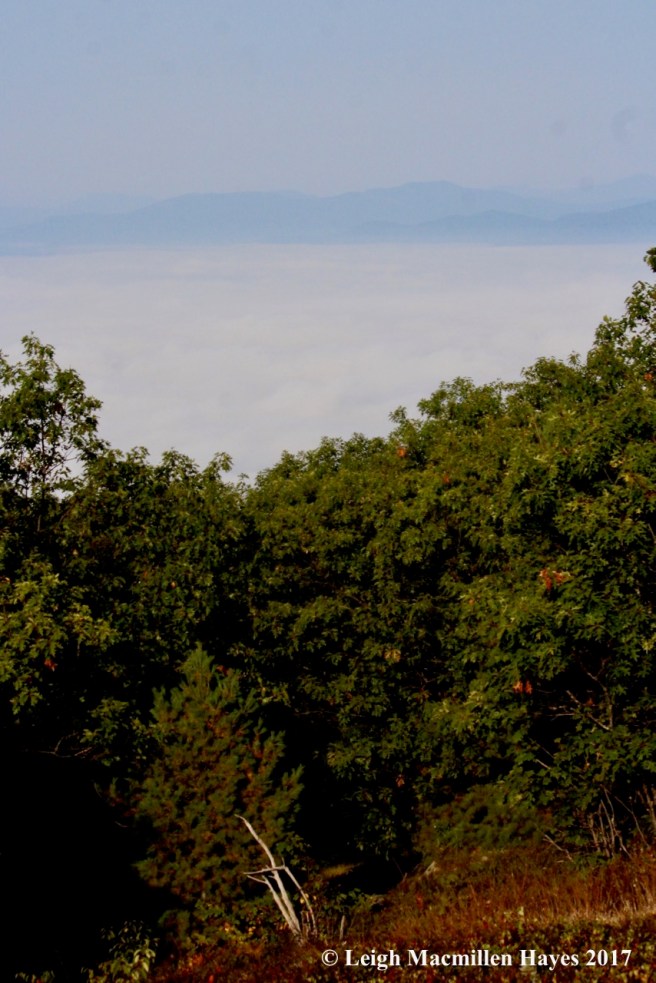
After church this morning, I stepped out the door, passed through openings in a couple  of stonewalls and then down the cowpath, crossed the power line, and ventured into my smiling place. It had been more than several months since I’d pushed the hemlocks aside to enter for it’s a wetland and woodland filled with growth that can make it difficult to meander through without snowshoes. But before winter arrives, I wanted to take a peek and learn what I could along the way.
o-oak saplings

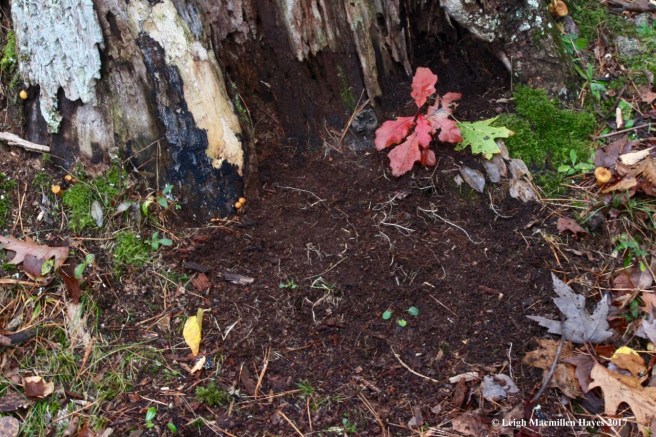
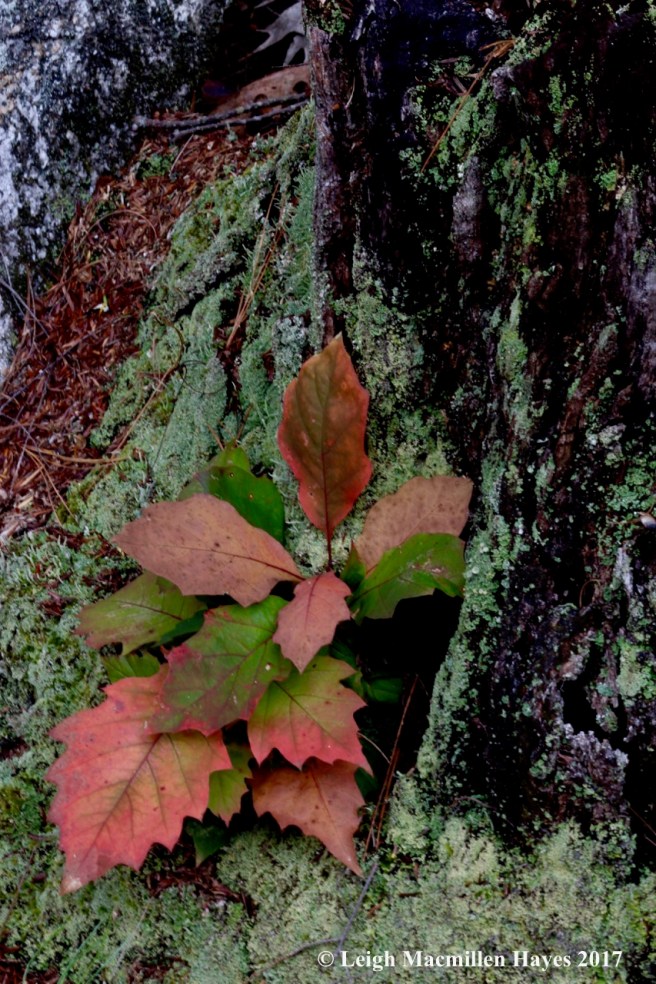
My lessons started early as I noted a couple of red oak saplings growing in the hollow of an old tree stump, their color reminiscent of the Christmas season. Last year’s mast crop (and another for some oak trees this year) meant a plentiful supply of food for weevils, little brown things, squirrels, turkeys and deer. And yet, not all were consumed and so they sprouted. Now my plan will be to wait and watch–and wonder which of this array actually will win the race to adulthood.
o-huge squirrel cache 1

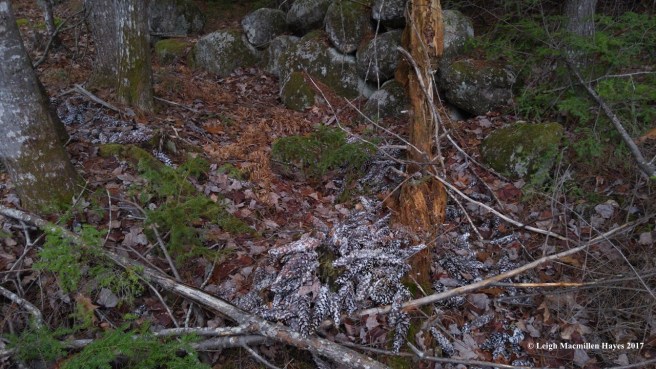
A little bit further into the woods, I spied a huge cache of white pine cones. This made my heart sing, for I love to keep on eye on big caches such as this and watch as they get whittled down over the course of the winter.
o-pine cones up close

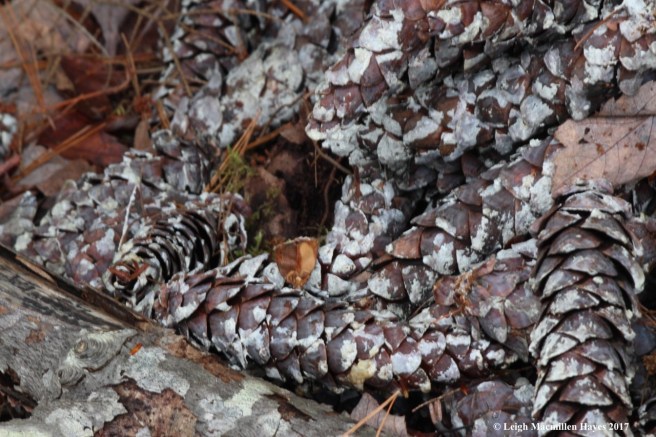
While I stood there admiring the work of the red squirrel who’d filled its larder presumably when the cones were green (and by the way, these cones are two years old, for it takes two years for them to mature atop the pine trees), I thought about the sap that coats them in white. Though the sap is drier now, does it get stuck to their feet. I know that when I come in from a walk through a pine forest, I have sap on my soles, and attached to that may be pine needles or dried leaves. Is it the same for a squirrel? If so, does it wear off like that on my boots? It must because I’ve never seen it on their feet.

o-pine on the cob 1

And what about as they work on their pine-on-the-cobs? Does the sap on the scales come off on  their lips or teeth–much like when we eat something sticky and gooey like peanut butter?

o-pine seeds

It’s a lot of work to get to the two tiny seeds tucked within each scale. They look to be about an inch long, but most of that is the wing (think maple samara). When the weather is warm and dry, pine cone scales open to release the seeds. The squirrel who’d hoarded the stash, had plucked the cones when they were still green and atop the tree–dropping them to the forest floor before they opened so he’d have plenty to eat. And then he had to gather all that he’d dropped into the piles. And now I can’t wait for the coming months–to watch the pile dwindle and middens grow; to see the tunnels he makes in the snow; and just maybe to sit quietly nearby and watch him in action. He was a bit peeved that I was poking about today and let me know with so many chirrs from a branch nearby.

o-porky den?

I finally moved on and saw an uprooted tree I’ve visited on previous occasions. Last year I followed porcupine tracks to this very spot and spied porky within. But when I checked on later occasions, it didn’t seem as if he’d returned. Today, I peeked in and saw water. Even though it looked like a grand home to me, I’m learning that porky knows best.
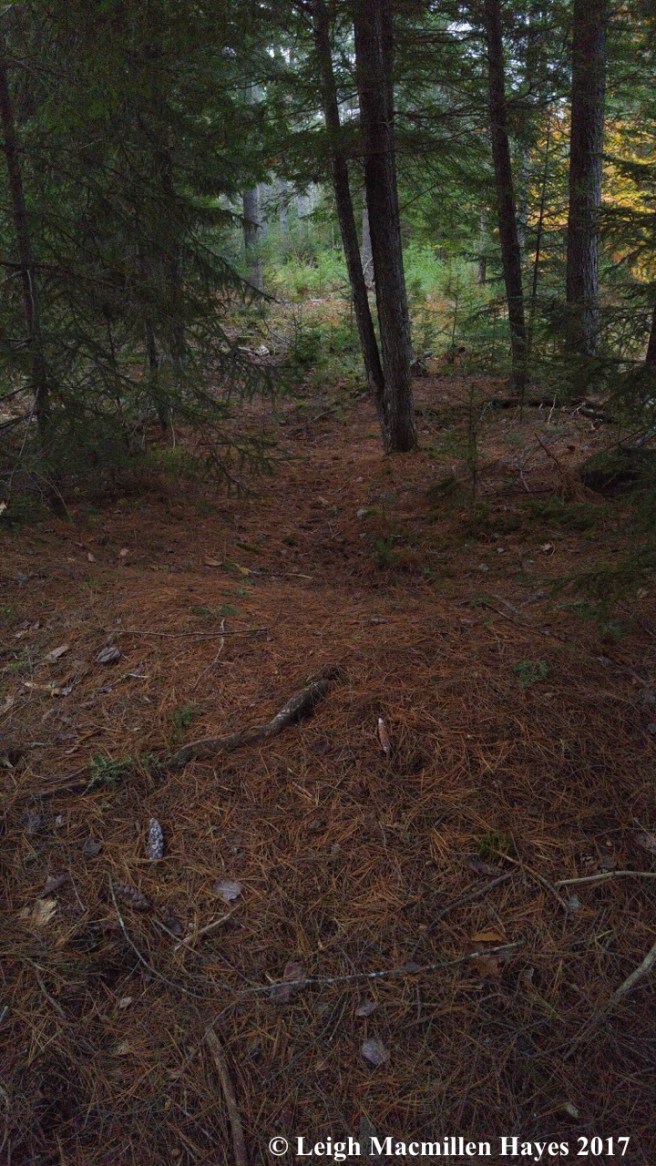
o-walking in a hemlock grove

At times, I moved quietly upon the duff under the hemlock trees. Frequently, I stopped to listen and look.
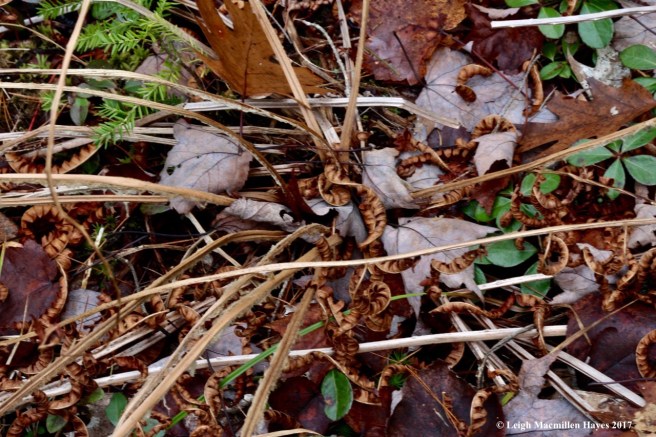
o-cinnamon fern leaves1

And then in an opening, I was again in the wet zone where the cinnamon ferns grew abundantly. In curled formation, their leaves added interest to the landscape and a bit of a crunch to my footsteps.
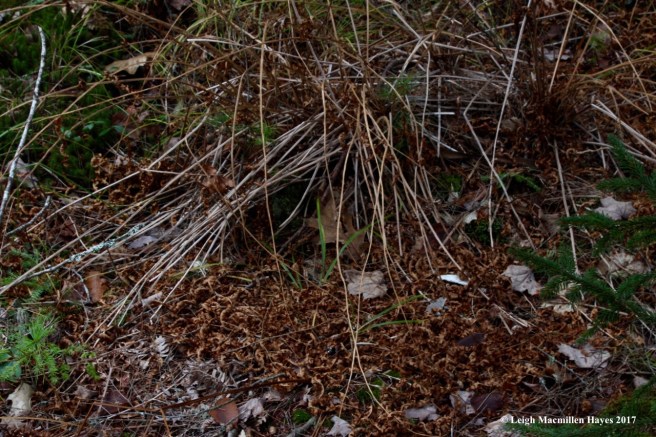
o-cinnamon fern 2

And piled as they were surrounding each plant, I thought back to the pinecone cache. This was food of a different kind, for those leaves will decompose over the winter and nourish the earth.

o-snowberry 1

Continuing on, I came to one of my favorite spots–where the creeping snowberry grew. I hunted under the tiny leaves for the little white berries, but found none. And I’m not sure that I’ve ever seen them, especially in this place, for I suppose that I miss all the action since snow melt always seems to call a halt to such visitations and then I never make my way deep into these woods all summer. I have to assume that the little brown things and birds had a feast. Although, as any teacher knows, one should never assume. Perhaps next year, I’ll make a point of checking on these plants.

o-birch tree in offing

My tramp was a meander, for I knew not what direction each footstep might take me, changing my mind constantly and trusting that if I turned left or right, I wasn’t missing something in the opposite direction. The sight of a beech tree, its leaves ever rattling, did mean that I’d have a chance to move to drier land for a few minutes.

o-equisetum

And then I stepped up onto a rock, where the growth at my feet surprised me for I didn’t realize that equisetum grew in this part of the woods. Always something new to learn.

o-tamarack branch 1

That wasn’t all. As I looked around, a branch with yellow needles by my foot caught my attention.
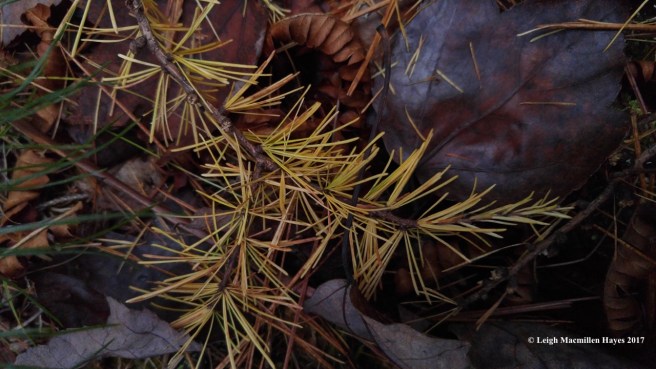
o-tamarack branch 2

This was the twig of a tamarack tree, with its needles growing in tufts atop little spurs. Had we met before, the tree and me? If so, I couldn’t remember it. Nor could I find it.
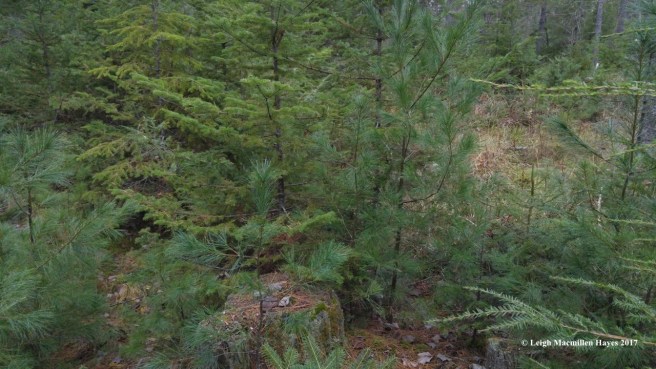
o-evergreen hallway

Before me was a wall of evergreens, in a classroom all of their own, for really, these are among my favorite places where learning opportunities present themselves. But, today’s lesson wasn’t about the hemlock, white pine, fir and spruce idiosyncrasies.
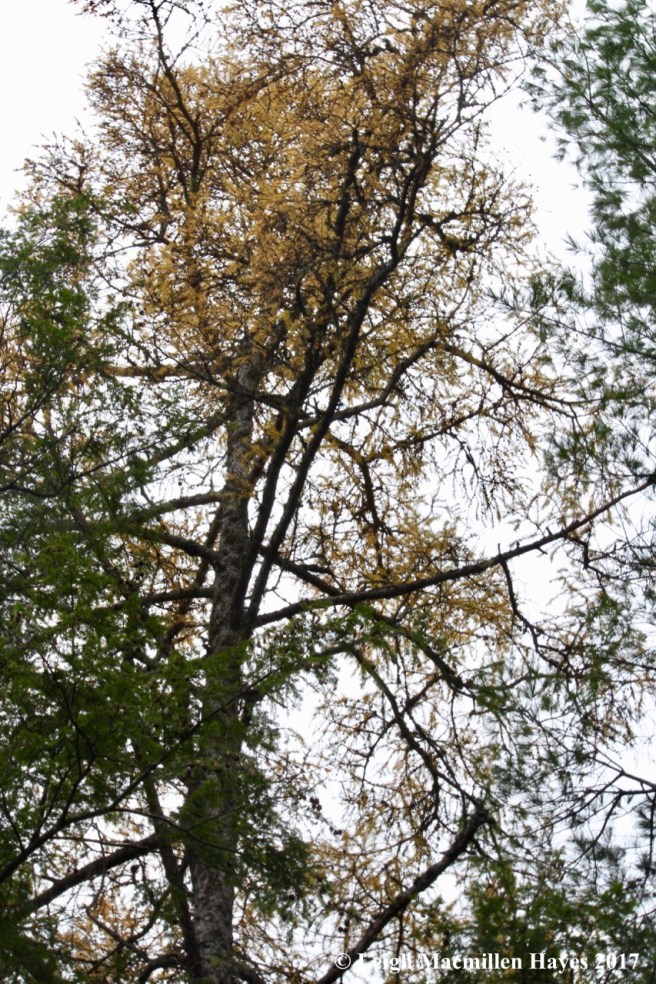
o-tamarack tree

And so I scanned the sky, and about twenty-thirty feet away, I found the tree. A tamarack or larch or hackmatack tree, aka Larix laricina, is our only deciduous conifer because unlike all the evergreens, it sheds its needles each fall.
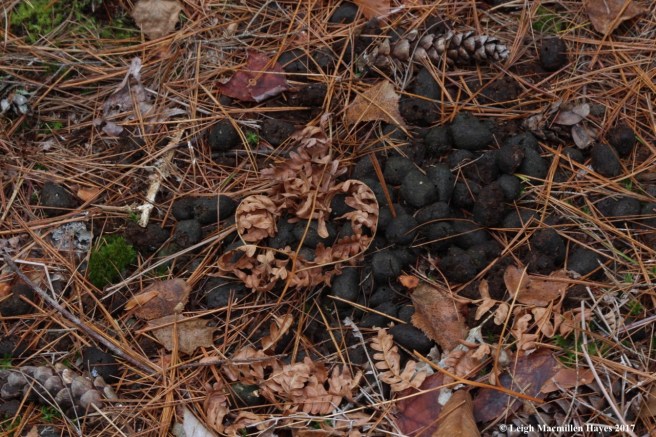
o-moose scat

A few minutes later, I heard movement, and looked up to see . . . no, not the moose that made this deposit last winter, but two flashes of white as a couple of deer bounded off. I think that’s one of my favorite lessons of these woods, for the landscape changes repeatedly and thus offers a variety of habitats for the mammals of western Maine. This is the place where I get to learn the most about them and their behaviors.

o-deer rub 1

Sometimes I’m rewarded with spying the mammal from a distance, but other times I find evidence of its behavior, like this antler rub with frayed bark at top and bottom and smooth wood between.
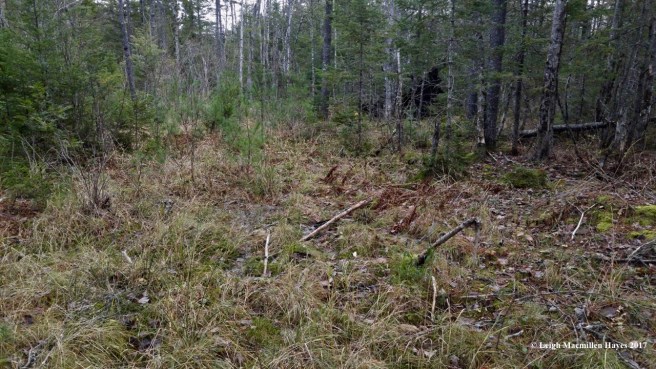
o-varied habitat 1

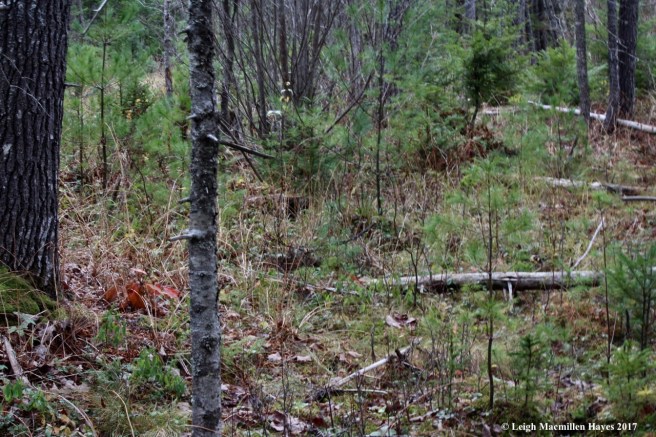
I’ve watched the forest succession in these woods for twenty-five years,
o-varied habitat 6

and it’s been logged again more recently.

o-varied habitat 4

With each change, comes more change. And so the mammals move from one spot to another, but they’re still all here–somewhere.

o-varied habitat

I just need to listen and look.

o-turkey tail fungi

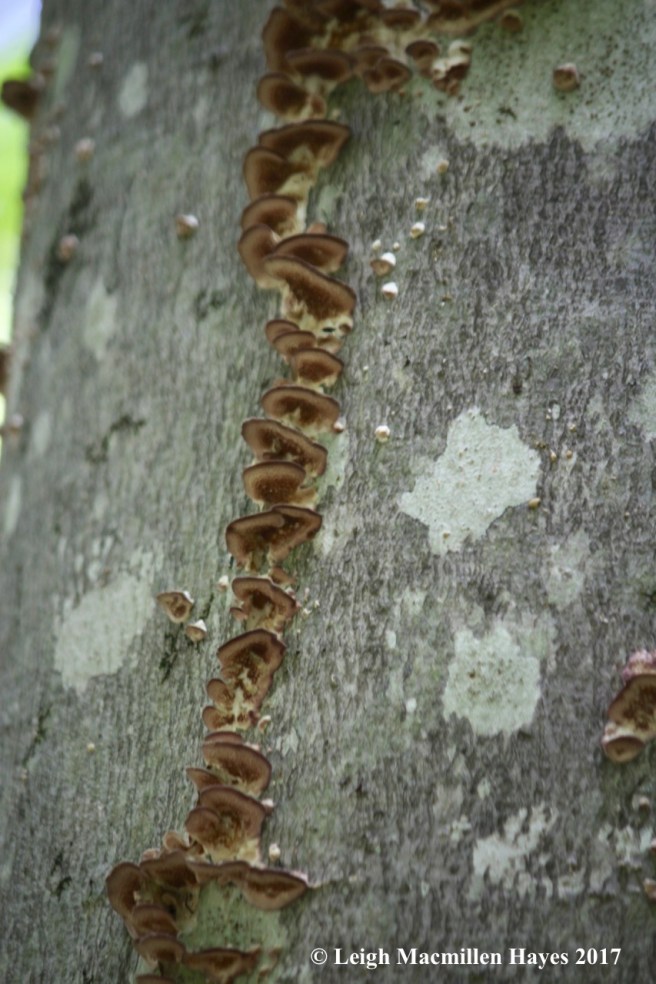
It’s not just the mammals and trees that I get to learn about. My studies include among other topics, fungi, of which I’m only a so-so student. But I do know that this is turkey tail, aka Trametes versicolor.

o-Fomitopsis cajanderi  (Rosy Polypore) 2

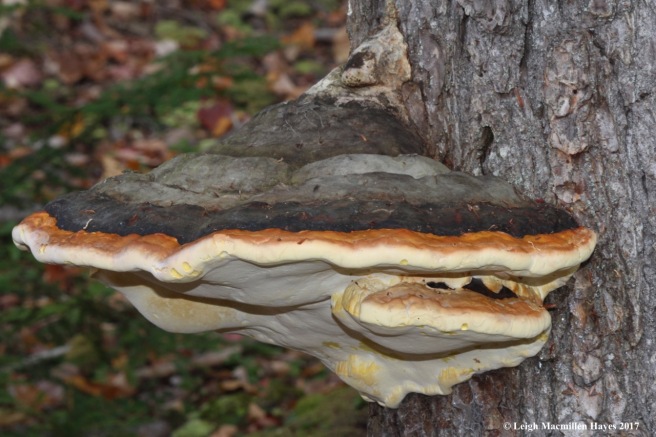
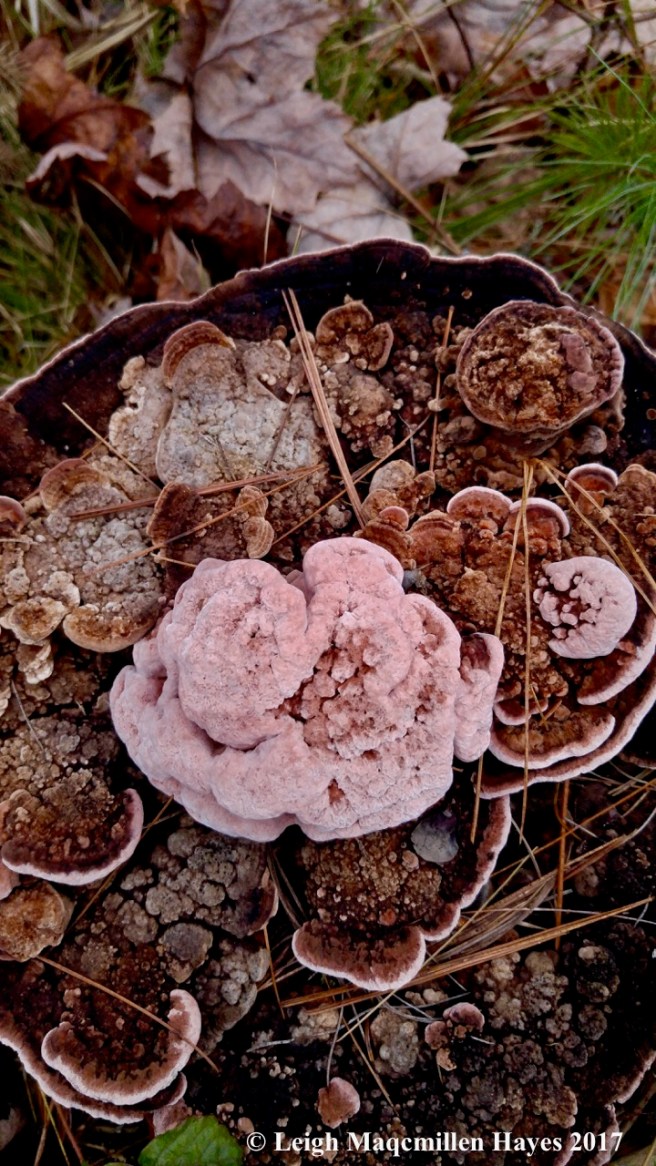
And then I happened upon a hemlock stump topped with a large, beautiful display outlined in a coffee brown and salmon pink. It took me some work to remember its name. I can tell you where else I’ve seen it for it grows upon a hemlock log at Holt Pond.
o-unknown mushroom 1

Before I forget again, it’s a rosy polypore, if memory serves me right. I only hope my fungi teachers weigh in on this one.
o-logging road 1

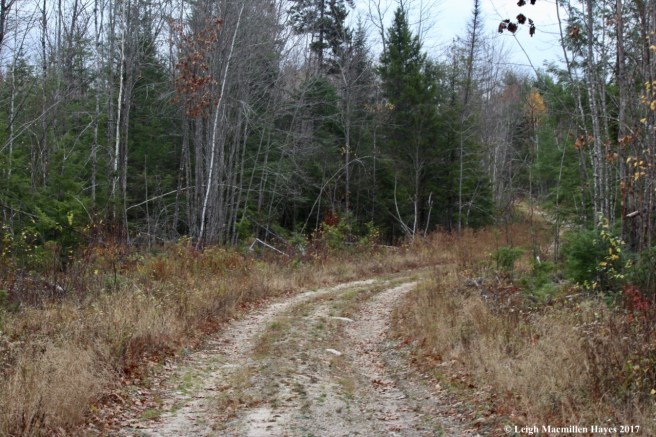
At long last, it was time to follow a logging road back to the snowmobile trail.

o-snowberry on sphagnum

Sometimes, I slip back into the woods before reaching the trail, but today I chose to follow it. And what to my wondering eyes should appear, but more creeping snowberry atop sphagnum moss.

o-home sweet home

As I finally crossed the field toward home, I gave thanks for the classroom that is right outside our back door and for the lessons learned in this Sunday School. Now I just have to remember everything, which is why I record so much.


Time Well Spent

Time. I never seem to have enough of it. Time with my guy. Time with our sons. Time with family. Time with friends. Time to explore. Time to reflect. Time to write. Time to sketch. Time to be . . . in tune with the world around me and my own soul.

b-pileated 1

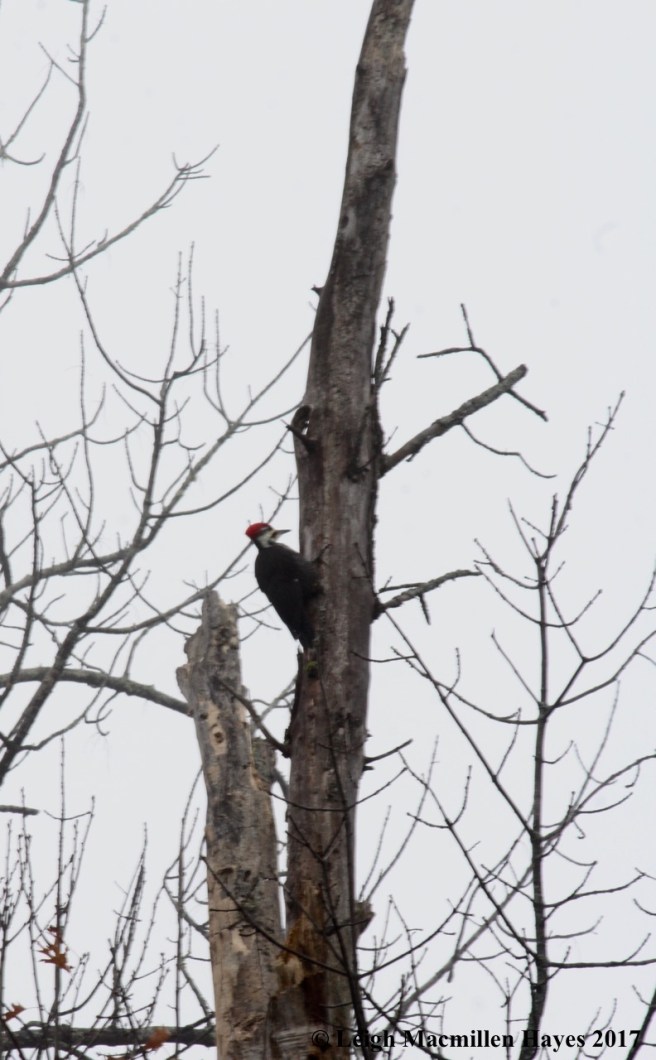
And so today, when I heard a pileated woodpecker as it worked on a dead ash tree by one of the stonewalls, I decided to take a break from my own work and give it the attention it so loudly demanded.

b-pileated 2

Its a repeat visitor to that tree; along with crows and hawks and smaller birds as well. The tree can no longer create its own source of food, but it continues to provide for others, be they bird, insect or mushroom. And I suspect that it secretly shares its knowledge of the world with the younger ash it towers over–to the right. As for the pileated, his time at that tree came to an end . . . for the moment. He’ll be back–probably soon.

b-ash tree 1

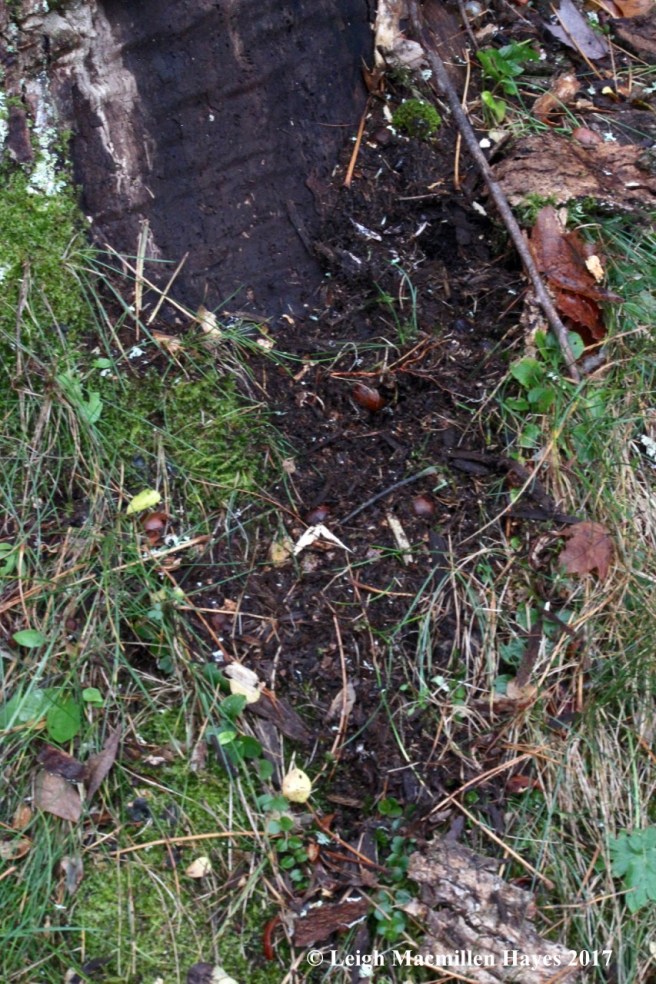
Because I stood below and no longer need to look up, I turned my gaze downward. And then had to pause. What had happened? Who had visited? And scraped the ground right down to the roots? And left a pile of leaves and sticks and other debris at the edge? A mushroom foray? An acorn frenzy? I looked for hair and found none. Turkey? Squirrel? Porcupine?

b-ash tree 2

And at the base of the next old ash, similar behavior.

b-scat 2

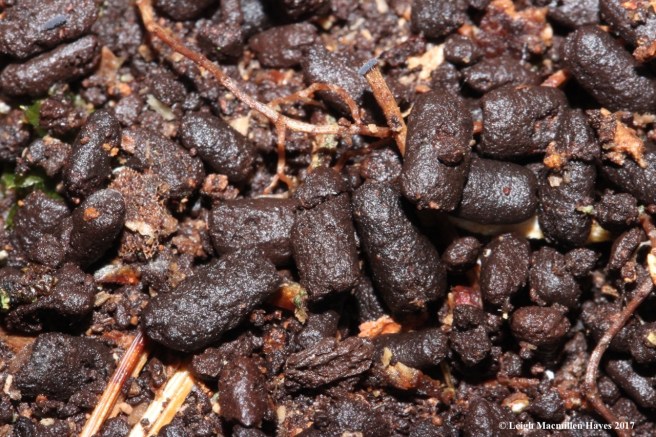
Returning to the first tree, I discovered that what looked like dirt was actually little pellets of scat . . . tiny scat. Tons of scat. A latrine. Did perhaps a meadow vole live somewhere nearby and a predator went after it? I did also suspect that there may have been a bunch of mushrooms that were harvested and in the process the vole’s latrine was exposed. I’m not sure if I’ll ever really know, but since I had stopped to look, I noticed something else.

b-pigskin poison puffball (Earthball)

Tucked near the base of the tree and relatively untouched by whatever had spent some time clearing the area, was a pigskin poison puffball, so named for its outer skin that feels like a football. (In his book, Fascinating Fungi of New England, Lawrence Millman writes: “historical note: footballs used to be made of pigs’ bladders, not pigskin.”) The dark spore mass within seemed to reflect the ashen color of the tree beside which it grew.

b-pelt lichen1

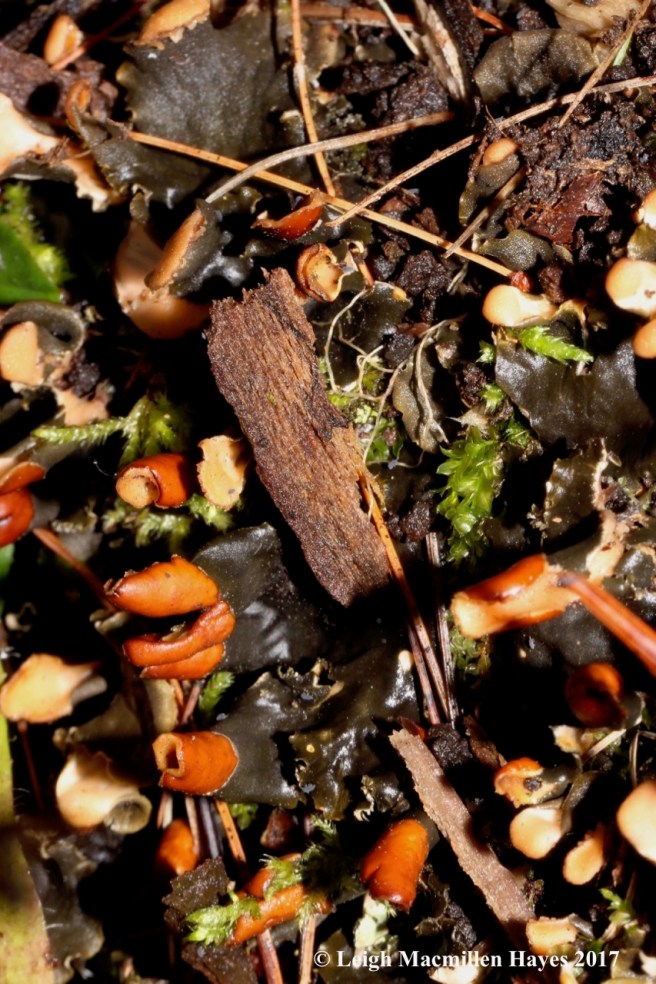
I should have returned to work then, but the puffball discovery and my wonders about the latrine made me want to poke about some more. Since I’d missed the puffball, what else hadn’t I noticed. A few steps to the left upon another tree root–a pelt lichen with many fruits, aka many-fruited pelt. I first discovered this lichen upon Bald Pate Mountain a few years ago, but didn’t know that it grew here–right under my nose.

b-many-fruited 2

Its smooth brown lobes shone brightly due to all the recent moisture, but it was the reddish-brown apothecia or fruiting forms that I found so intriguing. They’re described as saddles, and I suppose if you look at one from the right angle, yes, you can see the saddle-like structure.

b-field dog lichen

On the next tree, another pelt known as dog lichen–apparently named because its fruits reminded someone of dog ears.

b-spring tails 1

The algal component of a lichen goes into food production during rain, and so I continued to peer around. But first, a clump of Indian pipes caught my attention and upon them I noticed springtails doing their thing–springing about in search of food. Their diet consists of fungi, pollen, algae and decaying organic matter. Springtails are among the most abundant of insects, but because they are so small, they often go undetected unless you see them on snow in the winter.

b-mealy pixie cups

And then back to the lichens it was. I found mealy pixie cups in great number growing on a stonewall.

b-pixie cups fruiting

And one large patch looked like it was going to produce another, for so prolific were its fruits of tiny round balls.

b-lichen design

Also among my great finds, were the lichens decorating branches that had fallen to the ground in our recent wind storm. I loved the picture they painted with variations on a theme of color . . .

b-foliose and fruticose

and form.

b-lichen 3

My favorite of all reminded me of so many things–a rose in bloom, waves echoing forth with ripples, and even a topographical map.

Alas, I was short on time and needed to head in, but my finds–were the greatest. Even a wee bit of time spent wondering is time well spent.


Power-filled Mondate

It may not have been a hurricane, but the storm that began as Philippe, left its mark as it whooshed through New England. Along its path, the world darkened. We lost power about 1am, but it was restored by the time we awoke this morning. And yet, many may be without electricity for days.

Our tentative plan had been to hike, but we realized last night that we’d need to consider Plan B. And when the sun shone this morning, we were rather oblivious to the havoc caused by downed trees and flooding. We did check the weather report, however, and saw that there would be a few showers and the wind would continue to blow. So, Plan B it was–yard work between rain drops.

For my guy, that began with work on the back screen door for a bang we’d heard in the night turned out not to be the grill or furniture sliding off the deck, but rather the door banging against a bench. And after that, it wouldn’t shut properly.

o2-bee on lavendar

While he worked on the door, I headed into the kitchen/cottage garden, which had become quite overgrown due to my lack of a green thumb. While my intention was to put the garden to bed, some flowers like the lavender needed to remain for they still invited visitors.

o3-spring tails

As I poked about, cutting some plants back, I made a few discoveries, including the sight of snow fleas or spring tails climbing a stalk.

o1-bird nest fungi 1

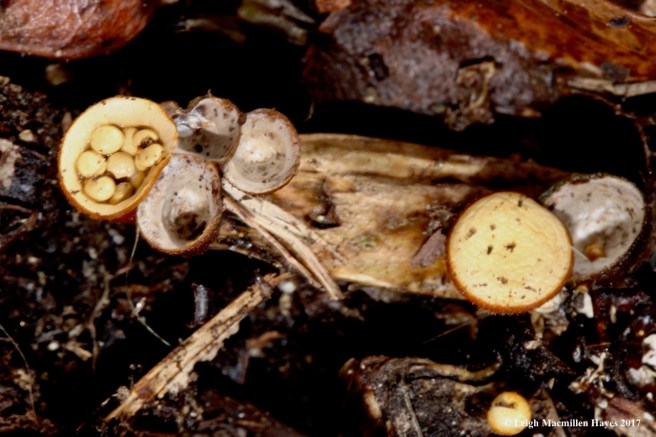
And buried beneath, I unearthed bird’s nest fungus, which look like such for which they were named, only in miniature form for they are no more than a quarter inch in height or diameter. Nestled inside the nests, like a bunch of eggs in a basket, are the fruiting bodies that await drops of water in order for their spores to spring out and find their own substrate on which to grow.

o5-beebalms last bloom

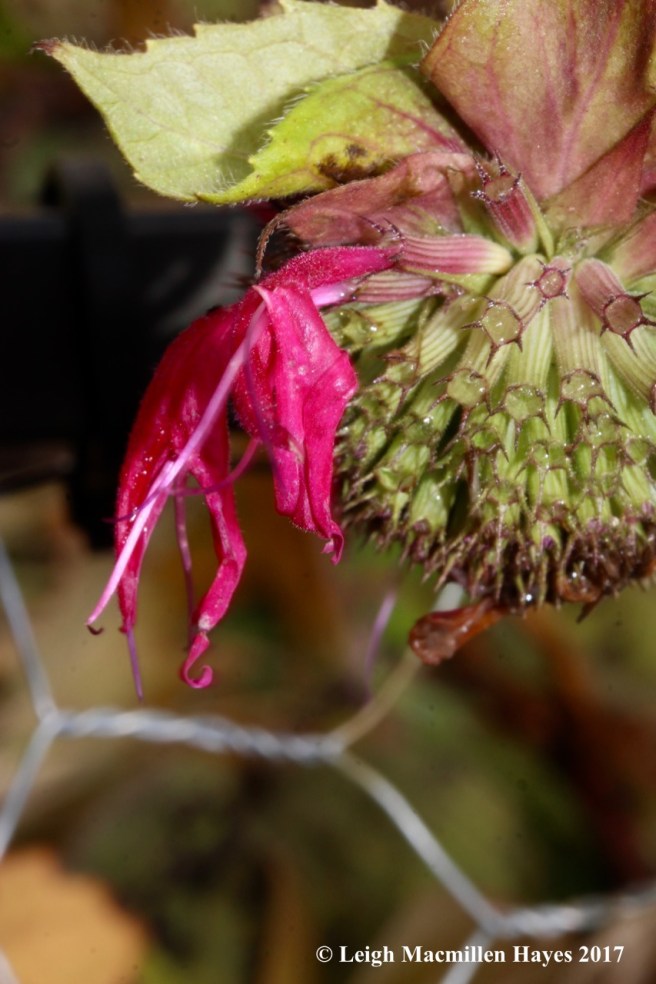
And then I approached the beebalm, where a few blossoms still bloomed on this late date.

o4-meadowhawk 1 on bee balm

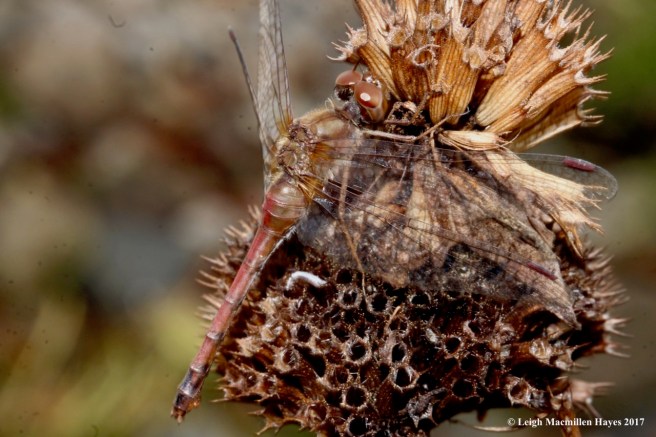
Most of the beebalm had long since gone to seed, and today one structure became a resting spot as the wind blew. A male autumn meadowhawk seemed to hold on for dear life.

o6-meadowhawk 2

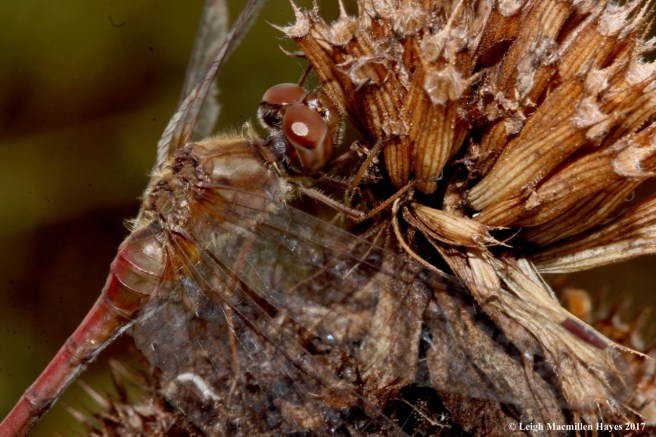
Of course, I took advantage of his moments of rest to take a closer look at the divine body structure . . .

o7-meadowhawk 3

from a variety of viewpoints.

o8-meadowhawk 4

Gender determination is based on the terminal appendages. Male dragonflies have three, known as claspers, which they use to grasp and hold a female during mating. The upper or from this view, outer appendages, are called cerci, while the lower, or middle appendage, is the epiproct–meaning its the appendage situated above the anus. Females have only a pair of cerci, and I’m not sure of their purpose. That beebalm still stands–in hopes he’ll return again.

o9-quaking aspen buds and leaf scars

As I continued to work and observe the world around me, my guy found one project after another to complete–each of which required a trip to the hardware store. Hmmmm. And so, I too, decided to go for a trip–into the woods. Donning my blaze orange vest and hat, and knowing that I wasn’t going far, I took off. My first stop was at a branch below the quaking aspen that had fallen in the night. Though it had reached its end of life, the waxy bud scales and leaf scars were a sight to behold. The smiley-face leaf scar showed where the stem or petiole of this past year’s leaf broke from the branch. As the leaf pulled away, it severed the vessels through which water and food moved. The dots within the scar indicate where those vessels had been connected and are known as bundle scars.
o10-pathway in woodlot

In our woodlot, my trail was littered with pine cones and branches, but that was the extent of tree damage.

o13-selfie

I found puddles that invited me in.

o11-jelly ears

Some branches, decorated with a variety of lichens and jelly ear fungi also found their way to the puddles.

o12a-vernal pool

At last, I reached the vernal pool and was surprised to find it only partially filled.

o12-vernal pool leaves

Atop and within it, the mosaic of broad leaves and needles formed a tapestry of shape and color–in the moment.

014-goldenrod bunch gall 1

Nearby, I paused by a goldenrod that sported a bunch, rosette, or flower gall, for really, it resembles all three.

o15-goldenrod bunch gall 2

The Goldenrod Gall Midge, which is a tiny fly, laid an egg in a leaf bud, hatched into grub form, and prevented the stem from growing, though the plant continued to produce leaves that formed a tight cluster.

o16-maple samara between milkweed pods

I finally made my way home, and turned to other gardens on the eastern side of the house, where milkweed pods also needed to remain standing. I even left the sugar maple samara because I thought it was a fun place to land.

o-17-aphids on milkweed

Also at home on the milkweed were a hundred aphids all clustered together.

020-monarch chrisalys

But the best find of all–the delicate remains of a monarch butterfly chrysalis. I had no idea it was there, but presume it housed one of the monarchs that consumed my attention a few weeks ago.

Just after we headed in, my sister-in-law called to say her sump pump had conked out. Off my guy went again.

It wasn’t the hike date we’d hoped for, but our day was filled with power tools and powerful insects and power-filled love.


Marathon Mondate

As he’s done every year for the past however many, my guy is training for the Moose Pond Half Marathon, a race around Moose Pond in Bridgton and Denmark that supports the Shawnee Peak Adaptive Ski Program. The race is only two weeks away and so this morning he headed off to run ten miles. And afterward, he said he felt like he could have run the additional 3.1 miles that would complete the race. That being said, we headed west to join our friends, Pam and Bob, on a hike at a new preserve in New Hampshire.

The plan was to meet at the trailhead near Hurricane Mountain Road on the Chatham/Conway town line. We knew the road, but not the spot, and were racing to get there, so of course I drove right by. But . . . I spied Pam sitting in their car in the parking lot and probably burned some rubber as I came to a screeching halt and then quickly put the truck into reverse. Fortunately, my guy didn’t get whiplash. It’s a back road, so not well traveled, thus I could drive backwards for a hundred feet or more without any problem–thus is the way ’round these parts. And one of the reasons we love it so.

m-sign 1

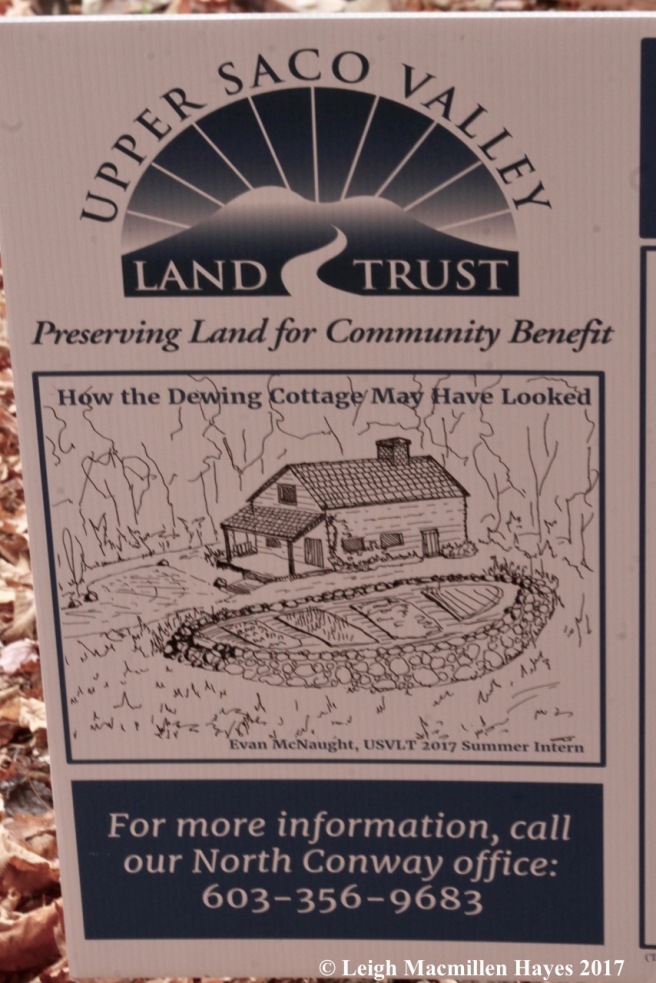
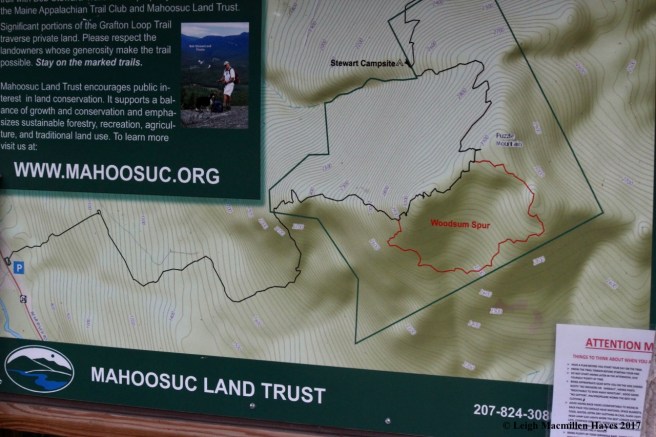
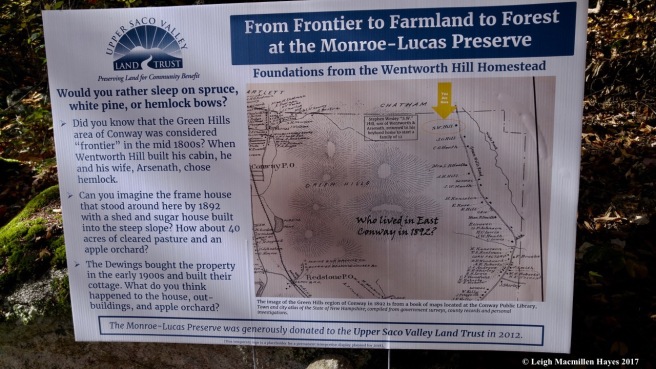
Another is that local land trusts preserve land for the benefit of the species who call this place home, both flora and fauna–and for us so that we, too, may benefit from time spent tramping along trails, making discoveries and forging friendships. The preserve we visited today isn’t quite open, but Pam said she’d heard they plan to open on November 4th. There were no signs on the kiosk or trail maps, but we quickly learned that none were necessary for the route was easy to follow. We were at the Monroe-Lucas Preserve, a 62-acre property donated to the Upper Saco Valley Land Trust.

According to their website: “The land was given to USVLT by Barrett Lucas in honor of his wife, the late Leita Monroe Lucas. Leita’s family has deep roots in East Conway and Redstone, and her father, Ernest “Red” Monroe, also wanted to see the land preserved. Adjacent to the Conway Common Lands State Forest, The Nature Conservancy’s Green Hills Preserve, and the White Mountain National Forest, this parcel builds on an existing network of preserved land, and has wonderful opportunities for future trail development and increased public access. A branch of Weeks Brook also runs through the property, and the property lies within USVLT’s ‘Green Hills’ focus area. The site is also remarkable as the one-time summer residence of the American Impressionist painter Thomas Wilmer Dewing, and his fellow painter and wife, Maria Oakey Dewing. Their cottage, built in the late 1800s, fell into disrepair in the mid-1900s. Now only the chimney remains onsite.”

m-puff ball fungi 1

With Pam in the lead, we started up the trail and within minutes the fun began. She spotted a large patch of puff balls begging to be poked. The spores wafted up and away with hopes of finding the perfect place to grow nearby. We assume they will be successful, for within a fifteen foot area, we found patch after patch and knew we weren’t the first to encourage their spores to blow in the breeze.

m-bobcat print

And then Pam began to spy prints in the mud. First, a moose. Then this bobcat–if you look closely, as we did, you may see the hind pad matted down; above that a raised ridge in the form of a C for cat; and four large toes, the two in the center being asymmetrical. Because it was a muddy substrate, we even saw nail marks, especially above the two center toes. Five feet further, we found deer prints. And so we rejoiced in the foresight of the Monroe-Lucas family to protect this land.

m-Weeks brook flowing 1

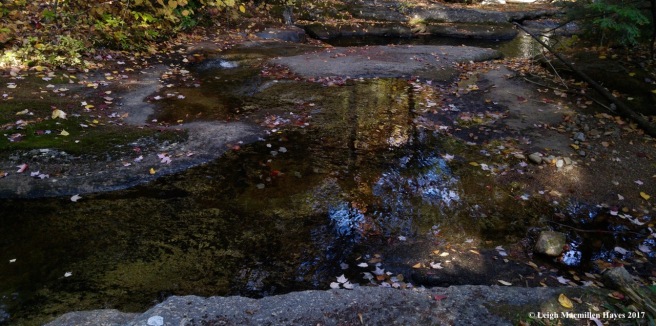
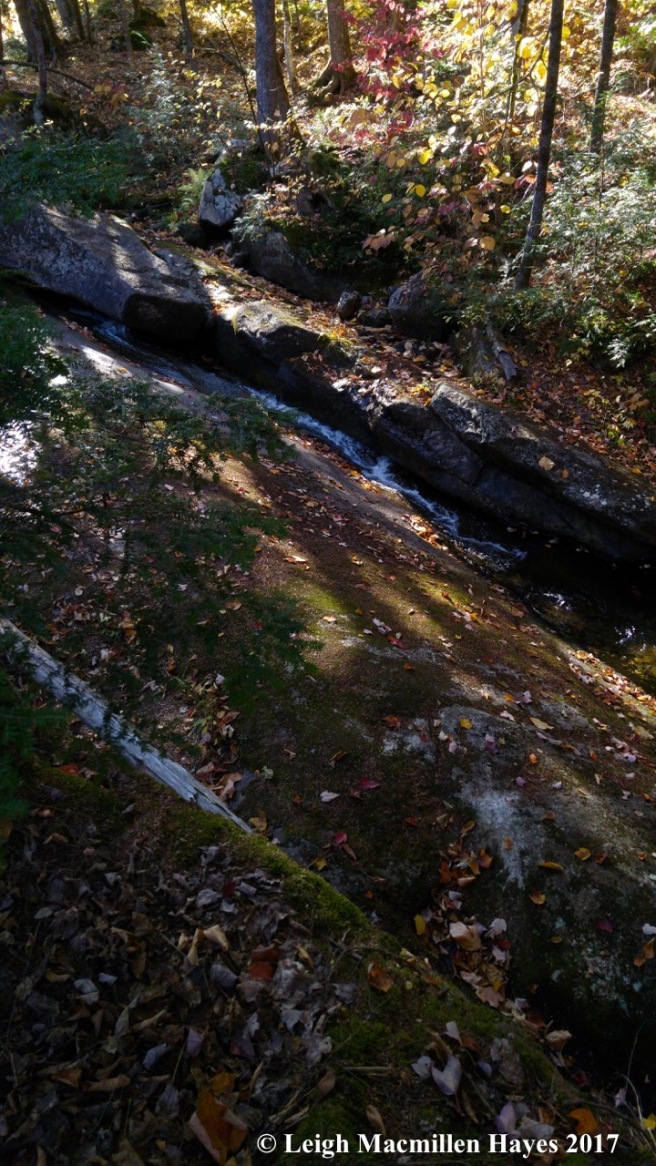
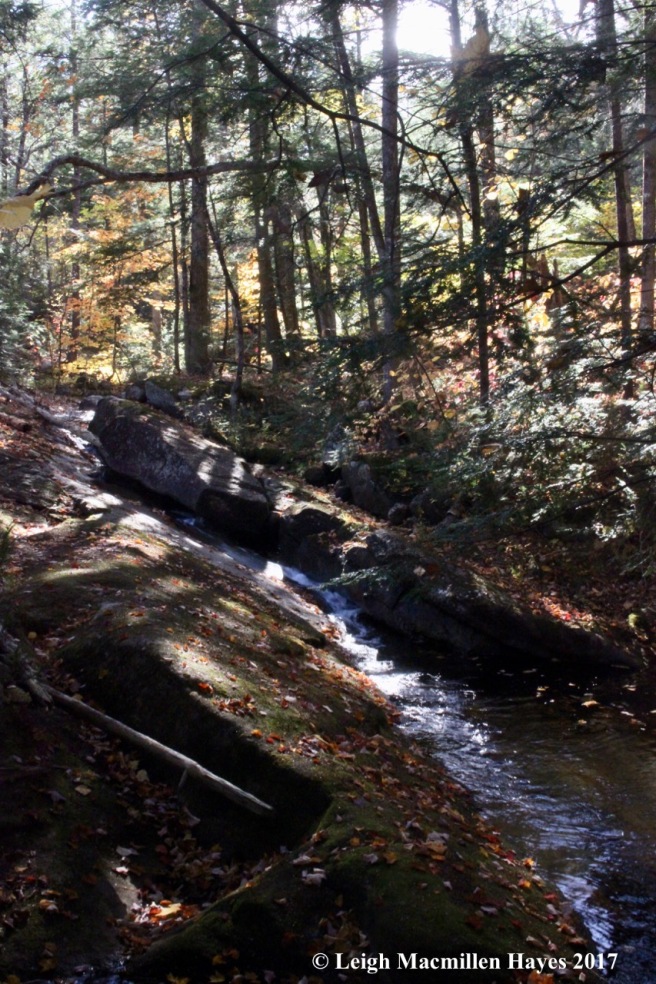
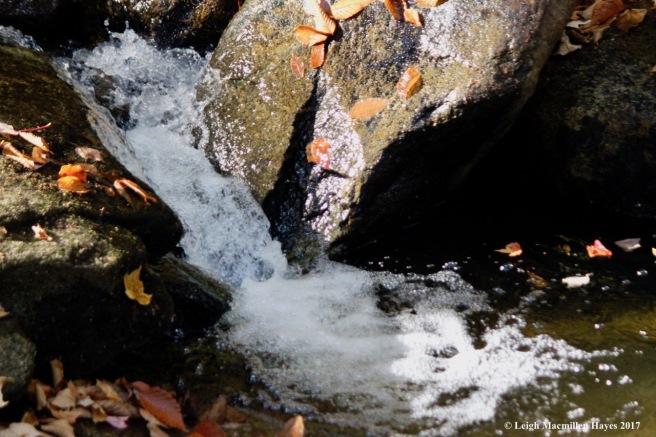
A bit further on, we heard the brook before we saw it–a branch of Weeks Brook that borders the property. We all stood beside and let it mesmerize us.

m-weeks brook 1c

We thought about its forceful action each spring and the eons it took to carve into the rocks along its banks.

m-weeks brook baths

We shared visions of a summer day spent sliding down its smooth channels and slipping into the pools below.

m-weeks brook between the rocks

And we marveled at the way it split the granite above . . .

m-weeks brook between 3

and flowed between the shelves.

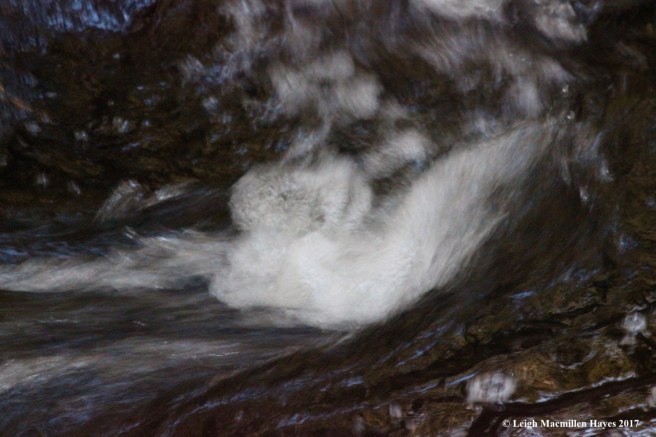
m-weeks brook bubbles

All the while, it raced to the finish line and we could only assume it made good time.

m-hobblebush flower?

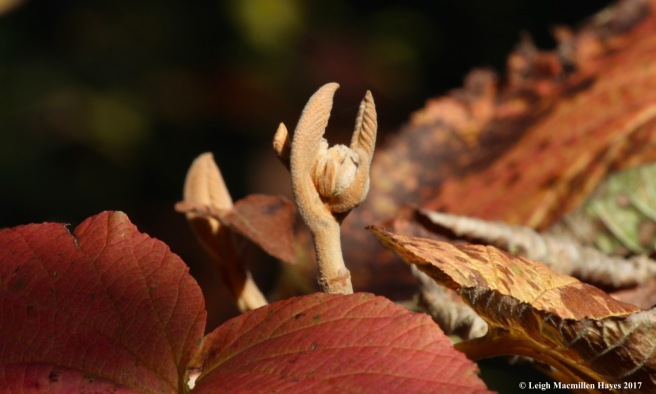
It was beside the brook where the hobblebush grew prolifically and offered a myriad of colors among their leaves and clasping or clapping hands among their buds. Because we were looking, we noticed one flower forming into its globe shape as it usually does in late winter. Was it confused?

m-hobblebush new leaf

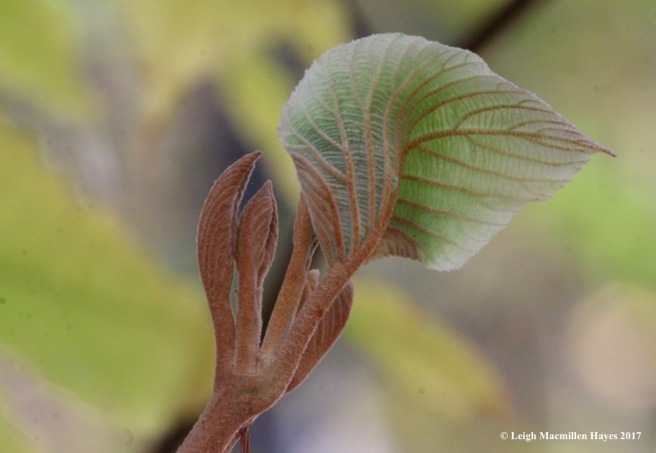
And on another, a new leaf.

m-hobblebush 2

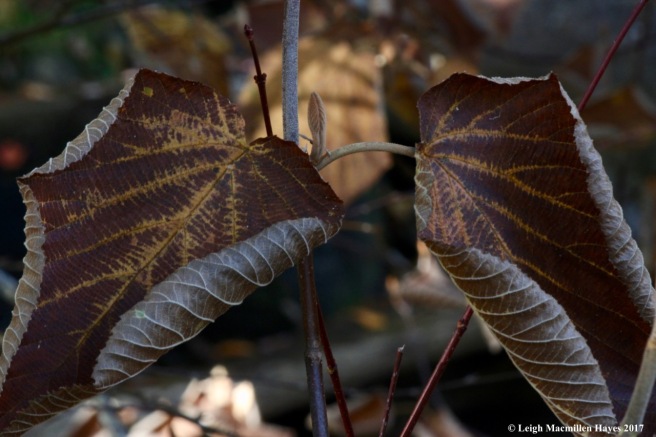
Fortunately, most behaved as they should and gave us an autumnal display worth celebrating.

m-hobblebush:hemlock shadows

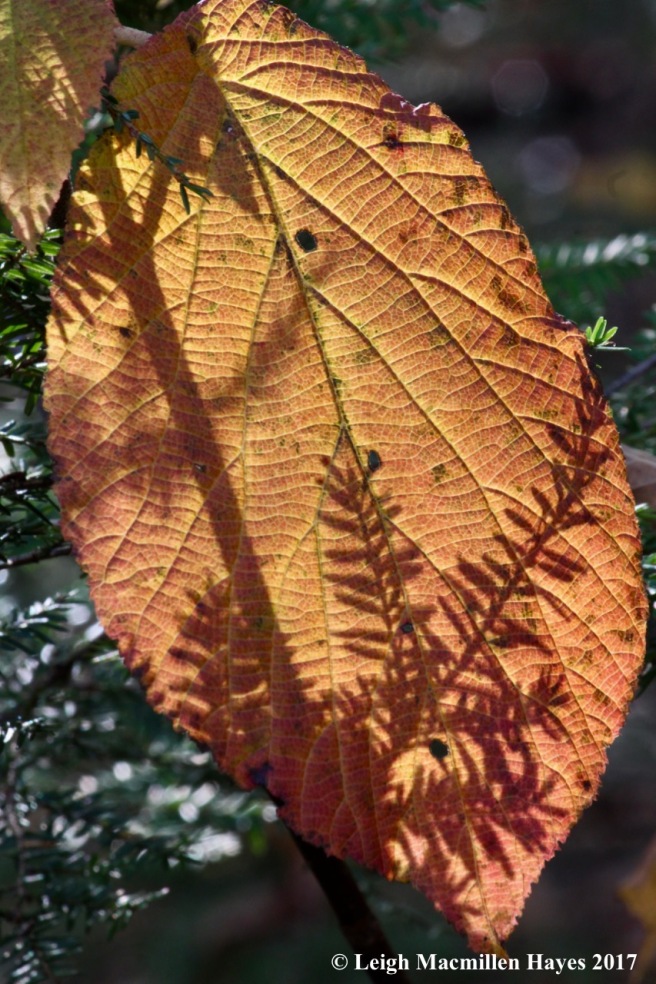
One even added some shadow play.

m-mount kearsarge

Eventually, we turned away from the brook and followed the trail down. A peak through the trees and we could see Mount Kearsarge across the way.

m-slime mold 1

On a tree stump, we found a couple of fascinating fungi including a slime mold all decked out for Halloween.

m-jelly fungi

And on the same stump, a display of jelly ear fungi.

m-old moose scat

Around the corner was more evidence of moose traffic, though since it was moss-covered, we decided it was a couple of years old. None of us could ever recall seeing moss grow on moose scat before, but it made perfect sense that it would be a suitable substrate. I did wonder how they’d categorize that on a moss ID key–grows on rock, tree, ground, moose scat?

m-pippsisewa

Our moments of awe weren’t over yet. We sent up three cheers for the pipsissewa and its seedpods (Bob, did you take one?),

m-red-belted polypore

and red-belted polypore.

m-frullania 2

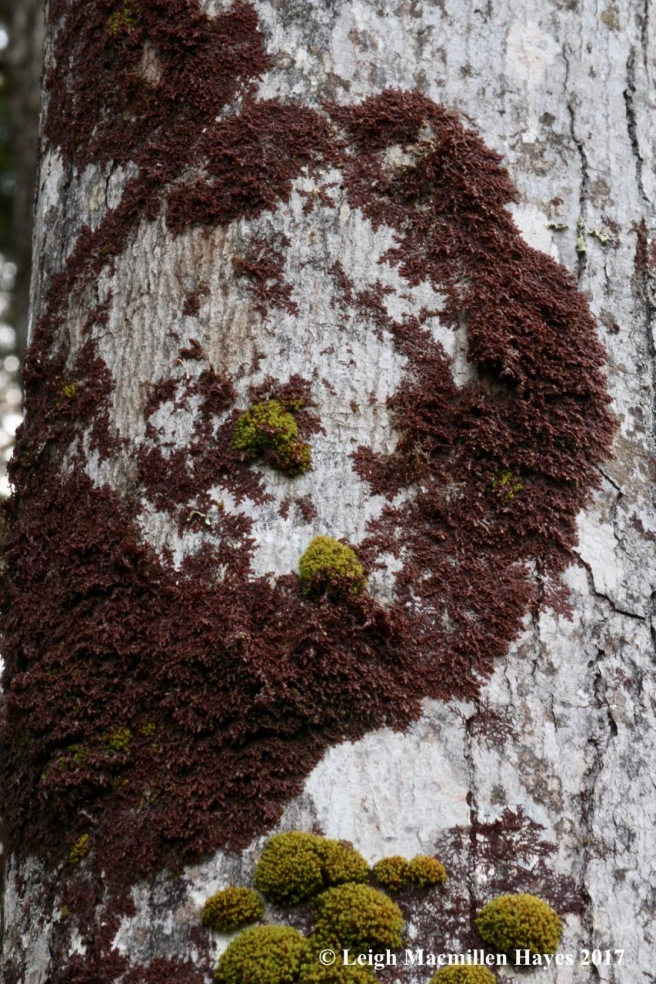
And then Bob spied the frullania. The smaller, spider-webby display in the lower right hand corner is Frullania eboracensis, a liverwort with no common name. But the larger mass is known as Frullania asagrayana, so named for a botanist and natural history professor at Harvard University from 1842-1873–Asa Gray.

m-frullania

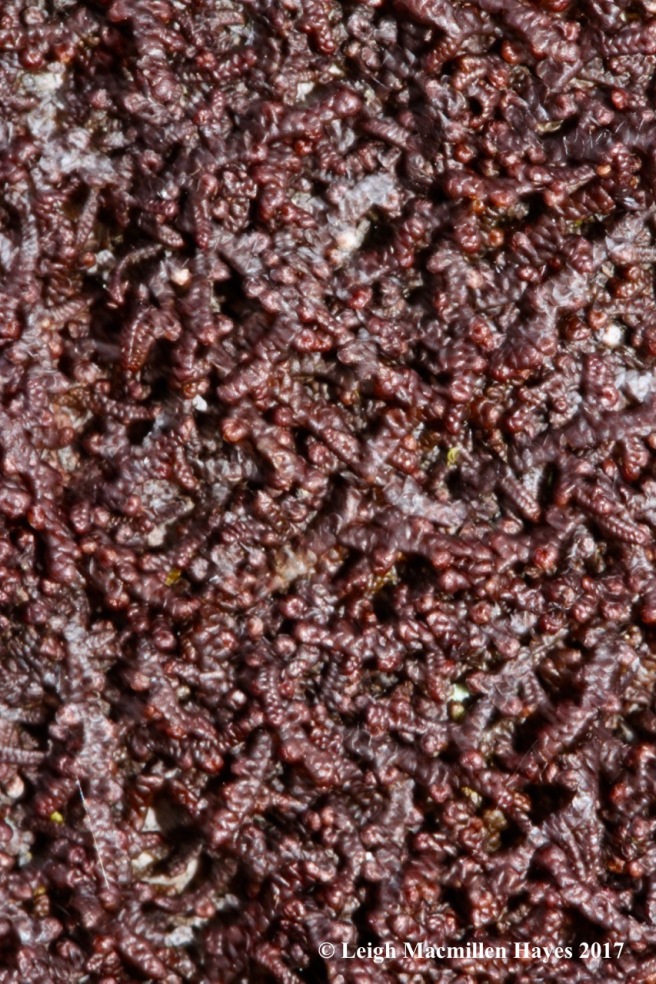
We all went in for a closer look at its worm-like leafy structure.

m-frullania and muy guy

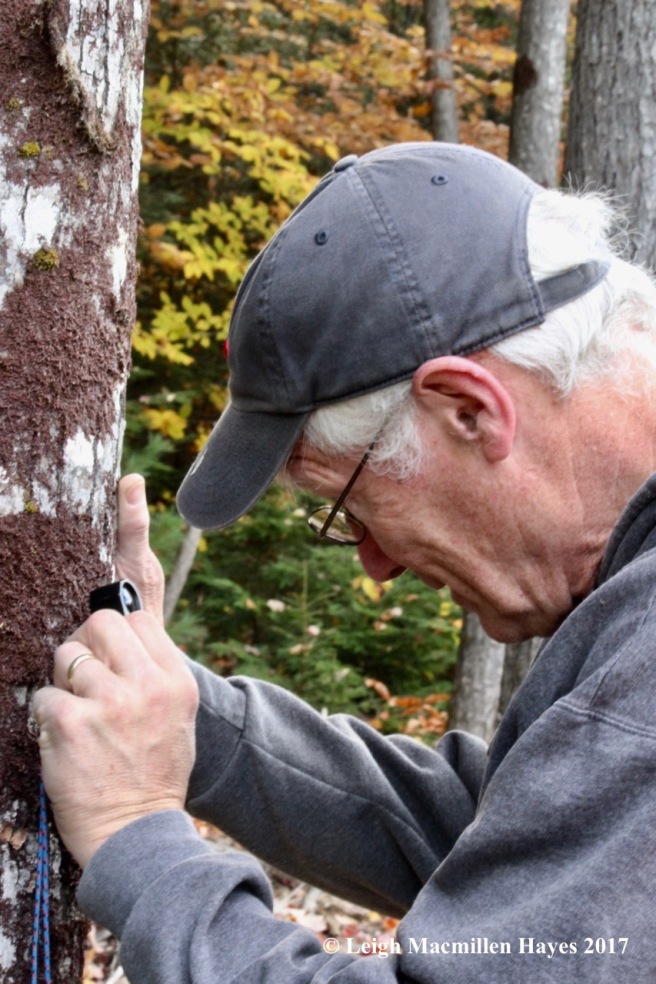
Even my guy got into the act, much to his reluctance. And he was certain he didn’t need a lesson on how to use a hand lens. Thankfully, he doesn’t read these blog posts, so I can get away with this. Shhhh.

m-uprooted pine 1

Around the next bend, for the trail has enough S curves to make the descent easy, we came upon a white pine long since uprooted. Did anyone hear the crash?

m-uprooted picture frames

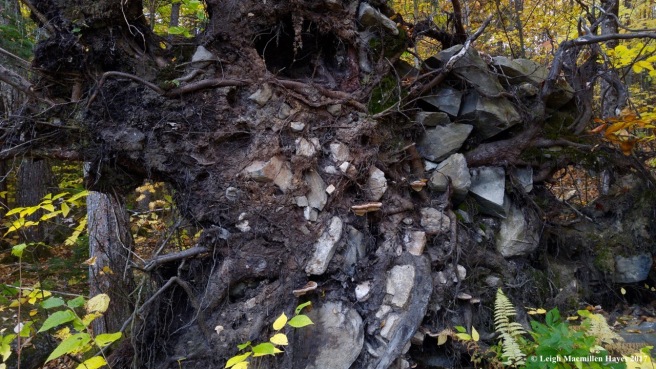
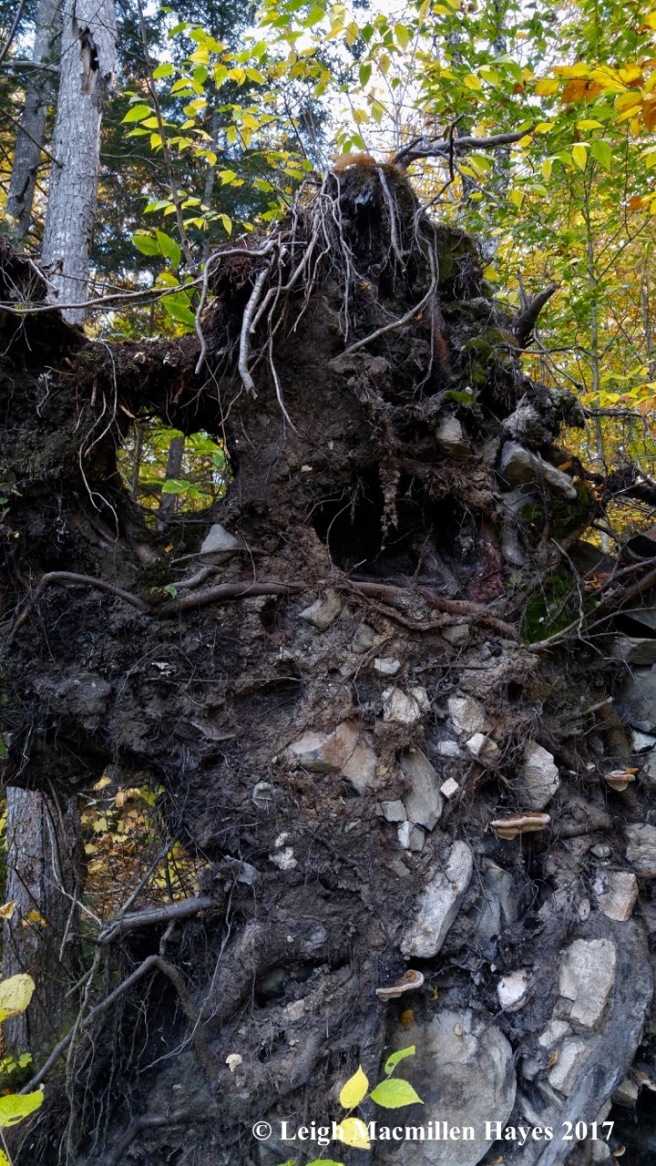
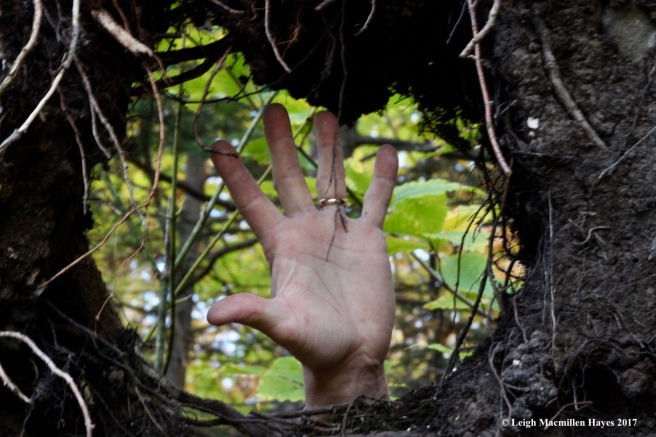
It offered a wonderful view–of more red-belted polypores, the root system and rocks, plus several windows on the world beyond.

m-photo frame hand

If you go, watch out . . . Thing of The Addams Family, might be lurking about.

m-Pam holding a huge striped maple leaf, Bob photobombing

Continuing on, we moved out of the hemlock and pine grove and back into the land of the broadleaves, including one with the broadest of them all–a huge striped maple leaf that Pam spotted; and Bob made sure to photo bomb the Kodak moment.

m-cottage sign 2

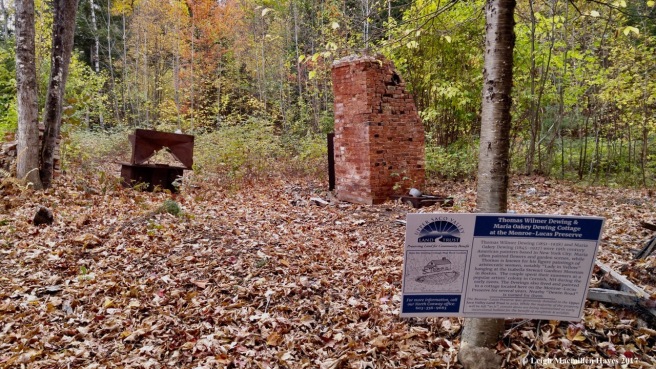
And then, as the trail evened out, we crossed a narrow gangplank to the location of the original cottage. According to a sign posted there, “Thomas Wilmer Dewing (1851-1938) and Maria Oakey Dewing (1845-1927) were 19th century American painters based in New York City. Maria often painted flowers and garden scenes, while Thomas is known for his figure paintings of aristocratic women, notably ‘Lady in Yellow’ hanging at the Isabella Steward Gardner Museum in Boston. The couple spent their summers at a popular artists’ colony in Cornish, NH, during the early 1900s. The Dewings also lived and painted in a cottage located here on the Monroe-Lucas Preserve for several years.

m-site of Dewing cottage 1

All that’s left is the chimney.

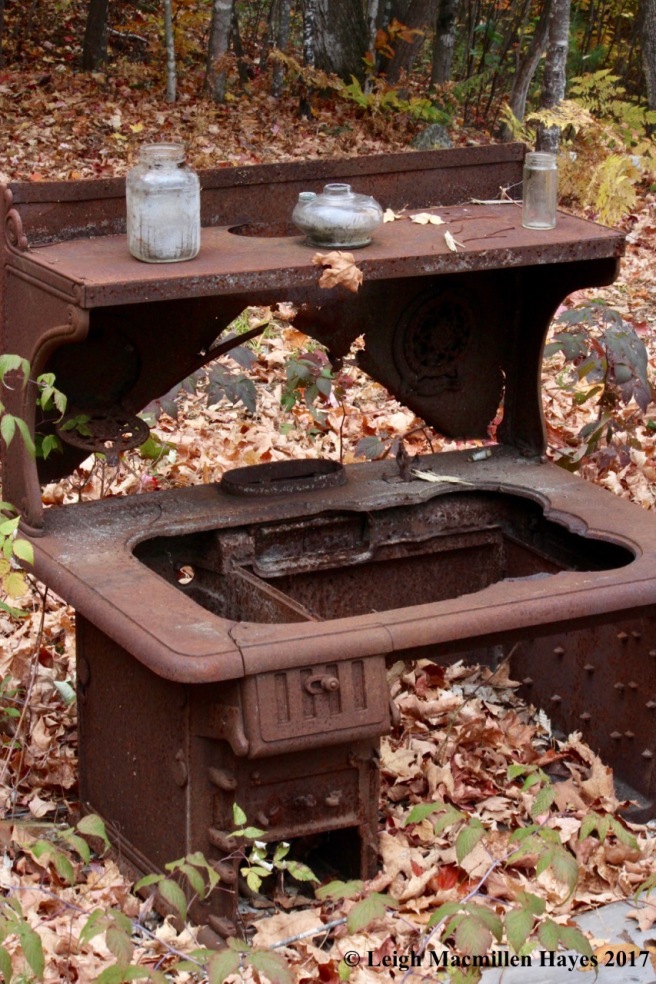
m-cottage stove

And some artifacts.

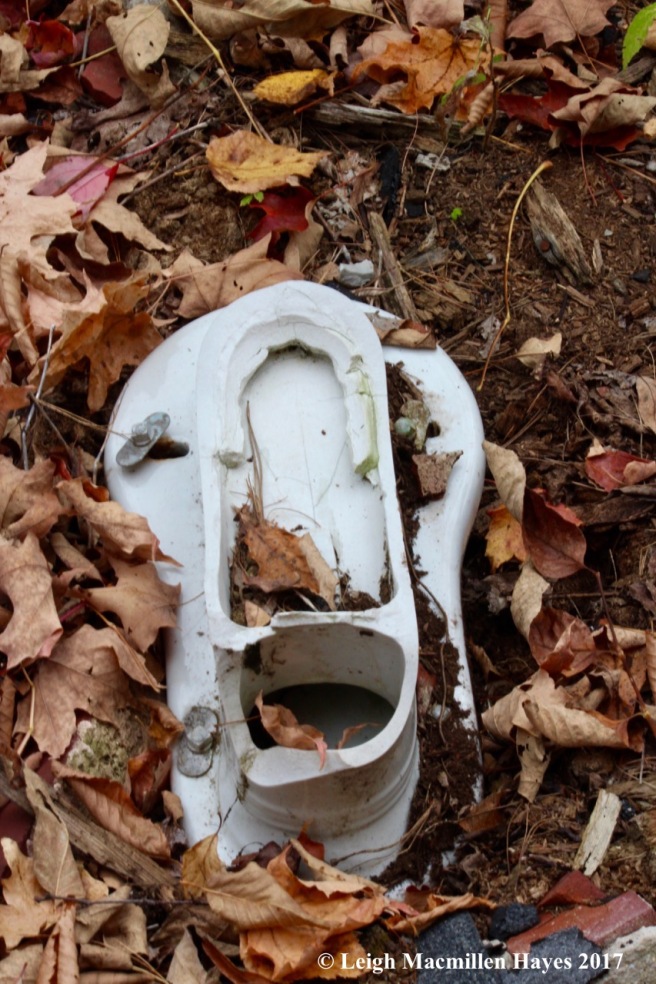
m-toilet

Including the john.

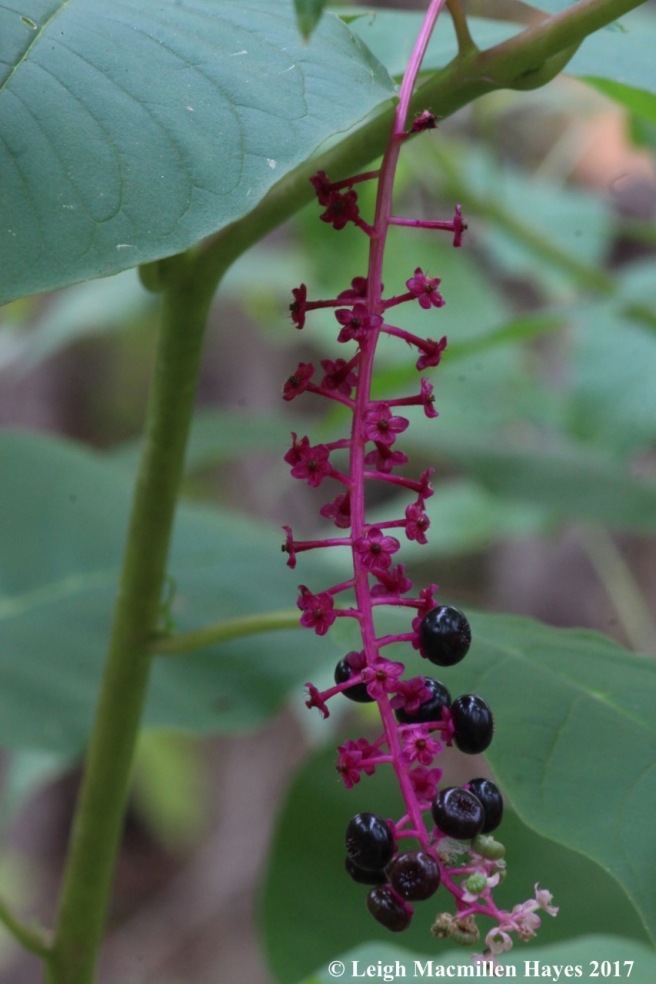
m-pokeweed

Our final view was a pokeweed still in flower and fruit. Again, we wondered about its timing, while appreciating its offering.

With that, we were back at the parking lot, where Bob informed us that our distance was just over a mile and time two hours–hardly record breaking. And hardly a “quickest to the destination hike” for my guy, but he kept finding stumps to sit upon as we gazed more intently on our surroundings; I think he secretly appreciated our slow pace and the opportunity to rest his legs.

If you want support his effort to raise funds for the Shawnee Peak Adaptive Ski Program, stop by and see him. Any and all donations are most welcome.

Peering In

As I pulled into the parking lot beside the old school in Sweden, Maine, I was excited to see the door open, meaning that for the first time I’d get to step inside and take a look.

S1-old school

The Sweden Historical Society had recently had the building cleared of asbestos and hopes to possibly turn the 1827 structure into a museum.

S2-lathe

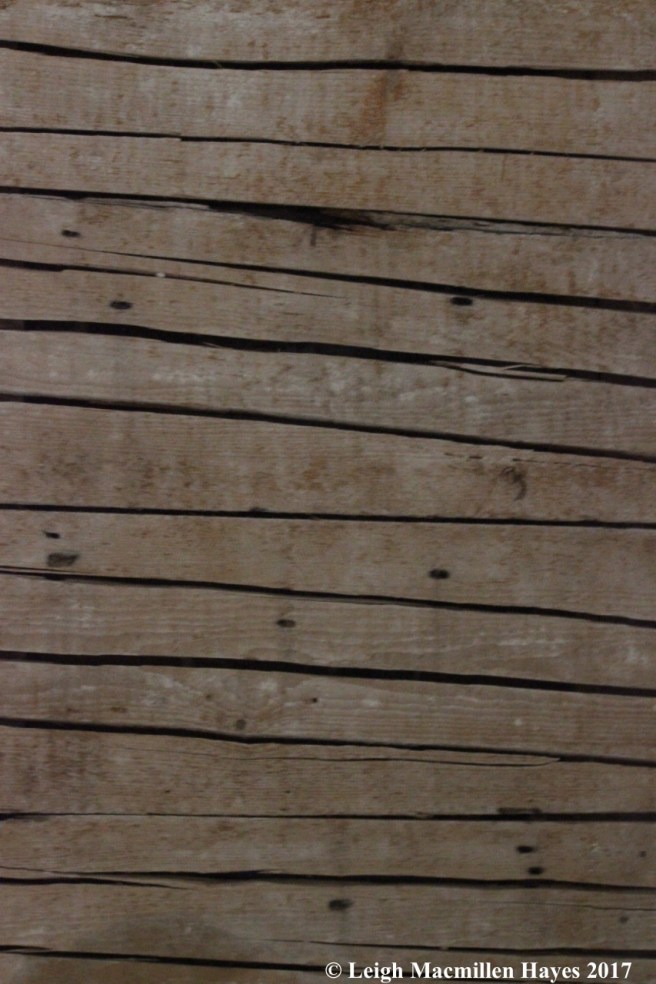
My friend, Janet, who is past president of the SHS, invited me in and gave me the short tour–especially of the former bathrooms where the renovation revealed the plaster and lath originally used to finish a wall. The wooden lath was attached directly to the studs and then embedded with plaster; often horsehair plaster.

s3-wall paper

Once the plaster dried and formed a hard, smooth surface, it was either painted or covered with wallpaper. Janet was thrilled by the discovery of the latter and has plans to preserve it within a frame. Do you see Donny’s signature? I wondered if he got into trouble for writing his name on the wall.

s4-original entrance

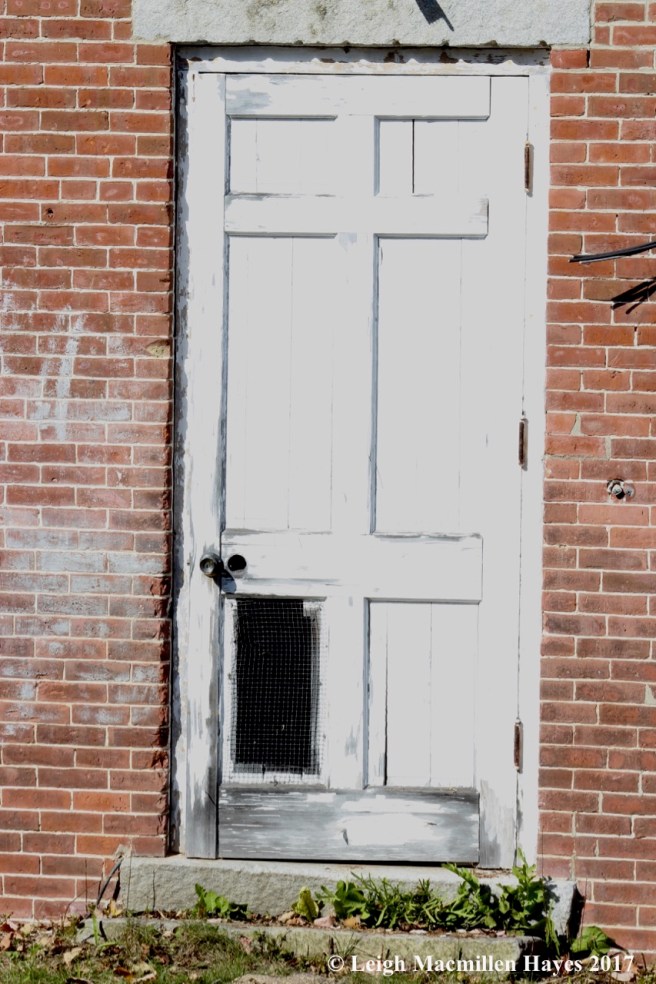
We didn’t stay in the building long because we had a walk planned, but first, Janet provided a bit more history including pointing out the original door on the front of the building.

s5-foundry

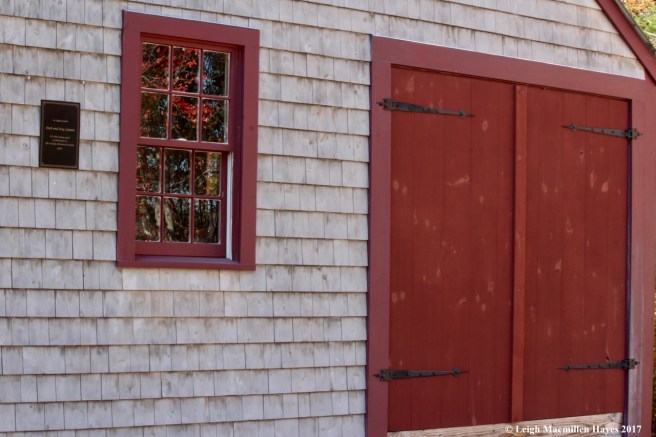
And beside that in this small hamlet that is home to a community church, town hall, town office and the old school, sits another building that looked like it had been there forever. It was an old foundry that Janet explained had been moved from another location–a frequent happening during yesteryear. This year it was dedicated to the founders of the SHS (apropos–foundry for the founders), Kay and Dick Lyman.

At last, we were ready to begin our walk.

1858Map_comp_1000

1858 Map

1880_Sweden_small

1880 map

The route was a short one, but it took Janet, her friend Karen, and me about three hours to walk from Route 93 to Webber Pond Road and back again.

s6-the road

We began beside the foundry on the colonial road. Though it’s still a town road, it’s no longer traveled (except by logging trucks a few years ago).

s7-fence post

Not far along, Janet pointed out two granite pillars, indicating a fence line. And then we went off-roading, in search of other evidence of the use of this land.

s8-well

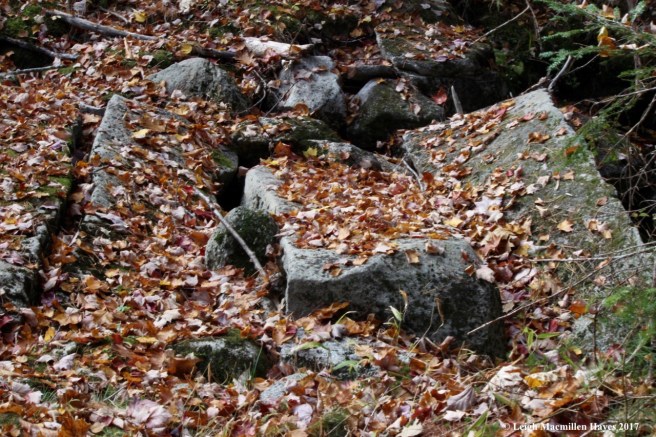
And what to our wondering eyes should appear, but an old well, its covering slabs now turned upright. We poked about some more, but found nothing else in that spot and suspected it was a well for the farm, rather than for a house.

s9-barbed wire

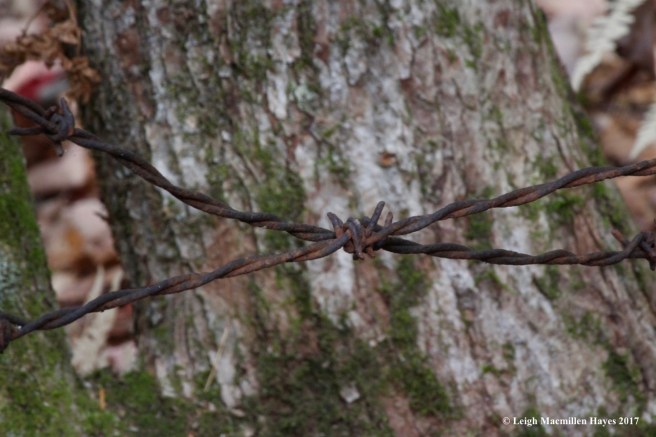
As we returned to the road, our suspicion was correct, for we found barbed wire that would have held the animals in. We stepped over it.

s12-bridge

Our journey continued and at a brook that flows from Keyes Pond to the north down to Webber Pond, we came to a crossing. It was a crossing that also had us wondering for it was made of large granite slabs than ran east to west in the direction of the road. Number one, we didn’t expect the slabs to serve as a bridge, and number two, if such was the case, we thought it would have made more sense if they were turned 90 degrees. And so again, we wondered what the story might be. Perhaps wood once covered the stone?

s19-single wall to double

For most of the journey, the road was bordered on both sides by stone walls–all freestanding, but some single-wide and others double. Single indicated either boundary or a way to keep animals in, while the double made us wonder about a plowed field. We noted neat construction where the stones were carefully stacked and messy sections where it seemed they’d been tossed, and again did some more wondering–were the messy parts the work of youngsters?

s11-Christmas fern 2

It wasn’t just the historical artifacts that drew our attention. Check out the withered leaflets on the Christmas fern. Its spores formed on the underside of a few leaflets, aka pinnae, of one or two fronds and that was sufficient for reproduction.

s15-lungwort 1

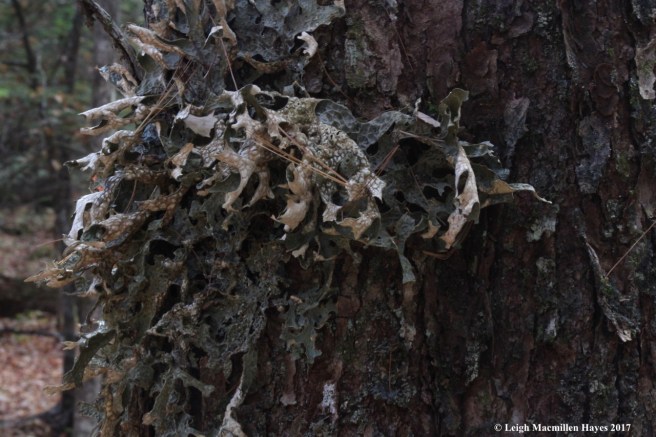
We also found an old favorite, lungwort; an indicator of old growth, thus a rich, healthy ecosystem.

s14-lungwort 2

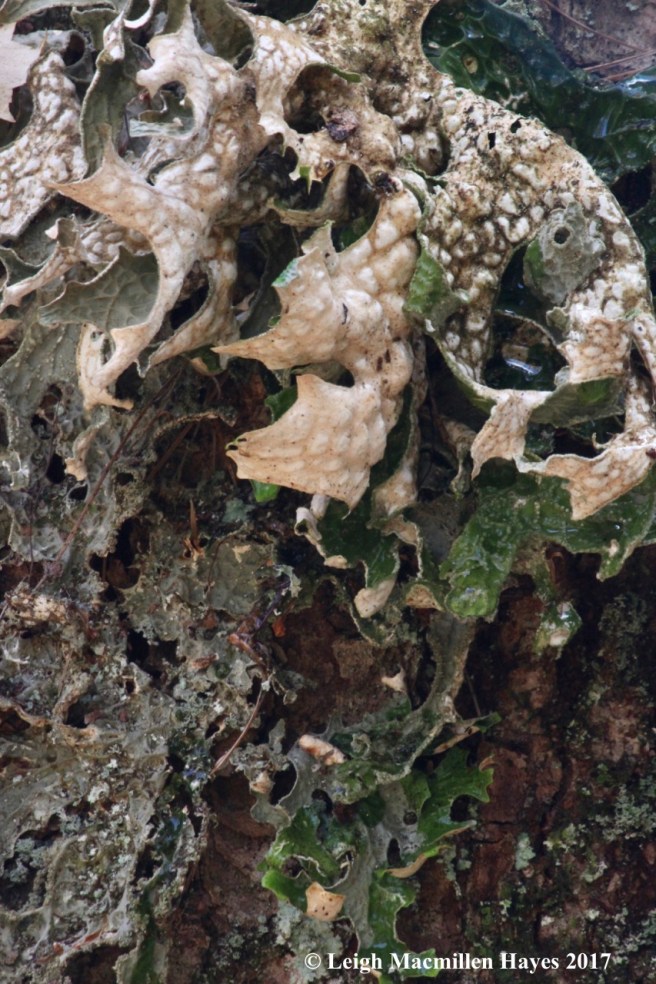
And an equally fun lesson for Karen, who lives in Illinois, and had never encountered it before. Janet poured some water onto the lungwort, which is a foliose lichen, and the miracle occurred on cue.

s16-lungwort 4

With a twitch of her nose and a wink of one eye, we watched as the water reached the lungwort’s surface and changed its color from gray to bright green, while where no moisture flowed, it didn’t transform. Lichens have a high resistance to damage by dehydration and will suspend photosynthesis when they dry out. The cool thing about them is that once wet, they can quickly absorb water and get back to food production.

s18-bluestain 2

We also spied a cool fungi, and one that we seldom see fruit, but this year has been different and we’ve discovered it periodically. This is green stain fungi, so graced with the common name because it really does look as if the wood had been stained green. I used to think it was an old trail blaze. When it does fruit, the mushrooms are tiny, but among the most beautiful–at least in my mind.

s20-Mrs Webber

At last we reached Webber Pond Road and we crossed to the cemetery, where Janet pointed out those for whom the nearby pond and road were named. She also noted that while most foot stones in a cemetery are positioned in front of the headstones, these were located behind. Indeed curious.

The cemetery was our turn-around point and we followed the route back, but actually went off route because we were looking for a foundation or two. We found none as we paralleled the road, but that’s okay because it just means we need to return.

Back at the old school house, I said goodbye to Karen (on the left) and Janet (on the right) and gave thanks for the opportunity to look keenly with them–as we peered into history.


Wild Willy Wandering Wilderness

There are times when one wanders down a trail and a certain spirit seems to swirl about in the silence of the wilderness. Such was the feeling today as my friend, Joan, and I joined two other friends to explore their land in South Chatham, New Hampshire.

k-Pleasant Mtn

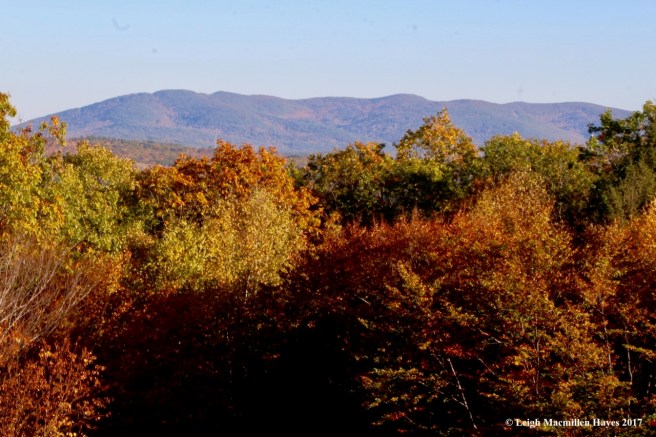
Before we ventured forth, however, we sat upon their deck and enjoyed the view of my hometown mountain–the ridge of Pleasant Mountain, this being a backside view.

k-sensitive pea 2

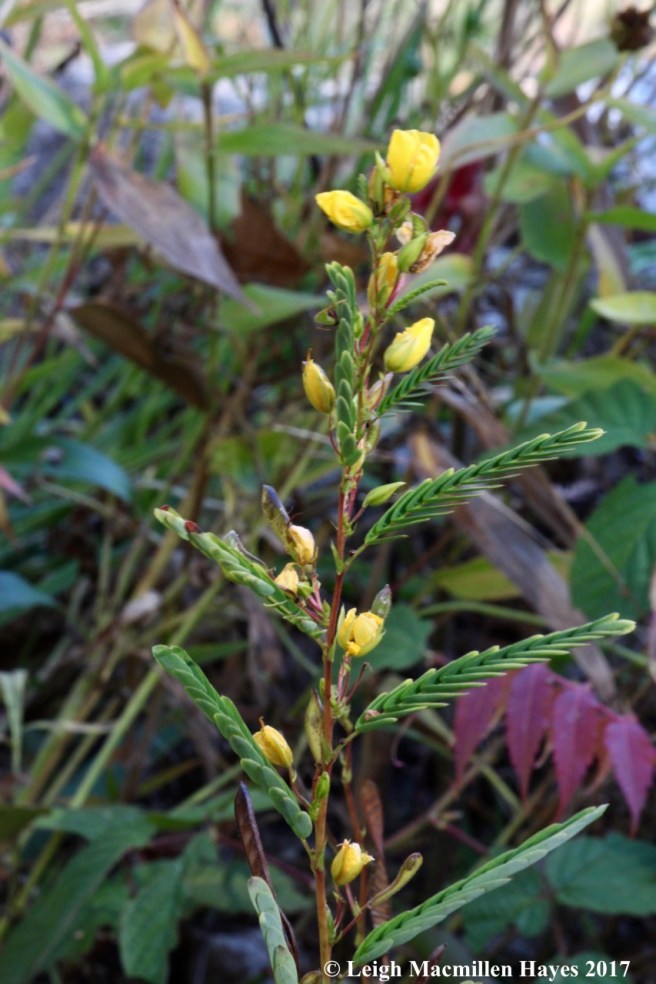
And then we paused by one of the wildflower gardens they have created with seeds of unknowns sown at abandon.

k-Sensitive Partridge Pea

Based on its seed pods that split open on both sides, we knew it was in the pea family, but didn’t know its name. Upon arriving home and keying it out, I discovered it’s a sensitive partridge pea, also know as a wild sensitive plant, the perfect tribute to the trail. Notice the pinnately-divided leaves–they fold up when touched, thus the name “sensitive.”

k-three amigos under the arch

Soon after getting acquainted with the sensitive pea, we continued onto the trail that Pam and Bob (the couple on the left; Joan on the right) have carved out of the land, with the help of their nephew for whom they constantly uttered words of praise. One of his artistic offerings to them was an archway formed from beech saplings.

k-steps by Willy

Another offering–steps created from stones found nearby. But where exactly did he find the stones? That remains a secret for so good is his work. It seemed as if the trail had been there all along as it wound its way up and over, down and around, passing by landmarks worth pausing by.

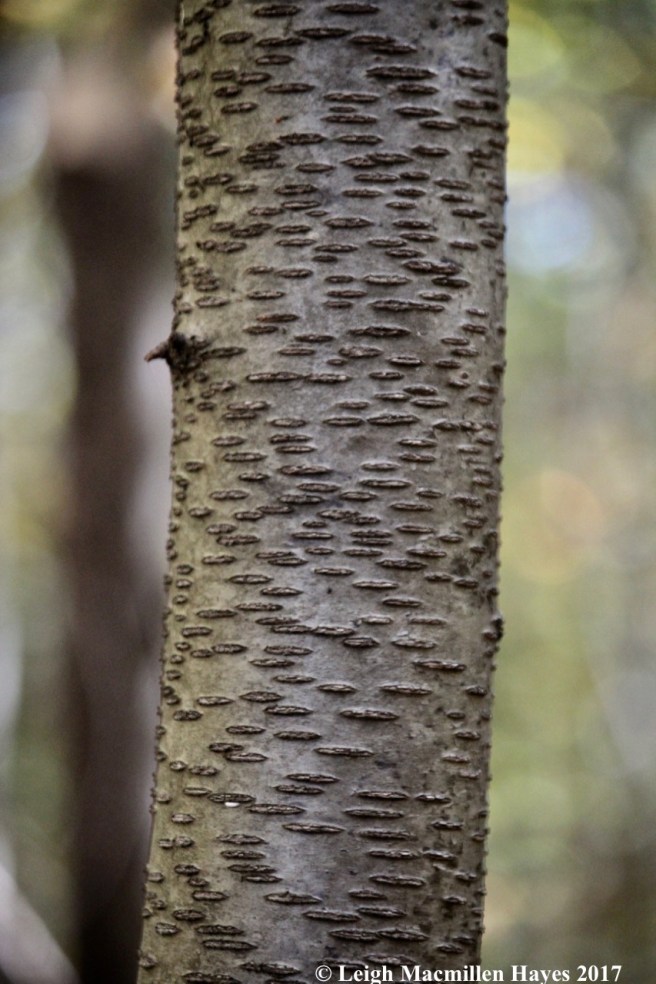
k-black cherry

We saw so much, including bark on young trees that we desperately wanted to be black birch (aka sweet or cherry birch), but was really black cherry. Nearby where pin cherry trees that we easily recognized, but this one seemed a wee bit different and we thought maybe, just maybe it was a black birch. But maybe it wasn’t when I opened Michael Wojtech’s BARK later.

k-black cherry 2

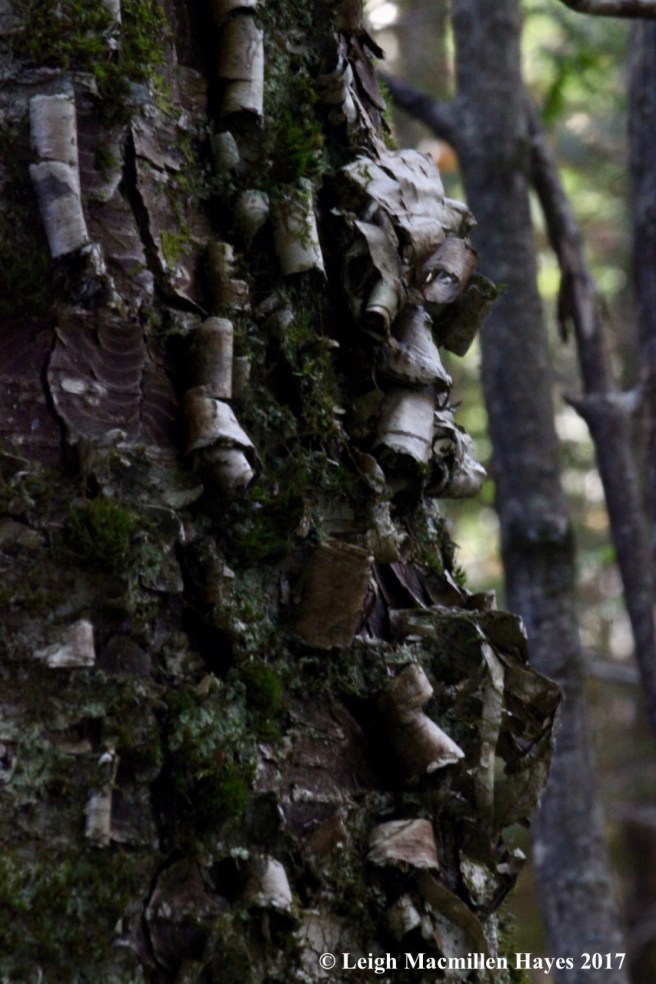
And further along the trail we spied a mature black cherry, its bark we knew for the curled chunks that remind us of burnt potato chips.

k-yellow birch

The curls of an old yellow birch also intrigued us and we noted many, many young and a few old members of this family throughout the property.

k-big tooth aspen

It’s a mixed forest and we had fun searching for the big tooth aspen trees, their bark deceptive with a northern red oak look below and birch look above.

k-hemlock and boulder 2

Other landmarks included a hemlock kissing a boulder and . . .

k-Province Brook hemlock root

another with the longest, thickest root we’d ever seen that arched across the land, creating an opportunity for the fairies that live in such an enchanted forest a chance to do the limbo.

k-coyote scat

We discovered what Pam and Bob already knew–it’s more than fairies that inhabit their place. In the middle of the trail, coyote scat presented itself.

k-deer sign

We found lots of deer scrapes, where in previous years they’ve scraped the bark upward to feed on it. But this was a recent visit with tags at both ends of the action, indicating a rub. Deer rub a tree to clean their antlers of velvet–that soft, vascular skin that grows on their antlers. They also rub trees to mark their territory.

k-garter snake1

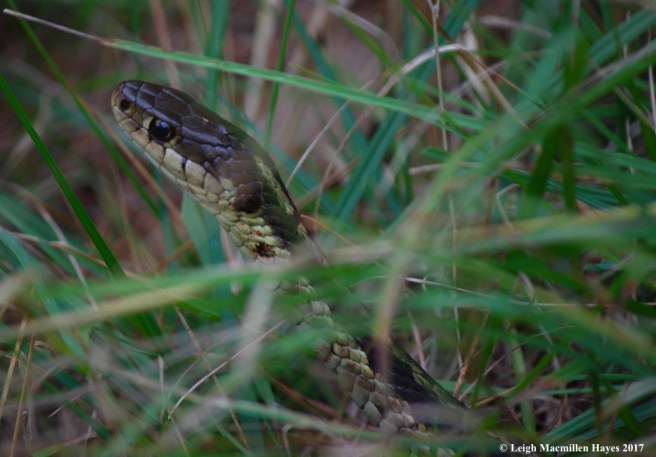
And our wildest sighting of all–a garter snake enjoying some late afternoon sun. It never moved as we gawked and finally passed by, so really it wasn’t so wild after all. But Pam and Bob shared stories of other sounds and sightings, for this really is a wild land that abuts the National Forest.

k-Province Brook 2

It’s also bounded by Province Brook, where the water’s flow soothed our souls.

k-Province Brook 3

We were embraced by its reflective color . . .

k-Province Brook 4

and life-giving cadence.

k-spirits 1

And it was there that the water spirit . . .

k-spirits 2

rose and embraced us.

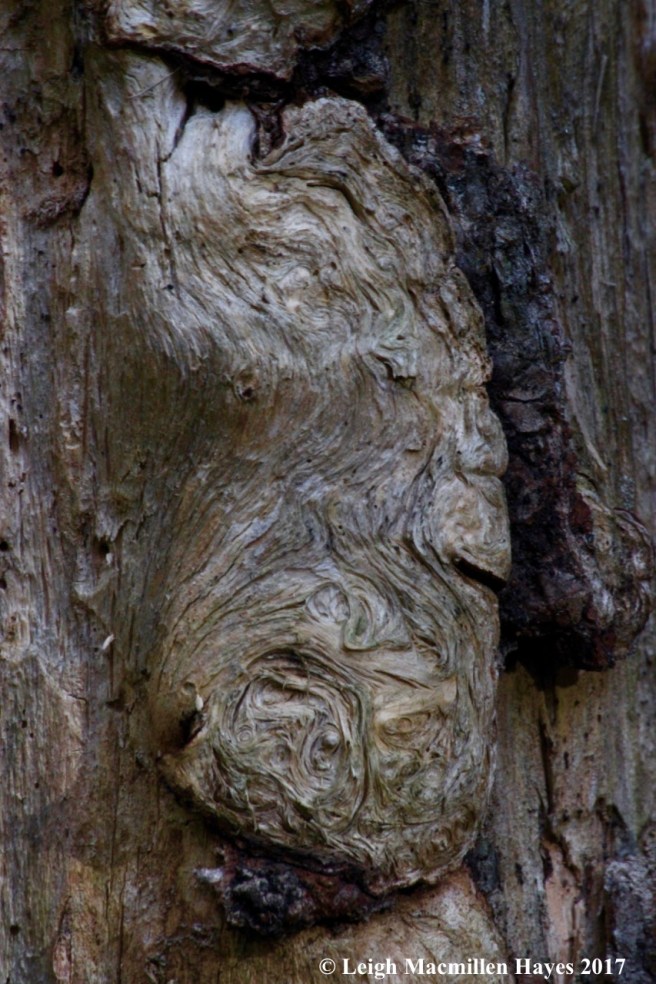
k-wood swirls

We found it wherever we went and recognized it in various forms . . .

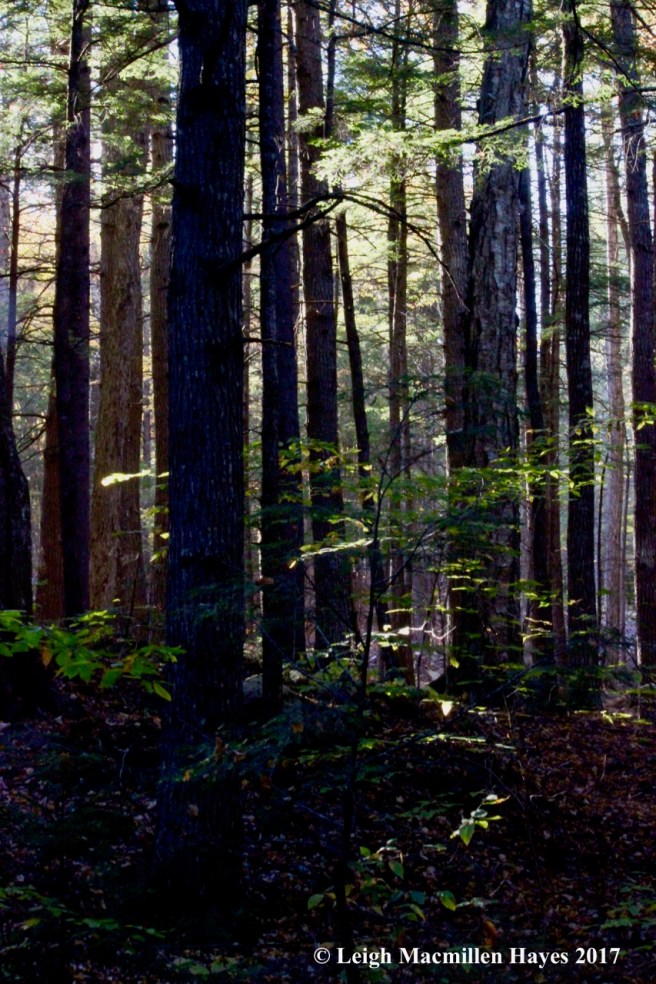
k-afternoon light 2

as it wandered beside us.

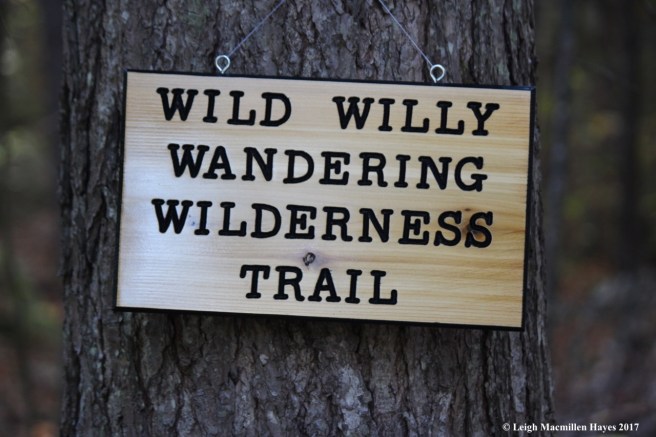
k-sign

Just as we ended our journey, we noticed the sign–Wild Willy Wandering Wilderness Trail. Pam and Bob had told us its name, in honor of their nephew Willis and his hard and creative work in carving out the trail, but they kept the sign a secret until we finished. Hats off to all three of them and their love of the land and for each other. Joan and I were envious of it all and thankful for the opportunity to be embraced by the spirit of this place and these people.


Plan B Mondate

We had a hike in Evans Notch planned for today, but a look at the weather forecast made us question our choice.

Forecaster Jack made the following prediction: “Current observations this morning show the long-awaited cold front just about to clear the coast. NW winds are already in progress across the mountains behind the front. Today’s weather will be dominated by a familiar pattern that we haven’t gotten to enjoy much recently: upslope/downslope. The mountains will see plenty of cloud cover as air is forced to rise up the NW slopes. As that air descends the SE slopes of the mountains, it warms and dries, leading to sunny conditions along the coastal plain. All models are in agreement that temperatures will be moving downward today, so the ‘high temperature’ is whatever you’re seeing right now. For the mountains, this means that temperatures in the mountains will fall from the low 50s this morning down through the 40s this afternoon before arriving in the 30s this evening. Temps along the coast will be about 10 degrees warmer with morning 60s cooling to afternoon 50s and evening 40s.

Consequently, we thought about changing our plans since it seemed like any foliage views would be under cloud cover. And then Marita sent me an invitation to hike with her tomorrow, which I can’t do, but we decided we’d invite her to join us today–on a hike of her choice.

r1-trail sign

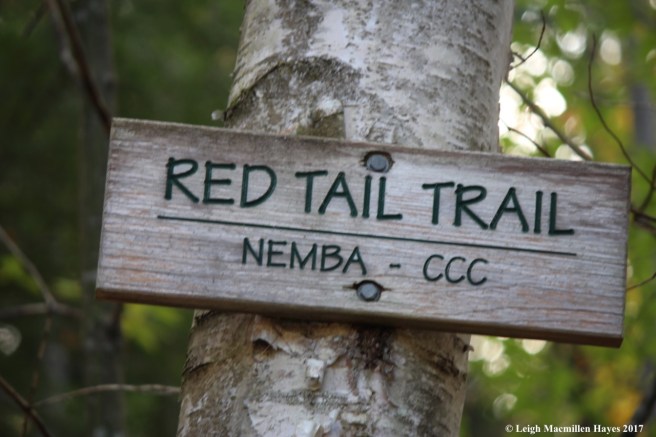
The Red Tail Trail off Hurricane Mountain and the backside of Cranmore Mountain was the path she chose. It’s a funky trailhead to locate–park near the little cement building and gate, walk up the dirt road to a large water tank (now decorated with graffiti), and skip the first trailhead to Kettle Ridge, instead circling about halfway around the tank where a small sign about ten feet up a tree marks the way.

r30-dam

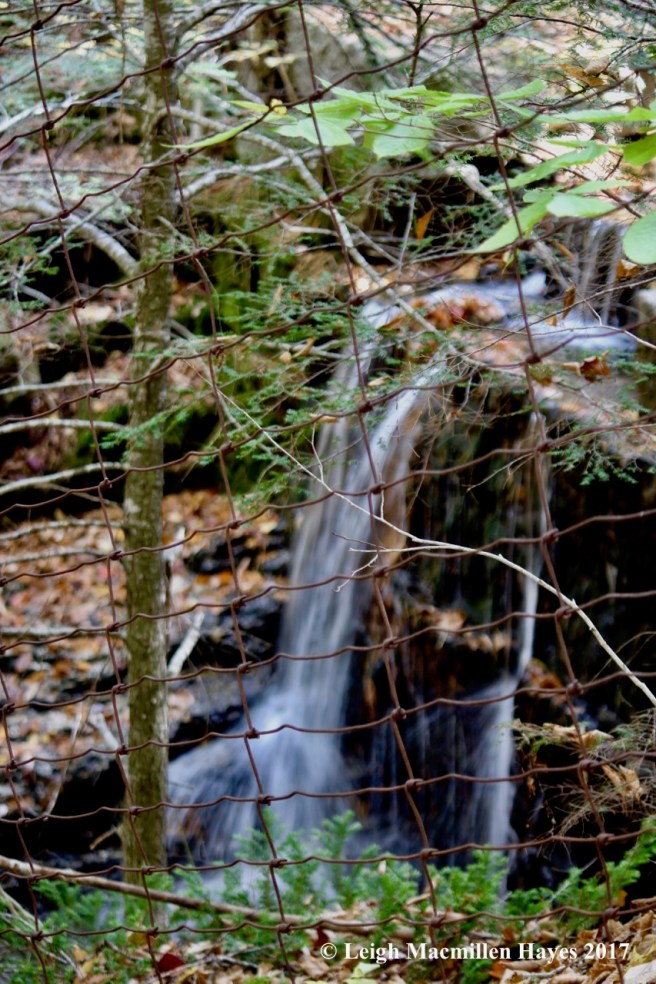
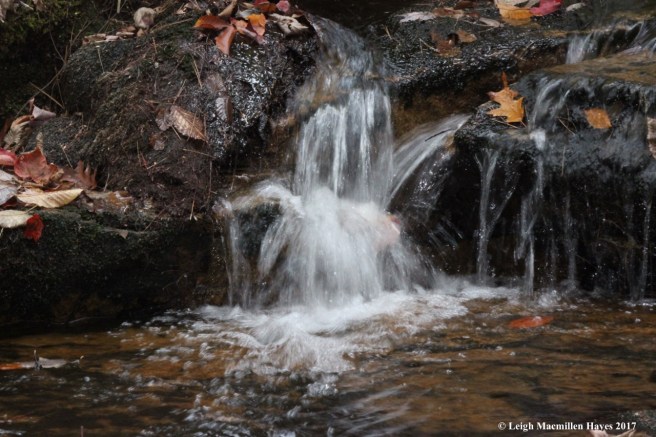
For a half mile or so, the trail follows No Name Brook, so named by moi because I have yet to locate its identity, but it parallels Hurricane Mountain Road. Near the start, barbed wire and an old mill dam bespoke its former use.

r31-no name brook

We followed it, slipping down occasionally for a closer look and listen–its rhythmic cadence so pleasing to our souls.

r3-giant erratic

And then we came upon the glacial erratic that must have landed with a thud one day about 10,000 years ago. Standing over the brook and covered in polypody ferns and asters, it resembled a small, two story earth house with a garden roof.

r4-sending puffball spores airborne

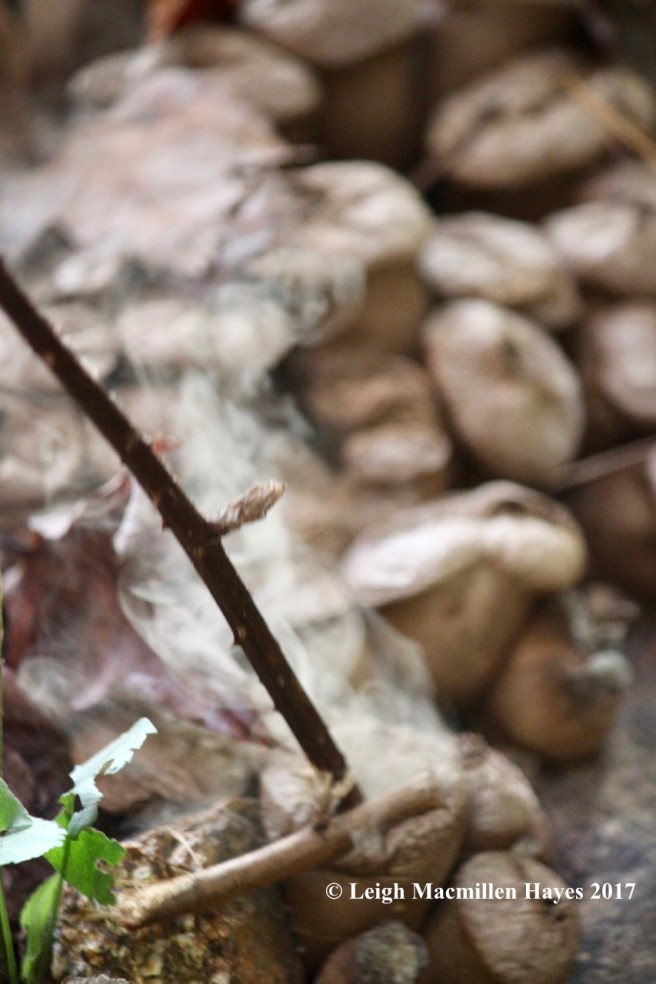
Shortly before breaking into the old log landing, which had been transformed into a mountain bike park with jumps of sorts since we last traveled this way, Marita spied several large clumps of puffballs. And so I encouraged her to poke them.

r5-spores wafting forth

She channeled her inner child as she poked one after another, releasing the spores which wafted skyward, mimicking a smokey fire.

r6-climbers trail sign

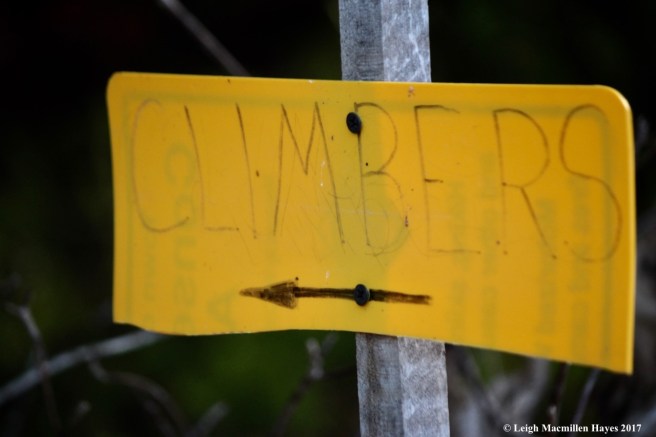
Arriving in the log landing, we were a bit confused about whether to follow the bike trail and then my guy spied a small yellow sign–and we found our way, for climbers were we.

r7-hobblebush color deepening

And because there were so many along the lower part of the route near the brook, I once again celebrated the variation of colors portrayed by the hobblebush shrubs.

r8-mount kearsarge 1

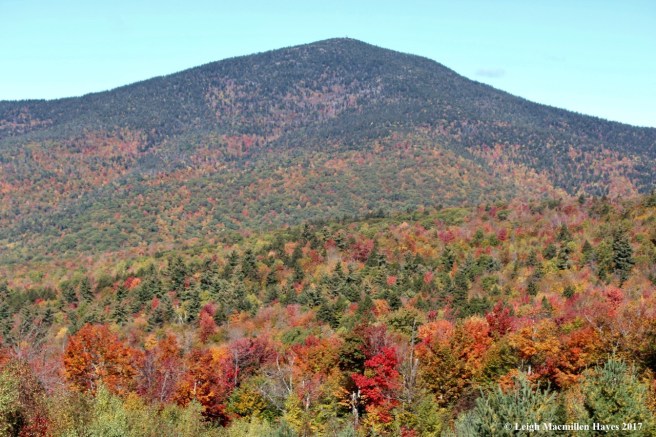
We zigged and zagged as we made our way through hardwood, softwood and new succession areas of forest. At last, we looked northwest and were greeted with the sight of another old favorite–Mount Kearsarge North. And the color display.

r9-Whitehorse ledge

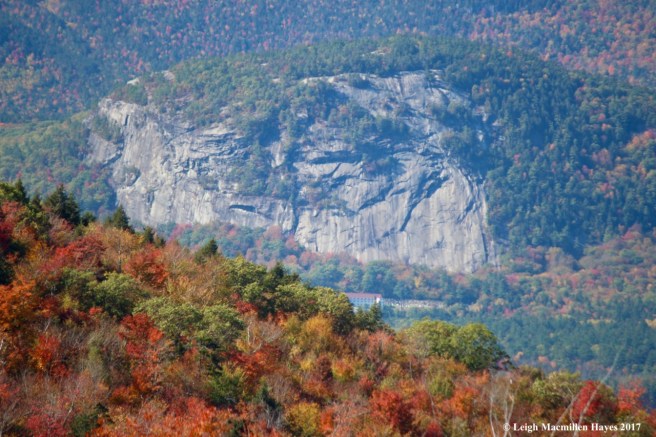
Across the valley, we also spied White Horse Ledge and the White Mountain Motel.

r10-upslope clouds

After climbing 2.6 miles, we came to a T, and turned left toward the Black Cap Mountain trail. In the offing, we could see those upslope clouds overtaking the mountains beyond.

r14-Mt Wash and Kearsarge

And ever so slowly snaking their way over Mount Washington.

r15-lunch rock

By the time we reached lunch rock atop Black Cap, we were rather warm . . . and hungry.

r16-me and my guy

But ready to pose once we’d eaten.

r17-mountain ash fruits

As we looked about at the top, we admired the red, red berries of Mountain Ash, and wondered about their edibility. According to Weeds of the Woods by Glen Blouin, the scarlet fruits provide food for “many species of songbirds, including cedar waxwings, grosbeaks, and robins . . . they are also a favorite of both black bear and ruffed grouse.” Blouin adds, “The berries are rich in both iron and vitamin C and were used (medicinally) both fresh and in teas, to treat scurvy. Prior to ripening, the fruit is high in tartaric acid and is unpalatable. After a few frosts, the taste mellows and, though still bitter, the fruit becomes edible.” To that end, he provides a recipe for Mountain Ash Berry Jelly. Hmmm.

r18-starting down from Black Cap

For our descent, we decided to follow the loop trail around the summit of Black Cap.

r19-down 2

With each change of natural community, we enjoyed the color it offered.

r20-yellow birch

Back on the Red Tail Trail, Marita spied a tree we’d previously walked under, but not noticed. “What is it?” she asked, commenting that it looked like two different trees. Indeed, it wasn’t. Instead, it was an old yellow birch that had toppled a bit, caught in another tree and continued to grow–sending new branches skyward that looked like young trees on their own.

r21-hemlocks and pines

Again we zigged and zagged, changing up leaders as we wound our way down.

r21-upslope clouds advancing

At the point where we’d first enjoyed the views of Mounts Washington and Kearsarge, we again paused. That section had been previously bushhogged, thus providing an exceptional vista.

r22-upslope wrapping around Washington

And again we noted the upslope clouds curling around Washington, but chuckled that the mountain we’d originally intended to climb was probably in the clear.

r22-flowers in bloom

Our downward climb was much faster than our upward and in what seemed like no time, we reached the “bike park.” What had once been a mass of wildflowers overtaking the log landing, had become small patches and we were surprised that they still bloomed.

r25-squared rocks

Back at the brook, we commented on the squared off sections of granite and wondered about the processes that created such.

r28-artist conk

And then we reached the trailhead, where I spied an old favorite–an artist conk that has a surface area of about two feet.

From beginning to end, we knew that Plan B was really better than Plan A–for we’d had fun introducing Marita to a trail we like as we shared stories, laughter, lunch rock, and later a post-hike beer.


One Plus One=Five

One plus one equals two on an average day. And so today, Marita and I set out to conquer at least one trail, with a couple of others as additional options. We ended up “bagging” as they say in hiking terms, two–including one that was totally unexpected.

s-Long Mtn lower path

Our morning began with an exploration of the new trail on Long Mountain, a 2.5 mile climb that twists and turns beside Mill Brook on property owned by Mary McFadden and Larry Stifler. Near the start, bog bridges pass through wet areas now dry.

s-Mill Brook 1

The climb is moderately gradual and the brook ever present, its rocks creating falls that added a pleasing sound and sight to our hike.

s-brook crossings

Occasionally, we needed to cross and the way was well bridged.

s-dry brook1

At times, the brook was dry, but those moments made us realize that we must return in the spring when we assumed torrents of water pass over the rocks.

s-Mill brook moss (1)

Moss dangling today, however, mimicked the flow that wasn’t there.

s-cairn

As we climbed, we noticed works of art. I’m not always a fan of cairns, but in this case, each had a flair that bespoke someone’s creative mind.

s-cairn 2

Others were simply simple.

s-water bar

We found water bars that were equally artistic in nature.

s-flagging

Just over a mile and a half into the hike, the trail turned and though it wasn’t as well cleared, it was certainly well flagged and losing our way wasn’t an option. There would be no getting fake lost on this climb.

s-sledge hammer

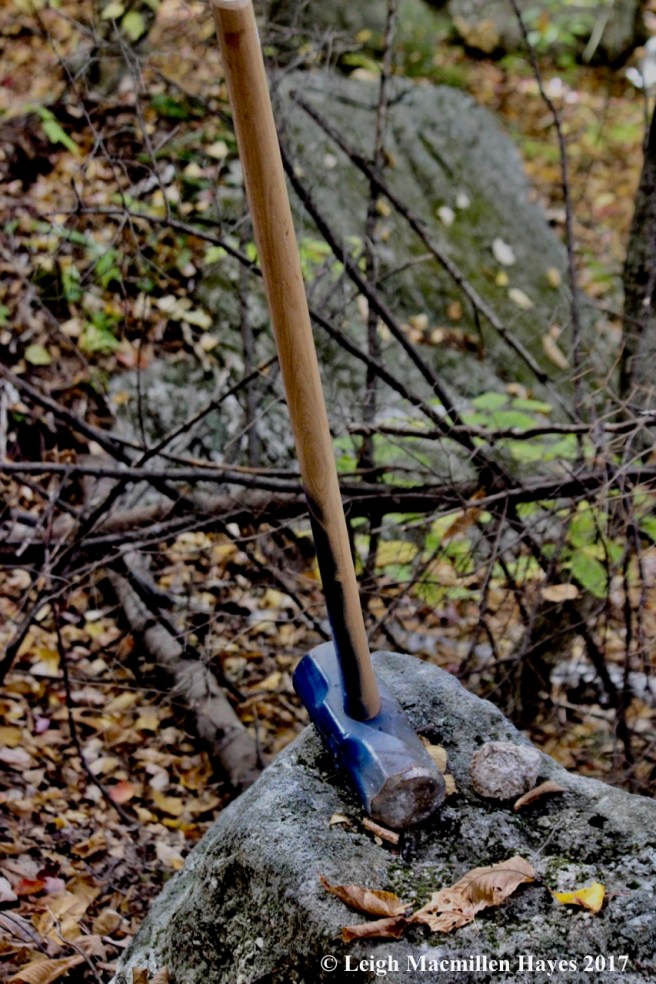
Eventually we came to a third section where the trail was again cleared and we found signs indicating the crew might be ahead.

s-stairs 1 (1)

Again, we admired their work, from the stone stairs to wooden steps, all created with materials found within feet of the trail. Work gloves left behind made us wonder if perhaps they wanted us to lend a hand. If you find the gloves, then I’ve a feeling you are good at “Where’s Waldo?”

s-oak ladder (1)

The extra sturdy ladder was created on site from a red oak (and some hefty hardware).

s-Marita, Bruce and Gary 2 (1)

We were chatting companionably when we heard some movement above. And then heard their hellos. We’d found the crew–Bruce, the property manager and Larry, his right-hand man. Bruce and Marita had communicated previously, so he wasn’t surprised to see us and we were full of admiration for the work these two have done–all by hand. In fact, if you ever think you want to do some trail work in your neck of the woods, I highly suggest you locate these two and spend some time working with them for theirs is the best I’ve ever seen. We chatted for a bit, learning about their good works and the good works of the property owners.

s-lunch view

And then it was time for us to move up a few more hundred feet and out to the ledges. We didn’t reach the summit of Long Mountain, for that is owned by someone else, but the ledges with a view of Round Mountain (also owned by the Stiflers), Evans Notch and the White Mountains beyond was the perfect setting for lunch rock.

s-nature's tapestry

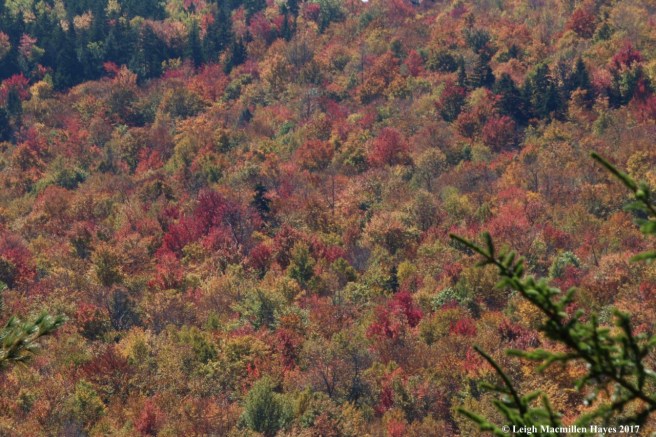
As we ate, we noted that foliage peak had passed in this part of the woods, but still, the tapestry was worth a closer look.

s-Long Mtn trail signs 2

Eventually, we followed the 2.5 mile trail down, repeatedly singing the praises of all who made this hike possible.

s-wasp nest

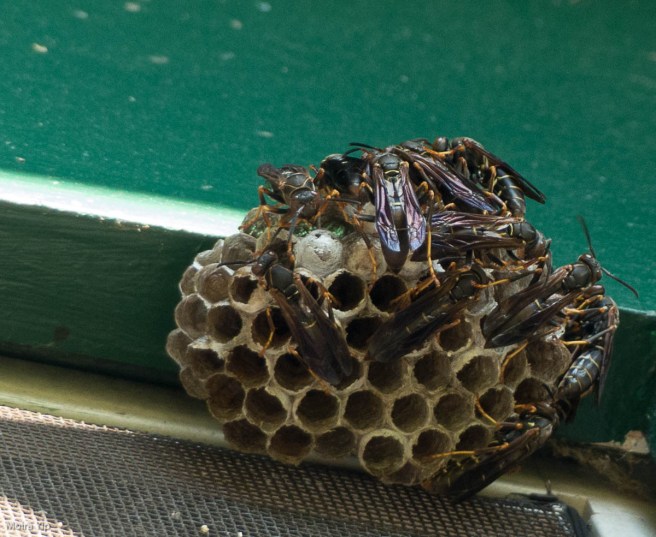
And then we traveled down another road we’d never been on before and located a mailbox Bruce had told us about as an indicator to the trailhead also owned by the Stiflers. We didn’t find the trail immediately, but did find this huge wasp nest, now abandoned.

s-Speck Ponds trail sign

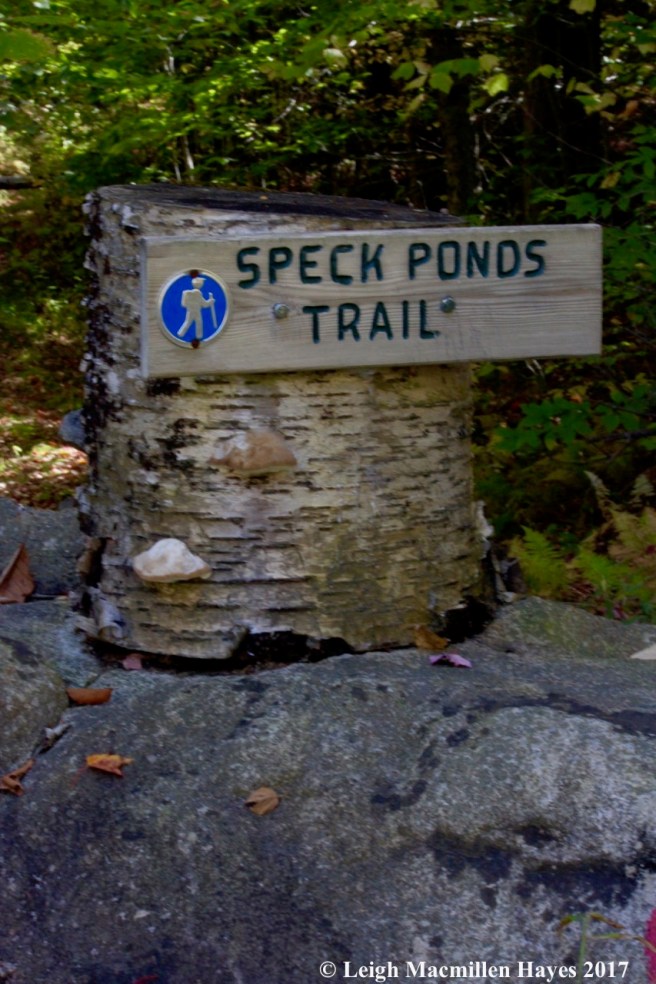
It took us a few minutes because it’s rather hidden, but within a few feet of the trail sign, we recognized Bruce’s artistic mark–sign attached to stump atop rock.

s-Speck Pond signs

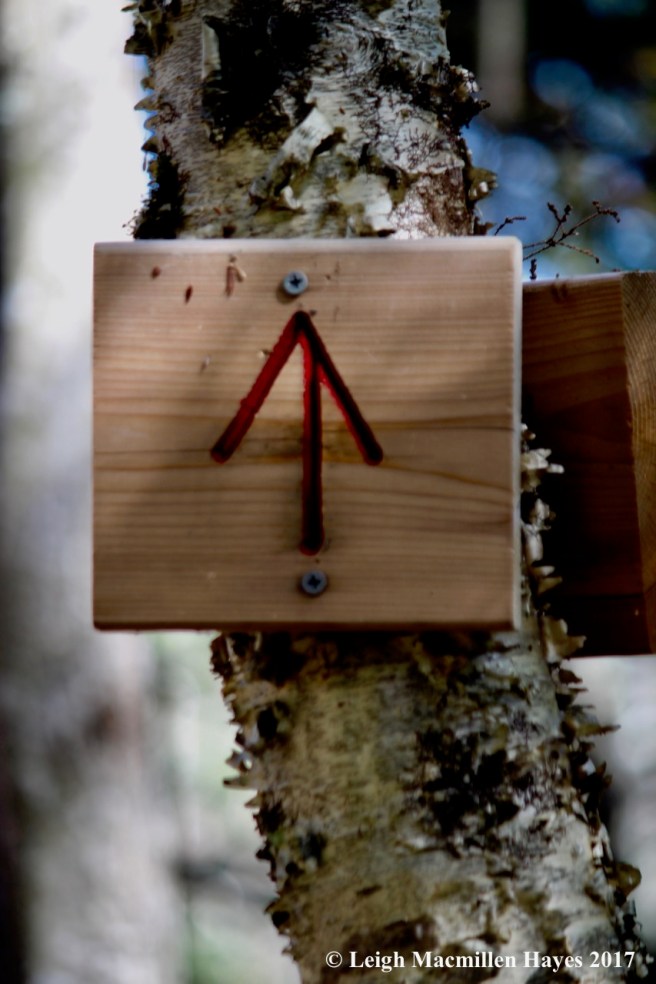
And other trail signs that we admired mostly for their coloration in contrast to the paper birch to which they were attached.

s-Norway sign at Speck Ponds

s-Albany

This trail led us from one town to another in a matter of inches.

s-Mt Wash from Speck Ponds

And out on the power transmission line, we turned toward the mountains. with the Whites again in our view–especially Washington.

s-pond 1 (1)

At last we reached Upper Speck and turned to the left as we started on our way to hike around it and Lower Speck in what was described to us as a bit of a figure 8. I think really it was more of a calligraphy “g” in design with a bit of a line between the two ponds.

s-leaf art

Again, our views were delightful, including leaves of different species offering contrasting colors and shadows.

s-painted turtle

For a few minutes, we had the pleasure of admiring a painted turtle as it sunned itself before I disturbed it. I just wanted to get closer.

s-speck bridge

Again, bridges helped us ford the wet spots and we admired the workmanship.

s-bank lodge

It wasn’t just human workmanship that drew our attention. We saw at least five lodges, some beside the bank . . .

s-beaver lodge 2

and others in the wetlands adjacent to the ponds.

s-beaver works old and not successful

We found lots of old works . . .

s-beaver works old 2

some not entirely successful.

s-beaver dam 2 (1)

And beside a substantial beaver dam . . .

s-beaver new

we spotted a wee bit of new works–but it wasn’t much.

s-Upper Speck

Again, the colors kept us in awe, much as they had done atop the ledges of Long Mountain.

s-fall colors 1

And finally, we completed our “g” loops and made our way out with all of these and so many other photographic memories in our minds.

Today was not an average day for it’s Friday the 13th. And we had the pleasure of learning that one plus one=five–five stars that is, for we gave such a rating to each trail we traveled, and thanks to all who made them possible for us to wander and wonder. Thank you Mary and Larry and Bruce and Gary. And Marita for inviting me to join her.


I Spy, You Spy, We All Spy

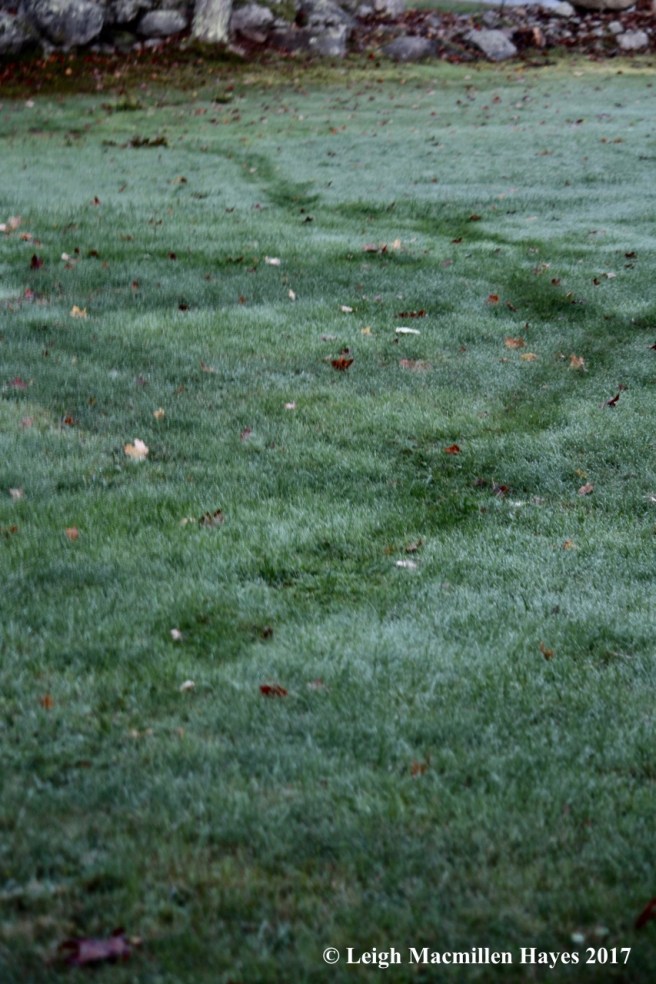
As I stepped out the door early this morning to dump yesterday’s coffee grounds, my eyes were immediately drawn to a pattern in the dew and I knew that Porky had paid us a visit.

t-porcupine trail in morning dew

His trademark sashay showed in the wet grass almost as well as it does in snow with that pigeon-toed pattern and swish of a tail. Only yesterday I’d been noting all the freshly nipped oak branches in our yard and woodlot, cut as they were at that telltale 45˚ angle.

t-flat hill sign--oxymoron

And then, after today’s coffee (grounds waiting until tomorrow to be disposed) and breakfast, I drove to Lovell to meet up with some Greater Lovell Land Trust docents for a climb up Flat Hill–that oxymoron of a name. But really, the summit is rather flat–after climbing the hill, of course.

t-trail light

It was early and felt more fall-like than we’ve experienced of late and we reveled in the temperature as well as the light along the trail as the sun played with the leaves and added a golden glow to our day.

t-coyote scat 1

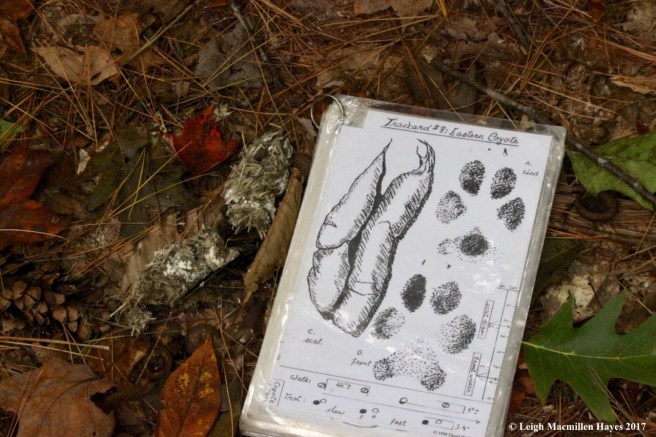
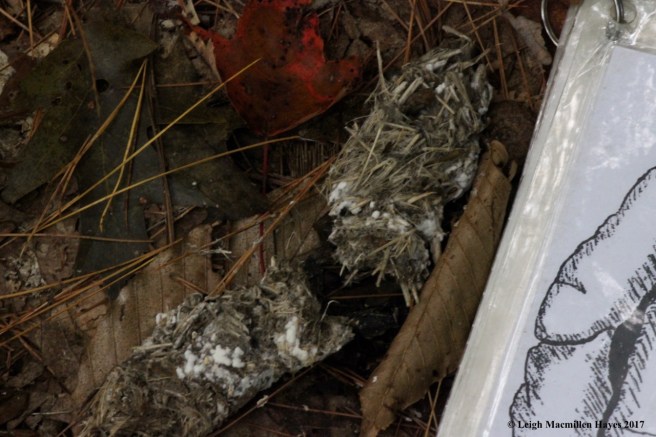
When we weren’t looking up, we looked down. One of our first sights–scat! Coyote scat, we thought. Only the contents of this scat were different than most.

t-coyote scat 2

And so we went in for a closer look–for it was filled with quills. Not my home porky, but we know that the summit and rocky ledge below are porcupine territory so it made perfect sense that we found such scat in the middle of the trail.

t-fox scat

We found more scat a little further along–this one was filled with berries and seeds and also in the middle of the trail, atop a rock. Smaller in size, we suspected red fox.

t-paper birch lenticels

There were other things than scat to attract our attention, like the long lenticels on a downed paper birch–their pattern looking like either zippers on a jacket or a bunch of spruce trees in their spire formation.

t-maple-leaf viburnum

We marveled at the color and texture of the maple-leaf viburnums–like no other in the mix.

t-hop hornbeam bark and leaf

And when we reached the hop hornbeams with their shaggy bark and double-toothed leaves, we knew to look below for their seed pods. It wasn’t an easy search for they are small and blend in well with the birch and hornbeam leaves on the ground.

t-hop seed 2

But we found one–its papery sack enclosing the nutlet. We were curious to see the seed and so opened the inflated casing. It was almost a 3D tear-drop shape, coming to a sharp point.

t-hops

Skipping ahead for a moment, after we finished hiking I visited a tree back near the parking lot where Pam and I had noted plentiful fruits in the summer. It takes about twenty-five years for a hop hornbeam to fruit. And the common name–“hop” refers to the seed clusters that represent true hops used in beer production.

t-summit view 1

At last we reached the summit and stood for a while, in awe of the color display before us.

t-polypody 1a

From the same spot, we also noted the polypody ferns that grow upon the summit rock.

t-polypody spores 2

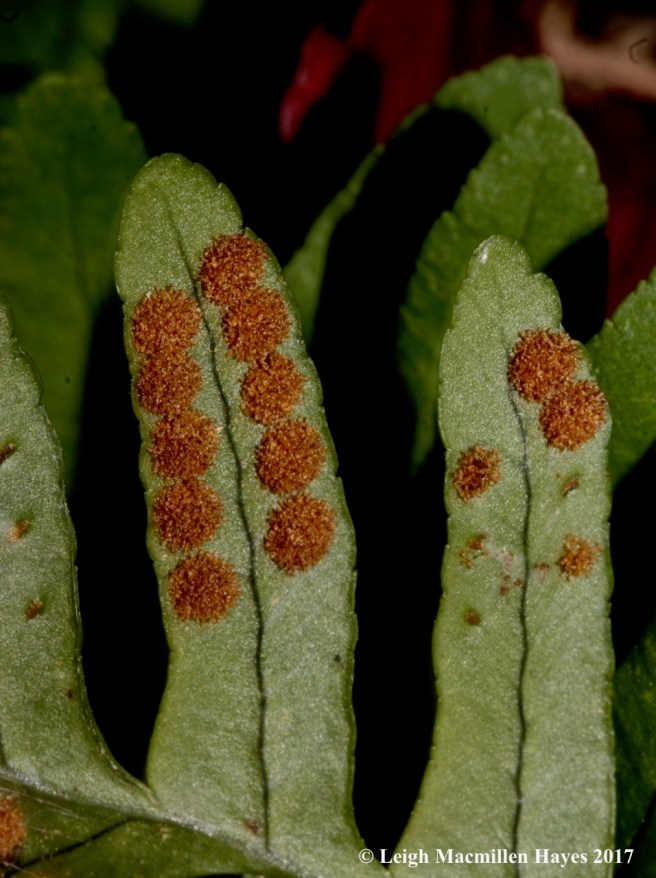
Ferns reproduce by spores rather than seeds. The itty bitty spores (think dust sized), called sporangia, grew on the underside of these leathery frond leaflets. The sporangia form clusters called sori and in the case of polypody the sori are naked. Some had already dispersed.

t-chipmunk

At last we started down, but not without a side trip of bushwhacking and annoying a chipmunk who had some housekeeping details to attend to.

t-docents 1

Less than three hours later (amazing for us), we gathered at the bottom and said our goodbyes to Darbee and David on the left–they’ll return to their winter home soon. Bob and Pam will hang with us for a bit longer, but while I reflected on all the wonderful reasons to enjoy winter in Lovell, the two couples made plans to connect in their winter habitat.

t-wooden spoon

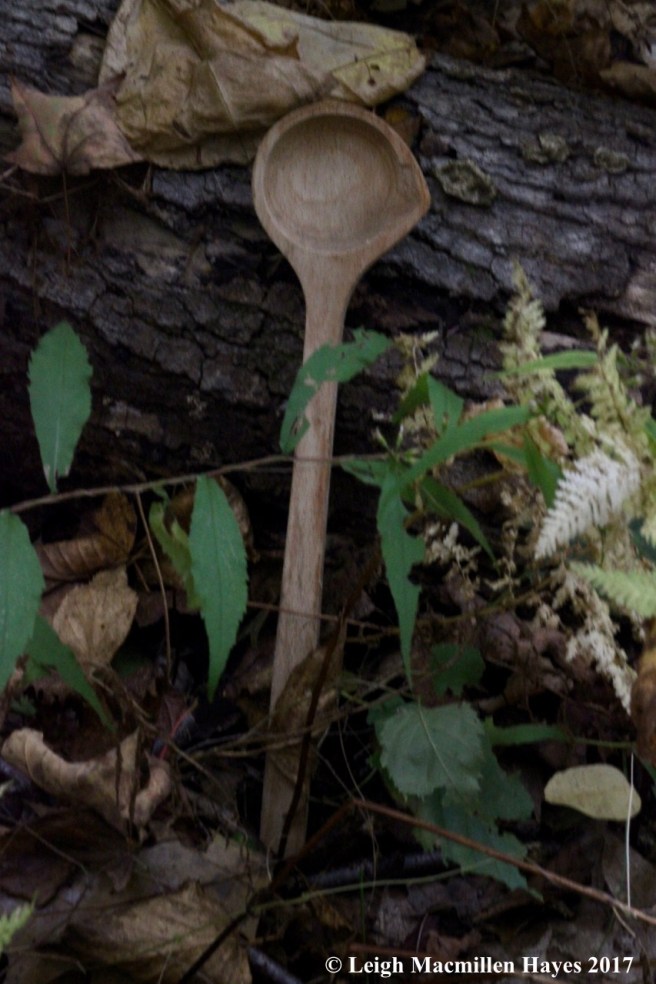
The day wasn’t over yet and this afternoon another docent and I set up a “Kim’s game” of natural and unnatural items on a sheet covered with a bandana on the trail behind the New Suncook School. Then we walked further along the trail and hid a bunch of unnatural items for our after-school Trailblazers to locate. (We had to relocate them as well and are almost certain we found all of them. Maybe . . . )

t-noticing leaf colors

Before the kids did anything though, they introduced Linda to their trees–clusters of trees really for all are copiced, that they’ve befriended and named and gotten to know up close and personal. This afternoon, they noted that the colors of the leaves were changing.

t-Linda and Sassy

They loved giving Linda a tour and she loved being part of the action.

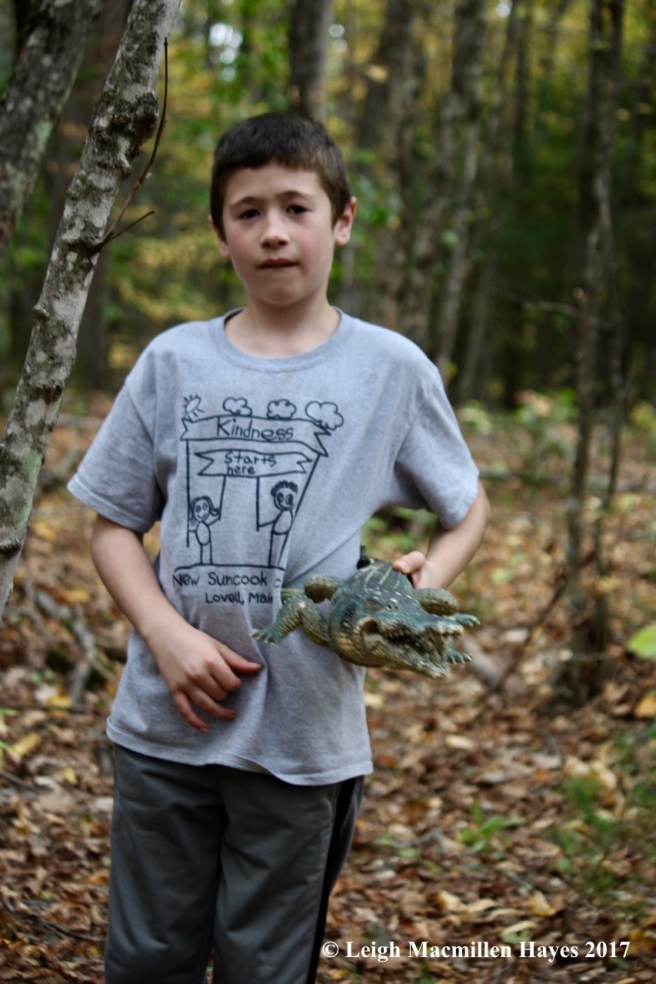
t-alligators in the woods

The kids did an excellent job with their observation skills, including locating at least one species that didn’t quite belong in these woods.

t-fallen log 1

And then we started gently rolling over fallen limbs, curious about what we might find below.

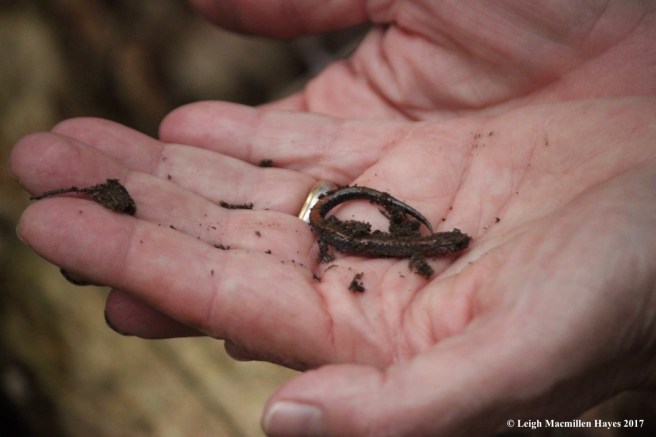
t-red-backed salamander

And what to our wondering eyes should appear? A red-backed salamander under the first one. We rolled a few more and didn’t find much. But then we heard something and stood still as we listened. Finally, it called again and we called back–a barred owl was somewhere nearby. At last it was time for the kids to head home and as we walked out of the woods to meet their parents, we stopped to roll one more log–where we found a yellow-spotted salamander. Unfortunately, in our excitement, I couldn’t take a decent photo, but still . . . we were thrilled.
What a perfect day–of I spy, you spy, we all spy. Indeed we did.


Autumn Falls With A Smile

It seemed only yesterday the colors were rather on the dull side, not quite offering that magical tapestry we all relish. And then today dawned with a the mix of sun and clouds and occasional raindrops and a breeze and somehow the world transformed.

hp3-Holt Pond1

And I had the good fortune to take it all in at Holt Pond Preserve, where I traveled the trail with two friends. The leaves had gone on strike from their food producing summer job and we rejoiced in the result as they prepared for the dormant season that is on the horizon.

hp1-quaking bog 1

Gold, orange, topaz, crimson, salmon, ruby, gold green, yellow green, gold brown, green brown, gray, white . . .

hp2-swamp maples

even a hint of blue; it was as if we stood in nature’s paint store.

hp4-tire alley

As always when I look at paint chips, I had a difficult time deciding which color to choose.

hp6-tree tops

Stick with a deep red?

hp9-more skyward views

Lean more toward the greens and yellows with a hint of orange and red?

hp7-leaves in brook

Or go with a mosaic–intermixing all that was available?

hp11-button bush

And what about the decorative accents?

hp10-sensitive fern fertile frond

Again, I couldn’t decide . . .

hp13-fireweed

which was my favorite.

hp12-following friends old and new

Nor could my companions, JoAnne and Jen, and so we slowly moved about, filling our hearts and souls with the memory of it all by painting the scene in our minds.

hp17-Grist Mill Road

And smiling at the offerings.

“Autumn, the year’s last, loveliest smile.” ~ William Cullen Bryant

Moments of Awe

The garden hum slowed significantly in the last few days, with bee buzz overpowered by cricket chirps. But still they come.

i6-spotted cucumber beetle

The first insect I focused on wasn’t a bee at all, but a spotted cucumber beetle who paid a surprise visit. It’s been years since I grew cucumbers and I can only imagine that it was a couple of houses shy of my neighbor’s garden. Instead, it made do with the mint.

i1-hoverfly, haltere

A second glimpse wasn’t at a bee either. But I must admit that I’m forever mesmerized by  the tiny hover flies that frequent the flowers. Hover flies are true flies, so while they may look a bit bee like, they don’t sting. And they take time to enjoy the nectar. My, what big eyes they have–taking up most of their head space. And such short antennae.

i1-hoverfly-haltere

Since I was paying attention, I also realized that hover flies don’t have hindwings per say. Rather, as dipterous insects, they have halteres, which are a modified form of a hindwing. The halteres help with balance and guidance while in flight and are situated behind the forewings on the thorax or middle section of the body. Remember–head, thorax, abdomen. Here’s another tip: two wings fun, four wings run. Well, don’t exactly run, but get out of the way.

i2-sweat bee

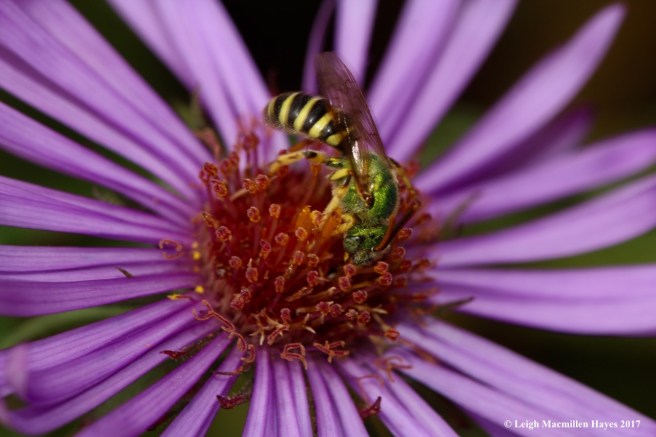
One of my favorites in the garden mix, the jewel-like sweat bees with their metallic green heads and thoraxes, plus yellow and black striped abdomens.

i7-sweat bee

“Sweat bee” doesn’t strike me as the most romantic name for such a beautiful specimen, but they are so called because they’ve been known to land on us in search of a salty sip as we perspire. They will sting if annoyed.

i3-bumblebee face

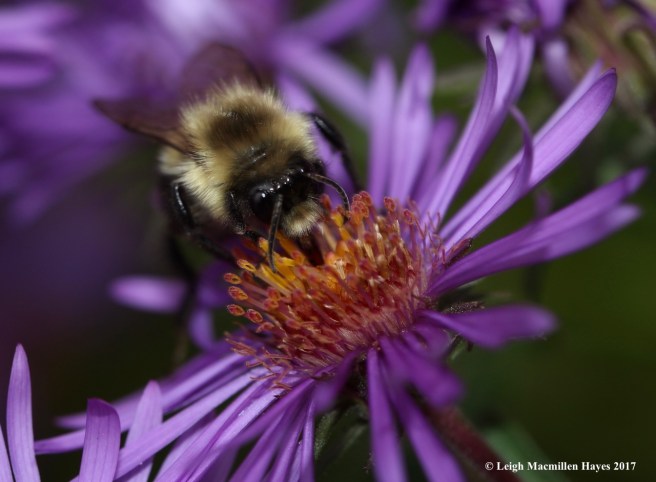
But their sting isn’t as pronounced as that of the bumblebee; I thought about that as I  carefully greeted one face to face while he sucked with his straw-like proboscis. The bumbles were in constant motion today. Though they’ve been in a collection tizzy all summer, I had to wonder, do they sense the end is near? And still, they perform their job.

i4-honey bee, leg parts1

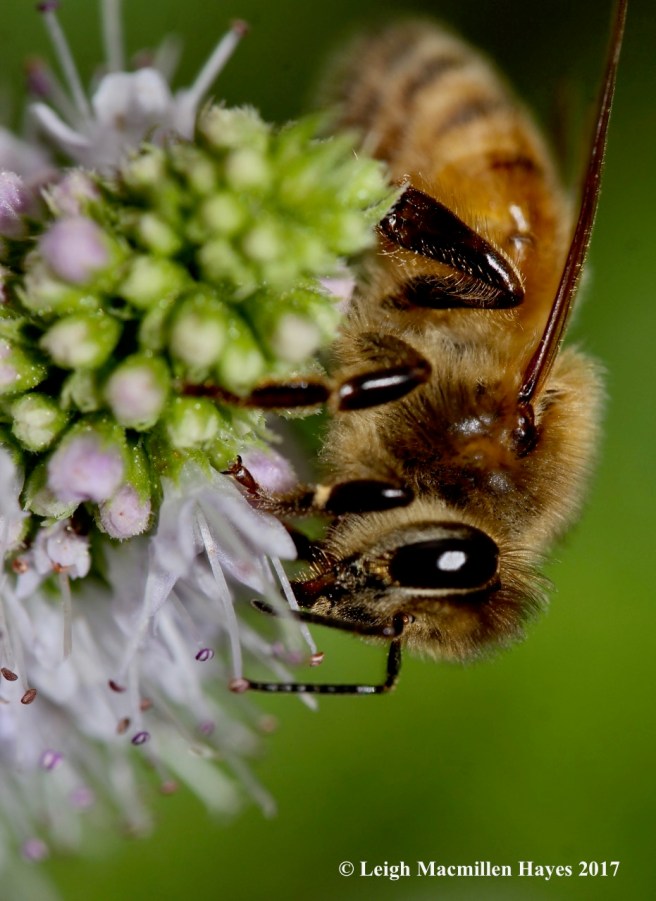
Taking its time in the collection process was a honeybee. Perhaps it knows the end is coming for it was much calmer than has been the norm and stayed in the same spot for several minutes, ever so slowly only moving its head.

i5-honeybee 2

All the better for me to take a closer look, including at the segments of its leg. I’m fascinated by the claws at the base of the tarsus.

Each day, the sweet offerings diminish as do the number of pollinators. Long ago I swore I didn’t like insects, but the more I look, the more in awe I am. Even though I know there will be other things to focus on, I’m going to miss these moments of wonder.


Continued Wandering into the World of Wonder

I’ve spent most of the last two years wandering, not even taking time to seek the answers I thought I sought.

c-ichnueomon wasp female

But along the way, I’ve seen so many incredible things that have been placed before me from the female ichneumon wasp with a disc on her cerci and her body throbbing as she injected her eggs into an insect larvae on tree bark  . . .

i-helleborine wasp 1

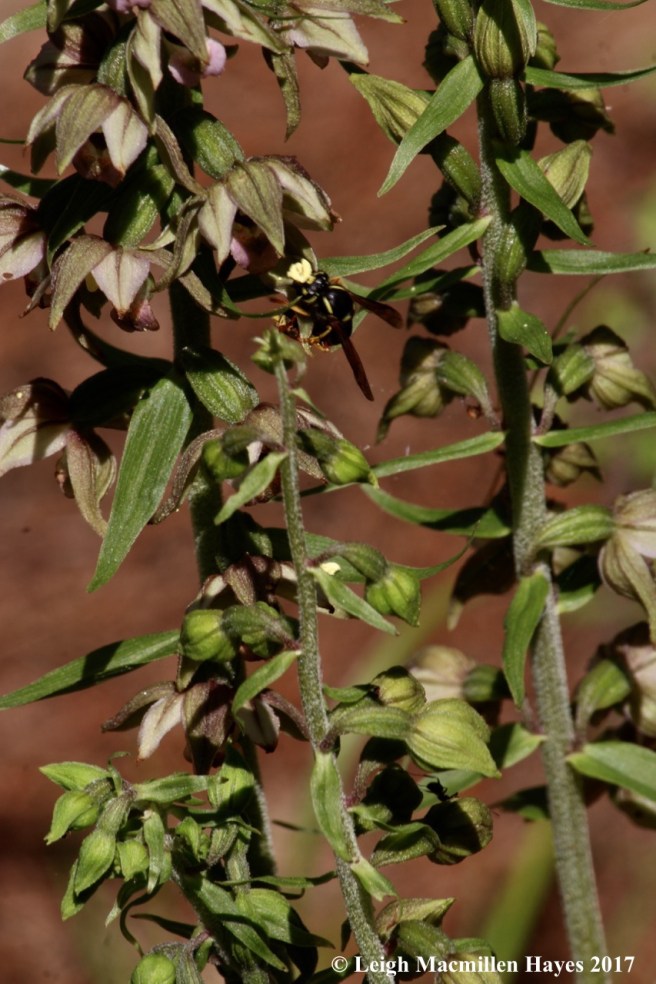
to a yellow-nosed wasp, so named by me for the pollen that was stuck to its antennae after it visited a helleborine flower . . .

i-dragonfly and exoskeleton 1

to a dragonfly emerging from its exuviae . . .

p16-fold looking toward lighthouse

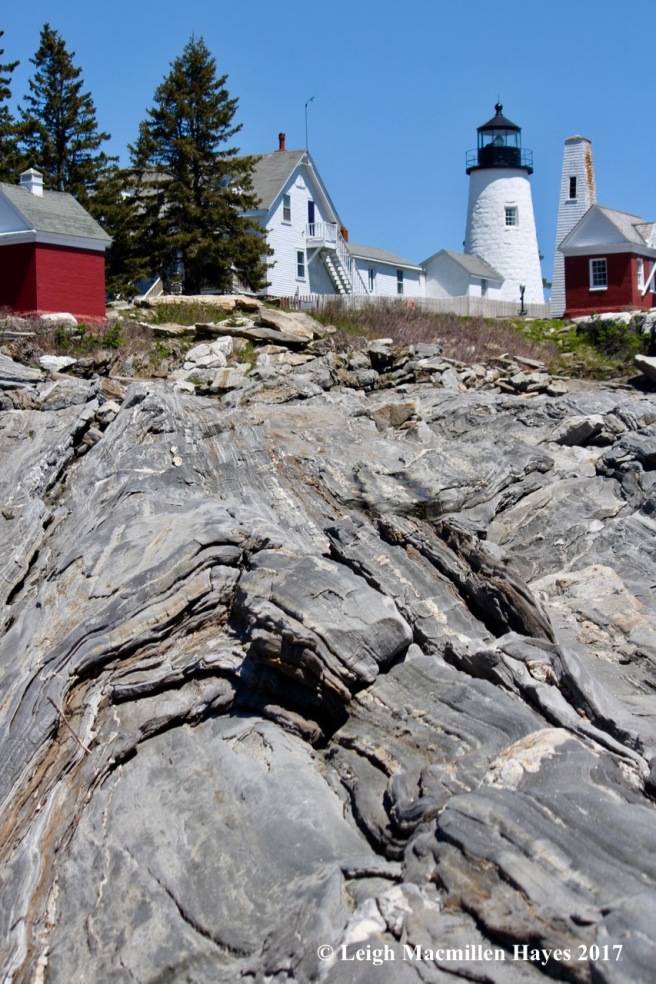
to the folds of the earth at Pemaquid Point . . .

c-geology folds

and Mount Chocorua . . .

h-pond-quaking-bog

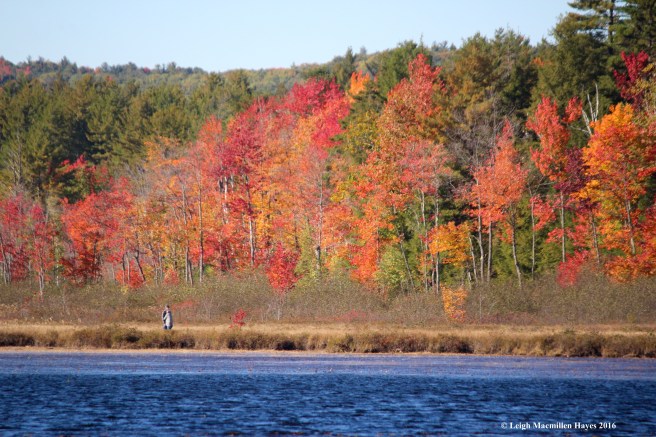
to fall colors reflected on Holt Pond . . .

r-crescent-view-2-1

and throughout Raymond Community Forest.

p-a future embraced

The answers are wrapped up in the promise of blossoms to come . . .

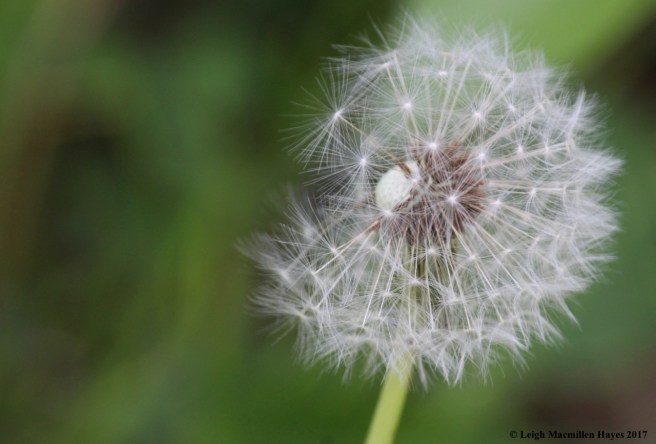
l-dandelion seed head

and seeds on the fly.

p-today-in-and-out

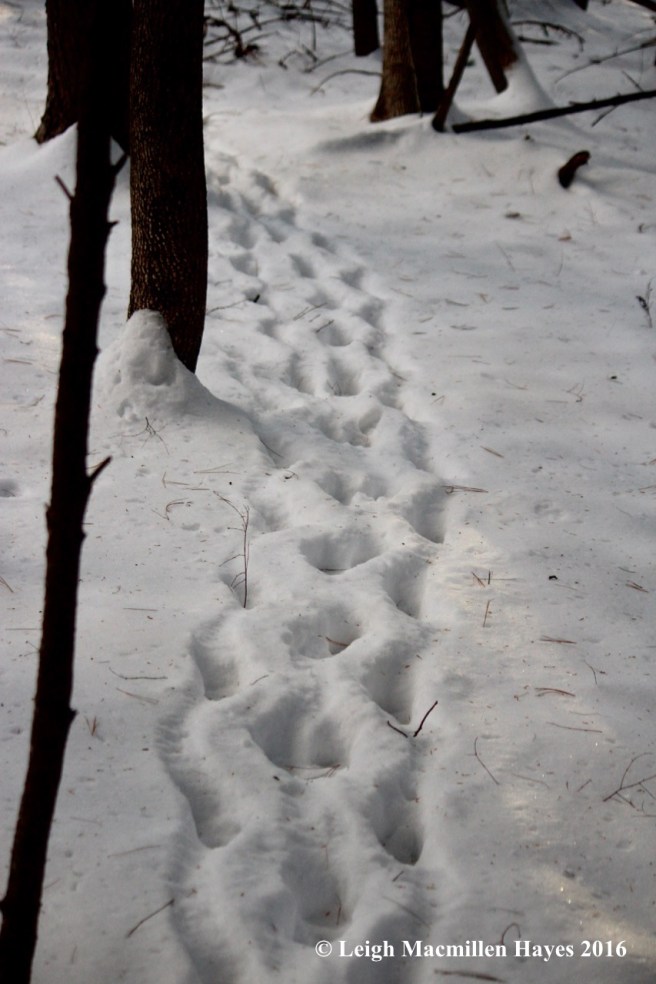
It’s recognizing the swish of a porcupine’s trail in the snow . . .

m-opossum-print-2

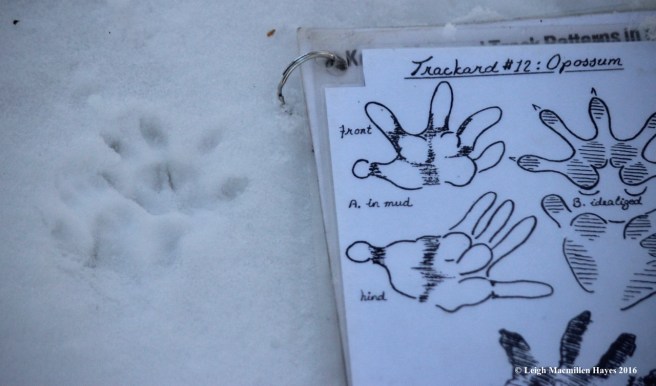
or the realization that a track I’d never seen before was visible in our woods—that of the opossum.

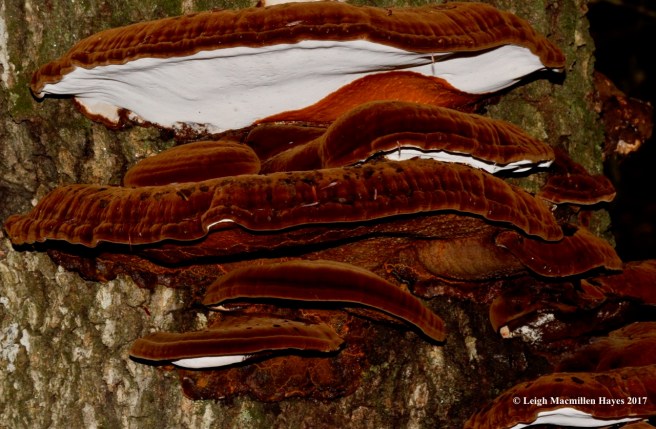
artist conks

And it’s all enveloped in the knowledge that mycelium cover the earth and through the process of decomposition break down most matter (all matter that matters, but not things we’ve created such as our ubiquitous plastic or even this computer).

l-wood fern with sori

It’s the realization that the Earth was formed eons ago and that the word eon refers to geologic time and that plates collided and continue to do so and pressures form and rocks develop. And plants like ferns . . .

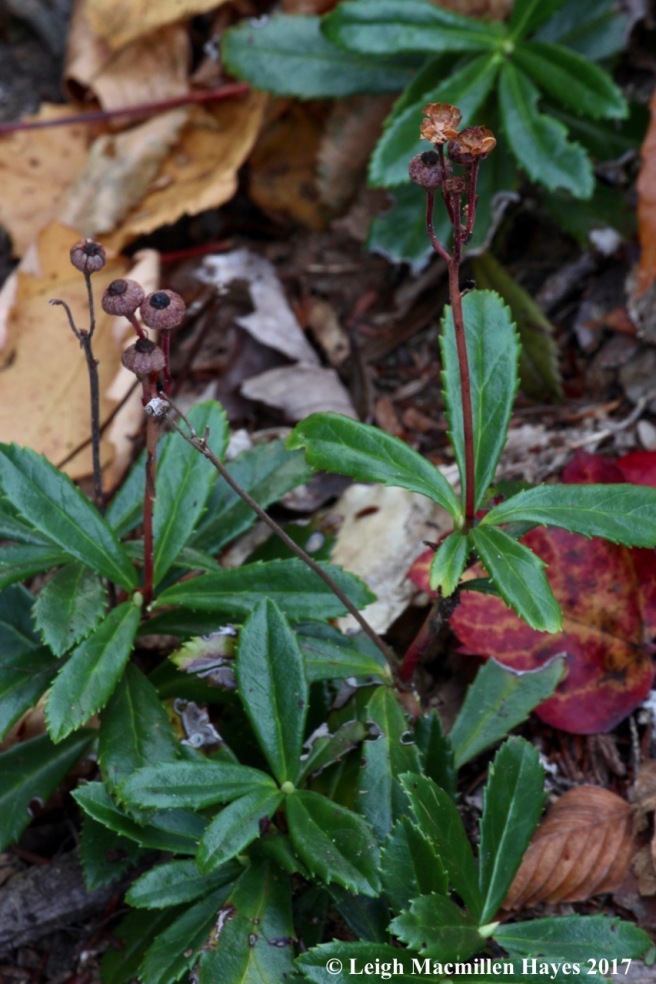
l-princess pine

and club mosses were once dominate species and as tall perhaps as our trees. It’s this and so much more.

i-lady beetles canoodling

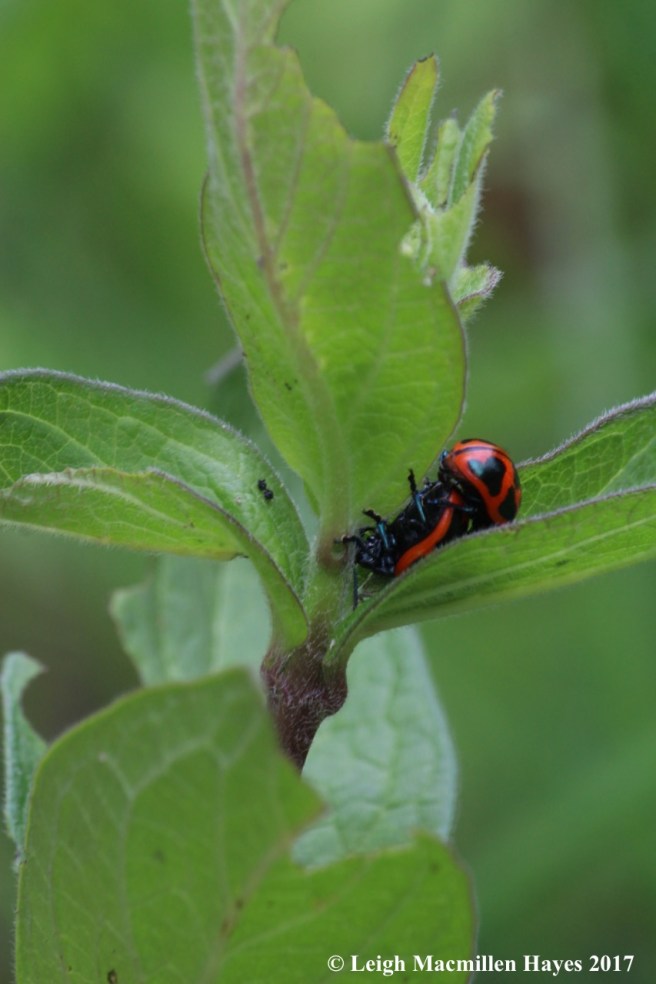
And all of this brings me to faith. And I realize I do believe in a spiritual being. But my spiritual being is not imbedded solely in the Trinity of Father, Son and Holy Spirit. It’s more than that. In all times, we’ve found people to emulate and follow. The Bible offers one such example and its writers were brilliant. For Jesus was a common person who came into this world in a way I’ve yet to understand. Was Mary really a virgin? Or was she a young woman free of sin? Or?

i-damsel larvae

According to the stories, for that’s what they are, or perhaps they are tales, sagas, lore passed from one generation to the next until all was eventually jotted down and probably revised many times over and edited by publishers, Jesus was a carpenter. A common man. With wise thoughts and perceptions. I know many such people. And so, I think that the Bible offers an example or a way to live. And a way to think. And a way to behave. But, I don’t think it should be taken literally. I don’t know how the universe was created, but it’s too simple to merely state God created it in one day or even one week.

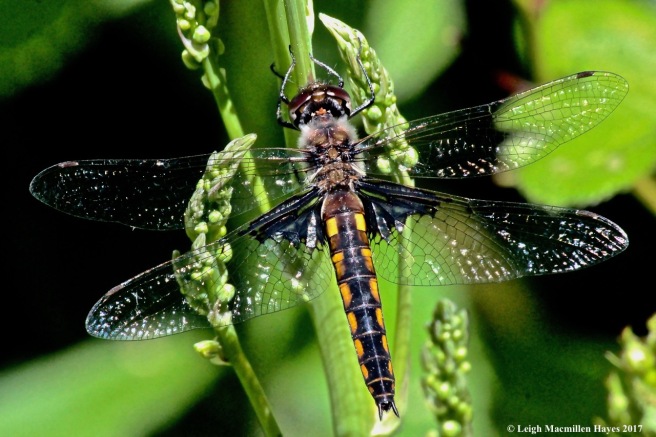
i-baskettail, common baskettail 1

I also don’t understand those thin places where one can see both this side of life and the other side of heaven—if that’s what thin places means. But I do know that I’m intrigued by the concept. Maybe I’ve experienced such without the realization. And maybe I need to practice awareness and be more open to offerings.

i-ambush and bee 2

I have discovered that heaven and hell remain the same, whether I walk through the red doors at the church entrance and partake in communion and fellowship or find my way along a wooded path where other revelations occur before my eyes. And so, after all these years, while I embrace a church service, I’ve learned to leave guilt behind on those Sundays I choose to worship outdoors rather than in.

i-moth

In either case, I’ve so much more to learn. So many things not yet recognized; so many questions not yet formed.

i-hoverfly1

And so today, I invite you to continue the journey with me—into this world of wonder. May the answers slowly reveal themselves, while the questions never end.


A Circle Completed

The day began with a reconnaissance mission to the Kezar Outlet Fen and a check on the cranberry crop. One of the most delightful ways to spend an early October morning is foraging for those little red balls of tartness and while my guy may have blue greed in his  need to pick every blueberry in sight, my greed turns red this time of year.

f2-winterberries

Of course, on the way to the fen, other red berries showed their shiny faces–and we rejoiced in their presence as well. Winterberries were they.

f4-cranberries 1

But it was those little gems that grew closer to the ground that caught our attention on this morning’s Greater Lovell Land Trust docent tramp. And like those who have come before, we each claimed a spot and made sure not to trespass in our quest to fill our bags with such redness.

f6-cranberries

It didn’t take long. And really, there is no better way to spend the morning . . .

f3-kettle hole

for this is a place to share the joy of foraging, the beauty of place, and the conversation of friendships.

m1-abandoned lodge 1

And then one friend and I returned to the beaver quest I’ve been pursuing for the past two weeks. It was another reconnaissance mission intended to find some new activity. Today, we traveled a different trail and visited an old lodge–again several years abandoned.

m3-anthill

Though no one was home at the stick lodge, we did find a few inhabitants of a nearby sand lodge, aka ant hill. And Forester Dave, with whom I was traveling, pointed out that the sweet and bracken ferns circled the spot, but didn’t grow within at least a foot of the hill. His theory is that the ants chemically affect the ferns. That was new to me and one to observe in other places.

m4-side lodge

We continued on our way and eventually came to another beaver pond that seemed equally abandoned. The lodge was built along a side bank, but no new construction had taken place recently. Nor was there a display of food gathering in preparation for winter.

m5-watercress

But . . . we found a food source of a different kind in the form of watercress.

m8-green frog

We also watched a number of green frogs leap into the leaf-strewn water to hide–and yet slowly float to the surface in an ever curious way.

m9-hornbeam hop

And we saw numerous “hop” balloons, those little slightly inflated cases of hop hornbeam fruits that protect the seeds–many of which flowed in the water. So where was the source?

m10-hornbeam bark

We scanned the forest and finally found the shaggy barked tree beside the water.

m11-bobcat print

After that, some bushwhacking found us passing through a muddy zone–and prime tracking location. Deer, raccoons, coyotes and bobcats had previously walked where we stepped. Do you see the C for cat in this print?

m13-dam3

At last we reached our intended destination, only to realize that the beavers still eluded us. We were sure that since all other areas had been abandoned, this one would be active.

m14-beaver pond of yore

We were wrong. The only activity seemed to be leaves clustering on the water’s surface.

m16-raccoon prints

And so we backtracked and made our way down to another beaver pond, deciding  that we’d travel in the opposite direction of the raccoons and follow the stream downhill. From the top of the land to the lower portion, we encountered four or five well built dams, all still intact, yet the water levels were much lower than we would have noted if the ponds had active beavers. To say we were disappointed would be an understatement.

m17-bobcat scat?

We did, however, find a great scat specimen. We debated bobcat and coyote–sectioned as it was had us leaning toward bobcat, but there were some large bone pieces that suggested coyote. Either way–we knew both had passed through.

m18-spring peeper

And we found a spring peeper and chatted about their callings in autumn weather that reflects their mating season–the fall echo season.

m20-brook view

A little more bush and whack and at last we reached the brook below.

m21-single leaf

As we stood in companionable silence, a single leaf floated past.

m24-balsam seedling

When it was time to turn away, we continued on, reveling in sights missed on previous missions, including a balsam sapling growing on a fern-covered stump.

m25-fresh beaver works!

And then, and then, much to our surprise, we encountered fresh beaver works where only three days ago there had been none. In at least three locations, we discovered that tree roots had been gnawed upon. It was a subtle sign–but a positive sign.

m26-smaller lodge

The lodges, which number at least three in this particular beaver pond that keeps pulling me back, still don’t look like they’ve been attended to. And there are no winter food platforms yet, but apparently they have time and don’t need to button down the hatches yet.

m28-brook

Happy in the knowledge that we’d found the beavers, though we never saw them, we decided to continue to follow the stream to a trail that abuts the property boundary.

m27-black ash

And being a forester, Dave quizzed me on a tree or two. This one I got wrong by its bark because it doesn’t exactly look like its white and green siblings, but knew by its leaf–black ash with no petioles on the leaflets.

m29-foam reflecting bark

About three hours later, we left the beaver community behind–our circle completed, figuratively and literally. Even the brook appeared to know, its froth circled in reflection of the log above.


Anybody Home?

Only a few days ago we felt like we were melting as we complained about the muggies and buggies, but those temperatures are now only memories and it’s beginning to feel like fall in western Maine. And so my guy and I bundled up before we followed a trail and did some bushwhacking this morning, exploring a property Jinnie Mae and I had visited only a week and a half ago.

m1-lodge

It was to the beaver lodge that we first made our way, noting all their old works near the water’s edge.

m2-lodge 2

But, we were disappointed that we saw no evidence of new work and it didn’t appear any winter prep was yet occurring. Were the beavers still about? Or had some parasites in the lodge forced them to move on?

m3-infinity pool1

We hoped not for they’ve worked hard in the past to create a home with an infinity pool that would be the envy of many.

m1a--otter scat

We did note that they’d had recent visitors who left behind a calling card in the form of a slide and scat–otter scat, that is.

m5-doll's eye

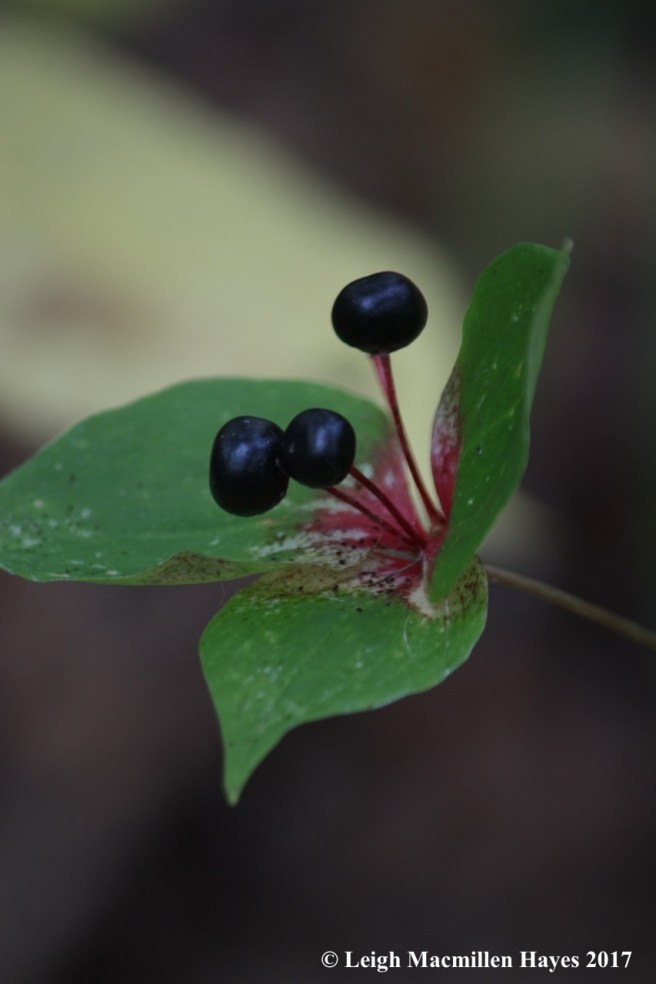
And we spied the fruits of a former flower that graced their neighborhood–doll’s eye, aka white baneberry.

m4-dam 1

As we circled around the pool, we commented that the dam seemed to be in excellent shape and held the water about five feet above the stream below. But again, no evidence of new wood.

m7-dam works

Despite that, it’s an impressive structure. While some landowners might be upset to have beavers changing the landscape, we happen to know this one and she takes great pride in their works.

m9-dam 2

We stood for a while, indulging in our own admiration while wondering where the beavers might be. Of course, it was close to lunch time for us, and not an active time for them if indeed they were home. Possibly we were misinterpreting the view.

m8-beaver pond

After some time of quiet reflection, we made our way back, crossing the stream just below the dam.

m13-quiet reflection

And then we continued along the old logging road (recently bush hogged, eh Brian? Well done), and bushwhacked some more, crossing another stream to find our way to another reflective spot along the brook.

m12-rookery 2

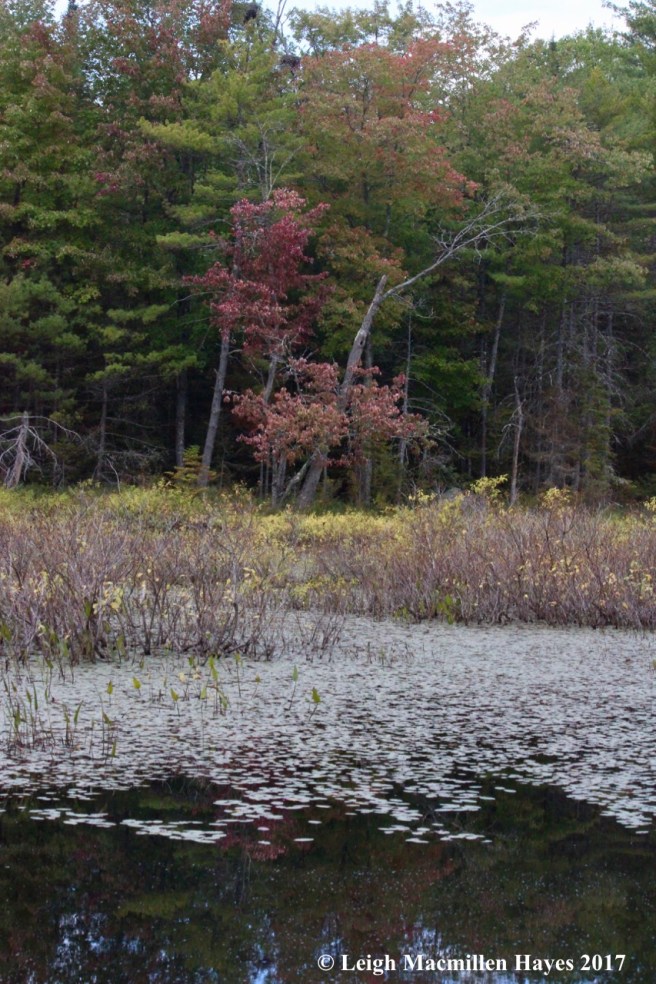
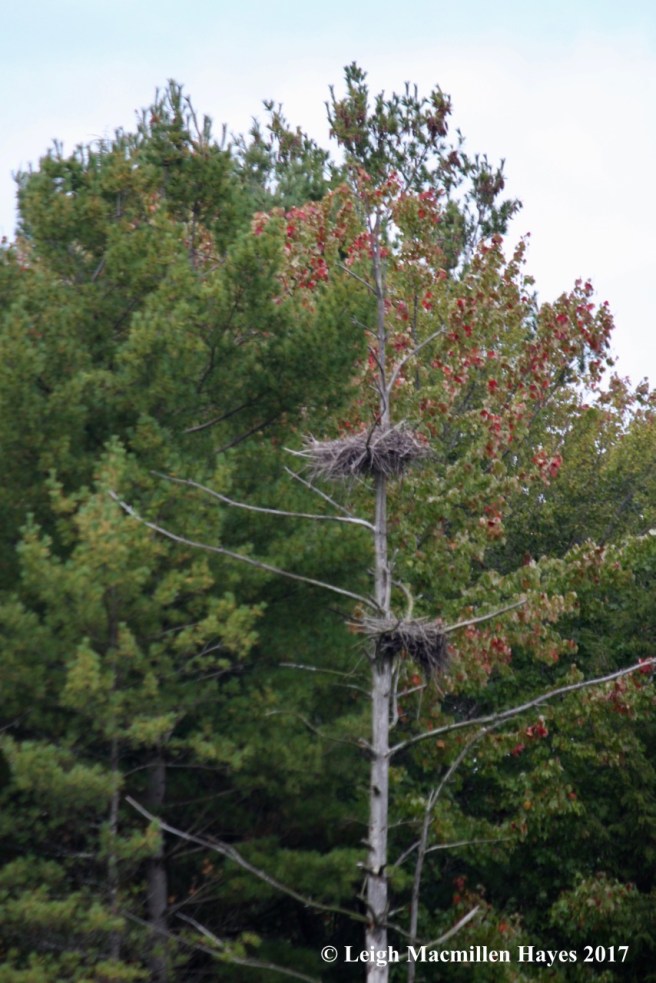
This time, our destination was that of another stick builder–great blue herons.

m11-rookery

Their spring/early summer nests are equally impressive. I hadn’t visited this spot since April, when the herons were actively setting up home. And I’m not sure it was a successful breeding season for them, but even if it was, they wouldn’t have needed these homes today. The nests will remain–available for grabs next year by those who return.

m16-jack in the pulpit

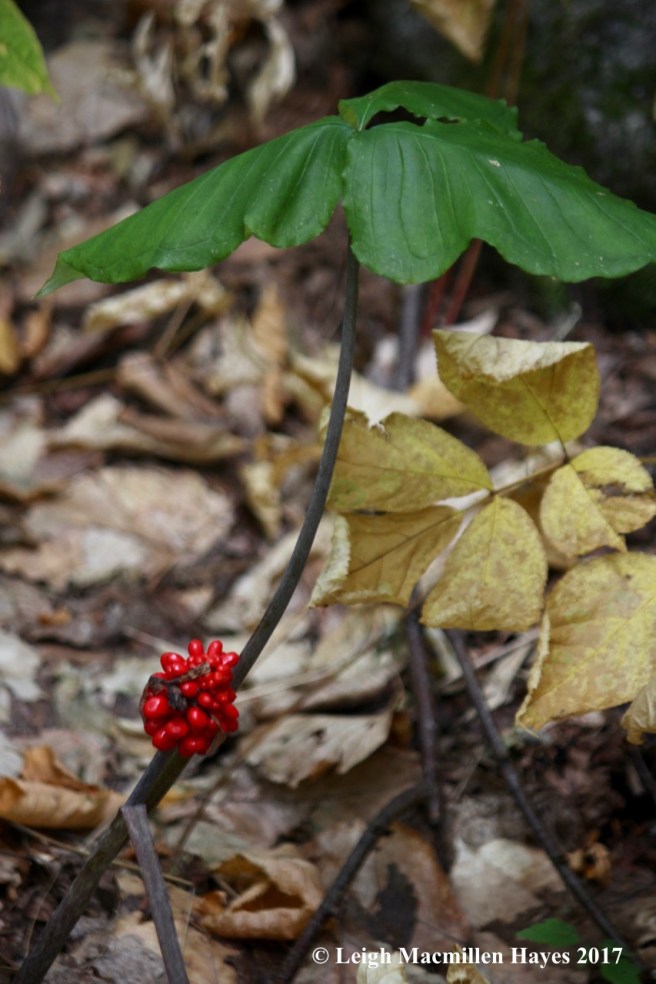
After a snack by the brook, we pulled ourselves away knowing it was time to head to our own home. Our wildlife viewings had been nil, but we spied a jack-in-the-pulpit in fruit, and that plus the doll’s eye were enough. And the time spent wondering about the critters.

m20-cosmos

Back at our truck, we decided to check on the insect action in the gardens at our friend’s home. Only the bumblebees seemed to be active.

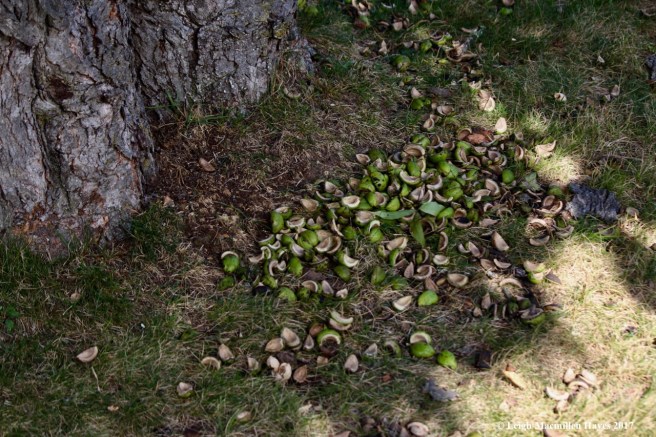
m19-hickory feast

But we saw plenty of activity of another kind–a cache of hickory nut shells at the base of the tree, and really . . . everywhere nearby.

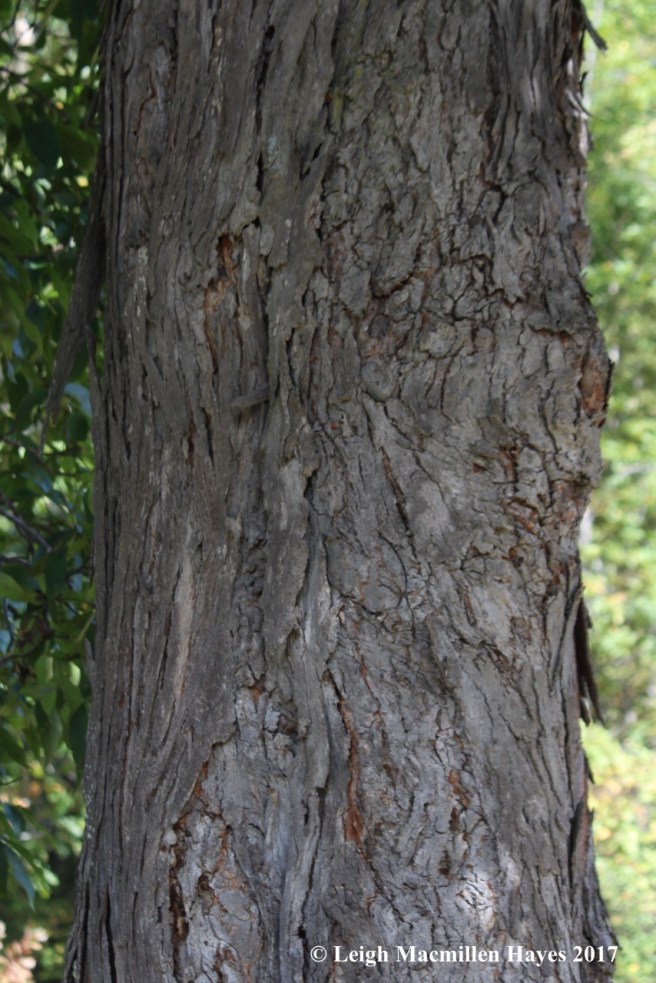
m18-hickory bark

Shagbark hickory is more common south of this spot, so it was a treat to take a closer look.

m17-hickory

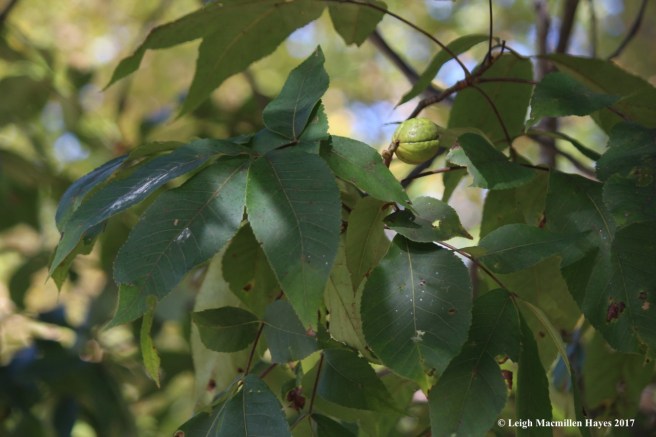
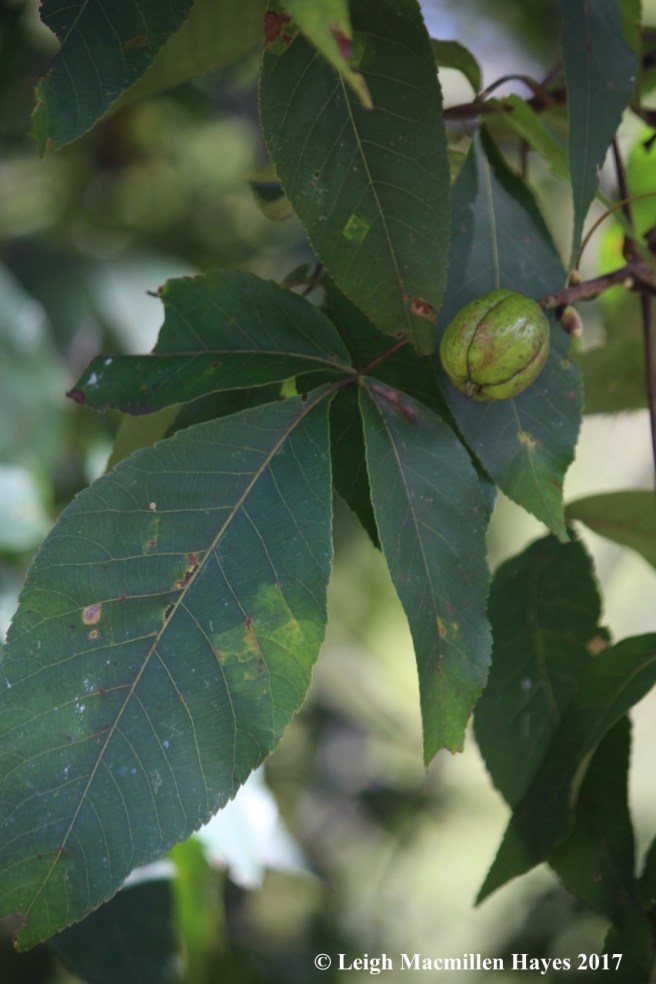
Its alternate leaves are compound, consisting of five serrated leaflets usually (sometimes there are seven).

m18-hickory 2

And of those five, the three terminal leaflets on each twig are the largest.

m21-view of Balds

Once again, it was time to leave this beautiful spot where the fields and forest flow into the mountains. And where the beavers and heron share the place without too much human intervention. Though not a soul was home today, we trust all will return when the time is right.


Lingering at Long Meadow Brook

It’s Tuesday, which means time for a tramp through the woods–especially if you are a docent for the Greater Lovell Land Trust. We take our job seriously, filling our bags with field guides, hand lenses, binoculars, cameras, water, humor and wonder. The latter two are the key components and thankfully we’re all comfortable enough with each other to tell corny jokes and laugh at our misidentifications as we explore the natural world through curious eyes and minds, while sharing a brain.

l1-white spores 1

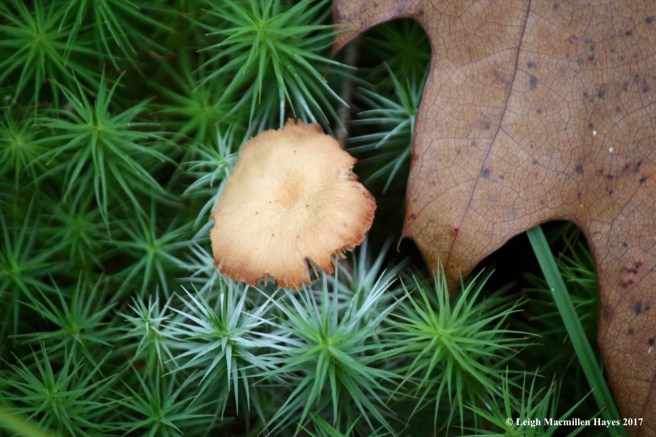
And so today, though our intention was to look for fall wildflowers, we had much more to notice along the way, like the white spores of mushrooms decorating the surrounding haircap mosses.

l2-funnel spider 1

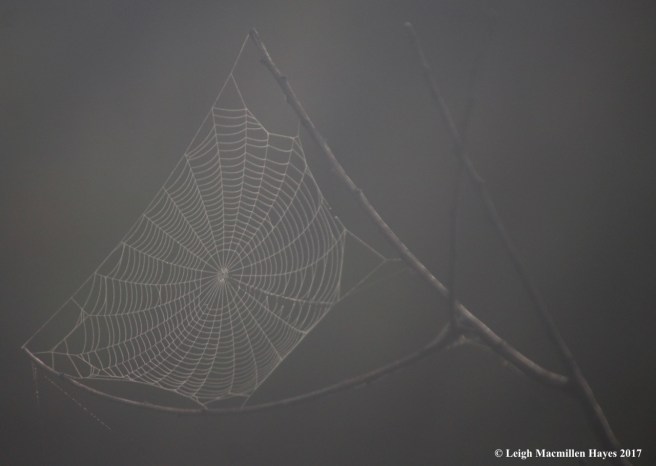
And there were funnel sheet webs to examine, given that the morning fog left them dew covered and easier to spot.

l3-funnel 2

Though we wanted to take a closer look at the creators of such fine work, and tried gently touching webs with pine needles, our antics obviously vibrated more than your ordinary bug might, and the spiders ran into their funnels to hide.

l4a-cup and saucers

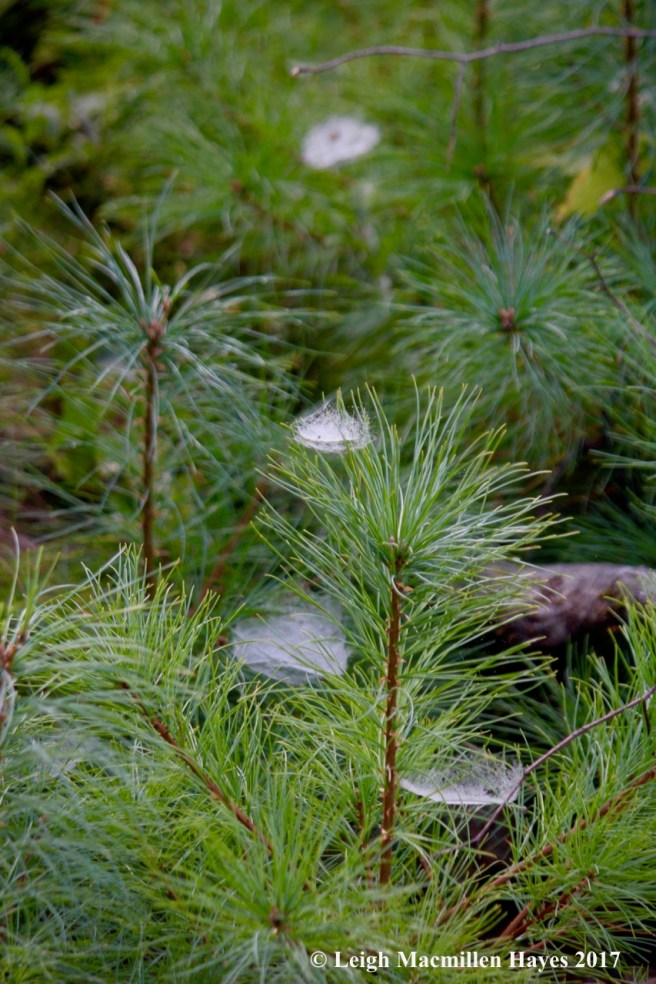
As we’d driven to the Long Meadow Brook Reserve, we’d spotted a field of medium-sized white pines decorated with webs and were thrilled to find the same on saplings.

l5-cup and saucer web 1

The bowl and doily spider is another member of the sheet species, and it builds webs that consist of two intricate parts. Above is the bowl, an inverted dome, and below, the lacier doily. The spider hangs upside down beneath the bowl, but above the doily, waiting for dinner to drop in.

l6-looking at spider webs

Trying to see the tiny bowl and doily spiders requires getting down on all fours and looking through a hand lens for they are only about 3-4 millimeters in length. We did and were successful in our efforts.

l4b-cup and saucer on bristly sarsaparilla

It seemed today that nothing escaped spider activity, including the gone-by fruits of bristly sarsaparilla.

l4-orb web 1

Equally delightful in the making was an orb web outlined in dew, larger droplets highlighting each spoke, with smaller ones on the sticky silken spirals.

l1b-pilewort

In several openings, pilewort grew in abundance.

l1a-pilewort field

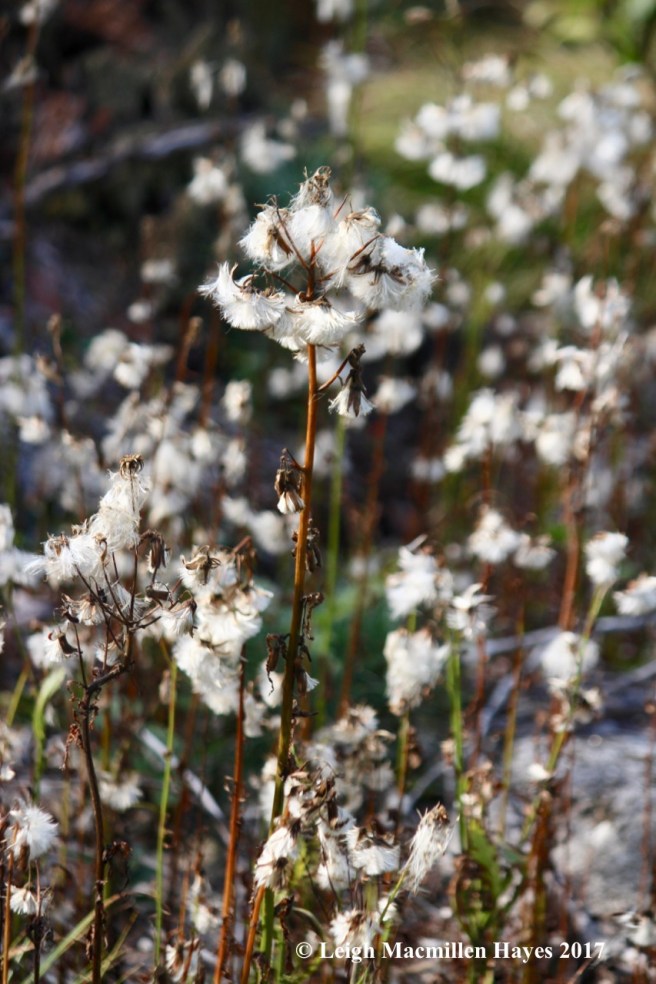
Like a field of cotton, its dandelion-like seedheads were prolific.

l1c-pilewort seedhead

But really, I preferred the seed display to the petal-less flowerhead that emerges from the cylindrical cluster.

l7-pine cones 1

Also prolific were the female cones atop the white pines, their brown color indicating they were in their second or third year of development, having been wind pollinated by  tiny male cones. The pollen cones fall of trees within a few days of decorating our vehicles, outdoor furniture, and naked female seeds with yellow dust. If you think back to spring and all the little rice krispies that decorated the ground below white pines, you’ll know that you were looking at male cones. The seed cones typically form on the uppermost branches, so that the tree won’t pollinate itself from below, but can receive pollen blowing in the breeze from another tree.

l8-pokeweed 1

We’d looked high to see the cones, and then drew our eyes lower and thrilled with the sight of one of our tallest perennials.

l9-pokeweed 2

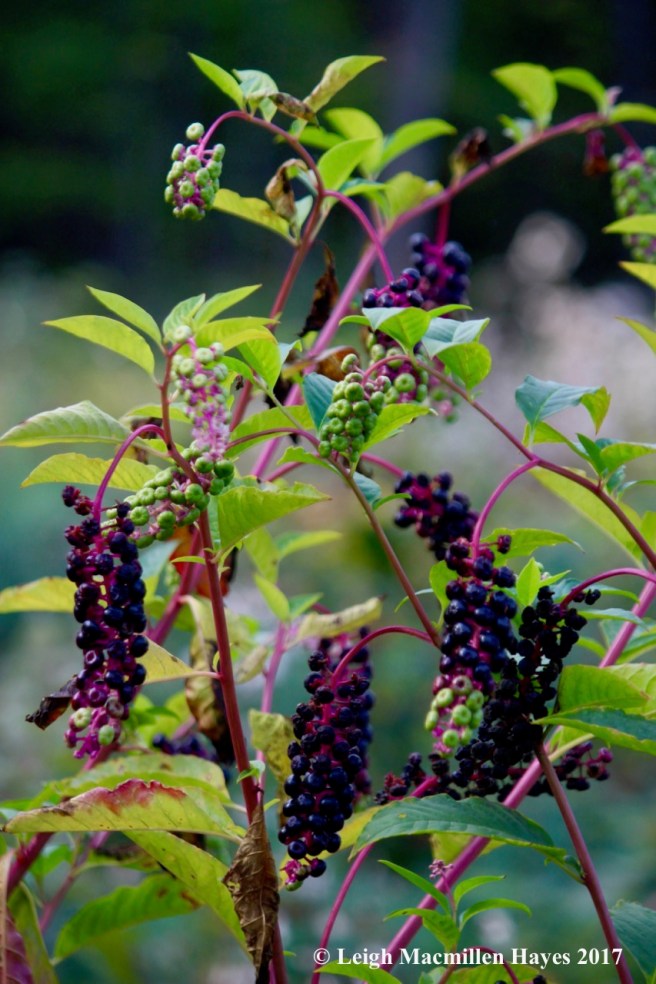
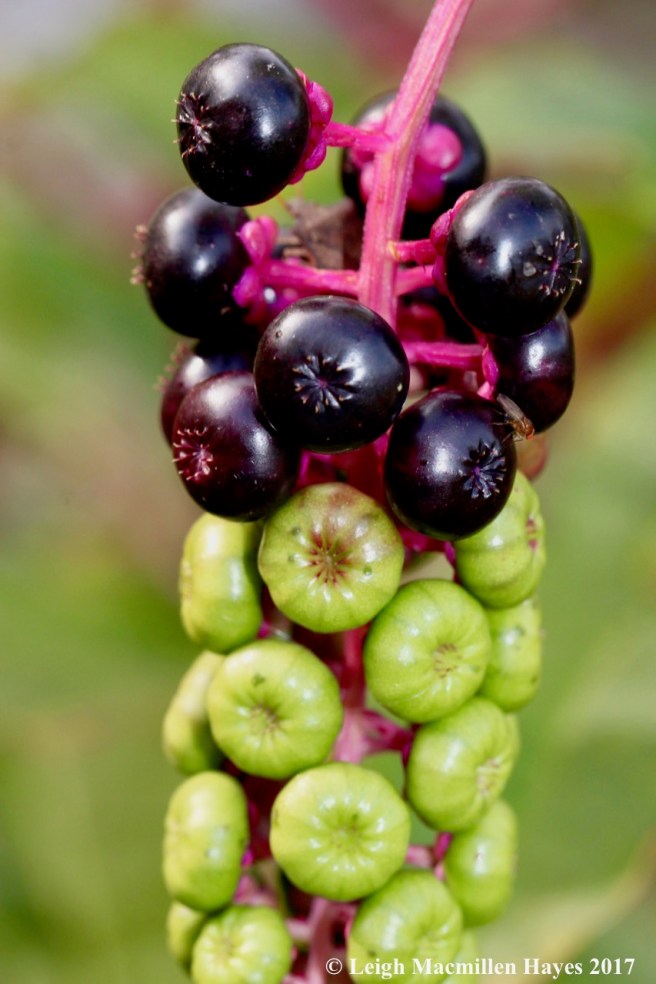
At first we only spied one pokeweed growing in an opening, but then began to spot others in flower and . . .

l11-pokeweed 3

fruit.

l29-blueberry

Another one of our surprises–still flowering blueberries. The plants themselves didn’t look too happy . . .

l13-blueberry flowers

and we wondered if there would be enough energy or time for the fruit to form.

l14-cinnabar-red polypore

As we ambled along, we found cinnabar-red polypores,

l18b-turkey tails1

turkey tails,

ll18a-gilled polypore

and polypores know for their . . .

l18-labyrinth of pores

underside labyrinth of pores that look like gills.

l20a-brown spores 1

And we found another type that had spread brown spores.

l19a-mystery hole

Making our way down to the brook, we were stumped by a pile of dirt, small hole about one-half inch across and chewed mushroom. We remain stumped, so if you have a clue, we’ll listen. It was a messy dooryard so we didn’t suspect a chipmunk, plus the hole wasn’t wide enough. Voles eat vegetation. Could it be? Was it even made by a mammal?

l22-white oak

Along the same route, we made another fun find. White oak saplings.

l23--white oak 2

White oak grows in surrounding towns–Fryeburg, Sweden, Brownfield, Waterford, but not in Lovell or Stow, where this property was located. So, how did it arrive? Two theories–it was on a skidder trail, so could have come in on a machine; or perhaps via airmail from a bird. Long ago, white oaks grew in this area, but were used for barrel making. And because their acorns contain less tannin than that of a Northern red oak, mammals devour them quickly, thus making it more difficult for the trees to regenerate.

l23-LMB 2

It took us a while, but finally we reached the old beaver dam and culvert by the brook, where the fall foliage was subtle at best, but still beautiful. We walked (if you can call it that) for 2.5 hours and covered all of .95 miles. It was hot and muggy, so we felt like we’d covered 9.5 miles, but as always were thankful for our time spent lingering at Long Meadow Brook.


Belated Book of September: Butterflies and Moths

All month long books have been staring at me from their shelves, piles or baskets, a few begging for the honors. But each time I thought I knew which book I’d feature for September, a different month made a claim on it.

b-monarch 1

And then, mid-morning, I looked out the kitchen window and saw a certain visitor nectaring at the flowering mint and instantly knew what book it would be.

b-cover

Bufferflies and Moths by Dr. Walter Robert Corti is an oldie but goodie that has graced my personal library since 1964. I don’t remember its origin, but think it may have been a birthday or Christmas present when I was in second grade–such was my wonder even then.

On the back, The Odyssey Library is described as “a new and exciting concept in book publishing, combining in convenient, compact format, texts by leading authorities and full-color illustrations by outstanding artists and photographers. Designed for the reader who wants to add a new dimension to his [or her] understanding of the world, these are books to enjoy, to study, to treasure.” Indeed, I’ve treasured it for over fifty years and referred to it often.

b-monarchs and others

Today found me examining the differences between “look-alikes” because I wanted to make sure that what was fluttering about the garden wasn’t a Viceroy.  They do look similar, but the Viceroy is smaller than a Monarch and its hind wings have a line that runs parallel to the outer margin. There are other differences, but that was enough for me to note. Another thing to note: the illustrations in this book were by Swiss artist Walter Linsenmaier.

b-monarch 2

No such line existed on this morning’s beauty.

b-monarch map

Though the author states that in September, “large flocks” of Monarchs gather to fly south, and that was once the case, at least in my backyard it’s no longer true. This is only the second one I’ve seen this year, the first being in a field yesterday and it didn’t light long enough for me to snap a photo. In the past few years, I don’t recall seeing any. But . . . when our twenty-something sons were the age I was when I received this book, we did have large flocks that completely covered some flowering plants and shrubs.

b-monarch probiscus 2

Outdated though the book may be, some things haven’t changed. The order is still Lepidoptera, so named for the scales on their wings; lepis being Greek for “scale,” and pteron for “wing.”

b-monarch probiscus 1

Some cool features include the tongue or proboscis–can you see the coiled dark tube below the antennae? Once you find it, return in your brain to your sixth birthday party (if you had one–my next-door-neighbors, Pat and Kate always came for my birthday dinners, but we never had parties) and the blowouts that were curled until you blew into them and made noise.

b-monarch 6

The same thing happens with the proboscis (though it lacks a sound effect), which is actually two half tubes joined to form one, and includes muscles, nerves and the trachea, as it straightens out and penetrates the far reaches of flowers in search of nectar to suck.

b-monarch eyes

The book also mentions the faceted eyes–each compound and consisting of up to 17,000 “ommatidia,” or  individual light receptors with their own microscopic lenses. Think about what the world around them looks like. How in the world do they hone in on their targeted plants? They have their ways. Read on.

b-painted lady 2a

Prior to seeing today’s Monarch, I’d been blessed with many opportunities to observe Painted Ladies, which share similar colorings to a Monarch, though the pattern differs.

b-painted lady map

Dr. Corti describes their migration pattern, but mentions with all that migrate, it could be that it’s a second or third generation that actually completes a given journey.

b-painted lady 3

The outer wing coloration is what always reminds me that I’m looking at a Painted Lady and not a Monarch.

b-painted lady 1

One thing I’ve observed about the butterflies that I watch–nectaring can happen whether one is right-side up or upside-down. The straw works from any approach.

b-painted lady 2

The club-shaped antenna, common features of butterflies, are angled and work like radar to detect scents. And I mentioned the palpi, which are quite visible here as they are the small projections that protrude from the front of the head. These are covered with scent-detecting sensors as well. And actually, more sensors are located on the thorax, abdomen and legs. That’s how the butterflies find their sources of nourishment.

b-painted lady 5

One of the things I noted about the Painted Ladies that have graced my path lately is that they flit from flower to flower in constant motion . . .

b-painted lady 9

and seek goodness . . .

b-painted lady 10

from a variety of benefactors. I know Monarchs do the same, but today the one I watched much preferred the mint.

b-fritillary 1

An early season butterfly that some may confuse with the Monarch is the Fritillary.

b-fritillary 2

While its coloration is similar,

b-fritillary probiscus

its much smaller in size.

b-clouded sulphur 1

Most butterflies feed with their wings pulled together, such as this clouded sulphur portrayed. I love the subtle blend of pink, yellow and green in this beauty, and especially the yellow-green eyes.

b-white admiral 1

Early on in the summer, white admirals flew about.

b-white admiral 2

Occasionally one posed. Noticed its tattered hind wings. Such is the life of a butterfly.

b-Canada tiger swallowtail 1

We admire them for their beauty and they suffer for it–becoming easy prey. But until they succumb, they spend their days seeking sustenance. And bringing us joy.

As Dr Corti states, “The enchanting colors of their wings, their intimate commerce with quiet flowers, their modest food needs, the innocence of their courtships make them seem like fairy creatures from some unspoiled paradise. They are a delight to curious children, harmless idlers, contented topers, and strolling lovers wherever they appear. It is as if they were created solely to make the world more beautiful.”

Weren’t they?

I know there are updated butterfly guides, but I still love my first.

Butterflies and Moths, by Dr. Walter Robert Corti, The Odyessey Press, New York, 1964.


Outing on the Outlet

This morning dawned clear and chilly, with the temperature at 50˚ when I headed toward Lovell at 7:15. After placing some “Land Trust Walk Today” signs in pre-planned positions, I headed to the dam on Harbor Road in Fryeburg to wait for a ride.

u1-outlet dam

Water flowed over the tiered dam, which was built in the early to mid 1900s at the request of the Pepperell Manufacturing Company in Biddeford. The townspeople contested its existence for it would raise the water level on Kezar Lake, but the textile mill located many miles away on the Saco River won the rights to construct such at the site of an 1800s saw & gristmill. Thankfully, though it did raise the level of the lake water, not all of the predicted problems came to pass.

u2-Harbor Road bridge

The dam was our intended take-out for today’s paddle co-sponsored by the Greater Lovell Land Trust and Upper Saco Valley Land Trust. Though it’s located off Harbor Road in Fryeburg, it’s owned by the Town of Lovell. No longer used, it still serves to provide a historic reference. And a great place to either portage and continue on to the Old Course of the Saco River and then the “new” course, or take out as we intended to do.

u5-silver maple

While I waited, I poked around, and rejoiced in the sight of trees that like wet feet. High above the dam, the leaves of a silver maple shown brilliantly in the morning light.

u3-green ash leaves

Other leaves also caught my attention for their coloration–with veins of red interrupting their olive greenness. Green ash, another tree that likes wet feet but isn’t as abundant as its siblings, white and black ash, also stood tall beside the dam.

u7-preparing to launch

My dam-side exploration ended a few minutes later when Jesse Wright of Upper Saco Valley Land Trust and her friend, Shareen, pulled into the landing. We hoisted my kayak onto her already laden truck and found our way over the bumpy road to our intended put-in at a private residence–thanks to the generosity of its owners. Slowly the number of boats increased by the water’s edge as twenty-plus folks joined us.

u6-map by Will from USVLT

Once all had gathered, Jesse showed off the map of our intended paddle, the red dots indicating our path from beginning to end, and I shared a bit of information about the fen, a GLLT property purchased in 2005. Today, the symbolic boundary between the two land trusts disappeared as we ventured off together.

u9d-Linda 1

It takes good neighbors and lake stewards to pull off such an event, and the Wurms are such. They helped us arrange the put-in, gathered a couple of canoes for several paddlers and took photos at the start.
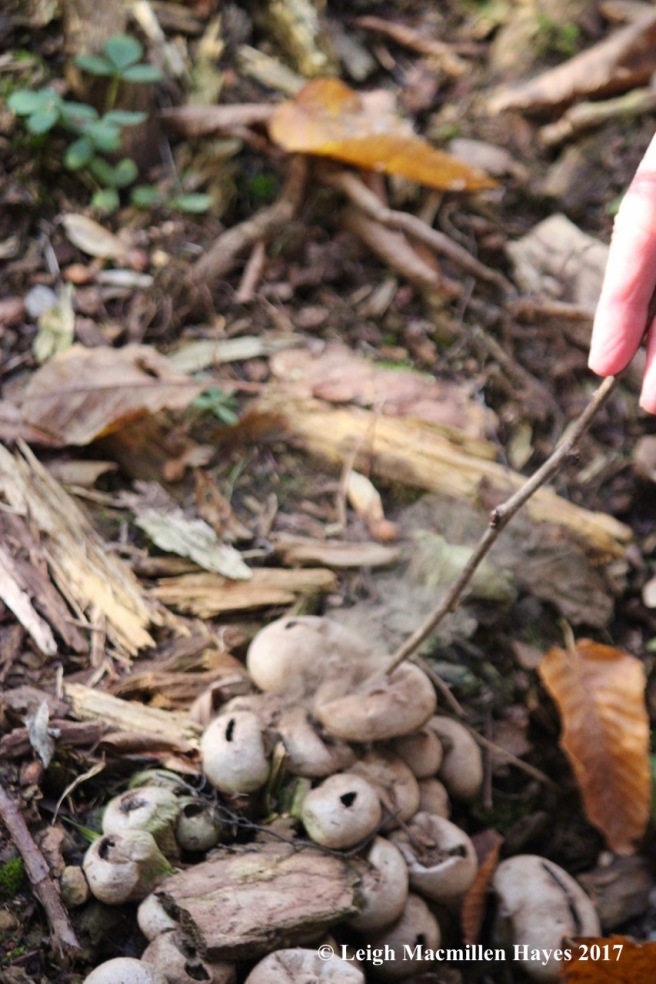
u9a-LInda's view 1

Linda’s view included Jesse heading off as our lead,

u9c-Linda's view 3

and the rainbow of colors once we hit the water.

u8-on the water with Jesse and gang

It took us a wee bit of time to get all the boats onto the lake, but it wasn’t a day made for rushing. And once in the sun, we began to warm up.

u10-send off by Linda

Before we headed off, we gave thanks to Linda (and Remy).

u11-and Heinrich

We also thanked Heinrich, who drew our attention skyward . . .

u12-drone

as he flew a drone above us.

DCIM100MEDIADJI_0056.JPG

Our first destination was to paddle north for the view.

DCIM100MEDIADJI_0061.JPG

The drone spied the mountains before we did.

DCIM100MEDIADJI_0059.JPG

And spotted our intended course . . .

DCIM100MEDIADJI_0067.JPG

into the fen.

u18-veiws from the lake

A quick turn-around from the water gave us bearings as we noted the Baldfaces to the west.

u19-heading toward the fen

We circled an island that serves as an environmental study plot for the US Forest Service and then paddled southward.

u20-Jesse in the lead

Jesse led the way through the pickerelweed.

u21-more mountain views

As we followed, the view got better and better.

u22-slowly we followed

Acting as sweep, I took up the rear while the group snaked along.

u25-early fall color

We followed the twists and turns of the water trail, where red maples showed off their autumn display from the canopy.

u28-red leaf

Occasional leaves fluttered down, begging to be noticed in their singularity.

u-cranberries 1

Though we didn’t get out of our boats and actually walk into the fen, we did stop to chat about what it had to offer. The GLLT owns 260 acres of the 500-acre fen, an acidic ecosystem with a deep layer of organic material including peat moss atop a sandy substrate. Several bird species of concern breed or hunt in the fen, including American bitterns and Sandhill cranes, the latter of which we had the good fortune to hear but not see. Long’s bullrush, a globally rare sedge, also grows here. But the crème de la crème for many are the cranberries. Folks on today’s paddle weren’t familiar with the plant and I couldn’t show them at the time, but I shared with them the experience of picking in the past with students from Molly Ockett Middle School in Fryeburg.

u-cranberries 2

On a fall day each year, about thirty students in the school’s MESA program (Maine Environmental Science Academy–an experiential place-based curriculum for 6-8 grades) visit the fen with the GLLT’s Executive Director, Tom Henderson.

u-cranberries 3

They learn about the hydrology of this place, but one of their highlights is to pick cranberries, and to that end, they become very possessive. As one student approaches another, a common statement is shared: “Don’t come over here. There aren’t any cranberries here.”

u-cranberries 4

Over the course of several hours, they fill their bags and sometimes even show off their creative talents in other ways–all in celebration of the cranberries.

u30-weir1

Continuing along the river this morning, we noted beaver activity and talked about scent mounds and their usefulness within the beaver community. And then we reached the fish screen.  Jesse had paddled the course last Sunday and made it under the screen without any issues.

u31-clearing a beaver dam

Since then, the beavers had been busy damming it up. One of our members worked to adjust some of the branches so we could all get through.
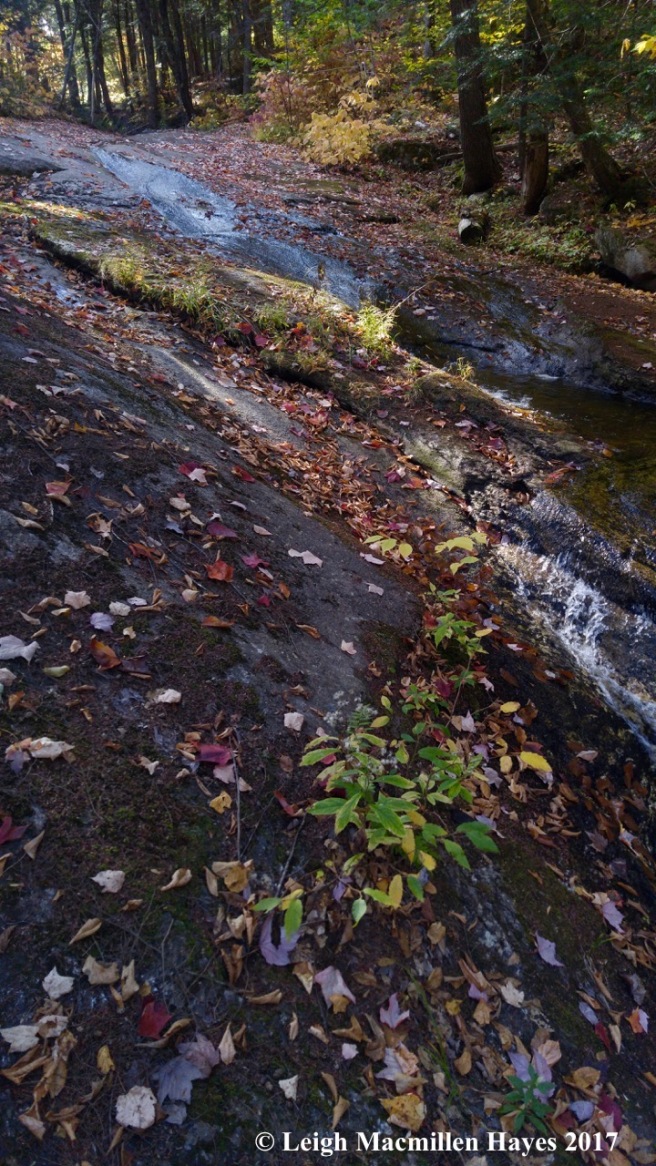
u34-offering a shove

Of course, sometimes a helping paddle was needed to push a boat forward.
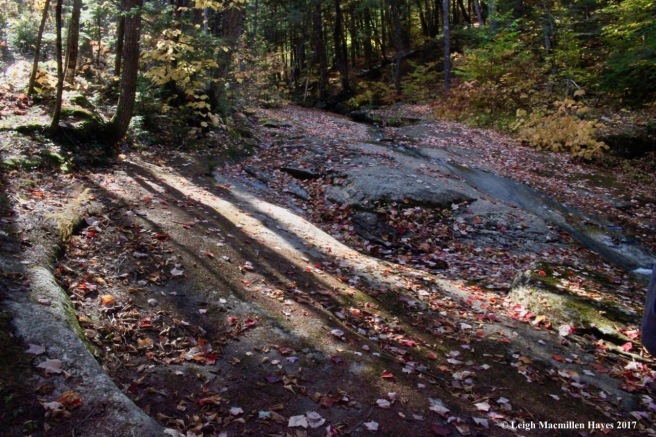
u33-cow 2

While we took turns, our efforts didn’t go unnoticed.

u35-other side measurement

On the other side, a ruler indicated depth.

u36-approaching the bridge on Harbor Road

And then, and then, in what seemed like only minutes but was actually a couple of hours filled with camaraderie between familiar friends and new, plus a touch of natural history thrown into the discussion, we found ourselves at the bridge and the end of the journey for some. Others chose to paddle back rather than hitch a ride. We had come full circle.
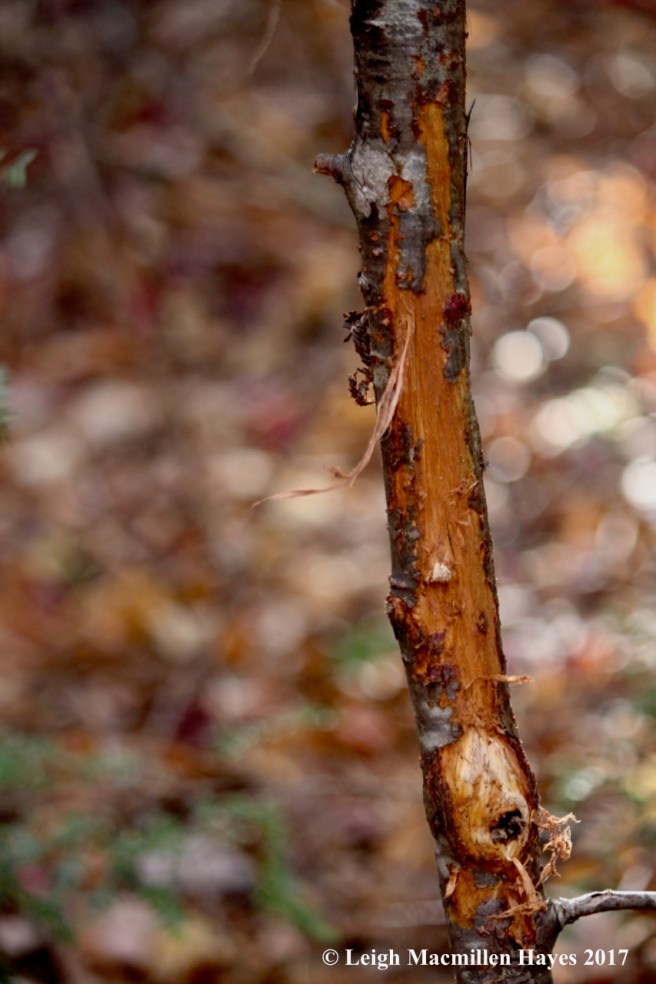
As we pulled boats out, we were surprised at how warm it was since we were out of the shade, the temp having reached into the 80˚s.

Our outing on the Kezar Lake Outlet would not have been doable without Jesse Wright, who did the yeoman’s work of pulling it together, William Abbott, USVLT’s executive director who created the map, the Wurms and their neighbors who contributed land, boats, photographs and time, and all who ventured with us on this most lovely first full day of autumn.  Thank you all.


Summer Sendoff with Jinny Mae

Last week a friend sent me some photos of an odd phenomenon in a wasp nest over her porch door. Thankfully, she also included Mary Holland in the e-mail, who probably had a much better idea of what was going on than I did.

m1a

My two thoughts–green in the woody tissue the paper wasps consumed or small green caterpillars somehow at the nest. Neither made sense. My friend is away for a while, but she suggested I go take a look and bring a ladder.

m1-ladder shake

And so I did, but first I invited Jinny Mae to join me. Feeling well these days, I’m thankful she’s up for some adventures. We found the nest and up I climbed, but I guess I was a wee bit shaky for my photos were fuzzy. Nonetheless, I saw no green and so the mystery remains. But, if you have such a nest nearby, take a look–going only as close as you are comfortable. And let me know if you see anything green.

m2-ladder 2

We found another nest over a different door, but it appeared the wasps had abandoned it. Why is that? They work so hard to build these and then move on.

m3-asters

Since our wasp adventure wasn’t successful, we decided to take advantage of the situation and explore our friend’s property, a lovely woodland and garden under conservation easement. (Hope you don’t mind, MY.)

m8-tree across trail

Along the trail we came upon a downed beech tree that seemed equally alive in death as in life.

m7-lichen moss map 2

It sported lichens and mosses that combined looked like a 3-D topographical map of the property. And only now am I seeing something I can’t believe Jinny Mae and I missed earlier–script lichen across the bottom of the map. As it should be.

m5-puffballs 1

Puffballs also appreciated the substrate and fruited en masse.

m9-leafed out

.While we both looked into the hollow of the tree hoping to find someone at home, we didn’t. But, we did note that before the trunk snapped and toppled, it had leafed out–a last shout out to the world that sugar and water flowed through its pipeline.

m10-prince charming 1

We pulled away from that exploration, when something else caught Jinny Mae’s eye. I didn’t see it at first, and can’t imagine how I missed it–Prince Charming, the king of the toads.

m11-Prince charming 2

He had so many warts that he had warts atop warts, a right robust old guy.

m12-aliens among us

A little further along, more fungi attracted Jinny Mae, while I pulled out my hand lens to take a closer look at some fuzz balls that I first thought were cocoons. You might say they are also fungi upon fungi, so coated were they with a hairy mold. Or you could see them as alien forms frolicking on a fallen log. I prefer the latter.

m13-stairway to the castle in the clouds

Everywhere we turned it seemed fungi presented itself in various forms and patterns, which was apropos given that the friend who owns this land is a mushroom aficionado.

m15-beaver works 2

As we walked, we looked and looked for bear trees, finding none. We did, however, find some beaver works–both fresh and . . .

m19-beaver works 3

old. Even tree roots attracted their attention.

m18-brook view

Beside the wetland, we scanned high and low–hoping for activity of some sort. Jinny Mae saw what was probably a cormorant, but that was all.

m20-lodges

Our view, of course, included a lodge that looked like it had some fresh wood atop. The winter prep was under way.

m21-spider lodge

And nearby, a lodge of a different sort, its construction equally intricate in an interesting geometric form.

m16-winterberry

After expressing our awe, we finally turned ourselves around–our stomachs indicating that it must be getting toward noon.

m24-false tinder 2

We walked out the same way we’d walked in, and as was to be expected, found more, like a false tinder conk that measured almost ten inches across.

m25-little snake

And a young snake about ten inches long.

m27-big snake 1

And then we spied something even longer in the grass.

m28-bigger snake 2

This guy stayed absolutely still, its head held high.

m29-bigger snake 3

But we noticed the thickness about halfway along its body.

m30-bigger snake 4

It had beat us to lunch and we wondered what we’d missed.

m31-bigger snake 5

Whatever it was, it apparently put up a bit of a fight if that’s blood on the snake’s neck.

m32-stream

We’d wandered and wondered for three hours on this last summer morn.

m33-clouded sulfur butterfly

And gave thanks for the opportunity to spot several clouded sulphur butterflies on red clover,

m35-milkweed seeds

the first of the milkweeds spilling its beans,

m34-painted lady

and painted ladies feasting on Joe Pye Weed. Summer was slowly coming to an end.

m36-fall on the horizon

But Jinny Mae and I managed to embrace its last moments thanks to MY’s question about the wasp nest. We knew that before the sun set over the mountains, fall would be upon us.

Happy Autumn.

Be Puzzled Mondate

Our favorite Monday mornings begin with my guy unscrambling the Jumble words in the newspaper, but leaving the final answer cells empty so I can give it a try, me decoding the cryptoquip, and both of us solving the crossword puzzle. And then our day can begin.

p1-kiosk map

And so it was this morning before we drove an hour north to a Mahoosuc Land Trust trailhead on Route 26 in North Newry. Our plan was to climb the trail to the summit and then make our descent via the Woodsum Spur before connecting back to the main trail. We figured we’d finish up about 3:30pm.

p3-dry brook

And so we began our climb, crossing six or seven dry streams, where not even a trickle pleased our ears.

p4-bear 1

But our eyes knew otherwise for we were in a beech forest and scratch marks were prevalent.

p6-bear 3

In spite of the nectria caused by beech scale insects and others, we spied a familiar pattern that always thrills us. Our first puzzle teaser–do you see the pattern we saw?

p8-bear 6

Without going off trail, the bear paw trees were plenty and our quest for such satisfied.


p11--suspended animation

Our questions, however, continued beyond the bear trees. How did this beech leaf happen to be dangling in suspended animation?

p14-jack in the pulpit

Why did we find only one jack-in-the-pulpit?

p15-Indian Cucumber Root

What is the purpose of red on the Indian cucumber root leaves?

p17-doll's eye

And why are white baneberry’s fruits, aka doll’s eyes, poisonous?

p16-hiking upward

We noticed all of these great finds as our upward climb took us through a neighborhood of hardwoods.

p12-sugar maple on sensitive fern

Along the way we also noted sugar maple leaves atop sensitive fern fronds.

p13-oyster fungi

And one tree bedecked with oyster fungi. Their name always throws me off given that I grew up on the Connecticut coast where I often cut my feet on oyster beds.

p20-roots and rocks on trail

As we continued upward, suddenly the smell and look changed. We’d entered the Christmas Tree Shop where hemlocks, balsam fir and spruce trees dominated the landscape.

p21-fog 1 view

At last we approached a scenic view . . .

p22-fog 2 view

but all that we could see in the great beyond . . . fog.

p25-witherod

The further up we climbed, however, other shrubs added color to a gray day, including wild raisins, aka witherod.

p26-among the rocks

Eventually the trail conditions became more difficult and we worked our way through a boulder field that made me think of bobcats.

p27-summit in view

Eventually we emerged from the fog into the sun, thankful all the time for cairns marking the way. And the sight of the summit above.

p28-summit view 1

As we advanced, other summit views made theirselves known.

p30--heading up

But, we weren’t there yet. To reach the summit, we had to climb on.

p34-mountain ash 2

Along the way, mountain ash trees showed off their prolific fruits.

p35-almost the summit

Finally, the summit was just a few steps above.

p36-first survey mark

We’d reached the high point of 3,133 feet.

p38-lunch rock

Lunch rock quickly presented itself–backed by the summit cairn.

p40-view from lunch rock 2

And the view–mountain islands amidst a sea of clouds. Had the day been clear, we would have had a 360˚ vantage point, but it was beautiful no matter.

After lunch we looked for the trail beyond so we could follow the Woodsum Spur for 1.7 miles before looping back to the main trail. We found many mini-trails that led nowhere and two or three times my guy looped down and around on one that promised hope, only to find himself back at the summit. But after about a half hour of searching,  we spied a splash of blue paint that held promise and so we followed it, in hopes that we’d eventually find our way down.

p42-bobcat scat

Along the way, we found lots of bobcat scat, which made perfect sense given our locale.

p43-snowberry and sphagnum

And sphagnum moss interrupted by snowberry tendrils.

p44-view from SW ledge where lost

And then we reached a cairn with no trails to follow down over a rather steep ledge. We looked and looked and looked, again spending at least a half hour trying to find our way. At last, much to our disappointment we decided we’d need to retrace our steps to the summit and follow the main trail down.

p45-Woodsum sign

Somehow, about fifty feet back, we discovered a sign that we’d previously missed. Apparently, those who had created the trail wanted us to go forward as we had to enjoy the scenic overlook, but what we didn’t realize was that then we needed to backtrack. At this point, we wished we’d had a magic marker in our pack so we could highlight the sign.

p47-heading down

As we headed down, we were still in the sun, which was incredibly toasty, but the fog prevailed below.

p50-my guy and a bear

The Woodsum Spur felt much longer than its 1.7 mile length, maybe because we were so hot and tired, but we thrilled at a sight in some mud–my guy’s print on the left and a bear on the right.

p48-bear print

It was a front print of the bear–and we wondered where it might be.

p53-trail sign

At last, we emerged from the spur and only had 2.6 miles to go to get back to the trailhead. I swear we ran down. My guy said that I always say that. He’s right–because we do.

p54-beer1

Six and half hours (an hour later than our intended departure time) and nine miles later, we were sweaty and stinky and happy to have made the acquaintance of Puzzle Mountain–though we still had many questions–puzzling as it was.

On the way home, we stopped for some ice water followed by a couple of local brews at Sunday River Brewing Company–Long Haul Lager for me, because it was such, and Raspberry Wheat (Razzle Dazzle) for him, because he was curious.

Be puzzled? We were. But we toasted this Mondate and trust we’ll travel the same trail again.

Sherpas for the Loons

I can’t remember what year I began volunteering to haul food to the top of Pleasant Mountain for Loon Echo Land Trust’s Trek. I do, however, remember this–it was chilly that first time. I also remember some of the folks I hiked up to our location at the summit with–including JoAnne Diller, Carol Sudduth and Sara Stockwell. And then, at some point  in the future my position was switched to the summit of Southwest Ridge and I’ve been there every since–along with my pal in crime, Marita.

l1-me 4 (1)

And so it was that this morning she and I packed as much as we could into our backpacks and extra bags as we started up the trail at 7.

l2-into the fog

The fog had been so thick as I’d driven across the Moose Pond Causeway of Route 302, that I couldn’t even see the mountain. As we started up the trail, the morning light added a ghostly effect.

l3-web 1

At viewpoints along the way, the mountains beyond remained invisible, but . . . we could see the work of others.

l4-web 2

Webs decorated branches like Christmas ornaments decorate trees.

l7a-following the loons

Despite the fog, we easily followed the hiking loon up the trail,

l7-breaking into the sunlight

and eventually broke through into the sun.

l8-looking westward

As we continued to climb, we looked back, but our view was limited . . .

l9-islands among the sea of clouds

to mountaintops that looked like islands poking above a sea of clouds.

l9a-teepee and islands in background

Finally, we reached our destination–just below the teepee at the summit of Southwest Ridge.

l10-rest area 1

It was there that we set up our rest area with an assortment of goodies.

l12-Maine to China

Some were quite local, like the salsa from Windham, Maine, apples from Five Fields Farm in Bridgton, hot pepper jelly from Massachusetts and coffee mug filled with Dreamlands coffee by Magnolia Coffee of North Carolina, which benefits Five Kezars Watershed Association in North Waterford. (Judy Lynne–I believe you know the origin of my coffee thermos. I’m still using it every day.)

l13-me 1

While the temperature had cooled off a bit at the end of August, this mid-September day was hot and muggy–especially if one was hiking. But, we were ready to greet our guests  with a smile and plenty of food. Our hope was that they’d gobble it all up.

l14-Marita

Of course, being on the Southwest Ridge, one must look the part.

l15-young hikers

Slowly our guests trickled up–full of smiles despite the heat.

l18-family time

Our hikers for the six mile trek included families and friends, and even one dog.

l16-mountain islands 1

Ever so slowly, the sun began to break through the sea of clouds.

l17-mountain islands disappearing

Suddenly, as if in a poof, the mountains and lakes came into view.

l20-view from main summit, Kezar Pond, Mt Wash in clouds

After several hours, the Sweep came through and it was time for us to pack up and move on. And so we did–hiking across to the main summit, where the western views showed that Mount Washington was still in hiding.

l22-Jon

It was at the summit that we met up with Loon Echo’s stewardship manager, Jon Evans, whose work we greatly appreciate.

l23-Paul

His partner in crime was Loon Echo’s biologist, Paul Miller. Today, Paul taught us a new word: crepitation–the snapping or crackling sounds some grasshoppers make with their wings as they fly.

l24-Moose Pond 1

After chatting with them for a few minutes, we continued on across the ridge line, going backwards or so it felt for often we hike in the opposite direction. Just before reaching the point that the Bald Peak trail takes a sharp right hand turn downward, we paused among the pines to take in the view of Moose Pond and the causeway below.

l25-Marita in split rock

Rather than turn down at the Bald Peak junction, we continued on. At the North Ridge, we passed through one of our favorite parts (though like I said to Marita–every part along this mountain is my favorite), passing through the narrow split in the granite.

l26-Shawnee Peak summit 1

Finally, we reached the summit of Shawnee Peak Ski Area where we paused at the last rest stop to enjoy some watermelon slices.

l26-slowly descending

And then it was time to descend along the ski trails, first via the Main and then the Pine, traversing as we went to take the pressure off our knees.

l27-painted lady 1

It was there that the goldenrod grew and we admired the Painted Ladies seeking nourishment.

l28-painted lady 2

Though they look similar to the regal monarchs, we noted their characteristics–the painted ladies having forewings that are mostly orange, highlighted with black and spotted white. Their undersides really tell the story for they feature shades of brown, tan and white, with prominent veins, and row of blackish-blue spots along the margin.

l29-framing camp

Eventually, we left the flower zone as we continued down on grass. The lower we descended, the more our camp came obscurely into view. It’s framed in this photo, but unless you know it, you may not see it.

l30-water snake 1

At the ski area, we helped ourselves to a free Allagash and lunch, then sat on the lawn to chat with friends who’d either volunteered their time or biked 100 miles (Go Alanna!).

We had one other visitor–a young water snake that seemed to have lost its way from the pond.

By the time we left in the late afternoon, we were tired, sweaty and stinky, but happy for the honor of serving as sherpas to haul food and set up the rest area in this annual event that helps protect the lands around us and those who live here–whether they be loons, painted ladies or water snakes.

Congratulations Loon Echo Land Trust on another successful Trek.