Holey Mysteries

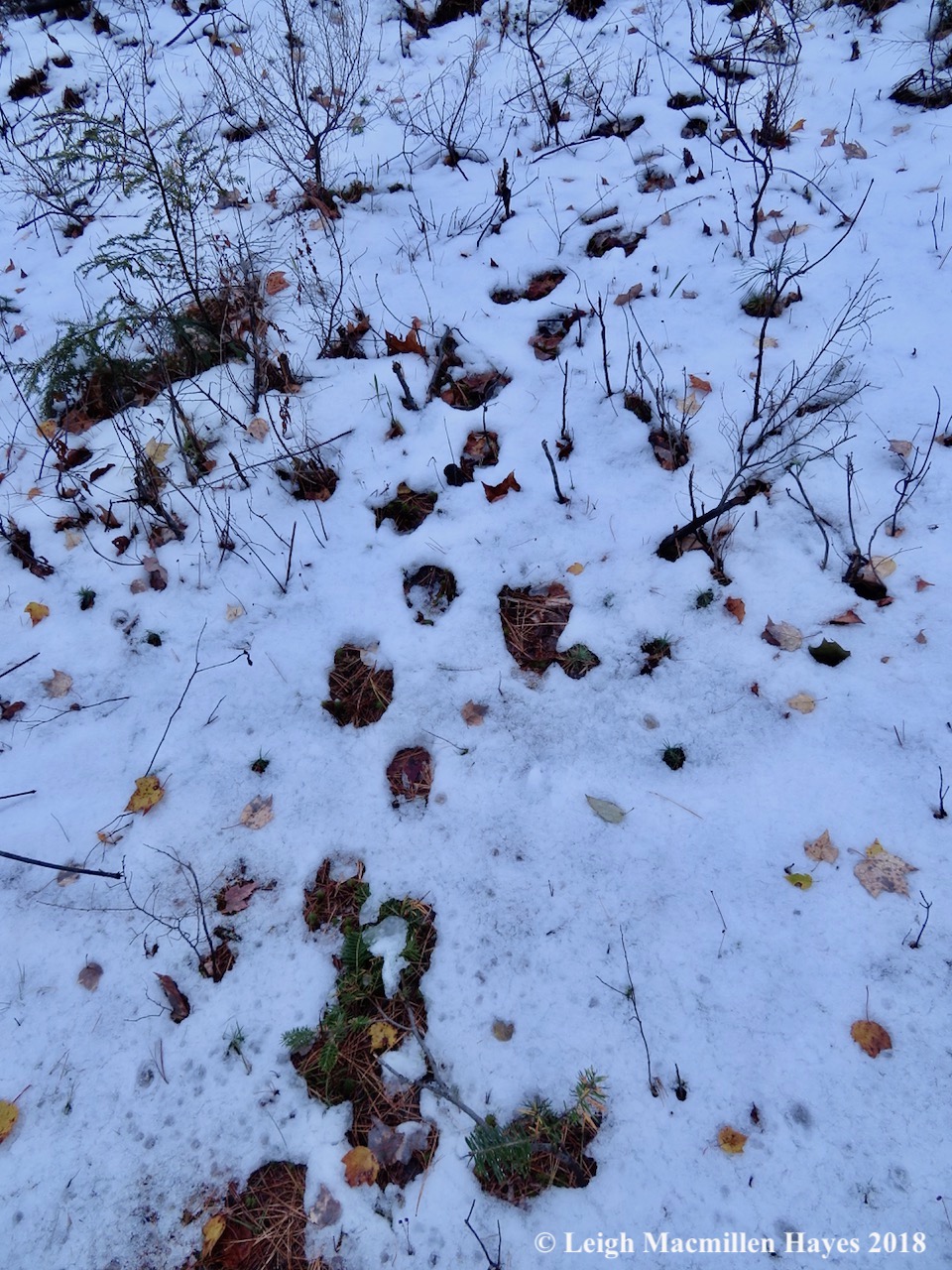
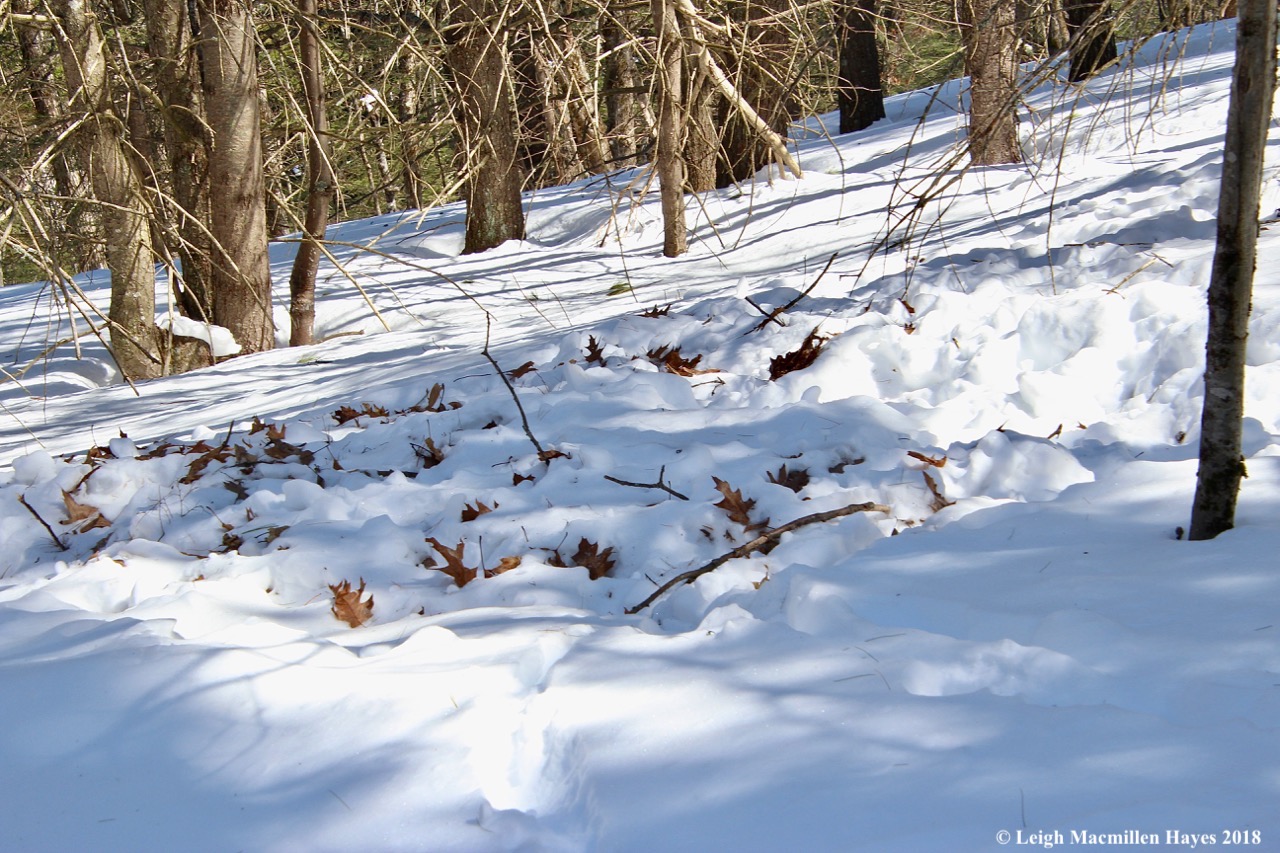
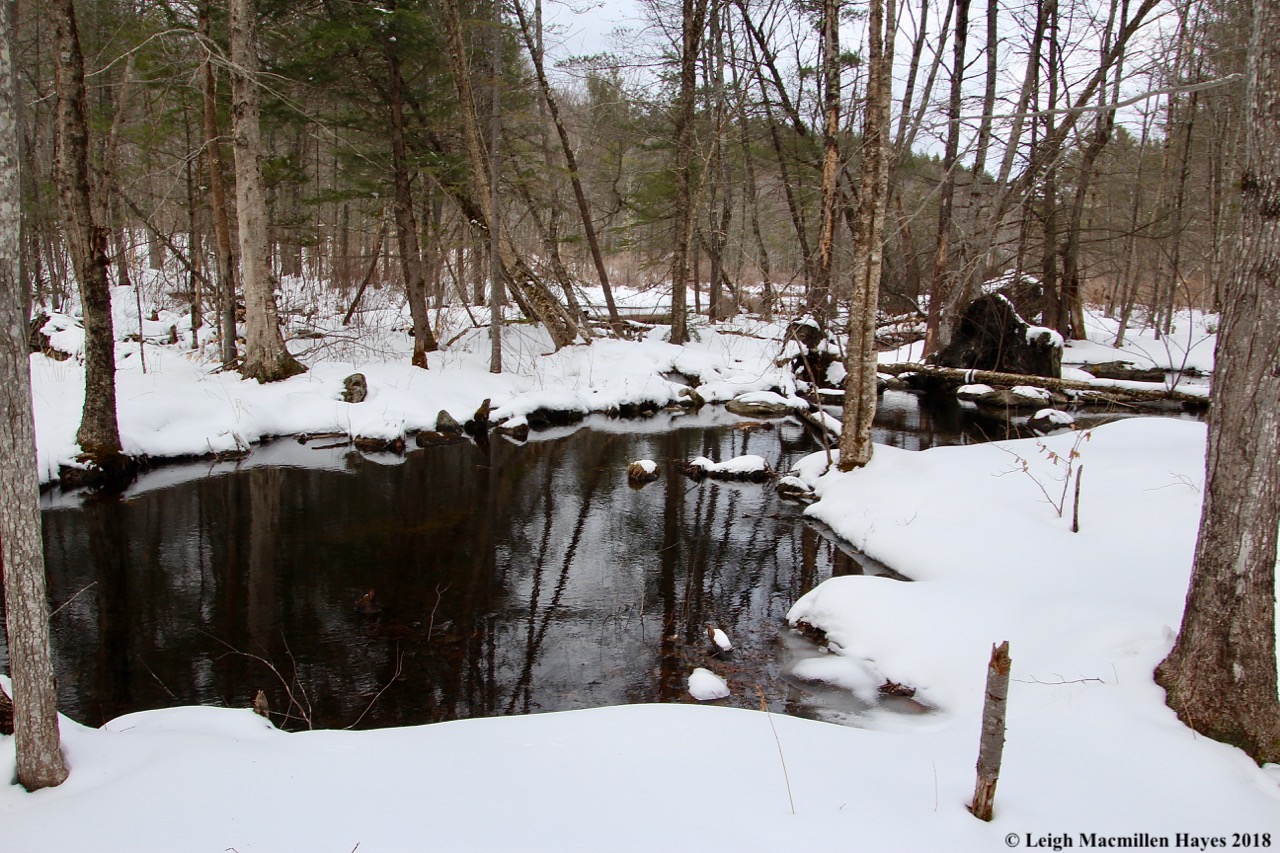
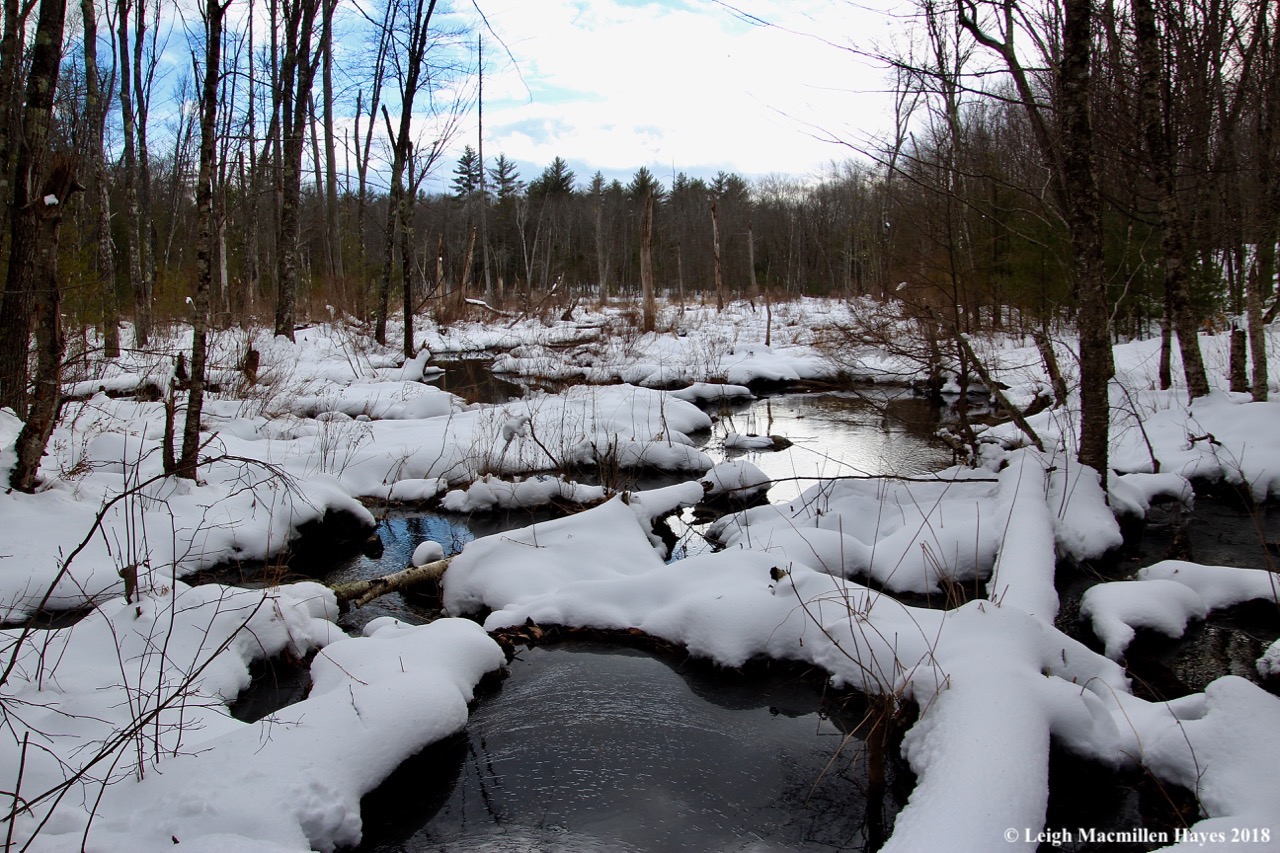
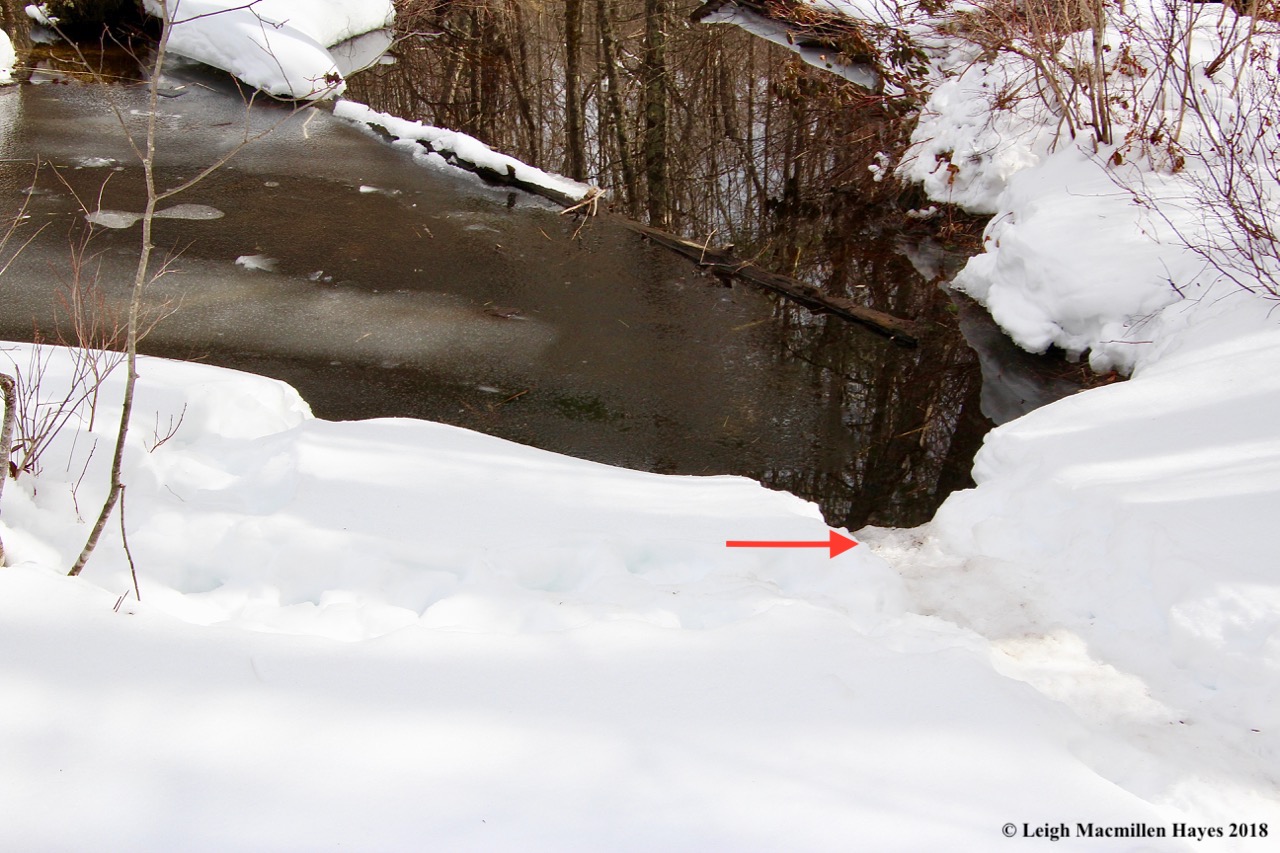
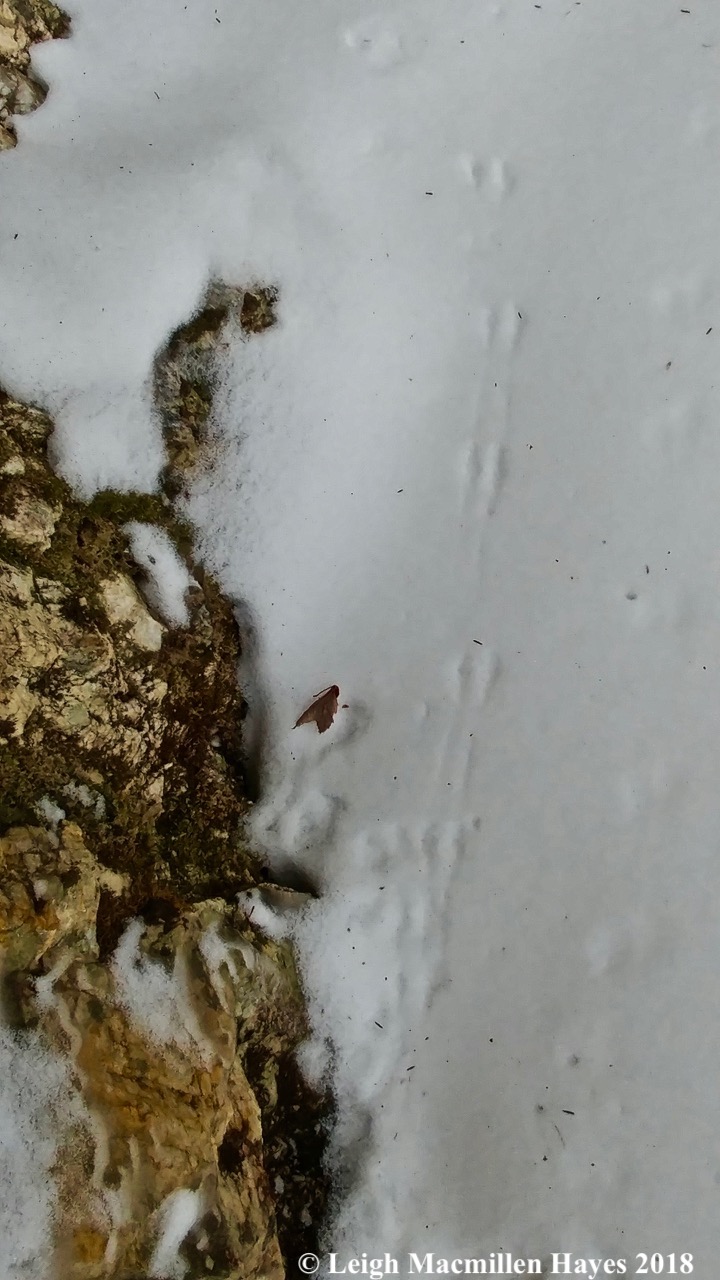
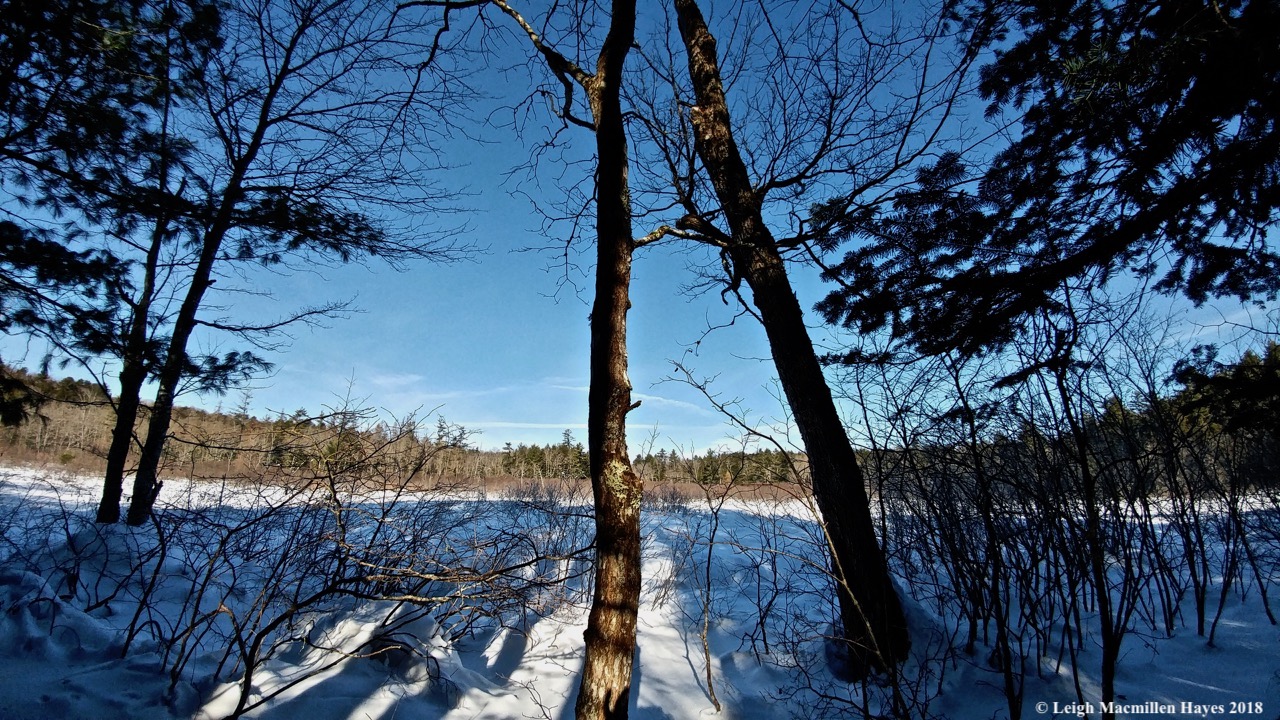
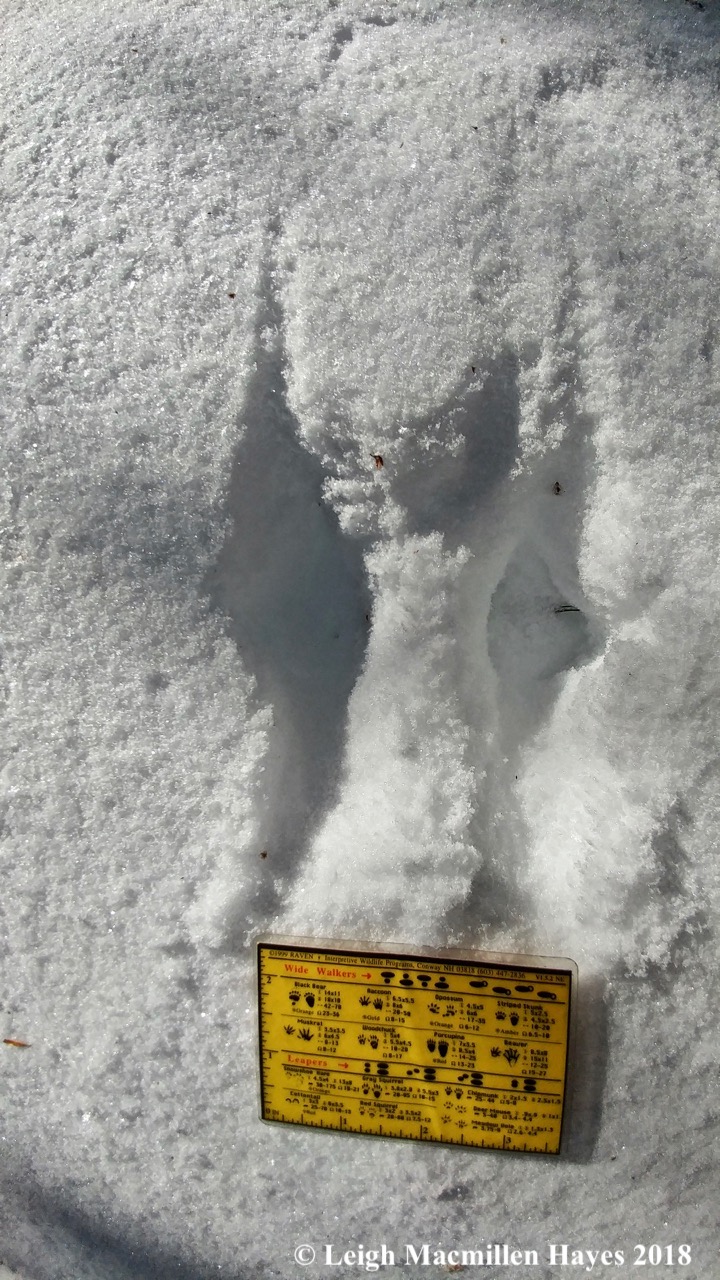
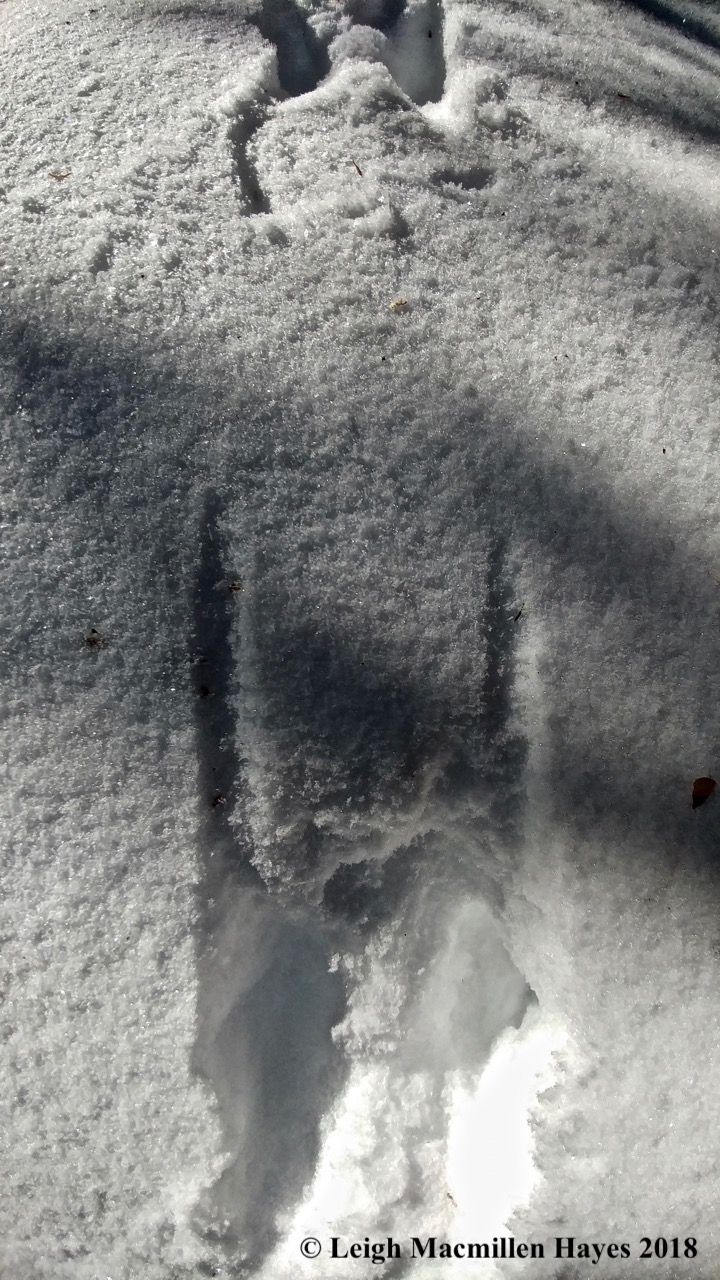
It all began with a photo sent to me by a friend two days ago. “Any ideas? 8 inches wide. 20 yards from a bog,” he wrote. 

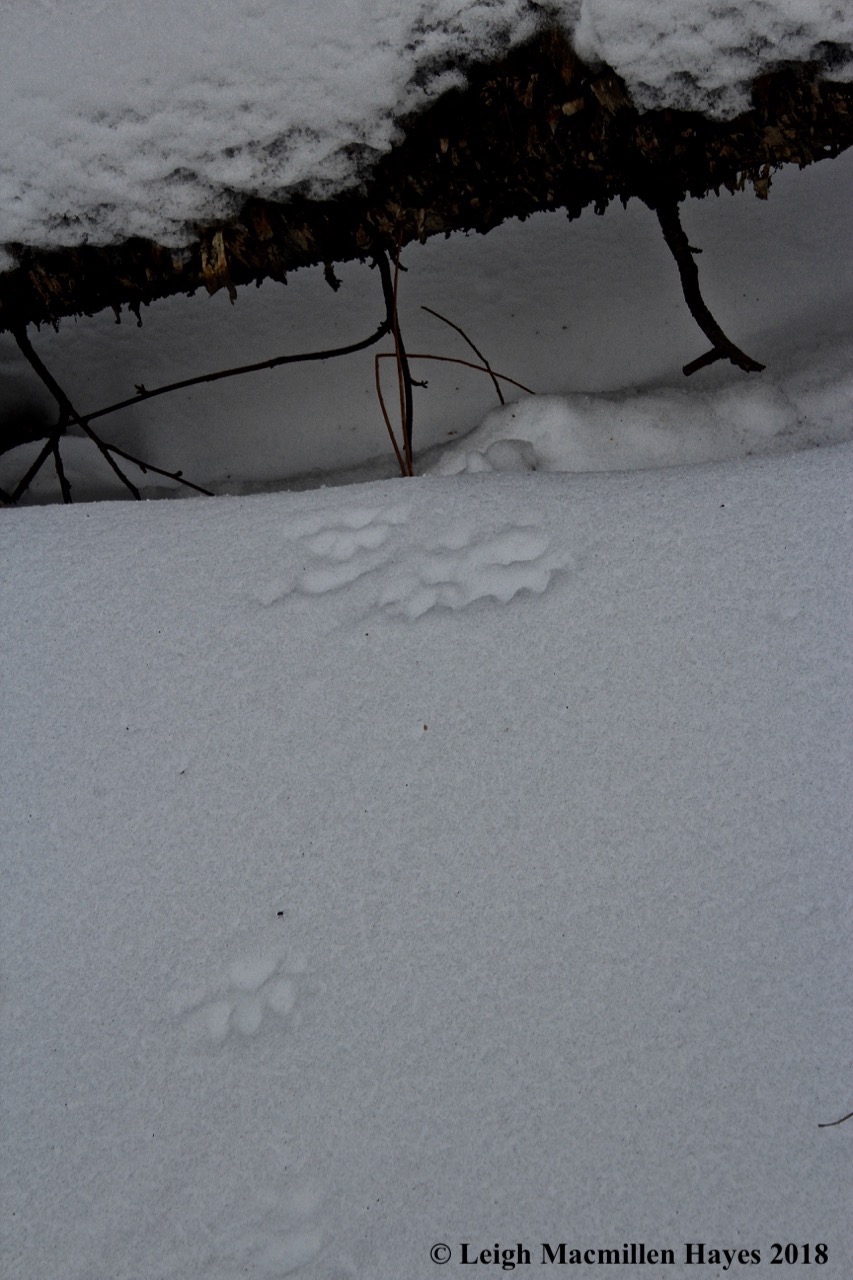
I asked him about tracks in the area, but other than deer, he saw none. He did, however, see two track makers–a fisher and a weasel. 

And so, I contacted a few other friends and invited them to join me on a quest to figure out what the hole was all about. 
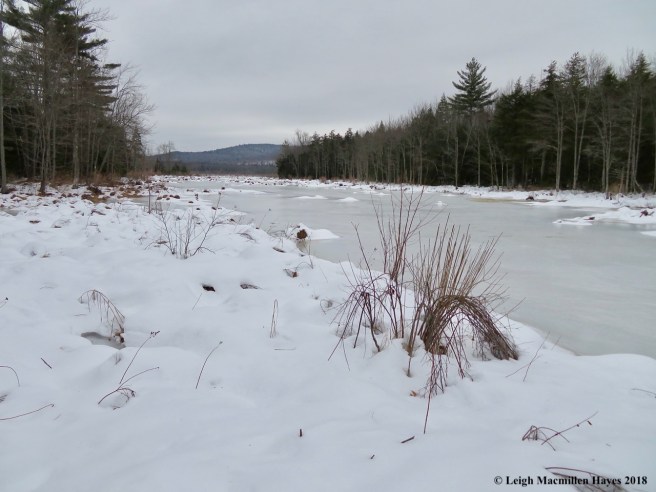
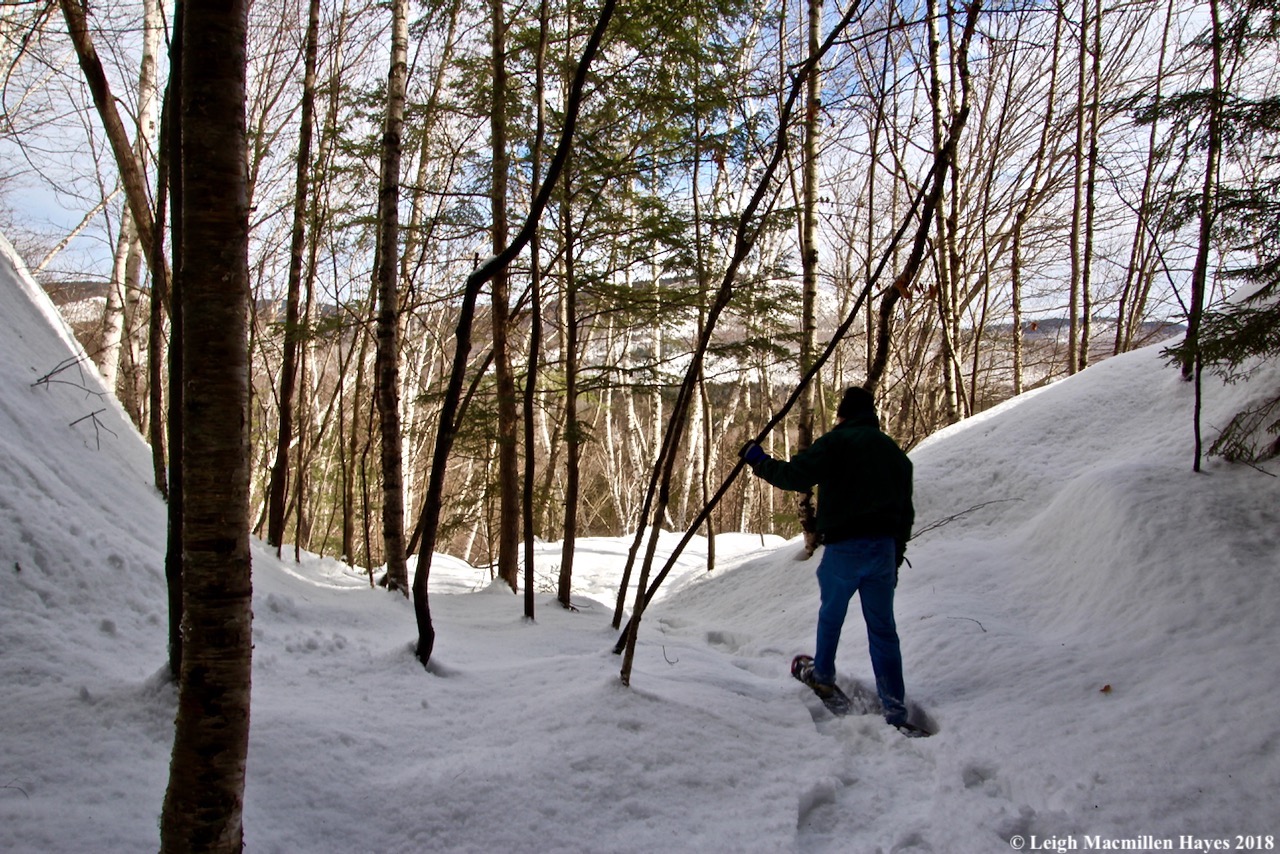
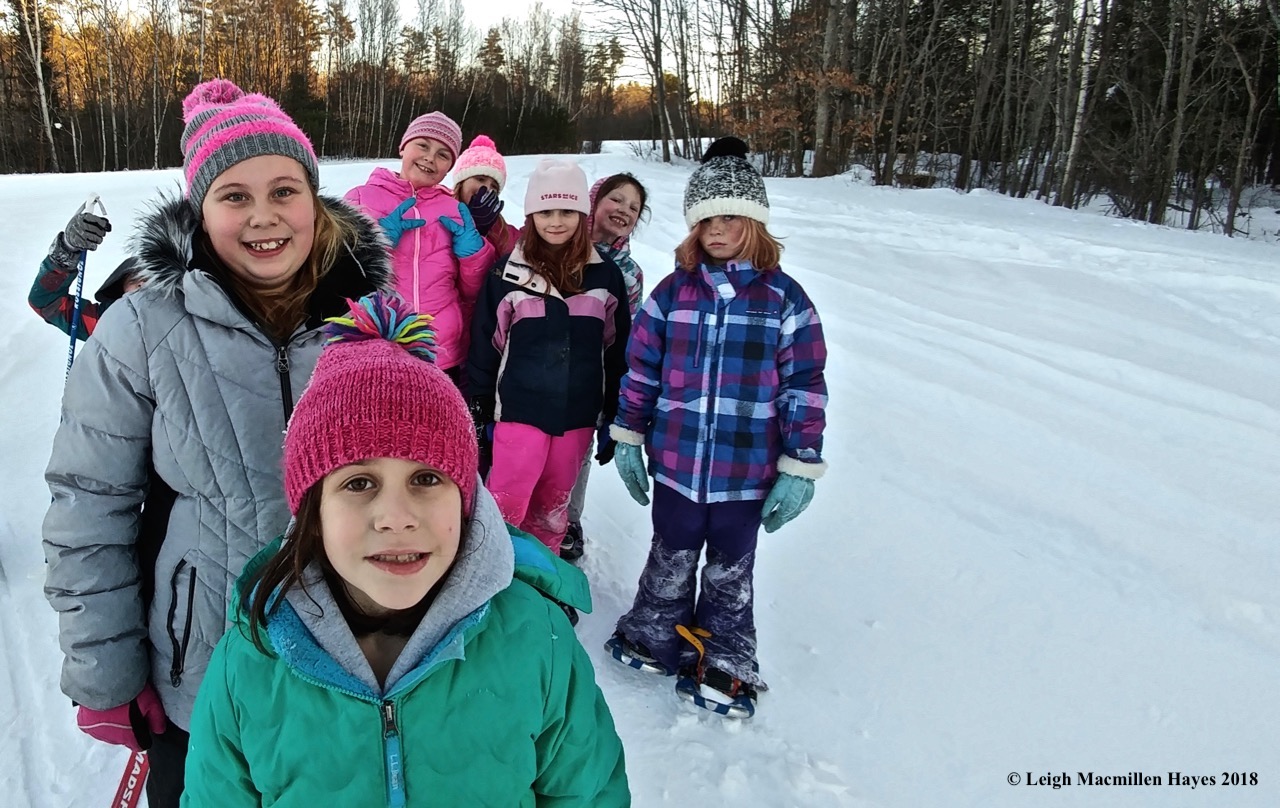
We met at the designated location, determined it would probably be in our best interest to wear snowshoes rather than Micro-spikes, and set off to search for the hole and clues. 
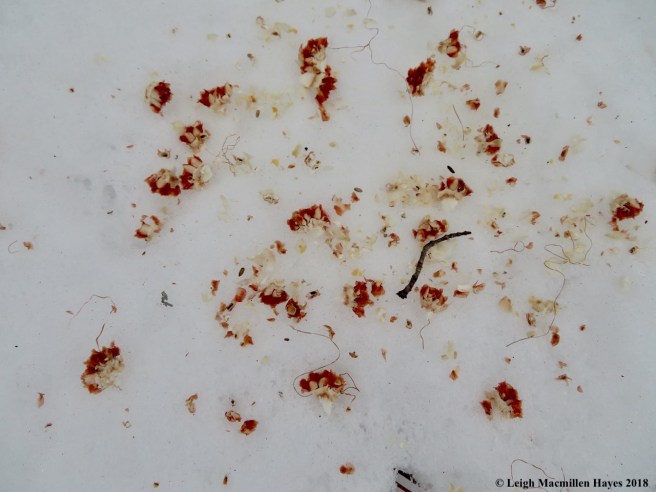
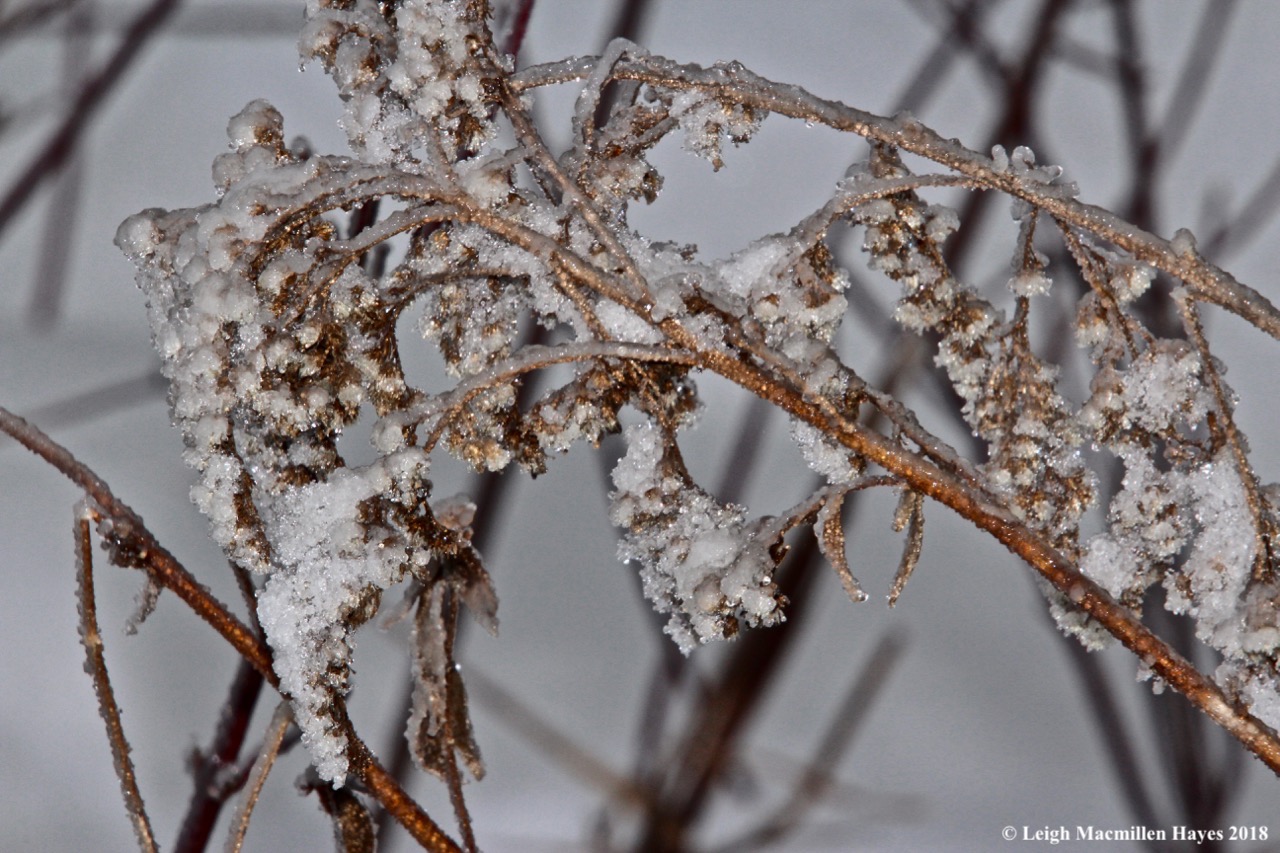
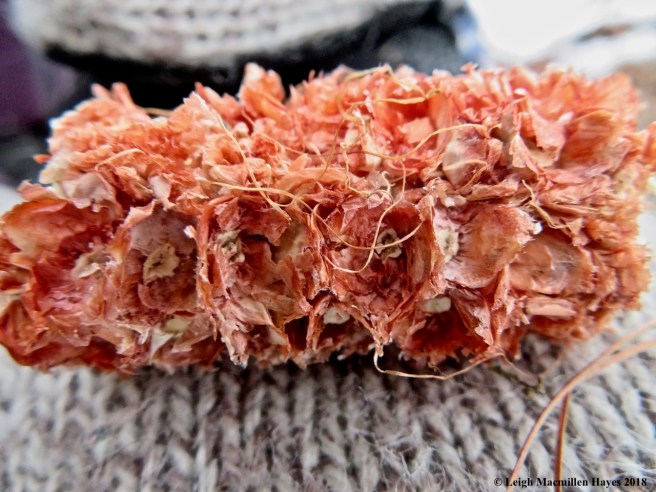
But first, something else stumped us. Oh, wait. I wasn’t stumped. I knew it was sumac and a bird must have been munching on the seeds. But . . . I didn’t remember sumac having such long hairs and there certainly were strands associated with the droppings. 
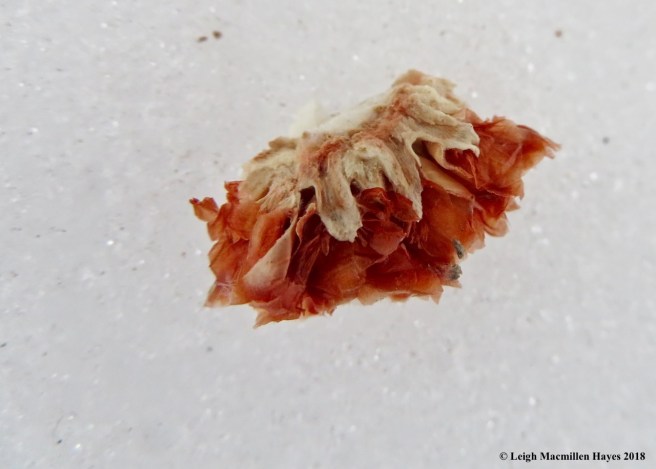
The color, however, made it incredibly obvious. Sumac indeed. 

Until . . . 
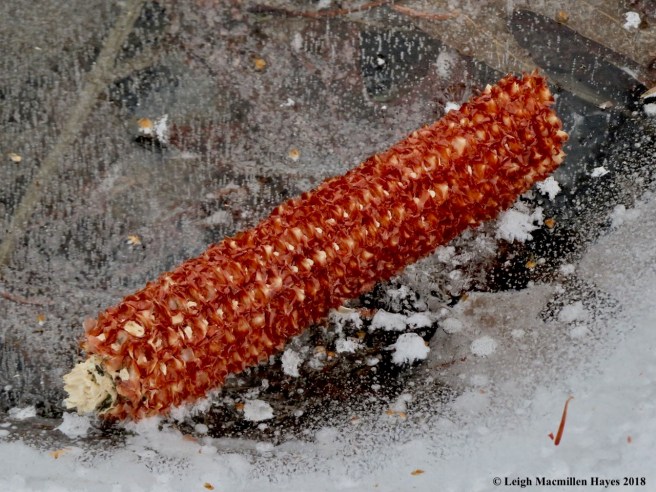
it wasn’t! Corn on the cob? On ice? And then we remembered that there was a cornfield located directly across the road. So . . . that made sense. But, how did it get to the other side? We’d noticed plenty of turkey tracks. Would turkeys carry cobs of corn? Not the ones that visit my backyard on a daily (sometimes twice daily) mission to eat as much bird seed I’ve tossed on the ground as possible. They scratch about and eat whatever is available on the spot rather than carrying it–as far as the four of us knew anyway. 
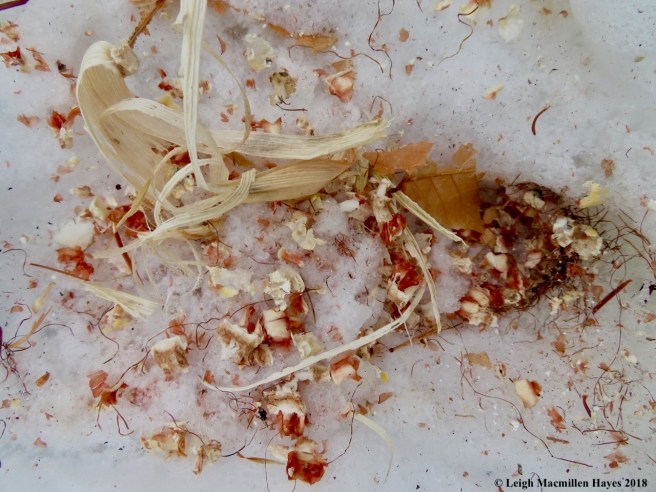
Did the deer bring it across? Again, we’ve always seen them dine on site. And . . . we noticed that the cobs, and even occasional husks, were left within their prints, so the corn arrived after the deer. 

As we continued to look around, we began to see kernels in small piles everywhere. 

And with that, we suddenly spied something else that looked oddly familiar. 
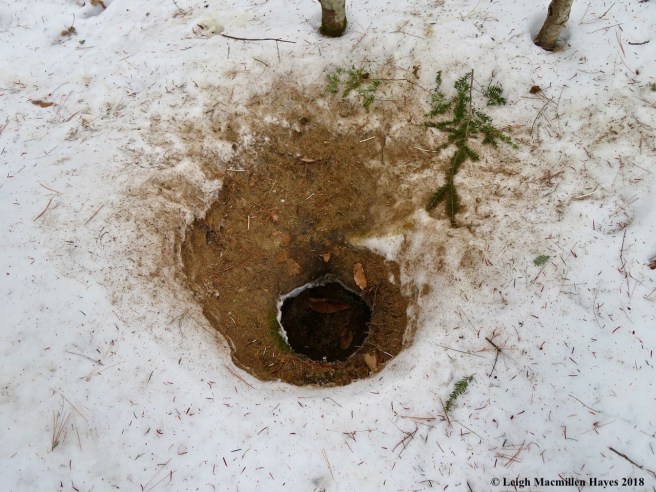
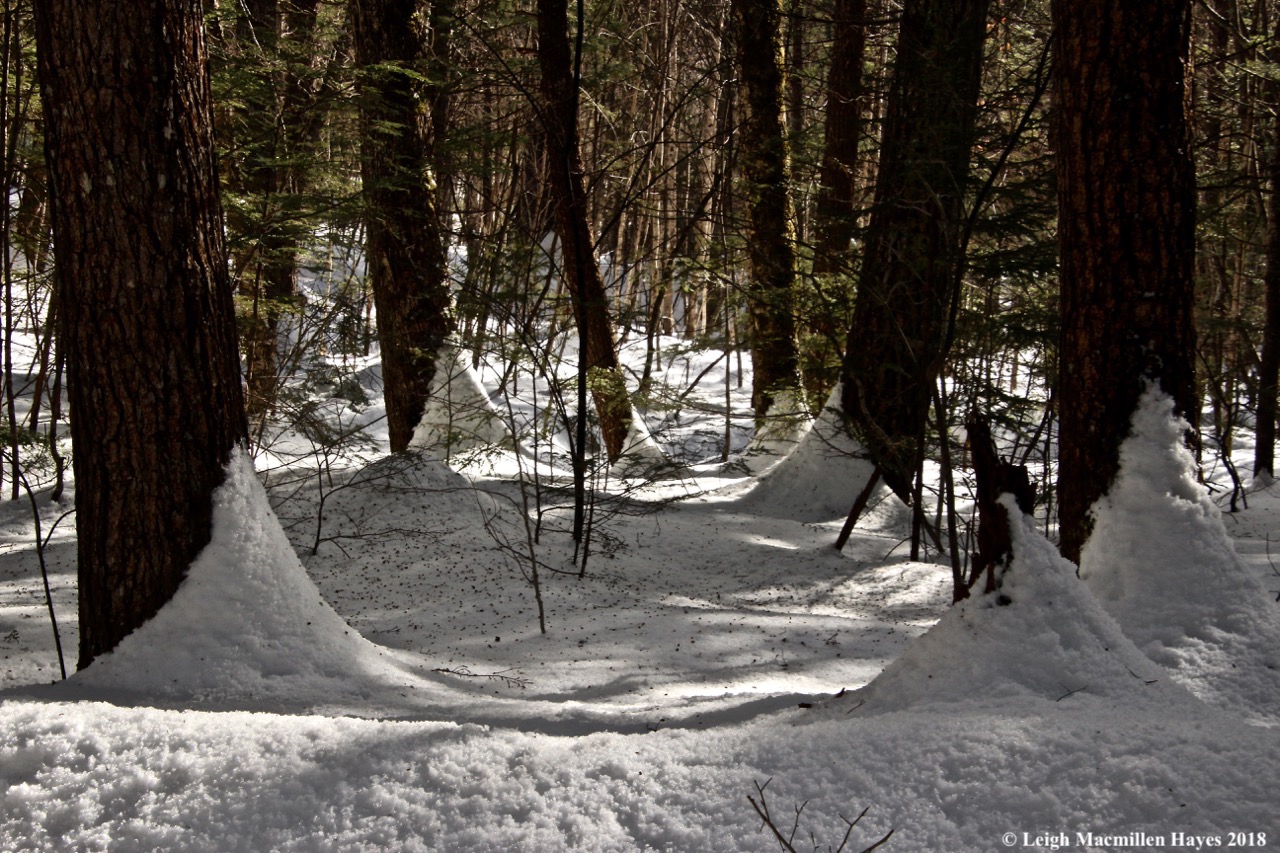
The hole! Notice its spiral shape. Discernible tracks? No. Dirt? Yes. Hoar frost? Yes. Hmmmm . . . 

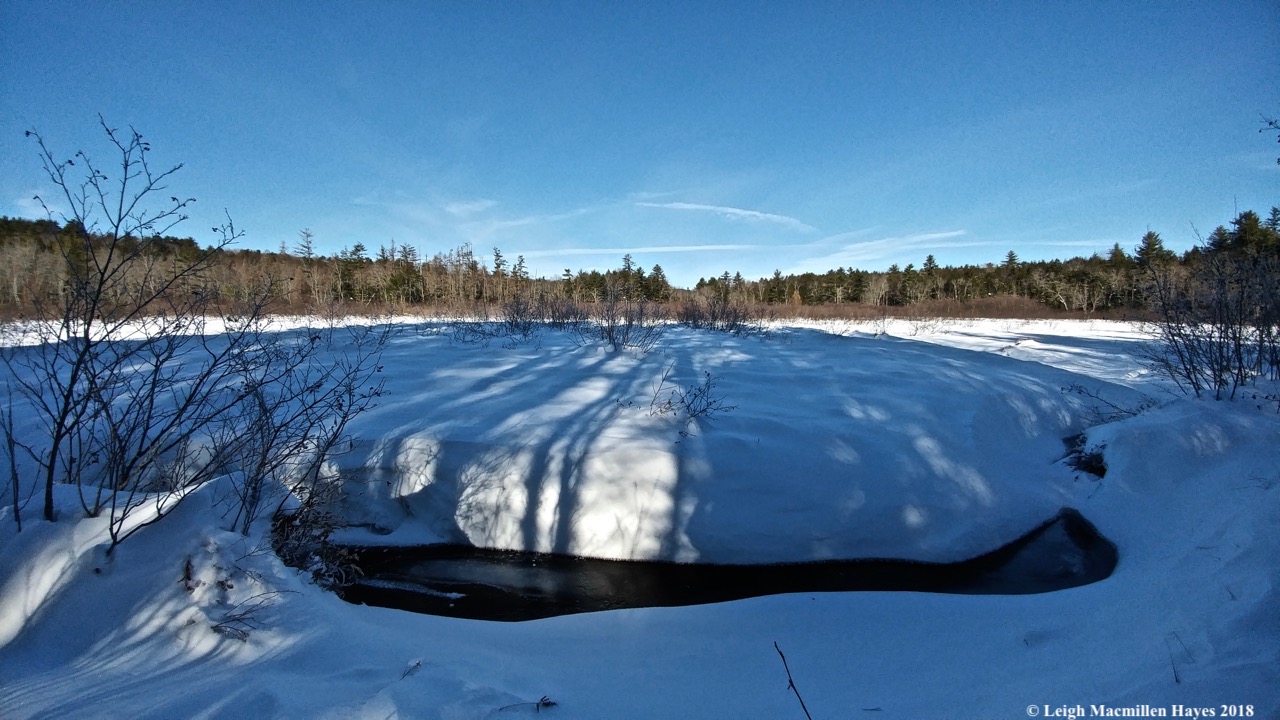
We looked around for signs. “So and So lives here” would have made it too obvious. But, we found hoar frost on an adjacent hole, which raised a few questions: 1. Were the holes connected? 2. Was a critter breathing within? 3. Or, because we were near the bog, was there warmer water below that was creating the frost? 
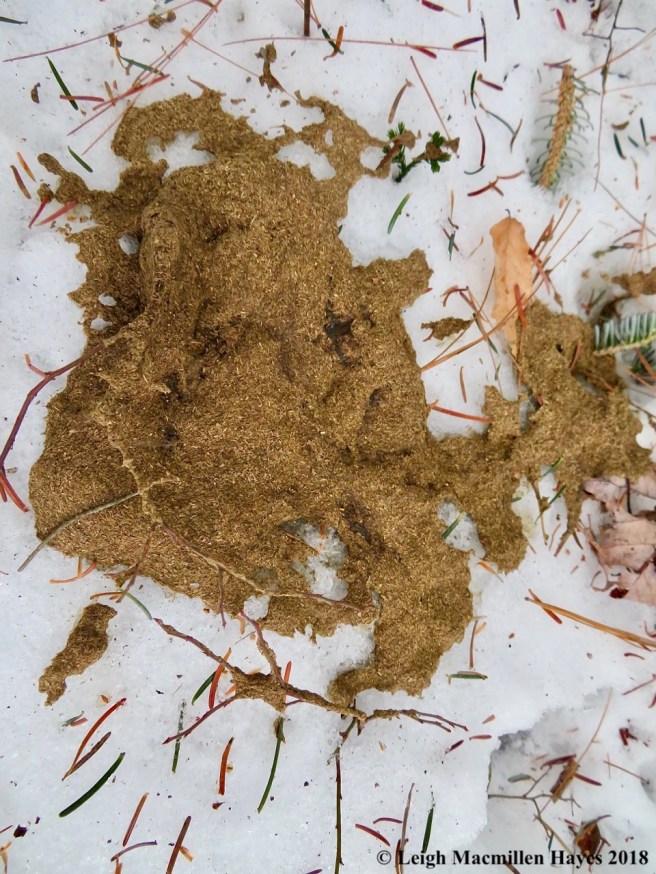
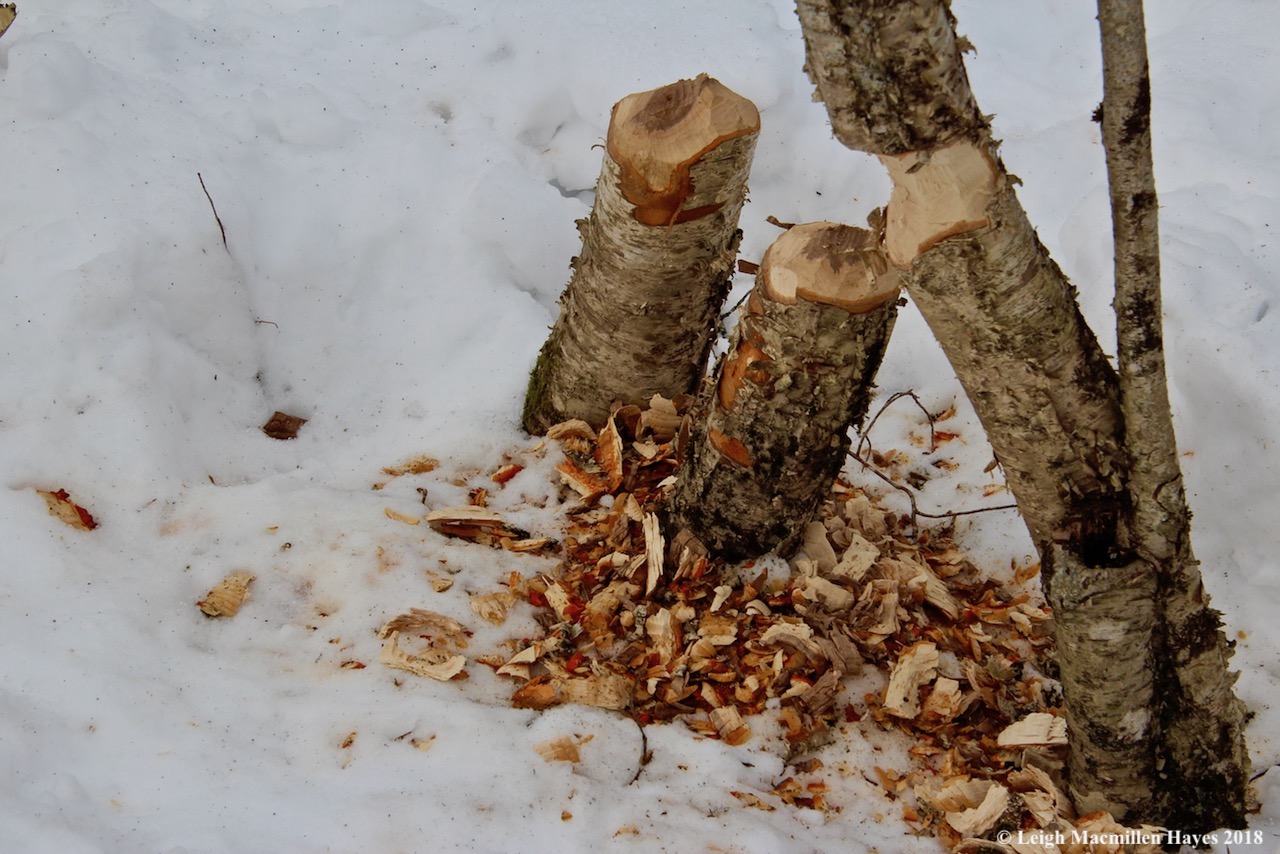
Then we found something none of us had ever seen before. A smattering of sawdust on the snow located about five feet from the hole. Scat? Upset stomach? Two of us got down with a loupe to take a closer look and came to no conclusions. 

As we continued to look around, we noticed that though there wasn’t a discernible track, it did seem that activity led to two hemlock trees.

And there were snipped off twigs cut at an angle below the trees, plus some comma-shaped scat. 

With that in mind, we returned to the hole in question. 
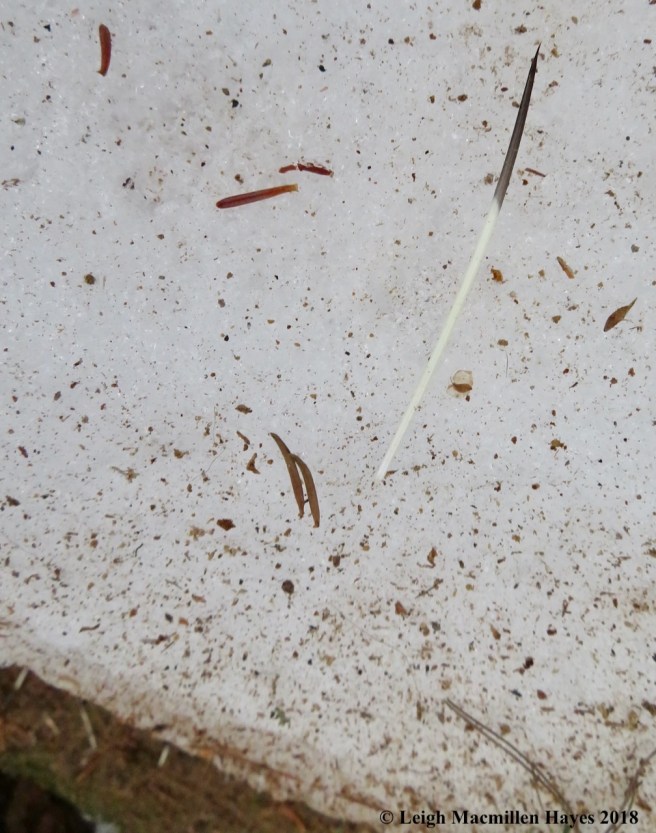
Bingo! There was a sign that clearly read “So and So lives here.” A quill! When I first looked at the photo the other day I’d suggested porcupine or fox. Porcupine it was. 

Within the hole which we could tell was deeper to the left, we spotted more quills. 

Mystery solved–almost, for we didn’t know about that smattering of sawdust. Porcupine scat consists of sawdust because their winter diet includes tree bark and needles. Did the animal have a bellyache? 
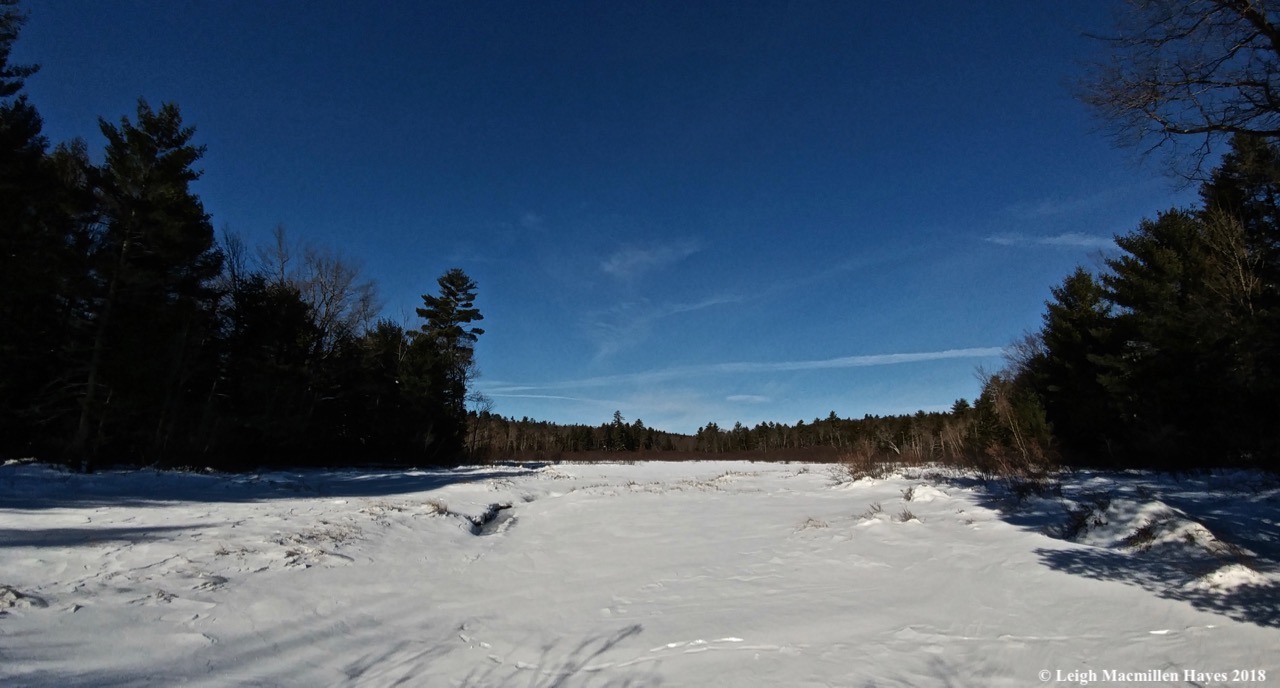
Our excitement at finding the hole wasn’t diminished by the unsolved portion of the story. And still, we continued to find corn cobs as we moved closer to the water in hopes of finding tracks. 

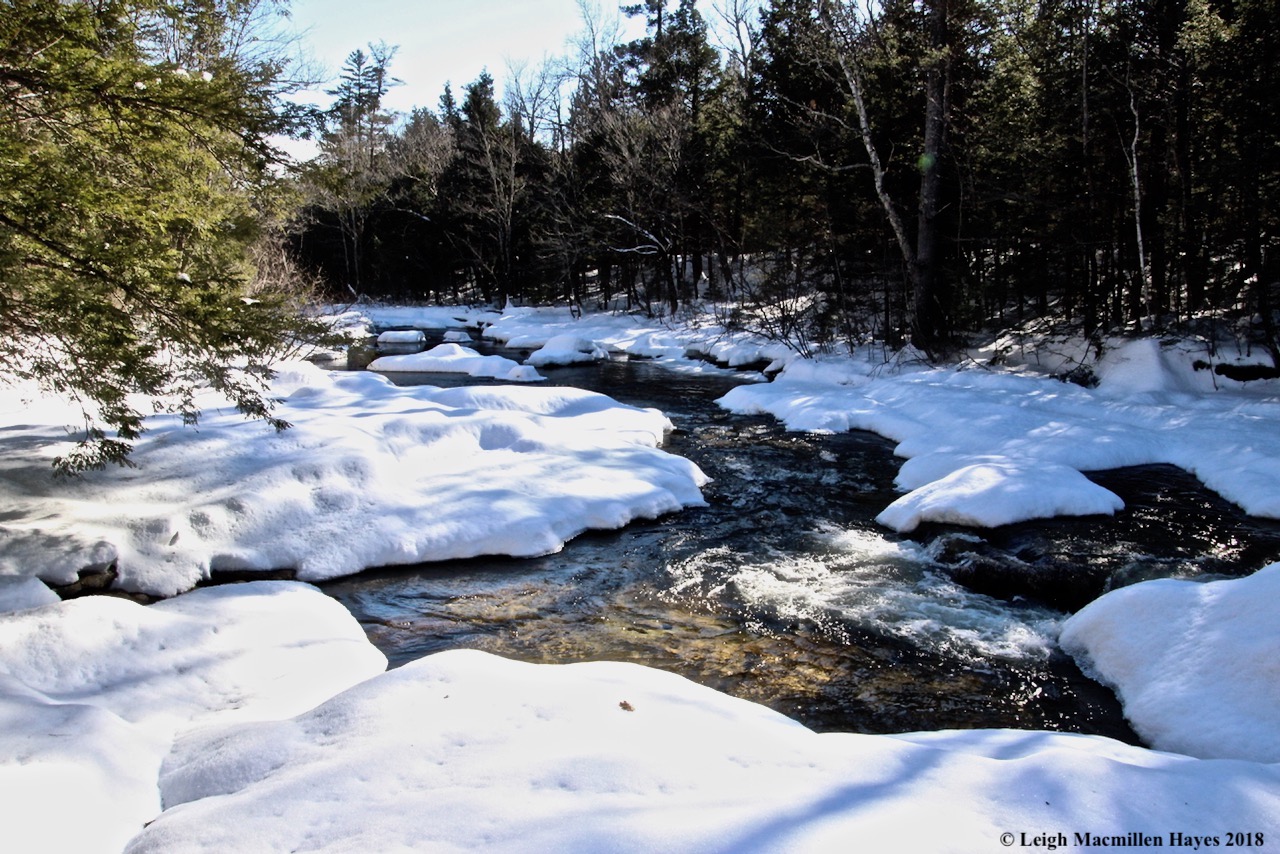
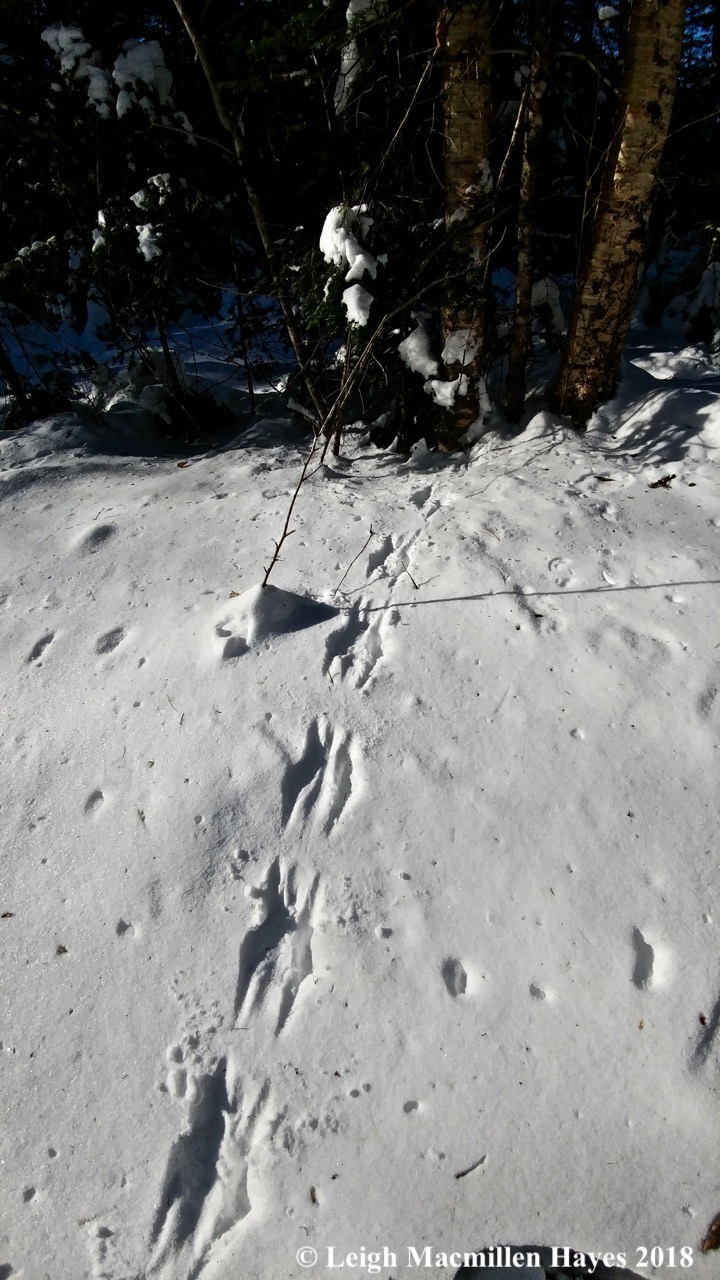
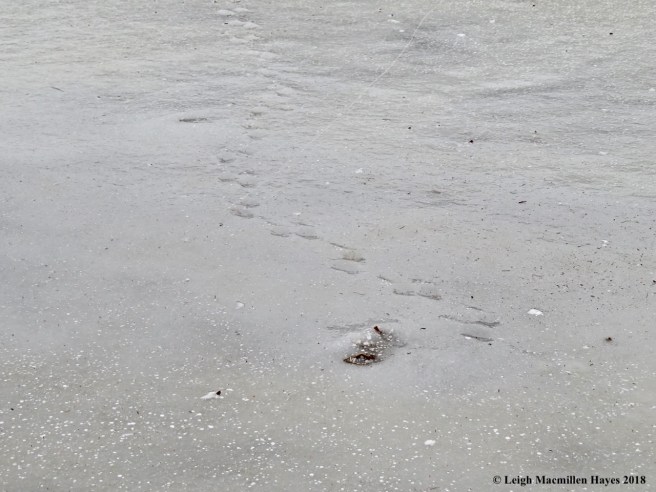
Indeed, there were some and we tried to figure out the pattern to determine what mammal had crossed the ice. 

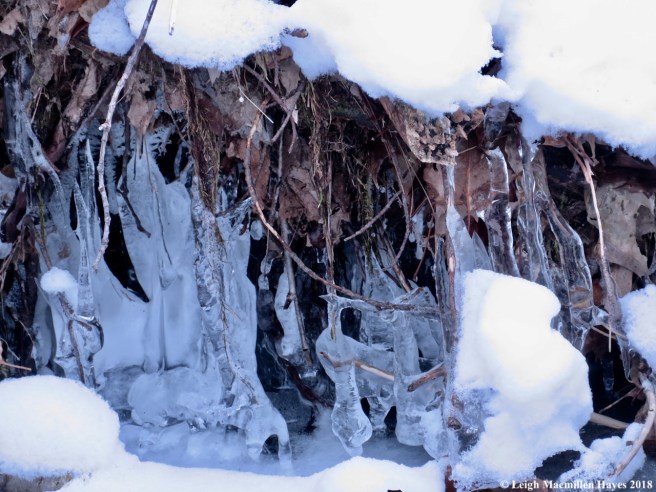
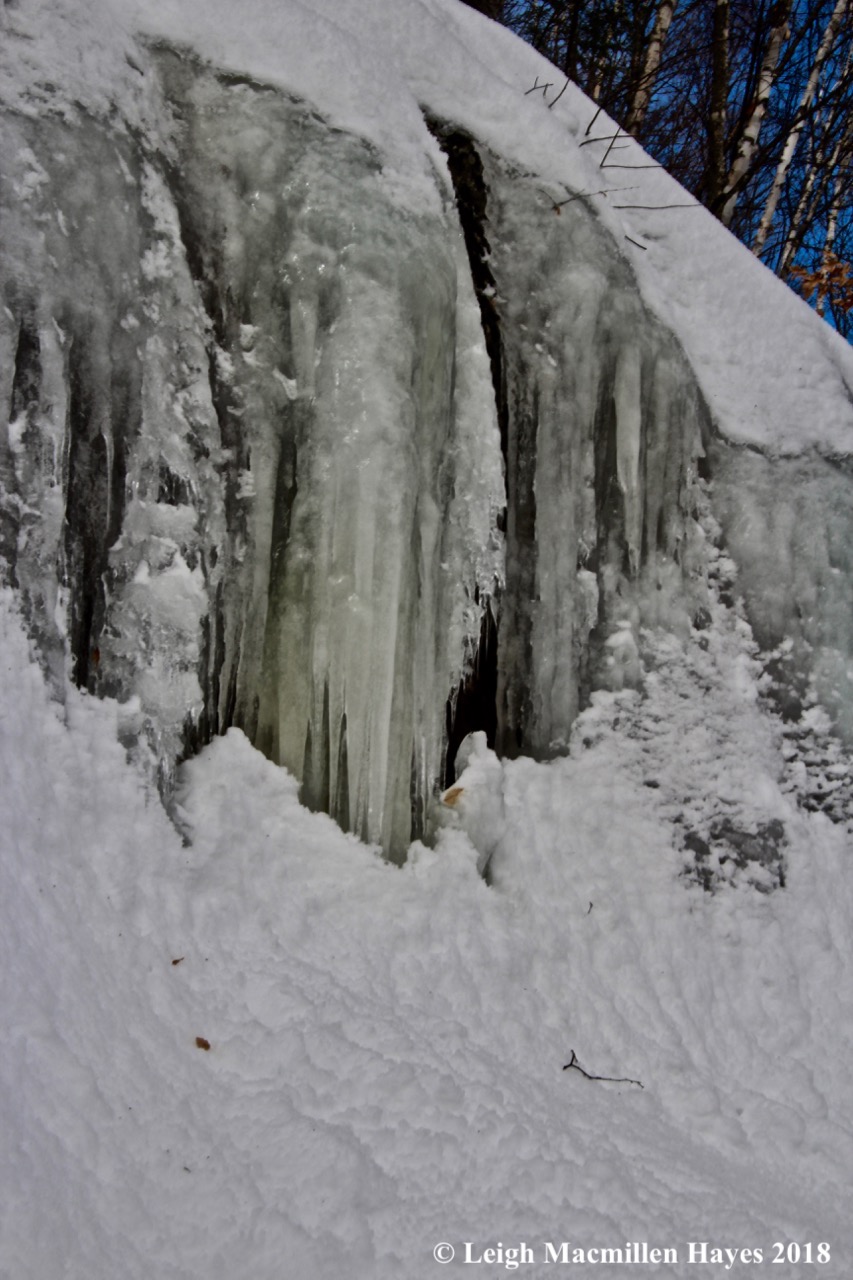
But before taking a closer look, there was ice on the bog’s edge to admire and we each found artistic displays to our individual liking. 
Back to the tracks on the ice.

At first, with porcupine on my mind, I thought I recognized the pigeon-toed behavior. 

But my companions couldn’t see it. And then I realized that I was seeing a different pattern instead. Opposite diagonals became important in the overall look of two feet together. 

Studying that one pattern of a waddling animal, we soon realized another had crossed over it–in a leap and a bound. Do you see the intersection of the two in the middle of the photograph? 
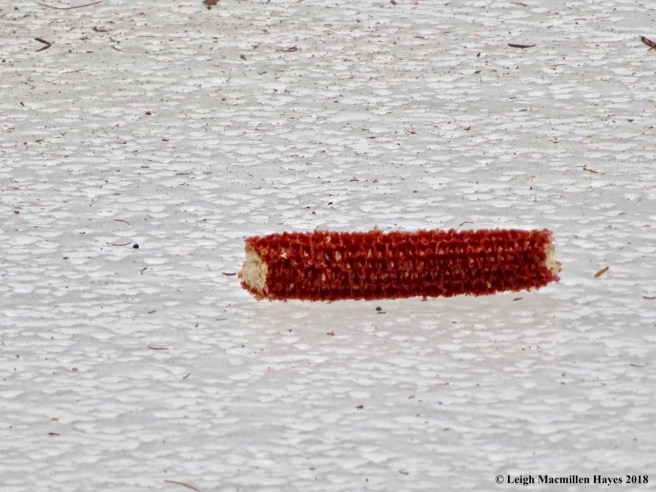
And, there were a couple of corn cobs on the ice. 
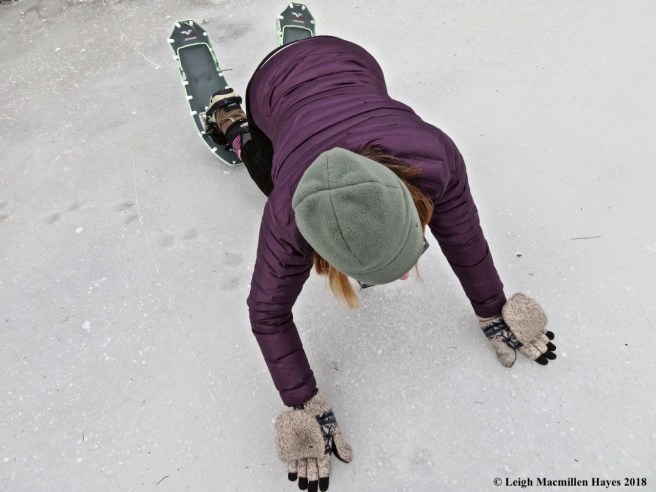
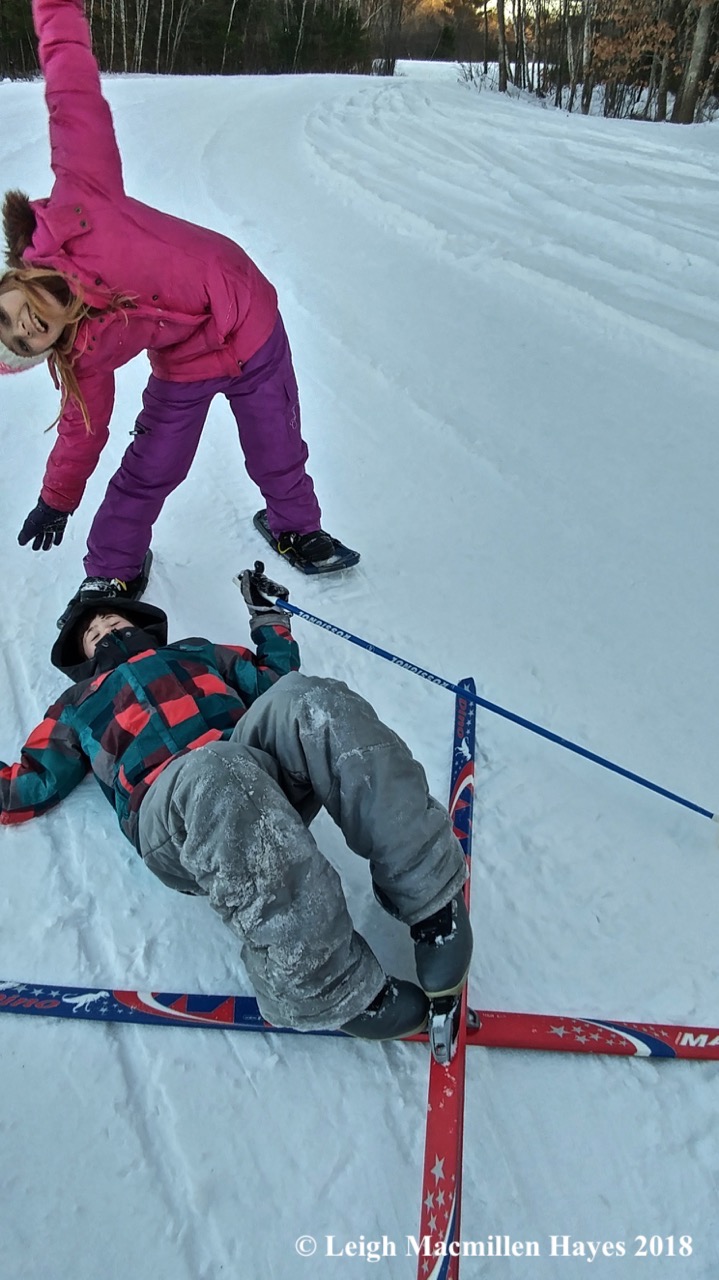
It was all too enticing, and so we got up the gumption, threw risk to the wind, and stepped out. One of us, stepped onto all fours as she slid across, the better to distribute her weight. It also gave her a better view of the tracks. 
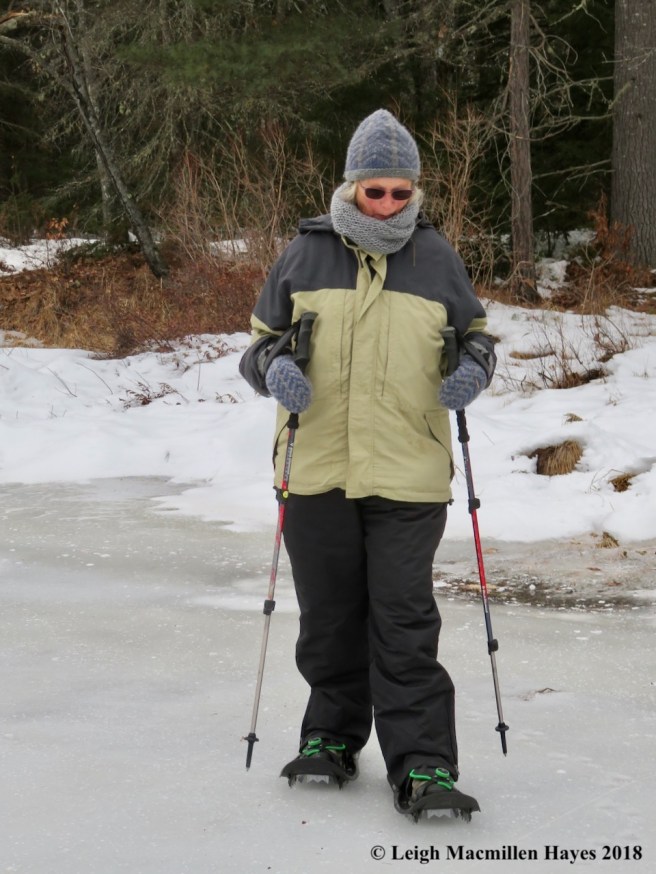
Another came forth with caution, though she admitted she’d hoped we’d go for it. 

Her husband was the smart one and he stood on shore–looking at tracks in the snow created by one of the critters we were examining on the ice. And ever ready to call for help should we need it. 

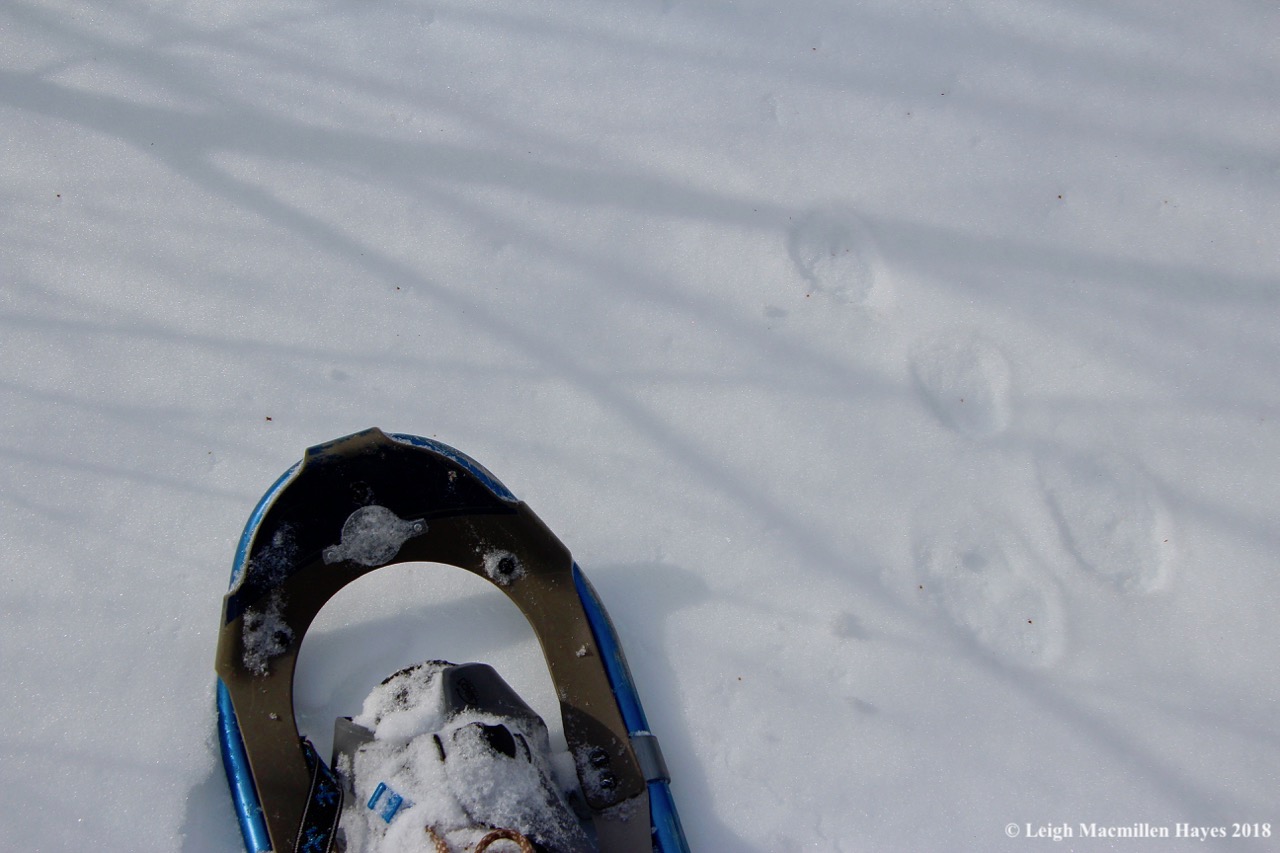
Back to the pattern–do you see three sets of two feet? In the lower set the diagonal is higher on the left and lower on the right. It switches with the middle set of prints. And goes back to the same with the upper set. 

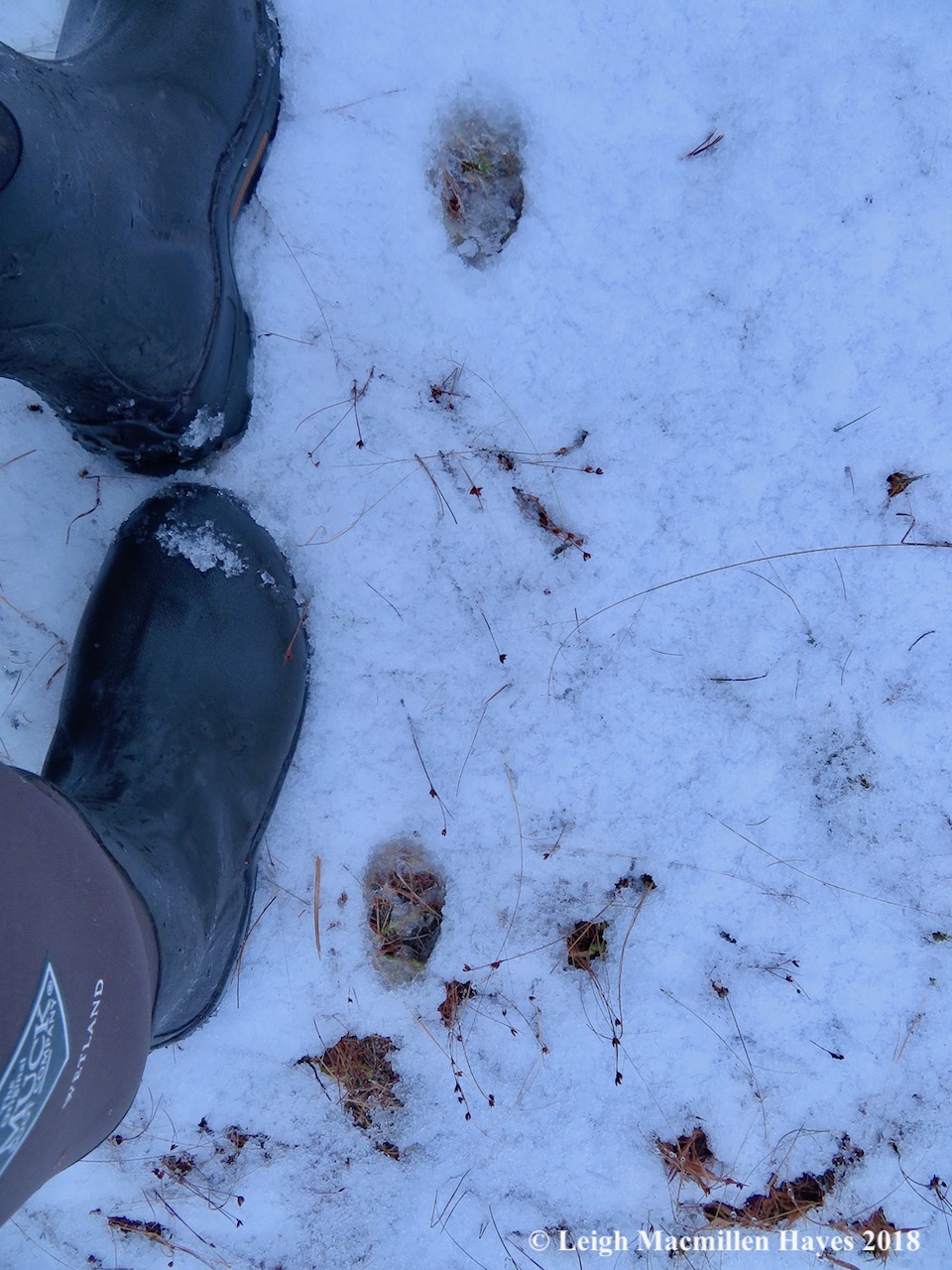
Where debris had frozen into the impressions you can almost see the toes. The smaller, almost rounder right hand print is a front foot and the longer left hand print is the opposite back foot. That’s how it goes with a waddler such as this. 
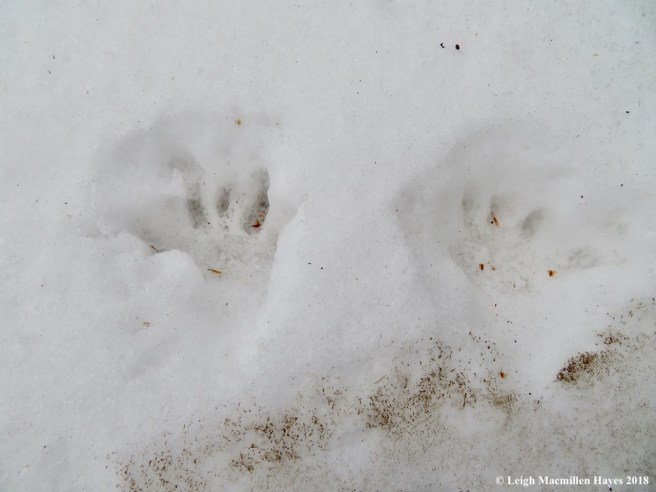
We’d actually seen clear prints near where we’d parked and so we knew this mammal had been in the area–those baby hand-like prints belonged to a raccoon. Raccoon tracks and corn on the cob. Hmmmm. We were beginning to make some connections. 
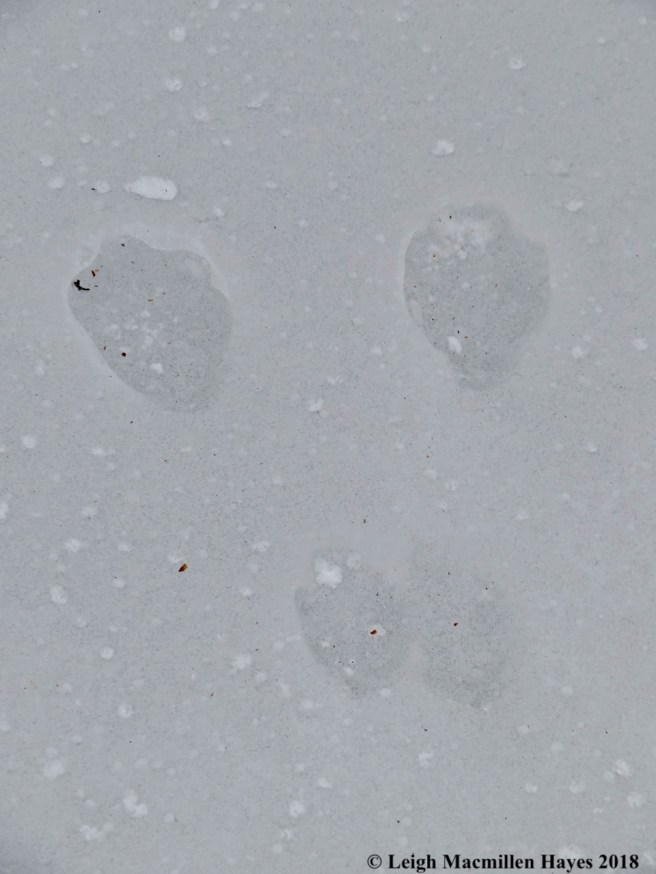
With that figured out, we moved on to the next set of tracks and determined they belonged to a snowshoe hare–the larger front prints actually representing its back feet as they had landed after the front feet bounded forward. 
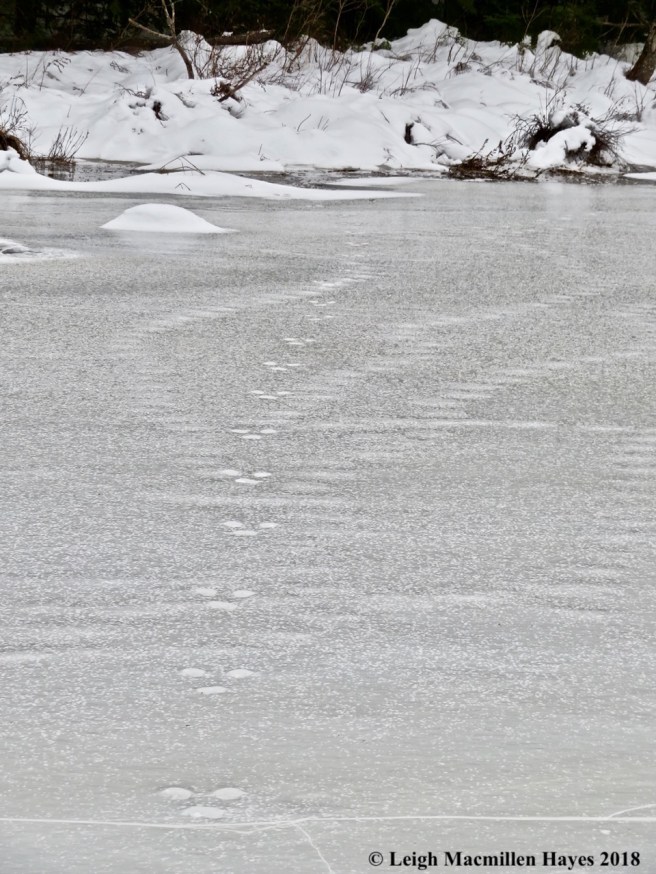
As we studied the hare track, we noticed lots of movement had previously been made by another critter and I’m going to go out on a limb to say based on its size and behavior that it was related to the next mystery we encountered. 
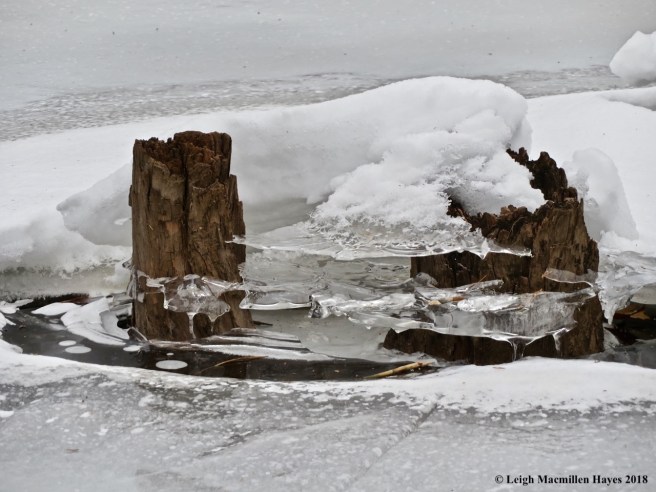
First, there was a hole around a couple of tree stumps and it was the layers of ice that drew our admiration. 
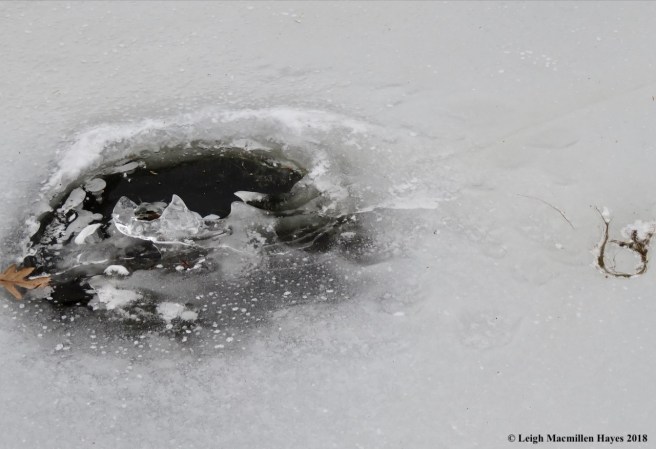
Right near it, however, was another frozen over hole and we could see some tracks that were difficult to read. 

But the ice was glorious and there was another small tree stump in the center. 

We weren’t sure who had made the holes until we spied another and some prints in the snow. 

The five tear-drop shaped toes provided a huge hint. 
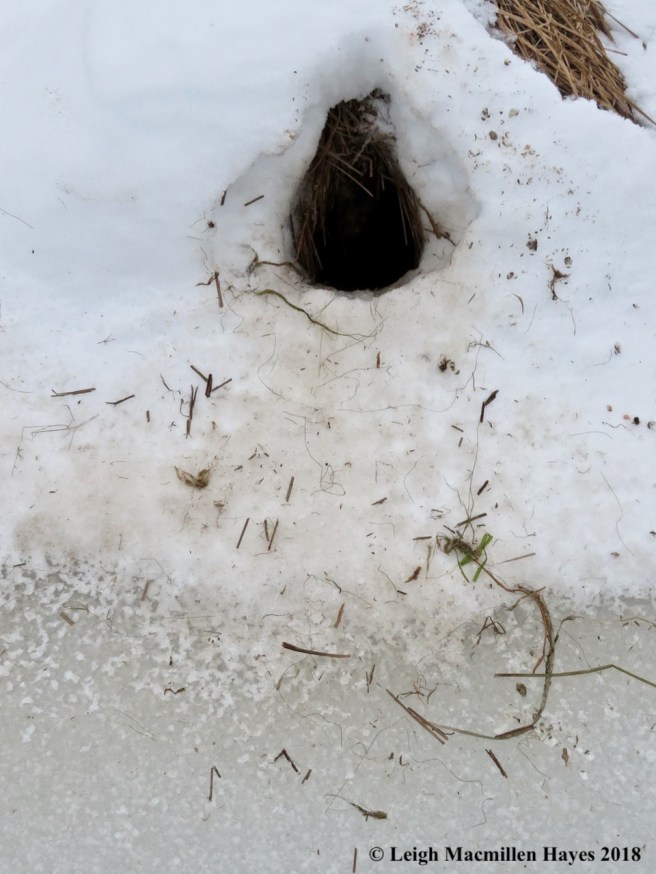
And a bigger hint–a hole nearby. 

As usual, it commanded a closer look. 

And what did we find? Fish scales. With that signature, and the prints and even the pattern of the older tracks near the snowshoe hare activity, we knew a river otter had recently eaten. 

Eventually, we made our way back to the road, crossed over and checked the cornfield for we still weren’t sure who had brought the cobs to the bog. It made sense that the raccoon may have, but all of them? 
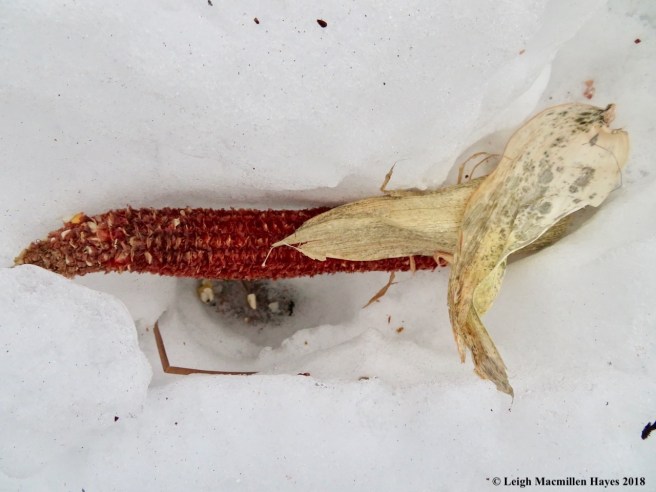
We found plenty of deer tracks, many of which were again filled with either kernels or nearly complete cobs. 
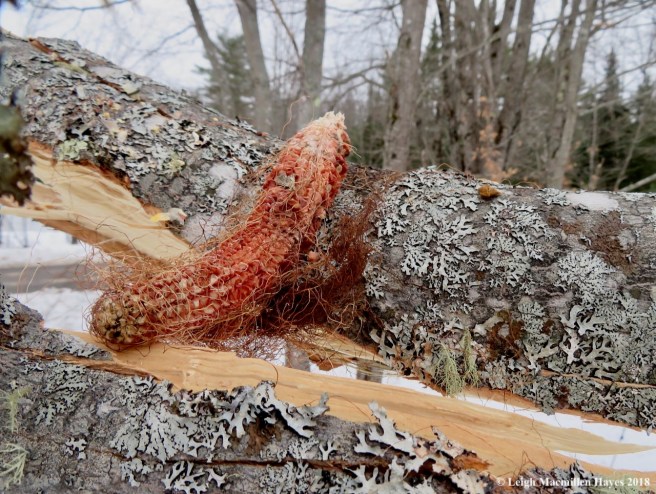
But it was the one stuck up in a broken red maple limb and the chitting nearby, plus scat below, and the actual sighting of a particular mammal that we think gave us the answer as to why so many piles of kernels–red squirrels. 

With that, it was time for us to take our leave. First, we gave great thanks, however, to Parker for sending me the photo of the hole. When I’d shown it to another friend, he asked why the spiral. I think that was the lowest point and the porcupine climbed out and then made its typical swath around until it reached the higher ground each time it exited and entered.

The question none of us could answer–what about that sawdust smattering?  

Ah well, we saved that for another day and left thankful for the opportunity to solve most of the holey mysteries. 

Amazing Race–Our Style: episode eleven

The second to last episode of the Amazing Race–Our Style was upon us and we hoped it wouldn’t be the final one for us. 

Today’s clue was a bit different than most. It gave us four specific locations–and much to our delight, all were within 20 minutes of home! How could we be so fortunate? 

We were also given a time frame and a few other instructions. We were to arrive at our first destination at 10:30am. From that starting time, we had until 5pm to finish our tasks and send four photos to a certain website. The sooner we completed all of the tasks, except for sending the photos, the better our chances of hanging in for the final episode. The pressure was on. 

One of the biggest challenges was that the photos we needed to send were selfies. We aren’t selfie fans, unless you count photos of our footwear! 

Our overall mission today: to locate the four trees that had been decorated by homeschooled children and/or local land trusts. Since there were four teams left and four different properties, we were each given a different location in which to begin. 

Our starting point on this very foggy morning was Western Foothill Land Trust’s Roberts Farm Preserve in Norway, Maine. As instructed, we arrived at 10:30 and made sure to stay on the snowshoe trails only, for there is also a network of groomed ski trails. The trail was long and sometimes wet, while other times icy, but we didn’t notice too much as our eyes were focused on the trees. Of course, we were occasionally distracted, such as when a downy woodpecker flew into sight. 

My guy was certain he knew where the tree would be located, but . . . it wasn’t, at least as far as we could tell in the fog. 

We did spy a spider web embellished with beads of water and I remembered a story based on a legend about a poor family who had no decorations for their Christmas tree. As the tale goes, while the children slept, spiders spun webs of silver around the tree’s branches. The next morning, the family awoke to a Christmas tree sparkling with silver webs. Today’s webs were such and though we hadn’t found the decorated tree I was already richer for the experience of looking.

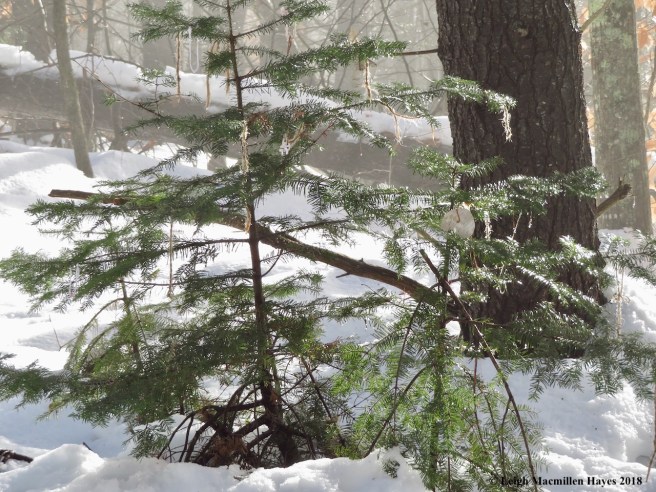
And then . . . my guy walked right by it. I was surprised I didn’t, for we both expected a different evergreen species to be adorned. 

Most of the ornaments were meant to feed the critters and we saw deer tracks in the snow. 

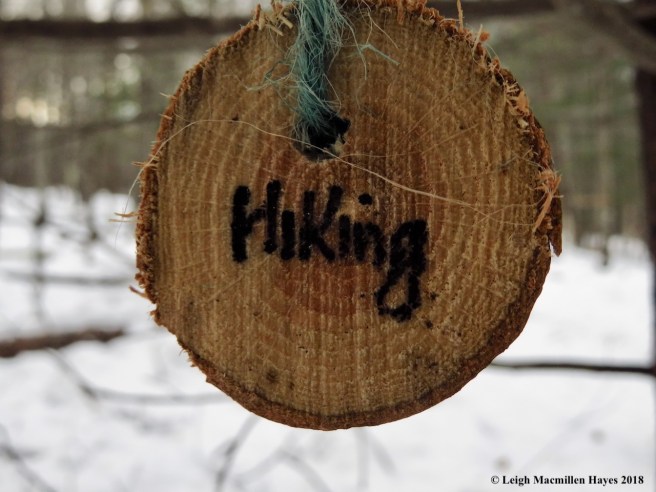
Among the mix was a tree cookie with a wood-burned sketch–perhaps of Roberts Farm? 

While my guy picked up fallen treats to rehang on the tree, I practiced my selfie skills. I was feeling confident that we could pull this off. 

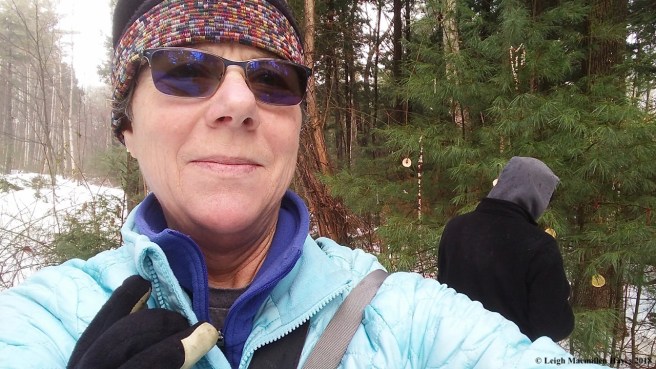
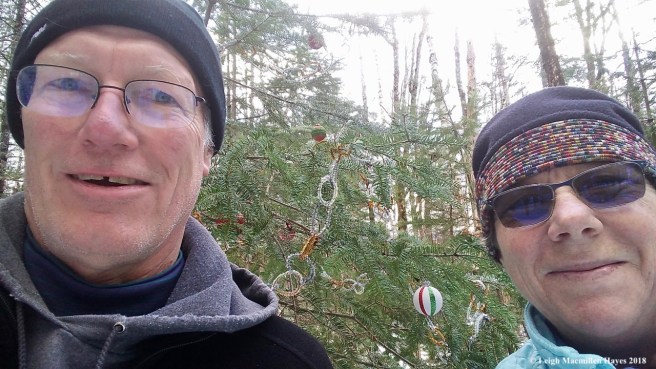
And when I told him that we’d have to send the photos to mainechristmastreehunt.com, he was eager to pose–and I was shocked. We tried to make sure that the tree was visible in the background. 

We checked off that tree, hopped into the truck and headed to Lovell. 

OK, so we knew when the clue arrived that we had a bit of an advantage for we’d been invited to join the Fairs, Farms, and Fun 4-H Group that decorated the tree at the Greater Lovell Land Trust’s Chip Stockford Reserve on Ladies Delight Road in Lovell a few weeks ago, and I’d just co-led a walk on the trail this past Saturday where other adults had fun looking for it. And redecorating it.

Oh well. Other teams had had different advantages during different episodes, so it was our turn. 

But, the most curious thing–when we arrived . . . there were no tracks made by any of the other teams. Team Purple was supposed to begin at this point. Had she gotten lost? 

Because we knew right where to go, our journey was quick and we easily relocated the tree on the one mile loop with a spur. And . . . discovered that the birds and deer had once again dined on the bird seed ornaments. 

When it comes time to remove the decorations after Chrismas, the task will be super easy. 

Thankfully, the subtle birch bark hearts continued to add a festive note. 

And so we posed. 

We did discover a new clue at the kiosk on our way in–we were to find something in the woods that represented our team. We found an H for Team Hazy. 

Within the clue package, we were also told to take time to eat–at a place locals frequent. We chose Quinn’s Jockey Cap Country Store in Fryeburg and somehow managed to resist the sweet treats while we ordered sandwiches. 

And then it was on to the Mountain Division Trail on Route 113 in Fryeburg to look for Upper Saco Valley Land Trust’s Andrews Preserve. There are no signs or trails at that preserve, but our adventure on Saturday had included a visit there. That’s why I couldn’t believe that this was the intended challenge for today’s episode, but all had been decided almost a year ago and it just worked out that I knew where we needed to go today. That being said, I let my guy lead. 

He had a bit of help as one or two others had been that way–leaving their tracks in the snow. 

And . . . he did a super job, quickly spying the tree. What I love about this scavenger hunt is that each tree has a different theme and flavor. The USVLT tree was decorated by a teen and her mom, and the teen didn’t want the animals to eat all the ornaments. Understood. 

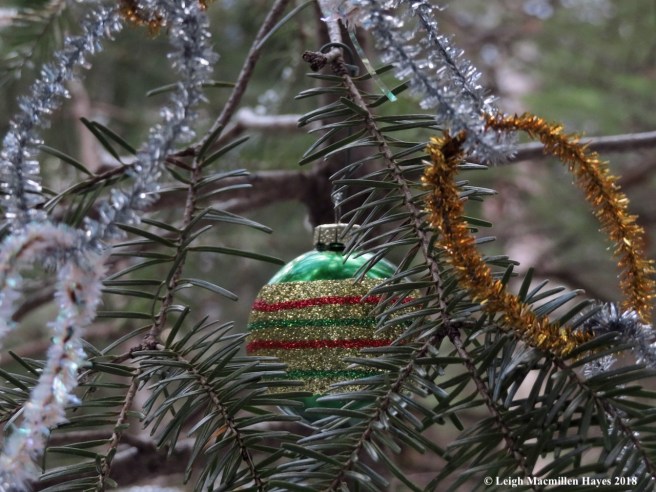
They created a pipecleaner garland and added glittery bulbs. It’s a bright spot in the middle of a thickly wooded site. 

And so we posed again. 

Our final destination was to Lake Environmental Association’s Pinehaven Trail at the Maine Lake Science Center on Willet Road in Bridgton. This is a place we know well for it’s practically in our backyard, but we didn’t know which tree would be decorated. And so we began our hunt, pausing briefly to remember the fun we’d had on the low elements challenge course that dots the trail. We’d actually completed that challenge one rainy day and were thankful (and surprised) we didn’t have to attempt it in the snow. 

Suddenly, the decorated tree jumped out with its brightly colored garland and we rejoiced for we’d found all four trees. And still had plenty of time. 

The laminated garland featured words related to LEA’s mission and activities. And so did the tree cookies, much to our liking. 

And so we posed for one final time. We still aren’t great in the selfie department, but it would have to do. 

Our next task before sending off the selfie photos to the website, was to create a scavenger hunt for others. You already know the four properties and their locations. Plus for each organization, I’ve included a link to their websites. 

Your task, should you choose to complete it while you look for the decorated trees, is to also locate these finds. 

#1: Phoebe nest protected from the weather.

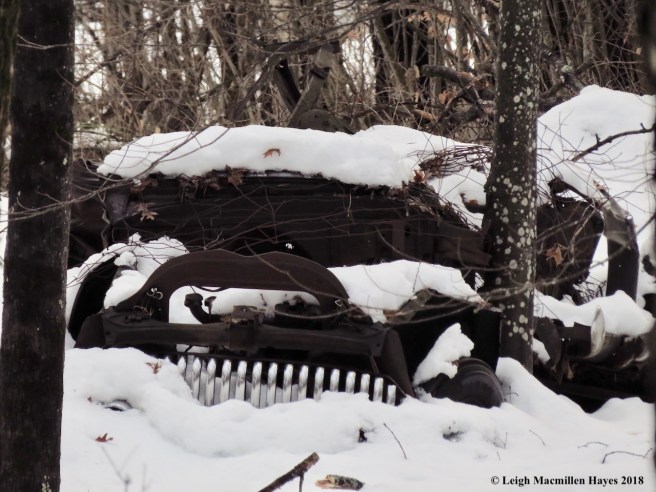
#2: Shiny chrome in the forest

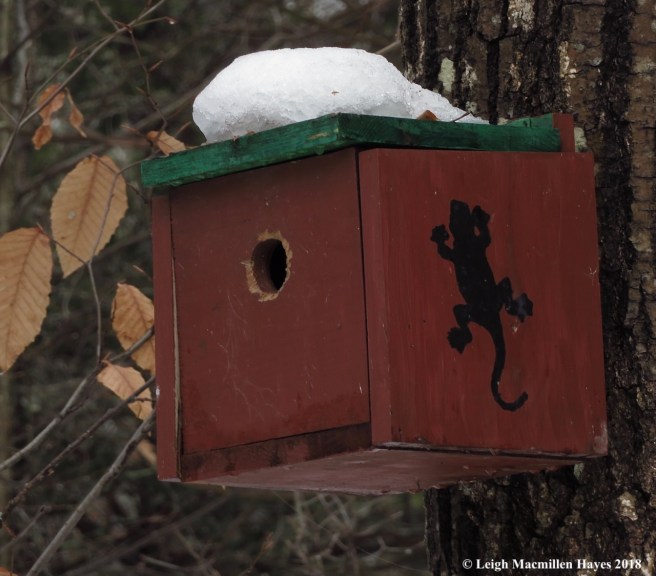
#3: Home for flying salamanders

#4: Wet wetland

#5: Fairy castle with many spires and towers

And finally, #6: Snowshoe snowflake! 

The numbers: 

4 trees: √

4 selfies: √

Photo to represent our team: √

Scavenger hunt for others: √

Total time to complete race: 5 hours

We finished this leg of the Amazing Race–Our Style by 3:30pm, uploaded the selfies, sent them to Maine Christmas Tree Hunt, and found out that we took first place today! Yippee. (We were sad to learn that Team Purple made some wrong turns and got delayed.)

One more leg to go in January. Who will be the winners of the Amazing Race–Our Style? Stay tuned. 

Stepping Out For Others

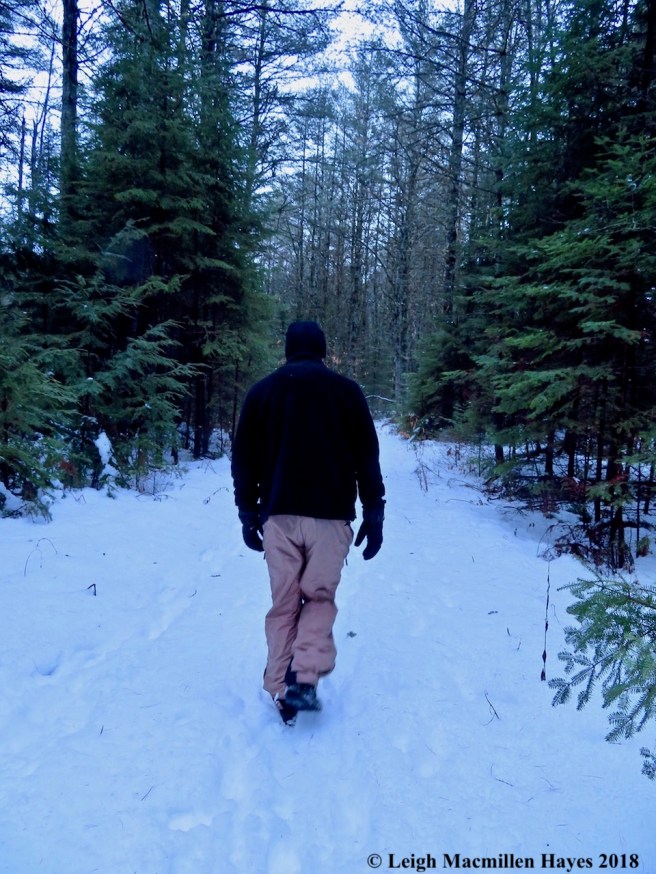
With the most recent snowstorm now history, I strapped on my snowshoes this morning with a sense of eager anticipation about the possibilities. And then it hit me like the snow plops that fell from the trees and landed on my head or slid down my neck: I could do this while others could not and it was for them that I needed to focus. 

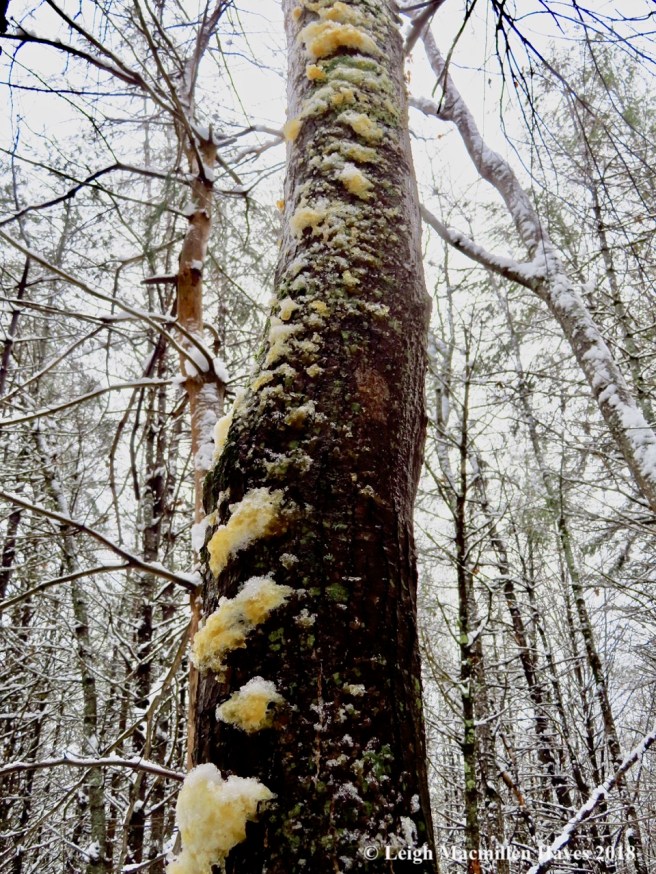
I hadn’t gone far when my first moment of wonder stood before me. Actually, just prior, I’d been looking at some pileated woodpecker works–ever on the search for the bird’s scat, and in the process had noticed other bird scat soiling the snow. But . . . what was all the amber color? 

Had snow collected on mushrooms that decorated the bark? If so, why hadn’t I seen them yesterday or the day before? 

Upon a closer look, I realized it was sap. But why the big clumps? And why so much on a dead snag? 

I poked it with my finger and found it to be of snow consistency. And so . . . the mystery remained. But it was certainly worth a wonder and I knew that those I was intentionally walking for would appreciate the sight. And yes, I did see plenty of other examples of dripping sap at the base of trees, but nothing like this. As usual, if you know what was going on, please enlighten me.

My next moment of wonder was one that always gives me pause–and again I knew that my friends would feel the same. A miniature evergreen world momentarily encapsulated in a droplet of melting snow. 

Everywhere, the meltdown offered a variety of shapes and designs, each worthy of reverence . . . and a photograph, of course. 

One of my favorites was plastered to a tree in such a way that it looked like it was flat against the bark until further study revealed otherwise. As it melted before my eyes, its ever changing formation resembled a series of little flowers scattered here and there. Just maybe you have to see that through my eyes. 

And then I stumbled upon another mystery–a web of sorts like Charlotte might have woven? I studied the shrub and found numerous examples of a similar pattern, but no arachnids in sight. Besides, the silky lines seemed too thick. But, what could it be? It took me a while as I studied the area and then I remembered. Before the snowstorm, I’d taken some photographs of the winter structure of a thistle. The storm had knocked down the fruiting form, but I think my gaze was upon the filaments that had served as parachutes for the thistle’s seeds. 

My journey into the winter wonderland continued, though not all the trees along the way were fortunate to withstand the weight of the snow that was quickly melting. It sounded like a rain storm as I walked under the arched branches. 

At the the other end of the snow tunnel, I emerged into a field with its own offerings. Typically, I pass by, but today I was inspired by those who virtually walked with me to explore. And I don’t think they’ll be  disappointed by the findings. First there was the Goldenrod Ball Gall. The round gall occurred in the middle of a stem, the top of which had broken off. In the spring, the Goldenrod gall fly laid her eggs on the stem. Hatched larvae chewed their way into the stem and the gall started to develop. And from the looks of the hole on the side, it appeared the creator had chewed its way out and flown off. 

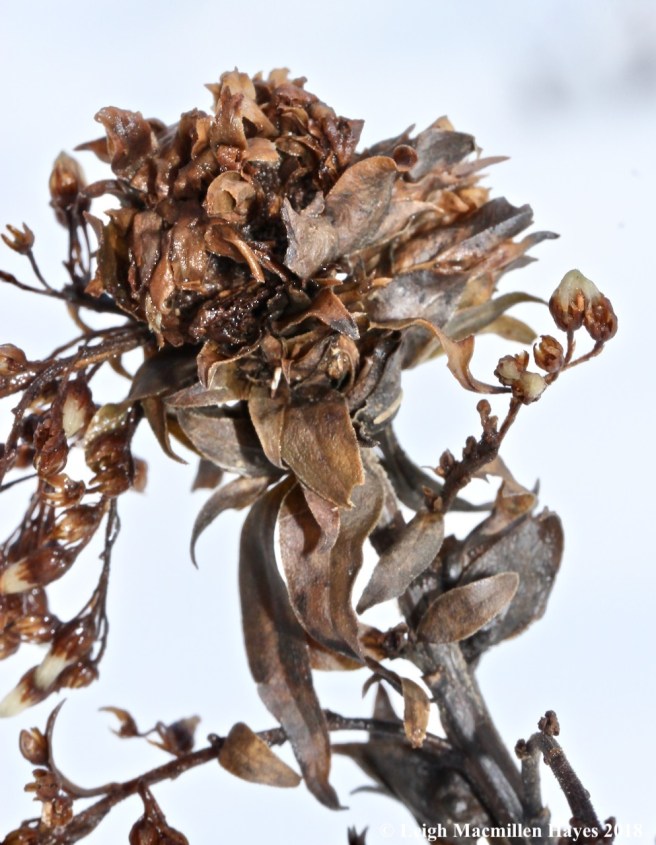
Also in the field, a Rose Bedeguar Gall, aka Robin’s Pincushion Gall on Meadowsweet, which happens to be a member of the rose family. Burrowing in to the leaves and stem of the plant was a two-fold offering for the fly larvae it hosted, for the insect benefited from the nutrients while it was simultaneously protected from predators. 

There were also numerous examples of a structure that might baffle the onlooker. Beaded formations of the fertile stalk from a Sensitive Fern poked up through the snow. Typically, the beads or capsules remain intact with their brown dust-like spores waiting inside for the structure to break open during the rains of early spring. 

I moved on from the field and eventually reached a wetland that I couldn’t cross. But, I could stand and listen and so I did. All around me the forest orchestra performed its Plop, Plop, Swish, Plop, Splash symphony. 

 At first, it sounded and looked like I was surrounded by a million wild animals, but really . . . all the sound and sights were a result of snow falling, either gently with a whisper of the wind or harshly with a thud and splash. 

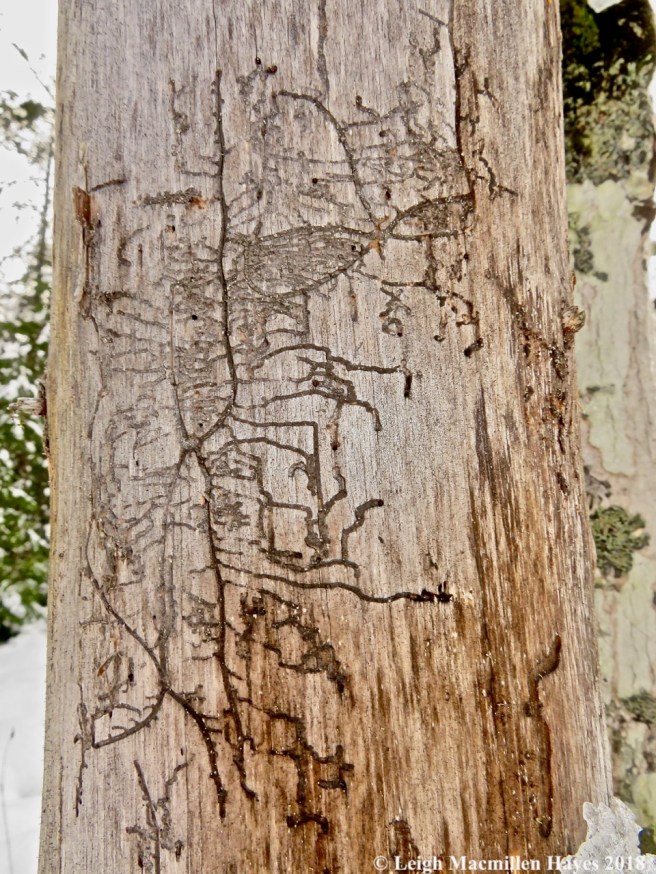
As I stood there looking for the million wild mammals, my eyes focused on the works of something much smaller. Insect egg tunnels on a dead snag’s trunk read like a story on paper. 

The longer tunnels were bored by a female Bark Beetle. From the sides of her tunnels, larval mines radiated outward. The overall design could have been an abstract drawing. 

At last  I started for home, thankful that I was retracing my steps for often new sights are revealed when one does that. And so, I believe it was a crust fungus and perhaps it was an oak curtain crust fungus, but let it remain that I discovered a fungus I don’t think I’ve seen before, with a warty, rust-colored underside and dark upperside. Suffice it to say, it was a mushroom of some sort. 

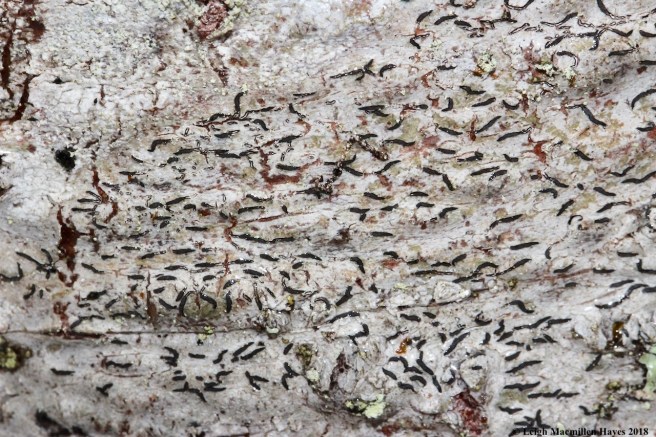
Along the way was a script lichen, which looked to me like someone had doodled. Commas and apostrophes decorated that page. 

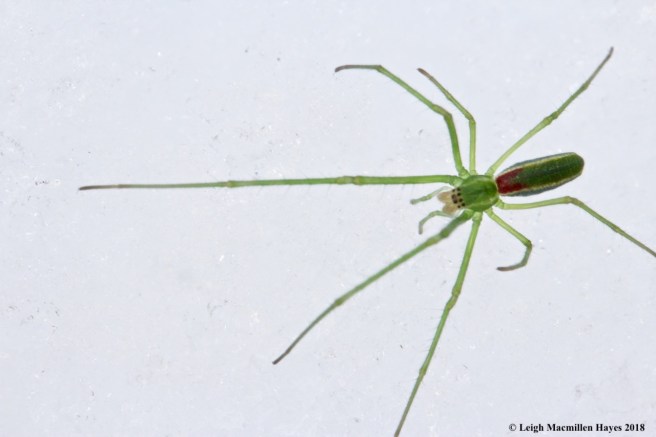
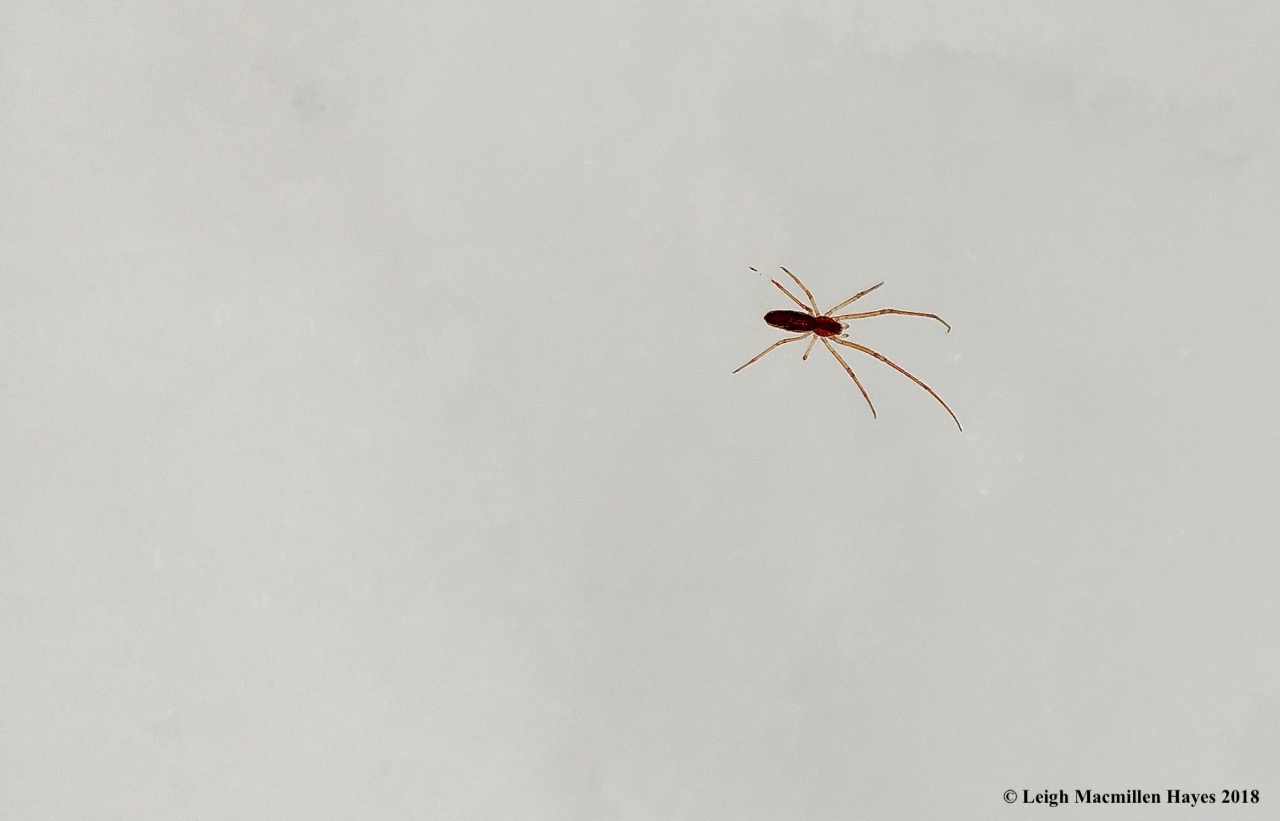
And then, and then, Tetragnatha viridis, a green long-jawed orb weaver. I actually saw two of them. Typically, the translucent green color helps them camouflage amongst pine needles, their usual habitat, but they can frequently be seen on snow, especially if the temperature is in the 25˚-35˚ range as it was this morning. 

The orb weaver’s characteristics: eight eyes in two parallel sets of four; long chelicerae (jaws); enlarged pedipalps; long legs with spines; and that color–oh my! 

It was for eight parallel eyes that I walked today, the eight representing Jinny Mae, Dick, Kate, and Carol. 

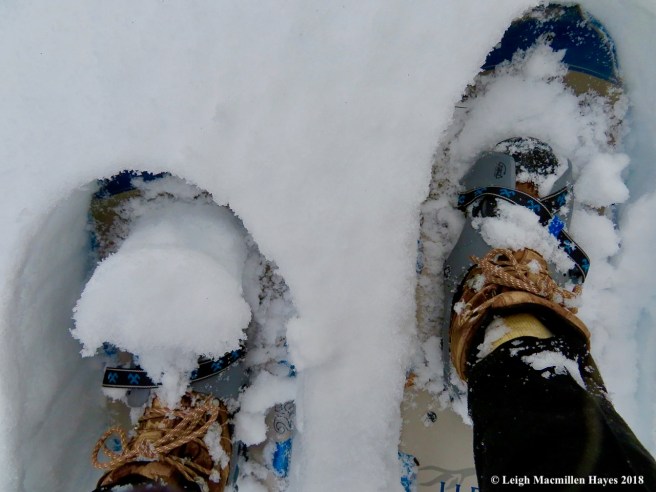
Where trees didn’t cover the trail the snow was about fourteen inches deep and as you can see I chose the wrong boots and forgot my gators. But that was okay because I knew that I would eventually wander home and change my sopping wet socks. What mattered more was the fact that I was honored to step out for others when they couldn’t necessarily do the same. Here’s to the four of you–thanks for letting me be your eyes. 

Mondate Preserved

The other day a sign caught our attention as we drove to Overset Mountain and we realized we had new trails to explore. But, we, or rather I, drove by  so fast that we didn’t know which local organization owned the property. 

If my guy read these posts he would chuckle or guffaw at my comment about driving too fast for he is of a different opinion. But suffice it to say that we didn’t read the name of the land trust on the sign and so this morning I contacted Loon Echo Land Trust because in my online research, their name was associated with the property. Maggie quickly let me know that I needed to contact Lee at Western Foothills Land Trust and violà. 

Both have been involved in the Crooked River Forests Project for as is stated on the LELT website: The Crooked River has been identified as a priority for conservation as it is the largest tributary to Sebago Lake, with 38% of the inflow, and it offers local recreational opportunities and is situated above high quality sand and gravel aquifers. The river has been identified in the state’s Natural Resources Protection Act as an Outstanding River Segment with AA status; free flowing with the best water quality. This trout fishery is home to one of only four native populations of landlocked salmon in the state and is known to host one species of anadromous fish (American eel) and is thought to historically host Atlantic salmon and sea lamprey.

As I pulled up to the sign today, however, the ownership was obvious. The name, Two Bridges, was not so. The area has long been named such, and all we could imagine is that twin bridges once spanned the Crooked River in the area where we stood. 

Since the parking lot was under construction, for the property won’t officially open for another two weeks, we parked on Plains Road rather than Route 117 in Otisfield. 

At the start, the trail was wide and straight, and we both hoped for a change. Oh, don’t get me wrong. It was lovely and we had fun naming all the evergreens, including white and red pine, hemlock, balsam fir and red spruce, for those were the most abundant species, with a few young beech, red maples and red oaks thrown into the mix. But . . . we wanted diversity. And we wanted to walk beside the river. 

Soon, thankfully, we came to a Y in the road and a new sign post, or so we imagined it to be. We chose the trail to the right since it was closer to the water. 

And within minutes our reward awaited. That being said, we’d followed a spur to the riverbank and since there were no telltale pieces of flagging we suspected it won’t be marked as a public trail. 

Further along, we again spent time by the river, and noted its sculptures made of decorative roots . . . 

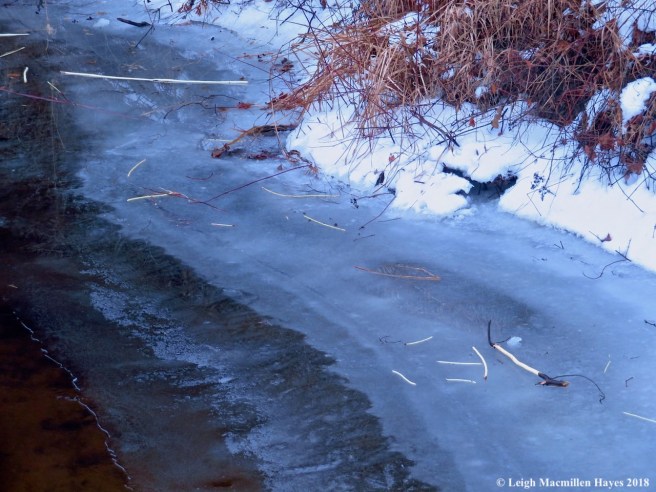
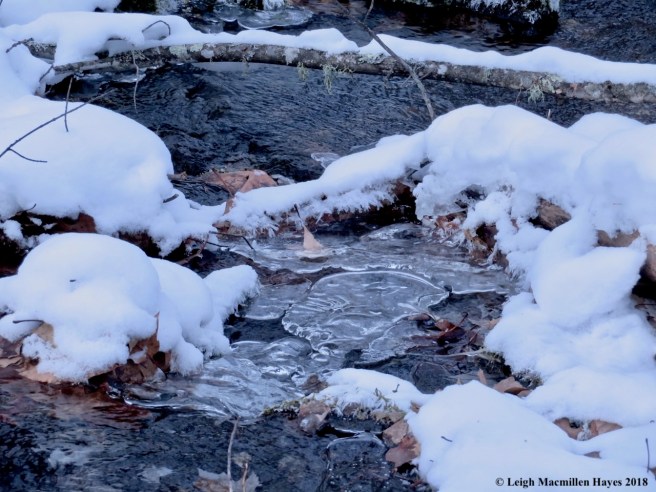
and splashes of ice. 

And in the mix–a rare sight indeed: an ice disc, this one being about three or four feet in diameter and spinning in an eddy. 

Eventually, the trail took us across a bridge constructed by the land trust in October 2017 that will provide the landlocked salmon and brook trout with another mile of spawning habitat.

And that’s not all. We saw plenty of evidence that mammals inhabit the space from deer . . . 

to fox . . .

to bobcat! 

There were several intersections, and we kept turning toward the river, which took us along trails more to our liking as they narrowed and twisted and turned through the forest. 

At one point, a tree arched over the trail and its purple crust fungi added a different color to the display. I think it was Phanerochaete crassa. 

My guy pointed out the hugging cousins–a white pine and hemlock and I was reminded of my finds on Black Friday. “I knew you’d like it,” he commented. He knows me well. 

Because we were in an evergreen forest, we noticed several examples of witches’ brooms. No, they were not the variety that one might have expected on Halloween night. Instead, dense masses of shoots rose from a single point on an otherwise normal branch and created a nest-like structure. Their cause: fungi, viruses, bacteria, mites or aphids. 

Speaking of the latter, aphids created the cone galls we knew as witch’s hats on witch hazels that grew near the river. The little structures provided both food and shelter for the critters that developed within. 

We also spied lungwort on a few hardwoods, its leafy structure springtime green as it photosynthesized in response to the flurries that floated earthward during the morning hours. 

And then the forest’s canvas began to draw our attention, from snowcapped artist conk (Ganoderma applanatum) fungi . . . 

to icy reflections, . . . 

man-made sculptures, . . .

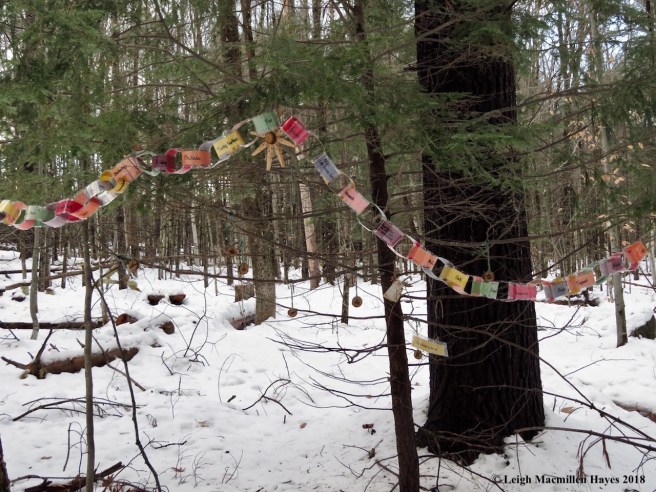
and dazzling trail markers. We spied another made of pipe cleaners and a soggy feather and wondered.

We didn’t walk the entire trail system, but left knowing that we’d return for further explorations. 

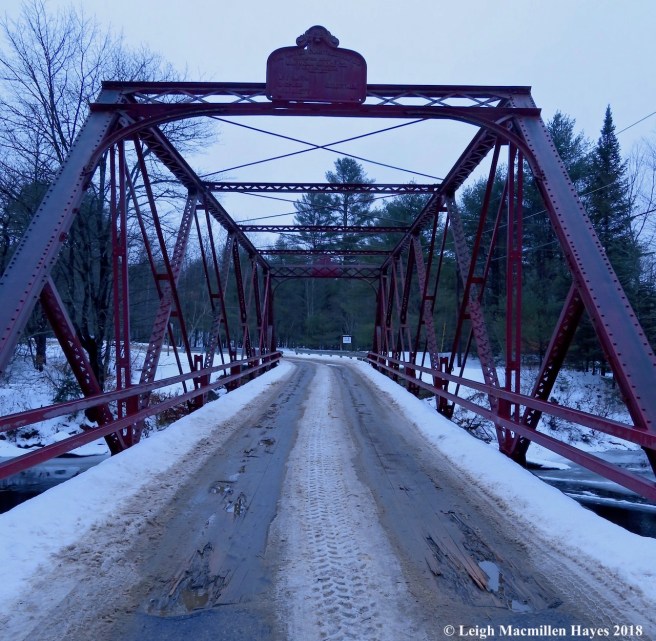
Because we were in the neighborhood and my guy had never seen it, I drove along Plains Road to the Ryefield Bridge. Listed on the National Register of Historical Places, the structure was built in 1912 as a double-intersection Warren truss bridge. 

The bridge spans the Crooked River between Harrison and Otisfield and is still used today. In fact, we walked and drove across it. 

One of our favorite parts was the sign at the top, which not only stated the construction company, but also honored the selectmen of the day. 

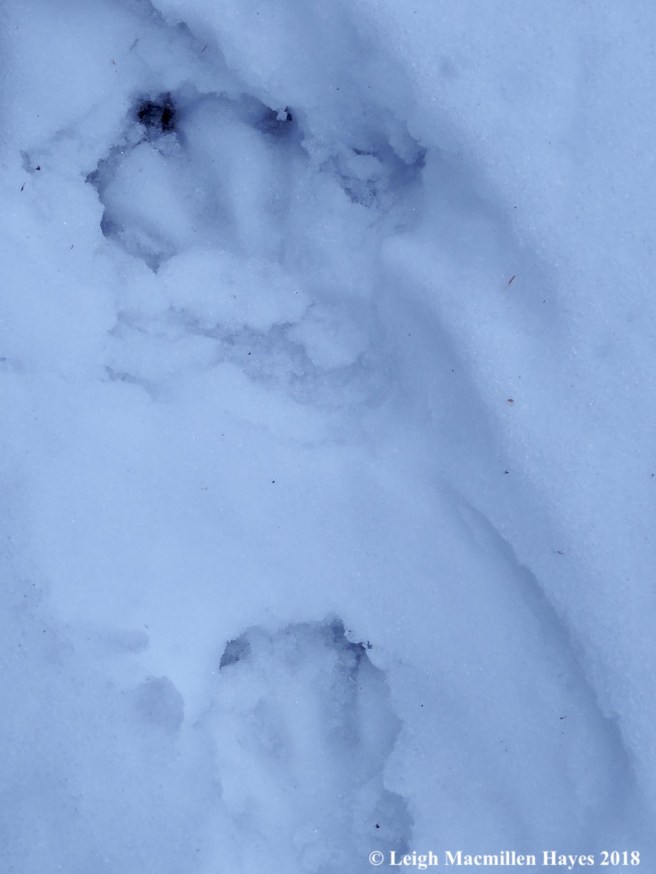
My excitement about the bridge was equally matched by some prints I spotted when I stepped into the snow to take a photo from the river bank. Beaver prints! Like the ice disc in the river, beaver prints have always been a rare find. Often, I can see their pathways, but not decipher their tracks for their tails swish out the features. 

But today, not only the tracks and a trail down to the water, but beaver chews, their snack sticks, left behind on the ice. 

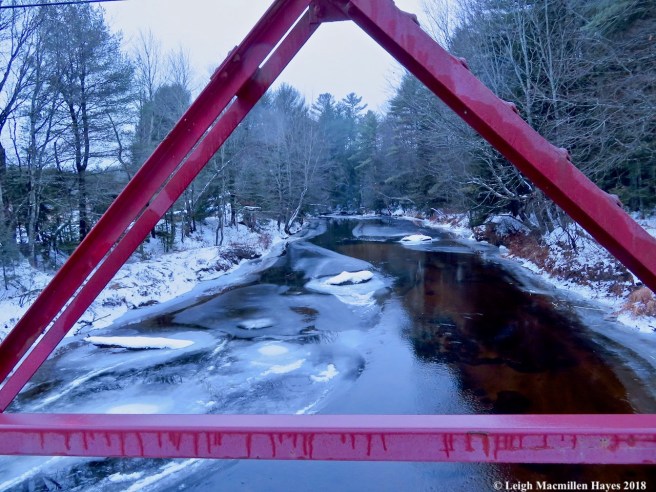
We took one final look before heading home–Crooked River framed by the bridge. And we both gave thanks on this Mondate for a land and a bridge preserved. 

Black Friday Lit Up, Naturally

With a mantra of “Shop Locally,” I did just that on this Black Friday 2018. Thankfully the time to take advantage of the doorbuster sales wasn’t limited and so it was okay that I didn’t pull into the Flat Hill parking lot until 1pm. 

Turns out, as in any shop today, the aisles were a bit crowded with customers searching for items on clearance and other great deals. 

I paused for a bit in aisle one, where I contemplated the Made-in-Maine artwork and thought about those on my Christmas list. Perhaps a water scene for Marita  because she likes the gurgling sound of a brook. 

For Pam K., I decided on an ice sculpture to add to her winter home. 

And for Pam M., I was sure that an abstract piece would be just right–especially as it echoed the mountain range and transformed into a bird, only sorta/kinda M.C. Escher in style. 

There were others on the list to consider and the decisions became more difficult as the selection increased in aisle two. Mouse, vole, squirrel both red and gray, deer and coyote tracks all were on display and the sign indicated I could buy one and get one free. But which one to buy? And for whom? 

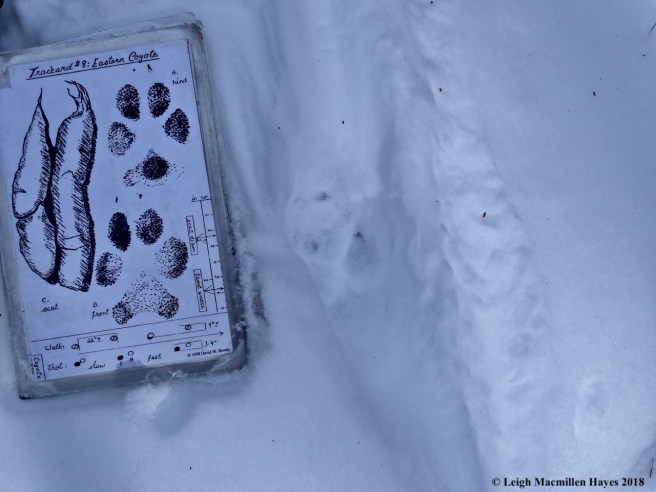
And then just like that, it became clear–the coyote track for Simon because he’d caught on quickly to the squirrel patterns and appreciated that the predator was hungry. 

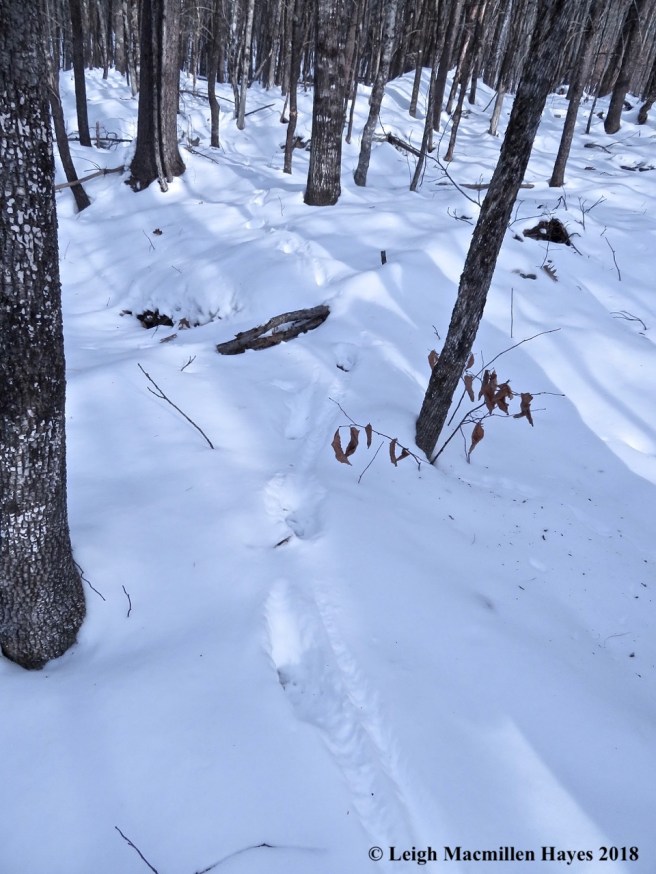
For every one set of tracks, there were fifty others, especially those of the mice and squirrels. But I chose the porcupine trough as my “get one free” when I saw it on the climb up the hill. 

The trough with its pigeon-toed prints and sashaying tail would be perfect for Bob.

Of course, I could have mixed and matched the prints, but thought it best to keep them separate. 

Continuing the dash for more must-have gifts, I spied a mossy maple polypore on a lower shelf and thought immediately of my guy. He doesn’t like to consume mushrooms, but there’s something about the mossy maple that draws his attention. 

And then on an end cap I saw the kissing beech/maple out of the corner of my eye and turned to read the sign: Limited in Quantity. On impulse I purchased it. Maybe I’ll stick it on my guy’s bureau and he can wrap it up for me. I’ve done that before ;-)

There were a few free surprises. Not all freebies are created equal, but I really liked the bronze ornament that would be a nice addition on our Christmas tree. 

At last it was time for a little break at the Flat Hill Cafe. Today, the view offered more bang for my buck as Mount Washington glistened white behind the other mountains. 

Also enjoying the view and the oxymoron of the name Flat Hill were fellow shoppers Bob, Pam K., Marita, Simon and Pam M. I made sure they didn’t see what was in my pack and visa versa. I do so hope they are as excited as I am about the gifts I purchased for them.

When the cafe got crowded, we decided to walk back down the main aisle together toward the check out. And then a few of us remembered we had coupons for the seasonal section. But . . . alas, we were too late. It was the only part of the store that was closed because everything had sold out. The stepping stones were  covered with water and ice to keep us from venturing any farther. We turned around, only a bit disappointed that our shopping adventure was about to come to an end, but understood that being a three-season section we had taken our chances by arriving so late in the day. 

No matter. The view from Perky’s Path thrilled us. All afternoon, we enjoyed the lighting, and especially the sun as it lowered–making this Black Friday light up, naturally. 

I highly encourage you to visit; the doors are open all hours and it’s a great place to shop in style. 

Today’s Black Friday Lit Up, Naturally experience was brought to you by the Greater Lovell Land Trust’s Flat Hill, Heald Pond Road, Lovell. 

Jolly Mondate

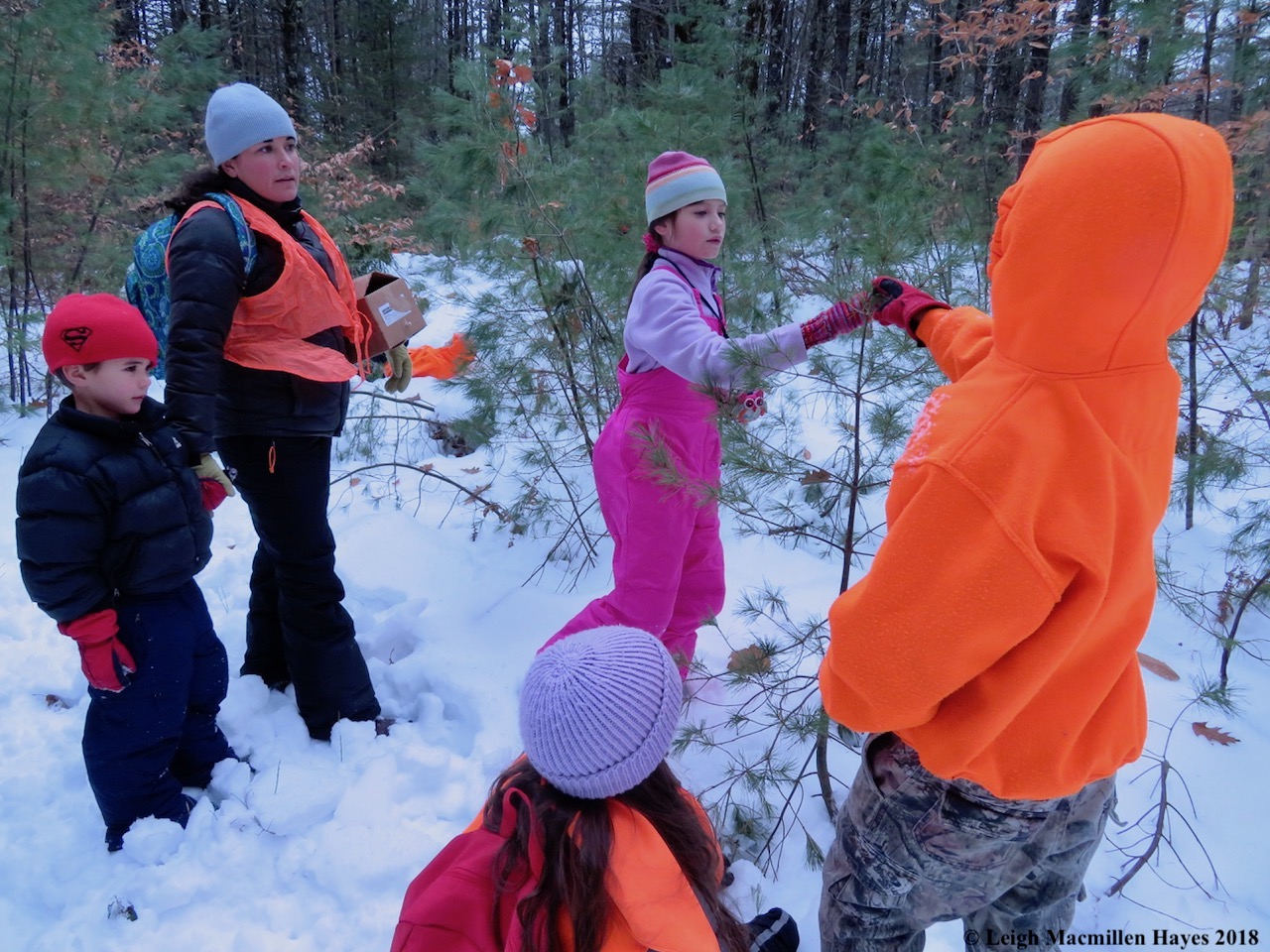
Some Mondates are meant to be shared and this was one of them for I’d made arrangements to join the Fairs, Farms and Fun 4-H Group as they decorated a tree (or two or three) on a Greater Lovell Land Trust property this morning. 

And honestly, my guy was as excited as me to join the adventure for he loves kids.

One of the GLLT’s volunteer docents, Juli, had offered to lead today’s hike since her four children are part of the group. And because she’s a Maine Master Naturalist-in-Training, she made evergreen trees the focus as she explained when we circled up.

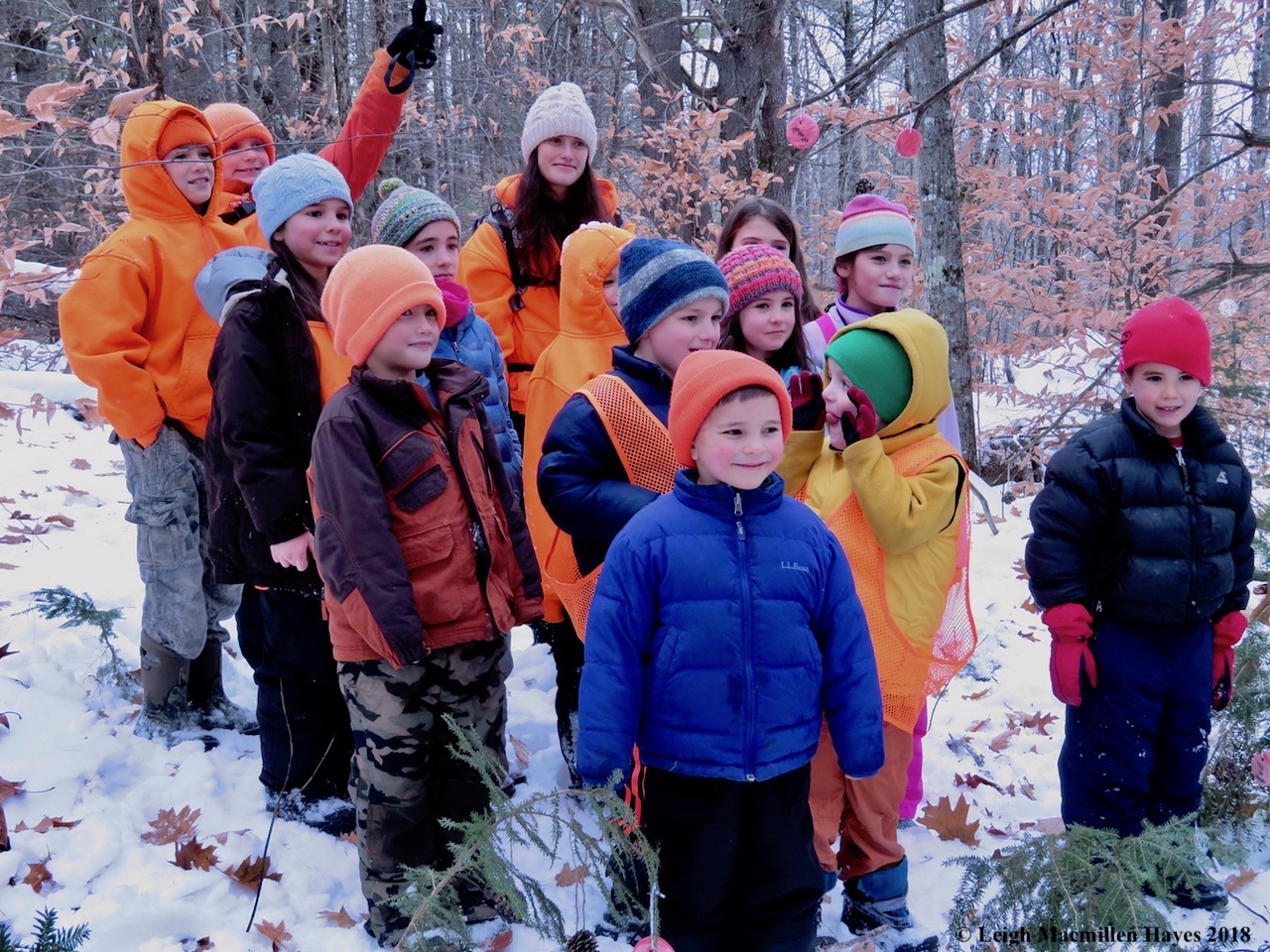
All together there were fifteen kids–fourteen of them walking and one young babe tucked inside her mom’s coat. At least I think there were that many. Every time I counted, the number seemed to change. 

After Juli’s initial explanation, we headed off onto the trail. Though most of us sported blaze orange because it’s hunting season, we made enough noise to announce our arrival to deer and their predators within range and beyond, I’m sure. 

We’d gone only a wee bit, when Juli stopped the group to ask them about evergreens. My guy and I were impressed with their collective knowledge.

But it wasn’t only for the trees that she stopped. She’d spied a decoration already dangling and asked if the kids knew how it happened to be there. 

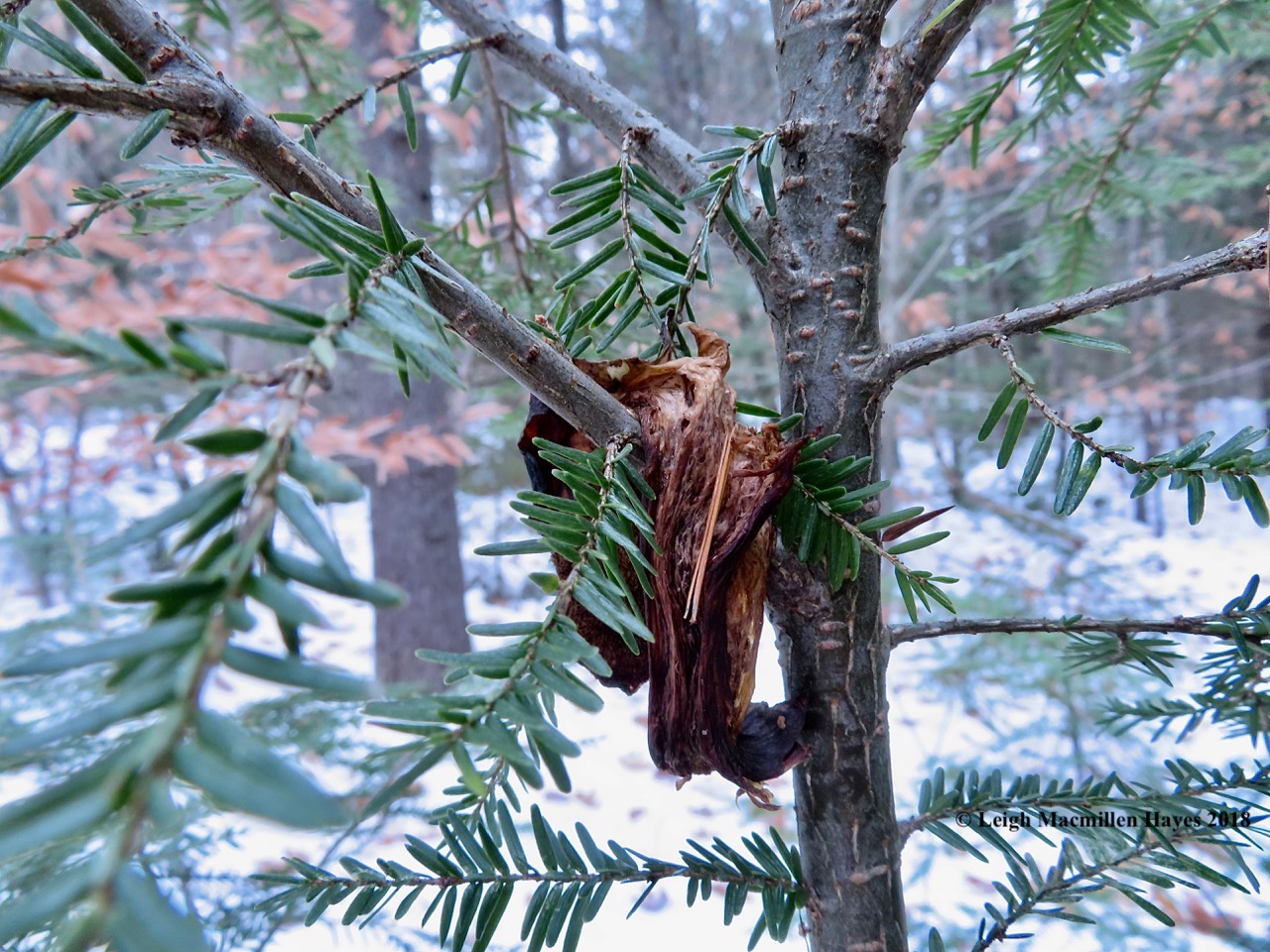
What was it? A mushroom. Did it fall from the sky? Or from a taller tree? No and no. Instead, they figured out that a squirrel had deposited it and Juli explained that red squirrels place mushrooms in trees to dry. Or rather, freeze dry as was the case. 

She hadn’t walked much further when she stopped again. And again asked some questions as she showed off the five needles in a white pine bundle. 

Five needles in each bundle makes it easy to remember as there are five letters in W-H-I-T-E, the color of Maine’s State Tree: Eastern White Pine. 

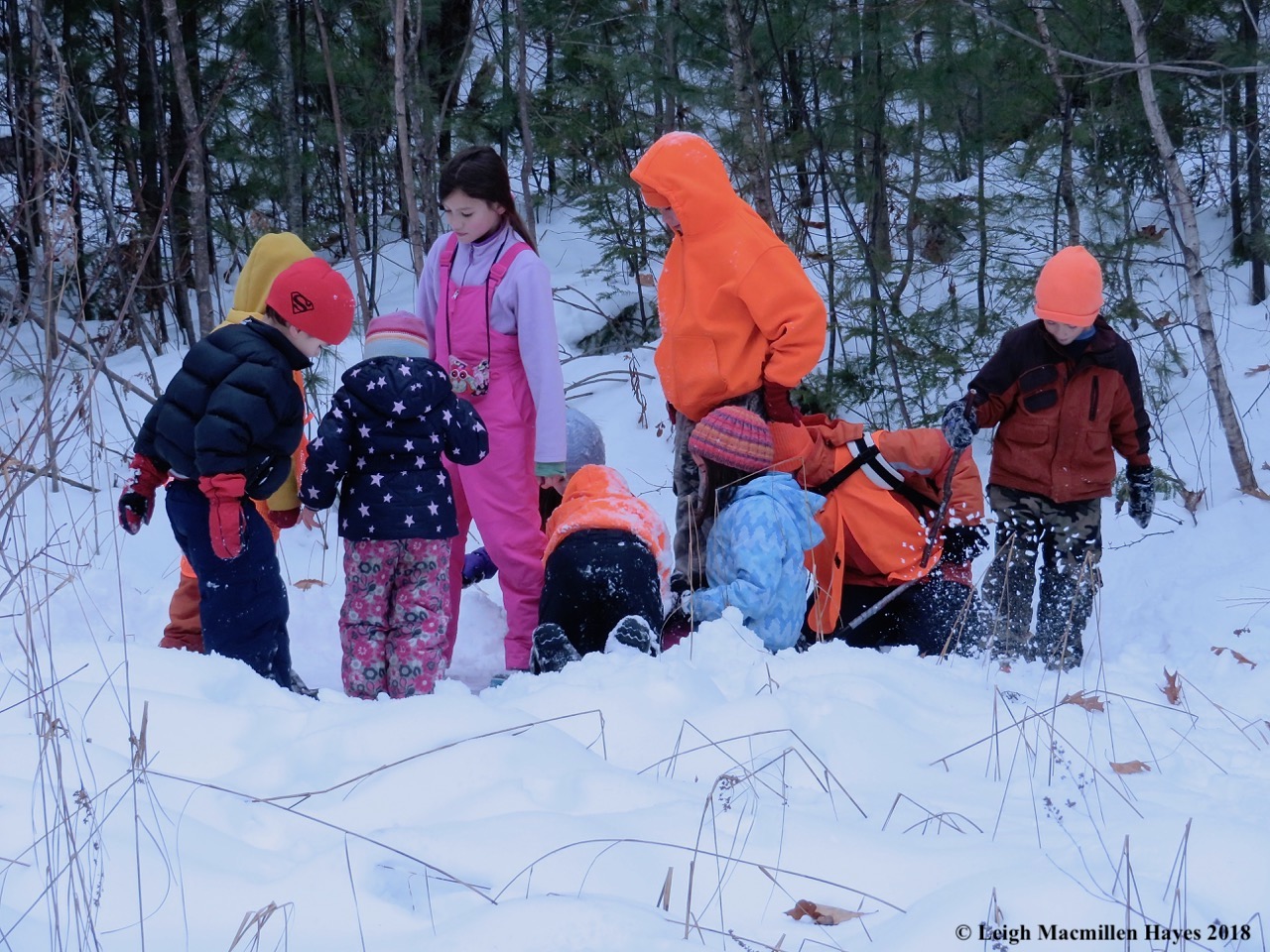
It wasn’t all a lesson for the name of this 4-H group includes the word “Fun.” And so they climbed atop and under an erratic boulder and added more life on a rock than that one had seen in a long time. 

A little further on a bit of an incline invited their exploration and what to their wondering eyes should they discover but a long abandoned cellar hole with trees growing in it. For a few minutes that became their playground. 

It took us a while to move along because the kids kept finding cool things to admire, including a variety of mammal tracks and . . . even a dead spider. 

What do you see? Lots of eyes. 

And you? Fangs. 

And you? Hairy legs. 

After that discovery, we had to run to catch up with the rest of the group because they were on their way to the scenic overlook. But one of the boys had borrowed a GLLT Nature Backpack from the Charlotte Hobbs Memorial Library, which I was thrilled to see, and we used the lucite insect box with a magnifier that was stored in the pack so that all the kids could look at the spider up close if they so wished. 

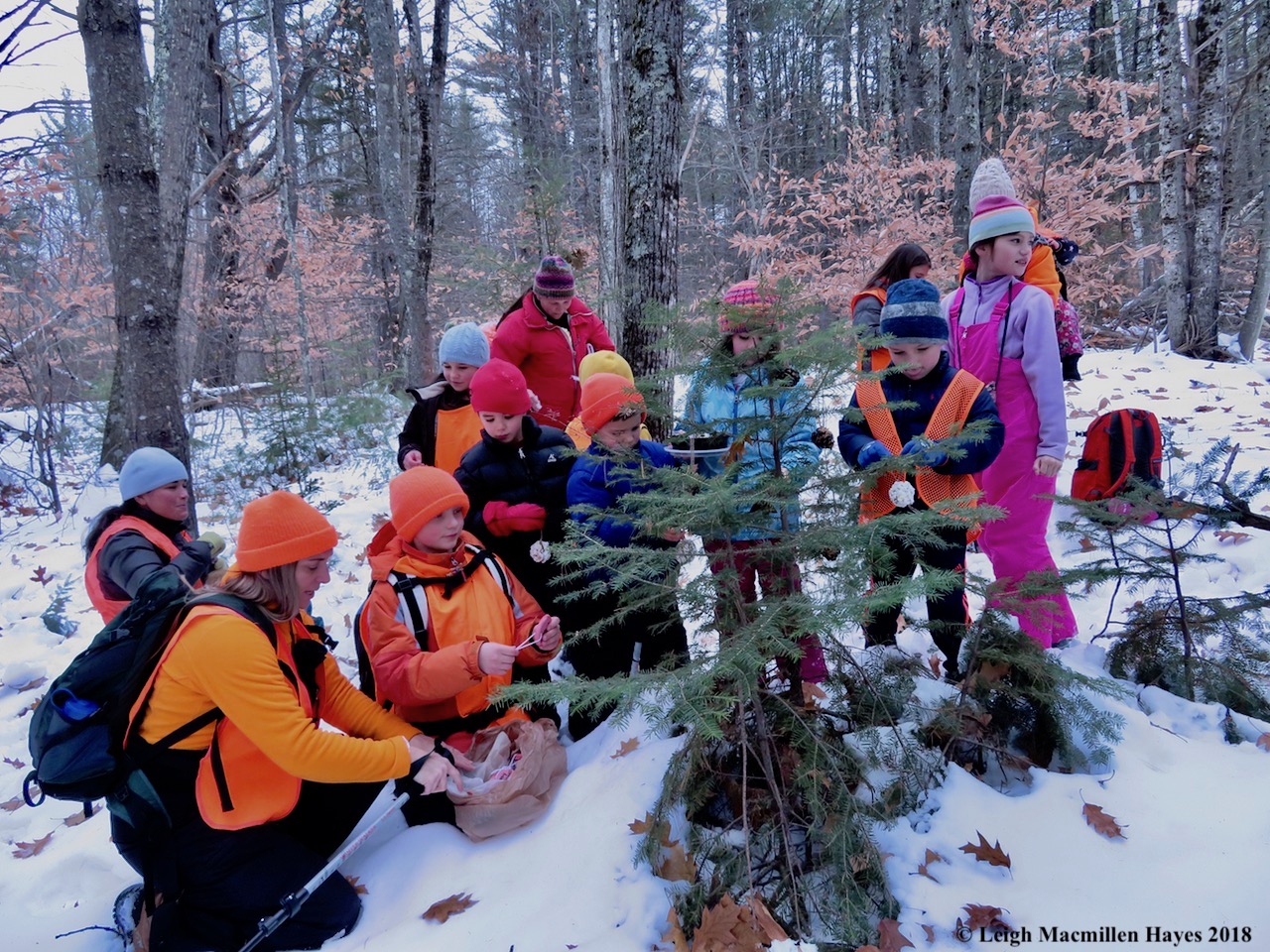
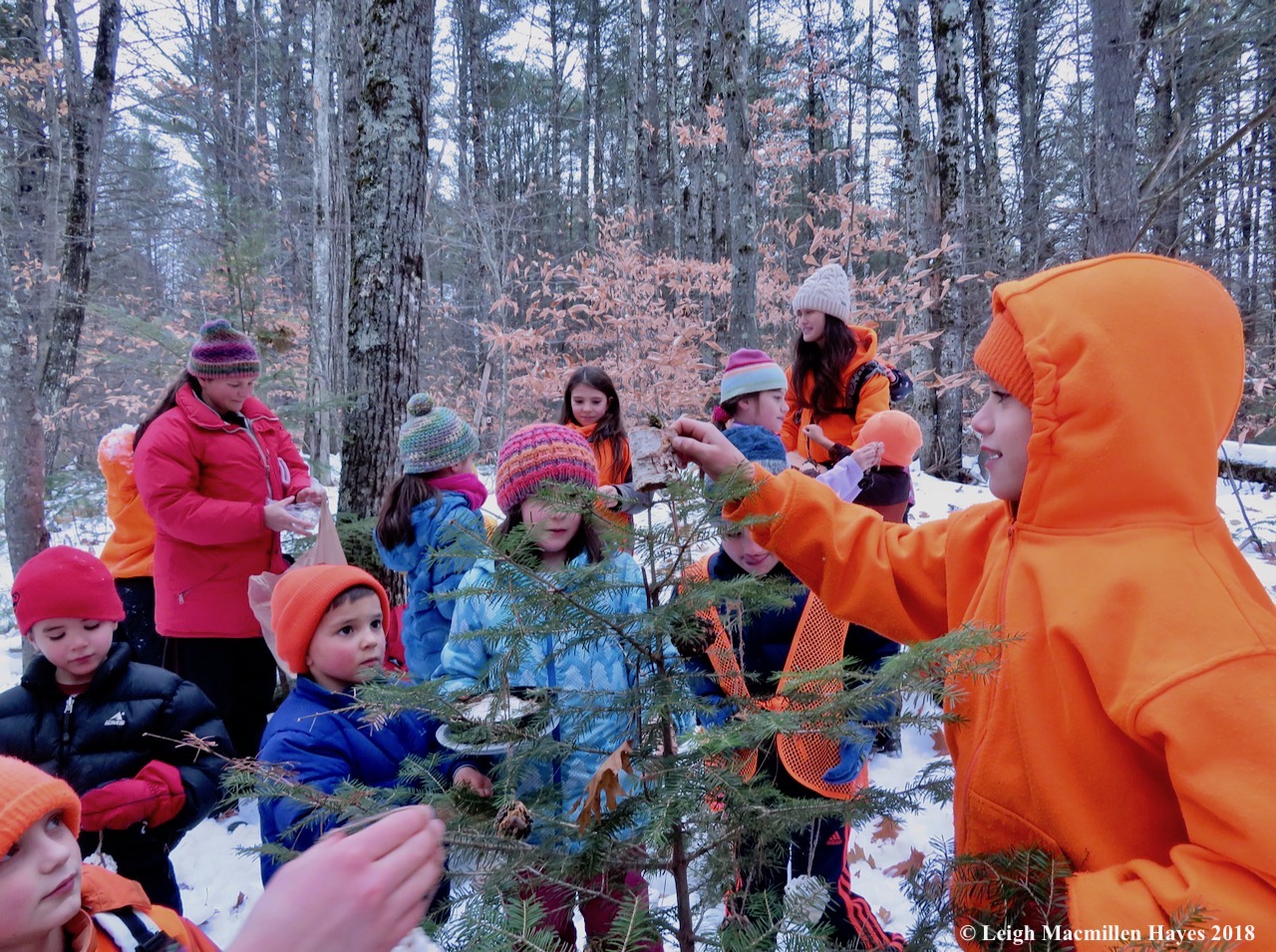
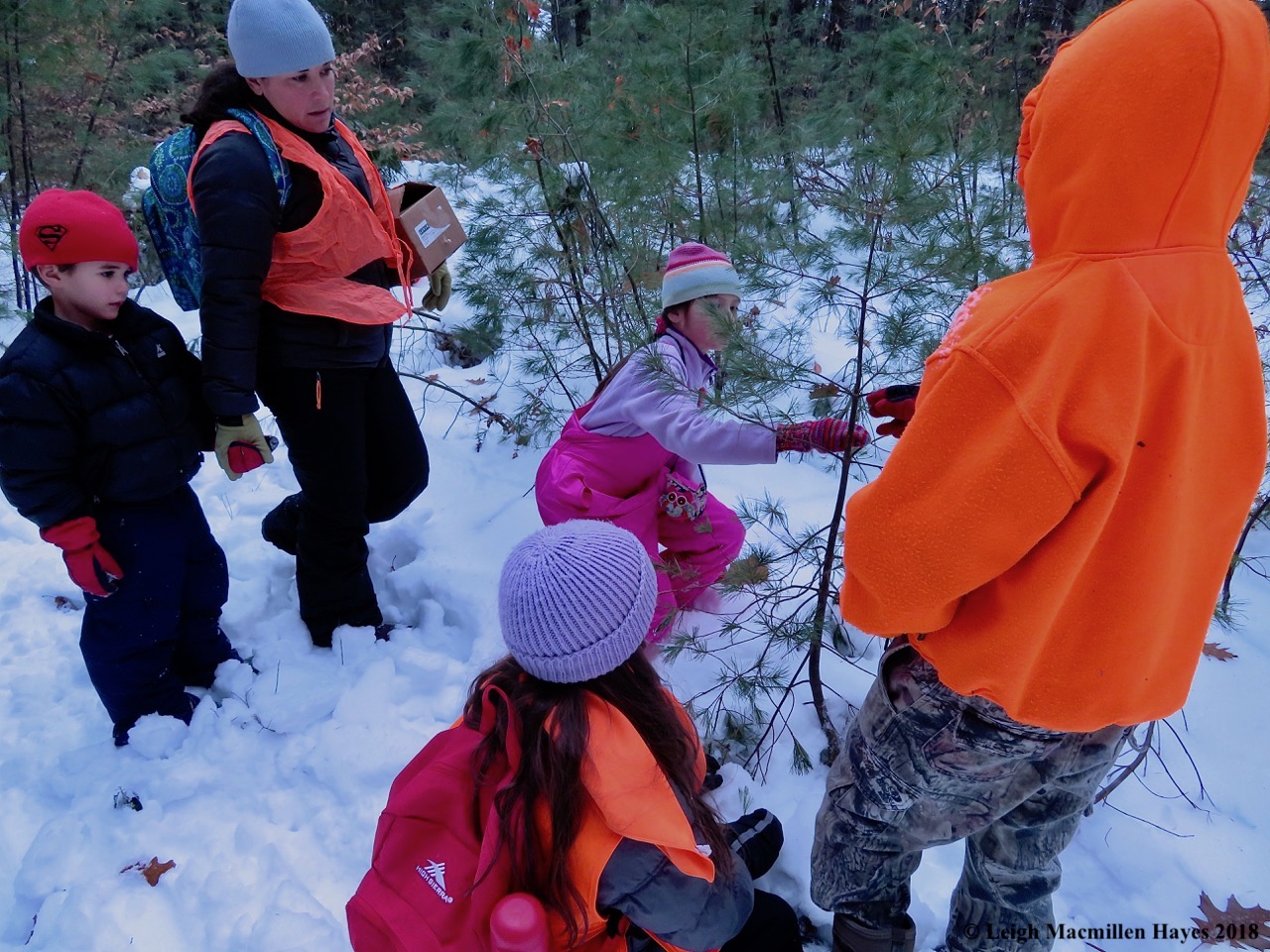
And then it was time to decorate a tree. But first, Juli had the kids identify three types of evergreens in the same vicinity: spruce, hemlock and balsam fir. Their decorating began with the balsam fir. 

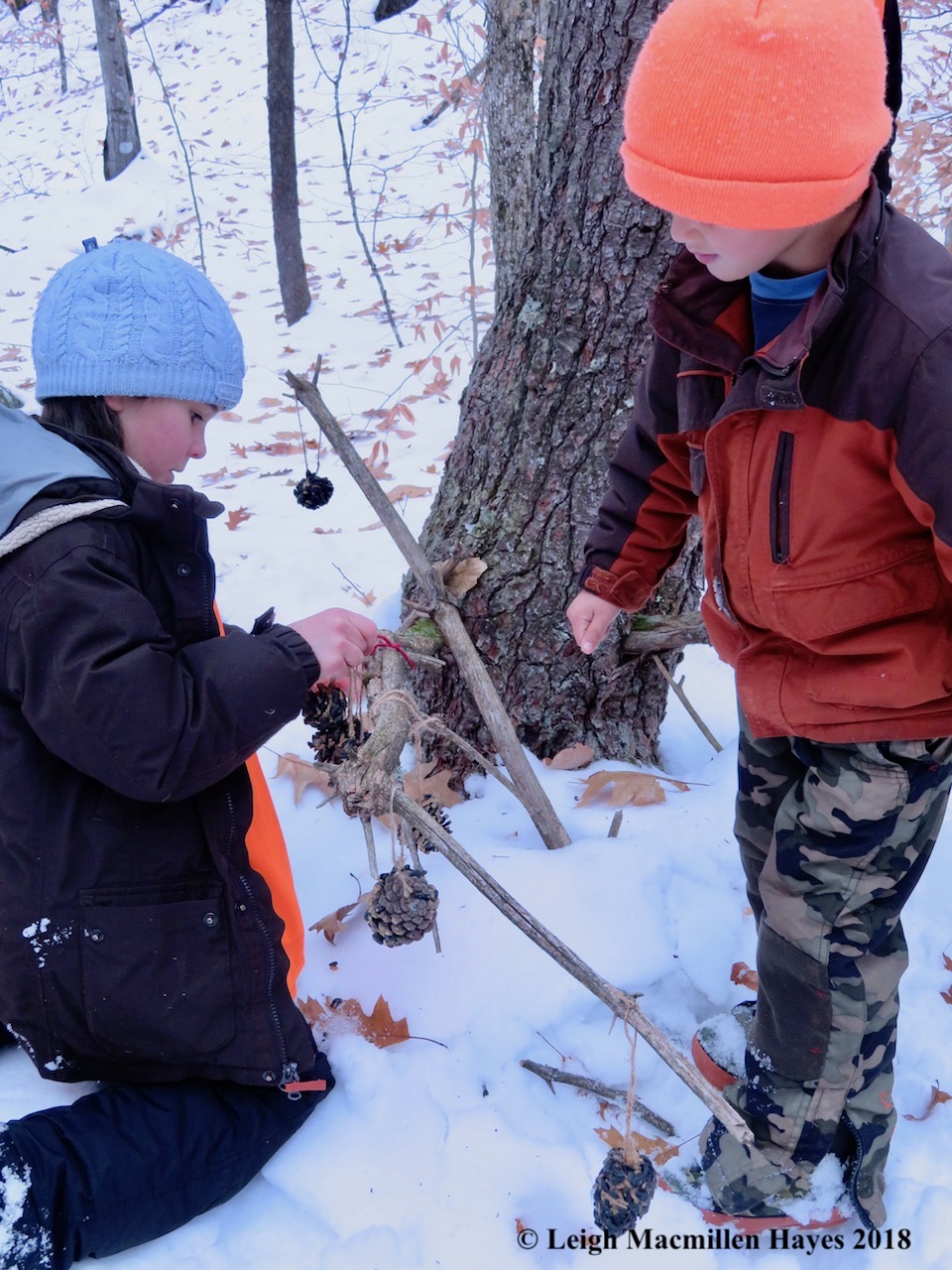
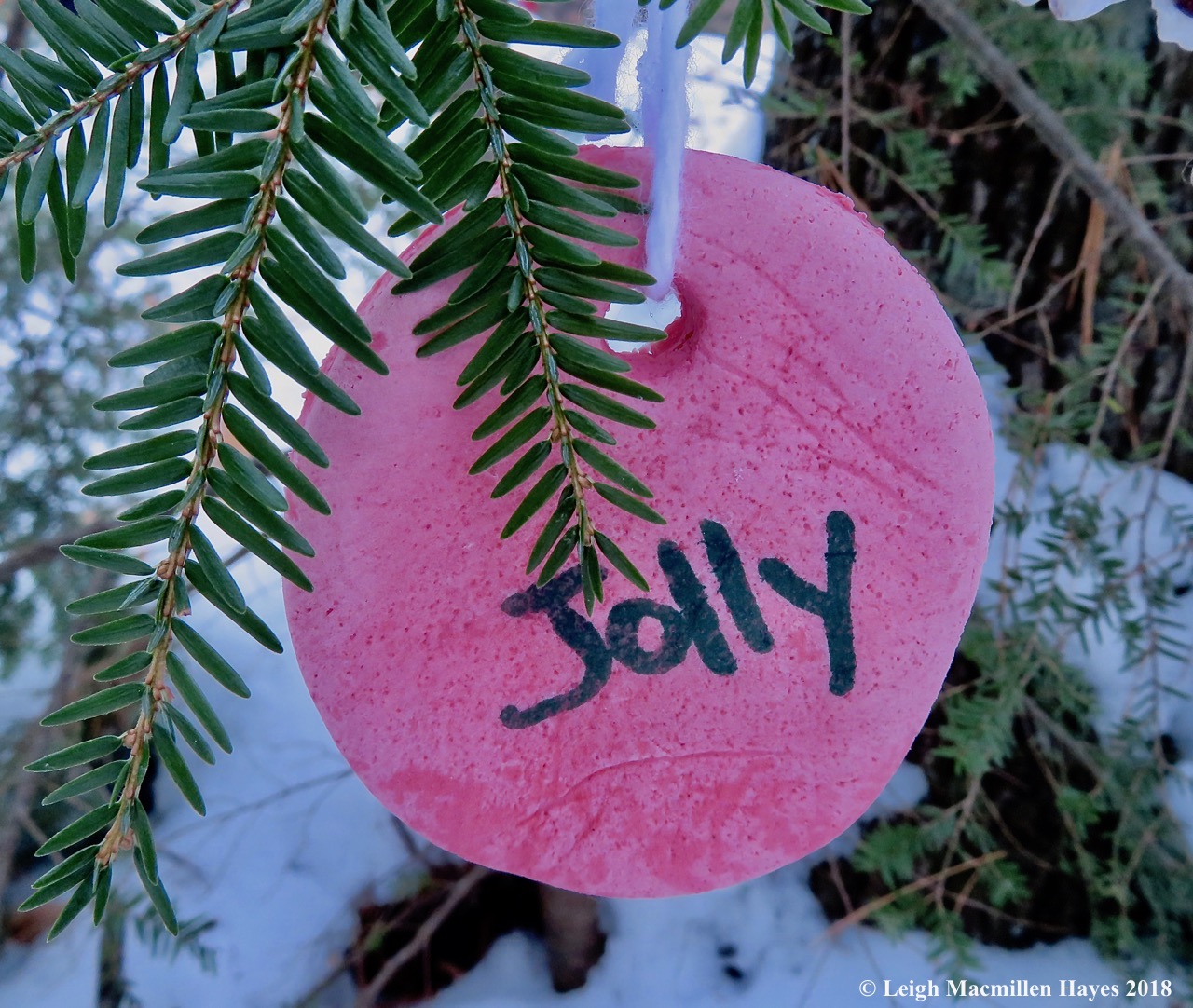
One by one, they attached homemade, biodegradable ornaments. 

And added a tree topper in the form of a birch bark “sleeve.”

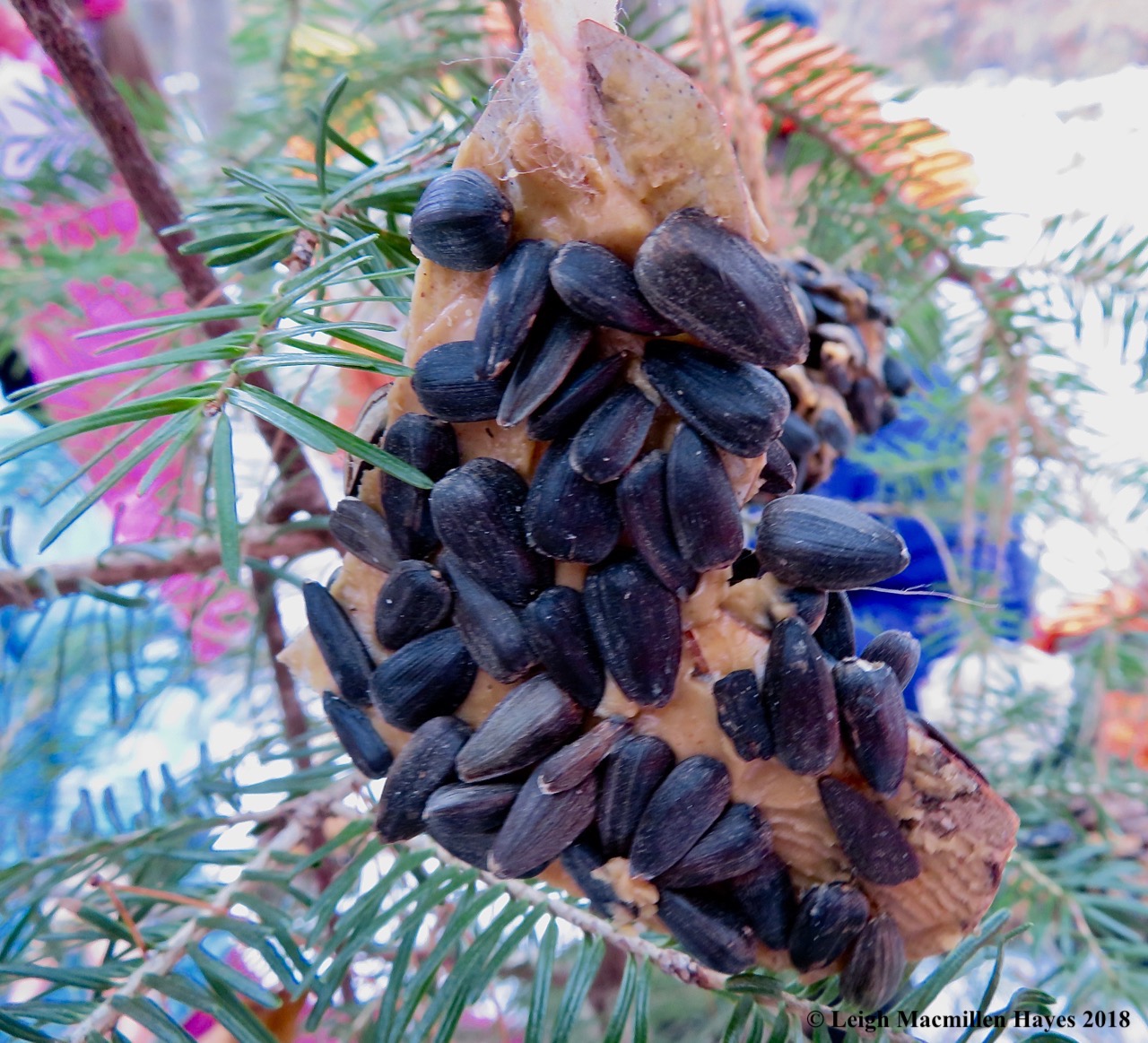
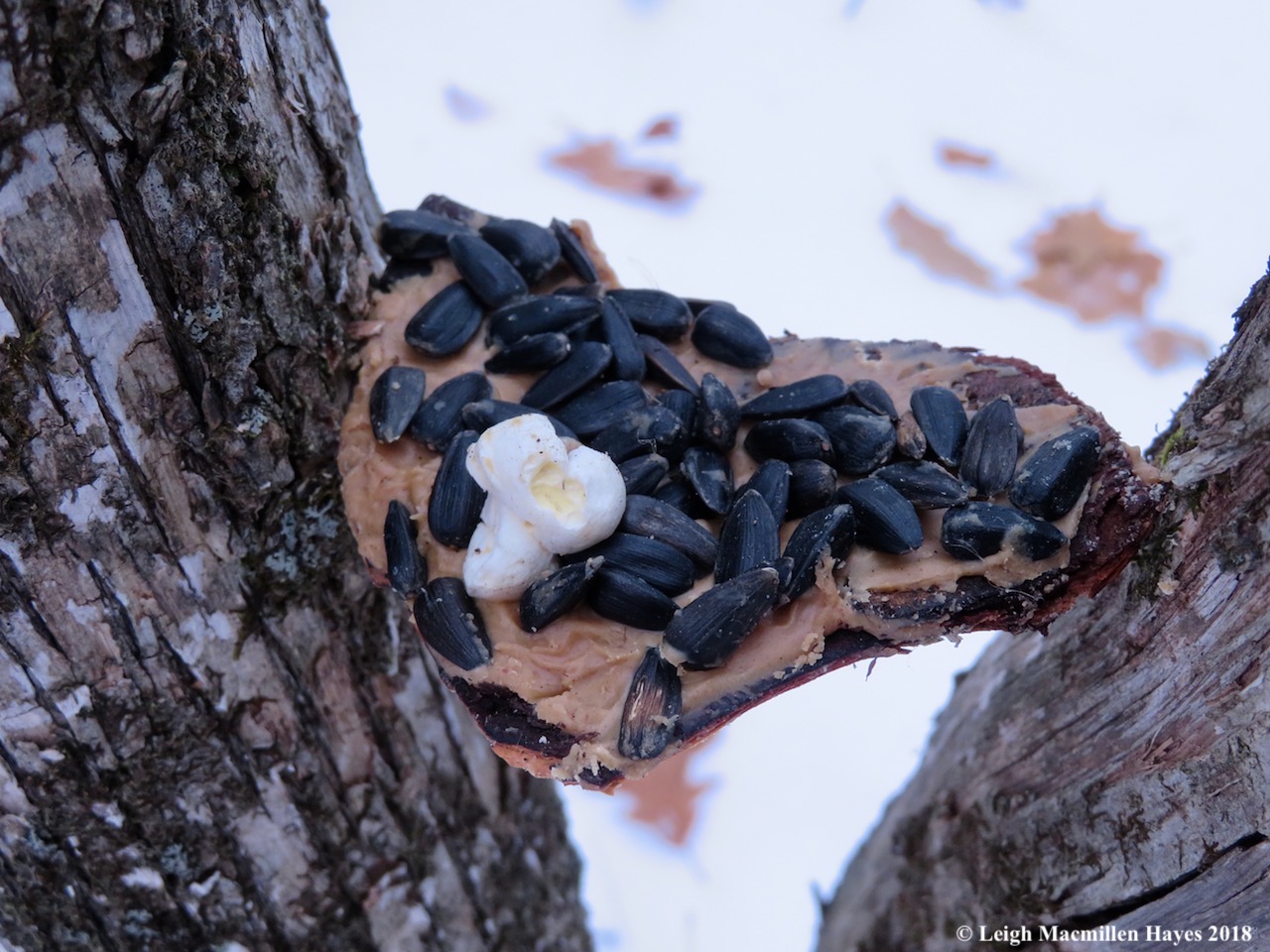
Some were hearts cut from birch bark . . . 

and coated with peanut butter and sunflower seeds. 

It took great concentration. 

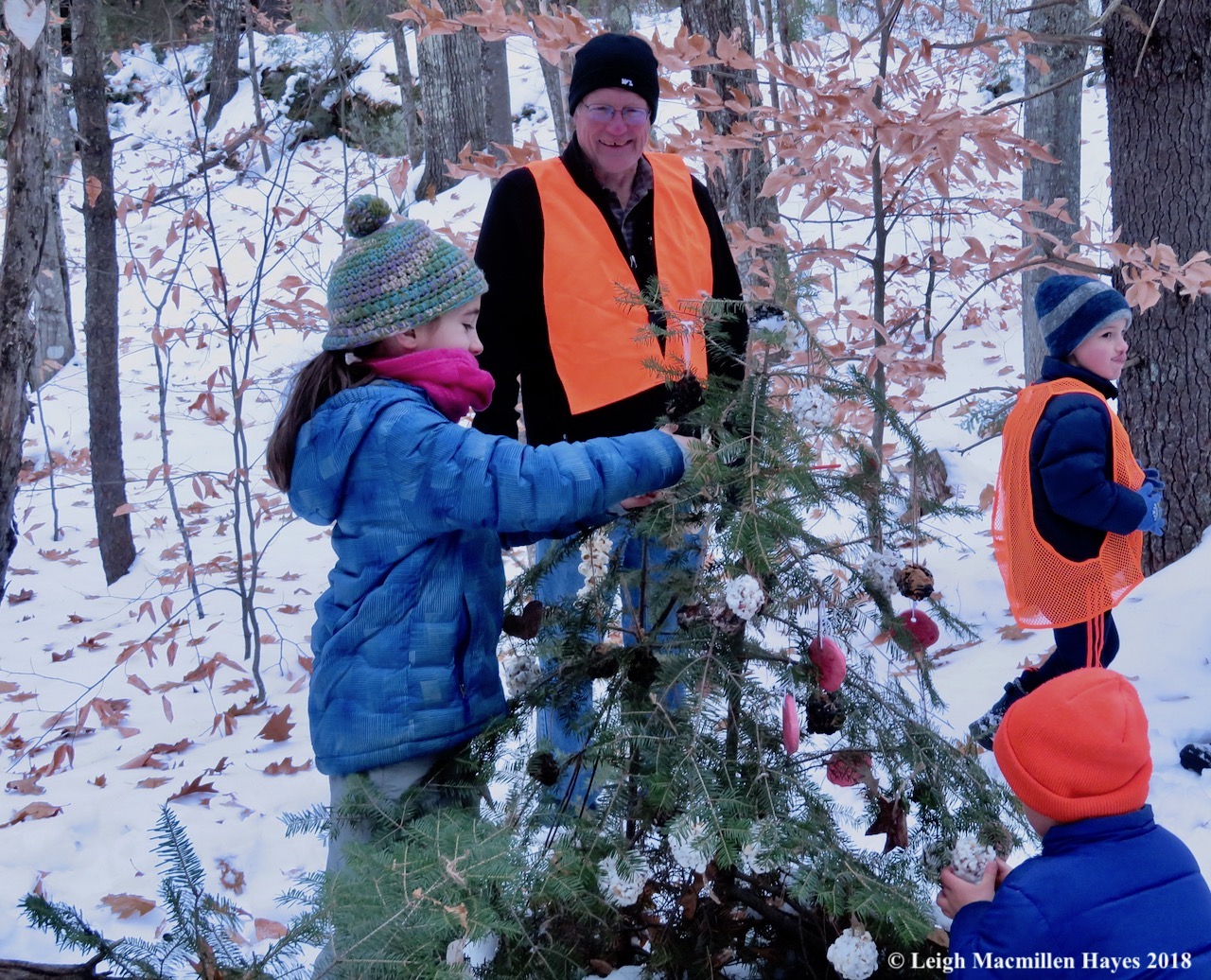
In no time, the tree was fully decorated.

Some changes had to be made. For one, one of the younger boys wanted his ornament to serve as a tree topper, so the birch bark sleeve was placed in a resting place on another tree. 

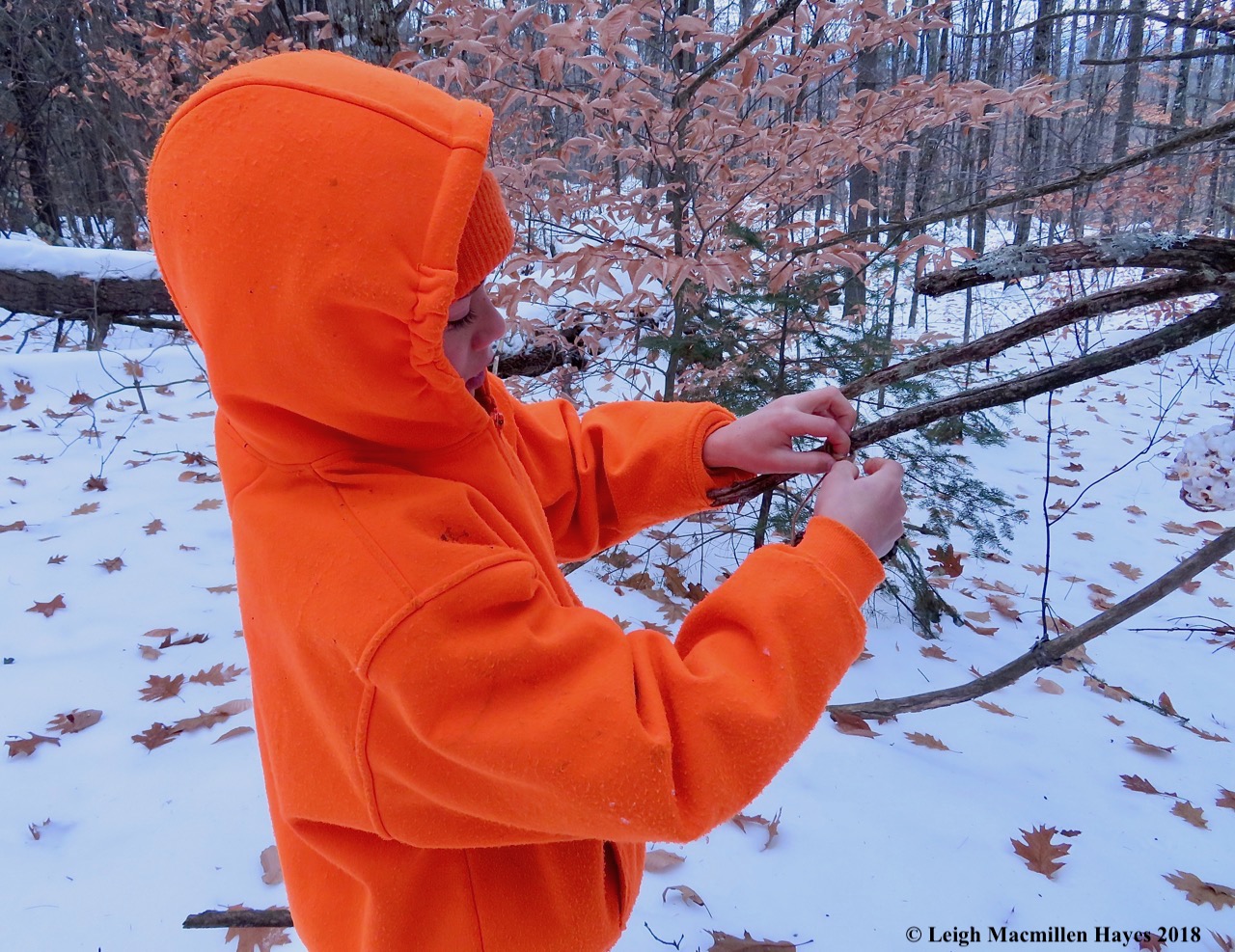
And then the kids decided to decorate any branch in the vicinity that attracted their fancy.

At least one needed a boost, but that’s what someone else’s mom was for when your own mom was busy with your baby sister. 

Branches all around certainly won’t feel left out. 

And no mouse or bird or squirrel or deer will go unfed. 

The kids quickly realized that they’d created a critter cafe that even included an offering tucked between two hop hornbeam trees. 

At last, the decorating had come to an end and the crew posed for photographs. 

Our journey back to the parking lot was the same distance as we followed the rest of the one-mile loop, but we travelled much more quickly. We did pause once in a while, however, especially in a grove of young white pines, where the kids practiced aging a tree. 

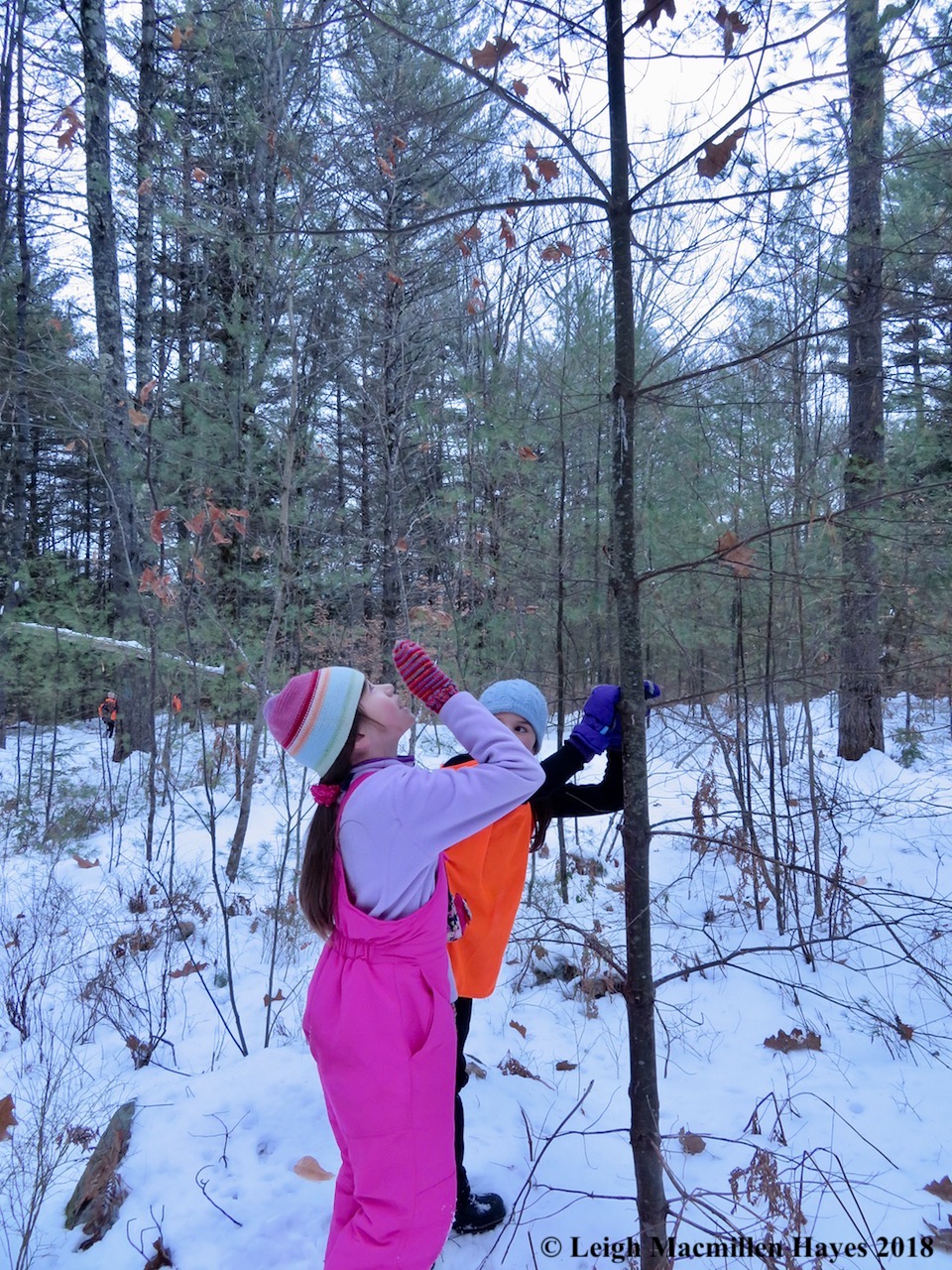
They knew to begin with 5 for the number of years it takes the seed to germinate and begin to grow and then to count the whorls of branches, each whorl representing one year. 

My guy challenged them to find one that matched his age. They found one that was 43–only off by 20+ years. But a few noted that it did match their dad’s age. I chuckled for I’d had that particular dad in class way back when he was in middle school. 

We were almost done when they made one last discovery–ice! Their very own rink. One little boy wanted to live there so he could slide on the ice all day. And then jump in the water come summer. We didn’t have the heart to tell him that the ice was a result of our rainy October and its not a permanent feature. 

 It was lunch time when the group was finally ready to depart. 

All the way home and even still, my guy and I have been smiling about our morning and the fun we had sharing it with the kids and their moms. Thank you Juli, and 4-H leader Wendy, and all of the homeschooled kids who attended. We were blessed by the opportunity to spend a few hours with you on the Jolly Mondate. 

Nothing to Grouse About

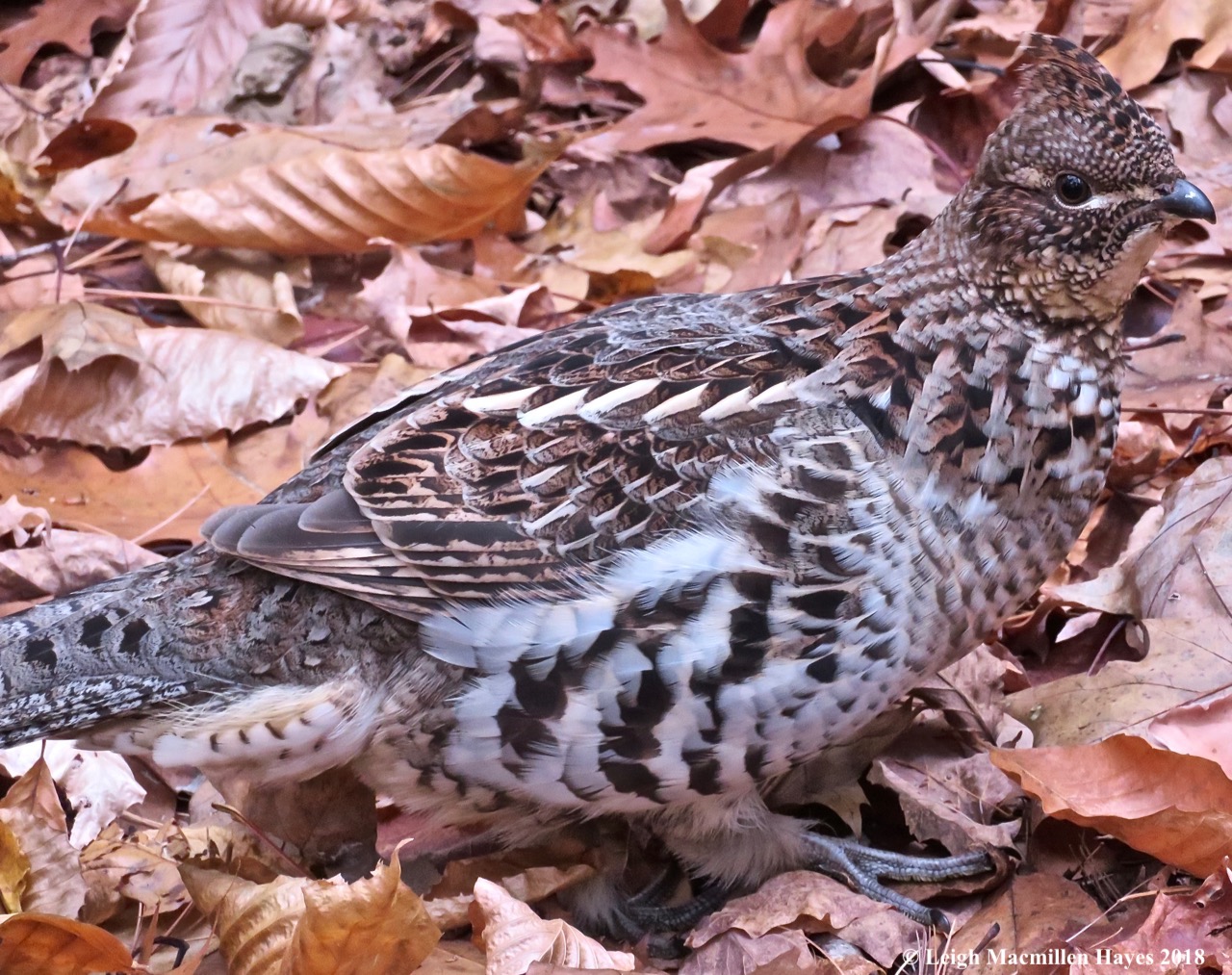
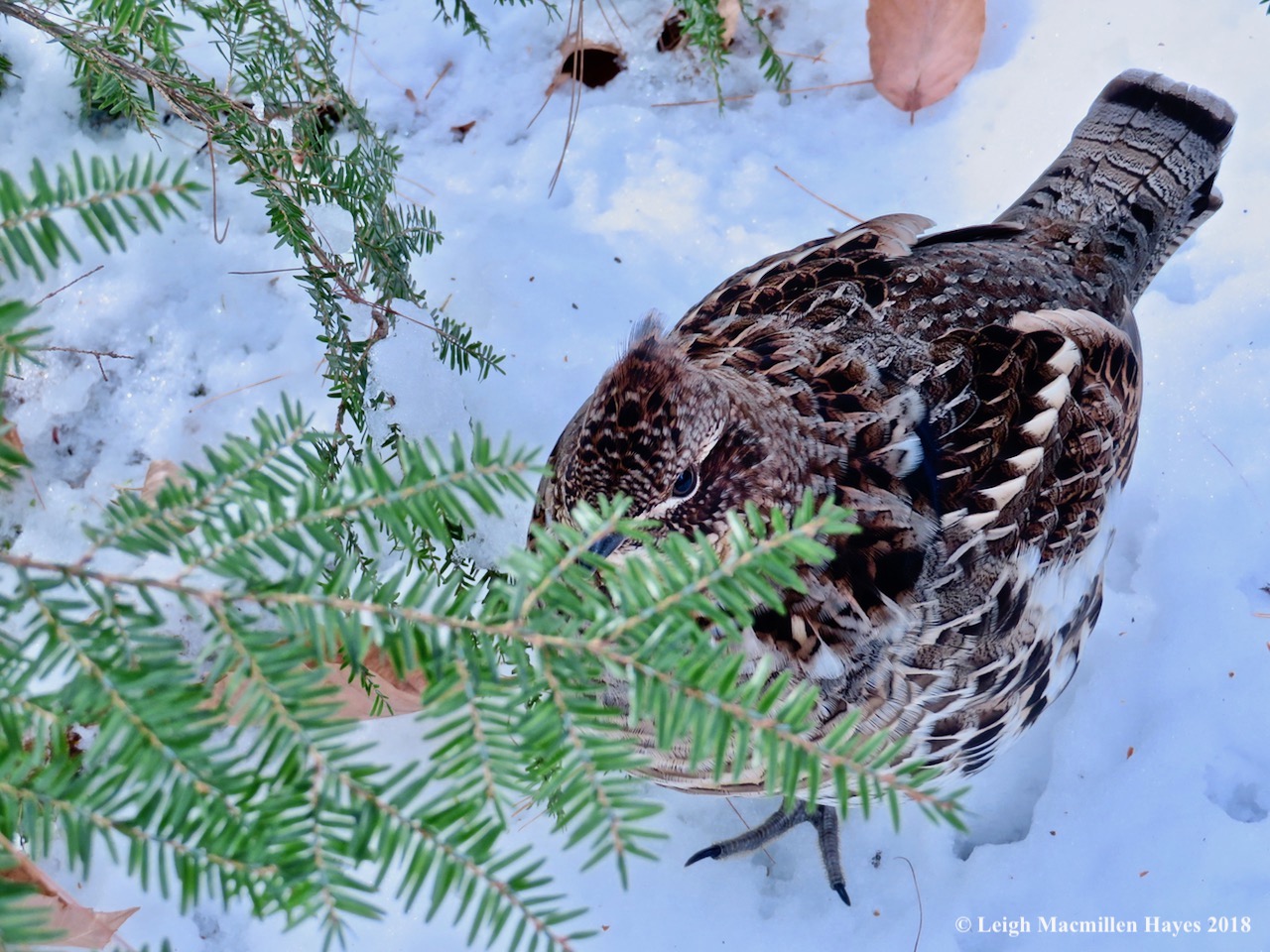
A week ago I shared a unique experience with five other naturalists, the majority of them in the six to eleven age range. For twenty minutes the six of us watched a Ruffed Grouse at it moved about, overturning leaves and foraging on buds. When we last saw it, the bird headed off in the opposite direction that we intended to journey, and so we moved on with wonder in our eyes and minds.

2

And then the next day I returned on a mission to study some twigs at the same property. No sooner had I stepped onto the trail when I heard the sound of leaves cracking a wee bit and what to my wondering eyes should appear but the same bird.

The curious thing: the bird followed me, staying about ten feet away as I tramped on. I stopped. Frequently. So did the bird.

And we began to chat. I talked quietly to him (I’m making a gender assumption) and he murmured back sweet nothings.

It was then that I did the unthinkable–I named him: ArGee.

Again I started down the trail, and again ArGee followed about ten feet to my right. And then I thought I got ahead of him, but a few minutes later he caught up and foraged by my feet as I examined twigs and buds for their idiosyncrasies.

When I finally turned back, ArGee did the same. Eventually I ran because I didn’t want him to follow me to my truck. Would he have? I don’t know. Would he survive? I sure hoped so. Would I visit again? I knew the answer was yes. Would I see him again? Who knew?

The next day I dragged my guy along. But much to my dismay, no ArGee. I’d been blessed twice and had to accept the possibility that he’d either flown off or became part of the food chain. My hope was that if the latter was the case, it was a four-legged predator or larger bird and not a human bi-ped.

Since last week, about five or six inches of snow blanketed the area and this morning dawned frigid with the temperature at about 5˚. I dressed for it and headed to a nearby spot in hopes of meeting up with a group that was going to count salmon and redds. But, I missed the link-up and decided instead to wander in ArGee’s territory so I could reaffirm his disappearance and move on.

1-looking for food

As I looked up at something in a tree, I heard a slight noise by my feet and guess who? I greeted ArGee with a quietly grand hello and together we shared the space, mindful of each other. After about twenty minutes he headed under a stand of hemlocks that provided some cover.

2-hiding and feathers bloated

I snapped and crackled through the woods, bushwhacking over to his position, all the while wondering if I was getting too close and perhaps he didn’t want me to spend more time with him.

2a-hiding

But what I discovered was that he’d stopped foraging, stood still, though occasionally turned his head, and puffed up his dappled and barred plumage. While I had donned several layers to keep the brisk air at bay, ArGee needed to fluff up in order to trap air in his feathers. Cool fact (or cold!): A bird’s body heat warms the air between its feathers and the more trapped air, the warmer the bird.

4-crown

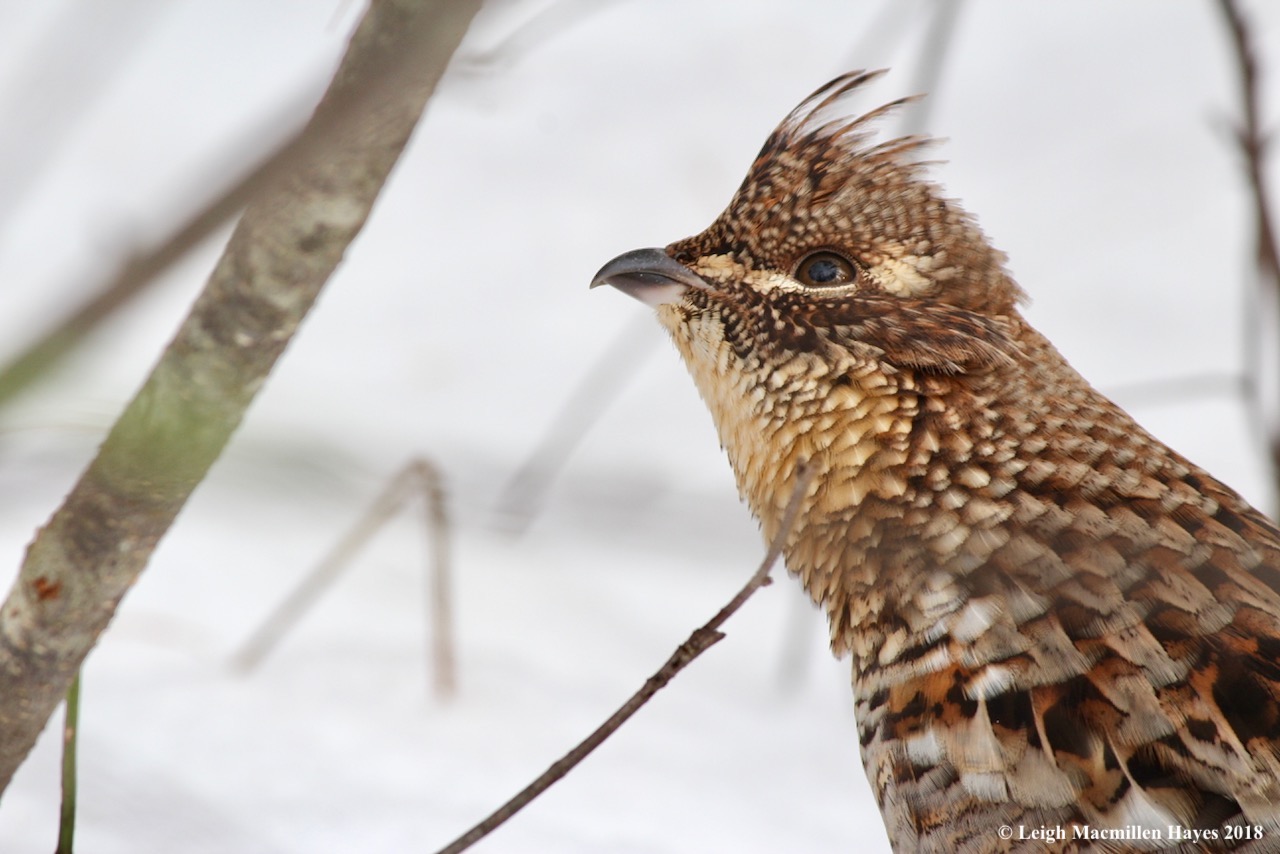
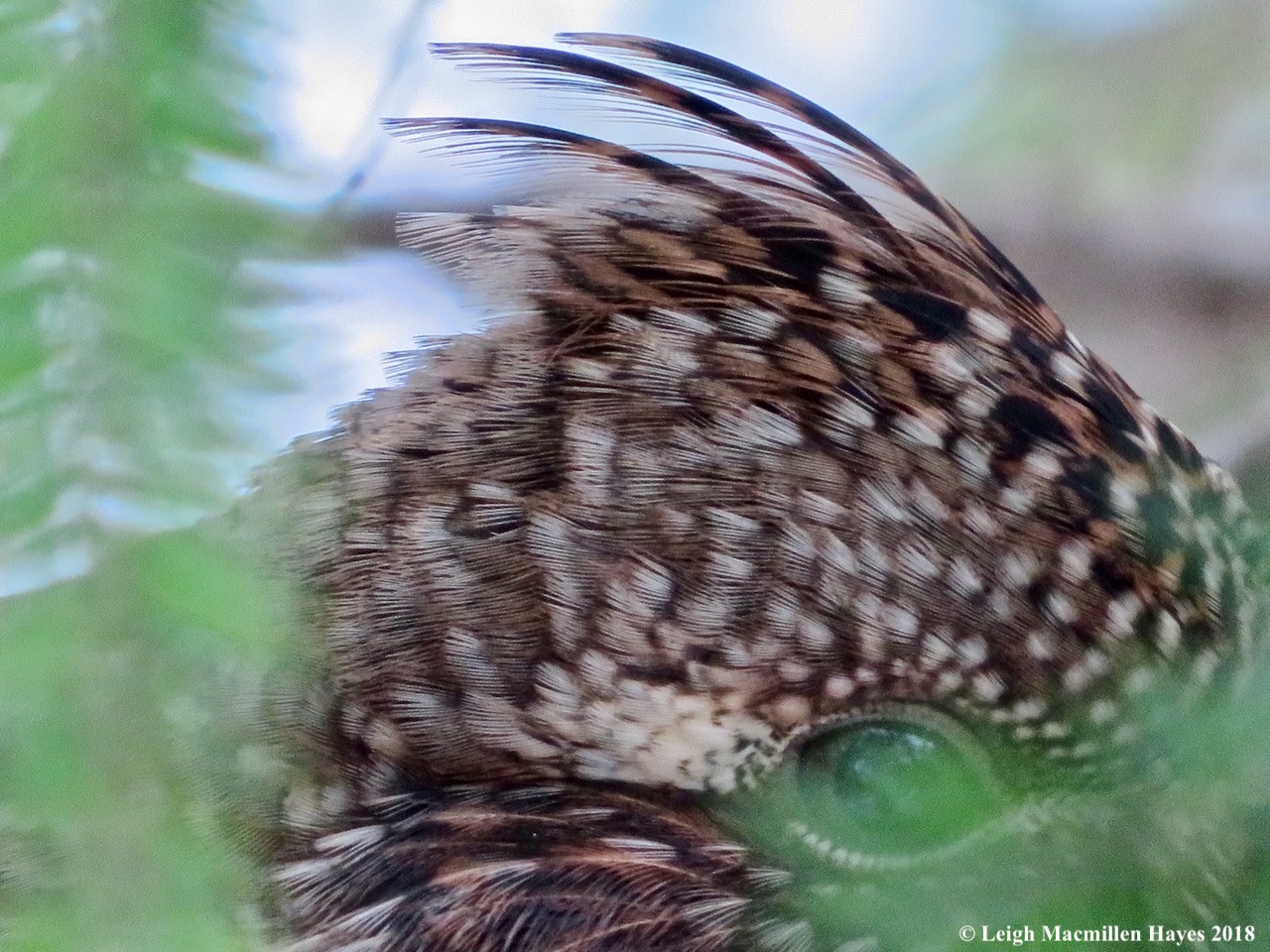
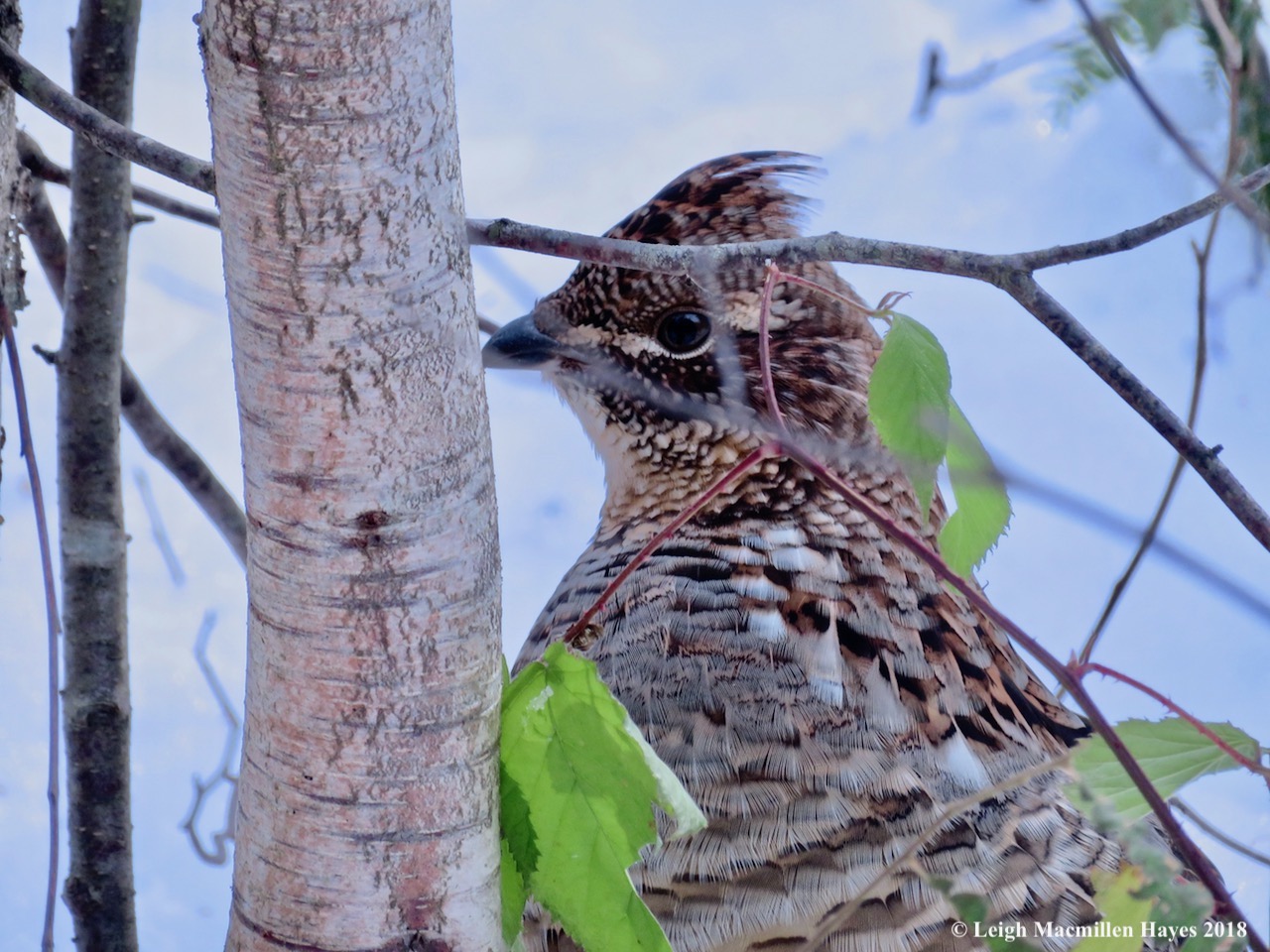
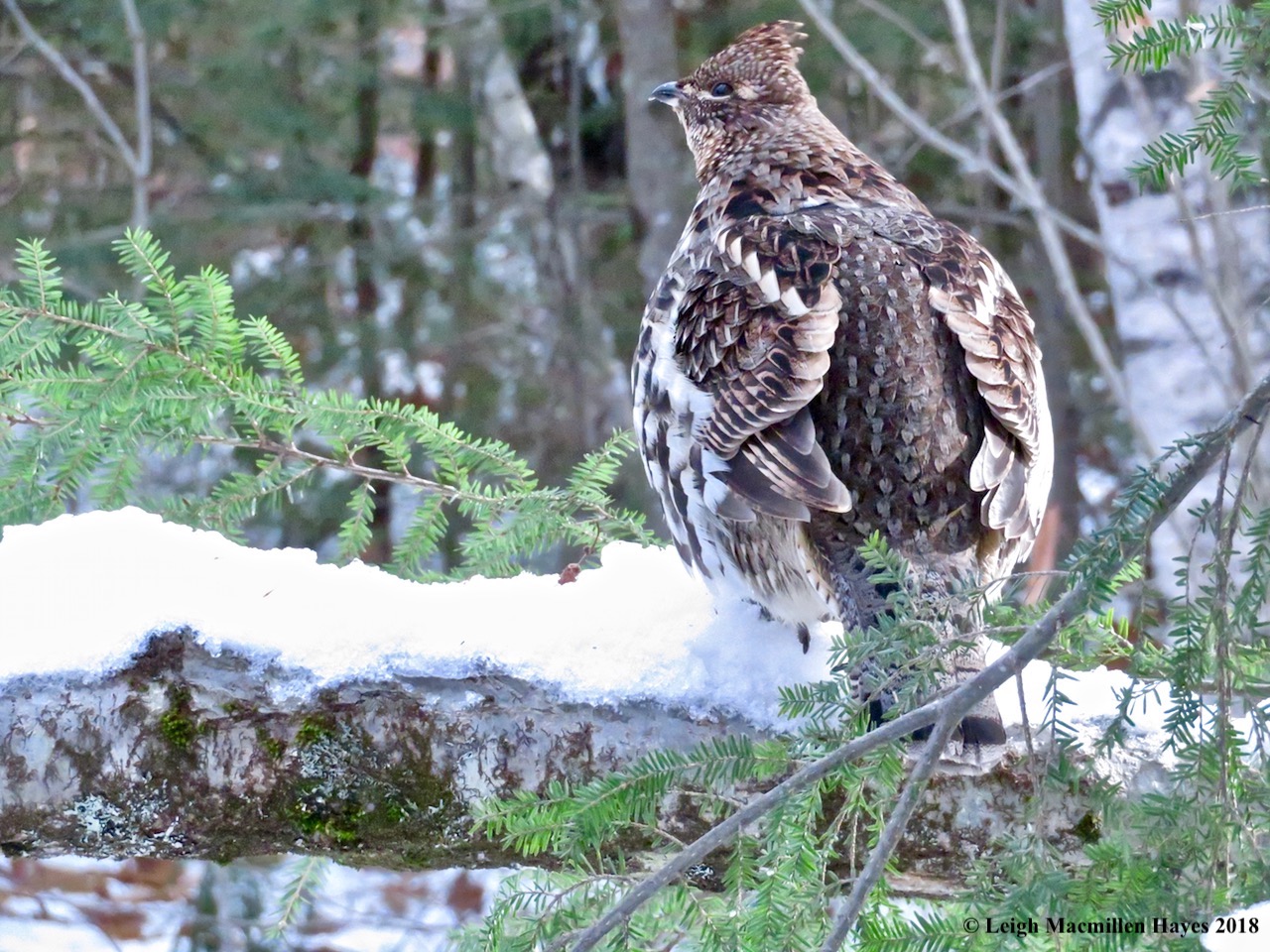
While ArGee warmed up, I focused on some of his features, including the crest feathers on top of his head. Their formation brought to mind ocean waves cresting, but perhaps they were actually standing upright because he saw me not as friend, but rather a foe?

5-eye to eye

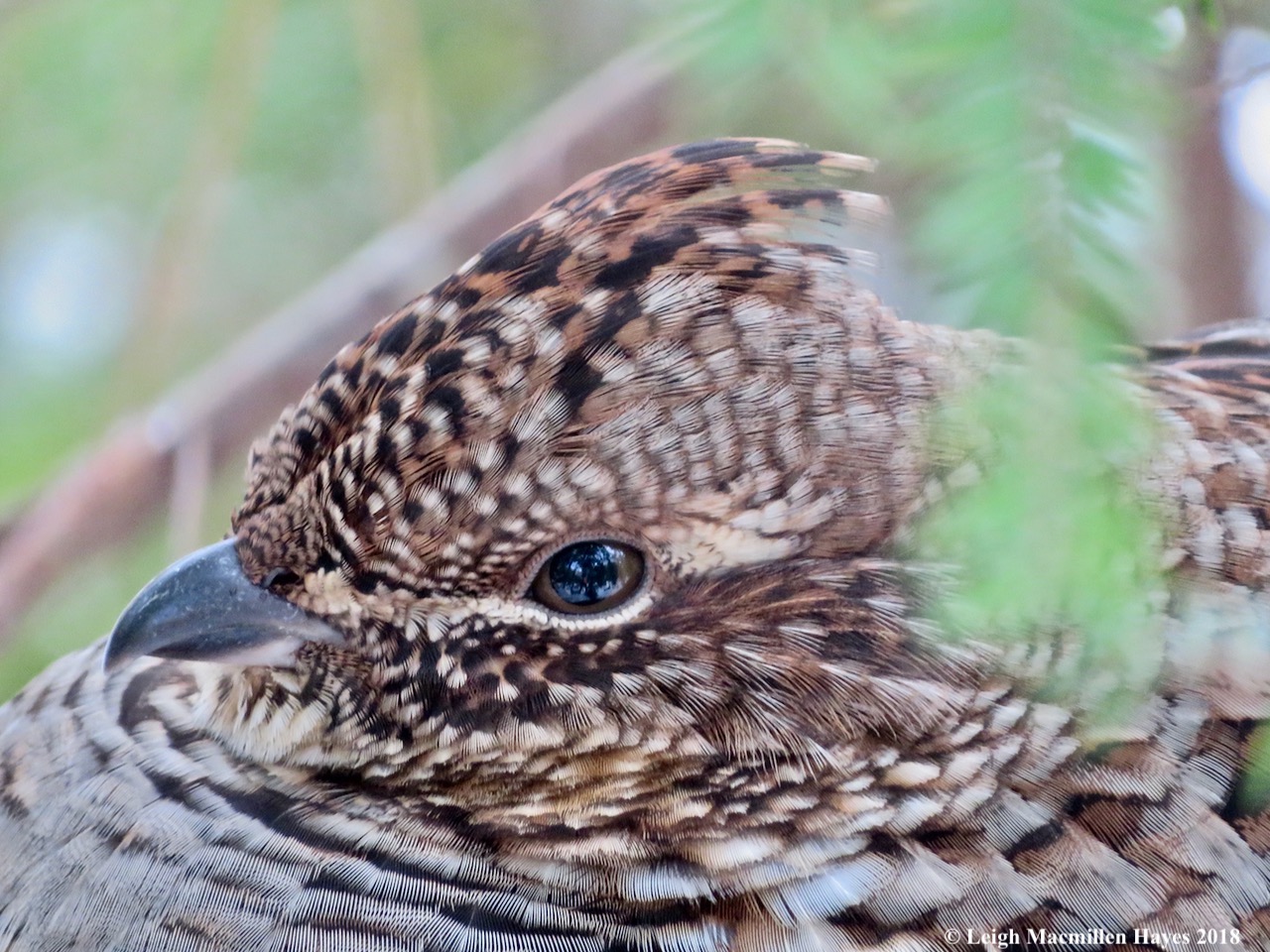
I knew I was overextending my stay, but I couldn’t leave. And he didn’t seem agitated, so I continued to look. There was that eye-ring to notice, rather bead-like in appearance.  And the contrasting orientation of the feathers above and below his dark eye, their comb-like tips spread out like miniature fans.

6-looking at me

For another fifteen to twenty minutes, he warmed up below the hemlock, while I stood nearby and watched, occasionally offering a quiet comment, which he considered with apparent nonchalance.

7-beak

I had time to consider his robust down-turned beak and figured it must be adapted for the coarse vegetation it consumed. Ruffed Grouse are known to feed on buds or catkins of aspens, birches and cherries, and that was the habitat in which ArGee had made himself at home. They’ll also consume, seeds, fruits, leaves and twigs, insects, and maybe even salamanders, in season of course.

8-coming out of hiding

Finally, my friend seemed to have warmed up and so out from under the hemlock ArGee emerged.

9-dining on leaves

And immediately he found bramble leaves still green.

10-leaf in its mouth

Ripping one leaf off, he made quick work of it.

11-gobbling it up

And in a matter of seconds it disappeared into his mouth.

12-looking for more food

Then it was time to think about another.

12-those feet

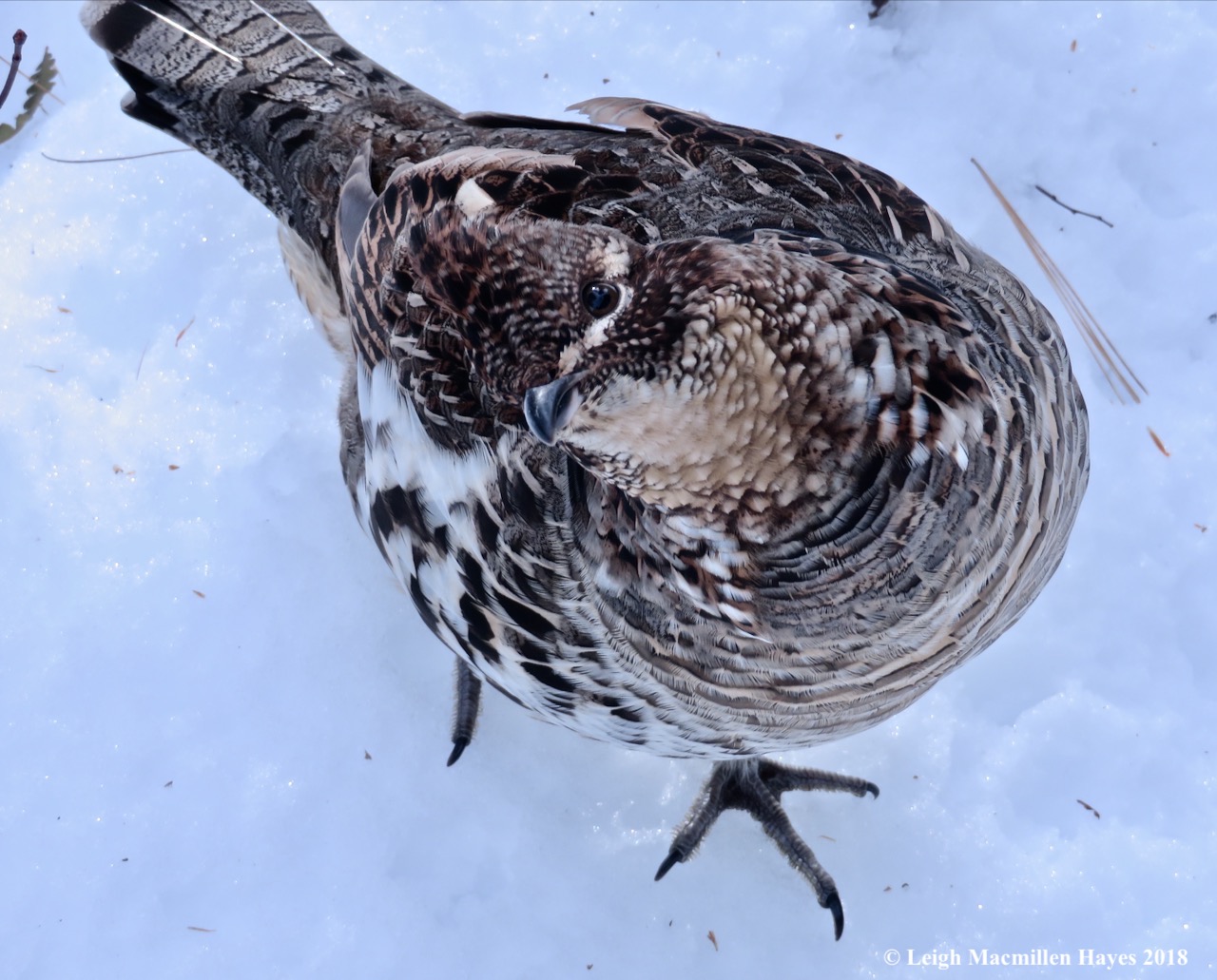
Out in the open again, I had a chance to get a better look at ArGee’s feet. Though today’s snow was rather crusty, there’s potential for up to ten inches of fluff to fall tomorrow and then his feet will play a key role.

12a-combs on feet

Where the snow is deep and soft, grouse travel atop it with the help of their “snowshoes”—lateral extensions of their toes. Can you see the comb-like rows of bristles, aka pectinations? They began growing in September and reminded me of a centipede serving as each toe. It’s those bristles that act like snowshoes.

They also have stout legs for walking or running and those were also covered with insulating feathers that looked like an old pair of furry sweatpants.

12b-tail feathers

It’s difficult to tell a male from a female based on appearance, but typically the bird is a female if the color is faded or absent on the central tail feathers, thus I leaned toward ArGee being a male. No matter what the sex of this particular bird, the varied shades of black, gray, rusty red and buff all presented in a variety of patterns, including small hearts–what wasn’t to love?

13-I see you

For a while longer, ArGee and I played “I See You” and I continued to wonder about his behavior. Usually this species is quite elusive and difficult to approach. In fact, most often I am startled by the loud wing beat of a bird exploding, or so it sounds, from the ground or snow in front of me, and my heart responds with rapid beats for a second . . . and then I realize it was a Ruffed Grouse trying to avoid me.

13-so close

Today, and this past week, that has not been the case.

13b-are you looking at me?

ArGee has seemed as curious about me as I’ve been about him.

16-saying goodbye

Is he tame? Or has he been defending his territory? Perhaps it’s a hormone imbalance as the season changes, especially given that winter seems to have arrived early.

I’m not sure what’s going on, but I’m grateful for the time I have had to get to know this bird of the Maine woods a wee bit better. As has happened in the past, we parted ways at the same point, so I’ve a better understanding of his actual territory.

I’ve experienced grouse being aggressive when protecting their young in the spring, and wonder if at some point a close encounter with ArGee could switch dramatically from fascinating to hostile as he defends his territory.

Sometimes the critters with whom we share this natural world do things that make no sense, but then again, sometimes we do the same. For now, I have nothing to grouse about!


Put The Lawn Furniture Away Holiday

I don’t know the why of it, but it seems that each year when we plan to put the lawn furniture away, the forecast either includes wind gusts or snow. Well, yesterday it snowed. Not a lot of snow, mind you. But enough.

1-snow on the kayaks

It was, however,  melting quickly when we stopped by camp to begin our autumn chores.

3-porcupine tracks

Upon our return home, I diverted my attention for a bit and headed off into the woods, where much to my delight, tracking opportunities made themselves known. Though I didn’t see any of the creators, I smiled with the knowledge that I can share this land with them. Along the way I found a porcupine track pattern,

4-coyote--18 inch stride

plus a coyote with a stride of about nineteen inches (when you don’t take a tape measure it pays to improvise),

5-snowshoe lobster

and my favorite for this first tracking day of the season . . . a snowshoe lobster–I mean hare.

6-moose scat

Another favorite sighting, which I spied a few times–rather fresh moose scat the size of chocolate nuggets. (And no, I didn’t collect it to make jewelry. ;-))

7-my own track

As I moved, I left behind my own tracks and wondered if the mammals looked at those and knew I’d passed by. “Middle-aged female, the one who stalks us,” they might comment if they could talk. But really, it’s by my scent that they probably know me best. “Stinky middle-aged female . . .”

7a-leaves enhanced by snow

It wasn’t just tracks that caught my attention. The snow, spotted with tree drips, enhanced the color and borders of the foliage, making each leaf stand out.

7b-leaves under slush

In contrast, a more muted tapestry formed where foliage was trapped in slush-topped puddles.

8a-melted snow on sugar maple

And then there were those leaves turned upside down. I was fascinated by the variation of size in the water drops left behind as the snow melted. Every dot enhanced the pastel back-side colors . . .

8-melted snow on big tooth aspen leaf

and acted as a scope by showing off segments of venation.

9-snowdrops on grass

Patterns changed depending on the shape of the structure to which they clung.

10-goldenrod

And all were momentary for each drop eventually did what they do . . . dripped.

11-tachinid fly

While I admired the beauty, I wondered about the goldenrod that still bloomed and reminded me that though it had snowed and we’ve had some rather cold days, today was a bit warmer and it’s not winter yet. But those cold temps of a few days ago, I think they caught some by surprise, including this tachinid fly that dangled from another flower stalk.

12-hickory tussock moth caterpillar

And several times I found hickory tussock moth caterpillars frozen in place. While I admired the way the melted snow drops clung to the hair, I wondered about what I was seeing. Was it a shed skin? Or had this caterpillar been taken by surprise with weather conditions?

If you know, please enlighten me.

As it was, I needed to finish my wander for there was more furniture to put away on the homefront.

13-red-backed salamander

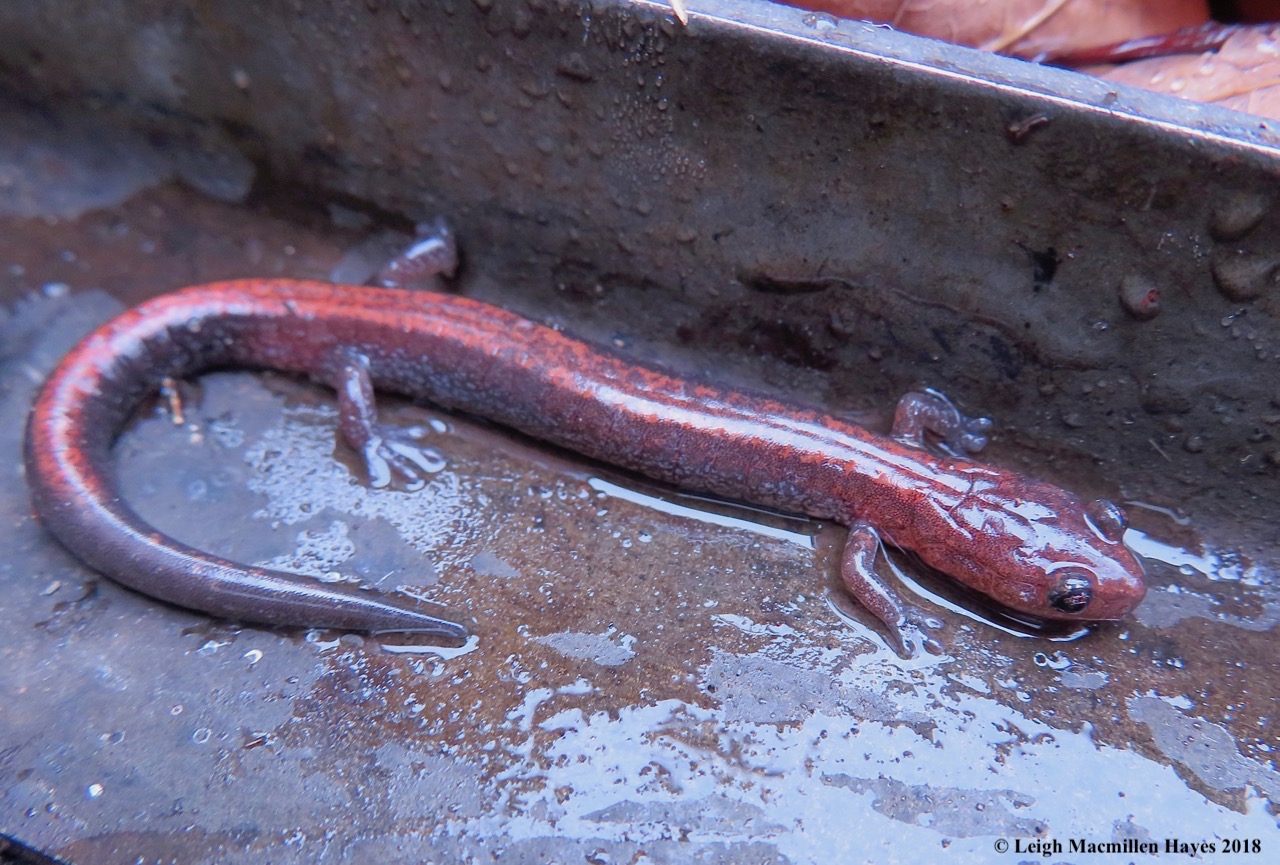
And when we opened the cellar hatch door to store the table and chair downstairs, another discovery was made . . . an Eastern red-backed salamander on top of the first step.

The day probably should have been named “Day After the First Snow Storm of the Season” but instead it was our “Put the Lawn Furniture Away Holiday.” Not everyone celebrates this day, but we do because as exciting as it is to bring the furniture out in the spring, it’s equally exciting to put it away and anticipate the coming season. Oh, and when we pull it again in the spring, you can trust that it will snow at least one more time.


What the Tree Spirit Knows

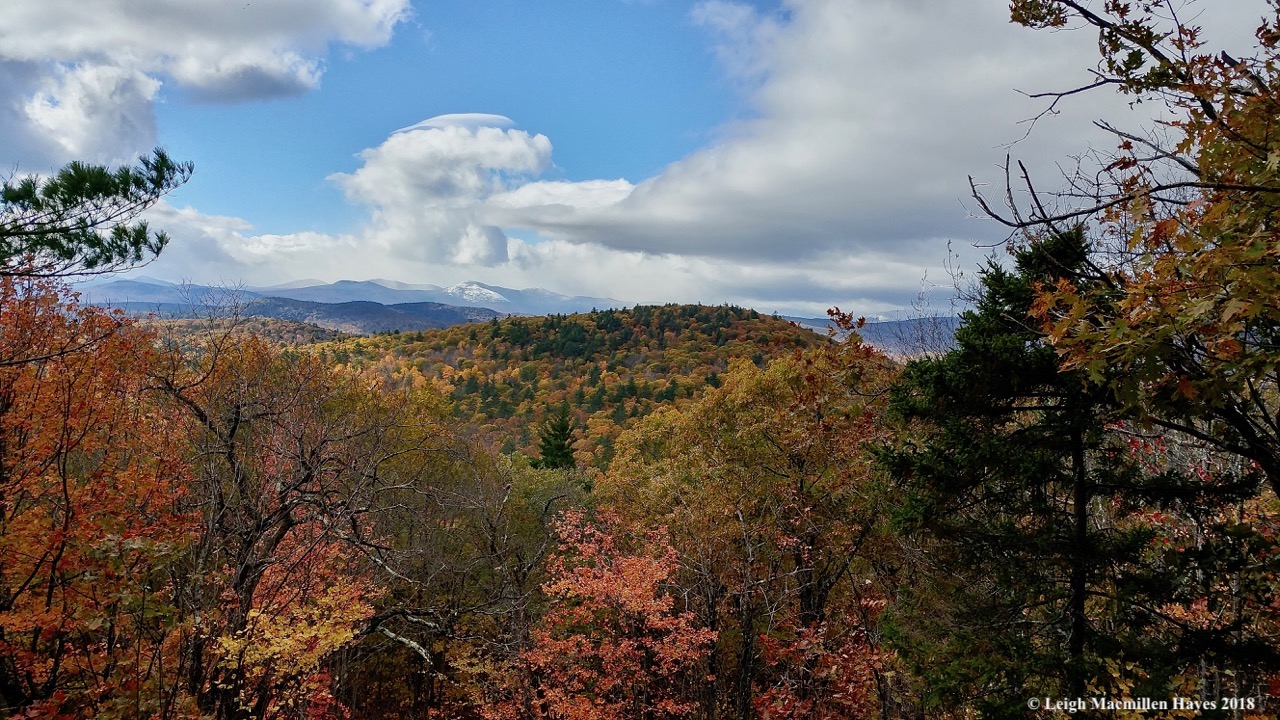
As I drove to Lovell this morning to take a photo for the Greater Lovell Land Trust’s winter newsletter, the crisp outline of a snow-covered Mount Washington made me realize that I had a short, unintended hike in my immediate future.

1a-Flat Hill view

Yesterday, I’d climbed the Flat Hill Trail at the Heald and Bradley Ponds Reserve to take another photo for the newsletter–that one of the view from the summit of snow falling in the White Mountains. This past summer, staff and volunteers of the land trust had made some trail changes and opened several views, the one from Flat Hill being the most dramatic and the foliage, snow and sky enhanced the opening. But . . . today’s view was different and I knew I needed to capture it again.

Page 3 a

So . . . after a staff photo shoot at the Kezar River Reserve of Stewardship Associate Dakota, Associate Director Aidan, and Office Manager Alice, I headed north.

1-voss sign

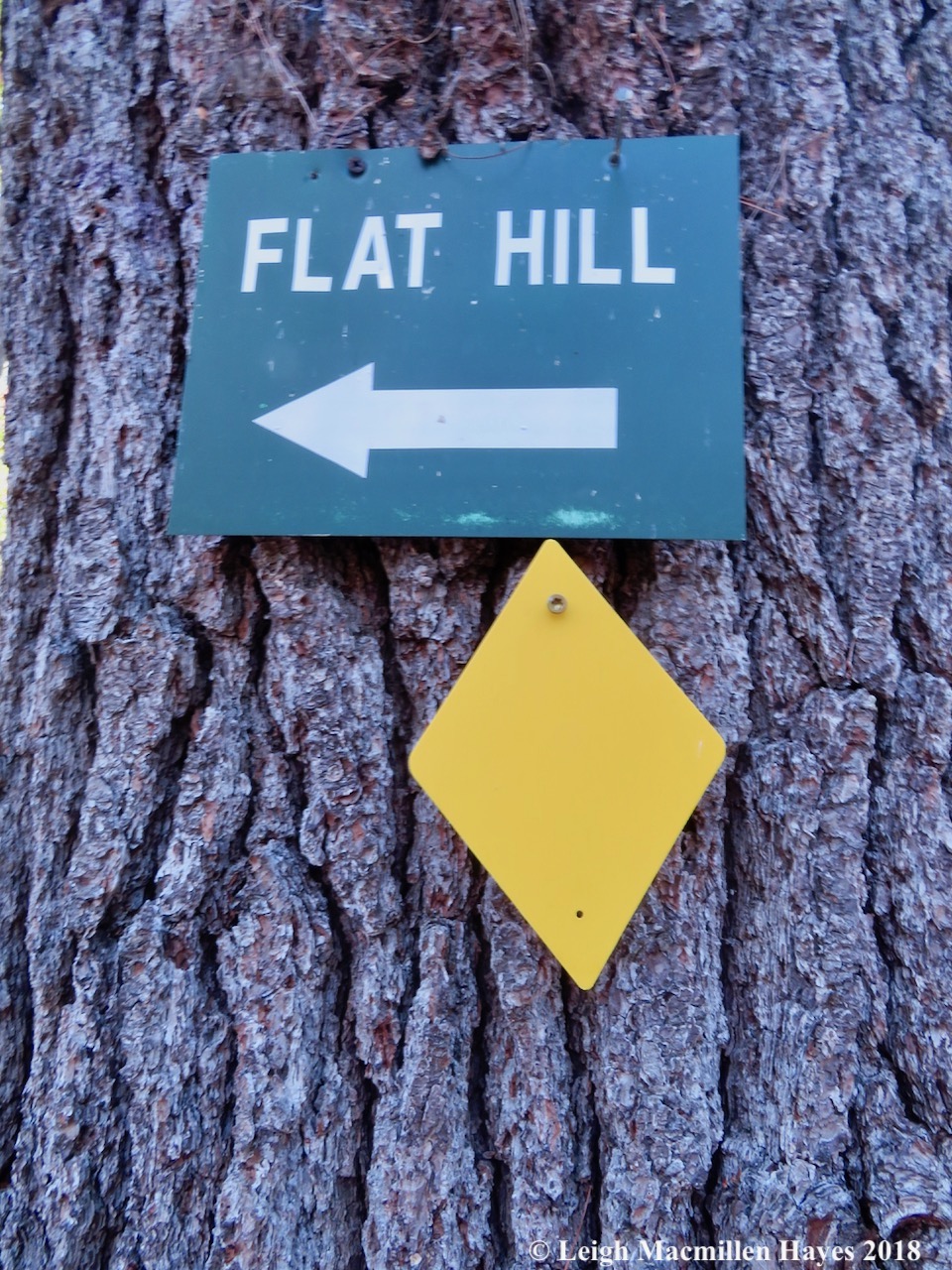
And laughed at myself for yesterday I never noticed the yellow Voss blazes that had been mounted to mark the trail. The hope is that eventually all the trails will be signed with different colored diamonds that will ease navigation.

2-big tooth aspen

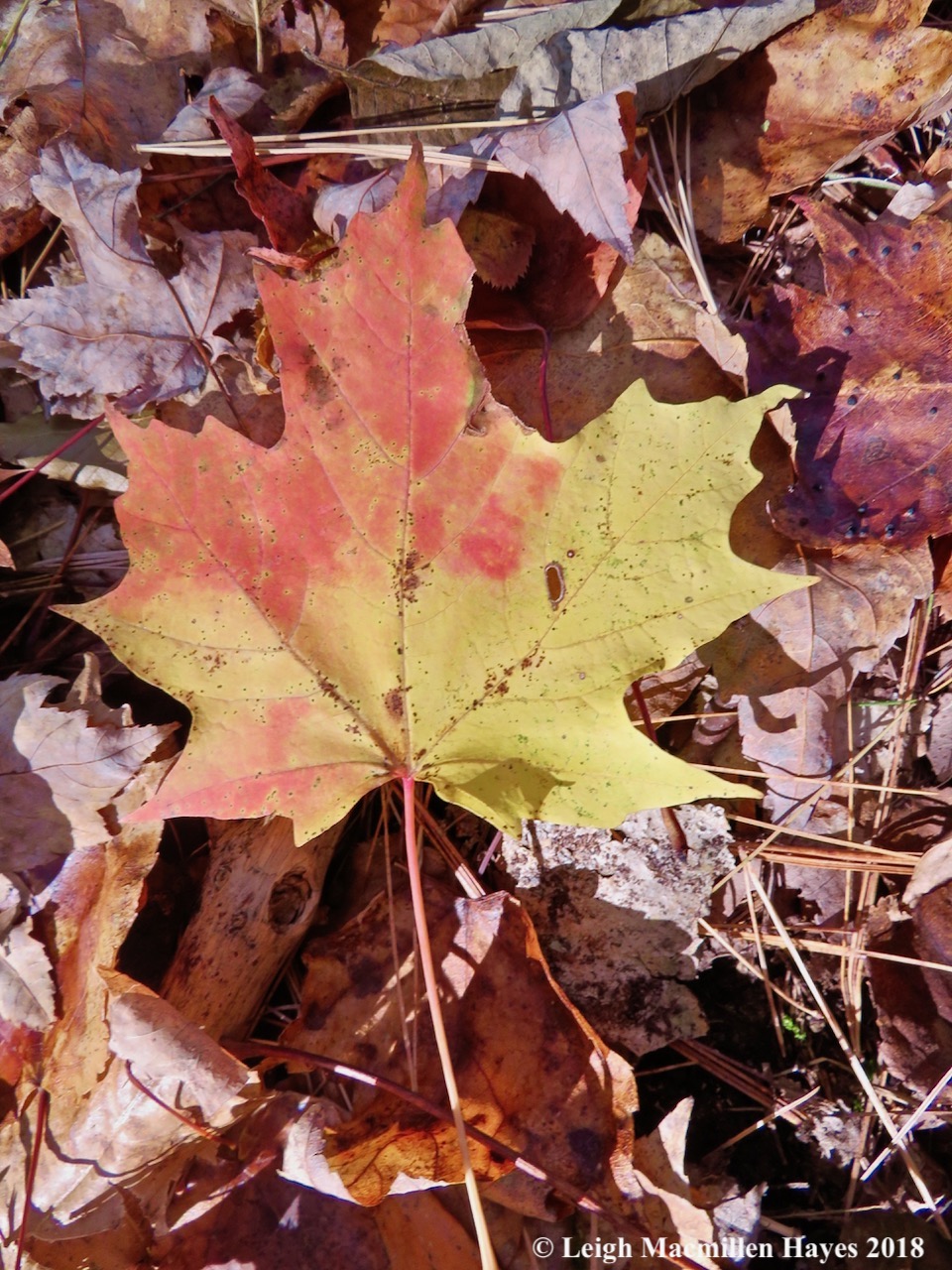
It’s a trail I know well, even with a new backwards S curve about two thirds of the way up that erased a steep and slippery portion and so instead I focused on those sights at my feet. While many leaves had already begun the long process of decomposition as they slowly break down and give nutrients back to the earth from which their trees grew, a few still sparkled like gems, including this Big-Tooth Aspen, aka poplar.

3-sugar maple

I was thrilled to discover Sugar Maple, defined by the U shape between its pointed lobes;

4-red maple

its V between lobes and toothier cousin, Red Maple;

5-striped maple

and even toothier kin, Striped Maple, known ’round these parts a goosefoot because its shape is similar. Some of us also refer to it as nature’s toilet paper for it’s large, soft, and easy to identify. You wouldn’t think of confusing it with poison ivy.

The curious thing about the Maple family, like all families in our northern New England forests, is that while the shape and color of the leaf helps us specify the family origins, each leaf within the family is different–whether in color or flaws or insect bites or galls. But despite their differences, they are all family.

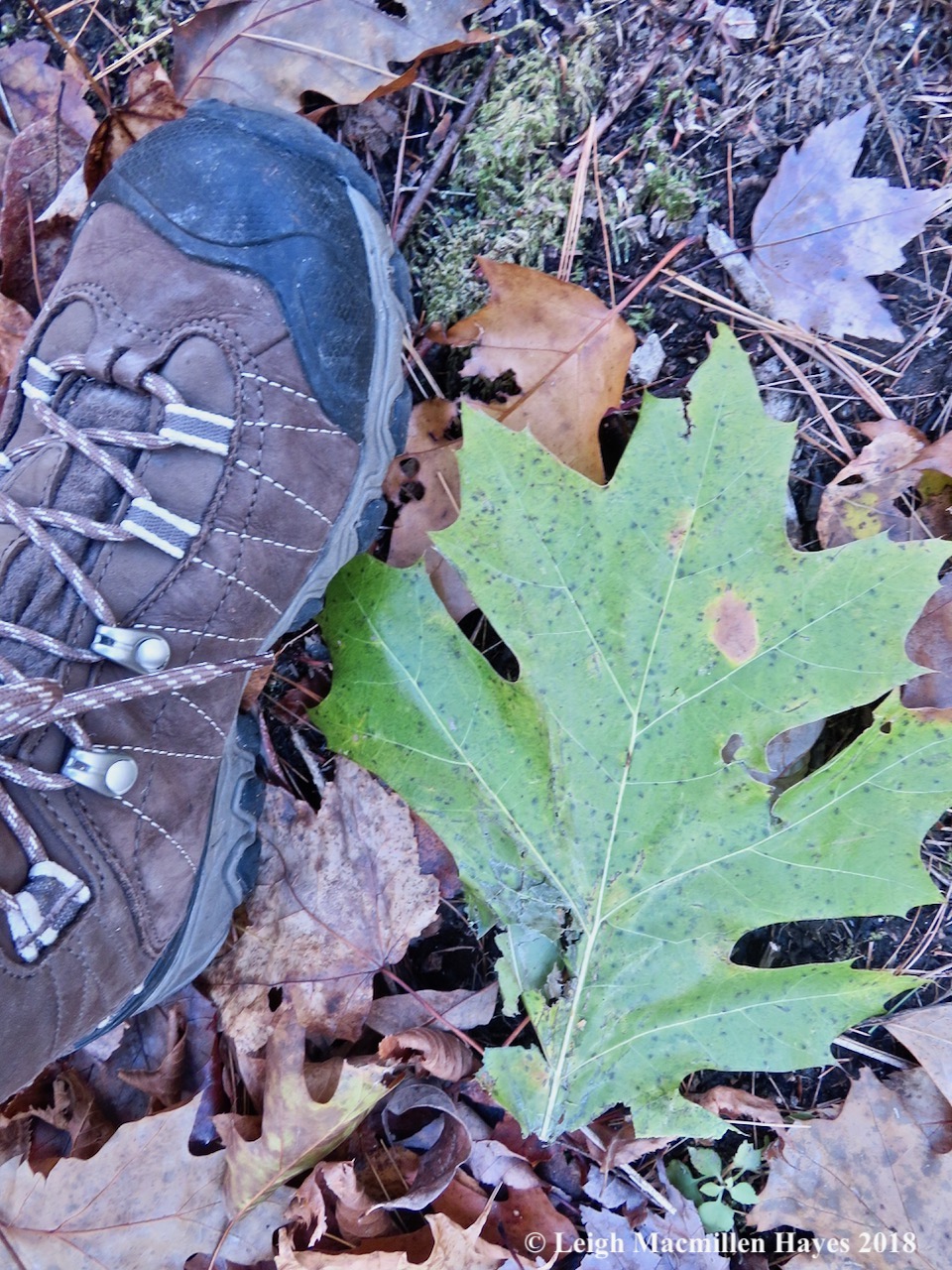
6-large red oak

With the Striped Maple, I thought I’d found the largest species of the day, but a few more steps toward the summit revealed a rather large Northern Red Oak leaf.

7-even larger basswood leaf

And then the biggest of all–Basswood. My hiking boots are size 8. And the leaf–also a size 8, with an asymmetrical base. That must prove a challenge when trying to find the right fit.

13-polypody ferns

Focusing on the leaves took my mind off the climb and within no time I’d reached the summit where Polypody ferns in their evergreen form decorated the northwestern corner of an otherwise bald rock.

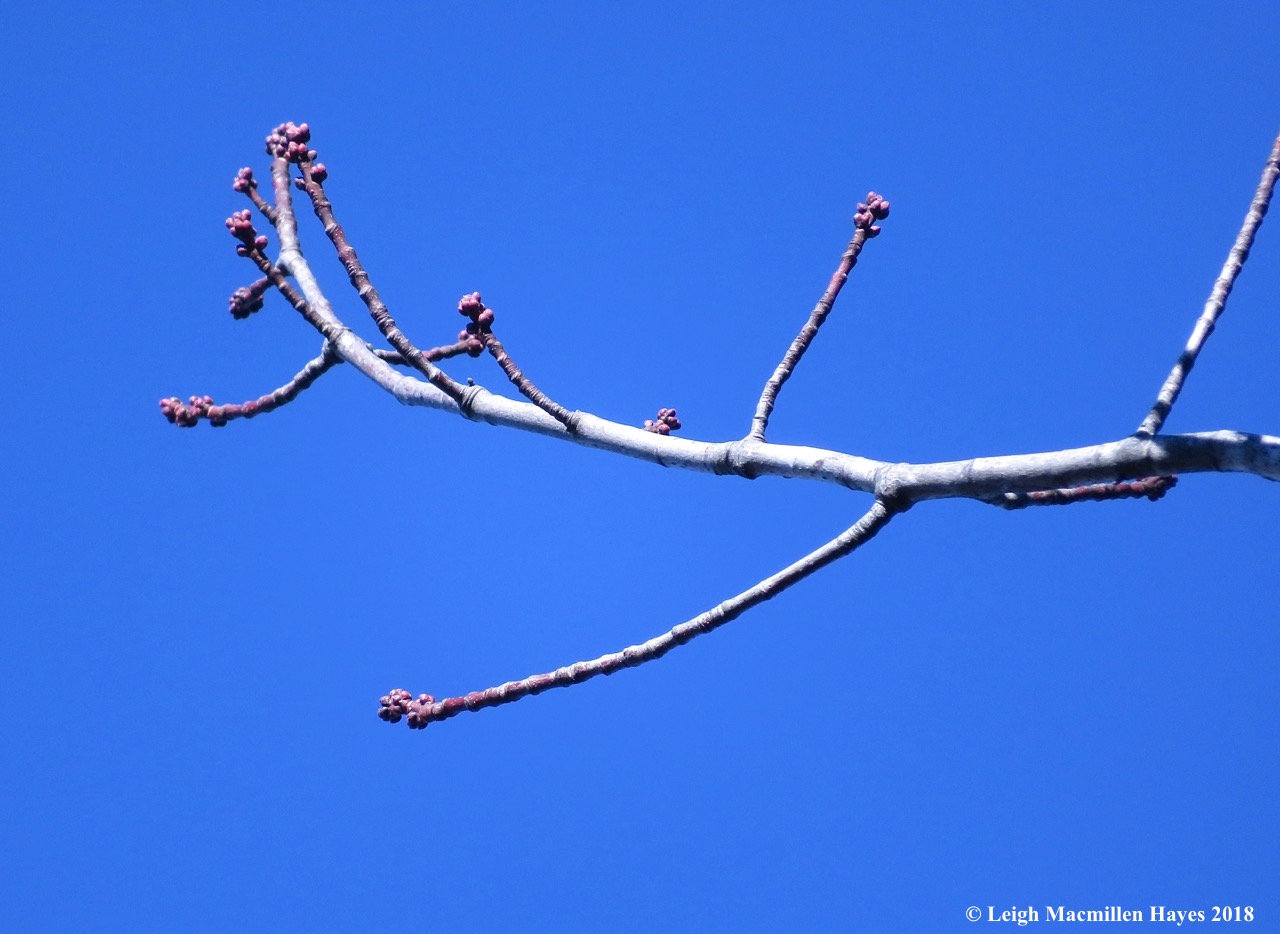
14-red maple flower and leaf buds awaiting
From the ferns where I’d planted my feet, I looked skyward and noticed the leaf and flower buds of a Red Maple, all tucked inside their waxy scales. It was the right place to be for as the north wind blew and my cheeks turned rosy red, I looked to the west.

9-Baldfaces to Carter Dome

Yesterday’s view had been transformed. No longer was it snowing from the Baldfaces to Carter Dome, with Mount Washington the whitest of all, posing between them. But still, it was chilly.

10-telescoping in on Mount Washington

A slight push on the camera lever and I pulled the scene a wee bit closer.

16-Perky's Path

At last I pulled myself away and hiked down, but so delightful was the morning, that I knew my newsletter work would have to wait a few more minutes at the intersection with Perky’s Path, for I felt the calling.

17-wetland--old beaver pond

It’s a wetland I visit frequently and once upon a time about five years ago it was filled to the brim with water because beavers had dammed it for their convenience.

18-suds reflect leaf

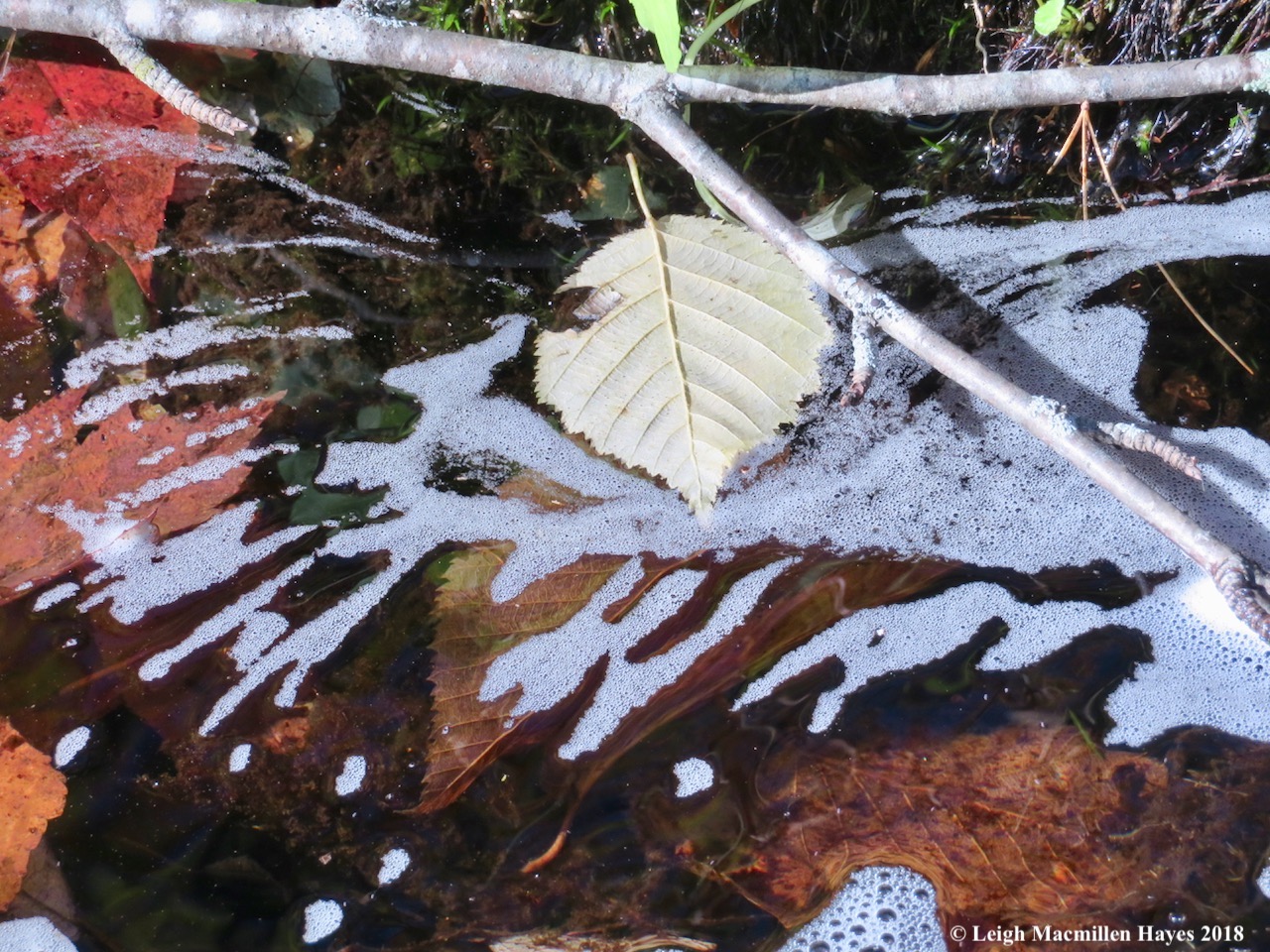
The only water today was found in a small stream that flowed through, its origin at Bradley Pond and terminus at Heald Pond. I stopped at the rock stepping path to admire what the water had to offer, including suds forming their own rachis or mid-vein from which side veins extended, a sideways rendition for the birch leaf caught between twigs.

19-view from the rock

In the middle of the stepping stones is a large flat rock. It was there that I settled in for a while, enjoying the feel of its sun-absorbed heat and the sound and views offered as the brook flowed slowly forth.

21-view from the bench

At last I pulled myself away and continued toward the bench that overlooked the wetland. All was quiet on this brisk day, but its a place of life and love and change.

22-back to the wetland

From there I continued to circle the old beaver pond to the point where I knew it had formerly been dammed. Climbing over and around moss-covered rocks, and into former stream beds, I made my way to the edge of what I used to call an infinity pool for the water was once at the dam’s upper level.

23-view from the beaver dam

Once I reached the dam, making my way one step at a time, for it was rather tricky footing at times, I discovered life on the other side. For all the years I’ve been involved with the land trust, I’d never seen this edge from this view. My surprise included the almost bald rocks.

25-coyote scat full of bones

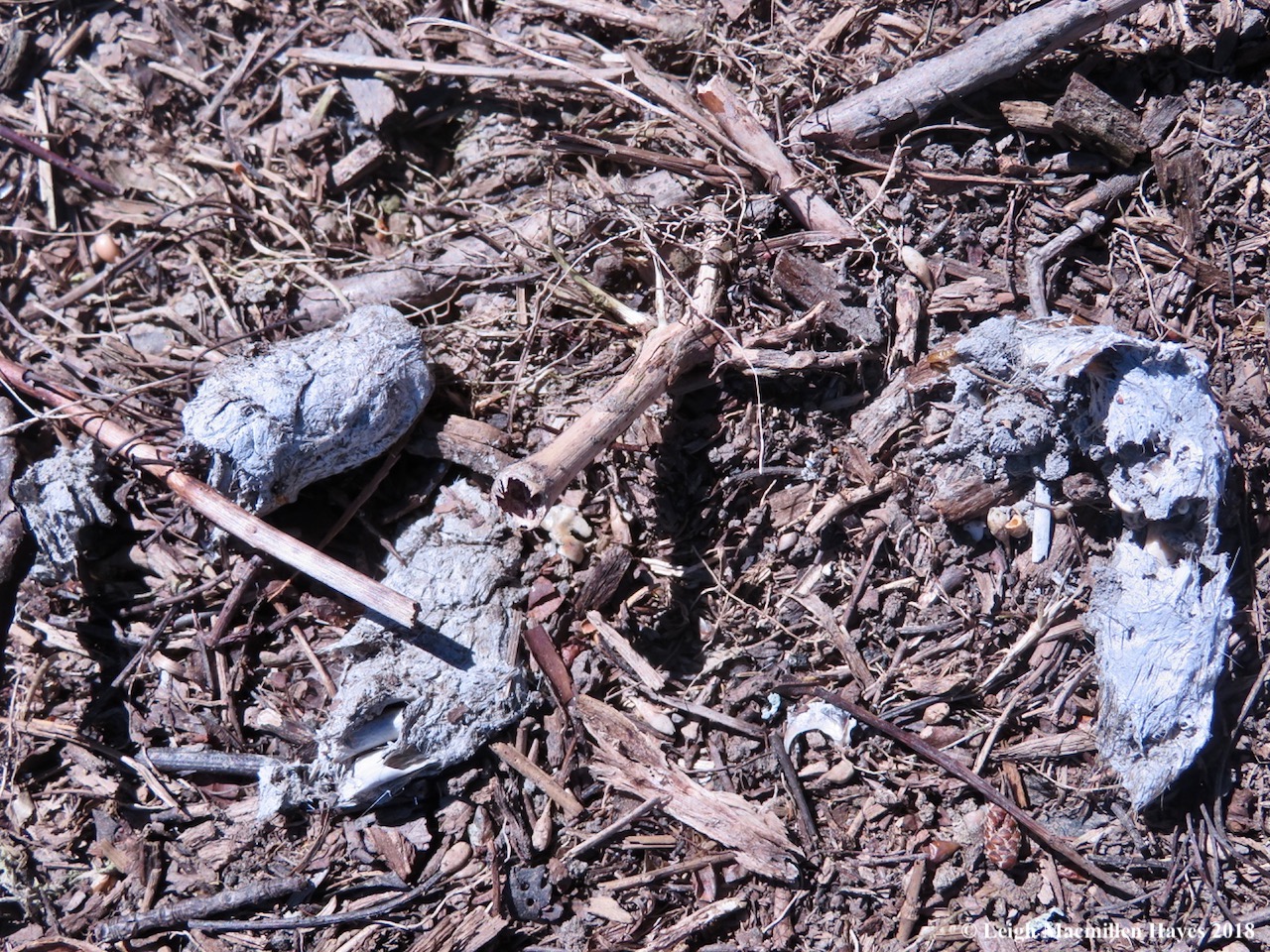
Stepping from boulder to boulder, I made my way into the wetland a wee bit, but along the way realized someone had visited prior to me. Actually probably almost a year prior given the conditions of the scat left behind. Based on its shape, size, and inclusion of multiple bones plus lots of hair, I suspected a coyote had feed on a hare.

26-spider view

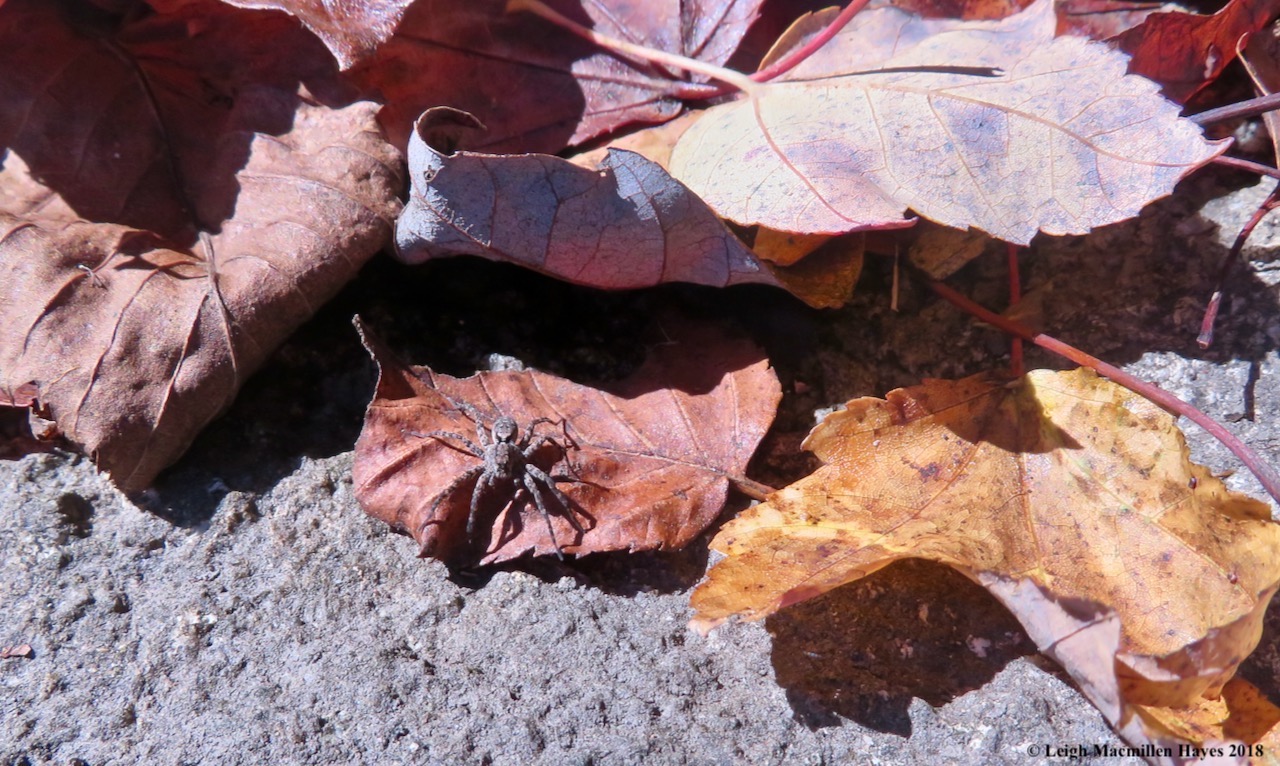
The coyote and I weren’t the only ones who knew of this secret place. A wolf spider darted in and out among the leaves, more afraid of me than I was of it.

27-spatterdock

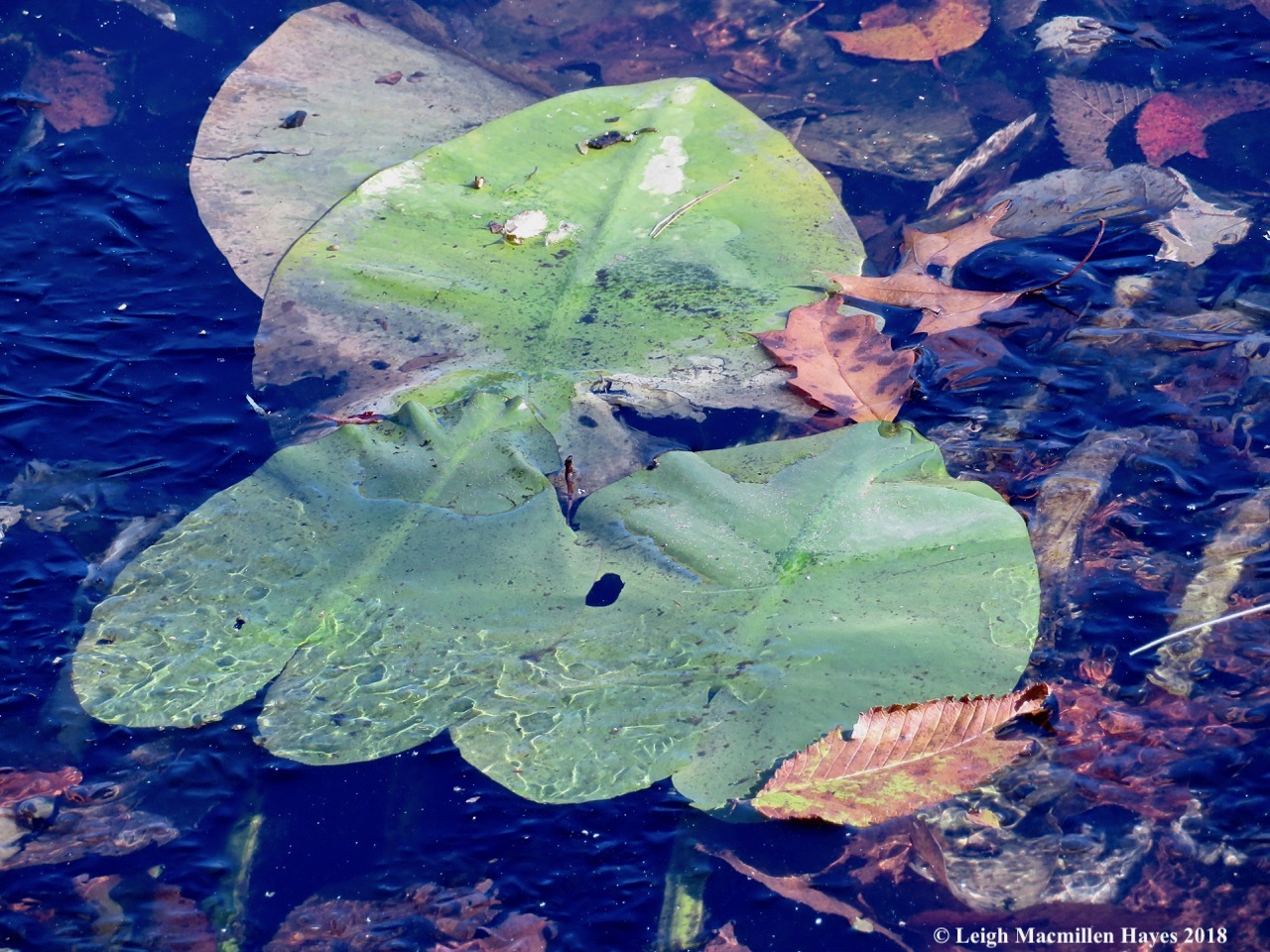
And then I discovered something that perhaps they both already knew: the water supported a small colony of Spatterdock, a plant that will need to be added to the list of flora for this property. Do you see the ice on the Micky Mouse ear leaves?

28-ice

Ice had also formed around a fallen log, its swirls portraying a high-heeled boot that certainly might be appropriate in an ice sculpture but not on ice.

28-tree spirit

All of what I saw the tree spirit already knew. And yet, it allowed me to make discoveries from my feet to the sky.

29-Mount Washington summit

And every layer between. I know he’s not there anymore, but can’t you imagine Marty Engstrom on top of Mount Washington?


Amazing Race–Our Style: episode nine

“Drive to Newry and receive your next clue,” was the message we received midday yesterday and so as soon as my guy closed his store and sent in an order for more merchandise, we hopped into the truck and began our journey north. In Newry, just beyond Bethel, we found out we were to continue on to Rangeley and patronize the local businesses.

1-Moose and snow

First, however, we had to get there. Darkness enveloped us and flurries confused my vision as I drove with caution through Grafton Notch to Errol, New Hampshire, and then back into Maine toward our destination. Our wildlife sightings: two raccoons, a snowshoe hare still brown in color, a couple of deer and a cow moose and the bull moose you might see to the left of the first telephone pole. We were excited to say the least. And, I had proof that my slower speed was apropos–cuze my guy was teasing me.

3-the place to ourselves

It was almost 8:00pm when we pulled into town and stopped at Parkside and Main for a burger. The restaurant closed at 8, but owner Kash Haley was gracious and told us to relax. So between plays in the football game, and bites of our burgers, we oohed and  aahed as one of the waitresses shared photos of her grandchildren with us.

2-hanging out at Parkside and Main

And then once all the patrons and staff had left, we sat for a bit longer at Kash’s insistence and enjoyed the game and each others company while he cashed out and sanitized the kitchen.

4-blue sunrise, blue sky in morning, snowflakes are forming

This morning found us rising to a blue sky over Rangeley Lake. Doesn’t the saying go like this: Blue sky in the morning, snowflakes in the offing? For they were and we knew we had to dress appropriately for a day outdoors. But first, we had a few more local businesses to visit, the first being Keep’s Corner Cafe for breakfast and then we grabbed sandwiches from Woody’s Deli at Loony Bin Variety. And with the check came our next clue: “Rangeley–equator to pole, it’s all the same.” Huh?

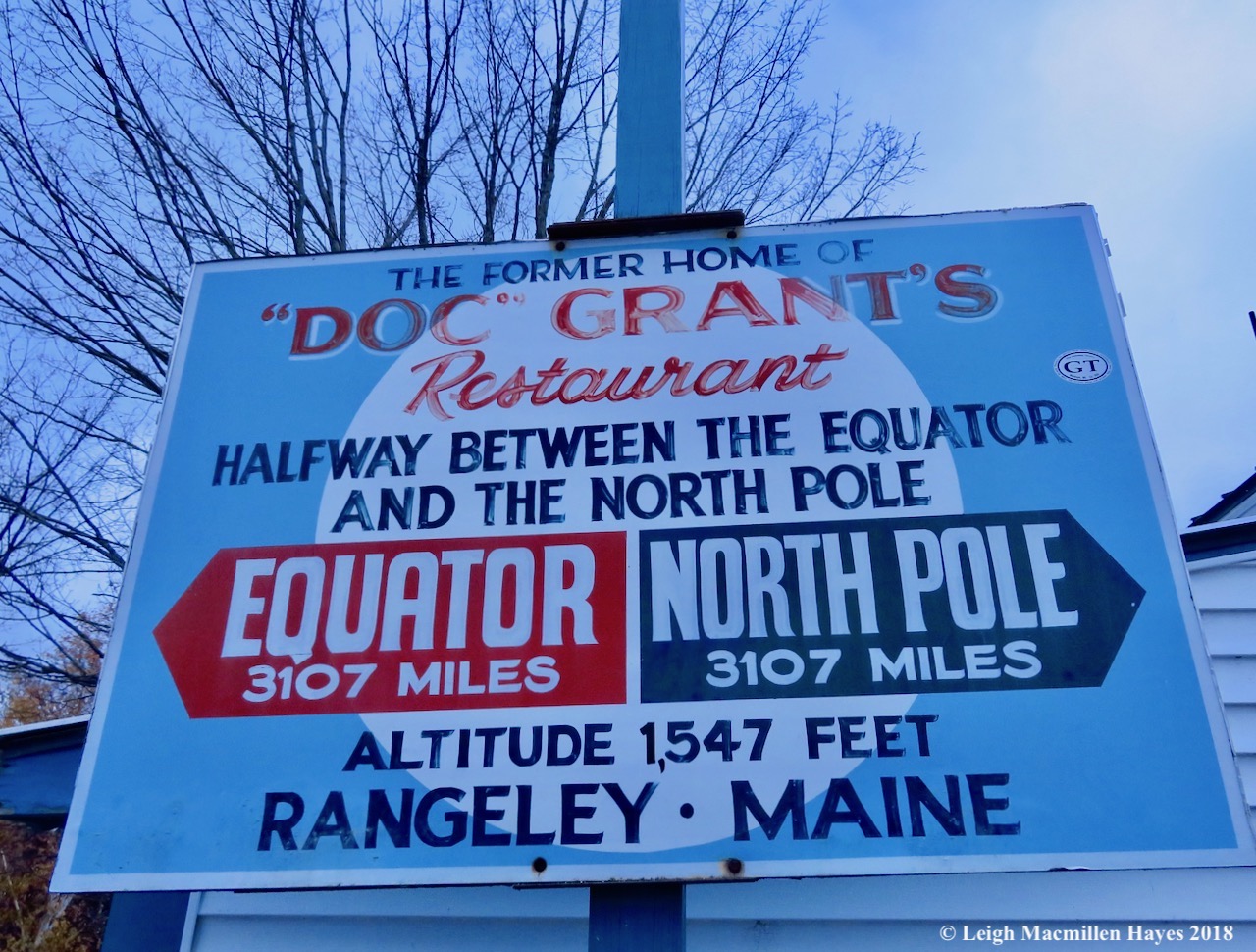
5-halfway between equator and north pole

But, we did our research and sure enough, the western Maine town of Rangeley is located precisely between the Equator and the North Pole. How cool is that? And it was at that sign that another clue appeared. “Choose one: Either explore Orgonon or Find your way to the giant AT sign and seek the piazza.” Several years ago we’d snowshoed the trails at the Wilhelm Reich Museum, aka Orgonon, so we chose the latter for today’s challenge. The AT we understood to be the Appalachian Trail, but a piazza on the trail? Would there be a hut with a porch? Perhaps a fancy porch?

6-AT

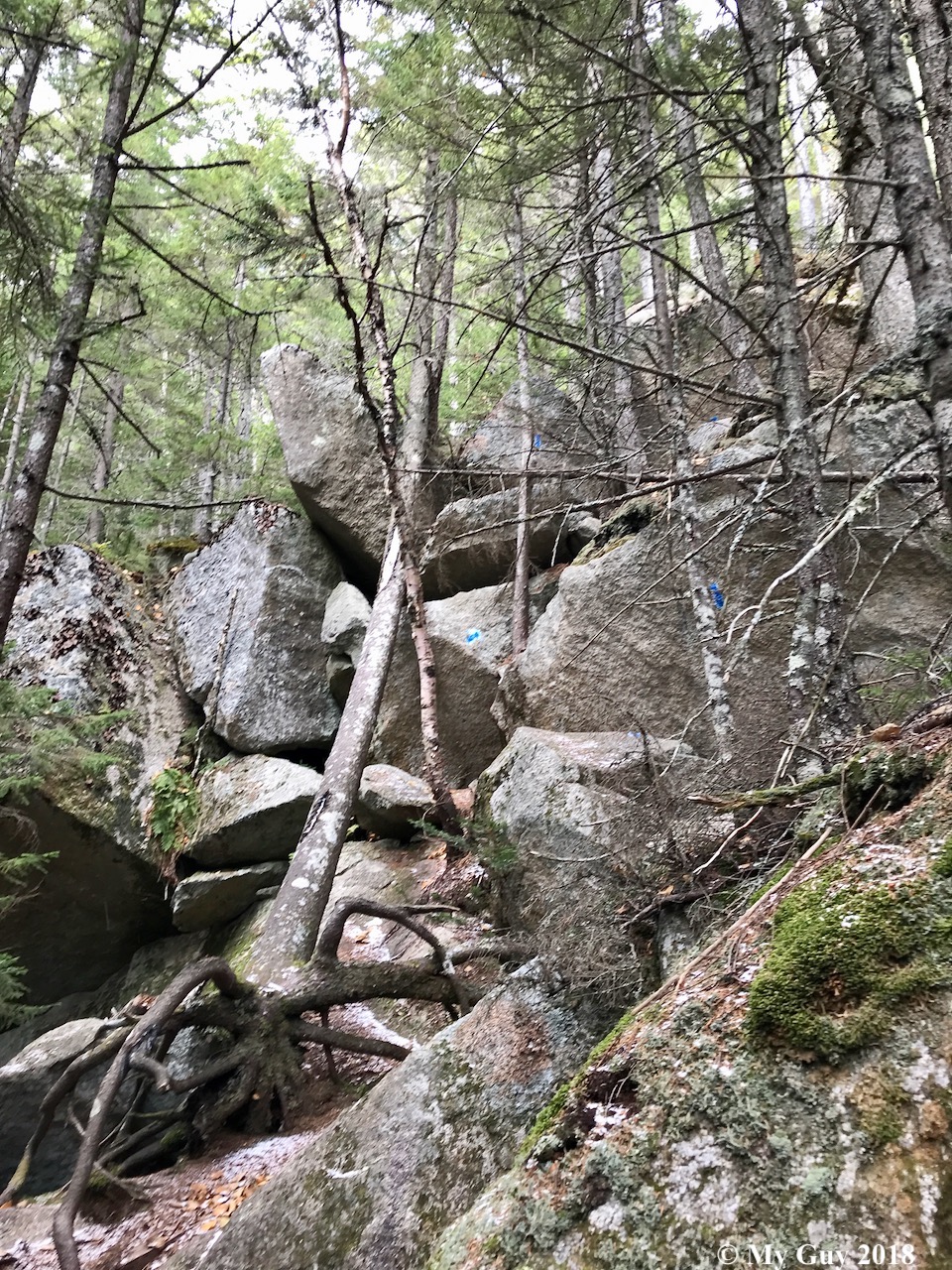
A few miles south we found the giant AT. And across from the parking lot on Route 4 we spied the opening to the part of the trail we thought we should follow.

7-red fox scat

And so we ventured forth, stopping moments later for a couple of deposits of red fox scat. Another critter to add to our 24-hour menagerie.

8-sluice

We crossed a sluice way of the Sandy River, and imagined the history stored in the rocks.

9-snowflakes gathering

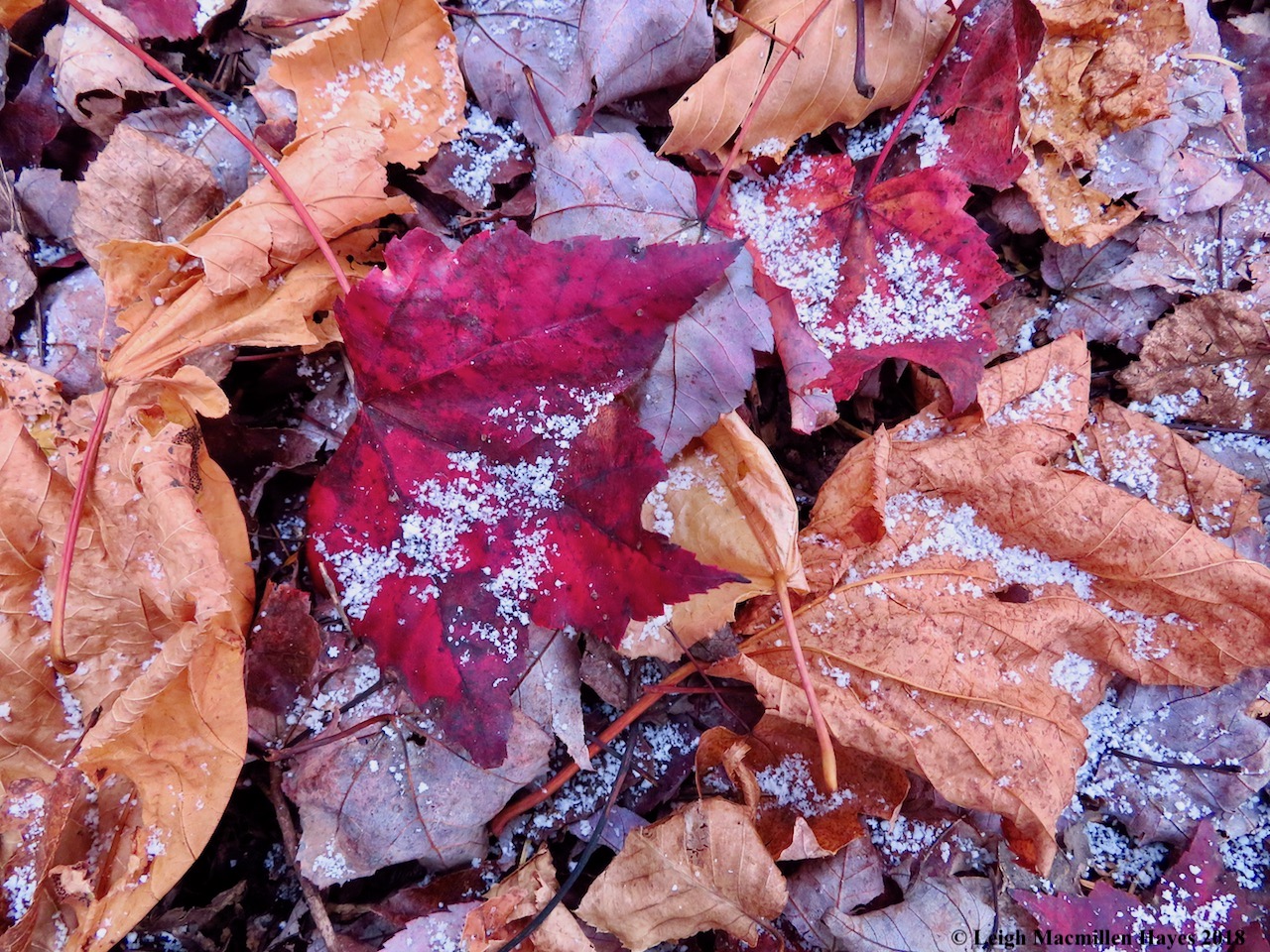
As we hiked, snowflakes decorated the variety of maple leaves.

10-snow on trail

And we began to notice that our journey would pass through a variety of natural communities and over various obstacles including roots,

11-boardwalks

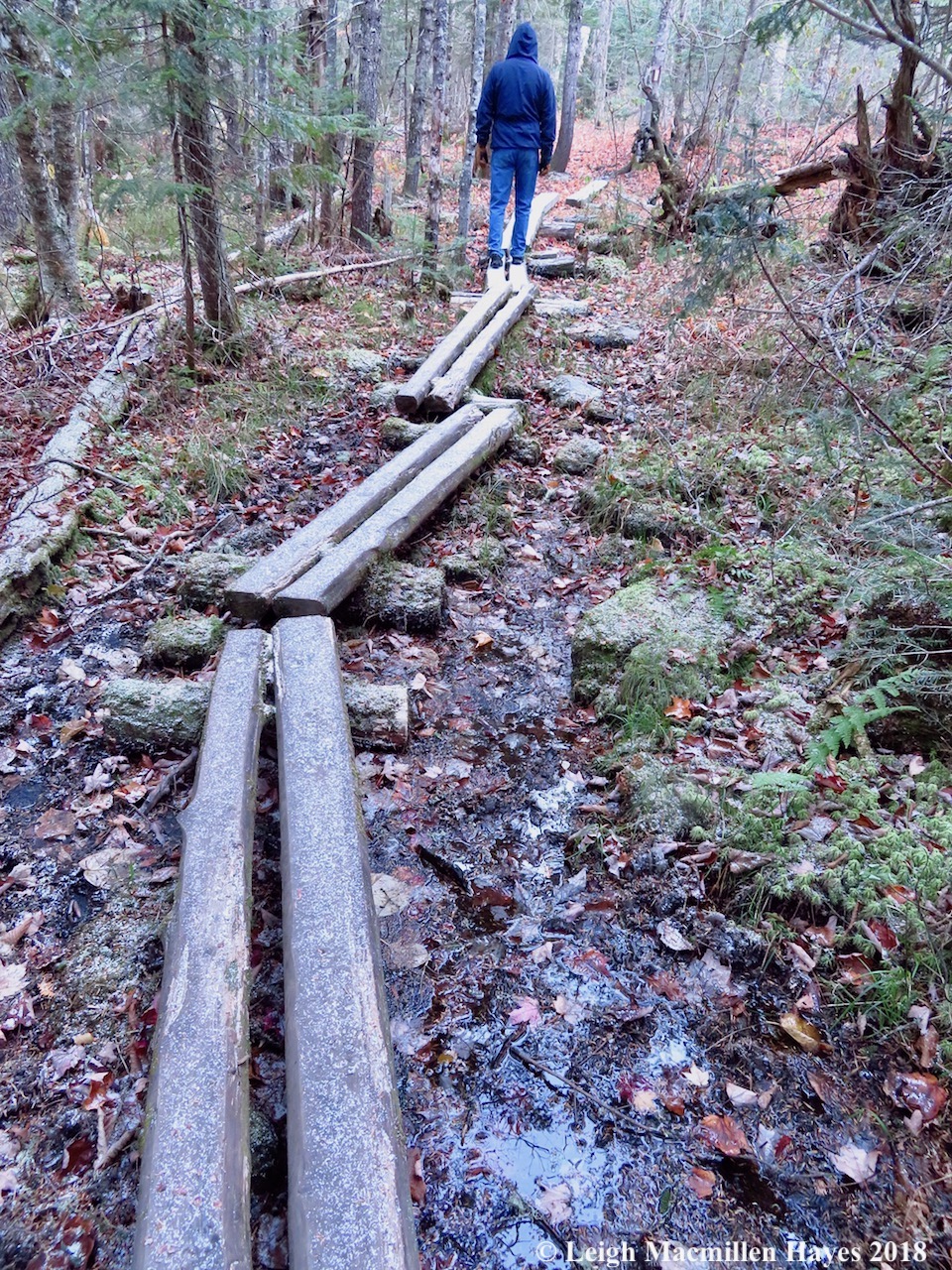
boardwalks,

12-rocks and roots

and rocks mixed with roots.

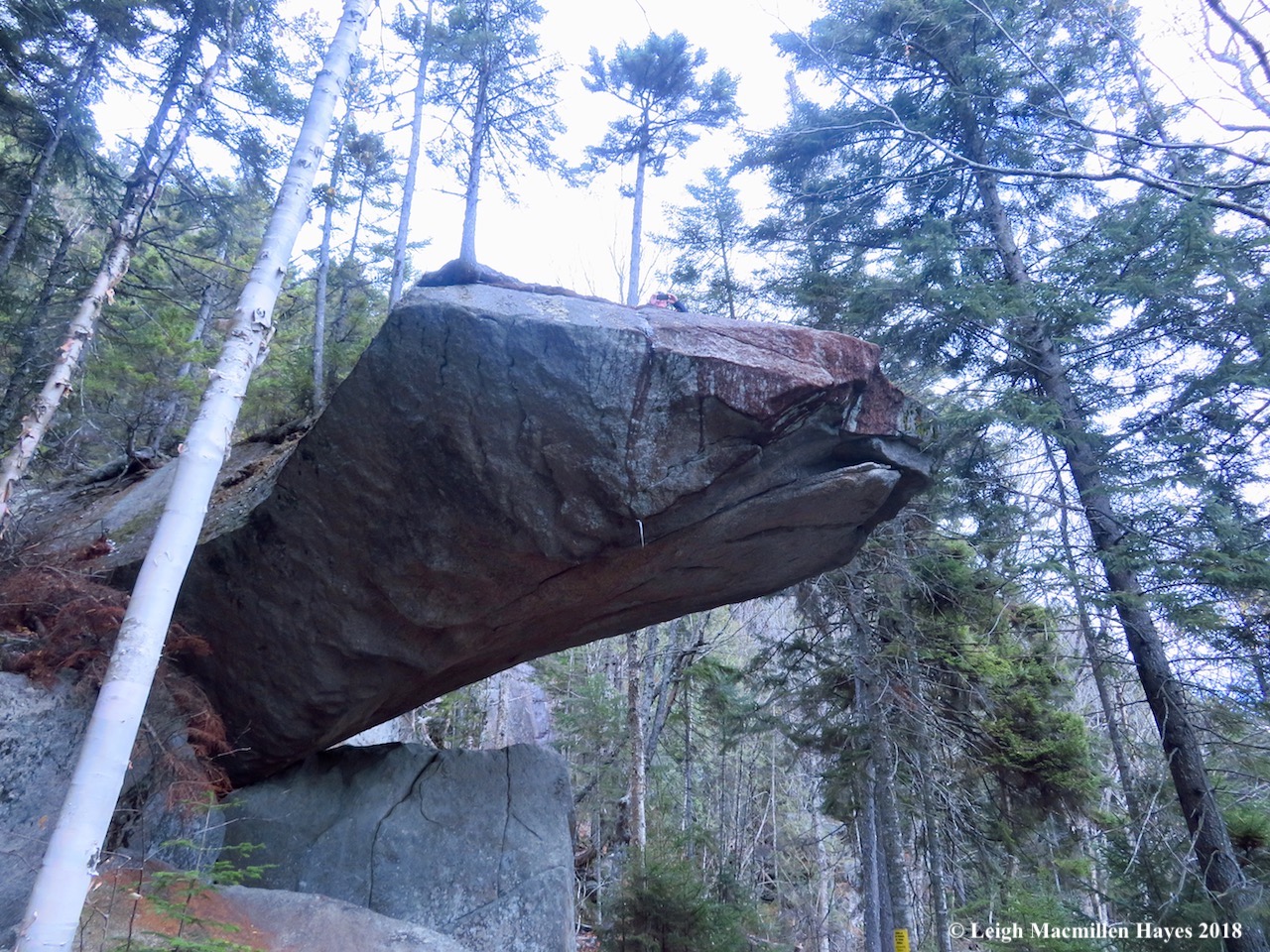
16-Piazza Rock

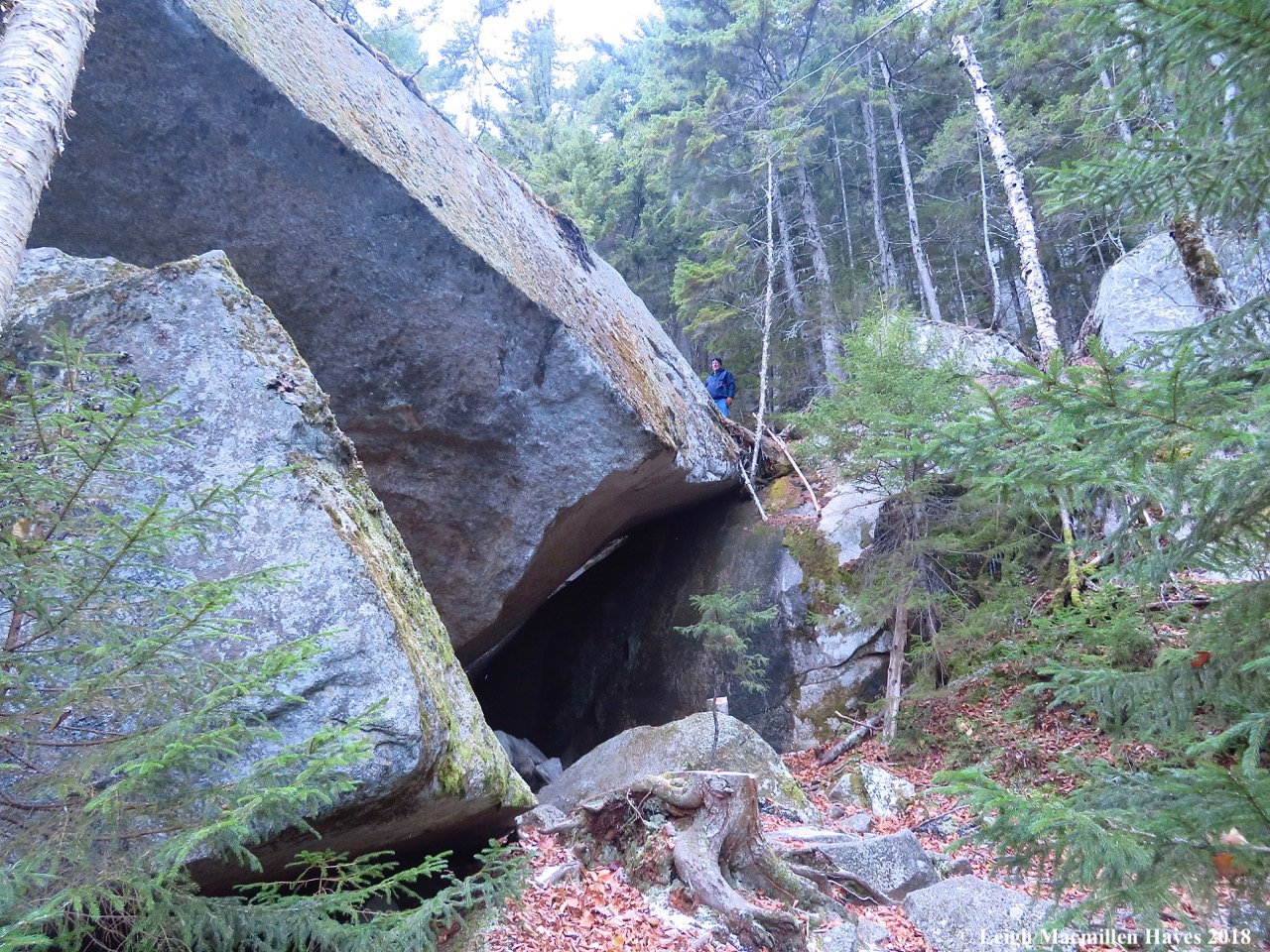
My guy was in the lead, though he commented throughout that I wasn’t far behind, trailing only by a few footsteps. But when he reached a certain point, I’d been looking down for careful foot placement and so I didn’t know what he was exclaiming about–until I looked up. At. Piazza. Rock.

From Maine Trailfinder we discovered this tidbit: “According to the geological notes about this area, ‘The granite of Saddleback is jointed into huge building blocks. An unusually large one has slid out of its place in the mountain side and, instead of breaking and skating down the slope like the others, has balanced across another block to create one-half of a cantilever bridge, forming Piazza Rock.'” Oh, did I mention that we were hiking up Saddleback Mountain?

17-contemplating climb up Piazza Rock

Perspective isn’t gained until one actually stands under the building block. The clue said that one of us must climb atop the structure and the other view it all from below. Thankfully, despite his fear of heights, my chivalrous guy chose the upper path.

18-and then onto the Piazza

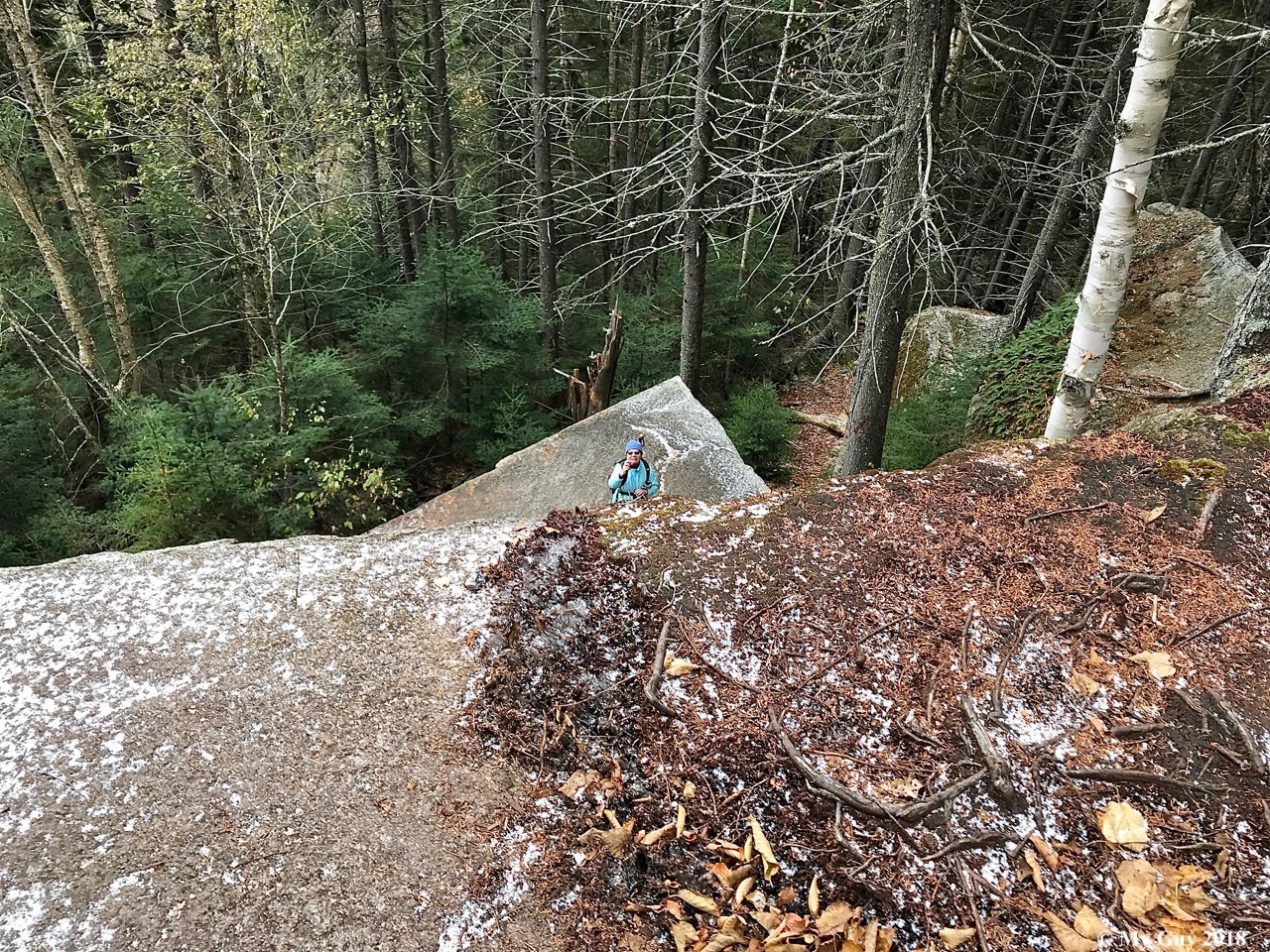
He made it seem so simple as he crawled up the rock and then contemplated the platform before him. For a second, he wasn’t sure he’d be able to go further. But, that could mean the loss of points for us. I didn’t say anything to encourage or discourage because I was standing on safe ground below.

19-under piazza rock

My job was to appreciate the boulder from its underside. And certainly I did as I looked up at the stone diving board planted for a giant’s leap.

20-My guy on top of Piazza Rock

And bravely making his way toward the tip–my guy!

21-My guy atop the turtle head of Piazza Rock

I looked up to where he stood–atop a turtle head, for after all, we stood on turtle rock.

23-looking down at me from Piazza Rock

And he looked down . . .

Later he told me that his father always said as he stepped onto a porch, “I’m going out to the piazza.” Indeed.

28-climbing onward

Interestingly, both of our fathers accompanied us on this leg of the race for apparently as my guy thought of his dad, I spent some time thinking about my father and how much he would have loved exploring trails such as this one with us.

13-temperature

But, we were in a race and so though we reveled in memories of our fathers, we had to move back to the trail signs and check for our next clue, which was again a choice: “Make the next move or Channel your best bat.”  What?

21-Piazza Rock Hut

We followed the trail, crossed one of many streams and located the Piazza Rock Campsite–all set for the next temporary residents who would leave no trace behind.

22-Privy

It was right behind the hut that we noticed the privy–and location for any who chose to make a move . . .

23-cribbage board in two seater privy

In the game of cribbage that is for a game board sits between the two-seater. My guy might have chosen this for he knew he could beat me, but he was once again chivalrous and suggested we channel our best bats. Team Pink did stop at the privy and we never saw them after that so we wondered if they gave up on their card game and moved on to Orgonon.

25-onto the caves

We, however, continued on and reached “The Caves.” One after the other, we shimmied through, hardly as graceful as a bat might fly.

27-the caves

It wasn’t easy, but we moved in and out and reached our next clue: Locate lunch rock with an aquatic view.

28-Ethel Pond?

Onward we climbed, reaching Ethel Pond first, where the ice at the edge was thin and my guy reminded me that I should approach with care.

29-another wetland

About a half mile up the trail we spotted another wetland. Really, we expected to see a moose in each, but when one expects to see a moose or any other form of wildlife, it doesn’t happen. And it’s truly more enjoyable when the offering is a surprise.

29-ice formations

Speaking of surprises were the first ice formations of the year.

30-crossing to lunch rock

Periodically, we crossed water, but the ice formed best at our last crossing, where lunch rock awaited. We’d made it to the stream that flowed from Moose and Deer Pond, a place we couldn’t necessarily visit, but could appreciate for the wildness it offered its wildlife residents.

Lunch rock stood in front of my guy and it was there that we enjoyed the chicken salad sandwiches we’d ordered from Woody’s Deli at the Lonny Bin.

32-squirrel midden

As we looked about, we discovered that we weren’t the only ones to dine in that vicinity, for the balsam fir scales and cone cobs indicated that the resident red squirrels were also frequent diners.

32a-junco joule=foe of a different feather

And, it appeared, another had also consumed a meal for Junco feathers were plentiful. A foe of a different feather had gained a few joules of energy.

33-back to the sluice

Our lunch spot became our turn-around point and with great speed we made our way back to the sluice in now time at all,  completing our eight mile hike with side trips in 5.5 hours, sorry that we couldn’t summit Saddleback Mountain because we were told to return to our truck by 3:30pm. We actually reached the truck by 3:10. In our minds, another day will find us returning and summiting Saddleback as we really like the trail and were eager to discover what else it had to offer.

34-reaching the mat at Puzzle Mtn Bakery

As we drove toward Errol on our return trip, we spotted Team Mustang stopping just below Orgonon and wondered what they questioned when they stepped out of their car.

We continued on to the starting point in Newry, ready to step on the mat and end this leg of the race, only to discover that we’d made a mistake.

How could that be?

We thought that lunch rock was our turn-around point, but we should have continued about 50 more feet where a spur trail would have led us to Eddy Pond. Oh, we could see the pond, but not get close to it. If only . . . we’d paid closer attention to the map.

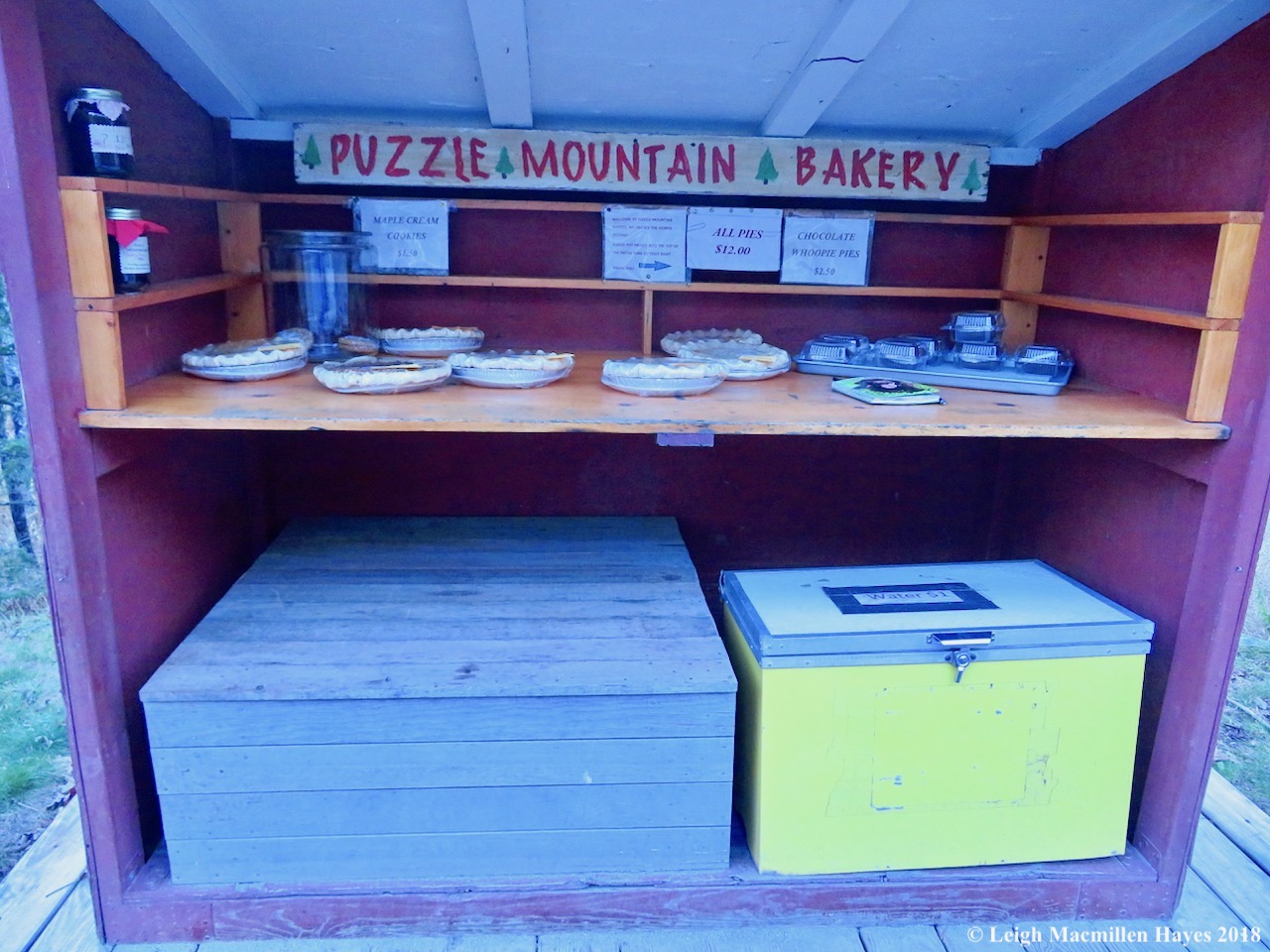
As it was, when we arrived at the mat beside Puzzle Mountain Bakery in Newry, we had to sit for a half an hour and wait. No one arrived. Thankfully. And then we had to answer one important question:  How many streetlights are there in Upton? Eight. Check.

25-the prize

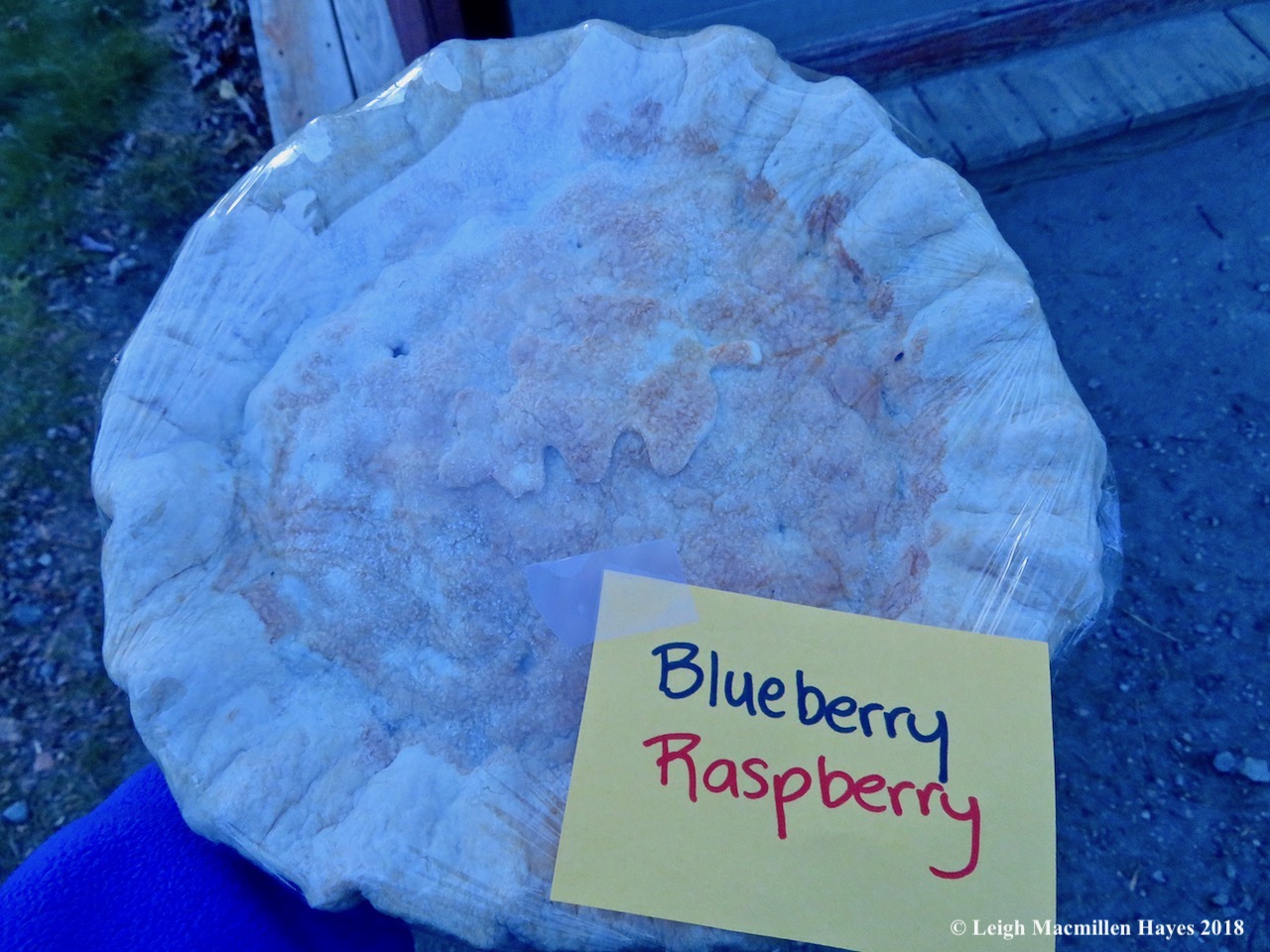
We finished third but got the streetlight question right and so we received a blueberry raspberry pie. YUM.

The Amazing Race–Our Style: episode nine . . . and the fun continues; we’re still in. Phew.


Eyes of Wonder

On the first and third Tuesday of each month since the snow first flew in 2017, I’ve had the privilege of tramping through the woods with our Tuesday Trackers group. As it happened this month, we were also able to tramp together today–the fourth Tuesday.

Each week, the participants vary as they come when they can. But no matter who shows up, by the end of our two-four hour exploration, we are all wiser for the experience–and filled with gratitude for the opportunity to spend a winter morning in the Maine woods. We are also grateful for the wonder that is right in front of us, not only materializing in the form of mammal tracks, but all manner of things that make up the web of life.

j1-otters romping across the snow

Usually the age of our attendees ranges from 50-something to 80-something. But today we were joined by four little otters who reminded us what it’s like to be a child again as they bounded across the snow’s crust, and rejoiced at the sight of any and every little thing that presented itself from squirrel and chipmunk holes to fungi.

j2-squirrel prints

Of course, we were there to track and though most prints were bleached out from the sun’s March rays, we did find a few that showed well their finer points such as toes.

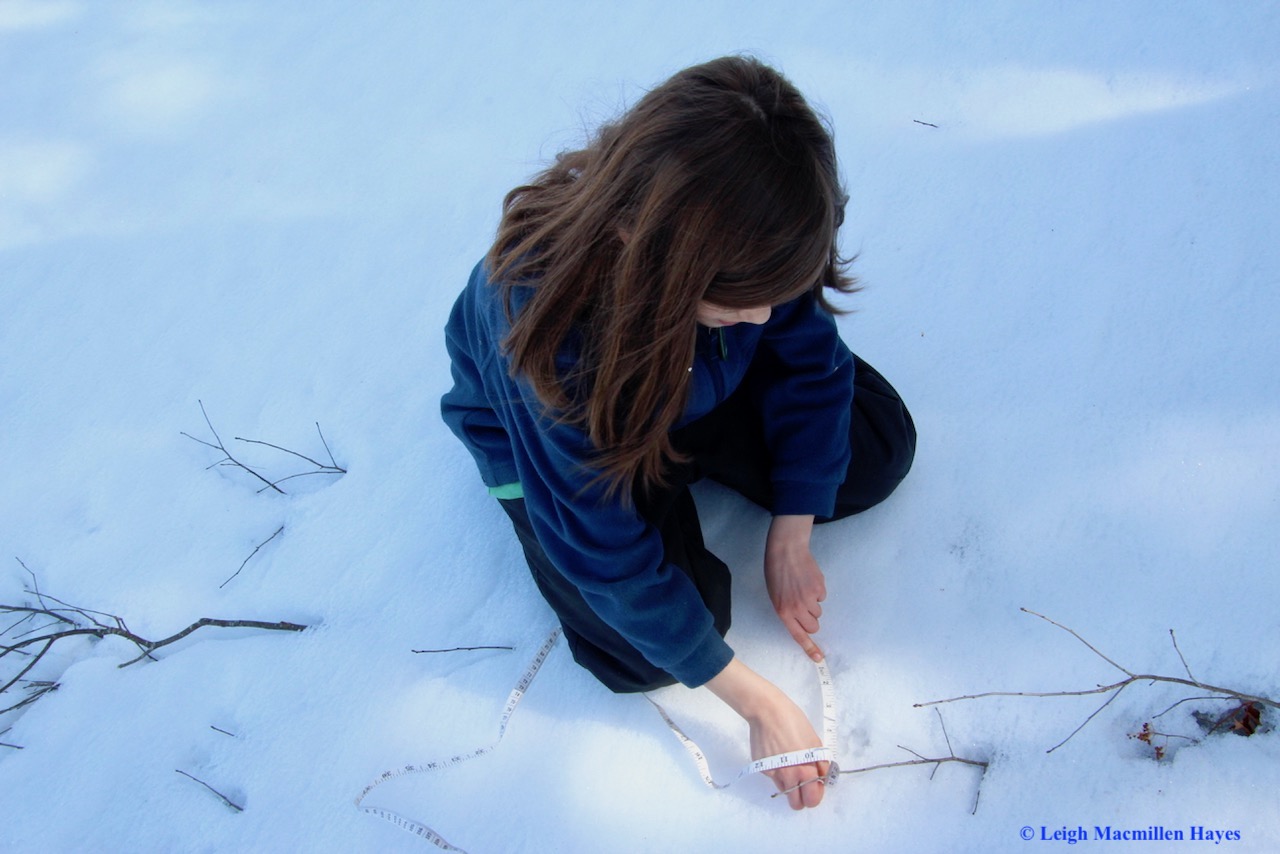
j14-measuring straddle

And with any discernible prints, the kids reminded us to take time to measure straddle, in this case that of a gray squirrel. We also found what we believed was a bobcat track based on the round shape of the somewhat melted print and the stride.

j3-ice and water

Most of us began the journey with snowshoes, but soon joined the kids and shedded them as we moved from frozen snow to bare ground and back again. And then we discovered water. Actually, a few of us were a wee bit behind, when one child ran up to her mom and said, “A vernal pool.” If it does turn out to be a vernal pool, we feared it will dry up too soon, but that doesn’t mean the amphibians won’t take advantage of the spot in a few weeks. It was half covered in ice, which offered a challenge because two of the boys wanted to break through it with a stick. The third boy did break through–much to his dismay. But as his calm mom said, ” Well, now he’ll know next time.” (Juli–I can’t help but smile–you are the best.)

j4-helping hands

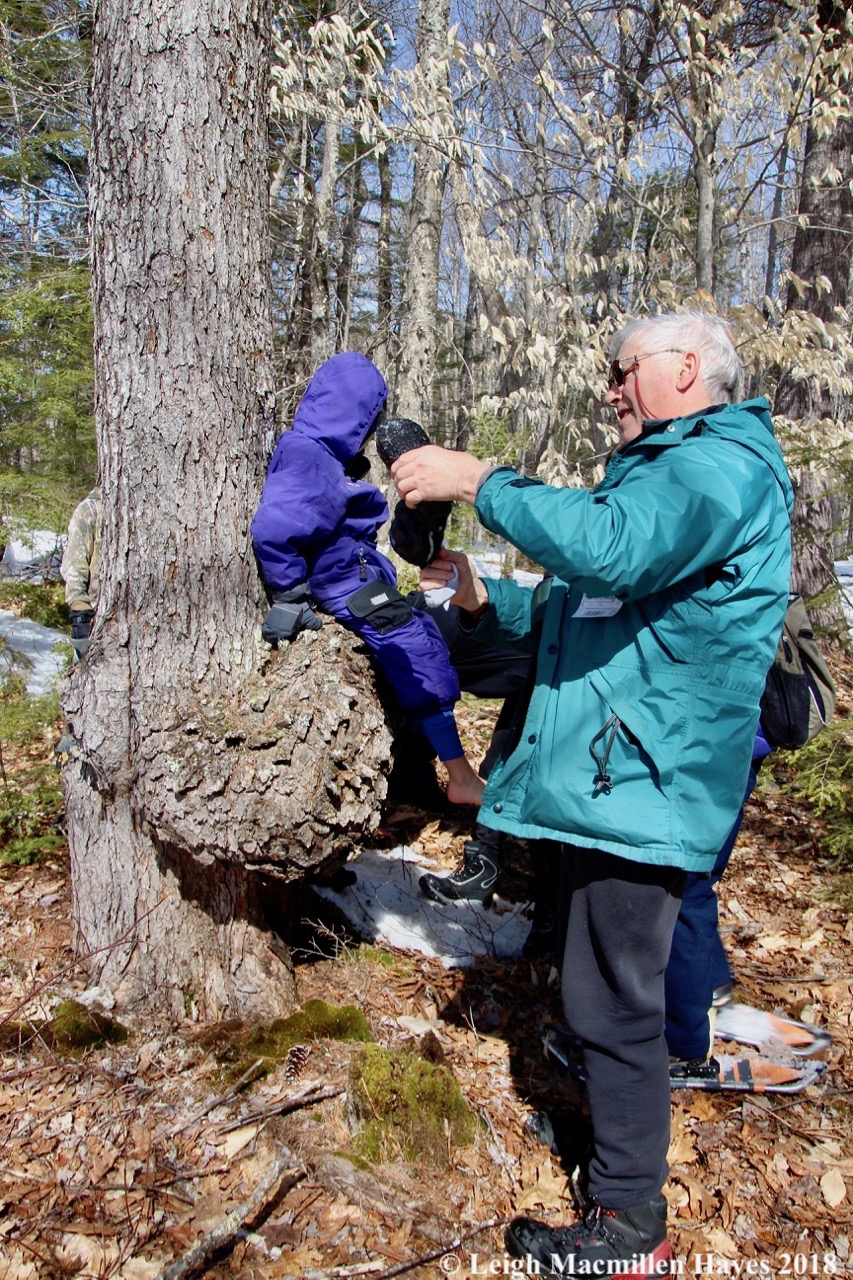
Fortunately, for his sake, we came upon a maple tree with a huge burl on which he sat while others on the journey came to his aid and squeezed a gallon of water, or so it seemed, out of his socks. His mom had an extra pair of mittens in her pack and those covered his toes for the rest of the trek. He wore his boots, of course. While we were there, we wondered about burls and tried to remember what created them. I suggested insects and another thought perhaps fungi. It turns out we were both correct. They may also be caused by bacteria or a virus. What the young lad sat upon was a reaction of the tree to the infestation which resulted in abnormal growth due to changes in the tree’s hormones. Think of its vascular system as a twisted ball of yarn.

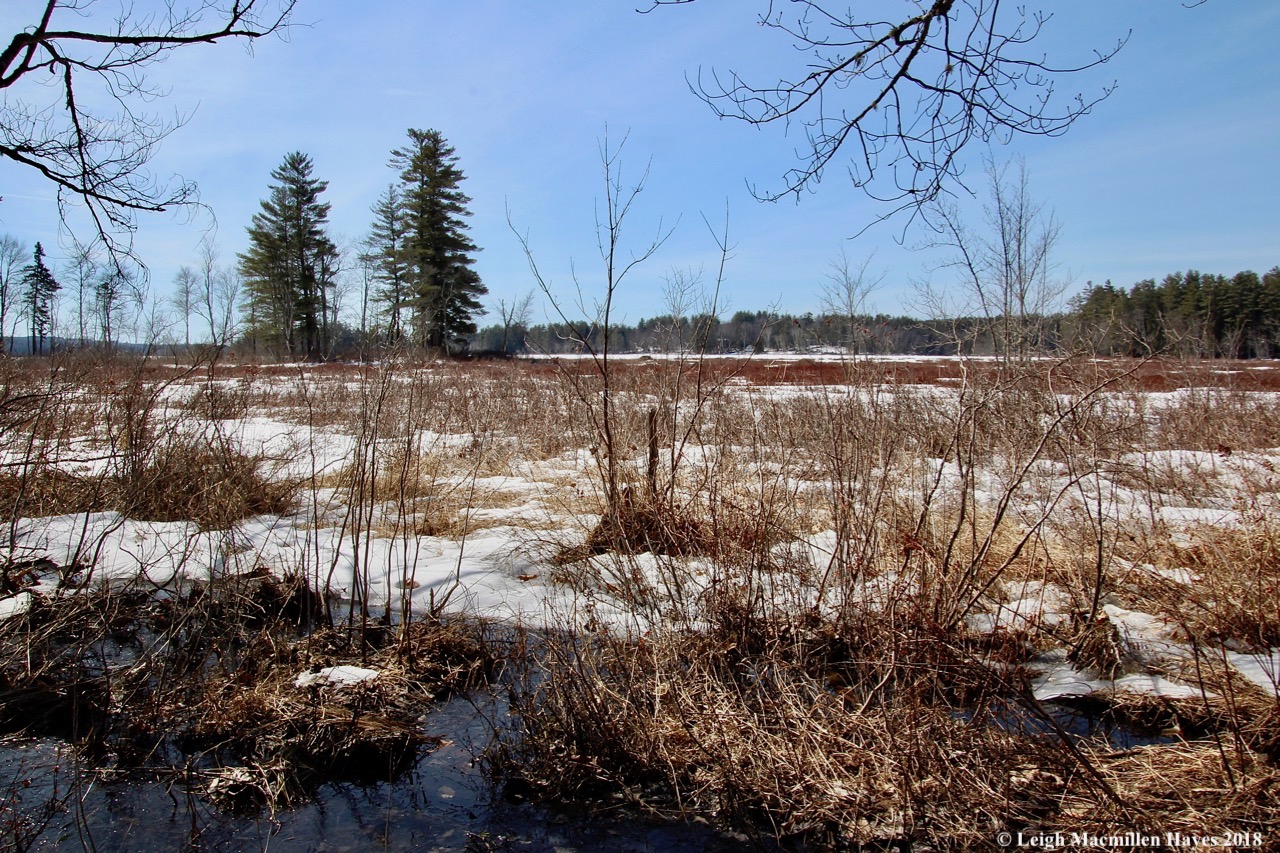
j5-sucker brook outlet into Kezar Lake's Lower Bay

After the sock ringing and mitten fitting episode played out, we turned around to take in the beauty of the Sucker Brook Outlet at the Lower Bay of Kezar Lake for we were on the John A. Segur East Wildlife Refuge on Farrington Pond Road.

In the distance, one lad spied a beaver lodge. You might see it as a brown dot on the snow-covered ice directly above a swamp maple snag in the center of this photo.

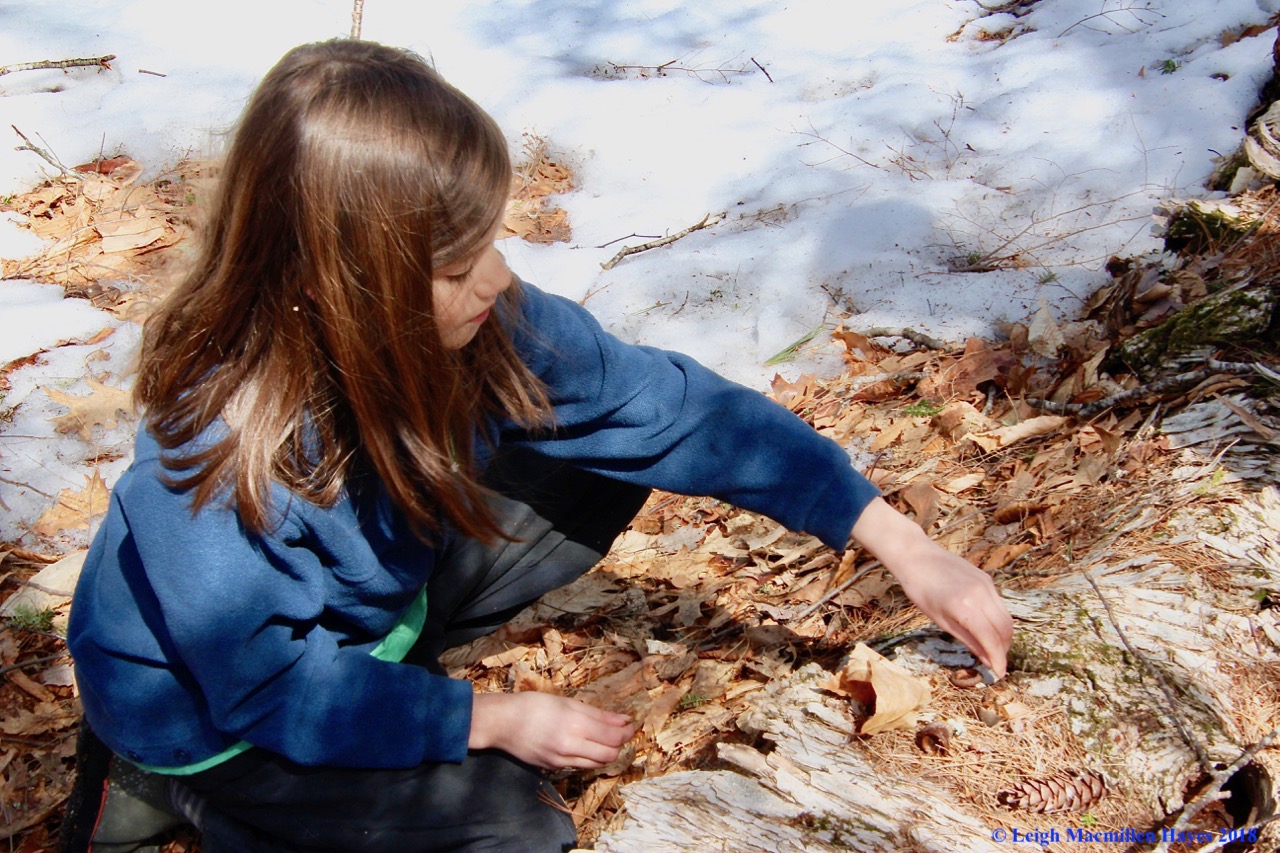
j6-wintergreen and spring tails

We also looked at our boots, where we rejoiced in the site of wintergreen plants evolving from their magenta winter coats. And spring tails jumping about on the leaf litter like performers in an unorganized circus.

j9-squirrel table

Upon a downed birch tree, a certain young lady found the perfect spot to set up a dinner table for a squirrel. She was kind enough to include a dessert treat by stuffing pieces of a wintergreen leaf into an acorn cap.

j10-ice bridge

Much to the delight of the younger set, they next discovered an ice bridge and took turns walking across it. The rest of us decided to pass on that opportunity, sure that we’d ruin the effect.

j11-tree stump examination

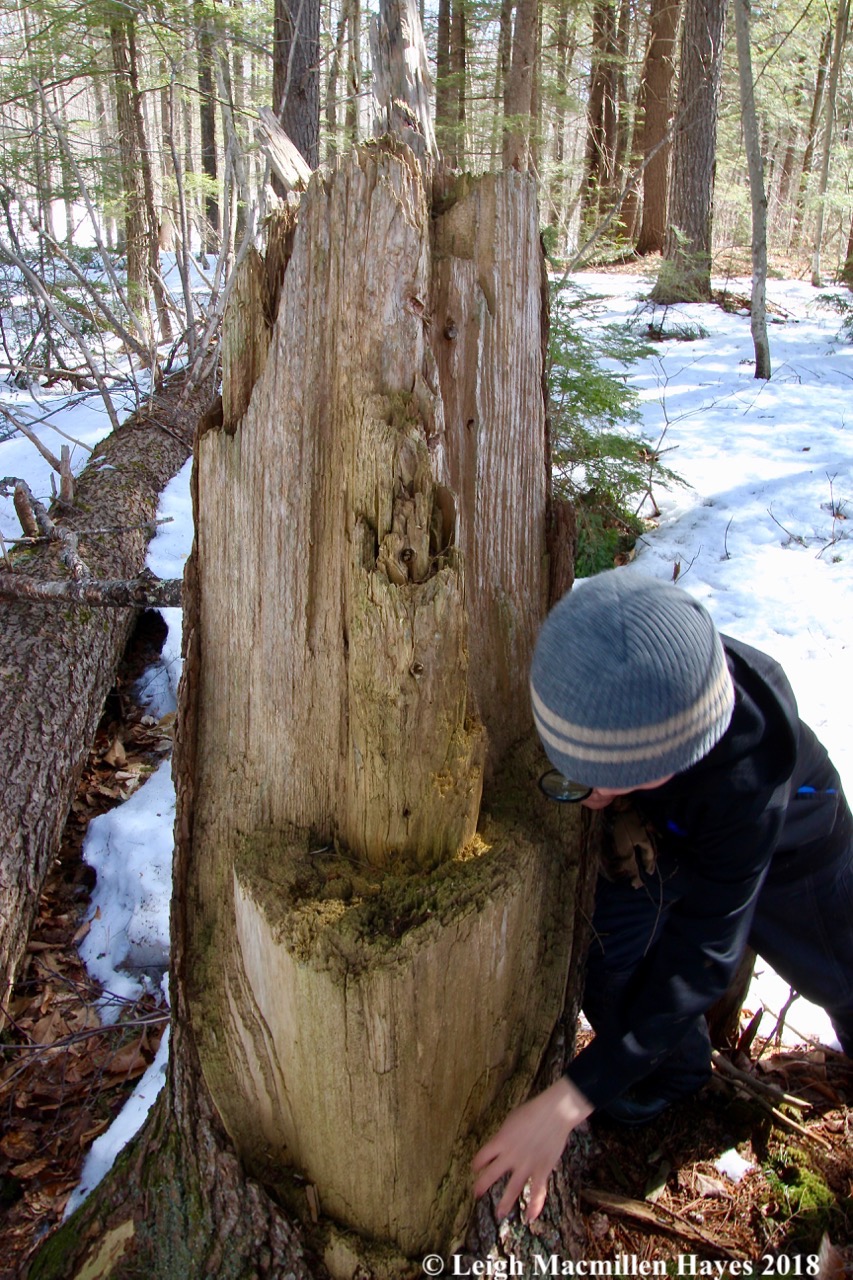
Getting up close and personal was the theme of the morning and everything drew their attention and ours, including a decaying trunk of a hemlock that was downed by a lightning strike several years ago.

j12-tree holes

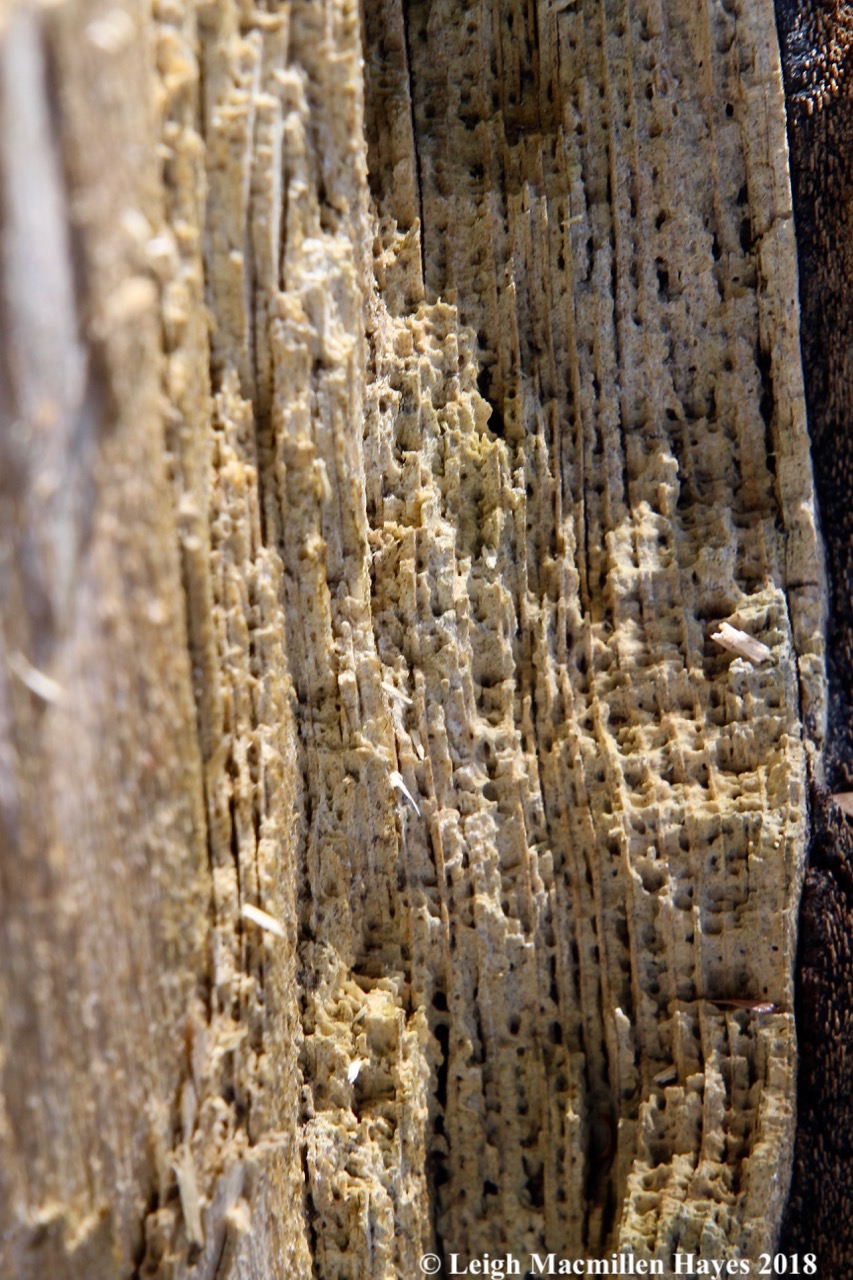
Because we were curious, we noted holes of the tree’s decayed xylem, the system of tubes and transport cells that circulate water and dissolved minerals. One of the boys decided to see if it worked and poured water onto the stump, which immediately flowed into the holes. We’ve viewed tree stumps and rings many a time, but this was the first time we recalled seeing the holes. No tree stump will go unobserved on our path from now on.

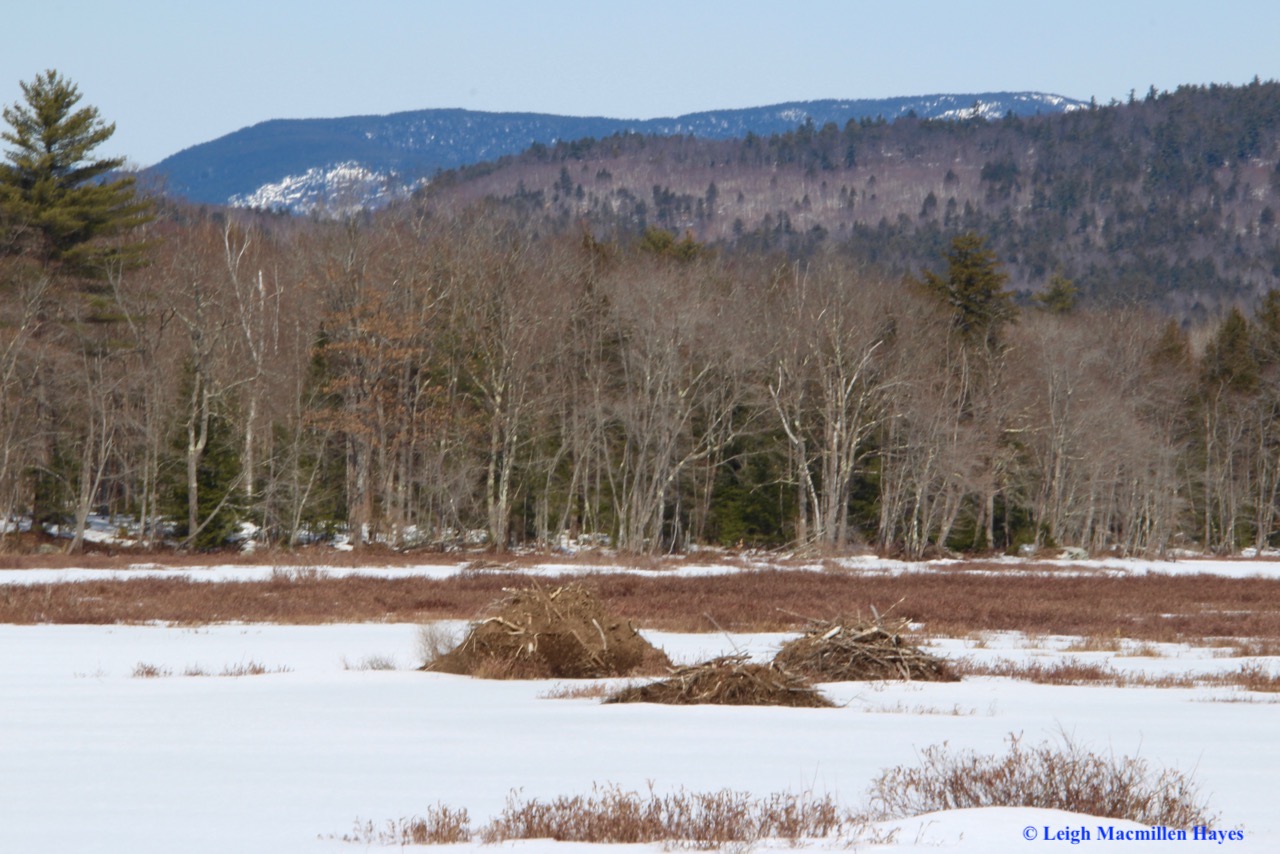
j13-lodges reflect mountains

Our turn-around point was at another spot along Sucker Brook where three beaver lodges reflected the mountains in the backdrop.

j21-beaver lodge

A few of us walked across the ice for a closer look because one appeared to serve as this winter’s home site. We trusted the family within included their own young naturalists.

We were certainly thankful for our time spent with four children who allowed us to look at the world through their eyes of wonder.

(On behalf of Joan, Dave, Steve, Dick, Jonathan, and I, we thank you, Caleb, Ellie, Aidan and Wes. Oh, and your mom as well, or especially–thank you Juli. We’re all in awe of you and the gifts you’ve passed on to your kids.)


Back Soon Mondate

We headed south today in search of spring. LOL! Indeed, we found as much snow on Sawyer Mountain in Limington as we have in western Maine.

s1-trailhead

The mountain was a new one for us. It featured two trailheads and we chose the one on Route 117 where only one map was available. We borrowed it and later returned it for others.

Much of the mountain, as in 1,472 acres, was purchased over the course of eleven years by the Francis Small Heritage Trust. According to an article in the Portland Press Herald written by hiking enthusiast Carey Kish in May 2016, “Francis Small, the namesake of the trust, was a fur trader and landowner who lived from 1625 to 1714. Small is said to have owned the largest amount of land of any person who has ever lived in Maine.

In 1668, Small operated a trading post a few miles northwest of Sawyer Mountain, at the confluence of the Ossipee and Saco rivers and the crossroads of three major Native American travel routes, the Sokokis Trail (now Route 5), the Ossipee Trail (now Route 25) and the Pequawket Trail (now Route 113).

Newichewannock Abenaki tribesmen who owed debts to Small plotted to kill him to avoid payment. Their chief, Wesumbe, warned Small in time to foil the plan, but not before Small’s home was burned to the ground.

To compensate for the loss, Chief Wesumbe sold Small 20 square miles of land for two large Indian blankets, two gallons of rum, two pounds of powder, four pounds of musket balls and 20 strings of beads.

Small’s Ossipee Tract was bounded by the Saco, Great and Little Ossipee, and Newichewannock (later Salmon Falls) rivers, and included today’s towns of Limerick, Limington, Cornish, Newfield and Parsonsfield, the area where Francis Small Heritage Trust works to conserve land.”

s1a-trail sign

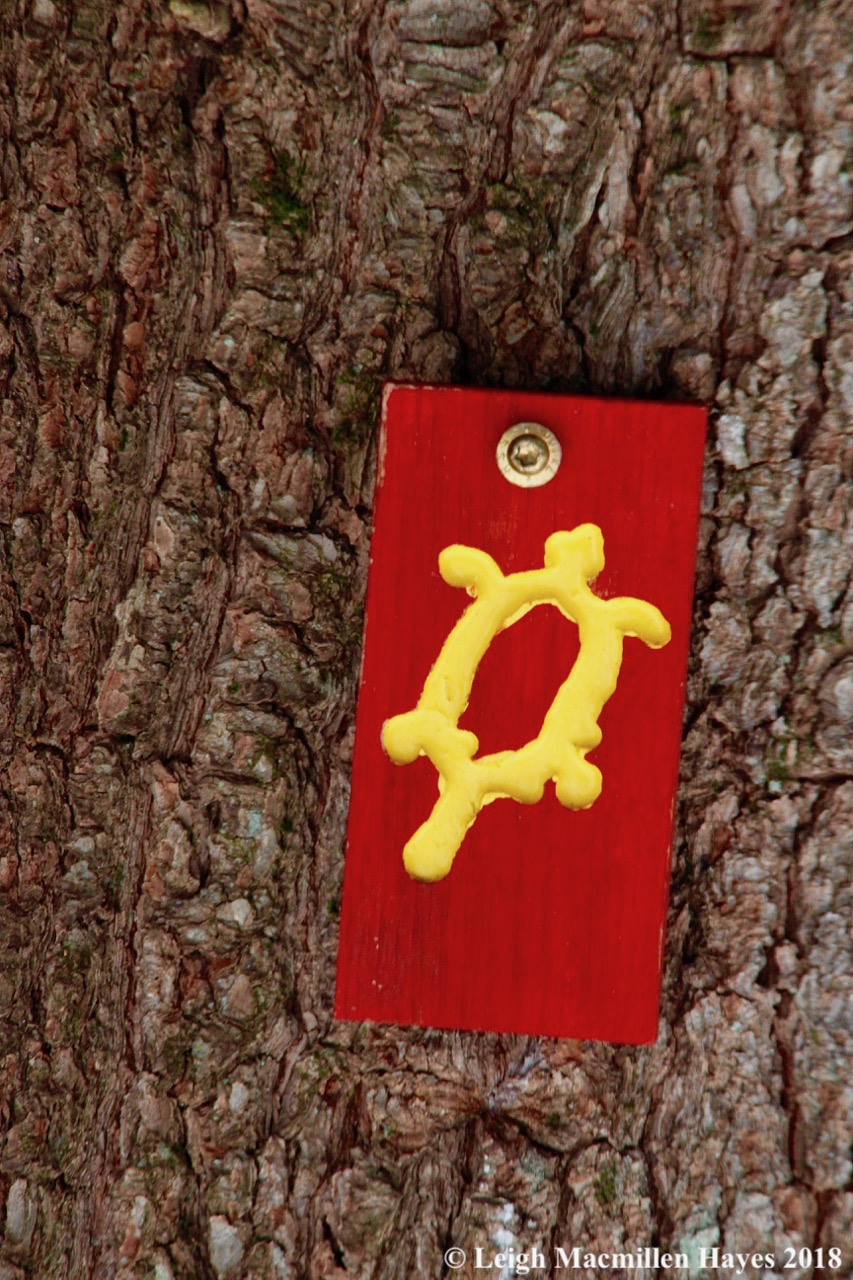
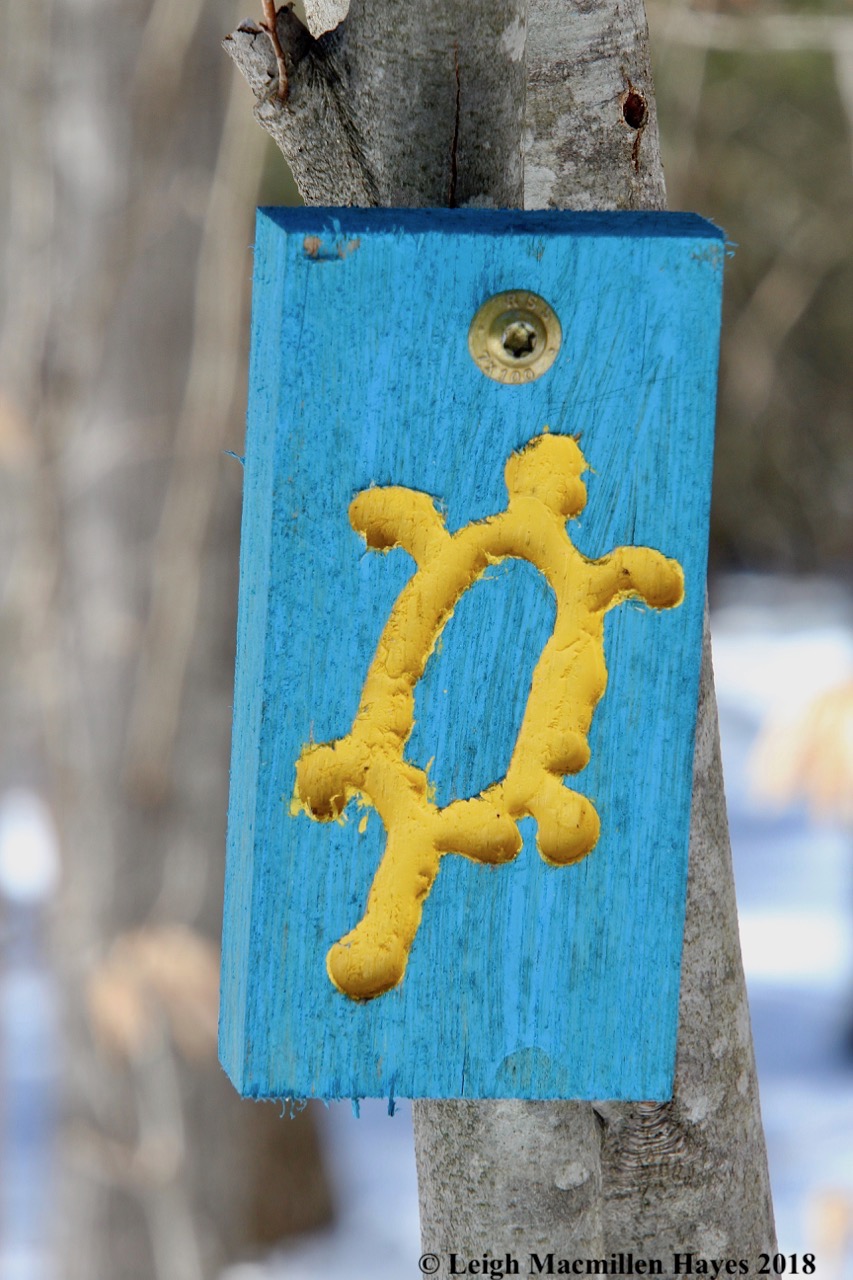
Wooden blocks with yellow turtles carved into them blazed the trail. According to Kish, “This is the mark of Captain Sandy, also known as Chief Wesumbe, of the Newichewannock Abenaki tribe.” Having been a turtle enthusiast for most of my life, I smiled each time I saw one.

s3-Camp Ticumoff

Not everyone felt the same way. Less than a half mile up, we came upon a cabin beside the trail. It had been named Camp Ticumoff. Say it slowly.

s4a--guided turtle hunts

Zooming in on the side of the cabin, we noted a sign–“Guided Turtle Hunts.” And there was another sign as well about the Francis Small Heritage Trust being an ethically challenged organization. We weren’t sure what it was all about, but obviously not all were thrilled with the trail that we immensely enjoyed.

s5-Estes cemetery

Continuing on, we came across the first of several cemeteries. With the snow so deep, we didn’t climb up to inspect the gravestones more carefully.

s6-Estes grave

But in the center stood a marker recognizing various members of the Estes family. Salome died March 30, 1874, aged 66 years, 11 months and 6 days. We often see that in old cemeteries–the number of days into the person’s final month indicated.

s7-caution sign

As we crossed over a brook, a caution sign gave an indication of its own–did I mention how deep the snow was?

s8-Turtle cemetery

And then we found another turtle reference–on the negative side. Definitely some unhappy neighbors in the old ‘hood.

s8a--large foundation

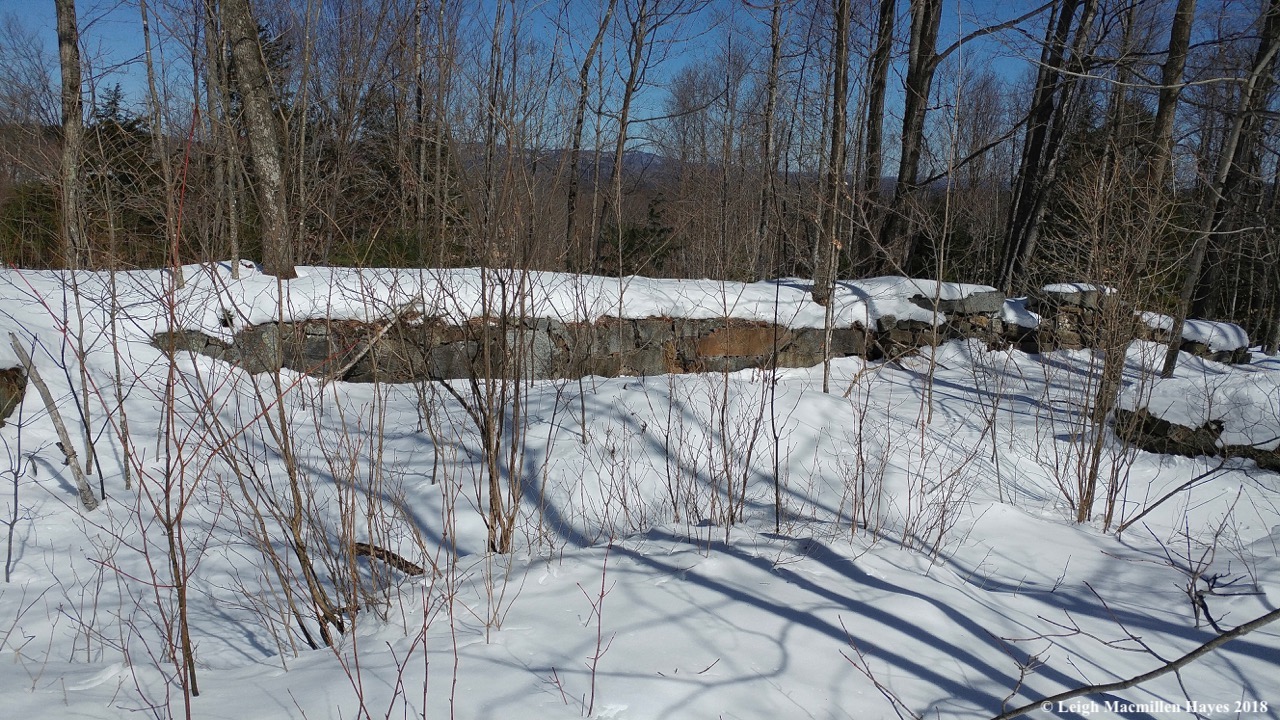
We were in an old ‘hood, after all, for most of our journey was along Sawyer Mountain Road, which was discontinued over one hundred years ago. Left behind were not only cemeteries, but also foundations, this one quite large and I wasn’t sure if it was a home or a barn.

s9-trail map

Right by the foundation, we stood for a few minutes and examined a trail map.

s10-phoebe nest

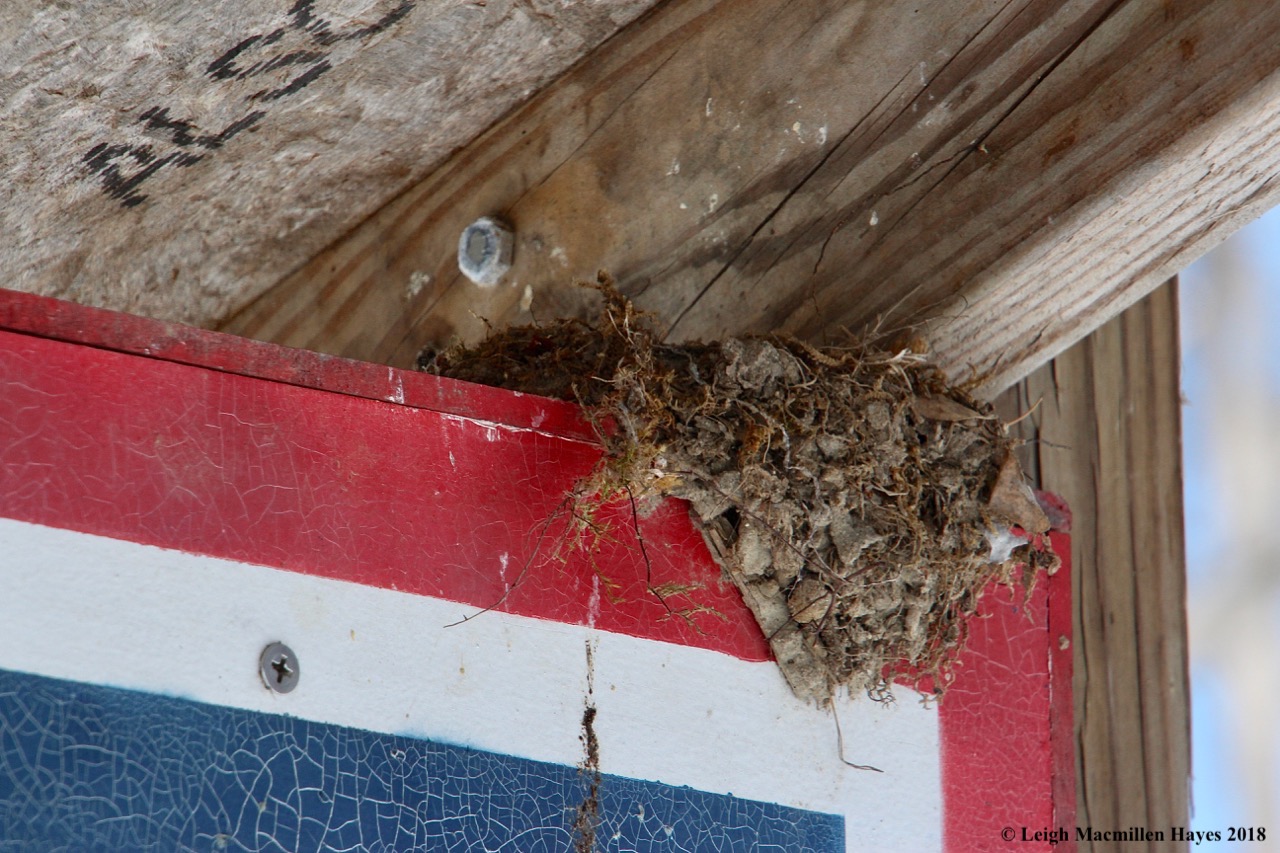
Apparently others have examined it as well, and decided it suited them. I wasn’t surprised. Kiosks often serve as nest sites for Eastern Phoebes, which I trust will return soon.

s11-deer feeding site

It was about a mile and a half to the spur trail that led to the summit. All along, we noted the lack of mammal activity. Not total lack, for occasionally we did see squirrel tracks, but that was all. And then on the spur we found lots of deer activity–where they’d pawed through the snow in search of last year’s acorns.

s36

Apparently they don’t have a feeding station like the deer in our neighborhood.

s12-summit

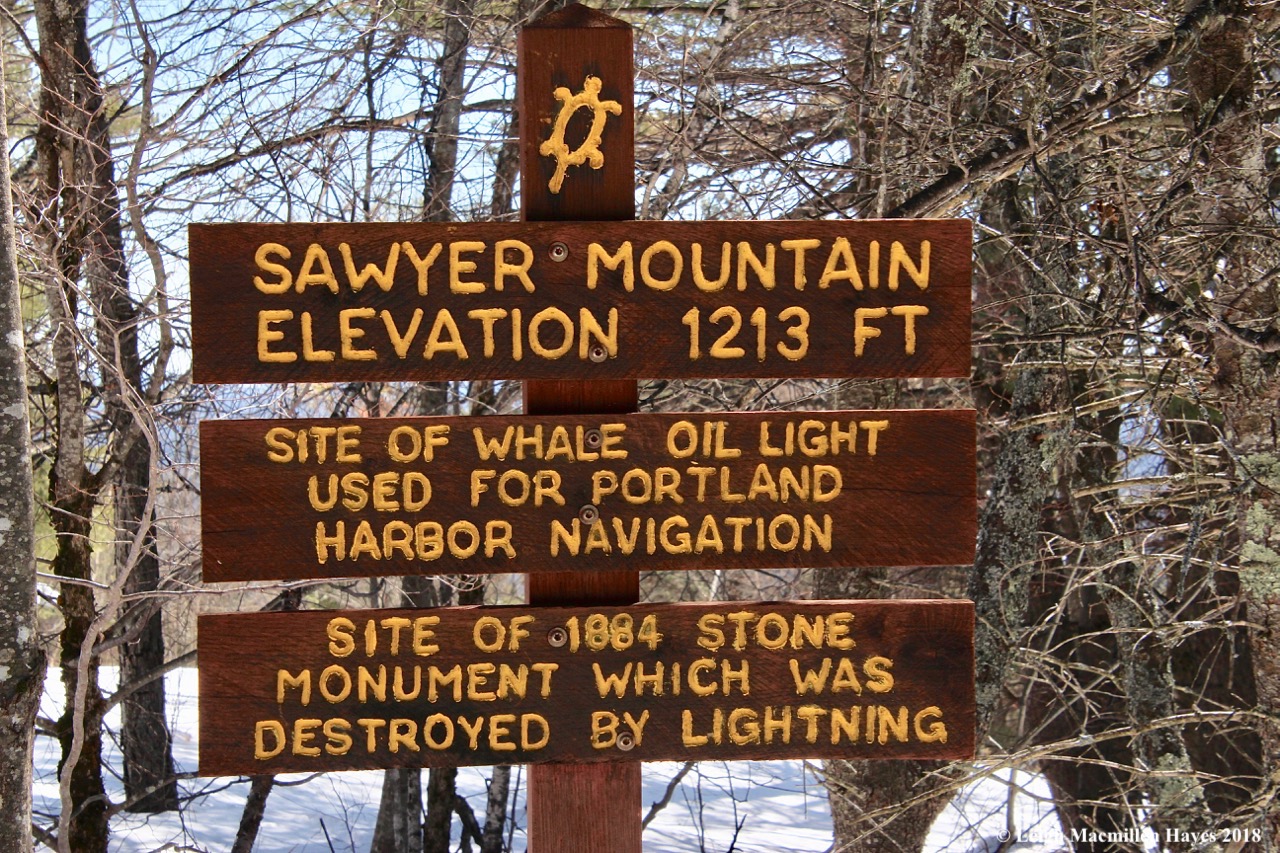
At last, we reached the summit, the site of a whale oil lighthouse used for navigation within Portland Harbor during the eighteenth century. It’s our understanding that the mountain is visible from the ocean so sailors would line up the light with other points to guide their ships into the harbor. We had hoped for a view of the ocean, but as it turned out, the summit was rather anticlimactic. To the northwest, we did catch a glimpse of Sebago Lake, but that was about it as too many trees had taken over the space. It didn’t matter too much as we’d enjoyed the climb and the history, both old and new, encountered along the way.

s13-hiking down in deep snow

After sharing lunch on two tree stumps at the summit, we began our journey down, again traveling through deep snow.

s14-Old David Walker Burying Ground

Because we were on our way down and no one had previously carved a trail to another cemetery, we decided to go for it. We’re not sure what the sign meant–was David Walker old? Or had his burying ground been moved to another site?

s15--John Walker gravestone

Up a hill, we located a small plot with a couple of stones. The first was for John Walker, who died in 1863.

s16-cleaning off a stone

And then another leaning against a granite pillar–so my guy wiped the snow away.

s17--Ebenezer Walker

That one was for Ebenezer Walker. So where was Old David Walker buried?

s19-nature trail sign

Back at the trailhead, I decided to loop around the nature trail while my guy headed to the truck. A sign said a nature trail map would be available at the trailhead, but I found none.

s20-blue turtle

And so I followed the blue turtles and decided to interpret the trail my way.

s21-young pines?

1. White pines: the Maine state tree, took advantage of the clearing and started to fill in the space.

s22-stone wall

2. Stories in granite: A stone wall at least four feet high; a lacy wall perhaps built to keep sheep in or out.

s23-hemlock stand

3. Hemlock grove: The perfect habitat for mammals, including deer. Because of their evergreen leaves (needles) that hold snow, its easier for critters to move below them.

s24-beech trees

4. A Mixed Forest: Beech, maples, oaks, hemlocks, pines–all living together in harmony of sorts.

s25-glacial eratics

5. Glacial erratics: Large boulders dropped by the last glaciers about 12,000 years ago.

s26-ledge and life on a rock

6. Life on a ledge: From lichens and mosses to  hemlock trees, the ledge was a prime example of the abiotic and biotic interactions that create an ecosystem.

s27-downed trees? summer storm?

7. I dunno: A piece of blue flagging and another of orange. Perhaps it was the downed trees to the left–several hemlocks had fallen during a storm with winds out of the southeast–indicating a summer storm probably.

s28-not sure

8. I Dunno Ditto: Perhaps the stream that flowed just below.

s29-pine tree?

9. Big White Pine: But really, was it the tree?

s30-giant boulders

Or the giant boulders beside it?

Perhaps one day, I’ll learn how I did on the quiz–though I do think I got at least two wrong.

s4-no one home

I rejoined my guy and together we reflected upon our journey. One of the things we most enjoyed was the historical features along the way, including the 1940s hunting camp built by the father of Sherwood Libby, one of the Trust’s founders.

s34-Be back soon

And our absolute favorite–a sign on the hunting camp door–“Went out for supplies. Be back soon.”

We will also return–once the snow melts– for there’s so much more to see, as well as other trails to explore. What a fine place for a Mondate on this last day of winter. Be Back Soon. Indeed.

Beside Browns Pond

One should not work from home for then it is much too easy to do an about face with plans for the day and hit the trail before meeting deadlines. But alas, that is how I found myself on the Chessey Property this morning. It just seemed to make more sense to head out early in the day, rather than wait until the end to reward myself.
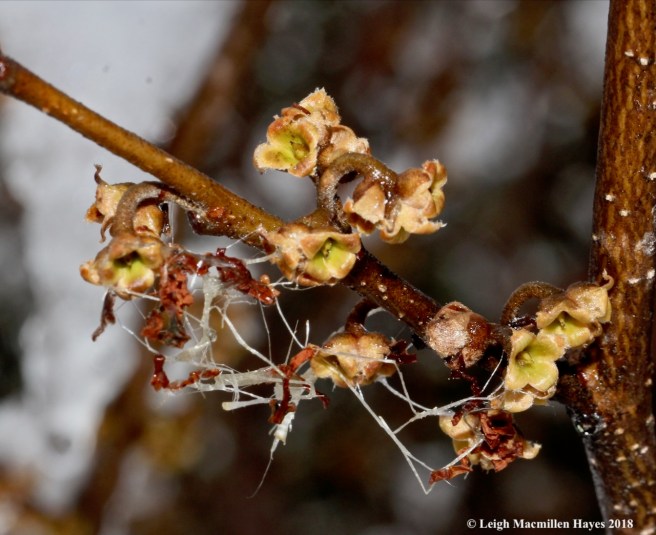
c14-map

The 100-acre property Chessey Property was forever protected from development under a conservation easement with the Presumpscot Regional Land Trust. Though I’d passed by numerable times, I had never before ventured that way.

c1-trail sign

And so this morning I decided to rectify that and drove to the trailhead. Actually, I drove past the trailhead, spotted the large cemetery on my left and turned around. The sign was facing in the opposite direction and easy to miss. Because the trail was only a half mile long, I figured it would be a quick trip. Apparently, I don’t know myself very well.

c2-snowshoes

I hadn’t tramped far when I realized I was moving in the opposite direction of one whose ancestors had inspired my own mode of transportation.  The start of the trail is a field in early succession and so it made sense to find snowshoe hare prints crisscrossing the opening.

c3-red fox

But . . . it wasn’t just a hare that had moved atop the snow. The print size and stride told me a red fox had also traveled there–and not too long before I’d arrived. To add to my identification was the chevron visible in the front foot print. Do you see what the arrows indicate?

c4-red fox track

I didn’t follow the track, and so I wasn’t sure if I was looking at prints made by one fox or perhaps two. My gut told me one and that the back foot didn’t always land exactly in the impression of the front.

c5-hare and fox cross tracks

Nor do I know how the story ended–for the fox crossed the hare’s tracks. Did the two ever actually meet?

c12-speckled alder

In the same area I found speckled alder, so named for its bark speckled with pores or lenticels. Its red and maroon catkins grew longer–well, at least the male catkins. The shorter catkins are the females, for alders are monoecious–male and female flowers grow on the same plant. As March gives way to April, the male color will deepen to burgundy, while the females will turn bright red–in full blush.

c13-pussy willows

Another color also caught my attention–pussy willows with their furry little silver flower buds just opening. The soft tufts earned their common name due to their resemblance to tiny kitten paws.

c6-my tracks

All of that, and I hadn’t gone far from my truck. But, by the depth of my impressions, you can see that my travel would be slow for no one had packed the trail before me.

c7-water obstacle

I journeyed on, stopping every ten to twenty steps to look around, listen, and catch my breath. Tracking was almost impossible once I ventured into the forest for snow drops from the trees created their own random impressions. Water obstacles were a bit of a challenge, but I managed to manipulate around all four. And bird song included the throaty caws of Ravens. At one point I heard their powerful wing beats and looked up to see three chasing another bird that I couldn’t identify.

c10-face in the snow

But never fear, though I couldn’t find tracks as I continued, I found plenty of other things to look at, including a tilted snow mask, and . . .

c11-snow art

snow sculptures. How does snow do that? Worth a wonder, indeed.

c8-otter tracks:slide

I’d almost reached the turn around point when I recognized a pattern by my feet and realized an otter had passed that way–probably yesterday based on the state of the slides, prints, and scat. One really cool thing that I learned as I followed its trail was that every once in a while it tunneled under the snow. I don’t know that I’ve ever noted that behavior previously. Most of its tunnels were about ten feet long and then it emerged again to bound and slide.

c9-Browns Pond

At last I turned my attention to the 110-acre pond that opened before me. It’s my understanding that it remains undeveloped–a rare feat in these parts. I wanted to stay and explore, but knew I had to save it for another day because work really did sit at home awaiting my attention. I trust I’ll return in another season when the traveling isn’t quite as difficult, but until then this morning’s moments beside Browns Pond will sustain me.


Hunkered Down

Three nor’easters in two weeks. Such is March in New England. The latest delivered over twenty inches of snow beginning yesterday morning. And still the flakes fall.

p-chickadee

But staying inside all day would be much too confining and so I stretched my legs for a few hours before giving my arms another workout with driveway cleanup duty. It was much more fun to explore and listen to the chickadees sing.

p-snow on trees

There are a few places in our woods that I find myself stopping to snap a photo each time a snowstorm graces our area. The stand of pines with their trunks snow coated was one such spot yet again. And tomorrow the scene will transform back to bare trunks and so it was one I was happy to behold in the moment.

p-snow on limbs

As was the older pine that grows beside a stonewall along the cowpath and perhaps served as the mother and grandmother of all the pines in my forest–bedecked in piles of flakes, her arms reached out as if to embrace all of her offspring.

p-snow on insulators

With the snow so deep, I felt like a plow as I powered through under the insulated insulators.

p-snow on park sign

Finally, I reached one of the entryways to Pondicherry Park and while I love being the first of the day to leave my mark, I’d secretly hoped someone had trudged before me. But . . . a few steps at a time meant taking frequent breaks to rest and look around.

p-snow on tree trunk

Again, it was the snow’s manner of hugging tree trunks that drew my awe.

p-snow on tree trunk 2

Sometimes it reminded me of giant caterpillars climbing into the canopy.

p-snow on roots

Even the roots of a downed tree took on an artistic rendition.

p1-snow on bittersweet

And that most invasive of species in these woods, bittersweet, offered curves worth appreciating–ever so briefly, of course.

p-snow on fences

Snow blanketed fences of stone and wood.

p-snow on bridge

Enhanced the bridge.

p-snow on bench

And buried a bench.

p-Stevens Brook

Beside Stevens Brook, it looked as if winter still had a grasp though we’re about to somersault into spring.

p-snow on trees reflected

And the reflection in Willet Brook turned maples into birches.

p-kneeland spring

At Kneeland Spring, water rushed forth in life-giving form and the sound was one we’ll soon hear everywhere as streams and brooks overflow.

p-mallards 1

I went not to see just the snow in its many variations, but also the wildlife. I found that like me, the squirrels and deer had tunneled through leaving behind troughs. And the ducks–they didn’t seem at all daunted by the mounds of white stuff surrounding them.

p-mallards 2

In fact, one female took time to preen.

p-mourning dove

I found mourning doves standing watch.

p-Robin

And heard robins singing.

p-snow spider

And because I spent a fair amount of time looking down, I began to notice life by my feet, such as the snow spider–an indicator that the thermometer was on the rise. It lives in the leaf litter, but when the temp is about 30˚ or so, it’s not unusual to see one or more. Today, I saw several. And wished I had my macro lens in my pocket, but had decided to travel light.

p-winter stonefly

Winter stoneflies were also on the move. They have an amazing ability to avoid freezing due to the anti-freeze in their systems.

p-winter dark firefly 2

I also found a winter dark firefly. While the species is bioluminescent, I’m not sure if this one was too old or not to still produce light.

p1-snow on me

At last the time had come for me to head home for not only was the snow still falling, but so was the sky–or so it felt each time a clump hit my head as it fell from the trees.

p-final photo

We’ve got snow! In fact, we’ve got snows! And in reference to a question an acquaintance from Colorado had asked yesterday–“Are you hunkered down?” My answer was, “No, Jan, I’m not. Nor is the world around me. In fact, except for the shoveling, I relish these storms as winter holds on for just a wee bit longer.”


What the Bobcat Knows

As I drove down Heald Pond Road in Lovell today I wasn’t sure what awaited me. But isn’t that the point? Every venture into the great outdoors should begin as a clean slate and it’s best not to arrive at the trailhead with expectations.

f1-Heald Pond Road barn

And so I didn’t. Well, sorta. I really wanted to see a porcupine. And maybe an otter. And definitely an owl. But I knew better and so I passed the last barn on the road and then backed up and stepped out, captivated by the colors in the scene before me.

f2-trail signs

A few minutes later, I strapped on my snowshoes and headed up the trail. My plan–to climb to the summit of Flat Hill at the Greater Lovell Land Trust’s Heald and Bradley Ponds Reserve and then circle around Perky’s Path upon my return.

f3-trail up flat hill

Breaking trail was my job in the rather deep snow given recent storms, but easy to move upon and so I sashayed up. What surprised me, however, was the lack of tracks left behind by the mammals that I know live in these woods.

f4-pine cone bird feeders

I did stop at the balsam firs decorated by a local 4-H club in December as part of the Maine Christmas Tree Hunt. The dangling pinecones once sported peanut butter and birdseed, but today that was all a memory so I knew birds and deer had stopped by in the last few months.

f5-bobcat 1

And then, as I neared the flat summit, I found tracks of a mammal that had checked out the base of every tree and under every downed limb. In fact, as I soon realized, it was more than one mammal that I followed as I went off trail. Bobcats. Indeed. Though typically solitary, these two traveled together. It is mating season and males and females will travel together during courtship.

f11-bobcat print

Though the prints were difficult to photograph given the glare, by the toes, ridge and overall shape, I knew them.

f12-bobcat scat and print

And scat! Filled with white hair. I have close-up views should you choose a closer look, but chose to give those who find scat to be rather disgusting a break. ;-)

f6-porcupine and bobcat

And then I found another set of tracks and knew that besides squirrels and little brown things, the bobcats were also searching for a bigger dinner. On the left–a porcupine trough, and on the right, the bobcat trail.

f8-porky work

Ever since I’ve traveled this trail, I’ve seen the work of the porcupines at the summit. And sometimes I even get to see the creator. In winter, porcupines eat needles and the bark of trees, including hemlocks, birch, beech, aspen, oak, willow, spruce, fir and pine. And they leave behind a variety of patterns.

f7-porky work

If I didn’t know better, I could have been convinced that this ragged work was left behind by a chiseling woodpecker, but it, too, was porcupine work.

f9-porky work

All about the summit, recent chews were easily identified for the inner bark was brighter than the rest of the landscape. And below these trees–no bark chips such as a beaver would leave, for the porcupine consumed all the wood.

f10-flat hill view

While snow flurries fluttered around me, the summit view was limited and it looked like the mountains were receiving more of the white stuff. (Never fear–we’ll get more as our third Nor’easter in two weeks or so is expected in two more days. Such is March in Maine.)

f13-script lichen between pine lines

From the summit, rather than follow the trail down, I tracked the bobcats for a while, first to the north and then to the south. I had hoped to find a kill site, but no such luck. Instead, the writing on the page was found upon the pines where script lichen, a crustose, was located between the lines of bark scales.

f14-ulota moss and frullania

I also found plenty of Frullania, that reddish brown liverwort that graced so many trees. And among it, a moss I’ll simply call an Ulota. As I looked in Ralph Pope’s book, Mosses, Liverworts, and Hornworts , upon arriving home, I realized I should have paid attention to capsules for that would have helped me determine whether what I saw was Ulota crispa or Ulota coarctata. Another lesson for another day.

f15-beaver pond on Perky's Path

At last I reached Perky’s Path, which may not seem like a major feat if you’ve been there, but actually I’d explored off trail for quite a ways and it took me a while to get down to the wetland.

f16-maleberry

And because I was in the wetland, maleberry shrubs bordered the edge and showed off their bright red buds and woody, star-shaped seedpods.

f16a-bobcat across wetland

After focusing on them for a while, I looked down at the snow’s surface and the most subtle of prints appeared before my eyes. My two bobcats. The curious thing–at the summit the mammals had sunk into the snow and the prints were a bit difficult to decipher. I assumed those summit impressions had been made about two days ago. But on the wetland, the bobcats walked atop the snow–when conditions were firmer and I suspected they’d been created last night.

f17-brook toward Bradley Pond 1

I followed the edge of the wetland to the bridges that cross a brook that forms at the outlet of Bradley Pond, constantly on the lookout for the bobcat tracks again.

f18-more bobcat

And I found them! Beside the brook.

f19-beaver pond from bridge

What had they found on the wetland, I wondered?

f21a-beaver trail

Continuing on, I found that they’d checked on the woodwork left behind by another critter of these woods who had also moved about last night.

f20-beaver works

Beaver works. And their piles of woodchips. Unlike a porcupine, a beaver doesn’t eat the chips. Rather, it cuts down a tree for food or a building material. The chips are like a squirrel’s midden of cone scales–the garbage pile of sorts.

f22-beaver trail to water

I noted where the beaver had moved into the brook . . .

f23-beaver treats

And left some sticks behind. For future food? Future building? Stay tuned.

f27-brook to Bradley pond

Typically in other seasons I can’t move beside the edge of the brook, but today I could. The lighting kept changing and water reflected the sky’s mood.

f24-Diamesa sp. and snow flea

And because I was by the water, I kept noting small insects flying about–almost in a sideways manner. Then I found some on the snow–a member of the Diamesa species, a midge I believe. And do you see the small black speck below it–a snowflea, aka spring tail.

f25-Diamesa sp.:haltere

And do you see the two little nobs on the fly’s back, the red arrow pointing to one? Those are the haltere: the balancing organ of a two-winged fly; a pair of knobbed filaments that take the place of the hind wings.

f29-beaver pond wetland low

Eventually, I followed the eastern edge of the wetland back to my truck, wondering if there was any more action but found none. In fact, the water was low so I knew the beaver works weren’t to rebuild the dam. Yet. Nor did I find any more bobcat tracks. But I’d found enough. And I think I know some of what the bobcat knows.


Climbing Higher Mondate

The old adage, “If at first you don’t succeed, try, try again, ” could be aptly applied to the first part of today’s hike for we’d tried to locate the Millard Chandler Feldspar Mine (aka North Star Mine) in Evans Notch two weeks ago but missed a turn along the way. This time, we made sure to pay close attention as friends had given us specific directions.

e1--making the left turn at the National Forest Boundary

As they’d told us, we remembered to turn left at the National Forest boundary and followed the line to the base of the mountain, breaking trail all the way.

e2-first ice formation

Eventually, we realized we were on an old cart path and followed as it zigzagged up. And then we reached a boulder covered in ice. Don’t get me wrong–I love the relationship of rock and ice, but . . . was this what we’d climbed up to see?

e3-looking for more

My guy peeked around the corner and encouraged me to follow.

e4-climbing higher

The first rock with ice was a tease and he could see what he thought was the mine up above. And so we climbed higher.

e6-mine 2

Voilà. At last we found the actual mine. Can you see my guy? His height provided perspective.

e7-sense of height

He stood in awe before the fountain of youth frozen in time.

e9-looking upward

My eyes were drawn skyward to the chandeliers that dangled above. My guy did urge me to move out of the way for he feared one might come crashing down.

e14-chandelier

But I took one more photo before heeding his words of caution.

e15-fallen ice

We noted that some had fallen previously and sat like broken glassware upon the mine floor.

e10-icicles up close (snowfleas as well)

Even the snowfleas or spring tails wanted to be part of the display. Do you see them? The little specks that look like black pepper?

e11-dike 1

I was so taken with the ice sculptures that I almost forgot about the mine itself. Millard Chandler was a descendent of one of the founding families of Chatham, New Hampshire, where the mine is located. Originally, it was mined for mica. From a Geological Survey Professional Paper, I learned that prior to World War II it was mined for feldspar by the Whitehall Company, Inc.

e12-icicles

Today, the only mining that took place was initiated by the water and we could hear it trickling under the ice.

e16-christmas fern

It seemed, however, that there wasn’t enough water as a Christmas Fern struggled to survive.

e13-junco prints

Finally, we followed the Junco tracks and made our exit.

e19-leaving the mine

It was almost like a different world awaited us outside the mine.

e21-Leach Link Trail sign

From there we drove back down Route 113 to Stone House Road and ate a quick lunch in my truck before heading to the trailhead for the Leach Link Trail that follows Cold River.

e22-bear claw marks

It seems like every time we visit this area we find evidence of the bears who live here. Notice the nail marks on the sign. Typical behavior for a black bear–to attack something in the woods that is different than the norm. Not only do they like telephone poles, but trail signs often take a beating as well.

e23-hemlock crack

Again, we had to break trail, which we took turns doing because the snow was deep enough to tire us out. For the most part, we passed through a hemlock and spruce forest. I’m always amazed at how a hemlock tree tries to heal a wound left by a frost crack. Just like my snow pants absorb the sun’s heat, the dark bark of the trees also absorb sunlight, but they don’t have a heated home to return to once night falls and temperatures plunge. I understand how the constant thawing/freezing cycle creates cracks–but I don’t understand why the hemlock portrays the squiggly line, while frost cracks on other trees tend to be much straighter. Then again, all tree species have their own patterns and idiosyncrasies. Maybe I just have to accept that this is the way it is. And move on.
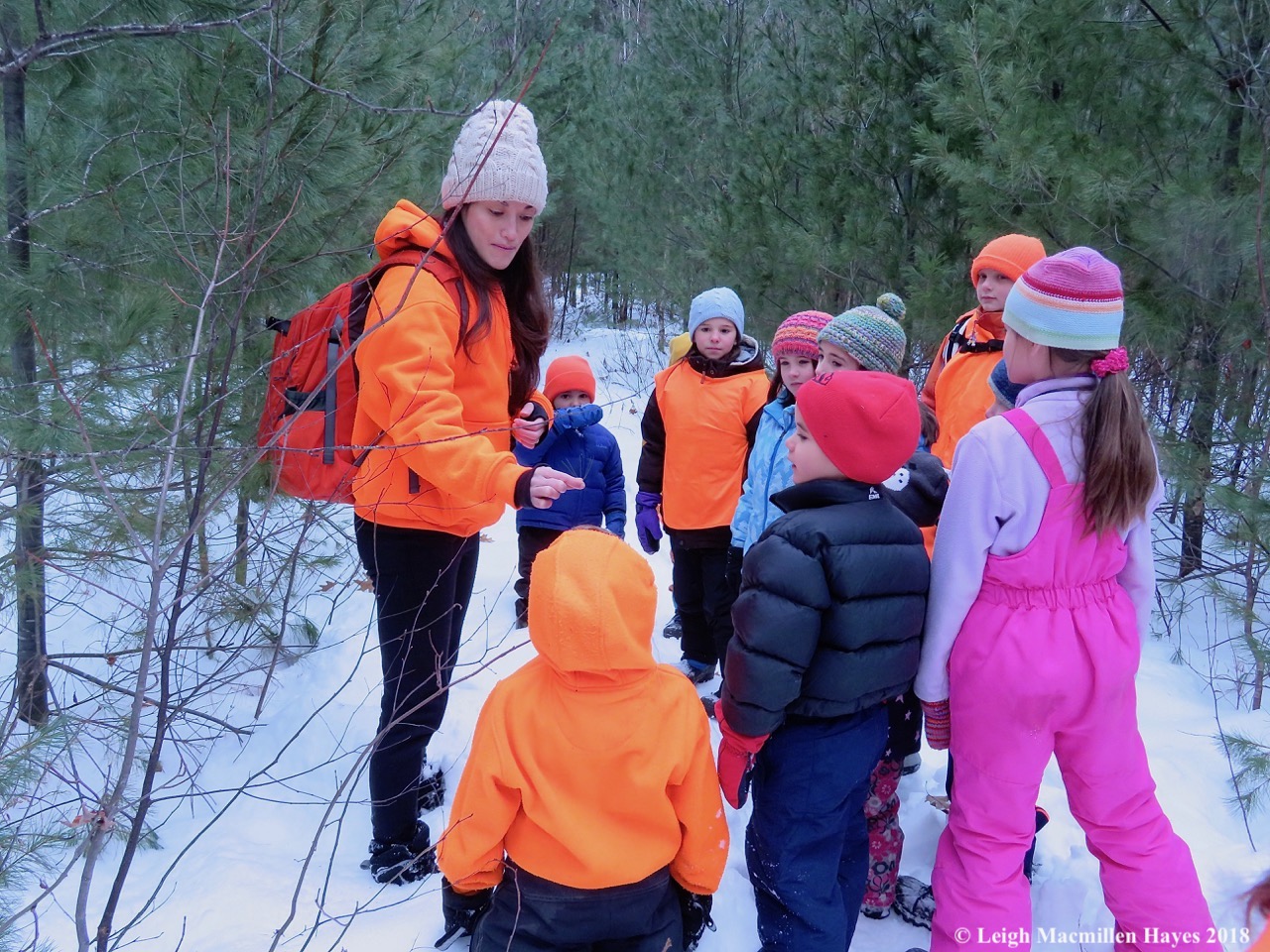
e23-snow aprons

We did. But I stopped our forward movement again. Snow had piled high at the base of the trees following the two snowstorms we received this past week. At first, it appeared that the aprons the trees wore were on the north side. But then, in one grove it seemed obvious that my theory had been proven wrong for some aprons faced west and others east. Oh well.

e26-chester dam

Just over a mile later we reached the Chester Memorial Bridge by the AMC camp. The bridge was given in memory of Mabel Chester, one of the camp’s founders.

e27-Cold River flowing south

Cold River flowed south below the dam. And we turned east.

e29-My guy at the summit

We hadn’t intended to, but ended up hiking to the summit of Little Deer Hill. Our visit was short because it was there that the northwest wind slapped our faces and tried to whip off our hats.

e29-Baldfaces

A few photos and then we quickly descended back into the forest, where we couldn’t feel the wind’s force to the same degree. We practically ran as we followed the trail we’d previously carved.

e30-stop ahead

It seemed like time passed quickly as we reached the snowmobile trail once again and saw the sign reminding us to stop ahead. The truck was parked near the trail’s stop sign and our trip was done.

e5-mine 1

We enjoyed the afternoon hike, but as we reflected on our day, it was the mine that will stand out most in our minds. Thanks to Linda, Miriam, and Dave for providing us with the incentive to visit and correcting our directions.

Climbing higher on this Mondate was certainly worth it.


Winter Reins

While snowstorms are my favorite winter weather events, I don’t always get what I want. Such was the case today. Only a few days ago, as I checked Weather Underground for updates, it looked like we’d receive 4-6 inches of snow. But, the closer the day drew, the lesser the snow amount and more the chance for mixed precipitation.

i-hemlock

Such mixed precip brings its own frosty coating, layering branches with icy crystals.

i-sheep laurel

Even the springy look of the sheep laurel was enhanced by its temporary trimmings.

i-goldenrod

While the goldenrod appeared to shout out its name despite its winter form.

i-intersection of sensitive fern and steeplebush

And steeplebush found a couple of friends offering support among the sensitive fern fronds.

i-witch hazel

The day’s glaze outlined the wavy margins of withering witch hazel leaves still holding fast.

i-home

And my world slowly transformed. I couldn’t resist the opportunity to watch the changes occur.

i-goldfinch1

As for the backyard birds, they just kept coming, from goldfinches to . . .

i-white-throated sparrow

white-throated sparrows,

i-junco 1

juncos,

i-junco 2

and more juncos,

i-male cardinal

Mr. cardinal . . .

i-female cardinal

and the Mrs.,

i-hairy woodpecker

plus a male hairy woodpecker,

i-bluejays and icicles

and any number of bluejays.

i-blue jays 1

There were more visitors as well, including a purple finch, a couple of chickadees, and a flock of turkeys. All, like these bluejays, studied either the feeders or the seeds I’d spread on the ground . . . contemplating I suppose.

i-blue jays 2

And then making a choice. Over and over again.

i-hydrangea 1

As the day wore on, the icicles grew longer and last summer’s hydrangea flowers glowed below their frozen outwear.

i-white pine

In the morning, the white pine needles sported only a thin layer of ice.

i-white pine 1

But by the afternoon, they began to sag beneath the weight of their heavy blankets.

i-red oak 1

The bristly points of marcescent red oak leaves grew into long rounded fingers dangling below.

a-aster

Yesterday’s flower brackets looked more like a cluster of tiny bioluminescent jellyfish today.

i-still sleeting?

It was a day of constant change creating its own beauty.

Periodically, like me, the goldfinch checked on the weather.

As the ice turned to sleet and then rain, he and I both knew that winter still reins.

Winter Reflections

My world is always transformed during a snowstorm and even the day after. So it was that yesterday about four inches of the fluffy white stuff drifted down and created a wonderland effect.

a1-snowflackes on Queen Anne's Lace

Even this morning, the individual snowflakes were still visible in their crystalized form (and I kicked myself for not packing my macro lens.)

a2-coyote and red fox tracks

I began the day with a slow journey from home to Pondicherry Park, with the intention of meeting a hiking group. Along the way, I realized that others had trekked before me. Two red foxes and a coyote had crossed paths, forming an X that mimicked the X pattern in their individual footprints. (The bigger prints from upper left to lower right being the coyote; and the smaller prints from lower left to upper right being the two foxes.)

a3-red fox with chevron

In almost direct registration, a hind foot of the fox landed on snow previously packed down by the front foot, so what you see are the two prints. The top print was a bit fuzzy in formation for so much is the hair on the fox’s foot. Despite that, toe nails, toes and the chevron pad at the back, plus the X formation between toes and pad seemed obvious.

a4-Stevens Brook

As I made my way through the park, the morning light on Stevens Brook drew me off trail to the frozen edge. And ice along the bank indicated the change in water levels since the heavy rain of a few days ago.

a5-Bob Dunning Bridge

At last I reached the gateway to town, which is also the gateway to the park–the Bob Dunning Memorial Bridge. I have a great fondness for this bridge on many levels, including memories of Bob who passed away suddenly at least ten years ago, the barn-raising community effort to build it, and the fact that each beam represents a different tree, bark included. You can learn more about it by reading my previous blog post: Barking Up A Bridge.

a6-snow on bridge

And each time I walk across it, it seems to offer up something different. This morning, it was how the snow coated the railing. I think the artistic side of Bob would have approved.

a7-AMC group at bridge

On the other side, I met up with a group of seven women. Led by AMC volunteer JoAnne Diller, our intention was to tramp through the park following all the outer loops, including a link on the Lake Environmental Association‘s Pinehaven Trail at the Maine Lake Science Center. Along the way we visited with each other, enjoyed the beauty that surrounded us, and got some exercise.

a10-Stevens Brook

And then we returned to the bridge and parted ways. I choose to follow the inner trails home, pausing first to enjoy the color of Stevens Brook from the bridge’s center.

a8-mallards

And no winter visit to the park is complete without taking time to watch the ducks–and listen as well.

a8a-mallards

They gather by the dozens, some to rest while others seemed to be in constant motion.

a12-ice skirt

Before following the trails leading west and toward home, I returned to the scenic overlook where ice skirted a tree–again indicating that the water was recently much higher.

a13-eddy

In the same spot I watched water swirl in a small eddy and am amazed that I’m not still standing there–mesmerized as I was by the action.

a14-yellow birch sculpture

But my stomach was growling and so I continued on–stopping to admire another of nature’s wonders–a yellow birch that germinated atop an old pine stump and today stands as a sculpture of one member of the community supporting another despite their differences. Hmmmm.
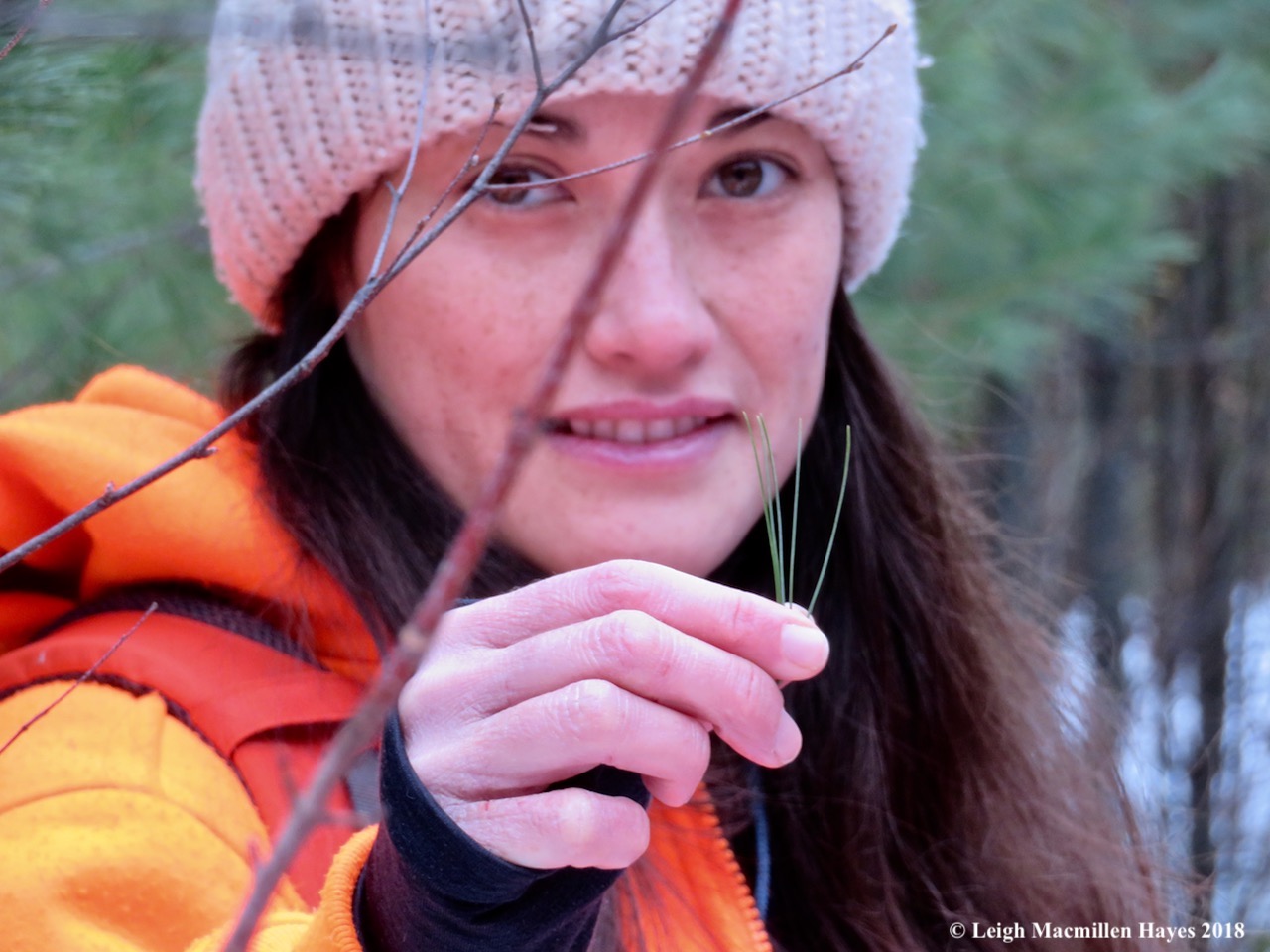
a15-bench awaiting visitors

The trail I followed home was less traveled than the others and the snow a bit deeper because it hadn’t been packed down. When the park was first created by Lakes Environmental Association and  Loon Echo Land Trust, the AMC did some trail work and part of their offering was this bench. Though it hasn’t recently supported a weary traveler or one who just wants to set for a time, I trusted that day will soon come again.

a16-AMC bridge

I crossed the bridge near the bench, which was also built by the AMC crew. And from there, I headed home to lunch, but not without offering a smile of gratitude to JoAnne for continuing to volunteer to lead walks for the AMC and giving us all an excuse to enjoy the company of each other in this beautiful place.

a17-Saco Old Course

Later in the day I found myself in Lovell for a quick errand and the light was such that I felt the need to spend a little time beside the Old Course of the Saco River just down the road in North Fryeburg.

a18-Saco Old Course

The scene is never the same, nor is the light. What may have seemed monochromatic was hardly that.

a19-church

As the sun began to set, the water still harbored reflective moments.

a20-setting sun

And it transformed some reflections from crisp representations into impressionistic paintings.

a11-ice chimes again

At the end of the day, however, my favorite reflection of all was one spied along Willet Brook in Pondicherry Park by Eleanor, a member of our morning AMC trek.

a9-ice chimes

Winter chimes. Winter reflections.


Land Trust Trailblazers

This morning found me joining two fellow Maine Master Naturalists for a reconnaissance mission along a property I’d never explored before–nor heard of until about a month ago.

r0-Robie's Meadow

Robie’s Meadow is located on Scribner’s Mill Road in Harrison and owned by the Western Foothills Land Trust.  Our plan was to explore the meadow in preparation for an upcoming WFLT/GLLT guided hike planned for Saturday, January 27 from 9:30-12:30. For the GLLT, it’s rather like a pop-up event, since we had planned it after our regular winter schedule was published. But, that’ll make it more fun because it will be an unexpected opportunity to explore in a neighboring town.

r1-trailhead tracks

Once we climbed up over the snowbank this morning, we were immediately greeted with tracks. And then, we spied something else on the snow.

r2-scat

Scat! Rather large scat. By the size of it, we surmised coyote. But . . . a few measurements of prints and . . .

r3-sniffing red fox pee

a sniff that consisted of a musky, skunky odor made us rethink our conclusion. A red fox had most definitely left its calling card behind.

r4-fox pee everywhere

In fact, as we continued on, we realized that it had left many calling cards–in hopes of attracting some attention. The size of that scat, however, continued to haunt us for it was much larger than fox scat should have been. Perhaps we misread some of the fox tracks, for we thought two had traveled the same route, but was it really fox and coyote? We do know that they were made about the same time, given the snow conditions. And so, our best guess was that the deposit was made by a member of the Canidae family. With that conclusion we felt safe.

r5-western foothills sign

We were so distracted by the tracks we kept finding and following, that it took us a while to cross the right-of-way to the actual land trust property, but at last–success.

r7-Robie's Meadow 1

The meadow opened before us, covered as it was with morning shadows.

r8-Meadow and Russell Brook

As much as we wanted to explore it, Russell Brook was open in spots and the snow deep, and so we decided to follow the brook for a bit instead.

r9-following Alice

Breaking trail wasn’t always easy, given the depth of the snow, but Alice persevered for she knew the way, and Joan and I followed.

r10-tracks across the brook

Finally, we reached a point where we could cross and just beyond our reach we spied tracks. How we wanted them to be otter or some other member of the weasel family. Alas, when we reached the other side, we discovered it was the red fox yet again. It always amuses me how a critter becomes “our” critter when we begin to encounter signs of it with frequency and so this was “our red fox.”

r11-squirrel tracks

We were a bit disappointed that though we’d seen weasel tracks toward the beginning of our adventure, no other members of the mustelid family shared their presence. Instead, it was to red squirrels that we next turned our attention.

r12-batman 1

And Alice gave us a new insight. I’ve always said that snowshoe hare prints remind me of  lobsters. Well, today she pointed out the fact that squirrel tracks look like Batman’s mask. I will never look at squirrel tracks the same again.

r13-batman 2

Batman indeed.

r14-squirrel home

We found squirrel homes tucked under logs and trees.

r15--squirrel condo

And one very fancy squirrel condo with plenty of openings on different levels. It reminded Joan and me of a certain porcupine condominium (aka stump dump) on a property under conservation easement in Lovell.

r16-porcupine trough

Speaking of porcupines, I kept commenting that we were in porcupine habitat and hadn’t seen any signs. Until . . . we did. And when we return, we’ll do some backtracking in search of its den or feeding tree(s).

r17-turkey tracks

We continued our journey, seeing much the same along the way. At last, we turned right onto a snowmobile trail where we followed turkey tracks out to the road. Our time together had drawn to a close, but we’re excited about the possibilities for the hike on January 27th. Check out both land trusts’ websites soon for more details.

r18-pinecone bird feeders

After saying goodbye to Joan and Alice, my outdoor experience continued, this time with an after-school nature program the Greater Lovell Land Trust offers to kids at the New Suncook School. Today, Kathy M. joined me and showed the kids how to create pinecone bird feeders using pinecones, peanut butter and bird seed. Both Meg, the Lovell Recreation Director, and I were excited because our group had swelled to nine. And the next time we meet, we believe we’ll have one more young naturalist join us, bringing our number to its limit.

r19-got peanut butter?

O. smiled as he showed off the peanut butter he’d slathered onto the cone.

r20-finishing their creations

C. looked ready to eat hers, while Kathy patiently helped tied string around D.’s cone.

r21-pinecone birdfeeder by K

K. proudly showed off a finished creation.

r22-heading out to the trail

And then we headed off into the sunset via snowshoes and skis.

r23-walking beside deer tracks

And on a trail behind the school playground, fresh deer tracks made us happy. We showed the kids how to look at the heart-shape of the cloven toes and know that the bottom of the heart indicated the direction of travel.

r24-hanging pinecones

As we tramped along the trail examining tracks, we took time to hang the bird feeders. We’ll be curious to look at them when we meet again in two weeks. Today we wondered about who, besides birds, might visit them. Many bets were on deer and squirrels.

r26-exploring

The trail behind the school leads out to the power line and snowmobile trail, where again, we found many deer tracks.

r26-happy trailblazers

We’d gone a ways when we realized we needed to turn around and head back to school. But first, it was time for a group photo of happy campers.

r27-dramatic trailblazers

With smiles from all levels.

r28-Trailblazer Sign

Our after school group is called the Trailblazers. And K. took the time to illustrate what we’d done last week. Note the square with the tall person standing up and two smaller people on the ground with their snowshoes in the air. Last week, snowshoeing was a bit of a challenge for them, but this week they embraced the concept.

From beginning to end, my day was bookmarked by land trust trailblazers. How happy am I? Extremely. Perhaps the happiest camper of all.


Book of January: Winter World

It seemed only apropos as a blizzard intensifies that the January Book of the Month be Bernd Heinrich’s Winter World: the ingenuity of animal survival.

w-Winter World by Bernd Heinrich

In this very readable book, biologist and illustrator Heinrich takes us into the depths of animal adaptation that allows even the tiniest among us to deal with the elements in order to avoid freezing to death. Of course, some do. And others become food.

A main theme of the book is the yellow-crowned kinglet, a bird Heinrich describes as weighing as little as two pennies. I’ve only had the honor of observing these tiny birds a couple of times, but daily watch other birds puff out their feathers to insulate their bodies from the frigid temps we’ve experienced this winter.

w-snow on pines

The bird frenzy was crazy at the feeders all day today. And the blizzard conditions drew me outside for a while on a quest of my own to see what else I might observe. Other than lots of snow, I didn’t see much. A few chickadees flew in to check on me as they worked on hemlock cones–in their attempt to release seeds. And I startled a ruffed grouse, which in turn startled me.

w-no Mount Washington in sight

But really, the wind was strong and view at times quite limited.

w-gray birch

One of the curious things that Heinrich doesn’t address in this book is the affect of a changing habitat on survival. With all the snow and ice we’ve had, gray birches everywhere have bent with their burdens. I know this area to be frequented by snowshoe hares, but suspect that will change as the birches die and red maples take their  place.

w-deer tag

It’s also an area that the deer pass through, not stopping to rest for it’s a bit wet at times, but certainly pausing to browse.

w-deer rub

And leave behind their scent.

w-vernal pool

Nearby exists my favorite vernal pool. In chapter 13: Frozen Frogs on Ice, Heinrich addresses the chemistry that allows the wood frogs and peepers who will sing from this pool in the future to become frost-tolerant. “When the first ice crystals begin to form on or in the skin of a wood frog, it sets off an alarm reaction. Skin receptors relay the message of freezing to the central nervous system (CNS), and the CNS activates the adrenal medulla to release adrenaline into the bloodstream. When the adrenaline circulates to the liver, it there activates the enzymes that convert the liver’s stores of glycogen to glucose. In the wood frog, this response is massive and before the ice reaches the cells they become packed with glucose that acts as an antifreeze . . . in about fifteen hours, the frog is frozen solid except for the insides of its cells. Its heart stops. No more blood flows. It no longer breathes. By most definitions, it is dead. But it is prepared to again revive at a later date.” As he says, the wood frogs (and hibernating bears) are “biological marvels that challenge the limits of our believes of what seems possible.” 

w-goldenrod gall

There’s so much more in his book, including chapter 14: Insects: From the Diversity to the Limits, in which among other things he discusses the goldenrod gall fly larva that is “physiologically specialized to overwinter.” 

While I was out and about, I checked on the red squirrel cache I’ve been keeping an eye on. No action of any kind today. In fact, most critters seemed to have hunkered down to wait out the storm, huddled together in ground or tree holes and dens. Sometimes in the quiet of a snowstorm I meet deer, but not so today. With the wind whipping through the trees, large plops of snow whooshed off of hemlocks and pines, while shards of ice crackled and fell. A few times I felt like Chicken Little as a chunk hit my hat. All of that was reason enough to find a cozy spot.

w-blizzard of 2018

Finally, it was time for me to do the same. To return home, brew a cup of tea, and reread Bernd Heinrich’s book. It’s one of my favorites, although I also love The Geese of Beaver Bog, The Trees in My Forest, and A Year in the Maine Woods. (Note: my least favorite is Summer World. Not sure why, but try as I might, I can’t get through it.)

w-a smile and a wink

Winter World literally and figuratively makes me smile.

Winter World: The ingenuity of animal survival by Bernd Heinrich, published 2003, HarperCollins Publishers, Inc.