Wondering With Jinny Mae

It takes us forever and we like it that way. In fact, today a woman who saw us in our typical slo-mo movement commented, “It’s like you’re on a meditative walk. I always move quickly and miss so much.” Indeed we were and when I travel beside Jinny Mae there isn’t much we don’t see. But always, we’re sure that we’ve moved too quickly and missed something. Then again, we realize that whatever it was that we accidentally passed by this time may offer us a second chance the next time.

1-winterberry

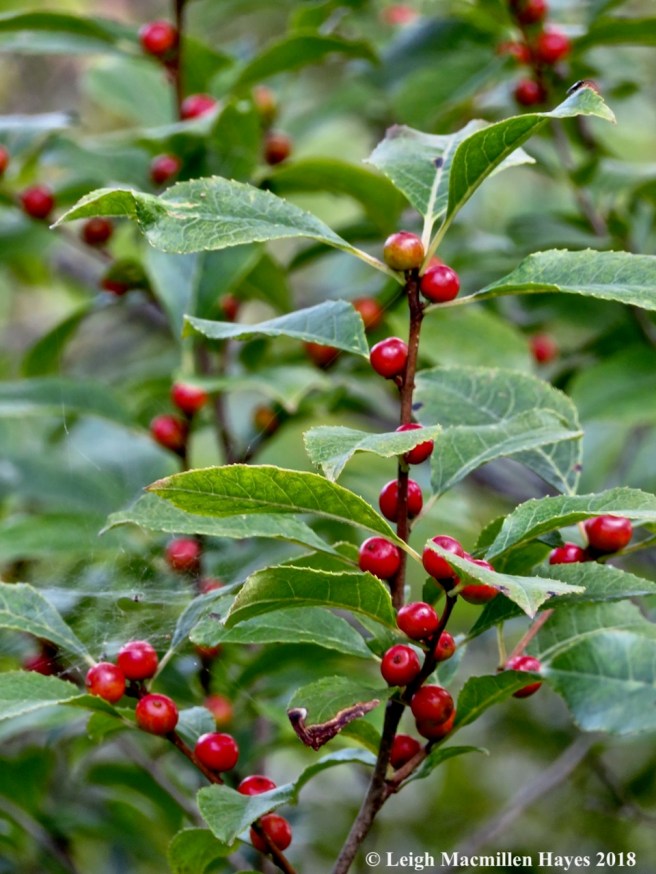
Today’s wonder began with the realization that winterberry holly or Ilex verticillata, grew abundantly where we chose to travel. This native shrub will eventually lose its leaves, but the plentiful berries will last for a while–until they’ve softened considerably that is and then the birds will come a’calling.

2-winterberry

Everywhere we turned, or so it seemed, we found them ranging in color from spring green to shades of red. As summer turns to autumn, the leaves will yellow and eventually fall.
3-winterberry

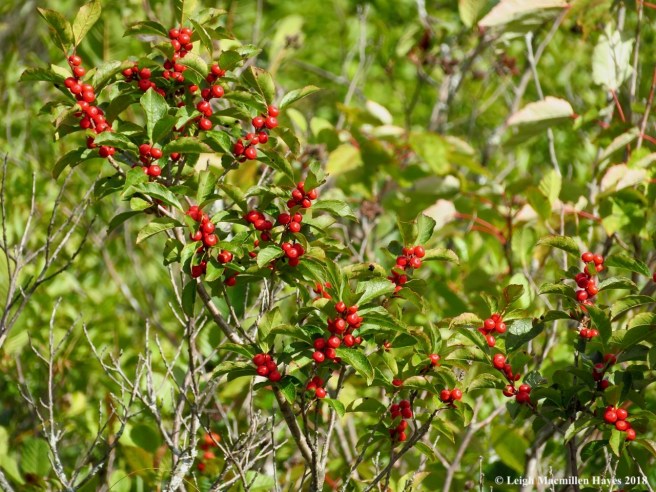
And then the brightly colored berries that cling to every stem will add color where it’s otherwise lacking in the landscape.
4-winterberry

Even while the leaves still held fast, we found some brightly colored berries that offered a breathtaking view.

5-to Muddy River

We passed through numerous natural communities, tiptoeing at times, such as on the boardwalks, for we didn’t want to disturb the wildlife around us–no matter what form it took.

9-dragonfly attachment

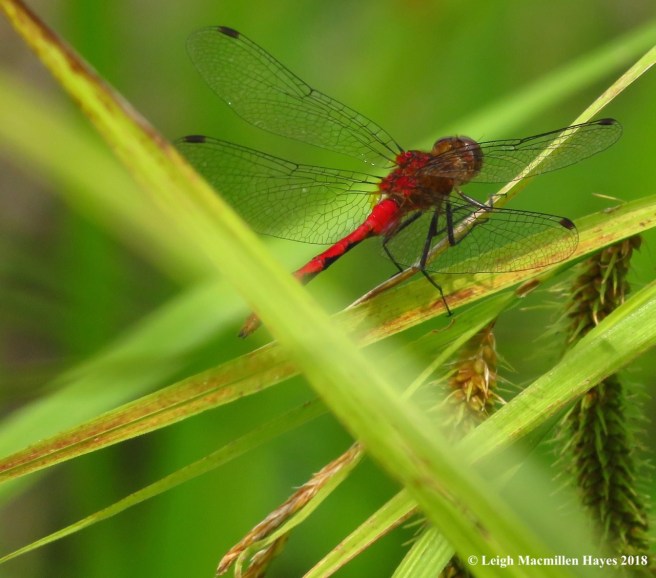
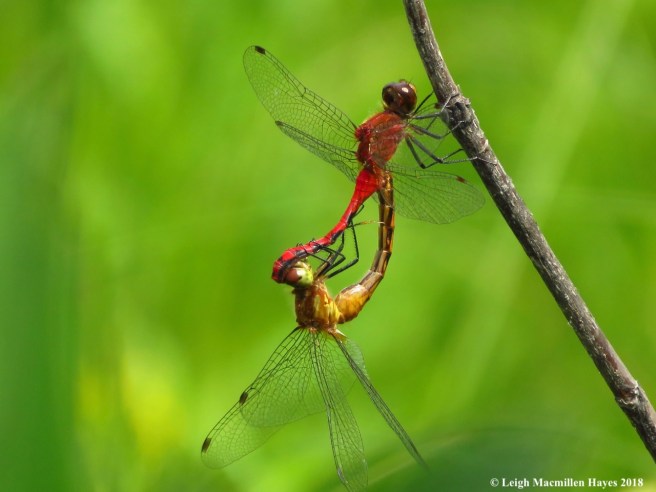
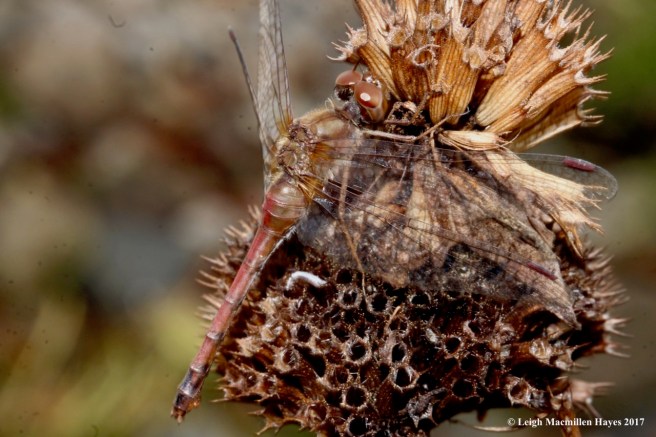
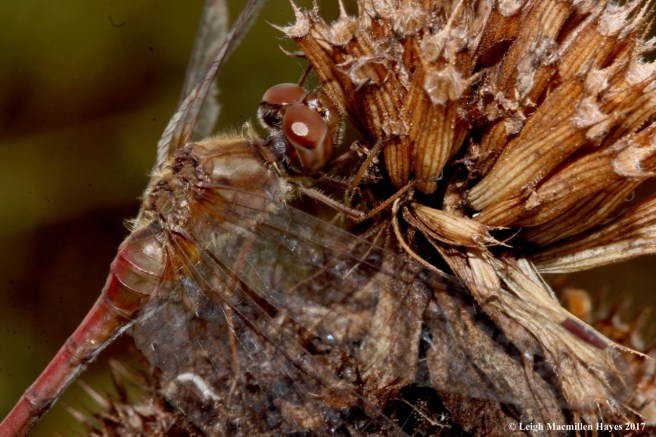
And we rejoiced in spying a cherry-faced meadowhawk couple in their pre-canoodling mode. Can you see how he has used his cerci to clasp the back of her head? His hope is that he can get her to connect in the wheel position and they’ll take off into the safety of the nearby shrubbery to mate.
6-Muddy River

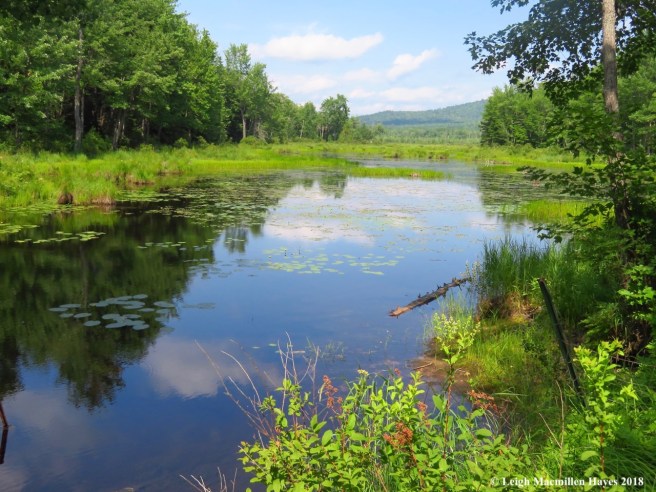
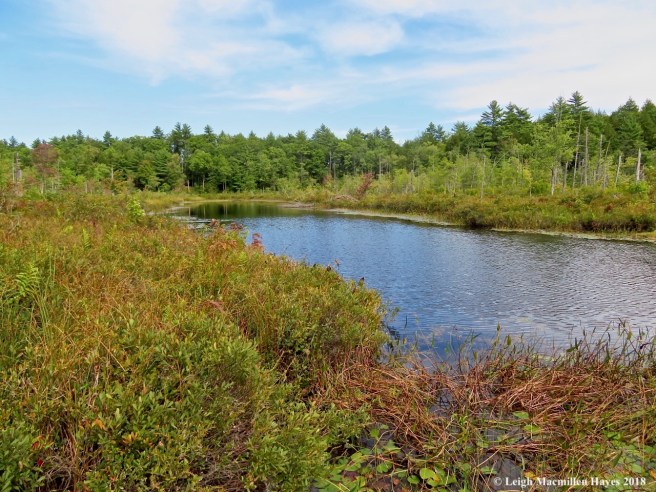
At the river, we began to notice other signs that we’ve once again entered a transition between seasons, for subtle were the colors before us.

7-beaver lodge

Across the river and just north of where we stood, we spotted an old lodge, but weren’t sure anyone was in residence for it didn’t seem like work was being done to prepare for winter. Then again, we haven’t done anything to prepare either, for though the temperature has suddenly shifted from stifling to comfortable (and possibly near freezing tonight), it’s still summer in Maine. And we’re not quite ready to let go.
17-Sheep Laurel

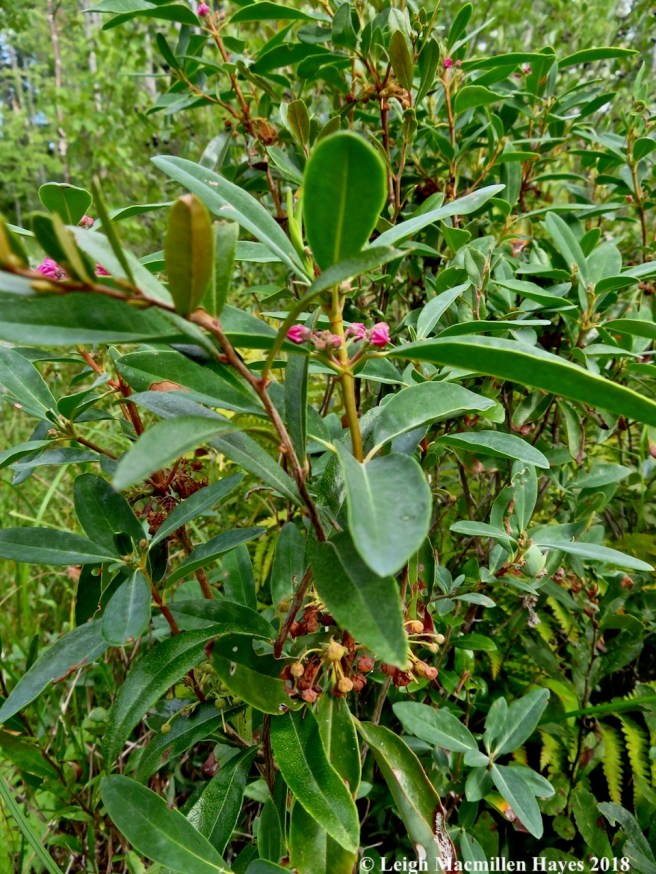
That being said, we found a most confusing sight. Sheep laurel grew prolifically in this place and we could see the fruits had formed from this past spring’s flowers and dangled below the new leaves like bells stringed together.

18- sheep laurel flowering in September

Then again, maybe it wasn’t all that odd that it still bloomed for when I got home I read that it blooms late spring to late summer. I guess we’ve just always noticed it in late spring and assumed that was the end of its flowering season. But then again, it appeared that this particular plant had already bloomed earlier in the season and produced fruit, so why a second bloom? Is that normal?

10-pitcherplant 1

As we continued on, we started to look for another old favorite that we like to honor each time we visit. No matter how often we see them, we stand and squat in awe of the carnivorous pitcher plants.
11-pitcher plant 2

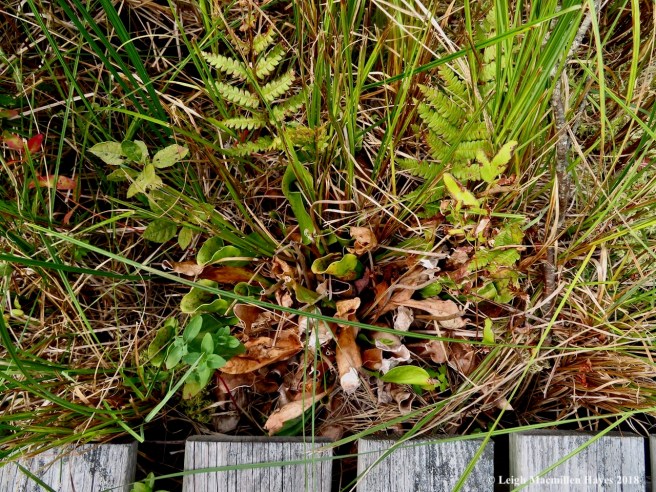
But today, we were a bit disturbed for one that we’ve admired for years on end looked like it was drying up and dying. In fact, the location is typically wet, but not this year given the moderate drought we’ve been experiencing in western Maine. What would that mean for the pitcher plant?

13-pitcher plant flower

Even the flower pod of that particular one didn’t look like it had any life-giving advice to share in the future.

14-Pitcher Plant 4

Fortunately, further on we found others that seemed healthy, though even the sphagnum moss that surrounded them had dried out.

14a-pitcher plant

Their pitcher-like leaves were full of water and we hoped that they had found nourishment via many an insect. Not only do I love the scaly hairs that draw the insects in much like a runway and then deter them from exiting, but also the red venation against the green for the veins remind me of trees, their branches spreading rather like the tree of life. Or maybe a stained glass window. Or . . . or . . . we all have our own interpretations and that’s what makes life interesting.
15-pitcher plant flower 2

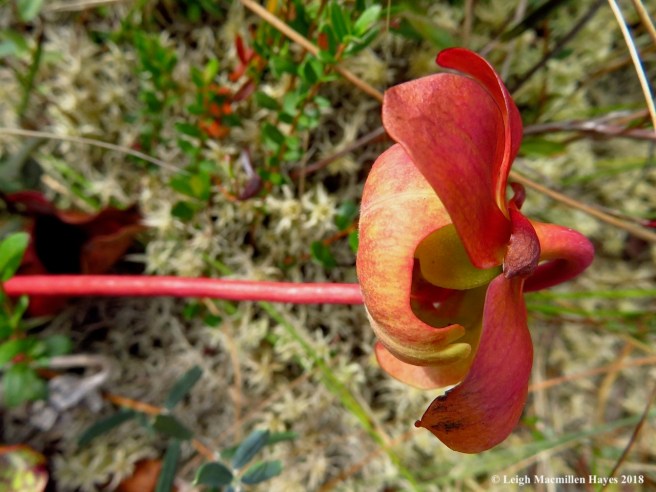
Speaking of interesting, the structure of the pitcher plant flower is one we revere whenever we see it because it’s so otherworldly in form. And this one . . . no the photo isn’t sideways, but the flower certainly was. If you scroll up two photos, you’ll see it as it grew among the leaves. The curious thing is that it was sideways. Typically in this locale, Jinny Mae and I spy many pitcher plant flowers standing tall. Today, we had to squint to find any.
16-pitcher flower and aster

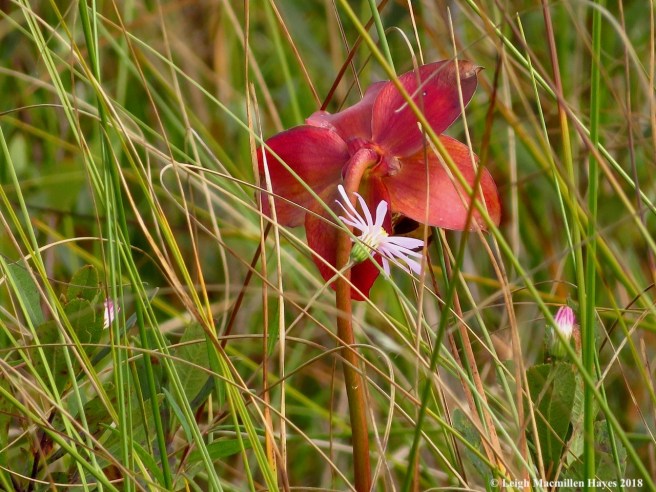
She found the sideways presentation and this one. But that was it. Because of the drought? Or were we just not cueing in to them?

20-cinnamon fern

We did cue in to plenty of other striking sights like the light on a cinnamon fern that featured a contrast of green blades and brown.

21-cinnamon fern drying up

Again, whether the brown spoke of drought or the transition to autumn, we didn’t know. But we loved its arching form dramatically reflected in each pinna.
18a-swamp maple

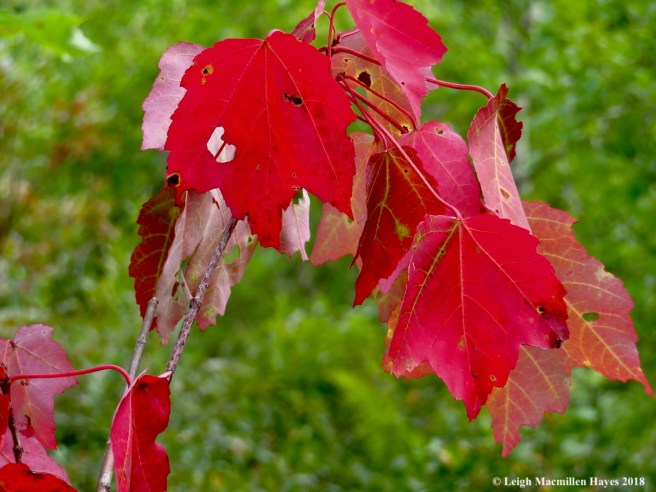
But here’s another curious thing we noted. We were in a red maple swamp that is often the first place where the foliage shows off its fall colors and while some in other locales have started to turn red, only the occasional one in this place had done so. Our brains were totally confused. Sheep laurel blooming for a second time; pitcher plants drying up and dying; and few red maples yet displaying red leaves?
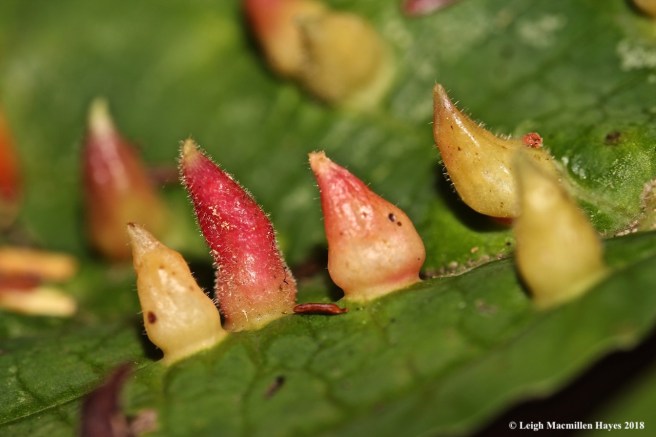
19-witch's caps or candy corn

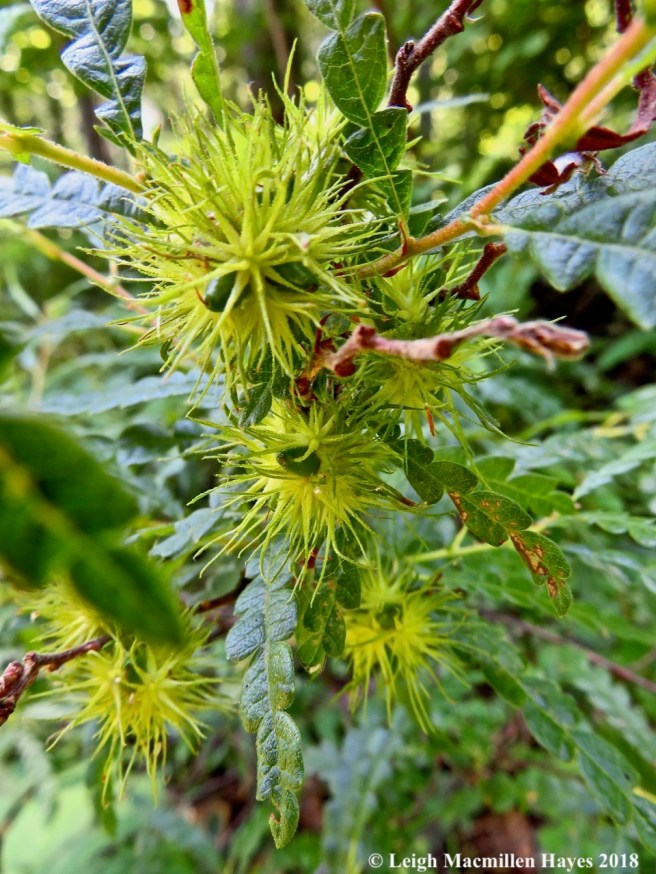
We needed something normal to focus on. And so we looked at the candy corn we found along the trail. Some know them as witch’s caps. They are actually witch hazel cone galls caused by an aphid that doesn’t appear to harm the plant. It is a rather cool malformation.

24-white-faced meadowhawk

On a boardwalk again, we stepped slowly because the white-faced meadowhawk kept us company and we didn’t want to startle it into flight.

25-white-faced meadowhawk dining

One flew in with dinner in its mouth and though I couldn’t get a photo face on before it flew to another spot to dine in peace, if you look closely, you might see the green bug dangling from its mouth.

26-New York Aster

All round us grew asters including New York, water-horehound, cranberries, bog rosemary and so many others.
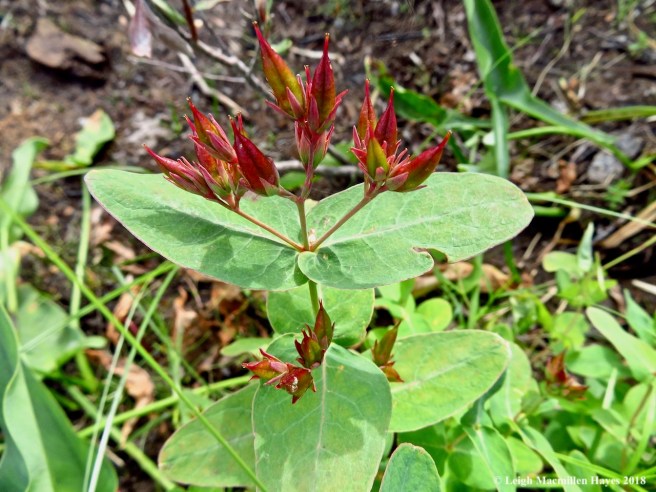
27-Virginia marsh-St. John's Wort

There was Virginia marsh St. John’s Wort,

28-fragrant water lily

fragrant water lilies,

28-jewelweed

jewelweed,

29-pilewort globe

and even pilewort to admire. The latter is so much prettier in its seed stage than flowering. Why is that we wondered.

30-Holt Pond Quaking Bog

Ahhhh, an afternoon of wondering . . . with Jinny Mae. At LEA’s Holt Pond Preserve. In Bridgton. An afternoon well spent. Thanks JM.


So Many Advantages Along the Mountain Division Trail

When opportunity knocks, so they say, open the door. Today, it wasn’t really a door that I opened, but rather a trail that I explored. And it wasn’t a new trail to me, for I’ve ventured along the Mountain Division Trail in Fryeburg many times before.
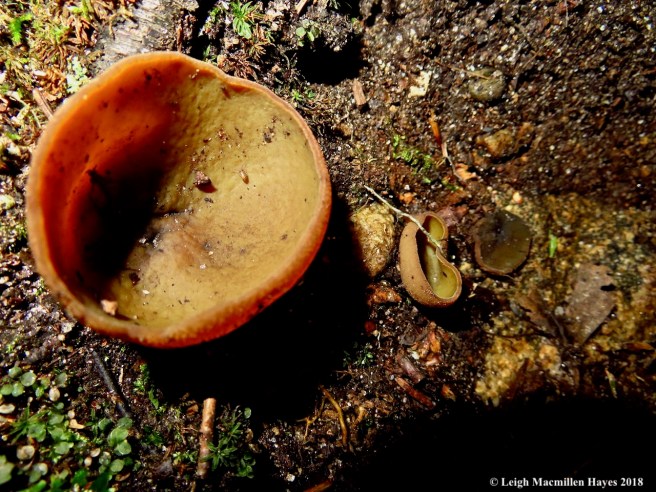
1-trail sign

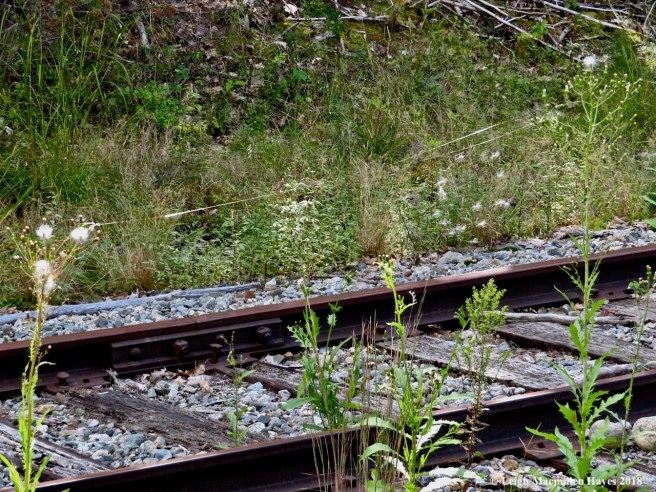
But my morning and afternoon plans changed and I happened to be in the vicinity and I don’t think I’ve ever walked that way in late summer before–so I did what I love to do best and set off down the path beside the now defunct railroad track. And I was curious to discover who else might be taking advantage of it on this fine September day.

2-monarch caterpillar

Within minutes, I made my first discovery–a monarch butterfly caterpillar crawled along the paved trail. I’d actually chosen this spot for I hoped to see a few monarchs and my chances suddenly increased.

3-red-legged grasshopper

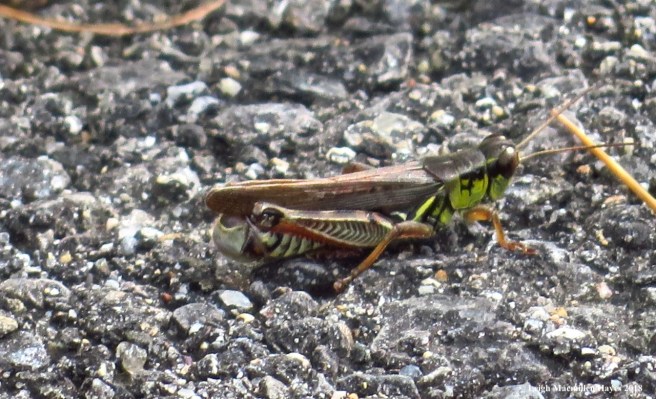
Also using the asphalt were innumerable grasshoppers of several types including this red-legged, and crickets galore. In fact, between them and cicadas, I could almost not hear the traffic on Route 302 at the start. Almost.

4-rail trail

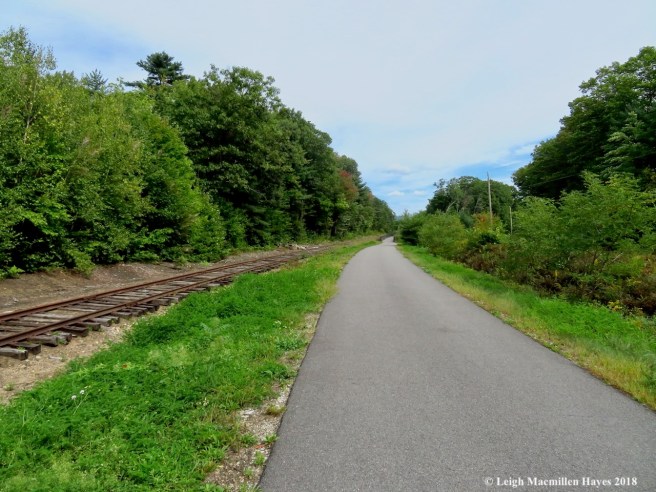
Within minutes, however, the trail passed behind several businesses and then curved away from the road and toward Eastern Slope Airport. It was occasionally flat, occasionally straight, occasionally curved, and occasionally hilly. But always paved. And much quieter.

5-spotted knapweed and web

Constantly, the offerings changed. Knapweed with its pineapple-like base, which loves disturbed areas, had made itself at home. And a spider had used the structure to create its own home.

6a-monarch

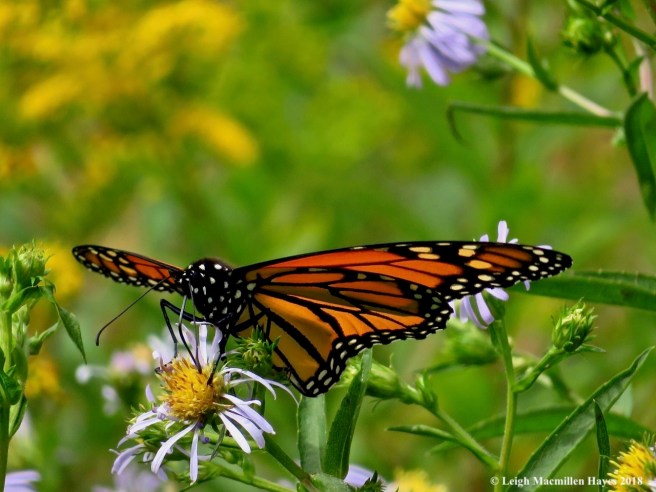
As I walked, I began to notice them–a monarch fluttering past here and another there. At last, I found one that had paused to take advantage of the nourishment offered by an aster.

6-monarch on aster

I stood for as long as it would allow . . .

7-monarch on aster

enjoying every pose presented.

8-crystalline tube gall

A little further, I found something I only remember seeing for the first time a few weeks ago–I think it’s a crystalline tube gall on the oak leaf, but urchin gall would be my second guess.

9-banded tussock caterpillar

On the same leaf, either a banded-tussock moth caterpillar or a Sycamore tussock moth caterpillar munched away, so similar are they. Check out all the bristles by the head–both an extra set of black and a more subtle set of white.

10-water

By what I assumed was an old mill pond fed by a small brook, the watery world quietly intercepted all other communities found along this path.

11-painted turtle

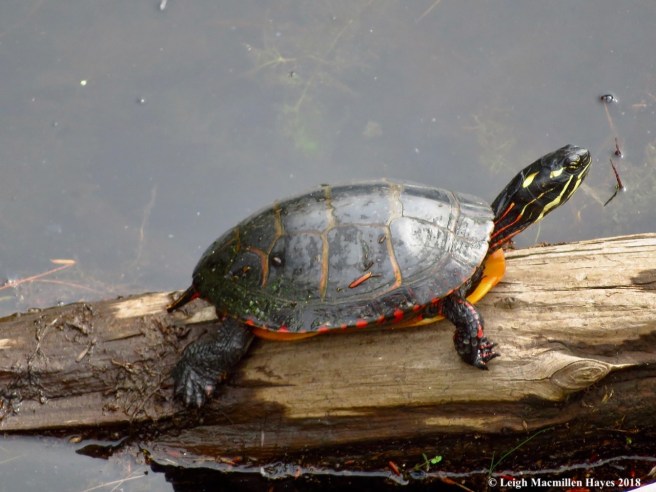
And today, a painted turtle watched nonchalantly from a log in the pond as the world passed by–runners, walkers and bikers on the path above . . . some who hardly noted his presence.

12-male blue dasher

And dragonflies,  including this mighty handsome green-eyed blue dasher, below. Do you see the hint of amber in his wings? One of the telltale signs.

13-pokeweed poking through the fence

Continuing on, I was surprised by a sight I’d seen before because I’d forgotten its presence. Pokeweed flowered and fruited and . . . poked through the fencing that formed a boundary along parts of the trail.

14-northern white cedar

There’s also a short section where northern white cedar formed a wall, its woody cones all opened in an expression of giving forth new life and its leaves scaled like skinny braids.

15-pipewort gone to seed

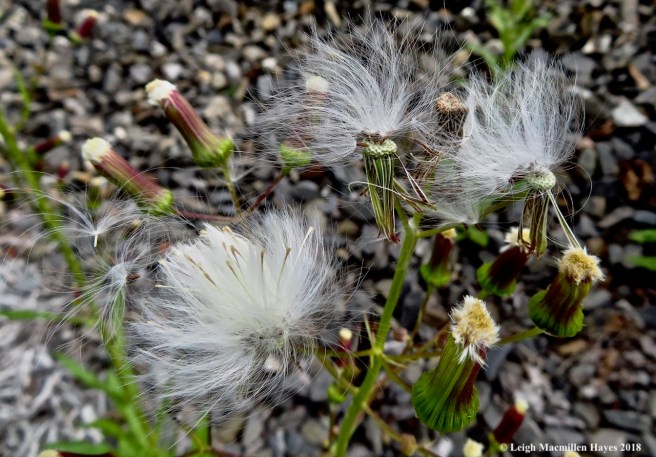
Being a greatly disturbed zone, pilewort grew in abundance and its seeds danced and twirled and sashayed through the air like ghostly angels blowing in the wind. Actually, the graceful seedheads were much more attractive than the flower in bloom.

16-Queen Anne's Lace

Queen Anne’s Lace had also bloomed profusely, but today showed only its winter weed form full of tiny seeds edged with rows of bristles. The better to ground itself somewhere when the time comes, I supposed.

17-Bristly sarsaparilla fruits

Speaking of bristles, bristly sarsaparilla sent its many-fruited umbels out through the fence, perhaps in offering to those passing this way.

18-into infinity

So many offerings I’d seen by the time I reached about the three mile mark and I knew there would be even more on the way back so I used my own imaginary turntable and began the return trip.

20-spider web between pipewort

It was then that a web strung with great and amazing strength between two pileworts caught my attention. First, I couldn’t believe the distance between the two plants or the thickness of the anchoring web. And then I noticed something else . . .

21-seeds caught in web

An orb about two thirds of the way across, decorated with pilewort seeds that will take a little longer than usual to get established on the ground. Will they be viable, I wondered.

23-funnel spider

Another industrious arachnid had used one of the fence pipes to make himself a home. Can you see the funnel spider waiting in the tunnel for delectable prey to land on his web?

22-goat

And then there were the goats, this one and two others who munched beside the trail. I called their owner because I feared they’d broken out of their pen (or someone had opened the gate). Her number was on a board attached to a tree as she’d advertised her daycare business to all who passed by. We enjoyed a pleasant conversation and I learned that she lets them out for an hour or so each day to feed on the weeds. Weeds? What weeds. All I saw where wildflowers aplenty. Anyway, if you go, do know that you may encounter the goats and they are not gruff at all.

24-cabbage white butterfly

While I saw a few more monarchs as I wandered back, a few other butterflies at least half the size of the royal ones moved with dainty motions. For the cabbage white butterfly, the asters were all the thing. But like so many of the wildflowers that have taken root in this disturbed place, this butterfly also disturbs people because it has a penchant for damaging crops.

26-northern cloudywing skipper butterfly

Even smaller was the northern cloudywing skipper that stopped atop a red maple sapling. Males perch near the ground awaiting females, so his chosen spot made sense. His wing scales gave him such a satiny look as he shown in the light and his earth-tone colors included hints of purple.

It was all about the earth, I noted, as I walked along the Mountain Division Trail. Years ago, the path that I followed today had been used to construct the railroad track. And then in the 2000s, the rail trail had been built beside it. Over the years, I’m sure the railroad track had been enhanced. So the land was indeed disturbed . . . repeatedly.

And now, just as I took advantage of it to follow the well-constructed trail, so many others had done the same–both human and non. Not all were beneficial, but still they eeked out a life in that place. From insects and “weeds” to turtles and tree, there are so many advantages available along the Mountain Division Trail in Fryeburg, Maine.


The Amazing Race–Our Style, episode seven

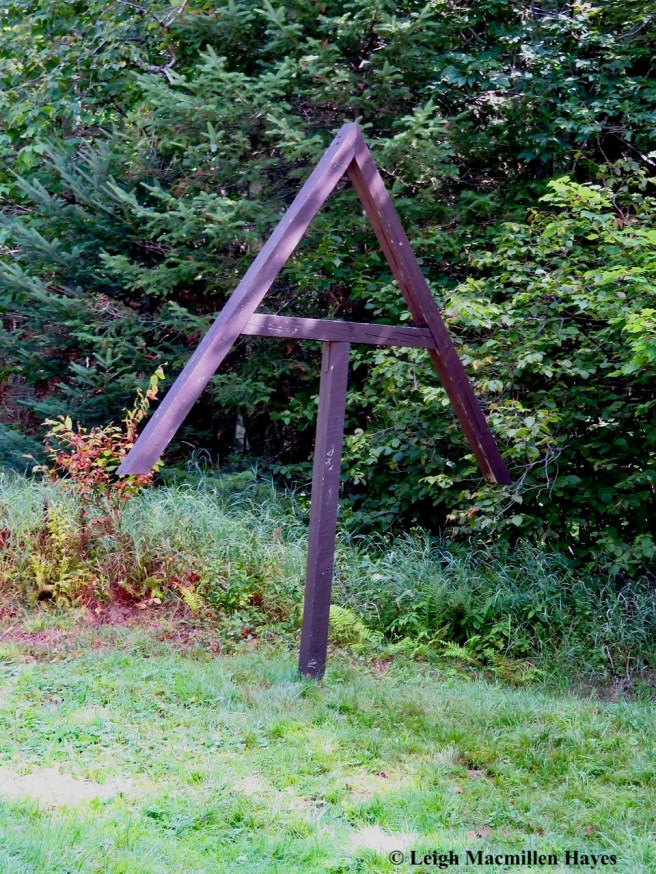
We never know when the clue will appear and so it was a complete surprise to find it this morning. “Drive 50 or so miles north and locate the Big A near the table.”

1-Big A

We took our chances and drove to Bethel and then on to Newry and beyond. Lo and behold–the Big A appeared. And so we parked across the street, slipped into our hiking boots, and began the journey. At the time that we arrived, we were the only contestants, so we wondered if we were behind or ahead.

2-easy path

At first the trail was deceivingly flat. “I’ve got this,” I thought.

3-rungs on rocks

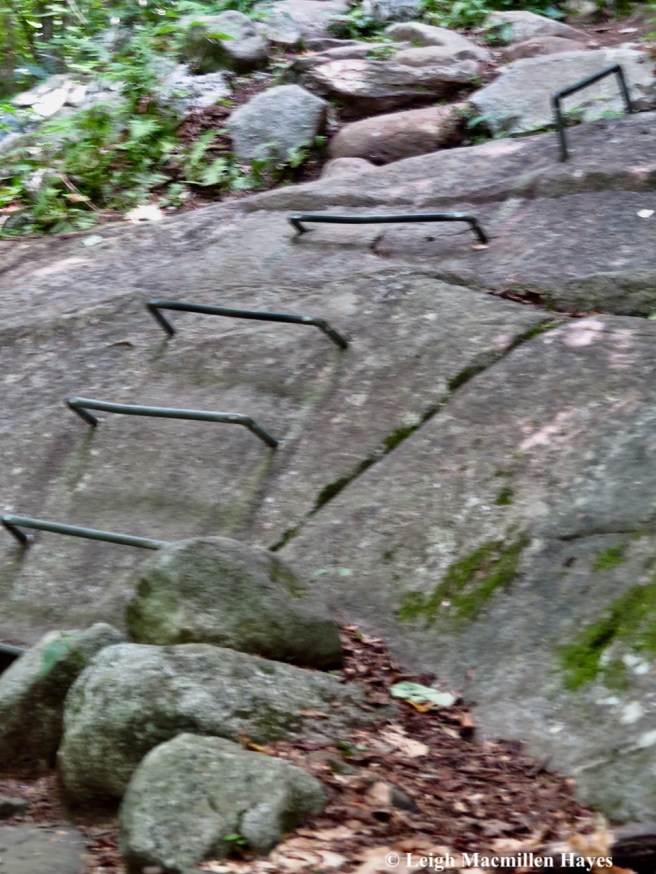
But we soon came to a point where the white-blazed trail headed to the left and the orange-blazed trail to the right. We had a choice to make. White would mean a bit further journey, but it was easier. Orange was much more difficult, but if we played our cards right, we might ascend quickly. It wasn’t long before we realized that our hearts pulsed rapidly. And then we met Team Livermore . . . and passed them. They are younger than us, so I was feeling a bit smug. Until we came to the wrought iron rungs. I guess I was shaking a bit, from the looks of the photo, but really, climbing up the rungs was a piece of cake compared to the rest of the scramble . . .

4-climbing higher

over the steep, boulder-strewn trail.

5-trail map on boulder

Along the way, I paused periodically pretending to note things like a boulder covered with a moss map . . .

6-spider web

and an orb web sparkling in a bit of sunlight. The truth is that I was catching my breath. After seeing the web I had to put the camera away, for we’d reached a point where we needed the use of both hands. And just above the web my mind shut down as My Guy stepped from one boulder over a gaping hole to the next. He patiently told me where to place each foot, and try as I might, I couldn’t move. I was certain that hole would swallow me whole. Along came Team Livermore and I knew we were skunked, but I had to let them pass. They made it look effortless and so four more times I attempted to make the crossing, and on the fifth try I went for it. And I’m here to write about it, so obviously I lived.

7-contemplating

Team Livermore may have passed us, but we soon caught up and moved ahead. We kept thinking we were about to reach the summit, when the rock would indicate otherwise and at one point we had to hike down a bit before climbing up again, which didn’t seem quite fair given how hard we’d worked. But then again, rock is rock and we certainly didn’t want to climb directly up its face.

11-to the north

At last–success. We found the table we’d sought: The summit of Table Rock.

12-message in the slides?

Before us, The Eyebrow and Old Speck.

13-Sunday River Whitecap

To the south, Sunday River Whitecap.

We didn’t stay too long on top for we weren’t hungry yet. And Team Cape Cod showed up. They’d chosen to come up the easier trail, so we knew we were ahead of them. We do like them though, so we hoped they wouldn’t be too far behind. Just as we started to make our way down, Team Speedy came along via the orange-blazed trail. We’ve had them on our tail in previous episodes and they have a bit of an attitude. That being said, we did what we often do–we practically ran down the blue and then white-blazed trails.

16-lunch rock

At lunch rock, we paused briefly beside the water and contemplated the map for a moment, making sure that we were headed in the right direction.

Further along we met a couple from New Hampshire–thru-hikers who had started in Georgia in March. We had nothing in our packs to offer them in terms of extra food, but bid them good tidings. Soon after, we heard Team Speedy again, and so with even more gusto, we finished our descent.

20-aster

Before moving on, we had a couple of tasks to complete. The first was to share photos of a flower–we chose the purple asters;

19-trillium fruit

a fruiting plant–trillium;

18-cup mushroom

and a fruiting mushroom–ours being one of the cup variety.

21-A # 2

We also had been instructed to find two more examples of the letter A, and so here is one . . .

22-A # 3

and the other. All were in honor of the white-blazed Appalachian Trail.

24-moose cave below

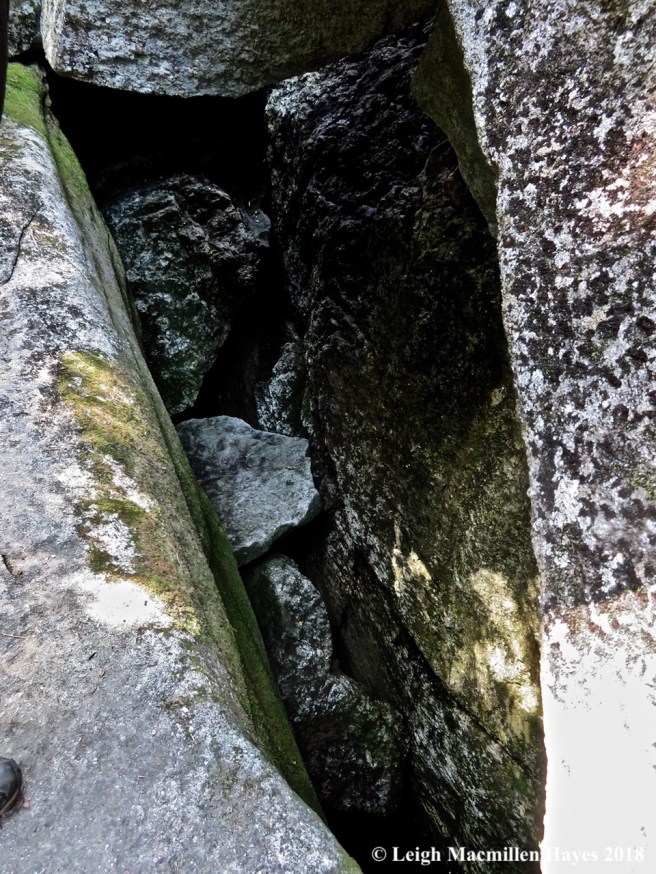
Making our way south on the road, our next clue indicated that we needed to find a moose, or at least evidence that one had been there previously. And so we found this deep cave, which the photo doesn’t do justice.

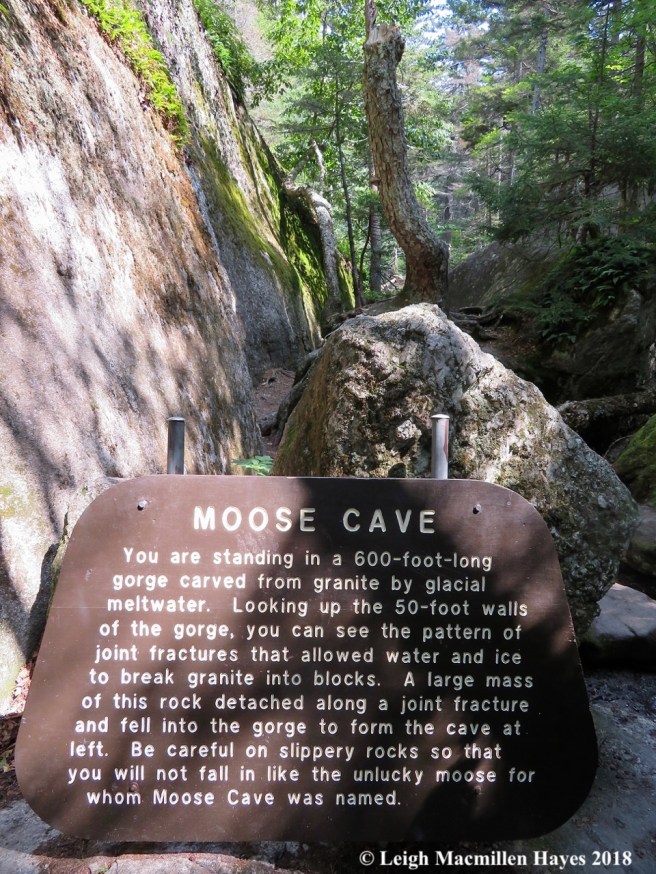
23-Moose Cave

As the local lore goes, however, a moose once fell in.

26-Mother Walker Falls

We were also instructed to find Mother Walker. We found the falls named for her that flowed through a gorge.

27-mother load of Indian pipe

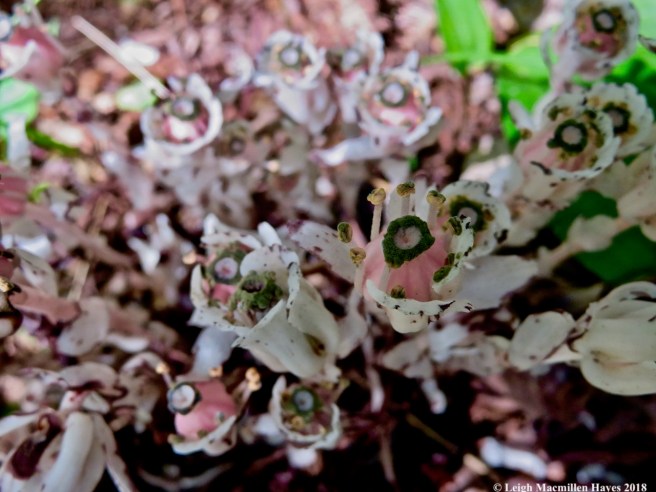
And we found a mother lode of Indian Pipes, all turned upright because they’d recently been fertilized. But who was Mother Walker? We never found the answer to that question.

29-Screw Auger Falls

With two stops left to make before finding the mat and finishing today’s leg of the race, we needed to locate a screw. Heck, I was with a hardware guy so that should have been easy.

30-upper falls

But this screw was in the form of a water fall. Screw Auger Falls. In the 1800s, settlers had built a saw mill directly over the falls that was powered by the current. A screw auger is a hand tool used for boring holes in hard material. It all began to make sense.

31-Arch

While we were there, we took in a view of the arch, just in case we encounter a question about it should we make it successfully to the end of race.

32-lower falls

And the falls below, were the story of water and glaciers was carved into the bedrock.

33-PIes for Sale

And then, and then, we continued south to a spot where we were told to fulfill our sweet tooth craving.

34-Puzzle Mtn Bakery

As we contemplated all of the possibilities, three folks came along in a truck (two of them from Norway, Maine, and the third visiting from San Francisco), bought a pie and gave us the money to buy one as well. But we had enough money. So we felt awkward, though we promised to pay it forward.

35-cash only

My Guy had just put the $20 into the metal tank when a vehicle from New York pulled in and a young couple stepped out. He walked over and told them about the previous couple, gave them $10 for their pie and asked them to pay it forward. Ahhh. Maine, the way life should be. And is!

36-Moose

At last, our final stop–we crossed the mat and learned we were first yet again.

37-beer

While sipping a celebratory brew, Team Speedy came in. Bingo! They were second in place. Drats. But at least we beat them. We never saw the other teams.

38-My Guy and me!

All in all, The Amazing Race–Our Style, episode seven was most gratifying as we successfully summited Table Rock in Grafton Notch. Thanks to Team Cape Cod for taking a photo of us.

Oh, and dessert tonight will be . . . Maine Wild Blueberry a la Puzzle Mountain Bakery and the kind folks from Norway, Maine.


Taking Flight

Morning had broken . . .

h1-morning has broken

and Pleasant Mountain’s reflection marked a new day.

h2-variable dancers conducting variable dance

New life was also in the making as the Variable Dancer Damselflies practiced the fine art of canoodling. I’d never noticed an oviposition aggregation before, but it made sense if it minimized the threats a couple receives from unattached males. Plus, if the spot was good enough for one pair to lay their eggs, then it must be fine for another. And so I learned something new today.

h3-slaty skimmer

Perhaps it also cut down on predation, though I couldn’t stay long enough to note if the Slaty Skimmer that hung out above turned either pair into breakfast. If so, I hope they at least had a chance to leave their deposits.

h4-Hemlock covered bridge

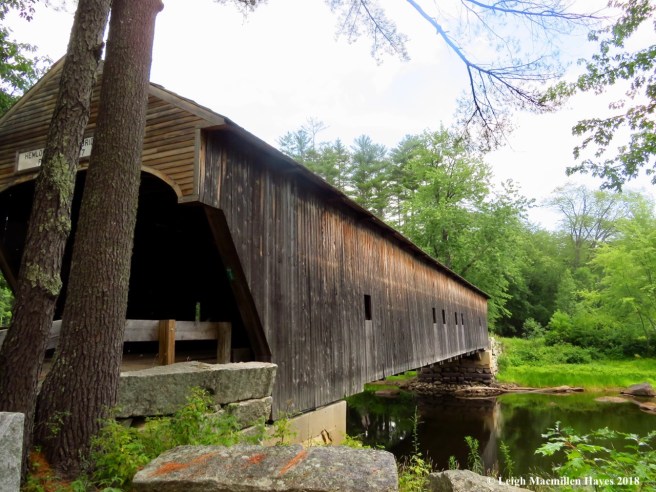
That was my morning view, but I changed it up a bit this afternoon and darted across the Hemlock Covered Bridge that spans the Old Course of the Saco River in Fryeburg. Built in 1857 of Paddleford truss construction with supporting laminated wooden arches, the bridge is a quaint and charming reminder of days gone by.

h5-bridge

Though reinforced in 1988 so you can drive across, it’s even more fun to glide while admiring the work of our forefathers and . . .

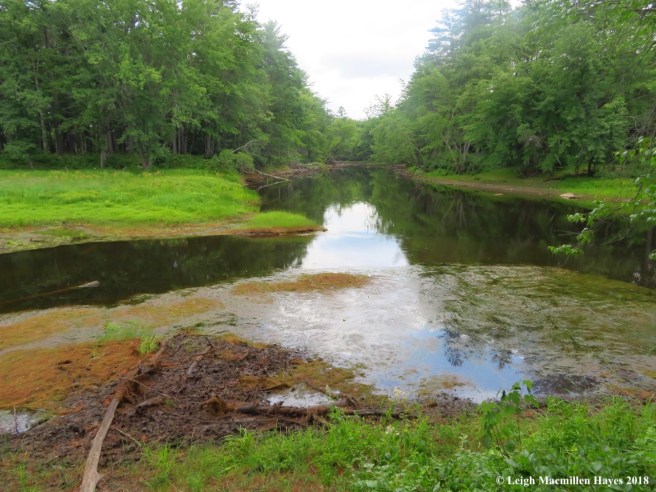
h8-water low

peer out a window at the river from Maine’s oldest remaining covered bridge.

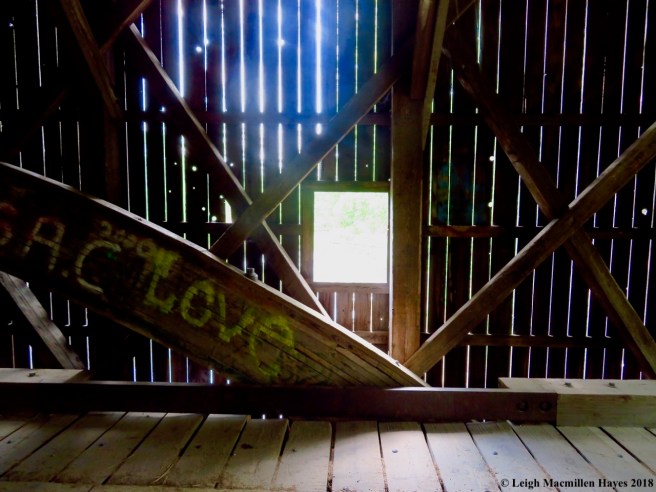
h6-LOVE

The handiwork of more recent travelers . . .

h7-love lasts forever

was also clearly visible.

h9-river jewelwing-female, white dots in sync

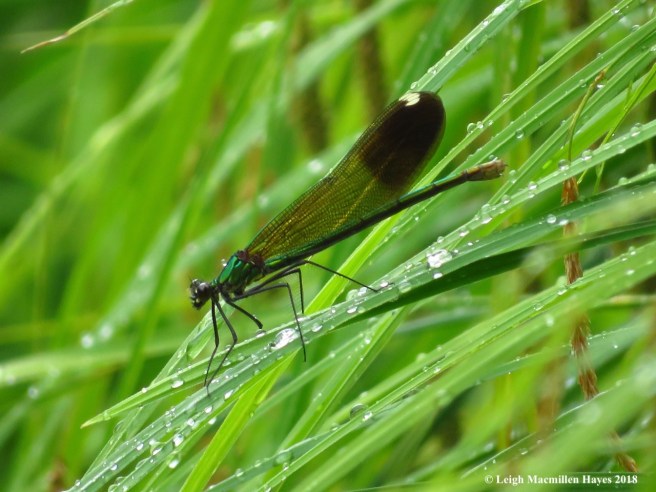
Down by the Old Course, I spotted a female River Jewelwing, the white dots on its four wings showing off in the day’s light. Just prior, a few sprinkles had fallen and one teeny droplet rolled down her thorax. A few even teenier ones clung to her legs.

h10-Hemlock Covered Bridge

With one more look back to reflect upon the bridge, I was then ready to set sail again.

h11-Mt. Kearsarge

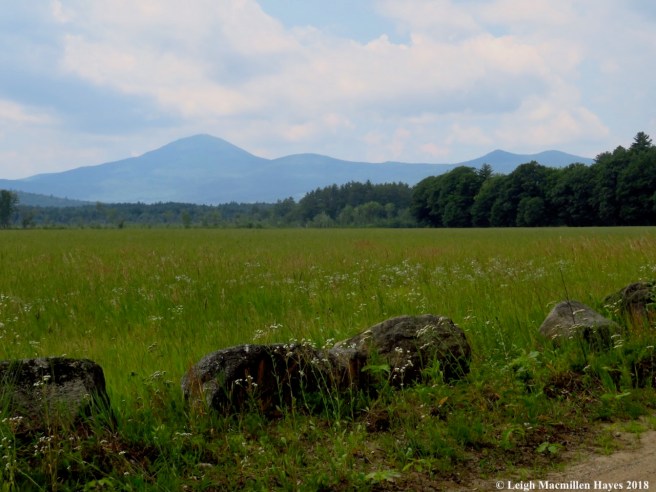
Heading toward Frog Alley, the view across the fields included Mount Kearsarge amid the summer haze that had developed.

h18-Mount Tom

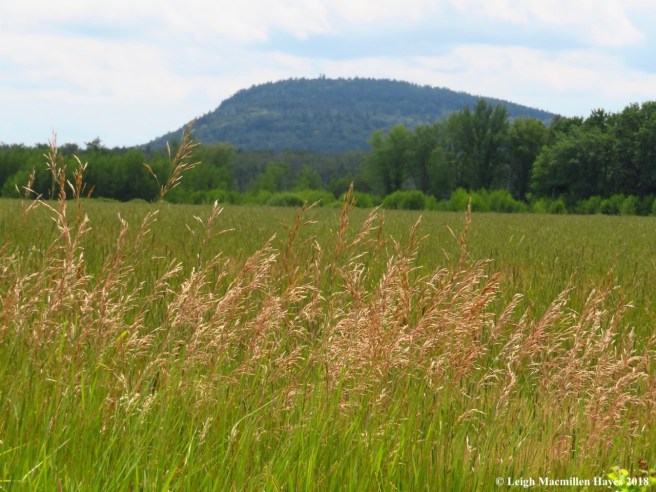
Mount Tom was more clearly visible for it was so much closer.

h12-Dianthus armeria, Deptford pink

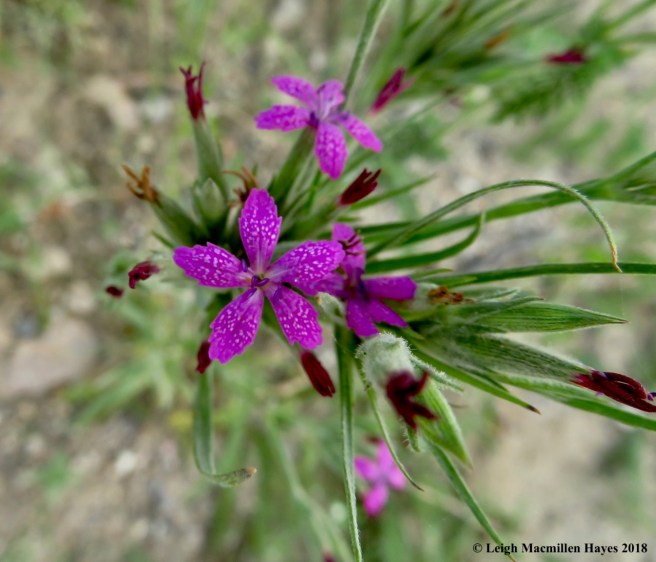
But what I really stopped to look at where those things closer to the ground, like the brilliant pink Dianthus with their petals all spotted and toothed at the tips.

h14-bindweed

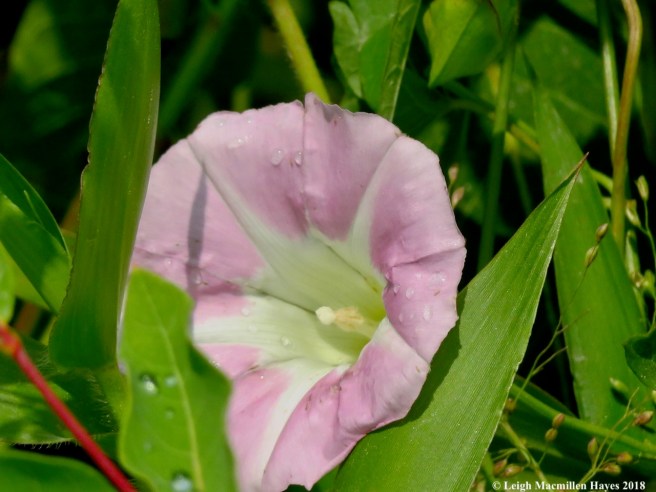
Offering a lighter hue of pink, a bindweed twined its way through the roadside wildflowers.

h13-honeybee on milkweed

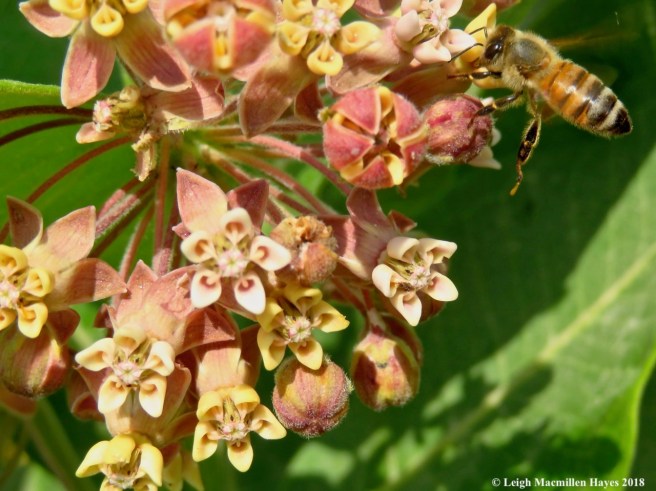
Also with shades of pink and the yellow complexion of those flowers already pollinated, milkweed was in full bloom and the ants and some flies were making the rounds, but I only saw one honeybee taking advantage of the sweet nectar. It reminded me that the same was true on the milkweed growing in my garden where, at most, I’ve seen four honeybees rather than the usual swarms.

h17-sulphur cinquefoil

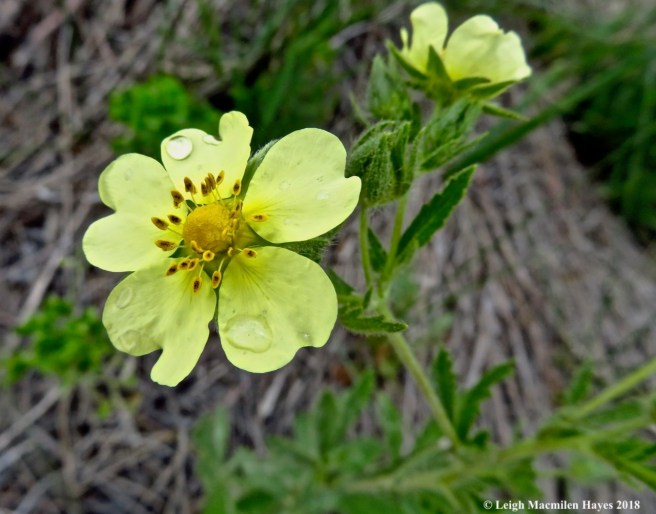
And then there was the subtle yellow of the Sulphur Cinquefoil showing off its cheery face despite a few tear drops. Actually, it may have cried for only a few drops had fallen from the sky and we really do need a soaking rain.

h16-clouded sulphur butterfly

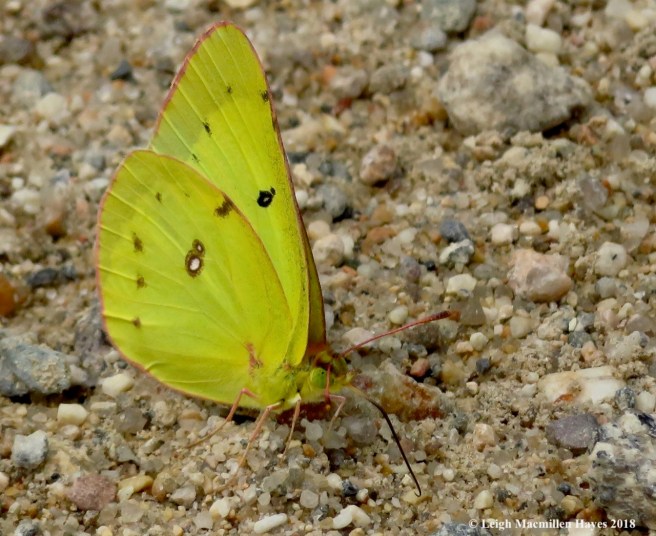
As if taking a cue from the cinquefoil, Clouded Sulphur butterflies flitted and danced along the road.

h16- clouded sulphurs puddling

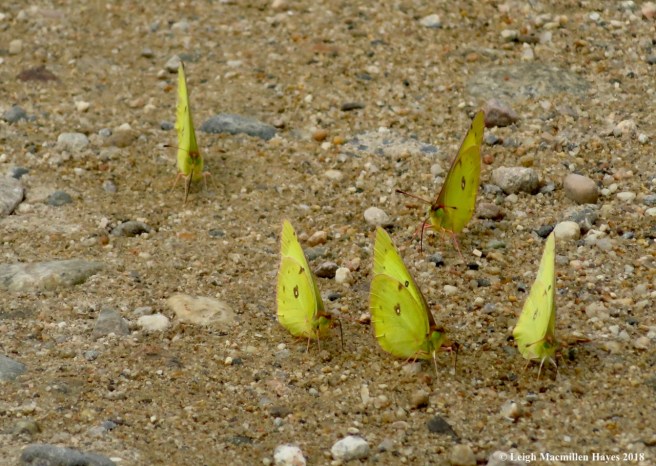
And then I realized that they kept gathering in groups. It’s a form I’d read about but never observed before–puddling. This was a male habit and apparently their intention was to suck nutrients from the wet ground. I guess even a few raindrops served the purpose.

h15-dragonhunter

Before I moved on again, my heart was still as more yellow entered the scene in the form of a striped thorax and I realized I was watching a Dragonhunter Dragonfly. Though it wasn’t so easy to see the tip of tail once it landed, as it flew about in my vicinity it kept its abdomen curved down–a habit of these big guys.

h29-Fryeburg Bog

The Fryeburg Bog was my next landing and though I didn’t head out to the water that was more like an over-sized puddle, I found plenty to focus on.

h19-buttonbush

For starters, the Buttonbush had begun to bloom and I loved its otherworldly presentation.

h21-frosted whiteface

It was there that I saw the smallest of dragons, in the form of the Frosted Whiteface.

h22-frosted whiteface

At most, he was about 1.5 inches long–quite probably the smallest of the species that I know.

h20-ruby meadowhawk

It was there that I also spotted my first Ruby Meadowhawk of this year.

h23-ruby meadowhawks canoodling

And then there were two! And in the future, obviously, there will be more.

h23--late afternoon snack

And finally, it was there that I noticed a Song Sparrow had nabbed a butterfly snack–all part of the circle of life.

h30-Smarts Hill

My final stop on today’s journey was at Popple Hill Brook along Smarts Hill Road in Sweden.

h25-variable dancer

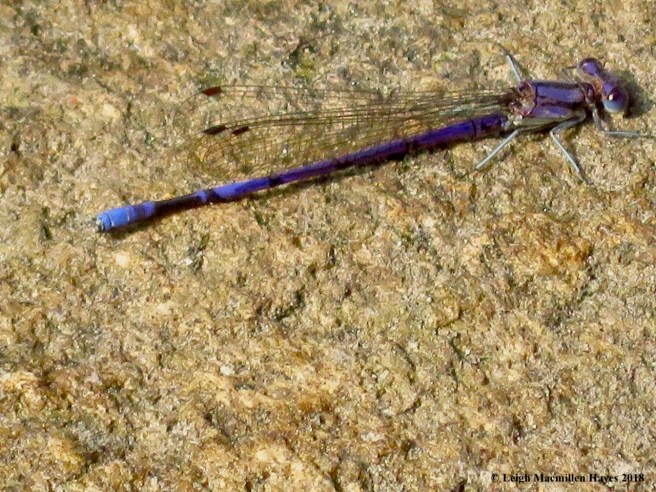
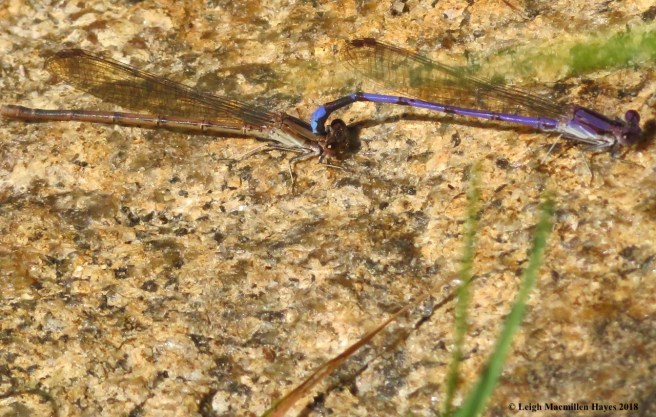
And like the Variable Dancers I’d seen this morning, I found many more beside the brook. Not only was the male’s purple coloring stunning, but notice those silvery legs.

h26-variable dancers canoodling

Of course, where there is more than one dragonfly or damselfly, there is love.

h27-variable dancers canoodling

As my tour began, it ended–with the Variables dancing to their heart song.

h28

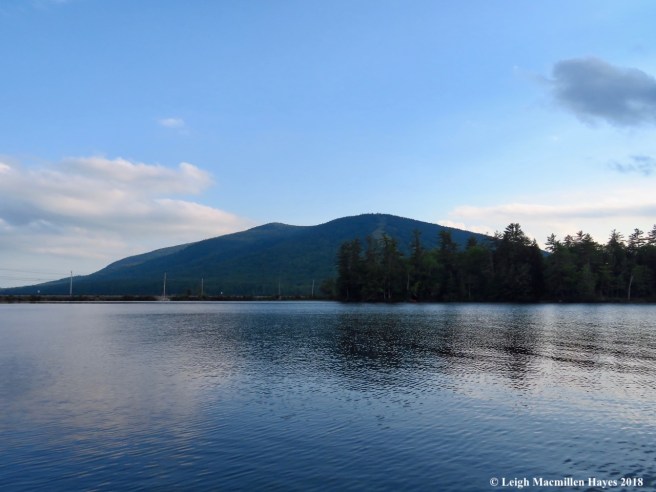
And with that, I flew back to camp, where the mountain’s reflection was conducting its own dance routine as the sun began to slip toward the horizon.

h31-rainbow

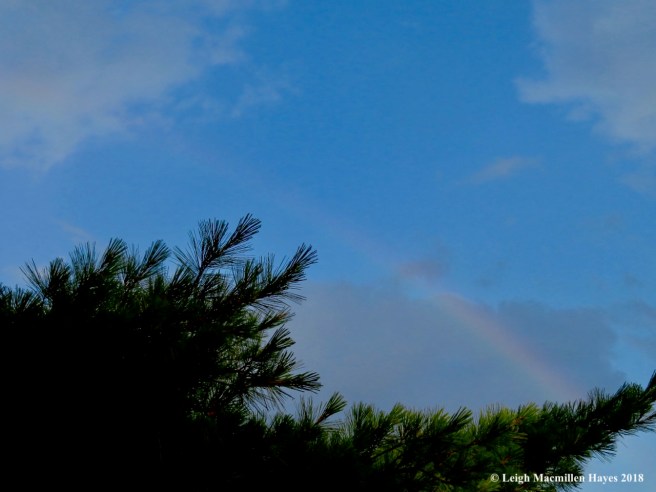
And a few more raindrops produced a rainbow in the eastern sky.

Thanks for taking flight with me on this wonder-filled wander and soaring above some of the areas that are so unique and yet we tend to overlook them.


Upta Camp

It’s been a gray day and a quiet day–the right mix of ingredients for a perfect day. And except for saying goodby to my guy this morning, the only conversations I have had, too numerous to count, were with myself.

c2-gray squirrel

Well, maybe that’s not quite accurate, for I did talk to a squirrel, but in unusual squirrel manner, it stayed as still as could be and didn’t respond. Together, however, we eyed our domain.

c5-mayfly

It turned out we weren’t the only ones with big eyes that chose to hang out all day. Attached to the screen was a Mayfly subimago–the teenage form of the insect.

c6-close up

Mayflies are unique in that after the nymph emerges from the water as the subimago (that fishermen call a dun), they seek shelter before shedding their skin for the final transformation. I’m tickled that this dun chose our porch screen on which to rest.

m6c-close up

Notice the cloudy wings–that’s a clue as to its age. It can take a few minutes to two days before a subimago transforms into a clear-winged imago or spinner, though the actual metamorphosis is quick. Will I see it? You know I’ll keep watching.

c6-sawfly insect case

In the meantime, there was more to discover, including a sawfly insect case featuring the tiny hole where the insect chewed its way out.

c19-round-leaved sundew

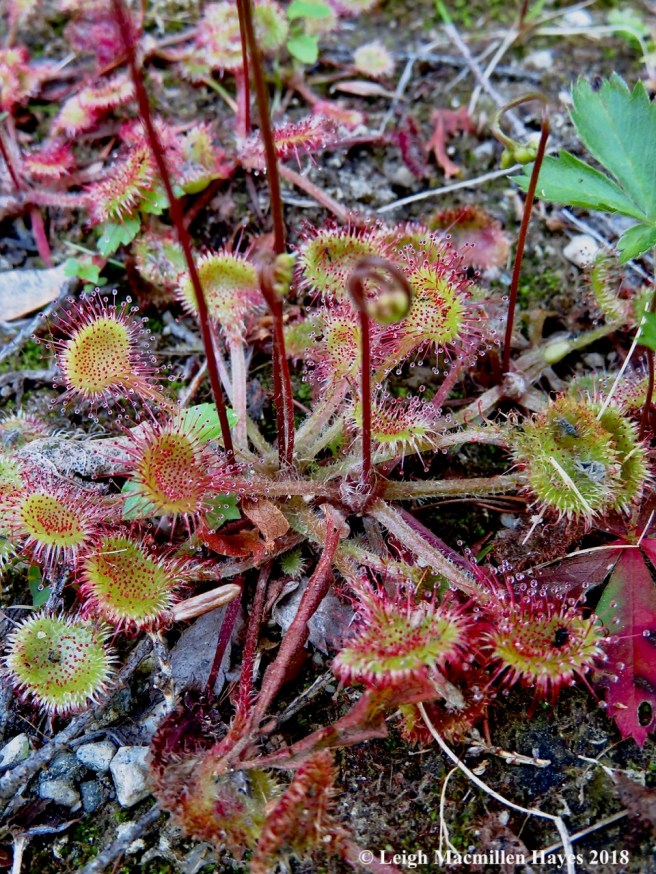
As I looked about, I made one extremely exciting discovery–at least to me. Since 1986, I’ve stalked this land and today was the first time that I noticed the carnivorous Round-leaved Sundew growing here. Its leaves were filled to the brink with insect parts.

c18-round-leaved sundew

Perhaps that was why it looked so healthy and ready to flower. Expect to meet it again in future blog posts. (I warned you.)

c14-swamp rose

I also spotted a few Swamp Roses offering a bright contrast to the day’s overcast reflection.

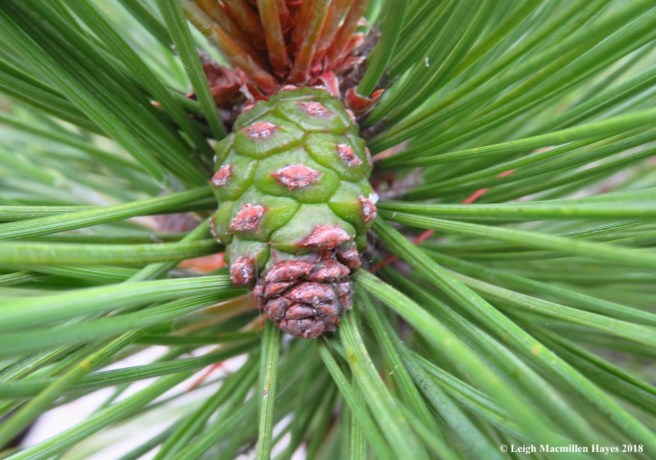
c13-red pine

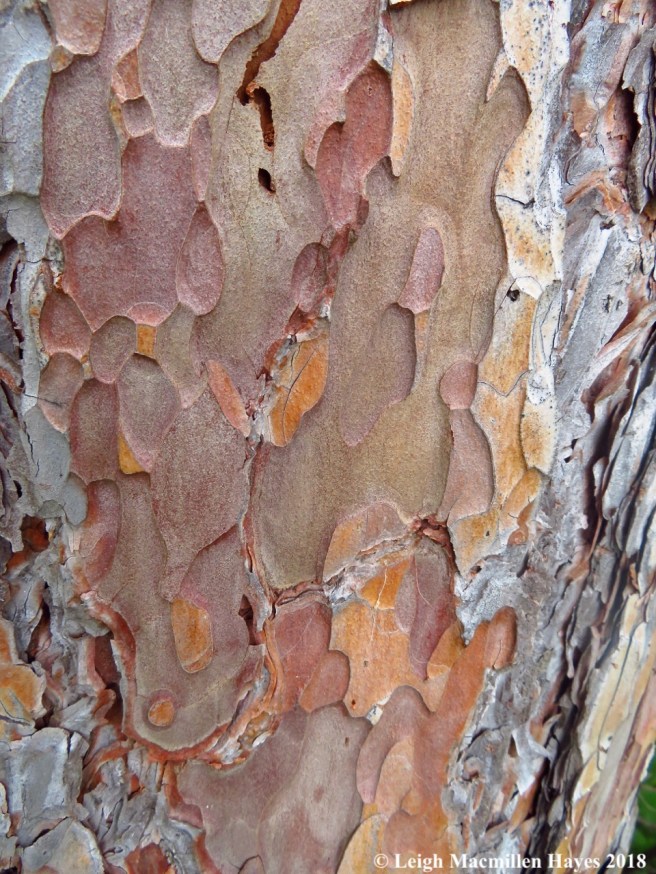
Featuring its own display of color was my favorite red pine–all pink-orange-gray hued in a jigsaw puzzle manner.

c15-red pine cone developing

At the ends of its branches I found young cones growing larger and greener.

c16a-spider

And old cones offering the perfect camouflage for a spider that had created a large network in which to trap its prey. I think it was of the garden cross variety, but without breaking the web, I couldn’t get too close, and I didn’t want to ruin all of its work.

c17-dragonfly exuvia

Entangled in a bit of another web and dangling from the floor of the porch and beside the foundation was a skimmer dragonfly exuvia. Today wasn’t a flight day for dragonflies, and so I had to wonder–where do they hide when the sun doesn’t show its cheery face?

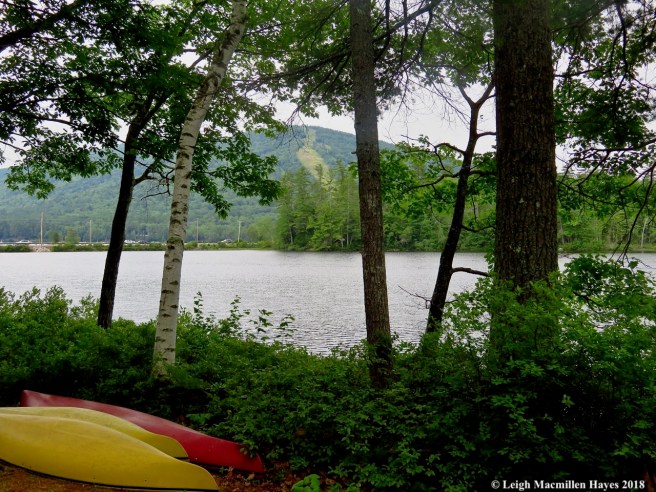
c1-camp view

Perhaps in the buffer zone of vegetation that surrounds Propinquity, our point of view.

c2a-dock view

It only took us about a month longer than usual . . .

c2-Pleasant Mtn

to make the long journey (7 miles) to the water’s edge.

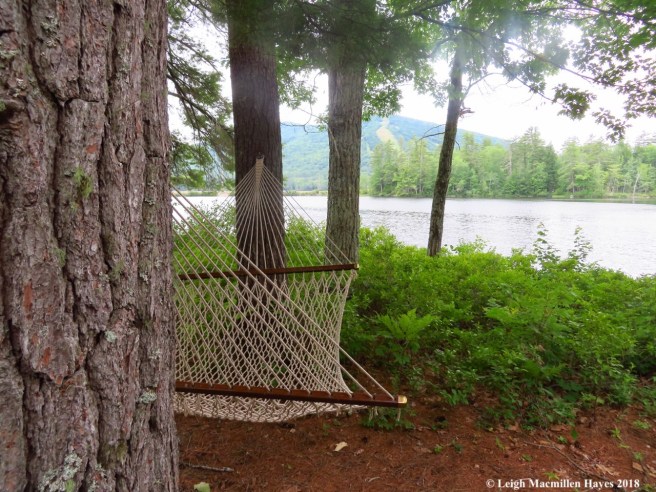
c20-hammock

But at last we’ve arrived.

c21-hammock view

Upta camp. The way life should be.


Flying With John A. Segur

I never had the honor of meeting Mr. Segur, but it was my honor to be his eyes for a short time today as I wandered down the short trail off New Road in Lovell at the Greater Lovell Land Trust’s John A. Segur Wildlife Refuge. Upon his death, a bequest in his name was left to the land trust to preserve habitat for native wildlife to thrive.

The JAS Wildlife Refuge actually encompasses 592 acres and I only explored the .3 mile trail on the western section of the property, but on an extremely hot summer day my finds were enough. Follow me and I think you’ll see what I mean.

j1-Across from the sign and telephone pole

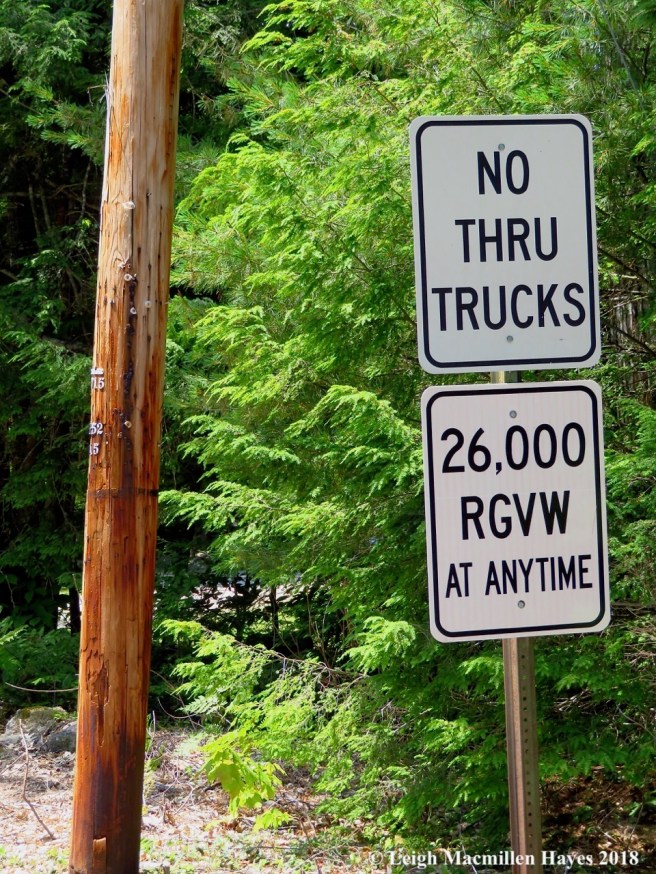
First off, you need to locate the small undefined parking lot. It’s about a mile beyond Foxboro Road, but I don’t pay attention to that. Rather, I look for the “No Thru Trucks” sign and turn on my left-hand blinker as soon as I spot it.

j2-trail and kiosk

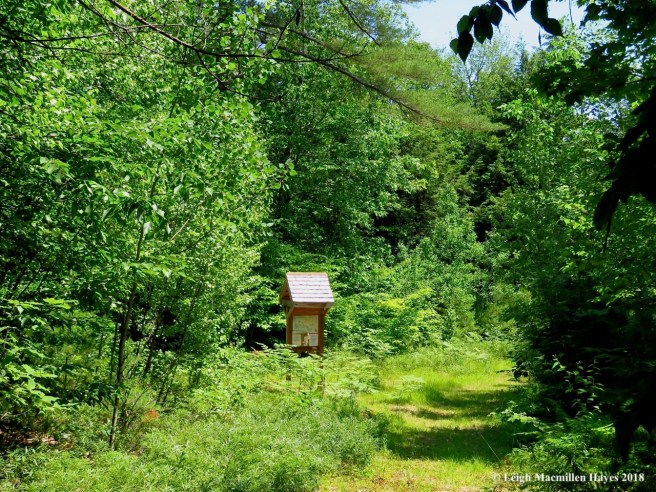
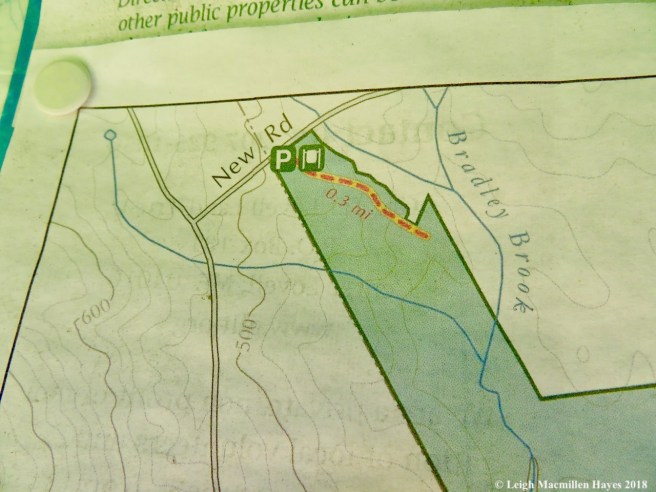
Just beyond a couple of boulders placed to keep vehicles from driving down the old skidder trail, stands the kiosk where you can take a look at the trail map and check out some other GLLT materials.

j3-map

As I said, this is just a small part of the overall refuge, but it’s well worth an exploration, especially if you don’t have much time (though some of us have been known to spend at least three hours making our way down and back).

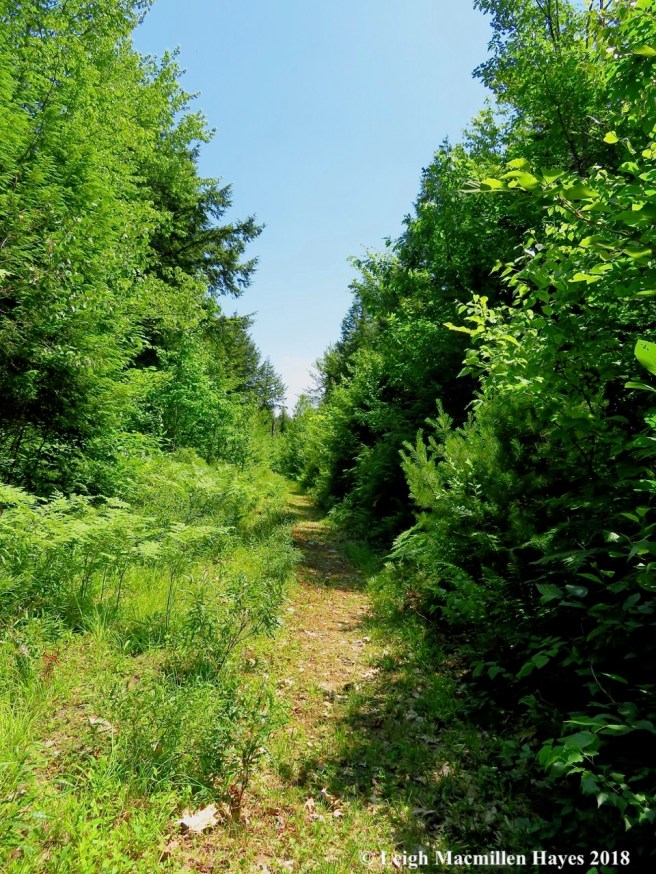
j3a-the trail mowed

Recently, the GLLT’s Associate Team and Intern mowed the trail, making it passable and not quite so tick-infested. But . . . still take precautions. Always! The trail is rather level, so it’s an easy one to travel.

j4-daisy and crab spider

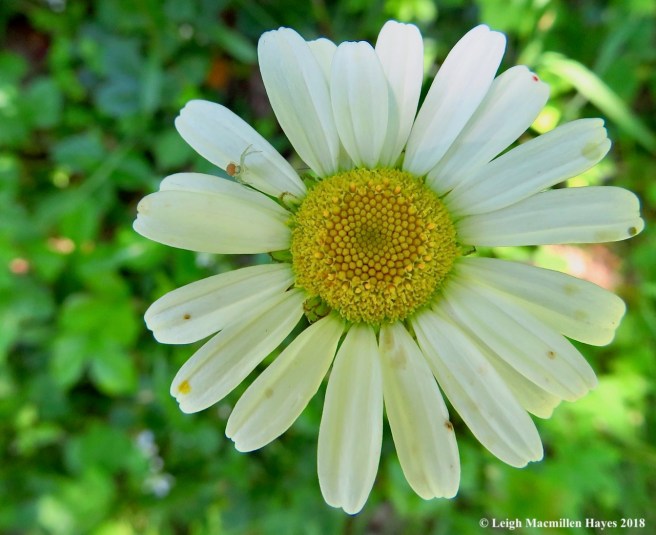
This is a place where you’ll find the ordinary, like a daisy. And trying to decide if “he loves me, he loves me not,” you might see a small crab spider.

j5-sundews

This is also the land of the extraordinary–in the form of the carnivorous Round-leaved Sundews. Check out the glistening droplets at the ends of the hair-like tendrils that  extend from each round leaf. The droplets are actually quite sticky. Just like a spider sensing a bug on its web, the tendrils detect the presence of prey and then curl inward, thus trapping the prey.  The whole leaf will eventually wrap around the insect and in the process of digesting it, the plant will absorb the bug’s nutrients. Sundews tend to grow in areas that lack sufficient nutrients, so this is the plant’s way of supplementing its diet. And if that wasn’t enough–it was just plain beautiful.

All that being said, this is a tiny plant and right now preparing to flower. So, if you travel this way, about a tenth of a mile into your journey, look down at your feet for these minute gems, take a closer look, and then walk with care.

j6-sweet-fern

Further along the trail you’ll see a few species of ferns, as well as the fern that isn’t a fern. Sweet-fern is so named for it’s fern-like appearance, but it has a woody stem and is actually a shrub. It’s yellowish green flowers that first appeared in spring were giving way to greenish brown, burr-like nutlets. In any season, this shrub has such variation to offer, that like hobblebush, I can’t resist honoring it with a million photographs.

j8-raspberries

One of the sweet joys of this trail is that because of previous logging, early succession is taking place in terms of the plants and trees that grow beside the trail, including blackberries not quite ripe and these raspberries already offering a delightful reprieve on a humid summer day.

j14-the field

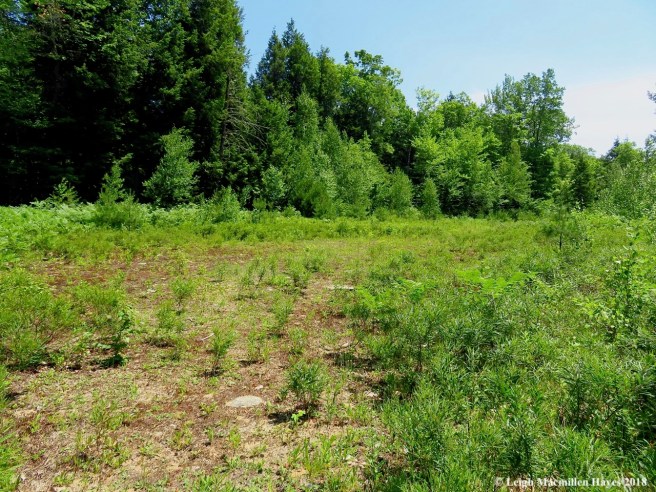
Eventually, the trail leads to the turn-around point, the old log landing, which also displayed signs of forest succession, for its there that some wildflowers and sweet-ferns grow in the center. At the perimeter, white pines, gray birch and blackberries crowd each other.

j10-four-spotted with food

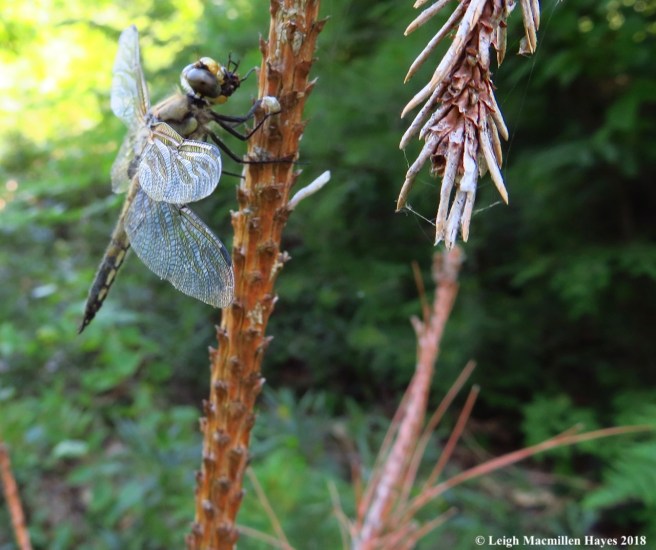
And on the edge, the dragonflies fly. And dine. This Four-spotted Dragonfly settled on a dead red pine to consume an insect.

j11-4 spotted eating

Ever so slowly . . .

j12-feeding frenzy

the body disappeared into its mouth.

j13-4 spotted, back view

While it was busy eating, I was busied myself in getting as close as possible to enjoy all of its nuances, from the four spots on its wings, to the basal display on the hind wings to the placement of its eyes and colors on its thorax and abdomen. All of those details help in ID.

j15-old coyote scat

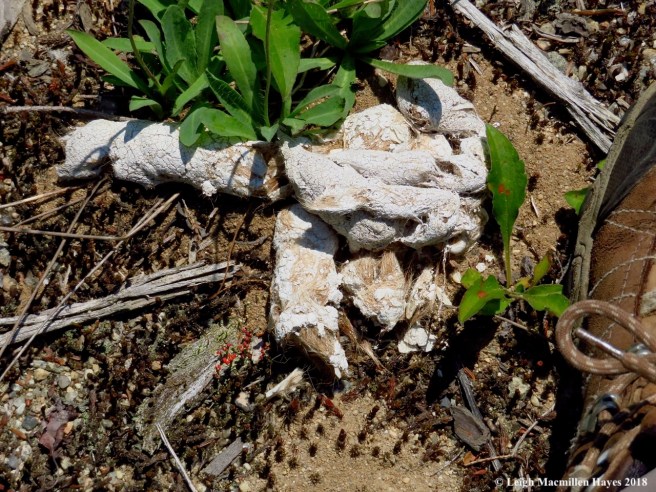
And then into the field I went, with a memory of a winter expedition when we noticed that a shrike had deposited a mouse in a tree. Today’s finds included a pile of old coyote scat probably also deposited this past winter that indicated a territory repeatedly marked.

j16-turtle?

I also spied lots of recently made depressions. While one might suspect dust baths by a turkey or grouse, feathers are usually left behind in the process. Instead, the ground was more disturbed and because the landing is close to Bradley Brook, I determined I was looking at recently dug holes made by turtles. Snappers and painted turtles have been depositing eggs recently and these may be the incubation nurseries for their offspring.

j16-racket-tailed emerald

As I turned back toward the trail, I noticed a dragonfly seeking shade, for so hot was it. Notice the bright green eyes of the Racket-tailed Emerald. Thank goodness for those emerald eyes that always help in narrowing down the choices.

j18-common dewberry:sphinx moth

I found it a bit more difficult to ID the sphinx moth that paid a visit to the Dewberries. There are only 1,450 species in the Sphingidae family, but my leaning was toward Nessus Sphinx, though I could be totally off on that one.

j20-Northern-bush Honeysuckle

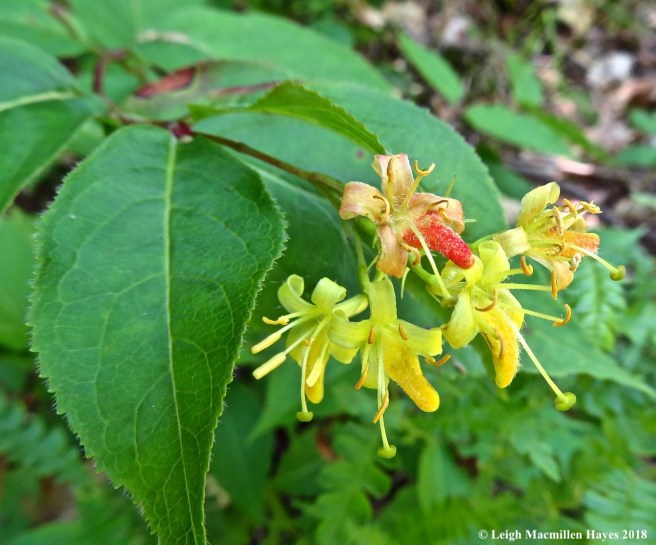
I was much more confident about my ID of the native Northern-bush Honeysuckle with its greenish-yellowish-orangish flowers. The plant is actually a shrub with a woody stem, and one that moose and deer like. I’ve yet to see a moose print along this piece of the property, but I know its part of a deer yard.

j21-Spotted St. John's-wort

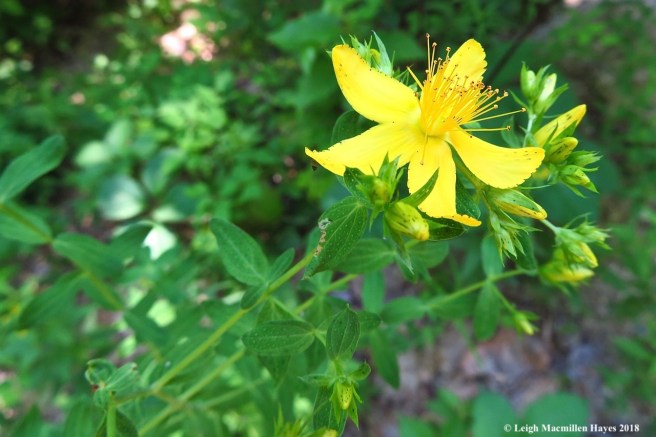
Also springing forth with yellow blossoms was Spotted St. John’s-wort, with its translucent spots on the leaves and tiny black dots outlining its petals.

j22-whorled yellow-loosestrife

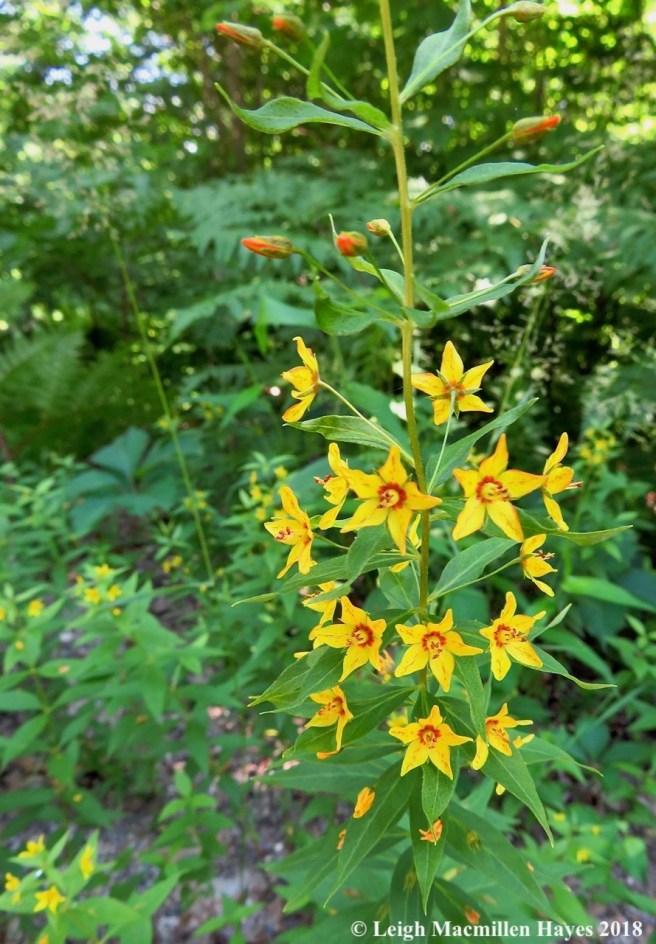
And not to be overlooked, the Whorled Yellow-Loosestrife with its cheery flowers extended in a whorl from the stem by long petioles.

j23-hitchiker

My journey wasn’t long, but with all that I saw, I was thankful for the spirit of Mr. Segur that flies over this place.

Just possibly, he graced me with his presence today . . . in the form of Spangled Skimmer.

Self-Guided Tour of Sabattus Mountain

As stories go, Sabattus Mountain in Lovell offers plenty of lore. For starters, there’s the name of the mountain. I’ve heard at least two tales and seen three spellings, but basically the legend is the same–about a Pequawket named Sabatos, Sabatis, or Sabattus, who guided hunters and one day killed a lynx, or was it a mountain lion, before it sprang upon him.

In a July 14, 2017 article, Ed Parsons of the Conway Daily Sun wrote: “Sabattus was born in St. Francis, Canada, and with the influence of French missionaries, was named for St. John the Baptist, shortened to Sabattus. When Roger’s Rangers destroyed St. Francis in 1759, Sabattus was about 10 years old. He was kidnapped and went south with the rangers. Later, he went to Fryeburg with one of them, and spent the rest of his life in the area.

Sabattus had two children with the well-known area healer, Molly Ockett. In 1783, an earlier wife of his returned from a long trip to Canada, and claimed to be his spouse. To settle the dispute, Sabattus took them to the house of Mr. Wiley in Fryeburg so there would be a witness, and the two women fought, “hair and cloth flying everywhere.” Mrs. St. Francis, as Molly Ockett called the former wife, was stronger and won out. Molly Ockett left and moved to Andover, Maine.

There’s also the Devil’s Staircase, but that’s for another day.

s1-sign

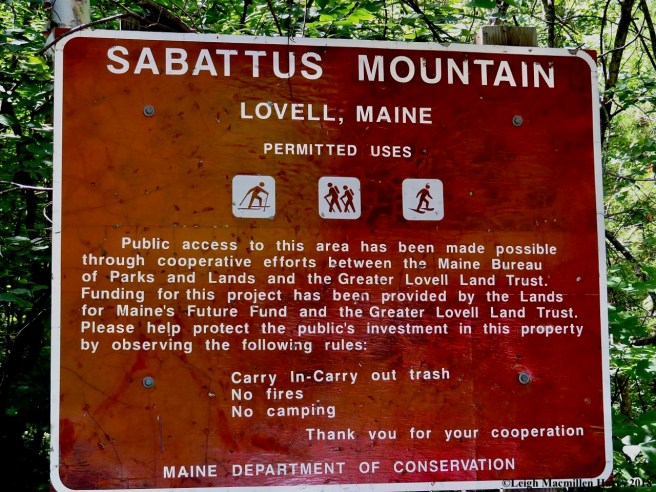
Two Land for Maine’s Future program grants, along with funding from the Greater Lovell Land Trust, enabled the State of Maine to purchase 177 acres on and around Sabattus Mountain, protecting hiking access to Lovell’s highest peak. The trail is a 1.6-mile loop to and from the 1,253-foot summit. Sabattus Mountain is now owned and managed by the Bureau of Parks and Lands. The land trust, however, has taken a keen interest in upkeep of the trail system recently because there had been much erosion ever since Hurricane Irene and the State seemed to back off maintaining it. Last year, the GLLT’s three interns built numerous water bars, especially on the eastern trail.

s6-Brent's Loop Trail Sign

Last week, Brent Legere of Lovell Box Company and Western Maine Slabworks, installed new signs to guide hikers on the trail system.

s2-self-guided nature walk

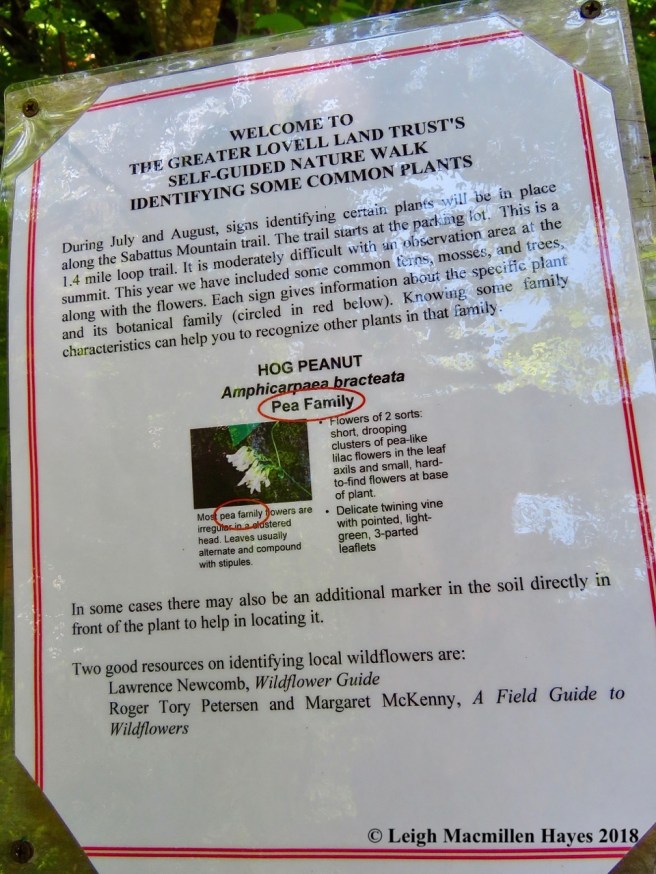
Today, a team of docents, associates and this year’s intern, under the well-organized leadership of GLLT Docent and Maine Master Naturalist Joan Lundin, installed informational signage along the loop.

s3-explaining the plan

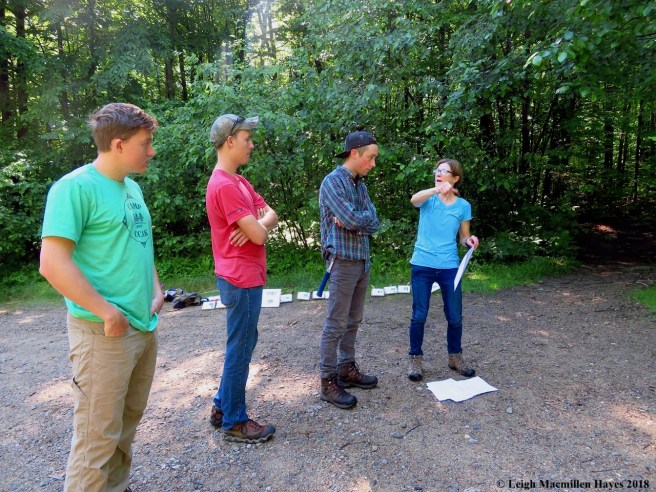
The morning began as Joan divided the team into two groups. First she instructed Intern Isaiah (in red) and Stewardship Associate Dakota (in plaid), to take one set of signs up the western trail and leave them beside examples of particular species on the way.

s5-all smiles to go

Then she prepped Associate Director Aidan, and GLLT Docents Nancy and Pam in the plan for the eastern trail.

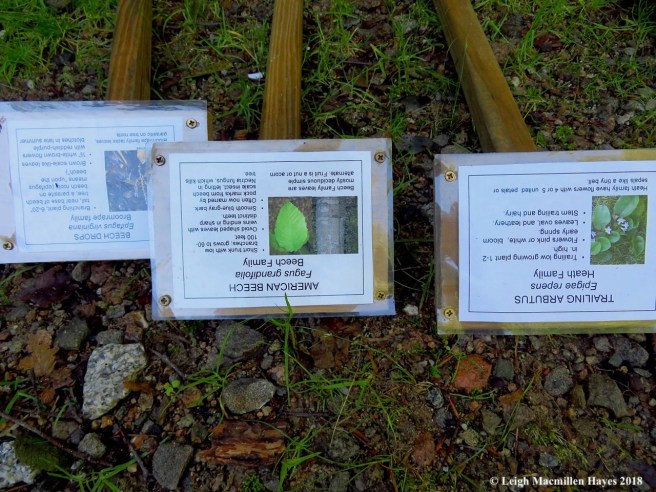
s4-signs

All signs were laid out and ready to be hauled up the trails for installation.

s12-hi ho

And so, in true Seven Dwarf style, it was hi ho, hi ho and off to work we went.

s7-installing the first sign

Because she’d climbed the trail so often in order to prepare for today’s undertaking, Joan knew right where each sign belonged. At the start, she did most of the installing, showing off her muscle power on this steamy day, despite her petite physique.

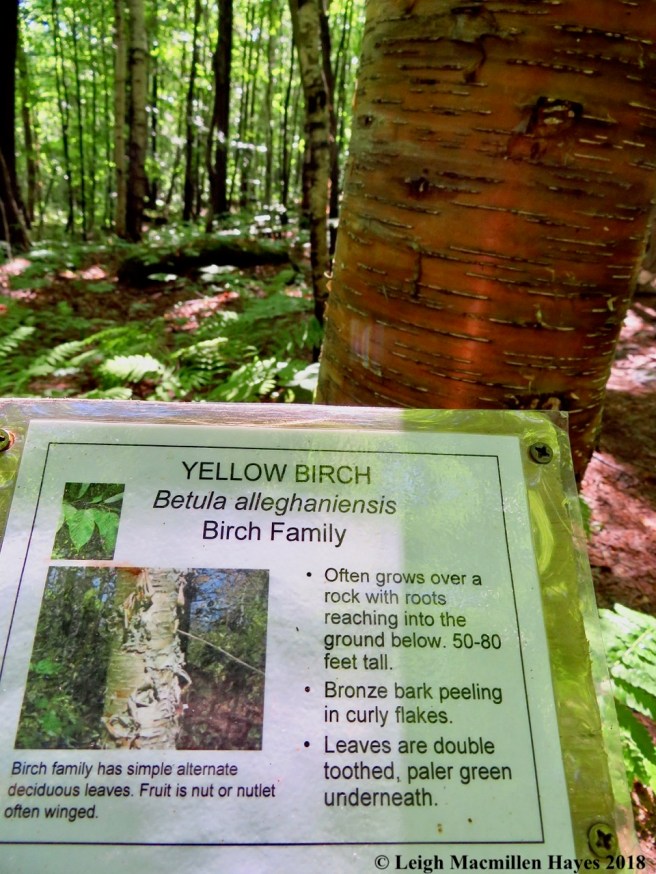
s8-yellow birch

Each sign included common and scientific names, plus only a few key characteristics so not to overwhelm those who might stop to read them and look around to locate the particular species. It’s a technique decided long ago by the full team of docents who have undertaken this task each summer for years–always along a different GLLT trail.

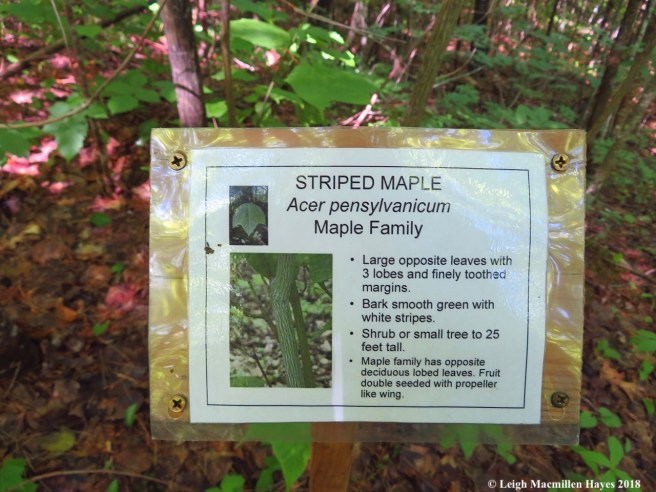
s9-striped maple

The natural community along both trails on the loop system transitioned about two-thirds of the way up. For the lower portion, the community consisted of a variety of deciduous trees.

s13-hemlock

Suddenly everything changed. Light turned to shade. Dry turned to damp. Leaves turned to needles. And conifers showed off their unique characteristics.

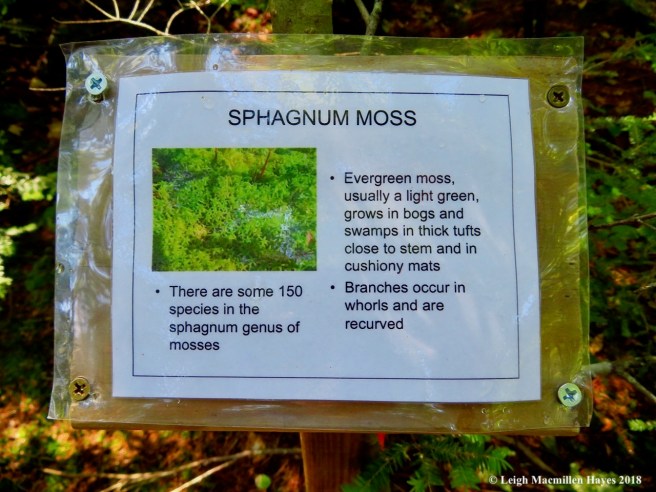
s14-sphagnum moss

Even the forest floor changed from dried leaves and wildflowers to green mosses, including sphagnum, with its pom-pom shaped heads.

s15-loop trail sign at ridge

As we hiked up the eastern trail, Dakota and Isaiah swung along the ridge line and came down to find us for they had only placed their signs along the western trail as instructed by Joan, and hadn’t yet pounded them into the earth. We chatted as we moved upward, talking about the turn ahead to the ridge, and Dakota told us we’d be pleased with how obvious it was since Brent had installed the new signs. Indeed!

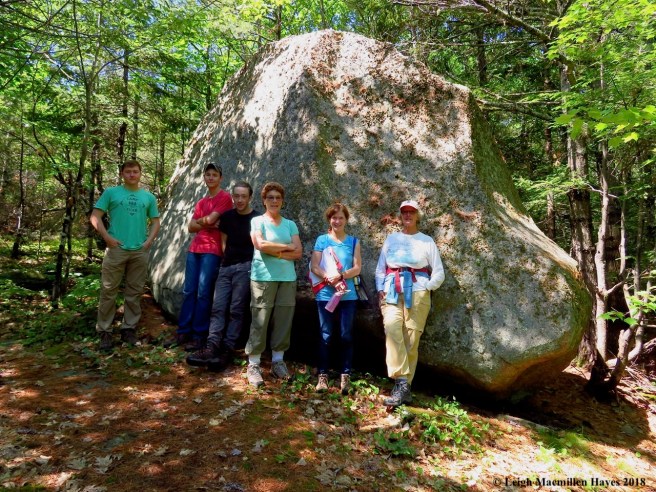
s16-glacial erratic

Of course, we were a group that failed at following directions, and so off trail we went to check on the glacial erratic that we knew stood just beyond a downed tree.

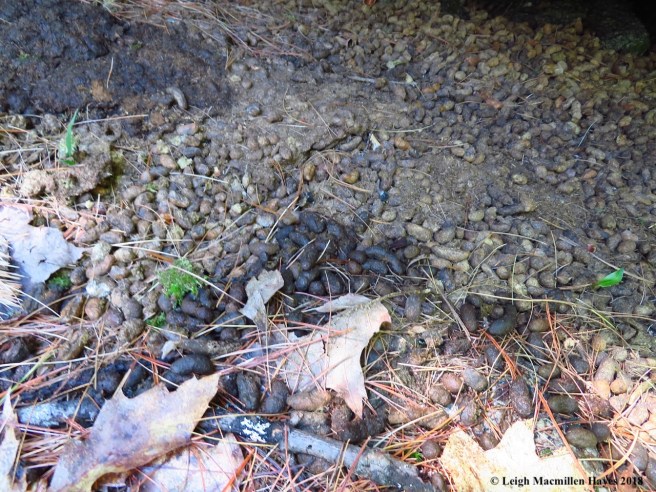
s17-porcupine scat

We also checked underneath, for who doesn’t like to look at porcupine scat. New and old, though not especially fresh, it’s been a winter den for at least 30+ years that I’ve been climbing this mountain.

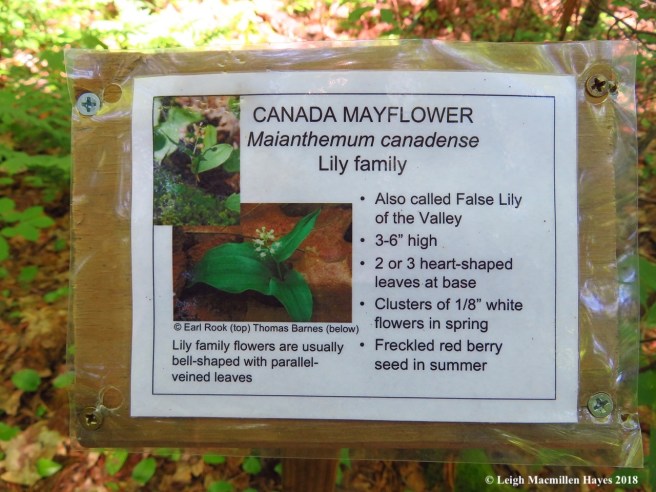
s18-Canada mayflower

And then Joan redirected us, pulling us back into the mission of the morning and finding a place to post the Canada Mayflower sign–between the granite slabs at our feet.

s19-window on the world beyond

Making our way across the ridge, we paused for a second to look out the window upon the world beyond. It’s from heights like this one that we always appreciate how much of Maine is still forested. At a recent gathering with District Forester Shane Duigan, he said that the state is 85% forested–down from 90% not because of urban sprawl, but instead increased farming.

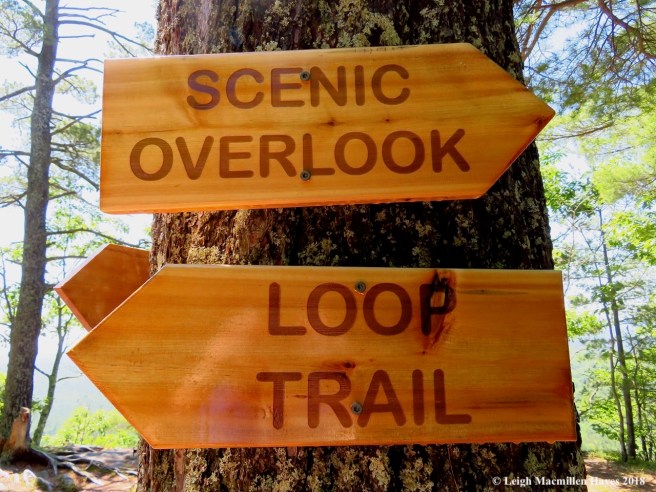
s20-main summit signs

A few minutes later we reached the main summit, where Brent had posted more signs. They’re nailed to a White Pine and mark the intersection of the ridge trail and western loop, with a spur to the western-facing ledges and scenic overlook.

s21-white pine

That very White Pine was also on Joan’s list as an excellent example, and so it will be noticed for a while.

s22-Keyes Pond and Pleasant Mtn

For a few minutes, we took in the wider view to the south–noting Keyes Pond in Sweden and Pleasant Mountain in Bridgton, both part of the great beyond.

s23-scenic view

And then a quick trip out to the scenic overlook, where the sweeping view included the Lower Bay of Kezar Lake and pyramid outline of Mount Kearsarge in North Conway.

s24-scenic view 2

Turning a wee bit to the north, the view also encompassed more of Kezar Lake, and the White Mountains.

s25-chipmunk

On the way down, we continued, or rather, the rest of the team continued to install the signs while I watched, and one quiet chipmunk with a piece of a leaf dangling from its mouth looked on with approval. We assumed it approved, for it didn’t chatter at us.

s26-teamwork

It seemed the signs on the western trail went into place far more quickly than on the climb up, but maybe it was because there weren’t as many. We did pause for a few minutes as Isaiah and Dakota changed out one sign for another because the species Joan wanted to feature wasn’t as prominent as hoped. But, she was prepared with extra laminated cards and quickly produced a description of an alternate species.

s27-plank

We were nearly finished with our morning’s work when we reached the new plank bridge Brent had placed across a small stream.

s28-white admiral

Back at the parking lot, we were wowed by the sight of pollinators upon the Staghorn Sumac, including a White Admiral Butterfly.

With that, our tour was done for the day, but we’d met several people along the way who were thrilled with the work we’d done. We hope you, too, will partake of the pleasant hike up Sabattus Mountain, and stop along the way to enjoy the self-guided tour. It will be in place until Labor Day weekend.

And be sure to stop by the office on Route 5 and make a contribution to the Greater Lovell Land Trust for we are a membership-driven organization and can’t do such work without your continued support.

P.S. Thank you Self-guided Tour Docents and GLLT staff, plus Property Steward Brent.


Mondate of a Rare Type

Aha. So our Mondates are hardly rare, though we don’t spend every Monday on a hiking date. What, therefore could the title mean?

d1

Follow us down the trail at the Dahl Wildlife Sanctuary in North Conway, New Hampshire, and I think you’ll soon understand. The property is owned by NH Audubon and located adjacent to LL Bean, though the parking is in a tiny lot across from Burger King on Route 16.

d2

It’s not a long loop, but it’s chock full of wildflowers like the Black-eyed Susans beginning to burst open into rays of sunshine.

d3

We also passed an abundance of shrubs such as Staghorn Sumac and my mind raced ahead to a future visit with Michael Cline’s book, Shrubs of the Northern New England Forest.

d16a-silver maple floodplain

Because we were near the Saco River, part of the loop took us through a Silver Maple floodplain where the trees arched above in cathedral formation.

d17-ostrich fern

In the same habitat, but at waist level, Ostrich Ferns grew in their vase-like fashion..

d18-Tortricid Moth gall

And among them, growth of another kind was apparent for possibly a Tortricid Moth had used the terminal part of the fern’s frond for its larvae to feed and pupate.

d5-Saco River

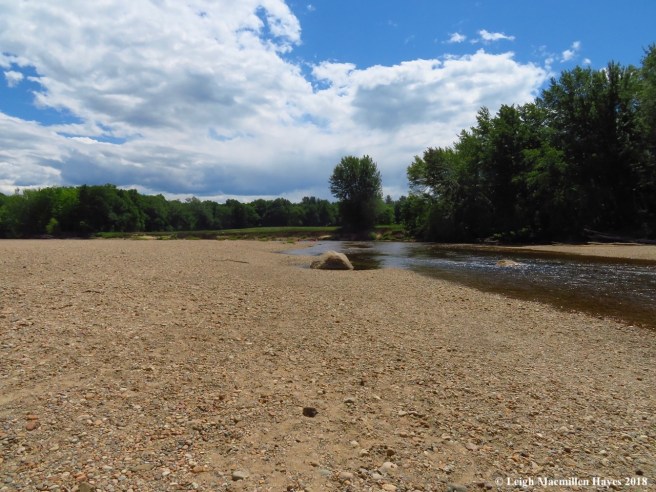
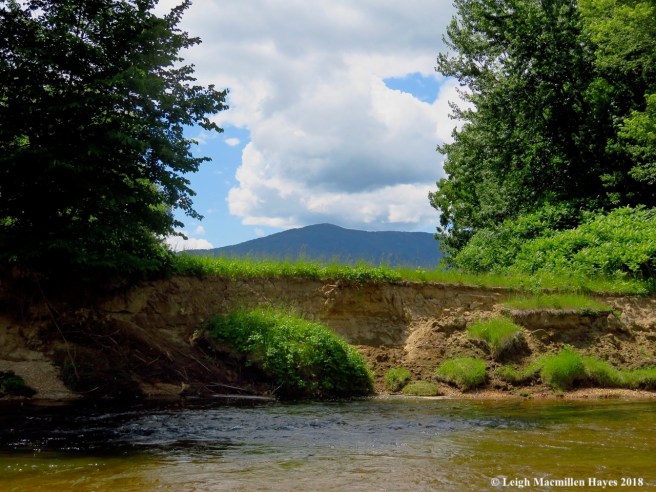
Stepping out of the forest and into the sunshine, we suddenly found ourselves beside the Saco River, where we looked north.

d4-Saco River

And then south. A few kayakers passed by, but for the most part we were alone.

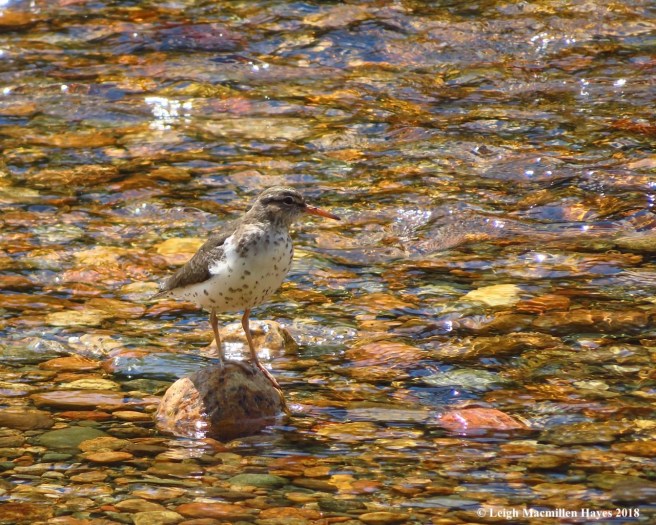
d4, spotted sandpiper

In reality, we weren’t for a solitary Spotted Sandpiper explored the water . . .

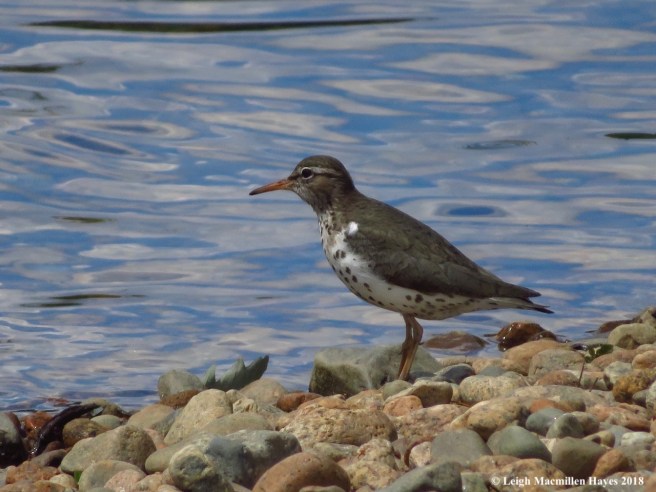
d7-spotted sandpiper

and cobbled beach,

d23-sanpiper foraging

where it foraged for insects, small fish and crustaceans.

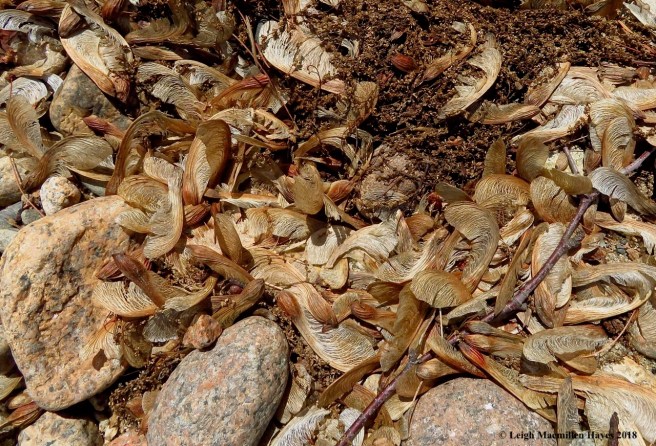
d8-silver maple samaras

Silver Maple seeds were not on its grocery list and they sat in abundance along a high water mark, waiting in anticipation . . .

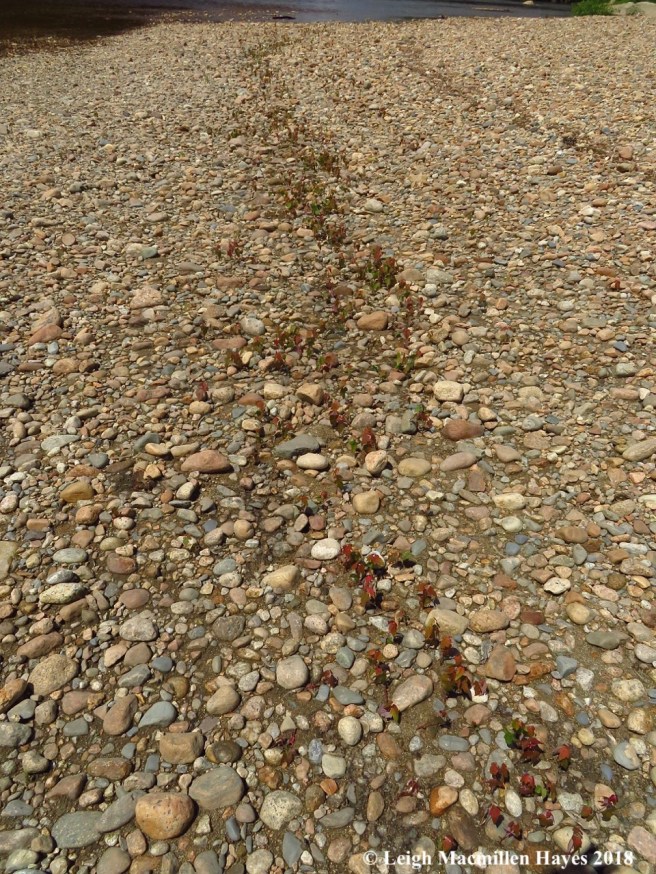
d9-silver maple saplings

to join their older siblings and create their own line of saplings next year.

d10-South Moat

After standing at the water’s edge for a bit longer and enjoying the ridgeline view from South to Middle Moat Mountains, it was time to search for the rare finds that brought us to this place.

d24

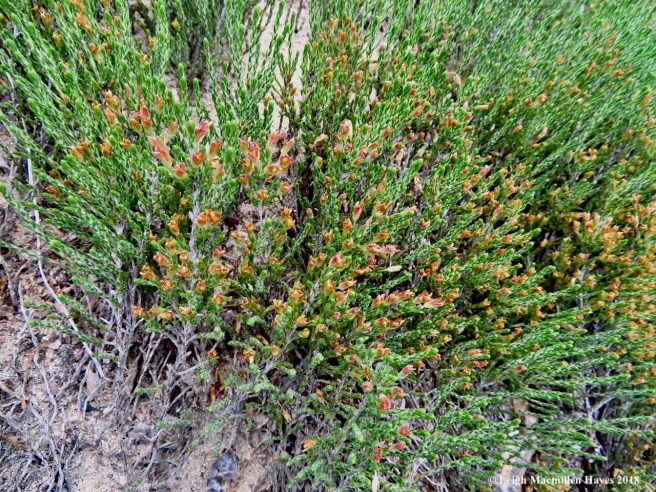
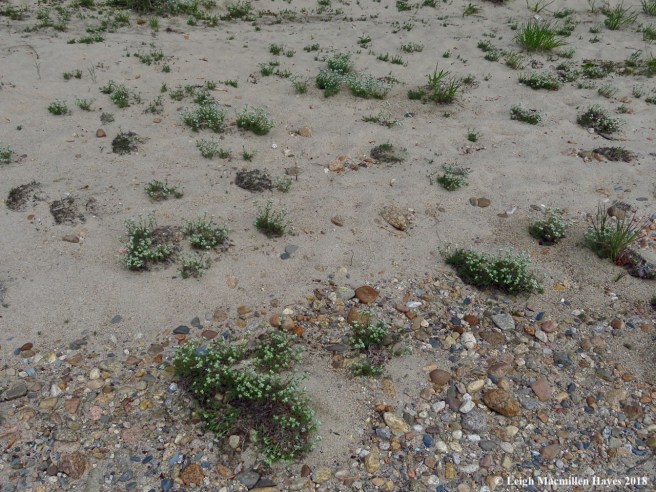
The first was a clump upon a small sand dune–Hudsonia tomentosa.

d25

One of its common names is Sand False Heather, which certainly fit its location and structure. This mat-forming plant had the tiniest of flowers, but it was by its heathery look that I spotted it. It’s listed as rare and threatened in New Hampshire.

d15-silverling

While I only found two clumps of the heather, the second rare plant featured a larger colony.

d12-silverling1

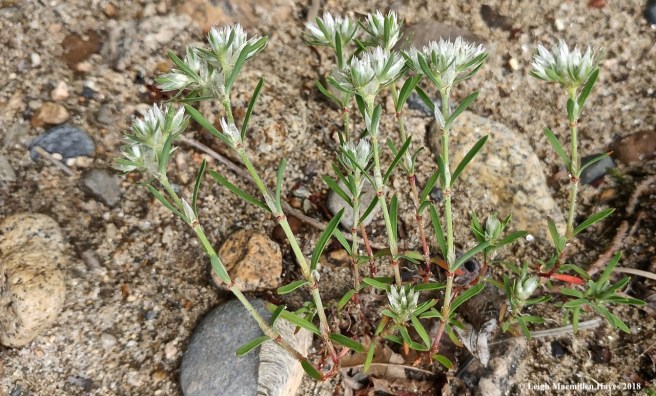
Paronychia argyrocoma is also listed as rare and threatened in New Hampshire (and extremely rare in Maine).

d13-silverling

Also known as Silvery Whitlow-wort, it prefers the ledges and ridges of the White Mountains and . . . gravely bars along rivers. Its whitish green flowers were ever so dainty.

d14-silverling3

From a side view they were most difficult to see for silvery, petal-like bracts hid their essence.

After those two rare finds, my heart sang . . . a song that had started a couple of hours earlier when my guy and I dined with my college friend, Becky, and her daughter, Megan. Another rare and delightful event.

They say three times is a charm and I certainly felt charmed for this rare type of Mondate.


Summer Solstice Sweetness

My dear friend Carissa sent me an e-mail about this week being Pollinator Week and challenged me to write about it. Her inspiration came from an e-mail she’d received from Natureworks Horticultural Services in Northford, Connecticut–part of our old stomping grounds as babes, toddlers, tweens and teens. (She grew up in Northford, while I grew up on the other side of the tracks in North Branford–two distinct villages that formed one town.)

Part of the message included this passage: “Happy Pollinator Week. There really is a week for that? You betcha. Pollinators are vital to life on this planet. And, at Natureworks, we are teaching our customers to protect and help pollinators every single day. It all starts with an organic garden. It includes planting lots of pollinator-friendly flowers. It continues with the way you manage your landscape and the way your community manages their public spaces. Pollinators are in decline around the world. We need to take this seriously. Let me just say . . .  we have the plants for that!

f1

And then another friend, Pam, invited me to join her on a mini-hike to Foss Mountain today in Eaton, New Hampshire, and it all came full circle. To travel here with Pam was an incredible opportunity because she had some personal experience with the property and shared the local lore, including a story about a peddler who long ago repeatedly traveled a road that crosses the mountain and apparently spent some time canoodling with another man’s woman. And then, on one of those journeys, the peddler vanished into thin air–never to be seen or heard from again.

f2

Pam’s brother and sister-in-law had previously owned the land we were about to explore, but it’s now owned by the Town of Eaton and is protected in perpetuity by the Upper Saco Valley Land Trust. The property is managed by the Eaton Conservation Commission, which maintains the trail and blueberry fields.

f3

The blueberry fields were really a sign of early succession following a 150+ year history as pasture land. According to information posted on one of the three kiosks, there was a description of the farming heritage that included along the timeline the decade that the fields reverted to blueberries, juniper and gray birch, and the man who oversaw the blueberry crop–Frank French.

At some point along that timeline, the Brooks family homesteaded there, but not much was known about them. Pam and I wandered about the remaining cellar hole as we tried to interpret the scene, but didn’t quite understand all that we saw. (We sure wished our friend Janet had been able to join us and add her understanding of such historical sites.)

f4

We continued on the short journey upward, passing through a pleasant White and Red Pine forest along a well-defined trail with switchbacks to help eliminate erosion.

f6

Suddenly, the natural community changed and we entered an open area where White-throated Sparrows serenaded us with their “Old Sam Peabody, Peabody, Peabody” song. Sheep Laurel surprised us with its bright pink flowers, but . . . we spied no pollinators.

f7

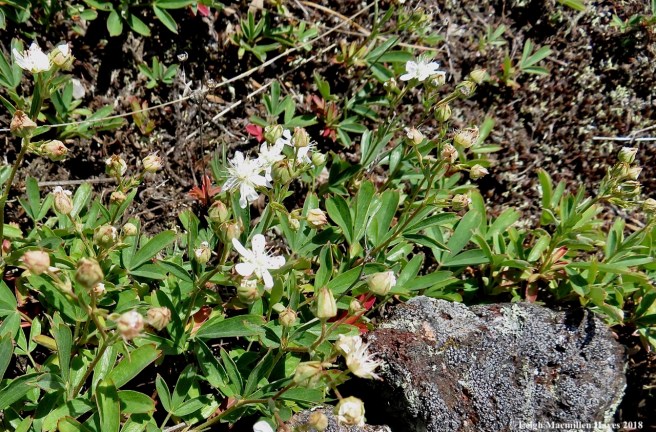
We also discovered a cinquefoil growing abundantly among the rocks, and though it had a few pollinators, it was just that–only a few.

f7a

Now allow me to interrupt with an explanation of the common name for this cinquefoil or Sibbaldiopsis tridentata: it’s known as Three-toothed (tridentata) for the three teeth at the tip of each leaflet. Do you see them?

f8

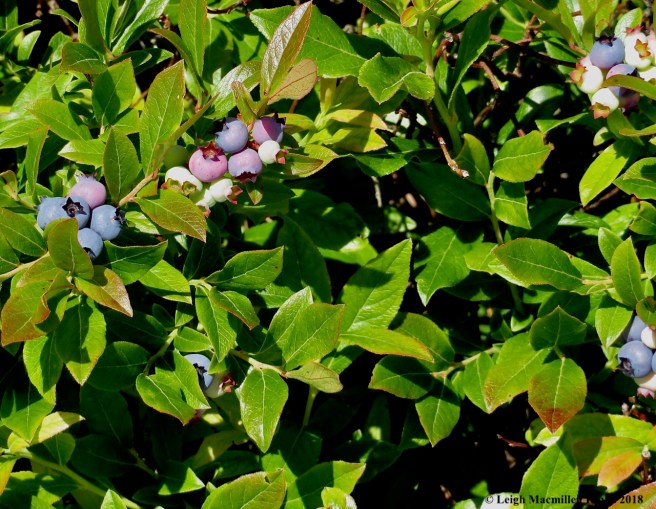
Though we only saw a few pollinators among the cinquefoil, the abundance of blueberries suggested a lot of previous action. A few blueberries had already ripened. We conducted a taste test and suggest you totally avoid Foss Mountain this summer for we certainly couldn’t taste the sunshine in those little blue morsels. (And my nose just grew longer–Pinocchio-style.)

f13

As we reached the summit, we shifted our attention from flowers and pollinators to the 360˚ view that surrounded us.

f14

In every direction . . .

f15

we relished the sight . . .

f16

of blueberry plants . . .

f17

and mountains–including the Ossipee, Belknap and Presidential ranges.

f19

After a lunch break in the middle of this longest day, we started down and made more discoveries–including the sweet flowers of Blue-eyed Grass and its fruits indicating it had been pollinated.

f20

And nearby on a Red Clover . . .

f21

a bumblebee sought nectar while simultaneously filling its pollen sacs.

But in the whole scheme of things, we saw few pollinators and wondered–what’s up? This is an organic field and public space, as Carissa’s contact at Natureworks encouraged. And yet . . . Pam and I weren’t able to answer all our questions today.

f22

But . . . as we looked upon the abundant blueberry crop before us on this first day of summer, we gave thanks for those who had protected the land and those who had performed the mighty act of pollination despite adversity and we looked forward to the sweetness that will follow this Summer Solstice.

Dying To Get In

When I told my guy that Connie was taking me to Evergreen Cemetery in Portland today, he gave me a questioning look and asked, “Why?”

‘Why not?” I responded.

But really, it was because both she and I have friends who have posted incredible photographs of the natural world that is part of the cemetery and we wanted to discover what it was all about.

e1-evergreen cemetery

At first glance, Evergreen Cemetery may look like Anytown Cemetery for it features gravestones, memorials and tombs throughout. But . . . as we read on a panel near the entrance: “Established by the city in 1854, the cemetery was designed by Charles H. Howe as a rural landscape with winding carriage paths, ponds, footbridges, gardens, a chapel, funerary art, and sculpture. It also includes extensive wooded wetlands. Evergreen was modeled after America’s first rural cemetery, Mount Auburn in Cambridge, Massachusetts.

The cemetery, the second-largest publicly-owned open space in the City at 239 acres, has been host to a variety of wildlife such as geese, ducks, pheasants, swans, turtles, blue heron, fox, mink, deer, and moose. Its spaciousness combined with old growth pine and oak, vegetation, ponds, and surrounding wetland, provides a true wildlife oasis. It is considered a premier birdwatching sanctuary. Maine Audubon utilizes the cemetery for field trips, to include their annual Warbler Weeks conducted in May. Evergreen Cemetery is also a wonderful location to enjoy the vibrant colors of fall foliage in Maine.

e2-sunburst lichen

We didn’t actually spend much time exploring the cemetery itself, though that would be fun to do on a return trip, but as we waited for Connie’s friend Linda to join us, we did look at a few gravestones and were especially enamored with the sunburst lichen that lightened a stone gray morning.

e3-male mallard

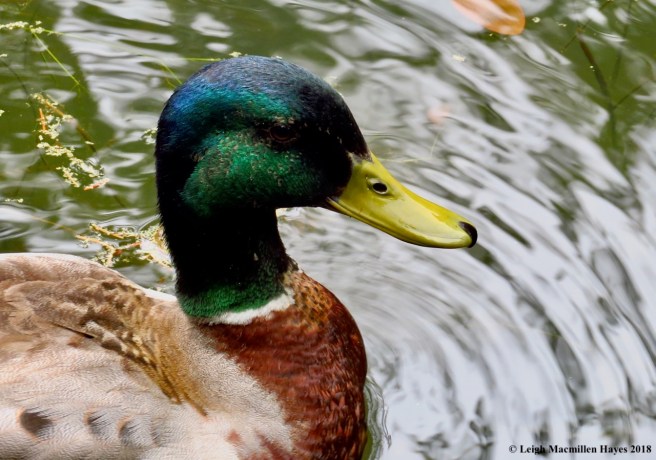
Linda was only a few minutes behind us and then we all traveled to the back end of the cemetery, where the Mallards stopped us in our tracks. While you might ask why, remember that we are women of wonder and wonder we did: about his iridescent head,

e4-famale mallard

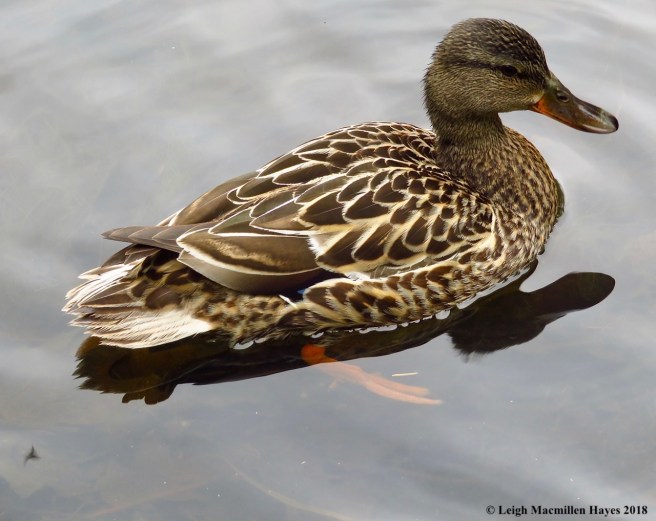
her lack of ducklings despite four attentive males,

e5-mrs. mallard

why their feet were orange,

e6-duck tweed

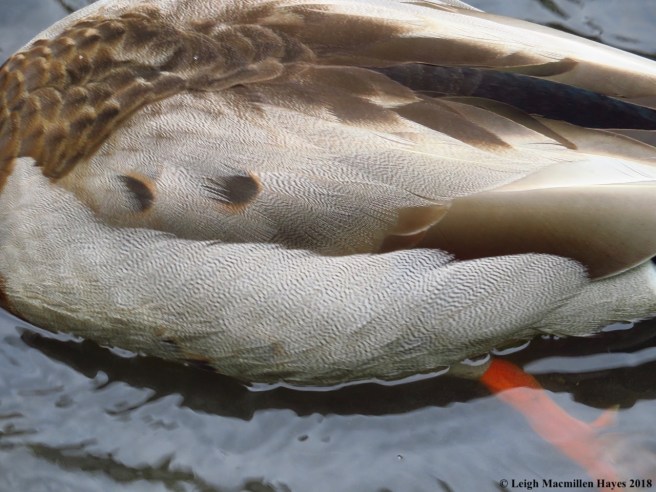
and the tweedy pattern of their feathers.

e7-ducklings

And then we spied a couple of other females with ducklings, this one standing tall as she allowed her youngsters to explore.

e7-chipping sparrow

They weren’t the only ones exploring–a Chipping Sparrow was doing the same, though it was almost impossible to see given that it blended in so well with its surroundings.

e8-black swallowwort

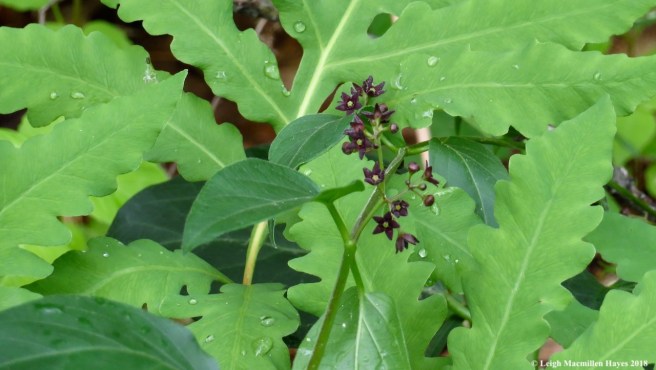
At last we pulled ourselves away from the ducks and our view of the car, and started down a trail where flowers and leaves made us take note. Last year, I first met the dark maroon flowers of Black Swallowwort, an invasive. Diminutive and pretty, it was difficult to dismiss them, especially when juxtaposed as they were against a sensitive fern frond.

e9-ragged-robin

Connie introduced us to another invasive that she immediately recognized as Ragged-robin. Linda and I were wowed by the pink petals, irregularly cleft.

e10-sunburned oak meat

The natural community kept changing and suddenly we found ourselves under a power line where dried spaghnum moss made us wonder if the land was typically wet. And then we saw something red, and the discarded outer shells nearby spoke to its source. It was the “meat” of an acorn, the red being its “sunburned” presentation.

e11-oak setting root

The evolution of an oak tree–it begins with an acorn.

e12-song sparrow

In the same opening, we watched several Song Sparrows move among the shrubs, and then one paused to serenade us.

e13-song sparrow

Upon finishing, it waited as if for our applause.

e14-arrowwood viburnum

Before moving on, we had one more plant to ID. Thanks to iNaturalist, Connie informed us that it was Arrowwood Viburnum. While we appreciated its umbel of flowers and large-toothed leaves, one stem in particular drew our attention. In a symbiotic relationship, ants stroked brownish-red aphids with their antennae, while the aphids released drops of honeydew sucked from the stem. The process was much like a cow being milked. It was actually rather creepy, but wicked cool and all three of us used a loupe to take a closer look.

e15-American honeysuckle

Back along a woodland trail we continued, again stopping periodically to take in the sights, ask questions, and appreciate our surroundings. Among our finds we discovered the newly forming fruits of a native honeysuckle.

e16-beaked hazelnut

We also rejoiced when we encountered the beaked fruits of Beaked Hazelnut.

e17-mallards

At last we’d completed a short loop, and found ourselves drawn in again by the Mallards, both young and old.

e19-snapping turtle

But then our eyes focused on other residents in the shallow water.

e20-ducks and turtle

And we feared that we’d witness a snapping turtle devour a duckling. We kept encouraging mama to move her kids out of the way.

e21-3 turtles

Especially when we realized the pond was full of snappers and they all seemed focused on swimming to the same focal point.

e22-injured duck

But mamma took her time and let the kids roam freely. We did realize that she had an injured foot or leg and moved with a hop, which added to our anxiety. I also felt a certain affinity with her, given my current one-armed bandit situation due to a broken wrist that is slowly healing. Here’s hoping that she heals as well.

e22-mouth open

As we watched the drama play out before us, we noted two adult ducks hanging out under some alders beside the shore. Suddenly, a snapper approached them quickly and opened his mouth wide. Was he exhibiting aggressive behavior?

e23-mouth closing

We weren’t sure, but as suddenly as he’d approached, he closed his mouth and turned away.

e18-ducklings all in a row

We noticed that turning away was typical turtle behavior. They seemed to get within a couple of feet of the ducks and then turn. Why? We were, however, glad when momma got her ducklings all in a line and moved on.

e25-green heron

We, too, moved on . . . a few more feet toward the car. And then we stopped again to check on the action in the pond. That’s when a Green Heron flew in.

e26-green heron

He was also looking for lunch, though we never saw him succeed in his search.

e27-turtle wars

We did see the ducks and turtles again. And our turtle questions continued for we noticed that they would gather and then one would go after another and the water would boil. An act of aggression? Or a mating ritual?

e28-turtle face

We didn’t have all the answers, but one thing we knew–we’re dying to get into the cemetery again.


Diggin’ the Garden

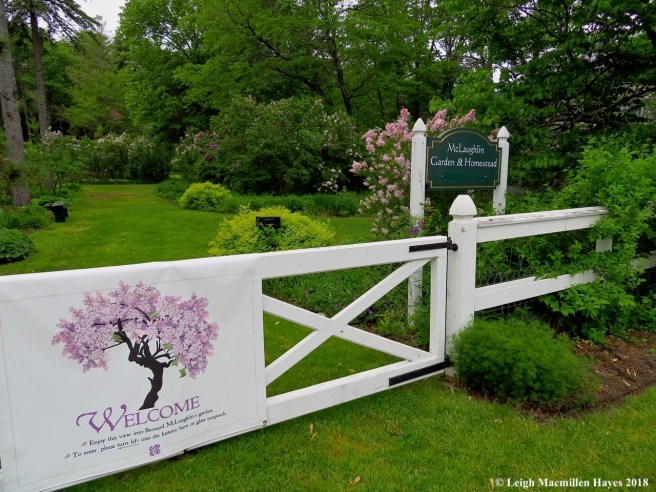
As Judy Lynne and I approached the entrance to McLaughlin Garden in South Paris, it felt as if we were calling on an old friend.

M1 MCLAUGHLIN GARDEN

Maybe that feeling was realized because we passed through the barn, as if visiting a neighbor and searching out back for her.

m9

It was there that we were immediately greeted by not one, but many old friends, including bleeding heart,

m3

forget-me-not,

m7

and jack-in-the-pulpit.

m2

All of these and so much more were the inspiration of Bernard McLaughlin. He began planting the garden in 1936 right on Main Street, though at that time it wasn’t the strip it is now. But that’s part of the wonder of this place for it’s a unique oasis in the middle of our busy lives. As Bernard nurtured his diverse collection of wildflowers, ferns, woody shrubs, trees and over 200 lilacs, he always kept the garden gate open. In 1997, a non-profit was formed to preserve Bernard’s legacy and continue his open door policy.

m3a

We went to smell the lilacs and their heady fragrance did please our noses immensely, but we noted so many other flowers, some which we knew like the old friends above, but made new acquaintances as well. Of course, we’ll never remember all their names, but isn’t it always that way when you meet someone for the first time? Or second or third?

m10

While some paths are grassy, others consist of well-tramped mulch.

m14

We were in constant awe of the array tucked in beside each other in what at times appeared simply random. Anemones such as this grew near . . .

m4

yellow lady’s slippers. And if you haven’t had the pleasure of meeting a yellow lady’s slipper, then hurry to McLaughlin Garden before they go to seed. We spied them in a few different locations.

m17

Thrown into the mix, common yet exquisite dandelions.

m8

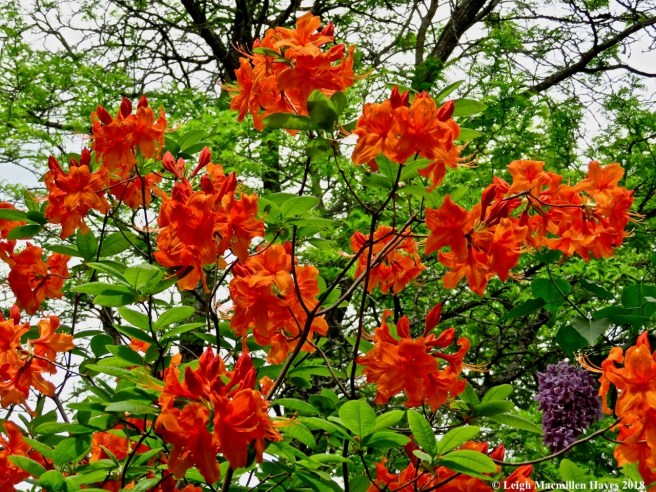
There were azaleas of the most intense orange delightfully juxtaposed beside a purple lilac.

m11

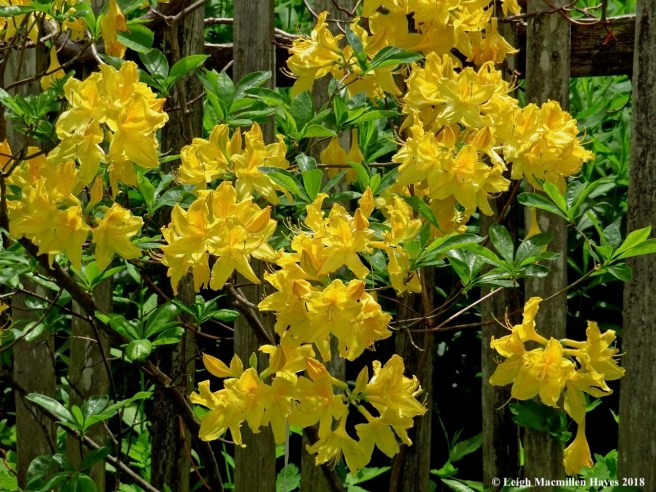
And lemon chiffon yellow enhancing a wooden fence.

m18

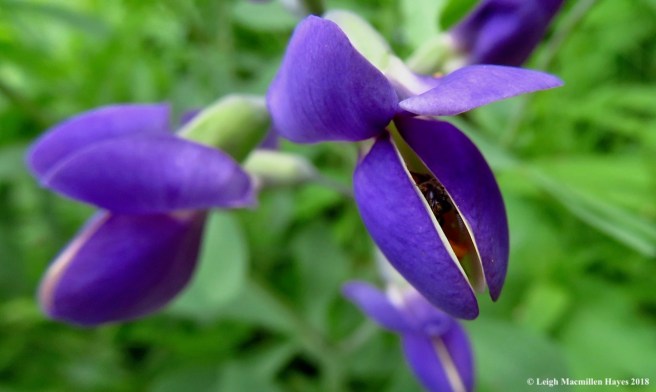
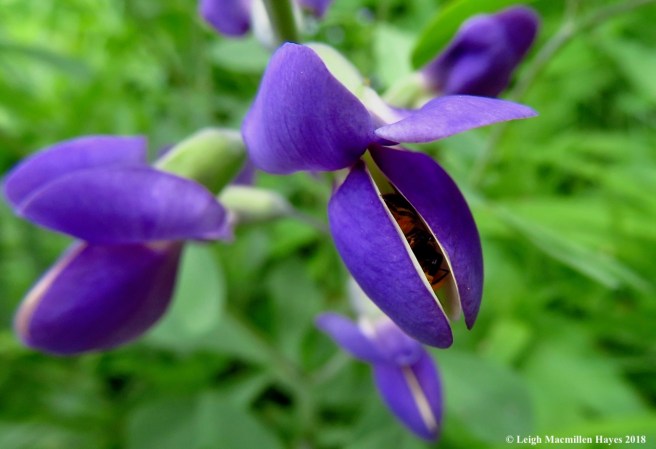
We found lupines of a sort that we hadn’t meet before.

m18a

Though they weren’t yet in full bloom, a pollinator buzzed from within,

m18b

relishing the fact that it was first in line at the fountain of nourishment.

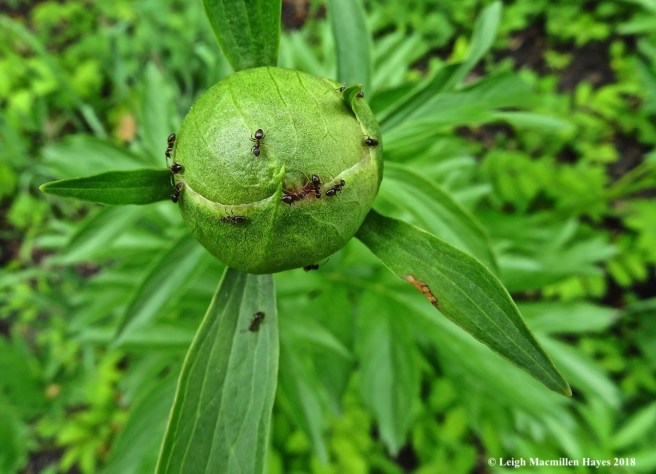
m19

The same was true for the peonies that won’t blossom for another few weeks, but their goodness proved an attraction already.

m12

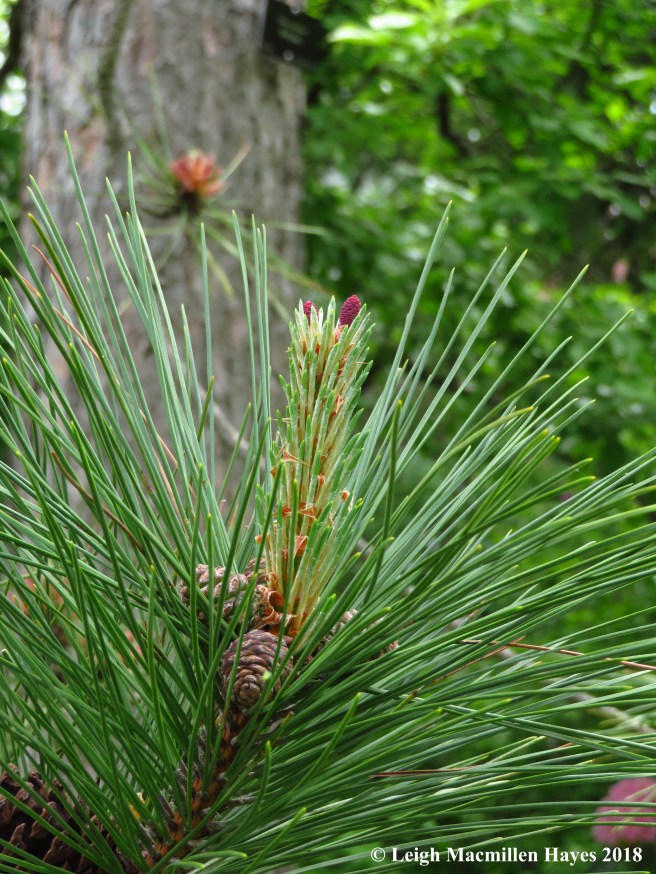
Sometimes our gaze moved upward and we admired the male and . . .

m13

itty bitty female cones on a red pine.

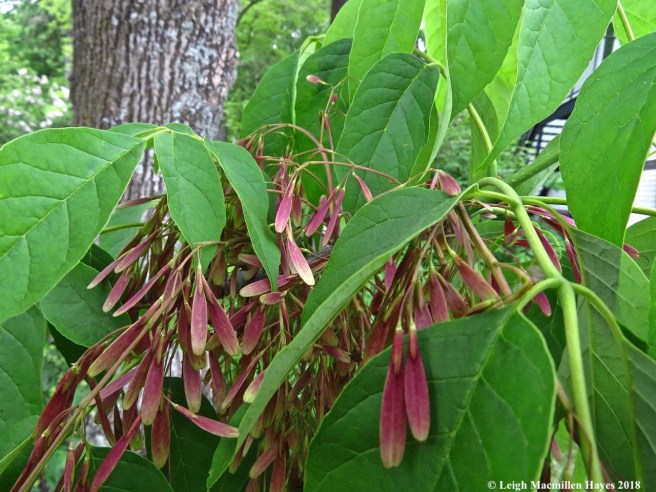
m29

An ash tree also wowed us with its plentiful seed production.

m16

Everywhere, there were hostas adding variations of green and texture.

m24

But among my favorites were the ostrich ferns . . .

m6

and maidenhead ferns. My inner fairy flitted from one step to the next as she climbed this spiral staircase to the ground.

m25

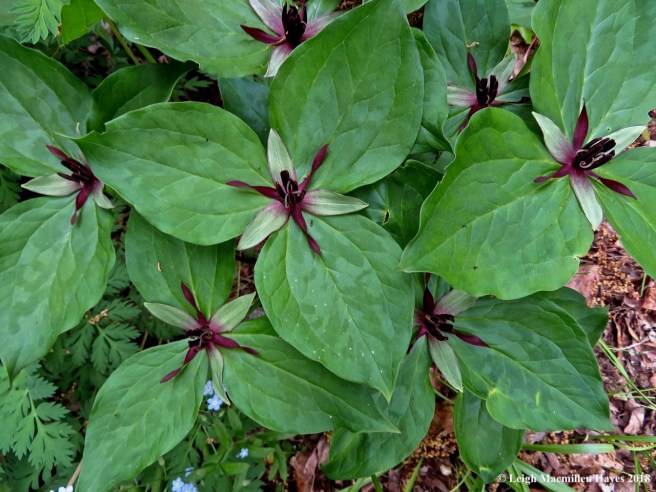
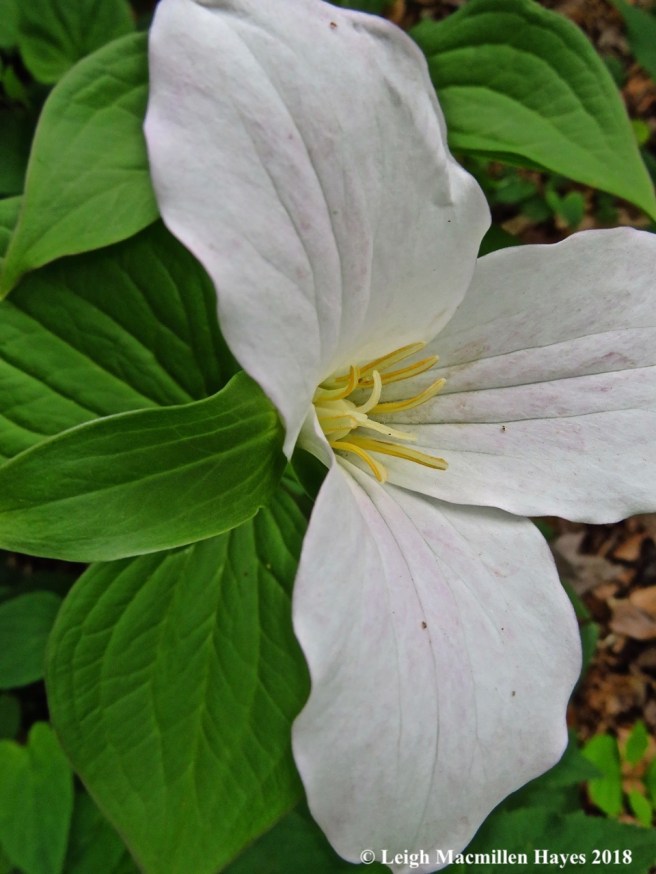
And what should she find growing among the forget-me-nots? Why the most unusual trilliums . . .

m26

one after another . . .

m27

after another .. .

m28

after another. All told, there were seven species of trilliums.

m30

All told, what has been offered here is only a mere glance at Bernard McLaughlin’s garden. You need to experience it yourself and even if you aren’t much of a gardner like me, I trust you’ll be diggin’ the garden.


A Rare and Exotic Mondate

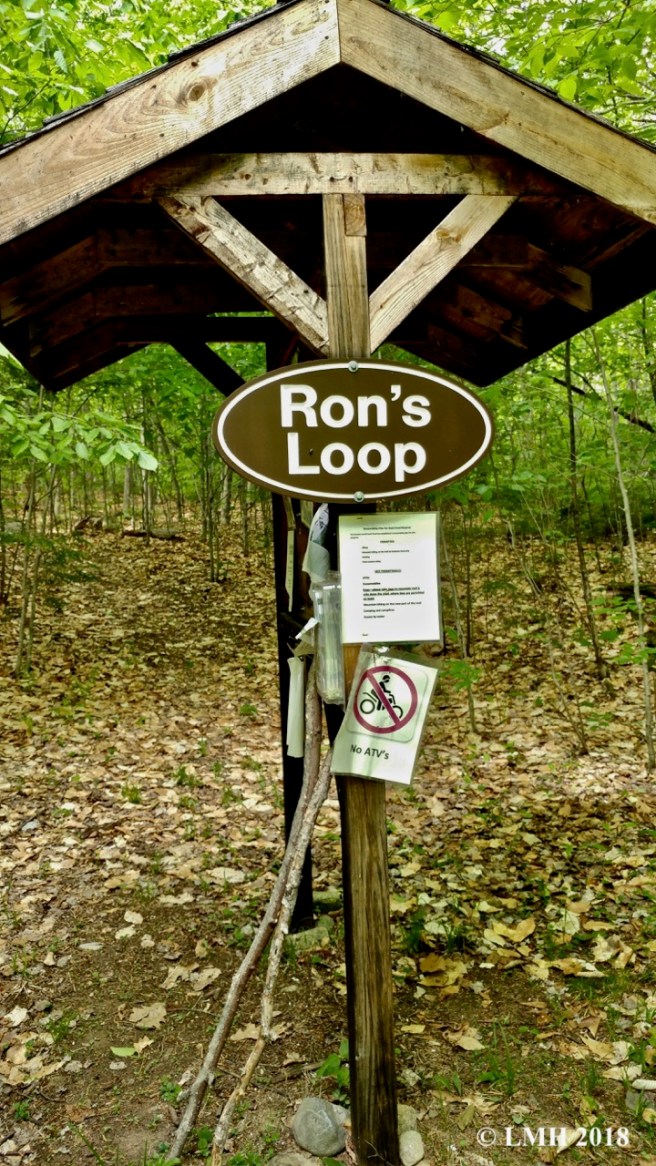
When my guy and I began our journey this afternoon, he thought our mission was simple and two-fold. First, we’d double check road names and directions for a friend’s book that I’m editing. And then we’d hike the easy Ron’s Loop at the Greater Lovell Land Trust’s Back Pond Reserve in Stoneham, Maine.

Y7-RON'S LOOP KIOSK

No sooner had I parked the truck and we hopped out, when I announced that we had a detour to make. Always one for adventure, he followed along. And when I told him our quest, he began to search the forest floor. I have to admit time and again that though he pretends not to care about so much that naturally distracts me, he has a keen eye. Or maybe its just that he likes a challenge. Perhaps, too, he just wanted to make the find and move on for the mosquitoes were robust and hungry.

y1-yellow lady's slipper

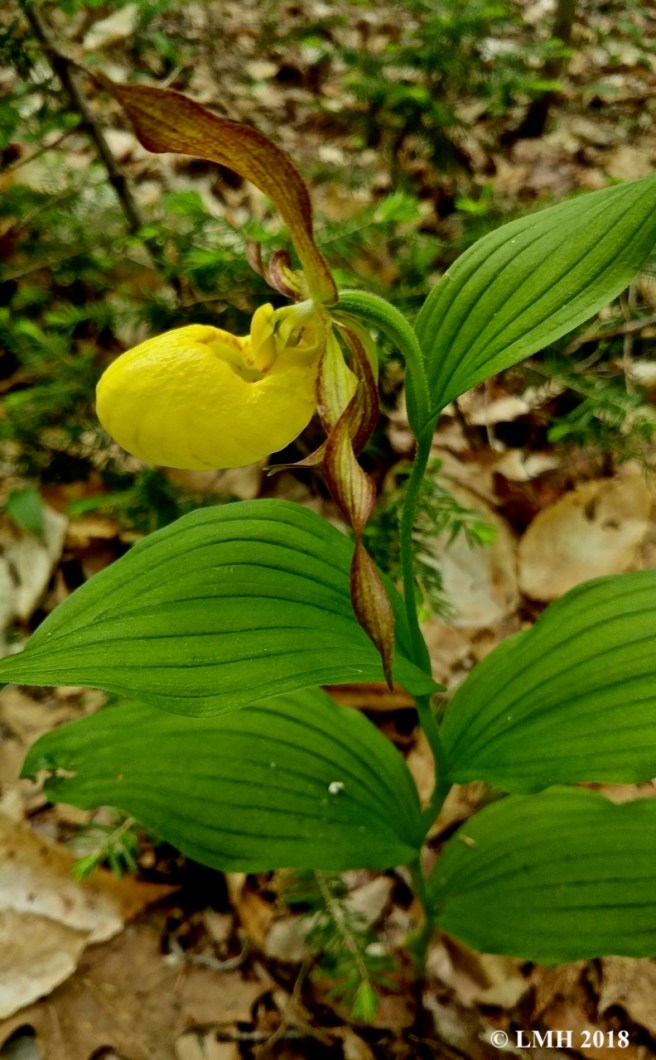
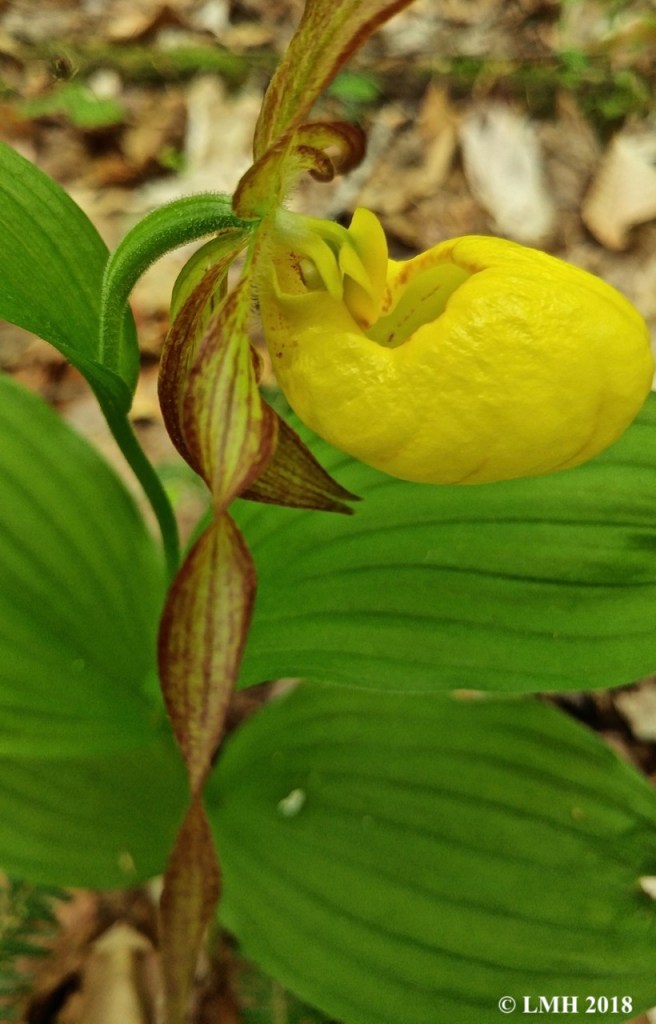
What mattered most was that he channeled his Prince Charming and was the first to find Cinderella’s golden slipper.

Y4-ALL THE PARTS

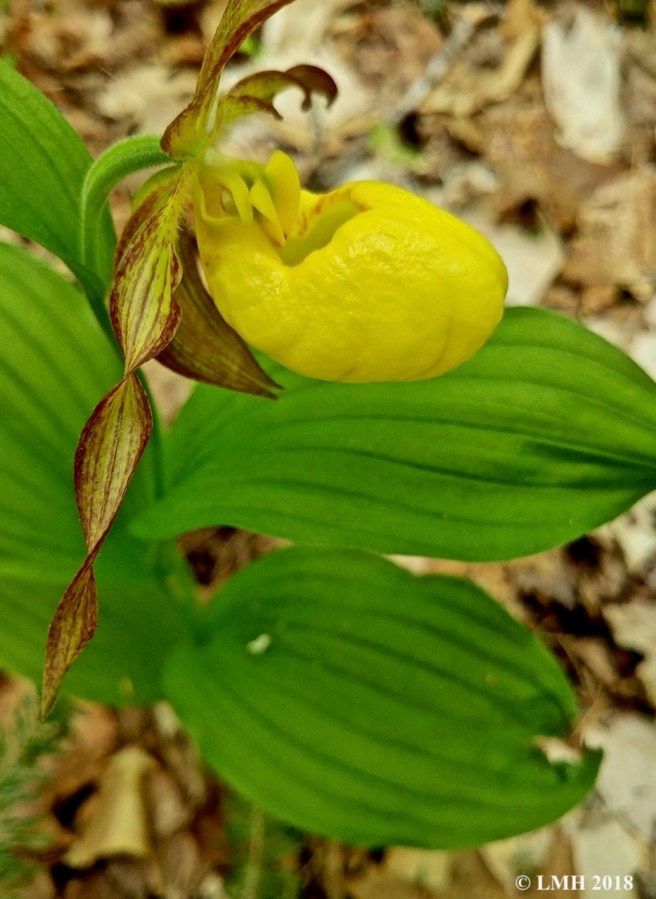
Members of the Orchid family, lady’s slippers feature the typical three petals in an atypical fashion. The pouch (or slipper or moccasin), called the labellum, is actually one petal–inflated and veined.

Y3-TENDRILS

With a purplish tint, the petals and sepals twisted and turned offering their own take on a ballroom dance. From every angle, they were simply elegant rising as they did from their stem with leaves forming a royal staircase.

lady's slipper

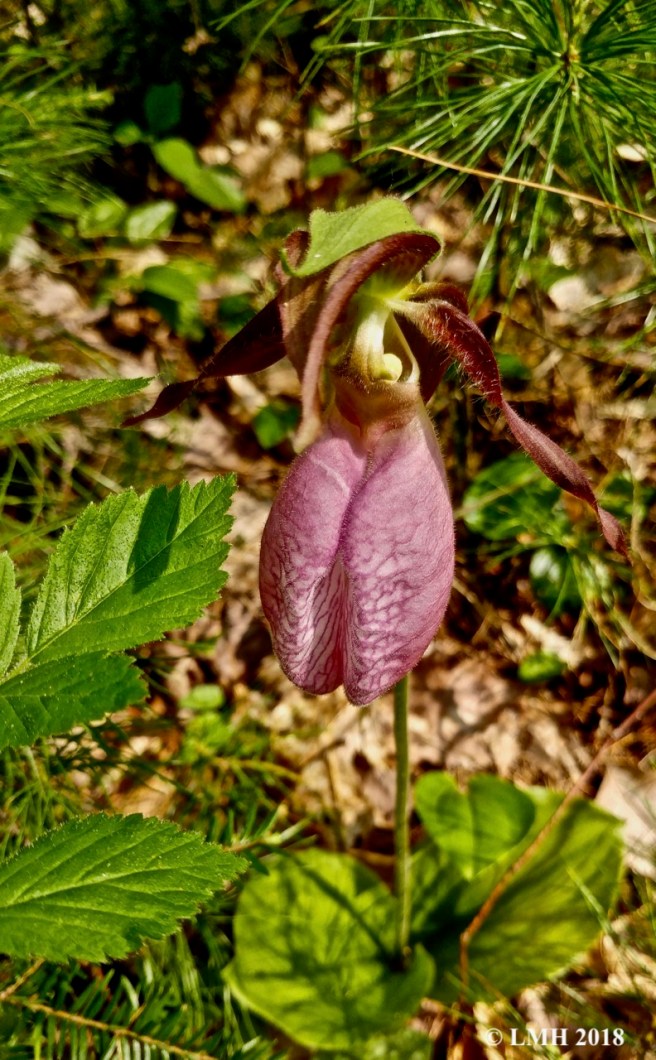
Though we didn’t see any pink lady’s slippers on today’s hike, it’s interesting to note their differences, with the sac of the pink dangling down like a high-heeled shoe, while the yellow is more ballet-like in its presentation. And the pink features two basal leaves, in contrast to the alternate steps of the yellow’s leaves.

Both, however, are in the genus Cypripedium in the Orchidaceae family. The genus name Cypripedium is derived from the Greek words “Cypris,” an early reference in Greek myth to Aphrodite, and “pedilon” for sandal, so named for the fused petals that form the pouch and their resemblance to a slipper or shoe.

Y2--LOOKING WITHIN

All lines on this orchid led to . . . well, not exactly Rome, but certainly the labellum, or sac-like structure. With the rim turned inward, the pollinators found it easy to enter, but much more difficult to exit, the better to rub against the stigma and anthers, thus collecting pollen. Some bees find it difficult to simply fly away from the lady’s charm, but by chewing their way out, they are able to move on to the next and leave a message from the princess in the form of a pollen deposit.

Y7-BEECH COTYLEDON

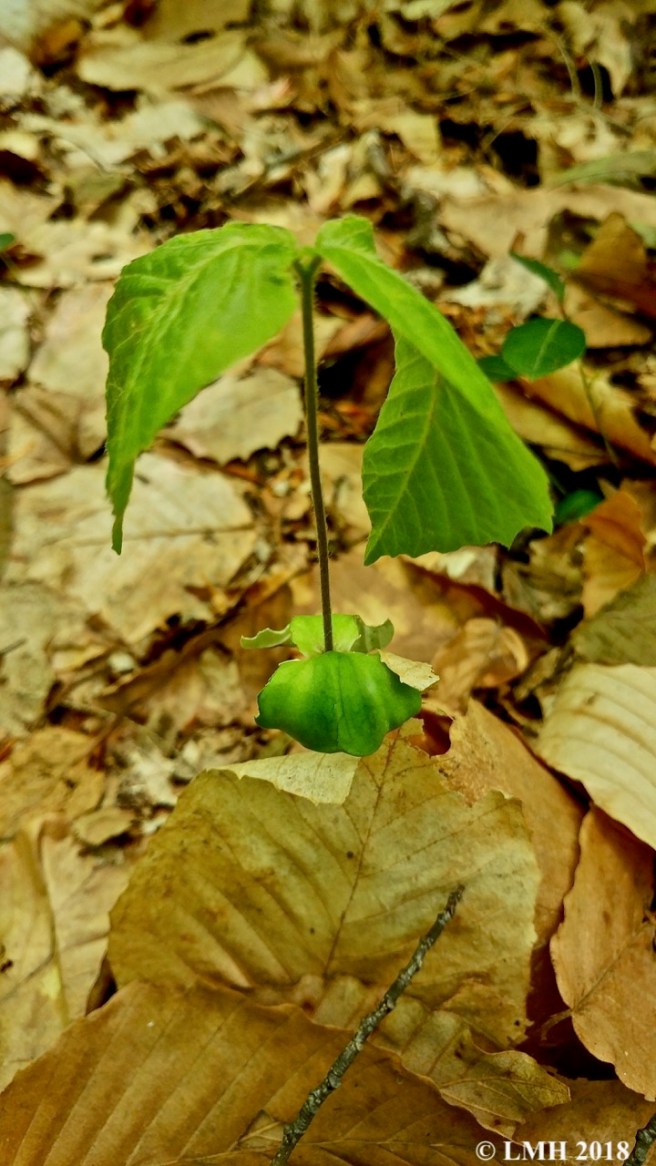
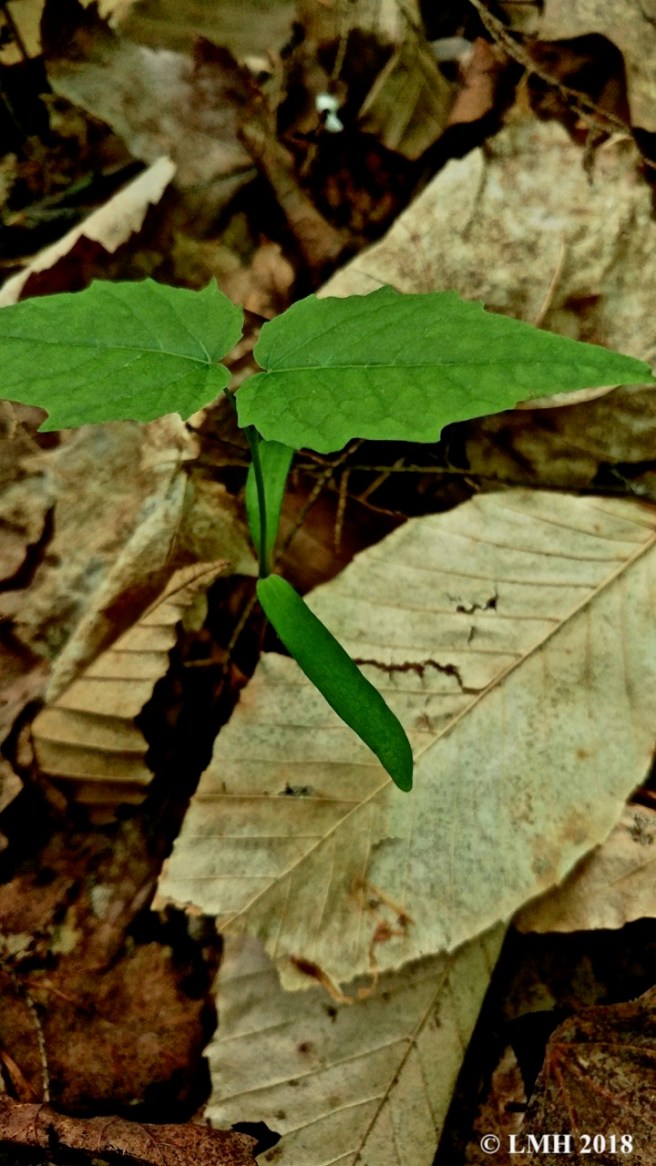
We finally moved on with the not-so-sweet drone of those larger-than-life mosquitoes buzzing in our ears. And then we stumbled upon one American beech cotyledon after another and were reminded of last year’s mast crop of beech nuts.

Y8-BEECH COTYLEDON

I was again reminded that it’s my duty to bring attention to these structures, the seedling form of beech trees. The lower set of leathery embyronic leaves that remind me of a butterfly, appear before the tree’s true leaves make themselves known. Part of what intrigues me about these seed leaves that appear before the tree’s true leaves is that they contain stored food. Some of these food stores wither and fall off, but in the case of the many we saw today, the cotyledons had turned green and photosynthesized. I also love how the word cotyledon (cot·y·le·don \ ˌkä-tə-ˈlē-dᵊn \) flows off my tongue, much like marcescent, which describes the leaves of this same tree that cling, wither and rattle all winter long.

Y8A-BEECH GROVE TO COME

Though I’ve read that seeing beech cotyledons is a rare event and could attest to that fact  in the past, thrilling with each siting, today we noted their ubiquitous nature.

Y9-RED MAPLE COTYLEDON

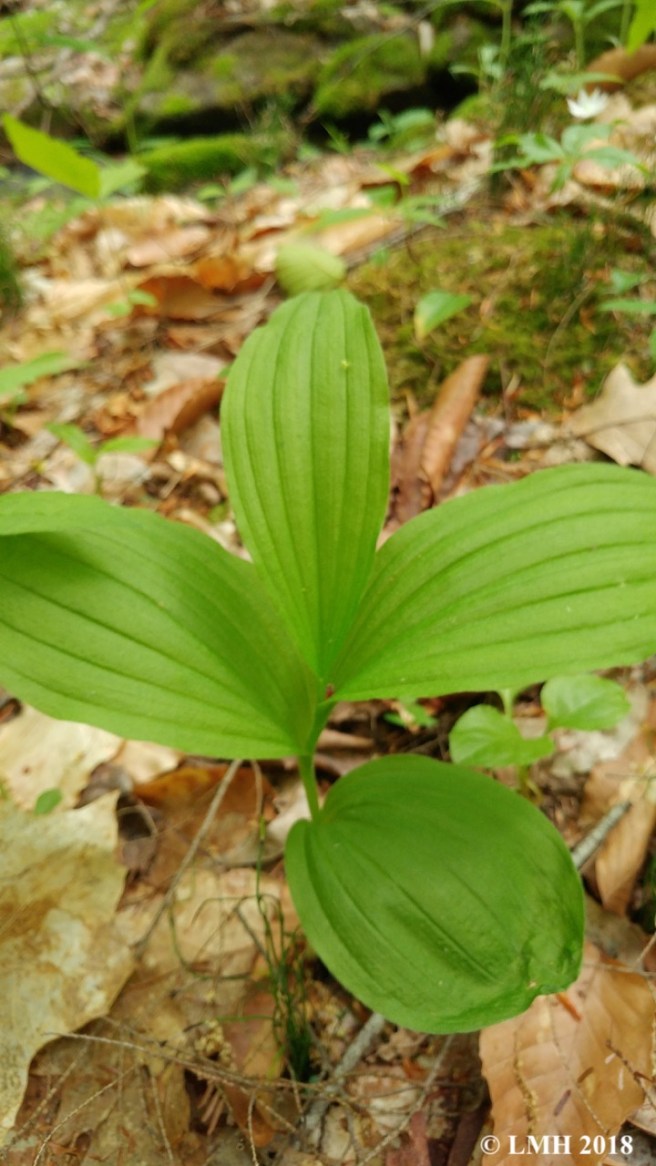
Red maple cotyledons also decorated the trail. If the plant has two seed leaves, such as these, it is a dicot (dicotyledon), and if only one it is a monocot (monocotyledon).

Y10-MAGIC ALONG THE TRAIL

Onward we moved, stopping occasionally as my guy did some trail work because its part of his nature to make a path clear for those who follow. Being a one-armed bandit, my help was still limited, but it won’t be long and I’ll be able to offer two capable hands.

Y11-BUNCHBERRIES

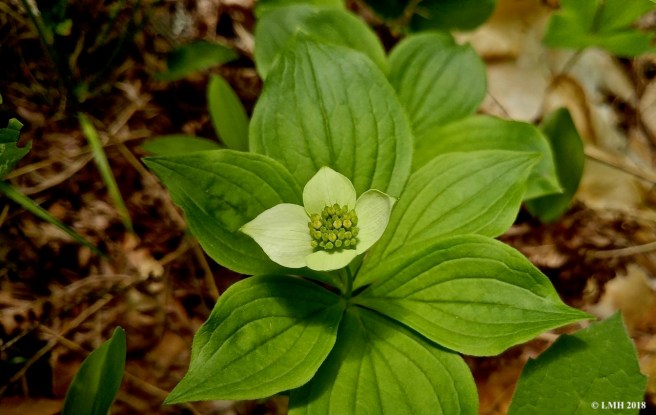
Further along the trail, bunchberries were beginning to bloom. Normally, a bunchberry plant has two sets of opposite leaves. But . . . when one is mature enough to grow a third set, typically larger leaves (perhaps to capture more energy) than the first two sets, it produces four white bracts that we think of as petals. In reality, the bracts were modified leaves. The flowers were in the center–tiny as they were.

Y12-1ST BRIDGE CROSSING

In what seemed like no time, for we moved so quickly, we reached the first bridge. It was at this point that we began the loop back toward the trailhead. And smiles crossed my face as I recalled memories of explorations along the way with so many others.

Y8B-CANKERED BEECH

On the way back, we noted so many beech trees that dealt with nectria and we could only hope that within some of those cotyledons there might be some trees resistant to the beech scale insect that delivers such devastation to these trees.

Y13-SEATED TREE

One of my favorite trees along the way sat as it always does, taking a break upon a granite bench.

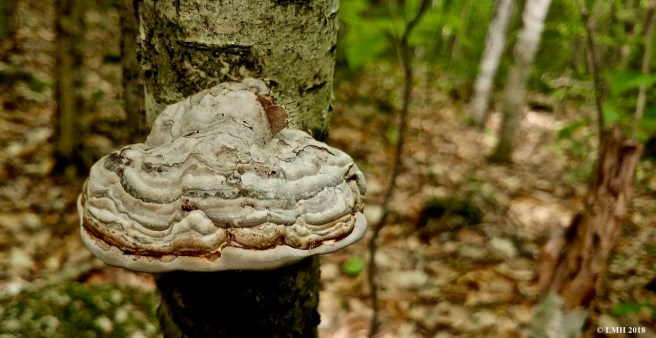
Y14-TINDER CONK

And a tinder conk showed off its form, which for me recalled a childhood spent along the Connecticut shoreline, for it surely resembled an oyster shell.

Y15-INDIAN CUCUMER ROOT

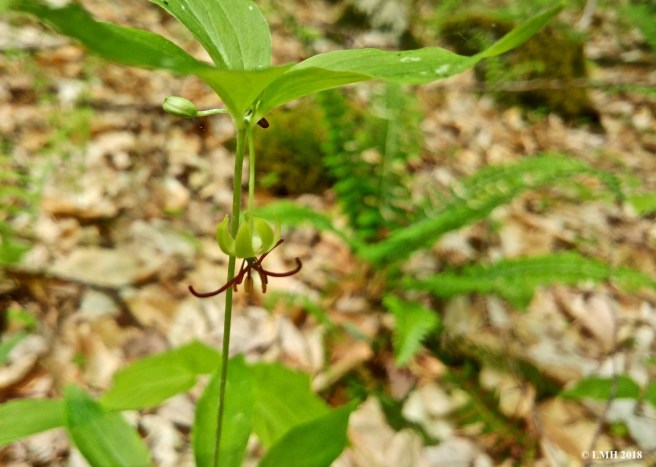
We were almost to the end of the loop when my heart and not my mouth sang with joy once again. While you might give thanks for small blessings like the fact that I’m a great lip sinker rather than the opera star my mind hears, I made my guy stop because the Indian Cucumber Root was in bloom.

Y16-INDIAN CUCUMBER ROOT

Like the bunchberries that need that third set of leaves in order to fruit, Indian Cucumber Root needs two levels to produce a flower. I’m of the belief that if the structure of this flower doesn’t make you wonder, nothing will. It strikes me as a northern version of a bird of paradise.

Y18-2ND BRIDGE

In what seemed like my shortest adventure along this trail because we didn’t want to overdo our offerings to the female mosquitoes who needed our blood in order to reproduce, we crossed the second bridge back toward the trailhead.

Y19-YELLOW LADY'S SLIPPER WITHOUT FLOWER

It was near that crossing that I checked on a couple of yellow lady’s slippers and as has been true since I first met them–they weren’t in flower. From what I’ve learned, it’s not so odd that the plants have yet to bloom. Apparently, it takes 10-17 years for a seed to mature into a plant capable of blooming. For this plant and the one beside it, perhaps the blossoms are on the horizon.

Y5-ALL PARTS 2

One day they’ll reach the status of their neighbor. For any lady’s slippers, the dance is rather intricate. The stage floor must be painted with an acidic soil and there needs to be a sashay with Rhizoctonia fungi. As the fungi digests the outer cells of the seeds, inner cells escape digestion and absorb some of the nutrients the fungus obtained from the soil–all in the name of a symbiotic dance.

Though our journey flew by on the wings of the world’s largest, loudest, and meanest mosquitoes, our finds on this Mondate afternoon extended from lady’s slippers to cotyledons, bunchberries and Indian Cucumber Root. All appeared rare and exotic.


Petals and Wings: A Window of Opportunity

Spring ephemerals. Those species that take advantage of the short stretch of time between snow melt and leaf out. We celebrated such today at the Greater Lovell Land Trust’s Heald and Bradley Ponds Reserve as we ever so slowly walked along the orange trail from the Flat Hill parking lot and then looped around on Perky’s Path.

S1-GATHERING

But first, we gathered in the parking lot where Docent Peter explained that he thought I was crazy when I suggested a May date for a flower and bird walk. He’d not been in Maine during May previously and only this week learned the joys of birding with minimal leaf cover. I think he’s hooked. And I’m still crazy.

S4-WILDFLOWER GUIDES

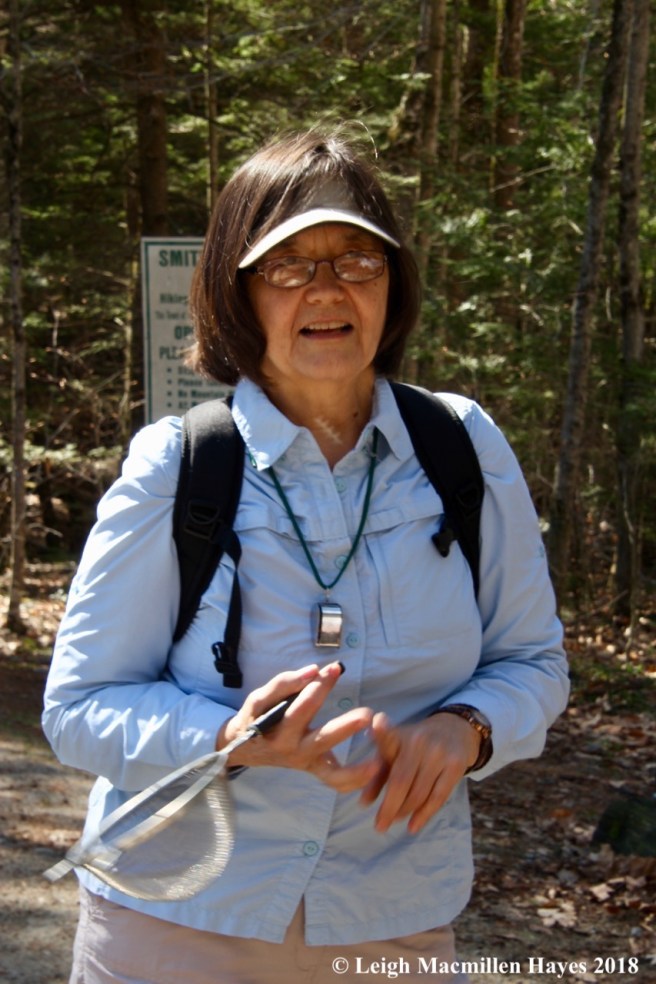
Our journey began with Docent Linda locating wildflowers that are opportunists who bloom early, get pollinated and produce seeds before the deciduous trees blanket the floor of the forest in shade.

S2-STINKING BENJAMIN

Among those early bloomers was one that stinks! And yet, it’s exquisitely beautiful. Stinking Benjamin is one of its common names because of the flower’s malodorous scent. Of course, you need to get down on your hands and knees to get a whiff.

S5-HAND LENS

Our focus wasn’t just on flowers and birds as we all soon realized, for it seemed that many things caught our attention, including the seeds of deer tongue grass. As a collective group, we suffered from Nature Distraction Disorder.

S6-WILD SARSAPIRILLA LEAVES

Because of such, we observed more than just the flowers that were in bloom. In one instance, the flower was yet to come, but the leaves in their early stage were worth noting. Linda pointed out that the color of wild sarsaparilla’s new leaves was reminiscent of poison ivy. But, poison ivy has leaves of three.

S7-BEECH LEAVES

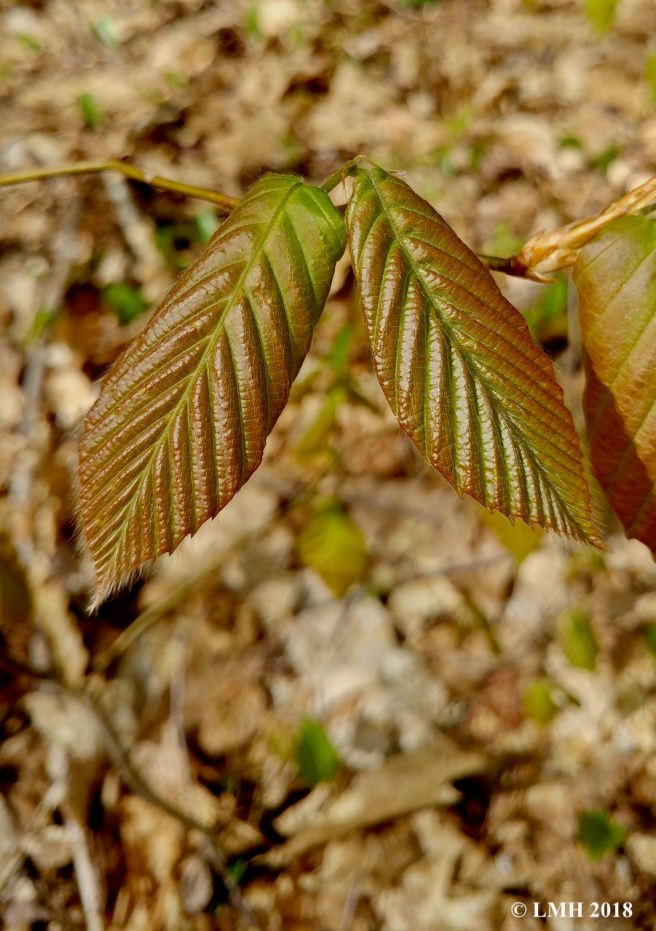
And that reddish tint that we saw in the sarsaparilla, beech and other leaves? The various hues of color in leaves was caused by the presence of pigments called anthocyanins or carbohydrates that are dissolved in the cell sap and mask the chlorophyll. As our spring temperatures rise and light intensity increases, red pigment forms on a leaf and acts as a sunscreen to protect the plant from an increase in ultraviolet rays.

S8-BIRDING

We’d been looking down for a while, but then bird song pulled our attention to the tree tops. Without the use of my Cannon Rebel, which is currently enjoying what I hope will be a successful rice bath :-( , I couldn’t capture the many warblers we spied. Some, as Peter, and his wife Molly, told us, were only in the area temporarily to fuel up on insects before continuing the journey to their breeding grounds in Canada.

S10-GARTER SNAKE

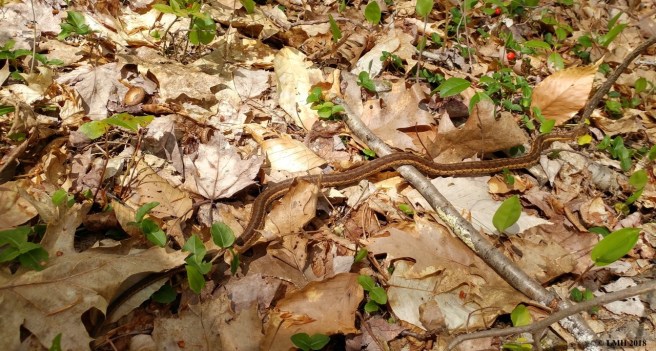
And looking at our feet once again, another in search of insects. We saw a garter snake who stayed as still as possible while we ogled it. Was it cold and trying to soak up warmth from the sun? Or did it stay still in hopes we wouldn’t spy it?

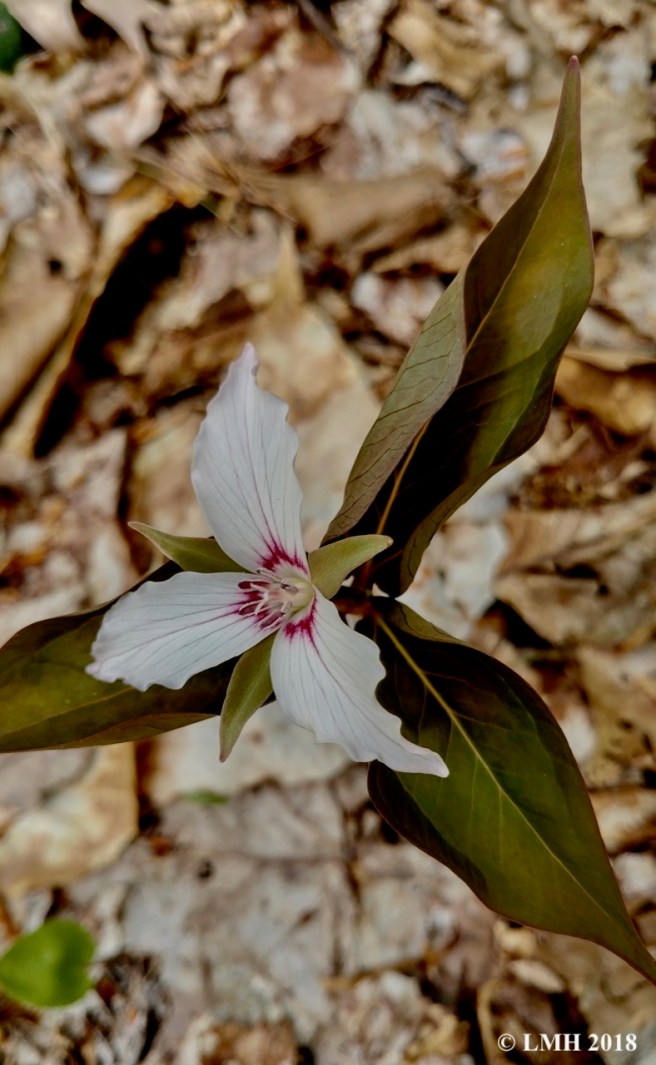
S11-PAINTED TRILLIUM

We finally left the snake in peace. And paused next to gaze upon a painted trillium.

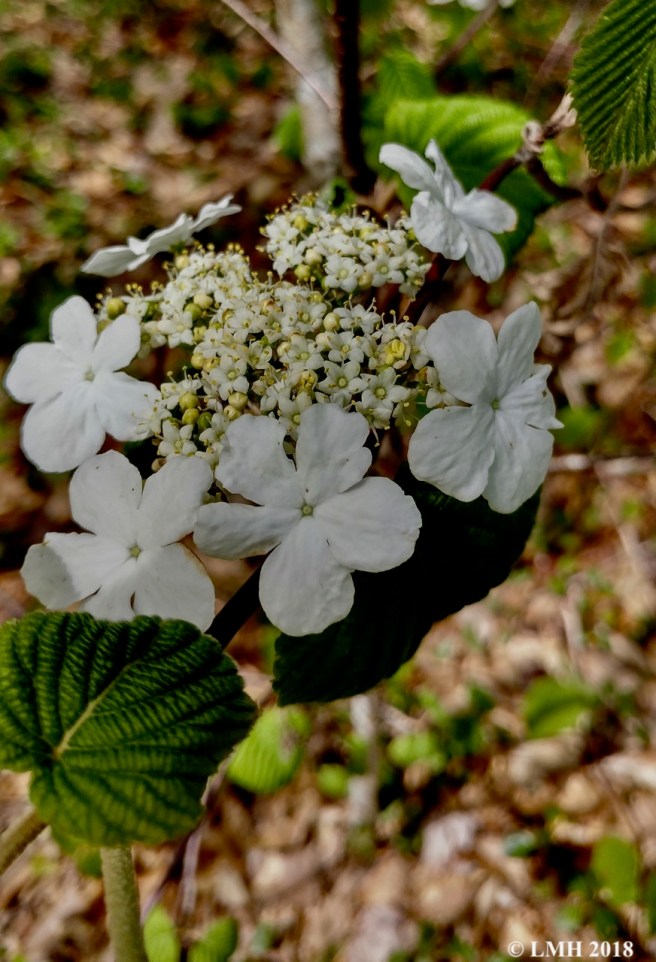
S12-HOBBLEBUSH FLOWERS

Almost two hours after our start, we approached the wetland and overlooking bench. It was there that a hobblebush laden with blossoms caught our attention in the shrub level. The hobblebush bouquet was really an inflorescence or lacy cluster of tiny fertile flowers surrounded by a halo of showy, yet sterile bracts. Those larger, sterile flowers attract insects while the tiny fertile flowers do all the work of seed production. Nature has its way.

S13-BIRDING BY THE BENCH

It was at the bench that bird song again greeted us and we looked above the shrubs toward the tree limbs above.

S14-BIRDING

For many of us, we looked through our binoculars at birds we’d only heard of before, including a Bay-breasted Warbler. Peter explained that he’s participating in the citizen science project to update the Maine Birding Atlas and so he uploaded the 38 species identified today to the e-bird website.

S15-LINDA TURNS HER FOCUS UPWARD

Even though she’d spent a lot of time directing our attention to the beauty at our feet, Linda was also in awe of those who moved above, however, she was heard to comment that it’s a whole lot easier to ID flowers that stand still.

S16-BEECH FERN

As our journey finally continued, we found a patch of beech ferns with their own variation of today’s theme, for each leaflet attached to the rachis in a winged formation.

S18-FRINGED POLYGALA

Another that spoke to the theme was a flower that hadn’t quite yet bloomed–fringed polygala, aka gay wings.

S17-SPRING PEEPER

Despite all the flowers and birds, our NDD followed us right to the end–when we spotted a tiny spring peeper . . .

S21-GREEN FROG ON A LOG

and then a green frog.

S22-FEMALE WHITEFACE SKIMMER

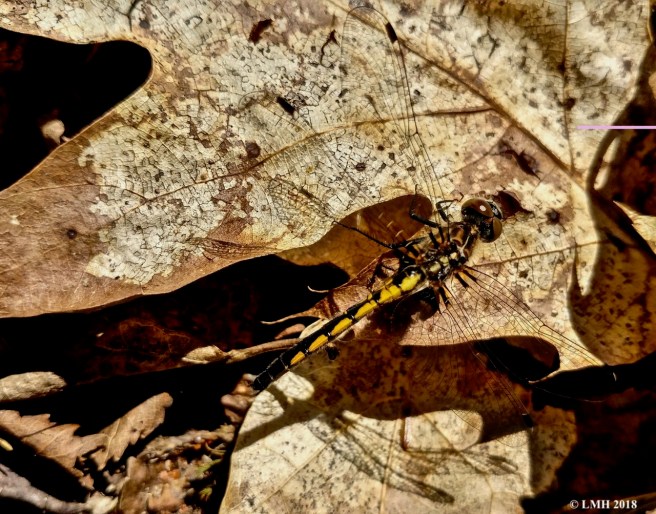
While the frog marked the end of our journey, I moved on to the GLLT’s Kezar River Reserve, where another winged critter flew at the flower level–the first dragonfly of the season: a female whiteface skimmer.

Today was filled with petals and wings and all things ephemeral. I hope you’ll have a chance to take advantage of this short window of opportunity.


Cinco de Mayo, Naturally

The hour and a half drive to Litchfield, Maine, was worth every second on this fifth day of May. The spring tapestry that spread before my eyes had me oohing and aahing around each bend in the road for such were the colors–so many shades of greens, mixed in with reds and magentas and pinks and yellows. It was almost intoxicating.

But . . . a photograph will have to wait for another day for I needed to reach my destination and catch up with my peeps–fellow classmates from our 2012-13 Maine Master Naturalist class. For the last five years we’ve tried to get together quarterly. It doesn’t always work out, but this year we’re making a concerted effort.

s1-Smithfield map

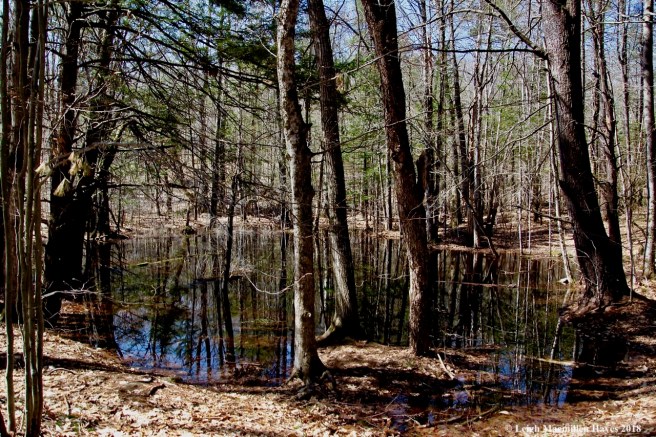
Today’s destination was the vernal pool at Smithfield Plantation, a 103-acre property the town of Litchfield conserved. If you look carefully, you might see a reflection of Sharon, who has lead many a school group along the trails and knows the property intimately.

s1a-Sharon T

Before we headed to the pool, she oriented us to the site.

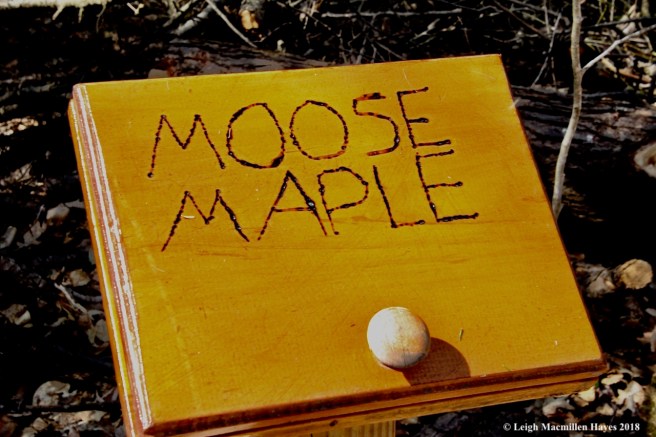
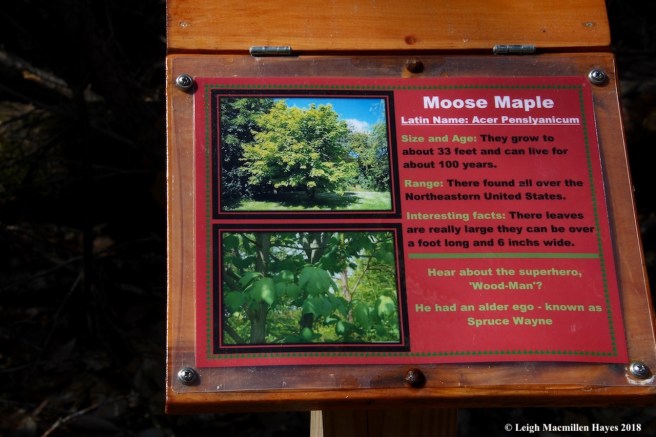
s2-moose wood

One of the things Sharon explained was that a Boy Scout had created an interpretive tree trail and so we paused at one of his stops to admire the craftsmanship.

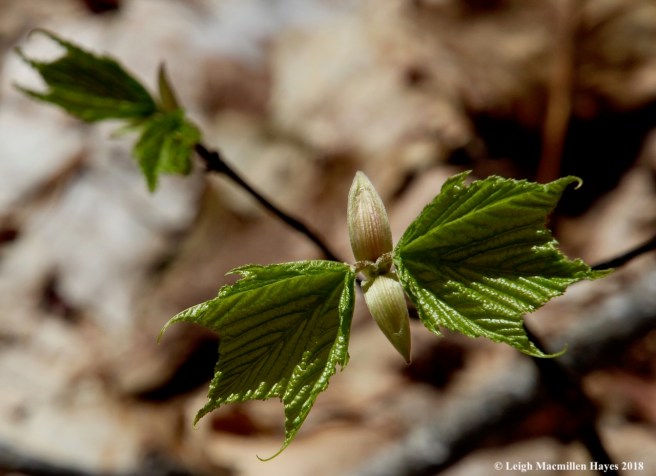
s2b-moose wood maple leaf

Indeed, right behind the sign, a striped maple, aka moose maple, shared its newly emerged pastel buds and leaves.

s2a-moose maple

And then we lifted the lid to reveal the information. OK, so there were a few typos for the grammar police, but on each of his cards, he included a joke. What a great idea as that would certainly appeal to the younger set. It definitely appealed to those of us who are still ten years old in our minds.

s4-hobblebush

And on the opposite side of the trail, we spotted another type of moose wood–hobblebush just beginning to flower. Both striped maple and hobblebush are favorite foods of moose, thus their nicknames.

s3a-clintonia

Onward we walked until a patch of leaves stopped us. And our brain-sharing began. We thought we knew what the plant was, but then questioned ourselves as it wasn’t in flower yet. Each season, we need to relearn some. Despite the lack of flowers, we decided to key it out in Newcomb’s Wildflower Guide using two other descriptors–leaves both basal and entire.

s3-clintonia 1

For those familiar with Newcomb’s that meant of the three numbers in the locator key, we didn’t know the first, but went with 22 for the second and third representing basal leaves and entire leaves. Then we tried, 122, 222, etc.

s3b-clintonia buds

And landed on our first suspicion: 622–Yellow Clintonia or Bluebead (Clintonia borealis).

s6-vernal pool

The trail wasn’t long, but as one might expect, it took us a while to reach the vernal pool. And then we were stopped in our tracks and didn’t approach it right away.

s7-solitary sandpiper

Instead, we stood back and spent a while watching a solitary sandpiper on a downed tree.

s7a-solitary sandpiper

As we watched, it bobbed its tail. And at one point we were sure it took a mid-morning nap. Eventually, the bird flew to another part of the pool and a few minutes later departed.

s10-setting up camp

And so we set up camp, dropping some of our gear on the bench.

s10a-setting up camp

And more of it on and beside a log. We had macro-invertebrate charts and vernal pool pamphlets and books, plus all kinds of containers for pond dipping.

s9-Pam's journal

Pam was the smart one and she’d packed her sketch book and colored pencils. That’s one skill we all appreciate for it slows us down and makes us really notice. I, for one, haven’t done enough sketching in the past year and so this was the perfect incentive for the future.

s8-mosquito larvae

As we looked into the pool and Sharon told us what we might find, we immediately noticed the most abundant residents–mosquito larvae doing their whirligig dances.

s11-first fairy shrimp

But on her first dip, Sharon pulled up the crème de la crème–a fairy shrimp. Bingo–a significant pool it was as she knew, though not so documented with the state.

s12-examining the fairy shrimp

With her loupe, Jen took a closer look.

s13-five fairy shrimp

On Sharon’s next dip she pulled up not uno, not dos, not tres, not quatro, but cinco fairy shrimp.

s13-Pam sketches the fairy shrimp

And so Pam settled in to sketch them in all their glory.

s13-Pam's sketches

And added a caddisfly larva for we’d also captured one of those.

s14-female fairy shrimp

One of the cool things that Sharon pointed out, the brood pouch at the end of the abdomen, so indicating a female. How cool is that?

s15-caddisfly larvae

And here is our caddisfly, his casing created out of fallen hemlock needles. Caddisfly larvae that create their bodies from woody material are the log-cabin variety. We watched it move about in the tray, sometimes extending its soft body out of the case.

s17-spotted salamander egg mass

The dipping continued and a spotted salamander egg mass was pulled out, but only for us to take a closer look. And then it was returned from whence it came. Notice the individual eggs within the greater gelatinous matrix.

s18-egg mass

After that, Sharon found another reason to celebrate. She’d worn her waders and so was able to go deeper into the water than the rest of us.

s18-tadpoles

A quick dip and she’d pulled up an egg mass that almost melted as life burst forth–tadpoles. The first of the season for all of us.

s20-predacious diving beetle larvae

One last dip revealed one not so kind to all the other species we’d located. Known as a water tiger or toe biter, you can tell that it’s one mean little thing. This was the larval stage of a predacious diving beetle and the tadpoles had everything to fear for like its adult form it was a predator.

s23-Cinco Amigas

After that last find, it was time for us to pack up our gear and leave the pool behind. But, we took with us memories of a delightful spring morning spent exploring together. And . . . we had a chance to catch up, show each other field guides we thought might be of interest, share experiences of our volunteer opportunities, provide suggestions for ways to make a nature program work be it for kids or adults, and realize that we were not alone in any obstacles that may cause an issue during those programs.

What a naturally wonderful way to spend this Cinco de Mayo . .  . con cinco amigas. Thanks Gaby, Beth, Jen, Sharon and Pam.


Bogging with Barb

Passing off a copy of the book, From Grassroots to Groundwater, about how two small Maine towns fought Nestlé and won, was the perfect excuse to head to Brownfield Bog. I told Barb I didn’t mind driving to her home or somewhere nearby to give her the book because I’d then go exploring and she welcomed the opportunity to do the same.

b2-Kathy's sign

As we began our journey, I asked if she knew Kathy McGreavy. Of course she did. I mentioned that Kathy walks in the bog daily and we might encounter her. Of course we did. Kathy and “her friend” were just coming out after walking their dogs and so we chatted for  bit. Our discussion included mention of the sign Kathy made last year as her capstone project for the Maine Master Naturalist Program. It’s an incredible piece of artwork and as she’s learned, I’m not the only one who thinks so. Recently, she discovered that a woodpecker had taken to pecking it and so the bottom is now protected with a piece of plexiglass. Crazy birds.

b1-Bog view from the road

Eventually, Barb and I said our goodbyes to the McGreavys and walked down the unplowed road where I did warn her about my obsession for stopping frequently to take photos. It began from the start–when we spied the bog through the trees and noticed the contrast of colors and layers.

b3a-pussy willows

And then–specks of white were ours to behold.

b3-pussy willows

Pussy willows. Was it too early she wondered. No–in fact, I spotted some a year ago on February 23 at Lakes Environmental Association’s Holt Pond Preserve.

b4-red-winged blackbirds

Our next reason to stop–the red and yellow shoulder patch or epaulet providing their name: Red-Winged Blackbirds. Again, Barb asked if it was too early. This time, I referenced Mary Holland for the February 27th entry in her book Naturally Curious Day by Day has this headline: Returning Red-Winged Blackbirds Survive Cold Temperatures and Few Insects. Bingo.

b5-water obstacles

Sometimes our stops were to contemplate our next steps–especially when it came to the water that covered the cobble stones on the road.

b6-Barb charges through the water

But sometimes you just have to go for it. And we did. As the morning continued, we ventured through deeper water and plowed ahead knowing that we would need to dry our hiking boots out when we arrived home.

b7-bird's nest

We found a bird nest and wondered about its creator. We did note some acorn pieces inside, so we think it had more than an avian inhabitant.

b8-beaver lodge

And we paused to look at an old beaver lodge. The mud looked recent but none of the sticks were this year’s additions so we didn’t know if anyone was home.

b9-map in the snow

All along, we’d been talking about places we’ve hiked and other topics of interest to both of us. We even learned that we’d both worked in Franklin, New Hampshire, just not at the same time. But speaking of hikes, with her finger, Barb drew a map in the snow and now I have another trail to check out soon with my guy. Should I forget the way, I’ll just reference this map. ;-)

b10-raccoon prints

Because we were near water, though most of it still frozen, and the temp was high (actually, too high–in fact, it felt HOT as it soared into the upper 60˚s today), we weren’t surprised to find this set of prints created recently by a raccoon. I love the hand-like appearance and opposite diagonal of each two feet. Can’t you just see him waddling through–in your mind’s eye, that is?

b11-the bog

Our turn-around point offered an expansive view of the bog. As much as we may have wanted to head out onto it, we sided with caution and kept to the edge of the shore.

b12-winterberry

On the way back, there were other things to admire as there always is even when you follow the same route: winterberries drying up;

b13-rhodora

rhodora’s woody seed pods and flower buds swelling;

b14-willow gall

and the pinecone-like structure created with leaves by a reaction to a chemical released by the larva that allows a gall gnat midge to overwinter on the willows.

b16-carrion-flower tendrils

And then we stumbled upon a plant neither of us knew. With it’s long stem and curly tendrils, we were sure it was a vine.

b15-carrion-flower

Upon arriving home, however, I wondered about the umbel structure that had been its flower and now still held some fruits. A little bit of research and I found it: Carrion Flower (Smilax herbacea), which apparently smells rather foul when it’s in bloom and thus attracts carrion flies as its pollinator. Now I can’t wait to return and check it out in the next two seasons. Any excuse to get back there.

b17-bog to Pleasant Mountain

At last the time had come to say goodbye to the bog and then goodbye to each other. Thanks Barb, for giving me an excuse to go bogging with you. It was indeed a treat.

Wondermyway Celebrates Third Anniversary

Three years ago this journey began as a quiet entry into the world of blogging, of sharing my finds and questions found along the trail. And ever so slowly, you joined me to wander and wonder.

So really, today is a celebration of you, for I give thanks that you’ve continued to follow and comment and wander and wonder along, whether literally or virtually.

I absolutely love to travel the trail alone and do so often. But I also love hiking with my guy and others because my eyes are always opened to other things that I may have missed while hiking on my own.

I’m blessed with the community of naturalists with whom I’m surrounded–and this includes all of you for if you’re following along and taking the time to actually read my entries, then you share my interest and awe. And you may send me photos or I may send you photos and together we learn.

t6-cecropia cocoon

Just yesterday, while tramping in Lovell, Maine, with fellow trackers, I spotted a cocoon  dangling from a beech tree. My first thought–Cecropia moth, but I contacted Anthony Underwood, a Maine Master Naturalist who has great knowledge about insects, and learned that I was wrong. He said it looked more like the cocoon of a Promethea moth. “They hang down whereas Cecropia are usually attached longitudinally,” wrote Anthony. And there you have it.

Now I just have to remember it, which is part of the reason I value my post entries. The information has been recorded and I can always plug a key word, e.g. Promethea, into the search bar and today’s blog will come up–jogging my memory.

And so, without further ado, I present to you my favorites of the past year. It’s a baker’s dozen of choices. Some months, I had difficulty narrowing the choice to one and other months there was that one that absolutely stood out. I hope you’ll agree with my selection. I also hope that you’ll continue to follow me. And if you like what you read here, that you’ll share it with your families and friends and encourage others to follow along.

February 23, 2017:  Knowing Our Place

h-muddy-river-from-lodge

Holt Pond is one of my favorite hangouts in western Maine on any day, but on that particular day–it added some new notches to the layers of appreciation and understanding.

March 5, 2017: Tickling the Feet

CE 3

I don’t often write about indoor events, but while the rest of the world was out playing in the brisk wind of this late winter day, a few of us gathered inside to meet some feet.

April 22, 2017: Honoring the Earth

h-spotted sallie 2 (1)

It would have been so easy to stay home that night, curled up on the couch beside my guy while watching the Bruins play hockey. After all, it was raining, 38˚, and downright raw. But . . . the email alert went out earlier in the day and the evening block party was scheduled to begin at 7:30.

May 21, 2017: On the Rocks at Pemaquid Point

p16-fold looking toward lighthouse

Denise oriented us northeastward and helped us understand that we were standing on what is known as the Bucksport formation, a deposit of sandstone and mudstone metamorphosed into a flaky shist. And then she took us through geological history, providing a refresher on plate tectonics and the story of Maine’s creation–beginning 550 million years ago when our state was just a twinkle in the eyes of creation.

June 9, 2017: Fawning with Wonder

p-fawn 2

Though fawning is most oft used to describe someone who is over the top in the flattery department (think old school brown nose), the term is derived from the Old English fægnian, meaning “rejoice, exult, be glad.”

July 3, 2017: Book of July: Flying on the Wild Wind of Western Maine

d-skimmer, yellow legged meadowhawk, wings

My intention was good. As I sat on the porch on July 1st, I began to download dragonfly and damselfly photographs. And then the sky darkened and I moved indoors. Suddenly, and I mean suddenly, the wind came up. Torrential rain followed. And thunder and lightening. Wind circled around and first I was making sure all screens and doors were closed on one side of the wee house and then it was coming from a different direction and I had to check the other side. Trees creaked and cracked. Limbs broke. And the lightening hit close by.

August 6, 2017: B is for . . .

b-bye

Our original plan was to hike to the summit of Blueberry Mountain in Evans Notch today,  following the White Cairn trail up and Stone House Trail down. But . . . so many were the cars on Stone House Road, that we decided to go with Plan B.

September 15, 2017: Poking Along Beside Stevens Brook

s22-cardinal flower

Raincoat? √

Notecards? √

Camera? √

Alanna Doughty? √

This morning I donned my raincoat, slipped my camera strap over my head, and met up with LEA’s Education Director Alanna Doughty for our reconnaissance mission along Stevens Brook in downtown Bridgton. Our plan was to refresh our memories about the mill sites long ago identified and used beside the brook.

October 5, 2017: Continued Wandering Into the World of Wonder

i-baskettail, common baskettail 1

May the answers slowly reveal themselves, while the questions never end.

November 24, 2017: Black Friday Shopping Extravaganza

b8-the main aisle

At last, I’d raided enough aisles. My cart was full to the brim and my brain overwhelmed. I guess I’m not really a “shop-til-you drop” kind of gal. It was time to wind along the trail and end my Black Friday shopping extravaganza.

December 29, 2017: Oh Baby!

s-screech owl 2

We shared about ten minutes together and it was definitely an “Oh baby!” occasion. But there was more . . .

January 21, 2018: Sunday’s Point of View

p17-Needle's Eye

We arrived home with ten minutes to spare until kickoff.

February 8, 2018: Hardly Monochromatic

p18-Stevens Brook

My world always takes on a different look following a storm and today was no different.

To all who have read thus far, thanks again for taking a trip down memory lane today and sticking with me these past three years. I sincerely hope you’ll continue to share the trail as I wander and wonder–my way.

And to wondermyway.com–Happy Third Anniversary!


Power-filled Mondate

It may not have been a hurricane, but the storm that began as Philippe, left its mark as it whooshed through New England. Along its path, the world darkened. We lost power about 1am, but it was restored by the time we awoke this morning. And yet, many may be without electricity for days.

Our tentative plan had been to hike, but we realized last night that we’d need to consider Plan B. And when the sun shone this morning, we were rather oblivious to the havoc caused by downed trees and flooding. We did check the weather report, however, and saw that there would be a few showers and the wind would continue to blow. So, Plan B it was–yard work between rain drops.

For my guy, that began with work on the back screen door for a bang we’d heard in the night turned out not to be the grill or furniture sliding off the deck, but rather the door banging against a bench. And after that, it wouldn’t shut properly.

o2-bee on lavendar

While he worked on the door, I headed into the kitchen/cottage garden, which had become quite overgrown due to my lack of a green thumb. While my intention was to put the garden to bed, some flowers like the lavender needed to remain for they still invited visitors.

o3-spring tails

As I poked about, cutting some plants back, I made a few discoveries, including the sight of snow fleas or spring tails climbing a stalk.

o1-bird nest fungi 1

And buried beneath, I unearthed bird’s nest fungus, which look like such for which they were named, only in miniature form for they are no more than a quarter inch in height or diameter. Nestled inside the nests, like a bunch of eggs in a basket, are the fruiting bodies that await drops of water in order for their spores to spring out and find their own substrate on which to grow.

o5-beebalms last bloom

And then I approached the beebalm, where a few blossoms still bloomed on this late date.

o4-meadowhawk 1 on bee balm

Most of the beebalm had long since gone to seed, and today one structure became a resting spot as the wind blew. A male autumn meadowhawk seemed to hold on for dear life.

o6-meadowhawk 2

Of course, I took advantage of his moments of rest to take a closer look at the divine body structure . . .

o7-meadowhawk 3

from a variety of viewpoints.

o8-meadowhawk 4

Gender determination is based on the terminal appendages. Male dragonflies have three, known as claspers, which they use to grasp and hold a female during mating. The upper or from this view, outer appendages, are called cerci, while the lower, or middle appendage, is the epiproct–meaning its the appendage situated above the anus. Females have only a pair of cerci, and I’m not sure of their purpose. That beebalm still stands–in hopes he’ll return again.

o9-quaking aspen buds and leaf scars

As I continued to work and observe the world around me, my guy found one project after another to complete–each of which required a trip to the hardware store. Hmmmm. And so, I too, decided to go for a trip–into the woods. Donning my blaze orange vest and hat, and knowing that I wasn’t going far, I took off. My first stop was at a branch below the quaking aspen that had fallen in the night. Though it had reached its end of life, the waxy bud scales and leaf scars were a sight to behold. The smiley-face leaf scar showed where the stem or petiole of this past year’s leaf broke from the branch. As the leaf pulled away, it severed the vessels through which water and food moved. The dots within the scar indicate where those vessels had been connected and are known as bundle scars.
o10-pathway in woodlot

In our woodlot, my trail was littered with pine cones and branches, but that was the extent of tree damage.

o13-selfie

I found puddles that invited me in.

o11-jelly ears

Some branches, decorated with a variety of lichens and jelly ear fungi also found their way to the puddles.

o12a-vernal pool

At last, I reached the vernal pool and was surprised to find it only partially filled.

o12-vernal pool leaves

Atop and within it, the mosaic of broad leaves and needles formed a tapestry of shape and color–in the moment.

014-goldenrod bunch gall 1

Nearby, I paused by a goldenrod that sported a bunch, rosette, or flower gall, for really, it resembles all three.

o15-goldenrod bunch gall 2

The Goldenrod Gall Midge, which is a tiny fly, laid an egg in a leaf bud, hatched into grub form, and prevented the stem from growing, though the plant continued to produce leaves that formed a tight cluster.

o16-maple samara between milkweed pods

I finally made my way home, and turned to other gardens on the eastern side of the house, where milkweed pods also needed to remain standing. I even left the sugar maple samara because I thought it was a fun place to land.

o-17-aphids on milkweed

Also at home on the milkweed were a hundred aphids all clustered together.

020-monarch chrisalys

But the best find of all–the delicate remains of a monarch butterfly chrysalis. I had no idea it was there, but presume it housed one of the monarchs that consumed my attention a few weeks ago.

Just after we headed in, my sister-in-law called to say her sump pump had conked out. Off my guy went again.

It wasn’t the hike date we’d hoped for, but our day was filled with power tools and powerful insects and power-filled love.


Wild Willy Wandering Wilderness

There are times when one wanders down a trail and a certain spirit seems to swirl about in the silence of the wilderness. Such was the feeling today as my friend, Joan, and I joined two other friends to explore their land in South Chatham, New Hampshire.

k-Pleasant Mtn

Before we ventured forth, however, we sat upon their deck and enjoyed the view of my hometown mountain–the ridge of Pleasant Mountain, this being a backside view.

k-sensitive pea 2

And then we paused by one of the wildflower gardens they have created with seeds of unknowns sown at abandon.

k-Sensitive Partridge Pea

Based on its seed pods that split open on both sides, we knew it was in the pea family, but didn’t know its name. Upon arriving home and keying it out, I discovered it’s a sensitive partridge pea, also know as a wild sensitive plant, the perfect tribute to the trail. Notice the pinnately-divided leaves–they fold up when touched, thus the name “sensitive.”

k-three amigos under the arch

Soon after getting acquainted with the sensitive pea, we continued onto the trail that Pam and Bob (the couple on the left; Joan on the right) have carved out of the land, with the help of their nephew for whom they constantly uttered words of praise. One of his artistic offerings to them was an archway formed from beech saplings.

k-steps by Willy

Another offering–steps created from stones found nearby. But where exactly did he find the stones? That remains a secret for so good is his work. It seemed as if the trail had been there all along as it wound its way up and over, down and around, passing by landmarks worth pausing by.

k-black cherry

We saw so much, including bark on young trees that we desperately wanted to be black birch (aka sweet or cherry birch), but was really black cherry. Nearby where pin cherry trees that we easily recognized, but this one seemed a wee bit different and we thought maybe, just maybe it was a black birch. But maybe it wasn’t when I opened Michael Wojtech’s BARK later.

k-black cherry 2

And further along the trail we spied a mature black cherry, its bark we knew for the curled chunks that remind us of burnt potato chips.

k-yellow birch

The curls of an old yellow birch also intrigued us and we noted many, many young and a few old members of this family throughout the property.

k-big tooth aspen

It’s a mixed forest and we had fun searching for the big tooth aspen trees, their bark deceptive with a northern red oak look below and birch look above.

k-hemlock and boulder 2

Other landmarks included a hemlock kissing a boulder and . . .

k-Province Brook hemlock root

another with the longest, thickest root we’d ever seen that arched across the land, creating an opportunity for the fairies that live in such an enchanted forest a chance to do the limbo.

k-coyote scat

We discovered what Pam and Bob already knew–it’s more than fairies that inhabit their place. In the middle of the trail, coyote scat presented itself.

k-deer sign

We found lots of deer scrapes, where in previous years they’ve scraped the bark upward to feed on it. But this was a recent visit with tags at both ends of the action, indicating a rub. Deer rub a tree to clean their antlers of velvet–that soft, vascular skin that grows on their antlers. They also rub trees to mark their territory.

k-garter snake1

And our wildest sighting of all–a garter snake enjoying some late afternoon sun. It never moved as we gawked and finally passed by, so really it wasn’t so wild after all. But Pam and Bob shared stories of other sounds and sightings, for this really is a wild land that abuts the National Forest.

k-Province Brook 2

It’s also bounded by Province Brook, where the water’s flow soothed our souls.

k-Province Brook 3

We were embraced by its reflective color . . .

k-Province Brook 4

and life-giving cadence.

k-spirits 1

And it was there that the water spirit . . .

k-spirits 2

rose and embraced us.

k-wood swirls

We found it wherever we went and recognized it in various forms . . .

k-afternoon light 2

as it wandered beside us.

k-sign

Just as we ended our journey, we noticed the sign–Wild Willy Wandering Wilderness Trail. Pam and Bob had told us its name, in honor of their nephew Willis and his hard and creative work in carving out the trail, but they kept the sign a secret until we finished. Hats off to all three of them and their love of the land and for each other. Joan and I were envious of it all and thankful for the opportunity to be embraced by the spirit of this place and these people.


Book of October: The Secrets of Wildflowers

It hardly seems right to be choosing a book about wildflowers as the book of the month for October, but . . . I have. And for so many reasons. Therefore, the book of October is The Secrets of Wildflowers: A Delightful Feast of Little-Known Facts, Folklore, and History  by Jack Sanders.

1019171344a (1)

First and foremost, there’s the cover! I know . . . I shouldn’t judge a book by its cover. But . . . I do. And this one appeals to my sense of color. My eyes are soothed by it, and therefore, so is my brain, and I find it a lovely addition to my summer kitchen office or the upstairs library (aka bathroom).

Then there’s the subtitle: “A Delightful Feast of Little-Known Facts, Folklore, and History.” And it is . . . a delightful feast, for its varied in format, offering prose and poetry, stories, descriptions, comparisons, suggestions, and a vast variety of tidbits during this time of harvest.

On the introductory page, Sanders writes, “The Secrets of Wildflowers covers natives and immigrants, friends and foes, because both kinds are here and both are interesting.” Oh my . . . isn’t that enough to make if perfect for right here and now. And I don’t mean just flowers.

The book is divided into three sections, based on approximate blooming seasons, (bringing me to another reason to choose such a book for October–it seems our growing season has extended and my day lilies have new leaves. That’s scary.), beginning with a section on spring, then summer, followed by late summer & fall. Within each section, several pages are devoted to a particular flower, including photographs and sketches–and oh, so much information. The only drawback that I can see, is the fact that I can’t see–the type is a wee bit small, perhaps because Sanders had so much to share and the book is already quite lengthy at 304 pages.

The book concludes with a two-page list of websites, a brief glossary and an extensive bibliography.

And so, as the October breezes send leaves dancing off the trees and the color begins to wane from the landscape, despite the small type, I find myself drawn to this treasure trove of information. I can pick it up and read a short section, while in the “library,” or spend an hour focusing on one plant while drinking a cup of tea in my office. I can skip around from season to season and not feel out of place. In the midst of it all, my hope it that I’ll retain some of what Sanders shares and I, too, can share when I lead future walks–adding to the story and helping others make connections.

With all of that in mind, I think The Secrets of Wildflowers is the perfect October book, for now that I own a copy, I have the rest of fall, on into winter, and next spring to devour this delightful feast. You might think the same and add it to your Christmas list. (Along with a magnifying glass–just in case).

Oh, and it was published in Guilford, Connecticut, next to my hometown–so that, of course, makes it special.

I found my copy on the shelves at Bridgton Books.

Book of October: The Secrets of Wildflowers: A Delightful Feast of Little-Known Facts, Folklore, and History by Jack Sanders. Lyons Press, Guilford, CT, 2014.


Moments of Awe

The garden hum slowed significantly in the last few days, with bee buzz overpowered by cricket chirps. But still they come.

i6-spotted cucumber beetle

The first insect I focused on wasn’t a bee at all, but a spotted cucumber beetle who paid a surprise visit. It’s been years since I grew cucumbers and I can only imagine that it was a couple of houses shy of my neighbor’s garden. Instead, it made do with the mint.

i1-hoverfly, haltere

A second glimpse wasn’t at a bee either. But I must admit that I’m forever mesmerized by  the tiny hover flies that frequent the flowers. Hover flies are true flies, so while they may look a bit bee like, they don’t sting. And they take time to enjoy the nectar. My, what big eyes they have–taking up most of their head space. And such short antennae.

i1-hoverfly-haltere

Since I was paying attention, I also realized that hover flies don’t have hindwings per say. Rather, as dipterous insects, they have halteres, which are a modified form of a hindwing. The halteres help with balance and guidance while in flight and are situated behind the forewings on the thorax or middle section of the body. Remember–head, thorax, abdomen. Here’s another tip: two wings fun, four wings run. Well, don’t exactly run, but get out of the way.

i2-sweat bee

One of my favorites in the garden mix, the jewel-like sweat bees with their metallic green heads and thoraxes, plus yellow and black striped abdomens.

i7-sweat bee

“Sweat bee” doesn’t strike me as the most romantic name for such a beautiful specimen, but they are so called because they’ve been known to land on us in search of a salty sip as we perspire. They will sting if annoyed.

i3-bumblebee face

But their sting isn’t as pronounced as that of the bumblebee; I thought about that as I  carefully greeted one face to face while he sucked with his straw-like proboscis. The bumbles were in constant motion today. Though they’ve been in a collection tizzy all summer, I had to wonder, do they sense the end is near? And still, they perform their job.

i4-honey bee, leg parts1

Taking its time in the collection process was a honeybee. Perhaps it knows the end is coming for it was much calmer than has been the norm and stayed in the same spot for several minutes, ever so slowly only moving its head.

i5-honeybee 2

All the better for me to take a closer look, including at the segments of its leg. I’m fascinated by the claws at the base of the tarsus.

Each day, the sweet offerings diminish as do the number of pollinators. Long ago I swore I didn’t like insects, but the more I look, the more in awe I am. Even though I know there will be other things to focus on, I’m going to miss these moments of wonder.