Wondermyway Celebrates Third Anniversary

Three years ago this journey began as a quiet entry into the world of blogging, of sharing my finds and questions found along the trail. And ever so slowly, you joined me to wander and wonder.

So really, today is a celebration of you, for I give thanks that you’ve continued to follow and comment and wander and wonder along, whether literally or virtually.

I absolutely love to travel the trail alone and do so often. But I also love hiking with my guy and others because my eyes are always opened to other things that I may have missed while hiking on my own.

I’m blessed with the community of naturalists with whom I’m surrounded–and this includes all of you for if you’re following along and taking the time to actually read my entries, then you share my interest and awe. And you may send me photos or I may send you photos and together we learn.
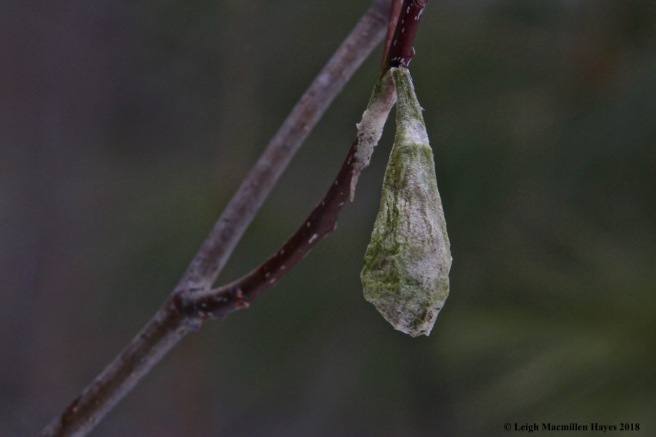
t6-cecropia cocoon

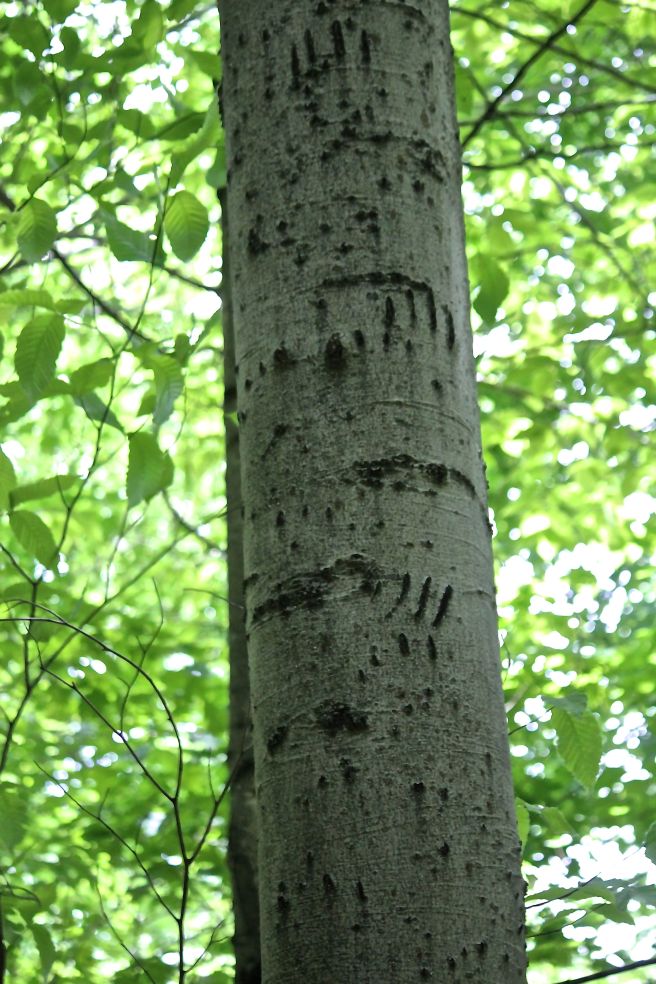
Just yesterday, while tramping in Lovell, Maine, with fellow trackers, I spotted a cocoon  dangling from a beech tree. My first thought–Cecropia moth, but I contacted Anthony Underwood, a Maine Master Naturalist who has great knowledge about insects, and learned that I was wrong. He said it looked more like the cocoon of a Promethea moth. “They hang down whereas Cecropia are usually attached longitudinally,” wrote Anthony. And there you have it.

Now I just have to remember it, which is part of the reason I value my post entries. The information has been recorded and I can always plug a key word, e.g. Promethea, into the search bar and today’s blog will come up–jogging my memory.

And so, without further ado, I present to you my favorites of the past year. It’s a baker’s dozen of choices. Some months, I had difficulty narrowing the choice to one and other months there was that one that absolutely stood out. I hope you’ll agree with my selection. I also hope that you’ll continue to follow me. And if you like what you read here, that you’ll share it with your families and friends and encourage others to follow along.

February 23, 2017:  Knowing Our Place
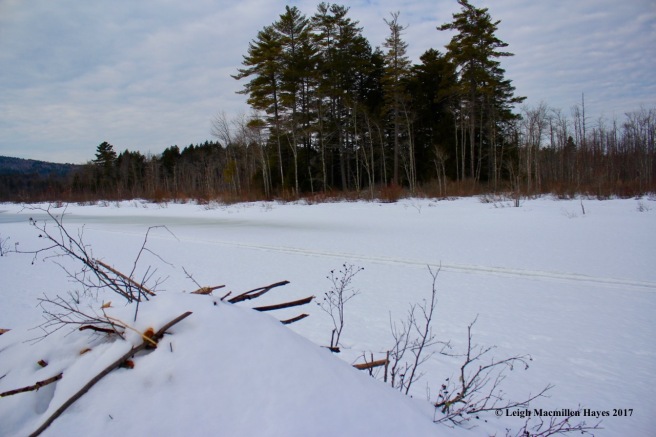
h-muddy-river-from-lodge

Holt Pond is one of my favorite hangouts in western Maine on any day, but on that particular day–it added some new notches to the layers of appreciation and understanding.

March 5, 2017: Tickling the Feet
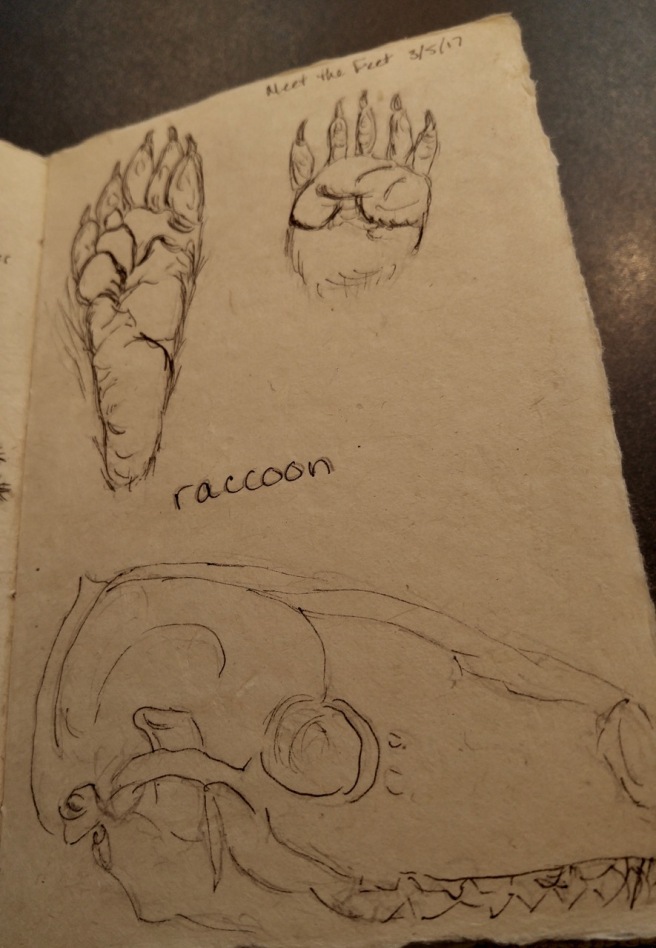
CE 3

I don’t often write about indoor events, but while the rest of the world was out playing in the brisk wind of this late winter day, a few of us gathered inside to meet some feet.

April 22, 2017: Honoring the Earth
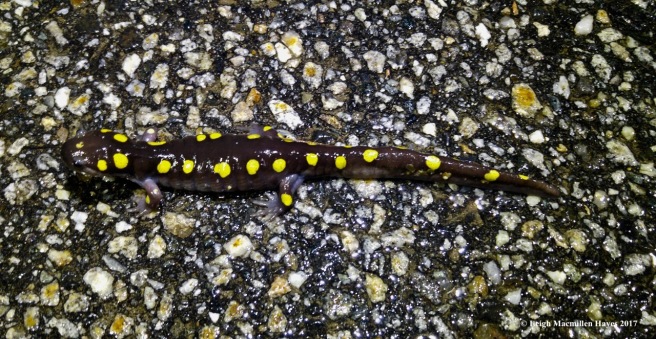
h-spotted sallie 2 (1)

It would have been so easy to stay home that night, curled up on the couch beside my guy while watching the Bruins play hockey. After all, it was raining, 38˚, and downright raw. But . . . the email alert went out earlier in the day and the evening block party was scheduled to begin at 7:30.

May 21, 2017: On the Rocks at Pemaquid Point
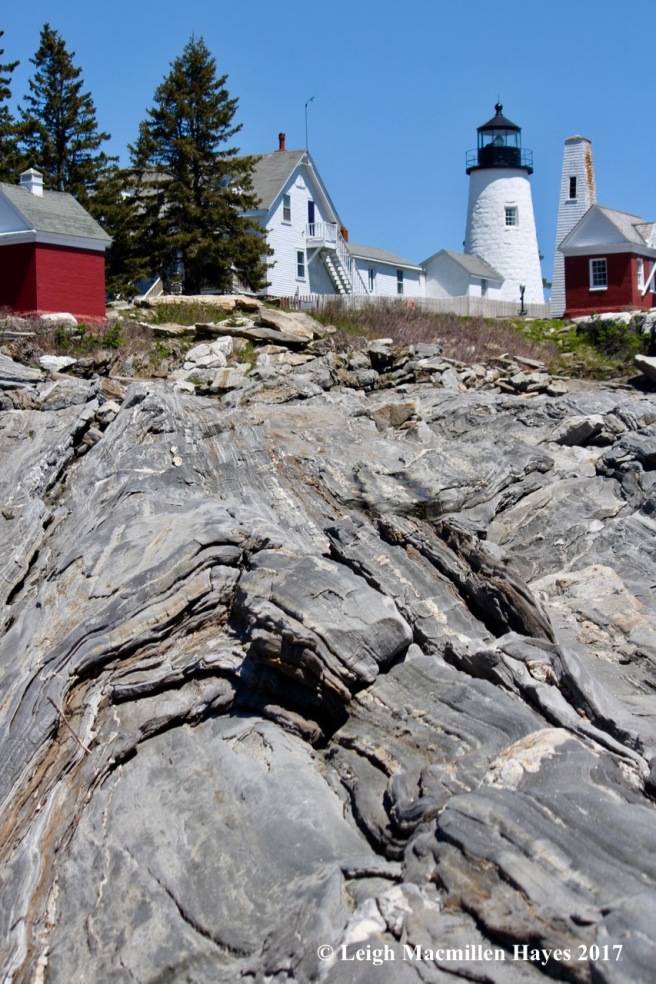
p16-fold looking toward lighthouse

Denise oriented us northeastward and helped us understand that we were standing on what is known as the Bucksport formation, a deposit of sandstone and mudstone metamorphosed into a flaky shist. And then she took us through geological history, providing a refresher on plate tectonics and the story of Maine’s creation–beginning 550 million years ago when our state was just a twinkle in the eyes of creation.

June 9, 2017: Fawning with Wonder
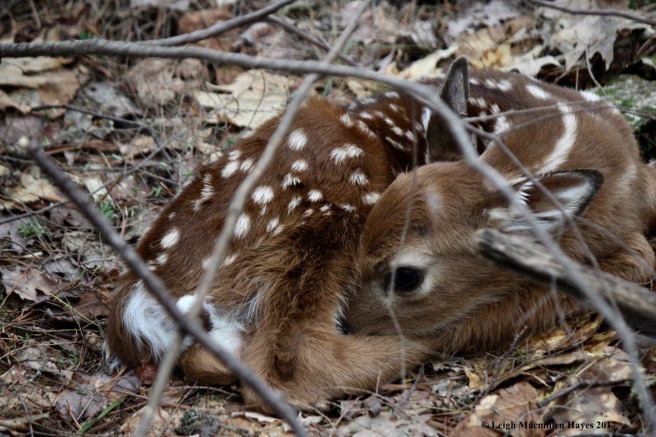
p-fawn 2

Though fawning is most oft used to describe someone who is over the top in the flattery department (think old school brown nose), the term is derived from the Old English fægnian, meaning “rejoice, exult, be glad.”

July 3, 2017: Book of July: Flying on the Wild Wind of Western Maine
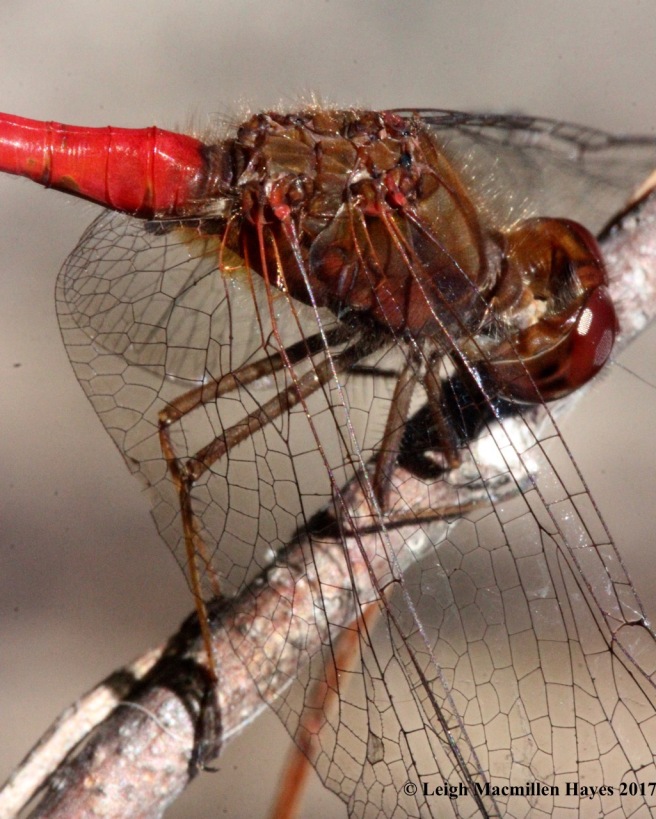
d-skimmer, yellow legged meadowhawk, wings

My intention was good. As I sat on the porch on July 1st, I began to download dragonfly and damselfly photographs. And then the sky darkened and I moved indoors. Suddenly, and I mean suddenly, the wind came up. Torrential rain followed. And thunder and lightening. Wind circled around and first I was making sure all screens and doors were closed on one side of the wee house and then it was coming from a different direction and I had to check the other side. Trees creaked and cracked. Limbs broke. And the lightening hit close by.

August 6, 2017: B is for . . .
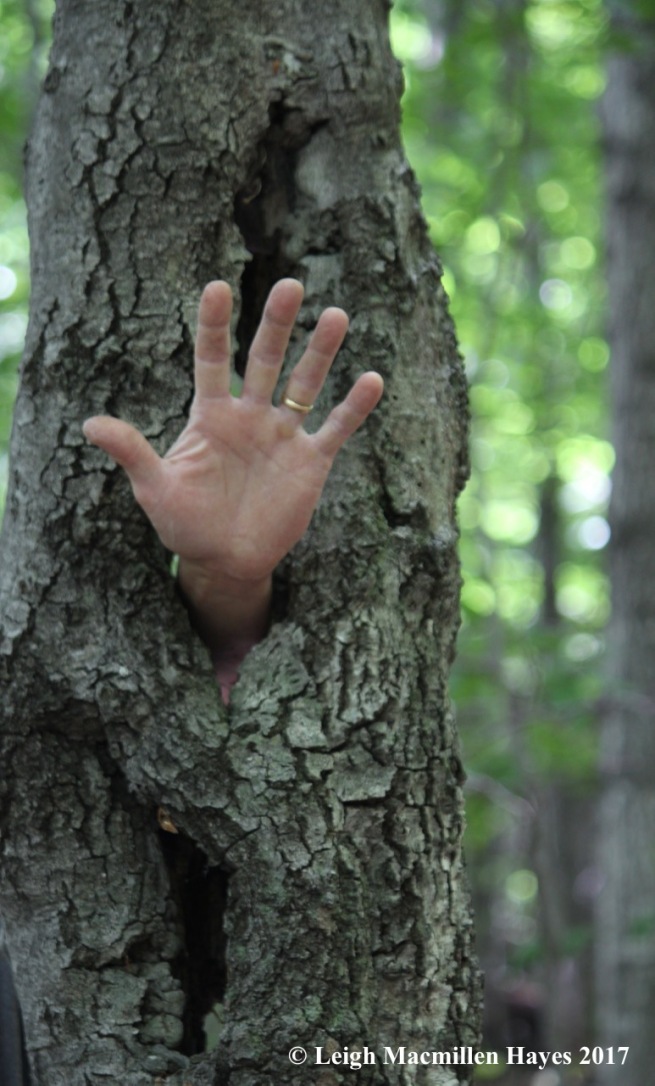
b-bye

Our original plan was to hike to the summit of Blueberry Mountain in Evans Notch today,  following the White Cairn trail up and Stone House Trail down. But . . . so many were the cars on Stone House Road, that we decided to go with Plan B.

September 15, 2017: Poking Along Beside Stevens Brook
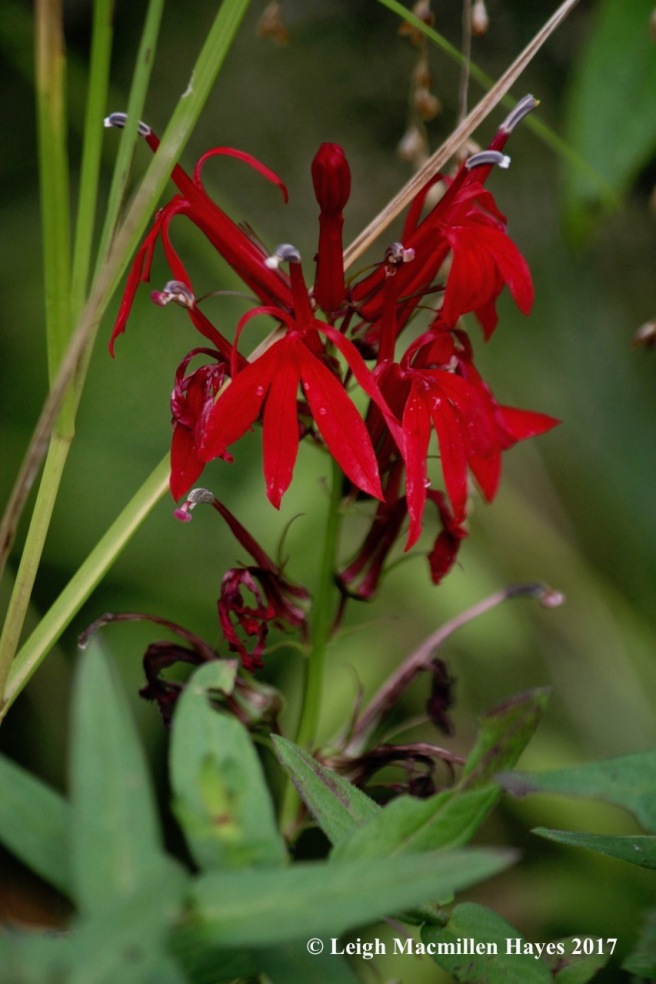
s22-cardinal flower

Raincoat? √

Notecards? √

Camera? √

Alanna Doughty? √

This morning I donned my raincoat, slipped my camera strap over my head, and met up with LEA’s Education Director Alanna Doughty for our reconnaissance mission along Stevens Brook in downtown Bridgton. Our plan was to refresh our memories about the mill sites long ago identified and used beside the brook.

October 5, 2017: Continued Wandering Into the World of Wonder
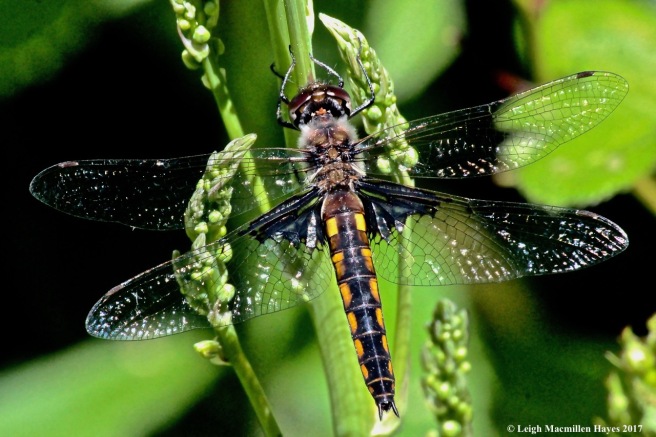
i-baskettail, common baskettail 1

May the answers slowly reveal themselves, while the questions never end.

November 24, 2017: Black Friday Shopping Extravaganza
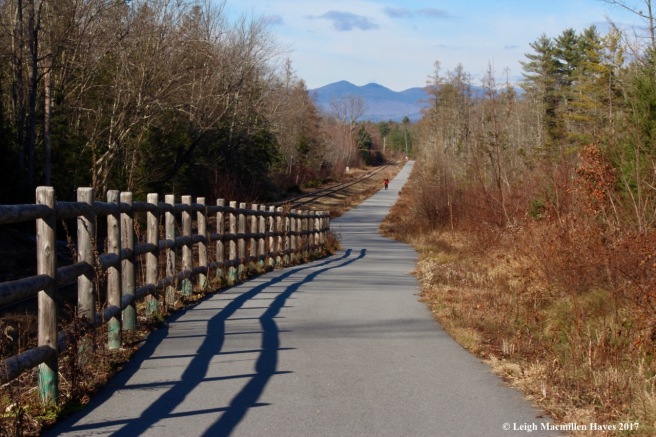
b8-the main aisle

At last, I’d raided enough aisles. My cart was full to the brim and my brain overwhelmed. I guess I’m not really a “shop-til-you drop” kind of gal. It was time to wind along the trail and end my Black Friday shopping extravaganza.

December 29, 2017: Oh Baby!
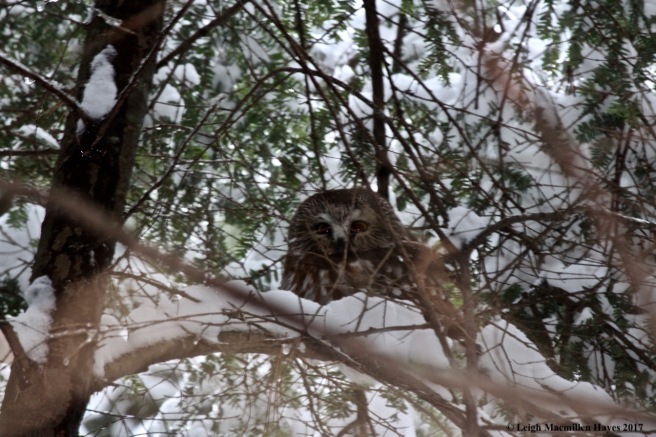
s-screech owl 2

We shared about ten minutes together and it was definitely an “Oh baby!” occasion. But there was more . . .

January 21, 2018: Sunday’s Point of View
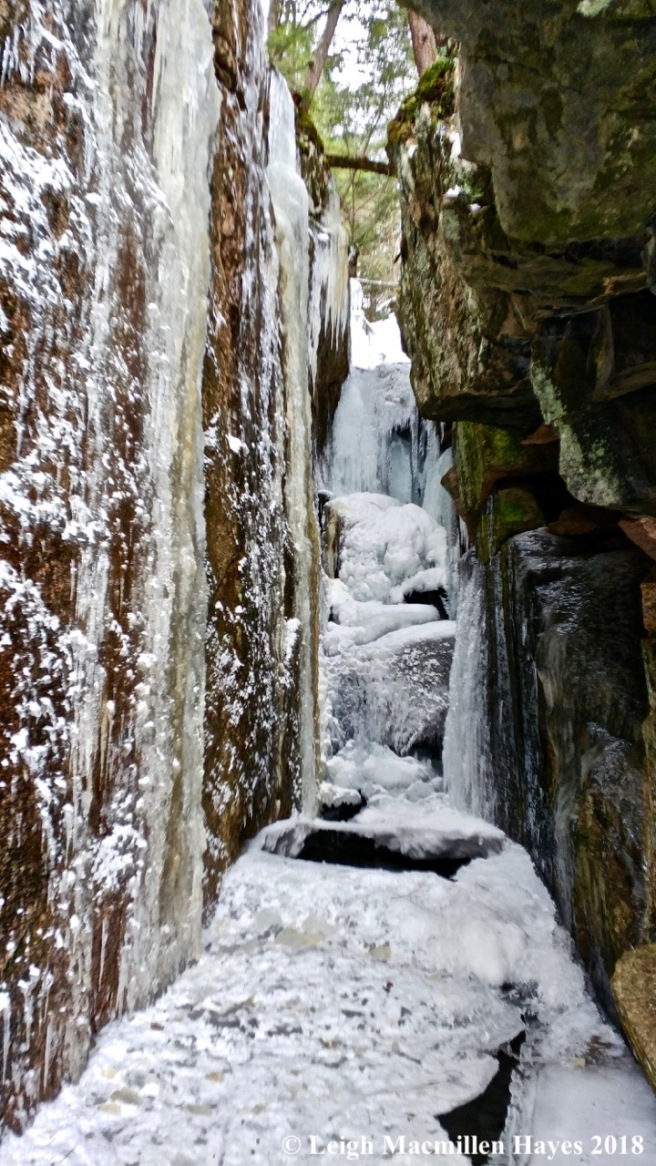
p17-Needle's Eye

We arrived home with ten minutes to spare until kickoff.

February 8, 2018: Hardly Monochromatic
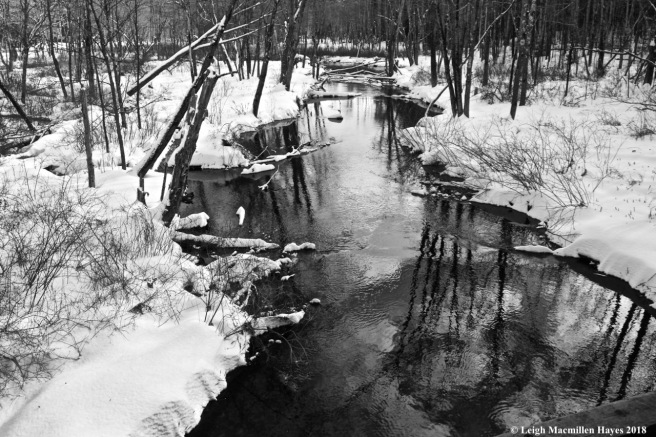
p18-Stevens Brook

My world always takes on a different look following a storm and today was no different.

To all who have read thus far, thanks again for taking a trip down memory lane today and sticking with me these past three years. I sincerely hope you’ll continue to share the trail as I wander and wonder–my way.

And to wondermyway.com–Happy Third Anniversary!
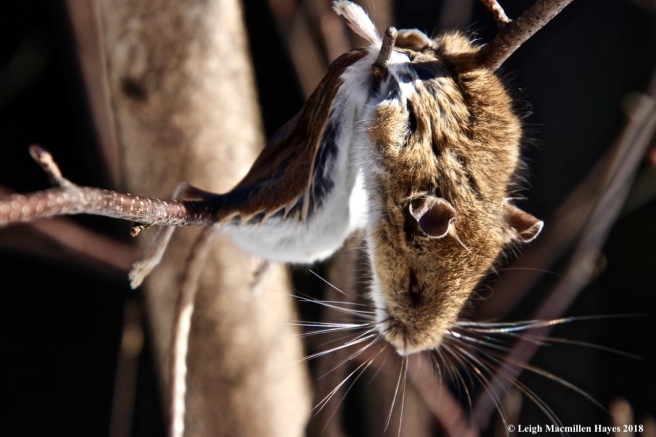
 

Endowing the Future

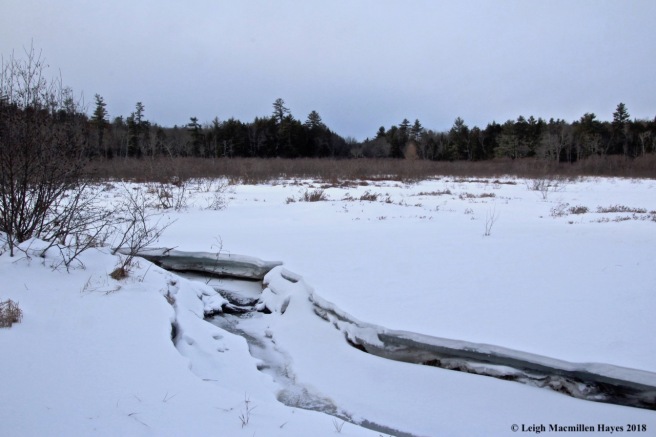
The morning began with a Greater Lovell Land Trust guided hike into the wetland of the John A. Segur West Preserve on New Road in Lovell.

w-shrike kill still in tree

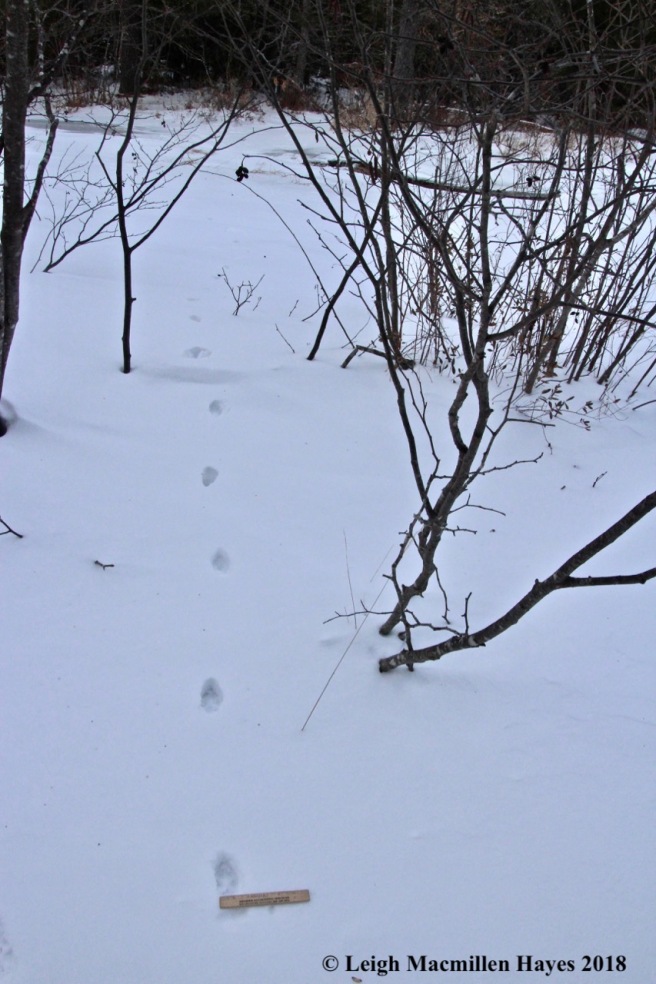
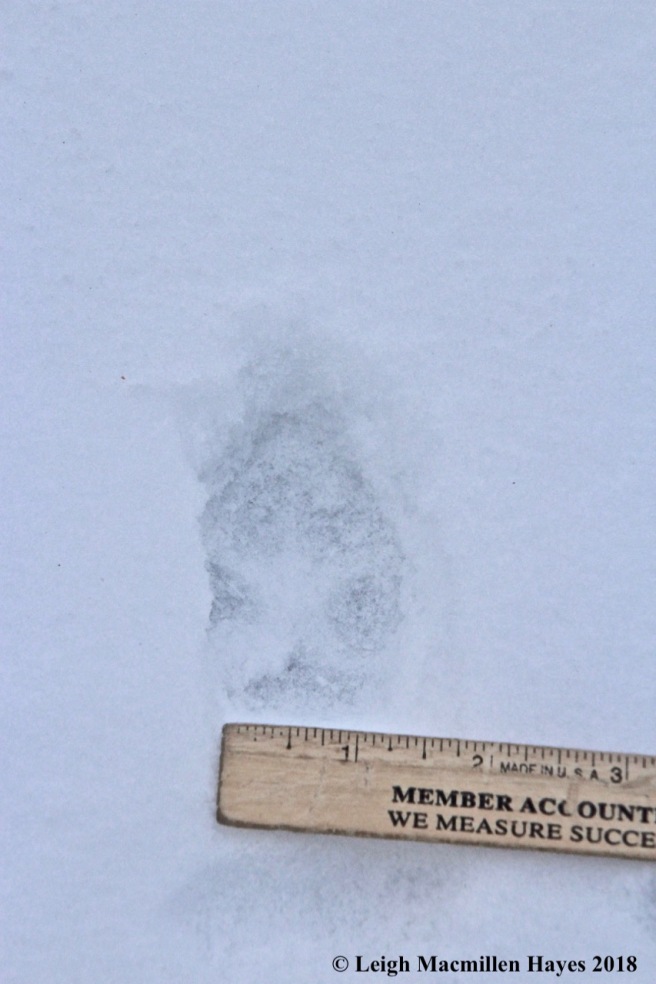
Despite the cold temp, there were eleven of us along for the journey. To stay warm, we made a sort of beeline to the wetland, but stopped a few times, including to measure the straddle of mink tracks, and then to see if a shrike’s deposit we’d spotted a few weeks ago was still pinned to a tree in the log landing. It was, which wasn’t a surprise. As Dave, one of our docents commented, shrikes are not all that common here so it may have left this  dinner behind before it moved on. But, we wondered–why hadn’t a blue jay or another bird taken advantage of the free meal?

w-ruffed grouse tracks

From the landing, we moved on toward Bradley Brook, where we spotted tracks left behind by ruffed grouse, mink, deer, and a kazillion squirrels. But, other than the mink, no predator tracks, which was curious.

w-snowshoe hare print

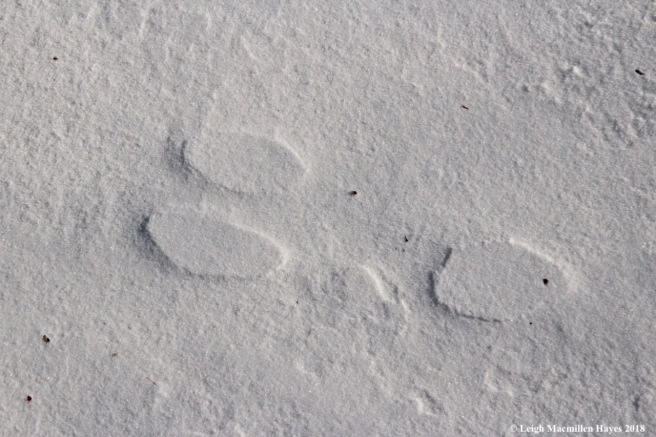
Out on the wetland, we noticed where a hare had packed the substrate and yesterday’s wind blew any soft snow away creating a raised impression.

w-Dave channeling his inner deer

It was there, also, that docent Dave, bent down in the background,  demonstrated how a deer rubs its forehead against tree bark–leaving behind information about its health and wealth.

w-squirrel bridge

Our plan had been to venture further into the wetland to make more observations, but ice conditions were such that we didn’t dare. Instead, we returned to the brook and followed it back, noting ice bridges that none of us dared to cross. We left that action to the squirrels.

w-Robie Meadow 3

The John A. Segur West property was a new one on my guy’s list, and so we went with that theme and after lunch I dragged him to two other land trust properties. Our first stop was at Western Foothills Land Trust’s Robie Meadow on Scribner’s Mill Road in Harrison.

Again, given the brook that we’d have to cross, we paused and decided to enjoy the view from the edge.

w-fox track to brook 2

Throughout the property we did note the usual squirrel tracks and red fox. As we walked beside the brook, I hoped for others that weren’t to be, but at a spot where last week on a walk co-hosted by the GLLT and WFLT, we’d noted a pathway to the water created by either coyote or fox and a bobcat traveling back and forth to the water. Today–fresh red fox tracks.

w-red fox print

The size of individual prints, fuzzy appearance due to a hairy foot, and chevron feature of the foot pad all spoke to its maker.

w-deer ribs and fox track1

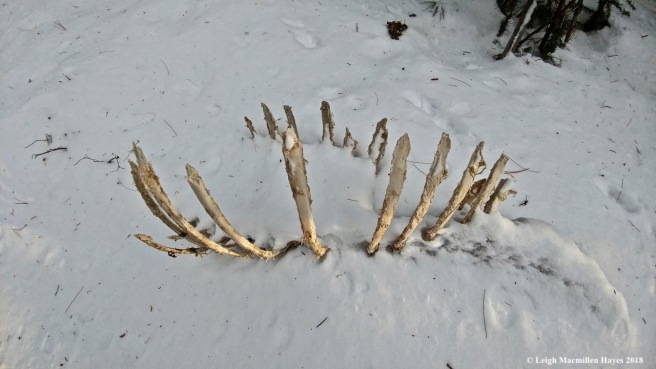
As we made our way back to the road, we stopped by a kill sight discovered last weekend. The ribs and backbone of a deer reached toward the sky. And right behind–more fresh red fox tracks. The fox had paused briefly before journeying on in search of a new food source.

w-red pine plantation beside Crooked River

Our final destination was across Scribner’s Mill Road to Loon Echo Land Trust’s Crooked River Forest Preserve-Intervale.  Neither of us had ventured forth on this property previously. While no true trails yet existed, the logging roads were easy to follow and we chose that route because we wanted to get down to Crooked River. As we approached the river, we realized we had traveled through a red pine plantation.

w-white pine at LELT

Right by the river, we discovered a white pine that had lost its terminal leader, thus allowing lower whorls to reach skyward. As my guy said, it looked like a great climbing tree–had we been so inspired. Blame it on the cold. Blame it on our age. We passed up the opportunity.

w-Crooked River 1

The river, so named Crooked for its meandering nature, offered a mixture of ice and open water.

w-fox prints and pee

And everywhere throughout the property we found evidence of red foxes, including prints and pee.

w-coyote bed

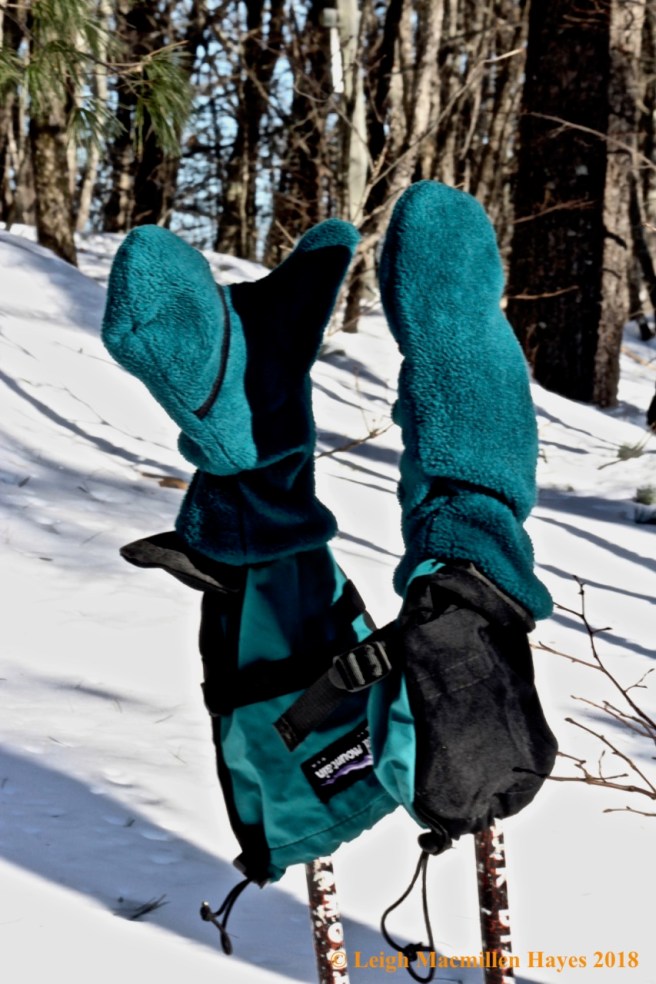
We also noted a spot where a coyote paused for a bit, so smooth and indented was the impression left behind. I threw a mitten down temporarily to give a sense of the bed size.

w-Crooked River 2

Though we eventually crossed over the LELT boundary, we had followed a snowmobile trail, and so we decided to see where it would lead–hopeful we wouldn’t find ourselves in someone’s back yard.

w-Scribners Mill bridge

Our worries were squelched when we spied the Scribner’s Mill bridge in the distance.

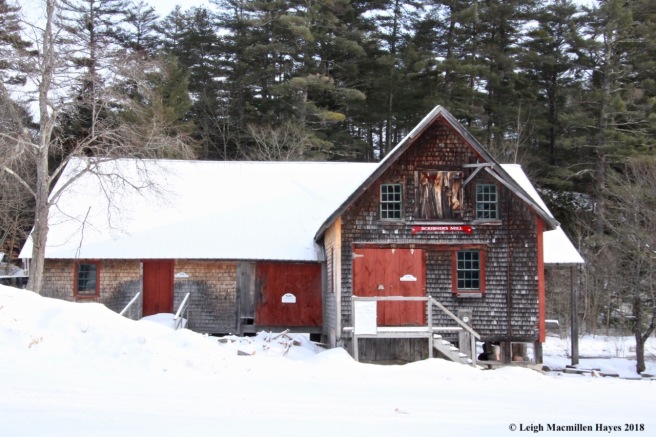
w-mill:blacksmith shop

And soon came up beside the old blacksmith shop.

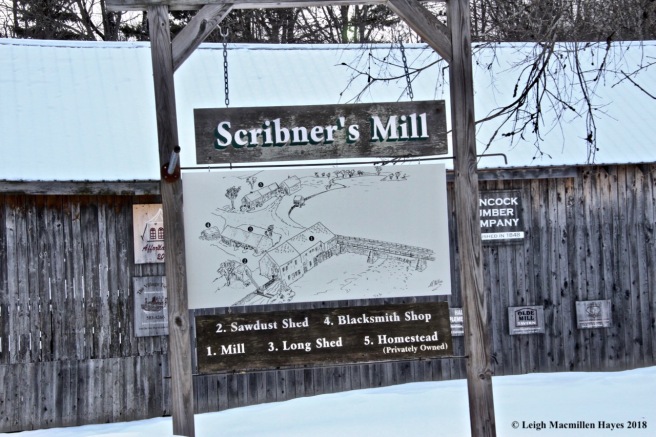
w-mill sign

The mill complex was built in 1847. Three generations of Scribners operated it continuously until 1962.

w-mill

In its heyday, the mill produced clapboards, shingles, barrels, and lumber. The Scribner’s Mill Preservation, Inc. formed in 1975 with the mission to transform it into an accurately reconstructed saw mill powered by water.

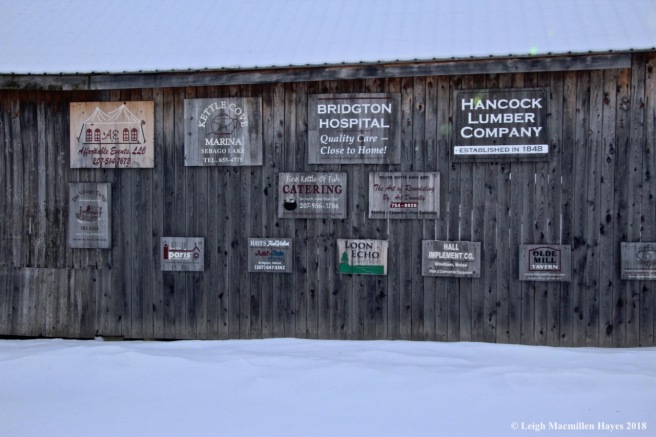
w-mill:signs

As we stood and looked at the ads of local businesses on the long shed (including one we know intimately), we wondered about the annual “Back to the Past” Celebration that used to be held each August. During that weekend, we recalled how we’d watched the machinery at work. The lathe workshop and the blacksmith shop were also open. Tours of the homestead included exhibits and demonstrations of traditional crafts such as weaving, spinning, rug-hooking and quilting.

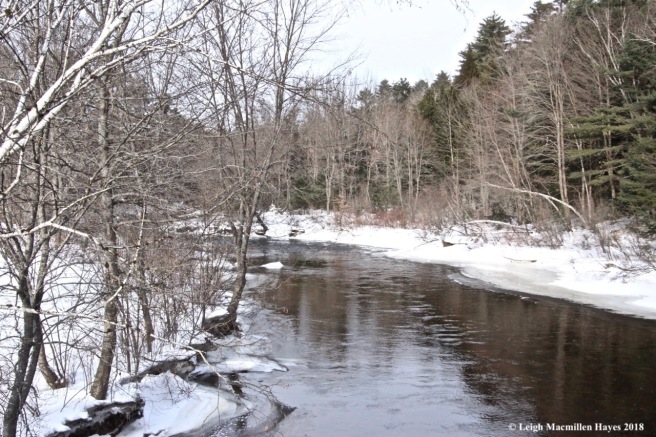
w-mill from bridge 2

Today, all was idle. Except for the water.

w-mill from bridge 3

It swirled by, carrying memories of the past into the future.

And we gave thanks for the opportunity to visit properties owned by three different local land trusts who do the same as they carry memories of the past forward for future generations.

Land trusts work with community members to acquire land for permanent conservation through purchases and donations. They also create legal and binding conservation easements that allow residents to protect land holdings in perpetuity, while retaining private ownership. Scenic views, wildlife corridors, flora and fauna, and topography remain, subject only to the whims of nature itself, which is ever-changing.

Conserving the land doesn’t mean it can’t be touched. The organizations develop management plans and steward the land. Timber harvesting, farming, residency and recreation continue, while specific wildlife habitat, wetlands, unique natural resources and endangered or rare species are protected. And in the process, they strengthen our towns. Ultimately, they give us a better sense of our place in Maine and opportunities to interact with the wild.

Our local land trusts offer numerous hikes open to everyone, providing a great way to explore and learn more about the diversity of the natural communities.

Even though we can’t all endow the future of our properties, we can get involved to ensure that these organizations continue to protect land for future generations of humans and wildlife.


Winter Reflections

My world is always transformed during a snowstorm and even the day after. So it was that yesterday about four inches of the fluffy white stuff drifted down and created a wonderland effect.

a1-snowflackes on Queen Anne's Lace

Even this morning, the individual snowflakes were still visible in their crystalized form (and I kicked myself for not packing my macro lens.)

a2-coyote and red fox tracks

I began the day with a slow journey from home to Pondicherry Park, with the intention of meeting a hiking group. Along the way, I realized that others had trekked before me. Two red foxes and a coyote had crossed paths, forming an X that mimicked the X pattern in their individual footprints. (The bigger prints from upper left to lower right being the coyote; and the smaller prints from lower left to upper right being the two foxes.)

a3-red fox with chevron

In almost direct registration, a hind foot of the fox landed on snow previously packed down by the front foot, so what you see are the two prints. The top print was a bit fuzzy in formation for so much is the hair on the fox’s foot. Despite that, toe nails, toes and the chevron pad at the back, plus the X formation between toes and pad seemed obvious.

a4-Stevens Brook

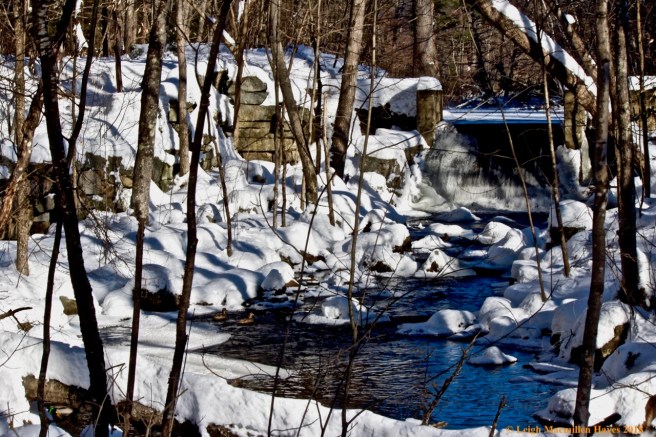
As I made my way through the park, the morning light on Stevens Brook drew me off trail to the frozen edge. And ice along the bank indicated the change in water levels since the heavy rain of a few days ago.

a5-Bob Dunning Bridge

At last I reached the gateway to town, which is also the gateway to the park–the Bob Dunning Memorial Bridge. I have a great fondness for this bridge on many levels, including memories of Bob who passed away suddenly at least ten years ago, the barn-raising community effort to build it, and the fact that each beam represents a different tree, bark included. You can learn more about it by reading my previous blog post: Barking Up A Bridge.

a6-snow on bridge

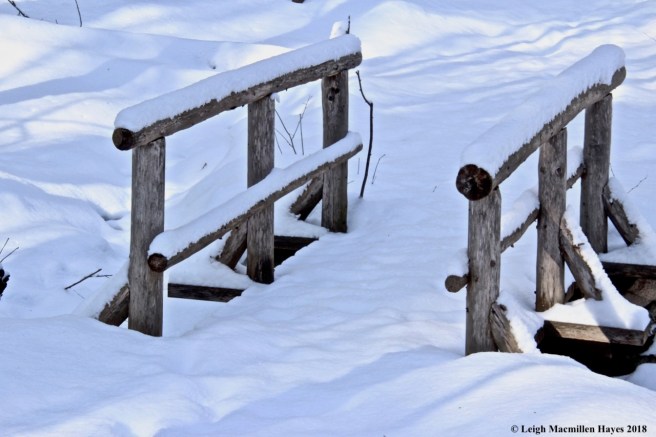
And each time I walk across it, it seems to offer up something different. This morning, it was how the snow coated the railing. I think the artistic side of Bob would have approved.

a7-AMC group at bridge

On the other side, I met up with a group of seven women. Led by AMC volunteer JoAnne Diller, our intention was to tramp through the park following all the outer loops, including a link on the Lake Environmental Association‘s Pinehaven Trail at the Maine Lake Science Center. Along the way we visited with each other, enjoyed the beauty that surrounded us, and got some exercise.

a10-Stevens Brook

And then we returned to the bridge and parted ways. I choose to follow the inner trails home, pausing first to enjoy the color of Stevens Brook from the bridge’s center.

a8-mallards

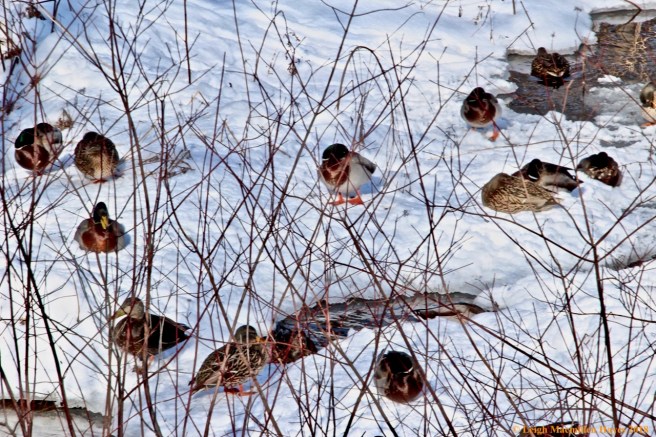
And no winter visit to the park is complete without taking time to watch the ducks–and listen as well.

a8a-mallards

They gather by the dozens, some to rest while others seemed to be in constant motion.

a12-ice skirt

Before following the trails leading west and toward home, I returned to the scenic overlook where ice skirted a tree–again indicating that the water was recently much higher.

a13-eddy

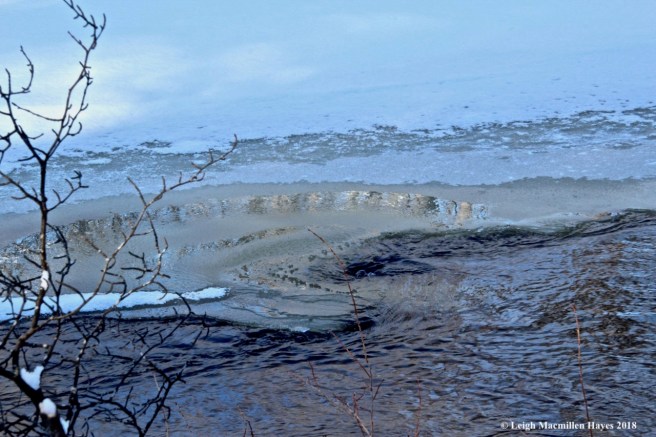
In the same spot I watched water swirl in a small eddy and am amazed that I’m not still standing there–mesmerized as I was by the action.

a14-yellow birch sculpture

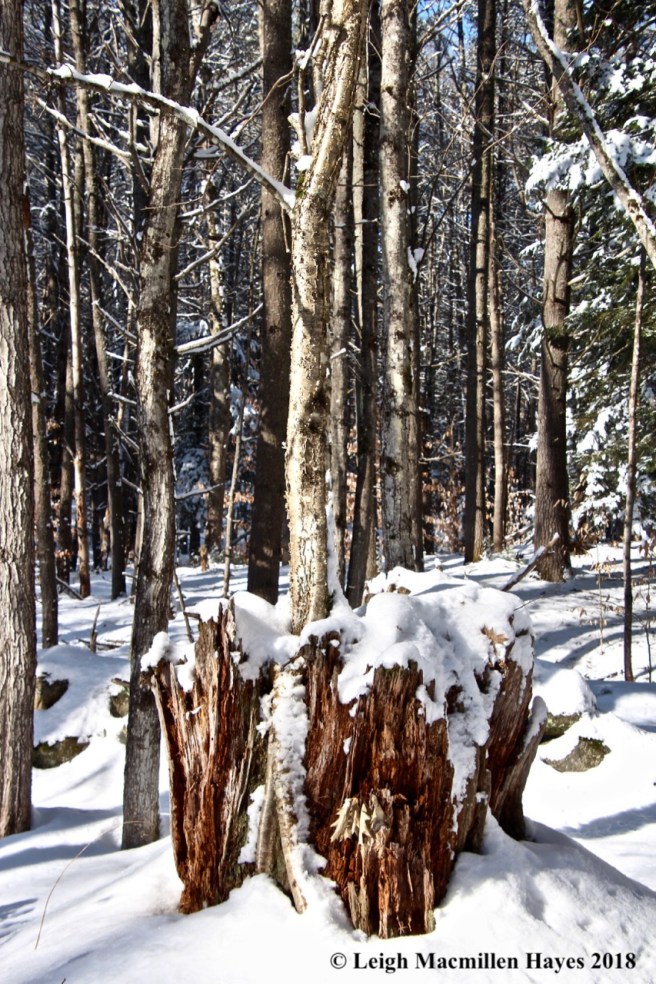
But my stomach was growling and so I continued on–stopping to admire another of nature’s wonders–a yellow birch that germinated atop an old pine stump and today stands as a sculpture of one member of the community supporting another despite their differences. Hmmmm.

a15-bench awaiting visitors

The trail I followed home was less traveled than the others and the snow a bit deeper because it hadn’t been packed down. When the park was first created by Lakes Environmental Association and  Loon Echo Land Trust, the AMC did some trail work and part of their offering was this bench. Though it hasn’t recently supported a weary traveler or one who just wants to set for a time, I trusted that day will soon come again.

a16-AMC bridge

I crossed the bridge near the bench, which was also built by the AMC crew. And from there, I headed home to lunch, but not without offering a smile of gratitude to JoAnne for continuing to volunteer to lead walks for the AMC and giving us all an excuse to enjoy the company of each other in this beautiful place.

a17-Saco Old Course

Later in the day I found myself in Lovell for a quick errand and the light was such that I felt the need to spend a little time beside the Old Course of the Saco River just down the road in North Fryeburg.

a18-Saco Old Course

The scene is never the same, nor is the light. What may have seemed monochromatic was hardly that.

a19-church

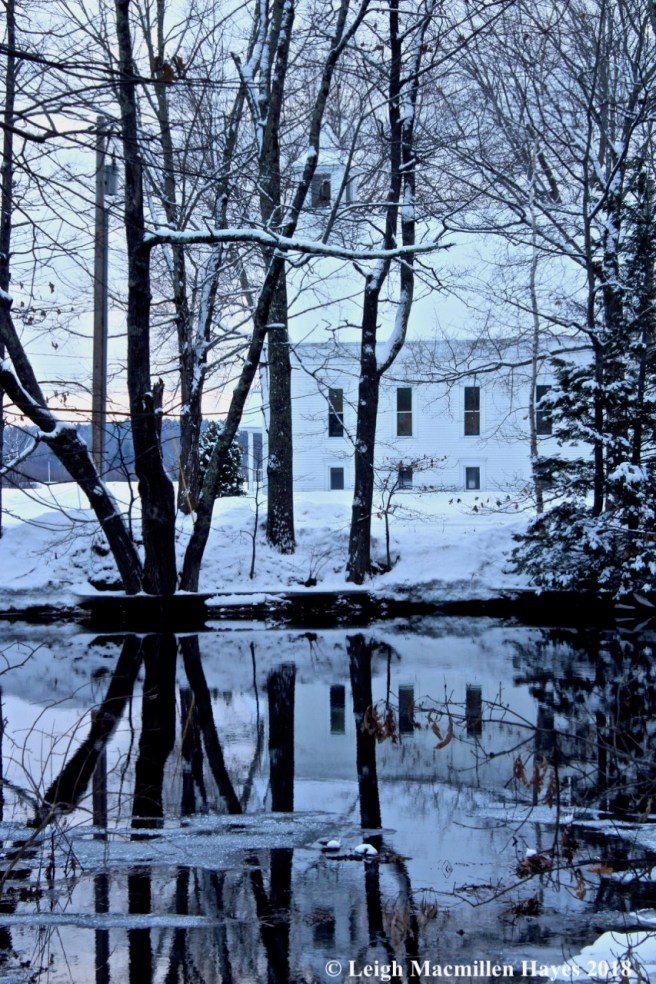
As the sun began to set, the water still harbored reflective moments.

a20-setting sun

And it transformed some reflections from crisp representations into impressionistic paintings.

a11-ice chimes again

At the end of the day, however, my favorite reflection of all was one spied along Willet Brook in Pondicherry Park by Eleanor, a member of our morning AMC trek.

a9-ice chimes

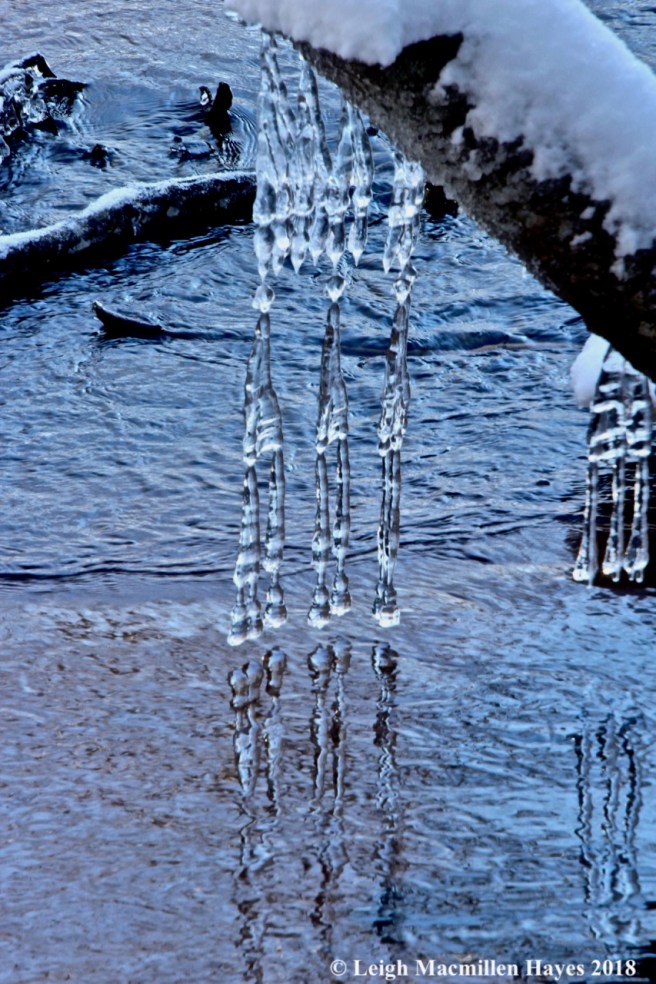
Winter chimes. Winter reflections.


Celebrating First Day 2018 Lovell-Style

In the name of tradition, today the Greater Lovell Land Trust hosted a hike up Whiting Hill at the Heald and Bradley Ponds Reserve to welcome the new year. Last year’s inaugural hike attracted eight of us and the temp was so comfortable that we began to shed layers as we climbed. This year, six of us made the trek and conditions were a bit on the cool side–um, that would be an understatement.

f-Heald Pond dam

But . . . the crisp air enhanced the beauty all around us and we began with a brief stop to appreciate the dam. What we didn’t realize until a minute later was that we’d also startled some wood ducks who immediately flew off.

f-snowshoe journey up Whiting Hill Trail

Though our group was small, old friendships were renewed and new ones formed as we shared the trail.

f-otter trough 2

Periodically, we stopped to admire others who had carved their own trails. We read the stories of many mouse journeys, a fisher chasing a red fox, red and gray squirrel adventures and these–an otter bounding through the landscape.

f-otter trough 1

Otter troughs are about 6-10 inches wide, this one being the larger size. And in what can seem like two by two format, their front feet touch down as back feet rise, coming forward to land where the front feet had been just moments ago for they are bounders. Occasionally, this fun-loving critter chose to slide down on its belly.

f-summit achievement

By the time we reached the summit sign and turned right, we weren’t sure what to expect. Would it be so cold that we’d take a quick peek at the view and retreat? Would we be able to toast Lovell as planned?

f-who said it was cold?

As it turned out, a few in our group found their hands getting too warm, so welcomed a chance for a mitten break.

f-sit a minute

Others sat for a moment on the bench and left behind impressions.

f-hot water carafe

One of our docents had made pumpkin bread to enhance our toast and we brought a carafe full of hot water for cocoa or tea.

f-Heinrich filling cup

The water was very hot indeed and warmed us right up.

f-enjoying the summit and each other

And so it was with big grins that we shared camaraderie at the summit, enjoyed the view and noted the fact that it wasn’t too windy and the cold air was tolerable.

f-red fox print and pee

When we did finally pack up to make our descent, we snowshoed first over to the bench on the Heald Pond side of the summit, where last year we found a sacrificial squirrel upon the altar. Prints left behind indicated a fox had dined there. Of course, a few of us got excited about the kill site and perhaps scared others away from joining us again this year. But . . . we just like to know what the mammals have eaten.

Today, an offering of another kind at the same bench. We found more fox prints all around it and as is typical on a raised object, a hint of pee–its skunky scent indicating it was a red fox. (Yes, I sniffed the pee. By the way, deer pee smells rather piney–just saying.)

f-deer trail

On the way down, more fox and mouse prints everywhere we looked, some old, others fresh. But also, deer tracks a few days old and filled with beech leaves that had recently blown down. It was much colder on our descent given that we were on the eastern side of the mountain and for the most part out of the sun.

f-John Fox Homestead

But that didn’t stop us from making a quick trip to Otter Rocks where two members of our party told us they had the great joy of watching a couple of otters frolic last summer.

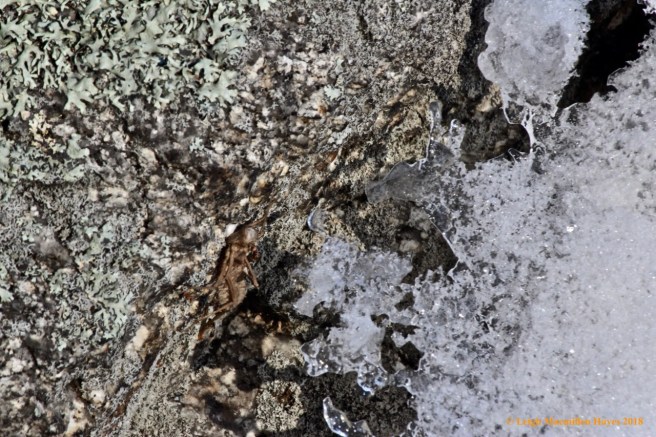
f-dragonfly exuvia, lichen and ice:snow on otter rock

We stepped onto the ice and looked back at the large, erratic boulder that marks the point, and reveled in the sight of lichens, dragonfly exuviae and ice displayed.

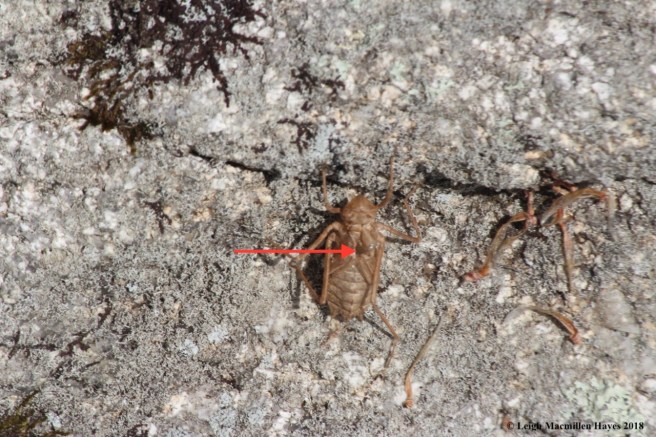
f-dragonfly exuvia 2

We always check the area for dragonfly exoskeletons but now that the ice has frozen, we can visit the rock’s backside for a change. A few remain, and it was easy to see the hole from which the dragonfly had cast off its external covering during last spring/summer’s moult.

f-Toasting Lovell

The temperature dropped drastically by Heald Pond and wind picked up, so we soon made our departure and headed back to the parking lot.

We were, however, tickled with the knowledge that we’d taken the opportunity to hike on this First Day of 2018. And while at the summit of Whiting Hill, on the count of three, we’d shouted Happy New Year to  Lovell, Stoneham, Stow and Sweden. Did you hear us?

Through Younger Eyes

Zigzagging through the woods, my young friends find wonder in every moment. They embrace their discoveries–often with exclamations and excitement. Following the blazed trail is not in their blood, for they know that some of the coolest finds are off trail, where the fungi aren’t trampled and mammal signs not obliterated.

w-striped ledge

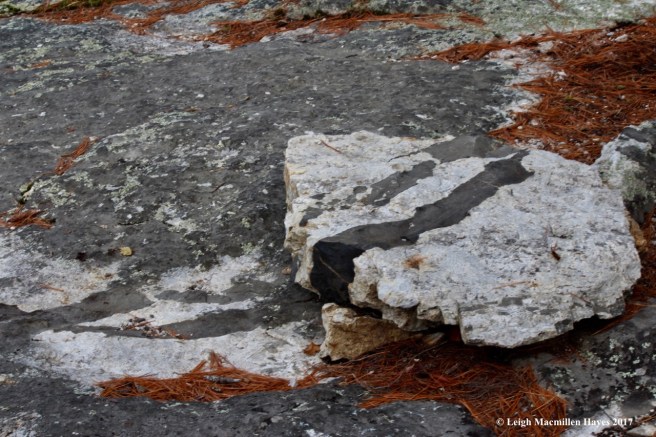
And so it was that this past week, I had the honor of spending lots of time exploring with them. First, on Tuesday, our Greater Lovell Land Trust docent tramp found us atop the “striped ledge” beside Keewaydin Lake in Stoneham, Maine. One of our docents, Mary, had obtained landowner permission for this grand adventure. From the Maine Geological Survey: “The dikes cutting the granite trend generally from southwest to northeast. They most likely intruded the host rock during the Jurassic period, when continental rifting caused extensive fracturing of New England’s bedrock (McHone 1992). Basaltic magma intruded these cracks, and cooled and solidified to form dikes such as those seen in Striped Ledge. Close examination of the ledge shows a complex intrusion history at this locality Some of the dikes have layering parallel to their walls, which may have resulted from several pulses of magma into the fractures and/or chilling of the dike margins in contact with cooler host rock . . . the dikes locally cross one another, with the older dikes being offset where they are torn apart by the younger ones.” How cool is that?

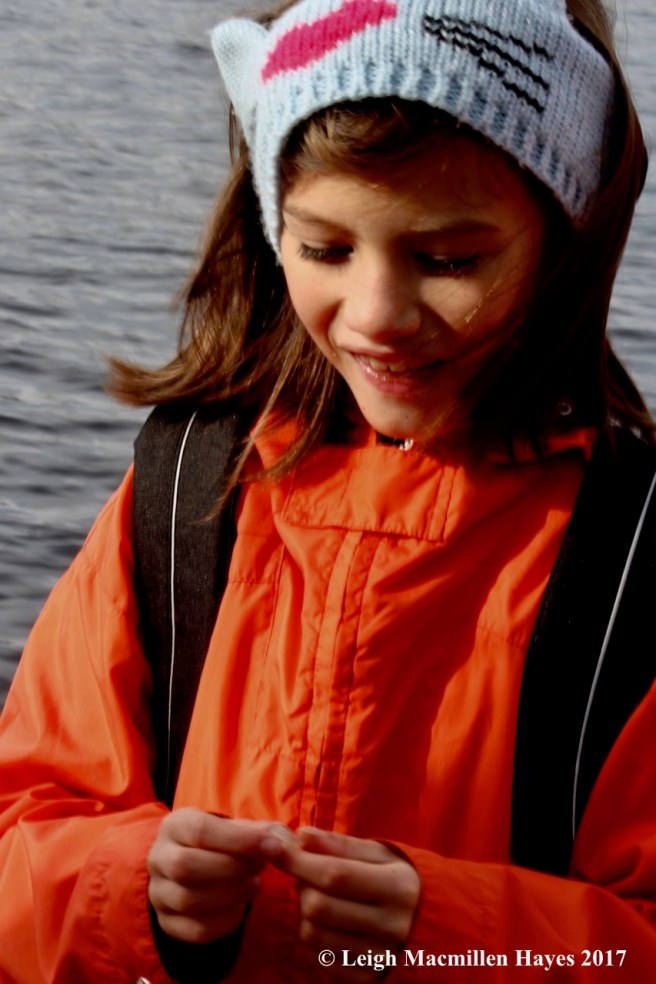
w-smiling for rosy quartz

Darn cool, especially when rose quartz was among the great finds.

w-rock hounds

And in that instant, a few rock hounds were initiated.

w-turning two twigs into a fish

When not looking at rocks, a couple of broken twigs on the ledge became a fish in one moment, and hotdog tongs in another–ever versatile were they.

w-eyeing a flower in rock tripe

But it wasn’t the ledge alone that drew their attention. When we stopped to admire rock tripe growing atop a boulder, it was the eye of the youth that discovered the green “flower” at the center.

w-Sucker Brook 2

And then the next morning, which dawned even colder than the previous, I joined the same family for a pre-hike at the GLLT’s Wilson Wing Moose Pond Bog Preserve as we prepared for a public hike. The trail meanders beside Sucker Brook, and we, too, meandered.

w-dipping into the cold for a Pooh stick

Pooh sticks were launched periodically and sometimes had to be dislodged.

w-wondering about foam

There were bubbles to watch in the brook and the foam formed to hypothesize about.

w-stump art

Nature’s artistic designs were viewed with awe.

w-pointing to hobblebush

The intention was to find a few of their favorite things. They found a few hundred and  . . .

w-seesaw

had lots of fun along the way.

w-exploring the stream

All the way along, the water, moss-covered rocks and sticks became part of their playground. But really, they also noted a variety of fungi, including their favorite green stain, which was in fruit,  a tree that had brought distress this summer for it housed honeybees and they learned that the hard way, great sliding spots from which to practice being river otters, the sunlight glittering on Moose Pond Bog and Indian pipes in their capsule form. There were sapsucker holes, pileated woodpecker activity, birch polypores, and even a surprise. They couldn’t wait for the public hike to show off their discoveries.

l-measuring diameter 4

That same afternoon, District Forester Shane Duigan, joined our GLLT after-school program at New Suncook School in Lovell. The Trailblazers, as the group is known, first introduced Shane to their trees. And then he showed us some of the tools stored in his vest, such as the tape measure used to determine diameter.

w-learning how to age a tree

As the kids made guesses about a tree’s age, Shane demonstrated how foresters use an increment borer to extract a small core from a tree.

l-counting rings on tree core

They crowded in to watch him count its rings. The predicted age: 100. The actual age: 50. The fun: 100%.

w-Horseshoe Pond

And then this morning dawned, colder than our previous outings and the wind created white caps on Horseshoe Pond below the kiosk for the Wilson Wing Moose Pond Bog Preserve. It was time for our public walk to enjoy the wonders of Wilson Wing.

w-ice 1

One of the biggest surprises were the icicles that had formed on Sucker Brook since our last visit on Wednesday morning.

w-carrot-shaped icycle

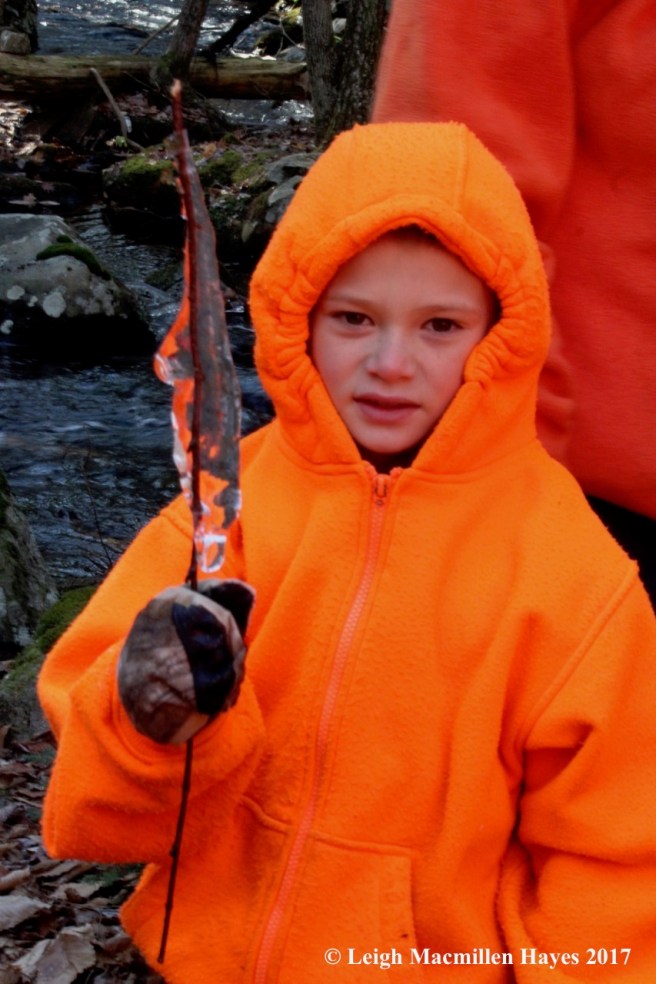
And because they are kids, they couldn’t resist gathering such to admire up close. This one looked like a carrot, and actually appeared so as it reflected the blaze orange–our color of the season.

w-ice 2

The kids realized that the icicles formed upon all types of vegetation and created their own interesting shapes worth celebrating.

w-ice 3

One even looked like a flag blowing in the breeze when turned upright, and this guy showed it to his mom in honor of her service in the Army and the fact that today is Veterans Day. Turned on its side, it became a maze game and he really wanted to place a small ball in it and watch the ball move through. And as much as he wanted to take it home, it has to live on in his mind’s eye and this photograph.

w-wondering about the car

They showed us so many things of nature, and even the unnatural, though they imagined all the critters for which the old blue car might create a fine home–squirrels, weasels, porucpines, foxes, and coyotes were on their list. And then they turned into otters themselves and slide back down the hill over and over again.

w-polypody 1

They wanted to share some other great finds, including a few squirrel dining tables and a rock with bad hair day, but the crowd had gotten ahead of them. Despite that, they looked at the “bad hair day” fern, aka polypody, and realized that it had curled in since Wednesday’s visit. And then they figured out that the fern curls when it gets cold. Who knew you could use a fern to determine the temperature?

w1-artist conks

Though they didn’t get to share all of their finds this morning, they did make some new discoveries as they wandered off trail, like the artists conks that grew in abundance.

w1-dead man's fingers

And deadman fingers fungi that reminded one of them of scat standing upright. I’ve a feeling that description will stay with me each time I look at it going forward.

w-bear hair 1

In what seemed like no time, for we traveled the trail much faster than intended, we were back on Horseshoe Pond Road and one among us was particularly excited about a certain display upon pole 13. She ran ahead to be able to show all the participants as they passed by.

w-bear hair on pole 13

It was bear hair and scratch marks that she shared with enthusiasm. And the knowledge that we are not alone in these woods.

And just after that one of her brothers realized our walk was almost over and he was disappointed for so much fun had he had being a junior docent.

w-Sarah signing my book

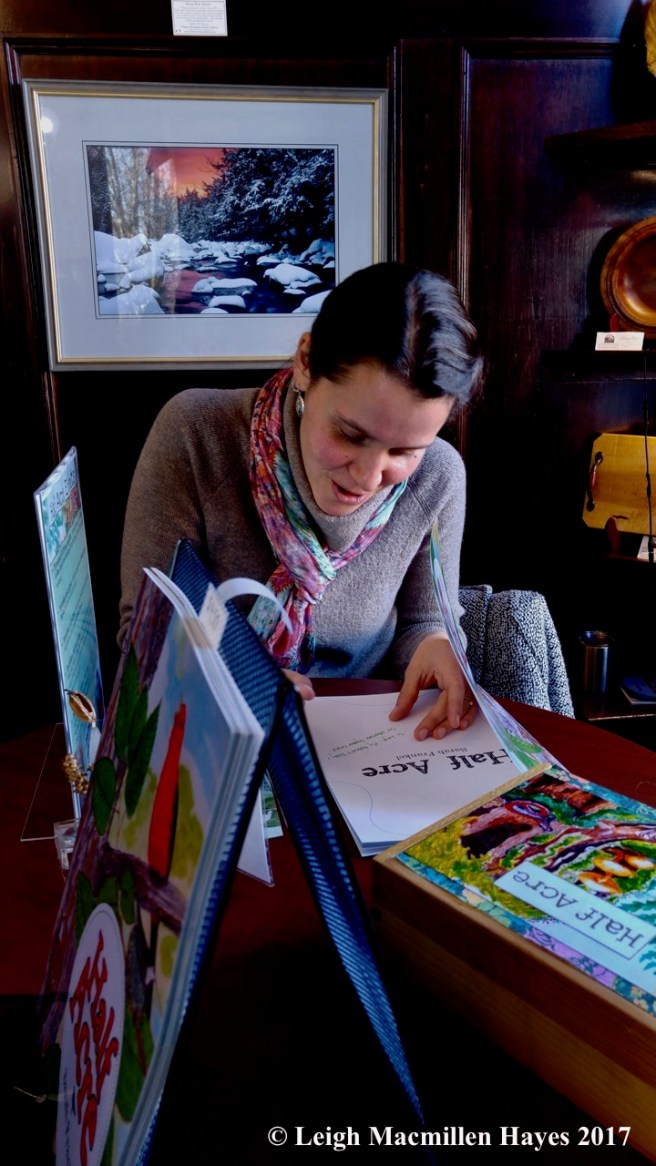
A few hours later, my guy and I ventured to The Met Coffee House and Gallery in North Conway to meet up with another who encourages children and their adults to explore the outdoors. It was our great joy to join my dear friend, Sarah Frankel, for the first book signing event as she celebrated the publishing of Half Acre.

w-posing by an uprooted tree

And now it’s the end of the day and the end of the week, and I’m a better person because of the time I’ve spent with young friends as they’ve moved quickly at times and then stopped to wonder. They taught me the joy of looking with open minds.

If you don’t have kids to learn with and from, may you find time to channel your inner child and look at the world through younger eyes.


Lingering at Long Meadow Brook

It’s Tuesday, which means time for a tramp through the woods–especially if you are a docent for the Greater Lovell Land Trust. We take our job seriously, filling our bags with field guides, hand lenses, binoculars, cameras, water, humor and wonder. The latter two are the key components and thankfully we’re all comfortable enough with each other to tell corny jokes and laugh at our misidentifications as we explore the natural world through curious eyes and minds, while sharing a brain.

l1-white spores 1

And so today, though our intention was to look for fall wildflowers, we had much more to notice along the way, like the white spores of mushrooms decorating the surrounding haircap mosses.

l2-funnel spider 1

And there were funnel sheet webs to examine, given that the morning fog left them dew covered and easier to spot.

l3-funnel 2

Though we wanted to take a closer look at the creators of such fine work, and tried gently touching webs with pine needles, our antics obviously vibrated more than your ordinary bug might, and the spiders ran into their funnels to hide.

l4a-cup and saucers

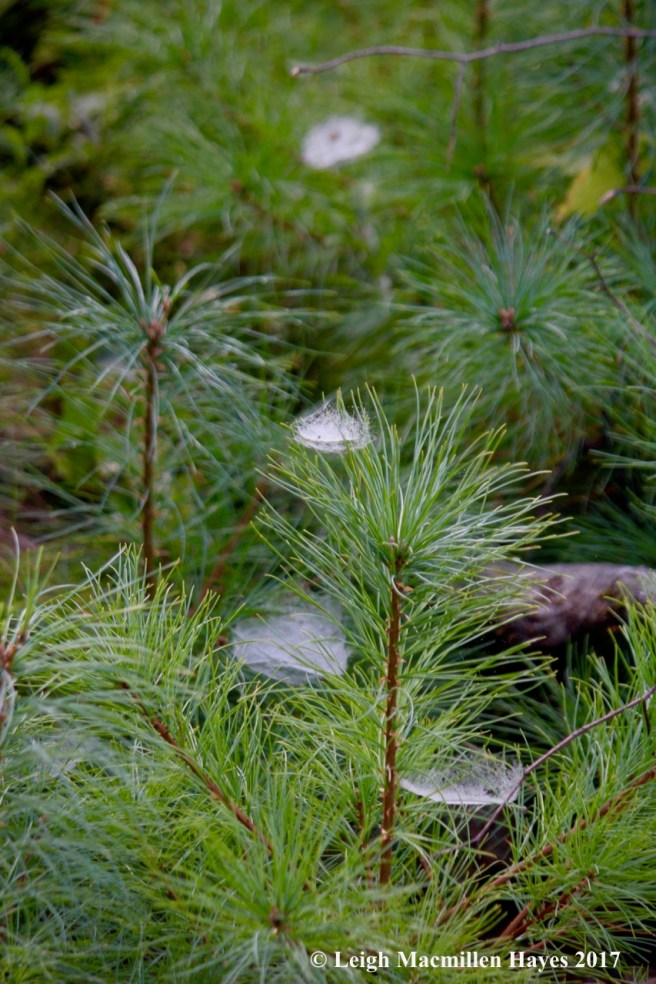
As we’d driven to the Long Meadow Brook Reserve, we’d spotted a field of medium-sized white pines decorated with webs and were thrilled to find the same on saplings.

l5-cup and saucer web 1

The bowl and doily spider is another member of the sheet species, and it builds webs that consist of two intricate parts. Above is the bowl, an inverted dome, and below, the lacier doily. The spider hangs upside down beneath the bowl, but above the doily, waiting for dinner to drop in.

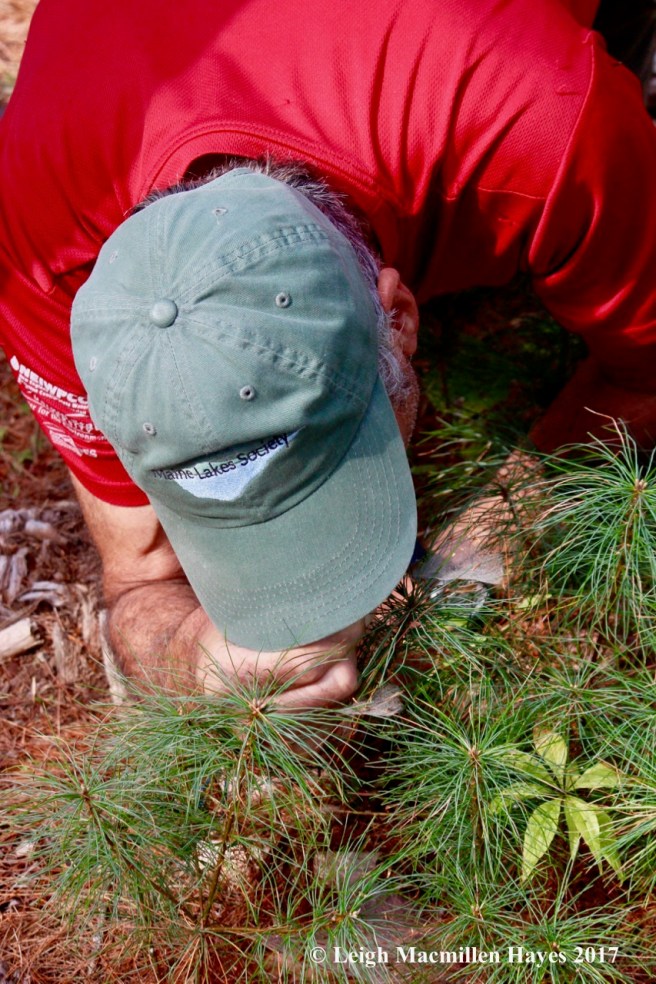
l6-looking at spider webs

Trying to see the tiny bowl and doily spiders requires getting down on all fours and looking through a hand lens for they are only about 3-4 millimeters in length. We did and were successful in our efforts.

l4b-cup and saucer on bristly sarsaparilla

It seemed today that nothing escaped spider activity, including the gone-by fruits of bristly sarsaparilla.

l4-orb web 1

Equally delightful in the making was an orb web outlined in dew, larger droplets highlighting each spoke, with smaller ones on the sticky silken spirals.

l1b-pilewort

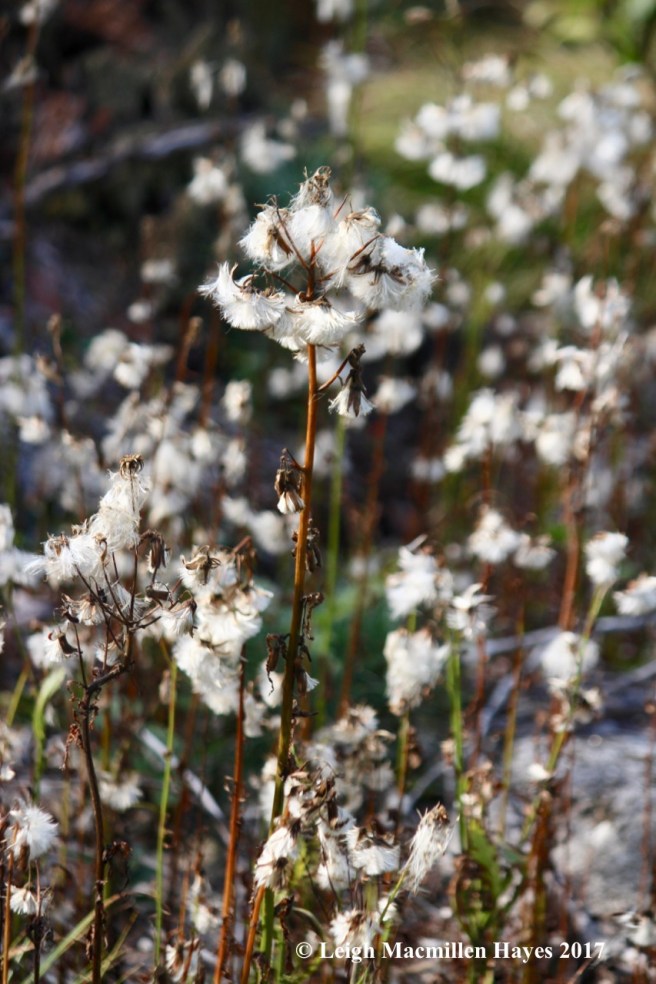
In several openings, pilewort grew in abundance.

l1a-pilewort field

Like a field of cotton, its dandelion-like seedheads were prolific.

l1c-pilewort seedhead

But really, I preferred the seed display to the petal-less flowerhead that emerges from the cylindrical cluster.

l7-pine cones 1

Also prolific were the female cones atop the white pines, their brown color indicating they were in their second or third year of development, having been wind pollinated by  tiny male cones. The pollen cones fall of trees within a few days of decorating our vehicles, outdoor furniture, and naked female seeds with yellow dust. If you think back to spring and all the little rice krispies that decorated the ground below white pines, you’ll know that you were looking at male cones. The seed cones typically form on the uppermost branches, so that the tree won’t pollinate itself from below, but can receive pollen blowing in the breeze from another tree.

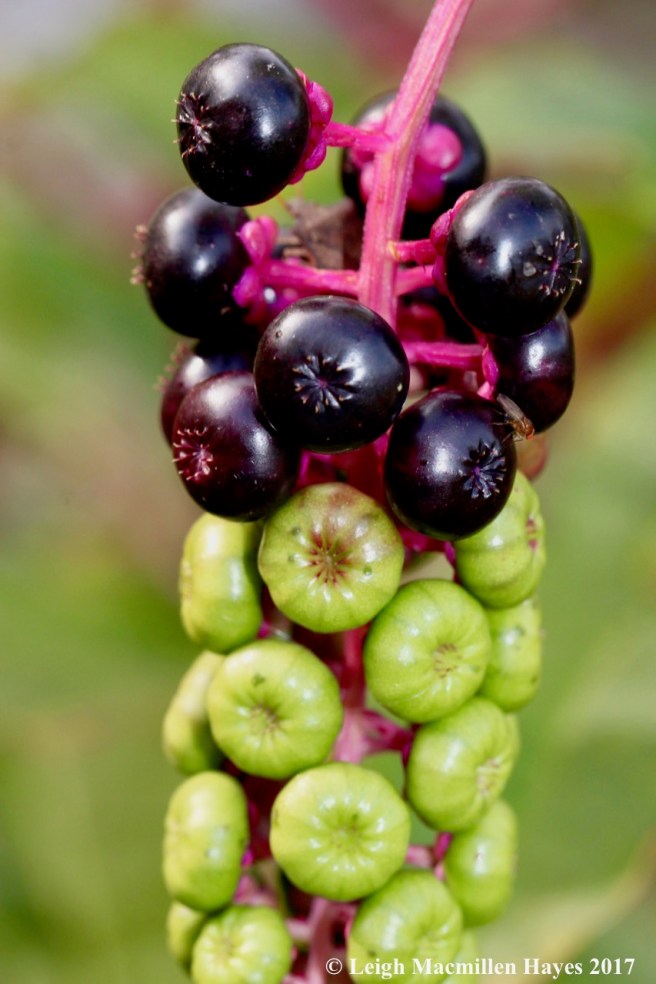
l8-pokeweed 1

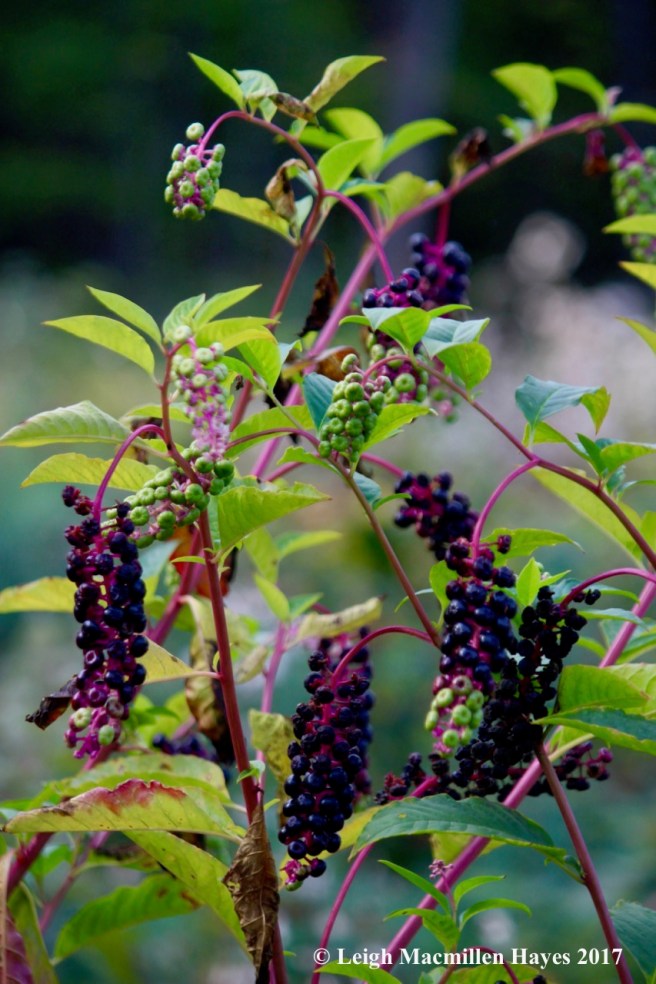
We’d looked high to see the cones, and then drew our eyes lower and thrilled with the sight of one of our tallest perennials.

l9-pokeweed 2

At first we only spied one pokeweed growing in an opening, but then began to spot others in flower and . . .

l11-pokeweed 3

fruit.

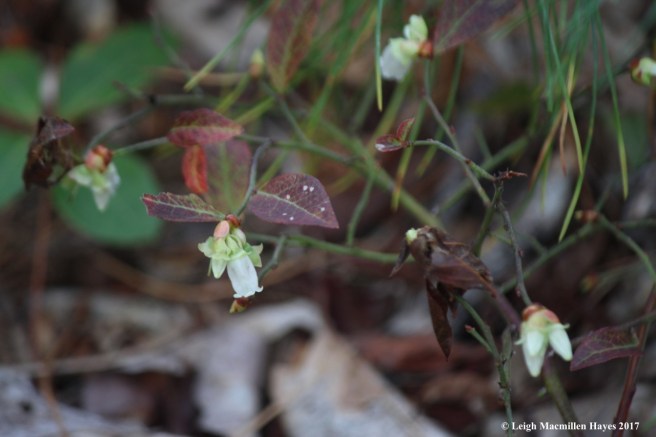
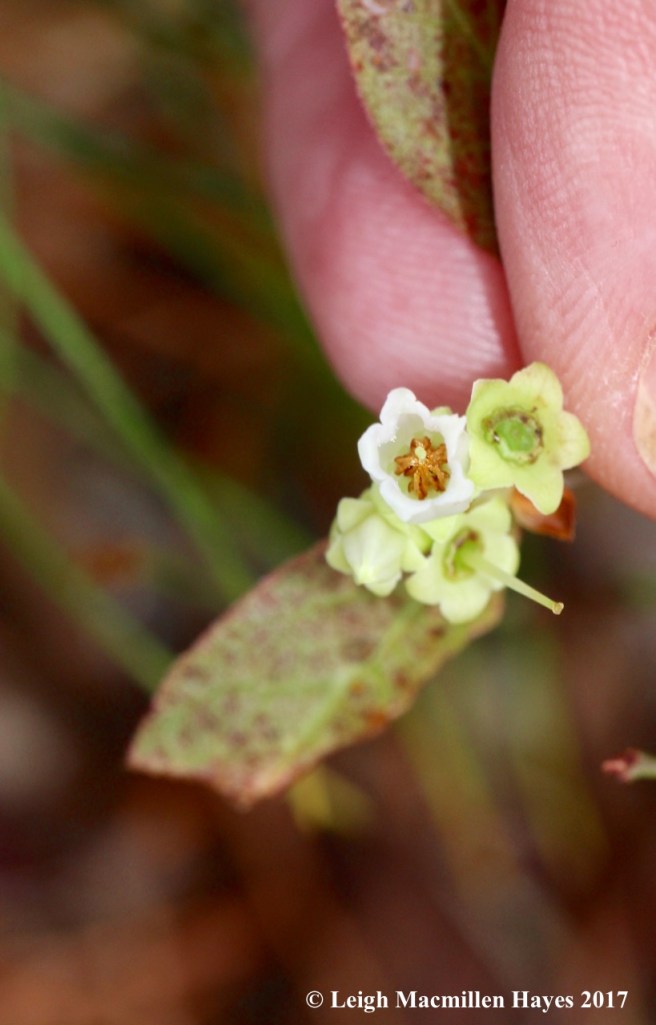
l29-blueberry

Another one of our surprises–still flowering blueberries. The plants themselves didn’t look too happy . . .

l13-blueberry flowers

and we wondered if there would be enough energy or time for the fruit to form.

l14-cinnabar-red polypore

As we ambled along, we found cinnabar-red polypores,

l18b-turkey tails1

turkey tails,

ll18a-gilled polypore

and polypores know for their . . .

l18-labyrinth of pores

underside labyrinth of pores that look like gills.

l20a-brown spores 1

And we found another type that had spread brown spores.

l19a-mystery hole

Making our way down to the brook, we were stumped by a pile of dirt, small hole about one-half inch across and chewed mushroom. We remain stumped, so if you have a clue, we’ll listen. It was a messy dooryard so we didn’t suspect a chipmunk, plus the hole wasn’t wide enough. Voles eat vegetation. Could it be? Was it even made by a mammal?

l22-white oak

Along the same route, we made another fun find. White oak saplings.

l23--white oak 2

White oak grows in surrounding towns–Fryeburg, Sweden, Brownfield, Waterford, but not in Lovell or Stow, where this property was located. So, how did it arrive? Two theories–it was on a skidder trail, so could have come in on a machine; or perhaps via airmail from a bird. Long ago, white oaks grew in this area, but were used for barrel making. And because their acorns contain less tannin than that of a Northern red oak, mammals devour them quickly, thus making it more difficult for the trees to regenerate.

l23-LMB 2

It took us a while, but finally we reached the old beaver dam and culvert by the brook, where the fall foliage was subtle at best, but still beautiful. We walked (if you can call it that) for 2.5 hours and covered all of .95 miles. It was hot and muggy, so we felt like we’d covered 9.5 miles, but as always were thankful for our time spent lingering at Long Meadow Brook.


Outing on the Outlet

This morning dawned clear and chilly, with the temperature at 50˚ when I headed toward Lovell at 7:15. After placing some “Land Trust Walk Today” signs in pre-planned positions, I headed to the dam on Harbor Road in Fryeburg to wait for a ride.

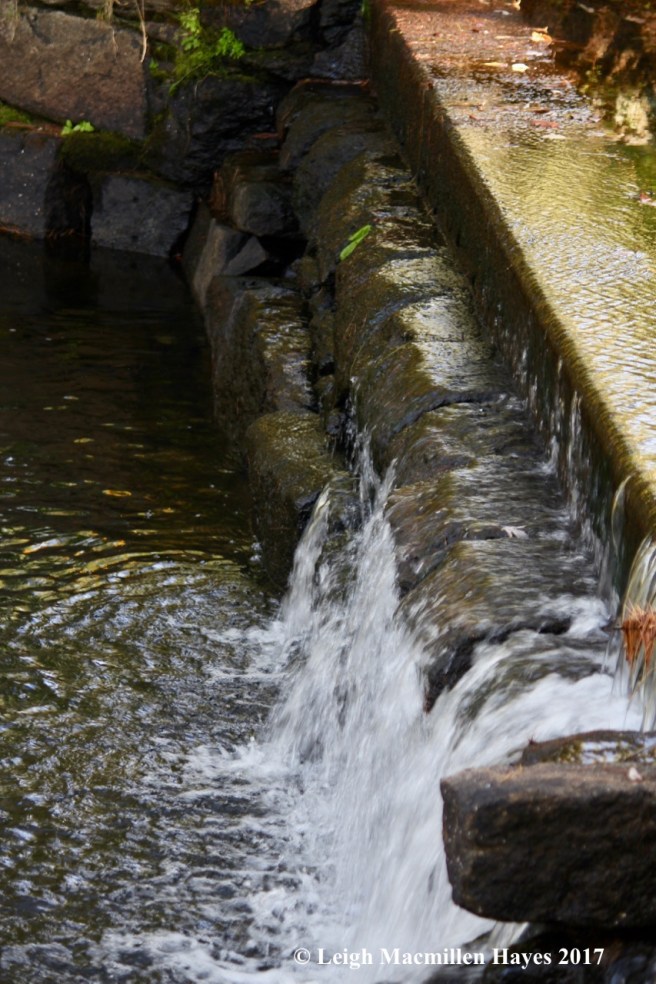
u1-outlet dam

Water flowed over the tiered dam, which was built in the early to mid 1900s at the request of the Pepperell Manufacturing Company in Biddeford. The townspeople contested its existence for it would raise the water level on Kezar Lake, but the textile mill located many miles away on the Saco River won the rights to construct such at the site of an 1800s saw & gristmill. Thankfully, though it did raise the level of the lake water, not all of the predicted problems came to pass.

u2-Harbor Road bridge

The dam was our intended take-out for today’s paddle co-sponsored by the Greater Lovell Land Trust and Upper Saco Valley Land Trust. Though it’s located off Harbor Road in Fryeburg, it’s owned by the Town of Lovell. No longer used, it still serves to provide a historic reference. And a great place to either portage and continue on to the Old Course of the Saco River and then the “new” course, or take out as we intended to do.

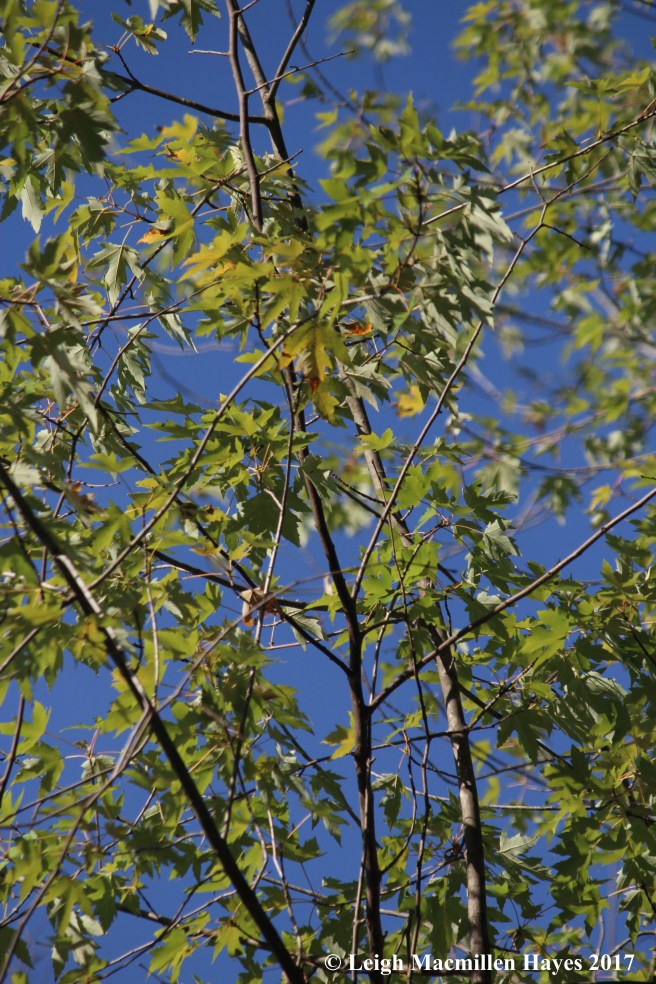
u5-silver maple

While I waited, I poked around, and rejoiced in the sight of trees that like wet feet. High above the dam, the leaves of a silver maple shown brilliantly in the morning light.

u3-green ash leaves

Other leaves also caught my attention for their coloration–with veins of red interrupting their olive greenness. Green ash, another tree that likes wet feet but isn’t as abundant as its siblings, white and black ash, also stood tall beside the dam.

u7-preparing to launch

My dam-side exploration ended a few minutes later when Jesse Wright of Upper Saco Valley Land Trust and her friend, Shareen, pulled into the landing. We hoisted my kayak onto her already laden truck and found our way over the bumpy road to our intended put-in at a private residence–thanks to the generosity of its owners. Slowly the number of boats increased by the water’s edge as twenty-plus folks joined us.

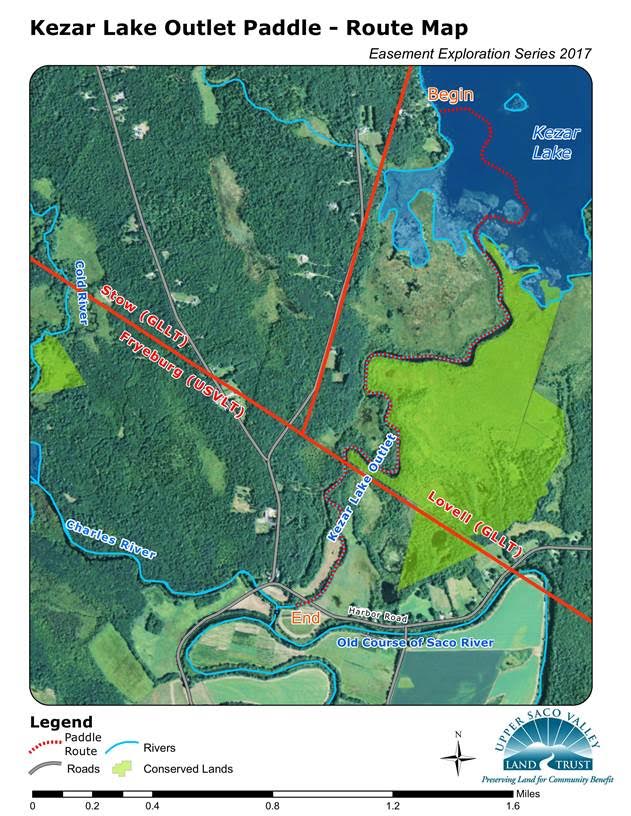
u6-map by Will from USVLT

Once all had gathered, Jesse showed off the map of our intended paddle, the red dots indicating our path from beginning to end, and I shared a bit of information about the fen, a GLLT property purchased in 2005. Today, the symbolic boundary between the two land trusts disappeared as we ventured off together.

u9d-Linda 1

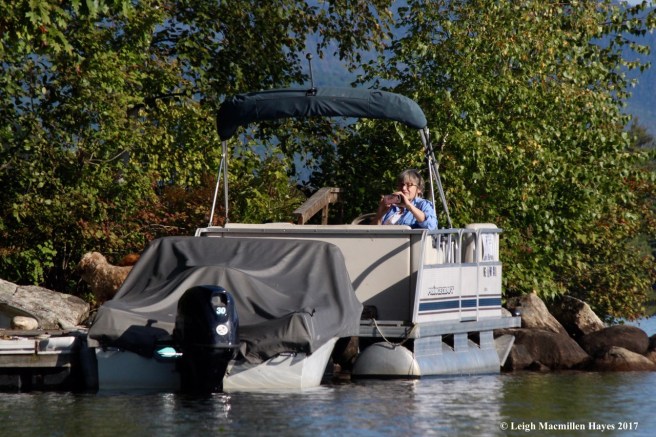
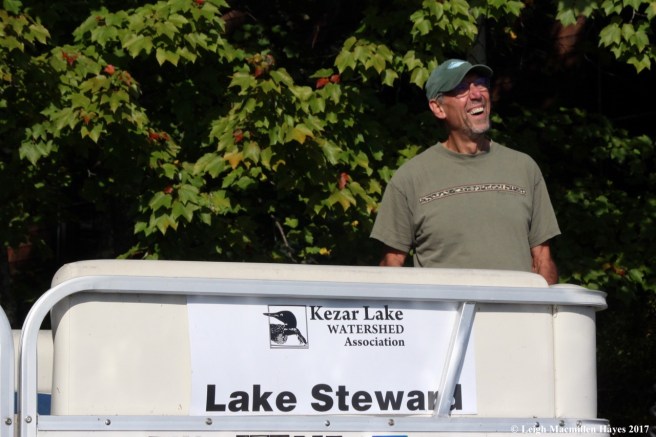
It takes good neighbors and lake stewards to pull off such an event, and the Wurms are such. They helped us arrange the put-in, gathered a couple of canoes for several paddlers and took photos at the start.

u9a-LInda's view 1

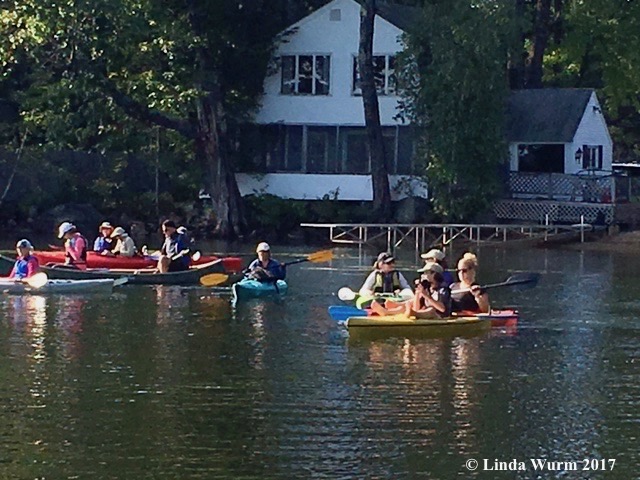
Linda’s view included Jesse heading off as our lead,

u9c-Linda's view 3

and the rainbow of colors once we hit the water.

u8-on the water with Jesse and gang

It took us a wee bit of time to get all the boats onto the lake, but it wasn’t a day made for rushing. And once in the sun, we began to warm up.

u10-send off by Linda

Before we headed off, we gave thanks to Linda (and Remy).

u11-and Heinrich

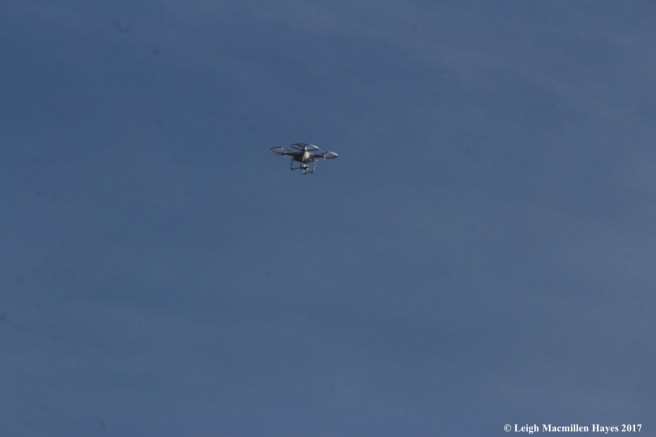
We also thanked Heinrich, who drew our attention skyward . . .

u12-drone

as he flew a drone above us.

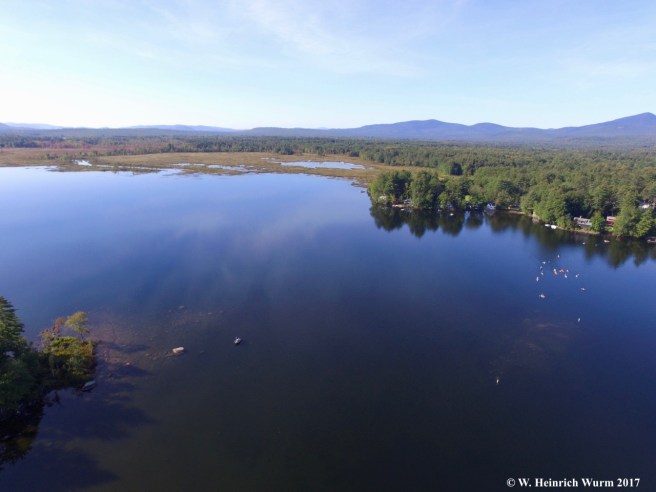
DCIM100MEDIADJI_0056.JPG

Our first destination was to paddle north for the view.

DCIM100MEDIADJI_0061.JPG

The drone spied the mountains before we did.

DCIM100MEDIADJI_0059.JPG

And spotted our intended course . . .

DCIM100MEDIADJI_0067.JPG

into the fen.

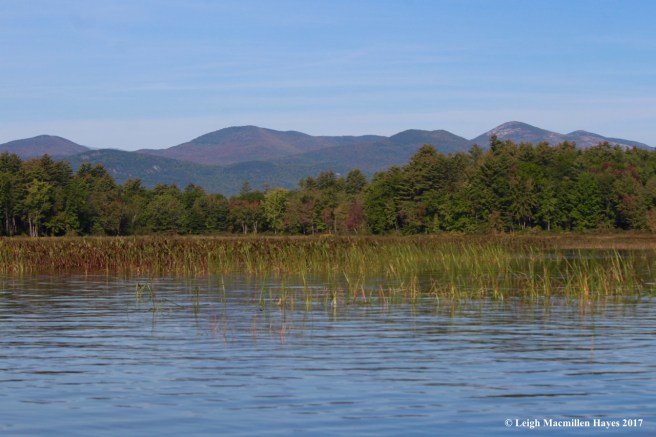
u18-veiws from the lake

A quick turn-around from the water gave us bearings as we noted the Baldfaces to the west.

u19-heading toward the fen

We circled an island that serves as an environmental study plot for the US Forest Service and then paddled southward.

u20-Jesse in the lead

Jesse led the way through the pickerelweed.

u21-more mountain views

As we followed, the view got better and better.

u22-slowly we followed

Acting as sweep, I took up the rear while the group snaked along.

u25-early fall color

We followed the twists and turns of the water trail, where red maples showed off their autumn display from the canopy.

u28-red leaf

Occasional leaves fluttered down, begging to be noticed in their singularity.

u-cranberries 1

Though we didn’t get out of our boats and actually walk into the fen, we did stop to chat about what it had to offer. The GLLT owns 260 acres of the 500-acre fen, an acidic ecosystem with a deep layer of organic material including peat moss atop a sandy substrate. Several bird species of concern breed or hunt in the fen, including American bitterns and Sandhill cranes, the latter of which we had the good fortune to hear but not see. Long’s bullrush, a globally rare sedge, also grows here. But the crème de la crème for many are the cranberries. Folks on today’s paddle weren’t familiar with the plant and I couldn’t show them at the time, but I shared with them the experience of picking in the past with students from Molly Ockett Middle School in Fryeburg.

u-cranberries 2

On a fall day each year, about thirty students in the school’s MESA program (Maine Environmental Science Academy–an experiential place-based curriculum for 6-8 grades) visit the fen with the GLLT’s Executive Director, Tom Henderson.

u-cranberries 3

They learn about the hydrology of this place, but one of their highlights is to pick cranberries, and to that end, they become very possessive. As one student approaches another, a common statement is shared: “Don’t come over here. There aren’t any cranberries here.”

u-cranberries 4

Over the course of several hours, they fill their bags and sometimes even show off their creative talents in other ways–all in celebration of the cranberries.

u30-weir1

Continuing along the river this morning, we noted beaver activity and talked about scent mounds and their usefulness within the beaver community. And then we reached the fish screen.  Jesse had paddled the course last Sunday and made it under the screen without any issues.

u31-clearing a beaver dam

Since then, the beavers had been busy damming it up. One of our members worked to adjust some of the branches so we could all get through.

u34-offering a shove

Of course, sometimes a helping paddle was needed to push a boat forward.

u33-cow 2

While we took turns, our efforts didn’t go unnoticed.

u35-other side measurement

On the other side, a ruler indicated depth.

u36-approaching the bridge on Harbor Road

And then, and then, in what seemed like only minutes but was actually a couple of hours filled with camaraderie between familiar friends and new, plus a touch of natural history thrown into the discussion, we found ourselves at the bridge and the end of the journey for some. Others chose to paddle back rather than hitch a ride. We had come full circle.

As we pulled boats out, we were surprised at how warm it was since we were out of the shade, the temp having reached into the 80˚s.

Our outing on the Kezar Lake Outlet would not have been doable without Jesse Wright, who did the yeoman’s work of pulling it together, William Abbott, USVLT’s executive director who created the map, the Wurms and their neighbors who contributed land, boats, photographs and time, and all who ventured with us on this most lovely first full day of autumn.  Thank you all.


Bee Kind

Because I have the good fortune to be involved with the Greater Lovell Land Trust, I spend my summers attending talks and walks on a variety of topics. Prior to this week, we learned about lichens, bryophytes, pileated woodpeckers, fungi, flowers, ferns, medicinal plants, peat bogs, wild turkeys, and land conservation. And then last night our focus turned to pollinators and the pollinated.

Guy Pilla, a beekeeper from Fryeburg, Maine, gave an informational talk on the art of beekeeping, followed by a question and answer period, and the crème de la crème –honey tasting. How often have you had a chance to taste Tupelo honey?

w-Guy 1 (1)

This morning we met up with Guy again, as he took us to a hive he has set up on private property under conservation easement with the land trust. Twenty-six of us gathered around to listen, watch, and wonder.

w-showing the frames

In his alien costume, Guy passed around frames, giving us an opportunity to look at a range of cells as he explained about spacing for honey expansion, storage and more. We learned about the good and the bad of beekeeping, but mostly the good.

w-Gary looking at frame

As frames were passed around, we noted variations and the fact that some were lightweight and others heavy.

w-hive--bear precautions

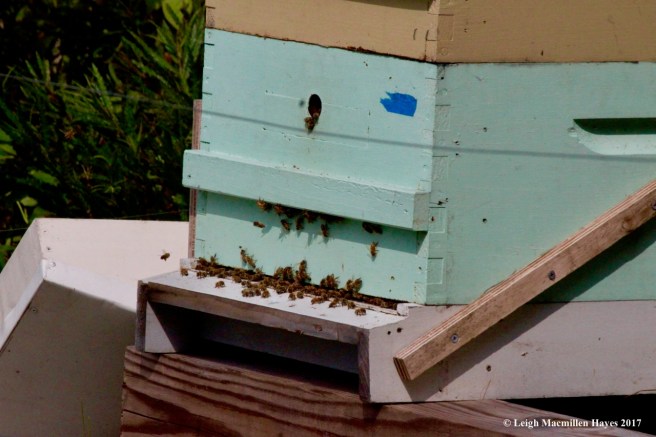
At last it was time for Guy to open the hive. Notice the electric fence surrounding it? And the fact that it’s strapped down. Bear defense. And we know there’s at least one in the area.

w-dressing like a beekeeper

And then he walked through the crowd and chose Mary to be his assistant. She donned a hat and veil to protect her face and neck, and took on the look.

w-testing the smoker

Into the bee yard, she followed Guy. If you look closely, you’ll see two platforms on the ground and might notice that the one directly below the hive has nails sticking up (the other is turned upside down because Guy only has one hive at this location this year). Those are to deter skunks, another predator. As Mary watched from behind and the rest of us watched from a few feet away beyond the fence (and out of the bee line), Guy ignited the smoker he’d filled with pine needles.

w-smoke coming out of smoker1

It took a few minutes, but finally, smoke puffed out.

w-Mary practices the smoker

He then passed it to Mary, and her task was to press the bellows and create smoke. The smoker is an important line of defense.

w-preparing to open the hive

As we continued to watch, Guy took the straps off and explained the construction of the hive with one super stacked atop another in a vertical fashion. Though he ordered his equipment, he refashioned some of it including the roof, designed to let wet weather flow off rather than gather in puddles on the top of the structure.

w-Mary uses the smoker

As Guy wedged a hive tool into the bee glue (a resin-like propolis), Mary got ready to use the smoker. Smoke fools the honeybees into thinking a wildfire is nearby, thus prompting them to eat more honey in case they need to move to a new location.

w-showing off his bees

And with honey in their bellies, they become more docile. Note that Guy isn’t wearing any gloves. Usually he does, but Mary wore his gloves this morning and he trusted all would go well and the bees would remain calm. He was certainly calm, but spoke of his early days in the beekeeping business and how sometimes he would jump. Bees sense fear behavior exhibited by heavy breathing and that’s when stings occur. Having been stung recently after some youngsters received stings, I thought I was remaining calm, but apparently my breath spoke for me.

w-hive levels

We learned so much from Guy last night and today–about their various jobs as male drones, queens, and female workers who really do so much of the work. The workers clean out old material from inside the cells, attend to the queen, carry dead bees or larvae outside the hive, guard the hive’s entrance, fan at the entrance during the hot weather to keep the inside temperature down and to circulate fresh air throughout the hive, receive nectar and pollen,  store it away in cells, nurse newly laid egg, and seal cells around larvae at the appropriate moment. After doing all of this for about three weeks, they’ll earn the rights to collect nectar and pollen for about six. And then . . . they’ll die of exhaustion. Indeed.

w-wandering among the flowers

After our time at the hive, one of the land owners, Linda, took us on a mini-tour of the 100-hundred-acre property. Her goal was to take us to a flower meadow she and her husband have created. Originally, it was a garden with raised beds, but Linda has been collecting wildflower seeds from roadsides in Maine and New Hampshire and sowing them in the meadow.

w-learning from Linda

Today we were wowed by the results.

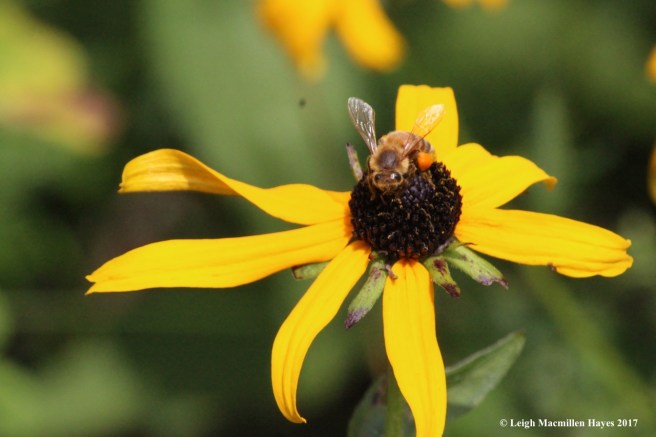
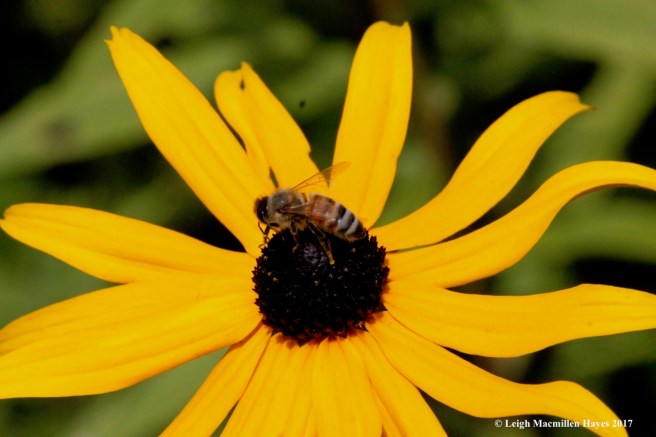
w-honey bee 1

And so were Guy’s honeybees.

w-honeybee on the move

They were on the move everywhere we looked.

w-bee using probiscus for honey

We watched as they sucked nectar with their proboscis mouth part.

w-bumblebee on Joe Pye Weed

Bumblebees also took advantage of the sweet offerings.

w-bumble with loaded pollen baskets

And filled their pollen baskets with the goods.

w-frittilary 1

Not to be left out, a fritillary was among those seeking reward.

w-male meadowhawk

And because we were there, we saw meadowhawk dragonflies on the prowl, he being red . . .

w-female meadowhawk

and she similar but brown.

w-Guy in the field (1)

Guy was tickled to see his bees at work and share his knowledge to all as we listened.

w-linda by her flower meadow

Linda was thrilled to see so many enjoying what she and her husband, Heinrich, had created.

w-Aa, gs 1

And speaking of Heinrich, just before we left he had one more insect to share.

w-Aa, garden 2

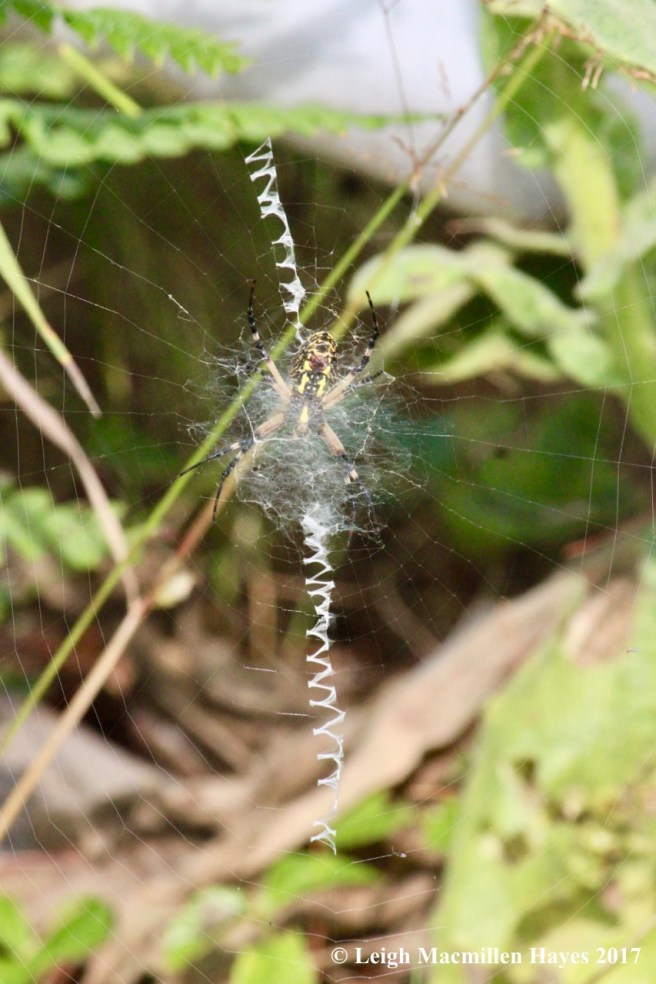
An orb spider known as a yellow and black garden spider or argiope aurantia had built its web near the greenhouse. I used to see these in our gardens frequently, but haven’t lately. Of course, I say that and tomorrow I’ll spy one.

w-Argiope aurantia, garden spider 4

In my brain, this is the smartest spider of them all for they create a web consisting of a series of concentric circles divided into sectors by lines that radiate out. And in the center–that amazing zigzag pattern, which is called a stabilimentum and perhaps intended to attract other insects. Or maybe its a message written in code and intended for a certain pig named Wilbur. This is Maine after all.

w-honey bee 2

We do know one message we learned in the last 24 hours: Bee kind–to one another for we’re all interconnected and we need each other to survive. And that includes letting the undesirables flourish in our yards, including the dandelions. Do so and watch them and just maybe you’ll realize they are desirable after all.

(Two final notes: Support your local beekeepers. Guy’s honey is available at Spice and Grain in Fryeburg; but really, you should buy honey from your area. And if you are interested in learning more about beekeeping, look for your local chapter of the Maine State Beekeepers Association.


Ain’t Lovell A Great Place To Be?

On my way to meet a few docents and the new interns for the Greater Lovell Land Trust this morning, a photo opp presented itself and I was forced to stop.

h-stan's sign

Stan Tupaj of Kezar Realty strikes me as the town cheerleader and I love to read his sign as I pass by. From time to time I’ve meant to photograph it, but somehow always seem to be in a rush to get to the next destination. But this morning I was a wee bit early and so this was the day.

h-heald sign

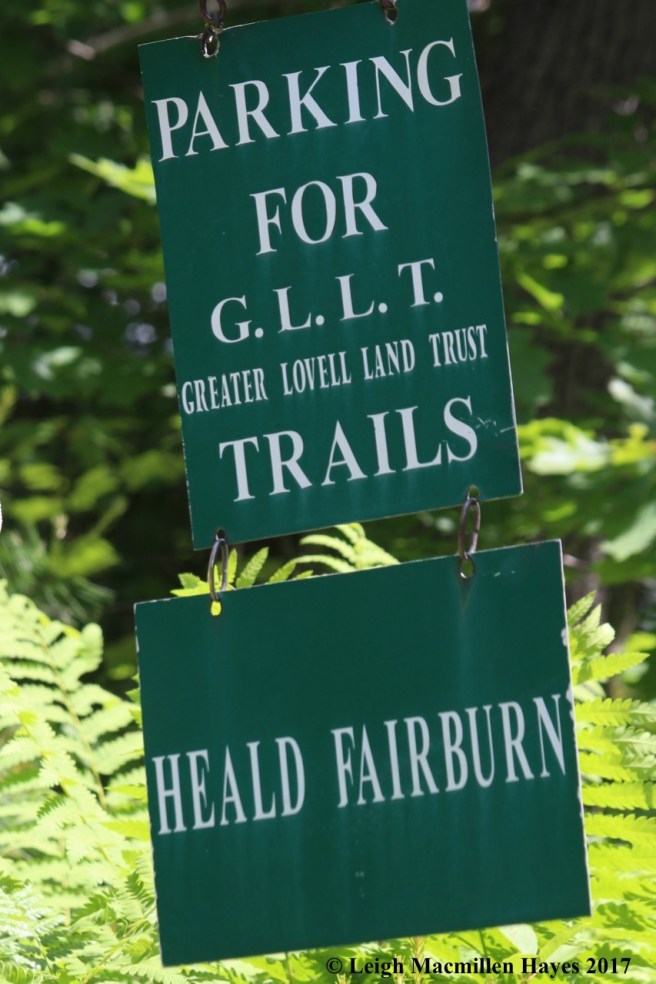
From there, I drove on to the Fairburn parking lot on Slab City Road where I planned to meet the crew.

h-green frog

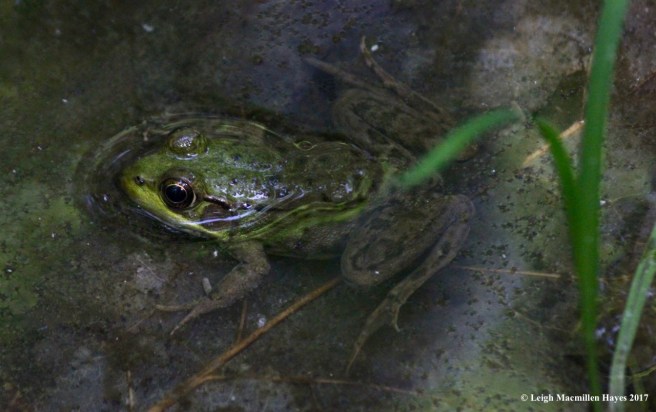
Our goal was to walk to Otter Rock, not a far walk by any means, but it took us 1.5 hours to get there, such were the sights along the way, including a few green frogs in puddles along the trail. I know he’s a green frog and not a bull frog because he showed off a dorsal lateral fold along the sides of his back.

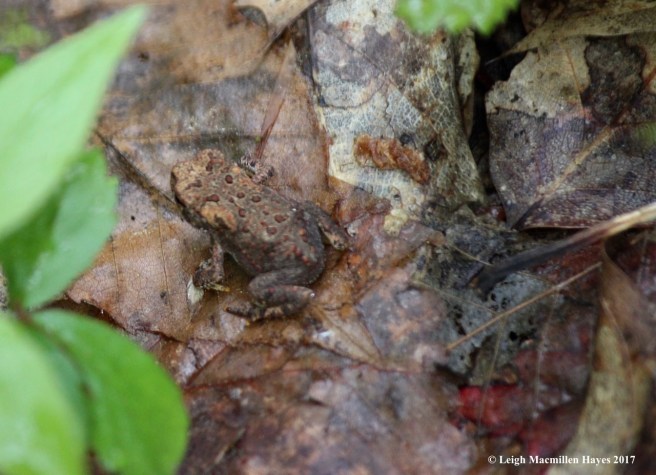
h-baby toad

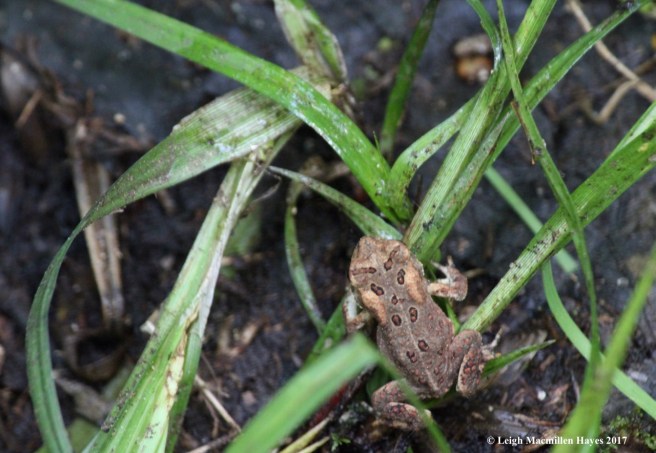
While the green frogs were beside or in the water, the ground seemed to hop at our feet in dry places thanks to a kazillion baby American toads on the move.

h-Ellie and the baby toad

I noted that it seems the younger toads are in constant motion, while older and much chunkier ones pause and try to blend into their surroundings, allowing us to study them (and take photos–just saying). One of the younger members of our team, Ellie, proved me wrong as she charmed a young toad to stay still while she looked at it through her hand lens for several moments. It wasn’t until Ellie moved that the toad hopped away.

h-damselfly with eggs

While Ellie was the toad whisperer, her older brother Caleb wowed us with his ability to capture dragonflies and damselflies in a net, such as this one. As he held it high, he realized it was a she for there were eggs on her abdomen and so he gently released her–in hopes she’d find some vegetation on which to inject those tiny sacs.

h-keeping mosquitoes at bay

Their youngest brother, Wes, demonstrated the value of bracken ferns–which served as a fun hat to keep the mosquitoes at bay.

h1-Aidan

And it wasn’t until later that I realized I didn’t have a photo of Ellie’s other brother, Aidan, but I knew of one from a prior insect walk that showed his own curiosity.

h-grape fern

We looked at tons of plants as well and were all especially eager to re-greet the grape ferns that we knew grew there.

h-exoskeletons 2

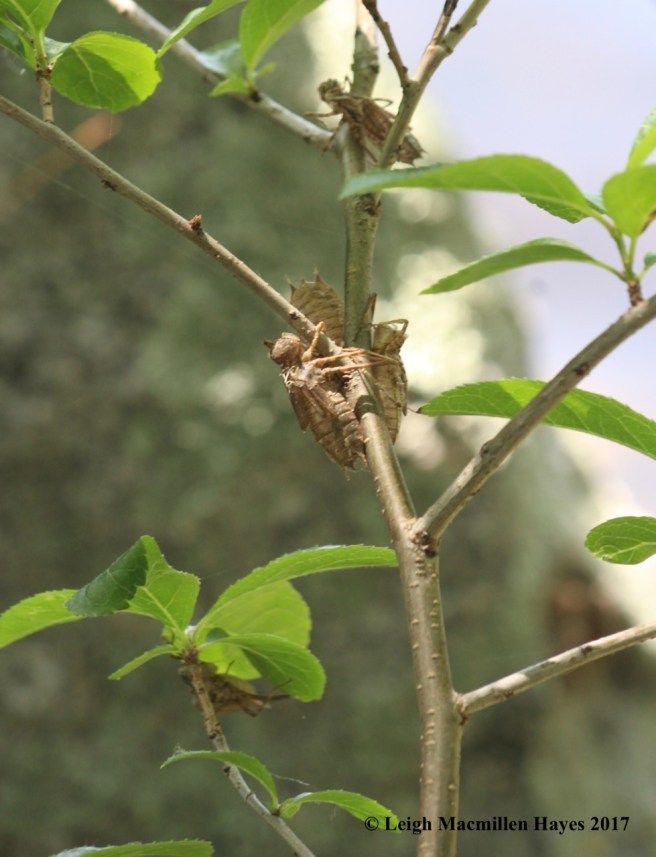
At last we reached our destination, Otter Rock on Heald Pond, where we found what we had hoped for: exoskeletons decorated the landscape.

h-exoskeltons on shrub

Dragonflies lay egg clusters into sediments or tap small clumps directly onto the water’s surface. Each egg hatches into a small nymph, which grows until its ready to emerge as a flying adult. At that time, the nymph crawls to the surface, and ever so slowly, the adult pulls itself free of the exoskeleton. It’s the most amazing process to watch. But even if you don’t have that opportunity, just seeing the left over nymphal shells and knowing that the magic happened is worth a wonder.

h-exoskeletons on ground

We had to watch where we stepped, for the exoskeletons not only decorated the shrubs, but also the ground . . .

h-exoskeleton on tree

and even the trees.

h-widow skimmer

And then we began to notice newly emerged dragonflies like the widow maker on Otter Rock,

h-black-shouldered spinyleg

and black-shouldered spinyleg on the ground. We were afraid to step for everywhere our eyes focused, there was either an exoskeleton or a dragonfly drying its wings in preparation for a first flight.

h-chalk 5

As we looked about, Caleb spotted one struggling in the water, so he pulled it out.

h-chalk 4

Coated in a bit of pollen from the pond, it still clung to its exoskeleton.

h-chalk-fronted corporal 1

We watched for a few moments as it moved about, those wings slowly drying. I think my ID is right and this was a chalk-fronted corporal. At last it was time for us to draw our sense of wonder to a close and make our journey out.

h-meet the interns

But first, I asked our interns to pose–meet Hannah, Kelly and Dakota. Today was their first day of work and we probably overwhelmed the two guys a bit. Hannah was with us last year, so she knows our ways–that we walk slowly and look at everything. She gets it and we love that. We’re excited about the possibilities ahead. Join us for a GLLT walk or come to an evening talk and you’ll get to meet them.

h-heading out

Our walk out was much quicker, though we still stopped occasionally.

h-stan's sign

In the end, I have no doubt that we knew the answer to Stan’s question: Lovell IS a great place to be.


At a Snail’s Pace

The mosquitoes were thick. The ground damp. But the rain held off and so four docents and I met at the Greater Lovell Land Trust‘s Flat Hill parking lot at the end of Heald Pond Road.

p-beaked hazelnuts forming

From the getgo, our fun began as we spotted numerous beaked hazelnuts forming–the trick is to pay attention to them and watch their continued growth, for in a flash, or so it seems, they’ll mature and . . . disappear. The nuts those hairy beaks cover are favorites for wildlife and we human folk also like them.

p-red trillium

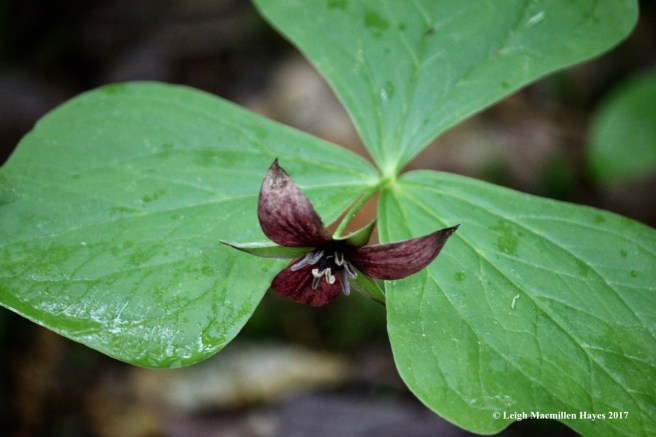
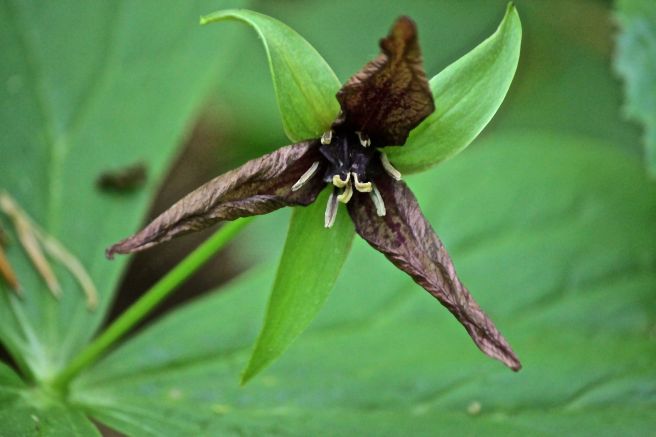
Our mission was to get reacquainted with the spring flowers–some being obvious to us like the red trillium, though the fact that it was still in bloom offered a delightful surprise. We chatted about the fact that its also known as Stinking Benjamin for its undelightful odor, but try as we might and we did again today, none of us have ever been offended by it. Apparently, they smell like rotting meat, but you can’t prove it by us.

p-fringed polygala

Here and there we were awed by the delicate fringed polygala, aka gaywings. They did remind us of birds with crazy head dresses taking off in flight.

p-false solomon seal

As we shared brains and practiced relearning species before the next season gives us even more, we felt proud to quickly ID a false solomon seal, aka wild spikenard, before it had fully flowered. It’s the cluster of flowers on the end branch, the arching, zigzag stem and long oblong leaves that stand out in our minds.

p-Rose Twisted Stalk or Rosybells

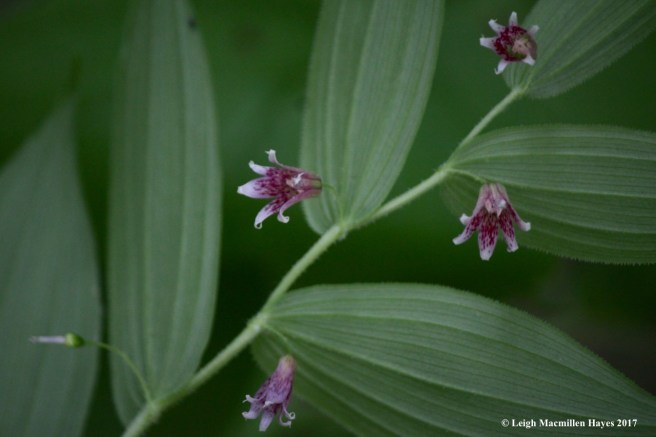
A seal of another sort, the rose twisted stalk, aka rosybells, also adorned the trail. Pam held the stalk up so we could look at the bell-shaped flowers that dangled below.  Notice how the leaves are green below and stalkless but don’t necessarily clasp the stem–as opposed to twisted stalk (white mandarin), which features greenish flowers dangling below and stalkless leaves that do clasp the stem. Plus the latter’s leaves have a white bloom on the underside. We didn’t see any twisted stalk, but were tickled with our rosybell finds.

p-raindrops all in a row

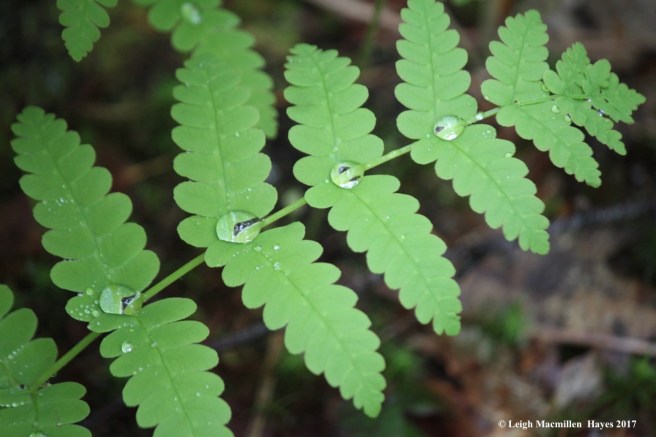
Periodically, we stopped to examine ferns, or quiz each other on the ID. But sometimes, it was just fun to notice presentations, including raindrops all in a row.

p-beech fern

And though a couple of our fern experts couldn’t be with us, Joan was and she loves nothing more than squatting beside them with the Fern Finder to determine a species, including the long beech fern.

p-clitonia 2

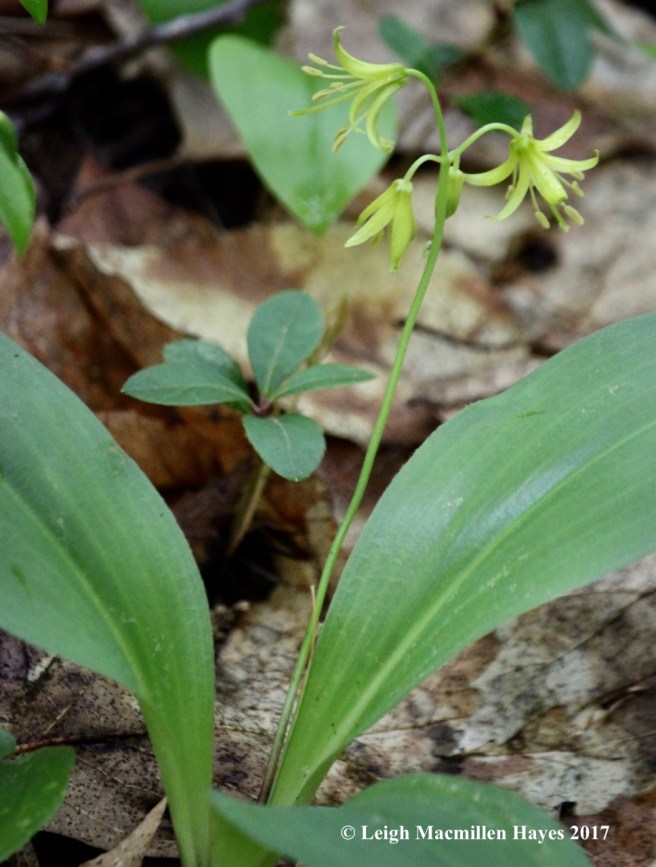
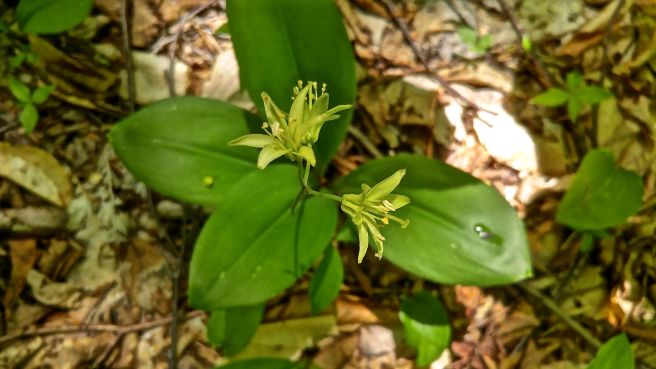
It was while looking at bracken ferns that Mary and Nancy spotted the greenish yellow flowers of clintonia. We were excited because we’d seen plenty of plants, but these were the first in flower, and they were well hidden.

p-clintonia flowers

Yellow clintonia is also called bluebead for the fruit that develops is a porcelain blue bead-like berry. Check out those pistils (she’s a pistil) dangling below the stamen, their anthers coated in pollen. Bring on the bees and the beads.

p-baby toad

Suddenly, we discovered movement at our feet and saw our first baby toad of the season. It’s diminutive size and obvious camouflage made it difficult to see, but unlike the adult members of its family who will freeze in position, thus allowing us to study them further, this little one wanted to escape as quickly as possible. Smart move on its part.

p-bench view

Only about two hours later we’d covered maybe a half mile and found our way to the bench that overlooks the swampy area surrounding the brook between the beaver pond and Bradley Pond.

p-red maple leaves

We sat below a red maple and listened to a chorus of birds–and gave thanks for the food supply. Let them eat bugs. We offered up a few mosquitoes.

p-red-winged blackbird

A red-winged blackbird flirted with us, showing off its bright red shoulder and yellow wing bar as it flew from shrub to shrub. The five of us swooned.

p-Indian Cucumber pre-flower

All along the path, we’d spotted Indian Cucumber Roots with their buds formed atop the second layer of their double-decker formation. When we finally stepped from the bench back to the trail, we noted a couple of the buds were beginning to dangle below the second story, meaning the blossoming season would soon be upon us.

p-Indian Cucumber flower 2

And just like that . . .

p-Indian Cucumber flowering

Voilà. I’m of the belief that if this flower doesn’t make you wonder, nothing will.

p-beaver pond view

Our next stop was at the bridges that cross below the beaver pond. We’d been looking for fresh beaver works all the while, but only discovered the work that had been completed over a year ago.

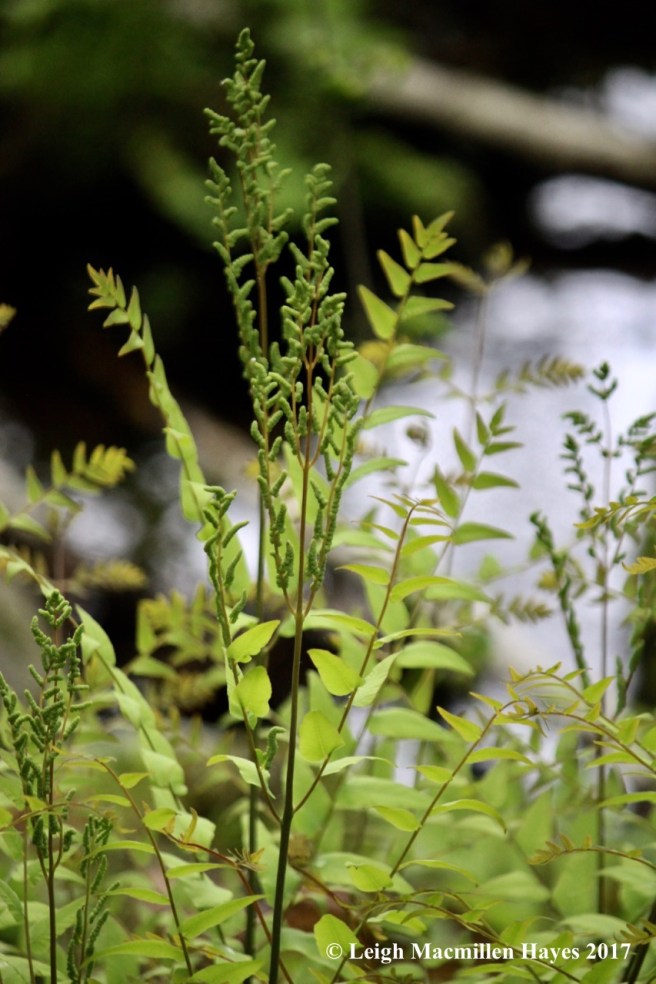
p-royal fern crown

There was still plenty to see, including the fertile crowns atop royal ferns,

p-jack-in-the-pulpit 2

a small jack-in-the-pulpit,

p-mayfly hitchhiker

and a mayfly that chose Pam’s jacket to rest upon.

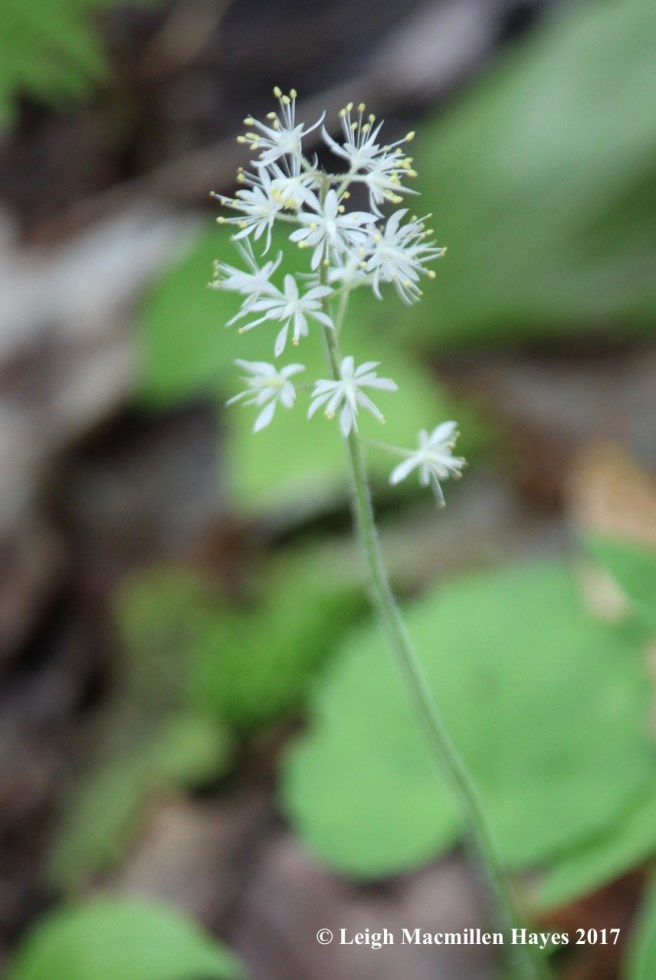
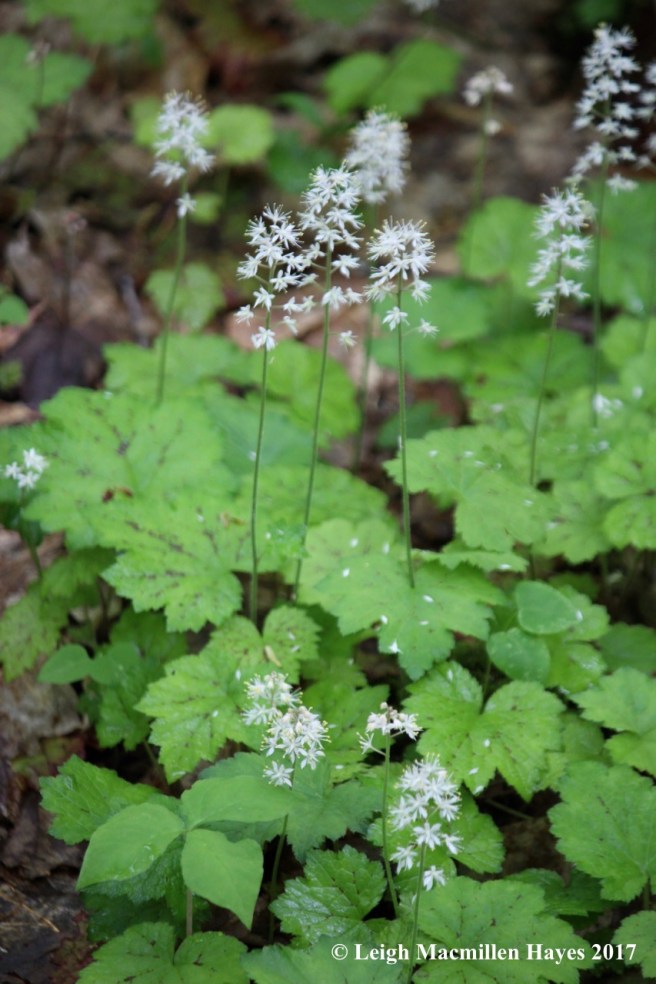
p-foamflower 1

One of our many finds included foam-flower, with its cluster of star-shaped white flowers and conspicuous stamens. According to Mary Holland in her book, Naturally Curious Day by Day, “Its genus name, Tiarella, is the Greek word “tiara,” a word for a turban worn by ancient Persians which bears some resemblance to the shape of this flower’s pistil.”

p-foamflower carpet

Tiara or not, we were quite taken with a carpet of it.

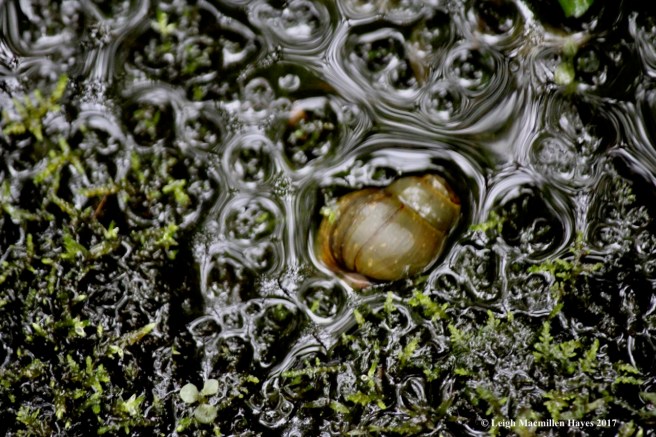
p-snail

Those were only a few of the findings we saw as we moved at a snail’s pace during our three hour tour along Perky’s Path. Each time we visit, we say, “This is my favorite property.” That is . . . until we visit another one of the GLLT properties.

Morning Glory at Kezar River Reserve

Some mornings the hallelujahs spring forth from my being–and fortunately not from my vocal cords.

k-Kezar River sign

Today was one of those days as I ventured down the snowmobile trail, aka Parnes Landing Road, at the Greater Lovell Land Trust’s Kezar River Reserve. Just past the kiosk, I veered to the left to follow the GLLT’s trail into the woods.

k-jelly topside1

Within steps I was greeted by Auricularia auriula, a jelly ear fungus. The sun’s beams revealed veins reminiscent of stained glass windows and polished woodwork in an older church.

k-jelly under 2

Flipping the fallen oak branch to look at the underside revealed an equally, if not more beautiful design with its frosted outline.

k-wintergreen

On a steep hill beside Kezar River, actually the sloped side of a ravine I’d never hiked upon before, a southerly orientation presented lives past and present.

k-bench

Below, at the point where the trail, road and river meet, few have paused recently, including no sign of otter.

k-river view

But many have zoomed by with a need to reach the next destination as fast as possible.

k-ravine 1

I followed their tracks a little way out and peeked into the second ravine from a vantage point seldom celebrated.

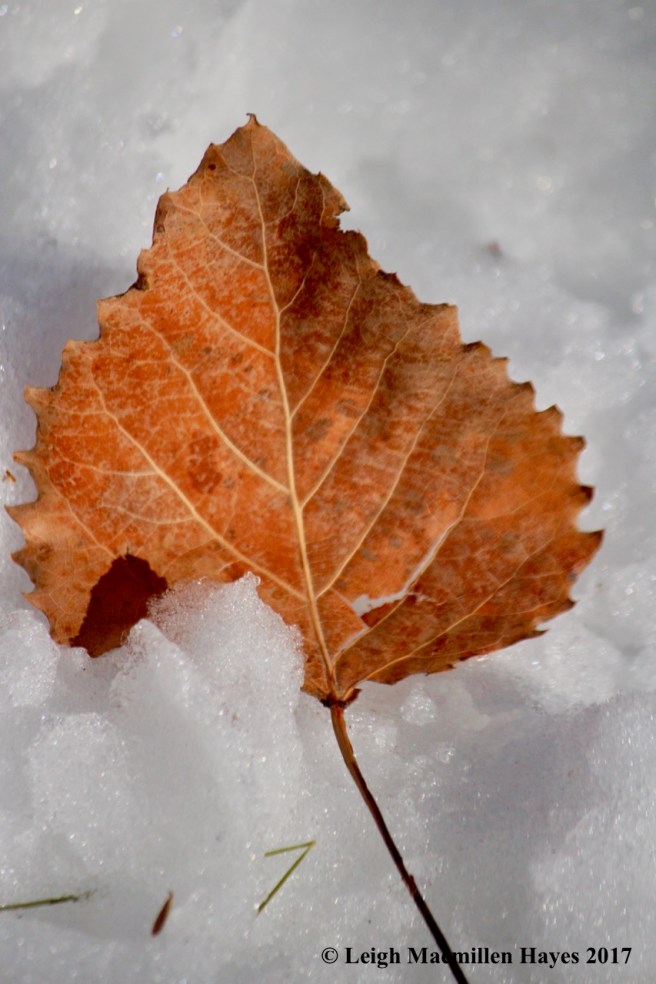
k-big tooth aspen leaf

And then I headed back up the road to the next trail intersection. At my feet, form bespoke name, such is the manner of the big tooth aspen.

k-ravine 2

Down into the second ravine I tromped as I made my way to view the outlet from the other side.

k-otter 1

Because of the snow’s depth, I traveled to places less frequented and beside the stream I noted previous action. Lots of it.

k-otter activity1

And I spied evidence of the creator–whose prints were hard to distinguish, but other signs easily discernible.

k-my otterness

In my attempt to take a closer look, I practiced my inner otter and managed to find the water and leave my own set of muddy, though not quite webbed, prints. I laughed aloud as I pulled myself up and gave thanks for remembering to bring my hiking pole. Fortunately, the breakthrough was the only sign I left behind.

k-nature's snowball

Heading up the ravine, I smiled at the sight of the universe having fun–nature rolled her own snowballs–perhaps in preparation to build a snow woman.

k-pine cathedral

Through the cathedral of pines I continued–always looking up . . .

k-ice art

and down, where intricate patterns formed naturally in the ice offered a feathery look at the world below.

k-paper birch lateral bud

Sometimes, I stopped to spend a few moments with family members . . .

k-yellow birch

taking time to marvel in their similarities and differences as they stood side by side.

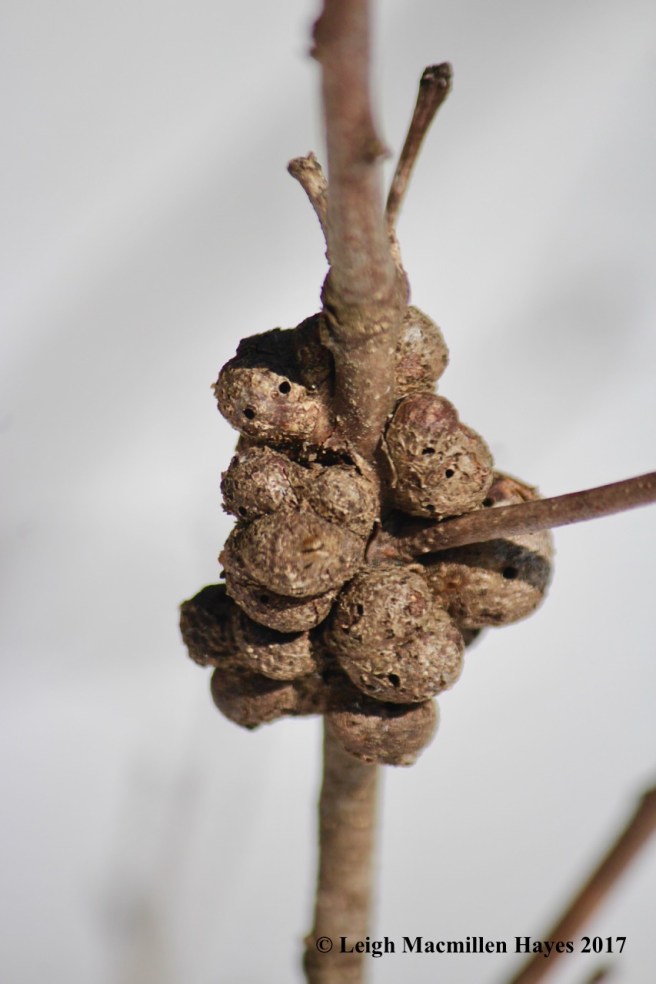
k-oak gall

And it seems there are many hosts throughout our woodlands that offer a spot for others to evolve.

k-oak crown

Despite or perhaps because of that, knowing they’d offered a helping hand, the oaks sported their crowns proudly.

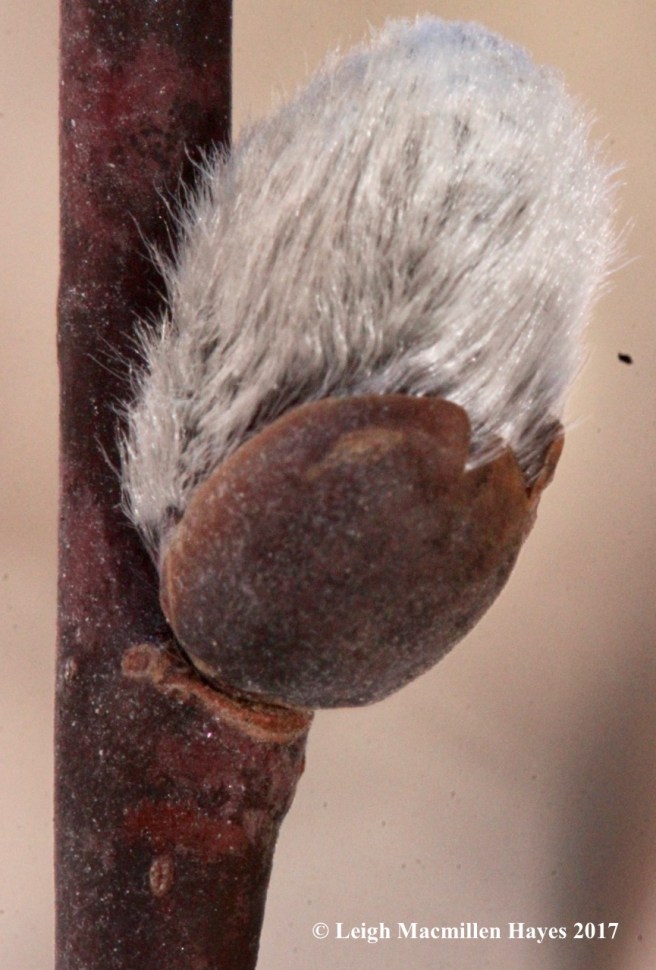
k-pussy willow

Quite unexpectedly, I stumbled upon a picture of youth that warms my heart endlessly.

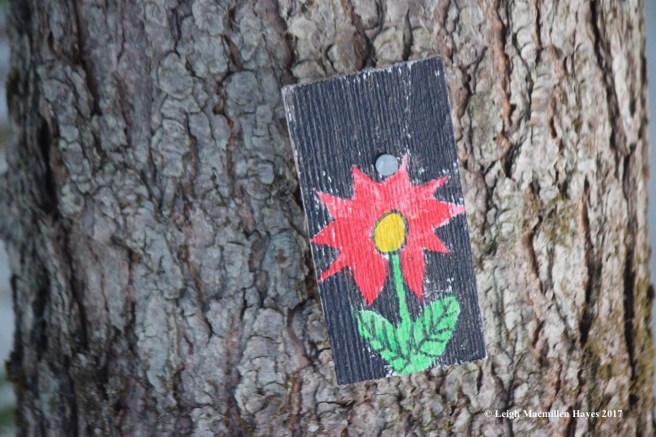
k-flowers in bloom

My journey wasn’t long, such is the trail. It’s decorated with small bright signs painted by local youngsters. Though I wouldn’t want to see these on every trail, they make me smile as I enjoy their colorful renditions of the natural world.

Not a picture of a morning glory, certainly, but a morning full of glory as I wandered and wondered and sang hallelujah along the trail at Kezar River Reserve.


Lake Living–spring 2017

I always get excited when an issue of lake living is published. This spring issue contains great articles including three by moi (so of course they are great!)–groundcover (a quiet garden oasis in Bridgton) , Into the Box  (Lovell Box Company) and The Art of Collaboration (where glass meets wood at Studio 448 in Norway). Click on the link and enjoy!  lake living (1)
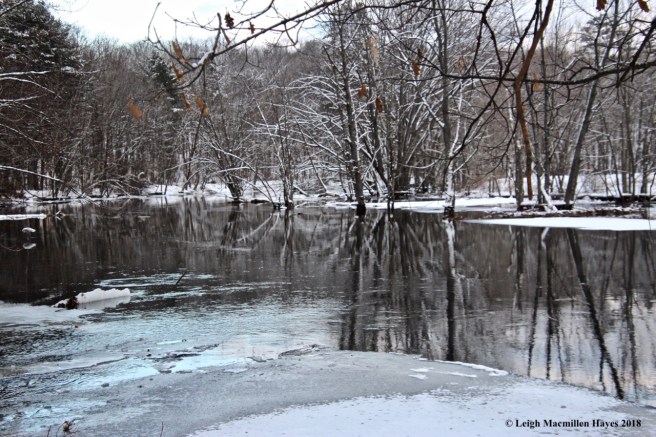
Spring In Our Steps Mondate

Our usual celebration of the vernal equinox begins with a hike up Bald Pate Mountain with Loon Echo Land Trust, but either we missed it or we slept through it this morning even though we awoke before sunrise. Given that, we chose a different summit on which to welcome this new season.

a-kiosk

Our great debate, be it all one-sided, centered around which trail to follow in order to reach the top of the Greater Lovell Land Trust‘s Amos Mountain. Knowing that the route from the Flat Hill parking lot would be mostly via the snowmobile trail, we (or I) decided on the Gallie Trail located off Route 5.

a-breaking trail

From the start the snow was a bit crusty and hadn’t been traversed since the last storm, though a few critters had crossed it. We plodded along at breakneck speed, my guy trudging first while I followed and packed those spots between his prints.

a-beech scale 1

The hike begins with a gradual rise, but still I welcomed opportunities to take a rest, so quickly were we moving. It was the white target on beech bark that slowed me down. I knew what I was looking at but hadn’t seen it in this formation previously. In several spots on this tree, the beech scale insect presented itself in bull’s eye formation as it filled in small crevices on the bark.

a-beech scale 3

All winter the insects, in their nymph stage, have been blanketed with a wooly wax. Now that it’s spring, I need to keep an eye on this tree for the nymphs will emerge as short-lived second instars that will soon molt to become adult females. Will I see it happen? Will I know what stage I’m looking at? Stay tuned.

a-picnic table

My guy tolerated my curiosity and then we moved on, bypassing the old foundations where I suspect everyone was undercover. Certainly, the picnic table at the base of the Amos Andrews Trail had kept warm all winter.

a-Amos Mtn sign

A picture of the man for whom the mountain was named hangs from a tree by the table.

a-rock walls

And along the way, terraced stonewalls on the east side speak to his occupation.

a-rock tripe

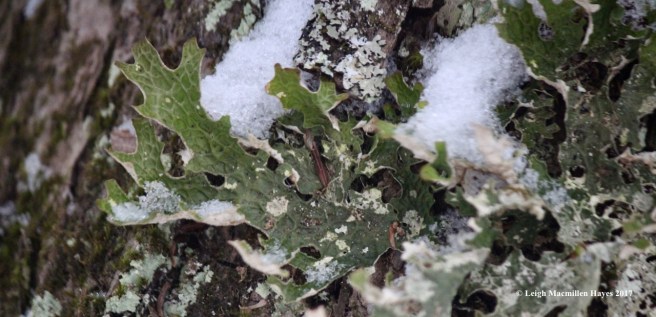
It was a boulder on the west side of the trail, though, that made me stop again. This time I really needed a break. The temperature had risen and black snow pants were absorbing the heat. Gloves–off. Hat–off. Sweater and turtleneck sleeves–pushed up. What caught my eye was the rock tripe that showed off its dry and wet forms. Lichens come in a variety of colors, but once wet, they turn green as the algal component kicks into action. Snow topped the boulder and its melting pathway was obvious.

a-approaching summit

I wasn’t the only one who was shedding clothing as we neared the summit.

a-sweet fern

Just before we got there, I spied some dried sweet fern leaves poking out of the snow. Sweet fern is a woody plant, rather than a fern, and its developing catkins were a sign of the transition that is slowly occurring. The good news about sweet fern is that not only does it smell wonderful, but it’s also a good insect repellent.

a-tent caterpillar egg mass 1

Speaking of insects, next to the sweet fern I saw this tent caterpillar mass–a matrix of 150-400 eggs. It’s a shiny, varnished structure that encircles the branch and is a bit wider than a pencil.  The sweet fern won’t have any influence on the tent caterpillars or beech scale insects, but will help keep mosquitoes at bay.

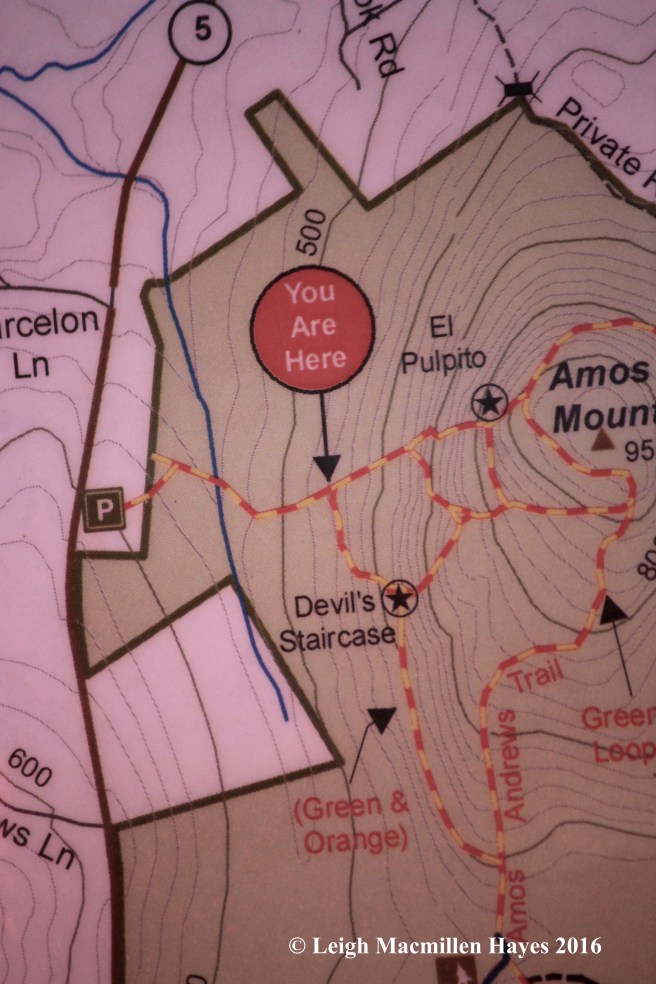
a-You Are Here map

An hour after starting, we reached the summit, having followed the Homestead, Gallie and  Amos Andrews Trails.

a-lunch rock

Lunch bench offered a great spot to sit and cool down.

a-summit view of two lakes

And take in the view–of Heald Pond on the left and Kezar Lake on the right, plus the mountains beyond.

am-1

Our trek down was like a walk in the park and we practically floated. The snow had softened and our trail was packed making for a quick descent.

a-yellow birch

But, we still had one more stop to make and I reminded my guy to turn left at the yellow birch–the most beautiful yellow birch on this route.

a-spring 1

I wanted to locate this very spot that is off the beaten path.

a-spring 2

And I wasn’t disappointed as we watched the water boil up through the sand in mesmerizing  movement. We’d found the spring once again.

Indeed, we found spring in our steps on this Mondate.


The Irish Colors

With so much snow still on the ground, it’s easy to see the landscape as a monochrome palette of grays. And so I set out on this St. Patrick’s Day to find some color.

f-bridge

My destination was the Greater Lovell Land Trust‘s Flat Hill trail and Perky’s Path from the end of Heald Pond Road. The parking lot is almost non-existent, so much snow do we have. And the bridge crossing tricky.

f-cherry bark

As I climbed upward, the thought that some see the world as black (cherry) and . . .

f-paper birch 1

white (paper birch) kept racing through my brain.

f-gray birch 1

And then there are those who accept that gray areas exist (gray birch–a brother of paper birch from another mother).

f-yellow birch bark

Textures visible in shadows reflected differences (yellow birch–a cousin),

f-hop hornbeam

even among family members (hop hornbeam–also a birch relative.)

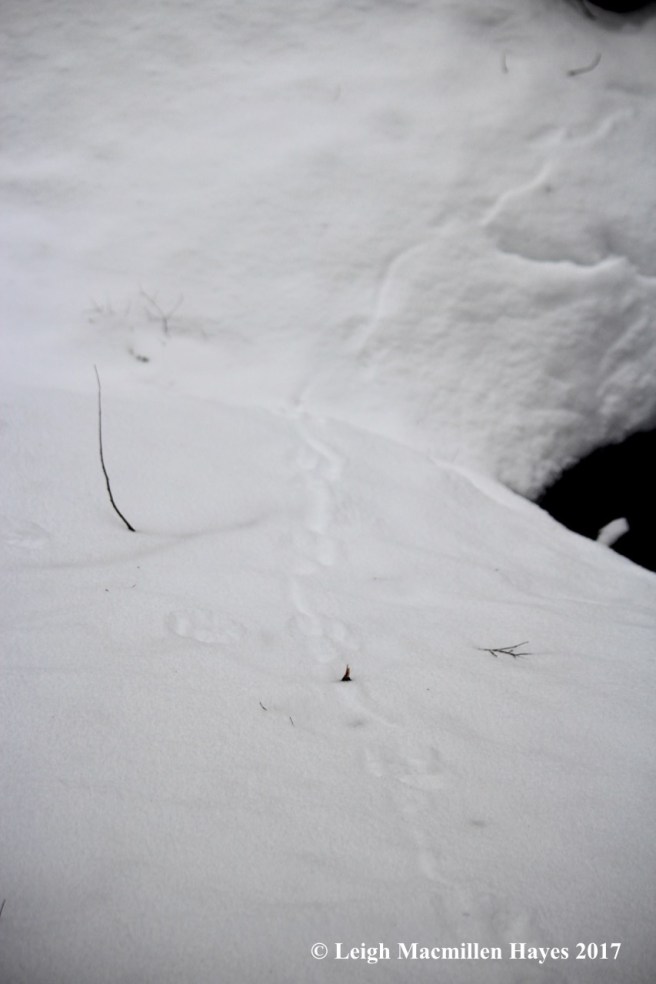
f-mink tracks

It may have seemed there wasn’t much new to see and wonder about, but . . .

f-mink prints

the straddle (width from outside of one print in a set to outside of the other) and angle of these prints told a different story. A mink had crossed the trail. (My mitten had to hold the Trackard in place or it would have slid down the trail.)

f-porcupine trail

Nearing the top, I went in search of another mammal who has frequented this area for years–and I wasn’t disappointed. The porcupine trough was fresh.

f-view from Flat Hill

And then I reached the summit of Flat Hill (forever an oxymoron) and the whites, greens, browns and blues of mountains and sky opened before me. There was even a hint of red in swelling buds.

f-downhill from Flat Hill

The wind was cold, so I didn’t pause for long. Instead, I retraced my own tracks down the hill.

f-orange trail

And then I turned onto the orange trail that is Perky’s Path and realized the symbolism of the color and this day. My Scottish ancestors smiled down on me.

f-beaver lodge

I’m always drawn to the wetland and had to take a peek at the beaver lodge, which remained snow covered, indicating that no one was home. But there again, the sky enhanced my view.

f-wetland from bridge

The path leads to another set of small bridges, and there I stood for a while, taking in the peacefulness and beauty before me. Oh, and the warmth of the sun as its strong rays embraced me.

f-chickadee 1

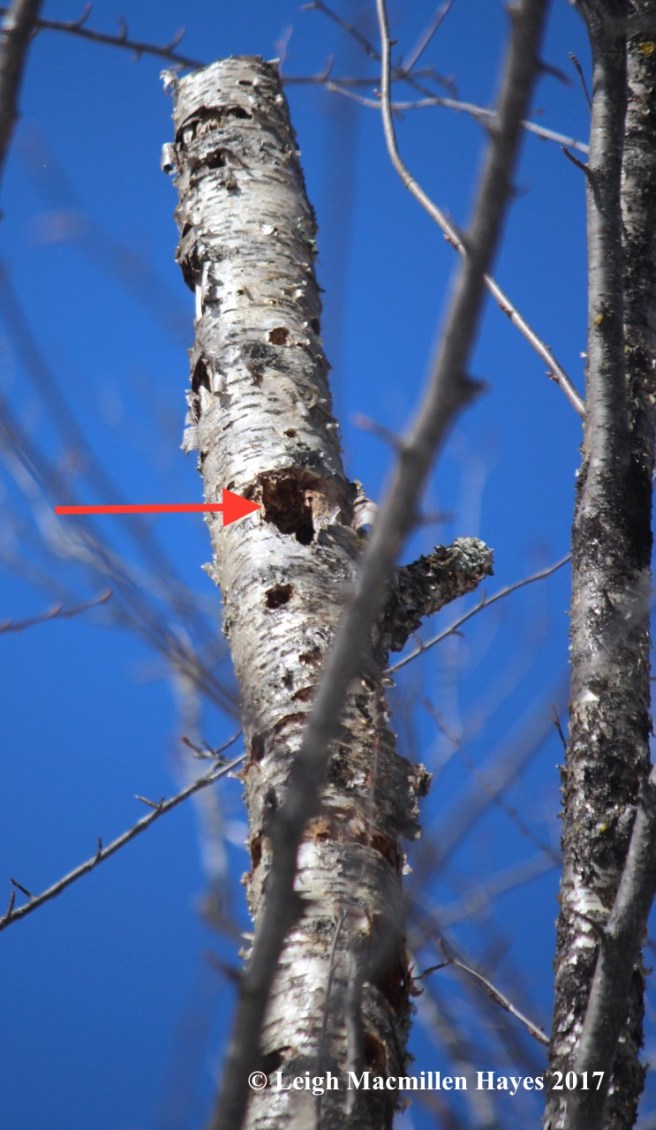
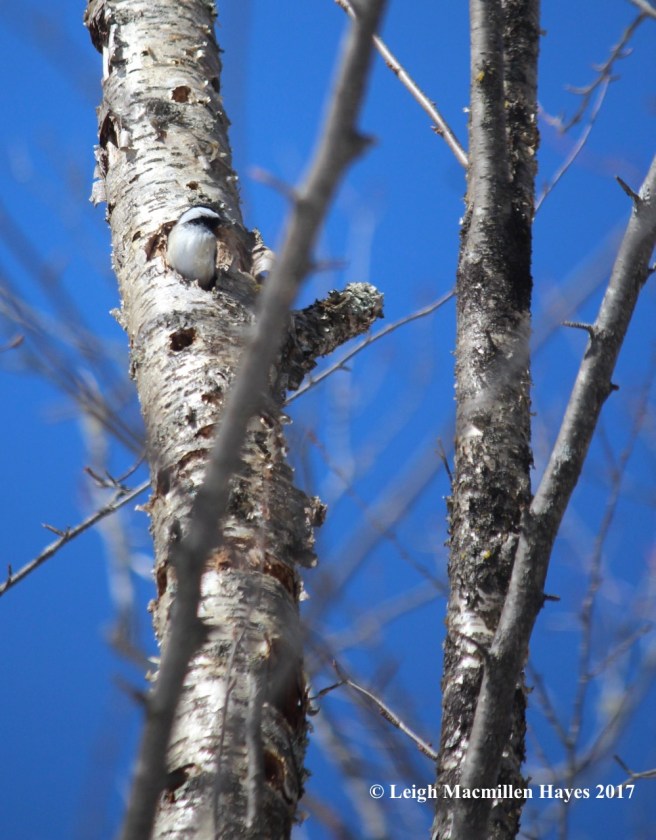
While I stood and listened, a chickadee called and I watched as it entered a hole in the birch snag. This was a wow moment, for though I know birds use old pileated holes, I rarely see them come and go.

f-chickadee 3

Out he popped, giving a curious look–perhaps because I was pishing.

f-chickadee 2

He paused for a moment and then flew off, chickadee-dee-deeing across the bright blue sky.

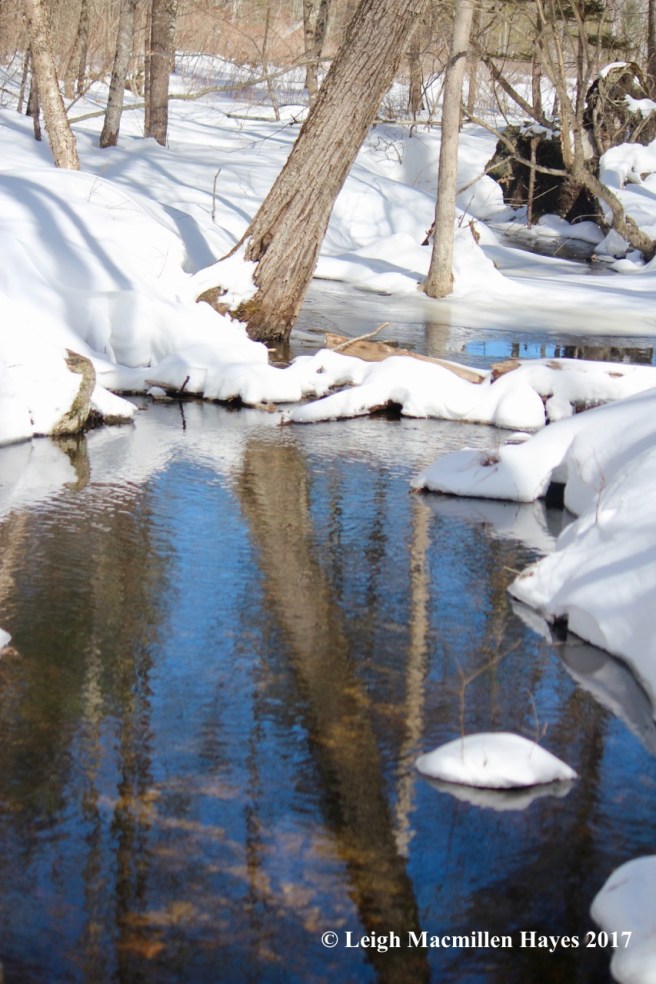
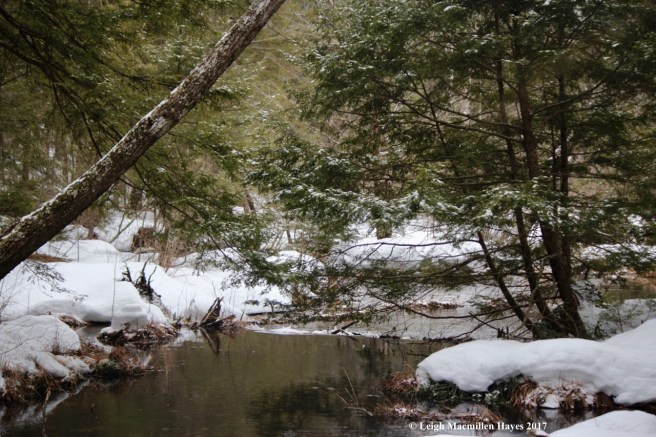
f-brook view

I, too, took off, but not before enjoying a few more reflective moments.

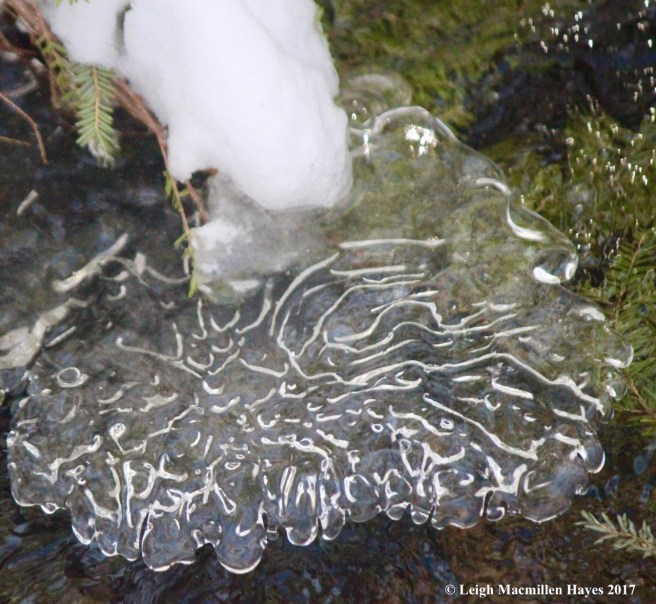
f-ice swirls

The juxtaposition of snow, hemlock branches, water and ice created colorful swirls of artistic design beyond understanding.

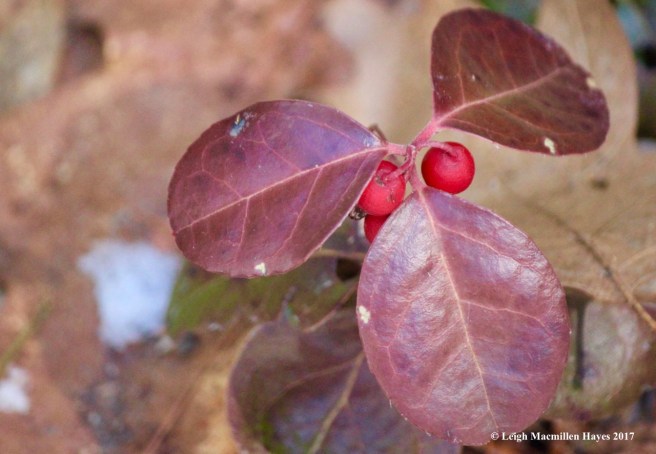
f-wintergreen

And then I found a few wintergreen plants, their waxy leaves transforming from winter maroon to summer green.

f-beaked hazelnut

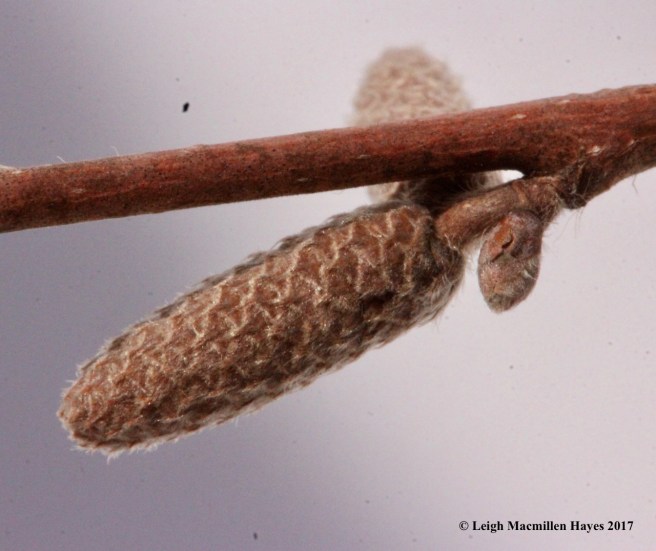
On my way out, I stopped to examine a few buds–and catkins, in this case. I love winter, but I am beginning to crave color and beaked hazelnuts will be among the first to flower.

f-striped maple bud1

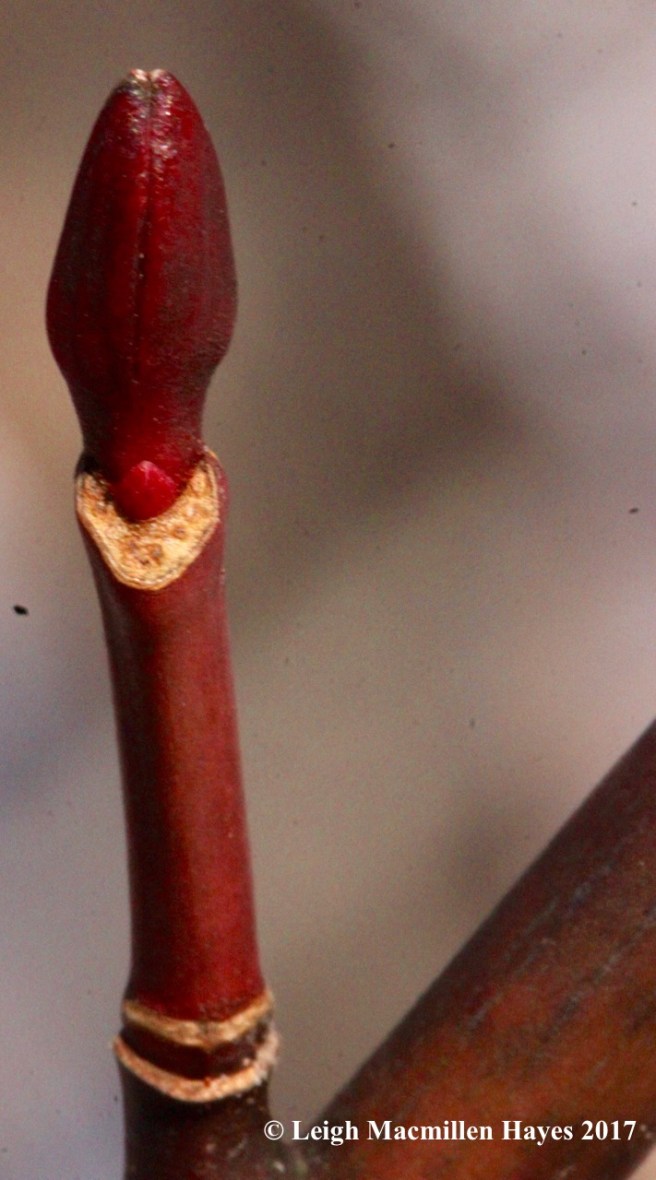
A striped maple showed off its waxy buds, leaf scars and growth rings. The bud reminded me of hands in prayer–perhaps worshipping the patron saint of Ireland.

f-striped maple covered

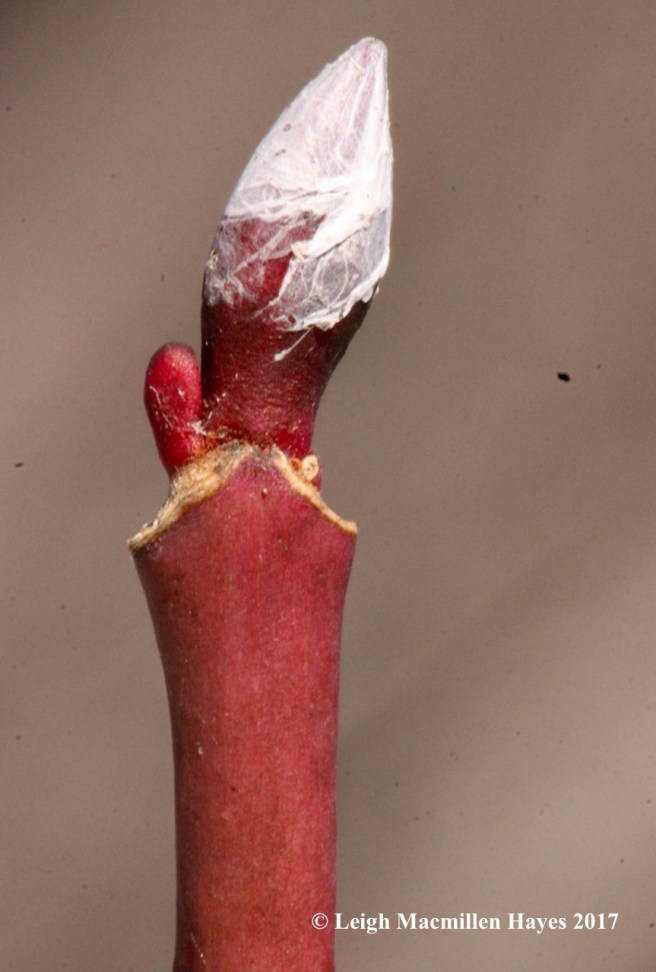
One bud was sheathed in white. Even with my hand lens, I couldn’t figure it out. I’d like to think it was an angelic covering, but suspect it is a cocoon.

f-basswood 2

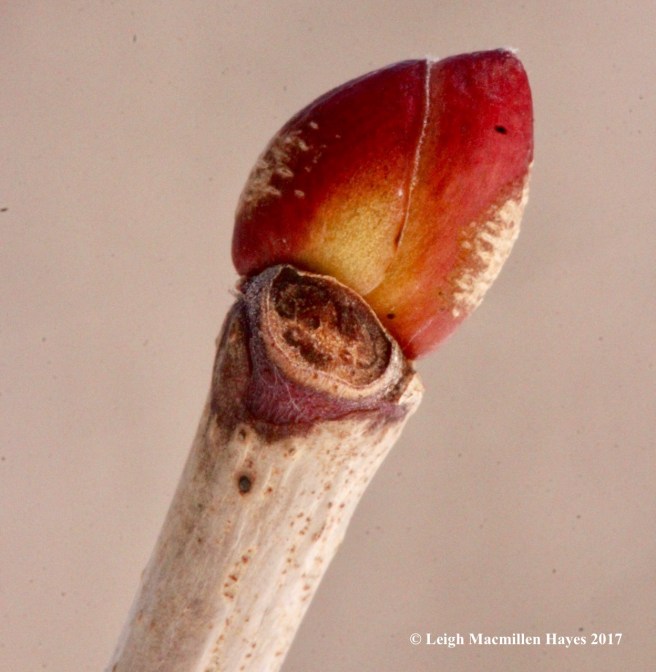
And then there were the bulbous bright buds on the basswood tree.

f-basswood lateral bud

Indeed, they were a sight to behold. Though winter reduced the color palette to the essentials, slowly the transition to spring has begun.

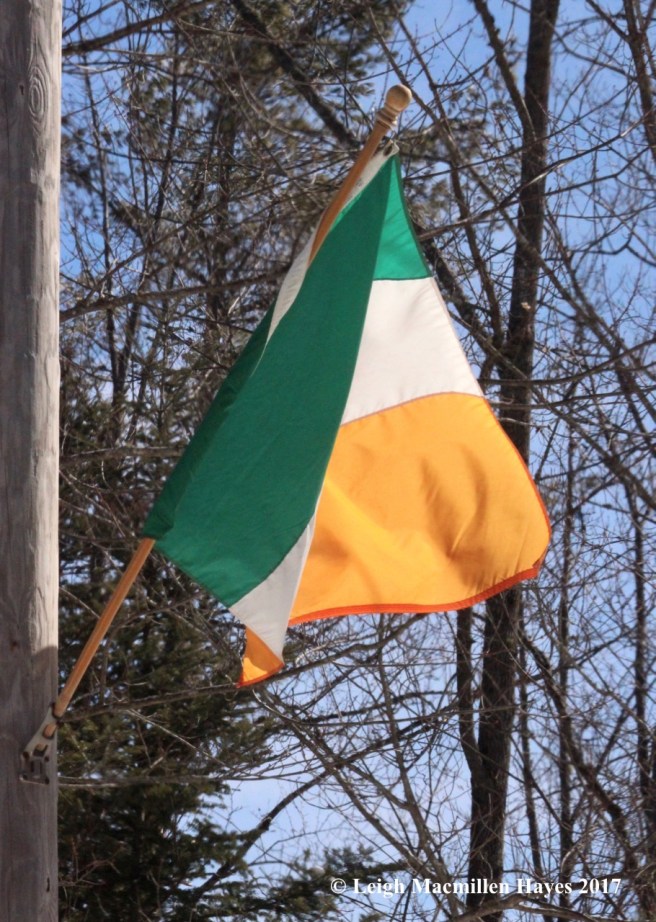
f-Irish flag in breeze

My journey was done, but I made one more stop along Route 5, where Irish flags flapped in the breeze to commemorate this day. The Irish color–where white signifies the truce between the Orange and the Green.

I always wear a hint of orange on this day in contrast to my Irish guy’s green. And I remind him that St. Patrick was born in Scotland.


Focusing Our Eyes at Wilson Wing

I almost canceled our Tuesday Tramp this morning. The weather seemed iffy and though that doesn’t often stop us, road conditions do. But Mary and I exchanged a few e-mails and decided that even though we were the only two available, we’d go for it.

w1--deer 1

As we made up our minds, I watched another who also experienced some indecision. Lately, eight deer have spent many moments in the field and our yard, nipping buds along the edge.

w2-deer 2

While the rest of its clan was further out, this one came over the stone wall.

w3a--deer 3a

For me, it was a matter of watching how its legs worked and where it placed its cloven toes.

w4-deer 5

About to visit some trees, it turned suddenly when it realized it was being stalked–not by me but rather a neighbor’s cat. Well, maybe I was as well, but I was indoors.

w6-deer 6

Gingerly, it moved in for a closer look.

w7-deer 7

Tail down, it seemed curious to make a new acquaintance. And the big, tough cat–it ran home.

w8--Sucker Brook 1

And so, I packed up and met Mary for our adventure at the Greater Lovell Land Trust’s  Wilson Wing Moose Pond Bog Preserve on Horseshoe Pond Road in Lovell. We’d had a dusting of snow overnight and weren’t sure what to expect. Always expect the unexpected.

From the start, we found older coyote tracks that we decided to follow. Those led us to mink tracks that began near Sucker Brook. For a while, we followed both as they ran parallel, the mink tracks being much fresher. And then we stood in one spot and realized we were encircled by coyote, mink, red squirrel and short or long-tailed weasel tracks. We could have gone home then, but of course we didn’t.

w9-ice skirt

We decided to follow the brook for a while, hoping to see otter tracks and a slide. Instead, we were treated to aprons of ice surrounding boulders and tree roots.

w10-hoar ice

Some hoar frost at a hole made us wonder who might be within.

w11-mink tracks with tail drag

And our eyes again recognized that we were still on the trail of the coyote and mink. All along, we were curious to see the drag marks left behind by the mink’s tail. Unless it was carrying something–another option.

w12-Sucker Brook 2

As we stood and looked about, movement caught our eyes and we realized we were looking at the mink. Unfortunately, neither of us thought to capture it in a photograph, but it will remain forever in our mind’s eye. While I did exactly what I tell others not to do–tried to follow it for a couple of minutes–Mary stood and listened. A sound above make her crick her neck.

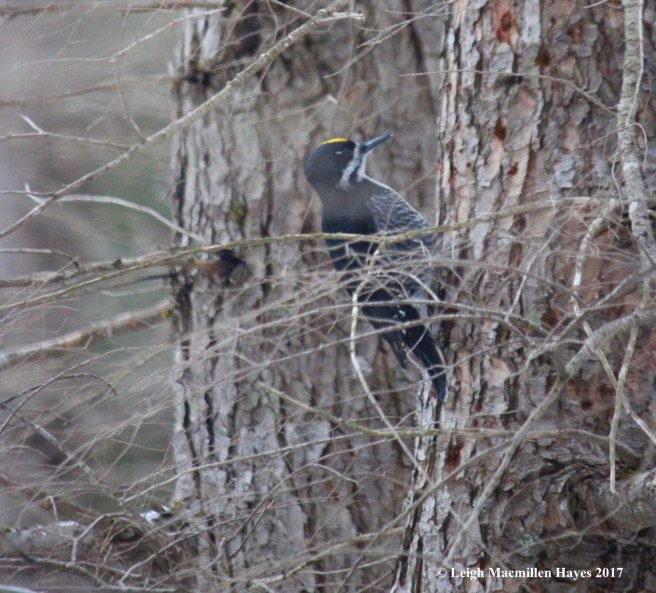
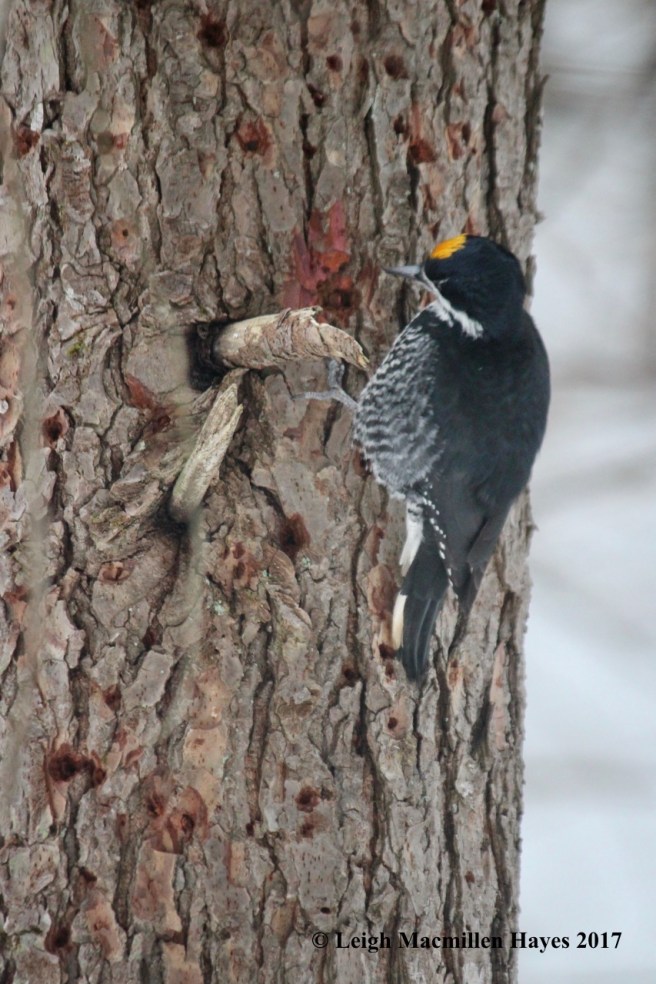
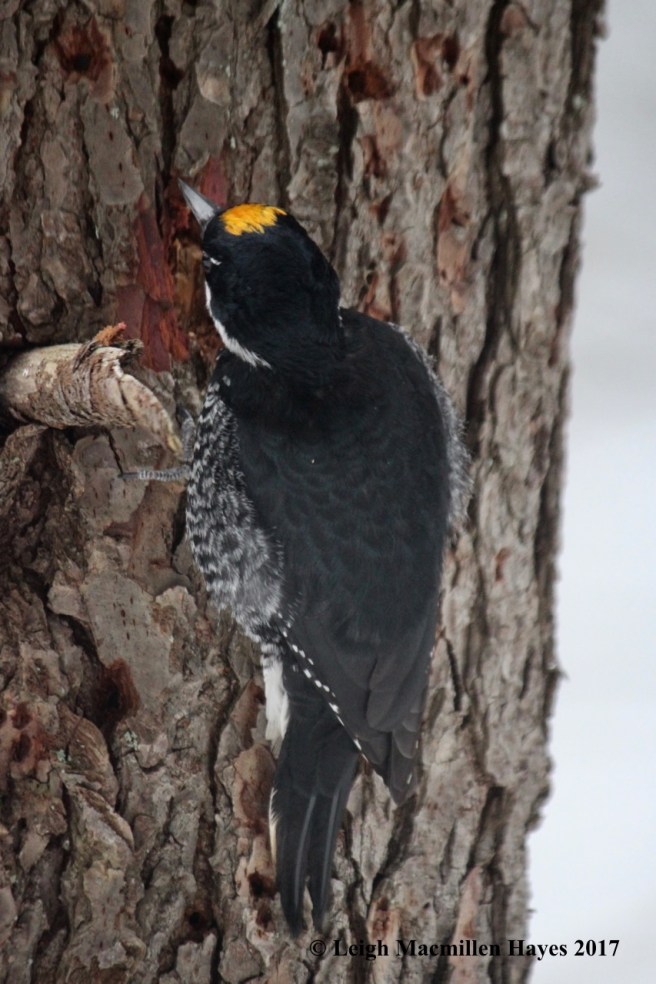
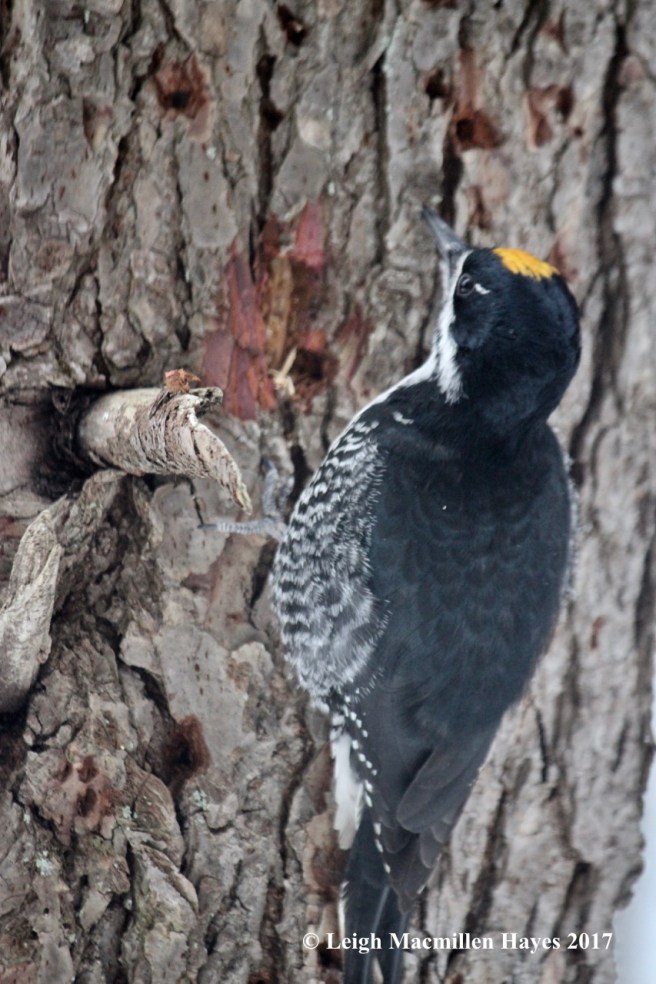
w13-black backed woodpecker

On a dead trunk, a woodpecker foraged among the bark scales. We watched it for a while, trying to note its features from below and we then moved on.

w14--hobblebush

My visits to Wilson Wing are never complete without a stop to worship the hobblebush. For those anticipating spring, it’s only a few weeks away. It won’t be long and these naked leaf and flower buds will unfurl and I’m sure I’ll share their blooming glory with you.

w15-Moose Pond Bog

Another stop that I can’t pass by is a climb up the stairs to the platform–the perfect viewing spot for the bog.

w16-car

Finally, we continued along the trail and I realized my focal points were redundant of all past visits, but it’s fun to view some of these in various seasons. For those who know, this is the old blue vehicle.

w17-lungwort

And right near it, my favorite of all foliose lichens–lungwort, indicative of unpolluted air. At Wilson Wing–indeed.

w18-hemlock catkins ;-)

We crossed the last little stream, found some deer tracks and a beaver chew, and then decided to follow the trail back rather than the road. One of our stops included admiring the hemlock catkins. (Smiley face)

w19-black backed 2

And then we returned to the woodpecker. By now he was our woodpecker, just as the mink that we saw and other critters we didn’t see were also “our mink” and “our coyote,” etc. It’s amazing how even when we don’t see the mammal, recognizing that it has passed through is enough to excite us. But this bird . . . oh my.

w20-black backed 3

We noted the orangey yellow crown as it cocked its head.

w26-black backed 8

Its face was black and white, including a black mustache and white eye line.

w22--black backed 5

We were surprised by its stocky build.

w24-black backed 6

And those black and white barred sides or flanks weren’t like the woodpeckers we normally see.

w25-black backed 7

It worked constantly, flaking the scales off the trunk as it searched for insect larvae.

w27-black backed 9

Cinnamon colored underbark revealed itself where the bird had recently excavated.

w28-black backed 10

As it contemplated its next move, it didn’t seem to mind our admiration.

w30-black backed 11

With its strong beak, it probed and probed.

w31-black backed 12

Then held its head back and . . .

w32-black backed 13

probed some more.

w33-black backed 14

First it cocked its head to the right.

w36-black backed 17

And then back to the left.

w38-blackbacked 18

Frequently, it paused for a brief break. Or perhaps it was dining and we didn’t know it.

w40-black backed 21

We were mesmerized.

w39-black backed 20

And delighted . . .  for we’d had the opportunity to focus our eyes on so many wonders, but especially the mink and this . . . a black-backed woodpecker. This was a rare opportunity for these birds seldom show themselves, especially this far south–all the more reason to be thankful that we decided to go for it and focus our eyes on the nature of Wilson Wing Moose Pond Bog Preserve.

A Devil of a Mondate

Ever since I first saw a photo of a family donning their Sunday best and standing on rocks that form the “Devil’s Staircase” in Lovell, Maine, I’ve been intrigued.

d-historical-society

The photo and description on Lovell Historical Society’s Web site refers to a “staircase” on Sabattus Mountain. And so for years I imagined the staircase leading to that summit, but never located it. And then I learned that a section of trail at the Greater Lovell Land Trust’s Heald and Bradley Pond’s Reserve had earned the same name. Is there a staircase at Sabattus? Or was it accidentally misidentified? Whatever the case, when I suggested to my guy that we attempt the staircase off Route 5, he embraced the opportunity. (I’ve since learned from several friends that indeed, there is a staircase on Sabattus and the photo likely was taken there. The base of the staircase is apparently on private property and no longer a safe climb.)

d-trail-map

And so about noon we ventured forth and figured out a direction that would take us up the steep portions of the trail to the staircase and El Pulpito, and then down the easy trail–with hope that there was such a thing as an easy trail.

d-easy-trail

Actually, at the start it all seemed quite easy as I followed our Monday tradition of racing to keep up.

d-arrow-heavenward

We chuckled when he found an arrow that aimed heavenward–perhaps a sign that all would be well.

d-turning-the-arrow

My guy played spin the arrow to set it toward our destination. (Actually, on the way down, he spun it the other way. Note to GLLT–perhaps this arrow needs two nails.)

d-approaching-ledges

Minutes later, we approached the ledges and visions of bobcats danced through my head.

d-contemplating-the-climb

Acting as our scout, my guy contemplated the upward advance.

d-very-steep

We were forewarned and chose to bypass a bypass.

d-starting-up

He started up what we believed to be the same trail traveled by those Sunday venturers.

d-following-my-guy-up

I followed but not quite as speedily.

d-heading-up

My heart pounded in Edgar Allen Poe manner as I followed him up. I have to admit that there was a point where I wanted to turn around and climb down, but wasn’t certain that would be any easier. And so after pausing for a few moments, I tried to put mind over matter and placed my hands and feet in what seemed to be “safe” spots as I continued to climb.

d-view-from-above-staircase

Above the staircase we were rewarded with a vantage point of Kezar Lake and the White Mountains and a chance to slow down our heartbeats.

d-lunch-view

And later, at El Pulpito, the pulpit, the complete opposite of the Devil’s Staircase–a place to pause, eat PB&J sandwiches, and contemplate life in a relaxed manner.

d-water-at-summit

Within an hour we reached the summit of Amos Mountain and spent some time being.

d-hazy-view-at-summit

Though the sun was in our eyes, the view south was a bit hazier than one would expect on a clear November day. We later learned that a forest fire burned in Albany, New Hampshire.

d-trail-down

For our descent, we followed the blue blazes of the Amos Mountain Trail.

d-tree-across-trail

Though hardly as steep as the climb up, I was thankful for a few downed trees that slowed my guy–momentarily.

d-boot-disappears

The beech and oak leaves were over a foot deep in places and obscured rocks and roots, making for a slippery slide down.

Nevertheless, we did it. Devil’s Staircase up and a devil of a climb down–and yet, two hours later we knew we’d do it again.


Hewnoaks

This morning, the Greater Lovell Land Trust and Charlotte Hobbs Memorial Library in Lovell co-hosted a poetry workshop conducted by poet Judith Steinbergh of Brookline, Massachusetts. The setting: Hewnoaks Artist Colony.

It’s always a special treat to listen to Judy and others read poetry, wander the grounds which overlook Kezar Lake, and share with like-minded people.

Sixteen of us found our voices this morning. Or tried to. Here’s my attempt:

h-hewnoaks 1

Hewnoaks

h-raindropsMG_1835

Where raindrops jiggle

h-backs of leaves (1)

and leaf backs glow,

h-pine needles

pine needles dangle

h-pine coneIMG_1867

and new cones land,

h-pepperbushIMG_1836

shrubs sway

h-ferns

and ferns dance,

h-queen anne's lace1

flowers blossom

h-seeds 1IMG_1841

and seeds fly,

h-feather

feathers pause

h-driftwood (1)

and driftwood poses,

h-white caps 2 (1)

white caps form

h-waves 2 (1)

and waves crash.

h-poets 1 (1)

Hewnoaks, where poets write

h-poets 2 (1)

as the north spirit renews our souls

h-poets 3 (1)

with each gust of fresh air. ~LMH

h-Listening to Ann (1)

Later we gathered inside, out of the wind, to share our offerings–each one a gift.

Thank you, Judy. And Anna. And Ann ;-)


The Stars of Miles Notch

We only had to hike about a hundred feet along the Miles Notch Trail off Hut Road in Stoneham to discover that this was the perfect choice for a hot day in May. Well, sorta perfect. A little less heat and humidity would have cinched the deal. But, take a look:

m-moose

I heard something off to our left and tried to get my guy’s attention. He was looking down and didn’t see our trail partner at first. We found all kinds of evidence that this path was more well trodden by moose and deer, bear and coyote, than human beings. I think we both could have turned around at that point–happy for the sighting.

But . . . we continued our journey, not sure of our destination. Oh, we had a map. And actually met an acquaintance on the road who gave us an apt description as he used his hands to demonstrate the ups and downs of the trail. He was quite accurate in his description.

mph-lady's 3

There were other stars to encounter.

m-lady 1

Meet our lady friends.

mph-lady 2

Each as beautiful as the next.

mph-lady 3

They wear exotic slippers indeed.

m-rosy 3

Equally plentiful–rosy lampshades dangled below twisted stalks.

m-striped maple flowers

Another dangler beneath striped maple leaves–more umbrella-like in presentation.

mph yellow clintonia

Yellow rays of sunshine beamed up at us.

mph-trill 1

And delicate splashes of color reminded us of paintings.

m-trill brown1

We even found a darker version of the red theme. I was extremely hot at this point and had visions of ice cream in my head–chocolate, of course.

mph-gargoyle 2

Not everything was beautiful, but still, the gargoyles were amazing.

m-bear 1

And, of course, we found some bear trees. Lots of bear trees.

m-stream

We crossed several streams–respites from the heat–where we dipped our hats and washed our faces.

m-trail sign

For a while we followed the trail toward Red Rock Mountain, but it was hot and we were tired and we had to pick our youngest up at the airport, so we turned around.

I should mention that we had passenger flies, blackflies and mosquitoes for the entire journey–not biting because we were well covered in bug stuff, but  certainly annoying.

That didn’t matter because eight miles later we’d seen plenty of stars, and it’s memories of them that will stay with us.

Oh, and the ice cream–I ate Denali Chocolate Moose Tracks and my guy feasted on Orange Blossom–at The Homestead in Lovell.

Wallowing in Wonder

We knew what flowers we’d show off and had a general idea of what birds we’d see when we headed down the trail from the Flat Hill parking lot at the Greater Lovell Land Trust’s Heald and Bradley Ponds Reserve in Lovell early this morning. But from the get-go this turned into one very special hike that filled us all with the wonder of life.

p-silent march

Maybe it was because we headed off on a silent march, the better to take in the cacophony of bird songs. With Linda and Heinrich in the lead, our intention was to make a bee-line to the viewing platform. Linda encouraged everyone to note the flowers along the way–with a promise to stop and celebrate them on the return trip. We’d decided during a pre-hike that we wouldn’t follow the loop trail around Perky’s Path. We wanted this to be a different experience.

p-ph view from bench

The view from the bench was beautiful, but the birding there was only so-so, much to our dismay.

p-ph birding 2

On to the bridge we moseyed. Our one disappointment, we didn’t hear the American bittern that had entertained us with its toilet plunger call during the pre-hike.

p-ph birding1

But that didn’t stop us from raising our binoculars frequently–for red-winged blackbirds, Canada geese, blue jays, several species of woodpeckers, sparrows, warblers, wood ducks, chickadees, a wood thrush and more. We heard the ovenbird and vireos, but never caught sight of them.

p-ph rosy 2

While Heinrich was our birding guide, Linda used the area just beyond the bridge to begin our examination of flowers.

p-ph rosy 1

It was while we were moving in for a closer look at the rosy twisted-stalk, that someone spied what became the center of our attention for the next hour.

p-dragon begin1

A dragonfly had just split open its exoskeleton and emerged from the nymph stage. Of course, we were standing by a beaver pond, and so it seemed only appropriate that it would use the top of a sapling cut by a beaver.

p-ph dragon middle 4

By pumping air into its body, the adult slowly grew larger.

p-dragon end 1a

As it inflated the wings with blood pressure, they began to extend.

p-ph dragon end7

The veinous wings remained folded over its back as we continued to watch.

p-ph early coralroot orchid 2

We were in that one spot for a long time, but when Linda inquired if anyone wanted to start back, all were silent. We did, however, take our eyes off the dragonfly for brief moments. And because of it, we got to know a small area rather well. A few of our discoveries included  the yellow-green, early coral-root orchid, which has no leaves,

p-ph starflower 7

star flowers with their seven petals, seven stamens and sometimes seven leaves, though the latter wasn’t consistent,

p-ph yellow clintonia

and yellow clintonia, aka bluebead lily.

p-ph springtails 1

We also saw hot chili pepper on the leaf litter and . . .

p-spring tails 1

in the water. Springtails galore. Yes, aka snow fleas, but obviously we can see them even when there isn’t snow on the ground.

p-dragon end 1b

As we explored, we continued to keep a watchful eye on our friend. In fact, he became “our” dragonfly. An hour later, the melodic song of a Baltimore oriole pulled us away and we finally started back along the path.

p-cloak 5

We paused frequently to admire the flowers and leaves, but then another flyer slowed us down and became “our” mourning cloak as it settled on a fallen tree and then fluttered amongst us. Happy were we to have shared such moments of awe.

p-ph pack on Amos

Though our walk had lasted longer than intended, I wasn’t ready to head home, so once everyone left, I turned back and climbed Amos Mountain using the Saddle Trail. It was hot and buggy, but I went for a reason and wasn’t disappointed.

p-amos 1

Among the grasses and violets,

p-ph wild strawberry

the wild strawberries grow. But that’s not all.

p-ph colum 5

It was the spurred red and yellow flowers of wild columbine that I wanted to see.

p-ph colum 4

Their heads drooped dramatically.

p-columbine 1

Numerous yellow stamens projected downward and surrounded the green pistils with their long, thin styles, creating the look of an ornate lantern dangling from a post–thus its other common name, little lantern. I really don’t care what it’s called. Spending time in its presence was all that mattered.

The same was true for our dragonfly experience. We wallowed in wonder today and let nature reveal its glory.

Sharing Our Mondate

My guy and I spent this morning roaming about the woods in Lovell with several friends who are docents for the Greater Lovell Land Trust. We had been invited to explore a 20-acre property and the owners, Barb and Bruce, were in hopes that we’d discover interesting things.

As it turned out we explored much more than their property because we got a bit mixed up with boundary lines, and came away with some questions to ponder about the lay of the land as well as a scavenger hunt for their grandchildren to conquer.

b-red pines

Before we headed off into the woods, Barb wanted us to see a neighbor’s off-the-grid tiny cabin. To get there, we passed through a red pine grove that immediately put me into question mode. Why a grove here? Who planted them? When? I know that the Civilian Conservation Corp did this sort of thing in the 1930s and had been in the area–Stoneham and Bridgton, Maine, as well as Chatham, New Hampshire. But my research didn’t indicate that they’d done any projects in Lovell.

What I did learn, however, is that the farmer who once owned this hilly land may have received a subsidy to plant the trees in order to control soil erosion and turn them into a cash crop. An article in Northern Woodlands states the following: “The government further subsidized red pine seedlings throughout the twentieth century as a way of providing hill farmers with a future cash crop that would grow on otherwise played-out soil. Red pine seemed the perfect candidate for this, as it’s fast growing and susceptible to fewer serious enemies than most pine species. (White pine can be bedeviled by white pine weevil and white pine blister rust – neither of which affect red pine.)

From their size and close proximity to each other, its apparent that the “cash crop” never paid off. Instead, Barb and her husband have a stately cathedral overlooking the mountains and a quiet passageway to visit their neighbor.

We returned from our quick house tour and followed a double-wide stone wall to an opening. Again, we questioned the wall’s purpose. A way to get rid of stones? Did they use the bottom portion of the land below the wall for agriculture and let cows or sheep roam above? We didn’t come up with the answers, but continued on.

b-rock tripe colony

It was time for us to find some treasures that the grandkids can seek. Rock tripe is first on the list.

b-rock tripe

It’s gray-brown upper surface turns dark green when moist–so be sure to bring along some water to pour on this lichen. Then watch the transformation.

Though edible in a last ditch effort by someone who doesn’t mind chewing and chewing and chewing some more, rock tripe is neither delicious nor nutritious. Some Native peoples used it as a soup thickener and others as a last resort tidbit. If you soak it for a while it will soften up.

b-vernal pool

The temperature was cooler this morning than the last few so a skim of ice covered the surface of this vernal pool. I’m not sure how long it will last, but if it’s still there, dip a pail in and look at the assortment of species that swim about. Maybe you’ll even see some frog or salamander egg masses if you visit in the spring.

b-Indian pipe

Here and there we found the pods of Indian pipes. In the summer, look for their ghostly white form–they look like their name, with the flower part hanging down. If it’s turned upright like this one, it has been fertilized.

b-puff balls

Though long since spent, puff balls are another fun find. Poke them and watch the spores float out like smoke from a chimney.

b-wood chips

The pileated woodpeckers love this mixed hardwood forest, so you might find evidence of their work on the floor. And then look up into the tree to locate the cavity they’ve excavated.

b-bird nest 1

We found several bird nests, including this one made of grasses and wiry stems.  A fraction of a blue egg shell sits inside.

b-nest 2, downy feather

Wait until late winter/early spring to search for these, when the wind has blown them to the ground. But leave them be. According to the Migratory Bird Treaty Act of 1918, “It is  illegal to collect or have in your possession live native birds (adults or young), bird feathers, nests or eggs, to try to incubate wild bird eggs, to keep nests or eggs even for “show and tell” educational purposes, or to have road-killed birds in your possession without a permit.” Do you know why? Do some research to find the answer.

b-mock orange

There’s a variety of fungi growing on the trees right now, and come summer, you’ll find more on the ground. We had our favorite mushroom guru with us, who helped us ID this species as mock oyster.

b-tinder conk

Tinder polypore is one of my favorites because it looks like a horse’s hoof. Another research project for you–why did the Ice Man carry a sample of this?

b-nurse log

There are numerous nurse logs, but this one struck me as especially beautiful. Mosses and liverworts grow abundantly along its upper surface and provide a place for all kinds of action to happen. Look for small saplings taking hold. Can you find the shelled remains of an acorn or the scales of a hemlock cone? Who do you think left those? Any small, twisted scat?

b-owl pellet

Or how about something that looks like this–lots of hair and bones matted together? This is an owl pellet and with the help of your adults, you can actually pull the bones out and reconstruct the skeleton(s) of the prey–be it vole or shrew or even red squirrel. Sometimes the pellets contain the skeletons of more than one critter.

b-beech growing through paper birch bark

I would love to learn that you found this–a young beech tree growing through paper birch bark. Which came first? And why?

b-barbed3

Another sight for you, and one to certainly watch out for–barbed wire. We found it all along the back boundary, where it grows through the trees. This is rough country and there are no stone walls. The wire probably dates to the 1880s or later. Be careful.

b-dip between eskers?

The land had us wondering about esker ridges as it dipped and rose. We’ll try to ask those who know more about local geology to help us gain a better understanding.

b-gps 2

We realized we’d zigged where we should have zagged, but didn’t care because we share a passion for the exploration.

b-garden wall

As we headed down, we stumbled across another garden wall and

b-stone pile.jpg

small rock piles like this one. My first thought–a well. That was until we found several others. Maybe just rock piles.

b-shinleaf, pyrola eliptica

Our final find as we stepped through a wetland making our way from a neighbor’s property to the road–the winter look of shinleaf (Pyrola elliptic).

I’d promised everyone a two hour tour, but those who know me best know better. Three hours later we knocked on the door to thank Barb and Bruce for the opportunity–for sharing their land with us and giving us the opportunity to share our Mondate with others.