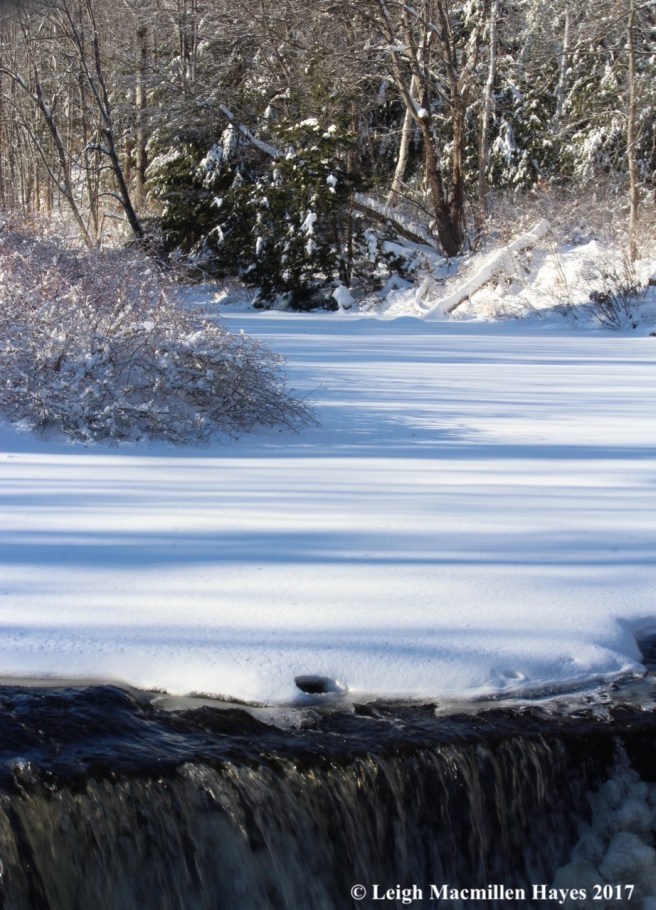
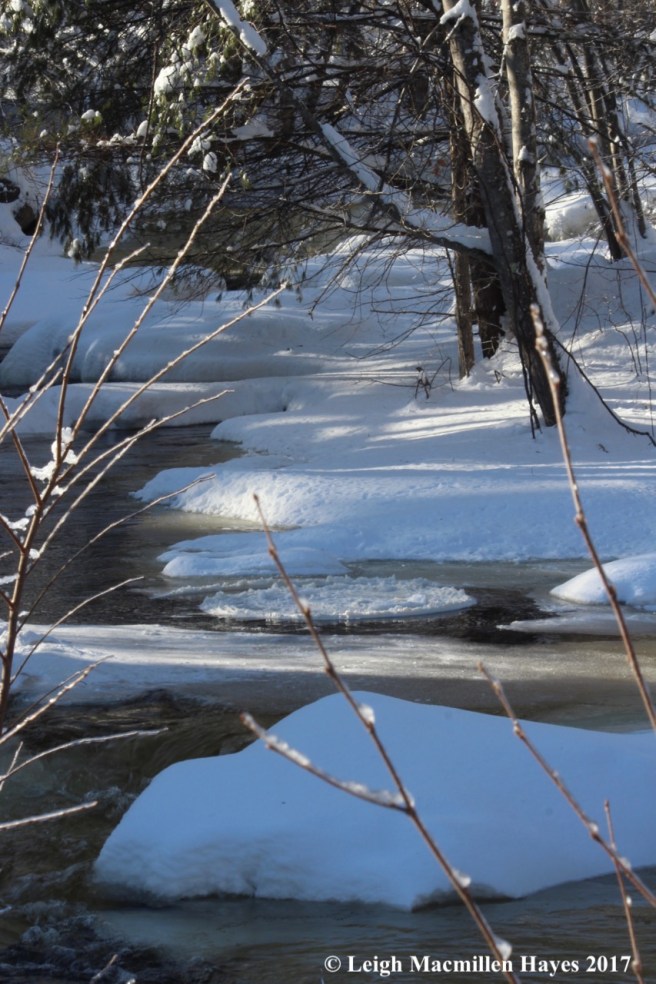
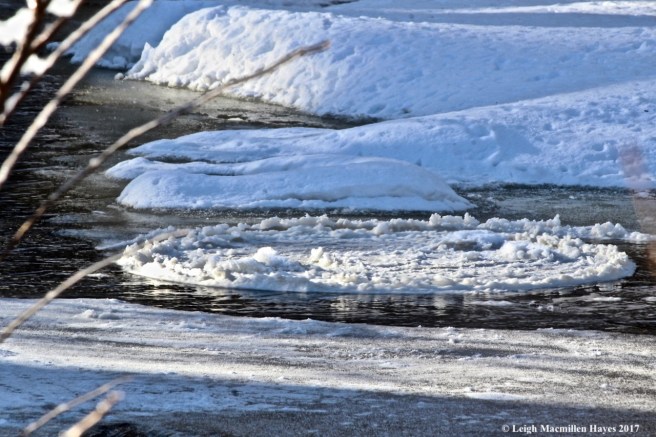
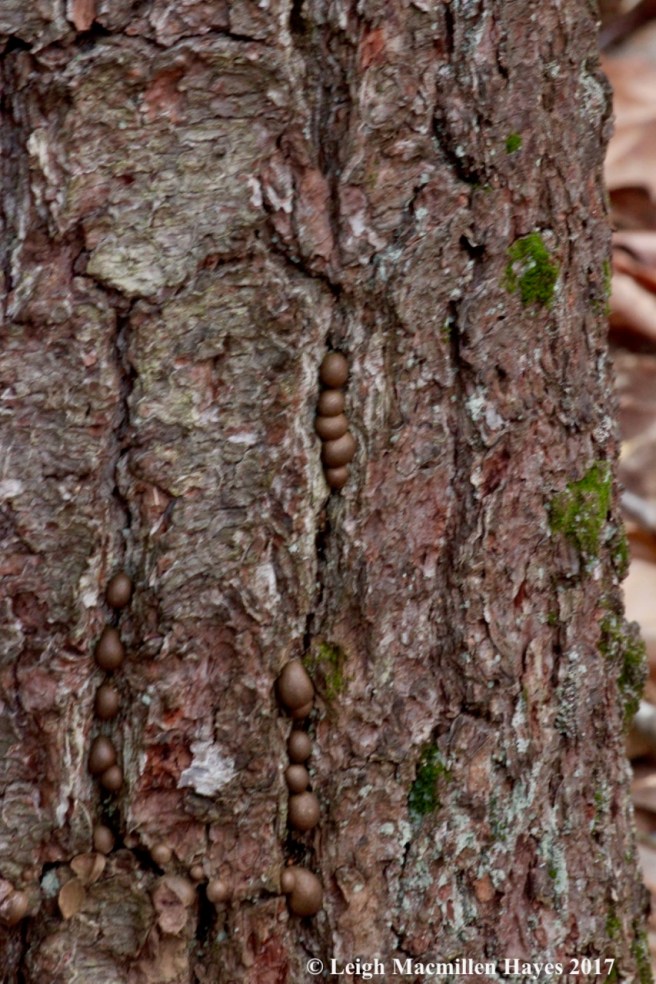
Satiating Our Curiosity at Long Meadow Brook Reserve

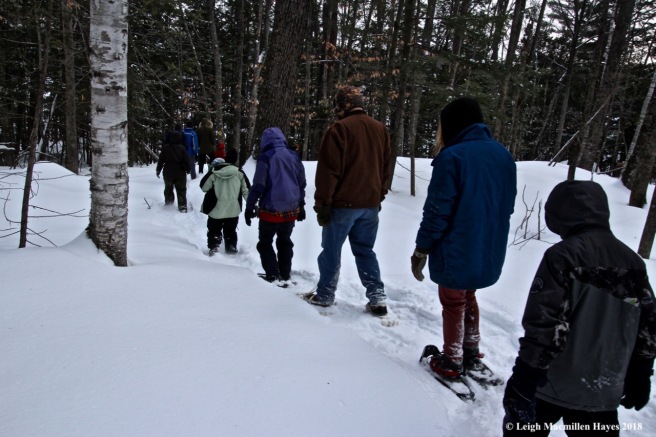
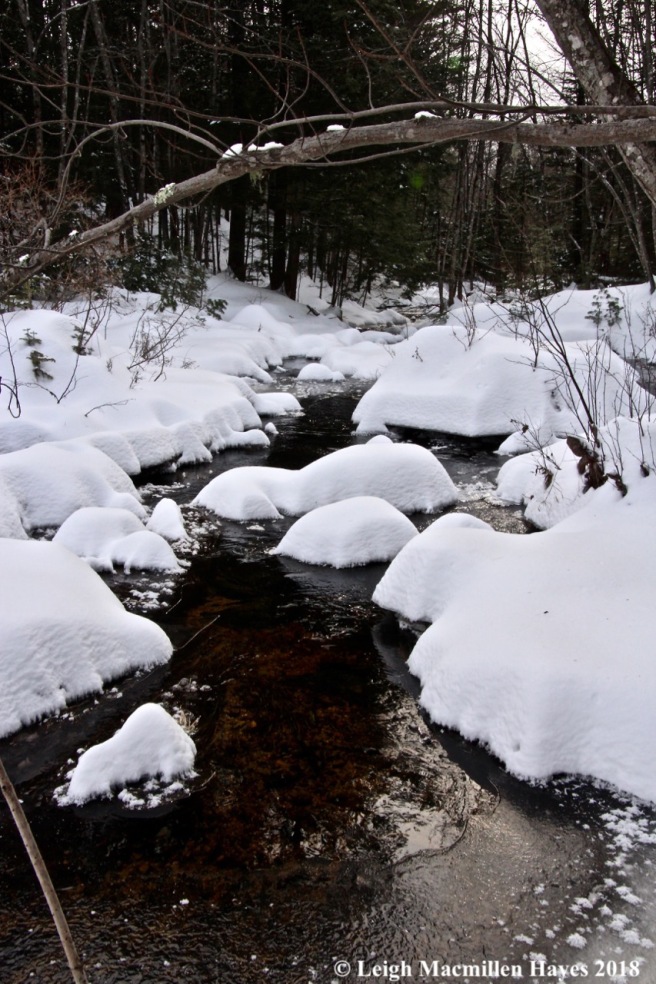
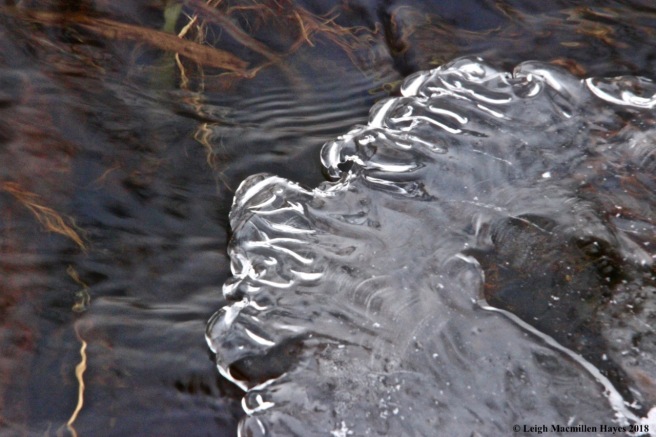
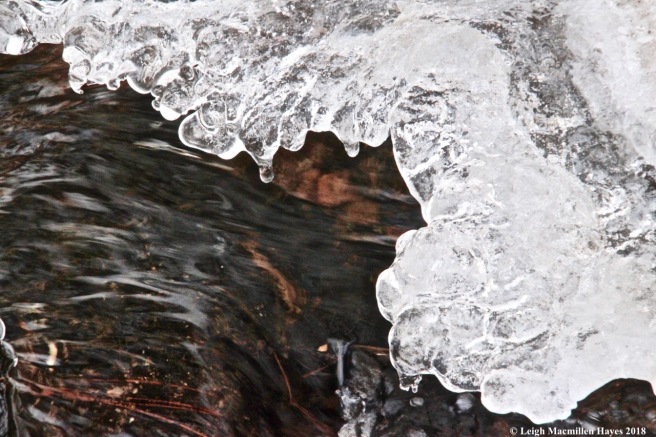
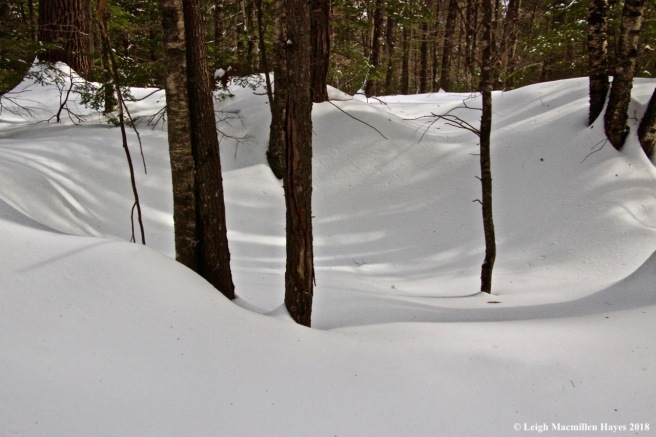
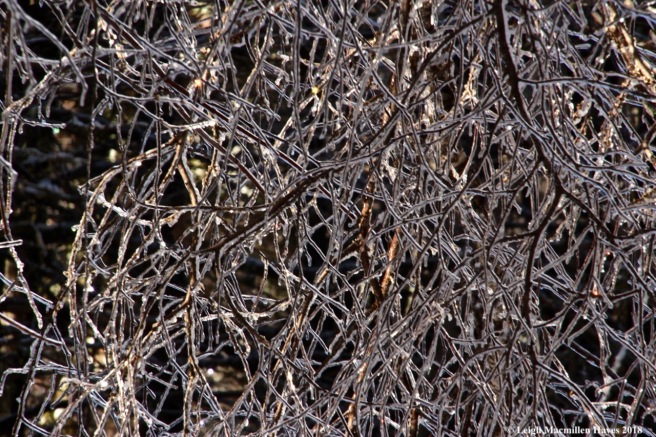
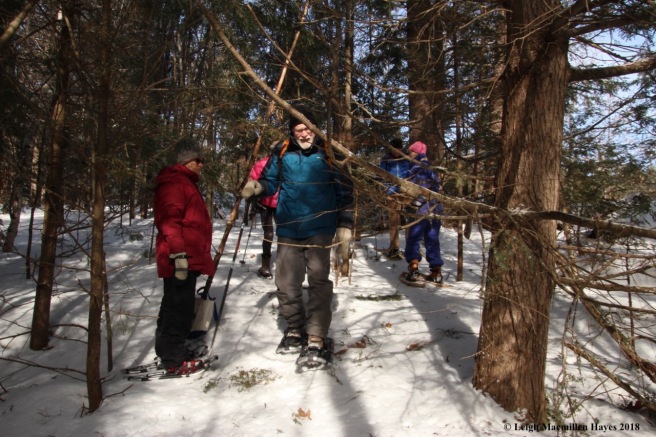
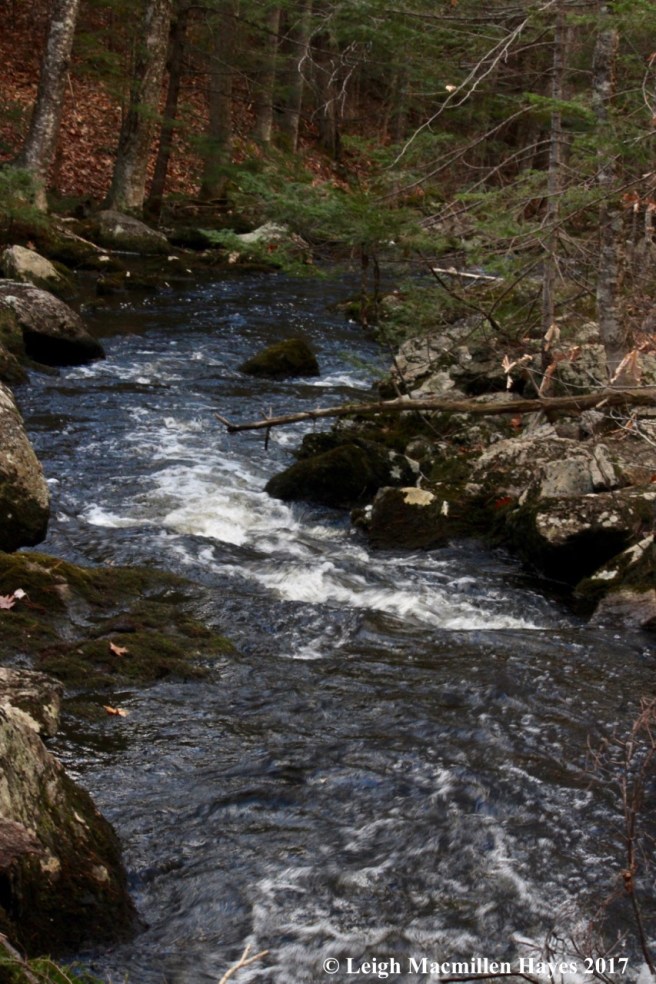
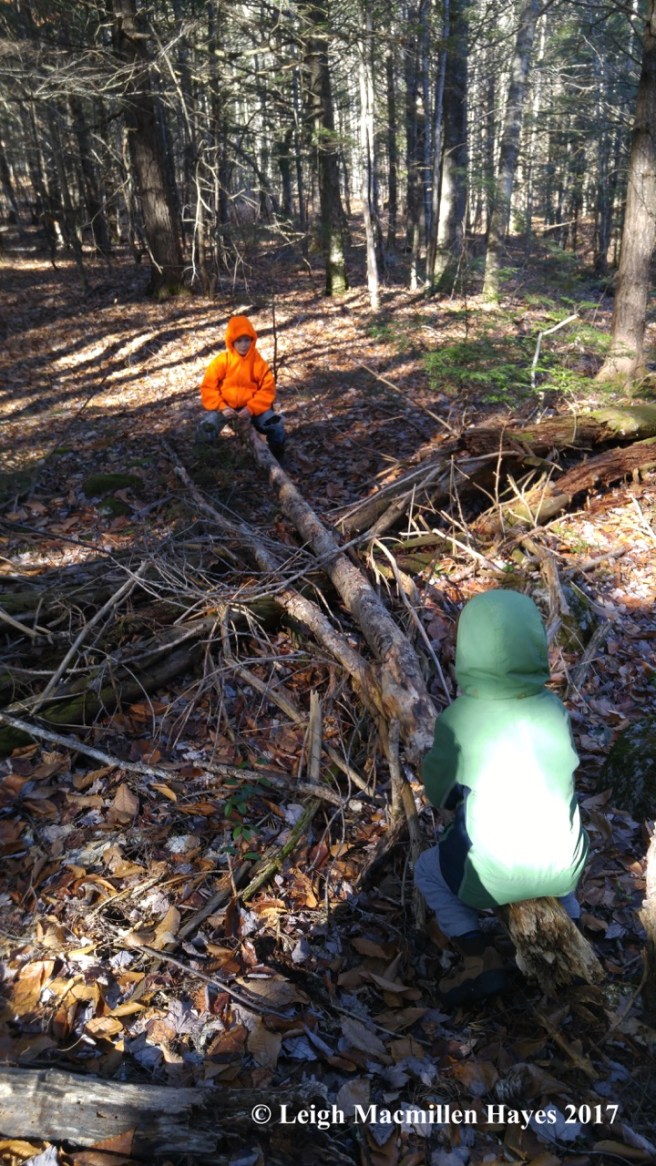
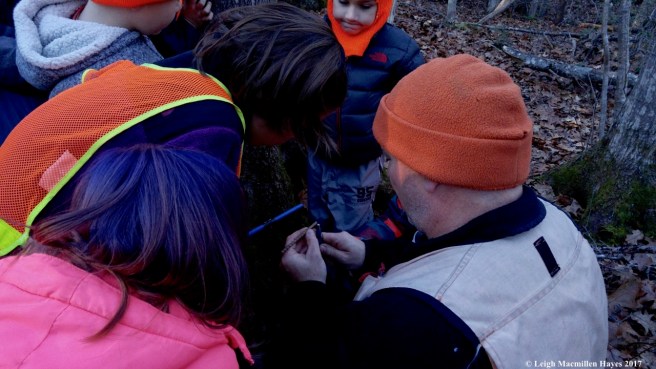
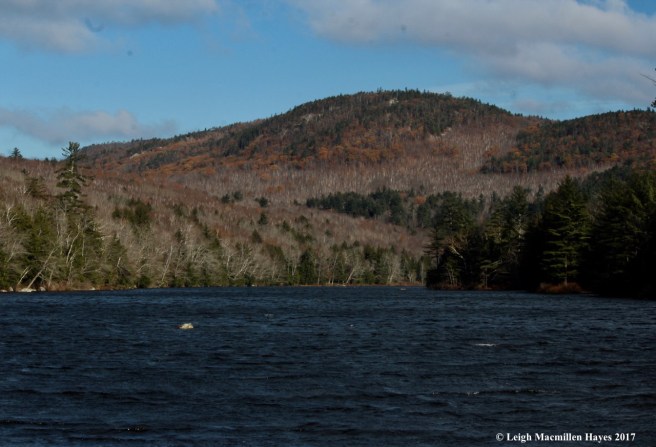
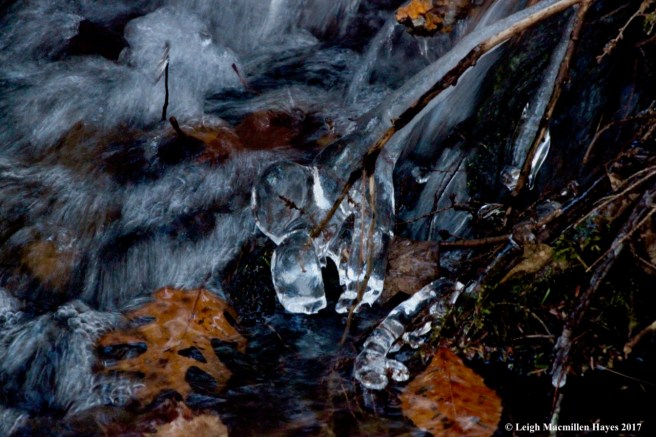
Two weeks ago I traveled the trail at the Greater Lovell Land Trust’s Long Meadow Brook with several friends and much of our wonder was captured by intermingling lines.

l-ice lines

All felt quite magical on that crisp January day as the encrusted twigs and buds offered a brilliant display.

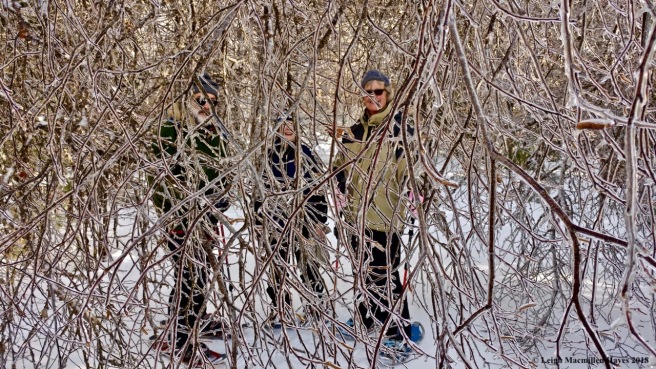
l-snowbirds in the ice castle

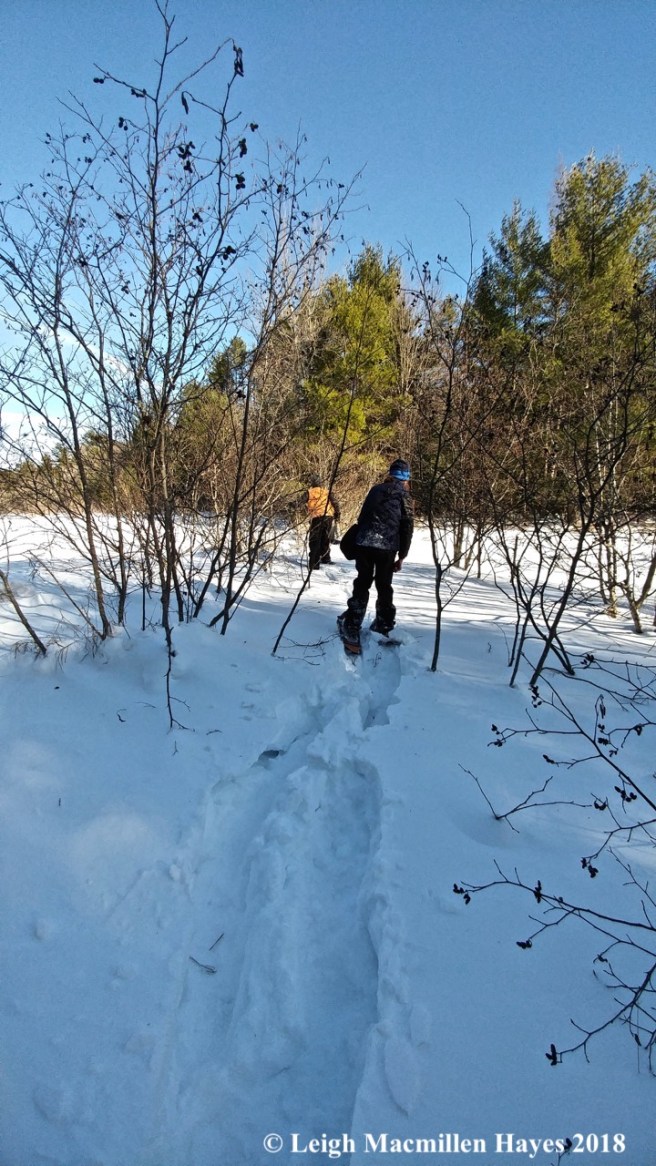
It was made even more special because two of the three with whom I tramped were snowbirds who experienced the awe of our winter world. Despite all their layers, they  felt like royalty living in an ice castle, glass slippers and all. (Don’t be fooled into thinking those are snowshoes strapped to their boots or winter hats rather than crowns.)

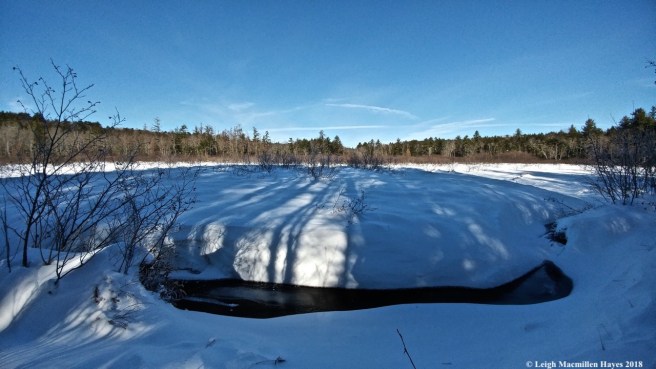
l-Long Meadow Brook 2

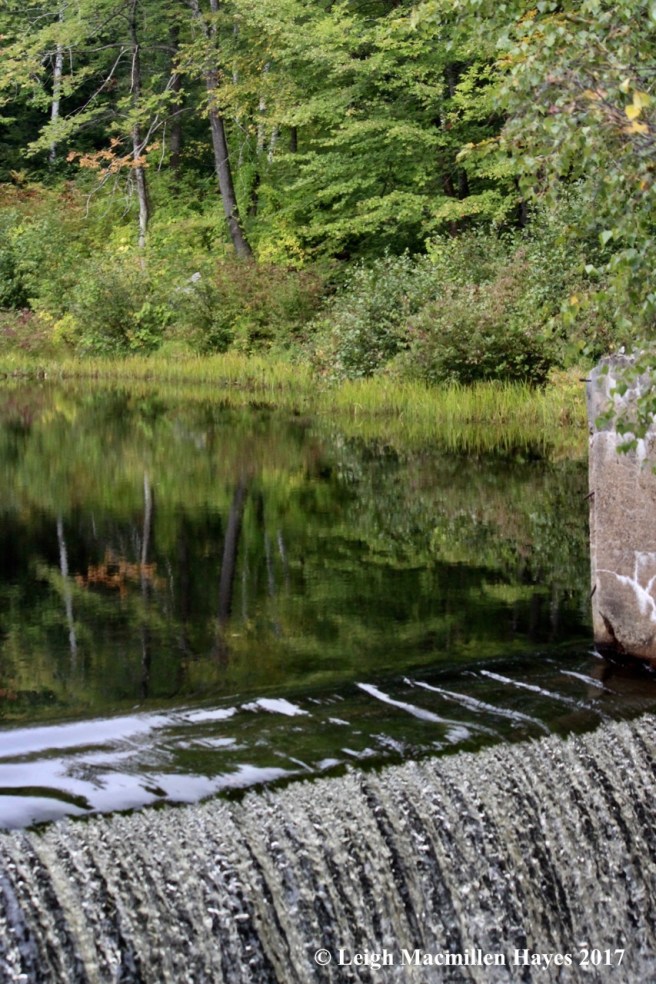
We made our way to the dam by the brook as the sun shifted lower and shadows lengthened. It didn’t matter for the sky was clear and we celebrated exploring the winter world of Lovell.

l-porky den 1:25:18

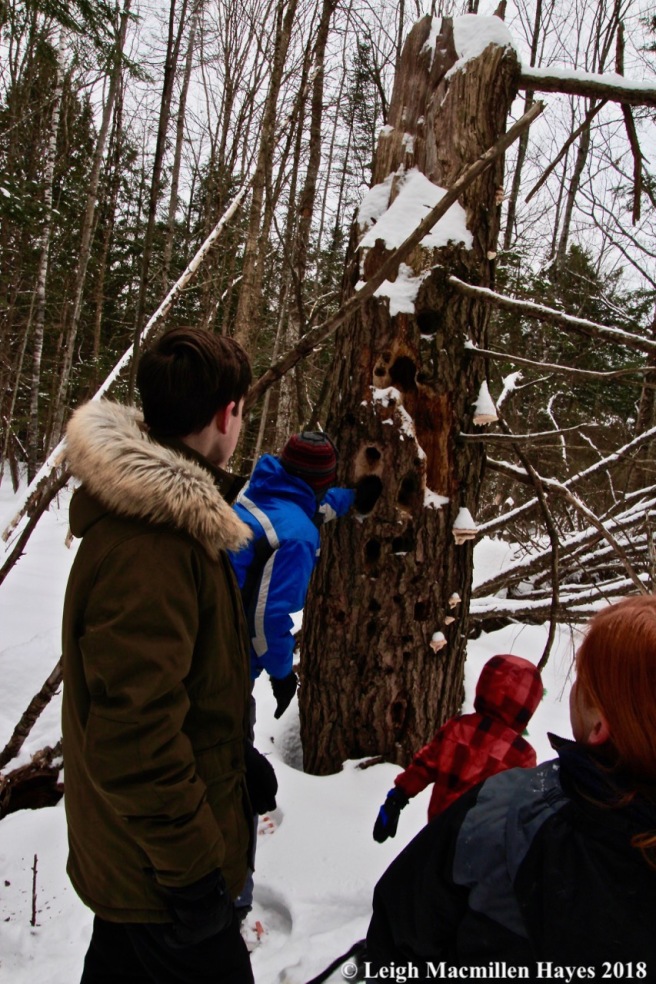
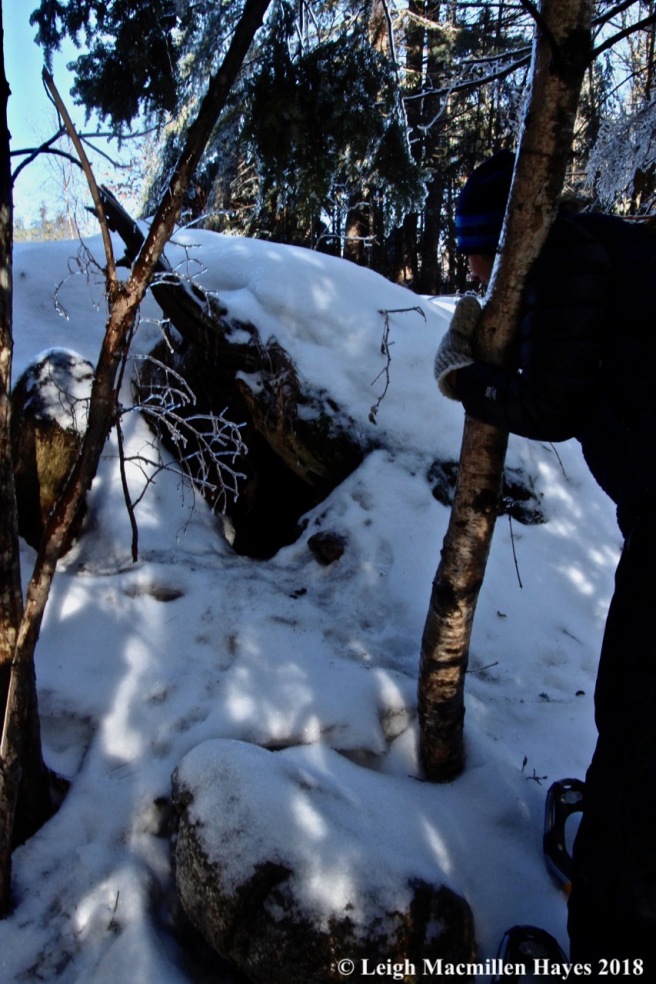
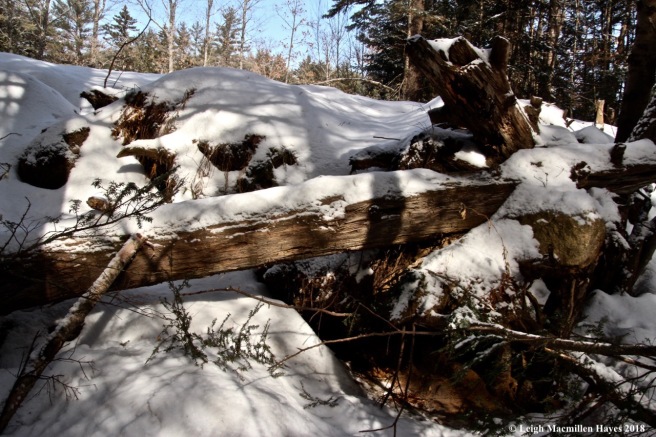
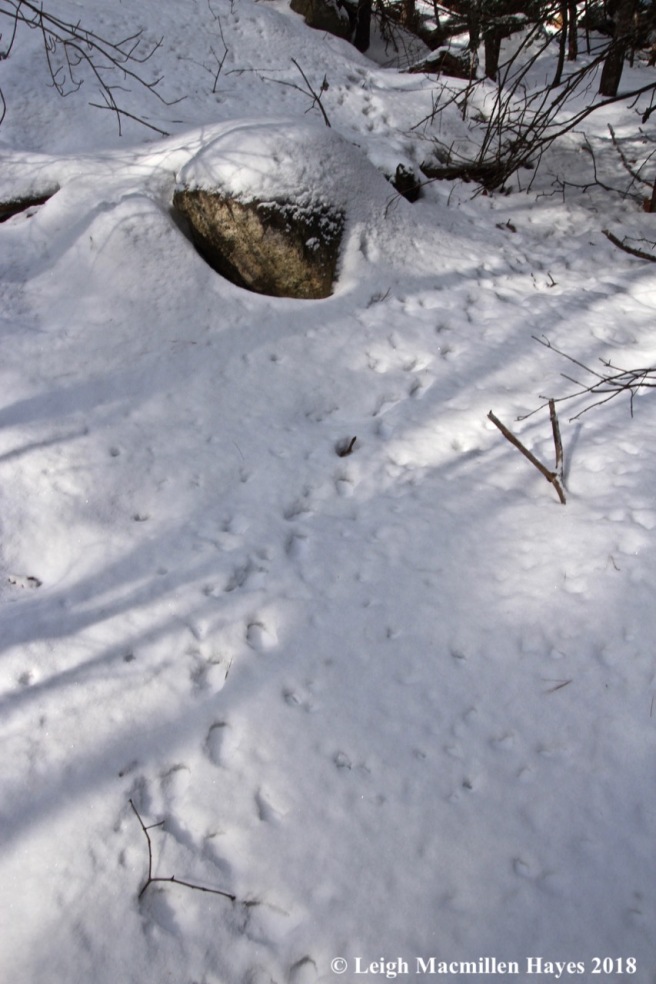
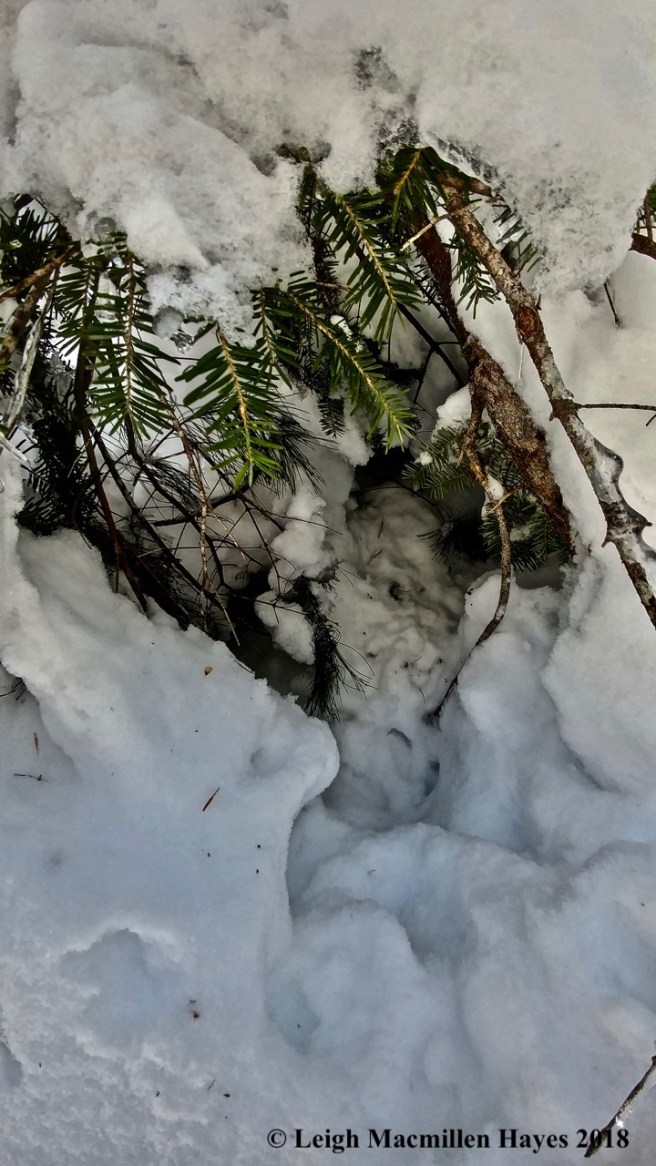
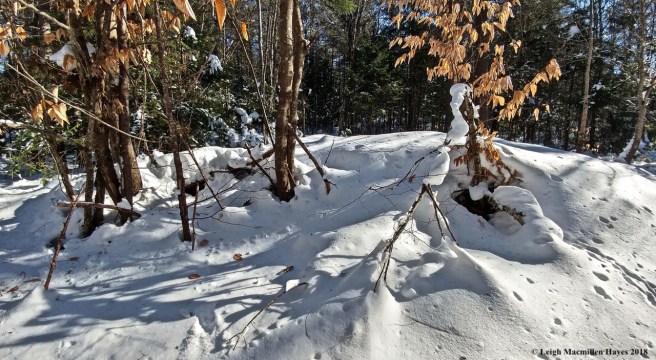
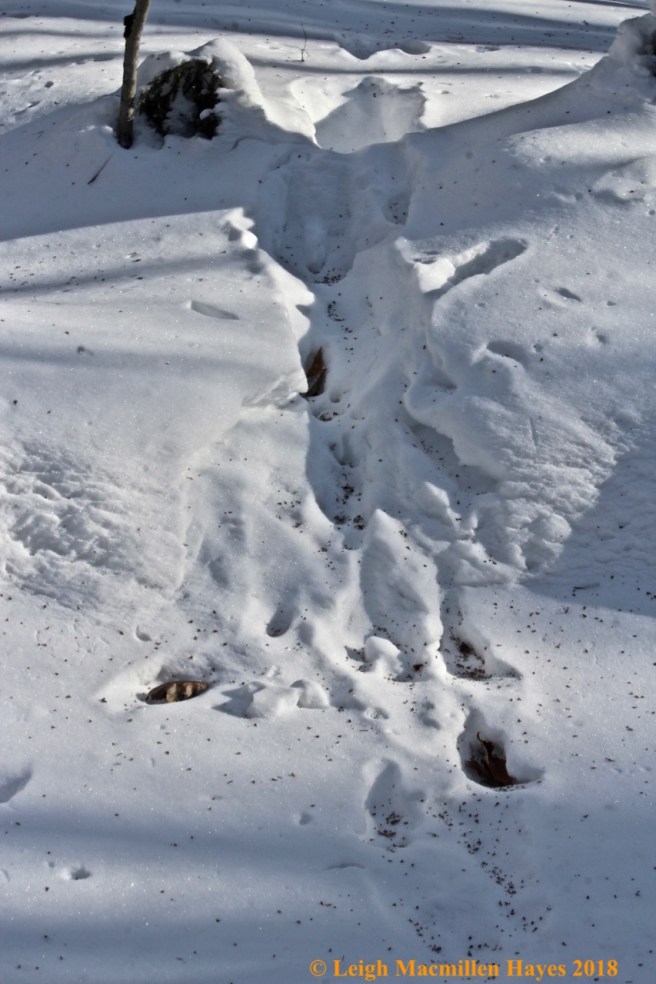
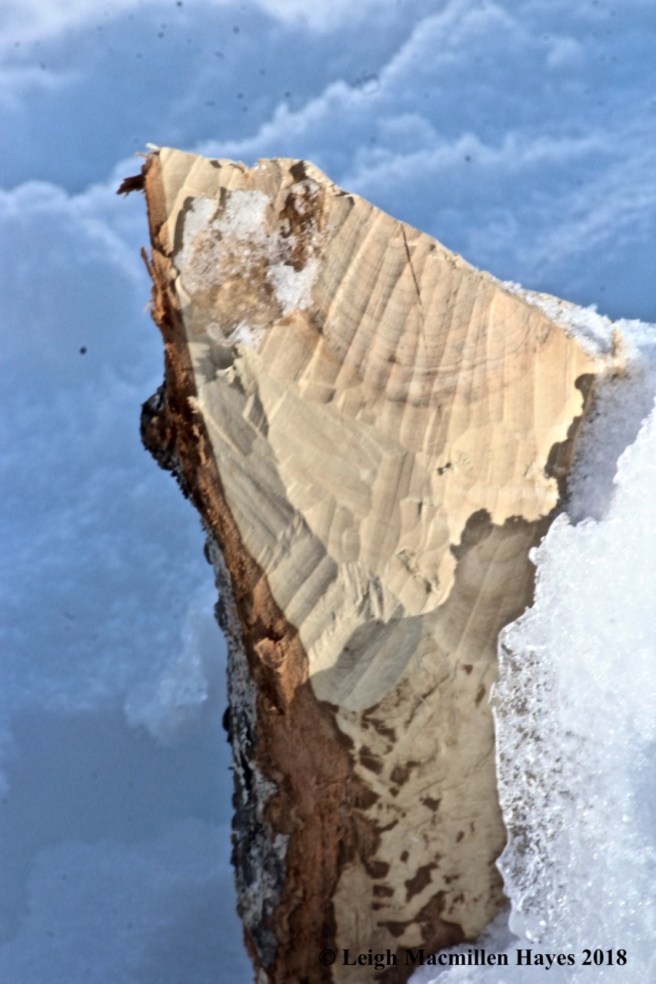
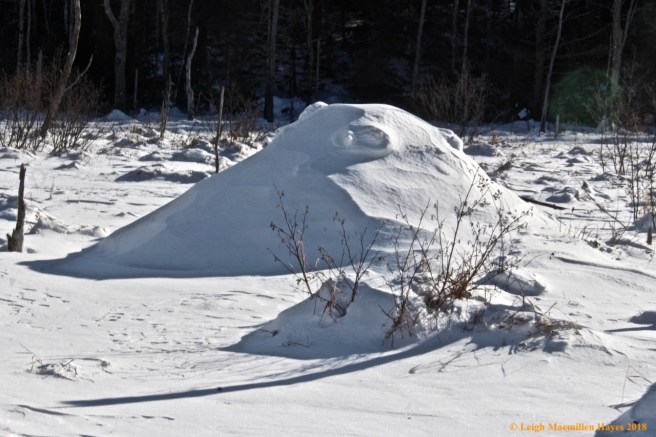
And then we backtracked a bit before crossing a property under conservation easement with the land trust and visited a porcupine condominium located in a large stump dump. The porkys didn’t let us down and we found prints leading into and out of seven or eight entry ways, along with downed hemlock twigs and scat. All perfect porcupine sign.

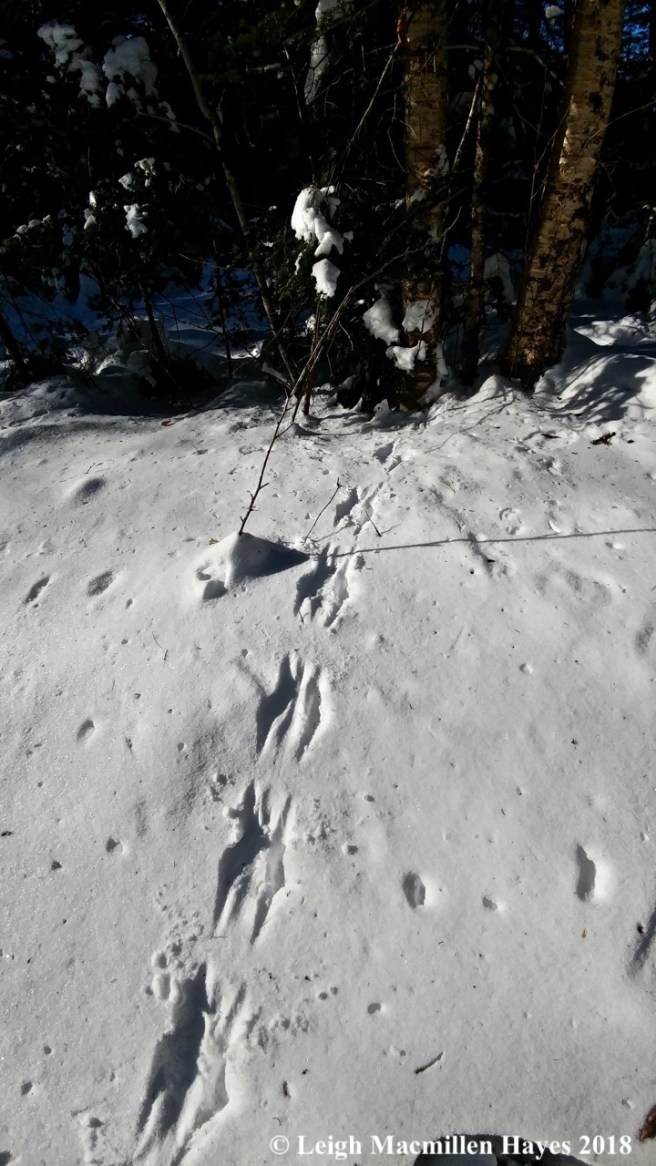
l-squirrel 1

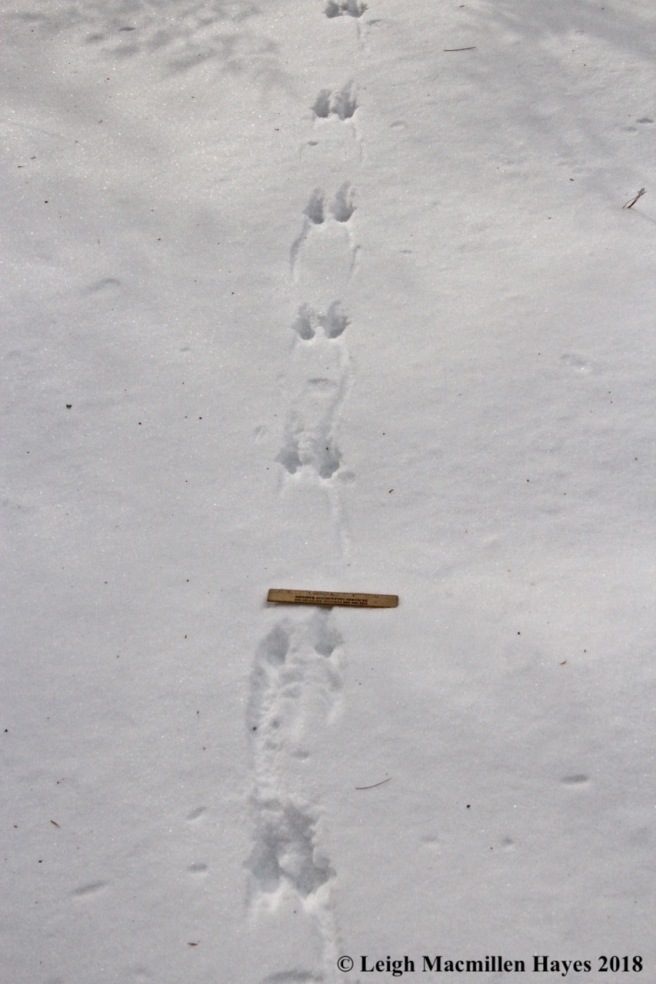
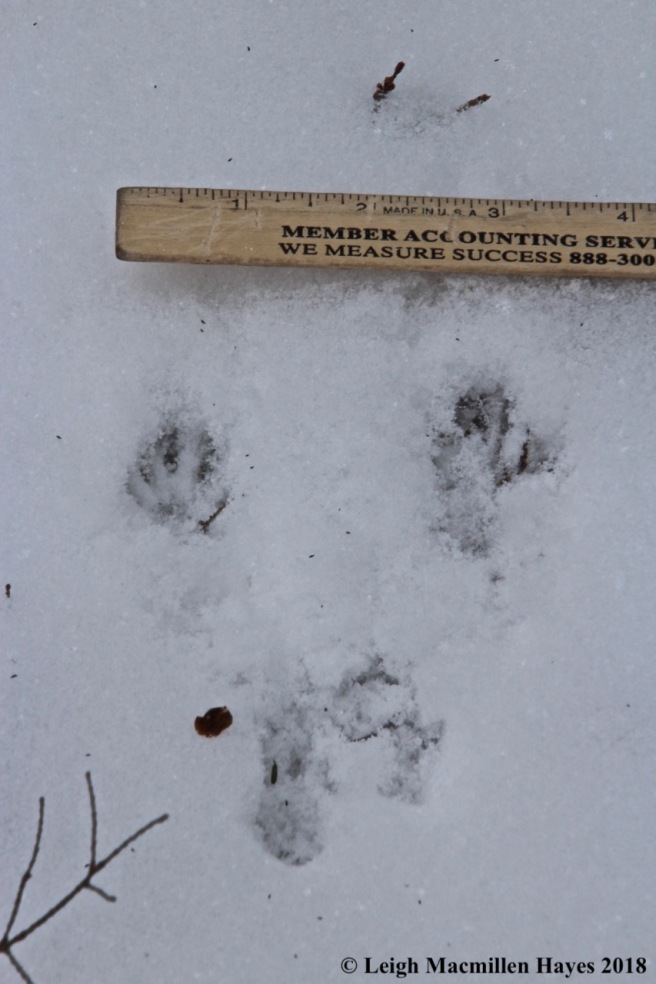
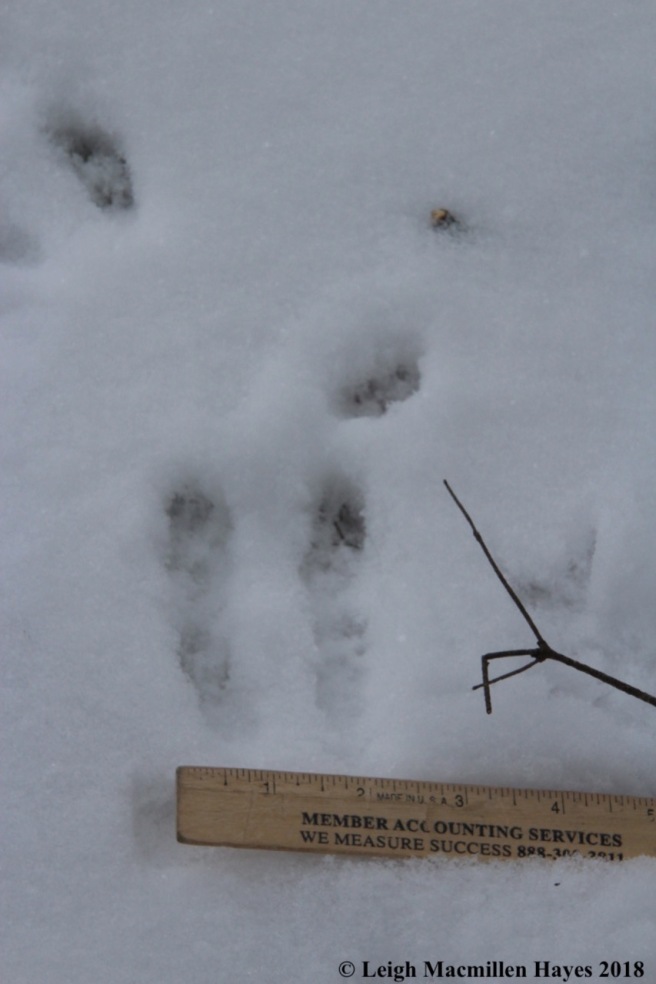
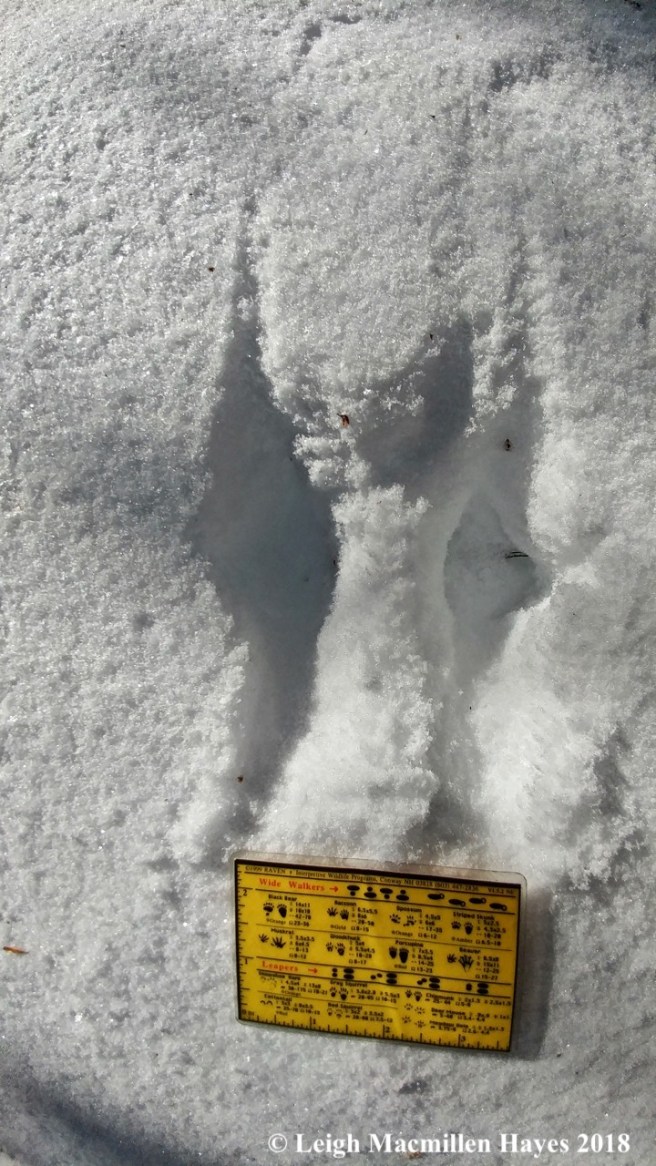
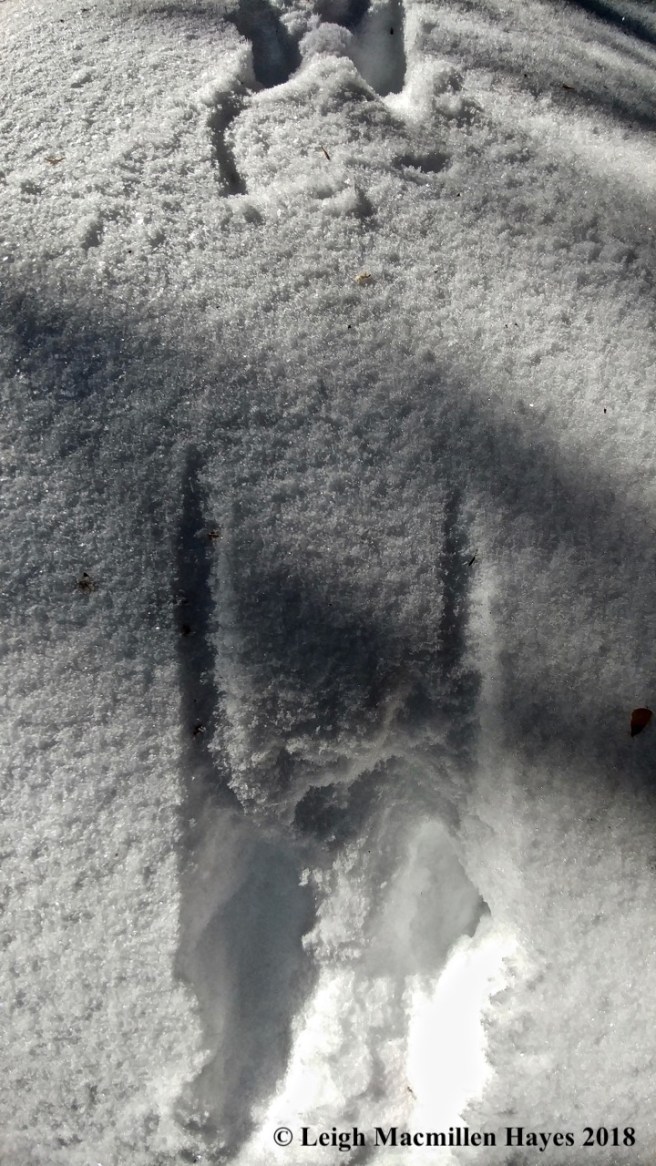
Since then, we’ve experienced a variety of mixed winter weather, but this past weekend a couple of inches of snow fell, making for great tracking conditions, such as this group made by a red squirrel, the two smaller feet being its front feet, which landed first, before the larger hind feet swung around and landed in front–the typical pattern left behind by a hopper or leaper. Its toes pointed toward my ruler, thus indicating the direction of travel.

l-chipmunk prints 1

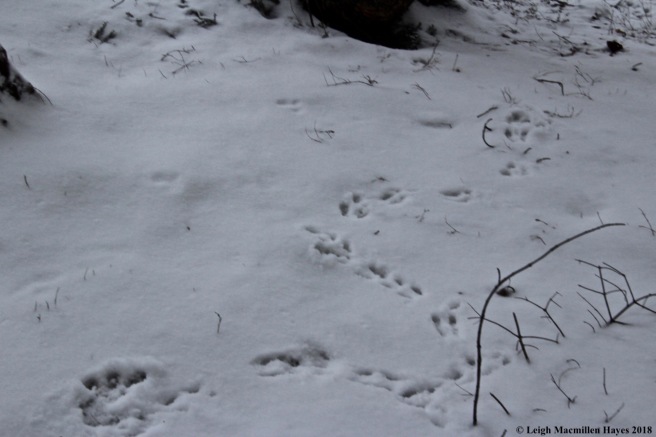
Because it had been warm over the weekend, chipmunks made a brief appearance–rather than being true hibernators, they are light sleepers and will move about in the chambers within their tunnels. Occasionally, during a thaw, they’ll even venture out to forage for fresh seeds.

l-chipmunk prints 2

Notice how the straddle is about two inches, while the red squirrel above exhibited a straddle of about three inches. Straddle being the measurement from the outside of the left hind foot to the outside of the right hind foot. In case you are wondering, the measurement for gray squirrels is about four inches.

l-coyote track

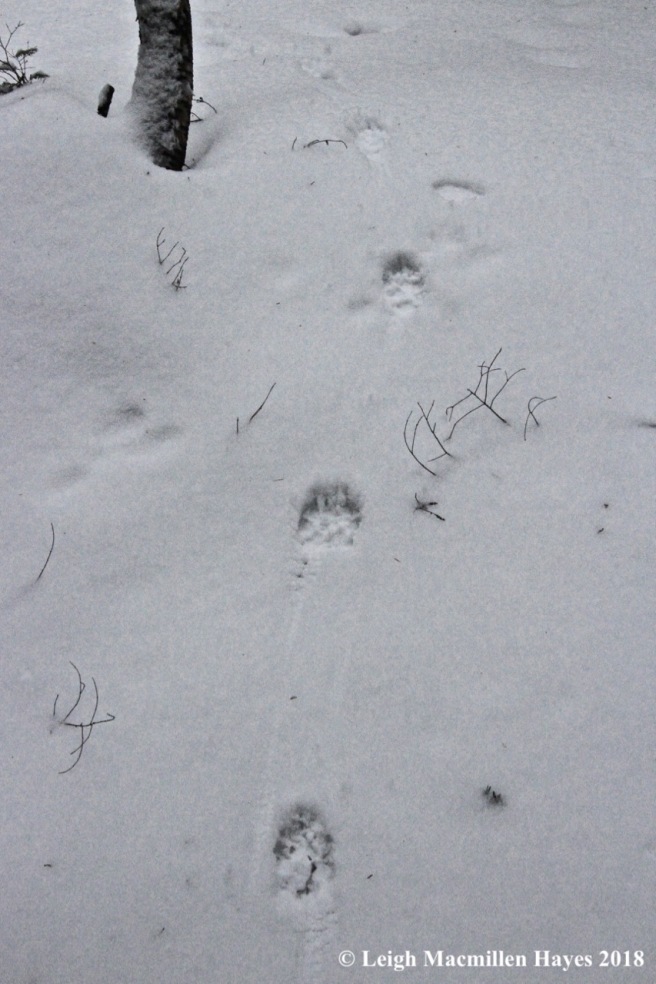
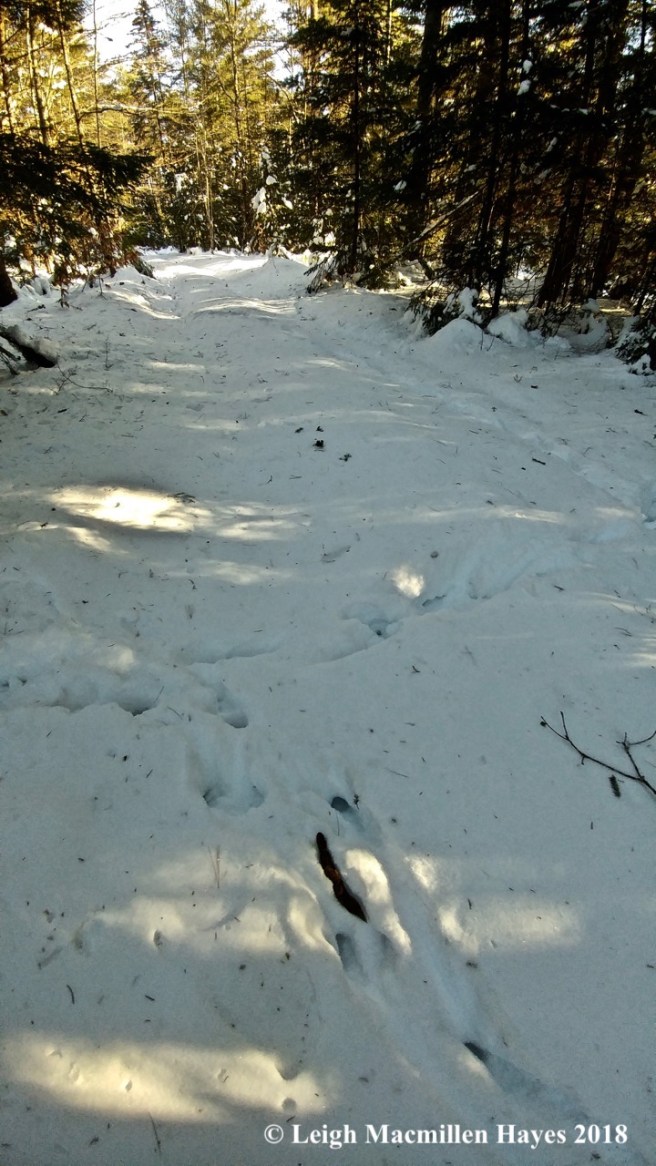
And then I came upon tracks so fresh that I was certain I might spy the two coyotes who traveled before me, but as is most often the case, I didn’t see them.

Following the snow, we had another downpour and everything changed. But then the temperature dipped again.

l-few Tuesday Trackers

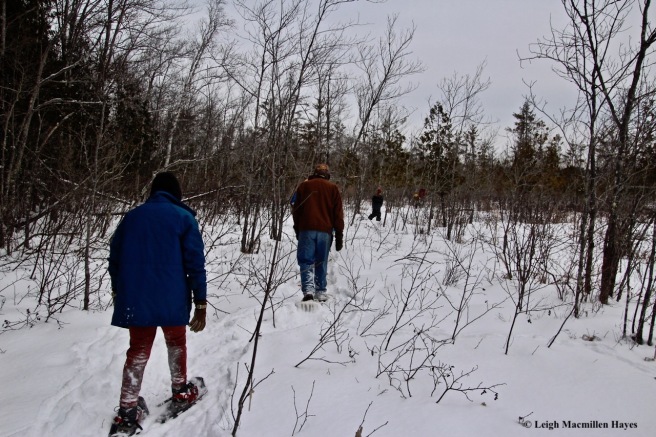
And so today when the GLLT’s Tuesday Trackers took to the trail at Long Meadow Brook Reserve, we were sure we’d find a plethora of well-made tracks. Only two problems. One: by the time Kathy, Dick, Mary, Russ, and I arrived, it was snowing lightly. And two: not too many mammals had been on the move in the last day or so. At least not in that neck of the woods.

l-Long Meadow Brook 1

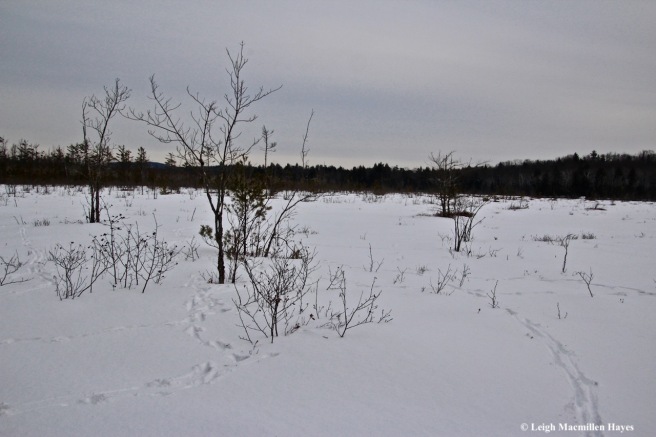
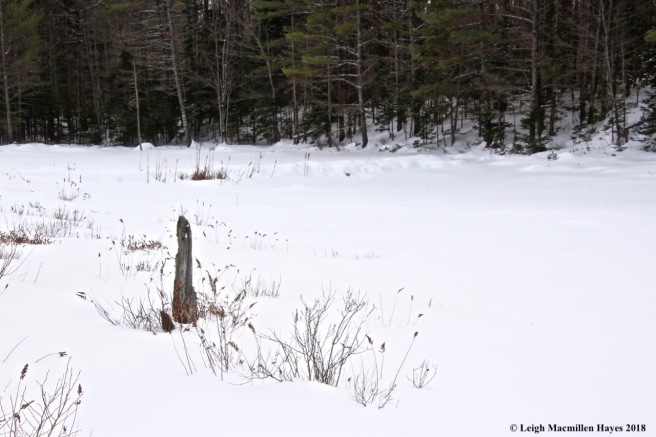
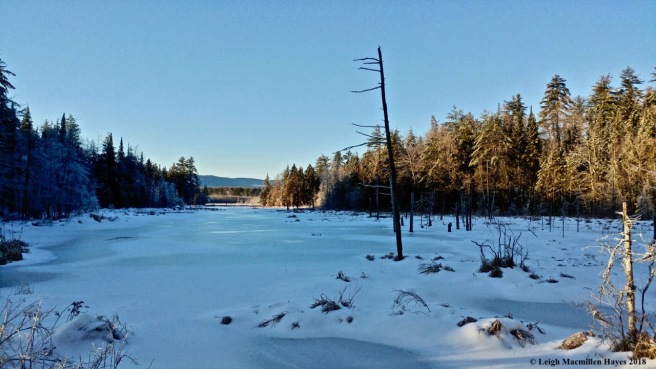
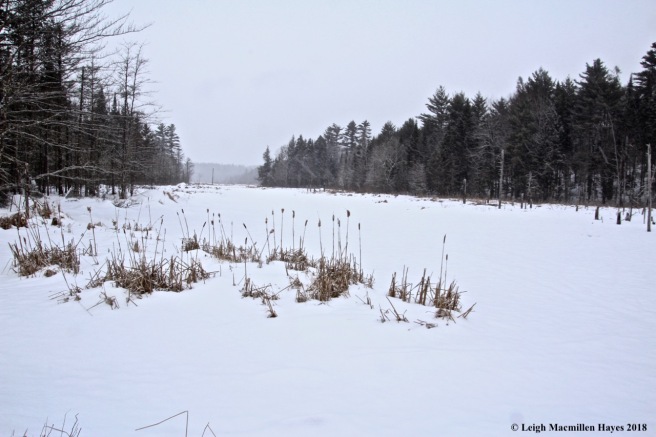
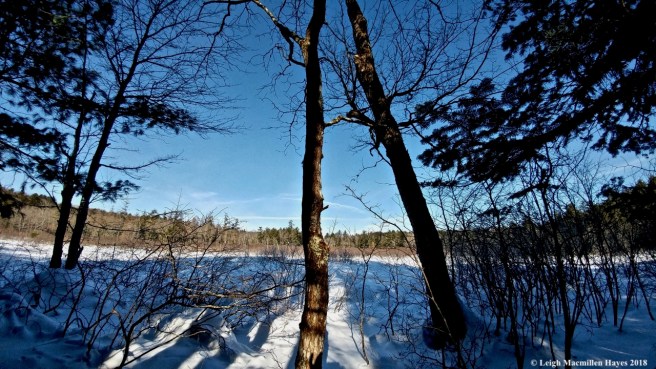
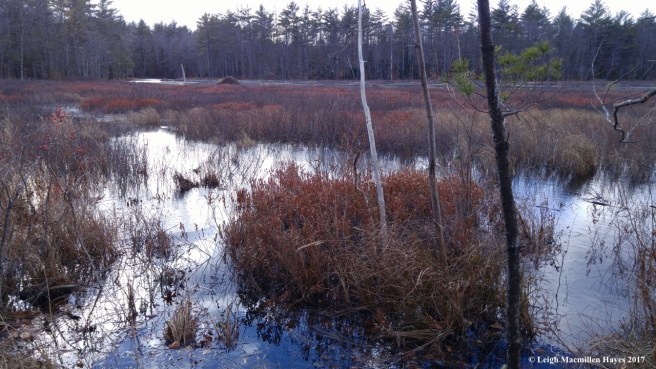
We beelined (sort of, for we did stop to look at deer tracks) down to the old beaver dam hoping for otter sign or that of other weasels. Nada. Instead, we took in the view to the north.

l-Long Meadow Brook south

And then to the south.

l-beech leaf 2

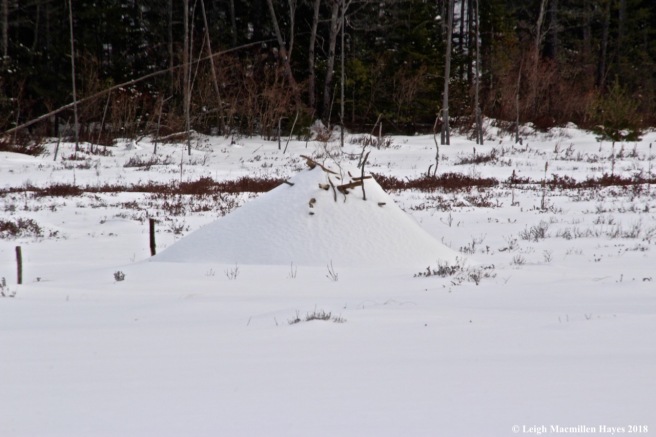
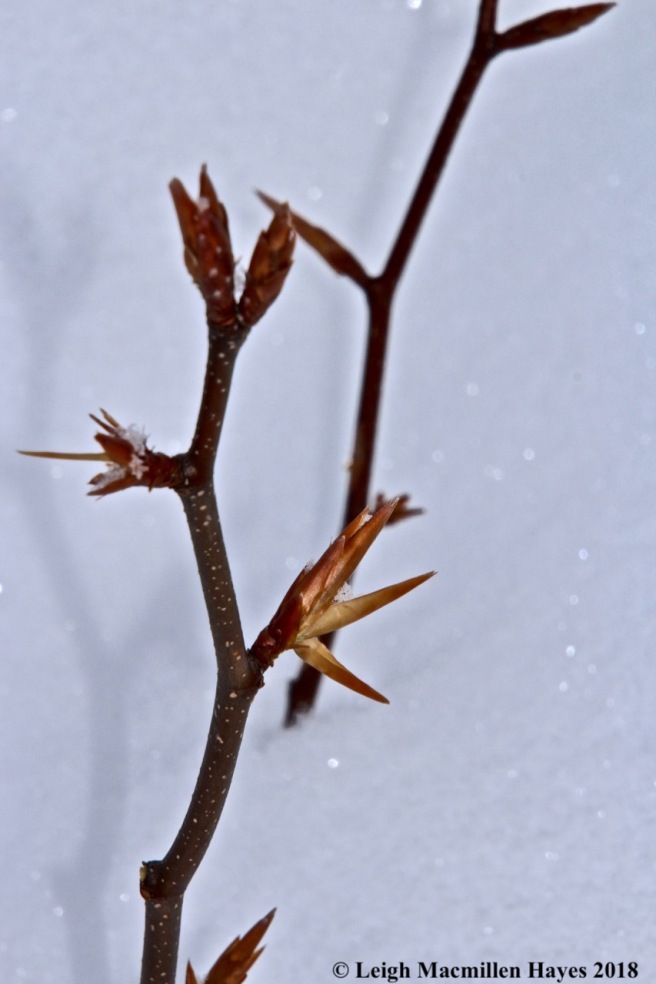
And headed toward the porcupine condo. But along the way, a couple of other things caught our attention, including a beech tree getting a head start on the next season.

l-pitch pine 3

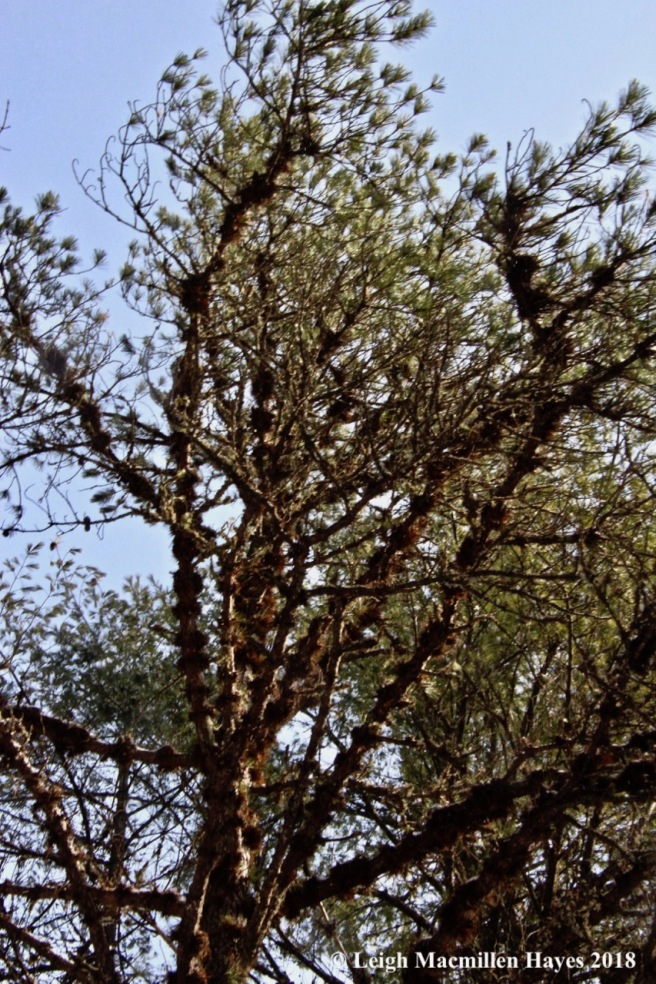
And a pitch pine that was the gnarliest any of us had ever seen. Pitch pine needles, in bundles of three, grow on the branches but may also sprout on the trunk–a unique feature making for easy identification among the evergreens. But so many? On branches?

l-junco

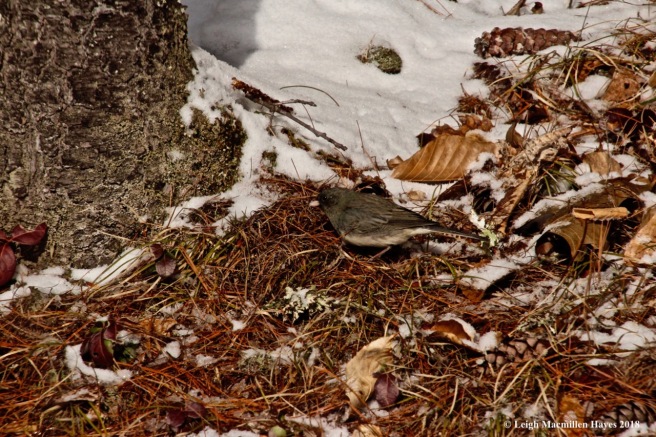
At last we reached a field where we welcomed sunshine to warm us up and noticed a few feathered friends. More than one junco scratched some bare ground in search of seeds.

l-squirrel pattern

As we crossed the field we rejoiced to have the track pattern of a gray squirrel to admire. Small things made us happy.

l-lorax tree

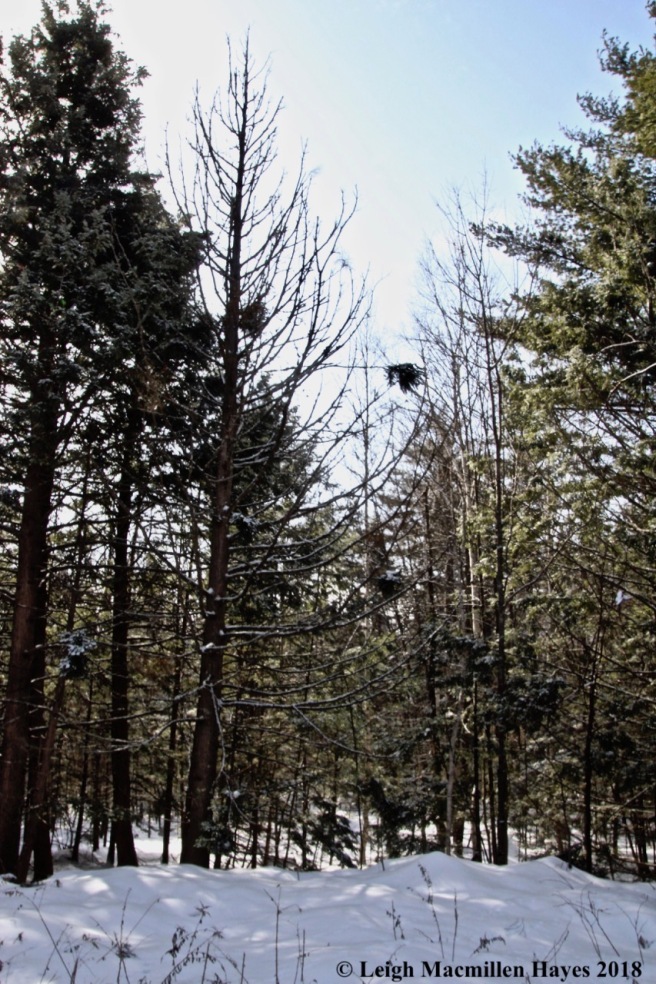
And then, at the top of one of the stump dumps we stood in awe of the Lorax tree. Only several branches had small fans of needles left; all the rest having been devoured by the local residents living below.

l-porky hemlock twigs

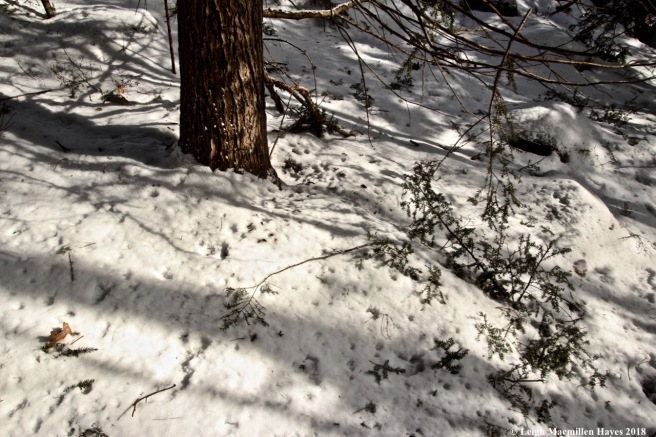
As we made our way into the hemlock grove to take a closer look, we spied what we believed to be a bobcat track based on straddle and stride, the latter being the distance from the toes of one print to the toes of the next print in the zigzag line. The overall impressions were a bit diluted indicating they were a few days old, but we’ve seen the same in this area before and the measurements led us to that conclusion. We also spotted downed hemlock twigs featuring the characteristic 45˚angled cut made by a porcupine.

l-porky tracks?

By this time, our group had increased by two when Alice and Saranne joined us for the trip into the porcupine haven.

l-porky den:stump dump

We peeked into holes, but suspected the homemakers had entered inner chambers.

l-porky tracks 2

We did find telltale tracks filled with the morning’s flurries, but still demonstrating their pigeon-toed pattern. And we saw that the bobcat had checked the holes as well before it moved on.

l-porky hole:hoar frost

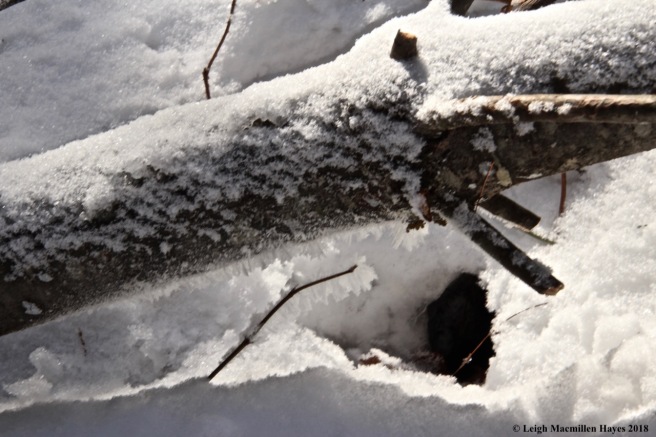
We decided to move on as well, climbing up onto the stump dump, but with a word of caution to watch out for steam holes. Hoar frost surrounded the holes and gave us further reason to believe that indeed the condo was occupied.

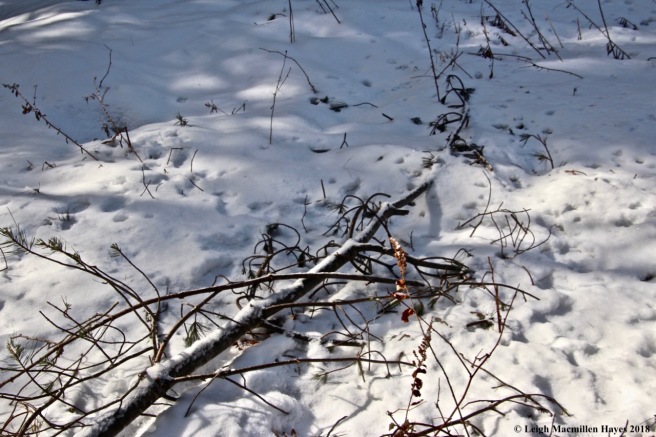
l-porky tracks around downed limb

The very branch under which we saw one hole had fallen from a white pine. All around it were more porcupine prints.

l-porky chews

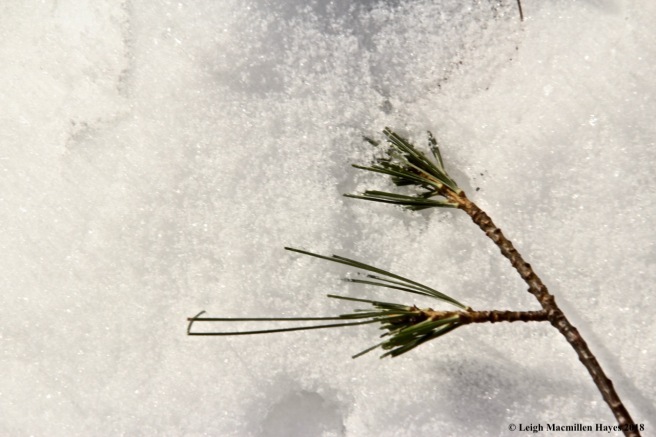
As for the white pine’s needles–think of them as dinner. The same was true of a bent red oak branch and its buds. A little variety in the diet.

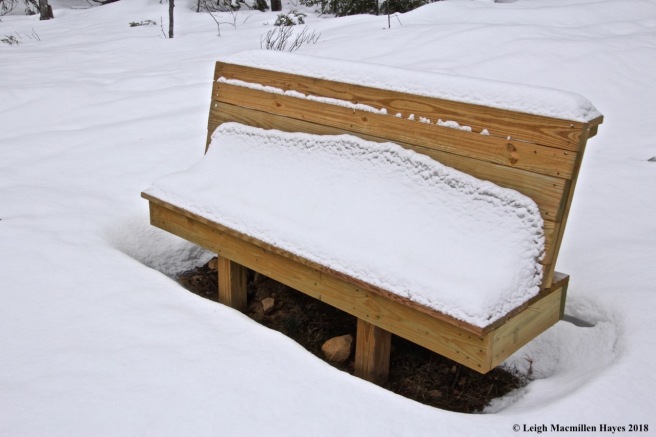
l-bench

We too were ready to eat and so we headed out.

Another three hour tour and our curiosity was satiated at Long Meadow Brook Reserve and the adjacent property.  A couple of benches await at Long Meadow Brook should you want to pause and take in the wonders yourself.


Forever Green

According to a Cherokee legend, one cold season an injured sparrow knew he could not fly south with his family, so he bid them farewell and went in search of a place to survive.

Sparrow asked Oak to shelter him among its leaves so he might heal and greet his family upon their return in the spring.

But being a crusty old tree, Oak didn’t wish to have a winter house guest and so he turned Sparrow away.

Downtrodden, Sparrow approached Maple. Sweet as she might be, Maple also turned Sparrow away.

And so it went. Sparrow was turned down by each tree he visited, until there was only Pine left to ask for help.

Pine listened to Sparrow’s pleas and his heart heard Sparrow’s plight. And though Pine knew his leaves were tiny and more like needles, and his branches not as many as the others, he welcomed Sparrow to join him for the cold season.

As hoped, Sparrow healed and greeted his family the following spring.

Creator heard and saw all that had happened and called a great council of the Trees. In his address, he rebuked them for they’d been given so much and would not share the least of what they had with Sparrow in his time of need. Therefore, from that day forward, when cold came upon the land, their leaves would wither, die and blow away.

Creator then spoke to Pine, praising him for being the least among the trees, and yet giving so much. And so, Pine was honored to remain forever green.
e-eastern white pine magestic.jpg

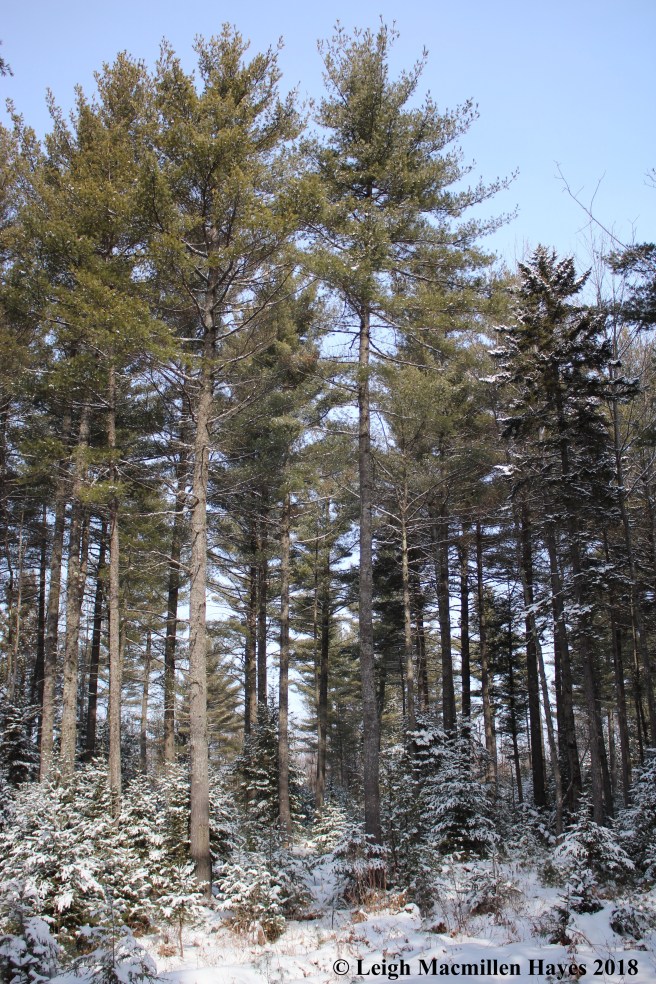
The Eastern white pine (Pinus strobus), strikes me as the majestic tree of our forest. Of course, it was once even more majestic. In the 1600s, the British Royal Navy blazed all of those two feet or more in diameter and within three miles of water with the broad arrow indicating they were to be cut, harvested and sent to England for ship masts. The blaze became known as the King’s Arrow in honor of King George I. At that time, the trees may have been 300-400 years old and over 200 feet tall. The oldest and tallest white pines in our current landscape are 80-100 years old and maybe about 100 feet tall.
v-white pine

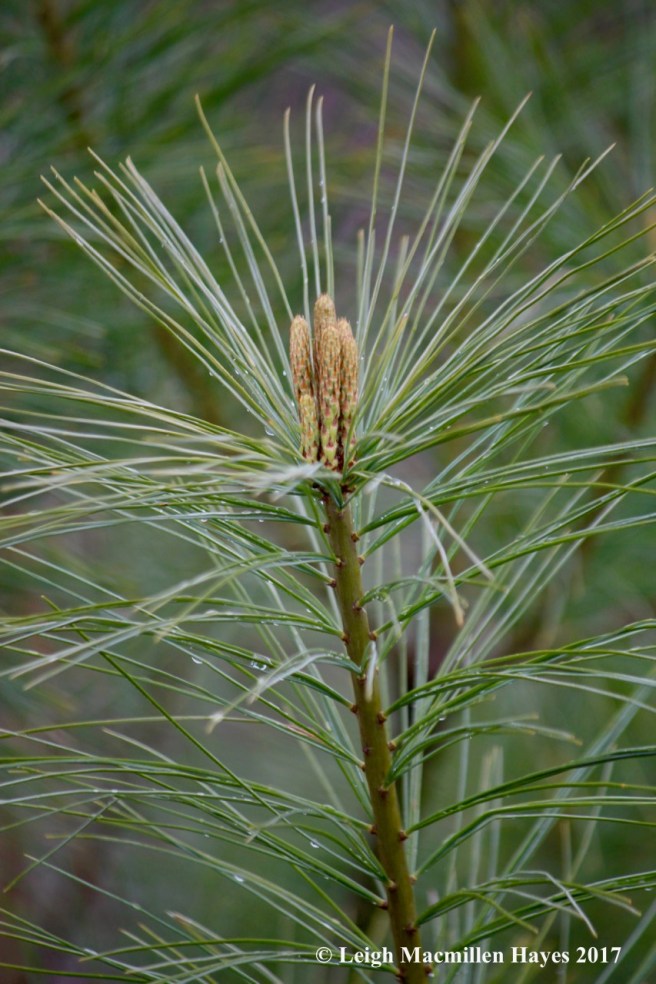
The three to five-inch white pine needles are blueish-green and bound in bundles of five. That’s easy to remember for you can spell both the tree’s name W-H-I-T-E with each needle or M-A-I-N-E for the white pine is our state tree.
e-pine tube insect

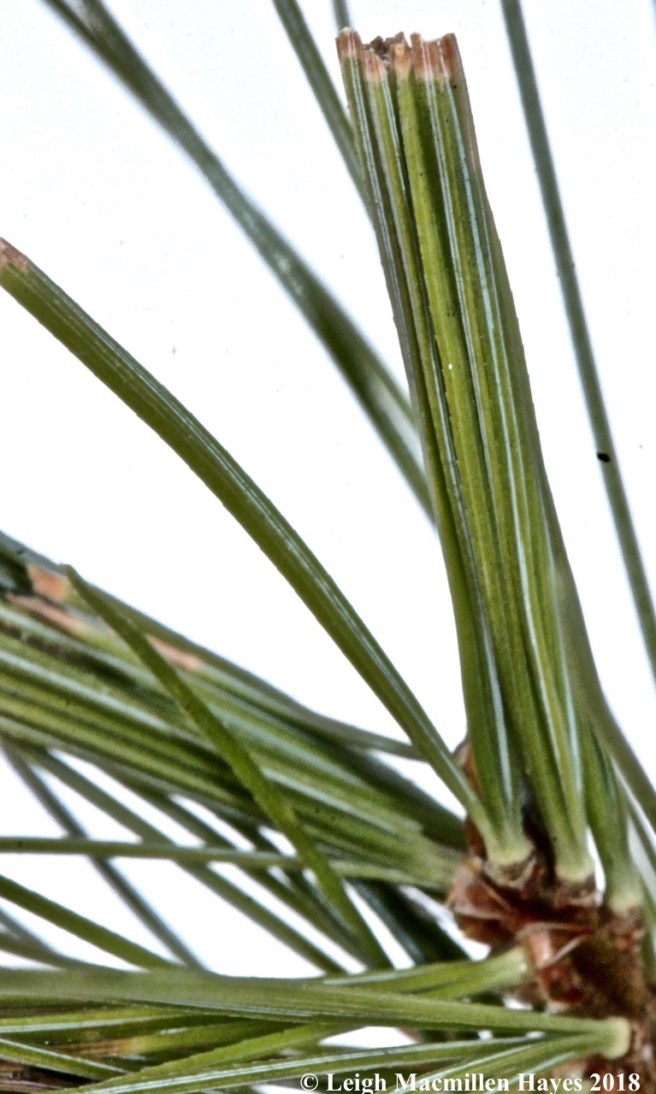
Occasionally, I’ve spotted trees with clumps of needles stuck together in such a way that they formed tubes. Actually, they were the tunnels created by the pine tube moth. Larvae hatched from eggs deposited on the needles during the summer. They used silk to bind the needles together, thus forming a hollow tube. Notice the browned tips–that’s due to the larvae feeding on them. Eventually the overwintering larvae pupate within the tube and emerge in April. Two generations occur each year and those that overwinter are the second generation. Fortunately, they don’t seem to harm the trees.

e-pine whorls

In addition, the arrangement of branches is another important feature of this white pines for they are arranged in whorls radiating from the tree’s trunk like spokes on a bicycle wheel, with each whorl representing one year’s growth. Sometimes on older trees that grew beside stone walls in pastures, the older branches remain and when topped with snow look like a spiral stairway to heaven.

e-lines in white pine bark

On younger white pines, the bark has a greenish hue, but as the trees mature the bark turns dark gray to reddish-brown and forms into thick, vertical scales with furrows between. Upon the flattened ridges of the scales, look for a pattern of horizontal lines reminiscent of the lines on notebook paper.
e-red pine bark

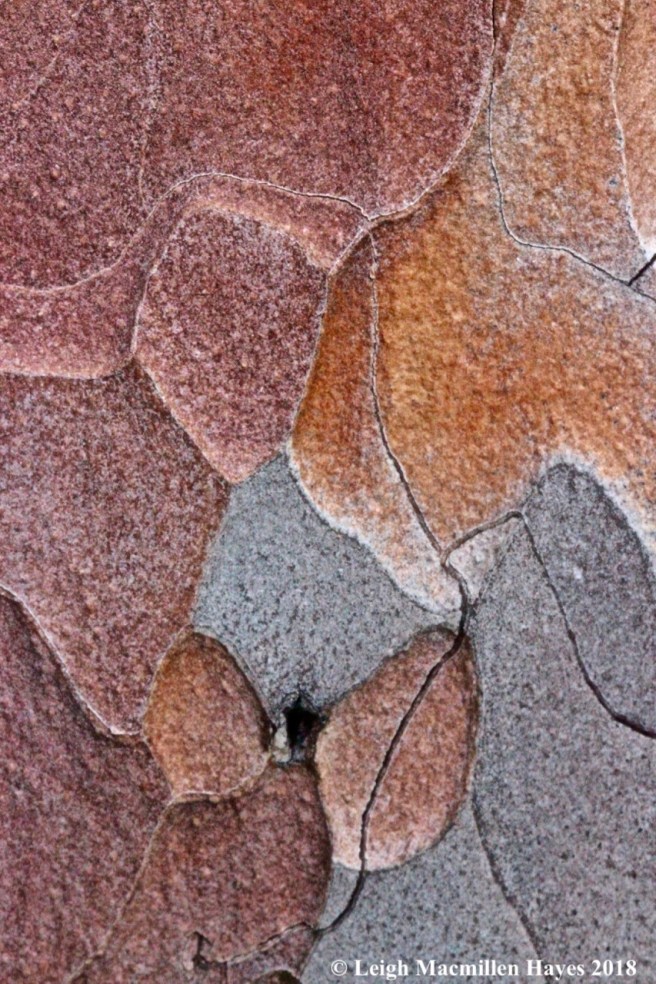
Red pine (Pinus resinosa) is a favorite of mine because of its bark, which reminds me of a jigsaw puzzle. Ranging in colors from faded orange to mottled red and grayish brown, its flaky flat scales hug the tree.
e-red pine needles, chimney sweep

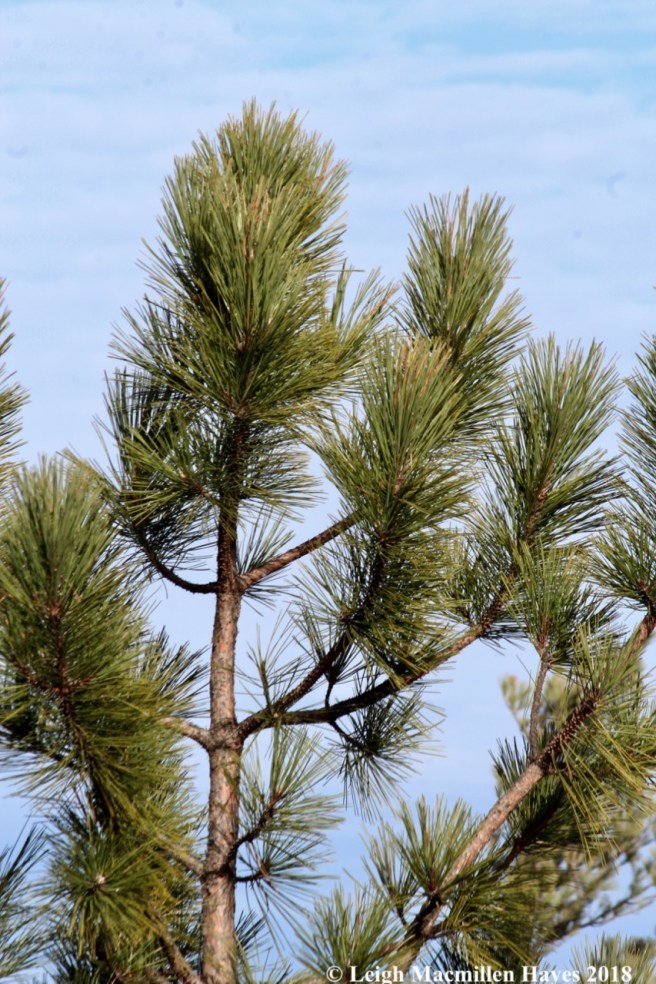
In a perfect world, red pine would produce three needles/bundle to spell R-E-D. Alas, the world isn’t perfect, nor is that the case with this tree. Instead, it has two dark green needles that are twice as long as those on a white pine and quite stiff. In fact, while a white pine’s needles are soft and flexible, bend a red pine needle and it will snap in half. Because of the needle arrangement on these two members of the Pinus family, from a distance I can name them. To my eyes, a white pine’s branch tips look like bottle brushes, while a red pine’s remind me of the brush Bert used to sweep chimney’s in Disney’s Mary Poppins.
e-pitch pine needles on trunk

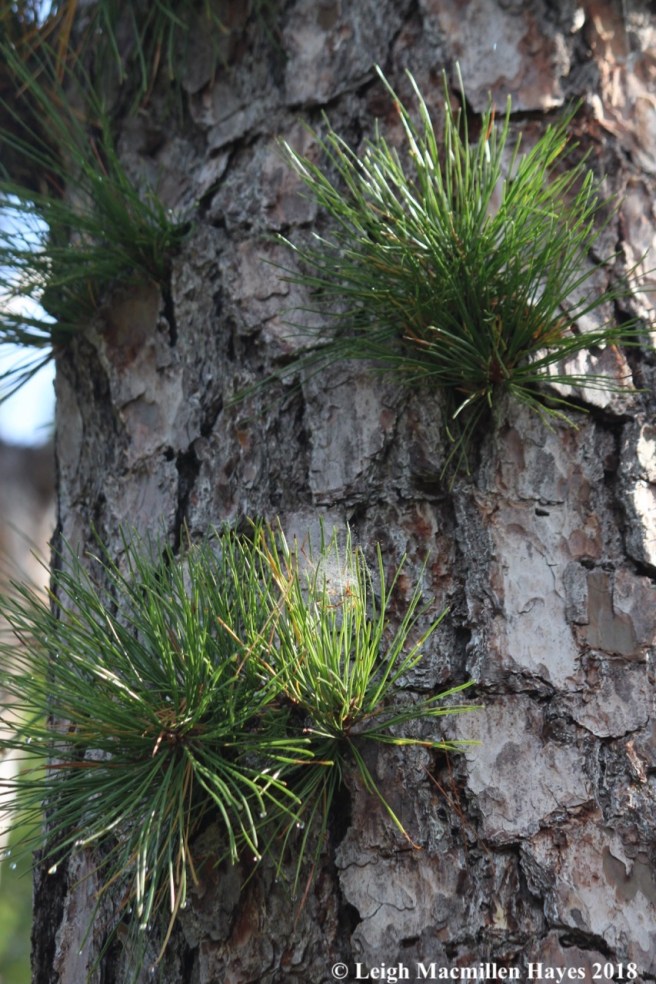
Another common pine in our area of Maine is pitch pine (Pinus rigida). This one is easy to confuse with red pine because the bark looks similar in color, though it strikes me as forming thicker plates. The name, pitch, refers to the high amount of resin within this tree.

It’s the needles of pitch pine that also add to its identification for they grow in bundles of three, like a pitchfork’s tines. The unique thing about this tree is that not only do the stiff, dark yellow-green needles grow on the branches, but they also grow on the trunk. If you spy a tree that you think may be a Red Pine, scan upward and if you see green needles along the trunk, then you’ve discovered a Pitch Pine.

Pitch pine is an important species for it is the only pine that is well adapted to fire and can even resprout.

e-jack pine

Finally, for our native pines, and I can only think of a few local places where I’ve seen these, including along the Foster Pond Outlook Trail at Bald Pate Mountain in South Bridgton, is Jack pine (Pinus banksiana). It seems to prefer the coast and central northern Maine. But . . . walk Loon Echo Land Trust’s trail at Bald Pate, and see if you can spot them.

Jack pine has two yellow-green to dark green needles in each bundle so an easy way to remember its name: Jack and Jill. I don’t know about you, but I love mnemonic devices.

e-white pine cone, red pine cone, hemlock cone

One last way to differentiate the pine trees is by their cones. Cones are the fruits of the trees and they consist of scales that protect seeds. When conditions are right, the scales will open to release the seeds, which have wings much like a maple samara, allowing them to flutter off in the wind and find their own spot upon which to grow. The line-up in this photo from left to right: white pine, red pine, hemlock.

e-white pine with two year old cones

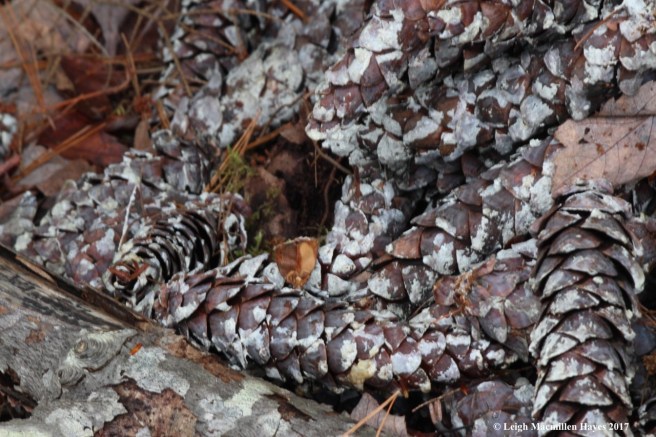
White pine is easy to ID for it produces long, narrow cones, often coated with white sap. It takes two years for a white pine cone to mature.
e-pine cone midden

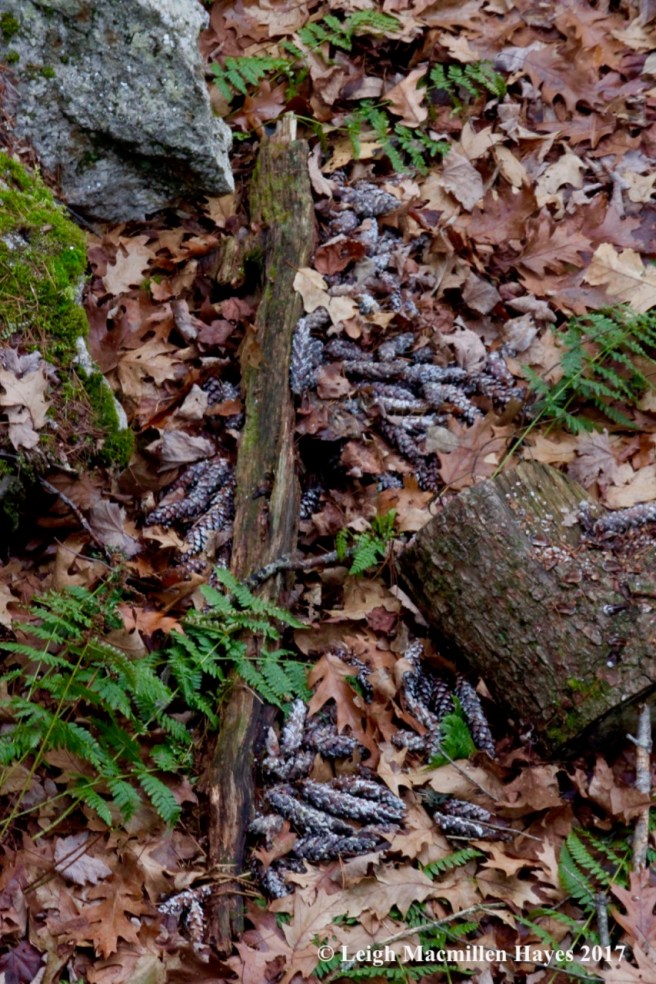
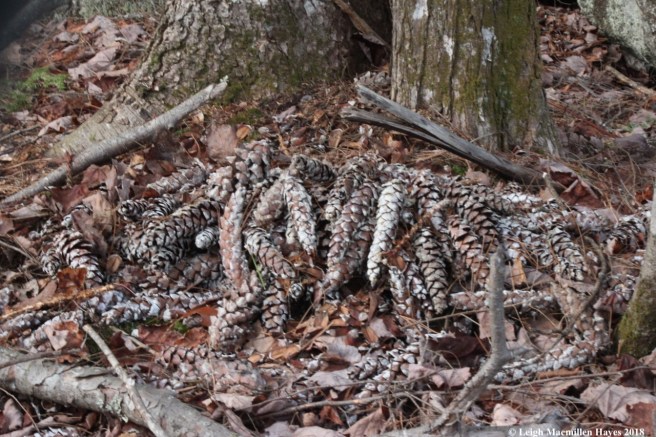
Red squirrels are known to gather mature cones and store them in a cache for winter consumption. During the winter, the squirrels tunnel under the snow to access the cache, then climb up to a high spot and remove each scale to reach the seeds. Left behind is a midden or garbage pile of scales and center cob of the cone.

e-red pine cone and needles

Red pine cones are about two inches long and egg-shaped on short stalks.
e-pitch pine cone 1

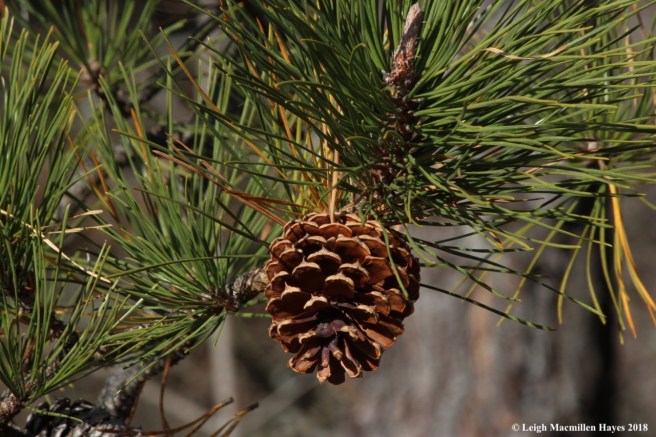
You can barely see the stalk of pitch pine cones that tend to be clustered together, but their key feature is the rigid prickle atop each scale tip. On Jack pines, the cones are about two inches long and slightly curved like a comma.

Before I move on to the other evergreens, I need to make one point. Members of the Pinus family produce pinecones. All other evergreens produce cones, but they aren’t pinecones because they don’t grow on pine trees.

e-mixed forest 2

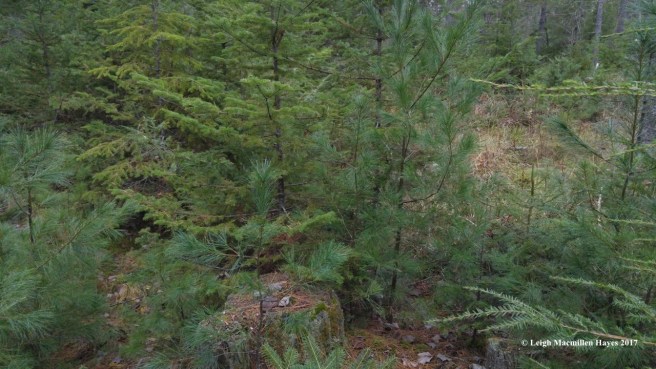
Eastern hemlock (Tsuga canadensis) grows almost as abundantly as white pine. Often white pine, hemlock, balsam fir and spruce saplings can be observed growing together, and a perfect classroom situation evolves.
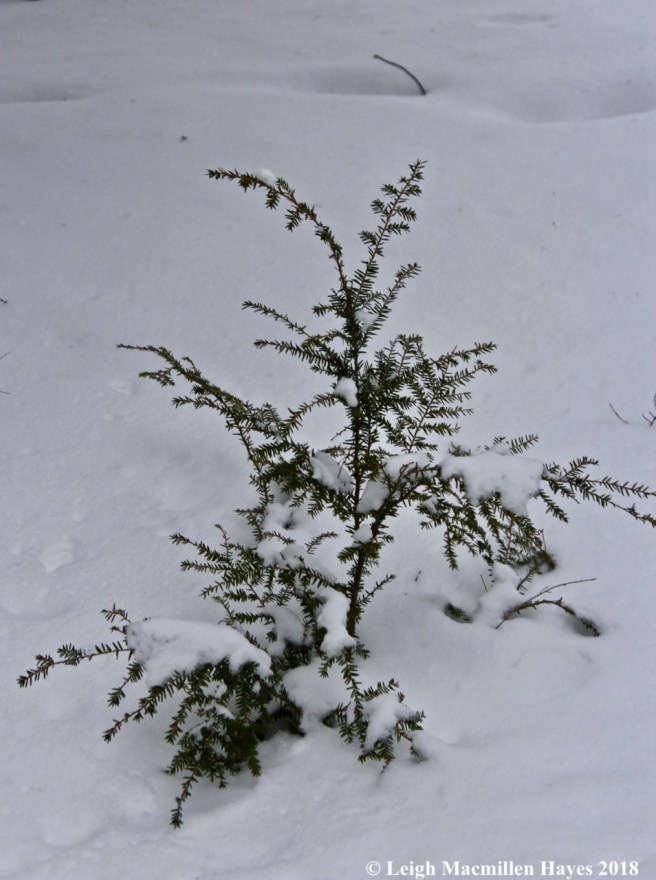
e1-drooping hemlock

The hemlock is easy to ID once you realize its characteristics. To begin with, and especially noticeable in younger trees, is the drooping terminal shoot. In fact, all of the branches droop, providing the overall effect of a graceful tree.

e-hemlock gathering snow

Those sturdy, down-sweeping boughs also hold snow, thus creating the perfect spot for deer to hunker down under on a winter night.

e-hemlock porcupine evidence below hemlocks

Another mammal that takes advantage of the hemlock is the porcupine. If you spy nipped twigs on the ground surrounding a hemlock, then it’s best to look up and make sure you won’t become a pin cushion should the animal fall.
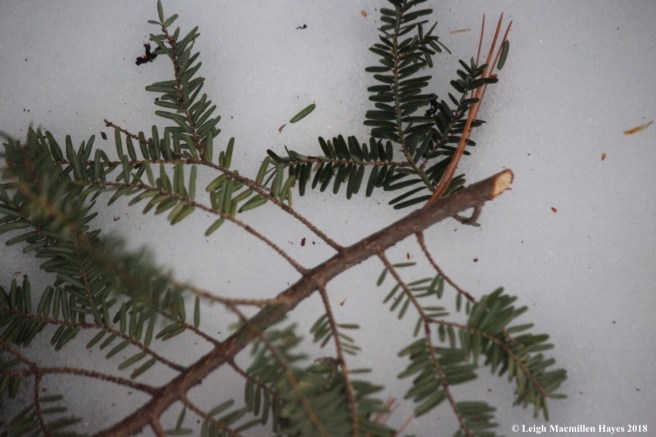
e-hemlock porcupine

Typically, the downed hemlock twig features a cut made at a 45˚ angle.

e-hemlock petioles (stems) and stomata lines

The half-inch hemlock needles taper to a dull point. You may only see this with a hand lens, but each needle is attached to the twig by a short stem, aka petiole. And the needles extend outwards from both sides of a twig, thus giving it an overall flat appearance.

e-inner bark of hemlock

The bark on a hemlock, initially grayish and smooth, becomes cinnamon brown and scaly with age. I also enjoy looking at the inner bark that might be exposed by an injury, for its features various shades of reddish purple.

e-hemlock cones

Hemlock cones are petite in comparison to pinecones, at only .75 inch in length. In the spring, their scales are blue-green, maturing to a tan by autumn.
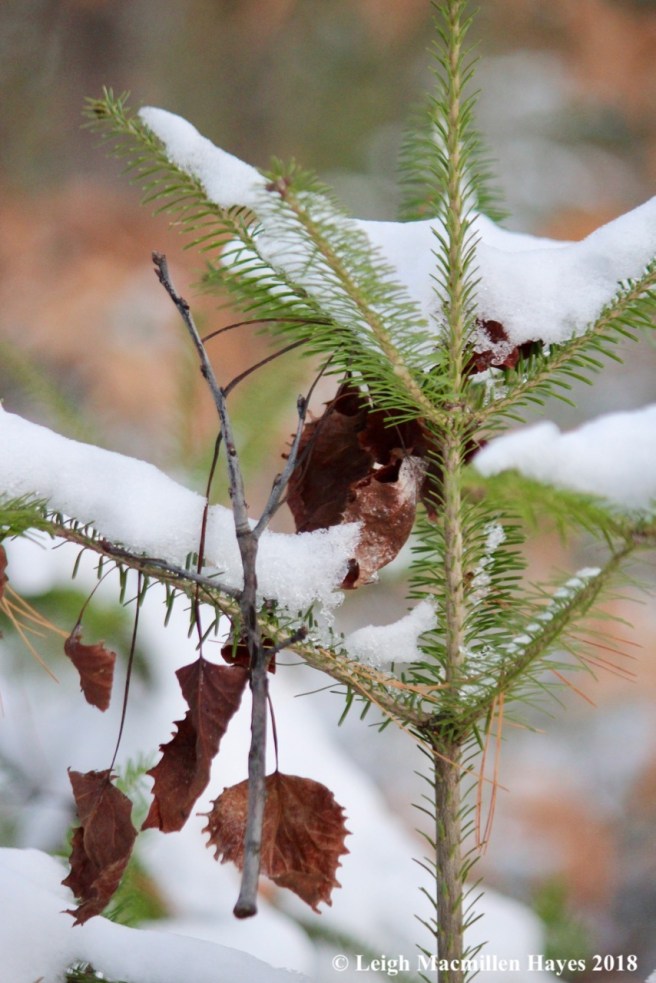
e-balsam fir standing upright

While the hemlock droops, a balsam fir (Albies balsamea) stands straight and tall as it forms a spire with a symmetrical crown.
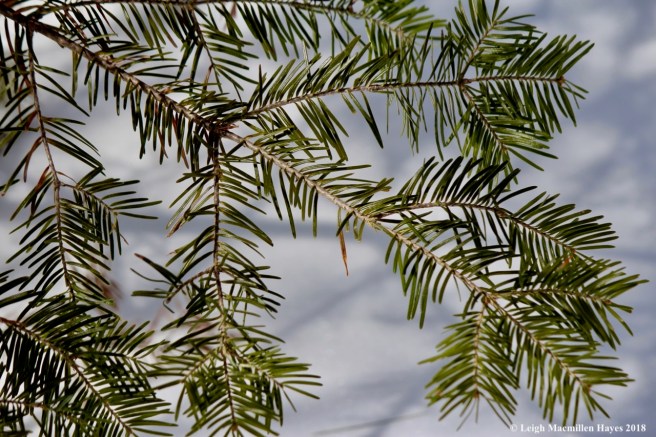
e-balsam fir needles

Like the hemlock, the needles are flat, but they differ in that they attach directly to the twig, are about an inch in length and some have a notch at the blunt end. The upper side is a shiny dark green, while the underside is silvery-blue.

e1-balsam bark

The pale gray to green-brown bark of balsam fir is also different than the other evergreens. It has raised dashes, aka lenticels. All trees have lenticels that allow for the exchange of gases. On some trees, however, the lenticels are more noticeable. Balsam fir bark also is riddled with bumps or resin-filled blisters. Poke one with a stick and watch the pitch ooze out. Beware, it’s very sticky. And it smells like Christmas.

e-balsam fir cones

One other unique characteristic of a fir tree is that the cones point upward rather than dangling down. That, in itself, offers an easy ID.

e-spruce

The next family, the Picea or spruces, I find more difficult to distinguish in a crowd. Like balsam fir, the leaders or top sections point skyward giving it an overall pyramid shape, but its the idiosyncrasies within the family that sometimes stump me.
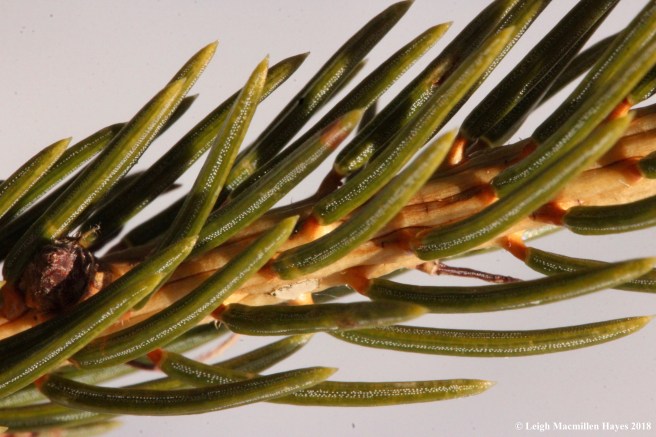
e-spiky spruce

The one thing I am certain of is that they are spruces if their needles are sharp and pointed. Shake hands with a branch and if it hurts, it’s a spruce.
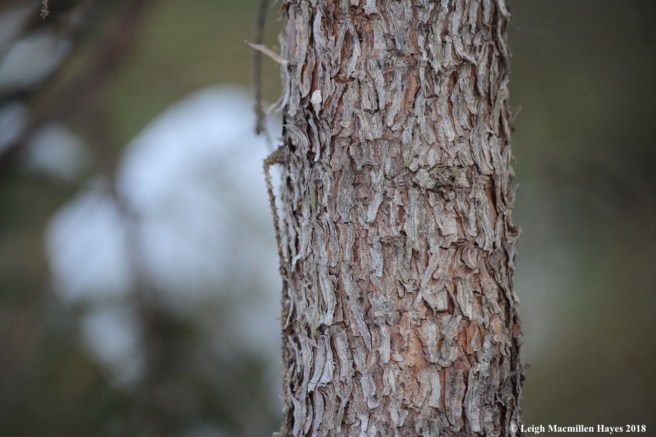
e1-spruce bark

Spruce bark is broken into irregularly-shaped scales in general, and white spruce bark is gray to reddish-brown.

Again, I’m brought to things to remember when trying to determine whether I am looking at a fir or spruce—firs are friendly, spruces are spiky. Fir needles are flat, spruce needles are square.

The only cedar tree native to western Maine is the Northern white cedar. Whenever I sniff its fragrant scent, I’m reminded of my mother’s cedar chest and the treasures it stored.

e-Northern white cedar leaves and cones

Northern white cedar (Thuja occidentalis) is also known as Eastern arborvitae. Its scale-like leaves appear opposite each other along the twig and have short, blunt points.

The cones are about a half inch long, oblong in shape and borne upright on the branches. Their scales are leathery, red-brown and notched. They also have a small spine on the tip.
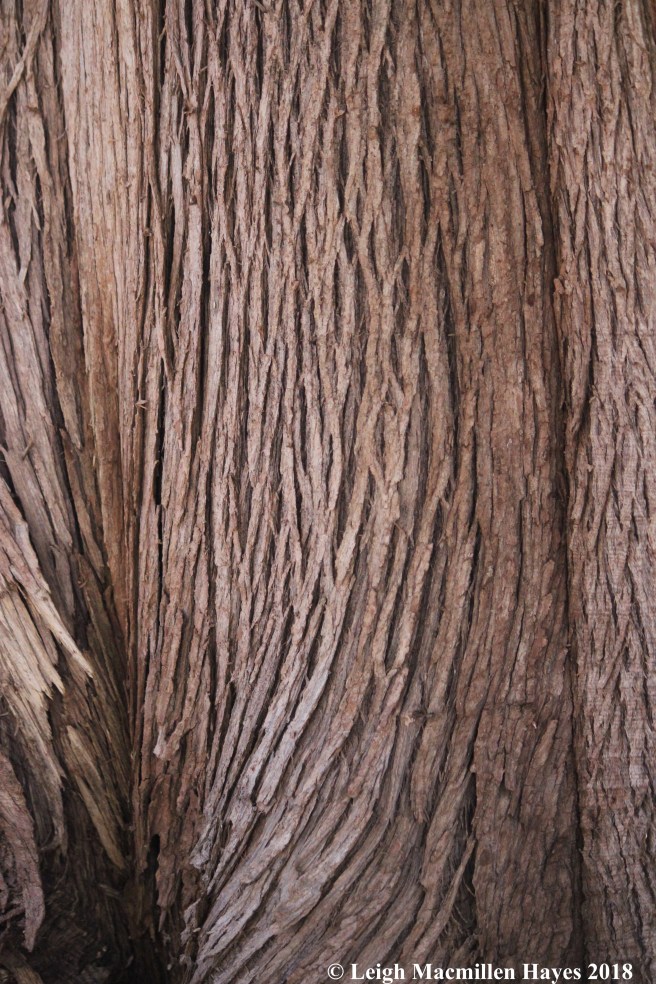
e-Northern white cedar bark 2

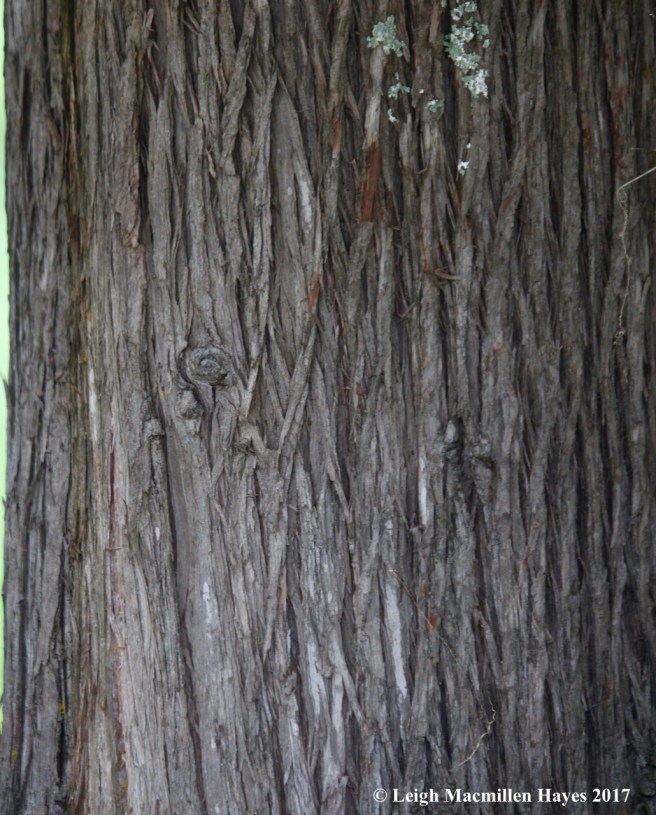
Again, the bark is fibrous, red-brown, which weathers to gray and features a diamond-shaped pattern. This small to medium-sized tree looks like a pyramid with a broad base and rounded top. It often features several main trunks.

And then there’s the tamarack.
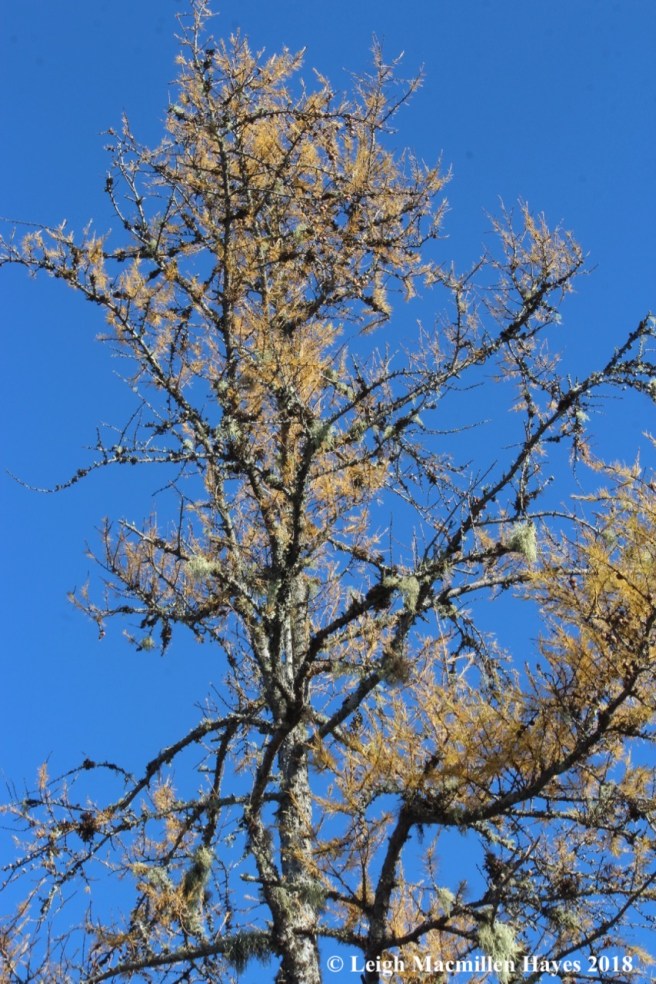
e-tamarack in fall

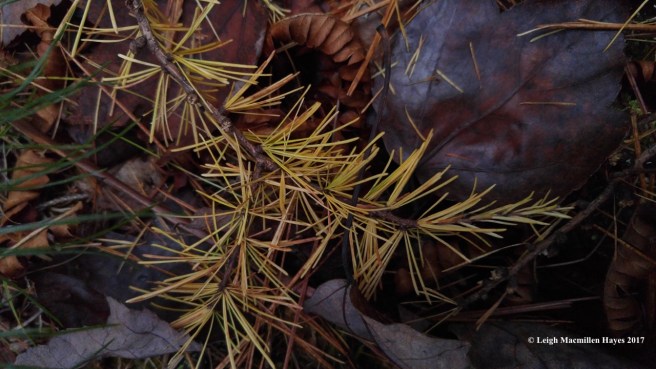
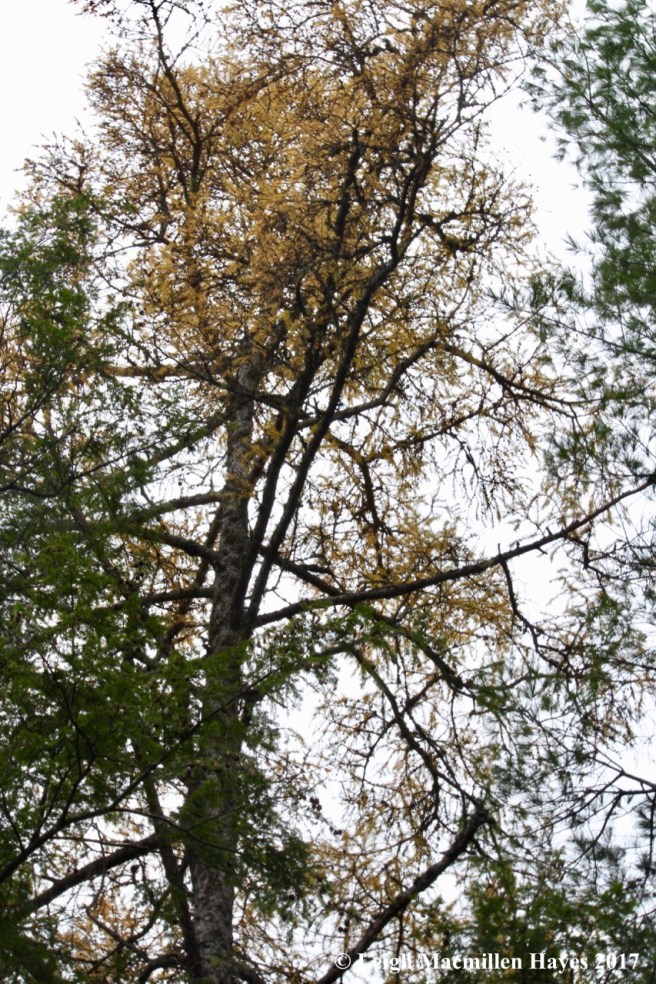
A tamarack or Larix laricina is a native deciduous conifer because it sheds its needles each fall, after they’ve turned a golden yellow, therefore it’s not really an evergreen.

e-winter

I know how easy it is to look at the winterscape and think that everything looks the same in the almost monochromatic mosaic we call the woods.

e-spring 1

But even in spring, as buds give way to leaves,

e-summer evergreens

summer when so many greens dominate our world,
e-fall 2

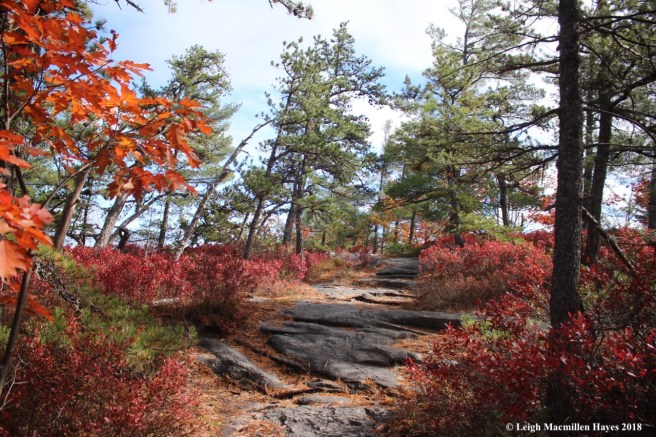
fall, when evergreens provide a contrast for autumn’s foliage,

e-fall 3

and late fall, when the evergreens continue to be green as the broad leaves drop, these trees make a statement in the landscape.

Thanks to Creator, they are forever green.
 

Land Trust Trailblazers

This morning found me joining two fellow Maine Master Naturalists for a reconnaissance mission along a property I’d never explored before–nor heard of until about a month ago.

r0-Robie's Meadow

Robie’s Meadow is located on Scribner’s Mill Road in Harrison and owned by the Western Foothills Land Trust.  Our plan was to explore the meadow in preparation for an upcoming WFLT/GLLT guided hike planned for Saturday, January 27 from 9:30-12:30. For the GLLT, it’s rather like a pop-up event, since we had planned it after our regular winter schedule was published. But, that’ll make it more fun because it will be an unexpected opportunity to explore in a neighboring town.

r1-trailhead tracks

Once we climbed up over the snowbank this morning, we were immediately greeted with tracks. And then, we spied something else on the snow.

r2-scat

Scat! Rather large scat. By the size of it, we surmised coyote. But . . . a few measurements of prints and . . .

r3-sniffing red fox pee

a sniff that consisted of a musky, skunky odor made us rethink our conclusion. A red fox had most definitely left its calling card behind.

r4-fox pee everywhere

In fact, as we continued on, we realized that it had left many calling cards–in hopes of attracting some attention. The size of that scat, however, continued to haunt us for it was much larger than fox scat should have been. Perhaps we misread some of the fox tracks, for we thought two had traveled the same route, but was it really fox and coyote? We do know that they were made about the same time, given the snow conditions. And so, our best guess was that the deposit was made by a member of the Canidae family. With that conclusion we felt safe.

r5-western foothills sign

We were so distracted by the tracks we kept finding and following, that it took us a while to cross the right-of-way to the actual land trust property, but at last–success.

r7-Robie's Meadow 1

The meadow opened before us, covered as it was with morning shadows.

r8-Meadow and Russell Brook

As much as we wanted to explore it, Russell Brook was open in spots and the snow deep, and so we decided to follow the brook for a bit instead.

r9-following Alice

Breaking trail wasn’t always easy, given the depth of the snow, but Alice persevered for she knew the way, and Joan and I followed.

r10-tracks across the brook

Finally, we reached a point where we could cross and just beyond our reach we spied tracks. How we wanted them to be otter or some other member of the weasel family. Alas, when we reached the other side, we discovered it was the red fox yet again. It always amuses me how a critter becomes “our” critter when we begin to encounter signs of it with frequency and so this was “our red fox.”

r11-squirrel tracks

We were a bit disappointed that though we’d seen weasel tracks toward the beginning of our adventure, no other members of the mustelid family shared their presence. Instead, it was to red squirrels that we next turned our attention.

r12-batman 1

And Alice gave us a new insight. I’ve always said that snowshoe hare prints remind me of  lobsters. Well, today she pointed out the fact that squirrel tracks look like Batman’s mask. I will never look at squirrel tracks the same again.

r13-batman 2

Batman indeed.

r14-squirrel home

We found squirrel homes tucked under logs and trees.

r15--squirrel condo

And one very fancy squirrel condo with plenty of openings on different levels. It reminded Joan and me of a certain porcupine condominium (aka stump dump) on a property under conservation easement in Lovell.

r16-porcupine trough

Speaking of porcupines, I kept commenting that we were in porcupine habitat and hadn’t seen any signs. Until . . . we did. And when we return, we’ll do some backtracking in search of its den or feeding tree(s).

r17-turkey tracks

We continued our journey, seeing much the same along the way. At last, we turned right onto a snowmobile trail where we followed turkey tracks out to the road. Our time together had drawn to a close, but we’re excited about the possibilities for the hike on January 27th. Check out both land trusts’ websites soon for more details.

r18-pinecone bird feeders

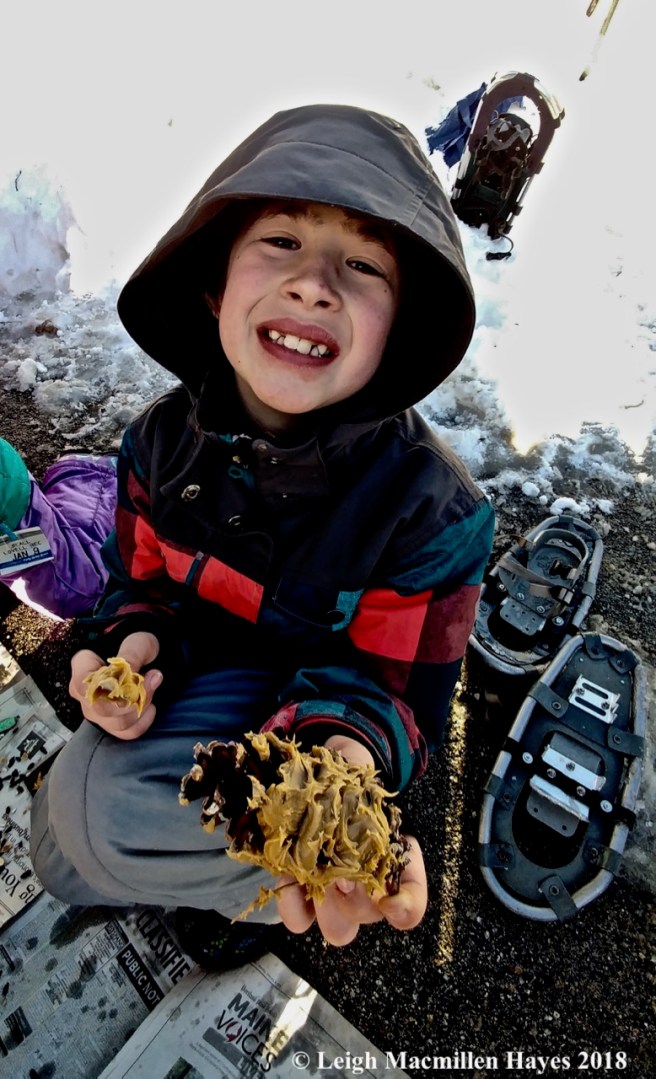
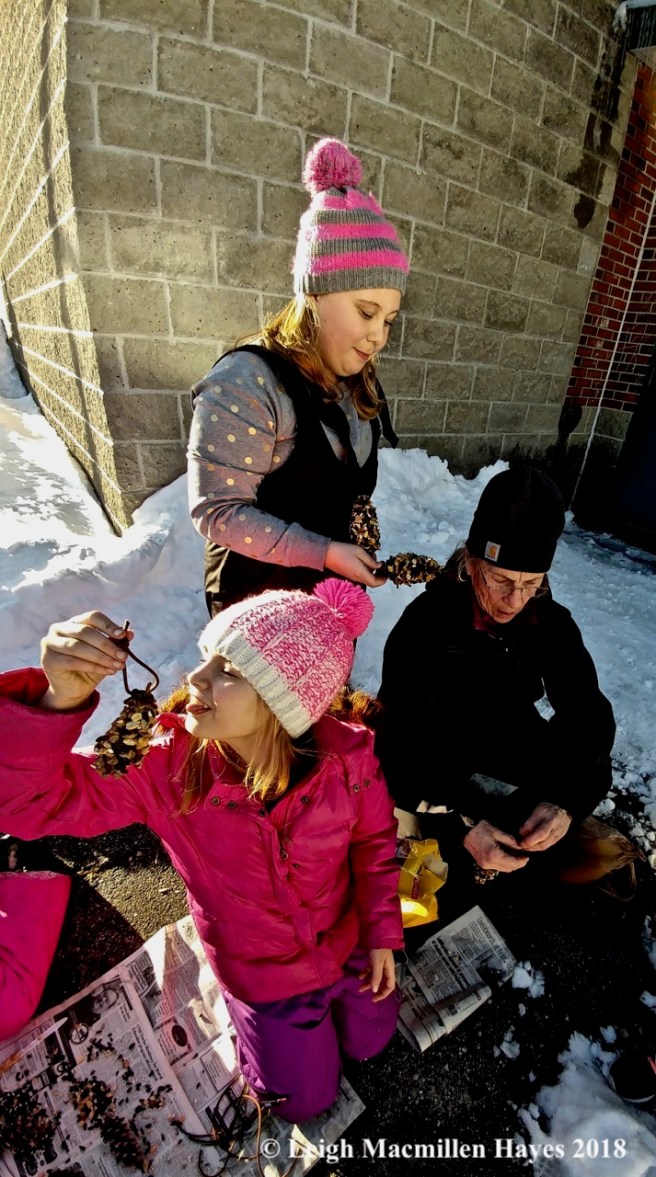
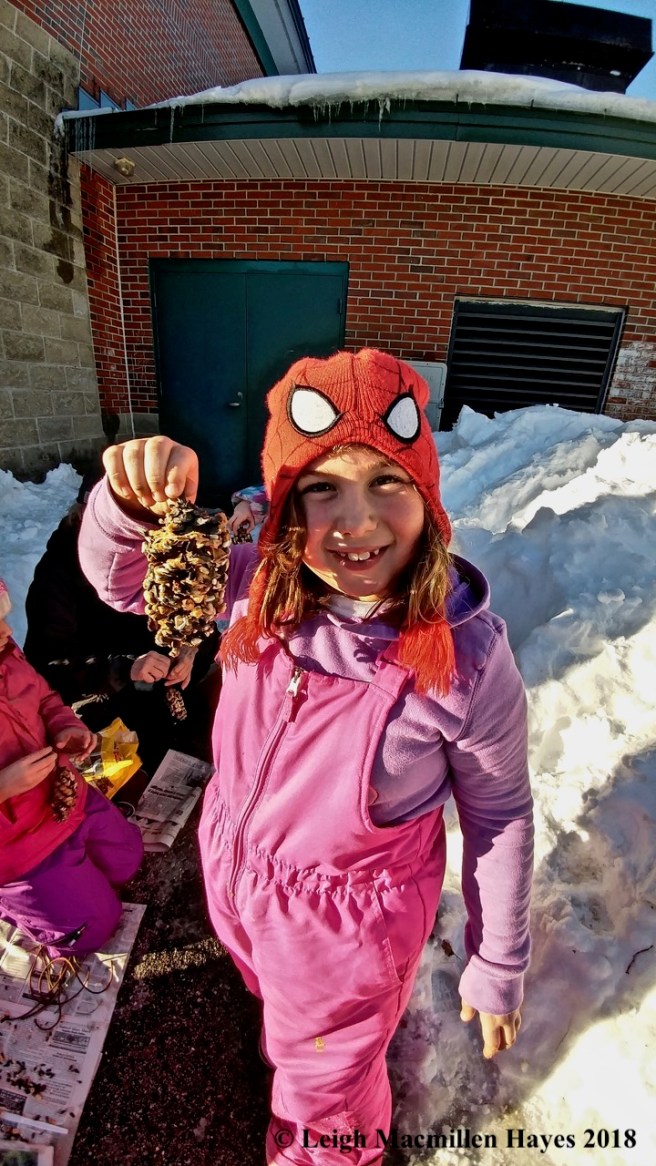
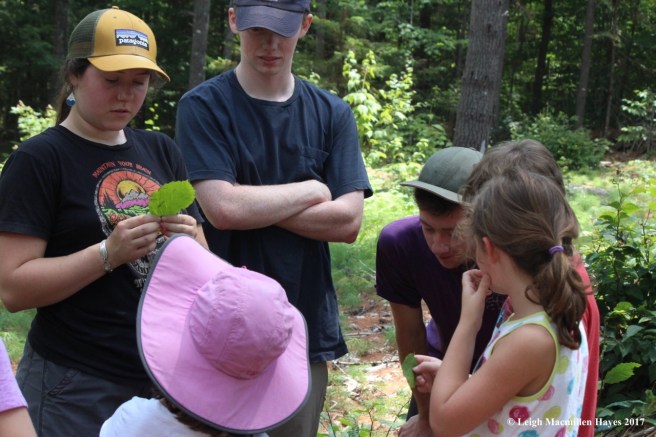
After saying goodbye to Joan and Alice, my outdoor experience continued, this time with an after-school nature program the Greater Lovell Land Trust offers to kids at the New Suncook School. Today, Kathy M. joined me and showed the kids how to create pinecone bird feeders using pinecones, peanut butter and bird seed. Both Meg, the Lovell Recreation Director, and I were excited because our group had swelled to nine. And the next time we meet, we believe we’ll have one more young naturalist join us, bringing our number to its limit.

r19-got peanut butter?

O. smiled as he showed off the peanut butter he’d slathered onto the cone.

r20-finishing their creations

C. looked ready to eat hers, while Kathy patiently helped tied string around D.’s cone.

r21-pinecone birdfeeder by K

K. proudly showed off a finished creation.

r22-heading out to the trail

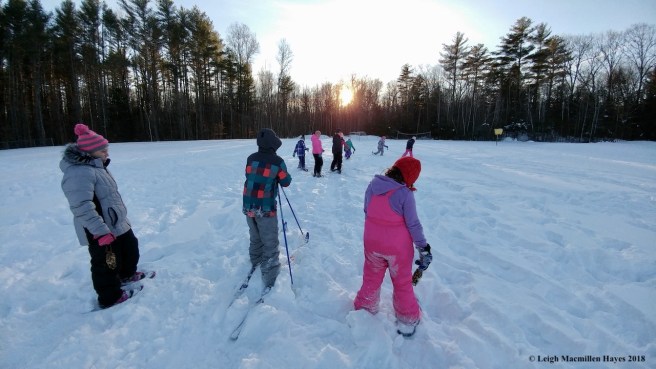
And then we headed off into the sunset via snowshoes and skis.

r23-walking beside deer tracks

And on a trail behind the school playground, fresh deer tracks made us happy. We showed the kids how to look at the heart-shape of the cloven toes and know that the bottom of the heart indicated the direction of travel.

r24-hanging pinecones

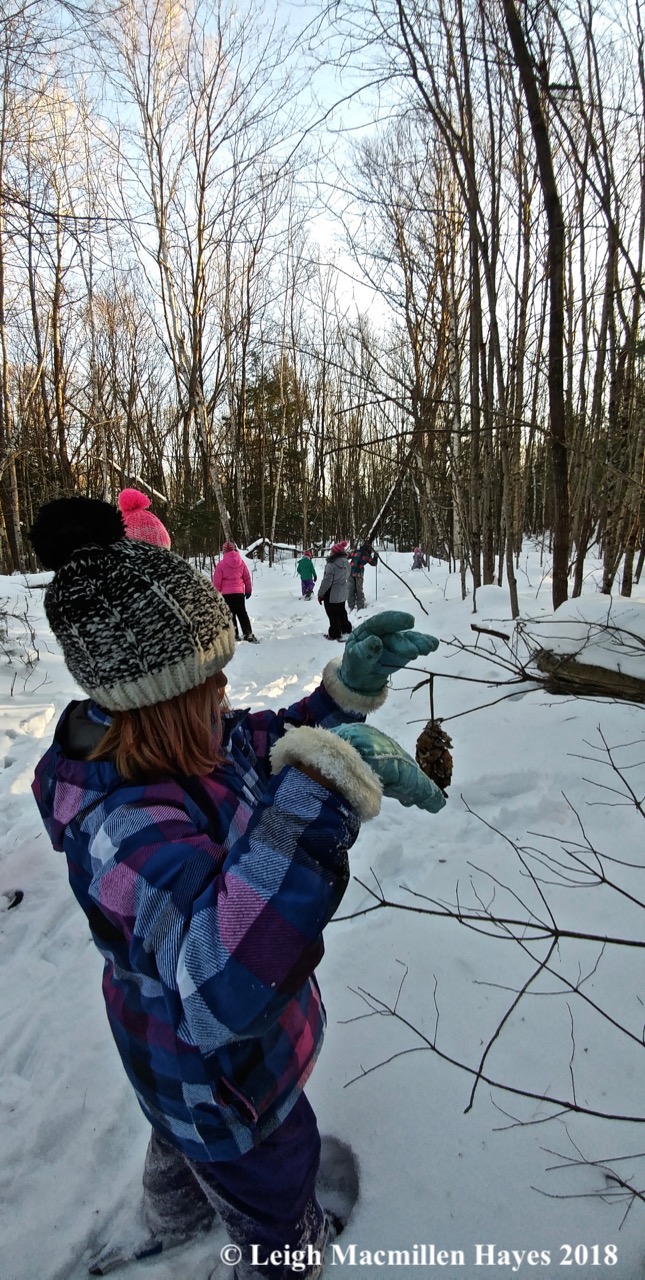
As we tramped along the trail examining tracks, we took time to hang the bird feeders. We’ll be curious to look at them when we meet again in two weeks. Today we wondered about who, besides birds, might visit them. Many bets were on deer and squirrels.

r26-exploring

The trail behind the school leads out to the power line and snowmobile trail, where again, we found many deer tracks.

r26-happy trailblazers

We’d gone a ways when we realized we needed to turn around and head back to school. But first, it was time for a group photo of happy campers.

r27-dramatic trailblazers

With smiles from all levels.

r28-Trailblazer Sign

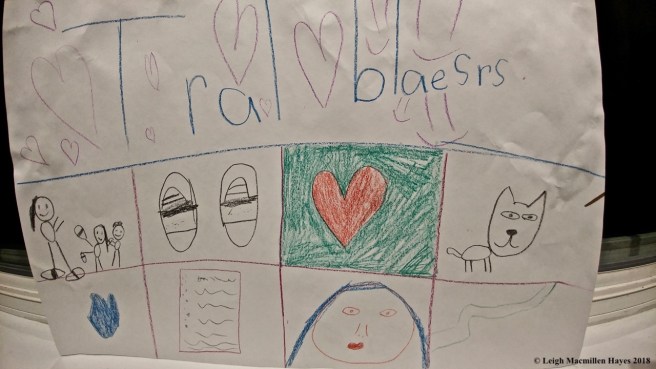
Our after school group is called the Trailblazers. And K. took the time to illustrate what we’d done last week. Note the square with the tall person standing up and two smaller people on the ground with their snowshoes in the air. Last week, snowshoeing was a bit of a challenge for them, but this week they embraced the concept.

From beginning to end, my day was bookmarked by land trust trailblazers. How happy am I? Extremely. Perhaps the happiest camper of all.


Tracker Tales

When I pulled into the Charlotte Hobbs Memorial Library parking lot this morning I didn’t expect any of the Greater Lovell Land Trust’s Tuesday Trackers to be waiting for me given that the temperature was at least -20˚. But, Jo Radner was ready and waiting. She joined me for the drive to the John A. Segur West property on New Road.

Standing in the small parking lot was Stephen Lewis, another diehard participant. And as  Jo and I fiddled with our snowshoes, Heinrich Wurm pulled in.

And so, we four intrepid trampers took off over the snowbank and immediately met some tracks. A little back tracking and attention to details helped us determine a bobcat had crossed the trail. There were red and later gray squirrel tracks, deer, and mice. Most were old for the animals, especially the squirrels and mice seemed to be hunkered down in their holes–certainly a good choice.

j-junco tracks and wing marks

By the time we reached the old log landing at the end of the trail, we noticed lots of junco tracks and their small wing impressions. Seeds aplenty were scattered across the snow. Our conversation soon turned from the little birds to an experience I had this past week when a saw-whet owl flew into a thick stand of hemlocks I was crashing through like a bull in a china shop. I had just finished saying that much to my surprise the bird flew in as I broke through the branches when one would expect a bird to quickly depart, when Steve pointed at something in our midst.

j-mouse discovery 1a

We all moved in for a closer look.

j-mouse discovery 2

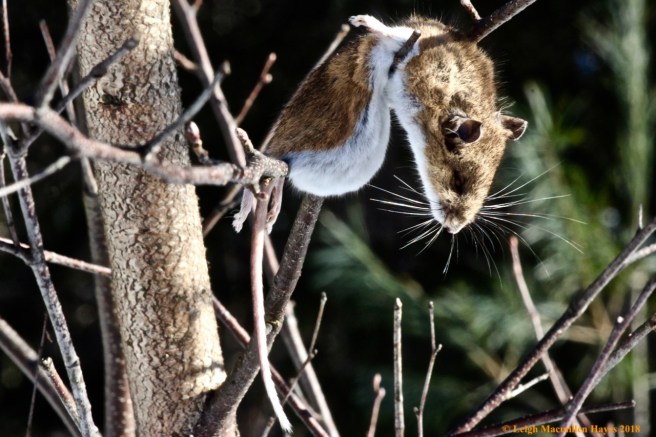
A dead mouse splayed on the branch of a gray birch. My brain played with that sight over and over again. Yes, we’d seen numerous crazy mouse tracks left behind by either deer or white-footed mice–it’s difficult to determine which, for both have long tails that leave drag marks between their footprints. Jumping mice hibernate so they could be ruled out.  Jo asked if I could tell which of the other two it might be. I’m happy to say that even well-respected tracker Paul Rezendes, author of Tracking and the Art of Seeing, has this to say, “There are more than 120 different species of North American mice, and about half of them fall under the general rubric ‘white-footed mouse.’ The deer mouse is a type of white-footed mouse, and to me there is not perceptible difference in tracks. There are several anatomical differences, but these change from habitat to habitat. The white-footed mouse measures up to about seven and a half inches long (including its three-and-a-half inch tail) and weighs one-half to one ounce. Its color is gray or light brown to dull orange-brown above, with a white belly, throat, and, as its name implies, feet. The deer mouse is gray to reddish brown on its upper parts, including its tail, and white below, with longer hind feet and a tail usually longer than its body. Both animals have bicolored a bicolored tail.”

j1-mouse 1

Our next question was, “How did it get there?” My mind immediately went to a December 13 entry on page 419 in Mary Holland’s Naturally Curious Day by Day about butcher birds overwintering. Mary discusses how northern shrikes preferred food sources are other birds, mammals and insects. “This tundra-nesting bird comes as far south as New England in the winter, where it preys mainly on mice, voles, and small birds.” She goes on to explain that the bird often kills more than it can consume and leaves some food in the freezer for future feeding adventures. “The manner in which it stores this extra food is what gives it the nickname ‘butcher bird.’ It often impales prey on a thorn, broken branch, or even barbed wire, or it wedges prey into narrow V-shaped forks of branches, where it hangs until reclaimed by the shrike.”

Bingo! I think we figured out what we were seeing and in Mary Holland’s book we have my dear friend, mentor and former LEA and GLLT Education Director, Bridie McGreavy, PhD, to thank for the photo.

We could have turned around then, so thrilled were we, but we hadn’t even reached the wetland. And so, a quick check to make sure everyone was comfortable and on we trekked.

j-deer crossing Bradley Brook

When we found more deer tracks, we decided to follow them in search of beds. At that point we found no bedding areas, but did see that the deer had crossed Bradley Brook.

j-Bradley Brook frozen

It was the first time I’d ever seen the brook frozen over and we took advantage by making our way to the other side.

j-water on lungwort 1

We continued looking for tracks, but found other things as well, including dried lungwort. I mentioned that lungwort, like other bryophytes, will immediately photosynthesize when water is added. Jo wanted proof and so I had her pull out my water bottle and pour it over the leafy structure.

j-lungwort turning green

Within minutes . . .

j-lungwort magic

magic.

j-beaver works 1

As we crossed the wetland, we searched high and low for evidence of wildlife. Up high, chickadees and goldfinches sang from treetops. Down low–not a single track. We did find a few examples of beaver works.

j-beaver works 2

And we thought perhaps the lodges were active.

j-beaver works 3

We hoped.

j-checking the beaver lodge1

But our hope was dashed.

j-beaver lodge 2

No vent hole above and no evidence of life anywhere nearby. Perhaps they’d abandoned this for a second one we spied.

j-stone lodge

Only thing is that the second one also supported no mammal life at the moment, for it turned out not to be a lodge after all, but a boulder covered with snow.

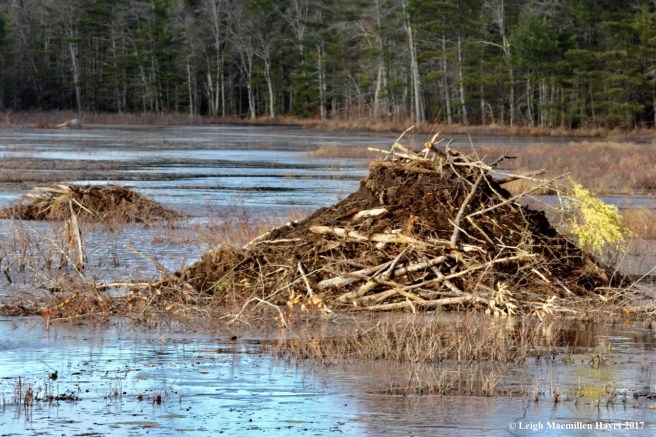
j-beaver dam

Just beyond the boulder lodge, however, we found the old dam, which still stood strong.

j-sharing smiles at the dam

Our smiles were equally strong as we acknowledge what a fine day it had been and this would make the perfect turn around point.

j-Heinrich looking skyward

Jo and Steve took one last look at the brook below and Heiner turned his eyes skyward.

j-heading back

Heading back, we all did the same for we heard military planes flying overhead and could see their contrails.

j-looking north

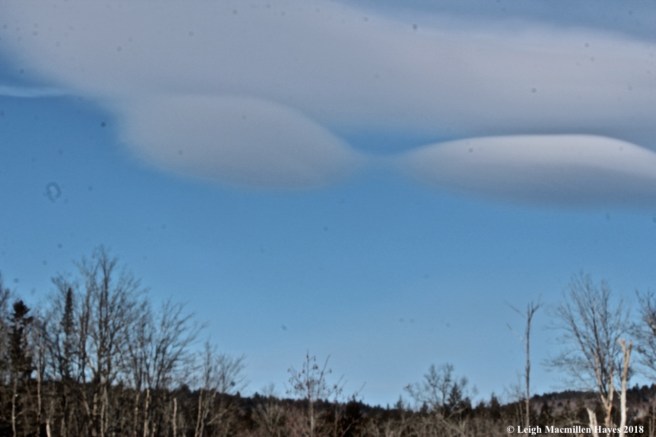
But it was the cloud formation that really drew our attention.

j-clouds 2

Steve mentioned lenticular clouds and it seemed the perfect explanation given that these lens-shaped structures probably formed after the flow of air encountered Mount Washington.

j-mouse in tree crotch

Our journey back found us going off trail again, and we did find a couple of deer beds, but what will stand out in our brains for this day’s tramp–the mouse with the very long tail and tiny white feet. How it got there, we don’t know for sure, though the shrike story does make sense. What I am sure of is that it will become part of our tracker tales.


Oh Baby!

It’s so cold outside that probably the smart thing to do would be to stay snuggled within, but I couldn’t.

a-bluejay with seed

After all, the birds were on the move, though they were a bit puffed up, a normal behavior when the temp is below zero. Their feathers help insulate them from the cold (and my hands understand that as they were tucked inside down-filled mittens). Fluffing up traps as much air as possible, thus keeping our avian friends warm.

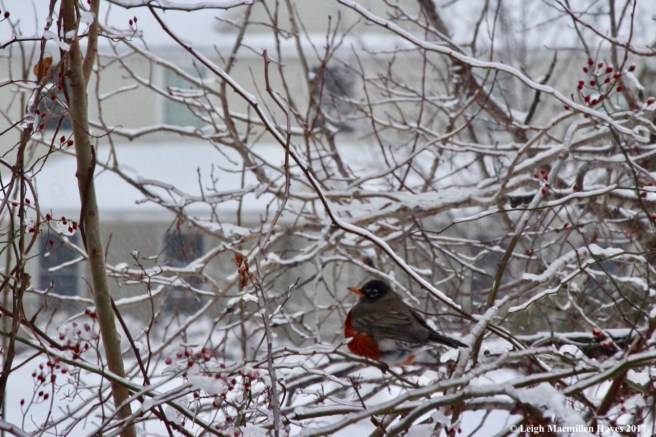
s-robin

Their feathers are also waterproofed with an oil coating, a good thing on this not only frigid, but also slightly snowy day.

s-frost around squirrel homes

As I wandered, I noticed that the squirrels and maybe other small mammals had decided not to venture forth and found plenty of evidence that they were huddled inside. Ice crystals formed in holes beside trees, and . . .

s-frost by stone walls

openings in stonewalls . . .

s-frost again

reminded me of the feathery display on our windows on cold winter mornings. These were the mammals’ windows–such as they are.

s-stained glass

And speaking of windows and ice, which has lasted longer than usual following the Dec 23rd storm, everywhere branches reminded me of stained-glass leading highlighting the picture of our winter world.

s-red maple buds

But, here’s the thing about ice. Like feathers, it also serves as an insulator, keeping leaf and flower buds along tree branches protected from the cold. Oh, they have waxy coatings, but the ice adds another buffer.

s-beech bud

Some of the sights I saw today made me chuckle, like the beech bud poking through one of the tree’s marcescent leaves.

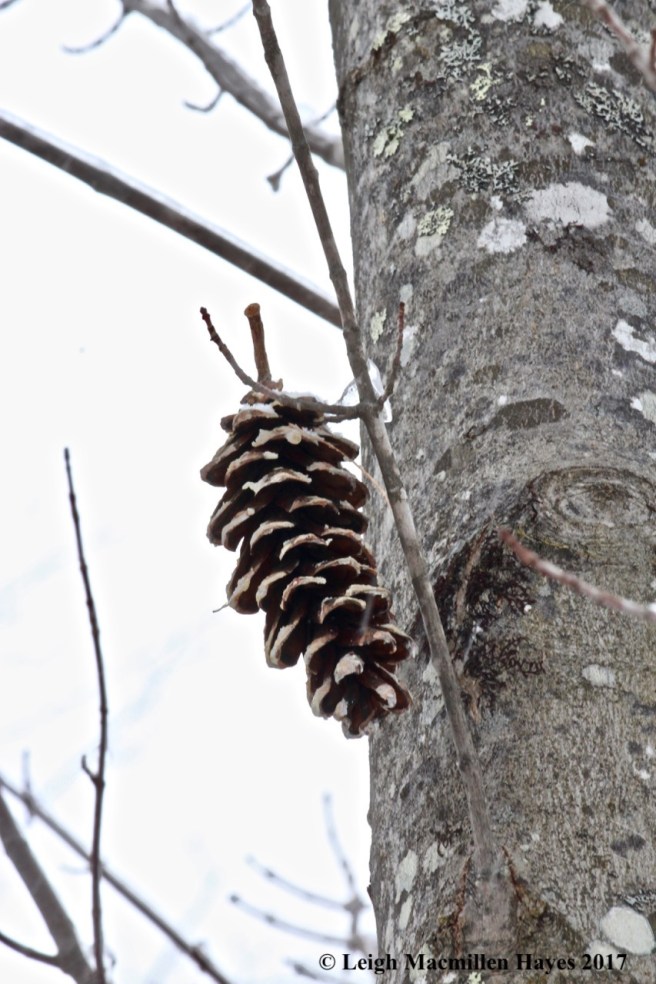
s-pinecone on maple

And a maple pinecone.

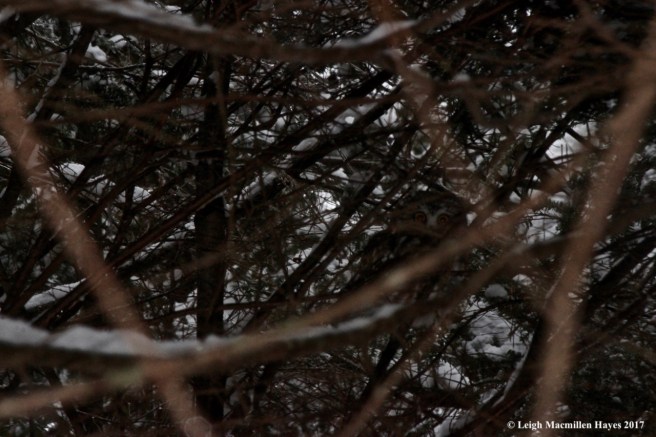
s-saw-whet owl 1

But my favorite find of all flew in while I was making my way rather nosily through a dense patch of hemlocks. Another where’s Waldo moment. Do you see it?

s-saw-whet owl 2

Yes, a Northern Saw-whet Owl! A first for me in the wild.

s-saw-whet 3

We shared about ten minutes together and it was definitely an “Oh baby!” occasion (which I reported to Jean Preis for our local Bird Count).

And with that, I’m proud to say, “It’s a boy!” The bird, I’m not sure. But I’m a great aunt to Baby Bud who was born at 12:24 this morning. May he develop a sense of wonder about the natural world and a love for winter.

The owl was the icing on the cake on this special day–Oh baby!


Counting Birds

In the name of citizen science, Kathy McGreavy and I ventured forth at 8am this morning as the temperature hovered just above zero.

c1-map

Our eyes were on the birds within view along a route outlined in orange. Up and down roads we journeyed, stopping periodically to jump out of the truck and focus our binoculars on our feathered friends and then keep track of them on the list provided. At the same time, other groups traveled different routes within the circle and also tallied their discoveries.

c6-junco 1

Together, we saw blue jays, crows, robins, tufted titmice, a female cardinal, brown creeper, some chickadees, and lots of juncos. We also enjoyed driving down roads less traveled and reveled in the ice and snow-coated scenery before us.

c3-robin 1

At noon, Kathy had to depart and so I headed home for a quick lunch before venturing out again to finish up our tour. And at Salmon Point boat launch I was rewarded with more robins.

c4-northern flicker

But my favorite spy of the day, two northern flickers at the outlet where Stevens Brook flows into Long Lake. I first spied one and then two on the trunk of a red maple. After a few minutes they flew below to dine on winterberries. But I wondered–northern flickers in December? They weren’t on the list, nor were they rare; just not typical winter visitors in western Maine.

c7-female downy woodpecker

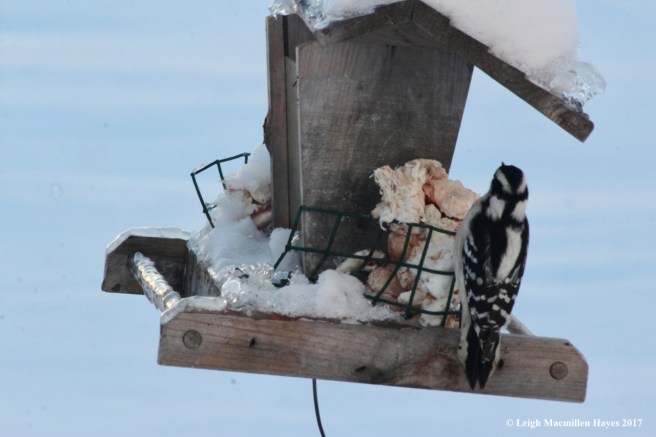
Seven and a half hours later, back at home, which was out of our part of the quadrant, a female downy woodpecker enjoyed some frozen suet. I couldn’t include it on the final report, but still . . .

c7-white-throated sparrow

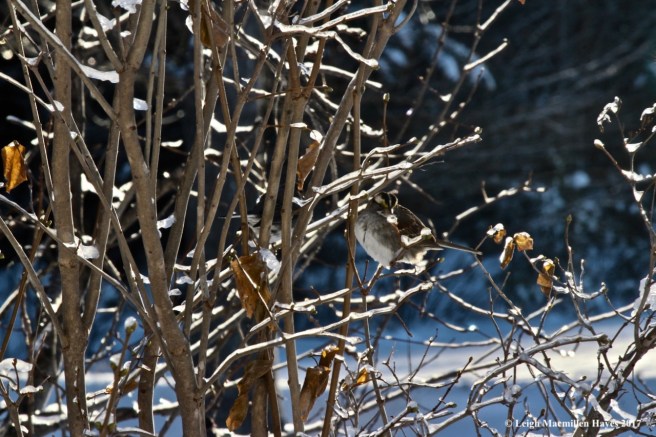
The same could be said for the white-throated sparrow that I frequently spot amongst the junco flock that partakes of our feeding station.

Participating in this citizen science project is great fun and I’m thankful it’s a winter tally for I can ID most of the species I see. Were it to occur in summer when all those warblers breed in this northern territory, my bird brain would be more challenged.

c2a-CMP dam

Another benefit of said participation is the opportunity to visit places such as the old dam on Stevens Brook during the winter season.

c2-otter slides

Because I was there, I saw tons of otter sign including numerous slides. A huge grin covered my face.

c5b-ice disk in Stevens Brook

And then, there was a certain rare sighting lower in the brook that drew my awe.

c5-ice disk 1

We had a form to complete for rare finds. But . . . it was for rare bird finds. Would my northern flickers suffice? I wasn’t sure and so filled in the information to be on the safe side. But . . . that which I saw in the brook itself was probably rarer.

An ice disc.

According to Mary Holland’s recent post about such on her Naturally Curious blog: “An ice disc is a large disc of ice spinning in a river. It’s thought that this relatively rare natural phenomenon is likely caused by cold, dense air coming in contact with an eddy in a river, forming discs ranging anywhere from 3 to 650 feet in diameter.

While eddies contribute to the spinning, they are not the only cause. If they were, small discs would spin faster than big discs, and this is not the case. Discs of all sizes rotate at roughly the same rate. One would also expect that discs in still water, where there aren’t any eddies, wouldn’t start spinning, but they do.

The melting of the ice disc contributes to its spinning as well. When an ice disc starts to melt, the melted ice water is denser than the ice, and thus sinks below the disc. This movement causes the water to spin, which in turn spins the disc.”

Common and rare–and another fabulous day spent participating in the Audubon Society’s Christmas Bird Count for 2017.


Whetting Our Apatite

Our hunger is never satisfied each time we gather. We always manage to see more, share more and learn more because of our combined knowledge. We also always come away with questions. And so it was this afternoon when about ten of my Maine Master Naturalist Lewiston classmates and I gathered with two of the programs founders, Dorcas Miller and Fred Cichocki, to explore a public park in Auburn, Maine.

a1a-looking at trees

From the get go, we bounced back and forth along the trail to look at the idiosyncrasies of trees and chat about the book, A Beginner’s Guide to RECOGNIZING Trees of the NORTHEAST.

a1-red maple target fungus

And as they should, teachable moments kept presenting themselves, including a prime example of the bull’s eye target fungus on red maple bark. Suddenly, those who hadn’t quite seen the target in an earlier specimen had the opportunity to meet it and I trust they will recognize it going forward.

a2-slime mold

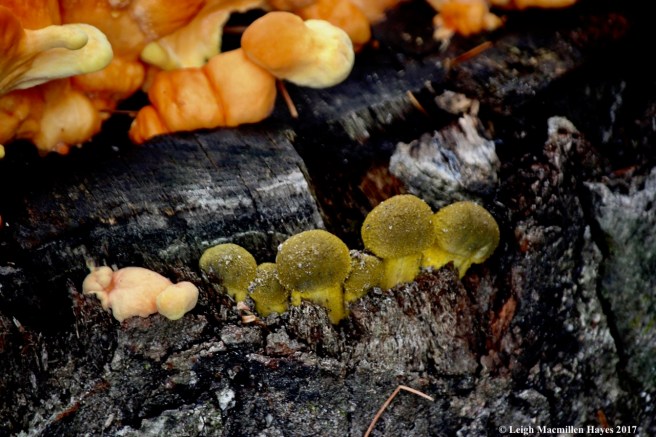
As much as we zigzagged down the trail, we also bounced off of each other as we shared our knowledge. Because we all suffer from Nature Distraction Disorder, and have the tendency to travel at a slower than slow pace, it was no surprise that a stop to look at a fungus closer to the ground meant that one of us noticed a slime mold in the crevasses of pine bark. A poke with a finger nail and the spores oozed out.

a2a-approaching the mines

There were mosses to look at. Ferns to recognize. Lichens to question. And a trench that probably had been used to drain water back in the day.

a3-Dr Fred

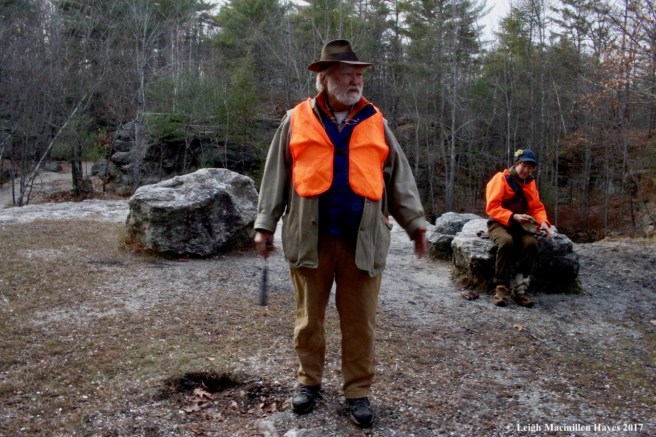
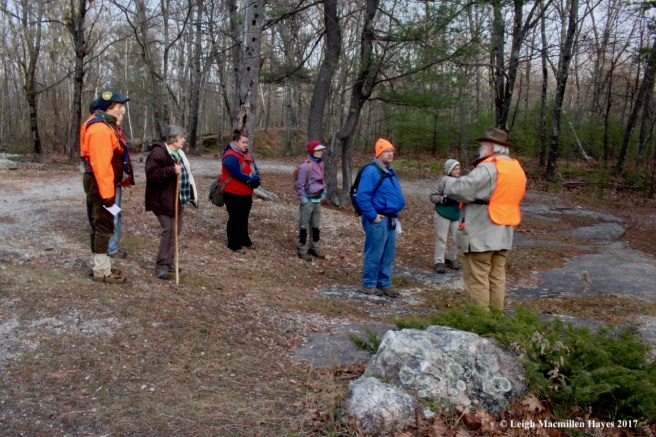
Just beyond the trench, the star of the show took over. Dr. Fred was in his element as he reviewed the geological history of this place.

a21

And when he talks, we listen.

a4- Greenlaw quarry 1

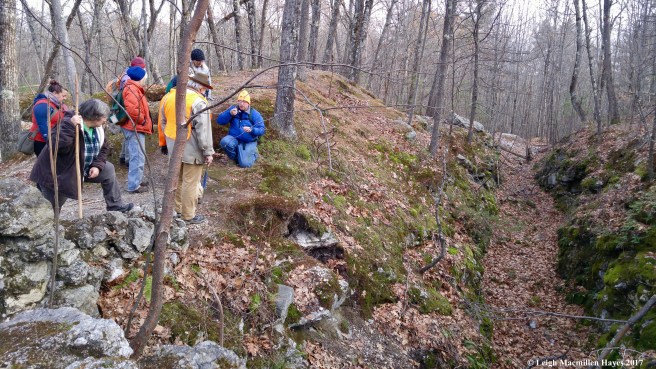
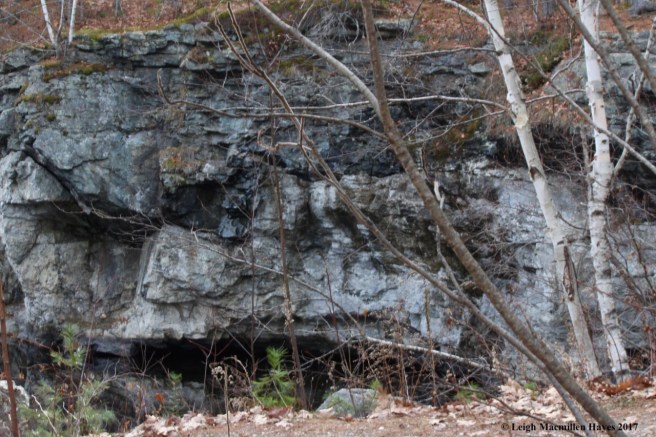
We had come upon the first of the quarries, where feldspar had been mined in the early 1900s for porcelain. But, as Fred explained, while mining the feldspar, rare and unusual minerals had been discovered including a phosphate mineral called apatite.

a6a-Maine Feldspar Quarry

From there, we circled down and around and looked across at the Maine Feldspar Quarry.

a6-Maine Feldspar quarry

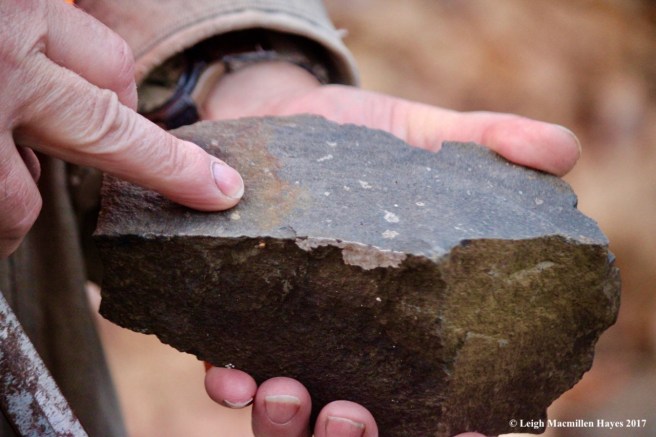
We learned from Fred that the wall of the feldspar quarry was a demonstration of light-colored pegmatite just above the water, topped by gray metamorphic rock.

a8-basalt dyke

Next, we encountered a fractured wall of fine-grained basalt–an igneous vein that formed a dyke.

a9-basalt:iron

Basalt is fine-grained due to the molten rock cooling too quickly for large mineral crystals to grow. Typically, it’s gray to black in color with rust from iron oxidation.

a12-another quarry

From there we moved on to another quarry, where our attention was not so much focused on the rocks as on other things.

a13-squirrel cache

For deep within, we spied several red squirrel caches and dining tables. Later, we watched a chipmunk take advantage of the squirrel’s work. Minerals aren’t the only gems of choice at this place.

a14-labyrinth

As we made our way around to a quarry dump, we discovered a labyrinth that made its way around the pine trees. I followed it to the center–struck by the fact that we were examining rocks dating back to the Carboniferous period, and I was walking a path based on an ancient archetype dating back 4,000 years. Time. Worth a wonder.

a15-tourmaline 1

In the dump field, we scattered about looking for souvenirs and then paused at a boulder to examine its offerings.

a16-tourmaline crystal

On the back side, Fred pointed out several depressions where tourmaline crystals had been discovered and removed. We were awed.

a20-graphic granite

There was so much to see from milky and smoky quartz to feldspar, mica and garnet, but my favorite find was more graphic.

a17-graphic granite

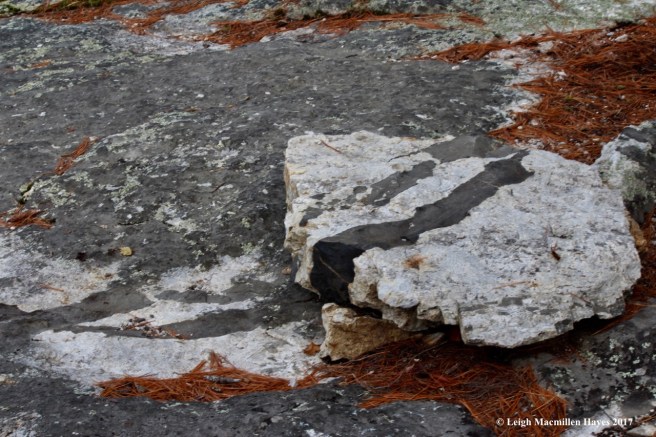
Graphic granite–a pegmatite of igneous origin that splits in such a way to make it look as if stories have been expressed with a fountain pen. In this case, I was sure the story was about birds flying over mountains.

The quarries were our turn-around point. We had begun our adventure with plans to visit them quickly, then explore the outer trails of the park, but as we knew would happen, two and half hours later we’d only made our way to the quarries and it was time to head out because the sun was sinking.

That didn’t matter for happy were we to spend time exploring together and whetting our naturalist appetites at Mount Apatite.


For the Benefit of All

Living in an area where five land trusts protect land for us and the species with whom we share the Earth strikes me as a valuable reflection of who we are and where we live. Land trusts work with community members to acquire land for permanent conservation through purchases and donations. They also create legal and binding conservation easements that allow residents to protect land holdings in perpetuity, while retaining private ownership. Scenic views, wildlife corridors, flora and fauna, and topography remain, subject only to the whims of nature itself, which is ever-changing.

m1-first lodge

One of the biggest re-designers of the landscape is the beaver. And this afternoon, Jinny Mae and I ventured onto land owned by a friend and under conservation easement by the Greater Lovell Land Trust, to see what changes may have occurred in the past two months since we last visited.

First, we tramped off a logging road and checked on a lodge that was active two years ago. Today, the water level was low and there was no sign of activity. And so we continued on.

m2-pipsissewa

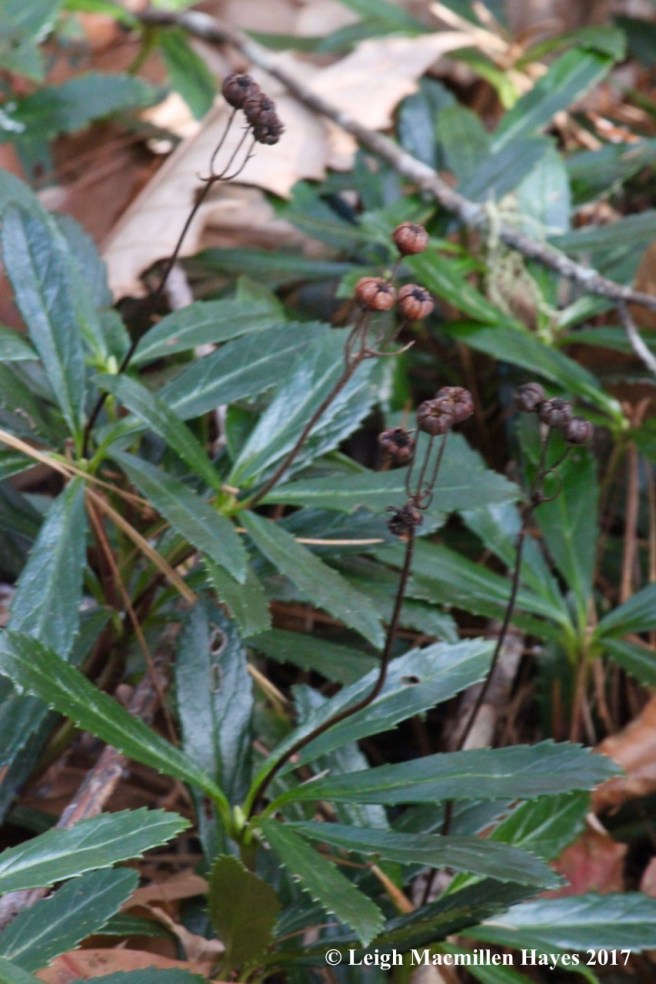
As we climbed up a small incline we stumbled upon a large patch of pipsissewa and had to celebrate our find.

m5-hexagonal pored fungi upperside

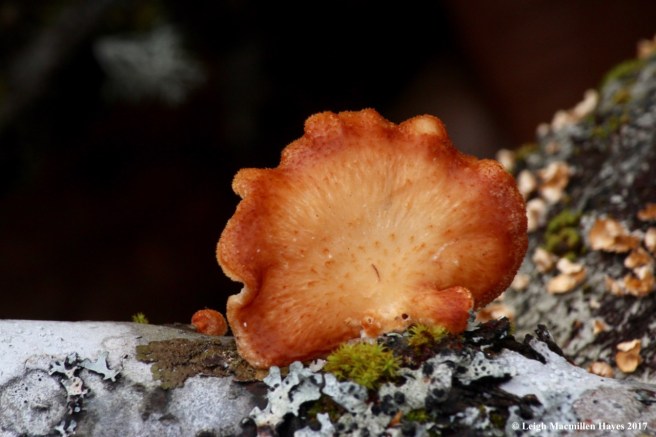
Back on the logging road, a tree brought down by one of nature’s recent whims introduced us to a fungi we had not met before–or at least as long as we could remember. And once we saw the underside, we were sure we would have remembered it.

m4-hexagonal-pored

Hexagonal-pored polypore (Polyporus alveolaris) caused us to emit at least six ohs and ahs.

m6-grape fern

Our next discovery–a grape fern. Actually, more than one grape fern once our eyes keyed in on them.

m7-checkered rattlesnake plantain

And then the checkered rattlesnake plantain; and again, once we spied one, we noticed that a whole patch shared the space. We just needed to focus for their presence was subtle amidst the brown leaves.

m8-bees nest 1

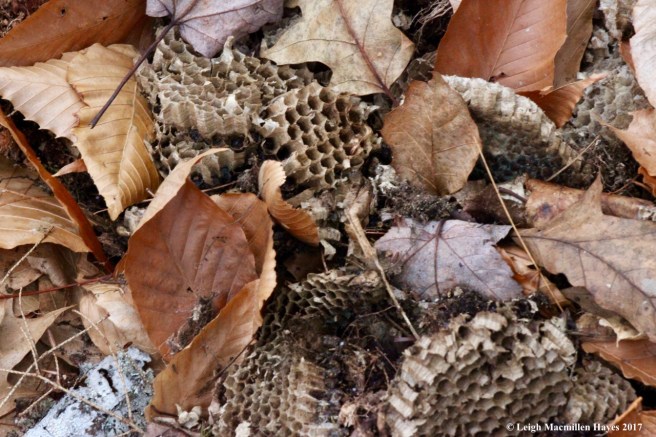
Before we met a snake of another kind, Jinny Mae spotted honey combs on the ground.

m8-excavation site

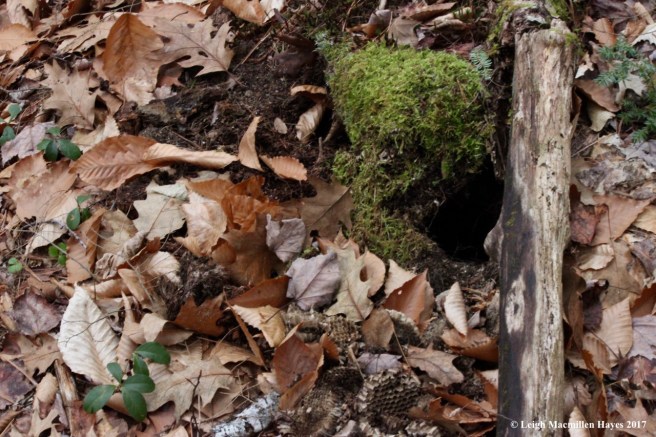
A look about and the realization that a raccoon or skunk had probably excavated the nest.

m9-snake liverwort

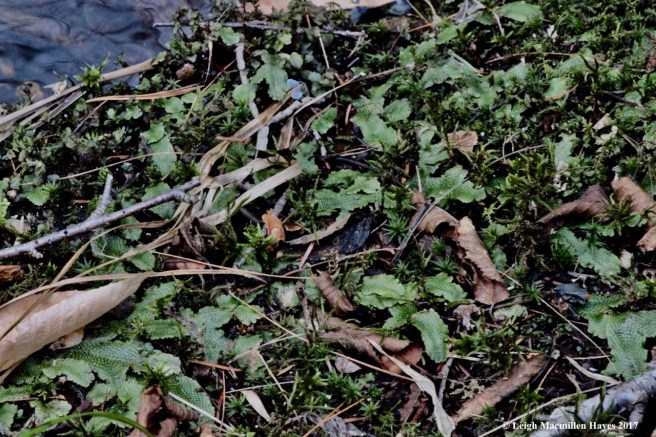
And then we met that other snake. You see, the last time we walked this property, we did see a garter snake. As we began our wander today, we commented that there would be no snakes or toads. But . . . we were wrong. This second snake was a snakeskin liverwort (Conocephalum salebrosum). For us, this was a second in another way for it was our second sighting of the species. Maybe now that we are aware of it, we’ll notice it growing in other places. We do know that its preferred habitat is wet or damp.

m10-umbilicate lichen?

In the same area, but across the brook in a place that we couldn’t reach today due to high water, we saw what looked like an umbilicate lichen, aka rock tripe. The color and substrate threw us off and so we’ll just have to visit again for further study. (“Oh drats!” they said with a smile.)

m11-beaver 1

The liverwort and mystery lichen were our turn-around point. On our way back, we decided to follow the water because we were curious. And within minutes our curiosity was appeased. The beavers we’d suspected might be casually active two months ago, had become incredibly active.

m12-beaver 2

Statue . . .

m13-beaver 3

upon statue . . .

m19-beaver 6

upon statue . . .

m20-beaver 7

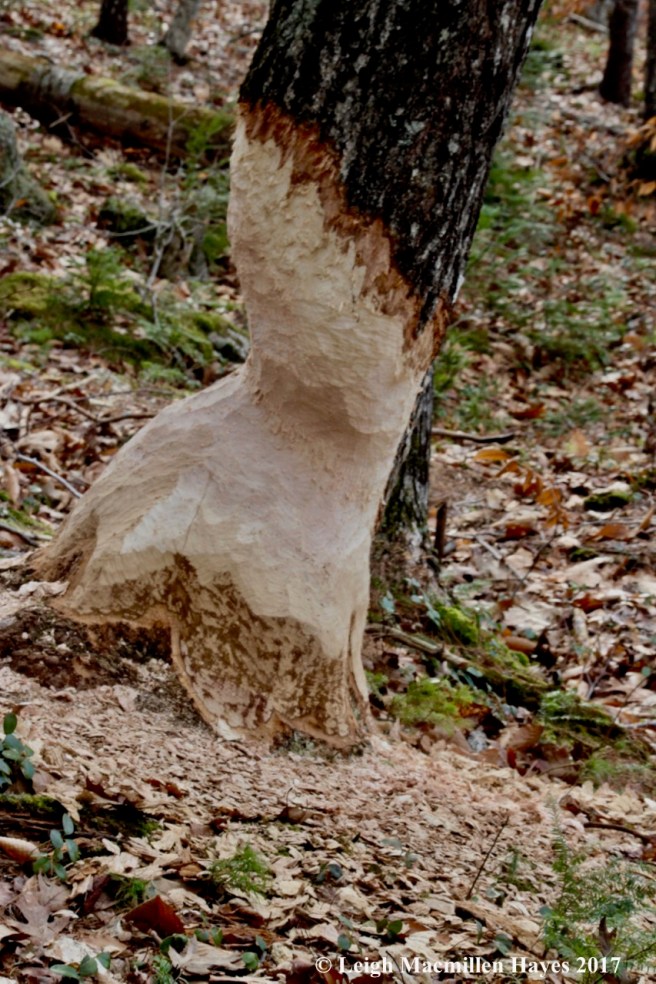
upon statue announced their presence. And we acknowledged the fact that they have to turn their heads to scrape off the bark.

m14-beaver 4

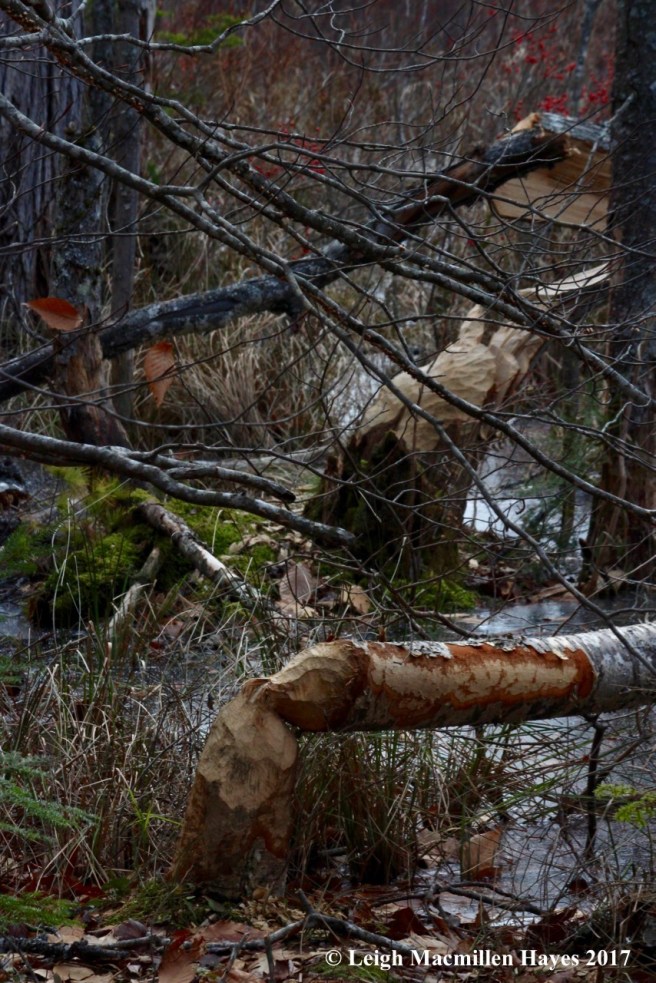
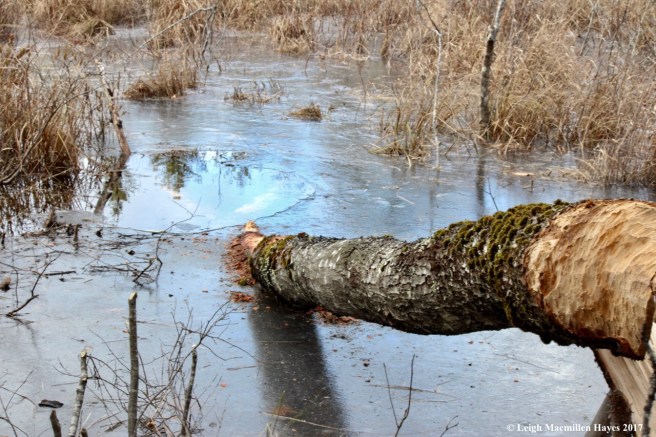
Any trees that hadn’t been hauled away had been downed and gnawed upon in situ.

m15-beaver 5

It looked as if this one was a more recent dining adventure for there were wood chips upon the thin layer of ice and a hole showing were the diners had entered and exited the refectory.

m16-oak leaf and ice

Because of the ice, we noted other works of art worth admiring.

m18-lungwort 2

And occasionally, our downward gaze turned upward when we spied trees covered in lungwort worthy of notice.

m21-beaver 8

But really, it was the beaver works that we celebrated the most.

m23-beaver 10

And the fact that thanks to the beavers we learned that the inner bark or cambium layer of a red maple is . . . red.

m23a--not all cuts work in the beavers favor

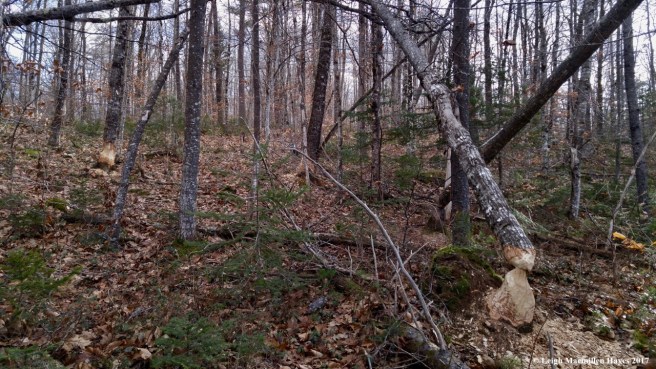
No matter where we looked, in addition to recent windstorms, the beavers had changed the landscape. The curious thing is that most often the trees landed in the direction of the water, making it easier for them to enjoy their chews of inner bark and twigs in a relatively safe environment, but occasionally, hang ups occurred. And that brought about the question, how is it that most trees are felled toward the water? But not all?

m23a--lodge

While our focus was on the trees along the shoreline, we also kept admiring the water view as well.

m24-lodge

And noted the most recent activity at this particular beaver lodge, including a mud coating to insulate it for the winter.

m28-welcome flag on lodge

We also appreciated that a welcome sign blew in the breeze–in the form of an evergreen branch.

m29-otter scat

And where one finds water and beavers, there are otters. We knew of their presence by the scat left behind in a trail well traveled. Several times we found examples of the same.

m31-main channel open

As the sun lowered while we approached the beaver dam, we quietly hoped to see North America’s largest rodents at work, but settled for sky reflections on water and ice. And the knowledge that by their works and sign, we trusted they were present.

m32-dam1

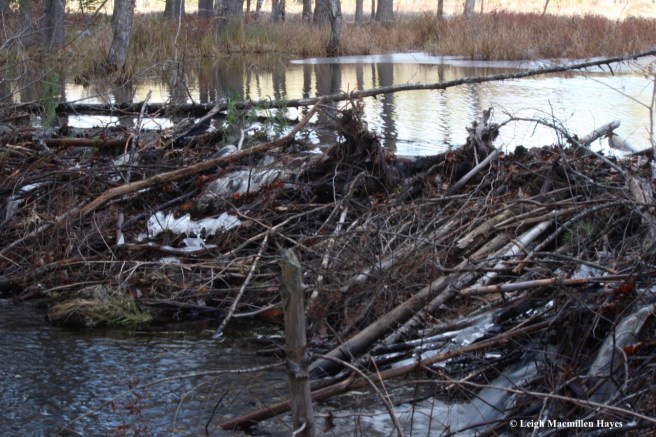
At last we reached the dam, an expansive one at that. It’s in great shape and so no time had been wasted repairing it. That’s a good thing given that a few flurries floated earthward on this day that felt like winter. There’s food to gather and a home to prepare so work must be efficient.

m33-dam other side

Water trickled through in a few places and ice formed, but the infinity pool created by the dam continued to exist.

m34-brook

And below, the water flowed on–to other beaver dams and otter adventures we were sure. For Jinny Mae and me, our adventure needed to draw to a close. But . . . we made plans to explore again in a few months to see what changes may have occurred–with land owner permission, of course.

As we walked out, we gave thanks for the owners and their appreciation of the landscape and those that call it home today and tomorrow.

From the land comes food and water that benefits the critters who live here and us. It also offers us good health when we take the time to embrace it by exploring, exercising and just plain playing outdoors.

Protection is key. So is education, which develops understanding and appreciation. I know for myself, my relationship with the landscape continues to evolve.

I’m thankful for the work being done to protect the ecosystem. There’s so much I still don’t understand, but with each nugget of knowledge gained, the layers build. Maybe someday I’ll get it. Maybe I never will. Either way, I’m happy for the chance to journey and wonder on properties owned by land trusts and individuals.

Even though we can’t all endow the future of our properties, we can get involved to ensure that these organizations continue to protect land for future generations of humans and wildlife so it will remain in its natural state for the benefit of all.


Through Younger Eyes

Zigzagging through the woods, my young friends find wonder in every moment. They embrace their discoveries–often with exclamations and excitement. Following the blazed trail is not in their blood, for they know that some of the coolest finds are off trail, where the fungi aren’t trampled and mammal signs not obliterated.

w-striped ledge

And so it was that this past week, I had the honor of spending lots of time exploring with them. First, on Tuesday, our Greater Lovell Land Trust docent tramp found us atop the “striped ledge” beside Keewaydin Lake in Stoneham, Maine. One of our docents, Mary, had obtained landowner permission for this grand adventure. From the Maine Geological Survey: “The dikes cutting the granite trend generally from southwest to northeast. They most likely intruded the host rock during the Jurassic period, when continental rifting caused extensive fracturing of New England’s bedrock (McHone 1992). Basaltic magma intruded these cracks, and cooled and solidified to form dikes such as those seen in Striped Ledge. Close examination of the ledge shows a complex intrusion history at this locality Some of the dikes have layering parallel to their walls, which may have resulted from several pulses of magma into the fractures and/or chilling of the dike margins in contact with cooler host rock . . . the dikes locally cross one another, with the older dikes being offset where they are torn apart by the younger ones.” How cool is that?

w-smiling for rosy quartz

Darn cool, especially when rose quartz was among the great finds.

w-rock hounds

And in that instant, a few rock hounds were initiated.

w-turning two twigs into a fish

When not looking at rocks, a couple of broken twigs on the ledge became a fish in one moment, and hotdog tongs in another–ever versatile were they.

w-eyeing a flower in rock tripe

But it wasn’t the ledge alone that drew their attention. When we stopped to admire rock tripe growing atop a boulder, it was the eye of the youth that discovered the green “flower” at the center.

w-Sucker Brook 2

And then the next morning, which dawned even colder than the previous, I joined the same family for a pre-hike at the GLLT’s Wilson Wing Moose Pond Bog Preserve as we prepared for a public hike. The trail meanders beside Sucker Brook, and we, too, meandered.

w-dipping into the cold for a Pooh stick

Pooh sticks were launched periodically and sometimes had to be dislodged.

w-wondering about foam

There were bubbles to watch in the brook and the foam formed to hypothesize about.

w-stump art

Nature’s artistic designs were viewed with awe.

w-pointing to hobblebush

The intention was to find a few of their favorite things. They found a few hundred and  . . .

w-seesaw

had lots of fun along the way.

w-exploring the stream

All the way along, the water, moss-covered rocks and sticks became part of their playground. But really, they also noted a variety of fungi, including their favorite green stain, which was in fruit,  a tree that had brought distress this summer for it housed honeybees and they learned that the hard way, great sliding spots from which to practice being river otters, the sunlight glittering on Moose Pond Bog and Indian pipes in their capsule form. There were sapsucker holes, pileated woodpecker activity, birch polypores, and even a surprise. They couldn’t wait for the public hike to show off their discoveries.

l-measuring diameter 4

That same afternoon, District Forester Shane Duigan, joined our GLLT after-school program at New Suncook School in Lovell. The Trailblazers, as the group is known, first introduced Shane to their trees. And then he showed us some of the tools stored in his vest, such as the tape measure used to determine diameter.

w-learning how to age a tree

As the kids made guesses about a tree’s age, Shane demonstrated how foresters use an increment borer to extract a small core from a tree.

l-counting rings on tree core

They crowded in to watch him count its rings. The predicted age: 100. The actual age: 50. The fun: 100%.

w-Horseshoe Pond

And then this morning dawned, colder than our previous outings and the wind created white caps on Horseshoe Pond below the kiosk for the Wilson Wing Moose Pond Bog Preserve. It was time for our public walk to enjoy the wonders of Wilson Wing.

w-ice 1

One of the biggest surprises were the icicles that had formed on Sucker Brook since our last visit on Wednesday morning.

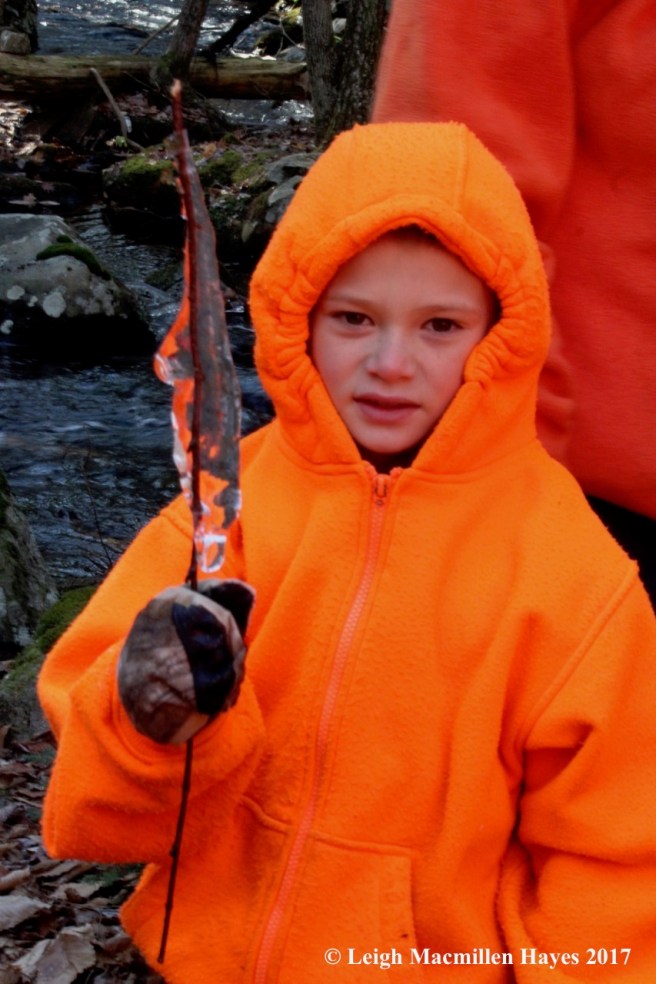
w-carrot-shaped icycle

And because they are kids, they couldn’t resist gathering such to admire up close. This one looked like a carrot, and actually appeared so as it reflected the blaze orange–our color of the season.

w-ice 2

The kids realized that the icicles formed upon all types of vegetation and created their own interesting shapes worth celebrating.

w-ice 3

One even looked like a flag blowing in the breeze when turned upright, and this guy showed it to his mom in honor of her service in the Army and the fact that today is Veterans Day. Turned on its side, it became a maze game and he really wanted to place a small ball in it and watch the ball move through. And as much as he wanted to take it home, it has to live on in his mind’s eye and this photograph.

w-wondering about the car

They showed us so many things of nature, and even the unnatural, though they imagined all the critters for which the old blue car might create a fine home–squirrels, weasels, porucpines, foxes, and coyotes were on their list. And then they turned into otters themselves and slide back down the hill over and over again.

w-polypody 1

They wanted to share some other great finds, including a few squirrel dining tables and a rock with bad hair day, but the crowd had gotten ahead of them. Despite that, they looked at the “bad hair day” fern, aka polypody, and realized that it had curled in since Wednesday’s visit. And then they figured out that the fern curls when it gets cold. Who knew you could use a fern to determine the temperature?

w1-artist conks

Though they didn’t get to share all of their finds this morning, they did make some new discoveries as they wandered off trail, like the artists conks that grew in abundance.

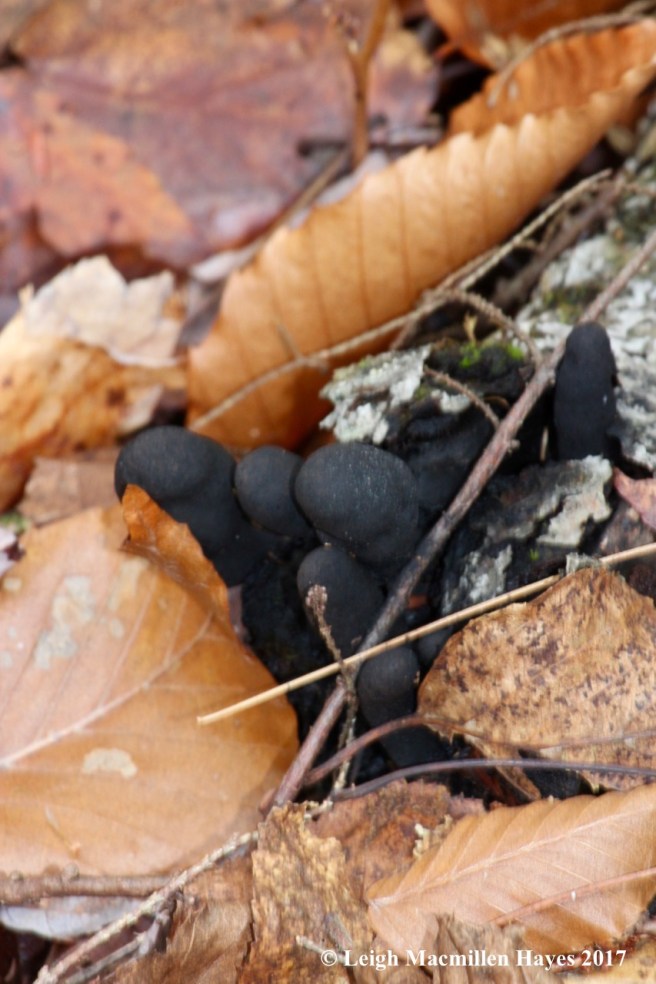
w1-dead man's fingers

And deadman fingers fungi that reminded one of them of scat standing upright. I’ve a feeling that description will stay with me each time I look at it going forward.

w-bear hair 1

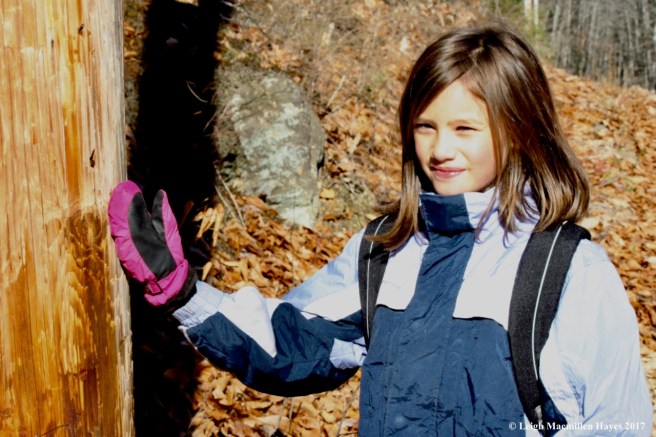
In what seemed like no time, for we traveled the trail much faster than intended, we were back on Horseshoe Pond Road and one among us was particularly excited about a certain display upon pole 13. She ran ahead to be able to show all the participants as they passed by.

w-bear hair on pole 13

It was bear hair and scratch marks that she shared with enthusiasm. And the knowledge that we are not alone in these woods.

And just after that one of her brothers realized our walk was almost over and he was disappointed for so much fun had he had being a junior docent.

w-Sarah signing my book

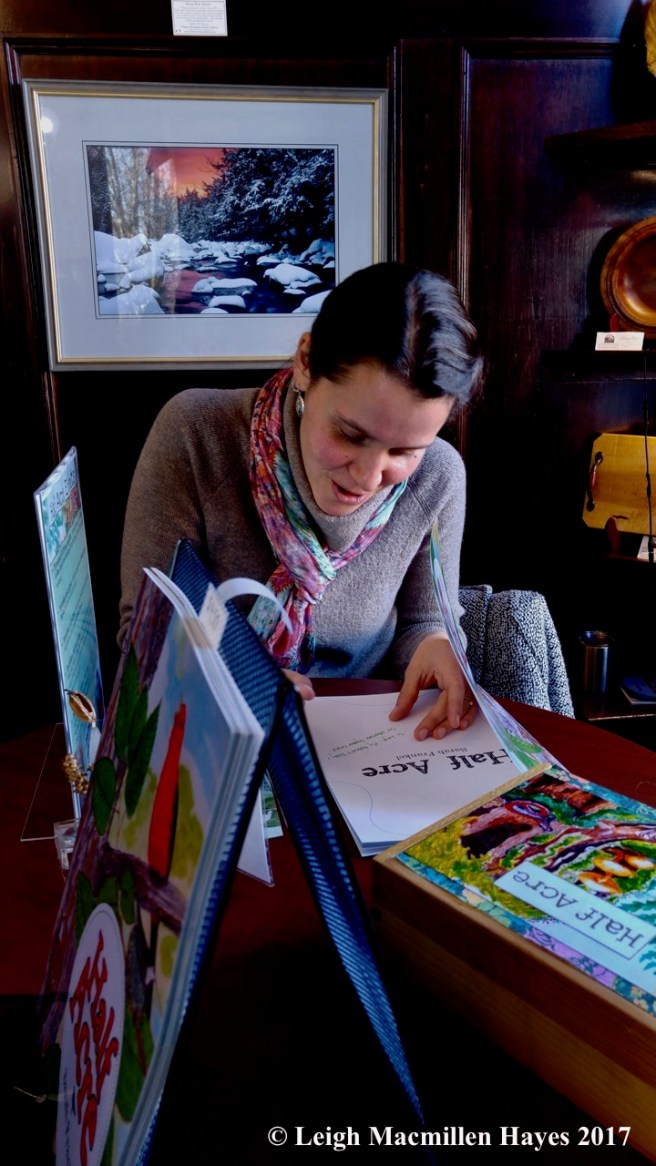
A few hours later, my guy and I ventured to The Met Coffee House and Gallery in North Conway to meet up with another who encourages children and their adults to explore the outdoors. It was our great joy to join my dear friend, Sarah Frankel, for the first book signing event as she celebrated the publishing of Half Acre.

w-posing by an uprooted tree

And now it’s the end of the day and the end of the week, and I’m a better person because of the time I’ve spent with young friends as they’ve moved quickly at times and then stopped to wonder. They taught me the joy of looking with open minds.

If you don’t have kids to learn with and from, may you find time to channel your inner child and look at the world through younger eyes.


Sunday School

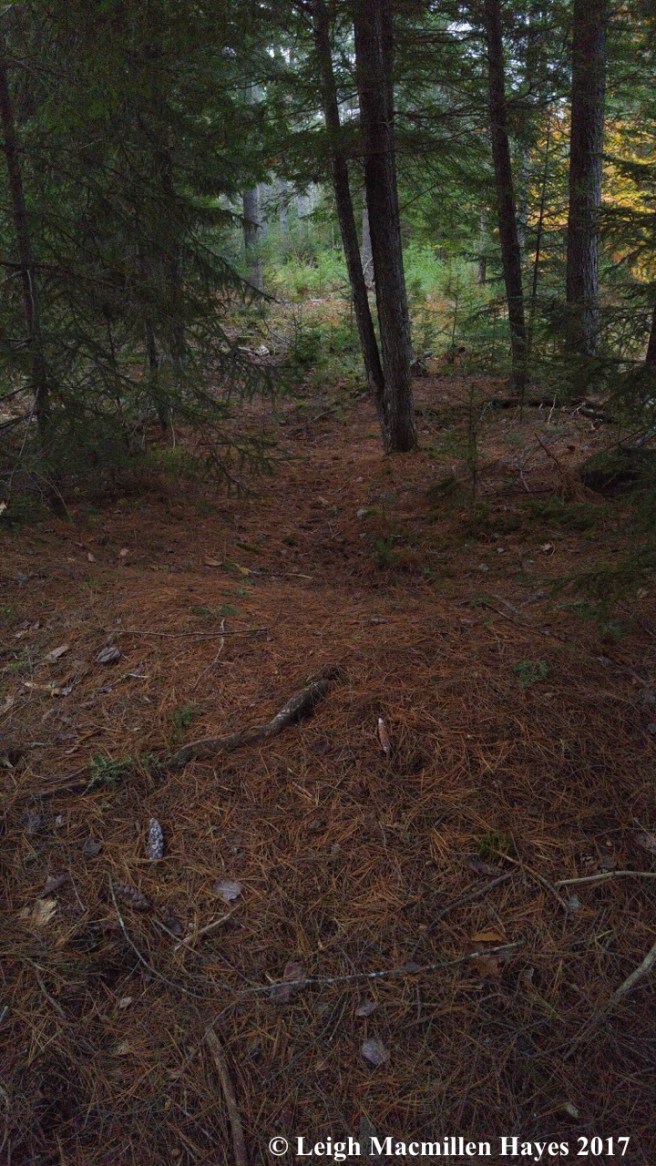
After church this morning, I stepped out the door, passed through openings in a couple  of stonewalls and then down the cowpath, crossed the power line, and ventured into my smiling place. It had been more than several months since I’d pushed the hemlocks aside to enter for it’s a wetland and woodland filled with growth that can make it difficult to meander through without snowshoes. But before winter arrives, I wanted to take a peek and learn what I could along the way.

o-oak saplings

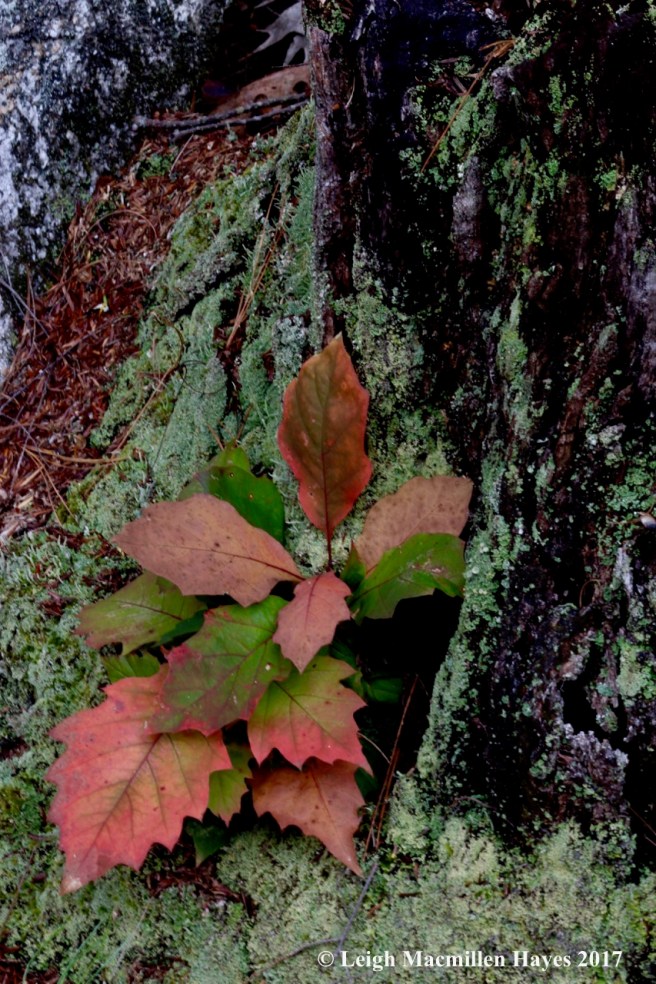
My lessons started early as I noted a couple of red oak saplings growing in the hollow of an old tree stump, their color reminiscent of the Christmas season. Last year’s mast crop (and another for some oak trees this year) meant a plentiful supply of food for weevils, little brown things, squirrels, turkeys and deer. And yet, not all were consumed and so they sprouted. Now my plan will be to wait and watch–and wonder which of this array actually will win the race to adulthood.

o-huge squirrel cache 1

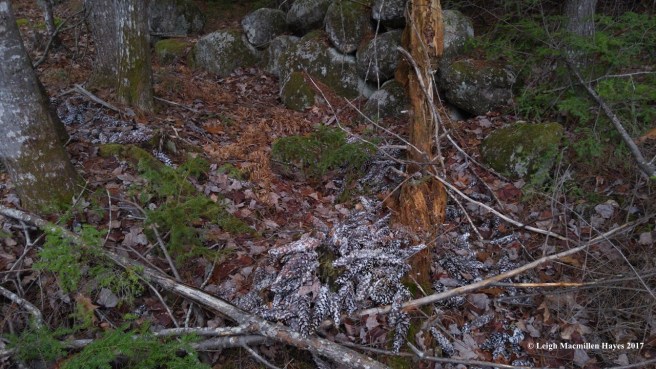
A little bit further into the woods, I spied a huge cache of white pine cones. This made my heart sing, for I love to keep on eye on big caches such as this and watch as they get whittled down over the course of the winter.

o-pine cones up close

While I stood there admiring the work of the red squirrel who’d filled its larder presumably when the cones were green (and by the way, these cones are two years old, for it takes two years for them to mature atop the pine trees), I thought about the sap that coats them in white. Though the sap is drier now, does it get stuck to their feet. I know that when I come in from a walk through a pine forest, I have sap on my soles, and attached to that may be pine needles or dried leaves. Is it the same for a squirrel? If so, does it wear off like that on my boots? It must because I’ve never seen it on their feet.

o-pine on the cob 1

And what about as they work on their pine-on-the-cobs? Does the sap on the scales come off on  their lips or teeth–much like when we eat something sticky and gooey like peanut butter?

o-pine seeds

It’s a lot of work to get to the two tiny seeds tucked within each scale. They look to be about an inch long, but most of that is the wing (think maple samara). When the weather is warm and dry, pine cone scales open to release the seeds. The squirrel who’d hoarded the stash, had plucked the cones when they were still green and atop the tree–dropping them to the forest floor before they opened so he’d have plenty to eat. And then he had to gather all that he’d dropped into the piles. And now I can’t wait for the coming months–to watch the pile dwindle and middens grow; to see the tunnels he makes in the snow; and just maybe to sit quietly nearby and watch him in action. He was a bit peeved that I was poking about today and let me know with so many chirrs from a branch nearby.

o-porky den?

I finally moved on and saw an uprooted tree I’ve visited on previous occasions. Last year I followed porcupine tracks to this very spot and spied porky within. But when I checked on later occasions, it didn’t seem as if he’d returned. Today, I peeked in and saw water. Even though it looked like a grand home to me, I’m learning that porky knows best.

o-walking in a hemlock grove

At times, I moved quietly upon the duff under the hemlock trees. Frequently, I stopped to listen and look.

o-cinnamon fern leaves1

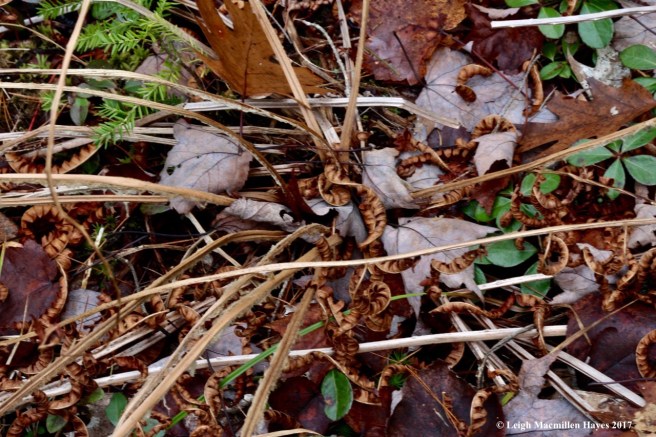
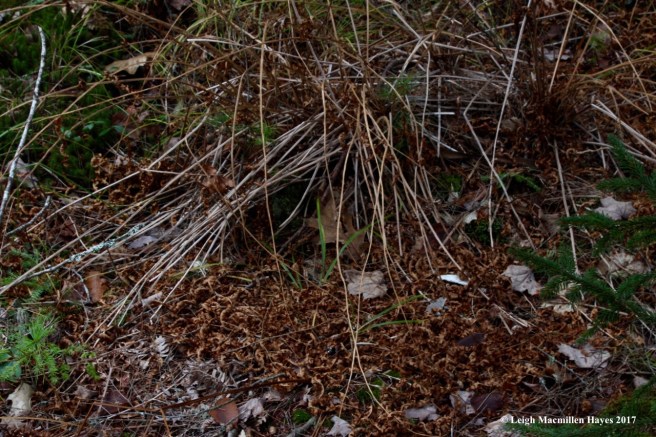
And then in an opening, I was again in the wet zone where the cinnamon ferns grew abundantly. In curled formation, their leaves added interest to the landscape and a bit of a crunch to my footsteps.

o-cinnamon fern 2

And piled as they were surrounding each plant, I thought back to the pinecone cache. This was food of a different kind, for those leaves will decompose over the winter and nourish the earth.

o-snowberry 1

Continuing on, I came to one of my favorite spots–where the creeping snowberry grew. I hunted under the tiny leaves for the little white berries, but found none. And I’m not sure that I’ve ever seen them, especially in this place, for I suppose that I miss all the action since snow melt always seems to call a halt to such visitations and then I never make my way deep into these woods all summer. I have to assume that the little brown things and birds had a feast. Although, as any teacher knows, one should never assume. Perhaps next year, I’ll make a point of checking on these plants.

o-birch tree in offing

My tramp was a meander, for I knew not what direction each footstep might take me, changing my mind constantly and trusting that if I turned left or right, I wasn’t missing something in the opposite direction. The sight of a beech tree, its leaves ever rattling, did mean that I’d have a chance to move to drier land for a few minutes.

o-equisetum

And then I stepped up onto a rock, where the growth at my feet surprised me for I didn’t realize that equisetum grew in this part of the woods. Always something new to learn.

o-tamarack branch 1

That wasn’t all. As I looked around, a branch with yellow needles by my foot caught my attention.

o-tamarack branch 2

This was the twig of a tamarack tree, with its needles growing in tufts atop little spurs. Had we met before, the tree and me? If so, I couldn’t remember it. Nor could I find it.

o-evergreen hallway

Before me was a wall of evergreens, in a classroom all of their own, for really, these are among my favorite places where learning opportunities present themselves. But, today’s lesson wasn’t about the hemlock, white pine, fir and spruce idiosyncrasies.

o-tamarack tree

And so I scanned the sky, and about twenty-thirty feet away, I found the tree. A tamarack or larch or hackmatack tree, aka Larix laricina, is our only deciduous conifer because unlike all the evergreens, it sheds its needles each fall.

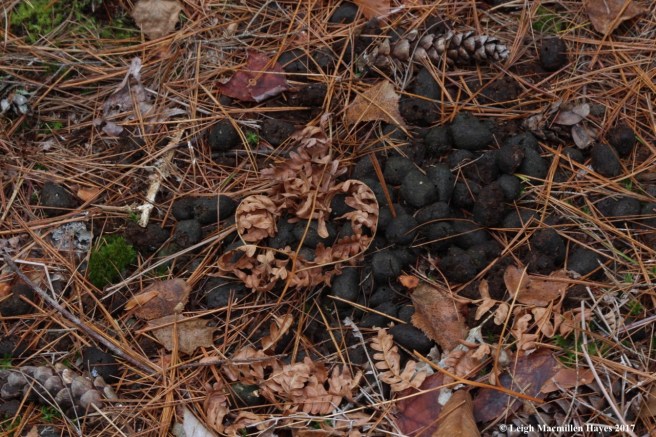
o-moose scat

A few minutes later, I heard movement, and looked up to see . . . no, not the moose that made this deposit last winter, but two flashes of white as a couple of deer bounded off. I think that’s one of my favorite lessons of these woods, for the landscape changes repeatedly and thus offers a variety of habitats for the mammals of western Maine. This is the place where I get to learn the most about them and their behaviors.

o-deer rub 1

Sometimes I’m rewarded with spying the mammal from a distance, but other times I find evidence of its behavior, like this antler rub with frayed bark at top and bottom and smooth wood between.

o-varied habitat 1

I’ve watched the forest succession in these woods for twenty-five years,

o-varied habitat 6

and it’s been logged again more recently.

o-varied habitat 4

With each change, comes more change. And so the mammals move from one spot to another, but they’re still all here–somewhere.

o-varied habitat

I just need to listen and look.

o-turkey tail fungi

It’s not just the mammals and trees that I get to learn about. My studies include among other topics, fungi, of which I’m only a so-so student. But I do know that this is turkey tail, aka Trametes versicolor.

o-Fomitopsis cajanderi  (Rosy Polypore) 2

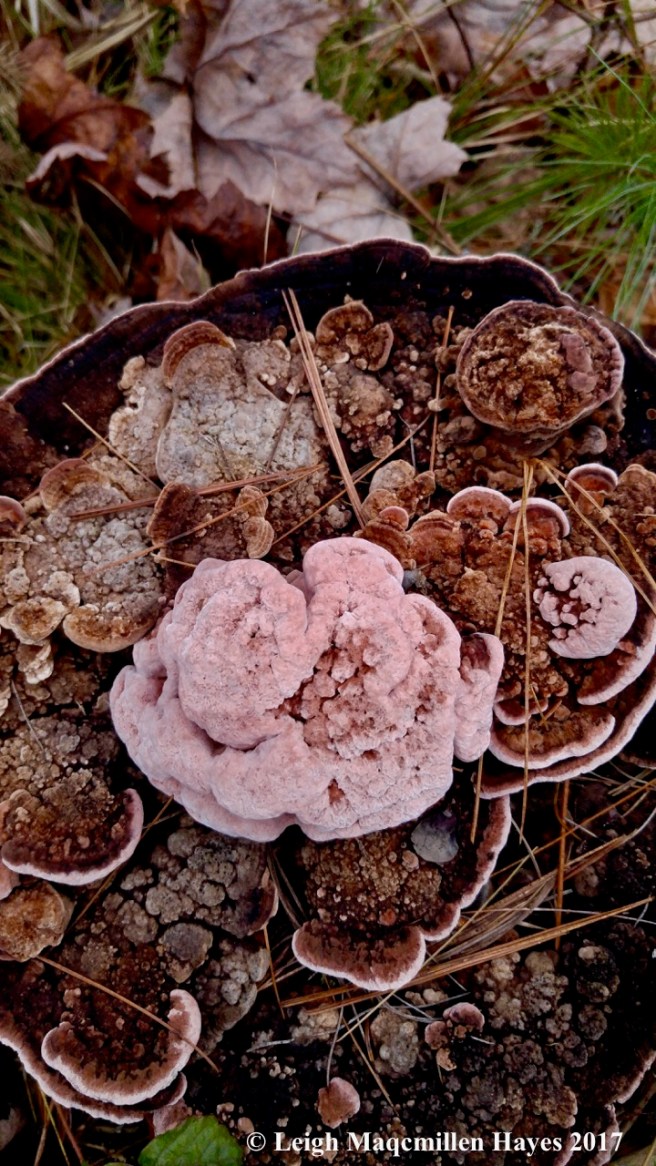
And then I happened upon a hemlock stump topped with a large, beautiful display outlined in a coffee brown and salmon pink. It took me some work to remember its name. I can tell you where else I’ve seen it for it grows upon a hemlock log at Holt Pond.

o-unknown mushroom 1

Before I forget again, it’s a rosy polypore, if memory serves me right. I only hope my fungi teachers weigh in on this one.

o-logging road 1

At long last, it was time to follow a logging road back to the snowmobile trail.

o-snowberry on sphagnum

Sometimes, I slip back into the woods before reaching the trail, but today I chose to follow it. And what to my wondering eyes should appear, but more creeping snowberry atop sphagnum moss.

o-home sweet home

As I finally crossed the field toward home, I gave thanks for the classroom that is right outside our back door and for the lessons learned in this Sunday School. Now I just have to remember everything, which is why I record so much.


I Spy, You Spy, We All Spy

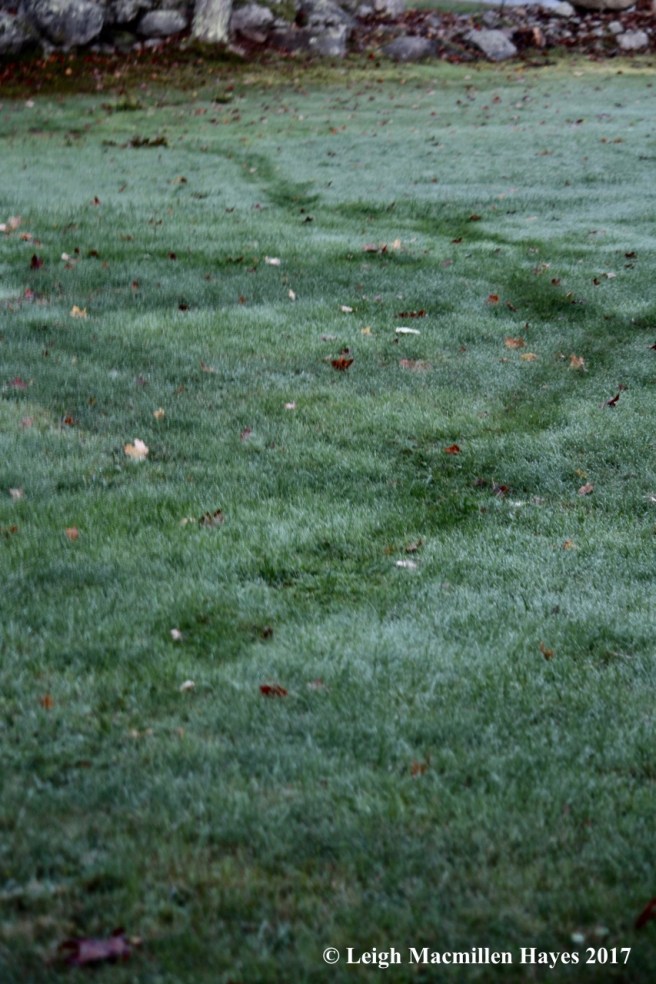
As I stepped out the door early this morning to dump yesterday’s coffee grounds, my eyes were immediately drawn to a pattern in the dew and I knew that Porky had paid us a visit.

t-porcupine trail in morning dew

His trademark sashay showed in the wet grass almost as well as it does in snow with that pigeon-toed pattern and swish of a tail. Only yesterday I’d been noting all the freshly nipped oak branches in our yard and woodlot, cut as they were at that telltale 45˚ angle.

t-flat hill sign--oxymoron

And then, after today’s coffee (grounds waiting until tomorrow to be disposed) and breakfast, I drove to Lovell to meet up with some Greater Lovell Land Trust docents for a climb up Flat Hill–that oxymoron of a name. But really, the summit is rather flat–after climbing the hill, of course.

t-trail light

It was early and felt more fall-like than we’ve experienced of late and we reveled in the temperature as well as the light along the trail as the sun played with the leaves and added a golden glow to our day.

t-coyote scat 1

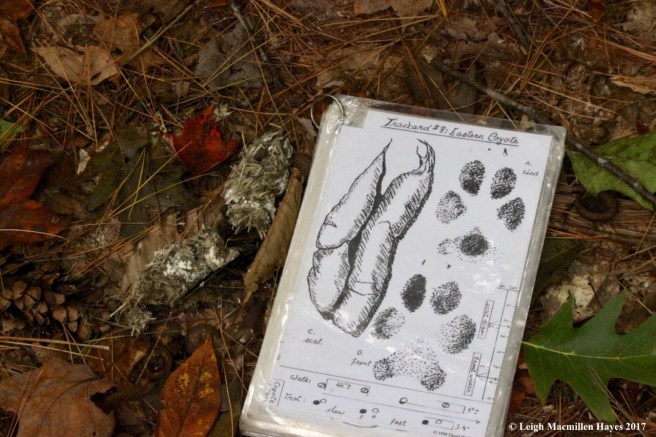
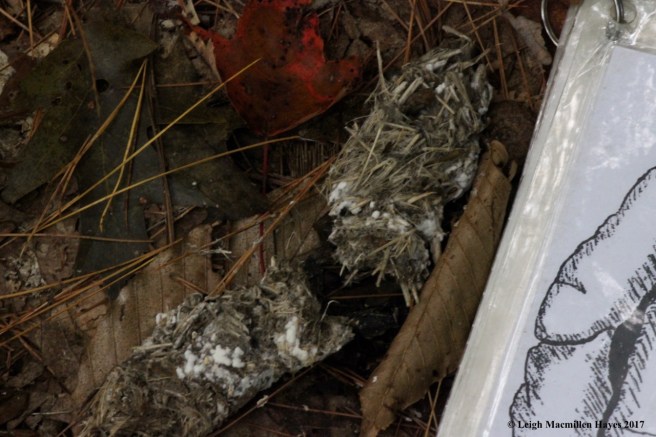
When we weren’t looking up, we looked down. One of our first sights–scat! Coyote scat, we thought. Only the contents of this scat were different than most.

t-coyote scat 2

And so we went in for a closer look–for it was filled with quills. Not my home porky, but we know that the summit and rocky ledge below are porcupine territory so it made perfect sense that we found such scat in the middle of the trail.

t-fox scat

We found more scat a little further along–this one was filled with berries and seeds and also in the middle of the trail, atop a rock. Smaller in size, we suspected red fox.

t-paper birch lenticels

There were other things than scat to attract our attention, like the long lenticels on a downed paper birch–their pattern looking like either zippers on a jacket or a bunch of spruce trees in their spire formation.

t-maple-leaf viburnum

We marveled at the color and texture of the maple-leaf viburnums–like no other in the mix.

t-hop hornbeam bark and leaf

And when we reached the hop hornbeams with their shaggy bark and double-toothed leaves, we knew to look below for their seed pods. It wasn’t an easy search for they are small and blend in well with the birch and hornbeam leaves on the ground.

t-hop seed 2

But we found one–its papery sack enclosing the nutlet. We were curious to see the seed and so opened the inflated casing. It was almost a 3D tear-drop shape, coming to a sharp point.

t-hops

Skipping ahead for a moment, after we finished hiking I visited a tree back near the parking lot where Pam and I had noted plentiful fruits in the summer. It takes about twenty-five years for a hop hornbeam to fruit. And the common name–“hop” refers to the seed clusters that represent true hops used in beer production.

t-summit view 1

At last we reached the summit and stood for a while, in awe of the color display before us.

t-polypody 1a

From the same spot, we also noted the polypody ferns that grow upon the summit rock.

t-polypody spores 2

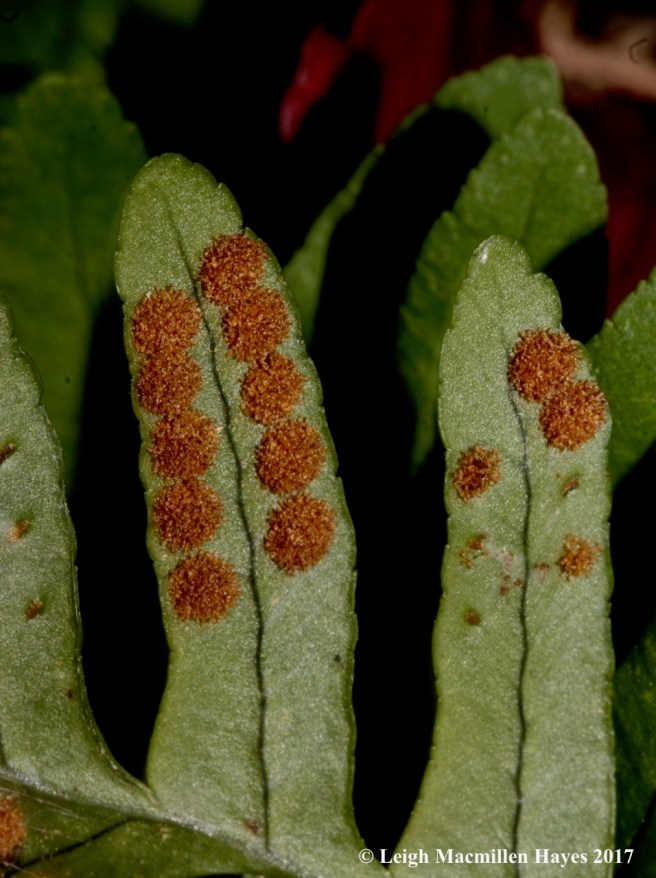
Ferns reproduce by spores rather than seeds. The itty bitty spores (think dust sized), called sporangia, grew on the underside of these leathery frond leaflets. The sporangia form clusters called sori and in the case of polypody the sori are naked. Some had already dispersed.

t-chipmunk

At last we started down, but not without a side trip of bushwhacking and annoying a chipmunk who had some housekeeping details to attend to.

t-docents 1

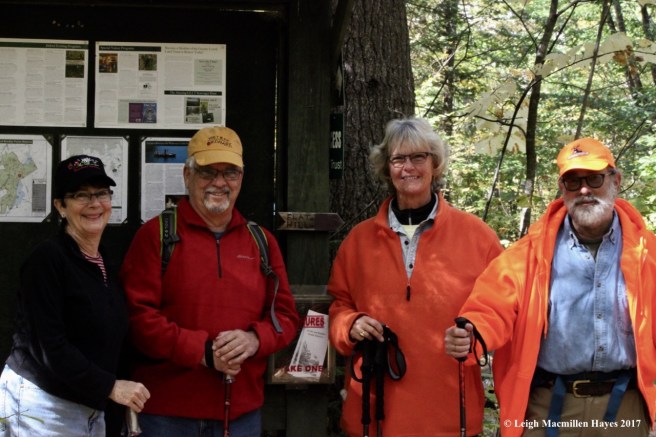
Less than three hours later (amazing for us), we gathered at the bottom and said our goodbyes to Darbee and David on the left–they’ll return to their winter home soon. Bob and Pam will hang with us for a bit longer, but while I reflected on all the wonderful reasons to enjoy winter in Lovell, the two couples made plans to connect in their winter habitat.

t-wooden spoon

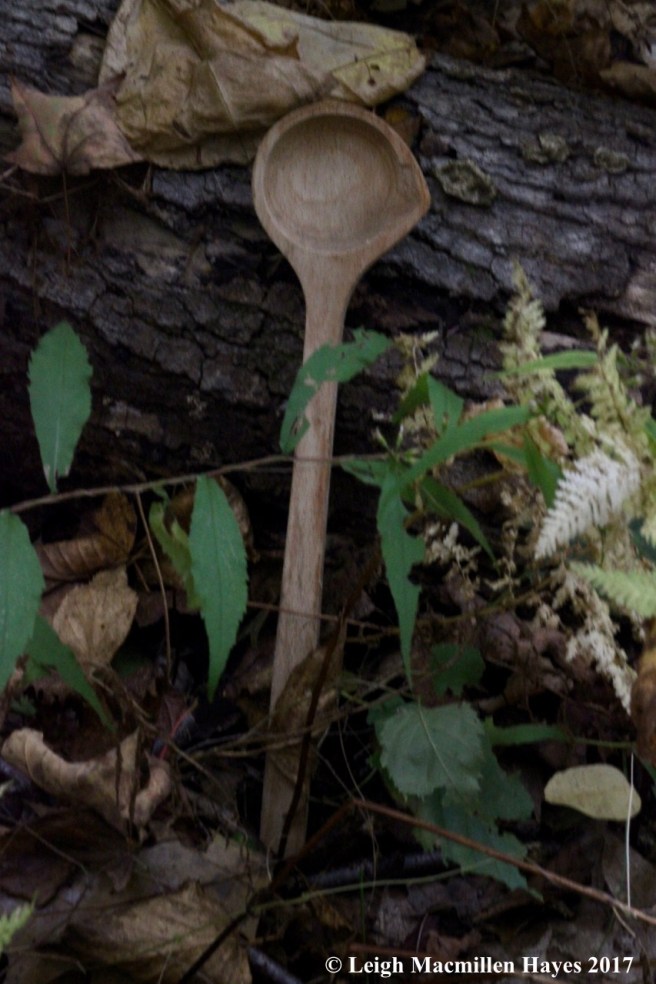
The day wasn’t over yet and this afternoon another docent and I set up a “Kim’s game” of natural and unnatural items on a sheet covered with a bandana on the trail behind the New Suncook School. Then we walked further along the trail and hid a bunch of unnatural items for our after-school Trailblazers to locate. (We had to relocate them as well and are almost certain we found all of them. Maybe . . . )

t-noticing leaf colors

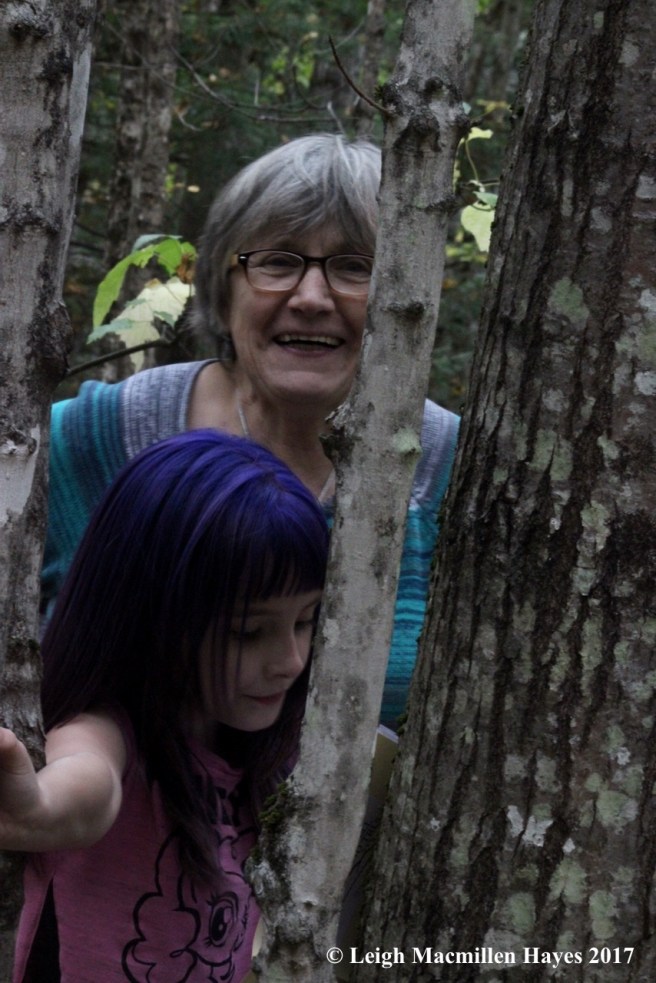
Before the kids did anything though, they introduced Linda to their trees–clusters of trees really for all are copiced, that they’ve befriended and named and gotten to know up close and personal. This afternoon, they noted that the colors of the leaves were changing.

t-Linda and Sassy

They loved giving Linda a tour and she loved being part of the action.

t-alligators in the woods

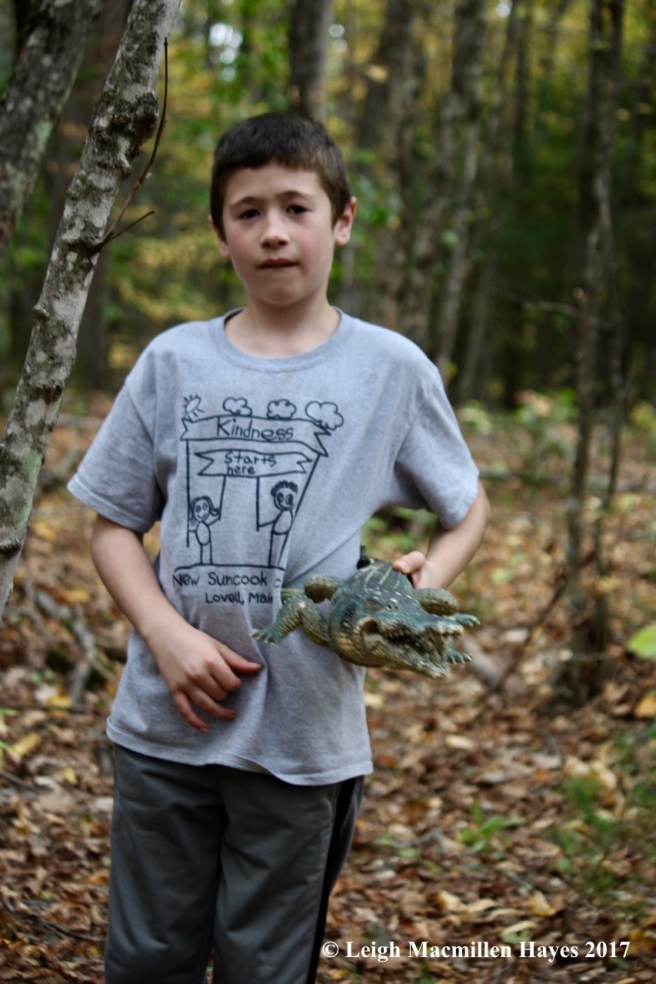
The kids did an excellent job with their observation skills, including locating at least one species that didn’t quite belong in these woods.

t-fallen log 1

And then we started gently rolling over fallen limbs, curious about what we might find below.

t-red-backed salamander

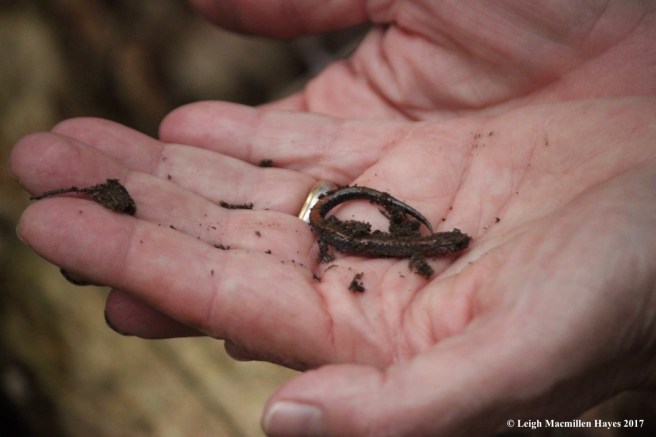
And what to our wondering eyes should appear? A red-backed salamander under the first one. We rolled a few more and didn’t find much. But then we heard something and stood still as we listened. Finally, it called again and we called back–a barred owl was somewhere nearby. At last it was time for the kids to head home and as we walked out of the woods to meet their parents, we stopped to roll one more log–where we found a yellow-spotted salamander. Unfortunately, in our excitement, I couldn’t take a decent photo, but still . . . we were thrilled.

What a perfect day–of I spy, you spy, we all spy. Indeed we did.


Moments of Awe

The garden hum slowed significantly in the last few days, with bee buzz overpowered by cricket chirps. But still they come.

i6-spotted cucumber beetle

The first insect I focused on wasn’t a bee at all, but a spotted cucumber beetle who paid a surprise visit. It’s been years since I grew cucumbers and I can only imagine that it was a couple of houses shy of my neighbor’s garden. Instead, it made do with the mint.

i1-hoverfly, haltere

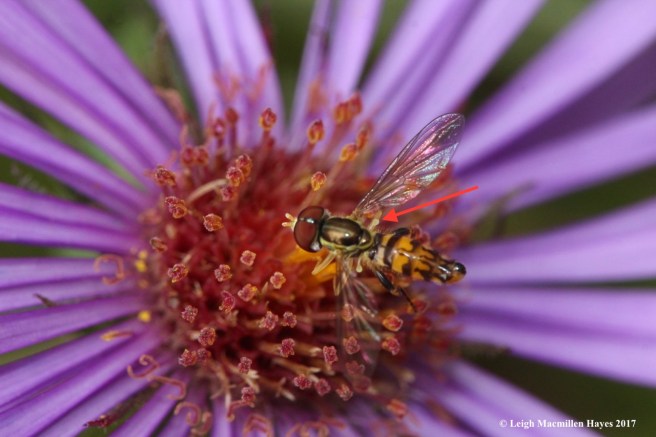
A second glimpse wasn’t at a bee either. But I must admit that I’m forever mesmerized by  the tiny hover flies that frequent the flowers. Hover flies are true flies, so while they may look a bit bee like, they don’t sting. And they take time to enjoy the nectar. My, what big eyes they have–taking up most of their head space. And such short antennae.

i1-hoverfly-haltere

Since I was paying attention, I also realized that hover flies don’t have hindwings per say. Rather, as dipterous insects, they have halteres, which are a modified form of a hindwing. The halteres help with balance and guidance while in flight and are situated behind the forewings on the thorax or middle section of the body. Remember–head, thorax, abdomen. Here’s another tip: two wings fun, four wings run. Well, don’t exactly run, but get out of the way.

i2-sweat bee

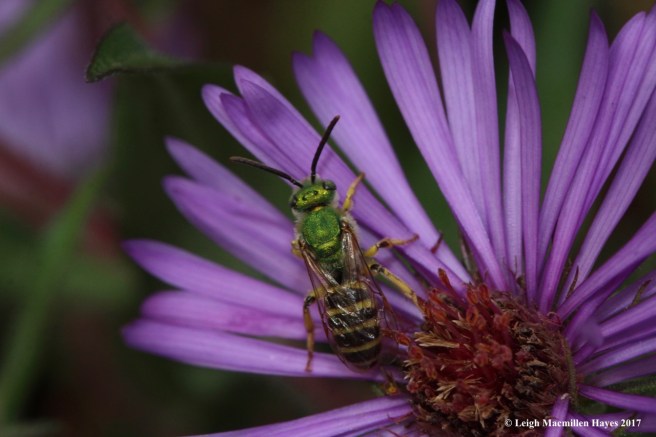
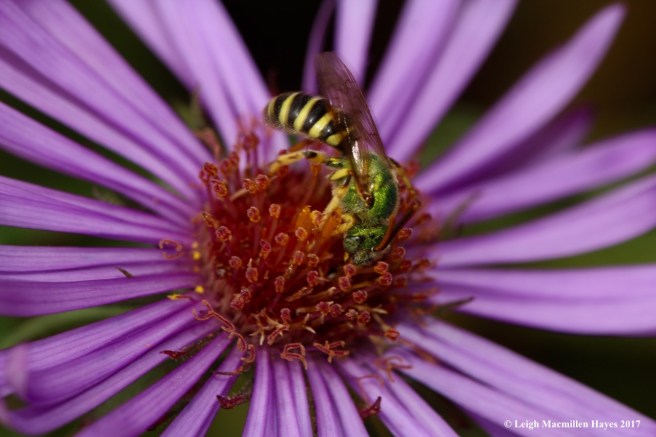
One of my favorites in the garden mix, the jewel-like sweat bees with their metallic green heads and thoraxes, plus yellow and black striped abdomens.

i7-sweat bee

“Sweat bee” doesn’t strike me as the most romantic name for such a beautiful specimen, but they are so called because they’ve been known to land on us in search of a salty sip as we perspire. They will sting if annoyed.

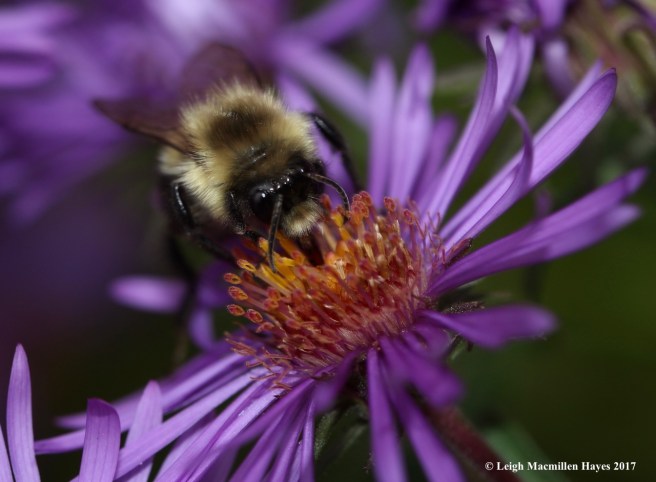
i3-bumblebee face

But their sting isn’t as pronounced as that of the bumblebee; I thought about that as I  carefully greeted one face to face while he sucked with his straw-like proboscis. The bumbles were in constant motion today. Though they’ve been in a collection tizzy all summer, I had to wonder, do they sense the end is near? And still, they perform their job.

i4-honey bee, leg parts1

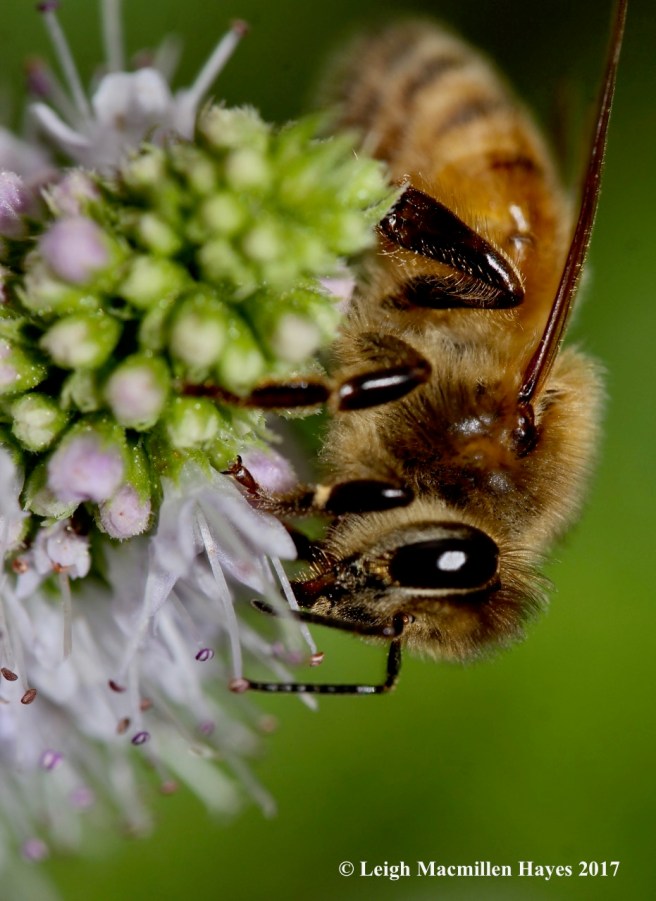
Taking its time in the collection process was a honeybee. Perhaps it knows the end is coming for it was much calmer than has been the norm and stayed in the same spot for several minutes, ever so slowly only moving its head.

i5-honeybee 2

All the better for me to take a closer look, including at the segments of its leg. I’m fascinated by the claws at the base of the tarsus.

Each day, the sweet offerings diminish as do the number of pollinators. Long ago I swore I didn’t like insects, but the more I look, the more in awe I am. Even though I know there will be other things to focus on, I’m going to miss these moments of wonder.


Belated Book of September: Butterflies and Moths

All month long books have been staring at me from their shelves, piles or baskets, a few begging for the honors. But each time I thought I knew which book I’d feature for September, a different month made a claim on it.

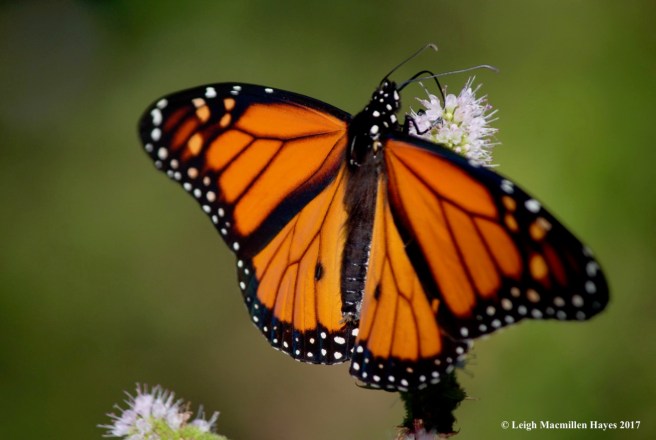
b-monarch 1

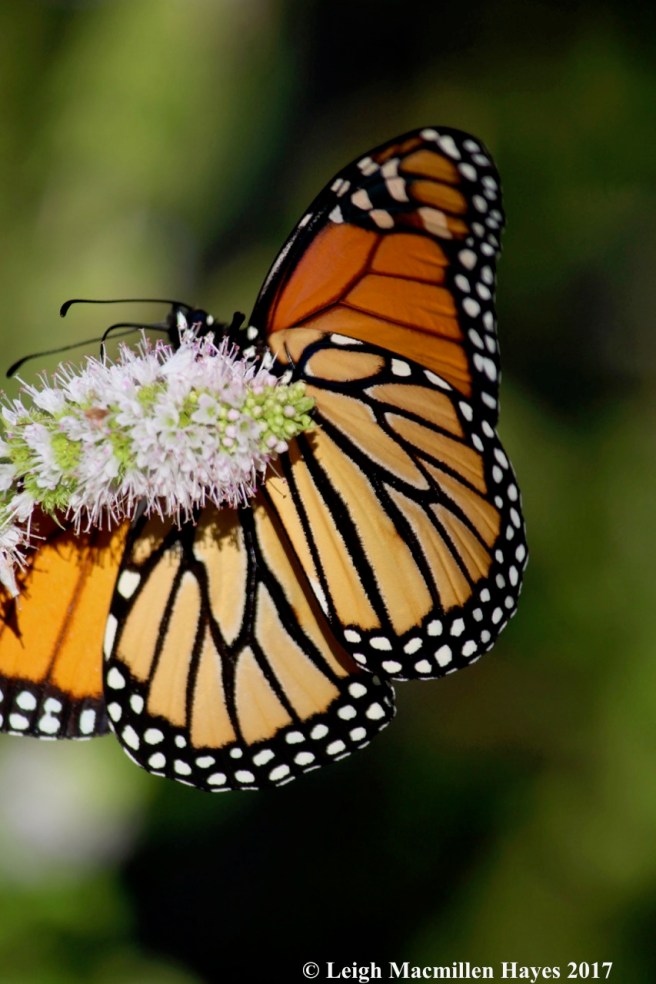
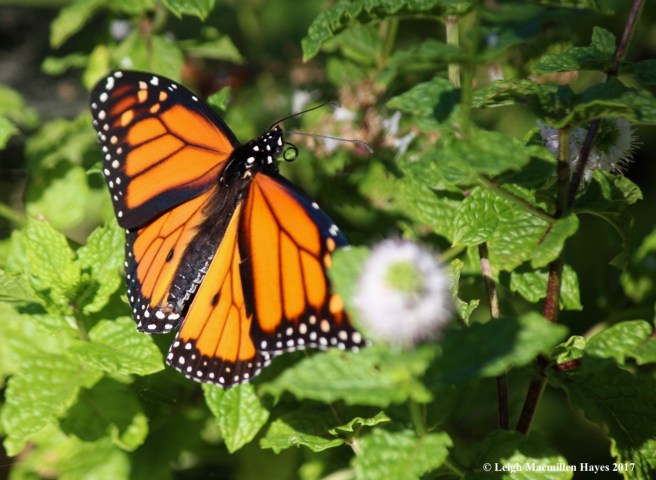
And then, mid-morning, I looked out the kitchen window and saw a certain visitor nectaring at the flowering mint and instantly knew what book it would be.

b-cover

Bufferflies and Moths by Dr. Walter Robert Corti is an oldie but goodie that has graced my personal library since 1964. I don’t remember its origin, but think it may have been a birthday or Christmas present when I was in second grade–such was my wonder even then.

On the back, The Odyssey Library is described as “a new and exciting concept in book publishing, combining in convenient, compact format, texts by leading authorities and full-color illustrations by outstanding artists and photographers. Designed for the reader who wants to add a new dimension to his [or her] understanding of the world, these are books to enjoy, to study, to treasure.” Indeed, I’ve treasured it for over fifty years and referred to it often.

b-monarchs and others

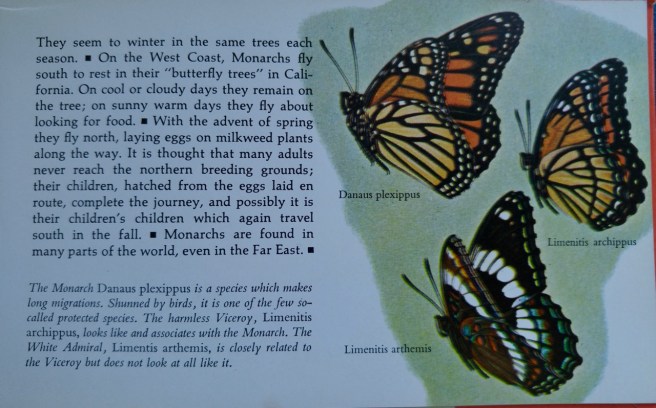
Today found me examining the differences between “look-alikes” because I wanted to make sure that what was fluttering about the garden wasn’t a Viceroy.  They do look similar, but the Viceroy is smaller than a Monarch and its hind wings have a line that runs parallel to the outer margin. There are other differences, but that was enough for me to note. Another thing to note: the illustrations in this book were by Swiss artist Walter Linsenmaier.

b-monarch 2

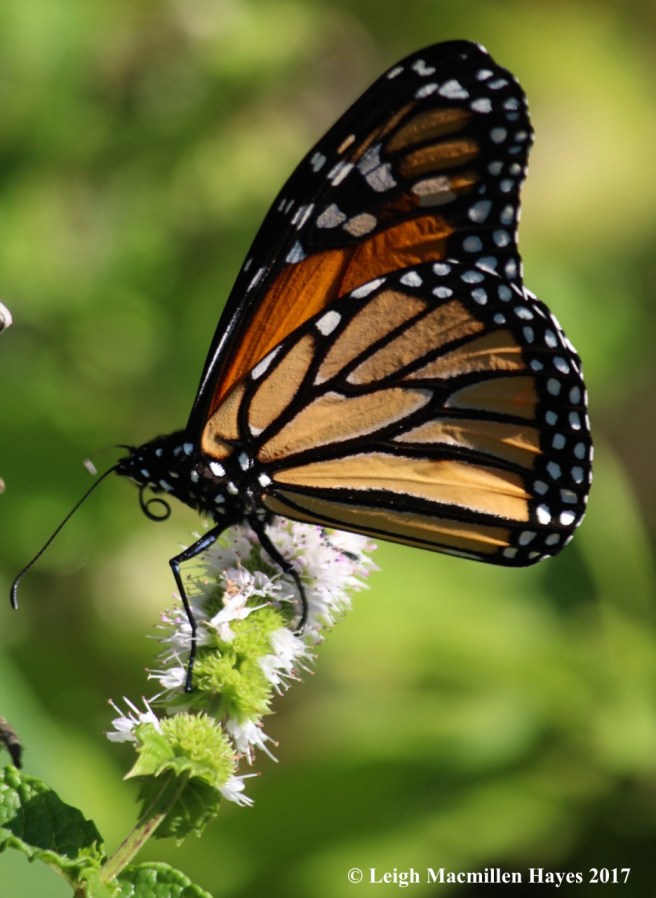
No such line existed on this morning’s beauty.

b-monarch map

Though the author states that in September, “large flocks” of Monarchs gather to fly south, and that was once the case, at least in my backyard it’s no longer true. This is only the second one I’ve seen this year, the first being in a field yesterday and it didn’t light long enough for me to snap a photo. In the past few years, I don’t recall seeing any. But . . . when our twenty-something sons were the age I was when I received this book, we did have large flocks that completely covered some flowering plants and shrubs.

b-monarch probiscus 2

Outdated though the book may be, some things haven’t changed. The order is still Lepidoptera, so named for the scales on their wings; lepis being Greek for “scale,” and pteron for “wing.”

b-monarch probiscus 1

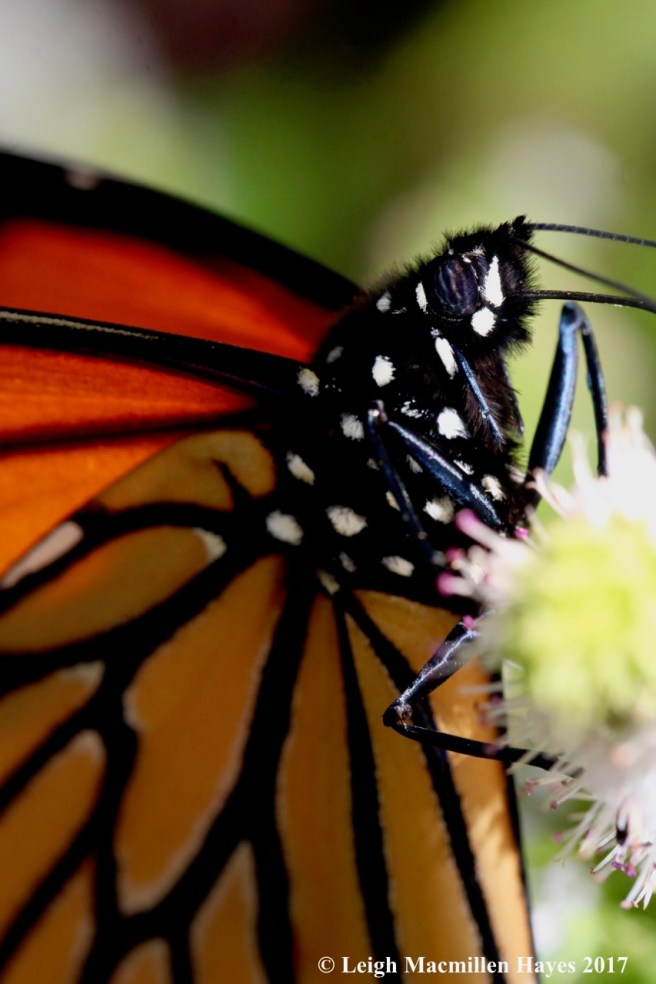
Some cool features include the tongue or proboscis–can you see the coiled dark tube below the antennae? Once you find it, return in your brain to your sixth birthday party (if you had one–my next-door-neighbors, Pat and Kate always came for my birthday dinners, but we never had parties) and the blowouts that were curled until you blew into them and made noise.

b-monarch 6

The same thing happens with the proboscis (though it lacks a sound effect), which is actually two half tubes joined to form one, and includes muscles, nerves and the trachea, as it straightens out and penetrates the far reaches of flowers in search of nectar to suck.

b-monarch eyes

The book also mentions the faceted eyes–each compound and consisting of up to 17,000 “ommatidia,” or  individual light receptors with their own microscopic lenses. Think about what the world around them looks like. How in the world do they hone in on their targeted plants? They have their ways. Read on.

b-painted lady 2a

Prior to seeing today’s Monarch, I’d been blessed with many opportunities to observe Painted Ladies, which share similar colorings to a Monarch, though the pattern differs.

b-painted lady map

Dr. Corti describes their migration pattern, but mentions with all that migrate, it could be that it’s a second or third generation that actually completes a given journey.

b-painted lady 3

The outer wing coloration is what always reminds me that I’m looking at a Painted Lady and not a Monarch.

b-painted lady 1

One thing I’ve observed about the butterflies that I watch–nectaring can happen whether one is right-side up or upside-down. The straw works from any approach.

b-painted lady 2

The club-shaped antenna, common features of butterflies, are angled and work like radar to detect scents. And I mentioned the palpi, which are quite visible here as they are the small projections that protrude from the front of the head. These are covered with scent-detecting sensors as well. And actually, more sensors are located on the thorax, abdomen and legs. That’s how the butterflies find their sources of nourishment.

b-painted lady 5

One of the things I noted about the Painted Ladies that have graced my path lately is that they flit from flower to flower in constant motion . . .

b-painted lady 9

and seek goodness . . .

b-painted lady 10

from a variety of benefactors. I know Monarchs do the same, but today the one I watched much preferred the mint.

b-fritillary 1

An early season butterfly that some may confuse with the Monarch is the Fritillary.

b-fritillary 2

While its coloration is similar,

b-fritillary probiscus

its much smaller in size.

b-clouded sulphur 1

Most butterflies feed with their wings pulled together, such as this clouded sulphur portrayed. I love the subtle blend of pink, yellow and green in this beauty, and especially the yellow-green eyes.

b-white admiral 1

Early on in the summer, white admirals flew about.

b-white admiral 2

Occasionally one posed. Noticed its tattered hind wings. Such is the life of a butterfly.

b-Canada tiger swallowtail 1

We admire them for their beauty and they suffer for it–becoming easy prey. But until they succumb, they spend their days seeking sustenance. And bringing us joy.

As Dr Corti states, “The enchanting colors of their wings, their intimate commerce with quiet flowers, their modest food needs, the innocence of their courtships make them seem like fairy creatures from some unspoiled paradise. They are a delight to curious children, harmless idlers, contented topers, and strolling lovers wherever they appear. It is as if they were created solely to make the world more beautiful.”

Weren’t they?

I know there are updated butterfly guides, but I still love my first.

Butterflies and Moths, by Dr. Walter Robert Corti, The Odyessey Press, New York, 1964.


Poking Along Beside Stevens Brook

Raincoat? √

Notecards? √

Camera? √

Alanna Doughty? √

This morning I donned my raincoat, slipped my camera strap over my head, and met up with LEA’s Education Director Alanna Doughty for our reconnaissance mission along Stevens Brook in downtown Bridgton. Our plan was to refresh our memories about the mill sites long ago identified and used beside the brook.

Lakes Environmental Association maintains a trail from Highland Lake to Long Lake, which follows Stevens Brook’s twists and turns and passes by twelve power sites originally surveyed by Jacob Stevens in 1766.

s1-5th power site 1

We skipped the first mile of the trail and slipped onto it from the Route 302 entrance by the Black Horse Tavern, knowing that that will be our entry point for a walk we’ll lead with Bridgton Historical Society‘s Executive Director Ned Allen later this month. Alanna suggested I not pull out my notecards, and rather rely on my memory. Oh my.

As we made our way past the old trestle that once carried coal from the Narrow Gauge railroad to the Pondicherry Woolen Mill at the fourth power site (the other three are located between Highland Lake and the 302/117 intersection), we recalled that the now deceased Reg Fadden used to claim he knew the color of dye because as he walked to school each day he noted the color of the water. Scary thought.

At the fifth power site, we went off trail to look around a bit. The water flowed over the rocks with such force that sometimes we couldn’t hear each other.

s2-5th site-Narrow Gauge trestle bridge

Before us was another former trestle spot–this one being part of the track that carried the train across the brook and on toward Harrison as part of a spur from the main line.

s3-5th site, nurse log

In front of it, large trees placed years ago to prevent anyone from crossing the now gone trestle, served as a nursery to many species. But it wasn’t just what grew there that gave us pause–it was also the textures and lines that seemed to reflect the water below.

s-poison ivy 1

As we walked, we looked at the lay of the land and wondered about mill ponds and berms. We also noted the one plant we wanted to avoid–poison ivy.

s-poison ivy 2

It grows in various forms, but the safe thing to know is that the two opposite leaves have short petioles that attach to the main stem, while the third and leading leaf has a longer petiole. As the saying goes, “Leaves of three, leave them be.”

s7-6th site water power

Site number six is one that we’re not sure we’ll share on our public walk. It’s a wee bit of a challenge to get to and was apparently never developed–though we did note the drop and some stonework on the far bank.

s8-blue-stemmed goldenrod 1

Before we stepped onto Smith Avenue for the next site, a goldenrod shouted for attention. We tried to figure out how many rays it had, but as it turns out, that number can vary from three to five. The flowerhead formed a ladder that climbed up the stem and this is one that we should recognize going forth for its display struck us as being different than other goldenrods. We’ll see if we actually do remember it the next time we meet.

s9-7th site, Lower Johnson Falls 1

As is often the case, it took us about an hour to walk a half mile. At last we emerged onto Smith Ave, by Lower Johnson Falls. The curious thing would be to note which was faster–the water or us. I have a feeling the water might win, but perhaps another time we should test that theory.

s11-coffin shop

For a few minutes we watched and listened and took in the view of the only mill still standing. I suspect this building was constructed in the 1860s as a sash and blind factory. Eventually it became the coffin shop, where Lewis Smith, the town’s first undertaker, built furniture and coffins.

s13-8th site, sluiceway different view

For about a tenth of a mile we walked down Kansas Road and then slipped into the woods again. I think this site is my favorite–site 8 and former home of the Forest Woolen Mill. There were actually two Forest Mills, one on either side of the road and connected by an overhead walkway.

s15-8th site, sluice way from above 2

Today it was the sluiceway that drew most of our attention. First we looked down.

s12-8th site, sluiceway1

And then we climbed down–paying attention to stones, bricks, cement and rebar, all necessary to build a foundation that still stands today.

s17-piece dangling

Well, most of it still stands. We were awed by a piece that appeared to dangle at the edge of the sluiceway.

s16-tree root in sluiceway

And a root that wound its way around the same cement stanchion . . .

s14-hemlock atop cement

which happened to provide the perfect growing conditions for a hemlock.

s18-false Solomon's-seal berries

Crossing Kansas Road again, we ventured on. In a section under the current power lines we found flowers a many. The fruits of the false Solomon’s-seal looked like miniature strawberry and cherry-vanilla candies.

s19-winterberries

As we stepped onto a boardwalk across a wet area, winterberries glowed red and reminded us that the cold season isn’t all that far off.

s20-virgin's bower fruit, feathery plumes

It was there that we spied the feathery-fruited plumes of virgin’s bower,

s21-red-stemmed dogwood

red-osier dogwood berries,

s24-cat-in-nine-tails

and cat-in-nine-tails.

s22-cardinal flower

But our favorites: a cardinal flower still in bloom and . . .

s23-Northern beggar-ticks

northern beggars-tick.

s28-10th site, CMP above

We passed by the tenth power site, knowing we’d return to it on our way back. Instead, we stood below and looked up at the water flowing over the improved dam.

s27-water below 10th site

It was in this section that the brook dropped 25-30 feet and created the greatest power at one time. It was also here that the eleventh site was located and where a penstock once provided a way to get water to a powerhouse in order to furnish local homes with electricity.

s31-Alanna laughing by skunk cabbage

For us, it was a place to make more discoveries and share a laugh as we looked at the huge leaves of skunk cabbage.

s32-first witch hazel bloom

We also spied the first witch hazel flower of the season . . .

s33-maple-leaf viburnum

and a maple-leaved viburnum showing off its subtle fall colors.

s34-milkweed pods

In a spot just above the Central Maine Power substation, we found a garden of wildflowers including milkweed seed pods and . . .

s37-New England aster 2

New England asters offering a deep shade of purple.

s27-chicken of the woods

We also found some chicken of the woods.

s38-honey mushrooms?

And fruiting on the same stump, what I think was honey mushrooms (Armillaria mellea). I know a few fungi experts who occasionally read this, so I know they’ll correct me if I’m wrong with my ID.

s39-Stevens Brook outlet into Long Lake

The second half mile took us just as long as the first, and at last we reached the outlet into Long Lake.

s40-10th site, CMP dam

And then we made our way back, crossing over the bridge at power site 10, which was possibly the spot where Jacob Stevens, for whom the brook was named, built the first sawmill in 1768. We do know that in 1896, the Bridgton Water and Electric Company acquired the site and improved the dam. Eventually it passed on to the Western Maine Power Company and then Central Maine Power. In 1955, it was transferred to the Bridgton Water District. Through all the time, we could only imagine how the reflections changed.

s42-milkweed tussock moth caterpillar

To save time, we decided to walk along Lower Main Street as we made our way back. And to that end, our discoveries continued, for on a milkweed, Alanna first saw the chewed leaf and knew to look for the milkweed tussock moth caterpillar that was filling its belly.

s43-common snowberry

We also saw what I’ve always referred to as popcorn shrub because it reminds me of such, especially when I’m hungry for lunch. But really, it’s common snowberry. And not edible.

s46-northern white cedar bark

And then we found a tree that I didn’t know grew there–and I can’t tell you how many times I’ve run or walked by it: a northern white cedar with its scraggly striped bark.

s44-Northern white cedar 1

As much as the bark, I like the overlapping scale-like blue-green leaves.

All in all, our one mile journey took us just over two hours and we did recall some of the info about the mills without referring to my notecards. But what was even more fun was our wonder and awe as we made new discoveries while poking along beside Stevens Brook.

If you care to join us, the talk by historian Sue Black will be on Wed, September 27 from 5-7pm at LEA’s Maine Lake Science Center and the walk will be the next morning from 9-11. We’ll meet at Bridgton Historical Society on Gibbs Avenue for that. Be sure to register for either or both by contacting Alanna at the following address: alanna@leamaine.org.


Bee Kind

Because I have the good fortune to be involved with the Greater Lovell Land Trust, I spend my summers attending talks and walks on a variety of topics. Prior to this week, we learned about lichens, bryophytes, pileated woodpeckers, fungi, flowers, ferns, medicinal plants, peat bogs, wild turkeys, and land conservation. And then last night our focus turned to pollinators and the pollinated.

Guy Pilla, a beekeeper from Fryeburg, Maine, gave an informational talk on the art of beekeeping, followed by a question and answer period, and the crème de la crème –honey tasting. How often have you had a chance to taste Tupelo honey?

w-Guy 1 (1)

This morning we met up with Guy again, as he took us to a hive he has set up on private property under conservation easement with the land trust. Twenty-six of us gathered around to listen, watch, and wonder.

w-showing the frames

In his alien costume, Guy passed around frames, giving us an opportunity to look at a range of cells as he explained about spacing for honey expansion, storage and more. We learned about the good and the bad of beekeeping, but mostly the good.

w-Gary looking at frame

As frames were passed around, we noted variations and the fact that some were lightweight and others heavy.

w-hive--bear precautions

At last it was time for Guy to open the hive. Notice the electric fence surrounding it? And the fact that it’s strapped down. Bear defense. And we know there’s at least one in the area.

w-dressing like a beekeeper

And then he walked through the crowd and chose Mary to be his assistant. She donned a hat and veil to protect her face and neck, and took on the look.

w-testing the smoker

Into the bee yard, she followed Guy. If you look closely, you’ll see two platforms on the ground and might notice that the one directly below the hive has nails sticking up (the other is turned upside down because Guy only has one hive at this location this year). Those are to deter skunks, another predator. As Mary watched from behind and the rest of us watched from a few feet away beyond the fence (and out of the bee line), Guy ignited the smoker he’d filled with pine needles.

w-smoke coming out of smoker1

It took a few minutes, but finally, smoke puffed out.

w-Mary practices the smoker

He then passed it to Mary, and her task was to press the bellows and create smoke. The smoker is an important line of defense.

w-preparing to open the hive

As we continued to watch, Guy took the straps off and explained the construction of the hive with one super stacked atop another in a vertical fashion. Though he ordered his equipment, he refashioned some of it including the roof, designed to let wet weather flow off rather than gather in puddles on the top of the structure.

w-Mary uses the smoker

As Guy wedged a hive tool into the bee glue (a resin-like propolis), Mary got ready to use the smoker. Smoke fools the honeybees into thinking a wildfire is nearby, thus prompting them to eat more honey in case they need to move to a new location.

w-showing off his bees

And with honey in their bellies, they become more docile. Note that Guy isn’t wearing any gloves. Usually he does, but Mary wore his gloves this morning and he trusted all would go well and the bees would remain calm. He was certainly calm, but spoke of his early days in the beekeeping business and how sometimes he would jump. Bees sense fear behavior exhibited by heavy breathing and that’s when stings occur. Having been stung recently after some youngsters received stings, I thought I was remaining calm, but apparently my breath spoke for me.

w-hive levels

We learned so much from Guy last night and today–about their various jobs as male drones, queens, and female workers who really do so much of the work. The workers clean out old material from inside the cells, attend to the queen, carry dead bees or larvae outside the hive, guard the hive’s entrance, fan at the entrance during the hot weather to keep the inside temperature down and to circulate fresh air throughout the hive, receive nectar and pollen,  store it away in cells, nurse newly laid egg, and seal cells around larvae at the appropriate moment. After doing all of this for about three weeks, they’ll earn the rights to collect nectar and pollen for about six. And then . . . they’ll die of exhaustion. Indeed.

w-wandering among the flowers

After our time at the hive, one of the land owners, Linda, took us on a mini-tour of the 100-hundred-acre property. Her goal was to take us to a flower meadow she and her husband have created. Originally, it was a garden with raised beds, but Linda has been collecting wildflower seeds from roadsides in Maine and New Hampshire and sowing them in the meadow.

w-learning from Linda

Today we were wowed by the results.

w-honey bee 1

And so were Guy’s honeybees.

w-honeybee on the move

They were on the move everywhere we looked.

w-bee using probiscus for honey

We watched as they sucked nectar with their proboscis mouth part.

w-bumblebee on Joe Pye Weed

Bumblebees also took advantage of the sweet offerings.

w-bumble with loaded pollen baskets

And filled their pollen baskets with the goods.

w-frittilary 1

Not to be left out, a fritillary was among those seeking reward.

w-male meadowhawk

And because we were there, we saw meadowhawk dragonflies on the prowl, he being red . . .

w-female meadowhawk

and she similar but brown.

w-Guy in the field (1)

Guy was tickled to see his bees at work and share his knowledge to all as we listened.

w-linda by her flower meadow

Linda was thrilled to see so many enjoying what she and her husband, Heinrich, had created.

w-Aa, gs 1

And speaking of Heinrich, just before we left he had one more insect to share.

w-Aa, garden 2

An orb spider known as a yellow and black garden spider or argiope aurantia had built its web near the greenhouse. I used to see these in our gardens frequently, but haven’t lately. Of course, I say that and tomorrow I’ll spy one.

w-Argiope aurantia, garden spider 4

In my brain, this is the smartest spider of them all for they create a web consisting of a series of concentric circles divided into sectors by lines that radiate out. And in the center–that amazing zigzag pattern, which is called a stabilimentum and perhaps intended to attract other insects. Or maybe its a message written in code and intended for a certain pig named Wilbur. This is Maine after all.

w-honey bee 2

We do know one message we learned in the last 24 hours: Bee kind–to one another for we’re all interconnected and we need each other to survive. And that includes letting the undesirables flourish in our yards, including the dandelions. Do so and watch them and just maybe you’ll realize they are desirable after all.

(Two final notes: Support your local beekeepers. Guy’s honey is available at Spice and Grain in Fryeburg; but really, you should buy honey from your area. And if you are interested in learning more about beekeeping, look for your local chapter of the Maine State Beekeepers Association.


Into the future

Turning the clock back two months, I can recall my slight apprehension about working with three interns at the Greater Lovell Land Trust this summer. Hannah I knew and loved from our time together last year, but the other two were complete unknowns. Not only that, but in the past we’ve always had two interns, so what would it mean to throw a third into the mix?

i-11

And then I met them and our first hike was a bug-ridden adventure to Otter Rock at Heald and Bradley Ponds Reserve on the evening of the summer solstice. To say the mosquitoes were intense that night would be an understatement, but Dakota, Kelley and Hannah didn’t complain.

i-9

In fact, their broad smiles that would accompany them throughout our time together broadcasted their strength as individuals and a combined force. And I knew all would be well.

i-12

Each week they joined us for the Tuesday Tramps the GLLT docents take on the properties to learn from each other. And occasionally they had an opportunity to show us the efforts of their hard work, for they built solid benches and platforms, cleared trails, and even built water bars to prevent erosion. They learned about land conservation and spent hours developing an understanding of the inner workings of a land trust.

i-6

On Tuesday Tramps the main focus was to develop a better understanding of species that call this place home–both flora and fauna–and all of us shared knowledge and asked questions as we poked along.

i-19

At our annual docent training, the interns jumped right into the flower ID workshop,

i-22

and worked on their new skills . . .

i-23

while studying details.

i-18

Their skills grew, but one was especially evident for wherever we went, they found the blueberries first.

i-7

They also helped us with the Lovell Rec Summer Camp Nature Program we provided each week. This was our third summer offering said program, and based on last year’s numbers we’d split the group in two–divided mainly by younger and older kids, with a few overlaps due to interest levels. As it turned out, the Rec Program numbers doubled in size. Because I knew she has a talent for working with young children, Hannah became the mainstay of the younger group, while Dakota and Kelley took on the task of leading the older kids who wanted “less talk, more walk.” Speed hikes were the name of their game.

i-interns at annual meeting

Somehow, the summer passed by much too quickly and though it isn’t over yet, suddenly it dawned on this week and it was their turn to be the featured speakers at our Wednesday night program and then to say something brief at this morning’s Annual Meeting. The triplets, as I fondly referred to them for they had formed a bond that I hope will last a lifetime, had to face the crowd. Wednesday night wasn’t so bad for they had a developed a slideshow and had fun recalling the various aspects of their summer job in front of a friendly crowd, most of whom they knew. But this morning the crowd reached 105. As they stood there, they looked like they were jail mates, but with steady voices they shared pieces of their combined experience.

i-Kelley 2

The moment to shine, however, wasn’t over. This afternoon, they led about twelve people on a walk along the Homestead Trail at Heald and Bradley Ponds Reserve. It’s a trail they knew well, but still they wowed us with their knowledge . . . of ferns,

i-Hannah at plantain

rattlesnake plantain, and

i-Dakota 2

even the forested landscape.

i-Kelley and Dakota up close

They looked for the tiniest of details,

i-Dakota, number on scythe

and took pleasure in recognizing old tools long ago left behind.

i-caesar explanation

With her hands, Hannah explained how when a Caesar’s mushroom expands, its universal veil is broken and the bottom of the veil forms a cup-shaped volva.

i-caesar 2

Then she pointed to one nearby that was a couple of days old and all wondered about the variation in shape.

i-Dakota explains foundations

It was our immense pleasure to travel the trail with them this afternoon and be in awe by all that they had learned and could share. One of the fascinating things for me was to hear their hypotheses, for there isn’t an answer to everything we see, but they asked questions and considered various answers.

i-2

I know I wasn’t alone in the fact that I didn’t want today’s walk to end, for that meant this team of three would head off toward their next adventures.

Tree 3 (1)

I can only hope that some day in the future when I least expect it, I’ll hear my name being whispered in the breeze . . . and I’ll recognize the voices and look up to see the triplets.

If our future is in their hands, we are in the best of hands in the land.

I want to end by sharing a poem written by Hannah. And I should add that writing and reciting poetry was another talent we discovered they have for we host a poetry workshop each summer followed by an open mic night of sharing and once again, their voices were powerful.

One who walks the woods often

Has learned silence is power

Silence allows for you to see

What lies beneath trees of tall green

Dragonflies of iridescent magic flight

Birds perched and ferns unsearched

One that has been rewarded the gift

after silence

Teaches others the wonders 

of observation

Appreciation for what surrounds us

Nature’s beautiful creations. 

~ Hannah Rousey

Thank you, Hannah, Dakota, and Kelley. As you travel into the future, I hope you’ll remember friendships formed and paths created this summer. I know I certainly will.

Until our paths cross again . . .


I used to think

c-mayfly 1

I used to think mayflies emerged only in May.

Maybe I’ve seen them in other months, but I’d never really thought about it. Yesterday this mayfly greeted me in the morning. And in the evening, it was still there. So my May-only theory proved to be wrong.

c-mayfly 2

I used to think they had only one adult form.

c-mayfly molt 1

That all changed this morning when I spotted it again. Only, I also spotted something else an inch or two away. An exoskeleton or exuvia? From a mayfly? It certainly looked mayfly-like with the same narrow and segmented body plus long-tail cerci.

c-mayfly beside molt

When I looked more closely, I realized that the exuvia was about half the size of the true adult form. As for that cloudy-winged specimen I’d spied yesterday–it had been a teenager, aka a subimago. I let the wings trick me because I didn’t know better. Though it looked adult-like, it wasn’t sexually mature yet.

Mayflies are unique in that after the nymph emerges from the water as the subimago (that fishermen call a dun) like yesterday’s model, they seek shelter before shedding their skin for the final transformation. How lucky for me that this dun chose our porch screen on which to rest.

c-mayfly size difference

And so, I was gifted a second opportunity to look. It can take a few minutes to two days before a subimago transforms into a clear-winged imago or spinner, though the actual metamorphosis is quick. I wish I’d seen it, but at least I got to see the end result.

c-mayfly mature 1

I’m not sure my friend appreciated it, but I was glad for our opportunity to spend some time up close and personal.

c-mayfly no mouth part

While in an aquatic form for a year or two, it had done plenty of eating. But as an adult, eating became a thing of its past as it had no functional mouth parts.

c-mayfly eyes 1

It did have plenty of eyes, however. The better to find food when immature and later a mate, I suppose.  Like other flies, its two outer eyes were large and compound.  Between them were three simple eyes (ocelli).

c-mayfly clear wings

The two pairs of triangular wings were held upright like a damselfly, rather than flat like a dragonfly. When I compared yesterday’s opague wings with today’s, the clarity of the new wings defined by dark veins seemed an obvious difference and one I’ll need to pay attention to going forth.

c-mayfly aedeagi at base of abdomen

Male or female? That was the question, but only for a moment. Do you see the aedeagi or penis-like appendages at the tip of the abdomen and below the two cerci (tail-like appendages)? Meet Mr. Mayfly.

c-mayfly bird's eye view1

I know that because mayflies emerge in swarms, they can be a nuisance. But this was only one. And our friendship only lasted for a few hours total–though he spent about 24 hours in the same spot. By noontime he had disappeared–of his own efforts I hope . . . heading off to do some courting. His days are numbered, I know, for his main function is to mate and maybe mate again, before he dies.

But today he served another function as he taught me a lesson. My best learning comes from observation . . . and realizing that what I used to think isn’t always accurate.

My thanks to a mayfly.


Orchid-Maine-ia

m-bald eagle 2

I took it as a sign when I first heard and then spotted a bald eagle on a white pine towering over Moose Pond. It seemed apropos that it should serve as a token of good luck, or at least a push out the door to spend some time wandering and wondering. And so I made the instant decision to drive to Holt Pond, where tomorrow I’ll join Ursula Duve and Kathy McGreavy as we lead a guided walk.

p-grasspink2

Our focus will be on orchids, such as the grass pink, which seems such a common name for this blooming beauty.

p-grass pink 1

The magenta flowers or Calopogons I spotted today are a wee bit off the boardwalk in the quaking bog, but even still I could see their showy formation with knobbed hairs on the upper lip. It is thought that the yellow crest on that lip imitates pollen, to attract pollen-seeking bees. But the real deal for orchids is that a collected mass of pollen grains are gathered together in a pollinium or anther lobe and thus deposited onto the bee’s abdomen.

p-rose pogonia 1

Rose pogonias were also blooming abundantly. In a way, their formation is opposite that of the grass-pink, with the fringed lower lip providing an attraction for pollinators.

p-pitcher leaf

Also on display as the water receded a wee bit despite a beaver dam on Muddy River–my favorite carnivorous pitcher plants with their urn-like leaves that serve as pit traps appeared quite robust.

p-pitcher flower

Carnivorous plants are orchid companions as they both prefer the bog habitat, like to fool their pollinators and are otherworldly beautiful. There is one aspect in which they differ–the orchids like to attract insects for pollination and the pitcher plants for nutrients. But first, the pitchers may use the insect as pollinators, thus fooling them into a visitation. Pollinators beware!

p-sundew

Equally seductive are the spatula-leaved sundews visible at the end of the quaking bog boardwalk. Until now, they’d been under water and difficult to see. The scent of sugary liquid on the leaf tips attracts unsuspecting insects who get stuck to the tentacles, which then curl inward and thus digest the nutrients from their prey. Again–beware.

p-trail sign

Orchids and their bog companions weren’t the only thing on view today.

p-painted turtle by Muddy River

When I stepped onto the short boardwalk to the Muddy River intent on hunting for dragonflies, I discovered a painted turtle sunning at the edge.

p-blue dasher 1

And then I found what I’d hoped–blue dashers dashed about, although occasionally one stopped so I could take a better look.

p-bluet love

And familiar bluets canoodled on a stem.

p-variable dancer

I discovered a female variable dancer damselfly on a small twig,

p-ebony jewelwing

a male ebony jewelwing fluttered and paused on red maple leaves,

p-flyby

and slaty blue dragonflies buzzed about Holt Pond in record-breaking speed.

p-slaty skimmer1

Finally, one stopped long enough for me to soak in its gray-blue color.

p-steeplebush

There were other flowers to enjoy as well, including the spirea,

p-swamp rose

swamp rose,

p-cranberry flowers

cranberry,

p-cowwheat

cow-wheat,

p-blue flag iris with hoverfly

and blue flag iris. If you look carefully, you may see a hoverfly following the runway on the left lobe.

p-blueberries ripening

I noticed blueberries beginning to turn blue,

p-cinnamon fern

cinnamon ferns with shriveled fertile fronds,

p-hobblebush leaves turning purple

and a few hobblebush leaves already taking on the fall shade of purple. Uh oh.

p-Holt Pond to the south

The wonders of Holt Pond . . .

p-Holt Pond west

never cease to amaze me.

p-quaking bog boardwalk

I hope that you can venture there yourself and discover your own Orchid-Maine-ia. Who knows what else you might notice along the way.

The Best Laid Plans

The opportunity was golden. Lakes Environmental Association’s Executive Director invited me to tag along with Dr. Rick Van de Poll as he conducted a Comprehensive Ecological Assessment at the Highland Lake Preserve. I couldn’t wait to be in Rick’s presence again, for he’s a walking naturalist encyclopedia. But . . . I’d been late in responding to an e-mail and didn’t know what time to meet him.

And so this morning I went in search. I located his truck parked just off the road at the northern end of the lake. I was certain I’d find him despite the fact that the preserve encompasses 325 acres and doesn’t have any trails.

h-Eastern pondhawk female 1

It does, however, have an old logging road that bisects the property.  At a sunny spot which had once served as a log landing, I realized I wasn’t alone. A female Eastern pondhawk dragonfly graced the airspace. Being a skimmer, she paused frequently so I could take a closer look at her markings and delight in her bright coloration.

h-Eastern Pondhawk 3

While her mate, whom I did not see, is powder blue, she was florescent green with black markings. And the stigmas toward the tip of her wings were pale brown. Did you know that Eastern pondhawks are known to be vicious predators and will even catch dragonflies similar in size–sometimes even other pondhawks? Wow!

h-turtle eggs

Because I spent long moments at the old landing, I noticed a pattern in the sandy substrate and followed it to a snapping turtle egg laying spot. Something, possibly a raccoon had done what they do best–dug up and eaten some of the eggs. My hope is that it didn’t get all of them. But what made me wonder was the location, for this location seemed a distance from the water. How far do snapping turtles travel to lay eggs?

h-hoverfly1

Also along the road, I periodically encountered hoverflies hovering. I’ve watched members of the species in my garden where they feed on nectar and pollen–known as nectaring. Hoverflies mimic the look of bees and wasps, but they don’t sting, which is good news.

h-snapper turtle sunning itself

Ever so slowly, with many pregnant pauses between movement, I made my way to the wetland that flows into the lake. And what should I spy? A snapping turtle sunning itself.

h-beaver lodge

As I listened to the chorus of bullfrogs and red-winged blackbirds, I also noted the beaver lodge. And I heard something in the water, but never determined what it was. Could it have been Rick? Maybe.

h-emerald jewelwing female 2

Following the shoreline, I suddenly found myself in the company of a female ebony jewelwing damselfly. She was absolutely gorgeous with her dark wings topped with white stigmas and green and bronze body.

g-porcupine den

Continuing on, a pile of scat under an old hemlock caught my attention (are you surprised?)–porcupine scat. I looked inside, but no one was home. In fact, it had been a while–maybe since winter that anyone had been in residence.

h-garter snake

At last it was time for me to head out of the preserve because I needed to head to Lovell for today’s start of the nature walk the Greater Lovell Land Trust provides each week for the Recreation Program. I made my way back to the logging road and followed it out. But again, along the way I was forced to pause. First, it was for a garter snake who I suspected was waiting for the sun to shine upon it. The snake never moved and I wondered if the leaves had served as a blanket and provided it a wee bit of warmth overnight.

h-Eastern pondhawk dining

And then I paused again to admire the pondhawk one more time and had the honor of seeing her catch an insect. I couldn’t tell what she was eating, though it looked like a large fly, but she gobbled it quickly.

I never did find Rick–my plans not being the best laid, but despite that I was tickled with my findings and knew it was time well spent. The opportunity was indeed golden.


Flying on the Wild Wind of Western Maine

My intention was good. As I sat on the porch on July 1st, I began to download dragonfly and damselfly photographs. And then the sky darkened and I moved indoors. Suddenly, and I mean suddenly, the wind came up. Torrential rain followed. And thunder and lightening. Wind circled around and first I was making sure all screens and doors were closed on one side of the wee house and then it was coming from a different direction and I had to check the other side. Trees creaked and cracked. Limbs broke. And the lightening hit close by. That’s when I quickly shut down my computer and checked my phone to see how much battery life it had. And saw two messages. One was an emergency weather alert. Tornado Watch. And the other was from my friend Marita, warning me that there was a tornado watch for our area. I stood between the kitchen door and the downstairs water closet, where a hatchway leads to the basement. But, there was stuff in the way and I really wanted to watch the storm. At the same time, I was frightened. Of course, in the midst of it all, the power went off.

ph 3 (1)

It didn’t last all that long, as storms go, but the damage was incredible, including telephone poles left standing at 45-degree angles. Soon, the neighbors and I assessed our properties. We somehow lucked out and only two branches plus a bunch of twigs fell. Others were not so fortunate. Trees uprooted along the shoreline or crashed onto houses, sheds, vehicles and boats. Our neighbors float shifted about thirty feet north from its usual anchored spot. And the National Weather service did indeed determine it was an EF-1 Tornado with winds of 90-100 miles per hour.

d-firetruck on causeway

At first traffic along the causeway moved extremely slowly because fallen trees had closed the south-side lane, but eventually the police shut the road down and the fire crew arrived to begin the clearing process. After the first storm, it rained on and off, but once my guy got back to camp (he dodged a detour–don’t tell), we still managed to grill a steak and sat on the porch in the dark, which is our evening habit anyway. Central Maine Power worked most of the night and they’ve been at it all day–resetting poles and lines while neighbors’ generators and the buzz of chainsaws filled the air.

And my focus returned to others who also fill the air–though in a much more welcome manner, to we humans that is. Damselflies and dragonflies. Other insects don’t necessarily agree with us–as they become quick food.

Therefore, it seems apropos that the Book of July is the Stokes Beginner’s Guide to Dragonflies and Damselflies by Blair Nikula, Jackie Sones, with Donald & Lillian Stokes.

d-book

It’s not a big book by any means, and doesn’t include all species of the insect order Odonata, but for me right now, it’s enough. And it fits easily into my pack. I can not only try to give a name to what I see, but more importantly to recognize the subtle differences in these favorite of insects.

d-book key

One of the features I really like is that it has a key on the inside cover, first divided between damselflies and dragonflies, and then further divided by families based on size, percher or flier, flight height, wings, body colors, eye position and other clues. As you can see, there are color tabs and I can quickly move to that section and search for the species before me. I’ve discovered that I’m now looking at eye position and colors as a quick key, with other features falling into place.

The book also discusses the life cycle and behavior of damselflies and dragonflies.

d-pond damsels mating, Marsh bluets 1

Of course, it all begins when he grabs her–for damselflies such as these marsh bluets, he clasps her by the neck. Dragonflies do the same, only he clasps his female of choice behind the eyes.

d-damsel love, variable dancers

Eventually damsel love occurs as the mating couple forms a “copulation” wheel, thus allowing him to remove any sperm she may have already received from another, and replacing it with his own. Sneaky dudes. Soon after, hundreds to thousands of eggs are deposited, either in the water or on vegetation, depending on the species.

d-damselfly nymph1

Emerging from an egg, the larvae develop underwater. Damselflies such as this one, obtain oxygen through the three tail-like projections at the end of their abdomens. From 8-17 times, they molt, shedding their outer shells, or exoskeletons.

d-exoskeleton shrubs

In the spring, the big event happens. We all celebrate the emergence of the last stage in the larval skeleton, when the insects climb up vegetation or onto rocks, or even the ground, and make that final metamorphosis into the damsel or dragonfly form we are so familiar with, thus leaving their shed outer shell (exuviae) behind.

d-emerging dragonfly

On a warm, sunny spring day toward the end of May, there’s no better place to be than sitting in the presence of an emerging adult.

d-emerging 2

I encourage you to look around any wetland, even as the summer goes on, for you never know when those moments of wonder might occur.

d-Broad-winged damsel, River Jewelwing 1

In the guide, the authors include all kinds of observation tips. And then, the real nitty gritty. The first thirty-six pages of the Identification section are devoted to damselflies. And those are divided into Broad-winged damsels, Spreading, and Pond damsels. This is a river jewelwing, and for me it was a first a few weeks ago. I spotted this beauty beside the Saco River in Brownfield Bog–its iridescent green body showing through the dark-tipped wings.

d-pond damsel, ebony jewelwing, male

In the same category, the ebony jewelwing is equally stunning with brilliant green highlighted by black accents. This was a male; the female has a white dot or stigma toward the tip of her wings.

d-spreadwing, common spreadwing

Spreadwings are next and so named for their spread wings. This one happened to be a common spreadwing, though really, I don’t find them to be all that common.

d-pond damsel, variable dancer

The pond damsels are the ones I do see often, including the female variable dancers. Check out her spotted eyes.

d-pond damsel, sedge sprite 1

And one of my favorites for its colors and name–the sedge sprite. If you noted the dancer’s eyes, do you see how the sprite’s differ?

From page 79-155, dragonflies are identified. I don’t have one from every type, but I’m working on it.

d-clubtail, lancet clubtail, male

Clubtails have clear wings, and their coloration is often green, yellow or brown. Check out those eyes–and how widely separated they are. Meet a lancet club tail, so named for the yellow “dagger” markings on its back.

d-Emeralds, Ameican Emerald 2

The emeralds are known by their eyes, which are often green. This American emerald has a black abdomen with a narrow yellow ring at the base near the wings.
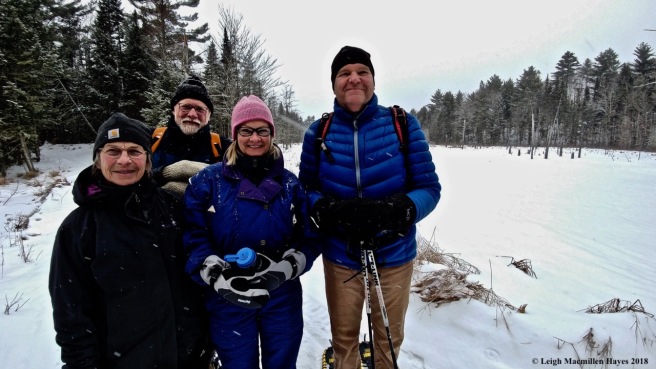
d-baskettail, common baskettail 1

Also included with the emeralds is the common baskettail. Notice how stout this handsome guy is.

d-skimmer, chalk-fronted corporal male

Among the easiest dragonflies to actually get a good look at are the skimmers. And it seems that on many paths I follow, the chalk-fronted corporals are there before me. His thorax has two bluish-gray stripes with brown on the sides. And his wings–a small brownish-black patch.

d-skimmer, slaty blue 2

Then there’s the slaty skimmer, in a shade of blue I adore. His wings are clear, except for the black stigmas toward the tips.

d-skimmer, common whitetail

The common whitetail is also a skimmer. Not only is his abdomen different–with white markings on the side, but he has wings with black and chalky white bases and broad black bands in the middle.

d-skimmer, calico pennant, male

They’re all pretty, but I think that so far, my all time favorites are the calico pennants; the male with red highlights including stigmas on his wings and hearts on his back, plus a hint of red everywhere else.

d-skimmer, calico pennant female

For once the male isn’t to be outdone in the color department, and the female looks similar except that she’s yellow.

d-skimmer, yellow legged meadowhawk, wings

There’s so much to admire about damselflies and dragonflies. I mean, first there are those compound eyes. But look at the thorax–where both the three pairs of legs and two pairs of wings attach. I find that attachment to be an incredible work of nature. It’s awe inspiring at least.

d-ending, female calico pennant on screen

Then again, nature is awe-inspiring. When I awoke as the sun rose yesterday morning, I wondered about the damsels and dragons. Did they survive the storm? I stepped outside to once again check for damage and look who I spotted on the porch screen. Mrs. Calico stayed for about an hour or two, letting her wings dry off before heading out to perform today’s duties–flying on the wild wind of western Maine.
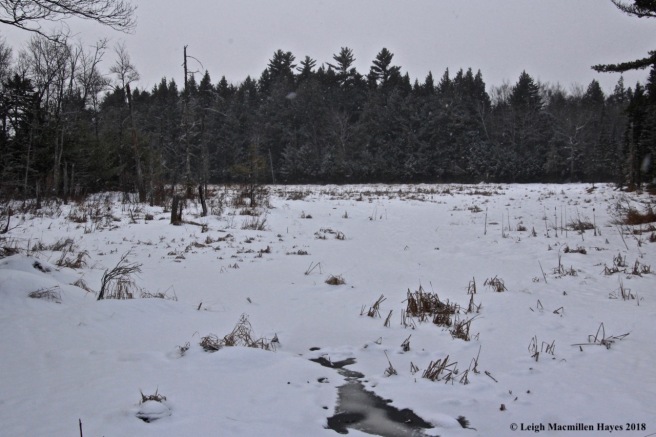
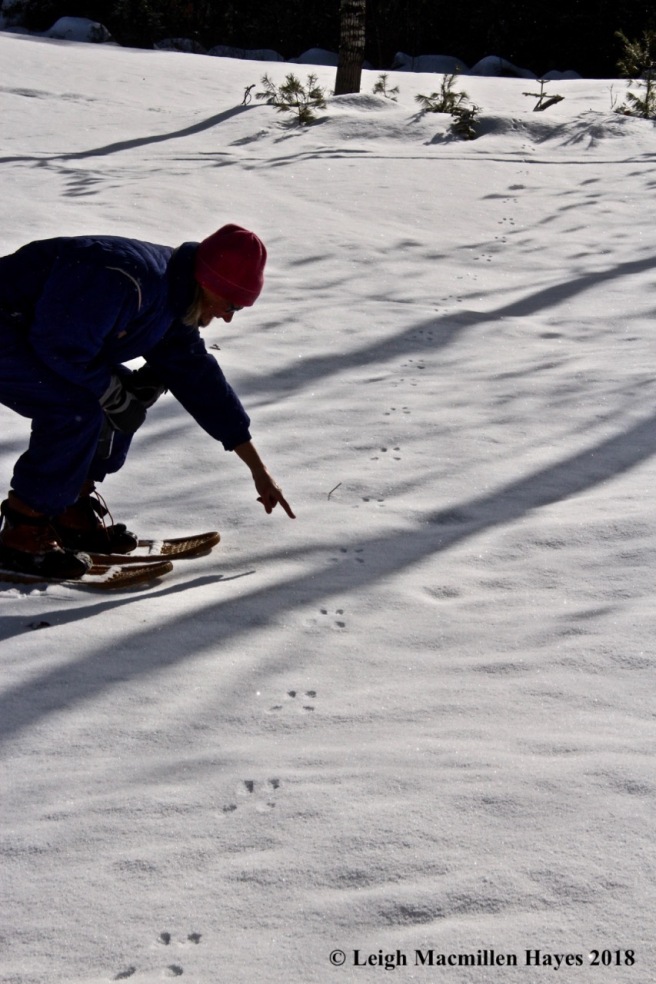
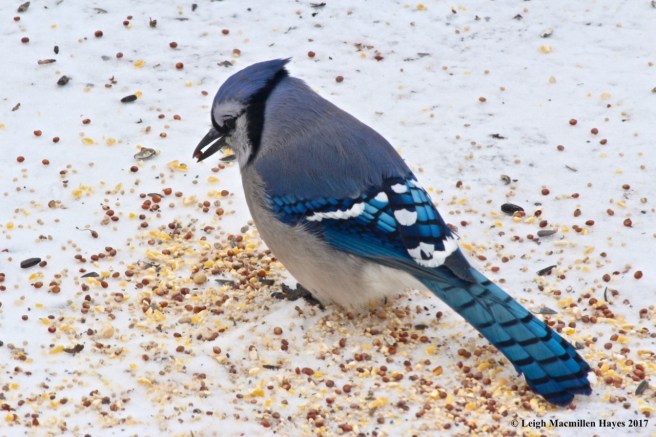
Damselflies and dragonflies are one more point of distraction for me these days. I won’t always get their ID correct, but I’m thankful for the Book of July, Stokes Beginner’s Guide to Dragonflies and Damselflies, that I found at Bridgton Books.

Stokes Beginner’s Guide to Dragonflies and Damselflies by Blair Nikula, Jackie Sones, with Donald & Lillian Stokes. Little, Brown and Company, 2002.