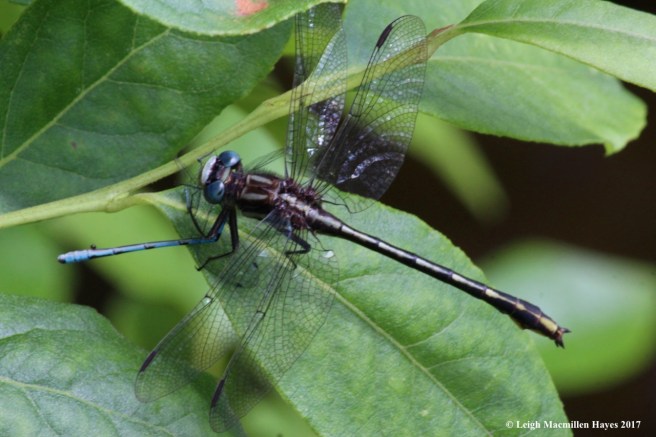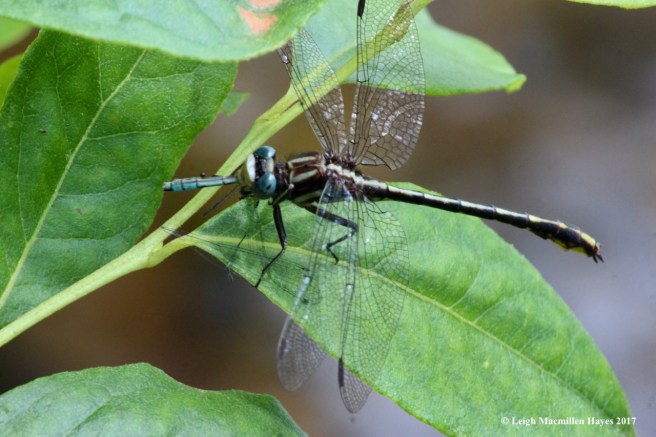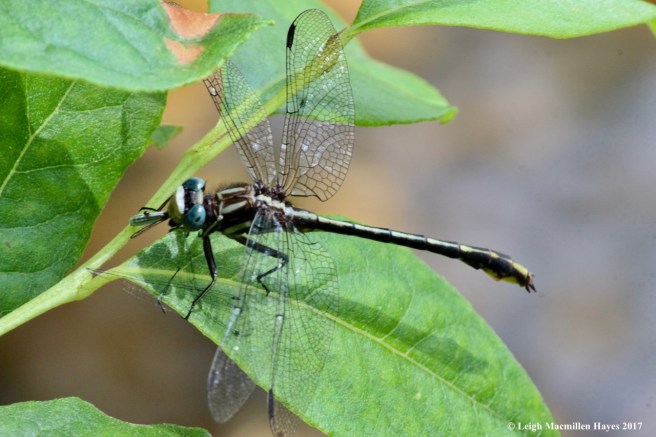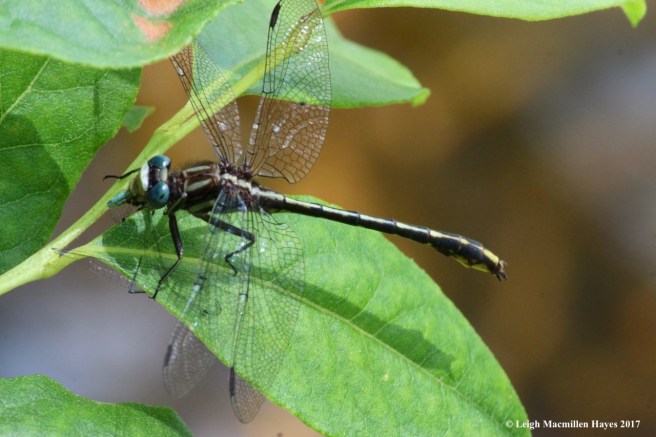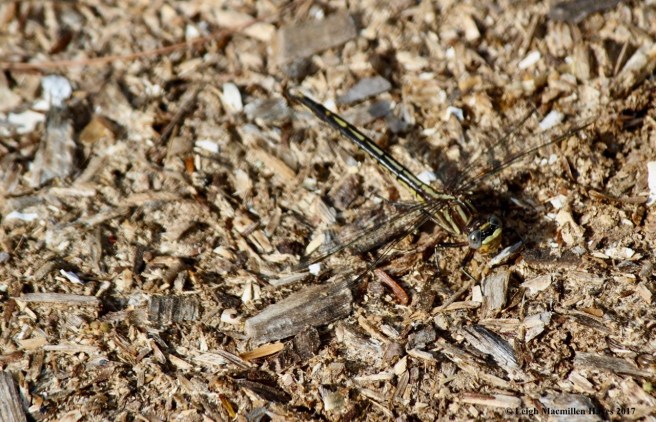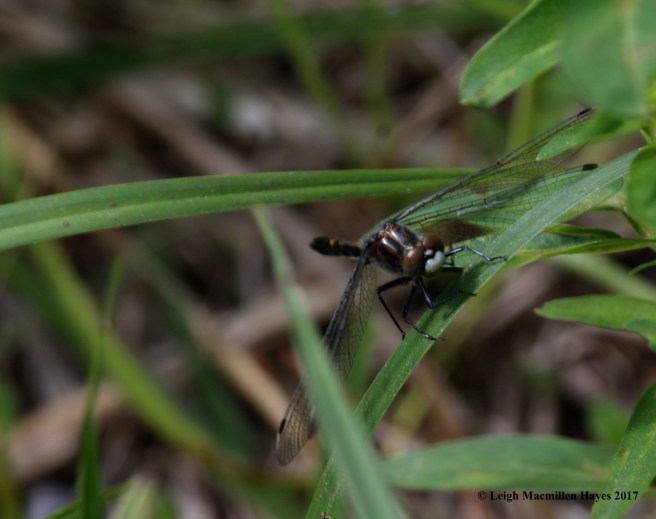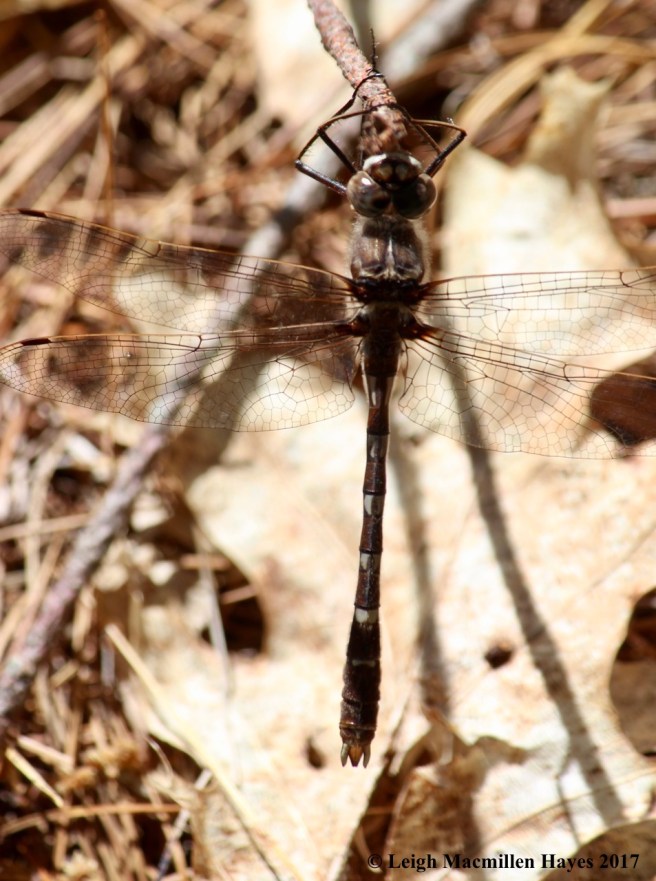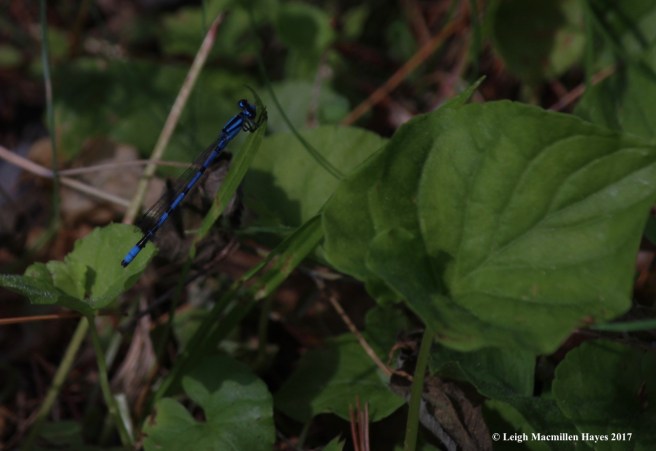
Flying on the Wild Wind of Western Maine

My intention was good. As I sat on the porch on July 1st, I began to download dragonfly and damselfly photographs. And then the sky darkened and I moved indoors. Suddenly, and I mean suddenly, the wind came up. Torrential rain followed. And thunder and lightening. Wind circled around and first I was making sure all screens and doors were closed on one side of the wee house and then it was coming from a different direction and I had to check the other side. Trees creaked and cracked. Limbs broke. And the lightening hit close by. That’s when I quickly shut down my computer and checked my phone to see how much battery life it had. And saw two messages. One was an emergency weather alert. Tornado Watch. And the other was from my friend Marita, warning me that there was a tornado watch for our area. I stood between the kitchen door and the downstairs water closet, where a hatchway leads to the basement. But, there was stuff in the way and I really wanted to watch the storm. At the same time, I was frightened. Of course, in the midst of it all, the power went off.

ph 3 (1)

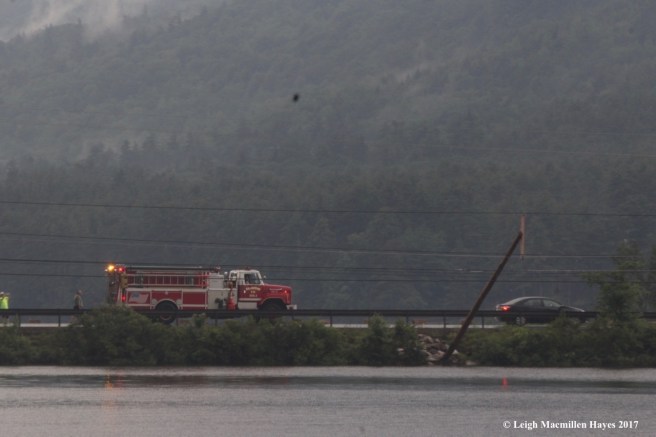
It didn’t last all that long, as storms go, but the damage was incredible, including telephone poles left standing at 45-degree angles. Soon, the neighbors and I assessed our properties. We somehow lucked out and only two branches plus a bunch of twigs fell. Others were not so fortunate. Trees uprooted along the shoreline or crashed onto houses, sheds, vehicles and boats. Our neighbors float shifted about thirty feet north from its usual anchored spot. And the National Weather service did indeed determine it was an EF-1 Tornado with winds of 90-100 miles per hour.
d-firetruck on causeway

At first traffic along the causeway moved extremely slowly because fallen trees had closed the south-side lane, but eventually the police shut the road down and the fire crew arrived to begin the clearing process. After the first storm, it rained on and off, but once my guy got back to camp (he dodged a detour–don’t tell), we still managed to grill a steak and sat on the porch in the dark, which is our evening habit anyway. Central Maine Power worked most of the night and they’ve been at it all day–resetting poles and lines while neighbors’ generators and the buzz of chainsaws filled the air.

And my focus returned to others who also fill the air–though in a much more welcome manner, to we humans that is. Damselflies and dragonflies. Other insects don’t necessarily agree with us–as they become quick food.

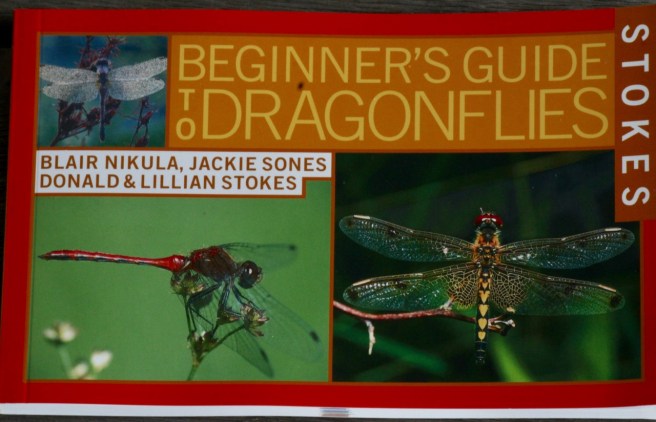
Therefore, it seems apropos that the Book of July is the Stokes Beginner’s Guide to Dragonflies and Damselflies by Blair Nikula, Jackie Sones, with Donald & Lillian Stokes.
d-book

It’s not a big book by any means, and doesn’t include all species of the insect order Odonata, but for me right now, it’s enough. And it fits easily into my pack. I can not only try to give a name to what I see, but more importantly to recognize the subtle differences in these favorite of insects.

d-book key

One of the features I really like is that it has a key on the inside cover, first divided between damselflies and dragonflies, and then further divided by families based on size, percher or flier, flight height, wings, body colors, eye position and other clues. As you can see, there are color tabs and I can quickly move to that section and search for the species before me. I’ve discovered that I’m now looking at eye position and colors as a quick key, with other features falling into place.

The book also discusses the life cycle and behavior of damselflies and dragonflies.
d-pond damsels mating, Marsh bluets 1

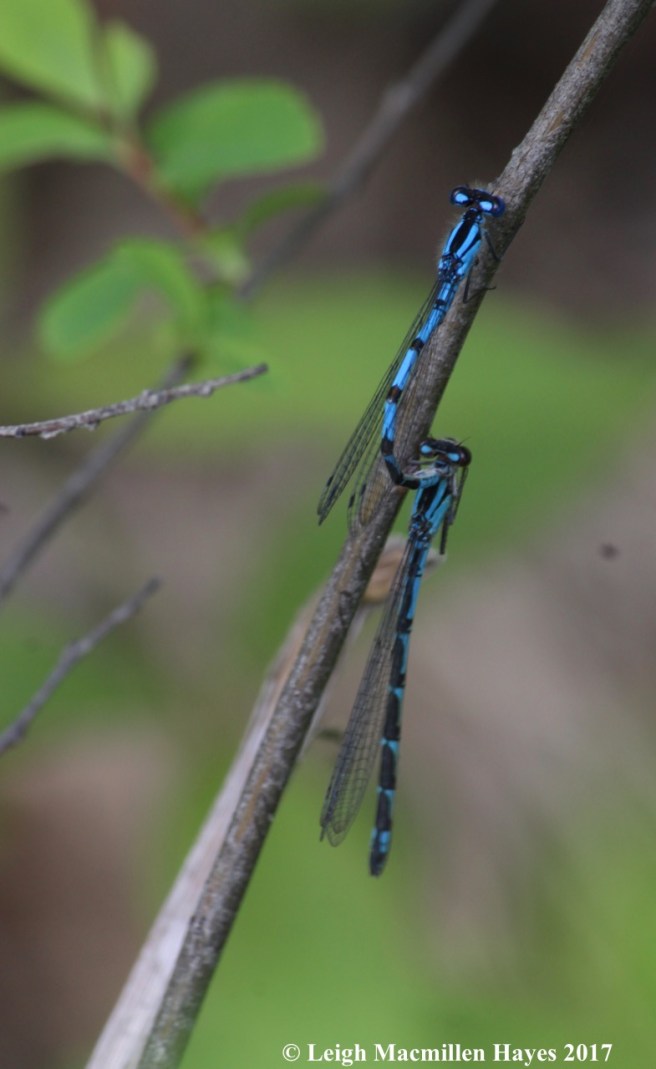
Of course, it all begins when he grabs her–for damselflies such as these marsh bluets, he clasps her by the neck. Dragonflies do the same, only he clasps his female of choice behind the eyes.

d-damsel love, variable dancers

Eventually damsel love occurs as the mating couple forms a “copulation” wheel, thus allowing him to remove any sperm she may have already received from another, and replacing it with his own. Sneaky dudes. Soon after, hundreds to thousands of eggs are deposited, either in the water or on vegetation, depending on the species.

d-damselfly nymph1

Emerging from an egg, the larvae develop underwater. Damselflies such as this one, obtain oxygen through the three tail-like projections at the end of their abdomens. From 8-17 times, they molt, shedding their outer shells, or exoskeletons.
d-exoskeleton shrubs

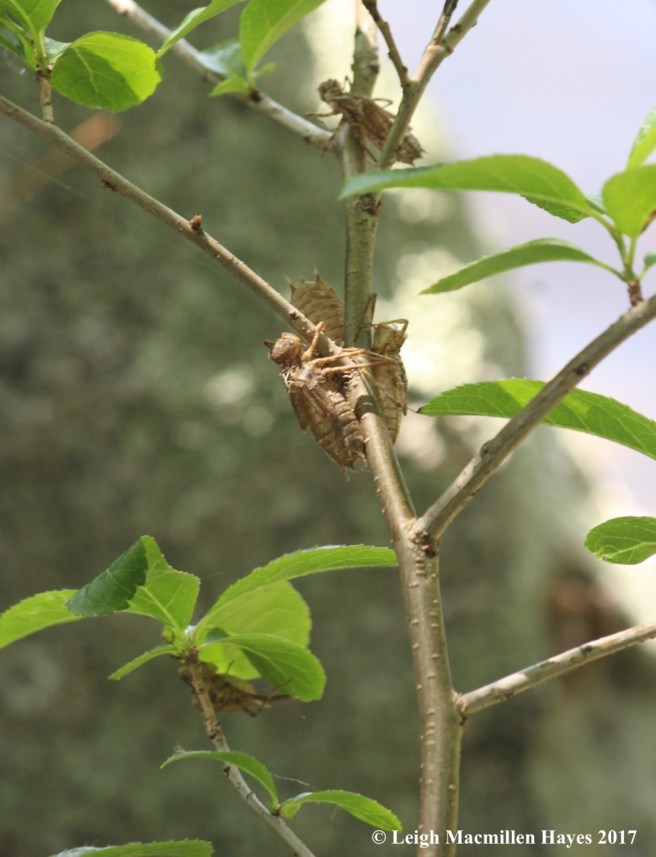
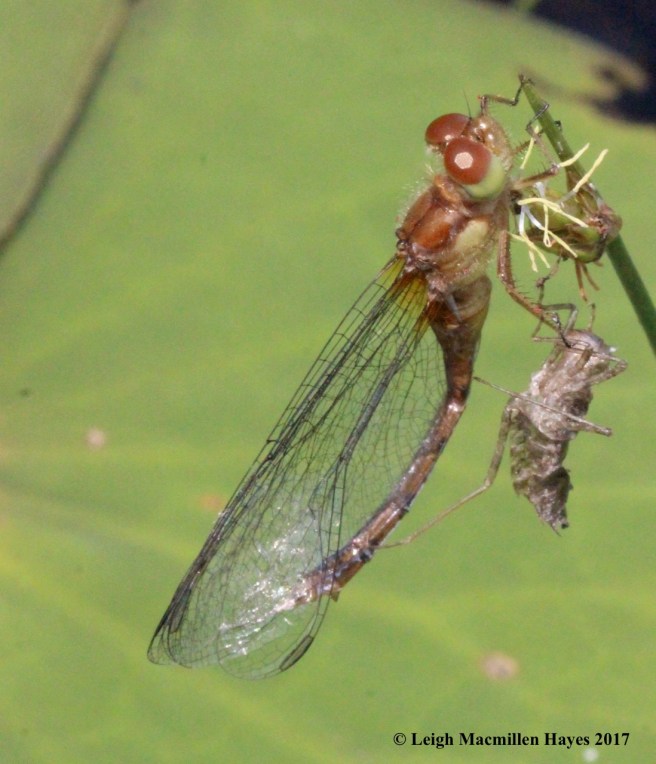
In the spring, the big event happens. We all celebrate the emergence of the last stage in the larval skeleton, when the insects climb up vegetation or onto rocks, or even the ground, and make that final metamorphosis into the damsel or dragonfly form we are so familiar with, thus leaving their shed outer shell (exuviae) behind.
d-emerging dragonfly

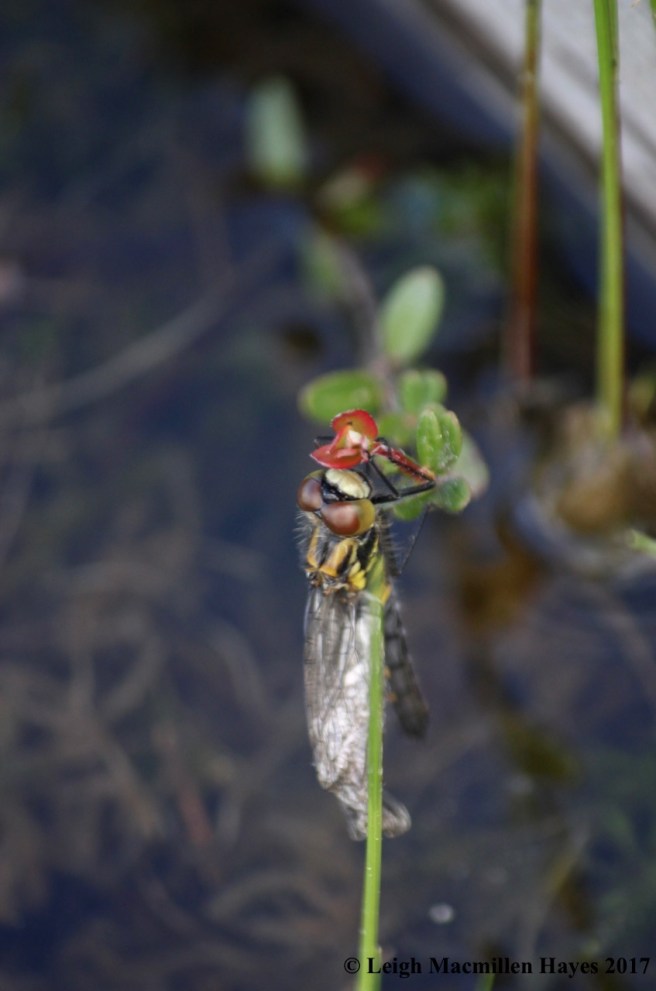
On a warm, sunny spring day toward the end of May, there’s no better place to be than sitting in the presence of an emerging adult.
d-emerging 2

I encourage you to look around any wetland, even as the summer goes on, for you never know when those moments of wonder might occur.

d-Broad-winged damsel, River Jewelwing 1

In the guide, the authors include all kinds of observation tips. And then, the real nitty gritty. The first thirty-six pages of the Identification section are devoted to damselflies. And those are divided into Broad-winged damsels, Spreading, and Pond damsels. This is a river jewelwing, and for me it was a first a few weeks ago. I spotted this beauty beside the Saco River in Brownfield Bog–its iridescent green body showing through the dark-tipped wings.
d-pond damsel, ebony jewelwing, male

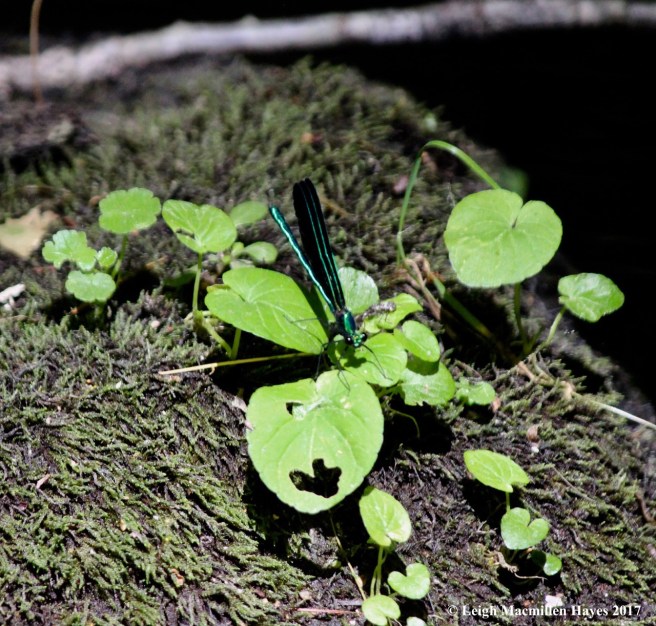
In the same category, the ebony jewelwing is equally stunning with brilliant green highlighted by black accents. This was a male; the female has a white dot or stigma toward the tip of her wings.

d-spreadwing, common spreadwing

Spreadwings are next and so named for their spread wings. This one happened to be a common spreadwing, though really, I don’t find them to be all that common.

d-pond damsel, variable dancer

The pond damsels are the ones I do see often, including the female variable dancers. Check out her spotted eyes.

d-pond damsel, sedge sprite 1

And one of my favorites for its colors and name–the sedge sprite. If you noted the dancer’s eyes, do you see how the sprite’s differ?

From page 79-155, dragonflies are identified. I don’t have one from every type, but I’m working on it.

d-clubtail, lancet clubtail, male

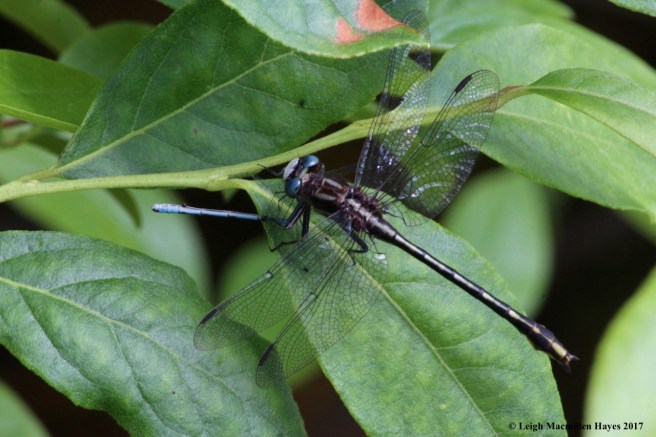
Clubtails have clear wings, and their coloration is often green, yellow or brown. Check out those eyes–and how widely separated they are. Meet a lancet club tail, so named for the yellow “dagger” markings on its back.
d-Emeralds, Ameican Emerald 2

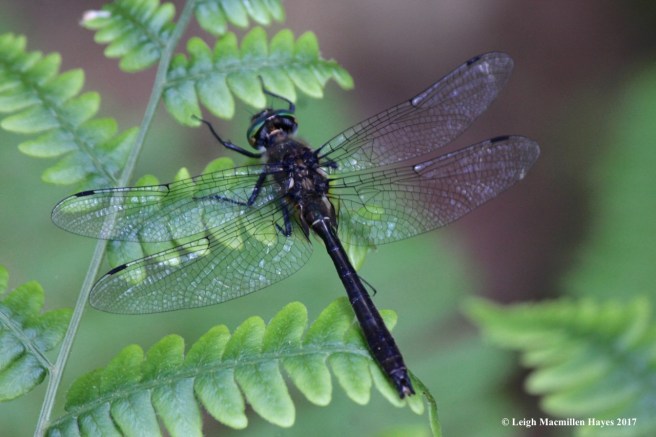
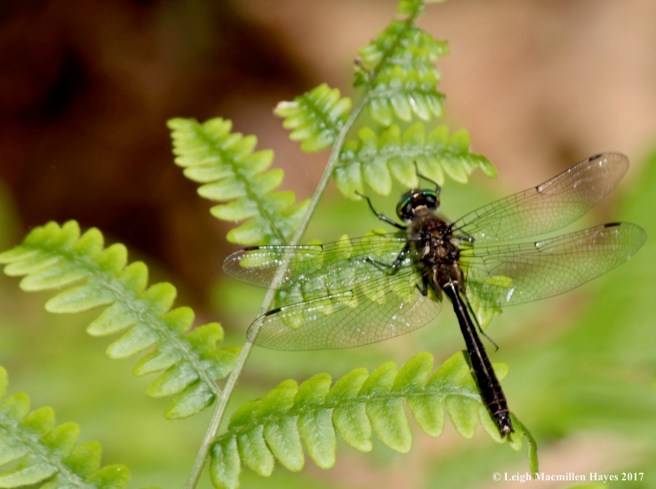
The emeralds are known by their eyes, which are often green. This American emerald has a black abdomen with a narrow yellow ring at the base near the wings.
d-baskettail, common baskettail 1

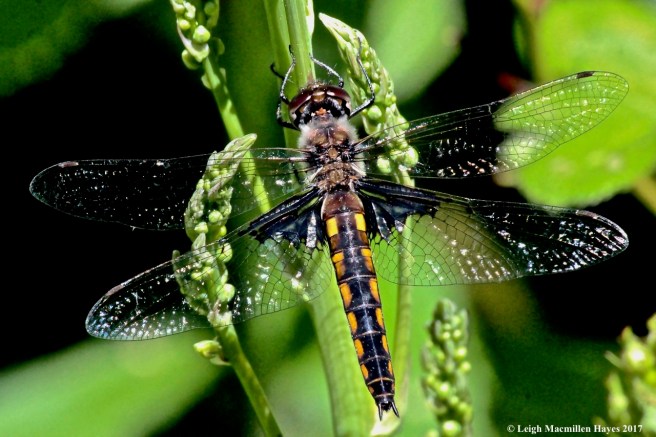
Also included with the emeralds is the common baskettail. Notice how stout this handsome guy is.

d-skimmer, chalk-fronted corporal male

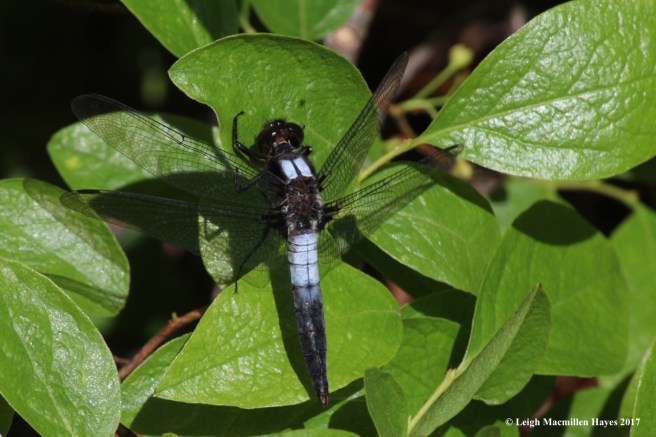
Among the easiest dragonflies to actually get a good look at are the skimmers. And it seems that on many paths I follow, the chalk-fronted corporals are there before me. His thorax has two bluish-gray stripes with brown on the sides. And his wings–a small brownish-black patch.

d-skimmer, slaty blue 2

Then there’s the slaty skimmer, in a shade of blue I adore. His wings are clear, except for the black stigmas toward the tips.

d-skimmer, common whitetail

The common whitetail is also a skimmer. Not only is his abdomen different–with white markings on the side, but he has wings with black and chalky white bases and broad black bands in the middle.

d-skimmer, calico pennant, male

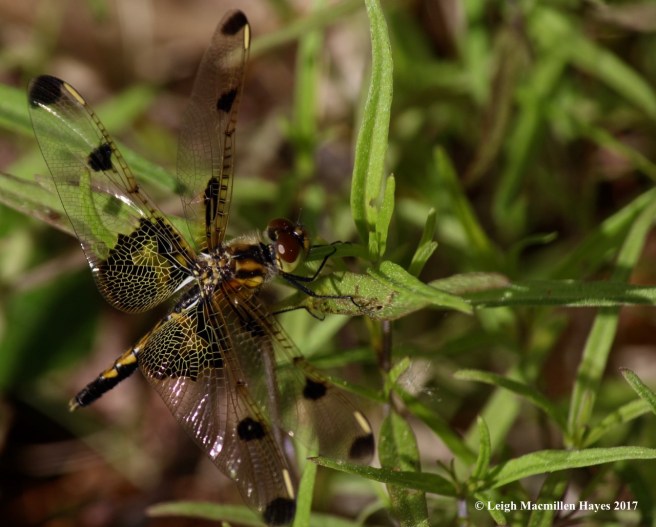
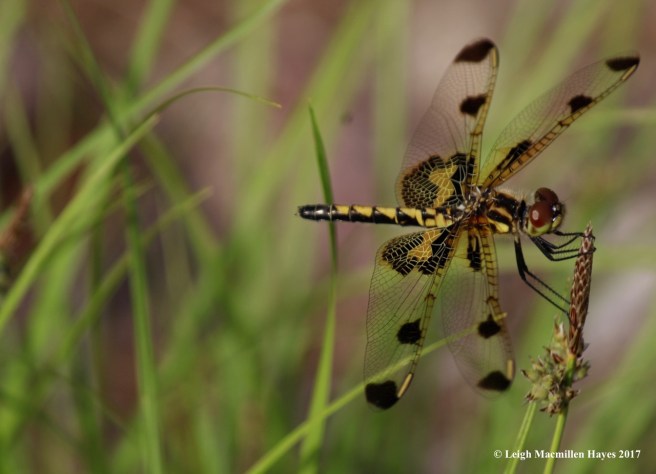
They’re all pretty, but I think that so far, my all time favorites are the calico pennants; the male with red highlights including stigmas on his wings and hearts on his back, plus a hint of red everywhere else.

d-skimmer, calico pennant female

For once the male isn’t to be outdone in the color department, and the female looks similar except that she’s yellow.
d-skimmer, yellow legged meadowhawk, wings

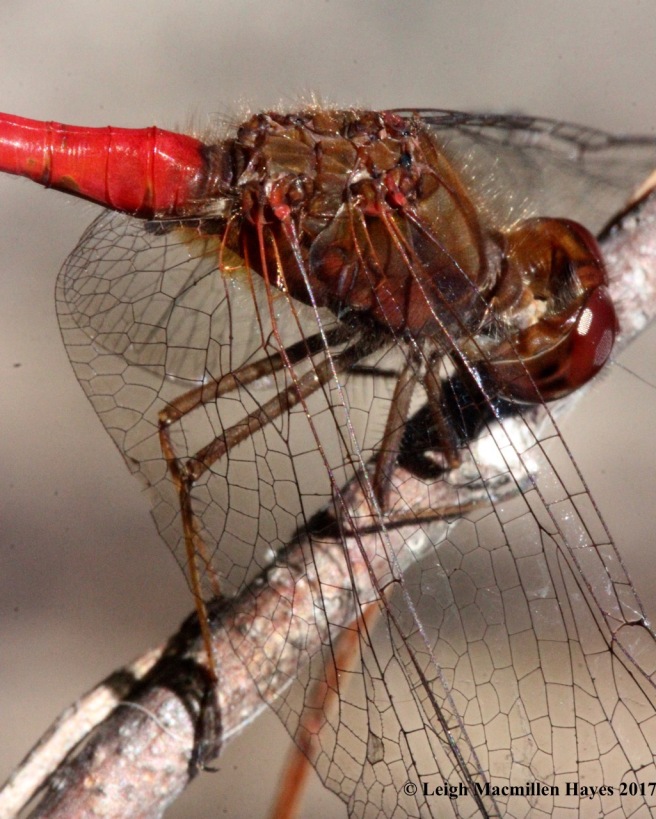
There’s so much to admire about damselflies and dragonflies. I mean, first there are those compound eyes. But look at the thorax–where both the three pairs of legs and two pairs of wings attach. I find that attachment to be an incredible work of nature. It’s awe inspiring at least.

d-ending, female calico pennant on screen

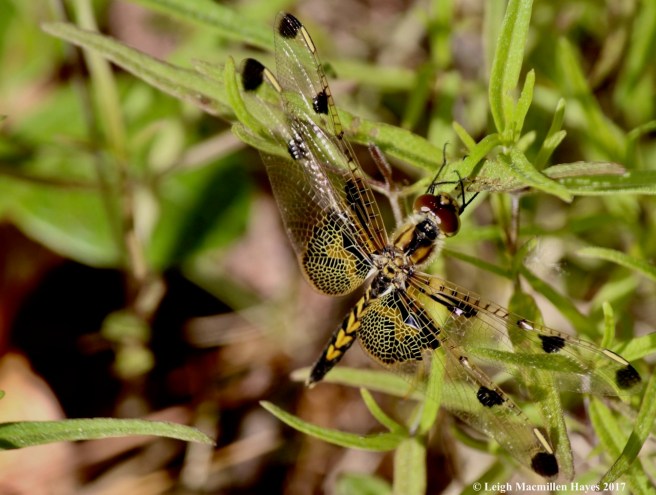
Then again, nature is awe-inspiring. When I awoke as the sun rose yesterday morning, I wondered about the damsels and dragons. Did they survive the storm? I stepped outside to once again check for damage and look who I spotted on the porch screen. Mrs. Calico stayed for about an hour or two, letting her wings dry off before heading out to perform today’s duties–flying on the wild wind of western Maine.

Damselflies and dragonflies are one more point of distraction for me these days. I won’t always get their ID correct, but I’m thankful for the Book of July, Stokes Beginner’s Guide to Dragonflies and Damselflies, that I found at Bridgton Books.

Stokes Beginner’s Guide to Dragonflies and Damselflies by Blair Nikula, Jackie Sones, with Donald & Lillian Stokes. Little, Brown and Company, 2002.
Sprinting up Mount Tom

With the Four on the Fourth Road Race only five days away, my friend Marita Wiser and I are in training. Perhaps a more apt description would be cross-training, for our actual time spent running has been sporadic, but we’ve both been on hikes that we’re sure will give us an upper edge. Look for us to cross the finish line in record time on Tuesday–or not.

To that end, this morning we climbed Mount Tom–with a desire to see what the new West Ridge Trail had to offer in a different season. In the past year, she and I hiked it in October, while my guy and I snowshoed up the trail in February. And so, Marita did what I like best because we wanted to make a loop–she parked at the base of the original trail about 2.3 miles in on Menotomy Road and we walked 1.4 miles down the road to the new trailhead.

t-Mount Tom Preserve sign

The last time I visited, the snow was deep and up to the base of the preserve sign. Today, a red maple sapling claimed that spot.

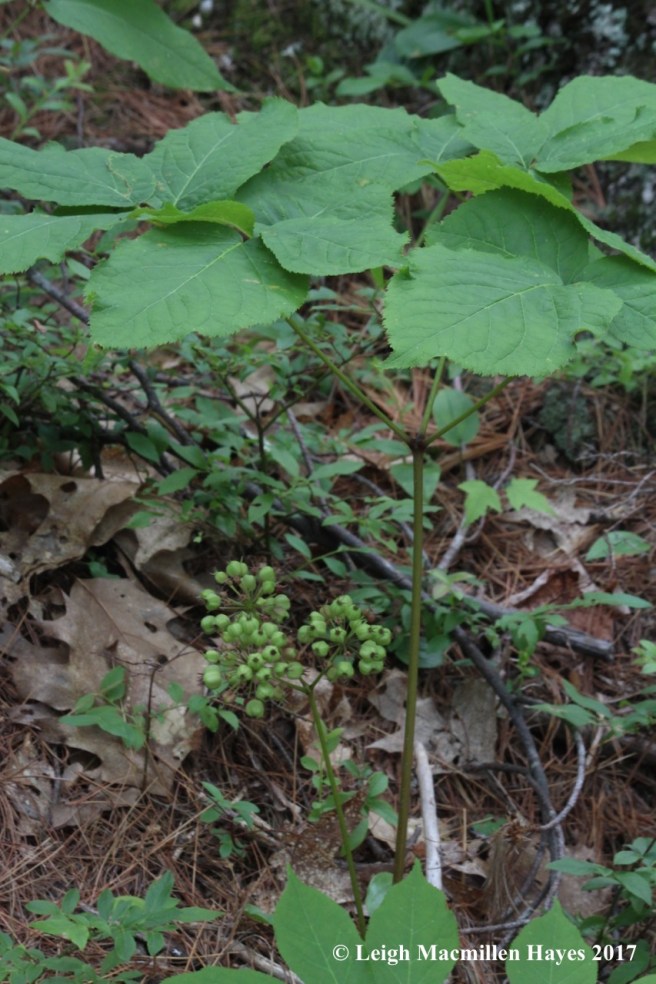
t-bristly sasparilla 2

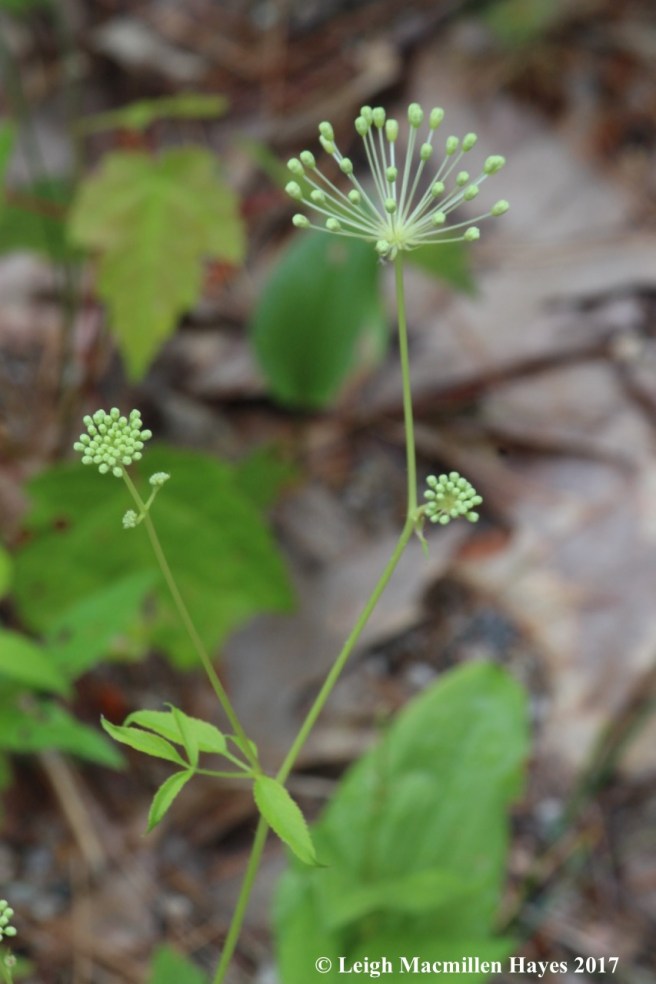
Next to it grew a bristly sarsaparilla, its rounded umbels standing tall above the leaves.

t-bristly sarsapirilla 2

As we stood there and applied some bug dope, a hoverfly, an important pollinator, worked its magic on the flowers.

t-relic 1

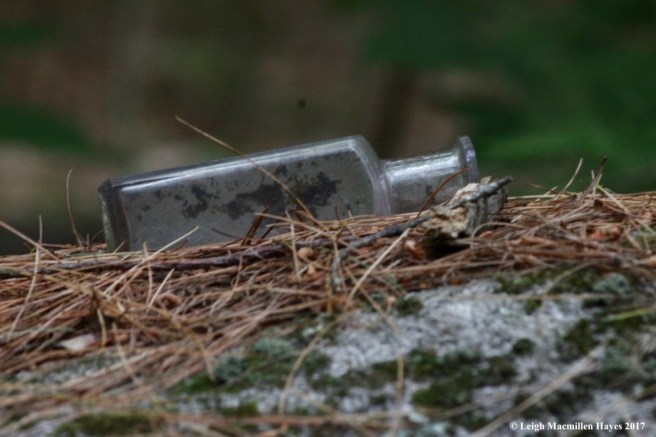
And then we stepped onto the trail and were immediately reminded of the past by a relic someone left on a rock.

t-homestead foundation

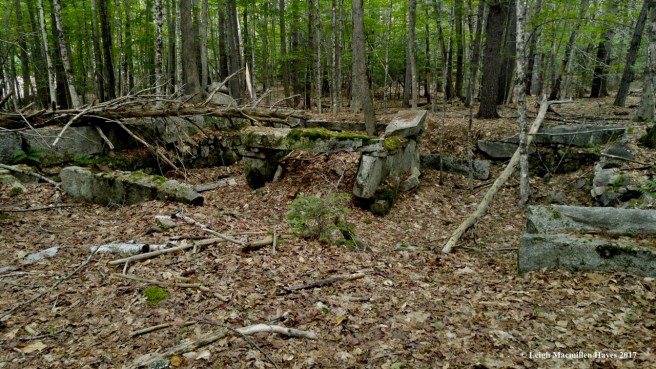
The homestead, possibly that of A.H. Evans, is located within feet of the trail’s head. And it appears that if this did belong to A.H., he was the head of a large family for it’s a huge foundation.

t-center chimney

Equally large was the center chimney.

t-outbuildings and barn

And based on the configuration of rocks and boulders we stepped over as we turned left between the house, outbuildings and barn, all were once attached.

t-barn

The barn foundation was also impressive and we could sense the work that went into such a creation. Among all the buildings were some recovered artifacts and I’ve a feeling I know who unearthed them. I love to see these relics, but hope that others won’t continue to follow suit and look for them. Or take them. Okay–that’s my salt box speech for today.

Again, assuming all of this belonged to A.H., I did discover a 1916 document that suggested he grew rutabagas: “A. H. Evans, Fryeburg, raised 90 bushels rutabagas in 1-8 of an acre.”

t-old pine 2

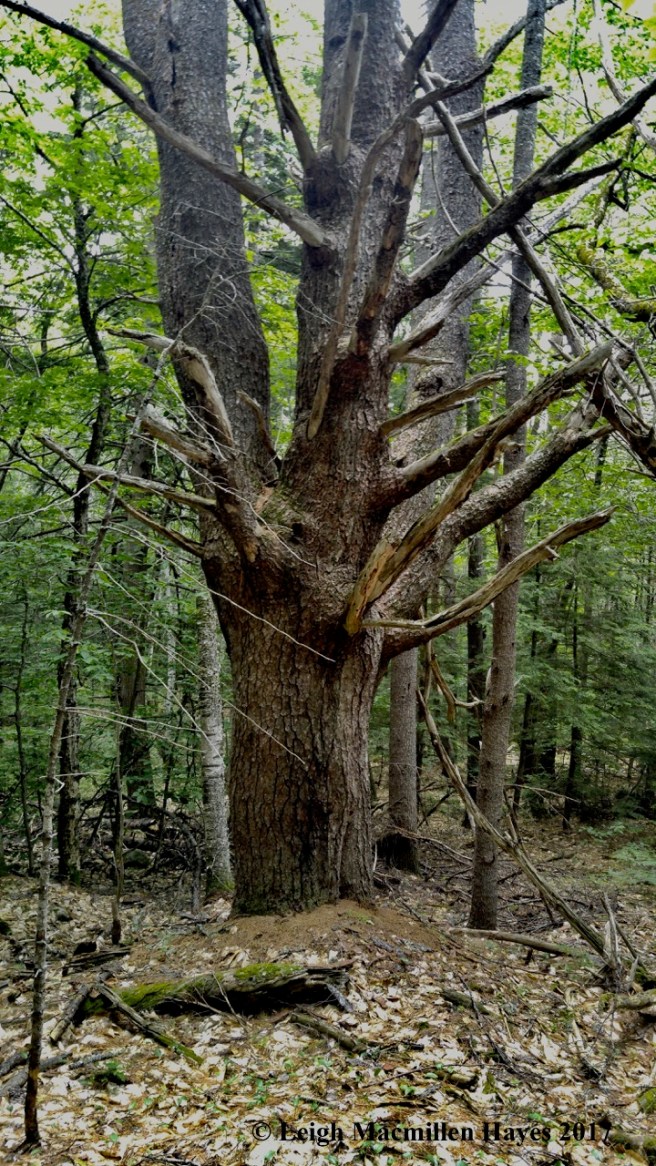
We followed the white-blaze trail, which was fairly well defined, and passed through a mixed forest, where at least one old white pine spoke to the history of this land, for it obviously once stood in an opening allowing it to stretch its arms and perhaps provide shade for farm animals.

t-ledges 1

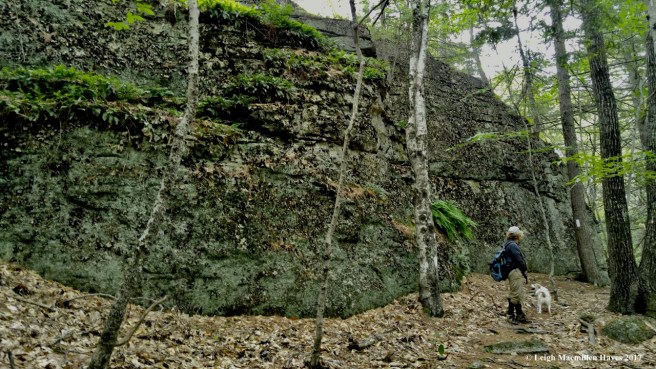
One of my other favorite features of the West Ridge Trail, besides the foundations, are the ledges that stand as tall rock gardens.

t-ledges 2

Some were even terraced and though we didn’t pause to look for evidence today, we got the sense of where the house and barn foundation stones were found.

t-wild sarsapirilla plant

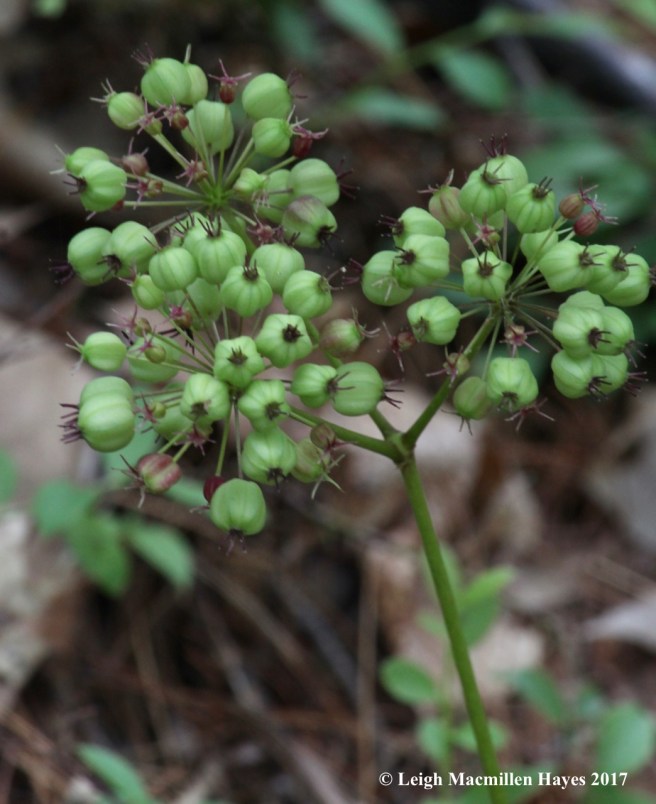
As we continued to climb (and sweat for it was a bit of a cardio workout–and humid), a couple of woodland plants stood out, including the wild sarsaparilla, which had flowered  in the spring. It was fun to note the difference between the bristly and wild–for the former flowers now with those umbels above the leaves, while the flowers of the latter developed below its leaves.

t-wild sarsa fruits 2

The wild sarsaparilla flowers have since turned to green fruits, which in time will ripen to a reddish-purple display. They were rather like mini green pumpkins in fireworks formation, a description conceived due to the pending holiday.

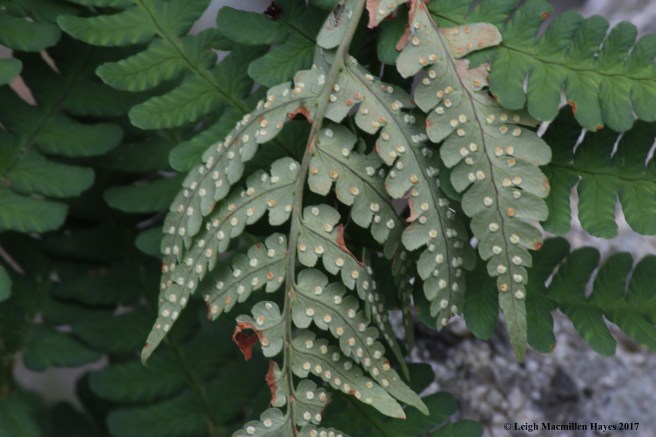
t-marginal wood fern 2

Another offering was the bluish-green fronds of a marginal wood fern.

t-marginal wood fern 1

A bent frond on one showed off the round sori located near the margins.

t-summit 1

After about an hour and a half, which included our walk down the road to the trailhead and then up the trail, we reached the summit. In the fall and winter, Pleasant Mountain had been plainly visible in the background, but today we had to peek through leaves to see it.

t-new oak leaves

As we peeked, Marita asked about the red leaves on an oak–fall couldn’t be on the horizon already, could it? I shared one theory with her, but after a wee bit of research discovered there may be a second–and possibly more.

The leaves were young and the red may act as a sunscreen, protecting them until photosynthesis takes place when they are fully developed.

The other thought is that the red may serve as a warning sign to mammals that the leaves contain chemicals that will taste bad, thus preventing them from being eaten.

Other theories?

t-spotted st johnswort 2

Our summit stay wasn’t long, but long enough to enjoy the bushy stamen of spotted St. Johnswort.

t-pink corydalis 1

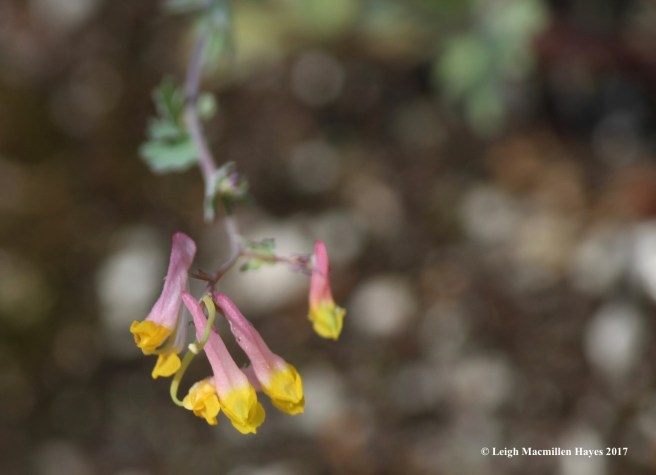
And the daintiness of pink corydalis.

t-hiking down the old trail

And then we followed the old trail down, through the hemlock grove and onto the logging road, which had grown in so much that it made us wonder if The Nature Conservancy wants to discourage its use. The thought of ticks crossed our minds, but she sported her treated tick gators and I used Repel®. Both worked for us, though I do want to get a pair of gators. I’m taking recommendations for brand.

t-Mt Tom cabin sign 2

Just before the end of the trail, we once again paused by the Mt. Tom Cabin, the real deal for a 19th century “camp” experience, but with a few added amenities including electricity. I like it for its structure, views and Northern white cedar.

t-Mt Tom cabin pond

Across the field, Old Glory blew in the breeze and reminded us of our need to “train.”

Our hike to the summit–it was as quick as we could make it, even with me taking a few pics, for the mosquitoes were thick. But–thanks to those very mosquitoes, we sprinted up Mount Tom in honor of our training regime.


Homecoming Mondate

After months of waiting and an arduous drive, we arrived at our camp on Moose Pond late yesterday afternoon. It’s that anticipation following months away and the five mile road trip that always make the final turn into the driveway so sweet.

m-night sky 2

We unpacked and put everything away, ordered a pizza because our Sunday night tradition of making our own takes a hiatus for a couple of months, and then settled on the porch as dark clouds gathered, their hues enhanced by the water’s reflection. And then we spotted a friend from across the pond jumping into his boat and pulling away from his dock. He raced south and we thought perhaps he hadn’t seen the lightning that was visible to us. Suddenly the wind increased dramatically and then the rain came. We moved indoors and checked windows and looked to our south and assumed Brian’s boat was fast enough to get beyond the storm. When the rain began to teem, we realized he hadn’t outrun it for two boats came flying back into the North Basin, his being one. We knew he was soaked and probably had a story to tell. Such is life on the pond, where our focus switches from world news to the news of our immediate world.

m-loon off the dock

And so we awoke this morning to the announcer of said news–a pair of common loons calling. We answered as we headed outdoors.

m-robber fly 1

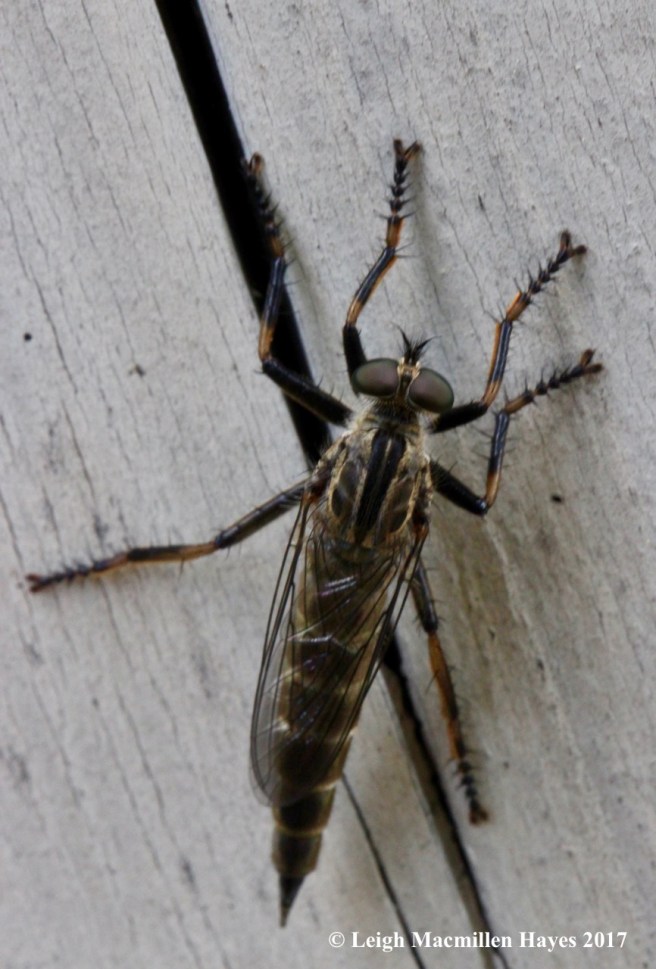
Of course, being back meant we had chores to complete, but most of them were outside. I finished mine first and so I began taking inventory–greeting old friends I hadn’t seen in a while. The first was a robber fly posed by the porch door.

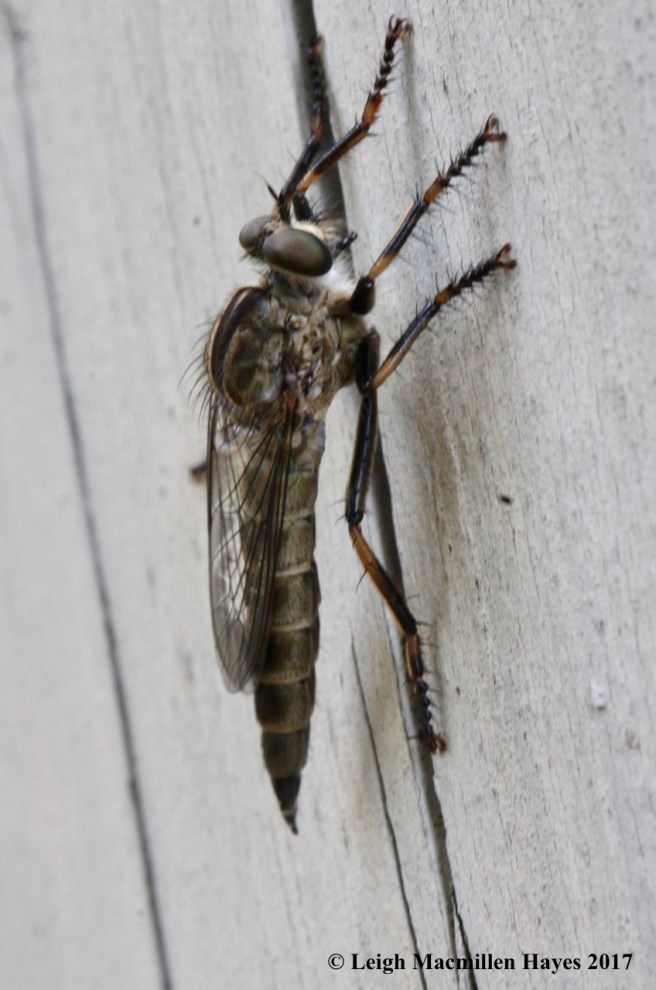
m-robber fly side view

Its compound eyes aren’t as large as those of a dragonfly, but still . . . they are large enough and allow this mighty predator to spot and catch prey more than a foot away in a split second. I wanted to see it, but wasn’t privy. Instead, I admired his body features.

m-flesh fly

Then I headed to the pond. My first find beside the water was a flesh fly–and I wondered what dead insects his bright red eyes may have feasted upon.

m-familiar bluet 2

More to my liking was the sight of a male familiar bluet damselfly. I can’t see enough of these and I think it has something to do with the color blue–especially when it contrasts against a dark green leaf.

m-chalk-fronted corporal 1

As I stood there, a perennial favorite appeared. It seems the chalk-fronted corporal dragonfly and I like the same habitats for wherever I go, at least a half dozen are also there. Perhaps that means that wherever I go, I’m always at home.

m-lancet 1

And then another dragonfly caught my eye and I recognized it as another familiar friend,  a lancet clubtail. But what surprised me was that a damselfly, possibly a familiar bluet, was exploring the underside of the same leaf.

m-lancet 2

That is . . . until I looked again.

m-lancet 3

And noticed the bend in the damselfly’s abdomen.

m-lancet 5

And watched the dragonfly move the damsel body with one wing attached and another dropped.

m-lancet 7

Ever so slowly . . .

m-lancet 8

the damselfly . . .

m-lancet 9

disappeared . . .

m-lancet 10

until only a bit of its abdomen,

m-lancet 11

a leg part and the wing were left. Wow. I felt privileged to have observed such a meal. Of course, I was sad for the damselfly, but also thankful for the energy it passed on to the dragonfly.

m-loon in Sweden, Maine 1

At last, my guy’s chores were completed. We pulled out the kayaks and paddled north to Sweden. Sweden, Maine, that is. And in the shallows of the northern-most end of the pond (Moose Pond is actually nine-plus miles long), we again met the loons.

m-eastern kingbird

A trillion damselflies and dragonflies darted about, some in mating position. And the kingbirds hovered above the water before making quick dips to retrieve insects.

m-rose pogonia driftwood garden 1

We floated around and noted that the water was deep enough for us to get almost to the very tip of the pond. At the same time, the old stump islands delighted us with their gardens.

m-rose pogonia 1

And within some of those islands another delight–rose pogonia in bloom.

m-looking south 2

At last it was time to leave our favorite section of the pond where all kinds of life thrived, knowing that we’ll return time and time again.

m-red winged blackbird

As we moved along, a red-winged blackbird began to turn circles above us–squawking as he showed off his shoulder patches in glaring scarlet form. He landed on a cattail and we paddled on, assuming there was a nest nearby. We also spotted Mrs. Red-Winged, who chose to go grocery shopping at that time. Even though we were headed away, the Mr. came after us one more time, so close that we could almost touch him. He was definitely a good dad–protecting the nest and/or young.

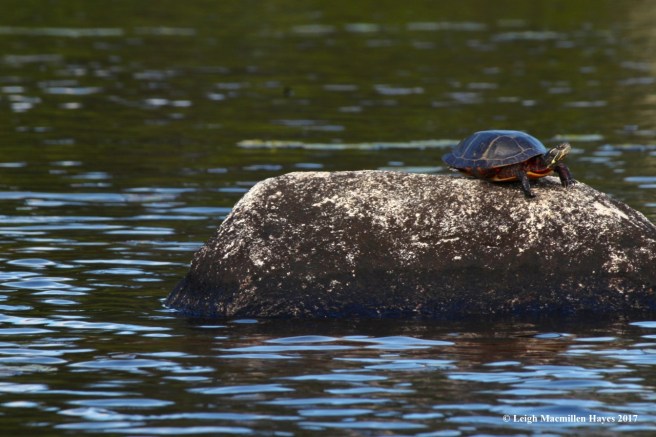
m-painted turtle 1

Continuing south, a painted turtle surprised us by staying atop a rock until we passed by, as if he wanted to welcome us back (or so we believed–after all, this is our story).

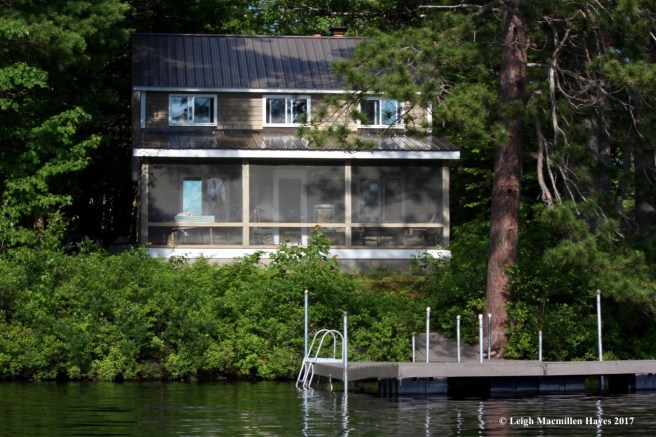
m-camp 1

A couple of hours later and we returned to camp sweet camp, to this place that has marked many occasions in our journey together since we first started dating in 1986.

Camp will always represent a homecoming to us, made especially sweet when we can share a Mondate here as we rediscover the world that surrounds it.


Swamp People

The phone rang as I was getting ready this morning and I don’t usually answer those with IDs such as “Private Caller,” but I did. And that made all the difference. Alanna Doughty was on the other end of the “line” and wanted me to know that this morning’s Lakes Environmental Association walk to explore the wetland plants at Holt Pond was still a go. She also asked if I wanted to borrow a pair of waders. Indeed, I did.

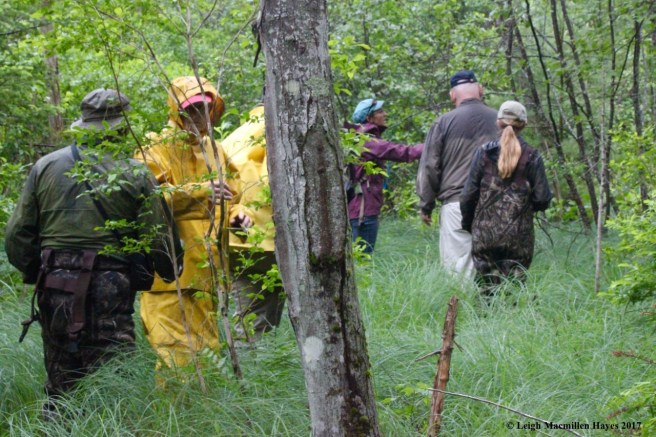
About 30 minutes later a group of eight had gathered at the preserve parking lot despite the raindrops. A few didn’t learn about the event until they read a description in this week’s Bridgton News, and so though they were prepared with raincoats and bug spray, they didn’t have Bogg boots or waders, but Alanna had brought along a few extra pairs and most made do. One gentleman had large feet and said he didn’t mind getting his sneakers wet. Such was the spirit of the morning.

p-red maple swamp

Without much further ado, we stomped down the trail and then slipped off it, through the woods and directly into the red maple swamp . . .

p-blue flag iris

where raindrops enhanced the dainty leaves of the blue-flag iris. Going off trail offers a certain liberating feeling.

p-pitcher plant

It also offers different species. Our movement was interrupted frequently by our findings, and as we stopped to determine the identification of a shrub that stumped us for a while, another plant drew our attention. Holt Pond is home to many pitcher plants, but this one cast its spell upon us for the curvy flower stems and new urn-shaped leaves. Most often, the stems stand stalwart.

p-pitcher spider

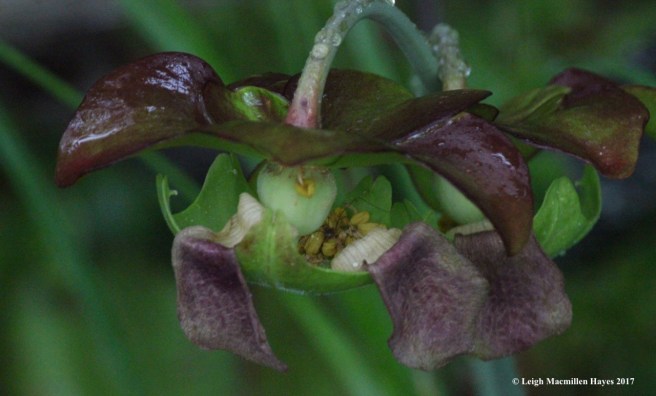
The otherworldly flowers protect friendly pollinators from accidentally being consumed. Unlike the pit trap below, aka the urn-shaped or pitcher leaves, the flowers are friendly and provide bees and other insects with nectar and pollen. This morning a spider wandered within, stepping on fallen anthers.

p-pitcher 4

I’ve forever found it a wonder that the extremely large style sits below the rest of the structure in order to capture pollen in its upside-down umbrella shape.

p-pitcher flower 1

Though those flowers have aged, their leathery sepals remained, fading from red to magenta. Below the sepals the large swollen ovary may house as many as 300 tiny seeds.

p-working our way through the swamp

After a long period of admiration, we finally pulled ourselves away and continued our tramp, finding our way through the swamp. And only briefly did we feel fake lost, but knew that wherever we came out, we’d recognize our position and continue the journey.

p-Great St. Johnswort

Among the sphagnum moss grew Great St. Johnswort not yet in flower.

p-slug

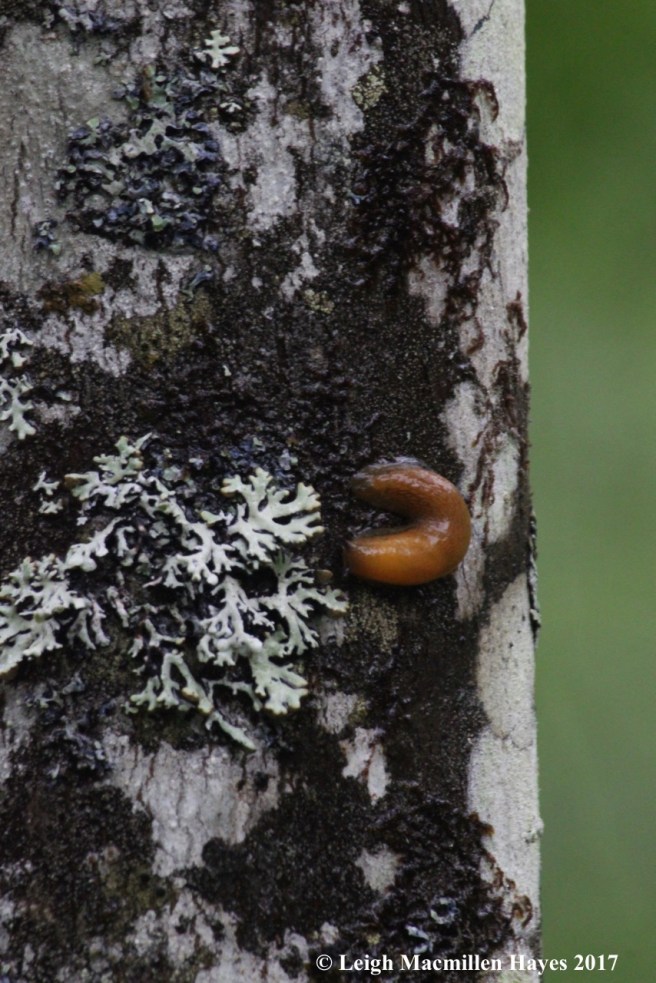
And slugs dined.

p-grasses, sedges and rushes

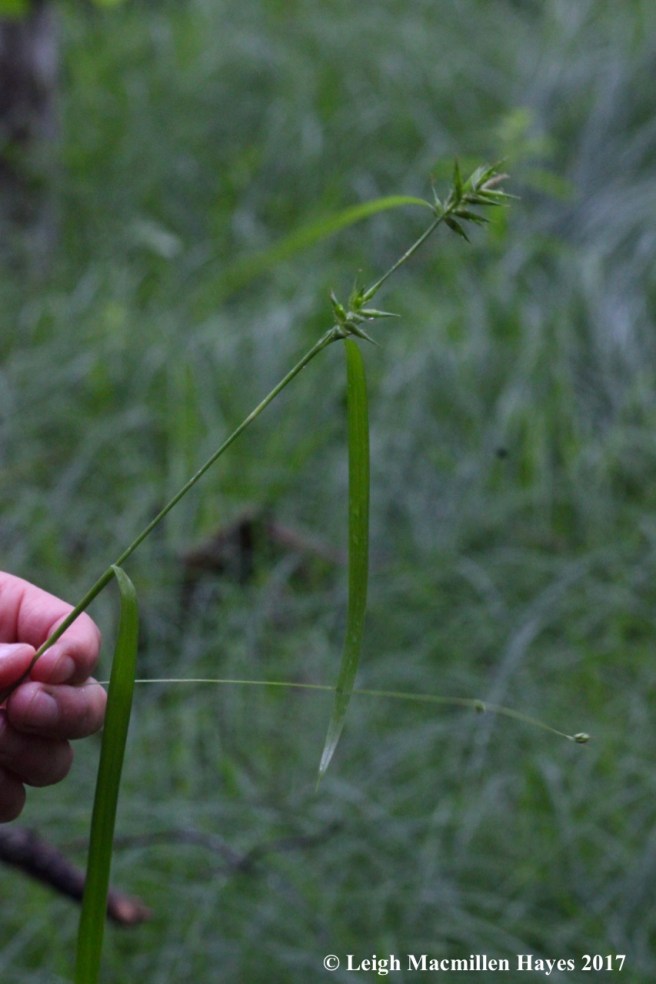
There were maples of course, and gray birches and speckled alders and royal and cinnamon ferns. But, there were also grasses and sedges and maybe even rushes. When at last we left the swamp and found ourselves on Tire Alley, about where we wanted to be, Alanna shared the ditty that helps us to maybe not name a particular species, but at least to know where to begin: Sedges have edges, rushes are round, grasses have joints all the way to the ground. Of course, she passed around examples so everyone could feel the edges of the sedge and see the joints on the grass.

p-Alanna describing hobbleush flowers

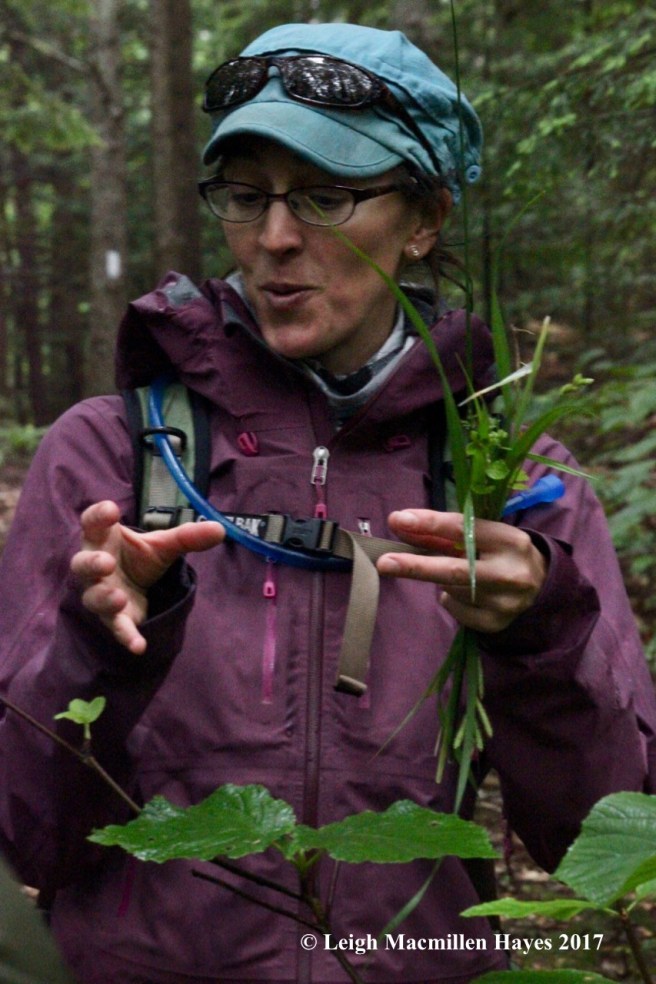
Then she stopped to describe the former flower of hobblebush, and I noticed the bouquet in her hand had expanded–her collection intended for further study later in the day.

p-slime mold on birch

We were about to head from the trail into the quaking bog by Holt Pond when Mary Jewett spied a growth on an old birch tree.

p-slime mold 2

My best guess was a slime mold for it looked like the Son of Blob had arrived. She and I both touched it and the outer coating fell off. It was rather creepy.

p-dark green fritillary caterpillars

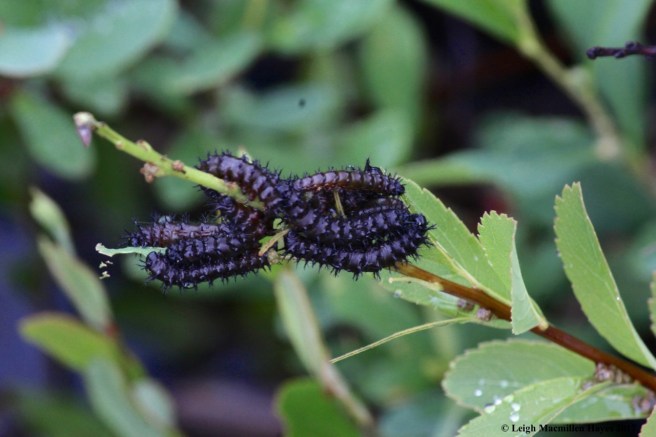
At that point, we did a 180˚ turn and started out onto the quaking bog, literally, but a few in the front decided it wasn’t quite what they had bargained for since the water was especially deep. So, Alanna and Mary ventured that way and I joined the rest for a walk on the boardwalk, which was wet as well, but a bit more stable. Along the way, we spotted caterpillars actively consuming spirea leaves. Upon later research, I determined they were dark green fritillary caterpillars that will soon metamorph into those beautiful orange butterflies that we often mistake for monarchs. (Note: I spotted a monarch on milkweed not yet in bloom yesterday)

p-bog rosemary

Among the many plants growing on the quaking bog, the bog rosemary stood out with its bluish gray leaves.

p-bog rosemary 1

Newer leaves formed at the top, giving off a reddish hue and adding to their distinctiveness.

p-bog rosemary 2

The netlike venation on the leaves was also noticeable and though the blooms have passed, the pretty pink fruits hadn’t yet matured into brown capsules.

p-sundew with Mary

Since we’d seen the pitcher plants, Mary wanted to find the sundews that grew near the boardwalk. With the high water as a result of a beaver dam on the Muddy River, it’s been  hard to spot the sundews, but she persevered and located one, showing off its glistening tentacles intended to capture small insects. Should one land on the tiny leaf, the insect’s feet become ensnared in the sticky secretion and the end is eminent. Within mere minutes the tentacles curl around the victim and suck the nutrients out of it.

p-snakeskin 1

Meanwhile, Alanna continued to wander off the boardwalk and suddenly she discovered a shed snake skin. I had intended to join her, but I have to say that though I wore hip waders and my feet and legs were mighty dry, I could feel the bog quake with each step and I didn’t get far. Blame it on my camera, but I didn’t want to risk a fall. And do you know that squelchy sound of pulling a foot out of several inches of mud? That’s how it was when I tried to get back on the boardwalk. It’s not just a few plants that are carnivorous–it’s the entire bog.

p-snake skin 1

Never fear. We all survived and she brought the skin back for us to admire.

p-black chokeberry 1

We stayed on the boardwalk and trail as we finally looped back and still, there was much to see. The shrub that had stumped us when we first spotted the pitcher plant in the red maple swamp suddenly spoke its name and we knew we were looking at the fruits of the black chokeberry. Only a week or two ago we’d admired their flowers.

p-serviceberry 2

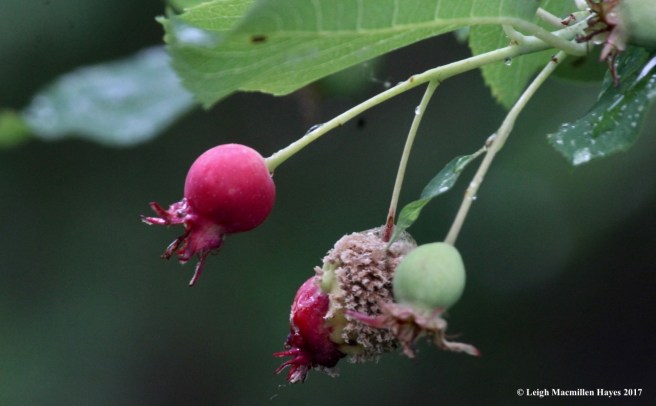
And then there was the berry that reminded us of a rose hip, as it should for it was in the rose family.

p-service berry gall?

Its ripening pomes will eventually turn purplish-black. But . . . we spied something we weren’t familiar with at all–do you see the growth on one? It rather reminded me of the Son of Blob slime mold we’d seen earlier and must have been a gall. Nature certainly provides as many questions as answers.

p-Northern Arrowwood

All spring and summer the flowers of the bog change by the week, or so it seems. This week, the Northern arrowwood was showing off its creamy-white blooms.

p-sheep laurel 2

And the sheep laurel, its fuchsia-colored blossoms.

p-bog monster web

For three hours we oohed and aahed and had great fun. We made one last stop before returning to the parking lot for the spirit in the hemlock called out to us–seemingly doing its own oohing and aahing.

Such were the offerings of the preserve this morning. And the people who gathered . . . I only knew Alanna and Mary before we began, but because of our shared experience the group was quite chummy by the time we were ready to depart. That’s what I love about walks such as this where complete strangers become instant friends, even if it’s only in the moment.

Swamp people . . . don’t mind rain or mosquitoes or wet feet. Swamp people . . . get to move where the spirit takes them. Swamp people . . .  find joy and wonder along the way.


Noyes Mountain Mondate

Yesterday was Father’s Day and so I asked the question first, “Where are we hiking tomorrow?” My intention was that it would be a gift for him to choose. But only moments later I announced that I had a suggestion–he didn’t have to accept it, of course.

I’d learned that the Western Maine Foothills Land Trust had cut a trail at the Noyes Mountain Preserve in preparation for their 30th Anniversary in July. And since one of our recent Maine Master Naturalist grads, Kelly Hodgkins, now works for the land trust and used this mountain for her capstone project, I wanted to visit it.

So much for letting my guy choose. But he appreciated the thought and agreed on our destination. And so mid-morning today, we drove to Greenwood–the birthplace of LL Bean. We honored him well for our hiking pants, boots and bag were all Bean products.

Kelly had told me to follow Richardson Hollow Road for 1.5 miles and then to look for a small parking lot on the left. We located it easily, but parked on the road instead because a few vehicles were in the spot. Apparently we weren’t the only ones eager to make the climb despite the mugginess of the day. We actually met the parties as we headed up and they descended. People and dogs–all sporting smiles.

n-field

A mowed path crossed the field where daisies and buttercups and hawkweed grew among the grasses. We began to develop a sense of the land’s former use, especially as we spied stonewalls through the trees.

n-trail flags

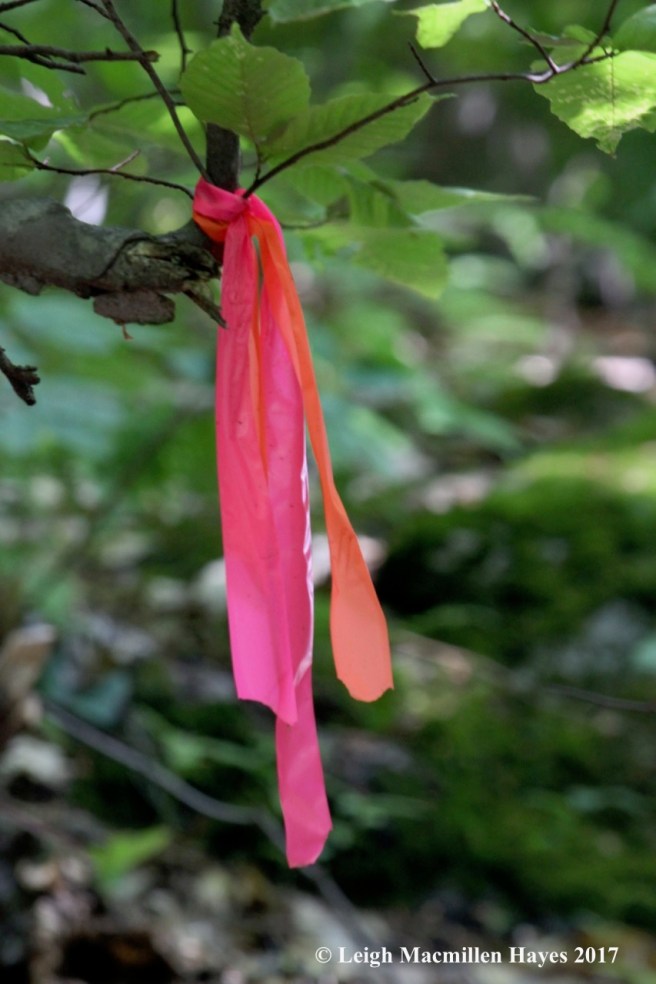
And then we moved into a hardwood forest and the upward climb began. Kelly had warned me that the trail was rough cut, but flagged. And a gentleman on the way down said they’d gotten off track for a bit when they didn’t make a turn because they were looking down and missed the flagging. Thanks to that word of caution, we made sure to always look for the next piece of tape and had nary an issue.

n-striped maple samaras

I looked down as well. That’s where I saw striped maple samaras maturing as they rested upon a leaf,

n-narrow beech fern

a narrow beech fern arched over the ground, with its lowest pinnae unconnected by wings as those above it and drooping downward,

n-common fleabane 2

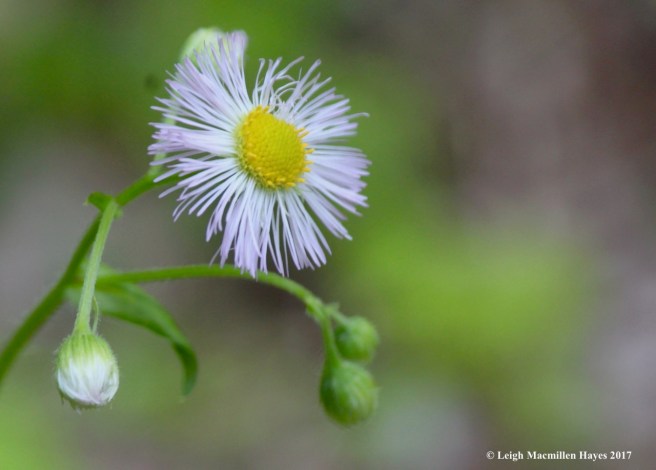
and common fleabane sending forth cheerful rays of lavender from its composite disk.

n-American toad

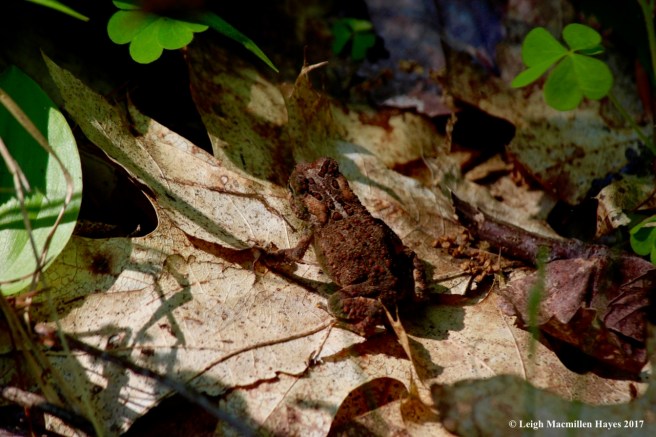
I was actually surprised to only meet one young American toad as it seemed a place where the ground should have been hopping with many more.

n-red-belted polypore on red pine

On a red pine snag a red-belted polypore looked a bit old and tired.

n-ledge on trail

And then suddenly, the community changed and we faced a moss-covered ledge where the trail turned to the left.

n-lady's slipper

When the trail widened a bit, we noticed a frame and realized it was meant to protect the lady’s slipper within. And so we bowed and curtseyed in her honor.

n-lady's slipper spider

That’s when we realized we weren’t the only ones paying attention–perhaps the spider wanted to see if the slipper fit.

n-northern crane's-bill 2

Again, we continued to climb, but noted that the community changed again and we were in the land of evergreens and blueberries as we reached for the summit. A flower I wasn’t familiar with kept asking to be noticed–and so I did and later keyed it out to be a northern crane’s-bill.

Then we saw a path not cleared, but with a tag wrapped around a tree limb. And another beyond that. Should we follow it? It looked like it led to the ledges that were supposed to offer a view. We decided to stay on the trail with dangling tape, though as it dipped downward and to the right we questioned our decision–until it swung around to the left and we realized we were possibly looping around. We hoped.

n-lady corporal dragonfly

It was along that section that the corporals joined us, in this case the browner version, which is a female.

n-American emerald 2

And an American emerald dragonfly, with its metallic green eyes and a narrow yellow ring around the base of its abdomen, took time out from hunting duties to pose. Speaking of dragonflies, while we celebrated their presence, we also noted that there were no mosquitoes. A few deer flies sang in our ears. Was it the wind that kept the mosquitoes away? There were certainly wet spots here and there on the mountain.

n-honeysuckle fruit

Our wonders continued with the red fruit of swamp-fly honeysuckle and . . .

n-twinflowers

a sweet patch of twinflowers.

n-my guy at the ledge

And then, about an hour after we’d started, we stepped into a small clearing with a view. Well, you know who got there first and was waiting when I arrived.

n-ledge view

While he looked at Norway Lake (Lake Penneseewassee), I looked around at the plants that grew there as more dragonflies darted about.

n-staghorn sumac

The summit offerings included staghorn sumac and . . .

n-pink corydalis

pink corydalis, plus yellow hawkweed, yarrow and others I can’t remember now.

n-trail to quarry

When we were ready to leave, we noticed more orange flagging and another trail leading down. So . . . we followed it.

n-climbing down to quarry

We could see the ledge above, but weren’t sure what was in store for us next.

n-climing lower to quarry

The rock face was steep and had a certain look to it, as if it had been worked.

n-mountain crane's-bill

Rounding the final corner, we both knew what to expect, but first, another flower. There were many flowers on that spur trail and I knew I had to save them for another day. But this one stood out against the rock face and strongly resembled the northern crane’s-bill I’d spied occasionally on the way up. If my ID is correct, this species is a mountain crane’s-bill.

n-quarry wall

And we were in the Harvard Quarry. According the Western Foothills Land Trust page about the preserve, “Historically the land, which is in Greenwood, was owned by the Stevens family and included a through road north to from Norway to Greenwood (from the Upton Brothers Road to the Hayes Road). In 1869 Ethel Stevens sold the land to Isaac Noyes.

Isaac Noyes became interested in the site’s pegmatitic outcroppings in the late 1880′s. In 1892 the ledge was opened for the first time and became a mecca for scientists and collectors alike, offering one of the most complex mineralized pegmatites in Maine. Mineral operations on the mountain were opened by Isaac’s 6th cousin George Lorenzo (“Shavey”) Noyes and Tim Heath about 1894. Tourmaline was first recorded from the locale about 1904 and over the years the green color found at this location has become known as “Harvard Green.”

The granite pegmatites Noyes collected were largely preserved and passed into the possession of the Harvard Museum, together with the lease of the property, in 1917. In the summer of 1923 active quarrying was undertaken by the Harvard Mineralogical Department under the supervision of Harvard University student Kenneth K. Landes for Landes’ dissertation, Paragenesis of the Granitic Pegmatites of Central Maine (American Mineralogist, 1925, v. 10, p. 355-411). Loren B. Merrill of Paris and Arthur Valley undertook most of the actual excavation for Landes at the site.

Currently Frank Perham owns the 1-acre Harvard quarry, which remains open to the public in addition to mineral rights on 60 acres.”

The site is also mentioned in A Collector’s Guide to Maine Mineral Localities.

n-dyamite box from mining history

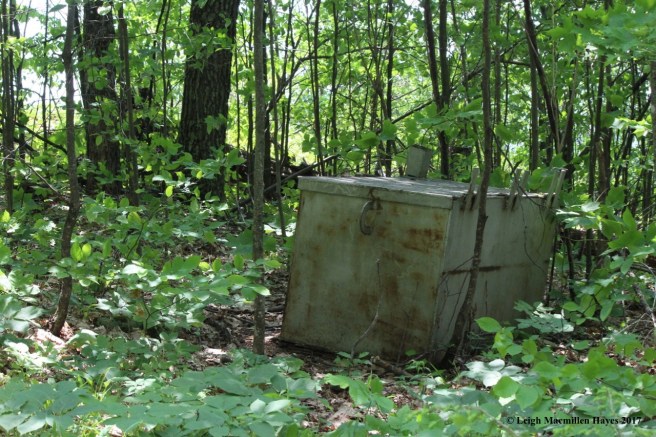
It all began to make sense for toward the beginning of the spur we saw a steel box in the woods–perhaps it once held dynamite for the mining operation. And within the quarry were old tires and hoses. All relics that I hope will remain for they tell the story.

n-rock face

And on the rock face, I saw a face of one who will watch over all to make sure those relics never leave. (Unless the land trust thinks otherwise, that is.) Do you see it? There’s an eye with eye lashes, a bulbous nose and an angular chin.

We didn’t stay long because thunder rumbled and we knew strong winds and rain were in the forecast.

As we skidaddled down the mountain, we gave thanks to Kelly for sharing the location with us and for the future programs she’ll plan so others may appreciate this place. And we were grateful to the land trust for working hard to protect the land for now and ever.

Our Mondate on Noyes Mountain came to an end as raindrops the size of lady’s slippers splatted against our windshield. We left, however, knowing this place is well worth a return visit–probably more than one.


Keeping an Eye on Long Meadow Brook

My intention yesterday afternoon was to focus on the plants and trees at the Greater Lovell Land Trust’s newest reserve, Long Meadow Brook. But I also wanted to check out the new parking area created as part of an Eagle Scout project by Bridgton’s Troop 149.

l-parking lot 2

While the logging road cut by the previous owner to the landing during a 2014 thinning was untouched for the creation of the parking area, some of the log landing (staging area to remove logs from the site) was used to create a smooth space for vehicles. Kudos to the Scouts and other volunteers for building the lot.

l-kiosk 2

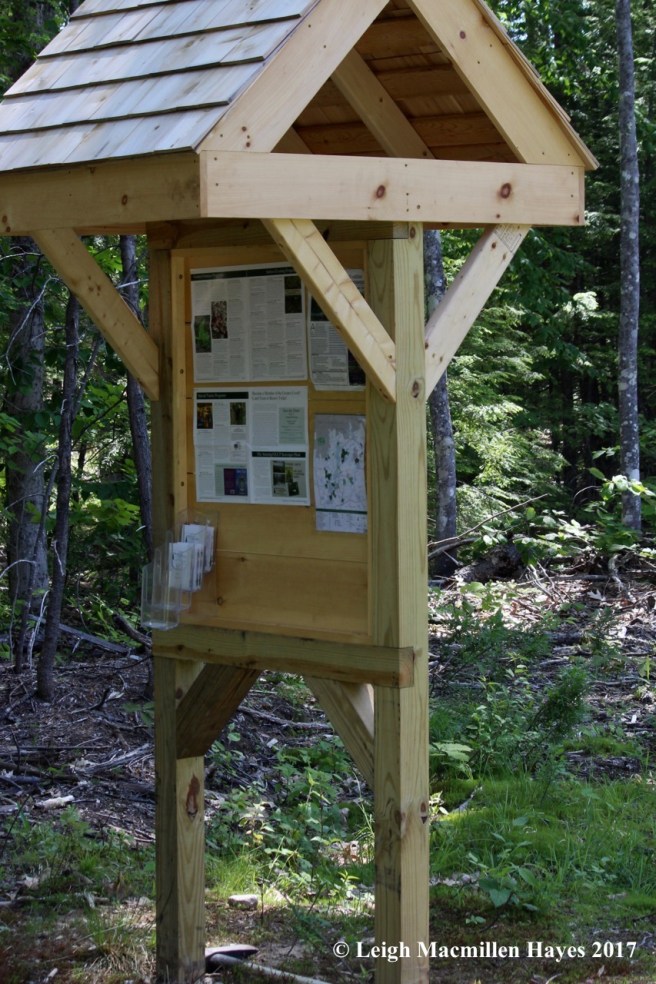
To the left of the parking area stands a kiosk. If you go, please note that the trail was first tagged last summer and though trail work was done this week, it’s brand new and not yet well tramped.

l-sloppy trail marker

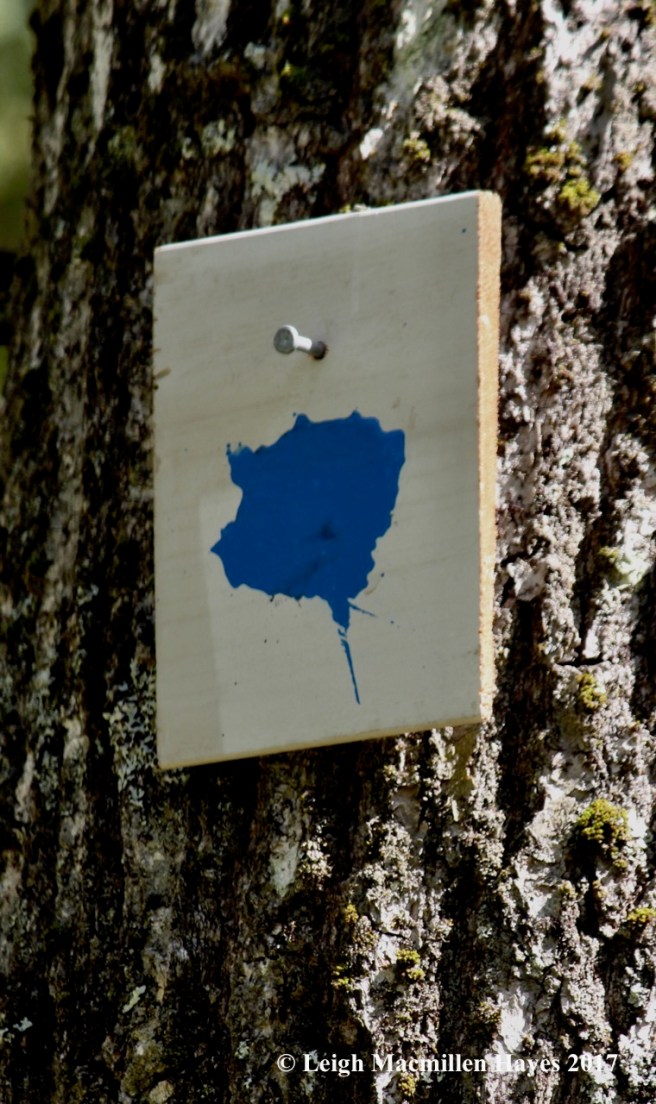
Your best bet is to keep an eye on the trail signs. Most are blue circles painted on a white background and nailed to the trees. But . . . at least one offered a more creative take as it appeared someone was thinking outside the lines. ;-)

l-coltsfoot

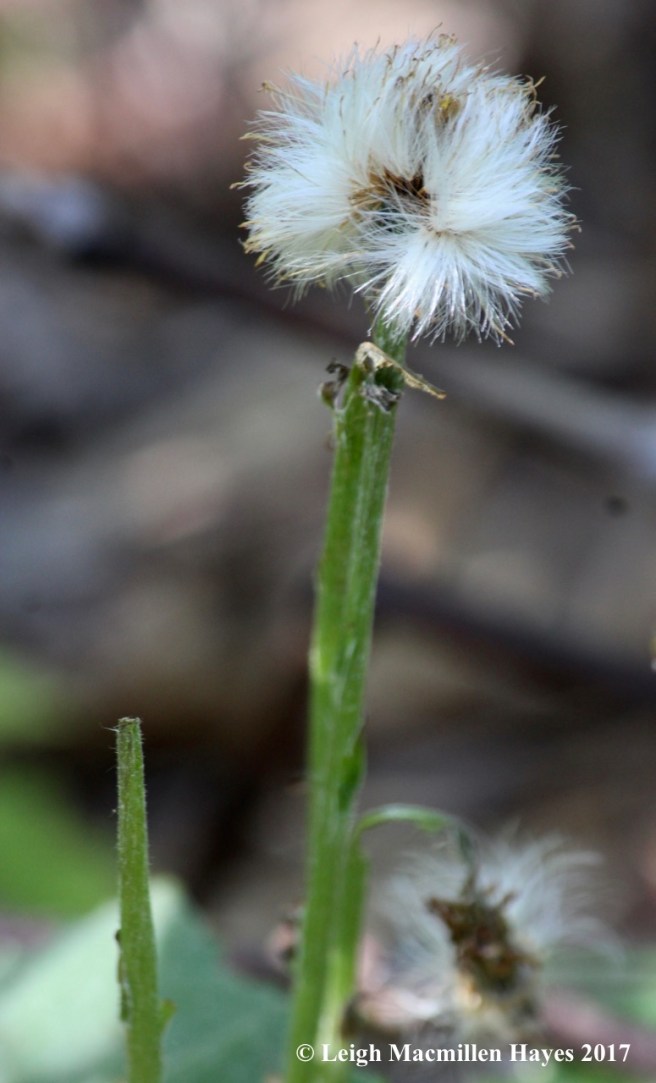
So yes, I went to make an initial inventory and began on the driveway to the parking lot, where the blossoms of coltsfoot have now turned to seed. Remains of the former flower continued to exist among the white fluff of the seeds’ parachutes.

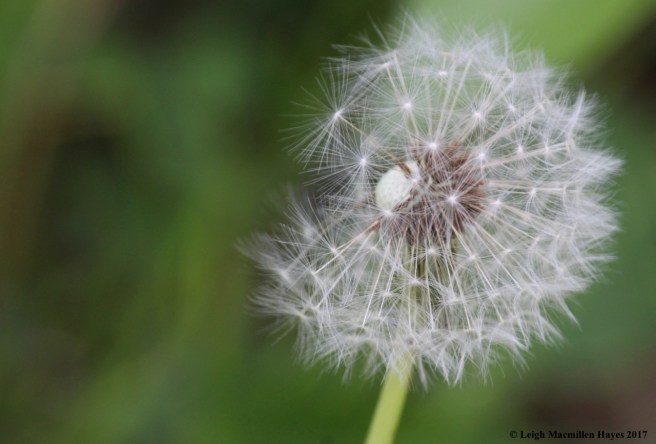
l-dandelion seed head

In the same place grew dandelions, providing a comparison as their seed heads were fancier in form.

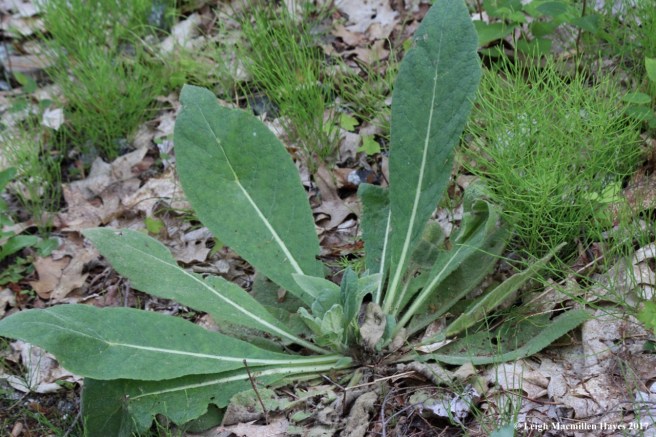
l-common mullein rosette

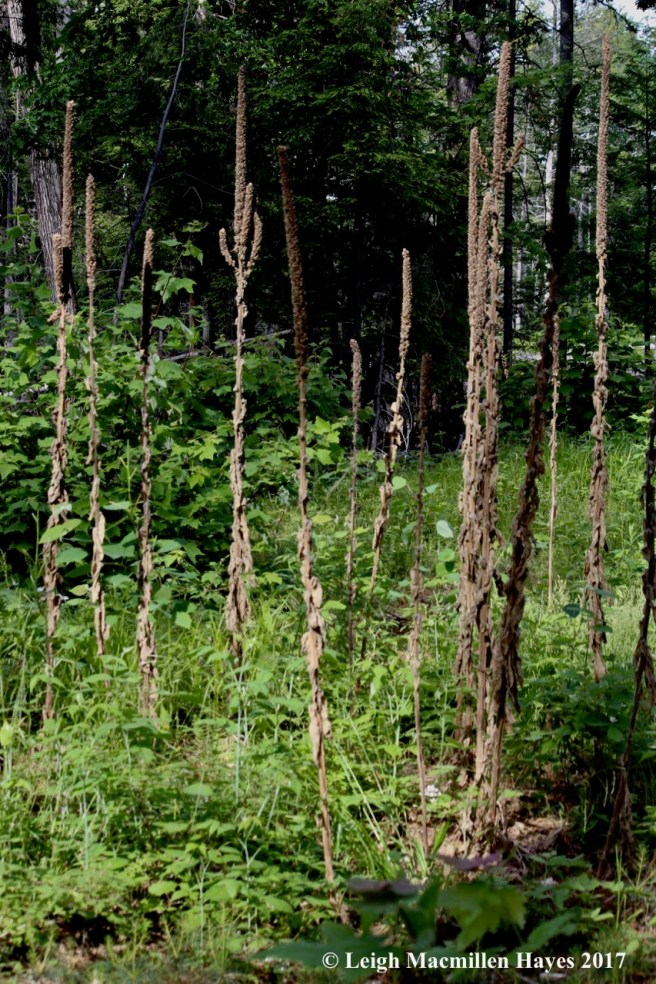
It was on the driveway also, that common mullein showed off its soft leaves as it grew among the equisetum or horsetail.

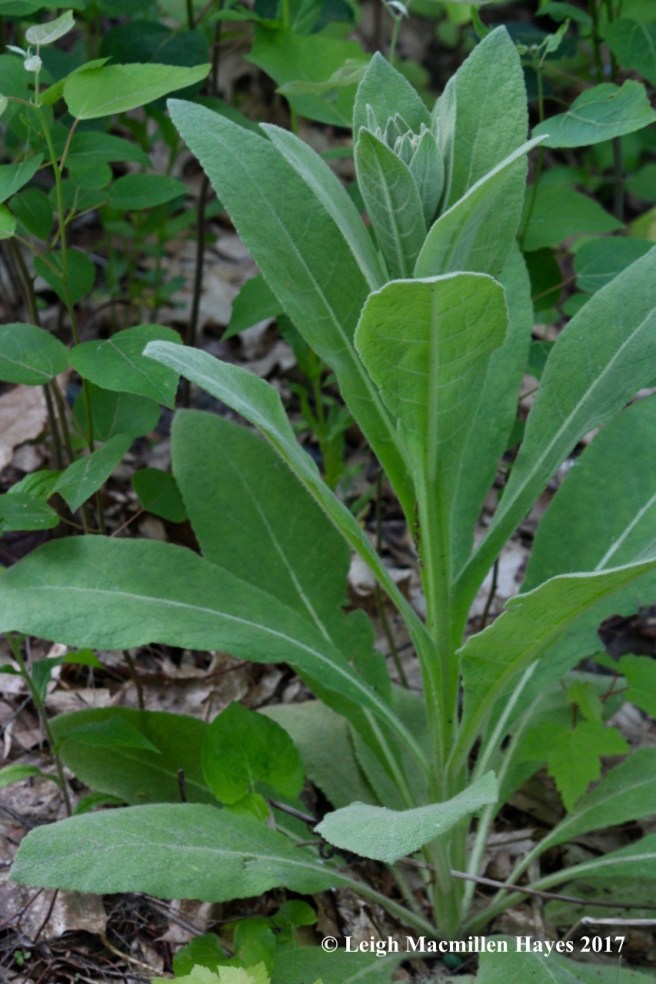
l-common mullein

One in particular was ready to spring forth with new life.

l-common mullein--cacti

Though there were examples of last year’s mullein flowers along the driveway, it was on the trail that I spied a group of them, looking much like the cacti of the north.

l-equisetum 1

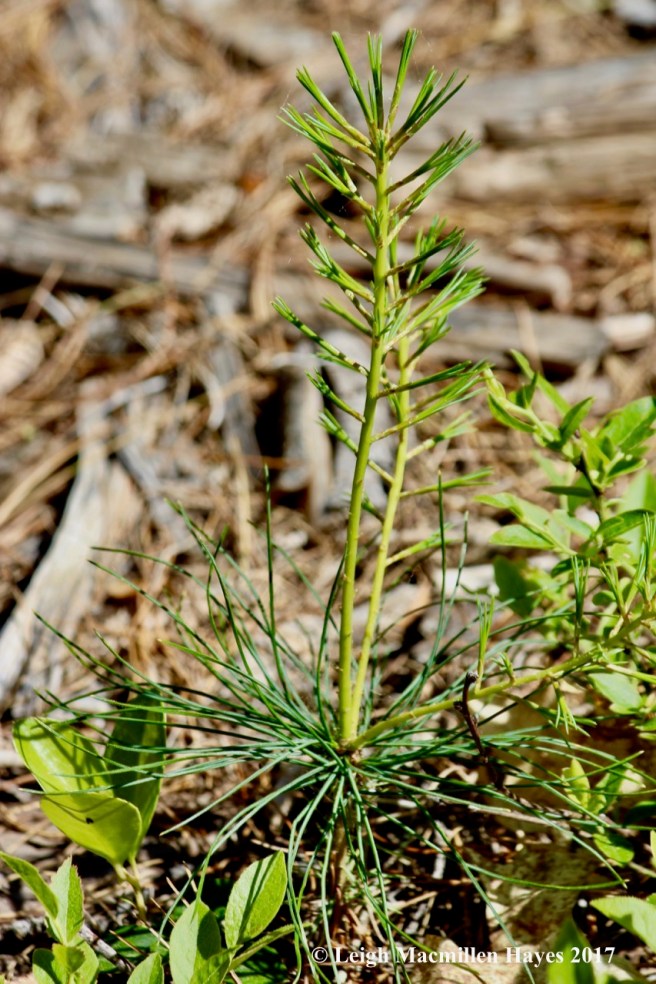
There were other look alikes to note–this being a woodland horsetail that can be mistaken for a pine sapling.

l-pine sapling

Both have whorled branching, but pine featured packets of five straight needles , while the horsetail branches were divided and dangling.

l-spittlebug

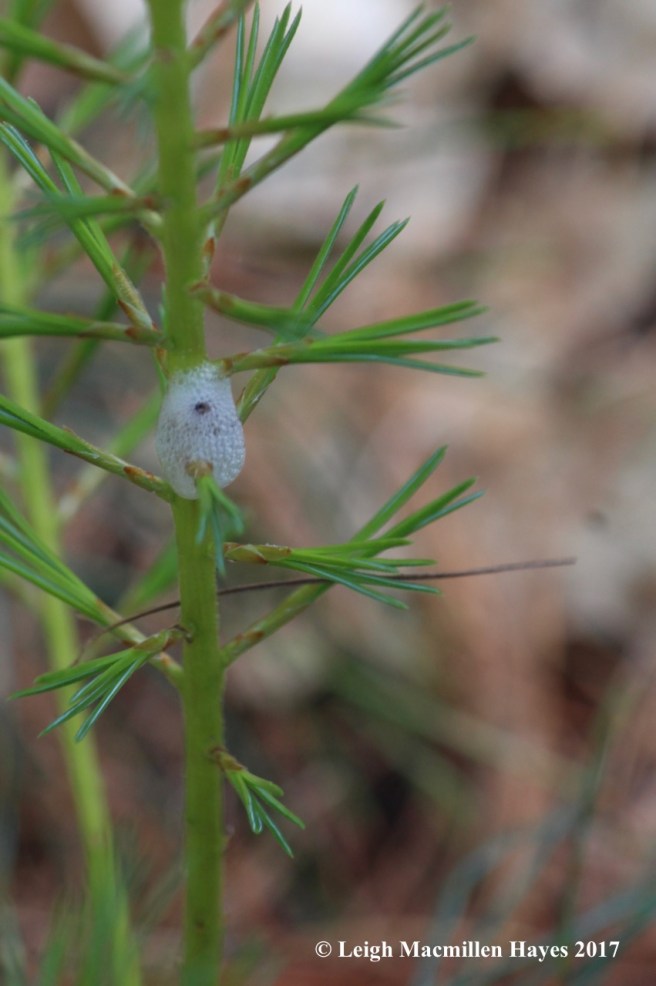
A spittlebug larva took advantage of one pine sapling and covered itself with froth to keep predators away.

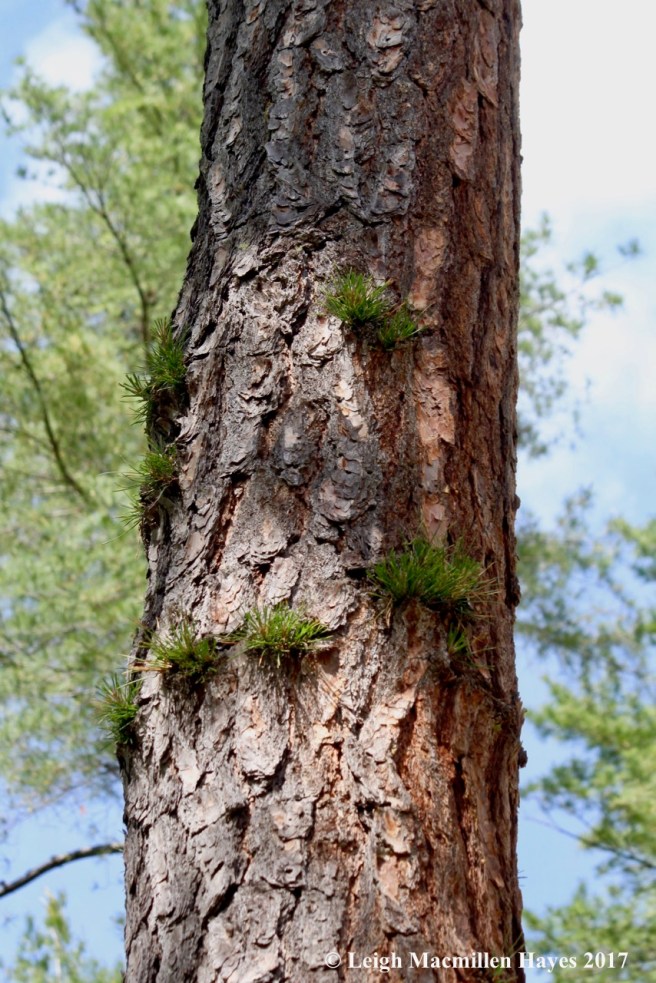
l-pine grove 1

White pine saplings are numerous on this 98-acre property, where the former owner left many older pines that create a cathedral-like space.

l-pitch pine

One of my favorite species were the pitch pines, though this one appeared to have been used perhaps as a turning tree, with its bark on one side scraped off.

l-common speedwell

At my feet, I also found common speedwell,

l-cinquefoil 1

common cinquefoil,

l-pipsissewa

and pipsissewa–though not common, not un-common either.

l-wintergreen sporting new growth

There was wintergreen showing off its new growth with tiny blossoms forming between light green leaves,

l-red trillium

and a red trillium, its flower passed by and fruit production in the works.

l-lowbush blueberries

Speaking of fruit, lowbush blueberries were loaded with future treats.

l-Indian Cucumber Root

And then there were those species that feature other-worldy presentations such as the Indian cucumber root.

l-greater bladder sedge

Likewise, the great bladder sedge with its fruit sacs pointed up and out.

l-wood fern with sori

A variety of ferns grow there, including wood ferns with sori maturing on the underside of the blades.

l-striped maple leaf

I found a small striped maple with leaves as big as a dinner plate.

l-maple-leaved viburnum

And multiple maple-leaved viburnums in flower, this one with . . .

l-beetles canoodling on maple-leaved viburnum-2

beetles canoodling. ;-)

l-oak apple gall

Because I was looking down so much, and no walk is compete without such a find, I saw an oak apple gall.

l-snowshoe hare scat 2

And similar in shape for its round form, snowshoe hare scat.

l-bench view

On the preserve are two small clearcuts. A bench has been installed at the two-acre lot.

l-wildlife blind

This is also the spot where a wildlife blind provides its own point of view.

l-field view

The six-acre opening faces the Baldface Mountains to the west.

l-Long Meadow

But my favorite view was at the old beaver dam, where Long Meadow Brook passes through. I wanted to spend more time there because there was much to see and ID, but the mosquitoes thought I was sweet.

l-chalk-fronted corporal

Fortunately, there were plenty of dragonflies, such as this chalk-fronted corporal, who thought the mosquitoes were sweet.

l-chalk-fronted female

That’s not all chalk-fronted liked, for this was his female counterpart.

l-lancet clubtail 1

Long Meadow Brook is the perfect place to meet some dragonflies, including the lancet club tail with yellow daggers running down the back of its abdomen.

l-eye to eye with dragonfly--white-face?

And a white face-so named for the whitish face below the bulging eyes.

l-stream cruiser

Hanging vertically as was its custom, a stream cruiser.

l-familiar bluet

Damselflies, too, flew about, including familiar bluets.

l-sedge sprite

But it was the metallic green of the sedge sprite that wowed me.

l-calico dragonfly 1

And when I thought I’d seen all that the land had to offer, I suddenly found myself in the place of the calico pennants.

l-calico 3

Its their wings that amazed me the most and made me think of stained glass windows.

l-calico 2

I happened upon them just before I passed back through the cathedral in the pines, as seems apropos.

While they focused on the abundant prey and each other to do their own canoodling (my guy and I heard that term mentioned recently and it made us chuckle), I had to finally pull my attention away. But . . . I’ll be keeping my eye on Long Meadow Brook Reserve. With pleasure.


Ain’t Lovell A Great Place To Be?

On my way to meet a few docents and the new interns for the Greater Lovell Land Trust this morning, a photo opp presented itself and I was forced to stop.

h-stan's sign

Stan Tupaj of Kezar Realty strikes me as the town cheerleader and I love to read his sign as I pass by. From time to time I’ve meant to photograph it, but somehow always seem to be in a rush to get to the next destination. But this morning I was a wee bit early and so this was the day.

h-heald sign

From there, I drove on to the Fairburn parking lot on Slab City Road where I planned to meet the crew.

h-green frog

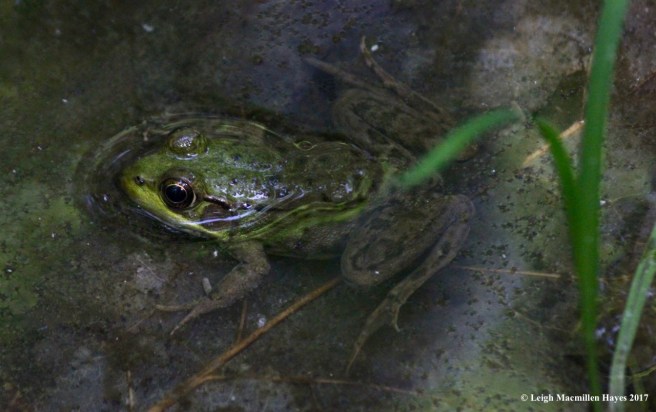
Our goal was to walk to Otter Rock, not a far walk by any means, but it took us 1.5 hours to get there, such were the sights along the way, including a few green frogs in puddles along the trail. I know he’s a green frog and not a bull frog because he showed off a dorsal lateral fold along the sides of his back.

h-baby toad

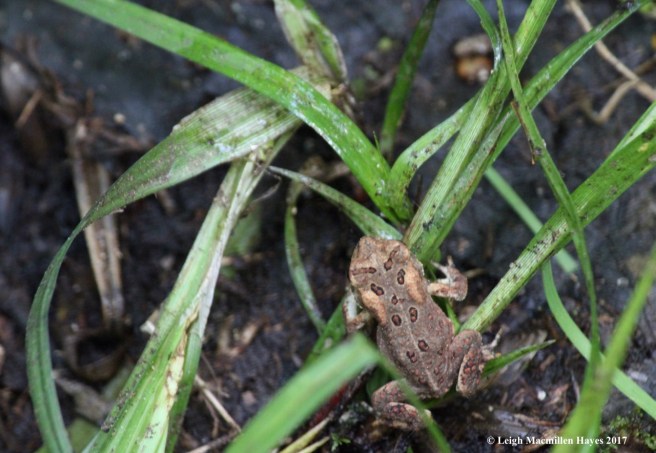
While the green frogs were beside or in the water, the ground seemed to hop at our feet in dry places thanks to a kazillion baby American toads on the move.

h-Ellie and the baby toad

I noted that it seems the younger toads are in constant motion, while older and much chunkier ones pause and try to blend into their surroundings, allowing us to study them (and take photos–just saying). One of the younger members of our team, Ellie, proved me wrong as she charmed a young toad to stay still while she looked at it through her hand lens for several moments. It wasn’t until Ellie moved that the toad hopped away.

h-damselfly with eggs

While Ellie was the toad whisperer, her older brother Caleb wowed us with his ability to capture dragonflies and damselflies in a net, such as this one. As he held it high, he realized it was a she for there were eggs on her abdomen and so he gently released her–in hopes she’d find some vegetation on which to inject those tiny sacs.

h-keeping mosquitoes at bay

Their youngest brother, Wes, demonstrated the value of bracken ferns–which served as a fun hat to keep the mosquitoes at bay.

h1-Aidan

And it wasn’t until later that I realized I didn’t have a photo of Ellie’s other brother, Aidan, but I knew of one from a prior insect walk that showed his own curiosity.

h-grape fern

We looked at tons of plants as well and were all especially eager to re-greet the grape ferns that we knew grew there.

h-exoskeletons 2

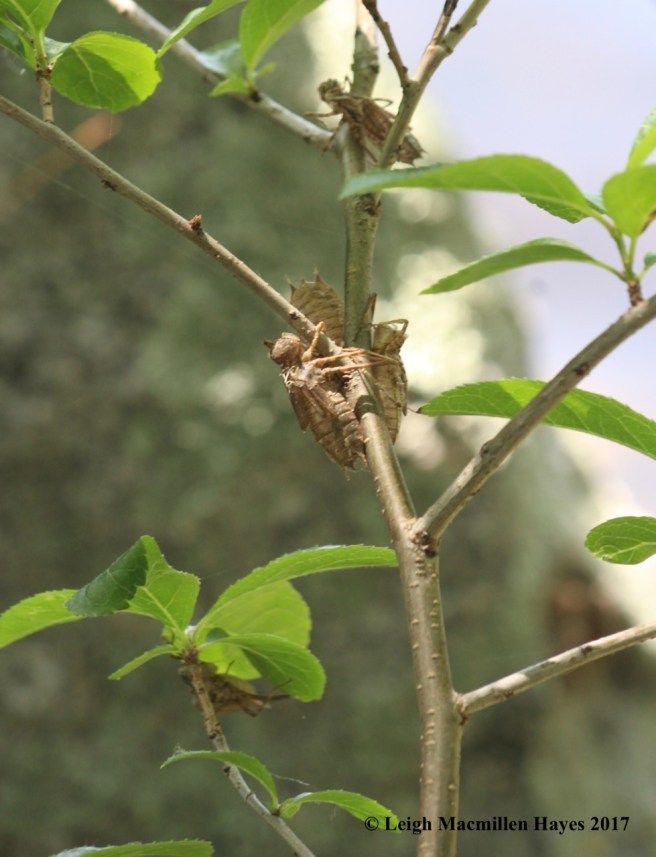
At last we reached our destination, Otter Rock on Heald Pond, where we found what we had hoped for: exoskeletons decorated the landscape.

h-exoskeltons on shrub

Dragonflies lay egg clusters into sediments or tap small clumps directly onto the water’s surface. Each egg hatches into a small nymph, which grows until its ready to emerge as a flying adult. At that time, the nymph crawls to the surface, and ever so slowly, the adult pulls itself free of the exoskeleton. It’s the most amazing process to watch. But even if you don’t have that opportunity, just seeing the left over nymphal shells and knowing that the magic happened is worth a wonder.

h-exoskeletons on ground

We had to watch where we stepped, for the exoskeletons not only decorated the shrubs, but also the ground . . .

h-exoskeleton on tree

and even the trees.

h-widow skimmer

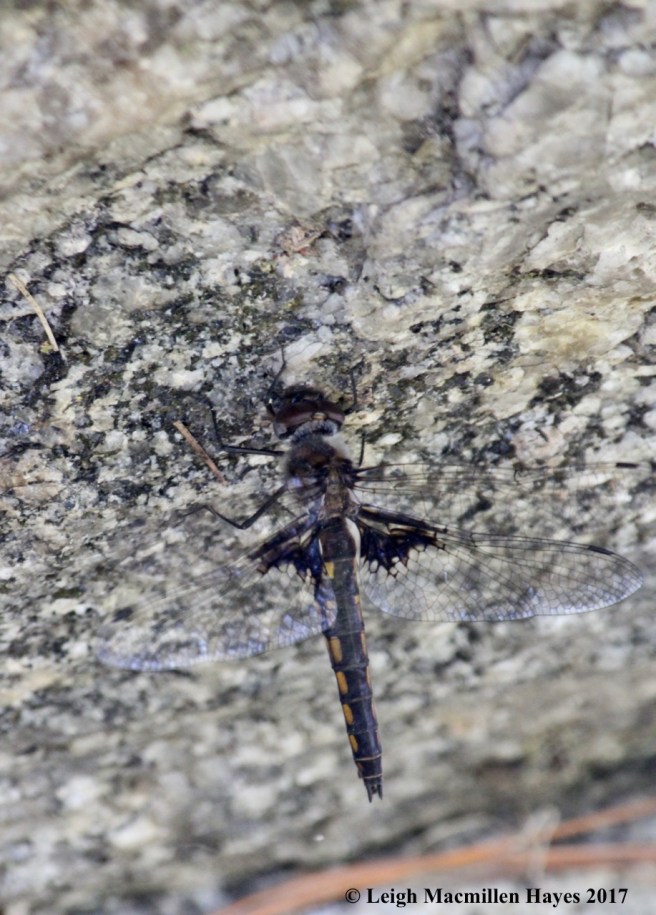
And then we began to notice newly emerged dragonflies like the widow maker on Otter Rock,

h-black-shouldered spinyleg

and black-shouldered spinyleg on the ground. We were afraid to step for everywhere our eyes focused, there was either an exoskeleton or a dragonfly drying its wings in preparation for a first flight.

h-chalk 5

As we looked about, Caleb spotted one struggling in the water, so he pulled it out.

h-chalk 4

Coated in a bit of pollen from the pond, it still clung to its exoskeleton.

h-chalk-fronted corporal 1

We watched for a few moments as it moved about, those wings slowly drying. I think my ID is right and this was a chalk-fronted corporal. At last it was time for us to draw our sense of wonder to a close and make our journey out.

h-meet the interns

But first, I asked our interns to pose–meet Hannah, Kelly and Dakota. Today was their first day of work and we probably overwhelmed the two guys a bit. Hannah was with us last year, so she knows our ways–that we walk slowly and look at everything. She gets it and we love that. We’re excited about the possibilities ahead. Join us for a GLLT walk or come to an evening talk and you’ll get to meet them.

h-heading out

Our walk out was much quicker, though we still stopped occasionally.

h-stan's sign

In the end, I have no doubt that we knew the answer to Stan’s question: Lovell IS a great place to be.


Carving Time

Summer arrived through the back door as we walked out the front on our way to the Raymond Community Forest for a lunch hike. We’d last hiked the property conserved by Loon Echo Land Trust on a fall Mondate and were curious about its offerings in a different season. That and we knew it would be a quick venture, which would serve us well today.

p-false solomon seal

The minute we stepped out of the truck, we were greeted by the cheerful cluster of flowers spraying forth from the tip of a False Solomon’s Seal. I immediately reminded my guy that I’d be taking photos, like he needed to hear it again. But really, it was too hot to move fast and we were thankful for the shaded route. I don’t think our blood has thinned yet as only a week ago we wore several layers.

p-maple leaf viburnum 1

One of the blessings of such a habitat is maple-leaved viburnum, with at least one already sporting flowers about to open, plus last year’s dangling fruits. We weren’t the only ones happy to view it up close, a pollinator already at work.

p-spider web 2

A bit off the trail, the sun shone through the canopy, casting rays of light upon spider works worth noticing.

p-hop hornbeam

Though not long in length, the trail provided some upward movement that got the heart ticking. And tickled my fancy along the way for some of its trees like the hop hornbeam, which prefers rich soils and often is found on warm slopes. It also made me chuckle to see that this was the tree chosen for the trail blaze. Given the hardness of the wood, it couldn’t have been easy to pound in the nail.

p-scarlet waxy cap 2

Most flowers had either already bloomed or are still to come. But we found a fruit of another kind–its waxy cap shining brightly at our feet.

p-scarlet waxy cap 1

The shiny bright tops of the scarlet waxy caps were hard to miss in a couple of spots.

p-scarlet gills

But even more attractive were the gills below with their arched formation and orangy-yellow coloration.

p-grass 1

As we approached the summit, the understory changed from woodland shrubs and much leaf cover to grass, bracken ferns and wild sarsaparilla–a signature to the forest’s past life before the trees grew tall.

p-signs 2

Last fall, we got mixed up at one point along the Highlands Loop, but today we noted how well marked the entire trail system was. And so, when we reached these signs, we turned right and headed to the bluff.

p-lunch view

Stopping briefly for a water break, we rejoiced in the breeze and realized that we’d dealt with nary a mosquito.

p-lady's slipper 2

Next, we decided to travel the Highland Loop in the opposite direction we’d followed in the fall. Being my guy, he was often far ahead, but then would find a stump or rock to sit patiently and wait. And while he waited, he noticed things. I love that for it’s not his intention to gawk about every flower or leaf, but he does see. So it was, that the only lady’s slipper we curtseyed to today was across from one of his perches.

p-trail work

Overall, the trail was well-maintained, but my guy did offer a hand by moving a recently fallen tree out of the way.

p-trail work 2

I told him he’d earn brownie points for his efforts. Perhaps I should bake him some brownies.

p-beech flowers 1

Today’s lesson came along the loop. And I’m still not sure I completely understand for this was the first time that I recall such a sight. But there are so many firsts in my life and once I’m finally aware of something, it seems to appear everywhere as if it had been there all along. Because . . . it had. Confused? Me too. I found these beech flowers on a tree that stood about two or three feet tall. I can’t recall ever seeing flowers on such a small beech before. And I know they have to be about 40 years old before they produce fruit. Beech can grow for a long time in the understory, but could such a short tree be so old? Did this tree not read the books? Do beech trees put energy into producing flowers that won’t be viable? Do I need to contact my district forester for a better understanding? Yes. Fortunately, he doesn’t mind when I pick his brain. And obviously, I have much to learn.

(NOTE: As promised, I contacted our district forester for the Maine Forest Service, Shane Duigan. Here’s what he had to say: “Hi Leigh, Those are good questions. The easy answer is, no, the trees never read the books. Beyond that, it is possible that such a little shoot could be 40 years old but more likely it is a root sprout–a young shoot arising from an old root system. Beech stumps sprout readily when cut and beech trees also produce root sprouts as a result of stress or physical damage to roots. In that scenario, though the shoot appears too young to flower, the organism (root system) is old enough to flower. Does that all make sense?” Yes, Shane–that does make sense. Another lesson learned.)

p-basswood bark and leaves

After wondering so long before the beech tree, I had to pick up my pace. But that only lasted for a bit because another of my favorite trees that also likes the richness of the soil stood tall beside the trail. I couldn’t resist running my hands over the smooth sections of bark on the basswood (linden) and admire the leaves already big on an offshoot below.

p-grassy field at summit

We knew we were completing the loop and approaching the trail to the bluff when the understory once again turned to grass.

p-bluff view 2

From the same rock where we’d taken our earlier water break, we sat for lunch as we looked out at Crescent Lake and across to Rattlesnake Mountain.

p-white oaks blowing in breeze

The wind continued to blow, causing the leaves to swish and sway with its language.

p-bedstraw

On our descent I spied various plants including a small patch of bedstraw not yet in flower.

p-cranefly 2

And because I was looking down, a cranefly couldn’t escape my focus.

p-descent

It didn’t take us long to descend on the path carved by others along the side of Pismire Mountain. In the end, though we wanted to venture on the Spiller Homestead trail that is part of the forest, we had to head home. My guy has worked way too many hours this week, including all day yesterday and again this afternoon, on this, his weekend off, due to a customer appreciation sale that this year benefited the Lions Club (each year a different local charity is the beneficiary). But . . . we were thankful we carved out some time to be together doing what we most love to do.


Fawning with Wonder

Though fawning is most oft used to describe someone who is over the top in the flattery department (think old school brown nose), the term is derived from the Old English fægnian, meaning “rejoice, exult, be glad.”

I just knew it was going to be that kind of day when I drove toward Holt Pond Preserve this morning. First, on Route 302, a deer dashed in front of my truck–and I avoided hitting it by mere inches. (And being hit by the woman who was smack dab on my tail.) Then, as I drove up to the summit of Perley Road, a red fox crossed my path.

To top off my feeling of gladness, in the preserve’s parking lot I met up with the most gracious of hostesses, Lake Environmental Association‘s Education Director Alanna Doughty, and the ever delightful host, Loon Echo Land Trust‘s Stewardship Director Jon Evans. Those two dynamos had joined forces to lead a public walk that looped all the way around Holt Pond. Joining the group was a gentleman named Bob and two others–my dear friends Faith and Ben Hall. The Halls had arrived at their summer camp recently and this was my first opportunity to welcome them home. After intros and a discussion about how the two organizations have collaborated on projects including Holt Pond, along with an explanation of how they differ (LEA is about water science and protecting our precious lakes and ponds, while LELT is about protecting the uplands and lowlands that surround the watershed), we headed off on our adventure.

p-oak apple gall 1

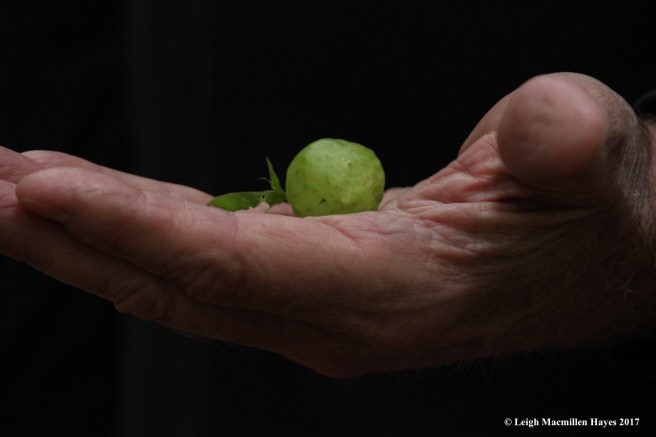
Within minutes, a small, rubbery green ball, about the size of a ping pong ball, caught our attention. This was the result of an apple oak gall female wasp (yes, there is such a species) that crawled up the tree trunk of a Northern red oak earlier in the spring and injected an egg into the center vein of a newly emerged leaf. As the larva grew, it caused a chemical reaction and mutated the leaf to form a gall around it. The leaf provided the larva sustenance. Had we left it alone, once it matured into a wasp, it would have sawed its way out through a small escape hole.

p-oak apple gall 2

Because we were curious, however, Alanna split it open so everyone could see the spoke-like structure hidden inside, that provided support for the developing insect.

I shared with the group a little tidbit I learned last fall in Ireland. When working on the manuscript for the Book of Kells, monks used these galls for the color green, soaking them in beer or mead to create a dye.

p-Alanna and Jon

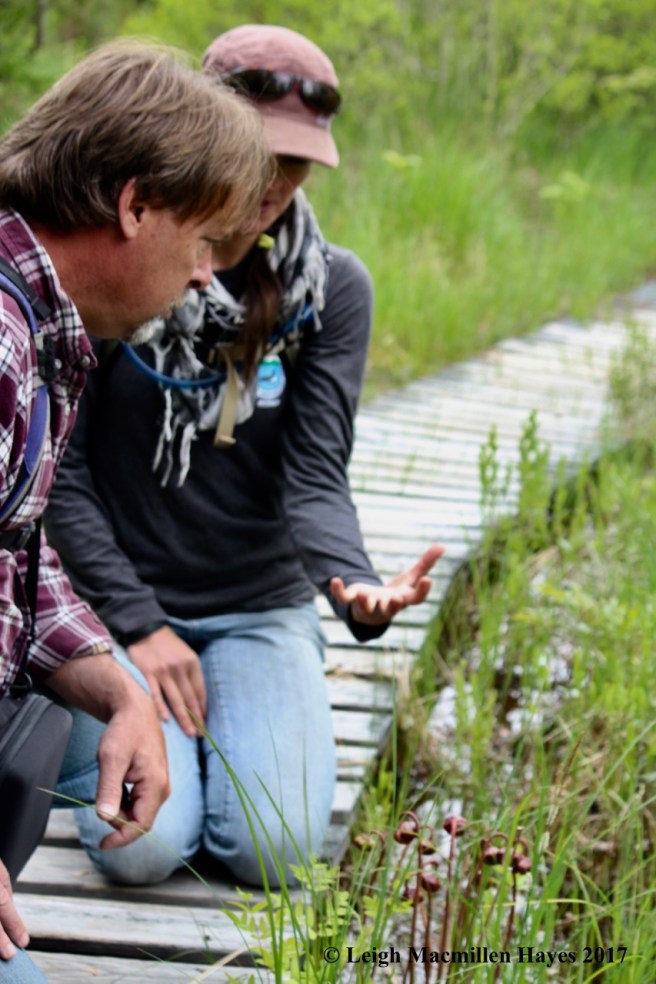
That set the stage and from there on, we paused periodically to wonder, though I think we said at one point that we wanted to get all the way around before 1pm. But there’s so much to see that we had to stop. And because the pitcher plants grow beside the boardwalk, it was hard to ignore them. Being Alanna, she got down on her knees to talk about how this carnivorous plant functions, enticing insects into its pitcher-like leaves that are filled with water and digestive enzymes. Because of downward-sloping hairs  on the leaf, insects can’t climb out and eventually they succumb–allowing the plant to break them down and absorb their nutrients.

p-pitcher plants flowering

Today, the pitcher’s flowers were beginning to bloom.

p-Indian Cucumber Root

As our journey continued, we stopped to admire other flowers including the Indian Cucumber Root,

p-jack in the pulpit

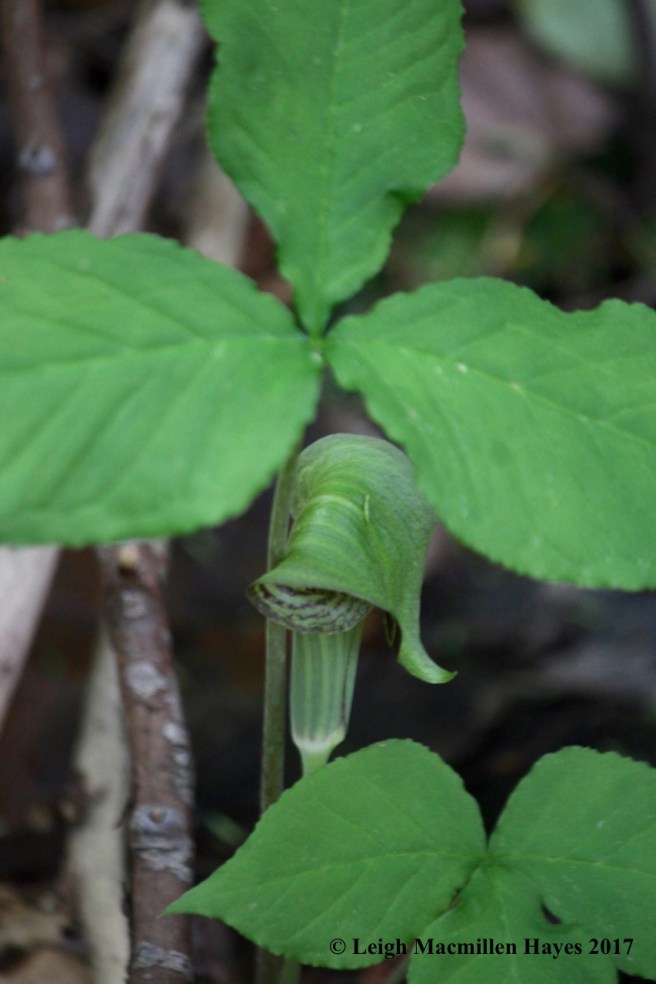
Jack in the Pulpit,

p-lady's 1

and pink lady’s slipper.

p-Faith on beech

To show off the contorted growth of a tree, Faith graciously took a brief break at the beech.

p-greater bladder sedge

While Jon shared a lot of information about South Bridgton’s historical past, Alanna enlightened us on the works of nature, including the bladder sedge with its inflated, teardrop-shaped sacs that enclose its fruit. Though common, like the pitcher plant flowers, it’s otherworldly in form.

p-nannyberry?

And then we got stumped by one shrub we should have known. Witherod (wild raisin) or Nannyberry? We decided on the latter for a couple of reasons–the petioles (stems) of the leaves were somewhat winged and the veins beneath the leaves were not scurfy. Scurfy? That was a new term for me–meaning rough to the touch or covered with scales.

p-Bob, Alanna, Faith 1

As our journey continued, we passed lots of hobblebush in the understory. But not to be missed were the witch hazels. And more galls, this time the witch’s cap that grows on their leaves and forms a cone-shaped structure much like a witch’s cap. How fitting that the Witch Hazel Cone Gall Aphid (Hormaphis hamamelidis) chose this particular shrub. Having caused the leaf to form a gall around her, mother aphid stayed inside, where she’s protected as she feeds and reproduces.

p-porky 1

During our journey, we shared brains and eyes. I’m thankful for others who thought to look up, and spotted a porcupine looking down.

p-grouse bath

We also looked down, spying the spot where a bird took a dust bath.

p-grouse bath feather

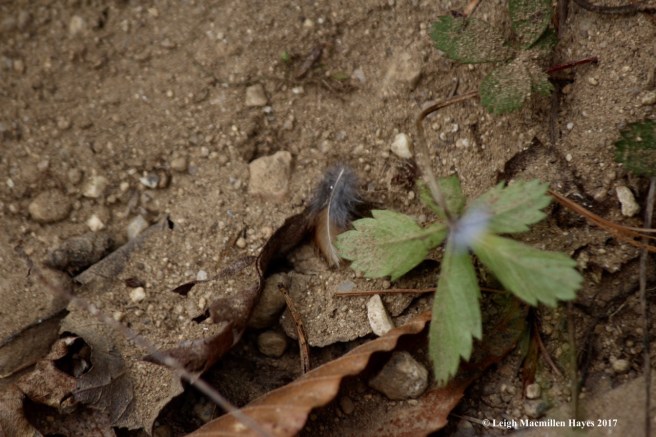
In this case, it was the work of a ruffed grouse that wanted to rid itself of lice and mites. A stray feather was also left behind. Do you see it?

p-fawn 3

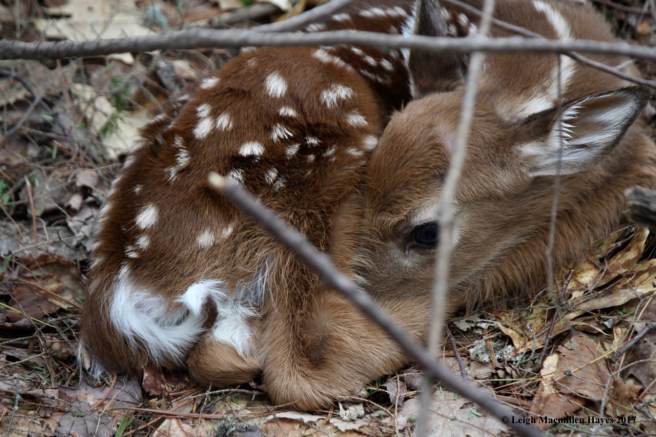
But our best find of all–a young fawn curled up beside the trail. I was leading and talking at the time and didn’t even see it. Faith quietly called me back and I was sure she wanted to show me a snake. We paused quickly to take a few photos and this babe never flinched, obeying its mother’s order to stay put while she went off to feed. (I used to try that at the end of the aisle in a grocery store when my guys were young–but they did their fair share of flinching.)

We’d been blessed–and we all rejoiced while fawning with wonder.


“Hey You!”

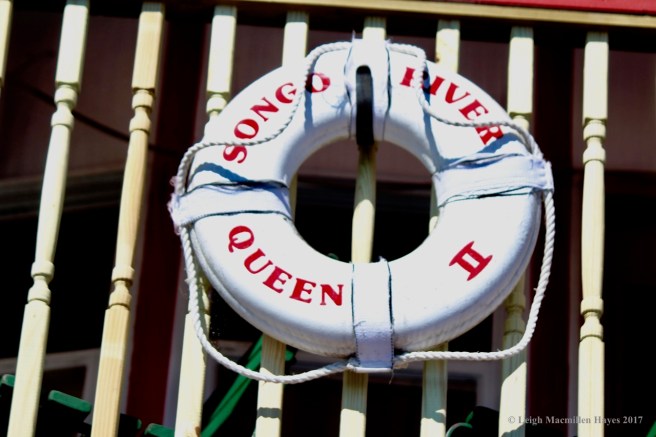
Shouts of “Hey You!” echoed across Long Lake in Naples, Maine, this morning as sixth grade students from Oxford Hills enjoyed a cruise sponsored by the Lakes Environmental Association aboard the Songo River Queen II, a replica of the famed Mississippi River Paddle Wheelers. For the past twenty years or so, LEA has offered this event to those who have completed the Living Connections Program in the Lake Region Schools and as a special program for students from several other districts, such as Oxford Hills.

l-Songo River Queen II

This culminating activity brings all the lessons students have learned about shoreland zoning and water quality to life in an engaging and interactive way.

l-Long Lake

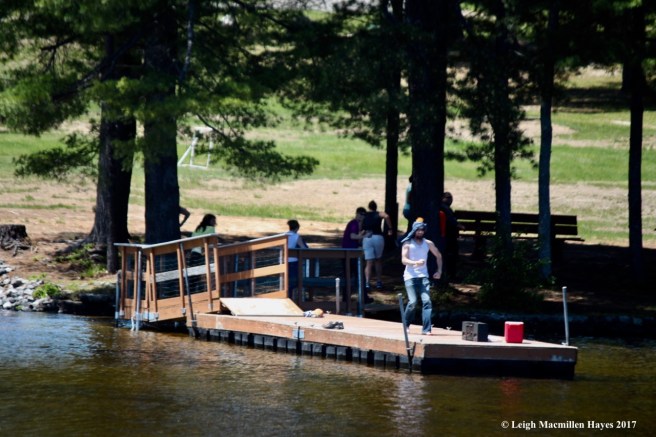
After what seemed like months of rain, it was a beautiful morning as Captain Kent steered the boat away from the dock and onto the 11-mile-long lake.

l-Mary 1

As the tour began, LEA’s talented teacher/naturalist Mary Jewett, quizzed the kids.

l-prizes

They expressed their knowledge about watersheds, lake hydrology, phosphorus and other nutrients, chlorophyll, algal blooms, vegetated buffers, erosion control, thermocline, stratification and turnover, and received prizes for each correct answer. I’m always impressed by their responses.

l-vegetative buffer

They’re able to point out vegetated buffers . . .

l-grandfathered cabin

and recognize that some lakefront properties built within the 100-foot setback are older than the shoreland zoning law and therefore grandfathered.

l-station 1, sand 1

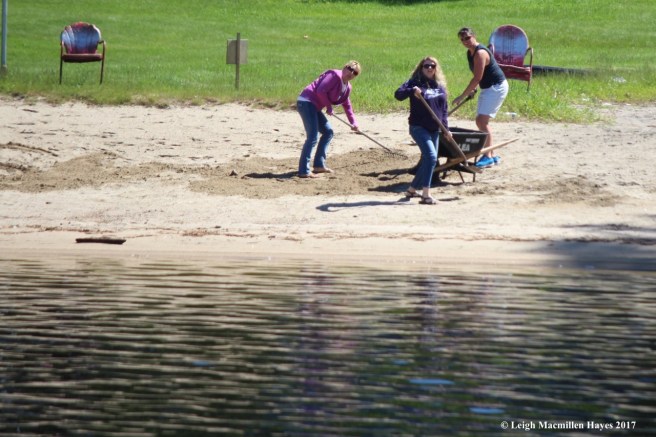
In the midst of it all, Captain Kent suddenly made Mary aware of a violation occurring on shore. Several women shoveled sand out of a wheelbarrow and spread it with rakes.

l-station 1, sand 2

Encouraged by Mary, the kids shouted, “Hey You!” The women continued to spread the sand so the kids shouted again—only this time they were even louder. On shore, the culprits looked surprised. Using the loudspeaker system, Mary explained that it’s illegal to add sand to the beach.

l-station 1, sand 3

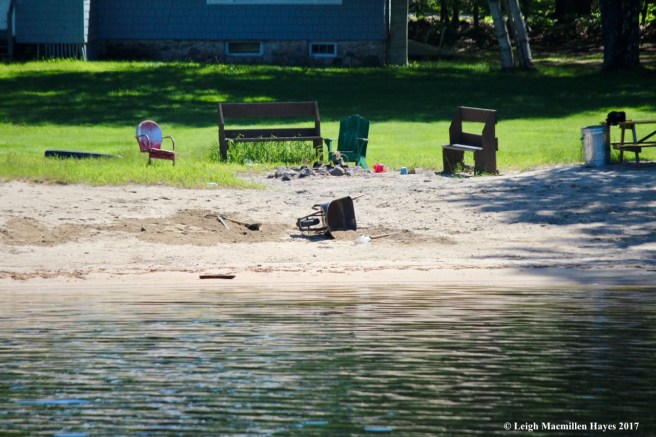
The women quickly retreated, dumping the wheelbarrow in the process. The kids caught on that this was a role playing situation, but it created opportunities to discuss the implications–such as the fact that dumping sand can cause significant problems for the lake because it contains phosphorus, which contributes to decreased water clarity and algal blooms. Wildlife is also affected, e.g. decreased spawning habitat for fish, and increased opportunities for invasive aquatic plants like variable-leaf milfoil.

l-station 2, fertilizer and spray

Mary continued to question the kids as the boat poked along, until another “Hey You!” moment. One woman was spotted spreading fertilizer (flour in this case) with a flourish, while another sprayed what appeared to be weedkiller on the vegetative buffer. The kids were reminded that topical fertilizers often contain phosphorus and other nutrients that wash into the lakes.

l-station 2, cutting grass too short

At the same property, a man mowed the lawn using the lowest setting (or so it looked from the boat). Short grass is even more likely to allow those nutrients to wash into the water.

l-station 3, trimming vegetative buffer

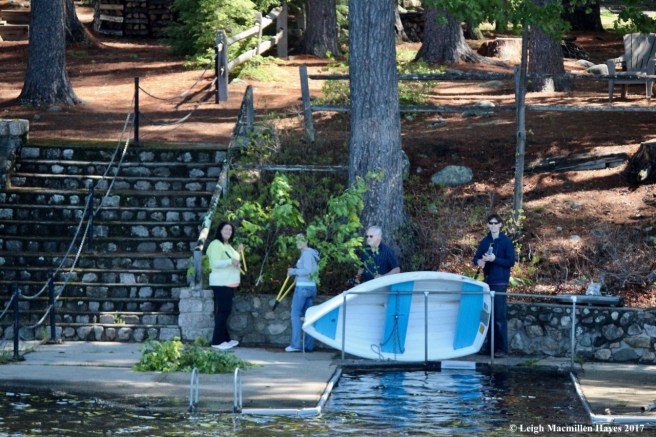
The next violation involved a group of people trimming and removing the vegetated buffer. The students know the buffer is the last line of defense between a home and the lake because it provides a filter for any run-off, thus helping to keep excessive nutrients, sediment and storm water out of the lake. Native trees, shrubs, flowers and ground cover should be left in place.

l-station 3, running 1

Like the other offenders, this group hastily ran away . . .

l-station 3, hiding

and hid behind the trees.

l-Mount Washington
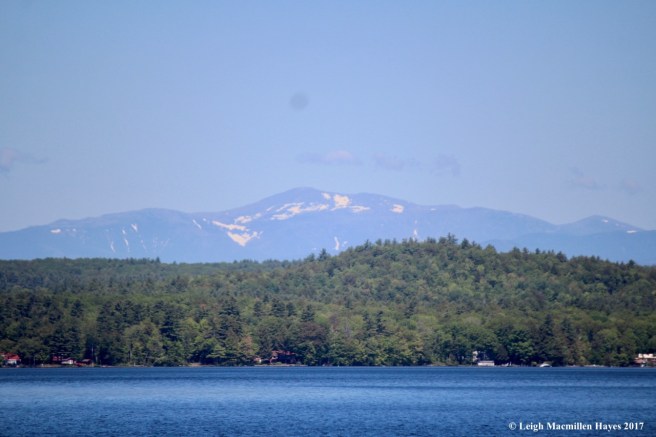
Following the third stop, the boat paused in the middle of the lake, where Mount Washington was visible. Students rotated through water testing stations where they practiced using such devices as a secchi disk, dissolved oxygen meter, Van Dorn water sampler, and core sampler. I was in charge of the core sampler and we talked about how the hose is lowered to one meter below the thermocline, that mid-point at which the temperature decreases and sunlight cannot penetrate. (Think about doing a cannon ball off the dock and hitting the spot where the temperature is suddenly freezing–or so it feels on a hot summer day.) We talked about how the water is tested in a lab for chlorophyll, phosphorus, pH, color and more. And then they tried gathering a water sample. One student lowered the weighted end of the clear, plastic hose into the water, while the others held onto the rest of it. When I said “Crimp and cover,” a second student crimped the hose and a third covered the far end. Quickly, the first student raised the weighted end, the other two let go and working together, all raised the hose high and tried to “walk” the water down it and into a container. Today, I think we gathered the most water I’ve seen in all the years I’ve volunteered for this activity.

l-pencils

Once students had rotated through all of the stations, Mary’s quiz continued as we traveled along the eastern shore. Volunteers asked questions, though I let Mary ask mine, and again the students who answered correctly were rewarded.

l-station 4, trees 1

Because they were on the lookout, one of the kids noticed people wearing hardhats and attempting to cut pine trees within mere feet of the lake.

l-station 4, Anne, who me?

They are quickly admonished by this now savvy group, though the “workers” couldn’t believe they’re being picked upon. Mary did remind the kids that shoreland zoning laws do allow homeowners to limb up to 1/3 the height of a tree in order to maintain a view.

l-station 5, Matt 2

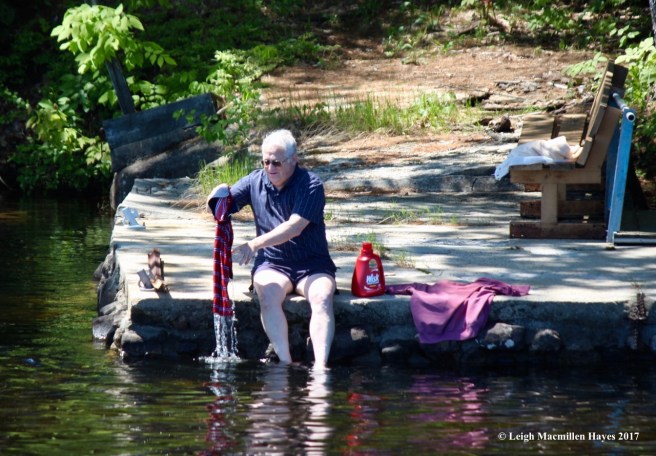
Close by, a man washed his laundry—yes, in the water. Under state law, it is illegal to intentionally introduce foreign substances, including soap, into the water. (He was supposed to “bathe,” but the temperature is a wee bit chilly yet.)

l-party 1

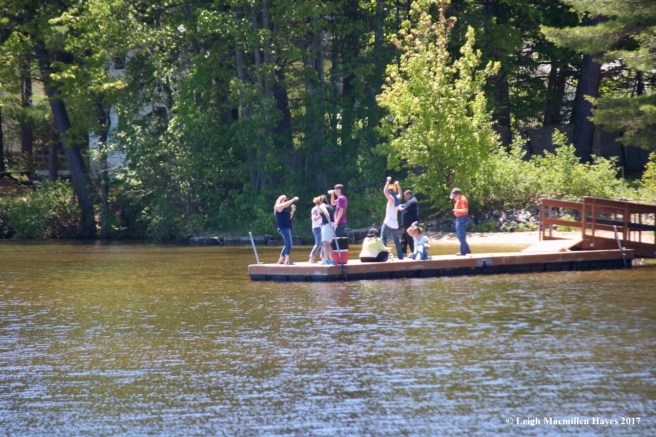
It didn’t end there. As the boat passed by the Naples Town Beach, the kids noticed a group gathered on the dock drinking and then tossing empty cans.

l-party 4

You know by now what happened.

l-party 6

Though one guy did run back . . .

l-party 8

to get the boom box.

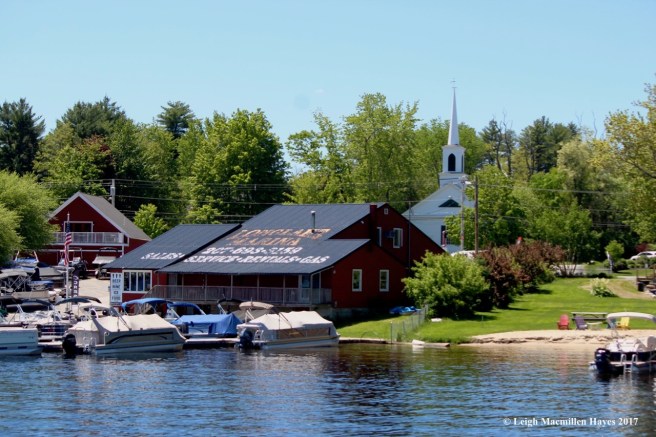
l-Naples, church, marina

At last Kent steered the boat back toward the dock.

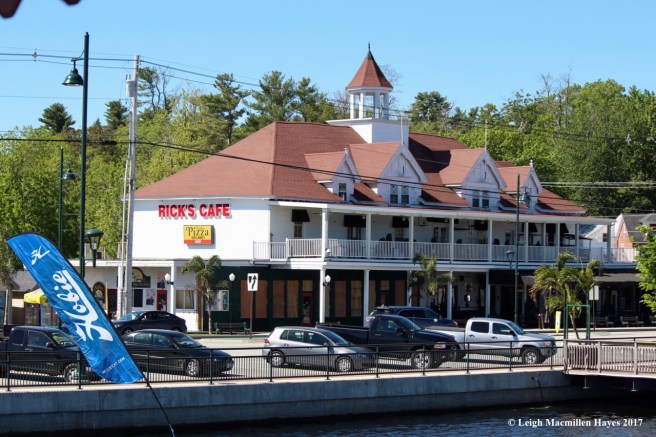
l-Rick's Cafe

The cruise had come to an end, but by seeing the volunteer actors on shore, students made the connection between their in-class learning and real life situations when it comes to water quality.

l-dragonfly exoskeleton

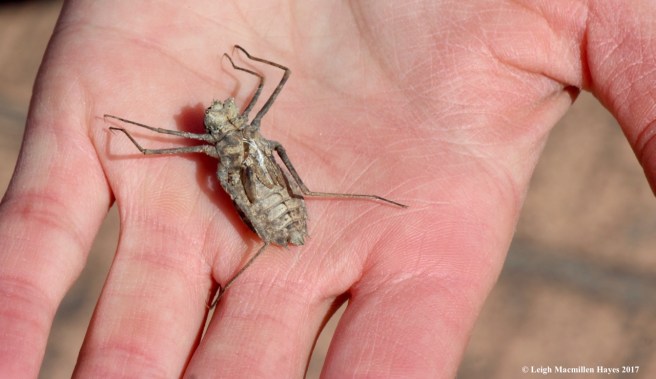
Oh, and before we had initially headed out, Mary spotted a huge dragonfly exoskeleton by the causeway and LEA’s Education Director, Alanna Doughty, climbed over the railing to fetch it. As Mary pointed out to the kids when she held the exoskeleton up, this is what it’s all about–clean water for aquatic species and for us.

Hey You! Think about your actions and be the difference.

Dodging the Drops Mondate

A friend called this afternoon and her first comment was that she didn’t know if she’d reach me given that it was a Monday. She’d thought about the weather, but figured it wouldn’t bother us and we’d probably be in the woods somewhere. How right she was–and her call came just after we’d returned home.

h-trail sign

Our mission was a work date on the Southern Shore Trail at Lake Environmental Association’s Holt Pond Preserve. For a number of years, we’ve maintained this section of trail between the last boardwalk just below Knapp Road in South Bridgton and “the field” near the southern tip of Holt Pond. It’s a section that was an Eagle Scout project years ago and we’d helped in creating it, so it’s been our pleasure to keep it clear of fallen trees and branches. Thankfully, this section isn’t traveled often and we rarely find any manmade debris.

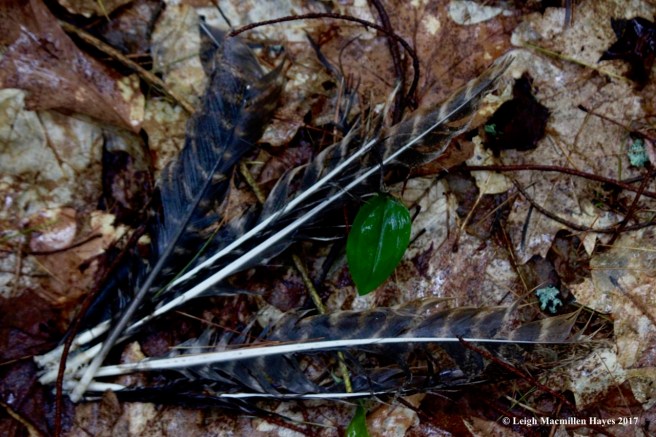
h-wild turkey feathers

Immediately we did find some bird debris and wondered what happened to the turkey. A few other feathers were scattered, but we didn’t look further, so we don’t know if there was more to this story.

h-following the wall

Loppers in hand, we turned at the stonewall, and entered the enchanted forest, for that’s how it feels . . .

h-green lichens:mosses

especially given so many shades of green. And a few openings that would make perfect entry points for wee inhabitants.

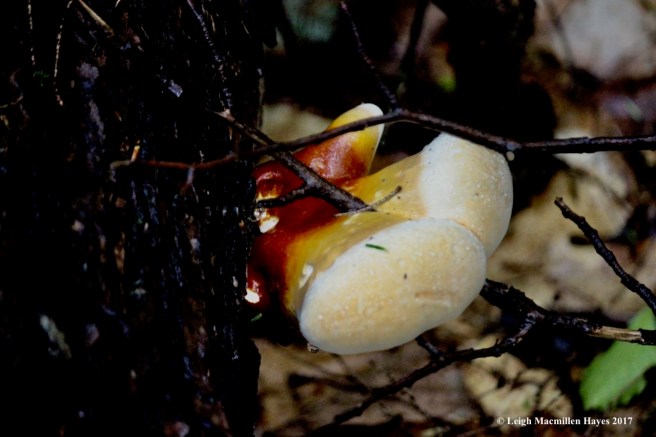
h-hemlock varnish shelf 1

We moved along at a rather brisk pace (in my opinion, that is, though when I mentioned it to my guy, he brought up other times when we’ve moved much more quickly.) But, I did what I do, and while he picked up sticks and dragged downed trees out of the way, I looked around to see what I might see, like the varnish shelf fungi on a hemlock tree. I questioned myself with this ID because it looked similar to a red-belted polypore, both featuring a glossy lacquer-like sheen and concentric zones of red, yellow and white. But, it grew on a hemlock and I should have snapped an old specimen that was on the ground below. I know if I’m wrong, Parker and Jimmy Veitch of White Mountain Mushrooms and Maine Master Naturalist Alan Seamans will all correct me. If that’s the case, I’ll add a note to this post.

h-Broad gill, more sombero like in nature

I could hear the mushrooms and the mushroom gurus singing praises to the rain gods, given this spring’s rain. And I’m going out on a limb again with broad gill (Tricholomopsis platyphylla) as an ID for this one. (NOTE: from Parker–“The Megacollybia (Tricholomopsis) platyphylla is Entoloma vernum [group])

h-swamp beacon 1

There with others, but my favorite of all–swamp beacons lighting the way through puddles.

h-Holt Pond toward Quaking Bog

At last we made our way to an outlook spot with its view of Holt Pond. Across the way, the quaking bog (where the trees are tallest on the left) and Muddy River outlet (just to the right of those tall trees).

h-into the field

And then we continued through the hemlock forest and on to the field, our turn-around point. Again, we shared memories–of our first reconnaissance mission with Bridie McGreavy when she was LEA’s education director and we decided to take on the task of maintaining the trail. The three of us headed out on a winter day when the snow was deep and soft. Bridie and I were smart–we let my guy cut trail. I’m sure we jumped in front once in a while, but he led the way most of the time and was exhausted by the time we finished. So were we ;-)

h-field 1

There were a few years when we drove in from Fosterville Road, making it easier to bring in bigger equipment to keep the field trail open. Today, I counted the whorls on the white pines in order to age them–they’re at least fifteen years old.

h-field pines

And loving this rainy season–as evidenced by their recent growth.

h-sweetfern 1

The field is also full of wild strawberries, raspberries, gray birch and sweet-ferns like this–all early succession species.

h-big tooth leaves

On the edge, young big-toothed aspen are slowly getting established. It’s been our great fortune to watch the evolution from field to forest at this almost hidden gem.

h-parasol

As we backtracked and listened not only to the sweet songs of vireos and veerys, but also to  raindrops sprinkling upon the canopy before drifting down to the understory, we were thankful for our raincoats. A parasol might have been handy, but we weren’t soaked by the time we arrived back at the truck. Somehow, we managed to dodge the drops on our Mondate.


June Dandies

It’s early June and our world is lush, given this past winter’s snow and now the spring rain. Areas that we remembered as being dry last year, are filled with puddles or streams right now ( I promise I’m not going the mention those pesky little buzzers that frolic about my face and sting my hands–and how much they’re loving the current conditions. I did spot some dragonflies yesterday, but today not a one).

r-lady 3

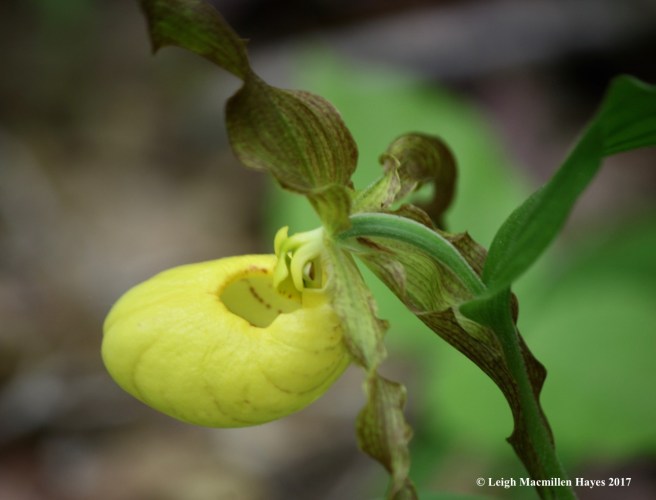
It’s those wet conditions that threw a friend and I off for a wee bit this afternoon as we tramped through the woods in search of a yellow lady’s slipper. Initially, we were about fifteen feet too far to the right as we tried to avoid the water.

r-lady 2

After wandering for a short bit, we finally found it on a bit of dry land–and then stood in awe–at our own ability to locate the flower, but even more so at the flower itself.  Yellow lady’s slippers are not rare, but uncommon and so we rejoiced with our find. They prefer mesic (moderately moist) nutrient-rich forests (as well as in bogs and swamps), thus the water (and mosquitoes–okay, so I broke my promise).

r-lady 7

Lady’s slippers are members of the orchid family.  I used to think orchids were flowers girls wore on their wrists for senior prom or grandmas coveted–though I never knew either of my grandmothers, but certainly it was an “old lady’s” flower. My, how my understanding and appreciation has changed because I am certainly NOT an old lady. Or am I?

Check out the reddish-brown dotted pathway–like landing lights at an airport runway. Their intention is to guide pollinators. If we remember to return in the fall and look for a seedpod, we’ll know that the dots worked. They often don’t.

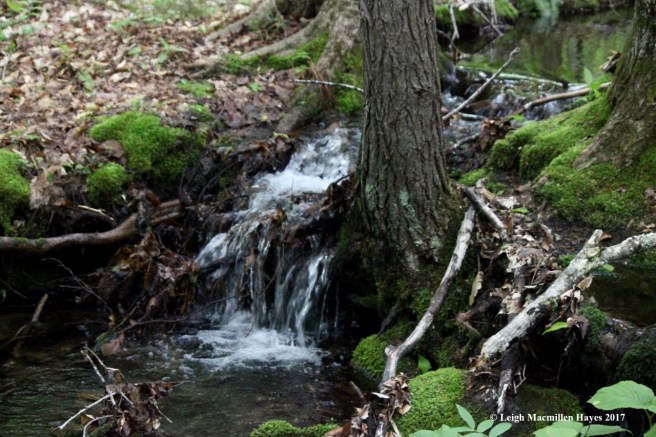
r-brook 1

We could have gone home then, so tickled were we with our success of finding that pouch of a flower, but . . . as you might expect, we continued on, making several brook crossings as we went.

r-brook 2

Everywhere, mosses and liverworts offered forty shades of green. Oh wait–that’s Ireland. But right now, it’s western Maine as well.

r-christmas fern 2

And because it was so damp, the forest we roamed was filled with Christmas ferns featuring young and old blades.

r-Indian cucumber Christmas fern

We even found one that sprouted an Indian Cucumber Root whorl as if it was a flower.

r-christmas fern gall

But what aroused our curiosity was another that seemed to have been affected by insects forming galls. Neither of us could remember seeing anything like this before, but then again, so many times when we see something we think of as new, we soon discover that it’s more prevalent than we realized. That being said, we only found the “galls” on a few of these ferns, all in the same area in a wet seep.

r-wild oat

Further along, we noted sessile-leaved bellworts, in flower a month ago, now sporting their seedpods or wild oats that speak to their other common name. And the leaf of at least this one had been visited by an insect–a leaf minor trail standing out in white against the green.

r-cannoddling craneflies 2

r-cannoddling craneflies

And then we found craneflies canoodling. They didn’t seem to care that we watched.

r-toad 1

They weren’t our only wildlife sightings (besides the mosquitoes–did I mention mosquitoes?). A young American toad hopped by, pausing ever so slightly to show off its raised warts.

r-frog 1

And a frog slipped into the water–the better to escape our ogling.

r-land of the cinnamon fern

As we wound our way around a wetland filled with cinnamon ferns, we noted a few flowers in bloom or about to bloom.

r-clintonia 1

Yellow clintonia,

r-jack in the pulpit 1

Jack-in-the-pulpit (times two actually–and I’m not sure how we spied these for they hid like trolls under their leaves),

r-Indian Cucumber flower

Indian cucumber root,

r-Early coralroot 2

and early coralroot caught our attention.

r-round-leaf pyrola1

Not yet in bloom was the round-leaf pyrola, aka American shinleaf. Oh darn, another reason to return and see it blossom.

r-red trillium 3

And just past its blossoming stage–red trillium,

r-red trillium 1

its red leached to almost maroonish brown and stamen looking rather gray.

r-Pam taking a photo of pyrola

Despite the mosquitoes (what mosquitoes?) and a few raindrops, we shared a fun afternoon hike circling the path of the Greater Lovell Land Trust’s Ron’s Loop by Five Kezar Ponds.

The journey was with my friend named Pam, not June. But June is the month and together we enjoyed numerous dandies that need to be enjoyed in the moment for soon we’ll not realize they ever existed.

June dandies indeed–worth making time to wander and wonder. (Despite the mosquitoes.)


Book of June: Bogs and Fens

My wish was granted when I asked for a copy of Bogs and Fens: A Guide to the Peatland Plants of the Northeastern United States and Adjacent Canada by Ronald B. Davis for Christmas.

b-bogs and fens cover

The idea for this book came from many years spent by Davis as a biology and Quaternary studies professor at the University of Maine and Colby College, plus his services as a docent at the Orono Bog Boardwalk in Orono, Maine.

Since I spend a lot of time tramping through a few favorite bogs and fens as well as visiting others, this seemed like the perfect guide to help me better understand the world of these special communities. And then I realized that on our own property grows some of the vegetation associated with these wetlands. With them right under my nose, what better way to learn?

Davis begins by describing the occurrence and indicator species of peatlands and then he goes on to give a lesson on the ecology of wetlands, including a description of peat, fens and bogs. A bibliography is provided for further reading and terms are defined.

What really works for me though, is the species descriptions, which he’s taken the time to divide into their various layers–trees, tall shrubs, short and dwarf shrubs, prostrate shrubs, herbaceous plants and ferns. Within each section, a specific plant is described, including its Latin name, common names, family, characteristics such as how tall it grows, number of petals, fruit, if any, etc., and its occurrence–whether in a fen, bog, dry hummock or other. All in all, he features 98 species, but also mentions 34 comparative species and includes an annotated list of 23 additional trees, shrubs, herbs and ferns that may grow in one or more community. And finally, the book ends with a description of pathways and boardwalks worth visiting.

b-sphagnum moss

And so this morning, I walked out back to look at our wetland, where the sphagnum moss’s pompom heads were crisscrossed by spider webs donned with beads of water.

b-sundew 2

It’s there that the round-leaved sundews grow, which I only discovered last year. Notice those bad-hair day “tentacles” or mucilaginous glands and the black spots upon the leaves. Dinner was served–in the form of Springtails or Collembola–their nutrients being absorbed by the plant to supplement the meager mineral supply of the sphagnum community.

b-sundew flower forming

And in the plant’s center, the flower stem begins to take shape. This summer, it will support tiny white flowers that will turn to light brown capsules by fall.

b-sheep laurel

Sheep laurel also grows in this place, its new buds forming in the axils below the newly emerged leaves. I can’t wait for its crimson flowers to blossom. Its flowers provide an explosion of beauty, and yet, danger lingers. This small shrub contains a chemical that is poisonous to wild animals, thus one of its common names is lambkill.

b-steeplebush leaves

Another short shrub is the rosy meadowsweet or steeplebush with its deeply toothed leaves.

b-steeplebush

Being only June 1st, it’s too early to flower, but last year’s steeple-like structure still stands tall in the landscape.

b-lowbush blueberries

Low-bush blueberries grow here as well and it’s only now that I realize I need to return and study these some more for Davis differentiates between velvet-leaved blueberries and common low-bush. I assumed these were the latter, but according to his description, the leaves will tell the difference. Apparently velvet-leaved, which I’ve never heard of before, feature “smooth-edged, alternate leaves, and bear fine, short hairs on the underside, edges and along veins of the upper side,” while low-bush leaves “have a finely serrate edge and a lack of pubescence, except rarely a sparse pubescence along the veins.” The next time I step out there, I will need to check the leaves to determine whether we have one or both species.

b-black chokeberry1

Of course, my favorite at the moment is the black chokeberry because the flowers provide a wow factor.

b-black chokeberry and ant

I’m not alone in my fascination.

b-water scavenger beetle larvae

Because I was nearby, I walked to the vernal pool, where a wee bit of sunlight highlighted another fascination of mine–my most recent discovery of water scavenger beetle larvae. Check out those heads and eyes.

b-tadpoles 1

Today, the tadpoles weren’t as shy as the other day and so they let me get up close and personal.

b-tadpoles 2

I’m holding out hope that the pool doesn’t dry up before they are able to hop away. Already, I can see their frog form beginning to take shape. This is a shout out to one of the Books of May: Vernal Pools–A Field Guide to Animals of Vernal Pools.

But back to the Book of June, and really the book of all summer months–Bogs and Fens by Ronald B. Davis. It’s heavy as field guides go and so I don’t always carry it with me, but it’s a great reference when I return to my truck or home. I appreciate its structure and information presented in a format even I get.

Bogs and Fens: A Guide to the Peatland Plants of the Northeastern United States and Adjacent Canada, by Ronald B. Davis. University Press of New England, 2016.

My copy came from Bridgton Books, my local independent book store.

At a Snail’s Pace

The mosquitoes were thick. The ground damp. But the rain held off and so four docents and I met at the Greater Lovell Land Trust‘s Flat Hill parking lot at the end of Heald Pond Road.

p-beaked hazelnuts forming

From the getgo, our fun began as we spotted numerous beaked hazelnuts forming–the trick is to pay attention to them and watch their continued growth, for in a flash, or so it seems, they’ll mature and . . . disappear. The nuts those hairy beaks cover are favorites for wildlife and we human folk also like them.

p-red trillium

Our mission was to get reacquainted with the spring flowers–some being obvious to us like the red trillium, though the fact that it was still in bloom offered a delightful surprise. We chatted about the fact that its also known as Stinking Benjamin for its undelightful odor, but try as we might and we did again today, none of us have ever been offended by it. Apparently, they smell like rotting meat, but you can’t prove it by us.

p-fringed polygala

Here and there we were awed by the delicate fringed polygala, aka gaywings. They did remind us of birds with crazy head dresses taking off in flight.

p-false solomon seal

As we shared brains and practiced relearning species before the next season gives us even more, we felt proud to quickly ID a false solomon seal, aka wild spikenard, before it had fully flowered. It’s the cluster of flowers on the end branch, the arching, zigzag stem and long oblong leaves that stand out in our minds.

p-Rose Twisted Stalk or Rosybells

A seal of another sort, the rose twisted stalk, aka rosybells, also adorned the trail. Pam held the stalk up so we could look at the bell-shaped flowers that dangled below.  Notice how the leaves are green below and stalkless but don’t necessarily clasp the stem–as opposed to twisted stalk (white mandarin), which features greenish flowers dangling below and stalkless leaves that do clasp the stem. Plus the latter’s leaves have a white bloom on the underside. We didn’t see any twisted stalk, but were tickled with our rosybell finds.

p-raindrops all in a row

Periodically, we stopped to examine ferns, or quiz each other on the ID. But sometimes, it was just fun to notice presentations, including raindrops all in a row.

p-beech fern

And though a couple of our fern experts couldn’t be with us, Joan was and she loves nothing more than squatting beside them with the Fern Finder to determine a species, including the long beech fern.

p-clitonia 2

It was while looking at bracken ferns that Mary and Nancy spotted the greenish yellow flowers of clintonia. We were excited because we’d seen plenty of plants, but these were the first in flower, and they were well hidden.

p-clintonia flowers

Yellow clintonia is also called bluebead for the fruit that develops is a porcelain blue bead-like berry. Check out those pistils (she’s a pistil) dangling below the stamen, their anthers coated in pollen. Bring on the bees and the beads.

p-baby toad

Suddenly, we discovered movement at our feet and saw our first baby toad of the season. It’s diminutive size and obvious camouflage made it difficult to see, but unlike the adult members of its family who will freeze in position, thus allowing us to study them further, this little one wanted to escape as quickly as possible. Smart move on its part.

p-bench view

Only about two hours later we’d covered maybe a half mile and found our way to the bench that overlooks the swampy area surrounding the brook between the beaver pond and Bradley Pond.

p-red maple leaves

We sat below a red maple and listened to a chorus of birds–and gave thanks for the food supply. Let them eat bugs. We offered up a few mosquitoes.

p-red-winged blackbird

A red-winged blackbird flirted with us, showing off its bright red shoulder and yellow wing bar as it flew from shrub to shrub. The five of us swooned.

p-Indian Cucumber pre-flower

All along the path, we’d spotted Indian Cucumber Roots with their buds formed atop the second layer of their double-decker formation. When we finally stepped from the bench back to the trail, we noted a couple of the buds were beginning to dangle below the second story, meaning the blossoming season would soon be upon us.

p-Indian Cucumber flower 2

And just like that . . .

p-Indian Cucumber flowering

Voilà. I’m of the belief that if this flower doesn’t make you wonder, nothing will.

p-beaver pond view

Our next stop was at the bridges that cross below the beaver pond. We’d been looking for fresh beaver works all the while, but only discovered the work that had been completed over a year ago.

p-royal fern crown

There was still plenty to see, including the fertile crowns atop royal ferns,

p-jack-in-the-pulpit 2

a small jack-in-the-pulpit,

p-mayfly hitchhiker

and a mayfly that chose Pam’s jacket to rest upon.

p-foamflower 1

One of our many finds included foam-flower, with its cluster of star-shaped white flowers and conspicuous stamens. According to Mary Holland in her book, Naturally Curious Day by Day, “Its genus name, Tiarella, is the Greek word “tiara,” a word for a turban worn by ancient Persians which bears some resemblance to the shape of this flower’s pistil.”

p-foamflower carpet

Tiara or not, we were quite taken with a carpet of it.

p-snail

Those were only a few of the findings we saw as we moved at a snail’s pace during our three hour tour along Perky’s Path. Each time we visit, we say, “This is my favorite property.” That is . . . until we visit another one of the GLLT properties.

May(be) a Mondate

We headed out the backdoor, into our woodlot, down the cowpath, along the snowmobile trail, veered left behind the church, walked down a driveway, crossed the road and snuck into Pondicherry Park.

p-NOrway maple and samaras

Or so we thought, but as we stood below this Norway maple with its widely-divergent two-winged samaras, a familiar voice hailed us. Our friend, Dick Bennett, appeared out of nowhere (well, really from somewhere–for like us, he lives nearby and uses these trails frequently to get to town) and so we chatted briefly. He was on a mission and we were headed in a different direction along the multi-layered loop system.

p-crossing the field

Within minutes we followed the path out of the woods and across the field–prepared as we were for rain. Our plan was to retreat when it started to pour.

Once we entered the woods again, we heard a barred owl call from the distance with its infamous “Who cooks for you?” “Our oldest son and his girlfriend,” was our response for they had surprised us this weekend with a visit and prepared last night’s meal.

p-foxhole debris

For the most part we stuck to the trail system, but then we stepped over the wall onto the Lake Environmental Association’s Maine Lake Science Center property because I wanted to show my guy this pile of dirt and stones.

p-fox hole

On a recent bushwhack with a few others, we’d discovered this fox hole and I immediately recalled all the fox tracks and seeing a red fox this past winter not far from this location.

p-boardwalk1

After poking about for a few minutes, we made our way back to the LEA trail and eventually landed at the boardwalk that weaves through a wetland. From there, it was back through the woods to the park trails. I know my guy wanted to move quickly, such were the bugs, but I wanted to take everything in and so he patiently waited from time to time.

p-Canada mayflower

After all, there were visions in white exploding with glory in the form of Canada mayflowers,

p-foamflowers

foam-flowers,

p-wild sarsapirilla

and wild sarsaparilla.

p-gaywings

We also feasted our eyes on visions offering the purplish hue of gaywings, aka fringed polygala.

p-fern stream

And then there were the ferns.

p-cinnamon fern fertile frond

The fertile stalks of cinnamon ferns shouted their name,

p-royal fern

while the royal ferns were much more subtle–

p-royal fern fertile fronds

their fertile crowns practically blending into the sterile fronds.

p-chipmunk

At the chimney by the amphitheater, a chipmunk paused to ponder our intentions and then quickly disappeared.

p-Stevens Brook

We followed the river trail to the Bob Dunning Bridge and noted all the shades of green beside Stevens Brook.

p-boxelder samaras

And then there were other sights to see, like the boxelder and its samaras. Its common name refers to the resemblance of its leaves to elder trees and the use of the soft wood for box making. Its also our only maple with compound leaves. And the samaras differ greatly from the Norway maple we stood under at the beginning of our walk–for the boxelder’s winged seeds more closely resemble upside down Vs or peace signs.

p-catbird 1

As is often the case when stopping by the bridge, the catbirds who nest in the undergrowth paused beside the brook during their foraging expeditions.

p-caterpillars on maple leaf

Nearby, we saw some food meant for them–a colony of Eastern tent caterpillars consuming maple leaves right down to the veins. It seemed like it was time for some units of energy to be passed along the food web.

Besides the wildlife, our only human encounters included a relative crossing the bridge on his way home from work and our friend Dick, whom we’d seen at the start.

For various reasons, May has been devoid of dates and so today’s adventure, though not long, served as our only Mondate celebration for the month–no maybes about it. And it never did rain.


This Land Is . . .

My land. I’m sure of it. I don’t own it all, but I walk it often because it’s not posted and I know it well. Well, only just so well. It’s constantly offering me new learnings.

o-Mt Wash

And so once again, out the back door I ventured, intending to head north toward the land of snow–haha. My sister asked the other day if we still had snow. We don’t have any on our land, but this is our view from the power line right of way–yup–we’ve got snow ;-) (in our view).

o-tick

I changed my mind about the direction, however, when I saw numerous dog ticks on the tips of grass as I crossed our neighbor’s field. Though they aren’t the purveyors of diseases such as Lyme disease, Babesiosis, and Anaplasmosis, seeing them still unnerved me and I decided to head in the opposite direction where it isn’t so grassy. Of course, that’s where the deer ticks live. Nightly tick checks are a must every day.

o-early yellow rocket 1

It was in the opposite direction that I was caught by surprise. Behind a local business, where the land had been disturbed a year ago, a wall of yellow greeted me.

o-yellow rocket 3

It was a sea of early yellow-rocket that is common along roadsides and fields. Apparently this one spot was the cat’s meow for it to grow so prolifically.

o-bee 3

What was more prolific–the sound.

o-bee 1

Bees and other insects hummed as they worked,

o-bee 2

filling their pollen sacks to the brim.

o-fritillary 1

Even a fritillary butterfly enjoyed the goodness within.

o-fringed 2

Those weren’t the only wings I saw. It was a complete surprise to also discover gaywings or fringed polygala growing deeper in the woods.

o-turkey print

Walking along, I flushed a couple of deer and a ruffed grouse. And though I didn’t see or hear any turkeys, I knew they’d been there by their signature prints.

o-tadpole 1

And then I slipped off the trail to stop at a vernal pool that I don’t often visit. The water is shallow, but tadpoles are growing.

o-tadpole 2

A week or two ago after they’d just emerged, they were easy to spot as they clung to their egg masses or swam by water’s edge. But they are maturing and I had to stand still or they’d disappear under the leaf cover.

o-water scavenger larvae

While standing there, I spotted another resident I didn’t immediately recognize–the larval form of a water scavenger beetle. According to A Field Guide to the animals of Vernal Pools,  “they are poor swimmers and will hang from the water surface (where they obtain oxygen) or hide in vegetation to await prey.” That all makes sense given their body structure.

o-sugar ant?

On the way back, another insect stopped me. I think they were sugar ants with a white thorax. But why were they on beech leaves? Then again, every insect seems to like beech leaves. I guess I don’t think of them as being sweet, but . . .

o-old gate in wall

As I headed home, I paused by an old wall and gate. This land was farmed in the late 19th and early 20th centuries. The walls formed boundaries for animals and are owned by numerous neighbors I’ve never met. Thankfully, they let me and others cross–though few will do so until hunting season begins in the fall.

Anyway, it all got me thinking about who owns the land. And then I knew the actual answer. The plants. The trees. The flowers. The insects. The amphibians. The birds. The mammals. They all own the land. We are mere visitors. I thank all of nature for letting me trespass and gain a better understanding of its various life forms.

This land isn’t my land. And it wasn’t even made for you and me. But I have great reverence for it. And for those who have protected it.

Happy Memorial Day.

Sharing My Site

I count myself among the fortunate because pollen doesn’t keep me inside during its high season. Nor do the bugs or rain. Mind you, I do my fair share of complaining–after all I am human. At least I think I am, though I was honored to be called an ent yesterday. (Thanks Cyrene.)

Enough of that. Let’s head outside to see what we might see.

IMG_5267

True confession. I took this photo yesterday, but didn’t have time to write. Finding this jack-in-the-pulpit beside a granite bench by my studio was a complete surprise.

IMG_5741

Today’s journey began in the front yard where sugar maple samaras dangled below full-grown leaves. Their presence will soon offer presents to the world below.

IMG_5302

My next stop was beside another secret giver of gifts–blueberry flowers.

IMG_5301

And then I stepped into the woodlot, where a single striped maple which was the bearer of a deer antler rub last year and scrape (upward motion with lower incisors) this past winter, had something else to offer.

IMG_5480

Below its almost dinner-plate size leaves–flowers. Happy was I to find these little beauties.

IMG_5287

Perhaps . . . just maybe . . . there will be more striped maples offering their bark to those in need.

IMG_5517 (1)

Moving along, I stopped at the opening of the cowpath to admire baby hemlock cones when something white and bubbly caught my attention. My first spittle bug sighting of the year. An adult spittlebug whips up some slimy froth to cover its eggs in late summer and the nymphs cover themselves while feeding in the spring–and so I concluded that I was viewing a nymph’s locale.

IMG_5327

Emerging under the power lines, the community changes. It’s here that the land is especially wet and species one might find in a bog grow–such as the black chokeberry shrub. These also like rocky ledges, but such is not the case in this spot.

IMG_5532

I was thankful to find it for those flattened bright pink anthers brightened this damp day.

IMG_5696 (1)

Heading north, I sloshed through the deep puddles on a quest to find the sundews I discovered growing in this area for the first time last fall.

IMG_5703

No such luck, but I did welcome the sight of the candy lichen fruits exploding from their crustose base. And then . . . and then . . . what did I see (but only when I looked at the photograph on my computer, and so now I know where they are located)? The round-leaved sundews–do you see them in the bottom right-hand corner? These are carnivorous plants (think Venus Flytrap) and their prey consists of small insects. Already, I can’t wait to make their acquaintance again.

IMG_5583

I turned around and headed south–on my way to the vernal pool. But before passing through a stonewall, I had to look at the bunchberries in bloom.

IMG_5581

Normally, a bunchberry plant has two-sets of leaves. But . . . when one is mature enough to grow a third set, typically larger leaves (perhaps to capture more energy) than the first two sets, it produces four white bracts that we think of as petals but they are actually modified leaves. The flowers are in the center–tiny as they are.

IMG_5680 (1)

And because I was in the neighborhood, in the land of mosses, reindeer lichens, Canada Mayflowers and wintergreen, trailing arbutus (aka Mayflower) spoke up. Its flowers were slowly transforming from white to rust and I shouldn’t rush the season, but I can’t wait to see its fruit again.

IMG_5586

At last I reached the vernal pool and realized I wasn’t the only visitor. What perfect hunting ground it proved to be for the . . .

IMG_5593

phoebe. I cheered for its insatiable insect appetite.

IMG_5596 (1)

Because the day was dark, it was difficult to see tadpoles, but I did note that many spotted salamanders were still forming. I also noted that the water level has dropped a wee bit–hard to believe–and where yesterday I found a few egg masses a bit high and dry, today they were gone. Something enjoyed eggs for dinner.  Scrambled or otherwise, I’m not sure.

IMG_5625

Back on the trail and at the next stone wall, interrupted fern showed off its fertile pinnae near the middle of the blades. It’s called interrupted because of the interruption in the blade. Again, this is an inhabitant of moist to wet forests and so it was no surprise to find it growing there.

IMG_5609

A fertile blade, such as this, may have two to seven pairs of middle pinnae.

IMG_5619

The globose sporangia is bright green when young, but darkens to tan or black as it matures.

IMG_5362 6.10.27 PM

On the other side of the wall, I spied some more flowers.

IMG_5360

These were the elongated loose clusters of black cherry trees, that open when the leaves are fully developed.

IMG_5636

One that flowers and fruits before its leaves are fully developed is the red maple.

IMG_5630

And fruits and fruits . . . need I say more?

IMG_5375

Though the wind blew, the samaras weren’t yet ready to let go and set down their roots. It won’t be long though, I’m sure.

IMG_5403

Finally returning home, I passed by the granite bench once more and was still stymied by the site I saw about a half hour after discovering the jack-in-the-pulpit yesterday.  It had been consumed. I suspected the woodchucks that live under the studio. Either that or a bear came along and I missed it.

And so ended today’s tramp. Thanks for traipsing along with me to visit these sites out our back door. I especially welcome those who are homebound with allergies, like my friend Jinny Mae. She gave me the inspiration to take a look today–to be her eyes for the moment and share my sight.

On the Rocks at Pemaquid Point

Yesterday dawned cool, sunshiny and slightly breezy–the perfect day for a 2+ hour drive and an outdoor exploration. And so I had the extreme pleasure of joining a small group of naturalists for a geology lesson offered by one of our colleagues, Denise Bluhm, at Pemaquid Point in mid-coast Maine.

p1a-Pemaquid Point Lighthouse

The lighthouse is one of 57 still active along the Maine coast and it’s this very one that is featured on the state quarter. It was manned from 1927-1934, but has been on automatic ever since.

p2-Pemaquid Point on map

But that wasn’t our focal point. Instead, we’d gathered to learn about the rocky coast below. After reviewing the definition of mineral (naturally occurring solid, distinctive physical properties, e.g. cleavage, hardness, crystal form and color, and characteristic chemical formation) and rock (one or more minerals together, aka mineral soup), Denise pulled out a geologic map of Maine and pointed to our location.

p3-map :Brunswick formation direction

She then oriented us northeastward and helped us understand that we were standing on what is known as the Bucksport formation, a deposit of sandstone and mudstone metamorphosed into a flaky shist. And then she took us through geological history, providing a refresher on plate tectonics and the story of Maine’s creation–beginning 550 million years ago when our state was just a twinkle in the eyes of creation.

p4--do you see the fold?

Stepping below the lighthouse, Denise asked if we saw the fold. I thought I knew what she pointed to, but . . .

p5-layers in beds

it took more of her insight to fully form the picture for me. The metamorphic rock, it turns out, is on its side due to intense pressure in its long-term history and thus we could examine its layers, much like the rings on a tree. That doesn’t mean I could age it, but just understand that over time various pressures and results of heating and cooling events caused the variation in color and mineral size of the bands. Lighter gray=sand and silt (composed of sea sediments), Medium gray=quartz, feldspar and biotite mica (black). Darker gray=more biotite. Greenish-gray=limy sand and silt. Rust=iron. All of it equals a gneiss (nice) or layered formation with foliation.

p6-zigzag

I think one of my favorite learnings came from the sills and dikes that show their faces throughout the rock. Sills are parallel or perpendicular intrusions while dikes run off parallel. And this particular dike featured a zigzag created by a continental collision. The Z-fold, as she referred to it, was caused by a right lateral shear. Who knew?

p9-first fold understanding

My understanding of the first fold Denise had pointed to began to develop more fully when she pulled out a geological compass and measured the angle of the rock to the left and then we could see the same angle on the far right and suddenly in my mind’s eye was the arc that has since eroded. With that came the new knowledge that more moons ago than my brain can comprehend, mountains reached six miles above and natural forces had eroded their 12,000-foot structures.

p10-dike to lighthouse

We crossed the rock from feature to feature, occasionally looking back at the lighthouse to note characteristics, such as the igneous dike (lighter color) that cuts across the metamorphic rock and leads to the buildings. Being made of granite, it offers a solid foundation for the tower.

p11-Denise on fold

And then our great leader led us to her favorite feature–the greatest fold in Maine.

p11a-the fold

Though the rocks were originally horizontal in nature, intense pressure and heat at some point in their lifetime forced such folds.

p12-everyone on fold

It was worth a photo call for Denise, Sharon, Judy, Karen and Penny–all sharing a brain with me for the day.

p13-the big dike

From there, we had a great view of the large granite-topped sill that is harder and thus more resistant to erosion.

p14-sunburst lichen

As we made our way back across to it, we paused to look at quartz, feldspar and biotite mica–but lichens such as the sunburst also caught our attention.

p15-lichen disks

Don’t tell Denise. But do check out those fruiting bodies–the apothecia.

p16-fold looking toward lighthouse

Suddenly, our eyes and brains recognized the fold formation throughout.

p19-Karen at dike

At the huge sill, Karen posed to give a sense of height. (Ignore photo light)

p22-bucksport layers

And then we looked at its structure–metamorphic below and granite pegmatite with huge crystals above.

p23-swirls

We noted swirls and imagined silly putty (invented in a barn in my hometown of North Branford, Connecticut).

p24-under the sill

And stood in awe of life.

p25-large crystals

I mentioned the large crystals–evidenced here. Far larger than the 2.5 centimeters that defines a pegmatite.

p26-Denise again

Denise showed us some popcorn migmatite and how the schist and pegmatite formed together.

p29-igneous rock formation 2

One of our next stops was atop a jetty–so different in structure. This is an example of an igneous rock intrusion created deep underground.

p30-trough of a syncline

To its side we could see a trough–known geologically as a syncline.

p33--garnets

Through her eyes, we spotted red specks of garnet.

p33--buodoin--sausage 1

And began to understand the pinching and swelling from compression and shearing to the Northeast that formed sausage-shaped boudins.

p31a--pressure formation

Closer to the lighthouse, we noted the isoclinal folds Denise referred to as S-folds (compared to the Z-folds we’d seen earlier).

p35--view

Before the day began, this was a great example of the rocky coast of Maine.

p36--view from lighthouse

But when we climbed the lighthouse tower after our lesson, we looked below with brand new eyes and understandings (and still so much more to learn and wrap our brains around).

Thankful were we for our day spent in wonder on the rocks at Pemaquid Point with Denise.


Walking with Ursula

No matter when or where I walk, Ursula Duve is always along. She sees what I see, smells what I smell, feels what I feel, tastes what I taste and knows way more than I’ll ever know.

h-Ursula 2

And so it was today that a bunch of us followed this delightful little woman as she led us down the trail at Lakes Environmental Association’s Holt Pond Preserve.

h-sign

We gathered in the parking lot, where the black flies tried to swallow us whole. But, we got the better of them and practiced mind over matter. Of course, bug spray and our flailing arms helped–or at least made us feel as if it was worth the effort.

h-wild oats 1

After an introductory greeting from LEA’s teacher/naturalist Mary Jewett, we stopped frequently as Ursula shared stories of plants and life. You see, she was born in Hamburg, Germany, and grew up during WWII so she has quite a few memories flowing through her system, but as she reminded us, with the bad comes the good. And the good comes from moments she associates with wildflowers, like this bellwort.

h-painted trillium

Having lived in the United States for 50+ years now, with the last nineteen in Maine, Ursula considers herself a Mainer despite her German accent because she loves it here. And she knows when and where each flower will bloom, such as the painted trillium.

h-chokeberry buds

Even those not yet in bloom drew her attention–this being a chokeberry along the first boardwalk.

h-pitcher 3

One of the finds Ursula enjoys sharing with others is the pitcher plant, a perennial herb with pitcher-shaped leaves. We noted that this particular one sported new flower buds.

h-pitcher flower

And on another, the otherworldly shape of last year’s now woody flower capsule–its job completed.

h-pitcher plant 1

Ursula is as awed as I am by the power of the pitcher plants. Color, scent (that I’ve never smelled) and nectar in glands near the top of the pitcher leaf attract insects. Once inside, those downward-pointing hairs make it difficult to leave. So what happens next? The insect eventually drowns in the rainwater, decomposes and is digested by the plant’s liquid, which turns phosphorus and nitrogen released by the insect into supplemental nutrients for the surrounding peat. Interestingly, no “joules” or units of energy are passed on through this process to the plant itself. The plant gathers its energy through the process of photosynthesis instead.

h-rhodora 1

As we continued, we were wowed once again–this time by the sight of the showy rhodora. Rhodora flowers fully before its leaves emerge and so today they were but small nubs located alternately along the shrub’s branches.

h-rhodora 3

But those flowers–oh my! The rose-purple bloom has what’s considered two lips–with the upper consisting of three lobes and the lower of two. And each produces ten purple-tipped stamen surrounding the pistil, where the pollen will germinate into a many-seeded capsule.

h-leatherleaf

Like the rhodora, another member of the heath family in bloom was the leatherleaf–with bell-shaped flowers formed in leaf axils and dangling below the stem as if it was laundry hung out to dry. One way to differentiate this plant from the highbush blueberries that can be found throughout the preserve, are the alternate, upward-pointing leaves, which decrease in size as your eye moves toward the tip of the stem.

h-honeysuckle 1

Just before we stepped out onto the Quaking Bog boardwalk, Mary pointed out a native honeysuckle. In my memory bank, I couldn’t remember ever seeing it before, and if I had, well . . . I was glad to make its acquaintance again.

h-green frog 2

And then we stepped onto the boardwalk. Folks up front paused to admire a green snake, while those of us in the back noticed a green frog. It stayed as calm as possible in hopes that we wouldn’t see it. Nice try.

H-Holt Pond

Like all ponds and lakes right now, the water level remains high and so walking the boardwalk meant wet hiking boots.

h-quaking bog 2

But that didn’t stop some of us. Fortunately, mine are waterproof.

h-green frog

Just before we stepped from the boardwalk back onto land, I saw that the frog was still there.

h-hobblebush flowers 1

On the trail again, another showy flower called for our attention–hobblebush.

h-hobblebush 1

While some looked fresh, others were beginning to pass and their fruits will soon form. We noted the sterile outer blooms that surround the inner array of small fertile flowers. And a beetle paying a visit.

h-Mayfly1

Speaking of insects, a slight movement on the ground pulled us earthward.

h-mayfly 2

We’d found a Mayfly–perhaps just emerged and its wings drying.

h-Indian Cucumber root 1

In the last wooded section we would cover for the day, we noticed that the two-tiered Indian Cucumber Roots have a few buds. I can’t wait for them to flower soon.

h-goldthread 2

Among the flowers that I’ll always associate with Ursula because she’s the first to have introduced me to them, is the goldthread, so named for its golden-colored root. We usually identify it by its cilantro-shaped leaves, but right now the dainty flowers are not to be missed. What looks like petals are actually sepals and there can be five to seven of them. And stamen–many. Goldthread can feature 5-25 stamen.

h-goldthread 3

Even the number of yellow-and-green pistils can vary from three to seven. Ah nature–forever making us think.

h-dwarf ginseng 1

The other plant I associate with Ursula is dwarf ginseng. Its explosive umbel consists of many flowers. And in this one, a dining crab spider.

h-spring tail wave

Finally, we found our way to Grist Mill Road and headed back toward the parking lot. But even on the road we found something to wonder about when one member of our group pointed to the curvy black design. In the past, I’ve always dismissed it as some sort of mineral associated with the dirt.

h-spring tails on sand1

Today, I learned it was none other than those good old spring tails or snow fleas we associate with late winter, but are really present all year. Something new to notice going forward.

h-Ursula1

At the end of our walk we all gave thanks to Mary and Ursula. We’d come away with refreshers and new learnings.

And we’d been reminded by Ursula that though she and her husband, Wolfgang, can no longer get out as often as they’d like, after sixty years of marriage they still have fun reminiscing about their many explorations together. A goal for all of us to set.

Most often this wildflower and bird enthusiast walks vicariously with me as she reads my blog entries, but today it was my immense pleasure to walk with her. Thank you, Ursula, for once again sharing your love of all things natural with the rest of us . . . and your optimistic philosophy of life.

Oh and a question for Wolfgang, while Ursula walked with us, did you get on the treadmill?

April Showers bring . . .

May showers!

v-green yard

It feels like it has rained every day for the past week, but the grass is certainly green.

v-pool (1)

And the vernal pool full. Between today’s downpours I visited it a couple of times, so excited by my findings.

v-wood frog eggs developing

The wood frog eggs had turned green with a symbiotic algae and I could see the tadpoles developing inside.

v-tadpoles 2

The green coloring made the their eggs contrast with the salamander masses. I was thrilled to see movement among the green and realized that . . . drum roll please . . .

v-tadpoles 6

my babies were slowing hatching. Of course, they are mine–even though the frog pond is located on a neighboring property. I’ve been an expectant mother for several weeks, and now . . . I’m nervous about the future, as any parent would be.

v-tadpoles 1

Will my babies survive? Will they have an opportunity to transform into their terrestrial forms?

v-tadpoles 7

Or will the pond dry up too soon as it has the last few years? I guess I’ll be forced to continue to stop by. Oh darn! One thing I have noted since the ice melted: I’ve yet to see a predacious diving beetle and there are hardly any mosquito larvae flipping about. That’s good for the tadpoles on one end of the spectrum and not so good on the other. To be food and to eat food.

v-sallie eggs 1

I also wondered, will the  white and opaque masses of the spotted salamander eggs turn green like they are supposed to–also dependent on a symbiotic algae?

v-hole 4

After checking on my wee ones, I walked the pond’s perimeter and noticed activity at a spot I’ve been keeping an eye on in the southwest corner. Well, not current activity, but recent. For the first time this year, a hole has been excavated.

v-hole 3

It’s the same hole that was excavated last year. Darker debris was piled in front.

v-hole1

At about three or so inches across, I wondered who owned it. Too small for foxes, and certainly too wet. Too big for chipmunks and a dirty dooryard. Could it be a mink? Do they leave a messy dooryard? I found the same hole excavated last year, but never any other evidence of the maker. I’ll continue to check for any other signs.

v-raindrops

My eyes reverted back to the pool, where raindrops and reflections created an artistic display.

v-maple dust lichen

And then I pulled myself away, frozen were my fingers. The greenness of the world continued to show its face everywhere I turned from the maple-dust lichen to . . .

v-white pine

young white pines, their candelabras growing long,

v-maple leaf and samara

red maple samaras upon old leaves,

v-cherry 1

and cherry flowers developing.

v-mayflower1

What do April showers bring? Mayflowers (trailing arbutus), of course,

v-Canada mayflower 2

Canada mayflowers,

v-tulip 1

and garden May flowers.