Peace on Earth

One touch of nature and it seems to me we’d be able to achieve world peace, that idealistic concept of happiness, freedom and cooperation among all peoples and all nations.

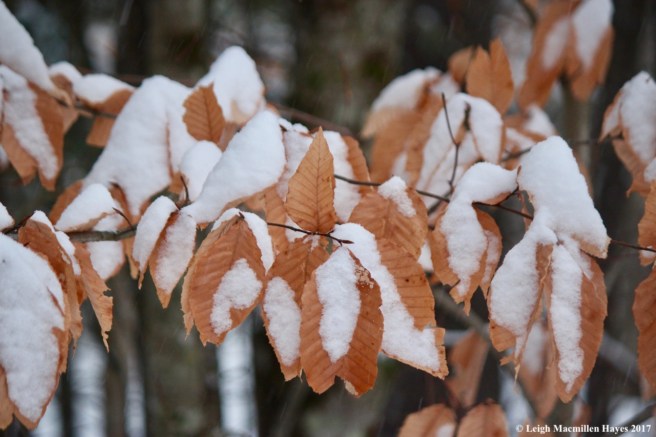
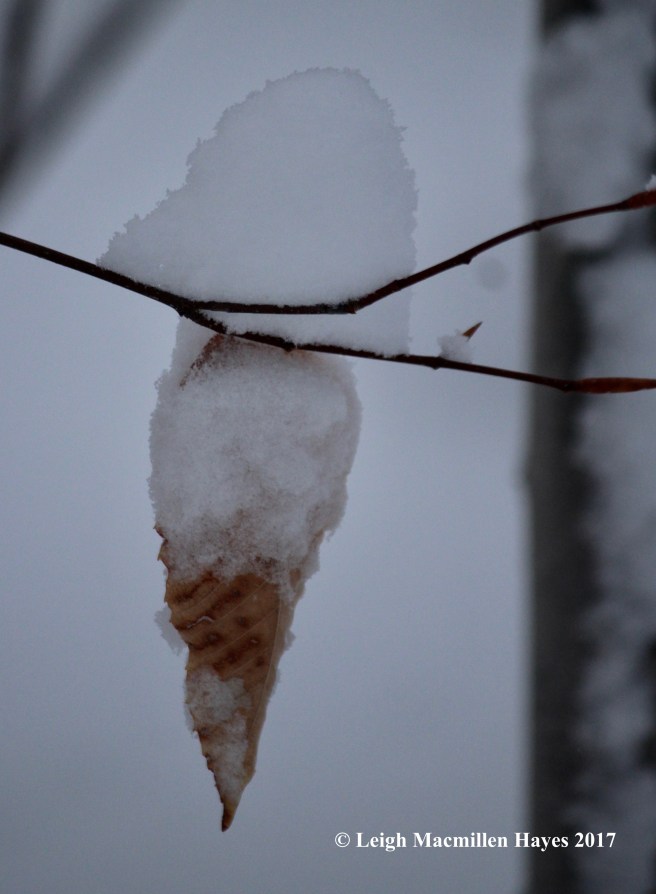
o-ice on beech leaves

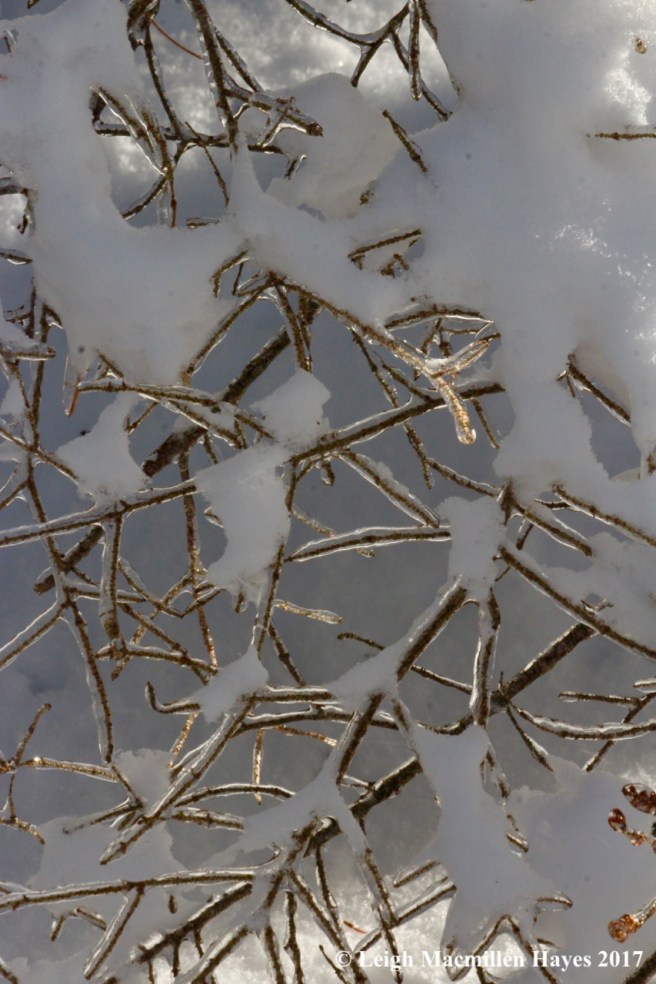
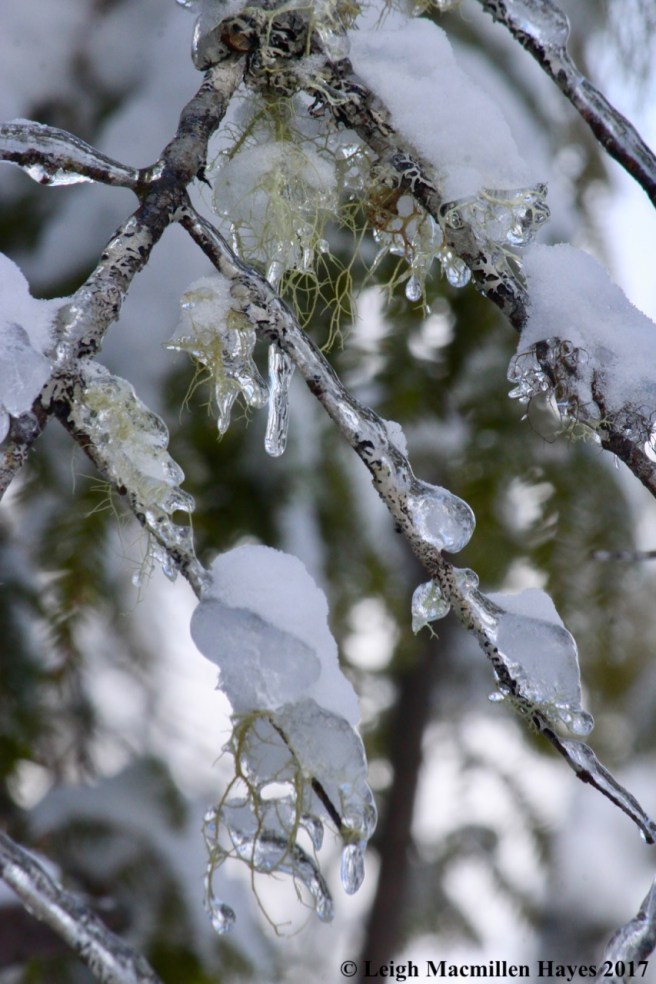
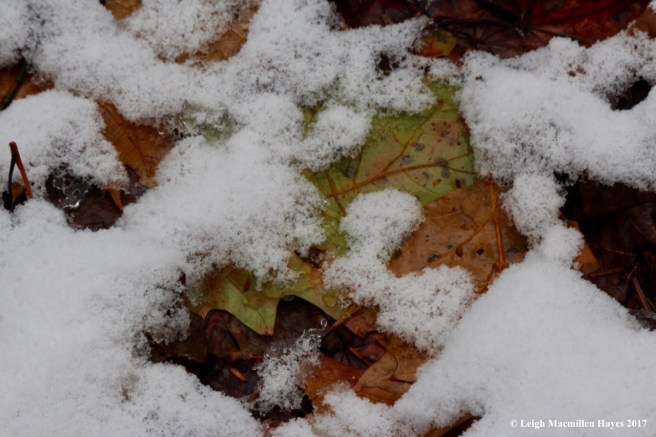
On a frigid winter day it would be extraordinary if only we could encourage more people to step outside and observe the beauty of the natural world. Of course, all would need to be  dressed for the conditions so they felt comfortable, and appropriately equipped so they could travel with some ease, and . . . and . . .  and. But still, surrounded by leaves blanketed with snow, and icicles extended like fingers reaching out to others, how could anyone resist sharing a collective awe.

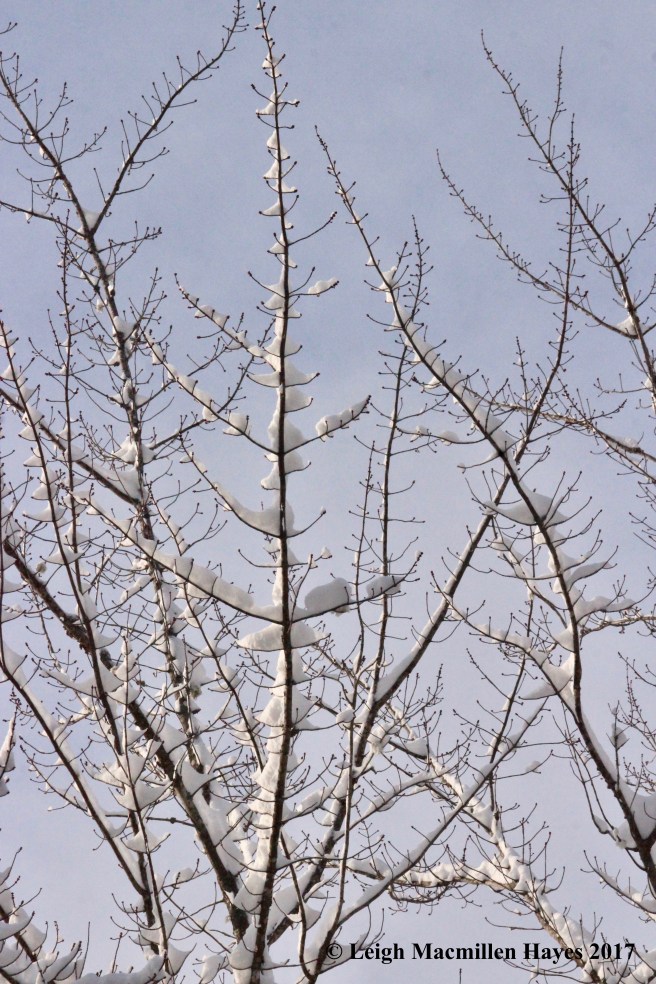
o-ice and snow illuminated by sun

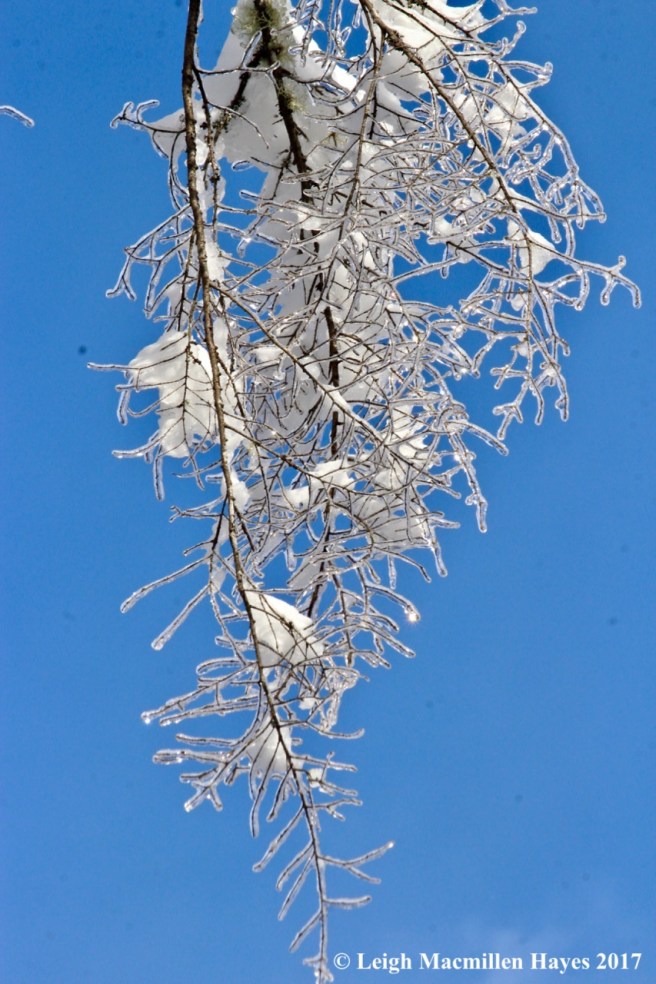
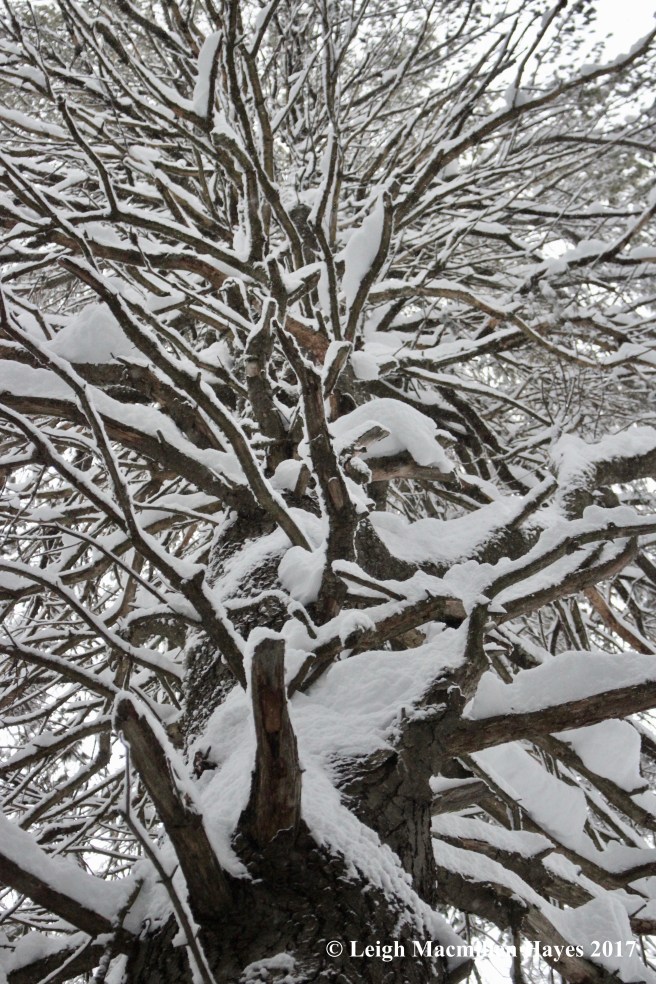
Snow and ice and more snow. And suddenly, the world transformed and branches intertwined in ways we’ve not seen before and the same could be true for all of us. Perhaps the key is to figure out how much snow and ice and snow creates such interesting intersections. And how we can do the same–make interesting interactions.

o-ice on pine like Hawaiian grass skirts

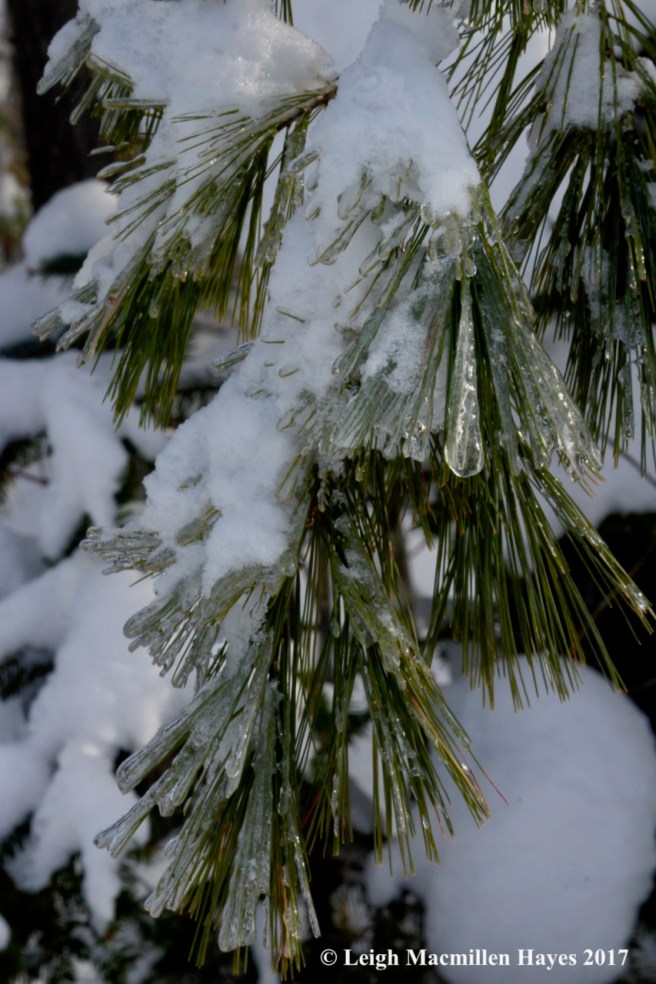
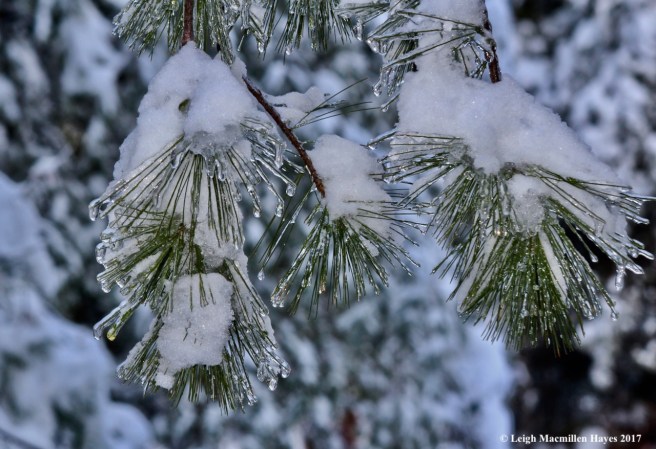
Be they conifers wearing grass skirts,

o-birch catkins enclosed

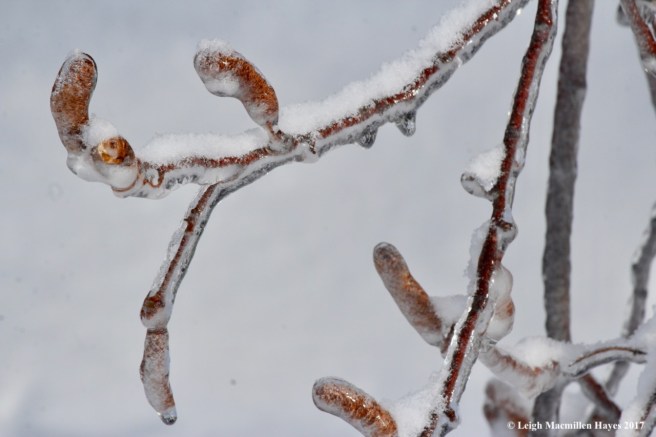
or catkins wrapped in union suits, nothing went untouched in the Christmas weekend storms.

o-ice on maple

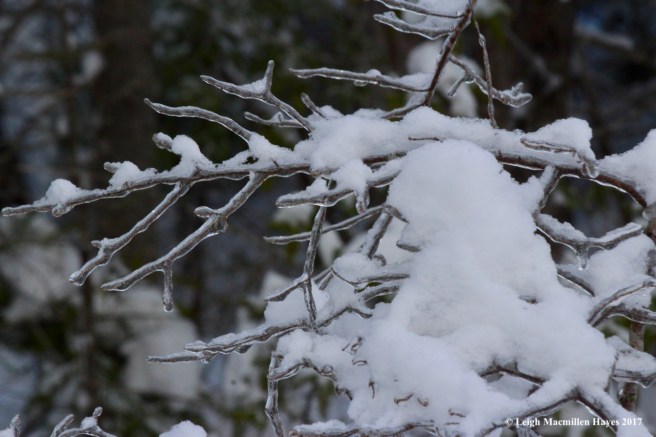
Frozen condensation clung . . .

o-ice drips

in various formations and reflected all sort of colors.

o-ice on usnea lichens

I wished I’d seen it all transpire. But I wasn’t able to until today and then, I was grateful for the opportunity and wonder of it all. I traveled alone, but in perfect hind sight, wish I’d invited another to join me.

o-ice above

To rejoice in those sparkling high above . . .

o-gray birch arches

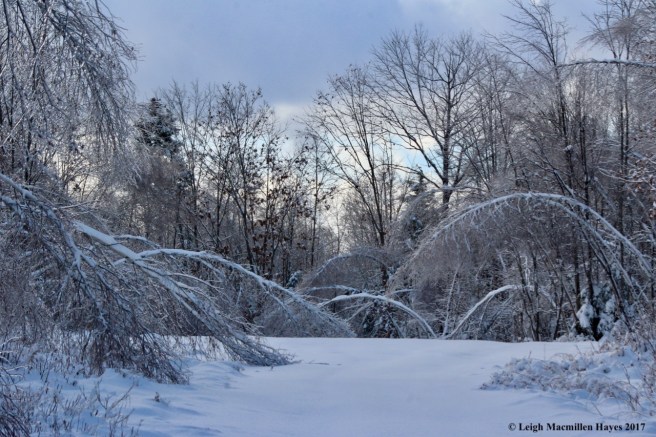
and appreciate the burden of others bending low.

o-gray birches meet in the middle

To recognize new dance partners in the midst.

o-ice on pine finale

One step at a time. One look. One touch. One acknowledgement. One smile. And then two smiles. And three. And four. And many more.

Peace on Earth.

One touch of nature makes the whole world kin.

~William Shakespeare


Unexpected Gifts

While vegetables roasted in the oven for the black bean soup that will be consumed during our Christmas gathering, I stepped outside to get some fresh air on this snowy day.

c-junco and cardinal

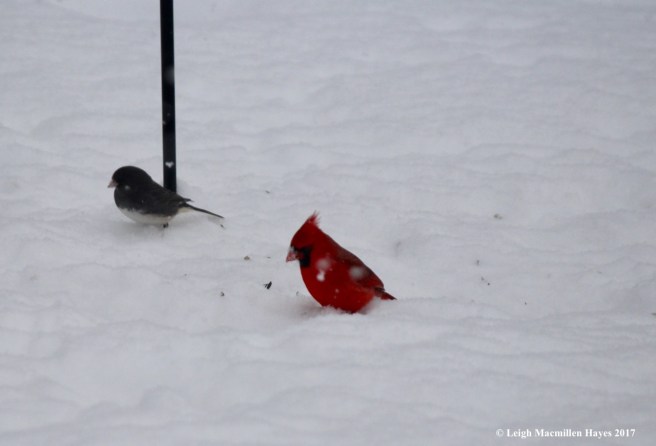
The bird feeders and ground beneath are always more active during storms and today was no different. At least forty juncos accompanied by one white-throated sparrow have been repeat feeders and occasionally the male cardinal invites his female friend along. Tufted titmice, goldfinches, chickadees, a downy woodpecker, nuthatches and bluejays rounded out the flock.

c-into the woods

Though conditions are expected to change by morning, with an ice storm in the forecast, today’s gift was fluffy and light as it embraced me in silence.

c-hemlock baubles

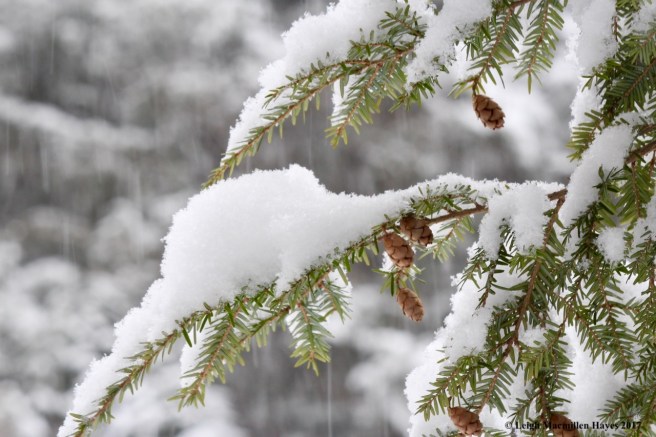
Because of that fluffiness, it built up quickly, bedecking branches with puffy clouds of white.

c-star-flake

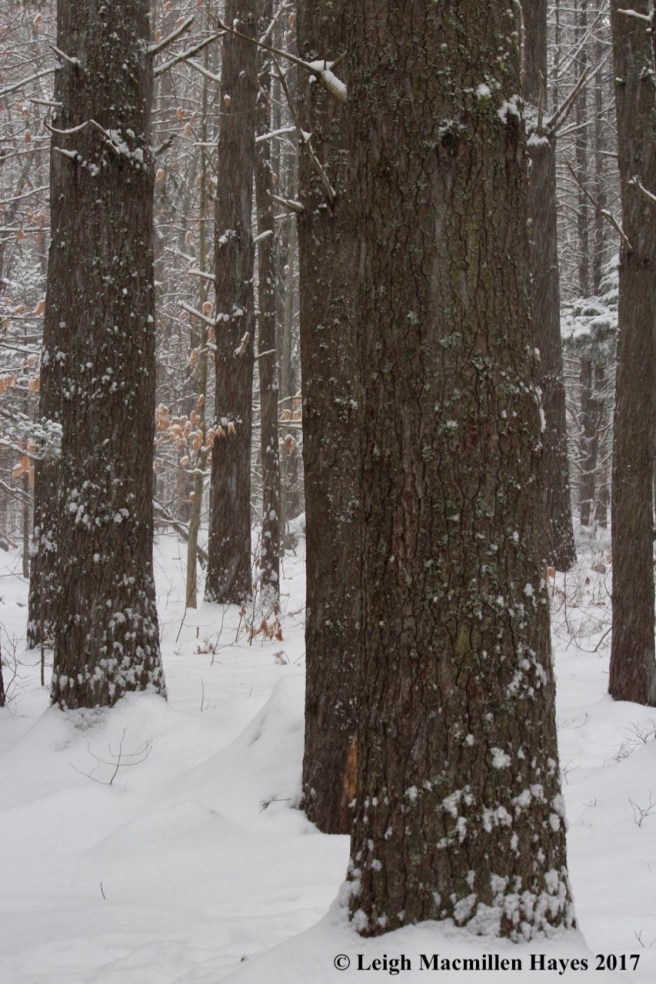
And then, when I stepped into a darker world where the hemlocks grow in a dense grove, I began to notice something.

c-spider garland 3

On every branch of every tree . . .

c-spider garland 2

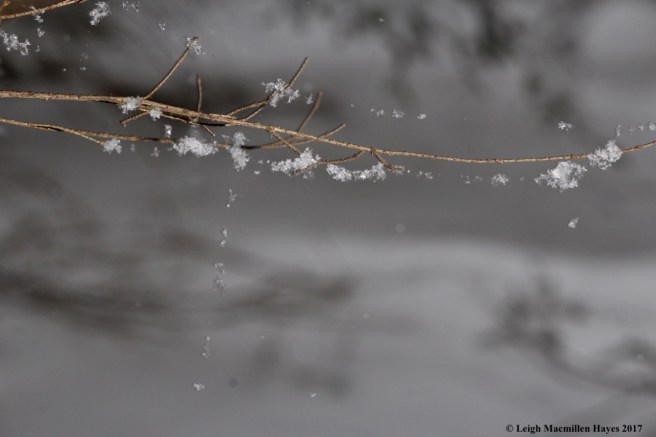
snowflake garlands . . .

c-spider garland 1

danced. And I was reminded of a story I used to read to my nephew and niece when they were babes–it was based on a legend about a poor family who had no decorations for their Christmas tree. As the tale goes, while the children slept, spiders spun webs of silver around the tree’s branches. The next morning, the family awoke to a Christmas tree sparkling with silver webs. Today’s webs were such and I was richer for the experience.

c-cheddar cheese

I’m also richer for other gifts, such as Washington State University’s white cheddar cheese;

c-ornament

an ornament created with birch seeds and their fleur de lis bracts placed between mica sheets from Mount Apatite in Auburn,

c-heartwood

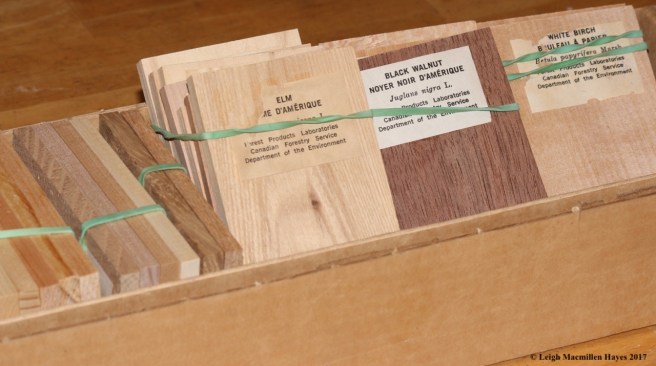
a box filled with heartwood samples all labeled,

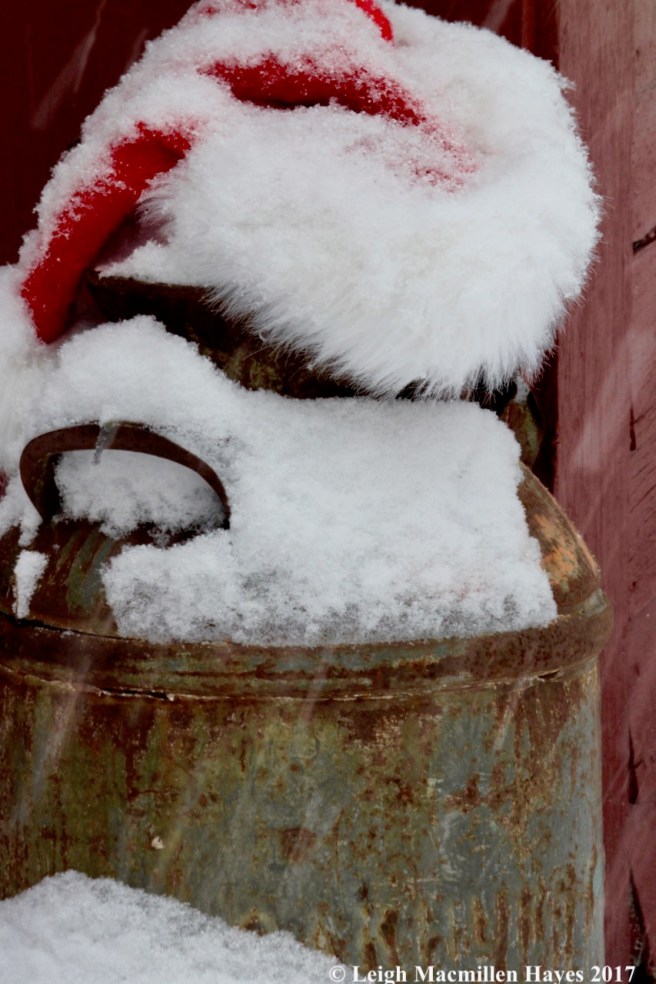
c-Santa's visit

and just a few minutes ago a lengthy e-mail from someone who had read the article entitled “digging for roots” that I wrote for the winter issue of Lake Living magazineThe gentleman who sent the note had gone out of his way to visit my guy’s store and ask for my address. He wanted to share his own experiences of dipping into the past and suggested a few avenues my guy and I might follow with our search for ancestors.

I’m totally blown away by these unexpected gifts. And forever blessed.


Like a Charm

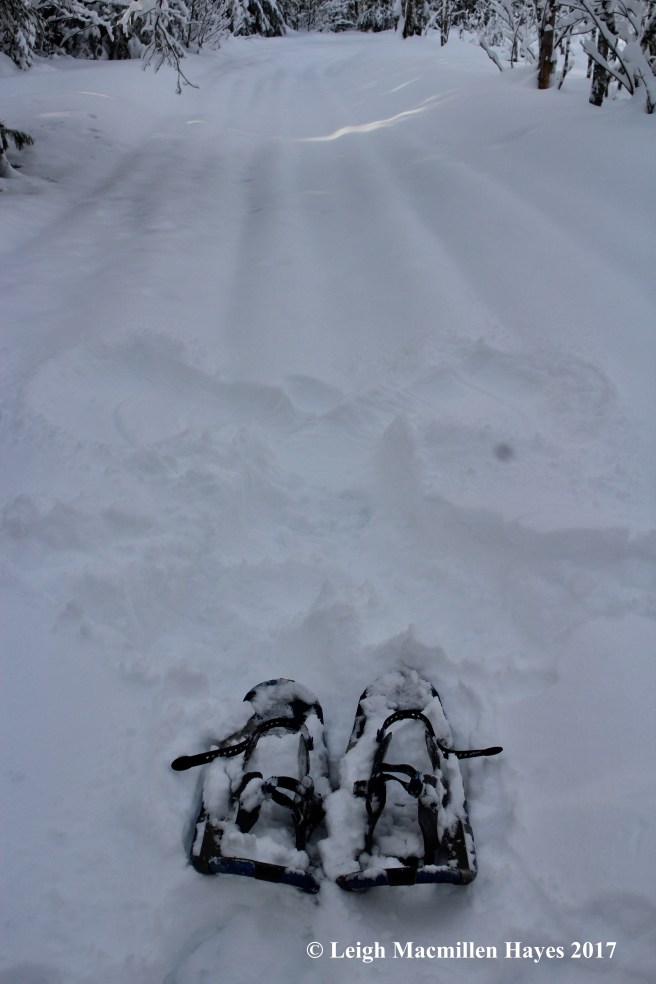
White flakes floated earthward today and so I donned my snowshoes for the first time this season and joined the party.

s-snow!

Everywhere I looked, the world had transformed.

s-snow piling high

And ever so slowly mountain ranges took shape.

s-squirrel cache snow

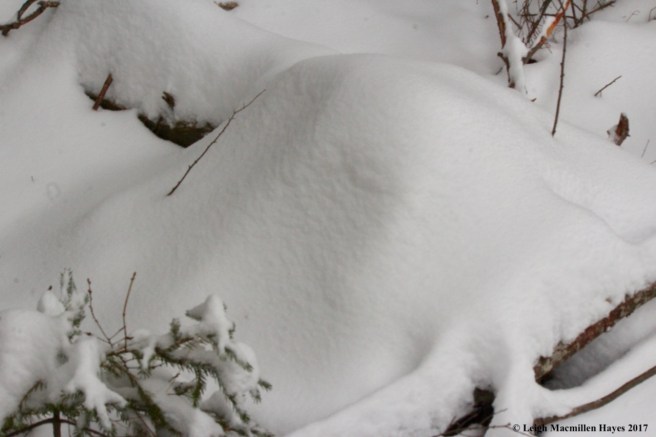
One mountain in particular caught my attention,

s-squirrel cache 1

for I’ve been visiting it and two others nearby over the past few weeks.

s-refectory 1

Where previously, the refectory indicated hours of fine dining,

s-squirrel refectory snow

today there was none. But, I suspect by tomorrow a certain red squirrel that usually squawks at me will be back. Today, he probably hunkered down in his drey, hidden somewhere in the hemlocks above and out of my view. My intention is to keep an eye on him, just as he’ll continue to keep an eye on me, for I want to watch tunnels form and midden piles grow.

s-pinecone scales

After all, he worked hard this past summer and fall harvesting cones and acorns to fill his cupboards in preparation for the winter months. Though those months aren’t yet upon us, even in the fringe he enjoys what he’s gathered.

s-deer rub snow

I left his home base behind and continued on, noting how the snow had gathered–atop the ragged remains of a deer rub,

s-goldenrod snow

balanced on winter weeds,

s-snow tucked within

curled inside leaves,

s-snow on beech

and dangling from others.

s-oak and hemlock

A fun find came into view below the towering trees, where the veins of red oak mirrored the structure of the hemlock twigs and needles it was caught between.

s-snow at home

At last it was getting dark and time to return to the homestead.

And it was time to celebrate the only dance for which my feet can match the rhythm–the snow dance. I’m so glad I wore my pajamas inside out and slept with the silverware last night. It worked like a charm yet again.


Snow White Magic

Our first official snow storm of the season left us with about an inch of the white stuff that makes me rejoice. And upon waking this morning and peeking out the window, the sight of porcupine tracks looping around the yard brought a smile to my face.

m-porcupine trail 1

I love the first snow storm for even though I have seen signs of the critters that pass this way, their tracks confirm my convictions. Over the years, I’ve come to recognize the prints and trail patterns, but as the snow gets deeper the tracks sometimes become more difficult to decipher. This one was easy due to its pigeon-toed sashay.

m-porcupine prints

And then the individual prints, especially those that crossed the deck, showed the large foot pad and five toes with nails extended. A friend in Poland, Maine, sent me a couple of photos of the critter that crossed her deck this morning. She ID it herself, but wanted confirmation–for it was an opossum and a first for her.  I found my first opossum prints last December and wonder if I’ll have that opportunity again. Anything is possum-able.

m-worm and junco prints

Since the porcupine had drawn me out (and I noted that it disappeared under the barn–of course), I decided to head off into the woods. But before I left the yard, I spotted junco tracks–and . . .

m-worm

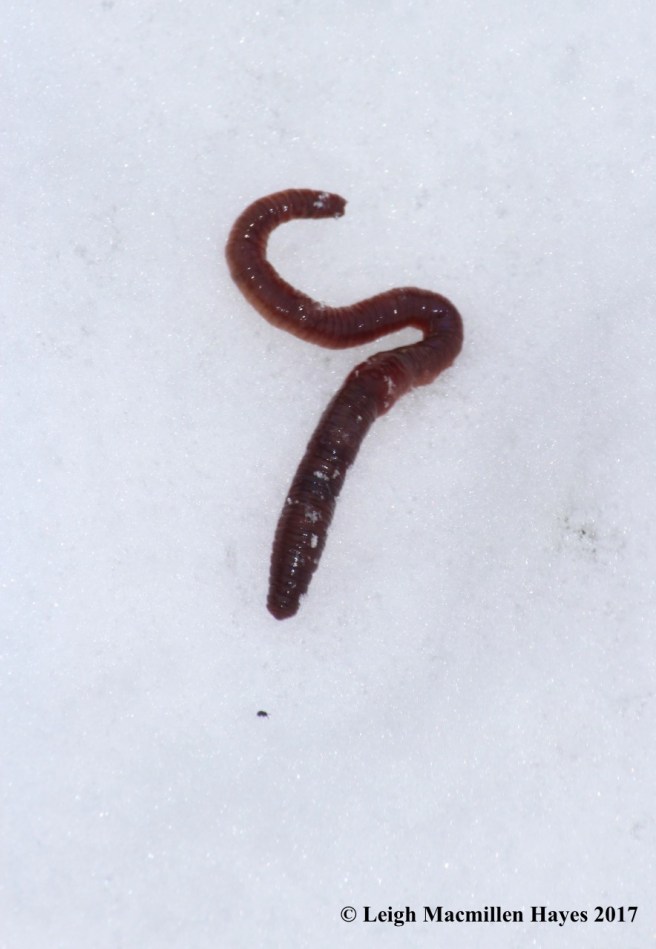
a couple of worms–frozen upon the snow. Juncos don’t eat worms; they look for fallen seeds. And so it seemed that the bird flew off before quite reaching the C-shaped worm. And this other worm was about a foot away from the first worm. Robins were in the yard last week, and I can only hope that they returned today for a frozen dinner awaited.

m-snow art 2

Into the woods I trudged, and the ever-changing colors and designs at my feet reminded me of works of art.

m-snow art 1

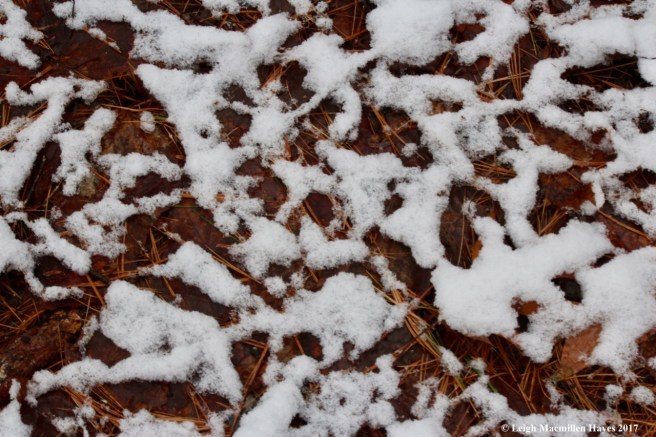
Some were palettes of mahoganies juxtaposed against white. A variety of textures gave the scene relief, much like an inlaid mosaic.

m-snow art intersections

Others embodied interconnections; a mingling of lines outlined for emphasis.

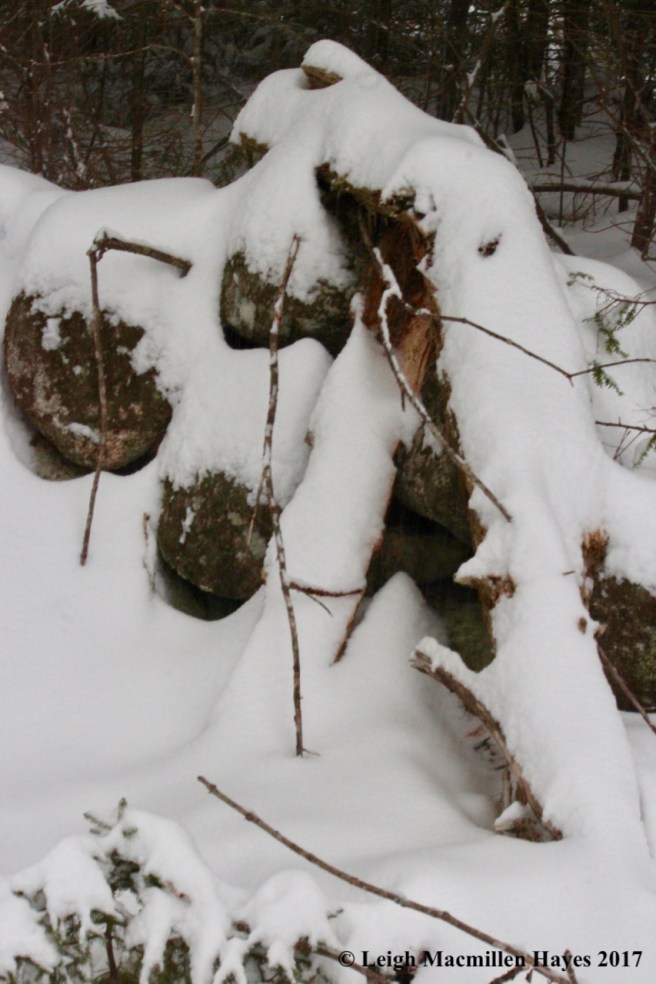
m-rock people

Along the cow path, I noticed the rock people for the first time, their mouths gaping open.

m-snow fleas

The minute snow fleas would hardly sustain them.

m-morning light

As it does, my trail crossed the line, where power seemed to originate with its source . . . the sun.

m-Mount Washington

And in the opposite direction, it flowed from pole to pole and onward . . . as if powering the mighty mountain.

m-pine sapling

My journey continued into the land of the pines and their saplings, momentarily coated with decorative baubles.

m-mini oaks

And the red oak saplings I’ve been watching looked more festive than ever.

m-squirrel tracks

I was on a mission and soon found what I was looking for. Some tracks that looked like exclamation points led me to another source of sustenance that I wanted to check on.

m-squirrel cache growing

The red squirrel’s cache had grown taller in the past week, but . . .

m-squirrel dining room

many pine seeds had been consumed in the refectory. All that remained were scales and cobs to show a number of dinners consumed.

m-squirrel rocks

The dining hall extended beyond the reaches of the cache, for every table available was a table used.

m-squirrel dinner in the future

As I walked back toward home, I discovered another table awaiting a guest.

m-beech sunshine

I was almost home when I stood under a beech tree. As winter embraces me, I find that their marcescent leaves create their own golden glow and warm my soul.

m-British soldier

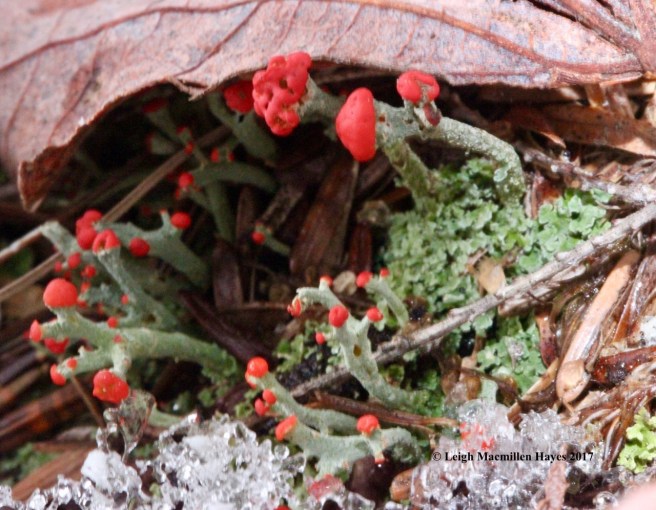
One more sweet peek offered a tiny touch of red to today’s fading winterscape–for the British soldier lichens’ red caps announced their minute presence.

m-snow drops

And then this afternoon, I joined a few friends for a gallivant across the Wild Willy Wilderness Trail beside Province Brook in South Chatham, New Hampshire. And the snowdrops created their own works of art announcing that the meltdown was on.

m-pinwheel 1

As we walked, we noticed delicate parasol-shaped fungi fruiting.

m-pinwheel gills

Their common name is Pinwheel Marasius, but in my mind the shape of the umbrella-like top above the wiry stem looked like a parasol and so I called it such. But to add to the confusion, I first called it carousel. Word association might get me there eventually, but it wasn’t until I looked it up in Lawrence Millman’s Fascinating Fungi of New England, that I realized my confusion. One of the fun facts from Millman is worth quoting: “Resurrection! Shriveled and inconspicuous, Marasmius species are rarely noticed during dry weather, but after rainy periods the tiny fungi revive–hence the nickname ‘resurrection fungi.'” And if not rain, then snow will make them rise again!

m-liverwort magic 1

The water from the melting snow highlighted other lifeforms along the Wild Willy Wilderness Trail. Bazzania liverwort grew abundantly, but one in particular gave us pause . . .  for it glowed. And no matter what position we stood in to look at this worm-like beauty, it continued to glow as if it had a golden halo surrounding it. We had no answers–only questions and wonder.

m-glue fungi

Another find that had been marked with tape, for it too was special–a broken branch attached to a young tree. I’m stepping out on a limb here–pun intended, but I believe this was an example of a glue crust fungus that glues twigs together. Seriously? Yes.

m-Bob, Janet and Pam

It was getting dark when we finally found our way to Province Brook and marveled at the water and ice forms. It was also getting close to the moment when we’d need to say, “See you later,” to Bob and Pam, for they’ll be heading to warmer climes soon. But we know they’ll be back for a winter adventure and then before we know it, spring will be here. And then, we hope the brook will be full with spring run-off from all the snow that is in our future. Until then, see you later we also said to much of the snow for it had almost disappeared.

m-ice works 1

But the ice art will continue to grow.

m-Province Brook 1

And the snow white magic will capture our minds again . . . one flake at a time. And with it, the wonders of the world will continue to be revealed.


Firsties

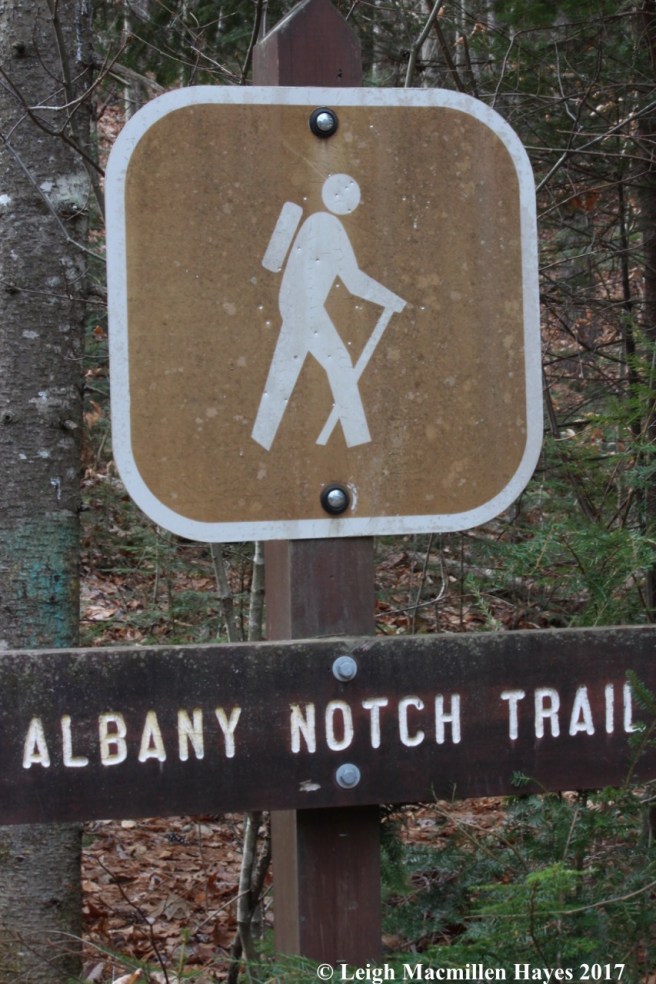
A week ago, I joined friends Marita and Marguerite Wiser for a hike up Albany Mountain from Crocker Pond Road. At the summit, we searched for a loop leading off from the left that I’d been told about, but couldn’t find it. There were cairns leading to the right, but we didn’t see any to the left.
a1-trail sign

And so today, my guy and I headed back up the mountain with a quest in mind–to find the loop. For you see, this week when I again questioned the friend who’d told me about the summit loop, I was assured it was there and we just needed to follow the cairns to the left.
a2-ice on beaver pond

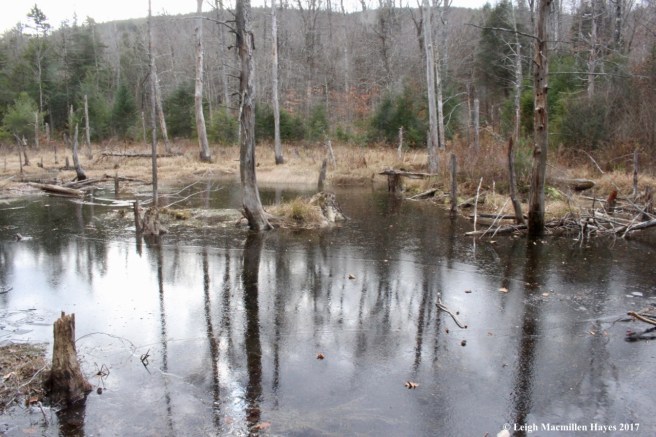
Not far along the trail, we reached the old beaver pond, which was open water last weekend, but coated in a thin layer of ice today. A first for us this season.
a3-dam crossing

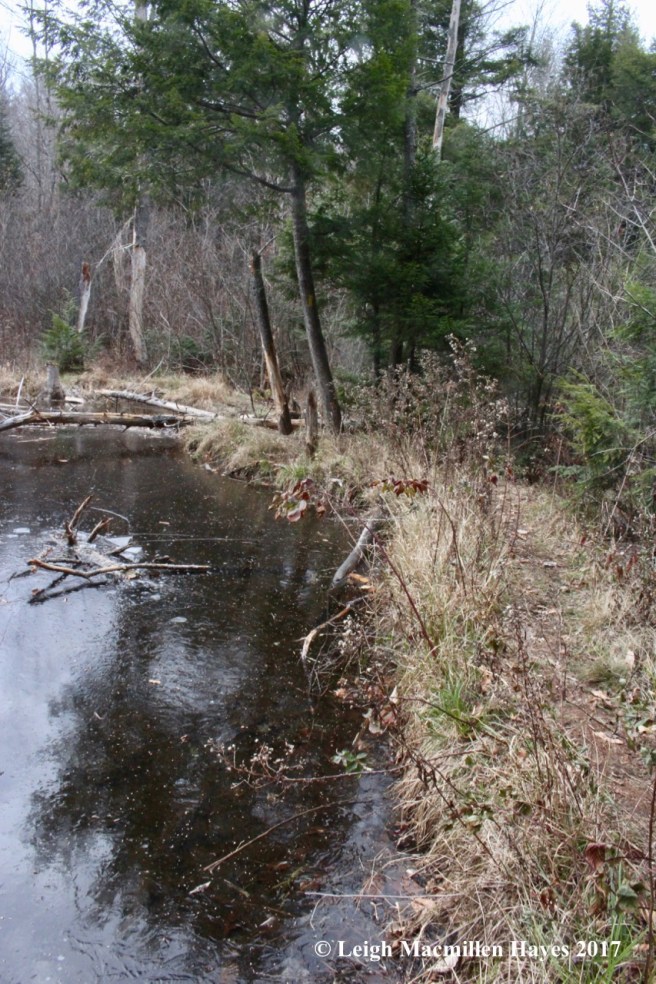
We crossed the old beaver dam, made a wee bit easier because of the freeze.

a4-3 in 1 trees

And then we began climbing. Suddenly, I spied a red pine. A lone red pine. A red pine worth inspecting, for I suspected this was bear territory and thought perhaps the tree would show evidence of a past climb since it was the only red pine in the immediate area–bears like something different like a lone red pine. There were no signs of claw marks, but we did wonder about the resources shared by the pine, red maple and beech–a trinity of brethren in these mixed woods.
a5-ice

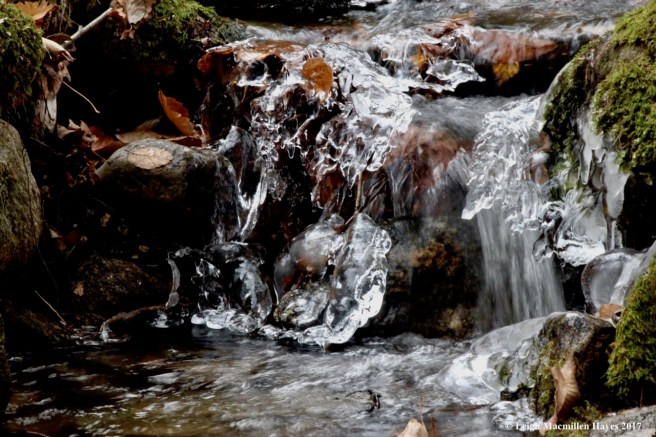
Moving upward, like all streams this month, water flowed with passion and because of the sudden drop in temperature this past week, ice formed upon obstacles. We slipped off the trail to admire its every rendition.
a6-more ice

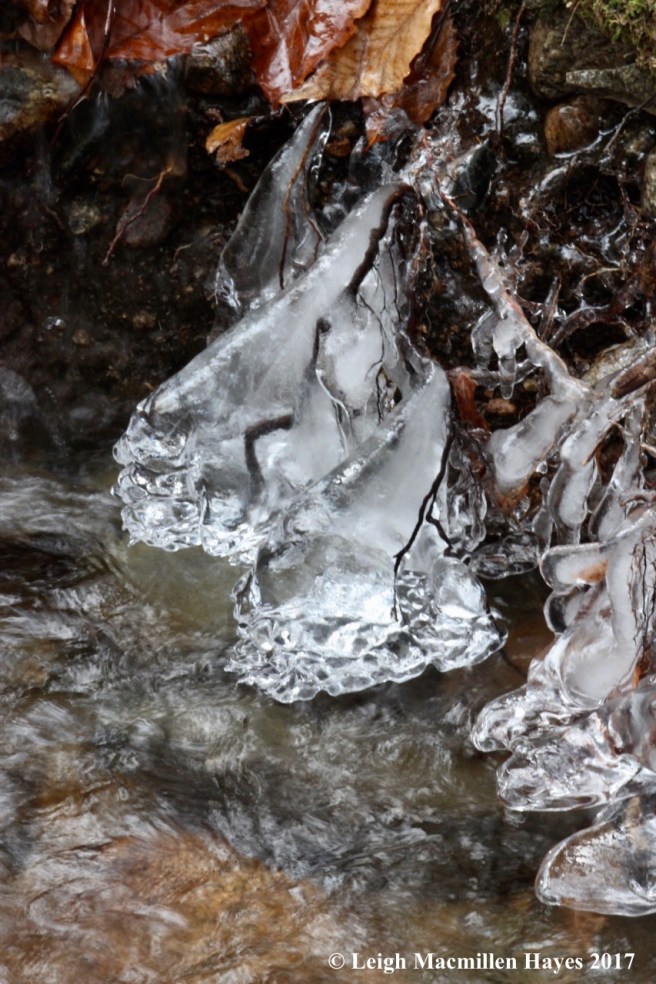
Each coated twig offered its own fluid art.

a8-ice spirit

But my favorite of all was the ice spirit who watched over all as his beard grew long.
a9-ice needles

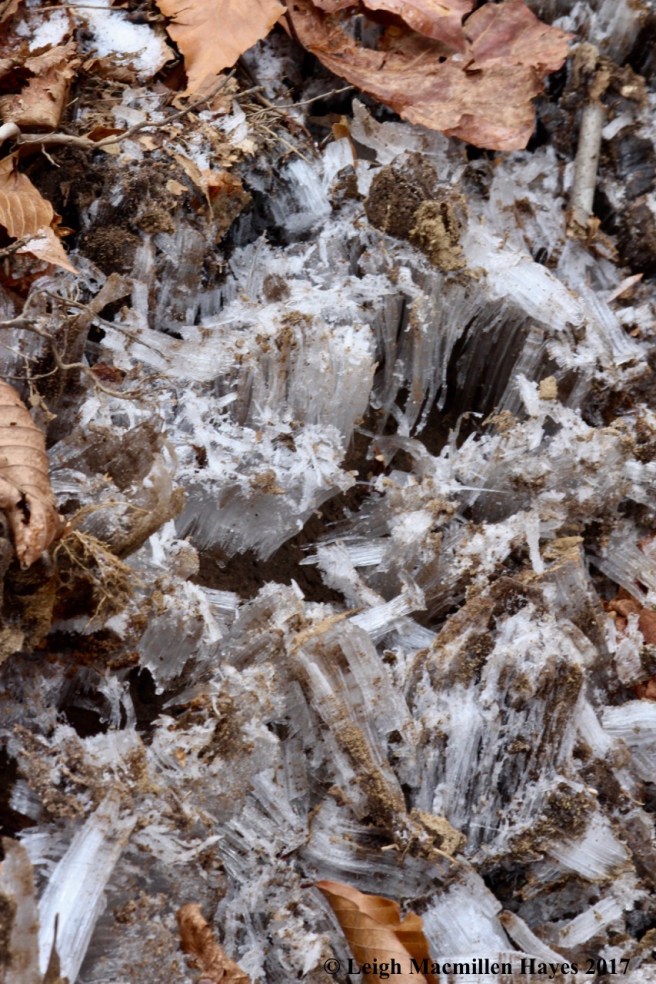
Back on the trail, conditions changed as well and ice needles crackled under our feet, adding to the crunch of dried beech and maple leaves.
am1

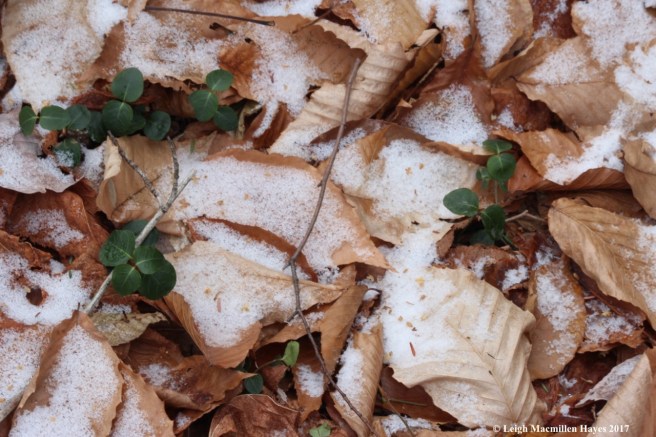
We weren’t far along, when we spied snow–another sight that made my heart sing on this brisk November day.

a10-SNOW

For us, it was the first snow of the season and we hope it bespoke the future.

a11-snow on the leaves

The higher we climbed, the more snow we saw, though really, it was only a dusting. But still–we rejoiced.

a12-new steps

Eventually we came upon some new trail work. Actually, last weekend, we’d chatted with the creator of such steps; and on our trip down, I’d asked him about the summit loop because we hadn’t found it. He said there was no such thing. But my friend insisted on such when I told her this info.

a13-climbing higher

On we climbed, reaching bald granite where sometimes conditions were slick. I’d brought my microspikes, but the trail wasn’t difficult and I never did pull them out of the pack. Still–better to be safe than sorry.
a14-Summit sign

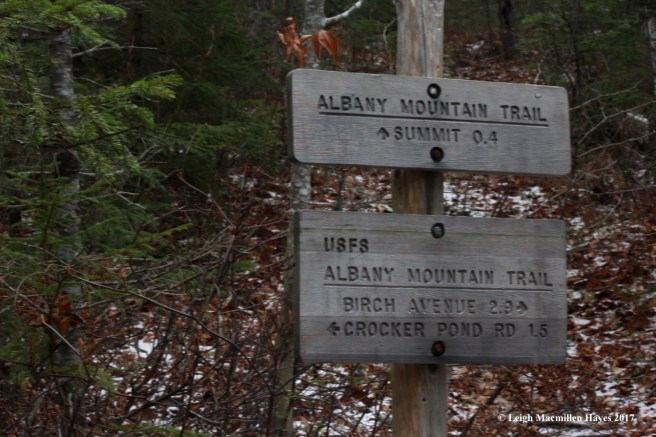
At 1.5 miles, we reached the junction. And headed upward to the summit.

a19-ledge 1 view

About one tenth of a mile along, we turned right and followed a spur trail out to a ledge where the view west offered a backdrop featuring the White Mountains.

a16-first ledge and my guy

We suspected the summit loop may have taken off from this point, so my guy went on a reconnaissance mission to the left–to no avail.
a20-Mt Washington

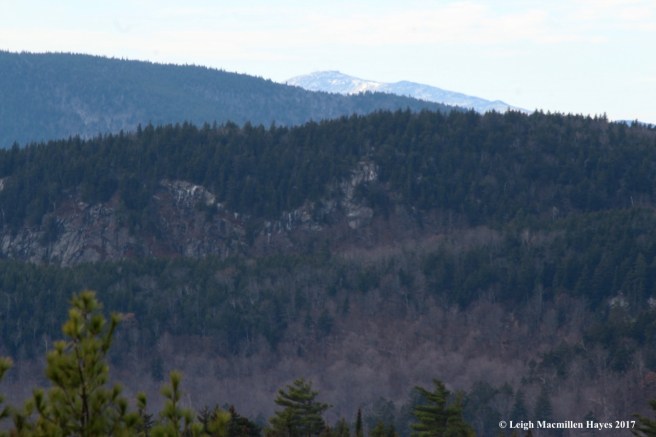
But we did enjoy the view–including the summit of Mount Washington.

am3

Then we went in search of the mountain sage. Given the condition of its glasses, however, we suspected it was feeling a bit bedraggled from the recent wind. Or maybe it had tried to find the loop as well and was just plain tired from coming up short.

a21-lunch rock view

On to Albany Mountain summit we marched. And then we sat on a clear spot upon the granite to dine on . . . none other than the famous PB&J sandwiches (mine with butter, of course). Our view was framed by red pines and spruces.

a23-red pine needles

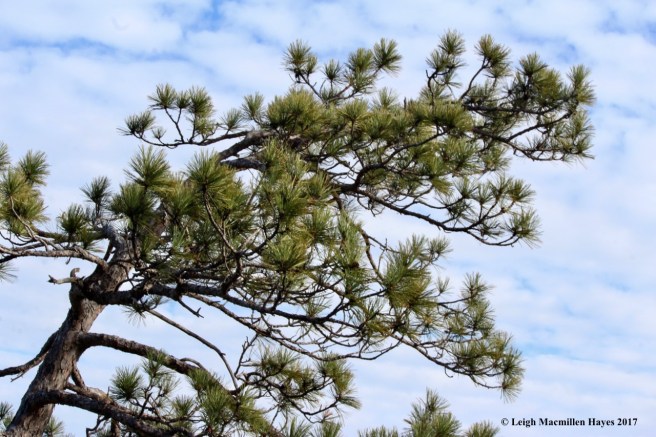
As it should, the red pines exhibited the look of chimney sweep brushes.
a22-red pine

One bent over, its leader long influenced by the northerly winds.
a23-spruce

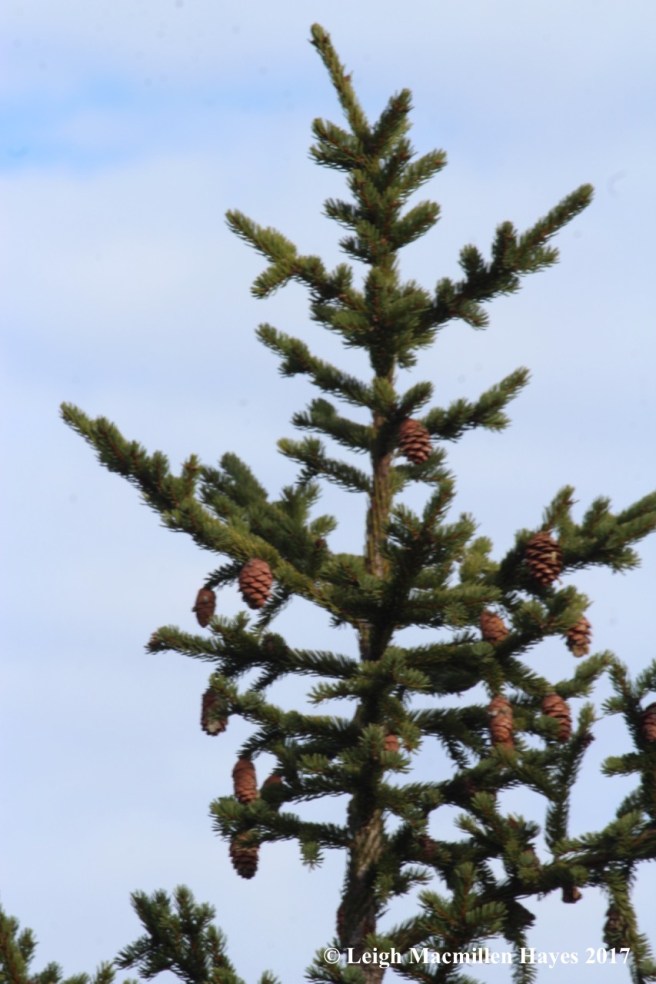
Even a spruce known for its spire-like stance had performed the wind dance.
am4

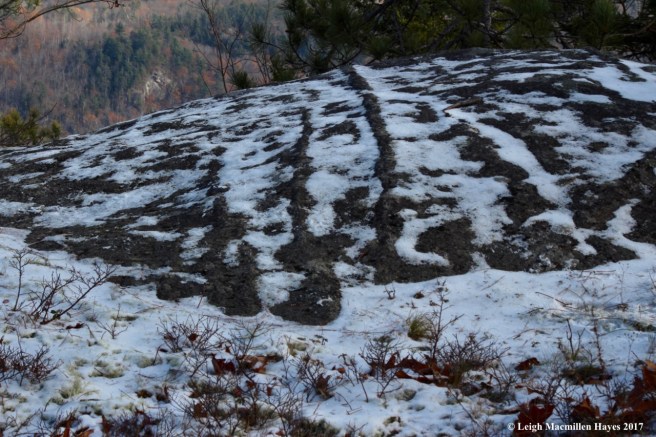
After lunch, we poked around to the left, in search of cairns for the said loop . . . and found none.
am5

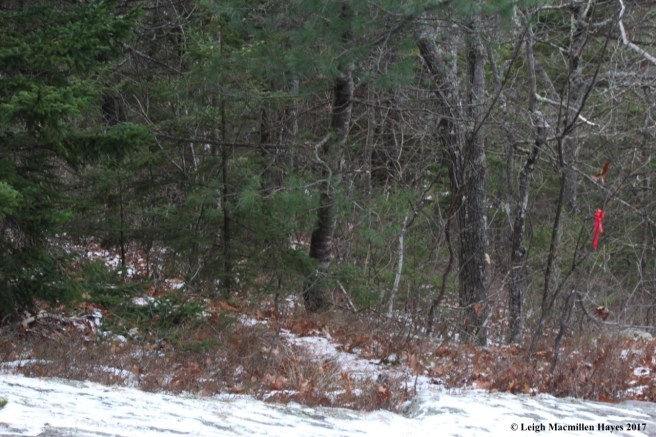
There were cairns to the right, however, which the Wisers and I had followed for a short distance last weekend. Today, we decided to see where they led. Cairns gave way to flagging.

am6

And flagging gave way to more cairns.
a24--views of balds from other trail

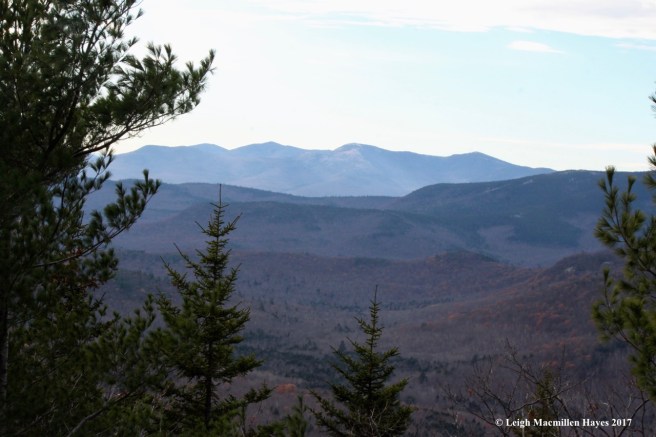
Meanwhile, the trail gave way to more views–of the Baldfaces.

a25-crossing the ledges

The trail seemed to circle around to the left, but then it turned right. Eventually, we met two young men and asked them if we were on the loop. We learned they’d spent the day exploring the top and knew of no loop, but informed us that we were on a spur. Funny thing is, they were from Texas and Wisconsin.

a26-view toward Pleasant Mtn

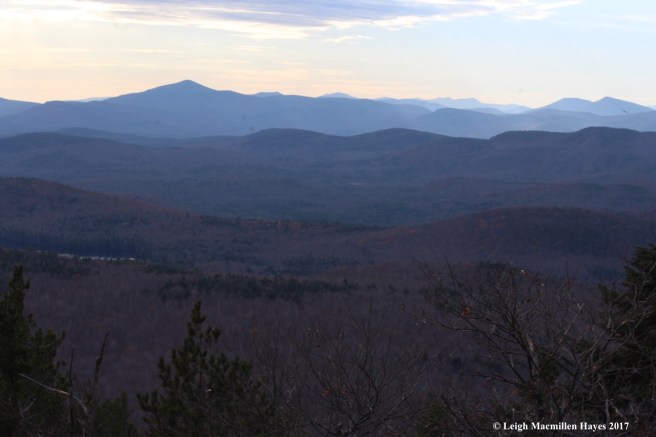
And they were right. About a half mile later, we reached the end of the cairns and the end of the spur and another panoramic view–with Keewaydin Lake in the foreground and our beloved Pleasant Mountain in the back.
am7

Again Mount Kearsarge greeted us with its pyramid formation and we stood for a while watching a bald eagle circle below us.
a27-foundation at trailhead

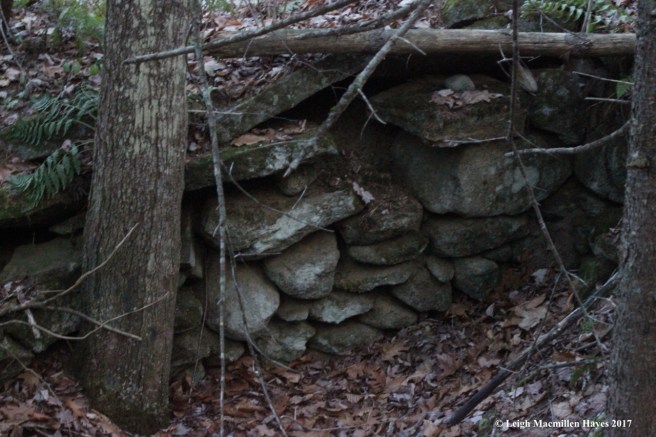
Our trip down the mountain passed quickly for it was my guy that I followed and within 45 minutes we were at the trailhead. Run much? While he went to the kiosk to double-check the map, I spied a foundation I’d previously missed. Who lived here? Was it the Crockers for whom the road was named?
a30a-Crocker Pond

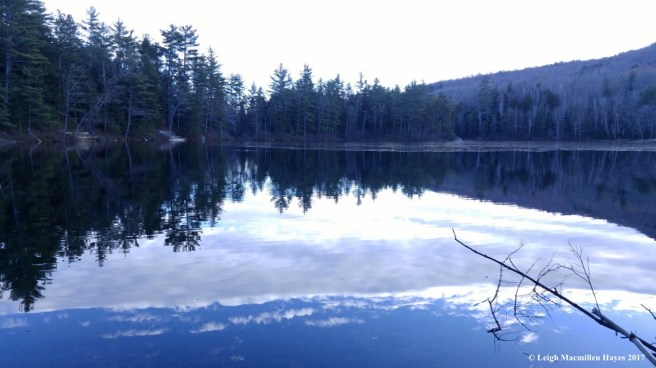
Back in the truck, and because I was driving, we drove to the end of the road and I hopped out to look at Crocker Pond, which was partially coated in ice.
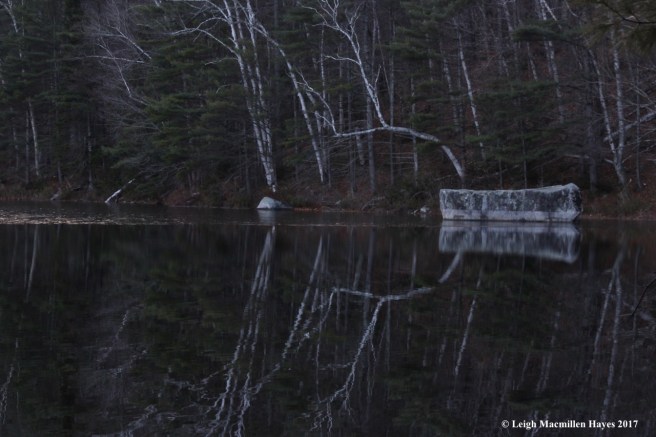
a28-Crocker Pond--backwards C

But it was a backwards reflection that really gave me pause for the birch trees seemed to spell the pond’s initials–backwards and upside down of course. CP. Humor me here. ;-)

a35-Patte Marsh

And then I drove down another forest road to Patte Marsh, which was almost completely covered in ice.
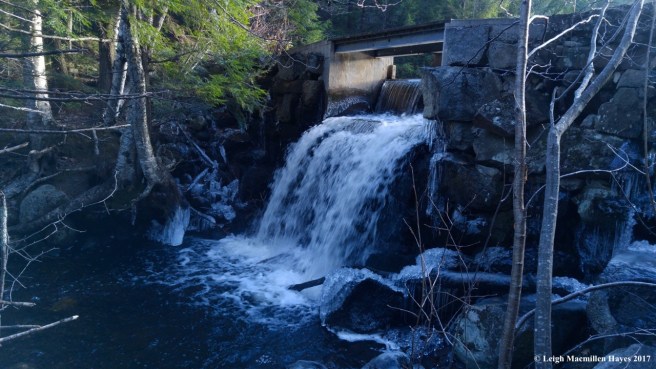
a32-dam at Patte Marsh

Its formations were varied below the dam.

a31-sky reflection and ice

But my favorite of all was upon the pond, where the sky was reflected on a wee bit of open water and ice that reminded me of the eagle in flight.

We didn’t find what we’d gone in search of and may just have to try again (oh darn), but it was a day of firsties for us–first ice-covered ponds, first snow, first time on the second spur trail. Definitely a first rate day for a hike.

P.S. Thanks for continuing to stick with me. Please feel free to tell your family and friends about wondermyway. And encourage them to click the “follow” button. I’d appreciate it if you’d help me increase my readership. You never know what you’ll read here because I never know what I’ll write. Even when I think I know, I don’t. The end result is always a wander and definitely a wonder.


Honoring the Earth

It would have been so easy to stay home last night, curled up on the couch beside my guy while watching the Bruins play hockey. After all, it was raining, 38˚, and downright raw. But . . . the email alert went out earlier in the day and the evening block party was scheduled to begin at 7:30. And so, I piled on the layers from a wick-away shirt to Under Armour, a turtleneck, sweater, LL Bean vest and rain jacket. I slipped into my Bogg boots and made sure I had the right gear–smartphone for photos, reflective vest, headlamp and flashlight. With a visored hat on my head to shield my glasses from the rain, I was finally ready. Out the door and down the road I went, headed to the Lakes Environmental Association‘s office for Big Night.

h-Big Night Patrol 3 (1)

I wasn’t the only one crazy enough to attend the party. Our number was about twenty. I think the best part was that we ranged in age from 6 to almost 60, the latter being me–the oldest kid on the block. And in that mix, one teen who was celebrating his 15th birthday (Happy Birthday, Kyle), and several teens who had never attended before but came because one of their crowd was an annual participant. We even had two policemen in the mix–and though their job was to slow traffic and keep us safe, they had as much fun as we did completing our mission.

h-spotted sallie 2 (1)

Said mission–to help spotted salamanders . . .

h-spring peeper 1 (1)

and spring peepers cross the road.

h-redback salamander (1)

We did so for a while and then headed back to our vehicles. Just before reaching the spot where we’d all parked, someone spotted this redback salamander–I smiled because its the symbol of the Maine Master Naturalist Program.

We were wet. We were cold. And we were happy. As nature would have it, Big Night preceded Earth Day–a perfect beginning.

h-candy lichen

Earth Day began appropriately with a board meeting at Lakes Environmental, where among other topics, Dr. Ben Peierls, the new research director of LEA’s Maine Lake Science Center, shared with us his plans for the water quality testing laboratory. Ben addressed us first so that he could drive to Portland and join the March for Science. We continued our meeting, but were thankful for his representation. Meanwhile, directly outside and all around town, another gathering was taking place as many people participated in an Earth Day cleanup.

By the time I left the meeting pleased with all that had been accomplished, I was ready for a solo adventure to find out what the Earth wanted to share with me since most of the snow melted this past week. Despite being another raw day, or maybe because of it, the candy lichen brought a smile to my face. I think one of the cool things about this lichen is that even though its salmon-colored fruits stand atop stalks, this is really a crustose (crust-like) lichen, the bluish-green surface being the actual structure.

h-juniper berries

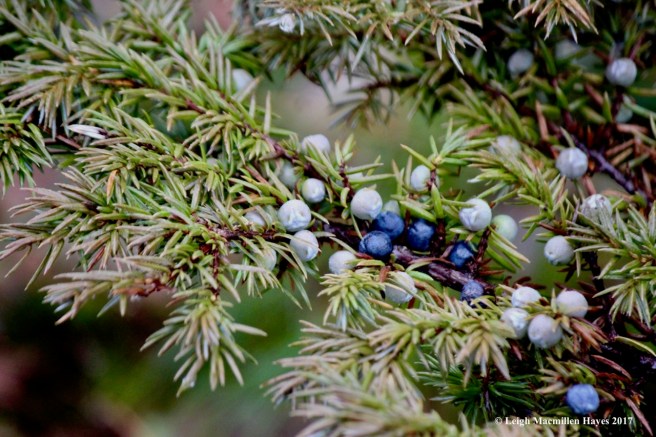
Near the candy lichen, the bright blue of some berries stood out on the common juniper. They remain on the shrubs all winter and it seemed only a wee bit ago they looked all withered. Today’s offerings were plump and pretty.

h-pine droplets

And then there were the raindrops, each waiting its turn to continue the journey toward the earth. I had to wonder what else it might fall upon before reaching its final destination–each little ball encapsulating nourishment.

h-lambkill

One of the receivers, sheep laurel, which displayed its own new life.

h-trailing arbutus

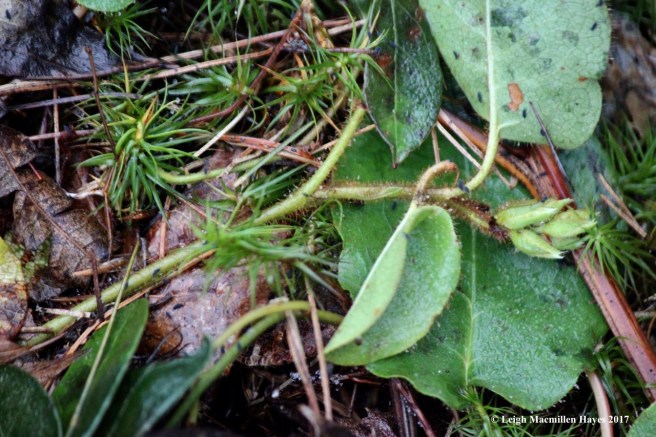
And at the base, trailing arbutus. One year ago, as I noted in my Earth Day post, it was already in bloom. This seemed a reminder from Mother Earth that we need to practice patience.

h-wild turkey

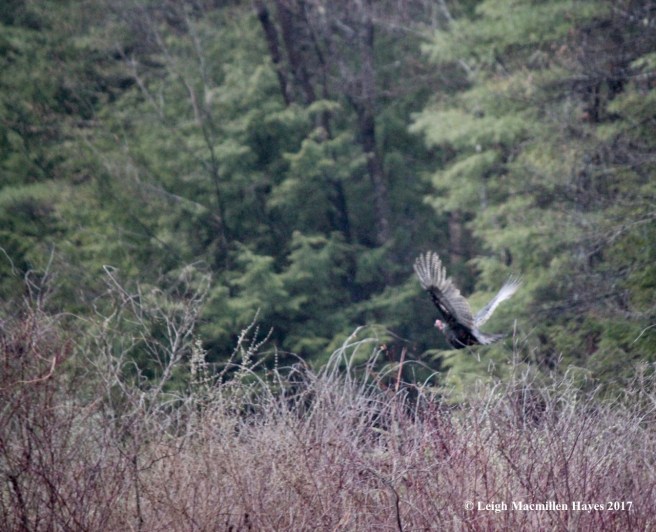
I continued my mosey, as quiet as could be, and so was startled when one large, exotic bird, and then another, and a third flew off from behind a stone wall. And then I realized they were wild turkeys–who truly are exotic if you take a look at all the colors in their feathers.

h-tinder conks on beech

I’d been on the snowmobile trail, but traveling was difficult given some remaining icy snow and deep ruts filled with water. As if I needed an excuse, I decided to slip into the woods. One of my first delights–tinderconks lining a tree as I looked up.

h-moss covering

But really, it was the thick moss coating at the top of the tree that first drew my attention. Several trees in the neighborhood displayed the same fashion.

h1-woods south (1)

My wander was aimless, taking me through boggy areas . . .

h-snow1

and small sections where snow still blanketed the ground.

h-deer prints in snow

Besides plenty of deer scat, I found prints . . .

h-deer hair

and hair.

h-deer hair bubbles

Raindrops enhanced the hair.

h1-moose scat 1 (1)

And though I suspect they’ve moved toward open water, there was plenty of evidence that the moose had also spent the winter in these woods.

h-moose hair

They, too, have shed hair–preparing for the summer scene.

h-moose maple

A couple of months ago, I’d been concerned that the moose had consumed all the tree buds, but the red maples showed me otherwise.

h1-woods south 2 (1)

At one point, I stood for a while atop a rock and looked to the south.

h1-woods north (1)

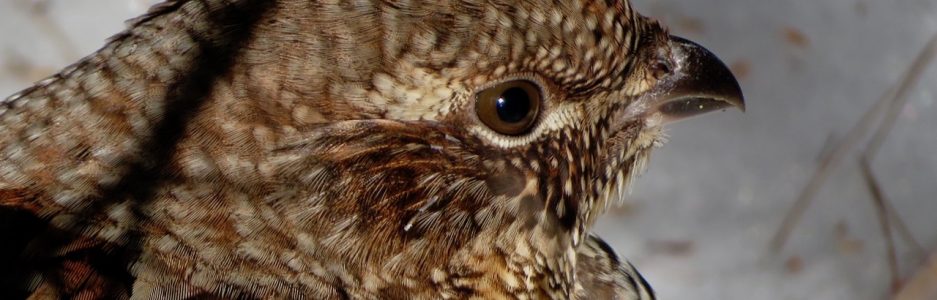
And then to the north. It was as I stood there that I heard a repeated sound. It began with a few slow beats, and then a swift series of beats. All seemed muffled. It finally occurred to me that I was listening to a ruffed grouse. Eventually, I followed the drumming and came close to the one beating its wings against a log–the work of a displaying male. I didn’t bother to seek out the actual bird for I knew I’d startle it and it would fly off, so I let it drum in peace, thankful for the opportunity to at least hear it. Really, it was a first for me. Oh, I’ve possibly heard it before, but only today did I recognize it for what it was.

h1-widowmaker (1)

For a while, I was fake lost . . . and then I heard another repeated sound that lead me to a widowmaker and I knew exactly where I was. But where was the maker of the sound?

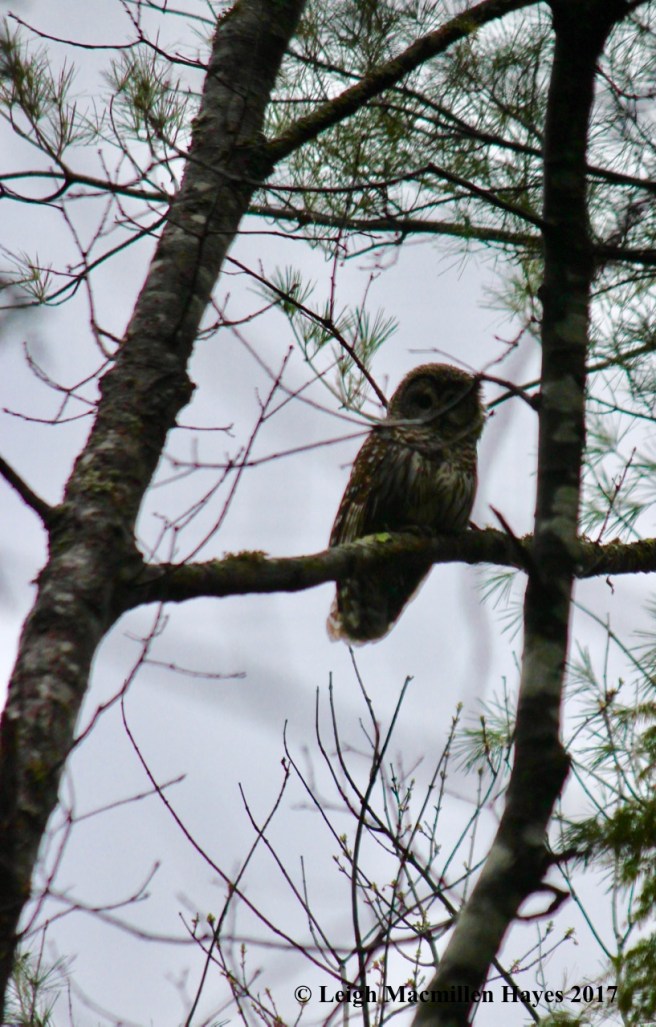
h-owl 1

In a tree above me.

There were actually two barred owls and I was so thankful for the honor of listening to and watching them on this Earth Day.

I was also thankful for all the privileges bestowed upon me. The privilege of living. The privilege of noticing. The privilege of questioning. The privilege of understanding. The privilege of wandering. And especially, the privilege of wondering. Thank you for your offerings, Mother Earth. I am honored to know you.


A Good Mourning Mondate

A good mourning? Indeed it was. Yesterday we celebrated Easter and the resurrection. Today we celebrated an opportunity to climb our favorite mountain.

p-Mountain stream

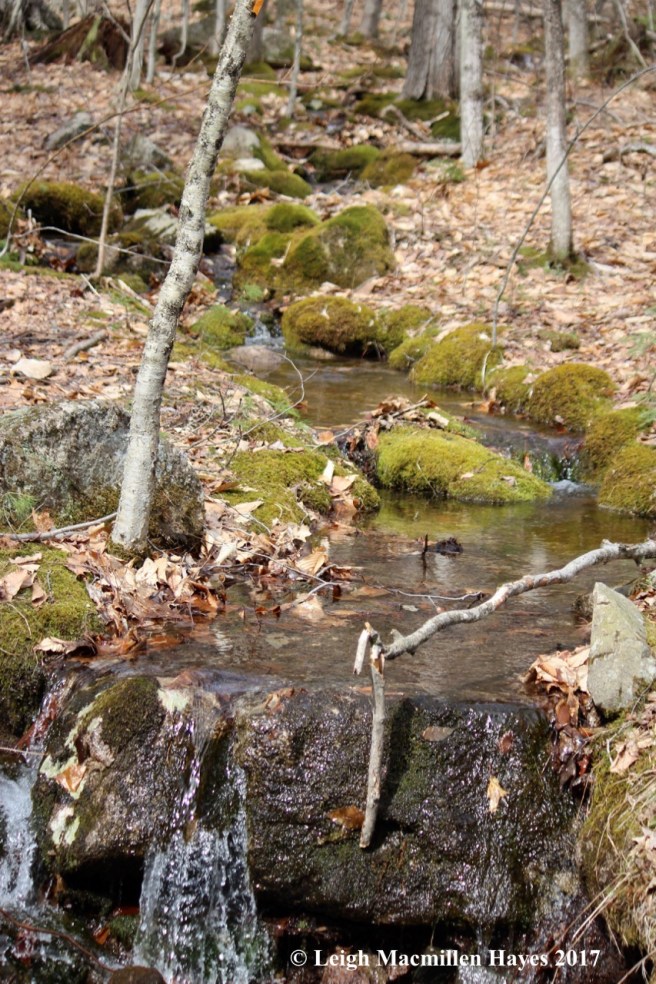
And so we parked the truck at Loon Echo Land Trust’s Ledges Trail parking lot on Mountain Road in Denmark and then walked 1.5 miles back to the trailhead we chose to make our ascension up Pleasant Mountain. Along the way, mountain streams quickly moved the meltwater downward toward Moose Pond, where it will mingle with the lake water and eventually find its way to another stream and then the Saco River and finally out to sea. And whether via future raindrops or snowflakes or even fog, traces of the same water molecules may again find their way down these streams.

p-bald peak trail

At last we reached the trail head for the Bald Peak Trail, where less than a week ago Marita and I had to climb over a tall snowbank to reach the path.

p-ice chunk

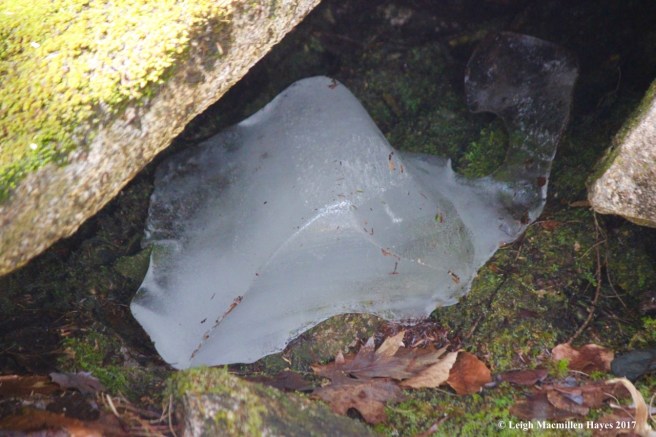
As we climbed and paused to admire the water flowing beside us, I noted differences between last week and today, including the shrinking of an ice chunk tucked under a rock. Ever so slowly, it joined the forces of downward motion, as if letting go was meant to happen with care.

p-Needles Eye

And then at the spur, my guy and I turned left to Needles Eye. Some ice and snow still covered parts of the path, but it was much easier to negotiate than last week. And he did. I followed him, but didn’t need to step into the chasm since I’d just been there. (wink) Instead, I climbed below to try to capture the world above.

p-returning from Needles Eye

And then I rejoined my guy and wished I’d taken a photo of this section last week for today’s conditions didn’t reflect the same treacherous stretch Marita and I worked our way across.

p-snow on trail

We continued up the trail, where snow and ice were more prevalent. Though we had micro-spikes in our pack, we managed to avoid wearing them. And only once did I completely sink in–just below Big Bald Peak. I actually went up to my thigh, so deep was the snow. And cold. But I was hot, so it felt refreshing.

p-pileated scat

But before we reached the sharp left turn on Big Bald Peak, we noticed tons of chips at the base of a hemlock tree. Such a discovery invited a closer look–and I spied the largest pileated woodpecker scat I’d ever seen. Later on, when we were almost at the Fire Warden’s Trail, we saw two hikers on their way down and I quickly realized one was my dear friend Joan–another lover of scat and all things mammalian. Of course I told her what to look for as she and her hiking friend headed down the Balk Peak Trail. And I just received an e-mail from her: “Deb and I saw it! It was huge! She was so excited to see all the little ant bodies!” Indeed.

p-Mt Wash from top of Bald Peak Trail

The wind blew fiercely when we reached Big Bald, where white and red pines framed a view of another big bald–Mount Washington in the distance.

p-view from lunch rock 2 (1)

Not far along the trail, we found lunch rock in a section that offered some protection from the gusty wind. It was the perfect place to enjoy our PB&Js followed by Cadbury Digestives (thanks sis).

p-view from lunch rock

Through the trees, we could again see the mighty mountain to our west.

p-blueberries 1

And at our feet–blueberry buds galore. My guy began to see blue where no blue yet exists–the promise was enough.

p-along ridge line

Walking along the ridge line was like a walk in the park. At times, where the sun didn’t hit the northwest sides of ravines, we found more snow, but more often than not, the trail was neither icy nor muddy.

p-wood frogs

It was in one of the ravines, however, that we heard a song of spring–the wruck of the wood frogs singing from a vernal pool located below. A first for us this year and we were happy to be in the presence of such a sound.

p-fire tower 1

It seemed like in no time, we approached the main summit where the iconic fire tower still stands tall.

p-summit 6 (1)

We took in the view toward Brownfield and beyond.

p-summit toward Washington

And again looked toward Mount Washington.

p-Mt Wash1

Even upon the mighty one, we could see the snow has melted gradually. But our stay wasn’t any longer than a few minutes for the wind was hat-stealing strong and I had to chase mine.

p-hiking down ledges

And so down Ledges Trail we descended in order to complete our loop. Here we rarely saw signs of snow or ice.

p-ledge view 1

The southern basin of Moose Pond stretched before us, most of its surface still covered with the grainy gray ice of spring. Any day now, ice out will be declared, late as it is.

p-tent caterpillars

It was on the ledges that I noticed tent caterpillars already at work.

p-red maple 1

Thankfully, there were more pleasant sights to note, including the first flowers of red maples.

p-striped maple buds

And along the trail below the ledges, plenty of striped maples showed off their swelling buds.

p-acorn

Last summer, the oaks produced a mast crop and those not consumed by the squirrels and turkeys have reached germination. This one made a good choice about a place to lay down its roots–hope burst forth.

p-beaked hazelnut 2

As we neared the end of the trail, I began to notice the beaked hazelnuts and savored  their tiny blooms of magenta ribbons. And we could hear spring peepers. So many good sights and sounds along our journey.

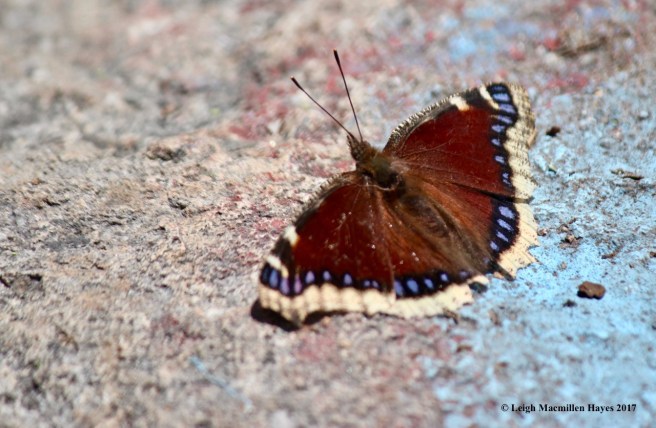
p-mourning cloak 1

On each trail we hiked today, we were also blessed with butterfly sightings. It’s always a joy to see these beauties, who actually overwinter as adults in tree cavities, behind loose bark, or anywhere they can survive out of the wind and without being consumed by predators. They survive by cryopreservation–the process of freezing biological material at extreme temperatures. In Britain, their common name is Camberwell Beauty. In North America, we know them as Mourning Cloaks–so named for their coloration that resembled the traditional cloak one used to wear when in mourning.

I think I may have to stick with Camberwell Beauty for a name, given those velvety brown wings accented by the line of black with azure dots and accordian yellow edge. What’s to mourn about it?

So we didn’t. Instead, we enjoyed a good morning Mondate–and afternoon.

A Blue Bird Kind of Good Friday

When Jinnie Mae picked me up this morning, our destination was the Narrow Gauge Trail. But somewhere between here and there, she pulled a U-turn and drove to Narramissic Farm owned by the Bridgton Historical Society.

It had been just over a year since I last visited and I wanted to show her the shagbark hickory buds. And maybe even the bear trap.

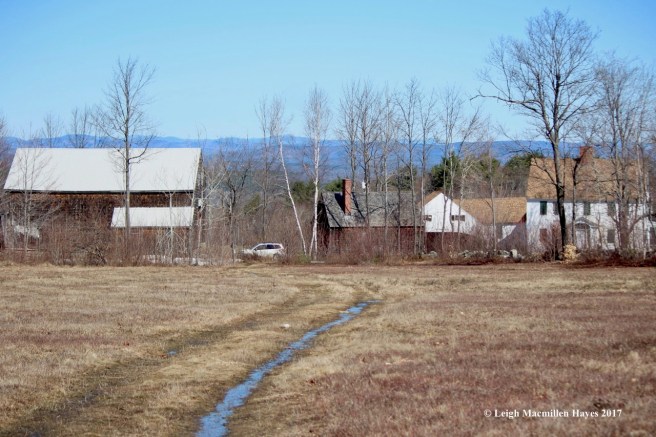
n-Pleasant Mtn to Narramissic1

We crossed the field behind the house and started off on the path to the quarry and bear trap, but snow and water in the woods resulted in another U-turn. We’d been talking so much, we’d hardly noticed our surroundings, but the view stopped us in our tracks.

n-Pleasant Mountain

To the left, the long ridge line of Pleasant Mountain, where the ski trails of Shawnee Peak Ski Area made themselves known.

n-Narramissic

And in front of us, the Temperance Barn and Peabody-Fitch homestead, built in 1797. We had the place to ourselves and reveled in the quiet of the day–when we weren’t talking, that is.

n-shop and flagpole

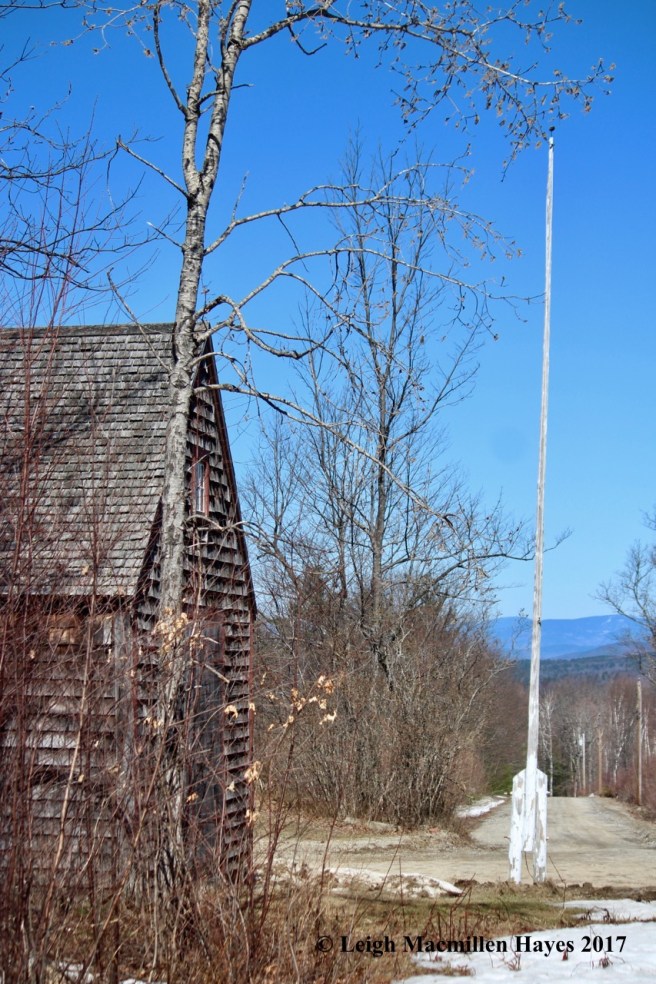
Heading to the road for our tree bud search, we passed by the blacksmith shop where horseshoes were probably made in the day.

n-temperance barn

And at the Temperance Barn, so named “because it was raised without the traditional barrel of rum,” I can never resist admiring the structure even though it’s in great need of repair.

n-ash tags

And then we were stumped by a flowering tree. It sure looked like an ash as Jinnie Mae suggested, but what were those lacy tips? What came to my mind first were the tags on red oaks that I didn’t understand a few years ago until a friend helped me realize that they were leaf stems left behind when the wind finally claimed the dried leaves. Was this the same?

n-double-wide stonewall

Climbing onto the double-wide wall, I took a closer look.

n-white ash danglers 1

Turns out Jinnie Mae was right. But my question still remains. Were these the stems of the ash samaras or compound leaves?* For some reason I’ve never before seen them left behind. Ah, there are so many things to discover in this world.

n-black walnut 3

We continued down the road, noting budding pussy willows and flowering red maples. And then I spied the bulbous buds I wanted to show her. Only, it turns out that we hadn’t reached the hickory trees yet.

b-black walnut leaf scar 2

The monkey face leaf scar should have been a clue. But my brain was stuck in hickory mode and I completely forgot that black walnut leaves leave such a formation. At home, I pulled out Forest Trees of Maine and then seesawed between black walnut and butternut (aka white walnut). Both feature leaf scars shaped like a monkey’s face. But the top of the leaf scar serves as the give away–this one did not have thick fuzzy eyebrows like a butternut, so I’m going out on a limb and declaring this a black walnut.

n-shagbark bud hairy 1

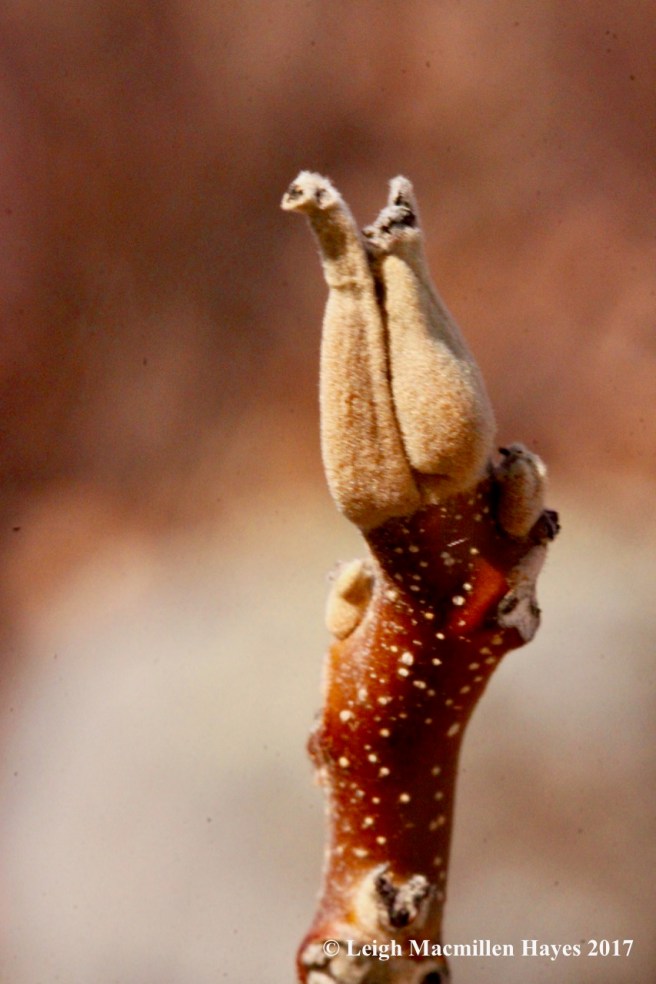
A bit further down the road we spotted more bulbous buds. These were definitely the ones I was looking for–shagbark hickory. In the moment and because the two trees weren’t close together, we thought they were all one in the same. But hindsight being 20/20 as it is, the photographs tell the story.

n-shagbark bud 6

The subtle colors and fuzziness wowed us and we both took numerous photos.

n-shagbark leaf scar1

Then there were the leaf scars–definitely more heart-shaped than the previous trees.  And lacking that smiling face. We smiled for them.

n-Long Lake below

It wasn’t enough to find the small saplings beside the road and so we crossed another field in search of the mother tree.

n-grasshopper 1

Along the way, Jinnie Mae spotted a wee grasshopper–the first of the season for us.

n-shagbark bark from distance

And then her newly trained shagbark hickory eyes keyed in on the momma.

n-shagbark bark 3

If you go, it’s located behind the barn.

n-shagbark bark 5

And shouts its name in presentation.

n-shagbark bark 4

Looking upward, we could see the bulbous buds on the twig tips contrasted against the bright blue sky.

n-bluebird

Happiness is a blue bird kind of day–sweetened by time spent exploring with Jinnie Mae, making discoveries and watching bluebirds move between the field and the trees. Indeed it was a Good Friday.

Now we need to return and find the mother black walnut.

*Thanks for Maine Master Naturalist Pam Davis for IDing the ash strand as the rachis of the compound leaf. She reminded me that I have seen these on the ground in the fall. But–to be still dangling from the tree was new to my eyes and mind.


A Wiser Soul

It all began when I stepped out the back door just before six o’clock this morning. From the treeline I heard a barred owl call, “Who cooks for you? Who cooks for you all?” I could have returned to bed then, happy for the opportunity to hear such a wise one.

n-Northern Flicker

Not long after that, as I passed by a window in the butler’s pantry (no, we don’t have a butler, just an old farmhouse), a splash of red on the ground drew my focus–a Northern flicker had stopped by to feed. Notice the subtle curve of its bill? The better to dig up ants and beetles, as is the custom of this ground-feeding woodpecker.

n-water coursing 2

An hour or so later, I met my friend, Marita, for a hike up the Bald Peak trail at Pleasant Mountain. Our destination–not the summit as we had a time constraint–but rather, Needles Eye.

n-beside the brook

Our climb included frequent stops at vantage points to take in the sound and beauty of the place.

n-water art 2

The flow of the living water and its ever changing presentation mesmerized us much as leaping flames do.

n-water art

It spiraled over the rocks like a sculpture in fluid motion.

n-ice hiding

And while so much poured forth and wound its way down the mountain stream,

n-ice at Needles Eye

some remained frozen in time.

n-crossing toward Needles Eye

At the sign pointing toward Needles Eye, we crossed a stream and then worked our way across the short spur to the narrow formation of rocks that water threads through.

I should qualify that. Marita sauntered across the ice and snow, seeking the wee bit of dirt and leaves at the edge of the trail. It’s a steep edge and even on a summer day, I pick my way carefully over rocks and tree roots. Today, my brain suggested I call it good and sit still. But, she’s a good friend, and realizing my trepidation (I’d forewarned her), she spoke to me calmly about each foot placement, and even turned back to demonstrate exactly what I should do, waited patiently as my brain shouted, “Don’t do it!” and my heart said, “I think you can, I think you can,” and offered a hand when necessary.

n-marita 3 (1)

Together, we did it. This photo is Marita’s as I didn’t want to change my camera lens once we stood in the chasm and watched the water fall.

n-inside the needle

On a summer day, it’s a delightfully damp place to rest before continuing up the mountain. Sometimes, there’s only a hint of a stream. Today, it was equally enchanting–perhaps we should have bowed in respect of the beauty and power before us. And just maybe we did.

n-climbing down 2

Returning on the spur, Marita again came to my aid. And then we hiked a bit further up until time forced us to head down again.

n-morning light

The descent seemed easier as the snow had softened a bit in the two hours we’d spent enjoying each other’s company and filling our senses with the sights and sounds surrounding us.

n-vp visit

Back at home, I was pulled out the door again and made my way to the vernal pool. Ever so gradually, the ice is melting.

n-crack across vp

And across the center, a crack divided it in two from east to west, while a line between the sunshine and shade completed the quadrants from north to south.

n-snowfleas 2

Piles of pepper, aka springtails, floated on melted water atop the ice.

n-snowfleas

Others clustered on the open water at the pool’s edge. Other than that, I could see no action. Every day, however, will bring something new so I know I’ll check back frequently.

n-our house:field

Leaving the pool behind, I headed toward the area where I’d heard the barred owl several hours earlier–and I called. It didn’t respond. But, I reminded myself that this morning’s greeting was enough.

n-crocuses1

Returning home again, I couldn’t resist the crocuses that I first noticed yesterday. In the past few days, the snow has receded quickly and with today’s light, these spring beauties finally opened.

n-first daffy--a double

And then, in the garden beside the house, I found one more surprise–a double daffodil blossoming under some leaves. In this season of watching with wonder, my heart was full.

n-Marita

This day will stick with me for its offerings and I’ll be forever grateful to Marita . . .

n-marita 4 (1)

for without her help, I wouldn’t have had the gumption to stand in the Needles Eye. She is a kind and funny and wise(r) soul. And I am blessed by our friendship.

P.S. Two minutes after posting this blog, a woodchuck ran across the deck–headed toward the barn, of course.


Just Around the Bend

Due to the generosity of friends, this afternoon I picked up some items for the Lakes Environmental Association’s silent/live auction to be held at the Stone Mountain Arts Center on July 14th. And one of those pick-ups put me in the Horseshoe Pond area where a mourning cloak butterfly danced in the sky as I drove down the dirt road. Alas, I couldn’t photograph it, so it will have to remain in my mind’s eye, but I was excited for it was the first sighting of the season–a harbinger of spring.

w-Horseshoe Pond 1

Back at the boat landing by Horseshoe Pond, I parked, donned my Boggs, and hoped for another butterfly sighting. It wasn’t to be, but the view was worth a pause as I looked at the left portion of this upside-down, U-shaped pond.

w-Sucker Brook from the culvert

The water roared through the culvert and I walked to the other side of the road, where the pond outlet becomes Sucker Brook–which overflowed its main bed.

w-Sucker Brook 2

My friends suggested I might need snowshoes, but of course, I’d left them home. They were right. I should have worn them and dig post holes I did as I followed the brook. Of course, first I had to climb over the dirt-covered snowy embankment by the road in order to get onto the trail at the Greater Lovell Land Trust’s Wilson Wing Moose Pond Bog Preserve. It was worth the effort.

w-snow layers by yellow birch

One of my favorite spots along the brook is this yellow birch tree, which typically stands on stilts atop a rock at the water’s edge. Who would know? For now, those spindly legs are still blanketed under layers of snow.

w-squirrel works

I expected the tracking conditions to be better than they were, but instead needed to focus on signs if I wanted to figure out what mammals came before me. Several middens of cone scales spoke of red squirrels. And there was deer scat nearby.

w-hobblebush 1

Because this is a moist area, hobblebush grows here and I couldn’t resist an opportunity to enjoy its sculptural structure created by downy-coated leaf buds.

w-hobblebush 2

Equally beautiful were the expanding flowers–globe-like in appearance, with subtle hints of green.

w-Wilson Wing Moose Pond Bog

And at the viewing platform, I was forced to climb up. Last year, Moose Pond Bog was a shrunken wetland, or so it seemed given the drought. Today–water, water, everywhere.

w-wintergreen

Back down the stairs, I searched about in a few sunny spots where the snow had melted. That’s when I spied last year’s berry dangling from a plant still sporting its maroon coloration of winterberry.

w-trailing arbutus leaves

And near it–a sight for spring-needy eyes . . .

w-trailing arbutus buds

trailing arbutus leaves and flower buds. Yes, Virginia, spring will come to western Maine. And we’ll all appreciate it more for it’s a season that never likes to rush.

w-mourning dove feather 1

I continued on and when I paused to look at some common polypody ferns that decorate a boulder, I spotted something else.

w-feathers 3

Feathers of varying sizes were scattered about.

w-mourning dove 1

A mourning dove had served as dinner. But for whom? No matter. Taking advantage,  snow fleas hunted for their own form of sustenance on the only part of the bird left behind.

w-stream 1

Before I climbed up to the road at the end of the trail, I had one more stream to cross–it’s usually a mere trickle, but not today.

w-tinderconks1

Rather than backtrack, I chose to walk the road–a much easier substrate. It was along there that I saw numerous tinderconks decorating one tree. Though they are also known as horse’s hoof, these reminded me more of elephant feet with big toes protruding at the base.

w-dragonfly spot

Back by my truck, I looked for the mourning cloak again–to no avail. Instead, my eyes were drawn to the reflection and memories of dragonfly hunting in this very spot last summer.

w-shimmering heat of the day

And when I looked back out on the pond, I could see the shimmering effect that occurs when the heat of the day meets the cold of the ice. The temperature reached into the 80˚s today. The meltdown has begun. It won’t be long now. From what I saw, spring truly is just around the bend.

Fair-feathered Friends

Thankfully, the prediction for 8-12 inches of snow for today didn’t come true. But it did snow, rain and sleet. And the birds were on the move.

b-red-winged 2

The moment I stepped out the door to fill the feeders and spread seed and peanuts on the ground I was greeted by the kon-ka-reeee of the red-winged blackbirds who stopped by for a few hours. Their songs filled the air with the promise of spring.

b-cowbirds

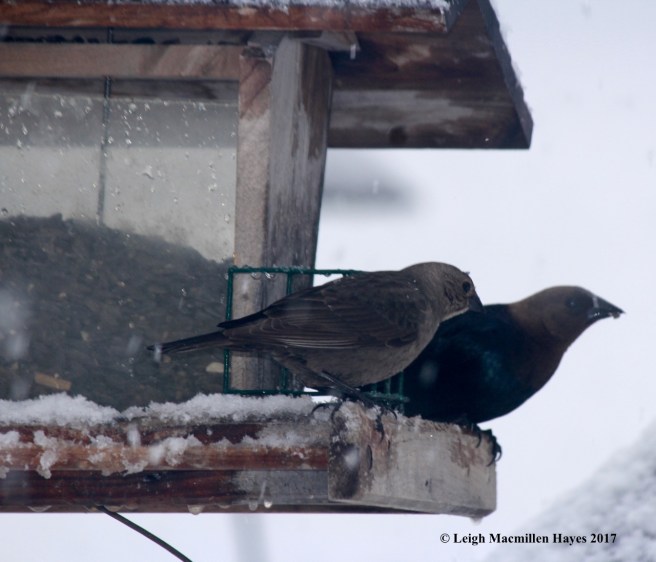
And with them came a few friends. Or were they? It seemed the cowbirds may have been scheming.

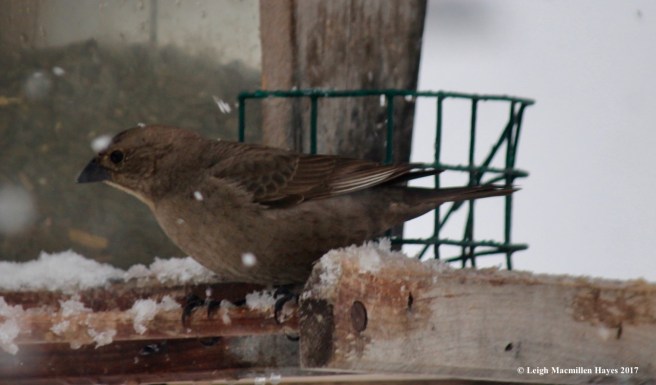
b-cowbird female

Mrs. Cow perhaps choosing others who might raise her young one day soon.

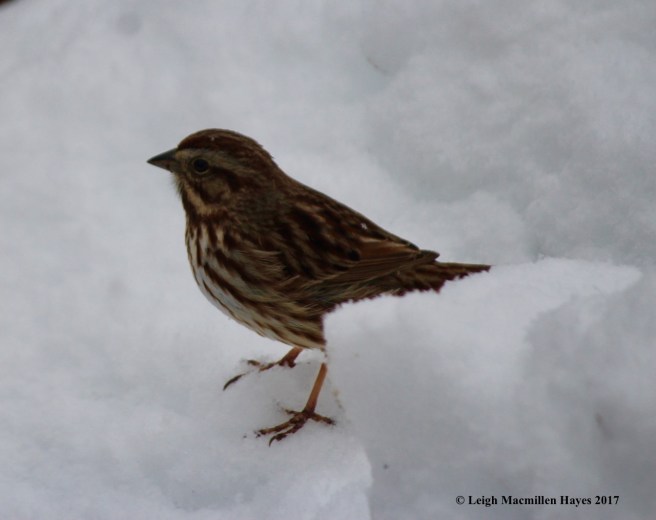
b-song sparrow

Another recent visitor also added its song to the chorus and its streaked breast to the landscape–such is the manner of the song sparrow.

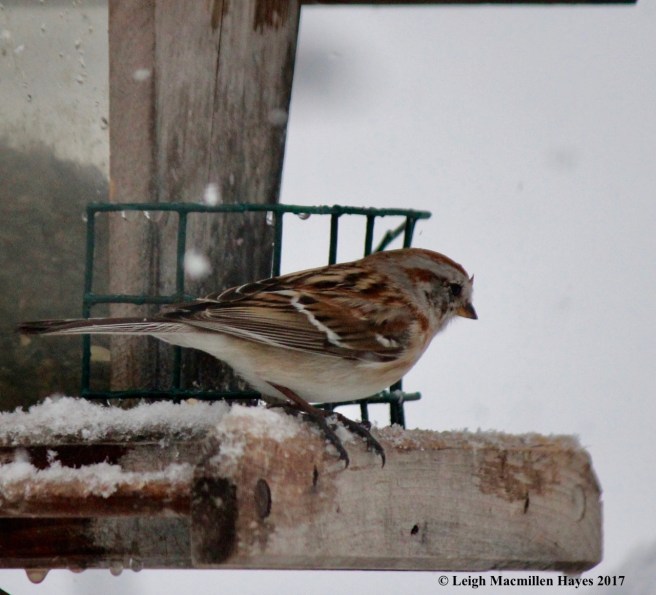
b-tree sparrow1

American tree sparrows, on the other hand, have been frequent flyers all winter. This one paused long enough to show off its bicolored bill and white wing bars.

b-robins

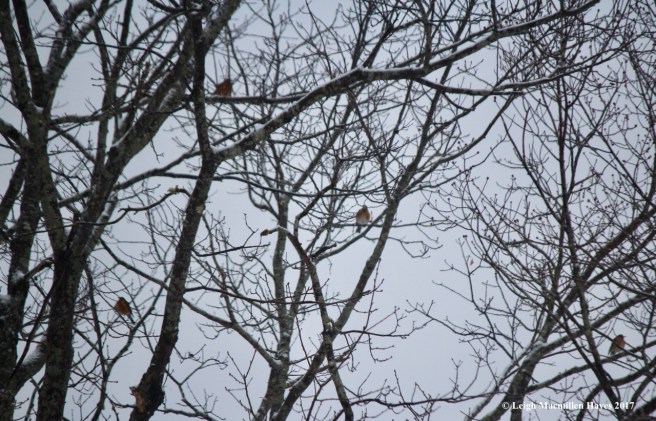
And then there were those who chose to visit from a distance–the American robins appeared as ornaments in the oak and maple trees.

b-crow sentry

Meanwhile, a crow stood sentry–allowing all to eat in peace as it was ever ready to announce any intruders.

b-white-breasted nuthatch

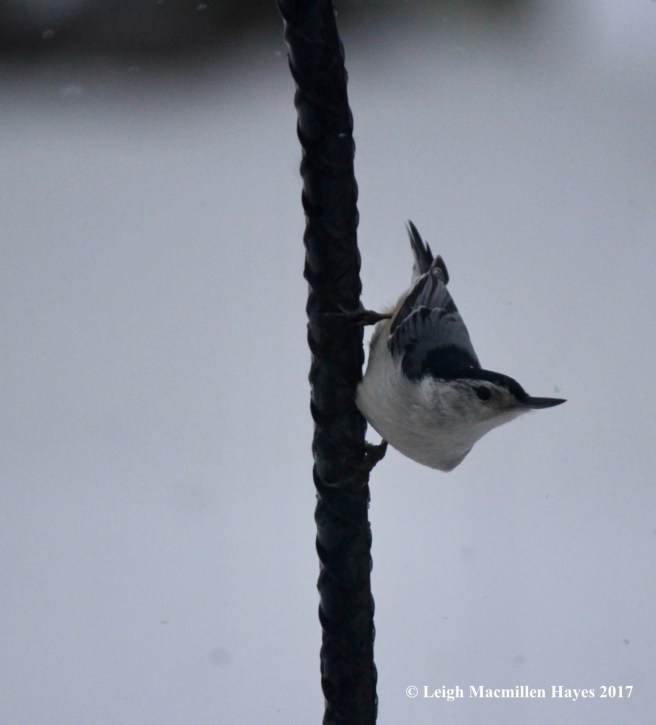
And so they came and went–some upside down like the white-breasted nuthatch.

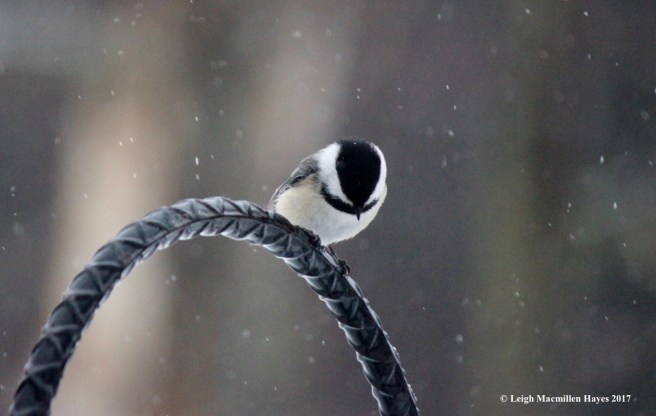
b-chickadee waiting

Others waiting patiently for a turn,

b-chickadee at feeder

confident in the knowledge that the wait was worth the reward.

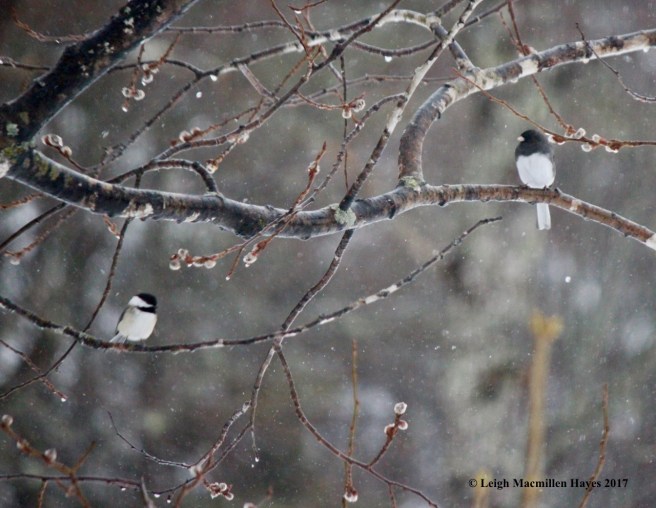
b-chick and junco

But not all . . .

b-junco in lilac

that waited . . .

b-junco waiting

remained patient.

b-junco--cigar?

The juncos gobbled the seeds . . .

b-junco with peanut

and the peanuts.

b-junco fight 1a

And like siblings, they squabbled . . .

b-junco fight 1

with attitude . . .

b-junco fight 2

and insistence.

b-junco fight 3

Of course, there was always a winner.

b-junco up close

I love these plump winter visitors with their head and flanks completely gray, contrasting white  breasts and pale pink bills–making the junco an easy ID.

b-gray squirrel

They weren’t the only gray birds to visit the feeders. Oh, you mean a gray squirrel isn’t a bird?

b-squirrel in its tracks

Nor is the red. Don’t tell them that.

b-deer in yard

The same is true of this dear friend, who first spied some action in the distance . . .

b-deer looking at me

and then turned its eyes on the bird seed and me. But with one periscope ear, it still listened to the action to my right.

b-deer flying away

And then as fast as the birds that feed here all day, but flit in and out when they hear the slightest noise or sense a motion, the deer turned and flew off as a car drove up the road.

I played the role of a fair-weather naturalist today as I watched my feathered friends from indoors.

With friends in mind, I dedicate this post to my mom’s dear friend, Ella, who passed peacefully in her sleep the other day. I trust Mom has put the coffee pot on and she, Aunt Ella and Aunt Ruth are watching the birds out the kitchen window. 


Dear Aunt Ruth

My memories are snapshots of times spent with you and Uncle Bob and all the cousins. I loved visiting your home–whether we drove down the long road and driveway with Dad or walked via the old dump road and skeet field with Mom. Each time we arrived, you welcomed us with grace and your unassuming manner.

I remember sipping lemonade on the back porch, riding the wooden horse, and checking on Dale’s bunnies, especially Peter who soon became Mrs. Peter. I remember lunches at your kitchen table, and the time we bit into our tuna sandwiches only to discover the bread was filled with ants. Why that sticks with me, I don’t know, but we all thought it was funny. I remember family reunions, where food and laughter and aunts and uncles and cousins were abundant. Eventually, it evolved into a musical gathering–such was the talent of the clan.

But most of all, I remember your flower and vegetable gardens and your love of all things natural.

p-kiosk

And so today, as my guy and I ventured to a park we’d never before visited, I took you with us. I wanted to share with you our findings, just as you used to share stories of your gardens and wildlife sightings with us in Christmas cards after I moved north.

p-moose trail

Our first observation–a moose! Well, not really.

p-deer tracks

But we did see evidence of deer and I knew you’d be glad they were running away–leaving your gardens alone. Oh, and those pesky raccoons! Raising eight children didn’t seem to phase you, but those raccoons in the corn field–that did rattle you.

p-gardens on high

The gardens in these woods differ from yours–and right now, given the snow cover, the only ones visible were high up in pine trees, where yesterday’s snow offered nourishment to the mosses and lichens that grow there.

p-locust legume-like seed pod

We did, however, find one similarity–the legume-like seed pod from a locust tree. It’s almost time to sow the peas.

p-apples

In these woods, we also found a symbol of the past–it was once farmland as signified by the apple trees. If memory serves me right, there was a very climbable apple tree beside your driveway.

p-hidden acorn

And then we spied one impossible possibility–an acorn tucked into red maple bark. How did it get there? And will it germinate? If it does, what then?  I trust, you too, would have noticed such and wondered.

p-pratt brook 2

We followed the trails through the woods and sometimes beside the brook for which the property was named–Pratt Brook. It was a bit more bubbly than the creek in your yard, but such is the snow melt right now.

p-artist conks

Along the way, I noted a family of artist conks decorating a tree. And, that, of course, brought to mind the box of colored pencils you (or perhaps it was the cousins, though Neal had no qualms about telling us that our gifts were really chosen by you) gave me long ago. I cherished that box and used those pencils with care. They lasted into my early adulthood.

p-colors 1 (1)

And then my guy gifted me another box, which I again revere. One of my favorite pastimes is to sit and sketch and then add a dash of color. Whenever I do, Aunt Ruth, you are with me.

p-powerline

For a while we followed the power line trail, aka Bear Trail. As you can see, we tramped in the footsteps of many others who’ve traveled this way just today–via skis, snowshoes and hiking boots like us. We were an hour from home and close to the ocean, so the snow level was about six inches compared to at least two feet we walk upon daily. But today’s sun warmed us and initiated a meltdown.

p-spider

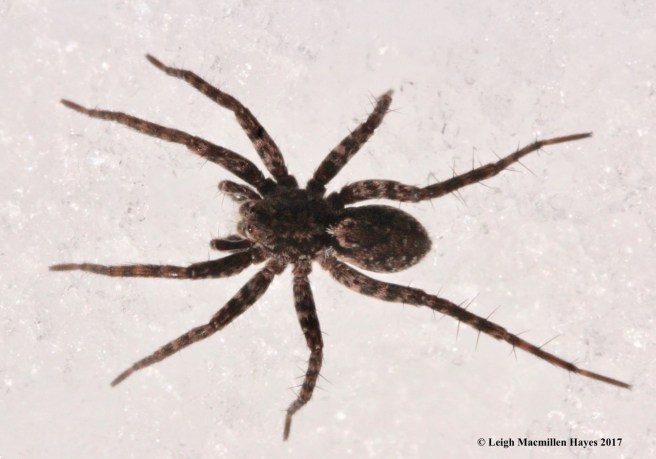
I didn’t mind being on the power line for a bit, for it was here that we saw our only sign of wildlife.

p-aster 1

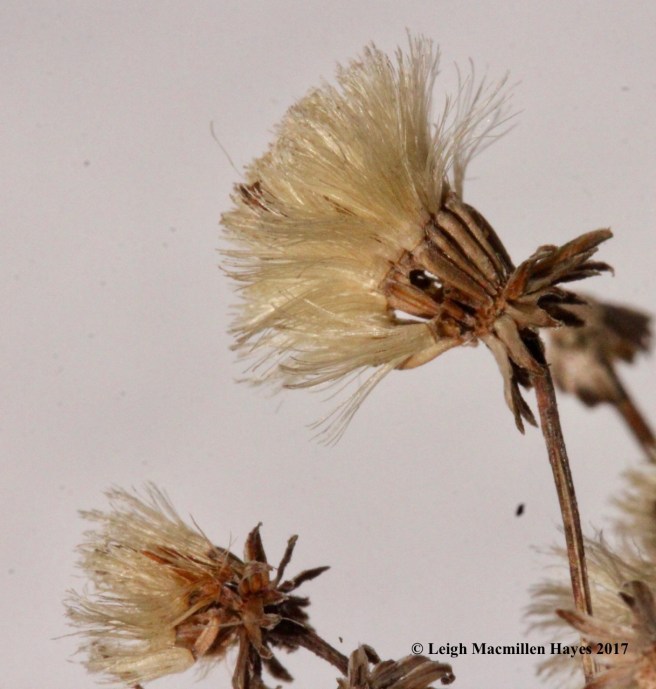
It was also the spot where I knew we’d find wildflowers–and I wasn’t disappointed. Asters like these, and goldenrods, spireas and berries displayed their winter forms.

p-beetle 3

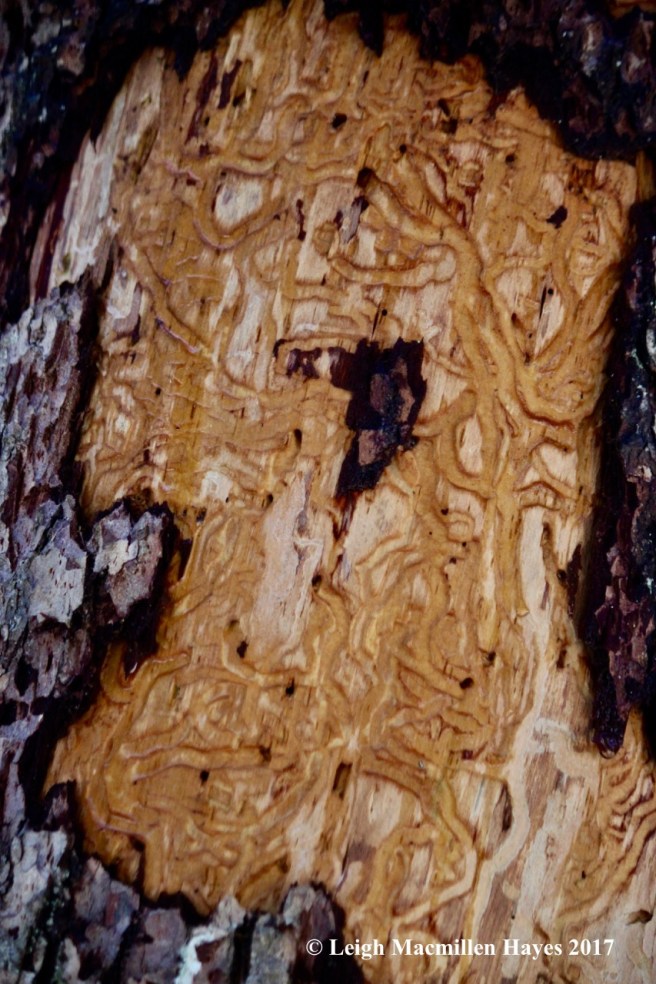
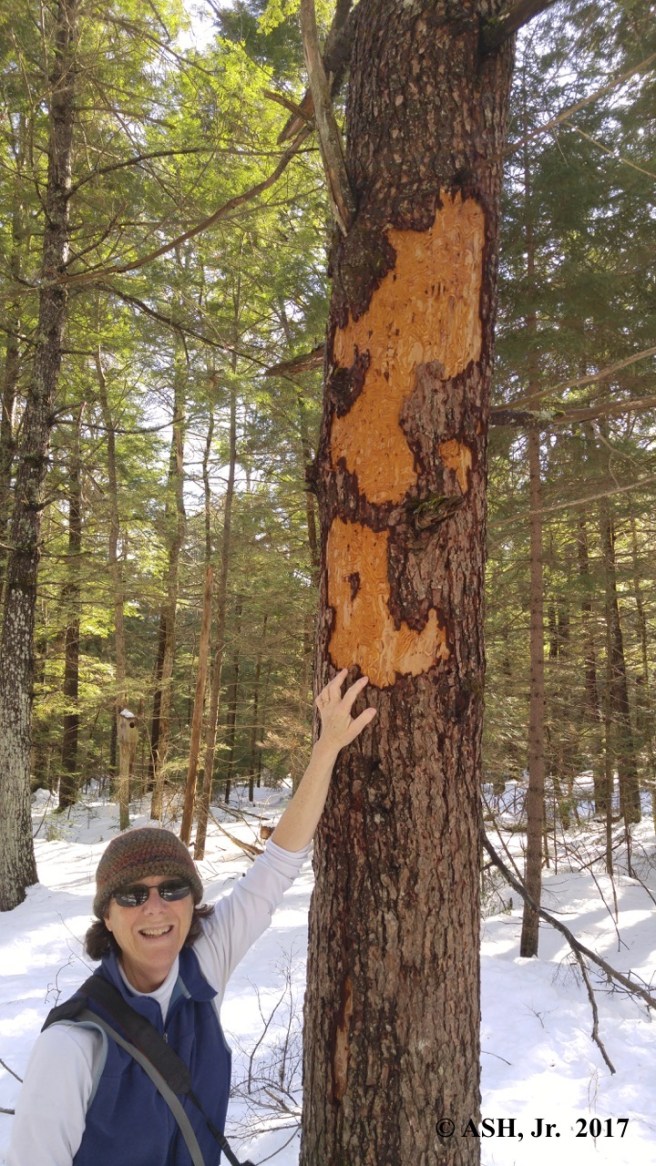
Back into the woods, we were almost done, when we spied this woodwork, carved by bark beetles.

p-bark beetles 1 (1)

And I was again reminded of my past observations when I moved a log and discovered a gnawer on the job.

p-me

The intricate work reminded me of Uncle Bob’s woodworking skills and I knew you’d appreciate that. You’d also appreciate that as I write, my guy is watching a National Geographic show about Wild Scotland.

Thanks for the memories, Aunt Ruth. And thanks for making time for us and showing an interest in all that we did–always as curious about our adventures as those of your brood. You were a remarkable woman and a genuine Yankee whom I was blessed to have as a part of my life.

Fondly, Leigh


Snow White Birches

We’ve plenty of snow still on the ground and another storm predicted for the weekend. I keep saying, “Spring in Maine,” because that’s exactly what it is. In fact, no season here has ever looked at the calendar and we never know what will happen during those transitional days–except that they’ll do just that–transition.

o-up to my knees

I, too, am transitioning and rather than my usual uniform that includes snowpants and a vest or jacket, I simply wore jeans and a sweater, plus boots minus the snowshoes. Only occasionally did I dig a posthole, but when it happened my foot went deep–at least to my knees. And in this case, there was a juniper below, so probably more snow under that.

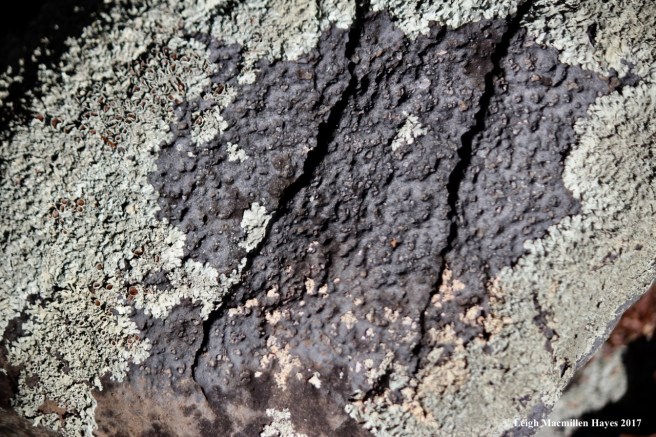
o-rock surface black and pitted

Deer, raccoons and a bobcat had traveled through our woodlot and along the cowpath. At the vernal pool, I spent some time checking out trees and looking for signs of change. Deer and turkeys have been the most recent visitors. And both have also traveled along the double-wide stonewall beside it. I, too, climbed up there and moseyed along. That’s when I discovered a black crustose lichen that turned out not to be a lichen after all.

o-rock surface, basalt?

I suddenly realized I was looking at the rock face and have sent photos off to two geologist friends. My question, “Is this basalt?”

Ann Thayer replied, “Could be, it also looks like it could be a rock that has been metamorphosed and has secondary mineral growth. At certain pressures and temperatures there are indicator minerals that grow that represent the metamorphic conditions. For instance, Garnet, sillimanite, and andalusite, are examples of indicator minerals . . . Take a look at it with the hand lens. Tell me what you see. There are a couple of minerals that look like they have a six-sided form and cross-section.”

Ah, a reason to look some more–as if I need one. And to invite Ann here for a walk.

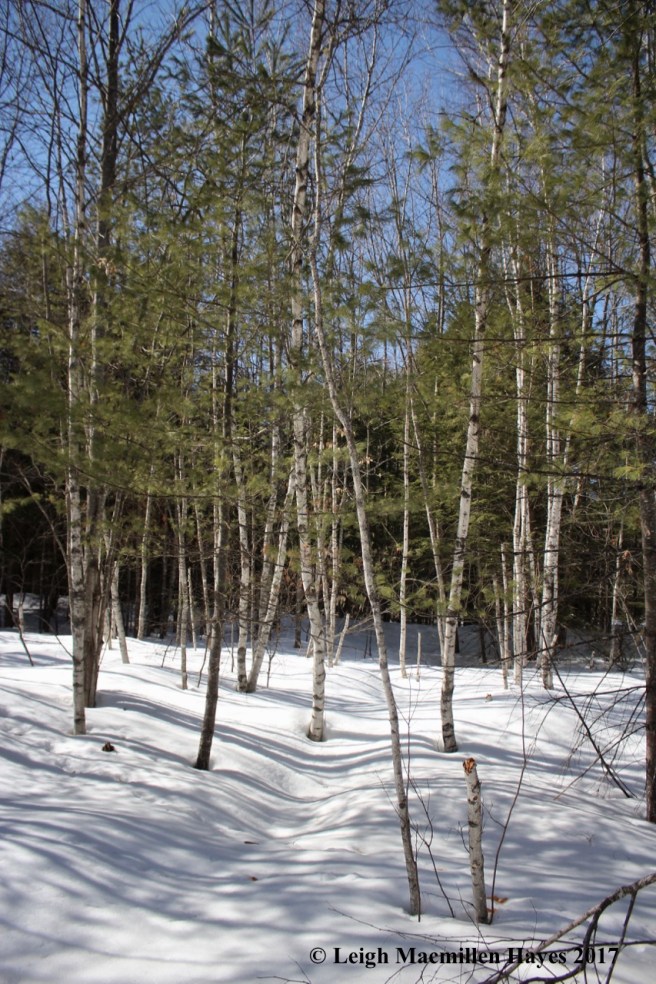
o-birch grove

Beside the vernal pool is one of my favorite sections of these woods, a small birch grove. Yes, white pine and red maple saplings also grow there, but right now the birches dominate this acre-size plot.

o-gray birch chevrons 1

It’s a classroom filled with examples that have helped me gain a better understanding of differences between family members. The gray birch, Betula populifolia,  are those I associate with Robert Frost’s poem, “Swinger on Birches,” because it’s an early successional tree that bends naturally and even more so in an arc when snow or ice weigh it down. But it’s the chevron or triangular shape below branches that shouts its name to me.

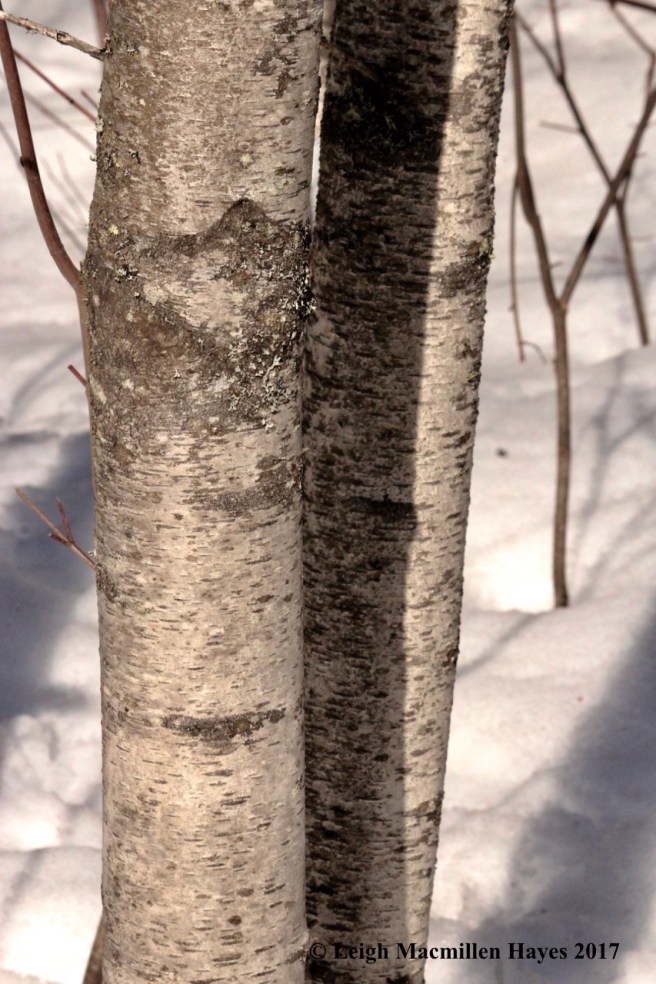
o-dirty gray birch bark

Its bark, though white like paper birch, looks dirty–especially toward the base. And, unlike paper birch, it barely peels.

o-paper birch bark1

In this same plot, I did find a few specimens of paper birch or Betula papyrifera, which is a stronger tree and grows taller and longer that brother gray.

o-paper mustache

And rather than a chevron below the branches, it’s known for the long, dark mustache that swoops up and over its branches.

o-paper birch close up

I moved in to take a closer look at the paper birch bark, admiring how the lenticels withstand the peeling, breathing while sloughing off old cells.

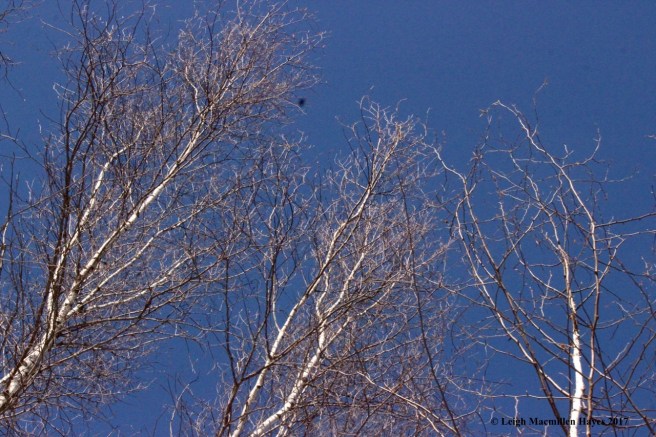
o-gray, left, paper, right

Looking skyward, the differences between the two were yet again defined. The gray birches on the left featured a bushier silhouette than the paper birch on the right. Catkins and buds also shouted their names, but I’ll save that for another day.

o-birch polypores 2

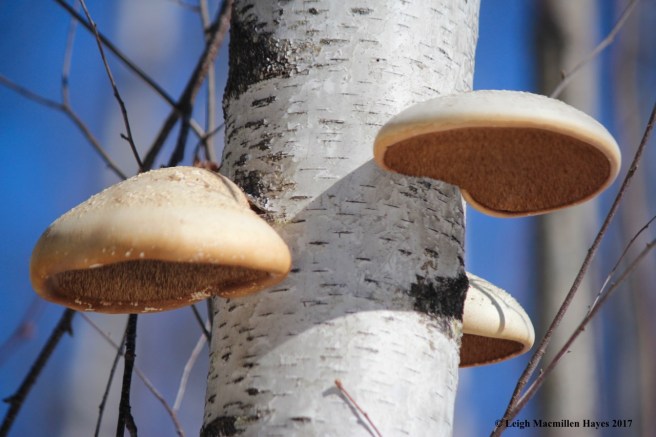
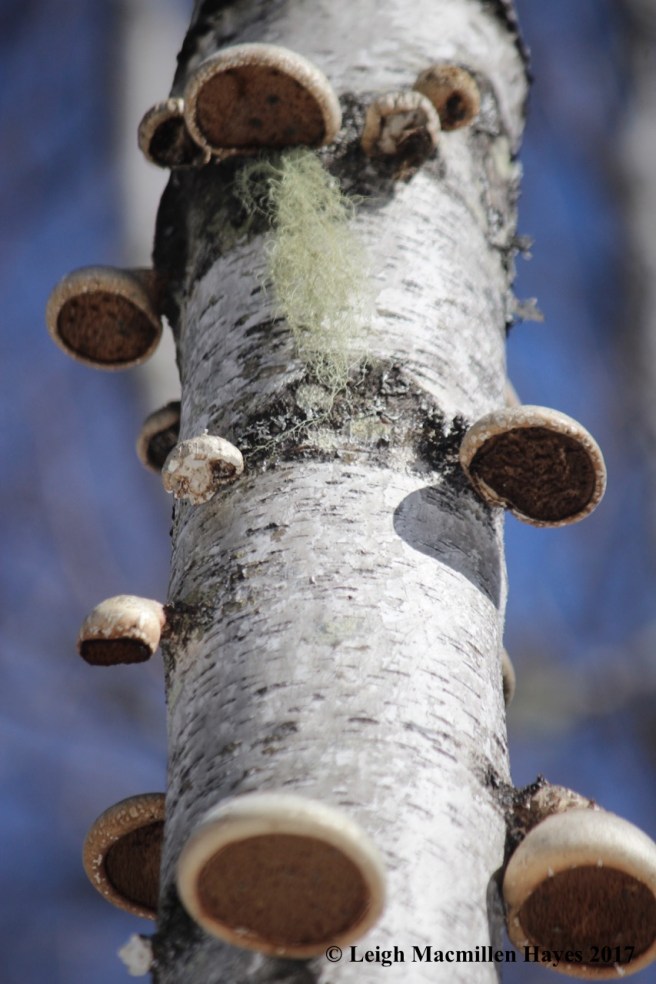
Not fussy about which birch it grows upon is one of my favorite fungi–because I can identify it with ease! But also because it really is attractive.  Piptoporus betulinus or birch polypore grow on some snags as well as a few live trees. The smooth rim rolls around the pore surface and sometimes reminds me of a bell hanging from the tree.

o-birch polypores growing old

These bracket fungi only live for one season, yet persist on trees for a longer period of time . . .

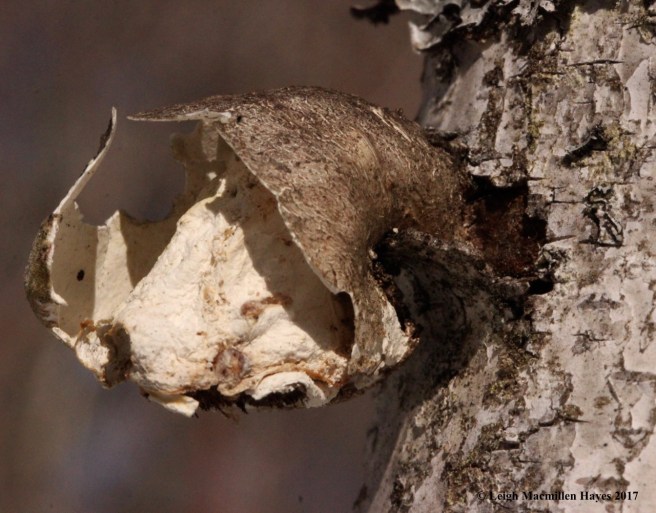
o-birch polypore skeleton

until they may become mere skeletons.

o-birch grove 1

After a sunny afternoon among the birches, it was time to head home. Oh and by the way, some call paper birch white birch and some call gray birch white birch. I prefer to call them paper and gray.

In the Brothers Grimm Fairy Tale, the queen sat by the window sewing as “the flakes of snow were falling like feathers from the sky.” Soon the queen gave birth to a daughter as white as snow with hair as black as ebony. You know the rest of the tale. But did you know that Snow White lives in these woods–forever embodied in the birches?

The Irish Colors

With so much snow still on the ground, it’s easy to see the landscape as a monochrome palette of grays. And so I set out on this St. Patrick’s Day to find some color.

f-bridge

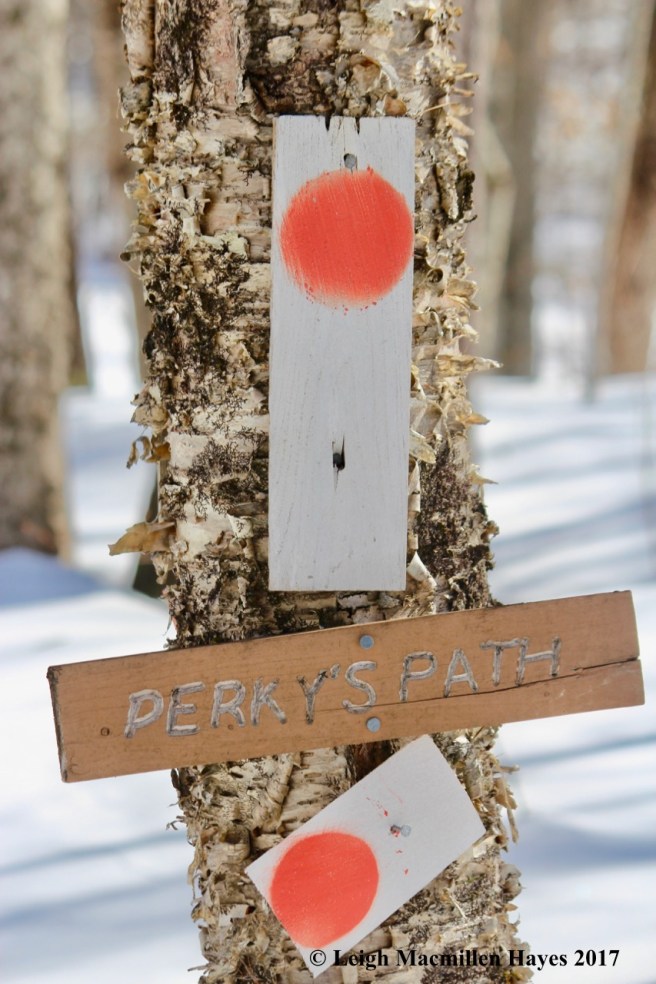
My destination was the Greater Lovell Land Trust‘s Flat Hill trail and Perky’s Path from the end of Heald Pond Road. The parking lot is almost non-existent, so much snow do we have. And the bridge crossing tricky.

f-cherry bark

As I climbed upward, the thought that some see the world as black (cherry) and . . .

f-paper birch 1

white (paper birch) kept racing through my brain.

f-gray birch 1

And then there are those who accept that gray areas exist (gray birch–a brother of paper birch from another mother).

f-yellow birch bark

Textures visible in shadows reflected differences (yellow birch–a cousin),

f-hop hornbeam

even among family members (hop hornbeam–also a birch relative.)

f-mink tracks

It may have seemed there wasn’t much new to see and wonder about, but . . .

f-mink prints

the straddle (width from outside of one print in a set to outside of the other) and angle of these prints told a different story. A mink had crossed the trail. (My mitten had to hold the Trackard in place or it would have slid down the trail.)

f-porcupine trail

Nearing the top, I went in search of another mammal who has frequented this area for years–and I wasn’t disappointed. The porcupine trough was fresh.

f-view from Flat Hill

And then I reached the summit of Flat Hill (forever an oxymoron) and the whites, greens, browns and blues of mountains and sky opened before me. There was even a hint of red in swelling buds.

f-downhill from Flat Hill

The wind was cold, so I didn’t pause for long. Instead, I retraced my own tracks down the hill.

f-orange trail

And then I turned onto the orange trail that is Perky’s Path and realized the symbolism of the color and this day. My Scottish ancestors smiled down on me.

f-beaver lodge

I’m always drawn to the wetland and had to take a peek at the beaver lodge, which remained snow covered, indicating that no one was home. But there again, the sky enhanced my view.

f-wetland from bridge

The path leads to another set of small bridges, and there I stood for a while, taking in the peacefulness and beauty before me. Oh, and the warmth of the sun as its strong rays embraced me.

f-chickadee 1

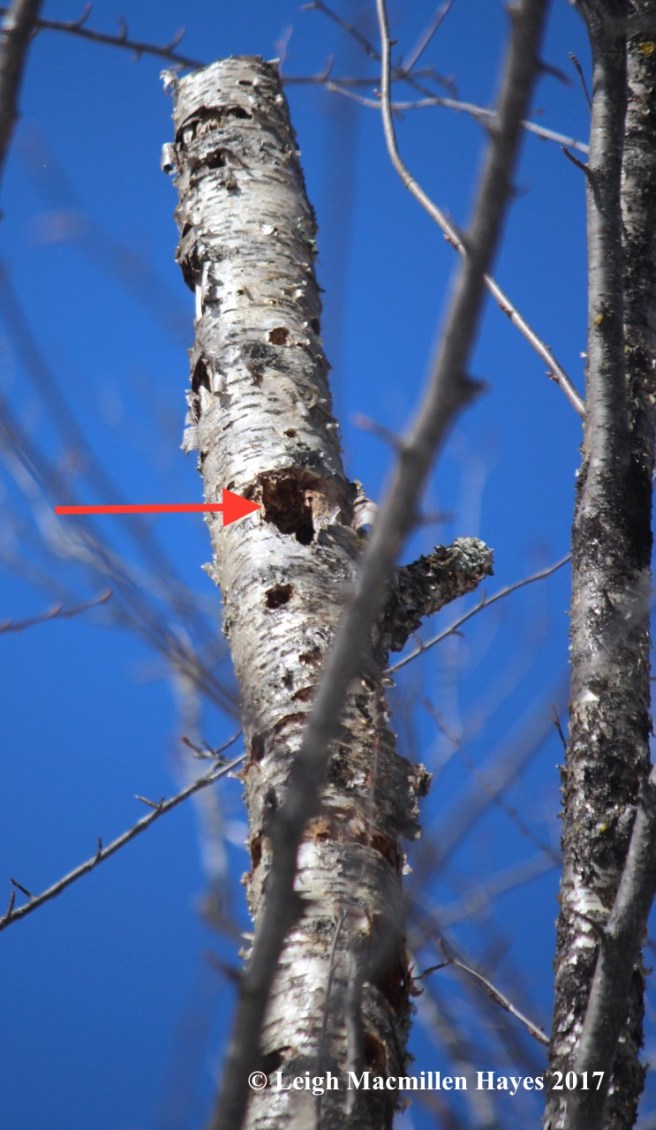
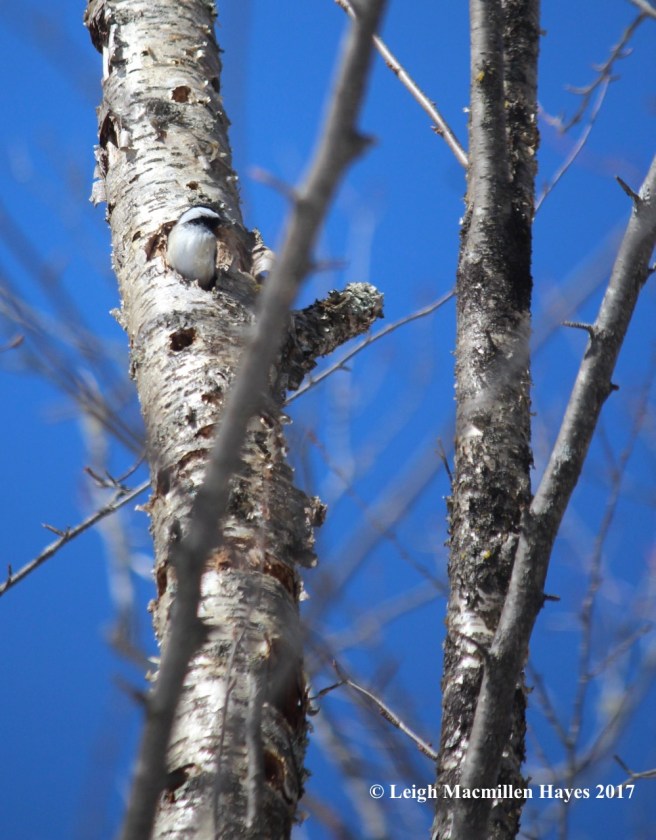
While I stood and listened, a chickadee called and I watched as it entered a hole in the birch snag. This was a wow moment, for though I know birds use old pileated holes, I rarely see them come and go.

f-chickadee 3

Out he popped, giving a curious look–perhaps because I was pishing.

f-chickadee 2

He paused for a moment and then flew off, chickadee-dee-deeing across the bright blue sky.

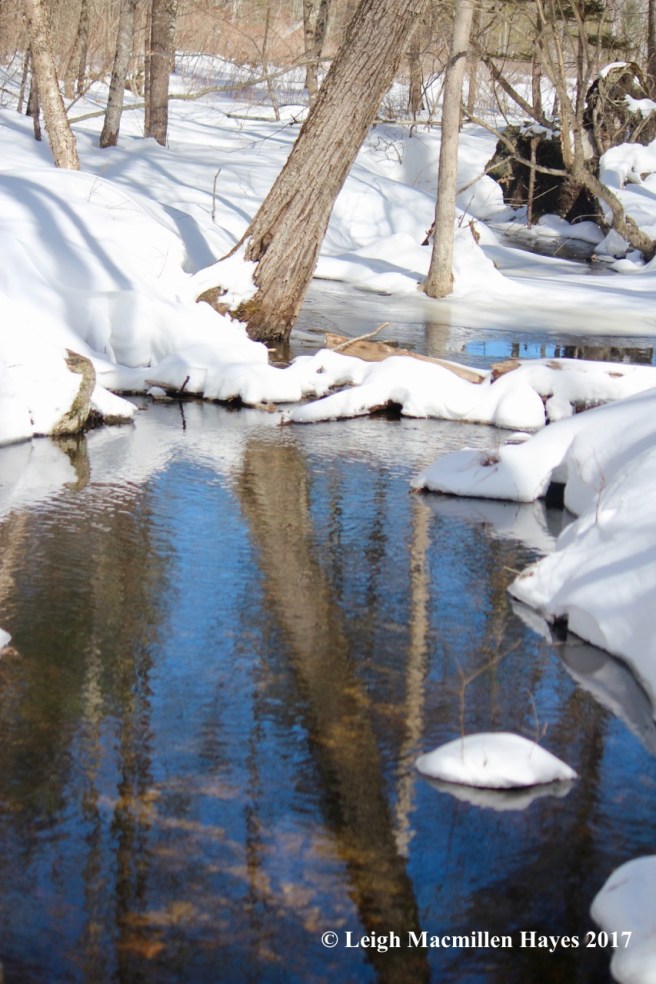
f-brook view

I, too, took off, but not before enjoying a few more reflective moments.

f-ice swirls

The juxtaposition of snow, hemlock branches, water and ice created colorful swirls of artistic design beyond understanding.

f-wintergreen

And then I found a few wintergreen plants, their waxy leaves transforming from winter maroon to summer green.

f-beaked hazelnut

On my way out, I stopped to examine a few buds–and catkins, in this case. I love winter, but I am beginning to crave color and beaked hazelnuts will be among the first to flower.

f-striped maple bud1

A striped maple showed off its waxy buds, leaf scars and growth rings. The bud reminded me of hands in prayer–perhaps worshipping the patron saint of Ireland.

f-striped maple covered

One bud was sheathed in white. Even with my hand lens, I couldn’t figure it out. I’d like to think it was an angelic covering, but suspect it is a cocoon.

f-basswood 2

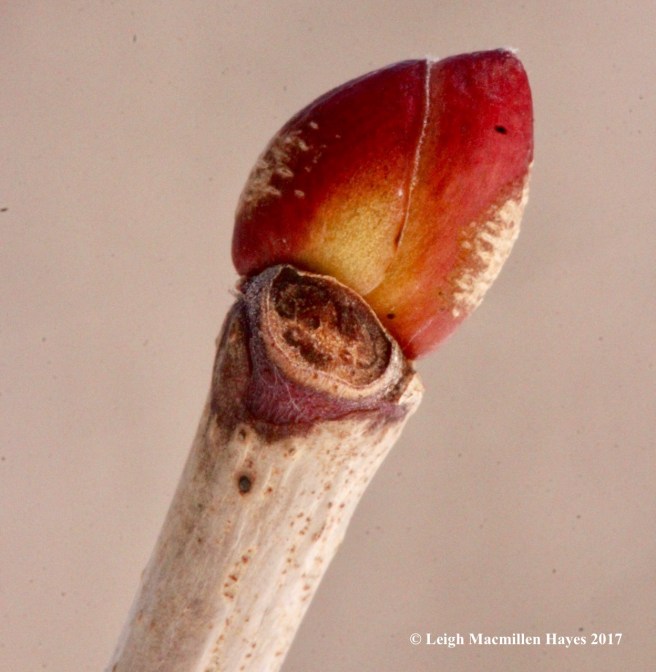
And then there were the bulbous bright buds on the basswood tree.

f-basswood lateral bud

Indeed, they were a sight to behold. Though winter reduced the color palette to the essentials, slowly the transition to spring has begun.

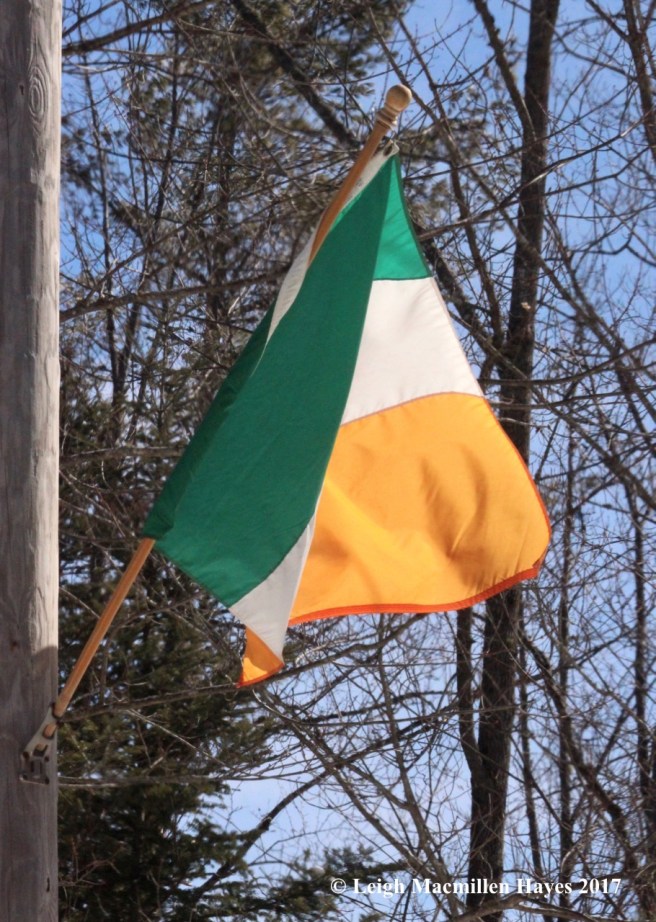
f-Irish flag in breeze

My journey was done, but I made one more stop along Route 5, where Irish flags flapped in the breeze to commemorate this day. The Irish color–where white signifies the truce between the Orange and the Green.

I always wear a hint of orange on this day in contrast to my Irish guy’s green. And I remind him that St. Patrick was born in Scotland.


Beautiful Maine Mondate

Some Monday’s we look for new places to explore or mountains to climb, but today found us visiting an old favorite that is gorgeous in any season.

s1-Stone House Road 1

Because it’s still winter (and she’s not letting go right away), we knew our hike would be extended by more than a mile on either end. We parked by the Leach Link Trail on Stone House Road and followed the telephone poles in.

s2-bear number

These are my favorite telephone poles in the world–well, for today that is, for they show the works of the clever bears that inhabit this place. The wood has been scratched and bitten, while the shiny pole number was mutilated. This was pole 5. I suppose it still is.

s3-bear hair

Hair sticks out from splinters. Bear hair.

s4-more bear hair

We found lots of it on several poles today. More than we’ve seen in the past.

s6-another pole

I’m thinking that the bears in the area have a fondness for 5. Or a dislike, for pole 15 also received rough treatment. There are more, but it was on 5 and 15 that we noticed the number destruction.

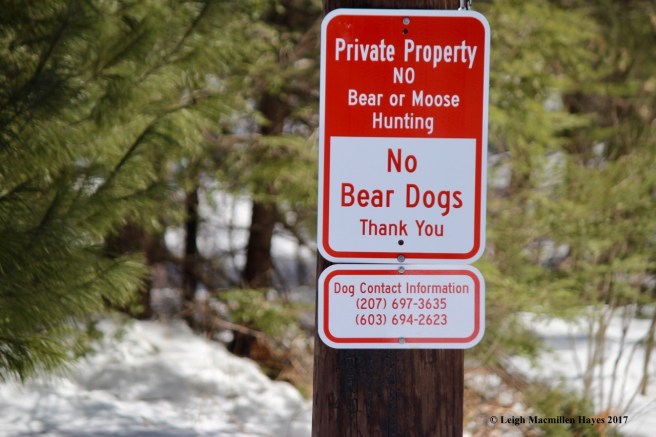
s8-bear dogs

Despite that, the bears in this area are most welcome. Because the signs are new, I asked my guy what he thought the bears will do when they emerge from their dens soon. In my mind, I saw a similar behavior to the other poles and imagined that when we return again we’ll see that the signs have also been destroyed because that’s what bears do. My guy’s response, “Clap.” Indeed, they should.

s9-gate

At last we reached the gate where we usually park to hike the Stone House property and Blueberry Mountain trails. The Stone House property encompasses about 890 acres surrounded by the White Mountain National Forest. In 2011, the owners, David Cromwell and Sharon Landry, established a conservation easement held by the Greater Lovell Land Trust. The easement allows for traditional uses including commercial agriculture and forestry, but prohibits development and subdivision in perpetuity. Thus we have both this couple and the GLLT to thank for today’s adventure.

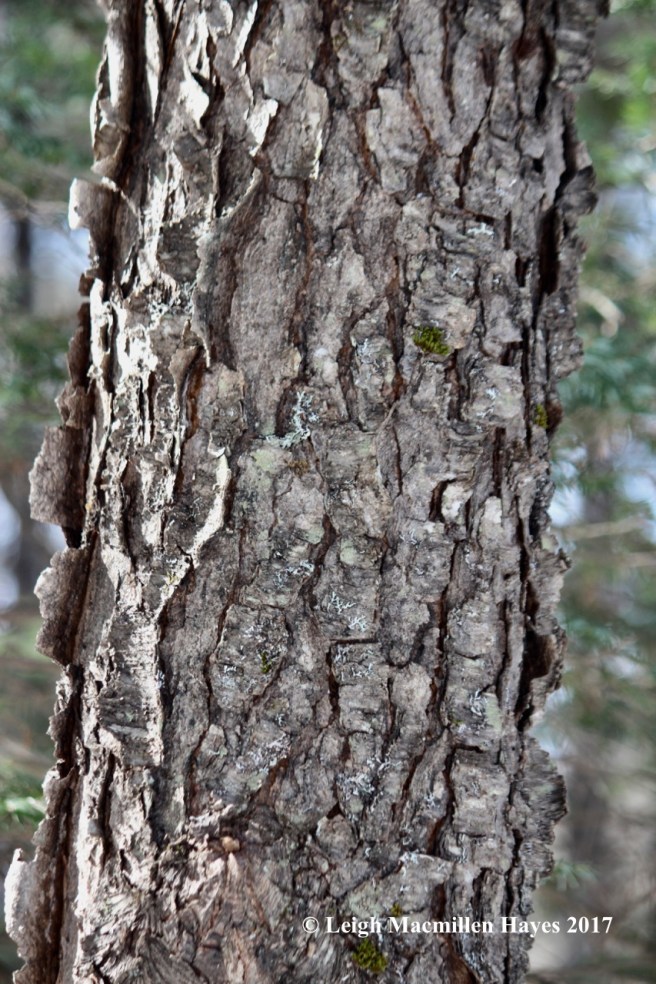
s10-black cherry bark

When we finally reached the Shell Pond trailhead, a black cherry immediately jumped out at me. The property was last logged in 1977 and features a mix of hard and softwoods. My bark eyes love the diversity.

s11a-birch and red maple

And my bark mind appreciates the kindred spirit of the trees that manage to support each other despite their differences–in this case a beech and red maple.

s14-pileated works

I’m not the only one who likes bark–the work of pileated woodpeckers,

s15-porcupine

porcupines,

s16-beaver works

beavers,

s13-yellow birch burl

and even insects was evident throughout our three-hour tour.

s17-Yale blue

As we hiked, my dad was also on my brain. I’d received a message this morning from his former boss at Yale University who fondly recalled Dad and his brother Bob. Though quiet men, he and his brother had a twinkle in their eyes, a love for music, especially opera, and always a good joke or prank up their sleeves.

When I saw this tree in the shape of a Y, I knew it was for Dad. Even the sky spoke of the university–though several shades lighter than Yale blue. And with that came the memory that any paint my father mixed had a touch of Yale blue in it–thus was his way. It was all meant to be for Mr. Cromwell, the property owner, is associated with Yale.

s18-my guy

I couldn’t help but think that Dad would have loved the idea of our Mondates. He also would have loved my guy, but sadly they never met. Dad died of a heart attack only days before he and Mom were to spend a weekend with me in Maine–thirty years ago.  But, my guy continues to wear a Yale sweatshirt when he runs, which he did this morning. In that way, he’s made his own connection. Yeah–that’s my guy!

s19-pond views

Now that I’m writing through tears, I’ll get back to the trail, which is delightful in winter because it offers more views of Shell Pond below.

s20-cliff views

And the icy ledges above. Later in our journey, I noted the trail to the ledges had been well used–probably by rock/ice climbers.

s22-water 1

Trail conditions were such that we walked on top of the hardened snow, though I did wear micro-spikes for the entire tour. Someone waited to put his on and did a little slipping and sliding along the way. Brook crossings required stepping low and high, so deep is the snow still.

s23-ice castle

While I marveled at a castle made of ice,

s24-Christmas tree

my guy spotted a Christmas tree.

s25-polypody

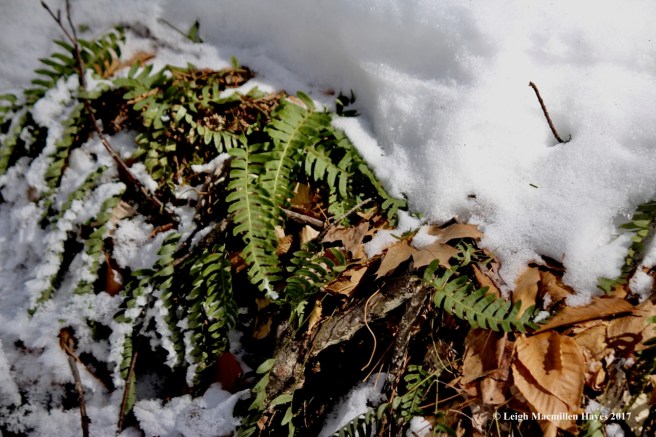
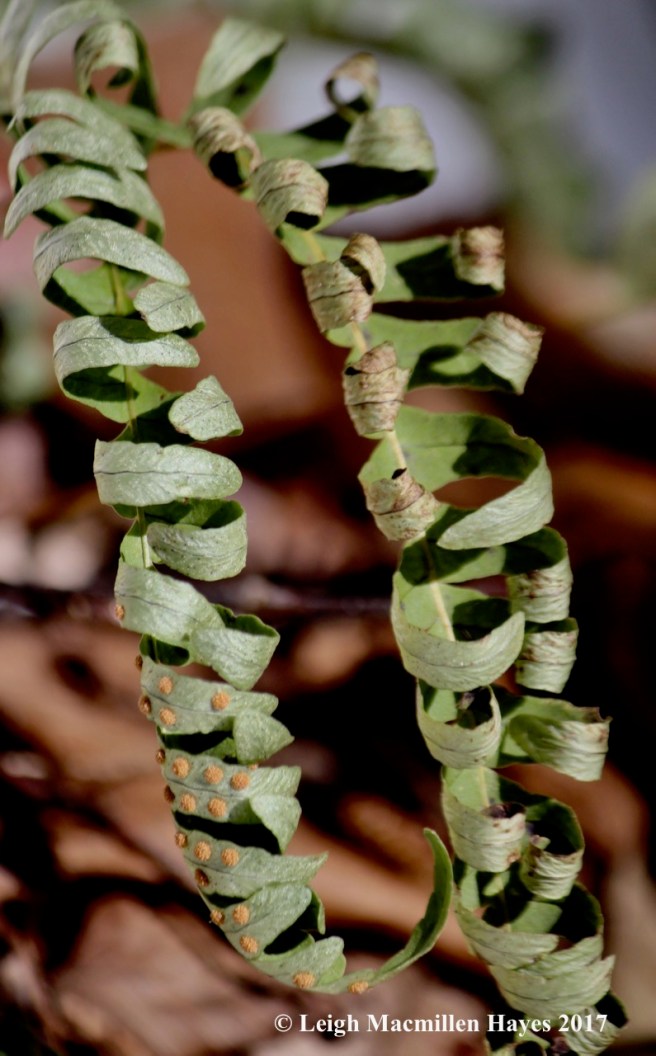
We even found a few hints of green. These polypody ferns were opened, indicating warmer temps and today we certainly noted the difference compared to the brisk weekend.

s26-polypody

Of course, on another rock, some were still curled in their cold formation. They were under a hemlock and more shaded.

s27-partridgeberry

Any bit of green is a welcome sight about now and I was surprised to see partridgeberry poking through the snow.

s28-lunch bench

At last we reached lunch bench, which my guy stood upon. Yup, that’s the granite bench under his feet.

s29-lunch

We sat on it to eat our PB&J (with butter for me, of course) sandwiches. And tried to keep from sliding right down to the pond.

s30-Shell Pond

Lunch view included Shell Pond and the Baldfaces in the background. All along, we’d noted mice, squirrel, mink, fisher, coyote, bobcat, ruffed grouse, turkey and moose tracks. But as we ate we listened to the whales groan–so moaned the ice in the afternoon sun.

s31-brook

A short time later we reached Rattlesnake Brook and the orchard, where the natural community transitioned and appeared almost bucolic.

s32-ostrich fern

One of my favorite finds along this section is the ostrich fern. The structure of its fertile frond makes me smile.

s33-airfield

From the orchard we moved on to the old airfield and wondered if the family ever flies to their summer home. Though I don’t think it’s used these days, the airstrip was apparently built in the 1940s by the military for practice landings and takeoffs during World War II.

Again, the views were breathtaking.

s34-stone house and Blueberry Mtn

As hikers, we’re reminded by signs to stay on the marked trails, thus protecting the land and giving the family some space. I’m in awe of their home. The Stone House was built in the early 1850s by Abel Andrews. He quarried the large, hand-hewn granite slabs from Rattlesnake Mountain and built the 40-foot by 25-foot house for his wife and thirteen children.

s35-another wetland

I did stay on the trail most of the time, but occasionally I heard the landscape calling my name and had to investigate. Fortunately, my guy stayed on the trail all the time and kept us honest.

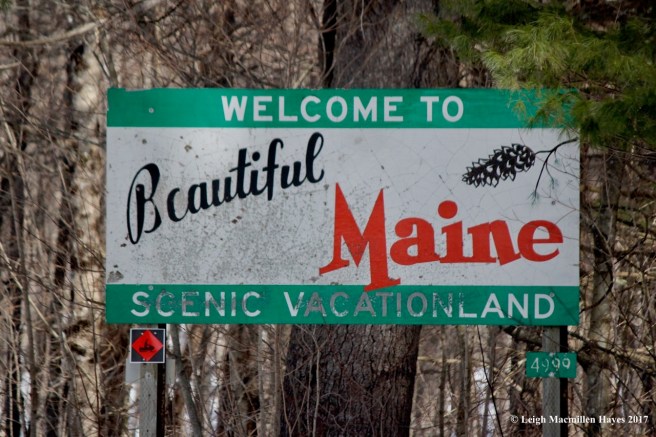
s36-Beautiful Maine

We walked back out to the truck and then decided to take a quick detour before driving home. Being on Stone House Road, we were only a mile from the winter closure point for Route 113 in the White Mountain National Forest. The road forms the state line between Maine and New Hampshire for several miles. And then it passes into Maine at the gate by the Cold River Campground and The Basin. And it’s there that you’ll find this iconic sign.

Welcome to Beautiful Maine and another scenic Mondate.


Because I Wandered

It’s still cold and blustery. Oh, we had warm spells in January and February. But now it’s March. And it’s Maine. So wind chill in negative to single digits shouldn’t come as a surprise. Nor should the impending Nor’easter predicted for this week. Only more than a foot of snow possible.

Today’s cold wasn’t nearly as frigid as yesterday’s and when I stepped out the back door, I could feel the warmth of the sun penetrating my outer being. It worked wonders for my inner being as well.

o-quaking aspen

My first stop was beside the quaking aspen tree. Yesterday, some Maine Master Naturalist students and I examined tree buds and their characteristics. I love looking at these and do so every day since the tree is right off our back deck.

Varnished scales protect the  aspen’s leaf and flower buds as they lay dormant through the winter. Its flower is produced within a catkin and already the cottony part of the seeds is appearing, much like a pussy willow.

o-striped maple

As I moved into the woodlot, I stopped to re-admire the only striped maple that grows here. Last year a deer used the lower portion of the bark as an antler rub. Yesterday, as we stopped to look at the characteristics of its bark, we noticed it’s been used most recently as deer food. This tree is barely larger than the circle formed within my thumb and pointer finger–and I have small hands. How much more deer attention can it take?

o-gray fox tracks

As I looked at the striped maple, my eyes were drawn to the activity of another mammal. Out came my Trackards and I took measurements. I knew by the walking pattern that it was a canine. And I knew by the size that it was a fox. But red or gray was the question. I suspected the latter because I could see details clearly in the soft snow atop the hardened crust.

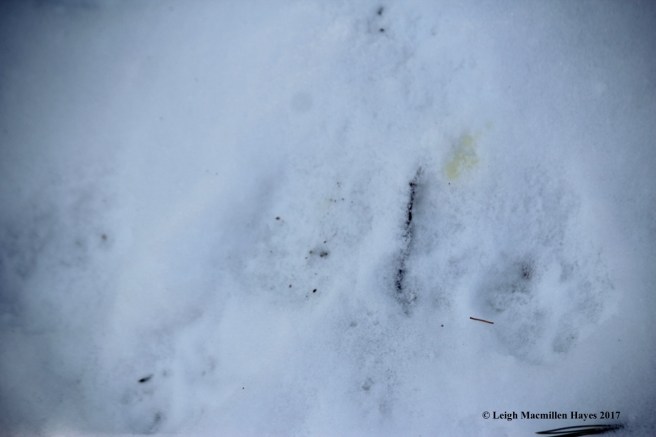
o-gray fox prints

Measurements and a look at a bunch of prints confirmed my suspicion. Rather than stay on the path, I decided to backtrack the fox’s trail.

o-gray fox and coyote 1

Within minutes, I realized another mammal had traveled in the opposite direction. Also a canine.

o-gray fox and coyote intersect

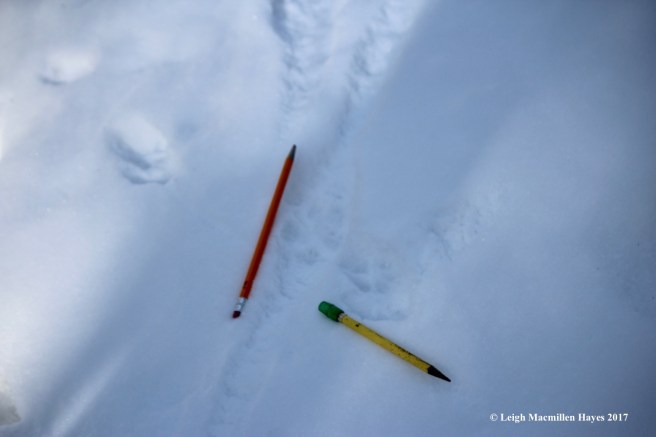
And atop a double-wide stone wall, I found where the coyote (follow the red pencil) and gray fox (yellow) crossed paths. Not at the same time, I’m sure, but given the track conditions, I don’t think they were too far apart. We saw neither set of tracks as we examined trees and lichens in the same area yesterday.

o-gray fox sat and peed

I also found where the fox sat and then peed. Not much odor–in case you’re wondering.

o-turkey plus

My journey took me across a few more stone walls and through a hemlock grove. I lost the fox, but followed the coyote and then I found others including squirrels, deer and turkeys.

o-turkey wings

It looked like the turkeys had been dancing on an ice-covered puddle. And then perhaps they took off for the wing marks were well defined. Did they fly because the coyote approached? Or was there another reason? Time to head up into the trees for the night, maybe? It’s difficult work for these hefty birds to lift off.

o-many travelers

Everywhere I went, others had been before me. It seemed the prey followed the old logging routes and predators crossed.

o-bs lichen

My own wander became a bushwhack meander. And a few lichens called me in for a closer look. My inclination was to quickly brush off all the gray foliose (leaf like) lichens as weedy hammered shield, but I suspect there was some bottleshield lichen in the mix and realize I need to look again. I’m forever a student–thankfully.

o-crustose mosaic

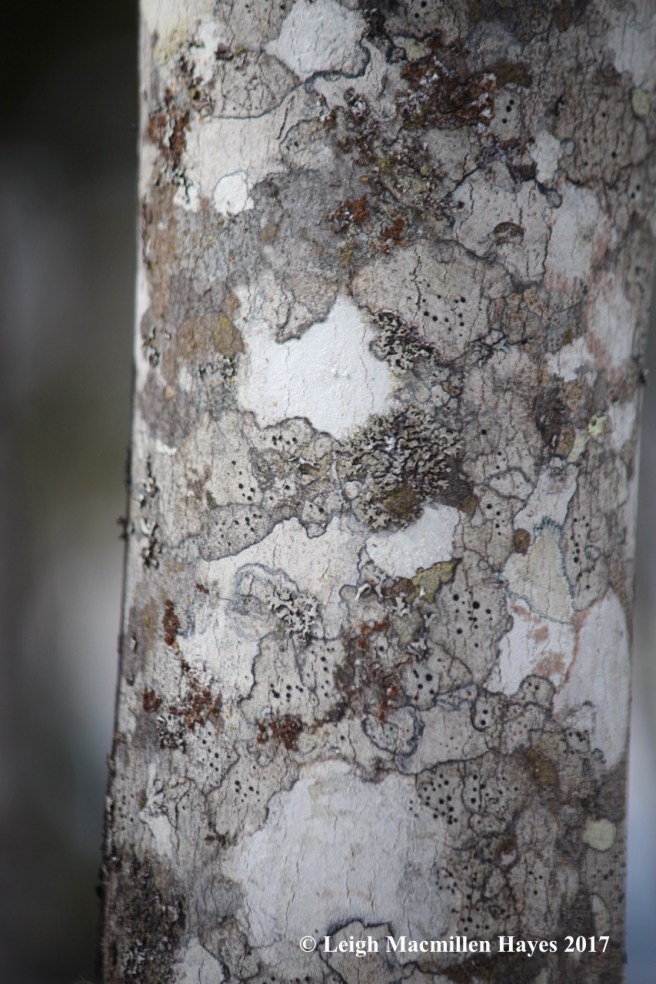
While there were specks of shield lichens on a young maple tree, the variety of flattened crustose lichens covered so much of the trunk that it was almost difficult to distinguish the bark color.  The mosaic pattern suggested a painting–naturally.

o-beech 1

The buds and leaves of the beech trees also asked to be noticed. It’s been my experience that younger American beech keep their leaves throughout the winter–perhaps because their buds are lower to the ground and therefore easy targets for hungry herbivores. There are other theories as well, but I think it’s key to note that it’s the younger trees who keep their leaves, or in the case of this one, those that remain were on the lower branches.

o-beech leaves

They remain until the tree buds begin to break or leaf out. The word to describe this leaf retention is marcescent (mahr-ses-uh nt), which means withering but not falling off. Their rattling in the slightest breeze may be enough to keep those herbivores at bay.

o-beech 4

In the tree’s silhouette, the pointed buds stood out,

o-beech scales


each one a cylinder of overlapping scales in opposite orientation on a hairy stem.

o-witch hazel leaves

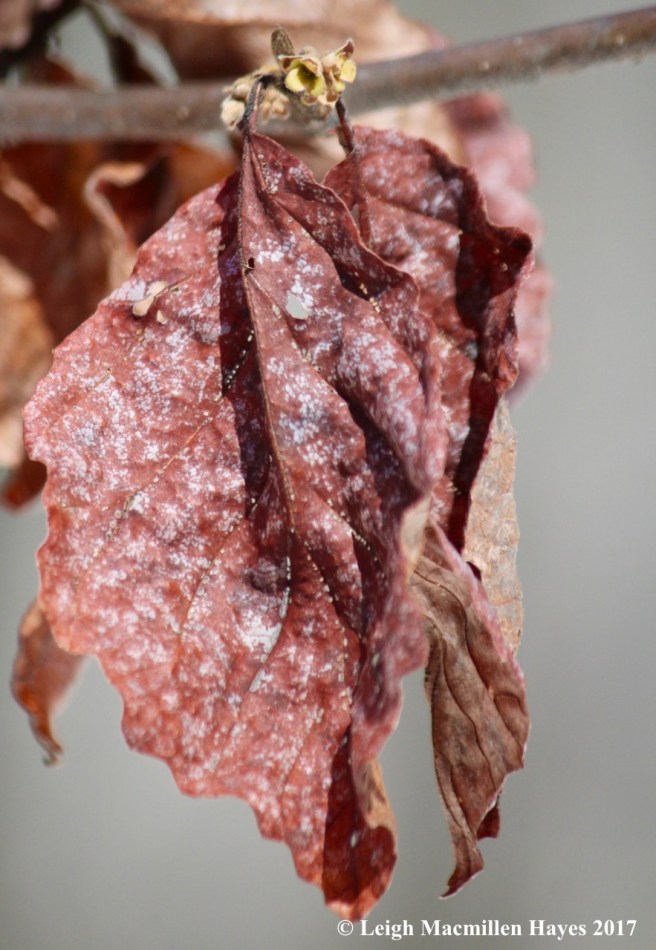
That, of course, led me to another marcescent tree that loves this wet woodland, the witch hazel. Its leaves have always intrigued me with their wavy margins and asymmetrical base. But it’s the winter color of the withered leaves that I also find attractive.

o-witch hazel scalpel

And its naked buds, which don’t have waxy scales like the aspen or beech. Somehow the fuzzy hairs must provide enough protection for the winter months.

o-witch hazel bracts

Everything is fuzzy on a witch hazel, including the bracts left from last fall’s ribbony flowers,

o-witch hazel pods

and the woody, two-seeded pods that ripen a year after the flowers have formed. These split open in the fall as the seeds were forcibly ejected.

o-moose scat

I wandered for hours and miles and never saw any prints from the moose that frequented these woods earlier in the season. But, where the snow had melted under a spruce, I found evidence that blended in with the leaf litter.

o-moose browse

And in an area I used to frequent prior to the logging operation of the last few years, I found more sign. The ruler is mine and this side shows centimeters.

o-coyote x2

When I reached the former log landing, my coyote friend made its presence known again. Actually, one became two as they had walked in single file and then split apart several times. They were on the hunt and a snowshoe hare was in the vicinity.

o-cherry

I followed the main logging trail for a while and then turned off to explore unknown territory. But . . . before turning, it was the maroonish color of the cherry bark that warranted attention. And the lenticels–raised, elongated and horizontal imprinted on my brain.

o-deciduous forest

My meanderings continued and again I saw lots of predator and prey activity. Even a porcupine, though that shouldn’t come as a surprise. Finally, I walked into an area of young red oak, red maple and gray birch and knew I was approaching familiar ground. And so I stepped onto the snowmobile trail.

o-deer 1

All along, I’d thought about the many tracks I’d seen, but no mammals . . . until I approached our cowpath. I wasn’t the only one headed that way.

o-deer browsing first

The deer herd seems to have survived this winter well. I’ve yet to find evidence that suggests otherwise.

o-deer browsing

And I felt blessed that I was able to move as close as possible despite the crunching of the snow beneath my feet. The wind was in my favor. And then, it heard me, flashed its white tail and ran down the cowpath. Perhaps we should rename it the deer path for a cow hasn’t walked on it in decades, but like me, the deer use it almost daily.

My day was made because I wandered.


Mount Tom Revisited

As we tried to figure out where we’d hike today, we decided a familiar route would suit us and I was pleased when my guy suggested Mount Tom in Fryeburg. It’s an old favorite that has improved with age since The Nature Conservancy added a new trail recently. This property was important to them because the Saco River flows below.

I’d first explored the new trail with Marita Wiser, author of HIKES & Woodland Walks in and around Maine’s LAKES REGION, in October and then with my guy a short time later.

m1-cemetery-buried

Today, we decided to park our truck across from the old trailhead and walk down Menotomy Road so we wouldn’t have that trudge after our hike. I wish the trail was a loop, but it can’t be and so we made our own. The snowstorms of the last two weeks had buried the cemetery entrance and only a couple of headstones poked out.

m2-preserve-sign

One and a half miles later, we climbed over the snowbank at the trailhead and strapped on our snowshoes.

m5-my-guy

We were thankful that someone or two or three had packed the trail before us.

m4-center-chimney

Just after stepping onto the West Ridge Trail, we passed between a house and barn foundation. All that was visible–the center chimney’s supporting structure, which probably dates back to the 1800s. Perhaps the original homesteaders were buried in the cemetery.

m6-tinder-1

At first the tromp was easy because it passes gently across the terrain and so I had time to look around. Fresh tinder conks growing on paper birch trees pleased my eye.

m7-tinder-2

I love their colors, which reminded me of oyster shells I’d spent a childhood collecting.

m8-erratics

A few minutes later I spied a house I hadn’t noticed in the fall. My guy looked over and told me it wasn’t a house at all.

m9-erratics-2

He was right, of course. Two large boulders, erratics dropped by the glaciers that formed Mount Tom, a Roche Moutonnée, stood out because of their snow covered tops. We didn’t move closer, but I’ve a feeling they provided homes for mosses and ferns and other assorted flora and perhaps even wildlife. So maybe I was also correct.

m10-summit-in-distance

After crossing the snowmobile trail that passes through the preserve, we continued on through the hardwood forest and started climbing up and sometimes down. Through the trees we spied the summit, but still had a ways to go.

m11-white-oak-bark

One of my favorite trees grows in this forest–white oak. And though it’s not common in the woods I normally traverse, I’m learning to identify it by the plated blocks of its bark.

m12-white-oak-leaf

It helps, of course, when the round-lobed leaves are found nearby.

m13-ledges

At last we reached the ledges, where I’d hoped to see bobcat sign. We did see porcupine evidence, but the snow was soft and tracks almost indecipherable.

m14-pileated-pile

We also found plenty of signs of another frequent visitor. But with that–a major disappointment. I’m sorry to report that I didn’t find any pileated woodpecker scat today.

m16-squirell-works

Across the trail from the pileated debris, the work of a gray squirrel. Dinner required toil–it had dug a hole that looked to be about three feet deep. How do they know where to find those acorns they cached last fall? I’m always in wonder of such digs. And those that they don’t find become trees. It’s all good.

m17-tree-welcome

I probably wouldn’t have missed this tree, but my guy wanted to make sure I saw it. He spread his arms in the same manner and felt it was welcoming us to the ridge. Indeed.

m18-downy-feather

Nearby, someone else was welcomed–and I’m not referring to the acorn. Yes, that provided a squirrel meal, but scattered feathers indicated a downy woodpecker met its demise. And a predator dined.

m19-burl-revealed

We were almost to the summit when a burl revealed some of its inner beauty–the bark having fallen off. Grains once straight twisted and contorted thanks to a virus or fungus or some other means. I loved the swirl of lines, some thin and squiggly.

m20-summit-view

And then the beauty of the view greeted us–Pleasant Mountain in the distance and the Saco River valley below. We met a young family at the summit and thanked them for paving the way. They’d never climbed here before and asked about the old trail down.

m21-trail-signs-at-intersection

We explained that that was our choice and though it’s a bit steeper, it’s a quicker way back to the road.

m22-blazing-trail

We also told them we’d do the honor of paving the way because it had been a storm or more since anyone had trudged that way.

m23-mount-kearsarge-in-view

Because it’s a rather straight downhill, we felt like we were floating for most of the trail and welcomed the sight of Mount Kearsarge among the beauty of the young birches. Once the trail widened, the snow was deeper and it became a trudge again, but the end was nearing.

m24-flag

Right before reaching the road, Old Glory flew as she faithfully does in the field.

m25-barn-and-kearsarge

And always a favorite–the barn beside the trailhead highlighted by the mountains and sky.

We’d come to the end and were thankful for the opportunity to climb Mount Tom again. We were especially thankful for the family who’d gone before on the West Ridge Trail–it was a bit of a slug for us, but even more so for them and we wondered if we’d have completed the loop had it not been for their hard work. We don’t know their names, though we do know their dog’s–Roscoe. May Roscoe’s owners sleep well tonight.


When Life Gives You Flakes

After a delightful childhood in Connecticut, I began my journey north . . . in search of more snow. And a job, of course. Eventually I found my way to western Maine and love followed–for my guy and for the good fortune of snowy winters. Some are more icy and rainy, but this year–ahhhhhh, what a treat.

s-morning-1

I know that not everyone agrees, but when life gives you flakes I hope you can find your way out the door. This was the view that beckoned me this morning, but the door was blocked by sixteen inches of the white stuff so I had to use the front door.

s-studio-buried

In the past ten days over five feet has piled up on top of the base we already had. My studio can attest to it all.

s-snow-on-trees

I wanted to capture the landscape and see what it offered before the sun and wind changed the world. There’s something about the pines plastered in white that makes my heart smile as I step into the woods.

s-wolf-pine

One of my favorite pines is an old wolf tree along the cow path. It’s lovely on any day, but particularly when its arms are outlined.

s-fort-under-hemlock

And beside the path, several large hemlocks offered secret forts beneath their laden branches.

s-red-maple-buds

Further along, red maples, their buds growing rounder each day, provided enormous support as a few flakes continued to fall.

s-mouse-tracks

Below the maples, I crossed over mouse tracks, surprised to see that they’d ventured forth on a risky mission to find food.

s-deer-run

And then I followed a deer run, marvelously straight, along the snowmobile trail.

s-deer-browse-1

Where the deer paused to browse, I paused to notice.

s-deer-hair-on-ground

And once in a while I spotted deer hair.

s-deer-hair-1

Just above, one caught between two hemlock twigs.

s-snow-scarf-on-tree

There were other observations to make, like the snow wrapped around trees much the way we wear scarves . . .

s-snow-wrap

and woolen ponchos.

s-snow-cone-double

Occasionally, treats presented themselves, like this double scoop ice cream cone.

s-morning-light-2

Eventually, the morning light gave way . . .

s-sunrise

to the sun.

s-sun-on-maples

And I knew it wouldn’t be long until the plops and drips began . . .

s-snow-plopping-off

releasing the snow one branch at a time.

s-dead-end

Rather than see it as a dead end, I long ago chose to embrace winter.

s-arch

And so this morning, I stopped by the snowy archway, stepped out of my snowshoes . . .

s-snow-angel-in-trail

And made a snow angel in the middle of the trail.

When life gives you flakes . . . have fun!

(Back at home, it was time to shovel by the back door and scoop the driveway–our world is getting smaller and we’re all dealing with tunnel vision, but warmer temps are just around the corner.)


Universal Love

Dedicated to my guy and all who wander and wonder with me.

When I wander, hearts frequently speak to me . . .

v1-damselflies

of joy . . .

v2-sally

and growth,

v3-hobblebush-leaves

rhythm,

v4-tree-1

and inner . . .

v5-tree-3

secrets.

v7-lichen-1

Some hearts are well-rounded,

v8-overset-pond

others gigantic,

v9-lichen-2

and occasionally there are those missing a part, but still pulsing with life.

v12-moose-track

A few are lopsided and . . .

v11-moose-scat

sometimes overflow.

v13-deer-heart

A rare find is one pawed by a deer (deer heart!)

v14-snow-heart1

While a few dangle,

v15-snow-heart-3

support is often appreciated.

v16-hoar-frost

Always, they offer an outer expression of life within.

v17-to-my-guy

All speak the universal language of love.

v10-metal-heart

And whenever I arrive home, I’m treated to a heart created for me by my guy.

To him I say, “I love you.”

And to all of you readers who have taken the time to  wander and wonder with me for almost two years, I extend my heart-felt thanks.

Happy Valentine’s Day.


Seeing Red

I wander through the same woods on a regular basis, sometimes following old logging roads and other times bushwhacking through the understory–a mix of young conifers and hardwoods that are slowly reclaiming their territory. Always, there are water holes to avoid as this is a damp area, so damp that in another month I probably will have to curb some of my wandering habits because it will become difficult to navigate.

h-maleberry-buds

But it’s that same water that gives life to the flora and fauna that live therein, such as the buds on the maleberry shrub. Notice how downy the twig is. And the bright red bud waiting patiently within two scales–preparing for the day when it will burst forth with life.

h-maleberry-pods

On the same shrub exists evidence of last year’s flowers, now capsules reddish-brown and five-celled in form.

h-red-maple-buds

And like the maleberry buds, the red maples buds grow more global each day, some with three scales of protective covering and others more.

h-snowflakesbuds

Today was a day of contrasts, from sunshiney moments to snow squalls, as well as greens to reds, tossed in with a mix of browns and grays.

h-moose-scrape

Continuing my venture, I soon realized I wasn’t the only one enjoying red. The moose and deer with whom I share this place, also find it a color of choice–especially the bark of young red maple trees.

h-moose-scrape-2

As I looked at the tree trunks, I could sense the motion of the moose’s bottom incisors scraping upward and then pulling against its hard upper palate to rip the bark off. Everywhere I turned, the maples showed signs of recent scrapes.

h-moose-rub

Less frequently seen were antler rubs such as this one, where the middle was smoothed by the constant motion and the upper and lower ends frayed. Such finds offer noted differences between a scrape and rub–the former has tags hanging from the upper section only and the teeth marks stand out, while the latter often features a smooth center with the ragged edges at top and bottom. But . . . like us, nature isn’t perfect and not everything is textbook, so I often have to pay closer attention.

h-moose-bedscat

I saw more than red and so I could hardly resist a moose bed filled with scat and urine. I’m always in awe of the sense of size and again I saw motion, of this large mammal laying down to take a rest and perhaps a few hours later, getting its feet under itself to rise again, do its duty and move on to browse some more.

h-witch-hazel-scattered

Deer tracks were even more numerous than moose and the solidness of the snow allowed them to travel atop the crust. At one point I spied something I didn’t recall seeing before–witch hazel capsules decorating the snow.

h-witch-hazel-pod

At this time of year, these grayish tan capsules persist on the trees, but their work was completed in the fall when they expelled their two glossy black seeds.

h-witch-hazel-bud-nibbled

Ruffed grouse, wild turkeys and snowshoe hare like witch hazel buds. As do deer, who rip them off in the same fashion as a moose and leave a tag behind–as a signature.

h-witch-hazel-bud

Not all were eaten–yet. Notice these buds, ensconced in dense reddish/yellowish/brown hairs rather than the waxy scales of the maleberry and maple. And the shape extending outward from the twig, almost in scalpel-like fashion. Yeah, I was still seeing a hint of red.

h-witch-hazel-flower-bracts

If I wanted to carry my red theme to the extreme, I could say that the bright yellow bracts that formed the base of the former flowers were framed in red, but really, it’s more of a hairy light tan along their rims. Eventually, the bracts will develop into seed capsules and next autumn they’ll be the ones to shoot their seeds with a popping sound. We always talk about that sound and refer to Henry David Thoreau for as far as I know he was the one to first hear it. This past fall, a friend tried this and like Thoreau, he was awakened during the night by the seeds being forcibly expelled. (Credit goes to Bob Katz for that experiment.)

h-british-soldiers

Back to red. Under the hemlocks where the deer had traveled, I was looking at some mosses when these bright red soldiers showed their cheery caps–it’s been a while since I’ve seen British Soldier lichens, most of it buried beneath the snow.

h1-red-oak-bark

As I headed toward home, a red oak beside the cowpath asked to be included. It seems in winter that the rusty red inner bark stands out more in the landscape, making the tree easy to identify. Of course, don’t get confused by the big tooth aspen, which slightly resembles a red oak at the lower level, but a look up the trunk suddenly reveals similarities to a birch.

h1-acorn-cap

Many of the acorns have been consumed after such a prolific year, but their caps still exist and the color red was exemplified within the scales.

h1-icicles

Back at the homestead, I walked by the shed attached to the barn where icicles dripped–again speaking to this day. By that time the snow squalls had abated and sun shone warmly, but a brisk wind swirled the snow in the field into mini whirling dervishes. My cheeks were certainly red.

h-cardinal

My red adventure was completed at the bird feeder. A happy ending to scenes of red.