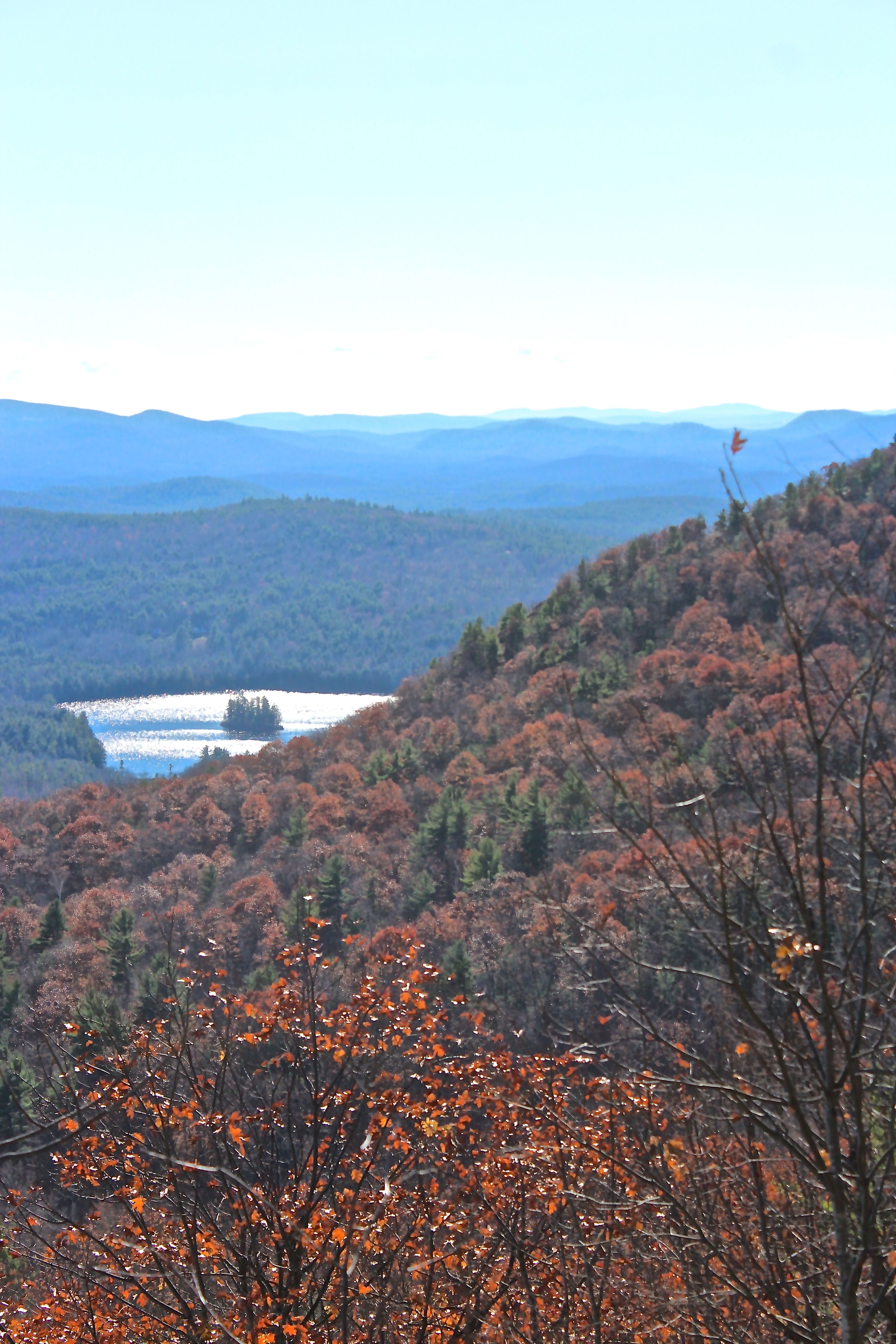
Aimless Mission

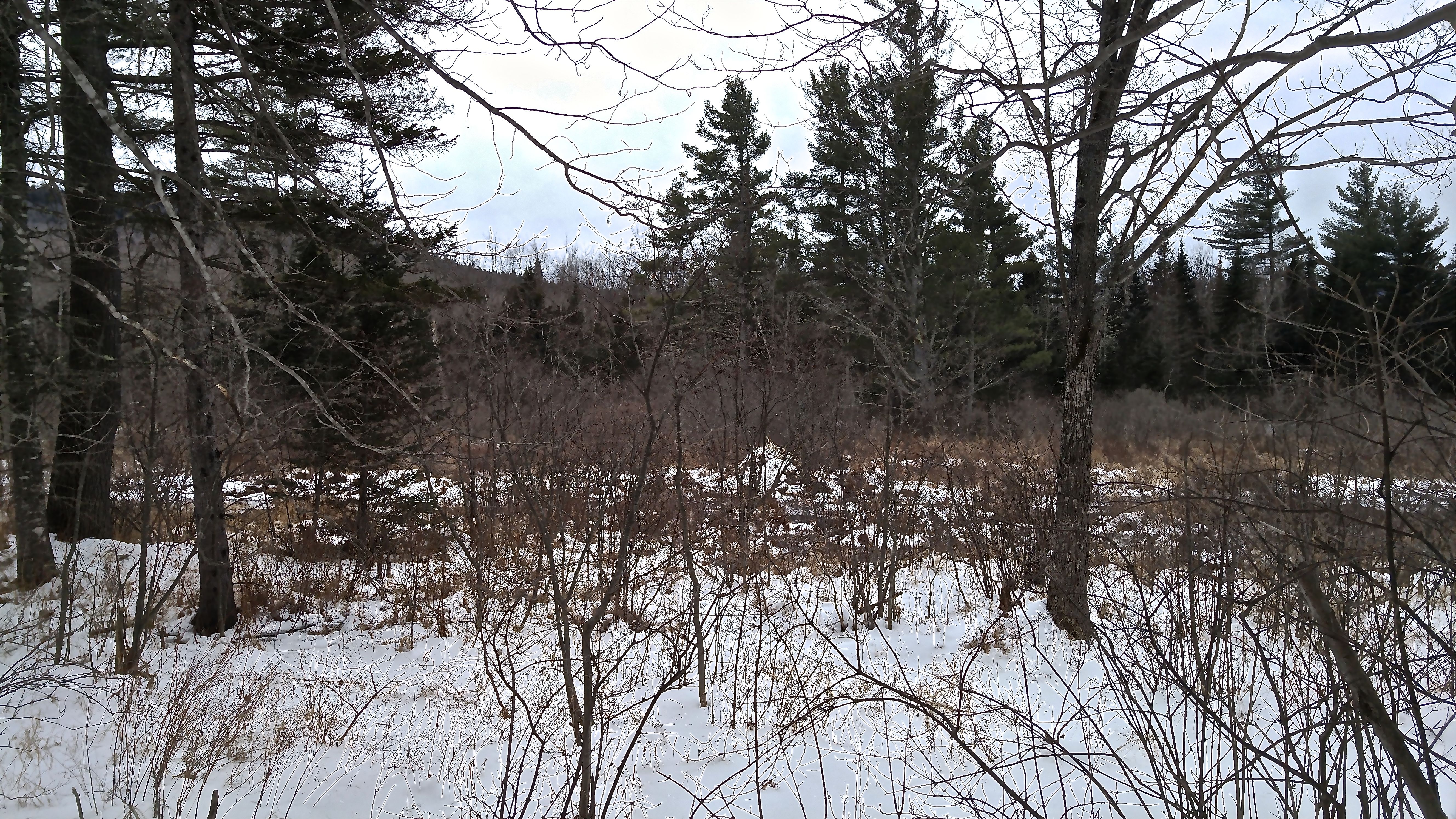
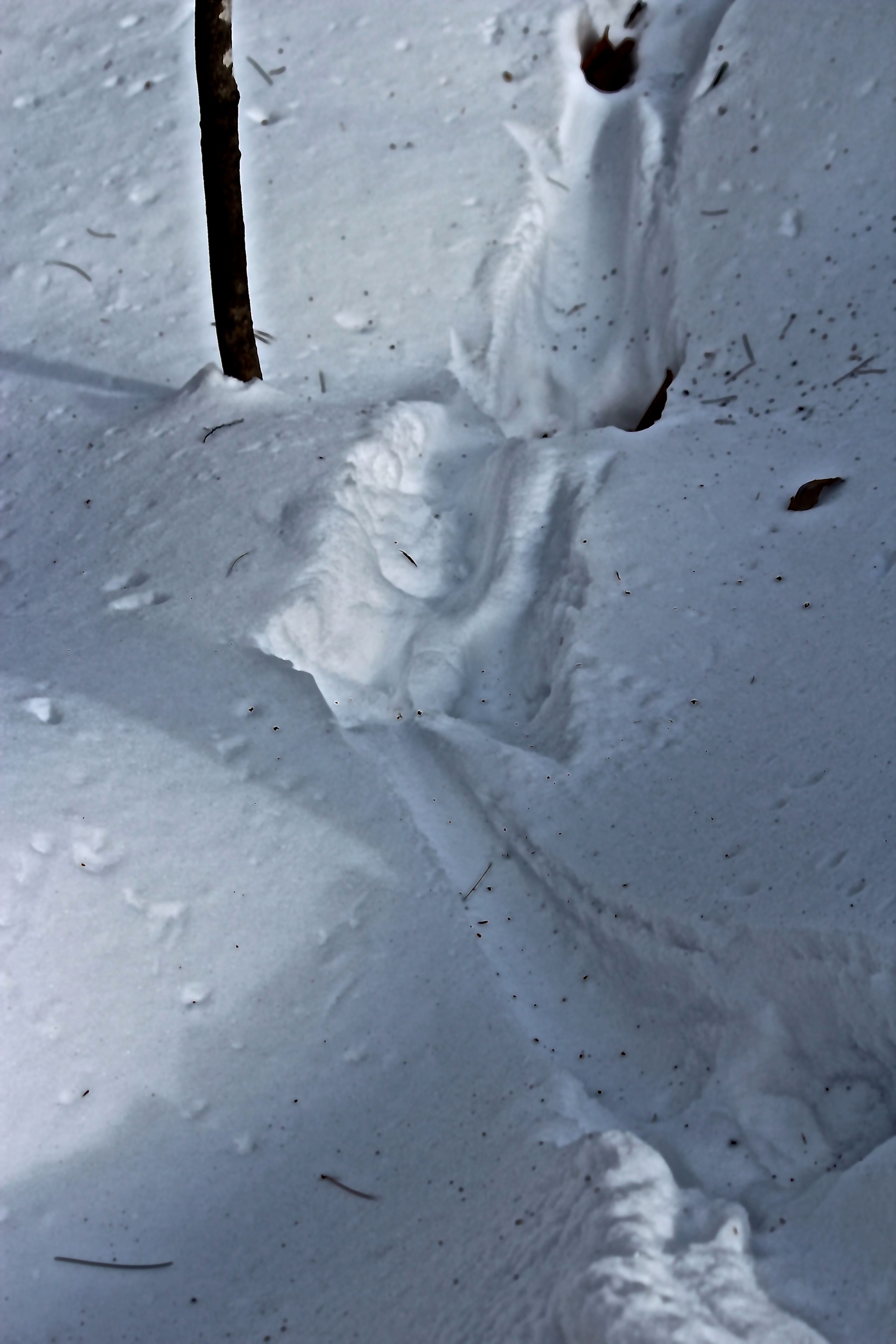
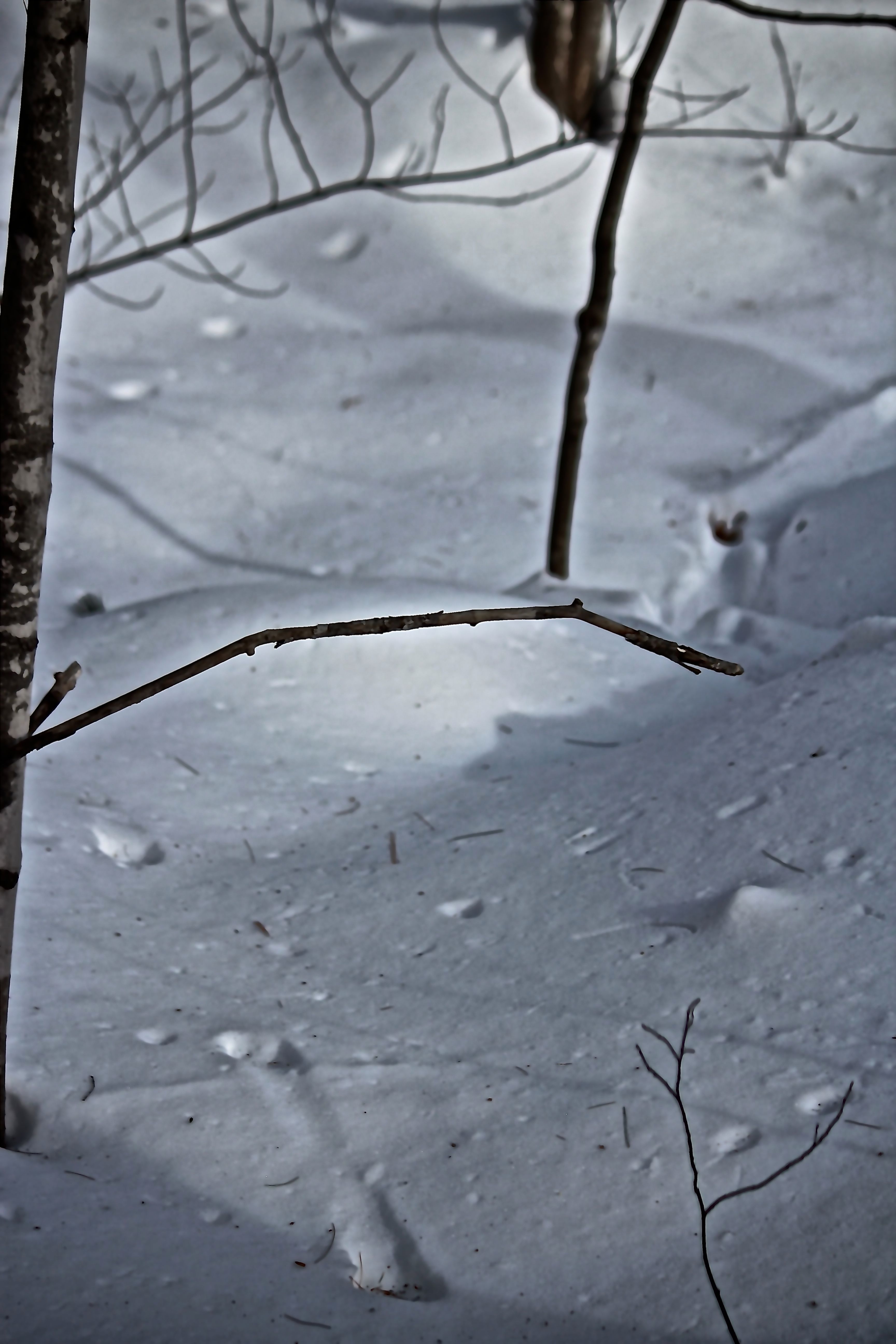
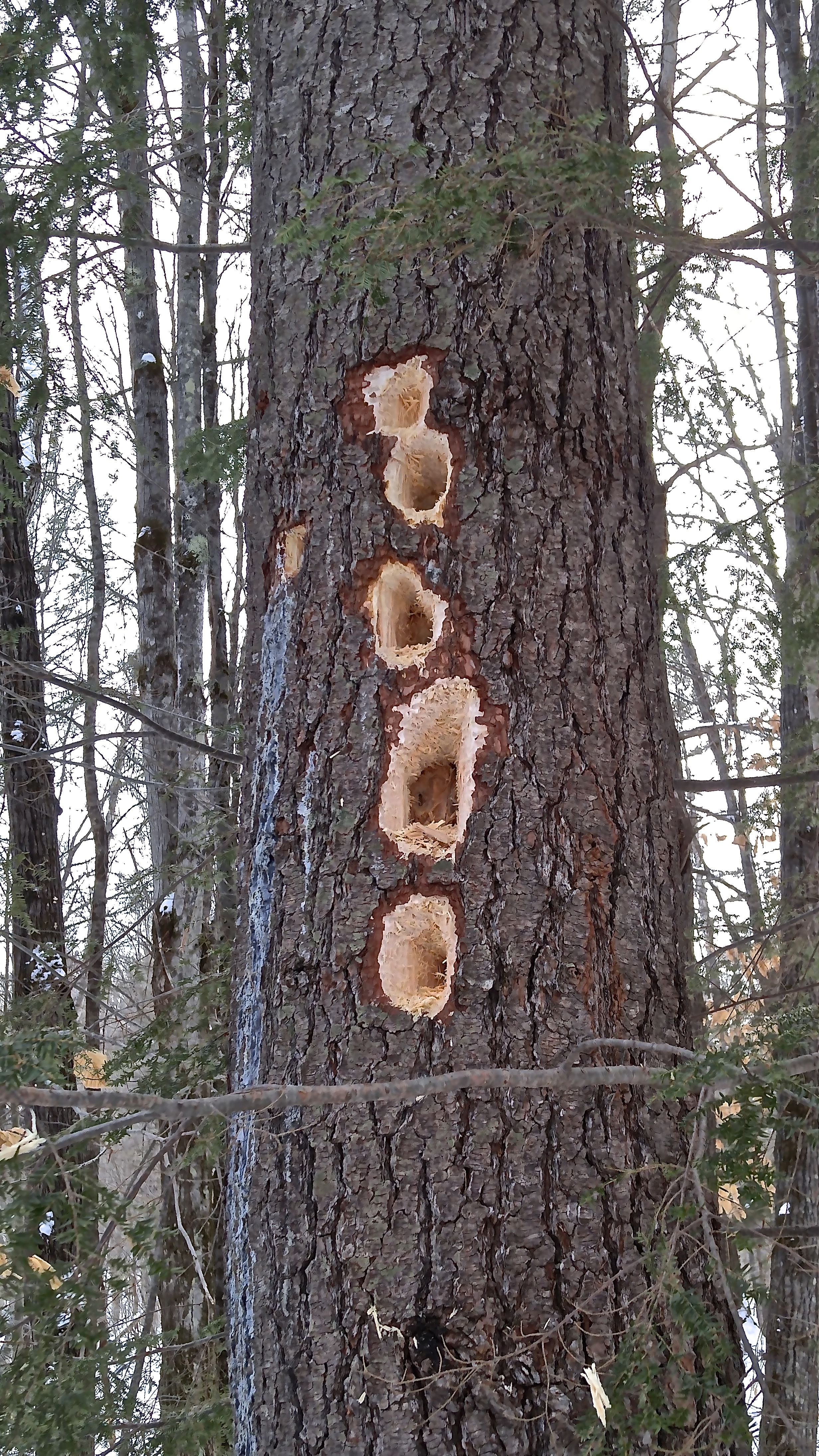
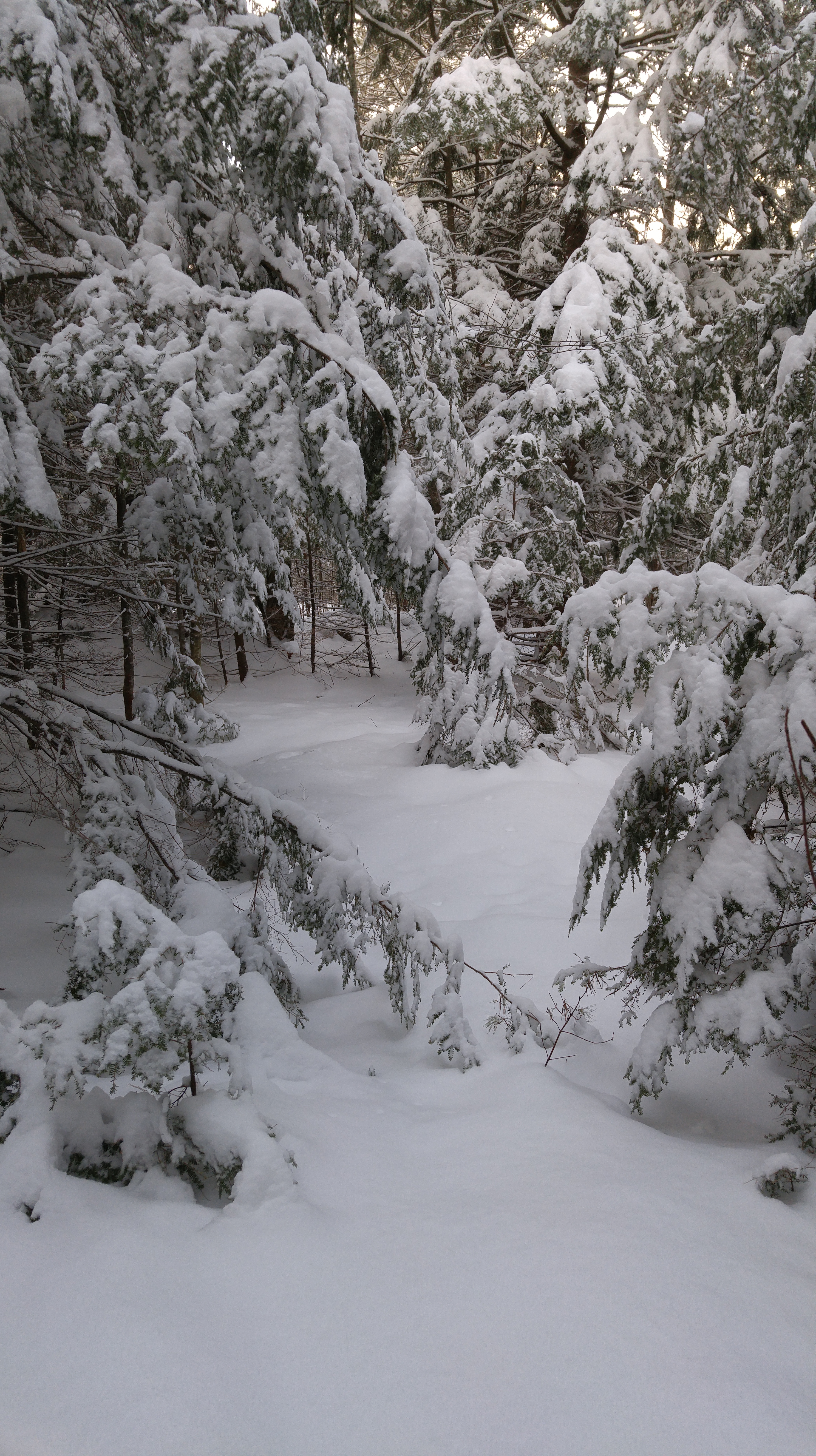
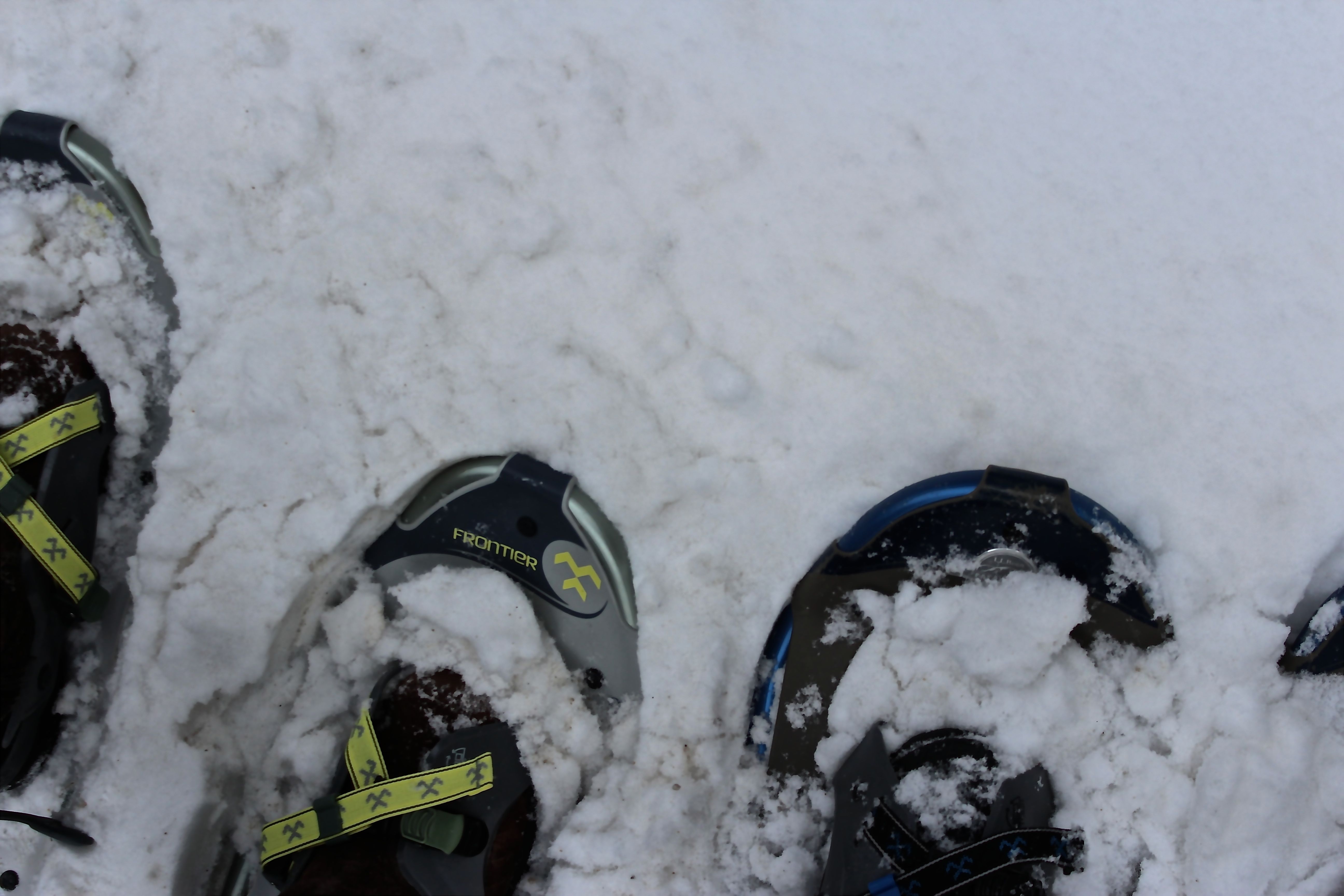
A friend and I wandered aimlessly today with a mission of finding bobcat tracks. I should know better. Go without expectations.

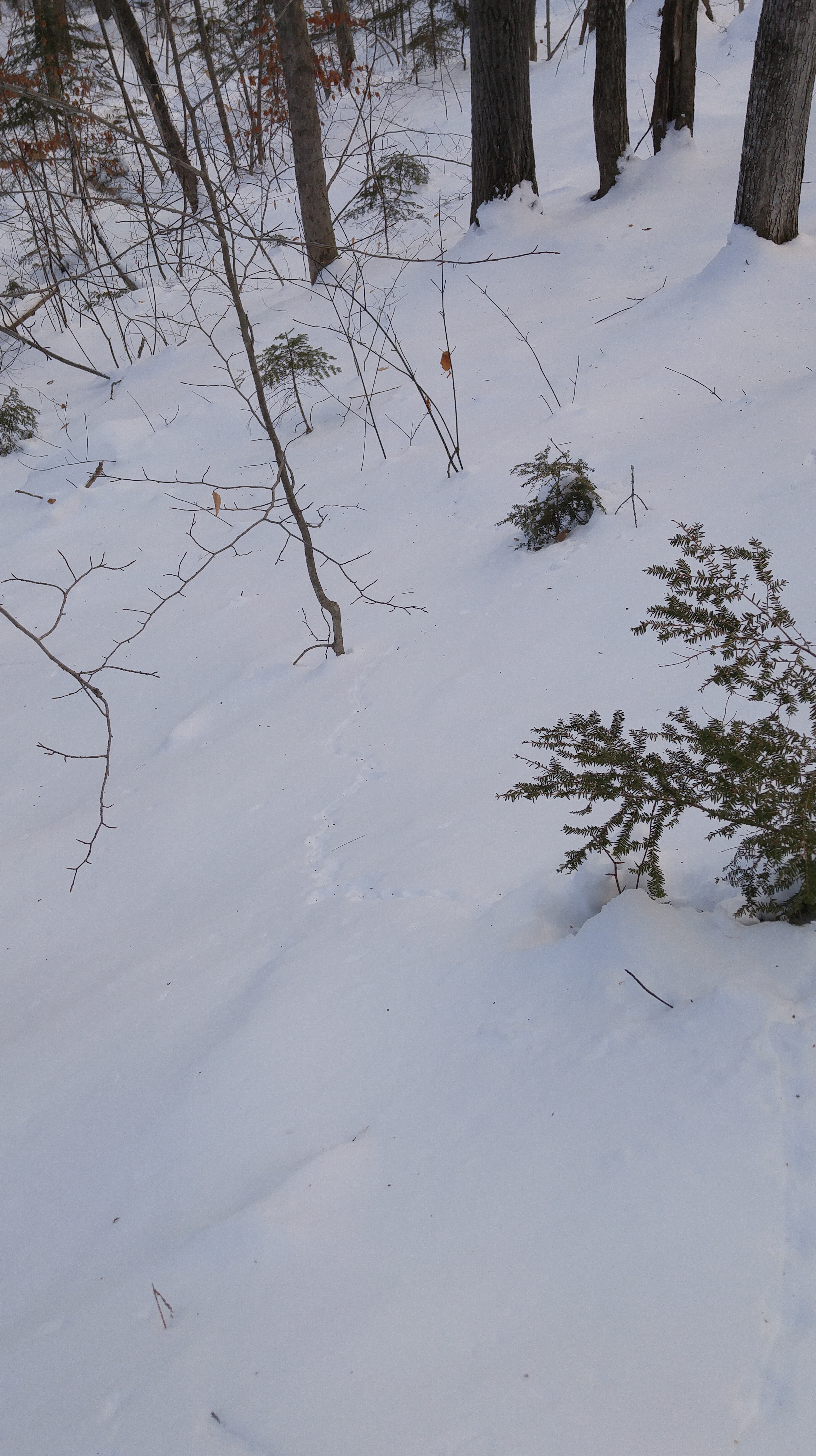
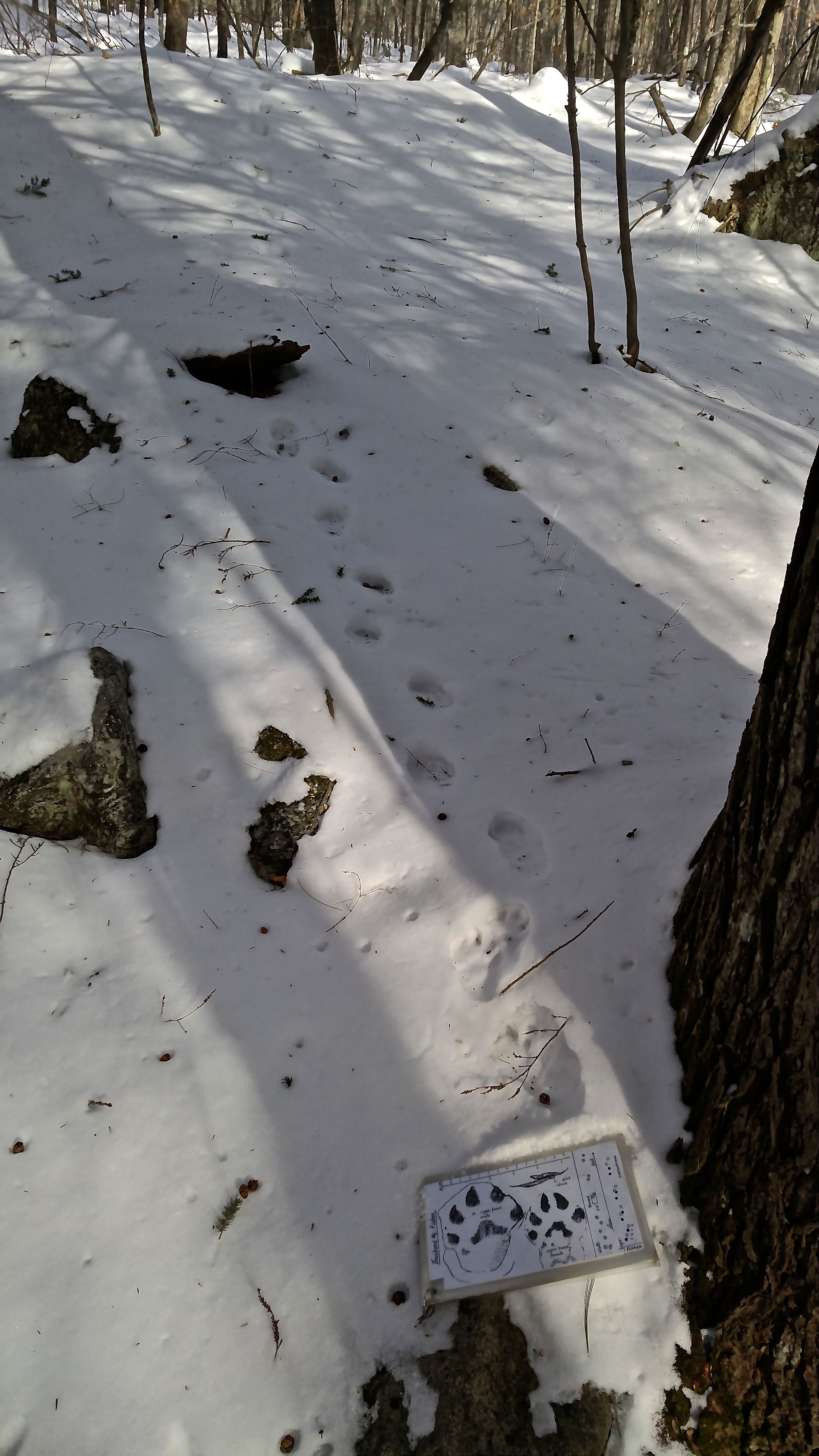
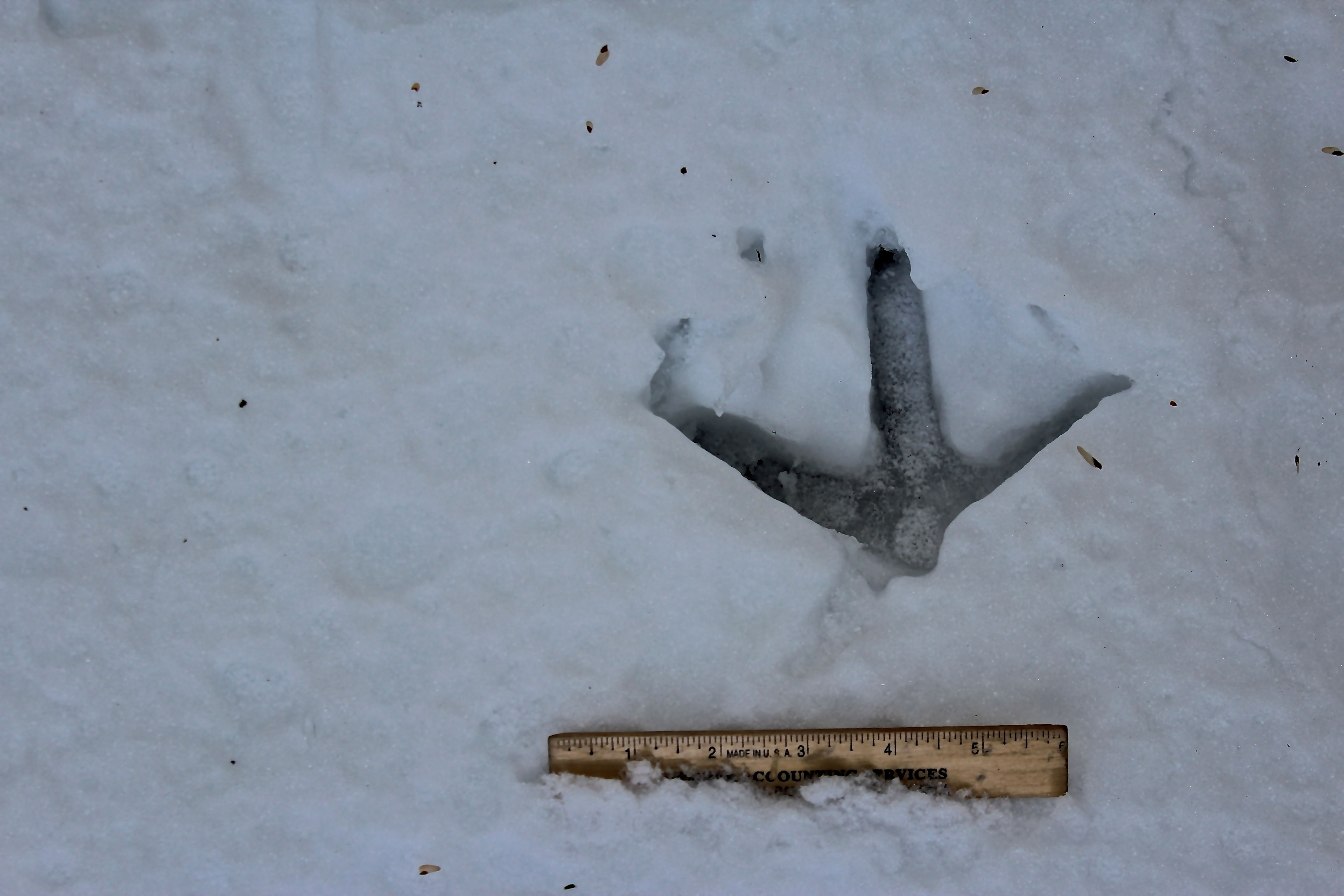
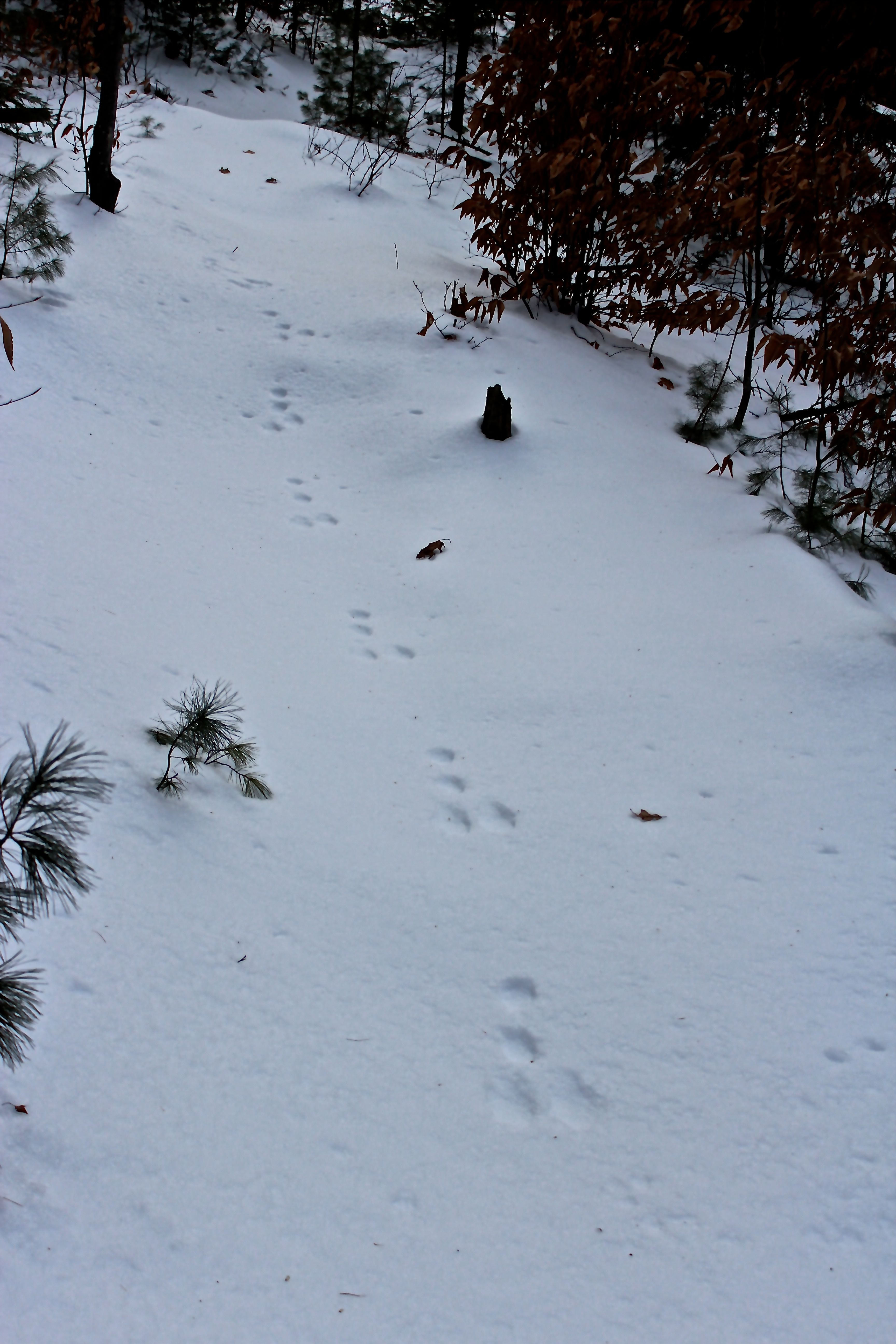
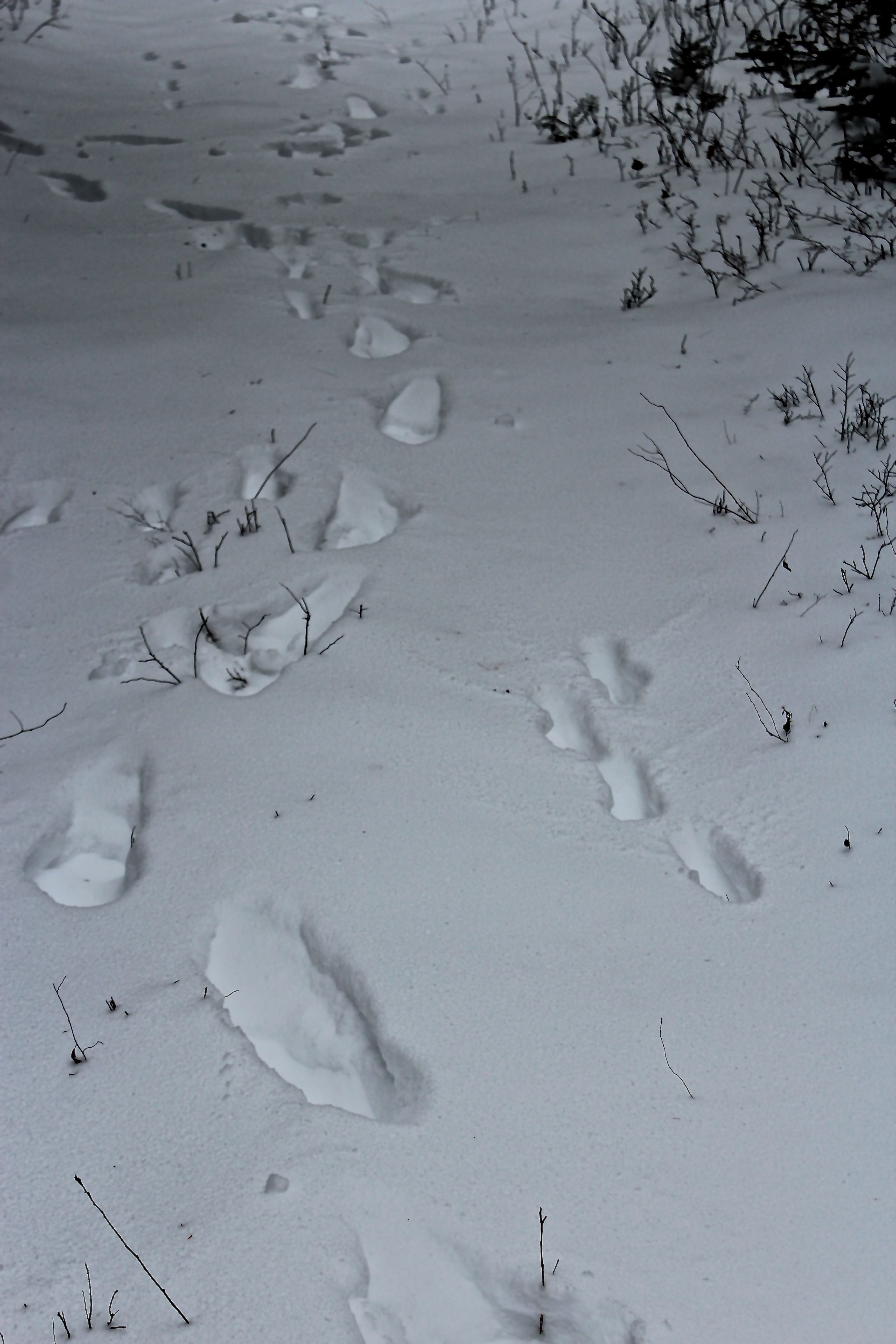
So, yeah, we didn’t find any prints that were most certainly bobcat. We did find coyote and fox. And plenty of deer, turkey and ruffed grouse. And had great fun exploring while catching up. And taking time to notice and wonder.

rhody 1

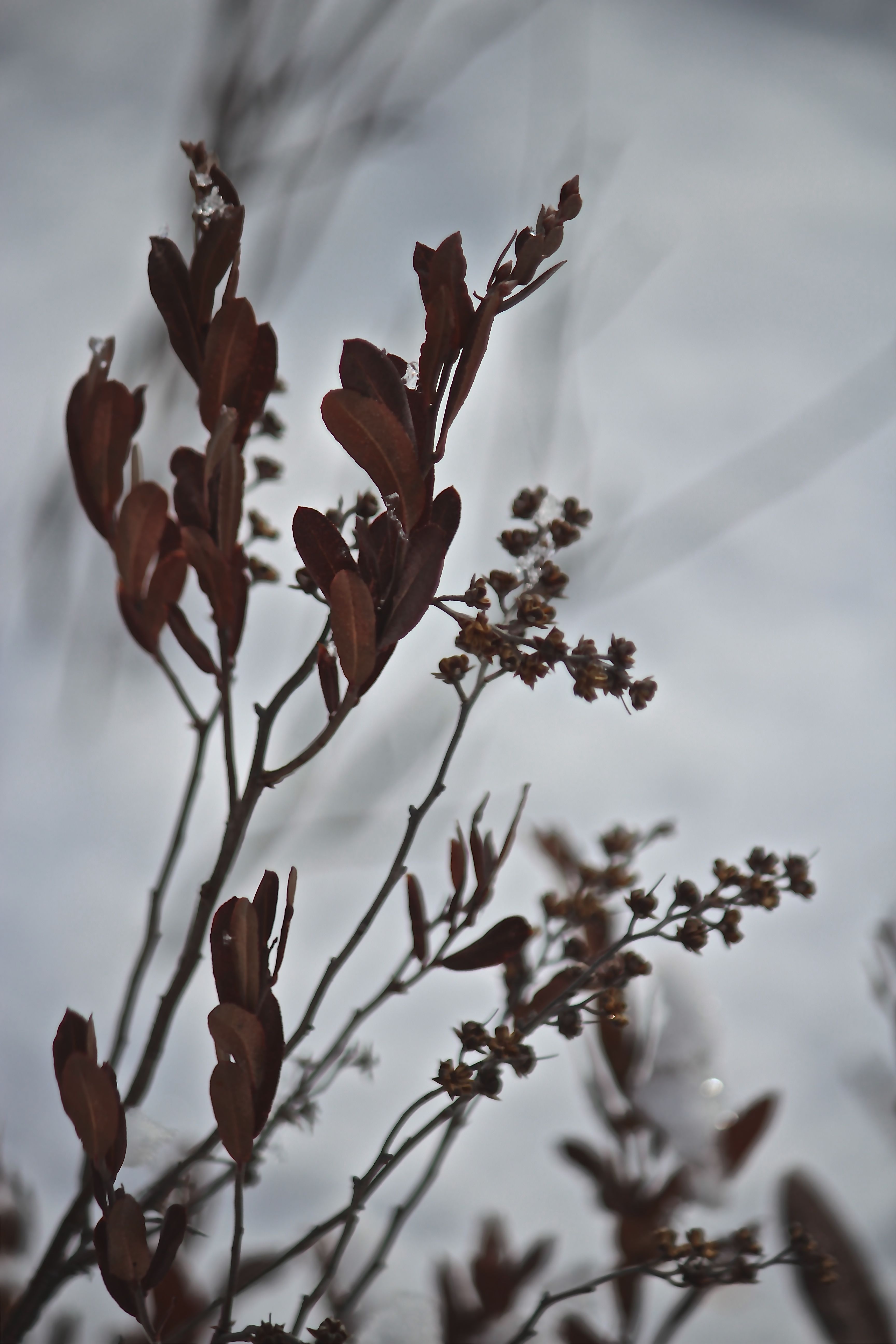
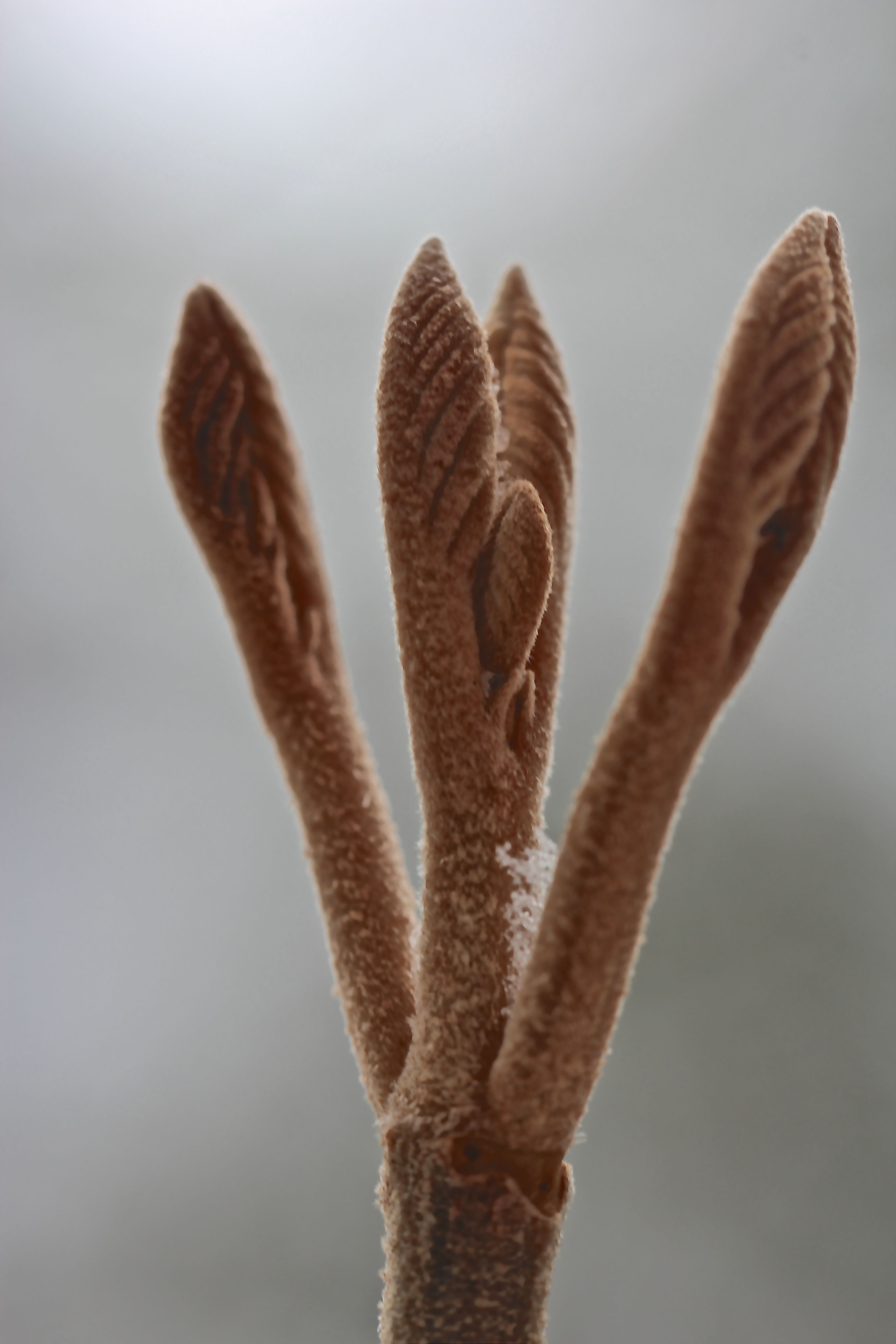
While Dick strapped on his snowshoes, I took a look at the rhododendron bush that grows beside the barn. Today’s temp–45˚. A January thaw following last week’s deep freeze. Thus, the leathery leaves looked happy rather than curled inward as they do when the temperature falls. And last summer’s new growth offered a spring palette.

rhody 3

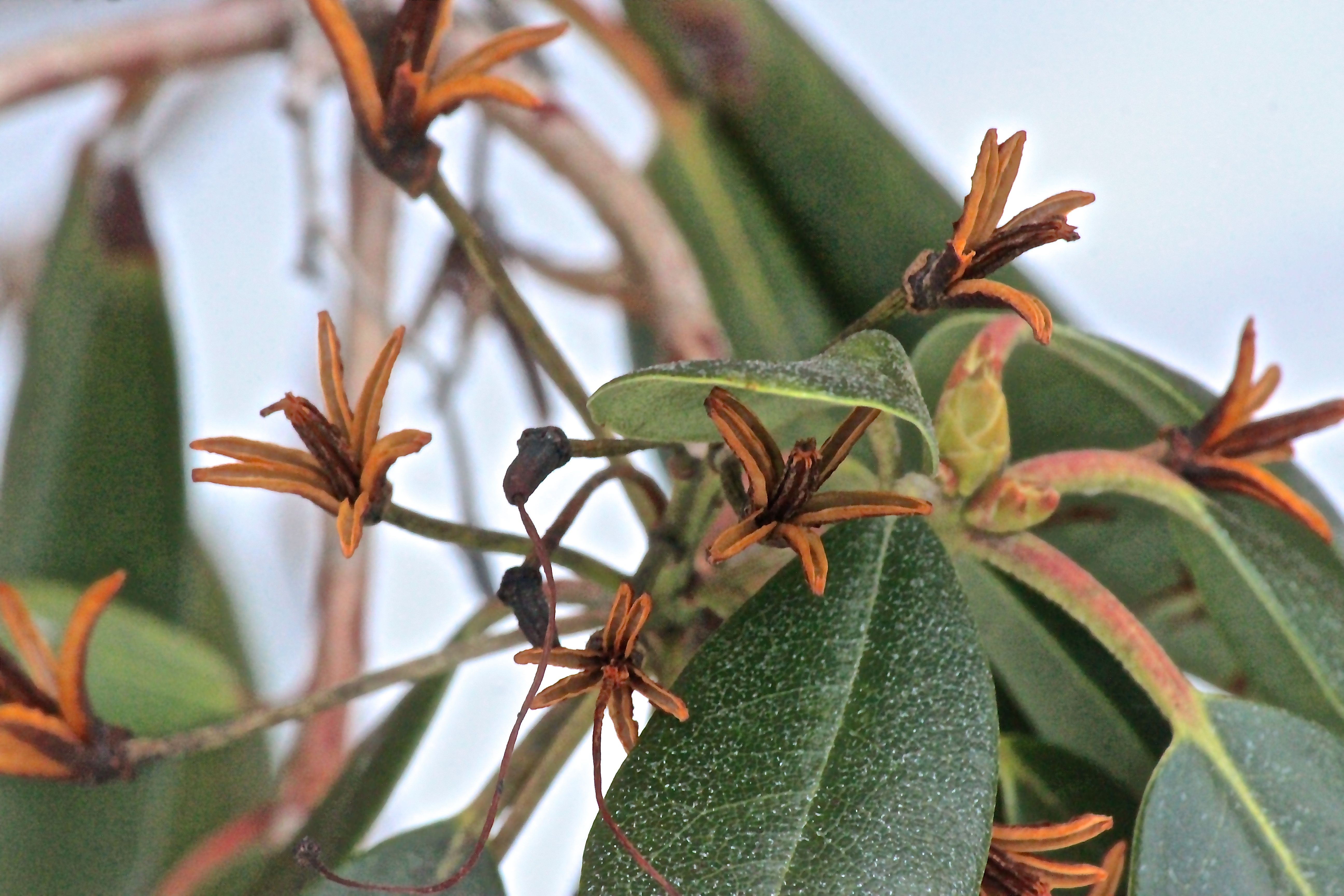
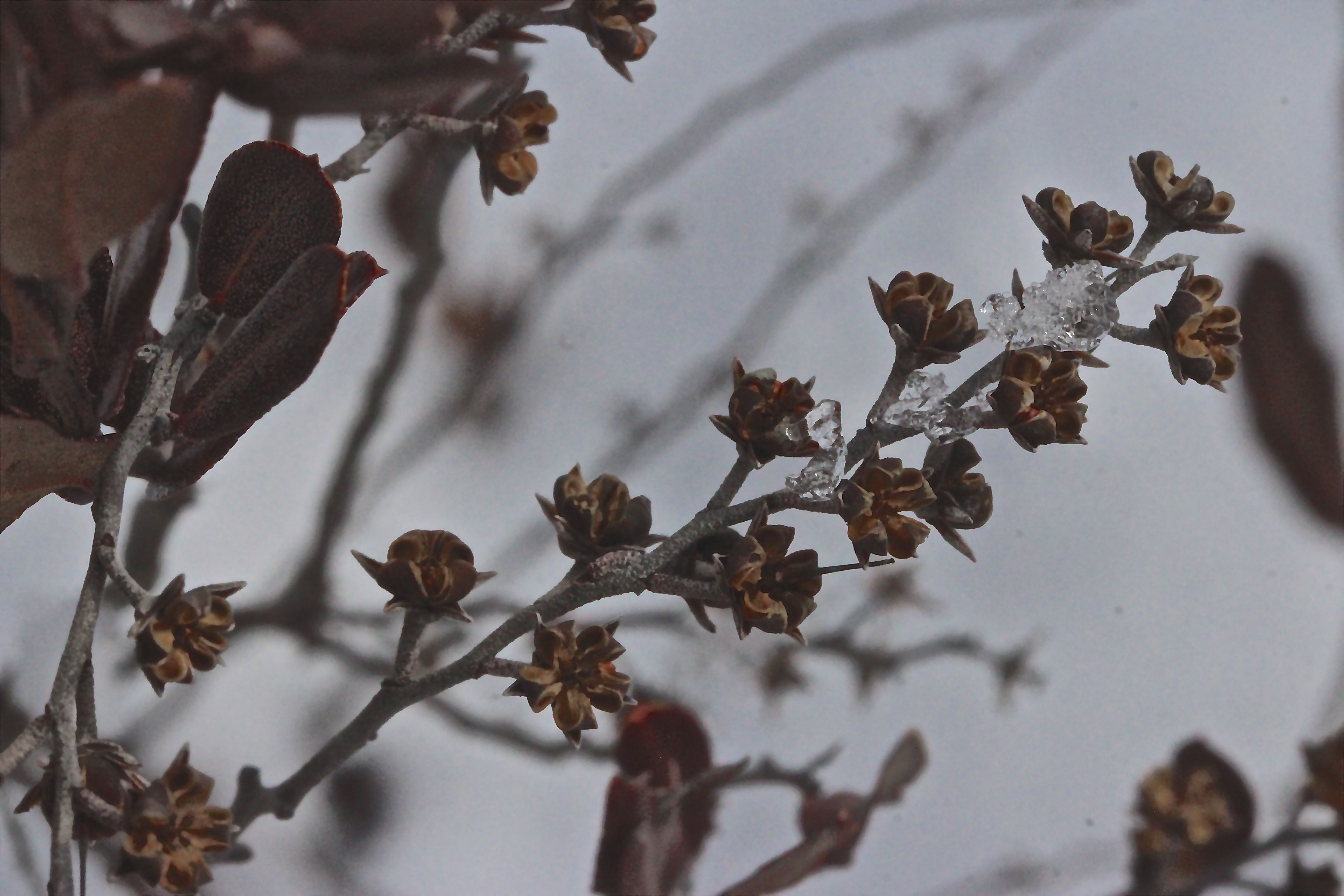
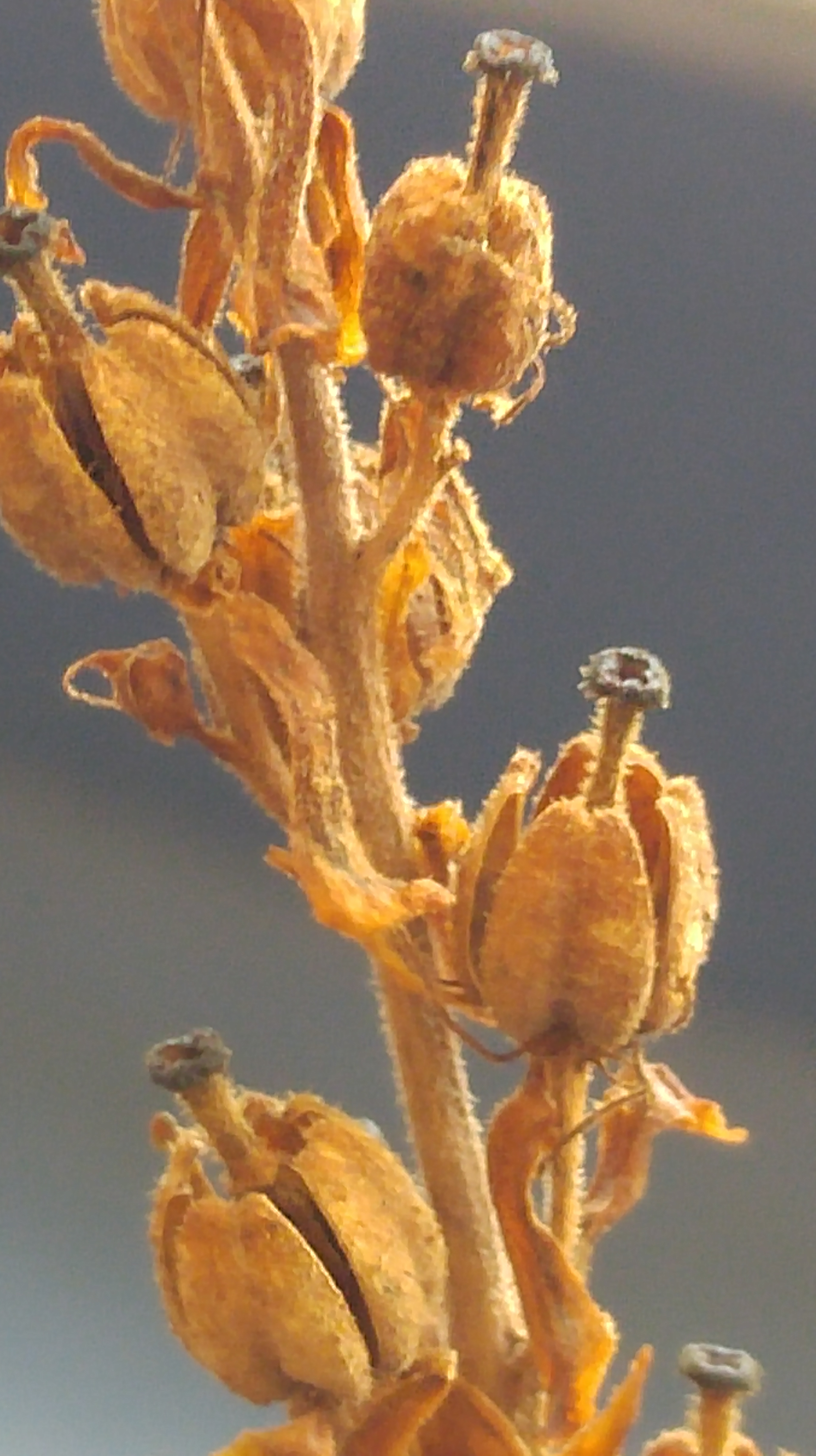
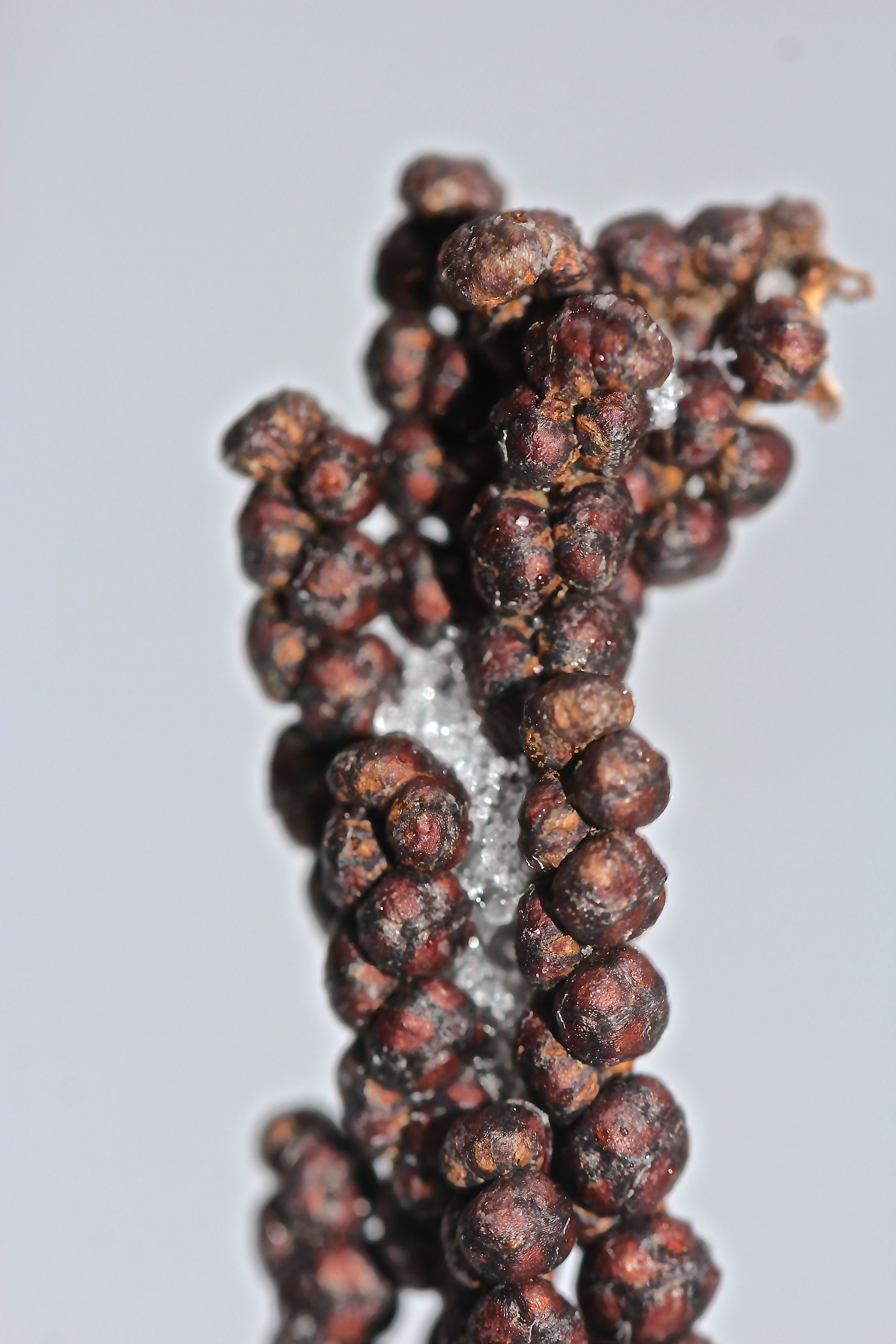
The woody capsules are like flowers unto themselves. I’m just realizing that though we have several rhododendrons growing by the barn and house, I’ve never seen any babies. Once ripened in the fall, the capsule splits open and its many seeds are dispersed by the wind–probably becoming bird food.

  rub1

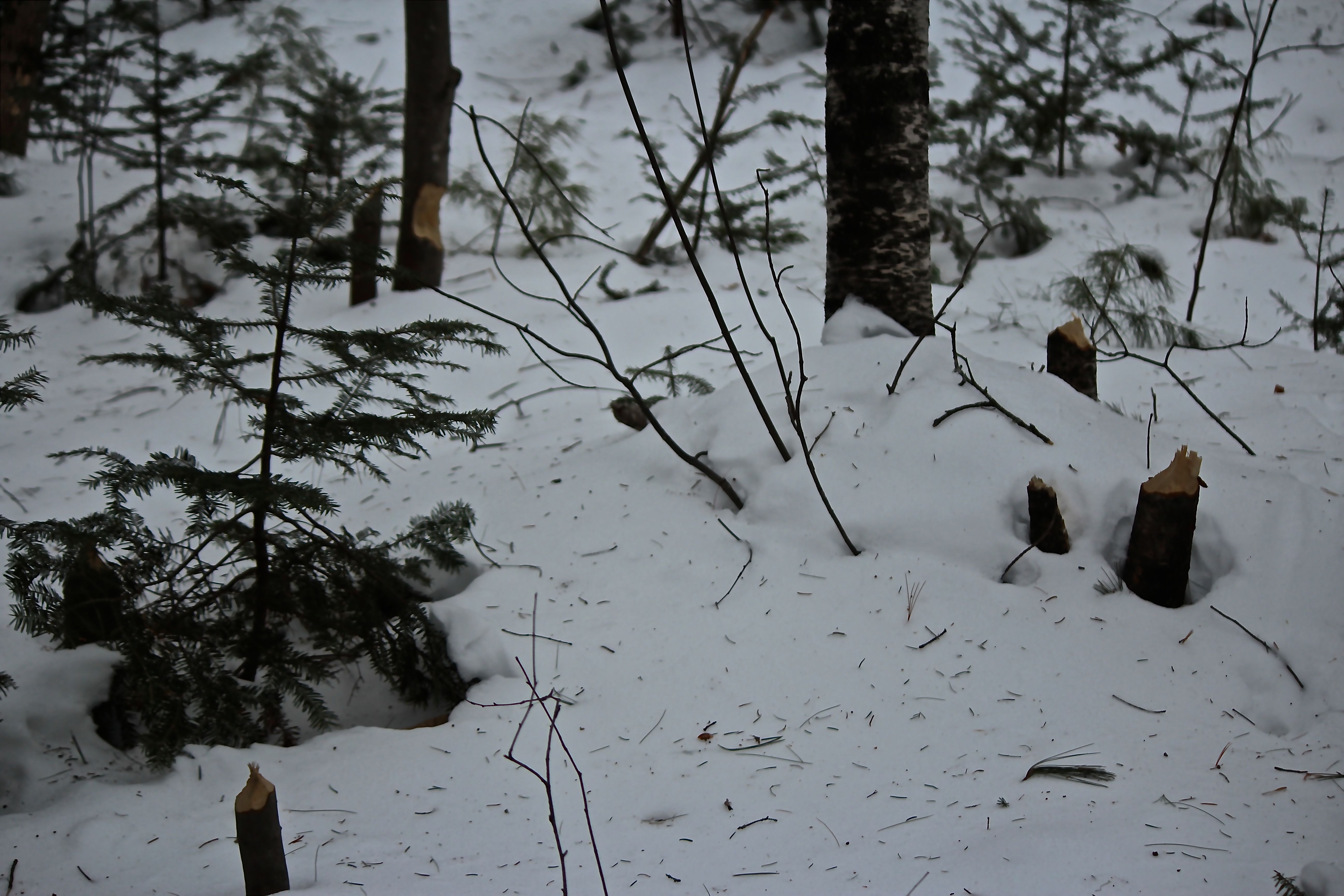
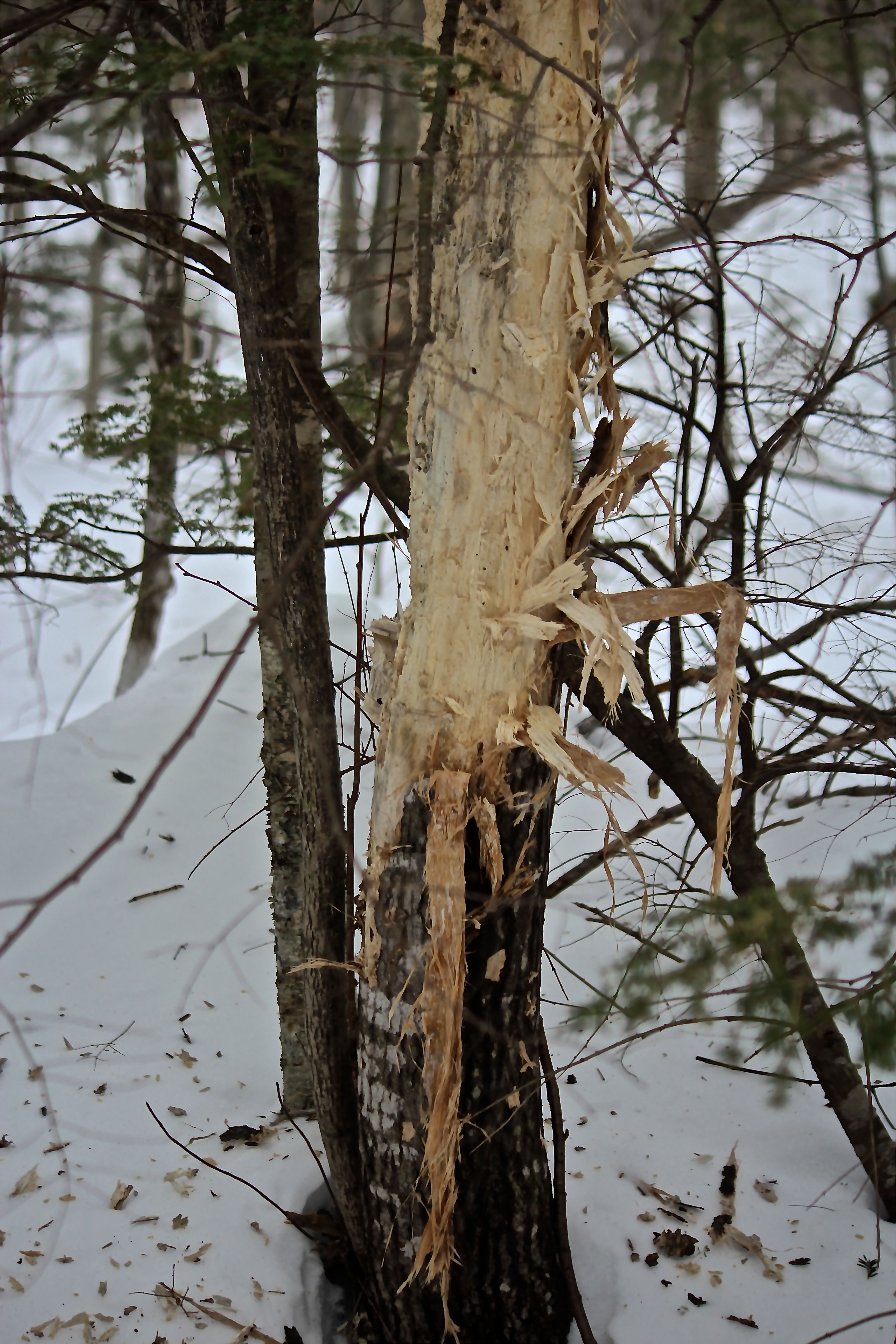
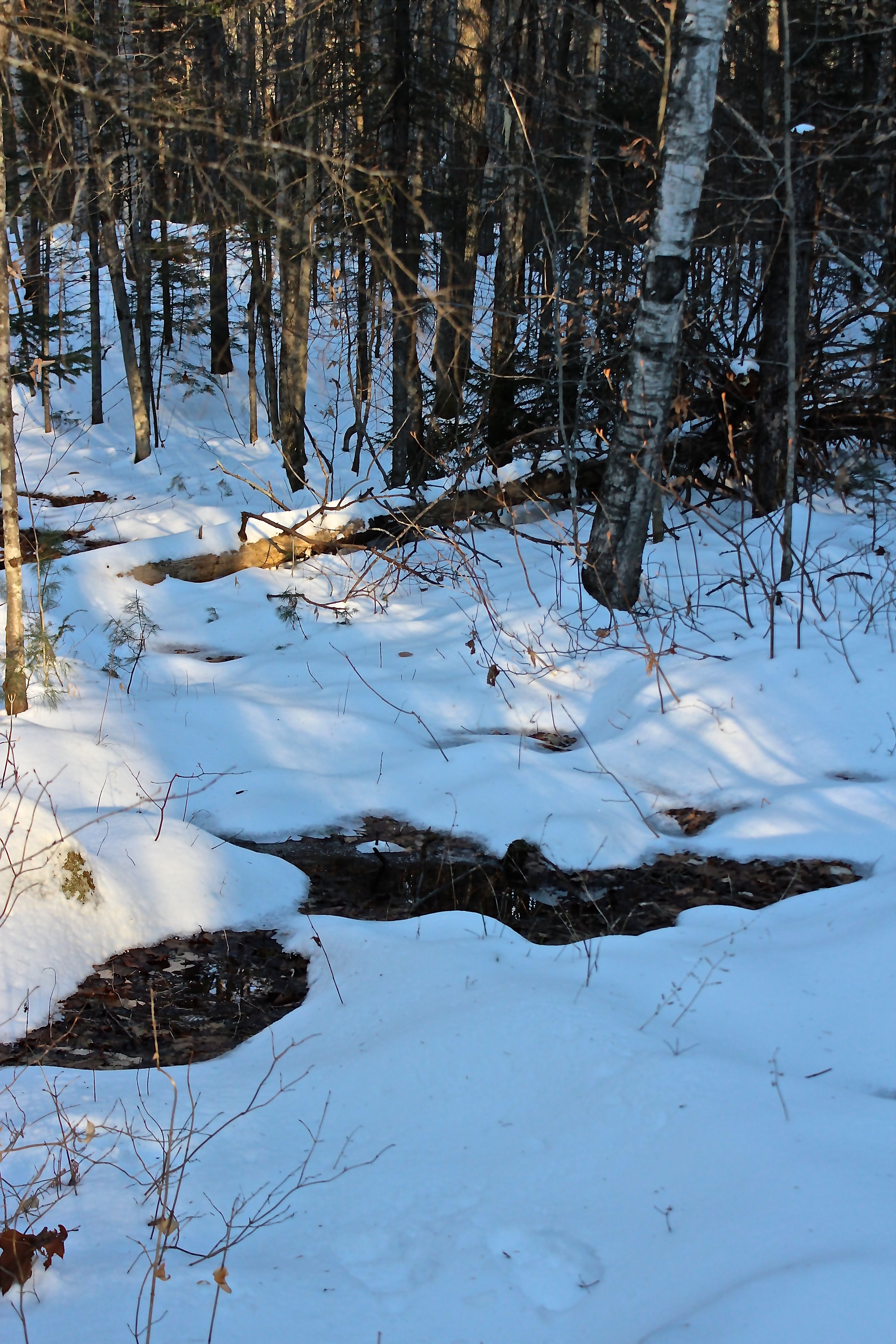
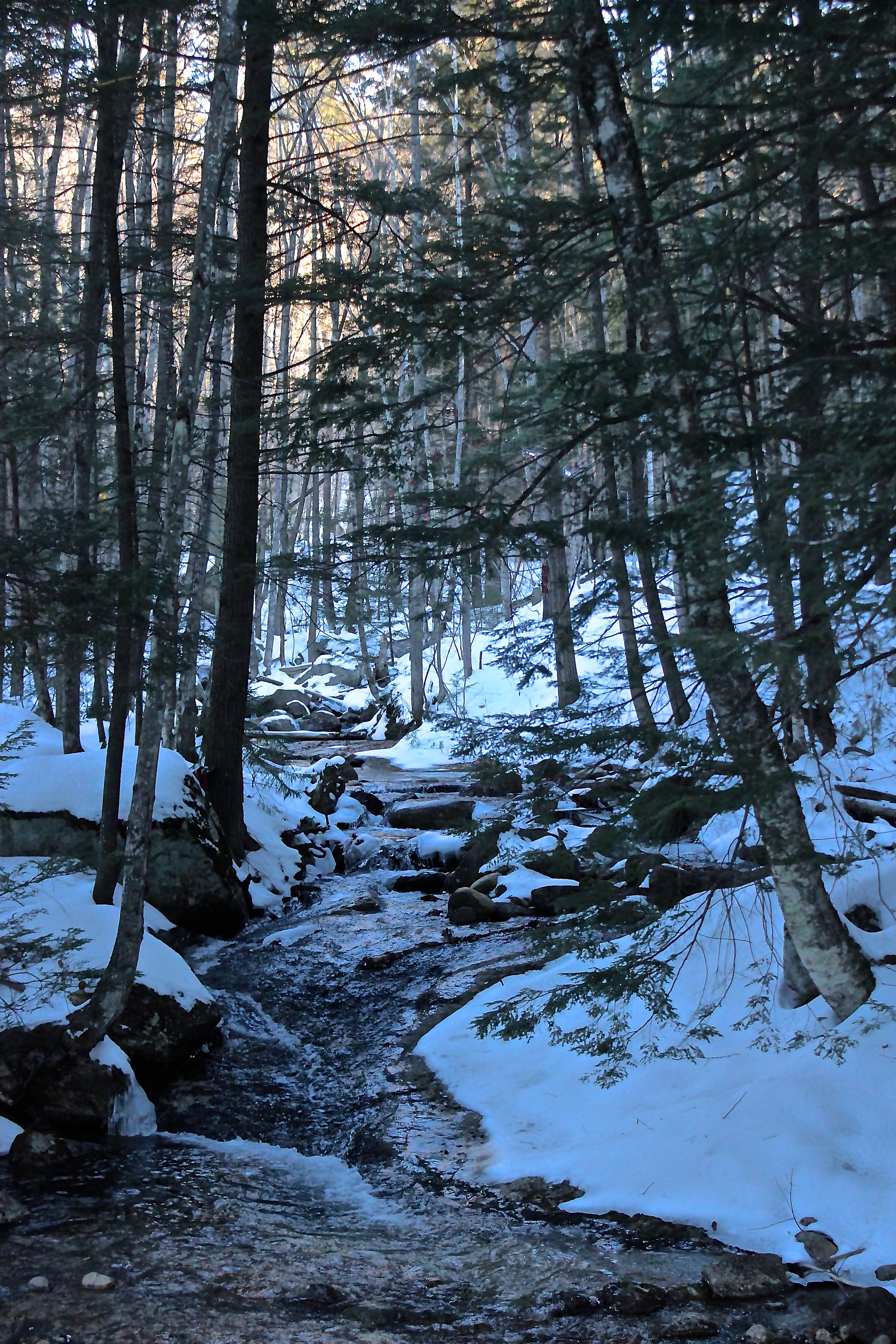
As we snowshoed about, trying to avoid breaking through ice in this rather swampy woodland, we saw where the deer had eaten red maple buds and bark, as well as where some had bedded down. But one of my favorite finds was a stick. Or so it may appear.

rub 2

It’s a small, half dead balsam fir that served as a signpost. Can you read it? “My name is Buck. Keep out. Unless your name is Doe.” Yes, this is a deer rub created when antlers were pushed up and down, creating tags of bark dangling at either end with smooth wood in between.

uprooted

Then we came upon nature’s classroom–an uprooted tree. As a forever student, it’s a place I like to frequent.

root 1

The tree fell years ago. Did anyone hear it?

root 3 root 4

Among the roots, rocks and dirt, we checked for animal or bird sign and didn’t find any.

root lichen

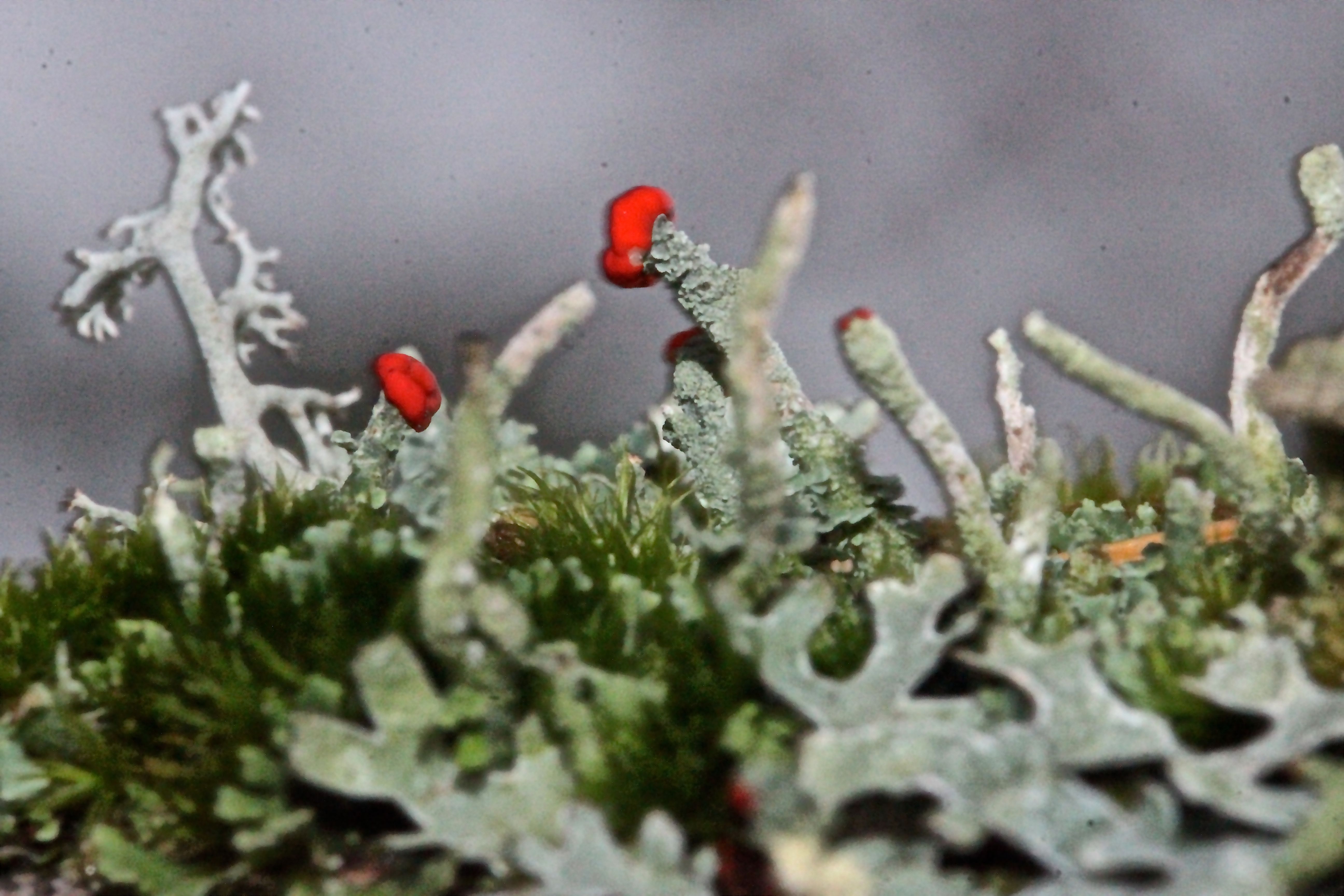
But the moss, lichen and liverwort garden is exquisite with its variegated colors and textures.

lichens et al

This miniature world resounds with a sign of its own: “Clean Air Here.” Lichens and mosses won’t grow were the air is polluted.

white pine nursery

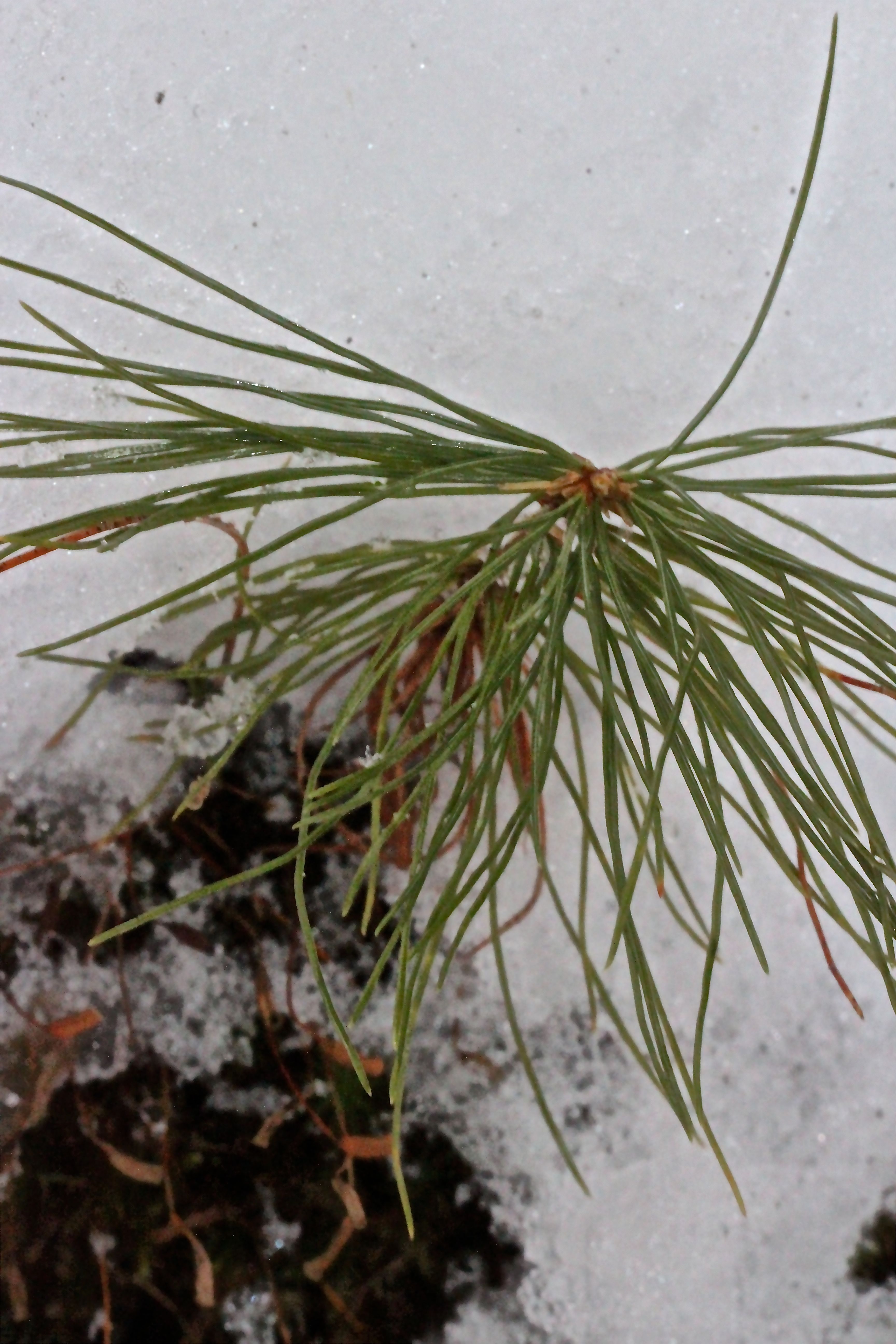
Other life forms also like this spot and see it as the perfect nursery.

stonewall1

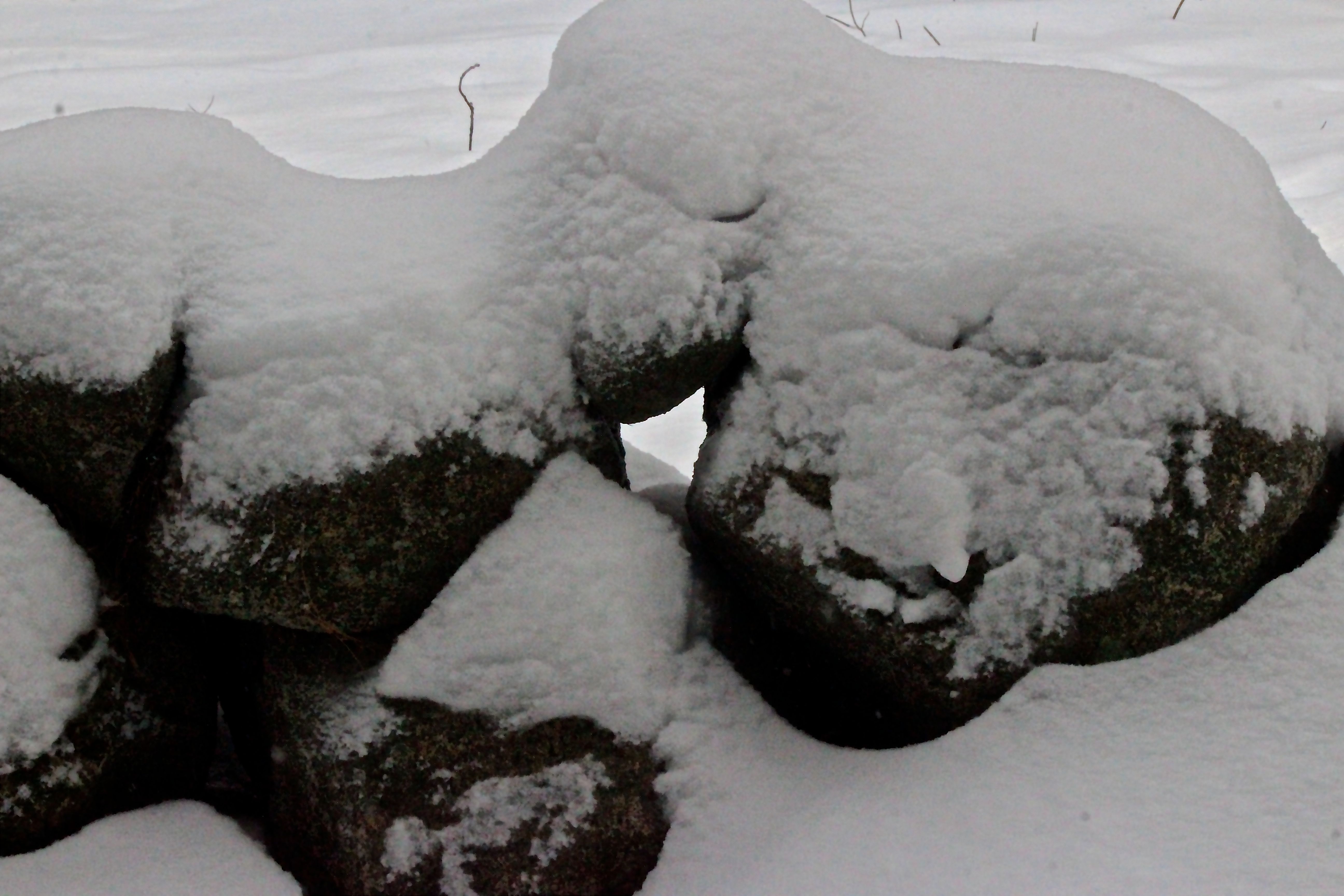
As is common in these woods, we stumbled upon the stone walls and barbed wire that speak to the land’s historical use. Borrowing a line from Robert Frost, this sign once read: “Good fences make good neighbors.”
broken wire

Gone are the days when the wall and wire are set again.

tree wireLong gone.

And so it was that we wandered and wondered along on an aimless mission–not finding the tracks of the bobcat(s) that journey here, but enjoying plenty of other signs along the way.

Shell Pond Speed Date

While our thoughts were (and are) with our family and friends south of us along the Eastern Seaboard as you deal with a major winter storm, my guy and I drove over to Evans Notch for a hike around Shell Pond.

SP-September

Whether you’ve traveled this way before or not–a summer photo might be just the dose you need today.

road 1

We parked near the trailhead for the Leach Link Trail because Stone House Road is never plowed beyond that point. Others had skied, walked and snowmobiled before us, but no one seemed to be snowshoeing so we left ours behind. As it turns out, that decision was fine. We dug some post holes in a few drifts, but other than that, we really didn’t need them. I did, however, use micro-spikes–and am glad because it’s a rather wet trail and we encountered lots of ice, much of it just a few inches below the snow.

Stone House gate

Thanks to the owners of the Stone House for putting much of the land under conservation easement with the Greater Lovell Land Trust and for allowing all of us to travel the trails–whether around the pond or up Blueberry Mountain and beyond.

Shell pond loop sign

Before the airfield, we turned onto the Shell Pond Loop trail. It’s blazed in yellow and easy to follow. Some trees have come down, but we got over or around them. We took care of a few today and the rest will be cleared by summer.

beaver works

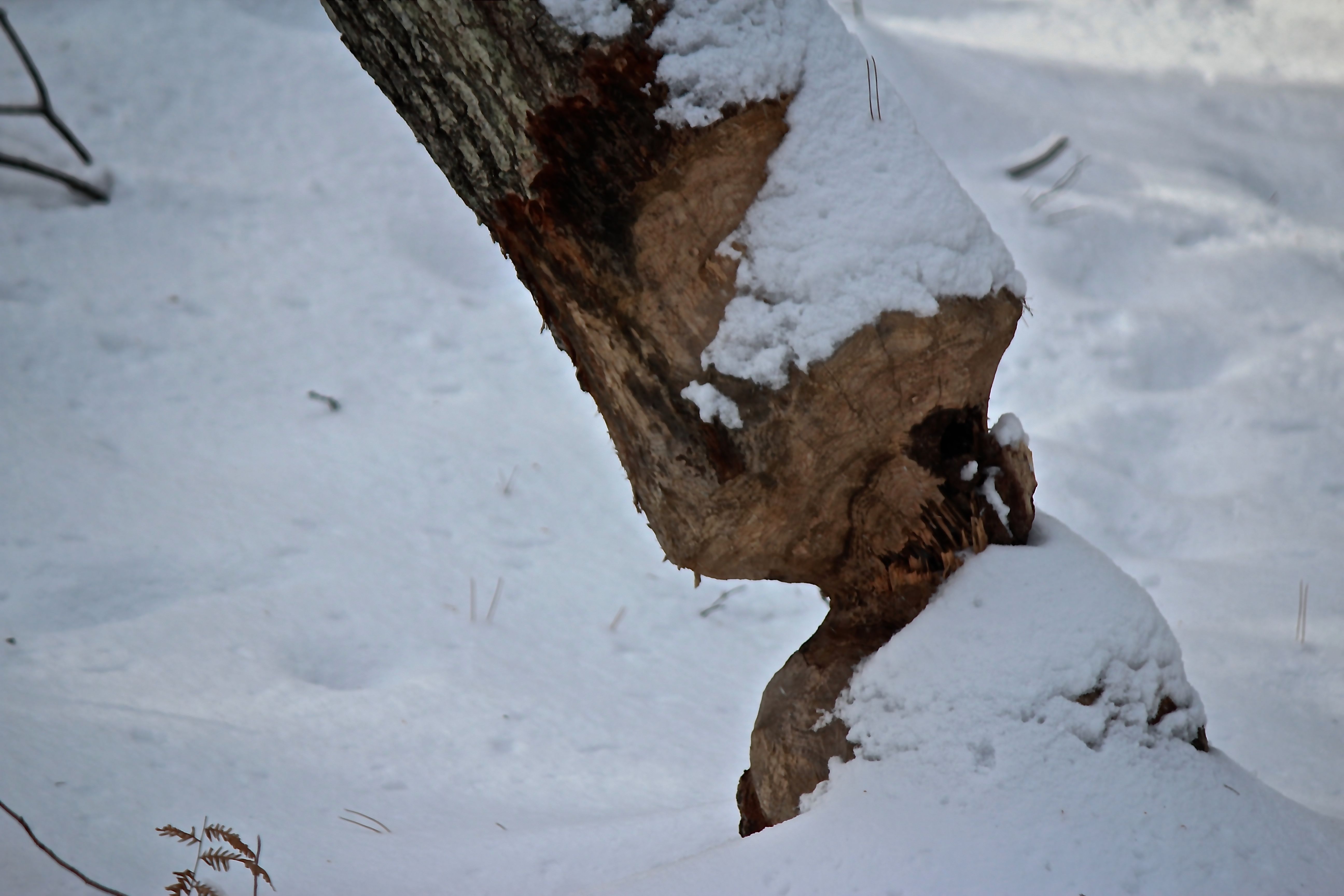
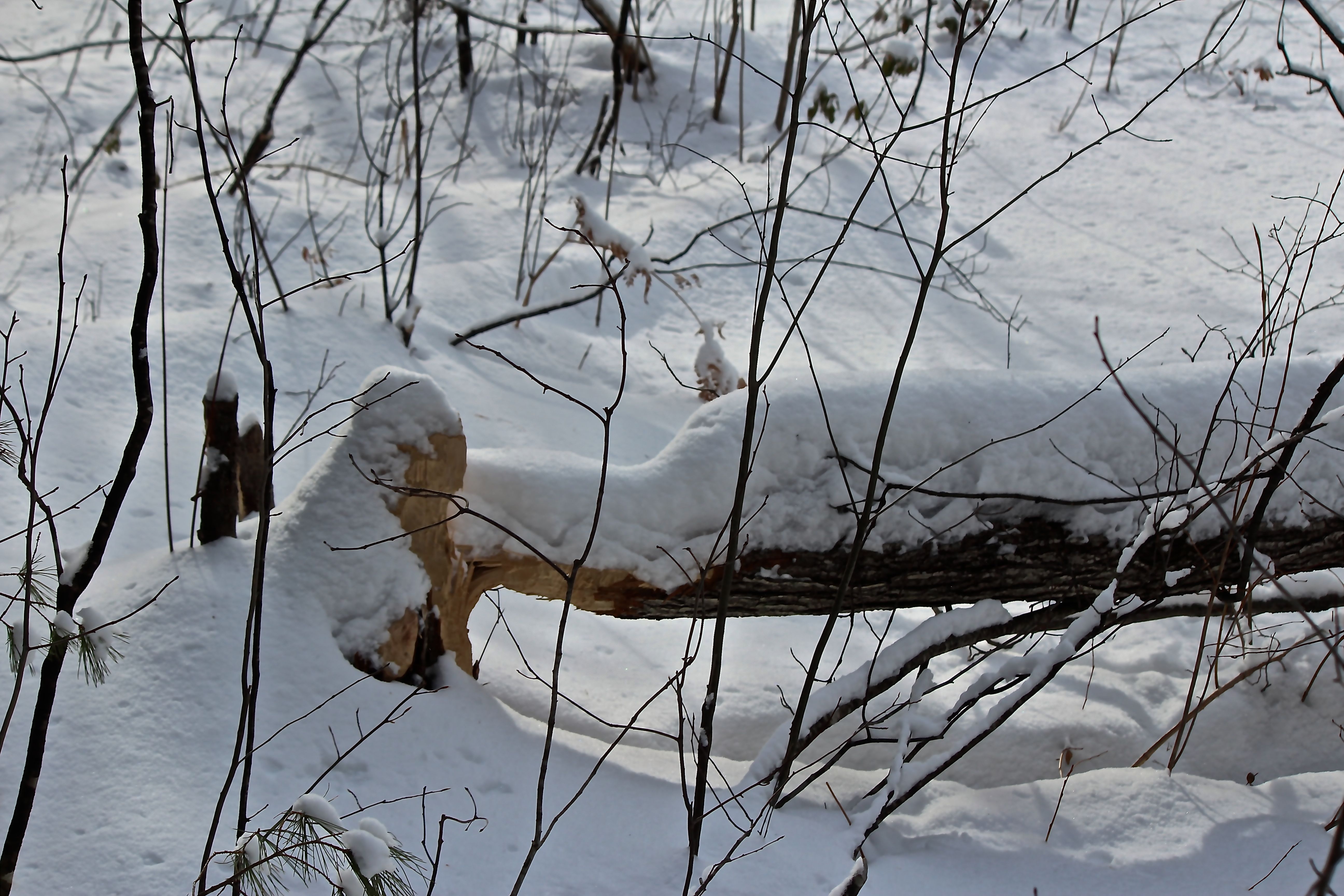
Of course, some trees were intentionally harvested. We found these beaver works near the beginning of the trail where the brook opens into a small wetland.

beaver lodge 2

beaver lodge 1

On top of the lodge, you might be able to see the lighter color of fresh additions to the structure. This was the first of three.

beaver lodge 3

Lodge number 2 is toward the far side of the pond.

beaver view

But it’s lodge number 3 that I’d stay at. It’s worth a payment of a few extra saplings to get a room with that view.

pileated work

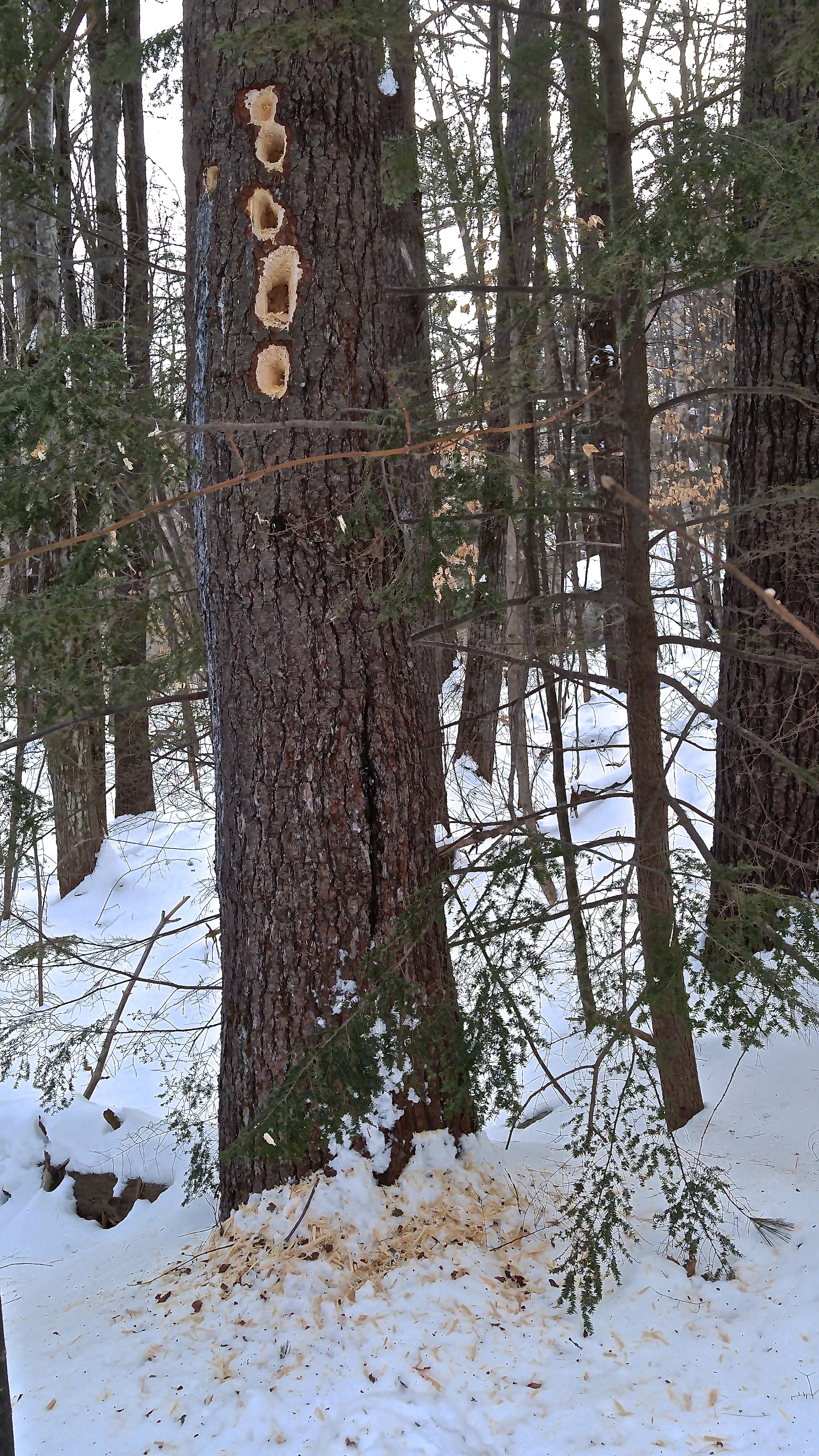
The beavers aren’t the only one making changes in the landscape. Pileated woodpeckers in search of food do some amazingly shaggy work on old snags.

trail debris

Winter debris covers much of the trail. Strong winds have brought much of this down.

yellow and hem yellow birch & hemlock

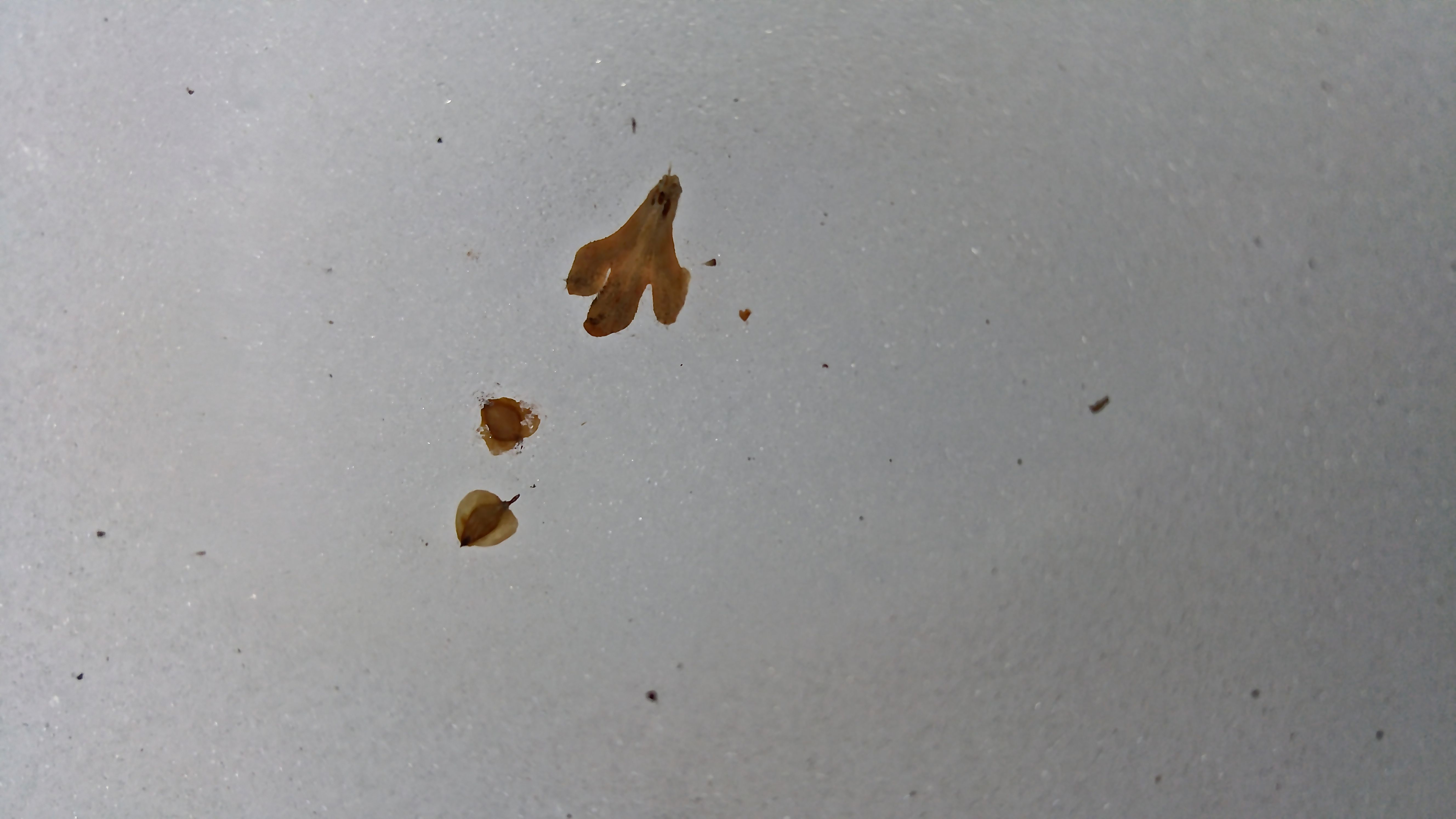
And two of the most prominent trees make themselves known among the debris. A hemlock samara beside a yellow birch fleur de lis and a hemlock needle atop a more complete fleur de lis flower of the birch.

Shell Pond 1

Shell Pond takes on an entirely different look in the winter. We could hear the ice whales singing as we ate our PB&J sandwiches and sipped hot cocoa.

mink

mink tracks 1

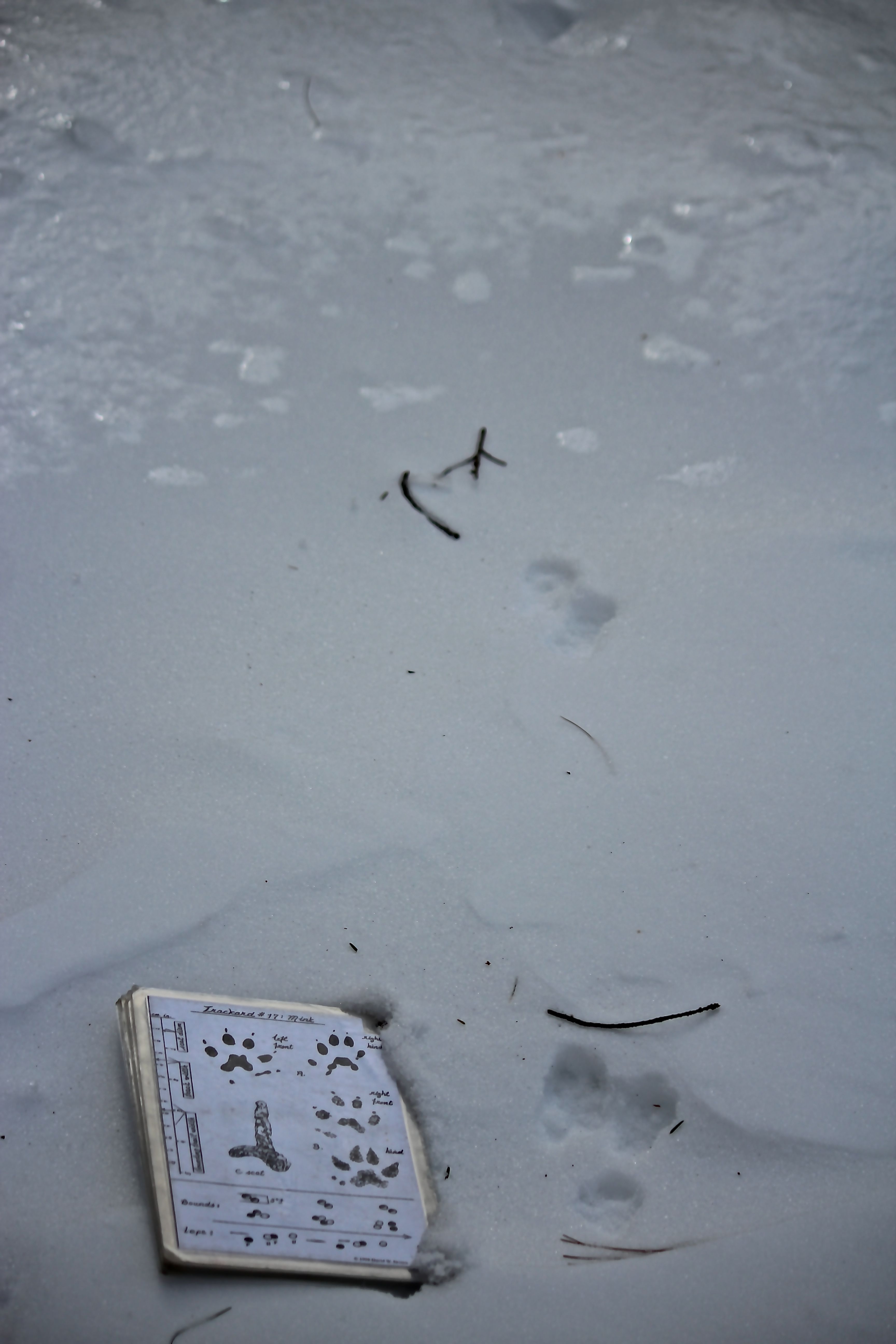
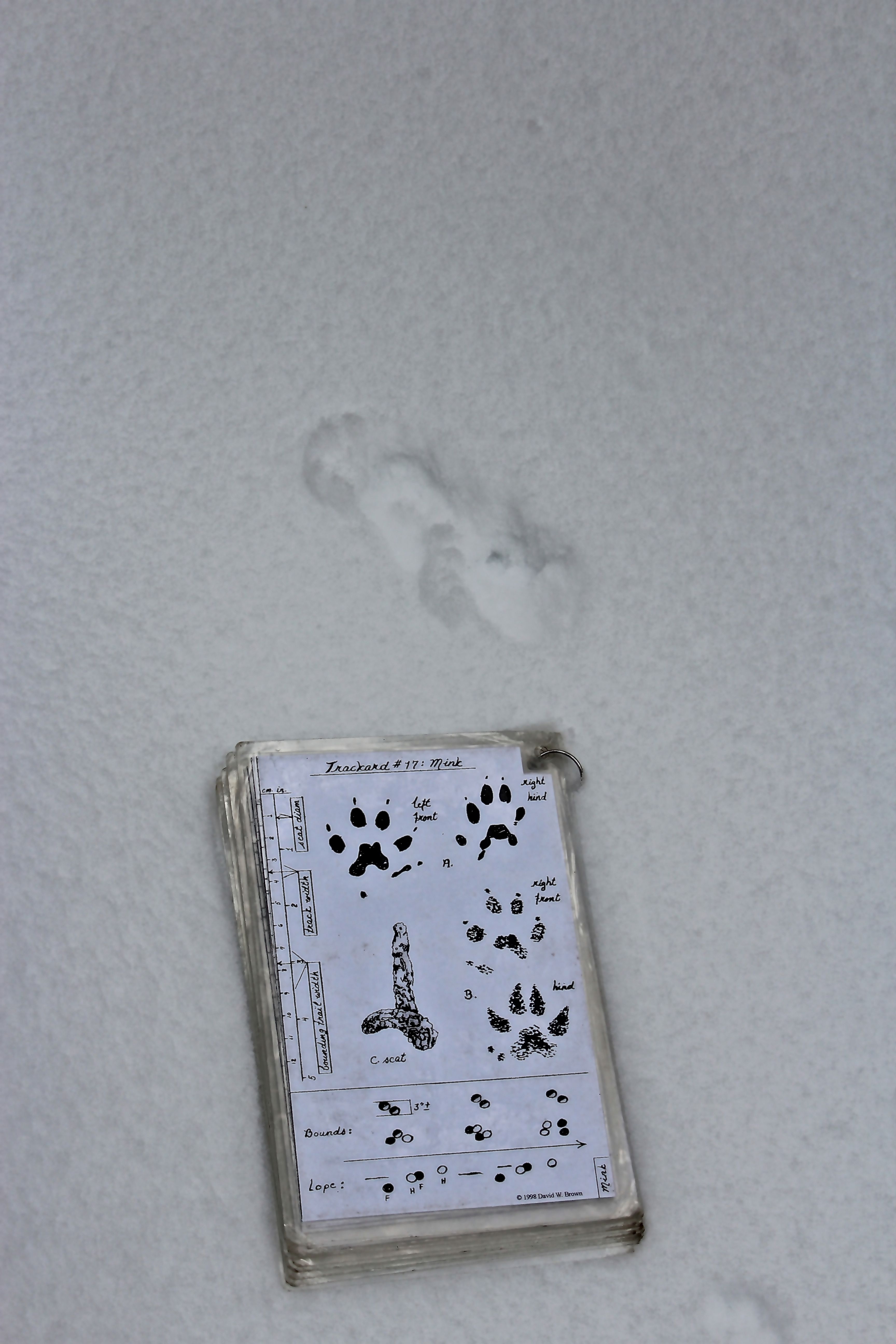
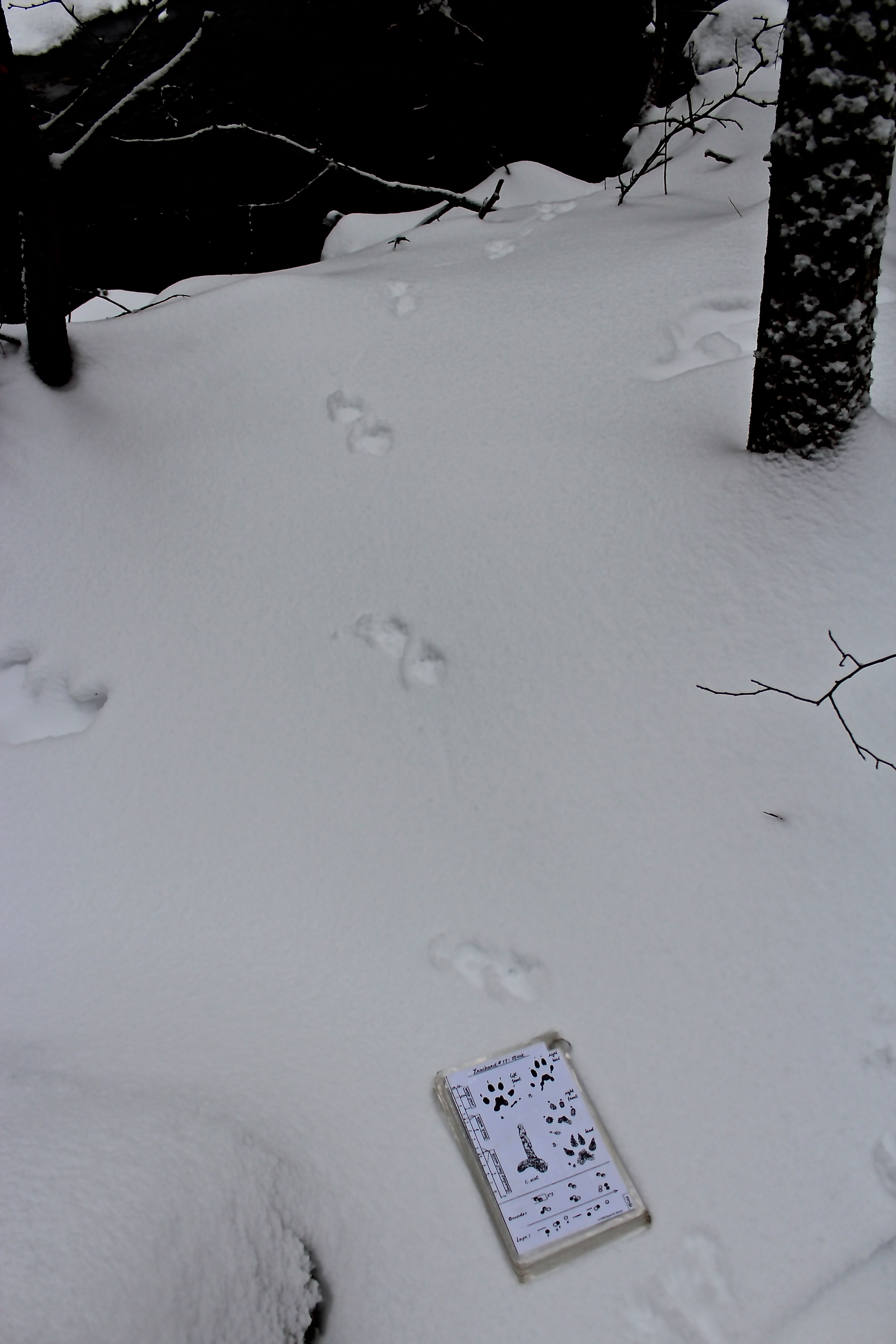
While we ate, we noticed a mink had bounded through previously. I’m always thankful to have David Brown’s Trackards in my pack.

cliffs 2

cliff flow

Continuing on the trail found us taking in views of the cliffs, which we don’t normally see so well once the trees leaf out.

ostrich 3 ostrich 4 ostrich fern 1

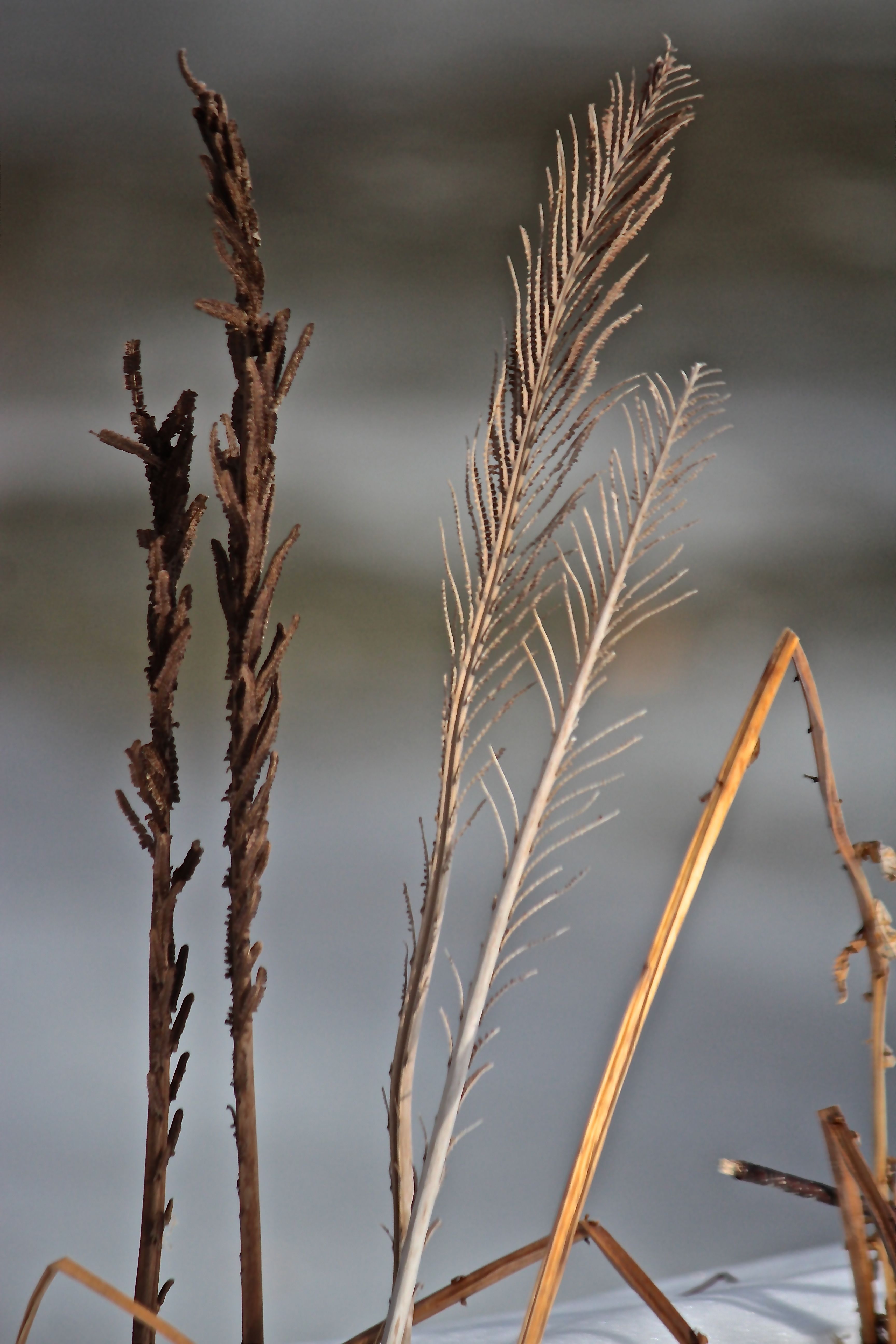
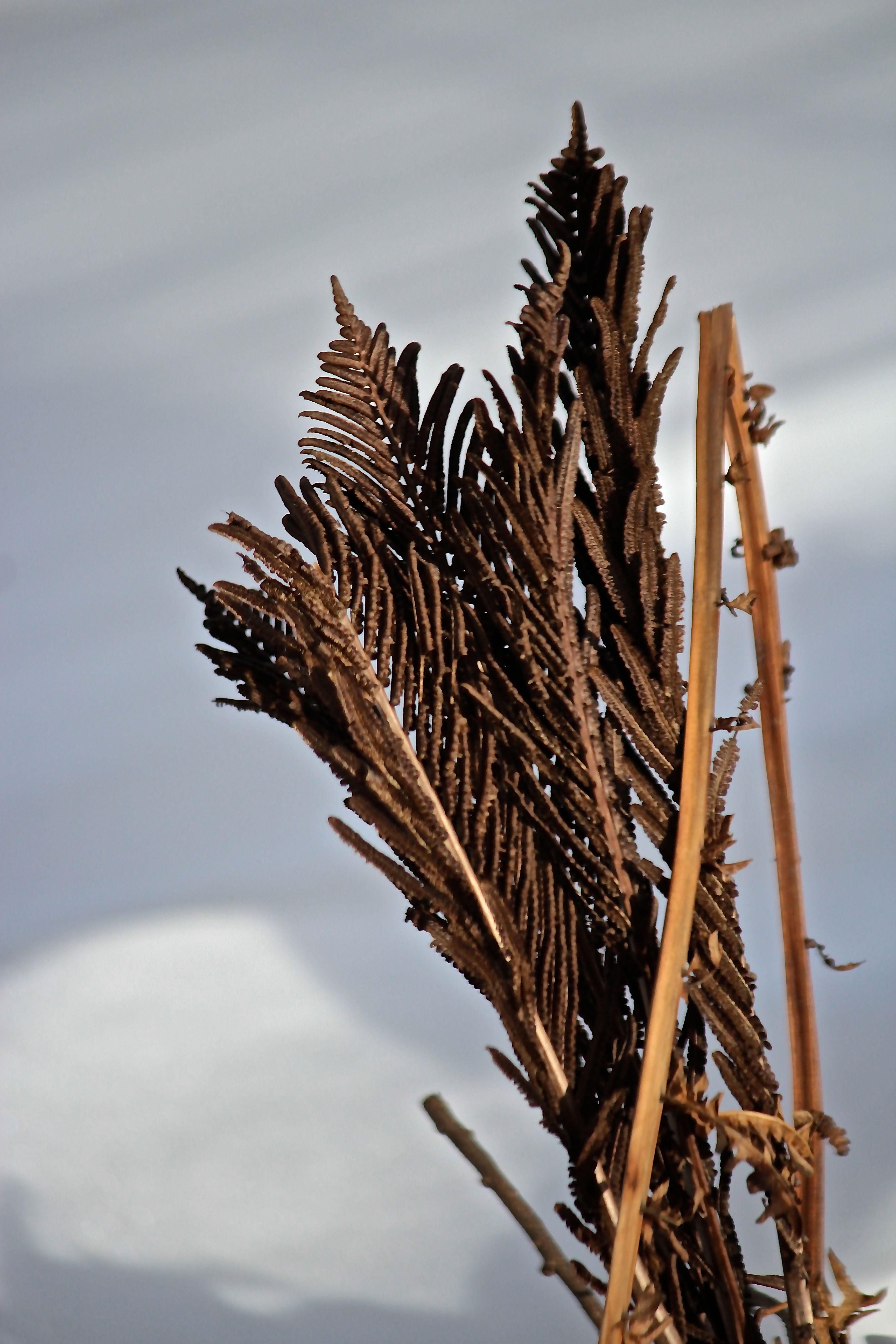
Before continuing through the orchard, I wandered closer to the brook in search of this–the fertile fronds of the ostrich fern that give it its common name because they resemble plume-like ostrich feathers. Come spring they’ll release their spores.

 airfield 2

The sun tried to poke out as we crossed the wind-blown airfield.

stone house 2

From the field, we always admire the Stone House and its setting below Blueberry Mountain.

 snowshoe 2

Walking back on the road, we spotted a classic snowshoe hare print. Most of the tracks we saw were filled in by blowing snow, but these were textbook perfect.

pole 4

And then . . .

pole attack

And then . . .

pole numbers

And then . . .

bear hair 1

And then . . .
bear hair

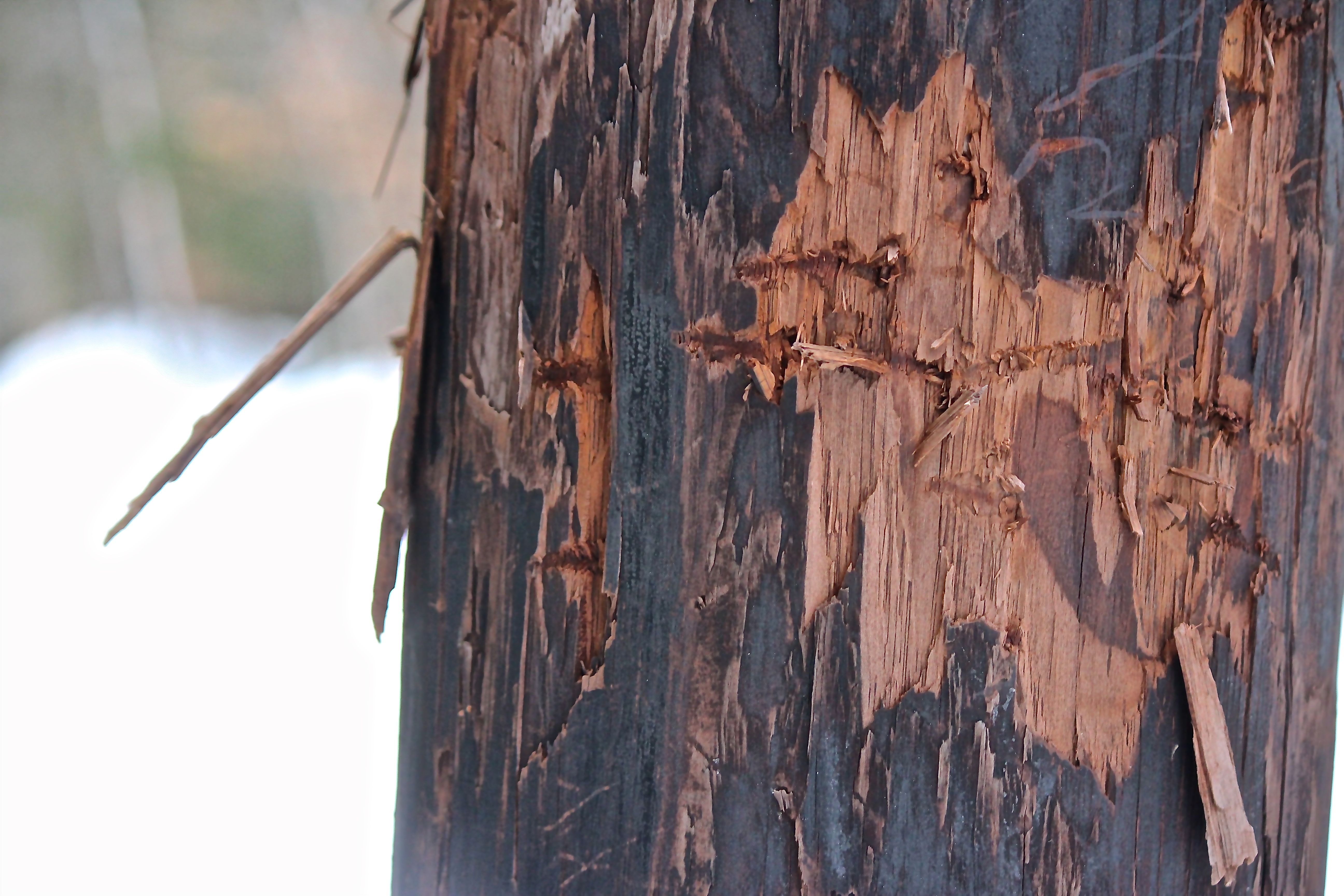
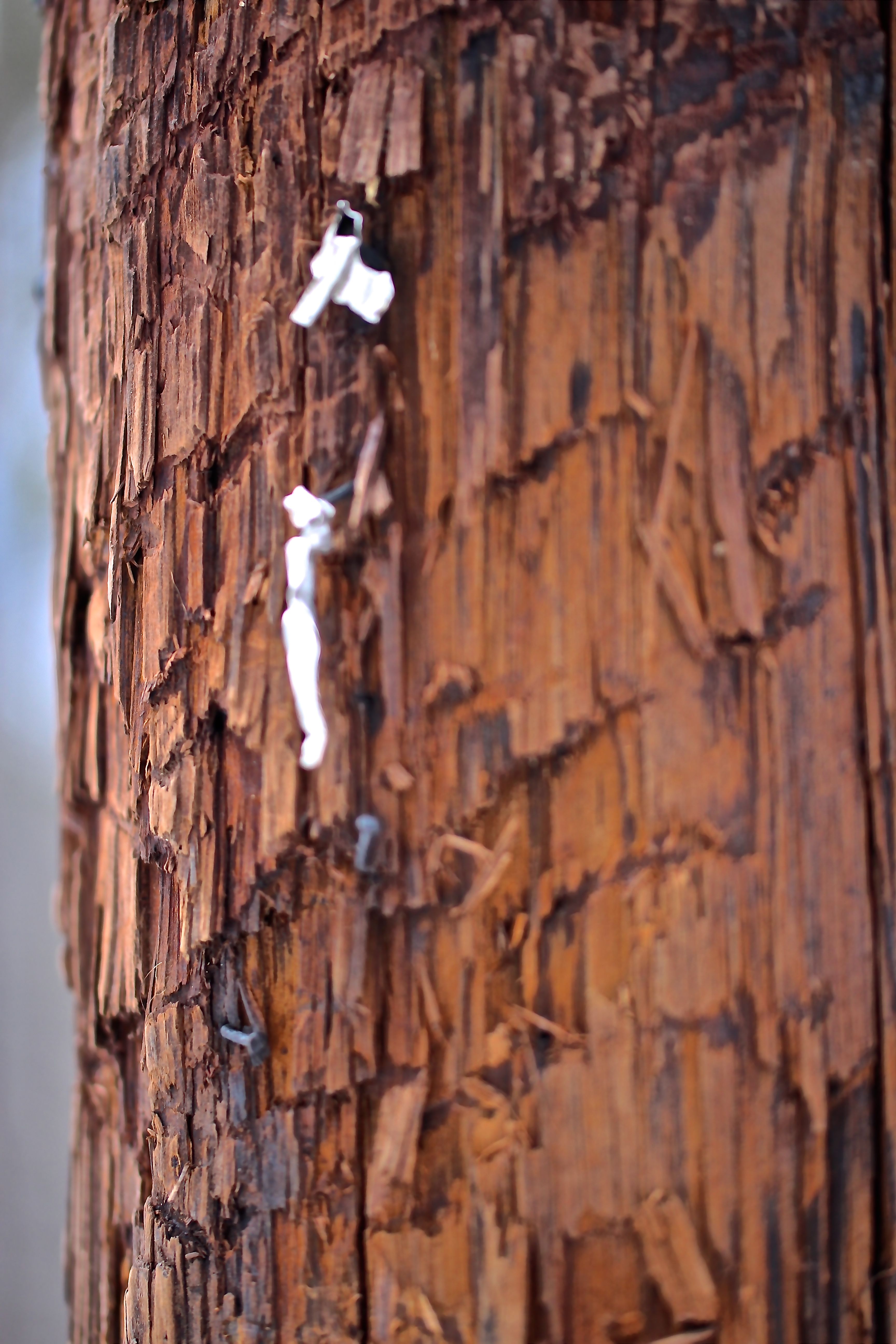
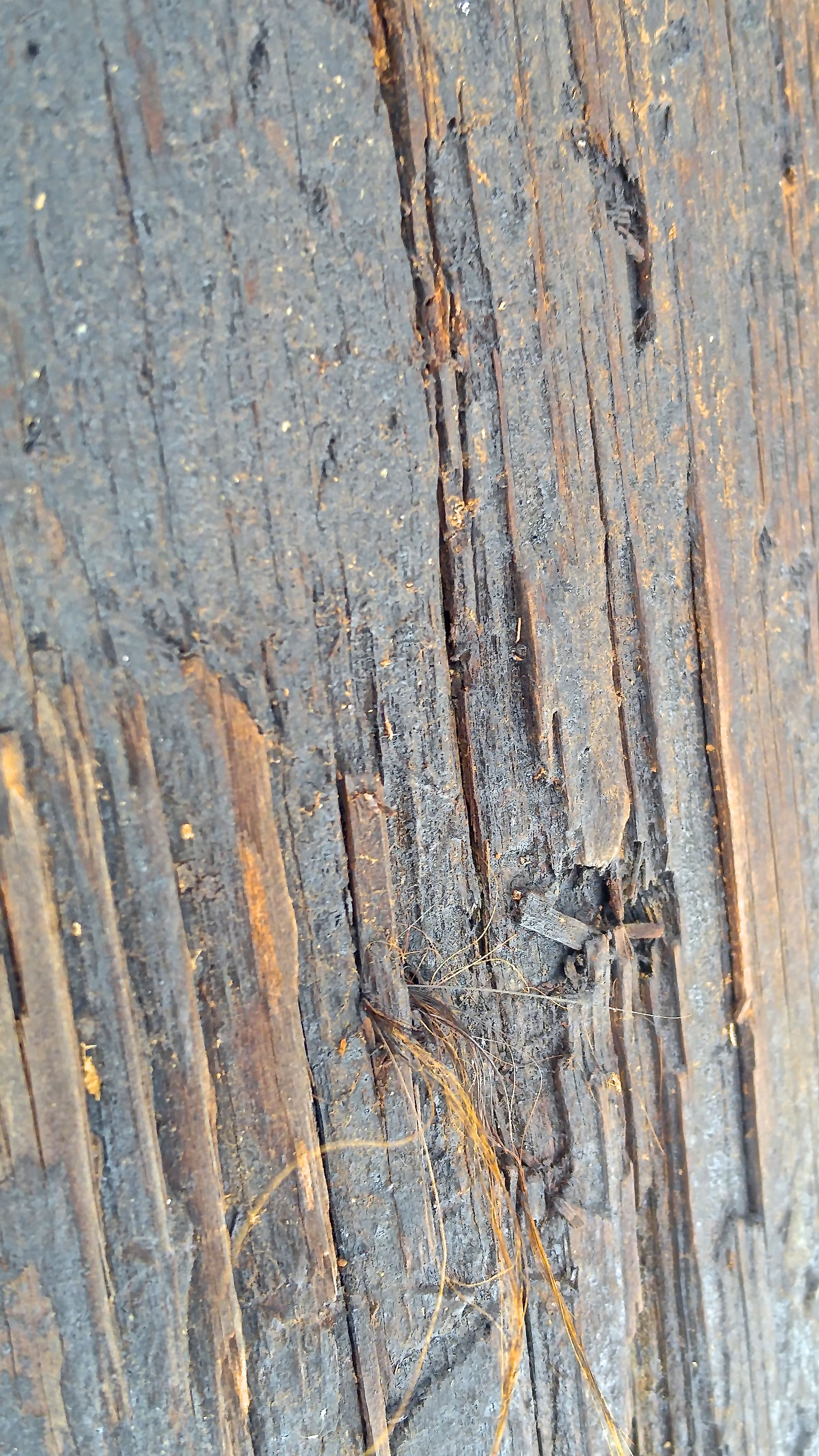
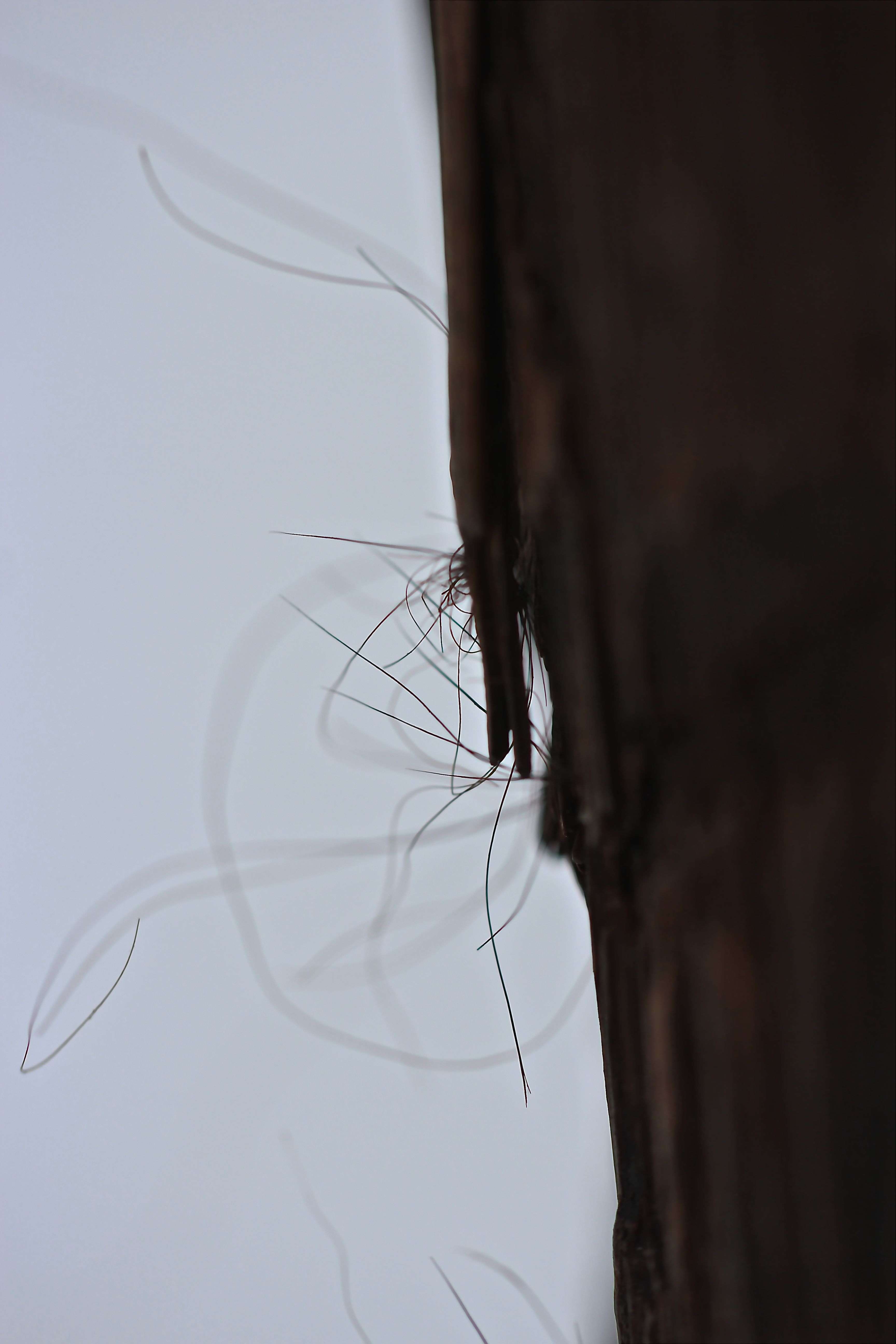
And then . . . on our way back down the road, I introduced my guy to the wonders of telephone poles. We found several sporting chew marks, scratches and hair. Yup . . . bear hair. Black bear. Even the shiny numbers were destroyed on one of the poles. Of course, my guy was sure someone would come along and ask what we were doing as we inspected one pole after another. I was hoping someone would come along and ask what we were doing. Bear poles. Another thing to look for as you drive down the road–think tree bark eyes, winter weed eyes and now, bear pole eyes.

bear paw

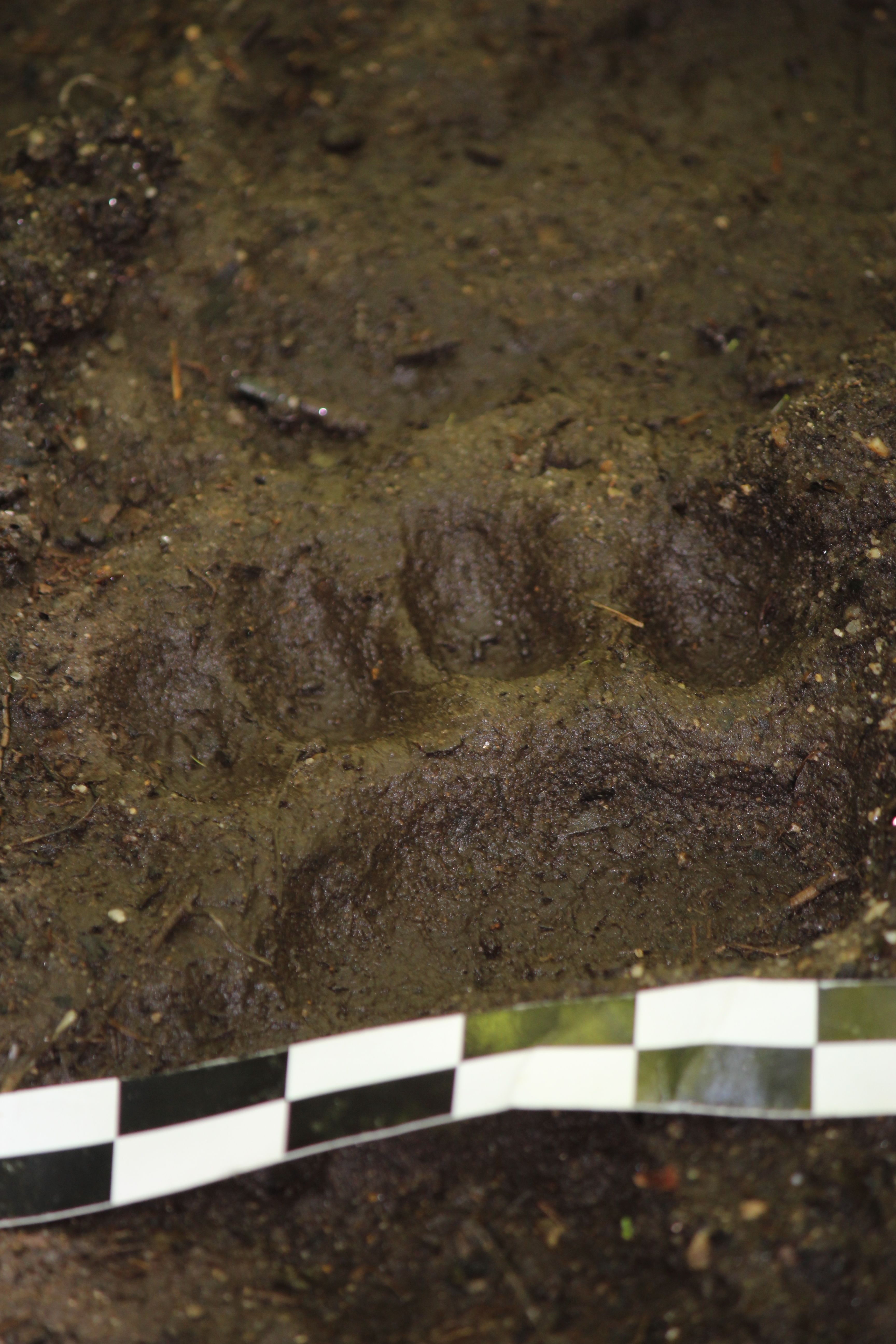
I took this photo on the Shell Pond Loop trail a year and a half ago. Oh my.

Those of you who have traveled this way with me before will be amazed to know that we finished today’s trek in just over three hours, even with the added walk down Stone House Road. Yup, not an advertised three hour tour that turns into six. Hmmm . . . Apparently it can be done–I just need to get Mr. Destinationitis to join our treks for a Shell Pond Speed Date.

The Homecoming

The other day a friend handed me a piece of paper and told me to read it later. We were about to go tracking, so I stuck it into my pack and forgot about it. This afternoon, as I prepared for a hike up Mount Tom in Fryeburg, I found the paper.

I’d originally thought it was an article, but instead, it’s a quote from the October 1967 issue of Yankee. A friend had given it to him and he passed it on to me: “We hunt as much for the memories as for the birds. For the memories, and for the hours afield in the autumn woods where a man can get back, for a while, to remembered realities, to a time and a way of life close to the eternities of the land. It’s hard to explain this to the outlander who never knew such things. He thinks of it as an escape. To us it is more like a homecoming. We live here, of course, but only in the leisure after we’ve done the stint at our jobs do we go out on the hills and up the brooks. There we find the truth of our world, even the truth of ourselves.” ~author unknown.

trail sign

I reflected upon those words as I slipped into my snowshoes at the trail head. I’d made a decision to end one of my freelance writing/editing jobs this week (not Lake Living, which is my all time favorite writing job. Hard to believe the spring issue will mark my tenth anniversary!) and declutter my world.

porky paths stump dump

It will never happen, but certainly the porcupines that inhabit this mountain should consider the same.

stump dumpporcupine den

I had a hunch I’d see evidence of their existence once I got up into the hemlock neighborhood, but a small stump dump early on provided ample den space.

porcupine tracks 1

I didn’t even realize as I climbed toward the summit that I wasn’t taking too many photos. Instead, I was cued into the tracks left behind by two people who had traveled this way before me and the porcupines, deer, hare, coyote, bobcats and little brown things. While the people stuck to the trail, I wandered this way and that as I tried to decipher what I saw–my own zig zag trail reminiscent of those I followed.

logged community, thin trees

I didn’t get lost today, though truly, when I do get fake lost, it’s a time to understand myself better– listening to my inner self sort things out. Most of today’s trail is an old logging road. And most of what I saw was familiar. Perhaps that’s what it’s all about–knowing a place so no matter where you are, you recognize it.

hemlock community

The community changes abruptly from birch, beech and maple saplings to hemlocks and pines. I, too, can change abruptly and have a tendency to be blunt. I don’t see that as a bad thing, though occasionally I do regret what I’ve said.

striped maple scrapes

And then I began to look up and notice other parts of my surroundings like these old deer or moose scrapes on striped maples. Forever scared, they provided nourishment in the past–and may do so in the future when the time is right.

striped maple samaras

One striped maple still sported a few seeds that have yet to go forth in the world. What’s holding them back? Don’t they know the time has come to let go?

frost crack

Amongst the evergreens  a paper birch offered a twist on life. I believe this is the result of sun scald–the heating and freezing of thin bark. Typically, the white reflective bark helps the tree avoid such danger–but something obviously happened to cause this candycane-like stripe..

sun on hemlocks

Though it was getting late in the day, rays of sunshine illuminated the darker side of things.
white oak leaf

As I followed more porcupine tracks at the summit, a dried leaf captured my attention. In my ongoing attempt to draw an imaginary line showing the boundary of white oak, I added another dot.

white, beech, red oak

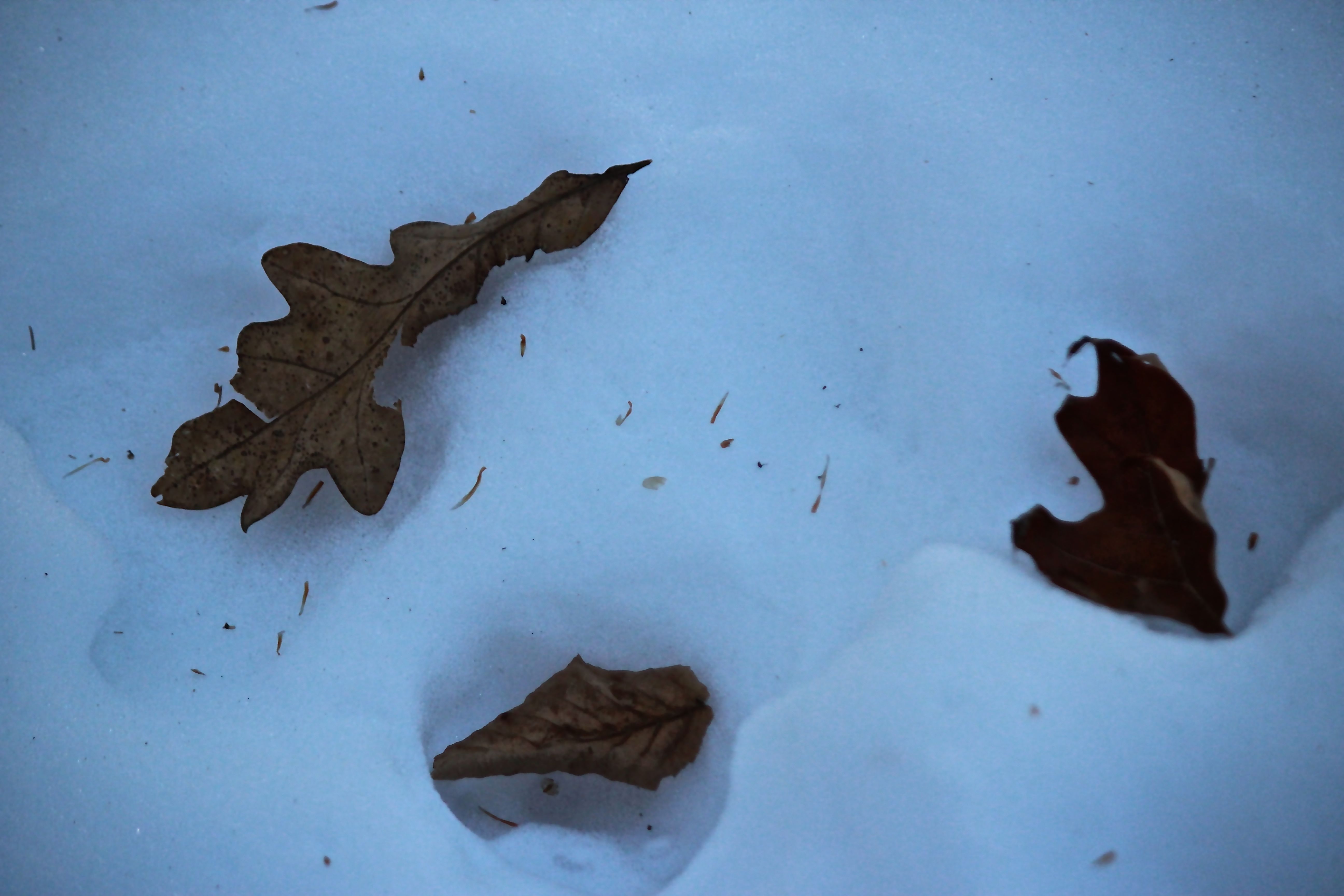
Nestled within animal tracks, three leaves told me more about the members of this neighborhood–white oak, beech and Northern red oak.

white oak 2 white oak 3 white oak layers

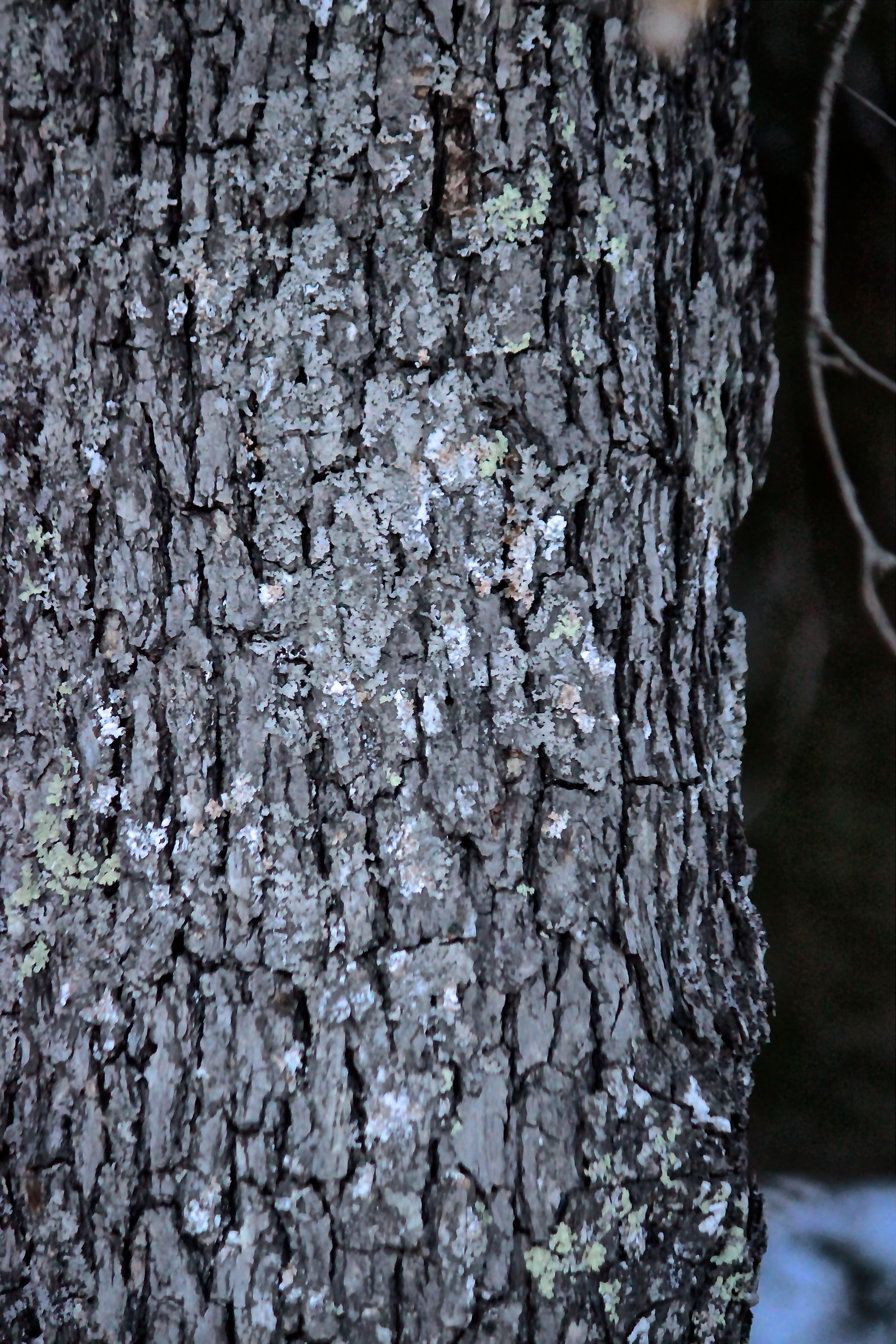
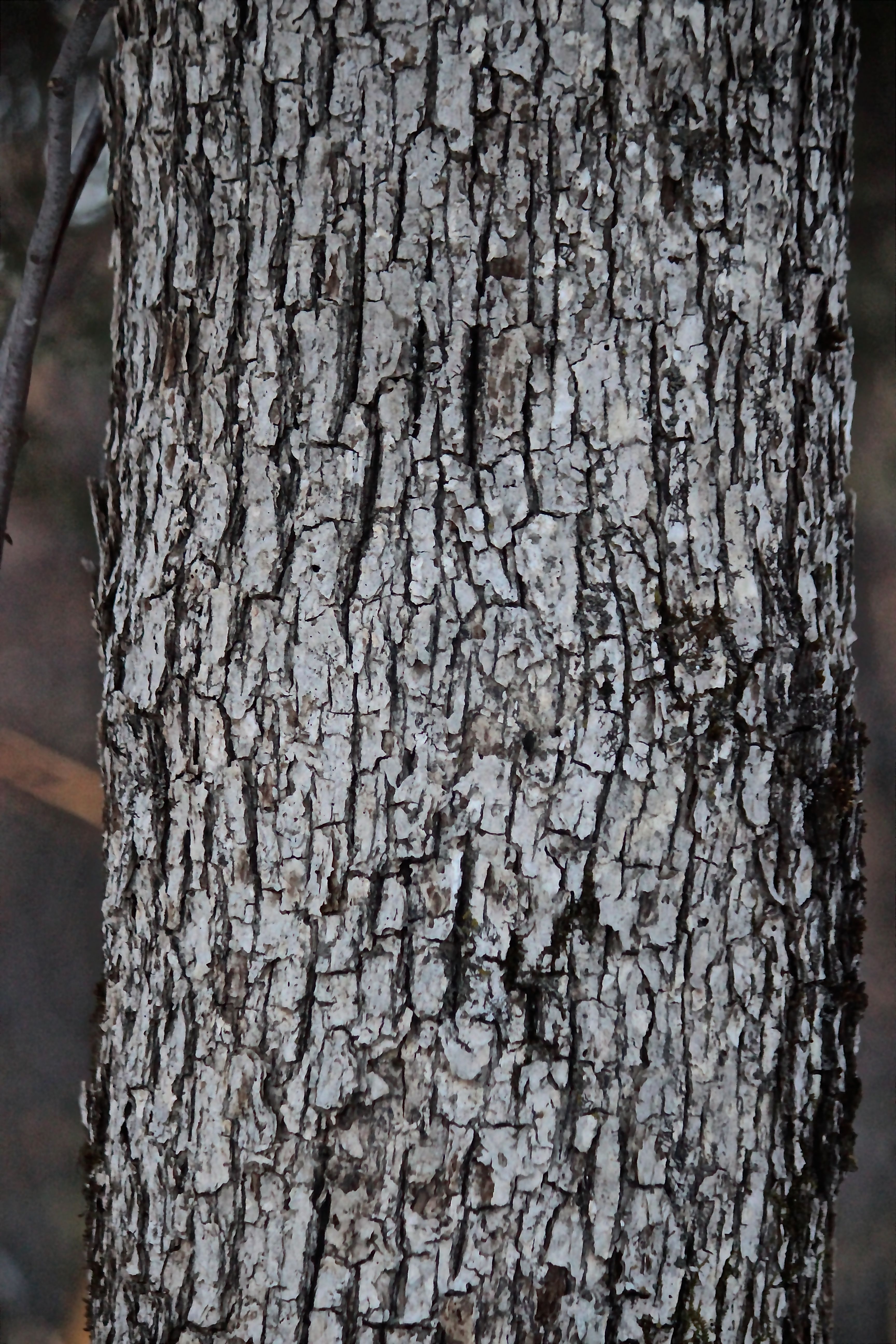
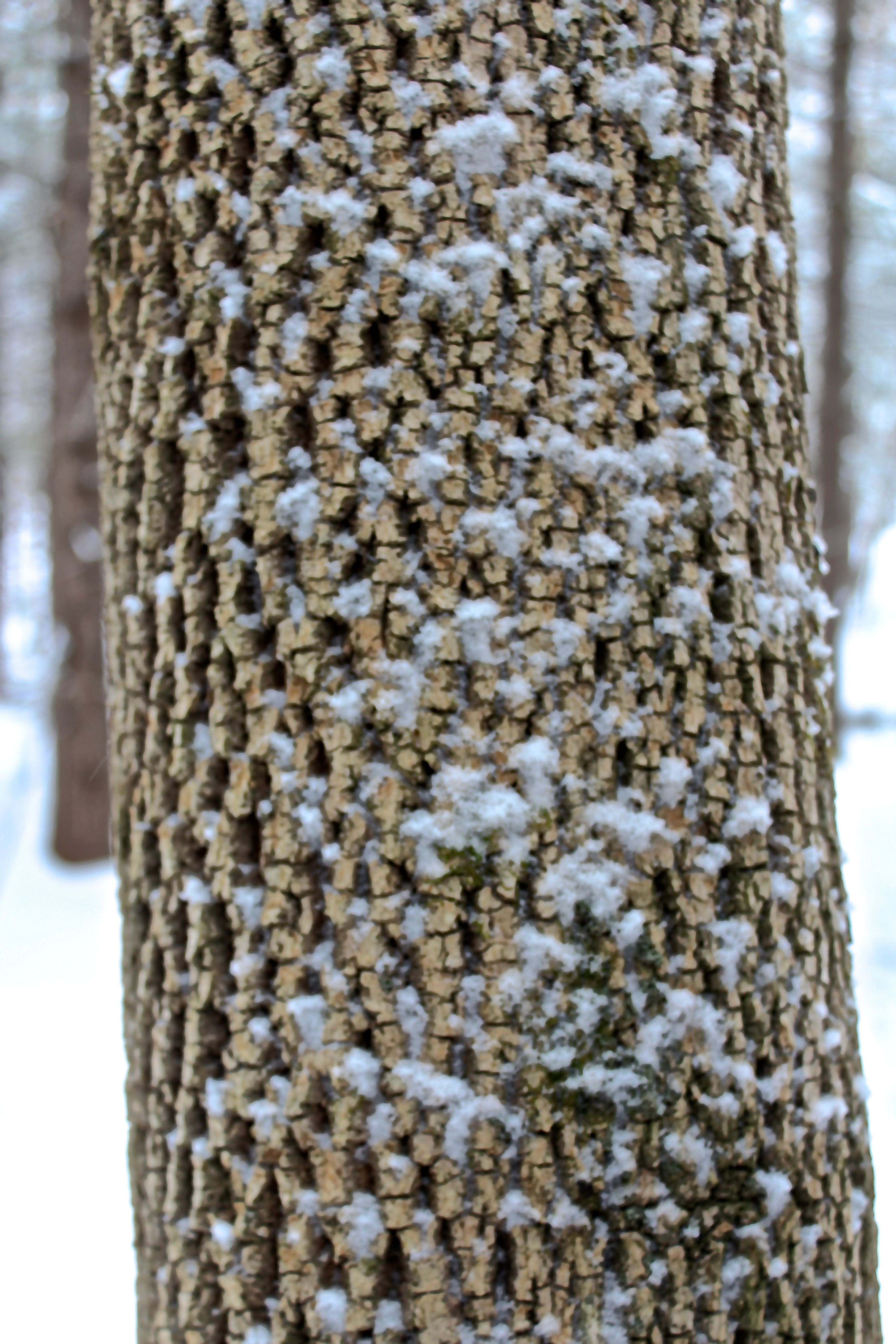
So then I searched for the white oak trees–and found them. My bark eyes still don’t cue into this one immediately and I need to learn its idiosyncrasies, including its ashy gray color and blocky presentation.

bird nest 1 bird nest 2

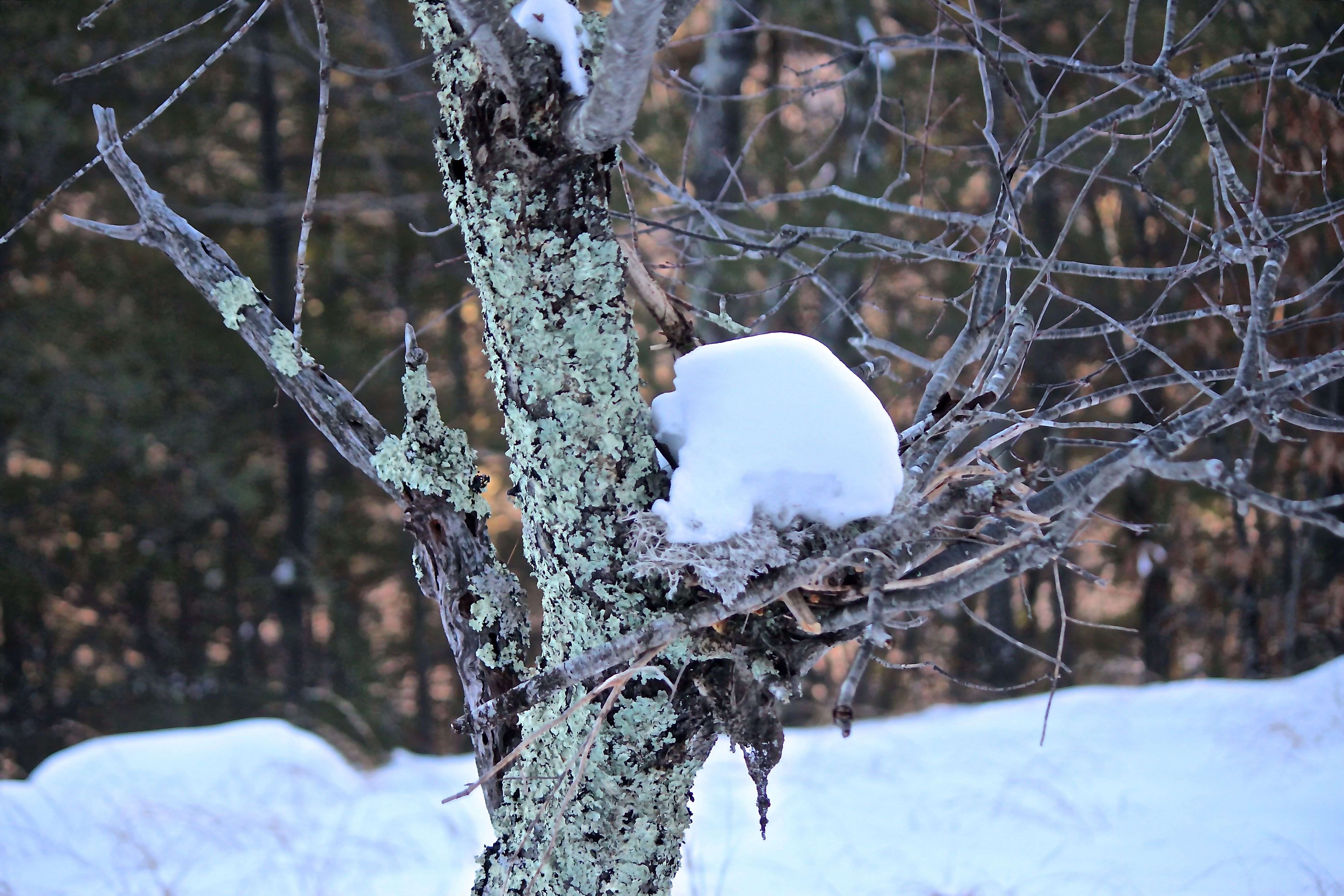
I discovered a snow-covered nest that made me ask–bird-made or human-made? It’s constructed of reindeer lichen and sits upon a base of sticks about four feet up in a scrubby old oak. I was as excited by the find as I was by my wonder and lack of an answer. What fun would it be to know everything?

summit

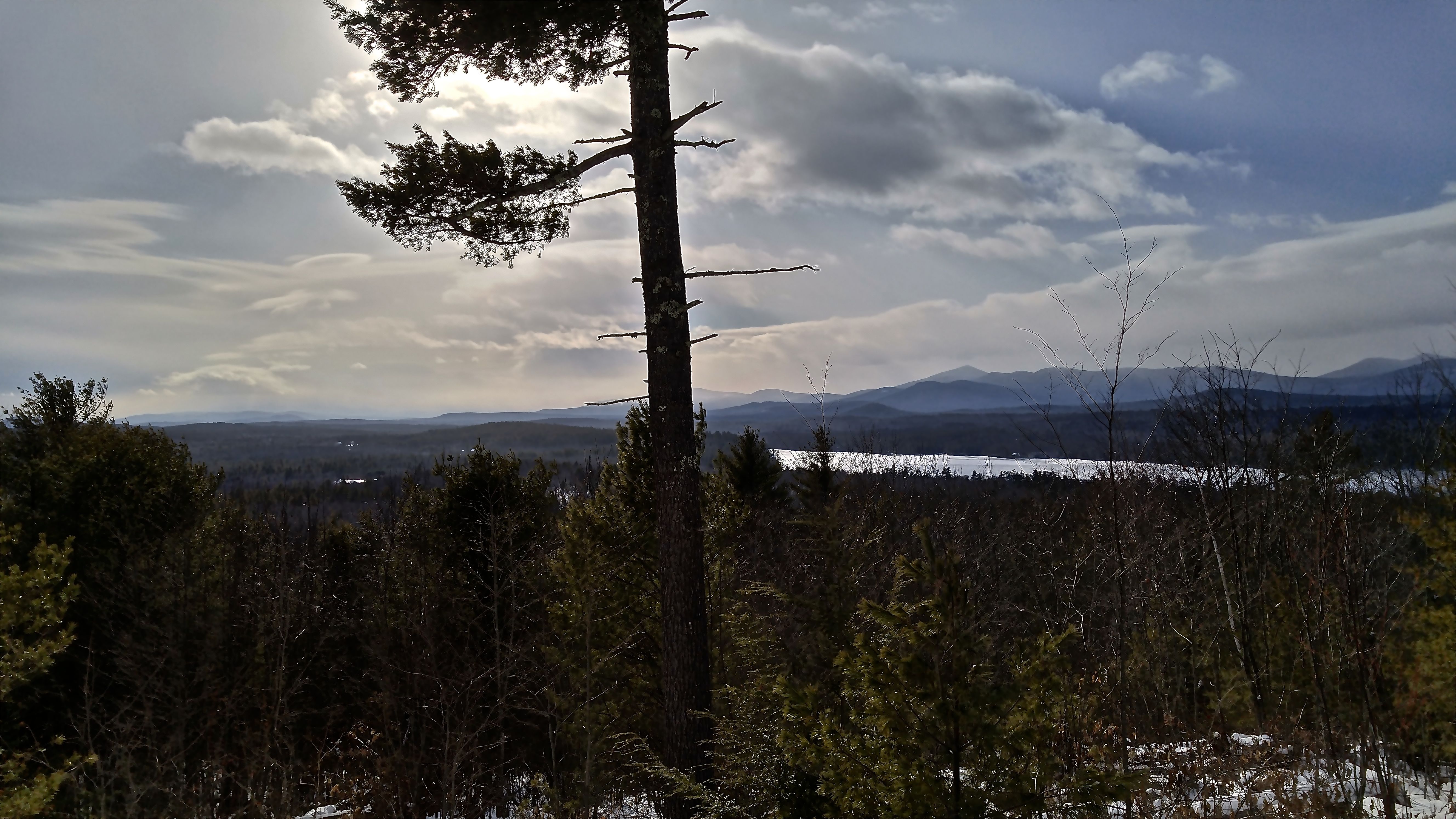
From the summit, I could see Pleasant Mountain’s ridge–giving me another sense of home. The view isn’t spectacular, but that isn’t the point.

Kearsarge 2

Heading down, a second old favorite came into view–Kearsarge North. I stopped frequently as I descended–to listen and watch. And smell. Twice, a strong cat-like pee odor tickled my nose. The tracks were there, but I couldn’t find any other bobcat evidence. One of these days.

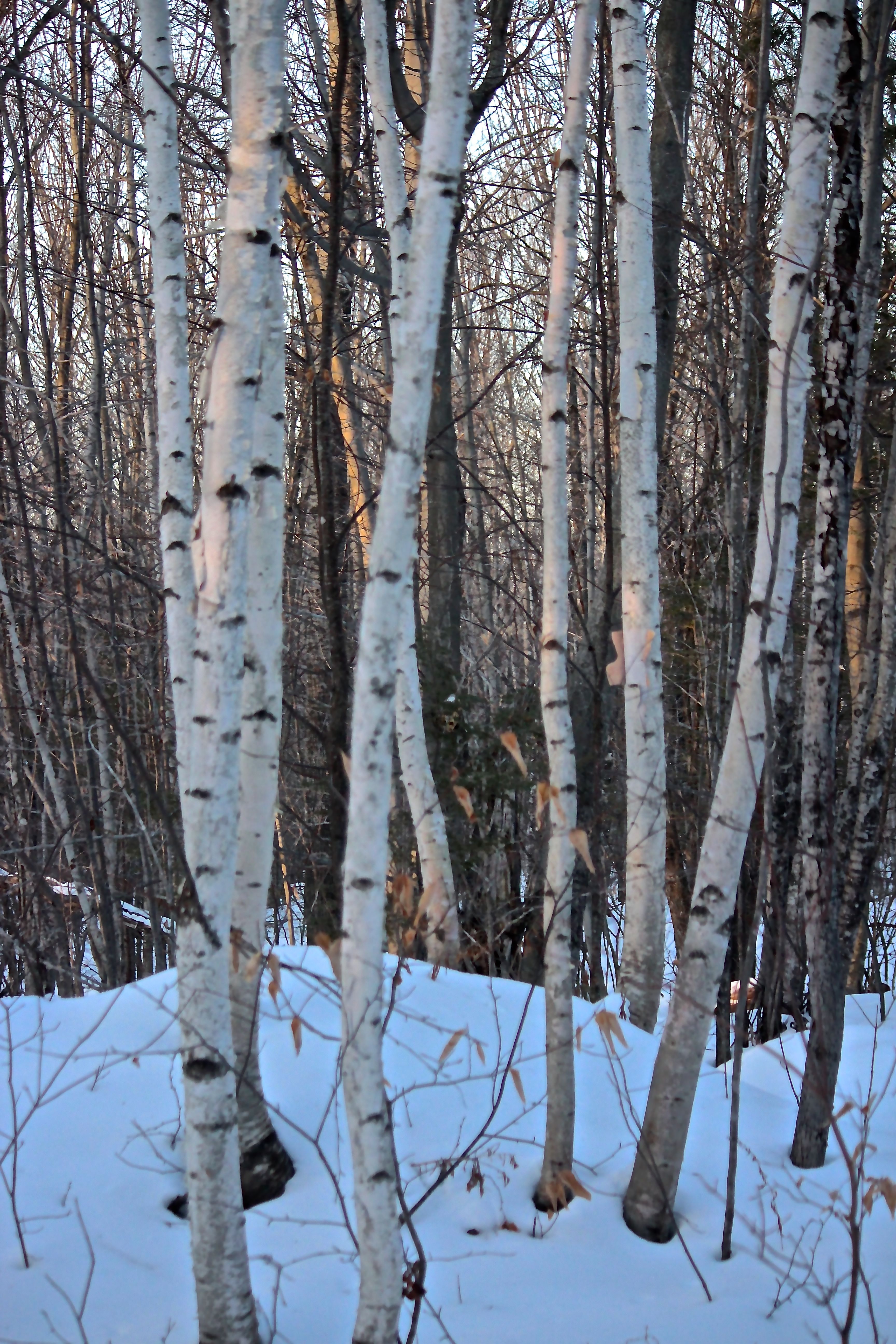
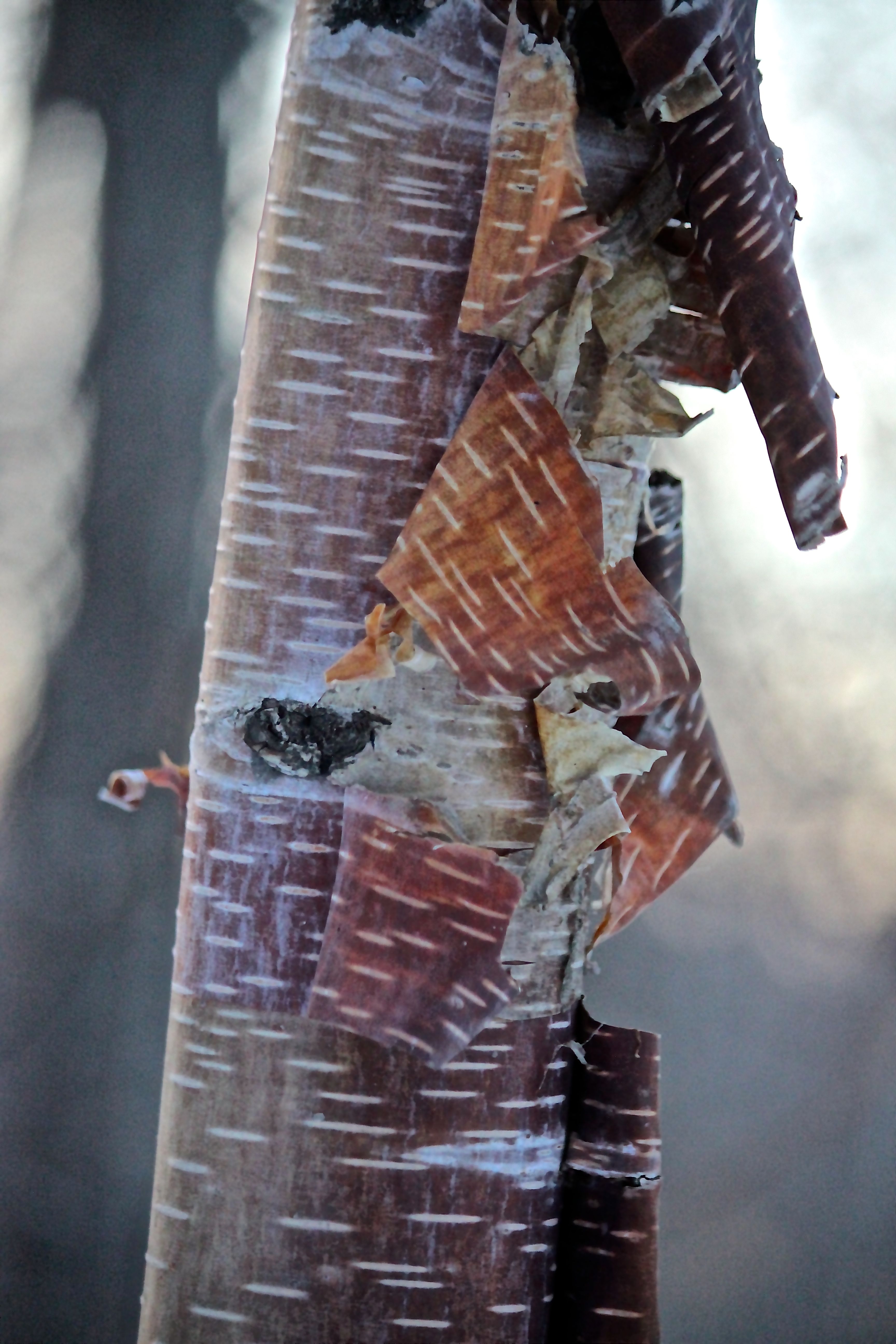
paper 4 paper birch 1 paper birch 3 paper birch rainbow paper burgundy Paper pastel

A rainbow of color presented itself among the paper birch trees–such variation for what is commonly called white birch.

Mount Tom cabin 1 Mt tom cabin 2

Near the bottom, the Mt Tom cabin speaks to an earlier time when living off this land was the norm. Though I like to think that I could stay here by myself for a week, I’m not so sure. Of course, that would force the issue and surely the truth about myself would be revealed. Maybe it’s best left a mystery. ;-)

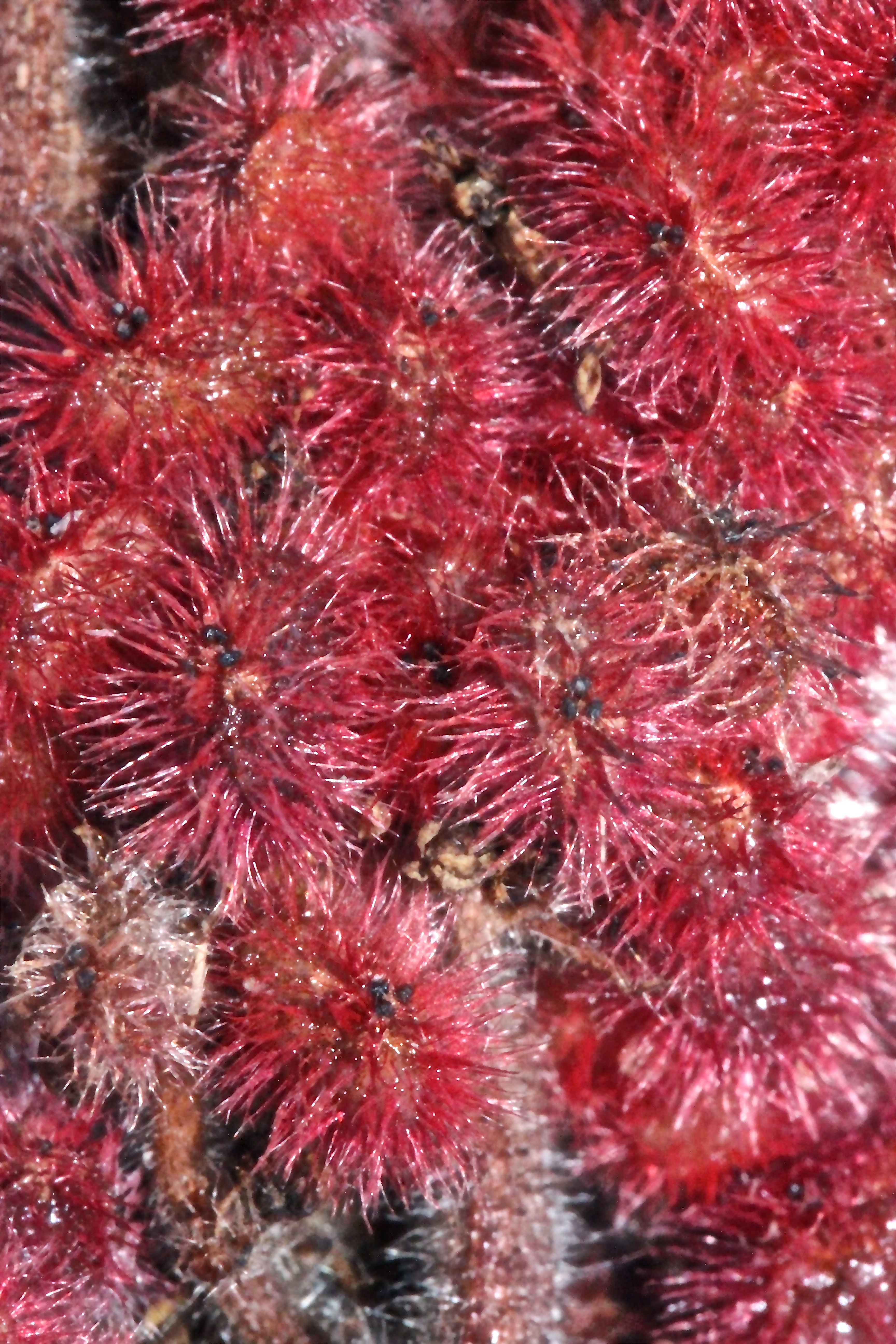
staghorn sumac1 staghorn red

Before slipping out of my snowshoes, I paused beside the staghorn sumac. It was my height, so I had an opportunity to examine its hairy features closely. Animal from The Muppets must have cloned himself.

Full moon

There was a time when I was easily unnerved being in the woods alone. And I still have moments–especially when a ruffed grouse erupts. Geesh–that can certainly make my heart sound like it’s going to jump out of my body. But, the more time I spend out there, the more time I want to spend out there–exploring, discovering, wondering. This afternoon, I finally followed the full moon home, thankful to find even an inkling of my spirit. I recognize that the word “home” has come to mean more than one place. Our abode is our home, but time in the woods is also a homecoming.


Chillin’ at Heald Pond

It was chilly this morning. Understatement. It was mighty cold, given the wind. But that didn’t stop the intrepid Tuesday Trackers of the Greater Lovell Land Trust from exploring a property under conservation easement. For some though, that was enough. A few of us had intended to explore a trail in Stoneham, but postponed that trip for another day. The temperature was dropping as the wind increased.

My brain and body, however, were still in exploration mode, so I drove to the Heald/Bradley Ponds Reserve. A sip of hot cocoa and I was ready to continue.

Mill Brook

Mill Brook takes on a different look in its winter coat.

ice twists 2

Below the tree that lays across the stream, a series of twists remind me of flames–frozen in time.

 Mill site dam

mill dam

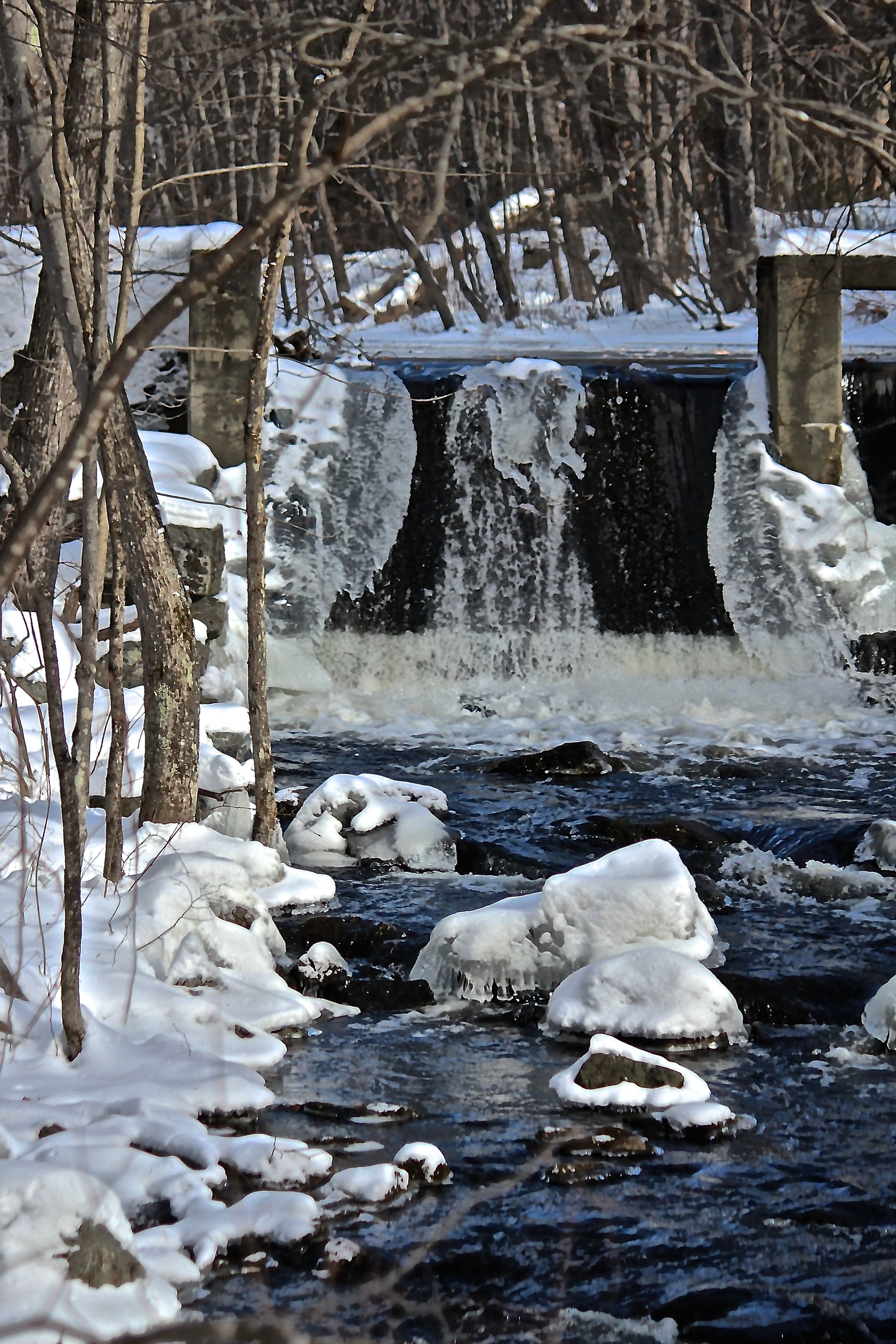
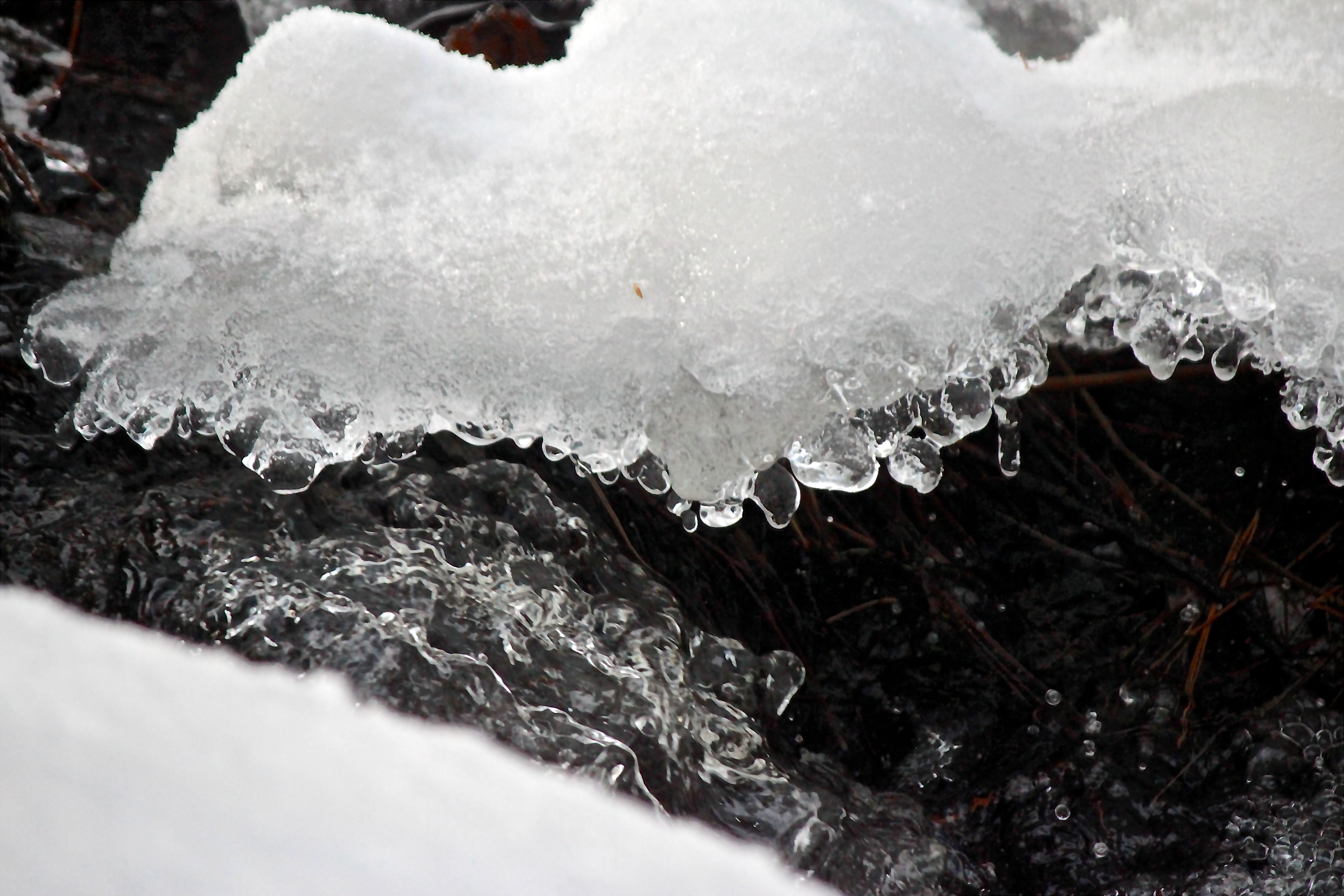
As the water cascades over the old dam site, the ice builds up, creating a new scene moment by moment.

mill site

I love the combination of newer dam beside the old foundation stones. History was made here.

otter slide

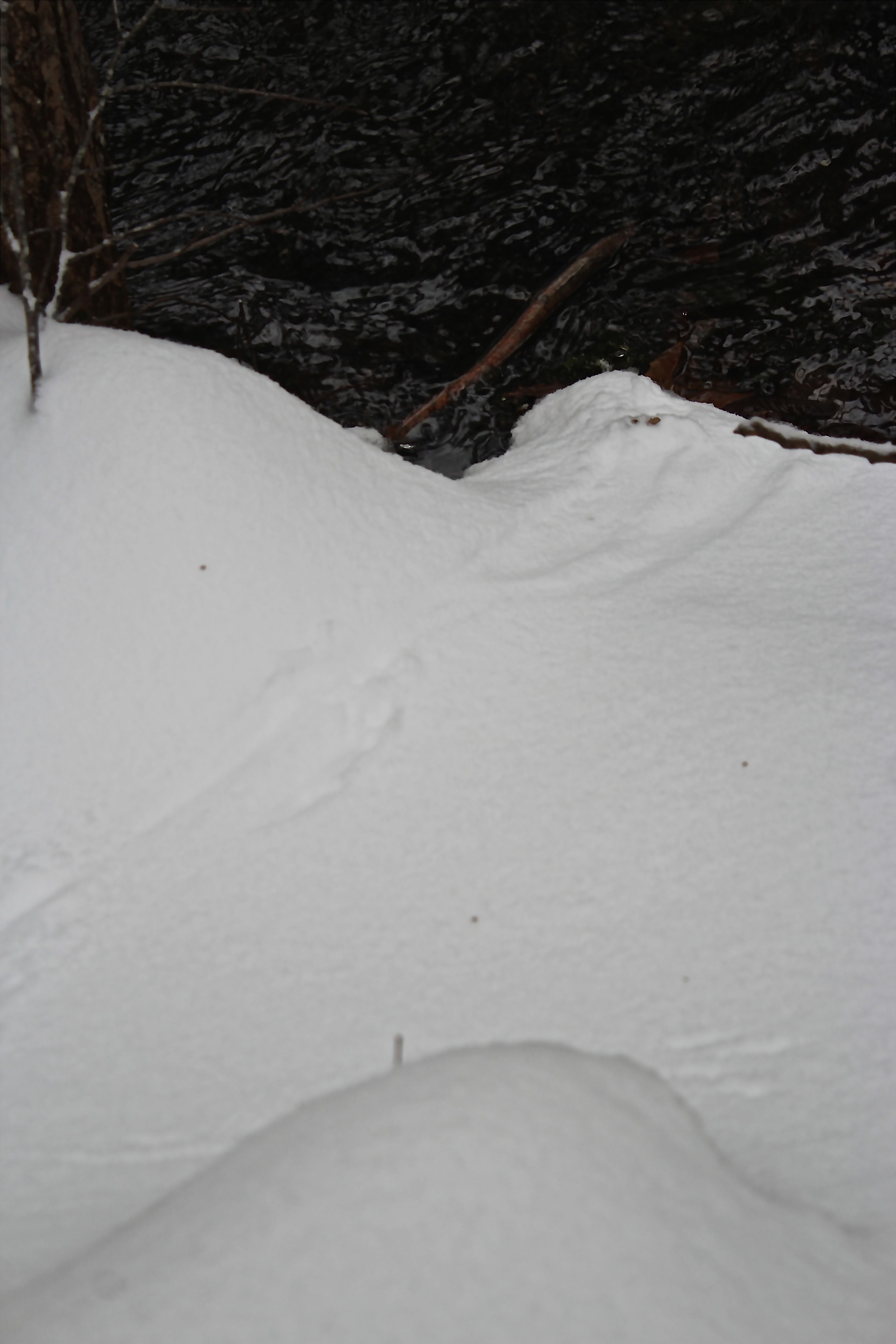
And above those very rocks a sight that warmed my heart–an otter had been chillin’. In my next life please let me be an otter. I know they are fierce predators, but they seem to have such fun and they LOVE winter. Me too.

otter climb

An upward climb . . .

Otter 4

and another downward slide

Otter 3

   otter tracks by mill brook

back to the water. Check out those webbed tracks on the angle noted for members of the mustelid family.

mink tracks

A mink had also passed through. Oh my! I could have turned around then and headed home, but I didn’t.

pileated tree, Heald PondPil tree

Near the kiosk, a pileated woodpecker has been enjoying a feast. I found scat among the wood chips below. If you go, look for it–filled with carpenter ant bodies.

exoskeleton

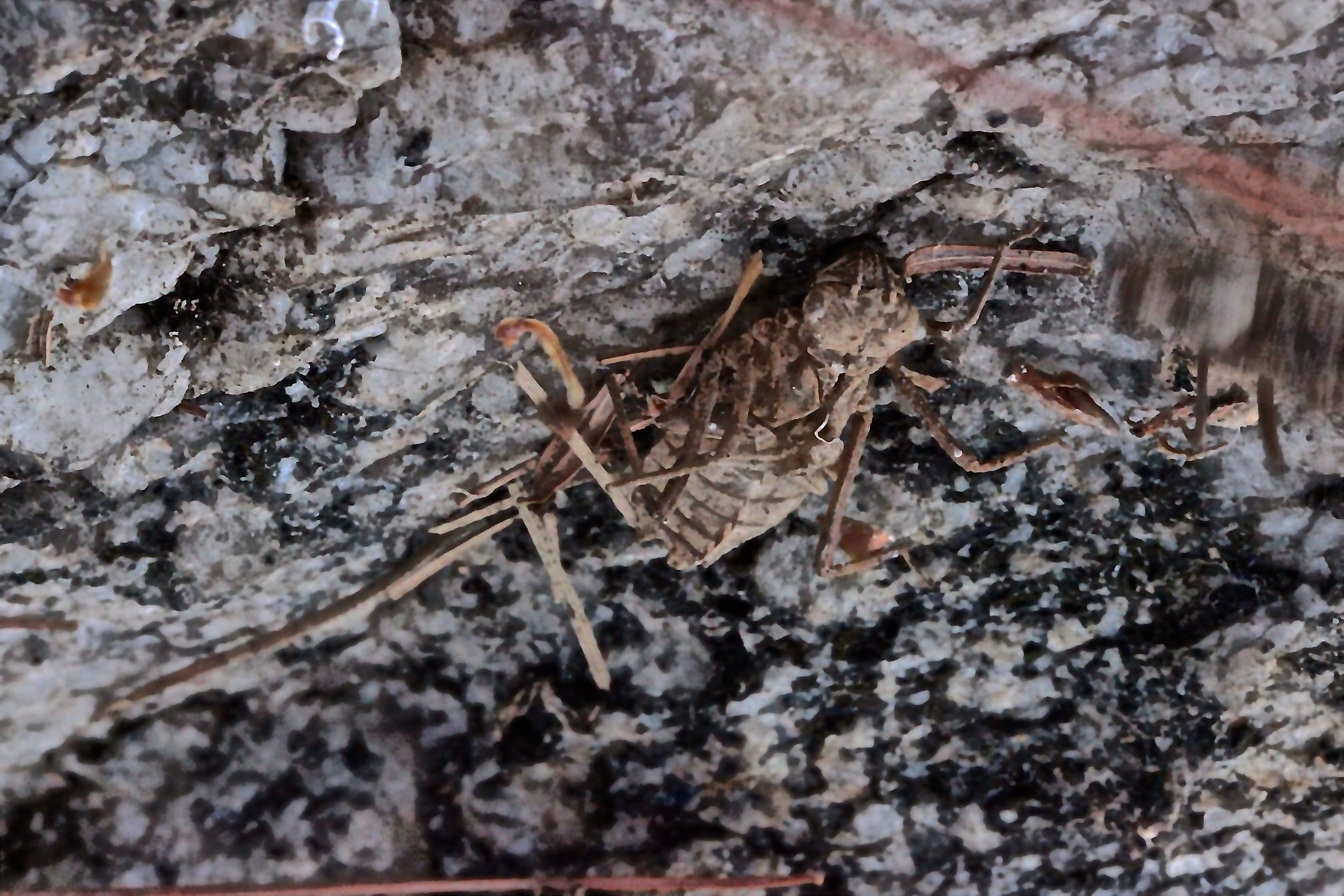
Despite hand warmers, my fingers were feeling the cold, so I bee-lined to Otter Point. Whenever here, I feel compelled to check on the dragonfly exoskeletons.

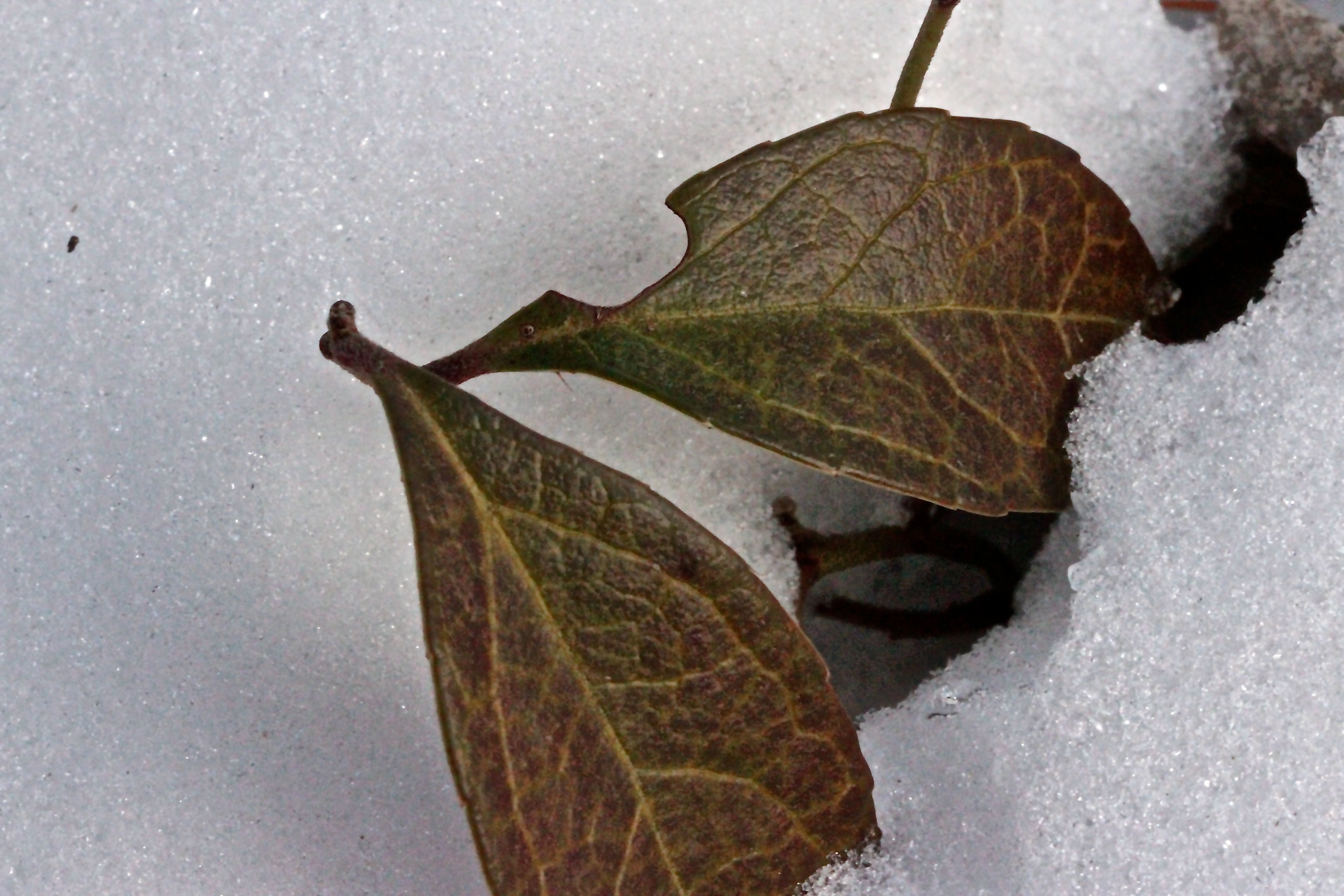
ice on wh leaf

No otter tracks at the point, but there was plenty to capture my attention including ice coating a witch hazel leaf. The contrasting yet complimentary patterns and color demanded a closer look.

wintergreen leaves

A few wintergreen leaves featuring their winter hue poked above the snow.

red oak leaf

As I started back on the trail, the wind made my eyes water and burned my cheeks. It provided a good excuse to turn onto the blue loop and climb toward the summit of Whiting Hill, all the while warming me. And so did this red oak leaf.

beech leaves

Nearby, a faded beech leaf. Take another look at the witch hazel, wintergreen and oak–notice their veins. Compare them to the beech. So many differences for something we might simply call a leaf.

 Kezar 3

Kezar Lake

At the summit, the sky and mountains offered a dramatic view. Winter blues dominated the scene. Happy blues.

red oak buds 2

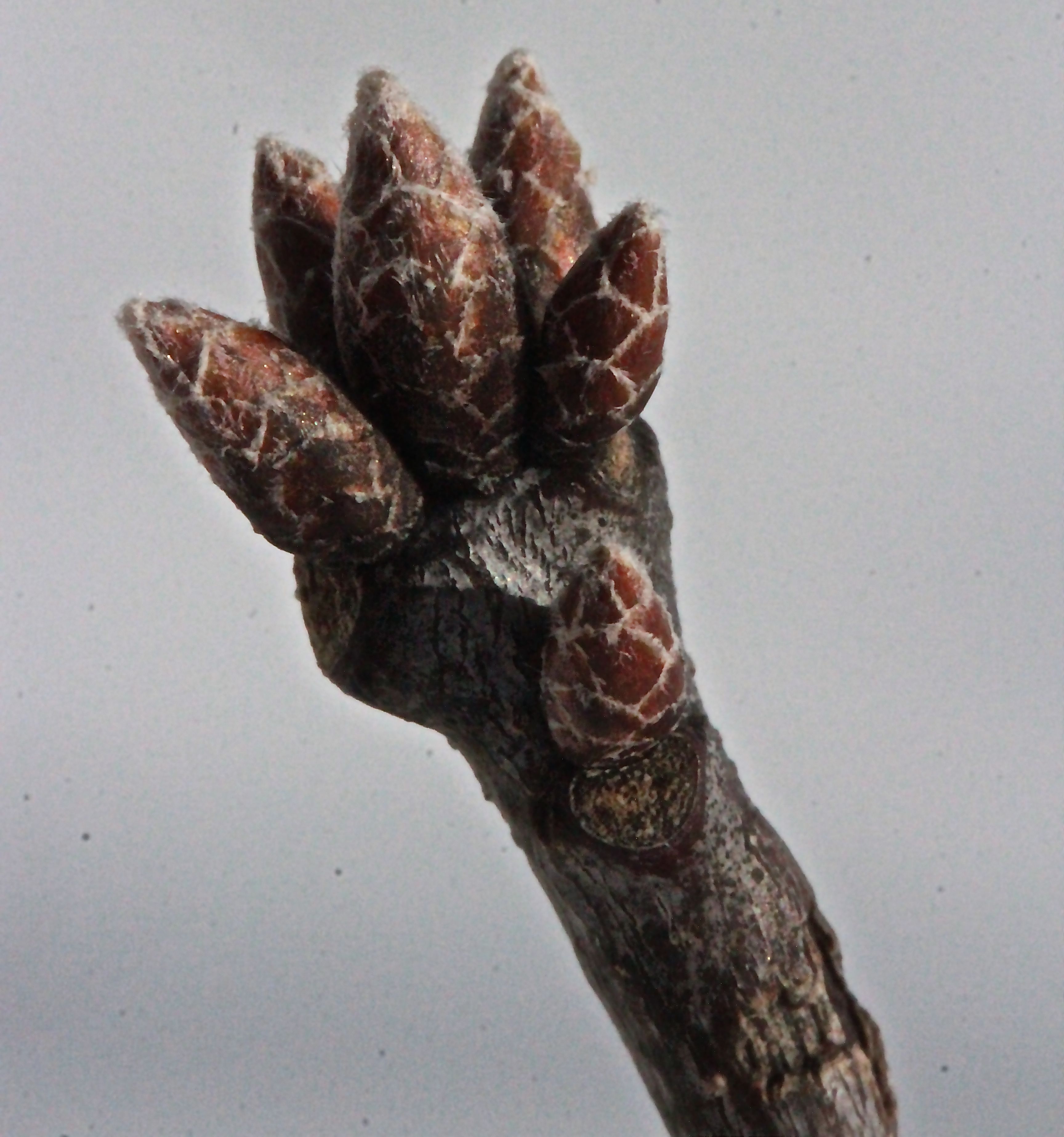
As I enjoyed the sun’s warmth, I focused in on my nearby surroundings. I wasn’t the only one appreciating extra layers today–the crowned formation of Northern red oak buds don their own warm and fuzzy coats.

aster

An aster waits patiently–huddling yet ever ready to go forth and multiply.

ruffed grouse tunnel 3ruffed grouse with scatRuffed Grouse trail

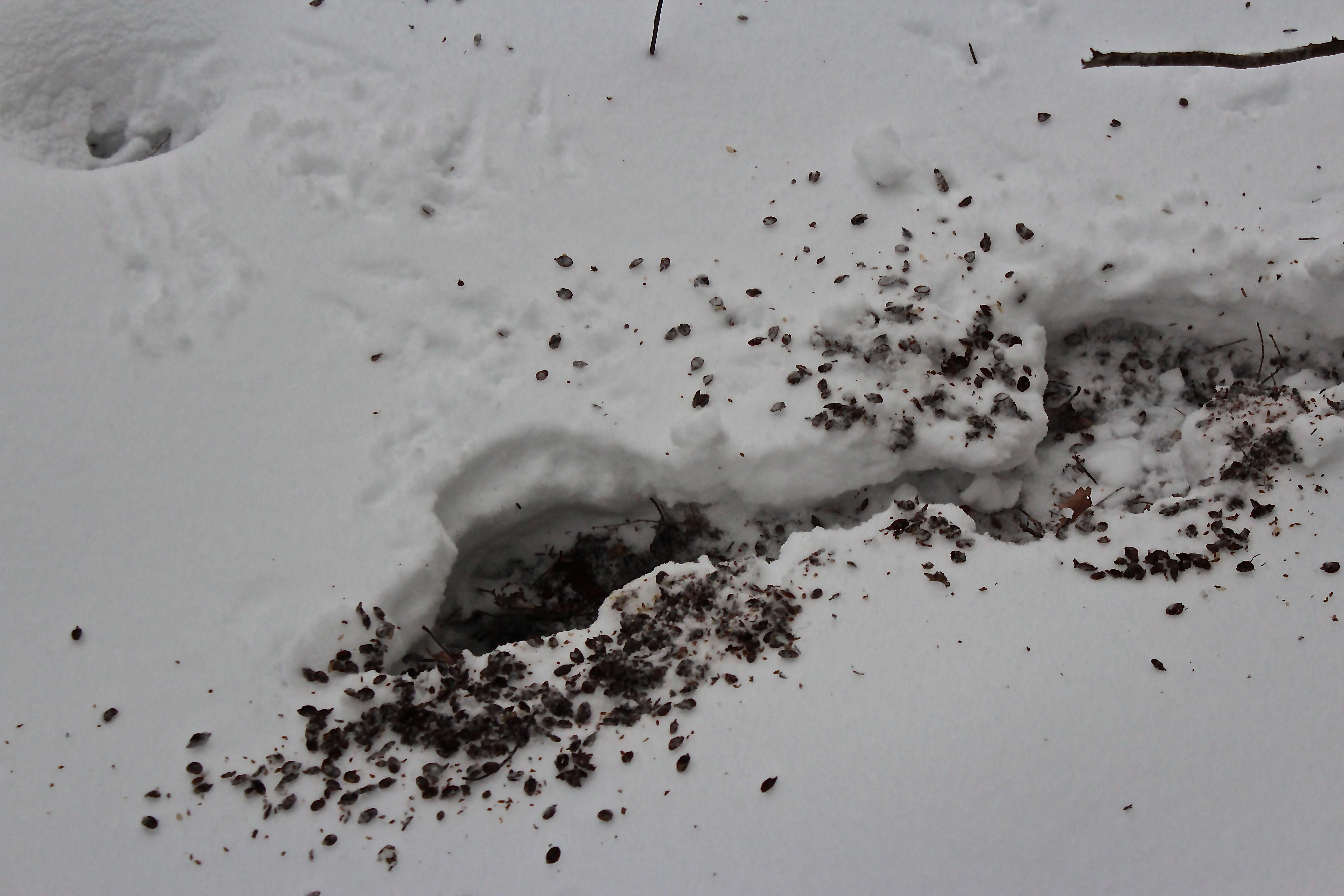
And then I saw this. Another slide? No–actually, it’s a tunnel of sorts created by a ruffed grouse. The middle photo shows the bird’s scat. The bird plowed through the fluffy snow as it fed at the summit.

mouse 2mouse

Everywhere I snowshoed (the zip ties work so far as they hold my snowshoe strap together), there were mouse tracks–the risky business critters of the world.

fisher tracks 1 fisher tracks 3fisher tracks 2

I’d seen fisher tracks crisscrossing my trail as I climbed toward the summit. And then on the way down, not much of anything except mice . . . until these tracks below a hemlock. We had light snow yesterday that has filled in many tracks, but these were quite clear–making them easy to ID.

hare 1

As the trail turned sharply left, I entered the home territory of another mammal. Within these tracks I always see the winter lobster.

snowshoe print 1

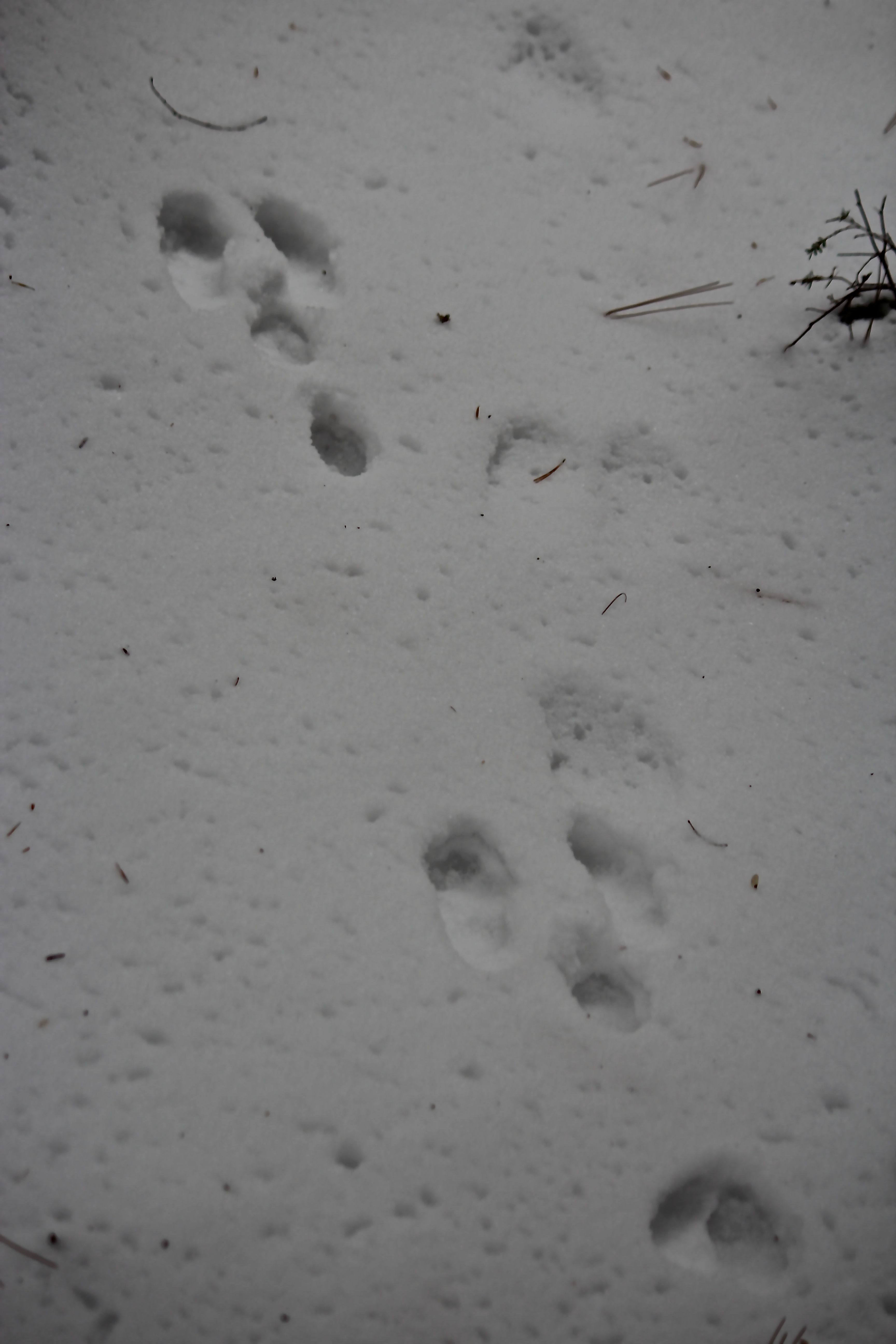
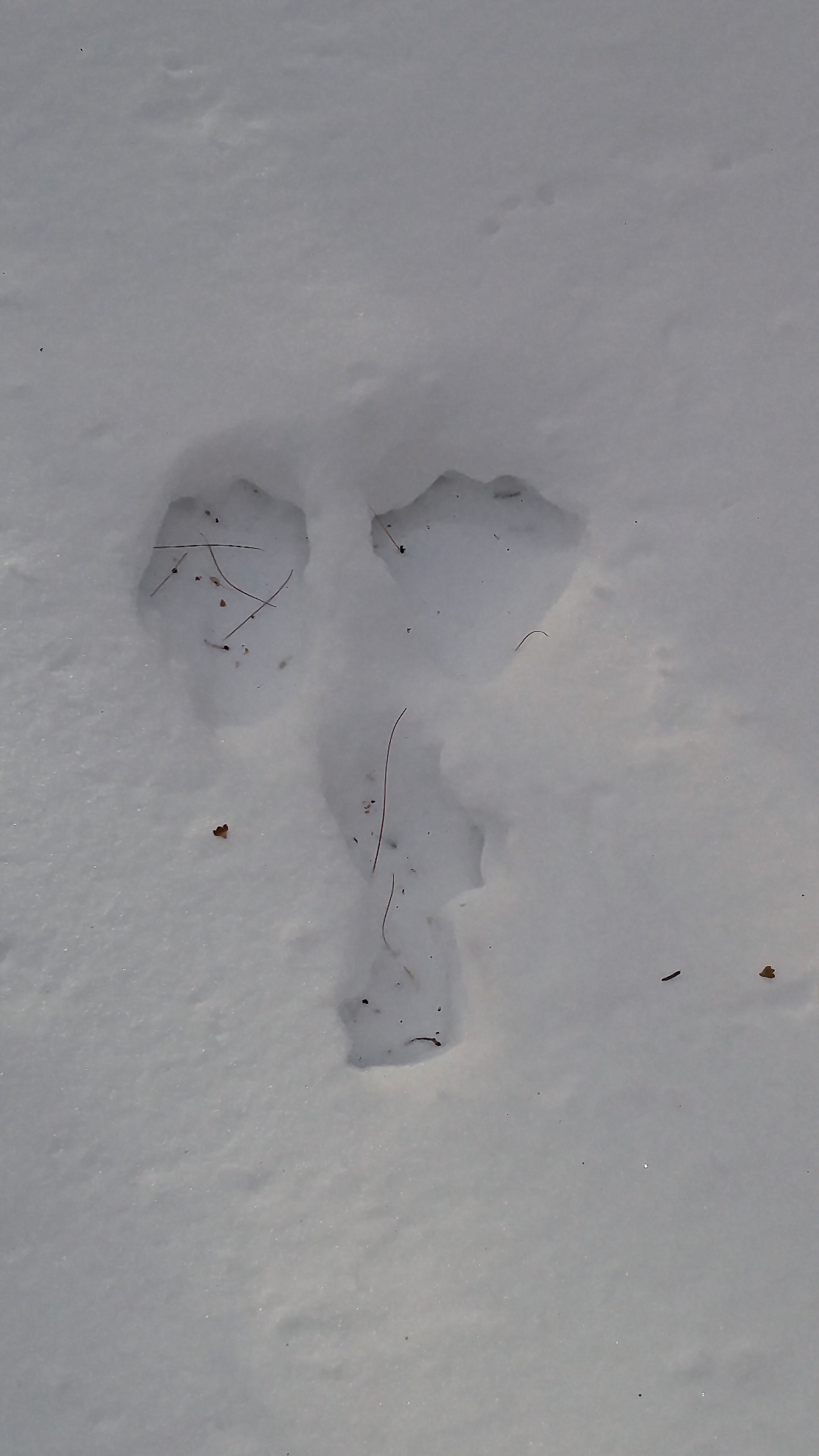
A snowshoe hare–its smaller front feet land first–one before the other and often at an angle. Then the larger hind feet swing around and make a deeper impression as the hare pushes off in a bound toward its next landing spot.

snowshoe hare convention_2

I felt like I was at the scene of a hare convention.

snowshoe hare scat

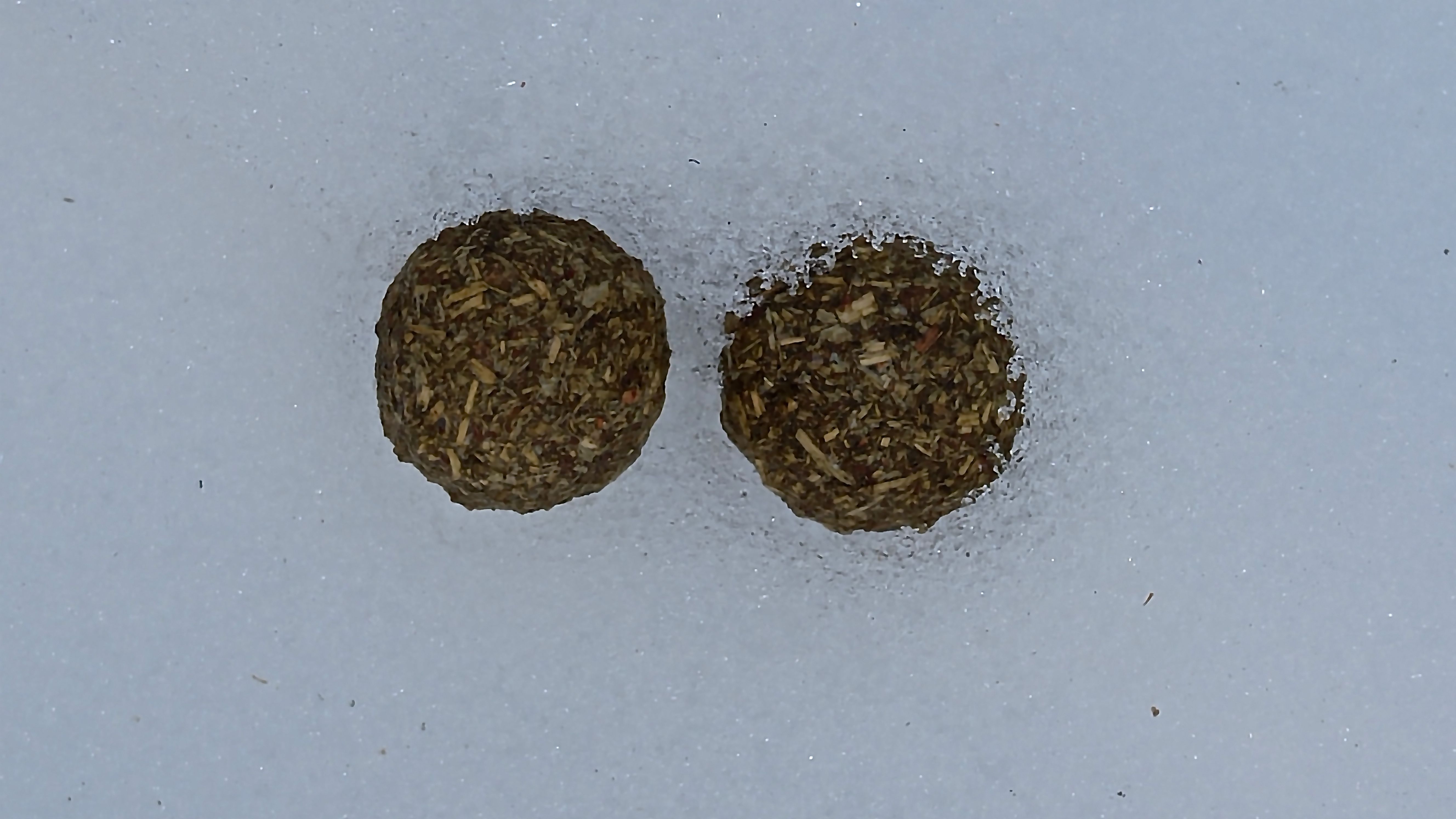
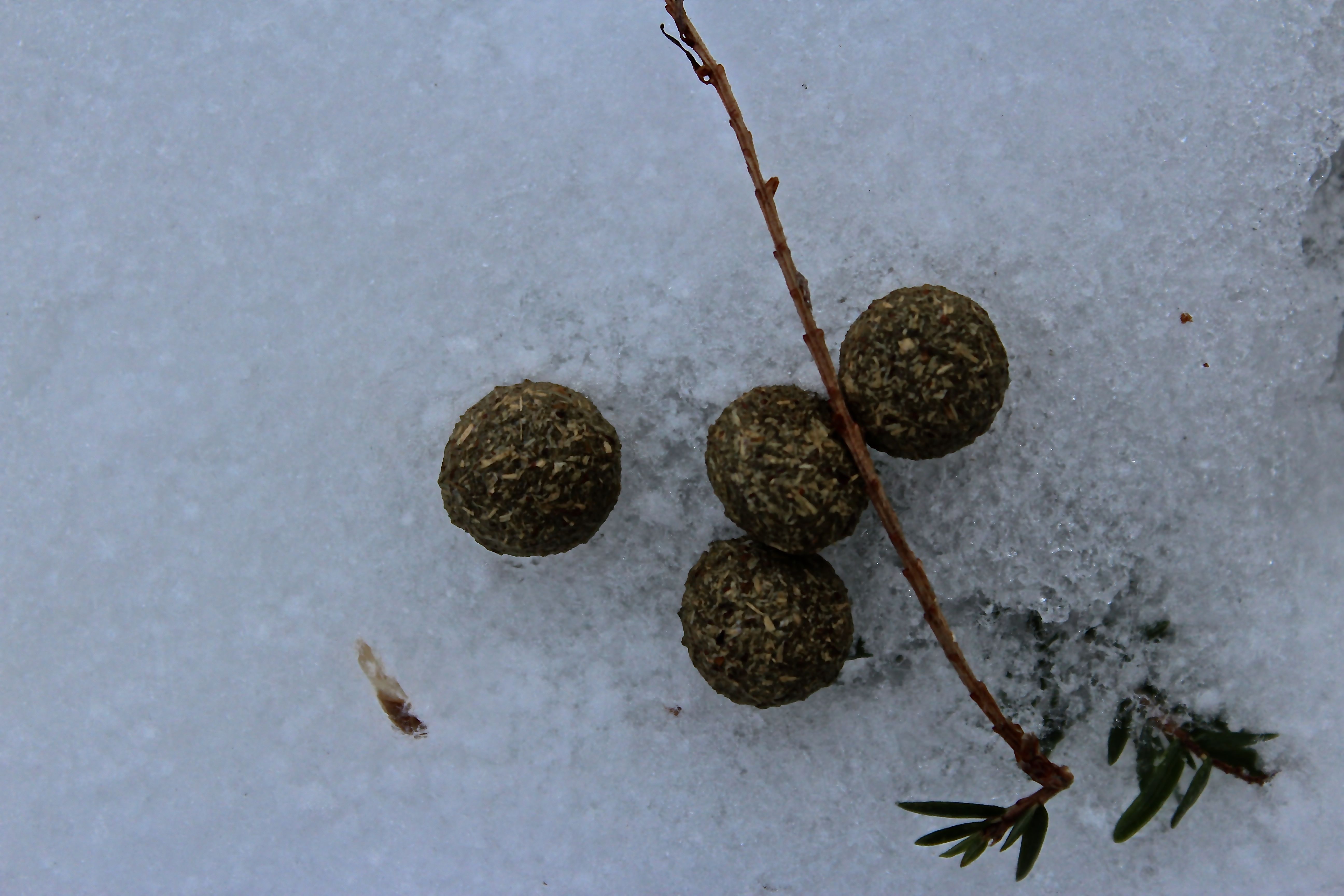
And no convention is complete without some scat. Take a look at the vegetative substance of these milk duds.

This morning we were talking about the fact that we’re seeing many more tracks right now than is normal for January. We think it’s the snow cover–easy enough for them to move around. And it’s been warmer, though you couldn’t prove that today.

milkweed 1 milkweed 2  milkweed seeds

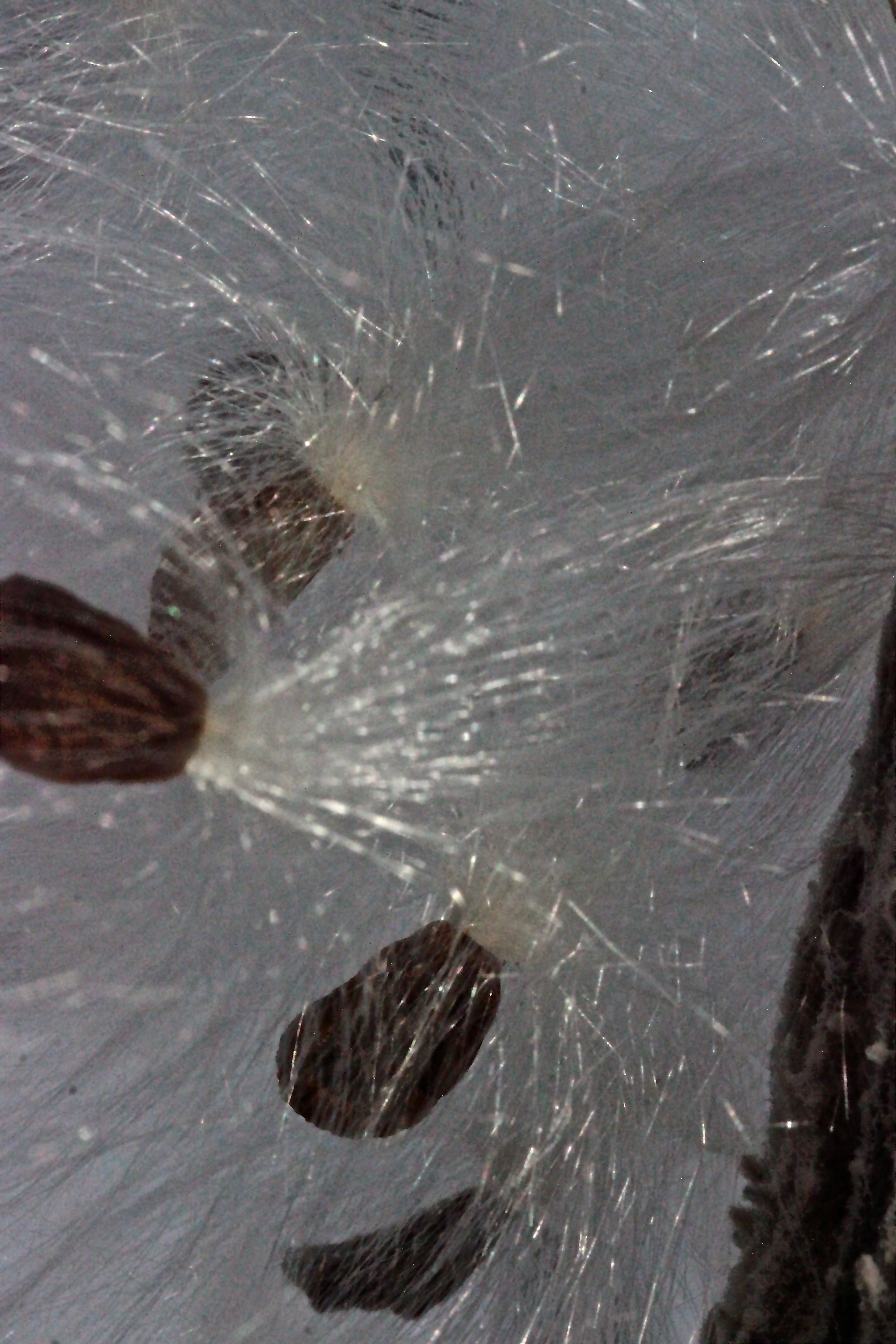
As I headed toward the parking lot, the milkweeds that grow at a former homesite across the road called to me. Their parachutes were in constant motion in the wind, but still they clung on to the pod.

I couldn’t feel my toes, so I didn’t have to worry about them. ;-) But my fingers didn’t appreciate it when I took my mittens off for a photo call. Despite that, I’m so glad I spent the afternoon chillin’ at Heald Pond.

Puddin’ Up With Me Mondate

As the flakes slowly drifted downward this morning, we learned we had to make some alternate plans for the day.

Morning flakes

snow 5

Then again, they weren’t really alternate. They were meant to be and we just didn’t know that at the time. We had planned to head to Freeport because one of my snowshoes needs a new binding. Instead, circumstances led us to North Conway where we had some time on our hands and knew how to spend it. Not shopping, of course.

trail sign

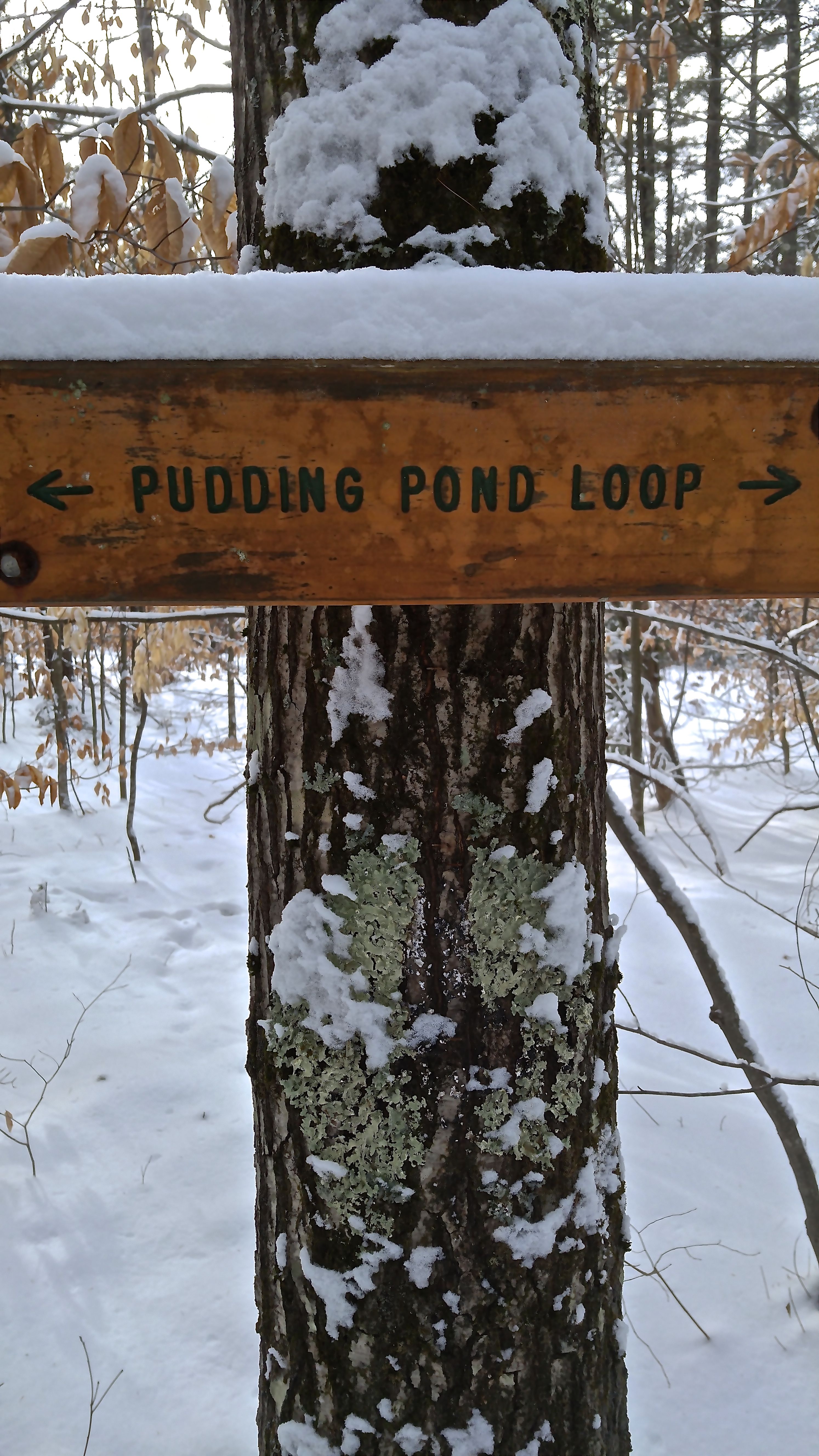
We’ve hiked in the Green Hills Preserve often and have always intended to complete the two mile loop by Pudding Pond, but it somehow never happened . . . until today. We had just the right amount of time to check it out.

And though we used a zip tie to fix my binding (pays to be married to a hardware store–oops, I mean guy), the trail conditions were such that we didn’t need them. Plenty of people had traveled this way over the past few days.

Pudding Pond brook

After passing through a mixed forest of hardwoods and softwoods, we came to Kearsarge Brook that flows out of Pudding Pond.

older beaver work

Beside the brook, the beavers have been active–though not always successful as this aspen is hung up on some other trees.

winterberry

We found a dam, where winterberry provides contrast.

ice, flow

And ice over flow adds drama.

beaver new

A bit further on, we discovered that working like a beaver can pay off.

Pudding Pond

And then we arrived at the pond. I’d previously thought that the trail circled the pond, but that’s not the case. Perhaps before the North South Road was constructed, it did.

leatherleaf 2

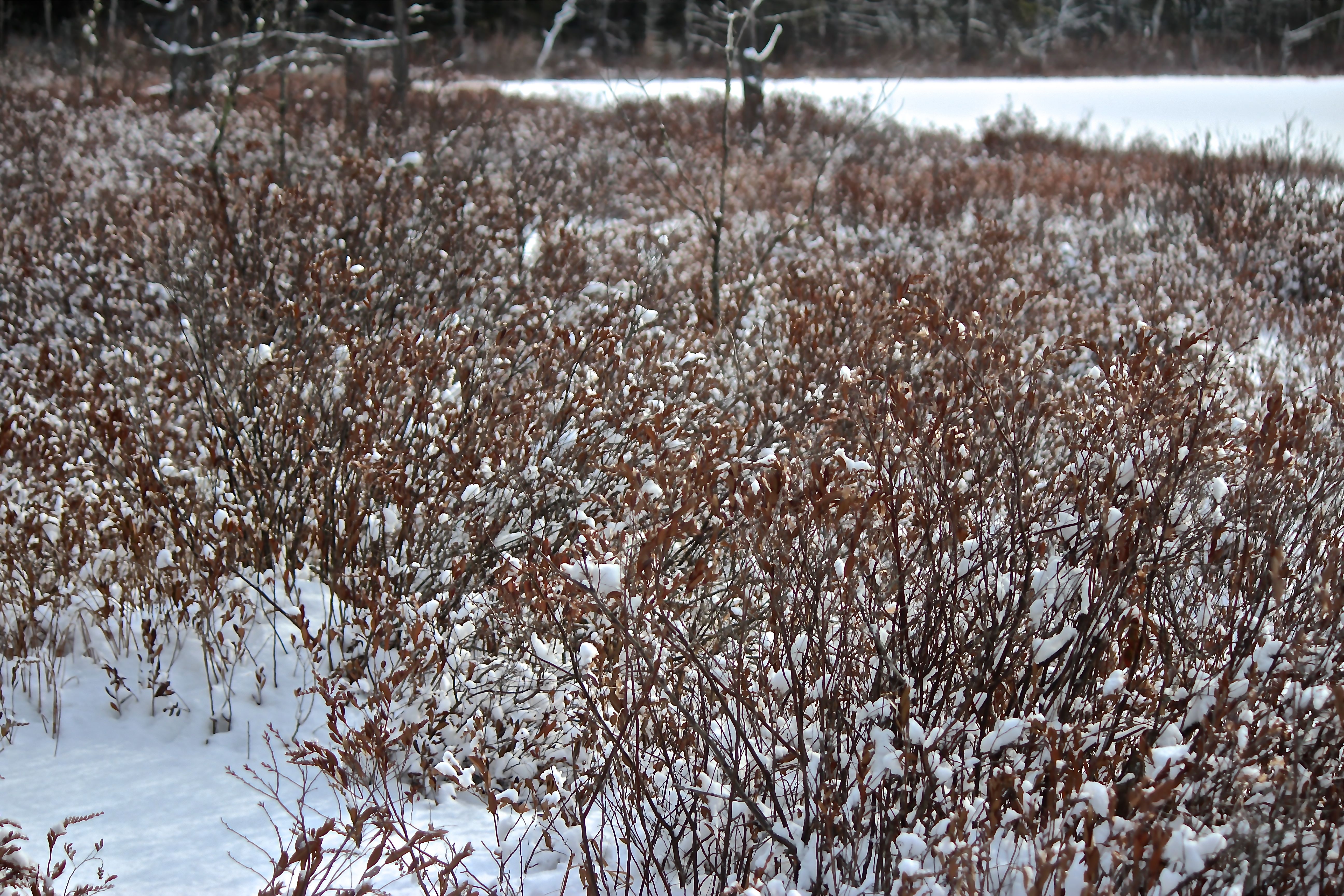
I slowed my guy down because the bronze leaves of leatherleaf captured my attention. Leatherleaf is a member of the heath family, like blueberries, cranberries and laurels. Sheep laurel or lambkill grew nearby.

leatherleaf 1

Also known as Cassandra, the elliptical leaves are either entire or finely-toothed and alternate in arrangement on the stem.

leatherleaf 4

Even though it isn’t green throughout the winter months, it is considered an evergreen shrub because it retains most of its leaves. Think conservation–it doesn’t have to grow so many new leaves come spring.

leatherleaf scalesleatherleaf scales 2

Its common name, leatherleaf, comes from the leathery feel of the leaf. And check out that underside covered in rusty scales. The stem is also covered with scales. Buds along the stem await a spring bloom.

leatherleaf pods 1 leatherleaf pods

The plant reproduces by seeds stored in capsules and vegetatively by rhizomes. Seeing such a field of it made me realize that Pudding Pond is acidic. Though I couldn’t see it below the snow, I’ve a feeling sphagnum moss grows abundantly here.

community layers

One last look as I admired the layers of life in this boreal forest.

Pudding Trail

Finally I followed my guy along the rest of the trail. I did remind him that it’s his fault I stop for such long periods of time. He didn’t have to buy me a new lens. He grinned. He’s used to puddin’ up with me.

Focused Moments

Thanks to our oldest son’s girlfriend, I learned a few more things about focusing my camera this afternoon. Our indoor still-life was a pinesap stalk covered in seedpods that I had discovered near the stonewall on the cowpath the other day. Somehow I’d missed it in its flowering state, so it was a welcome surprise to find it poking through the snow. I only took one–leaving the others to do their work.

pinesap pinesap 2

After trying different settings with the camera (and phone), I was ready to play outside. The beauty of today’s snowstorm became my focal point. And in the spirit of celebrating that beauty, I decided that I’m not going to name or describe the photos. I’ll let them speak for themselves.

our woods

stonewall

snow in the woods

sedge seeds

aster 1

steeplebush

royal 1

royal 4

cinnamon 2 cinnamon fern 1

fern

interrupted 1

pine 2

making tracks

moose scrapes

skybluepink 1

deer

bulrush1

goldenrod 2

steeple 2

Thanks for stopping by to share in some of the moments I focused on today. Happy snowstorm.

My Need To Get A Life

About two weeks ago a friend and I exchanged e-mails about mammal tracks we’d spotted that day. His big find was plenty of bobcat tracks at Bald Pate Preserve, while mine was mink tracks by Sucker Brook in Lovell. And that’s when he commented, “We need to get a life.” ;-)

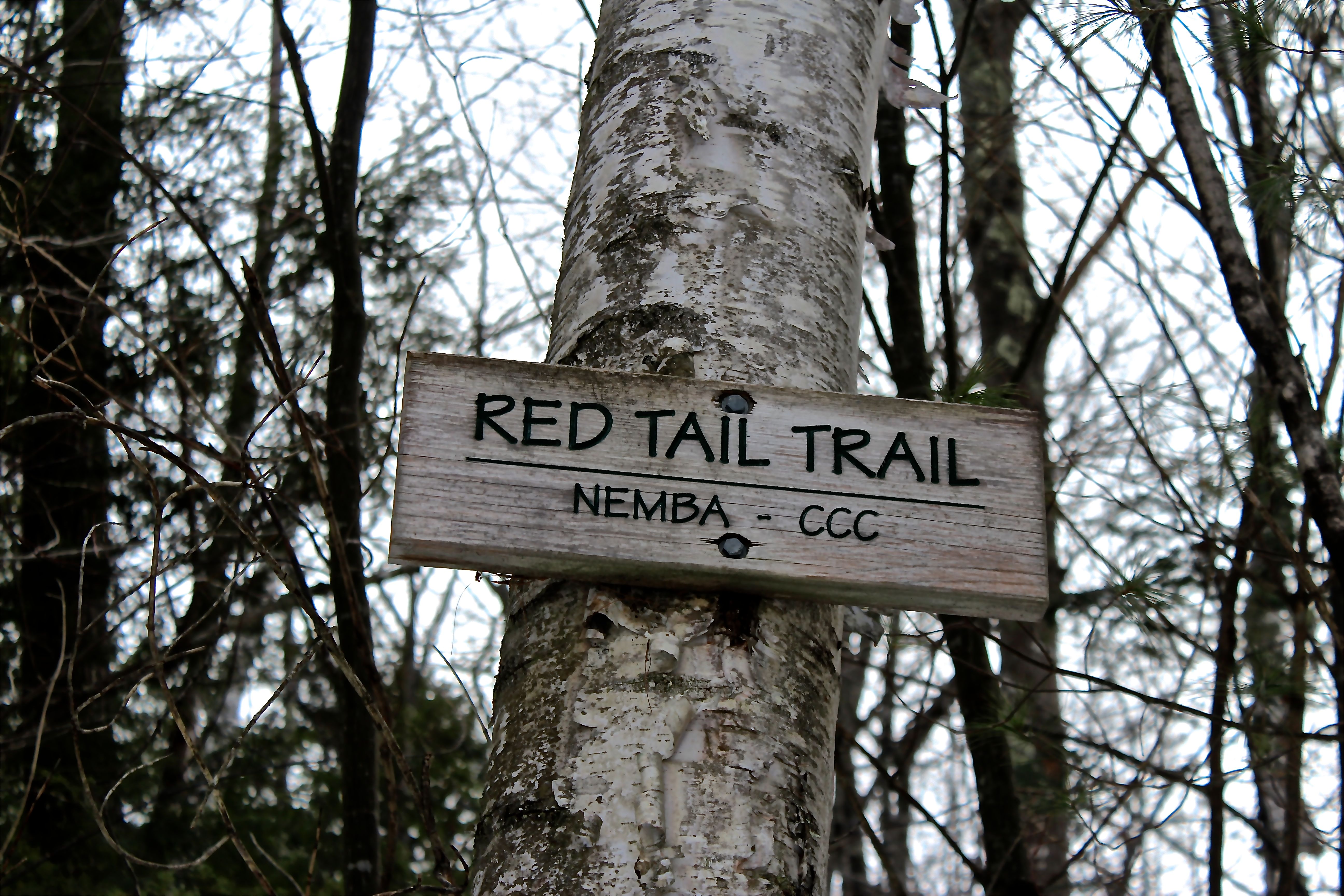
Yup. So today I did just that. With a friend in tow, I revisited the Red Tail Trail off Hurricane Mountain Road in North Conway. Our mission was to move slowly through the landscape in search of signs of nature in winter.

Oh my. Such a boring task. What could there possibly be to see? Everything is brown and gray and ever so drab.

mouse

From the start, mouse tracks show the suicide mission these little guys make each night as they scramble this way and that in search of food . . . and cover. Mice are nocturnal bounders who travel above ground for long  distances–risky behavior since they are tasty treats for most predators. White-footed and deer mice have similar-sized feet and bodies, so their prints are difficult to distinguish from each other. Their print pattern reminds me of that made by squirrels, only in miniature and their long tails often leave drag marks in the center.

vole 4vole 3

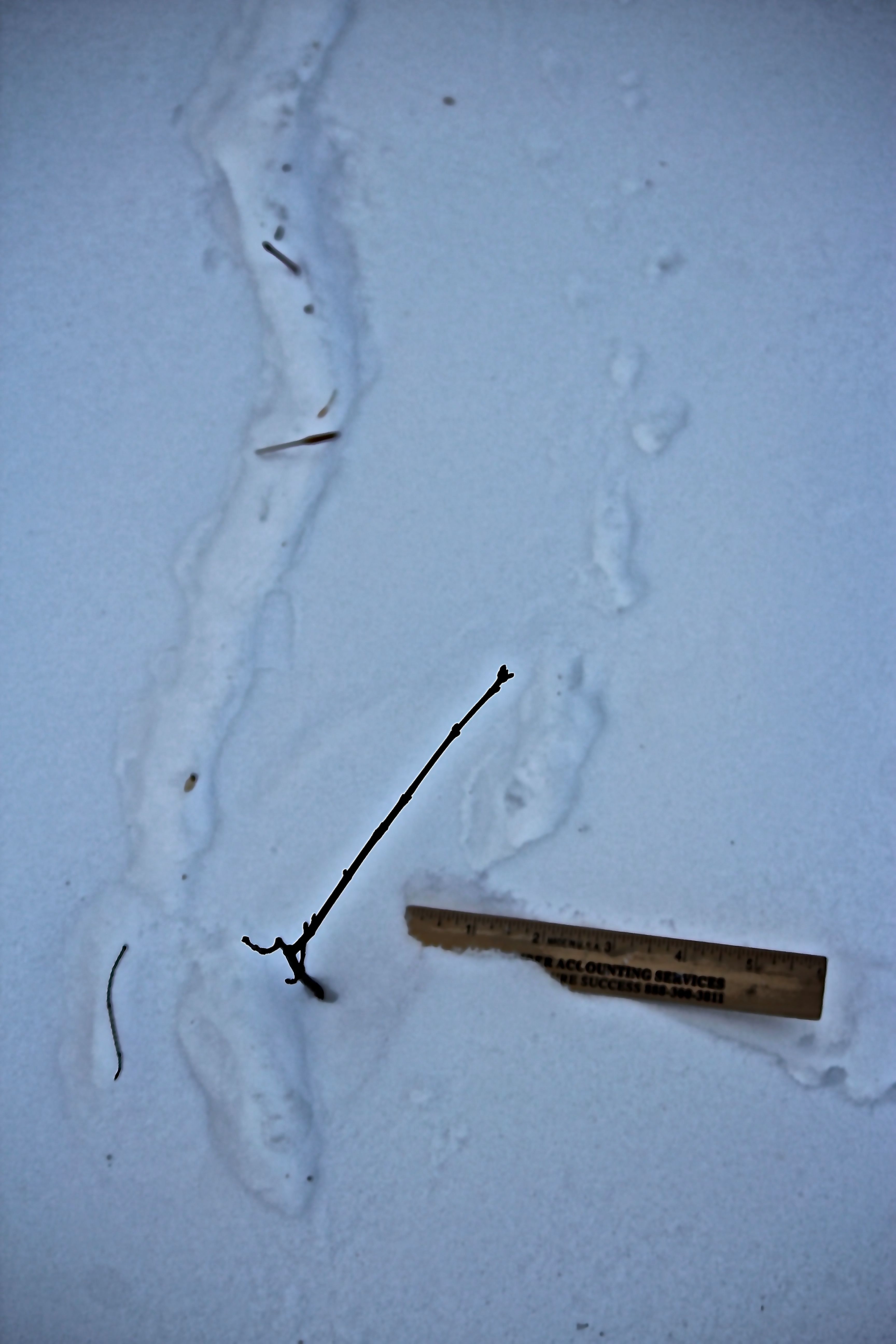
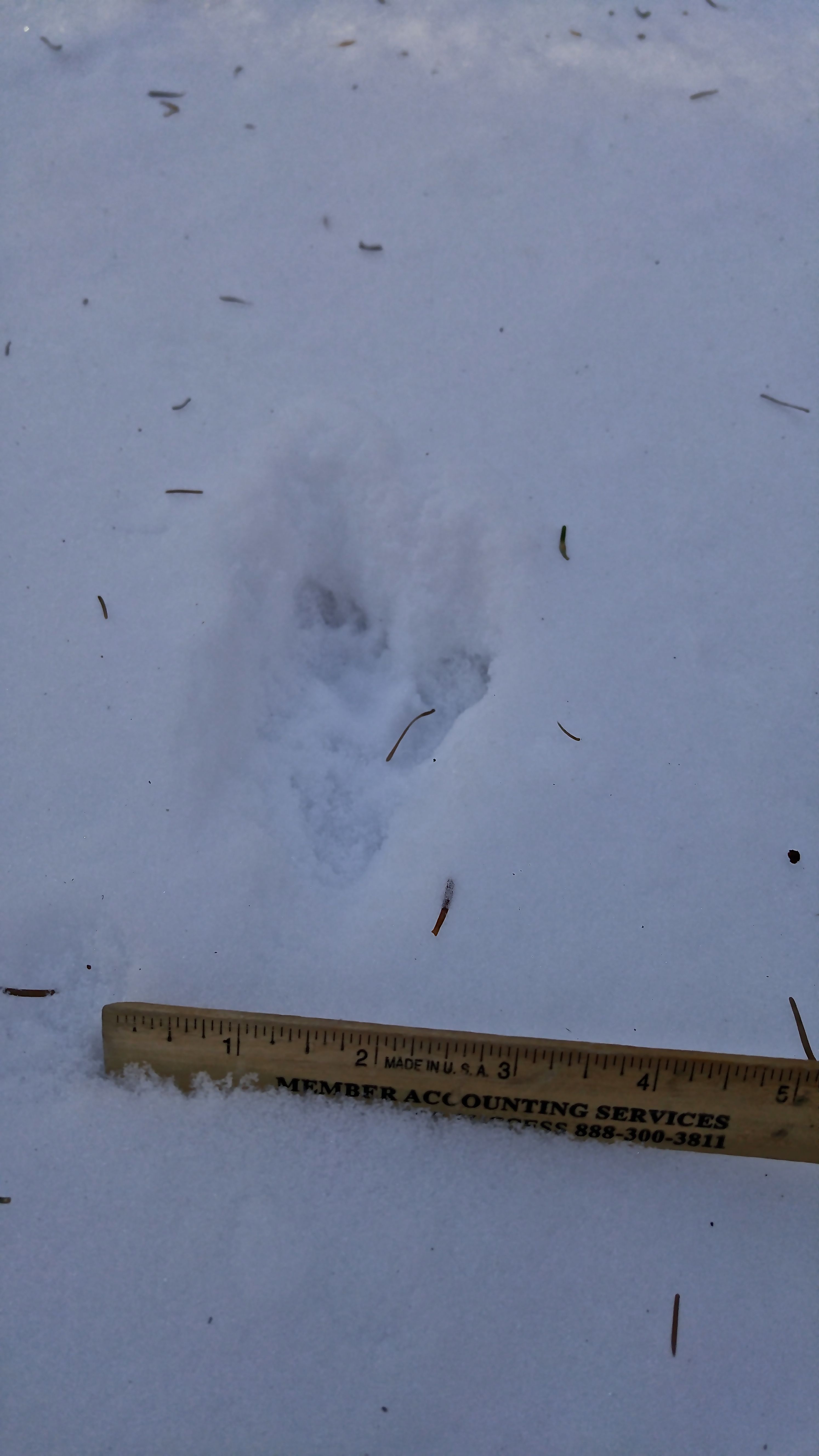
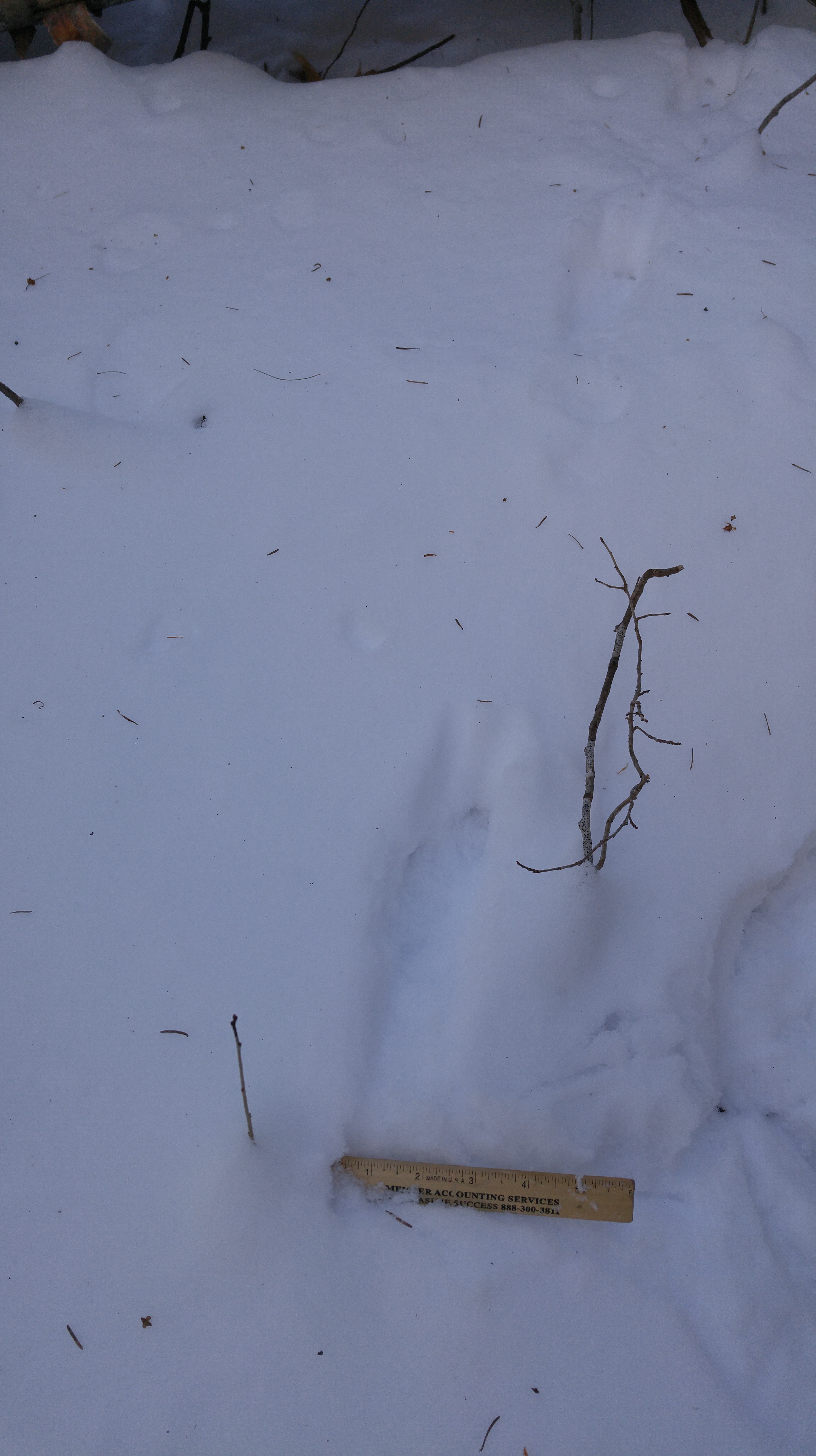
Here’s another favorite meal for many predators–evidence that a vole lives nearby. We were in an old logging area when we found this. While a vole is similar in size to the white-footed and deer mice, its tail doesn’t show in the track. Plus, two other things stood out to us. The tunnel in the first photo is typical vole behavior. While we received 6 inches of snow in western Maine on Tuesday, North Conway only has about two inches on top of ice. Voles are shy of sky space, so tunneling is one of their behaviors. With ice below the snow, this tunnel was exposed and reminded us of spring when vole tunnels become visible in melting snow. The other behavior of this little brown thing (LBT) that is different from its cousins, the other LBTs like mice and shrews, is the zig zag or alternating pattern when it walks. Voles vary their walking pattern, but they don’t bound like the others. The pattern is visible for a few steps above the ruler.

mink 1Mink 2

And who might those predators be? We found the diagonal pattern typical to the weasel family. We thought that this one was a mink, but now that I’m in my cozy den, I’m questioning our ID. It may have been a short or long-tailed weasel. (1/15/16: Changed my mind back to mink. My ruler kept sliding, but the measurements we took, and we took several, clearly indicated mink, so that’s my story and I’m sticking with it.)

weasel 2

Further up the trail, we were more certain that this one was a weasel, though, again, short or long-tailed is the question. Suffice it to say–weasel.

Fisher 1  Fisher pattern

And still another family member–only a bit larger in size. Notice the tear-drop shaped toes. And the loping pattern. A fisher had recently crossed the trail. We followed its tracks for a bit and then bushwhacked back. On our return we came across a second set of fisher tracks. And then, as we backtracked beside our own snowshoe prints, we realized they’d traveled together and then split apart–perhaps hoping to find some good chow.

Kearsarge River

As we moved beside and away from the river, we also saw deer, snowshoe hare, coyote and fox tracks.

Winding our way up through the switchbacks, one other critter left a calling card.

wing

Based on the behavior, I want to say it’s a ruffed grouse. I must admit that we didn’t follow the tracks, but grouse are also tunnelers and there’s a bit of a tunnel here. Usually I find their scat.  By now, you are probably thinking that I really do need to get a life.

ground litter

hemlock seed and scale

yellow birch

We laughed about how we used to not even notice everything on the ground–dismissing it as  tree litter. Ah, litter it is. But more specifically, we were in the land of hemlocks and birch trees. Hemlock cones, cone scales and winged seeds (samaras) are part of the array. And the yellow birch catkins have released their fleurs-de-lis scales and seeds as well.

beech scale 3

One of the things we weren’t thrilled to discover–the white, wooly and waxy coating that the beech scale insects secrete to cover themselves. Oy vey. This beech tree doesn’t stand a chance.

polypody frozen

So back to happier thoughts, including the polypody that let us know it was time to head home and curl up by a warm fire–the temp was in the low teens.

ice skirt

Even the river rocks wore several layers.

artist 3

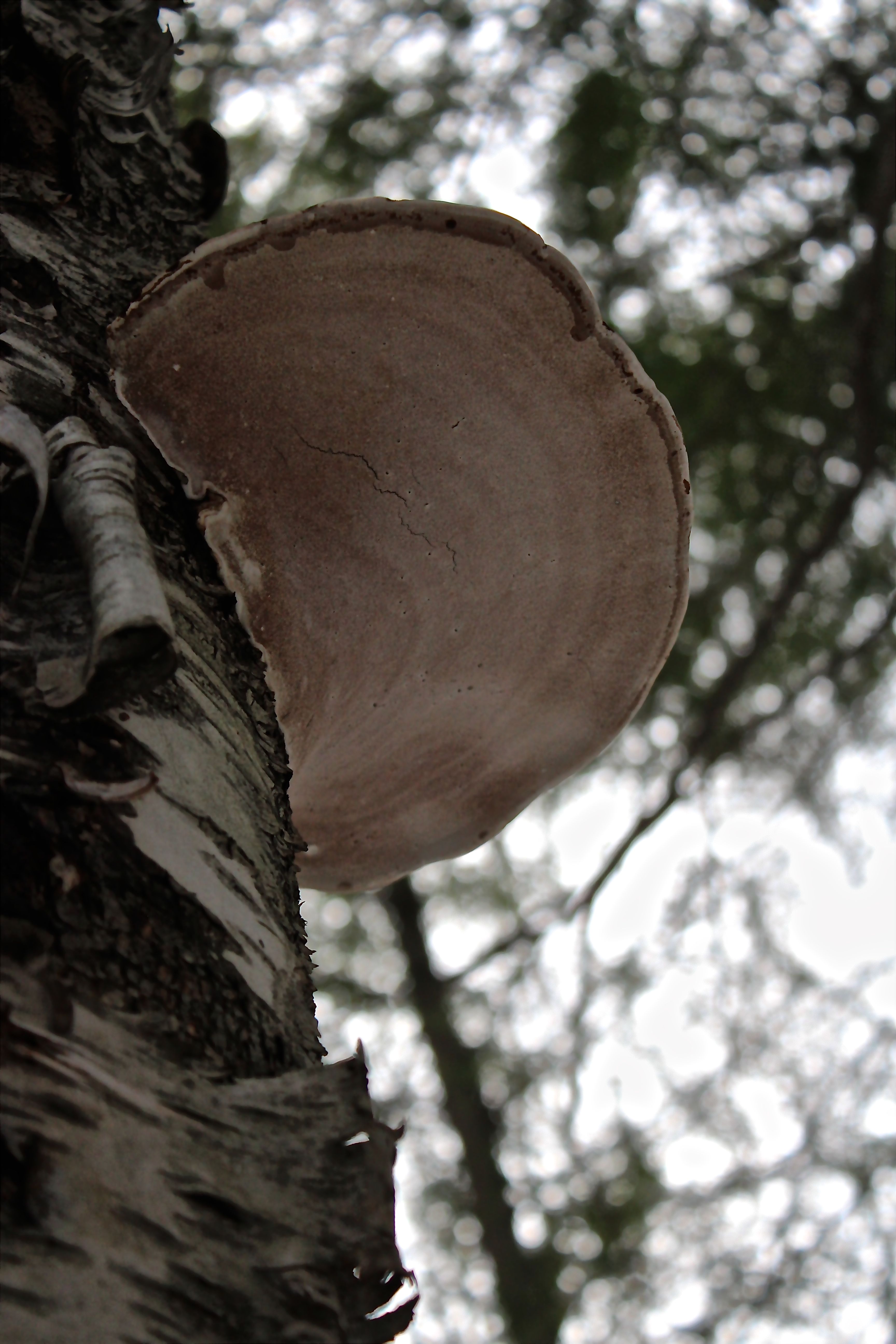
artist conk

Just before we arrived at my truck, we stopped to admire this mighty fine artist conk. It will still be there on Saturday–join me and the wonderful folks from the Upper Saco Valley Land Trust for a walk on the trail–weather permitting. I’m not so sure it will actually happen this week given the forecast.

No matter. These were only a few of our finds. There’s so much to see and wonder about and every time I visit, I’m in awe of this special place. And thankful for the life I’ve got.

Snow Be It

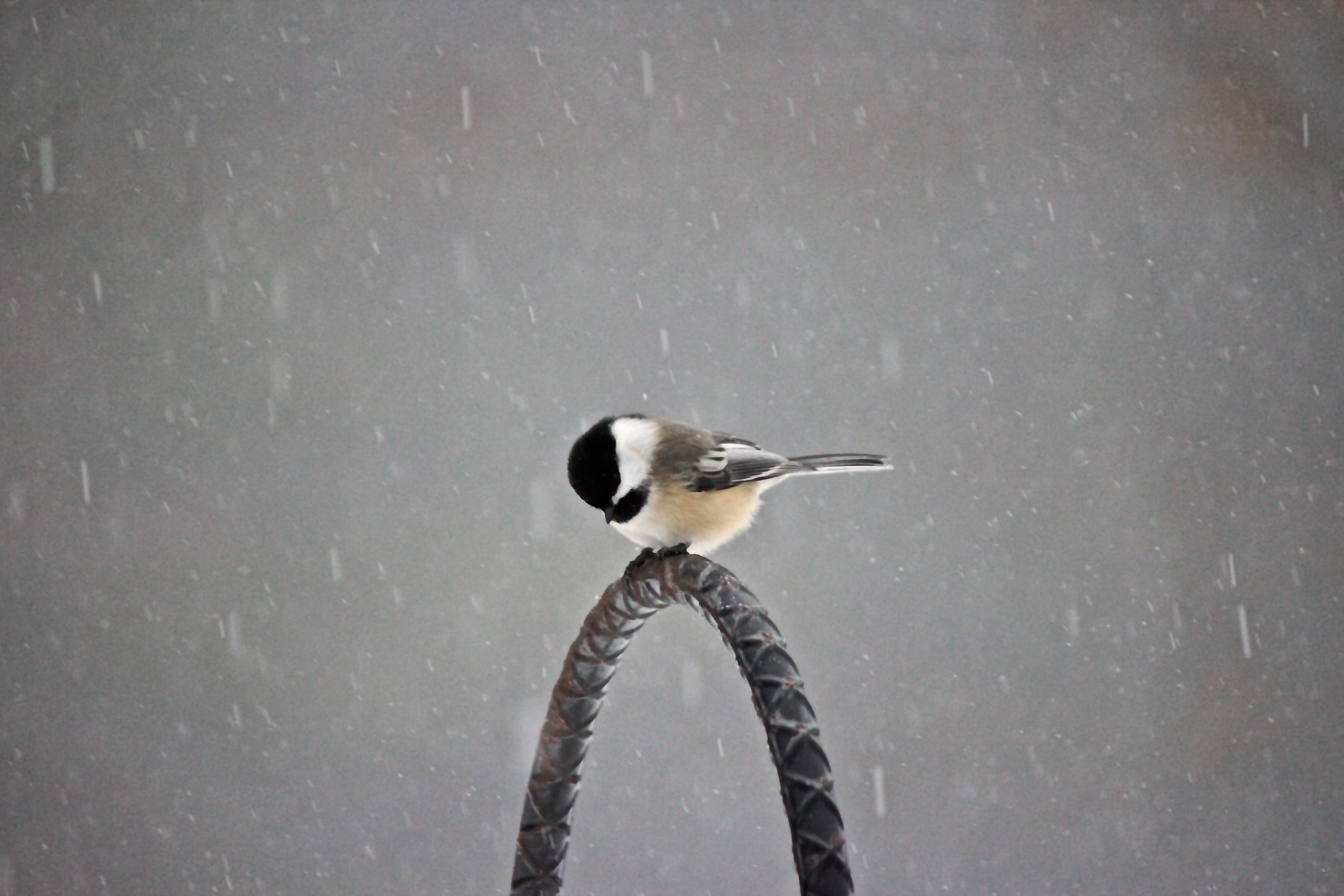
The action at the bird feeders was crazy busy this morning–as if a snow storm might be on the horizon.

goldfinch 2

goldfinches, mid air squawk

Some goldfinches managed to dine together in peace, while others displayed a midair squawk over perch choice.

male hairy woodpecker

The hairy woodpecker often had the suet to himself, until, that is, the nuthatches, titmice and chickadees flew in.

female cardinal

And somehow the female cardinal managed to pose upon a perch across from a chickadee. She never looks quite comfortable up high.

male cardinal

cardinal and squirrel

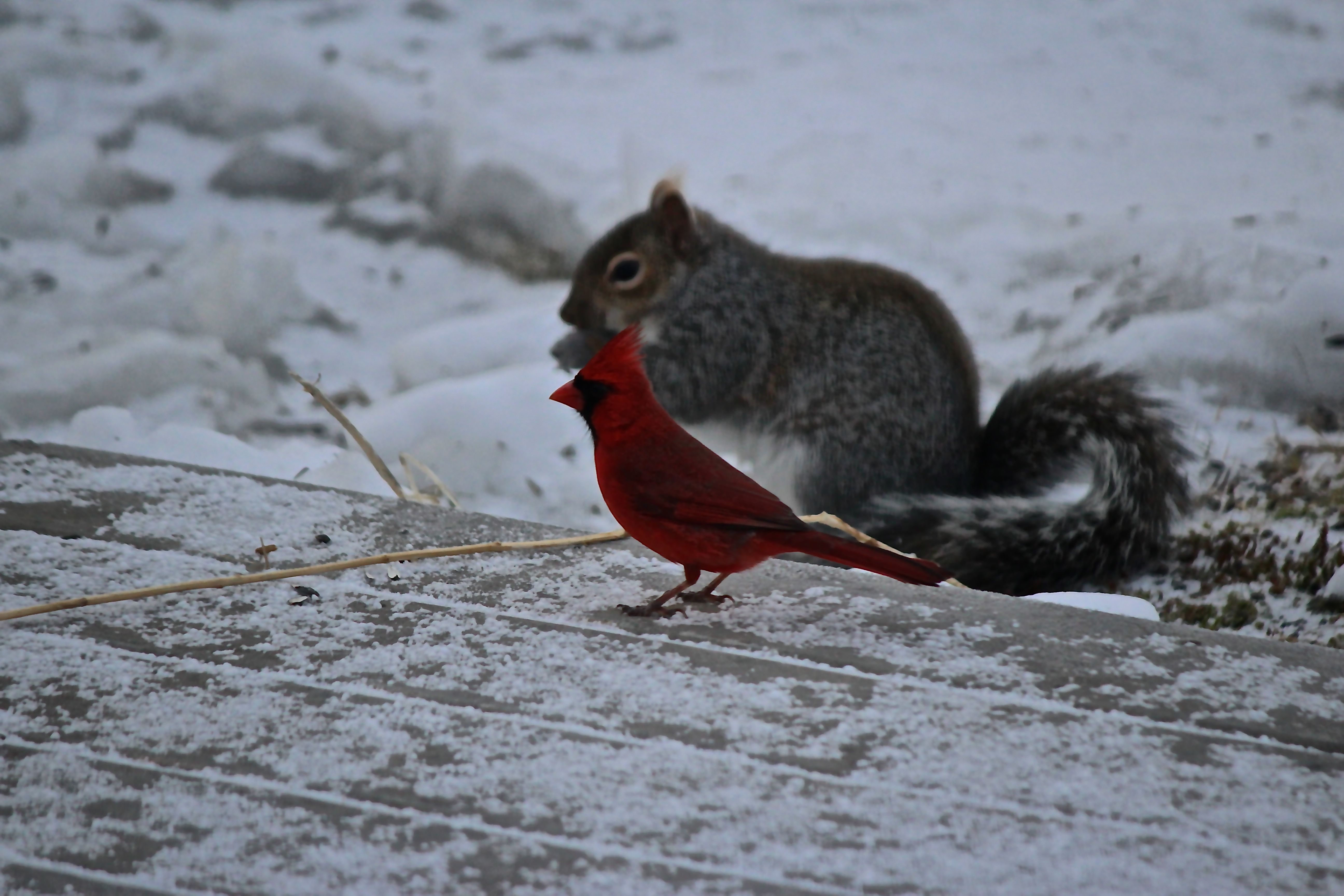
Her guy always checks out the local scene before foraging for seeds on the ground. He’s not the only forager in the neighborhood.

ice rink 2

And beyond the feeders, the ice rink is open. Of course, if you want to use it  you need to bring your own shovel. My days of being the human zamboni ended a few years ago.

raccoon prints

I’d intended to join friends in Falmouth for a tramp today, but with the impending storm, I decided to stick closer to home. And so this afternoon found me exploring familiar grounds, wondering what I might see. What could possibly be different?

Ah, the intrepid raccoon had passed this way. I love the pattern it leaves behind, with each set of prints on the opposite diagonal.

vernal pool 1

And then there’s the vernal pool. Nothing new about that, but at the same time, it’s ever changing.

Queen Anne's Lace 1

The fact that dainty Queen Anne’s Lace is filled with spiky seeds seems almost an oxymoron. A beautiful one.

The snow was just starting to fall when I happened upon the QAL. And so I continued on, crossing the road and disappearing into a familiar place–Pondicherry Park.

ice form 2ice form 3ice formation 1ice rays

With every step, I needed to be mindful of where I placed my foot to avoid slipping. Though I’m weary of ice, I never tire of the formations it manifests.

ash 1 Ash 2ash seeds 3

I’m going out on a limb here, but believe based on the structure of the single winged samara that these are green ash seeds that litter the ground. As the wing surrounding the seed tapers toward the tip, it is straight versus the slight curve seen in a white ash. In addition, the white ash samara is wider than a green ash.

ash leaves 1

And then there is the ash leaf mystery. Leaves still on trees? Ash leaflets are not marcescent so why have these leaves withered and stayed attached to the twigs? Ah, but when some trail management was conducted this past summer, the cut branches that crowded the path were tossed aside. The leaves died then and there, thus not being “cut” off by the tree and falling in a normal manner.

 witch hazel color contrast

contrast beech leaves

Of course, the marcescent leaves of witch hazel and American beech against the blue of Willet Brook provided a display worthy of attention as the snow began to collect.

witch's butter on red pine

Witch hazel isn’t the only witch in the park. Witch’s butter decorates a red pine trunk.

jelly ear fungi

Likewise, witch’s butter isn’t the only fungi. Jelly ears decorate a fallen oak branch.

snag sap

There’s always plenty to wonder about. In this case, a very, very dead snag–leaking sap. How can that be so?

Willet Brook

The ice lining the banks of Willet Brook crinkled and crackled with the flow of the water, adding an eerie sound to the landscape.

mallards

Meanwhile, in Stevens Brook, several pairs of mallards quacked constantly, announcing their presence.

Stevens Brook

The snow increased as I crossed the Bob Dunning Memorial Bridge and

dam

walked past the Stevens Brook dam.

still Christmas 1

At home, it’s still Christmas. Snow be it.

Going With The Flow Mondate

Our first Mondate of 2016 had us swerving this way and that and never quite reaching the summit. Such is the way of life–and our best choice is to go with the flow.

We drove to Hurricane Mountain Road in North Conway to begin our trek up the obscure Red Tail Trail. Well, it’s not really obscure. Mountain bikers know it well. And at least a half mile of the trail is part of the Cranmore Conservation Easement held by the Upper Saco Valley Land Trust. I’m going to lead a hike for them in a couple of weeks, so I dragged my guy along for a reconnaissance mission.

And we got lost. Fake lost once again. This time, the wrong trail–the Kettle Ridge trail, which isn’t signed. That was my first clue. The second was that we were immediately climbing and I couldn’t hear water. I’ve only explored part of the Red Tail Trail once before with Jesse from Upper Saco Valley LT so I knew it followed the brook beside Hurricane Mtn Road from the start. After about fifteen minutes of climbing and not feeling like it was right, we retraced our steps and I found the trail sign I’d been looking for–hidden behind some trees. Lesson to those who follow me–you never know if I’m leading you astray ;-)

trail sign

land trust sign

Two signs actually within a matter of minutes and we were golden. brook 1

For about a half mile the trail follows a nameless brook. It must have a name, but I can’t find it anywhere so I’m calling it Red Tail Brook. I was looking for interesting things to share with people and as usual, nature didn’t let me down.

brook 2

brook 5 ice

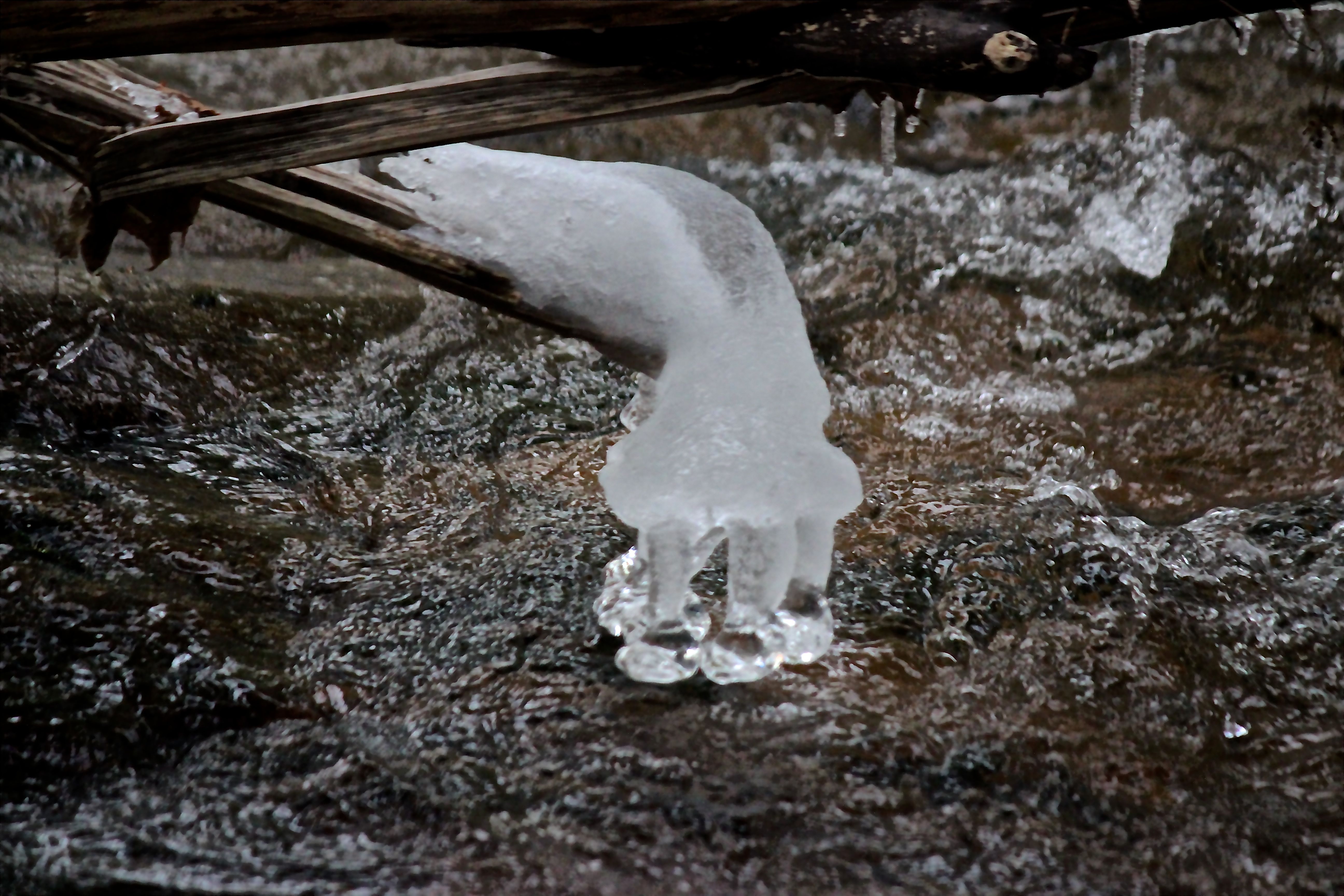
4 legged ice

Water created icy legs as it cascaded over the rocks.

boulder 1

Speaking of rocks, I can’t begin to imagine the moment that this boulder landed beside the brook. It must have created quite a roar and thud. If a boulder rolls in the woods and no one is around to hear it . . .

 boulder 3

My guy begrudgingly posed beside it.

boulder 2

And Red Tail Brook flowed behind.

polypody 1

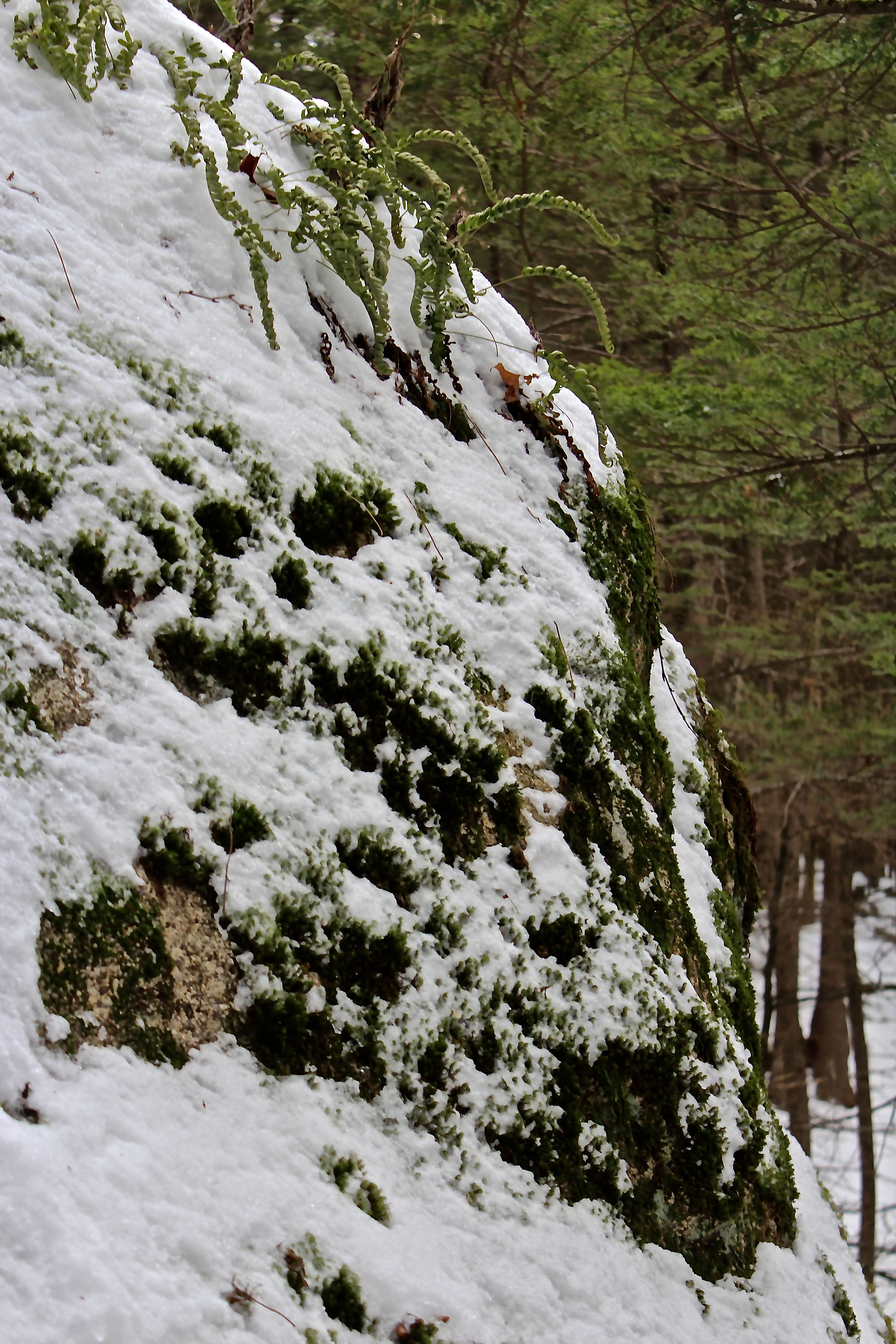
Atop the boulder, polypody ferns let us know that the temperature was in the teens. Fortunately, we were out of the wind as we were on the backside of Mount Cranmore.

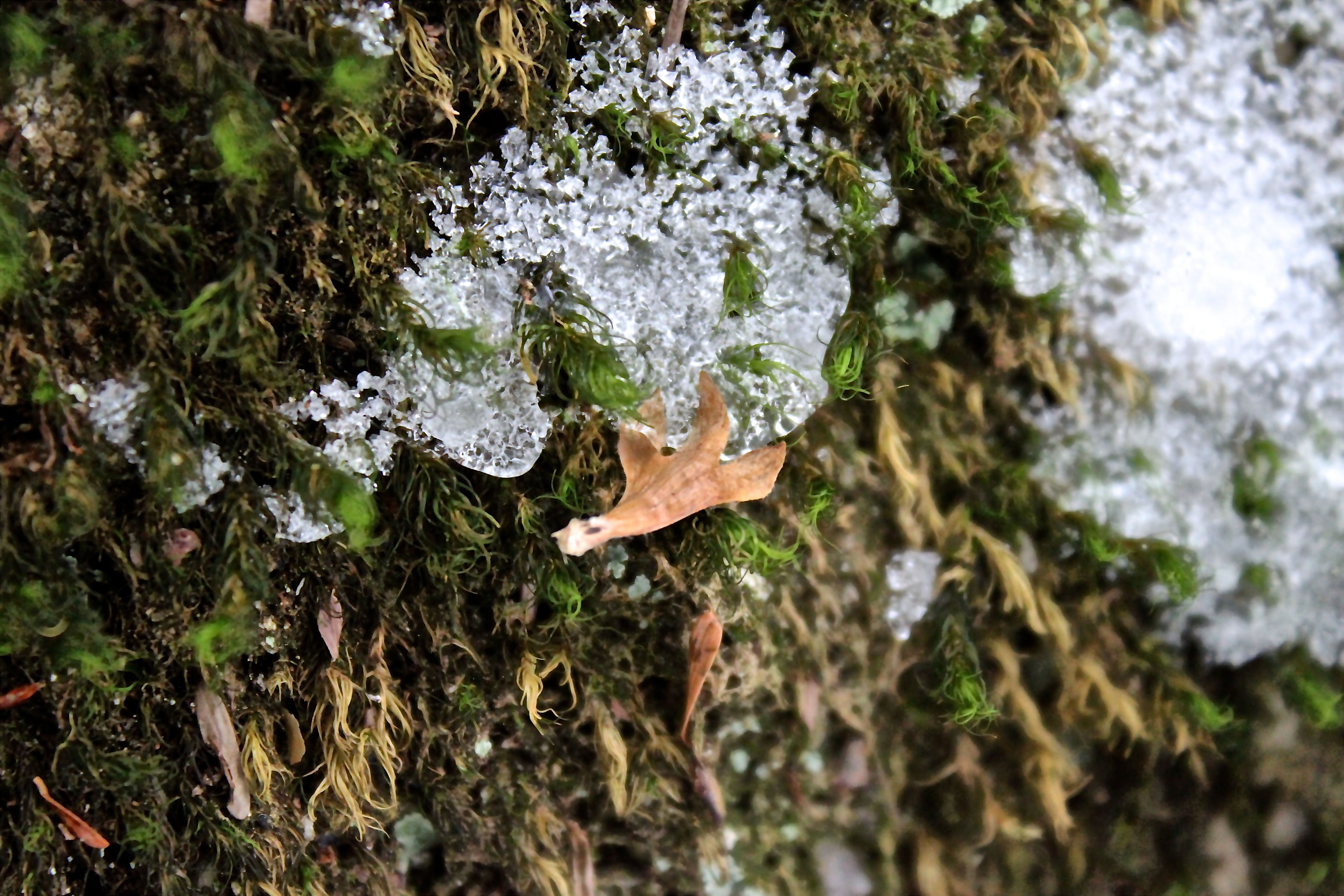
boulder life

Life on a rock! Life rocks. And this rock is full of life.

boulder birch seed

One itty bitty piece of life clung precariously with hopes of taking hold on a permanent basis. I’m not sure this boulder is the right choice, but a yellow birch scale clings tentatively.

Yellow birches need moist conditions to germinate and grow. Moss-covered conifer logs and stumps, along with rocks offer the best chance for survival.

hemlock cone hemlock scale and seed

We were in Eastern hemlock territory so hemlock cones, seeds and scales were also abundant.

red squirrel midden 1

As were red squirrel middens.

 turkey prints

turkey print

It may be a single track bicycle trail, but it’s not a single turkey trail. Their oversize prints covered the lower part of the range.

deer prints 2 deer prints

From top to bottom, deer prints crisscrossed the trail.

sshare tracks

We also saw plenty of snowshoe hare tracks. Though my guy claims he saw an actual hare, I can at least say that I knew by the signs left behind that they’d been active.

sshare cut snowshoe hare scat

Prints below a 45% cut on a shrub and plenty of milk duds–aka snowshoe hare scat–were evident everywhere we turned.

btaspen bark bigtooth aspen leaf

My bark addiction is not to be denied. A wee bit of light brown between furrows makes me think I’m looking at Northern red oak, until I recognize the flattened ridges and gnarly furrows and realize I’m starring at a big tooth aspen tree. Of course, its leaves with those well-cut teeth and flattened stems serve as a banner.

 false tinder conk, Phellinus ignarius

artist's conk 2

False tinder conks and artist conks decorate the trees.

s-turns

After lunch (PB&J, some yummy chocolate raspberry bars my sister made and hot cocoa), we left the brook behind and began to ascend the mountain via a number of switchbacks. My guy, of course, was always ahead as he appears here–disappearing into the trees.

paper birch, white birch and cherry

The community kept changing–sometimes we were in a recently logged area where paper birch, gray birch and cherry trees dominated the landscape.

red pine and white pine

Other times it was a mix of evergreens, including white and red pine, hemlocks, firs and spruce trees.
Mount Washington ValleyMount Wash & Kearsarge

And then the S-turns got serious–one curve after another. The higher we climbed, the more we realized that there were a lot of false summits before us, but a glorious view behind us.

Mounts Wash & Kearsarge 2

Mount Washington and Kearsarge North provided a brilliant display.

Mount Washington ObservatoryKearsarge firetower

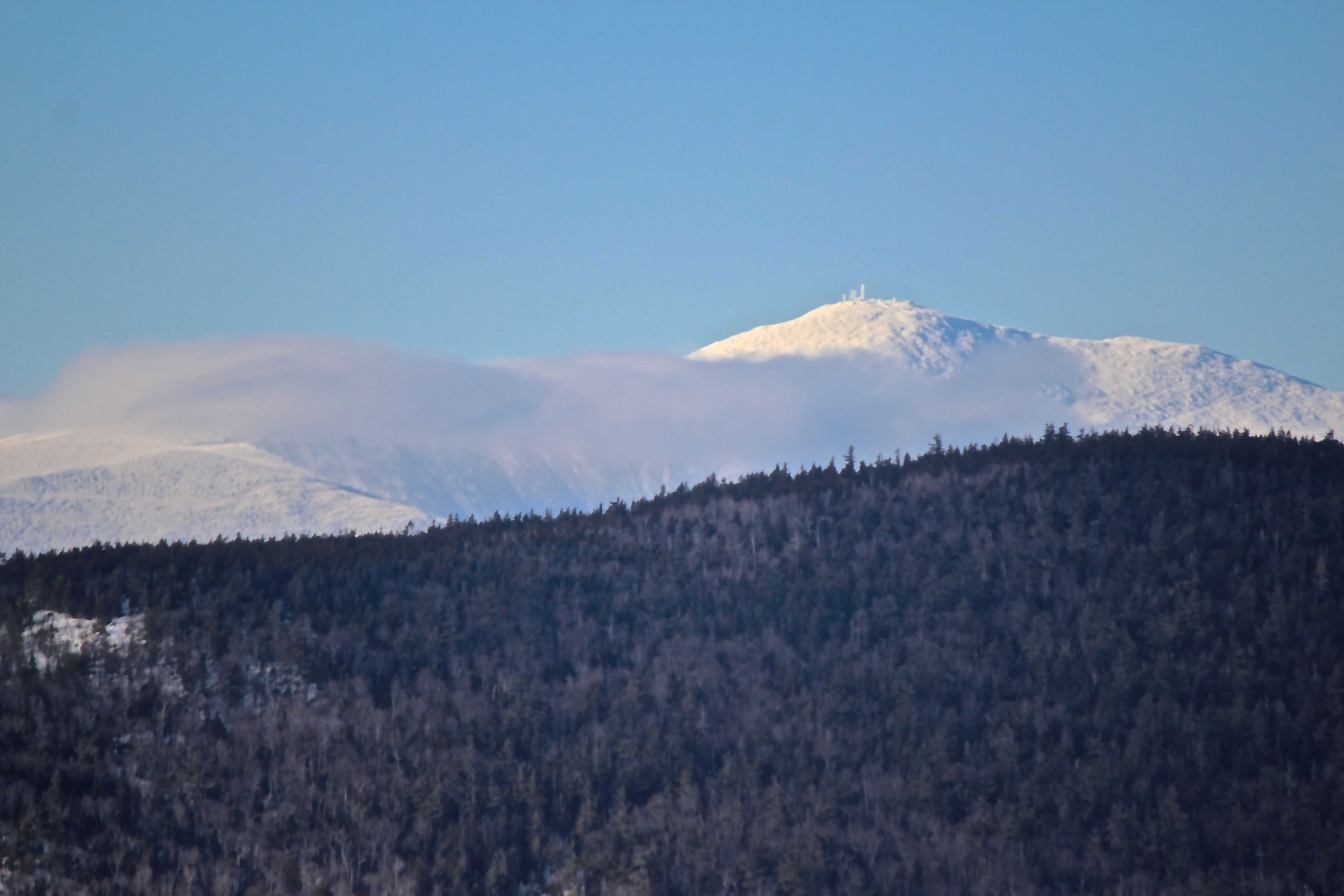
With my telephoto lens, I pulled in the  Mount Washington Observatory and fire tower atop Kearsarge.
MVW

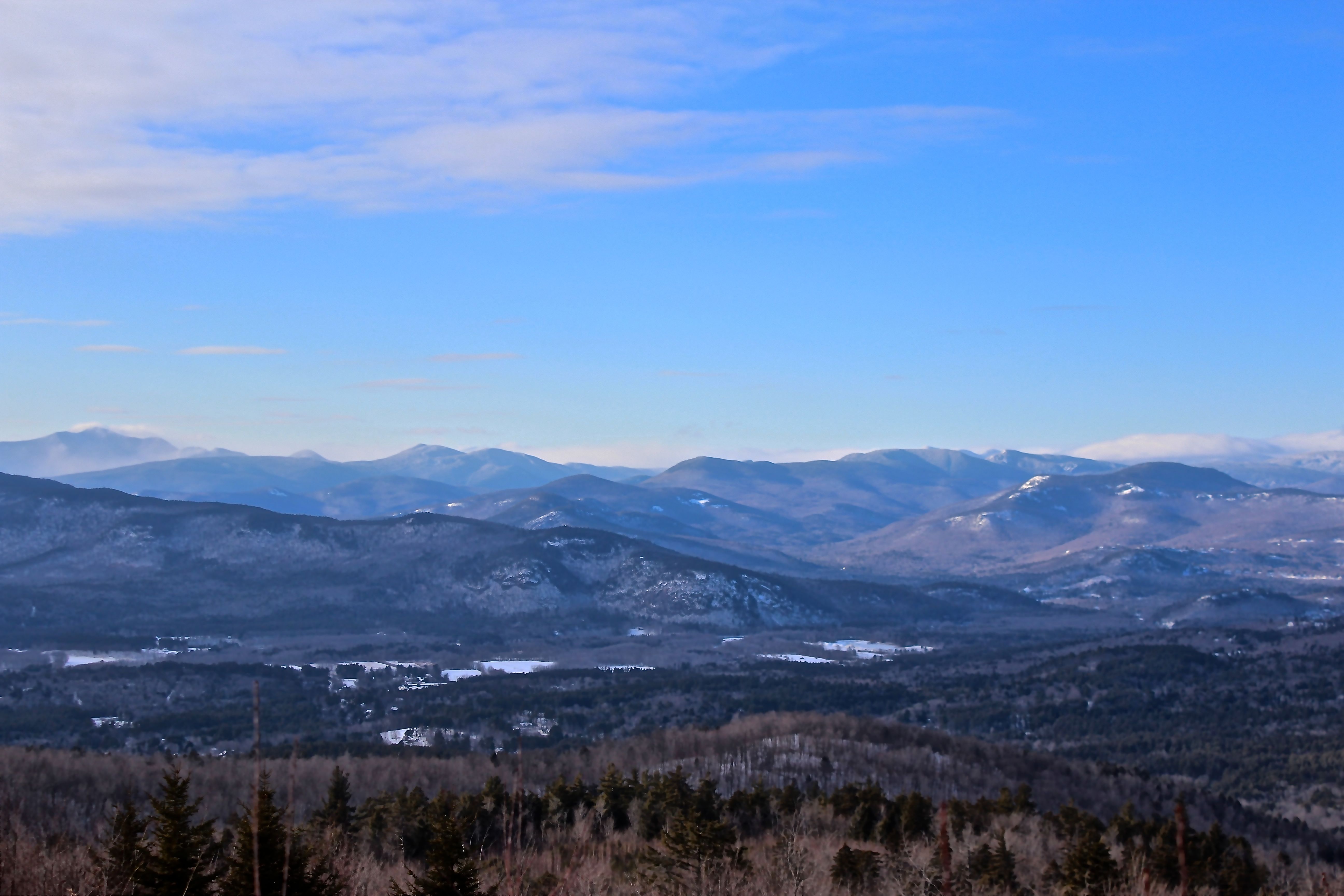
The Mount Washington Valley spread out below us. We felt like we were so close to the connecting trail between Mount Cranmore and Black Cap Mountain, but the sun lowered and we’d left our headlamps behind. Every time we thought surely the next turn would be the summit, we were wrong. So . . . rather than worrying about reaching that destination, we decided to turn around and head back down the trail. At first, we bushwhacked together and then it became a game. We took turns as one of us bushwhacked while the other followed the trail, curious to see where we would meet. Competition took over, and we were soon running to beat the other to our meeting spot–wherever that may be. Somehow, what took us a while to climb up turned into only an hour’s journey down.

last shortcut

I, of course, got off track a couple of times and had to yell to my guy to figure out his location. He had the last chuckle when I chose a wet spot for my final shortcut-turned-longcut.

brook at end

At last we reached the trailhead, tired but exhilerated. On this Mondate we went with the flow and loved the opportunity to learn and play together along the way.


Book of January: A Guide to Nature in Winter by Donald W. Stokes

Stokes 1

Book of January

I have a number of winter nature books, but one of my go-to favs is A Guide to Nature in Winter by Donald W. Stokes. My copy is old (1976–it was a very good year–I graduated from high school) and a bit weathered, but that’s because it has seen frequent use.

Divided into eight field guides, Stokes covers all aspects of winter: winter weeds; snow; wintering trees; evidence of insects; winter’s birds and abandoned nests; mushrooms in winter; tracks in the snow; and woodland evergreen plants.

For each topic,  pen-and-ink drawings by illustrator Deborah Prince and the author are included in the key, as well as natural history descriptions.

The natural history descriptions are just that–Stokes’s descriptions are part of the story that Kevin Harding of the Greater Lovell Land Trust reminds us to share with others. Here’s an example: “St. Johnswort (Hypericum perforatum)–An old country custom in Europe was to hang a special yellow-blossomed plant in your window on the eve of St. John’s Day (June 24), in order to repel bad spirits and counteract the evil eye. In general, the presence of this plant was considered a good omen, and since it was thought that the plant warded off lightning and revealed the identity of passing witches, St. Johnswort was allowed to prosper around the farmhouse. It became known as St. John’s Plant or St. Johnswort (wort meaning “plant” or “herb”). When the plant immigrated to North America it left its traditions behind, and although still as effective as it probably ever was against evil, St. Johnswort is now seldom used for that purpose.” Of course, then he goes on to describe how the plant grows and the seed heads that will appear in the winter landscape.

One of the things I’ve learned from this book is to keep it simple. In the chapter about winter trees, Stokes encourages the reader to begin with the six most common deciduous trees: oak; maple; ash; beech; birch; and aspen. Learning these along with the evergreens provides you with knowledge about 80% of the trees in your forest. I’ve spent the last couple of years developing my bark eyes. I still have much to learn, but can eliminate the common species when I encounter bark I’m uncertain about.

It’s well worth taking the time to read A Guide to Nature in Winter from cover to cover–it’s an easy and enjoyable read. I say it won’t take long–unless you are like me and you pause to underline (yes, I mark my books up–even write in the margins, oh my!) details and take time to understand what you do see along the trail. I probably should invest in a more up-to-date copy, but I feel right at home engrossed in the one that I have.

And it’s also easy to turn to a particular chapter to figure things out. The simplified, illustrated keys should bring you quickly to an identification. And as I said before, the natural history description will further enhance your learning.

The book is available at Amazon.com, but if you live near an independent book store like Bridgton Books, then I strongly encourage you to shop there.

A Guide to Nature in Winter: Northeast and North Central North America, by Donald W. Stokes, illustrated by Deborah Prince and the author, published 1976, Little, Brown & Company.

The Wonders of Wilson Wing

A wander at Wilson Wing Moose Pond Bog Preserve is the perfect way to celebrate the start of snow season. The 20.7 acres of land near Horseshoe Pond that was donated by the Wing family combined with the twelve acres surrounding Sucker Brook that The Nature Conservancy previously owned create the Preserve, which is a Greater Lovell Land Trust property.

snowshoes

My friend Jinny Mae and I donned our snowshoes and headed off on the trail, not sure what we might find. It was snowing lightly when we started, so we didn’t expect to see any mammal tracks.

mink trackard

Thus we were delighted with our finds–especially this one which was rather fresh. A look at the formation and we knew we had a member of the mustelid or weasel family. A few measurements of prints, straddle and stride–and we determined it was a mink.

mink 2 mink slide

In true mink fashion, it enjoyed a slide into the brook. We also saw mice, red squirrel, deer, bird  and domestic dog tracks–some were blurred by the snow, but the pattern and behavior helped us come to a conclusion. Well, the bird stumped us at first. It wasn’t clear at all. But then we saw juncos. And under the platform were clear prints beside some muted ones.

red squirrel midden

Though we neither saw nor heard any red squirrels, their presence was well pronounced. I was surprised to see a midden. All fall, I searched for caches. Usually cones are piled in various places, but this year I found only a few. Were they fooled by the warm weather?

ash cork

ash snow 2

I don’t know if it’s because it is winter and everything seems more pronounced or what, but the ash bark appeared chunkier and corkier than ever. Of course, the snowflakes added to the scene.

Sucker Brook

We were beside Sucker Brook, which flowed with winter magic.

ice 1 ice 2  ice 4 branch

And ice. Its many forms of presentation always fill me with awe and wonder.

ice 5, big foot

And whimsy. Check out these gigantic feet and

ice 3 hem

the hemline of this snowy skirt.

hobb 2 hobb 3a

Another favorite (oops, I forgot, everything is my favorite, but these really do stop me in my tracks–or snowshoes) is hobblebush. In any season this shrub provides an incredible display, but its the winter buds that are especially astounding. (OK, wait until it blossoms and I’ll be saying the same thing.) While most buds have waxy scales that protect the leaves, hobblebush is naked. The same is true for witch hazel buds. What you see in these photos, is miniature leaves clasping each other. And embraced within, the flower bud. Here’s hoping the snow provides warmth until spring.

polypody 1

Another “favorite” display adorned a rock hidden beneath the snow.

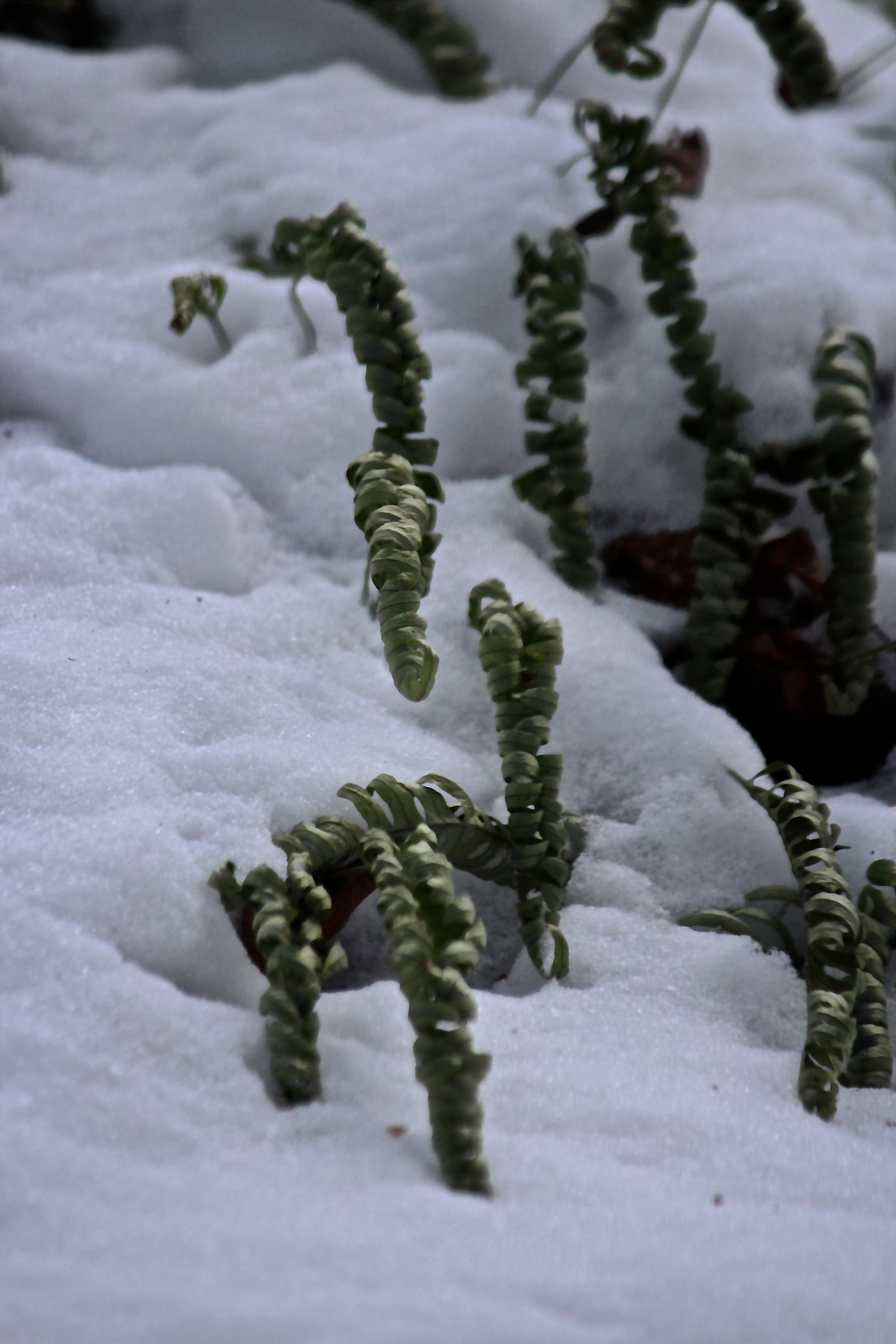
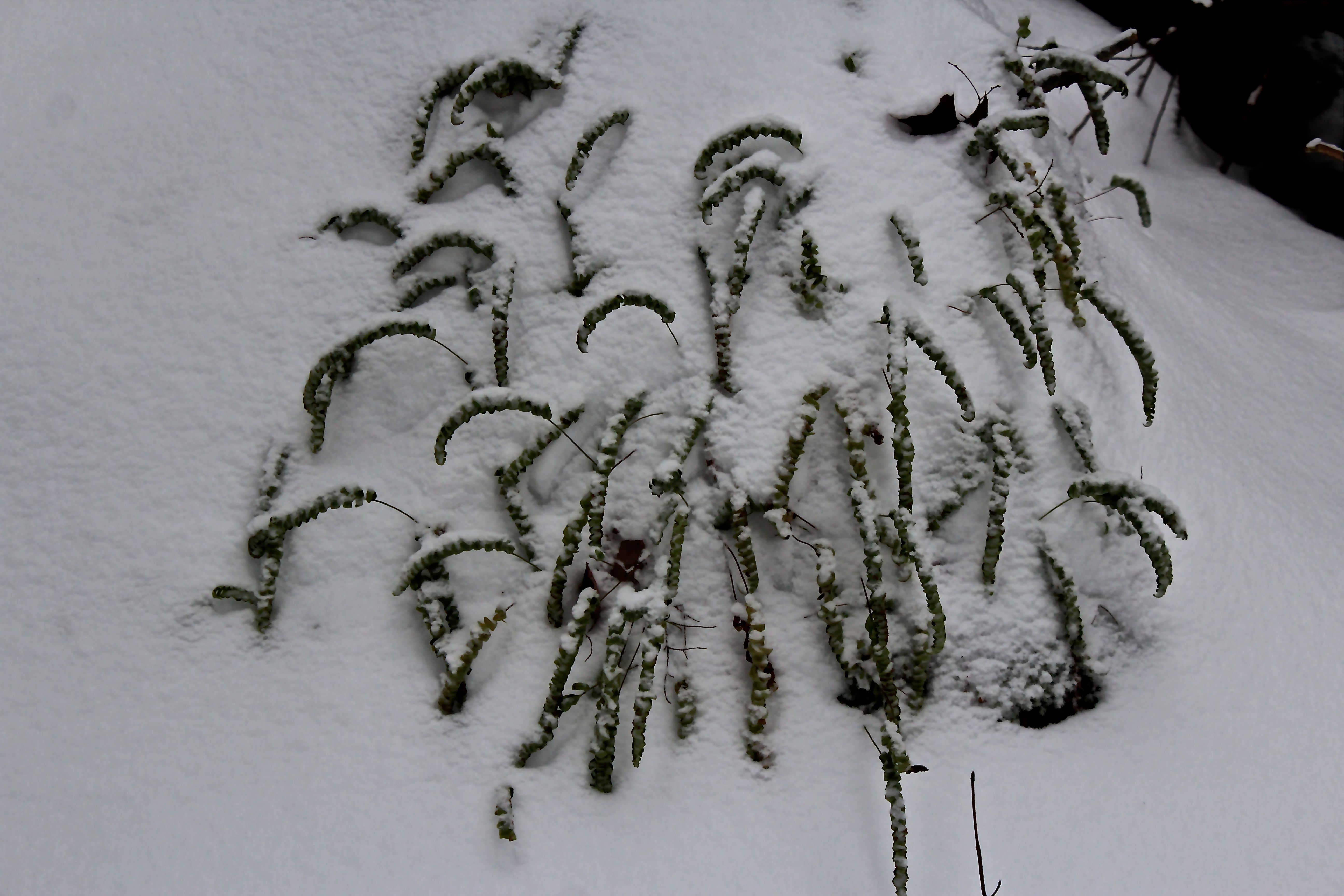
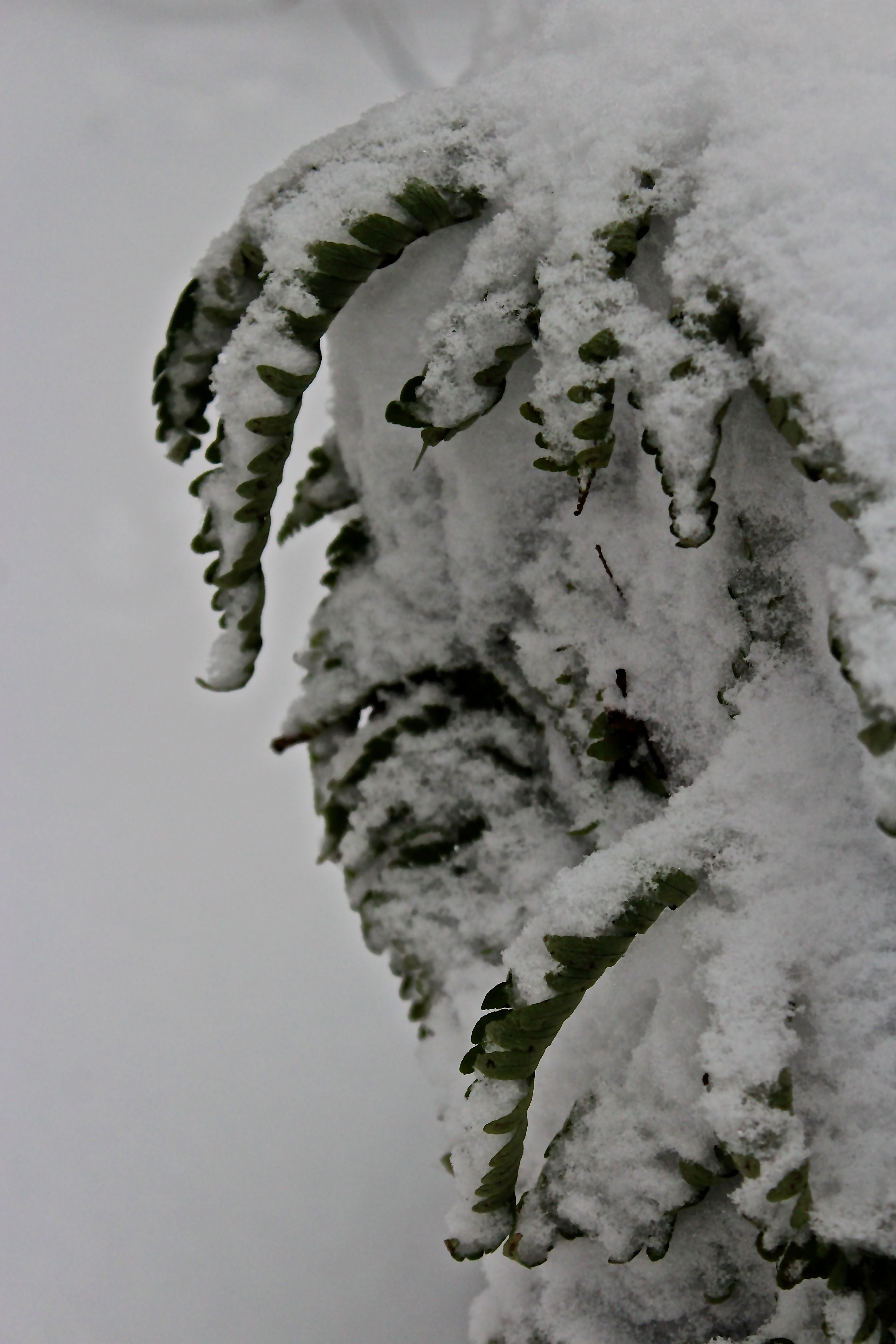
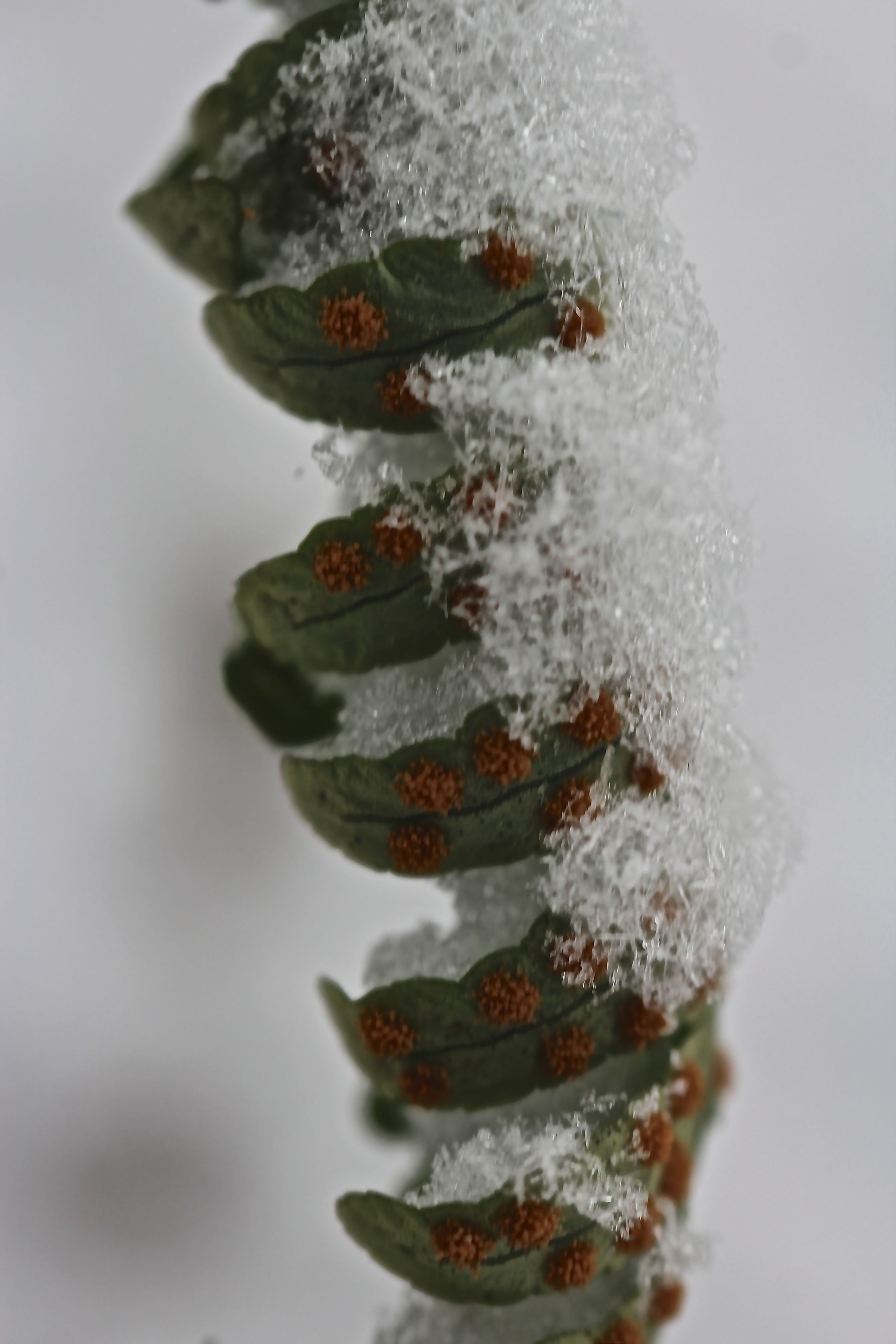
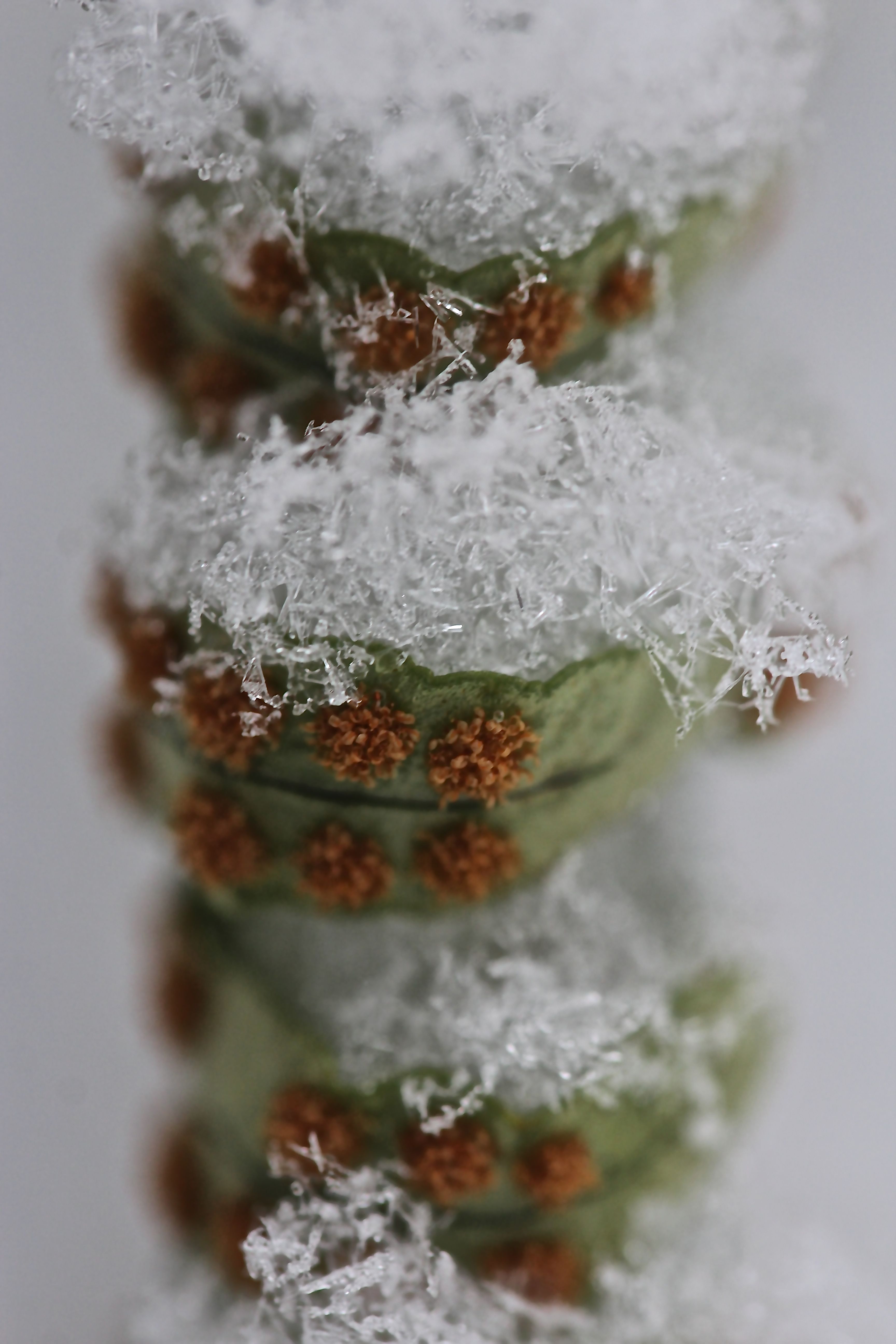
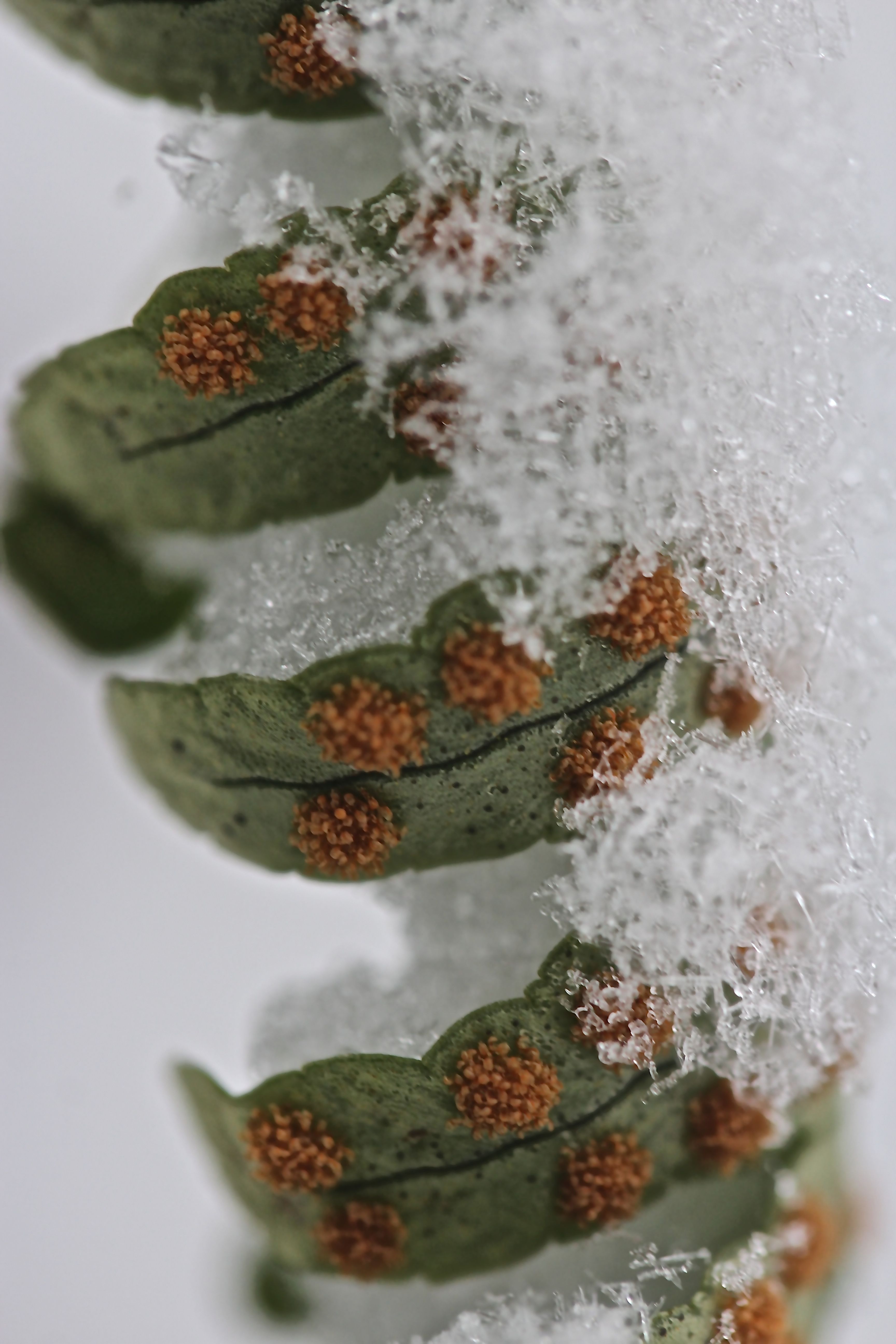
poly 3Common polypody ferns seemed to hold the snow tight between their curled blades. That made us pause and wonder once more.

poly 2

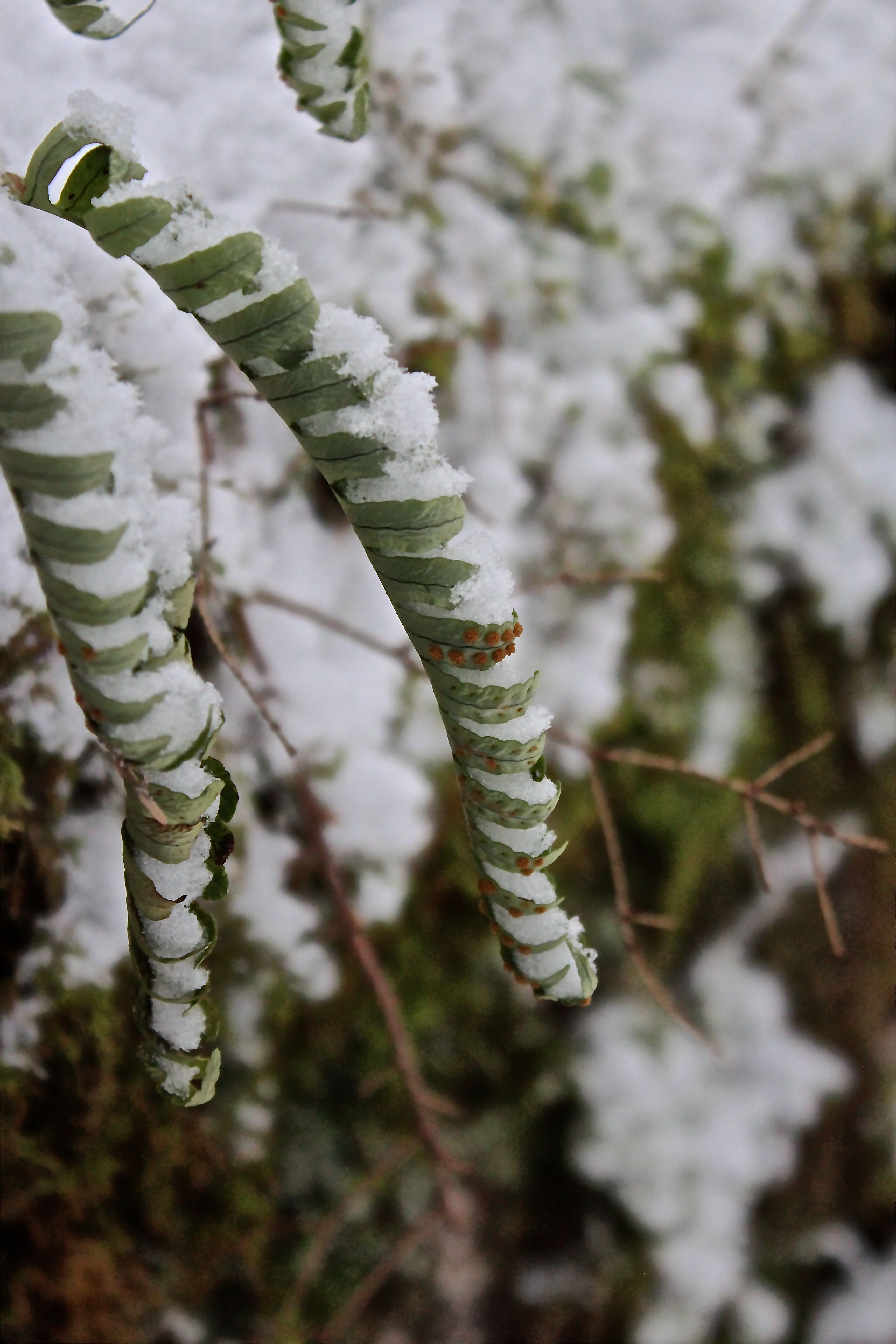
And because we did so, we realized that clusters of sporangia were ready to catapult their spores into the world.

poly 4

poly 6

poly 5

They look like miniature clusters of balloons waiting to broadcast the arrival of a new year. But, why were the pinnae curled inward? It’s certainly not a stance that would protect the spores–those are to be spewed outward in order to further the population. We know that the blades curl up if conditions are dry, but it’s hardly been dry the past few weeks–lots of rain and now snow. My research turned up little, but I wonder if it’s a protective measure similar to the rhododendrons in our front yard. As nature’s thermometers, they let us know what the temperature is based on the behavior of their leaves–about 40˚ they extend outward, about 32˚ they droop and in the low 20˚s the rhodies’ leaves curl. I’m always sure they will die and drop off, but that’s not the case. Could it be the same for the polypody? Do their dense covering of scales located on the underside prevent the loss of moisture? Now I need to keep track of the temperature and see if it follows the same pattern.

Worth a wonder. Worth a thanks to the Wing family (and especially Dr. Wilson M. and June Wing) for helping to make the Preserve a place for all of us to wander.

Finally Flakes

White stuff fell from the sky today–a late date for our first measurable snowfall.

dandelion

Yesterday, I saw a dandelion blooming in Denmark as I participated in Maine Audubon’s annual Christmas Bird Count. Today, I assume that yellow blossom is snug below about five or six inches of snow.

While on the bird count, I practiced using my new macro lens, but didn’t have the telephoto lens in my pack because it wasn’t working correctly. Miraculously, I solved that problem this morning and am back in business–taking photos with several different foci.

chickadee

hairy

ruffled red breasted

From the get-go, the feeders provided a source of energy and entertainment. I wonder who ruffled the red-breasted nuthatch’s feathers?

cat trax

Perhaps it was a cat. Let the tracking season begin! I noticed this set leading from the barn, where we watch anywhere from one to six neighborhood cats emerge. I’m not sure which one owns these prints, but it stayed close to the house rather than making the usual venture to hunt below the feeders.

vernal pool slush

After scooping the driveway snow, I was antsy to check things out in the woods. The vernal pool is covered with slush–we need a few nights in the deep freeze to firm things up. Looks like we could hit negative digits by next week. Not sure our bodies are acclimated for that this year. Pile on the layers.

grouse trax

Without meaning to, I flushed three ruffed grouse–only their prints showed their presence. And my heart beat.

turkey trax

A flock of turkeys had also traveled my way, leaving behind their trademark signature.

snow on wood pile

snow 1

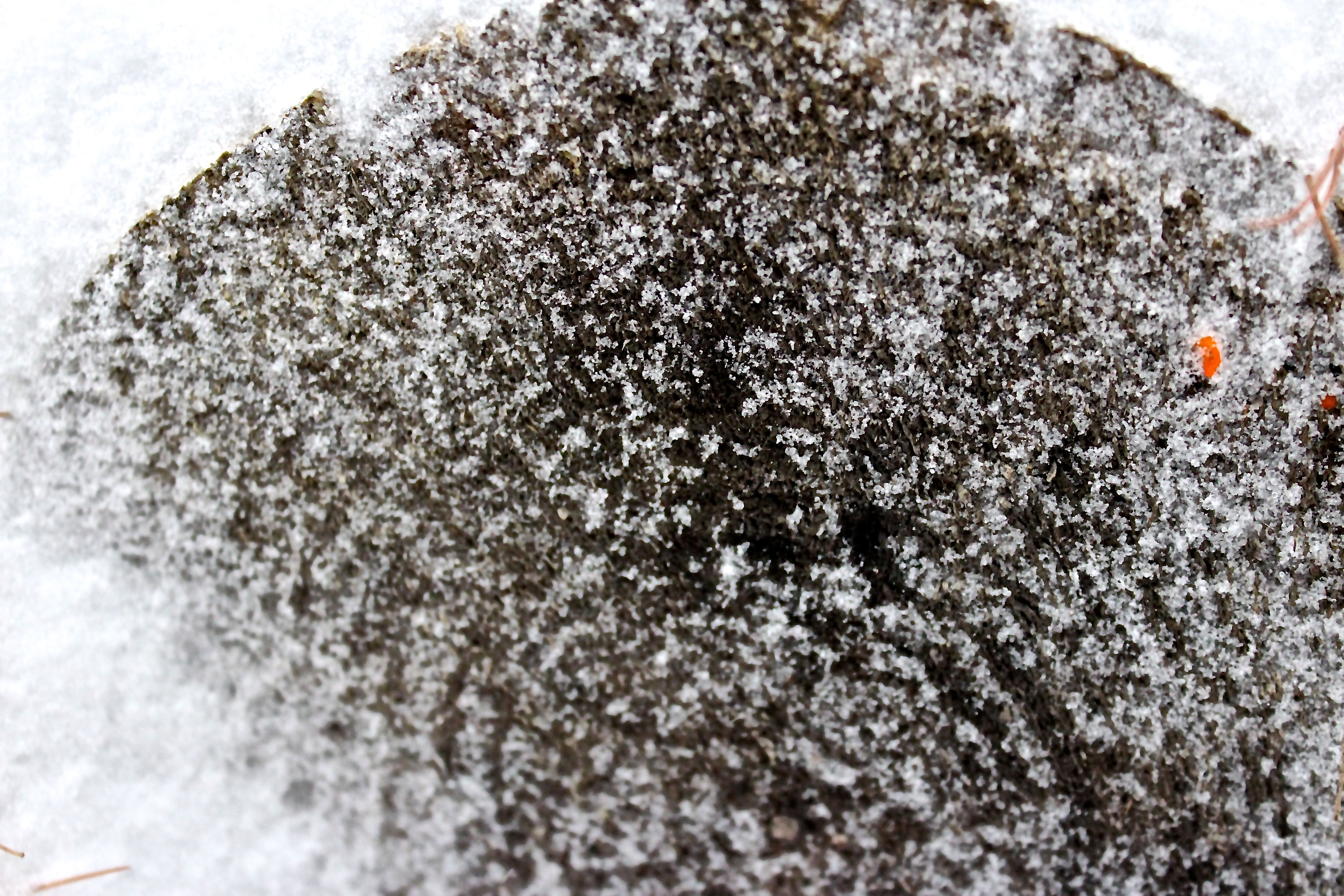
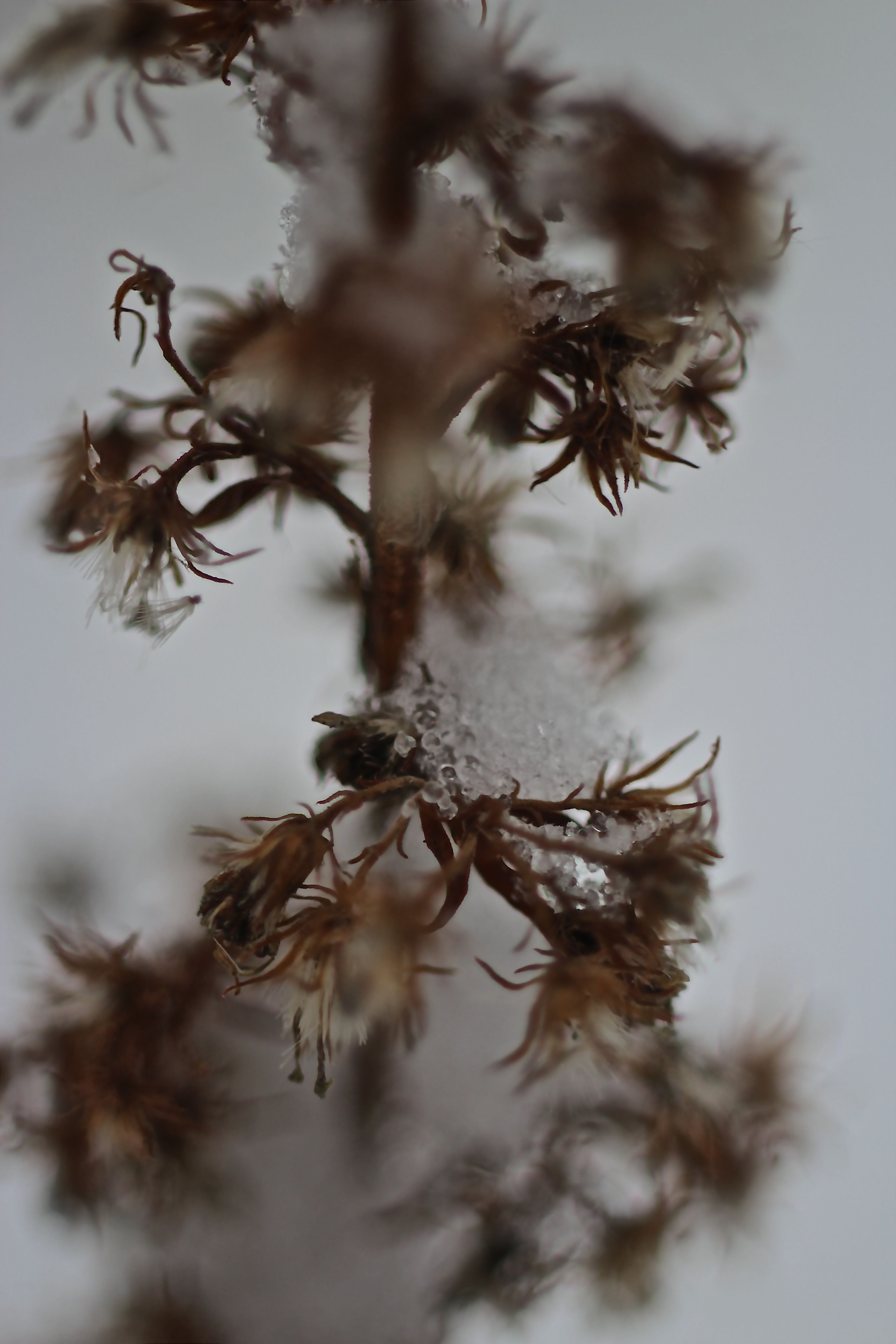
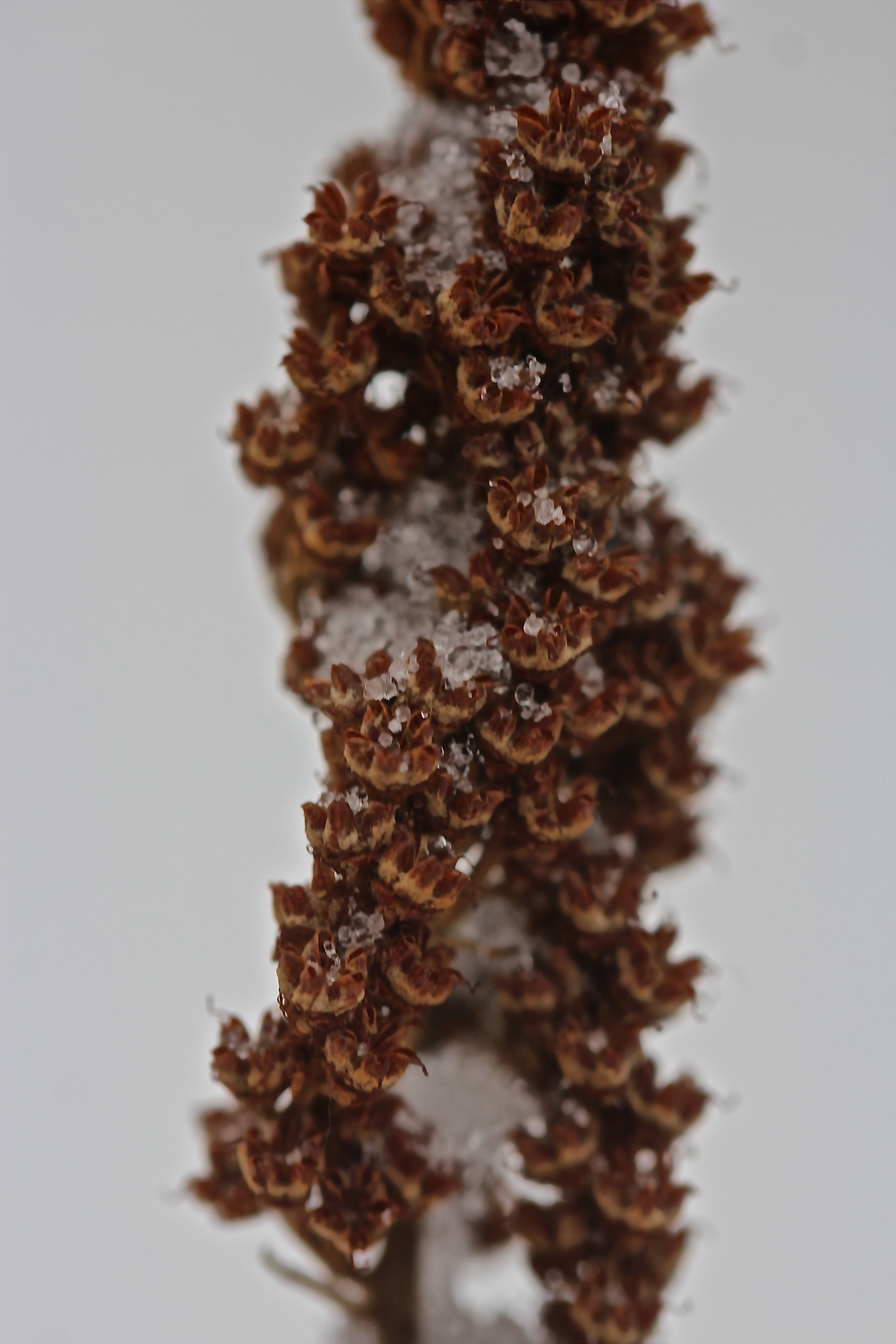
I hadn’t expected too many tracks, so pointed the lens toward the snow and its presentation on a variety of subjects.snow on astersnow on hardtack

Atop asters and hardtack,

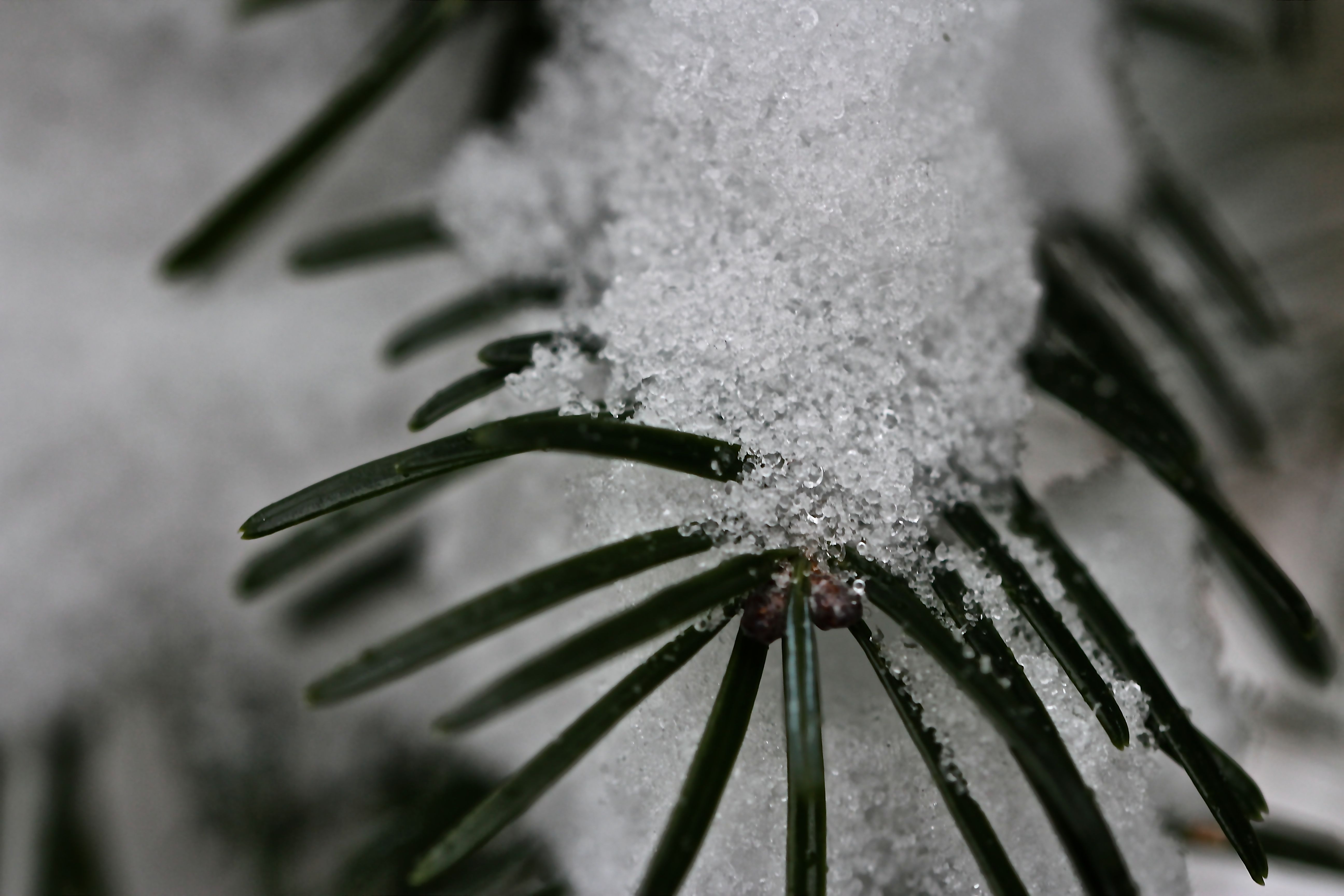
snow on balsamsnow on bulrush

balsam fir and bulrush, each crystal clung.

 snow on cinnamon fern snow on sensitive fern

Some were embraced by cinnamon and sensitive ferns,

snow on w. h.

Still others formed blankets of protection.

frullania, leafy liverwort

And then I turned my attention elsewhere. The leafy liverwort in the genus Frullania beckoned a closer look. Like mosses and lichens, liverworts are nonvascular flora.

frull 5 

Most are green, but Frullania is brown. As it weaves in and out of the crevasses on the ash bark, its structure reminds me of ricrac, that zigzaggy trim we used to add to sewing and craft projects.

w. nest 2

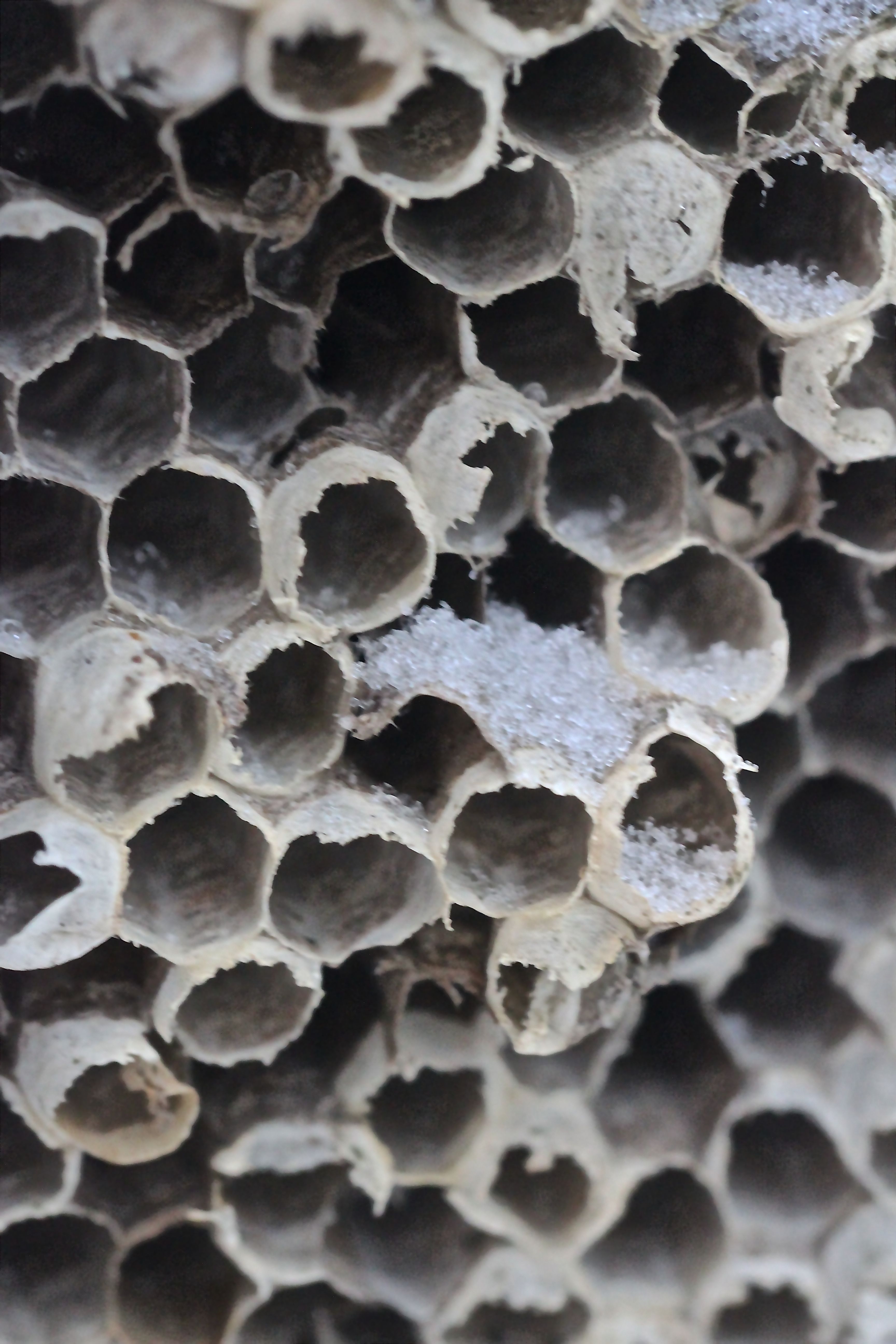
This hornet nest always deserves an examination of structure, texture and design. Constructed from chewed up wood strips mixed with sticky saliva, this is an incredible undertaking.

nest compartments

Each tiny cell once housed an egg. While the males and the old queen died in the autumn, the females who mated have burrowed into tree stumps and other cozy spots to survive the winter months.

 striped 3 striped 5

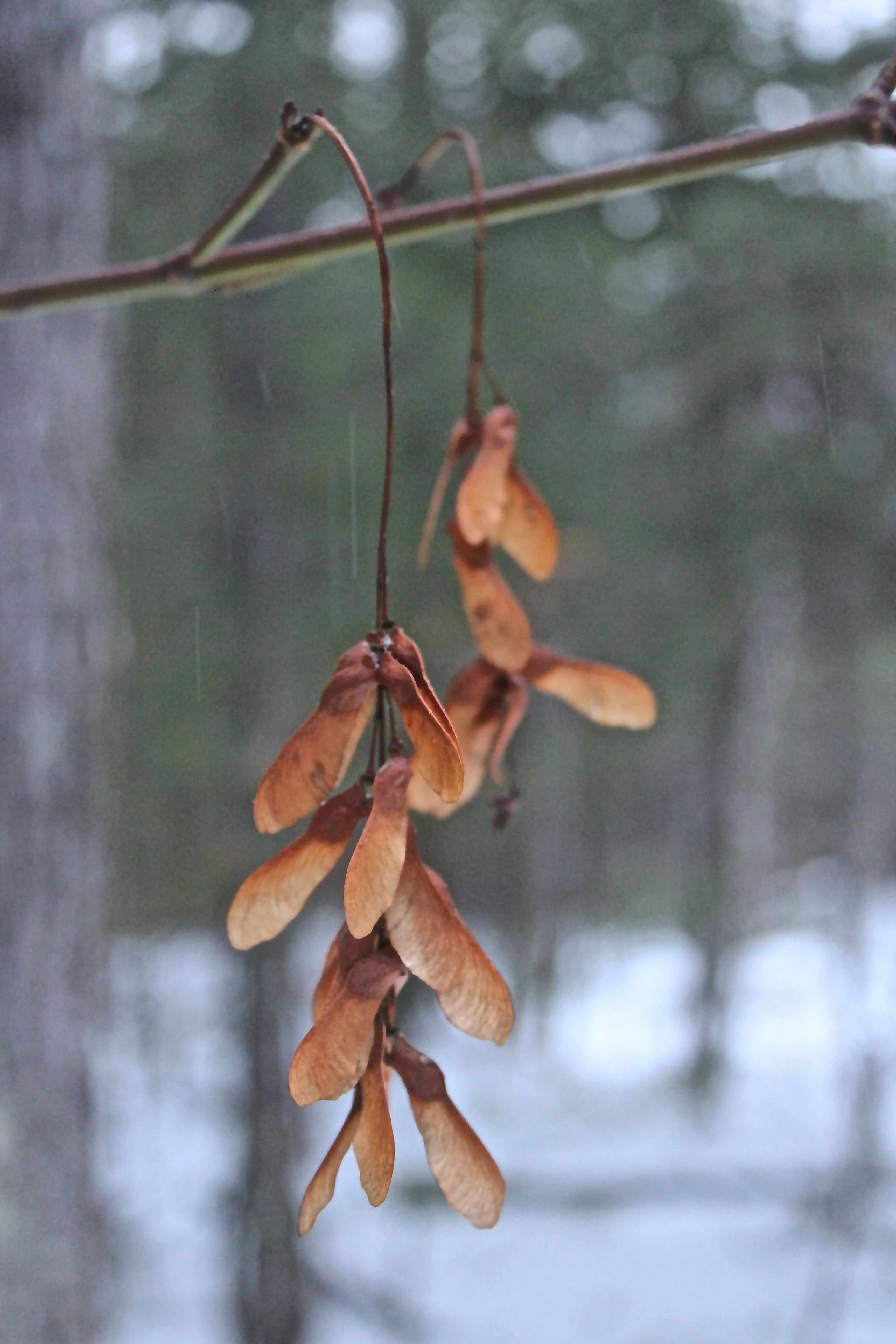
One of my favorite finds today: clusters of striped maple samaras dangling from a tree–waiting for the right moment to disperse. Insect wings come to mind.

 slush

Because the ground hasn’t frozen and we’ve had so much rain lately, I left a few slushy prints.

deer trax 1

As I retraced my steps, I discovered I’d had company. Unfortunately, I never saw the two deer that crossed behind me. We were silent partners in the winter world.

cardinal 2

Home again, I’m thankful for the male cardinal that graces the backyard on a regular basis. Sometimes his mate accompanies him, but I didn’t see her tonight.

It’s beginning to look and feel like my favorite season has arrived. Flakes finally fell–YAHOO!


Everything Old is New Again

Sometimes my feet wander down trails I’ve traveled many times before and other times they pull me into new territory. Either way, I’m happy to bumble along.

vp

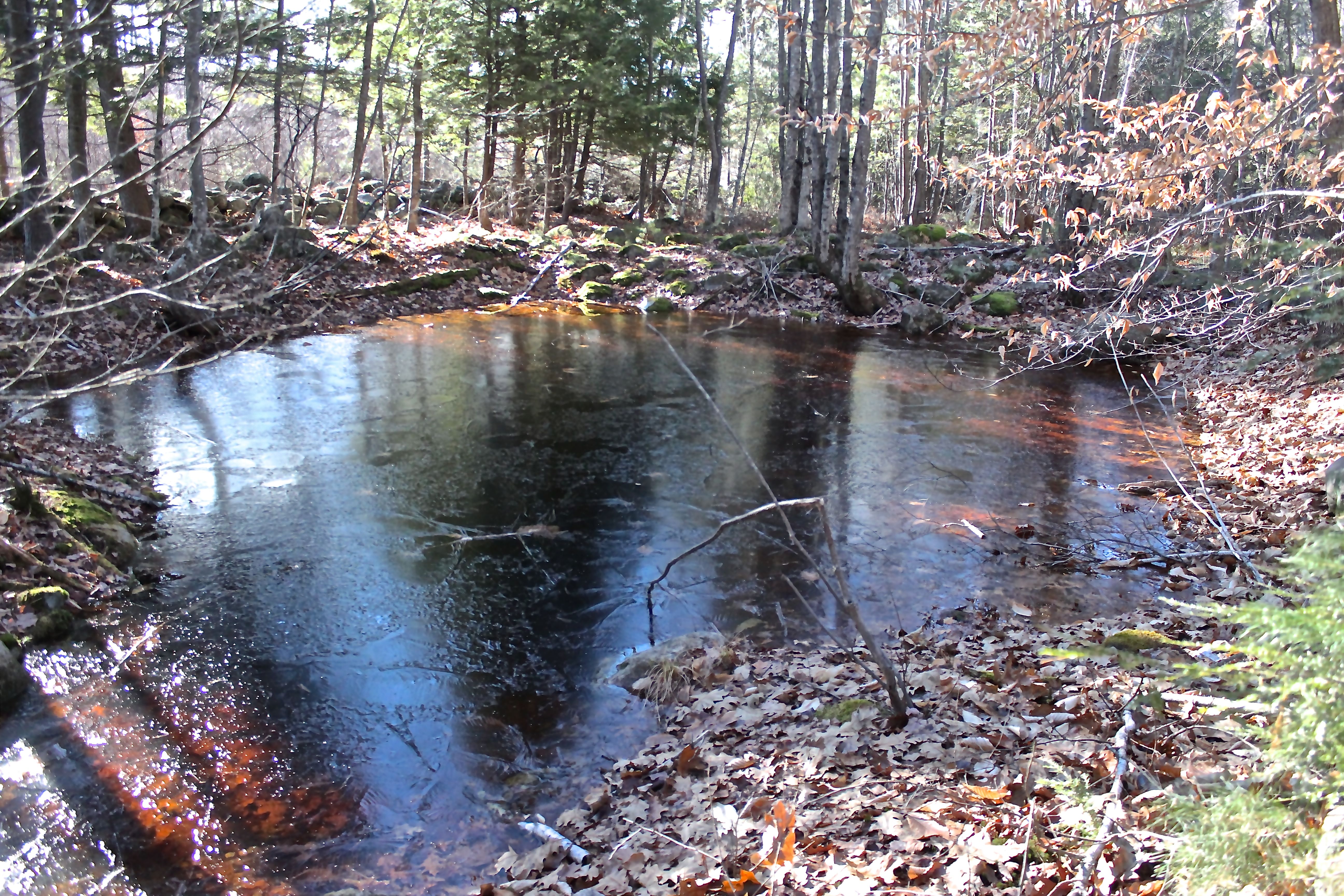
My morning tramp began with a visit to the vernal pool. A week ago it was empty. Some rain and cooler temps suddenly mean water glazed with ice.

gateway 1

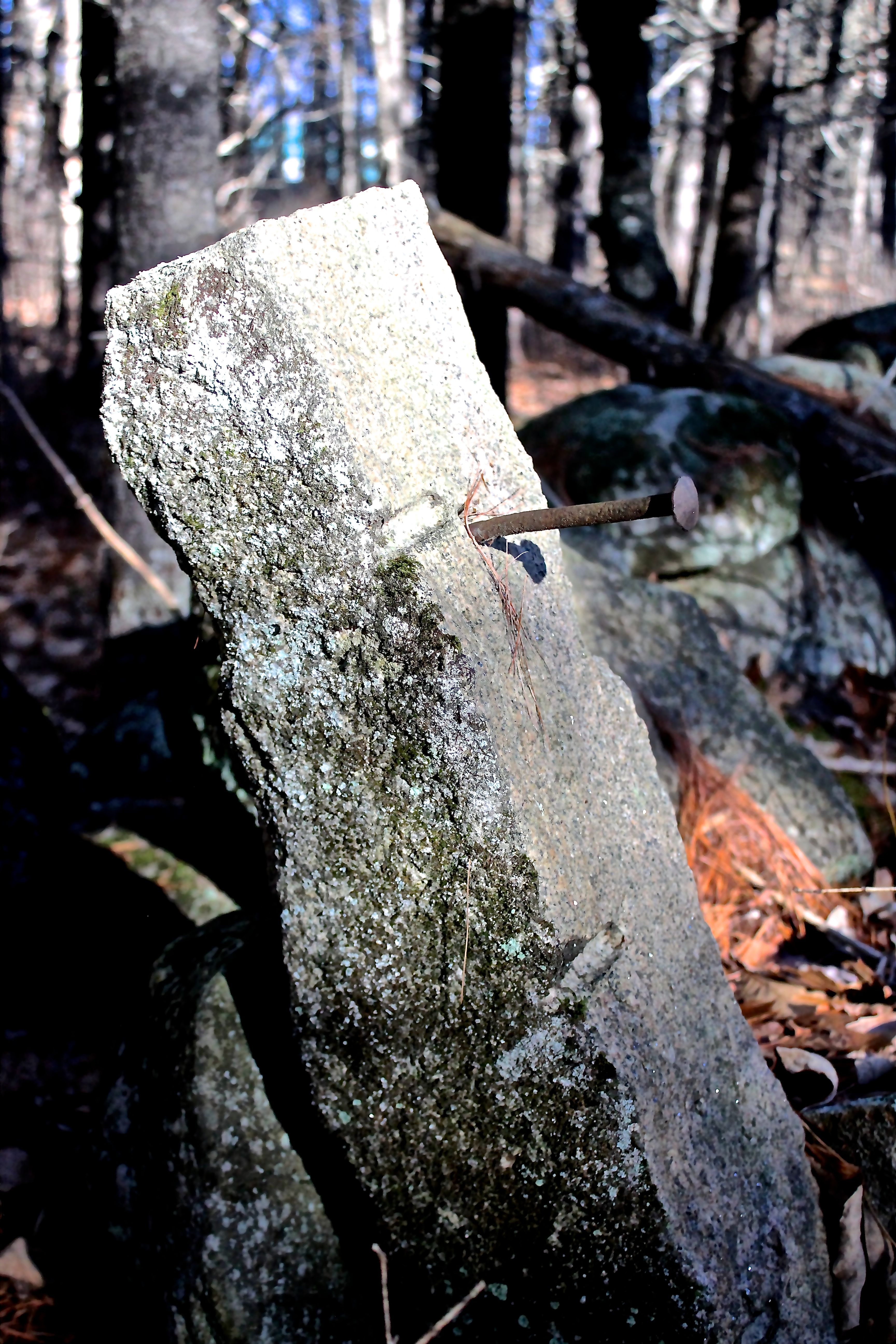
Continuing along, I stopped at an old gateway where granite posts mark the former opening. There is a cowpath on our property. Is this another one? Was there a barn nearby?

gate 2 gatepost

The split granite spoke of earlier times. Rather than pass through, as is usually my manner, my feet turned and I found myself following the stonewall in a westerly direction.

double wall

Curiously, it’s a double wall or two parallel walls, which typically indicates plowed land. That makes perfect sense, as the land was flat. But, what I noticed is that there aren’t many small stones between the outer walls as is traditionally the case. Why?

well

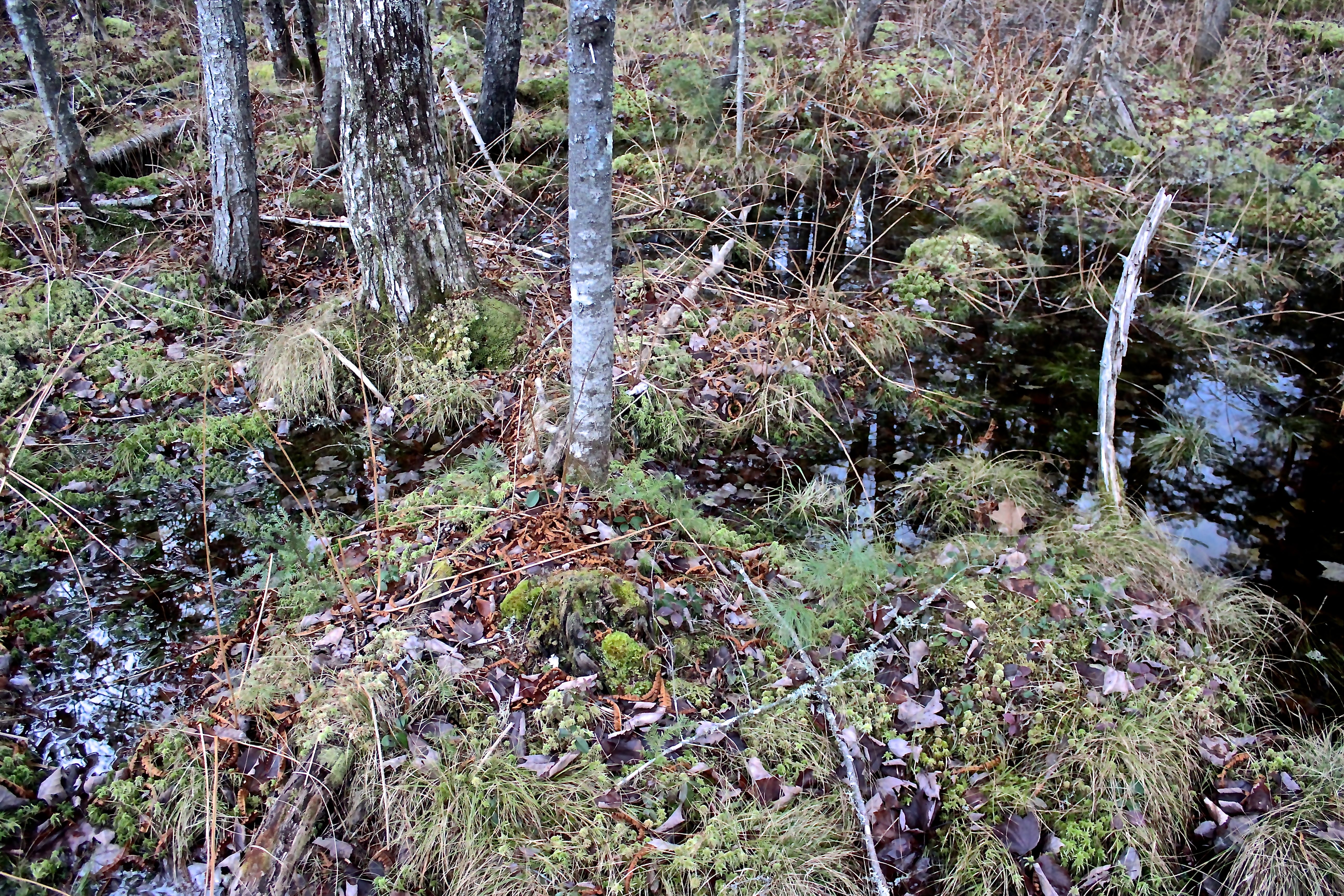
Eventually, I reached a corner, and found where all the smaller rocks had gone. They form a triangle–a common way to get rid of the little guys. I also noticed what I believe to be a well. There are wells throughout this woodland–rather curious.

dump site

Some artifacts, though rusted or broken, remain to provide further evidence that this area served a different use at one time. It now stands in tree growth and is lumbered every 30 years or so.

super double wall

As the wall turned, so did I. And here I was even more confused. The wall is about eight feet wide. The reason? I can only wonder.

island hopping

At the next corner, rather than continue to follow the wall, I climbed over and did some island hopping.

sphag 2 sphagnum 1

Sphagnum mosses display their pompom heads.

evergreens evergreens2

Evergreens compete for sunlit spaces.

snow flurries

And suddenly, snowflakes land on ice. Only flurries, but still . . . it’s snow.

lost 1

At times, I was lost. Not really lost because I knew I could find my way home, but fake lost–curious about where my next steps would lead.

turkey tails

Among my findings as I wandered about, turkey tail fungi (Trametes versicolor),  proving that they are as prolific as the tails of strutting turkeys for which they were named. And one hundred times more beautiful.

hemlock varnish shelf

Exhibiting its winter color is a hemlock varnish shelf (Ganoderma tsugae).

witch's butter & bark beetles

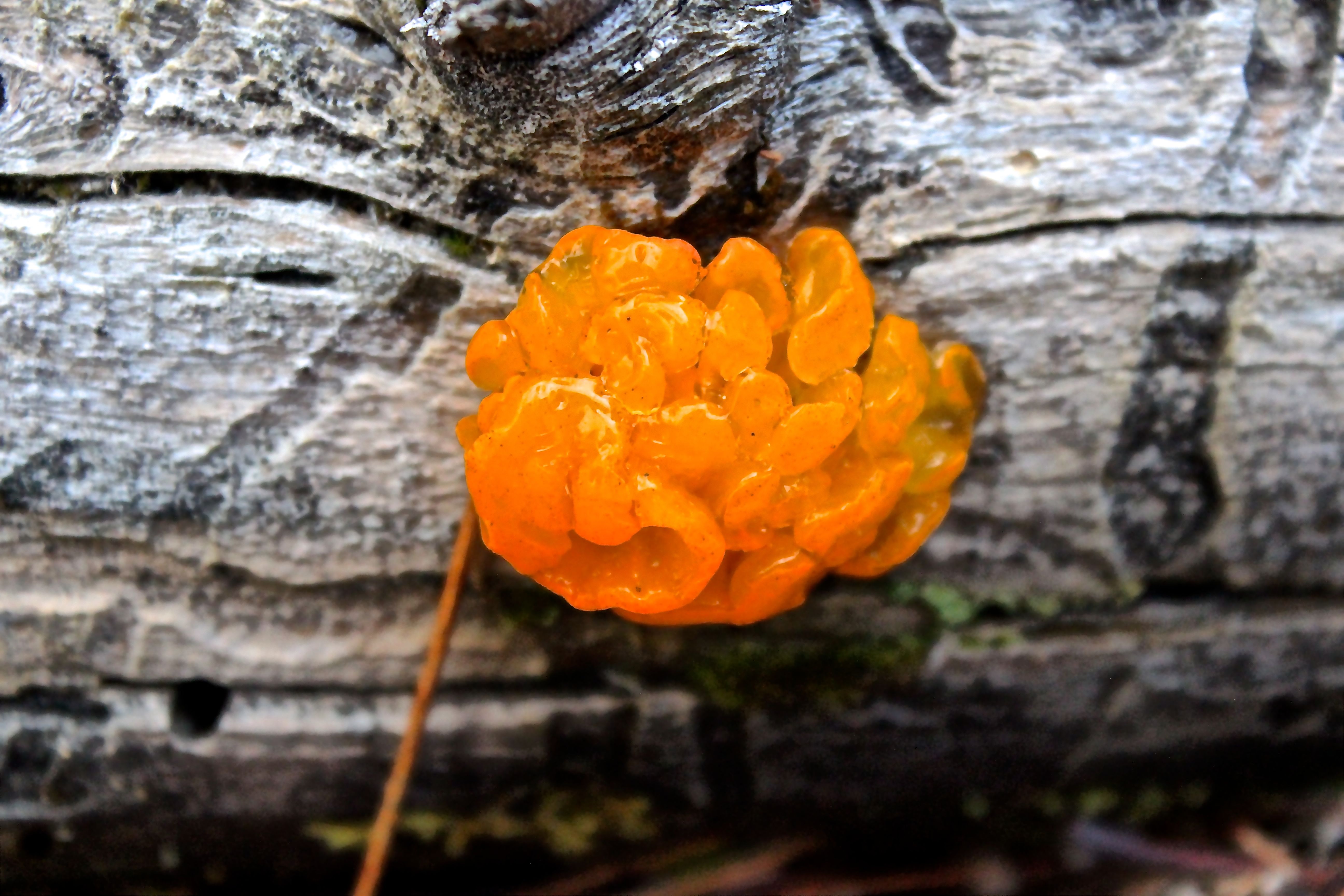
Witch’s butter (Tremella mesenterica) put me under its spell. I didn’t have any pins to prick it and let the jelly juices run, thus counteracting any adverse effects, but that’s okay–I think it’s a good witch.

ice needles

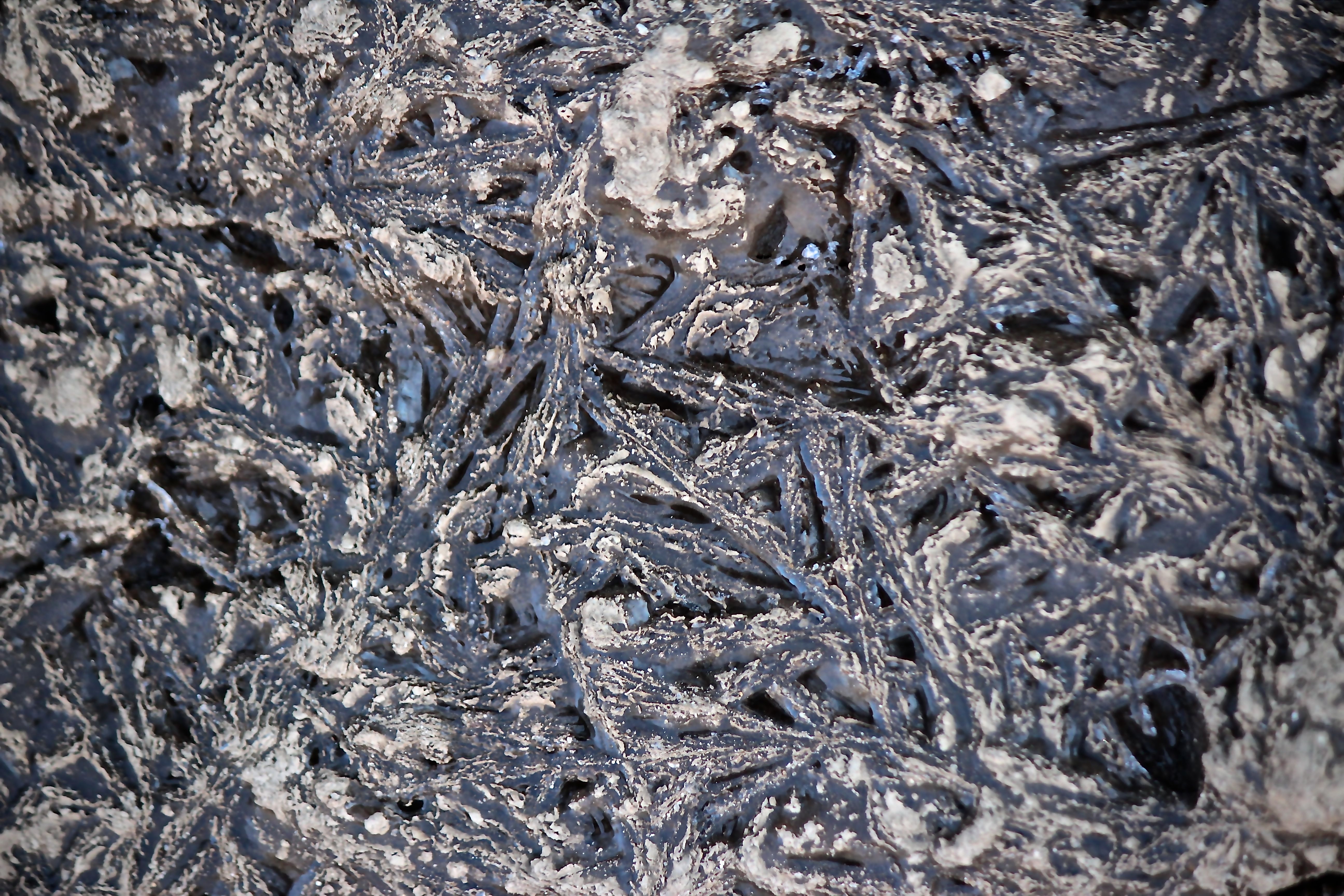
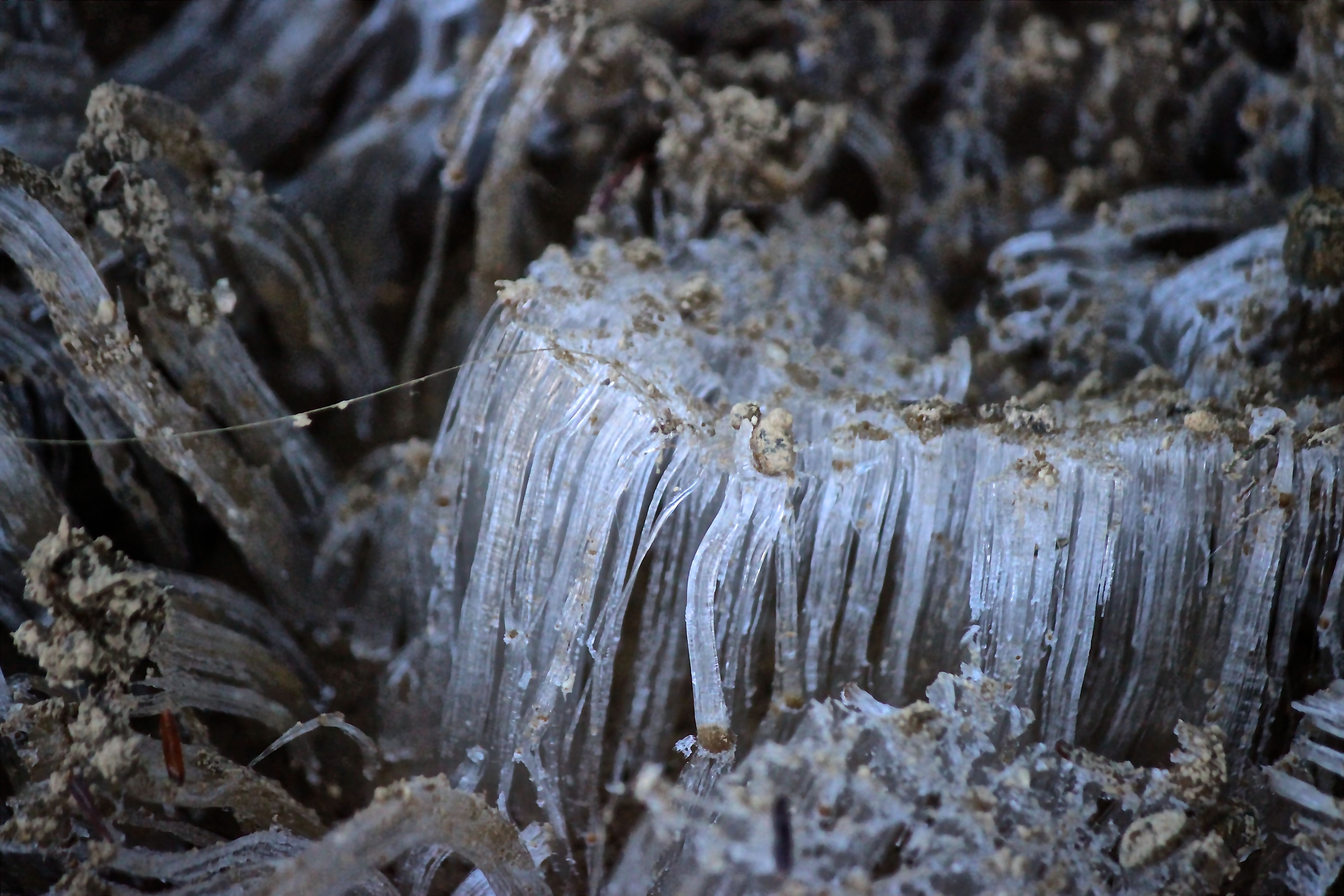
The ice needles are forming again, ever curious in style and design.

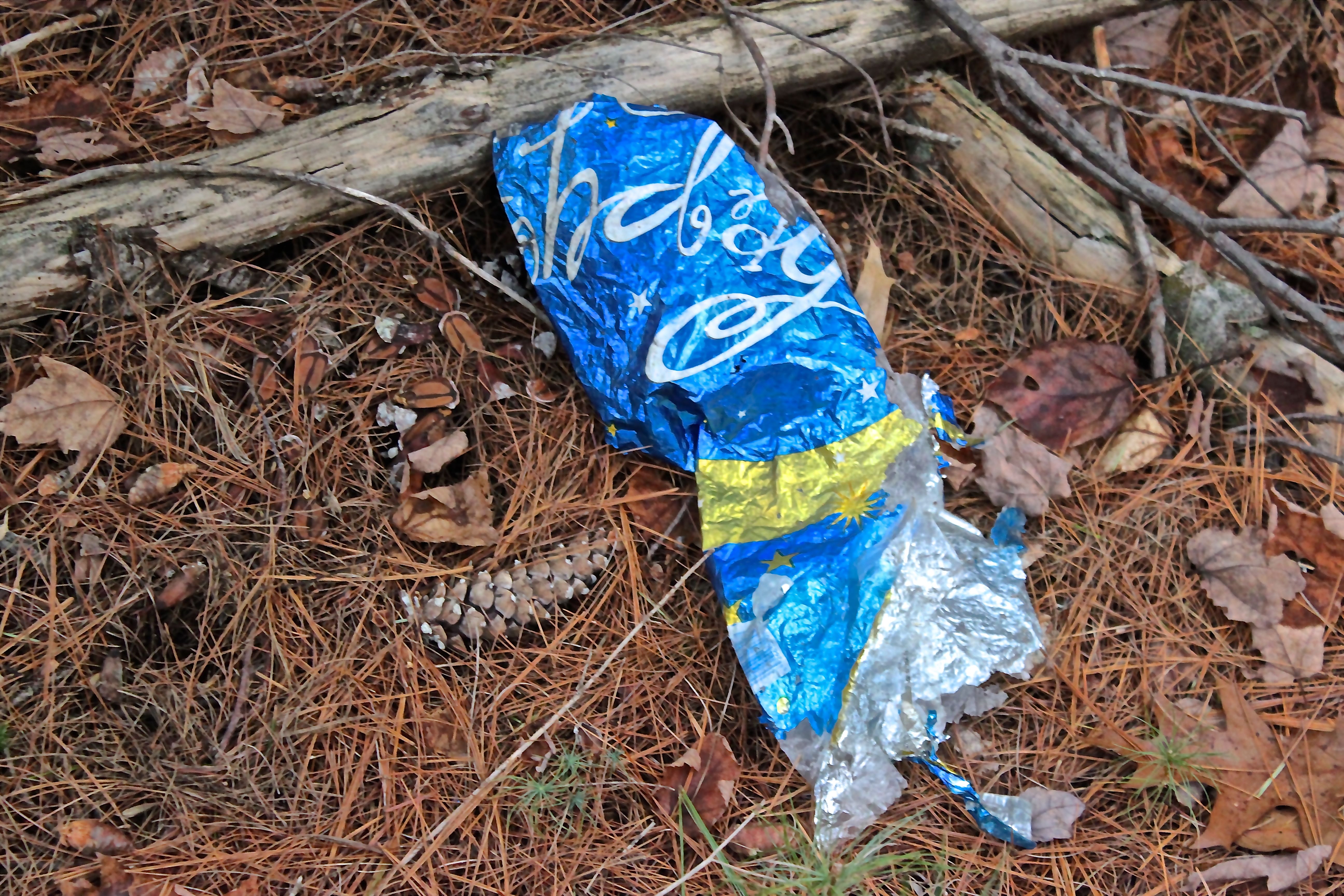
balloon

A different color catches my eye–deep in the woods and yet . . . and yet, the human effect leaves its mark. Don’t worry, it’s not there anymore.

deer trail

Finally, I followed the deer and moose trail home, and later decided to follow a more conventional trail.

 brook 2

brook reflection

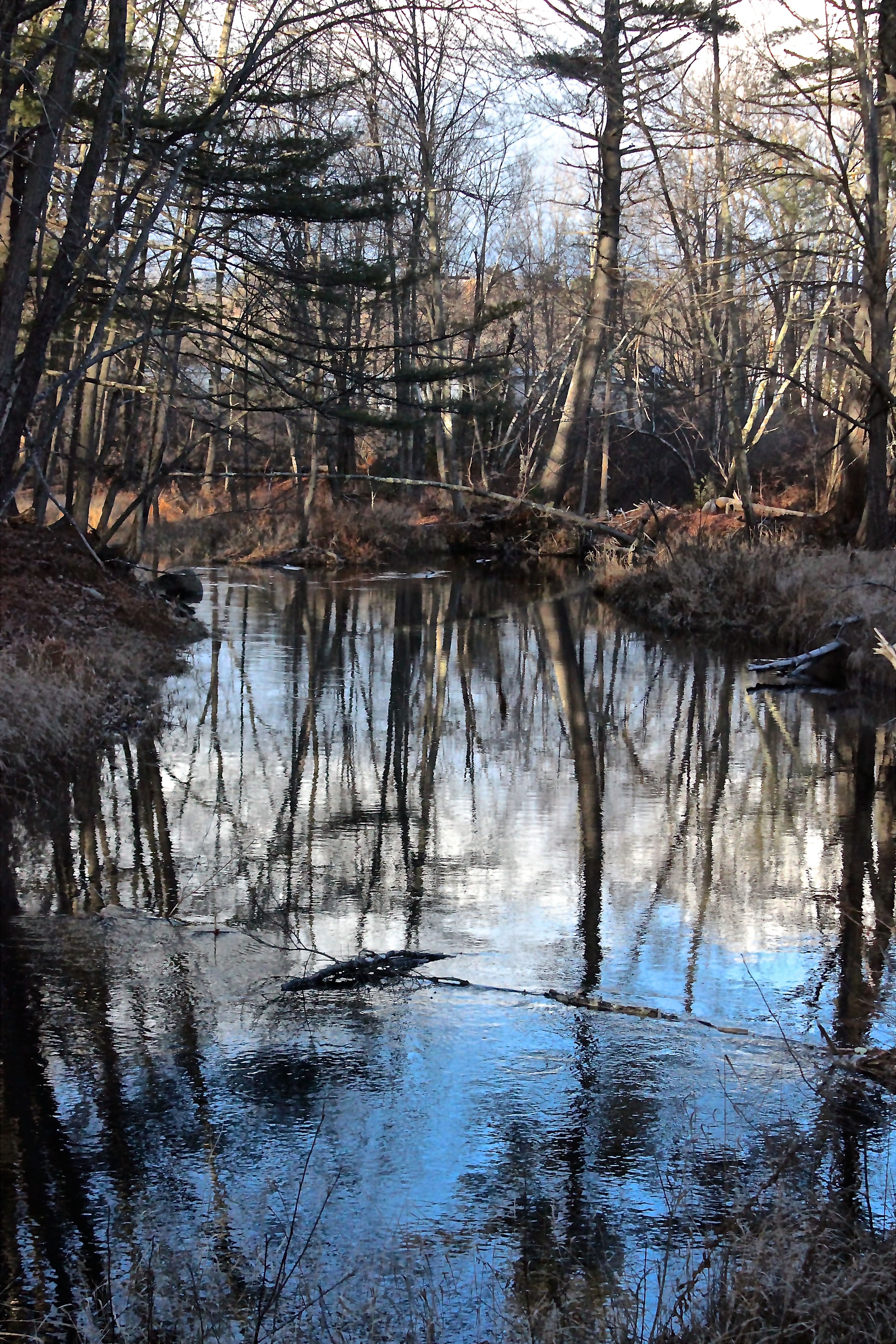
Though I explore the trails beside the brook frequently, the change is constant.

 weeping treeweeping 2

This white pine, which is actually a snag, has taken to weeping. It’s nearing life’s end. I’d cry too if my outer layers of skin were cast away as if they meant nothing.

art 2

art 3

Another snag shows off its palettes of great size–artist’s conks.

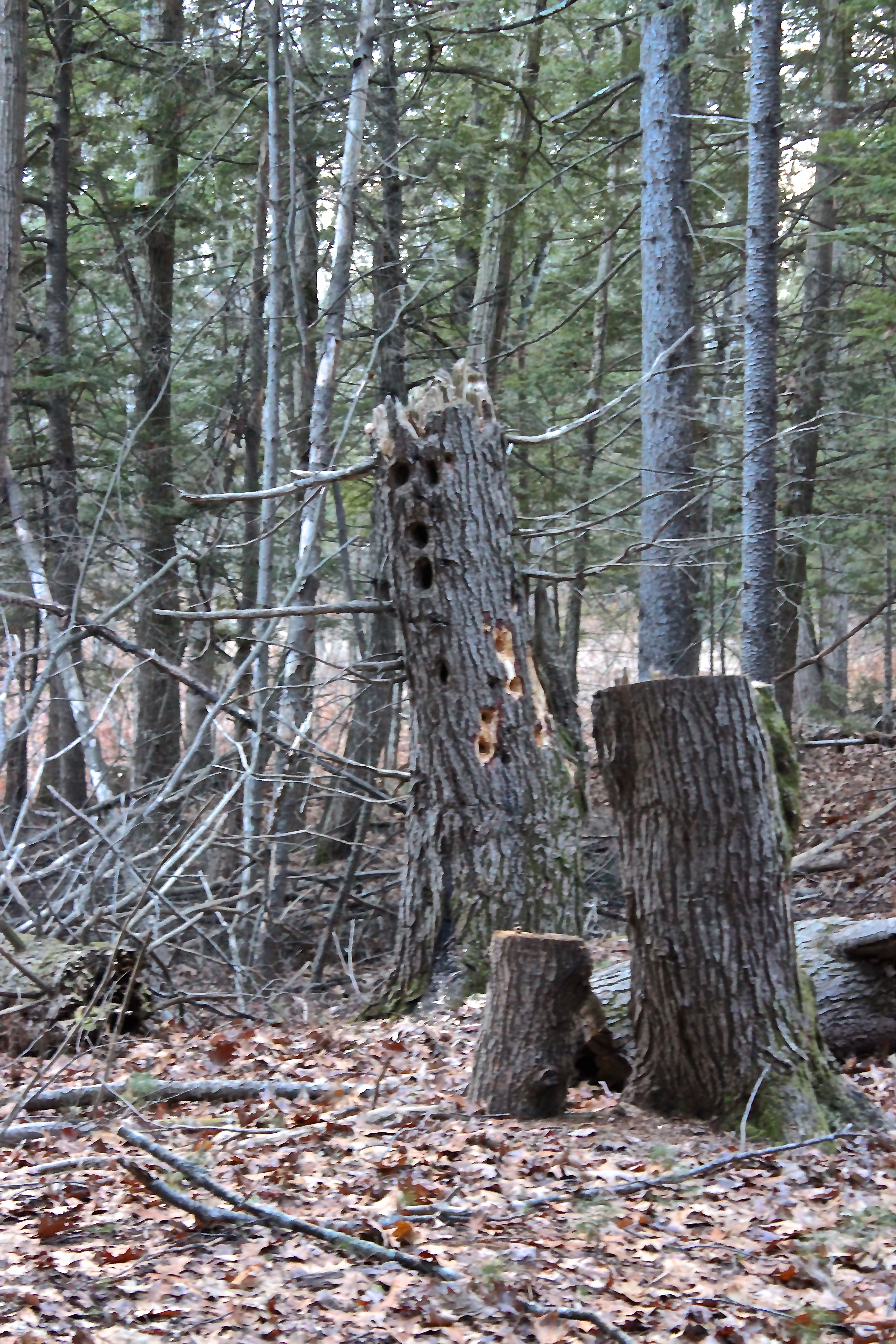
   pileated 1

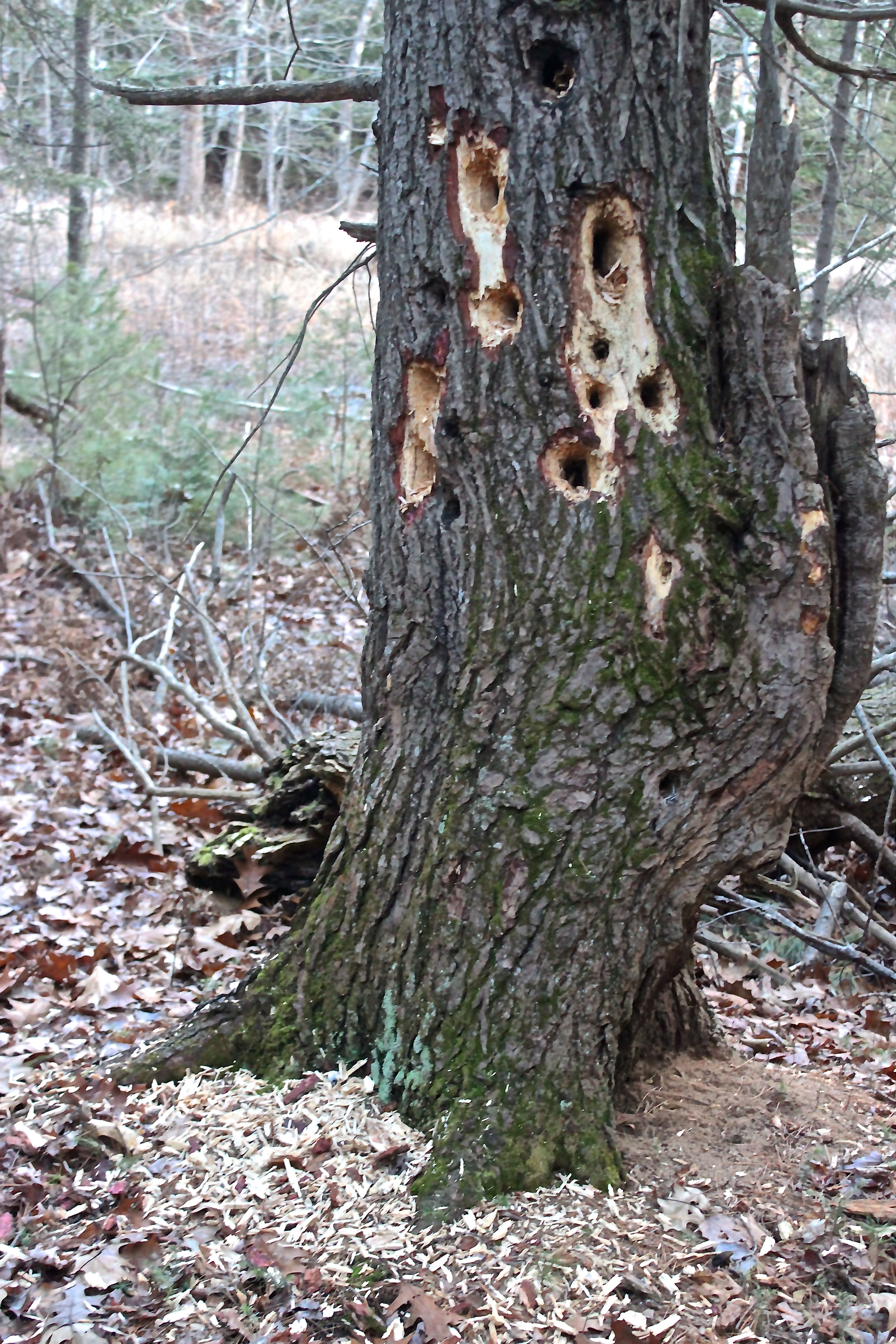
A third snag is an old favorite for pileated woodpeckers and me. I can see by the light color that it’s been visited within the last week.

pile, 3

Fresh holes, fresh chips and fresh saw dust.

pile scat

Of course, the crème de la crème–pileated woodpecker scat filled with carpenter ant carcasses.

 hemlock inner bark

hemlock 2

In the midst of it all, the inner bark of the hemlock tree decked out in its characteristic bright cinnamon red color reminiscent of the varnish shelf that grows on this species.

false tinder conk on red mapletinder conk

A false tinder conk and a tinder conk, both looking a bit like a horse’s hoof, appear ready to gallop away.

jelly ear 2

The jelly ear fungus listens attentively to all who choose to share their thoughts.

cache

And finally, a cache on an old stump let’s me know that winter is drawing near.

At day’s end, I’m ready for the next season, confident in the knowledge that everything old will be new again.

Sunday Surprises

As I headed into my smiling place today, I was certain that I wouldn’t find anything of interest. But this Sunday wander made me realize that the gift of wondering means being open to surprises.

I began my traipse following one of the more recent logging trails where sliding over slash is the name of the game.

slash

I can’t wait for three feet of snow to make this an easier adventure. In the meantime, I made do.

sinking

Some moments I did think I was sinking to China–where my friend Judy Lynne would have to be on the lookout for me.

cinnabar 2

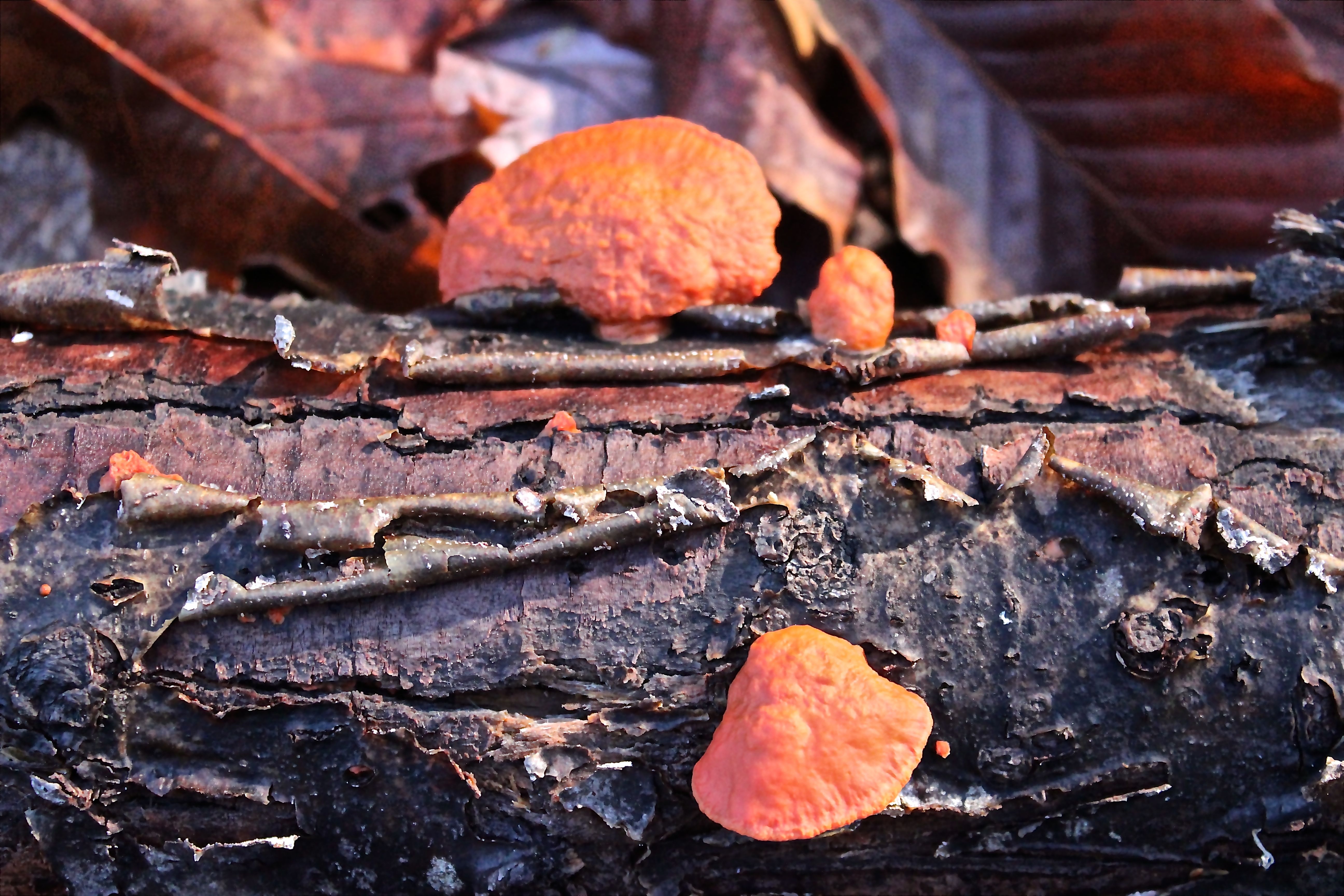
And then pumpkin orange polypores called out, proving slash is good for something. Cinnabar-red Polypore (Pycnoporus cinnabarinus) I do believe. It pays to have Fascinating Fungi by Lawrence Millman in my pack.

cinnabar 3

As is its habit, it was growing on a downed cherry log. I picked one fruit to show the pore surface beside the cap. Millman describes it this way: “Caps are kidney-shaped orange to dull reddish-orange, azonate and covered with warts and wrinkles in age. The pore surface, in the words of mycologist Gary Lincoff, ‘looks as if it had been seared by a hot iron.’ The pores themselves are usually more angular than round.” I had to look up azonate when I got home: without zones or circular bands.

cinnamon 2

Cinnamon fern grew abundantly in this boggy land and as usual, I was drawn to the drama it provides in death.

cinnamon fern

Most of the pinnae or leaflets have fallen to the ground, where their curved forms add texture and interest even as they begin to break down and give back.

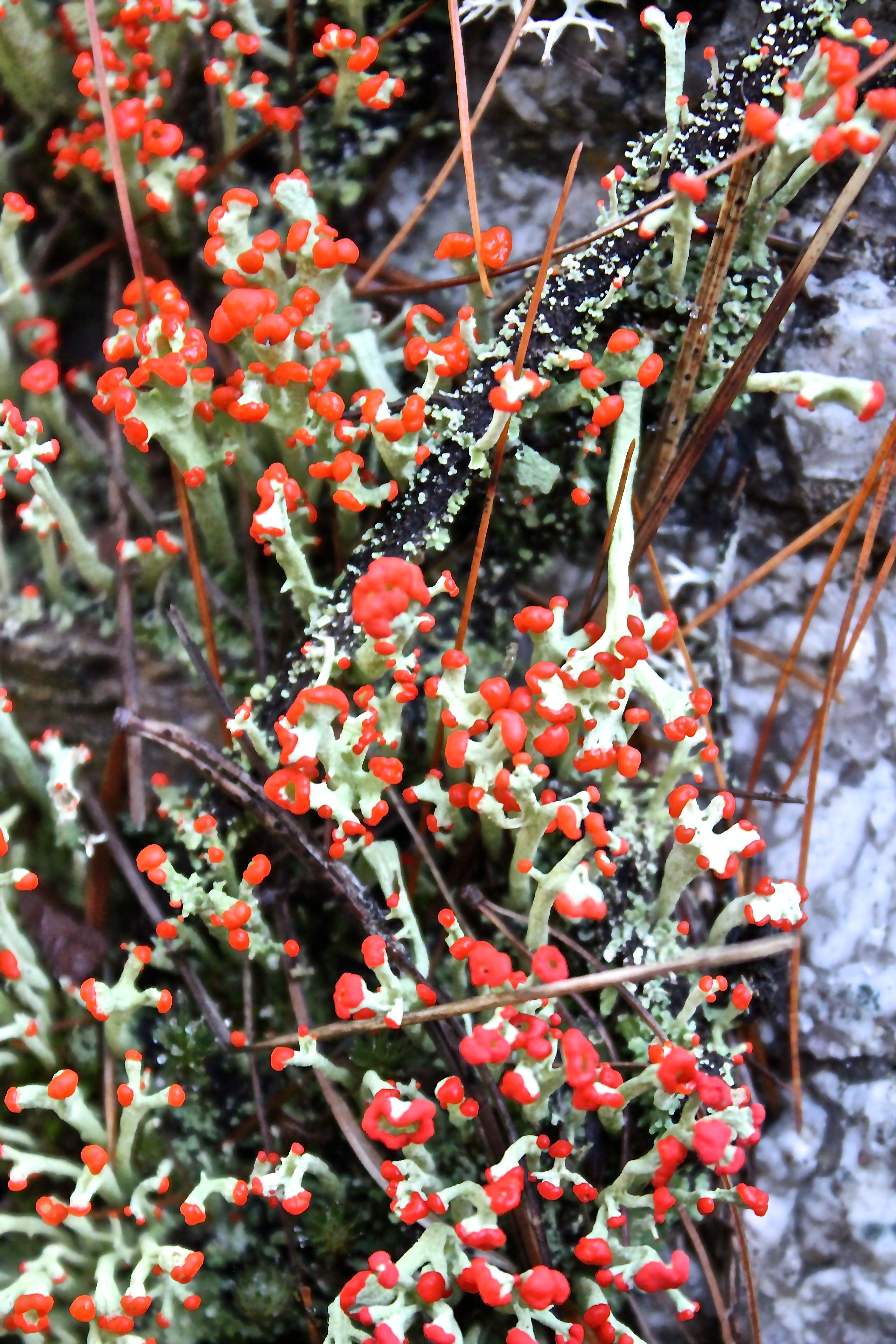
British soldiers

Watching over all–a large colony of British soldiers, their red caps ever so bright in this miniature world.

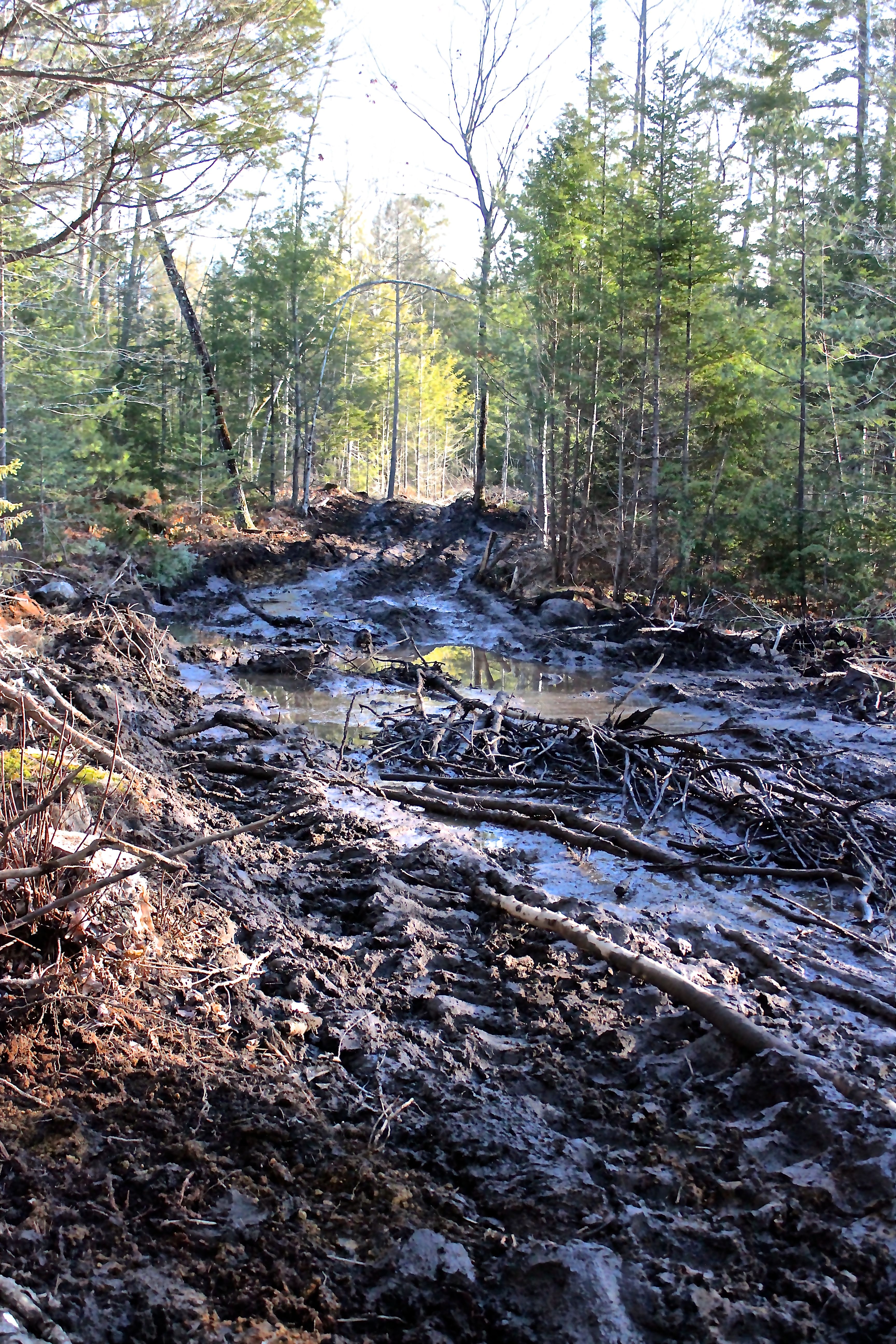
muddy logging road

I reached the main logging road at last. A few weeks ago I thought that the logger had finished his mission, but apparently not. That’s okay, because after I found a bunch of bobcat, coyote and deer prints, I headed back into the woods leaving the muck behind.

pine needles 1

Bunches of white pine needles adorn many of the young hemlock trees–all in keeping with the season.

haircap geometry

And the hair cap moss speaks of starry, starry nights and geometric designs.

pigskin poison puffball

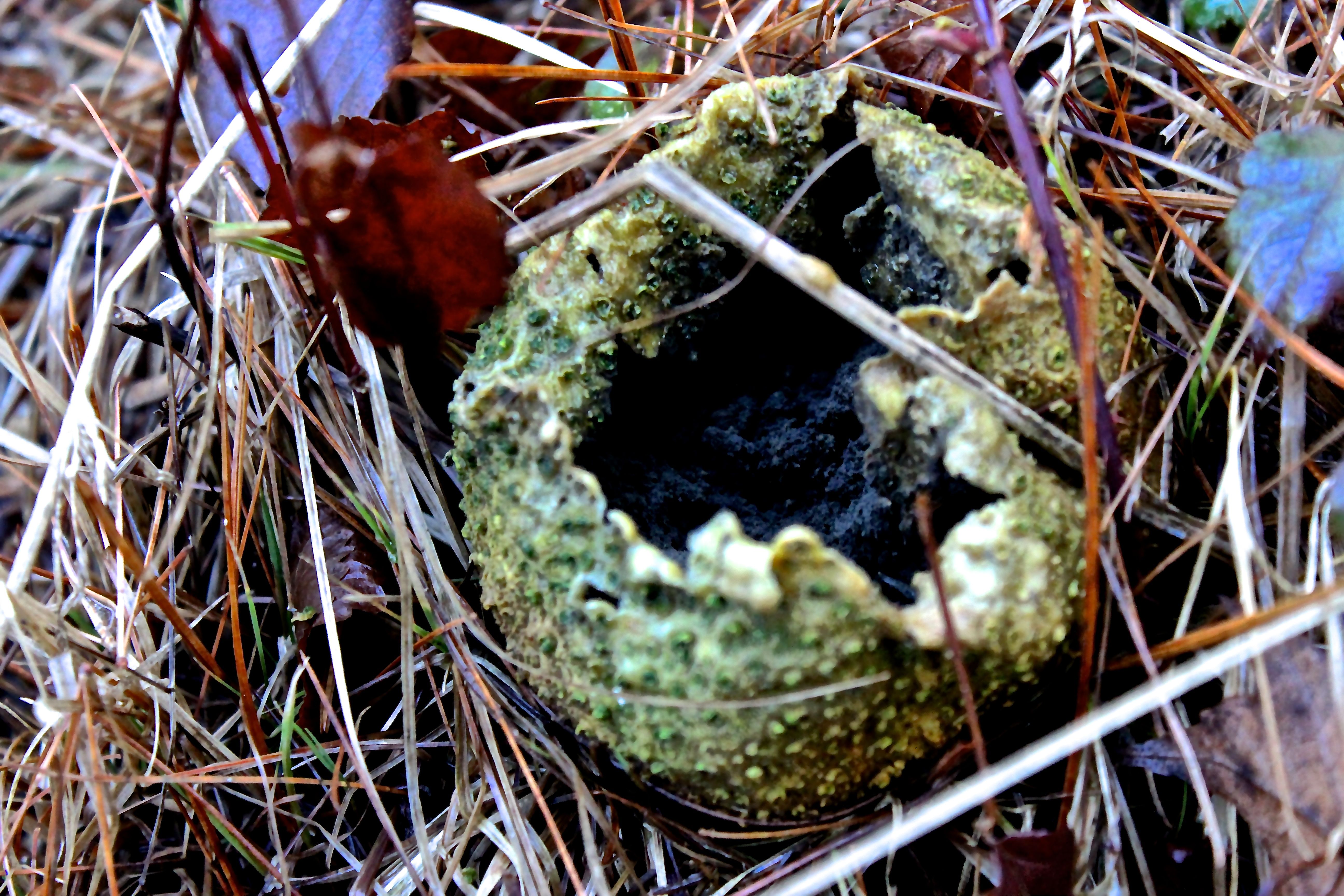
But my best find of all was a total surprise. In fact, I didn’t think it was natural at first. An old baseball or tennis ball that somehow landed in this place where few venture? I touched it and it felt almost leathery. Inside, the duff was powdery. Time to turn to Millman again. I think my ID is correct: Pigskin Poison Puffball aka Earthball (Scleroderma citrinum). WOW! Look at that warty surface. And it was huge compared to other puffballs. My heart was singing. (Fortunately I kept the song in my heart though I was in a place where no one would have heard me!)

wintergreen veil

Eventually I made my way back to the snowmobile trail where I continued to wander for a while. Wintergreen is the plant of choice for this stump garden.

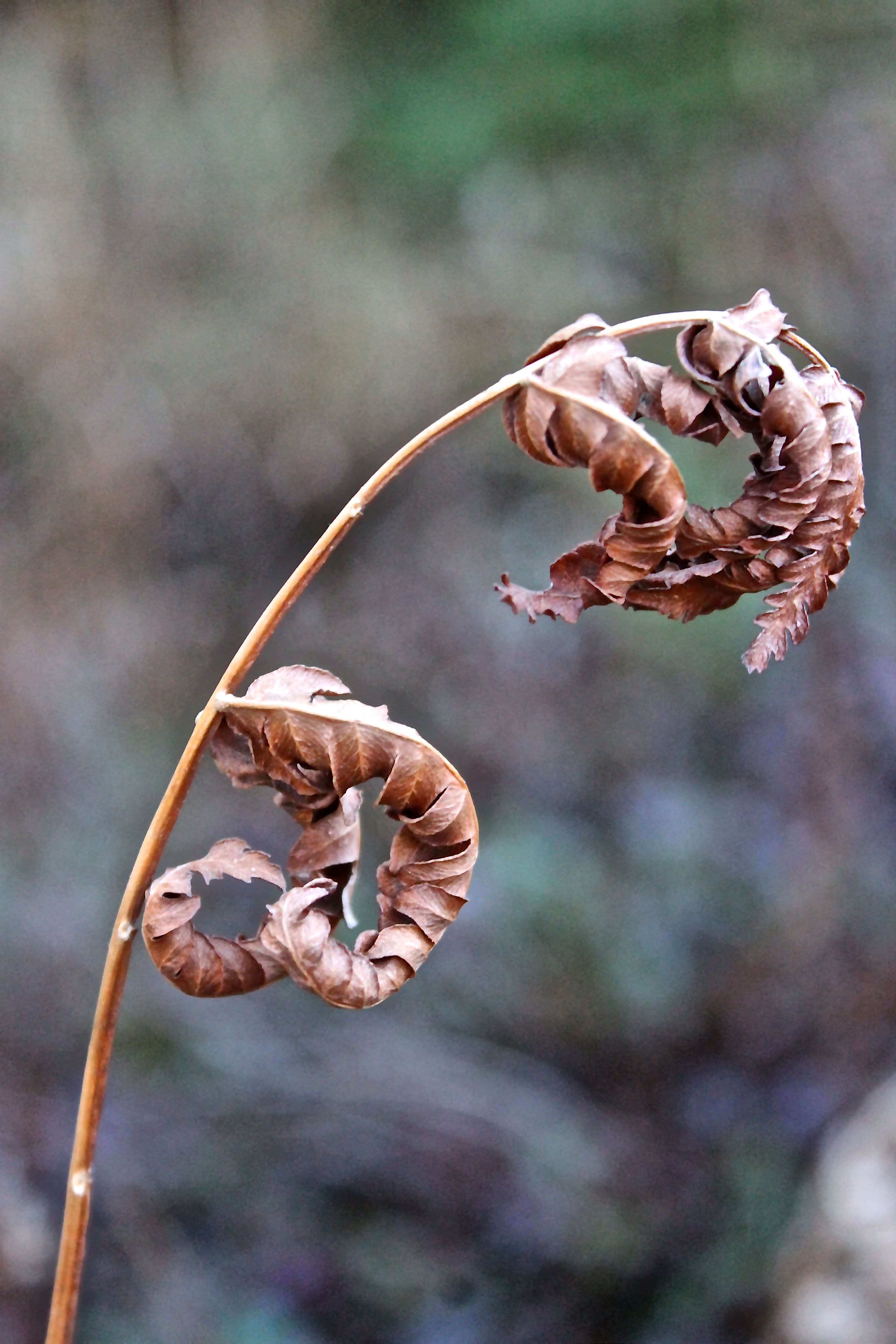
bronze bracken fern

Bracken ferns have turned from green to a light bronze patina. Most have fallen or been knocked over. This one especially appealed to me because it has retained its structure and even portrayed an uplifting spirit.

the ice princess

The past few days have been delightfully, though unusually, warm, but I found some ice. And even an ice ghost.

witch's 2

From ghosts to witches–in the woods, I never know who I’ll happen upon. Witch’s Butter (Tremella mesenterica) is another that stands out amongst the grays and browns of the December landscape.

colors 2

Not all is gray and brown. As I wait for snow, the colors of the season remind me that without its covering, there’s much to enjoy.

grassy trail

droplets on grass

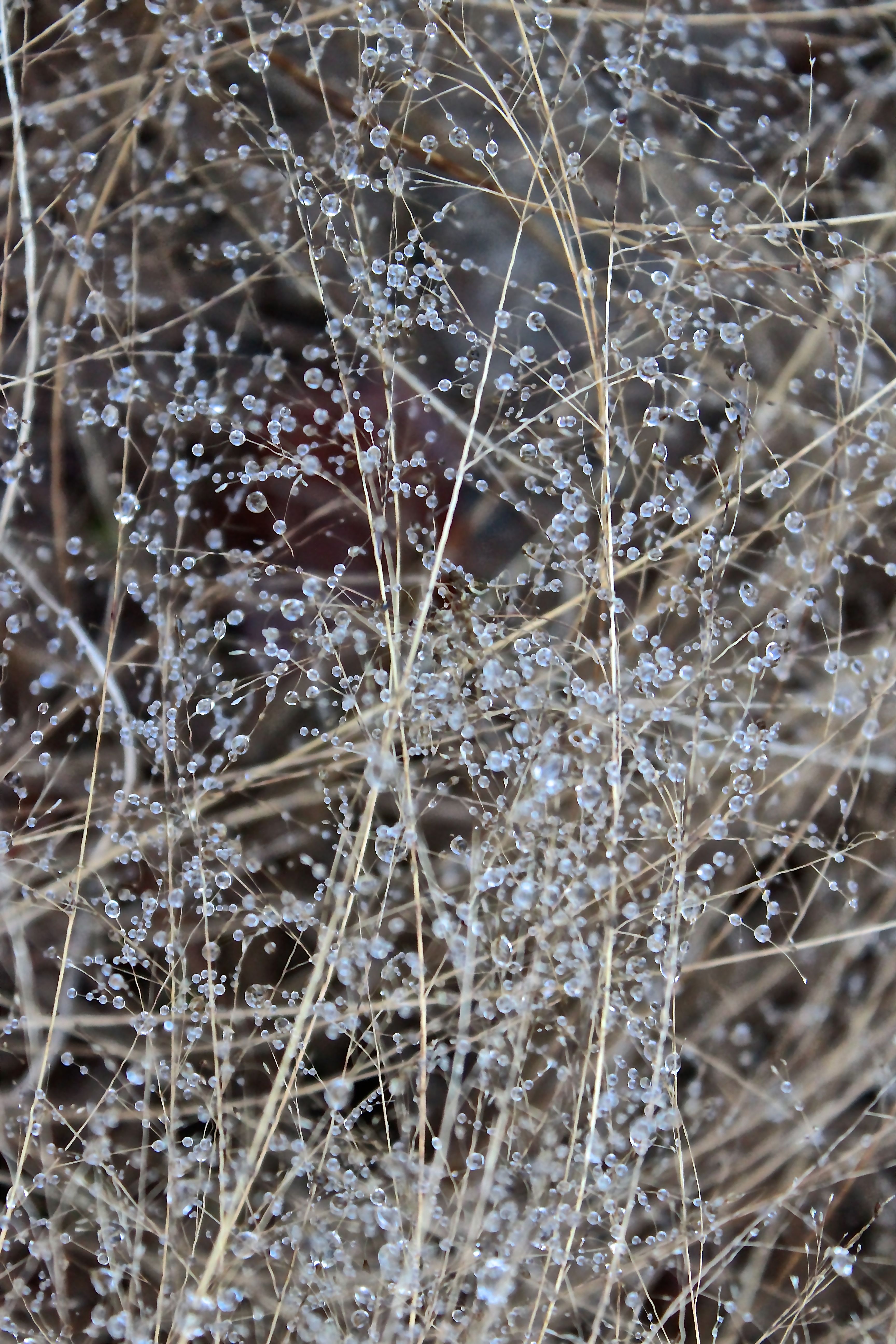
I was about to head down the grassy path that leads to our cowpath, when two things gave me pause. First, the droplets of water that adorned the grass.

meadowsweet gall

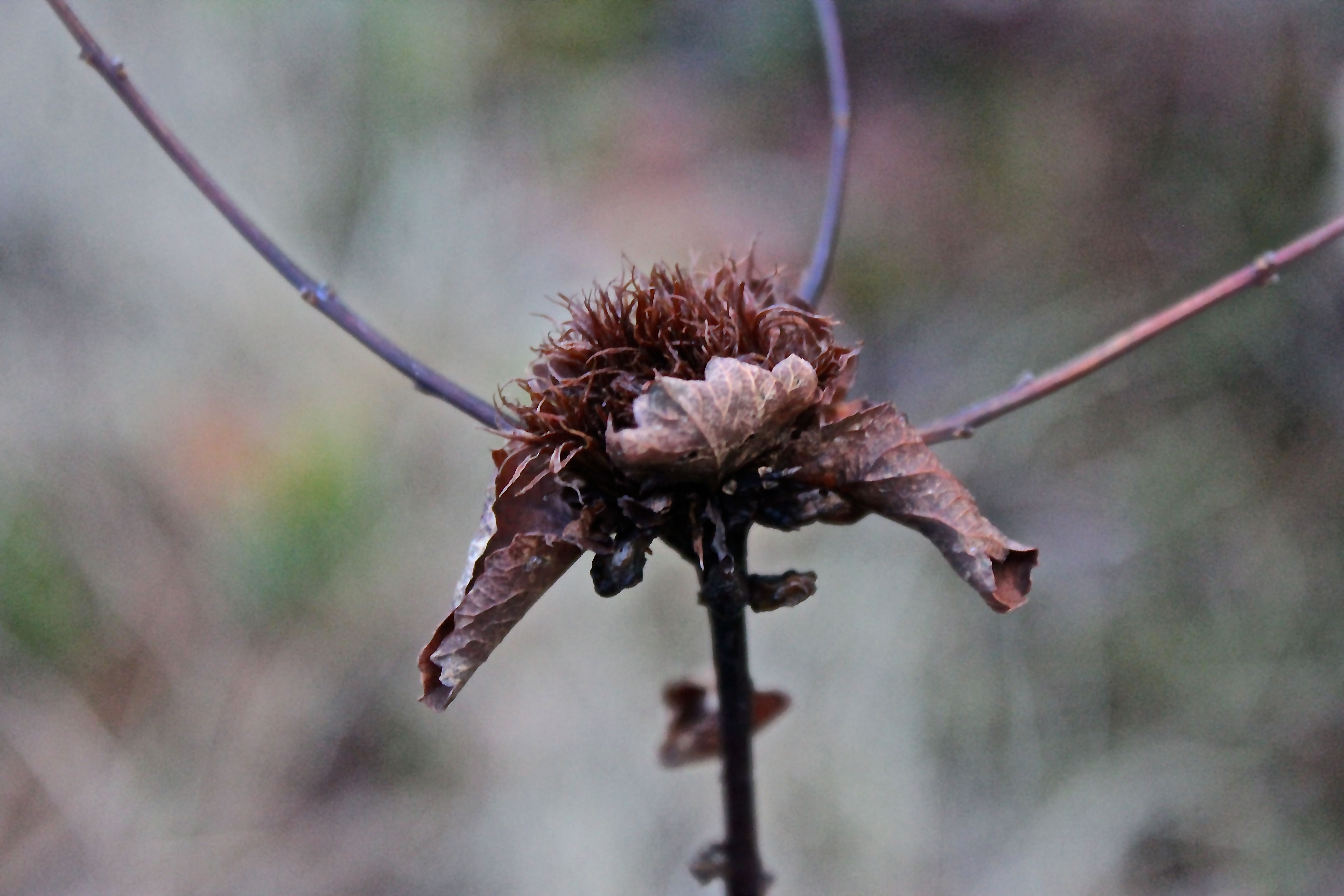
And second–this gall on a meadowsweet plant. I’ve passed it numerous times and decided today was the day to try to figure it out. If my guess is wrong, please feel free to correct me. I think this is rose bedeguar gall, aka Robin’s pincushion gall. Meadowsweet is a member of the rose family, so maybe I’m right. Then again . . .

sheep laurel fruit

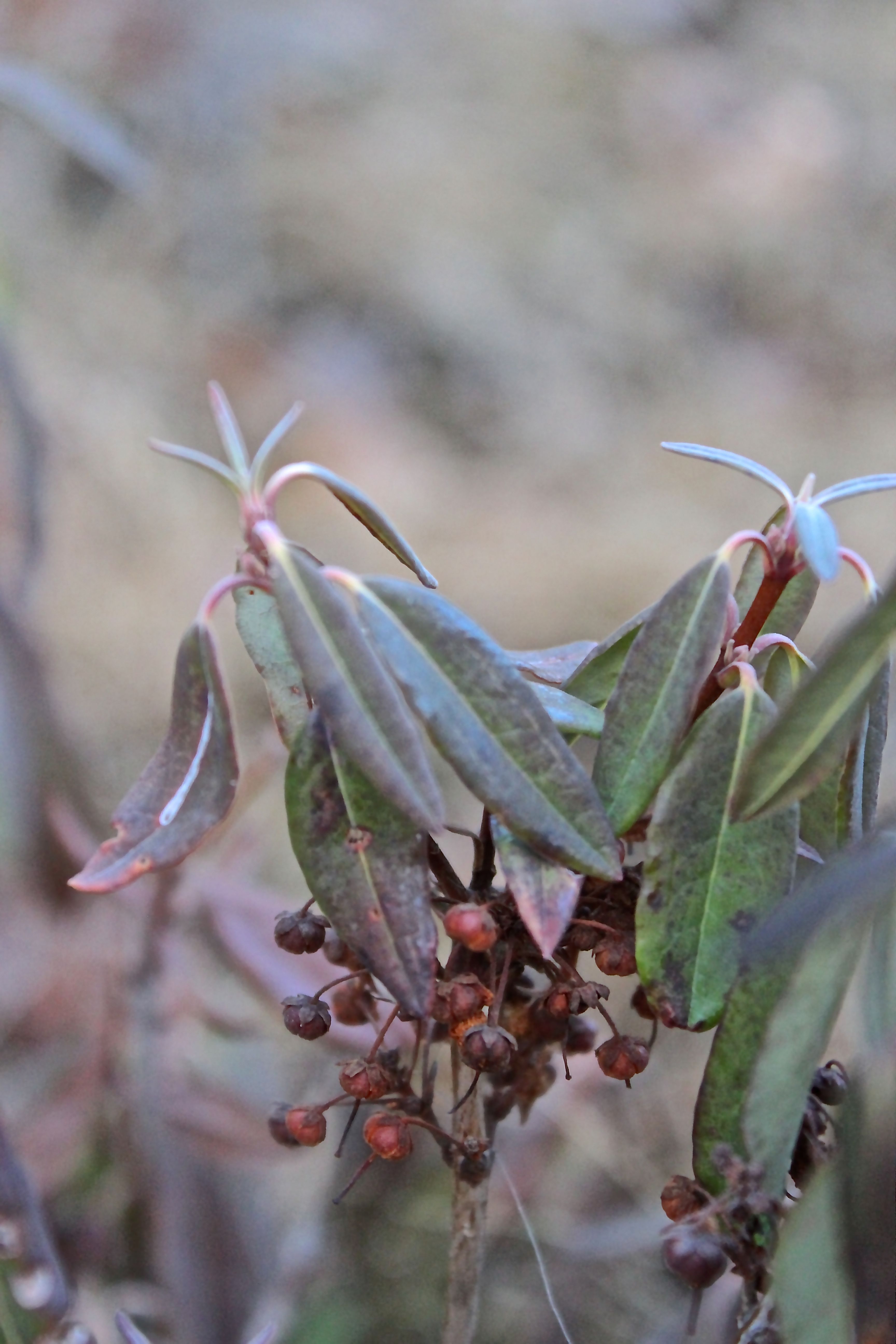
One last find that I always enjoy looking at–the fruits of sheep laurel extending  below the leaves and reminding me of jingle bells.

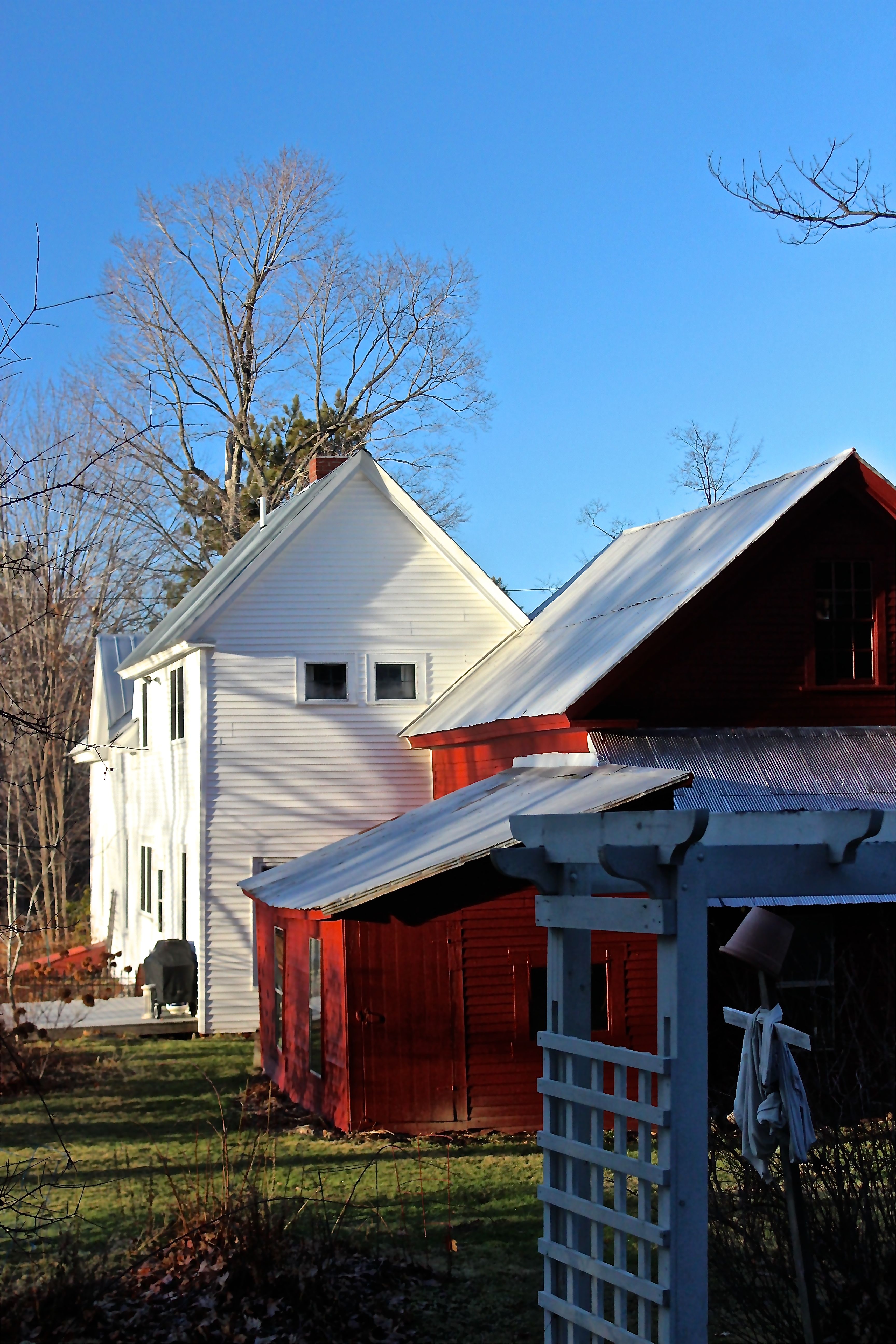
home

At last I was home again, thankful for a Sunday wander wonder-filled with surprises.

Peeking About Mondate

Our afternoon Mondate found us sneaking to the peak–Peaked Mountain in North Conway, New Hampshire. While it’s not the most challenging hike ’round these parts, it offers great views.

sign

The trail is located in The Nature Conservancy’s Green Hills Preserve. It’s a great place to snowshoe, but today that wasn’t an option.

up the ravine

We chose the counter-clockwise route–hiking up through the ravine between Peaked and Middle Mountains.

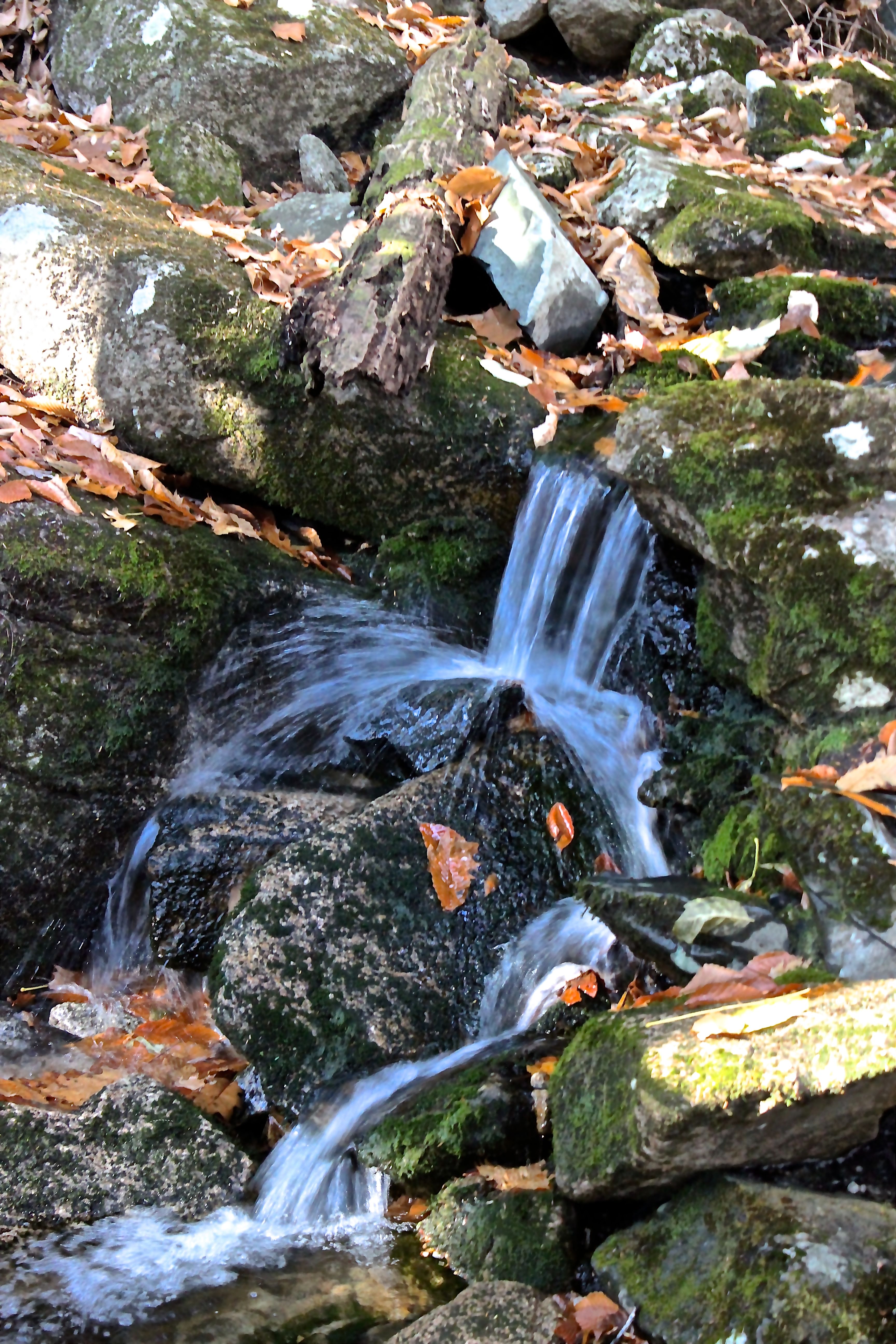
mountain stream

Though it was a constant companion, we couldn’t always see the water rushing downhill, but occasionally we were able to take a peek.

peek peaked

And through the trees we had another sneak peek–that of the summit of Peaked Mountain. Not far from here, we left the mountain stream behind and starting climbing the connector trail toward our destination.

roots

Our discussion centered on roots–our family tree roots and how we can continue to fill in the blanks.

white pine needles

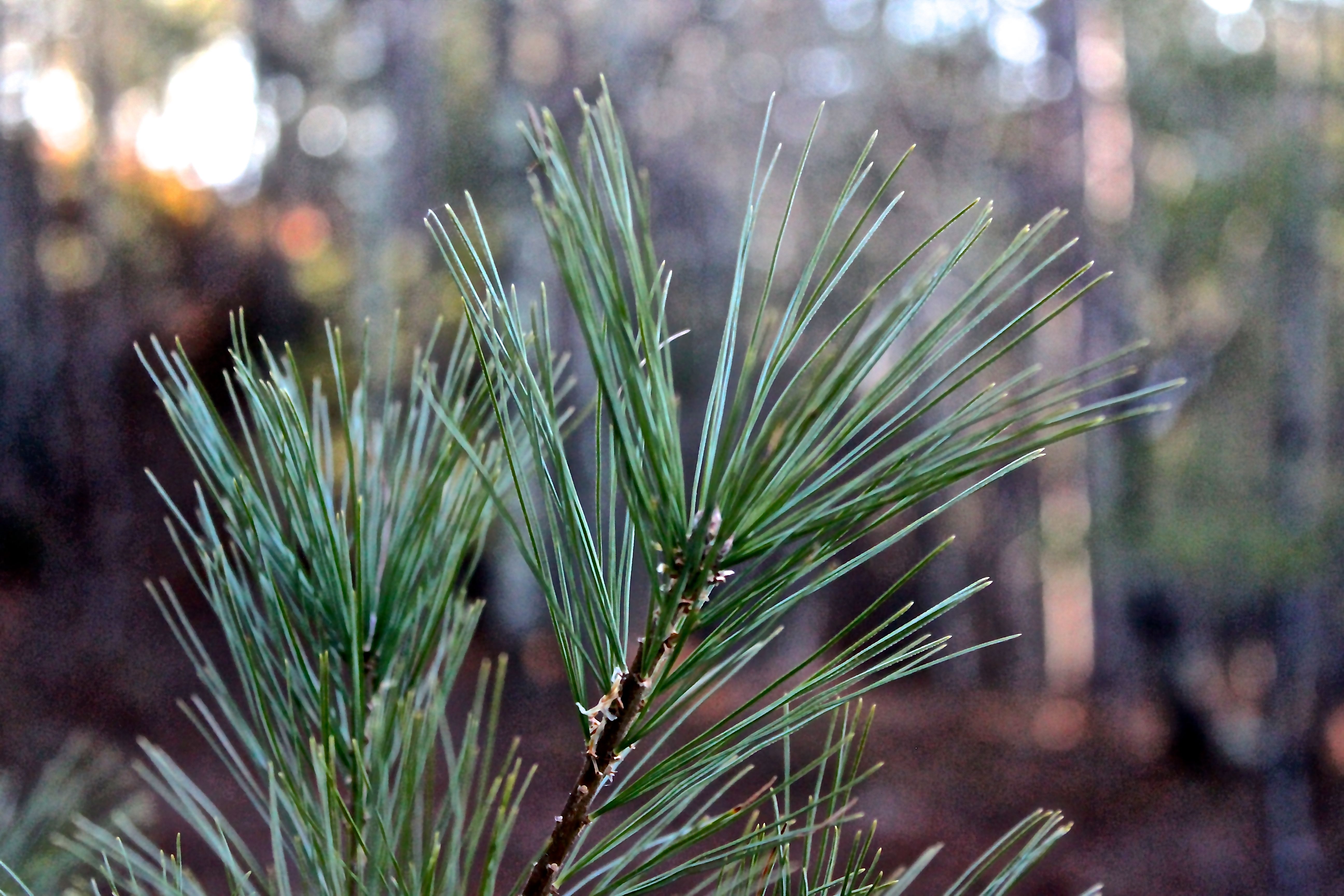
As we got closer to the summit, I realized we were among another family–the  Pinaceae or pine family. White pine, with its five flexible needles in each bundle, grows just below the summit.

red needles 2

At the top, the red pine and pitch pine grow side by side. Their bark is similar in appearance, but the needles and cones make their ID easier. Red pine features two long, stiff needles in a bundle.

pitch pine needles

Pitch pine, on the other hand, has three in a bundle and they’re about half the length of red pine needles. As one friend says, “One, two, three strikes you’re out–pitch pine.” I’m a firm believer in mnemonics.

Then there are the cones.

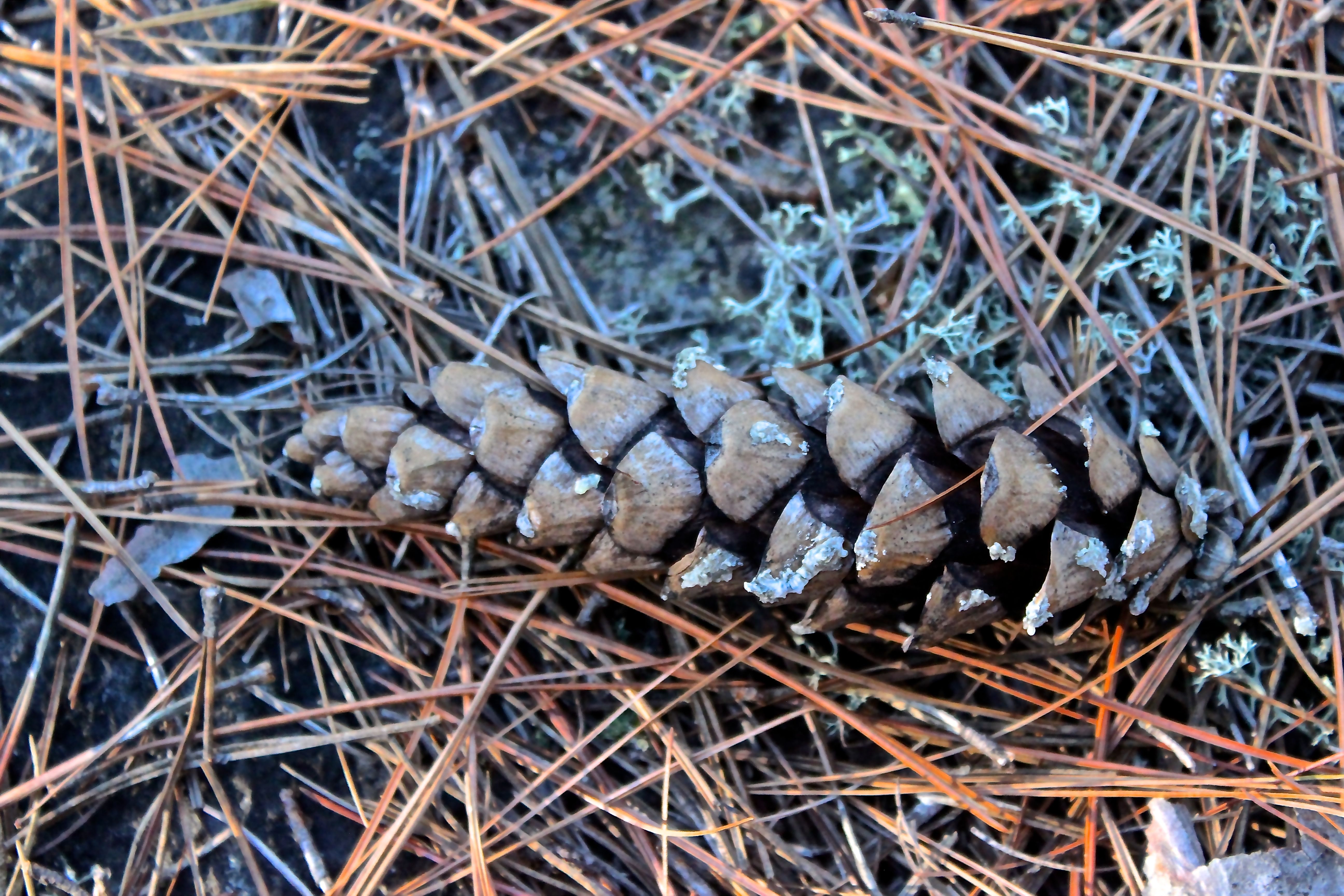
white pine cone

White pine cones are long and narrow. 4-8″

red pine cone

Red pine cones are ball-like in shape and almost stalkless. 1.5-2.5″

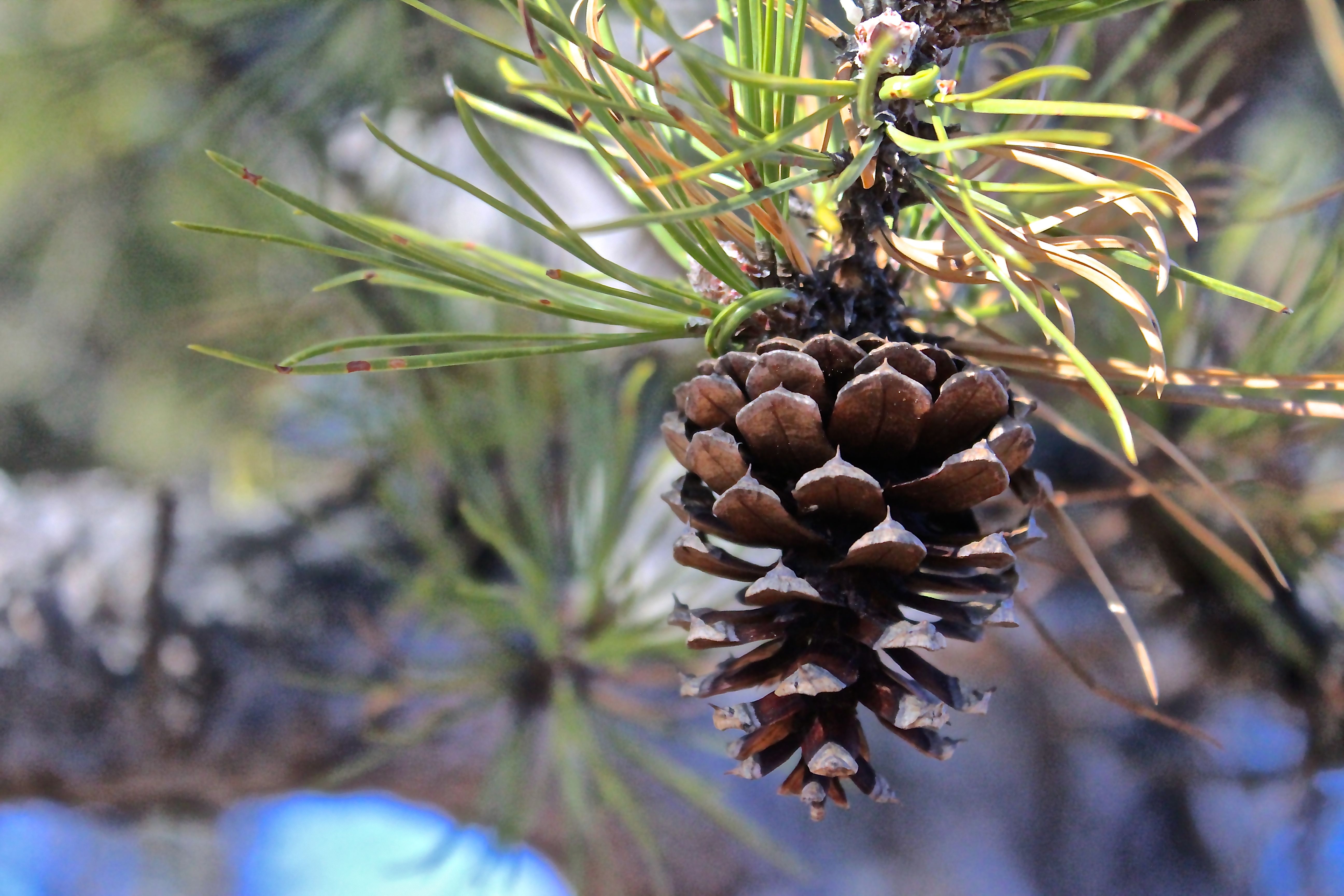
pitch pine 2

Pitch pine cones feature a short, stout prickle on each scale. 2-4″

I never thought about this before, but today it struck me that the whites, with their short needles, have the longest cones, while the reds, with their long needles, have short cones. Why?

A few cool things to note about pitch pine–because of its high resin content, Colonists used it for turpentine and tar to grease wheel axles; and pitch pine is fire resistant, meaning following a fire, new needles are produced on new branches from suppressed buds; also, it will stump sprout after a fire.

lunch rock

We found lunch rock and enjoyed our usual PB&J. Today’s jam was prepared by our friend, Pammie. Spiced peach. Delish.

Middle Mountain

Before us stood Middle Mountain. Though we’ve hiked Peaked a few times before, as well at Black Cap behind it, we’ve never actually reached the summit of Middle. One of these Mondates.

Mount Wash valley

The sun reflected off the roofs of the outlets in North Conway. We were much happier looking down on them, than being down there looking up.

Pudding Pond

Pudding Pond and the Moats add to the view.

Kearsarge

And behind us–another favorite peak: Kearsarge North behind Cranmore Mountain Ski Resort.

ice

The route down put us on the shaded side of the mountain, where ice coated the rocks.

cranmore 1

Cranmore featured top to bottom skiing this past weekend, but really, we need snow. And cold temperatures.

Peek a the great peak, Mt Wash

Even Mount Washington looks like it needs a fresh coating of the white stuff.

frost

We did find some leaves decked out with frost.

scruffing along

While my guy followed me up the trail, I followed him down. He scruffed along, not letting the leaves, rocks and roots bother him. I, meanwhile, took my time, overthinking each placement of my feet. After a few falls last month, each step has become a feat.

waiting patiently

He provided guidance over icy sections and occasionally waited patiently for me to catch up, never once commenting on my caution. I appreciate that.

And I appreciate that we shared a variety of peeks as we conquered the peak. Peaked Mountain Mondate.

Nature’s Never Static

Mid-morning found me slipping into my smiling place where I decided to follow a route I usually save for snowshoe season.

slipping into the woods

I know it will come eventually, but the realization that we can’t predict when the first snowstorm will arrive or how much snow we’ll get over the course of the year reminded me that nature is never static.

trail boggy

I, for one, am looking forward to snow and hoping for lots of it because it will be so much easier to make my way through this boggy area.

creeping snowberry

In the meantime, I focused my attention on the ground–checking each step as I went. It’s easy to get caught on the slash the logger left behind. And when I looked down, I noticed things I don’t get to see once the white stuff falls, like the creeping snowberry that grows abundantly here.

hawk 1

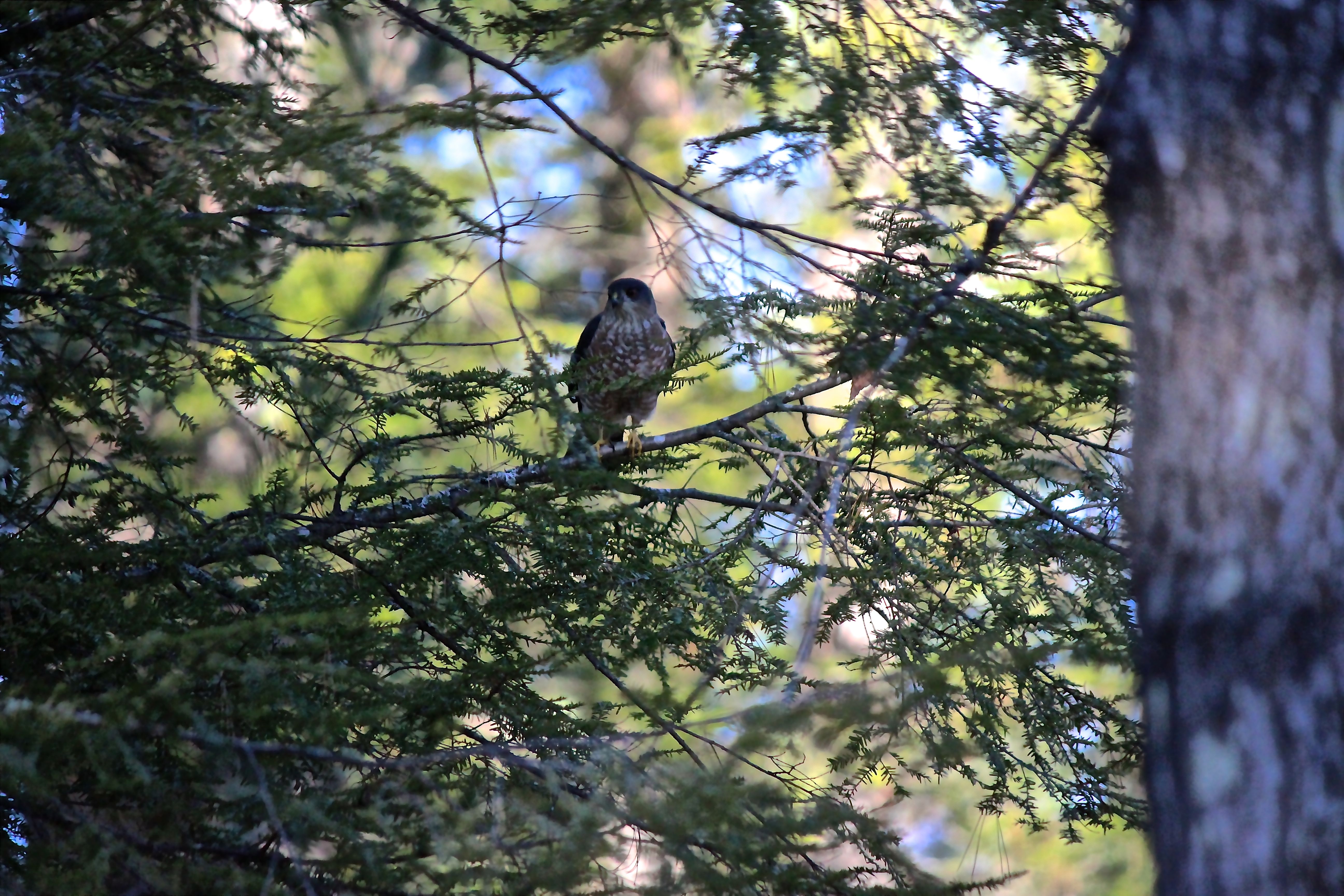
Pausing frequently to look around, I suddenly noticed I had company.

hawk 2

The curious thing–this sharp-shinned hawk slowly made its way east, while further down the trail

bird flock 2

a flock of birds chitted and chatted as they moved among the tree tops.

chickadee

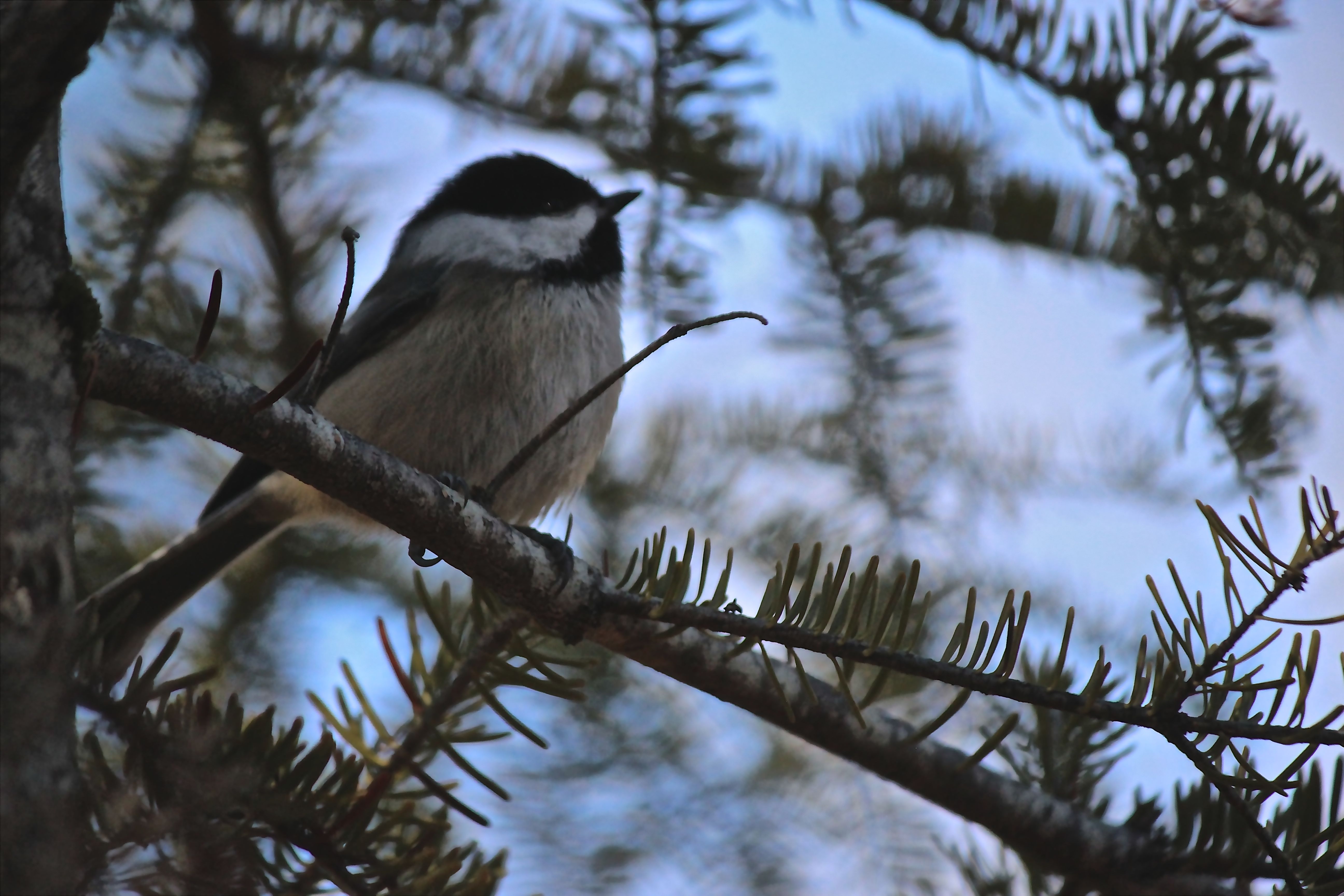
An ever curious chickadee landed nearby to check me out. And visa versa.

goldfinch

A goldfinch sporting its winter coloration also paused to peek. Lucky for all of them, the hawk was headed away rather than closer. Maybe it had already feasted.

mud

Eventually I found mud. I LOVE mud. With each step it squelches and squerches as it sucks my boots in and I pull them out. (And takes me back to Clinton Harbor at low tide, where my father always insisted that people paid millions of dollars to sink their feet in mud.)

my tracks

The beauty of mud here in western Maine is that prints are well defined and easily identified–homo sapien, female, average height and weight, just over middle age, blue eyes–wait a second. I wish I could read that much information in the prints I find, but I’m satisfied to be able to identify the animal to species.

coyote 2

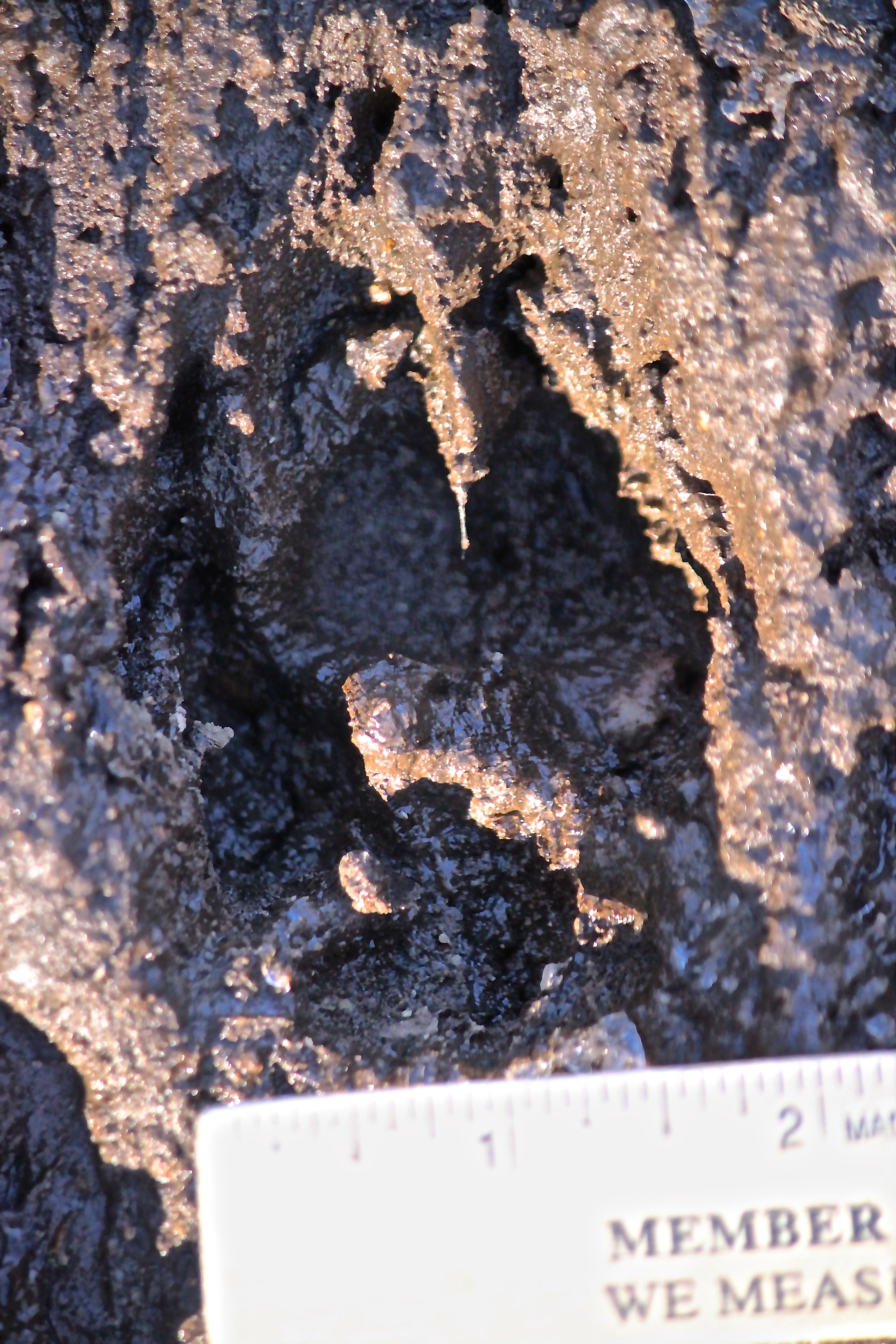
Reaching into my pocket, I discovered I had my trusty six-inch ruler–left there since early spring. It helps to give perspective of a print–in this case a coyote. Middle toes parallel, nails leaning inward, 2 inches across, x-shaped ridge between toes and heel pad.

coyote and bobcat

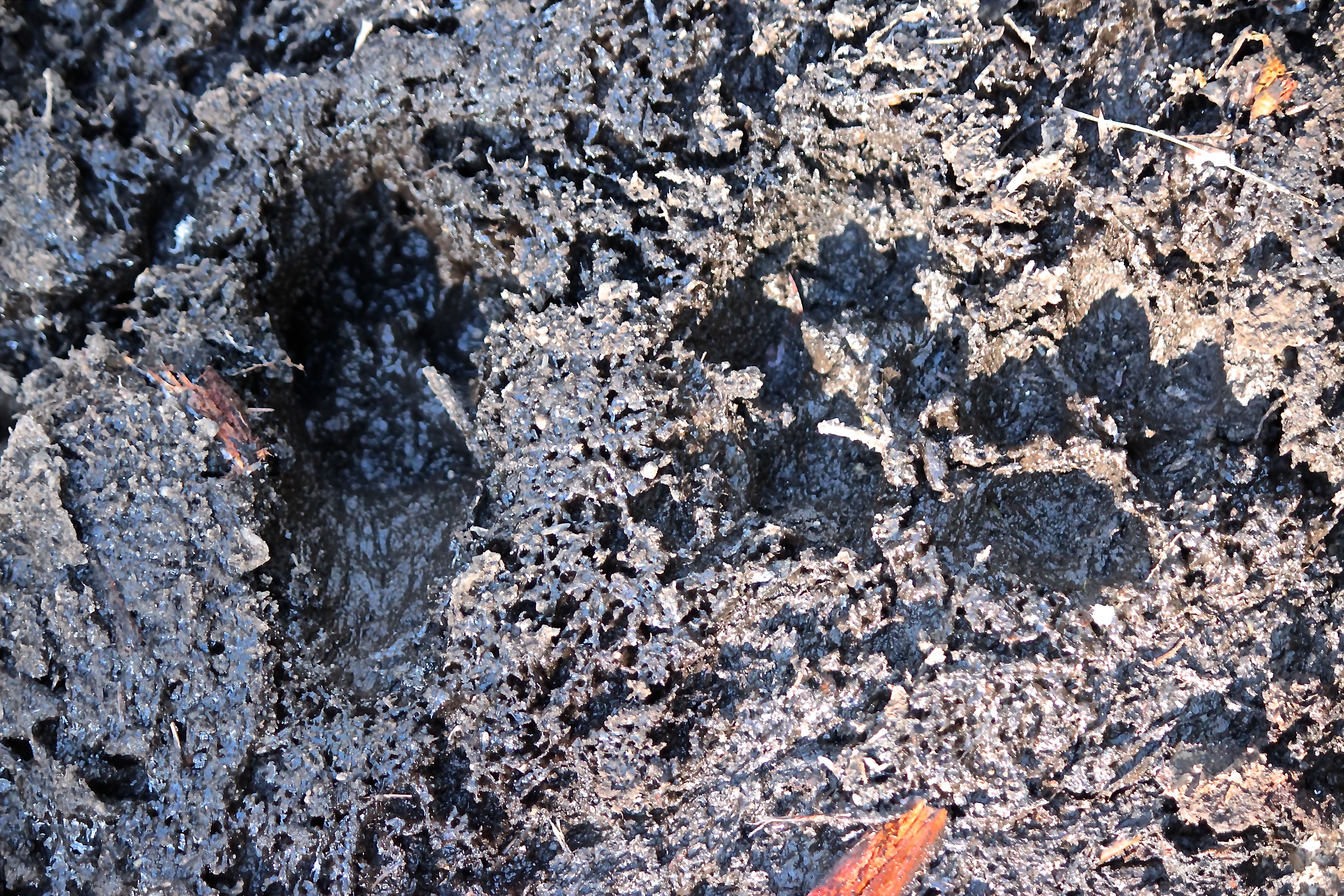
I love it when nature happens side-by-side. Coyote on the left and bobcat on the right. The coyote had passed this way more recently, when the ground was softer and moved through quickly as evidenced by the slide into position. The classic C of the bobcat’s ridge between toes and pad is clearly visible.

 moose 2 directions

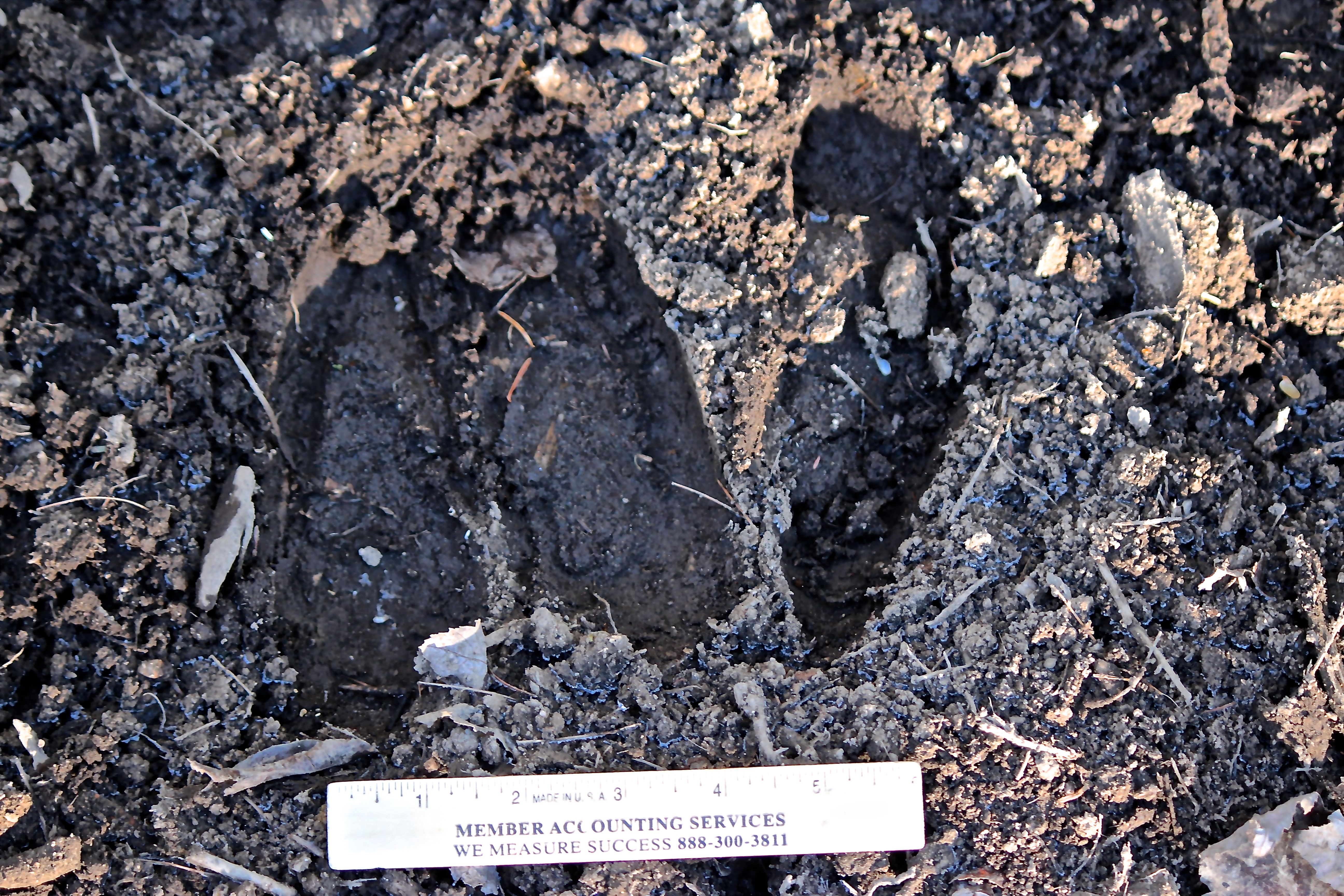
Moose frequent the area and I’m not sure if this is the same one passing to and fro or two different moose. It’s obvious that the first print was made as the animal moved in the direction of the ruler and the second shows the moose moving away.

deer, direction change 1

And then there was the deer that decided to change directions. Did it hear the mighty hunter coming along? Or another predator? Maybe me, though I suspect these prints were fresh last night and not this morning.

ice-mud

The other thing about mud–combined with ice it becomes nature’s artwork.

ice ground 2

Sometimes it sits upon icy pedestals begging to be noticed.

ice puddle abstract art

And ice itself is ever forming, ever changing. That’s the thing about nature. It isn’t static. Nor am I. Growing. Evolving. Seeking. And thankful for the opportunity.


Mountain Moments

I took to The Mountain today, as we fondly refer to Pleasant Mountain ’round these parts, in search of what it might teach me.

It was chilly as I started up the Bald Peak Trail. Beside the stream, I thought about its life-giving capacity.

mountain stream

 tear-shaped droplet

It wasn’t only the stream that was wet. The leaves were covered in droplets that acted as a hand lens–offering a closer look at the structure.

Sue's sign

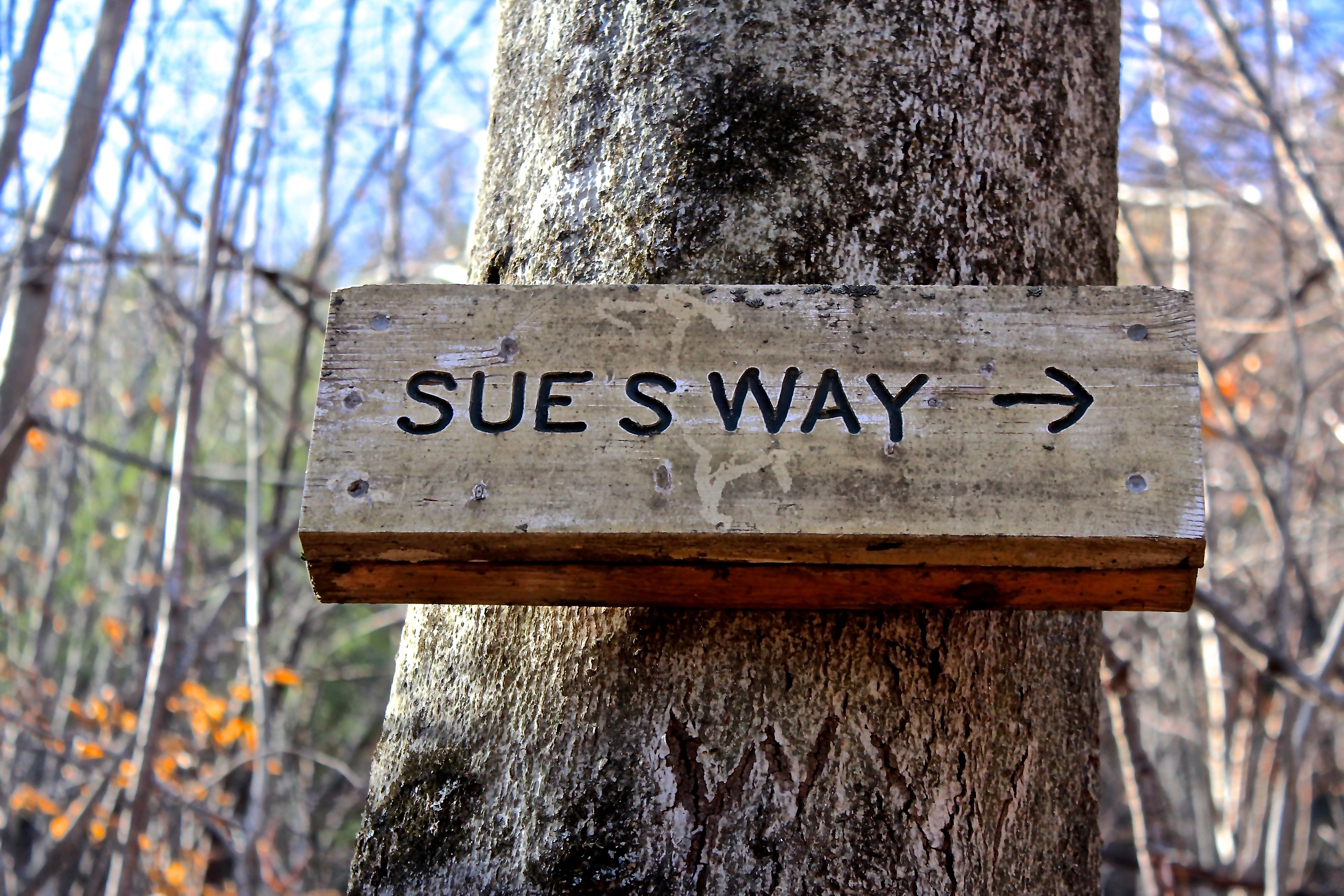
Sue’s Way is about .7 up Bald Peak. For all my treks up The Mountain, I’ve never tried her way. I don’t know Sue and had no idea what to expect.
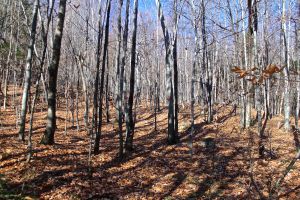
Sue's Way 1

It begins in a beech grove. As I continued, the beech and oak leaves were so thick that I couldn’t identify the trail, and sometimes had to pause and search for the next orange blaze. It slowed me down and made me pay attention.
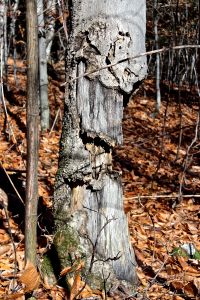
Beech on Sue's 1

Especially to things like this old beech. I knelt beside it, praying the wind wouldn’t decide this was the moment to shout timber, and realized the tree was hollow in the center. Somehow, with a minimum bit of sapwood under what’s left of the outer bark, this fella made enough food to leaf out. To keep on giving even when  times are tough.
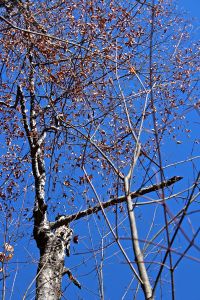
beech on Sue's 2

Its leaves looked a bit worse for wear, but they exist. This beech is. So am I.

Sue's Way 2

The community soon changed and I followed a stream bed where water flowed below the rocks.
evergreen wood fern

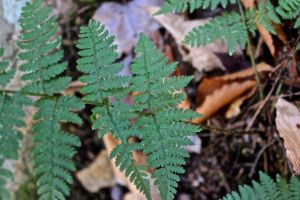
An enchanted valley–I was in the land of the evergreen ferns. Evergreen Wood Fern (Dryopteris intermedia)–first downward pointing pinnule on the lowest pinna is shorter than the pinnule next to it. Huh? In fern terms: a fern frond consists of the blade and stipe or stalk;  a blade is the leafy part of one frond; each blade is divided into separate leaflets or pinna; and the pinna may be divided into smaller leaflets called pinnules.

Evergreen wood fern 2

I didn’t mention the rachis–that’s the stalk within the blade. So take a look at the rachis and the first set of pinnae. The one on the right is a big ragged, but on the left, you should see that the first downward-pointing pinnule is shorter than the second.
marginal wood fern

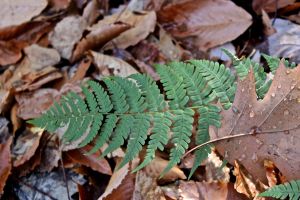
Marginal Wood Fern (Dryopteris marginalis) also flourishes here. Its margins are smooth, where as the Evergreen’s are toothed and have bristle tips.

marginal wood fern 2

I found some that were fertile, with their round sori located near the margin–thus the common name.

evergreen & marginal

In some spots, they grow so close to each other, that they seem to be the same plant. Not so–Evergreen Wood on the left and Marginal Wood on the right. Teachable moment.
polypody

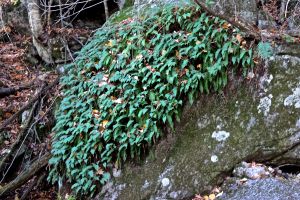
Polypody also grows abundantly, giving the rocks a green head of tussled hair.
 Ski Slope sign

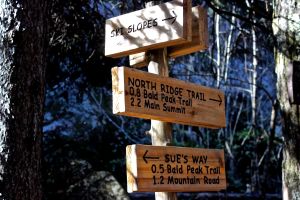
At last I reached the next intersection and took a quick trip out to the Shawnee Peak ski slopes.

lifts 3

It won’t be long. I thought about my guy who raced yesterday in the Moose Pond Half Marathon, a fundraiser that benefits the Shawnee Peak Adaptive Ski Program. I’m so proud of him for finishing the race in 1:56:44, four minutes faster than his time last year, and for placing first in his age group (last year he was second). Not only that, but he raised $550 for the cause.

ice on leaves

Back on the trail, heading along the North Ridge, I realized that the leaves made a louder crackling sound–ice. Winter will come again.
north ridge pines

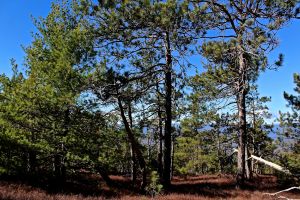
The North Ridge, with its white and red pines towering above and blueberries and sheep laurel below, has always been one of my favorite spots.
speckled alder

gray birch

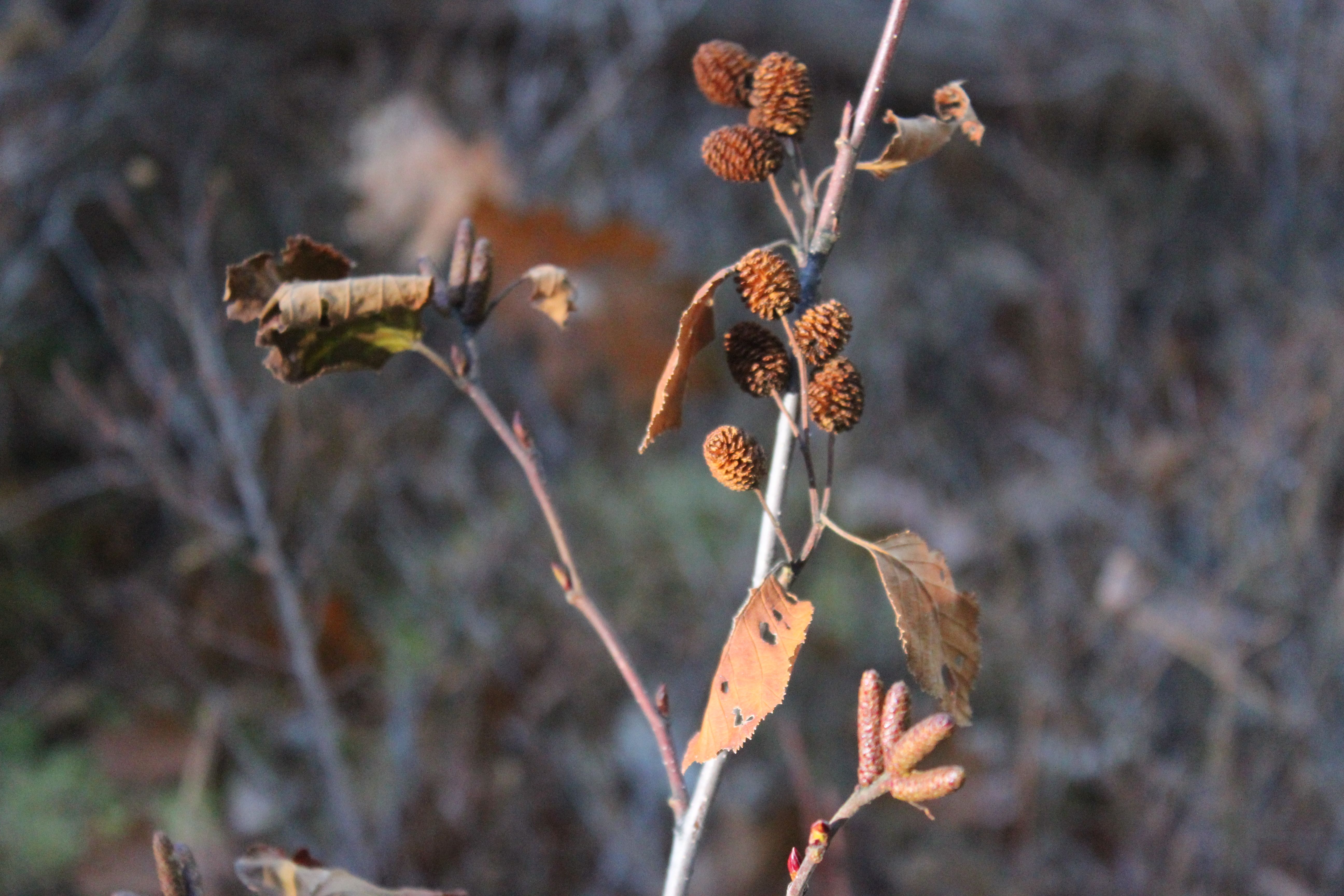
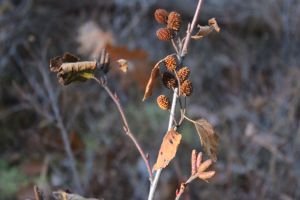
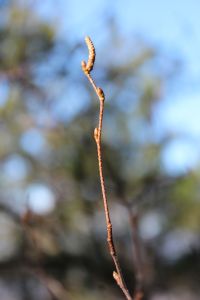
What I didn’t realize is that speckled alders and gray birches also manage to live in this neighborhood.

ridge 2

I was no longer following Sue’s Way, but trust she looped around the North Ridge often. My journey took me in the opposite direction than is my norm at this point, so it was fun to view the mountain ridge and see the fire tower halfway across–my destination.

snow snow 2

Look what I found when I moved onto the Bald Peak Trail to follow the ridge line: SNOW!
looking for a home

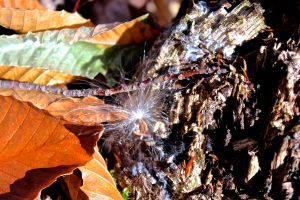
And a parachute that flew in on the breeze. Perhaps this will grow into a healthy milkweed and the monarchs will find it. Hope is eternal.
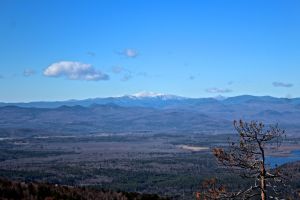
 Mt W 2

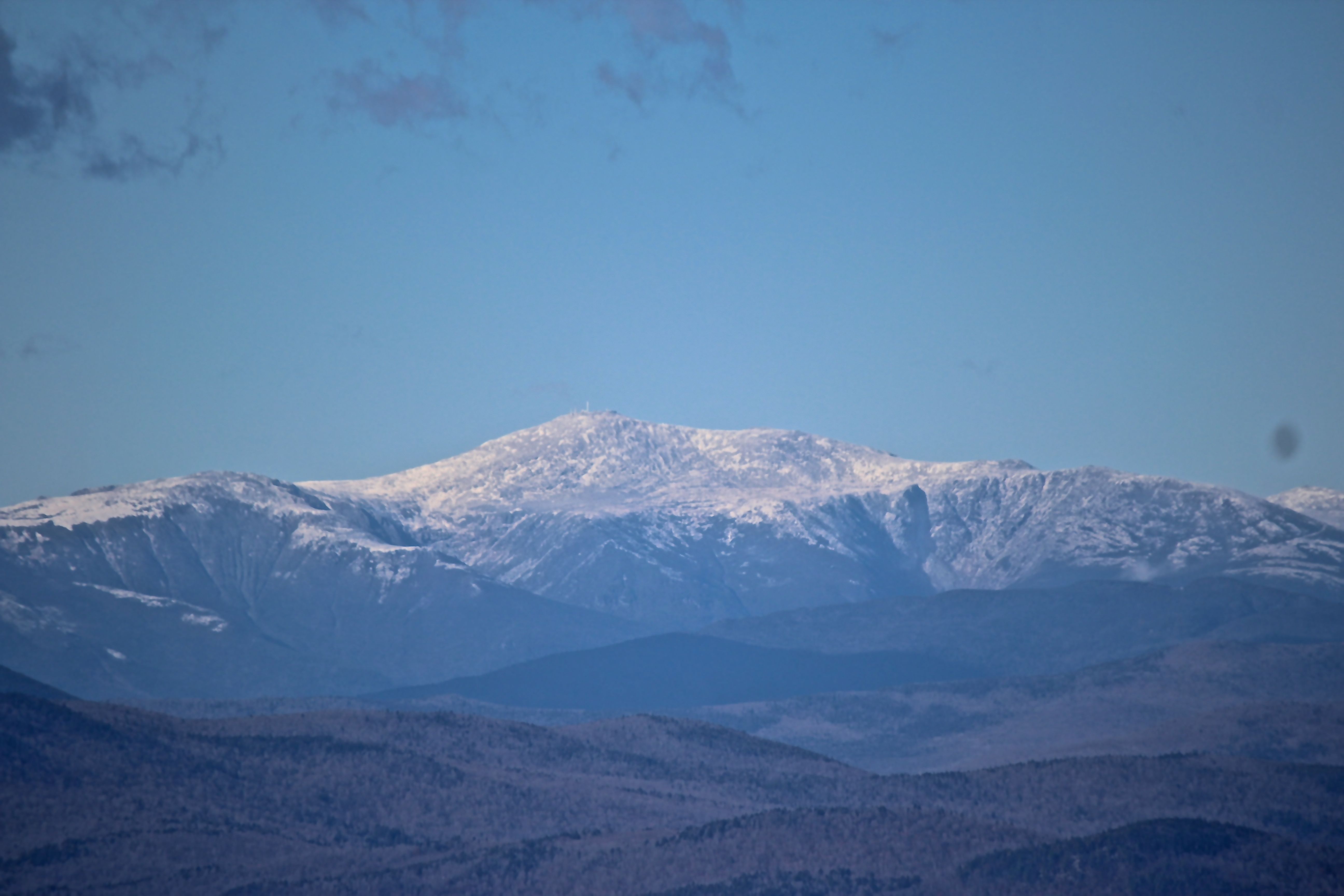
At the summit, I couldn’t have asked for a crisper view of Mount Washington.
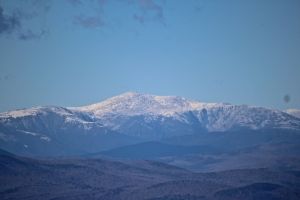
Mt. W 2

Like our mountain, Mount Washington always gives us a sense of location. But it provides more than that. Beauty and splendor. Awe and wonder.

beetle bark tunnels

man tunnels

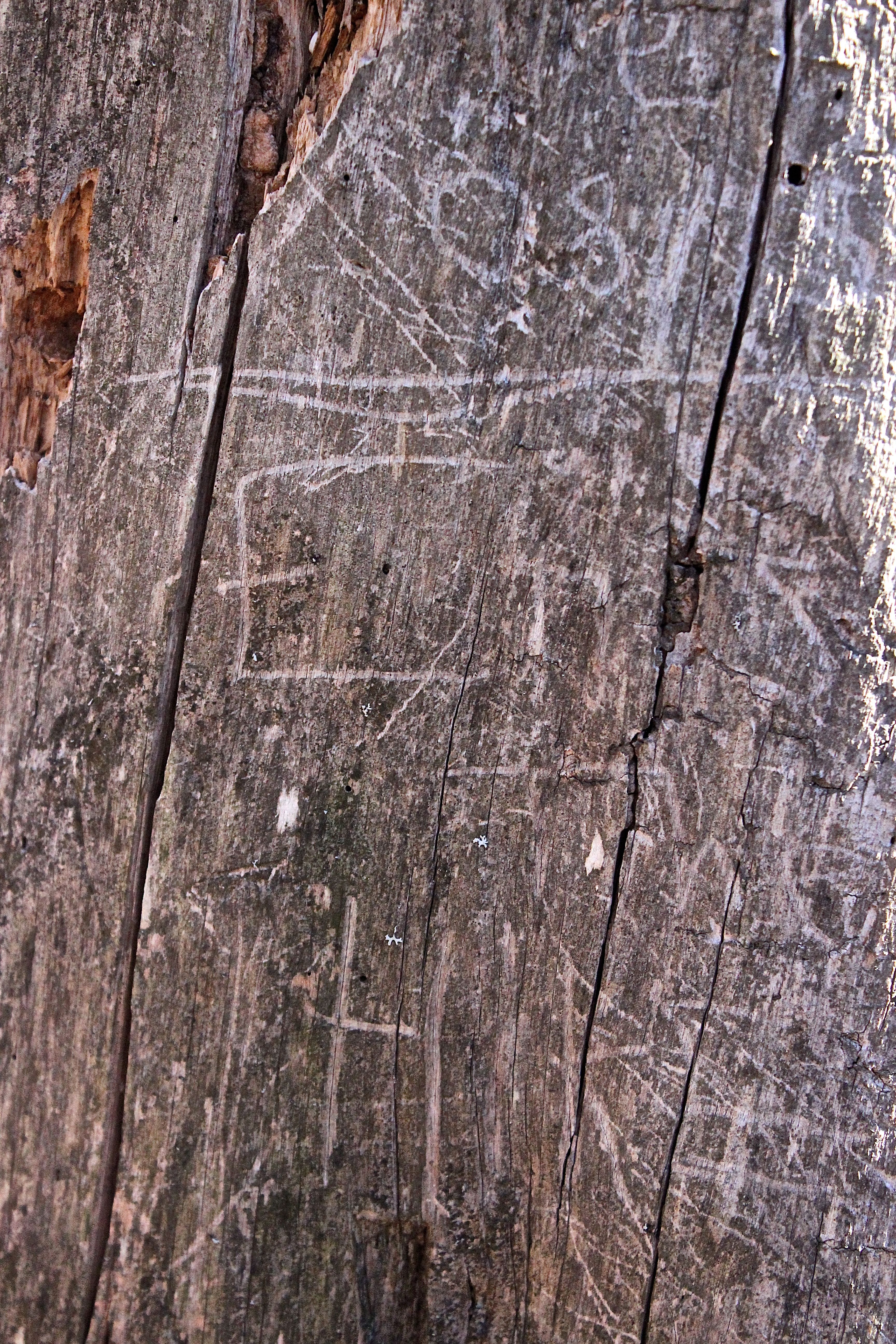
Hiking down the Ledges Trail, I noticed the hieroglyphic work of bark beetles on one tree, and human beetles on another. I prefer the former, but this goes to show that natural and human forces constantly change what is before us.
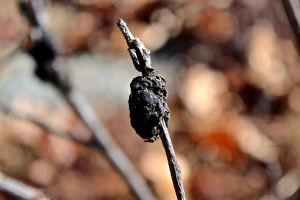
black knot

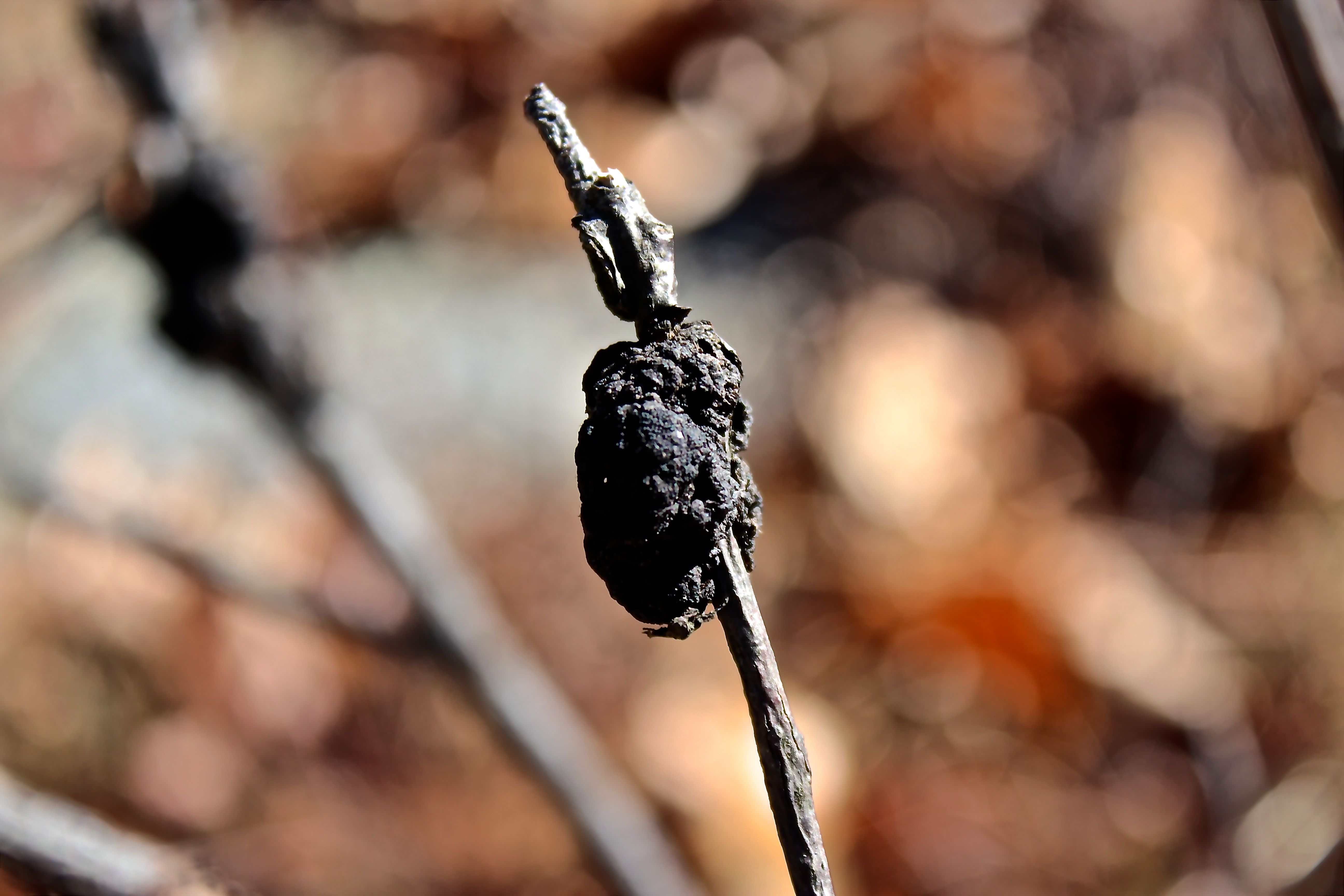
And then I came to black knot fungus on a cherry tree. In a previous post, I identified a growth on a cherry tree as black knot and a friend corrected me. I wasn’t sure he was right, but turns out he was. What I saw previously was the casing of tent caterpillars–not black knot. Thanks to Alan S. for pointing that out. I still have a lot to learn. Thank goodness.

beaver pond:

A glistening Beaver Pond in Denmark offered a brilliant reflection of this cool, crisp day.

As I continued to descend, I was ever mindful of the leaves beneath my feet. They weren’t so wet on this trail, but still slippery. I was wallowing in my good luck as I neared the road, when the earth reached up to grab me. A rock actually. Maybe two rocks. I landed with a thud. A young couple didn’t see me go down, but they heard me. I stood up and shook it off, though I can tell you right now exactly where my body made contact. Humbling for sure. It’s not my first fall. And I hope it won’t be my last. Not that I want to fall again, but I don’t want a fall to prevent me from hiking.
Five point two miles later I was back on Mountain Road and still had a mile and a half to walk before reaching my truck, which I’d left at the other trailhead.

No matter how often I climb The Mountain, I come away a better person for time spent enjoying moments in its presence.