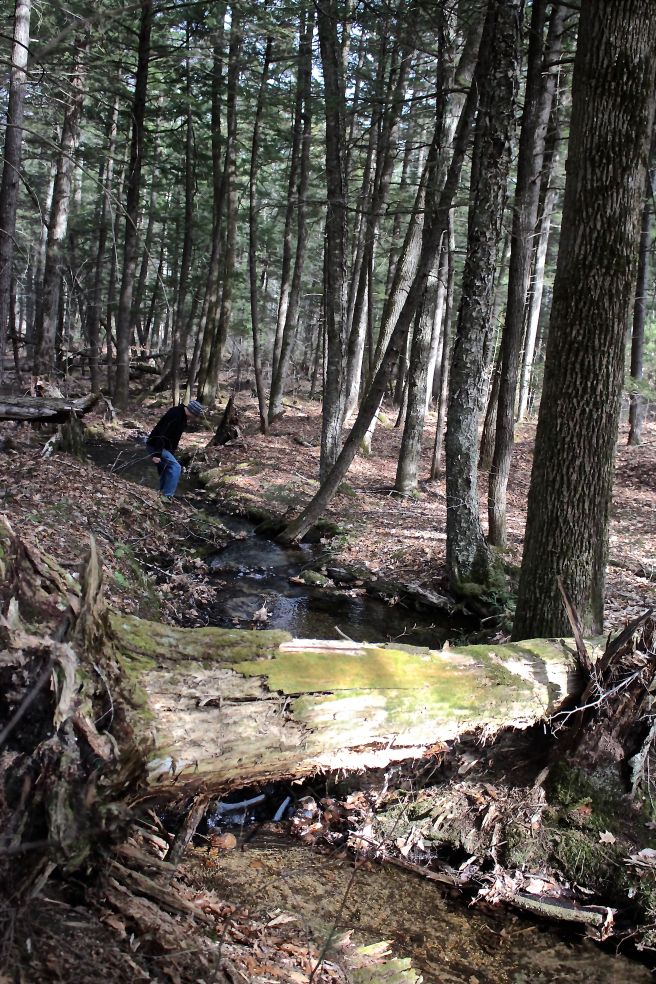
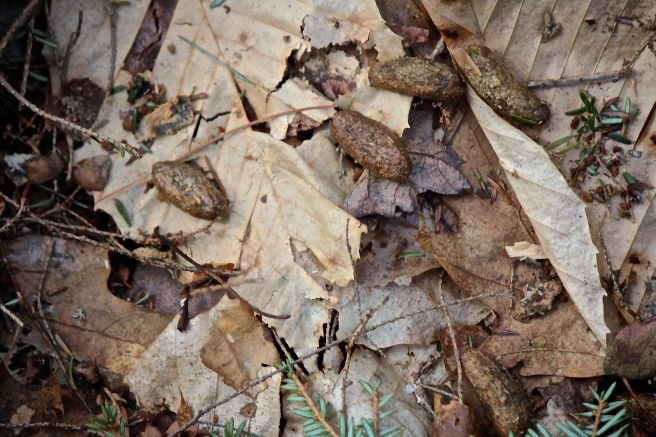
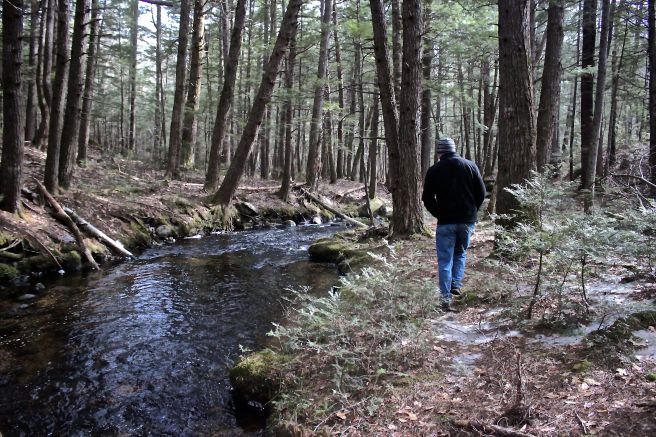
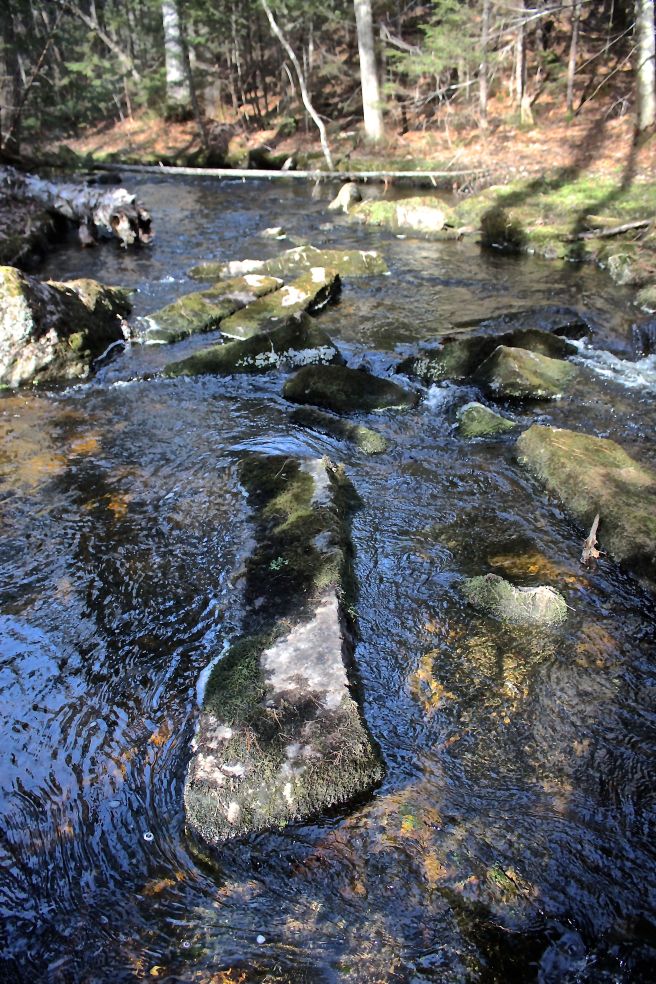
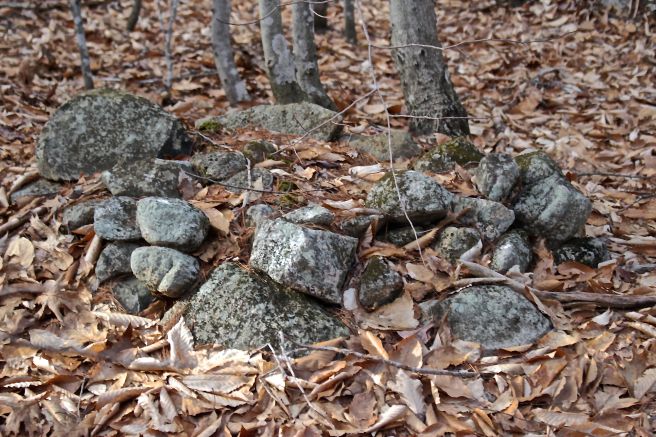
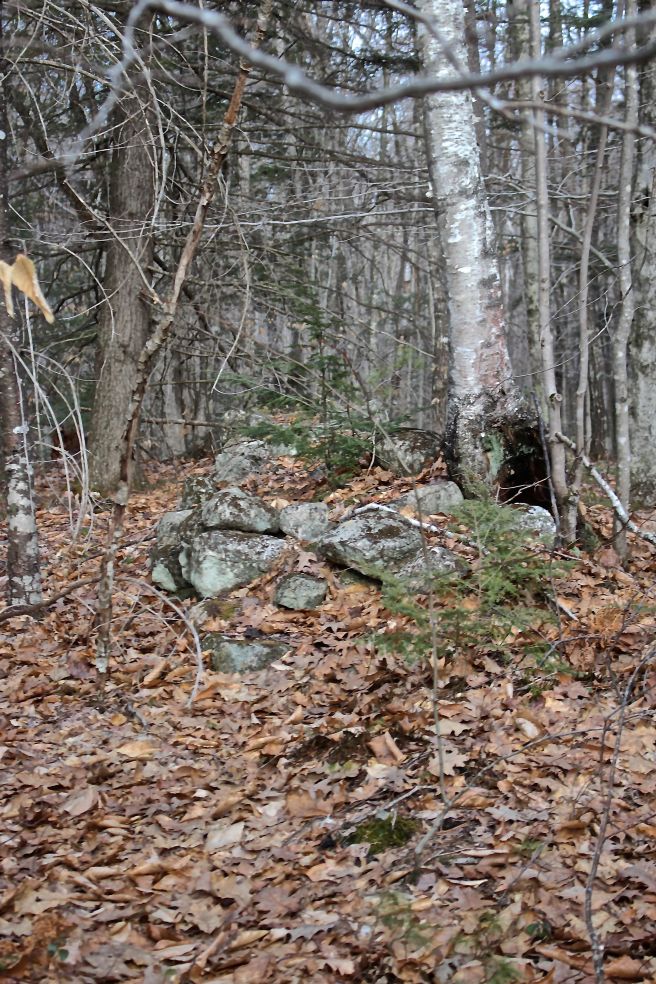
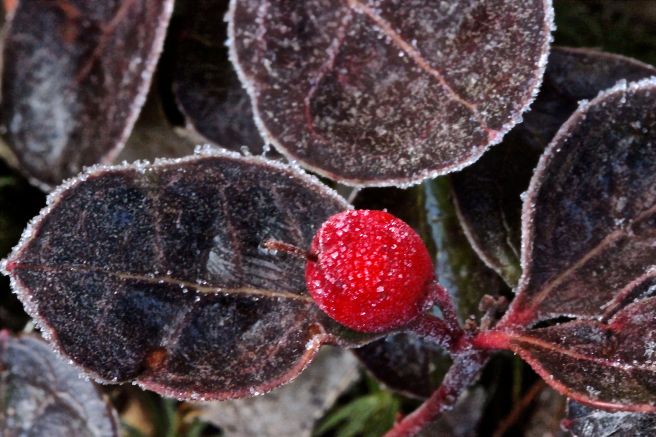
Milling About Stevens Brook

I must begin with a thank you to fiber artist, historian and friend, Sue Black. Sue has led numerous walks along the very trail I followed today and I’ve often been in her presence–usually with notebook in hand so I could jot information down and gain a better understanding of this place.

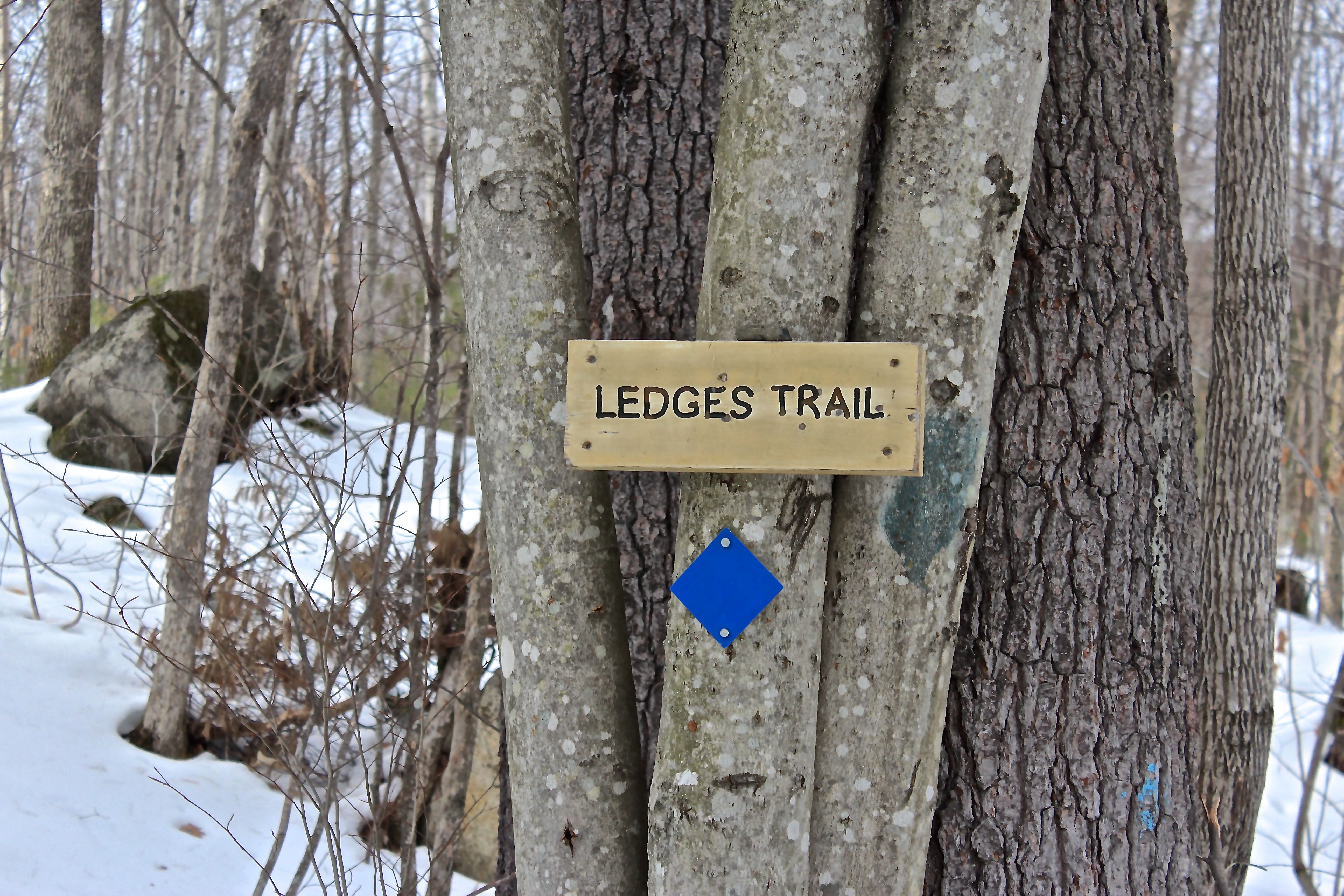
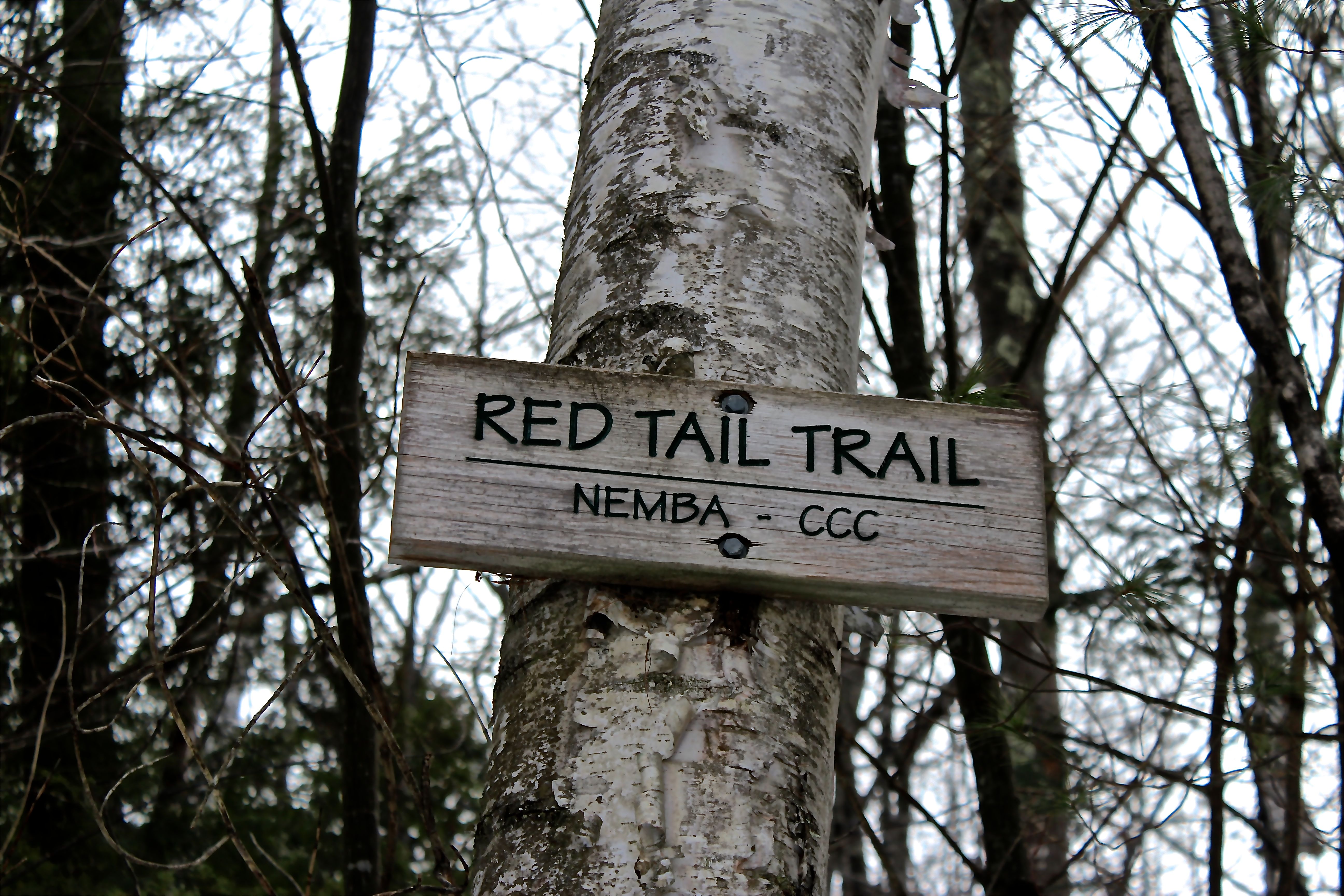
s-trail sign

Though she wasn’t with me today, I could hear Sue as I mosied along examining the old mill sites of the Stevens Brook Trail in Bridgton. And many of the words that follow are probably hers. I also gleaned info from the Bridgton Historical Society several years ago, when Sue couldn’t lead the walk and asked me to fill in. So I guess, really, what follows is like the confluence of the Stevens and Willet Brooks–two streams that meet to form one.
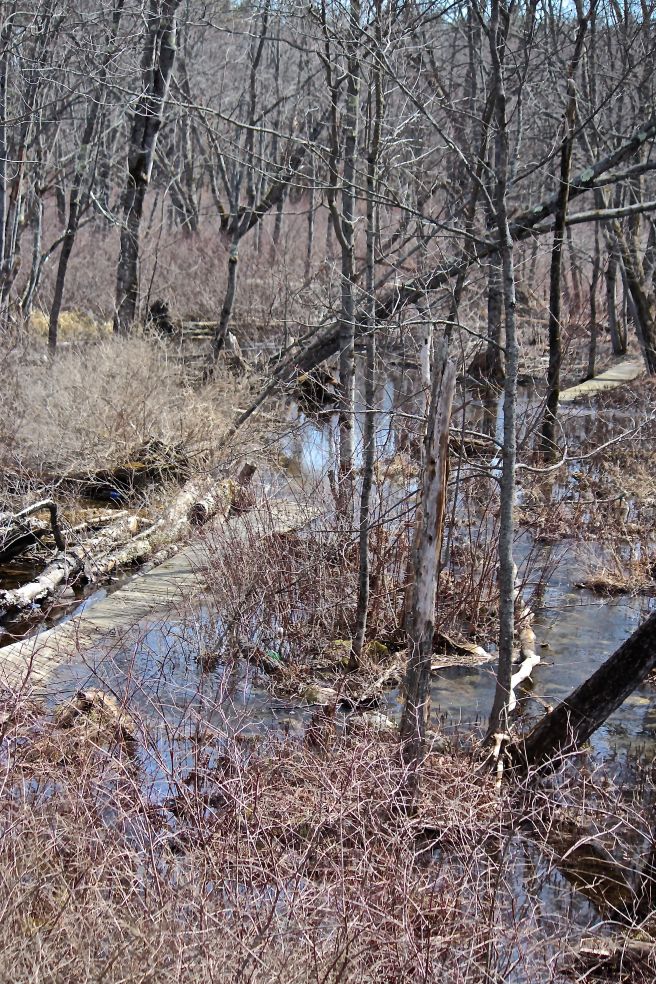
s-boardwalk under water

Bridgton was once a thriving mill town and Stevens Brook its source of power. Of course, to do this properly, I should begin at Highland Lake, the source of the brook, but  I’m not a proper-sort-of gal and you’ll have to bear with me. I didn’t begin at Pondicherry Park either–for the boardwalk was under water.

s-below Pondicherry

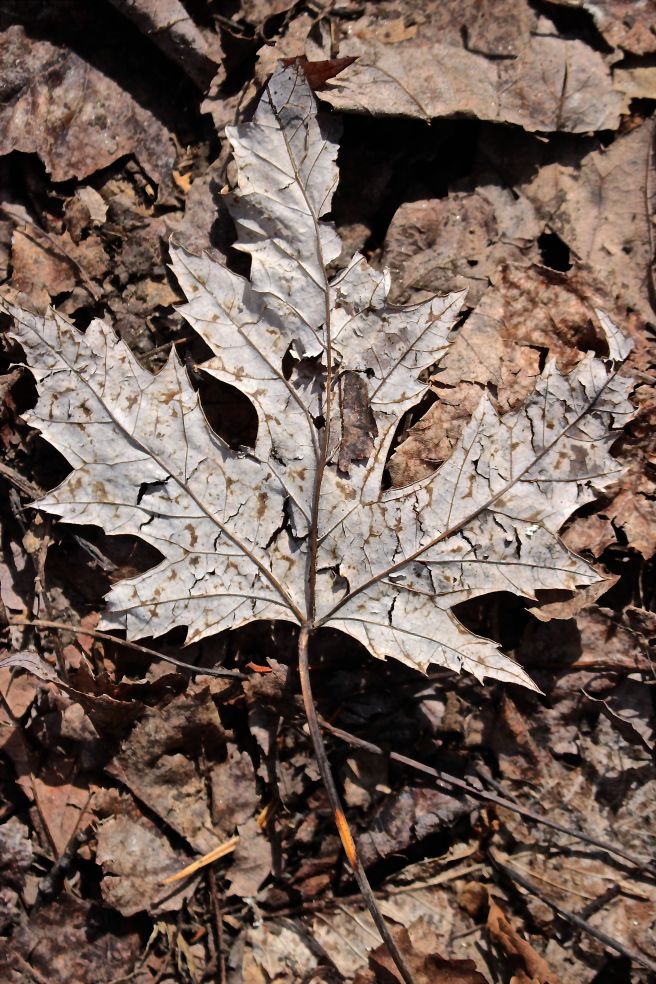
Instead, I slipped onto the trail at Depot Street, beside the Bridgton Community Center. By this point, Willet Brook has joined forces with Stevens, thus increasing the power of the water. I was backtracking, and again didn’t get far because of water flowing over the trail, but along the way I made a discovery. Those beautiful trees that lean over the brook–silver maples (Acer saccharinum). It never occurred to me that they grew here, but makes perfect sense.
s-silver maple leaf

The backside of the deeply-lobed leaves are silvery gray in old age and silvery white during their prime.

I should have taken a photo of the old Memorial School because that was the sight of the train depot (Depot Street) for the Bridgton and Saco River Railroad that was built in 1883–a narrow gauge operating from Hiram, but didn’t think of it at the time. Instead, I followed the stone steps down, walked beside the brook as it ran below the deep bank by Stevens Brook Elementary School and came up behind a few old buildings, back on Depot.

s-food city bridge

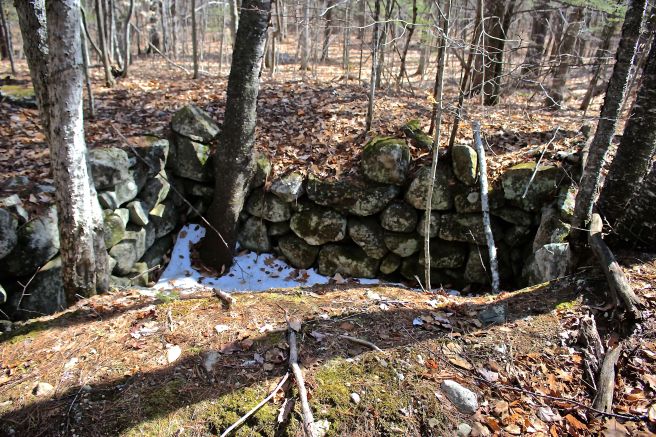
And then I stood on the bridge overlooking Food City. I should note that this is power site #4. Yup, I’ve skipped the first three for now. Stick with me. We’ll get there. In 1822, this area of town wasn’t part of the main village–that was confined to Main Hill. A water-powered carding mill equipped to prepare wool for spinning, thus replacing the tedious hand work of disentangling, cleaning and intermixing the fibers was in operation in this area at the time. By 1825, James Flint and Aaron Littlefield built a sawmill, which they operated for 15 years. In 1840, this was the site of the Walker Saw Mill and Grist Mill. And then things changed. The Pondicherry Mill was built in 1865 to manufacture woolen goods. It was one of the most extensive manufacturing plants in Maine at that time and employed 50 operators. Standing where I was on the bridge, I could see the stones related to the mill and dam. The dam disintegrated in the 1960s.

s-coal trestle

s-trestle 2

In 1898, the neighboring town of Harrison wanted to be joined to the railroad and the RR owners obliged. From this spur, a trestle was built that carried coal in dump carts to the Pondicherry Mill. The structure has deteriorated immensely, but still stands as a monument to this moment in history. So wait, think about this coal situation. The mill had grown to employ 225 people and water power from the brook was no longer dependable. An immense coal-burning chimney about 100 feet in height had been added to the mill. Sixty looms produced 18,000 yards of cloth weekly. Though the building stood until the mid-sixties, the industry moved south long before that. The stones by the brook and trestle are all that are left to tell the story. A now-deceased resident, Reg Fadden, used to tell the story of knowing what color they were dying the wool on any particular day–he’d see the color in the water as he walked to school.
s-former millpond:5th site

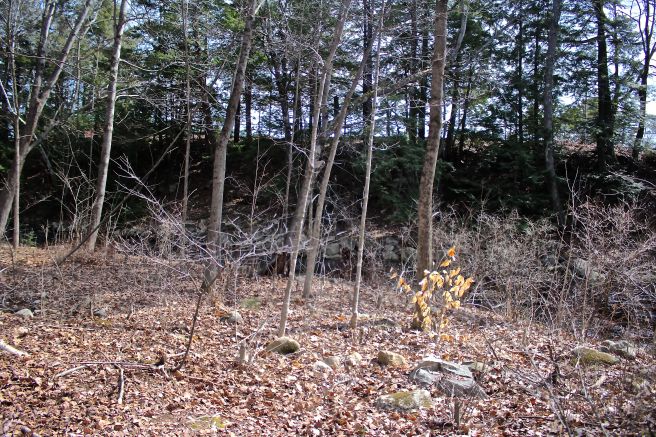
Above power site #5, the land was flat and indicative of a former mill pond.

s-5th site

A stone dam and some other foundation work is all that’s now left. The first mill to be located here was a sawmill built in 1868. By 1871, a shovel factory was built on the west side, which was the side I stood upon. By 1899, the Bridgton Lumber Company had located to this power site, with two mills operating–one for boxes and house furnishings; the other for lumber. This apparently was a successful site because in 1911 it became the Burnham and Newcomb Sawmill, which was purchased by Harry Bisbee in 1920. He used a turbine since the water power wasn’t dependable. Though it gushed over the rocks today, in the summertime, this is the perfect place to sit on the flat rocks and dangle ones feet. I can’t remember if Sue told me this or I read it, but apparently there was a treacherous footwalk that crossed the brook in this area and even at age 90, Mr Bisbee would walk across. The sawmill eventually burned, with only the office remaining. This time using a diesel engine, Mr. Bisbee started a smaller sawmill. In 1953, the dam washed out with a flood and local lore has it that Mr. Bisbee walked out one day, leaving it all behind. He died a couple of years later, gifting the mill to the public library.

Charles Fadden and his son, Reg, bought the mill at auction and operated a box mill, using a turbine for power. The office was still standing until about ten years ago, when it collapsed.
s-narrow 1

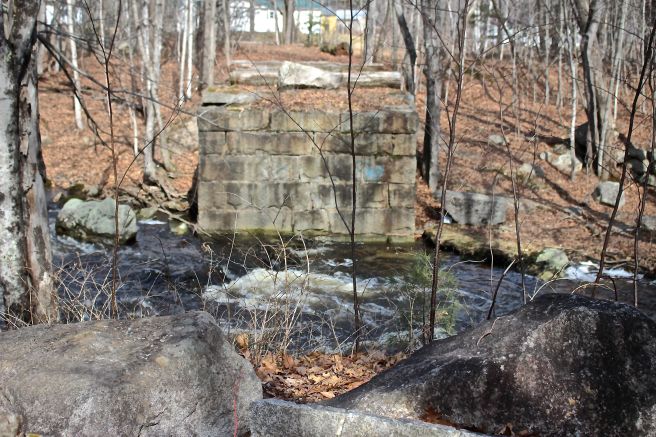
By the mill, the Harrison Narrow Gauge crossed over a trestle; today only the stone stanchions remain. A sixth power site was never developed.
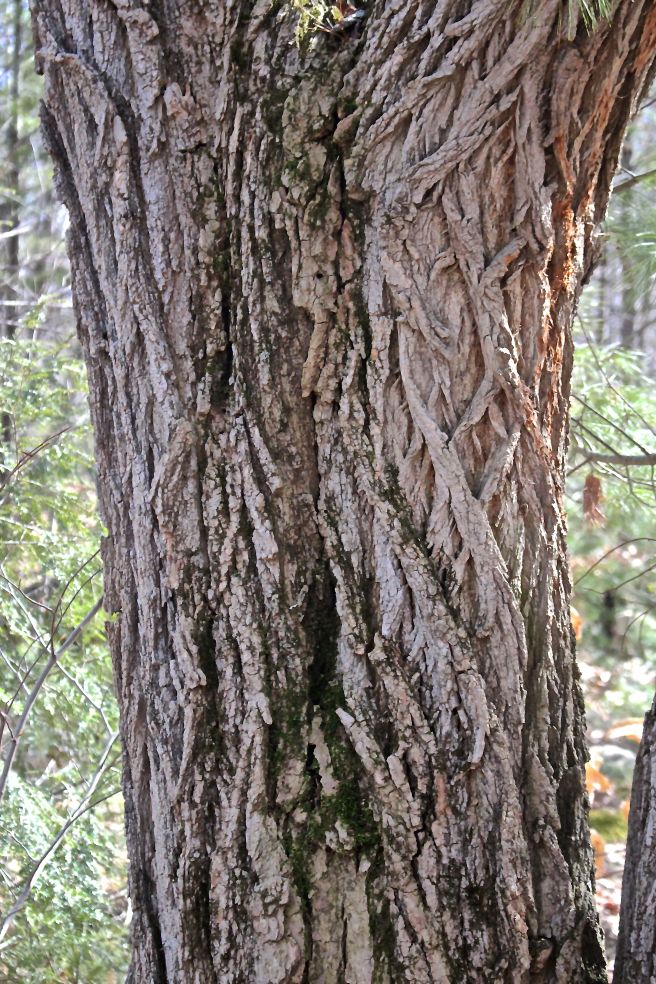
s-locust bark

It was here that I recognized another tree I don’t always encounter–a black locust (Robinia pseudoacacia). The bark appears almost braided.

s-locust pod

And below it, an old flat pod that contains bean-like seeds.
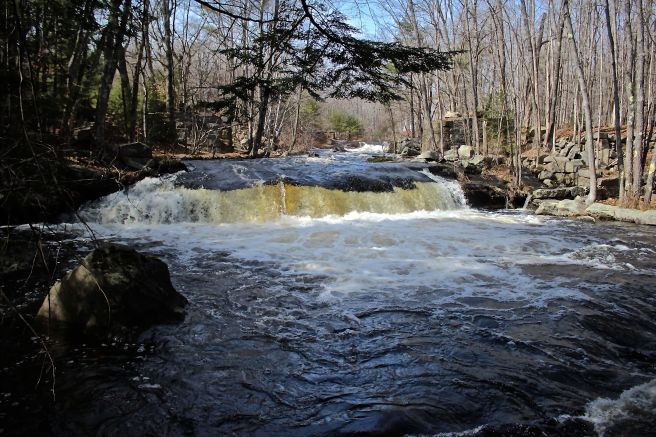
s-7th site, Johnson Falls

I followed a new trail (possibly private, but it wasn’t posted) and was delighted to get a better view of what I believe is power site #7.
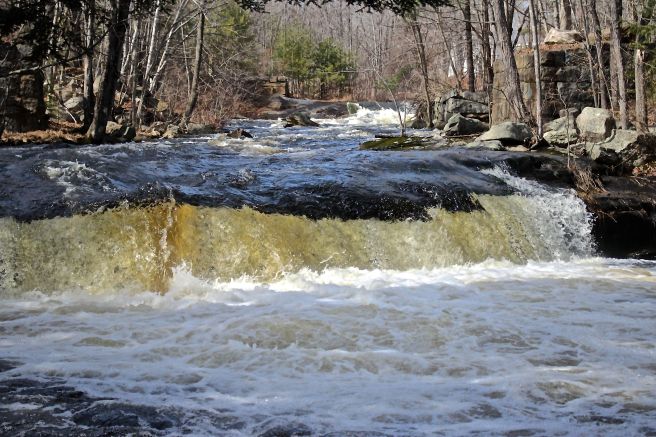
s-lower johnson falls site 7

If I’m correct in my thinking, this is Lower Johnson Falls, and was the possible 1859 site of the Milliken Bedstead Factory.
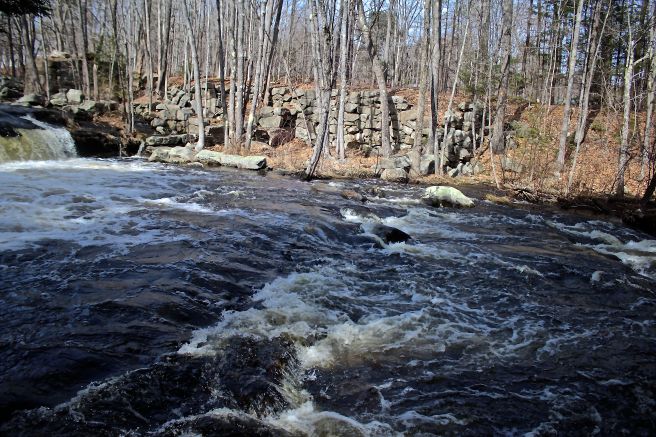
s-remnants by Johnson falls

A foundation is still visible on the eastern side of the brook.
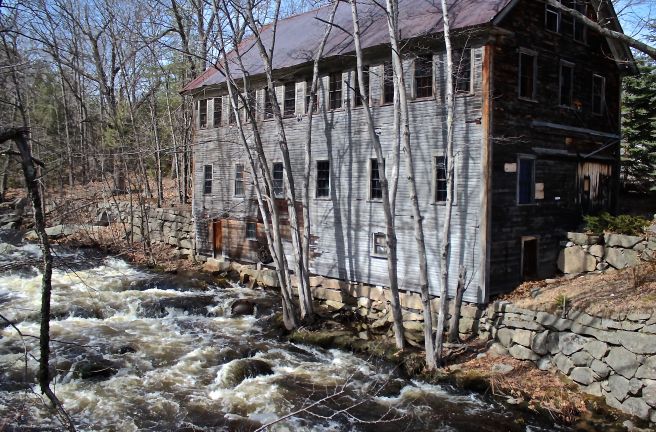
s-7th site, smith sash 1

Below power site #7, I came to the coffin shop. Hey, somebody has to build them. Lewis Smith built the two-story building with a basement in the late 1860s. It was a sash and blind factory, but he also built furniture, and yes, coffins. More local lore: he was the town’s first undertaker. While the building has had several owners since then who have tried to restore it, it still needs some (way more than some) tender loving care so it doesn’t go the way of all the other mills.

s-turbine rig

All that remains of a water-powered turbine still reaches over the brook. Originally, all the water wheels along the brook were overshot wheels. While an overshot wheel had horizontal axils, a turbine wheel had vertical axils, thus making it smaller, more efficient and more dependable given the rise and fall of the water.
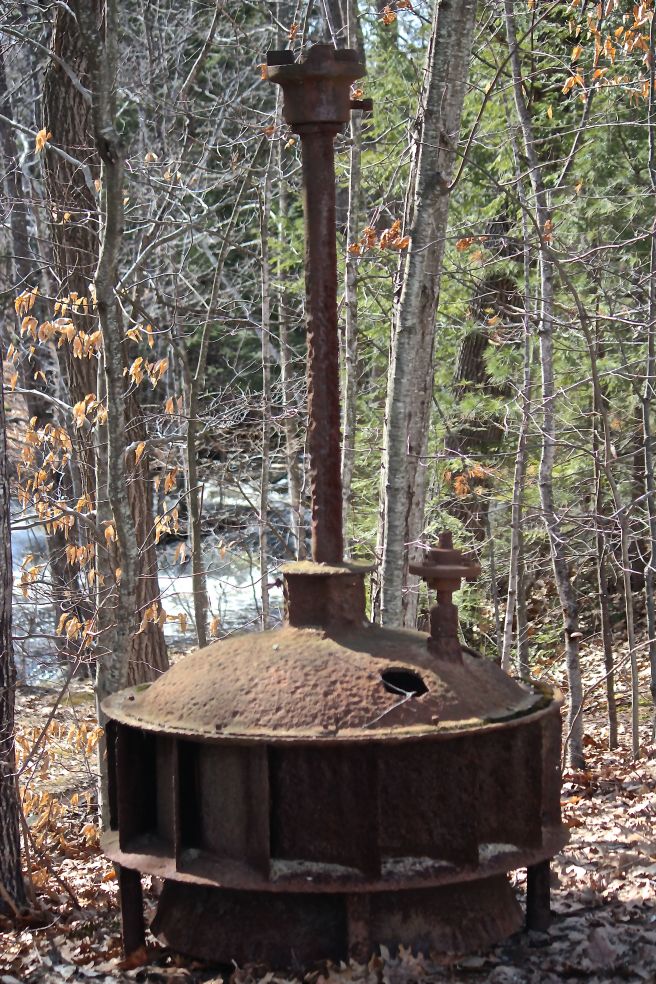
s-turbine

And on the front lawn of the coffin shop, the real deal–a Perry Turbine Water Wheel. In 1877, Richard Bailey and Samuel Miller operated an iron factory and machine shop built by William Perry and George Taylor across the road from the Smith factory. When they sold their business to Forest Mills owed by William  Fessenden Perry, it was renamed the Bridgton Machine Company with George and Frank Burnham taking over as managers. In 1887, the Perry turbine was invented and it received nation-wide popularity for use in mills along small streams.
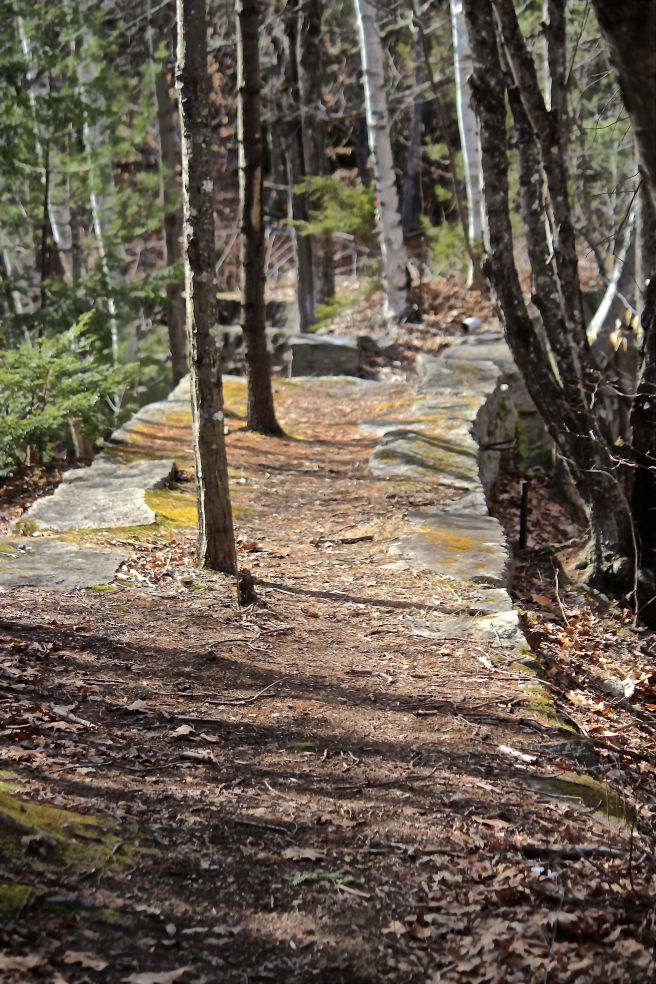
s-forest mill a

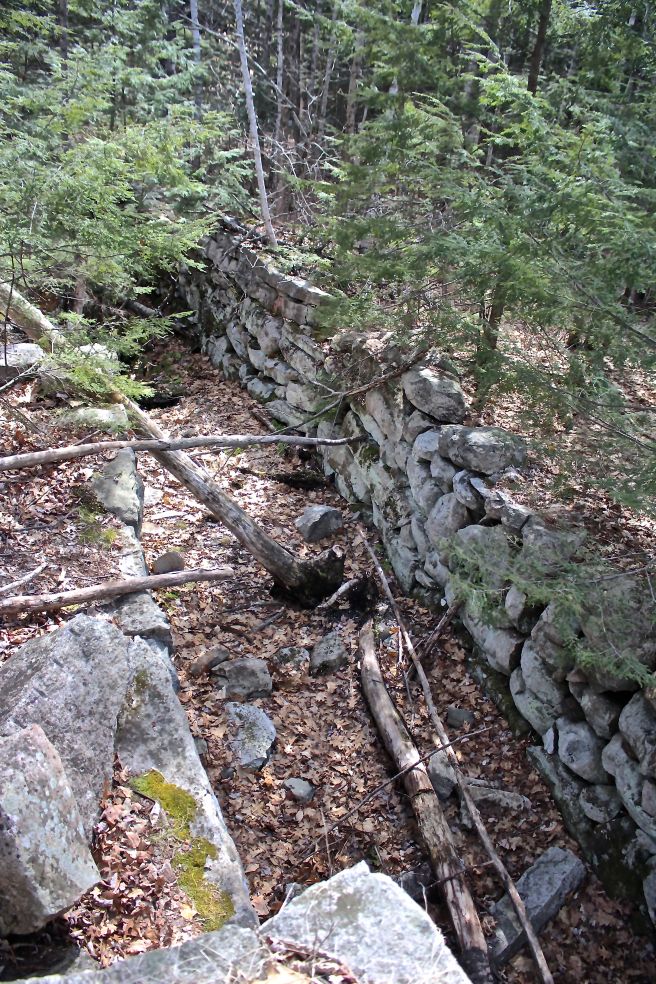
Power site #8 is one of my favorites. This is where Perry and Taylor erected a mill in 1862 to manufacture woolen goods. The dam was built to provide a fifteen-foot fall with a mill pond above.
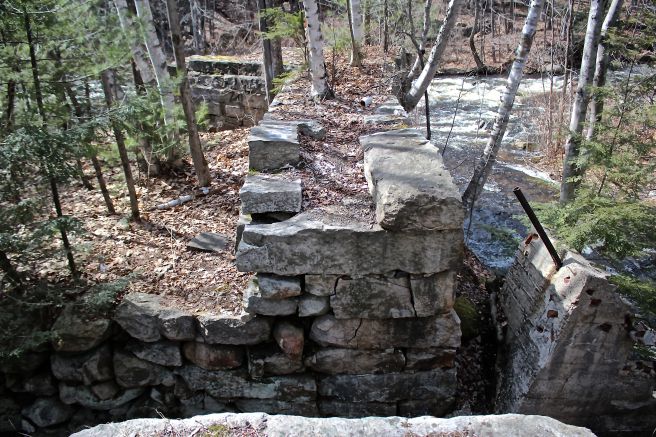
s-Forest Woolen Mill 2

s-forest sluice

Today the sluiceway is dry, but I can imagine the water pouring through here.

s-forest woolen mill 3

With the advent of Kansas Road in 1865, the woolen mill expanded to 200 feet by 45 feet and stood two stories tall. With more looms than any mill in the area, outerwear was produced here and shipped to Boston. During the Civil War, attention turned to creating war materials.
s-9th site, Kennard Dam

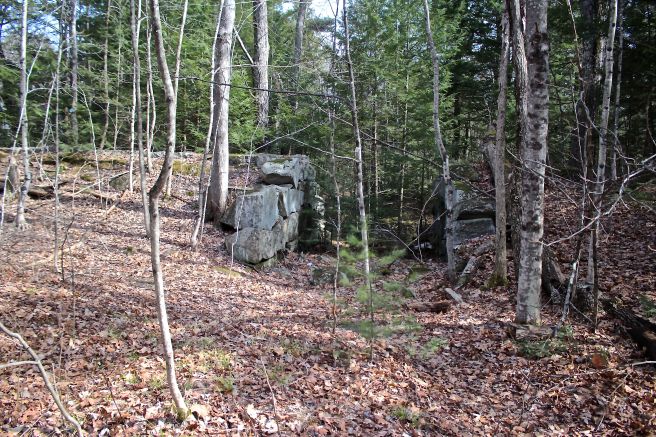
Across the street, I ventured down the wrong trail at first and found myself on the upper side of the dam built at power site #9. The 13′ dam built by Boothby and Chadwick in 1864 was near Kennards Stocking Mill. It was originally intended that Kansas Road would cross the dam, but the turn would have been too sharp and too steep.

s-vp by Kennards, 9th site

Today, a vernal pool sits below the former dam. I checked it and several others along the way. No signs of life. I’ve yet to hear spring peepers.

Anyway, Taylor and Perry purchased this site in 1865 and built a three-story carding mill with an overhead walkway that crossed Kansas Road and connected their two mills: Forest Mill #1 and Forest Mill #2.  By 1879, Mr. Taylor had died and Mr. Perry re-organized as the Forest Mills Company, which employed 130 workers and produced cashmere. As Sue has told me, this was not from cashmere goats but rather a lightweight fabric consisting of wool fiber that had either a plain or twill weave.

s-power 9

A railroad spur and trestle were built in 1900 to unload coal and other supplies for the Forest Mills Company. The American Wool Company purchased the mill, which was large for Bridgton, but small compared to those south of Maine. Eventually, business moved south. In 1925, a shoe shop moved in, but it wasn’t successful either. The building was torn down in 1962.

s-powerline trail

The scene changed briefly when I followed the trail onto the present day power line.
s-powerline boardwalk

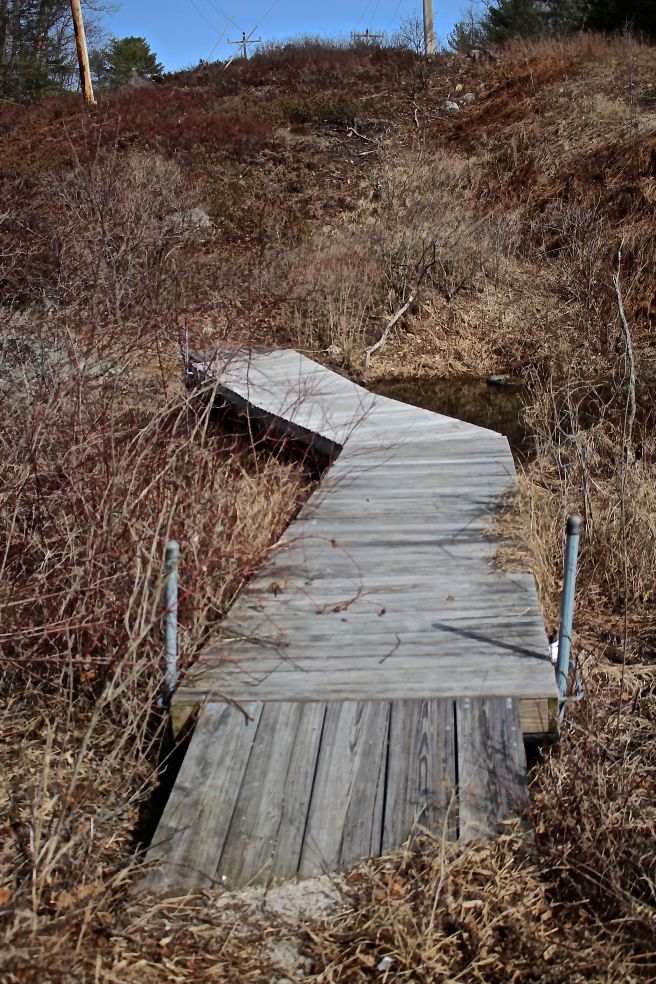
Typically, this boardwalk is under water in March and April. But this year is far from typical.

s-cmp pond

And then I reached power site #10. This is the most modern of them all, but again, it has a history. It’s possible that this was the site of Jacob Stevens’s first sawmill built in 1768.

s-cmp dam 1

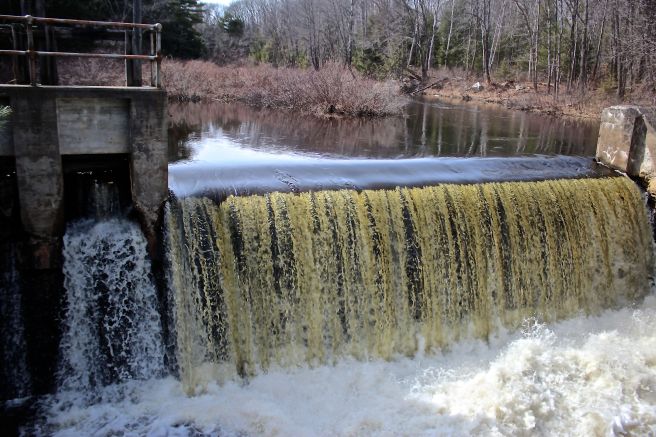
Mr. Stevens would have built a boulder and gravel dam, not one of cement certainly. He lived nearby and raised eight children; the four oldest worked beside him. Mr. Stevens was a ranking member of the survey crew that came to what is now called Bridgton in 1766 from Andover, Massachusetts. He returned in 1768 under contract with the Proprietors to develop water power and make it serve the early settlers by creating mills that provided building materials and grain for food. Stevens was the one who identified twelve power sites along the almost two-mile brook with a drop of 156 feet from its source at Highland Lake (known originally as Crotched Pond) to its outlet at Long Lake (Long Pond). It made sense for him to build a site here for both a saw mill and grist mill, as this is near the mouth of the stream and would have provided him with easy access to the main thoroughfare of Long Pond and beyond. The proprietors required that the saw mill operate for fifteen years and the grist mill for twenty.
s-cmp dam 4

I don’t know what happened between 1768 and 1896 when the Bridgton Water and Electric Company took over as the first source of electricity and water for the village. The concrete dam was built in 1931 by Central Maine Power after several transfers of ownership. The greatest power could be found between this site and power site #11, where the brook drops 25-30 feet.
s-penstock start

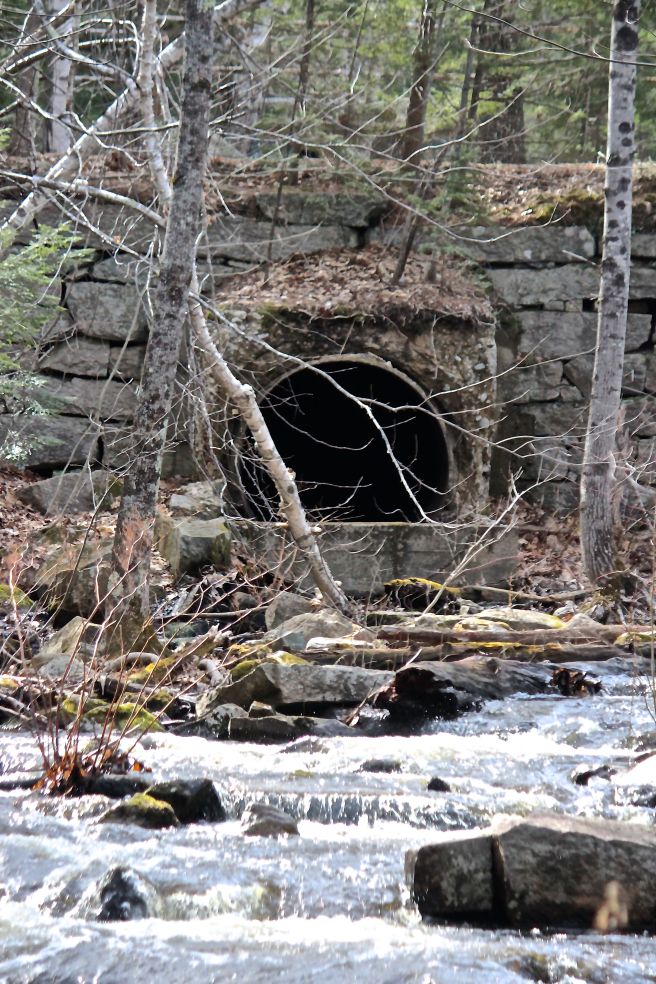
A 790-foot penstock was built to regulate the flow of the water.

s-penstock channel

s-penstock support

Evidence remains of its position and actually, it’s easiest to see right now before the summer foliage obscures so much.
s-1

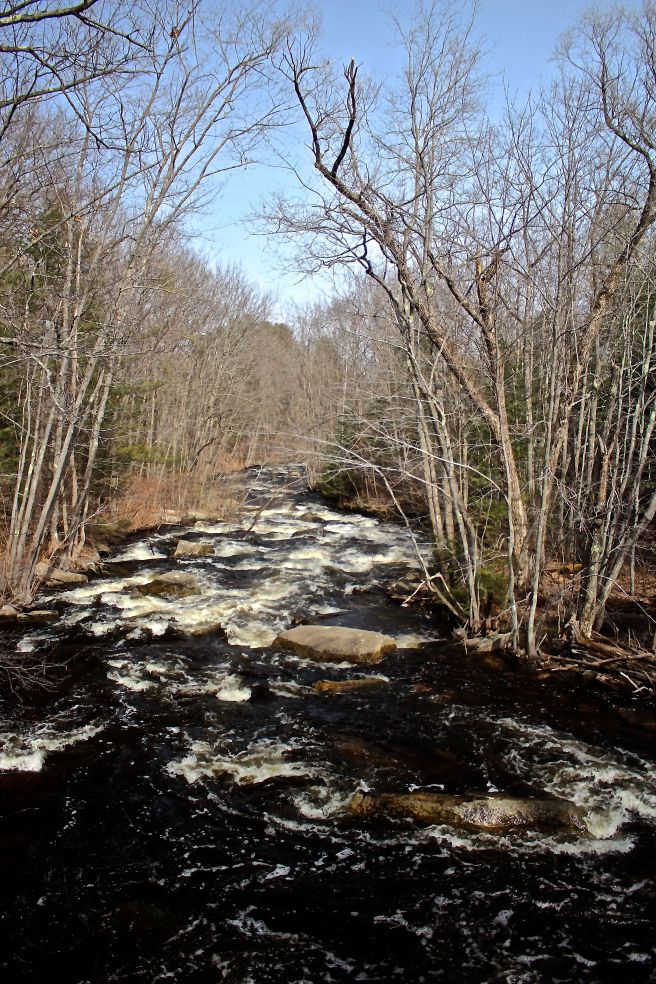
Somewhere in this area was power site #11. The Hart Tannery may have been built on an island in the middle of the brook.
s-water drops below CMP

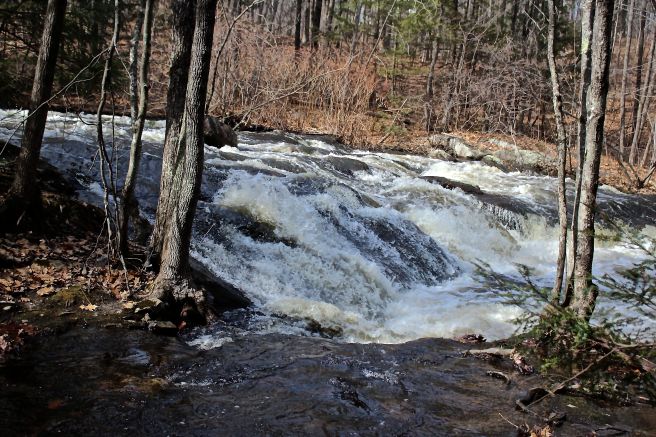
The exact location of power site #12 is also elusive, but rumor has it that a shingle factory was located between site #11 and the outlet.

s-1922 brick

Early on, a wooden structure was used as a power house. That was replaced by a brick building built in 1922 by the Western Maine Power Company. Notice where the penstock entered. And above it, a turbine generator.

s-Long lake 2

All was calm by the time Stevens Brook emptied into Long Lake today.

s-beaver 1

Though it’s easy to miss, this area still offers a source of dams and industry.

s-beaver lodge and dams

Beaver style.

s-3

I walked back up Main Street and headed to the first three power sites, which I present in backwards order at the risk of confusing my tired readers. Power site #3 has a storied past: 1813-fulling mill (put weaving on hot water and beat it to close fibers); 1822-saw and grist mill; 1830-saw, grist and plaster mill; 1845-mill burned; 1857-rebuilt two stories; 1877-never rebuilt. Yet this was long known as the Dam Site and a Dam Site Restaurant stood here for years. Across the street was a tannery, which didn’t need water for power, but did need water to fill the 140 vats. Using hemlock bark, 10,000 hides were tanned each year.

s-shorey park dam 1

I’m only just realizing that I missed power site #2. I looked at it as I walked by, but must have been tired. Anyway, it’s below this split stone dam and served as a grist mill in 1798 and a sash and blind mill in 1835.
s-sp 3rd power site

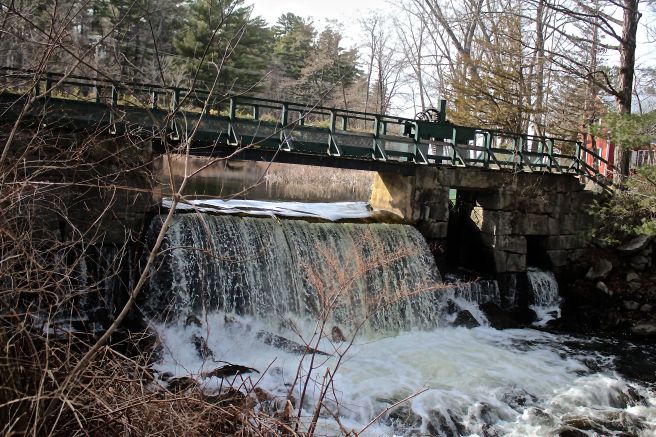
Power site #1 was originally a saw mill built by Asa Kimball at the head of Stevens Brook. The lay of the land has changed since roads were constructed and Highland Lake (Crotched Pond) had a different configuration and lower depth. The pond served as Mr. Kimball’s mill pond, where he floated logs from Sweden (Sweden, Maine, that is). The split stone dam was erected in 1849-50 by Rufus Gibbs and others, thus providing power for the first big mill in the village that stood four stories tall, employed 50 workers, ran 20 looms and made blankets for the Civil War. By 1941, is was demolished.

s-sp millpond

This is the mill pond as we see it today, but if my vision is clear, before Highland Road intercepted it, this was part of Crotched Pond.

s-highland

And the start of it all, the thing that got me milling about today, Highland Lake and the source of Stevens Brook.

Dear reader, if you are with me still, thank you. It was a long journey and I appreciate that you came along.


Summit of Three

It was the perfect day for an exploration of the scenic vistas at the Greater Lovell Land Trust’s Heald and Bradley Ponds Reserve.

h-mill pond

My journey began with time for reflection at the mill pond, a crystal clear reflection–if only life were so.

h-mill dam

It was here that “shook” and cooper mills were located. Reportedly, the men created barrels to hold Caribbean rum and molasses.

h-whiting snow

At the beginning of the journey, a bit of ice and snow covered the trail indicating that others had passed previously.

h-whiting vp

Ascending Whiting Hill (801 feet), I paused at the vernal pool–frozen in time.

h-whiting summit 1

And then the first summit overlooking Kezar Lake–glory in the making.

h-whiting, columbine

When I’d mentioned my hiking plans to a friend this morning, he’d encouraged me to see well–and so it began with the leaves of wild columbine.

h-whiting to heald

On the back side of the summit, a view of Heald Pond.

h-whiting wintergreen

Wintergreen showed off an Easter display of color against a swatch of snow.

h-whiting bear tree

I spied . . . bear trees,

h-whiting cache

a squirrel cache of pinecones,

h-whiting gnome

and a gnome home. Well, I’m not so sure that the squirrel cache was just that. Though red squirrels do cache pinecones, the gnome home was on the other side of the tree trunk. Just goes to show that things aren’t always as they seem.

h-amos cache

Hiking up Amos Mountain, I did find many squirrel tables and this sign–an acorn cache.

h-amos, owlet moth

Sitting still on a rock along the trail, a furry moth from head to toe to antennae, possibly an owlet–capturing the warmth of the sun.

h-amos

After lunch, I poked about the summit of Amos Mountain (955 feet) looking for more wild columbine leaves because I know they grow here. Maybe next time, offering a reason to visit again–as if I need a reason.

h-candy 1

Traveling down the old road behind Amos, I suddenly found myself admiring the miniature  world of candy lichen, its pink disks rising from a pale green surface.

I also noticed a variety of scat from weasel to coyote and realized the importance of this reserve as a corridor for the many mammals who travel here.

h-red maple 1

And then I saw red maple buds decorating the forest floor. Seems to me a red squirrel nipped the buds in hope of future food. Maybe the squirrel will return or maybe it became food itself.

h-amos hophornbeam

Though trail signs shouldn’t be nailed all the way in, I chuckled when I saw this one along the saddle trail–not easy to drive nails into a hophornbeam, the hardest of all woods in our forest.

h-amos, many fruited pelt lichen

I’m not sure that my ID is correct, but along the way, I found what I think is multi-fruited pelt lichen.

h-perky's fen

And then on to Flat Hill via Perky’s Path.

h-flat hill mossy maple

Among other fungi, mossy maple grows here.

h-flat, beaver works

Beaver works are evident all the way around.

h-flat, lodge

And in the pond, the lodge. Below my feet, otter scat. Lots of otter scat. I have to wonder about the action that passes this way.

f-flat hill

The name Flat Hill (891 feet) has always amused me–an oxymoron at best. But really, all three summits are flat.

h-MT W from Flat Hill

In the distance, Mount Washington was the only snow-covered summit.

h-porky first

And right before my eyes–evidence of a visitor who frequents this spot.

h-flat hill porky

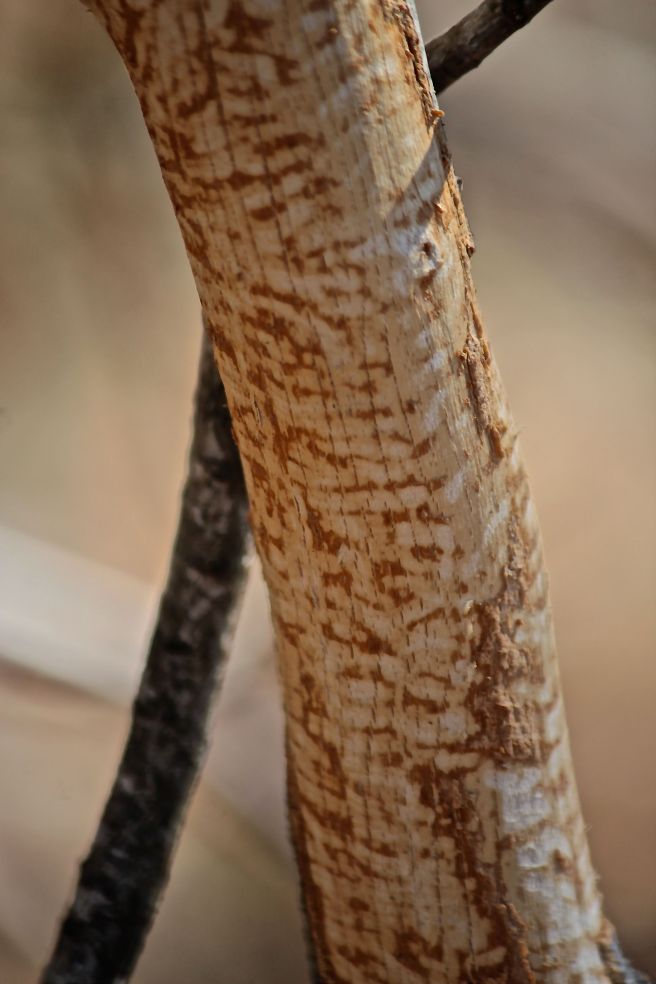
While we often think of them as only eating hemlock bark in winter, porcupines dine on other species including spruce and beech.

h-flat hill, porky 2

h-flat hill, porky 3

Despite the damage they do, I’m intrigued by the pattern of their works.

h-flat, walkers

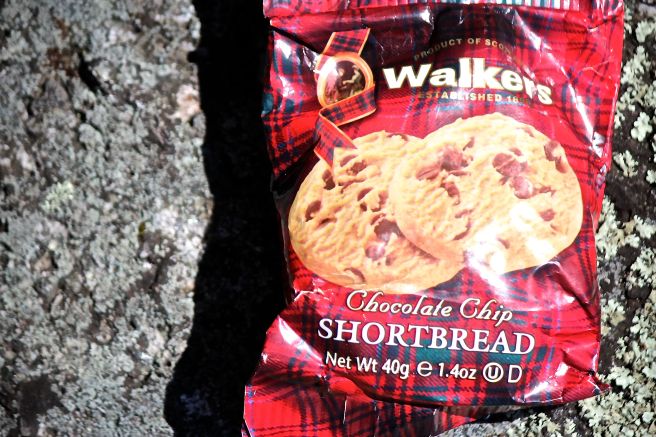
Oh yes, and a treat that appeared in my Christmas stocking made for just the right snack.

h-basswood

At the base of Flat Hill, I paused to admire the basswood buds and leaf scars–offering a smile on this day. Another reason to smile, two barred owls calling to each other. I didn’t see them, but loved listening to their “Who cooks for you? Who cooks for you all?” call. I contributed my own, but they seemed to prefer each other. Can’t imagine why.

h-otter point grape fern

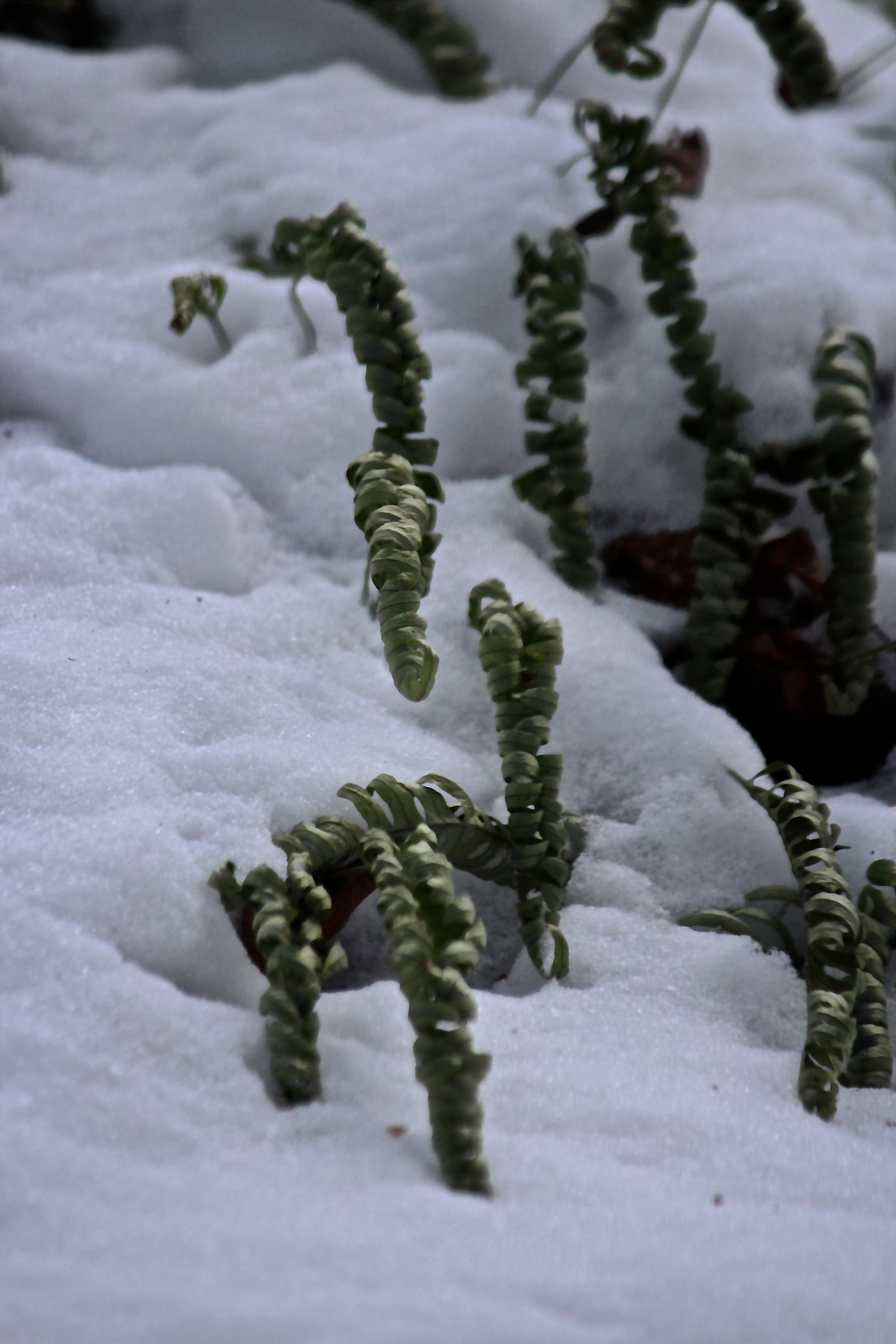
A side trip as I looped back took me to Otter Point. Grape Fern’s winter complexion is so easy to overlook as it blends into the forest floor, but I’m glad I paid attention.

h-otter point view

Though a friend informed me this morning that the loons have returned to an open area of Kezar Lake, Heald Pond is still completely coated in ice.

h-vireo nest

Delicate offerings like this vireo’s nest are delightful surprises.

h-seeing well

I’d been encouraged to see well and trust that I kept my focus. It was a solo hike for me and I met no one along all the trails I traversed over the course of six hours–an offering of peace and solitude that I wish everyone could experience.

h-amos heart

On this Saturday before Easter, the universe spoke a language of love and hope along the three summits and I had the honor of listening.


Celebrating the Vernal Equinox

We fell asleep to winter and awoke early this morning–eager to celebrate the vernal equinox.

b-dark

It was dark and cold (15˚) with a brisk breeze when we joined others for a 6am hike up Bald Pate sponsored by Loon Echo Land Trust.

b-sun begins

While we waited at the summit and tried to stay warm, we were treated to hot cocoa and amaretto cake. YUM!

b-sunrise1

And then . . .

b-sunrise 3

the sun shone upon this first day of spring.

b-vernal pool

After church, I made a quick visit to the vernal pool where ice is still the name of the game.

b-wet road

And after lunch, we headed off on another adventure. At first we followed an old road, which was tricky business.

b-1st fdn

Though at least six foundations are located along this road where young men carved out a living prior to the Civil War, we allowed ourselves time only to stop at one. We were on a mission.

b-powerline1

We turned north at the power line and trudged up and down hills in search of a brook.

b-stream crossing

That direction didn’t feel quite right, so we followed our noses and turned into the woods.

b-posted 1

And then we stumbled upon a property line that was posted. We love the fact that in Maine one can walk upon any property that isn’t posted. This one was recently marked and so we respected the landowner’s wishes.

b-meandering stream

That is, until we got to a point where we decided to trespass after all. Our journey took us past meandering streams,

b-stream crossing 2

stepping across others,

b-wetland 1

slogging through boggy areas,

b-bushwhack

and tripping among the understory.

b-deer rub

We saw where a deer had rubbed its antlers,

b-deer scrape

another enjoyed fine dining, and

b-deer skull

a third said goodbye as it returned from whence it came.

b-polypody 2

We found common polypody fern (Polypodium vulgare) indicating that the temperature was higher than it had been earlier in the morning.

b-polypody 1

This was our view of polypody when the temperature was much lower on Bald Pate.

b-pork den

We passed a porcupine den.

b-porky tree

And then we came upon downed hemlock branches and

b-pork scat 1

fresh scat.

b-pork in tree 1

I looked up.

b-pork in tree

He looked down.

b-game trail beside brook

Finally, we found ourselves walking along a game trail beside a brook–feeling like we might just be on the right track.

b-mill pond

Where the brook widened into a pond, we knew we were in the right place.

b-on a rock

Just below the pond, my guy stood in the middle of the brook, excited about our find. We’d attempted to locate this spot a year ago and missed it by a long shot.

b-mill site1

According to the 1858 map of Oxford County, we were at the sight of R. Bennett’s sawmill. I’d first visited two years ago with my friends, Sue and Janet. It’s actually located on Sue’s land. We’d come in from her home on my first visit, but today we came via Old City.

b-b mill 3

b-b mill 2


b-bmill stones brook

A year ago, my guy and I snowshoed in search of this sight but never found it so we were gleeful about today’s success.

b-fdn near mill.jpg

Our intention had been to search for the mill until 3:30. We found it just after 4pm. And rather than try to follow the stream back, we decided to bushwhack in a more westerly direction. On a hill above the mill we found a foundation made of drilled stones that are neatly hidden by moss and ferns and assume it was part of the mill.

b-rock pile?

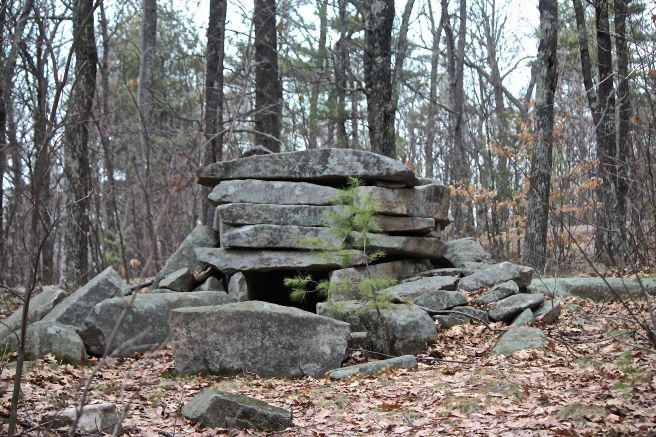
Our bushwhack continued until we finally emerged by a rock pile beside Old City Road. Its circular formation had me thinking water well.

b-double wall

Will we ever find it again? That’s always a question, but now we know to walk along the road until we reach the last double-wide wall and then turn at the well.

b-ghost

I liked the ghost-like effect of my guy walking back on the road–reminiscent of the men who once lived here and worked these woods. I followed my guy out and both of us occasionally felt the suction of mud. Occasionally one foot was drawn into the earth as if it intended to stay behind. We finally returned to our truck at 6pm (so much for our intention to be home by 4:30), our celebration of the vernal equinox complete.


On The Verge Of Change

Change is in the air. Stepping out the door this morning, I was immediately treated to the sight of wet mammal tracks on the deck.

b-raccoon tracks

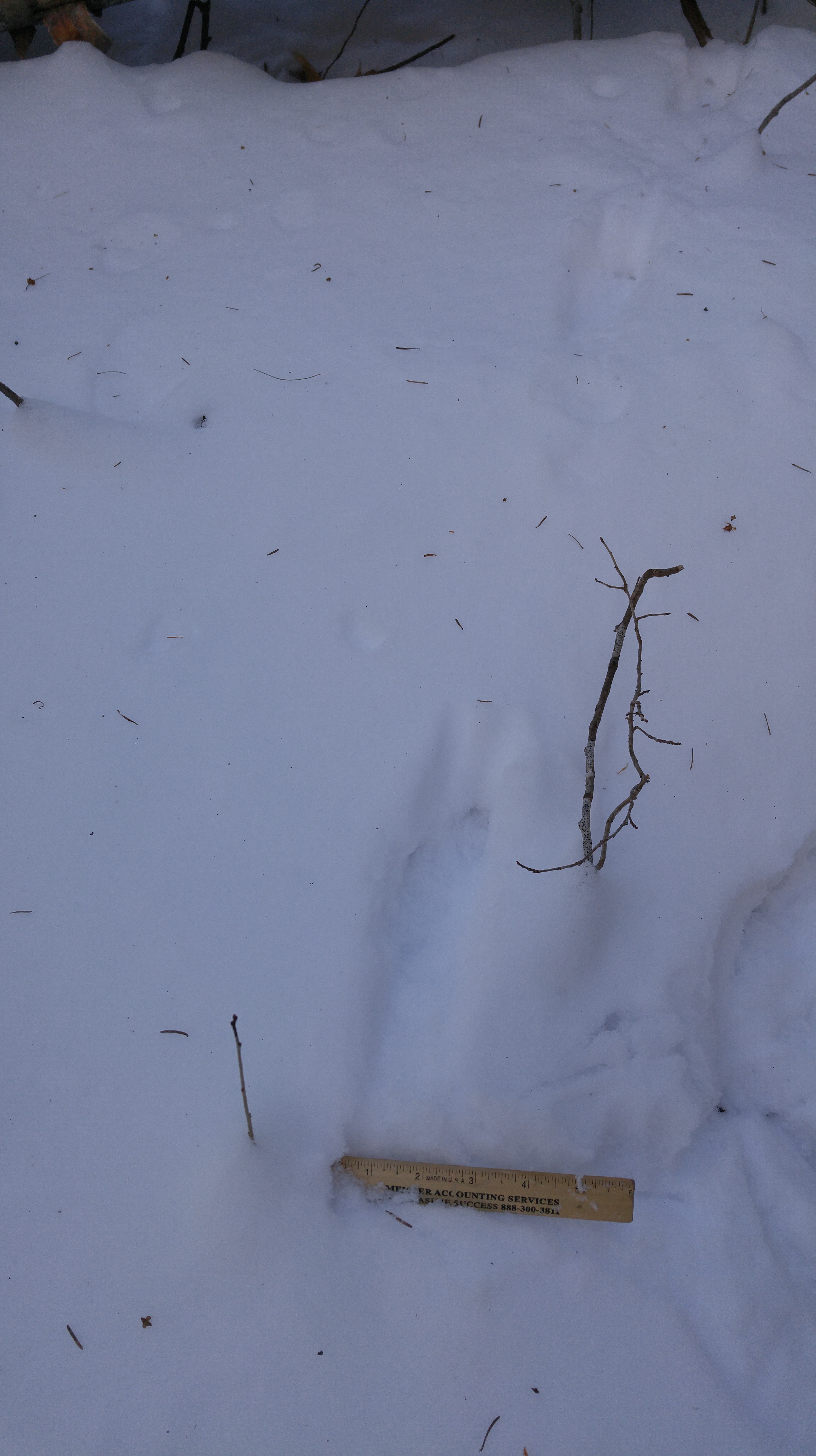
The hand-like shape was hardly a surprise since at least two raccoons visit the bird feeders on their nightly rounds.

b-wintergreen

My next source of delight–frost embracing wintergreen berries and leaves.

vp1

And then I paid my respects to the vernal pool. While there, I spent some time reflecting on Bridie McGreavy, who celebrates her birth this day, and many moons ago introduced me to the sacredness of place–especially this delicate space.

Vp2

Feather ice formed after yesterday’s melt and last night’s cooler temps.

As I did last year, I intend to document the pool on a regular basis–noting its evolution over time. This year’s big question: Will Big Night happen earlier than normal? I’m already receiving reports from others of spring peepers singing their songs.

b-brook 2

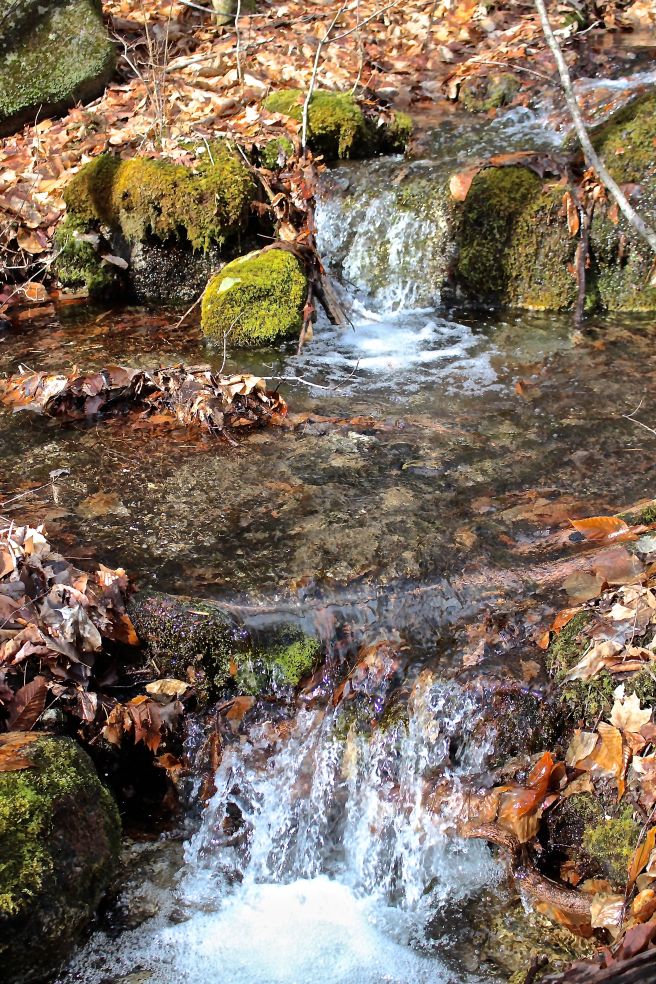
And then I was off to the GLLT’s Back Pond Reserve in Stoneham. My friend, Parker, and I were on a quest to locate species that would be good indicators of rich soils. He’s much better at knowing about this than I am, so I tagged along–thankful for the opportunity to bushwhack beside the stream that eventually flows into Back Pond while learning from him.

b-bass 2

We found a dead tree that stymied us for a few minutes, but though it has some ash-like tendencies, we came to the conclusion that it was a basswood–one of those indicators we were seeking.

b-basswood bark

Only thing–during our entire search, we only found two.

b-bear tree

But that’s OK because there was so much more to see. Though I’ve spotted other bear trees in these woods, this one features the best sign. My guy will be jealous that he wasn’t with us to find this one.

b-crowded parchment

For many of us, Parker is our fungi guru. He and his brother became interested in mushrooms at a young age and have studied them extensively. They know only Latin, I speak only common. And so, I present to you crowded parchment (Stereum rameale). 

b-hemlock varnish shelf

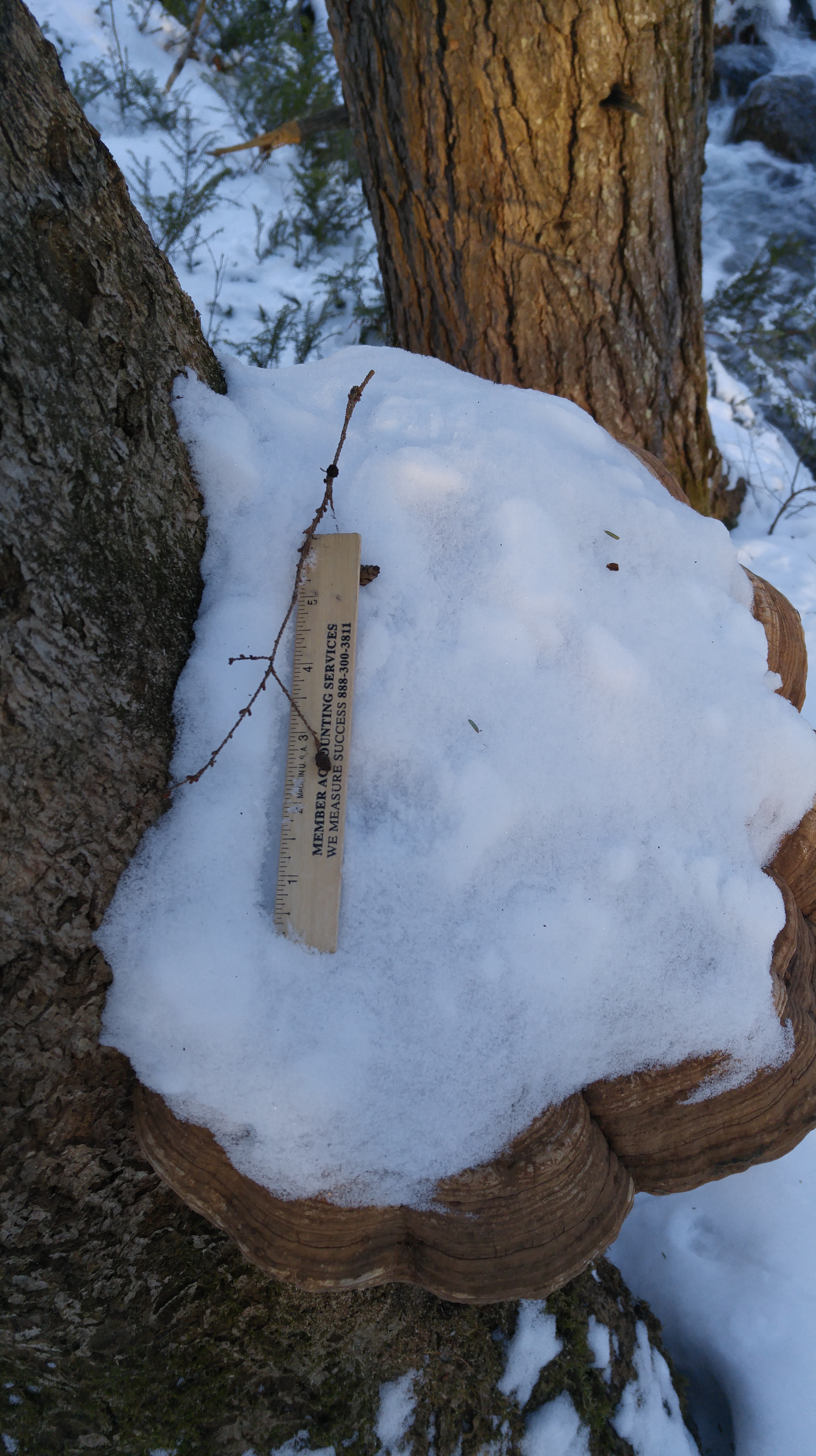
Hemlock varnish shelf (Ganoderma tsugae) grows prolifically in these woods. These old fruiting bodies are still beautiful in their offering.

b-panellus stipticus?

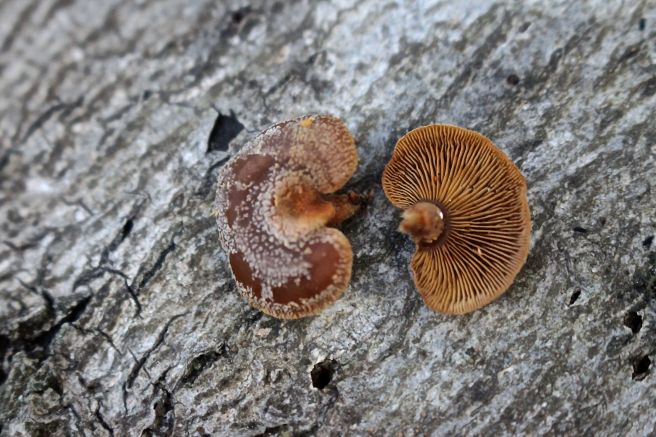
And though it didn’t get dark while we were there, Parker found Panellus stipticus, a bioluminescent species. Check out those gills on the underside. According to Lawrence Millman in his book Fascinating Fungi of New England, ” . . . specimens in the Northeast glow more obviously than specimens in other parts of North America.” So  if you are ever in these woods late at night, don’t be freaked out by a light greenish glow. It just might be nature’s night light.

b-magenta fungi

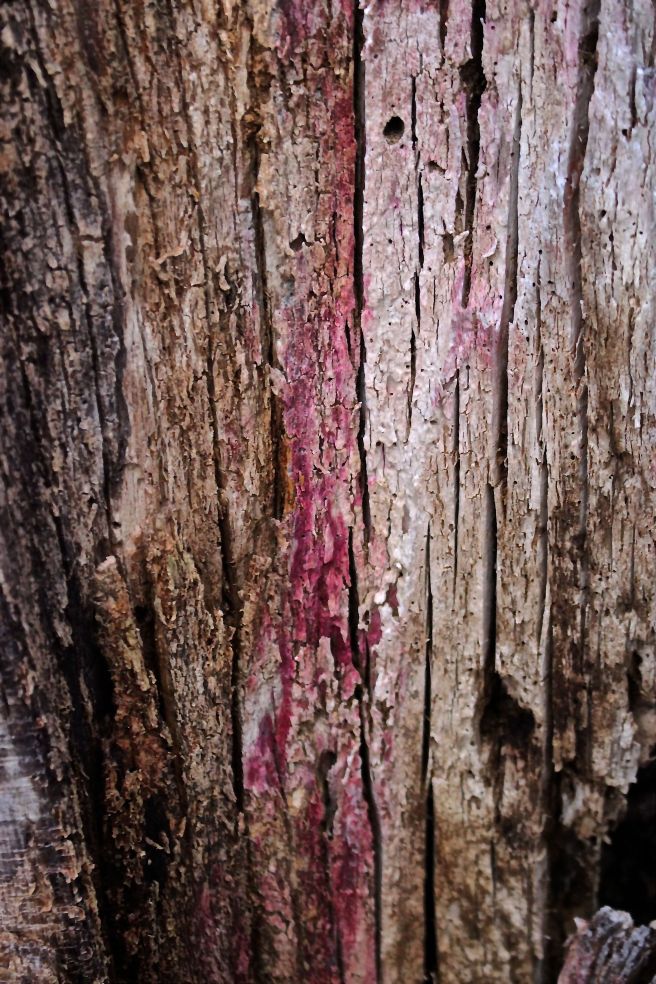
The fun thing about exploring with Parker is that he’s not afraid to say, “I don’t know.” Such was the case with this magenta fungus we found on the inner bark of a rotting stump.

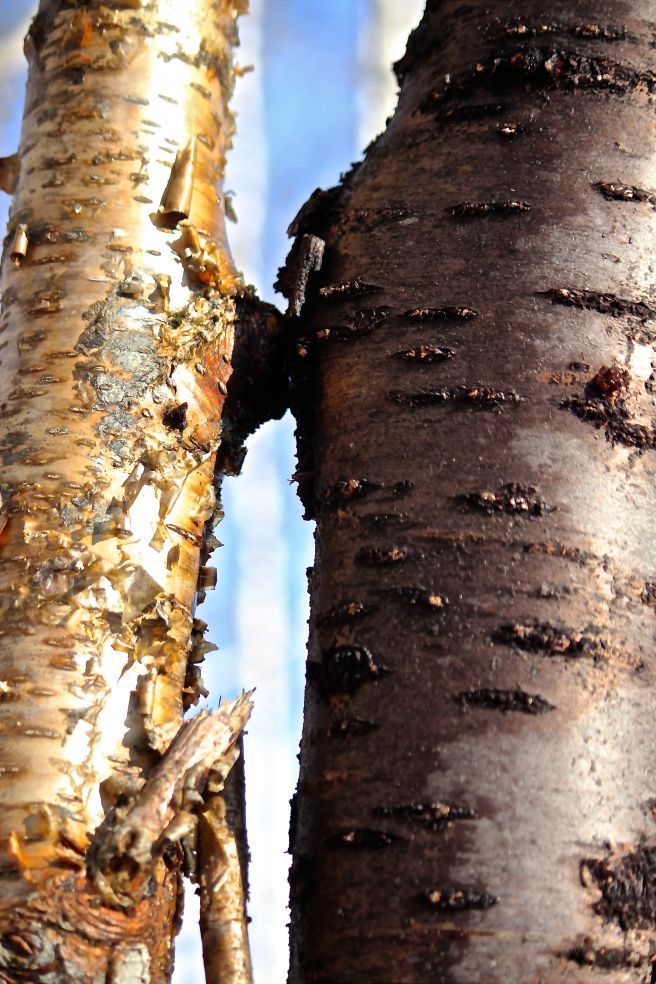
b-hemlock:hop hornbeam 2

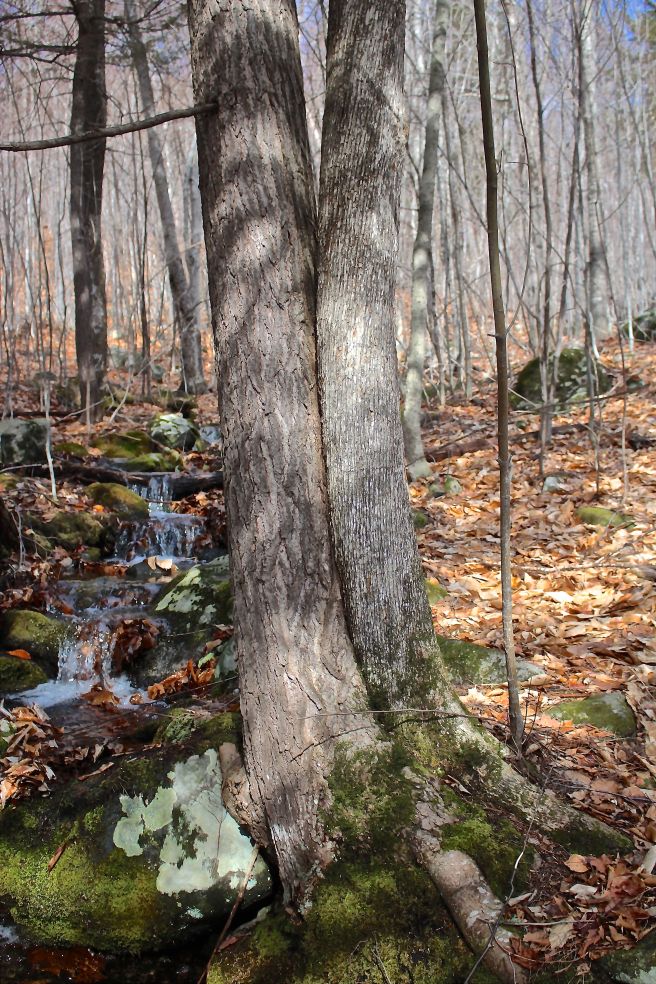
I don’t know why I’m surprised every time I see two trees sharing a space,but I am–this time hemlock and hop hornbeam.

b-brook sans ice

We continued beside the stream for most of our climb and eventually came upon the trail that connects Ron’s Loop to The Mountain.

b-lichen on tree

A few things stopped us along the way, including this lichen that neither of us could conclusively identify,

b-rock lichen

what I believe is peppered rock tripe,

b-lungwort, lichens

and the glorious bright green state of lungwort. The thing that gave us pause about the lungwort wasn’t so much the lungwort as the lichen and moss garden that also decorated this tree.

b-mtn bog

And then we were literally stopped by water. Our intention to reach the scenic view over the Five Kezars was prevented by this boggy area. A vernal pool?

b-mtn bog 2

Certainly a wetland. We explored for a few minutes and wondered about the species that will appear here in the next few months.

b-boulder field

Then we returned to the stream, crossed over and paid a visit to the boulder field for a closer examination.

b-rock tripe 1

Like the lungwort, much of the rock tripe was also green today–a testimony to recent rain and yesterday’s hail.

b-tripe center

Two things to note–how it grows from the center umbilicus, like an umbilical cord, thus its Latin name: Umbilicaria mammulata; and the fact that it’s creating a garden on the up-rock side, where mosses and humus and seeds gather.

b-rock tripe water 2

I found a drier brown specimen that had captured several drops of water and held them still.

b-redbacked

Upon our decent, we stumbled upon a redback salamander–the first of the season for both of us. It seemed rather lethargic so we covered it with leaves and wished it a safe life. Redbacks are terrestrial and don’t have an association with vernal pools, though they are sometimes spotted on Big Night as we help the salamanders cross the road.

b-rose moss 1

A mossy display on several rocks in a seepage meant we had to pause again.

b-rose 2

We believe this is rose moss (Rhodobryum ontariense), but our ID was quick.

b-rose 3

Based on the description in  Common Mosses of the Northeast and Appalachians, “the shield-shaped leaves are widest above mid leaf and end in needle point.” Yup.

b-wood sorrell

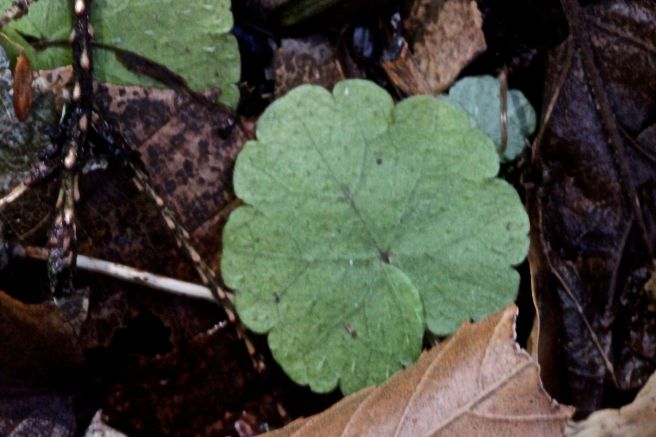
And then we realized we have to get our wildflower eyes back on. The wood sorrel (Oxalis montana) leaves stumped us initially, but what else could it be?

b-wood sorrel 2

Other than a luna moth, that is! Doesn’t it remind you of one?

b-foamflower?

Without a flower, it’s difficult to ID a plant. My first choice: Foamflower or False Miterwort (Tiarella cordifolia), but my second choice based on the blunt-toothed leaves: Naked Miterwort (Mitella nuda). Time . . . and blossoms will tell.

b-orchid?

Our final find of the day left us with differing opinions. I said shinleaf (Pyrola elliptic). Parker said Corallorhiza maculate, which is a coralroot. A friend of his who is an orchid expert agreed. I guess we’ll have to revisit this place to confirm.

We’re on the verge of change and the seasons may collide with a Nor’easter in the offing.


The Borrowing

My friend, Dick, sent me the following message yesterday: “from a novel, Northwest Angle by Krueger … who has a series which relates to the Objidwa (sp) of the upper parts of Michigan …

‘What’s a Mide?” — ‘A member of the Grand Medicine Society,’ Stephen explained. ‘A healer. Somebody who understands the harmony of life and how to use nature to restore harmony when it’s been lost.” p246

“Belongs.” Meloux (a very senior shaman type of the Native American ‘Mide’ of the Objidwe) seemed to consider the word. “I believe no one belongs to anyone else. You, me Waaboozoons, we are all dust borrowed for a little while from Grandmother Earth. And even that dust does not belong to her. She has borrowed it from all creation, which is the Great Mystery, which is Kitchimanidoo. And if you ask this old man, I would say that another way to think about Kitchiimanidoo is as a great gift. Kitchimanidoo is not about keeping. Nothing belongs to anyone. All of creation is meant as a giving.” p 269

While I haven’t read the book or any of Krueger’s works, these words resonated with me as I moved about this morning.

m-vp

My first stop was a visit to the vernal pool, where the ice is beginning to melt.

m-vp, birch seeds

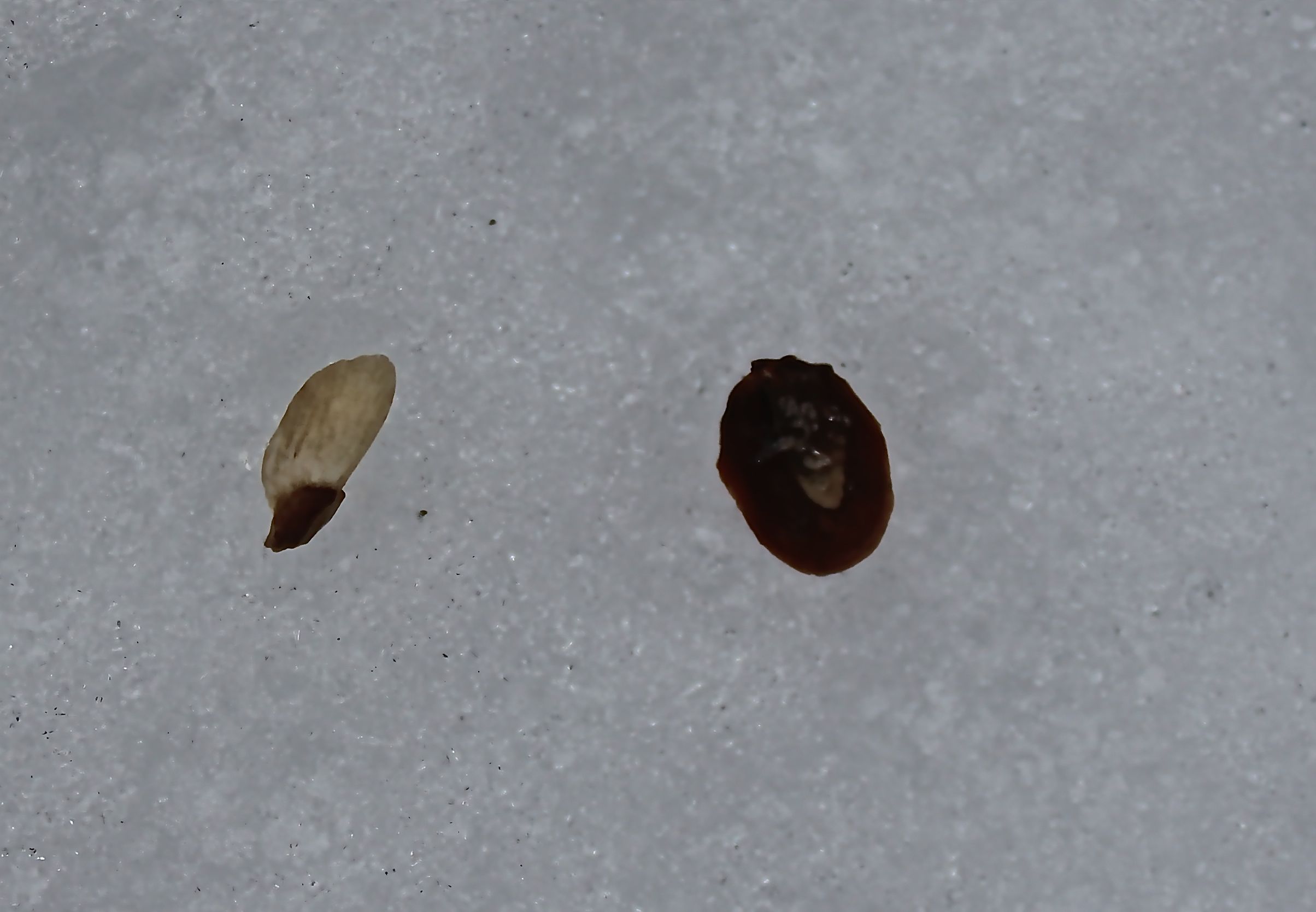
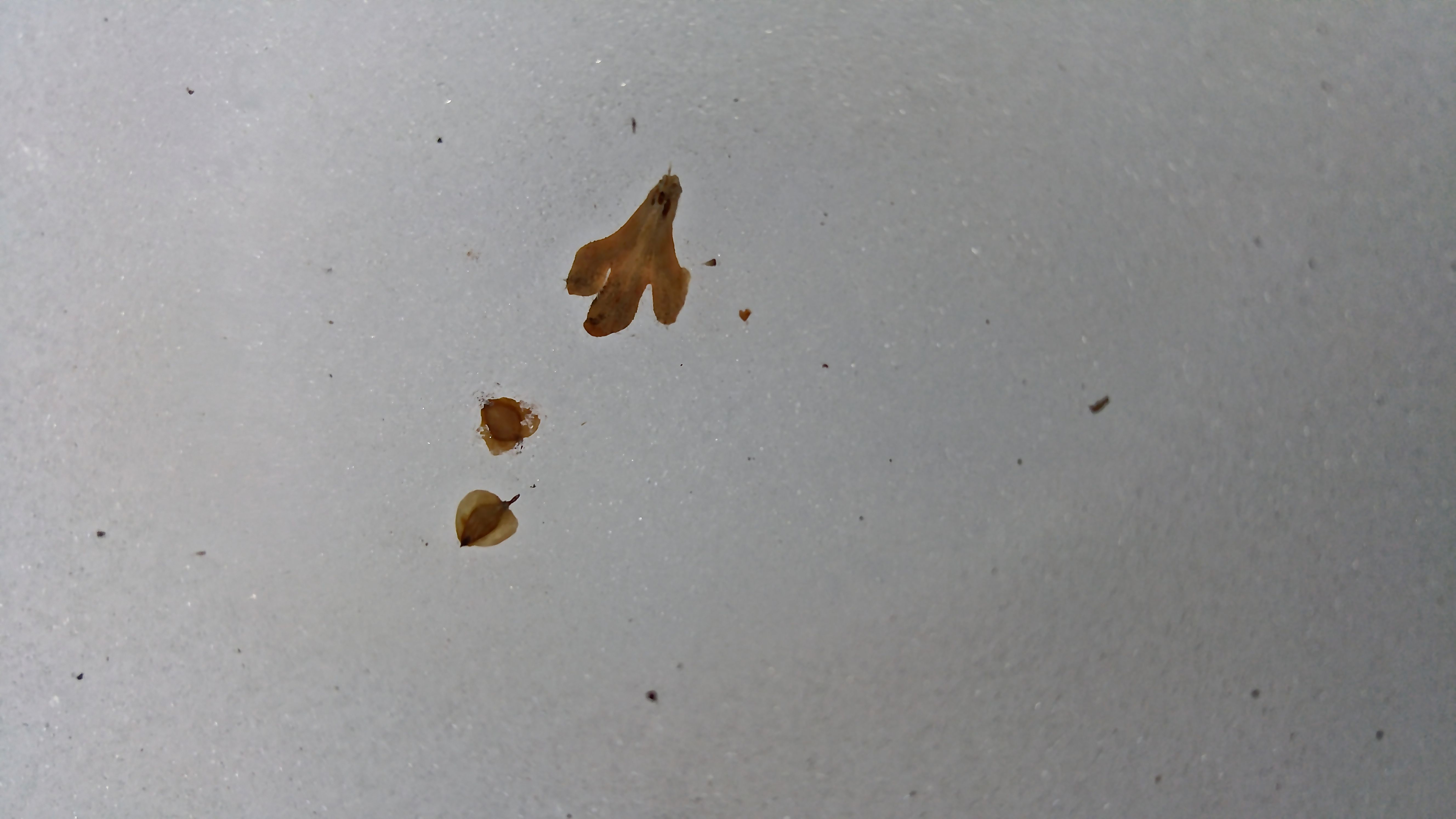
I looked for insects and found instead birch seeds and scales–meant as a giving.

m-berries

Wintergreen berries remained prolific below the power lines. While this fruit is traditionally browsed by a variety of mammals, I had to wonder if its location is the reason it was left untouched–poisoned by the herbicides Central Maine Power uses to keep the land clear. What was meant as a giving revoked.

m-leaves thru ice

Not all was bad as I followed the trail for a distance and enjoyed the beauty that has begun to emerge.

m-sphagnum color

The pompom heads of sphagnum moss contrasted brilliantly beside the running clubmoss.

m-trail light

Looking back, I noticed that today’s sunlight was captured in yesterday’s raindrops–certainly a reason for thanks-giving.

m-mount 1

And before me–man and nature in the eternal struggle for harmony. An example of borrowing.

m-pollen?1

Before I turned onto a logging road, a puddle caught my attention.

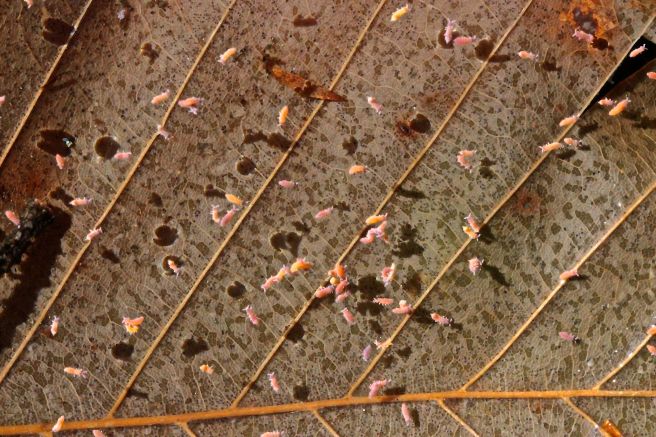
m-pollen?2

My first thought was pollen, but as I approached, I realized the little dots were moving about much like spring tails because .  . . they were spring tails. So my learning increased as I noted their color and the fact that there are aquatic members of this family. Another giving received.

m-pin cherry warts 2

On recent treks, my bark eyes have been confused about two trees–black birch (aka sweet or cherry birch) and pin cherry. As youngsters, both feature reddish-brown bark. What has thrown me off is the association with other birch trees, including the yellow birch that grows behind this specimen. Today, I made a point of noticing–the warty orange lenticels, lack of catkins and no wintergreen scent. These are three features that helped point me toward pin cherry. Black birch bark features long, thin lenticels, catkins common to birch trees and when scraped, that delightful wintergreen smell.

m-pin cherry:birch1

Despite the fact that they are not of the same family, certainly they’ve found a way to give to each other and live in harmony. A lesson.

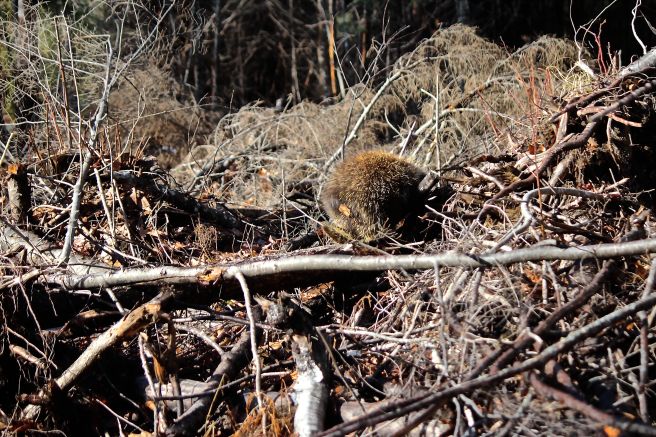
m-porky

Just beyond the birches, in one of many stump dumps along this logging road, something caught my eye.

m-porky 1

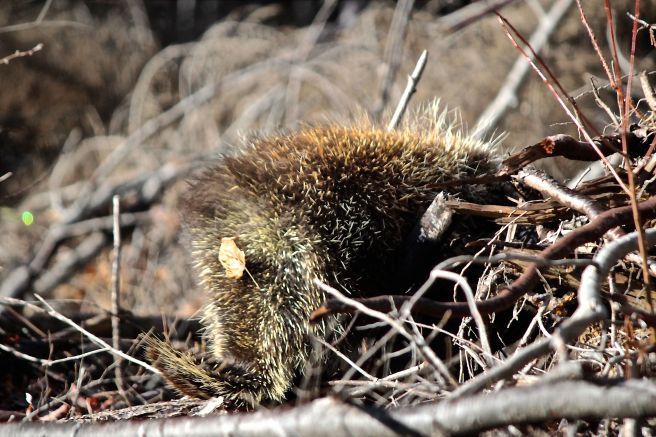
A porcupine worked over the bark of a fallen hemlock tree. I stood for several minutes and watched. Either it wasn’t aware of me or I didn’t pose enough of a threat.

m-porky again

The leaf caught on its backside made me chuckle and wonder why we don’t see more of that.

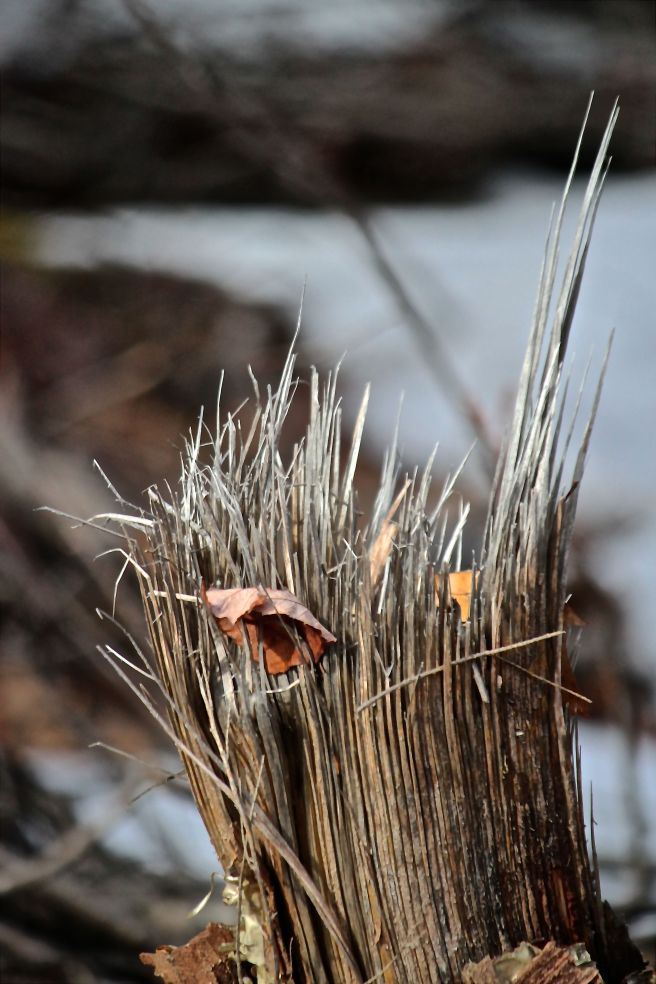
m-porky like

I’m amazed that I saw it at all in this land that has been chopped up over the course of the last three years. Notice how leaves are similarly stuck to this shredded tree stump.

m-porky tree 3

m-porky tree 2

m-porky tree

Behind were the trees that have received the porcupine’s recent attention. While the logging is destructive, it helps heat homes, provides income to at least several people including the logger and landowner, and creates new habitat and food opportunities for wildlife. Change is difficult and I’d grown to love these woods the way they were, but they were that way because of prior cuttings. A borrowing.

m-bubbles

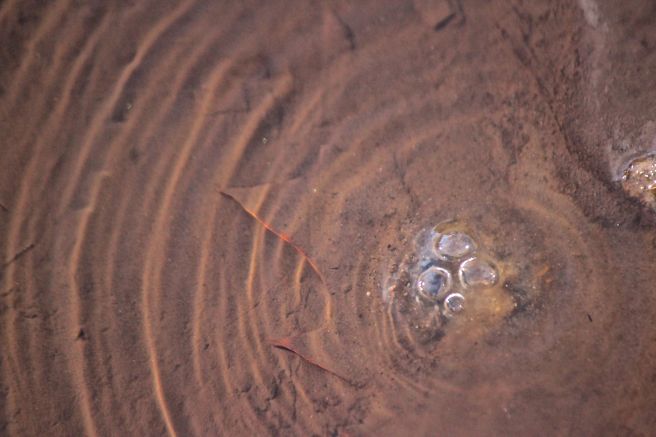
Most of the logging road was a combination of puddles and mud. At times, air bubbles rippled as I moved through and I was reminded of my youth years spent feeling for clams in the mudflats of Clinton Harbor on Long Island Sound. The memory itself was a giving.

m-deer 2

Like the deer that frequent this land, my boots got stuck in the muck. Sometimes, it seemed like I was being sucked in and told to stand still. But my mind wandered on and I followed it.

m-trail conditions

Going forward in time, I’ll be curious to watch the reflections in the puddles change as the pioneer species move back in and regenerate this land. The harmony.

m-spirit

In the end, as always seems the case, I was on the receiving end of the giving and grateful for the borrowing as the spirit of Grandmother Earth shared a few tidbits of the Great Mystery.


Spotlight on Sabattus

Following this morning’s Greater Lovell Land Trust trek at Chip Stockford Reserve, where we helped old and new friends form bark eyes as they examined various members of the birch family, my feet were itchy. Not in the scratchy sort of way–but rather to keep moving.

It was a lovely day for a hike and Sabattus Mountain in Lovell was my destination. I love this little mountain because it offers several different natural communities and great views.

s-com 1

Though there are a few softwoods on the lower portion of the trail, it’s really the land of a hardwood mix.

s-downed twigs

About halfway up, the neighborhood switches to a hemlock-pine-oak community. It was then that I began looking for downed hemlock twigs in an array at the base of trees. I’ve found them here before, and today I wasn’t disappointed.

s-porky chew 3

The twigs had been chewed off and dropped by a porcupine as evidenced by the 45˚-angled cut and incisor marks. Though red squirrels also nip off the tips of hemlock twigs, they do just that–nip the tips. Porcupines cut branches.

s-porky cliff

Downed branches usually mean scat, but I searched high and low and under numerous trees that showed signs of activity and found none. A disappointment certainly.

s-pippipsewa

My search, however, led me to other delightful finds that are showing up now that most of the snow has melted, like this pipsissewa that glowed in the afternoon sun. As is its habit, the shiny evergreen leaves look brand new–even though they’ve spent the winter plastered under snow and ice. A cheery reminder that spring isn’t far off.

s-Pleasant 1

At the summit, I got my bearings–the ridge of Pleasant Mountain and Shawnee Peak Ski Area to the southeast.

s-mount tom & kezar pond

To the southwest, the asymmetrical Roche Moutonnée, Mount Tom, visible as it stands guard over Kezar Pond in Fryeburg.

s-Kearsarge 2

And to the west, Kezar Lake backed by Mount Kearsarge in New Hampshire. I wanted to venture further out on the ledge, but some others hikers had arrived and I opted not to disturb their peace.

s-summit wind

Instead, I sat for a few minutes and enjoyed the strong breeze offering possibilities as it floated over the summit and me.

s-porky cuts1

Crossing the ridge, I left the trail and found more porcupine trees, including this young hemlock that had several cuts–look in the upper right-hand corner and lower left hand. A number of younger trees along this stretch will forever be Lorax trees.

s-golden moonglow1

On the outcrop of quartz, I paused to admire the golden moonglow lichen–it’s almost as if someone drew each hand-like section in black and then filled in the color, creating an effect that radiates outward.

s-polypody patch

I was pleasantly surprised to find a patch of polypody ferns on what appears to be the forest floor but was actually the rocky ridge. Notice how open-faced it is, indicating that the temperature was quite a bit warmer than what I’d seen on cold winter days.

s-polypody sun

Sunlight made the pinna translucent and the pompoms of sori on the backside shone through.

s-glacial 1

The trail doesn’t pass this glacial erratic, but I stepped over the logs indicating I should turn left and continued a wee bit further until I reached this special spot.

s-porky scat 1

Its backside has been a porcupine den forever and ever. Nice to know that some things never change.

s-hemlocks and oaks

After returning to the trail, I followed it down through the hemlocks and oaks. This is my favorite part of the trail and though it’s a loop, I like to save this section for the downward hike–maybe because it forces me to slow down.

s-fairies 1

For one thing, it features the land of the fairies. I always feel their presence when here. Blame it on my father who knew of their existence.

s-fairies 2

I had a feeling a few friends were home–those who found their way into a fairy tale I wrote years ago. I left them be–trusting they were resting until this evening.

s-community transition 1

As swiftly as the community changed on the upward trail, the same was true on my descent.

s-birch bark color

On our morning trek, we’d looked at paper birch, but none of the trees we saw showed the range of colors like this one–a watercolor painting of a sunset.

s-birch bark 1

This one shows the black scar that occurs when people peel bark. The tree will live, but think about having your winter coat torn off of you on a frigid winter day. Or worse.

s-black birch 1

Off the trail again, I paused by a few trees that I believe are black birch. Lately, a few of us have been questioning black birch/pin cherry because they have similar bark. The telltale sign should be catkins dangling from the birch branches. I looked up and didn’t see catkins, but the trees may not be old enough to be viable. This particular one, however, featured birch polypores. So maybe I was right. I do know one thing–it’s not healthy.

s-pines 2a

And then I reached a section of trail that I’ve watched grow and change in a way that’s more noticeable than most. I counted the whorls on these white pines and determined that they are about 25 years old. I remember when our sons, who are in their early twenties, towered over the trees in their sapling form. Now two to three times taller than our young men, the trees crowded growing conditions have naturally culled them.

s-birch planter

Nature isn’t the only one that has culled the trees. Following their selection to be logged, however, some became planters for other species.

s-3 trees

Nearing the end of the trail another view warmed my heart. Three trees, three species, three amigos. Despite their differences, they’ve found a way to live together. It strikes me as a message to our nation.

Perhaps our leaders need to turn the spotlight on places like Sabattus. It’s worth a wonder.


To Bear Trap and Back

A change of plans today meant I had time for a trek to Narramissic Farm and the historic bear trap in South Bridgton before the rain began.

N-view from road

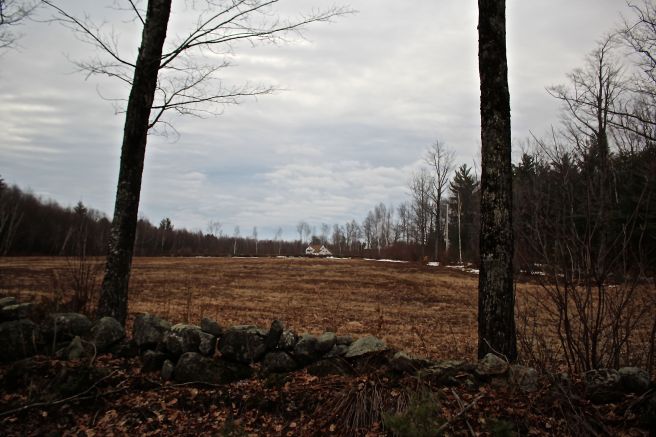
From Ingalls Road, where I decided to park, I took in the view of the front fields and house.

N-Narramissic Road

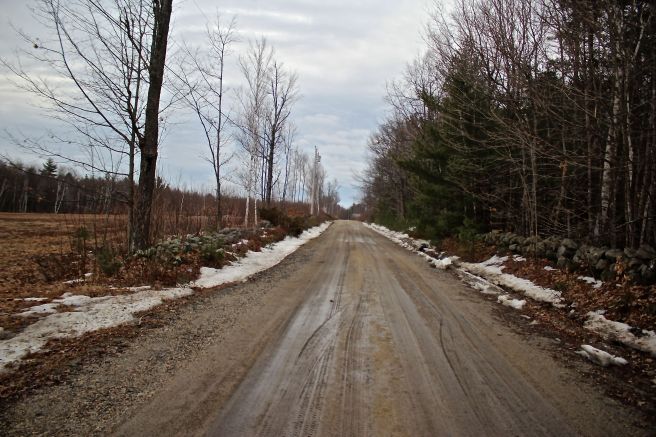
Narramissic Road is passable, but I wanted to slow down and soak it all in.

N-pussy willow 1

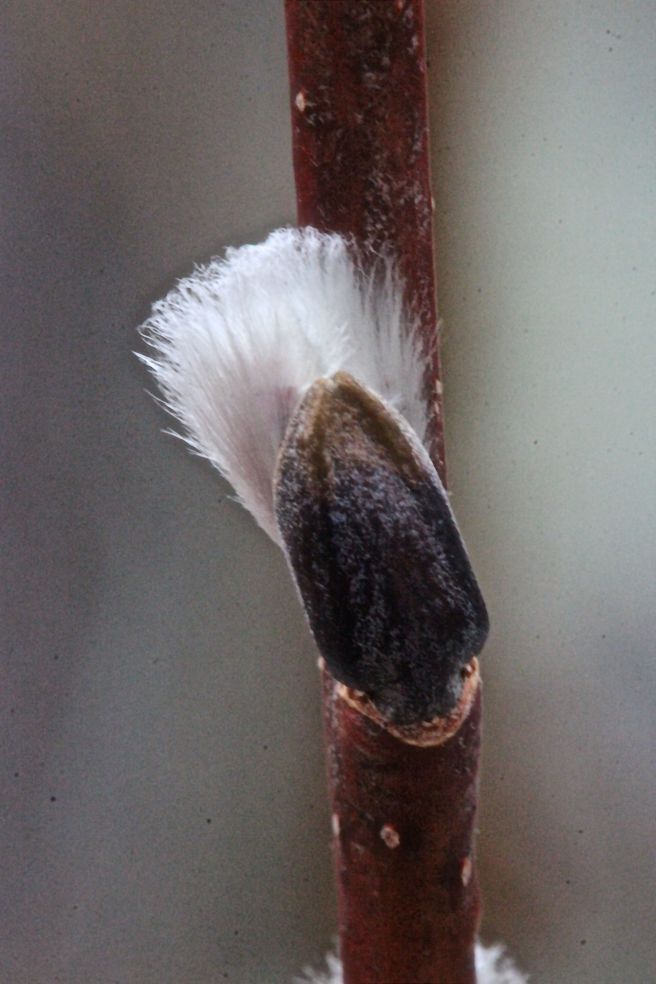
From pussy willows to

N-staghorn

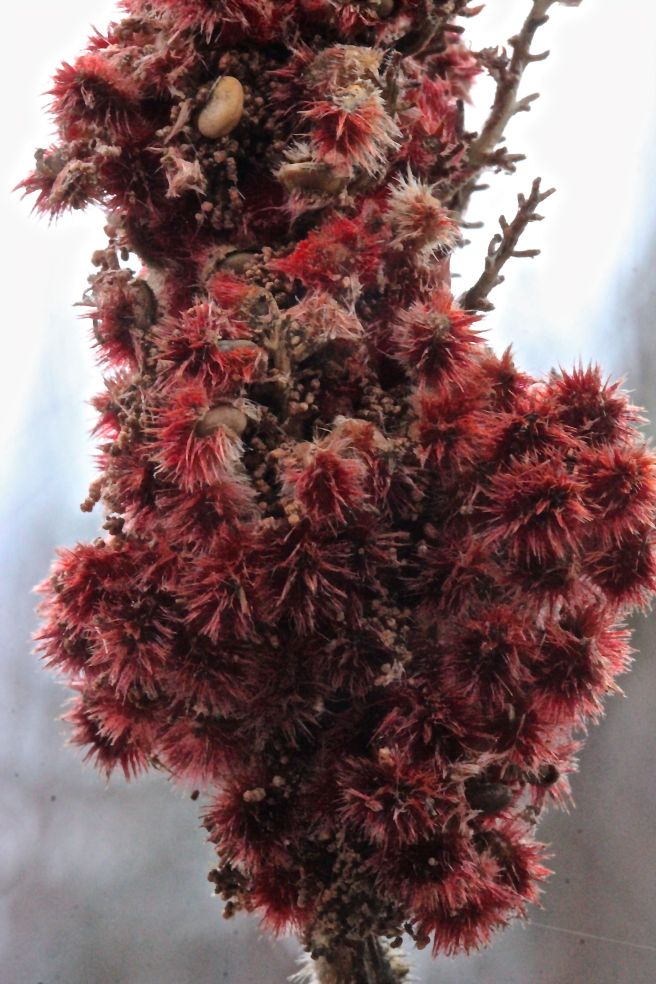
fuzzy staghorn sumac, I was thankful I’d taken time for the noticing.

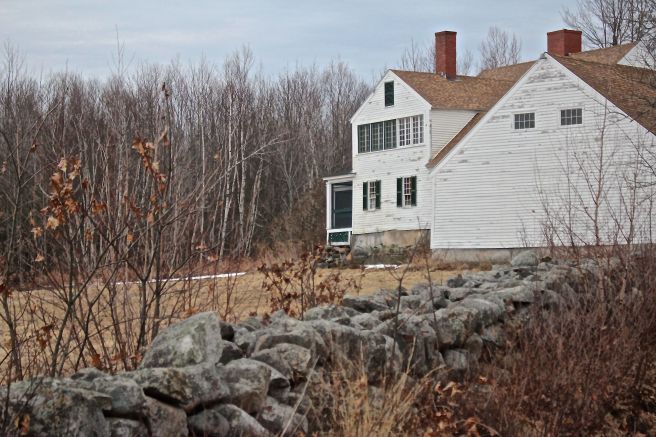
N-house & attached barn

The Bridgton Historical Society acquired the 20-acre property in 1987 when it was bequeathed by Mrs. Margaret Monroe.

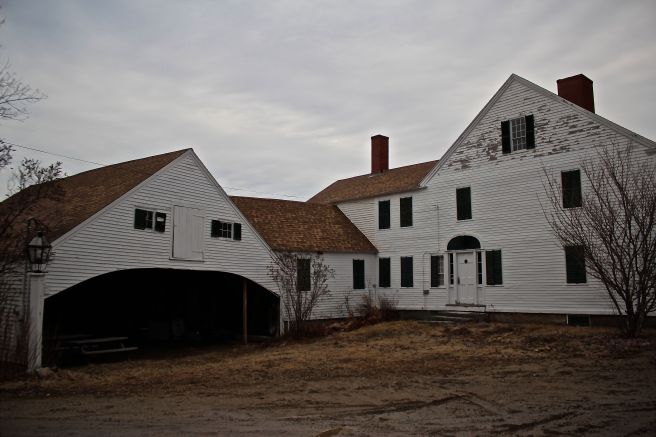
N-house

Turning the clock back to 1797, William Peabody, one of Bridgton’s first settlers, built the main part of the house.

Peabody sold the farm to his daughter Mary and her husband, George Fitch, in 1830 and they did some updating while adding an ell.

N-barn front

The Fitches had a barn erected that has come to be known as the Temperance Barn; historical records claim it to be so named “because it was raised without the traditional barrel of rum.”

N- barn face

Both the barn and the house are in need of repair, but I couldn’t help but wonder about what mighty fine structures they were in their day. While today, a visit to the farm feels like you’re in the middle of nowhere, during its heyday it was located in the center of somewhere–at the junction of two roads that have since been abandoned.

When Mrs. Monroe purchased the property in 1938, she named it Narramissic, apparently an Abenaki word for “hard to find” because it reflected her long search for just the right piece of real estate.

N-blacksmith shop

A blacksmith shop is located between the house and Temperance Barn, and beside the trail I chose to follow through another field and off into the woods.

N-garden wall 1a

Massive stone walls indicate the fields had been plowed.

N-rock uplifting

Even today, “stone potatoes” continue to “rise” from the ground, making them one of the farmer’s best crops.

N-pearly 2

My destination was two-fold: the quarry and bear trap. But along the trail, I stopped to smell the roses. Or at least admire the beauty of pearly everlasting in its winter form.

N-gray birch litter

Several trees had snapped in the season’s wind, including a gray birch that scattered scales and seeds as it crashed to the ground.

N-gray fruit seeds

But . . . because the top of the tree was no longer in the wind zone, a surprising number of catkins continued to dangle–all the better for me to see. Notice the shiny seeds attached to the scales.

N-gray birch generations

The tree speaks of generations past and into the future.

N-jelly 2

Further along, I found a wavy and rubbery jelly ear (Auricularia auricla) beside a gray birch seed.

N-sign 2

Finally, I reached my turn-off.

N-quarry 1

N-feather 2

This is the spot from which the foundations for the buildings were quarried so long ago, using the plug and feather technique that was common in that time.

N-common toadskin 2

Life of a different sort has overtaken some of the stones–common toadskin lichen covers their faces.

N-common toadskin 3

In its dry form, it looks perhaps like the surface of a foreign planet, but this is another lichen that turns green when wet–allowing the “toad” to become visible.

N-bishop's face in ice

Speaking of becoming visible, I noticed the bishop’s face topped with a mitre as water dripped off the rocks and froze. My thoughts turned to my sister–she doesn’t always see what I see, but maybe this one will work for her.

N-young beech

Heading back out to the main trail, I startled a snowshoe hare and of course, didn’t have my camera ready. As I turned toward the bear trap, I continued in the land of the beech trees. Most are too young to produce fruit, but I looked for larger trees and, of course, checked for claw marks.

N-beech slashes

The best I found were slashes–probably caused by another tree rubbing against this one.

N-initials

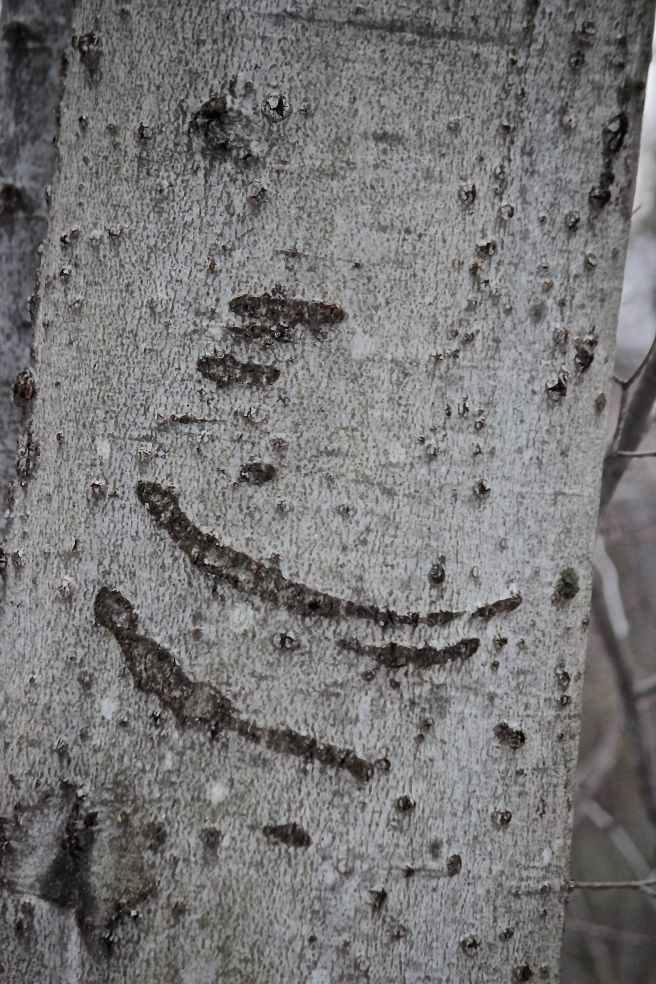
Oh, and some initials carved by one very precise bear.

N-No parking

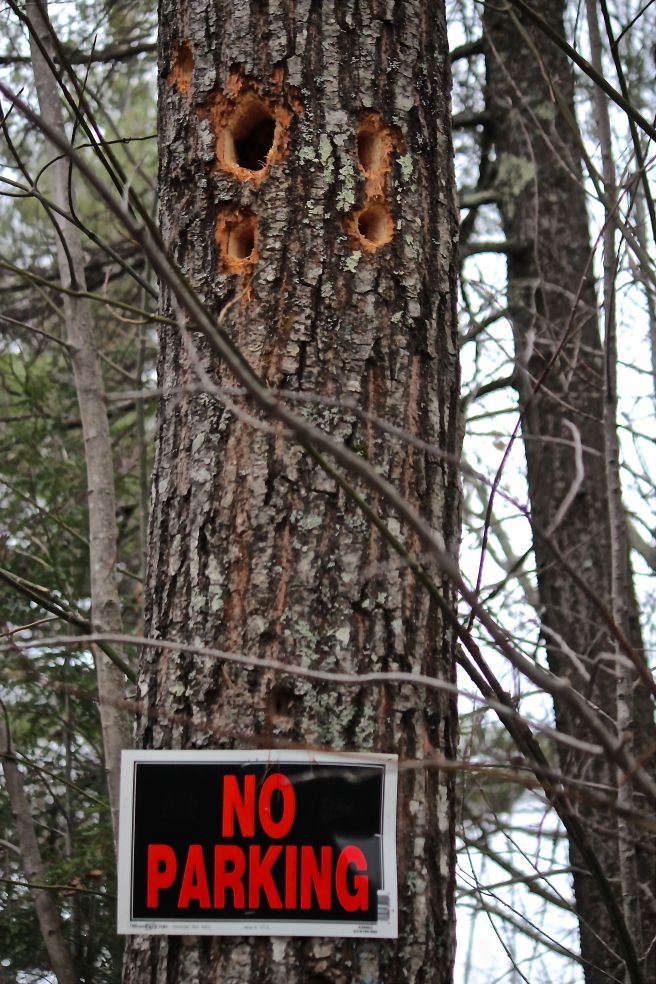
I was almost there when I encountered a “No Parking” sign. A new “No Parking” sign. On a trail in the middle of nowhere that used to be somewhere. The pileated woodpeckers obviously ignored it. Me too.

N-BT1

At last, Bear Trap! According to an August 17, 1963 article in the Bridgton News, “Enoch Perley, early settler of South Bridgton, built his first house in 1777 and brought his bride to their new home in 1778. [I believe this was at Five Fields Farm.]

As Enoch acquired livestock, he was much troubled by depredations from bears. He built a bear trap on the hill back of his first home . . .

Tradition says that four bears were caught in this trap–not enough! So Mr. Perley later had an iron bear trap made which took care of eight bears. Without a doubt, many were disposed of by him personally. A story is told that in an unarmed encounter with a bear and two cubs beside a wood road at dusk, Mr. Perley allegedly strangled the mother bear with his garters . . .”

N-bear trap 1

The article continues, “The bear trap is built of stone. A large stone door is suspended and as the bear takes the bait, he trips the lever and is caught in the stone enclosure.”

N-BT inside

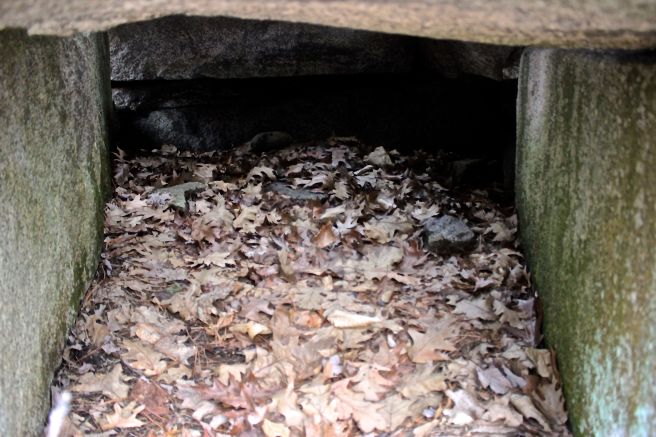
I looked inside and found no one in residence. In a December 1954 issue of the Bridgton News, a brief article states: “The old stone bear trap on the mountain in South Bridgton known as ‘Fitch’s Hill,’ unused for more than one hundred years, has been reactivated by Dr. Fred G. Noble and Gerald Palmer and put in readiness to capture a bear.” As the story goes, they never did succeed.

N-BT back view

A side view.

N-BT*back side

And a rear view. A few years ago there was talk of moving this monument because land ownership had changed. I hope it stays put because its authenticity would be lost in a move.

N-pine scale?

Just below the trap, I noticed a white hue decorating only one of a bunch of young pine trees. I can’t say I’ve ever seen this before or venture a guess about its origin. I’m waiting to hear back for our district forester–maybe he has some insight.

N-heading back 1

As I headed back down the trail and the barn came into view, I spied a single red pine thrown into the mix of forest species that have taken over this land.

N-red pine

Ever on my bear claw quest, I checked the bark of this tree. Though beech provides an easy display of such marks, it’s not the only species of choice. Among others, single red pines that appear to be anomalies have been known to receive a visit.

N-hare

There was sudden movement as I approached the pine and then what to my wondering eyes should appear, but a second snowshoe hare! It paused long enough for me to snap a photo. Do you see it? Also known as the varying hare, its fur is still white.

Behind the tree, I found where it had been dining and defecating.

N-Pleasant Mtn ridge

N-farm view from back

As I crossed the upper field, the ridge line of Pleasant Mountain and ski trails at Shawnee Peak made themselves known to the west. And beyond the farmhouse, the White Mountains.

And then,

N-shagbark hickory

and then . . .  an oversized bud captured my attention as I walked back down the road.


Shagbark hickory isn’t a common species around here. But, Jon Evans of Loon Echo Land Trust had recently told me some mature trees were found on a property in South Bridgton that is under conservation easement. (We actually may visit them tomorrow). The bulbous, hairy bud scales and large leaf scar made even the young trees easy to identify. Curiously, according to Forest Trees of Maine, the wood “was formerly used in the manufacture of agricultural implements, axe and tool handles, carriages and wagons, especially the spokes and rims of the wheels.” That fits right in with the neighborhood I’d been visiting.

N-mud season

One final view–yup, it’s mud season in western Maine. But still worth a trek to bear trap and back. Thankfully, the rain held off until my drive home.


Leaping Mondate

My guy happens to be Irish so it seemed only appropriate that I propose to him today following the example that St. Brigid set when she struck a deal with St. Patrick. Yes, we’ve been married for 25+ years, but I proposed anyway.

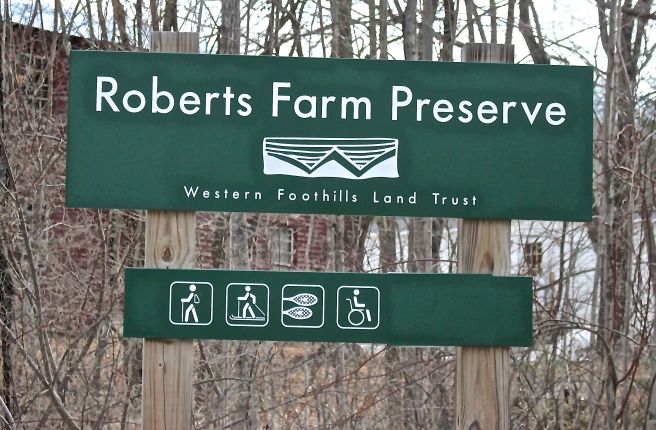
And he accepted. So today’s Mondate found us at Roberts Farm Preserve in Norway. Norway, Maine, that is.

R-sign

In her book, Hikes and Woodland Walks in and around Maine’s LAKES REGION, my friend Marita Wiser states that the preserve was “farmed by the Pike and Roberts family for 200 years.” She adds, “The property was purchased by the Western Foothills Land Trust in 2007.”

r-parking

Though the trails are mostly maintained for Nordic skiers, we didn’t see any today.

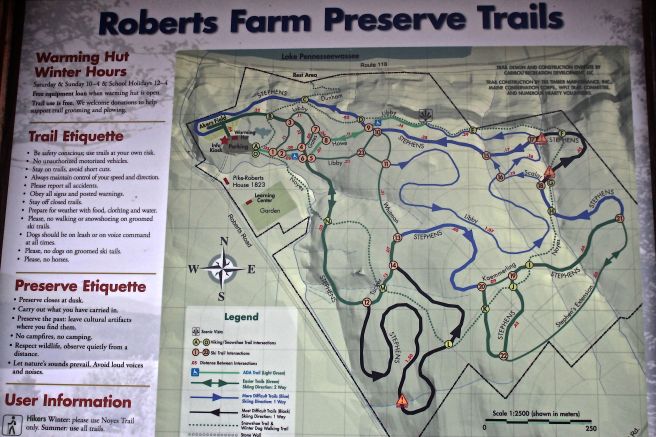
r-trail map

Had it been open to skiers, we wouldn’t have been able to do what we did–follow the network of trails around the perimeter of the property.

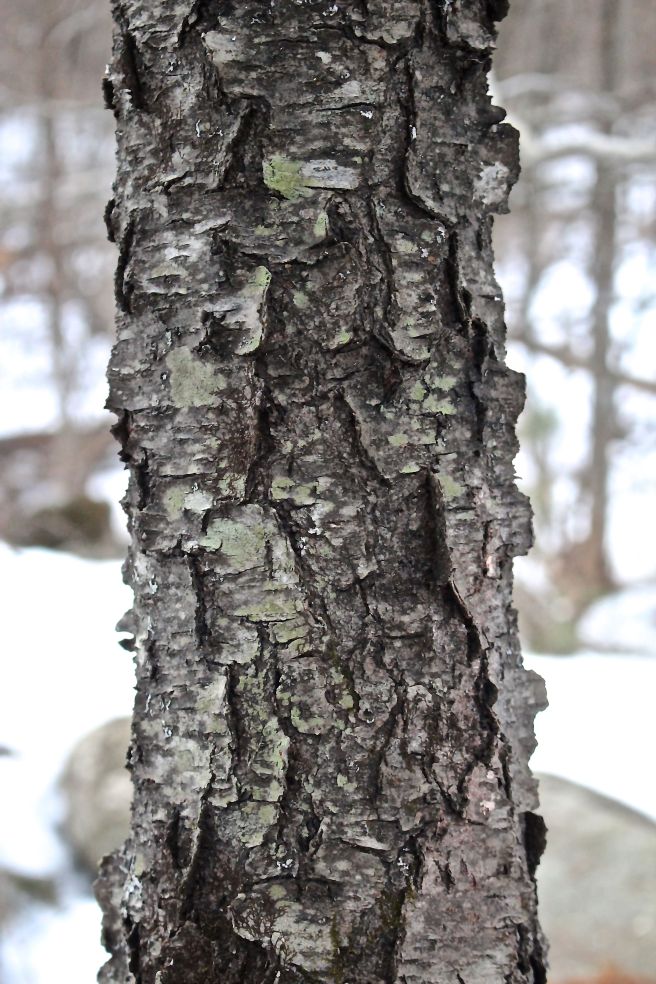
r-cherry bark

We’d only walked a few feet when I had to pause–the burnt cornflake look of black cherry bark insisted upon being noticed.

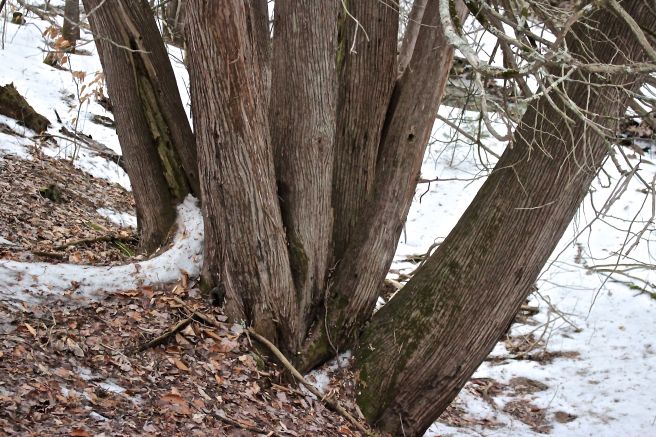
R-Northern White Cedar

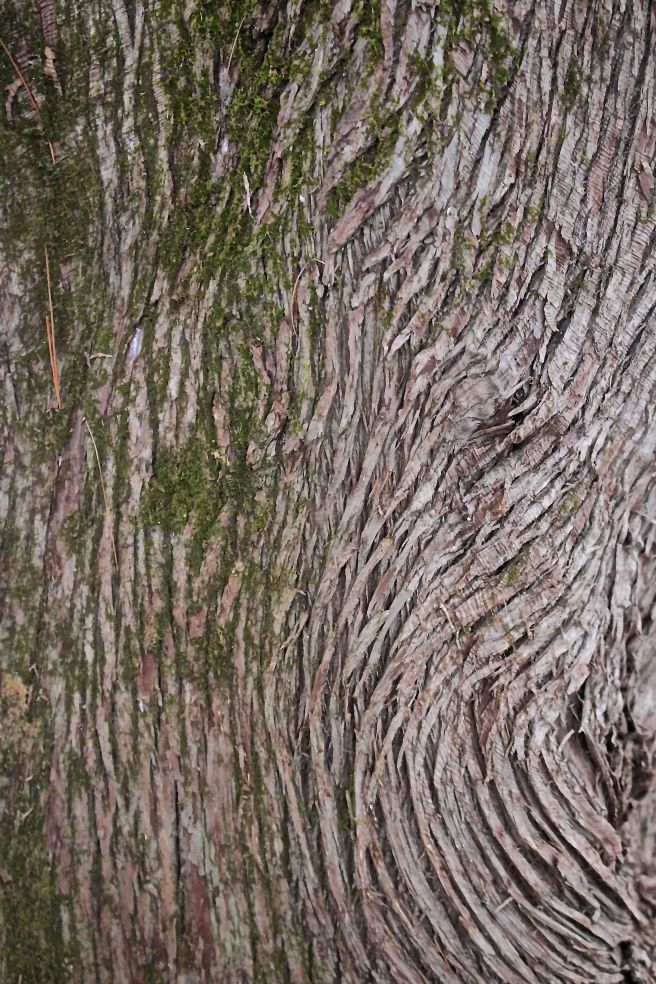
Visiting here a couple of times previously, one of the things I’d come to like about it is the opportunity to gush over Northern white cedar bark.

r-northern white bark2

I love its red-brown color, sheddy strips that intersect in diamond formations and habit of spiraling left and then right with age. In his book BARK, Michael Wojtech states of the cedar: “In the 1500s, the native Iroquois showed French explorers how to prevent scurvy using a tea made from the bark, which contains vitamin C. The name arborvitae means ‘tree of life.'”

r-northern white leaves

Equally beautiful are its flat sprays of braided, scale-like leaves.

Since I’m on the topic of tree bark, I have two others to share, including this one–the red inner bark of Northern Red Oak made a stunning statement.

r-hop hornbeam bark

Displaying its shaggy presentation was the hop hornbeam.

My heart leaped (appropriate movement for today) when I saw these papery fruits on the ground–hop hornbeam is named for its fruiting structures that resemble hops.

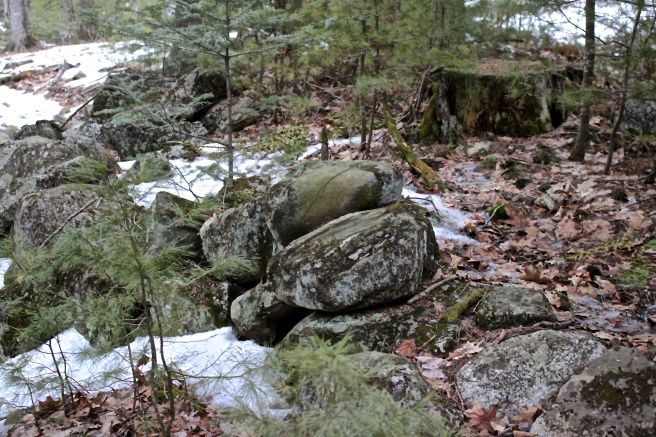
r-stone wall

Stone walls crisscross the preserve and provide evidence of its former use as a dairy farm.

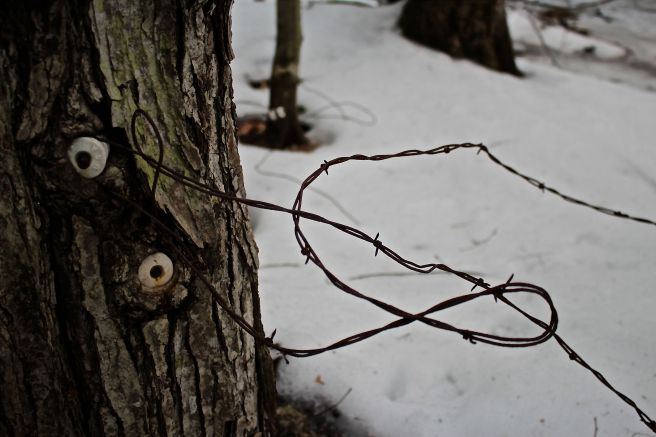
r-barbed wire

Barbed wire adds to the story.

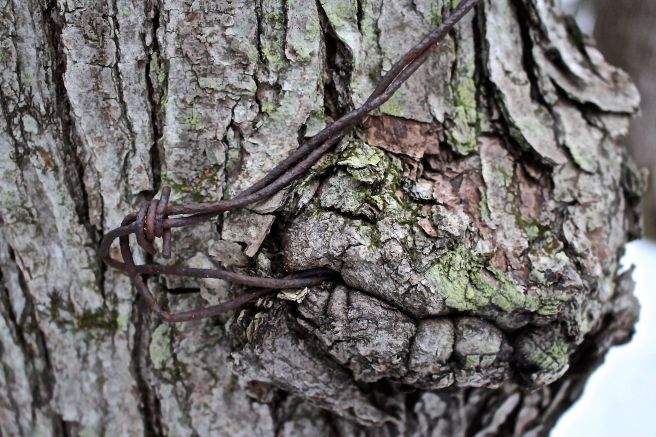
r-barbed wire grimace

Installed long ago, this tree formed a grimace in response.

r-large pine

Along the edge of some walls stand much happier trees–those that were allowed to grow tall and wide in the sun, like this Eastern white pine. Perhaps it provided a bit of shade for Roberts’ Jerseys.

r-generation gap

The land was farmed until 1968. Since then, it returned to woodland, was sold and logged and sold another time–finally to the land trust. Generational gaps are visible throughout. This is the perfect place to take some youngsters and ask them to locate a white pine that matches their age.

r-brook 2

We cross several streams that I’m sure sustained the farm and its inhabitants. Today, they sustain the wildlife that wanders here, including deer.

r-turkey trot

We realized there had been a recent turkey trot and

r-voles 1

vole convention.

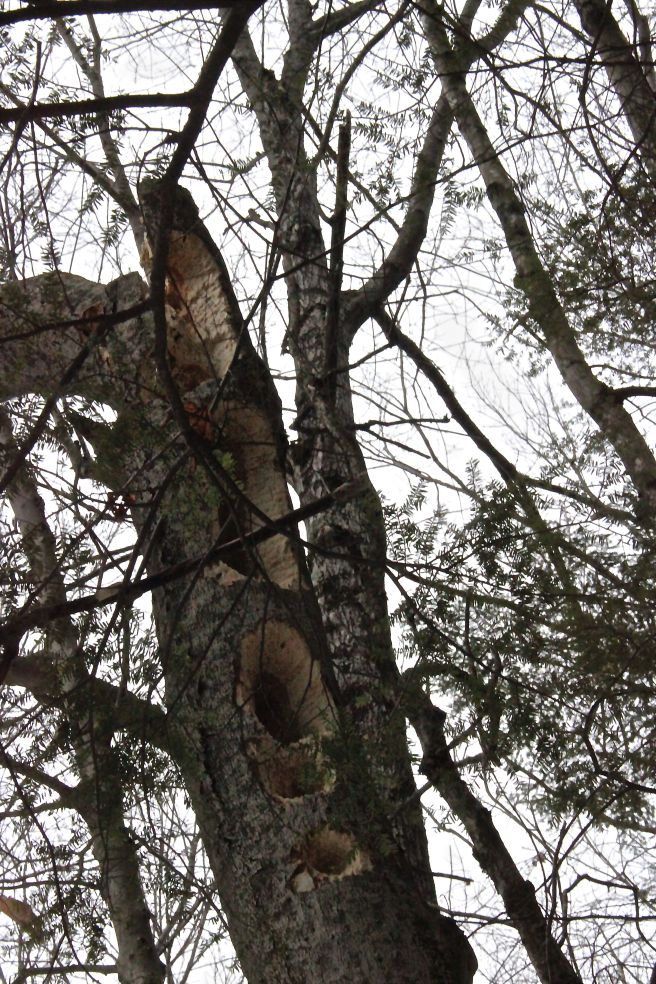
r-pileated condo

Birds also have played a major role in this community. This pileated woodpecker-created condominium has been around for a while.

r-pileated pile

From the trail, I spied the largest pile of wood chips I’ve ever seen and of course, had to investigate.

r-pileated tree

The old beech was recently excavated for new condos.

r-pil pile 2

Below, the wood chip pile was a couple of inches deep.

r-pileated scat 1

r-pil scat 2

The best part–lots of scat cylinders filled with insect body parts. Good stuff to see.

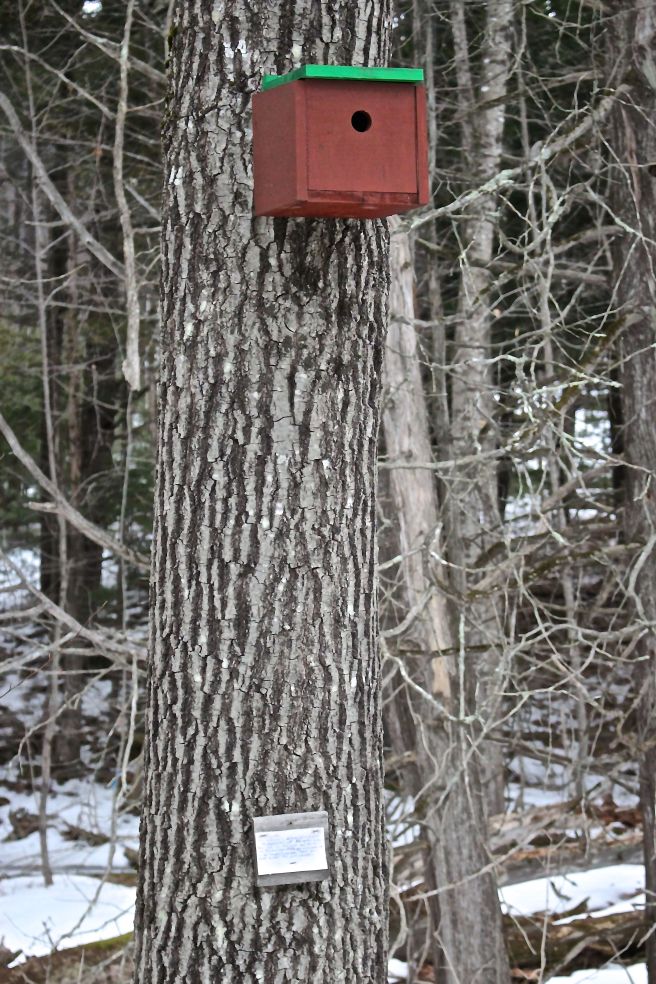
r-birdhouse

Pileated woodpeckers aren’t the only ones in the building industry.

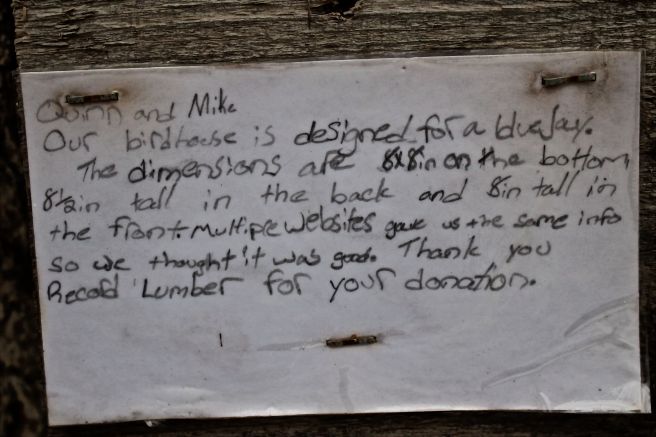
r-birdhouse sign

I think you’d agree that Quinn and Mike did a fabulous job constructing this birdhouse.

r-mullein capsules

In several open areas we spotted the winter display of common mullein.

r-mullein 2

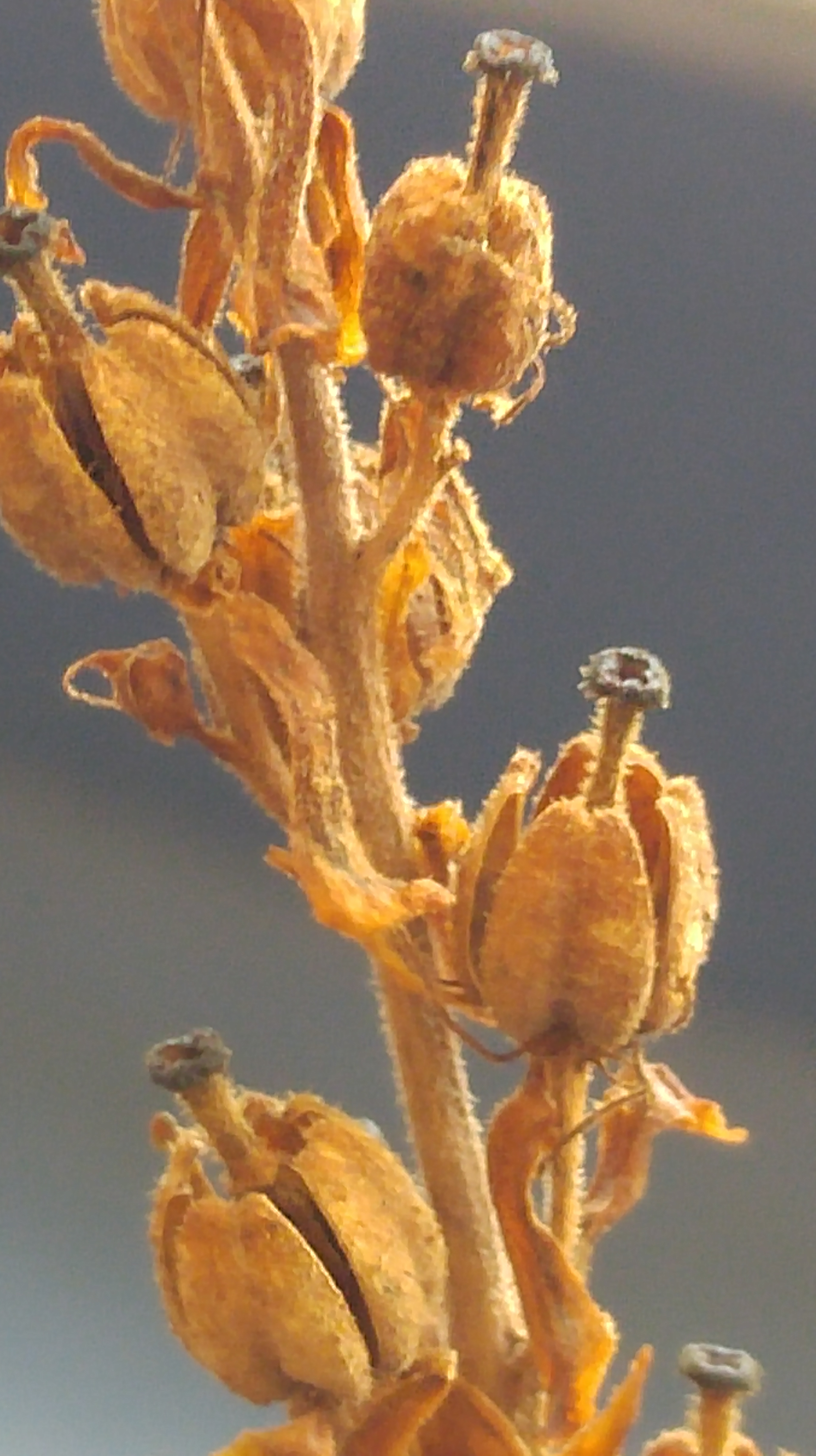
Its crowded performance of two-parted capsules atop a tall, fuzzy stem made it easy to identify.


The pointed prickly bracts of thistles also offered a winter show.

r-lungwort on ash

Lungwort tried to hide on the backside of an ash tree, but I found it. I only wish we’d had rain, or better yet, snow, recently, because I love the neon green that it becomes once it is wet.

r-lunch rock

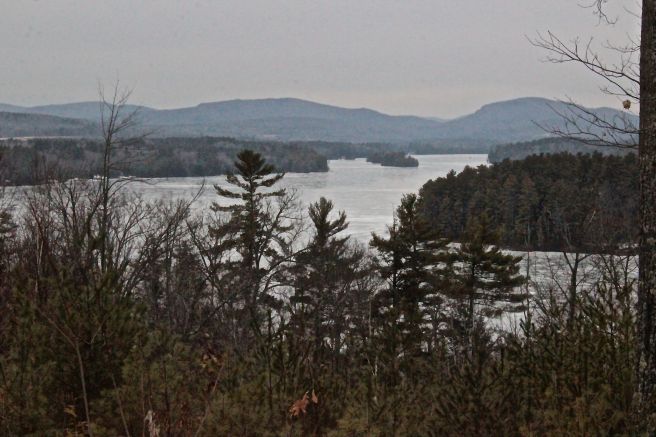
Be careful what you wish for. Though the day was sunny at the start, it began to rain as we ate our sandwiches on lunch rock overlooking Lake Pennesseewassee, aka Norway Lake.

r-lake 1

It wasn’t a downpour, but enough that it encouraged us to eat quickly and move on.

r-beaked bud

Well, I didn’t move far. Within steps, I found a shrub I was seeking yesterday–beaked hazelnut.

r-beaked hazel

It’s a member of the birch family and features catkins–the male flowers that will release pollen this spring to fertilize the shrub’s delicate red female flowers.

r-christmas fern

Another quick find–Christmas fern–one pinnae topped with a birch fleur de lis.

Typically, during the winter there is only one trail open to hikers. Today, however, we figured it would be OK to walk on the ski trails because they are either icy or bare. It was definitely a micro-spike kind of day, which has been more the norm this year.

r-painted cow

Other than birds and squirrels, we saw no wildlife. But we did stumble upon the “Painted Cows” created by Bernard Langlais in 1974 and gifted to the land trust by Colby College and the Kohler Foundation.

We had planned to explore the inner network of trails, but the cold raindrops drove us out. Despite that, I think my guy enjoyed himself as much as I did. And he was extremely patient each time I paused. Sometimes he even gave me a heads up–I took that to mean he didn’t mind that I had to stop, wonder and photograph. This is one Leap Date I hope we don’t forget.


Gallivanting Around Great Brook

It’s been a couple of months since Jinny Mae and I last checked in on the doings in the Great Brook neighborhood off Hut Road in Stoneham, Maine.

H-Forest Road 4

Forest Road 4 isn’t plowed in the winter. That’s OK. We welcomed the opportunity to admire our surroundings as we hiked above the brook. So much to see that is so often missed as one drives.

h-paper birch blue

Though the temperature was on the rise, the blueness of a few paper birch trees reminded us that it’s still winter.

h-sphagnum

We found sphagnum moss looking a bit frosty but cheering us on with its pompoms.

h-chaga

On more than one yellow birch, chaga offered its medicinal qualities in quantity.

h-yellow and white partners

We came upon a special relationship–a yellow birch and a white pine. Rooted in this place, they embrace and share nutrients.

h-yellow birch:white pine

Forever conjoined, they dance through life together.

h-GB1

Finally beside the brook,  we couldn’t see the rocks below very well, but watching the water race over them gave us a better understanding of the forces that have smoothed their surfaces.

h-GB south

In a few more months, we’ll stand here and wonder where all the water went.

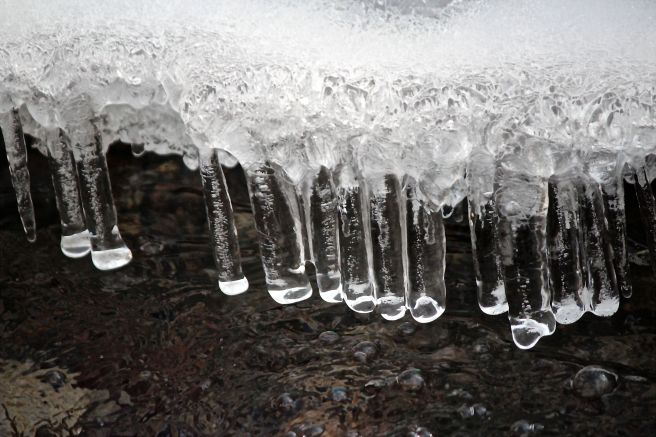
h-ice drips& bubbles

But today, it was the ice formations that we couldn’t stop admiring. Bubbling water below and dripping ice above, each adding to the other and both constantly changing.

h-ice 2

So much variation on the same theme as coursing water freezes into ice while at the same time carving into the rocks below.

h-ice pedastle support

Looking beneath, we noticed pedestals shaped like elephant legs providing support to shelves above.

h-gb ice castle

Occasionally, we saw crystalline turrets, translucent arches and frozen chandeliers of castles captured in ice.

h-sets of ice feet

Sometimes, it seemed like ballerinas danced on their tippy toes. That’s what water really is, isn’t it–a dance through time with changing tempos along the way?

H-GB

We crossed Great Brook and then paused for a moment as we decided which trail to follow.  We took the road less traveled by. I laughed when Jinny Mae referenced Robert Frost’s poem. My former students don’t read this, but that was one of the poems they had to learn and recite. And my guy–poor soul–knows it through association. Actually, he’s a better soul for that reason.

h-tree owl 2

So you may not see it, but Jinny Mae and I did–an owl hidden in the ash bark. Not a live owl, mind you. Well, that depends on your perspective, I suppose.

h-heal all

Within minutes, we knelt to admire Selfheal or Heal All (Prunella vulgarism) and its hairy calyces.

h-survey sign

We stood by the survey marker sign and realized it had been attached for many years.

h-survey marker

Perhaps 51 years!

h-frullania 1 on red oak

h-frullania 2

On a red oak, we pause to look at the reddish-brown liverwort–Frullania. There’s history in this species–dating to the earliest land plants. No matter how often we see it, and we see it often, we feel privileged.

h-leaves and ice

The trail switches from snow to ice to water and back again. Ice covered leaves draw our appreciation.

h-fnd 1a

In the neighborhood, we pause to check on the local families.

h-fdn 1 chamber

I climb down to the root cellar and discover that the porcupines haven’t visited all winter. Old scat still present in there, but nothing new.

H-Fdn 2

Moving up the colonial road, we come to the second residence.

h-fdn 2 yellow birch on mantel

Atop the mantel grows an old yellow birch. Like any TV screen above the fireplace, it offers an ever-changing display.

h-brook upland

We moved toward Shirley Brook, where we were once again in awe of ice.

h-water and ice1

Water and ice: a relationship in constant flux–at the moment.

h-brook structure

Beside the brook is a stream that’s currently dry. We look edat the snow-covered stonework that crosses over it and realized we need to return and try to figure out what the structure might have been and why it was built here. Stuff like this adds to the intrigue. Man-made. When? Why?

h-spider 3

Poor Jinny Mae. She had to wait for me constantly as I shifted from one lens to the next. But check out this spider.

h-stone piles 1

We are the queens of bushwhacking and love discovering the stories hidden in the woods. In this neighborhood, lots of stone walls tell part of the story. Rock piles enhance the chapters.

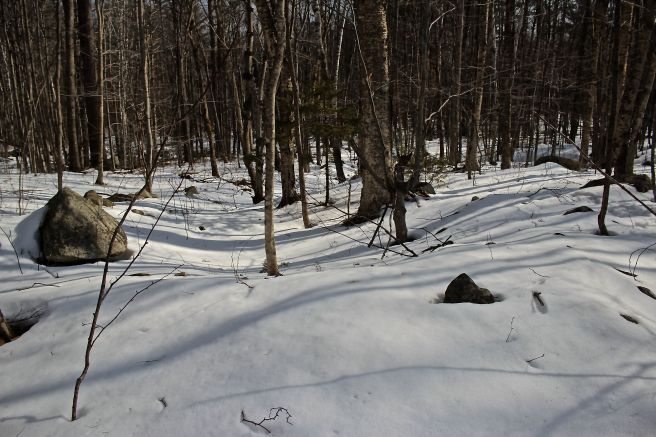
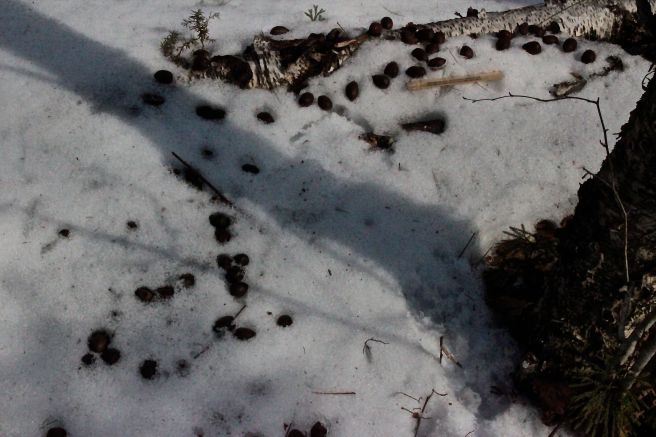
h-moose scat 1

And then we found more. Fairly fresh moose scat insisted upon our attention. We’d noted that there were some old snowshoe hare runs and we found some moose browse on a nearby striped maple, but we were surprised that there weren’t many fresh tracks. Where have all the mammals gone?

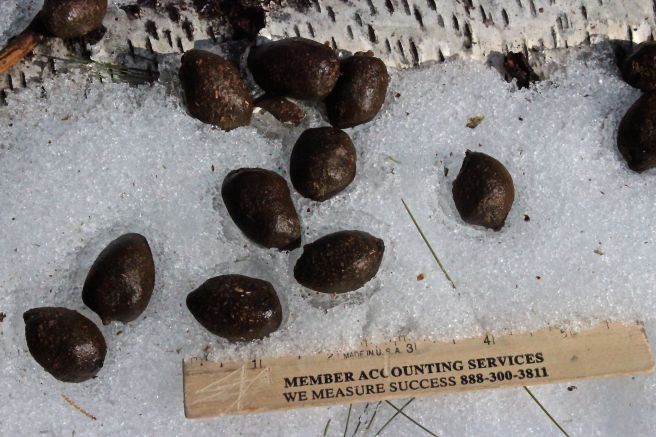
h-moose scat 2

This scat is some of the biggest moose scat we can recall seeing. A few gems followed me home.

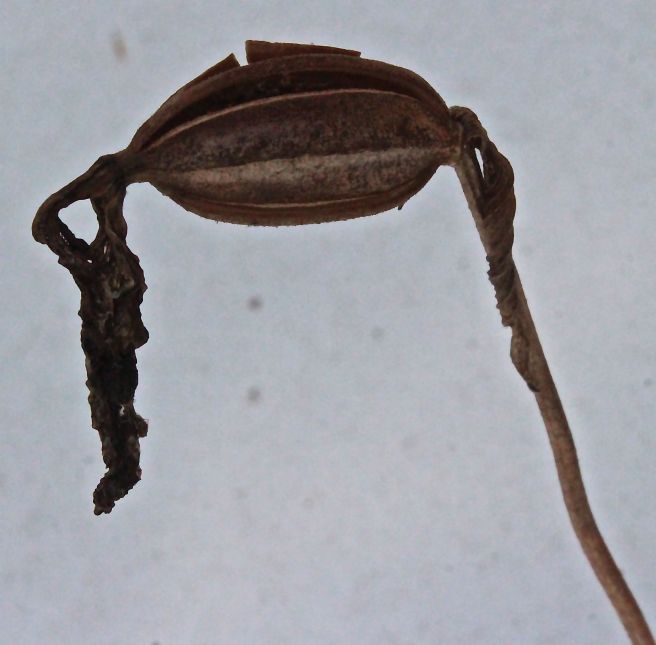
h-lady's slipper

And then we happened upon something neither of us have seen before–at least that we are aware of. We had our ideas about what winter weed this is, but since we haven’t encountered it before our sense of wonder kicked in.

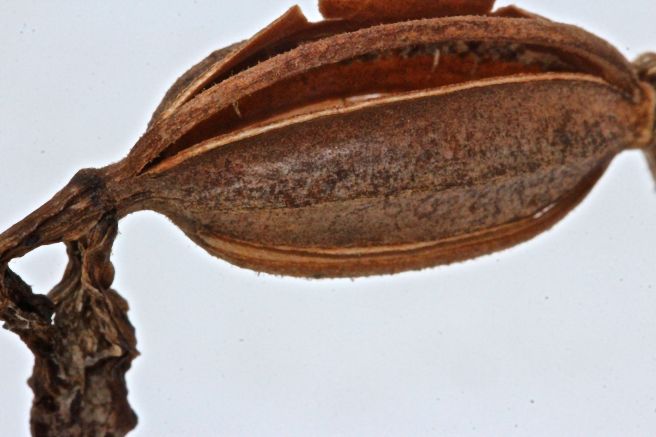
h-lady's slip pod 2

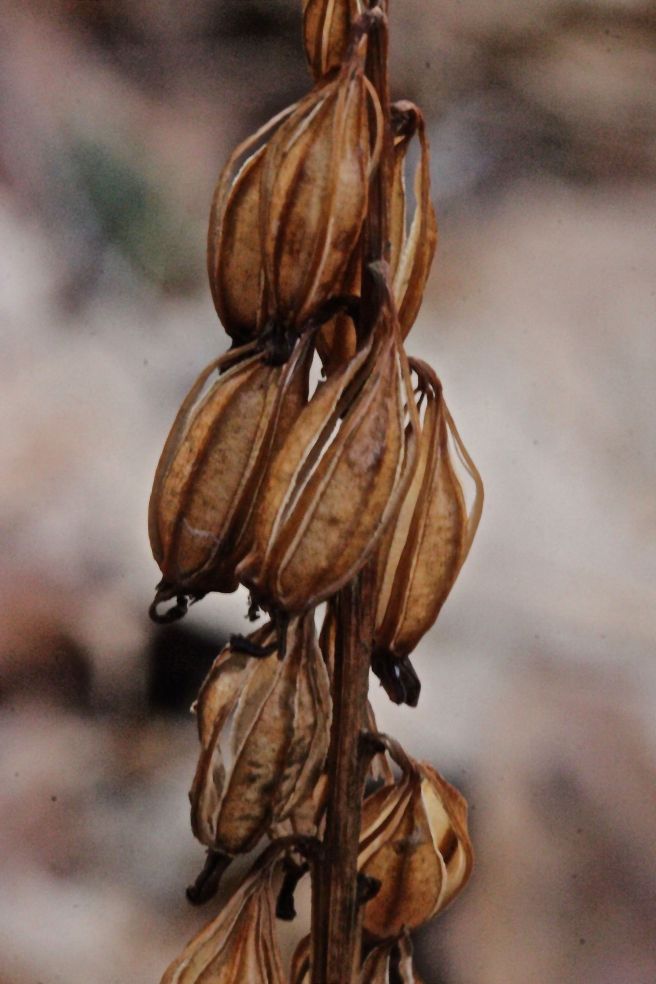
Back home, I looked it up in Weeds and Wildflowers in Winter by Lauren Brown. The capsule is woody and about two inches long. As you can see, it’s closed at both ends, but opens along slit lines–six in all, actually.

h-lady's bract at base of pod

At the back end, a long, curved bract.


And at the front, the slipper gone by. Yup–Lady’s Slipper (Cypripedium acaule). And the reason we didn’t recognize it–because it’s a rare find in the winter woods. Wow.

h-bear 1

We’re on our way out when we spotted these marks on beech bark. We’d looked and looked because we know this is bear territory.

h-bear NW

Compared to other bear trees, these claw marks are newer than most I’ve seen. Jinny Mae was as excited about the find as I was. I’d told her earlier as we scanned the trees that my guy has come to an unconfirmed scientific conclusion that bear claw marks appear on the northern side of trees. This one didn’t let us down. Based on the location of the sun that’s grew lower in the sky, these are on the northwestern side of the tree.

At last it was time to drive home.

Gallivant: go from one place to another in the pursuit of pleasure or entertainment. Over five miles and almost five hours later, we were thankful for the opportunity we shared today to gallivant around Great Brook.


Pure Bliss Mondate

It took us a while to get our act together today, but finally we heard the call from the Ledges Trail up Pleasant Mountain. Since it was late morning, we packed a lunch. Very late morning. 11:30 a.m. start.

ledges sign

And a very warm day. February first and the temperature is 53˚ in western Maine. Unreal. The  breeze was downright balmy and more reminiscent of a spring day. Will the ground hog see his shadow tomorrow?

ledges trail 2

Trail conditions varied from mud and soft snow to slush and ice. Not a snowshoe-type of day at all. We haven’t had too many of those lately. Micro-spikes were the right choice.

ledges O 2

Of course, I was still a slow-poke. But that’s okay because as he waited for me along the way, my guy began to notice his surroundings. OOOOh my! He started pointing out the oddities in the beech trees.

ledges beech elbow

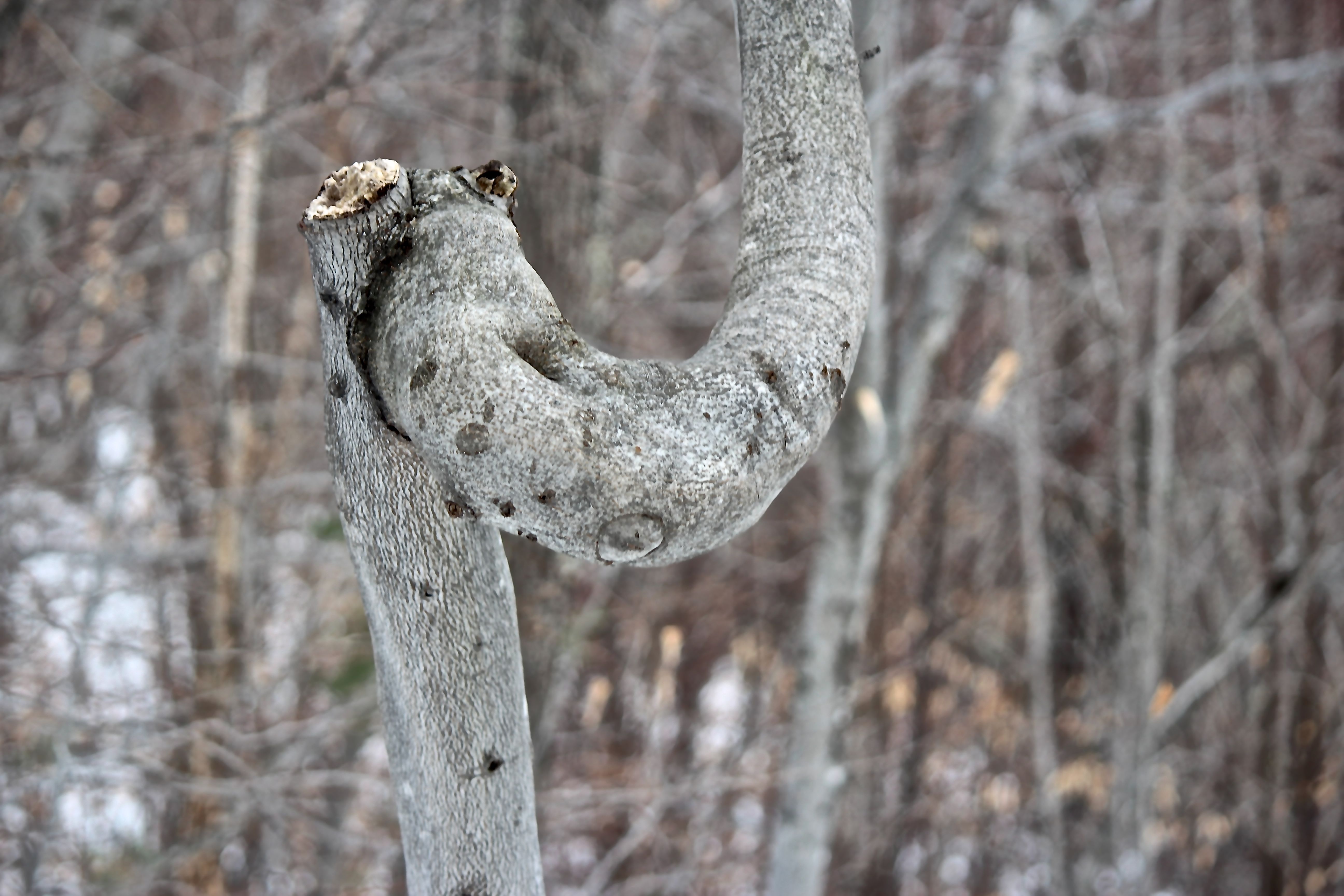
This one struck him as an elbow–well, not literally. Popeye’s biceps perhaps.

ledges beech joined in dance

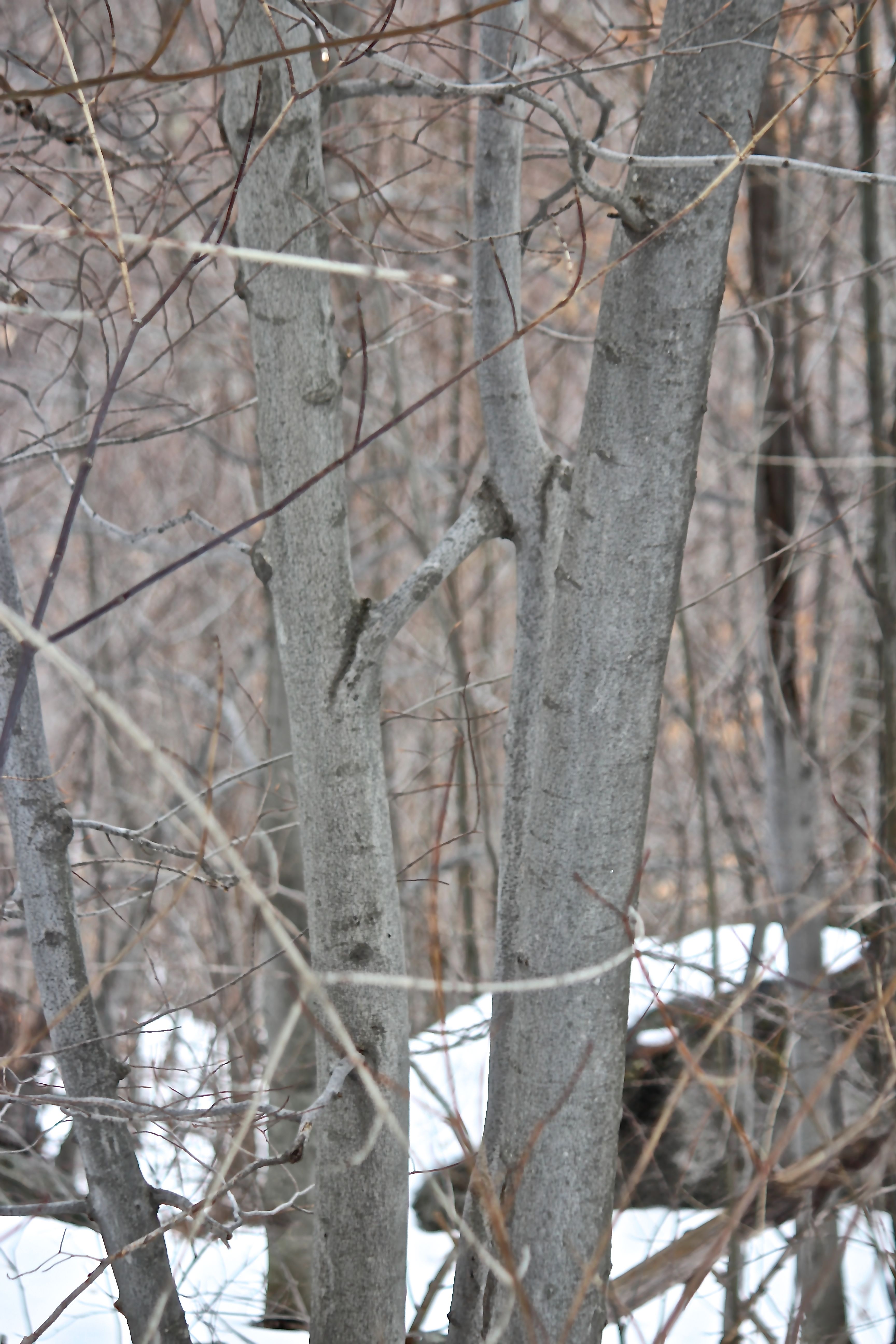
And then there were the two that joined hands in a woodland dance.

ledges wedge 1

We even found a couple kissing a long gone relative.

So what causes a tree to graft? Under the bark is the cambium layer, which consists of living cells. Outside the cambium layer, the cells divide and multiply, thus creating bark tissue. And inside, they create woody tissue. The newest cells act as a two-way system–moving  water and minerals that the roots sucked from the soil up into the tree and carbohydrates made by the leaves down.

In order for two trees to create a union by fusing together they have to be compatible–so a joint fusion occurs within one tree or between two trees of the same or closely related species.

Of course, the tree or limbs have to be in direct contact and under pressure for the cells to naturally graft. A dash of magic also helps.
ledges laughing faceThis woodland spirit laughs at us for gawking at its relatives. But really, it is amazing and worth a wonder.

ledges green leaves

Here and there, leaves litter the trail. But this one stopped me in my tracks. Green leaves? How can that be? Another mystery.

ledges Canada mayflower

Because the snow was melting rapidly, we found bare ground here and there showing off some treasures, like these Canada mayflower leaves. We all know that one person’s junk is someone else’s treasure–so for every person who sees this as a dead leaf, I bet there are as many of us who are fascinated by the design left behind by the vascular system and rejoice in the nutrients the leaves have contributed to the earth as nourishment for future generations.

ledges trailing arbutus

That wasn’t the only find. I’m reminded by this sight that Trailing Arbutus, also known as  Mayflower, has evergreen leaves. If today’s temperature is any indication of what’s to come, it won’t be long for these harbingers of spring to bloom. I’m not ready for that and can only hope that the woodland spirit can pass on the word that more snow would be most welcome.

ledges glacial 2

Glacial striations mark some of the bare rocks. Those glaciers must have been crazy as they retreated–melting and scraping this way and that. ;-)

ledges icicle 2

No matter what season we pass by this rock, water drips from it. Today, it’s suspended in a milky icicle.

ledges mossy maple

Mossy maple polypores gathered at the base of this old tree while

ledges toadskin tripe1ledges smooth rock tripeledges toadskin 2

smooth rock tripe and common toadstool lichen decorated the rocks nearby.

ledges mooseledges lunch view

Lunch rock provided us a view of the middle basin of Moose Pond on the left and lower basin on the right.

We stayed just long enough to eat our sandwiches on the ledges. We didn’t have time to head to the summit. On the way down, both of us left plenty of handprints on the trees that grow beside the trail–happy to have their support.

ledges bliss

We had an errand to run in Portland this afternoon, and then it was home again, home again, jiggity jig. Our day was topped off with a supper of blueberry pancakes coated with maple syrup while watching the Beanpot hockey tournament. Thanks to Pam Lord Bliss for the amber treat–this Mondate was truly pure bliss.

Three-legged stool

Support comes in many manners and I can’t help but think that many of us would probably benefit from having more than two legs to stand on. But then again, we have family and friends to lean on and serve as our third leg of the stool.

lungwort 6

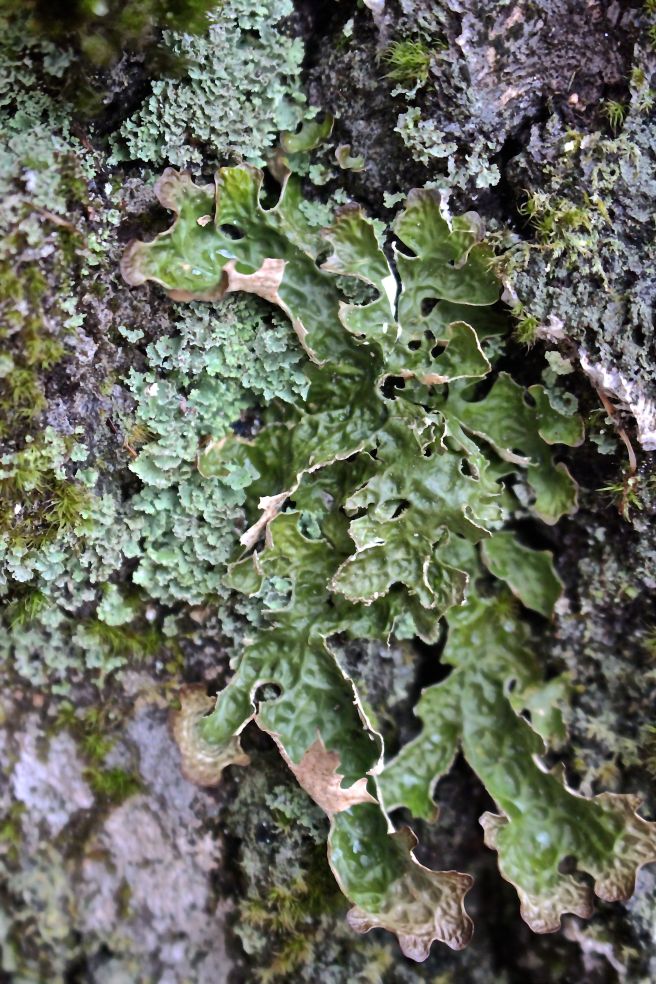
It’s the same in nature, where three-legged stools don’t necessarily resemble seats at all. Take for instance the tree lungwort (Lobaria pulmonaria). A friend and I stumbled across this leaf-like lichen as we tramped up and down several ridges today.

lungwort 4

When it’s wet, the upper side turns bright green while the underside is creamy white. Today we found some that ranged from aqua to olive in color.

lungwort 8

The thallus or body is easily distinguished by its lobed form. The ridged and pitted surface is said to resemble lung tissue–thus the common name. During the Renaissance era, when the physical form of a plant was thought to determine its use, tree lungwort’s similarity to the structure of a lung led to the belief that it healed respiratory problems.

lungwort

So here’s the thing. Typically, lichens consist of two partners who benefit from the presence of each other–one being fungal and the second being an algal partner. (You may have heard the old line that Freddy Fungi and Alice Algae took a liken to each other and live symbiotically ever after). For the tree lungwort, the fungus provides the rigid structure and anchorage. Simultaneously, the algae gives it the ability to gain energy from the sun–think photosynthesis.

lungwort 2

But . . . there’s a third partner or leg of the stool for tree lungwort–the fungus and algae live in a relationship with a blue-green cyanobacteria that helps the lichen gain energy from the sun, but also absorbs and fixes nitrogen from the atmosphere. When thalli eventually fall off trees, the decomposing lungwort adds nitrogen to the forest floor.

lungwort 5

While this leafy growth uses the tree as support, it doesn’t take any nutrients from its host, making it an epiphyte. In our area, moose are said to feed on it. And natural dyes may be made of it.

lungwort 7

Its leaf-like structure provides an example of a foliose (think foliage) lichen.

Common button lichen

There are two other forms of lichen. Common button lichen with its thin gray surface or thallus and flat, black disks is an example of a crustose lichen (think crust of bread).

beard lichen

Beard lichen is a fruticose (think fruit–branching structure like grape branches). I don’t know about you, but mnemonic devices help this old brain.

beech 2

As is our habit, we paused often to take a closer look–at the vascular system of a decaying beech leaf resembling a stained-glass window;

 false tinder 3

The false tinder conks decorating an old paper birch;

hemlock 2  hemlock rings

The rings of life healing a hemlock wound;

winter crane fly

A winter crane fly pausing during flight;

pyrola 1

A pyrola peeking out from the snow;

speckled 2

And a speckled alder catkin preparing for its spring fling.

We shared three hours and three miles plus our knowledge, wonder and support–performing as the third leg of the stool for each other.


Celebrating the Slush

Another warm day and the snow has turned to slush. Not my favorite condition in January, but it does bring its rewards.

   coyote print 2

X marks the spot–at least that’s the mnemonic device we use to identify members of the canidae family. Can you draw the X in between the toes and the foot pad? In this case, a coyote marched along on the prowl. Check out those nail marks.

coyote checking things out

Some little brown thing must have caught its attention because it did some poking around before continuing on.

coyote and deer

Though I wasn’t wearing snowshoes today, both the coyote and deer followed in my tracks–the easier to move. Which came second after me? The deer. Notice how the print is a bit more muffled and features more debris atop it. The pine needles on the coyote track have been pushed into the print with the animal’s weight.

coyote, this way and that

It wasn’t just my track that it followed. It obviously traveled to and fro in its own tracks.

coyote 2

Sometimes mammals use the tracks of others and sometimes they use their own–where the snow is already packed down. This is almost a perfect record of the forward and back path.

red squirrel, happy feet

An even fresher record made today–red squirrel. This one has happy feet–it avoided the coyote so far.

cone 1

Though my eyes were always on the lookout for mammal sign, other things caught my attention like the spiraling scales of an Eastern white pinecone.

cone 2

As the female cone of the tree, each scale once embraced two winged seeds that nestled near the core. Perhaps the white, tacky pitch on the tips is intended to keep mammals at bay. If that’s the case, I don’t think it works well, because I often see tree stumps piled high with these scales.

mealy pixie cups

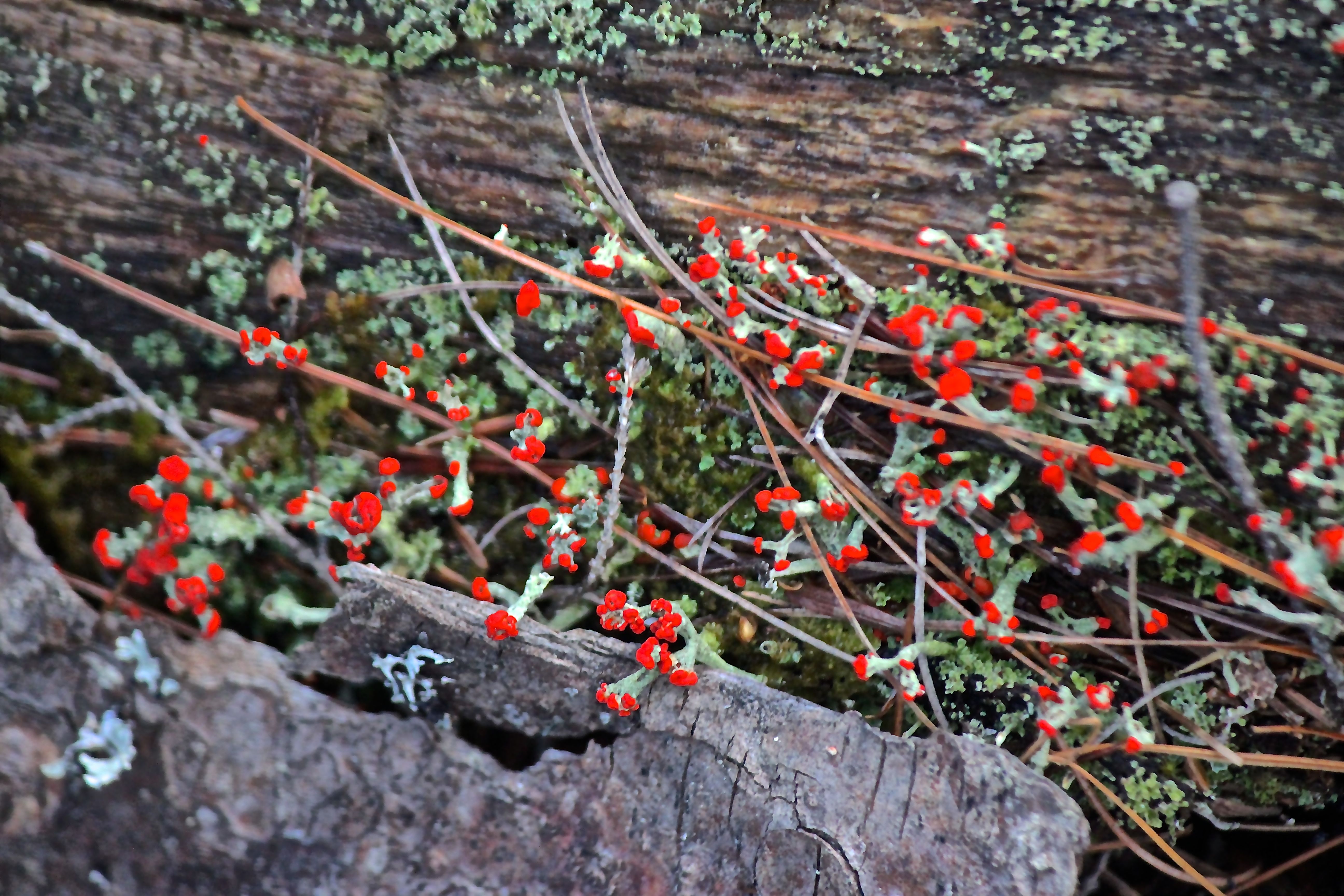
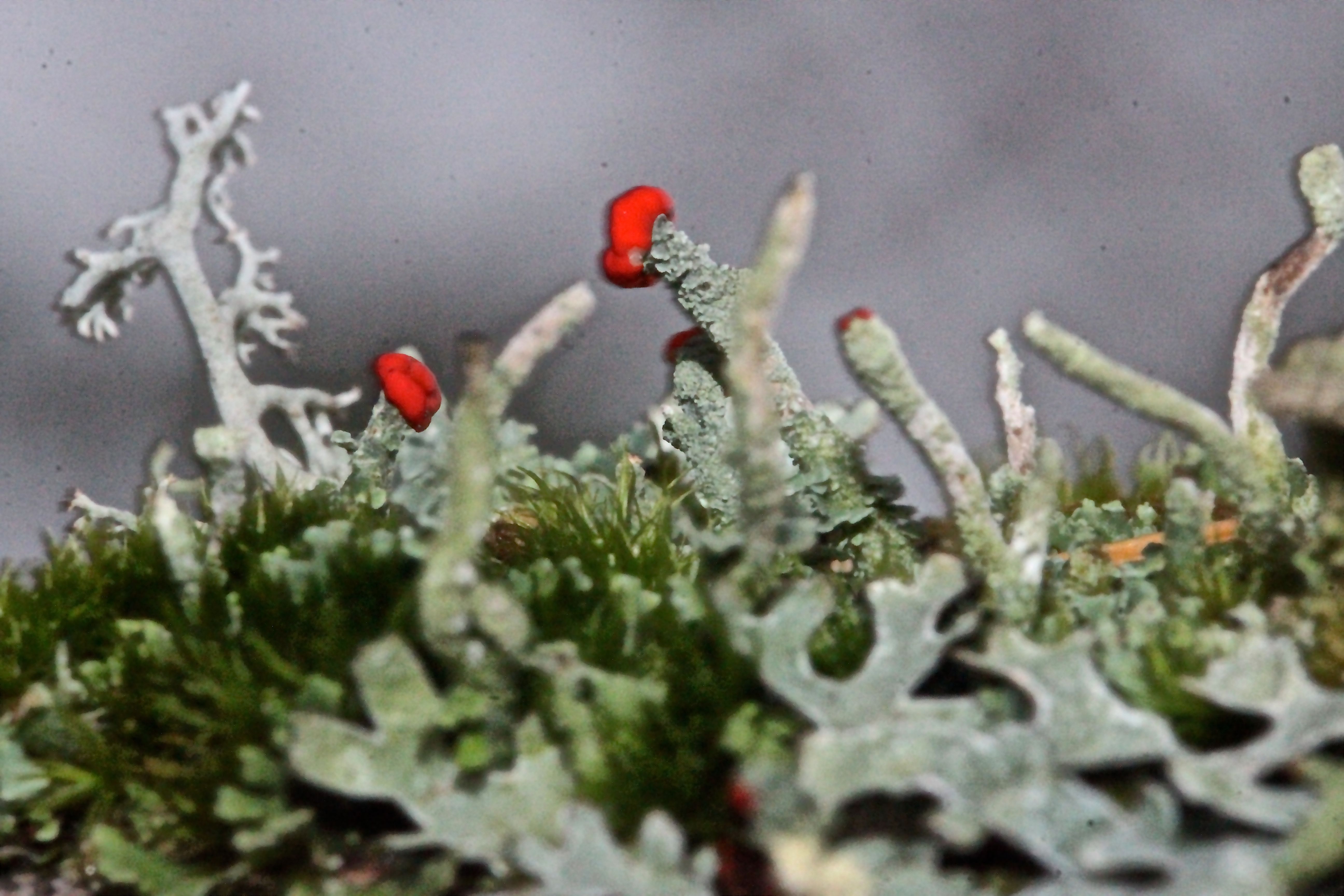
Mealy pixie cup lichen also decorate tree stumps. With the snow diminishing rapidly, the minute world of the lichens is reappearing.  As early colonizers, they seem to prefer challenging environments. If nothing else, these goblets appear ready to be shared at a feast.
British soldier

British 2

Maybe the British soldiers will take advantage and each can show off what a fungi he is–especially in that mind-boggling relationship he has with an alga.

January sky

Enough already. I’m finished celebrating the slush and hope that this wintery sky means snow and colder temps are on the way.

Aimless Mission

A friend and I wandered aimlessly today with a mission of finding bobcat tracks. I should know better. Go without expectations.

So, yeah, we didn’t find any prints that were most certainly bobcat. We did find coyote and fox. And plenty of deer, turkey and ruffed grouse. And had great fun exploring while catching up. And taking time to notice and wonder.

rhody 1

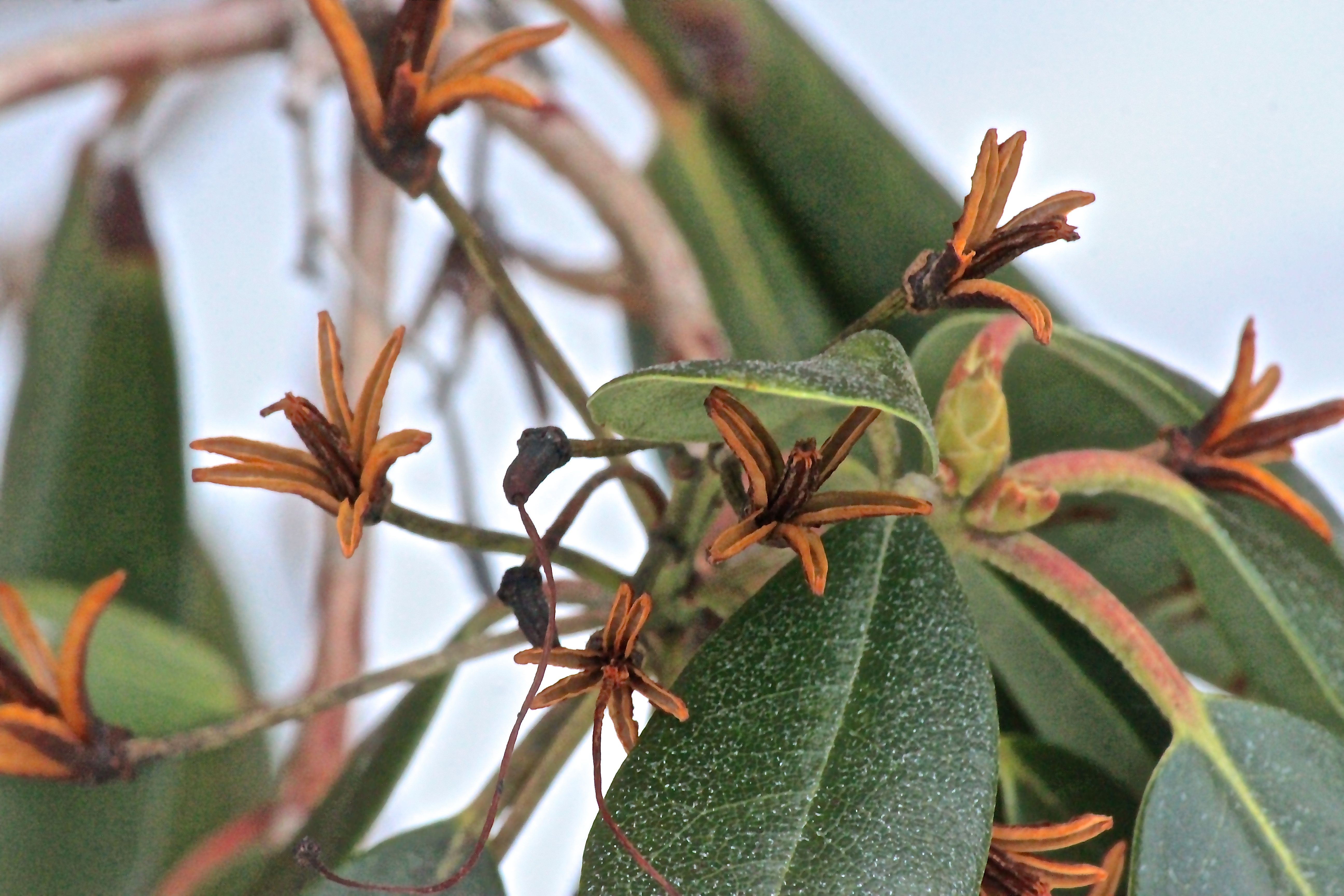
While Dick strapped on his snowshoes, I took a look at the rhododendron bush that grows beside the barn. Today’s temp–45˚. A January thaw following last week’s deep freeze. Thus, the leathery leaves looked happy rather than curled inward as they do when the temperature falls. And last summer’s new growth offered a spring palette.

rhody 3

The woody capsules are like flowers unto themselves. I’m just realizing that though we have several rhododendrons growing by the barn and house, I’ve never seen any babies. Once ripened in the fall, the capsule splits open and its many seeds are dispersed by the wind–probably becoming bird food.

  rub1

As we snowshoed about, trying to avoid breaking through ice in this rather swampy woodland, we saw where the deer had eaten red maple buds and bark, as well as where some had bedded down. But one of my favorite finds was a stick. Or so it may appear.

rub 2

It’s a small, half dead balsam fir that served as a signpost. Can you read it? “My name is Buck. Keep out. Unless your name is Doe.” Yes, this is a deer rub created when antlers were pushed up and down, creating tags of bark dangling at either end with smooth wood in between.

uprooted

Then we came upon nature’s classroom–an uprooted tree. As a forever student, it’s a place I like to frequent.

root 1

The tree fell years ago. Did anyone hear it?

root 3 root 4

Among the roots, rocks and dirt, we checked for animal or bird sign and didn’t find any.

root lichen

But the moss, lichen and liverwort garden is exquisite with its variegated colors and textures.

lichens et al

This miniature world resounds with a sign of its own: “Clean Air Here.” Lichens and mosses won’t grow were the air is polluted.

white pine nursery

Other life forms also like this spot and see it as the perfect nursery.

stonewall1

As is common in these woods, we stumbled upon the stone walls and barbed wire that speak to the land’s historical use. Borrowing a line from Robert Frost, this sign once read: “Good fences make good neighbors.”
broken wire

Gone are the days when the wall and wire are set again.

tree wireLong gone.

And so it was that we wandered and wondered along on an aimless mission–not finding the tracks of the bobcat(s) that journey here, but enjoying plenty of other signs along the way.

Shell Pond Speed Date

While our thoughts were (and are) with our family and friends south of us along the Eastern Seaboard as you deal with a major winter storm, my guy and I drove over to Evans Notch for a hike around Shell Pond.

SP-September

Whether you’ve traveled this way before or not–a summer photo might be just the dose you need today.

road 1

We parked near the trailhead for the Leach Link Trail because Stone House Road is never plowed beyond that point. Others had skied, walked and snowmobiled before us, but no one seemed to be snowshoeing so we left ours behind. As it turns out, that decision was fine. We dug some post holes in a few drifts, but other than that, we really didn’t need them. I did, however, use micro-spikes–and am glad because it’s a rather wet trail and we encountered lots of ice, much of it just a few inches below the snow.

Stone House gate

Thanks to the owners of the Stone House for putting much of the land under conservation easement with the Greater Lovell Land Trust and for allowing all of us to travel the trails–whether around the pond or up Blueberry Mountain and beyond.

Shell pond loop sign

Before the airfield, we turned onto the Shell Pond Loop trail. It’s blazed in yellow and easy to follow. Some trees have come down, but we got over or around them. We took care of a few today and the rest will be cleared by summer.

beaver works

Of course, some trees were intentionally harvested. We found these beaver works near the beginning of the trail where the brook opens into a small wetland.

beaver lodge 2

beaver lodge 1

On top of the lodge, you might be able to see the lighter color of fresh additions to the structure. This was the first of three.

beaver lodge 3

Lodge number 2 is toward the far side of the pond.

beaver view

But it’s lodge number 3 that I’d stay at. It’s worth a payment of a few extra saplings to get a room with that view.

pileated work

The beavers aren’t the only one making changes in the landscape. Pileated woodpeckers in search of food do some amazingly shaggy work on old snags.

trail debris

Winter debris covers much of the trail. Strong winds have brought much of this down.

yellow and hem yellow birch & hemlock

And two of the most prominent trees make themselves known among the debris. A hemlock samara beside a yellow birch fleur de lis and a hemlock needle atop a more complete fleur de lis flower of the birch.

Shell Pond 1

Shell Pond takes on an entirely different look in the winter. We could hear the ice whales singing as we ate our PB&J sandwiches and sipped hot cocoa.

mink

mink tracks 1

While we ate, we noticed a mink had bounded through previously. I’m always thankful to have David Brown’s Trackards in my pack.

cliffs 2

cliff flow

Continuing on the trail found us taking in views of the cliffs, which we don’t normally see so well once the trees leaf out.

ostrich 3 ostrich 4 ostrich fern 1

Before continuing through the orchard, I wandered closer to the brook in search of this–the fertile fronds of the ostrich fern that give it its common name because they resemble plume-like ostrich feathers. Come spring they’ll release their spores.

 airfield 2

The sun tried to poke out as we crossed the wind-blown airfield.

stone house 2

From the field, we always admire the Stone House and its setting below Blueberry Mountain.

 snowshoe 2

Walking back on the road, we spotted a classic snowshoe hare print. Most of the tracks we saw were filled in by blowing snow, but these were textbook perfect.

pole 4

And then . . .

pole attack

And then . . .

pole numbers

And then . . .

bear hair 1

And then . . .
bear hair

And then . . . on our way back down the road, I introduced my guy to the wonders of telephone poles. We found several sporting chew marks, scratches and hair. Yup . . . bear hair. Black bear. Even the shiny numbers were destroyed on one of the poles. Of course, my guy was sure someone would come along and ask what we were doing as we inspected one pole after another. I was hoping someone would come along and ask what we were doing. Bear poles. Another thing to look for as you drive down the road–think tree bark eyes, winter weed eyes and now, bear pole eyes.

bear paw

I took this photo on the Shell Pond Loop trail a year and a half ago. Oh my.

Those of you who have traveled this way with me before will be amazed to know that we finished today’s trek in just over three hours, even with the added walk down Stone House Road. Yup, not an advertised three hour tour that turns into six. Hmmm . . . Apparently it can be done–I just need to get Mr. Destinationitis to join our treks for a Shell Pond Speed Date.

The Homecoming

The other day a friend handed me a piece of paper and told me to read it later. We were about to go tracking, so I stuck it into my pack and forgot about it. This afternoon, as I prepared for a hike up Mount Tom in Fryeburg, I found the paper.

I’d originally thought it was an article, but instead, it’s a quote from the October 1967 issue of Yankee. A friend had given it to him and he passed it on to me: “We hunt as much for the memories as for the birds. For the memories, and for the hours afield in the autumn woods where a man can get back, for a while, to remembered realities, to a time and a way of life close to the eternities of the land. It’s hard to explain this to the outlander who never knew such things. He thinks of it as an escape. To us it is more like a homecoming. We live here, of course, but only in the leisure after we’ve done the stint at our jobs do we go out on the hills and up the brooks. There we find the truth of our world, even the truth of ourselves.” ~author unknown.

trail sign

I reflected upon those words as I slipped into my snowshoes at the trail head. I’d made a decision to end one of my freelance writing/editing jobs this week (not Lake Living, which is my all time favorite writing job. Hard to believe the spring issue will mark my tenth anniversary!) and declutter my world.

porky paths stump dump

It will never happen, but certainly the porcupines that inhabit this mountain should consider the same.

stump dumpporcupine den

I had a hunch I’d see evidence of their existence once I got up into the hemlock neighborhood, but a small stump dump early on provided ample den space.

porcupine tracks 1

I didn’t even realize as I climbed toward the summit that I wasn’t taking too many photos. Instead, I was cued into the tracks left behind by two people who had traveled this way before me and the porcupines, deer, hare, coyote, bobcats and little brown things. While the people stuck to the trail, I wandered this way and that as I tried to decipher what I saw–my own zig zag trail reminiscent of those I followed.

logged community, thin trees

I didn’t get lost today, though truly, when I do get fake lost, it’s a time to understand myself better– listening to my inner self sort things out. Most of today’s trail is an old logging road. And most of what I saw was familiar. Perhaps that’s what it’s all about–knowing a place so no matter where you are, you recognize it.

hemlock community

The community changes abruptly from birch, beech and maple saplings to hemlocks and pines. I, too, can change abruptly and have a tendency to be blunt. I don’t see that as a bad thing, though occasionally I do regret what I’ve said.

striped maple scrapes

And then I began to look up and notice other parts of my surroundings like these old deer or moose scrapes on striped maples. Forever scared, they provided nourishment in the past–and may do so in the future when the time is right.

striped maple samaras

One striped maple still sported a few seeds that have yet to go forth in the world. What’s holding them back? Don’t they know the time has come to let go?

frost crack

Amongst the evergreens  a paper birch offered a twist on life. I believe this is the result of sun scald–the heating and freezing of thin bark. Typically, the white reflective bark helps the tree avoid such danger–but something obviously happened to cause this candycane-like stripe..

sun on hemlocks

Though it was getting late in the day, rays of sunshine illuminated the darker side of things.
white oak leaf

As I followed more porcupine tracks at the summit, a dried leaf captured my attention. In my ongoing attempt to draw an imaginary line showing the boundary of white oak, I added another dot.

white, beech, red oak

Nestled within animal tracks, three leaves told me more about the members of this neighborhood–white oak, beech and Northern red oak.

white oak 2 white oak 3 white oak layers

So then I searched for the white oak trees–and found them. My bark eyes still don’t cue into this one immediately and I need to learn its idiosyncrasies, including its ashy gray color and blocky presentation.

bird nest 1 bird nest 2

I discovered a snow-covered nest that made me ask–bird-made or human-made? It’s constructed of reindeer lichen and sits upon a base of sticks about four feet up in a scrubby old oak. I was as excited by the find as I was by my wonder and lack of an answer. What fun would it be to know everything?

summit

From the summit, I could see Pleasant Mountain’s ridge–giving me another sense of home. The view isn’t spectacular, but that isn’t the point.

Kearsarge 2

Heading down, a second old favorite came into view–Kearsarge North. I stopped frequently as I descended–to listen and watch. And smell. Twice, a strong cat-like pee odor tickled my nose. The tracks were there, but I couldn’t find any other bobcat evidence. One of these days.

paper 4 paper birch 1 paper birch 3 paper birch rainbow paper burgundy Paper pastel

A rainbow of color presented itself among the paper birch trees–such variation for what is commonly called white birch.

Mount Tom cabin 1 Mt tom cabin 2

Near the bottom, the Mt Tom cabin speaks to an earlier time when living off this land was the norm. Though I like to think that I could stay here by myself for a week, I’m not so sure. Of course, that would force the issue and surely the truth about myself would be revealed. Maybe it’s best left a mystery. ;-)

staghorn sumac1 staghorn red

Before slipping out of my snowshoes, I paused beside the staghorn sumac. It was my height, so I had an opportunity to examine its hairy features closely. Animal from The Muppets must have cloned himself.

Full moon

There was a time when I was easily unnerved being in the woods alone. And I still have moments–especially when a ruffed grouse erupts. Geesh–that can certainly make my heart sound like it’s going to jump out of my body. But, the more time I spend out there, the more time I want to spend out there–exploring, discovering, wondering. This afternoon, I finally followed the full moon home, thankful to find even an inkling of my spirit. I recognize that the word “home” has come to mean more than one place. Our abode is our home, but time in the woods is also a homecoming.


Focused Moments

Thanks to our oldest son’s girlfriend, I learned a few more things about focusing my camera this afternoon. Our indoor still-life was a pinesap stalk covered in seedpods that I had discovered near the stonewall on the cowpath the other day. Somehow I’d missed it in its flowering state, so it was a welcome surprise to find it poking through the snow. I only took one–leaving the others to do their work.

pinesap pinesap 2

After trying different settings with the camera (and phone), I was ready to play outside. The beauty of today’s snowstorm became my focal point. And in the spirit of celebrating that beauty, I decided that I’m not going to name or describe the photos. I’ll let them speak for themselves.

our woods

stonewall

snow in the woods

sedge seeds

aster 1

steeplebush

royal 1

royal 4

cinnamon 2 cinnamon fern 1

fern

interrupted 1

pine 2

making tracks

moose scrapes

skybluepink 1

deer

bulrush1

goldenrod 2

steeple 2

Thanks for stopping by to share in some of the moments I focused on today. Happy snowstorm.

My Need To Get A Life

About two weeks ago a friend and I exchanged e-mails about mammal tracks we’d spotted that day. His big find was plenty of bobcat tracks at Bald Pate Preserve, while mine was mink tracks by Sucker Brook in Lovell. And that’s when he commented, “We need to get a life.” ;-)

Yup. So today I did just that. With a friend in tow, I revisited the Red Tail Trail off Hurricane Mountain Road in North Conway. Our mission was to move slowly through the landscape in search of signs of nature in winter.

Oh my. Such a boring task. What could there possibly be to see? Everything is brown and gray and ever so drab.

mouse

From the start, mouse tracks show the suicide mission these little guys make each night as they scramble this way and that in search of food . . . and cover. Mice are nocturnal bounders who travel above ground for long  distances–risky behavior since they are tasty treats for most predators. White-footed and deer mice have similar-sized feet and bodies, so their prints are difficult to distinguish from each other. Their print pattern reminds me of that made by squirrels, only in miniature and their long tails often leave drag marks in the center.

vole 4vole 3

Here’s another favorite meal for many predators–evidence that a vole lives nearby. We were in an old logging area when we found this. While a vole is similar in size to the white-footed and deer mice, its tail doesn’t show in the track. Plus, two other things stood out to us. The tunnel in the first photo is typical vole behavior. While we received 6 inches of snow in western Maine on Tuesday, North Conway only has about two inches on top of ice. Voles are shy of sky space, so tunneling is one of their behaviors. With ice below the snow, this tunnel was exposed and reminded us of spring when vole tunnels become visible in melting snow. The other behavior of this little brown thing (LBT) that is different from its cousins, the other LBTs like mice and shrews, is the zig zag or alternating pattern when it walks. Voles vary their walking pattern, but they don’t bound like the others. The pattern is visible for a few steps above the ruler.

mink 1Mink 2

And who might those predators be? We found the diagonal pattern typical to the weasel family. We thought that this one was a mink, but now that I’m in my cozy den, I’m questioning our ID. It may have been a short or long-tailed weasel. (1/15/16: Changed my mind back to mink. My ruler kept sliding, but the measurements we took, and we took several, clearly indicated mink, so that’s my story and I’m sticking with it.)

weasel 2

Further up the trail, we were more certain that this one was a weasel, though, again, short or long-tailed is the question. Suffice it to say–weasel.

Fisher 1  Fisher pattern

And still another family member–only a bit larger in size. Notice the tear-drop shaped toes. And the loping pattern. A fisher had recently crossed the trail. We followed its tracks for a bit and then bushwhacked back. On our return we came across a second set of fisher tracks. And then, as we backtracked beside our own snowshoe prints, we realized they’d traveled together and then split apart–perhaps hoping to find some good chow.

Kearsarge River

As we moved beside and away from the river, we also saw deer, snowshoe hare, coyote and fox tracks.

Winding our way up through the switchbacks, one other critter left a calling card.

wing

Based on the behavior, I want to say it’s a ruffed grouse. I must admit that we didn’t follow the tracks, but grouse are also tunnelers and there’s a bit of a tunnel here. Usually I find their scat.  By now, you are probably thinking that I really do need to get a life.

ground litter

hemlock seed and scale

yellow birch

We laughed about how we used to not even notice everything on the ground–dismissing it as  tree litter. Ah, litter it is. But more specifically, we were in the land of hemlocks and birch trees. Hemlock cones, cone scales and winged seeds (samaras) are part of the array. And the yellow birch catkins have released their fleurs-de-lis scales and seeds as well.

beech scale 3

One of the things we weren’t thrilled to discover–the white, wooly and waxy coating that the beech scale insects secrete to cover themselves. Oy vey. This beech tree doesn’t stand a chance.

polypody frozen

So back to happier thoughts, including the polypody that let us know it was time to head home and curl up by a warm fire–the temp was in the low teens.

ice skirt

Even the river rocks wore several layers.

artist 3

artist conk

Just before we arrived at my truck, we stopped to admire this mighty fine artist conk. It will still be there on Saturday–join me and the wonderful folks from the Upper Saco Valley Land Trust for a walk on the trail–weather permitting. I’m not so sure it will actually happen this week given the forecast.

No matter. These were only a few of our finds. There’s so much to see and wonder about and every time I visit, I’m in awe of this special place. And thankful for the life I’ve got.

Snow Be It

The action at the bird feeders was crazy busy this morning–as if a snow storm might be on the horizon.

goldfinch 2

goldfinches, mid air squawk

Some goldfinches managed to dine together in peace, while others displayed a midair squawk over perch choice.

male hairy woodpecker

The hairy woodpecker often had the suet to himself, until, that is, the nuthatches, titmice and chickadees flew in.

female cardinal

And somehow the female cardinal managed to pose upon a perch across from a chickadee. She never looks quite comfortable up high.

male cardinal

cardinal and squirrel

Her guy always checks out the local scene before foraging for seeds on the ground. He’s not the only forager in the neighborhood.

ice rink 2

And beyond the feeders, the ice rink is open. Of course, if you want to use it  you need to bring your own shovel. My days of being the human zamboni ended a few years ago.

raccoon prints

I’d intended to join friends in Falmouth for a tramp today, but with the impending storm, I decided to stick closer to home. And so this afternoon found me exploring familiar grounds, wondering what I might see. What could possibly be different?

Ah, the intrepid raccoon had passed this way. I love the pattern it leaves behind, with each set of prints on the opposite diagonal.

vernal pool 1

And then there’s the vernal pool. Nothing new about that, but at the same time, it’s ever changing.

Queen Anne's Lace 1

The fact that dainty Queen Anne’s Lace is filled with spiky seeds seems almost an oxymoron. A beautiful one.

The snow was just starting to fall when I happened upon the QAL. And so I continued on, crossing the road and disappearing into a familiar place–Pondicherry Park.

ice form 2ice form 3ice formation 1ice rays

With every step, I needed to be mindful of where I placed my foot to avoid slipping. Though I’m weary of ice, I never tire of the formations it manifests.

ash 1 Ash 2ash seeds 3

I’m going out on a limb here, but believe based on the structure of the single winged samara that these are green ash seeds that litter the ground. As the wing surrounding the seed tapers toward the tip, it is straight versus the slight curve seen in a white ash. In addition, the white ash samara is wider than a green ash.

ash leaves 1

And then there is the ash leaf mystery. Leaves still on trees? Ash leaflets are not marcescent so why have these leaves withered and stayed attached to the twigs? Ah, but when some trail management was conducted this past summer, the cut branches that crowded the path were tossed aside. The leaves died then and there, thus not being “cut” off by the tree and falling in a normal manner.

 witch hazel color contrast

contrast beech leaves

Of course, the marcescent leaves of witch hazel and American beech against the blue of Willet Brook provided a display worthy of attention as the snow began to collect.

witch's butter on red pine

Witch hazel isn’t the only witch in the park. Witch’s butter decorates a red pine trunk.

jelly ear fungi

Likewise, witch’s butter isn’t the only fungi. Jelly ears decorate a fallen oak branch.

snag sap

There’s always plenty to wonder about. In this case, a very, very dead snag–leaking sap. How can that be so?

Willet Brook

The ice lining the banks of Willet Brook crinkled and crackled with the flow of the water, adding an eerie sound to the landscape.

mallards

Meanwhile, in Stevens Brook, several pairs of mallards quacked constantly, announcing their presence.

Stevens Brook

The snow increased as I crossed the Bob Dunning Memorial Bridge and

dam

walked past the Stevens Brook dam.

still Christmas 1

At home, it’s still Christmas. Snow be it.

Going With The Flow Mondate

Our first Mondate of 2016 had us swerving this way and that and never quite reaching the summit. Such is the way of life–and our best choice is to go with the flow.

We drove to Hurricane Mountain Road in North Conway to begin our trek up the obscure Red Tail Trail. Well, it’s not really obscure. Mountain bikers know it well. And at least a half mile of the trail is part of the Cranmore Conservation Easement held by the Upper Saco Valley Land Trust. I’m going to lead a hike for them in a couple of weeks, so I dragged my guy along for a reconnaissance mission.

And we got lost. Fake lost once again. This time, the wrong trail–the Kettle Ridge trail, which isn’t signed. That was my first clue. The second was that we were immediately climbing and I couldn’t hear water. I’ve only explored part of the Red Tail Trail once before with Jesse from Upper Saco Valley LT so I knew it followed the brook beside Hurricane Mtn Road from the start. After about fifteen minutes of climbing and not feeling like it was right, we retraced our steps and I found the trail sign I’d been looking for–hidden behind some trees. Lesson to those who follow me–you never know if I’m leading you astray ;-)

trail sign

land trust sign

Two signs actually within a matter of minutes and we were golden. brook 1

For about a half mile the trail follows a nameless brook. It must have a name, but I can’t find it anywhere so I’m calling it Red Tail Brook. I was looking for interesting things to share with people and as usual, nature didn’t let me down.

brook 2

brook 5 ice

4 legged ice

Water created icy legs as it cascaded over the rocks.

boulder 1

Speaking of rocks, I can’t begin to imagine the moment that this boulder landed beside the brook. It must have created quite a roar and thud. If a boulder rolls in the woods and no one is around to hear it . . .

 boulder 3

My guy begrudgingly posed beside it.

boulder 2

And Red Tail Brook flowed behind.

polypody 1

Atop the boulder, polypody ferns let us know that the temperature was in the teens. Fortunately, we were out of the wind as we were on the backside of Mount Cranmore.

boulder life

Life on a rock! Life rocks. And this rock is full of life.

boulder birch seed

One itty bitty piece of life clung precariously with hopes of taking hold on a permanent basis. I’m not sure this boulder is the right choice, but a yellow birch scale clings tentatively.

Yellow birches need moist conditions to germinate and grow. Moss-covered conifer logs and stumps, along with rocks offer the best chance for survival.

hemlock cone hemlock scale and seed

We were in Eastern hemlock territory so hemlock cones, seeds and scales were also abundant.

red squirrel midden 1

As were red squirrel middens.

 turkey prints

turkey print

It may be a single track bicycle trail, but it’s not a single turkey trail. Their oversize prints covered the lower part of the range.

deer prints 2 deer prints

From top to bottom, deer prints crisscrossed the trail.

sshare tracks

We also saw plenty of snowshoe hare tracks. Though my guy claims he saw an actual hare, I can at least say that I knew by the signs left behind that they’d been active.

sshare cut snowshoe hare scat

Prints below a 45% cut on a shrub and plenty of milk duds–aka snowshoe hare scat–were evident everywhere we turned.

btaspen bark bigtooth aspen leaf

My bark addiction is not to be denied. A wee bit of light brown between furrows makes me think I’m looking at Northern red oak, until I recognize the flattened ridges and gnarly furrows and realize I’m starring at a big tooth aspen tree. Of course, its leaves with those well-cut teeth and flattened stems serve as a banner.

 false tinder conk, Phellinus ignarius

artist's conk 2

False tinder conks and artist conks decorate the trees.

s-turns

After lunch (PB&J, some yummy chocolate raspberry bars my sister made and hot cocoa), we left the brook behind and began to ascend the mountain via a number of switchbacks. My guy, of course, was always ahead as he appears here–disappearing into the trees.

paper birch, white birch and cherry

The community kept changing–sometimes we were in a recently logged area where paper birch, gray birch and cherry trees dominated the landscape.

red pine and white pine

Other times it was a mix of evergreens, including white and red pine, hemlocks, firs and spruce trees.
Mount Washington ValleyMount Wash & Kearsarge

And then the S-turns got serious–one curve after another. The higher we climbed, the more we realized that there were a lot of false summits before us, but a glorious view behind us.

Mounts Wash & Kearsarge 2

Mount Washington and Kearsarge North provided a brilliant display.

Mount Washington ObservatoryKearsarge firetower

With my telephoto lens, I pulled in the  Mount Washington Observatory and fire tower atop Kearsarge.
MVW

The Mount Washington Valley spread out below us. We felt like we were so close to the connecting trail between Mount Cranmore and Black Cap Mountain, but the sun lowered and we’d left our headlamps behind. Every time we thought surely the next turn would be the summit, we were wrong. So . . . rather than worrying about reaching that destination, we decided to turn around and head back down the trail. At first, we bushwhacked together and then it became a game. We took turns as one of us bushwhacked while the other followed the trail, curious to see where we would meet. Competition took over, and we were soon running to beat the other to our meeting spot–wherever that may be. Somehow, what took us a while to climb up turned into only an hour’s journey down.

last shortcut

I, of course, got off track a couple of times and had to yell to my guy to figure out his location. He had the last chuckle when I chose a wet spot for my final shortcut-turned-longcut.

brook at end

At last we reached the trailhead, tired but exhilerated. On this Mondate we went with the flow and loved the opportunity to learn and play together along the way.


Book of January: A Guide to Nature in Winter by Donald W. Stokes

Stokes 1

Book of January

I have a number of winter nature books, but one of my go-to favs is A Guide to Nature in Winter by Donald W. Stokes. My copy is old (1976–it was a very good year–I graduated from high school) and a bit weathered, but that’s because it has seen frequent use.

Divided into eight field guides, Stokes covers all aspects of winter: winter weeds; snow; wintering trees; evidence of insects; winter’s birds and abandoned nests; mushrooms in winter; tracks in the snow; and woodland evergreen plants.

For each topic,  pen-and-ink drawings by illustrator Deborah Prince and the author are included in the key, as well as natural history descriptions.

The natural history descriptions are just that–Stokes’s descriptions are part of the story that Kevin Harding of the Greater Lovell Land Trust reminds us to share with others. Here’s an example: “St. Johnswort (Hypericum perforatum)–An old country custom in Europe was to hang a special yellow-blossomed plant in your window on the eve of St. John’s Day (June 24), in order to repel bad spirits and counteract the evil eye. In general, the presence of this plant was considered a good omen, and since it was thought that the plant warded off lightning and revealed the identity of passing witches, St. Johnswort was allowed to prosper around the farmhouse. It became known as St. John’s Plant or St. Johnswort (wort meaning “plant” or “herb”). When the plant immigrated to North America it left its traditions behind, and although still as effective as it probably ever was against evil, St. Johnswort is now seldom used for that purpose.” Of course, then he goes on to describe how the plant grows and the seed heads that will appear in the winter landscape.

One of the things I’ve learned from this book is to keep it simple. In the chapter about winter trees, Stokes encourages the reader to begin with the six most common deciduous trees: oak; maple; ash; beech; birch; and aspen. Learning these along with the evergreens provides you with knowledge about 80% of the trees in your forest. I’ve spent the last couple of years developing my bark eyes. I still have much to learn, but can eliminate the common species when I encounter bark I’m uncertain about.

It’s well worth taking the time to read A Guide to Nature in Winter from cover to cover–it’s an easy and enjoyable read. I say it won’t take long–unless you are like me and you pause to underline (yes, I mark my books up–even write in the margins, oh my!) details and take time to understand what you do see along the trail. I probably should invest in a more up-to-date copy, but I feel right at home engrossed in the one that I have.

And it’s also easy to turn to a particular chapter to figure things out. The simplified, illustrated keys should bring you quickly to an identification. And as I said before, the natural history description will further enhance your learning.
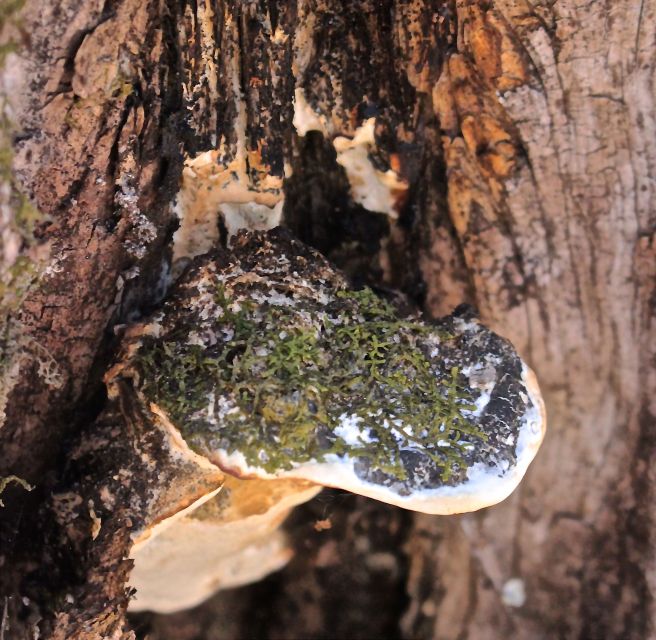
The book is available at Amazon.com, but if you live near an independent book store like Bridgton Books, then I strongly encourage you to shop there.
A Guide to Nature in Winter: Northeast and North Central North America, by Donald W. Stokes, illustrated by Deborah Prince and the author, published 1976, Little, Brown & Company.