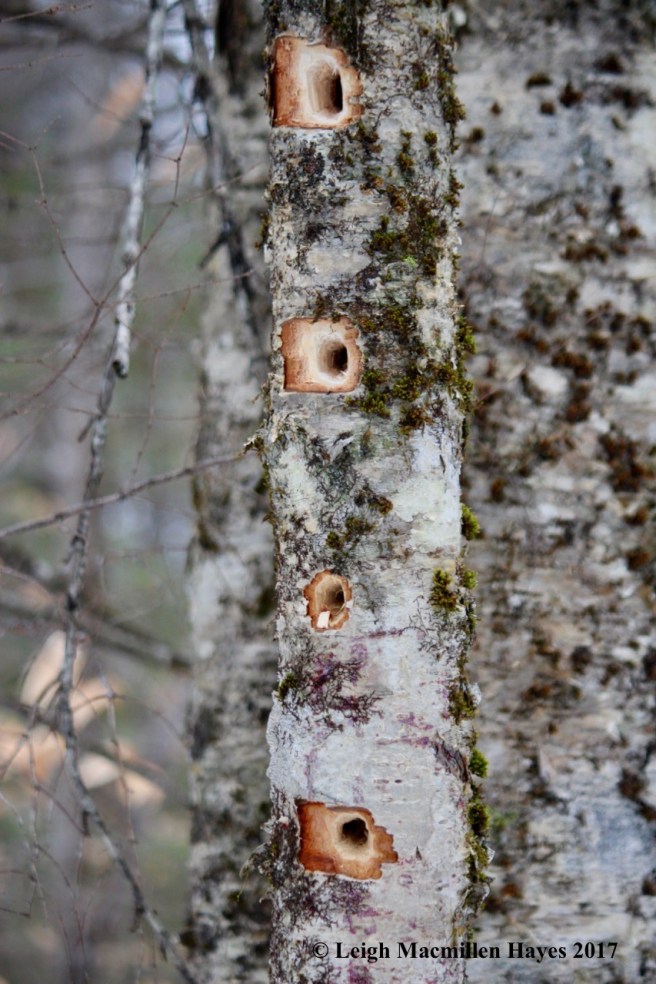
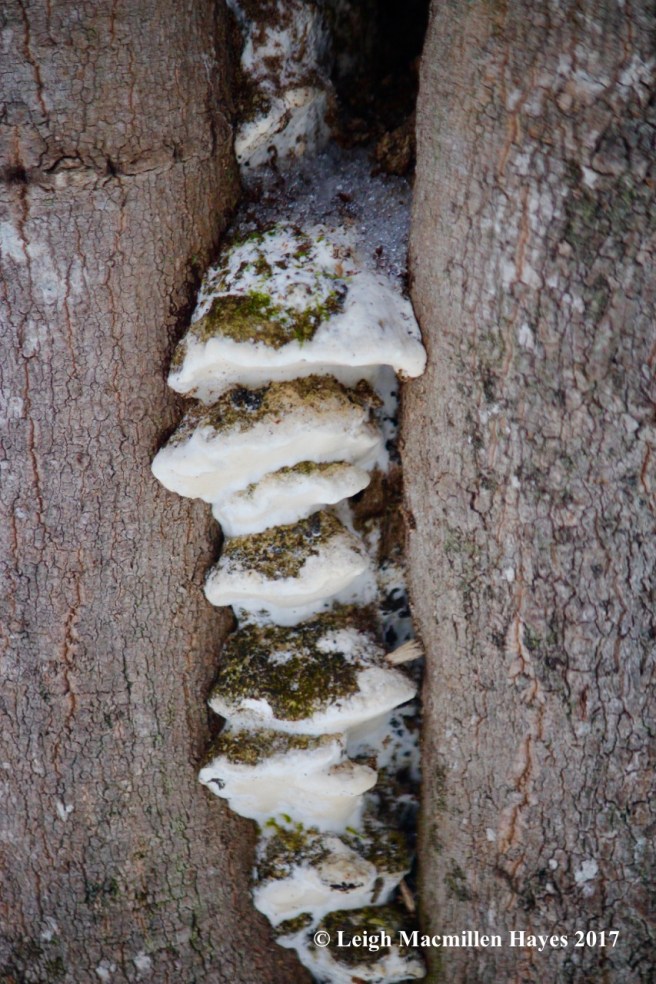
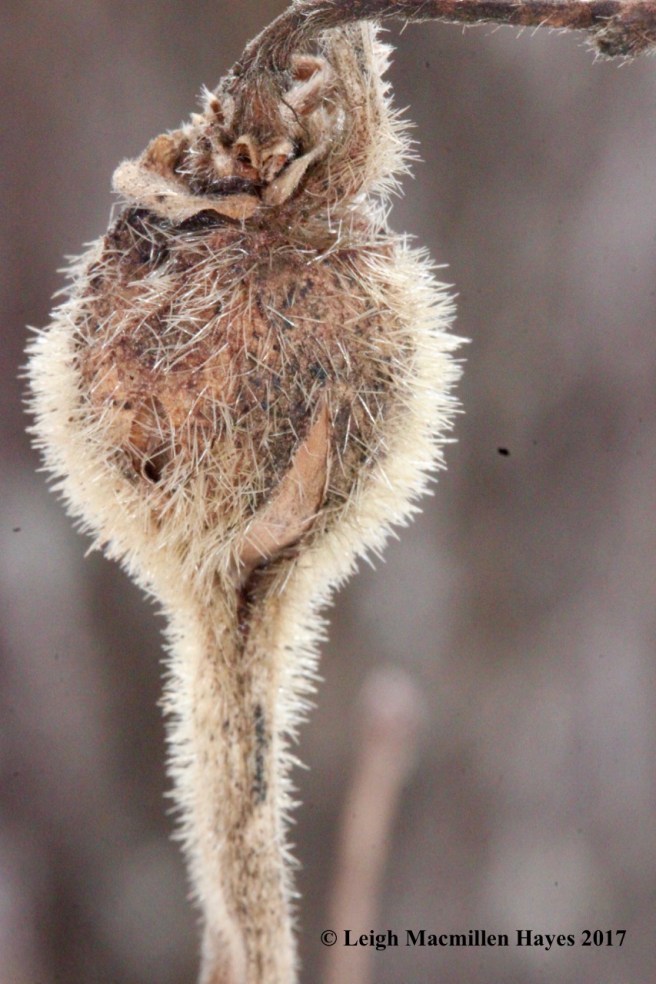
Focusing Our Eyes at Wilson Wing

I almost canceled our Tuesday Tramp this morning. The weather seemed iffy and though that doesn’t often stop us, road conditions do. But Mary and I exchanged a few e-mails and decided that even though we were the only two available, we’d go for it.

w1--deer 1

As we made up our minds, I watched another who also experienced some indecision. Lately, eight deer have spent many moments in the field and our yard, nipping buds along the edge.

w2-deer 2

While the rest of its clan was further out, this one came over the stone wall.

w3a--deer 3a

For me, it was a matter of watching how its legs worked and where it placed its cloven toes.

w4-deer 5

About to visit some trees, it turned suddenly when it realized it was being stalked–not by me but rather a neighbor’s cat. Well, maybe I was as well, but I was indoors.

w6-deer 6

Gingerly, it moved in for a closer look.

w7-deer 7

Tail down, it seemed curious to make a new acquaintance. And the big, tough cat–it ran home.

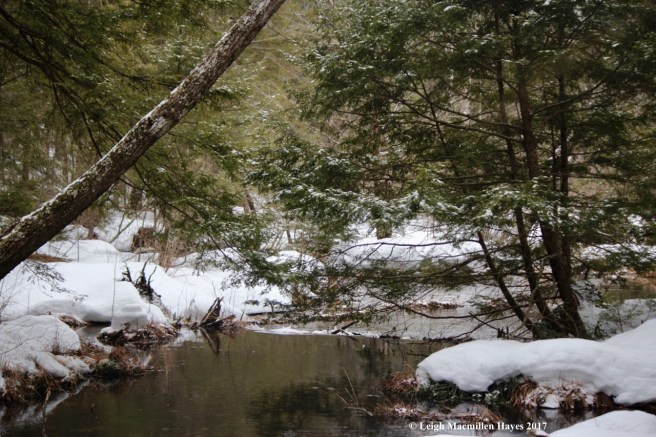
w8--Sucker Brook 1

And so, I packed up and met Mary for our adventure at the Greater Lovell Land Trust’s  Wilson Wing Moose Pond Bog Preserve on Horseshoe Pond Road in Lovell. We’d had a dusting of snow overnight and weren’t sure what to expect. Always expect the unexpected.

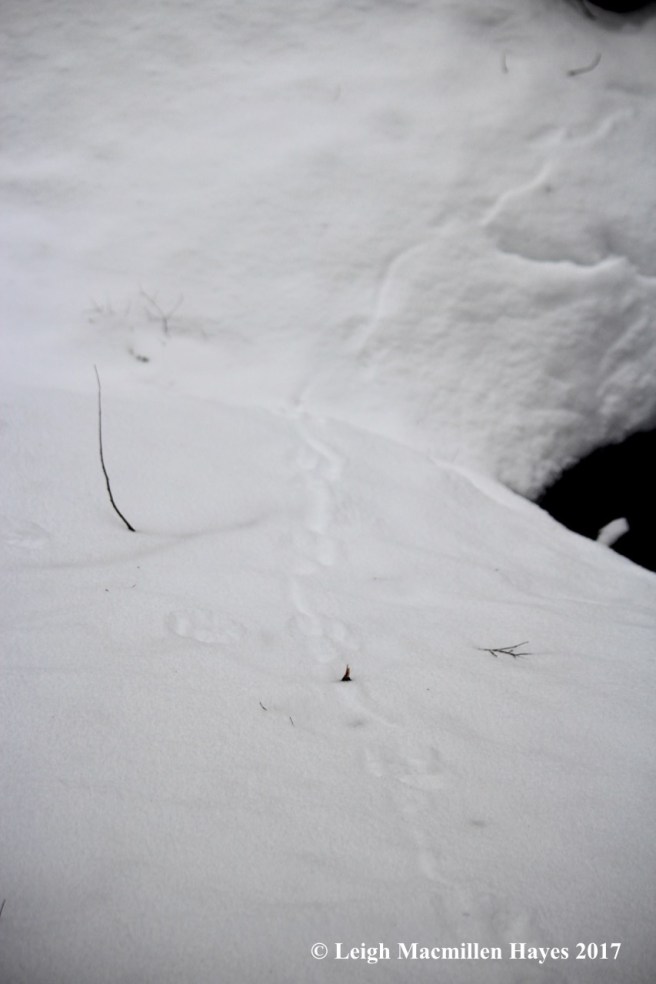
From the start, we found older coyote tracks that we decided to follow. Those led us to mink tracks that began near Sucker Brook. For a while, we followed both as they ran parallel, the mink tracks being much fresher. And then we stood in one spot and realized we were encircled by coyote, mink, red squirrel and short or long-tailed weasel tracks. We could have gone home then, but of course we didn’t.

w9-ice skirt

We decided to follow the brook for a while, hoping to see otter tracks and a slide. Instead, we were treated to aprons of ice surrounding boulders and tree roots.

w10-hoar ice

Some hoar frost at a hole made us wonder who might be within.

w11-mink tracks with tail drag

And our eyes again recognized that we were still on the trail of the coyote and mink. All along, we were curious to see the drag marks left behind by the mink’s tail. Unless it was carrying something–another option.

w12-Sucker Brook 2

As we stood and looked about, movement caught our eyes and we realized we were looking at the mink. Unfortunately, neither of us thought to capture it in a photograph, but it will remain forever in our mind’s eye. While I did exactly what I tell others not to do–tried to follow it for a couple of minutes–Mary stood and listened. A sound above make her crick her neck.

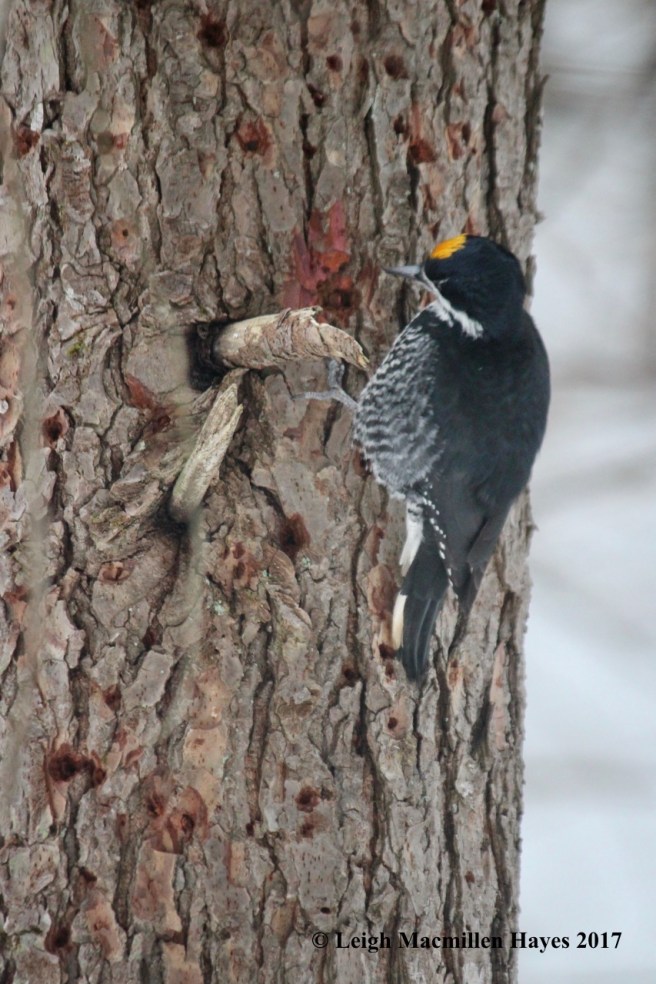
w13-black backed woodpecker

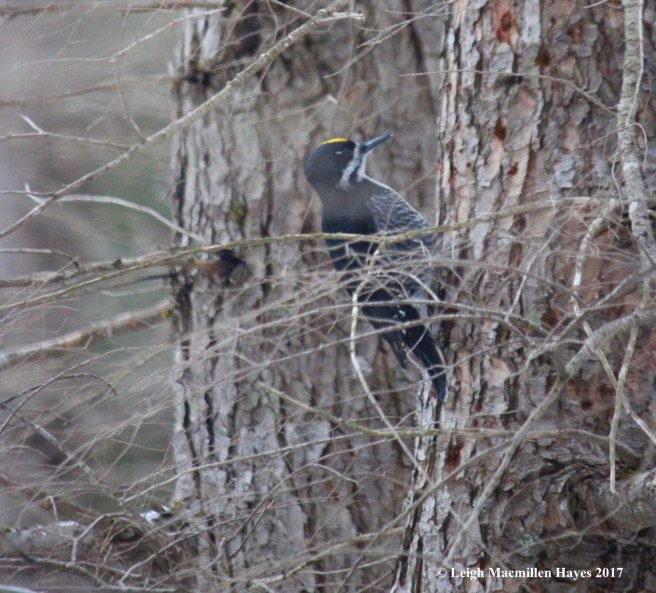
On a dead trunk, a woodpecker foraged among the bark scales. We watched it for a while, trying to note its features from below and we then moved on.

w14--hobblebush

My visits to Wilson Wing are never complete without a stop to worship the hobblebush. For those anticipating spring, it’s only a few weeks away. It won’t be long and these naked leaf and flower buds will unfurl and I’m sure I’ll share their blooming glory with you.

w15-Moose Pond Bog

Another stop that I can’t pass by is a climb up the stairs to the platform–the perfect viewing spot for the bog.

w16-car

Finally, we continued along the trail and I realized my focal points were redundant of all past visits, but it’s fun to view some of these in various seasons. For those who know, this is the old blue vehicle.

w17-lungwort

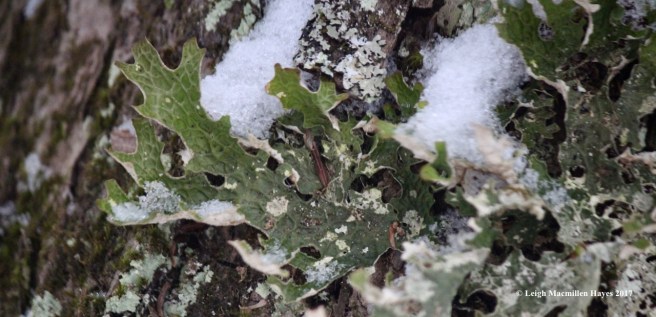
And right near it, my favorite of all foliose lichens–lungwort, indicative of unpolluted air. At Wilson Wing–indeed.

w18-hemlock catkins ;-)

We crossed the last little stream, found some deer tracks and a beaver chew, and then decided to follow the trail back rather than the road. One of our stops included admiring the hemlock catkins. (Smiley face)

w19-black backed 2

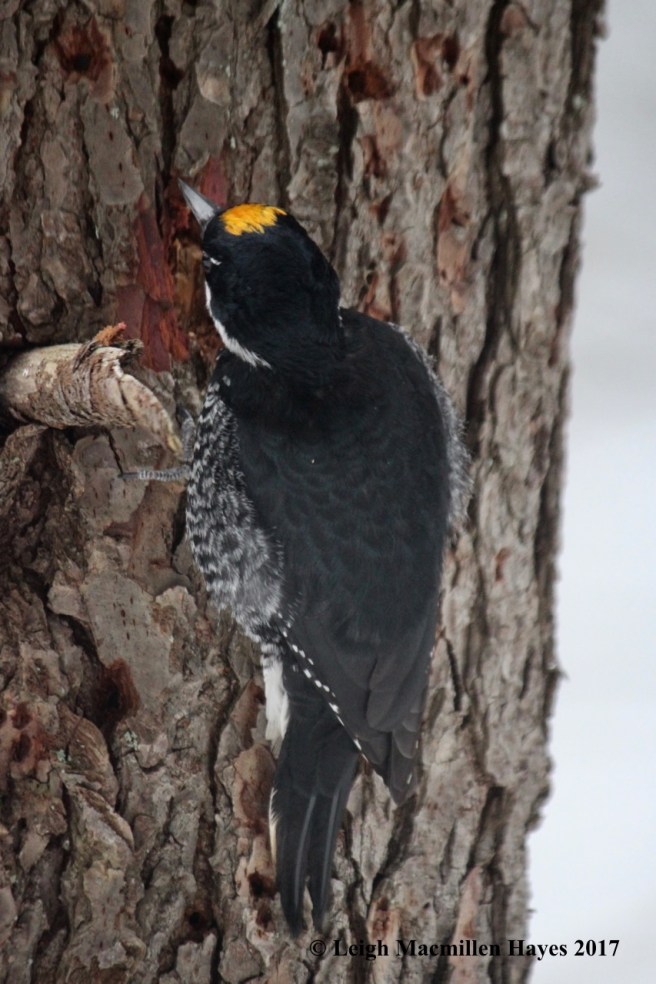
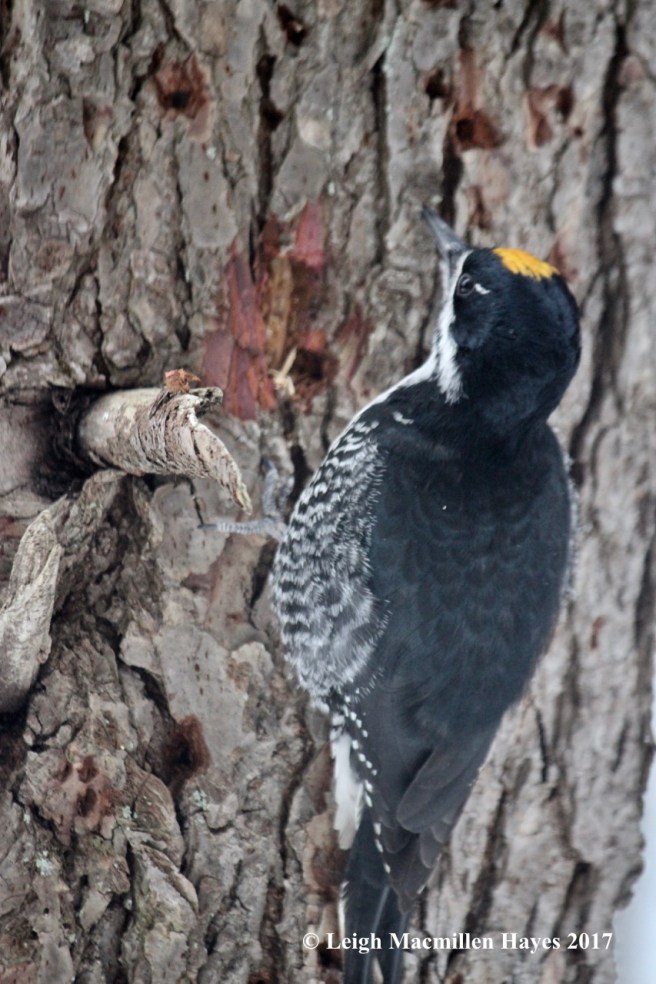
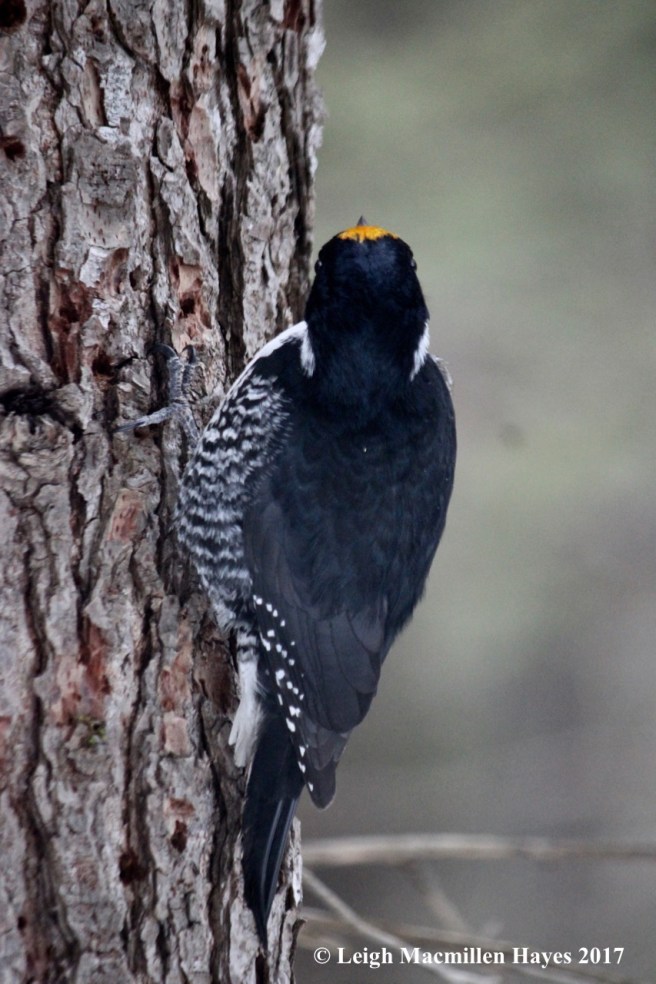
And then we returned to the woodpecker. By now he was our woodpecker, just as the mink that we saw and other critters we didn’t see were also “our mink” and “our coyote,” etc. It’s amazing how even when we don’t see the mammal, recognizing that it has passed through is enough to excite us. But this bird . . . oh my.

w20-black backed 3

We noted the orangey yellow crown as it cocked its head.

w26-black backed 8

Its face was black and white, including a black mustache and white eye line.

w22--black backed 5

We were surprised by its stocky build.

w24-black backed 6

And those black and white barred sides or flanks weren’t like the woodpeckers we normally see.

w25-black backed 7

It worked constantly, flaking the scales off the trunk as it searched for insect larvae.

w27-black backed 9

Cinnamon colored underbark revealed itself where the bird had recently excavated.

w28-black backed 10

As it contemplated its next move, it didn’t seem to mind our admiration.

w30-black backed 11

With its strong beak, it probed and probed.

w31-black backed 12

Then held its head back and . . .

w32-black backed 13

probed some more.

w33-black backed 14

First it cocked its head to the right.

w36-black backed 17

And then back to the left.

w38-blackbacked 18

Frequently, it paused for a brief break. Or perhaps it was dining and we didn’t know it.

w40-black backed 21

We were mesmerized.

w39-black backed 20

And delighted . . .  for we’d had the opportunity to focus our eyes on so many wonders, but especially the mink and this . . . a black-backed woodpecker. This was a rare opportunity for these birds seldom show themselves, especially this far south–all the more reason to be thankful that we decided to go for it and focus our eyes on the nature of Wilson Wing Moose Pond Bog Preserve.

The Second Anniversary of Wondermyway

Milestones are always important as they mark significant events in our lives. And for me, such an event occurs today as I celebrate the second anniversary of the day wondermyway.com was born.

Since I was in elementary school and made few and far between entries into a chunky journal bound in a green cover (which I still own), to the first empty book journal my sister gave me when I graduated from high school, to a variety of travelogues and other journals I’ve filled from cover to cover,  I’ve recorded my life’s journey from time to time.

The most satisfying for me has been this very blog, to which I’ve added numerous events and discoveries, both natural and historical, over the last two years. As personal as it all is, I’ve taken a leap of faith by sharing it with you. And you have been gracious enough to read it, and comment on it, and “like” it, and sometimes “love” it, and offer me suggestions, corrections and gentle nudges.

Thank  you for following along on the journey. It’s been scary to put myself out there, but I have.

And now, I thought I’d review some favorite finds I noted in posts over the past year. My learnings have been many and it’s been fun to review all that I’ve seen and thought and admired and wondered about. I hope you’ll feel the same and will continue to follow along and comment and share those that you enjoy with your family and friends.

Here’s my countdown , or maybe I should say my count up of favorite moments in time over the past year:

Feb 21, 2016: Celebrating a Year of Wonder-filled Wanders

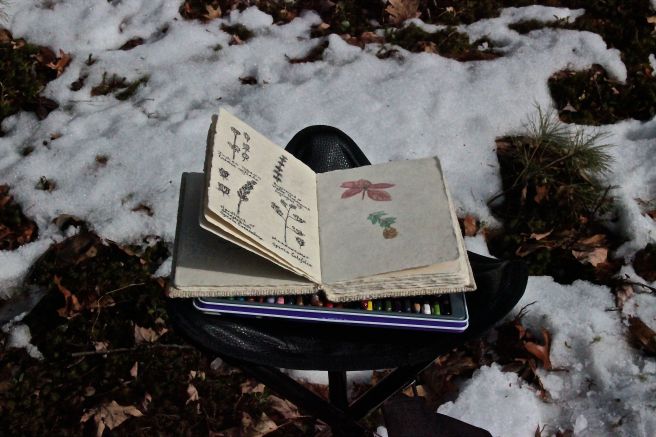
b-sit spot

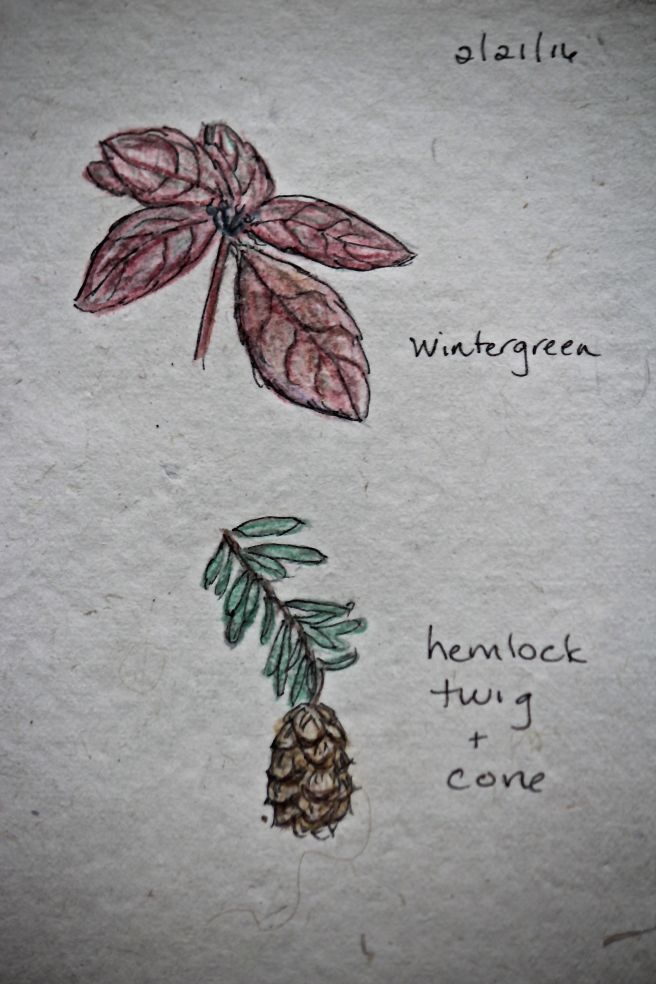
b-sketch 1

I made time one year ago to sit and sketch–one of my favorite activities. To be still and embrace life around me. To notice. And commemorate.

February 28 2016: Gallivanting Around Great Brook

h-yellow and white partners

Usually, we drive the forest road in to the gate on Hut Road in Stoneham, but in winter it isn’t passable, and thus one must walk–which means paying attention to things you might not normally notice, such as this: a special relationship between a yellow birch and a white pine. Rooted in place, they embrace and share nutrients. Forever conjoined, they’ll dance through life together.

March 18, 2016: On the Verge of Change

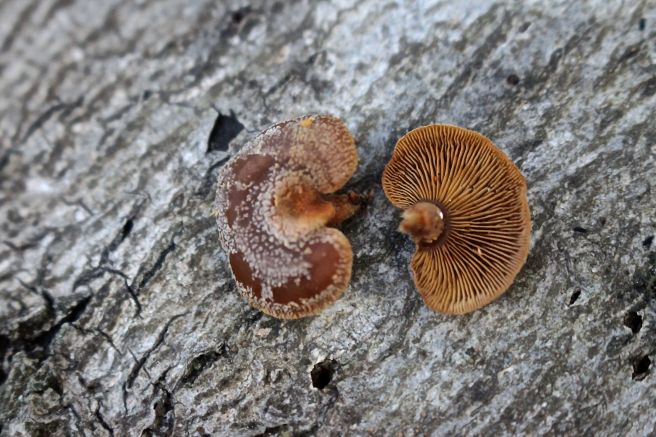
b-panellus stipticus?

While exploring the Greater Lovell Land Trust‘s  Back Pond Reserve in Stoneham with my friend, Parker,  who is a master mycologist, he found Panellus stipticus, a bioluminescent species. Check out those gills on the underside. According to Lawrence Millman in his book Fascinating Fungi of New England, ” . . . specimens in the Northeast glow more obviously than specimens in other parts of North America.” So if you are ever in these woods late at night, don’t be freaked out by a light greenish glow. It just might be nature’s night light.

March 22 2016: Wet Feet at Brownfield Bog

b-pellet

When I first spied this lump of gray I assumed it was a dead mouse. I know, I know–I should never assume because I risk “making an ass out of u and me.” And so I took a closer look. And noticed tons of bones and those orange teeth. An owl pellet filled with the remains of dinner. Owl pellets are extra cool and dissecting one is even cooler. I collected this one but haven’t dissected it because I think it makes for a great teaching tool as is. If you want to see it, just ask.

April 13, 2016: So Many Quacks

v-egg mass 1

At the vernal pool, or frog pond as we’ve always fondly referred to it, just steps from our property, I kept a keen eye on the situation last spring. In general, each mass laid by  female wood frogs was attached to a twig or branch. They tend to take advantage of the same site for attachment and usually in a warm, sunny spot.

A couple of masses were positioned independent of the rest, like this one–embraced in oak and maple leaves. Eventually, they’ll gain a greenish tinge from algae, which actually helps to camouflage them. One of the many wonders is that any given mass may contain up to 1,000 eggs–from a two-to-three-inch frog.

April 28, 2016: The Big, The Little and Everything in Between

b-bear2

The phone rang as I stepped out of the shower and a male voice yammered away about something in the snow and it had come last night and I had to get there quickly. My friend, Dick,  was standing in a friend’s yard about a half mile from here and looking at bear tracks in the snow.

As he knew he would, he had me on the word “bear.” His voice was urgent as he insisted I stop everything and get to his friend’s house. “I just need to dry my hair and then I’ll be right there,” I said. Deadlines loomed before me but bear tracks won my internal war. Dick suggested I just wrap a towel around my head. Really, that’s what I should have done because my hair has no sense of style whether wet or dry, so after a few minutes I said the heck with it and popped into my truck, camera and trackards in hand.

May 21, 2016: Wallowing in Wonder

p-ph dragon ending 4

Along Perky’s Path at the GLLT’s Heald and Bradley Ponds Preserve, a bunch of us had the honor to watch a dragonfly split open its exoskeleton and emerge from the nymph stage. Of course, we were standing by a beaver pond, and so it seemed only appropriate that it would use the top of a sapling cut by a beaver. As it inflated the wings with blood pressure, they began to extend.

May 31, 2016: Slippers Fit for a Princess–Including Cinderella

p-ph lady y 15

Members of the Orchid family, lady’s slippers feature the typical three petals in an atypical fashion. The pouch (or slipper or moccasin), called the labellum, is actually one petal–inflated and veined. With a purplish tint, the petals and sepals twist and turn offering their own take on a ballroom dance. From every angle, it’s simply elegant.

June 10, 2016: The Main(e) Exotics

snake2

At Lakes Environmental Association‘s Holt Pond Preserve, a friend and I had moved from the swamp to the first hemlock hummock and chatted about natural communities when suddenly we realize we were being hissed at. Its coloration threw us off and beautiful though it was, the hairs on the back of our necks stood on end. Apparently we made it feel likewise. And so we retreated. It was a common garter, but really, there didn’t seem anything common about it in the moment.

June 18, 2016: Paying Attention

partridge berry

j- trailing 2 (1)

j-  trailing 7 (1)

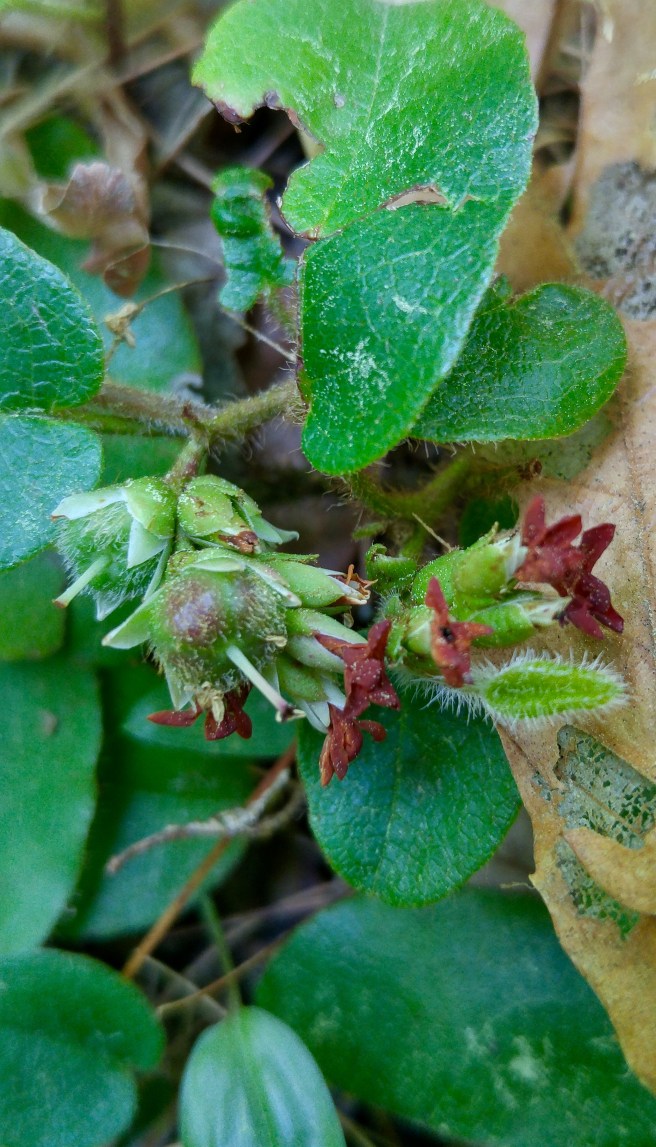
In May, trailing arbutus wowed us by its gentle white and pale pink flowers. In June,  they faded to a rusty tone. And some transformed into swollen round seed pods–a first for me to see.

The sepals curled away to reveal the white fleshy fruit speckled with tiny brown seeds. It was well worth getting down on knees to look through a hand lens–especially since ants, chipmunks and mice find these to be a delicacy so they wouldn’t last long.

July 9, 2016: Wondering About Nature’s Complexity

img_1364-1

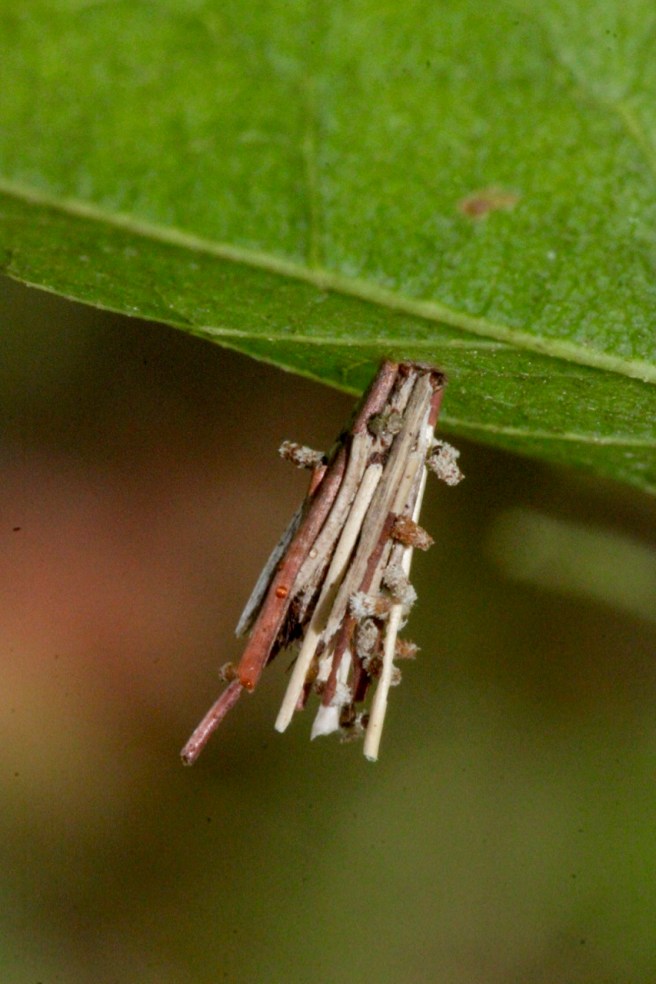
I posed a question this day: So dear reader, I enjoy teaching you, but now need you to teach me. I found this under another leaf on a shrub. And I often see the same thing stuck to our house. It reminds me of a caddisfly case. What is it?

And fellow Master Naturalist Pam Davis responded: Check out bagworm moths to see if it might be an answer to the stick thing on the leaf and your house. Here’s a discussion: http://nature.gardenweb.com/discussions/2237505/not-a-bug-maybe-a-gall and a Wikipedia link: https://en.wikipedia.org/wiki/Bagworm_moth

Indeed.

July 27, 2016: Searching for the Source of Sweetness

w-frit 2

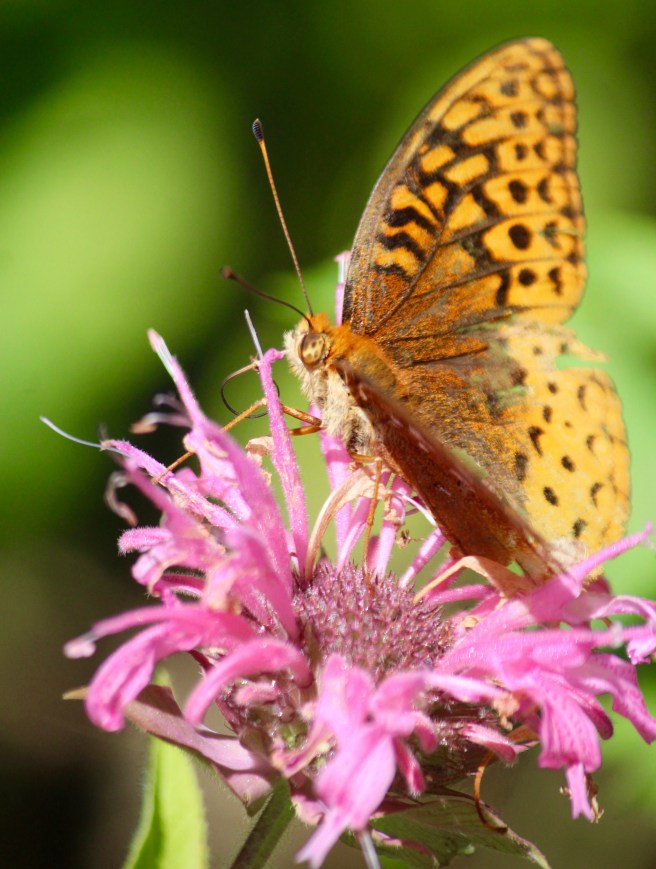
It was no mistake the this fritillary butterfly chose the beebalm on which to land. Check out its mouth. A butterfly feeds through a coiled mouth part called a proboscis. When not in use, the proboscis recoils and is tucked into position against the butterfly’s head.

August 21, 2016: Sundae School

n-Indian pipe bee 1

My lessons began immediately. What to my wondering eye should appear, but a bee pollinating an Indian Pipe. And in the middle of the afternoon. Huh? I’ve always heard that they are pollinated by moths or flies at night. Of course, upon further research, I learned that bees and skipper butterflies have been known to pay a visit to the translucent flowers. Add that to the memory bank.

August 27, 2016: Halting Beside Holt Pond

h-pitcher  flower up close

Halting–prone to pauses or breaks. I didn’t break, but I certainly was prone to pauses as I moved along the trails and boardwalks at the Holt Pond Preserve in South Bridgton. One of my first stops–to admire the pitcher plant flowers in their August form. When I took a closer look, I realized that the seeds were developing–certainly a WOW moment in the world of wonder.

September 9, 2016: Golden Rulers

g-assassin-1

What first caught my eye was a bee that dangled upside down. And then I spied the green legs of an assassin bug. What? Yup, an assassin bug. I believe this one is a nymph. Regardless of age, here’s the scoop: Assassin bugs are proficient at capturing and feeding on a wide variety of prey. Though they are good for the garden, they also sometimes choose the wrong species like this bee. The unsuspecting prey is captured with a quick stab of the bug’s curved proboscis or straw-like mouthpart. Once I saw this, I continued to return for a couple of hours, so stay tuned.

September 15, 2016: The Wonders of Kezar River Reserve

k-ruby-1

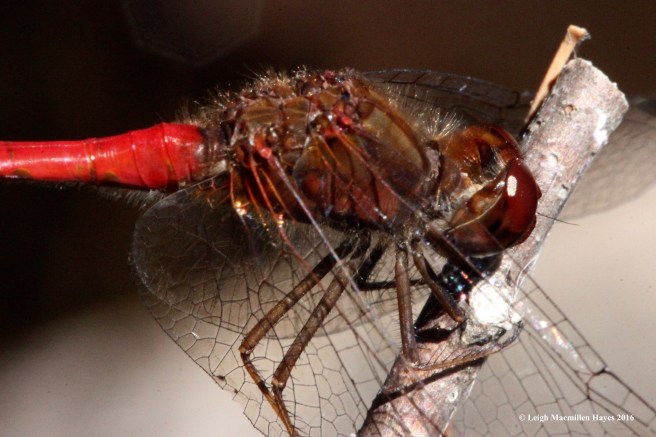
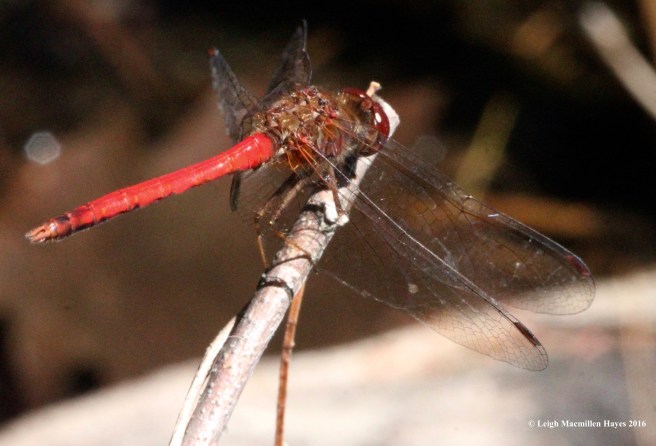
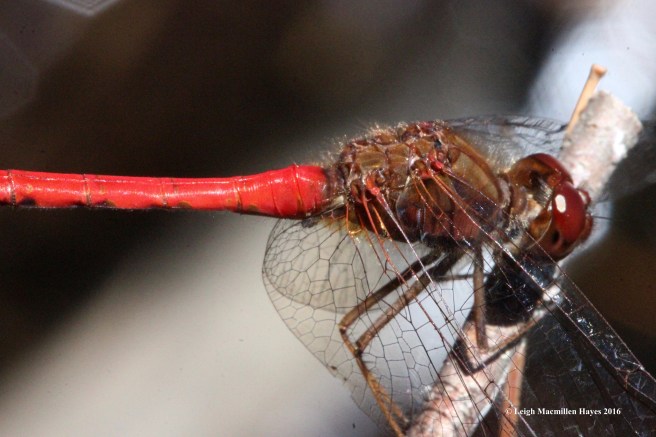
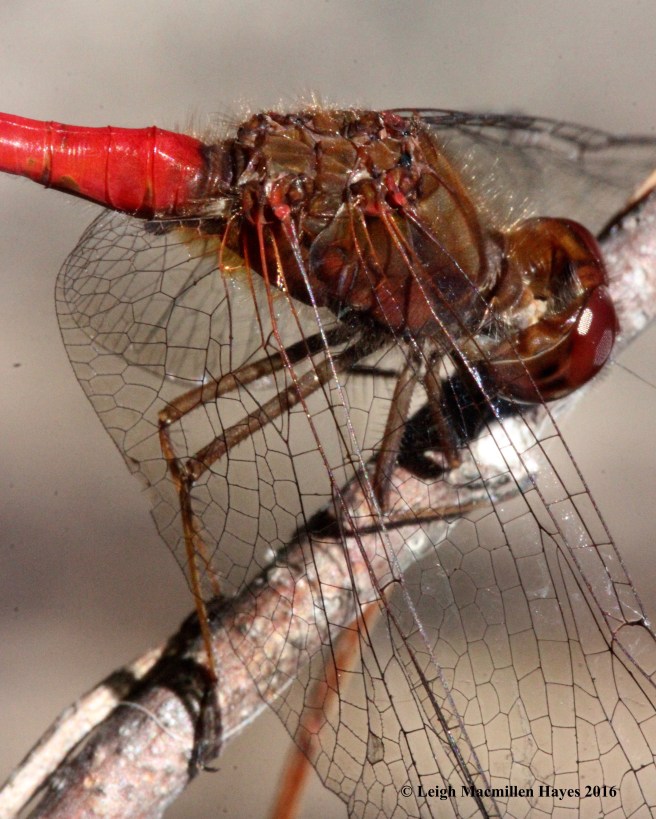
My favorite wonder of the day . . . moments spent up close with a meadowhawk.

October 17, 2016: Everybody Loves Raymond? Mondate

r-mushroom-growth

My guy and I discovered several of these examples of fungi on fungi at Loon Echo Land Trust‘s Raymond Community Forest and had no idea what they were–so I sent the photos to Parker and Jimmie Veitch, of White Mountain Mushrooms, and Jimmie responded with this explanation:

“That’s what mycologists call “rosecomb” mutation, where a mushroom’s gills start forming on the cap in a really mutated fashion. It’s been reported in many mushroom species but I haven’t seen it in this one (Armillaria AKA honey mushrooms). As far as I know, no secondary fungus is involved.

The suspected cause (not so nice) is ‘hydrocarbons, phenols and other compounds contaminating the casing or contacting the mushroom surface. Diesel oil, exhaust from engines, and petroleum-based pesticides are thought to be the principal source.'”

October 22, 2016: Cloaked By the Morning Mist

u-candy-2

On a rainy day adventure with the Upper Saco Valley Land Trust in nearby New Hampshire, we paused to admire candy lichen, a crustose (think–flattish or crust-like) lichen with green to bluish-green coloration. Its fruiting bodies, however, are candy-pinkish berets atop stalks, even reflected in the raindrops.

November 6, 2016: Focus on the Forest Foliage

j-lichens-galore

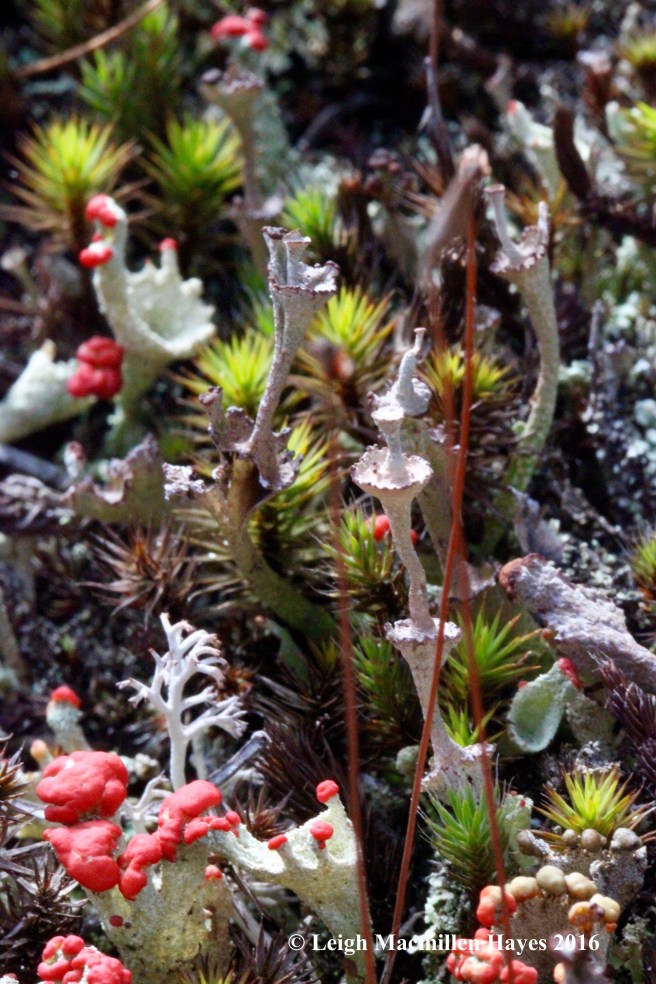
And then . . . and then . . . and then just as our eyes trained on the red caps before us, something else made itself known. We spied another lichen that I’ve only seen once before: Cladonia cervicornis ssp. verticillate.

Its growth formation is rather unique. In one sense, it reminded me of a sombrero, but in another sense, I saw fountains stacked one atop another, each giving forth life in their own unique fashion. But rather than being called Fountain Lichen, its common name is Ladder Lichen–perhaps referring to the fact that the pixies can easily climb up and up and up again.

November 20, 2016: Forever a Student

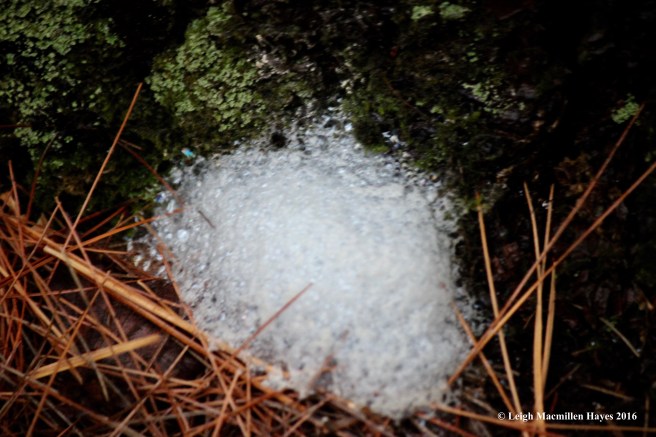
h-pine-suds

A sight I was hoping for presented itself when I returned to our woodlot–froth at the base of a pine tree. It’s not unusual and occurs following a rain event such as we’d had all night and morning. So what causes the tree to froth? Well, like all lessons, there are several possibilities. Maine Master Naturalist Science Advisor Fred Cichocki recently had this to say about it: “I’ve noticed this phenomenon often, and in every case I’ve seen it’s associated with white pine, and always after a dry spell followed by heavy rain. Now, conifers, especially, produce hydrocarbons called terpenes (it’s what gives them their lovely pine, balsam and fir scent). These hydrocarbons are hydrophobic by nature and form immiscible films on water. During a heavy rain, water running down the trunk of a white pine picks up terpenes on the way. Air (having accumulated in bark spaces, channels, etc. perhaps under slight pressure) then “bubbles” through terpene-water films producing a froth. Recall the cleaning products PineSol, and the like. They are made from terpenes, and produce copious bubbles when shaken. One could get the same result directly by shaking terpentine in water, or by bubbling air through a terpentine-water mixture with a straw . . . Of course, it may be that other substances (salts, etc.) enhance the frothing.”

No matter how much I have learned on this life-long course, there’s always more. I certainly don’t have all the answers and for that I am thankful. I’m forever a student.

December 4, 2016: The Art of Nature

s-tree-ring-labyrinth

Some cut stumps reminded me of the circular movement leading toward the center of a labyrinth–appearing quick and easy, and yet providing a time to slow down while following the path.

December 23, 2016: Won’t You Be My Neighbor

m-print

I followed the porcupine trail along his regular route and over the stonewall only to discover prints I’ve never met before. My first impression was raccoon, but the shape of the prints and the trail didn’t match up in my brain. More and more people have mentioned opossum sightings in the past few years, but I’ve only seen one or two–flattened on the road. Today, in our very woods, opossum prints.

January 19, 2017: Keep an Open Mind

o-deer

While I always head out with expectations of what my forest wanderings will offer, I’m happily surprised time and time again with the gifts received.

And so it was the other day when a friend and I happened upon this trophy in an area I’ve only visited a few times. We’d been noting the abundant amount of deer tracks and realized we were between their bedding and feeding areas and then voila–this sweet sight sitting atop the snow. It now adorns a bookcase in my office, a wonder-filled addition to my mini natural history museum. (I’m trying to give Henry, Jessie, Violet, and Benny of the Boxcar Children series a run for their money in creating such a museum.)

January 25, 2017: On the Prowl at Heald and Bradley Ponds Reserve

w-tube-moth-2

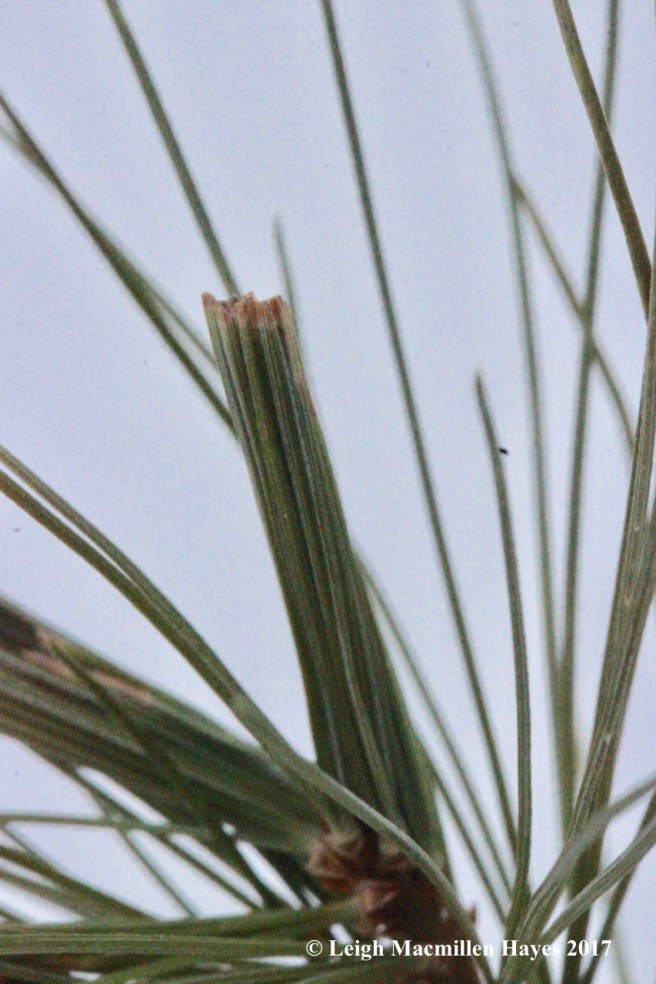
Notice how these pine needles are clumped together? What I learned from Mary Holland, author of Naturally Curious,  is that these are tubes or tunnels created by the Pine Tube Moth. Last summer, larvae hatched from eggs deposited on the needles. They used silk to bind the needles together, thus forming a hollow tube. Notice the browned tips–that’s due to the larvae feeding on them. Eventually the overwintering larvae will pupate within the tube and in April when I come back to check on the vernal pool, I need to remember to pay attention, for that’s when they’ll emerge. Two generations occur each year and those that overwinter are the second generation. The good news, says Holland, is that “Pine Tube Moths are not considered a significant pest.” I only found the tubes on two young trees, but suspect there are more to be seen.

February 8, 2017: Embracing the Calm

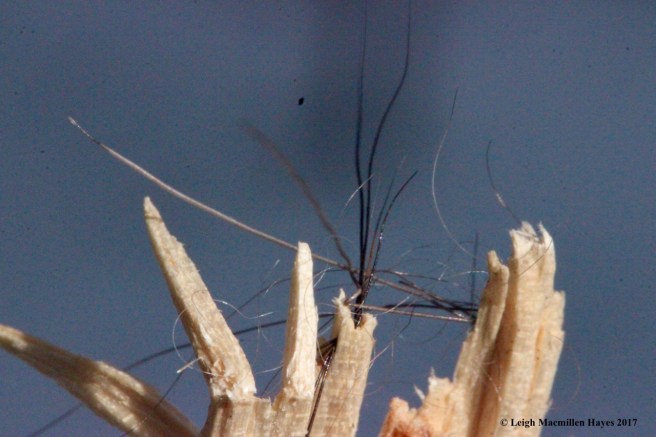
h-moose-hair-2

A bull moose, like a buck deer, thrashes bushes and small saplings when the velvet on its antlers dries. It could be that the velvet itches. But it could also be a response to increasing testosterone and the need to scent mark.

February 16, 2017: When Life Gives You Flakes

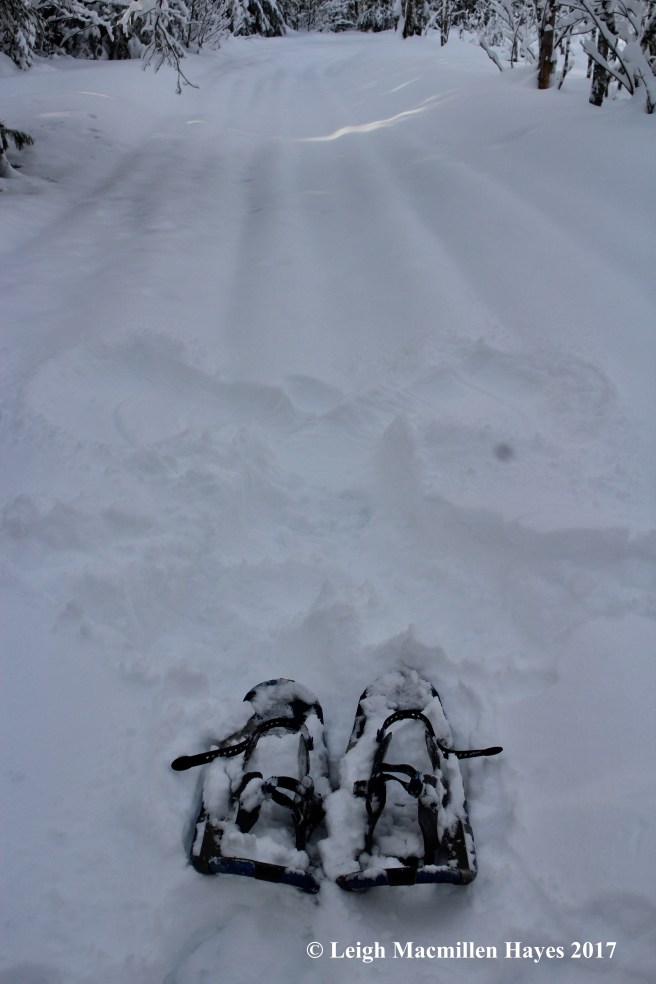
s-snow-angel-in-trail

When life gives you flakes . . . make a snow angel in the middle of the trail.

To all who have read this far, thanks again for taking a trip down memory lane today and sticking with me these past two years. I sincerely hope you’ll continue to share the trail as I wander and wonder–my way.

And to wondermyway.com–Happy Second Anniversary!


Mount Tom Revisited

As we tried to figure out where we’d hike today, we decided a familiar route would suit us and I was pleased when my guy suggested Mount Tom in Fryeburg. It’s an old favorite that has improved with age since The Nature Conservancy added a new trail recently. This property was important to them because the Saco River flows below.

I’d first explored the new trail with Marita Wiser, author of HIKES & Woodland Walks in and around Maine’s LAKES REGION, in October and then with my guy a short time later.

m1-cemetery-buried

Today, we decided to park our truck across from the old trailhead and walk down Menotomy Road so we wouldn’t have that trudge after our hike. I wish the trail was a loop, but it can’t be and so we made our own. The snowstorms of the last two weeks had buried the cemetery entrance and only a couple of headstones poked out.

m2-preserve-sign

One and a half miles later, we climbed over the snowbank at the trailhead and strapped on our snowshoes.

m5-my-guy

We were thankful that someone or two or three had packed the trail before us.

m4-center-chimney

Just after stepping onto the West Ridge Trail, we passed between a house and barn foundation. All that was visible–the center chimney’s supporting structure, which probably dates back to the 1800s. Perhaps the original homesteaders were buried in the cemetery.

m6-tinder-1

At first the tromp was easy because it passes gently across the terrain and so I had time to look around. Fresh tinder conks growing on paper birch trees pleased my eye.

m7-tinder-2

I love their colors, which reminded me of oyster shells I’d spent a childhood collecting.

m8-erratics

A few minutes later I spied a house I hadn’t noticed in the fall. My guy looked over and told me it wasn’t a house at all.

m9-erratics-2

He was right, of course. Two large boulders, erratics dropped by the glaciers that formed Mount Tom, a Roche Moutonnée, stood out because of their snow covered tops. We didn’t move closer, but I’ve a feeling they provided homes for mosses and ferns and other assorted flora and perhaps even wildlife. So maybe I was also correct.

m10-summit-in-distance

After crossing the snowmobile trail that passes through the preserve, we continued on through the hardwood forest and started climbing up and sometimes down. Through the trees we spied the summit, but still had a ways to go.

m11-white-oak-bark

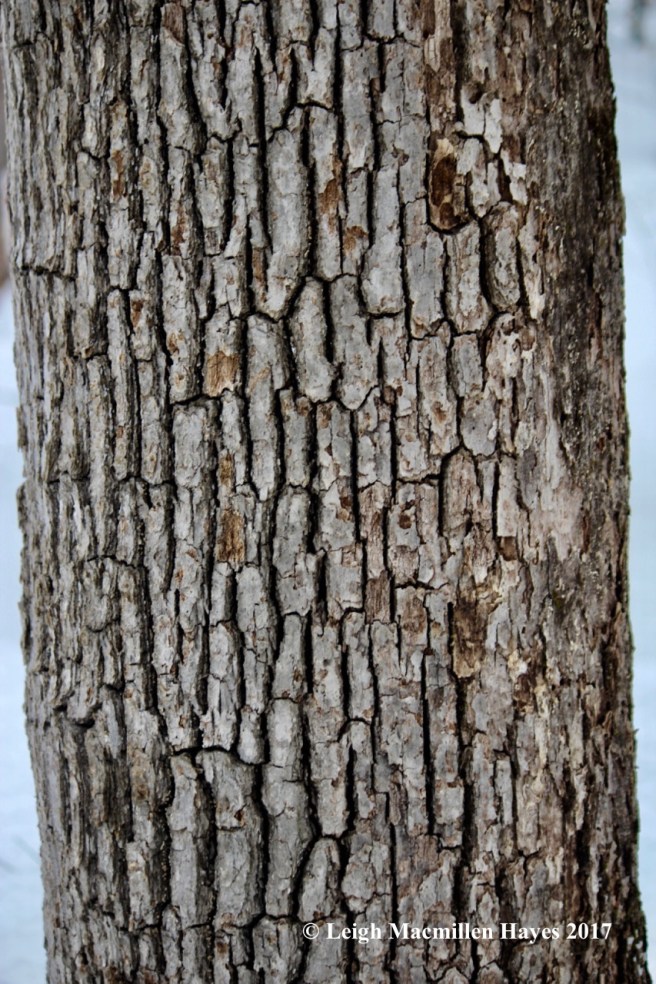
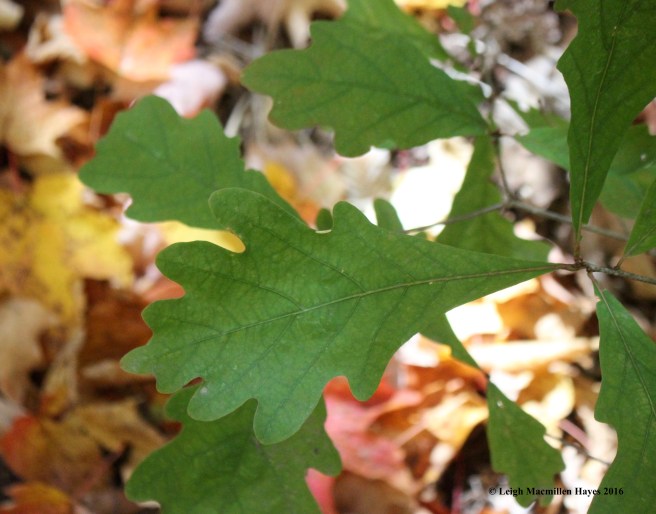
One of my favorite trees grows in this forest–white oak. And though it’s not common in the woods I normally traverse, I’m learning to identify it by the plated blocks of its bark.

m12-white-oak-leaf

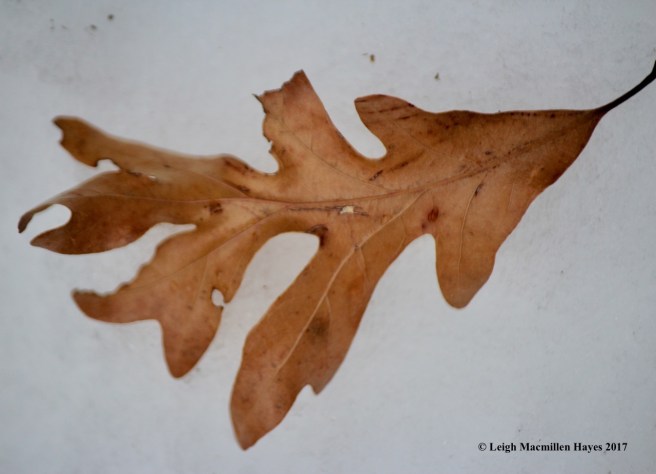
It helps, of course, when the round-lobed leaves are found nearby.

m13-ledges

At last we reached the ledges, where I’d hoped to see bobcat sign. We did see porcupine evidence, but the snow was soft and tracks almost indecipherable.

m14-pileated-pile

We also found plenty of signs of another frequent visitor. But with that–a major disappointment. I’m sorry to report that I didn’t find any pileated woodpecker scat today.

m16-squirell-works

Across the trail from the pileated debris, the work of a gray squirrel. Dinner required toil–it had dug a hole that looked to be about three feet deep. How do they know where to find those acorns they cached last fall? I’m always in wonder of such digs. And those that they don’t find become trees. It’s all good.

m17-tree-welcome

I probably wouldn’t have missed this tree, but my guy wanted to make sure I saw it. He spread his arms in the same manner and felt it was welcoming us to the ridge. Indeed.

m18-downy-feather

Nearby, someone else was welcomed–and I’m not referring to the acorn. Yes, that provided a squirrel meal, but scattered feathers indicated a downy woodpecker met its demise. And a predator dined.

m19-burl-revealed

We were almost to the summit when a burl revealed some of its inner beauty–the bark having fallen off. Grains once straight twisted and contorted thanks to a virus or fungus or some other means. I loved the swirl of lines, some thin and squiggly.

m20-summit-view

And then the beauty of the view greeted us–Pleasant Mountain in the distance and the Saco River valley below. We met a young family at the summit and thanked them for paving the way. They’d never climbed here before and asked about the old trail down.

m21-trail-signs-at-intersection

We explained that that was our choice and though it’s a bit steeper, it’s a quicker way back to the road.

m22-blazing-trail

We also told them we’d do the honor of paving the way because it had been a storm or more since anyone had trudged that way.

m23-mount-kearsarge-in-view

Because it’s a rather straight downhill, we felt like we were floating for most of the trail and welcomed the sight of Mount Kearsarge among the beauty of the young birches. Once the trail widened, the snow was deeper and it became a trudge again, but the end was nearing.

m24-flag

Right before reaching the road, Old Glory flew as she faithfully does in the field.

m25-barn-and-kearsarge

And always a favorite–the barn beside the trailhead highlighted by the mountains and sky.

We’d come to the end and were thankful for the opportunity to climb Mount Tom again. We were especially thankful for the family who’d gone before on the West Ridge Trail–it was a bit of a slug for us, but even more so for them and we wondered if we’d have completed the loop had it not been for their hard work. We don’t know their names, though we do know their dog’s–Roscoe. May Roscoe’s owners sleep well tonight.


Embracing the Calm

Yesterday it snowed and the air held its winter red-cheeked nip.

h-yesterdays-snow

Today, five inches of fresh snow on the ground and stone walls with temps in the upper 40˚s–certainly a feeling of spring.

h-chickadee

As I headed into my smiling place, I had high hopes of seeing the golden-crowned kinglets I heard and saw the other day when my fingers were too cold to snap a photo. So the pishing began–me repeating “pish” over and over again in hopes of a repeat performance. No kinglets, but the chickadees came and followed me for a bit–I felt like the Pish Piper.

h-moose-hair-3

As I snowshoed, I spotted numerous  trees like this striped maple, broken and worthy of inspection. Each time, I stepped in for a closer look. And finally was rewarded.

h-moose-hair-1

Hair.

h-moose-hair-2

Moose hair.

h-moose-hair-finale

A bull moose, like a buck deer, thrashes bushes and small saplings when the velvet on its antlers dries. It could be that the velvet itches. But it could also be a response to increasing testosterone and the need to scent mark.

h-moose-maple

The frayed striped maple held messages I couldn’t read. But I had the joy of knowing they were there. And a better understanding of why this tree is called moosewood.

h-porky-trail

Taking a different route home, I spied the pattern of our neighborhood porcupine. Apparently it had made a journey during the overnight hours when the storm was still in progress.

h-porky-cut

I didn’t see any hemlock twigs scattered on the ground, but one nipped end starred me in the face from its suspended position on the branch of another tree.

h-porky-tree

And in the hemlock, yesterday’s snow gathered still on more nipped twigs. Porky has certainly been active. For now, he rests under the barn.

h-red-sky

As the sun finally set on this beautiful day, I ran outside to capture the red sky. My mother used to say, “Red sky at night, sailors’ delight.” I’ve a feeling that there will be a red sky in the morning and the sailors will need to heed the warning. Another storm is pending.

Between the storms, I embraced the calm. And was rewarded.

Tonight, one more reward that was captured in our minds’ eyes–my guy turned on the deck light and called to me. We watched an opossum move across the deck and head to the spot where the shed meets the barn and all critters enter and depart–porcupines, raccoons, skunks, woodchucks and now an opossum. It was our first sighting of this homely mammal.  I’d wondered where it might be and haven’t seen its tracks since the first time I spied them just before Christmas.

Barns are meant to house animals, especially when they need to get out of a storm. Our animals just happen to live under the barn (well, all but the squirrels and mice that live in it), though I have to wonder how this menagerie embraces the calm as they coexist.

Between storms, seek calm and embrace it.


On the Prowl at Heald & Bradley Pond Reserve

My original intention when I set out this morning was to snowshoe from the Gallie parking lot on Route 5, follow the Homestead Trail and then connect with the Hemlock Trail as I climbed to the summit of Whiting Hill. I planned to make it a loop by descending via the red trail back to the green Gallie Trail.

w-mill-in-morning-light1

Not to be as the parking lot hadn’t been cleared yet of yesterday’s Nor’easter, which dumped several inches of snow, sleet and freezing rain upon the earth. When Plan A fails, resort to Plan B. A drive down Slab City Road revealed that the Fairburn parking lot wasn’t yet cleared either, but the boat launch was open (because the pond serves as a water source for the fire department) so I parked there and headed to the trailhead beside Mill Brook. The sight of so much water flowing forth was welcome, especially considering it was a mere trickle a few months ago.

w-snow-layers-brookside

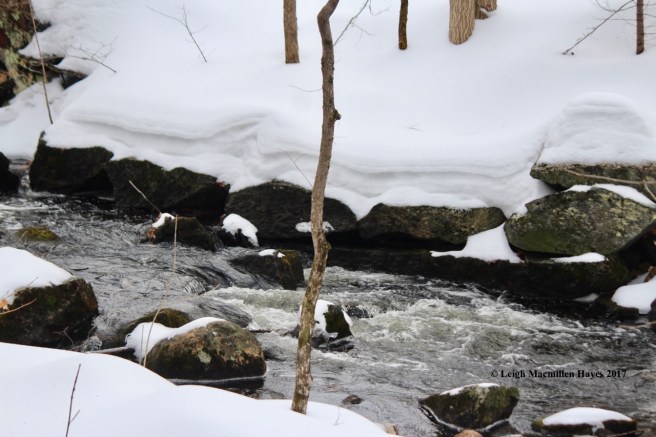
The layers of snow overhanging the brook told the story of our winter. And it’s not over yet–at least I hope it isn’t. We’re in the midst of a thaw, but let’s hope more of the white stuff continues to fall. We need it on many levels, including ecologically and economically.

w-fox-print

Because of the storm, I thought I wouldn’t see any tracks, but from the very beginning a red fox crossed back and forth between the pond’s edge and higher elevations.

w-fox-and-squirrel

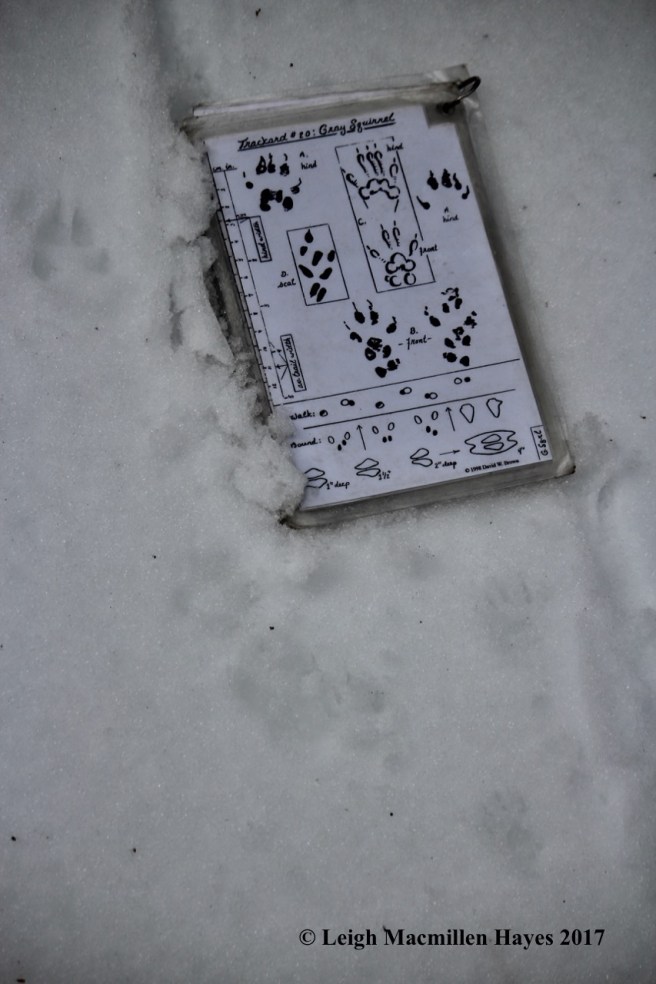
While it may be difficult to discern, a gray squirrel, the four prints with long toes below the Trackards, had leaped up the hill, perhaps after the fox. Lucky squirrel. The fox prints can be viewed to the left of the cards.

w-vernal-pool

My new plan was to follow the red/blue trail to the summit of Whiting  Hill. And along the way, a side trip to the vernal pool. Visions of fairy shrimp swam in my head. No, I wasn’t rushing the season, just remembering a fun time pond dipping last spring.

w-fringed-wrinkle-lichen

Back on the red/blue trail, I noted that most of the recent seed litter was covered by yesterday’s storm. The Fringed Wrinkle Lichen, however, did decorate the snow. Tuckermanopsis americana, as it’s formally known, grows on twigs and branches of our conifers and birches and often ends up on the forest floor.

It’s a foliose lichen that was named for Edward Tuckerman, of Tuckerman’s Ravine fame on Mount Washington. According to Lichens of the North Woods author Joe Walewski, Tuckerman was “the pre-eminent founder and promoter of lichenology in North America.As a botanist and professor in Boston, he did most of his plant studies on Mount Washington and in the White Mountains.”

w-pileated-debris

Further along, I saw some pileated woodpecker scat about twenty feet from the tree it had hammered in an attempt to seek food. It made me realize that even when I don’t find scat in the wood chips below the tree, I should seek further.

w-pileated-holes

The holes weren’t big–yet.

w-pileated-scat-bursting-with-body-parts

But the scat–oh my. It looked as if insects were trying to escape the small cylindrical package coated in uric acid.

w-mossy-maple-fungi

The trail turned right and so did I, beginning the climb. For most, the ascension doesn’t take more than five or ten minutes. Um . . . at least 45 on my clock today. There was too much to see, including the mossy maple fungi hiding in a tree cavity.

w-tube-moth-3

And then I saw something I’d looked for recently after seeing it on the blog  Naturally Curious with Mary Holland. Notice how the pine needles are clumped together?

w-pine-tube-moth-pupae-overwintering-1

Eastern White Pine needles grow in bundles of five (W-H-I-T-E or M-A-I-N-E for our state tree), but the clumps consisted of a bunch of needles from several different bundles.

w-tube-moth-2

What I learned from Ms. Holland is that these are tubes or tunnels created by the Pine  Tube Moth. Last summer, larvae hatched from eggs deposited on the needles. They used silk to bind the needles together, thus forming a hollow tube. Notice the browned tips–that’s due to the larvae feeding on them. Eventually the overwintering larvae will pupate within the tube and in April when I come back to check on the vernal pool, I need to remember to pay attention, for that’s when they’ll emerge. Two generations occur each year and those that overwinter are the second generation. The good news, says Holland, is that “Pine Tube Moths are not considered a significant pest.” I only found the tubes on two young trees, but suspect there are more to be seen.

w-beaked-hazelnut-1

And a few steps later–an old beak. I couldn’t believe my luck. It was then that I realized if I’d been able to stick with the original plan I would have missed these gems. Oh, I probably  would have found others, but these were in front of me and I was rejoicing. Inside that bristly tan husk was the protein-rich nut of a Beaked Hazelnut overlooked by red squirrels and chipmunks, ruffed grouse, woodpeckers, blue jays and humans.

w-beaked-hazelnut-2

Catkins on all of the branches spoke of the future and offered yet another reason to pause along this trail on repeated visits.

w-burl-on-sugar-maple

With my eyes in constant scan mode, I looked for other anomalies. One of my favorites was the burl that wrapped around a Sugar Maple. If I didn’t know better, it would have been easy to think this was a porcupine or two.

w-buried-bench-on-way-up-whiting

About two thirds of the way up, there was no rest for the wary, for the bench that offered a chance to pause was almost completely buried.

w-polypody-and-rock-tripe

Closer to the summit, the ledge boulders were decorated with snow, Common Polypody ferns and lichens, including Common Rock Tripe, its greenish hue reflecting yesterday’s precipitation.

w-whiting-view-1

And suddenly, the summit and its westward view, Kezar Lake in the foreground and Mount Kearsarge  showing its pointed peak in the back.

w-whiting-other-bench

As I’d hiked along the red/blue trail, I noted that the red fox had crossed several times. At the other end of the summit, I checked on the bench where on our First Day 2017 hike for the Greater Lovell Land Trust, we’d discovered the remains of a red squirrel. Today, fox tracks paused in front of the bench before moving on and I had to wonder if had been the one to use this spot as a sacrificial altar.

w-bear-claw-tree

Finally, it was time to head down. My choice was to follow the red trail toward the Gallie Trail. I love this section because it features some of my favorite bear trees.

w-beech-leaves-rustling

The fox tracks continued to cross frequently and so I paused often. And sniffed as well. What I smelled was a musky cat-like scent that I’ve associated with bobcats in the past. What I heard–dried beech leaves rattling in the breeze. They always make me think something is on the move. Ever hopeful I am.

w-striped-maple-buds-and-twig

One of my favorite finds along this section was the bright red branches of young Striped Maples. From leaf and bundle scars to growth lines, lenticels and buds, their beauty was defined.

w-striped-maple-leaves

Another sight that surprised me–Striped Maple leaves still clinging, rather orangey in hue.

w-red-pine-on-red-trail

And here and there, as if in honor of the trail color, Red Pines reached skyward.

w-redgreen-trail

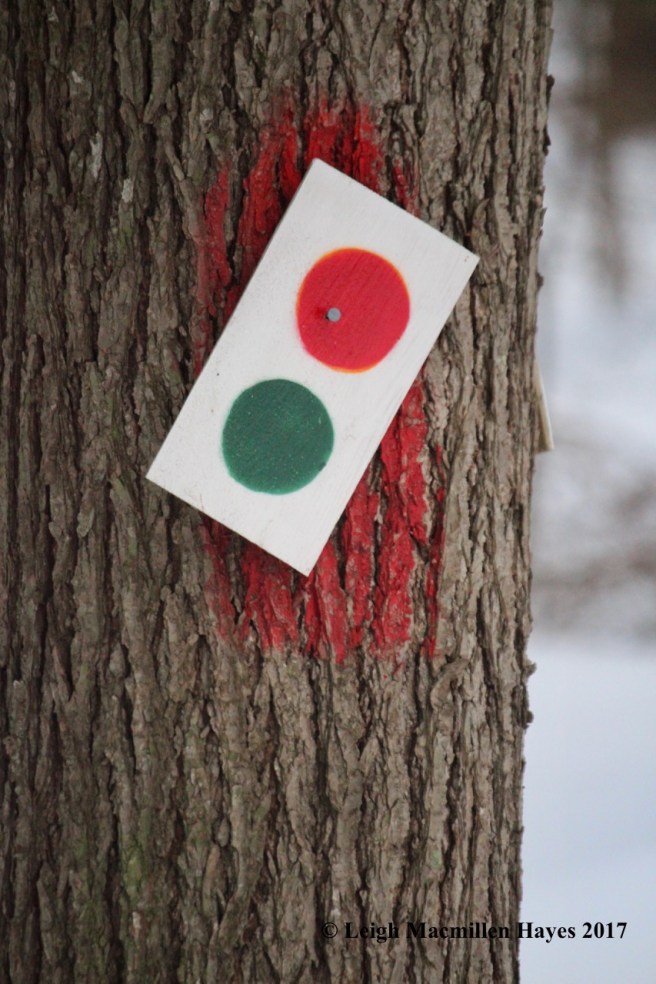
Eventually I reached the bottom, and turned right again, this time onto the stoplight trail–well, red and green at least.

w-squirrel-midden

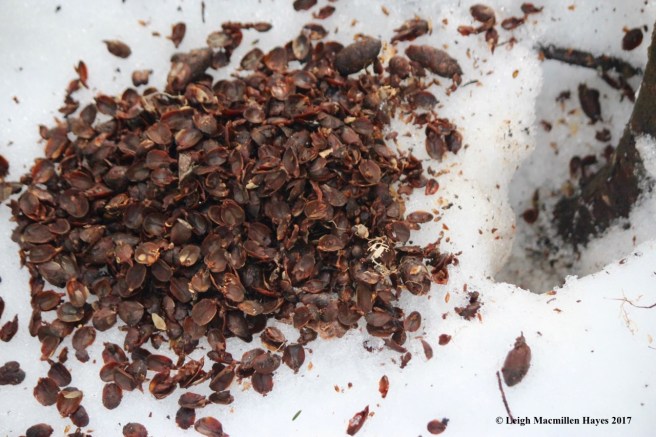
My wildlife sitings were few and far between, but red squirrel tracks and a midden of discarded cone scales next to a dig indicated where the food had been stored in preparation for this day.

w-tinder-2

Following some grouse tracks took me off trail and tinder conks made their presence known.

w-tinder-fungi

The swirled appearance of these hoof fungi threw me off for a bit, but I think my conclusion is correct.

w-bobcat-trail

At last I reached the red trail that runs parallel with Heald Pond. Again, the fox tracks crossed frequently, but beside the path and leading to and fro the water and higher heights, another set of tracks confirmed my earlier suspicions.

w-bobcat-prints

Bobcat. I thought I smelled a pussy cat. I did.

w-fox-and-bobcat

Sometimes the bobcat moved beside the trail, while the fox crossed over. I’d thought when I started out this morning that I wouldn’t see too many tracks because the animals would have hunkered down for the storm. I was pleasantly surprised–for my own sake. For the sake of the animals, I knew it meant they were hungry and on a mission.

w-john-fox-1

My own mission found me following the spur to Otter Rock. I noted that the fox had walked along the shoreline on its eternal hunt.

w-dragonflies-2

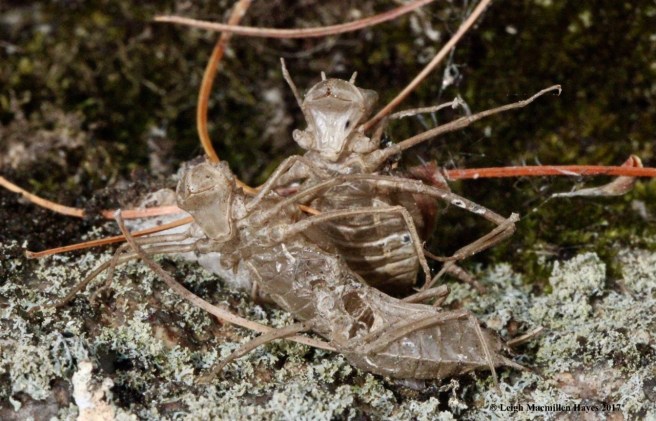
My hunt was of a different sort. No visit to the rock is complete without a look at the dragonfly exoskeletons. But today, it was a bit different because I, too, could walk on the ice. And so I found exoskeletons on parts of the rock I haven’t been able to view previously. Their otherworldly structure spoke to their “dragon” name.

w-dragonfly-nymph-exoskeleton

The slit behind the head and on the back of one showed where the dragonfly had emerged from the nymph stage last spring. Or maybe a previous spring as some of these have been clinging to the rock for a long time.

w-other-pupae-overwintering

While I was looking, I noticed some other pupae gathered together within a silky covering. Another reason to return–oh drats. I don’t know if I’ll be there at the right time, but with each visit, I’ll check in.

w-mill-dam-in-afternoon-sun

The sun was shining and warm. High 30˚s with slight breeze–felt like a summer day, with the sun reflecting off the snow. And at the mill, further reflection off the water. After four hours, it was time for me to check out.

As always, I was thankful for my visit, even though it wasn’t my original plan. Like the mammals, I’d been on a prowl–especially serving as the eyes for a friend who is currently homebound. I think she would have approved what I saw.


Foggy Moments

One day it’s -8˚ and a couple of days later the thermometer reads 50˚–our New England weather about as fickle as those of us who inhabit this space. Today was one of those high temp days and as I stepped outside, the air offered a weighty feel.

h-snowshoes

On a fluid roam with no apparent destination, but rather a strong inclination to be outside, my snowshoes sunk indicating that the snow pack is still significant despite recent rain.

h-lucas-tree-works

I trekked out by the power line, where Lucas Tree Service had indeed completed an intended cut on neighboring land. Though I’m glad that the mighty hackers left the downed trees behind where they can decompose and replenish the earth, I’m still not certain why they needed to cut in this area. The trees were all healthy and even if wind toppled one, it wouldn’t fall toward the lines, which are due west–this is more of a north/south tunnel. I also don’t understand their need to drive all over the snow-covered vegetation located below the lines, though I do know that their mission is not to embrace what grows there. OK, enough of my rant.

h-porcupine-works

While I’d saved some trees on our land from being hacked, there were others that no amount of hugging would protect. One of the most beautiful hemlocks, which had been checked upon repeatedly in the past few weeks, finally became the focus of Mr. Porcupine‘s works. He’s living under our barn at the moment and doesn’t have far to travel to reach this future Lorax tree.

h-vp-1

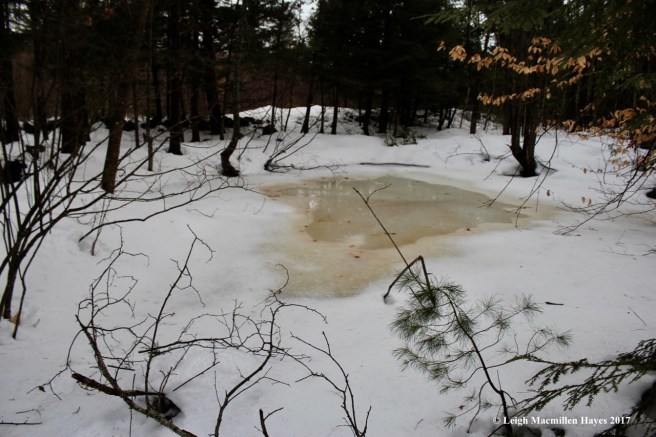
Unlike Porky, I had no idea where I wanted to explore but decided a visit to the vernal pool would be a perfect place to begin. If I didn’t know better, I’d have thought it was a March day, given the slushy surface of the frog pond.

h-vp-insect

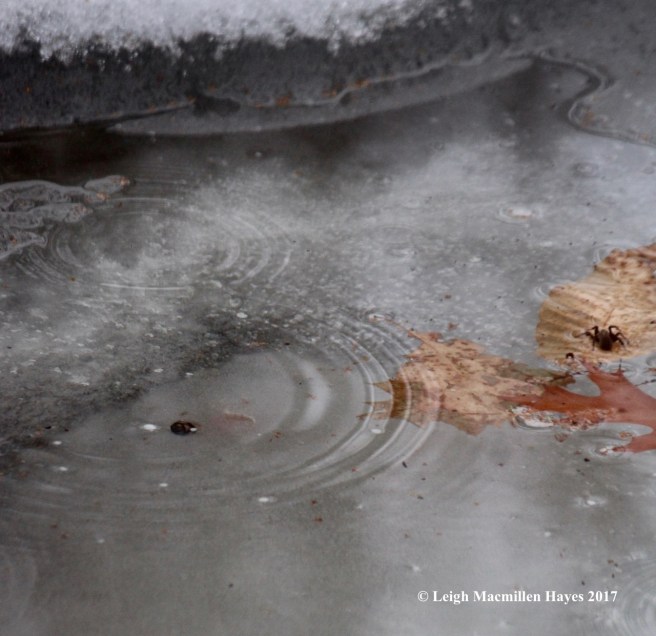
Raindrops began to fall and rippled across puddles formed atop the ice. While I enjoyed the spiraling collisions, I failed to see a visitor on the beech leaf until I looked at the photo. Who it was shall forever remain a mystery.

h-hickory

There are lots of mysteries in these woods–thank goodness. Occasionally, as happened today, I come upon the shell of  hickory nut which I presume was gnawed by a gray squirrel. Perhaps someday I’ll stumble upon the tree and know the source. I have an idea it may actually grow around the corner from us and maybe others have taken root–another mission for another day.

h-snowshoe-hare-scat

For today, I had no mission except to wonder as I wandered. I wondered where the snowshoe hare hid while I sloshed about for though I couldn’t quite see its tracks due to the current conditions, I  knew it had been eating here, there and everywhere.

h-barbed-wire

I wondered about the tenacity of the red oak that stood beside the stonewall as a youngster when this land was still farmed. And with that came a wonder about family and friends who are displaying equal tenacity to overcome barbs in their lives.

h-white-pine-unhealthy

I wondered about the weevil that choose this particular pine among so many to attack. And again my thoughts wandered to my community of family and friends.

h-winter-weeds

And finally, I wondered some more about the natural community that surrounded me and all that it has in store to teach me. It’s in varying stages of succession from the spirea, bulrushes and blackberries,

h-red-maple-and-young-birches

to young red maples and gray birches,

h-gray-birches-and-red-maples

middle-age gray birches

h-evergreens

and a variety of evergreens. What once was all farmland grew into a forest, which invited a variety of mammals to make this place their own, and in turn invited loggers to make the trees their own, and in turn invited the flora and fauna to return. I can’t control it all and that’s probably a good thing.

h-fog-house

What I could control was my opportunity to wander. At the end of the day, I headed in, a bit damp, but happy for a foggy meander, hopeful for others, and  grateful that I get to call this place home.


Book of January: Naturally Curious Day By Day

Twice now I’ve had the pleasure of being in the audience of Mary Holland at local speaking engagements and I give thanks for each opportunity. But even if I can’t be in her presence to catch her excitement about the natural world and listen to her tales of wilderness adventures, I’ve contented myself with turning to her book, Naturally Curious. It’s like having a naturalist beside me at all times. And when I encounter something I’m not sure about, it’s to Mary that I turn–or at least her book.

It was with great joy then, that I learned she’d published a new book this past year (in addition to children’s books and calendars and . . .). I purchased a couple of copies at my local independent bookstore, Bridgton Books, to give as presents. Of course, I also added it to my own wish list.

And so it was that I was grateful to open a certain shaped package of just the right weight on Christmas morning. Quite often we disguise our gifts to each other, but this one I knew immediately.

day-by-day-1

Book of January

Naturally Curious Day by Day by Mary Holland is exactly that. She breaks the year down into more than months as she did with her first book. For each day, she includes two or three photos and a paragraph or two. No too much info, not too little.

True confession here. I keep it in the upstairs library, aka bathroom. It’s just the right amount of information and I’m always looking for something to read when I’m seated there. (I’ve been known to read the packaging on a myriad of bathroom-related items.)

bridie-1

My reading experience includes credits and acknowledgements, dedications and prefaces. And what to my wondering eyes should appear in NC Day by Day, but a photo credit to one of my mentors: Bridie McGreavy, PhD. I remember when Bridie first shared the photo of the mouse impaled by a shrike with some of us. Turn to page 419 and see if for yourself. (Congratulations to you, Bridie.)

After I opened this coveted gift, a relative asked how Ms. Holland knew what to include for any particular day–that that animal or plant species would be seen that day. Ah, but Mary knows this because she is a seeker who has spent decades in the woods and on the water and she understands the rhythm of the natural world. How often do those of us who follow Mary’s blog and venture outdoors realize that we saw the very item she writes about the previous day or trust we will notice it that day?

It’s only day 5 and already, I’ve photographed most of the things Mary writes about from

h-3

pileated woodpecker holes and

h-10

associated scat (filled with insect bodies and bittersweet berries),

h-4

snow on conifers,

h-5

white-breasted nuthatches, and

h-6

puffed-up chickadees,

h-7

to mammal prints,

h-8

maple buds (in this case Red Maple), and

h-9

even a snow scorpionfly.

Each month begins with a lengthy description appropos to what’s happening at that time of year, e.g. woodpecker holes and other signs of birds feeding, the survival of evergreens through the winter season and our local nuthatches, both white- and red-breasted.

How does Mary know what to include for each day of the month? It’s easy. She’s paid attention and encourages all of us to do the same. Probably, in hind sight, it was difficult for her to narrow down her topics.

Thank you, Mary Holland, for taking us along on your treks through your photography and prose, for teaching us and learning with us, and for providing resources for us to return to day in and day out.

Naturally Curious Day By Day: A Photographic Field Guide and Daily Visits to the Forests, Fields, and Wetlands of Eastern North America by Mary Holland, Stackpole Books, 2016. $29.95.

The Be-Attitudes Sundate

Today marks the beginning of the season of hope and with that in mind, my guy and I climbed Singepole Mountain in Paris. Paris, Maine, that is.

s-halls-pond-start-1

Our hike began beside Hall’s Pond, where the water reflected the steel gray sky of this late November day.

s1-barbed-wire

And stonewalls and barbed wire reflected the previous use of the land.

s1-beaver-6

In a matter of minutes we learned of its present use.

s-beaver-works-3

Everywhere we looked, beaver sculptures decorated the shoreline.

s1-hemlock-grove

We passed from the hardwood community to a hemlock grove . . .

s-hemlock-girdled-2

where more beaver activity was evident. I’ve been reading The Hidden Life of TREES by Peter Wohlleben and have some questions about tree girdling such as this. There is a theory that beavers chew off the bark all the way around (girdle) to eventually kill trees such as hemlock, so preferable species will grow in their place. But, that’s thinking ahead to future generations. Do beavers really do that?

s-hemlocks-3

On page 18, Wohlleben states the following: “As the roots starve, they shut down their pumping mechanisms, and because water no longer flows through the trunk up to the crown, the whole tree dries out. However, many of the trees I girdled continued to grow with more or less vigor. I know now that this was only possible with the help of intact neighboring trees. Thanks to the underground network, neighbors took over the disrupted task of provisioning the roots and thus made it possible for their buddies to survive. Some trees even managed to bridge the gap in their bark with new growth, and I’ll admit it: I am always a bit ashamed when I see what I wrought back then. Nevertheless, I have learned from this just how powerful a community of trees can be.”

Could this theory be true? Are the surrounding hemlocks feeding that tree via their roots? If so, does that throw out the other theory? So many questions worth asking.

s-huge-maple-1

Soon, we left the Pond Loop Trail and started to climb the Singepole Trail, passing by a gentle giant.

s-maple-2

It’s a snag now, but this old maple offered tales of the forest’s past and hope for the future.

s-downy-rattlesnake-plaintain

On a smaller scale, Downy Rattlesnake Plaintain provided a cheery contrast among the leaf and needle carpet.

s-bobcat-ledges-1

The climb was a bit challenging in places, but we held out hope among the ledges that we might see a bobcat.

s-porky-den

No such luck, but we did find this . . .

s-porky-scat

a well used porcupine den.

s1-water-2

Water dripped in constant harmony as we stepped gingerly along the narrow ledges and tucked under overhanging rocks.

s-halfway-up-2-1

About halfway up, we took a break and paused to admire the view.

s-halfway-up-view-1-jpg-communities-defined

The hardwood and softwood communities became more obvious as we looked down.

s-summit-1-1

And suddenly or so it seemed, my guy reached the moment of truth–the summit.

s-halls-pond-to-pleasant-1

From the top, we looked around and embraced our home place, which appeared on the horizon in the form of Pleasant Mountain.

s-pleasant-to-whites-1

A slight turn and the view extended from Pleasant Mountain to the White Mountains.

s-quartz-intrusion

Below our feet, the granite pegmatite shared its showy display.

s-summit-1

We’d read that there was a quarry at the summit, so we headed toward a cairn, in hopes of locating it. Too many jeep trails confused us and we decided to save the quarry for another day. Instead, we turned into the woods to get out of the wind and munch our PB & J sandwiches, the grape jelly courtesy of Marita Wiser and family.

s-wickiup-1

As we poked about, something caught our attention and we moved closer.

s-wickie-3-1

s-wickie-2-1

s-wickie-1-1

A wickiup frame. We admired the efforts of someone to create this traditional structure.

s-pleasant-mtn

Emerging from the woods, we took one last look at Pleasant Mountain, and . . .

s-summit-4

one last view of what seemed to be the summit (though it may have been a false summit).

s-climbing-down

And then we started down, once again hugging the rocks and trying not to slip.

s-flower-mushroom

On the way, I did note a few things, including this fungi that looked more flowerlike than mushroom like.

s-girdled-beech-1

s1-porky-2

And I spotted a phenomenon that occurred repeatedly. Girdled beech trees too far uphill for a beaver. What or who had debarked these trees?

s-porky-works

I may have been seeing things that weren’t real, but the lines on this particular tree made me wonder about the porcupines. Was I looking at the design they leave with teeth marks created in the distant past? Or were they wounds of another kind?

s1-beaver-5

When at last we reached the Pond Trail again, we continued to circle around it, noting more beaver works.

s-beaver-lodge

At last, we found the mud-packed lodge built into the edge of the pond. Here’s hoping for a warm winter within.

s-pond-at-end-of-day-1

Completing the circle, the biting breeze forced us to walk quickly toward our truck and the end of our hike. We have chores to complete tomorrow so our Sundate may have to suffice for a Mondate.

That being said, in this season of hope, we trust we’ll find more opportunities to consider these be-attitudes:

s1-trees-in-harmony

Be supportive of each other.

s1-christmas-fern-1

Be watchful of what’s to come.

s-heart

Be hopeful of love everlasting.

Forever a Student

Once the rain let up, I donned my Boggs and headed out the door in mid-afternoon, not sure where exactly I was headed. But after reaching the snowmobile trail, I decided to turn south. Since the spring, I’ve been to the vernal pool on the neighboring property numerous times, but not much beyond in that direction.

h-new-bridge

Part of the reason was that a local industry, of which we now have so few, was constructing a new building and had cut off the trail. Oh, I could have bushwhacked around the project, but the other part of the reason is that it’s a heavy tick zone and I normally avoid it come warmer weather. Given the new building, I wasn’t sure what to expect today, but as I passed through the stonewall, I discovered they’d added a bridge over a new water diversion and the trail was open. I’m glad for the small industry, but simultaneously sad that the willows are gone. No more pussy willows in the spring. Or willow galls, though I suppose that’s good news. And who knows, perhaps some viable willow seeds will spring forth in this place–a hypothesis to be tested.

h-artist-conk-top

After crossing behind the building, I moved through an opening in the next stone wall, and felt right at home again–in one of my local classrooms. This is one where I’m often the solo student, as was the case today.

h-artist-conk-2

I revisited an old stump, where art class was about to begin. The underside of the artist’s conk welcomed a sketch, but I left the canvas blank for another day.

h-gate

In social studies class, I took a look at former land uses. The wall opening and split stone gate bars helped me envision the fields that once were cleared. I followed several walls, which switched from single to double and even double-double, or so it seemed as one section was at least six feet wide and a football field long (The New England Patriots are winning in CA right now!). Barbed wire indicated the need to keep animals out and flat land with trees not a hundred years old spoke to the land’s former plowed use.

h-vp

A few minutes later, I moved over an old rock mound and stood before my science teacher–another vernal pool. As I recalled, this one dries out early in the season and grasses and other vegetation grow prolifically here. But unlike the smaller pool closer to home, this one held some water from the recent rain.

h-boots

As any student should, I stepped through the door and sunk my feet into class.

h-cinnamon-fern

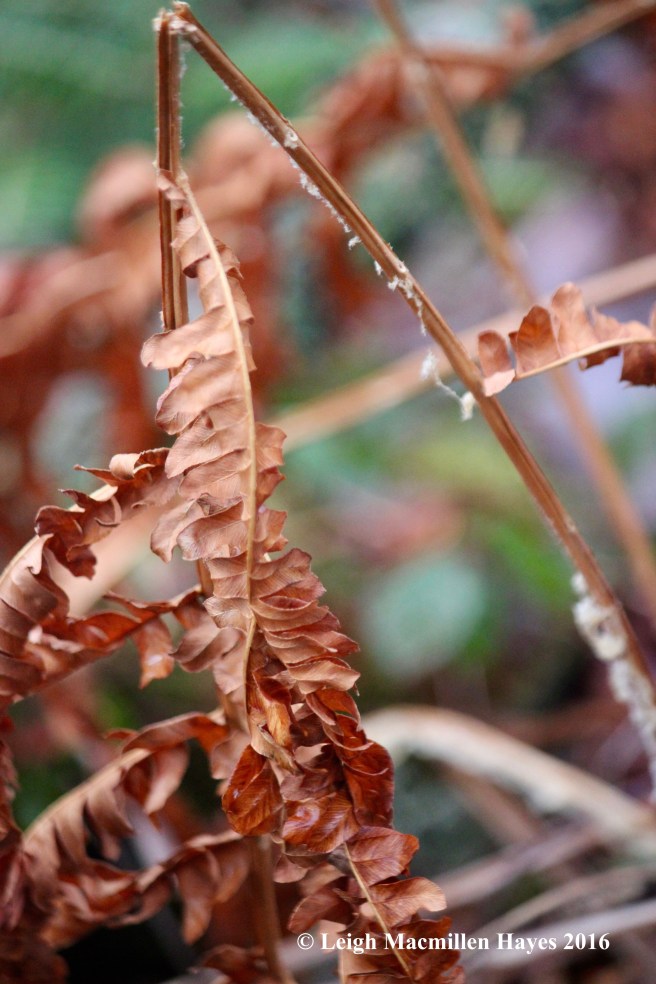
Cinnamon ferns reminded me that they keep their fuzziness right up to the end.

h-birdnest-1

I wondered about strips of paper birch dangling from a young sapling and then realized I was looking at the remains of a nest–maybe a vireo.

h-seeds

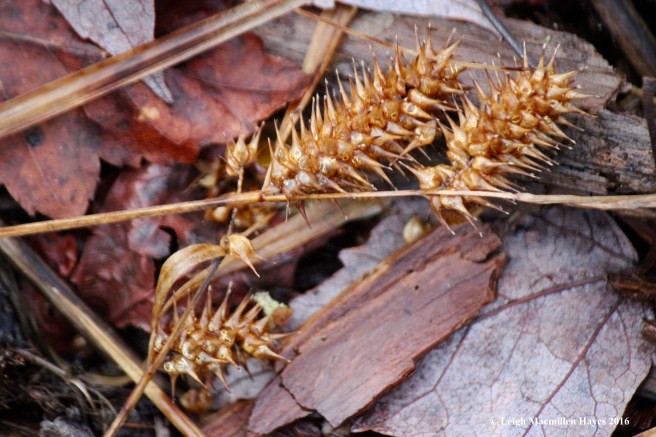
I questioned how the long-beaked sedge seedheads came to be bent over–by weather or wildlife or just because their time had come?

h-vp-bulrush-a-grass

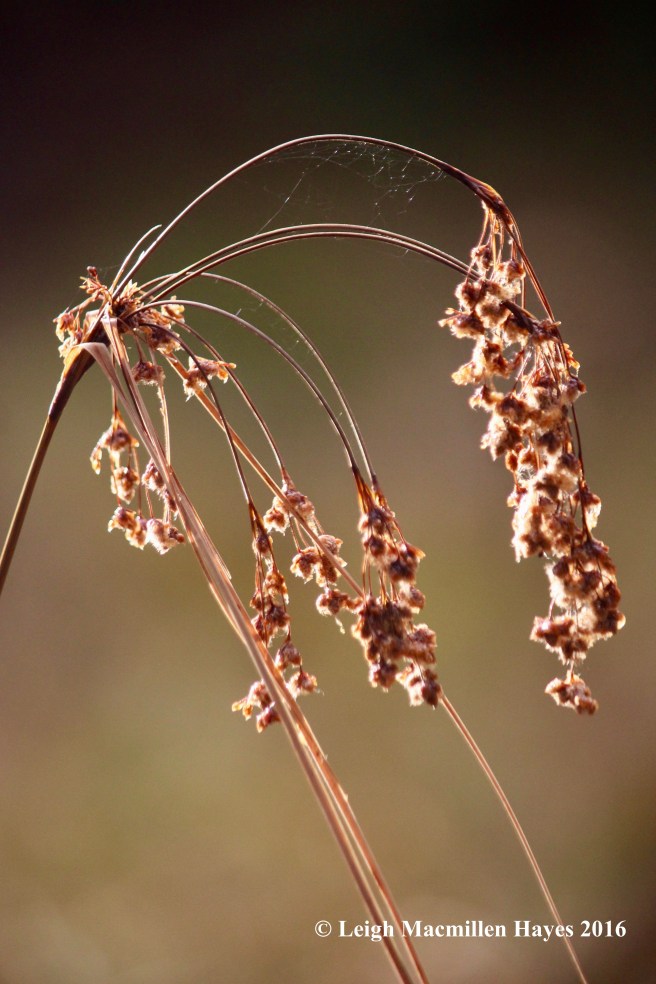
While bulrushes (actually a grass) offered flowing fountains pouring into the future, their seeds still clung–as did a spider web.

h-vp-steeplebush-web

And more spiders eluded me, though their webs stood strong among the steeplebush capsules.

h-vp-crystal-ballseeds

A few raindrops dangled like ornaments from a holiday decoration.

h-vp-backside-of-sensitive-fern-beads

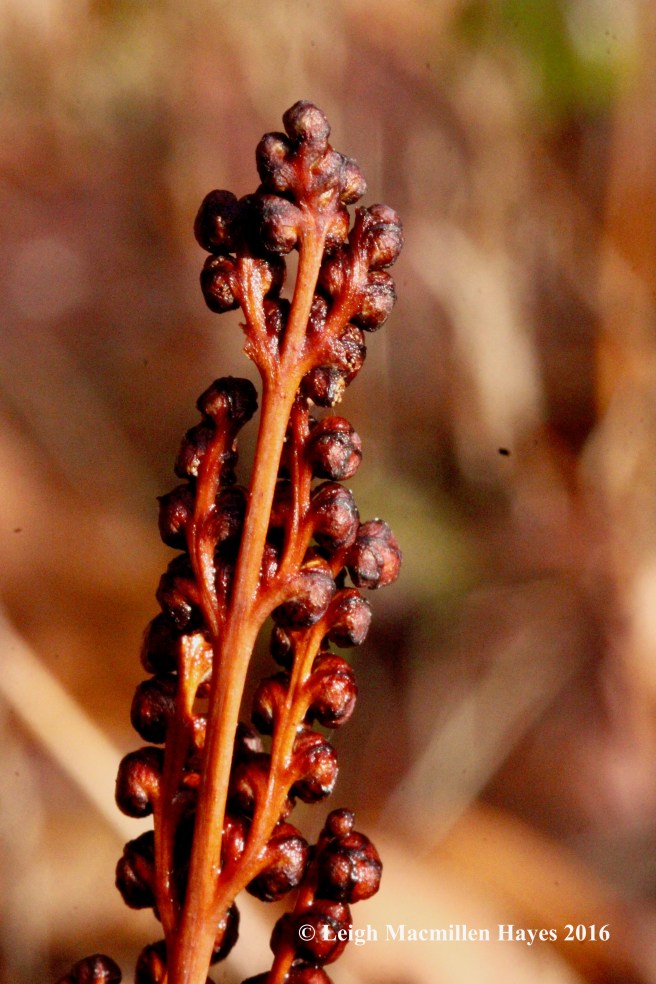
And bead-like spore structures on sensitive fern’s fertile stalk waited for another day to spread their good news.

h-lichen-or-fungus-2

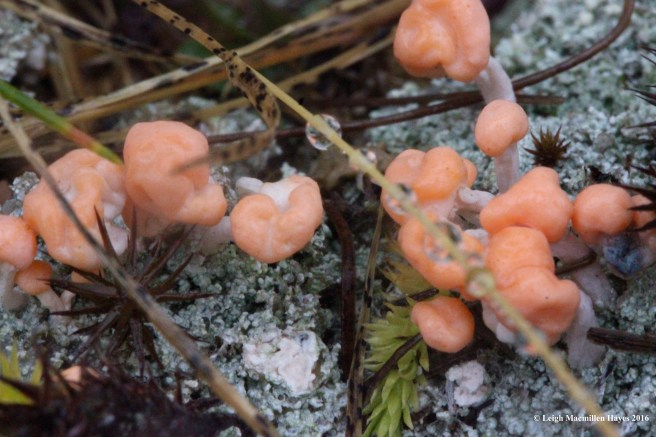
I finally left the vernal pool, but before heading back down the hallway, small salmon-colored growths stopped me. Lichen? Fungi? I didn’t think I’d ever seen it before and so it was a new lesson.

h-lichen-or-fungus

My first thought–lichen. In a way, it resembled the tops of British Soldiers that grow prolifically here. But my latest thought is red tree brain fungi (Peniophora rufa) . I may be wrong, but that’s what being a student is all about.

h-woodpecker-1

With each new lesson, I was also thankful for those that were reinforced, such as the chisel-like and shredded works of pileated woodpeckers. I used to think such trees were the result of bear activity.

h-woodpecker-2

I’m always awed by the resulting sculpture left behind by those powerful birds–their strong beaks stabbing away at the bark until they’ve consumed a meal of carpenter ants and beetles. Thankfully, their skulls are thick and spongy–allowing their brains to absorb the impact of such repeated drilling.

h-field-succession-layers

At a field, I paused to admire the layers–a testament to field succession. These woods are constantly changing.

h-male-turkey-scat-j

One thing that doesn’t change is the signature of a Tom Turkey–usually offered in straight or J formation.

h-slime-3

h-tubifera-ferruginosa

h-slime-2

At another wetland, I poked around and then my eye focused in on something decorating a fallen tree. A slime mold perhaps? Red raspberry slime? In one rendition it seemed to have a crater-like surface, while another was more flower-like with petals spraying from a center.

h-hemlock-cinnamon

At last I entered a hemlock forest where the cinnamon inner bark stood out on the wet trees. If not for the scales, I realized it would be easy to confuse this bark with that of red oak, but a quick look up the trunk and the answer was obvious.

h-striped-maple-seeds

As I walked back toward home, I looked along parts of the trail I’d skipped while exploring in the woods. And I wasn’t disappointed when I discovered one of the few striped maple trees–still bearing the seeds it produced last year. Why did they cling still? When released, will they be viable?

h-pine-suds

And then, a sight I was hoping for presented itself when I returned to our woodlot. Froth at the base of a pine tree. It’s not unusual and occurs following a rain event such as we’d had all night and morning. I had hoped to see some foam today, and felt rewarded for my efforts. So what causes the tree to froth? Well, like all lessons, there are several possibilities. Maine Master Naturalist Science Advisor Fred Cichocki recently had this to say about it: “I’ve noticed this phenomenon often, and in every case I’ve seen it’s associated with white pine, and always after a dry spell followed by heavy rain. Now, conifers, especially, produce hydrocarbons called terpenes (it’s what gives them their lovely pine, balsam and fir scent). These hydrocarbons are hydrophobic by nature and form immiscible films on water. During a heavy rain, water running down the trunk of a white pine picks up terpenes on the way. Air (having accumulated in bark spaces, channels, etc. perhaps under slight pressure) then “bubbles” through terpene-water films producing a froth. Recall the cleaning products PineSol, and the like. They are made from terpenes, and produce copious bubbles when shaken. One could get the same result directly by shaking terpentine in water, or by bubbling air through a terpentine-water mixture with a straw  . . .  Of course, it may be that other substances (salts, etc.) enhance the frothing.”

No matter how much I have learned on this life-long course, there’s always more. I certainly don’t have all the answers and for that I am thankful. I’m forever a student.


Reconnection Reflections

We didn’t mean to lose touch. And yet it happened. We got caught up in our family routine and put “old” (read established cuze none of us are old, certainly) friendships on hold.

c-hiding-2

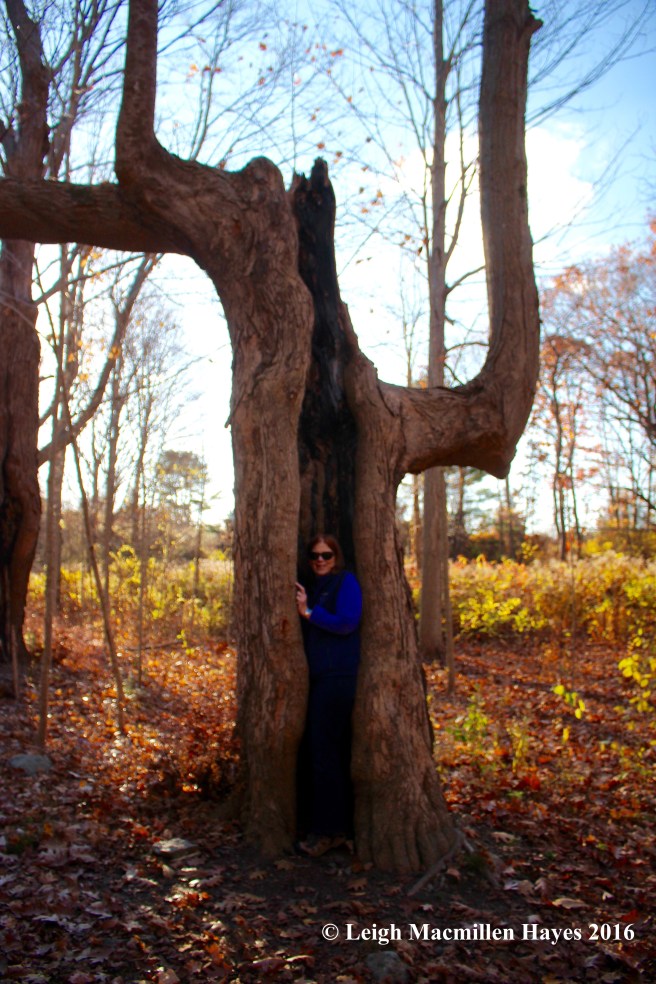
But old friends are the best friends. And they are the ones you can suddenly catch up with after several years and talk and giggle and talk some more as if no time had passed. And convince at least one of them that perhaps she should slide into the hollow of a tree for a photo opp just like both of you would have done in high school.

c-saltmarshodiorne

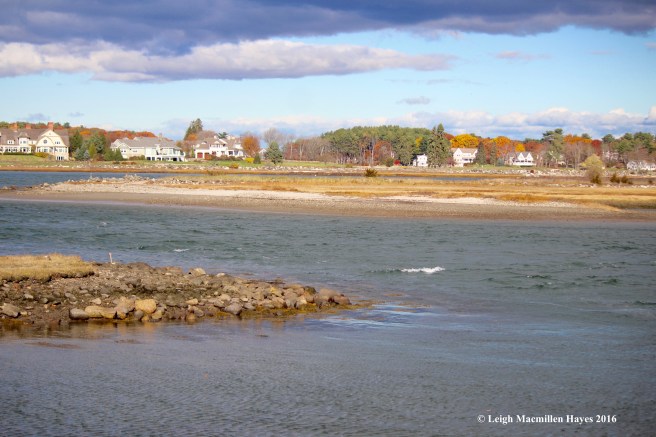
And so the past three days we had the opportunity to play catch up. For me, the journey actually began on Thursday night, when I met my dear old friend Carissa for a girls’ night out. We began by reminiscing about days gone by, from high school antics to family adventures. On Friday morning, we braved the gale force winds and made new memories along the trails at Odiorne Point State Park in Rye, New Hampshire, where autumn colors enhanced the experience.

c-seavey-creek-1

It was at this point where Witch Creek flows into the Atlantic that Pannaway Plantation was established in 1623. The plantation was New Hampshire’s first settlement, colonized by English fishermen. Though I’m thankful they found this place because I love living in New England, I’m at odds with the invasion of white men. Couldn’t they have taken a different approach?

c-norway-maple-leaves

Interestingly, we weren’t the only invasive species. While the color of the Norway maple leaves attracted my eye, I soon realized that they represent one of many intrusive forms of non-natives that flourish here. Attempts are being made to rid the park of such. Hmmm.

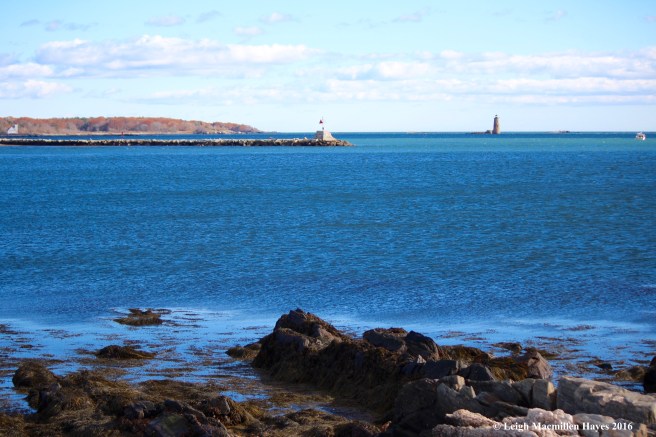
c-odoirne-light-houses

We climbed along the rocky coast and embraced the view of the entrance to Little Harbor. Because of the location, the land eventually became a defense fortification.

c-silent-greatness

As we wound our way along the trails, sometimes doubling back, we suddenly came upon Silent Greatness. Indeed. Certainly a bird bath. Certainly a moment of reflection–both in water and mind, an offering.

c-campbell-road-1

Then the footpath led us to Campbell Road, a standing tribute to those first “settlers.”

c-campbell-road-leaves

For us, it framed the day as leaves floated to the ground. Though our time together was a similar fleeting moment, we trusted that our friendship will continue to endure, much as this road has.

c-plank-1

And then I met up with my guy and we continued on down a different road–making our way to Cape Cod for a family wedding. We spent the afternoon and evening catching up with cousins–reveling in the obvious love of the newlyweds and the renewed connections. The next morning we explored our surroundings, including the Sandwich Plank Walk.

c-sandwich-plankwalk-sign

We learned that a hurricane destroyed the boardwalk several times, most recently during the Blizzard of 2013.

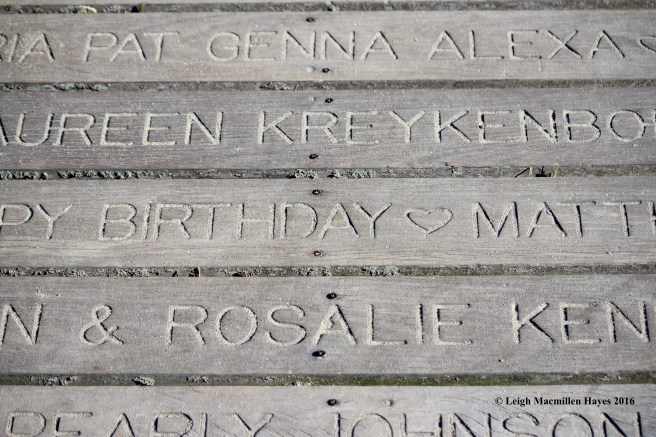
c-plank-comments

The townspeople banned together and purchased new boards, many of which represent family names and messages of good tidings.

c-gull-landingsandwich

The Plank Walk’s 1,350-foot span crosses Mill Creek and marsh, leading to the town beach on Cape Cod Bay.

c-no-parking-gull-1

Beside one end of the boardwalk, a herring gull pondered the message below.

c-no-parking-gull

Apparently, the sign’s upside-down meaning:”Pause Here and Stretch a Wing.”

c-plankwalk-guy

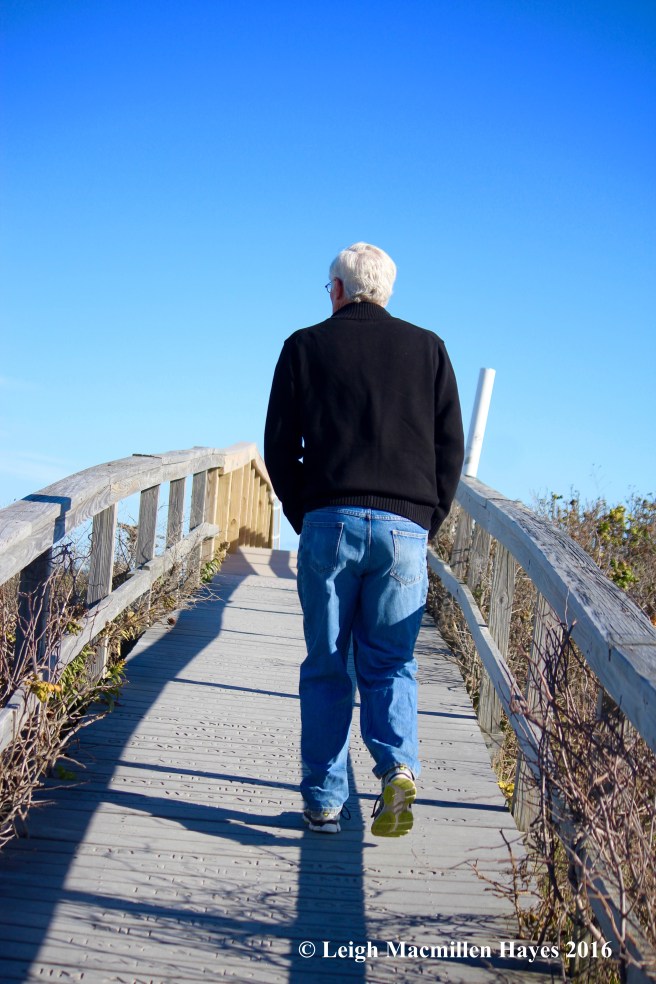
Crossing back over, I followed my guy–a familiar look, I know, but he is my favorite guy to follow.

c-crashing-wavessandwich

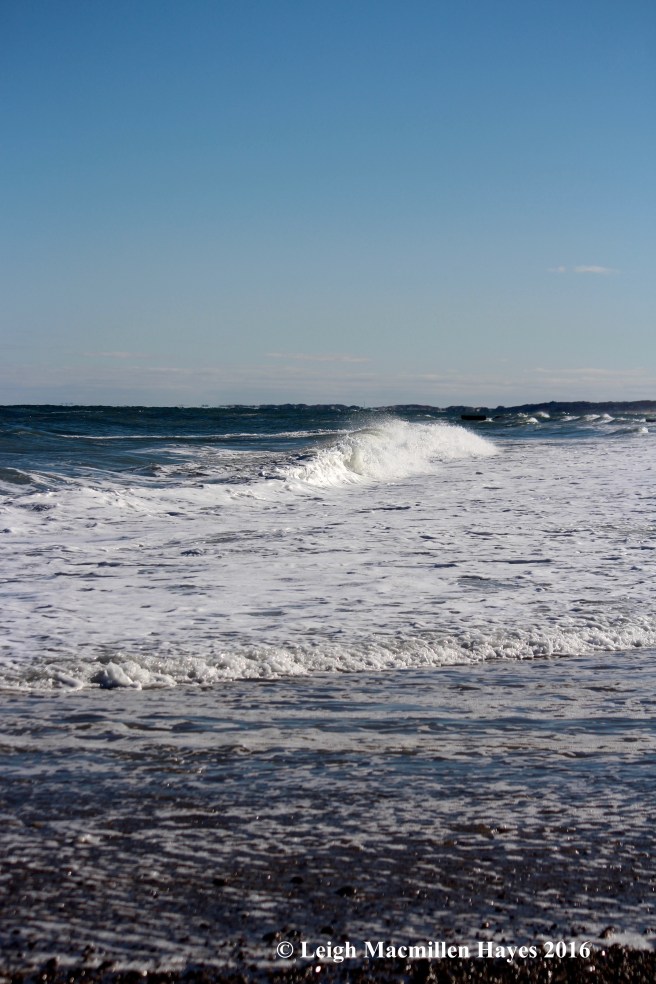
On the Sandwich Beach, crashing waves and color reflected the day’s wind and sky.

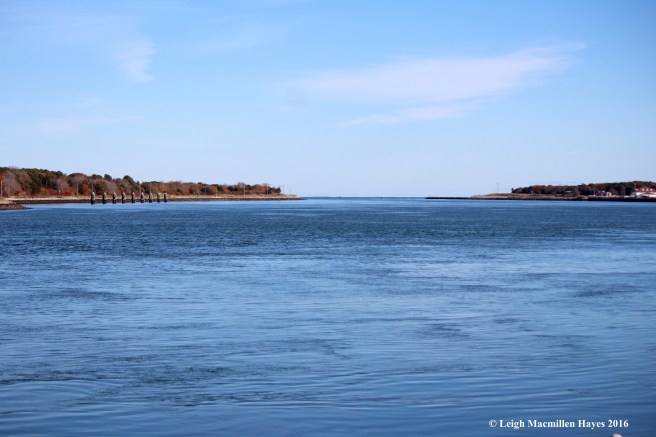
c-canal-1

From there, we drove to the Cape Cod Canal, where we stretched our legs for another hour or so.

c-loon

As we walked along, the boat traffic was non-existent, but we still had plenty of opportunities for reflection–from short . . .

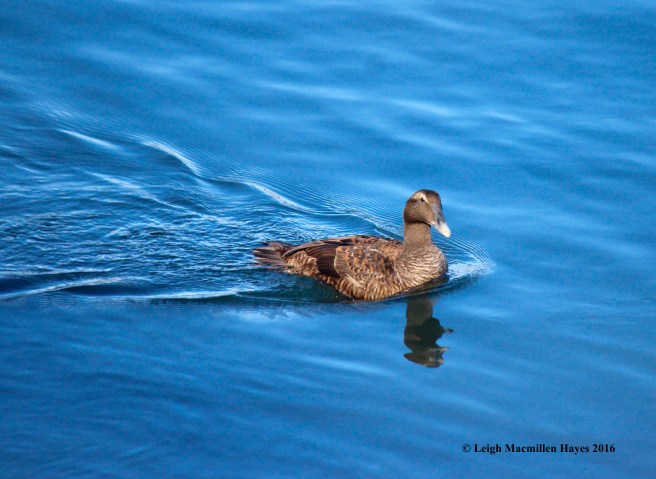
c-duck-reflection

to longer . . .

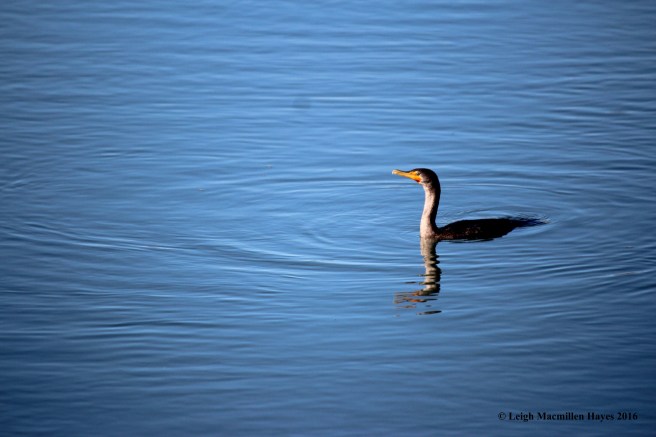
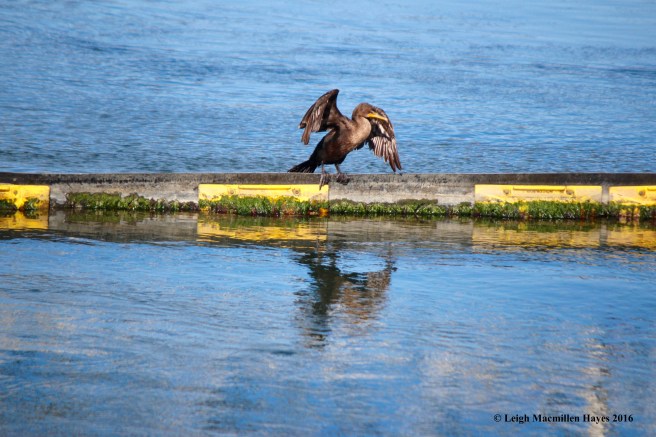
c-cormorant-1

to longest.

c-cormorant-balance

And most humorous. Think cormorant meets narrow balance beam.

c-sagamore-bridge-1

This is a place where all of life convened–from rails to power to footpath to canal to bridge.

c-canal-outlet

c-canal-barge-1

c-canal-barge-2

At last it was time to catch up with my college friend, Dianne, and her husband, Tom. We dined at Fishermen’s View on the canal–and a barge did me the pleasure of passing by. And again, we talked non-stop for a couple of hours as the years between visits melted away.

c-sunrise-3

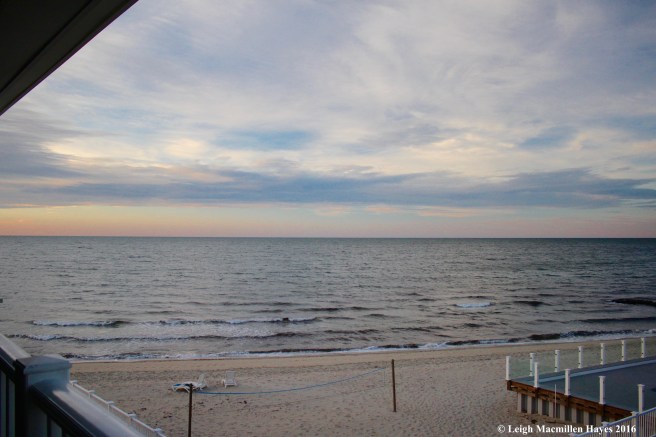
On the road again, we spent the late afternoon catching up with my childhood neighbor and school friend, Bill and Eileen. More memories were shared. And then we joined my guy’s uncle and family for dinner. Once more, constant story telling. Uncle Chuck gave us the use of a timeshare condo for the night. It was an unexpected opportunity that we were most thankful to be offered. We slept like babies and awoke to a gorgeous sunrise overlooking the Atlantic.

c-sunrise-4clouds

The sky swirled . . .

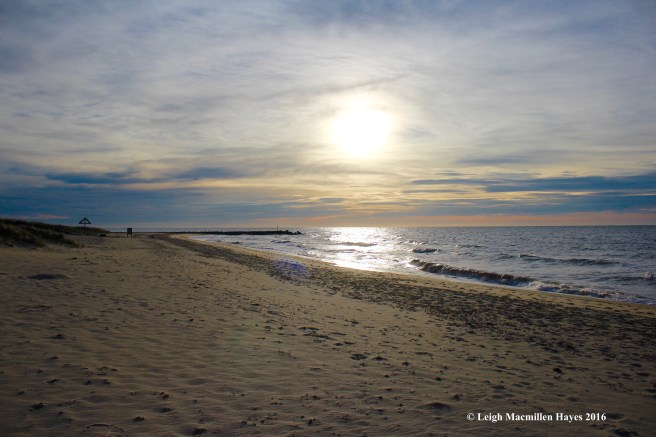
c-sunrise

as the sun rose.

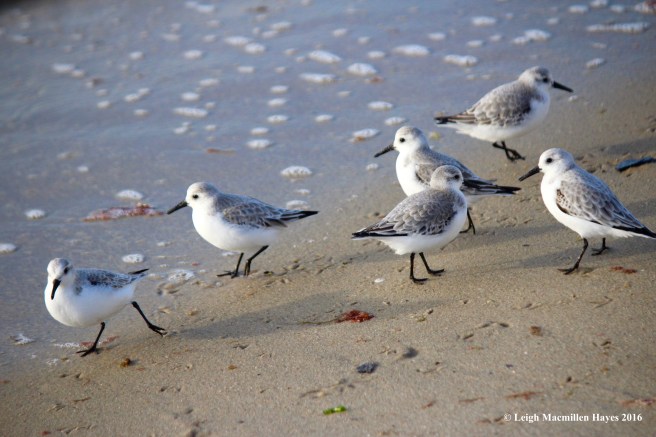
c-sanderling-convention

Sanderlings held a convention.

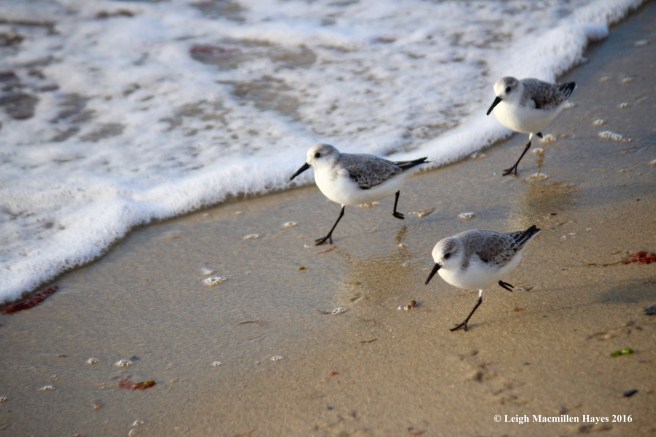
c-sanderling-1

And entertained us as they skittered along beside the waves.

c-sanderling-in-waves

Occasionally, they took a dip, as is their custom.

c-sanderling-looking-1

But always they searched.

c-sanderling-look-ing

And considered.

c-herring-2

A herring gull also paused . . .

c-herring-3

considered . . .

c-herring-gull1

and posed. Such a handsome specimen.

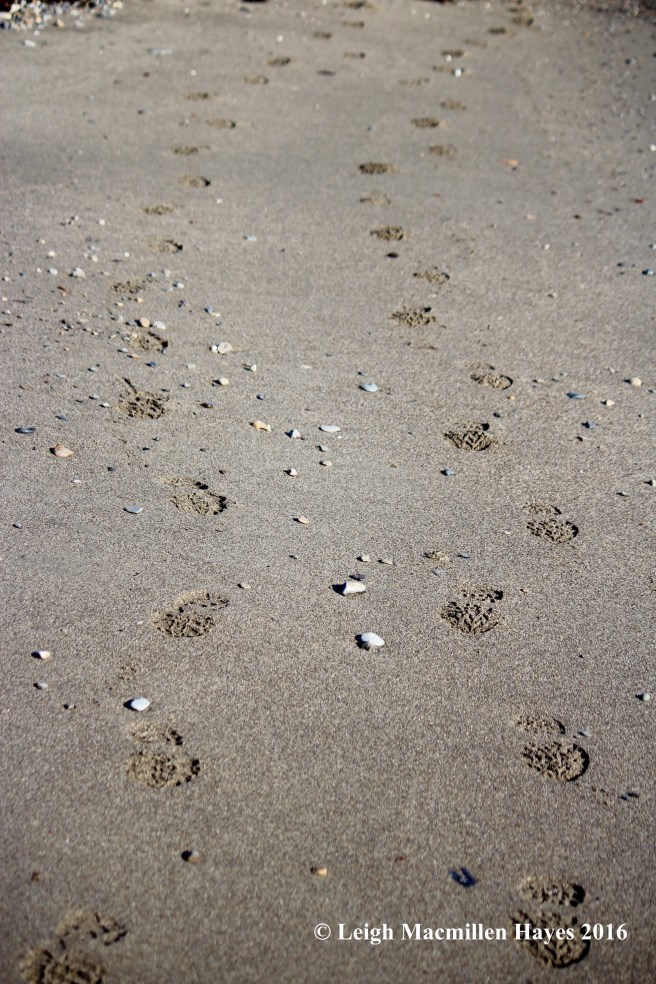
c-matching-footprints

At last, our mini-vaca had come to an end, but we still had one more visit to make–we surprised my guy’s friend Dave and his family on our way home. It was a quick stop, though stories continued to flow along with promises for the future.

We were thankful for a weekend to reconnect with family and friends. For a chance to once again walk side by side as we reflected on the past and made new memories. Here’s hoping we won’t wait so long to meet again.


Everybody Loves Raymond? Mondate

My guy and I were up for an adventure this morning as we headed off to a property recently acquired by Loon Echo Land Trust. I’d been there once before, but at that time there was no trail system and I certainly hadn’t climbed to the summit.

r-forest-climb

We were on a 356-acre property bisected by a paved road. First, we hiked the upper section, passing through a hardwood forest.

r-white-oak-green-leaves

Immediately, I realized we were in the presence of one of my favorites–noted for the mitten-ish presentation of its leaves. One would have to be all thumbs to fit into this mitten, but still, my heart hums whenever I spy a white oak.

r-white-oak-red-color

Or in this case, many white oaks, some exhibiting the wine color of their fall foliage.

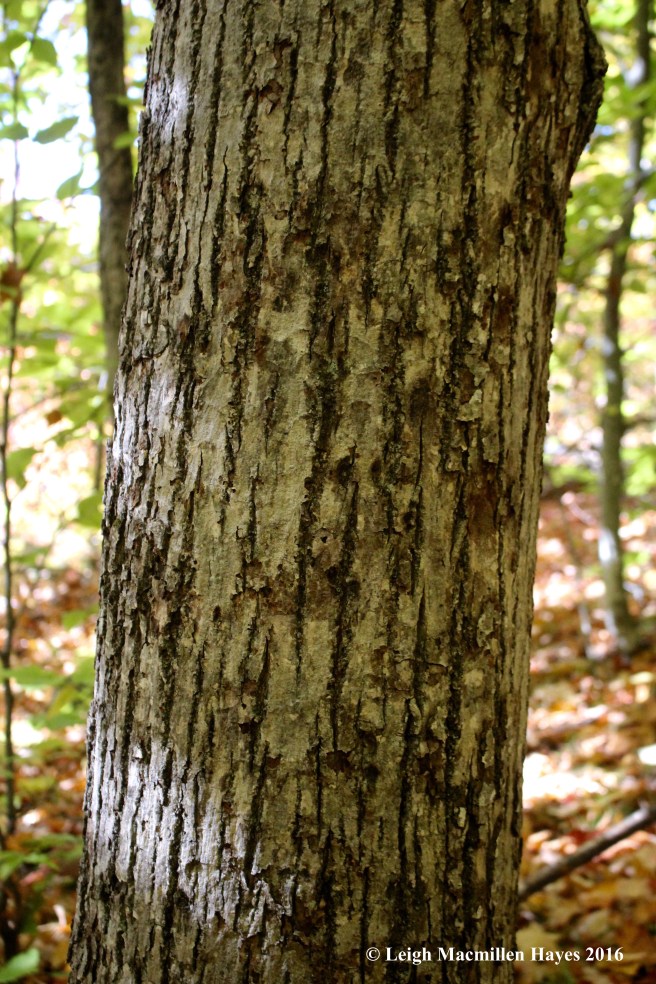
r-white-oak-bark

And the bark–a blocky look that differs greatly . . .

r-red-oak-on-bm1

from the ski trail ridges of red oak.

r-hophornbeam-bark

Hop Hornbeam also grows abundantly in this forest.

r-approaching-forest-summit-yellow

As we neared the summit, we noticed that the sky view had a yellowish tone reflected by the ground view. Most trees were of the same age due to past logging efforts, but the predominant species was sugar maple.

r-basswood-2

Another favorite tree also grew abundantly here. I think they are also favorites because I don’t see them as often. In this case, the bark, though furrowed and ridged like a northern red oak, featured an almost combed flattened ridge.

r-basswood-leaf

And its leaves–oh my! Notice the asymmetrical base? And the length–my boot is size 8. American basswood–an important timber tree that is known to share the community with sugar maples and hornbeams–all of which provided that yellow glow.

r-raymond-summit-view-1

At last, we reached the vantage point.

r-skyward

Above us, a mix of colors and species.

r-oak-leaves

Before us, a mix of white and red oak leaves.

r-crescent-view-3-1

And beyond us, the view of Crescent Lake

r-crescent-rattle-1-1

and Rattlesnake Mountain.

r-ladybird-1-1

While we admired the view, ladybird beetles (aka ladybugs) swarmed us. Well, not exactly in swarm formation, but more than is the norm.

r-green-trail-tag

After admiring the view for a while and wondering about the ladybirds, we backtracked a bit and decided to explore the green trail, assuming that it looped about the summit.

r-dry-leaf-sound

The trail conditions changed constantly, and one thing we realized was that the leaves had dried out and we wished we could have bottled their scent along with our crispy footfall as we trudged through–the smells and sounds associated with autumn.

r-bear-claw

Eventually, we entered a beech commune and what to my wondering eyes should appear–bear claw marks? We ventured closer, circled the tree and looked at others in the neighborhood before determining that our eyes had perhaps played a trick on us.

r-garter-snake

That was OK because within seconds a twig moved at our feet.

r-snake-tongue

We watched as its tongue darted in and out, red tipped with a black fork.

r-lunch-rock

Finally, we moved back to what we’d named Ladybird Lookout and found lunch rock where we topped off sandwiches with Bailey’s Irish Cream fudge a la Megan and Becky Colby. Life is good. Life is very good. (And we know a town in western Maine that would benefit greatly from a bakery–just saying, Megan!)

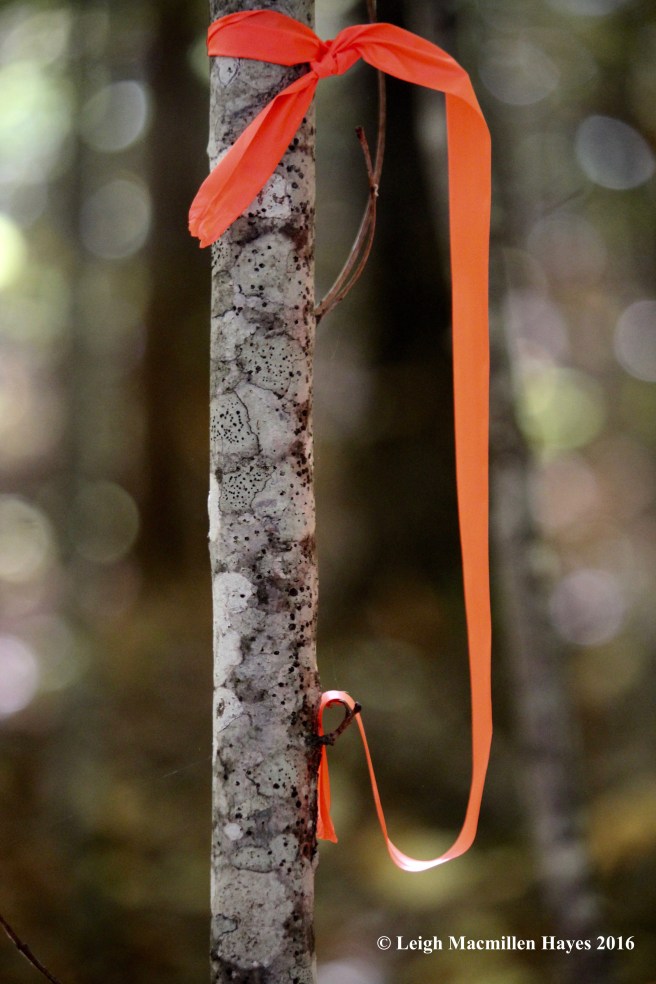
r-trail-ribbon-art

After lunch, we climbed back down and crossed Conesca Road to check out trails on the other side. There is no trail map just yet, but we never got lost. And we appreciated the artwork nature created of manmade marks.

r-forest-across-the-street-stonewall

This space offered a different feel where hardwoods combined with softwoods. And more stonewalls crossed the property, speaking to past uses.

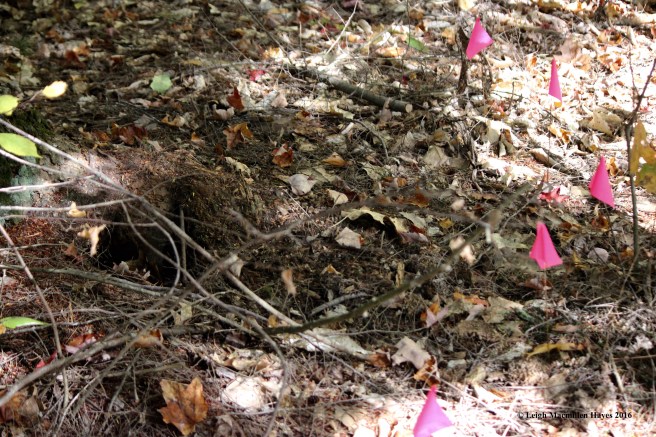
r-hole-pink-flags

It’s here that we noticed an area demarked by pink flags and stopped to wonder why. Note to self–excavated hole and debris mean beware.

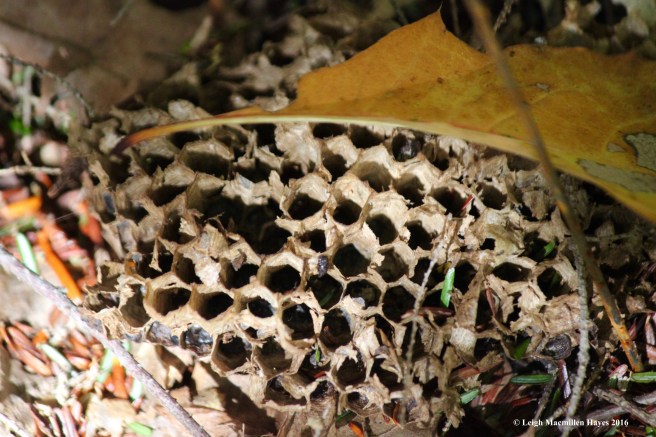
r-bee-himve

Upon closer examination, an old hive. So who dug it up? We had our suspicions.

r-mushrooms-1

We also noticed a fungi phenomena.

r-mushroom-growth

Fungi on fungi? Honey mushrooms attacked by something else?

r-mushroom-growth-3

The displays were large

r-mushroom-fungi

and otherworldly. I don’t recall ever seeing this before.

I sent the photos to Parker and Jimmie Veitch, of White Mountain Mushrooms, and Jimmie responded with this explanation:

“That’s what mycologists call “rosecomb” mutation, where a mushroom’s gills start forming on the cap in a really mutated fashion. It’s been reported in many mushroom species but I haven’t seen it in this one (Armillaria AKA honey mushrooms). As far as I know, no secondary fungus is involved.

The suspected cause (not so nice) is ‘hydrocarbons, phenols and other compounds contaminating the casing or contacting the mushroom surface. Diesel oil, exhaust from engines, and petroleum-based pesticides are thought to be the principal source.'”

r-red-leaves

As we concluded our visit, we passed over one more stone wall decorated with red maple leaves.

r-beginning-of-bri-mar

And then we hopped into the truck and traveled a couple of miles south to conquer another small mountain–one visible to us from Ladybird Lookout. (I really think LELT should name it such.)

r-brimar-milkweed

Here the milkweed plants grew abundantly.

r-brimar-white-oaks-in-field

In the field leading to the trail, the property owners planted white oak saplings in hopes of providing food for wildlife. Um, by the same token, they’d enclosed the saplings in plastic sleeves (reminding us of our findings in Ireland) to keep deer at bay.

r-brimar-ferns

The understory differed and ferns offered their own autumn hues.

r-brimar-evergreen-wood-fern

In contrast were the many examples of evergreen wood ferns.

r-bri-mar-beech-markings

We soon realized that quite literate bears frequented this path and announced their presence.

r-crescent-from-bri-1-1

At last, the view opened and we looked back at the opposite shore of Crescent Lake, though realizing that our earlier ascent was masked by the trees.

r-panther-from-bri-3-1

Turning about, Panther Pond came into view.

We’d spent the day embracing Raymond because everybody loves Raymond.

r-raymond-forest-sign

r-brimar-trail-sign

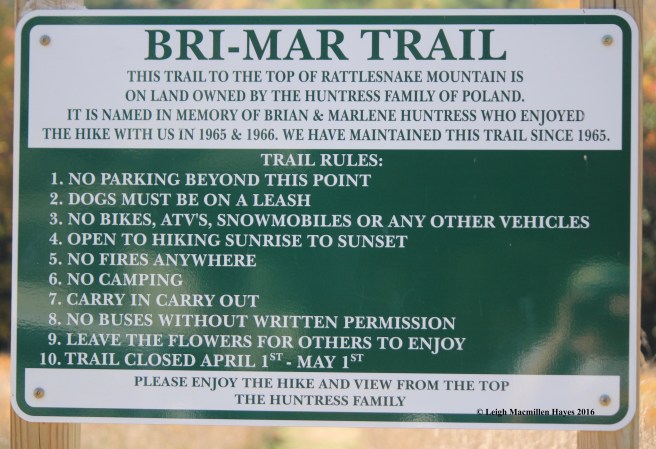
Raymond, Maine, that is. Loon Echo Land Trust is gearing up to celebrate the Raymond Community Forest that we explored this morning and the Bri-Mar Trail up Rattlesnake Mountain has long been traveled by many. In fact, when I used to write copy for the local chamber of commerce, I spent some time learning about Edgar Welch, who was the fastest man on foot and ran up Mount Washington at least once a year. He lived in Raymond and worked for David McLellan, who was partially blind from a Civil War injury. Because Mr. McLellan’s farm was at the foot of Rattlesnake Mountain, the sun would set one hour earlier than elsewhere in town. According to legend, after work each day Edgar ran up the mountain and moved rocks. Finally, he’d moved enough to let the sun shine on the farm for an hour longer. Another story has it that one day a man bet Edgar that he could beat him in a race to Portland. The man would race with his horse and buggy, while Edgar ran. When the opponent pulled into the city, Edgar was waiting for him. I love local lore.

And everybody loves Raymond. Well, my guy and I certainly gained a better appreciation for this town today.


In Constant Flux

Ever so slowly, the world around us changes.

h-starting-point

Sometimes it’s as obvious as the leaves that fall.

h-bee-on-flower-1

And other times, it’s a bit more subtle, evidenced by the bees that have slowed their frantic pace as they make final collections.

h-leaf-carpet

Mid morning, I headed down the cow path in search of other signs of change.

h-oak-branches-1

As I walked along, I began to realize the interdependence of all. Under the northern red oaks–many  chopped off twigs.

h-porcupine-works

The angled cut and empty cap indicated the work of porcupines seeking acorns.

h-leaves-on-hemlock

I found maple leaves pausing on hemlocks,

h-pine-needles-on-spruce

pine needles decorating spruce trees,

h-leaves-in-puddles

and occasional puddles offering a rosy glow. Eventually, all of these leaves and needles will break down and give back.

h-life-on-rock-1

I found life on a rock, where lichens began the story that was added to by mosses. The creation of soil was enhanced by a yearly supply of fallen leaves and needles gathered there. And then a seed germinated, possibly the result of an earlier squirrel feast.

h-orange-peels1-1

I found orange peel and many other fungi aiding the process of decomposition so that all the fallen wood and leaves will eventually become part of the earthen floor.

h-forest-succession-3

I found a healthy stand of trees and ferns competing for sunlight in an area that had been heavily logged about ten years ago.

h-deer-and-bobcat-prints

I found evidence of those who spend their lives eating and sleeping in this place.

h-aster-seeds

I found seeds attached

h-seeds-on-the-fly

and those on the fly–heading off in search of a new home.

h-witch-hazel-flowers-galore

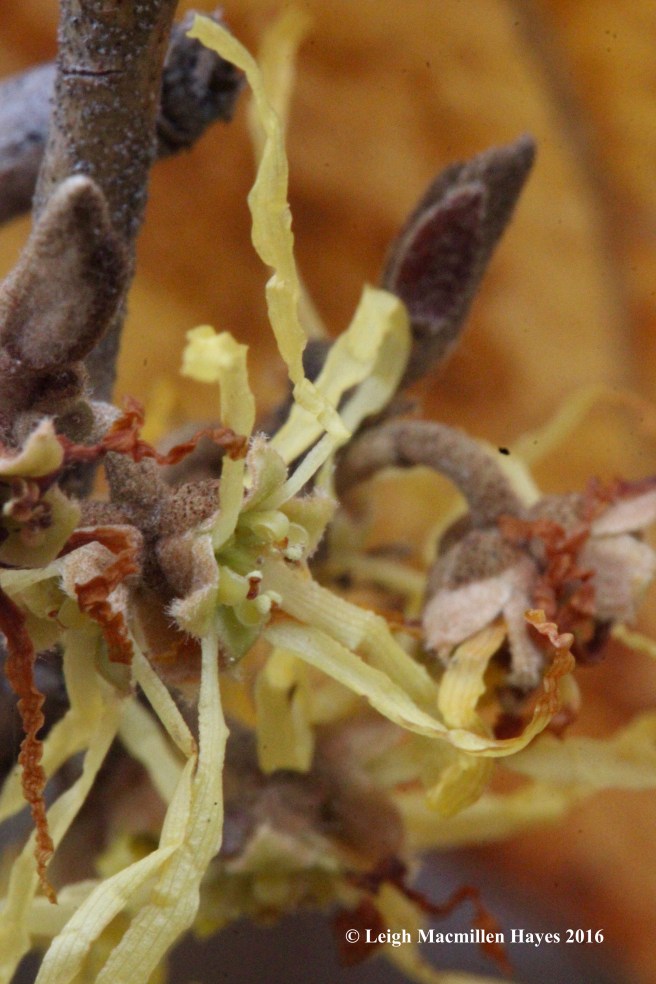
I found the last flowers of fall

h-witch-hazel-1

exploding with ribbony blooms.

h-power-and-nature

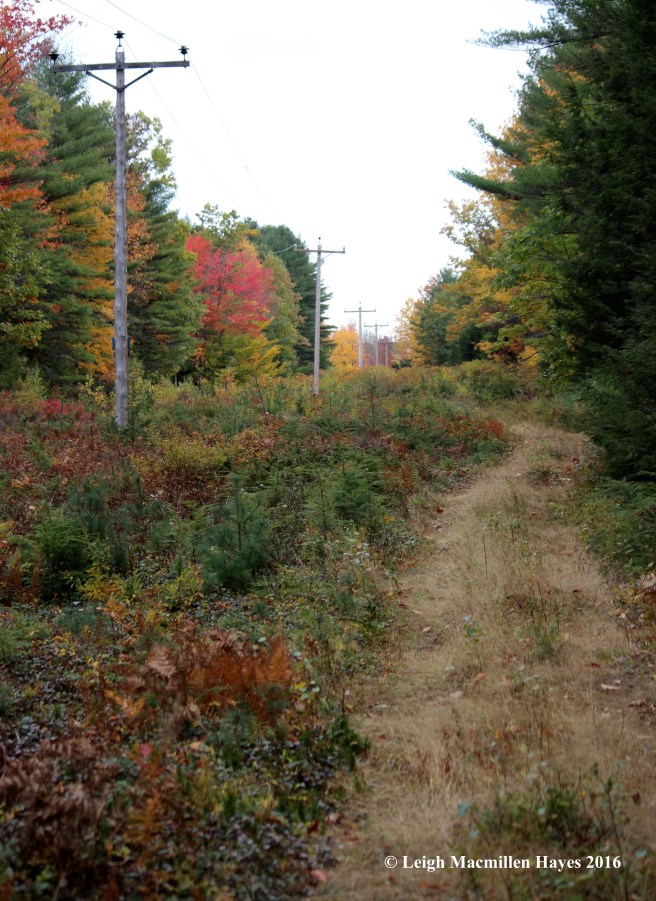
After bushwhacking for a few hours, I found the snowmobile trail, where man and nature have long co-existed.

h-home-2

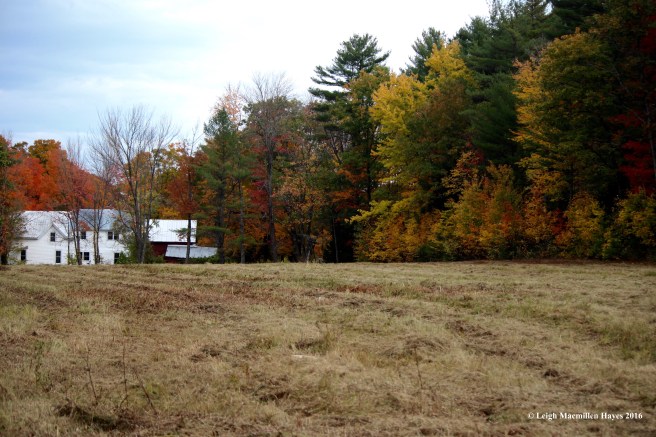
At last I found my way across the field rather than through our woodlot, thankful for the opportunity to take in the colors of the season one more time.

At the end of the day, I’m once again in awe as I think about how we, and all that we share this Earth with, are dependent upon each other and the abiotic forces that surround us.

And with that comes the realization that the scene is in constant flux and so am I.


An Emerald Mondate

My guy and I journeyed via bus, car and foot across northern and eastern Ireland these past two weeks. Our main agenda–a vacation in the land where twenty-six years and two months ago we celebrated our honeymoon. We both also had semi-hidden agendas–his to seek out ancestral roots, mine to search as well, though my quest wasn’t quite so clear.

river-liffey-and-quay-dublin

Our journey began after we dumped our bags at the hotel, where our room wasn’t yet ready, and crossed the River Liffey in Dublin. It was to the right that we’d parked a rental car 26 years previously as we searched for traditional music and supper, only to return hours later and discover that the driver’s side window had been smashed and our video camera stolen. All these years I’ve held a sour view of the Fair City and so I felt a bit nervous as we stepped forth.

trinity-college-dublin

The feeling began to wane immediately, for as we approached a street corner and chatted about locating the library, a Dubliner overheard us and assumed we were looking for Trinity College (founded in 1592). We decided to play along and followed his directions–thankfully. It was “Welcome Freshers” week and the quad swelled with activity tents, music and students anticipating the year ahead. We passed among the frivolity and found the self-guided tour of the 18th century Old Library and that most ancient of manuscripts–the Book of Kells, a 9th century book featuring a richly decorated copy of the four Gospels of the life of Jesus Christ. A favorite discovery: the monks used oak apple galls to create ink–apparently, they crushed the galls and soaked them in rainwater, wine or beer until they softened. I’ve got to try this.

library-at-book-of-kells-1-1

While (or whilst as the Irish say) no photos were allowed in the Treasury where the manuscripts are stored, equally impressive was the Long Room, which houses 200,000 of the library’s oldest books in ancient oak bookcases. Just thinking about the centuries we were encountering was mind boggling, enhanced of course, by a lack of sleep.

architecture-and-flowers-dublindublin-church-architecture

A few hours later, we made our way back to the hotel, enjoying the architecture and flowers as we walked along. At last, we could check in and so we checked out–a rejuvenating nap essential to our well being.

guiness-sign-and-face

Rested and showered, we hopped aboard a bus–our next destination, the Guinness Storehouse at St. James Gate Brewery. The 250-year story of Guinness® is portrayed on five floors in a building designed in the shape of a pint. What’s not to like about that.

singing-oyster-guiness

We learned about the process of creating beer, and then there was the whistling oyster, one of the many icons of the Guinness® brand.

guinness-gravity-bar

After taking in the full story, we reached the Gravity Bar, where ticket holders may each sip a complimentary foam-topped pint. The museum was preparing to close and the bartenders made the last call. My guy asked if we could purchase a second pint and we learned that they don’t sell any, but he kindly slipped us two. Don’t tell.

guiness-view-2

The Gravity Bar offers 360˚ views of the city.
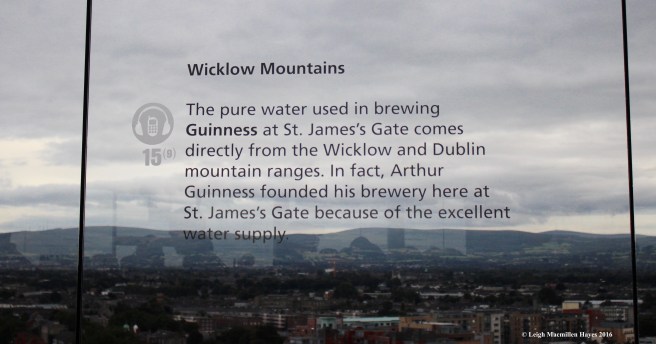
wicklow-mtns-from-gravity

And the view includes the Wicklow Mountains, our intended destination for week 2.

the-temple-bar

If you hear my guy tell this story, he’ll say that we were told it was a 45 minute walk from our hotel to the Storehouse, but a short bus ride. We rode the bus there, but later weren’t sure where we should queue for the ride back, so we decided to walk instead. According to him, it took us five hours to make that 45 minute walk. I’m not sure it was quite that long, but we did stop at The Temple Bar for the music and a few other prime spots to eat and sip a wee bit more.

national-library-dublin

The next morning we set out for the National Library, which had actually been our intended destination the previous day–but who can deny enjoying the Book of Kells exhibit. My guy was hopeful that the genealogists at the library would help him make some connections, but without knowing parishes he hit a bit of a stonewall.

And so we left the Fair City with much fonder memories, took a bus to the airport, picked up our rental car, and ventured on. Oy vey. If you’ve ever watched the BBC program, “Keeping Up Appearances,” you’ll appreciate that I was Hyacinth to my guy’s Richard. “Mind the pedestrian,” I’d say. “I’m minding the pedestrian,” he’d respond.
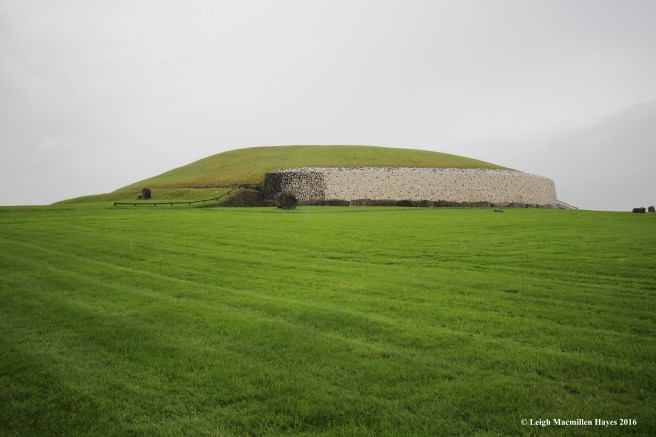
newgrange

Our first stop, Newgrange, a Neolithic passage tomb alleged to be older than Stonehenge and the Great Pyramids. Constructed during the Stone Age, about 5,200 years ago, Newgrange is a large circular mound that covers 300 feet in diameter and stands 36 feet high. A stone passageway leads to three small chambers. Some describe it as an ancient temple, a place of astrological, spiritual and ceremonial importance. Our guide told us that bones were found here and it may have been a place for worship as well as where people were laid to rest. We were in awe of its structure and the fact that the passageway is oriented northward allowing the sun to illuminate it during the winter solstice.

newgrange-entrance

Yes, the railings are new, but this is possibly the oldest building in the world. That’s worth repeating–the oldest building in the world. We had to bend low to enter and then squeeze between the walls as we walked toward the center, where three small chambers with stone basins created a cross-like structural plan. Even as we stood with others in darkness and waited for a beam of artificial light to demonstrate the real thing, we couldn’t quite fathom what we were witnessing.
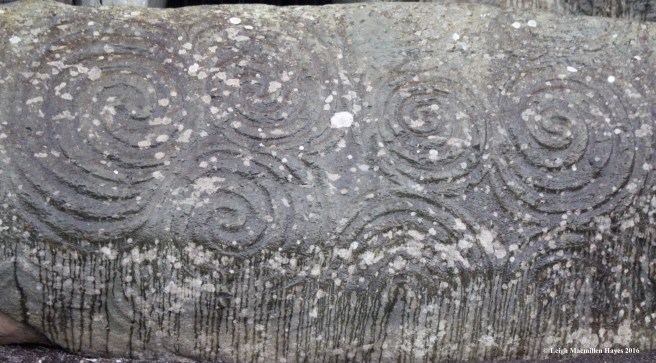
newgrange-spirals

Our awe continued within the center and by the entrance stone, where we witnessed megalithic art. The spirals reminded me of labyrinths, but we’ll never know their true significance. And that’s OK.
ghan-house-carlingford

By the time we arrived at Carlingford, it was pouring and we had no idea where to stay. We stopped at a hotel, which was full–thankfully. They suggested the Ghan House, a Georgian House set within three acres of walled gardens. It was our most posh stay and we didn’t truly appreciate it until the next morning when the sun shone brilliantly.
carl-arch-2

The Ghan House is located just a stone’s throw from the Thoisel or town gate leading into the narrow streets of the town centre, where we found Ma Baker’s in the rain, a welcoming pub frequented by the locals, who laughed and joked and reminded us that the Irish love to sip a pint, tease each other and tell stories no matter what the weather might be out the door. And they don’t care about spelling, punctuation or run-ons. Life is too short for that–note to self.

carlingford-lough1

The tide was low when we walked along the lough the next morning and took in King John’s Castle, which was initially constructed by Hugh De Lacy in 1190, though it wasn’t completed until 1261. Purportedly, King John, the brother of Richard the Lionhearted, visited in 1210, and thus the name for this Norman structure.

wall-around-derry

From Carlingford, we travelled north and did what we had wanted to do 26 years prior; we crossed into Northern Ireland. On our previous adventure, we’d journeyed as far as Letterkenny in the northern part of the Republic of Ireland, only a half hour from Derry. But that was then, the time of The Troubles, and we didn’t dare to cross the border. Again, my guy was seeking ancestors and at the Welcome Center he was told to visit the Tower Museum where Brian Mitchell would be able to provide some help. We were too late when we climbed down from the wall to the museum, so we did what the Irish would do–when in Rome–we found a pub and had a nice chat with a young man who had recently returned to Derry in search of work. We also walked around the city, taking in the sites made famous by The Troubles. And the following morning we again returned to the museum, where the curator told us that Brian would probably show up around 11am. So, we paid for a self-guided tour and learned about the town’s colorful and dramatic past through “The Story of Derry.” At 11:30 we once again went in search of Mr. Mitchell, only to learn that he was out and about somewhere. Since we needed to check out of our room, we decided that our Derry experience was over, but Mr. Mitchell did respond to an e-mail and so my guy has some more resources to consider.

carrick-cave

Our next stop, Portrush, a resort town along the Atlantic and on the northern fringe of Ireland. After checking in at the Antrim House B&B, we headed off along the Coastal Scenic Route to Carrick-a-Rede Island. Carrick-a-Rede is from the Scottish Gaelic term, Carriage-a-Rade, meaning the rock in the road.
salmon-boat-at-carrick-1

And the road is presumably the sea route for Atlantic salmon that were once fished here prolifically. In fact, so prolifically, that the fishery is no longer viable. In order to reach  the best places to catch the migrating salmon, for 350 years fishermen crossed regularly to the island.
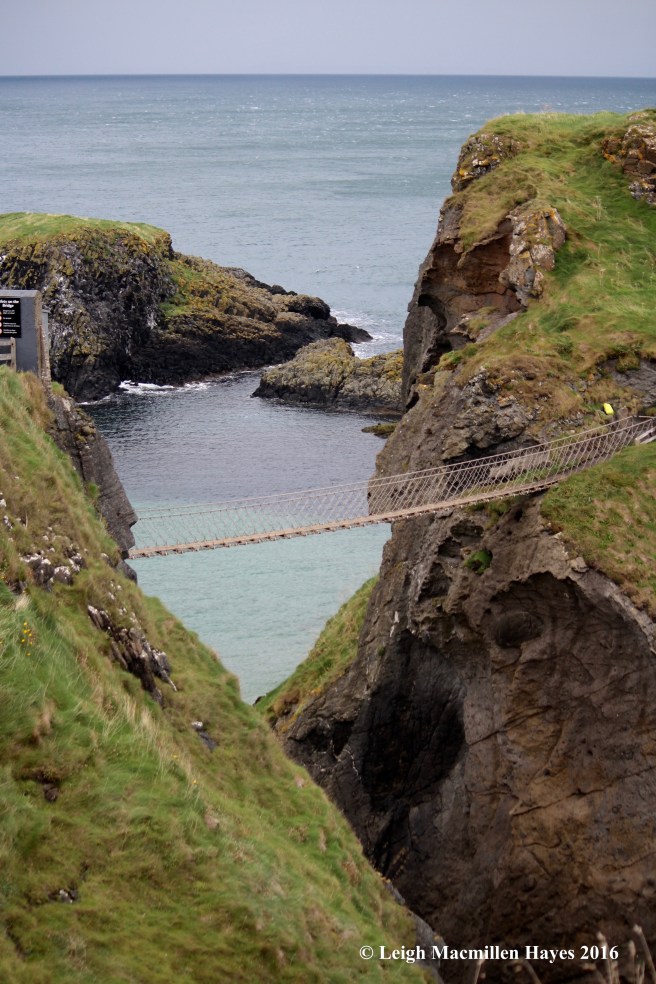
rope-bridge

One hundred feet above the sea, the fishermen crossed the 60-foot chasm via a rope bridge to check their nets. Of course, they had only one rope, not the steel and plank structure that we crossed. That being said, it was quite windy and the bridge did sway.
smiling-from-the-carrick-a-rede-rope-bridge

We put our fear of heights behind us and made our way across.

allen-at-carrick-3-1

Did he just do that? Yup.

me-at-carrick-1

And I followed.

scotland-2

Our views included Raithlin Island, the northernmost point of Ireland.

giants-causeway-1-1

Our next wonder–the Giant’s Causeway, a geological phenomenon of 40,000 basalt stone columns formed by volcanic eruptions over 60 million years ago.
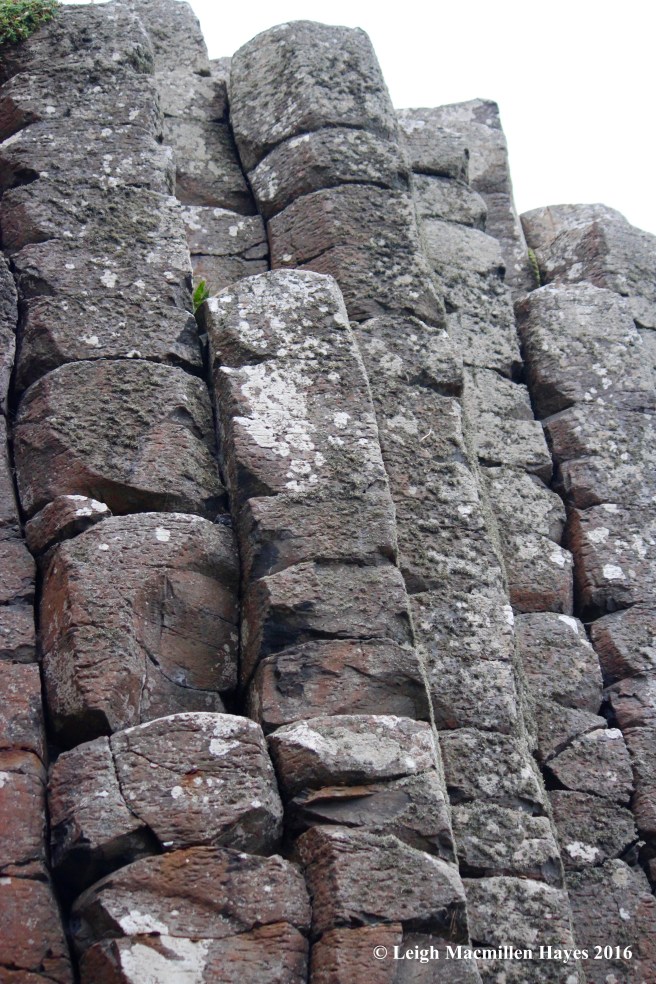
giants-3

giants-6

These hexagonal tubes stacked together like cans on a shelf offer yet another mystical and magical look at the world, one that the Irish embraced by creating legends to explain their existence–Fionn mac Cumhaill (Finn MacCool), an Irish giant, was challenged to a fight by the Scottish giant Benandonner. Good old Fionn accepted said challenge and built the causeway across the North Channel so that the two could meet. There are two endings so take your pick: In one version, Fionn defeats Benandonner, but in another,  he hides from Benandonner because he realizes his foe is much bigger. Fionn’s wife, Oonagh, disguises her husband as a baby and tucks him in a cradle. When Benandonner sees the size of the “baby,” he fears that its father, Fionn, must be the biggest giant of them all. Benandonner flees back to Scotland in fright, but makes sure to destroy the causeway behind him so he won’t be followed by Fionn.
causeway-view

My guy found a spot to take in the giant’s viewpoint.

dunluce-castle-2-1

As we made our way back toward Portrush, we paused at Dunluce Castle. We couldn’t go in because it had closed for the day, but we could still see part of the castle town that was developed in the early 1600s.
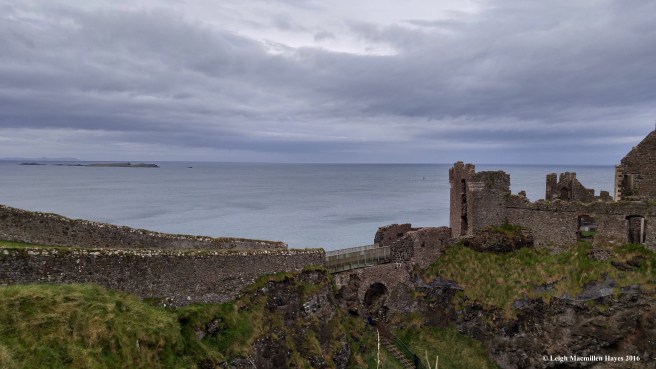
dunluce-castle-1-1

Originally built by one clan in the early 1500s, it was seized by another in the mid 1500s. Its history includes rebellions and intrigue.

dunluce-castle-wall-over-cliffimg_7377

Included in its dramatic history are tales of how the castle kitchens fell into the sea one stormy night in 1639. We couldn’t help but wonder if the same happened to the wall.

portrush-2-1

Back in Portrush finally, our own tale continued. At the suggestion of our hostess, we walked to the Harbour Bar for dinner.

wee-harbor-bar-ryder-cup-trophy-1

While we waited for a table, we paused in the wee pub, as they call it. A few minutes later, two guys walked in with a trophy and made a big fuss about its placement among the best bottles of whiskey.

darren-3-1

At the time, I was standing to the right of the gentleman in the middle and so I asked him about the trophy. He explained that when you participate in the Ryder Cup you receive a replica. My guy immediately realized that I was talking to a famous Irish golfer, he just couldn’t put a name with the face. On the wall above, we could see photos of him, but we weren’t close enough to read the signatures.

allen-as-darren-1

It turns out we were in the presence of Darren Clarke, the European Ryder Cup captain for 2016. We didn’t know that until we went to check on our table and asked. One of the bartenders encouraged us to stay for the send-off, so we did. Everyone donned a D.C. mask (at 00:16, if you look quickly to the back left, you might see my scraggly hair behind a mask)–and sang “Shoulder to shoulder, we’ll answer Darren’s call.” We were included as the North American entourage.

allen-and-willie-2-1

allen-and-willie-1

While I got Darren’s autograph on one of the masks, my guy befriended Willie, the bar manager.

portrush-2

The next morning, after a traditional Irish breakfast, we toured the downtown. Ireland amazes us–the temperature was chilly and yet the flowers were gorgeous. And palm trees grow throughout the country.

walk-to-murlough-bay-with-fairhead-in-background

Upon our departure, our hostess suggested we follow the coastal route to Murlough Bay and so we did. And took a wrong turn that lead down a dead-end to a gate with a sign warning us that guard dogs were on site. With caution, my guy backed up the lane until he could turn the car around. Our hostess had also told us not to park at the upper lot for Murlough Bay, but instead to drive down. I insisted upon the upper lot given that the road had at least a 10% pitch. So we walked down. And down. And down some more.

fairhead-murlough-bay

Upon our descent, the light at a distant lighthouse beckoned in the background as Fairhead came into view.

murlough-bay

The coastline was as dramatic as we’d been promised. And I was glad we’d walked because the drive would have been even more dramatic with Hyacinth in the passenger seat.
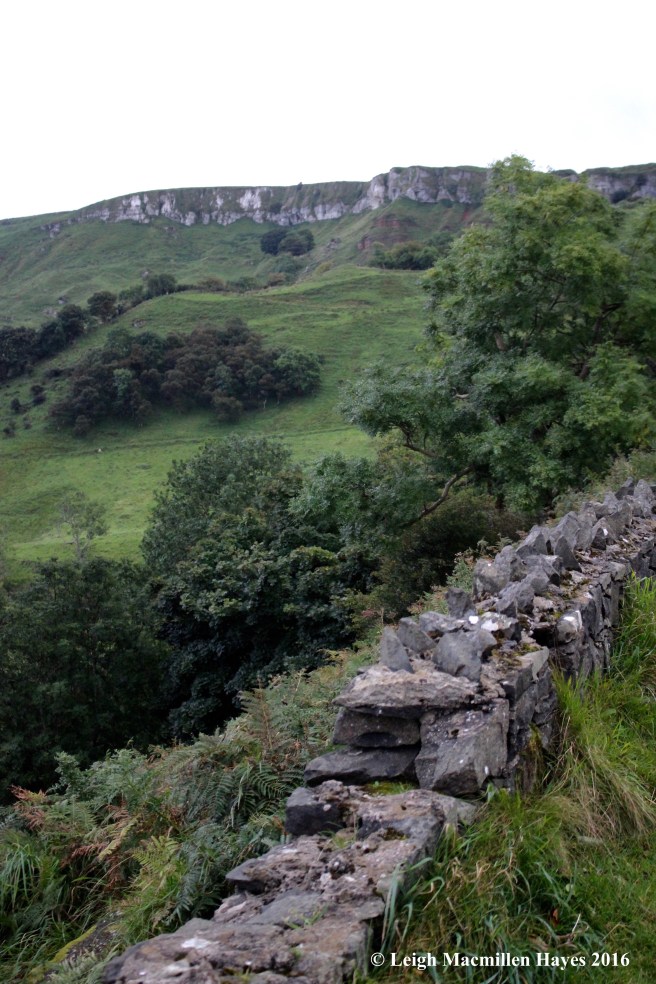
stormlands

This area may appear familiar to viewers of Game of Thrones–including the site of Stormlands.

traditional-music-in-belfast-1

After a hike back up the road, we drove on to take in the scenery of Torr Head. The road narrowed significantly as it twisted and turned along the coast. And then . . . we met a porsche rally. As best he could, my guy squeezed our car past them. And as soon as he could, we got off the coastal route and drove on to Belfast. It was late in the day and pouring when we arrived. By the time we parked in city centre and walked to the Welcome Center, we were drenched. And disappointed. There was no where to stay in town and we’d have to move on. But . . . then one final effort proved that a hotel was available. We should have questioned if for the price. Well, actually I did, but we were told that it was a fine place and served as a conference center. So we took it. And couldn’t wait to get out of there. Fortunately, we found some Irish music back in town and a delightful meal of locally harvested food. All we needed to do was sleep in the rathole, though even that didn’t work so well.

nomadic-1

The next morning we took in the Titanic Museum and stepped aboard one of its tenderfoot boats, the Nomadic.
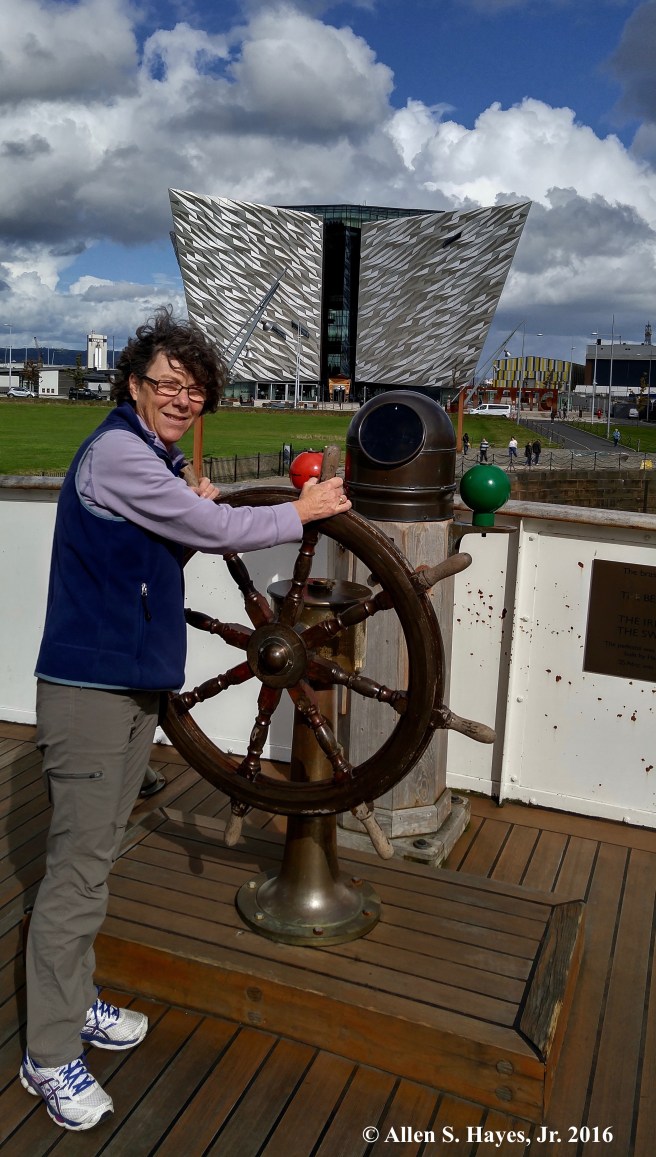
me-nomadic-2-1

A dose of coffee and I was ready to take the helm. And if you are wondering if it’s windy every day in Ireland, the answer is yes. It also rains at some point each day. Our time in Northern Ireland was over, but except for that one accommodation, we’d had a wonderful and wonder-filled time.
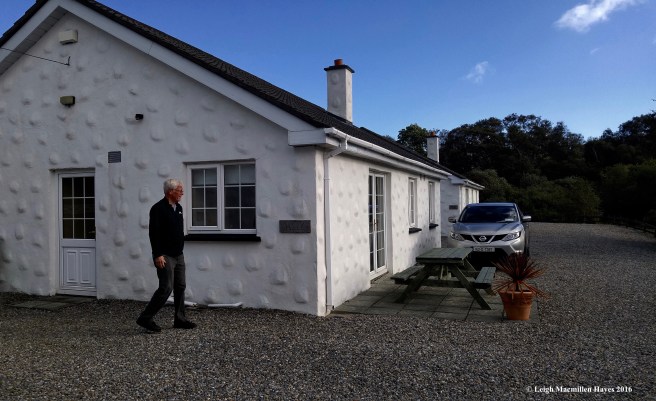
holly-cottage-laragh-1

As we worked our way south, we spent a night at a delightful B&B in Navan, which featured  more traditional music and a place to relax. On Monday morning, we finally headed to the cottage we’d rented in the town of Laragh–Glendale Holiday Cottages–we highly recommend. Our host, Christy, was extremely accommodating, the cottage spacious and amenities plentiful.

ww-monastic-city

We’d chosen this location because it was a five minute walk to the pub and restaurant in Laragh, located in the Wicklow Mountains, and near the Glendalough monastic settlement founded by St. Kevin in the sixth century.

round-tower-glendalough

Forty shades of green and Brigadoon all came to mind as we approached the monastic settlement and its round tower.

st-kevins-church-glendalough

St. Kevin’s kitchen is actually a 12th century church, so named because it was believed that the bell tower was a kitchen chimney. Apparently, however, no food was ever cooked there. But . . . if you think of the word of God as food, then perhaps many a feast was actually served.

ww-monastic-cathedral

From the altar window in the cathedral, the largest of seven churches within the monastic city,  a view of the world beyond was offered.

st-kevins-monastery-glendalough-1

Likewise, we could see the world within, including the Priest House in the background.

monastery-cemetery-glendalough

And everywhere, gravestones told the story of many who’d passed this way.

trinity-church-glendalough-day-3

A little closer to Laragh, Trinity Church.

upper-lake-3-glendalough

Upper Glendalough was the jumping off point for our initial hike upon the Wicklow Way.

p-falls-2-glendalough

We paused beside Poulanass Falls before zigzagging our way up the first trail.
sheep-wicklow-way-2

Sheep merely looked up to acknowledge our passing. We, however, needed to pay more attention for sheep shit was prolific.

reforestation-wicklow-way

Tree felling was also a frequent sight, but we noted a unique (to us anyway) method of reforestation–in this case the Sitka spruces and Scots pines being felled were replaced by mountain ash saplings. One other thing we wondered about–the plastic sleeves–we saw some that had fallen away as trees grew, but were left in place. Biodegradable? We could only hope.
wicklow-way-bog-day-1

We spent three full days on the trail, not covering all of it, but a good portion as we hiked 10-15 miles each day.
crossing-bog-wicklow-way-day-1

Our journey took us over boggy portions,
wicklow-way-day-3

down grassy sections,

w-lane-2

on village lanes,

ww-boardwalk

over boardwalks,

ww-forest-path

through the black forest,

w-walking-into-the-sky-day-3

and into the future.

ww-following-the-signs

Frequently, we had to stop, reread the directions and study the map, but more often the route was self-explanatory.

ww-muddy-trail

Along one section that was particularly muddy due to frequent horse crossings, we made a discovery unique to us.

w-badger-print

A badger print. Sadly, or maybe happily to locals, we saw a dead badger on one of the lanes not far from this print. Related? We’ll never know.
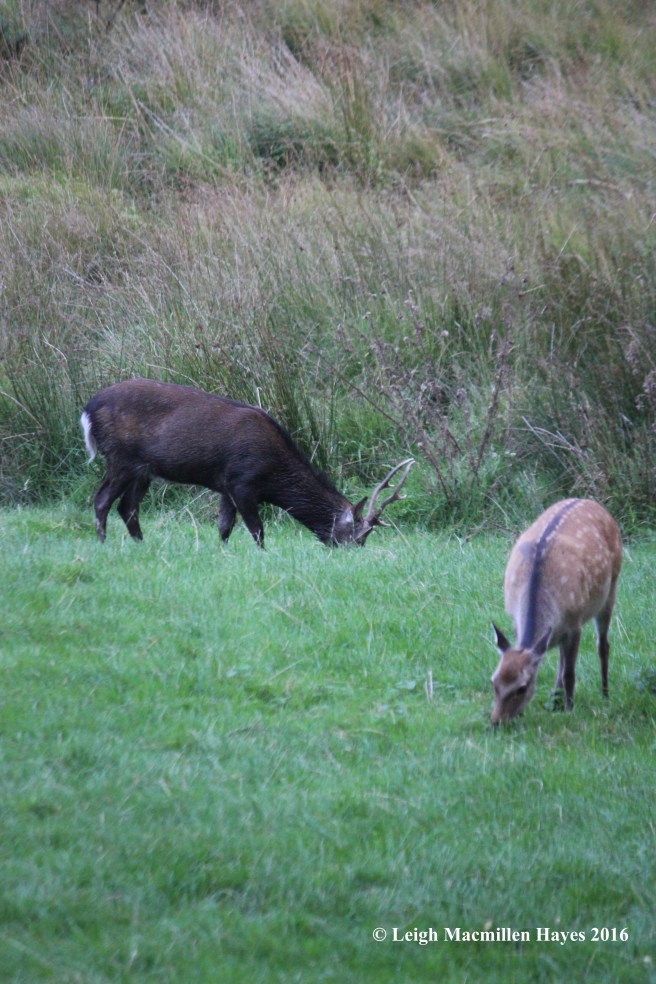
w-deer-at-glendalough

We saw deer, one rabbit and two red squirrels.
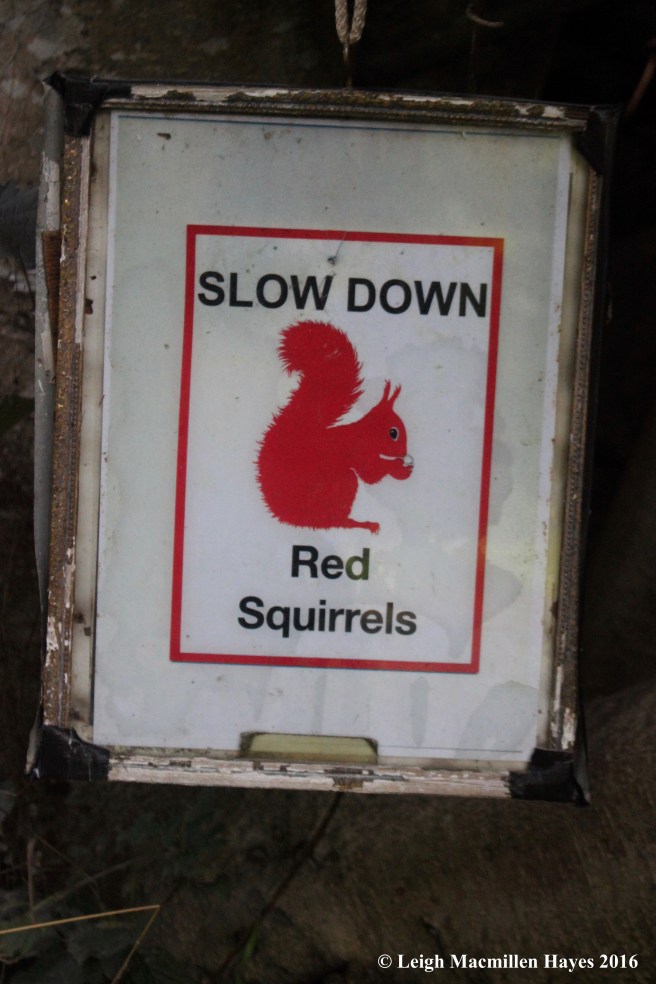
Red Squirrel sign, day 3.jpg

Writing of the latter, we chuckled when we encountered this sign because we have frequent encounters with them at home. But considering we only saw two in two weeks and spent most of our days outside, we had to wonder.
w-bessy-1

Bessie One,

w-bessy-2

Two,

w-bessy-3

and Three (pronounced Tree) tolerated our presence.

w-cow-on-wall

And Bessie Four made us laugh–as she stood upon a wall.
w-hay-in-barn

Though we passed through pasture after pasture and by many a farm and barn, we never saw any farmers, but knew that they were hard at work preparing for winter.
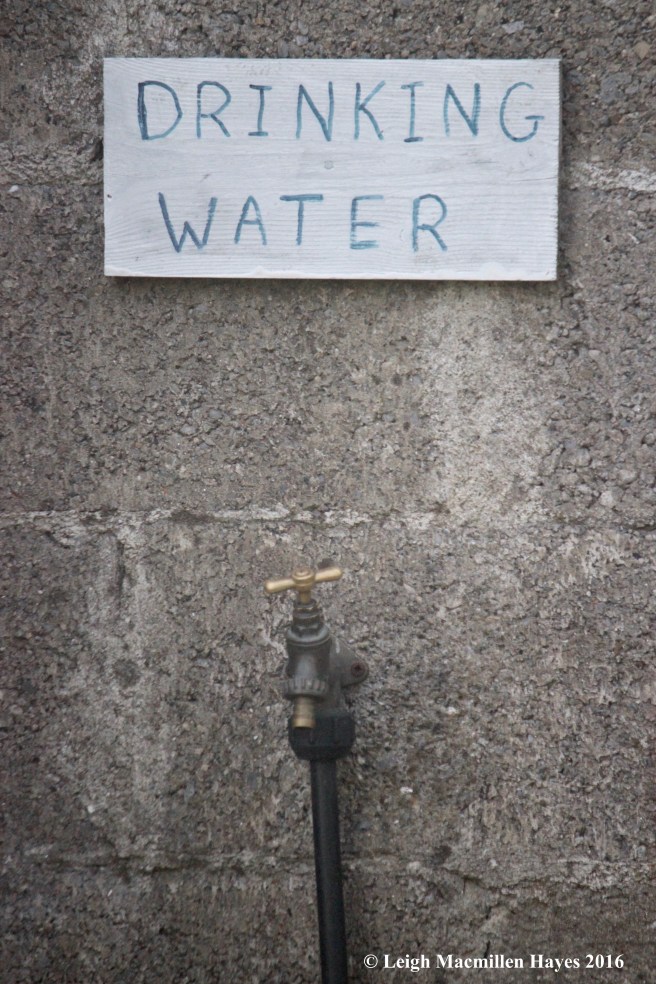
drinking-water-wicklow-way-day-3

And one even offered us nourishment.

w-wooden-stile

Our path included obstacles, though most were easy to overcome from a rope loop
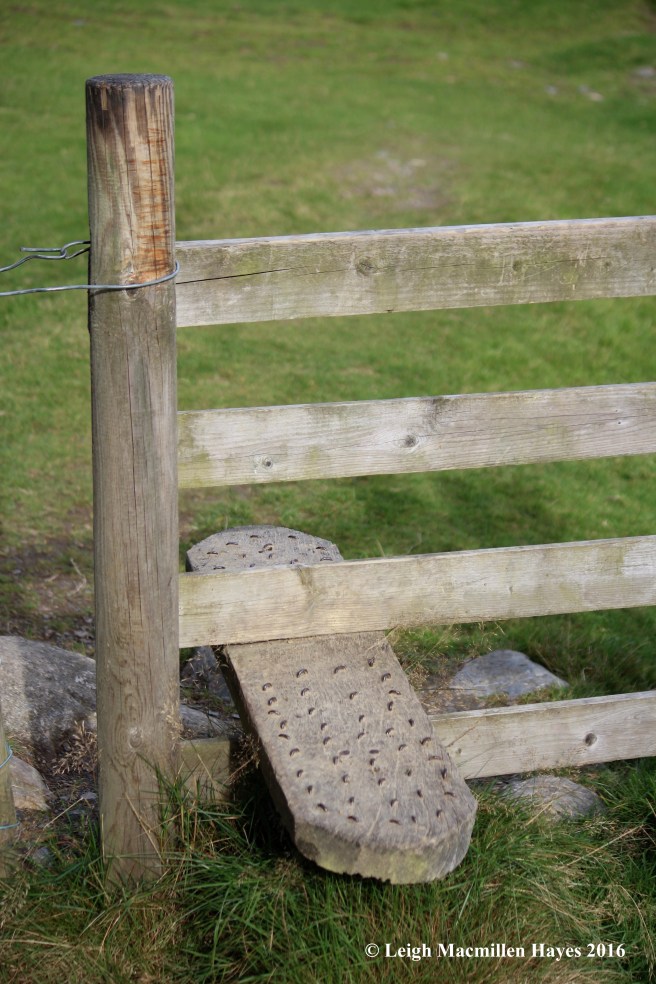
w-stile-step-wicklow-way-day-3

to a simple step or

w-another-stile

ladder crossing.

w-bull-sign

Only once were we uncertain. The stile was padlocked and there was no step or ladder. We finally decided to climb up over the gate in hopes that there wasn’t a bull on the other side. Usually though, a beware of bull sign announced their presence and no such sign marked that particular crossing–phew.

w-guinness-sign

Our days ended with a stop at the local pub because Guinness® is good for you. I actually overheard an older woman telling her significant other the truth behind this. Apparently, when this woman’s mother had been in hospital years before, she was given Guinness® to drink each morning and evening–perhaps for its iron content. Or perhaps just because it’s good for you.

w-dying-cow-1

One of our stops was at the smallest and oldest pub in the nation–the Dying Cow. Mr. Dolan sat behind the bar sipping a Guinness® along with us as he and my guy got into a discussion about American politics. We noted that to be a hot topic. Our reason for finding this pub was because we’d walked into Tenahely after a fifteen miler and were about to step into Murphy’s for a pint when a gentleman sitting outside started chatting with us. He suggested we head off down the road because we needed to experience this tiny bar and he would have joined us but he’d just ordered his pint and didn’t want to waste it.

w-1798-monument

We followed the directions he wrote out for us, and missed the 1798 monument at first, but retraced our route and found it. We only wish he’d then told us how to get back to Laragh. That took a while, but eventually we found our way home.

wicklow-day-3-1

Our views from the Wicklow Way were worthy of wonder.
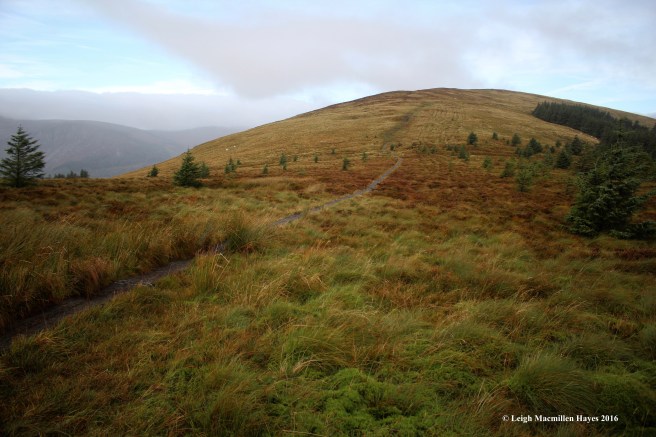
wicklow-way-day-1-3

And the ever present clouds added to the drama.

ww-greens

The land resembled a patchwork quilt.
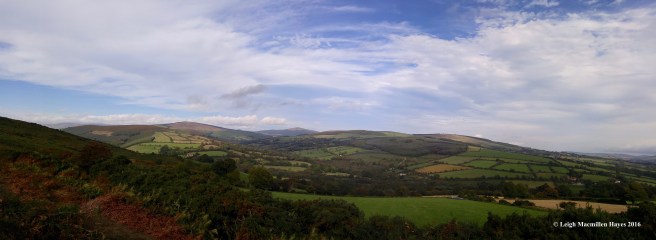
pano-2-day-2-1

No matter where we looked, it was forever changing.
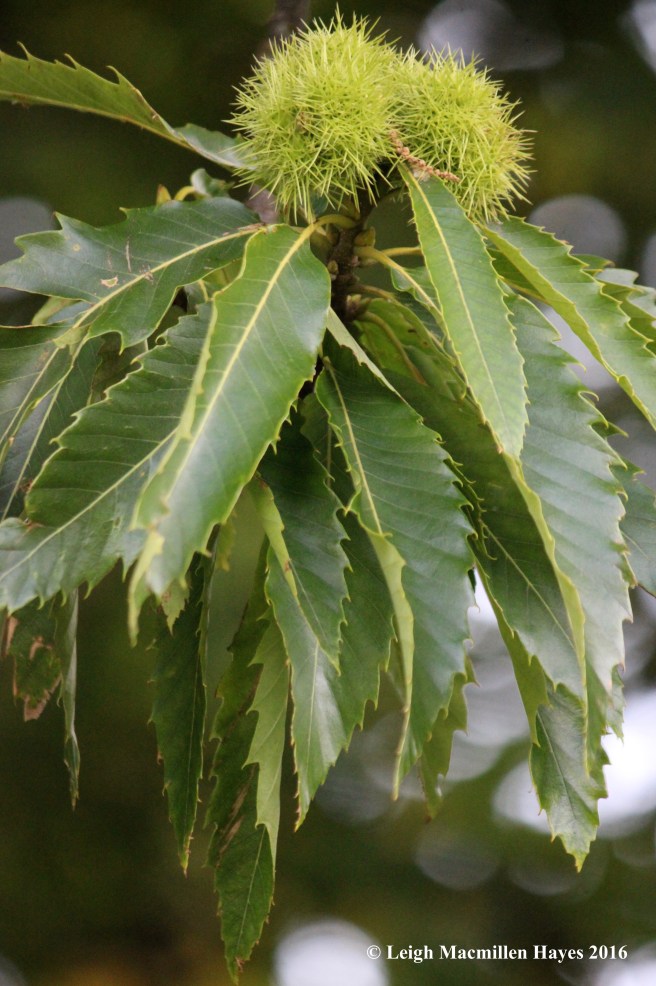
chestnuts

Some of our fun discoveries included chestnut trees,
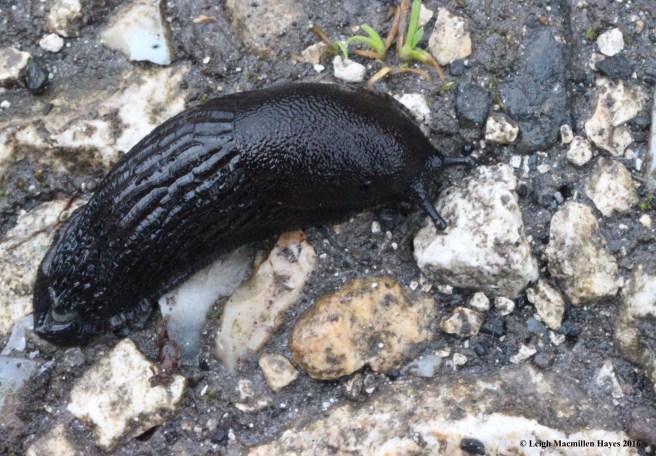
slug

black slugs, and . . .

bear-gryllz-signature

the crème de la crème–bear claw marks! Did Bear Gryllz really leave his signature on the trail behind the Glendalough Hotel?

wicklow-and-the-irish-sea

When we weren’t hiking, we explored the area, including Wicklow and its stone beach.

wind-turbine-boat-wicklow-harbor

We didn’t understand this ship at first until my guy asked–meet Wavewalker, a maintenance boat for Ireland’s Offshore Windfarm.

wicklow-harbor-other-side

Across the harbor, we spied the remains of a castle that invited a closer look.

wicklow-castle-2-sky-and-water-reflection

It seems Black Castle was constantly under siege and totally destroyed in 1301. And yet–I felt a presence still there.

castle-wicklow-face-in-turret

Do you see his face?

avoca-chairs

The oldest mill in Ireland also drew our attention–Avoca Handweavers Mill was established in 1723.

avoca-socks

It was the home of color with attitude.

avoca-yarn-5

Upclose and personal, we saw the inner workings.
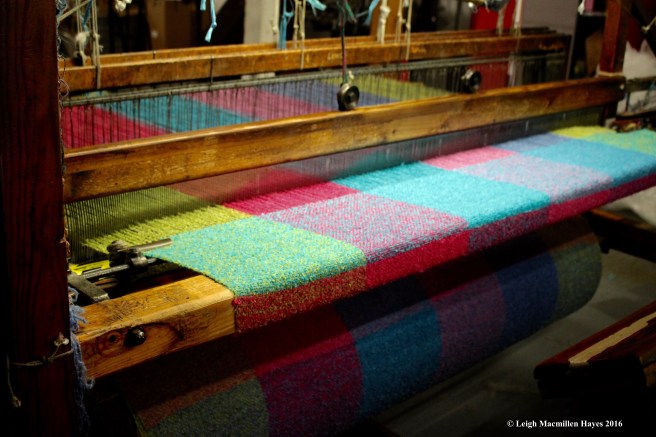
avoca-yarn-2

And marveled at the creative results.

carlow-castle-towers

Our last full day in Ireland found us in Carlow. Standing beside the River Barrow, this castle was thought to once be a stronghold and it survived attacks in the 1400s and 1600s. According to local lore, a physician set out to remodel it into an asylum in the early 1800s. As he tried to demolish the interior, he placed explosive charges near its base and accidentally destroyed all but the remaining west wall and twin towers. Uh oh.

swan-face-carlow

As happened daily, the weather quickly changed from blue sky to raindrops. Swans in the River Barrow didn’t care. They were in their element.
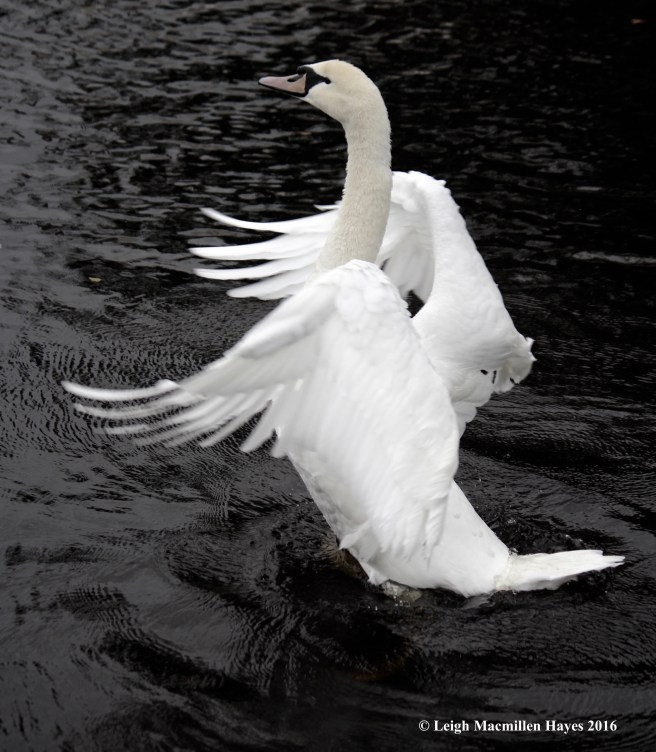
swan-stretch-carlow

My guy counted while I photographed. Thirty some odd–all wishful that we’d brought good tidings in the form of bread. Not to be much to their dismay. Despite that, we were treated to several displays.

sunset-over-carlow-1

And later that night, a display of sun and clouds as we went in search of supper.

irish-breakfast

Our final night was spent at the Green Lane B&B in Carlow where Pat and Noeleen took special care of us. My guy watched the GAA football game with Pat, their grandson Sam helped us print out our airline tickets and Noeleen made sure we had toll money for our journey to the airport. And then there was the breakfast–the finest we’d enjoyed.
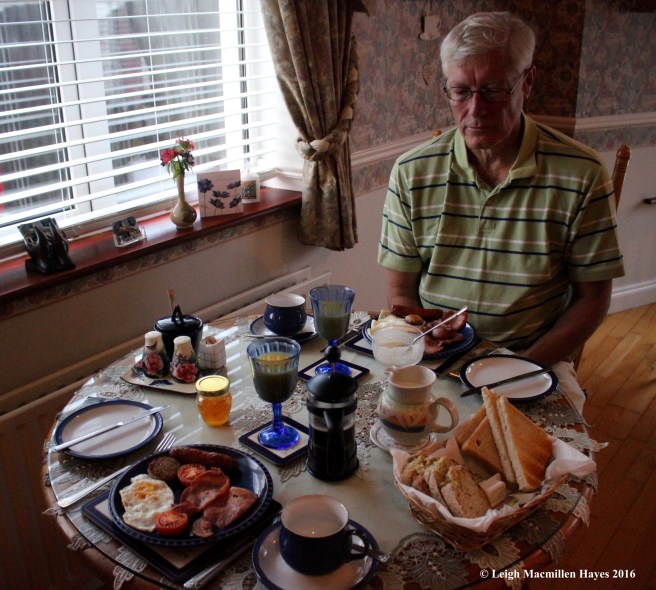
breakfast-2

Think eggs, tomatoes, mushrooms, bacon, sausage, white pudding, toast and Irish soda bread. And they wanted to know if we wanted porridge and cereal. Really?

irish-mist

Before we checked out, I made my guy drive to this field ensconced in an Irish mist.
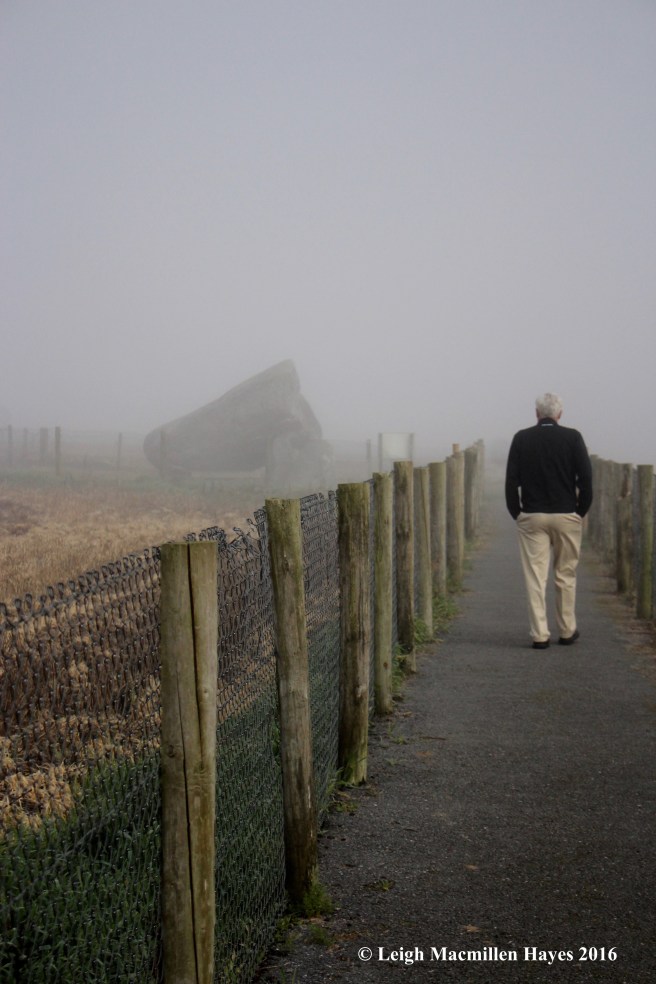
out-of-the-mist

The fog seemed apropos for our walk out to the Browneshill Dolmen. This was a burial chamber that may have originally been covered with earth.
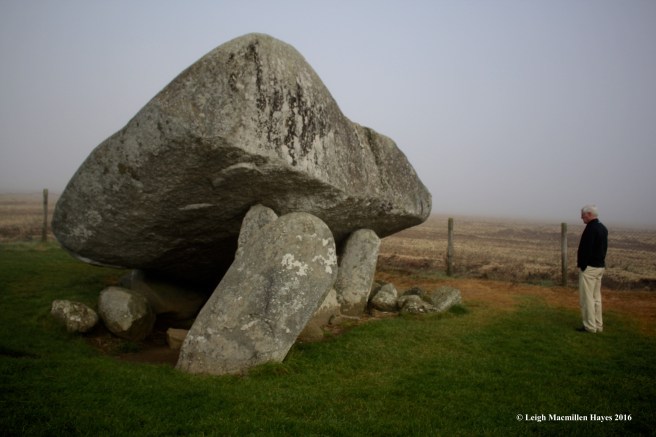
dolman-size

My guy stands almost six feet tall, so his height provided a sense of size.

dolman-2

The two more pointed stones on either side of the squared stone were known as portal stones that would have supported the granite capstone or chamber roof. The squared stone in the center was probably the gate stone that blocked the entrance. This site has not been excavated so there’s no other info about it, but just standing in its presence and considering those who came before and created such was enough.
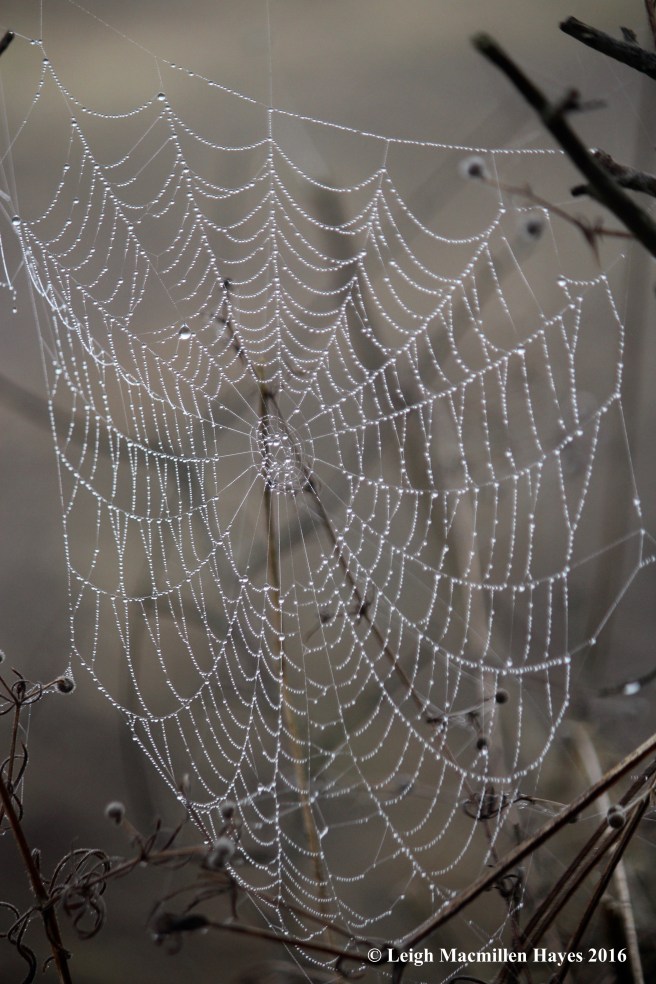
web-2

And then there were the spider webs. I’d missed them as we’d walked toward the dolmen, but they captured my attention all the way back. From prehistoric to present, the structures before us were breathtaking.
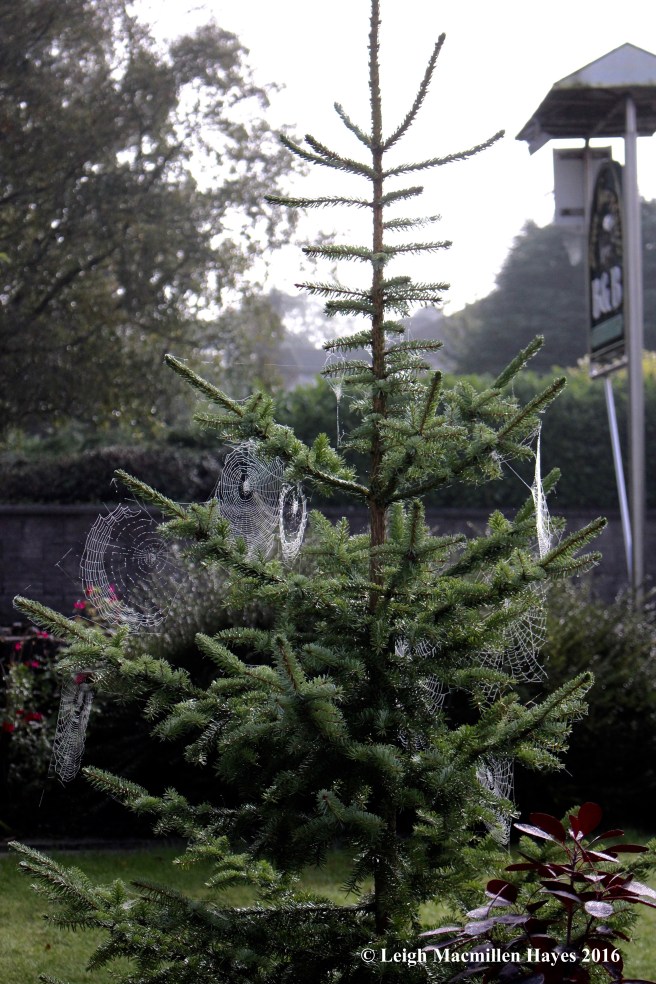
tree-webs

And when we finally pulled out of the B&B driveway on our way to the airport, I asked my guy to stop while I jumped out of the car. What a sight to behold–web ornaments. A perfect ending to our vacation.

My guy meet several roadblocks on his search for roots, but at the same time, he learned about some new avenues that may help in his quest. And I, I wished for more time to understand all that was before me from prehistoric to present–but maybe I sought answers that don’t need to be. Having the questions might be enough.

Together, we were grateful for our Hyacinth and Richard Adventure on the Emerald Isle. And glad to return the car safely to the rental agency.
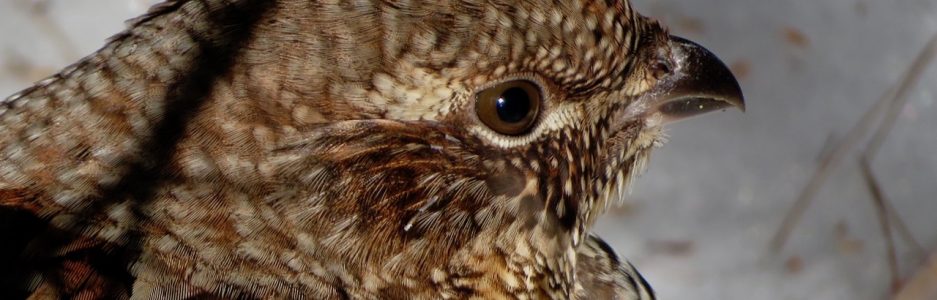


The Wonders of Kezar River Reserve

How many people can  travel a familiar route for the first time every time? I know I can.

j-kiosk

And so it was this morning when I ventured to the Greater Lovell Land Trust’s Kezar River Reserve off Route 5 in Lovell. I went with a few expectations, but nature got in the way, slowed me down and gave me reason to pause and ponder–repeatedly.

k-oak-gall-1

As I walked along the trail above the Kezar River, I spied numerous oak apple galls on the ground. And many didn’t have any holes. Was the wasp larvae still inside?

k-partridgeberry

While the dots on the gall were reddish brown, the partridgeberry’s oval drupes shone in Christmas-red fashion. I’m always awed by this simple fruit that results from a complex marriage–the fusion of pollinated ovaries of paired flowers. Do you see the two dimples? That’s where the flowers were attached. Two became one. How did they do this?

k-fairy-2

After walking along the first leg of the trail, I headed down the “road” toward the canoe launch. And what to my wondering eyes should appear–fairy homes. Okay–true confession: As a conclusion to GLLT’s nature program for the Lovell Recreation Program this summer, the kids, their day camp counselors and our interns and docents created these homes.

k-fairy-1

I was impressed that the disco ball still hangs in the entrance of this one. Do you see it? It just happens to be an oak apple gall. Creative kids. I do hope they’ve dropped by with their parents to check on the shelters they built.

k-bench

And then I reached the launch site and bench. It’s the perfect spot to sit, watch and listen. So I did. The bluejays kekonked, nuthatches yanked and kingfishers rattled.

k-ripples

A gentle breeze danced through the leaves and offered a ripply reflection.

k-river-4-morning

And I . . . I awaited great revelations that did not come. Or did they? Was my mind open enough to receive? To contemplate the mysteries of life? The connections? The interactions?

k-ridgeline-2-1

At last, I moved on and entered a section that is said to be uncommon in our area: headwall erosion. This is one of five ravines that feature deep v-shaped structures. Underground streams passing through have eroded the banks. It’s a special place that invites further contemplation. And exploration.

k-skate-bugs

One of my favorite wonders on the bit of stream that trickled through–water striders. While they appeared to skate on the surface, they actually took advantage of water tension making it look like they walked on top as they feasted on insects and larvae that I could not see.

k-turtle-sign

Lots of turtle signs also decorated the trail. Literally.
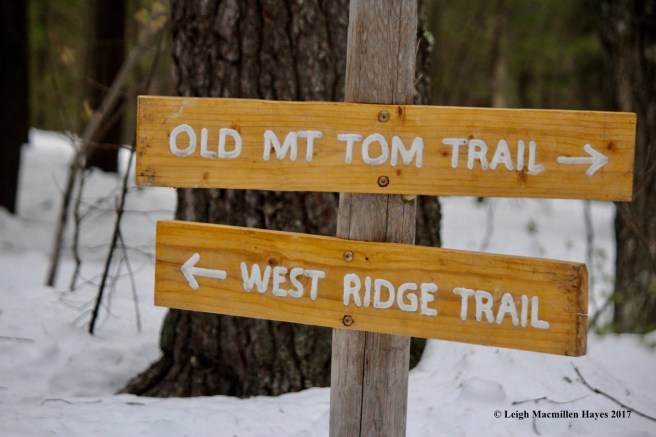
k-bear-sign

In fact, I found bear sign,

k-cardinal-sign

cardinal sign,

k-ladys-slipper

and lady’s slipper sign . . . among others. Local students painted the signs and it’s a fun  and artistic addition to the reserve.

k-blue jay feather.jpg

Of course, there was natural sign to notice as well, including a blue jay feather.

K-aster .jpg

Asters and goldenrods offered occasional floral decorations.

k-hobbleberries

And hobblebush berries begged to be noticed.

k-meadowhawk-1

And then a meadowhawk dragonfly captured my attention. I stood and watched for moments on end.

k-red-maple-leaf

And noted that the red maples offered similar colors.

k-squirrel.jpg

When I reached the canoe launch “road,” I was scolded for my action.

k-river-later-1

Despite that, I returned to the bench overlooking the mill pond on the river. Rather than sit on the bench this time,  I slipped down an otter slide to the water’s edge.

k-green frog 1.jpg

My efforts were rewarded. Frogs jumped. And a few paused–probably hoping that in their stillness I would not see them. But I did . . . including this green frog.

k-ruby-2

My favorite wonder of the day . . .

k-meadowhawk-6

moments spent up close and personal with another meadowhawk.

k-ruby-3

No matter how often I wander a trail, there’s always something, or better yet, many somethings, to notice. Blessed be for so many opportunities to wonder beside the Kezar River.


Hiking to the Vanishing Point

My friend, Ann, and I spent today focused on points close to us, while those in the distance also drew our attention.

h-trail sign

Our chosen trail to accomplish such, Mt. Willard in Crawford Notch State Park, New Hampshire. We began on the Avalon Trail and then turned onto the Mt. Willard Trail. I kept thinking I’d last travelled this way in the early spring, but now realize it was last November that my guy and I ventured forth on a Top Notch Mondate.

h-paper birch bark

Ann had in her mind that there were several varieties of birch trees along the way. We did marvel at pastel colors revealed by the paper birch.

h-yellow birch bark

And the golden ribbony peeling of the yellow birch. But those were the only two birch species we saw over and over again. It had been a while since she’d last hiked here so the forest had changed.

h-rocky trail (1)

The trail has also changed. Somewhere stuck in my memory (despite the fact that I hiked here ten months ago) is a fairly flat, graveled carriage path. Um . . . I truly think that was the case years ago, but perhaps funding means it’s no longer maintained like it once was and stormwater has washed the trail out.

h-culvert stones (1)

The carriage road was built in 1845 by Thomas Crawford, owner and host of the Notch House in Crawford Notch. Daniel Webster and Henry David Thoreau reportedly slept there. Crawford wanted to provide his guests with an easy excursion to the summit of the mountain. Old culverts and stone diversions still mark the way.

h-hobble leaf and bud 1

One of the most predominant plants from beginning to end is the hobblebush shrub, so named because its horizontal growth pattern trips hikers, causing them to hobble through the woods. This shrub wows us in any season and right now it’s displaying its late summer colors.

h-hobble berries

On a few, we even found some fruit. I especially loved the new buds posed together like praying hands beneath the berries.

h-hobble in row (1)

And leaf displays that led to vanishing points.

h-water funnels

We chuckled to ourselves as others passed by, sweating in their efforts to reach the summit quickly. Our purpose–a slow and steady climb filled with opportunities to notice, like the funnels of water that dripped from rock to rock.

h-centennial pool

One of our favorite stops–Centennial Pool, where water mesmerized us as it cascaded over moss-covered rocks.

h-chipmunk.jpg

And a chipmunk darted about, surprising us with its close proximity–until we looked up and saw a couple with a dog. Perhaps we looked like we’d offer a safe haven.

h-narrow beech fern

We spent a lot of time wallowing in ferns because Ann has developed a keen interest in them this year. One of our fun finds was the narrow or northern beech fern, which portrayed its natural habit of dripping downward. We loved that we could ID this one by beginning with its winged attachment to the rachis or center stem.

h-artist's conk

Fungi also drew our attention. The mountain had been in the clouds as we approached, so it was no wonder that dew drops decorated this artist’s conk.

h-false tinder conk (1)

Among our fungi sightings–a false tinder conk.

h-fairy ring (1)

And among my favorites–a fairy ring.

h-purple aster 2 (1)

Though the flowers were few, we did spy some purple asters.

h-paper art

And then there were sculptures that caught our attention, like this paper birch artwork framed by moss-covered trees.

h-birch art yellow

And a yellow birch offering its own message to the universe.

h-mossy roots

Some tree roots also begged to be noticed. So we did as we acknowledged the resident faeries.

h-carriage road 1.jpg

At last we found my carriage road. Or at least something that slightly resembled it.

h-tunnel light.jpg

And then the tunnel.

h-tunnel 2

And a glimpse of the world beyond.

h-view 2 (1)

Within seconds, without a drum roll, the jaw-dropping view of the Notch enveloped our focus.

h-squirrel 2

As we ate lunch, another human-savvy critter came closer than is the norm–a red squirrel. We think he coveted Ann’s lunch–a peanut butter and blueberry sandwich with whole blueberries. Who wouldn’t?

h-mtn ash display

Mountain summits in these parts often feature Mountain Ash trees. Today, I paid attention to the pattern, including the six finger splay of its leaflet.

h-mtn ash twigs

And I couldn’t resist the contrast of color it offered against the mountain backdrop.

h-mtn ash leaf

Though we didn’t see any Mountain Ash berries, each individual leaf presented its own point of view.

h-Ann (1)

At the beginning of our hike and again at the summit, we kept hearing a helicopter. Mount Washington was obscured by cloud cover, but with her binoculars, Ann observed a helicopter with a litter. It seemed to follow the same route again and again.

IMG_5996

Our hope was that it was practice over mission. We had no idea of the purpose.

h-maple tree? (1)

At last we hiked down. One of the best parts about following the same path is that new stories await–when you can take the time to look up. And our pièce de résistance–an old snag. A beautiful old snag. Notice its vertical lines intersected by horizontal lines. We spent a long time studying and caressing this natural sculpture.

h-Sharp-scaly Pholiota (Pholiota squarrosoides) (1)

Though it appeared to be dead, life reigned.

h-sharp scaly 2 (1)

I know my mentors will correct me if I’m wrong, but I do believe this is Pholiota squarrosa, commonly known as the shaggy scalycap, the shaggy Pholiota, or the scaly Pholiota. Whatever you want to call it, it seemed to have its own vanishing point.

h-train tracks (1)

Much the same was true for the train tracks we crossed that head north toward Breton Woods.

h-train tracks south (1)

And those that lead south from Crawford’s Notch.

Thanks to Ann for today’s hike into the vanishing point, a disappearance into the woods for a visual exploration.

Book of September: Forest Trees of Maine

The other day a friend and I made plans for an upcoming hike. Before saying goodbye, she said, “Don’t forget to bring your tree book.”

t-cover (1)

Really? I have at least thirty books dedicated to the topic of trees. But . . . I knew exactly which one she meant: Forest Trees of Maine. I LOVE this book–or rather, booklet. You’ll notice the tattered version on the left and newer on the right. Yup, it gets lots of use and often finds its way into my pack. When I was thinking about which book to feature this month, it jumped to the forefront. I actually had to check to see if I’d used it before and was surprised that I hadn’t.

Produced by the Maine Forest Service, the centennial issue published in 2008 was the 14th edition and it’s been reprinted two times since then.

t-b:y 2 (1)

In previous years, the book was presented in a different format. Two editions sit on my bookshelf, and I need to share with you two things that didn’t find their way into the most recent copy.

From 1981: Foreword–“It is a pleasure to present the eleventh edition of Forest Trees of Maine. 

Many changes have occurred in Maine’s forest since 1908, the year the booklet first appeared. Nonetheless, the publication continues to be both popular and useful and thousands have been distributed. Many worn and dog-eared copies have been carried for years by woodsmen, naturalists and other students of Maine’s Great Out-Of-Doors.

We wish the booklet could be made available in much greater quantity, however, budgetary considerations prevent us from doing so. I urge you to use your copy of Forest Trees of Maine with care. If you do, it will give years of service in both field and office.”

Kenneth G. Stratton, Director.

From 1995: One of two poems included. I chose this one because it was one my mother often recited.

Trees

I think that I shall never see
A poem lovely as a tree.

A tree whose hungry mouth is prest
Against the earth’s sweet flowing breast;

A tree that looks at God all day,
And lifts her leafy arms to pray;

A tree that may in Summer wear
A nest of robins in her hair;

Upon whose bosom snow has lain;
Who intimately lives with rain.

Poems are made by fools like me,
But only God can make a tree.

~Joyce Kilmer

t-how to use keys (1)

The most recent edition of Forest Trees of Maine provides a snapshot of the booklets history and information about the changes in the Maine landscape. For instance, in 1908, 75% of the land was forested, whereas in 2008, 89% was such. The state’s population during that one hundred year period had grown by 580,457. With that, the amount of harvested wood had also grown. And here’s an intriguing tidbit–the cost of the Bangor Daily News was $6/year in 1908 and $180/year in 2008.

Two keys are presented, one for summer when leaves are on the trees and the second for winter, when the important features to note are bark and buds.

t-leaves (1)

t-glossary (1)

Terms for leaf shapes, margins and structure, twig structure, plus needle types and flower types are illustrated and various terms defined.

t-tree parts (1)

There’s even information on how a tree works because they do–for our well-being and for the benefit of wildlife.

t-white pine (1)

And then the descriptive pages begin. Each layout includes photographs, sketches and lots of information, both historical as in the King’s Arrow Pine, and identifiable as in bark, leaves, cones, wood, etc.

t-pines blue book (1)

1981

t-pines yellow book (1)

1995

Though some of the information is the same, it’s fun to note the differences from the two earlier publications.

t-maple key (1)

At the beginning of each family, major descriptions are noted in an easy to follow format.

t-maple (1)

And like the conifers, the broadleaves are portrayed.

Tomorrow, when my friend and I venture off, I’d better remember to pack this booklet. She’s peeked my curiosity about what she wants to ID because I’ve climbed the mountain before and perhaps I missed something. She already has a good eye for trees so I can’t wait to discover what learning she has in mind for us.

This Book of September is for you, Ann Johnson. And it’s available at Bridgton Books or from the forest service: http://www.maineforestservice.gov or forestinfo@maine.gov.

Forest Trees of Maine, Centennial Edition, 2008, published by The Maine Forest Service