Books of May: Vernal Pools

I had two books to choose from and couldn’t decide which one to promote as the Book of May, and so . . . I chose both.

And it seems only right that both should be presented, for though they aren’t about the flowers or birds or leaves that are making our days brighter, they are about one of my other favorite May events. Yes, we celebrate Big Night in April, that night or those nights, when amphibians cross the roads as they return to their natal vernal pools to continue the life cycle. But it’s in May that so much growth occurs within those pools and if we take the time to notice, we can watch it all happen–changing daily. And the more we understand what we are looking at, well . . . the more we get it. (“Stating the obvious again, Mom,” our two twenty-something sons would say if they were to read this. But they don’t so I can get away with it.)

Enough said. The May Books of the Month are . . . the following:

A Field Guide to the animals of Vernal Pools

and

s-MAAR (2)

Maine Amphibians and Reptiles.

The former, A Field Guide to the animals of Vernal Pools by Leo P. Kenney and Matthew R. Burne, is about 8″ x 5″ and fits easily into any pack I decide to carry. Its pages are glossy, so I don’t worry too much about it getting ruined if I get it wet. And though it was written to represent Massachusetts, most of the species described match what Maine vernal pools have to offer.

s-MAAP frogs:toads (1)

After an introduction to vernal pools, their indicator (obligate) species, protection, importance and human impacts upon them, there is a pictorial guide to the adult amphibians and reptiles. This is a quick and easy reference, and especially useful when trying to determine the difference between species, e.g. bullfrogs and green frogs or leopard frogs and pickerel frogs. Besides frogs, it includes salamanders, snakes and turtles.

s-MAAR sallies (2)

And then there are more descriptive pages for each species. These have helped me over the years to gain a better understanding of what I’m looking at.

s-sallie eggs 1

Even today, when Jinny Mae and I discovered these spotted salamander eggs, I loved that we could see that gelatinous matrix that surrounded the individual eggs.

s-wood frog eggs

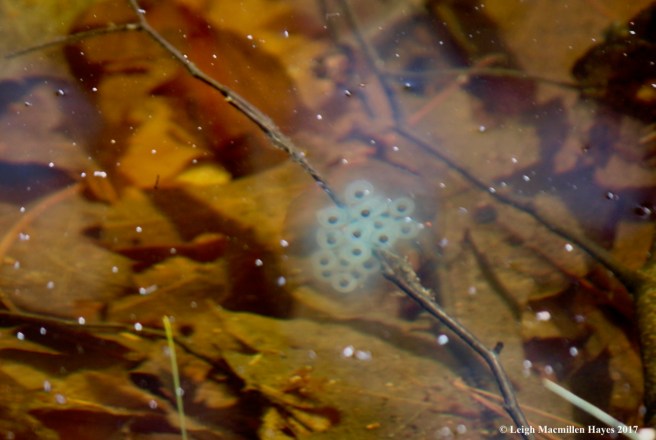
And the book has helped me recognize the difference between those salamander eggs and these wood frog eggs.

In the field, there’s so much more to see, including the invertebrates that inhabit the pool, and ever so slowly I’m learning to identify them as well–you know, predaceous diving beetles, damselfly larvae, water scorpions, backswimmers, water striders . . . the list goes on. Each of them is featured in the back of the book with a photograph and paragraph or two describing their larval and adult forms.

Maine Amphibians and Reptiles, edited by Malcolm L. Hunter, Aram J.K. Calhoun and Mark McCollugh, is my at-home reference book. Well, sometimes it goes for a ride in my truck, but usually, it’s left at home because it’s larger and offers a much more in-depth take on amphibians and reptiles, their habitats and conservation. Besides a photo gallery, each amphibian and reptile that makes its home in Maine is featured, with thorough descriptions, taxonomic status, distribution, reproduction, habitat, diet, and interactions with people and other animals. There are sketches and maps to further enhance the information presented. And it’s all quite readable.

s-MAAR recordings 2 (1)

One of the best features of this book (and unfortunately, mine is cracked) is the CD at the end. Yes, you can actually listen to the individual species so that when you hear them in the day or night, you might begin to recognize them, much as you would a bird, by their voices before you spy them.

In the past few years, the vernal pool that I study frequently, has dried up before the amphibians have matured. I find solace in the fact that even when the pool dries up, the species growing there still provide nourishment and pass on energy to their consumers.

But . . . maybe this year will be different. We had a lot of snow, and now a lot of rain. Maybe this will be the year the amphibians and insects that reside in the pool will actually mature and hop or fly out.

It all begins with MAY.

The Books of May:

A Field Guide of the animals of Vernal Pools, by Leo P. Kenney and Matthew R. Burne, available through the Massachusetts Division of Fisheries & Wildlife’s Natural Heritage & Endangered Species Program.  (Curiously, the copy I own was from the third printing in MAY 2009)

Maine Amphibians and Reptiles, edited by Malcolm L. Hunter, Jr., Aram J.K. Calhoun, and Mark McCollugh, The University of Maine Press, Orono, 1999. (I purchased my copy at Bridgton Books.)

Meeting Old Friends For The First Time

Who are you? And you? And you? Such were the questions everywhere we turned this morning.

I’d picked up a few Greater Lovell Land Trust docents on the way to our Tuesday Tramp location and met a few others at the gate. After our meet and greet, we walked down the road at breakneck speed, not stopping much because we were more focused on catching up.

s-bear scat

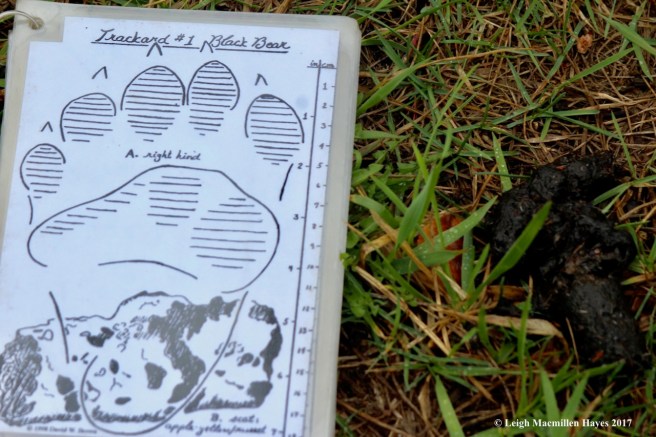
I say not much, but scat did give us pause. And in this place, we can always count on bear scat. Rather fresh bear scat. We never did see the bear, but knowing it was there was enough. Not long after that we listened to a barred owl. And then we flushed a couple of wood ducks that we barely viewed. It was OK with us that we didn’t see these critters–we felt honored to share the place.

s-into the orchard

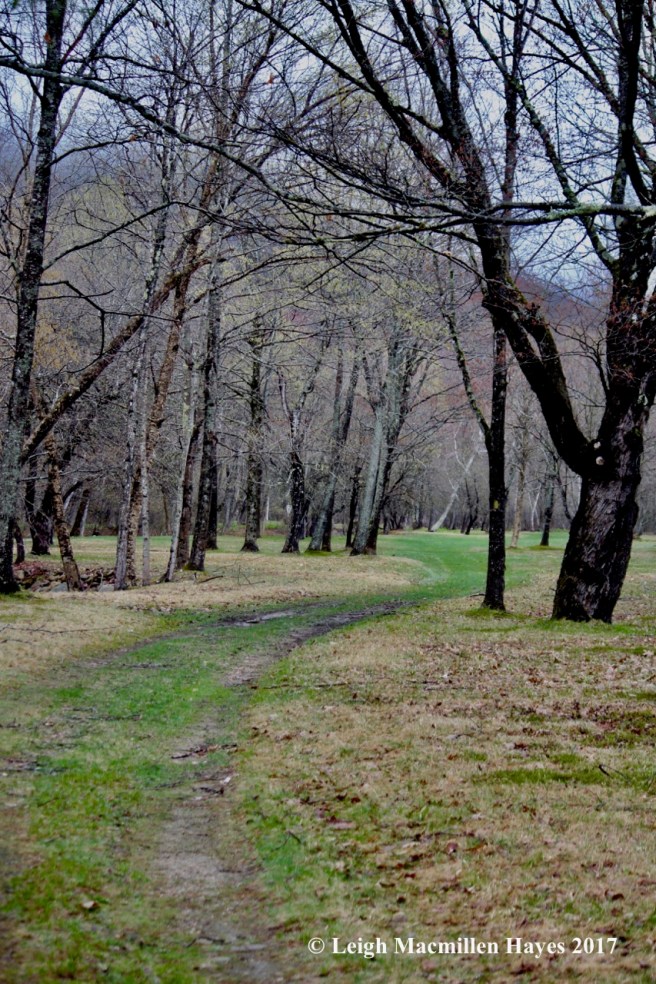
When the dirt road turned to grass, we continued on, anxious to reach our destination just below the cliffs that provided a backdrop to the spring foliage.

s-Rattlesnake Brook

As the brook came into view, our excitement rose.

s-birch reflections

At last, we’d arrived.

s1-slender toothwort

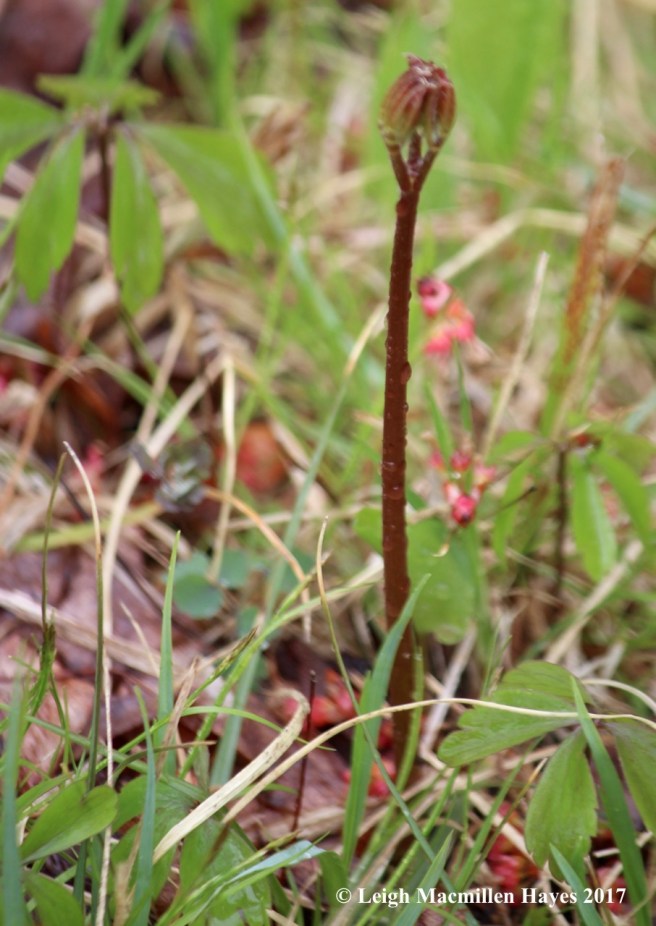
And that’s when the “Who are you?” questions really began to form. The slender toothwort wasn’t yet in bloom, so we had to key it out in Newcomb’s Wildflower Guide based on the compound leaves that were toothed. The flower buds hinted at pink, thus helping us. But really, we felt as if we’d never met this friend before.

s-sarsapirilla

And then there was the young stalk of a wild sarsaparilla. We shared a brain–looks like poison ivy when the leaves first open, three leaves, globe-shaped flower underneath, there’s another form–bristly . . . bristly sarsaparilla. And we suddenly remembered that we knew this friend, which was probably a wild sarsaparilla, the more common of the two.

s-bellwort

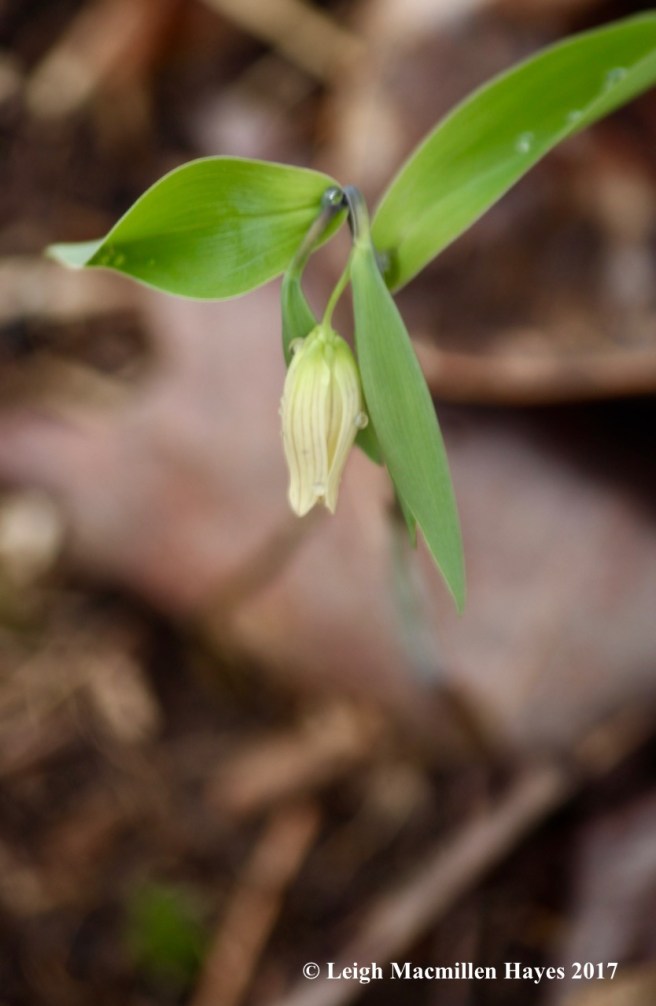
And who next showed its face–drooping in form as its flower did? Again, we had to think it through–finally recognizing it as a sessile-leaved bellwort or wild oat. Of course, once we knew it, we identified it with one amongst our group who first introduced us to it. For the rest of the summer, we’ll know it and will always recognize it as her plant.

s-false hellebore patterns

Then there was the accordion-leaved plant that grew abundantly–its spring green appearance enhanced by rain drops. We knew we knew it. We just had to rack our brains some more, much as one does when encountering any acquaintance not seen in a long time. False hellebore finally came to our tongues.

s1-dandelion

Thankfully there were some that didn’t tax our brains. We’re grateful for dandelions wherever they grow for the bees love them and we love the bees. We need the bees. We NEED the bees.

s-hobblebush 1

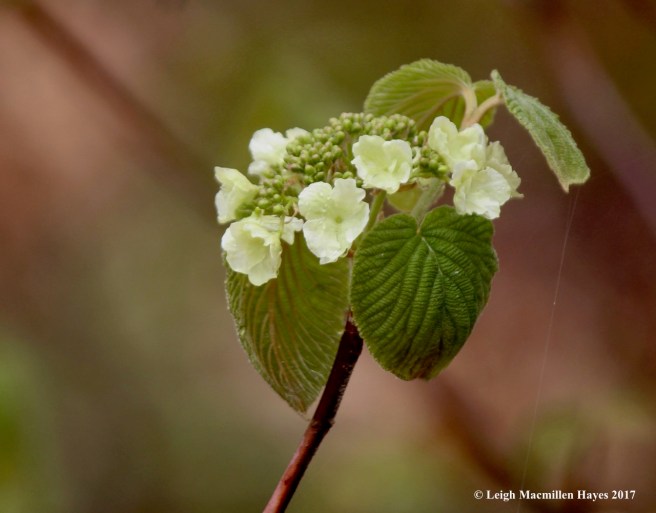
Other friends we could name immediately, but still were happy for the moments spent in their presence, like the hobblebush,

s-red trillium 2

red trillium,

s-dutchmen

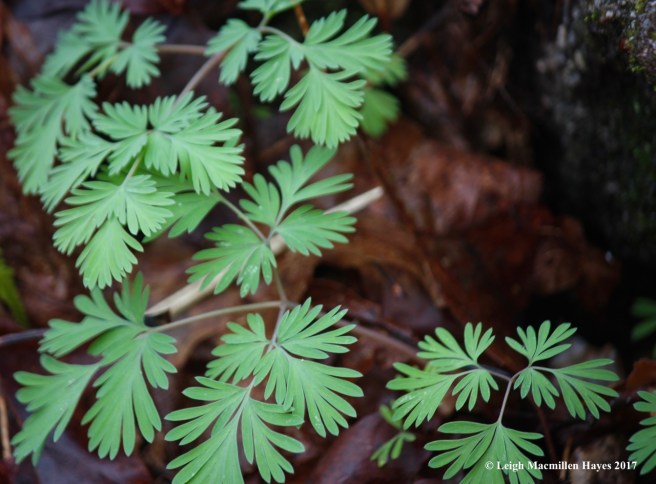
and Dutchmen’s britches,

s-dutchman's britches leaves

plus their feathery leaves.

s-lady fern crosiers

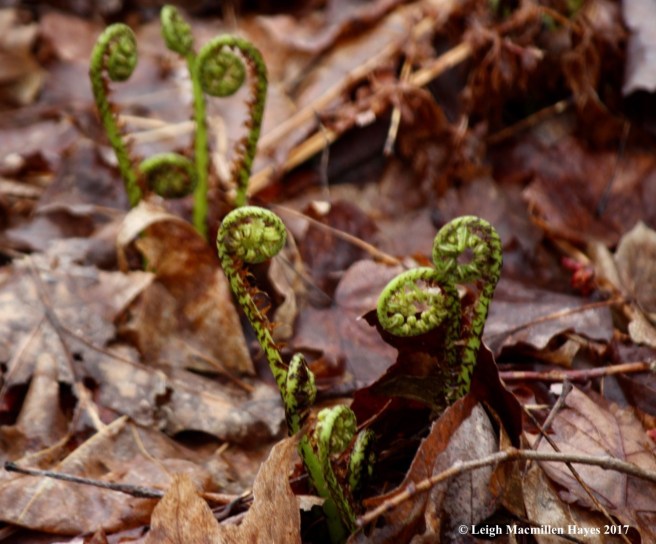
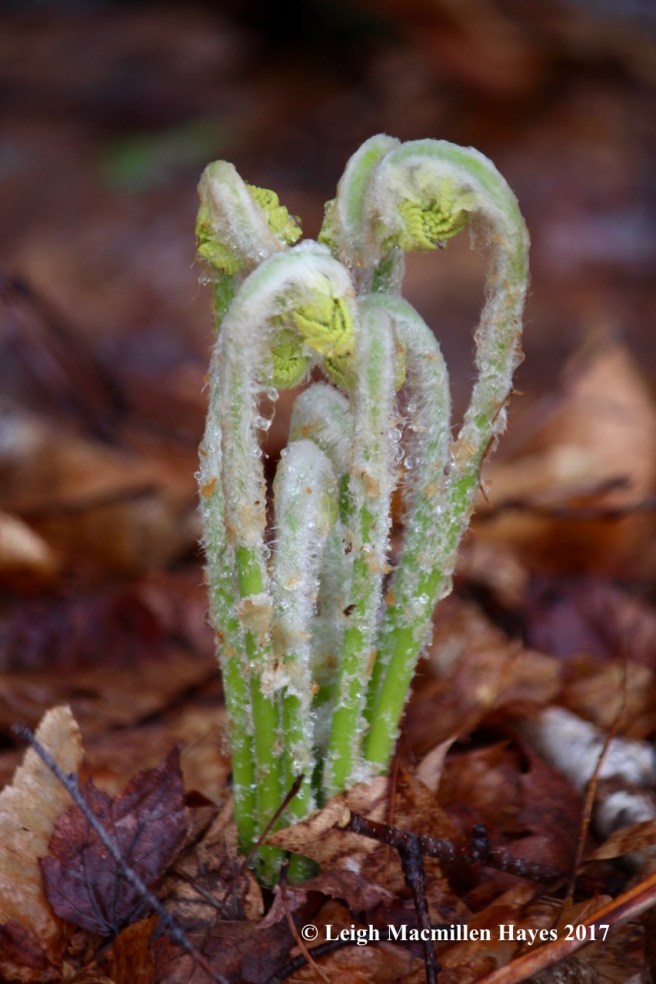
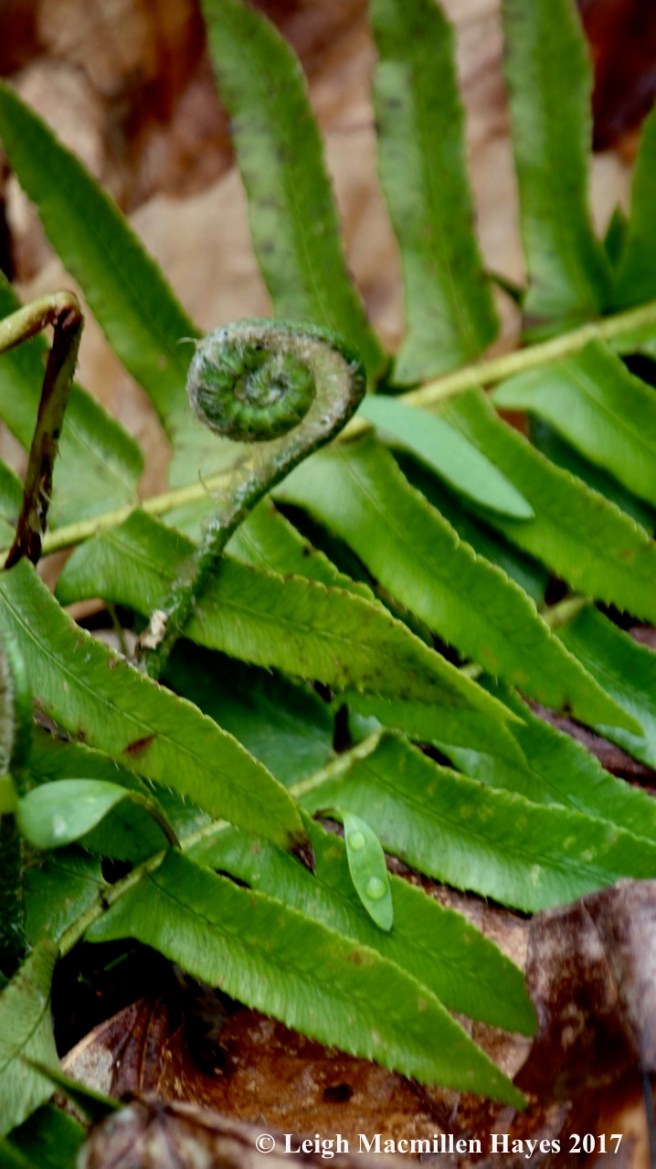
Among our findings, we also had fern crosiers to greet once again, including lady ferns

s-cinnamon or interrupted

cinnamon,

s-Christmas fern crosier

and Christmas.

s-airstrip 1

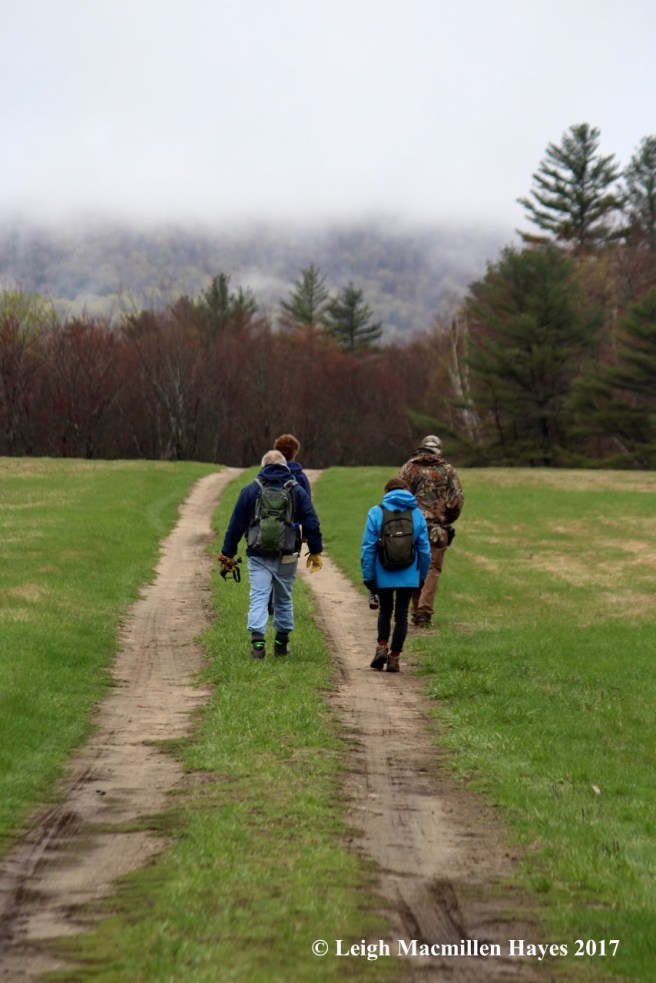
After a delightful-despite-occasional-raindrops, three-hour tour, it was time for us to follow the road back.

s-friends 3
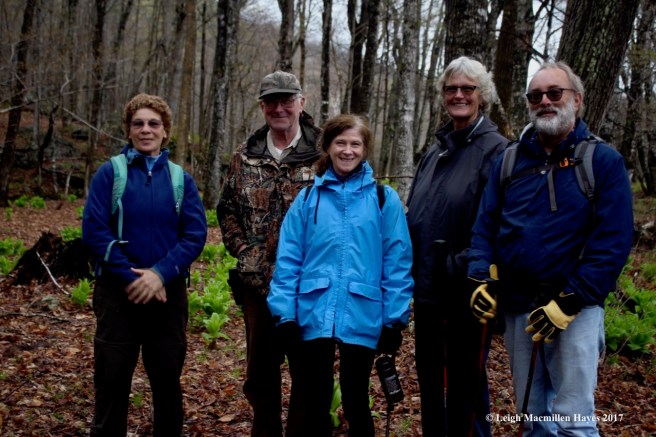
Nancy, Dave, Joan, Pam and Bob

We’d spent the morning among old friends, including two we hadn’t seen for months–we were happy to meet Pam and Bob again for the first time this season. Fortunately, we remembered their names ;-) and they ours. Phew!

As spring unfolds into summer, we know we’ll all continue to meet old friends for the first time–and share a brain as we try to remember their names. They say it takes a village. We love ours because we know it’s okay to ask, “Who are you?” Someone will have part of the answer and someone else will add to it and BINGO.

Water Works

With rain drops come life and rebirth. And so it seems as our world explodes with the return of birds and vibrant blossoms of daffodils in the garden. The grass is, well, grass green–a brilliant green with hues of gold or purple, depending on the time of day. And ever so slowly, tiny leaves emerge on the maples and aspens.

w-rookery

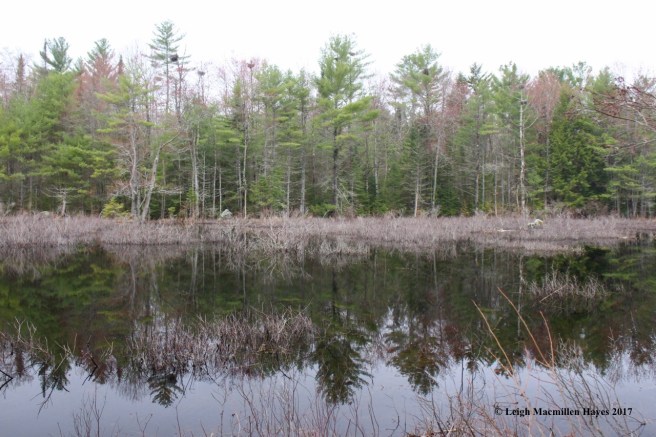
But it’s life in and around water that captured most of my focus today. Following a prehike for a Greater Lovell Land Trust walk, I had the opportunity to check on a heron rookery. A friend and I stood hidden among the trees.

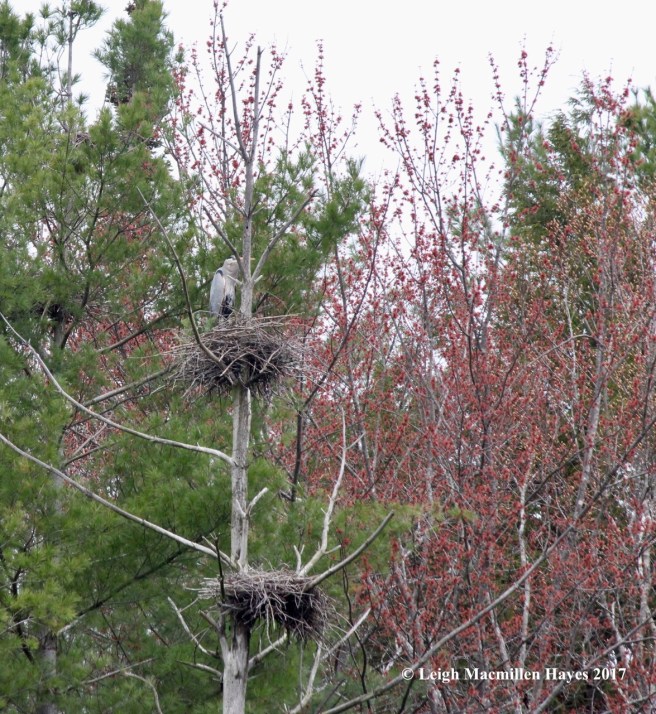
Rookeries are one of my favorite places to hang out. By the same token, I seldom do because its important not to disturb these giant birds during their nesting season. But–today’s visit, like all of my rookery visits, was for a citizen science project affiliated with Maine Inland Fisheries and Wildlife: the Heron Observation Network or HERON, counts on volunteers to count on heron–their nests, number of birds, number perhaps sitting on eggs, number of fledglings, etc.

w-heron incoming

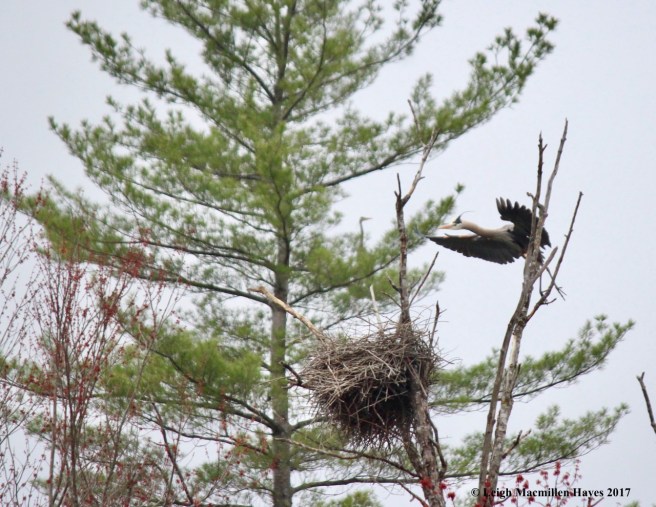
We frequently see Great Blue Herons flying overhead or fishing in ponds and lakes, but it’s watching them come into their nests, in their pterodactyl form, that I find so wild.

w-heron standing

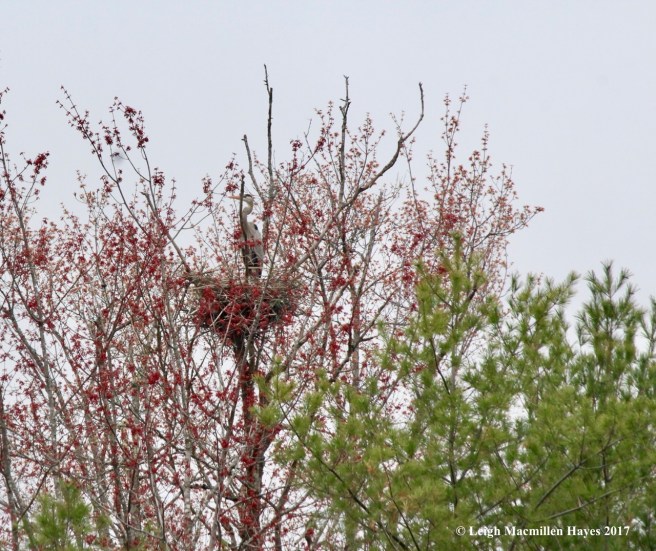
And then they stand. Tall. Silent. We do the same.

w-heron on nest

Watching. Listening. Wondering.

w-reflection

All the while, we have time to reflect and enjoy the reflected.

w-beaver lodge

And notice–cut saplings piled horizontally, an anomaly in this space . . . or is it?  More than herons call this place home.

w-hobblebush

At last we need to bushwhack back, but pause a few times to appreciate other forms of life that spring forth near the water, including this hobblebush.

w-snake 1a

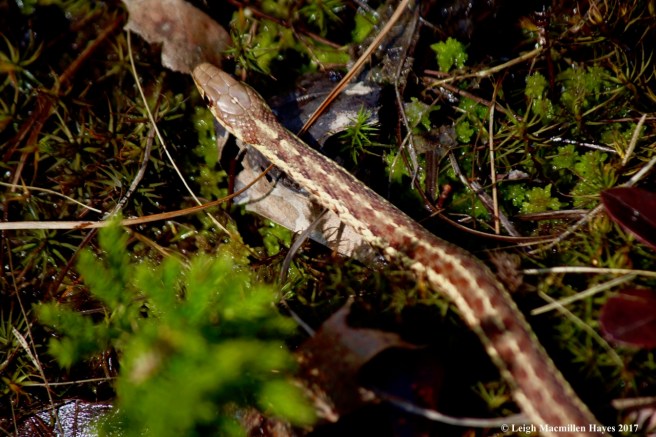
And a garter snake, its movement catching our attention. And then it froze in place, in hopes we wouldn’t notice.

w-vp

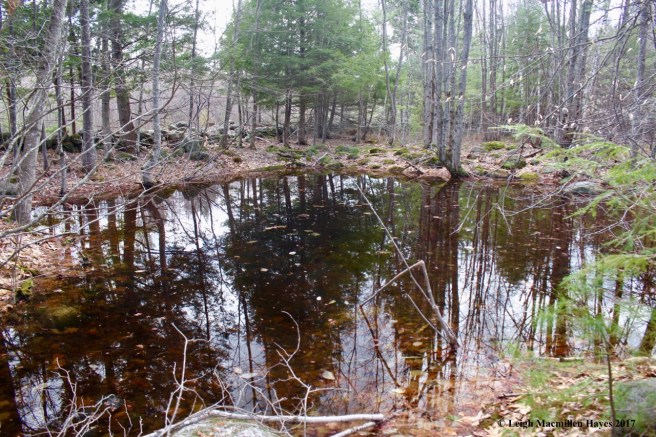
Back on the homefront, I moseyed out to the vernal pool. As I approached, I noticed a lack of sound, but did see movement when I was only steps away.

w-wood frog eggs

I was thrilled to note signs of previous action as the number of wood frog egg masses had increased.

w-sallie eggs

The same was true of the spotted salamander eggs, though the number in each clump seemed quite minimal. The opaque outer coating was clearly visible, that gelatin-like mass that surrounds these eggs.

w-frog eggs?

As I admired all the dropped red maple flowers that decorated the water, I spied something else. Or at least I think it’s something else. Perhaps mere bubbles floated atop the dried leaf, but I suspected eggs of another kind. I’ve never before noticed spring peeper eggs and wondered, could these be such? Here’s hoping Loon Echo Land Trust’s biologist, Paul Miller, will chime in.

w-spring peeper eggs in mix?

From what I’ve read in A Field Guide to the animals of Vernal Pools by Leo P. Kenney and Matthew R. Burne, “tiny peeper eggs may be deposited in small clusters or as single eggs attached to aquatic vegetation.” I placed a red arrow on this photo pointing to a couple more. And there are others in the photo, hiding in a “Where’s Waldo” fashion.

w-water strider and mosquito larvae

Circling around the pool, I noted some mosquito larvae and a few water striders.

But I also came upon one disturbing sight. A dead frog. Only a week ago, a friend in Cumberland discovered four dead frogs in a pool. In an e-mail exchange, Dr. Fred Cichocki explained to her, “Chytrid fungus is one potential and troubling cause of amphibian deaths. Another, and one we should all be aware of and be on the lookout for (especially in southern Maine) is ranavirus. It mainly affects woodfrogs (why no one knows) and primarily in the tadpole stage, where there may be 99+% mortality! The obvious symptoms are hemoragic lesions in the abdomen, and a behavior much like whale beaching, where the infected tadpoles swim onto the shore, turn belly up and expire en masse. Definitive identification requires either DNA sequencing or Electron Microscopic examination of tissue to reveal the characteristic virus particles. Once a pond or pool has ranavirus in it, it is probably impossible to erradicate (except maybe through frog attrition.) Ranavirus epidemics occur worldwide and are spreading, especially here in the Northeast.”

My dead frog was an adult. As were my friend’s. At the pool today, I was once again reminded that nature happens. And that it isn’t always pretty. Thankfully, I did spy a couple of live frogs.

w-snake 5

As I walked away from the pond, another garter snake.

w-snake 2

It was on the hunt.

Life and rebirth–the keys to spring. And sometimes, death so others may eat. But other times, death for reasons unknown. These aquatic sites offer an amazing biodiversity–and leave me with questions and understandings. Water works–I’m just not always sure how.


A Blue Bird Kind of Good Friday

When Jinnie Mae picked me up this morning, our destination was the Narrow Gauge Trail. But somewhere between here and there, she pulled a U-turn and drove to Narramissic Farm owned by the Bridgton Historical Society.

It had been just over a year since I last visited and I wanted to show her the shagbark hickory buds. And maybe even the bear trap.

n-Pleasant Mtn to Narramissic1

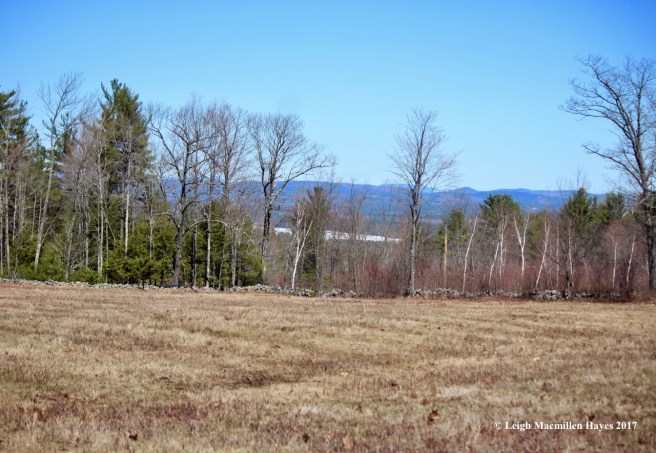
We crossed the field behind the house and started off on the path to the quarry and bear trap, but snow and water in the woods resulted in another U-turn. We’d been talking so much, we’d hardly noticed our surroundings, but the view stopped us in our tracks.

n-Pleasant Mountain

To the left, the long ridge line of Pleasant Mountain, where the ski trails of Shawnee Peak Ski Area made themselves known.

n-Narramissic

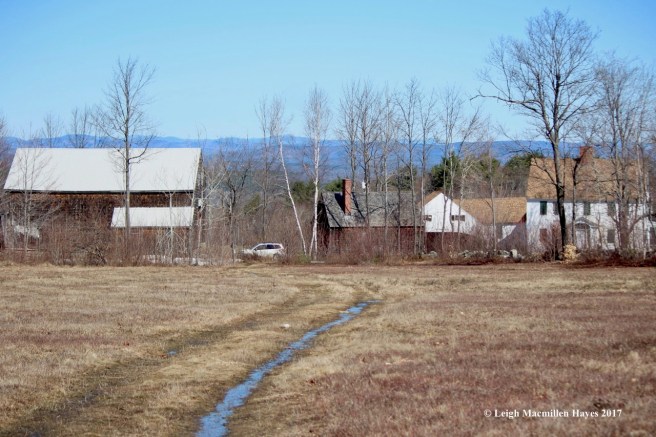
And in front of us, the Temperance Barn and Peabody-Fitch homestead, built in 1797. We had the place to ourselves and reveled in the quiet of the day–when we weren’t talking, that is.

n-shop and flagpole

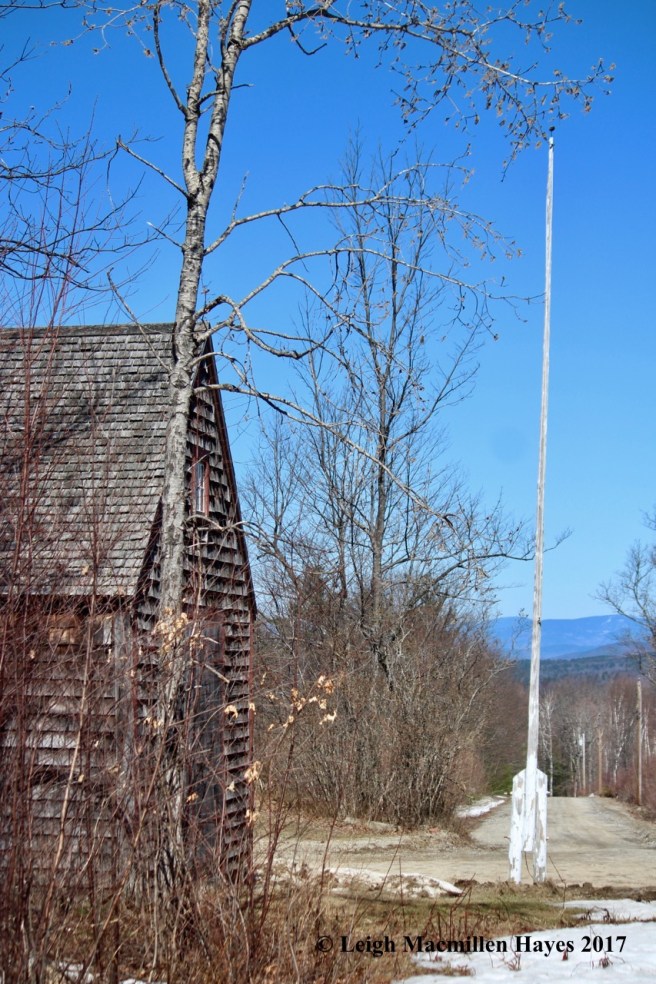
Heading to the road for our tree bud search, we passed by the blacksmith shop where horseshoes were probably made in the day.

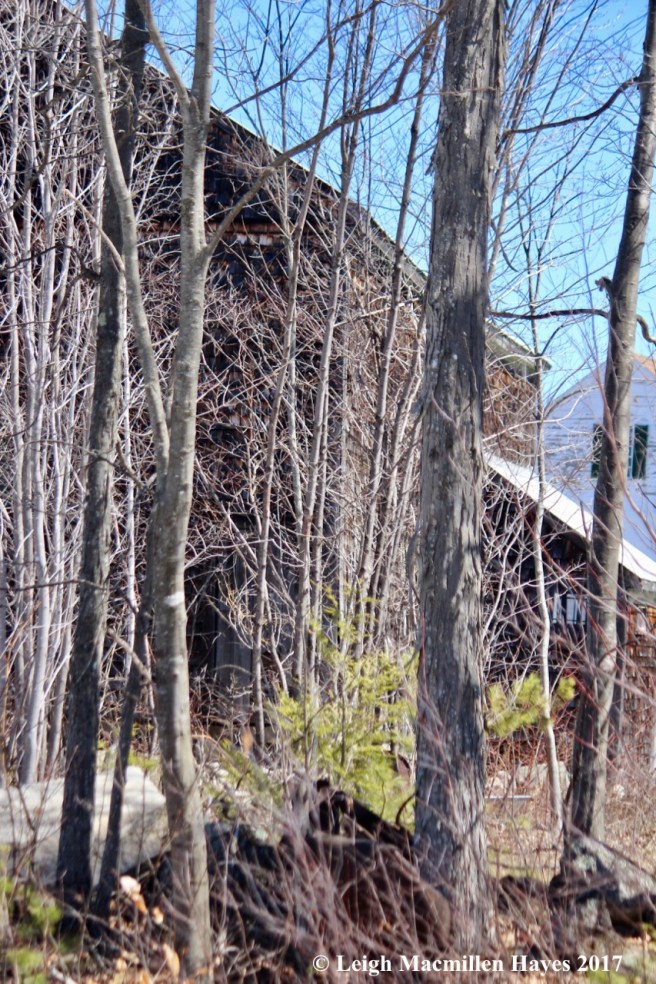
n-temperance barn

And at the Temperance Barn, so named “because it was raised without the traditional barrel of rum,” I can never resist admiring the structure even though it’s in great need of repair.

n-ash tags

And then we were stumped by a flowering tree. It sure looked like an ash as Jinnie Mae suggested, but what were those lacy tips? What came to my mind first were the tags on red oaks that I didn’t understand a few years ago until a friend helped me realize that they were leaf stems left behind when the wind finally claimed the dried leaves. Was this the same?

n-double-wide stonewall

Climbing onto the double-wide wall, I took a closer look.

n-white ash danglers 1

Turns out Jinnie Mae was right. But my question still remains. Were these the stems of the ash samaras or compound leaves?* For some reason I’ve never before seen them left behind. Ah, there are so many things to discover in this world.

n-black walnut 3

We continued down the road, noting budding pussy willows and flowering red maples. And then I spied the bulbous buds I wanted to show her. Only, it turns out that we hadn’t reached the hickory trees yet.

b-black walnut leaf scar 2

The monkey face leaf scar should have been a clue. But my brain was stuck in hickory mode and I completely forgot that black walnut leaves leave such a formation. At home, I pulled out Forest Trees of Maine and then seesawed between black walnut and butternut (aka white walnut). Both feature leaf scars shaped like a monkey’s face. But the top of the leaf scar serves as the give away–this one did not have thick fuzzy eyebrows like a butternut, so I’m going out on a limb and declaring this a black walnut.

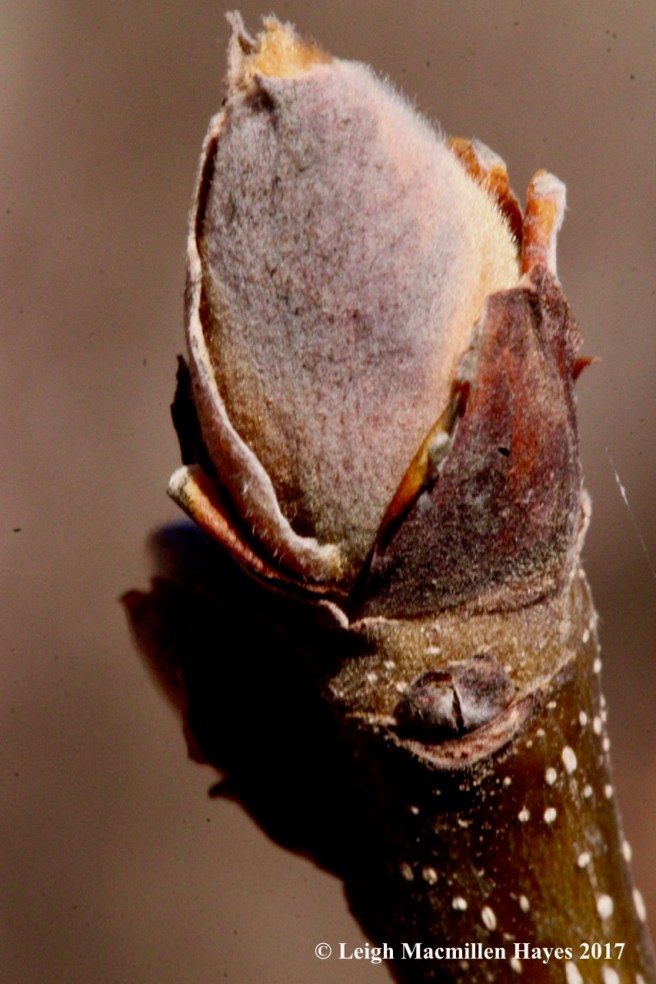
n-shagbark bud hairy 1

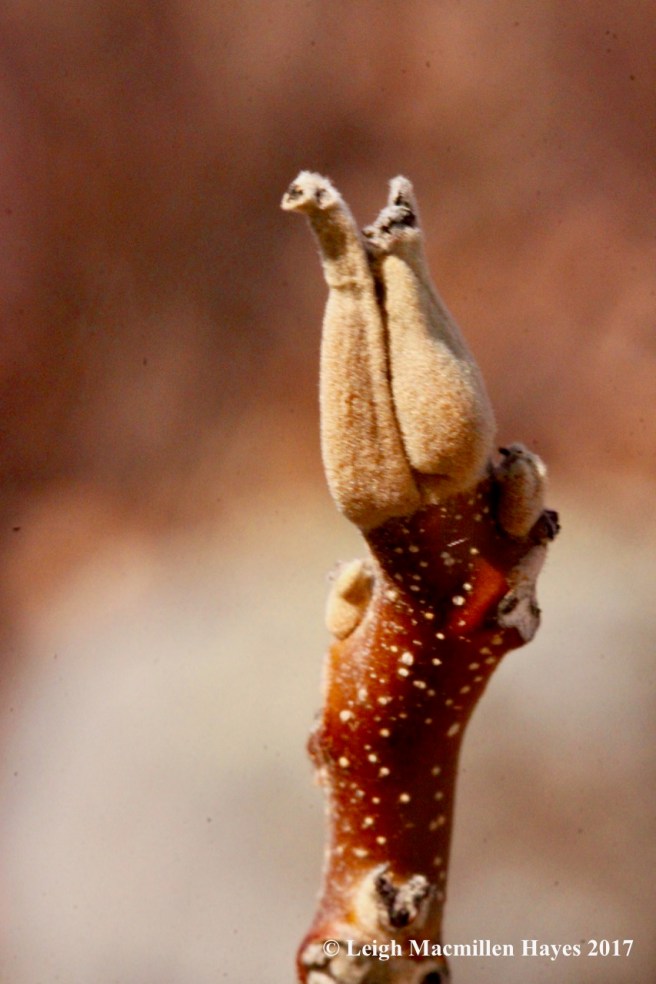
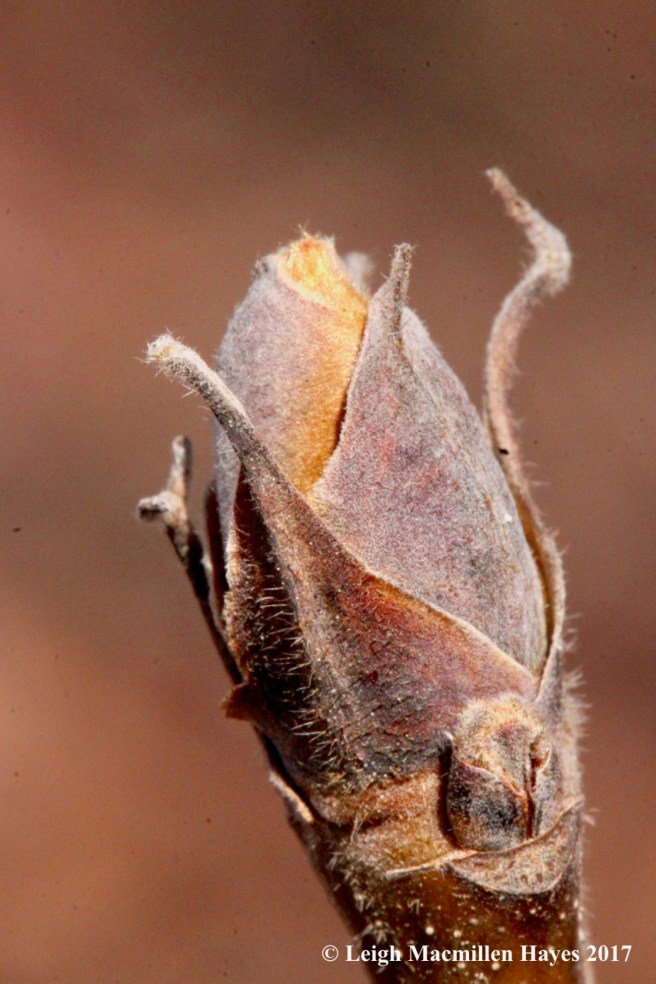
A bit further down the road we spotted more bulbous buds. These were definitely the ones I was looking for–shagbark hickory. In the moment and because the two trees weren’t close together, we thought they were all one in the same. But hindsight being 20/20 as it is, the photographs tell the story.

n-shagbark bud 6

The subtle colors and fuzziness wowed us and we both took numerous photos.

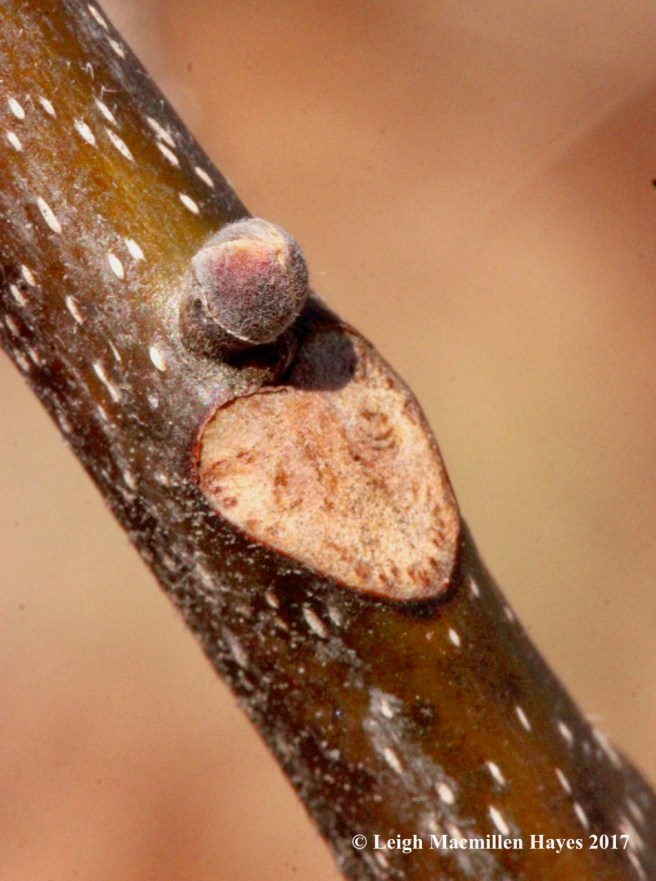
n-shagbark leaf scar1

Then there were the leaf scars–definitely more heart-shaped than the previous trees.  And lacking that smiling face. We smiled for them.

n-Long Lake below

It wasn’t enough to find the small saplings beside the road and so we crossed another field in search of the mother tree.

n-grasshopper 1

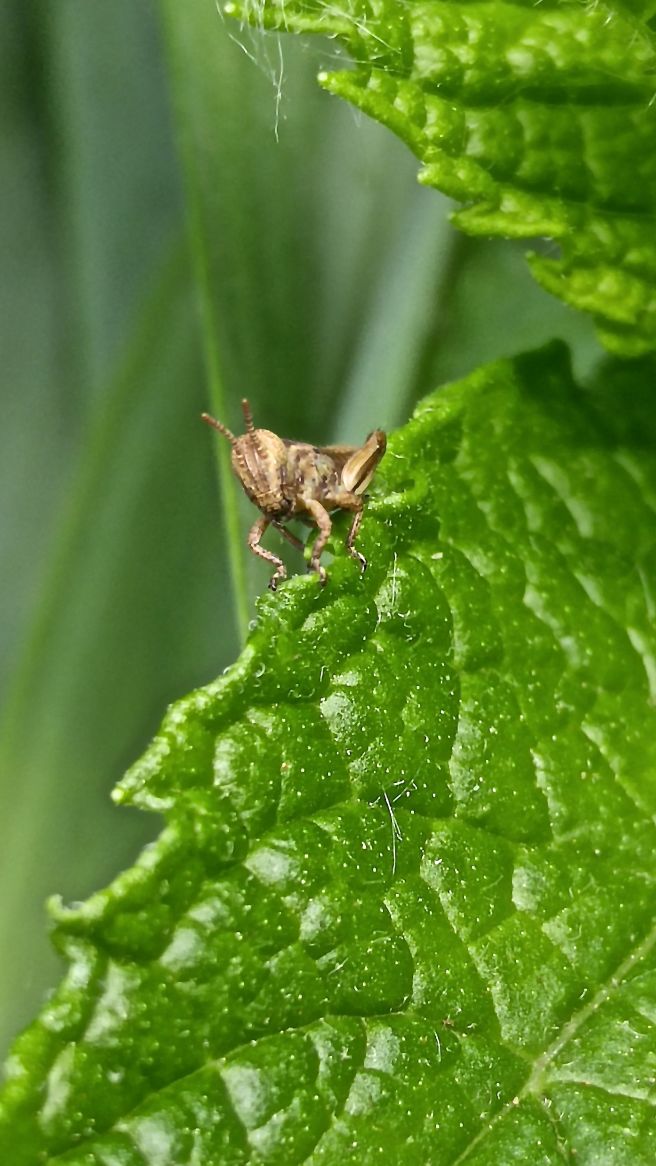
Along the way, Jinnie Mae spotted a wee grasshopper–the first of the season for us.

n-shagbark bark from distance

And then her newly trained shagbark hickory eyes keyed in on the momma.

n-shagbark bark 3

If you go, it’s located behind the barn.

n-shagbark bark 5

And shouts its name in presentation.

n-shagbark bark 4

Looking upward, we could see the bulbous buds on the twig tips contrasted against the bright blue sky.

n-bluebird

Happiness is a blue bird kind of day–sweetened by time spent exploring with Jinnie Mae, making discoveries and watching bluebirds move between the field and the trees. Indeed it was a Good Friday.

Now we need to return and find the mother black walnut.

*Thanks for Maine Master Naturalist Pam Davis for IDing the ash strand as the rachis of the compound leaf. She reminded me that I have seen these on the ground in the fall. But–to be still dangling from the tree was new to my eyes and mind.


Book of April: How to tell the Birds from the Flowers

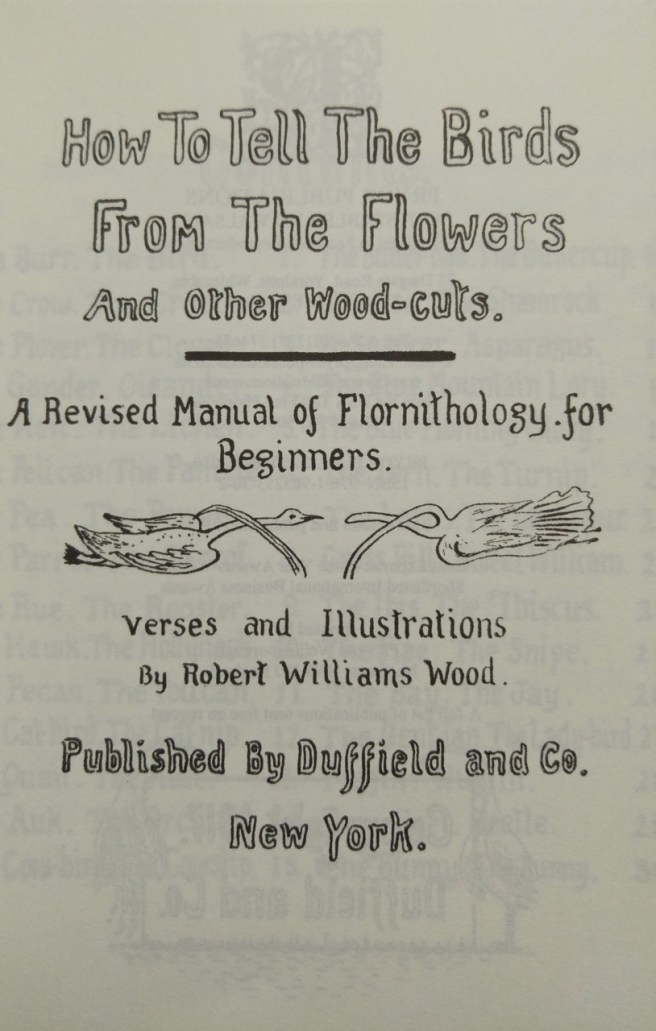
It’s April Fools’ Day and I can’t think of a more appropriate book to share as Mother Nature showers snow upon us than How to tell the Birds from the Flowers and other wood-cuts by Robert Williams Wood.

b-11 (1)

A friend found this delightful little ditty at an independent book store in Brattleboro, Vermont, several months ago and couldn’t resist purchasing it for me. Thank you, A.J. 

Can you see from the cover what Wood had in mind? 

b-9 (1)

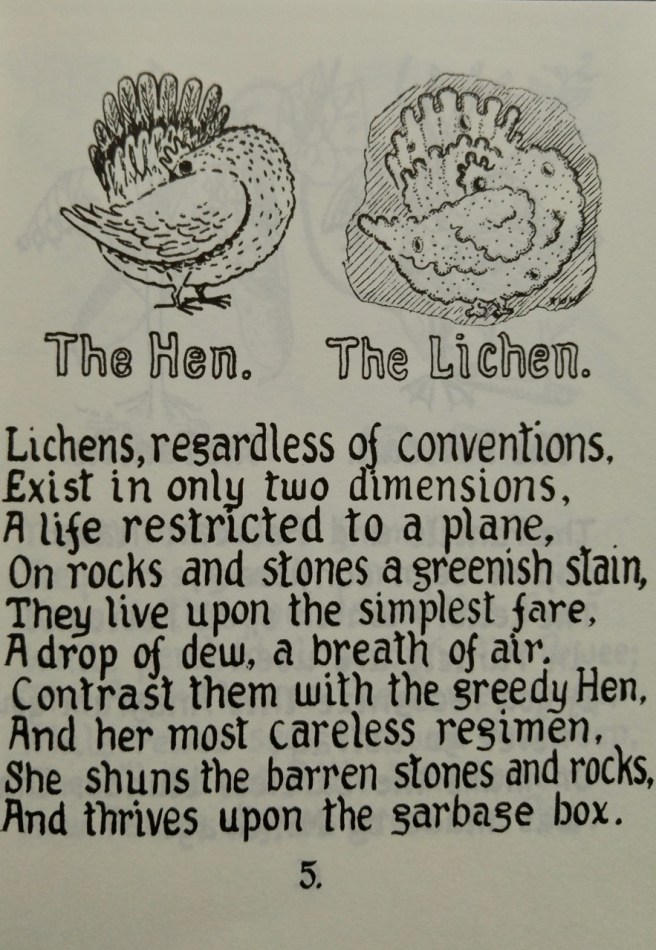
And his language–Flornithology? Oh my. Artistic license met poetic license. 

The first edition was published in 1917–in Kent, England. According to a little research, Mr. Wood was born in England, but went on to become a physicist at Johns Hopkins. And they say (whoever they are) that he had no sense of humor.

Read on: 

b-8 (1)

b-7 (1)

After this introduction, it gets even better (in my humble opinion). 

b-6 (1)

Whimsical rhymes and . . .

b-5 (1)

clever sketches;

b-2 (1)

Similarities and . . .

b-4 (1)

differences.

b-1 (1)

All found in the natural world. 

b-3 (1)

Doesn’t this just make you smile? The man lacked a sense of humor? Hardly.

And we know the Mother Nature also has a sense of humor. This isn’t the first time it has snowed on April first.

At the back of the book is a list of other facsimile reissues from Pryor Publications. Here are a few titles worth considering: Punishments in the Olden Times, Manners for Women, Manners for Men, A Plain Cookery Book for the Working Class and Why Not Eat Insects.

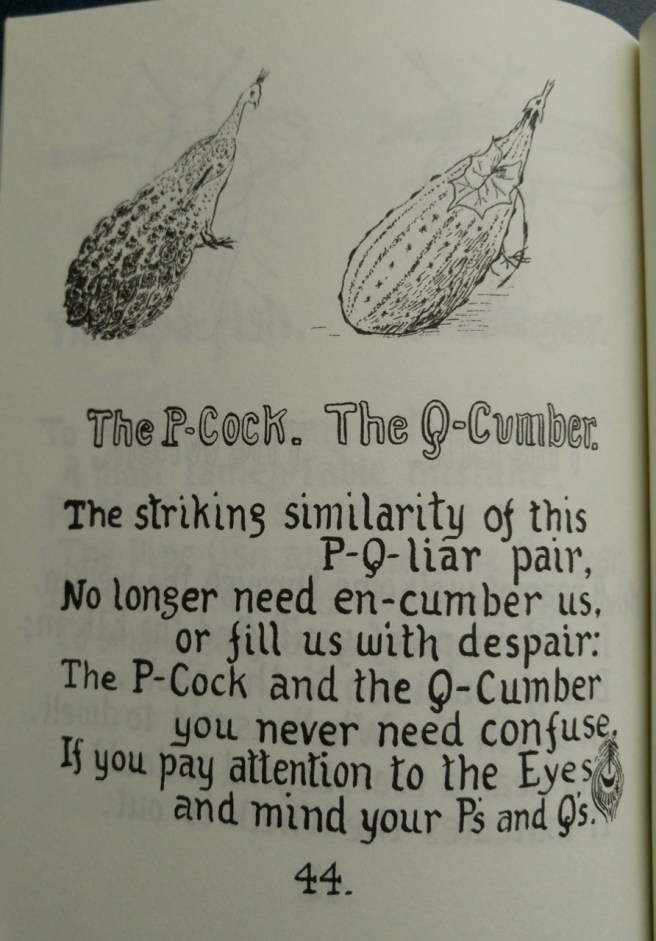
And on the back cover: “This updated edition originally published in 1917 now includes how to tell ‘The Eel from the Elephant,’ ‘The P-Cock from the Q-Cumber’ and ‘The Elk from the Whelk’ to name but a few. This book will be invaluable to those who are short sighted or just plain confused, the rest of you may even find it amusing.”

I think I fall into the latter group and that’s what A.J. had in mind (right?) when she gifted it to me because I find it quite amusing. 

Happy April Fools’ Day. 

How to tell the Birds from the Flowers and other wood-cuts (is he referring to himself?), versus and illustrations by Robert Williams Wood, 1917.

Tickling the Feet

I don’t often write about indoor events, but while the rest of the world was out playing in the brisk wind of this late winter day, a few of us gathered inside the community center at Two Echo Cohousing to meet some feet.

f-dorcas-and-sally

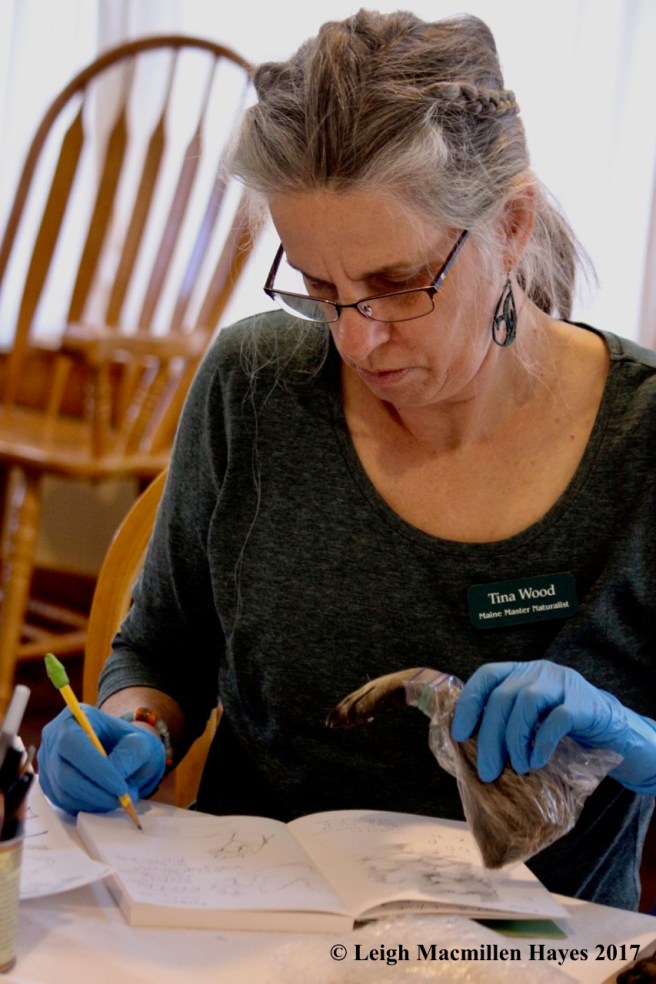
Meet the feet? Yes, mammal feet. It was an Advanced Seminar prepared for students and graduates of the Maine Master Naturalist Program by one of our founders and past president, Dorcas Miller.

f-gaby

Dorcas has gathered mammal feet from road kill and gifts. And we gathered to take a closer look at them, determine if their stance was plantigrade (walking–entire foot on ground as we do), digitigrade (tip-toeing like a fox or coyote), or unguligrade (en pointe in ballet, like the ungulates–deer, moose, sheep), and sketch what we saw.

f-tina

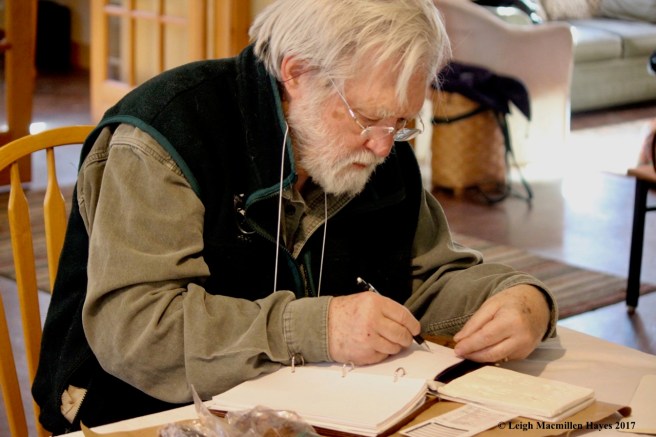
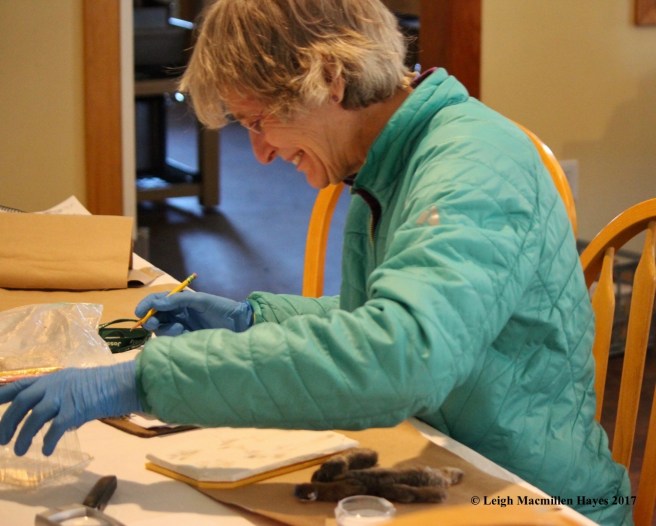
Sketching is a fabulous way to take a closer look.

f-mary

And so we did,

f-fred

with intensity,

f-beth-b

curiosity,

f-christy

smiles,

f-cheryl

and giggles.

f-gordon

From tiny

f-beth

to big, we had them all to study.

f-sharon

We wondered what we’d find.

f-ruth

And survived some interesting scents (think skunk).

f-susan-penny

Probably the best part was that we renewed friendships formed through a combined interest in learning about the natural world.

f-raccoon-1-1

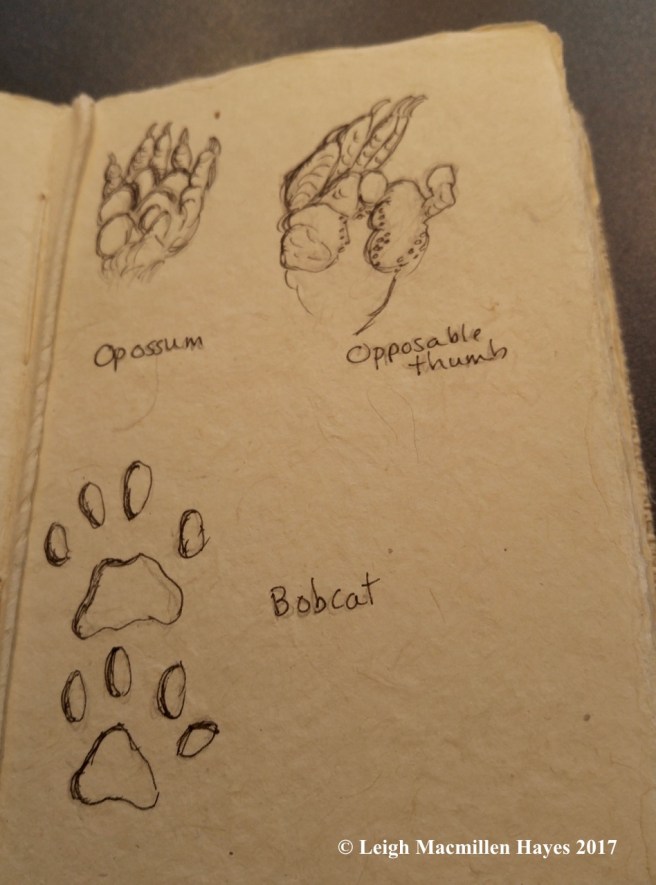
My own sketches were rather primitive.

f-muskrat-1-1

But it was noticing the details that appealed to me most.

f-opossum-2-1

One of my favorite pairs–the opossum with its opposable thumb, puffy pads and grip bumps.

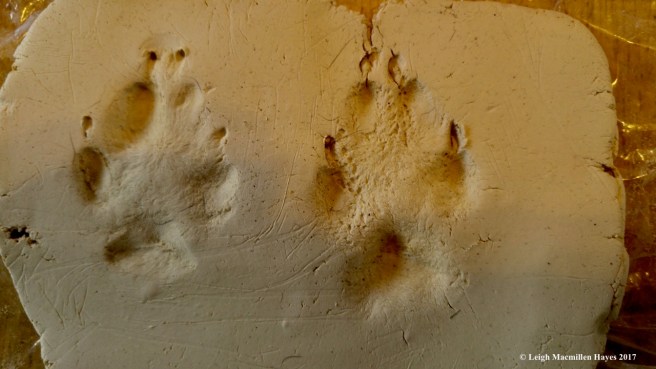
f-opossum-cast-1

When we finished sketching, we made some casts in clay. These illustrate the opossum better than I ever could.

f-red-fox-cast-1

My final cast was the red fox–I love that the chevron shows in the print on the left and the hairiness of its feet is evident.

f-cover-1-1

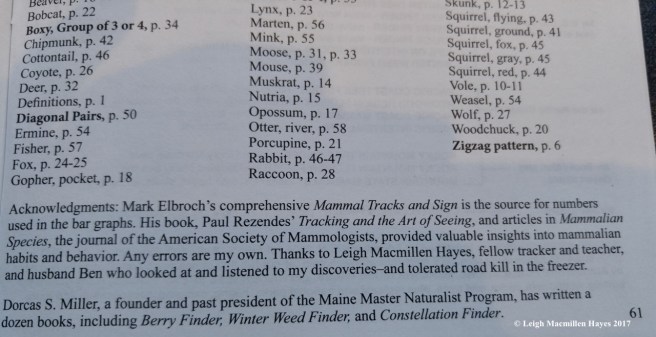
At the end of the seminar, we celebrated the release of the second edition of Track Finder, written by Dorcas.

f-dorcas-feet

And coveted her bear claw shawl–a gift from her guy.

f-attribution-1-1

As she gave me my signed book, she told me to take a look at the Acknowledgements. She acknowledged me! I’m not sure why, but I’m certainly humbled and honored.

I also love her note to her guy–about the road kill in the freezer.

Yup, we stayed indoors today and tickled some feet. They tickled us back.


Book of March: Upstream

As friends often do, one, whom we fondly call Señora because she was our sons’ high school Spanish teacher, recommended a book to me.

And as I often do, I visited my favorite independent bookstore, Bridgton Books, took a quick look and made a purchase.

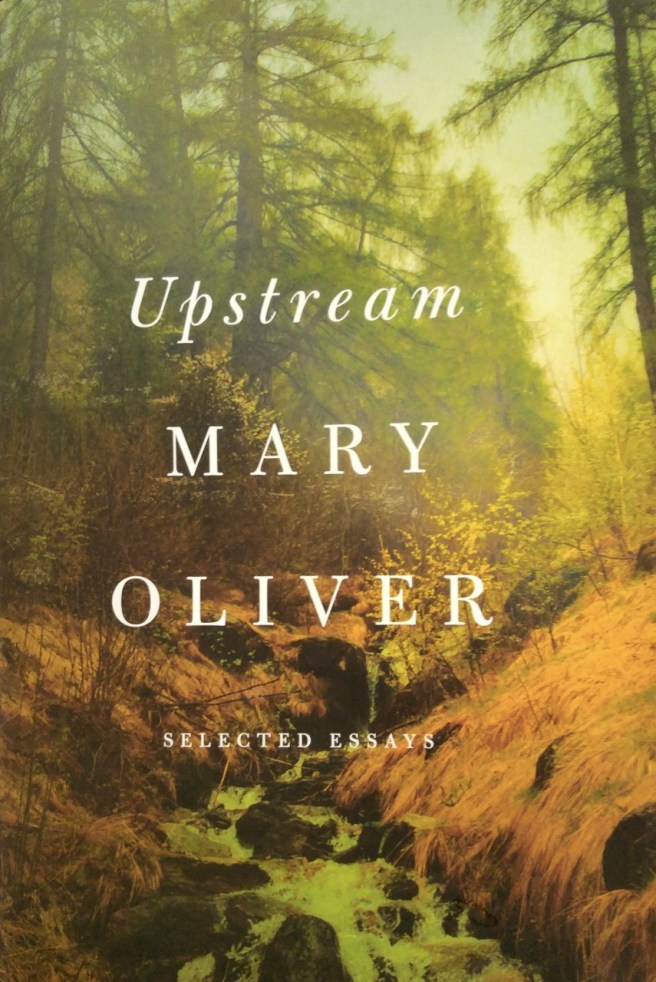
m-cover-1

Book of March: Upstream

Upstream by Mary Oliver is a collection of essays, many which she previously published elsewhere. In 175 pages, the essays span a lifetime of writing–but even more so a lifetime of living. And noticing. And contemplating. And wondering. And making connections. And wondering some more. But all the time, believing, even in that which she could not see or quite comprehend.

She speaks to the writing process, a process I have embraced for what seems like forever. Only a few minutes ago I shared with a friend that a final draft is never really final. Each time we return to the words, we find other ways of playing with them.

She speaks to the natural world that she has spent a lifetime observing and recreates it on the printed page with elaborate detail. And so, with each sentence, I travel beside her, whether she wants me to or not, for Ms. Oliver embraces solo moments of exploration. I get that.

She speaks of Emerson and Whitman and Wordsworth and Poe. And actually, about the latter, she turns my head for she writes about him with such compassion.

She speaks of the reality of the universe and reminds us to exist. She is. We are.

She speaks of observing a mother spider and her egg sacs in the cellar of a rented home over the course of several months, and I sense her wonder. As a child, I was afraid of those cellar spiders. As an adult, I’m intrigued by them.

And so today, I took Ms. Oliver with me when I stepped into the woods.

m-fog

It was a snow-eating foggy  sort of day and the dampness grazed my cheeks.

m-preweb-raindrops-and-crosses

As my snowshoes slapped the hardened snow pack, rain drops drew my focus. On this particular pine sapling, I was drawn to the crosses formed by raindrops and needles, which seemed apropos given that today is Ash Wednesday. And then I noticed the spider silk.

m-web-1a

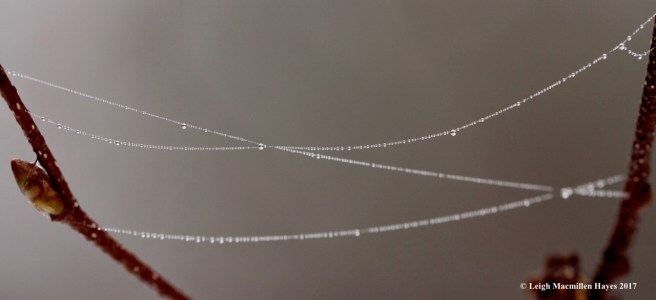
Every where I turned, long beaded strands of miniature raindrops connected one branch to the next.

m-web-connections-2

What I soon realized, however, was that the strands weren’t merely on single trees. Each tree was connected to the next throughout the forest. As I moved slowly about, I inadvertently snapped some of those lines and felt a sense of sorrow for all that work lost.

m-leaf-attachment

And because I was looking, I found other curious sites that I didn’t expect. That is one of the take-away messages of Ms. Oliver’s book–get outside and even if you are searching for something specific that you may not find, it’s what you see along the way that is more important.

m-page

As I often do when a book such as this one pulls me in, I turn back the bottoms of pages to remind myself that there are passages I will want to revisit. If the corner is turned back and back again, as this one, it means there is something to reread on this page and the one to follow.

For me, Upstream is that type of a book. It’s broken into five sections. Ah, the word broken–it doesn’t feel right in that last sentence because there is nothing broken about the book. Perhaps divided is a better word. Or maybe there’s another that will come to me eventually. That’s the thing about the writing process–it’s never final as I said above. Anyway, I found myself relating to each section with a different part of my soul.

m-rain-drop-globe

And give thanks that Ms. Oliver chose to share her reflections in this manner. I also thank Señora for the recommendation.

Upstream by Mary Oliver, Penguin Press, 2016

The Second Anniversary of Wondermyway

Milestones are always important as they mark significant events in our lives. And for me, such an event occurs today as I celebrate the second anniversary of the day wondermyway.com was born.

Since I was in elementary school and made few and far between entries into a chunky journal bound in a green cover (which I still own), to the first empty book journal my sister gave me when I graduated from high school, to a variety of travelogues and other journals I’ve filled from cover to cover,  I’ve recorded my life’s journey from time to time.

The most satisfying for me has been this very blog, to which I’ve added numerous events and discoveries, both natural and historical, over the last two years. As personal as it all is, I’ve taken a leap of faith by sharing it with you. And you have been gracious enough to read it, and comment on it, and “like” it, and sometimes “love” it, and offer me suggestions, corrections and gentle nudges.

Thank  you for following along on the journey. It’s been scary to put myself out there, but I have.

And now, I thought I’d review some favorite finds I noted in posts over the past year. My learnings have been many and it’s been fun to review all that I’ve seen and thought and admired and wondered about. I hope you’ll feel the same and will continue to follow along and comment and share those that you enjoy with your family and friends.

Here’s my countdown , or maybe I should say my count up of favorite moments in time over the past year:

Feb 21, 2016: Celebrating a Year of Wonder-filled Wanders

b-sit spot

b-sketch 1

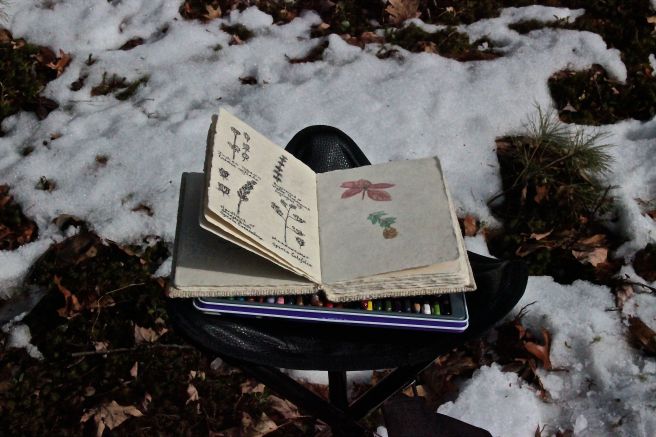
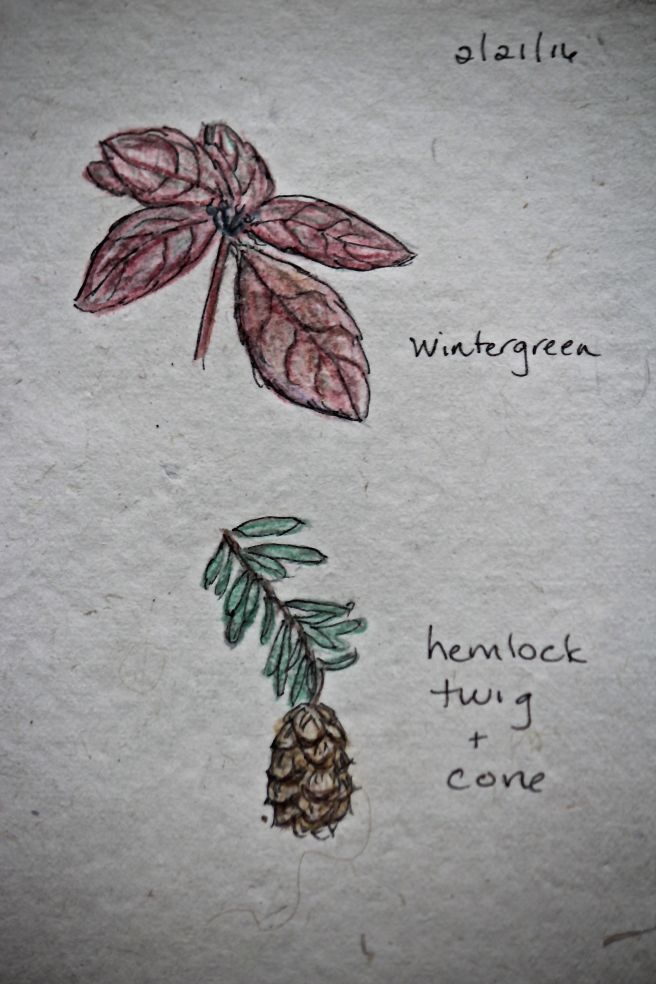
I made time one year ago to sit and sketch–one of my favorite activities. To be still and embrace life around me. To notice. And commemorate.

February 28 2016: Gallivanting Around Great Brook

h-yellow and white partners

Usually, we drive the forest road in to the gate on Hut Road in Stoneham, but in winter it isn’t passable, and thus one must walk–which means paying attention to things you might not normally notice, such as this: a special relationship between a yellow birch and a white pine. Rooted in place, they embrace and share nutrients. Forever conjoined, they’ll dance through life together.

March 18, 2016: On the Verge of Change

b-panellus stipticus?

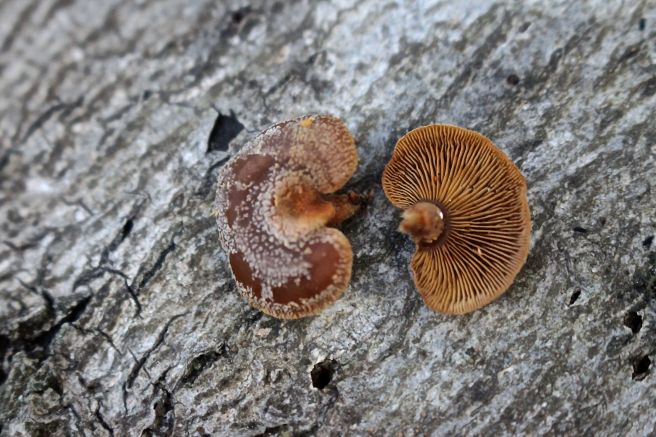
While exploring the Greater Lovell Land Trust‘s  Back Pond Reserve in Stoneham with my friend, Parker,  who is a master mycologist, he found Panellus stipticus, a bioluminescent species. Check out those gills on the underside. According to Lawrence Millman in his book Fascinating Fungi of New England, ” . . . specimens in the Northeast glow more obviously than specimens in other parts of North America.” So if you are ever in these woods late at night, don’t be freaked out by a light greenish glow. It just might be nature’s night light.

March 22 2016: Wet Feet at Brownfield Bog

b-pellet

When I first spied this lump of gray I assumed it was a dead mouse. I know, I know–I should never assume because I risk “making an ass out of u and me.” And so I took a closer look. And noticed tons of bones and those orange teeth. An owl pellet filled with the remains of dinner. Owl pellets are extra cool and dissecting one is even cooler. I collected this one but haven’t dissected it because I think it makes for a great teaching tool as is. If you want to see it, just ask.

April 13, 2016: So Many Quacks

v-egg mass 1

At the vernal pool, or frog pond as we’ve always fondly referred to it, just steps from our property, I kept a keen eye on the situation last spring. In general, each mass laid by  female wood frogs was attached to a twig or branch. They tend to take advantage of the same site for attachment and usually in a warm, sunny spot.

A couple of masses were positioned independent of the rest, like this one–embraced in oak and maple leaves. Eventually, they’ll gain a greenish tinge from algae, which actually helps to camouflage them. One of the many wonders is that any given mass may contain up to 1,000 eggs–from a two-to-three-inch frog.

April 28, 2016: The Big, The Little and Everything in Between

b-bear2

The phone rang as I stepped out of the shower and a male voice yammered away about something in the snow and it had come last night and I had to get there quickly. My friend, Dick,  was standing in a friend’s yard about a half mile from here and looking at bear tracks in the snow.

As he knew he would, he had me on the word “bear.” His voice was urgent as he insisted I stop everything and get to his friend’s house. “I just need to dry my hair and then I’ll be right there,” I said. Deadlines loomed before me but bear tracks won my internal war. Dick suggested I just wrap a towel around my head. Really, that’s what I should have done because my hair has no sense of style whether wet or dry, so after a few minutes I said the heck with it and popped into my truck, camera and trackards in hand.

May 21, 2016: Wallowing in Wonder

p-ph dragon ending 4

Along Perky’s Path at the GLLT’s Heald and Bradley Ponds Preserve, a bunch of us had the honor to watch a dragonfly split open its exoskeleton and emerge from the nymph stage. Of course, we were standing by a beaver pond, and so it seemed only appropriate that it would use the top of a sapling cut by a beaver. As it inflated the wings with blood pressure, they began to extend.

May 31, 2016: Slippers Fit for a Princess–Including Cinderella

p-ph lady y 15

Members of the Orchid family, lady’s slippers feature the typical three petals in an atypical fashion. The pouch (or slipper or moccasin), called the labellum, is actually one petal–inflated and veined. With a purplish tint, the petals and sepals twist and turn offering their own take on a ballroom dance. From every angle, it’s simply elegant.

June 10, 2016: The Main(e) Exotics

snake2

At Lakes Environmental Association‘s Holt Pond Preserve, a friend and I had moved from the swamp to the first hemlock hummock and chatted about natural communities when suddenly we realize we were being hissed at. Its coloration threw us off and beautiful though it was, the hairs on the back of our necks stood on end. Apparently we made it feel likewise. And so we retreated. It was a common garter, but really, there didn’t seem anything common about it in the moment.

June 18, 2016: Paying Attention

partridge berry

j- trailing 2 (1)

j-  trailing 7 (1)

In May, trailing arbutus wowed us by its gentle white and pale pink flowers. In June,  they faded to a rusty tone. And some transformed into swollen round seed pods–a first for me to see.

The sepals curled away to reveal the white fleshy fruit speckled with tiny brown seeds. It was well worth getting down on knees to look through a hand lens–especially since ants, chipmunks and mice find these to be a delicacy so they wouldn’t last long.

July 9, 2016: Wondering About Nature’s Complexity

img_1364-1

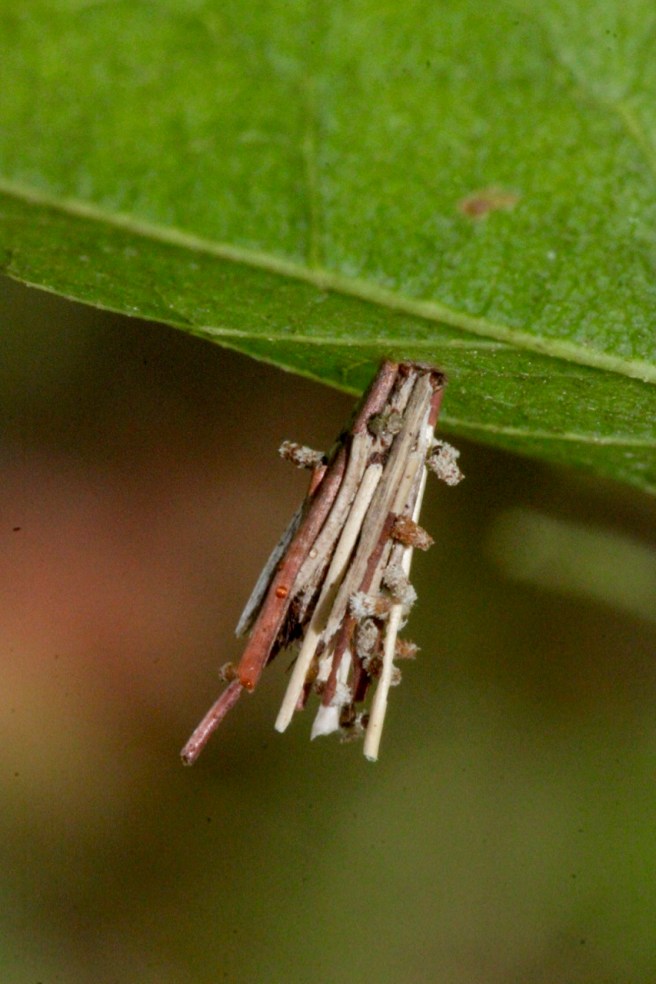
I posed a question this day: So dear reader, I enjoy teaching you, but now need you to teach me. I found this under another leaf on a shrub. And I often see the same thing stuck to our house. It reminds me of a caddisfly case. What is it?

And fellow Master Naturalist Pam Davis responded: Check out bagworm moths to see if it might be an answer to the stick thing on the leaf and your house. Here’s a discussion: http://nature.gardenweb.com/discussions/2237505/not-a-bug-maybe-a-gall and a Wikipedia link: https://en.wikipedia.org/wiki/Bagworm_moth

Indeed.

July 27, 2016: Searching for the Source of Sweetness

w-frit 2

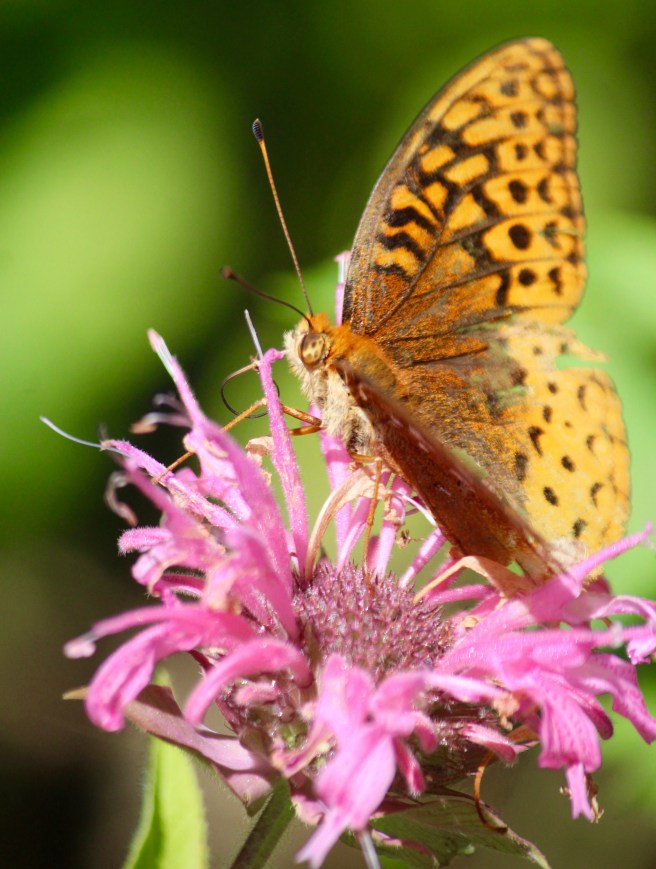
It was no mistake the this fritillary butterfly chose the beebalm on which to land. Check out its mouth. A butterfly feeds through a coiled mouth part called a proboscis. When not in use, the proboscis recoils and is tucked into position against the butterfly’s head.

August 21, 2016: Sundae School

n-Indian pipe bee 1

My lessons began immediately. What to my wondering eye should appear, but a bee pollinating an Indian Pipe. And in the middle of the afternoon. Huh? I’ve always heard that they are pollinated by moths or flies at night. Of course, upon further research, I learned that bees and skipper butterflies have been known to pay a visit to the translucent flowers. Add that to the memory bank.

August 27, 2016: Halting Beside Holt Pond

h-pitcher  flower up close

Halting–prone to pauses or breaks. I didn’t break, but I certainly was prone to pauses as I moved along the trails and boardwalks at the Holt Pond Preserve in South Bridgton. One of my first stops–to admire the pitcher plant flowers in their August form. When I took a closer look, I realized that the seeds were developing–certainly a WOW moment in the world of wonder.

September 9, 2016: Golden Rulers

g-assassin-1

What first caught my eye was a bee that dangled upside down. And then I spied the green legs of an assassin bug. What? Yup, an assassin bug. I believe this one is a nymph. Regardless of age, here’s the scoop: Assassin bugs are proficient at capturing and feeding on a wide variety of prey. Though they are good for the garden, they also sometimes choose the wrong species like this bee. The unsuspecting prey is captured with a quick stab of the bug’s curved proboscis or straw-like mouthpart. Once I saw this, I continued to return for a couple of hours, so stay tuned.

September 15, 2016: The Wonders of Kezar River Reserve

k-ruby-1

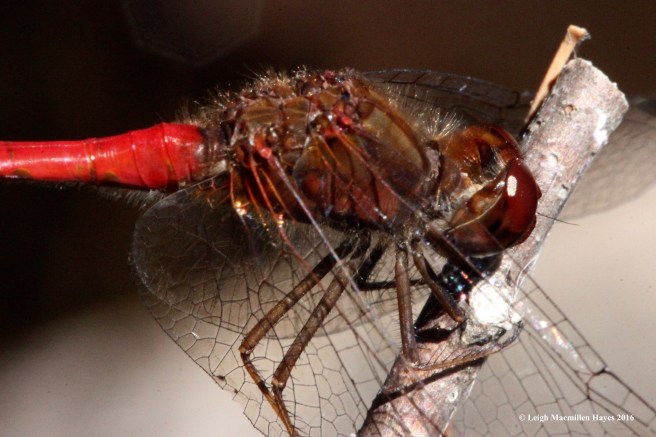
My favorite wonder of the day . . . moments spent up close with a meadowhawk.

October 17, 2016: Everybody Loves Raymond? Mondate

r-mushroom-growth

My guy and I discovered several of these examples of fungi on fungi at Loon Echo Land Trust‘s Raymond Community Forest and had no idea what they were–so I sent the photos to Parker and Jimmie Veitch, of White Mountain Mushrooms, and Jimmie responded with this explanation:

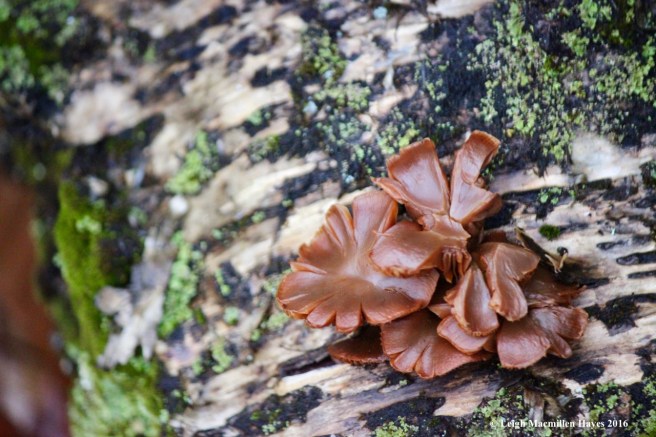
“That’s what mycologists call “rosecomb” mutation, where a mushroom’s gills start forming on the cap in a really mutated fashion. It’s been reported in many mushroom species but I haven’t seen it in this one (Armillaria AKA honey mushrooms). As far as I know, no secondary fungus is involved.

The suspected cause (not so nice) is ‘hydrocarbons, phenols and other compounds contaminating the casing or contacting the mushroom surface. Diesel oil, exhaust from engines, and petroleum-based pesticides are thought to be the principal source.'”

October 22, 2016: Cloaked By the Morning Mist

u-candy-2

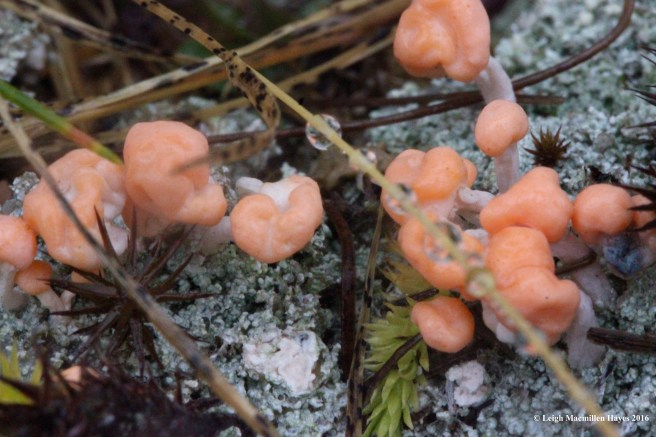
On a rainy day adventure with the Upper Saco Valley Land Trust in nearby New Hampshire, we paused to admire candy lichen, a crustose (think–flattish or crust-like) lichen with green to bluish-green coloration. Its fruiting bodies, however, are candy-pinkish berets atop stalks, even reflected in the raindrops.

November 6, 2016: Focus on the Forest Foliage

j-lichens-galore

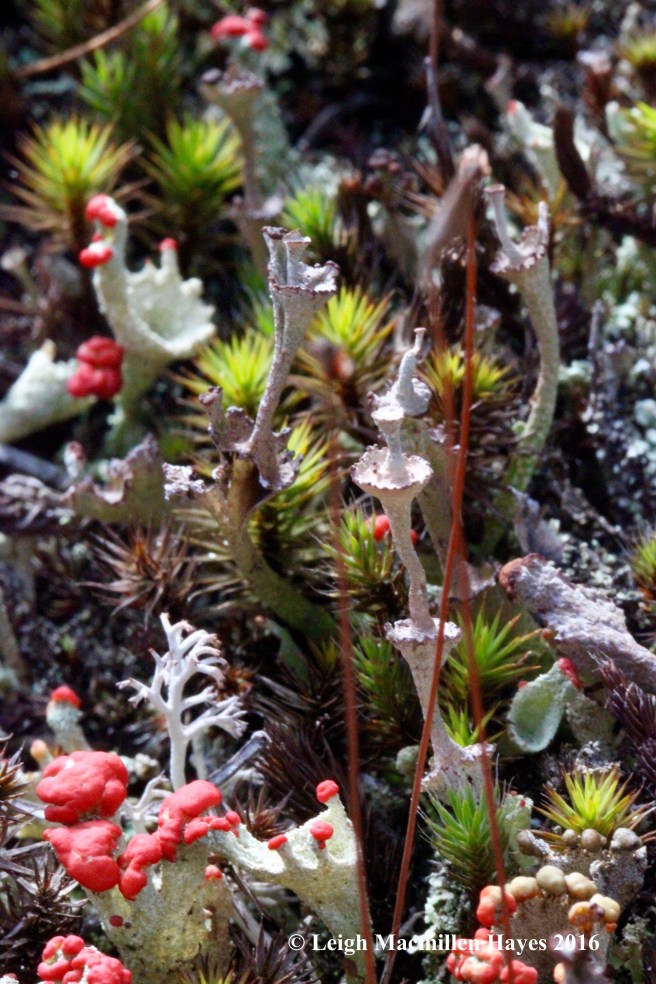
And then . . . and then . . . and then just as our eyes trained on the red caps before us, something else made itself known. We spied another lichen that I’ve only seen once before: Cladonia cervicornis ssp. verticillate.

Its growth formation is rather unique. In one sense, it reminded me of a sombrero, but in another sense, I saw fountains stacked one atop another, each giving forth life in their own unique fashion. But rather than being called Fountain Lichen, its common name is Ladder Lichen–perhaps referring to the fact that the pixies can easily climb up and up and up again.

November 20, 2016: Forever a Student

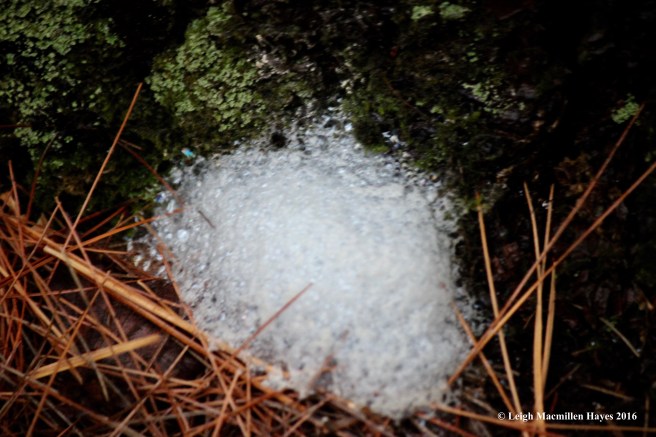
h-pine-suds

A sight I was hoping for presented itself when I returned to our woodlot–froth at the base of a pine tree. It’s not unusual and occurs following a rain event such as we’d had all night and morning. So what causes the tree to froth? Well, like all lessons, there are several possibilities. Maine Master Naturalist Science Advisor Fred Cichocki recently had this to say about it: “I’ve noticed this phenomenon often, and in every case I’ve seen it’s associated with white pine, and always after a dry spell followed by heavy rain. Now, conifers, especially, produce hydrocarbons called terpenes (it’s what gives them their lovely pine, balsam and fir scent). These hydrocarbons are hydrophobic by nature and form immiscible films on water. During a heavy rain, water running down the trunk of a white pine picks up terpenes on the way. Air (having accumulated in bark spaces, channels, etc. perhaps under slight pressure) then “bubbles” through terpene-water films producing a froth. Recall the cleaning products PineSol, and the like. They are made from terpenes, and produce copious bubbles when shaken. One could get the same result directly by shaking terpentine in water, or by bubbling air through a terpentine-water mixture with a straw . . . Of course, it may be that other substances (salts, etc.) enhance the frothing.”

No matter how much I have learned on this life-long course, there’s always more. I certainly don’t have all the answers and for that I am thankful. I’m forever a student.

December 4, 2016: The Art of Nature

s-tree-ring-labyrinth

Some cut stumps reminded me of the circular movement leading toward the center of a labyrinth–appearing quick and easy, and yet providing a time to slow down while following the path.

December 23, 2016: Won’t You Be My Neighbor

m-print

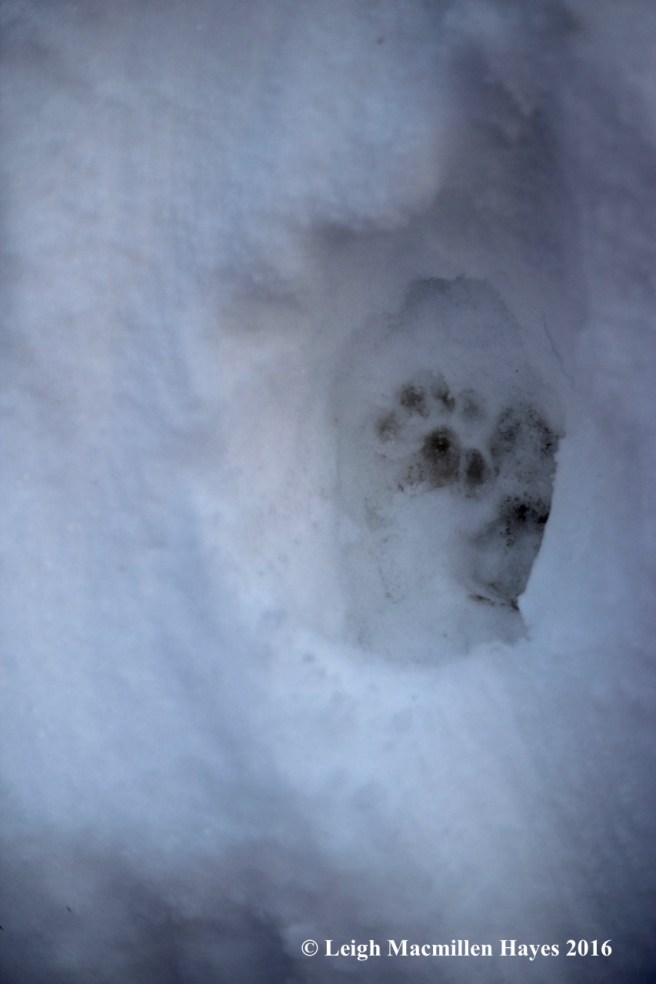
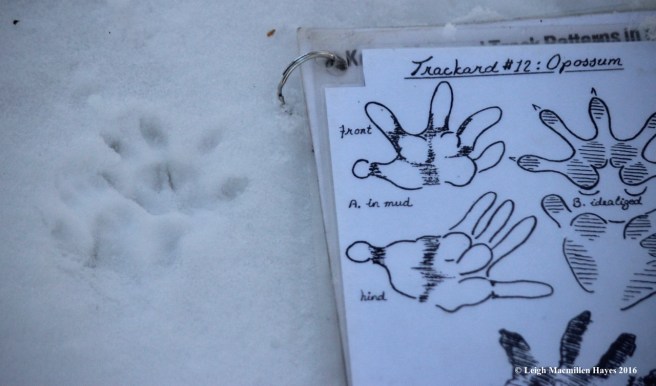
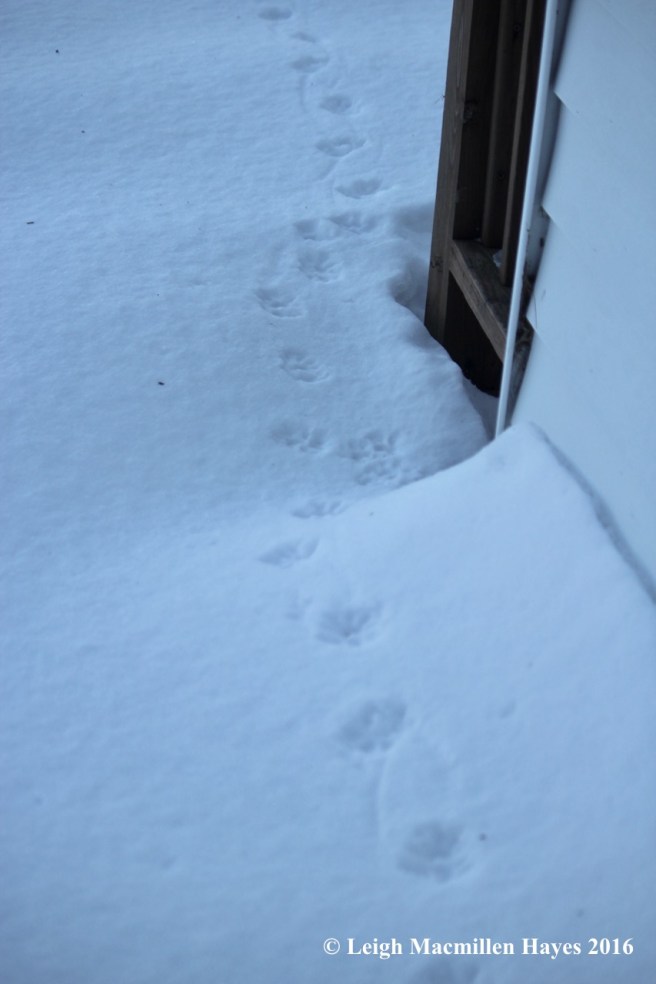
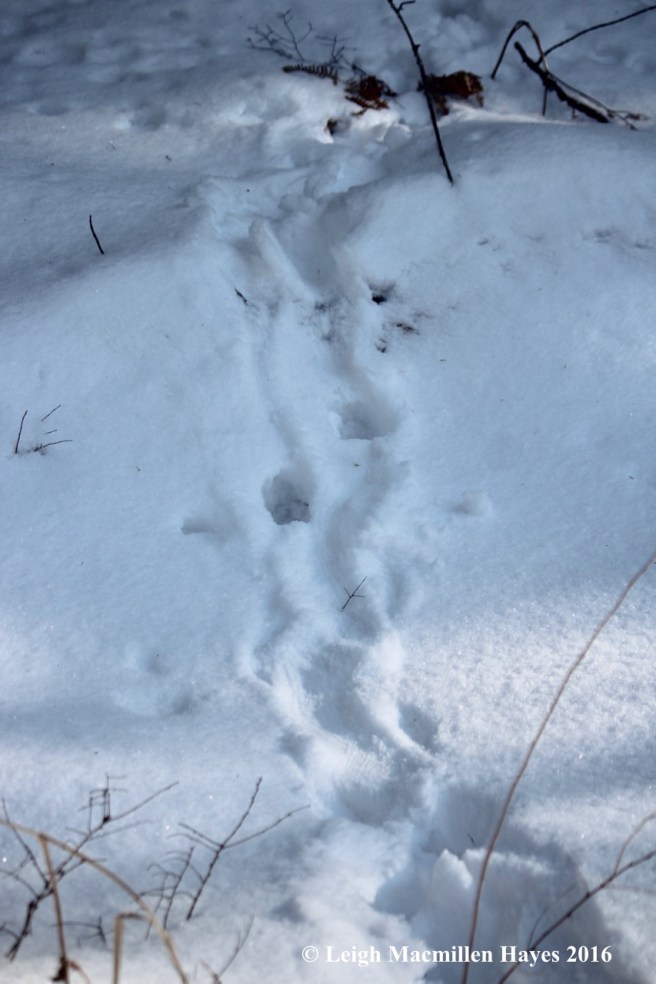
I followed the porcupine trail along his regular route and over the stonewall only to discover prints I’ve never met before. My first impression was raccoon, but the shape of the prints and the trail didn’t match up in my brain. More and more people have mentioned opossum sightings in the past few years, but I’ve only seen one or two–flattened on the road. Today, in our very woods, opossum prints.

January 19, 2017: Keep an Open Mind

o-deer

While I always head out with expectations of what my forest wanderings will offer, I’m happily surprised time and time again with the gifts received.

And so it was the other day when a friend and I happened upon this trophy in an area I’ve only visited a few times. We’d been noting the abundant amount of deer tracks and realized we were between their bedding and feeding areas and then voila–this sweet sight sitting atop the snow. It now adorns a bookcase in my office, a wonder-filled addition to my mini natural history museum. (I’m trying to give Henry, Jessie, Violet, and Benny of the Boxcar Children series a run for their money in creating such a museum.)

January 25, 2017: On the Prowl at Heald and Bradley Ponds Reserve

w-tube-moth-2

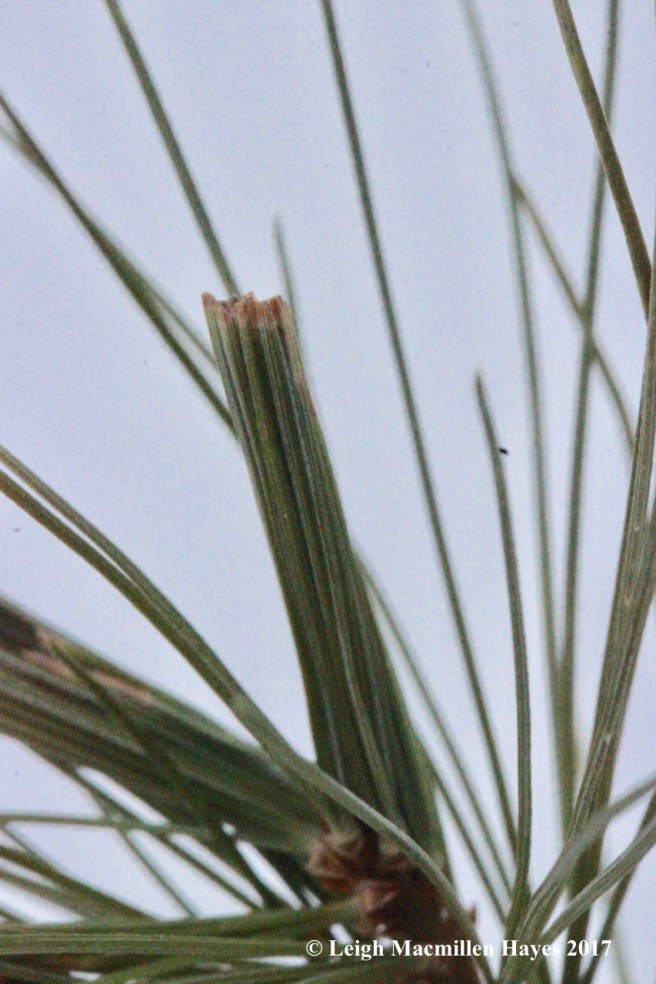
Notice how these pine needles are clumped together? What I learned from Mary Holland, author of Naturally Curious,  is that these are tubes or tunnels created by the Pine Tube Moth. Last summer, larvae hatched from eggs deposited on the needles. They used silk to bind the needles together, thus forming a hollow tube. Notice the browned tips–that’s due to the larvae feeding on them. Eventually the overwintering larvae will pupate within the tube and in April when I come back to check on the vernal pool, I need to remember to pay attention, for that’s when they’ll emerge. Two generations occur each year and those that overwinter are the second generation. The good news, says Holland, is that “Pine Tube Moths are not considered a significant pest.” I only found the tubes on two young trees, but suspect there are more to be seen.

February 8, 2017: Embracing the Calm

h-moose-hair-2

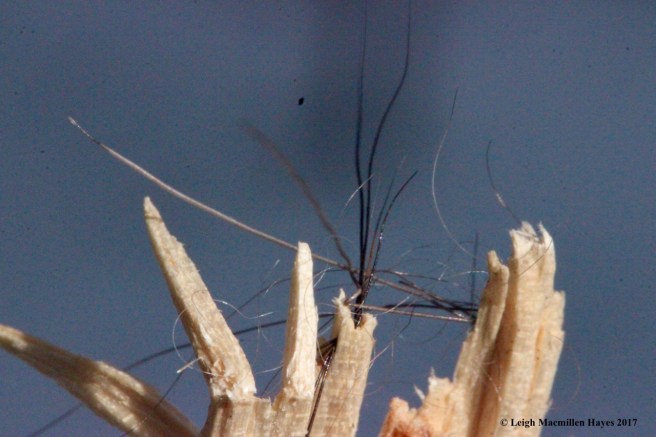
A bull moose, like a buck deer, thrashes bushes and small saplings when the velvet on its antlers dries. It could be that the velvet itches. But it could also be a response to increasing testosterone and the need to scent mark.

February 16, 2017: When Life Gives You Flakes

s-snow-angel-in-trail

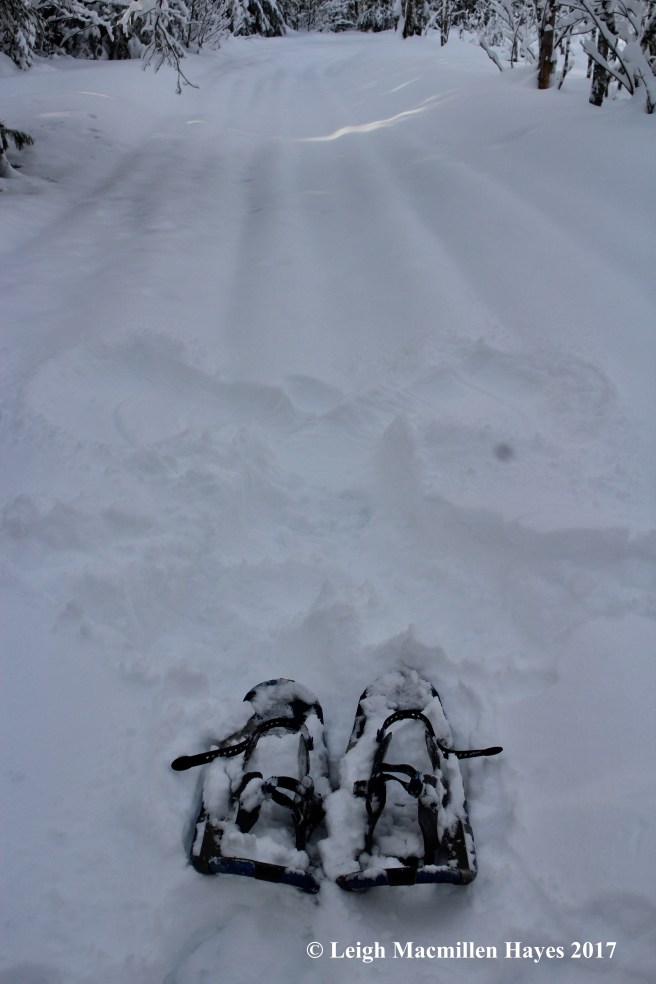
When life gives you flakes . . . make a snow angel in the middle of the trail.

To all who have read this far, thanks again for taking a trip down memory lane today and sticking with me these past two years. I sincerely hope you’ll continue to share the trail as I wander and wonder–my way.

And to wondermyway.com–Happy Second Anniversary!


On the Prowl at Heald & Bradley Pond Reserve

My original intention when I set out this morning was to snowshoe from the Gallie parking lot on Route 5, follow the Homestead Trail and then connect with the Hemlock Trail as I climbed to the summit of Whiting Hill. I planned to make it a loop by descending via the red trail back to the green Gallie Trail.

w-mill-in-morning-light1

Not to be as the parking lot hadn’t been cleared yet of yesterday’s Nor’easter, which dumped several inches of snow, sleet and freezing rain upon the earth. When Plan A fails, resort to Plan B. A drive down Slab City Road revealed that the Fairburn parking lot wasn’t yet cleared either, but the boat launch was open (because the pond serves as a water source for the fire department) so I parked there and headed to the trailhead beside Mill Brook. The sight of so much water flowing forth was welcome, especially considering it was a mere trickle a few months ago.

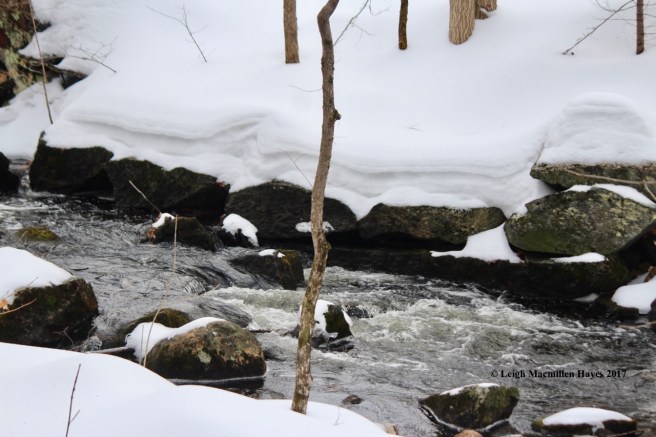
w-snow-layers-brookside

The layers of snow overhanging the brook told the story of our winter. And it’s not over yet–at least I hope it isn’t. We’re in the midst of a thaw, but let’s hope more of the white stuff continues to fall. We need it on many levels, including ecologically and economically.

w-fox-print

Because of the storm, I thought I wouldn’t see any tracks, but from the very beginning a red fox crossed back and forth between the pond’s edge and higher elevations.

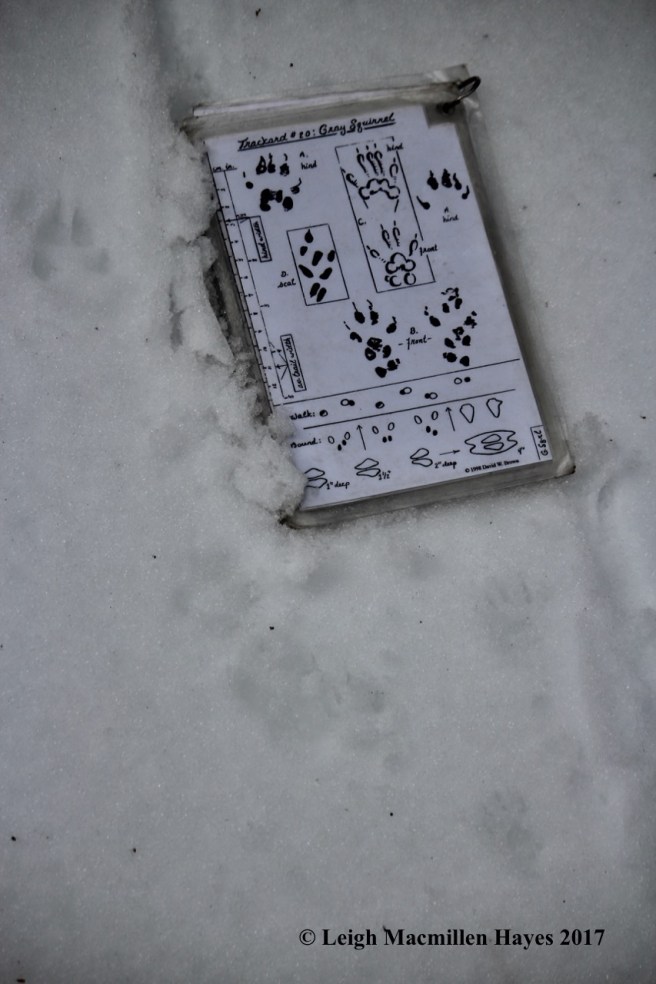
w-fox-and-squirrel

While it may be difficult to discern, a gray squirrel, the four prints with long toes below the Trackards, had leaped up the hill, perhaps after the fox. Lucky squirrel. The fox prints can be viewed to the left of the cards.

w-vernal-pool

My new plan was to follow the red/blue trail to the summit of Whiting  Hill. And along the way, a side trip to the vernal pool. Visions of fairy shrimp swam in my head. No, I wasn’t rushing the season, just remembering a fun time pond dipping last spring.

w-fringed-wrinkle-lichen

Back on the red/blue trail, I noted that most of the recent seed litter was covered by yesterday’s storm. The Fringed Wrinkle Lichen, however, did decorate the snow. Tuckermanopsis americana, as it’s formally known, grows on twigs and branches of our conifers and birches and often ends up on the forest floor.

It’s a foliose lichen that was named for Edward Tuckerman, of Tuckerman’s Ravine fame on Mount Washington. According to Lichens of the North Woods author Joe Walewski, Tuckerman was “the pre-eminent founder and promoter of lichenology in North America.As a botanist and professor in Boston, he did most of his plant studies on Mount Washington and in the White Mountains.”

w-pileated-debris

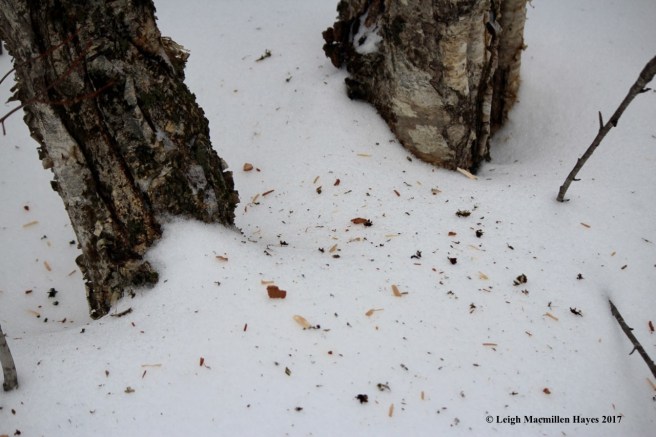
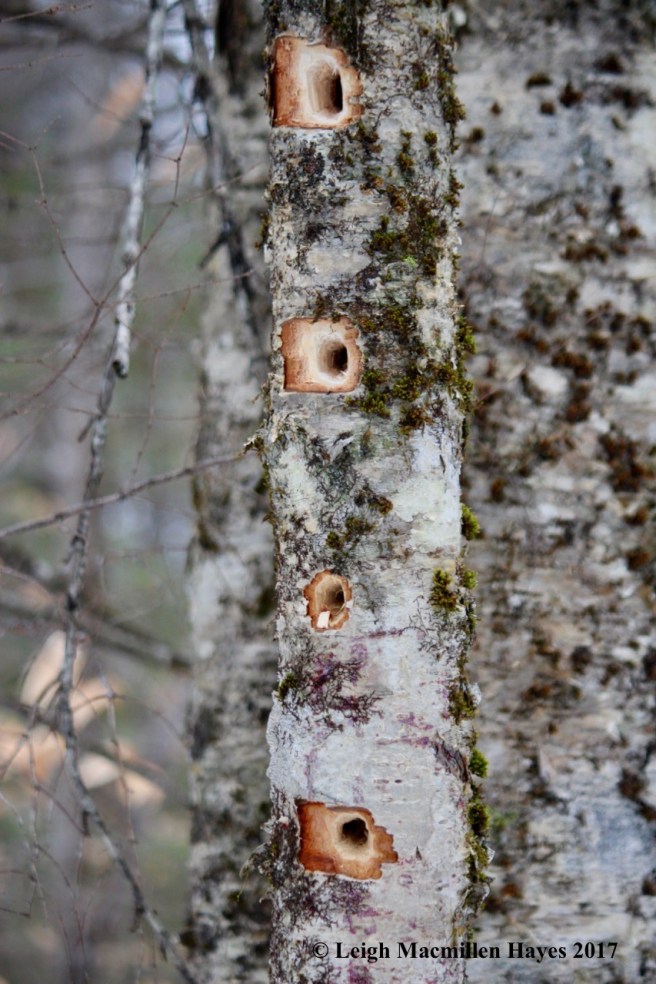
Further along, I saw some pileated woodpecker scat about twenty feet from the tree it had hammered in an attempt to seek food. It made me realize that even when I don’t find scat in the wood chips below the tree, I should seek further.

w-pileated-holes

The holes weren’t big–yet.

w-pileated-scat-bursting-with-body-parts

But the scat–oh my. It looked as if insects were trying to escape the small cylindrical package coated in uric acid.

w-mossy-maple-fungi

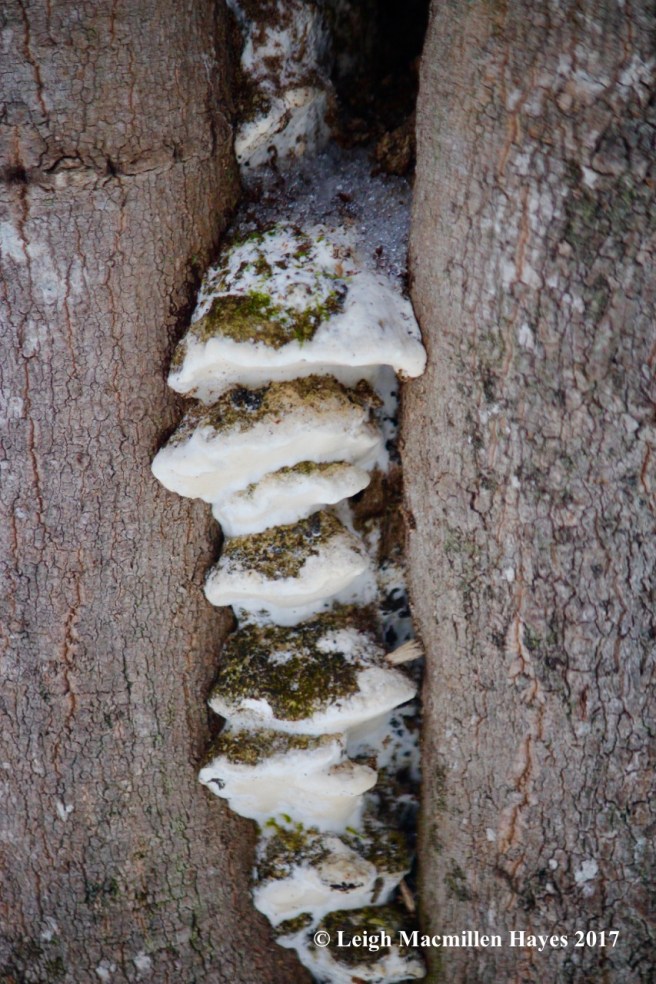
The trail turned right and so did I, beginning the climb. For most, the ascension doesn’t take more than five or ten minutes. Um . . . at least 45 on my clock today. There was too much to see, including the mossy maple fungi hiding in a tree cavity.

w-tube-moth-3

And then I saw something I’d looked for recently after seeing it on the blog  Naturally Curious with Mary Holland. Notice how the pine needles are clumped together?

w-pine-tube-moth-pupae-overwintering-1

Eastern White Pine needles grow in bundles of five (W-H-I-T-E or M-A-I-N-E for our state tree), but the clumps consisted of a bunch of needles from several different bundles.

w-tube-moth-2

What I learned from Ms. Holland is that these are tubes or tunnels created by the Pine  Tube Moth. Last summer, larvae hatched from eggs deposited on the needles. They used silk to bind the needles together, thus forming a hollow tube. Notice the browned tips–that’s due to the larvae feeding on them. Eventually the overwintering larvae will pupate within the tube and in April when I come back to check on the vernal pool, I need to remember to pay attention, for that’s when they’ll emerge. Two generations occur each year and those that overwinter are the second generation. The good news, says Holland, is that “Pine Tube Moths are not considered a significant pest.” I only found the tubes on two young trees, but suspect there are more to be seen.

w-beaked-hazelnut-1

And a few steps later–an old beak. I couldn’t believe my luck. It was then that I realized if I’d been able to stick with the original plan I would have missed these gems. Oh, I probably  would have found others, but these were in front of me and I was rejoicing. Inside that bristly tan husk was the protein-rich nut of a Beaked Hazelnut overlooked by red squirrels and chipmunks, ruffed grouse, woodpeckers, blue jays and humans.

w-beaked-hazelnut-2

Catkins on all of the branches spoke of the future and offered yet another reason to pause along this trail on repeated visits.

w-burl-on-sugar-maple

With my eyes in constant scan mode, I looked for other anomalies. One of my favorites was the burl that wrapped around a Sugar Maple. If I didn’t know better, it would have been easy to think this was a porcupine or two.

w-buried-bench-on-way-up-whiting

About two thirds of the way up, there was no rest for the wary, for the bench that offered a chance to pause was almost completely buried.

w-polypody-and-rock-tripe

Closer to the summit, the ledge boulders were decorated with snow, Common Polypody ferns and lichens, including Common Rock Tripe, its greenish hue reflecting yesterday’s precipitation.

w-whiting-view-1

And suddenly, the summit and its westward view, Kezar Lake in the foreground and Mount Kearsarge  showing its pointed peak in the back.

w-whiting-other-bench

As I’d hiked along the red/blue trail, I noted that the red fox had crossed several times. At the other end of the summit, I checked on the bench where on our First Day 2017 hike for the Greater Lovell Land Trust, we’d discovered the remains of a red squirrel. Today, fox tracks paused in front of the bench before moving on and I had to wonder if had been the one to use this spot as a sacrificial altar.

w-bear-claw-tree

Finally, it was time to head down. My choice was to follow the red trail toward the Gallie Trail. I love this section because it features some of my favorite bear trees.

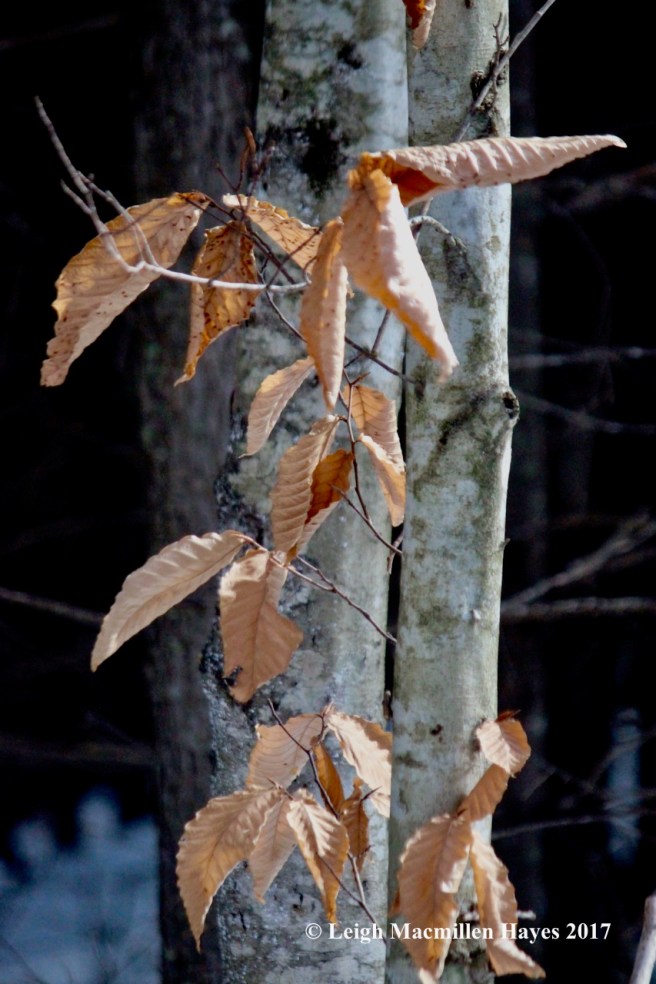
w-beech-leaves-rustling

The fox tracks continued to cross frequently and so I paused often. And sniffed as well. What I smelled was a musky cat-like scent that I’ve associated with bobcats in the past. What I heard–dried beech leaves rattling in the breeze. They always make me think something is on the move. Ever hopeful I am.

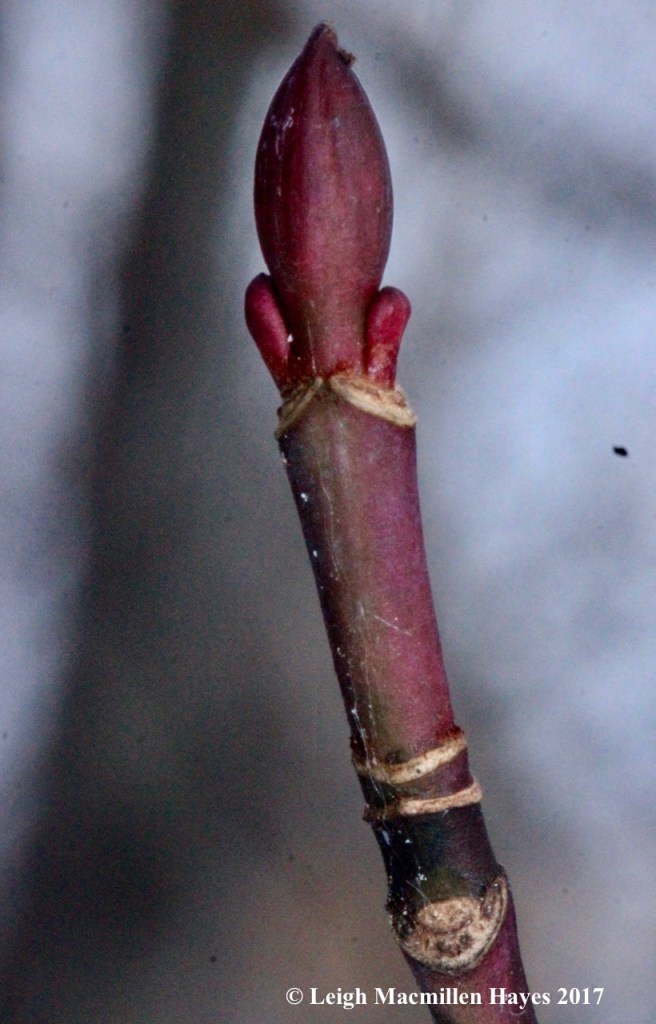
w-striped-maple-buds-and-twig

One of my favorite finds along this section was the bright red branches of young Striped Maples. From leaf and bundle scars to growth lines, lenticels and buds, their beauty was defined.

w-striped-maple-leaves

Another sight that surprised me–Striped Maple leaves still clinging, rather orangey in hue.

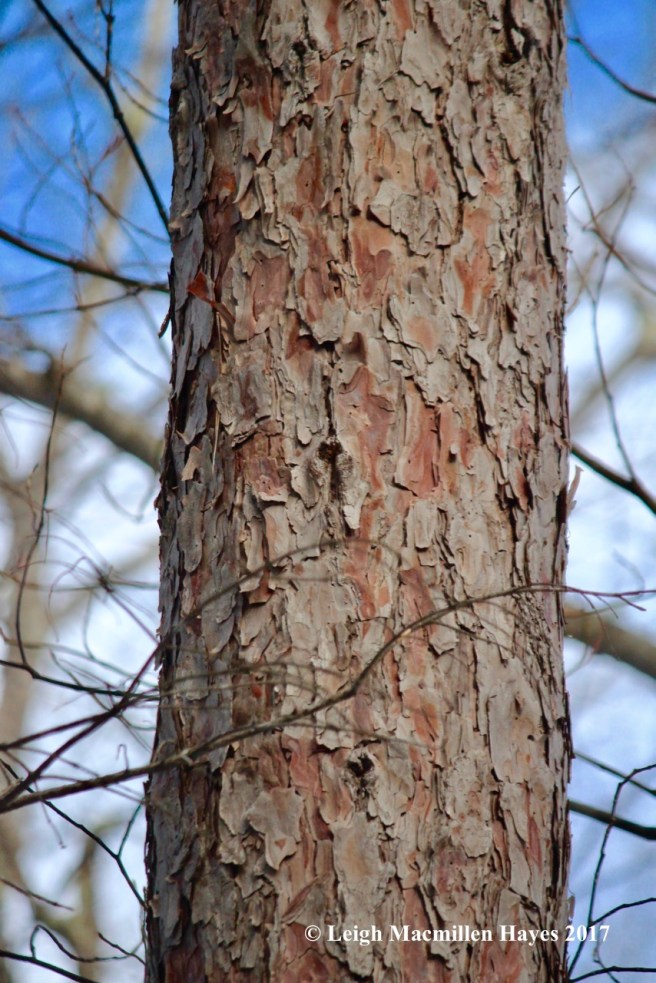
w-red-pine-on-red-trail

And here and there, as if in honor of the trail color, Red Pines reached skyward.

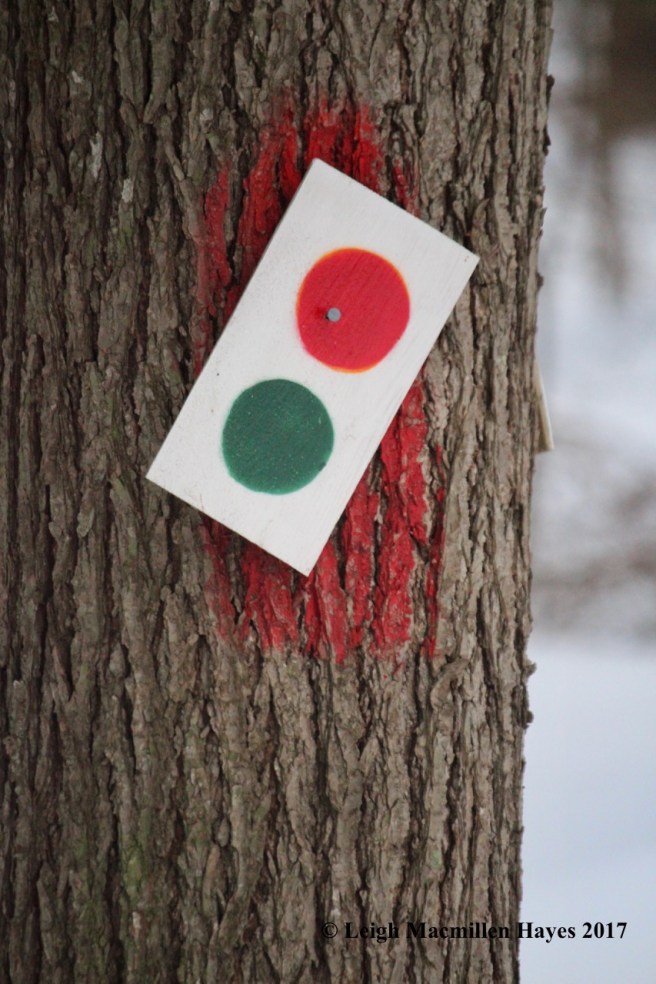
w-redgreen-trail

Eventually I reached the bottom, and turned right again, this time onto the stoplight trail–well, red and green at least.

w-squirrel-midden

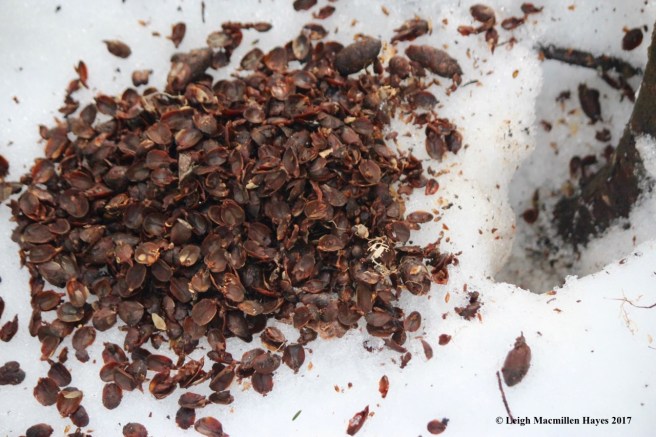
My wildlife sitings were few and far between, but red squirrel tracks and a midden of discarded cone scales next to a dig indicated where the food had been stored in preparation for this day.

w-tinder-2

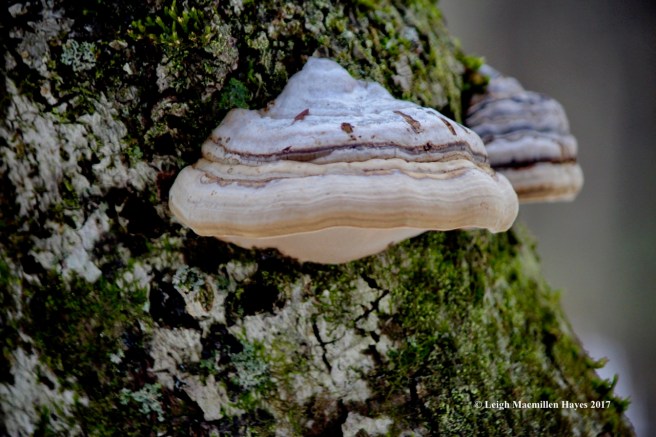
Following some grouse tracks took me off trail and tinder conks made their presence known.

w-tinder-fungi

The swirled appearance of these hoof fungi threw me off for a bit, but I think my conclusion is correct.

w-bobcat-trail

At last I reached the red trail that runs parallel with Heald Pond. Again, the fox tracks crossed frequently, but beside the path and leading to and fro the water and higher heights, another set of tracks confirmed my earlier suspicions.

w-bobcat-prints

Bobcat. I thought I smelled a pussy cat. I did.

w-fox-and-bobcat

Sometimes the bobcat moved beside the trail, while the fox crossed over. I’d thought when I started out this morning that I wouldn’t see too many tracks because the animals would have hunkered down for the storm. I was pleasantly surprised–for my own sake. For the sake of the animals, I knew it meant they were hungry and on a mission.

w-john-fox-1

My own mission found me following the spur to Otter Rock. I noted that the fox had walked along the shoreline on its eternal hunt.

w-dragonflies-2

My hunt was of a different sort. No visit to the rock is complete without a look at the dragonfly exoskeletons. But today, it was a bit different because I, too, could walk on the ice. And so I found exoskeletons on parts of the rock I haven’t been able to view previously. Their otherworldly structure spoke to their “dragon” name.

w-dragonfly-nymph-exoskeleton

The slit behind the head and on the back of one showed where the dragonfly had emerged from the nymph stage last spring. Or maybe a previous spring as some of these have been clinging to the rock for a long time.

w-other-pupae-overwintering

While I was looking, I noticed some other pupae gathered together within a silky covering. Another reason to return–oh drats. I don’t know if I’ll be there at the right time, but with each visit, I’ll check in.

w-mill-dam-in-afternoon-sun

The sun was shining and warm. High 30˚s with slight breeze–felt like a summer day, with the sun reflecting off the snow. And at the mill, further reflection off the water. After four hours, it was time for me to check out.

As always, I was thankful for my visit, even though it wasn’t my original plan. Like the mammals, I’d been on a prowl–especially serving as the eyes for a friend who is currently homebound. I think she would have approved what I saw.


Book of January: Naturally Curious Day By Day

Twice now I’ve had the pleasure of being in the audience of Mary Holland at local speaking engagements and I give thanks for each opportunity. But even if I can’t be in her presence to catch her excitement about the natural world and listen to her tales of wilderness adventures, I’ve contented myself with turning to her book, Naturally Curious. It’s like having a naturalist beside me at all times. And when I encounter something I’m not sure about, it’s to Mary that I turn–or at least her book.

It was with great joy then, that I learned she’d published a new book this past year (in addition to children’s books and calendars and . . .). I purchased a couple of copies at my local independent bookstore, Bridgton Books, to give as presents. Of course, I also added it to my own wish list.

And so it was that I was grateful to open a certain shaped package of just the right weight on Christmas morning. Quite often we disguise our gifts to each other, but this one I knew immediately.

day-by-day-1

Book of January

Naturally Curious Day by Day by Mary Holland is exactly that. She breaks the year down into more than months as she did with her first book. For each day, she includes two or three photos and a paragraph or two. No too much info, not too little.

True confession here. I keep it in the upstairs library, aka bathroom. It’s just the right amount of information and I’m always looking for something to read when I’m seated there. (I’ve been known to read the packaging on a myriad of bathroom-related items.)

bridie-1

My reading experience includes credits and acknowledgements, dedications and prefaces. And what to my wondering eyes should appear in NC Day by Day, but a photo credit to one of my mentors: Bridie McGreavy, PhD. I remember when Bridie first shared the photo of the mouse impaled by a shrike with some of us. Turn to page 419 and see if for yourself. (Congratulations to you, Bridie.)

After I opened this coveted gift, a relative asked how Ms. Holland knew what to include for any particular day–that that animal or plant species would be seen that day. Ah, but Mary knows this because she is a seeker who has spent decades in the woods and on the water and she understands the rhythm of the natural world. How often do those of us who follow Mary’s blog and venture outdoors realize that we saw the very item she writes about the previous day or trust we will notice it that day?

It’s only day 5 and already, I’ve photographed most of the things Mary writes about from

h-3

pileated woodpecker holes and

h-10

associated scat (filled with insect bodies and bittersweet berries),

h-4

snow on conifers,

h-5

white-breasted nuthatches, and

h-6

puffed-up chickadees,

h-7

to mammal prints,

h-8

maple buds (in this case Red Maple), and

h-9

even a snow scorpionfly.

Each month begins with a lengthy description appropos to what’s happening at that time of year, e.g. woodpecker holes and other signs of birds feeding, the survival of evergreens through the winter season and our local nuthatches, both white- and red-breasted.

How does Mary know what to include for each day of the month? It’s easy. She’s paid attention and encourages all of us to do the same. Probably, in hind sight, it was difficult for her to narrow down her topics.

Thank you, Mary Holland, for taking us along on your treks through your photography and prose, for teaching us and learning with us, and for providing resources for us to return to day in and day out.

Naturally Curious Day By Day: A Photographic Field Guide and Daily Visits to the Forests, Fields, and Wetlands of Eastern North America by Mary Holland, Stackpole Books, 2016. $29.95.

Won’t You Be My Neighbor?

I knew the minute I walked into the summer kitchen this morning and saw fresh tracks beside the barn that I’d head out the door as soon as possible. And then I realized that my snowshoes were in the back of my truck, which our youngest son had borrowed. Never fear. We have several more pairs.

m-cat-in-porky

The prints that drew me outside were those of our “friendly” neighborhood porcupine. And once again, he had much to share, the first being cat prints inside his–thanks to one of several that frequently pass under the barn.

m-porky-sashay

If you’ve never examined a porcupine trough before, I encourage you to do so. As it sashayed along, it left behind hair and quill impressions. Can you see them?

m-opossum-print-2

I followed Porky along his regular route and over the stonewall only to discover prints I’ve never met before. My first impression was raccoon, but the shape of the prints and the trail didn’t match up in my brain. More and more people have mentioned opossum sightings in the past few years, but I’ve only seen one or two–flattened on the road. Today, in our very woods, opossum prints.

m-opossum-walk

Our own marsupial. The front print obscured the hind, which features an opposable thumb. Their pattern, I learned from checking David Brown’s Companion Guide to the Trackards, is left hind-left front, right hind-right front, left hind-left front, etc.

m-opposom-trail

As it walked along, from tree to tree, past the studio and into the neighbor’s woodlot, I could practically see the animal moving, its long tail dragging in the snow. My heart sang with the journey. But how do they survive here, I wondered?

Eventually, I realized I was headed into a neighbor’s backyard several doors down and so I turned and continued in the other direction, but thankful that Porky had once again shared something new with me.

m-porky-trail

I traveled down the cowpath and into my smiling place, where what to my wondering eyes should appear, but a miniature sleigh and . . . oops, I mean another Porky trail. And so I followed it, back and forth over a stone wall and under fallen trees I needed to pass over.

m-porky-tree

It led me around an uprooted tree and there . . .

m-porky-in-den

the trail ended. You may notice ice crystals below the moss in the larger opening. And if you look closely below the moss, you might just see a few light colored streaks–those would be quills. I found Porky. He started to move and though I knew I could easily outrun him, unless I tripped and fell like I often do when snowshoeing, I decided to leave him be. But once again, my heart was singing.

m-moose-tracks

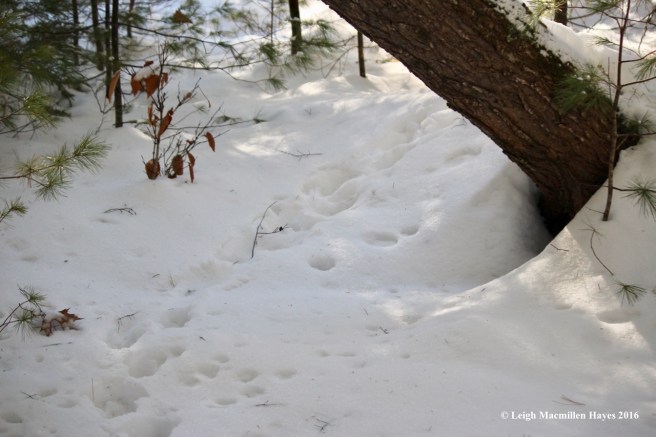
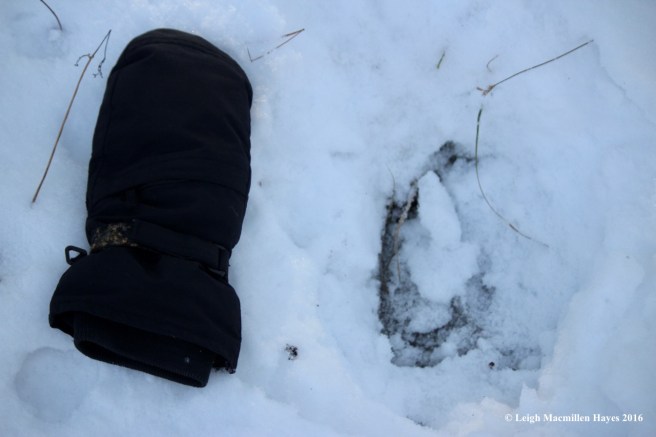
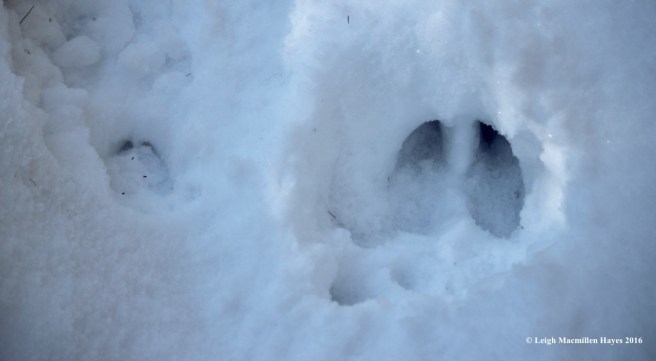
And then . . . some really large and deep prints crossed the trail I frequent.

m-moose1

They were almost the size of my mitt.

m-moose-slide

And every where I turned for the rest of the morning, it seemed moose had also turned. I soon realized there were at least three and they slipped in the snow much as I often do.

m-deer-and-moose-prints

In tracks I’d previously made, both a deer and moose had passed, providing a sense of size.

m-moose-mud

I followed one, who had paused to play–it’s hard to resist an inviting mud puddle. Had I not been wearing snowshoes . . .

m-moose-landing

I think we were both discouraged to realize a snowmobile had found its way to the log landing, though I for one, wasn’t surprised. The moose made a U-turn and headed back into the woods. A short time later, I followed suit.

m-deer-hair

It was there that I discovered hair stuck to a deer bed where its body had warmed the snow, which thus turned to ice.

m-spider-1

And another snow spider, this one not as green as the ones I’ve seen previously. I’m in awe that the tiny body, which appeared translucent, contains glycerol as an antifreeze compound. I did see numerous springtails bouncing about, so trust it had plenty of food upon which to prey. Again, my heart sang.

m-moose-bed

As I mentioned earlier, I continued to see moose tracks (not the ice cream, though it is one of my favorite Gifford flavors). And then a bed, about the size of three deer beds. And a lovely pile of scat right in it. Life is good.

m-snowshoe-lobsters

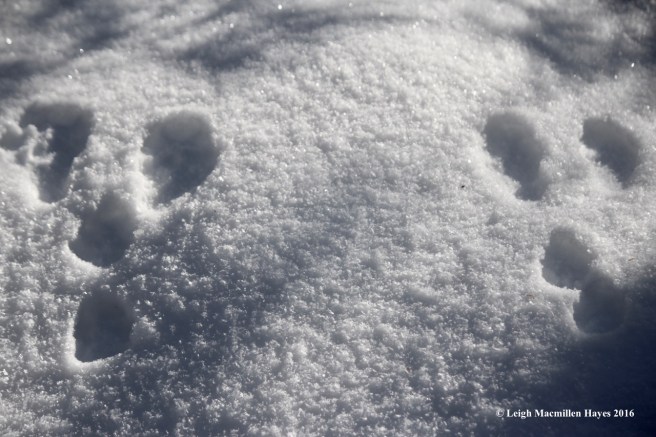
Closer to home, I realized I was in snowshoe hare territory when I recognized the lobster-like shape of their prints.

m-weasel-1

They’d better watch out, and all voles and other little brown things should also be on the alert, for weasel prints also decorated the snow.

m-print

At last I was back home, and had to take a peek at those opossum prints one more time. Thanks again to the porcupine(s) that wander these woods, I celebrated wonder as I moved about. Except for Porky, one gray squirrel and a sharp-shinned hawk, I saw no others with whom I share these woods, but I was grateful to be their neighbor. To know that they roam as I do. In the words of Mr. Rogers, “It’s a neighborly day in this beauty wood.” I’ll let him do the singing, from the song that rests within my heart today:

It’s a beautiful day in this neighborhood,
A beautiful day for a neighbor.
Would you be mine?
Could you be mine?…

It’s a neighborly day in this beauty wood,
A neighborly day for a beauty.
Would you be mine?
Could you be mine?…

I have always wanted to have a neighbor just like you.
I’ve always wanted to live in a neighborhood with you.

So, let’s make the most of this beautiful day.
Since we’re together we might as well say:
Would you be mine?
Could you be mine?
Won’t you be my neighbor?
Won’t you please,
Won’t you please?
Please won’t you be my neighbor?

Books of December: A Holiday Wish List

In the spirit of changing things up a bit, I decided that I’d include five books I highly recommend you add to your holiday wish list and two that I hope to receive.

These are not in any particular order, but I’m just beginning to realize there is a theme–beyond that of being “nature” books.

b-forest-forensics-1

Book of December: Forest Forensics

Tom Wessels, forest guru and author of Reading the Forested Landscape, published this smaller work in 2010. Though only 5″ x 7.5″, the book is rather heavy because it’s filled with photographs. Despite the weight, Forest Forensics fits into a backpack and is the perfect guide for trying to figure out the lay of the land. Using the format of a dichotomous key, Wessels asks readers to answer two-part questions, which link to the photos as well as an Evidence section for Agriculture, Old Growth and Wind, plus Logging and Fire. In the back of the book, he includes Quick Reference Charts that list features of particular forest and field types. And finally, a glossary defines terms ranging from “age discontinuity” to “Uphill basal scar,” “weevil-deformed white pines” and “wind-tipped trees.” In total, it’s 160 pages long, but not necessarily a book you read from cover to cover. If you have any interest in rocks, trees, and the lay of the land, then this is a must have.

Forest Forensics by Tom Wessels, The Countryman Press, Woodstock, VT, 2010.

b-shrubs-1

Book of December: Shrubs of the Northern New England Forest

Michael L. Cline is executive director of Tin Mountain Conservation Center in Albany, New Hampshire. In September, I had the pleasure of attending a talk he gave at the center about Shrubs of the Northern New England Forest. The 6″ x 9″ book weighs about the same as Wessels’, and will also fit handily into your pack. Of course, you might want to leave the books in your vehicle or at home and look up the items later–thus lightening your load. Using Brownfield Bog as one of his main go-to places, Cline describes 70 species of shrubs from Creeping Snowberry to Mountain Ash. The book is arranged by family, beginning with Mountain Maple and Striped Maple of the Aceraceae (Maple) family and ending with the American Yew of the Taxaceae (Yew) family. Each two-page layout includes photographs (and  occasionally drawings), plus a description of habit, leaves, flowers, twig/buds, habitat, range, wildlife use, notes and other names. I have no excuse now to not know what I’m looking at as I walk along–especially near a wetland. That being said, I’ll think of one–like I left the book at home, but I’ll get back to you.

Shrubs of the Northern New England Forest by Michael L. Cline, J.S. McCarthy Printers, 2016

b-bogs-and-fens-1

Book of December: Bogs and Fens

Ronald B. Davis’ book, Bogs and Fens, was a recent gift from my guy. I hadn’t asked for it, and actually didn’t know about it, so I’m tickled that he found it. I’m just getting to know Dr. Davis’s work, but trust that this 5.5″ x 8.5″ guide about peatland plants will also inform my walks. Again, it’s heavy. The first 26 pages include a description of vegetation and peatlands and even the difference between a fen and a bog. More than 200 hundred pages are devoted to the trees, plants and ferns. In color-coded format, Davis begins with the canopy level of trees and works down to tall shrubs, short and dwarf shrubs, prostrate shrubs, herbaceous plants and finally, ferns. He also includes an annotated list of books for further reference, as well as a variety of peatlands to visit from Wisconsin to Prince Edward Island. As a retired University of Maine professor, Davis has been a docent and guide at the Orono Bog Boardwalk for many years. Field trip anyone?

Bogs and Fens: A Guide to the Peatland Plants of Northeastern United States and Adjacent Canada by Ronald B. Davis, University of New England Press, 2016.

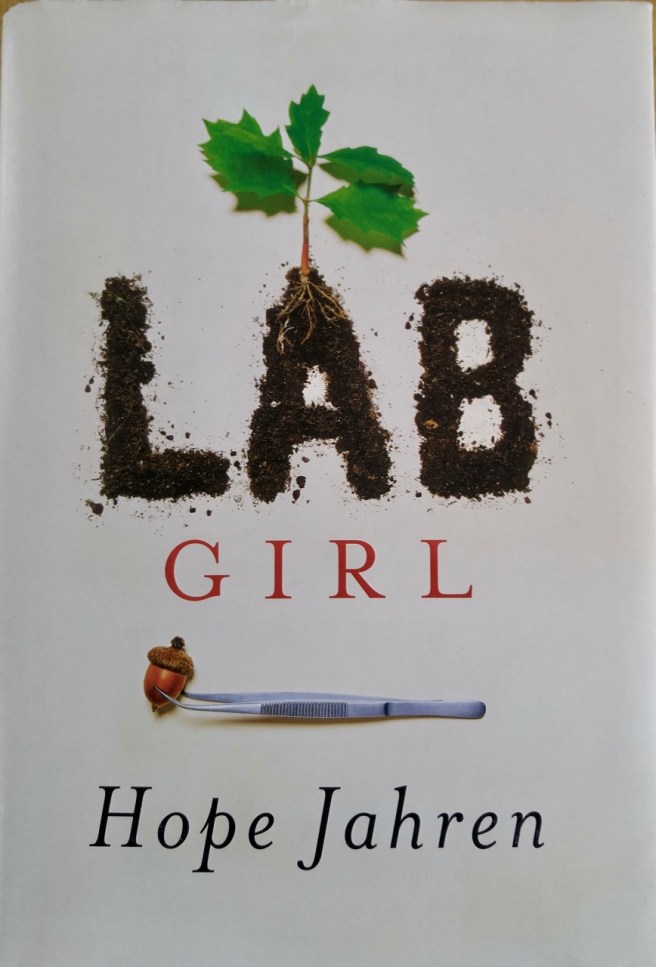
b-lab-girl-1

Book of December: Lab Girl

I’d never heard of Hope Jahren until this summer and then several people recommended her book, Lab Girl, to me. Rather than a guide, this is the story of Jahren’s journey from her childhood in rural Minnesota to the science labs she has built along the way. As a scientist, Jahren takes the reader through the ups and downs of the research world. And she does so with a voice that makes me feel like we’re old friends. Simultaneously, she interweaves short chapters filled with  information about the secret life of plants, giving us a closer look at their world. I had to buy a copy because for me, those chapters were meant to be underlined and commented upon. I do believe this will be a book I’ll read over and over again–especially those in-between chapters.

Lab Girl by Hope Jahren, Alfred A. Knopf, 2016.

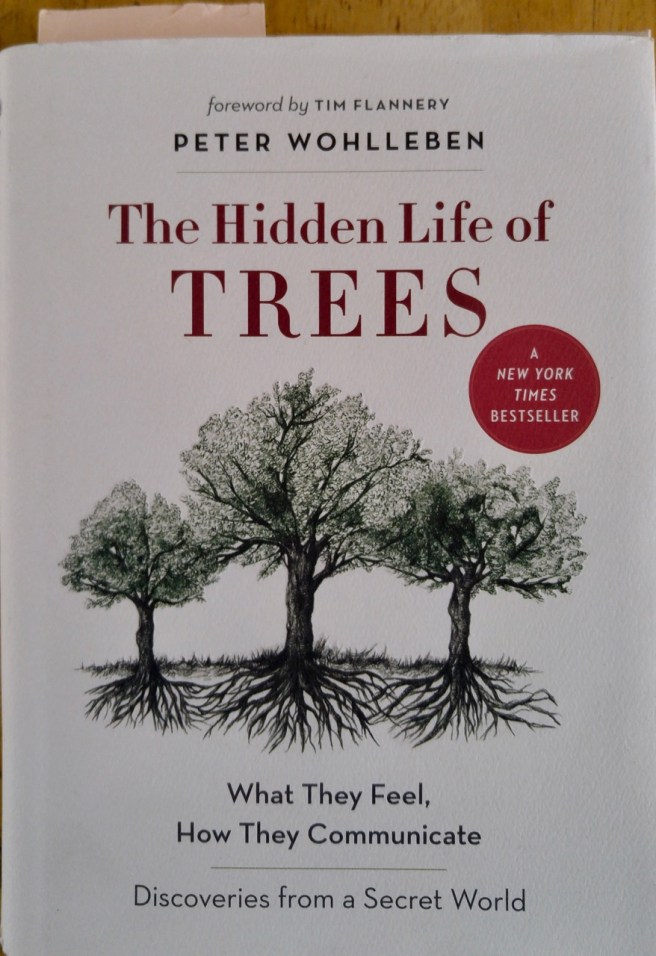
b-hidden-life-of-trees-1

Book of December: The Hidden Life of TREES

And finally, a gift to myself: The Hidden Life of TREES by Peter Wohlleben. I’d first learned about this book in a newspaper article published last year and had to wait until recently to purchase it after the book was translated from German to English. Again, it’s not a field guide, but offers a delightful read that makes me think. And thus, you can see my bookmark. I’ve not finished reading it yet, but I’m having fun thinking about some different theories Wohlleben puts forth. As a forester, Wohlleben has spent his career among trees and knows them well. He’s had the opportunity to witness firsthand the ideas he proclaims about how trees communicate. And so, I realize as I read it that I, too,  need to listen and observe more closely to what is going on in the tree world–one of my favorite places to be. Maybe he’s right on all accounts–the best part is that he has me questioning.

The Hidden Life of TREES: What They Feel, How They Communicate by Peter Wohlleben, Random House, 2016.

And that’s just it–the underlying theme of these five books you might consider is TREES. I can’t seem to learn enough about them. One word of caution, each author has their own take on things, so the best thing to do is to read the book, but then to head out as often as you can and try to come to your own conclusions or at least increase your own sense of wonder.

And now for the books on my list (My guy is the keeper of the list):

Naturally Curious Day by Day: A Photographic Field Guide and Daily Visit to the Forests, Fields, and Wetlands of Eastern North America by Mary Holland, Stackpole Books, 2016

Mosses, Liverworts, and Hornworts: A Field Guide to Common Bryophytes of the Northeast by Ralph Pope, Cornell University Press, 2016.

Do you have any other suggestions for me?

One final thought about books–support your local independent book store as much as you can. Here in western Maine, we are fortunate to have Bridgton Books. Justin and Pam Ward know what we like to read and if they don’t have a particular book we’re looking for, they bend over backwards to get it for us.


The Be-Attitudes Sundate

Today marks the beginning of the season of hope and with that in mind, my guy and I climbed Singepole Mountain in Paris. Paris, Maine, that is.

s-halls-pond-start-1

Our hike began beside Hall’s Pond, where the water reflected the steel gray sky of this late November day.

s1-barbed-wire

And stonewalls and barbed wire reflected the previous use of the land.

s1-beaver-6

In a matter of minutes we learned of its present use.

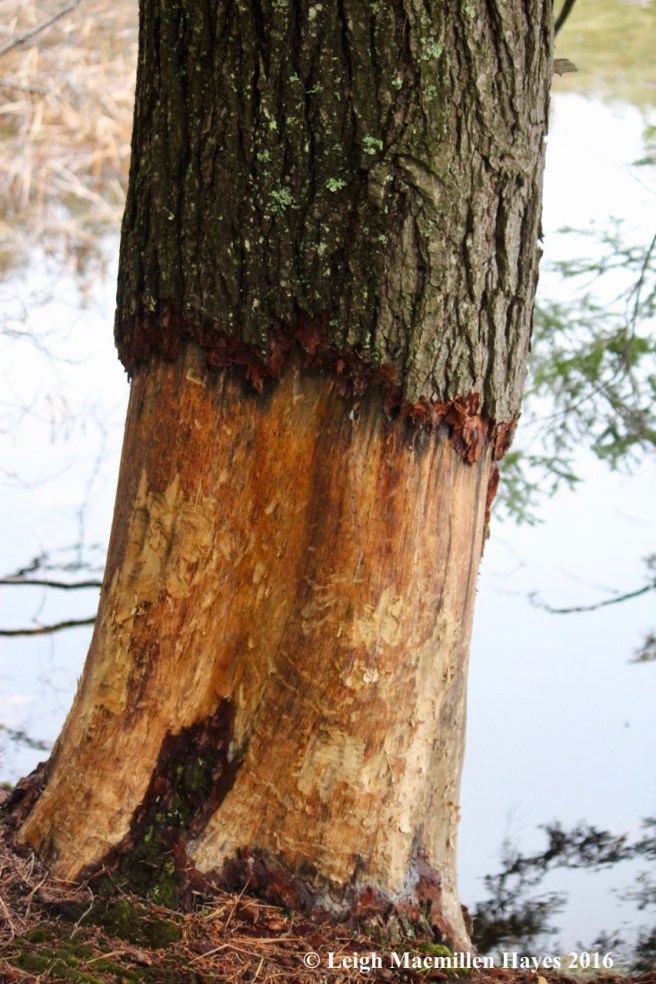
s-beaver-works-3

Everywhere we looked, beaver sculptures decorated the shoreline.

s1-hemlock-grove

We passed from the hardwood community to a hemlock grove . . .

s-hemlock-girdled-2

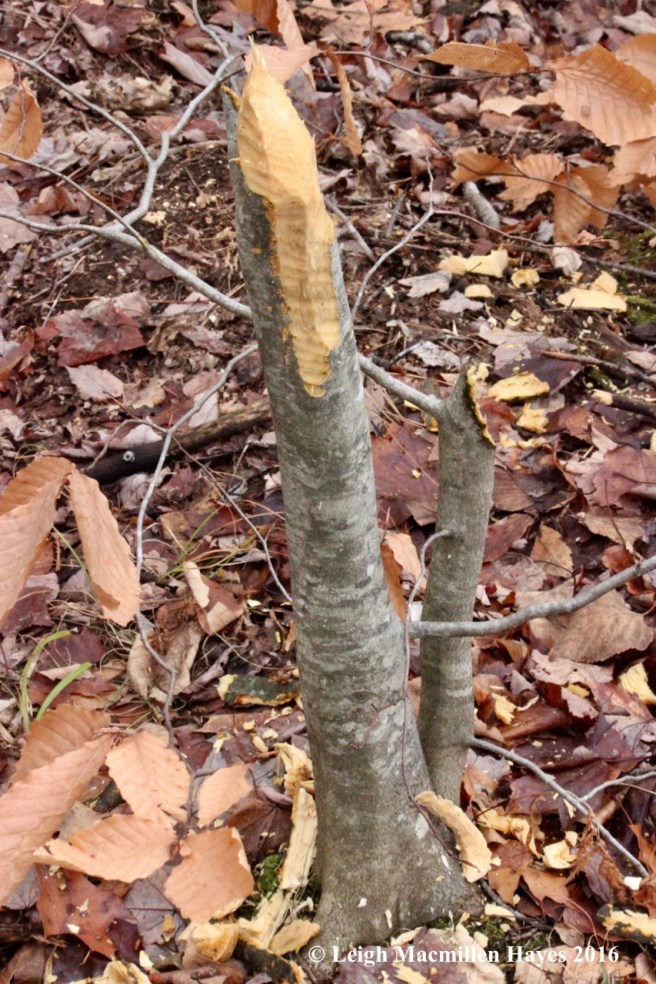
where more beaver activity was evident. I’ve been reading The Hidden Life of TREES by Peter Wohlleben and have some questions about tree girdling such as this. There is a theory that beavers chew off the bark all the way around (girdle) to eventually kill trees such as hemlock, so preferable species will grow in their place. But, that’s thinking ahead to future generations. Do beavers really do that?

s-hemlocks-3

On page 18, Wohlleben states the following: “As the roots starve, they shut down their pumping mechanisms, and because water no longer flows through the trunk up to the crown, the whole tree dries out. However, many of the trees I girdled continued to grow with more or less vigor. I know now that this was only possible with the help of intact neighboring trees. Thanks to the underground network, neighbors took over the disrupted task of provisioning the roots and thus made it possible for their buddies to survive. Some trees even managed to bridge the gap in their bark with new growth, and I’ll admit it: I am always a bit ashamed when I see what I wrought back then. Nevertheless, I have learned from this just how powerful a community of trees can be.”

Could this theory be true? Are the surrounding hemlocks feeding that tree via their roots? If so, does that throw out the other theory? So many questions worth asking.

s-huge-maple-1

Soon, we left the Pond Loop Trail and started to climb the Singepole Trail, passing by a gentle giant.

s-maple-2

It’s a snag now, but this old maple offered tales of the forest’s past and hope for the future.

s-downy-rattlesnake-plaintain

On a smaller scale, Downy Rattlesnake Plaintain provided a cheery contrast among the leaf and needle carpet.

s-bobcat-ledges-1

The climb was a bit challenging in places, but we held out hope among the ledges that we might see a bobcat.

s-porky-den

No such luck, but we did find this . . .

s-porky-scat

a well used porcupine den.

s1-water-2

Water dripped in constant harmony as we stepped gingerly along the narrow ledges and tucked under overhanging rocks.

s-halfway-up-2-1

About halfway up, we took a break and paused to admire the view.

s-halfway-up-view-1-jpg-communities-defined

The hardwood and softwood communities became more obvious as we looked down.

s-summit-1-1

And suddenly or so it seemed, my guy reached the moment of truth–the summit.

s-halls-pond-to-pleasant-1

From the top, we looked around and embraced our home place, which appeared on the horizon in the form of Pleasant Mountain.

s-pleasant-to-whites-1

A slight turn and the view extended from Pleasant Mountain to the White Mountains.

s-quartz-intrusion

Below our feet, the granite pegmatite shared its showy display.

s-summit-1

We’d read that there was a quarry at the summit, so we headed toward a cairn, in hopes of locating it. Too many jeep trails confused us and we decided to save the quarry for another day. Instead, we turned into the woods to get out of the wind and munch our PB & J sandwiches, the grape jelly courtesy of Marita Wiser and family.

s-wickiup-1

As we poked about, something caught our attention and we moved closer.

s-wickie-3-1

s-wickie-2-1

s-wickie-1-1

A wickiup frame. We admired the efforts of someone to create this traditional structure.

s-pleasant-mtn

Emerging from the woods, we took one last look at Pleasant Mountain, and . . .

s-summit-4

one last view of what seemed to be the summit (though it may have been a false summit).

s-climbing-down

And then we started down, once again hugging the rocks and trying not to slip.

s-flower-mushroom

On the way, I did note a few things, including this fungi that looked more flowerlike than mushroom like.

s-girdled-beech-1

s1-porky-2

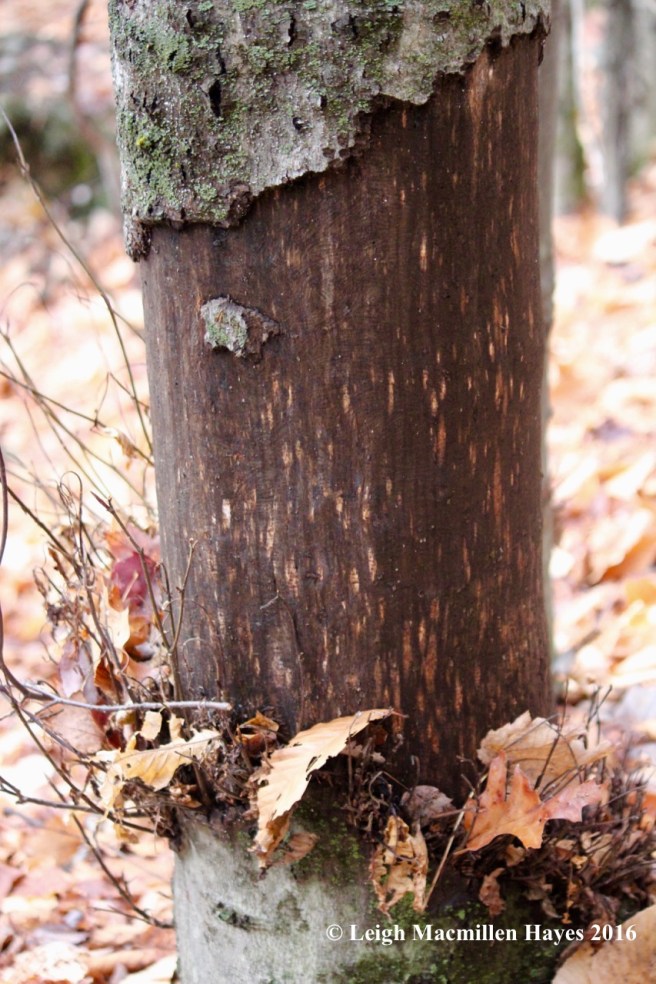
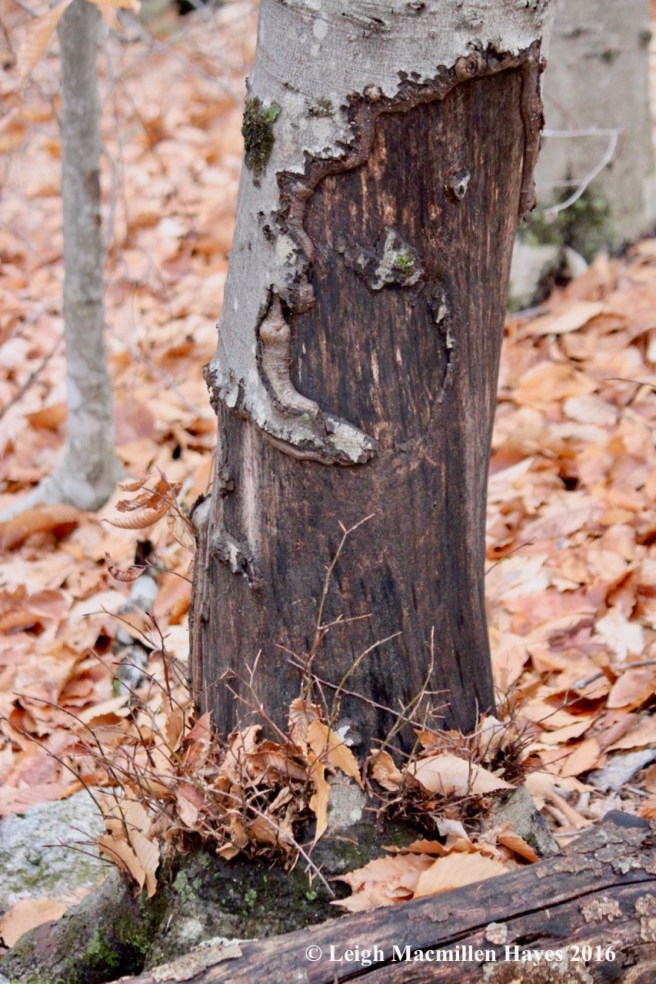
And I spotted a phenomenon that occurred repeatedly. Girdled beech trees too far uphill for a beaver. What or who had debarked these trees?

s-porky-works

I may have been seeing things that weren’t real, but the lines on this particular tree made me wonder about the porcupines. Was I looking at the design they leave with teeth marks created in the distant past? Or were they wounds of another kind?

s1-beaver-5

When at last we reached the Pond Trail again, we continued to circle around it, noting more beaver works.

s-beaver-lodge

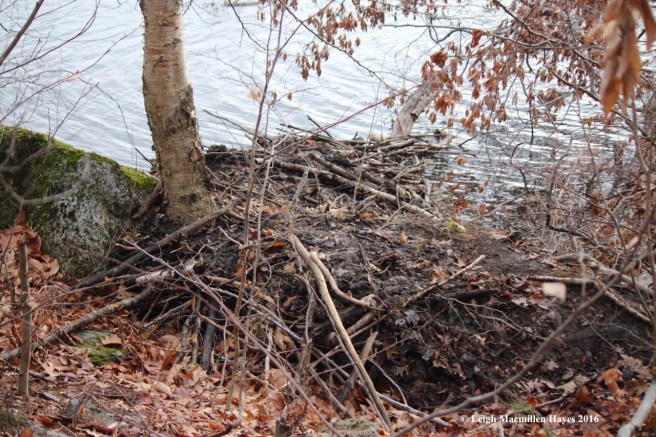
At last, we found the mud-packed lodge built into the edge of the pond. Here’s hoping for a warm winter within.

s-pond-at-end-of-day-1

Completing the circle, the biting breeze forced us to walk quickly toward our truck and the end of our hike. We have chores to complete tomorrow so our Sundate may have to suffice for a Mondate.

That being said, in this season of hope, we trust we’ll find more opportunities to consider these be-attitudes:

s1-trees-in-harmony

Be supportive of each other.

s1-christmas-fern-1

Be watchful of what’s to come.

s-heart

Be hopeful of love everlasting.

Book of November: The Natural World of Winnie-the-Pooh

My sister knows me well. And so this summer she gifted me a copy of Kathryn Aalto’s The Natural World of Winnie-the-Pooh: A walk through the forest that inspired the Hundred Acre Wood. 

pooh-11

My relationship with Pooh began as a child, though I can’t remember if my sister or mother read the stories to me or if I first meet him on my own. It doesn’t matter. What’s more important is that I had the opportunity to meet him and to stay in touch ever since.

pooh-10

Our relationship continued when I took a children’s literature course as a high school senior and after reading and writing about the books, I sketched characters from several stories including A.A. Milne’s Winnie-the-Pooh to complete an assignmentMy framed collage still decorates a wall in my studio. And later, I met Pooh again through The Tao of Pooh here I listened more closely to his lessons about life. When I needed to interpret a song for a sign language class, it was to Pooh I turned: Kenny Loggin’s “House at Pooh Corner.” And Pooh was a dear friend when our sons were young and the oldest formed his own relationship with the residents of the Hundred Acre Wood.

pooh-9-1

And so it was with great joy that I opened Aalto’s book and immediately related to her dedication: “To the walkers of the world who know the beauty is in the journey.”

pooh-8-1

When a friend noted that Winnie-the-Pooh is 90 years old today, I knew that this had to be the Book of November. Alan Alexander Milne published When We Were Young and A Gallery of Children in the two years prior to 1926 and followed with The House at Pooh Corner in 1928. All are as meaningful today as they were then–perhaps more so.

Aalto is an American landscape designer, historian and writer who lives in Exeter, England. I know it’s not good to covet someone else’s life, and yet . . .  I do.

Her book begins with biographical background about Milne and how he came to be at Ashdown Forest and the Five Hundred Acre Wood. I think one of my favorite facts that she shares is that while at boarding school, his mother sent care packages that included  bunches of flowers grown in her garden. Upon receiving them, he was pulled home by the sight and scent. Perhaps secretly, my sons would appreciate that, but they’d never let on.

States Aalto: “We value the books for simple expressions of empathy, friendship, and kindness. The stories are classics as they express enduring values and open our hearts and minds to help us live well. But as I read about Milne and walked around England with my children, I saw how they also tell another story: the degree to which the nature of childhood has changed in the ninety years since Milne wrote the stories. There is less freedom to let children roam and explore their natural and urban environments. There are more digital distractions for our children that keep them indoors and immobile, and heightened parental fears that do so as well.”

With that, I am reminded of a childhood well spent exploring the environs of our Connecticut neighborhood and beyond and not returning home until we heard Mom shout our names from the back door. (Or a certain next door neighbor told me that my mother was calling.)

pooh-7-1

While C.R.’s explorations with his stuffed animals became the muses for his father’s stories, the landscape also provided inspiration.

That landscape still exists, though time has had a way with it. Aalto takes us there through her photographs and words. She begins with a visit to the farm, village of Hartfield, and the forest located steps to the south. Referring to the Ashford Forest, she comments: “It is still a place of solitude where people can walk half a day without meeting another person. There are no overt signs pronouncing your arrival in Pooh Country. There are no bright lights or billboards, no £1 carnival rides, no inflatable Eeyores, Owls, or Roos rising and falling in dramatic flair. There are no signs marking the dirt lane where Milne lived, nor pub grub with names like “Milne Mash and Peas” or a “Tigger’s Extract of Malt Cocktail” on ice. A quiet authenticity–historical, literary, and environmental–has settled over the landscape.” Ah, yes. A place to simply be and breathe and take it all in.

pooh-13-1

A photograph of C.R.’s secret hideaway in a tree reminds us that the stories are about real people and real places and based on real life events, all with a dash of real imagination. Aalto examines every aspect of this.

A week ago today, while exploring a similar woodland in New Hampshire with a dear friend, I convinced her to step inside a tree cavity, much the way the real Christopher Robin used to do a Cotchford Farm. At heart, we can all be kids again.

pooh-6-1

I love that Aalto provides us with a closer look at the flora and fauna of the forest. From flowers and ferns to birds, butterflies, moths, damselflies and dragonflies, and red tail deer, she gives us a taste of C.R. and Pooh’s world.

pooh-5-1

And she reminds us to get out and play, including rules for Poohsticks. I think it is more important than ever that all members of our nation step outside, find a Pooh bridge, drop a stick and run to the other side. As Aalto says in rule #9: “Repeat over and over and over and . . . ”

pooh-12-1

I also like that she mentions one special visitor to Ashdown Forest, who spent many hours examining carnivorous sundews.

pooh-sundew-1

I’m rather excited by that because just yesterday I discovered sundews, though rather dried up, growing on our six-acre woodland. We’ve lived in this house for 24 year and I’ve never spotted these before. The land is forever sharing something “new” with me and I’m happy to receive each lesson.

pooh-14-1

I’m also thankful for a feisty faerie with whom I share this outdoor space. Sometimes her statements are dramatic and I can only imagine the cause of her recent frustration.

pooh-3-1

It’s not too late to revisit your inner Pooh. To take the journey. And while you are there, I highly encourage you to get to know him and his place through The Natural World of Winnie-the-Pooh by Kathryn Aalto.

P.S. Thanks Lynn ;-)

The Natural World of Winnie-the-Pooh, first edition, by Kathryn Aalto, © 2015

Focus On The Forest Forage

When Jinny Mae beckons, I always answer. Oh, maybe not in the affirmative every time,  but as often as possible I join her for a forest forage. Ours is not so much to collect anything physically, though sometimes a pinecone or some scat have been known to jump into our packs, but rather to visually and mentally take in all that we see.

j-november-day

Today was the perfect November day for such an adventure. As the breeze blew, the cloud formations kept changing and the sun poked in and out. We were at times chilled and other times warmed–but always happy to be tromping through the woods and across fields in search of great finds.

j-droplet-on-big-tooth

Sometimes our finds were as simple as raindrops left behind on leaves in the pond.

j-rock-island-1

But a great deal of our time found us on our hands and knees yet again, oohing and aahing among the complex lilliputian world of lichens.

j-rock-foam

We plopped ourselves down, realizing that no matter where we stepped or sat, we were destroying some form of lichen that was older than time as we understood it. No sooner did we begin to focus when we realized we were beside Rock Foam Lichen (Stereocaulon saxatile).

j-rock-foam-2

Perhaps we’ve seen it a million times before, but today we met it for the first time. Its granular surface that speaks to its common name was visible even without a loupe. Though it grew near reindeer lichen, its presentation was different and it was singular rather than colonial. Now, if we can only remember its name the next time we meet–Rock Foam, Rock Foam, Rock Foam.

j-brits-2

We are not ones to resist a more familiar friend, and so British Soldiers (Cladonia cristatella)  also captured our focus. Despite their diminutive size, those bright crimson caps shouted for recognition.

j-brits-3

The thing we reminded ourselves of today is that British Soldiers grow in a branching formation.

lipstick-powderhorn-and-common-powderhorn

In contrast, their cousins, the Lipstick Powderhorns (Cladonia macilenta), sport red caps atop unbranched stalks. Also standing out to the left in this photo are a few Common Powderhorns (Cladonia coniocratea)–recognizable for their lack of a cap.

j-red-fruited-pixie-cup

It seemed we couldn’t get enough of a good thing and as we scooched along the granite surface trying not to destroy too many lichens and mosses, we found a third red-capped variety.

j-red-fruited-pixie-2

Red-fruited Pixie Cups (Cladonia pleurota) brought smiles to our faces due to their goblet formation topped with those outlandish caps along the margins. We were immersed in Cladonia heaven.

j-lichens-galore

And then . . . and then . . . and then just as our eyes trained on the red caps before us, something else made itself known.

j-ladder-lichen-cladonia-cervicornis-subsp-verticillata

We spied another cousin that I’ve only seen once before: Cladonia cervicornis ssp. verticillate.

j-ladder-2

Its growth formation is rather unique. In one sense, it reminded me of a sombrero, but in another sense, I saw fountains stacked one atop another, each giving forth life in their own unique fashion. But rather than being called Fountain Lichen, its common name is Ladder Lichen–perhaps referring to the fact that the pixies can easily climb up and up and up again.

j-candy-2

One of the lichens that grew abundantly in this place is the Candy Lichen (Icmadophila ericetorum). This one has been long admired for its salmon-colored fruits that rise above the pale grayish-green crustose formation. Today’s realization–that crustose wasn’t as flat as one might expect. In fact, its appearance  was rather lumpy and almost brain like.

j-brown-beret-1

And beside it, one that I hesitate to name, but will take a stab at anyway–Brown Beret Lichen (Baeomyces rufus). I based my attempt upon a description in Joe Walewski’s book: Lichens of the North Woods. Walewski states: “Crustose pale green to gray green surface with short fruticose stalks topped with a dull brown cap.” I may be totally wrong, but that’s what learning is all about.

j-shield-6

We next became equally enthused by the rock shields and their brownish disks.

j-british-among-shields-1

And living among them–British Soldiers.

j-shields-fertile-2

While the foliose formation of the shield lichens spread outward in radiating patches, the apothecia that housed spore production sat atop rounded bowls with rolled-in margins. Based on the margins, my guess was that this was Cumberland Rock Shield (Xanthoparmelia cumberlandia). Maybe it was enough knowing it was a rock shield.

j-shield-bug-2

And speaking of rocks and shields, while we looked, the surface of the rock moved.

j-shield-bug-1

A shield bug, aka a stink bug, crawled along, barely pausing to let us admire the variety of colors it presented.

j-rock-island-2

At last we left the rocks behind and moved on through the woods. Jinny Mae still had a couple more things to show me.

j-common-stinkhorn-1

While my camera had a difficult time focusing on the minute fruiting structure of green stain fungi, it had no problem with the Common Stinkhorn (Phallus ravenelii). It’s reportedly the most common stinkhorn in New England, and yet I don’t find anything common about it. As apparent from the “cracked shell” and lack of a stalk yet, this one was just hatching from its embryonic or egg form. We got down to sniff and noted merely a strong mushroomy odor.

j-purple-crust-1

With one more wonder to ponder, we returned to Jinny Mae’s home, where she showed me a rotting maple branch decked out in purple.

j-purple-2

My first thought because I’d been wearing my lichen eyes–a foliose lichen. But upon further reflection, I think it’s a crust fungi. Whatever it is, again, I’ve never seen it before. But as we noted all day long, once our eyes are focused, things make themselves known.

j-mt-wash-2

At last it was time for me to find my way home. My forest forage with Jinny Mae had come to an end for another day, but my mind’s eye is still focused on our wonder-filled finds.

Walking With Rufus Porter

It’s not every day one walks down the street with a house, but that’s exactly what many of us did yesterday as the Rufus Porter Museum was relocated from North High Street in Bridgton to Church Street.

r-house-moving-sign

The Rufus Porter Museum and Cultural Heritage Center was founded in 2005 to showcase the folk art history of the area, with an emphasis on Porter’s work. The mission of the museum is to “celebrate the life and times of a remarkably creative American genius who worked throughout Maine, New England and beyond.”

Rufus was an entrepreneur who painted miniature portraits, as well as highly-prized wall murals that are still in houses throughout New England. Besides being a traveling folk artist, he was an inventor, musician, teacher, and founder of Scientific American magazine.

Among his inventions was a horse-powered boat. And he tried to develop an airship that would take people from the East Coast to California in three days.

r-getting-ready

Folk art collectors Julie and Carl Lindberg had the foresight to save much of the material culture of the Bridgton area, including the work of Porter and his apprentices, and chose to give back by sharing their collection with the community and supporting the Rufus Porter Museum in its infancy. And now, the museum is on the cusp of growing. While it has been housed in a red Cape on North High Street, which the Lindbergs made possible in order to share murals and other pieces of decorative arts, yesterday it was in transition to a larger space.

r-first-3

The move was a huge undertaking, despite the fact that the over 200-year-old house was moving less than a mile down the road.

r-my-guy-1

While a crowd gathered to watch each inch of the journey, my guy returned from a morning run. He’s training for the Moose Pond Half Marathon, a fund raiser for Shawnee Peak’s Adaptive Ski Program. As is his style, he thanked everyone for coming out to cheer him on. (The race is on Saturday, Nov 5, if you really do want to cheer him on.)

r-first-moves-1

Over an hour later, Rufus Porter’s works were on the move.

r-wirestrees

r-wires-3

r-wires-5

r-wires-7

While Cole Watson (a former student of mine) drove and his father, Dana, walked beside, workers from Central Maine Power and Fairpoint checked wires and trees along the route.

r-wires-9

There were only a couple of snags, which were quickly resolved.

r-pleasant-street

The town came to a standstill for this momentous journey. It’s not every day a house winds its way down the road.

r-main-hill-10

Beside the Civil War Monument forward motion paused for a bit.

r-main-hill-8

Many of us became sidewalk engineers over the course of the day, something Rufus Porter would have embraced, as we tried to determine the next steps. Main Hill was our main concern. What if . . . Some had visions of failing brakes and a mad dash down Main Street to Food City. Others had visions of the mill pond at the bottom of the hill coming into play. Fortunately, the Watsons had it all figured out and this was just another work day for them. They chained a second truck  to the back of the rig before the journey continued.

r-main-hill-jdecor

r-main-hill-1

r-main-hill-bottom-2

As if a routine performance, all went well and Cole maneuvered around the bend by Shorey Park.

r-main-9

r-main-street-4

On Main Street, he pulled left to avoid overhanging trees, making for a snug journey beside the Hayes Block.

r-turn-to-church-1

r-turning-onto-church-5

r-tire-change

And then it was time to pause again so that Cole, Eric Wissman (the contractor in charge of building renovations) and Dana Watson could make adjustments to the wheels before the final turn.

r-turning-8

The Cape was headed to the back part of the lot behind the 1842 Webb House at 121 Main Street.

r-turn-10

r-turning-church

r-church-3

Turning onto Church Street proved the tightest squeeze of the entire operation.

r-library-1

In honor of the arrival of its new neighbor, the library threw a party in the courtyard.

r-house-blessing-1

Before the shift toward its new foundation, the Reverend Emily C. Goodnow, pastor of Bridgton’s First Congregational Church, invited the crowd to gather  round for a house blessing.

r-blessing-2

Many raised their hands to the Cape as Pastor Emily spoke of the building’s history, including the fact that it was built for the Reverend Nathan Church, Bridgton’s first minister, and blessed its future.

r-church-6

Then the real work began–the shift from transient to permanent.

r-beam-3

Like he’s been doing it all his life, because he has, Cole walked the beam with confidence.

r-beam-2

r-resting-5

The chain was secured and Kyle Warren moved the beams to their placement under the house.

r-skates-1

Skates, as they are called, were placed on the beams, the one on the left to be used in front, and the right one for the back.

r-skate-2

After laying cribwork, checking measurements and making sure all was level, the first leg of the shift began.

r-resting-3

r-resting-2

By 3pm, the house stood at the edge of the foundation.

r-church-street-resting-spot

The Watsons decided to call it a day as it would take at least two more movements to get it into place. And so, while the house isn’t officially in its new space yet, it is well on its way.

r-rufus-sign

And for all of us who had the opportunity to observe the move, it was a day well spent. It was a day to make history and recall history. It was a day for community as witnessed by all those who came out to watch and chat and speculate. It was a day to renew old friendships and meet new people.

It was an honor to walk with Rufus Porter and trust he would have appreciated the efforts of all. This was a man, who in the 1840s, could look at a problem and find a solution or any number of solutions to make things more efficient. I think he most certainly would have enjoyed the journey.


Finding Our Way on Mount Tom in Fryeburg, Maine

I ventured this afternoon with my friend Marita, author of  Hikes and Woodland Walks in and around Maine’s LAKES REGION, along with her daughter’s beagle, Gracie, on a new trail in Fryeburg.

t-preserve-sign

Mount Tom, a Roche Moutonnée, is an asymmetrical hill with a gently sloping up-ice side that has been smoothed and polished by a glacier. The other side is abrupt and steep–the down-ice side where the rocks were plucked off, leaving a more cliff-like appearance. As Marita noted, its most impressive view is from a distance, but today we sang its praises from up close. We’ve both hiked a 1.5 mile trail to the summit for years, but recently The Nature Conservancy developed a new trail that we were eager to explore.

t-fdn-1

Within seconds I was exclaiming with joy. A huge, and I mean HUGE foundation shared the forest floor. Note the outer staircase to the basement.

t-center-chimney

And the large center chimney.

t-fryeburg-1858-map

On an 1858 map, I found that A.H. Evans owned a home in about this vicinity, but I don’t know if this was his. Or any more about him. It will be worth exploring further at the Fryeburg Historical Society.

t-house-connected-to-barn

The house extended beyond the basement.

t-barn-1

And was attached to an even bigger barn.

t-barn-2

Ash trees grow beside the opening, but I wondered if we were looking at the manure basement.

t-trail-blaze

Finally, we pulled ourselves away and returned to the trail. Well, actually, we tried to return to the trail but couldn’t find it. So we backtracked, found this initial blaze and again looked for the next one. Nothing. Nada. No go. How could it be?

t-marita-and-gracie

That didn’t seem right, so we decided to follow our noses, or rather Gracie’s nose, and sure enough we found the trail. If you go, turn left and cross between the house and barn foundations.

t-gracie

After that, for the most part, we were able to locate the trail, but it was obscured by the newly fallen leaves and could use a few extra blazes. Gracie, however, did an excellent job following the scent of those who had gone before and leaving her own.

t-saw-dust

The path took us over a large mound of sawdust, something I’ve found in several areas of Fryeburg.

t-color

The predominate trees were beech, white and red oaks, thus providing a golden glow to the landscape.

t-ledges-1

And then we came to the ledges. Bobcat territory. Note to self: snowshoe this way to examine mammal tracks.

t-ledge-island

The trail was situated to provide a close up view of the ledge island, where all manner of life has existed for longer than my brain could comprehend. Life on a rock was certainly epitomized here.

t-intersection

We continued our upward journey for over 2.3 miles (thanks to Marita’s Fitbit for that info) and eventually came to the intersection with the trail we both knew so well.

t-summit-sign

From there, we walked to the summit where the views have become obscured by tree growth.

t-pleasant-mtn-from-summit

But . . . we could see the long ridge of Pleasant Mountain in front of us,

t-kezar-pond

Kezar Pond to our left,

t-richardson-1

t-richardson-farm

and the Richardson Farm on Stanley Hill Road to our right.

t-ladys-slipper-pod

Also along the summit trail, the woody seedpod of a Lady’s Slipper. Ten-to-twenty thousand seeds were packaged within, awaiting wind dispersal.

t-mt-tom-house

We decided to follow the old trail down, which passes through a hemlock grove and then suddenly changes to a hardwood mix. Both of us were surprised at how quickly we descended. And suddenly, we were walking past some private properties including the 1883 Mt. Tom cabin.

t-northern-white-cedar-bark

t-northern-white-cedar

The cabin sign was actually attached to a Northern White Cedar tree. I’m forever wowed by its bark and scaly leaves.

t-flag

In the field beyond, Old Glory fluttered in the breeze.

t-barn

And just before Menotomy Road, we spied Mount Kearsarge in the distance.

t-menontomy-cemetery

Since we’d taken the loop trail approach rather than an out and back on the same trail, we had to walk along Menotomy Road, so we paid the cemetery a visit and checked out the names and ages of those who had lived in this neighborhood.

t-pine-on-grave-stone

One of the older stones intrigued me with its illustration. I think I would have enjoyed getting to know these people.

t-menotomy-pumpkins

As we continued on, I was reminded of recent adventures in Ireland  and the realization that we notice more when we walk along the road rather than merely driving by. We both admired this simple yet artful pumpkin display.

t-menotomy-road-1

If you go, you might want to drive to the old trailhead, park your vehicle and then walk back to the West Ridge Trail. We parked at the latter and had to walk the 1.5 back at the end, when it seemed even longer. But truly, the road offers its own pretty sights and the temperature was certainly just right, even with a few snow flurries thrown into the mix, so we didn’t mind. We were thankful we’d found our way along the new trail and revisited the old at Mount Tom. And I’m already eager to do it again.


An Emerald Mondate

My guy and I journeyed via bus, car and foot across northern and eastern Ireland these past two weeks. Our main agenda–a vacation in the land where twenty-six years and two months ago we celebrated our honeymoon. We both also had semi-hidden agendas–his to seek out ancestral roots, mine to search as well, though my quest wasn’t quite so clear.

river-liffey-and-quay-dublin

Our journey began after we dumped our bags at the hotel, where our room wasn’t yet ready, and crossed the River Liffey in Dublin. It was to the right that we’d parked a rental car 26 years previously as we searched for traditional music and supper, only to return hours later and discover that the driver’s side window had been smashed and our video camera stolen. All these years I’ve held a sour view of the Fair City and so I felt a bit nervous as we stepped forth.

trinity-college-dublin

The feeling began to wane immediately, for as we approached a street corner and chatted about locating the library, a Dubliner overheard us and assumed we were looking for Trinity College (founded in 1592). We decided to play along and followed his directions–thankfully. It was “Welcome Freshers” week and the quad swelled with activity tents, music and students anticipating the year ahead. We passed among the frivolity and found the self-guided tour of the 18th century Old Library and that most ancient of manuscripts–the Book of Kells, a 9th century book featuring a richly decorated copy of the four Gospels of the life of Jesus Christ. A favorite discovery: the monks used oak apple galls to create ink–apparently, they crushed the galls and soaked them in rainwater, wine or beer until they softened. I’ve got to try this.

library-at-book-of-kells-1-1

While (or whilst as the Irish say) no photos were allowed in the Treasury where the manuscripts are stored, equally impressive was the Long Room, which houses 200,000 of the library’s oldest books in ancient oak bookcases. Just thinking about the centuries we were encountering was mind boggling, enhanced of course, by a lack of sleep.

architecture-and-flowers-dublindublin-church-architecture

A few hours later, we made our way back to the hotel, enjoying the architecture and flowers as we walked along. At last, we could check in and so we checked out–a rejuvenating nap essential to our well being.

guiness-sign-and-face

Rested and showered, we hopped aboard a bus–our next destination, the Guinness Storehouse at St. James Gate Brewery. The 250-year story of Guinness® is portrayed on five floors in a building designed in the shape of a pint. What’s not to like about that.

singing-oyster-guiness

We learned about the process of creating beer, and then there was the whistling oyster, one of the many icons of the Guinness® brand.

guinness-gravity-bar

After taking in the full story, we reached the Gravity Bar, where ticket holders may each sip a complimentary foam-topped pint. The museum was preparing to close and the bartenders made the last call. My guy asked if we could purchase a second pint and we learned that they don’t sell any, but he kindly slipped us two. Don’t tell.

guiness-view-2

The Gravity Bar offers 360˚ views of the city.
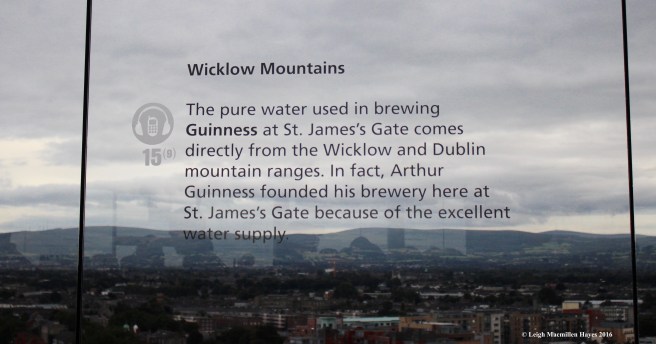
wicklow-mtns-from-gravity

And the view includes the Wicklow Mountains, our intended destination for week 2.

the-temple-bar

If you hear my guy tell this story, he’ll say that we were told it was a 45 minute walk from our hotel to the Storehouse, but a short bus ride. We rode the bus there, but later weren’t sure where we should queue for the ride back, so we decided to walk instead. According to him, it took us five hours to make that 45 minute walk. I’m not sure it was quite that long, but we did stop at The Temple Bar for the music and a few other prime spots to eat and sip a wee bit more.

national-library-dublin

The next morning we set out for the National Library, which had actually been our intended destination the previous day–but who can deny enjoying the Book of Kells exhibit. My guy was hopeful that the genealogists at the library would help him make some connections, but without knowing parishes he hit a bit of a stonewall.

And so we left the Fair City with much fonder memories, took a bus to the airport, picked up our rental car, and ventured on. Oy vey. If you’ve ever watched the BBC program, “Keeping Up Appearances,” you’ll appreciate that I was Hyacinth to my guy’s Richard. “Mind the pedestrian,” I’d say. “I’m minding the pedestrian,” he’d respond.
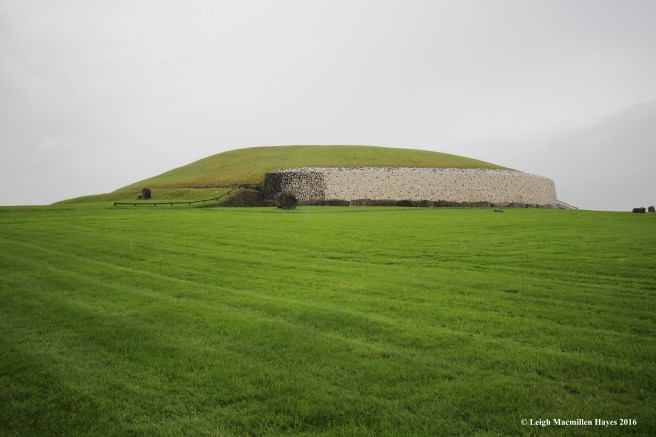
newgrange

Our first stop, Newgrange, a Neolithic passage tomb alleged to be older than Stonehenge and the Great Pyramids. Constructed during the Stone Age, about 5,200 years ago, Newgrange is a large circular mound that covers 300 feet in diameter and stands 36 feet high. A stone passageway leads to three small chambers. Some describe it as an ancient temple, a place of astrological, spiritual and ceremonial importance. Our guide told us that bones were found here and it may have been a place for worship as well as where people were laid to rest. We were in awe of its structure and the fact that the passageway is oriented northward allowing the sun to illuminate it during the winter solstice.

newgrange-entrance

Yes, the railings are new, but this is possibly the oldest building in the world. That’s worth repeating–the oldest building in the world. We had to bend low to enter and then squeeze between the walls as we walked toward the center, where three small chambers with stone basins created a cross-like structural plan. Even as we stood with others in darkness and waited for a beam of artificial light to demonstrate the real thing, we couldn’t quite fathom what we were witnessing.
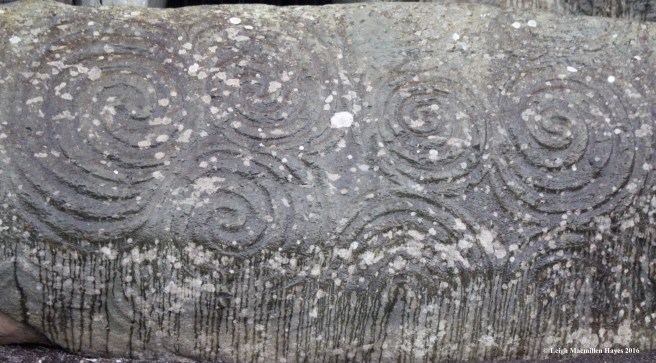
newgrange-spirals

Our awe continued within the center and by the entrance stone, where we witnessed megalithic art. The spirals reminded me of labyrinths, but we’ll never know their true significance. And that’s OK.
ghan-house-carlingford

By the time we arrived at Carlingford, it was pouring and we had no idea where to stay. We stopped at a hotel, which was full–thankfully. They suggested the Ghan House, a Georgian House set within three acres of walled gardens. It was our most posh stay and we didn’t truly appreciate it until the next morning when the sun shone brilliantly.
carl-arch-2

The Ghan House is located just a stone’s throw from the Thoisel or town gate leading into the narrow streets of the town centre, where we found Ma Baker’s in the rain, a welcoming pub frequented by the locals, who laughed and joked and reminded us that the Irish love to sip a pint, tease each other and tell stories no matter what the weather might be out the door. And they don’t care about spelling, punctuation or run-ons. Life is too short for that–note to self.

carlingford-lough1

The tide was low when we walked along the lough the next morning and took in King John’s Castle, which was initially constructed by Hugh De Lacy in 1190, though it wasn’t completed until 1261. Purportedly, King John, the brother of Richard the Lionhearted, visited in 1210, and thus the name for this Norman structure.

wall-around-derry

From Carlingford, we travelled north and did what we had wanted to do 26 years prior; we crossed into Northern Ireland. On our previous adventure, we’d journeyed as far as Letterkenny in the northern part of the Republic of Ireland, only a half hour from Derry. But that was then, the time of The Troubles, and we didn’t dare to cross the border. Again, my guy was seeking ancestors and at the Welcome Center he was told to visit the Tower Museum where Brian Mitchell would be able to provide some help. We were too late when we climbed down from the wall to the museum, so we did what the Irish would do–when in Rome–we found a pub and had a nice chat with a young man who had recently returned to Derry in search of work. We also walked around the city, taking in the sites made famous by The Troubles. And the following morning we again returned to the museum, where the curator told us that Brian would probably show up around 11am. So, we paid for a self-guided tour and learned about the town’s colorful and dramatic past through “The Story of Derry.” At 11:30 we once again went in search of Mr. Mitchell, only to learn that he was out and about somewhere. Since we needed to check out of our room, we decided that our Derry experience was over, but Mr. Mitchell did respond to an e-mail and so my guy has some more resources to consider.

carrick-cave

Our next stop, Portrush, a resort town along the Atlantic and on the northern fringe of Ireland. After checking in at the Antrim House B&B, we headed off along the Coastal Scenic Route to Carrick-a-Rede Island. Carrick-a-Rede is from the Scottish Gaelic term, Carriage-a-Rade, meaning the rock in the road.
salmon-boat-at-carrick-1

And the road is presumably the sea route for Atlantic salmon that were once fished here prolifically. In fact, so prolifically, that the fishery is no longer viable. In order to reach  the best places to catch the migrating salmon, for 350 years fishermen crossed regularly to the island.
rope-bridge

One hundred feet above the sea, the fishermen crossed the 60-foot chasm via a rope bridge to check their nets. Of course, they had only one rope, not the steel and plank structure that we crossed. That being said, it was quite windy and the bridge did sway.

smiling-from-the-carrick-a-rede-rope-bridge

We put our fear of heights behind us and made our way across.

allen-at-carrick-3-1

Did he just do that? Yup.

me-at-carrick-1

And I followed.

scotland-2

Our views included Raithlin Island, the northernmost point of Ireland.

giants-causeway-1-1

Our next wonder–the Giant’s Causeway, a geological phenomenon of 40,000 basalt stone columns formed by volcanic eruptions over 60 million years ago.
giants-3

giants-6

These hexagonal tubes stacked together like cans on a shelf offer yet another mystical and magical look at the world, one that the Irish embraced by creating legends to explain their existence–Fionn mac Cumhaill (Finn MacCool), an Irish giant, was challenged to a fight by the Scottish giant Benandonner. Good old Fionn accepted said challenge and built the causeway across the North Channel so that the two could meet. There are two endings so take your pick: In one version, Fionn defeats Benandonner, but in another,  he hides from Benandonner because he realizes his foe is much bigger. Fionn’s wife, Oonagh, disguises her husband as a baby and tucks him in a cradle. When Benandonner sees the size of the “baby,” he fears that its father, Fionn, must be the biggest giant of them all. Benandonner flees back to Scotland in fright, but makes sure to destroy the causeway behind him so he won’t be followed by Fionn.
causeway-view

My guy found a spot to take in the giant’s viewpoint.

dunluce-castle-2-1

As we made our way back toward Portrush, we paused at Dunluce Castle. We couldn’t go in because it had closed for the day, but we could still see part of the castle town that was developed in the early 1600s.
dunluce-castle-1-1

Originally built by one clan in the early 1500s, it was seized by another in the mid 1500s. Its history includes rebellions and intrigue.

dunluce-castle-wall-over-cliffimg_7377

Included in its dramatic history are tales of how the castle kitchens fell into the sea one stormy night in 1639. We couldn’t help but wonder if the same happened to the wall.

portrush-2-1

Back in Portrush finally, our own tale continued. At the suggestion of our hostess, we walked to the Harbour Bar for dinner.

wee-harbor-bar-ryder-cup-trophy-1

While we waited for a table, we paused in the wee pub, as they call it. A few minutes later, two guys walked in with a trophy and made a big fuss about its placement among the best bottles of whiskey.

darren-3-1

At the time, I was standing to the right of the gentleman in the middle and so I asked him about the trophy. He explained that when you participate in the Ryder Cup you receive a replica. My guy immediately realized that I was talking to a famous Irish golfer, he just couldn’t put a name with the face. On the wall above, we could see photos of him, but we weren’t close enough to read the signatures.

allen-as-darren-1

It turns out we were in the presence of Darren Clarke, the European Ryder Cup captain for 2016. We didn’t know that until we went to check on our table and asked. One of the bartenders encouraged us to stay for the send-off, so we did. Everyone donned a D.C. mask (at 00:16, if you look quickly to the back left, you might see my scraggly hair behind a mask)–and sang “Shoulder to shoulder, we’ll answer Darren’s call.” We were included as the North American entourage.

allen-and-willie-2-1

allen-and-willie-1

While I got Darren’s autograph on one of the masks, my guy befriended Willie, the bar manager.

portrush-2

The next morning, after a traditional Irish breakfast, we toured the downtown. Ireland amazes us–the temperature was chilly and yet the flowers were gorgeous. And palm trees grow throughout the country.

walk-to-murlough-bay-with-fairhead-in-background

Upon our departure, our hostess suggested we follow the coastal route to Murlough Bay and so we did. And took a wrong turn that lead down a dead-end to a gate with a sign warning us that guard dogs were on site. With caution, my guy backed up the lane until he could turn the car around. Our hostess had also told us not to park at the upper lot for Murlough Bay, but instead to drive down. I insisted upon the upper lot given that the road had at least a 10% pitch. So we walked down. And down. And down some more.

fairhead-murlough-bay

Upon our descent, the light at a distant lighthouse beckoned in the background as Fairhead came into view.

murlough-bay

The coastline was as dramatic as we’d been promised. And I was glad we’d walked because the drive would have been even more dramatic with Hyacinth in the passenger seat.
stormlands

This area may appear familiar to viewers of Game of Thrones–including the site of Stormlands.

traditional-music-in-belfast-1

After a hike back up the road, we drove on to take in the scenery of Torr Head. The road narrowed significantly as it twisted and turned along the coast. And then . . . we met a porsche rally. As best he could, my guy squeezed our car past them. And as soon as he could, we got off the coastal route and drove on to Belfast. It was late in the day and pouring when we arrived. By the time we parked in city centre and walked to the Welcome Center, we were drenched. And disappointed. There was no where to stay in town and we’d have to move on. But . . . then one final effort proved that a hotel was available. We should have questioned if for the price. Well, actually I did, but we were told that it was a fine place and served as a conference center. So we took it. And couldn’t wait to get out of there. Fortunately, we found some Irish music back in town and a delightful meal of locally harvested food. All we needed to do was sleep in the rathole, though even that didn’t work so well.

nomadic-1

The next morning we took in the Titanic Museum and stepped aboard one of its tenderfoot boats, the Nomadic.
me-nomadic-2-1

A dose of coffee and I was ready to take the helm. And if you are wondering if it’s windy every day in Ireland, the answer is yes. It also rains at some point each day. Our time in Northern Ireland was over, but except for that one accommodation, we’d had a wonderful and wonder-filled time.
holly-cottage-laragh-1

As we worked our way south, we spent a night at a delightful B&B in Navan, which featured  more traditional music and a place to relax. On Monday morning, we finally headed to the cottage we’d rented in the town of Laragh–Glendale Holiday Cottages–we highly recommend. Our host, Christy, was extremely accommodating, the cottage spacious and amenities plentiful.

ww-monastic-city

We’d chosen this location because it was a five minute walk to the pub and restaurant in Laragh, located in the Wicklow Mountains, and near the Glendalough monastic settlement founded by St. Kevin in the sixth century.

round-tower-glendalough

Forty shades of green and Brigadoon all came to mind as we approached the monastic settlement and its round tower.

st-kevins-church-glendalough

St. Kevin’s kitchen is actually a 12th century church, so named because it was believed that the bell tower was a kitchen chimney. Apparently, however, no food was ever cooked there. But . . . if you think of the word of God as food, then perhaps many a feast was actually served.

ww-monastic-cathedral

From the altar window in the cathedral, the largest of seven churches within the monastic city,  a view of the world beyond was offered.

st-kevins-monastery-glendalough-1

Likewise, we could see the world within, including the Priest House in the background.

monastery-cemetery-glendalough

And everywhere, gravestones told the story of many who’d passed this way.

trinity-church-glendalough-day-3

A little closer to Laragh, Trinity Church.

upper-lake-3-glendalough

Upper Glendalough was the jumping off point for our initial hike upon the Wicklow Way.

p-falls-2-glendalough

We paused beside Poulanass Falls before zigzagging our way up the first trail.
sheep-wicklow-way-2

Sheep merely looked up to acknowledge our passing. We, however, needed to pay more attention for sheep shit was prolific.

reforestation-wicklow-way

Tree felling was also a frequent sight, but we noted a unique (to us anyway) method of reforestation–in this case the Sitka spruces and Scots pines being felled were replaced by mountain ash saplings. One other thing we wondered about–the plastic sleeves–we saw some that had fallen away as trees grew, but were left in place. Biodegradable? We could only hope.
wicklow-way-bog-day-1

We spent three full days on the trail, not covering all of it, but a good portion as we hiked 10-15 miles each day.
crossing-bog-wicklow-way-day-1

Our journey took us over boggy portions,
wicklow-way-day-3

down grassy sections,

w-lane-2

on village lanes,

ww-boardwalk

over boardwalks,

ww-forest-path

through the black forest,

w-walking-into-the-sky-day-3

and into the future.

ww-following-the-signs

Frequently, we had to stop, reread the directions and study the map, but more often the route was self-explanatory.

ww-muddy-trail

Along one section that was particularly muddy due to frequent horse crossings, we made a discovery unique to us.

w-badger-print

A badger print. Sadly, or maybe happily to locals, we saw a dead badger on one of the lanes not far from this print. Related? We’ll never know.
w-deer-at-glendalough

We saw deer, one rabbit and two red squirrels.
Red Squirrel sign, day 3.jpg

Writing of the latter, we chuckled when we encountered this sign because we have frequent encounters with them at home. But considering we only saw two in two weeks and spent most of our days outside, we had to wonder.
w-bessy-1

Bessie One,

w-bessy-2

Two,

w-bessy-3

and Three (pronounced Tree) tolerated our presence.

w-cow-on-wall

And Bessie Four made us laugh–as she stood upon a wall.
w-hay-in-barn

Though we passed through pasture after pasture and by many a farm and barn, we never saw any farmers, but knew that they were hard at work preparing for winter.
drinking-water-wicklow-way-day-3

And one even offered us nourishment.

w-wooden-stile

Our path included obstacles, though most were easy to overcome from a rope loop
w-stile-step-wicklow-way-day-3

to a simple step or

w-another-stile

ladder crossing.

w-bull-sign

Only once were we uncertain. The stile was padlocked and there was no step or ladder. We finally decided to climb up over the gate in hopes that there wasn’t a bull on the other side. Usually though, a beware of bull sign announced their presence and no such sign marked that particular crossing–phew.

w-guinness-sign

Our days ended with a stop at the local pub because Guinness® is good for you. I actually overheard an older woman telling her significant other the truth behind this. Apparently, when this woman’s mother had been in hospital years before, she was given Guinness® to drink each morning and evening–perhaps for its iron content. Or perhaps just because it’s good for you.

w-dying-cow-1

One of our stops was at the smallest and oldest pub in the nation–the Dying Cow. Mr. Dolan sat behind the bar sipping a Guinness® along with us as he and my guy got into a discussion about American politics. We noted that to be a hot topic. Our reason for finding this pub was because we’d walked into Tenahely after a fifteen miler and were about to step into Murphy’s for a pint when a gentleman sitting outside started chatting with us. He suggested we head off down the road because we needed to experience this tiny bar and he would have joined us but he’d just ordered his pint and didn’t want to waste it.

w-1798-monument

We followed the directions he wrote out for us, and missed the 1798 monument at first, but retraced our route and found it. We only wish he’d then told us how to get back to Laragh. That took a while, but eventually we found our way home.

wicklow-day-3-1

Our views from the Wicklow Way were worthy of wonder.
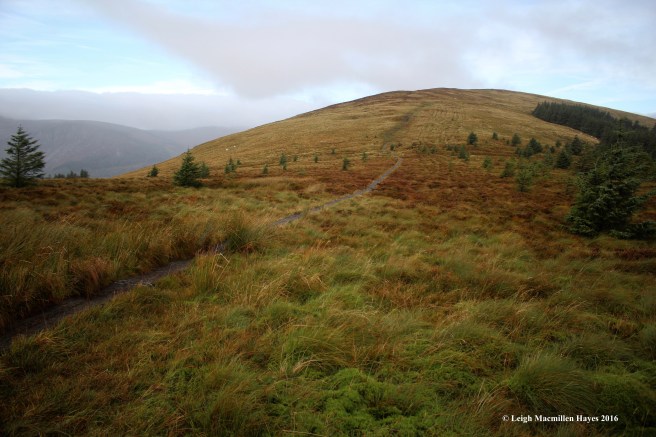
wicklow-way-day-1-3

And the ever present clouds added to the drama.

ww-greens

The land resembled a patchwork quilt.
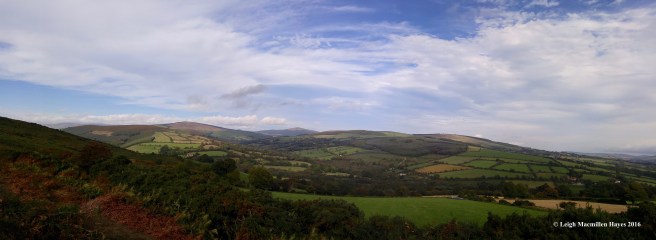
pano-2-day-2-1

No matter where we looked, it was forever changing.
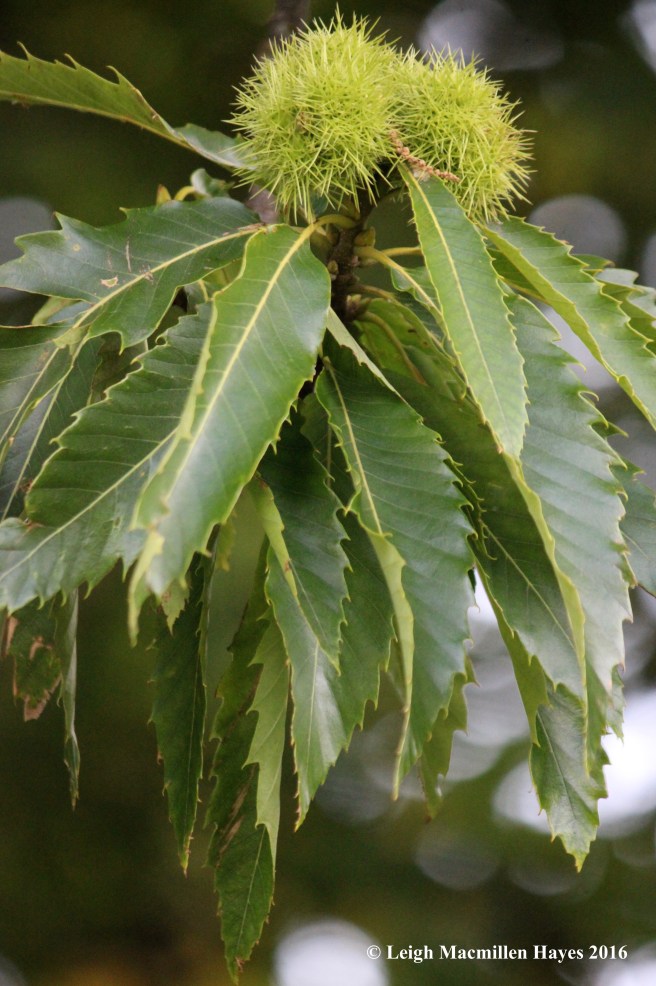
chestnuts

Some of our fun discoveries included chestnut trees,
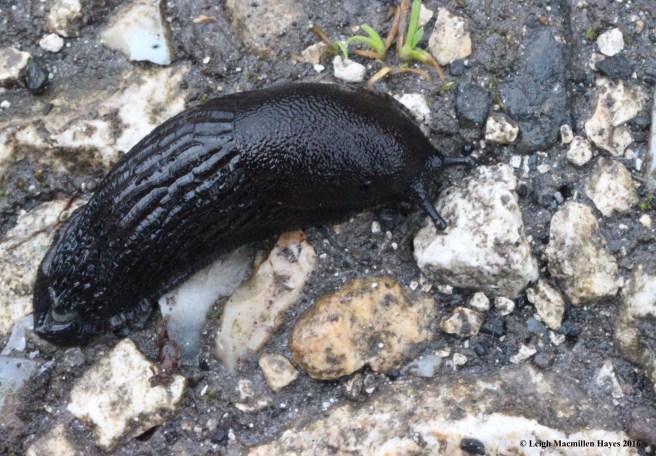
slug

black slugs, and . . .

bear-gryllz-signature

the crème de la crème–bear claw marks! Did Bear Gryllz really leave his signature on the trail behind the Glendalough Hotel?

wicklow-and-the-irish-sea

When we weren’t hiking, we explored the area, including Wicklow and its stone beach.

wind-turbine-boat-wicklow-harbor

We didn’t understand this ship at first until my guy asked–meet Wavewalker, a maintenance boat for Ireland’s Offshore Windfarm.

wicklow-harbor-other-side

Across the harbor, we spied the remains of a castle that invited a closer look.

wicklow-castle-2-sky-and-water-reflection

It seems Black Castle was constantly under siege and totally destroyed in 1301. And yet–I felt a presence still there.

castle-wicklow-face-in-turret

Do you see his face?

avoca-chairs

The oldest mill in Ireland also drew our attention–Avoca Handweavers Mill was established in 1723.

avoca-socks

It was the home of color with attitude.

avoca-yarn-5

Upclose and personal, we saw the inner workings.
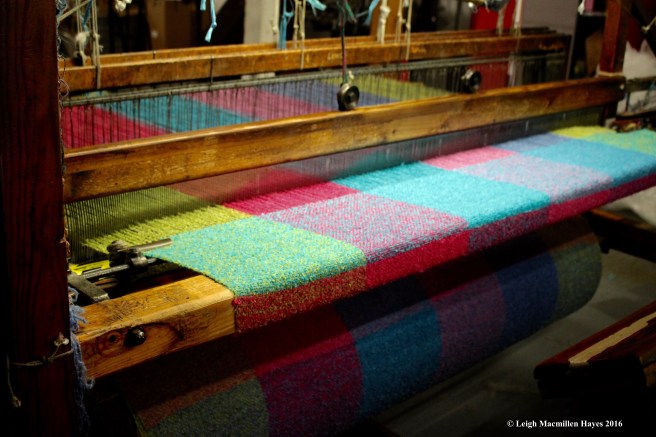
avoca-yarn-2

And marveled at the creative results.

carlow-castle-towers

Our last full day in Ireland found us in Carlow. Standing beside the River Barrow, this castle was thought to once be a stronghold and it survived attacks in the 1400s and 1600s. According to local lore, a physician set out to remodel it into an asylum in the early 1800s. As he tried to demolish the interior, he placed explosive charges near its base and accidentally destroyed all but the remaining west wall and twin towers. Uh oh.

swan-face-carlow

As happened daily, the weather quickly changed from blue sky to raindrops. Swans in the River Barrow didn’t care. They were in their element.
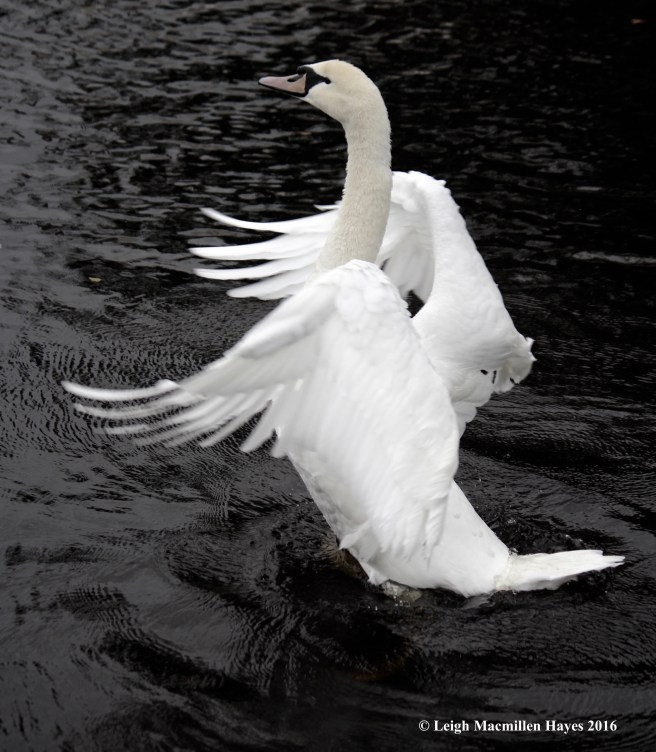
swan-stretch-carlow

My guy counted while I photographed. Thirty some odd–all wishful that we’d brought good tidings in the form of bread. Not to be much to their dismay. Despite that, we were treated to several displays.

sunset-over-carlow-1

And later that night, a display of sun and clouds as we went in search of supper.

irish-breakfast

Our final night was spent at the Green Lane B&B in Carlow where Pat and Noeleen took special care of us. My guy watched the GAA football game with Pat, their grandson Sam helped us print out our airline tickets and Noeleen made sure we had toll money for our journey to the airport. And then there was the breakfast–the finest we’d enjoyed.
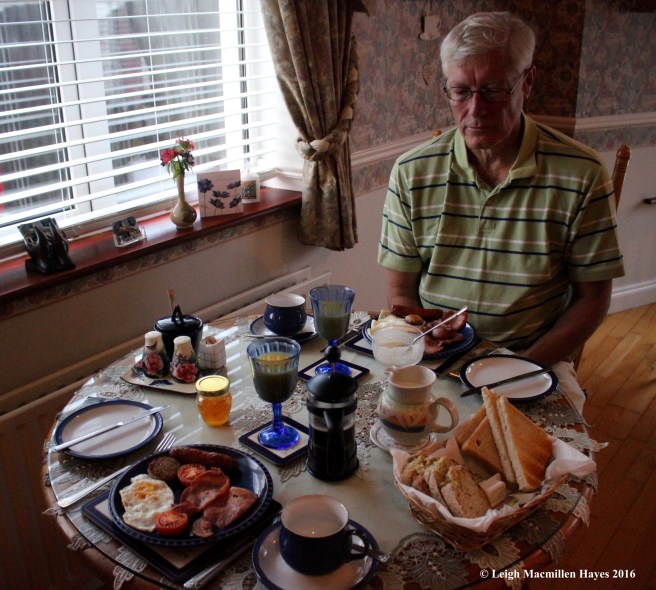
breakfast-2

Think eggs, tomatoes, mushrooms, bacon, sausage, white pudding, toast and Irish soda bread. And they wanted to know if we wanted porridge and cereal. Really?

irish-mist

Before we checked out, I made my guy drive to this field ensconced in an Irish mist.
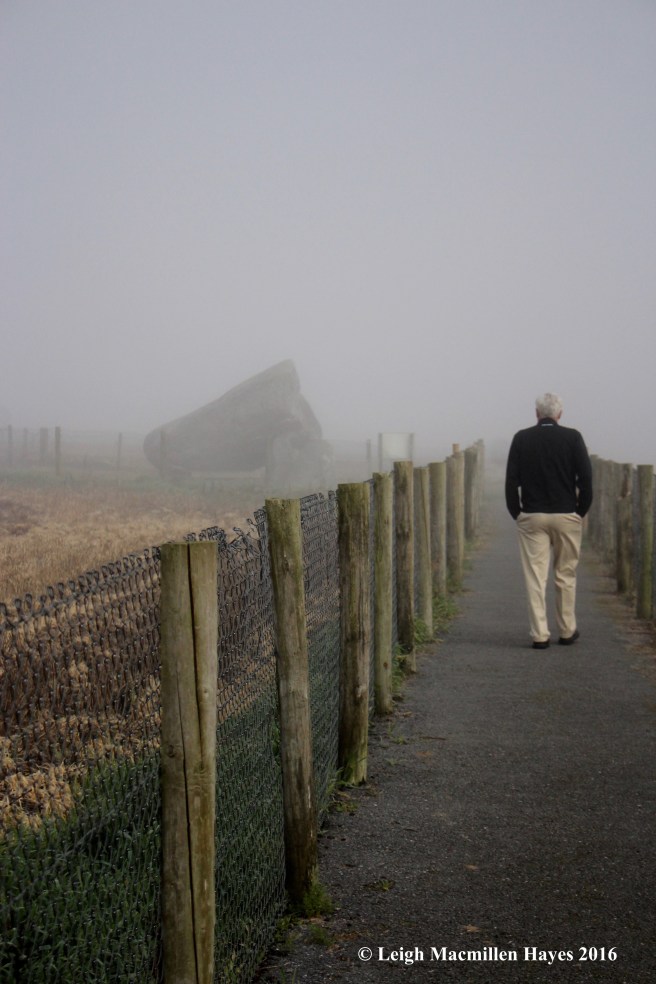
out-of-the-mist

The fog seemed apropos for our walk out to the Browneshill Dolmen. This was a burial chamber that may have originally been covered with earth.
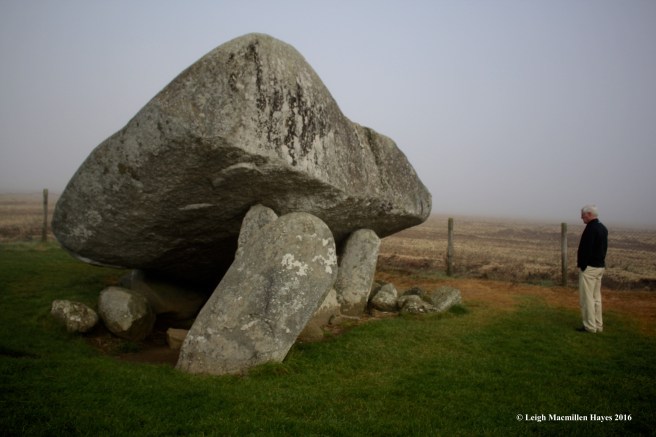
dolman-size

My guy stands almost six feet tall, so his height provided a sense of size.

dolman-2

The two more pointed stones on either side of the squared stone were known as portal stones that would have supported the granite capstone or chamber roof. The squared stone in the center was probably the gate stone that blocked the entrance. This site has not been excavated so there’s no other info about it, but just standing in its presence and considering those who came before and created such was enough.
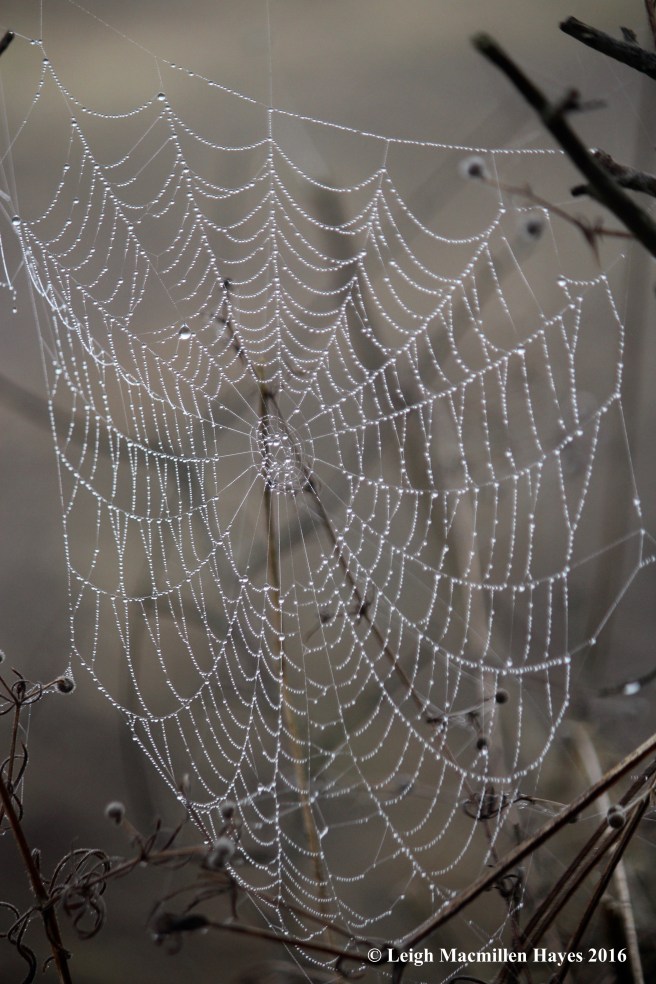
web-2

And then there were the spider webs. I’d missed them as we’d walked toward the dolmen, but they captured my attention all the way back. From prehistoric to present, the structures before us were breathtaking.
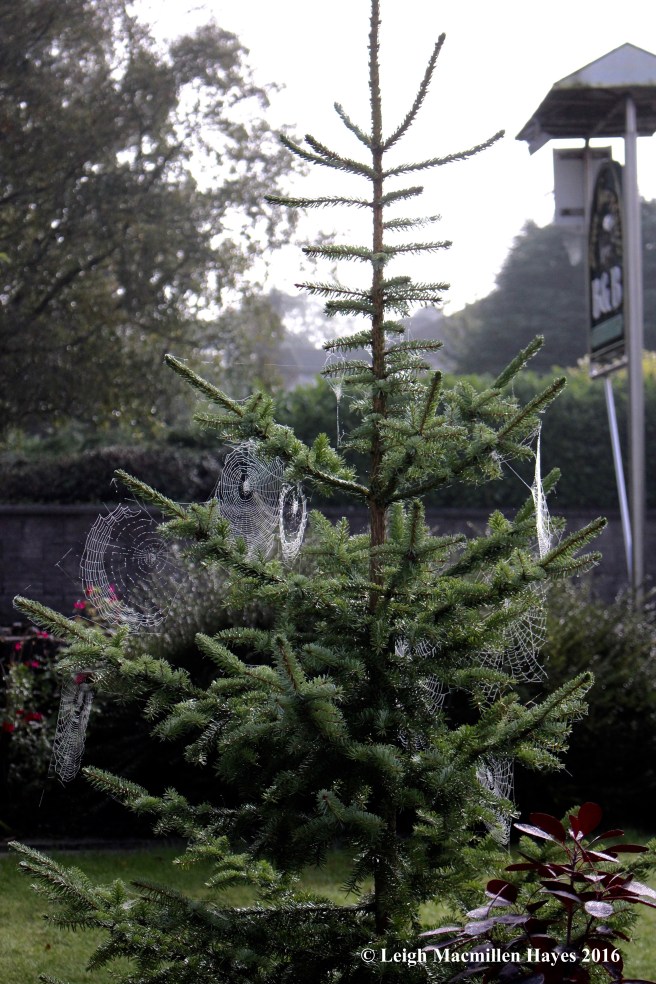
tree-webs

And when we finally pulled out of the B&B driveway on our way to the airport, I asked my guy to stop while I jumped out of the car. What a sight to behold–web ornaments. A perfect ending to our vacation.

My guy meet several roadblocks on his search for roots, but at the same time, he learned about some new avenues that may help in his quest. And I, I wished for more time to understand all that was before me from prehistoric to present–but maybe I sought answers that don’t need to be. Having the questions might be enough.

Together, we were grateful for our Hyacinth and Richard Adventure on the Emerald Isle. And glad to return the car safely to the rental agency.
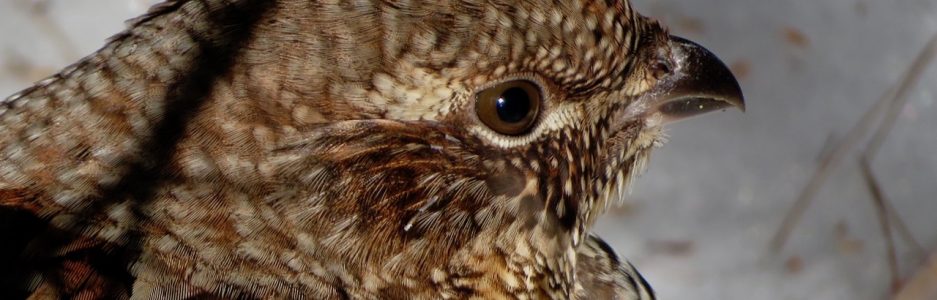
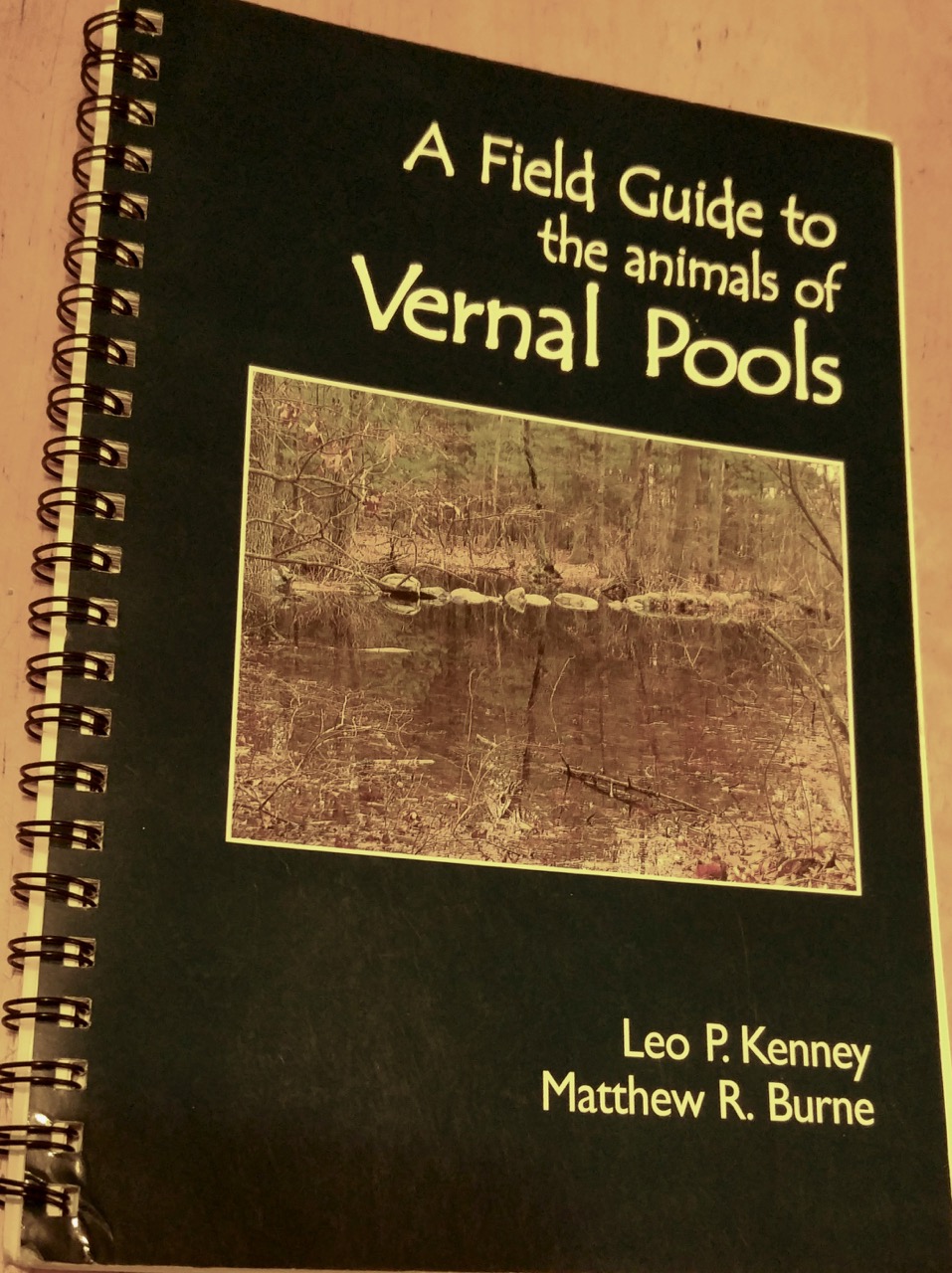


Book of August: BARK

IMG_2913

Book of August

It was my journey through the Maine Master Naturalist class several years ago that lead me to this book of the month: BARK–A Field Guide to Trees of the Northeast by Michael Wojtech.

The book actual evolved from Wojtech’s work, under the tutelage of Tom Wessels, toward a Master’s degree in Conservation Biology at Antioch University New England.

Between the covers you’ll find information about bark structure, types of bark and bark ecology. There is a key for those who are so inclined.
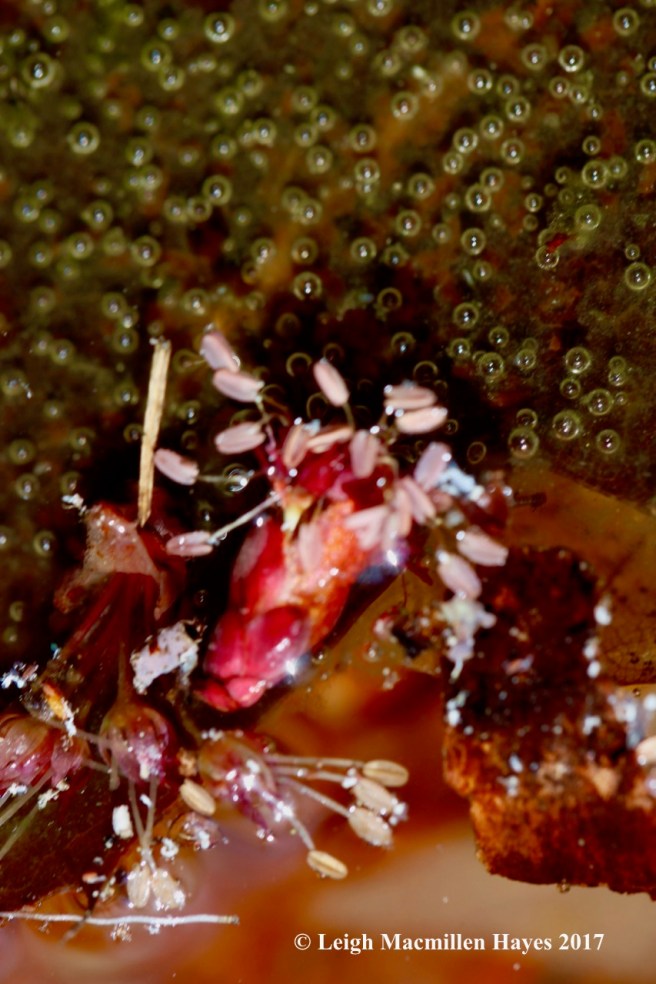
And then the biggest chunk of the book is devoted to photographs and descriptions for each type of tree that grows in our New England and eastern New York State forests. These include the common and Latin names, family, habitat, range maps, leaf and branch pattern, leaf shape and notes.

For me, there are two take away items from this book. First, I learned to categorize bark based on its pattern from smooth to ridges and furrows, vertical strips, curly and peeling to others covered in scales and plates. He breaks bark type into seven varieties that I now find easy to identify.

Second, I came to realize something that I may have known but never gave much thought to–except for  American beech bark, which remains smooth all its life (unless it’s been infected by the beech scale insect), bark differs from young to mature to old for any particular species. Oy vey!
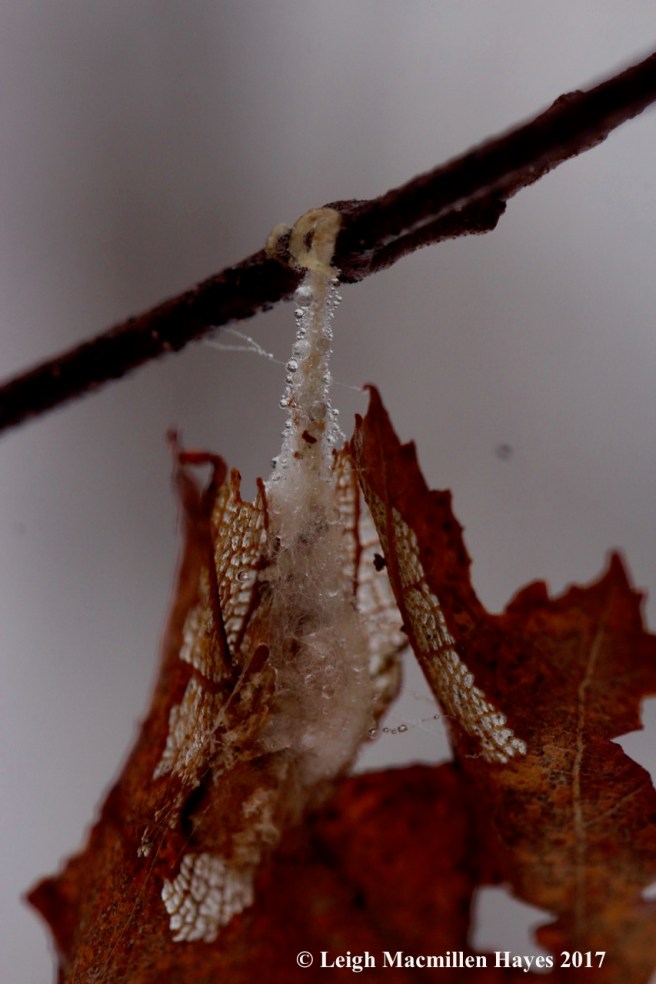
Though this book is useful in the winter, now is the time to start looking. To develop your bark eyes. The leaves are on and will help with ID, thus you can try the key and you’ll know if you’ve reached the correct conclusion or not.

Go ahead. Purchase a copy and give it a whirl. I must warn you, it becomes addictive and can be rather dangerous when you are driving down the road at 50mph. As Wojtech wrote in the preface, “If you want to experience a forest, mingle among its trees. If you want to know the trees, learn their bark.”

While you are at it, I encourage you to visit the small western Maine town of Bridgton, where the Bob Dunning Memorial Bridge leads into Pondicherry Park. Each of the sixteen bridge beams is constructed from a different tree and the bark is still on them. Test yourself and then grab one of my brochures at the kiosk to see if you got it right. If there are no brochures, let me know and I’ll fill the bin.

And while you are there, stop by the independent bookstore, Bridgton Books, to purchase a copy of BARK.

BARK: A Field Guide to Trees of the Northeast by Michael Wojtech, University Press of New England, 2011.

Book of June: Insects, A Golden Guide

So, yeah, insects. They aren’t my thing. And yet . . . they are fascinating. I only know this because my eyes were opened when I took the Maine Master Naturalist course. And this year, we’ve added a new title to the course: Insects from the Golden Guide series.

i-2 books

Our students received the 2002 edition, which is on the right. I also have the 1966 edition. Notice the price–$1.00 marked down to $.84. The newer edition: $6.95.

i-development

Price is not the only change. Though some things have stayed the same, the presentation has been reformatted and updated.

One of my favorite differences–attitude.

In the 1966 edition, “the battle to control insects is a never-ending necessity.” The purpose of the book–to help identify those bothersome pests. Insecticides were highly recommended, though precaution mentioned.

Fast forward to 2002: The foreword ends with a statement encouraging all to use the guide as an aid to “recognize and appreciate” insects that are part of our daily world.

i-31

For someone like me, it’s a great jumping-off point. I have a key and I have Peterson’s Guide and I have used bug guide.net, but this little book (6″x4″) offers a quick, easy-to-read glance and sometimes that’s all I need.

It’s certainly insect season (she wrote as she swatted a mosquito) and I encourage you to take a closer look. Like everything in the natural world, once you open your eyes to something, you’ll be amazed at what you find.

i-11

As a kid, I always thought this was snake spit. Huh? Do snakes climb flower stalks? Do they spit?

i-10

No, but spittlebugs (page 41) whip up some slimy froth to cover their eggs in late summer and the nymphs cover themselves while feeding in the spring.

i-27

I’m not sure if I’m seeing the nymph in the bubble house, but what I did notice as I looked at various masses this morning is the pattern or Fibonacci sequence. Cool stuff.

Meet my other friends:

i-bee 4

Some do good works.

i-20

Others–not so good.

i-spider on daisy

I’m amazed by color

i-5

and camouflage,

i-7

short antennae

i-1

and long,

i-2

bulging eyes,

i-3

veined wings and

i-26

jointed legs.

i-33

Last year, I spent hours stalking the parents or relatives of this little one because the body structure amazed me so. I suspect I’ll do the same this year. Be forewarned.

Notice I didn’t ID any bugs–that’s for you to do if you choose. But even if you don’t, I do hope you’ll take a closer look.

And if you are looking for a great introductory guide, I highly recommend Golden Guides Insects. My copy was a gift, but I’m sure your local, independent book store (aka Bridgton Books–always like to give them a plug) can locate a copy for you.